GFM - Module 1 International Financial Environment.docx
1.
International finance managementis the strategic management of financial
activities across national borders. It entails overseeing global financial
operations such as investing, financing, and risk management.
Global finance refers to the financial activities and markets that occur on a
worldwide scale. This includes international trade and investment, currency
exchange rates, cross-border transactions, and the flow of capital between
countries.
The international financial system consists of regulatory bodies, financial
markets, financial institutions. They all ensure that financial transactions
stability and smoothness with which international finances are transacted
under toughest regulations.
The Significance of Understanding Global Finance in Today's World
Mohammad Nazim Uddin
Data Science, Marketing, Branding, and Tech Enthusiast | Undergraduate at
IBA-JU
Global finance has become an increasingly important topic in today's
interconnected world, as economies and markets around the world are more
closely linked than ever before. With the rise of technology and the increasing
ease of international trade and investment, it is essential for individuals,
businesses, and governments to understand the basics of global finance.
What is Global Finance?
Global finance refers to the financial activities and markets that occur on a
worldwide scale. This includes international trade and investment, currency
exchange rates, cross-border transactions, and the flow of capital between
countries. Global finance is a complex and dynamic field, with many different
factors influencing financial activity around the world.
The Benefits of Understanding Global Finance
There are many benefits to understanding global finance, especially for
individuals and businesses looking to expand their reach and capitalize on
international opportunities. Here are just a few of the benefits of
understanding global finance:
Better investment decisions - A better understanding of global finance can
help individuals and businesses make more informed investment decisions,
whether they are investing in stocks, bonds, or other assets.
Improved competitiveness - Understanding global finance can give individuals
and businesses an advantage in the global marketplace, as they are better
equipped to navigate international financial markets and make strategic
business decisions.
2.
Global marketplace, asthey are better equipped to navigate international
financial markets and make strategic business decisions.
Reduced risk - Understanding the global financial landscape can help
individuals and businesses to better assess the risks associated with
international investments and transactions, allowing them to make more
informed decisions.
Greater economic stability - A better understanding of global finance can help
individuals and businesses weather economic storms and maintain stability
during times of financial uncertainty.
How to Stay Informed About Global Finance
There are many ways to stay informed about global finance, including reading
financial news and reports, attending conferences and seminars, and
engaging with experts in the field. In addition, there are many online resources
available, including websites, blogs, and forums, that provide valuable
information and insights into the world of global finance.
Conclusion
Global finance is a complex and dynamic field that is essential to understand
in today's interconnected world. With the benefits of a better understanding of
global finance, from improved investment decisions to greater economic
stability, it is important for individuals, businesses, and governments to stay
informed and up-to-date on the latest developments in the field. Whether
through reading financial news and reports, attending conferences and
seminars, or engaging with experts in the field, there are many ways to stay
informed about global finance and make the most of the opportunities it
presents.
Importance of International Finance Management (IFM):
1. Globalization: In an increasingly interconnected world, IFM helps
businesses navigate diverse markets, currencies, and regulations.
2. Access to Capital: IFM enables multinational corporations (MNCs) to tap
into international capital markets for funding, diversifying risk and lowering
costs.
3. Risk Management: IFM allows MNCs to hedge against currency
fluctuations, political instability, and other global risks.
4. Strategic Expansion: IFM facilitates expansion into new markets, fostering
growth and diversification for MNCs.
3.
5. Competitive Advantage:Effective IFM strategies can confer a competitive
edge by optimizing capital allocation and leveraging global opportunities.
Rewards of International Finance Management:
1. Profit Opportunities: Accessing new markets and currencies can unlock
lucrative profit opportunities.
2. Diversification: IFM enables diversification of revenue streams, reducing
dependence on any single market or currency.
3. Economies of Scale: Operating globally can lead to economies of scale,
driving down costs and enhancing efficiency.
4. Enhanced Knowledge: Exposure to diverse markets enhances the MNC's
understanding of global trends and consumer preferences.
5. Strategic Alliances: IFM fosters partnerships and alliances with foreign
entities, opening avenues for shared resources and expertise.
Risks of International Finance Management:
1. Currency Risk: Fluctuations in exchange rates can impact profitability and
financial stability.
2. Political Risk: Political instability, regulatory changes, and geopolitical
tensions pose significant risks to MNCs operating internationally.
3. Market Risk: Variations in consumer behavior, competition, and economic
conditions across markets can affect business performance.
4. Legal and Regulatory Risk: Compliance with diverse legal and regulatory
frameworks adds complexity and potential liabilities.
5. Operational Risk: Managing operations across different countries involves
logistical challenges, cultural differences, and supply chain disruptions.
MULTINATIONAL CORPORATIONS
Companies that operate outside of their home country are considered
international companies. Globalization describes companies, people, or
entities that operate internationally or have international influence.
Examples of international companies include Apple, McDonald's, and
Starbucks.
(MNCs) are defined as firms that engage in some form of international
business. Their managers conduct international financial management,
which involves international investing and financing decisions that are
intended to maximize the value of the MNC.
The goal of their managers is to maximize the value of the firm, which is
similar to the goal of managers employed by domestic companies. Initially,
firms may merely attempt to export products to a particular country or import
supplies from a foreign manufacturer. Over time, however, many of them
recognize additional foreign opportunities and eventually establish
subsidiaries in foreign countries.
4.
Dow Chemical, IBM,Nike, and many other firms have more than half of
their assets in foreign countries. Some businesses, such as ExxonMobil,
Fortune Brands, and Colgate- Palmolive, commonly generate more than
half of their sales in foreign countries. Even smaller U.S. firms commonly
generate more than 20 percent of their sales in foreign markets, including
Ferro (Ohio), and Medtronic (Minnesota). Seventy-five percent of U.S. firms
that export have fewer than 100 employees.
International financial management is important even to companies that
have no international business because these companies must recognize
how their foreign competitors will be affected by movements in exchange
rates, foreign interest rates, labor costs, and inflation. Such economic
characteristics can affect the foreign competitors' costs of production and
pricing policies.
Goals of MNC
The commonly accepted goal of an MNC is to maximize shareholder
wealth. Managers employed by the MNC are expected to make decisions
that will maximize the stock price and therefore serve the shareholders.
Some publicly traded MNCs based outside the United States may have
additional goals, such as satisfying their respective governments, creditors,
or employees. However, these MNCs now place more emphasis on
satisfying shareholders so that they can more easily obtain funds from
shareholders to support their operations.
Goals of Multinational Corporations (MNCs) in International Finance:
1. Profit Maximization: MNCs aim to generate maximum returns for
shareholders by capitalizing on global opportunities.
2. Risk Management: MNCs seek to mitigate risks associated with
international operations, including currency, political, and market risks.
3. Cost Efficiency: MNCs strive to minimize costs by optimizing capital
allocation, leveraging economies of scale, and managing currency
exposures.
4. Strategic Expansion: MNCs pursue strategic expansion into new
markets to diversify revenue streams and sustain long-term growth.
5. Stakeholder Value: MNCs prioritize creating value for all stakeholders,
including shareholders, employees, customers, and communities, while
adhering to ethical and sustainable business practices.
The commonly accepted objective of an MNC is to maximize stockholder
wealth on a global basis, as reflected by stock price. Managers of an MNC
may make decisions that conflict with the firm's goal to maximize
shareholder wealth.
5.
Multinational corporations choosefrom among three basic international
strategies: (1) Multidomestic, (2) Global, and (3) Transnational. These
strategies vary in their emphasis on achieving efficiency around the world
and responding to local needs.
1. McDonald's: A Global Fast Food Empire. When it comes to
successful international business ventures, McDonald's is often at the
top of the list. From its humble beginnings in the United States,
McDonald's has grown into a global fast-food empire with a presence in
over 100 countries. Key factors contributing to McDonald's international
success include:
Adaptation to Local Tastes, Local Partnerships and Consistency in Quality:
2. Coca-Cola: A Global Beverage Giant - Coca-Cola, the iconic
beverage company, is another exemplary case of successful
international expansion. Coca-Cola products are sold in nearly every
country on Earth, and the brand is universally recognized. Key success
factors for Coca-Cola's international business ventures include: Global
Branding, Localized Marketing, & excellent Distribution Network.
3. Samsung: A Technological Powerhouse
Samsung, a South Korean conglomerate, is a prime example of a
company that has achieved international success across various
industries, from electronics to shipbuilding.
Factors contributing to Samsung's global success include: Innovation,
Investment in Research and Development & Global Manufacturing
Presence.
4. Alibaba: E-Commerce Dominance
Alibaba, founded by Jack Ma in China, is a remarkable example of an
e-commerce giant that has expanded its influence well beyond its
home country.
Key factors behind Alibaba's international success include Global
Online Marketplace, Payment Solutions, Alipay a digital payment
platform, which facilitated cross-border transactions and made it easier
for international customers to shop on Alibaba's platforms & Strategic
Investments: Alibaba strategically invested in various international e-
commerce and technology companies, expanding its reach and
influence beyond China.
5. Toyota: Driving Global Automotive Leadership
Toyota, a Japanese automaker, is renowned for its global automotive
leadership and innovative manufacturing practices.
Key success factors for Toyota's international business ventures
include: Quality and Reliability, Efficient Production and Global
Manufacturing and Sales Network.
These case studies demonstrate that successful international business
ventures require a combination of factors, including adaptability to local
6.
markets, a strongglobal brand, innovation, and strategic partnerships.
Furthermore, an unwavering commitment to quality and customer
satisfaction is often a common thread among these successful
companies.
International financial Environment - The Importance
Compared to national financial markets international markets have a
different shape and analytics. Proper management of international finances
can help the organization in achieving same efficiency and effectiveness in
all markets, hence without IFM sustaining in the market can be difficult.
Rewards & risk of international finance
Companies are motivated to invest capital abroad for the following reasons
Efficiently produce products in foreign markets than that
domestically.
Obtain the essential raw materials needed for production.
Broaden markets and diversify
Earn higher returns
Access to capital markets across the world enables a country to
borrow during tough times and lend during good times.
It promotes domestic investment and growth through capital import.
Worldwide cash flows can exert a corrective force against bad
government policies.
It prevents excessive domestic regulation through global financial
institutions.
International finance leads to healthy competition and, hence, a more
effective banking system.
It provides information on the vital areas of investments and leads to
effective capital allocation.
7.
Special features aboutInternational Finance:
1. Foreign exchange risk - E.g., an unexpected devaluation adversely
affects the company’s export market.
2. Political risk - E.g.. an unexpected overturn of the government that
jeopardizes existing negotiated contracts
3. Market imperfections - E.g., trade barriers and tax incentives may affect
location of production.
4. Expanded opportunity sets - E.g., raise funds in global markets, gains
from economies of scale.
International financial markets face a variety of risks and they are
collectively known as international finance risks. The premier financial
institutions of the world apply various principles and practical applications to
deal with the risks of international finance. Financial risks usually are those
kind of risks which are related to finance or money. The financial risks
related to investments include capital risk, currency risk, as well as liquidity
risk. The debt related risks include interest rate risk and faces credit risk.
The international insurance industry also faces a number of risks.
The various risks that influence international financial markets usually include
the following:
Product risks
Product-related risks are those that the seller automatically has to accept. As an
integral part of their commitment, for example, they usually have to provide specified
performance warranties, agreed maintenance, or service obligations.
The buyer must consider how external factors, such as negligence during production
or extreme weather during shipping, could affect their product.
These matters could well lead to disputes between the parties, even after contracts
are signed.
It is important for the seller that the contract is worded correctly, so that any changes
that could affect the product are covered, with clear outcomes provided.
Manufacturing risks
Manufacturing risks are particularly common for products that are tailor-made or
have unique specifications.
Often sellers are required to cover costs of any readjustments of the product until the
buyer sees fit because the product can’t be resold to other buyers.
8.
These types ofrisks can be addressed as early as the product planning phase,
which often means the buyer has to enter payment obligations at a much earlier
stage of the transaction.
To mitigate the risks for both the buyer and the seller (especially for bespoke
products), the terms of payment may be part-payments and separate guarantees
throughout the design, production, and delivery of the product.
Transport risks
These are the risks associated with the movement of the goods from the
seller to the buyer. About 80% of the world’s transportation of goods is
carried out by sea, which gives rise to a number of risk factors, including
storms, collisions, theft, leakage, spoilage, scuttling, piracy, fire, and robbery.
Cargo and transport risks can be reduced through cargo insurance, which is
usually defined by standard international policy wording (issued by the
Institute of London Underwriters or the American Institute of Marine
Underwriters).
The agreed terms of delivery will usually state who is responsible for
arranging insurance.
If the buyer fails to insure the cargo shipment in a proper way when it is their
responsibility, the insurance could be invalid if, for example, the port or
transport route changes and the items arrive in damaged condition.
• Political risk
While most of the countries where you are likely to be doing business have stable
governments, there are concerns that Companies will confront. All member nations
of the World Trade Organization are committed to free trade, but protectionism is still
a fact of life with some. Tariffs and quotas may place restrictions on the company’s
ability to trade. Import and export licenses, customs duties, and laws regulating
currency control are requirements you must explore. Companies must also be
mindful that each country where they do business has a different political and legal
system. Theft of intellectual property and illegal knock-offs are facts of life, so
companies have to be prepared. Knockoff products are those that copy or imitate
the physical appearance of other products but which do not copy the brand name or
logo of a trademark.
• Financial risk
One risk of engaging in international business lies with exchange rates. This is not a
factor when the business is all domestic, but when the buyer has another currency,
then the Company must protect itself against losses due to exchange rate changes.
Foreign exchange markets are fairly stable, and, barring an international crisis, the
risk is not great. Managing international transactions requires extra precautions
about payments. If the buyer is abroad, company must take steps to assure that that
they will be paid. Foreign credit insurance and letters of credit can alleviate much of
9.
the risk ofselling the products in overseas markets, since they will provide the
company with the knowledge of the buyer's ability to pay.
• Economic risk
There are several economic issues that the company must deal with when engaging
in international operations. If a company is importing materials or products, it must
take extra precautions to insure timely delivery. Geography and economic conditions
in the country they are dealing with are factors. Mountains and oceans create
international barriers that the company must work into its business plan. Economic
instability may be an issue if the transactions involve businesses in third world
nations. Even if they are politically stable, they may lack the infrastructure to provide
a sound economic environment.
Country risk
It is the risk that a foreign government will default on its bonds or other
financial commitments. Country risk also refers to the broader notion of the
degree to which political and economic unrest affect the securities of issuers
doing business in a particular country.
Foreign Exchange Risk/Currency risks
Foreign exchange risk occurs when the value of an investment fluctuates due
to changes in a currency's exchange rate. When a domestic currency
appreciates against a foreign currency, profit or returns earned in the foreign
country will decrease after being exchanged back to the domestic currency.
Due to the somewhat volatile nature of the exchange rate, it can be quite
difficult to protect against this kind of risk, which can harm sales and
revenues.
This is the risk posed by fluctuations in exchange rates that could affect
payments and receipts in foreign currency.
Unless such risk is hedged, a trader has no control over the impact of
exchange rate volatility, and in a worst-case scenario, such volatility can wipe
out the entire profit and more that would have been accrued from the trade
transaction.
Currency risk management is often misunderstood or neglected by
businesses. Any business that purchases and sells products (or services) in
multiple currencies should consider options to mitigate foreign exchange (FX)
rate volatility.
Changes in exchange rates will impact the profit margin on international
contracts, as well as the value of any assets, liabilities and cash flows which
are denominated in a foreign currency.
There is a range of financial instruments available to manage FX risk. Due to
the increasing volatility in the market and the need to operate in various
currencies, policies need to be flexible and cater accordingly.
10.
Prior to developinga foreign exchange strategy, a company should look at
what proportion of their business relates to imports or exports, the currencies
that are being used when payments are made, and what currency is used for
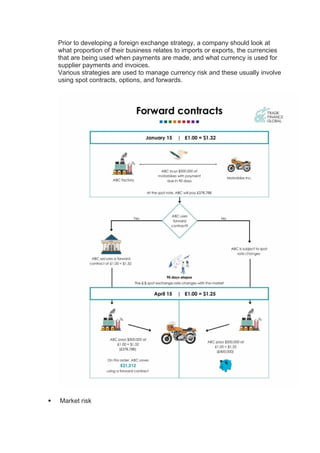
supplier payments and invoices.
Various strategies are used to manage currency risk and these usually involve
using spot contracts, options, and forwards.
Market risk
11.
Market risk isthe possibility of an investor experiencing losses due to factors
that affect the overall performance of the international financial markets in
which he or she is involved.
Corporate risk
These are risks associated with the importing or exporting businesses and are
primarily focused on their credit rating and any history of defaults, either
through non-payment, non-delivery, or deficient delivery (e.g. faulty or
damaged goods).
Commercial risk
This refers to potential losses arising from weaknesses stemming from, or
defects in, the underlying trade.
Such factors could include the quality or adequacy of the goods being traded
or the robustness of the contracts and pricing terms.
Fraud risk
These are risks typically associated with either unknowingly engaging with a
fraudulent counterparty, receiving forged documents, or being the victim of an
insurance scam.
Documentary risk
Documents play a vital role in international trade. Missing or incorrectly
prepared documents pose risk for both buyers and sellers, as this can cause
delays in shipments and ultimately delays in payments.
These points provide a broad overview of the importance, rewards, risks, and
goals associated with International Finance Management for multinational
corporations.
List of MNCs that failed in India:
A long list of multinational companies has failed in India. Notable cases
include General Motors from the United States, Vodafone Group from Britain,
Holcim Group from Switzerland, and BYD from China.
MNC s that failed internationally – CASE STUDIES
1. Target failed in Canada - Unfortunately after less than two years of
blunders, billions of dollars lost and another six years to go before
profitability, the brand announced it was ending its foray into
Canada, liquidating 133 stores and laying off more than 17,000
employees.
2. Home Depot fails to inspire the DIY movement in China
12.
With the Chineseeconomy in the midst of a growth spurt and the housing
market following suit, 2006 seemed liked a good year for U.S.-headquartered
DIY giant Home Depot to dip its toes into the market. It was until they’d
opened 12 stores that they realized the Chinese didn’t really like to do it
themselves.
3. Walmart creeps out the Germans
Like Home Depot, U.S. big box retailer Walmart failed to take into account
cultural nuances – in particular personal space – when it opened up shop in
Germany in 1997. The chain opened 85 stores in an attempt to tap into the
frugal country’s lucrative discount department market. In 2006, Walmart pulled
out, at a cost of US$1 billion.
4. Starbucks too hot (and expensive) for Australia
Massive U.S. coffee chain Starbucks ended up with a ton of melted iced
machiattos when it tried to push into Australia in 2000. Much like Target’s
failed leap to the Canadian market, Starbucks went down under with similar
naïveté – Aussies act the same as Americans so why wouldn’t their coffee
drinking habits be the same? Unfortunately, the local movement dominates
the Australian coffee market and for those prone to visiting chains, Starbucks
proved to be too expensive. But the slow burn didn’t set in until 2008 when the
caffeine peddler suddenly closed 61 stores to the tune of a reported $143
million loss. Starbucks kept the faith until 2014 when it handed over the
remaining 24 shops to the Withers Group, which operates the 7-11 chain in
Australia.
5. Best Buy too big for its britches in the U.K.
Best Buy entered the UK market in 2010, buying up a 50 per cent stake in UK
mobile phone company Carphone Warehouse for $1.3 billion. The goal, which
was initially to launch 200 stores, was revised to 100 stores but didn’t even
get that far. By late 2011, the big box electronic retailer announced it was
closing the lackluster 11 stores it had managed to open during the run. The
reason? Despite keeping an eye on strategic acquisitions for years before
making the Carphone Warehouse play, Best Buy chose the apex of the worst
economic decline in recent history to open up shop. The whole bungled affair
was estimated to have cost the company around US$318 million.
2. Hailo gives up in North America
Unlike Walmart or Home Depot, it took London, U.K.-based taxi finding app
Hailo less than a year and a half to decide it wasn’t up for a rumble with
entrenched competitors Uber and Lyft – both peer to peer, ride-sharing
networks powered by apps. Despite getting around US$77 million in
investment from high profile venture capital groups like Atomico and Union
Square Venture, Hailo didn’t see much point in trying to compete in the price
war between Uber and Lyft when it’s doing just fine in Europe with nearly two
and a half million registered passengers and 2013 revenues of US$100
million. The company pulled out in October 2014, shutting its operations in
Washington, Chicago, Boston, Toronto and Montreal.
3. Mattel misses playtime in China
It’s clear the Chinese are a tough consumer for Western retailers to entice. In
March 2009, Mattel hoped to hawk its skinny fashionista Barbie to the kids of
China. The goal – build a giant 36,000-square-foot Barbie stronghold with six
13.
floors, a staircaselined with 875 Barbies and a Barbie-themed bar in the
midst of Shanghai’s flashy retail district. Unfortunately, Mattel didn’t study its
market enough. In a culture that stresses skill building and educational toys,
Barbie was seen as a bit of a distraction. Within two years the behemoth of a
store was closed. But it’s worth noting that Mattel has been tirelessly
educating itself on the Eastern market and is slowly making another play.
4. Tesco fails to whet U.S. appetite
For U.K.-based grocery chain, convincing American consumers to shop at its
Fresh & Easy seemed like a done deal. And a few years earlier, the brand
could have found success selling its fresh supermarket meals to the growing
local and organic consumer base. But Tesco’s Fresh & Easy opened the
doors in 2007, on the edge of a recessionary cliff when American consumers
appetite for food spending was heading south. Five years later, Tesco
announced it was abandoning its American dream and closing its nearly 200
stores on the west coast. The failure cost the British chain nearly US$1.8
billion.
Fundamentals of Balance of Payments (BoP):
Definition & Meaning: The BoP is a systematic record of all economic transactions
between residents of one country and the rest of the world over a specified period,
typically a year. The balance of payments (BOP) is the method by which countries
measure all of the international monetary transactions within a certain period. The
BOP consists of three main accounts: the current account, the capital account,
and the financial account.
Balance Of Payment (BOP) is a statement that records all the monetary
transactions made between residents of a country and the rest of the world
during any given period. This statement includes all the transactions made by/to
individuals, corporates and the government and helps in monitoring the flow of funds
to develop the economy.
When all the elements are correctly included in the BOP, it should be zero in a
perfect scenario. This means the inflows and outflows of funds should balance out.
However, this does not ideally happen in most cases.
A BOP statement of a country indicates whether the country has a surplus or a
deficit of funds, i.e. when a country’s export is more than its import, its BOP is said to
be in surplus. On the other hand, the BOP deficit indicates that its imports are more
than its exports.
Tracking the transactions under BOP is similar to the double-entry accounting
system. All transactions will have a debit entry and a corresponding credit entry.
For example:
Funds entering a country from a foreign source are booked as credit and
recorded in the BOP.
14.
Outflows from acountry are recorded as debits in the BOP. Let’s say Japan
exports 100 cars to the U.S. Japan books the export of the 100 cars as a credit in the
BOP, while the U.S. books the imports as a debit in the BOP.
Purpose: It provides insight into a country's economic relationship with the
rest of the world, including trade flows, financial transactions, and changes
in international reserves.
Key Components: BoP consists of two main accounts: the Current Account and the
Capital and Financial Account. Accounting Components of BoP:
Current Account: Records transactions in goods, services, primary income
(such as wages and investment income), and secondary income (such as aid
and remittances). It reflects a country's net exports or imports.
Capital and Financial Account: Tracks international capital flows, including
foreign direct investment (FDI), portfolio investment, changes in reserve
assets, and other financial transactions. It reflects changes in a country's
ownership of foreign assets and liabilities.
Elements of a Balance of Payment
There are three components of the balance of payment viz current account, capital
account, and financial account. The total of the current account must balance with
the total of capital and financial accounts in ideal situations.
Current Account
The current account monitors the inflow and outflow of goods and services between
countries. This account covers all the receipts and payments made with respect to
raw materials and manufactured goods.
It also includes receipts from engineering, tourism, transportation, business services,
stocks, and royalties from patents and copyrights. When all the goods and services
are combined, they make up a country’s Balance Of Trade (BOT).
There are various categories of trade and transfers which happen across countries.
It could be visible or invisible trading, unilateral transfers or other payments/receipts.
Trading in goods between countries is referred to as visible items, and import/export
of services (banking, information technology etc.) are referred to as invisible items.
Unilateral transfers refer to money sent as gifts or donations to residents of foreign
countries. This can also be personal transfers like – money sent by relatives to their
family located in another country.
15.
Capital Account
All capitaltransactions between the countries are monitored through the capital
account. Capital transactions include purchasing and selling assets (non-financial)
like land and properties.
The capital account also includes the flow of taxes, purchase and sale of fixed
assets etc., by migrants moving out/into a different country. The deficit or surplus in
the current account is managed through the finance from the capital account and
vice versa. There are three major elements of a capital account:
Loans and borrowings – It includes all types of loans from the private and public
sectors located in foreign countries.
Investments – These are funds invested in corporate stocks by non-residents.
Foreign exchange reserves – Foreign exchange reserves held by the country’s
central bank to monitor and control the exchange rate do impact the capital account.
Financial Account
The flow of funds from and to foreign countries through various investments in real
estate, business ventures, foreign direct investments etc., is monitored through the
financial account. This account measures the changes in the foreign ownership of
domestic assets and domestic ownership of foreign assets. Analysing these changes
can be understood if the country is selling or acquiring more assets (like gold, stocks,
equity, etc.).
Illustration
If, for the year 2018, the value of exported goods from India is Rs. 80 lakh and the
value of imported items to India is 100 lakh, then India has a trade deficit of Rs. 20
lakh for the year 2018. The BOP statement acts as an economic indicator to identify
the trade deficit or surplus situation. Analysing and understanding the BOP of a
country goes beyond just deducting the outflows of funds from inflows. As mentioned
above, there are various components of BOP and fluctuations in these accounts,
which provide a clear indication of which economic sector needs to be developed.
Importance of the Balance of Payments in India
The importance of the balance of payment in India can be determined from the
following points:
It monitors the transaction of all the imports and exports of services and
goods for a given period.
It helps the government analyse a particular industry’s export growth potential
and formulate policies to sustain it.
16.
It givesthe government a comprehensive perspective on a different range of
import and export tariffs. The government then increases and decreases the
tax to discourage imports and encourage export, individually, and self-
sufficiency.
Difference between the balance of trade and payments-
Balance of trade is the difference between exports and imports of goods. Only the
visible items are considered in the balance of trade. The exchange of services
between countries is not considered.
The current account of the balance of payment comprises exports and imports of
goods, services and unilateral transfers like remittances, gifts, donations, etc. The
net value of all these constitutes the balance of the current account. Thus, the
balance of trade is a part of the current account of the balance of payments.
The sources of supply of foreign exchange are:
Purchase of goods and services by foreigners
Foreign Direct Investment (FDI) into our country
Inflow by the NRIs settled in foreign countries
Speculative purchase of home currency by foreigners
BOP – Equilibrium & Disequilibrium
When the demand and supply of any foreign currency in a country in a given time
period is equal, it is termed as 'Equilibrium position' in the balance of payment. While
a disequilibrium means that the condition is either deficit or surplus.
In terms of the balance of payment, a country has to take care of three types of
items.
Visible items include various types of physical goods that are imported and
exported.
While invisible items include all the services whose import and export are not
visible.
This includes medical services, transport services, etc.
The third one is a capital transfer which is concerned with capital payments and
capital receipts. A country can acquire these goods only by accommodating a capital
deficit and this deficit is called the balance of payment.
17.
Meaning of adeficit in the balance of payments
When autonomous foreign exchange payments exceed autonomous foreign
exchange receipts, the balance of payments deficit is the difference. Autonomous
transactions in foreign exchanges are those transactions that are independent of the
state’s balance of payments and are undertaken for an individual’s own sake.
Official reserve transactions and their importance in the balance of payments
Official reserve transactions mean running down the country’s foreign exchange
reserves in case of a deficit in the balance of payments by selling foreign currency in
the foreign exchange market. In surplus, the country can buy foreign exchange and
increase its official reserves.
A country is said to be having its balance of payment in equilibrium when the sum of
its current account and non-reserve capital account equals zero, which means the
current account deficit is financed entirely by international borrowings without any
movement in the country’s official reserves.
Equilibrium & Disequilibrium in BoP:
Equilibrium: BoP is said to be in equilibrium when a country's total receipts
(credits) equal its total payments (debits). In equilibrium, there's neither a
surplus nor a deficit.
Surplus: If a country's credits exceed its debits, it has a surplus in the BoP.
This surplus can indicate strong export performance or significant inflows of
foreign investment.
Deficit: If a country's debits exceed its credits, it has a deficit in the BoP. This
deficit can result from high levels of imports, large outflows of capital, or a
decline in exports.
Implications of Disequilibrium: Persistent deficits or surpluses in the BoP
can have economic implications. Deficits may lead to currency depreciation,
inflation, or borrowing from abroad, while surpluses may result in currency
appreciation, deflation, or increased foreign asset accumulation.
Understanding the Balance of Payments is crucial for policymakers, economists, and
businesses as it provides valuable insights into a country's economic health, its
competitiveness in international trade, and its ability to attract foreign investment.
India generally experiences a huge deficit of the balance of payment due to its size.
This is all down to the fact that India requires imported technology, machines, and
other resources to run its economy successfully. To know about a country’s
economic stability and sustainability, the balance of payment is the measure. Thus, it
is usually accountable for 1 year. Also, these payments and receipts include outflows
and inflows like payments and receipts. So, in terms of the balance of payment,
there is a surplus balance of payment and balance of payment deficit.
18.
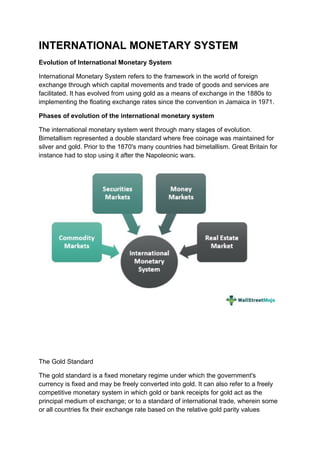
INTERNATIONAL MONETARY SYSTEM
Evolutionof International Monetary System
International Monetary System refers to the framework in the world of foreign
exchange through which capital movements and trade of goods and services are
facilitated. It has evolved from using gold as a means of exchange in the 1880s to
implementing the floating exchange rates since the convention in Jamaica in 1971.
Phases of evolution of the international monetary system
The international monetary system went through many stages of evolution.
Bimetallism represented a double standard where free coinage was maintained for
silver and gold. Prior to the 1870's many countries had bimetallism. Great Britain for
instance had to stop using it after the Napoleonic wars.
The Gold Standard
The gold standard is a fixed monetary regime under which the government's
currency is fixed and may be freely converted into gold. It can also refer to a freely
competitive monetary system in which gold or bank receipts for gold act as the
principal medium of exchange; or to a standard of international trade, wherein some
or all countries fix their exchange rate based on the relative gold parity values
19.
between individual currencies.England adopted a de facto gold standard in 1717
after the master of the mint, Sir Isaac Newton, overvalued the guinea in terms of
silver, and formally adopted the gold standard in 1819.
How the Gold Standard Works
The gold standard is a monetary system where a country's currency or paper money
has a value directly linked to gold. With the gold standard, countries agreed to
convert paper money into a fixed amount of gold.
A country that uses the gold standard sets a fixed price for gold and buys and sells
gold at that price. That fixed price is used to determine the value of the currency. For
example, if the U.S. sets the price of gold at $500 an ounce, the value of the dollar
would be 1/500th of an ounce of gold.
The gold standard developed a nebulous definition over time but is generally used to
describe any commodity-based monetary regime that does not rely on un-backed fiat
money, or money that is only valuable because the government forces people to use
it. Beyond that, however, there are major differences.
Some gold standards only rely on the actual circulation of physical gold coins and
bars, or bullion, but others allow other commodities or paper currencies. Recent
historical systems only granted the ability to convert the national currency into gold,
thereby limiting the inflationary and deflationary ability of banks or governments.
Why Gold?
Most commodity-money advocates choose gold as a medium of exchange because
of its intrinsic properties. Gold has non-monetary uses, especially in jewelry,
electronics, and dentistry, so it should always retain a minimum level of real demand.
Features of the Gold Standard
The Gold Standard was a monetary system in which the value of a country's
currency was directly linked to a specific amount of gold. Here's how it generally
functioned:
Gold as the Standard: Under the Gold Standard, each unit of currency issued by a
country represented a specific amount of gold. For example, if a country set the
value of its currency at one ounce of gold, then the value of its currency was
equivalent to the value of one ounce of gold in the international market.
20.
Convertibility: One ofthe key features of the Gold Standard was convertibility. This
meant that citizens and foreign governments could exchange their paper currency for
an equivalent amount of gold at a fixed rate. This gave confidence in the currency's
value, as it was backed by a tangible asset.
Central Banks as Custodians: Central banks, or equivalent institutions, typically
held significant reserves of gold to back up the currency in circulation. These
reserves acted as a guarantee that the currency could be exchanged for gold upon
demand.
Fixed Exchange Rates: Since currencies were pegged to gold, exchange rates
between countries were relatively stable. The exchange rate between two currencies
was determined by their respective gold reserves and the fixed rate at which they
could be exchanged for gold.
Economic Stability: Proponents of the Gold Standard argued that it provided
stability to the economy by limiting the ability of governments to print excess
currency, which could lead to inflation. Governments had to maintain fiscal discipline
to ensure their currency remained stable in relation to gold.
Constraints on Monetary Policy: However, the Gold Standard also had limitations.
Countries adhering to it couldn't pursue independent monetary policies. The money
supply was essentially tied to the amount of gold a country possessed, limiting the
flexibility of central banks to respond to economic downturns or other financial crises.
Decline and Abandonment: The Gold Standard faced challenges during periods of
economic instability, such as during the Great Depression. Governments found it
difficult to maintain the fixed exchange rates and gold reserves required by the Gold
Standard. Many countries abandoned it in favor of more flexible monetary systems,
such as fiat currency, where the value of money is not tied to any physical
commodity.
Overall, while the Gold Standard provided a stable monetary framework in some
respects, its rigidity and limitations eventually led to its decline and eventual
abandonment by most countries
Conclusion
Under the classical gold standard, from 1870 to 1914, the international monetary
system was largely decentralized and market-based. There was minimal institutional
support, apart from the joint commitment of the major economies to maintain the
gold price of their currencies. Although the adjustment to external imbalances
should, in theory, have been relatively smooth, in practice it was not problem-free.
Surplus countries did not always abide by the conventions of the system and tried to
frustrate the adjustment process by sterilizing gold inflows. Deficit countries found
21.
the adjustment evenmore difficult because of downward wage and price stickiness.
Once the shocks were large and persistent enough, the consequences of forfeiting
monetary independence and asymmetric adjustment ultimately undermined the
system.
The gold standard is not currently used by any government. Britain stopped using
the gold standard in 1931 and the U.S. followed suit in 1933 and abandoned the
remnants of the system in 1973.
BRETTON WOODS SYSTEM
BACKGROUND
Creation of the Bretton Woods System - July 1944
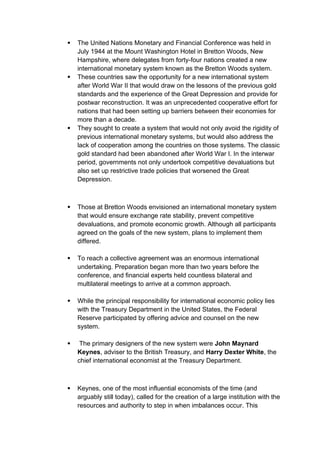
A new international monetary system was forged by delegates from forty-four nations
in Bretton Woods, New Hampshire, in July 1944. Delegates to the conference
agreed to establish the International Monetary Fund and what became the World
Bank Group. The system of currency convertibility that emerged from Bretton Woods
lasted until 1971.The Bretton Woods System is a set of unified rules and policies that
provided the framework necessary to create fixed international currency exchange
rates. Essentially, the agreement called for the newly created IMF to determine the
fixed rate of exchange for currencies around the world.
22.
The UnitedNations Monetary and Financial Conference was held in
July 1944 at the Mount Washington Hotel in Bretton Woods, New
Hampshire, where delegates from forty-four nations created a new
international monetary system known as the Bretton Woods system.
These countries saw the opportunity for a new international system
after World War II that would draw on the lessons of the previous gold
standards and the experience of the Great Depression and provide for
postwar reconstruction. It was an unprecedented cooperative effort for
nations that had been setting up barriers between their economies for
more than a decade.
They sought to create a system that would not only avoid the rigidity of
previous international monetary systems, but would also address the
lack of cooperation among the countries on those systems. The classic
gold standard had been abandoned after World War I. In the interwar
period, governments not only undertook competitive devaluations but
also set up restrictive trade policies that worsened the Great
Depression.
Those at Bretton Woods envisioned an international monetary system
that would ensure exchange rate stability, prevent competitive
devaluations, and promote economic growth. Although all participants
agreed on the goals of the new system, plans to implement them
differed.
To reach a collective agreement was an enormous international
undertaking. Preparation began more than two years before the
conference, and financial experts held countless bilateral and
multilateral meetings to arrive at a common approach.
While the principal responsibility for international economic policy lies
with the Treasury Department in the United States, the Federal
Reserve participated by offering advice and counsel on the new
system.
The primary designers of the new system were John Maynard
Keynes, adviser to the British Treasury, and Harry Dexter White, the
chief international economist at the Treasury Department.
Keynes, one of the most influential economists of the time (and
arguably still today), called for the creation of a large institution with the
resources and authority to step in when imbalances occur. This
23.
approach was consistentwith his belief that public institutions should
be able to intervene in times of crises.
The Keynes plan envisioned a global central bank called the Clearing
Union. This bank would issue a new international currency, the
“bancor,” which would be used to settle international imbalances.
Keynes proposed raising funds of $26 million for the Clearing Union.
Each country would receive a limited line of credit that would prevent it
from running a balance of payments deficit, but each country would
also be discouraged from running surpluses by having to remit excess
bancor to the Clearing Union.
The plan reflected Keynes’s concerns about the global postwar
economy. He assumed the United States would experience another
depression, causing other countries to run a balance-of-payments
deficit and forcing them to choose between domestic stability and
exchange rate stability.
White’s plan for a new institution was one of more limited powers and
resources. It reflected the concerns that much of the financial resources of the
Clearing Union envisioned by Keynes would be used to buy American goods,
resulting in the United States holding the majority of bancor. White proposed a new
monetary institution called the Stabilization Fund. Rather than issue a new currency,
it would be funded with a finite pool of national currencies and gold of $5 million that
would effectively limit the supply of reserve credit.
The plan adopted at Bretton Woods resembled the White plan with some
concessions in response to Keynes’s concerns. A clause was added in case a
country ran a balance of payments surplus and its currency became scarce in
world trade. The fund could ration that currency and authorize limited imports
from the surplus country. In addition, the total resources for the fund were
raised from $5 million to $8.5 million.
The 730 delegates at Bretton Woods agreed to establish two new institutions.
The International Monetary Fund (IMF) would monitor exchange rates and lend
reserve currencies to nations with balance-of-payments deficits. The International
Bank for Reconstruction and Development, now known as the World Bank
Group, was responsible for providing financial assistance for the
reconstruction after World War II and the economic development of less
developed countries.
24.
The IMF cameinto formal existence in December 1945, when its first
twenty-nine member countries signed its Articles of Agreement. The countries
agreed to keep their currencies fixed but adjustable (within a 1 percent band) to the
dollar, and the dollar was fixed to gold at $35 an ounce. To this day, when a country
joins the IMF, it receives a quota based on its relative position in the world economy,
which determines how much it contributes to the fund.
In 1958, the Bretton Woods system became fully functional as
currencies became convertible. Countries settled international balances in dollars,
and US dollars were convertible to gold at a fixed exchange rate of $35 an ounce.
The United States had the responsibility of keeping the price of gold fixed and had to
adjust the supply of dollars to maintain confidence in future gold convertibility. The
Bretton Woods system was in place until persistent US balance-of-payments
deficits led to foreign-held dollars exceeding the US gold stock, implying that
the United States could not fulfill its obligation to redeem dollars for gold at
the official price. In 1971, President Richard Nixon ended the dollar’s
convertibility to gold.
FLEXIBLE EXCHANGE RATE REGIME
Flexible exchange rate system is the exchange system where the exchange
rate is dependent upon the supply and demand of money in the market. In a flexible
exchange rate system, the value of the currency is allowed to fluctuate freely as per
the changes in the demand and supply of the foreign exchange.
Flexible Exchange Rate System?
Under this system, the exchange rate for the currency is fixed by the forces of
demand and supply of different currencies in the foreign exchange market. This
system is also called the Floating Rate of Exchange or Free Exchange Rate. It is so
because it is determined by the free play of supply and demand forces in the
international money market.
Under the Flexible Exchange Rate system, there is no intervention by the
government.
It is called flexible because the rate changes with the change in the market
forces.
The exchange rate is determined through interactions of banks, firms, and
other institutions that want to buy and sell foreign exchange in the foreign exchange
market.
25.
The rate atwhich the demand for foreign currency is equal to its supply is
called the Par Rate of Exchange, Normal Rate, or Equilibrium Rate of Foreign
Exchange.
Merits of Flexible Exchange Rate System
Some of the major advantages of a flexible exchange rate system are as
follows:
1. Automatic Adjustment in BOP: One of the major advantages of the flexible
exchange rate system is that the disequilibrium in BOP automatically gets corrected
when there is a change in the exchange rate. In case of a BOP deficit, there will be
an excess supply of domestic currency which will result in a fall in the exchange rate
due to market forces of demand and supply. This fall in the exchange rate will make
the export of goods cheaper (increasing exports) and the import of goods expensive
(reducing imports), ultimately removing the deficit in BOP. Similarly, in case of a
BOP surplus, there will be an excess demand for domestic currency which will result
in a rise in the exchange rate. This increment will make the export expensive
(reducing exports) and import cheaper (increasing imports), ultimately bringing the
BOP to equilibrium.
2. Absorption of Sudden Shocks: Under the flexible exchange rate system,
the domestic economy is not affected by external shocks and pressures. It means
that there is a minimum threat of import inflation from outside the country.
3. No Collusion between Internal-External Objectives: In order to adjust a
surplus or deficit in the BOP account, the fixed exchange rate system requires
changes in internal policies or domestic macroeconomic policies. However, in a
flexible exchange rate system, the government can adopt its own monetary policy.
Simply put, under a flexible exchange rate system, to adjust a surplus or deficit in the
BOP account, the government can maintain the internal balance on its own. With
this, the government can also put more of its efforts into solving various internal
problems such as unemployment, inflation, etc.
4. Minimum Buffer of Foreign Exchange Reserves: As the exchange rate
under this system is not pegged, there is no need for the central bank of the country
to hold a minimum foreign exchange reserve as a buffer against any unforeseen
development in international trade.
Demerits of the Flexible Exchange Rate System
26.
Besides its variousadvantages, there are a few drawbacks to the flexible
exchange rate system. Some of them are as follows:
1. Uncertainty and Confusion: The flexible exchange rate system causes
uncertainty and confusion in trade and investment. It means that, when the
exchange rate fluctuates freely, the likelihood of uncertainty increases. For example,
an Indian trader dispatches an export invoice to a US buyer without any knowledge
about the price at which the foreign currency will be converted into Indian Rupees.
This type of uncertainty affects trade. However, it can be reduced by using forward
exchange contracts.
2. Inflationary Effect: Under a flexible exchange rate system, the chances of
the inflationary effect of exchange depreciation on a country’s domestic price level
are more. Besides, due to the inflationary rise in price, the external value of the
currency depreciates.
3. Unnecessary Capital Movements: There is unnecessary capital movement
due to fluctuating exchange rate system. This system also causes large-scale capital
inflow and outflow by encouraging different speculative activities, which disturbs the
economy of the country.
4. Hampers Investment: When there is an unregulated flexible exchange rate,
it makes the exchange rate erratic and as a result discourages foreign investment.
Besides, as the exchange rate under this system is uncertain and has an impact on
the profit and loss implications of a foreign investment deal, there are chances that a
country experiences decumulation of capital.
5. Adverse Effect on Economic Structure: Flexible exchange rate system has
an adverse impact on the economy of a country. The flexible exchange rates causes
a change in the price of exported goods and imported goods, which destabilise the
country’s economy.
6. Failure of Flexible Exchange Rate System: The experience of countries
under the flexible exchange rate system adopted between the two world wars was
not good, making this system flop.
27.
RECENT DEVELOPMENTS INEXCHANGE RATE ARRANGEMENTS
The IMF adjustment for India's exchange rate regime is for the period from
December 2022 to October 2023. The International Monetary Fund (IMF) has
revised India's exchange rate regime, shifting it from a "floating" status to a
"stabilised arrangement" for the period between December 2022 to October 2023.
Meaning of an Exchange Rate:
An exchange rate is the rate at which one currency will be exchanged for another
currency. It affects trade and the movement of money between countries.
Exchange rates are impacted by both the domestic currency value and the foreign
currency value. The exchange rate from U.S. Dollars to the Euro was 1.07 in April
2024. It took $1.07 to buy €1.
Importance of Exchange Rate
An exchange rate is the rate at which one currency can be exchanged for another
currency.
Most exchange rates are defined as floating. They'll rise or fall based on supply and
demand in the market.
Some exchange rates are pegged or fixed to the value of a specific country's
currency.
Exchange rate changes affect businesses by changing the cost of supplies that are
purchased from a different country and by changing the demand for their products
from overseas customers.
Understanding Exchange Rates
The exchange rate between two currencies is commonly determined by the
economic activity, market interest rates, gross domestic product, and unemployment
rate in each of the countries. Commonly called market exchange rates, they're set in
the global financial marketplace where banks and other financial institutions trade
currencies around the clock based on these factors. Changes in rates can occur
hourly or daily with small changes or in large incremental shifts.
2
An exchange rate is commonly quoted using an acronym for the national currency it
represents. "USD" represents the U.S. dollar. "EUR" represents the euro. It would be
EUR/USD if you were quoting the currency pair for the dollar and the euro.
28.
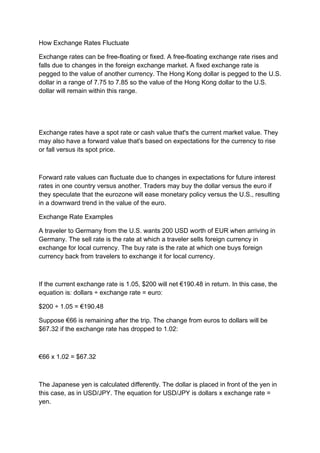
How Exchange RatesFluctuate
Exchange rates can be free-floating or fixed. A free-floating exchange rate rises and
falls due to changes in the foreign exchange market. A fixed exchange rate is
pegged to the value of another currency. The Hong Kong dollar is pegged to the U.S.
dollar in a range of 7.75 to 7.85 so the value of the Hong Kong dollar to the U.S.
dollar will remain within this range.
Exchange rates have a spot rate or cash value that's the current market value. They
may also have a forward value that's based on expectations for the currency to rise
or fall versus its spot price.
Forward rate values can fluctuate due to changes in expectations for future interest
rates in one country versus another. Traders may buy the dollar versus the euro if
they speculate that the eurozone will ease monetary policy versus the U.S., resulting
in a downward trend in the value of the euro.
Exchange Rate Examples
A traveler to Germany from the U.S. wants 200 USD worth of EUR when arriving in
Germany. The sell rate is the rate at which a traveler sells foreign currency in
exchange for local currency. The buy rate is the rate at which one buys foreign
currency back from travelers to exchange it for local currency.
If the current exchange rate is 1.05, $200 will net €190.48 in return. In this case, the
equation is: dollars ÷ exchange rate = euro:
$200 ÷ 1.05 = €190.48
Suppose €66 is remaining after the trip. The change from euros to dollars will be
$67.32 if the exchange rate has dropped to 1.02:
€66 x 1.02 = $67.32
The Japanese yen is calculated differently. The dollar is placed in front of the yen in
this case, as in USD/JPY. The equation for USD/JPY is dollars x exchange rate =
yen.
29.
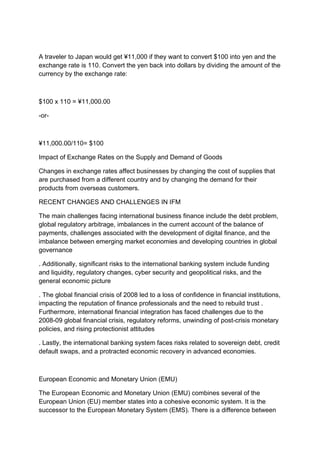
A traveler toJapan would get ¥11,000 if they want to convert $100 into yen and the
exchange rate is 110. Convert the yen back into dollars by dividing the amount of the
currency by the exchange rate:
$100 x 110 = ¥11,000.00
-or-
¥11,000.00/110= $100
Impact of Exchange Rates on the Supply and Demand of Goods
Changes in exchange rates affect businesses by changing the cost of supplies that
are purchased from a different country and by changing the demand for their
products from overseas customers.
RECENT CHANGES AND CHALLENGES IN IFM
The main challenges facing international business finance include the debt problem,
global regulatory arbitrage, imbalances in the current account of the balance of
payments, challenges associated with the development of digital finance, and the
imbalance between emerging market economies and developing countries in global
governance
. Additionally, significant risks to the international banking system include funding
and liquidity, regulatory changes, cyber security and geopolitical risks, and the
general economic picture
. The global financial crisis of 2008 led to a loss of confidence in financial institutions,
impacting the reputation of finance professionals and the need to rebuild trust .
Furthermore, international financial integration has faced challenges due to the
2008-09 global financial crisis, regulatory reforms, unwinding of post-crisis monetary
policies, and rising protectionist attitudes
. Lastly, the international banking system faces risks related to sovereign debt, credit
default swaps, and a protracted economic recovery in advanced economies.
European Economic and Monetary Union (EMU)
The European Economic and Monetary Union (EMU) combines several of the
European Union (EU) member states into a cohesive economic system. It is the
successor to the European Monetary System (EMS). There is a difference between
30.
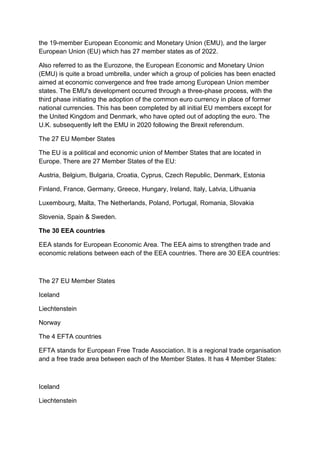
the 19-member EuropeanEconomic and Monetary Union (EMU), and the larger
European Union (EU) which has 27 member states as of 2022.
Also referred to as the Eurozone, the European Economic and Monetary Union
(EMU) is quite a broad umbrella, under which a group of policies has been enacted
aimed at economic convergence and free trade among European Union member
states. The EMU's development occurred through a three-phase process, with the
third phase initiating the adoption of the common euro currency in place of former
national currencies. This has been completed by all initial EU members except for
the United Kingdom and Denmark, who have opted out of adopting the euro. The
U.K. subsequently left the EMU in 2020 following the Brexit referendum.
The 27 EU Member States
The EU is a political and economic union of Member States that are located in
Europe. There are 27 Member States of the EU:
Austria, Belgium, Bulgaria, Croatia, Cyprus, Czech Republic, Denmark, Estonia
Finland, France, Germany, Greece, Hungary, Ireland, Italy, Latvia, Lithuania
Luxembourg, Malta, The Netherlands, Poland, Portugal, Romania, Slovakia
Slovenia, Spain & Sweden.
The 30 EEA countries
EEA stands for European Economic Area. The EEA aims to strengthen trade and
economic relations between each of the EEA countries. There are 30 EEA countries:
The 27 EU Member States
Iceland
Liechtenstein
Norway
The 4 EFTA countries
EFTA stands for European Free Trade Association. It is a regional trade organisation
and a free trade area between each of the Member States. It has 4 Member States:
Iceland
Liechtenstein
31.
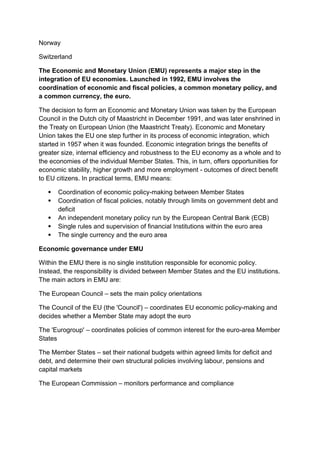
Norway
Switzerland
The Economic andMonetary Union (EMU) represents a major step in the
integration of EU economies. Launched in 1992, EMU involves the
coordination of economic and fiscal policies, a common monetary policy, and
a common currency, the euro.
The decision to form an Economic and Monetary Union was taken by the European
Council in the Dutch city of Maastricht in December 1991, and was later enshrined in
the Treaty on European Union (the Maastricht Treaty). Economic and Monetary
Union takes the EU one step further in its process of economic integration, which
started in 1957 when it was founded. Economic integration brings the benefits of
greater size, internal efficiency and robustness to the EU economy as a whole and to
the economies of the individual Member States. This, in turn, offers opportunities for
economic stability, higher growth and more employment - outcomes of direct benefit
to EU citizens. In practical terms, EMU means:
Coordination of economic policy-making between Member States
Coordination of fiscal policies, notably through limits on government debt and
deficit
An independent monetary policy run by the European Central Bank (ECB)
Single rules and supervision of financial Institutions within the euro area
The single currency and the euro area
Economic governance under EMU
Within the EMU there is no single institution responsible for economic policy.
Instead, the responsibility is divided between Member States and the EU institutions.
The main actors in EMU are:
The European Council – sets the main policy orientations
The Council of the EU (the 'Council') – coordinates EU economic policy-making and
decides whether a Member State may adopt the euro
The 'Eurogroup' – coordinates policies of common interest for the euro-area Member
States
The Member States – set their national budgets within agreed limits for deficit and
debt, and determine their own structural policies involving labour, pensions and
capital markets
The European Commission – monitors performance and compliance
32.
The European CentralBank (ECB) – sets monetary policy, with price stability as the
primary objective and act as central supervisor of financial Institutions in the euro
area
The European Parliament - shares the job of formulating legislation with the Council,
and subjects economic governance to democratic scrutiny in particular through the
new Economic Dialogue.