ILOA / Galaxy Imaging Program
Yuki Takahashi
International Lunar Observatory Association
Kamuela, Hawai`i
info@iloa.org
4 July 2018
Galaxy Forum USA 2018
Santa Clara, CA
International Lunar Observatory Association
To expand human understanding of the Cosmos
through observation from our Moon
 Hawaii non-profit
since 2007
 Multi-Functional ILO
 Galaxy astronomy
 Lunar base build-out
Director: Steve Durst
ILOA / Space Age Publishing Company
Hawai`i and California, USA
ILOA Board of 25 Directors
Steve Durst Hawaii ILOA Founding Director
Kimo Pihana Hawaii Native Hawaiian cultural practitioner; former Mauna Kea ranger
Bob Richards Canada CEO, Moon Express; Co-founder of ISU, Singularity University, and SEDS
Jean-Luc Josset Switzerland CEO, Space Exploration Institute
Maohai Huang China Astrophysics Professor, NAOC
Christian Veillet Arizona Director, Large Binocular Telescope Observatory
David Schrunk California Nuclear Medicine Doctor; Author of The Moon book
Yuki Takahashi Hawaii PhD on astrophysics from Antarctica, UC Berkeley; former SpaceX engineer
Joseph Sulla Hawaii ILOA consultant
Christian Sallaberger Canada President, Canadensys Aerospace Corp; Chairman of the Board, ISU
Shawna Pandya Canada Physician; Citizen-scientist astronaut candidate with PoSSUM
Bill Carswell Alabama Director, Energy Huntsville Initiative
Jinliang Hou China Deputy Director, Shanghai Astronomical Observatory
Trond Krovel Germany Engineer, EADS Astrium; Former President of SSETI
Ziyuan Ouyang China Chief Scientist, Chinese Lunar Exploration Program (Chang’e)
Misuzu Onuki Japan CEO, Space Access Corporation; 1st non-USA citizen in Space Frontier Foundation
Jeffrey Hoffman Massachusetts NASA astronaut, 5 flights, 1978-1997
Peter Martinez South Africa Chair, South African Council for Space Affairs
Diego Mardones Chile Astronomy Professor, University of Chile, Santiago
Boonrucksar Soonthornthum Thailand Director, National Astronomical Research Institute of Thailand
Chatief Kunjaya Indonesia Astrophysicist, Ma Chung University
Arry Buchori Indonesia President, SkyWorld Indonesia (space-themed recreation park)
Sheikh Muszaphar Shuko Malaysia 1st Astronaut of Malaysia
Naoko Yamazaki Japan 2nd woman astronaut of Japan
Jonathan Hung Singapore President, Singapore Space & Technology Association
Why Astronomy from the Moon?
Some observations are feasible only by using the Moon...
> as a Shield (against Sun / Earth)
Radio quietness on far side (VLF radio)
Permanent darkness in polar craters (IR)
> as a Platform (stable & large area)
Interferometry w/ long baselines
+ thin exosphere compared to
Earth-based observatory or even LEO
+ for Access (from lunar base)
Service/upgrades – easier than in free space NASA
Apollo 16, John Young
Pioneering Astronomy from the Moon, 1972
Earth in UV
George Carruthers (left) explains
LSUC to John Young (right).
Lunar Surface Ultraviolet Camera (LSUC)
• 22-kg (48-lb), 75-mm (3”) telescope @ Far-UV
• Field of View: 20°
• 178 frames captured: Earth’s upper atmosphere, aurora,
nebulae, star clusters, Large Magellanic Cloud, etc
Commander John Young
ILO Mission Objectives
Primary:
• Galaxy First Light Imaging
• Lunar surface observation (help develop lunar base)
• Earth observation (climate change, etc)
Additional applications:
VLF, SETI, search for life, NEOs, Solar storm warning
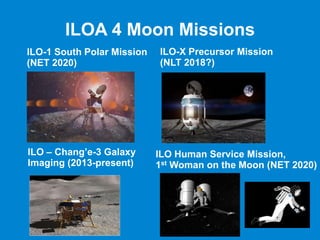
ILOA 4 Moon Missions
ILO Human Service Mission,
1st Woman on the Moon (NET 2020)
ILO-1 South Polar Mission
(NET 2020)
ILO-X Precursor Mission
(NLT 2018?)
ILO – Chang’e-3 Galaxy
Imaging (2013-present)
ILO-1: Observation & Communication
From the Lunar South Pole
India PSLV
2016-2017 Lunar Electronics Program
2017-2018 Lunar Optics Program
Lunar South Pole
Top of 5000-m (16000’) Malapert Mountain
• Line-of-sight communication with Earth.
• Nearly continuous Sun light for power.
• Proximity to water ice in permanently shadowed craters => likely Moon base site.
ILO-X: Precursor Mission
Galaxy Center (6-min exposure)
by ILO-X Hardware
ME conducting lander development
and tests at SLC-36, Cape Canaveral,
Florida
MX-1 scheduled to launch 2018
ILOA Chang’e-3 Collaboration since 2013
Lunar Ultraviolet Telescope
(LUT)
LUT principal investigator Prof. Jianyan Wei, NAOC
LUT Observation Data
• LUT is the first robotic automated
telescope on the Moon
• Obtained >32000 images during
the first 5 months
ILOA Galaxy Imaging Program with LUT
Spiral Galaxy M101
* This was imaged at the very edge of the telescope capability. M101 was barely within the
available sky coverage and had to be captured at the earliest possible time in the Lunar day
causing stray light and power supply stability issues.
ILOA Human Service Mission
ILOA Technical studies with SpaceDev Inc in
2005 & 2006.
ILOA participated in a Human Lunar Lander multi-
party technical design project led by Golden
Spike Company 2011-2014.
More advances to be introduced at Galaxy Forum
Hainan 2018 in Wenchang, China, 4-7 Dec.
Robust Astronomy from the Moon
• New Views of the Moon 2 – Asia (Japan, April 20)
• American Astronomical Society (Denver, June 7)
• International Astronomical Union (Vienna, August 24)
• Galaxy Forum Hainan (China, December 4-7)
Mission: Advance 21st Century Education worldwide to
provide greater global awareness, capabilities and action in
Galaxy science, exploration and enterprise.
Galaxy Forum Architecture
Locations:
Hawaii, USA
California, USA
Kansas, USA
New York, USA
Canada (Vancouver, Toronto)
South America (Santiago, Rio de Janeiro)
Europe (Strasbourg, Prague, Vienna)
Africa (Cape Town)
India (Bangalore)
Southeast Asia ( )
China (Beijing, Shanghai, Hainan)
Japan (Tokyo)
Venues & Partners:
CFHT, Imiloa, Onizuka
Silicon Valley, The Tech Museum
Cosmosphere, Ad Astra Kansas
SHS, Grand Central, Hayden Planetarium
UBC, SFU, MacMillan SC, CSA, BCIT
UC, ESO, ALMA, LPN, LNA, SpaceMETA
ISU, UdS, CTU, Stefanik Observatory, IAU
SAAO, ASSA, IAU-OAD
JNP, BASE, ISRO, IIA
NUS, SCS, ANGKASA, ITB, NARIT
NAOC, CNSA, CSA, BJP, SHAO
NAOJ, JAXA, Miraikan
Singapore, Bandung,
Bangkok, Jakarta, KL
Galaxy Forum 21st Century Education
ILOA Headquarters Development
• Kamuela, Hawai`i: Near Keck & CFHT HQs
• Direct Line of Sight / Easy access to Mauna Kea
Observatories -- Center of Astronomy in Northern
Hemisphere
• 2500 sq. ft. complex on 1 acre of land
Mauna Kea Observatories
• 4207 meter elevation – tallest mountain in Pacific Ocean
• Global center of Earth-based astronomy
• 14 countries represented – Argentina, Australia, Brazil, Canada, Chile, France, Japan,
The Netherlands, Taiwan, United Kingdom, Hawaii / USA, India, China
30m Telescope (TMT)
International Conference, Dec 2018
ALOHA!
For more information about ILOA, contact:
65-1230 Mamalahoa Highway, D-20
Kamuela, HI 96743
Phone +1-808-885-3474
Fax +1-808-885-3475
Email info@iloa.org
Web http://www.iloa.org
Keep up with our global events: GalaxyForum.org
Follow us on Twitter: @GalaxyForum

Gf usa 2018 iloa ppt

  • 1.
    ILOA / GalaxyImaging Program Yuki Takahashi International Lunar Observatory Association Kamuela, Hawai`i info@iloa.org 4 July 2018 Galaxy Forum USA 2018 Santa Clara, CA
  • 2.
    International Lunar ObservatoryAssociation To expand human understanding of the Cosmos through observation from our Moon  Hawaii non-profit since 2007  Multi-Functional ILO  Galaxy astronomy  Lunar base build-out Director: Steve Durst ILOA / Space Age Publishing Company Hawai`i and California, USA
  • 3.
    ILOA Board of25 Directors Steve Durst Hawaii ILOA Founding Director Kimo Pihana Hawaii Native Hawaiian cultural practitioner; former Mauna Kea ranger Bob Richards Canada CEO, Moon Express; Co-founder of ISU, Singularity University, and SEDS Jean-Luc Josset Switzerland CEO, Space Exploration Institute Maohai Huang China Astrophysics Professor, NAOC Christian Veillet Arizona Director, Large Binocular Telescope Observatory David Schrunk California Nuclear Medicine Doctor; Author of The Moon book Yuki Takahashi Hawaii PhD on astrophysics from Antarctica, UC Berkeley; former SpaceX engineer Joseph Sulla Hawaii ILOA consultant Christian Sallaberger Canada President, Canadensys Aerospace Corp; Chairman of the Board, ISU Shawna Pandya Canada Physician; Citizen-scientist astronaut candidate with PoSSUM Bill Carswell Alabama Director, Energy Huntsville Initiative Jinliang Hou China Deputy Director, Shanghai Astronomical Observatory Trond Krovel Germany Engineer, EADS Astrium; Former President of SSETI Ziyuan Ouyang China Chief Scientist, Chinese Lunar Exploration Program (Chang’e) Misuzu Onuki Japan CEO, Space Access Corporation; 1st non-USA citizen in Space Frontier Foundation Jeffrey Hoffman Massachusetts NASA astronaut, 5 flights, 1978-1997 Peter Martinez South Africa Chair, South African Council for Space Affairs Diego Mardones Chile Astronomy Professor, University of Chile, Santiago Boonrucksar Soonthornthum Thailand Director, National Astronomical Research Institute of Thailand Chatief Kunjaya Indonesia Astrophysicist, Ma Chung University Arry Buchori Indonesia President, SkyWorld Indonesia (space-themed recreation park) Sheikh Muszaphar Shuko Malaysia 1st Astronaut of Malaysia Naoko Yamazaki Japan 2nd woman astronaut of Japan Jonathan Hung Singapore President, Singapore Space & Technology Association
  • 4.
    Why Astronomy fromthe Moon? Some observations are feasible only by using the Moon... > as a Shield (against Sun / Earth) Radio quietness on far side (VLF radio) Permanent darkness in polar craters (IR) > as a Platform (stable & large area) Interferometry w/ long baselines + thin exosphere compared to Earth-based observatory or even LEO + for Access (from lunar base) Service/upgrades – easier than in free space NASA
  • 5.
    Apollo 16, JohnYoung Pioneering Astronomy from the Moon, 1972 Earth in UV George Carruthers (left) explains LSUC to John Young (right). Lunar Surface Ultraviolet Camera (LSUC) • 22-kg (48-lb), 75-mm (3”) telescope @ Far-UV • Field of View: 20° • 178 frames captured: Earth’s upper atmosphere, aurora, nebulae, star clusters, Large Magellanic Cloud, etc Commander John Young
  • 6.
    ILO Mission Objectives Primary: •Galaxy First Light Imaging • Lunar surface observation (help develop lunar base) • Earth observation (climate change, etc) Additional applications: VLF, SETI, search for life, NEOs, Solar storm warning
  • 7.
    ILOA 4 MoonMissions ILO Human Service Mission, 1st Woman on the Moon (NET 2020) ILO-1 South Polar Mission (NET 2020) ILO-X Precursor Mission (NLT 2018?) ILO – Chang’e-3 Galaxy Imaging (2013-present)
  • 8.
    ILO-1: Observation &Communication From the Lunar South Pole India PSLV 2016-2017 Lunar Electronics Program 2017-2018 Lunar Optics Program
  • 9.
    Lunar South Pole Topof 5000-m (16000’) Malapert Mountain • Line-of-sight communication with Earth. • Nearly continuous Sun light for power. • Proximity to water ice in permanently shadowed craters => likely Moon base site.
  • 10.
    ILO-X: Precursor Mission GalaxyCenter (6-min exposure) by ILO-X Hardware ME conducting lander development and tests at SLC-36, Cape Canaveral, Florida MX-1 scheduled to launch 2018
  • 11.
    ILOA Chang’e-3 Collaborationsince 2013 Lunar Ultraviolet Telescope (LUT) LUT principal investigator Prof. Jianyan Wei, NAOC
  • 12.
    LUT Observation Data •LUT is the first robotic automated telescope on the Moon • Obtained >32000 images during the first 5 months
  • 13.
    ILOA Galaxy ImagingProgram with LUT Spiral Galaxy M101 * This was imaged at the very edge of the telescope capability. M101 was barely within the available sky coverage and had to be captured at the earliest possible time in the Lunar day causing stray light and power supply stability issues.
  • 14.
    ILOA Human ServiceMission ILOA Technical studies with SpaceDev Inc in 2005 & 2006. ILOA participated in a Human Lunar Lander multi- party technical design project led by Golden Spike Company 2011-2014. More advances to be introduced at Galaxy Forum Hainan 2018 in Wenchang, China, 4-7 Dec.
  • 15.
    Robust Astronomy fromthe Moon • New Views of the Moon 2 – Asia (Japan, April 20) • American Astronomical Society (Denver, June 7) • International Astronomical Union (Vienna, August 24) • Galaxy Forum Hainan (China, December 4-7)
  • 16.
    Mission: Advance 21stCentury Education worldwide to provide greater global awareness, capabilities and action in Galaxy science, exploration and enterprise. Galaxy Forum Architecture Locations: Hawaii, USA California, USA Kansas, USA New York, USA Canada (Vancouver, Toronto) South America (Santiago, Rio de Janeiro) Europe (Strasbourg, Prague, Vienna) Africa (Cape Town) India (Bangalore) Southeast Asia ( ) China (Beijing, Shanghai, Hainan) Japan (Tokyo) Venues & Partners: CFHT, Imiloa, Onizuka Silicon Valley, The Tech Museum Cosmosphere, Ad Astra Kansas SHS, Grand Central, Hayden Planetarium UBC, SFU, MacMillan SC, CSA, BCIT UC, ESO, ALMA, LPN, LNA, SpaceMETA ISU, UdS, CTU, Stefanik Observatory, IAU SAAO, ASSA, IAU-OAD JNP, BASE, ISRO, IIA NUS, SCS, ANGKASA, ITB, NARIT NAOC, CNSA, CSA, BJP, SHAO NAOJ, JAXA, Miraikan Singapore, Bandung, Bangkok, Jakarta, KL
  • 17.
    Galaxy Forum 21stCentury Education
  • 18.
    ILOA Headquarters Development •Kamuela, Hawai`i: Near Keck & CFHT HQs • Direct Line of Sight / Easy access to Mauna Kea Observatories -- Center of Astronomy in Northern Hemisphere • 2500 sq. ft. complex on 1 acre of land
  • 19.
    Mauna Kea Observatories •4207 meter elevation – tallest mountain in Pacific Ocean • Global center of Earth-based astronomy • 14 countries represented – Argentina, Australia, Brazil, Canada, Chile, France, Japan, The Netherlands, Taiwan, United Kingdom, Hawaii / USA, India, China 30m Telescope (TMT)
  • 20.
  • 21.
    ALOHA! For more informationabout ILOA, contact: 65-1230 Mamalahoa Highway, D-20 Kamuela, HI 96743 Phone +1-808-885-3474 Fax +1-808-885-3475 Email info@iloa.org Web http://www.iloa.org Keep up with our global events: GalaxyForum.org Follow us on Twitter: @GalaxyForum