Getting   Money Smart
Today’s  Workout Financial Fitness = Money Smart  Three Exercises: The Chessboard of Life Who Wants to Really Be a Millionaire? Does This Make Cents? “Cool Down” Review Tips for Future Workouts
Advertisers currently spend more than  $230 billion  a year   ($2,190 per household). 1 We have  twice  as many shopping malls  as high schools. 2 93% of teenage girls say that shopping  is their  favorite  activity. 2 Year to year  increase  in teen  spending on clothes from 2001 to 2002  was 47% for boys and 8% for girls. 3 1. McCann Erickson, 2002 2.  Affluenza , de Graaf, Wann, Naylor, 2001 3. U.S. Bancorp, Piper Jaffray, 2002 Swallowing the Bait: How much stuff do you buy that you don’t need? Getting  Money Smart
Getting  Smarter Start managing your money instead of  manage you! secret The  secret  to  saving is setting  some goals. letting it
Getting   Smarter The Five Envelope System What are your savings goals? Everyday  Stuff Long term Purchases Emergencies Charity College
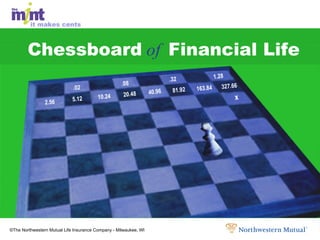
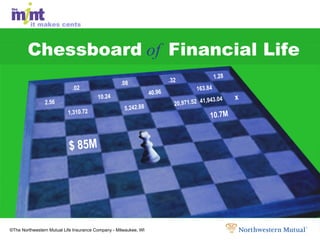
Chessboard   of   Financial Life This exercise is for illustration purposes only.  It does not take into consideration fees, taxes, commissions, etc. and does not represent any specific product or investment.
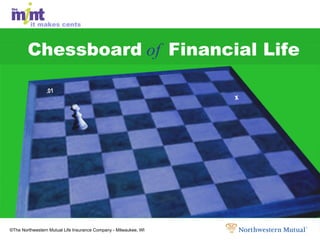
x Chessboard   of   Financial Life .01
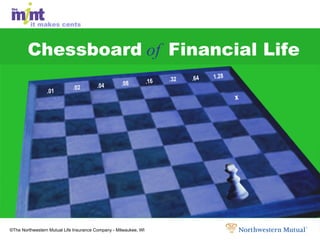
.02 .08 .32 1.28 x Chessboard   of   Financial Life .04 .16 .64 .01
Chessboard   of   Financial Life 5.12 20.48 81.92 327.66 .02 .08 .32 1.28 x 2.56 163.84 40.96 10.24
40.96 .02 .08 .32 1.28 x Chessboard   of   Financial Life 20,971.52 5,242.88 1,310.72 10.7M $ 85M 41,943.04 2.56 163.84 40.96 10.24
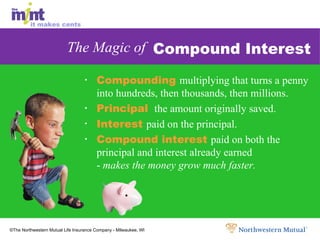
Compound Interest Compounding   multiplying that turns a penny into hundreds, then thousands, then millions. Principal  the amount originally saved. Interest  paid on the principal. Compound interest  paid on both the principal and interest already earned  -  makes the money grow much faster.  The Magic of
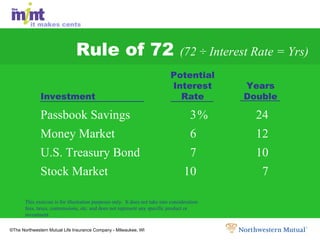
Rule of 72  (72  ÷ Interest Rate = Yrs) Passbook Savings 3 % 24 Money Market 6 12 U.S. Treasury Bond 7 10 Stock Market 10 7 Potential Interest Years Investment Rate Double This exercise is for illustration purposes only.  It does not take into consideration fees, taxes, commissions, etc. and does not represent any specific product or investment.
Save Early   and  Often When you begin to save How much you save The interest rate or return on investment Factors that affect how much savings grow:
How To Really Be A Millionaire
True  or  False? 4 of 5 millionaires  are  college graduates.  18% of millionaires  have  Master’s Degrees. True True True Most millionaires  are college graduates 1
True  or  False? About  2 / 3  of millionaires work  45-55  hours a week False False False Most millionaires work fewer than 40 hours a week 2
True  or  False? Only 19%  of millionaires received any income from a trust fund or estate False False False Most millionaires received financial help from their families  - like inheriting a trust fund or estate 3
True  or  False? Wealth builders view such funds as having the  same  potential for saving as any other money. False False False 4 Gift money, tax refunds, earnings from winnings are  found money.”
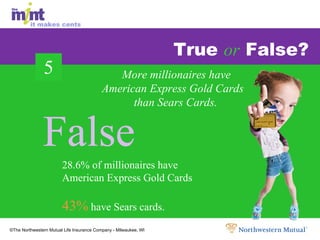
True  or  False? 28.6% of millionaires have  American Express Gold Cards  43%  have Sears cards. More millionaires have American Express Gold Cards  than Sears Cards. False False False 5
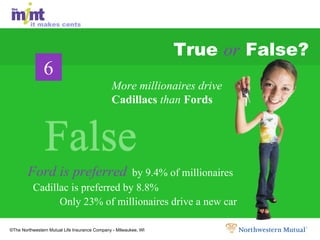
True  or  False? Ford is preferred   by 9.4% of millionaires Cadillac is preferred by 8.8% Only 23% of millionaires drive a new car False False False More millionaires drive  Cadillacs  than  Fords 6
True  or  False? Most millionaires work in  ordinary  jobs including:  welding contractors, owners of mobile-home parks & paving contractors False False False Most millionaires work in glamorous jobs, such as sports, entertainment, or high tech 7
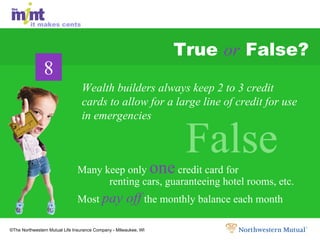
True  or  False? Wealth builders always keep 2 to 3 credit cards to allow for a large line of credit for use in emergencies Many keep only  one  credit card for  renting cars, guaranteeing hotel rooms, etc. Most  pay off  the monthly balance each month False False False 8
True  or  False? The  chances  of winning the lottery are 1 in 12 million  and as high as 1 in 120 million. Many poor people become millionaires by winning the lottery False False False 9
True  or  False? In recent years, the average  college  graduate earned  66%  more than the  average high school graduate False False False College graduates earn about 33% more than  high school graduates 10
True  or  False? Most millionaires are  self employed  and  consider themselves to be  entrepreneurs . Most others are professionals, such as  doctors ,  lawyers  and  accountants False False False Most millionaires    work for large,  Fortune 500 Companies 11
True  or  False? Recent studies show that  80%  of people who try to earn money as “day traders” lose money False False False People who play the stock market usually beat it and many of them become millionaires. 12
True  or  False? Nearly  95%  of millionaires own stocks. Since 1926, stocks have  increased 10% at a compounded annual rate of return. False False False If you want to be a millionaire, avoid the risky stock market. 13
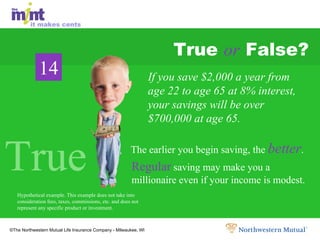
True  or  False? Hypothetical example. This example does not take into consideration fees, taxes, commissions, etc. and does not represent any specific product or investment. The earlier you begin saving, the  better . Regular  saving may make you a millionaire even if your income is modest. True True True If you save $2,000 a year from age 22 to age 65 at 8% interest, your savings will be over $700,000 at age 65. 14


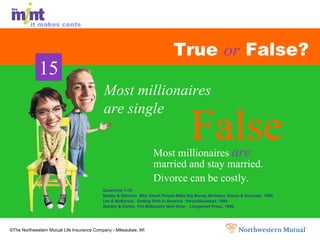
True  or  False? Questions 1-15: Belsky & Gilovich.  Why Smart People Make Big Money Mistakes . Simon & Schuster, 1999.  Lee & McKenzie.  Getting Rich in America .  HarperBusiness, 1999. Stanley & Danko.  The Millionaire Next Door.  Longstreet Press, 1996.  Most millionaires  are  married and stay married. Divorce can be costly. False False False Most millionaires are single 15
Rules for  Improving   Your Financial  Life Get a good education Work long, hard, and smart Live below your means Use credit cards with care Regard  all  income – regardless of its source –  as a chance to save
Solving the mysteries of finance and economics Does  This  Make Cents?
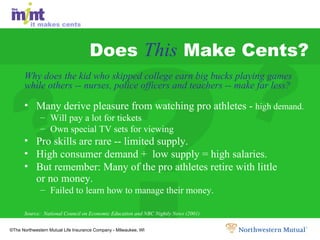
Does  This  Make Cents? Many derive pleasure from watching pro athletes -  high demand. Will pay a lot for tickets Own special TV sets for viewing Pro skills are rare -- limited supply. High consumer demand +  low supply = high salaries.  But remember: Many of the pro athletes retire with little  or no money. Failed to learn how to manage their money. Why does the kid who skipped college earn big bucks playing games while others -- nurses, police officers and teachers -- make far less? Source:  National Council on Economic Education and NBC Nightly News (2001) ? ? ?
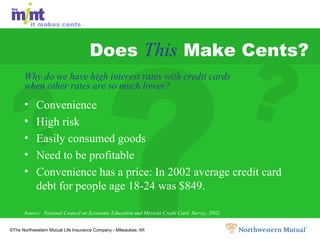
Does  This  Make Cents? Convenience High risk Easily consumed goods Need to be profitable  Convenience has a price: In 2002 average credit card debt for people age 18-24 was $849.  Why do we have high interest rates with credit cards  when other rates are so much lower? Source:  National Council on Economic Education and Myvesta Credit Card  Survey, 2002. ? ? ?
Credit Card  IQ You have an  $849  balance on your credit card. You can only afford  $35  per month. Your card rate is  17%. It will take   30 months ! And with interest you will  have paid   $1,047.59 . And this assumes you  stop  using the card!
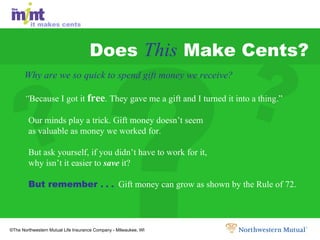
Does  This  Make Cents? Why are we so quick to spend gift money we receive?  “ Because I got it  free . They gave me a gift and I turned it into a thing.”  Our minds play a trick. Gift money doesn’t seem  as valuable as money we worked for. But ask yourself, if you didn’t have to work for it,  why isn’t it easier to  save  it? But remember  . . .   Gift money can grow as shown by the Rule of 72. ? ? ?
Review What is the magic of compounding? What are some of the characteristics of millionaires? How do supply and demand affect salaries, prices? How do our minds play tricks on us?
A Workout  Refresher Consider it your personal trainer... www.themint.org
TheMint.org
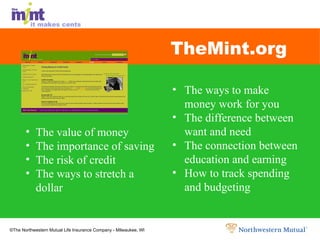
TheMint.org  The value of money  The importance of saving The risk of credit The ways to stretch a dollar The ways to make  money work for you The difference between  want and need The connection between education and earning How to track spending  and budgeting
 

Getting Money Smart

  • 1.
    Getting Money Smart
  • 2.
    Today’s WorkoutFinancial Fitness = Money Smart Three Exercises: The Chessboard of Life Who Wants to Really Be a Millionaire? Does This Make Cents? “Cool Down” Review Tips for Future Workouts
  • 3.
    Advertisers currently spendmore than $230 billion a year ($2,190 per household). 1 We have twice as many shopping malls as high schools. 2 93% of teenage girls say that shopping is their favorite activity. 2 Year to year increase in teen spending on clothes from 2001 to 2002 was 47% for boys and 8% for girls. 3 1. McCann Erickson, 2002 2. Affluenza , de Graaf, Wann, Naylor, 2001 3. U.S. Bancorp, Piper Jaffray, 2002 Swallowing the Bait: How much stuff do you buy that you don’t need? Getting Money Smart
  • 4.
    Getting SmarterStart managing your money instead of manage you! secret The secret to saving is setting some goals. letting it
  • 5.
    Getting Smarter The Five Envelope System What are your savings goals? Everyday Stuff Long term Purchases Emergencies Charity College
  • 6.
    Chessboard of Financial Life This exercise is for illustration purposes only. It does not take into consideration fees, taxes, commissions, etc. and does not represent any specific product or investment.
  • 7.
    x Chessboard of Financial Life .01
  • 8.
    .02 .08 .321.28 x Chessboard of Financial Life .04 .16 .64 .01
  • 9.
    Chessboard of Financial Life 5.12 20.48 81.92 327.66 .02 .08 .32 1.28 x 2.56 163.84 40.96 10.24
  • 10.
    40.96 .02 .08.32 1.28 x Chessboard of Financial Life 20,971.52 5,242.88 1,310.72 10.7M $ 85M 41,943.04 2.56 163.84 40.96 10.24
  • 11.
    Compound Interest Compounding multiplying that turns a penny into hundreds, then thousands, then millions. Principal the amount originally saved. Interest paid on the principal. Compound interest paid on both the principal and interest already earned - makes the money grow much faster. The Magic of
  • 12.
    Rule of 72 (72 ÷ Interest Rate = Yrs) Passbook Savings 3 % 24 Money Market 6 12 U.S. Treasury Bond 7 10 Stock Market 10 7 Potential Interest Years Investment Rate Double This exercise is for illustration purposes only. It does not take into consideration fees, taxes, commissions, etc. and does not represent any specific product or investment.
  • 13.
    Save Early and Often When you begin to save How much you save The interest rate or return on investment Factors that affect how much savings grow:
  • 14.
    How To ReallyBe A Millionaire
  • 15.
    True or False? 4 of 5 millionaires are college graduates. 18% of millionaires have Master’s Degrees. True True True Most millionaires are college graduates 1
  • 16.
    True or False? About 2 / 3 of millionaires work 45-55 hours a week False False False Most millionaires work fewer than 40 hours a week 2
  • 17.
    True or False? Only 19% of millionaires received any income from a trust fund or estate False False False Most millionaires received financial help from their families - like inheriting a trust fund or estate 3
  • 18.
    True or False? Wealth builders view such funds as having the same potential for saving as any other money. False False False 4 Gift money, tax refunds, earnings from winnings are found money.”
  • 19.
    True or False? 28.6% of millionaires have American Express Gold Cards 43% have Sears cards. More millionaires have American Express Gold Cards than Sears Cards. False False False 5
  • 20.
    True or False? Ford is preferred by 9.4% of millionaires Cadillac is preferred by 8.8% Only 23% of millionaires drive a new car False False False More millionaires drive Cadillacs than Fords 6
  • 21.
    True or False? Most millionaires work in ordinary jobs including: welding contractors, owners of mobile-home parks & paving contractors False False False Most millionaires work in glamorous jobs, such as sports, entertainment, or high tech 7
  • 22.
    True or False? Wealth builders always keep 2 to 3 credit cards to allow for a large line of credit for use in emergencies Many keep only one credit card for renting cars, guaranteeing hotel rooms, etc. Most pay off the monthly balance each month False False False 8
  • 23.
    True or False? The chances of winning the lottery are 1 in 12 million and as high as 1 in 120 million. Many poor people become millionaires by winning the lottery False False False 9
  • 24.
    True or False? In recent years, the average college graduate earned 66% more than the average high school graduate False False False College graduates earn about 33% more than high school graduates 10
  • 25.
    True or False? Most millionaires are self employed and consider themselves to be entrepreneurs . Most others are professionals, such as doctors , lawyers and accountants False False False Most millionaires work for large, Fortune 500 Companies 11
  • 26.
    True or False? Recent studies show that 80% of people who try to earn money as “day traders” lose money False False False People who play the stock market usually beat it and many of them become millionaires. 12
  • 27.
    True or False? Nearly 95% of millionaires own stocks. Since 1926, stocks have increased 10% at a compounded annual rate of return. False False False If you want to be a millionaire, avoid the risky stock market. 13
  • 28.
    True or False? Hypothetical example. This example does not take into consideration fees, taxes, commissions, etc. and does not represent any specific product or investment. The earlier you begin saving, the better . Regular saving may make you a millionaire even if your income is modest. True True True If you save $2,000 a year from age 22 to age 65 at 8% interest, your savings will be over $700,000 at age 65. 14
  • 29.
    True or False? Questions 1-15: Belsky & Gilovich. Why Smart People Make Big Money Mistakes . Simon & Schuster, 1999. Lee & McKenzie. Getting Rich in America . HarperBusiness, 1999. Stanley & Danko. The Millionaire Next Door. Longstreet Press, 1996. Most millionaires are married and stay married. Divorce can be costly. False False False Most millionaires are single 15
  • 30.
    Rules for Improving Your Financial Life Get a good education Work long, hard, and smart Live below your means Use credit cards with care Regard all income – regardless of its source – as a chance to save
  • 31.
    Solving the mysteriesof finance and economics Does This Make Cents?
  • 32.
    Does This Make Cents? Many derive pleasure from watching pro athletes - high demand. Will pay a lot for tickets Own special TV sets for viewing Pro skills are rare -- limited supply. High consumer demand + low supply = high salaries. But remember: Many of the pro athletes retire with little or no money. Failed to learn how to manage their money. Why does the kid who skipped college earn big bucks playing games while others -- nurses, police officers and teachers -- make far less? Source: National Council on Economic Education and NBC Nightly News (2001) ? ? ?
  • 33.
    Does This Make Cents? Convenience High risk Easily consumed goods Need to be profitable Convenience has a price: In 2002 average credit card debt for people age 18-24 was $849. Why do we have high interest rates with credit cards when other rates are so much lower? Source: National Council on Economic Education and Myvesta Credit Card Survey, 2002. ? ? ?
  • 34.
    Credit Card IQ You have an $849 balance on your credit card. You can only afford $35 per month. Your card rate is 17%. It will take 30 months ! And with interest you will have paid $1,047.59 . And this assumes you stop using the card!
  • 35.
    Does This Make Cents? Why are we so quick to spend gift money we receive? “ Because I got it free . They gave me a gift and I turned it into a thing.” Our minds play a trick. Gift money doesn’t seem as valuable as money we worked for. But ask yourself, if you didn’t have to work for it, why isn’t it easier to save it? But remember . . . Gift money can grow as shown by the Rule of 72. ? ? ?
  • 36.
    Review What isthe magic of compounding? What are some of the characteristics of millionaires? How do supply and demand affect salaries, prices? How do our minds play tricks on us?
  • 37.
    A Workout Refresher Consider it your personal trainer... www.themint.org
  • 38.
  • 39.
    TheMint.org Thevalue of money The importance of saving The risk of credit The ways to stretch a dollar The ways to make money work for you The difference between want and need The connection between education and earning How to track spending and budgeting
  • 40.