Getting Your RIM
Program to the
Next Level
Nick Inglis
Nick Inglis is President of the Information
Coalition and Co-Founder of The
Information Governance Conference. Inglis
is the author of the AIIM SharePoint
Governance Toolkit and creator of the
Information Governance Model. Inglis is a
contributor to U.S. News & World Report,
Yahoo! Finance, and others. Previously, Mr.
Inglis served as the Director of Professional
Development at AIIM and was one of the
youngest Assistant Vice Presidents in Bank
of America's history. Inglis is the Co-Creator
of the ARMA Information Governance
Professional (IGP) educational course.
When not adding to his collection of
certificates and certifications (CIP, IGP,
ERMm, SharePointm, BPMm, E2.0m,
ECMm, IMCP), he is likely spending time
with his son, Conor Atom.
Email: nick@nickinglis.com
Twitter: @nickinglis
Getting Your RIM Program to the Next Level
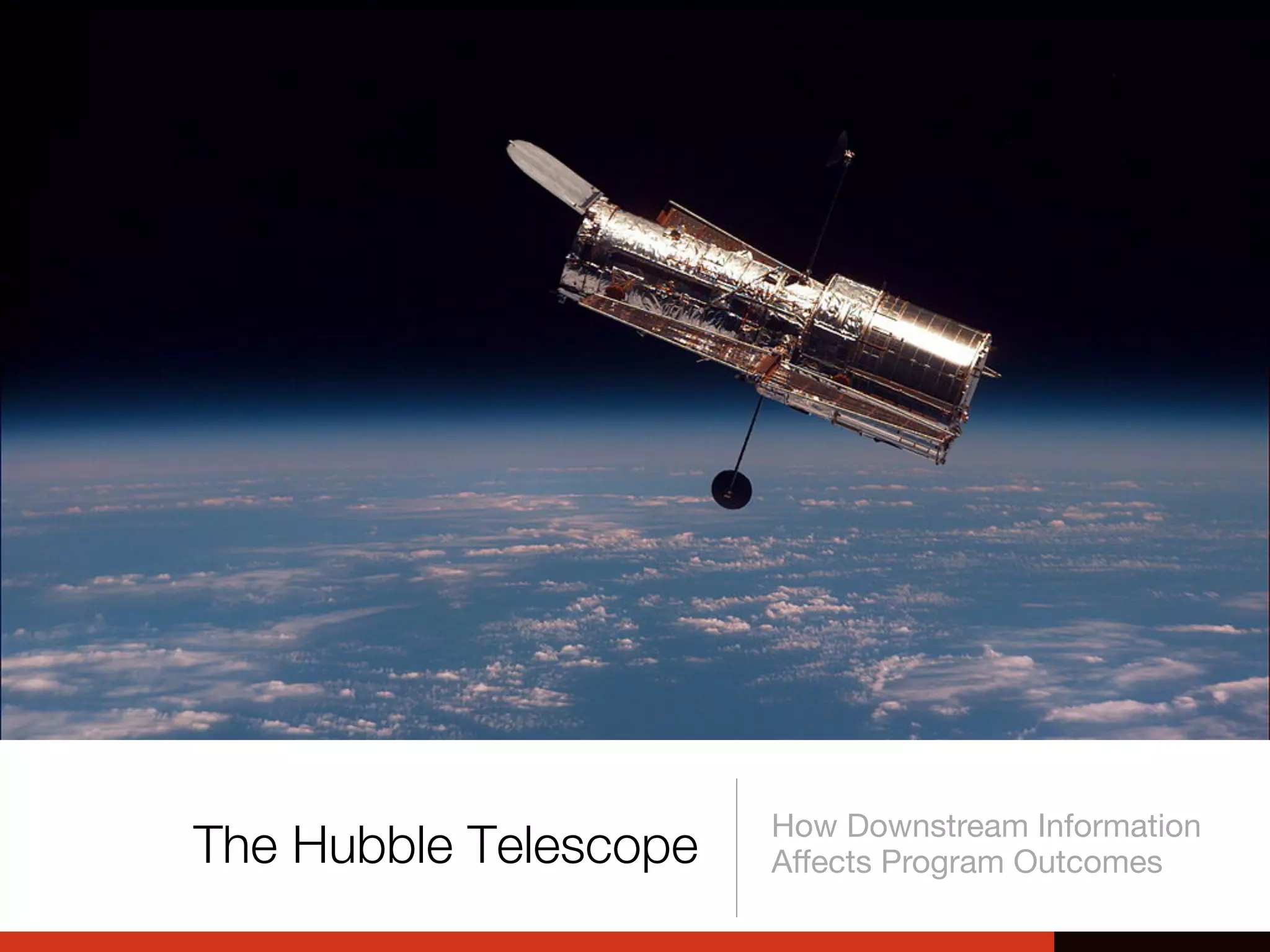
The Hubble Telescope
How Downstream Information
Affects Program Outcomes
One Mirror
2,200 Nanometers -
1/50th width of a piece of paper -
Worlds of Difference
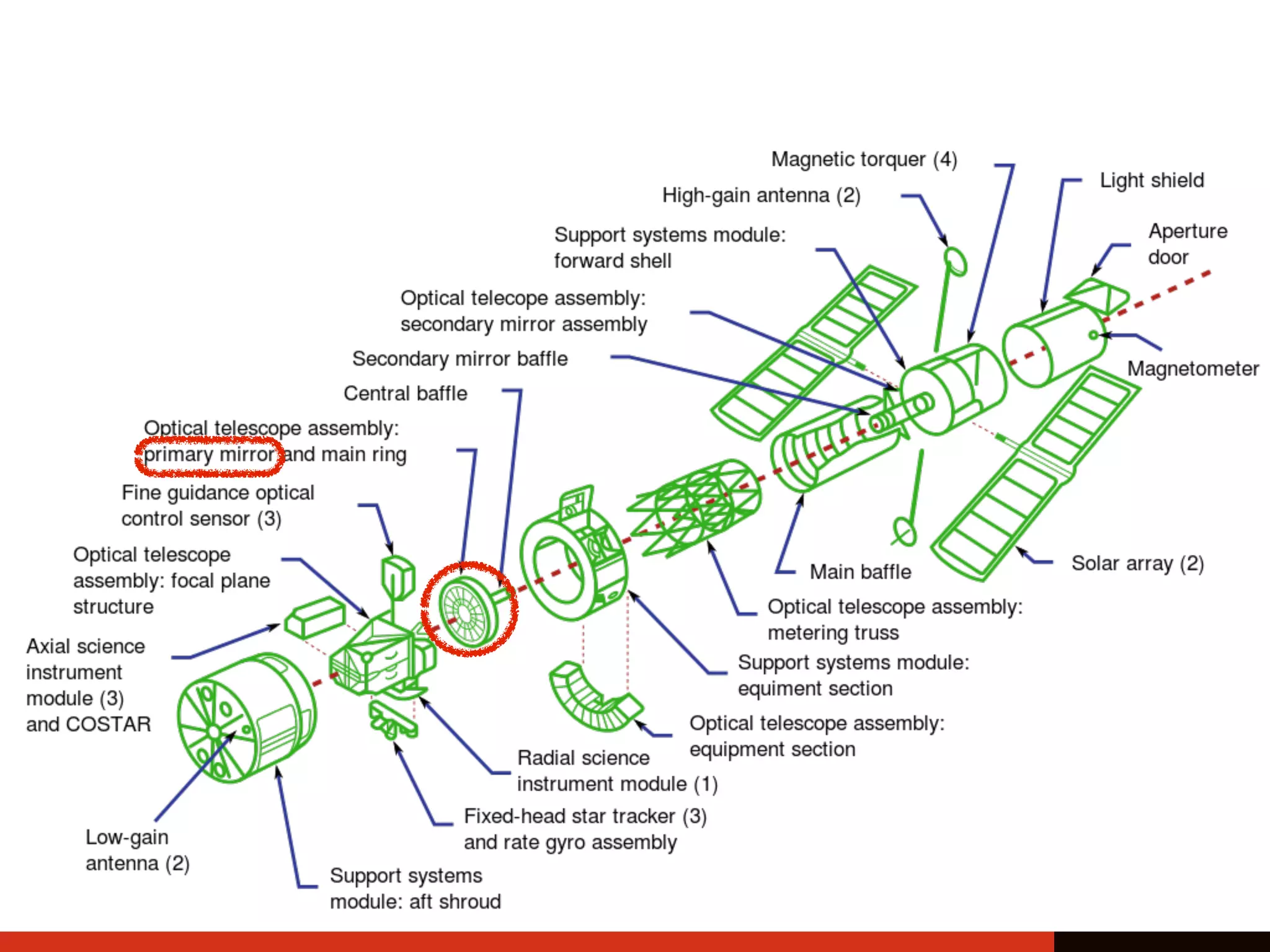
Mirror Grinding
(Null Correcting)
A New Null Corrector,
Incorrectly Assembled
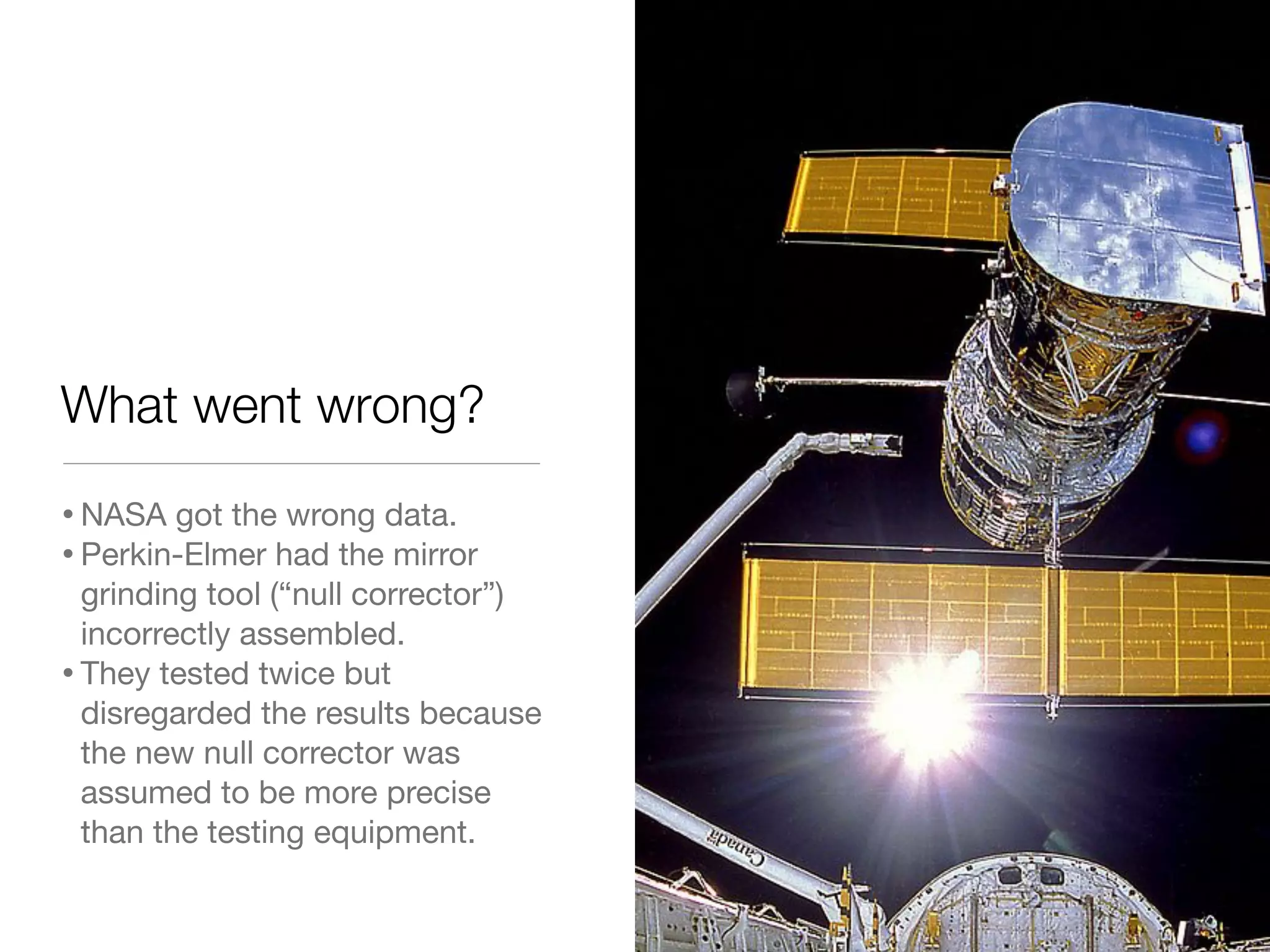
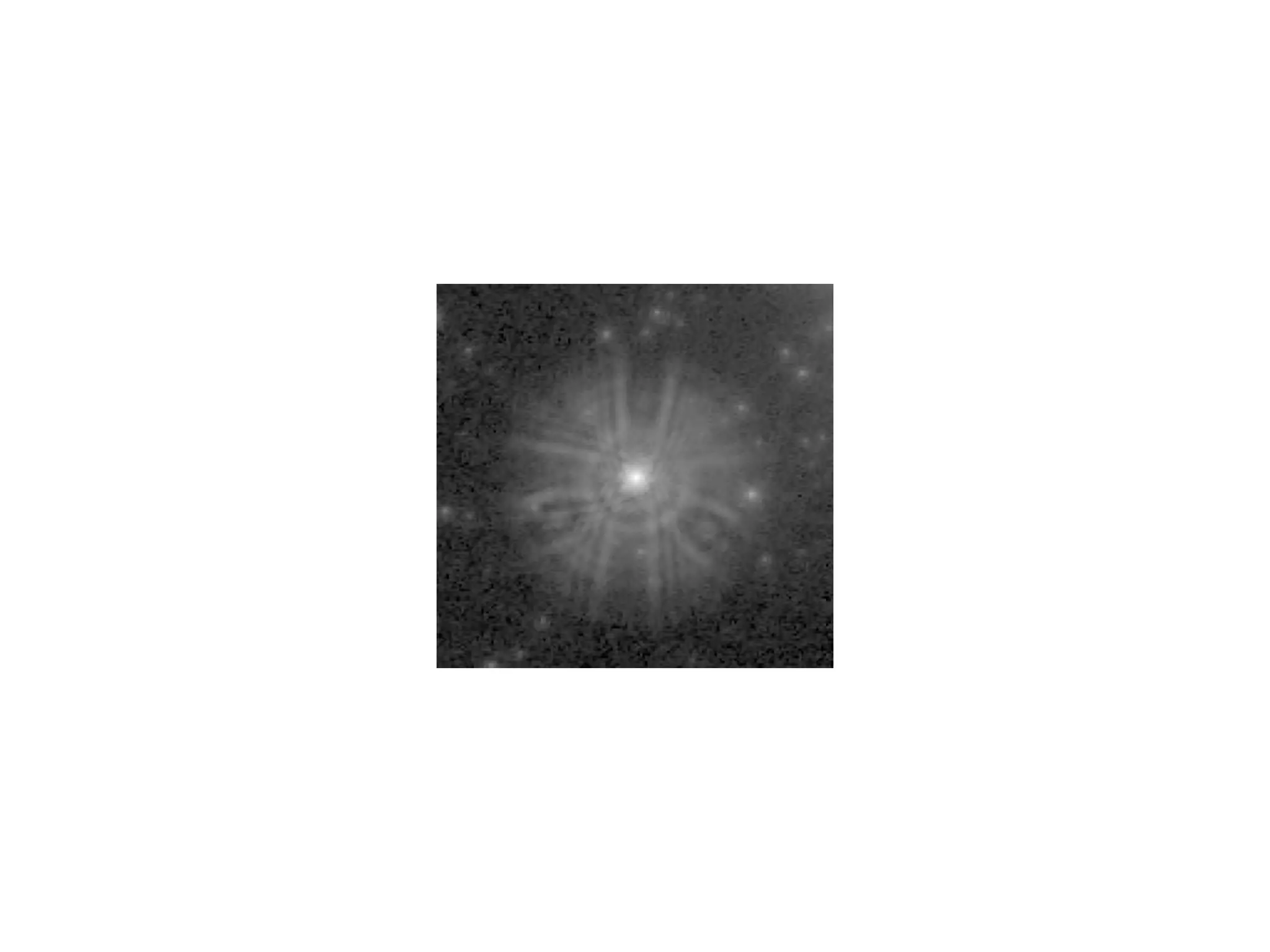
What went wrong?
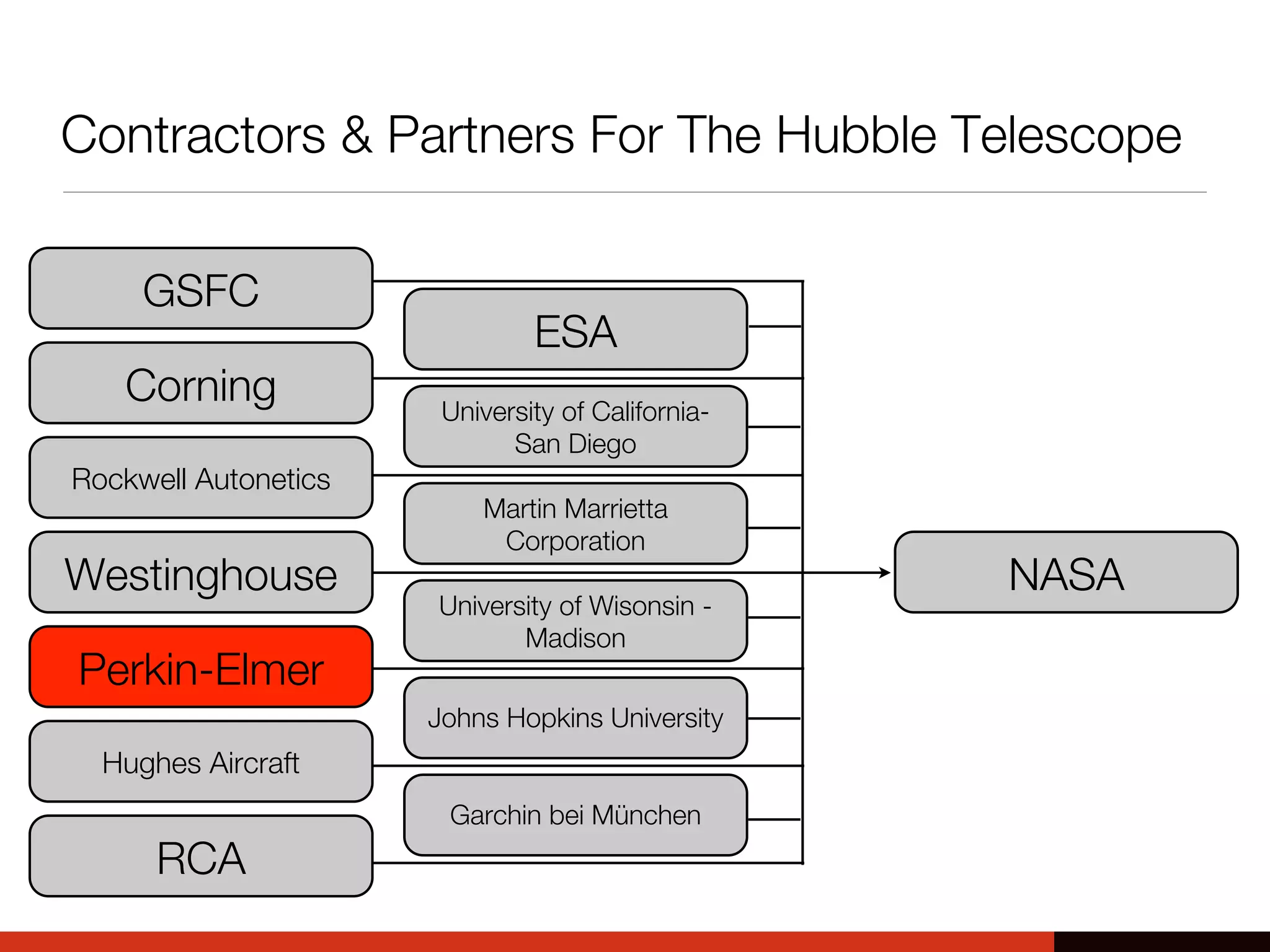
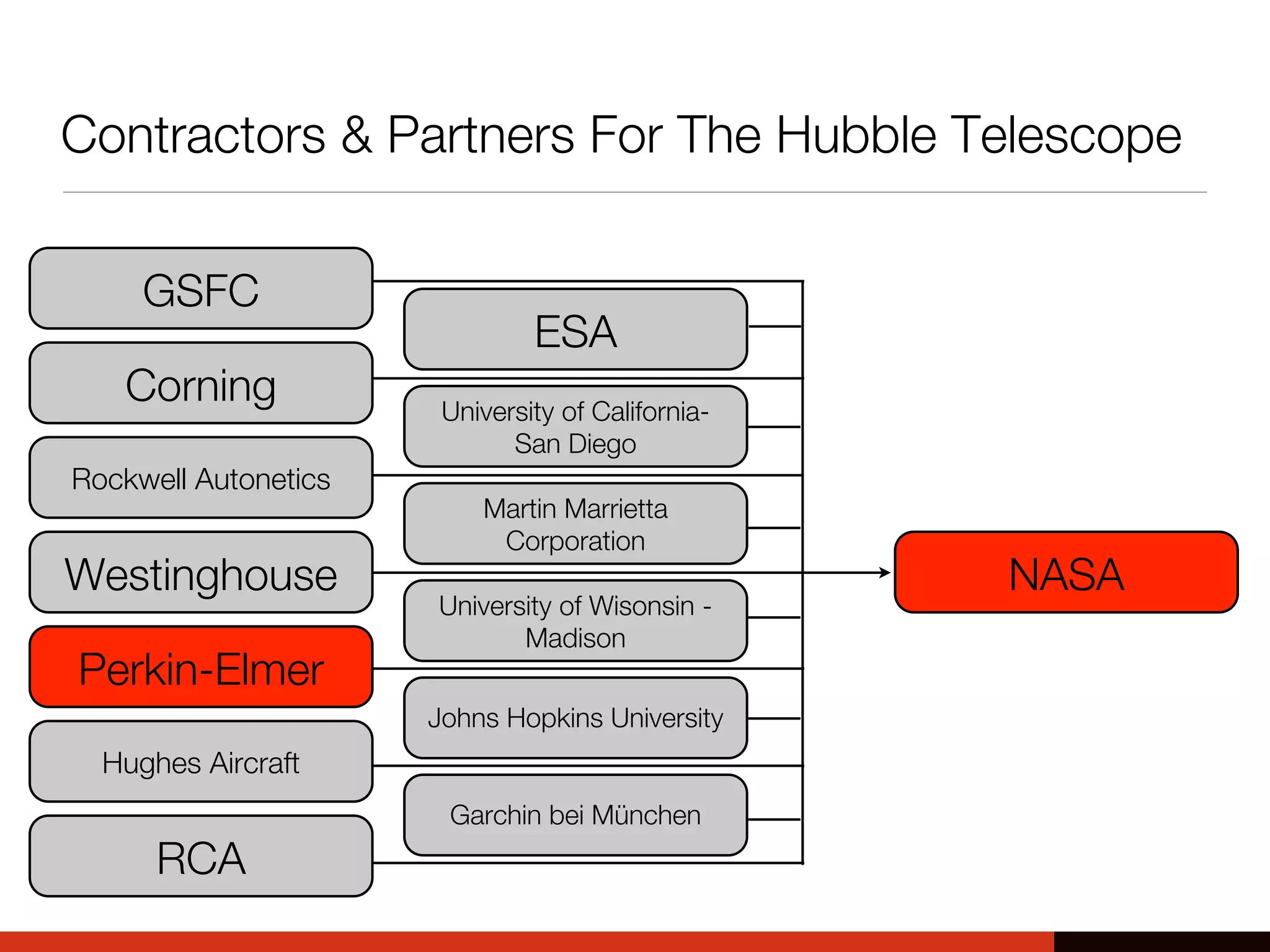
•NASA got the wrong data.
•Perkin-Elmer had the mirror
grinding tool (“null corrector”)
incorrectly assembled.
•They tested twice but
disregarded the results because
the new null corrector was
assumed to be more precise
than the testing equipment.
One Downstream Mistake, A Huge Problem
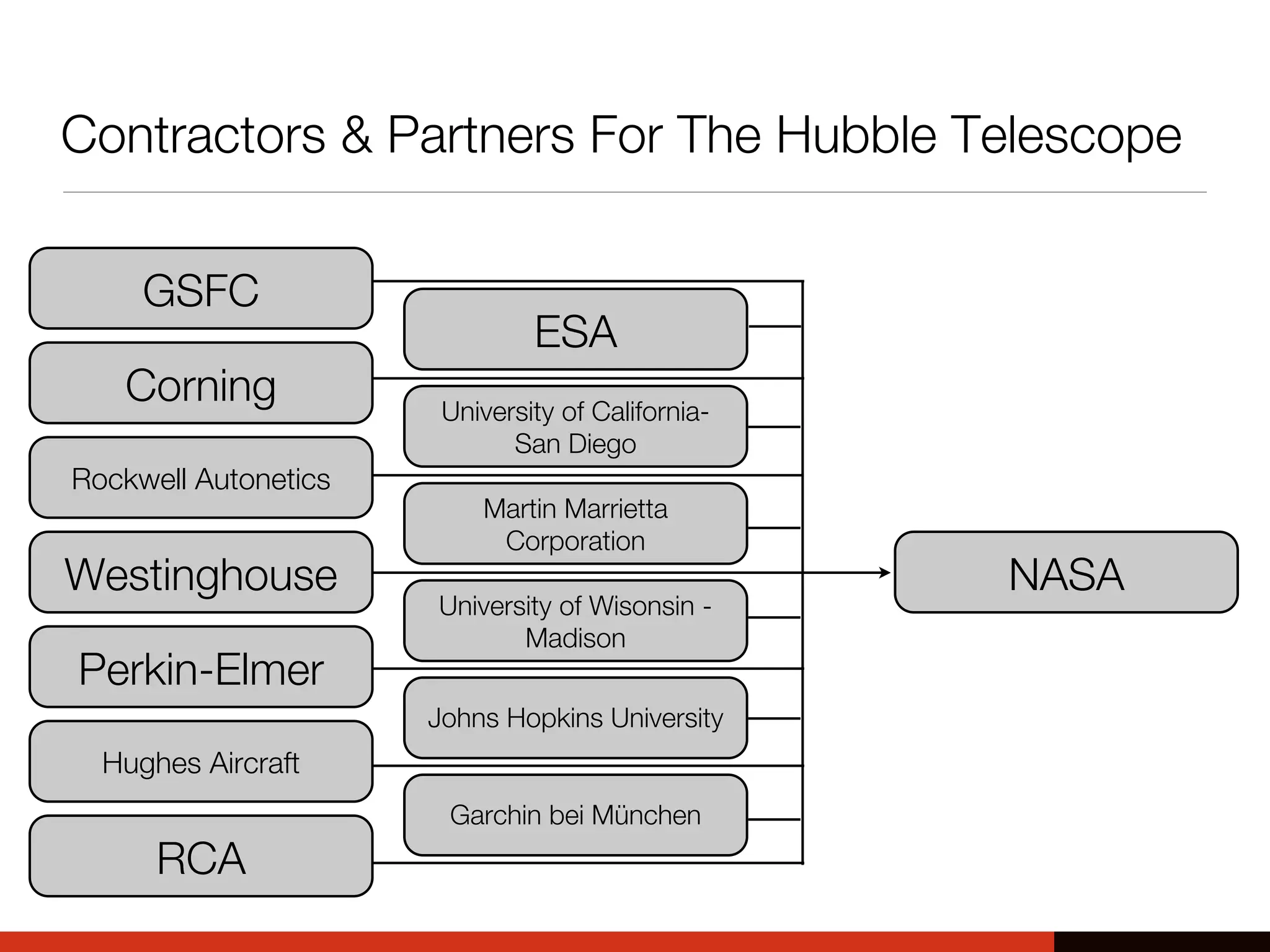
Contractors & Partners For The Hubble Telescope
GSFC
Corning
Rockwell Autonetics
Westinghouse
Perkin-Elmer
Hughes Aircraft
RCA
ESA
University of California-
San Diego
Martin Marrietta
Corporation
University of Wisonsin -
Madison
Johns Hopkins University
Garchin bei München
NASA
Contractors & Partners For The Hubble Telescope
GSFC
Corning
Rockwell Autonetics
Westinghouse
Perkin-Elmer
Hughes Aircraft
RCA
ESA
University of California-
San Diego
Martin Marrietta
Corporation
University of Wisonsin -
Madison
Johns Hopkins University
Garchin bei München
NASA
Contractors & Partners For The Hubble Telescope
GSFC
Corning
Rockwell Autonetics
Westinghouse
Perkin-Elmer
Hughes Aircraft
RCA
ESA
University of California-
San Diego
Martin Marrietta
Corporation
University of Wisonsin -
Madison
Johns Hopkins University
Garchin bei München
NASA
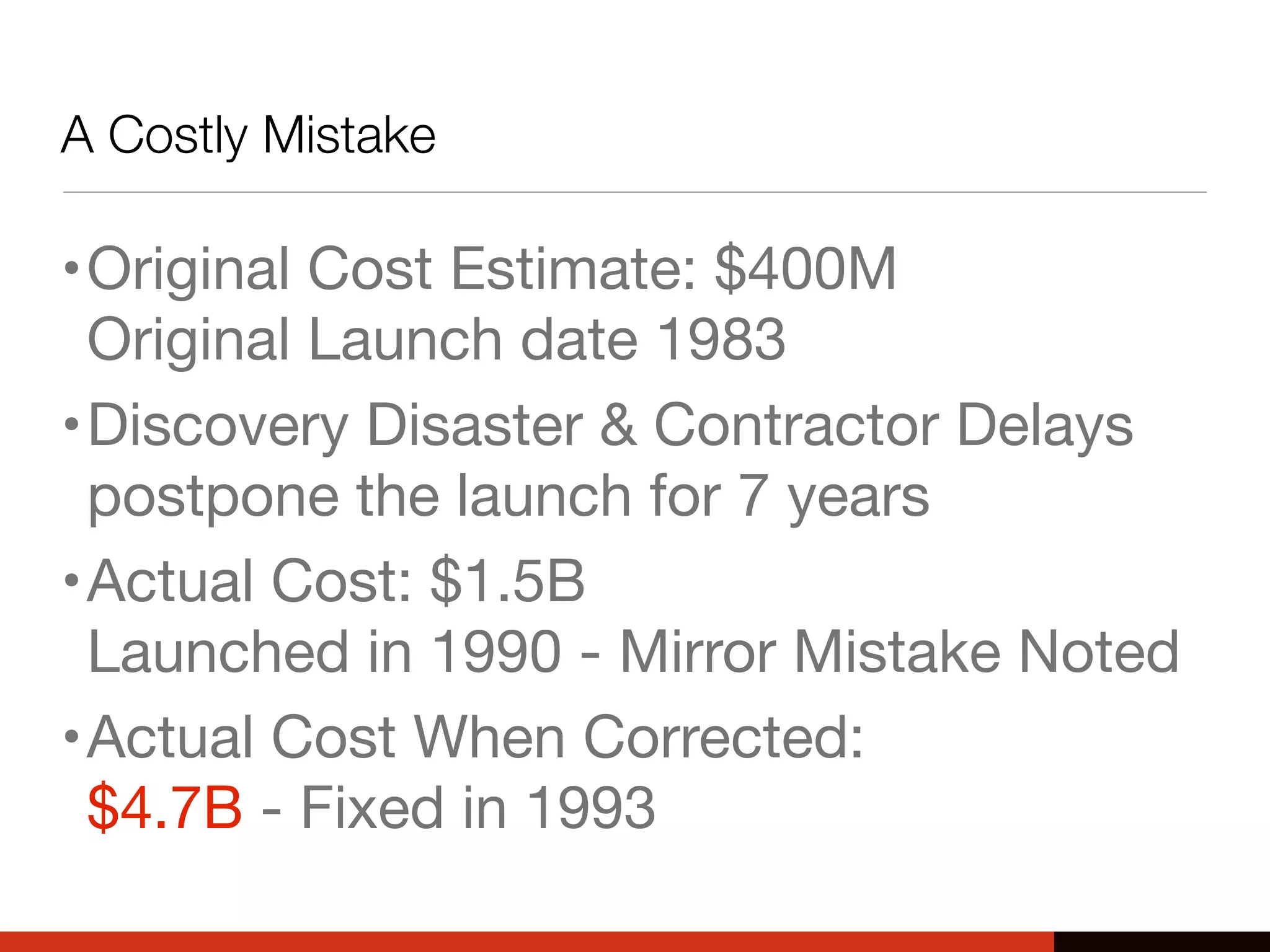
A Costly Mistake
•Original Cost Estimate: $400M
Original Launch date 1983
•Discovery Disaster & Contractor Delays
postpone the launch for 7 years
•Actual Cost: $1.5B
Launched in 1990 - Mirror Mistake Noted
•Actual Cost When Corrected:
$4.7B - Fixed in 1993
A Happy Ending
Hubble Still In Use Today -
Delivering Images & Insights Into
The Creation of the Universe
The Hubble Telescope has provided invaluable contributions to science.
One Downstream Mistake, A Huge Problem
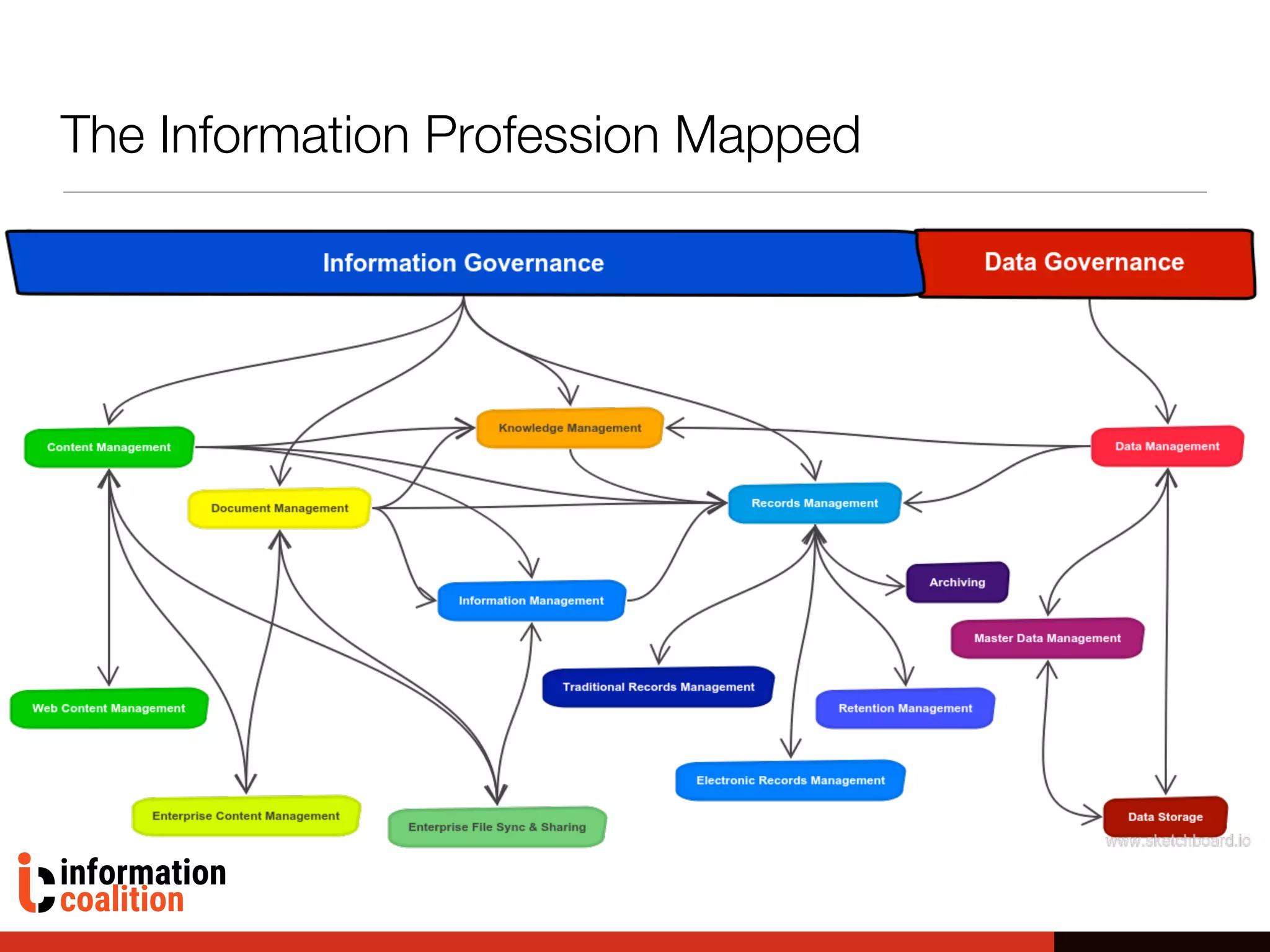
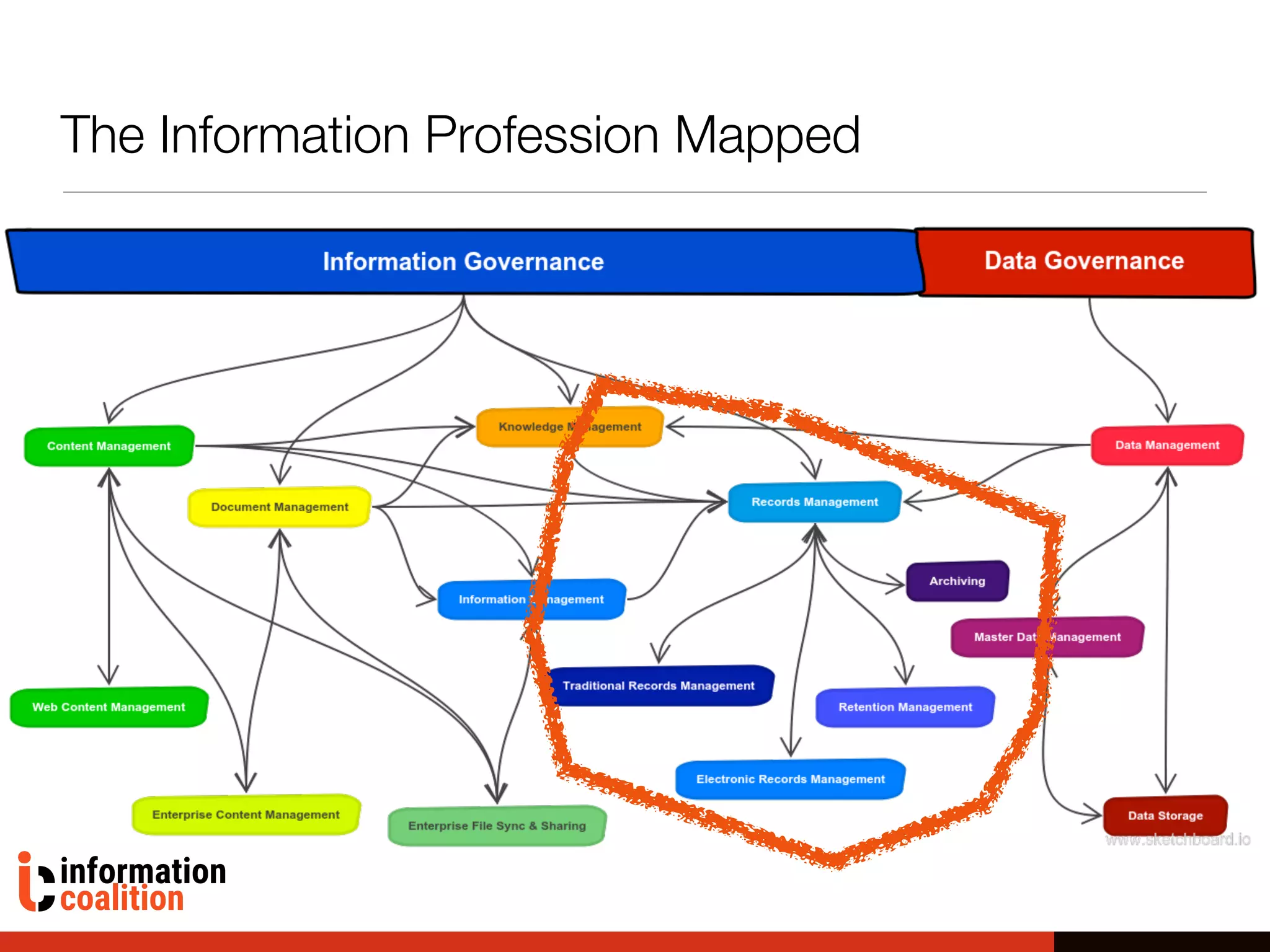
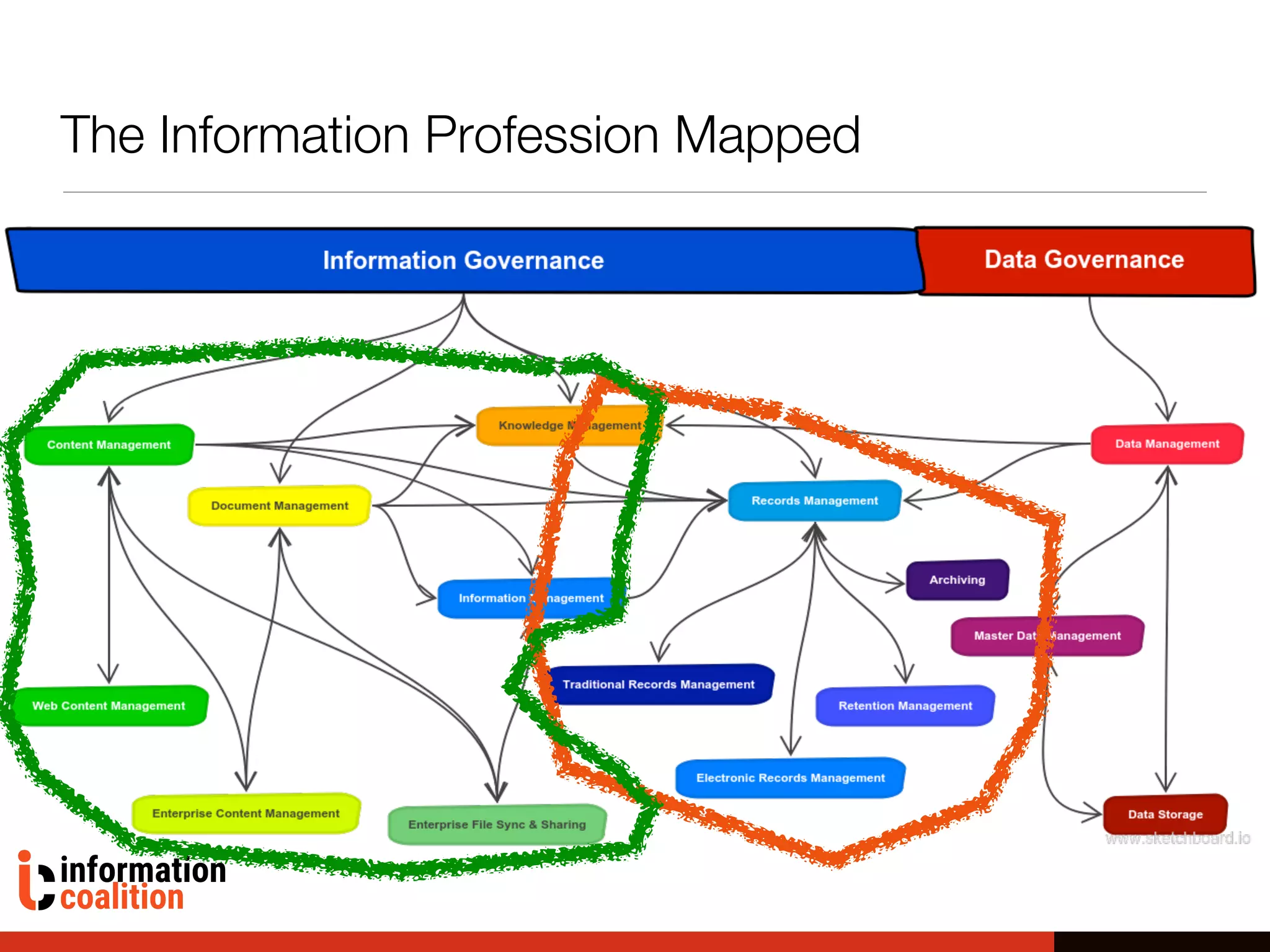
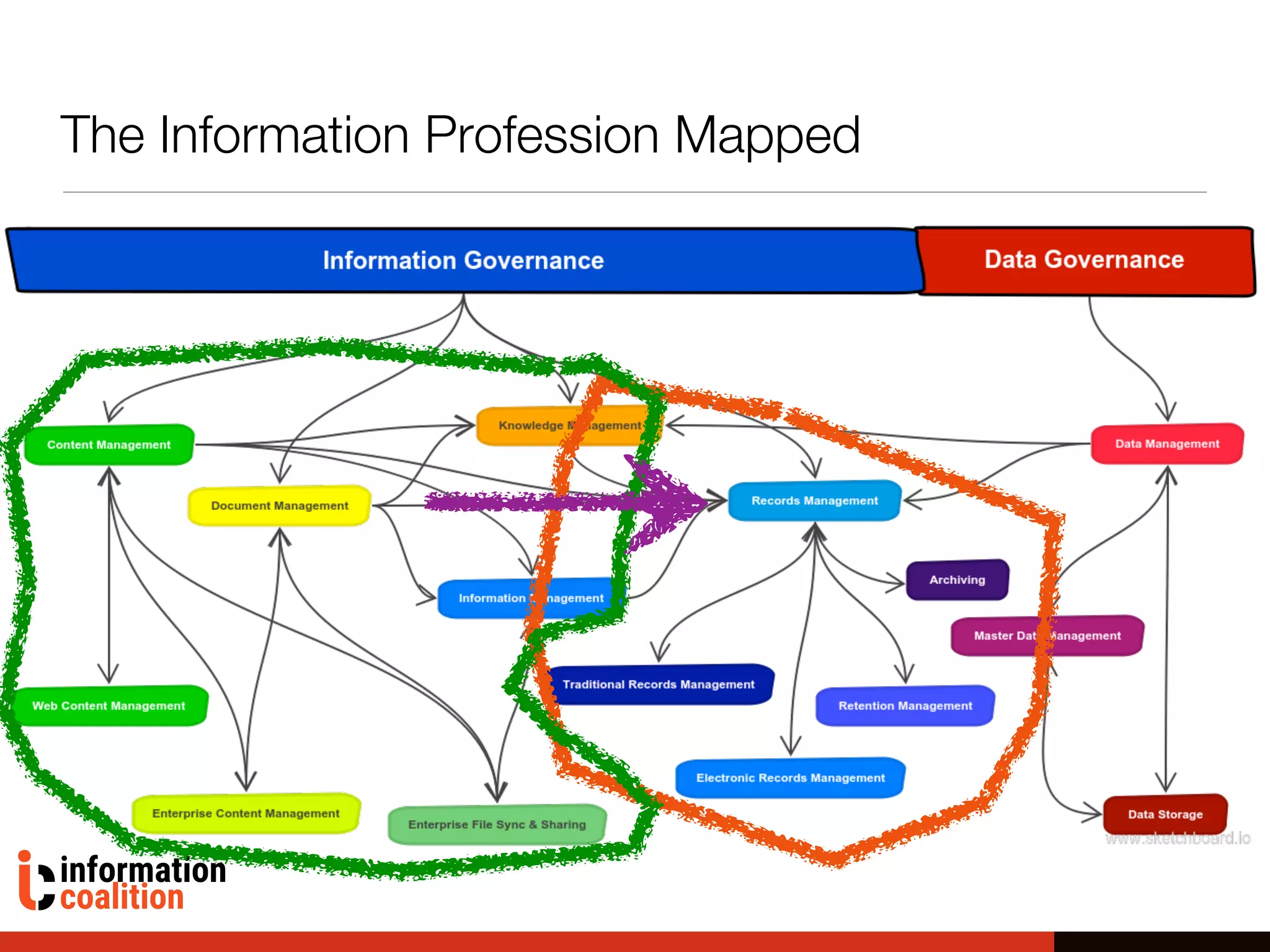
The Information Profession Mapped
The Next Level of RIM Is To Improve & Influence
The Downstream Decisions That Have An
Incredible Impact On Records
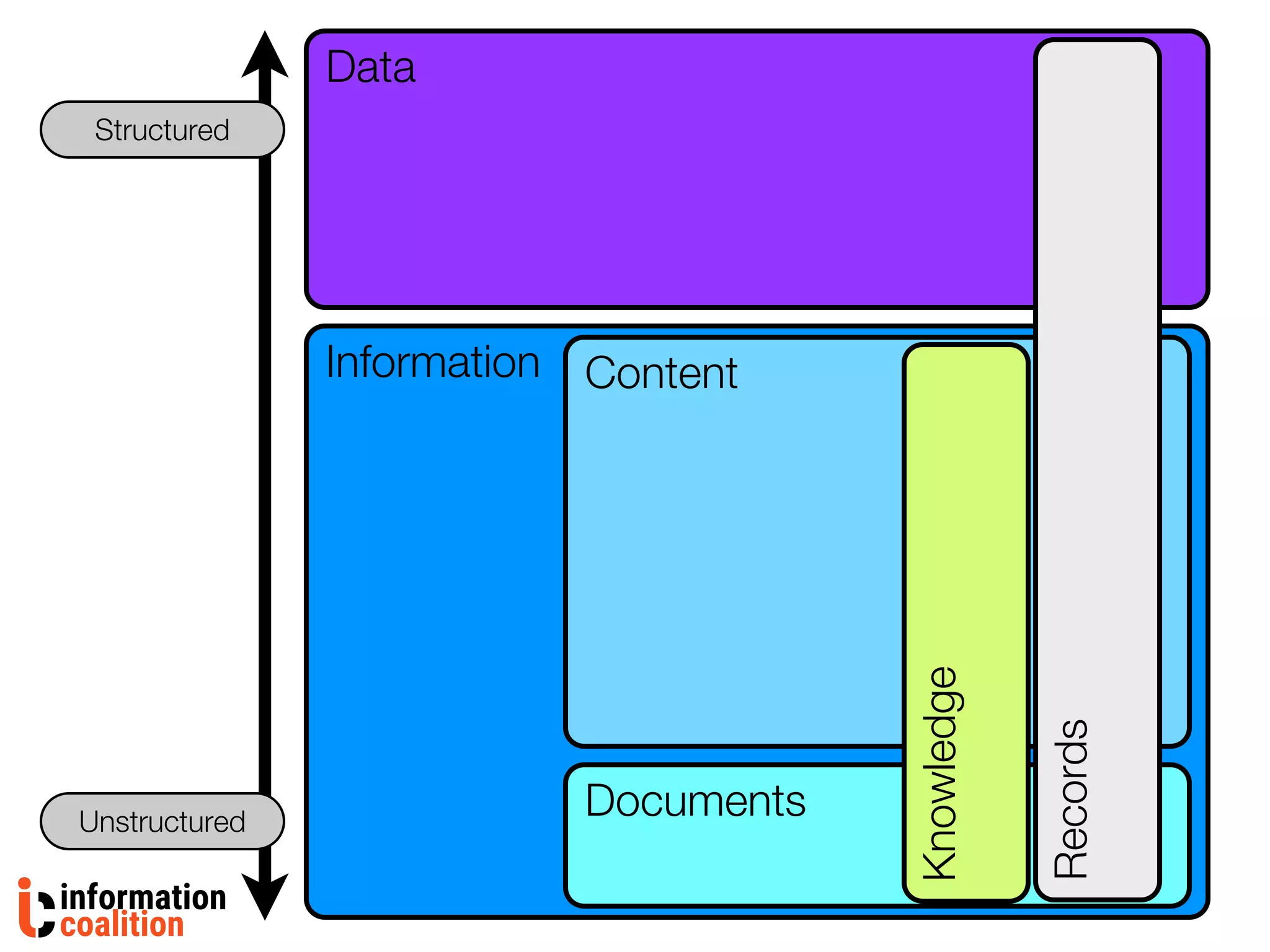
Data
Information Content
Documents
Knowledge
Records
Structured
Unstructured
The Next Level of RIM Is To Improve & Influence
The Downstream Decisions That Have An
Incredible Impact On Records
Information Strategy 2017 Research &
7Ways To Look Downstream
To Take RIM To The Next Level
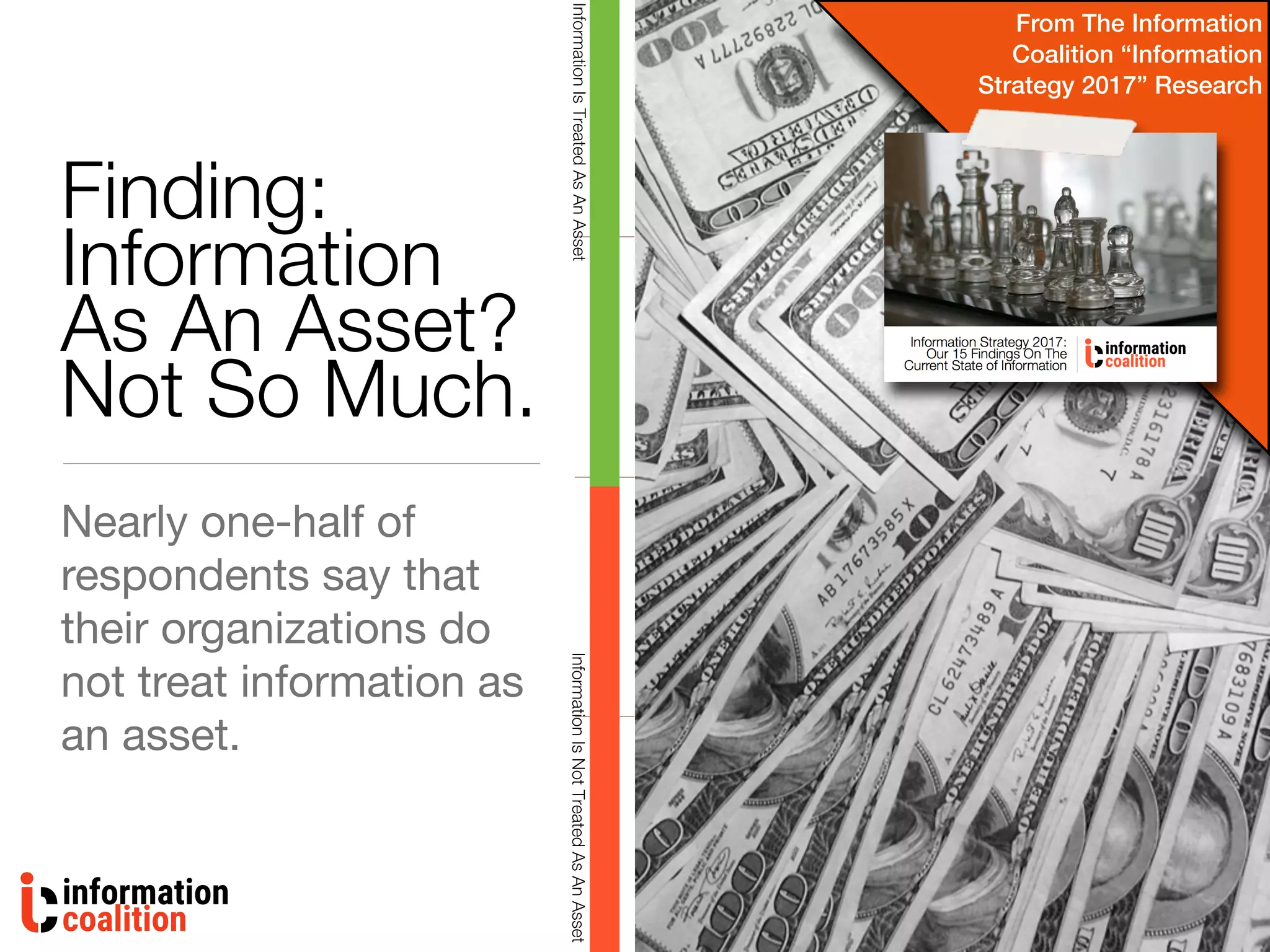
Finding:
Information
As An Asset?
Not So Much.
Nearly one-half of
respondents say that
their organizations do
not treat information as
an asset.
InformationIsNotTreatedAsAnAssetInformationIsTreatedAsAnAsset
From The Information
Coalition “Information
Strategy 2017” Research
Taking RIM To The Next Level 1:
Treat Information As An Asset
•Build a plan for getting executives to take note of the
value of information
•Follow an information flow backwards from a successful
outcome to the underlying information that enabled the
outcome
•Leverage change management principles for employee
change
•Develop a plan
•Provide clear guidance
Additional Resources:
http://www.information-age.com/how-to-really-treat-information-as-an-asset-123457338/
https://www.ft.com/content/0919f8b2-6105-11e3-b7f1-00144feabdc0
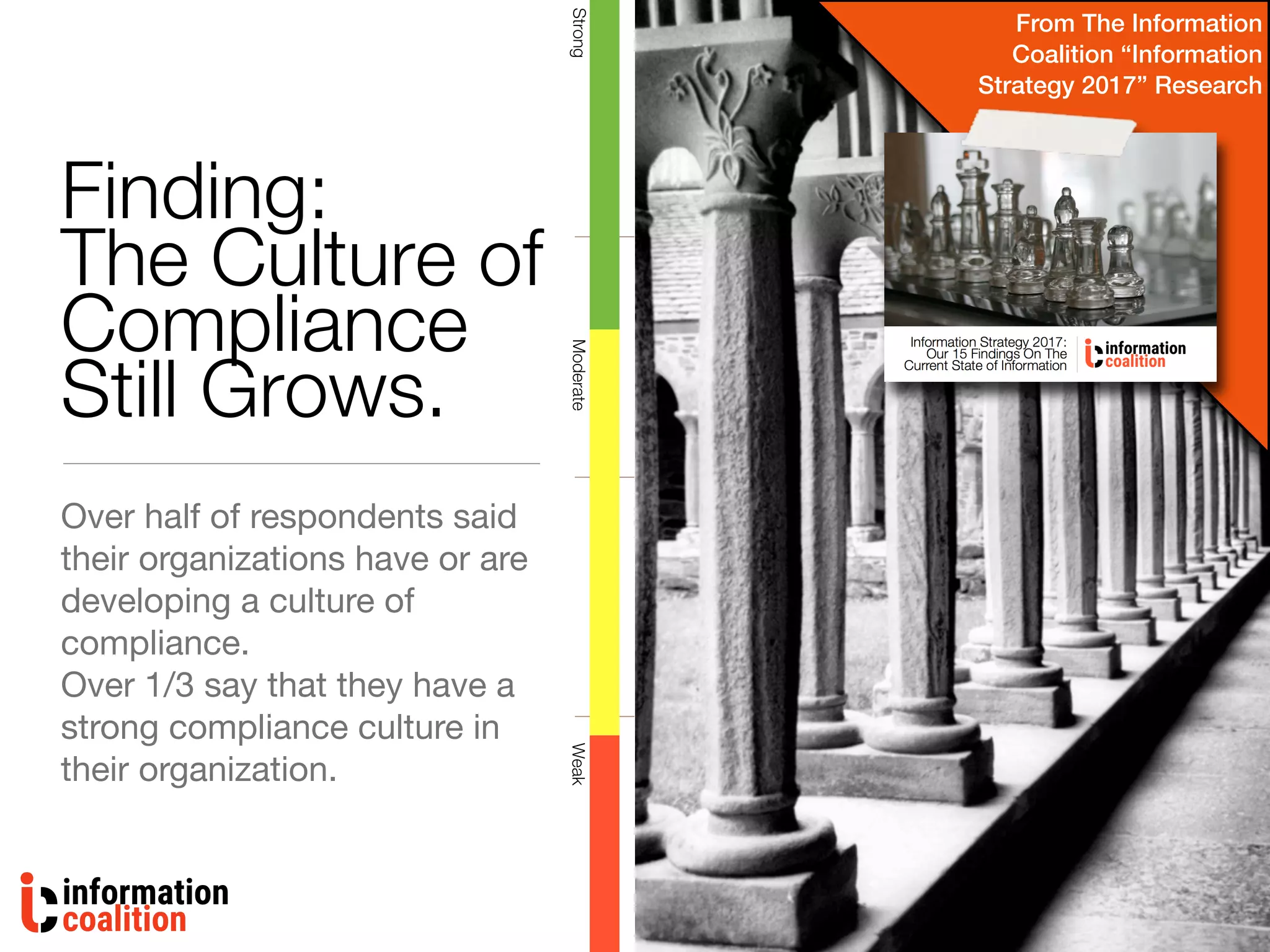
Finding:
The Culture of
Compliance
Still Grows.
Over half of respondents said
their organizations have or are
developing a culture of
compliance.
Over 1/3 say that they have a
strong compliance culture in
their organization.
WeakStrongModerate
From The Information
Coalition “Information
Strategy 2017” Research
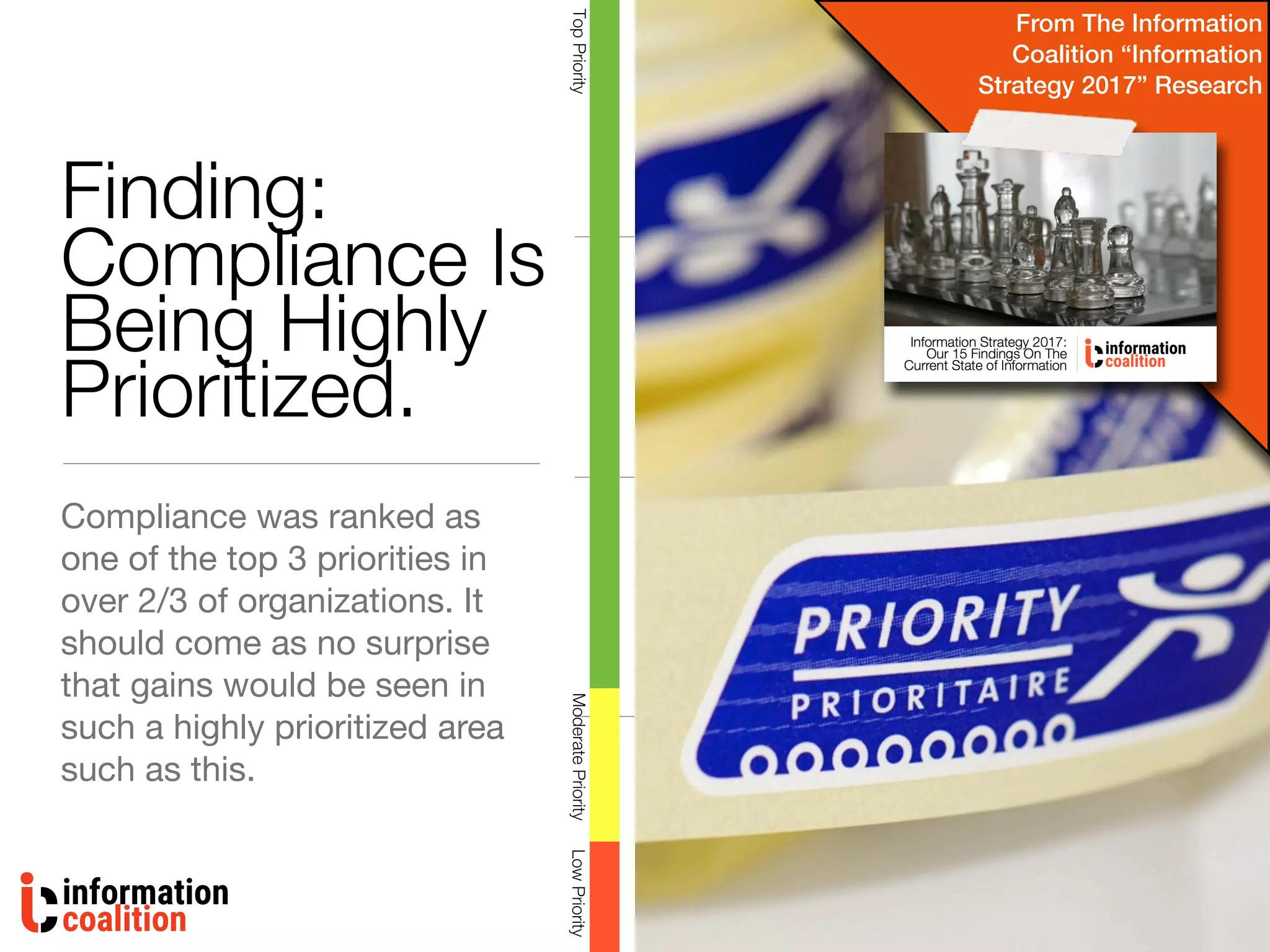
Finding:
Compliance Is
Being Highly
Prioritized.
Compliance was ranked as
one of the top 3 priorities in
over 2/3 of organizations. It
should come as no surprise
that gains would be seen in
such a highly prioritized area
such as this.
LowPriorityTopPriorityModeratePriority
From The Information
Coalition “Information
Strategy 2017” Research
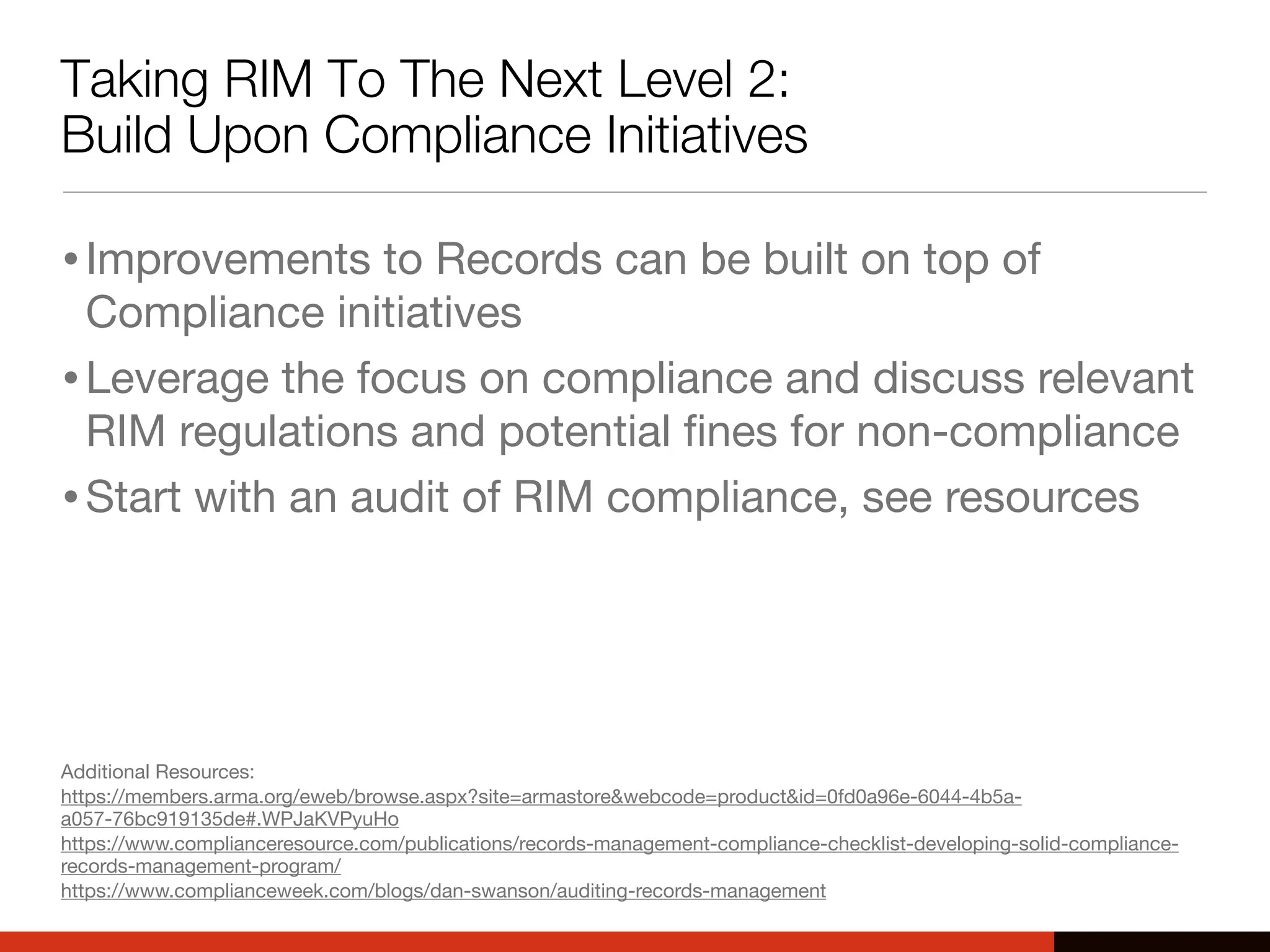
Taking RIM To The Next Level 2:
Build Upon Compliance Initiatives
•Improvements to Records can be built on top of
Compliance initiatives
•Leverage the focus on compliance and discuss relevant
RIM regulations and potential fines for non-compliance
•Start with an audit of RIM compliance, see resources
Additional Resources:
https://members.arma.org/eweb/browse.aspx?site=armastore&webcode=product&id=0fd0a96e-6044-4b5a-
a057-76bc919135de#.WPJaKVPyuHo
https://www.complianceresource.com/publications/records-management-compliance-checklist-developing-solid-compliance-
records-management-program/
https://www.complianceweek.com/blogs/dan-swanson/auditing-records-management
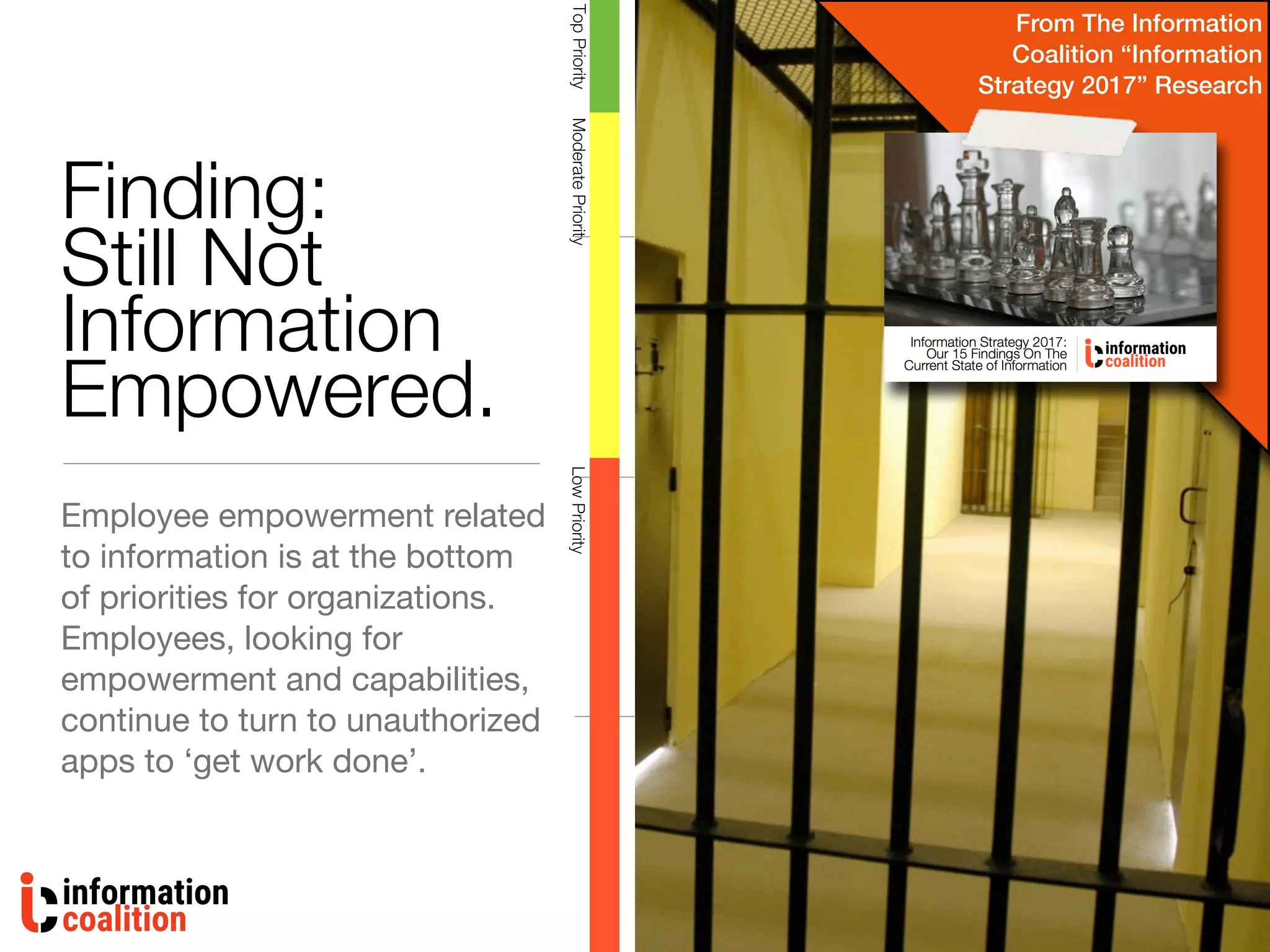
Finding:
Still Not
Information
Empowered.
Employee empowerment related
to information is at the bottom
of priorities for organizations.
Employees, looking for
empowerment and capabilities,
continue to turn to unauthorized
apps to ‘get work done’.
LowPriorityTopPriorityModeratePriority
From The Information
Coalition “Information
Strategy 2017” Research
Taking RIM To The Next Level 3:
You Can’t Manage What You Never Had
•Your organization may be missing Records that
individual employees are managing outside of official
corporate systems
•Terrible systems, terrible compliance
•Information systems need to focus on usability
•Improve ability to accept information from a variety of
sources (think mobile)
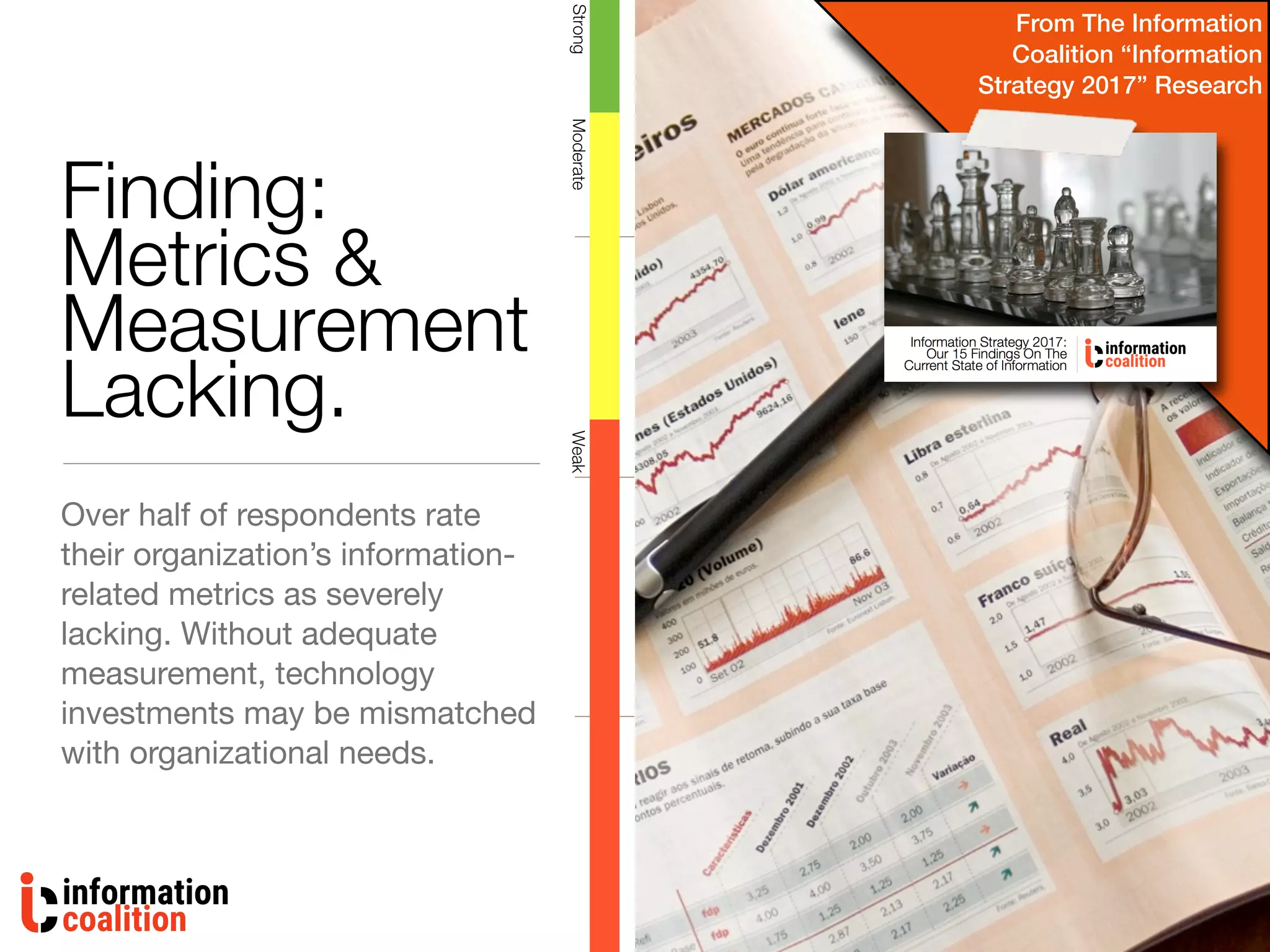
Finding:
Metrics &
Measurement
Lacking.
Over half of respondents rate
their organization’s information-
related metrics as severely
lacking. Without adequate
measurement, technology
investments may be mismatched
with organizational needs.
WeakStrongModerate
From The Information
Coalition “Information
Strategy 2017” Research
Taking RIM To The Next Level 4:
We Don’t Know What We Don’t Measure
•Metrics provide justification of our efforts
•Metrics help us understand our effectiveness
•At a time when we continue to have to justify our
programs, metrics provide that rationale
•We must embrace metrics as a core part of our RIM
programs
Additional Resources:
https://www.archives.gov/records-mgmt/resources/self-assessment.html
http://recordsmanagement.tab.com/records_management_software/how-to-choose-the-right-metrics-for-your-records-
management-program/
http://hollygroup.com/hgsite/broad-view-and-metrics-must-for-records/
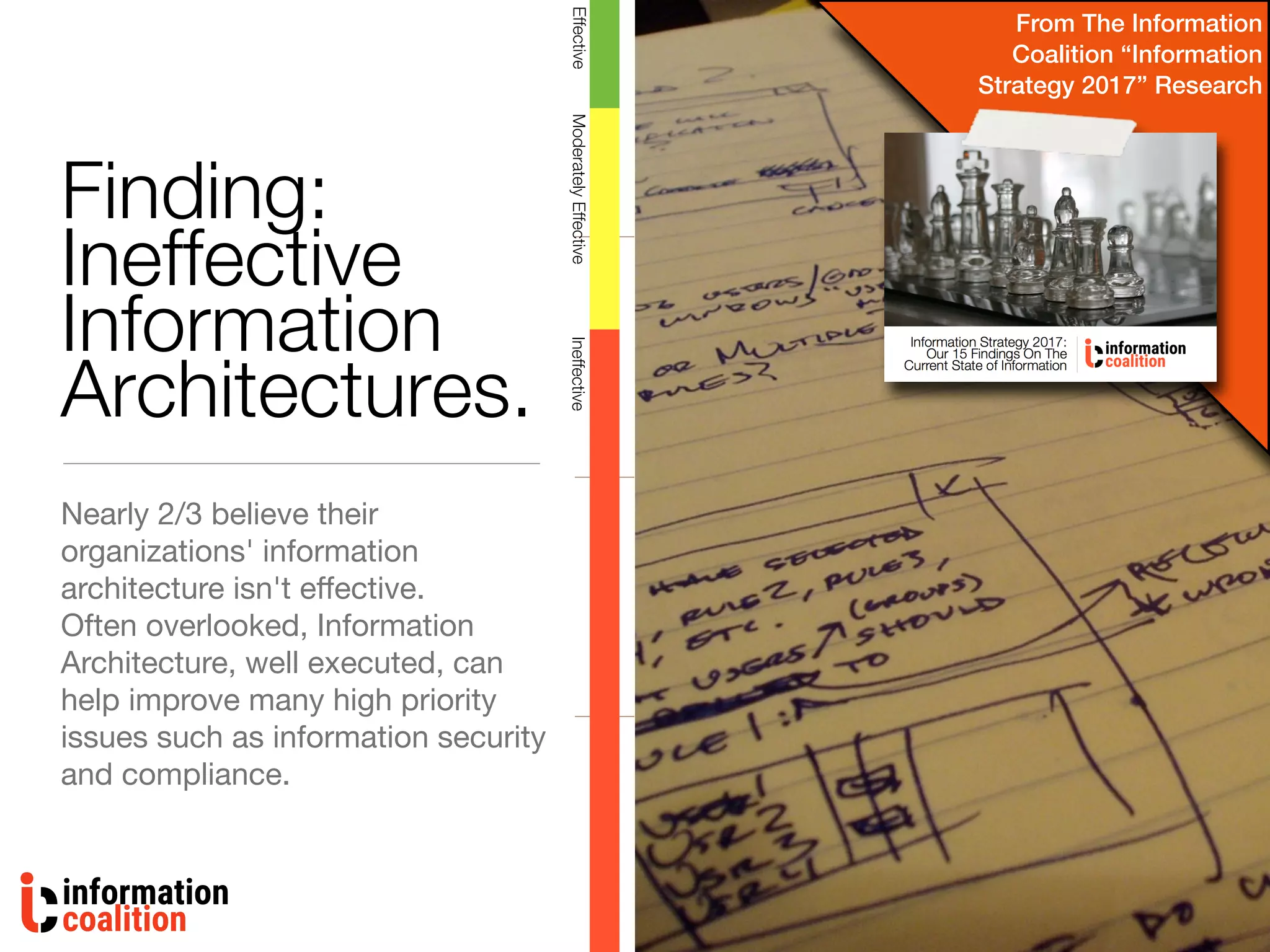
Finding:
Ineffective
Information
Architectures.
Nearly 2/3 believe their
organizations' information
architecture isn't effective.
Often overlooked, Information
Architecture, well executed, can
help improve many high priority
issues such as information security
and compliance.
IneffectiveEffectiveModeratelyEffective
From The Information
Coalition “Information
Strategy 2017” Research
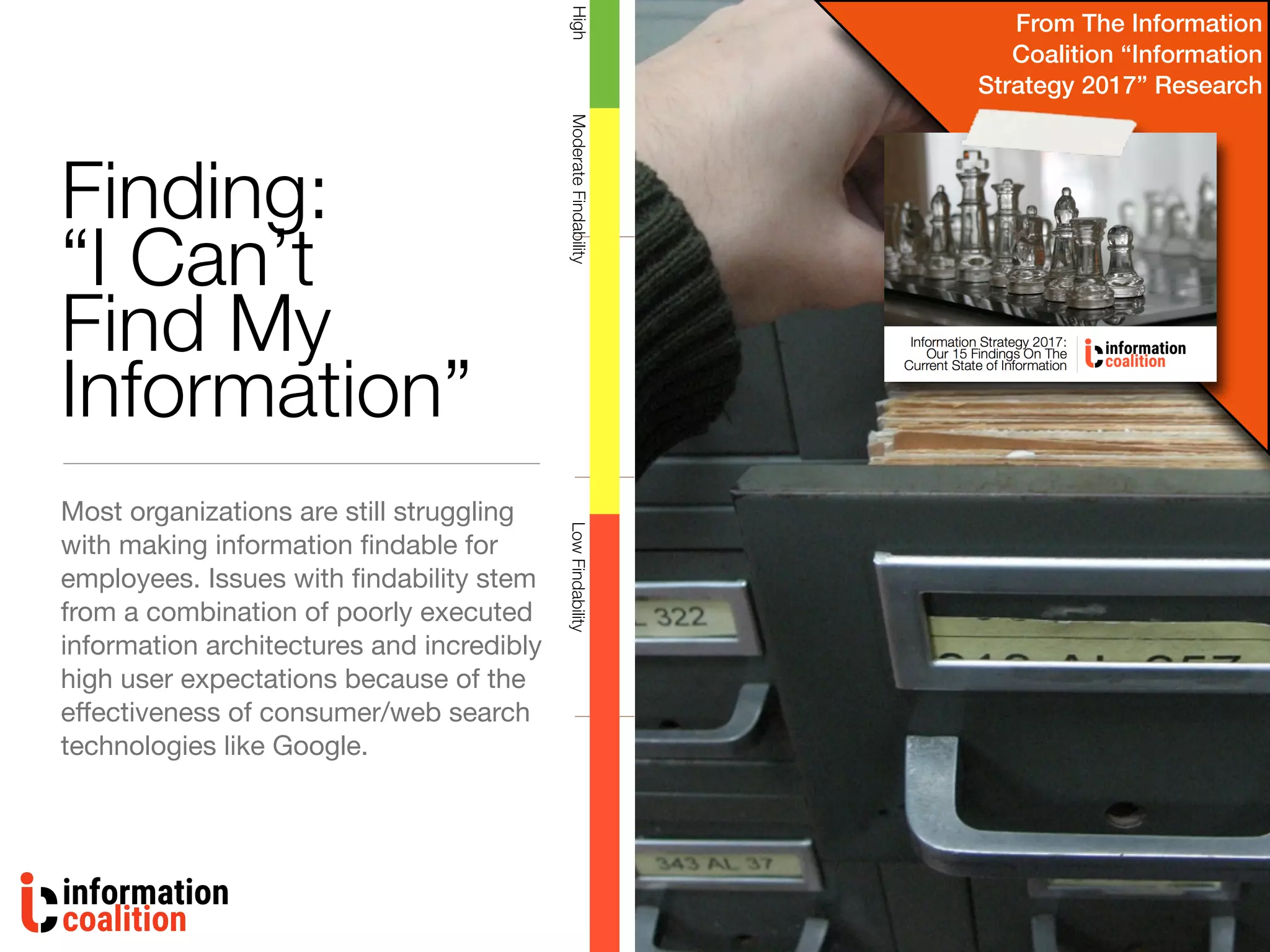
Finding:
“I Can’t
Find My
Information”
Most organizations are still struggling
with making information findable for
employees. Issues with findability stem
from a combination of poorly executed
information architectures and incredibly
high user expectations because of the
effectiveness of consumer/web search
technologies like Google.
LowFindabilityHighModerateFindability
From The Information
Coalition “Information
Strategy 2017” Research
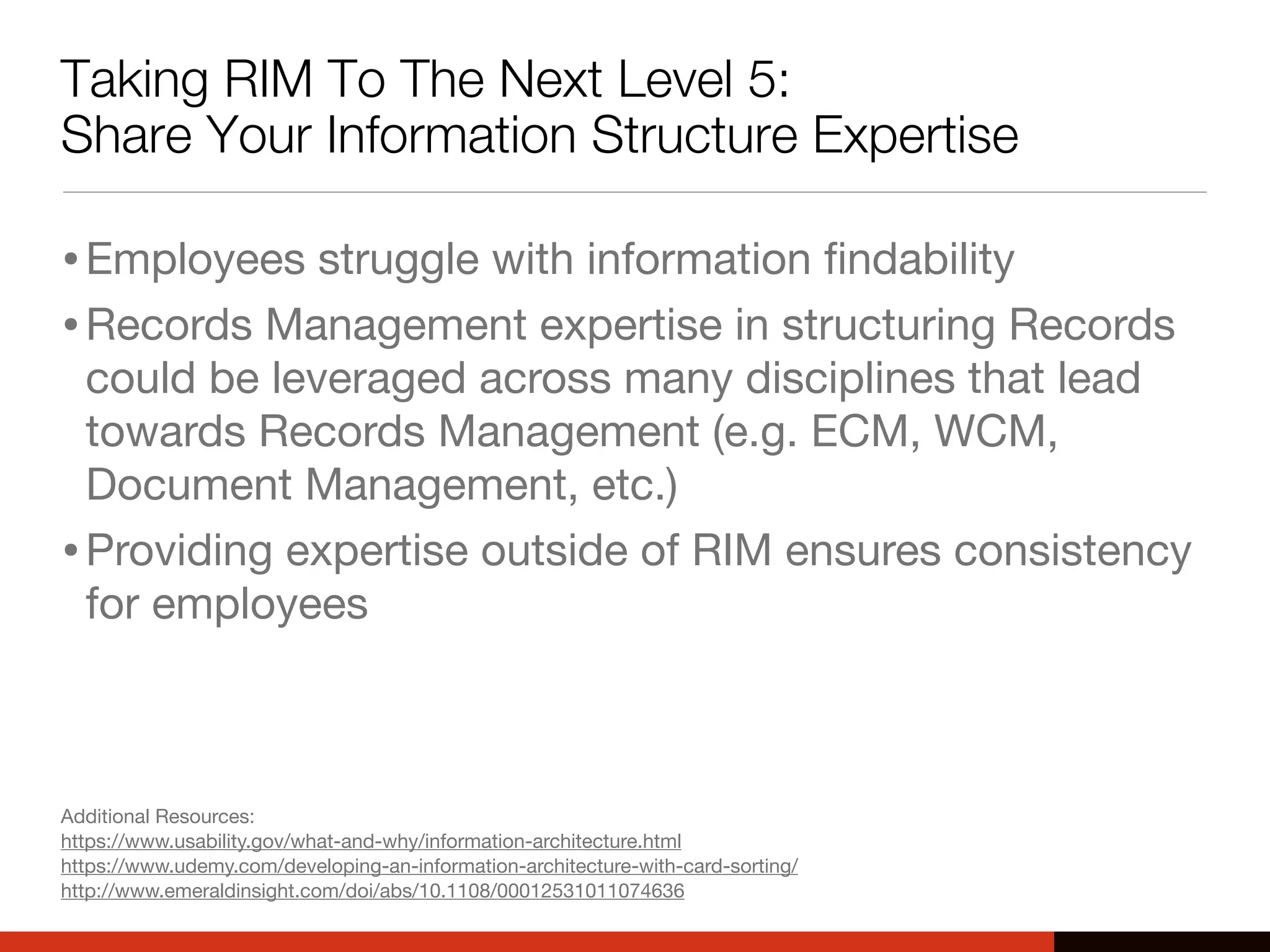
Taking RIM To The Next Level 5:
Share Your Information Structure Expertise
•Employees struggle with information findability
•Records Management expertise in structuring Records
could be leveraged across many disciplines that lead
towards Records Management (e.g. ECM, WCM,
Document Management, etc.)
•Providing expertise outside of RIM ensures consistency
for employees
Additional Resources:
https://www.usability.gov/what-and-why/information-architecture.html
https://www.udemy.com/developing-an-information-architecture-with-card-sorting/
http://www.emeraldinsight.com/doi/abs/10.1108/00012531011074636
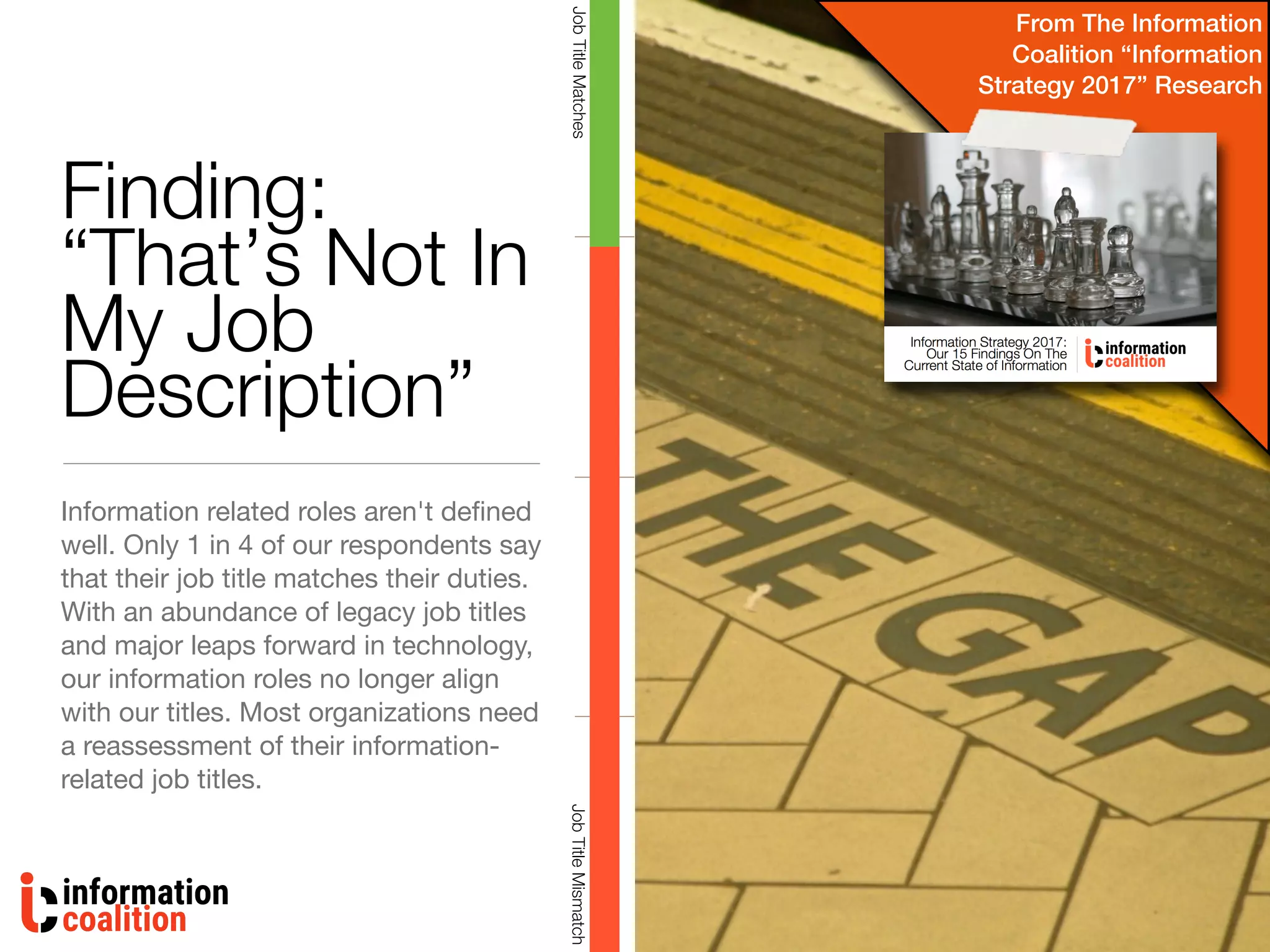
Finding:
“That’s Not In
My Job
Description”
Information related roles aren't defined
well. Only 1 in 4 of our respondents say
that their job title matches their duties.
With an abundance of legacy job titles
and major leaps forward in technology,
our information roles no longer align
with our titles. Most organizations need
a reassessment of their information-
related job titles.
JobTitleMismatchJobTitleMatches
From The Information
Coalition “Information
Strategy 2017” Research
Taking RIM To The Next Level 6:
Clean Up Job Titles & Job Descriptions
•Technology’s breakneck pace has left us reeling
•Individuals titles don’t line up with their new roles
•Re-evaluation and re-centering will help employee
morale as they better understand their place within the
information ecosystem of the organization
•(New work being done now to help with this)
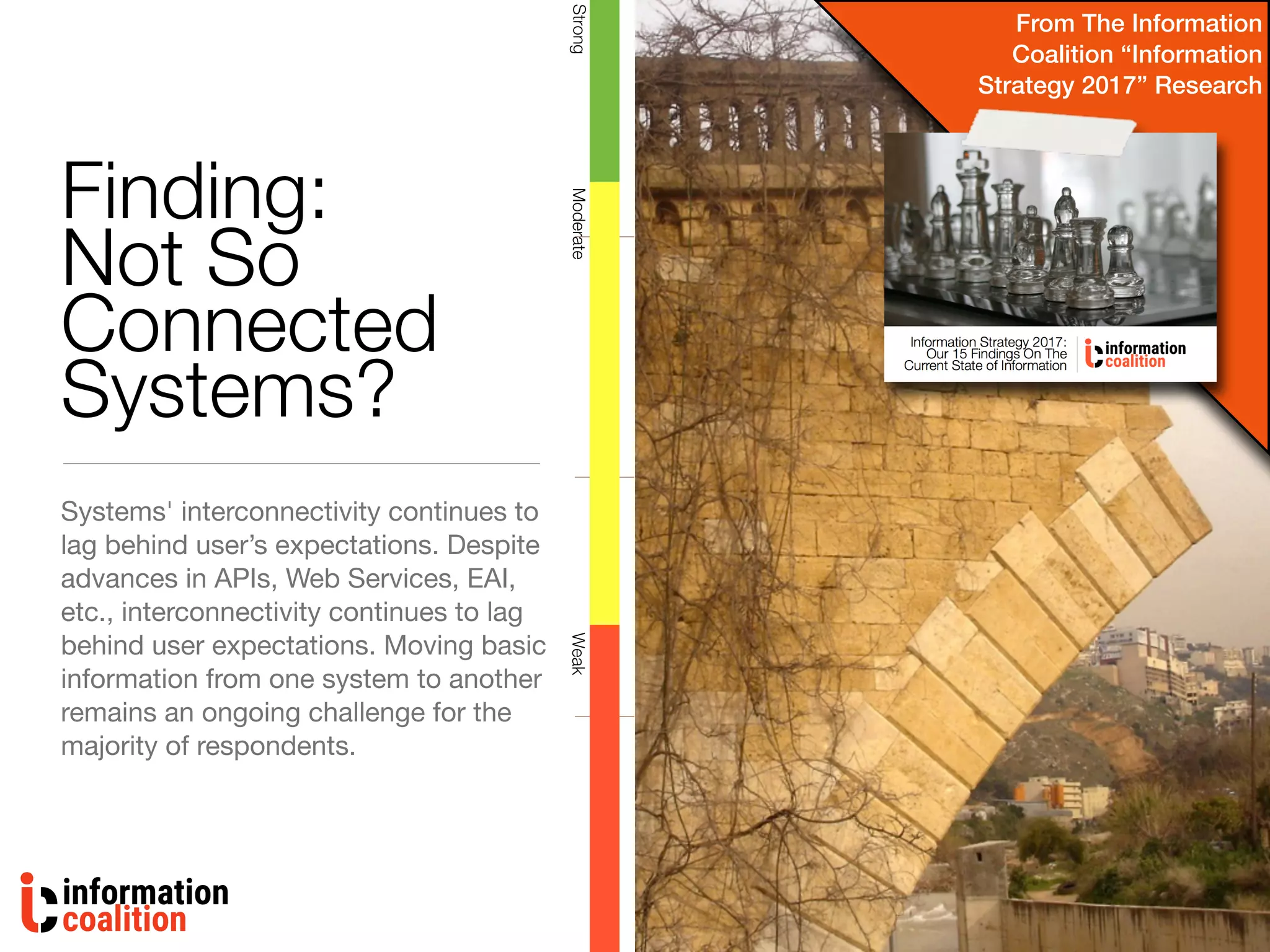
Finding:
Not So
Connected
Systems?
Systems' interconnectivity continues to
lag behind user’s expectations. Despite
advances in APIs, Web Services, EAI,
etc., interconnectivity continues to lag
behind user expectations. Moving basic
information from one system to another
remains an ongoing challenge for the
majority of respondents.
WeakStrongModerate
From The Information
Coalition “Information
Strategy 2017” Research
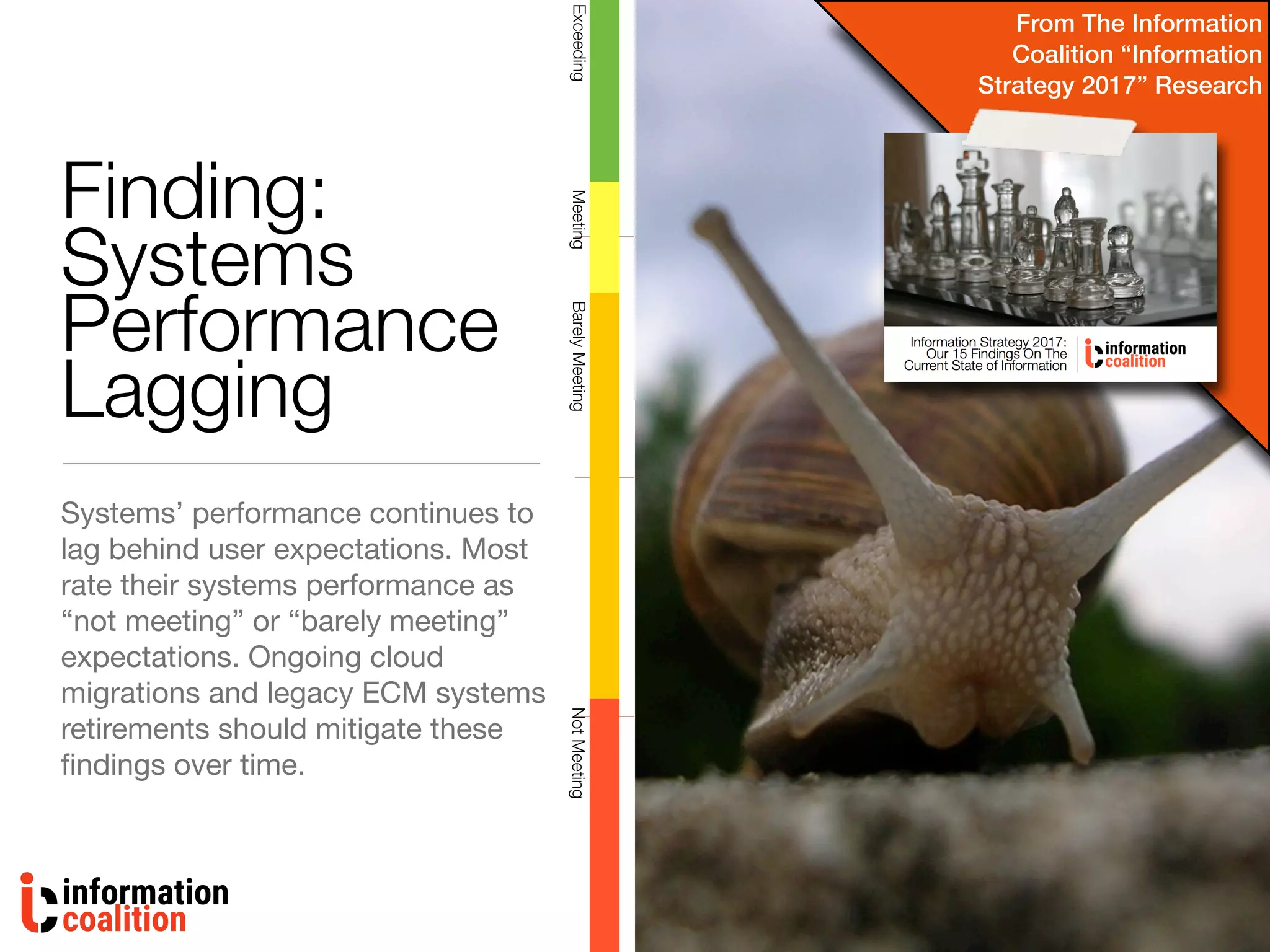
Finding:
Systems
Performance
Lagging
Systems’ performance continues to
lag behind user expectations. Most
rate their systems performance as
“not meeting” or “barely meeting”
expectations. Ongoing cloud
migrations and legacy ECM systems
retirements should mitigate these
findings over time.
NotMeetingExceedingBarelyMeetingMeeting
From The Information
Coalition “Information
Strategy 2017” Research
Taking RIM To The Next Level 7:
Correct & Connect Your Systems
•Information accessibility remains an issue
•Disconnected systems make it challenging for users to
move information from one system to another
•Principle of Availability - regularly violated
•If we’re moving information to a Records system that is
no longer available to employees or some employees,
are we violating the Principles?
•Organizational information systems greatly lagging
behind consumer capabilities
The Impact of Automation
Required Reading (Go Read These After The Seminar):
Automated Electronic Records Management Report/Plan:
https://www.archives.gov/records-mgmt/prmd/automated-
erm.html
James Lappin (ThinkingRecords.co.uk): https://
thinkingrecords.co.uk/2014/09/12/evaluating-automated-
approaches-against-records-management-principles/
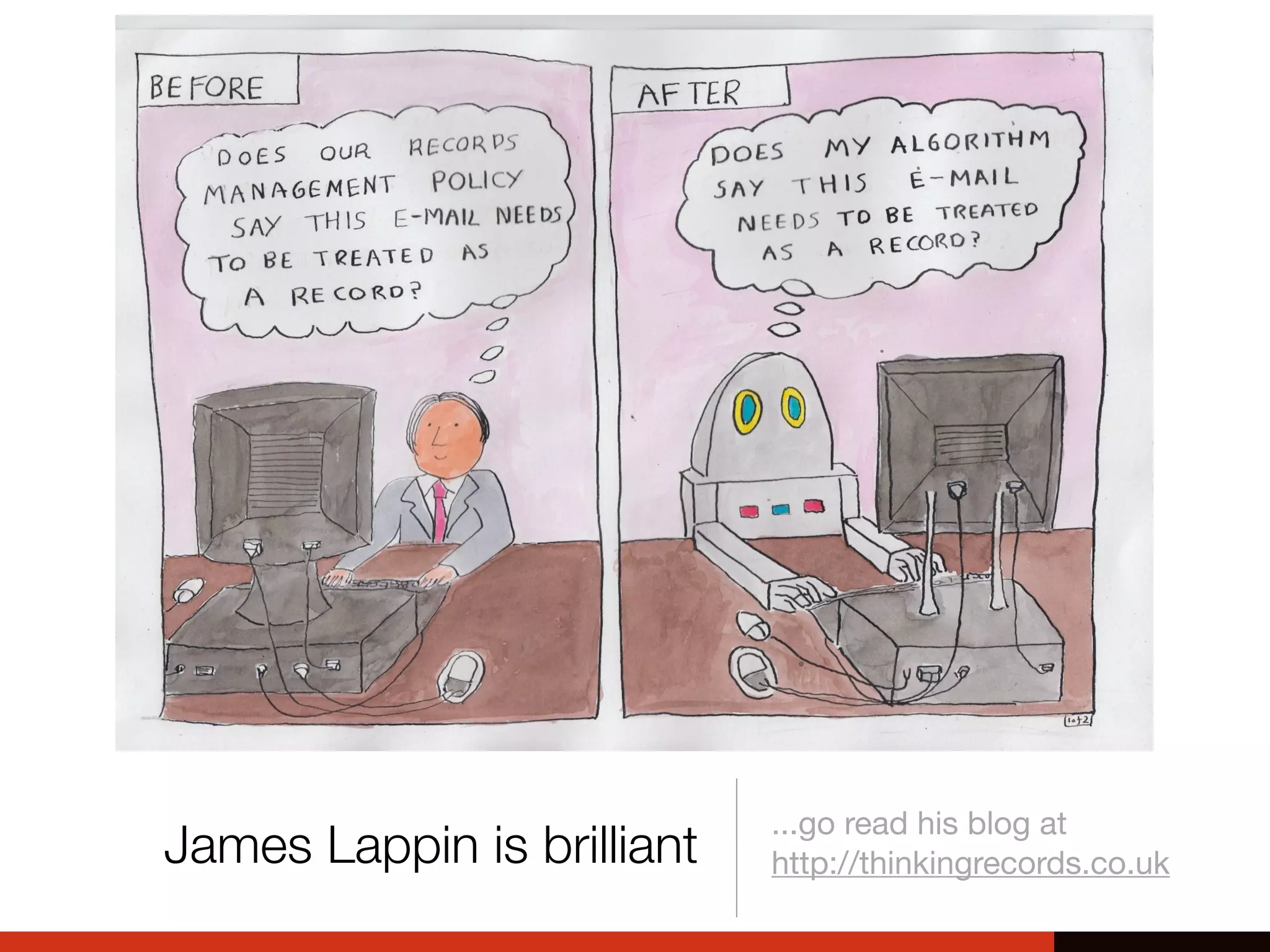
James Lappin is brilliant
...go read his blog at
http://thinkingrecords.co.uk
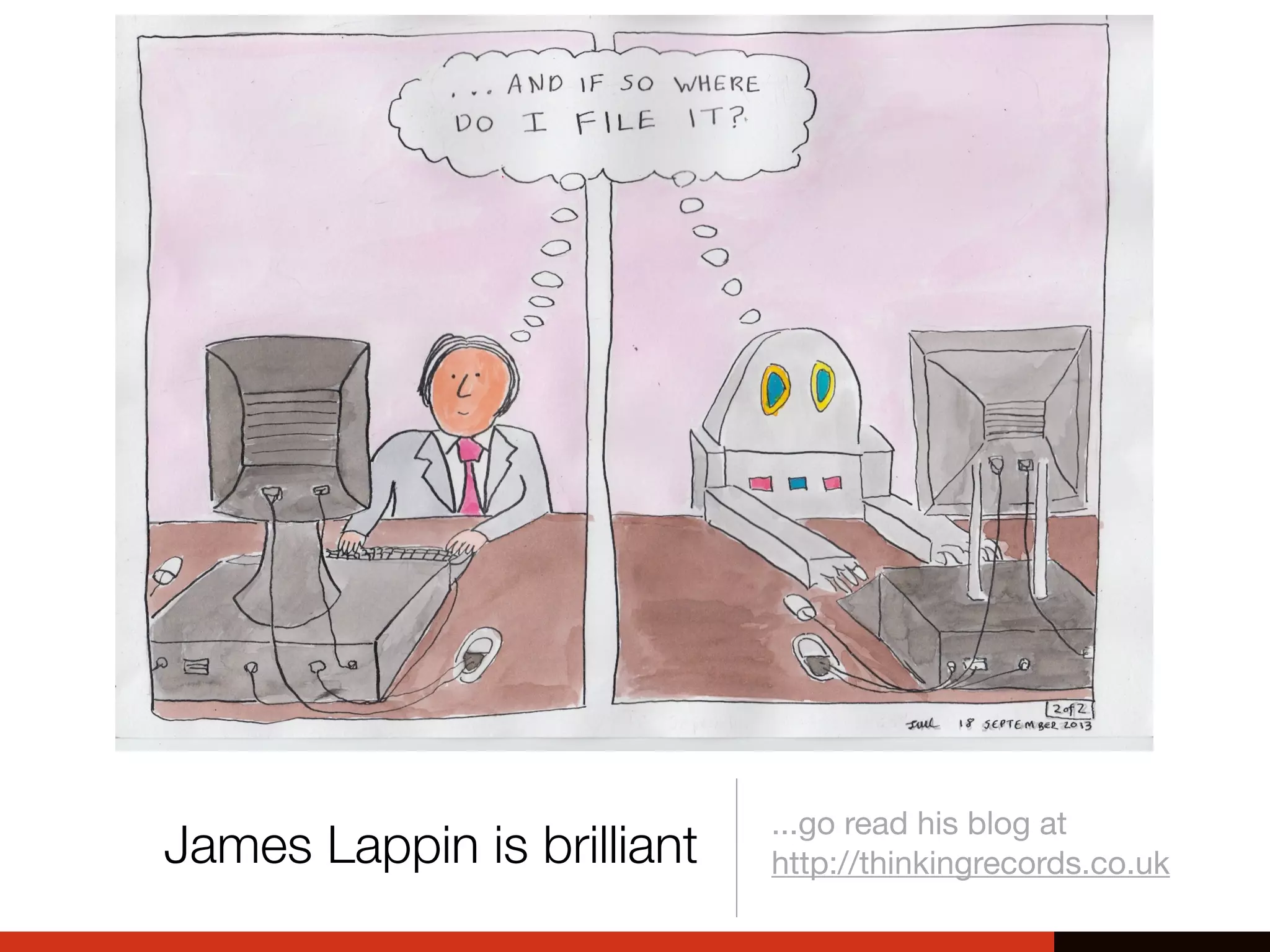
James Lappin is brilliant
...go read his blog at
http://thinkingrecords.co.uk
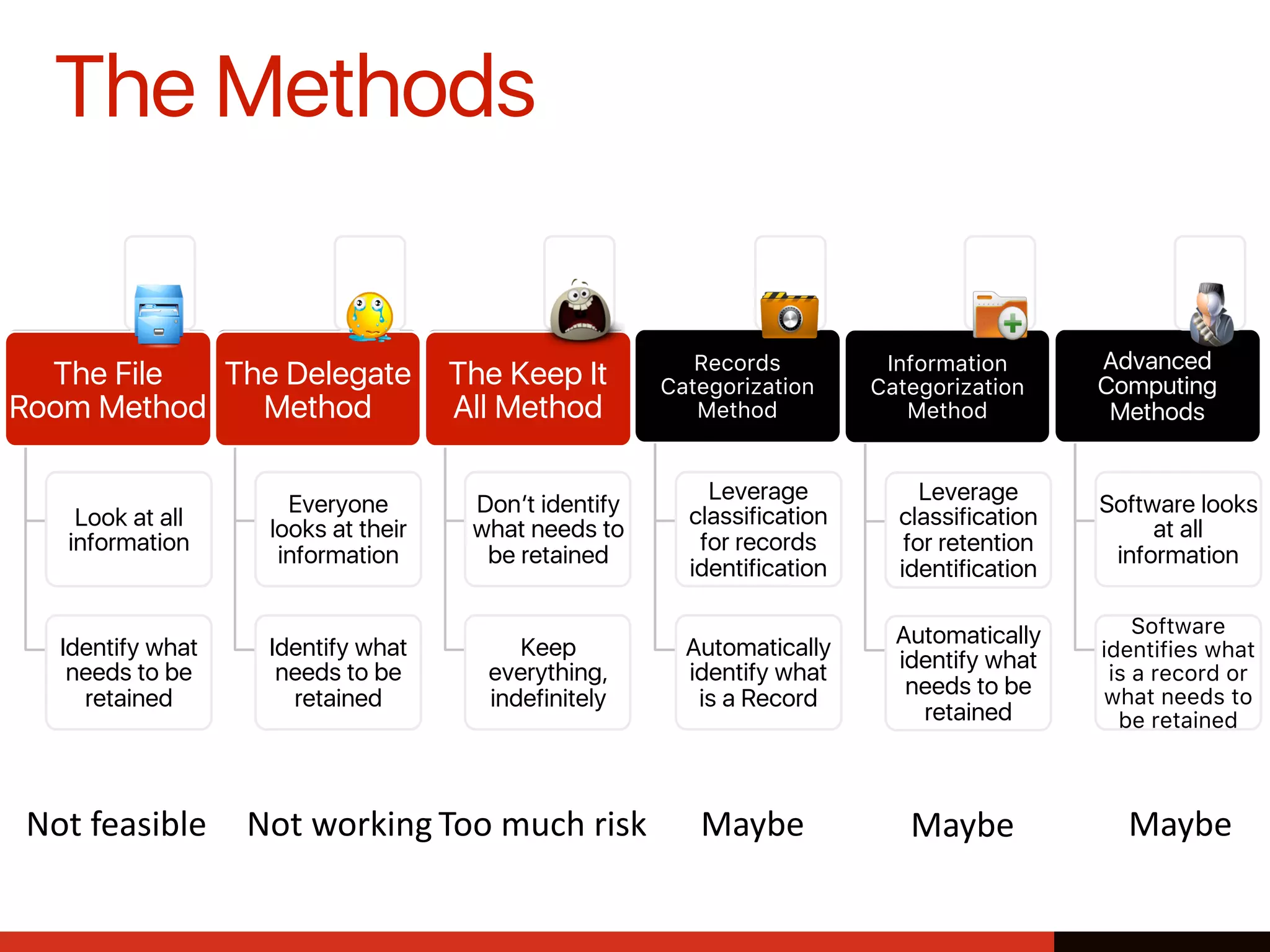
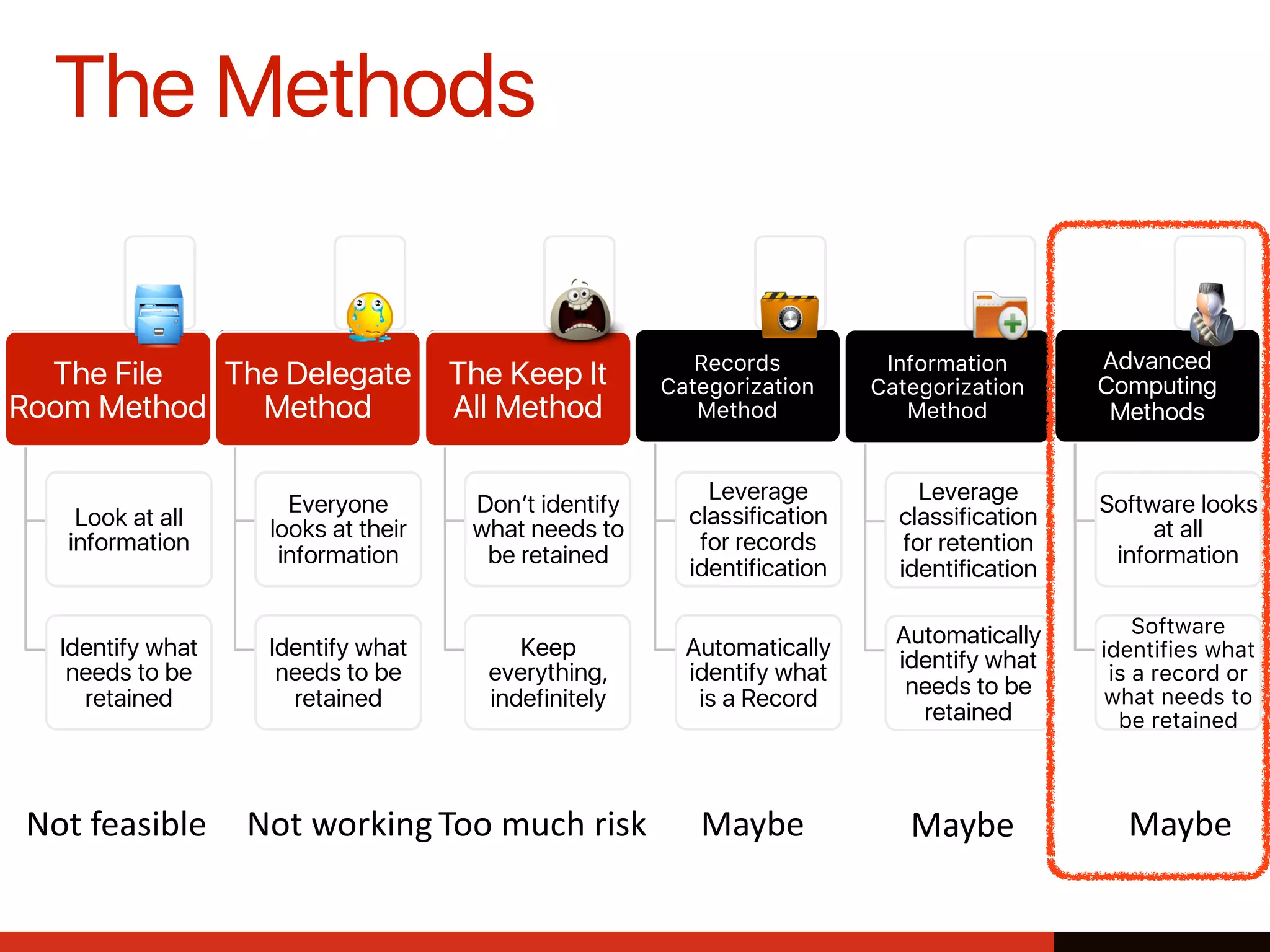
The Methods
The File
Room Method
Look at all
information
Identify what
needs to be
retained
The Delegate
Method
Everyone
looks at their
information
Identify what
needs to be
retained
The Keep It
All Method
Don’t identify
what needs to
be retained
Keep
everything,
indefinitely
Records
Categorization
Method
Leverage
classification
for records
identification
Automatically
identify what
is a Record
Advanced
Computing
Methods
Software looks
at all
information
Software
identifies what
is a record or
what needs to
be retained
Not	feasible Not	working Too	much	risk Maybe Maybe
Information
Categorization
Method
Leverage
classification
for retention
identification
Automatically
identify what
needs to be
retained
Maybe
The File
Room Method
The Delegate
Method
The Keep It
All Method
The Methods
The File
Room Method
Look at all
information
Identify what
needs to be
retained
The Delegate
Method
Everyone
looks at their
information
Identify what
needs to be
retained
The Keep It
All Method
Don’t identify
what needs to
be retained
Keep
everything,
indefinitely
Records
Categorization
Method
Leverage
classification
for records
identification
Automatically
identify what
is a Record
Advanced
Computing
Methods
Software looks
at all
information
Software
identifies what
is a record or
what needs to
be retained
Not	feasible Not	working Too	much	risk Maybe Maybe
Information
Categorization
Method
Leverage
classification
for retention
identification
Automatically
identify what
needs to be
retained
Maybe
The File
Room Method
The Delegate
Method
The Keep It
All Method
The future is already here.
Auto-classification
The future is already here.
It requires solid information architecture.
Auto-classification
The future is already here.
It requires solid information architecture.
It requires WORK.
Auto-classification
The future is already here.
It requires solid information architecture.
It requires WORK.
It requires a comprehensive understanding
of your organization’s information.
Auto-classification
The future is already here.
It requires solid information architecture.
It requires WORK.
It requires a comprehensive understanding
of your organization’s information.
It requires knowledge of how to classify
that information with no room for non-
categorized information.
Auto-classification
How does auto-classification
technology work?
2 ways: Basic or Advanced
Advanced
Technology that analyzes
content and automatically
categorizes it based on rules
that (generally) your
organization must establish.
The Future Is Here: Content Analytics, Big
Data, Natural Language Processing, etc.
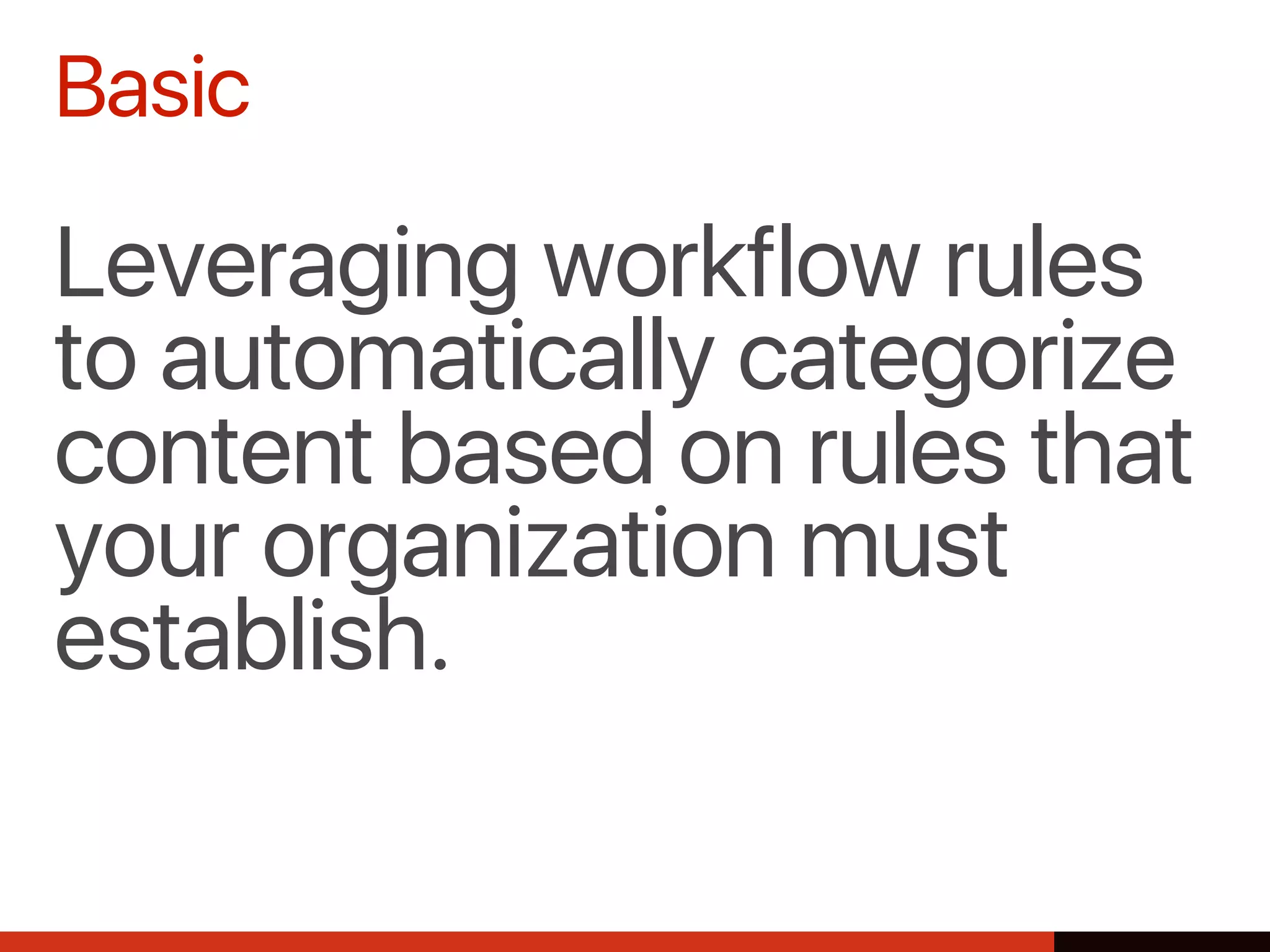
Basic
Leveraging workflow rules
to automatically categorize
content based on rules that
your organization must
establish.
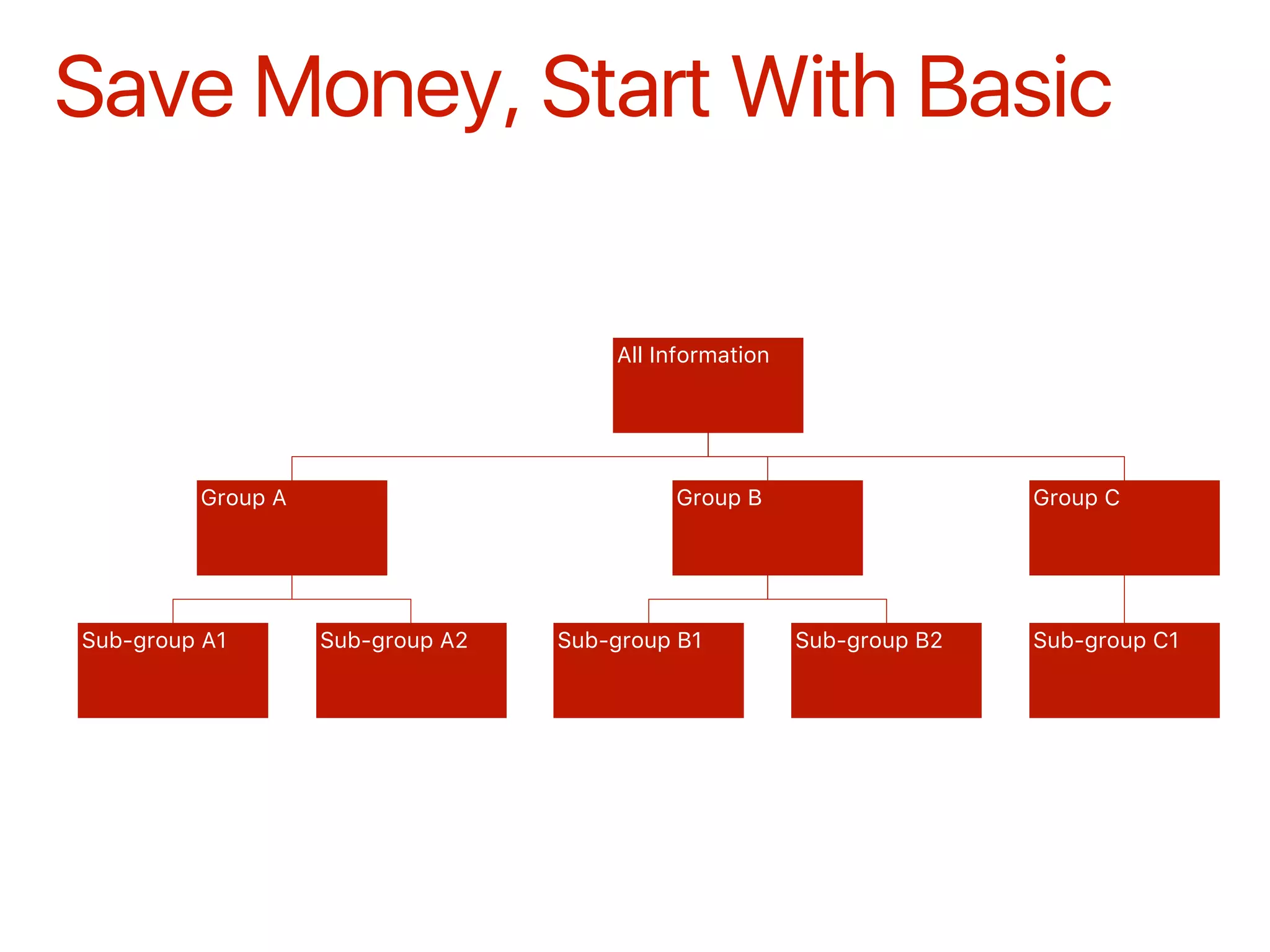
Save Money, Start With Basic
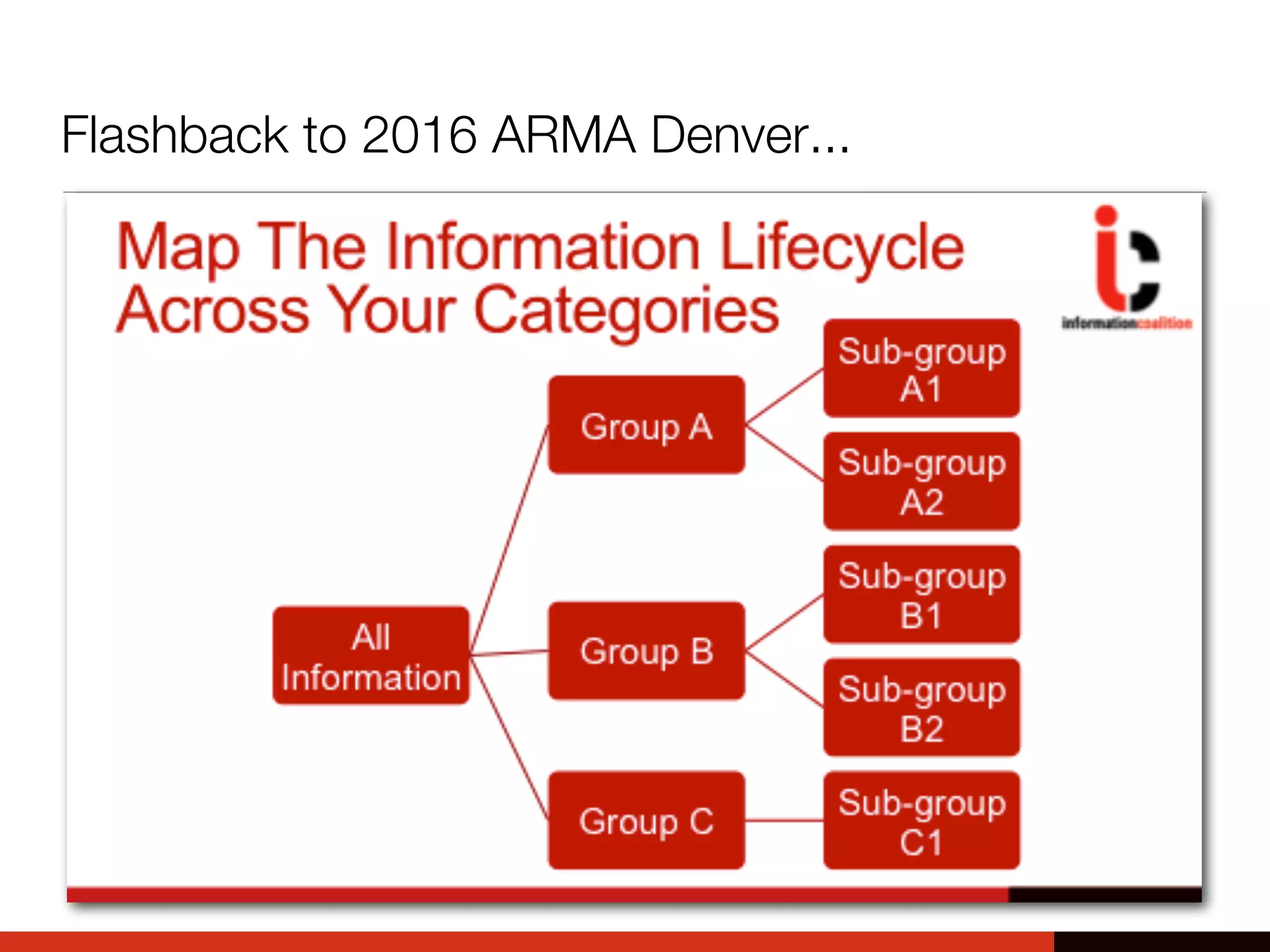
All Information
Group A
Sub-group A1 Sub-group A2
Group B
Sub-group B1 Sub-group B2
Group C
Sub-group C1
Save Money, Start With Basic
All Information
Group A
Sub-group A1 Sub-group A2
Group B
Sub-group B1 Sub-group B2
Group C
Sub-group C1
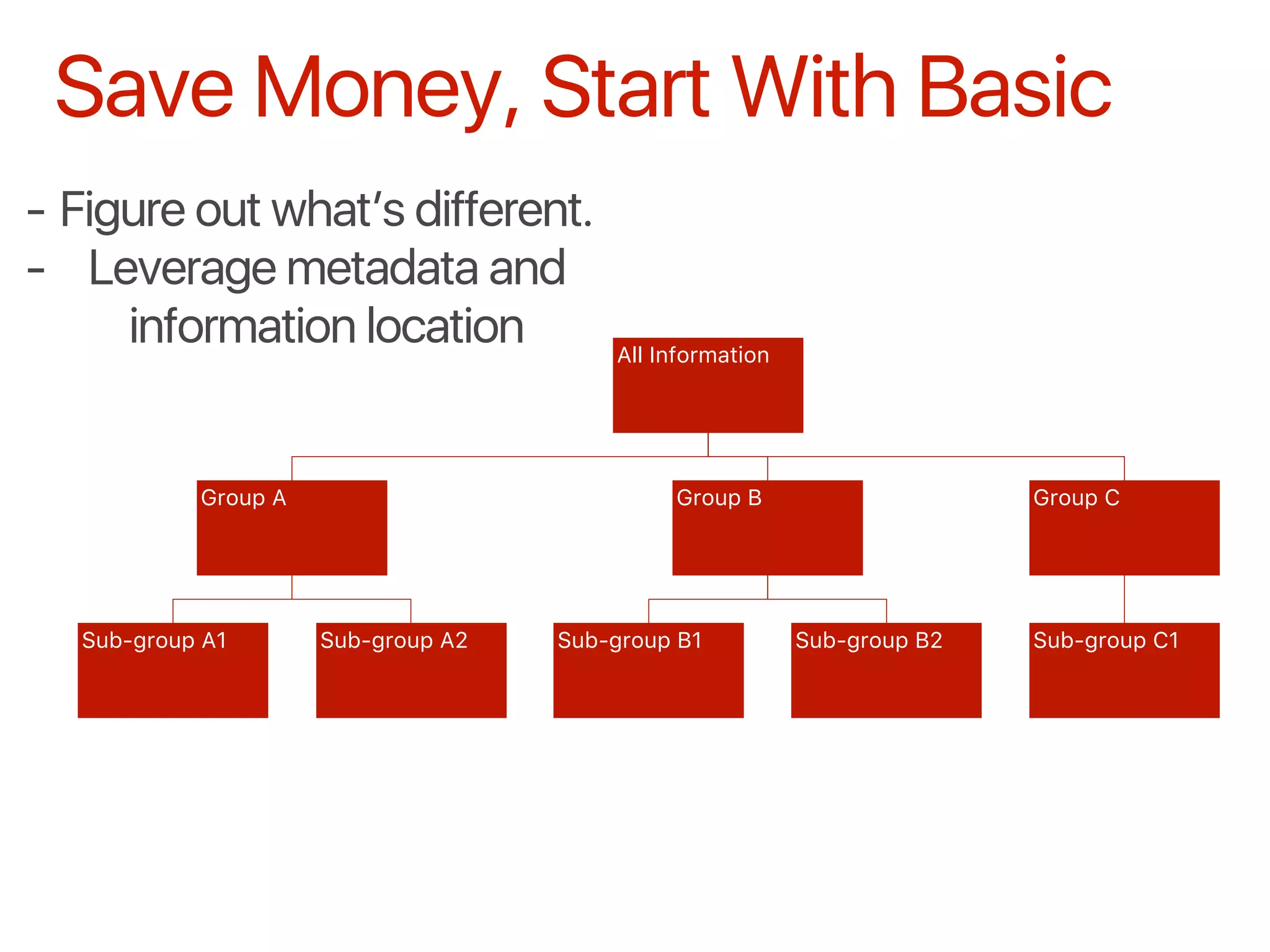
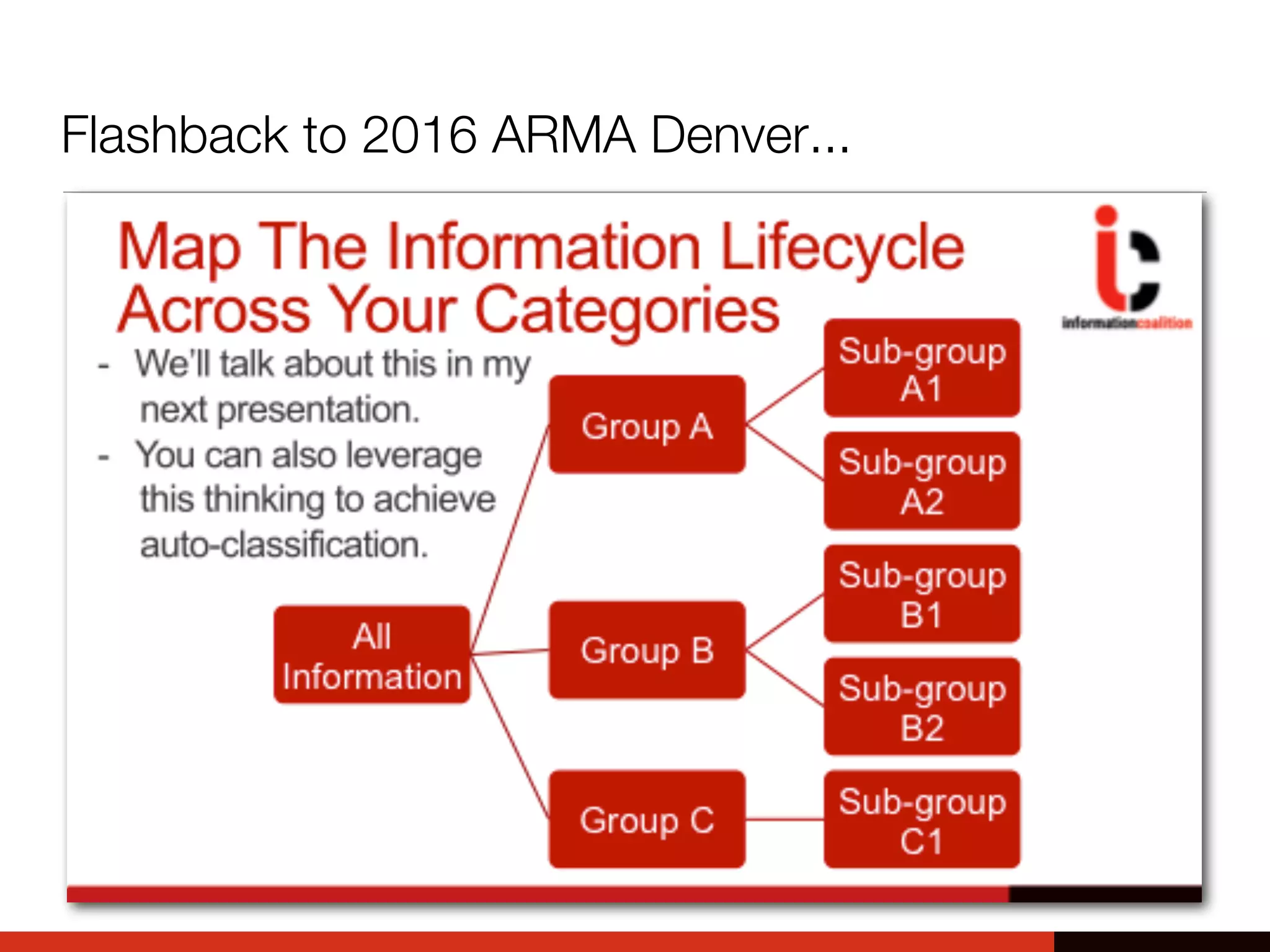
- Figure out what’s different.
- Leverage metadata and
information location
Save Money, Start With Basic
All Information
Group A
Sub-group A1 Sub-group A2
Group B
Sub-group B1 Sub-group B2
Group C
Sub-group C1
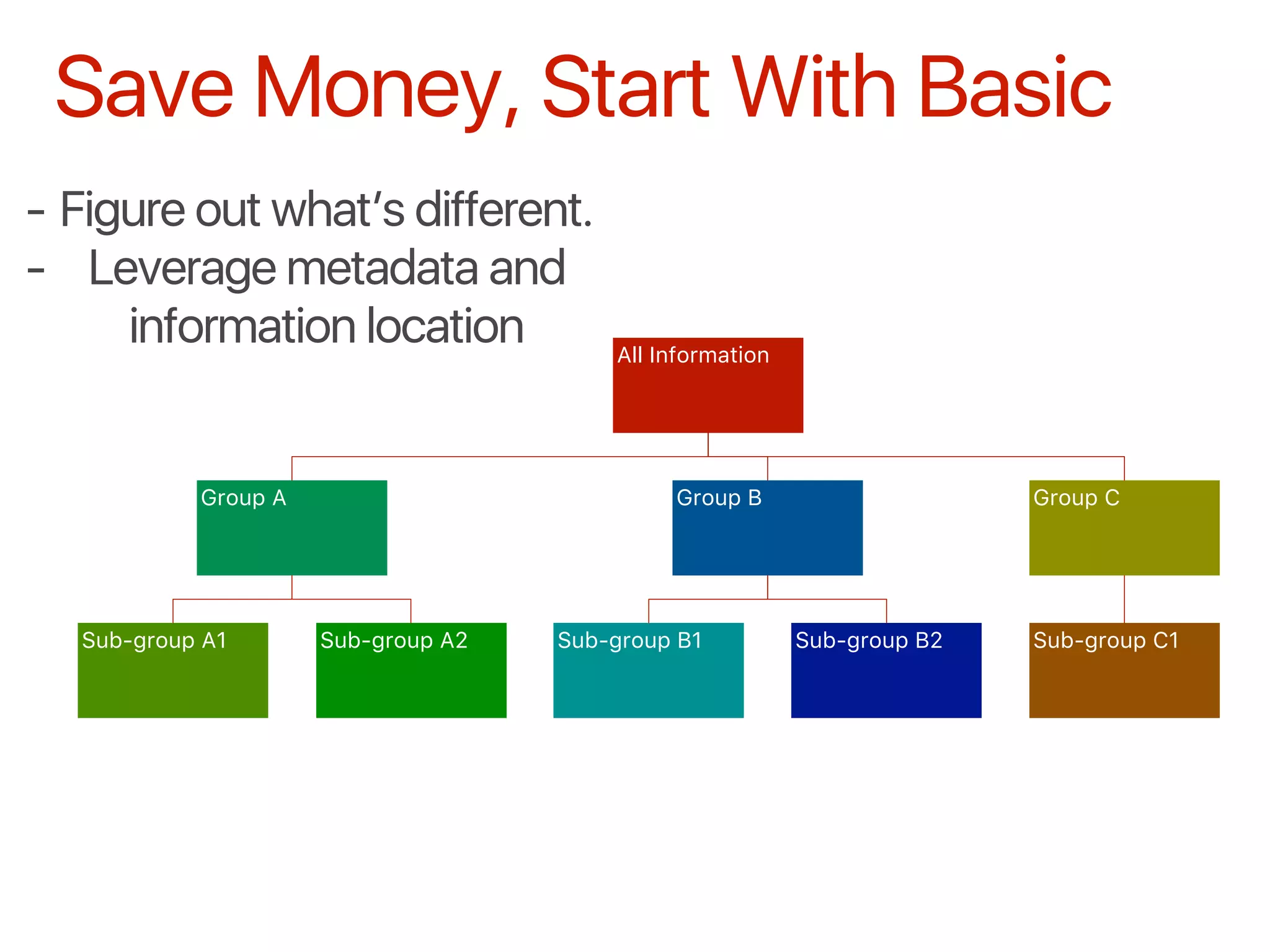
- Figure out what’s different.
- Leverage metadata and
information location
Flashback to 2016 ARMA Denver...
How Will Automation Effect Our Ability To Follow
The Principles® In Our Organizations?
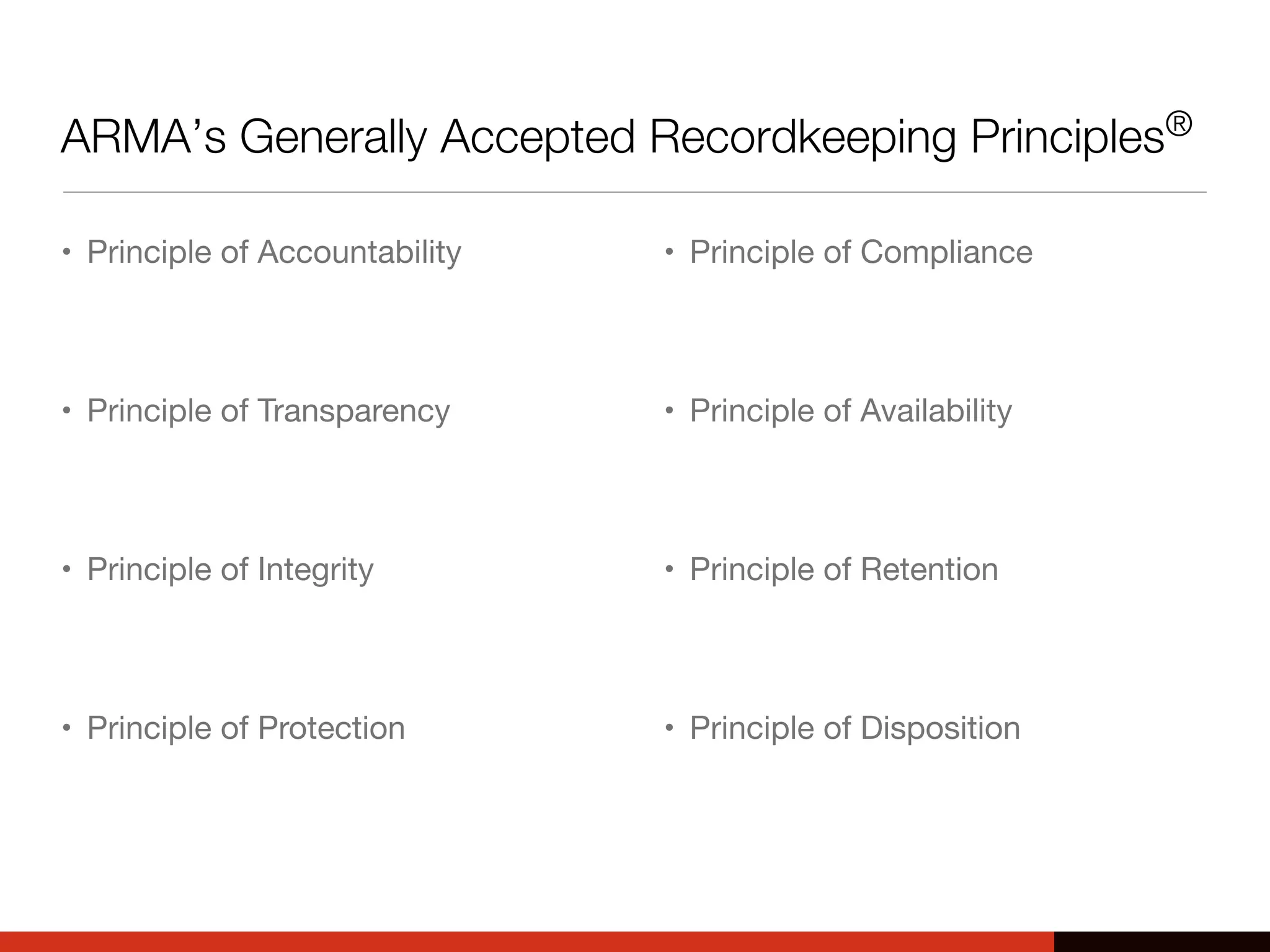
ARMA’s Generally Accepted Recordkeeping Principles®
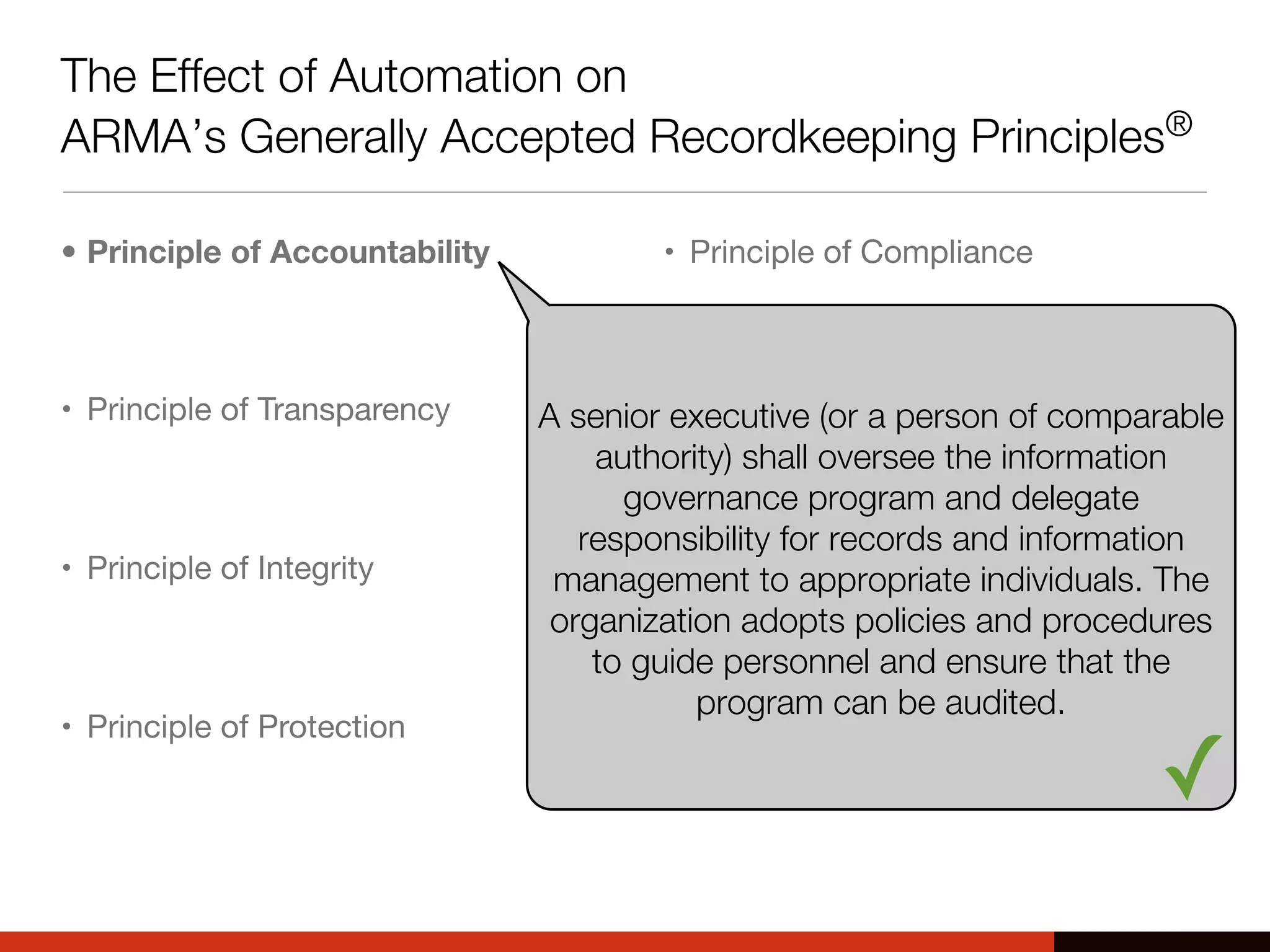
• Principle of Accountability
• Principle of Transparency
• Principle of Integrity
• Principle of Protection
• Principle of Compliance
• Principle of Availability
• Principle of Retention
• Principle of Disposition
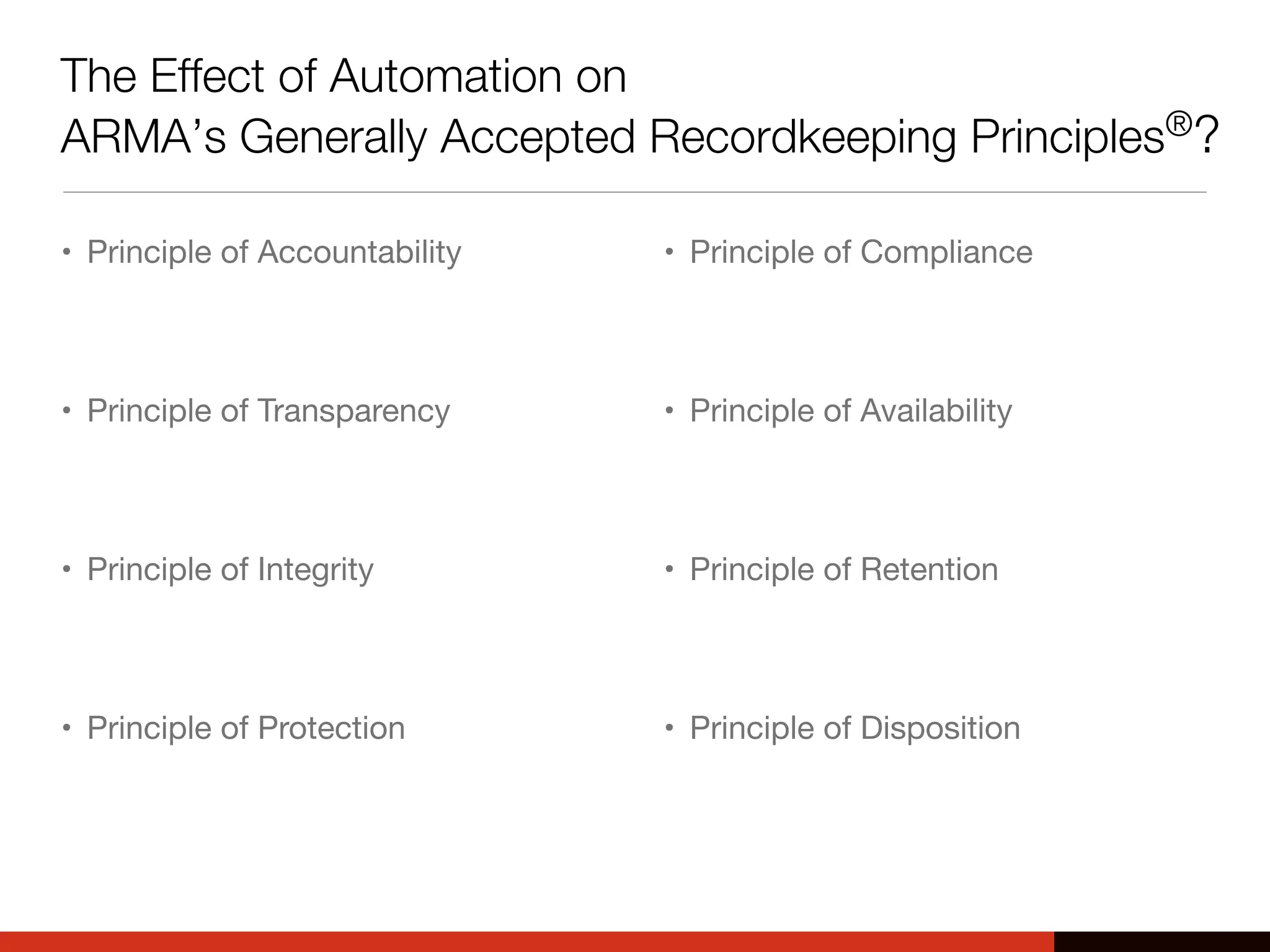
The Effect of Automation on
ARMA’s Generally Accepted Recordkeeping Principles®?
• Principle of Accountability
• Principle of Transparency
• Principle of Integrity
• Principle of Protection
• Principle of Compliance
• Principle of Availability
• Principle of Retention
• Principle of Disposition
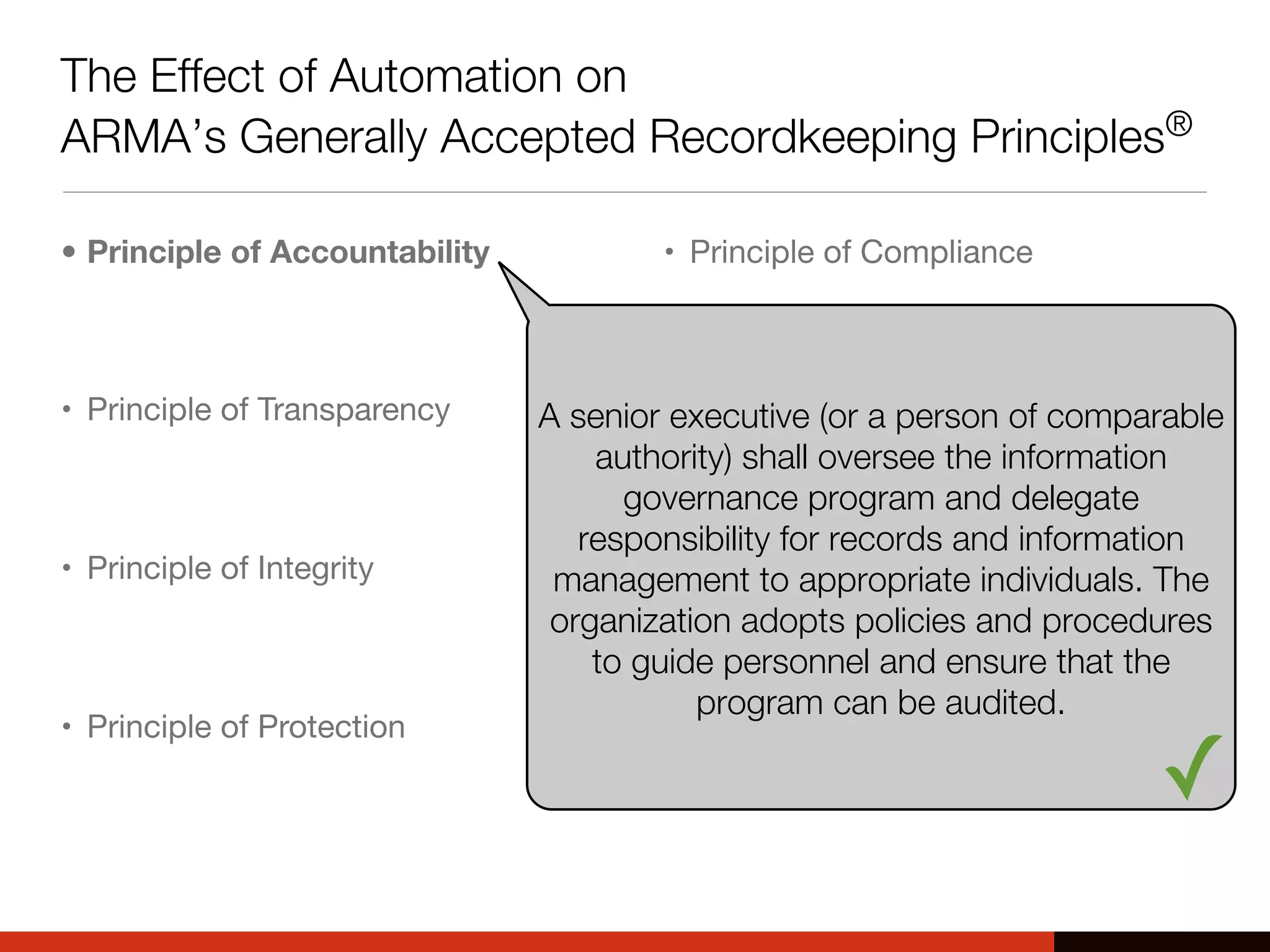
The Effect of Automation on
ARMA’s Generally Accepted Recordkeeping Principles®
• Principle of Accountability
• Principle of Transparency
• Principle of Integrity
• Principle of Protection
• Principle of Compliance
• Principle of Availability
• Principle of Retention
• Principle of Disposition
A senior executive (or a person of comparable
authority) shall oversee the information
governance program and delegate
responsibility for records and information
management to appropriate individuals. The
organization adopts policies and procedures
to guide personnel and ensure that the
program can be audited.
✓
The Effect of Automation on
ARMA’s Generally Accepted Recordkeeping Principles®
• Principle of Accountability
• Principle of Transparency
• Principle of Integrity
• Principle of Protection
• Principle of Compliance
• Principle of Availability
• Principle of Retention
• Principle of Disposition
A senior executive (or a person of comparable
authority) shall oversee the information
governance program and delegate
responsibility for records and information
management to appropriate individuals. The
organization adopts policies and procedures
to guide personnel and ensure that the
program can be audited.
✓
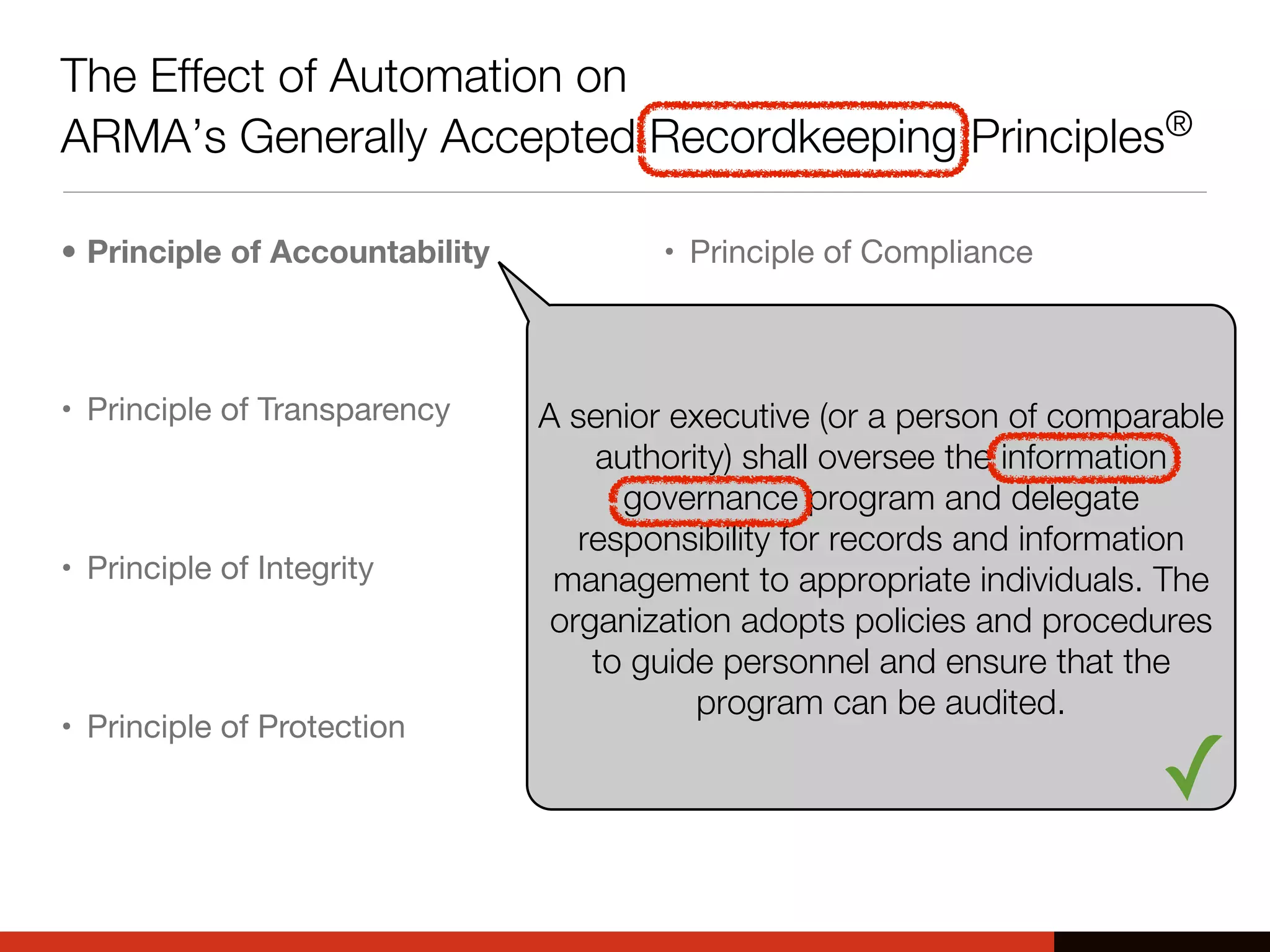
The Effect of Automation on
ARMA’s Generally Accepted Recordkeeping Principles
• Principle of Accountability
• Principle of Transparency
• Principle of Integrity
• Principle of Protection
• Principle of Compliance
• Principle of Availability
• Principle of Retention
• Principle of Disposition
A senior executive (or a person of comparable
authority) shall oversee the information
governance program and delegate
responsibility for records and information
management to appropriate individuals. The
organization adopts policies and procedures
to guide personnel and ensure that the
program can be audited.
✓
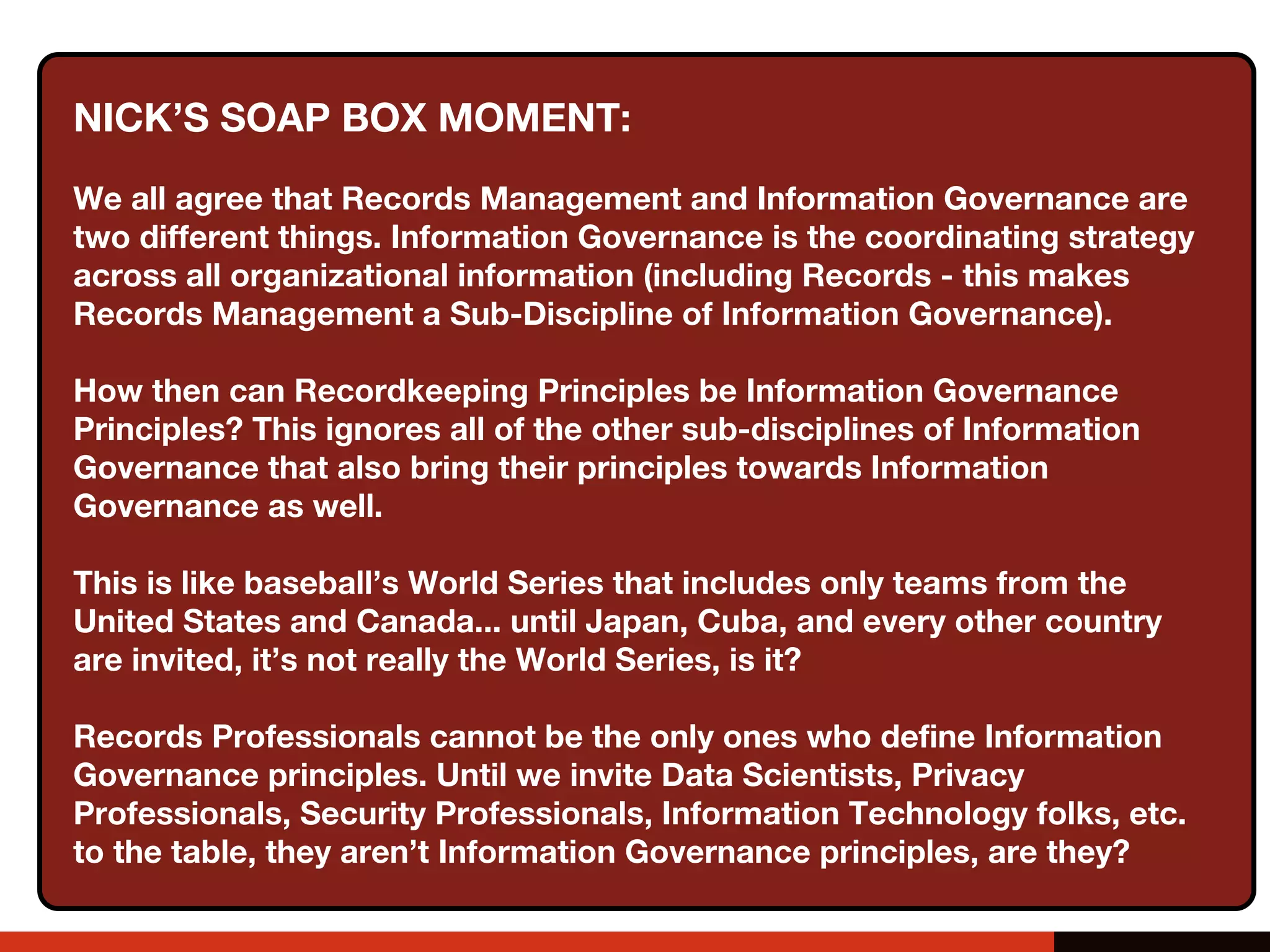
NICK’S SOAP BOX MOMENT:
We all agree that Records Management and Information Governance are
two different things. Information Governance is the coordinating strategy
across all organizational information (including Records - this makes
Records Management a Sub-Discipline of Information Governance).
How then can Recordkeeping Principles be Information Governance
Principles? This ignores all of the other sub-disciplines of Information
Governance that also bring their principles towards Information
Governance as well.
This is like baseball’s World Series that includes only teams from the
United States and Canada... until Japan, Cuba, and every other country
are invited, it’s not really the World Series, is it?
Records Professionals cannot be the only ones who define Information
Governance principles. Until we invite Data Scientists, Privacy
Professionals, Security Professionals, Information Technology folks, etc.
to the table, they aren’t Information Governance principles, are they?
The Effect of Automation on
ARMA’s Generally Accepted Recordkeeping Principles®
• Principle of Accountability
• Principle of Transparency
• Principle of Integrity
• Principle of Protection
• Principle of Compliance
• Principle of Availability
• Principle of Retention
• Principle of Disposition
A senior executive (or a person of comparable
authority) shall oversee the information
governance program and delegate
responsibility for records and information
management to appropriate individuals. The
organization adopts policies and procedures
to guide personnel and ensure that the
program can be audited.
✓
The Effect of Automation on
ARMA’s Generally Accepted Recordkeeping Principles®
• Principle of Accountability
• Principle of Transparency
• Principle of Integrity
• Principle of Protection
• Principle of Compliance
• Principle of Availability
• Principle of Retention
• Principle of Disposition
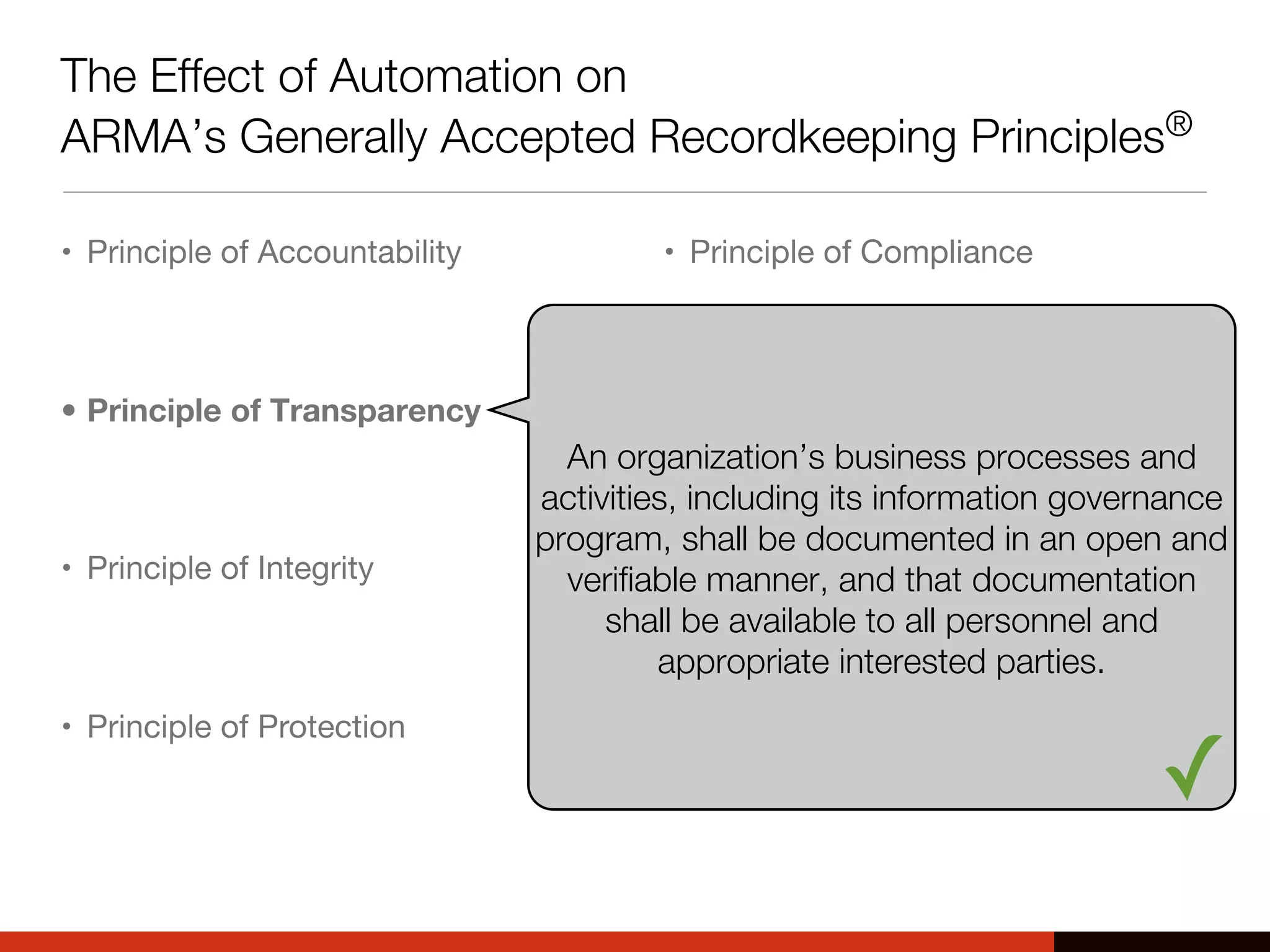
An organization’s business processes and
activities, including its information governance
program, shall be documented in an open and
verifiable manner, and that documentation
shall be available to all personnel and
appropriate interested parties.
✓
The Effect of Automation on
ARMA’s Generally Accepted Recordkeeping Principles®
• Principle of Accountability
• Principle of Transparency
• Principle of Integrity
• Principle of Protection
• Principle of Compliance
• Principle of Availability
• Principle of Retention
• Principle of Disposition
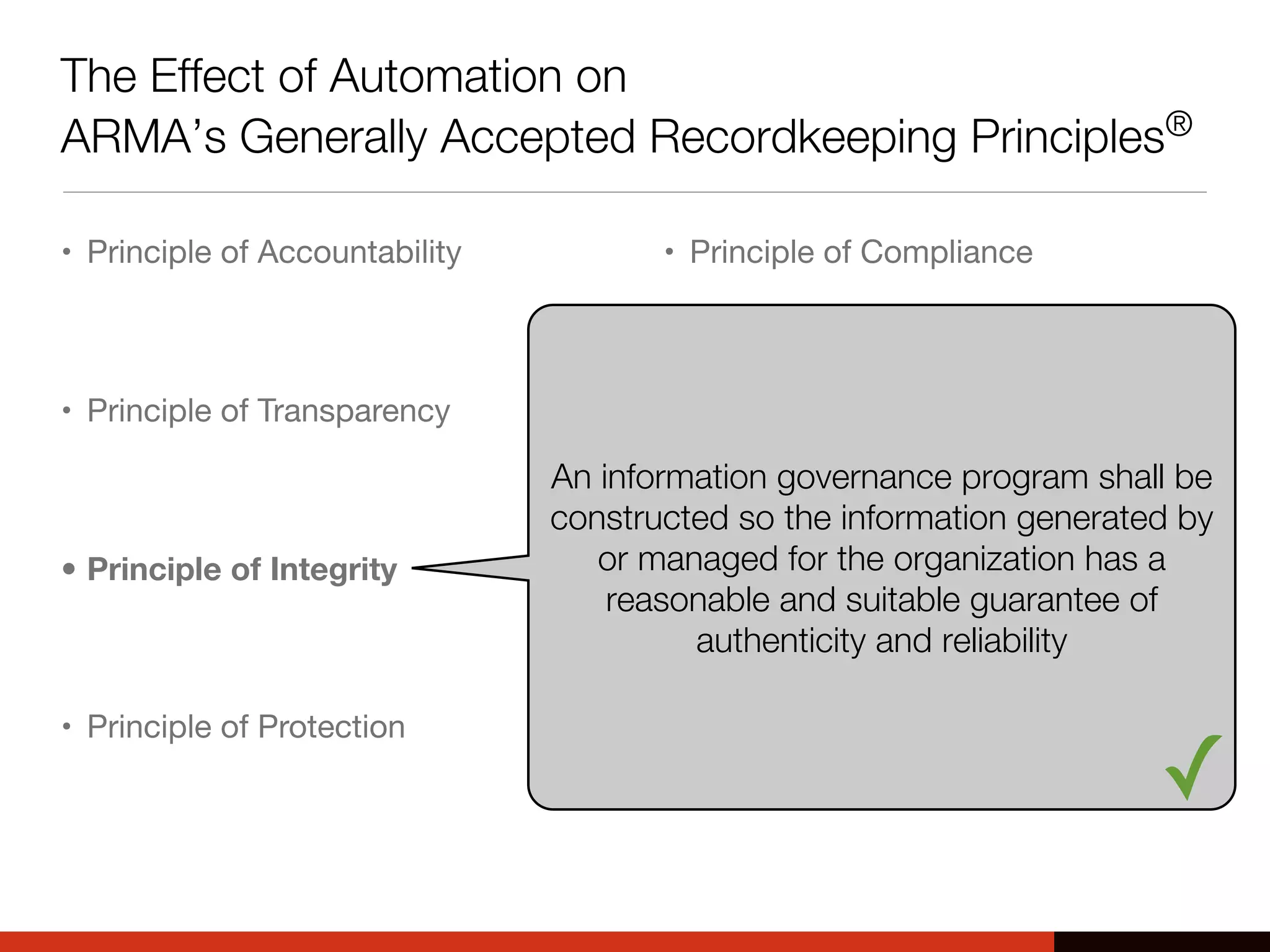
An information governance program shall be
constructed so the information generated by
or managed for the organization has a
reasonable and suitable guarantee of
authenticity and reliability
✓
The Effect of Automation on
ARMA’s Generally Accepted Recordkeeping Principles®
• Principle of Accountability
• Principle of Transparency
• Principle of Integrity
• Principle of Protection
• Principle of Compliance
• Principle of Availability
• Principle of Retention
• Principle of Disposition
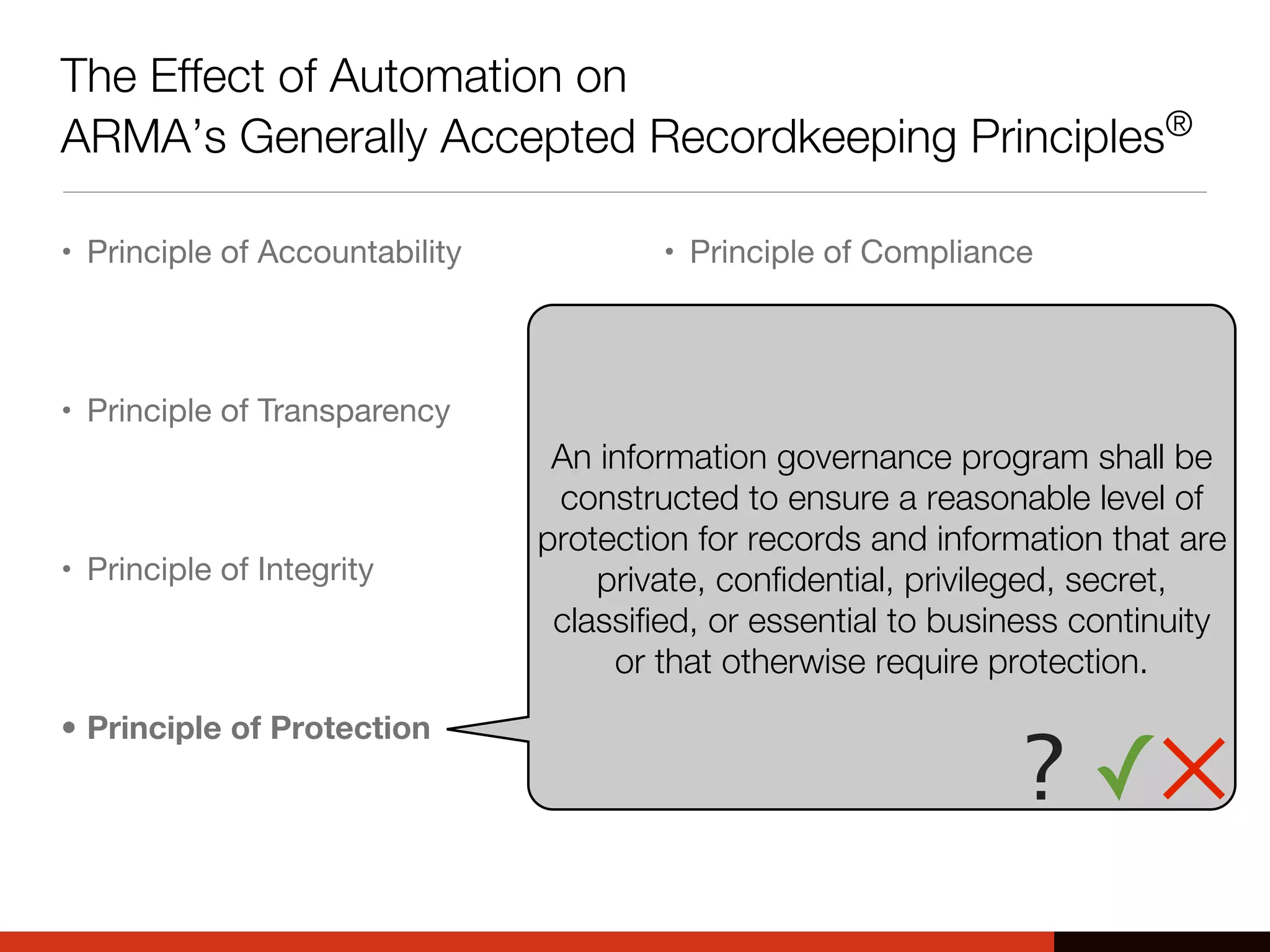
An information governance program shall be
constructed to ensure a reasonable level of
protection for records and information that are
private, confidential, privileged, secret,
classified, or essential to business continuity
or that otherwise require protection.
? ✓✕
The Effect of Automation on
ARMA’s Generally Accepted Recordkeeping Principles®
• Principle of Accountability
• Principle of Transparency
• Principle of Integrity
• Principle of Protection
• Principle of Compliance
• Principle of Availability
• Principle of Retention
• Principle of Disposition
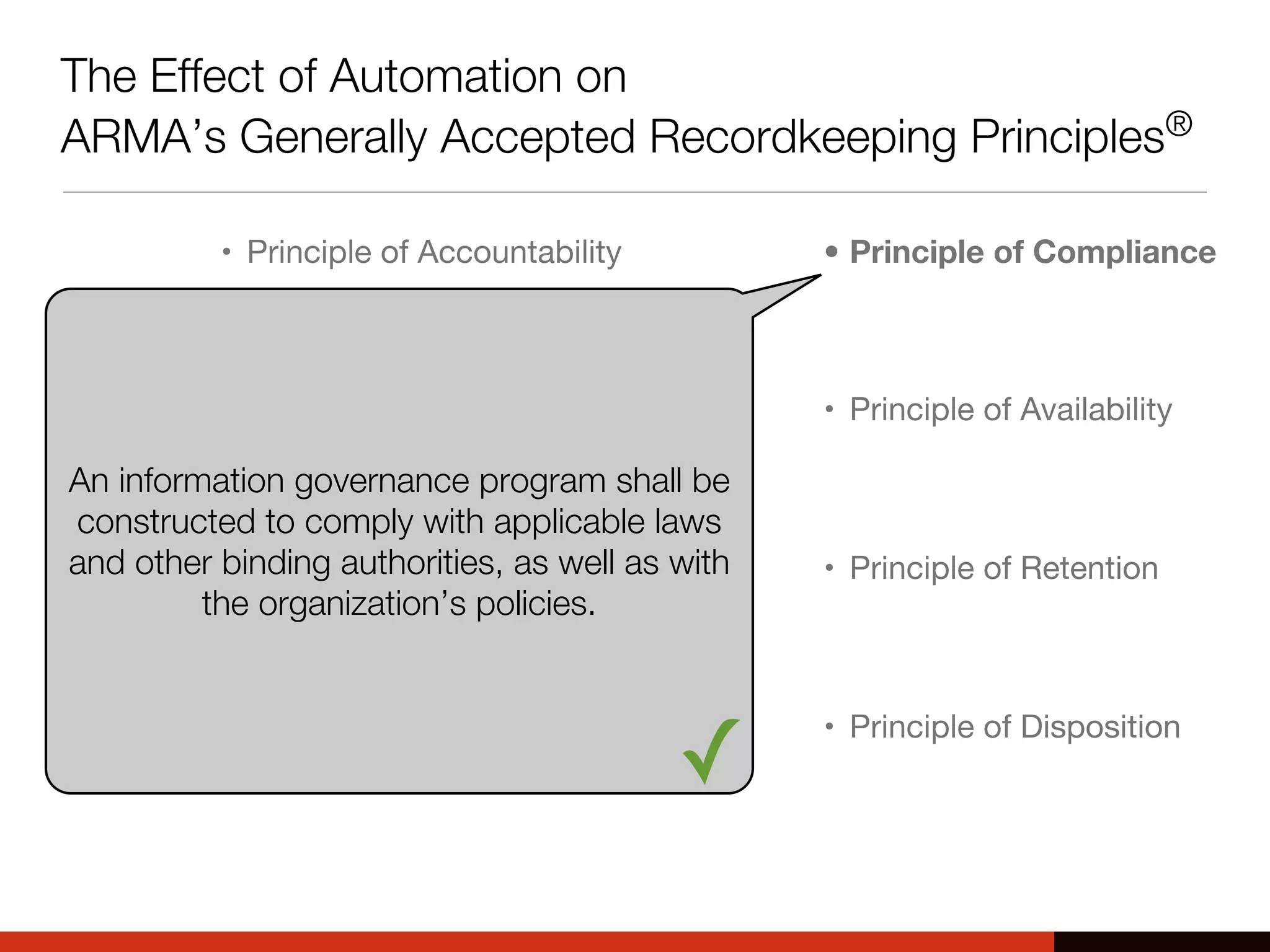
An information governance program shall be
constructed to comply with applicable laws
and other binding authorities, as well as with
the organization’s policies.
✓
The Effect of Automation on
ARMA’s Generally Accepted Recordkeeping Principles®
• Principle of Accountability
• Principle of Transparency
• Principle of Integrity
• Principle of Protection
• Principle of Compliance
• Principle of Availability
• Principle of Retention
• Principle of Disposition
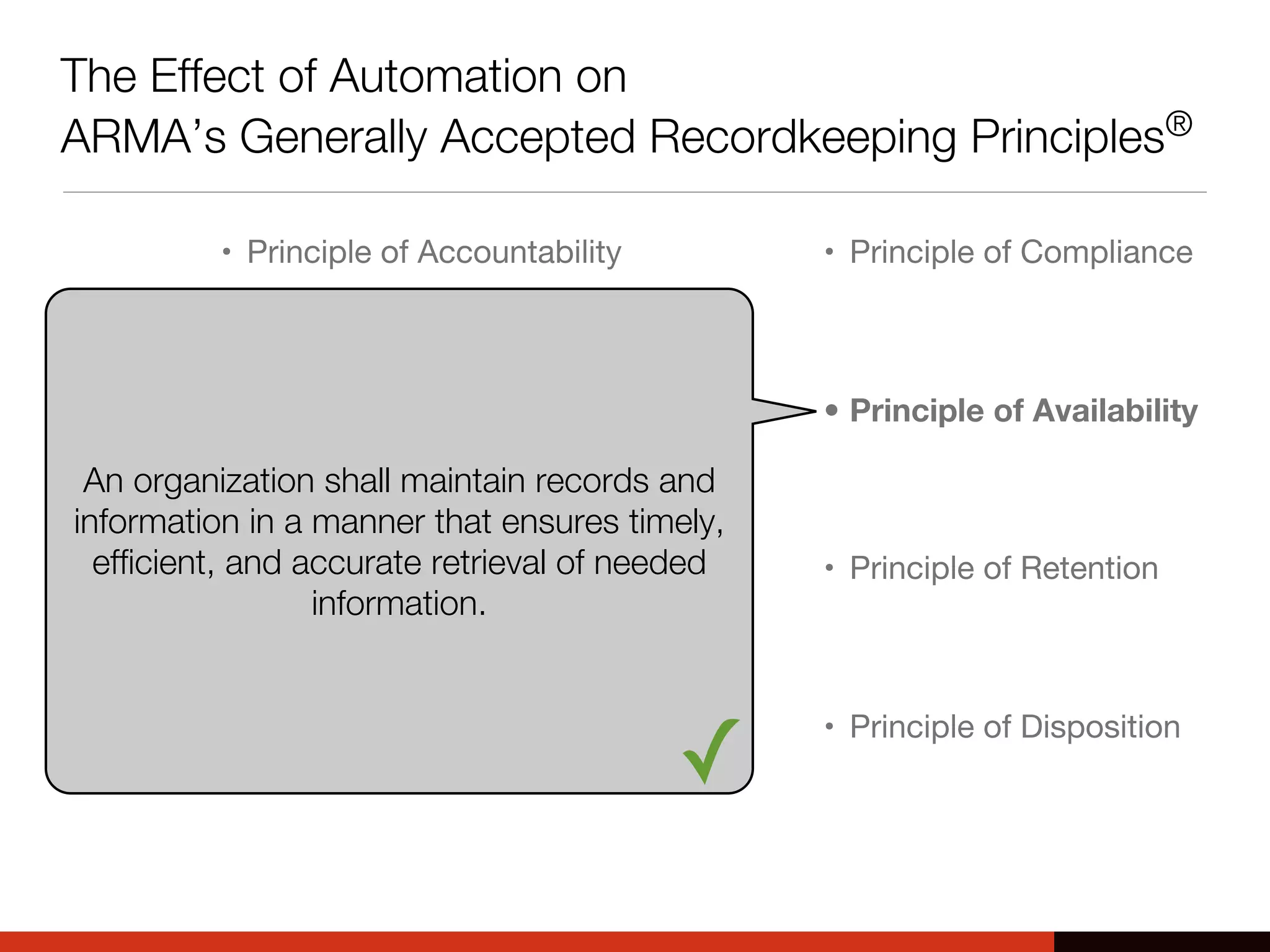
An organization shall maintain records and
information in a manner that ensures timely,
efficient, and accurate retrieval of needed
information.
✓
The Effect of Automation on
ARMA’s Generally Accepted Recordkeeping Principles®
• Principle of Accountability
• Principle of Transparency
• Principle of Integrity
• Principle of Protection
• Principle of Compliance
• Principle of Availability
• Principle of Retention
• Principle of Disposition
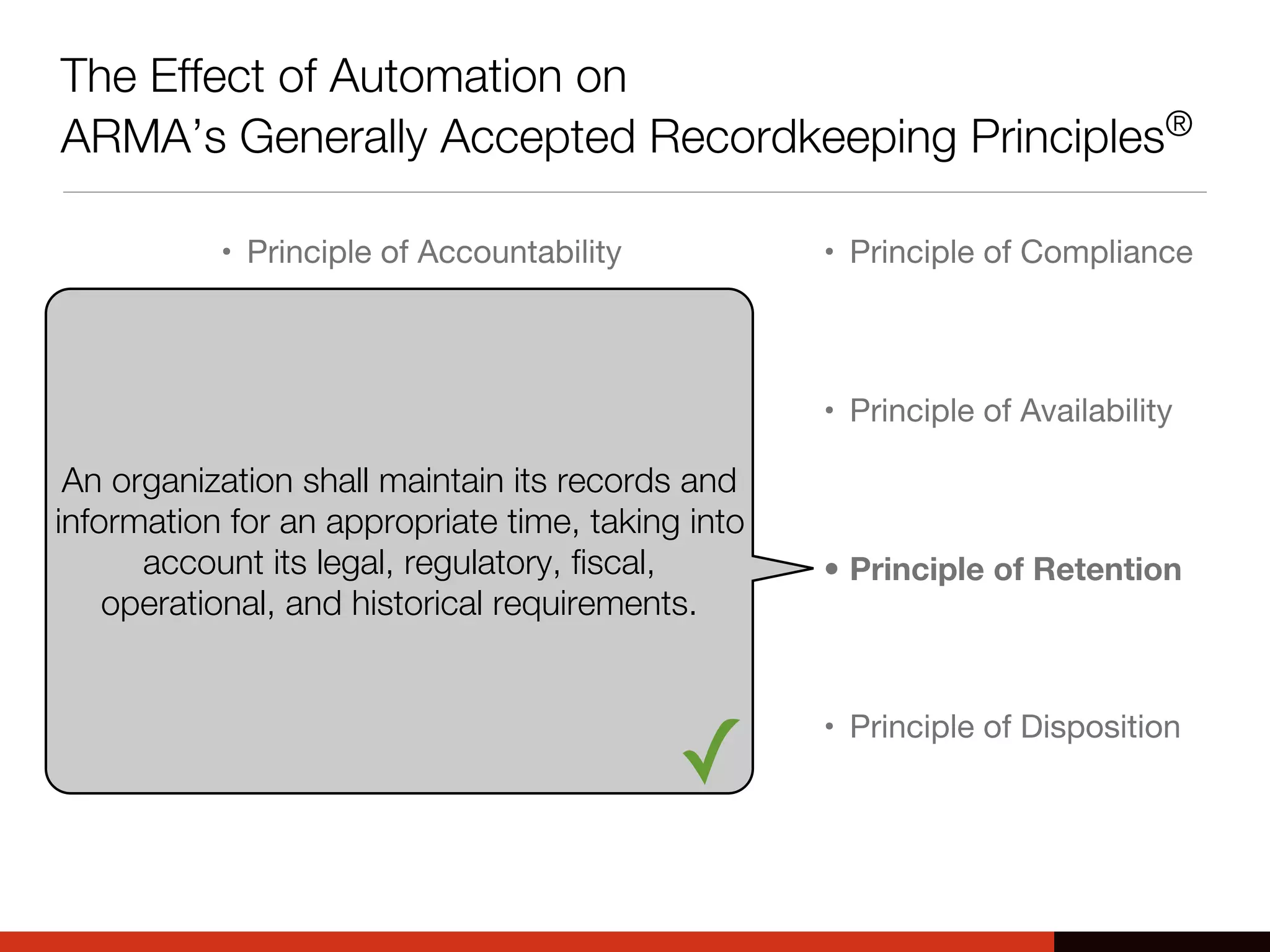
An organization shall maintain its records and
information for an appropriate time, taking into
account its legal, regulatory, fiscal,
operational, and historical requirements.
✓
The Effect of Automation on
ARMA’s Generally Accepted Recordkeeping Principles®
• Principle of Accountability
• Principle of Transparency
• Principle of Integrity
• Principle of Protection
• Principle of Compliance
• Principle of Availability
• Principle of Retention
• Principle of Disposition
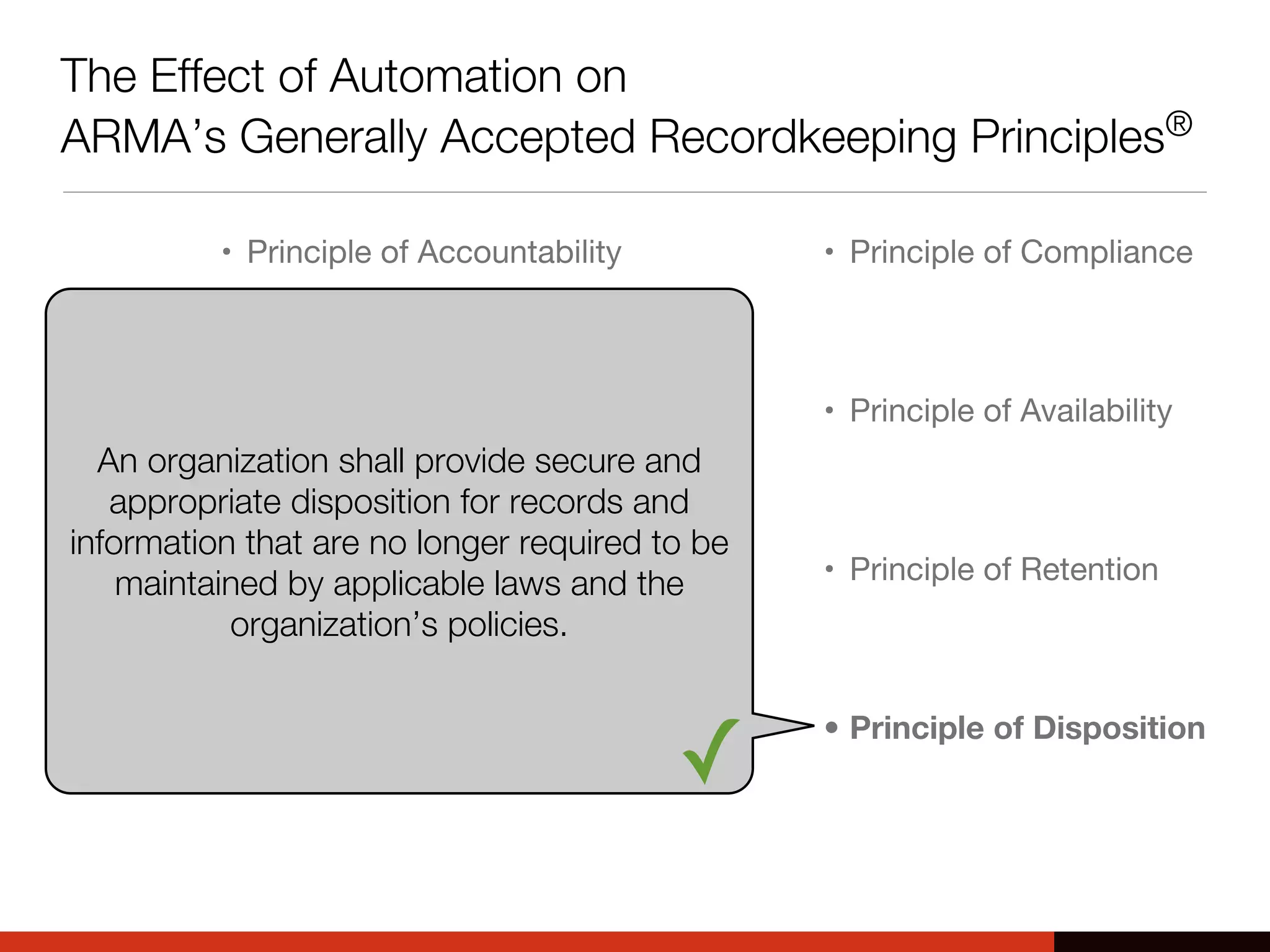
An organization shall provide secure and
appropriate disposition for records and
information that are no longer required to be
maintained by applicable laws and the
organization’s policies.
✓
Automation (Mostly) Helps Us Ensure The
Principles® Are Followed In Our Organizations
In Conclusion...
How Do We Take Our
RIM Program To The Next Level?
It’s As Simple As Fixing The Hubble Telescope
Try Not To Take 10 Years & Spend $4.7B
Getting Your RIM
Program to the
Next Level

Getting your Records Management program to the next level

  • 1.
    Getting Your RIM Programto the Next Level
  • 2.
    Nick Inglis Nick Inglisis President of the Information Coalition and Co-Founder of The Information Governance Conference. Inglis is the author of the AIIM SharePoint Governance Toolkit and creator of the Information Governance Model. Inglis is a contributor to U.S. News & World Report, Yahoo! Finance, and others. Previously, Mr. Inglis served as the Director of Professional Development at AIIM and was one of the youngest Assistant Vice Presidents in Bank of America's history. Inglis is the Co-Creator of the ARMA Information Governance Professional (IGP) educational course. When not adding to his collection of certificates and certifications (CIP, IGP, ERMm, SharePointm, BPMm, E2.0m, ECMm, IMCP), he is likely spending time with his son, Conor Atom. Email: nick@nickinglis.com Twitter: @nickinglis
  • 3.
    Getting Your RIMProgram to the Next Level
  • 4.
    The Hubble Telescope HowDownstream Information Affects Program Outcomes
  • 5.
    One Mirror 2,200 Nanometers- 1/50th width of a piece of paper - Worlds of Difference
  • 6.
    Mirror Grinding (Null Correcting) ANew Null Corrector, Incorrectly Assembled
  • 7.
    What went wrong? •NASAgot the wrong data. •Perkin-Elmer had the mirror grinding tool (“null corrector”) incorrectly assembled. •They tested twice but disregarded the results because the new null corrector was assumed to be more precise than the testing equipment.
  • 10.
  • 12.
    Contractors & PartnersFor The Hubble Telescope GSFC Corning Rockwell Autonetics Westinghouse Perkin-Elmer Hughes Aircraft RCA ESA University of California- San Diego Martin Marrietta Corporation University of Wisonsin - Madison Johns Hopkins University Garchin bei München NASA
  • 13.
    Contractors & PartnersFor The Hubble Telescope GSFC Corning Rockwell Autonetics Westinghouse Perkin-Elmer Hughes Aircraft RCA ESA University of California- San Diego Martin Marrietta Corporation University of Wisonsin - Madison Johns Hopkins University Garchin bei München NASA
  • 14.
    Contractors & PartnersFor The Hubble Telescope GSFC Corning Rockwell Autonetics Westinghouse Perkin-Elmer Hughes Aircraft RCA ESA University of California- San Diego Martin Marrietta Corporation University of Wisonsin - Madison Johns Hopkins University Garchin bei München NASA
  • 15.
    A Costly Mistake •OriginalCost Estimate: $400M Original Launch date 1983 •Discovery Disaster & Contractor Delays postpone the launch for 7 years •Actual Cost: $1.5B Launched in 1990 - Mirror Mistake Noted •Actual Cost When Corrected: $4.7B - Fixed in 1993
  • 16.
    A Happy Ending HubbleStill In Use Today - Delivering Images & Insights Into The Creation of the Universe
  • 17.
    The Hubble Telescopehas provided invaluable contributions to science.
  • 18.
  • 19.
  • 20.
  • 21.
  • 22.
  • 23.
    The Next Levelof RIM Is To Improve & Influence The Downstream Decisions That Have An Incredible Impact On Records
  • 24.
  • 25.
    The Next Levelof RIM Is To Improve & Influence The Downstream Decisions That Have An Incredible Impact On Records
  • 26.
    Information Strategy 2017Research & 7Ways To Look Downstream To Take RIM To The Next Level
  • 27.
    Finding: Information As An Asset? NotSo Much. Nearly one-half of respondents say that their organizations do not treat information as an asset. InformationIsNotTreatedAsAnAssetInformationIsTreatedAsAnAsset From The Information Coalition “Information Strategy 2017” Research
  • 28.
    Taking RIM ToThe Next Level 1: Treat Information As An Asset •Build a plan for getting executives to take note of the value of information •Follow an information flow backwards from a successful outcome to the underlying information that enabled the outcome •Leverage change management principles for employee change •Develop a plan •Provide clear guidance Additional Resources: http://www.information-age.com/how-to-really-treat-information-as-an-asset-123457338/ https://www.ft.com/content/0919f8b2-6105-11e3-b7f1-00144feabdc0
  • 29.
    Finding: The Culture of Compliance StillGrows. Over half of respondents said their organizations have or are developing a culture of compliance. Over 1/3 say that they have a strong compliance culture in their organization. WeakStrongModerate From The Information Coalition “Information Strategy 2017” Research
  • 30.
    Finding: Compliance Is Being Highly Prioritized. Compliancewas ranked as one of the top 3 priorities in over 2/3 of organizations. It should come as no surprise that gains would be seen in such a highly prioritized area such as this. LowPriorityTopPriorityModeratePriority From The Information Coalition “Information Strategy 2017” Research
  • 31.
    Taking RIM ToThe Next Level 2: Build Upon Compliance Initiatives •Improvements to Records can be built on top of Compliance initiatives •Leverage the focus on compliance and discuss relevant RIM regulations and potential fines for non-compliance •Start with an audit of RIM compliance, see resources Additional Resources: https://members.arma.org/eweb/browse.aspx?site=armastore&webcode=product&id=0fd0a96e-6044-4b5a- a057-76bc919135de#.WPJaKVPyuHo https://www.complianceresource.com/publications/records-management-compliance-checklist-developing-solid-compliance- records-management-program/ https://www.complianceweek.com/blogs/dan-swanson/auditing-records-management
  • 32.
    Finding: Still Not Information Empowered. Employee empowermentrelated to information is at the bottom of priorities for organizations. Employees, looking for empowerment and capabilities, continue to turn to unauthorized apps to ‘get work done’. LowPriorityTopPriorityModeratePriority From The Information Coalition “Information Strategy 2017” Research
  • 33.
    Taking RIM ToThe Next Level 3: You Can’t Manage What You Never Had •Your organization may be missing Records that individual employees are managing outside of official corporate systems •Terrible systems, terrible compliance •Information systems need to focus on usability •Improve ability to accept information from a variety of sources (think mobile)
  • 34.
    Finding: Metrics & Measurement Lacking. Over halfof respondents rate their organization’s information- related metrics as severely lacking. Without adequate measurement, technology investments may be mismatched with organizational needs. WeakStrongModerate From The Information Coalition “Information Strategy 2017” Research
  • 35.
    Taking RIM ToThe Next Level 4: We Don’t Know What We Don’t Measure •Metrics provide justification of our efforts •Metrics help us understand our effectiveness •At a time when we continue to have to justify our programs, metrics provide that rationale •We must embrace metrics as a core part of our RIM programs Additional Resources: https://www.archives.gov/records-mgmt/resources/self-assessment.html http://recordsmanagement.tab.com/records_management_software/how-to-choose-the-right-metrics-for-your-records- management-program/ http://hollygroup.com/hgsite/broad-view-and-metrics-must-for-records/
  • 36.
    Finding: Ineffective Information Architectures. Nearly 2/3 believetheir organizations' information architecture isn't effective. Often overlooked, Information Architecture, well executed, can help improve many high priority issues such as information security and compliance. IneffectiveEffectiveModeratelyEffective From The Information Coalition “Information Strategy 2017” Research
  • 37.
    Finding: “I Can’t Find My Information” Mostorganizations are still struggling with making information findable for employees. Issues with findability stem from a combination of poorly executed information architectures and incredibly high user expectations because of the effectiveness of consumer/web search technologies like Google. LowFindabilityHighModerateFindability From The Information Coalition “Information Strategy 2017” Research
  • 38.
    Taking RIM ToThe Next Level 5: Share Your Information Structure Expertise •Employees struggle with information findability •Records Management expertise in structuring Records could be leveraged across many disciplines that lead towards Records Management (e.g. ECM, WCM, Document Management, etc.) •Providing expertise outside of RIM ensures consistency for employees Additional Resources: https://www.usability.gov/what-and-why/information-architecture.html https://www.udemy.com/developing-an-information-architecture-with-card-sorting/ http://www.emeraldinsight.com/doi/abs/10.1108/00012531011074636
  • 39.
    Finding: “That’s Not In MyJob Description” Information related roles aren't defined well. Only 1 in 4 of our respondents say that their job title matches their duties. With an abundance of legacy job titles and major leaps forward in technology, our information roles no longer align with our titles. Most organizations need a reassessment of their information- related job titles. JobTitleMismatchJobTitleMatches From The Information Coalition “Information Strategy 2017” Research
  • 40.
    Taking RIM ToThe Next Level 6: Clean Up Job Titles & Job Descriptions •Technology’s breakneck pace has left us reeling •Individuals titles don’t line up with their new roles •Re-evaluation and re-centering will help employee morale as they better understand their place within the information ecosystem of the organization •(New work being done now to help with this)
  • 41.
    Finding: Not So Connected Systems? Systems' interconnectivitycontinues to lag behind user’s expectations. Despite advances in APIs, Web Services, EAI, etc., interconnectivity continues to lag behind user expectations. Moving basic information from one system to another remains an ongoing challenge for the majority of respondents. WeakStrongModerate From The Information Coalition “Information Strategy 2017” Research
  • 42.
    Finding: Systems Performance Lagging Systems’ performance continuesto lag behind user expectations. Most rate their systems performance as “not meeting” or “barely meeting” expectations. Ongoing cloud migrations and legacy ECM systems retirements should mitigate these findings over time. NotMeetingExceedingBarelyMeetingMeeting From The Information Coalition “Information Strategy 2017” Research
  • 43.
    Taking RIM ToThe Next Level 7: Correct & Connect Your Systems •Information accessibility remains an issue •Disconnected systems make it challenging for users to move information from one system to another •Principle of Availability - regularly violated •If we’re moving information to a Records system that is no longer available to employees or some employees, are we violating the Principles? •Organizational information systems greatly lagging behind consumer capabilities
  • 44.
    The Impact ofAutomation
  • 45.
    Required Reading (GoRead These After The Seminar): Automated Electronic Records Management Report/Plan: https://www.archives.gov/records-mgmt/prmd/automated- erm.html James Lappin (ThinkingRecords.co.uk): https:// thinkingrecords.co.uk/2014/09/12/evaluating-automated- approaches-against-records-management-principles/
  • 46.
    James Lappin isbrilliant ...go read his blog at http://thinkingrecords.co.uk
  • 47.
    James Lappin isbrilliant ...go read his blog at http://thinkingrecords.co.uk
  • 48.
    The Methods The File RoomMethod Look at all information Identify what needs to be retained The Delegate Method Everyone looks at their information Identify what needs to be retained The Keep It All Method Don’t identify what needs to be retained Keep everything, indefinitely Records Categorization Method Leverage classification for records identification Automatically identify what is a Record Advanced Computing Methods Software looks at all information Software identifies what is a record or what needs to be retained Not feasible Not working Too much risk Maybe Maybe Information Categorization Method Leverage classification for retention identification Automatically identify what needs to be retained Maybe The File Room Method The Delegate Method The Keep It All Method
  • 49.
    The Methods The File RoomMethod Look at all information Identify what needs to be retained The Delegate Method Everyone looks at their information Identify what needs to be retained The Keep It All Method Don’t identify what needs to be retained Keep everything, indefinitely Records Categorization Method Leverage classification for records identification Automatically identify what is a Record Advanced Computing Methods Software looks at all information Software identifies what is a record or what needs to be retained Not feasible Not working Too much risk Maybe Maybe Information Categorization Method Leverage classification for retention identification Automatically identify what needs to be retained Maybe The File Room Method The Delegate Method The Keep It All Method
  • 50.
    The future isalready here. Auto-classification
  • 51.
    The future isalready here. It requires solid information architecture. Auto-classification
  • 52.
    The future isalready here. It requires solid information architecture. It requires WORK. Auto-classification
  • 53.
    The future isalready here. It requires solid information architecture. It requires WORK. It requires a comprehensive understanding of your organization’s information. Auto-classification
  • 54.
    The future isalready here. It requires solid information architecture. It requires WORK. It requires a comprehensive understanding of your organization’s information. It requires knowledge of how to classify that information with no room for non- categorized information. Auto-classification
  • 55.
    How does auto-classification technologywork? 2 ways: Basic or Advanced
  • 56.
    Advanced Technology that analyzes contentand automatically categorizes it based on rules that (generally) your organization must establish. The Future Is Here: Content Analytics, Big Data, Natural Language Processing, etc.
  • 57.
    Basic Leveraging workflow rules toautomatically categorize content based on rules that your organization must establish.
  • 58.
    Save Money, StartWith Basic All Information Group A Sub-group A1 Sub-group A2 Group B Sub-group B1 Sub-group B2 Group C Sub-group C1
  • 59.
    Save Money, StartWith Basic All Information Group A Sub-group A1 Sub-group A2 Group B Sub-group B1 Sub-group B2 Group C Sub-group C1 - Figure out what’s different. - Leverage metadata and information location
  • 60.
    Save Money, StartWith Basic All Information Group A Sub-group A1 Sub-group A2 Group B Sub-group B1 Sub-group B2 Group C Sub-group C1 - Figure out what’s different. - Leverage metadata and information location
  • 61.
    Flashback to 2016ARMA Denver...
  • 62.
    Flashback to 2016ARMA Denver...
  • 63.
    Flashback to 2016ARMA Denver...
  • 64.
    Flashback to 2016ARMA Denver...
  • 65.
    Flashback to 2016ARMA Denver...
  • 66.
    Flashback to 2016ARMA Denver...
  • 67.
    How Will AutomationEffect Our Ability To Follow The Principles® In Our Organizations?
  • 68.
    ARMA’s Generally AcceptedRecordkeeping Principles® • Principle of Accountability • Principle of Transparency • Principle of Integrity • Principle of Protection • Principle of Compliance • Principle of Availability • Principle of Retention • Principle of Disposition
  • 69.
    The Effect ofAutomation on ARMA’s Generally Accepted Recordkeeping Principles®? • Principle of Accountability • Principle of Transparency • Principle of Integrity • Principle of Protection • Principle of Compliance • Principle of Availability • Principle of Retention • Principle of Disposition
  • 70.
    The Effect ofAutomation on ARMA’s Generally Accepted Recordkeeping Principles® • Principle of Accountability • Principle of Transparency • Principle of Integrity • Principle of Protection • Principle of Compliance • Principle of Availability • Principle of Retention • Principle of Disposition A senior executive (or a person of comparable authority) shall oversee the information governance program and delegate responsibility for records and information management to appropriate individuals. The organization adopts policies and procedures to guide personnel and ensure that the program can be audited. ✓
  • 71.
    The Effect ofAutomation on ARMA’s Generally Accepted Recordkeeping Principles® • Principle of Accountability • Principle of Transparency • Principle of Integrity • Principle of Protection • Principle of Compliance • Principle of Availability • Principle of Retention • Principle of Disposition A senior executive (or a person of comparable authority) shall oversee the information governance program and delegate responsibility for records and information management to appropriate individuals. The organization adopts policies and procedures to guide personnel and ensure that the program can be audited. ✓
  • 72.
    The Effect ofAutomation on ARMA’s Generally Accepted Recordkeeping Principles • Principle of Accountability • Principle of Transparency • Principle of Integrity • Principle of Protection • Principle of Compliance • Principle of Availability • Principle of Retention • Principle of Disposition A senior executive (or a person of comparable authority) shall oversee the information governance program and delegate responsibility for records and information management to appropriate individuals. The organization adopts policies and procedures to guide personnel and ensure that the program can be audited. ✓ NICK’S SOAP BOX MOMENT: We all agree that Records Management and Information Governance are two different things. Information Governance is the coordinating strategy across all organizational information (including Records - this makes Records Management a Sub-Discipline of Information Governance). How then can Recordkeeping Principles be Information Governance Principles? This ignores all of the other sub-disciplines of Information Governance that also bring their principles towards Information Governance as well. This is like baseball’s World Series that includes only teams from the United States and Canada... until Japan, Cuba, and every other country are invited, it’s not really the World Series, is it? Records Professionals cannot be the only ones who define Information Governance principles. Until we invite Data Scientists, Privacy Professionals, Security Professionals, Information Technology folks, etc. to the table, they aren’t Information Governance principles, are they?
  • 73.
    The Effect ofAutomation on ARMA’s Generally Accepted Recordkeeping Principles® • Principle of Accountability • Principle of Transparency • Principle of Integrity • Principle of Protection • Principle of Compliance • Principle of Availability • Principle of Retention • Principle of Disposition A senior executive (or a person of comparable authority) shall oversee the information governance program and delegate responsibility for records and information management to appropriate individuals. The organization adopts policies and procedures to guide personnel and ensure that the program can be audited. ✓
  • 74.
    The Effect ofAutomation on ARMA’s Generally Accepted Recordkeeping Principles® • Principle of Accountability • Principle of Transparency • Principle of Integrity • Principle of Protection • Principle of Compliance • Principle of Availability • Principle of Retention • Principle of Disposition An organization’s business processes and activities, including its information governance program, shall be documented in an open and verifiable manner, and that documentation shall be available to all personnel and appropriate interested parties. ✓
  • 75.
    The Effect ofAutomation on ARMA’s Generally Accepted Recordkeeping Principles® • Principle of Accountability • Principle of Transparency • Principle of Integrity • Principle of Protection • Principle of Compliance • Principle of Availability • Principle of Retention • Principle of Disposition An information governance program shall be constructed so the information generated by or managed for the organization has a reasonable and suitable guarantee of authenticity and reliability ✓
  • 76.
    The Effect ofAutomation on ARMA’s Generally Accepted Recordkeeping Principles® • Principle of Accountability • Principle of Transparency • Principle of Integrity • Principle of Protection • Principle of Compliance • Principle of Availability • Principle of Retention • Principle of Disposition An information governance program shall be constructed to ensure a reasonable level of protection for records and information that are private, confidential, privileged, secret, classified, or essential to business continuity or that otherwise require protection. ? ✓✕
  • 77.
    The Effect ofAutomation on ARMA’s Generally Accepted Recordkeeping Principles® • Principle of Accountability • Principle of Transparency • Principle of Integrity • Principle of Protection • Principle of Compliance • Principle of Availability • Principle of Retention • Principle of Disposition An information governance program shall be constructed to comply with applicable laws and other binding authorities, as well as with the organization’s policies. ✓
  • 78.
    The Effect ofAutomation on ARMA’s Generally Accepted Recordkeeping Principles® • Principle of Accountability • Principle of Transparency • Principle of Integrity • Principle of Protection • Principle of Compliance • Principle of Availability • Principle of Retention • Principle of Disposition An organization shall maintain records and information in a manner that ensures timely, efficient, and accurate retrieval of needed information. ✓
  • 79.
    The Effect ofAutomation on ARMA’s Generally Accepted Recordkeeping Principles® • Principle of Accountability • Principle of Transparency • Principle of Integrity • Principle of Protection • Principle of Compliance • Principle of Availability • Principle of Retention • Principle of Disposition An organization shall maintain its records and information for an appropriate time, taking into account its legal, regulatory, fiscal, operational, and historical requirements. ✓
  • 80.
    The Effect ofAutomation on ARMA’s Generally Accepted Recordkeeping Principles® • Principle of Accountability • Principle of Transparency • Principle of Integrity • Principle of Protection • Principle of Compliance • Principle of Availability • Principle of Retention • Principle of Disposition An organization shall provide secure and appropriate disposition for records and information that are no longer required to be maintained by applicable laws and the organization’s policies. ✓
  • 81.
    Automation (Mostly) HelpsUs Ensure The Principles® Are Followed In Our Organizations
  • 82.
  • 83.
    How Do WeTake Our RIM Program To The Next Level?
  • 84.
    It’s As SimpleAs Fixing The Hubble Telescope
  • 85.
    Try Not ToTake 10 Years & Spend $4.7B
  • 86.
    Getting Your RIM Programto the Next Level