Gerunds and
Infinitives
GERUNDS and INFINITIVES
GERUND
Verbal form ending in -ing:
A) Direct Object.
I enjoy swimming.
We discussed holding the wedding at home.
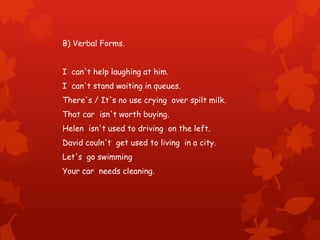
B) Verbal Forms.
I can't help laughing at him.
I can't stand waiting in queues.
There's / It's no use crying over spilt milk.
That car isn't worth buying.
Helen isn't used to driving on the left.
David couln't get used to living in a city.
Let's go swimming
Your car needs cleaning.
Prep. + GERUNDIO
I look forward to seeing you again.
The apoligized for not paying the bill.
Lucy doesn´t like his way of thinking.
Subject:
Breaking up a relationship is never easy.
Smoking is not allowed.
VERBS + GERUNDS O INFINITIVES whithout change of meaning.
ADVISE, ALLOW, BEGIN, CEASE, CONTINUE, HATE, INTEND, LIKE,
LOVE, PERMIT, PREFER, RECOMMEND, START.
VERBS + GERUNDS or INFINITIVES whit change of meaning.
STOP, REGRET, REMEMBER, FORGET.
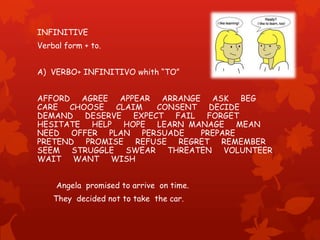
INFINITIVE
Verbal form + to.
A) VERBO+ INFINITIVO whith “TO”
AFFORD AGREE APPEAR ARRANGE ASK BEG
CARE CHOOSE CLAIM CONSENT DECIDE
DEMAND DESERVE EXPECT FAIL FORGET
HESITATE HELP HOPE LEARN MANAGE MEAN
NEED OFFER PLAN PERSUADE PREPARE
PRETEND PROMISE REFUSE REGRET REMEMBER
SEEM STRUGGLE SWEAR THREATEN VOLUNTEER
WAIT WANT WISH
Angela promised to arrive on time.
They decided not to take the car.
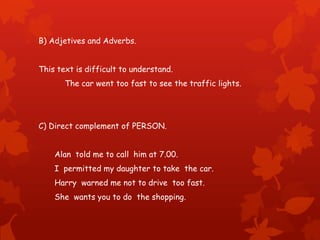
B) Adjetives and Adverbs.
This text is difficult to understand.
The car went too fast to see the traffic lights.
C) Direct complement of PERSON.
Alan told me to call him at 7.00.
I permitted my daughter to take the car.
Harry warned me not to drive too fast.
She wants you to do the shopping.
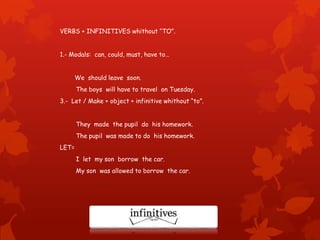
VERBS + INFINITIVES whithout “TO”.
1.- Modals: can, could, must, have to…
We should leave soon.
The boys will have to travel on Tuesday.
3.- Let / Make + object + infinitive whithout “to”.
They made the pupil do his homework.
The pupil was made to do his homework.
LET=
I let my son borrow the car.
My son was allowed to borrow the car.

Gerunds and infinitives

  • 1.
  • 2.
    GERUNDS and INFINITIVES GERUND Verbalform ending in -ing: A) Direct Object. I enjoy swimming. We discussed holding the wedding at home.
  • 3.
    B) Verbal Forms. Ican't help laughing at him. I can't stand waiting in queues. There's / It's no use crying over spilt milk. That car isn't worth buying. Helen isn't used to driving on the left. David couln't get used to living in a city. Let's go swimming Your car needs cleaning.
  • 4.
    Prep. + GERUNDIO Ilook forward to seeing you again. The apoligized for not paying the bill. Lucy doesn´t like his way of thinking. Subject: Breaking up a relationship is never easy. Smoking is not allowed.
  • 5.
    VERBS + GERUNDSO INFINITIVES whithout change of meaning. ADVISE, ALLOW, BEGIN, CEASE, CONTINUE, HATE, INTEND, LIKE, LOVE, PERMIT, PREFER, RECOMMEND, START. VERBS + GERUNDS or INFINITIVES whit change of meaning. STOP, REGRET, REMEMBER, FORGET.
  • 6.
    INFINITIVE Verbal form +to. A) VERBO+ INFINITIVO whith “TO” AFFORD AGREE APPEAR ARRANGE ASK BEG CARE CHOOSE CLAIM CONSENT DECIDE DEMAND DESERVE EXPECT FAIL FORGET HESITATE HELP HOPE LEARN MANAGE MEAN NEED OFFER PLAN PERSUADE PREPARE PRETEND PROMISE REFUSE REGRET REMEMBER SEEM STRUGGLE SWEAR THREATEN VOLUNTEER WAIT WANT WISH Angela promised to arrive on time. They decided not to take the car.
  • 7.
    B) Adjetives andAdverbs. This text is difficult to understand. The car went too fast to see the traffic lights. C) Direct complement of PERSON. Alan told me to call him at 7.00. I permitted my daughter to take the car. Harry warned me not to drive too fast. She wants you to do the shopping.
  • 8.
    VERBS + INFINITIVESwhithout “TO”. 1.- Modals: can, could, must, have to… We should leave soon. The boys will have to travel on Tuesday. 3.- Let / Make + object + infinitive whithout “to”. They made the pupil do his homework. The pupil was made to do his homework. LET= I let my son borrow the car. My son was allowed to borrow the car.