GEOTECHNICAL ENGINEERING FORMULAS
A handy reference for use in geotechnical analysis and design
TABLE OF CONTENTS
Page
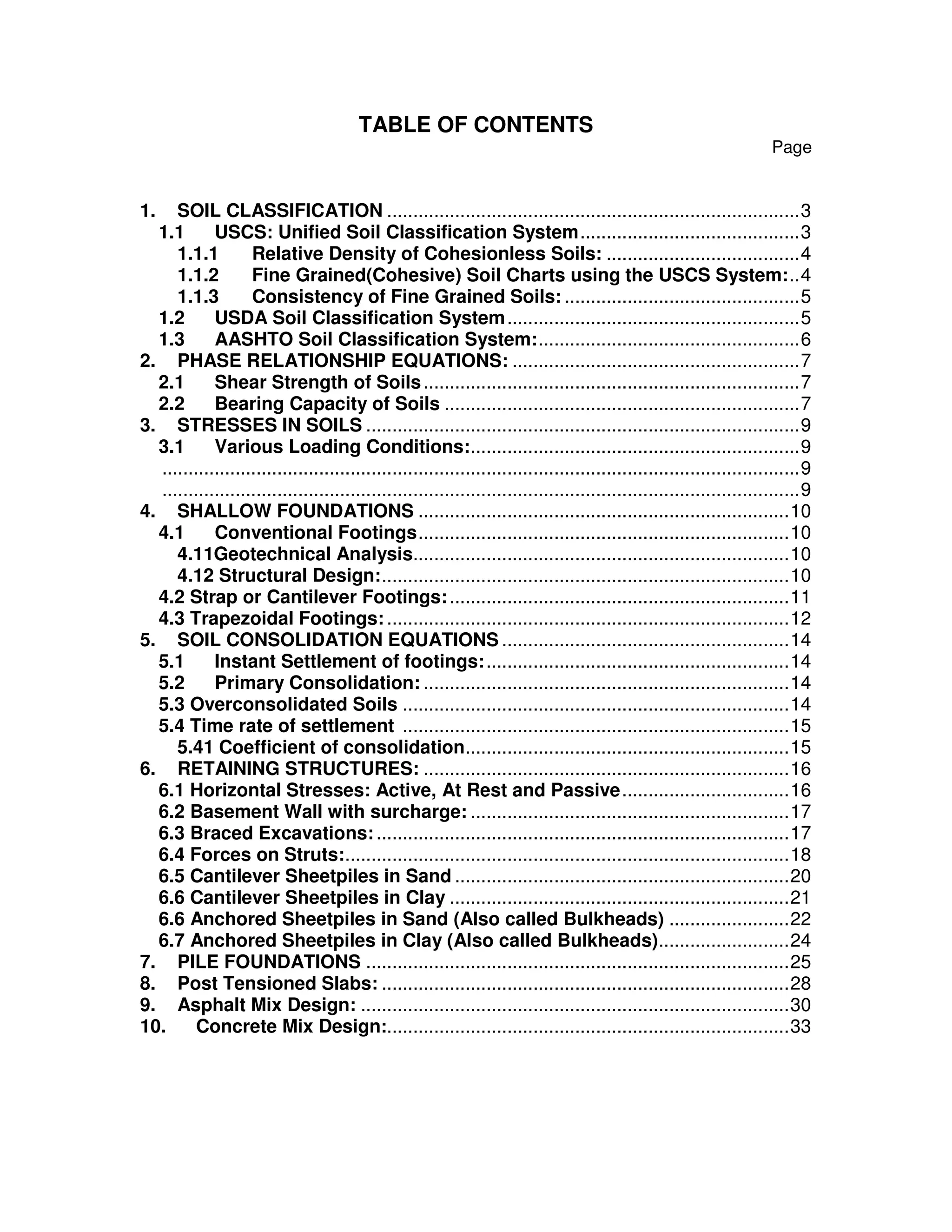
1. SOIL CLASSIFICATION ...............................................................................3
1.1 USCS: Unified Soil Classification System..........................................3
1.1.1 Relative Density of Cohesionless Soils: .....................................4
1.1.2 Fine Grained(Cohesive) Soil Charts using the USCS System:..4
1.1.3 Consistency of Fine Grained Soils: .............................................5
1.2 USDA Soil Classification System........................................................5
1.3 AASHTO Soil Classification System:..................................................6
2. PHASE RELATIONSHIP EQUATIONS: .......................................................7
2.1 Shear Strength of Soils........................................................................7
2.2 Bearing Capacity of Soils ....................................................................7
3. STRESSES IN SOILS ...................................................................................9
3.1 Various Loading Conditions:...............................................................9
..........................................................................................................................9
..........................................................................................................................9
4. SHALLOW FOUNDATIONS .......................................................................10
4.1 Conventional Footings.......................................................................10
4.11Geotechnical Analysis........................................................................10
4.12 Structural Design:..............................................................................10
4.2 Strap or Cantilever Footings:.................................................................11
4.3 Trapezoidal Footings: .............................................................................12
5. SOIL CONSOLIDATION EQUATIONS .......................................................14
5.1 Instant Settlement of footings:..........................................................14
5.2 Primary Consolidation: ......................................................................14
5.3 Overconsolidated Soils ..........................................................................14
5.4 Time rate of settlement ..........................................................................15
5.41 Coefficient of consolidation..............................................................15
6. RETAINING STRUCTURES: ......................................................................16
6.1 Horizontal Stresses: Active, At Rest and Passive................................16
6.2 Basement Wall with surcharge: .............................................................17
6.3 Braced Excavations:...............................................................................17
6.4 Forces on Struts:.....................................................................................18
6.5 Cantilever Sheetpiles in Sand ................................................................20
6.6 Cantilever Sheetpiles in Clay .................................................................21
6.6 Anchored Sheetpiles in Sand (Also called Bulkheads) .......................22
6.7 Anchored Sheetpiles in Clay (Also called Bulkheads).........................24
7. PILE FOUNDATIONS .................................................................................25
8. Post Tensioned Slabs: ..............................................................................28
9. Asphalt Mix Design: ..................................................................................30
10. Concrete Mix Design:.............................................................................33
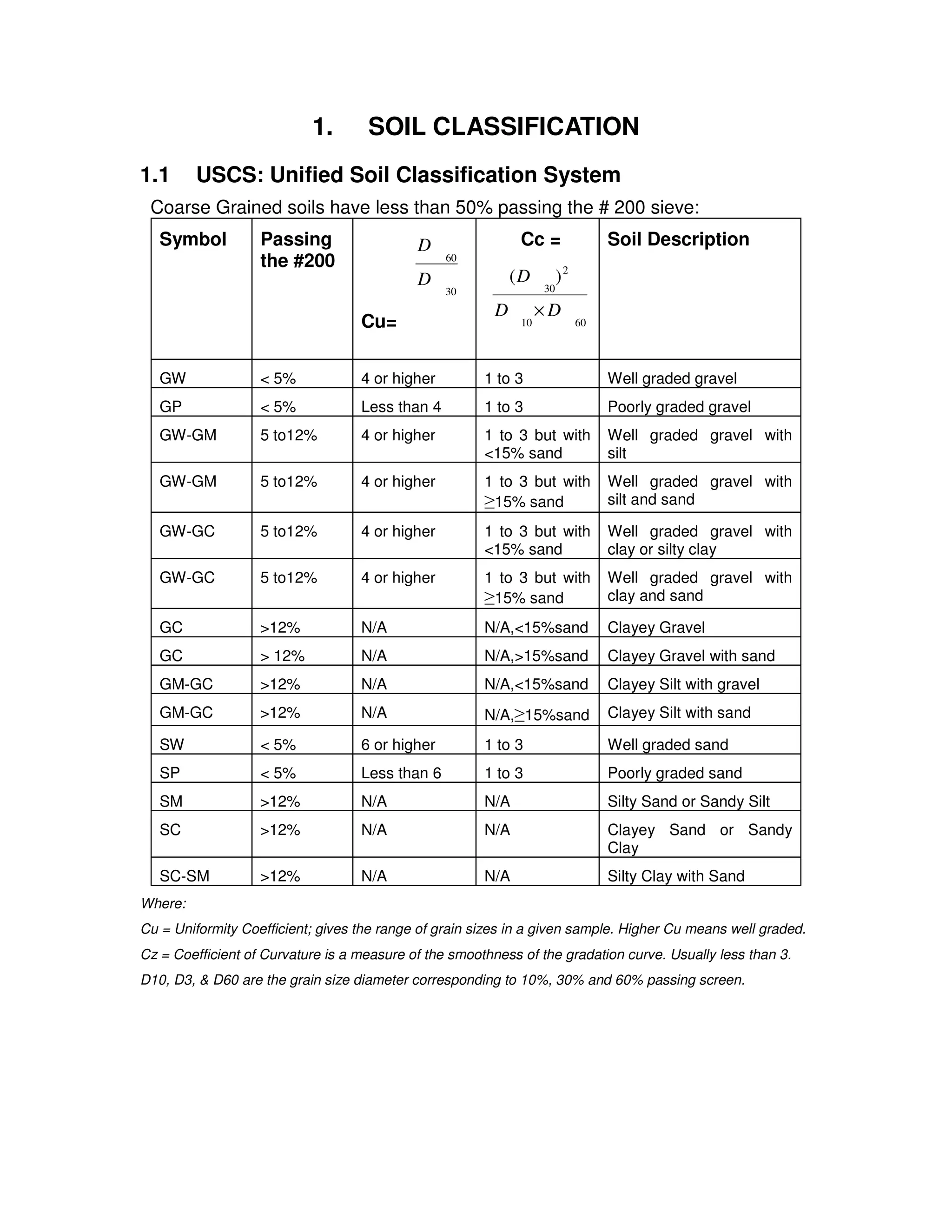
1. SOIL CLASSIFICATION
1.1 USCS: Unified Soil Classification System
Coarse Grained soils have less than 50% passing the # 200 sieve:
Symbol Passing
the #200
Cu=
30
60
D
D Cc =
6010
2
30
)(
DD
D
×
Soil Description
GW < 5% 4 or higher 1 to 3 Well graded gravel
GP < 5% Less than 4 1 to 3 Poorly graded gravel
GW-GM 5 to12% 4 or higher 1 to 3 but with
<15% sand
Well graded gravel with
silt
GW-GM 5 to12% 4 or higher 1 to 3 but with
≥15% sand
Well graded gravel with
silt and sand
GW-GC 5 to12% 4 or higher 1 to 3 but with
<15% sand
Well graded gravel with
clay or silty clay
GW-GC 5 to12% 4 or higher 1 to 3 but with
≥15% sand
Well graded gravel with
clay and sand
GC >12% N/A N/A,<15%sand Clayey Gravel
GC > 12% N/A N/A,>15%sand Clayey Gravel with sand
GM-GC >12% N/A N/A,<15%sand Clayey Silt with gravel
GM-GC >12% N/A N/A,≥15%sand Clayey Silt with sand
SW < 5% 6 or higher 1 to 3 Well graded sand
SP < 5% Less than 6 1 to 3 Poorly graded sand
SM >12% N/A N/A Silty Sand or Sandy Silt
SC >12% N/A N/A Clayey Sand or Sandy
Clay
SC-SM >12% N/A N/A Silty Clay with Sand
Where:
Cu = Uniformity Coefficient; gives the range of grain sizes in a given sample. Higher Cu means well graded.
Cz = Coefficient of Curvature is a measure of the smoothness of the gradation curve. Usually less than 3.
D10, D3, & D60 are the grain size diameter corresponding to 10%, 30% and 60% passing screen.
1.1.1 Relative Density of Cohesionless Soils:
SPT or N value Relative Density % Relative Density
0 – 3 Very loose 0 – 15
4 – 10 Loose 15 – 35
11 – 30 Medium dense 35 – 65
31 – 50 Dense 65 -85
> 50 Very dense 85 - 100
1.1.2 Fine Grained(Cohesive) Soil Charts using the USCS System:
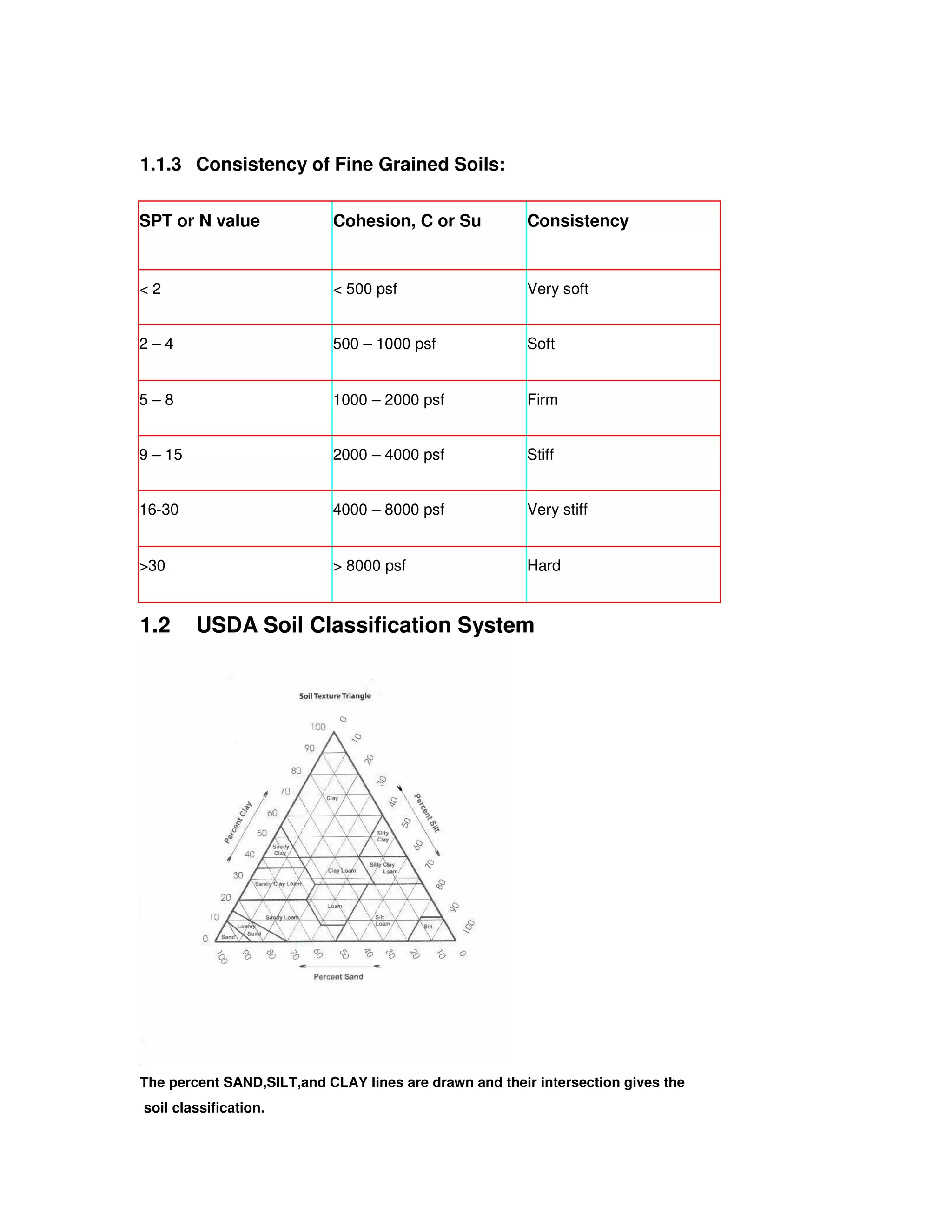
1.1.3 Consistency of Fine Grained Soils:
SPT or N value Cohesion, C or Su Consistency
< 2 < 500 psf Very soft
2 – 4 500 – 1000 psf Soft
5 – 8 1000 – 2000 psf Firm
9 – 15 2000 – 4000 psf Stiff
16-30 4000 – 8000 psf Very stiff
>30 > 8000 psf Hard
1.2 USDA Soil Classification System
The percent SAND,SILT,and CLAY lines are drawn and their intersection gives the
soil classification.
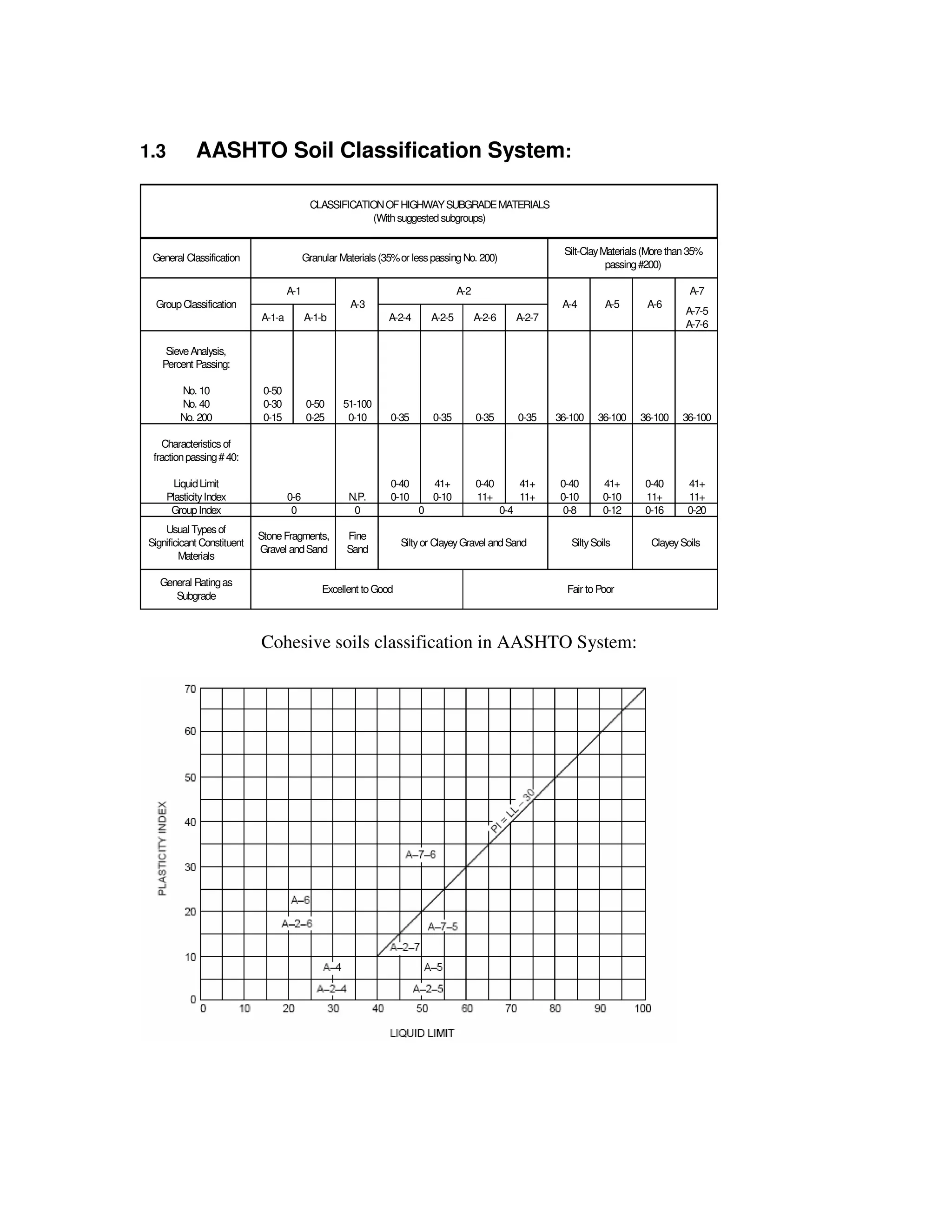
1.3 AASHTO Soil Classification System:
CLASSIFICATIONOFHIGHWAYSUBGRADEMATERIALS
(Withsuggestedsubgroups)
General Classification
GroupClassification
SieveAnalysis,
Percent Passing:
No. 10
No. 40
No. 200
Characteristics of
fractionpassing#40:
LiquidLimit
PlasticityIndex
GroupIndex
Usual Typesof
Significicant Constituent
Materials
General Ratingas
Subgrade
A-2
A-1-a A-1-b A-2-4 A-2-5 A-2-6 A-2-7
0-6
0
StoneFragments,
Gravel andSand
A-3
51-100
0-10
N.P.
0
Fine
Sand
0-50
Granular Materials(35%or lesspassingNo. 200)
0-35 0-35 0-35 0-35
0-30
0-15
0-50
0-25
A-1
0-10
0-40 41+
0-10
0-40
11+
41+
11+
0 0-4
Siltyor ClayeyGravel andSand
Excellent toGood
Silt-ClayMaterials(Morethan35%
passing#200)
A-4 A-5 A-6
A-7
A-7-5
A-7-6
36-100 36-100 36-100 36-100
0-40
0-10
41+
0-10
0-40
11+
41+
11+
SiltySoils ClayeySoils
Fair toPoor
0-8 0-12 0-16 0-20
Cohesive soils classification in AASHTO System:
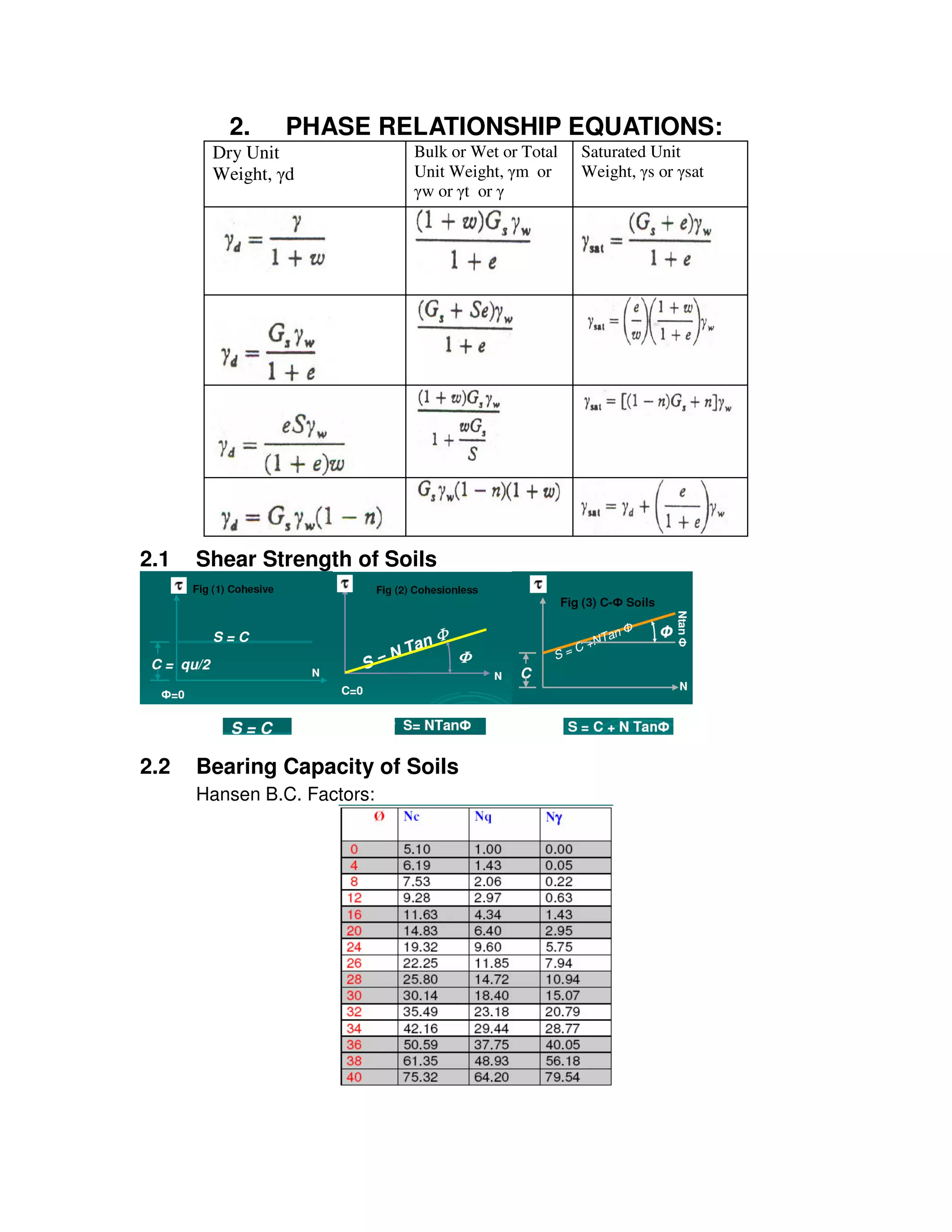
2. PHASE RELATIONSHIP EQUATIONS:
Dry Unit
Weight, γd
Bulk or Wet or Total
Unit Weight, γm or
γw or γt or γ
Saturated Unit
Weight, γs or γsat
2.1 Shear Strength of Soils
2.2 Bearing Capacity of Soils
Hansen B.C. Factors:
Terzaghi B.C. Factors
Note:If Df/B > 1, terzaghi’s B.C. factors do not apply. Use Hansen’s B.C. factors.
For example, if depth of footing (Df) is 3 ft but footing width (B) is 2.75 ft.
3. STRESSES IN SOILS
3.1 Various Loading Conditions:
Strip
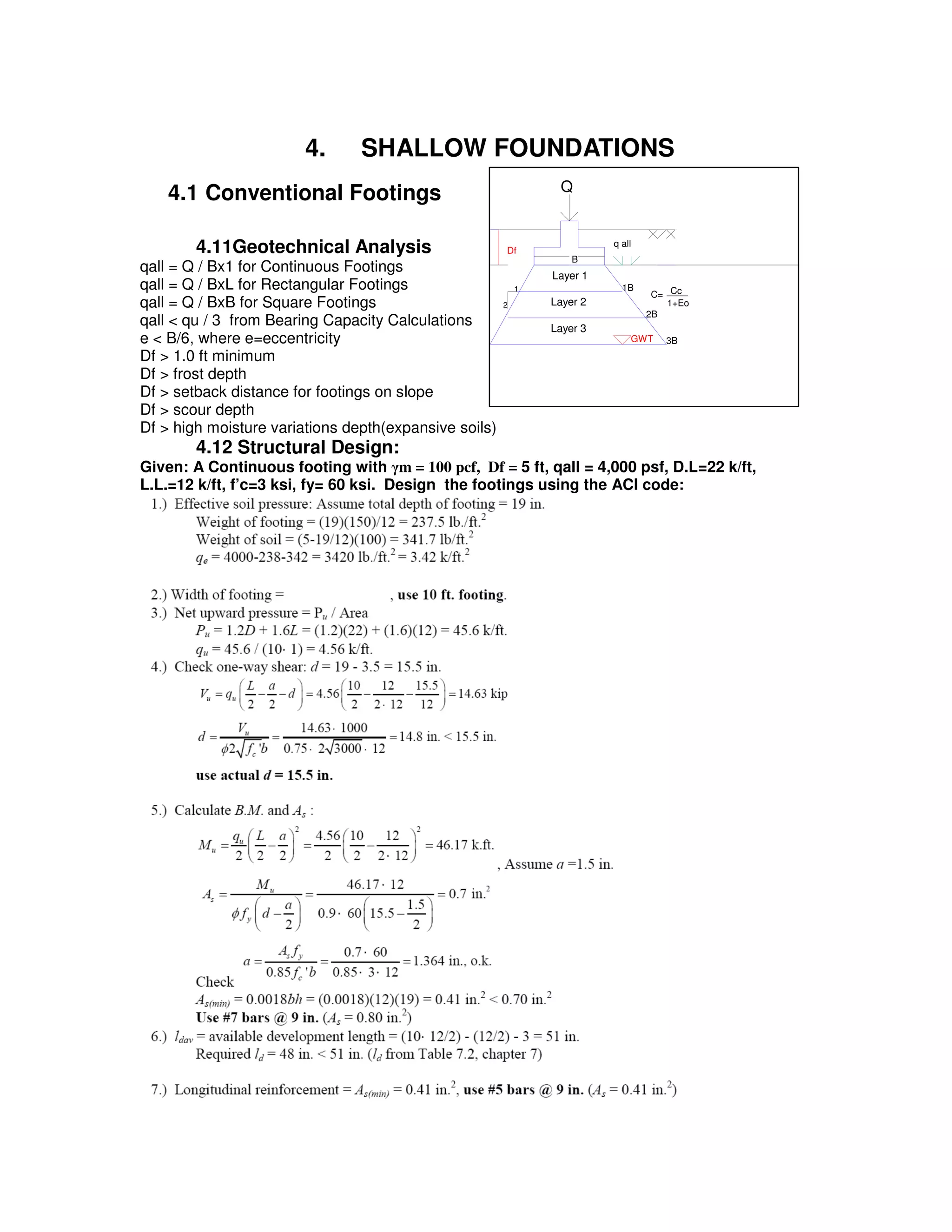
4. SHALLOW FOUNDATIONS
4.1 Conventional Footings
4.11Geotechnical Analysis
qall = Q / Bx1 for Continuous Footings
qall = Q / BxL for Rectangular Footings
qall = Q / BxB for Square Footings
qall < qu / 3 from Bearing Capacity Calculations
e < B/6, where e=eccentricity
Df > 1.0 ft minimum
Df > frost depth
Df > setback distance for footings on slope
Df > scour depth
Df > high moisture variations depth(expansive soils)
4.12 Structural Design:
Given: A Continuous footing with γm = 100 pcf, Df = 5 ft, qall = 4,000 psf, D.L=22 k/ft,
L.L.=12 k/ft, f’c=3 ksi, fy= 60 ksi. Design the footings using the ACI code:
Layer 1
Layer 2
Layer 3
3B
2B
1B
B
Df
q all
GWT
2
1 Cc___
1+Eo
C=
Q
4.2 Strap or Cantilever Footings:
Strap Footing with varying beam thickness
Strap Footings with constant beam thickness
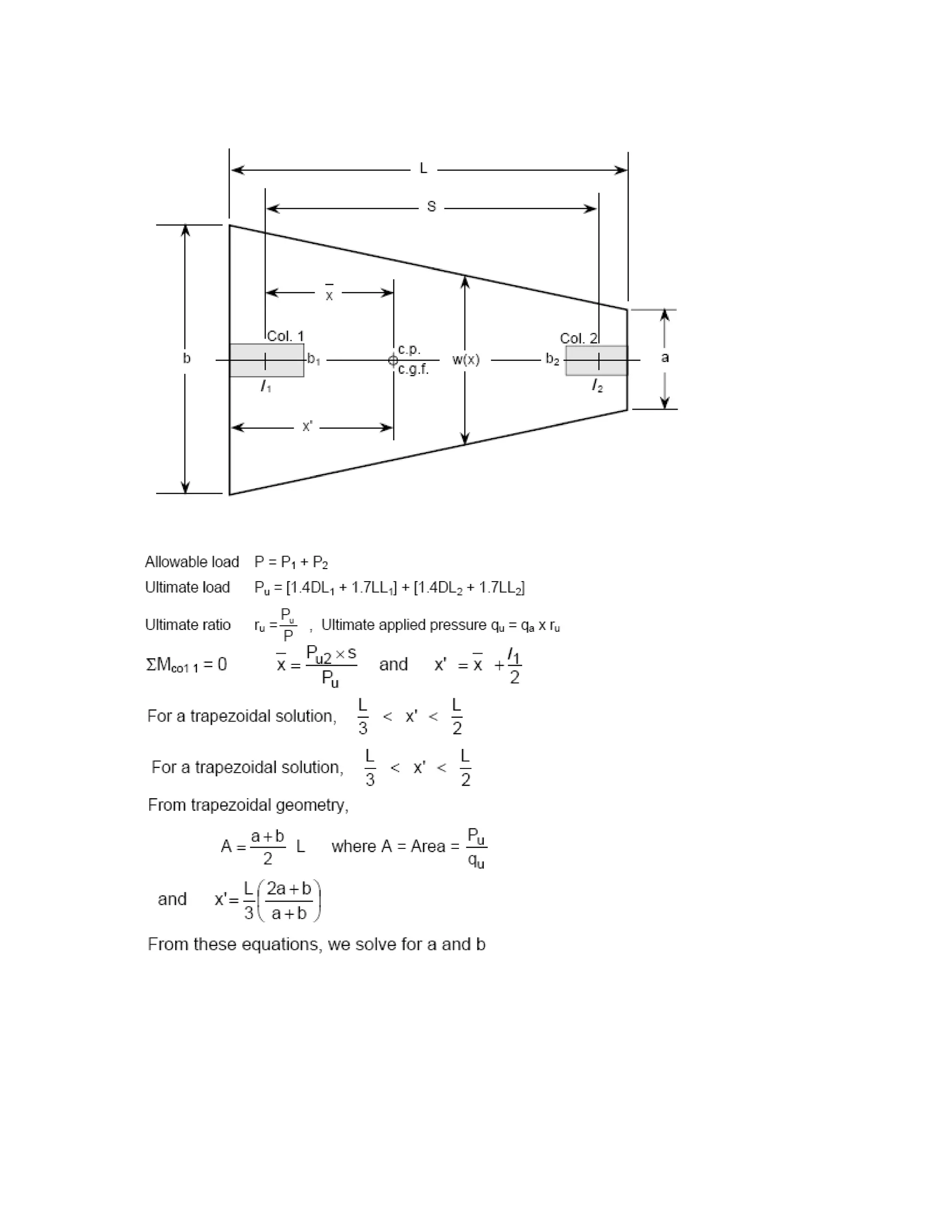
4.3 Trapezoidal Footings:
5. SOIL CONSOLIDATION EQUATIONS
5.1 Instant Settlement of footings:
or
5.2 Primary Consolidation:
or
5.3 Overconsolidated Soils
or
or
5.4 Time rate of settlement (i=immediate, c=consolidation, & s=secondary)
5.41 Coefficient of consolidation, Cv:
6. RETAINING STRUCTURES:
6.1 Horizontal Stresses: Active, At Rest and Passive
6.2 Basement Wall with surcharge:
6.3 Braced Excavations:
6.4 Forces on Struts:
Bottom Heave Calculations:
6.5 Cantilever Sheetpiles in Sand
6.6 Cantilever Sheetpiles in Clay
6.6 Anchored Sheetpiles in Sand (Also called Bulkheads)
6.7 Anchored Sheetpiles in Clay (Also called Bulkheads)
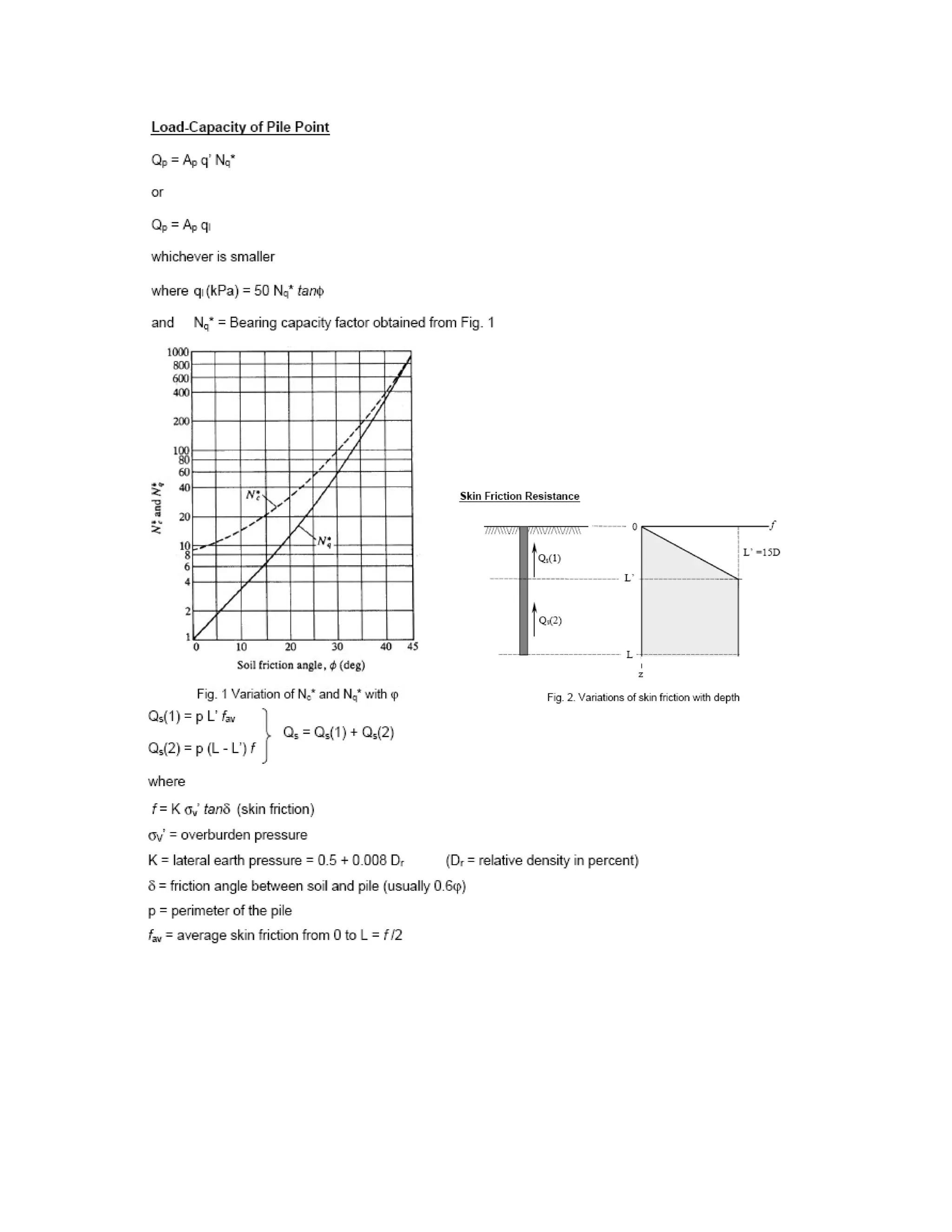
7. PILE FOUNDATIONS
7.1 Single Piles Equations:
7.2 Group capacity of piles:
Example:
7.3 Settlement of Group Piles:
8. Post Tensioned Slabs:
Edge Lift:
Center Lift:
The Structural Engineer also needs Kv (given in immediate settlement section), effective PI(pp
138 of Geotechnical DVD book) and other climatic constants that are from building codes(given).
9. Asphalt Mix Design:
AC Mix design Formulas:
When weighing in Water:
When weighing in Air:
Open Graded Mixtures:
10. Concrete Mix Design:
Fineness modulus:
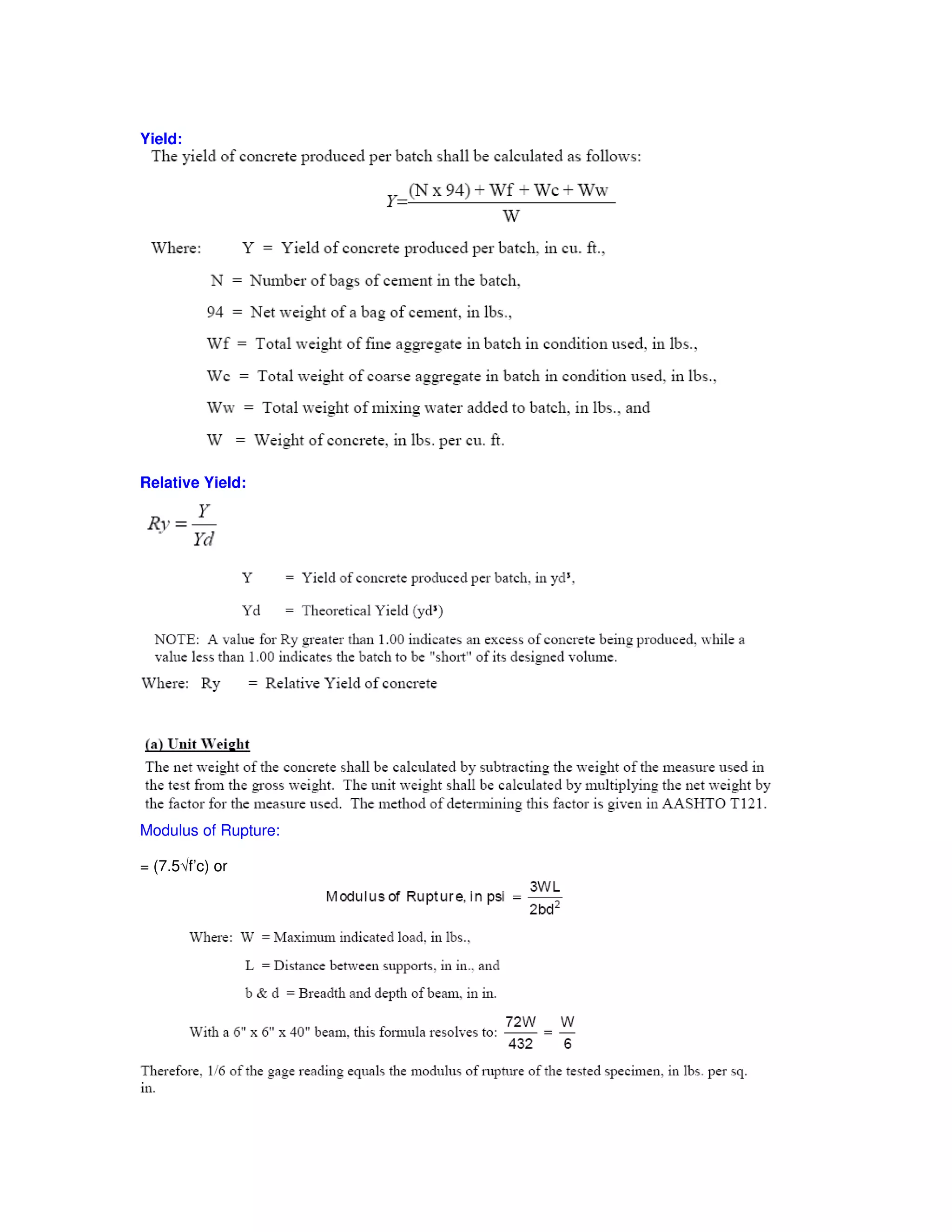
Yield:
Relative Yield:
Modulus of Rupture:
= (7.5√f’c) or

Geotechformulas

  • 1.
    GEOTECHNICAL ENGINEERING FORMULAS Ahandy reference for use in geotechnical analysis and design
  • 2.
    TABLE OF CONTENTS Page 1.SOIL CLASSIFICATION ...............................................................................3 1.1 USCS: Unified Soil Classification System..........................................3 1.1.1 Relative Density of Cohesionless Soils: .....................................4 1.1.2 Fine Grained(Cohesive) Soil Charts using the USCS System:..4 1.1.3 Consistency of Fine Grained Soils: .............................................5 1.2 USDA Soil Classification System........................................................5 1.3 AASHTO Soil Classification System:..................................................6 2. PHASE RELATIONSHIP EQUATIONS: .......................................................7 2.1 Shear Strength of Soils........................................................................7 2.2 Bearing Capacity of Soils ....................................................................7 3. STRESSES IN SOILS ...................................................................................9 3.1 Various Loading Conditions:...............................................................9 ..........................................................................................................................9 ..........................................................................................................................9 4. SHALLOW FOUNDATIONS .......................................................................10 4.1 Conventional Footings.......................................................................10 4.11Geotechnical Analysis........................................................................10 4.12 Structural Design:..............................................................................10 4.2 Strap or Cantilever Footings:.................................................................11 4.3 Trapezoidal Footings: .............................................................................12 5. SOIL CONSOLIDATION EQUATIONS .......................................................14 5.1 Instant Settlement of footings:..........................................................14 5.2 Primary Consolidation: ......................................................................14 5.3 Overconsolidated Soils ..........................................................................14 5.4 Time rate of settlement ..........................................................................15 5.41 Coefficient of consolidation..............................................................15 6. RETAINING STRUCTURES: ......................................................................16 6.1 Horizontal Stresses: Active, At Rest and Passive................................16 6.2 Basement Wall with surcharge: .............................................................17 6.3 Braced Excavations:...............................................................................17 6.4 Forces on Struts:.....................................................................................18 6.5 Cantilever Sheetpiles in Sand ................................................................20 6.6 Cantilever Sheetpiles in Clay .................................................................21 6.6 Anchored Sheetpiles in Sand (Also called Bulkheads) .......................22 6.7 Anchored Sheetpiles in Clay (Also called Bulkheads).........................24 7. PILE FOUNDATIONS .................................................................................25 8. Post Tensioned Slabs: ..............................................................................28 9. Asphalt Mix Design: ..................................................................................30 10. Concrete Mix Design:.............................................................................33
  • 3.
    1. SOIL CLASSIFICATION 1.1USCS: Unified Soil Classification System Coarse Grained soils have less than 50% passing the # 200 sieve: Symbol Passing the #200 Cu= 30 60 D D Cc = 6010 2 30 )( DD D × Soil Description GW < 5% 4 or higher 1 to 3 Well graded gravel GP < 5% Less than 4 1 to 3 Poorly graded gravel GW-GM 5 to12% 4 or higher 1 to 3 but with <15% sand Well graded gravel with silt GW-GM 5 to12% 4 or higher 1 to 3 but with ≥15% sand Well graded gravel with silt and sand GW-GC 5 to12% 4 or higher 1 to 3 but with <15% sand Well graded gravel with clay or silty clay GW-GC 5 to12% 4 or higher 1 to 3 but with ≥15% sand Well graded gravel with clay and sand GC >12% N/A N/A,<15%sand Clayey Gravel GC > 12% N/A N/A,>15%sand Clayey Gravel with sand GM-GC >12% N/A N/A,<15%sand Clayey Silt with gravel GM-GC >12% N/A N/A,≥15%sand Clayey Silt with sand SW < 5% 6 or higher 1 to 3 Well graded sand SP < 5% Less than 6 1 to 3 Poorly graded sand SM >12% N/A N/A Silty Sand or Sandy Silt SC >12% N/A N/A Clayey Sand or Sandy Clay SC-SM >12% N/A N/A Silty Clay with Sand Where: Cu = Uniformity Coefficient; gives the range of grain sizes in a given sample. Higher Cu means well graded. Cz = Coefficient of Curvature is a measure of the smoothness of the gradation curve. Usually less than 3. D10, D3, & D60 are the grain size diameter corresponding to 10%, 30% and 60% passing screen.
  • 4.
    1.1.1 Relative Densityof Cohesionless Soils: SPT or N value Relative Density % Relative Density 0 – 3 Very loose 0 – 15 4 – 10 Loose 15 – 35 11 – 30 Medium dense 35 – 65 31 – 50 Dense 65 -85 > 50 Very dense 85 - 100 1.1.2 Fine Grained(Cohesive) Soil Charts using the USCS System:
  • 5.
    1.1.3 Consistency ofFine Grained Soils: SPT or N value Cohesion, C or Su Consistency < 2 < 500 psf Very soft 2 – 4 500 – 1000 psf Soft 5 – 8 1000 – 2000 psf Firm 9 – 15 2000 – 4000 psf Stiff 16-30 4000 – 8000 psf Very stiff >30 > 8000 psf Hard 1.2 USDA Soil Classification System The percent SAND,SILT,and CLAY lines are drawn and their intersection gives the soil classification.
  • 6.
    1.3 AASHTO SoilClassification System: CLASSIFICATIONOFHIGHWAYSUBGRADEMATERIALS (Withsuggestedsubgroups) General Classification GroupClassification SieveAnalysis, Percent Passing: No. 10 No. 40 No. 200 Characteristics of fractionpassing#40: LiquidLimit PlasticityIndex GroupIndex Usual Typesof Significicant Constituent Materials General Ratingas Subgrade A-2 A-1-a A-1-b A-2-4 A-2-5 A-2-6 A-2-7 0-6 0 StoneFragments, Gravel andSand A-3 51-100 0-10 N.P. 0 Fine Sand 0-50 Granular Materials(35%or lesspassingNo. 200) 0-35 0-35 0-35 0-35 0-30 0-15 0-50 0-25 A-1 0-10 0-40 41+ 0-10 0-40 11+ 41+ 11+ 0 0-4 Siltyor ClayeyGravel andSand Excellent toGood Silt-ClayMaterials(Morethan35% passing#200) A-4 A-5 A-6 A-7 A-7-5 A-7-6 36-100 36-100 36-100 36-100 0-40 0-10 41+ 0-10 0-40 11+ 41+ 11+ SiltySoils ClayeySoils Fair toPoor 0-8 0-12 0-16 0-20 Cohesive soils classification in AASHTO System:
  • 7.
    2. PHASE RELATIONSHIPEQUATIONS: Dry Unit Weight, γd Bulk or Wet or Total Unit Weight, γm or γw or γt or γ Saturated Unit Weight, γs or γsat 2.1 Shear Strength of Soils 2.2 Bearing Capacity of Soils Hansen B.C. Factors:
  • 8.
  • 9.
    Note:If Df/B >1, terzaghi’s B.C. factors do not apply. Use Hansen’s B.C. factors. For example, if depth of footing (Df) is 3 ft but footing width (B) is 2.75 ft. 3. STRESSES IN SOILS 3.1 Various Loading Conditions: Strip
  • 10.
    4. SHALLOW FOUNDATIONS 4.1Conventional Footings 4.11Geotechnical Analysis qall = Q / Bx1 for Continuous Footings qall = Q / BxL for Rectangular Footings qall = Q / BxB for Square Footings qall < qu / 3 from Bearing Capacity Calculations e < B/6, where e=eccentricity Df > 1.0 ft minimum Df > frost depth Df > setback distance for footings on slope Df > scour depth Df > high moisture variations depth(expansive soils) 4.12 Structural Design: Given: A Continuous footing with γm = 100 pcf, Df = 5 ft, qall = 4,000 psf, D.L=22 k/ft, L.L.=12 k/ft, f’c=3 ksi, fy= 60 ksi. Design the footings using the ACI code: Layer 1 Layer 2 Layer 3 3B 2B 1B B Df q all GWT 2 1 Cc___ 1+Eo C= Q
  • 11.
    4.2 Strap orCantilever Footings: Strap Footing with varying beam thickness Strap Footings with constant beam thickness
  • 12.
  • 14.
    5. SOIL CONSOLIDATIONEQUATIONS 5.1 Instant Settlement of footings: or 5.2 Primary Consolidation: or 5.3 Overconsolidated Soils or or
  • 15.
    5.4 Time rateof settlement (i=immediate, c=consolidation, & s=secondary) 5.41 Coefficient of consolidation, Cv:
  • 16.
    6. RETAINING STRUCTURES: 6.1Horizontal Stresses: Active, At Rest and Passive
  • 17.
    6.2 Basement Wallwith surcharge: 6.3 Braced Excavations:
  • 18.
  • 19.
  • 20.
  • 21.
  • 22.
    6.6 Anchored Sheetpilesin Sand (Also called Bulkheads)
  • 24.
    6.7 Anchored Sheetpilesin Clay (Also called Bulkheads)
  • 25.
    7. PILE FOUNDATIONS 7.1Single Piles Equations:
  • 27.
    7.2 Group capacityof piles: Example:
  • 28.
    7.3 Settlement ofGroup Piles: 8. Post Tensioned Slabs: Edge Lift:
  • 29.
    Center Lift: The StructuralEngineer also needs Kv (given in immediate settlement section), effective PI(pp 138 of Geotechnical DVD book) and other climatic constants that are from building codes(given).
  • 30.
  • 31.
    AC Mix designFormulas:
  • 32.
    When weighing inWater: When weighing in Air: Open Graded Mixtures:
  • 33.
    10. Concrete MixDesign: Fineness modulus:
  • 34.
    Yield: Relative Yield: Modulus ofRupture: = (7.5√f’c) or