Self and Relationship
Georgette Chen aka ChangLiying Chendana (1906/ 7-1993) Self Portrait, 1946 Collection of Singapore Art Museum
Born 1906  Zejiang Province, China  Born 1907  Paris 1926-7 Attended classes at Art Students League in New York  Education 1928-1929 Academie Colarossi and Academie Biloul in Paris  Georgette Chen aka ChangLiying Chendana (1906/ 7-1993) Dispute on the country of birth
Looking at the Self Portrait and information provided, what can we gather about her   Status, Self, Society/ Culture?
Georgette Chen Self Portrait  1946  -Born to a wealthy family -Her education in New York and Paris exposed her to Western culture and art during her early youth. Hence affected her stylistic execution of artwork.  -She reflects a serene and sensitive disposition through the choice of harmonious colours - subtle nuances of pink, beige and brown, and to add interest, a dash of vermilion on the lips.  -The piercing looks in her eyes expresses her determination with a keen sense of purpose.
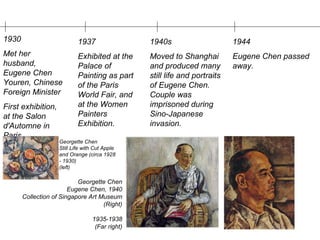
Georgette Chen Portraits Eugene Chen, 1940 Collection of Singapore Art Museum (Left) 1935-1938 (Centre) 1944 (Right)
Georgette Chen Eugene Chen, 1940 Collection of Singapore Art Museum (Right) 1935-1938 (Far right) 1930 Met her husband, Eugene Chen Youren,  Chinese Foreign Minister First exhibition, at the Salon d'Automne in Paris  Georgette Chen Still Life with Cut Apple and Orange (circa 1928 - 1930) (left)   1937 Exhibited at the Palace of Painting as part of the Paris World Fair, and at the Women Painters Exhibition.   1940s Moved to Shanghai and produced many still life and portraits of Eugene Chen. Couple was imprisoned during Sino-Japanese invasion. 1944 Eugene Chen passed away.
Discuss the relationship between Eugene Chen and the artist. Does his posture suggest his affection for the artist?
-Eugene Chen is the man behind Georgette Chen’s success. -The posture on the extreme left, an intimate one, expresses how he was the love of her life. -Her artworks is a marker for their marriage and she has indeed documented their mutual affection for each other.  -Eugene’s posture was captured purposefully to depict that he was lost in his thoughts, feeling comfortable with the artist’s presence.  -His attire and surroundings, suggest that he pursues intellectual concerns instead of materialistic aims. Georgette and Eugene Chen
Georgette Chen Family Portrait  1960-65
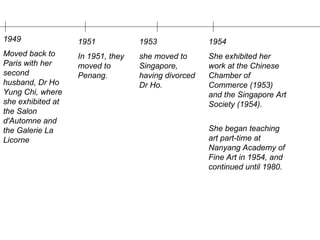
1949 Moved back to  Paris with her second husband, Dr Ho Yung Chi, where she exhibited at the Salon d'Automne and the Galerie La Licorne   1951 In 1951, they moved to Penang. 1953 she moved to Singapore, having divorced Dr Ho.   1954 She exhibited her work at the Chinese Chamber of Commerce (1953) and the Singapore Art Society (1954). She began teaching art part-time at Nanyang Academy of Fine Art in 1954, and continued until 1980.
Whose family is this? Eugene Chen’s or Dr Ho’s children?
Different age groups -Adolescents -Youth -Working Adults  -Buyers -Retiree To design a publicity brochure for Georgette Chen’s exhibition entitled: ‘Self and Relationship’. Museum’s patrons of the art Publicity Coordinator Target Format Audience Role
References http://www.postcolonialweb.org/singapore/arts/painters/channel/13.html http://infopedia.nl.sg/articles/SIP_698_2005-01-12.html http://www.postcolonialweb.org/singapore/arts/painters/georgettechen/6.html http://www.artoutreachprogram.org/images/pdfs/PORTFOLIOS/The%20Life%20&%20Art%20of%20Georgette%20Chen.pdf http://mms.elibraryhub.com/SHC/Singapore%20Pages/NORA/NORA%20RG%20-%20Georgette%20Chen.pdf http:// theatre.wikia.com/wiki/Georgette Singapore Art Museum, SOVA Teacher’s Resources

Georgette chen

  • 1.
  • 2.
    Georgette Chen akaChangLiying Chendana (1906/ 7-1993) Self Portrait, 1946 Collection of Singapore Art Museum
  • 3.
    Born 1906 Zejiang Province, China Born 1907 Paris 1926-7 Attended classes at Art Students League in New York Education 1928-1929 Academie Colarossi and Academie Biloul in Paris Georgette Chen aka ChangLiying Chendana (1906/ 7-1993) Dispute on the country of birth
  • 4.
    Looking at theSelf Portrait and information provided, what can we gather about her Status, Self, Society/ Culture?
  • 5.
    Georgette Chen SelfPortrait 1946 -Born to a wealthy family -Her education in New York and Paris exposed her to Western culture and art during her early youth. Hence affected her stylistic execution of artwork. -She reflects a serene and sensitive disposition through the choice of harmonious colours - subtle nuances of pink, beige and brown, and to add interest, a dash of vermilion on the lips. -The piercing looks in her eyes expresses her determination with a keen sense of purpose.
  • 6.
    Georgette Chen PortraitsEugene Chen, 1940 Collection of Singapore Art Museum (Left) 1935-1938 (Centre) 1944 (Right)
  • 7.
    Georgette Chen EugeneChen, 1940 Collection of Singapore Art Museum (Right) 1935-1938 (Far right) 1930 Met her husband, Eugene Chen Youren, Chinese Foreign Minister First exhibition, at the Salon d'Automne in Paris Georgette Chen Still Life with Cut Apple and Orange (circa 1928 - 1930) (left) 1937 Exhibited at the Palace of Painting as part of the Paris World Fair, and at the Women Painters Exhibition. 1940s Moved to Shanghai and produced many still life and portraits of Eugene Chen. Couple was imprisoned during Sino-Japanese invasion. 1944 Eugene Chen passed away.
  • 8.
    Discuss the relationshipbetween Eugene Chen and the artist. Does his posture suggest his affection for the artist?
  • 9.
    -Eugene Chen isthe man behind Georgette Chen’s success. -The posture on the extreme left, an intimate one, expresses how he was the love of her life. -Her artworks is a marker for their marriage and she has indeed documented their mutual affection for each other. -Eugene’s posture was captured purposefully to depict that he was lost in his thoughts, feeling comfortable with the artist’s presence. -His attire and surroundings, suggest that he pursues intellectual concerns instead of materialistic aims. Georgette and Eugene Chen
  • 10.
    Georgette Chen FamilyPortrait 1960-65
  • 11.
    1949 Moved backto Paris with her second husband, Dr Ho Yung Chi, where she exhibited at the Salon d'Automne and the Galerie La Licorne 1951 In 1951, they moved to Penang. 1953 she moved to Singapore, having divorced Dr Ho. 1954 She exhibited her work at the Chinese Chamber of Commerce (1953) and the Singapore Art Society (1954). She began teaching art part-time at Nanyang Academy of Fine Art in 1954, and continued until 1980.
  • 12.
    Whose family isthis? Eugene Chen’s or Dr Ho’s children?
  • 13.
    Different age groups-Adolescents -Youth -Working Adults -Buyers -Retiree To design a publicity brochure for Georgette Chen’s exhibition entitled: ‘Self and Relationship’. Museum’s patrons of the art Publicity Coordinator Target Format Audience Role
  • 14.
    References http://www.postcolonialweb.org/singapore/arts/painters/channel/13.html http://infopedia.nl.sg/articles/SIP_698_2005-01-12.htmlhttp://www.postcolonialweb.org/singapore/arts/painters/georgettechen/6.html http://www.artoutreachprogram.org/images/pdfs/PORTFOLIOS/The%20Life%20&%20Art%20of%20Georgette%20Chen.pdf http://mms.elibraryhub.com/SHC/Singapore%20Pages/NORA/NORA%20RG%20-%20Georgette%20Chen.pdf http:// theatre.wikia.com/wiki/Georgette Singapore Art Museum, SOVA Teacher’s Resources

Editor's Notes

  • #6 In looking at the work of a single artist, it is important to understand where the artist came from, and perhaps where they are going with their works. Georgette Chen has a huge interest and appetite in absorbing the world around her into her art forms. As she developed her technique, perhaps so also did she develop her own self-confidence and sense of who she was. About The Artwork: This is the second self-portrait by Chen in this series. More than 13 years have passed between the creation of this work and the previously viewed Self-Portrait . This work is held by the Singapore Art Museum. It is most noted for the following: - The artist displays through this work a remarkable sense of detachment from herself as a subject - The composition depicts disciplined approach to method while engaging the viewer with the personality behind the face - her face is a close up, full sized & hauntingly-real likeness of herself - minimum lines to delineate the contours of the face & hair - economical use of colors to differentiate shades of facial complexion from the simple back ground - clear articulation of features such as curly fringe - starched Chinese collar of dress - sharp piercing eyes reflect steady determination & keen sense of purpose Questions Put the two portraits side by side. Copyright © 2005 Art Outreach Singapore Ltd Primary 2 Compare the view of the face (the full face of the new and the slightly eclipsed of the previous) Primary 5 Compare the eyes – (is one set stronger than the other?) Secondary 1 Compare the clothing – she shows herself here with an obvious Chinese collar (this work is from her Chinese period, while the other is either a bit French or maybe event unrecognizable Secondary 3 Can you make other comparisons? Copyright © 2005 Art Outreach Singapore Ltd
  • #8 Still Life with Cut Apple and Orange which reveals traces of the influence of Paul Cezanne. Chen combined the use of dynamic brush strokes with dark, heavy tones filled with vigour and energy to suggest volume and texture. The apples and oranges are made more tangible through a focused and compact composition, giving immediacy and conviction to the still-life, a quality which is consistently found in Chen's paintings, The vitality of the colours of the fruits and their different textures contrast with the vague and gray background colours to achieve a calculated and sensitive balance of elements in the painting. About the Artwork: This is one of Chen’s earliest known paintings. - Earlier works were rendered with heavy brushstrokes & texture - Excellent example revealing traced of influence of Paul Cezanne and the Impressionist style - Combined use of dynamic brushstrokes with dark, heavy tones filled with vigor & energy informing the viewer of the volume & texture of the objects. - Apples & Oranges made more tangible through focused & compact composition , giving immediacy & conviction to the still-life, a quality which is consistent through out her works - Vitality of the colours of the fruits & their different textures contrast with the vague & gray background colours to achieve a calculated & sensitive balance of elements in the paintings Primary 5 Why is this painting called an impressionistic still life ? What is impressionism ? What is still life ? Secondary 1 Why would an artist choose to paint some cut up fruit on a plate? Is this painting beautiful? What is it showing besides fruit? (Life, sustenance, abundance, the time of year or season based on the ripe fruit) Secondary 3 What is composition ? Tell me something about the composition of this work? Notice the close up, directed from above view of the apples and orange. It is a unique vantage and gives the viewer a feeling of approaching the object or interacting with it. Copyright © 2005 Art Outreach Singapore Ltd The portraits of her husband were executed in a style reminiscent of the Dutch artist Vincent Van Gogh.
  • #10 Her husband was a favorite subject of hers. She often painted fine portraits such as this of him over the years. They capture elements of his personality and many such as this seem to be influenced by Van Gogh’s portraits. This work comes from the period of Chen’s Post-Impressionist period. It provides the viewer with Chen’s own understanding of her husband as well as a superficial rendering of how he looks. - Style manifests many of Van Gogh's concerns & techniques - E.g. the basic design of the portraits appear casual & possess the immediacy of snapshots - The coloring shows sensitivity to the subject who is obviously in a melancholic mood or deep in thought. The muted tones compliment the heavy nature or atmosphere of the work. - Composition depicts much about the subject. The resting of his head in head suggest a weariness about him, which probably had to do with his important role in China’s political affairs. Questions: Primary 2 Copyright © 2005 Art Outreach Singapore Ltd What can you “read” from this portrait? What can you see about this man? (serious gaze, in the middle of some work with the book in hand, probably at home as he is sitting in a “relaxed” position, seemingly unaware of the artistic rendering) Primary 5 What about the color of this work? Is it appropriate? Does it compliment the subject or detract from its effect? Secondary 1 In order for a portrait to be interesting to a wide audience it has to communicate something about the subject to an unrelated viewer. Often bad portrait compositions are those in which the only people who can relate are those that have an emotional attachment to the object (for example, pictures of your cat are often only exciting to you!!) This work seems different, why? Secondary 3 This man had a very stressful job. It was the kind of job that consumed most of his time and energy. Does the painting show you this? Does it show you anything else? (Chinese clothing? Reading on a couch? Hands open?) Copyright © 2005 Art Outreach Singapore Ltd