Geometry means earth measurement. Early peoples
used their knowledge of geometry to build
roads, temples, pyramids, and irrigation systems. The
more formal study of geometry today is based on an
interest in logical reasoning and relationships rather
than in measurement alone. Euclid (300 b.c.) organized
Greek geometry into a thirteen-volume set of books
named The Elements, in which the geometric
relationships were derived through deductive reasoning.
Thus, the formal geometry studied today is often called
Euclidean geometry. This geometry is also called plane
geometry because the relationships deal with flat
surfaces.
•come from two Greek words:
“geo” which means “Earth” and
“metron” and which means
“Measure”
•is a branch of mathematics concerned
with questions of shape, size, relative
position of figures, and the properties of
space
•was extremely important to ancient
societies and was used for
surveying, astronomy, navigation,
and building
Geometer
•is the mathematician who
works in the field of
geometry
UNDEFINED TERMS


•are concepts where Geometry
and other Mathematical System
are based
•are terms that are accepted
without definition
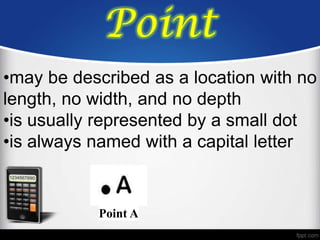
Point
•may be described as a location with no
length, no width, and no depth
•is usually represented by a small dot
•is always named with a capital letter


           Point A
Line
•may be described as a set of points
going straight on forever in two
opposite directions
•is a infinite set of points that has
length, but no width and depth
•is usually represented by a straight
line with two arrowheads to indicate
that the line extends without end in two
directions
Line
•is usually named in one of two ways
like the line containing points K and M
may be named by either:
1. Using any two (never more than two) points on
the line with a line indicator above the points, for
example KM or MK, the line indicator above the
capital letters always points horizontally from side
to side and never any other direction: it is the
actual location of the points in space that
determines the location and direction of the line
indicator above the capital letters in the notation
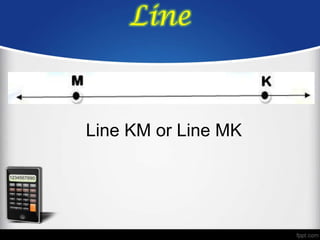
Line


Line KM or Line MK
Line
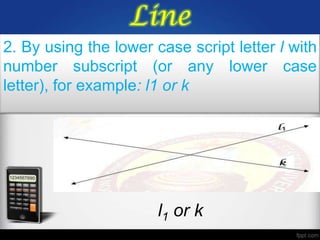
2. By using the lower case script letter l with
number subscript (or any lower case
letter), for example: l1 or k


                       l1 or k
Plane
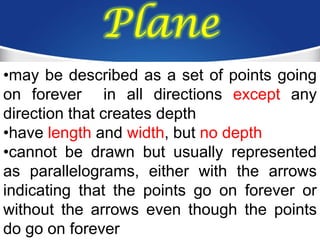
•may be described as a set of points going
on forever in all directions except any
direction that creates depth
•have length and width, but no depth
•cannot be drawn but usually represented
as parallelograms, either with the arrows
indicating that the points go on forever or
without the arrows even though the points
do go on forever
Plane
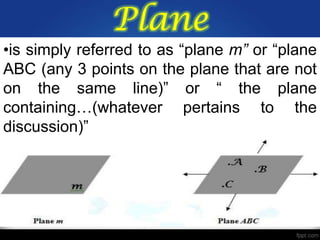
•is simply referred to as “plane m” or “plane
ABC (any 3 points on the plane that are not
on the same line)” or “ the plane
containing…(whatever pertains to the
discussion)”
DEFINITION
    Concepts in Geometry will be
defined by using the three undefined
terms and/or other terms that have
already been defined.
Definition
1. A good definition should contain
ordinary words and geometric terms
that have been previously defined or
accepted as undefined
2. A good definition should list only the
essential properties of the term being
defined
3. A good definition is reversible
POSTULATE
- is a statement which is
accepted as true without
proof
THEOREM
 - is a statement that
needs to be proved
COROLLARY
- is a direct consequence
of another theorem
Assignment:
1. Draw a figure and identify
   points, lines and planes in the
   figure drawn.
2. Study the postulates and
   theorems regarding points,
   lines and planes.
3. What are the subsets of a
   line?

Geometryppt

  • 2.
    Geometry means earthmeasurement. Early peoples used their knowledge of geometry to build roads, temples, pyramids, and irrigation systems. The more formal study of geometry today is based on an interest in logical reasoning and relationships rather than in measurement alone. Euclid (300 b.c.) organized Greek geometry into a thirteen-volume set of books named The Elements, in which the geometric relationships were derived through deductive reasoning. Thus, the formal geometry studied today is often called Euclidean geometry. This geometry is also called plane geometry because the relationships deal with flat surfaces.
  • 3.
    •come from twoGreek words: “geo” which means “Earth” and “metron” and which means “Measure”
  • 4.
    •is a branchof mathematics concerned with questions of shape, size, relative position of figures, and the properties of space
  • 5.
    •was extremely importantto ancient societies and was used for surveying, astronomy, navigation, and building
  • 6.
    Geometer •is the mathematicianwho works in the field of geometry
  • 7.
    UNDEFINED TERMS •are conceptswhere Geometry and other Mathematical System are based •are terms that are accepted without definition
  • 8.
    Point •may be describedas a location with no length, no width, and no depth •is usually represented by a small dot •is always named with a capital letter Point A
  • 9.
    Line •may be describedas a set of points going straight on forever in two opposite directions •is a infinite set of points that has length, but no width and depth •is usually represented by a straight line with two arrowheads to indicate that the line extends without end in two directions
  • 10.
    Line •is usually namedin one of two ways like the line containing points K and M may be named by either: 1. Using any two (never more than two) points on the line with a line indicator above the points, for example KM or MK, the line indicator above the capital letters always points horizontally from side to side and never any other direction: it is the actual location of the points in space that determines the location and direction of the line indicator above the capital letters in the notation
  • 11.
  • 12.
    Line 2. By usingthe lower case script letter l with number subscript (or any lower case letter), for example: l1 or k l1 or k
  • 13.
    Plane •may be describedas a set of points going on forever in all directions except any direction that creates depth •have length and width, but no depth •cannot be drawn but usually represented as parallelograms, either with the arrows indicating that the points go on forever or without the arrows even though the points do go on forever
  • 14.
    Plane •is simply referredto as “plane m” or “plane ABC (any 3 points on the plane that are not on the same line)” or “ the plane containing…(whatever pertains to the discussion)”
  • 15.
    DEFINITION Concepts in Geometry will be defined by using the three undefined terms and/or other terms that have already been defined.
  • 16.
    Definition 1. A gooddefinition should contain ordinary words and geometric terms that have been previously defined or accepted as undefined 2. A good definition should list only the essential properties of the term being defined 3. A good definition is reversible
  • 17.
    POSTULATE - is astatement which is accepted as true without proof
  • 18.
    THEOREM - isa statement that needs to be proved
  • 19.
    COROLLARY - is adirect consequence of another theorem
  • 20.
    Assignment: 1. Draw afigure and identify points, lines and planes in the figure drawn. 2. Study the postulates and theorems regarding points, lines and planes. 3. What are the subsets of a line?