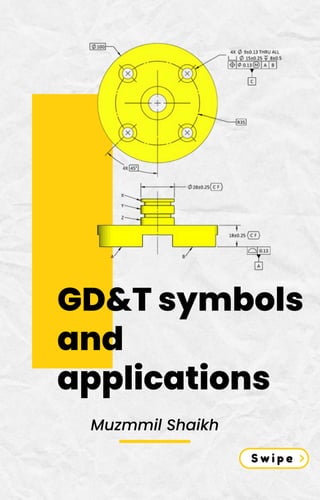
GD&T symbols
and
applications
Muzmmil Shaikh
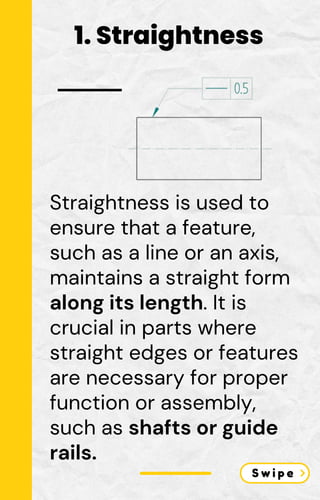
Straightness is used to
ensure that a feature,
such as a line or an axis,
maintains a straight form
along its length. It is
crucial in parts where
straight edges or features
are necessary for proper
function or assembly,
such as shafts or guide
rails.
1. Straightness
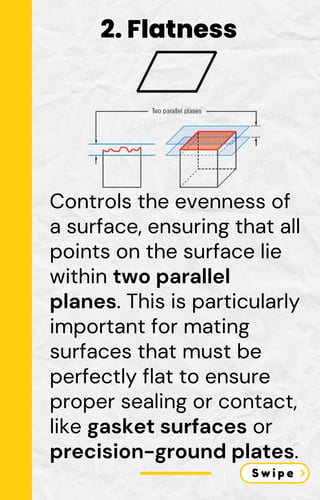
Controls the evenness of
a surface, ensuring that all
points on the surface lie
within two parallel
planes. This is particularly
important for mating
surfaces that must be
perfectly flat to ensure
proper sealing or contact,
like gasket surfaces or
precision-ground plates.
2. Flatness
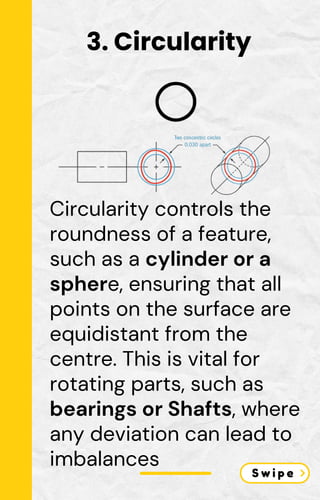
Circularity controls the
roundness of a feature,
such as a cylinder or a
sphere, ensuring that all
points on the surface are
equidistant from the
centre. This is vital for
rotating parts, such as
bearings or Shafts, where
any deviation can lead to
imbalances
3. Circularity
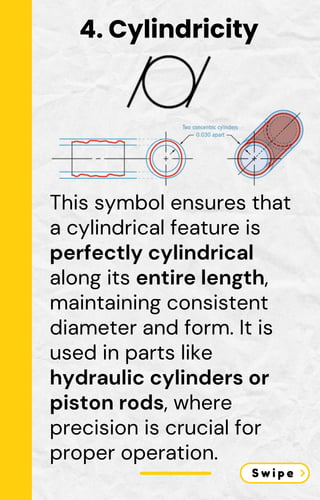
This symbol ensures that
a cylindrical feature is
perfectly cylindrical
along its entire length,
maintaining consistent
diameter and form. It is
used in parts like
hydraulic cylinders or
piston rods, where
precision is crucial for
proper operation.
4. Cylindricity
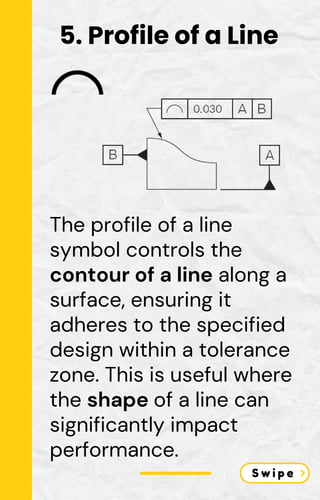
The profile of a line
symbol controls the
contour of a line along a
surface, ensuring it
adheres to the specified
design within a tolerance
zone. This is useful where
the shape of a line can
significantly impact
performance.
5. Profile of a Line
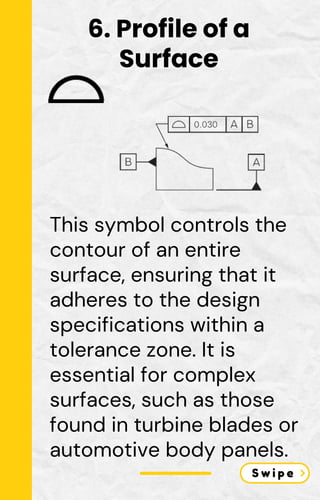
This symbol controls the
contour of an entire
surface, ensuring that it
adheres to the design
specifications within a
tolerance zone. It is
essential for complex
surfaces, such as those
found in turbine blades or
automotive body panels.
6. Profile of a
Surface
Angularity ensures that a
feature is at a specified
angle relative to a datum.
This is important in parts
where precise angles are
necessary for assembly or
function, such as brackets
or mounting surfaces.
7. Angularity
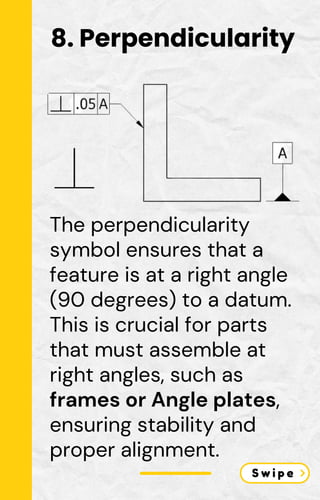
The perpendicularity
symbol ensures that a
feature is at a right angle
(90 degrees) to a datum.
This is crucial for parts
that must assemble at
right angles, such as
frames or Angle plates,
ensuring stability and
proper alignment.
8. Perpendicularity
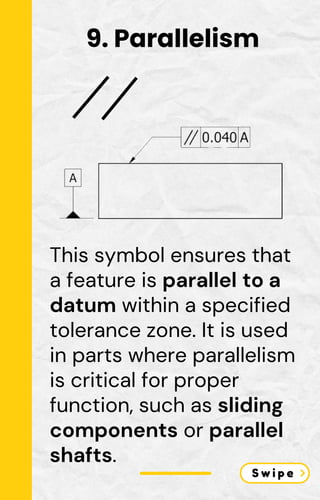
This symbol ensures that
a feature is parallel to a
datum within a specified
tolerance zone. It is used
in parts where parallelism
is critical for proper
function, such as sliding
components or parallel
shafts.
9. Parallelism
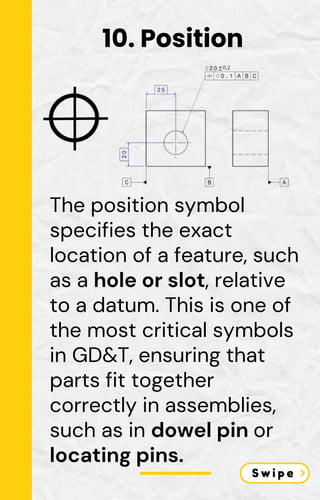
The position symbol
specifies the exact
location of a feature, such
as a hole or slot, relative
to a datum. This is one of
the most critical symbols
in GD&T, ensuring that
parts fit together
correctly in assemblies,
such as in dowel pin or
locating pins.
10. Position
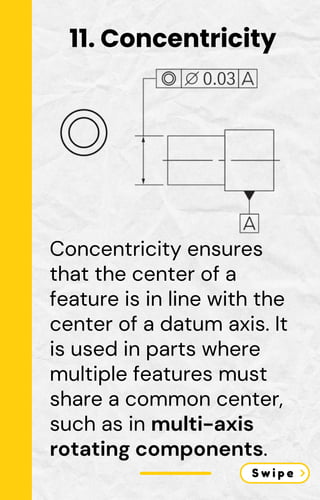
Concentricity ensures
that the center of a
feature is in line with the
center of a datum axis. It
is used in parts where
multiple features must
share a common center,
such as in multi-axis
rotating components.
11. Concentricity
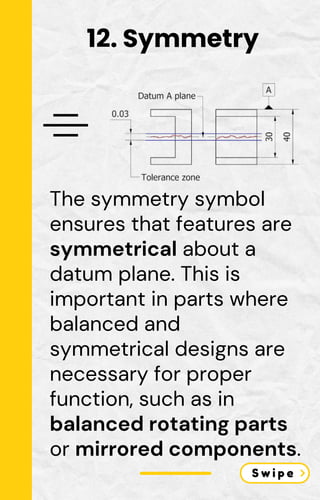
The symmetry symbol
ensures that features are
symmetrical about a
datum plane. This is
important in parts where
balanced and
symmetrical designs are
necessary for proper
function, such as in
balanced rotating parts
or mirrored components.
12. Symmetry
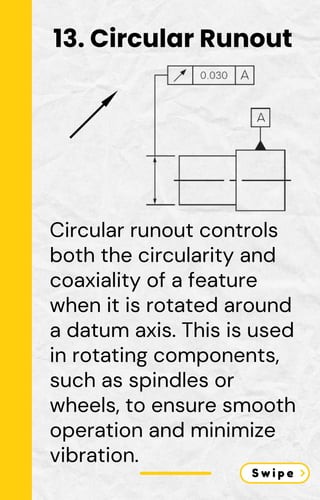
Circular runout controls
both the circularity and
coaxiality of a feature
when it is rotated around
a datum axis. This is used
in rotating components,
such as spindles or
wheels, to ensure smooth
operation and minimize
vibration.
13. Circular Runout
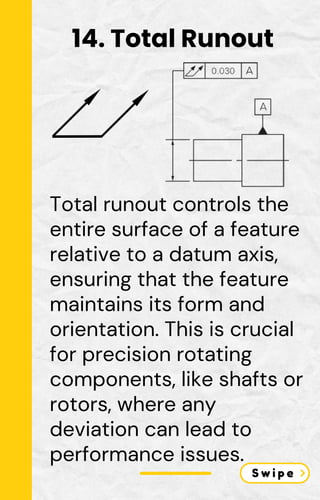
Total runout controls the
entire surface of a feature
relative to a datum axis,
ensuring that the feature
maintains its form and
orientation. This is crucial
for precision rotating
components, like shafts or
rotors, where any
deviation can lead to
performance issues.
14. Total Runout
Ask Question in
the comment
Save the post
Repost to help
others
Muzmmil Shaikh

Geometric dimensioning & tolerance for precise manufacturing process

  • 1.
  • 2.
    Straightness is usedto ensure that a feature, such as a line or an axis, maintains a straight form along its length. It is crucial in parts where straight edges or features are necessary for proper function or assembly, such as shafts or guide rails. 1. Straightness
  • 3.
    Controls the evennessof a surface, ensuring that all points on the surface lie within two parallel planes. This is particularly important for mating surfaces that must be perfectly flat to ensure proper sealing or contact, like gasket surfaces or precision-ground plates. 2. Flatness
  • 4.
    Circularity controls the roundnessof a feature, such as a cylinder or a sphere, ensuring that all points on the surface are equidistant from the centre. This is vital for rotating parts, such as bearings or Shafts, where any deviation can lead to imbalances 3. Circularity
  • 5.
    This symbol ensuresthat a cylindrical feature is perfectly cylindrical along its entire length, maintaining consistent diameter and form. It is used in parts like hydraulic cylinders or piston rods, where precision is crucial for proper operation. 4. Cylindricity
  • 6.
    The profile ofa line symbol controls the contour of a line along a surface, ensuring it adheres to the specified design within a tolerance zone. This is useful where the shape of a line can significantly impact performance. 5. Profile of a Line
  • 7.
    This symbol controlsthe contour of an entire surface, ensuring that it adheres to the design specifications within a tolerance zone. It is essential for complex surfaces, such as those found in turbine blades or automotive body panels. 6. Profile of a Surface
  • 8.
    Angularity ensures thata feature is at a specified angle relative to a datum. This is important in parts where precise angles are necessary for assembly or function, such as brackets or mounting surfaces. 7. Angularity
  • 9.
    The perpendicularity symbol ensuresthat a feature is at a right angle (90 degrees) to a datum. This is crucial for parts that must assemble at right angles, such as frames or Angle plates, ensuring stability and proper alignment. 8. Perpendicularity
  • 10.
    This symbol ensuresthat a feature is parallel to a datum within a specified tolerance zone. It is used in parts where parallelism is critical for proper function, such as sliding components or parallel shafts. 9. Parallelism
  • 11.
    The position symbol specifiesthe exact location of a feature, such as a hole or slot, relative to a datum. This is one of the most critical symbols in GD&T, ensuring that parts fit together correctly in assemblies, such as in dowel pin or locating pins. 10. Position
  • 12.
    Concentricity ensures that thecenter of a feature is in line with the center of a datum axis. It is used in parts where multiple features must share a common center, such as in multi-axis rotating components. 11. Concentricity
  • 13.
    The symmetry symbol ensuresthat features are symmetrical about a datum plane. This is important in parts where balanced and symmetrical designs are necessary for proper function, such as in balanced rotating parts or mirrored components. 12. Symmetry
  • 14.
    Circular runout controls boththe circularity and coaxiality of a feature when it is rotated around a datum axis. This is used in rotating components, such as spindles or wheels, to ensure smooth operation and minimize vibration. 13. Circular Runout
  • 15.
    Total runout controlsthe entire surface of a feature relative to a datum axis, ensuring that the feature maintains its form and orientation. This is crucial for precision rotating components, like shafts or rotors, where any deviation can lead to performance issues. 14. Total Runout
  • 16.
    Ask Question in thecomment Save the post Repost to help others Muzmmil Shaikh