GEOGRAPHY
L NGOBESE
LESSON OUTCOMES
• Define the term slope
• Identify the type of slopes
• Distinguish the slope elements
• Analyse the slope characteristics
• Draw and label the slope elements
• construct solutions to the economic and environmental impact of
slope elements
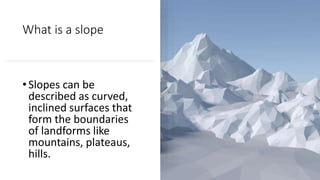
What is a slope
•Slopes can be
described as curved,
inclined surfaces that
form the boundaries
of landforms like
mountains, plateaus,
hills.
Did you know?
•Parts of Johannesburg are more than 1 800
metres above sea level.
Types of slopes
1. Steep slopes
Rises at a very sharp angle and is difficult to go up
2. Concave slopes
A slope that decreases in steepness as it loses
elevation
3. Convex slopes
A slope that steepens as it descends.
Time for a fun activity
•Draw a diagram of a convex and a concave
slope (1 minute)
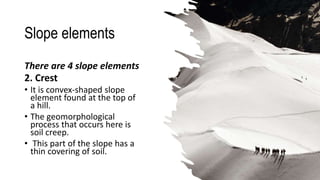
Slope elements
There are 4 slope elements
2. Crest
• It is convex-shaped slope
element found at the top of
a hill.
• The geomorphological
process that occurs here is
soil creep.
• This part of the slope has a
thin covering of soil.
2. Cliff
• Also known as free face or scarp slope,angle of the cliff slope is about
90 degrees.
• Almost vertical sope.
• It is formed by a layer of hard or resistant rock and is too steep for the
accumulation of weathered material.
• The geomorphological process that occurs at the cliff is erosion.
• Loose material falls at the foot of the cliff.
3.
Talus
Uniform slope angle.
Also called a scree or debris slope, and is formed of
material eroded from the crest and freeface.
The accumulated material of loose boulders and
pebbles is called scree.
The geomorphological process that occurs at the talus
slope is deposition.
4. PEDIMENT
• It is a low angle concave slope.
• It is steeper towards the talus slope and gentler at the base.
• Pediment increases as the slope rereats backwards because of scarp
retreat.
• The geomorphological process that occurs at the pediment is
deposition.
• The gentle gradient enables people to use it for farming and building
houses and roads
KNICKPOINT: .
• It is a sharp change in gradient at the base of the talus slope.
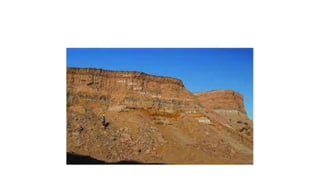
Fun activity 2nd
•Look at that diagram and identify slope
elements that you can see (2 minutes)
Economic and environmental impact of slope
elements
• The solutions we're considering are ways to reduce the negative
economic and environmental impact of slope elements, like
landslides, erosion, and flooding.
So, here are some simple solutions…
• One solution is to use plants like trees and shrubs to stabilize the soil
and reduce erosion.
Solutions continued
• Another solution is to build structures like retaining walls or terraces
to help support the soil and prevent landslides.
• A third solution is to develop policies that regulate construction and
development in sloping areas.
Fun activity 3rd
•Can you think of any other
solutions ?
HOME
WORK Create your own model
of a slope (10 Marks)

GEOGRAPHY micro lesson Slope.pptx

  • 1.
  • 2.
    LESSON OUTCOMES • Definethe term slope • Identify the type of slopes • Distinguish the slope elements • Analyse the slope characteristics • Draw and label the slope elements • construct solutions to the economic and environmental impact of slope elements
  • 3.
    What is aslope •Slopes can be described as curved, inclined surfaces that form the boundaries of landforms like mountains, plateaus, hills.
  • 4.
    Did you know? •Partsof Johannesburg are more than 1 800 metres above sea level.
  • 5.
    Types of slopes 1.Steep slopes Rises at a very sharp angle and is difficult to go up 2. Concave slopes A slope that decreases in steepness as it loses elevation 3. Convex slopes A slope that steepens as it descends.
  • 6.
    Time for afun activity •Draw a diagram of a convex and a concave slope (1 minute)
  • 7.
    Slope elements There are4 slope elements 2. Crest • It is convex-shaped slope element found at the top of a hill. • The geomorphological process that occurs here is soil creep. • This part of the slope has a thin covering of soil.
  • 8.
    2. Cliff • Alsoknown as free face or scarp slope,angle of the cliff slope is about 90 degrees. • Almost vertical sope. • It is formed by a layer of hard or resistant rock and is too steep for the accumulation of weathered material. • The geomorphological process that occurs at the cliff is erosion. • Loose material falls at the foot of the cliff.
  • 9.
    3. Talus Uniform slope angle. Alsocalled a scree or debris slope, and is formed of material eroded from the crest and freeface. The accumulated material of loose boulders and pebbles is called scree. The geomorphological process that occurs at the talus slope is deposition.
  • 10.
    4. PEDIMENT • Itis a low angle concave slope. • It is steeper towards the talus slope and gentler at the base. • Pediment increases as the slope rereats backwards because of scarp retreat. • The geomorphological process that occurs at the pediment is deposition. • The gentle gradient enables people to use it for farming and building houses and roads
  • 11.
    KNICKPOINT: . • Itis a sharp change in gradient at the base of the talus slope.
  • 12.
    Fun activity 2nd •Lookat that diagram and identify slope elements that you can see (2 minutes)
  • 14.
    Economic and environmentalimpact of slope elements • The solutions we're considering are ways to reduce the negative economic and environmental impact of slope elements, like landslides, erosion, and flooding. So, here are some simple solutions… • One solution is to use plants like trees and shrubs to stabilize the soil and reduce erosion.
  • 15.
    Solutions continued • Anothersolution is to build structures like retaining walls or terraces to help support the soil and prevent landslides. • A third solution is to develop policies that regulate construction and development in sloping areas.
  • 16.
    Fun activity 3rd •Canyou think of any other solutions ?
  • 17.
    HOME WORK Create yourown model of a slope (10 Marks)