The Role of Thermal Potential in Enhancing
Energy Efficiency / Productivity
Presented by:
Yale Carden
GeoExchange Australia Pty Ltd
27 June 2018
Presentation Overview
 Start With Why
 What is Thermal Potential?
 Enhancing Energy Efficiency / Productivity
 Geoexchange 101
 Case Studies
 Conclusions
The Role of Thermal Potential in Enhancing Energy Efficiency / Productivity
The First Why
 ‘…we must consider environmental sustainability as one of the world’s greatest challenges.’
 ‘…must promote sustainability through educational programs and school operations.’
 ‘We must focus on minimising our carbon emissions and environmental footprint through
energy, water consumption and waste recycling.’
The Role of Thermal Potential in Enhancing Energy Efficiency / Productivity
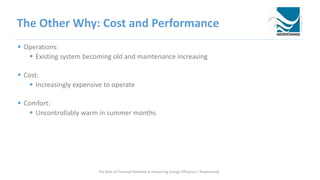
The Other Why: Cost and Performance
 Operations:
 Existing system becoming old and maintenance increasing
 Cost:
 Increasingly expensive to operate
 Comfort:
 Uncontrollably warm in summer months
The Role of Thermal Potential in Enhancing Energy Efficiency / Productivity
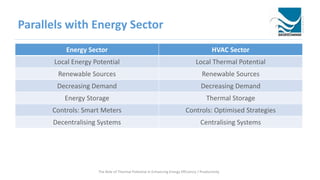
Parallels with Energy Sector
Energy Sector HVAC Sector
Local Energy Potential Local Thermal Potential
Renewable Sources Renewable Sources
Decreasing Demand Decreasing Demand
Energy Storage Thermal Storage
Controls: Smart Meters Controls: Optimised Strategies
Decentralising Systems Centralising Systems
The Role of Thermal Potential in Enhancing Energy Efficiency / Productivity
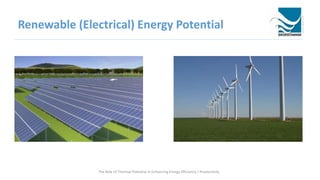
Renewable (Electrical) Energy Potential
The Role of Thermal Potential in Enhancing Energy Efficiency / Productivity
Renewable (Electrical) Energy Potential
The Role of Thermal Potential in Enhancing Energy Efficiency / Productivity
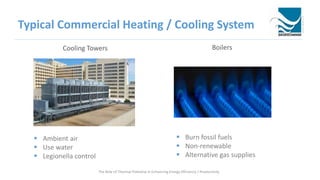
Typical Commercial Heating / Cooling System
Cooling Towers Boilers
 Ambient air
 Use water
 Legionella control
 Burn fossil fuels
 Non-renewable
 Alternative gas supplies
The Role of Thermal Potential in Enhancing Energy Efficiency / Productivity
What is Thermal Potential?
 Demand Management Tool – the (forgotten) half of the energy equation
 Thermal is energy too!
 Thermal energy can also be renewable – not just about burning gas and fossil fuels
 Thermal potential consists of:
 Heat sources (heating)
 Heat sinks (cooling)
 Thermal energy storage, including phase change materials
 Multiple thermal sources in the built environment
The Role of Thermal Potential in Enhancing Energy Efficiency / Productivity
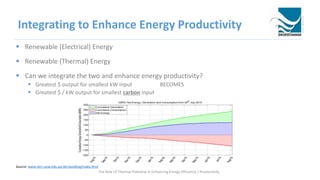
Integrating to Enhance Energy Productivity
 Renewable (Electrical) Energy
 Renewable (Thermal) Energy
 Can we integrate the two and enhance energy productivity?
 Greatest $ output for smallest kW input BECOMES
 Greatest $ / kW output for smallest carbon input
Source: www.sbrc.uow.edu.au/sbrcbuilding/index.html
The Role of Thermal Potential in Enhancing Energy Efficiency / Productivity
Geoexchange 101: The Basics
The Role of Thermal Potential in Enhancing Energy Efficiency / Productivity
Geoexchange 101: The Basics
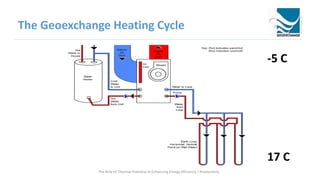
 Transfers heat from the earth into the building in winter (earth as heat source)
 Transfers heat from the building into the ground in summer (earth as heat sink)
 Geoexchange or low temperature geothermal NOT ‘hot rocks’
 Solar radiation not heat from the Earth’s crust
The Role of Thermal Potential in Enhancing Energy Efficiency / Productivity
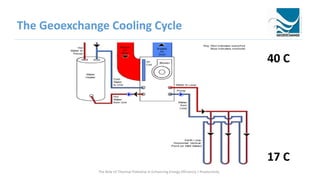
The Geoexchange Cooling Cycle
The Role of Thermal Potential in Enhancing Energy Efficiency / Productivity
17 C
40 C
The Geoexchange Heating Cycle
The Role of Thermal Potential in Enhancing Energy Efficiency / Productivity
17 C
-5 C
Ground Heat Exchanger
The Role of Thermal Potential in Enhancing Energy Efficiency / Productivity
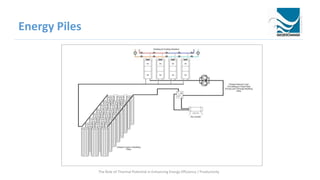
Energy Piles
The Role of Thermal Potential in Enhancing Energy Efficiency / Productivity
Sewer Heat Recovery
 Also includes wastewater / treated effluent
 Not just heating – cooling also possible
 20-25C heat source / sink is common
 Match ‘water’ flow to heating / cooling requirements
 Local projects using treated effluent:
 Hobart Aquatic Centre, Hobart
 Grand Chancellor Hotel, Hobart
The Role of Thermal Potential in Enhancing Energy Efficiency / Productivity
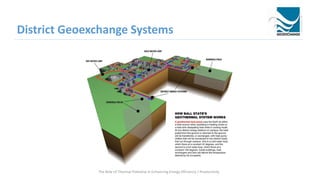
District Geoexchange Systems
The Role of Thermal Potential in Enhancing Energy Efficiency / Productivity
Thermal Energy Storage
0
5000
10000
15000
20000
25000
30000
35000
40000
0 2 4 6 8 10 12
TotalLoads(kWhrs)
Time (Months)
Cooling (kWhrs)
Heating (kWhrs)
Short term storage:
Simultaneous or diurnal
Annual storage
Heat
Rejection
Heat
Extraction
Heat
Rejection
The Role of Thermal Potential in Enhancing Energy Efficiency / Productivity
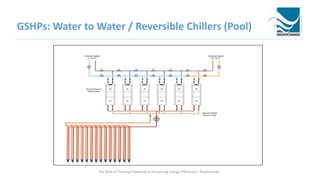
GSHPs: Water to Water / Reversible Chillers (Pool)
The Role of Thermal Potential in Enhancing Energy Efficiency / Productivity
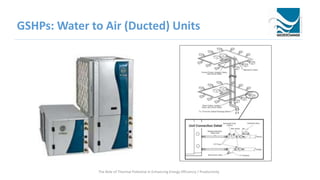
GSHPs: Water to Air (Ducted) Units
The Role of Thermal Potential in Enhancing Energy Efficiency / Productivity
Case Study: St Peters College
 Existing system uses ambient air
 Thermal potential approach considered the following:
 Gas;
 Ambient air (used for heat recovery);
 Ground with vertical borehole GHX;
 Ground with horizontal GHX;
 River water under existing irrigation license;
 Treated effluent.
 River water was Client preference. However, logistical and future-proofing issues;
 Vertical GHX preferred over horizontal GHX
 Minimise impact on sport fields;
 Enable future expansion of system.
The Role of Thermal Potential in Enhancing Energy Efficiency / Productivity
The Ground Heat Exchanger
The Role of Thermal Potential in Enhancing Energy Efficiency / Productivity
The Ground Source Heat Pumps
 2 x water to water / reversible chillers
 6 x various water to air (ducted) GSHPs
 Heat Recovery System
 Variable Speed Pumps
The Role of Thermal Potential in Enhancing Energy Efficiency / Productivity
Energy Efficiency Opportunities
56%
8%
3%
25%
8%
Energy Efficiency Opportunities
Geoexchange Plant Upgrade Fresh Air Heat Recovery Roof Pool Blanket Ducted GSHPs
The Role of Thermal Potential in Enhancing Energy Efficiency / Productivity
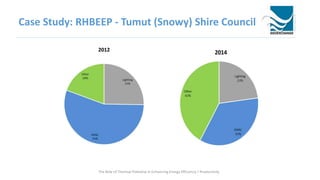
Case Study: RHBEEP - Tumut (Snowy) Shire Council
The Role of Thermal Potential in Enhancing Energy Efficiency / Productivity
Case Study: RHBEEP - Tumut (Snowy) Shire Council
 Building energy savings: 80 % or $94 000 per annum
 HVAC energy savings: 71 % or $85 000 per annum
 Maintenance / tenancy savings: $80 000 per annum
 Electricity demand reduction: 151 kVA (75 %) Geoexchange at 49 %
 Annual GHG Reduction: 79 tCO2
 Simple Payback: 7.6 years
 Return on Investment: 11-12 %
The Role of Thermal Potential in Enhancing Energy Efficiency / Productivity
Case Study: Geoscience Australia
 The Ground Heat Exchanger:
 350 Boreholes
 104 m deep
 1.25” diameter polyethylene pipe
 4.5 m spacings
 Ground Source Heat Pumps:
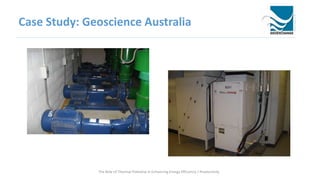
 220 x WaterFurnace water to air GSHPs: Premier2
 2-speed compressor
 3-speed fan
 BMS connectivity
 R22 refrigerant
The Role of Thermal Potential in Enhancing Energy Efficiency / Productivity
Case Study: Geoscience Australia
The Role of Thermal Potential in Enhancing Energy Efficiency / Productivity
Case Study: Geoscience Australia
The Role of Thermal Potential in Enhancing Energy Efficiency / Productivity
Case Study: Geoscience Australia
The Role of Thermal Potential in Enhancing Energy Efficiency / Productivity
Conclusions: Enhancing Energy Efficiency?
 Create energy from renewable sources – use as efficiently as possible
 Thermal is energy too…and it can be renewable
 Identify local thermal potential
 Can we use renewable (thermal) energy when renewable (electrical) energy is available?
 Timing issues? Storage is the key – electrical or thermal
 Optimised / Predictive Control Strategies
 Canberra is ideal climate for the technology with great local case studies
The Role of Thermal Potential in Enhancing Energy Efficiency / Productivity
Thank you
Yale Carden
GeoExchange Australia Pty Ltd
Phone: 02 8404 4193
Email: ycarden@geoexchange.com.au
Website: www.geoexchange.com.au
The RHBEEP Project
www.tumut.nsw.gov.au/riverina-highlands-building-energy-efficient-project-rhbeep.aspx
Sustainable Buildings Research Centre, University of Wollongong
www.sbrc.uow.edu.au
The Role of Thermal Potential in Enhancing Energy Efficiency / Productivity

Geoexchange and Thermal Potential at Geoscience

  • 1.
    The Role ofThermal Potential in Enhancing Energy Efficiency / Productivity Presented by: Yale Carden GeoExchange Australia Pty Ltd 27 June 2018
  • 2.
    Presentation Overview  StartWith Why  What is Thermal Potential?  Enhancing Energy Efficiency / Productivity  Geoexchange 101  Case Studies  Conclusions The Role of Thermal Potential in Enhancing Energy Efficiency / Productivity
  • 3.
    The First Why ‘…we must consider environmental sustainability as one of the world’s greatest challenges.’  ‘…must promote sustainability through educational programs and school operations.’  ‘We must focus on minimising our carbon emissions and environmental footprint through energy, water consumption and waste recycling.’ The Role of Thermal Potential in Enhancing Energy Efficiency / Productivity
  • 4.
    The Other Why:Cost and Performance  Operations:  Existing system becoming old and maintenance increasing  Cost:  Increasingly expensive to operate  Comfort:  Uncontrollably warm in summer months The Role of Thermal Potential in Enhancing Energy Efficiency / Productivity
  • 5.
    Parallels with EnergySector Energy Sector HVAC Sector Local Energy Potential Local Thermal Potential Renewable Sources Renewable Sources Decreasing Demand Decreasing Demand Energy Storage Thermal Storage Controls: Smart Meters Controls: Optimised Strategies Decentralising Systems Centralising Systems The Role of Thermal Potential in Enhancing Energy Efficiency / Productivity
  • 6.
    Renewable (Electrical) EnergyPotential The Role of Thermal Potential in Enhancing Energy Efficiency / Productivity
  • 7.
    Renewable (Electrical) EnergyPotential The Role of Thermal Potential in Enhancing Energy Efficiency / Productivity
  • 8.
    Typical Commercial Heating/ Cooling System Cooling Towers Boilers  Ambient air  Use water  Legionella control  Burn fossil fuels  Non-renewable  Alternative gas supplies The Role of Thermal Potential in Enhancing Energy Efficiency / Productivity
  • 9.
    What is ThermalPotential?  Demand Management Tool – the (forgotten) half of the energy equation  Thermal is energy too!  Thermal energy can also be renewable – not just about burning gas and fossil fuels  Thermal potential consists of:  Heat sources (heating)  Heat sinks (cooling)  Thermal energy storage, including phase change materials  Multiple thermal sources in the built environment The Role of Thermal Potential in Enhancing Energy Efficiency / Productivity
  • 10.
    Integrating to EnhanceEnergy Productivity  Renewable (Electrical) Energy  Renewable (Thermal) Energy  Can we integrate the two and enhance energy productivity?  Greatest $ output for smallest kW input BECOMES  Greatest $ / kW output for smallest carbon input Source: www.sbrc.uow.edu.au/sbrcbuilding/index.html The Role of Thermal Potential in Enhancing Energy Efficiency / Productivity
  • 11.
    Geoexchange 101: TheBasics The Role of Thermal Potential in Enhancing Energy Efficiency / Productivity
  • 12.
    Geoexchange 101: TheBasics  Transfers heat from the earth into the building in winter (earth as heat source)  Transfers heat from the building into the ground in summer (earth as heat sink)  Geoexchange or low temperature geothermal NOT ‘hot rocks’  Solar radiation not heat from the Earth’s crust The Role of Thermal Potential in Enhancing Energy Efficiency / Productivity
  • 13.
    The Geoexchange CoolingCycle The Role of Thermal Potential in Enhancing Energy Efficiency / Productivity 17 C 40 C
  • 14.
    The Geoexchange HeatingCycle The Role of Thermal Potential in Enhancing Energy Efficiency / Productivity 17 C -5 C
  • 15.
    Ground Heat Exchanger TheRole of Thermal Potential in Enhancing Energy Efficiency / Productivity
  • 16.
    Energy Piles The Roleof Thermal Potential in Enhancing Energy Efficiency / Productivity
  • 17.
    Sewer Heat Recovery Also includes wastewater / treated effluent  Not just heating – cooling also possible  20-25C heat source / sink is common  Match ‘water’ flow to heating / cooling requirements  Local projects using treated effluent:  Hobart Aquatic Centre, Hobart  Grand Chancellor Hotel, Hobart The Role of Thermal Potential in Enhancing Energy Efficiency / Productivity
  • 18.
    District Geoexchange Systems TheRole of Thermal Potential in Enhancing Energy Efficiency / Productivity
  • 19.
    Thermal Energy Storage 0 5000 10000 15000 20000 25000 30000 35000 40000 02 4 6 8 10 12 TotalLoads(kWhrs) Time (Months) Cooling (kWhrs) Heating (kWhrs) Short term storage: Simultaneous or diurnal Annual storage Heat Rejection Heat Extraction Heat Rejection The Role of Thermal Potential in Enhancing Energy Efficiency / Productivity
  • 20.
    GSHPs: Water toWater / Reversible Chillers (Pool) The Role of Thermal Potential in Enhancing Energy Efficiency / Productivity
  • 21.
    GSHPs: Water toAir (Ducted) Units The Role of Thermal Potential in Enhancing Energy Efficiency / Productivity
  • 22.
    Case Study: StPeters College  Existing system uses ambient air  Thermal potential approach considered the following:  Gas;  Ambient air (used for heat recovery);  Ground with vertical borehole GHX;  Ground with horizontal GHX;  River water under existing irrigation license;  Treated effluent.  River water was Client preference. However, logistical and future-proofing issues;  Vertical GHX preferred over horizontal GHX  Minimise impact on sport fields;  Enable future expansion of system. The Role of Thermal Potential in Enhancing Energy Efficiency / Productivity
  • 23.
    The Ground HeatExchanger The Role of Thermal Potential in Enhancing Energy Efficiency / Productivity
  • 24.
    The Ground SourceHeat Pumps  2 x water to water / reversible chillers  6 x various water to air (ducted) GSHPs  Heat Recovery System  Variable Speed Pumps The Role of Thermal Potential in Enhancing Energy Efficiency / Productivity
  • 25.
    Energy Efficiency Opportunities 56% 8% 3% 25% 8% EnergyEfficiency Opportunities Geoexchange Plant Upgrade Fresh Air Heat Recovery Roof Pool Blanket Ducted GSHPs The Role of Thermal Potential in Enhancing Energy Efficiency / Productivity
  • 26.
    Case Study: RHBEEP- Tumut (Snowy) Shire Council The Role of Thermal Potential in Enhancing Energy Efficiency / Productivity
  • 27.
    Case Study: RHBEEP- Tumut (Snowy) Shire Council  Building energy savings: 80 % or $94 000 per annum  HVAC energy savings: 71 % or $85 000 per annum  Maintenance / tenancy savings: $80 000 per annum  Electricity demand reduction: 151 kVA (75 %) Geoexchange at 49 %  Annual GHG Reduction: 79 tCO2  Simple Payback: 7.6 years  Return on Investment: 11-12 % The Role of Thermal Potential in Enhancing Energy Efficiency / Productivity
  • 28.
    Case Study: GeoscienceAustralia  The Ground Heat Exchanger:  350 Boreholes  104 m deep  1.25” diameter polyethylene pipe  4.5 m spacings  Ground Source Heat Pumps:  220 x WaterFurnace water to air GSHPs: Premier2  2-speed compressor  3-speed fan  BMS connectivity  R22 refrigerant The Role of Thermal Potential in Enhancing Energy Efficiency / Productivity
  • 29.
    Case Study: GeoscienceAustralia The Role of Thermal Potential in Enhancing Energy Efficiency / Productivity
  • 30.
    Case Study: GeoscienceAustralia The Role of Thermal Potential in Enhancing Energy Efficiency / Productivity
  • 31.
    Case Study: GeoscienceAustralia The Role of Thermal Potential in Enhancing Energy Efficiency / Productivity
  • 32.
    Conclusions: Enhancing EnergyEfficiency?  Create energy from renewable sources – use as efficiently as possible  Thermal is energy too…and it can be renewable  Identify local thermal potential  Can we use renewable (thermal) energy when renewable (electrical) energy is available?  Timing issues? Storage is the key – electrical or thermal  Optimised / Predictive Control Strategies  Canberra is ideal climate for the technology with great local case studies The Role of Thermal Potential in Enhancing Energy Efficiency / Productivity
  • 33.
    Thank you Yale Carden GeoExchangeAustralia Pty Ltd Phone: 02 8404 4193 Email: ycarden@geoexchange.com.au Website: www.geoexchange.com.au The RHBEEP Project www.tumut.nsw.gov.au/riverina-highlands-building-energy-efficient-project-rhbeep.aspx Sustainable Buildings Research Centre, University of Wollongong www.sbrc.uow.edu.au The Role of Thermal Potential in Enhancing Energy Efficiency / Productivity

Editor's Notes

  • #6 Reduced energy consumption, including peak loads. This enhances capability of local renewable energy generation to provide higher percentage of overall energy usage; Reduced water consumption through removal of cooling towers; Removal of gas from site infrastructure as all heating / cooling is electrically powered. Once again this enhances potential of local renewable energy generation and ensures future flexibility with respect to power (ie not being limited by gas connection); Dual use of existing utilities (eg use of low grade heat from sewer, wastewater, irrigation systems etc for both heating / cooling).
  • #7 Reduced energy consumption, including peak loads. This enhances capability of local renewable energy generation to provide higher percentage of overall energy usage; Reduced water consumption through removal of cooling towers; Removal of gas from site infrastructure as all heating / cooling is electrically powered. Once again this enhances potential of local renewable energy generation and ensures future flexibility with respect to power (ie not being limited by gas connection); Dual use of existing utilities (eg use of low grade heat from sewer, wastewater, irrigation systems etc for both heating / cooling).
  • #8 Reduced energy consumption, including peak loads. This enhances capability of local renewable energy generation to provide higher percentage of overall energy usage; Reduced water consumption through removal of cooling towers; Removal of gas from site infrastructure as all heating / cooling is electrically powered. Once again this enhances potential of local renewable energy generation and ensures future flexibility with respect to power (ie not being limited by gas connection); Dual use of existing utilities (eg use of low grade heat from sewer, wastewater, irrigation systems etc for both heating / cooling).
  • #9 Reduced energy consumption, including peak loads. This enhances capability of local renewable energy generation to provide higher percentage of overall energy usage; Reduced water consumption through removal of cooling towers; Removal of gas from site infrastructure as all heating / cooling is electrically powered. Once again this enhances potential of local renewable energy generation and ensures future flexibility with respect to power (ie not being limited by gas connection); Dual use of existing utilities (eg use of low grade heat from sewer, wastewater, irrigation systems etc for both heating / cooling).
  • #10 Reduced energy consumption, including peak loads. This enhances capability of local renewable energy generation to provide higher percentage of overall energy usage; Reduced water consumption through removal of cooling towers; Removal of gas from site infrastructure as all heating / cooling is electrically powered. Once again this enhances potential of local renewable energy generation and ensures future flexibility with respect to power (ie not being limited by gas connection); Dual use of existing utilities (eg use of low grade heat from sewer, wastewater, irrigation systems etc for both heating / cooling).
  • #11 Reduced energy consumption, including peak loads. This enhances capability of local renewable energy generation to provide higher percentage of overall energy usage; Reduced water consumption through removal of cooling towers; Removal of gas from site infrastructure as all heating / cooling is electrically powered. Once again this enhances potential of local renewable energy generation and ensures future flexibility with respect to power (ie not being limited by gas connection); Dual use of existing utilities (eg use of low grade heat from sewer, wastewater, irrigation systems etc for both heating / cooling).