
Genetic Disorders

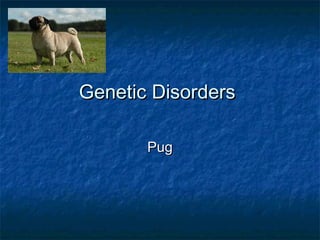
       Pug
Introduction
   When choosing any breed of dog you must be aware of
    potential health concerns
   All dogs mixes and pure bred can have health concerns
   The more popular breeds and their mixes will have more
    genetic problems listed and more likely to have puppies
    with problems .
   Make sure your breeder offers a written health guarantee
    good for one year.
   Have the puppy heath checked at your Veterinarian.
Eye Disorders
   Exposure keratopathy syndrome (exophthalmos, lagophthalmos, and/
    )
   With this syndrome, there is chronic irritation of the
    surface of the eye (the cornea) because of increased
    evaporation of tears and increased corneal exposure.
    This is a result of a combination of anatomic features
    including exophthalmos (protrusion of the eyeball),
    lagophthalmos (inability to close the eyelids completely)
    andmacroblepharon (an exceptionally large eyelid
    opening, often associated with lower lid entropion ). The
    result is inadequate blinking, and therefore reduced
    protection for the eye. Affected dogs experience chronic
    discomfort and are prone to ulceration of the cornea .
Eye Disorders
   Cataracts : Can be congenital, juvenile or as a
    result of old age

   Keratoconjunctivitis sicca KCS or "dry eye"
    is an eye disease caused by abnormal bulk of
    the tears.
   Entropion : Entropion is the inward rolling of
    the eyelid, most commonly the lower lid. This
    irritates the surface of the eye (the cornea) and
    may ultimately cause visual impairment.
Eye Disorders
   Eyelash abnormalities Normally the eyelashes (or cilia)
    grow from follicles in the eyelid. Abnormalities of the
    eyelash are a common hereditary problem in dogs. The
    three types are:
   distichiasis, in which extra eyelashes grow from abnormal
    follicles located on the inside edge of the eyelid. They may
    be singular or multiple.

    ectopic cilia, in which the extra eyelash grows through the
    eyelid to the inside.One or more ectopic cilia may be
    present.

    trichiasis, in which eyelashes growing from normal sites
    turn inward. The eyelashes are often abnormally long.
Respiratory Disorders
     brachycephalic syndrome Problems associated with this syndrome range
      in severity, with most brachycephalic dogs snuffling and snorting to
      some degree. Some will have no further difficulties, but many will have
      problems such as increasingly noisy breathing, coughing and gagging,
      fainting or collapsing episodes, and a decreased tolerance for exercise
      (ie. they tire easily). Over the long term, this also puts an increased
      strain on the heart.
     Overheating is especially dangerous because increased panting (the
      normal mechanism for cooling in dogs) can cause further swelling and
      narrowing of the already constricted airways, which will increase your
      dog's anxiety. Excitement, exercise, or warm weather (and especially a
      combination of these factors) can trigger this vicious cycle. These dogs
      can also have gastrointestinal problems, because of difficulties
      coordinating swallowing when they are working so hard at breathing.
      This can result in vomiting gagging because of swallowing so much air,
      or aspiration pneumonia, because of breathing in saliva or food
      particles.They have an increased risk associated with sedation and
      anesthesia
, .
Musculoskeletal Disorders
   Legg-Calvé-Perthes disease : This is a disease of
    the hip joint in young (4 to 12 months), small-breed dogs.
   Hemivertebra This is a condition where there is
    abnormal bony development of one or more of the
    vertebrae - the bones that make up the spinal column.
    The main part of each vertebra should look like a spool
    when seen from the side. A hemivertebra looks like a
    wedge or triangle. Hemivertebra can occur in dogs that
    have other kinds of vertebral malformations as well.
    Whether the condition causes problems for the dog
    depends on what part of the spinal column is affected,
    and whether there is compression of the spinal cord
Immune Disorder
   Atopy The condition is usually first seen between 1 and 3 years of age,
    although it may develop as late as 6 or 7. Initially atopy may be
    seasonal (eg. from spring to fall) but most affected dogs eventually have
    signs all year round.
   Dogs with atopy are very itchy. The areas most affected are the face,
    paws, lower legs, groin, and, less often, the ears and eyes. In addition
    to scratching themselves with their hind feet, they often lick or chew the
    affected areas, or rub along the carpet to scratch the face or ears. The
    intense itching can make them irritable and less tolerant of being
    handled.
    Initially, there are no apparent skin abnormalities, except possibly slight
    reddening, even though the dog is clearly itchy. (This is important
    because in other conditions there is often a rash or some visible lesion.)
    Over time, lesions develop as a result of the scratching and self-trauma,
    bacterial or yeast infections, and seborrhea, all of which can contribute
    to the objectionable odor of these dogs. The skin becomes reddened
    and eventually darkened (hyperpigmentation), abraded, thickened, and
    wrinkled, with loss of hair and bronze staining from saliva.
Skin Disorders
   Demodicosis/ Demodectic mange is a mite that is present in
    small numbers in the skin of most healthy dogs. Nursing puppies
    acquire the mite from their mothers during the first few days of life,
    and in most dogs there will never be any associated problems.
    In some dogs however, the normal balance is disrupted due to an
    immune defect. The mites multiply by the thousands in the hair
    follicles causing inflammation, in a condition called demodicosis.
    Demodicosis may be localized - that is, confined to 1 or more
    small discrete scaly reddened areas of hair loss, most commonly on
    the face or front legs. This is usually seen in pups of 3 to 6 months
    of age, and most cases resolve spontaneously. Alternately,
    generalized demodicosis may develop, at anywhere from 3 to
    12 months of age. This is a severe skin condition.
    The defect in the cell-mediated immune system which allows the
    development of generalized demodicosis is believed to be inherited
   It is not infectious, to other pets or to people
Skin Disorders
   Fold dermatitis/pyoderma Dermatitis means inflammation
    of the skin. Where there are excessive skin folds or
    wrinkles, fold dermatitis occurs due to rubbing of skin
    and trapping of moisture in the folds. Pyoderma
    (bacterial skin infection) commonly develops, almost
    always caused by Staphylococcus intermedius (which
    does not cause problems in people).
    Common forms are tail, lip, and facial fold dermatitis and
    associated pyoderma, in breeds where there is skin
    folding in these areas
Heart Disorder
   Sick sinus syndrome Sick sinus syndrome (also called sinus node
    dysfunction or bradycardia-tachycardia syndrome) is a disturbance of the
    normal rhythm of the heart in adult/older dogs. Normally, a dog's heart will
    beat at a rate as low as 40 beats/minute during sleep and as high as 280
    beats/minute during intense exercise. In sick sinus syndrome, the heart's
    natural ability to beat is compromised. Some dogs suddenly have a heart
    rate as slow as 10 beats/minute, even during physical exercise; this causes
    a drastic drop in circulation, and then they recover for hours or days before
    having another sudden drop in heart rate. Other dogs have the opposite: a
    heart rate that suddenly is very fast, causing a pounding heartbeat and also
    compromising the circulation. Overall, then, sick sinus syndrome is a
    disorder that causes an erratic change in the heartbeat, and that begins
    mildly and then develops over time into a potentially life-threatening
    problem. The hallmark symptom of sick sinus syndrome is sudden loss of
    consciousness (fainting), also called syncope
Nervous System Disorders
   Spina bifida Normally, the spinal cord is surrounded and protected
    by the vertebrae of the spinal column. In spina bifida, there is
    defective fusion of the vertebral arches during embryonic
    development, so that the vertebrae are incomplete

   Most often, spina bifida occurs in the lower back region (caudal lumbar
    spine). The clinical signs vary with the extent of the defect. With a mild
    defect, you will likely never know there is an abnormality unless your dog
    has x-rays that show the area

   When the spinal cord itself is affected, you will see signs in the hind end
    ranging from weakness and incoordination to paralysis and urinary and fecal
    incontinence. With a severe defect (absence of several adjacent vertebral
    arches with protrusion of spinal cord), signs are generally evident very early,
    when pups start to walk.
Nervous System Disorders
   Meningitis Meningitis means inflammation of the
    meninges, which are the membranes that line the brain
    and spinal cord. Most cases of meningitis are due to
    bacterial or viral infection. Some forms occur in specific
    breeds however, and are believed to have an inherited
    basis. This may be because of a genetically determined
    abnormality of the immune system .Signs develop
    between 6 months and 7 years, and include seizures
    (which increase in severity), change in attitude, neck
    pain and rigidity, circling, and/or blindness
In Conclusion
   Pugs have 14 health concerns Disorders relatively common in this
    breed are : Keratoconjuctivitus siica “dry eye”

   Note above disorder(s) is very common in this breed. Do not take lightly
    the other disorders. Some are very serious .

   Information for this presentation as a public service provided by:
    www.delayrekennel.com with information provided by :

   A joint initiative of the Sir James Dunn Animal Welfare Centre at the
    Atlantic Veterinary College, University of Prince Edward Island, and the
    Canadian Veterinary Medical Association..
    Permission is granted to reprint pages from the database, provided that
    credit is given as follows: Crook A et al. 2011. Canine Inherited
    Disorders Database

     Photos Wickipedia Encyclopedia
About the Presenter
   Member of the Canine Ambassador Program with Orange Empire Dog
    Club. Educating people in the joy canines bring into our lives through their
    relationship, interaction, and unconditional love.
   Pet Professional specializing in the training of puppies in Sun Valley since
    1974 .
   Breeder of Silky Terriers and Wire Fox Terriers
   My boarding, training and breeding kennel was awarded Small Business of
    the Year 2000
   Better Business Bureau A+ rating
   I have owned and/or bred 21 Conformation Champions including 6
    International Champions
   Member and former Vice President of the City of Angels Silky Terrier Club
   Past President of Sun Valley Chamber of Commerce
   Have also served on the boards of Associated Terrier Breeders, Animal
    Safe Haven Foundation, United Chambers of Commerce

Genetic Disorders Pug

  • 1.
  • 2.
    Introduction  When choosing any breed of dog you must be aware of potential health concerns  All dogs mixes and pure bred can have health concerns  The more popular breeds and their mixes will have more genetic problems listed and more likely to have puppies with problems .  Make sure your breeder offers a written health guarantee good for one year.  Have the puppy heath checked at your Veterinarian.
  • 3.
    Eye Disorders  Exposure keratopathy syndrome (exophthalmos, lagophthalmos, and/ )  With this syndrome, there is chronic irritation of the surface of the eye (the cornea) because of increased evaporation of tears and increased corneal exposure. This is a result of a combination of anatomic features including exophthalmos (protrusion of the eyeball), lagophthalmos (inability to close the eyelids completely) andmacroblepharon (an exceptionally large eyelid opening, often associated with lower lid entropion ). The result is inadequate blinking, and therefore reduced protection for the eye. Affected dogs experience chronic discomfort and are prone to ulceration of the cornea .
  • 4.
    Eye Disorders  Cataracts : Can be congenital, juvenile or as a result of old age  Keratoconjunctivitis sicca KCS or "dry eye" is an eye disease caused by abnormal bulk of the tears.  Entropion : Entropion is the inward rolling of the eyelid, most commonly the lower lid. This irritates the surface of the eye (the cornea) and may ultimately cause visual impairment.
  • 5.
    Eye Disorders  Eyelash abnormalities Normally the eyelashes (or cilia) grow from follicles in the eyelid. Abnormalities of the eyelash are a common hereditary problem in dogs. The three types are:  distichiasis, in which extra eyelashes grow from abnormal follicles located on the inside edge of the eyelid. They may be singular or multiple. ectopic cilia, in which the extra eyelash grows through the eyelid to the inside.One or more ectopic cilia may be present. trichiasis, in which eyelashes growing from normal sites turn inward. The eyelashes are often abnormally long.
  • 6.
    Respiratory Disorders  brachycephalic syndrome Problems associated with this syndrome range in severity, with most brachycephalic dogs snuffling and snorting to some degree. Some will have no further difficulties, but many will have problems such as increasingly noisy breathing, coughing and gagging, fainting or collapsing episodes, and a decreased tolerance for exercise (ie. they tire easily). Over the long term, this also puts an increased strain on the heart.  Overheating is especially dangerous because increased panting (the normal mechanism for cooling in dogs) can cause further swelling and narrowing of the already constricted airways, which will increase your dog's anxiety. Excitement, exercise, or warm weather (and especially a combination of these factors) can trigger this vicious cycle. These dogs can also have gastrointestinal problems, because of difficulties coordinating swallowing when they are working so hard at breathing. This can result in vomiting gagging because of swallowing so much air, or aspiration pneumonia, because of breathing in saliva or food particles.They have an increased risk associated with sedation and anesthesia , .
  • 7.
    Musculoskeletal Disorders  Legg-Calvé-Perthes disease : This is a disease of the hip joint in young (4 to 12 months), small-breed dogs.  Hemivertebra This is a condition where there is abnormal bony development of one or more of the vertebrae - the bones that make up the spinal column. The main part of each vertebra should look like a spool when seen from the side. A hemivertebra looks like a wedge or triangle. Hemivertebra can occur in dogs that have other kinds of vertebral malformations as well. Whether the condition causes problems for the dog depends on what part of the spinal column is affected, and whether there is compression of the spinal cord
  • 8.
    Immune Disorder  Atopy The condition is usually first seen between 1 and 3 years of age, although it may develop as late as 6 or 7. Initially atopy may be seasonal (eg. from spring to fall) but most affected dogs eventually have signs all year round.  Dogs with atopy are very itchy. The areas most affected are the face, paws, lower legs, groin, and, less often, the ears and eyes. In addition to scratching themselves with their hind feet, they often lick or chew the affected areas, or rub along the carpet to scratch the face or ears. The intense itching can make them irritable and less tolerant of being handled. Initially, there are no apparent skin abnormalities, except possibly slight reddening, even though the dog is clearly itchy. (This is important because in other conditions there is often a rash or some visible lesion.) Over time, lesions develop as a result of the scratching and self-trauma, bacterial or yeast infections, and seborrhea, all of which can contribute to the objectionable odor of these dogs. The skin becomes reddened and eventually darkened (hyperpigmentation), abraded, thickened, and wrinkled, with loss of hair and bronze staining from saliva.
  • 9.
    Skin Disorders  Demodicosis/ Demodectic mange is a mite that is present in small numbers in the skin of most healthy dogs. Nursing puppies acquire the mite from their mothers during the first few days of life, and in most dogs there will never be any associated problems. In some dogs however, the normal balance is disrupted due to an immune defect. The mites multiply by the thousands in the hair follicles causing inflammation, in a condition called demodicosis. Demodicosis may be localized - that is, confined to 1 or more small discrete scaly reddened areas of hair loss, most commonly on the face or front legs. This is usually seen in pups of 3 to 6 months of age, and most cases resolve spontaneously. Alternately, generalized demodicosis may develop, at anywhere from 3 to 12 months of age. This is a severe skin condition. The defect in the cell-mediated immune system which allows the development of generalized demodicosis is believed to be inherited  It is not infectious, to other pets or to people
  • 10.
    Skin Disorders  Fold dermatitis/pyoderma Dermatitis means inflammation of the skin. Where there are excessive skin folds or wrinkles, fold dermatitis occurs due to rubbing of skin and trapping of moisture in the folds. Pyoderma (bacterial skin infection) commonly develops, almost always caused by Staphylococcus intermedius (which does not cause problems in people). Common forms are tail, lip, and facial fold dermatitis and associated pyoderma, in breeds where there is skin folding in these areas
  • 11.
    Heart Disorder  Sick sinus syndrome Sick sinus syndrome (also called sinus node dysfunction or bradycardia-tachycardia syndrome) is a disturbance of the normal rhythm of the heart in adult/older dogs. Normally, a dog's heart will beat at a rate as low as 40 beats/minute during sleep and as high as 280 beats/minute during intense exercise. In sick sinus syndrome, the heart's natural ability to beat is compromised. Some dogs suddenly have a heart rate as slow as 10 beats/minute, even during physical exercise; this causes a drastic drop in circulation, and then they recover for hours or days before having another sudden drop in heart rate. Other dogs have the opposite: a heart rate that suddenly is very fast, causing a pounding heartbeat and also compromising the circulation. Overall, then, sick sinus syndrome is a disorder that causes an erratic change in the heartbeat, and that begins mildly and then develops over time into a potentially life-threatening problem. The hallmark symptom of sick sinus syndrome is sudden loss of consciousness (fainting), also called syncope
  • 12.
    Nervous System Disorders  Spina bifida Normally, the spinal cord is surrounded and protected by the vertebrae of the spinal column. In spina bifida, there is defective fusion of the vertebral arches during embryonic development, so that the vertebrae are incomplete  Most often, spina bifida occurs in the lower back region (caudal lumbar spine). The clinical signs vary with the extent of the defect. With a mild defect, you will likely never know there is an abnormality unless your dog has x-rays that show the area  When the spinal cord itself is affected, you will see signs in the hind end ranging from weakness and incoordination to paralysis and urinary and fecal incontinence. With a severe defect (absence of several adjacent vertebral arches with protrusion of spinal cord), signs are generally evident very early, when pups start to walk.
  • 13.
    Nervous System Disorders  Meningitis Meningitis means inflammation of the meninges, which are the membranes that line the brain and spinal cord. Most cases of meningitis are due to bacterial or viral infection. Some forms occur in specific breeds however, and are believed to have an inherited basis. This may be because of a genetically determined abnormality of the immune system .Signs develop between 6 months and 7 years, and include seizures (which increase in severity), change in attitude, neck pain and rigidity, circling, and/or blindness
  • 14.
    In Conclusion  Pugs have 14 health concerns Disorders relatively common in this breed are : Keratoconjuctivitus siica “dry eye”  Note above disorder(s) is very common in this breed. Do not take lightly the other disorders. Some are very serious .  Information for this presentation as a public service provided by: www.delayrekennel.com with information provided by :  A joint initiative of the Sir James Dunn Animal Welfare Centre at the Atlantic Veterinary College, University of Prince Edward Island, and the Canadian Veterinary Medical Association.. Permission is granted to reprint pages from the database, provided that credit is given as follows: Crook A et al. 2011. Canine Inherited Disorders Database Photos Wickipedia Encyclopedia
  • 15.
    About the Presenter  Member of the Canine Ambassador Program with Orange Empire Dog Club. Educating people in the joy canines bring into our lives through their relationship, interaction, and unconditional love.  Pet Professional specializing in the training of puppies in Sun Valley since 1974 .  Breeder of Silky Terriers and Wire Fox Terriers  My boarding, training and breeding kennel was awarded Small Business of the Year 2000  Better Business Bureau A+ rating  I have owned and/or bred 21 Conformation Champions including 6 International Champions  Member and former Vice President of the City of Angels Silky Terrier Club  Past President of Sun Valley Chamber of Commerce  Have also served on the boards of Associated Terrier Breeders, Animal Safe Haven Foundation, United Chambers of Commerce