GENESIS 4 COMMENTARY
EDITED BY GLENN PEASE
Cain and Abel
1 Adam[a] made love to his wife Eve, and she
became pregnant and gave birth to Cain.[b] She
said, “With the help of the Lord I have brought
forth[c] a man.”
BARNES, " - Section IV - The Family of Adam
- Cain and Abel
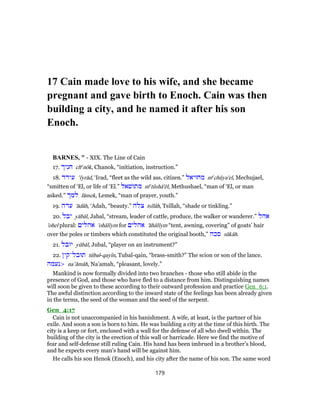
1. ‫קין‬ qayı̂n, Qain (Cain), “spear-shaft,” and ‫קנה‬ qānah, “set up, establish, gain, buy,”
contain the biliteral root ‫קן‬ qan, “set up, erect, gain.” The relations of root words are not
confined to the narrow rules of our common etymology, but really extend to such
instinctive usages as the unlettered speaker will invent or employ. A full examination of
the Hebrew tongue leads to the conclusion that a biliteral root lies at the base of many of
those triliterals that consist of two firm consonants and a third weaker one varying in
itself and its position. Thus, ‫יטב‬ yāṭab and ‫טיב‬ ṭôb. So ‫קין‬ qayı̂n and ‫קנה‬ qānah grow
from one root.
2. ‫הבל‬ hebel, Habel (Abel), “breath, vapor.”
3. ‫מנחה‬ mı̂nchâh, “gift, offering, tribute.” In contrast with ‫זבח‬ zebach, it means a
“bloodless offering”.
7. ‫חטאת‬ chaṭā't, “sin, sin-penalty, sin-offering.” ‫רבץ‬ rābats, “lie, couch as an animal.”
16. ‫נוד‬ nôd, Nod, “flight, exile; related: flee.”
This chapter is a continuation of the second document. Yet it is distinguished from the
previous part of it by the use of the name Yahweh alone, and, in one instance, ‫אלהים‬
'ĕlohı̂ym alone, to designate the Supreme Being. This is sufficient to show that distinct
pieces of composition are included within these documents. In the creation week and in
1
the judgment, God has proved himself an originator of being and a keeper of his word,
and, therefore, the significant personal name Yahweh is ready on the lips of Eve and
from the pen of the writer. The history of fallen man now proceeds. The first family
comes under our notice.
Gen_4:1
In this verse the first husband and wife become father and mother. This new relation
must be deeply interesting to both, but at first especially so to the mother. Now was
begun the fulfillment of all the intimations she had received concerning her seed. She
was to have conception and sorrow multiplied. But she was to be the mother of all living.
And her seed was to bruise the serpent’s head. All these recollections added much to the
intrinsic interest of becoming a mother. Her feelings are manifested in the name given to
her son and the reason assigned for it. She “bare Cain and said, I have gained a man
from Yahweh.” Cain occurs only once as a common noun, and is rendered by the
Septuagint δόρυ doru, “spear-shaft.” The primitive meaning of the root is to set up, or to
erect, as a cane, a word which comes from the root; then it means to create, make one’s
own, and is applied to the Creator Gen_14:19 or the parent Deu_32:6. Hence, the word
here seems to denote a thing gained or achieved, a figurative expression for a child born.
The gaining or bearing of the child is therefore evidently the prominent thought in Eve’s
mind, as she takes the child’s name from this. This serves to explain the sentence
assigning the reason for the name. If the meaning had been, “I have gained a man,
namely, Yahweh,” then the child would have been called Yahweh. If Jehovah had even
been the emphatic word, the name would have been a compound of Yahweh, and either
‫אישׁ‬ 'ı̂ysh, “man,” or ‫קנה‬ qı̂nâh, “qain,” such as Ishiah or Coniah. But the name Cain
proves ‫קניתי‬ qānı̂ytı̂y, “I have gained” to be the emphatic word, and therefore the
sentence is to be rendered “I have gained (borne) a man (with the assistance) of
Yahweh.”
The word “man” probably intimates that Eve fully expected her son to grow to the
stature and maturity of her husband. If she had daughters before, and saw them growing
up to maturity, this would explain her expectation, and at the same time give a new
significance and emphasis to her exclamation, “I have gained a man (heretofore only
women) from Yahweh.” It would heighten her ecstasy still more if she expected this to be
the very seed that should bruise the serpent’s head.
Eve is under the influence of pious feelings. She has faith in God, and acknowledges
him to be the author of the precious gift she has received. Prompted by her grateful
emotion, she confesses her faith, She also employs a new and near name to designate her
maker. In the dialogue with the tempter she had used the word God ‫אלהים‬ 'ĕlohı̂ym. But
now she adopts Yahweh. In this one word she hides a treasure of comfort. “He is true to
his promise. He has not forgotten me. He is with me now again. He will never leave me
nor forsake me. He will give me the victory.” And who can blame her if she verily
expected that this would be the promised deliverer who should bruise the serpent’s
head?
CLARKE, "I have gotten a man from the Lord - Cain, ‫,קין‬ signifies acquisition;
hence Eve says ‫קנתי‬ kanithi, I have gotten or acquired a man, ‫יהוה‬ ‫את‬ eth Yehovah, the
Lord. It is extremely difficult to ascertain the sense in which Eve used these words,
2
which have been as variously translated as understood. Most expositors think that Eve
imagined Cain to be the promised seed that should bruise the head of the serpent. This
exposition really seems too refined for that period. It is very likely that she meant no
more than to acknowledge that it was through God’s peculiar blessing that she was
enabled to conceive and bring forth a son, and that she had now a well-grounded hope
that the race of man should be continued on the earth. Unless she had been under Divine
inspiration she could not have called her son (even supposing him to be the promised
seed) Jehovah; and that she was not under such an influence her mistake sufficiently
proves, for Cain, so far from being the Messiah, was of the wicked one; 1Jo_3:12. We
may therefore suppose that ‫היוה‬ ‫את‬ eth Yehovah, The Lord, is an elliptical form of
expression for ‫יהוה‬ ‫מאת‬ meeth Yehovah, From The Lord, or through the Divine blessing.
GILL, "And Adam knew Eve his wife,.... An euphemism, or modest expression of
the act of coition. Jarchi interprets it, "had known", even before he sinned, and was
drove out of the garden; and so other Jewish writers, who think he otherwise would not
have observed the command, "be fruitful and multiply": but if Adam had begotten
children in a state of innocence, they would have been free from sin, and not tainted with
the corruption of nature after contracted; but others more probably think it was some
considerable time after; according to Mer Thudiusi, or Theodosius (t), it was thirty years
after he was driven out of paradise:
and she conceived and bare Cain; in the ordinary way and manner, as women ever
since have usually done, going the same time with her burden. Whether this name was
given to her first born by her, or by her husband, or both, is not said: it seems to have
been given by her, from the reason of it after assigned. His name, in Philo Byblius (u), is
Genos, which no doubt was Cain, in Sanchoniatho, whom he translated; and his wife, or
the twin born with him, is said to be Genea, that is, ‫,קינה‬ "Cainah": the Arabs call her
Climiah (v) and the Jewish writers Kalmenah (w); who are generally of opinion, that
with Cain and Abel were born twin sisters, which became their wives.
And said, that is, Eve said upon the birth of her firstborn:
I have gotten a man from the Lord; as a gift and blessing from him, as children are;
or by him, by his favour and good will; and through his blessing upon her, causing her to
conceive and bear and bring forth a son: some render it, "I have gotten a man, the Lord"
(x); that promised seed that should break the serpents head; by which it would appear,
that she took that seed to be a divine person, the true God, even Jehovah, that should
become man; though she must have been ignorant of the mystery of his incarnation, or
of his taking flesh of a virgin, since she conceived and bare Cain through her husband's
knowledge of her: however, having imbibed this notion, it is no wonder she should call
him Cain, a possession or inheritance; since had this been the case, she had got a goodly
one indeed: but in this she was sadly mistaken, he proved not only to be a mere man, but
to be a very bad man: the Targum of Jonathan favours this sense, rendering the words,"I
have gotten a man, the angel of the Lord.''
3
HENRY, "Adam and Eve had many sons and daughters, Gen_5:4. But Cain and Abel
seem to have been the two eldest. Some think they were twins, and, as Esau and Jacob,
the elder hated and the younger loved. Though God had cast our first parents out of
paradise, he did not write them childless; but, to show that he had other blessings in
store for them, he preserved to them the benefit of that first blessing of increase. Though
they were sinners, nay, though they felt the humiliation and sorrow of penitents, they
did not write themselves comfortless, having the promise of a Saviour to support
themselves with. We have here,
I. The names of their two sons. 1. Cain signifies possession; for Eve, when she bore
him, said with joy, and thankfulness, and great expectation, I have gotten a man from
the Lord. Observe, Children are God's gifts, and he must be acknowledged in the
building up of our families. It doubles and sanctifies our comfort in them when we see
them coming to us from the hand of God, who will not forsake the works and gifts of his
own hand. Though Eve bore him with the sorrows that were the consequence of sin, yet
she did not lose the sense of the mercy in her pains. Comforts, though alloyed, are more
than we deserve; and therefore our complaints must not drown our thanksgivings. Many
suppose that Eve had a conceit that this son was the promised seed, and that therefore
she thus triumphed in him, as her words may be read, I have gotten a man, the Lord,
God-man. If so, she was wretchedly mistaken, as Samuel, when he said, Surely the
Lord's anointed is before me, 1Sa_16:6. When children are born, who can foresee what
they will prove? He that was thought to be a man, the Lord, or at least a man from the
Lord, and for his service as priest of the family, became an enemy to the Lord. The less
we expect from creatures, the more tolerable will disappointments be. 2. Abel signifies
vanity. When she thought she had obtained the promised seed in Cain, she was so taken
up with that possession that another son was as vanity to her. To those who have an
interest in Christ, and make him their all, other things are as nothing at all. It intimates
likewise that the longer we live in this world the more we may see of the vanity of it.
What, at first, we are fond of, as a possession, afterwards we see cause to be dead to, as a
trifle. The name given to this son is put upon the whole race, Psa_39:5. Every man is at
his best estate Abel - vanity. Let us labour to see both ourselves and others so.
Childhood and youth are vanity.
II. The employments of Cain and Abel. Observe, 1. They both had a calling. Though
they were heirs apparent to the world, their birth noble and their possessions large, yet
they were not brought up in idleness. God gave their father a calling, even in innocency,
and he gave them one. Note, It is the will of God that we should every one of us have
something to do in this world. Parents ought to bring up their children to business.
“Give them a Bible and a calling (said good Mr. Dod), and God be with them.” 2. Their
employments were different, that they might trade and exchange with one another, as
there was occasion. The members of the body politic have need one of another, and
mutual love is helped by mutual commerce. 3. Their employments belonged to the
husbandman's calling, their father's profession - a needful calling, for the king himself is
served of the field, but a laborious calling, which required constant care and attendance.
It is now looked upon as a mean calling; the poor of the land serve for vine-dressers and
husbandmen, Jer_52:16. But the calling was far from being a dishonour to them; rather,
they were an honour to it. 4. It should seem, by the order of the story, that Abel, though
the younger brother, yet entered first into his calling, and probably his example drew in
Cain. 5. Abel chose that employment which most befriended contemplation and
4
devotion, for to these a pastoral life has been looked upon as being peculiarly favourable.
Moses and David kept sheep, and in their solitudes conversed with God. Note, That
calling or condition of life is best for us, and to be chosen by us, which is best for our
souls, that which least exposes us to sin and gives us most opportunity of serving and
enjoying God.
JAMISON, "Gen_4:1-26. Birth of Cain and Abel.
Eve said, I have gotten a man from the Lord — that is, “by the help of the
Lord” - an expression of pious gratitude - and she called him Cain, that is, “a
possession,” as if valued above everything else; while the arrival of another son
reminding Eve of the misery she had entailed on her offspring, led to the name Abel, that
is, either weakness, vanity (Psa_39:5), or grief, lamentation. Cain and Abel were
probably twins; and it is thought that, at this early period, children were born in pairs
(Gen_5:4) [Calvin].
k&d, "The propagation of the human race did not commence till after the expulsion
from paradise. Generation in man is an act of personal free-will, not a blind impulse of
nature, and rests upon a moral self-determination. It flows from the divine institution of
marriage, and is therefore knowing (‫ע‬ ַ‫ָד‬‫י‬) the wife. - At the birth of the first son Eve
exclaimed with joy, “I have gotten (‫)קניתי‬ a man with Jehovah;” wherefore the child
received the name Cain (‫ן‬ִ‫י‬ ַ‫ק‬ from ‫קוּן‬ = ‫ָה‬‫נ‬ ָ‫,ק‬ κτᾶσθαι). So far as the grammar is
concerned, the expression ‫ָה‬ ‫ה‬ְ‫ת־י‬ ֶ‫א‬ might be rendered, as in apposition to ‫ֹשׁ‬‫י‬ ִ‫,א‬ “a man,
the Lord” (Luther), but the sense would not allow it. For even if we could suppose the
faith of Eve in the promised conqueror of the serpent to have been sufficiently alive for
this, the promise of God had not given her the slightest reason to expect that the
promised seed would be of divine nature, and might be Jehovah, so as to lead her to
believe that she had given birth to Jehovah now. ‫ת‬ ֵ‫א‬ is a preposition in the sense of
helpful association, as in Gen_21:20; Gen_39:2, Gen_39:21, etc. That she sees in the
birth of this son the commencement of the fulfilment of the promise, and thankfully
acknowledges the divine help in this display of mercy, is evident from the name
Jehovah, the God of salvation. The use of this name is significant. Although it cannot be
supposed that Eve herself knew and uttered this name, since it was not till a later period
that it was made known to man, and it really belongs to the Hebrew, which was not
formed till after the division of tongues, yet it expresses the feeling of Eve on receiving
this proof of the gracious help of God.
PULPIT, "Gen_4:1
Exiled from Eden, o’er, canopied by grace, animated by hope, assured of the Divine
forgiveness, and filled with a sweet peace, the first pair enter on their life experience of
labor and sorrow, and the human race begins its onward course of development in sight
of the mystic cherubim and flaming sword. And Adam knew Eve, his wife. I.e.
"recognized her nature and uses" (Alford; cf. Num_31:17). The act here mentioned is
recorded not to indicate that paradise was "non nuptiis, sed virginitate destinatum"
(Jerome), but to show that while Adam was formed from the soil, and Eve from a rib
5
taken from his side, the other members of the race were to be produced "neque ex terra
neque quovis alio mode, sed ex conjunctione maris et foeminse" (Rungius). And she
conceived. The Divine blessing (Gen_1:28), which in its operation had been suspended
during the period of innocence, while yet it was undetermined whether the race should
develop as a holy or a fallen seed, now begins to take effect (cf. Gen_18:14; Rth_4:13;
Heb_11:11). And bare Cain. Acquisition or Possession, from kanah, to acquire
(Gesenius). Cf. Eve’s exclamation. Kalisch, connecting it with kun or kin, to strike, sees
an allusion to his character and subsequent history as a murderer, and supposes it was
not given to him at birth, but at a later period. Tayler Lewis falls back upon the primitive
idea of the root, to create, to procreate, generate, of which he cites as examples Gen_
14:19, Gen_14:22; Deu_32:6, and takes the derivative to signify the seed, explaining
Eve’s exclamation kanithi kain as equivalent to τετοκα τοκον, genui genitum or
generationem. And said, I have gotten a man from the Lord. The popular
interpretation, regarding kani-thi as the emphatic word in the sentence, understands
Eve to say that her child was a thing achieved, an acquisition gained, either from the
Lord (Onkelos, Calvin) or by means of, with the help of, the Lord (LXX; Vulgate,
Jerome, Dathe, Keil), or for the Lord (Syriac). If, however, the emphatic term is
Jehovah, then eth with Makkeph following will be the sign of the accusative, and the
sense will be, "I have gotten a man—Jehovah" (Jonathon, Luther, Baumgarten, Lewis);
to which, perhaps, the chief objections are
(1) that it appears to anticipate the development of the Messianic idea, and credits Eve
with too mature Christological conceptions (Lange), though if Enoch in the seventh
generation recognized Jehovah as the coming One, why might not Eve have done so in
the first? (Bonar),
(2) that if the thoughts of Eve had been running so closely on the identity of the coming
Deliverer with Jehovah, the child would have been called Jehovah, or at least some
compound of Jehovah, such as Ishiah—‫אישׁ‬ and ‫—יהוה‬or Coniah—‫קין‬ and ‫יהוה‬ (Murphy);
(3) si scivit Messiam esse debet Jovam, quomodo existimare potuit Cainam ease
Messiam, quem sciebat esse ab Adamo genitum? (Dathe); and
(4) that, while it might not be difficult to account for the mistake of a joyful mother in
supposing that the fruit of her womb was the promised seed, though, "if she did believe
so, it is a caution to interpreters of prophecy" (Inglis), it is not so easy to explain her
belief that the promised seed was to be Jehovah, since no such announcement was made
in the Prot-evangel. But whichever view be adopted of the construction of the language,
it is obvious that Eve’s utterance was the dictate of faith. In Cain’s birth she recognized
the earnest and guarantee of the promised seed, and in token of her faith gave her child a
name (cf. Gen_3:20), which may also explain her use of the Divine name Jehovah
instead of Elohim, which she employed when conversing with the serpent. That Eve
denominates her infant a man has been thought to indicate that she had previously
borne daughters who had grown to womanhood, and that she expected her young and
tender babe to reach maturity. Murphy thinks this opinion probable; but the impression
conveyed, by the narrative is that Cain was the first-born of the human family.
SBC, "I.
From the story of Cain we gather the following thoughts:—
I. Eve’s disappointment at the birth of Cain should be a warning to all mothers. Over-
6
estimate of children may be traced sometimes to extreme love for them; it may also arise
on the part of parents from an overweening estimate of themselves.
II. We see next in the history of Cain what a fearful sin that of murder is. The real evil of
murder (apart from its theftuous character) lies in the principles and feelings from
which it springs, and in its recklessness as to the consequences, especially the future and
everlasting consequences, of the act. The red flower of murder is comparatively rare, but
its seeds are around us on all sides.
III. No argument can be deduced from the history of Cain in favour of capital
punishments. We object to such punishments: (1) because they, like murder, are
opposed to the spirit of forgiveness manifested in the Gospel of Christ, (2) because, like
murder, they ruthlessly disregard consequences.
II.
I. It is singular how mental effort and invention seem chiefly confined to the race of
Cain, Feeling themselves estranged from God, they are stung to derive whatever solace
they can from natural research, artistic skill, and poetic illusion. It is melancholy to think
that so many of the arts appeared in conjunction with some shape or other of evil. The
music of Jubal in all probability first sounded in the praise of some idol god, or perhaps
mingled with some infernal sacrifice. The art of metallurgy and its cognate branches
became instantly the instruments of human ferocity and the desire of shedding blood.
Even poetry first appeared on the stage linked with the immoral and degrading practice
of polygamy. Gifts without graces are but lamps enabling individuals and nations to see
their way down more clearly to the chambers of death.
II. There are certain striking analogies between our own age and the age before the flood.
Both are ages of (1) ingenuity; (2) violence; (3) great corruption and sensuality; (4) both
ages are distinguished by the striving of the Spirit of God.
G. Gilfillan, Alpha and Omega, vol. i., p. 151.
GUZIK, "A. Cain’s murder of Abel.
1. (Gen_4:1) The birth of Cain.
Now Adam knew Eve his wife, and she conceived and bore Cain, and said, “I have
acquired a man from the LORD.”
a. Now Adam knew Eve his wife: This is the first specific mention of sex in
the Bible. The term “knew” or “to know” is a polite way of saying they had sexual
relations and the term is used often in the Bible in this sense (Gen_4:17; Gen_
4:25; Gen_38:26, Jdg_11:39, 1Sa_1:19).
i. There is power in this way of referring to sex. It shows the high,
interpersonal terms in which the Bible sees the sexual relationship. Most
terms and phrases people use for sex today are either coarse or violent, but
the Bible sees sex as a means of knowing one another in a committed
relationship. “Knew” indicates an act that contributes to the bond of unity
and the building up of a one-flesh relationship.
ii. We have no reason to believe Adam and Eve did not have sex before this.
Adam and Eve were certainly capable of sexual relations before the fall,
because there is nothing inherently impure or unclean in sex.
7
b. And bore Cain, and said, “I have acquired a man from the LORD”:
The name Cain basically means, “I’ve got him” or “here he is.” It is likely Eve
thought that Cain was the seed that God promised, the deliverer who would come
from Eve (Gen_3:15). There is a sense in which Eve said, “I have the man from
the LORD.”
i. Under normal circumstances, parents want good things for their children.
They wonder if their children are destined for greatness. Adam, and
especially Eve, had these expectations for Cain, but it went farther than
normal parental hopes and expectations. Adam and Eve expected Cain to be
the Messiah God promised.
ii. Eve thought she held in her arms the Messiah, the Savior of the whole
world, but she really held in her arms a killer.
c. A man from the LORD: Eve had faith to believe that the little baby she held
would be a man. No baby had ever been born before. It is possible Adam and Eve
wondered if their descendants would come forth fully mature, as they did.
COKE, "Introduction
God hath respect to the offering of Abel, and rejects that of Cain: Cain kills his
brother; God denounces sentence upon him for his fratricide. The posterity of Cain.
Lamech's address to his wives. The birth of Seth from Adam; of Enos from Seth.
GENERAL REFLECTIONS. on Chap. IV. and V.
CHAP. IV. One of the most fatal effects of the fall of Adam was to derive a
depravity upon his whole posterity, whereof the tragical end of Abel was the first
unfortunate example. The birth of her first son had filled Eve with pleasure: but
this was not the last time that children, whose coming into the world has caused
transports of joy to those from whom they received their birth, have brought sorrow
and bitterness to them all their life after.
The two first brothers ought to have been united by the strictest bonds of
friendship: all the fields, all the products thereof, yea, the whole earth was theirs. No
handle was there for those public divisions, which in the following ages have been so
fatal to society; nor for those private quarrels which have passed from parents to
children, and been transmitted as an inheritance throughout their families.
8
Nevertheless, fatal force of envy! Cain was the murderer of his brother Abel!
How deceitful are the judgments formed upon the external appearances of men!
Who would not have believed in seeing these inhabitants of the first world; both of
them sons of the same family; both of them acknowledging the true object of
religious worship; both of them, in appearance, animated with the same desire of
paying their homage to him; who, I say, would not have thought that they were
equally acceptable in his sight? Nevertheless, one of them makes an offering
pleasing to the Great Searcher of hearts, while the other is rejected by him! It is God
alone who can judge of the heart: and since he discerns its inmost secrets, how vain
to approach him with dissimulation and hypocrisy! O God, in all our addresses to
thee, give us true faith, pure hearts, and right intentions! for thou wilt accept, we
are assured, no services, but such as are brought by persons who more or less
possess these pious dispositions; whom sometimes thou sufferest to be oppressed by
the wicked: a proof, from the very first, that piety must look for its reward in
another and better state than this.
The innocence of a good man is often a sufficient reason to draw upon him the
hatred of a bad one; the virtues of the good are the reproaches of the wicked. Cain
could not bear with patience the distinction made between him and his brother! his
anger was kindled against him, because God justified him; and the apology,
proceeding from so powerful a Being, redoubled the jealousy which it ought to have
extinguished, and hastened the enormity which it ought to have prevented! But
God's justice was not to be eluded: indeed men's contempt of the goodness of God
will always formidably arm his justice against them.
The same principle, which leads wicked men to commit crimes in hopes of impunity,
throws them into despair upon the denunciation of punishment. Cain was in the
utmost dread of sinking under the weight of the threatened and intolerable
chastisements. But God, who remembers to have compassion even in the midst of his
anger, vouchsafed to remove that apprehension, though he removed not the horror
and remorse which always attend a guilty conscience; the dread and certainty of
which ought to be sufficient to deter men from atrocious villainy.
Verse 1
9
Genesis 4:1. And Adam knew his wife, &c.— All the speculations respecting this
passage might have been spared, if the words had been rendered, Adam HAD
known his wife Eve, a translation which the original perfectly well bears. Moses, it is
evident, gives only the most concise account of things, regardless of smaller matters.
He was to give a general history of the creation of the world, and of man; of the fall,
and expulsion from Paradise; of the effects of that fall, and of the promised seed
more especially, to which alone he seems peculiarly heedful, neglecting all the line of
Adam, save that by which this seed was deduced from Seth, to Noah, Abraham, &c.
Bare Cain, and said, I have gotten a man from the Lord— The reason of the names
in the Old Testament is generally given at the same time with the names themselves;
as here Cain ‫קין‬ cain, is so called by his mother, because she had gotten, or acquired,
‫קניתי‬ caniti, a man; for Cain signifies gain or acquisition. There is something
peculiar in the Hebrew here, I have gotten a man, ‫אתאּיהוה‬ eth-Jehovah, THE
LORD. "Eve imagined," says Calmet, "that she had gotten the Saviour, son
liberateur, her deliverer, the bruiser of the serpent's head, in her son Cain."
Jonathan, the son of Uzziel, renders it, I have brought forth this man who is the
angel of the Lord, that is, the Messiah, whom the Jews called by the name of the
Angel, or Messenger, of the Lord. Malachi 3:1; Malachi 3:18. The reader must
observe, upon this interpretation, how consistent the whole scheme of scripture is,
and especially how the events properly connect in these chapters; as the promise of
the seed; the name of Eve; the reason of the coats of skins; the placing of the
Shechinah at the gate of Paradise; the triumph of Eve upon the birth of Cain; and,
may we not add, the sacrifices and religious services of Cain and Abel, mentioned in
the subsequent verses?—But for those who do not acquiesce in this interpretation,
they must suppose eth ‫את‬ to be used for meeth ‫,מאת‬ and must consider it as a mere
female exultation in Eve on the birth of her firstborn son.
CALVIN, "1.And Adam knew his wife Eve. Moses now begins to describe the
propagation of mankind; in which history it is important to notice that this
benediction of God, “Increase and multiply,” was not abolished by sin; and not only
so, but that the heart of Adam was divinely confirmed so that he did not shrink with
horror from the production of offspring. And as Adam recognised, in the very
commencement of having offspring, the truly paternal moderation of God’s anger,
so was he afterwards compelled to taste the bitter fruits of his own sin, when Cain
slew Abel. But let us follow the narration of Moses. (222) Although Moses does not
state that Cain and Abel were twins it yet seems to me probable that they were so;
10
for, after he has said that Eve, by her first conception, brought forth her firstborn,
he soon after subjoins that she also bore another; and thus, while commemorating a
double birth, he speaks only of one conception. (223) Let those who think differently
enjoy their own opinion; to me, however it appears accordant with reason, when the
world had to be replenished with inhabitants, that not only Cain and Abel should
have been brought forth at one births but many also afterwards, both males and
females.
I have gotten a man. The word which Moses uses signifies both to acquire and to
possess; and it is of little consequence to the present context which of the two you
adopt. It is more important to inquire why she says that she has received, ‫יהוה‬ ‫את‬
(eth Yehovah.) Some expound it, ‘with the Lord;’ that is, ‘by the kindness, or by the
favor, of the Lord;’ as if Eve would refer the accepted blessing of offspring to the
Lord, as it is said in Psalms 127:3, “The fruit of the womb is the gift of the Lord.” A
second interpretation comes to the same point, ‘I have possessed a man from the
Lord;’ and the version of Jerome is of equal force, ‘Through the Lord.’ (224) These
three readings, I say, tend to this point, that Eve gives thanks to God for having
begun to raise up a posterity through her, though she was deserving of perpetual
barrenness, as well as of utter destruction. Others, with greater subtlety, expound
the words, ‘I have gotten the man of the Lord;’ as if Eve understood that she
already possessed that conqueror of the serpent, who had been divinely promised to
her. Hence they celebrate the faith of Eve, because she embraced, by faith, the
promise concerning the bruising of the head of the devil through her seed; only they
think that she was mistaken in the person or the individual, seeing that she would
restrict to Cain what had been promised concerning Christ. To me, however, this
seems to be the genuine sense, that while Eve congratulates herself on the birth of a
son, she offers him to God, as the first-fruits of his race. Therefore, I think it ought
to be translated, ‘I have obtained a man from the Lord’, which approaches more
nearly the Hebrew phrase. Moreover, she calls a newborn infant a man, because she
saw the human race renewed, which both she and her husband had ruined by their
own fault. (225)
BENSON, "Verse 1-2
Genesis 4:1-2. Adam and Eve had many sons and daughters, Genesis 5:4 : but Cain
and Abel seem to have been the two eldest. Cain signifies possession; for Eve, when
she bare him, said, with joy, and thankfulness, and expectation, “I have gotten a
11
man from the Lord.” Abel signifies vanity. The name given to this son is put upon
the whole race, Psalms 39:5, “Every man is, at his best estate, Abel, vanity.” Abel
was a keeper of sheep — He chose that employment which did most befriend
contemplation and devotion, for that hath been looked upon as the advantage of a
pastoral life. Moses and David kept sheep, and in their solitudes conversed with
God.
PETT, "Verse 1
‘And the man knew Eve his wife and she conceived and bore Cain (qayin from the
stem qon), saying, “I have obtained (qanithi from the stem qanah) a man with
Yahweh.” ’
“Knew” is a regular euphemism for sexual intercourse. Eve’s words are interesting.
Notice that she does not say ‘I have borne a child’ but ‘I have obtained a man’.
There may possibly be the thought here that here is someone to help them with their
hard labour (the birth of a boy in agricultural areas in many Eastern countries is
still looked on as a special joy because he will be able to share the work burden),
compare Genesis 5:29 where Lamech rejoices in Noah’s birth because he will help
with the work. It may even emphasise that she felt she had already had too many
daughters and had wanted another son.
“Cain” - ‘qayin’ - later meaning spear. It may be that his mother was hoping he
would be a hunter to bring meat to the family and that the original word translated
qayin meant a throwing instrument of some kind. Instead he becomes a hunter of
men. But in Arabic ‘qyn’ equals ‘to fashion, give form’. Thus it could mean ‘one
formed’.
“With Yahweh” - this is an unusual use of ‘with’ (‘eth’). We must probably
translate ‘with the help or agreement of Yahweh’, the point being that she feels that
this is one more step in her reinstatement, which is with Yahweh’s approval.
Akkadian ‘itti’ is used with this meaning as is sometimes the Hebrew ‘im (‘with’ - 1
Samuel 14:45). It could thus mean ‘in participation with’, acknowledging that
Yahweh gave life in conception. For this idea see Psalms 139:13, ‘for you formed
(qanah) my inward parts’.
There is an indirect play on words between qayin and qanah but it is not drawn out,
12
and there is no similar word association with Abel. (The original account would be
passed down in a primitive language. The translator is seeking to express the pun in
his translation as best he can).
Verses 1-16
The Story of Cain and Abel (Genesis 4:1 to Genesis 5:1 a).
Genesis 4:1-16. The Sin of Cain TABLET III
It is quite clear that this section once existed separately from Genesis 2-3. The
immediate and lasting change from ‘Yahweh Elohim’ (Lord God) to ‘Yahweh’
(Lord), after the almost pedantic use of the former in the previous narrative,
suggests this, as does the rather abrupt way in which the connection is made
between the two accounts. The account is in covenant form being built around two
covenants, so that there were originally two ‘covenant’ histories, that with Cain and
that with Lamech, but as the former at least was in the days before writing it would
have been remembered and passed down among the Cainites in oral form, not just
as a story but as sacred evidence of a covenant with God. Later the covenant with
Lamech would receive similar treatment. Thus the record in Genesis 4:1-16
originally stood on its own. Remembering this can be basic to its interpretation. It is
too easy to read it as though it was simply a direct continuation of Genesis 3.
On the latter assumption it is regularly assumed that Cain and Abel (Hebel) were
Adam’s first two sons, but that assumption is made merely because of the position of
the present narrative. There is no suggestion anywhere in the text that this is so, and
had Cain been the firstborn this would surely have been emphasised. It
demonstrates the reliability of the compiler that he does not say so.
Thus in another record we are told ‘when Adam had lived 130 years, he became the
father of a son in his own likeness, after his image, and named him Seth. The days of
Adam after he became the father of Seth were eight hundred years, and he had
13
other sons and daughters’. This is in ‘the histories of Noah’ (see article,
"Colophons") (Genesis 5:1 to Genesis 6:9). We note that in this section there is no
mention of Cain and Abel, even though Cain is still alive (for Seth was born after
Abel - Genesis 4:25), and if we did not have Genesis 4 we would have assumed that
Seth was the firstborn. The reason for this is that chapter 5 wishes to put the
emphasis on Seth because he is the ‘father’ of the line that leads up to Noah. All
Adam’s children other than Cain, Abel and Seth are always totally ignored,
probably because no reliable information about them had been passed down.
Two points emerge. One is that Adam and Eve had ‘other sons and daughters’.
Notice that that is a refrain that follows the birth of each son mentioned in the line.
It is of course possible that each son mentioned in the line was a firstborn son, but
there appears to be nothing apart from the phrase that suggests so. Probably, in the
list in Genesis 11, Arpachshad is not the eldest son, for in Genesis 10:21-22 he is
listed third out of five, yet the list in Genesis 11 gives no hint of this. Thus the phrase
‘had other sons and daughters’ is stressing the patriarchs’ fruitfulness, not saying
that the patriarch in question had had no previous children before the one
mentioned. In Genesis 5 it is the line leading up to Abraham that is being
emphasised.
If Adam was 130 years old when he ‘bore’ Seth (if we are to take the age literally,
and even if not it certainly means ‘of good age’), it is extremely unlikely then that
before that date he would only have had two sons (compare the fruitfulness of Cain
in Genesis 4:17). It would therefore be reasonable to assume that before that date
Adam and Eve also had other sons and daughters, and one of them may have been
the firstborn.
The story of Cain and Abel specifically acts as the background to God’s covenant
with Cain, and speaks of the first shedding of man’s blood. This is why it was
recorded and remembered. But, as has been often noted, it does in fact assume the
existence of daughters of Adam (Genesis 4:17) and of other relatives, for Cain says
‘whoever finds me will kill me’ (Genesis 4:14). So Cain and Abel should be seen as
two among many sons, mentioned simply because of the incident that occurred, not
because of their priority. They were not the only ones on the earth at the time.
14
Furthermore it must also be considered that they (and Seth) may not actually have
been direct sons of Adam and Eve. The Bible (and other ancient literature) often
refers to someone as being ‘born of’ someone when the former is a descendant
rather than the actual son (this can be seen by comparing genealogies in the Bible,
including the genealogies of Jesus). It could well be that the depiction is simply made
in order to stress the connection of Cain and Abel with Adam by descent.
The ancients were not as particular in their definitions of relationship as we are.
They would find no difficulty in saying ‘so and so bore so and so’ when they mean
‘the ancestor of so and so’. Indeed, this narrative must have been originally put into
Hebrew when Hebrew was a very primitive language, and words would have had an
even greater width of meaning than they had later, and would not at that stage have
been so closely defined. As T. C. Mitchell in the New Bible Dictionary (1st edition)
entry on Genealogy comments - ‘the word ‘ben’ could mean not only ‘son’, but also
‘grandson’ and ‘descendant’, and in like manner it is probable that the verb ‘yalad’
could mean not only ‘bear’ in the immediate physical sense, but also ‘become the
ancestor of ’ (the noun ‘yeled’ from this verb has the meaning of descendant in
Isaiah 29:23)’. The main thing that militates against this interpretation here is
Genesis 4:25 where Seth is regarded by Eve as replacing Abel, but even this may
have been put on her lips as having been ‘said’ by her through her descendant who
bore Abel and Seth.
The account of Cain and Abel was very suitable for the purpose of following Genesis
3, for Cain’s occupation caused him to wrestle with ‘the thorns and the thistles’, the
wrestling with which was the consequence of the curse (Genesis 3:18), whilst Abel as
the cattle drover was able to provide the coats of skins with which man now covered
himself (Genesis 3:21).
As the compiler of Genesis 1:1 to Genesis 11:27 (which probably once existed as an
independent unit) had no other suitable information with which to link the
expulsion from the Plain of Eden with the genealogy of Seth, and as he wished to
depict the growth of sin, he used this narrative about Cain and Abel, which would
have been especially preserved by the Cainite line because of the covenant. It was
possibly the only one available to him which would enable him to emphasise the
15
beginning of the new era, as well as to demonstrate how one sin leads to a worse one,
until at last it results in murder. He has two strands in mind. The line of Adam’s
descendants up to Noah, and the growth of human wickedness from rebellion to
murder, to further murder, to engaging in the occult, which result in the Flood.
We shall now look at the record in more detail (see the e-Sword verse comments)
WHEDON, " 1. Adam knew Eve — A euphemism, based upon a profound
conception of the marital relation. “Generation in man is an act of personal free-
will, not a blind impulse of nature. It flows from the divine institution of marriage,
and is, therefore, knowing the wife.” — Keil.
Bare Cain — In the Hebrew the word Cain has the emphatic particle ‫את‬ before it,
the Cain. In these most ancient narratives names have special significance, and the
name Cain is most naturally derived from the Hebrew ‫,קון‬ kun, or ‫,קנה‬ kana, the
word immediately used by Eve, and translated in our text, I have gotten . A better
translation would be, I have begotten. The name Cain, then, would signify offspring,
or one begotten, rather than possession, as held by many writers. See Furst’s
Hebrews Lex. and T. Lewis’s note in Lange in loc.
A man from the Lord — Literally, a man, the Jehovah. This exact rendering
appears to us better than our common version, which follows the Targum of
Onkelos; better than the Sept. and Vulg. by the Lord; better than any attempt to
paraphrase the passage, or construe the ‫את‬ as a preposition. With MacWhorter (see
Bib. Sacra for January, 1857, and the volume entitled “Yahveh Christ, or, the
Memorial Name”) and Jacobus, we understand Eve’s exclamation as a kind of
joyful eureka over the firstborn of the race, as if in this seed of the woman was to be
realized the promise of the protevangelium recorded in chap. 3:15. Keil’s objection
to this view, on the ground that Eve knew nothing of the divine nature of the
promised seed, and could not have uttered the name Jehovah, because it was not
revealed until a later period, is unwarrantable assumption. The statement of Exodus
6:3, (where see note,) that the name Jehovah was not known to the patriarchs, does
not mean that the name was never used before the days of Moses; and if these are
not the very words of Eve, or their exact equivalent, why should we believe that she
said any thing of the kind? If the name JEHOVAH was used at all by Eve, it is likely
that something of its profound significance had been revealed in connexion with the
first promise of the coming One. And it would have been very natural for the first
mother, in her enthusiasm over the birth of her first child, to imagine him the
16
promised Conqueror. But, as T. Lewis observes, “The greatness of Eve’s mistake in
applying the expression to one who was the type of Antichrist rather than of the
Redeemer, should not so shock us as to affect the interpretation of the passage, now
that the covenant God is revealed to us as a being so transcendently different. The
limitation of Eve’s knowledge, and perhaps her want of due distinction between the
divine and the human, only sets in a stronger light the intensity of her hope, and the
subjective truthfulness of her language. Had her reported words, at such a time,
contained no reference to the promised seed of the woman, the Rationalist would
doubtless have used it as a proof that she could have known nothing of any such
prediction, and that therefore Genesis 3:15, and Genesis 4:1, must have been written
by different authors, ignoring or contradicting each other.” Eve’s hasty and
mistaken expectation of the coming Deliverer is a fitting type of the periodic but
mistaken pre-millennialism of New Testament times, which has, with almost every
generation, disturbed the Church with excitement over the expected immediate
coming of Christ.
Verses 15-1
CAIN AND ABEL, Genesis 15-4:1 .
“The consequences of the fall now appear in the history of the first family. By
careful attention to the record, we may learn the true nature of the primitive
religion, its rites, its hopes, and faith. We may also see here most instructive traces
of the primeval civilization. While fearful sin stains the firstborn of man, sadly
crushing the joyful hopes of the first mother, a pious son also appears, setting forth
thus early the contrast and conflict between good and evil, which is to run through
human history. The good at first is overcome by the evil; Abel is slain by Cain; but
another son (Seth, set or placed) is set in his place at the head of the godly line.” —
Newhall.
In the following chapter the careful reader will note, 1) in the two types of men the
first outward development of the two seeds — that of the serpent and that of the
woman, (Genesis 3:15;) 2) agriculture and the keeping of flocks as the earliest
employments of men; 3) the doctrine of sacrifices established at the very gate of
Paradise: 4) God’s earliest manifestations of favour to the righteous and of
displeasure towards the sinner; 5) the beginnings of polygamy; 6) art, culture, and
17
human depravity and sinfulness keeping pace with one another; so that an advanced
civilization, in spite of all the refining and ennobling tendencies of art and culture,
may, without the divine favour, only serve to intensify the corruption and violence
of men; 7) the Cainites, in founding the first city, and by worldly inventions and
arts, lead the way in building up the godless kingdom of the beast, the world-power
of Antichrist; the godly seed, by faith and piety begin to build the kingdom of
heaven.
COFFMAN, "Verse 1
This chapter details the tragic story of two Adamic brothers, Cain and Abel, in
whose lives there appeared a dramatic acceleration of the disastrous consequences
of the Fall, just related in the preceding chapter. Not even the source-splitting critics
dared tamper with the placement of this chapter, despite the use of a different name
for God. Not only is it a logical development and consequence of events in Genesis 3,
but it lays down the basis for the destruction of the world in the Great Deluge,
showing how Cain started a wicked generation that ultimately corrupted mankind
and "precipitated the Flood,"[1] the narration of that event apparently being
already in the mind of the narrator. This, of course, is a marvelous demonstration of
the unity of Genesis and another confirmation of the fact that the multiple sources
theory postulated upon the use of different names for God "has no substantial basis
in the Biblical text."[2] Nor can we accept the assertion that this story is merely a
myth. Jesus Christ himself referred to Abel as a "righteous man" (Matthew 23:35;
Luke 11:50); and both Cain and Abel are repeatedly referred to in the N.T. as real
characters, as in Hebrews 11:4,12:24; 1 John 3:12; and Jude 1:1:11.
The great message of the chapter is that sin is a cancer that grows progressively
worse and worse. Eating of the forbidden tree might have appeared to Adam and
Eve as a minor event, but when they stood by the grave of Abel, the true nature of
what they had done began to be visible. But even that heart-breaking sorrow was
only the first little pebble of that tremendous avalanche that would soon engulf all
mankind in the floods of the Great Deluge.
And the man knew Eve his wife; and she conceived and bare Cain, and said, I have
gotten a man with the help of Jehovah.
18
"And the man knew Eve ..." is an expression used in the Bible for sexual
intercourse, but it does not mean that this was the first such action on their part, for
it is used repeatedly in the same sense, as in Genesis 4:25.
"I have gotten a man with (the help of) Jehovah ..." The italic words are not in the
text, making possible an alternate rendition: "I have gotten a man, even the
Lord,"[3] or, "I have gotten a man from the Lord."[4] Most scholars today deny
that Eve's remark here has any reference to God's promise in Genesis 3:15, but
their only reason for this lies embedded in one of their own petty rules, blinding
them to the fact that a Great Deliverer is surely promised there. But Eve's mention
here of her tragically mistaken view that Cain would be that Deliverer not only
confirms the fact of the Deliverer's having been promised, but also the fact of Eve's
having believed it. Kline and Ellison both discerned this: Eve's words were "a
believing response,"[5] to Genesis 3:15, and, although Ellison designated this
rendition as "improbable,"[6] he nevertheless admitted that it is possible. Our own
conviction receives this unequivocally as Eve's believing response to the great
Protoevangelium in Genesis 3:15. That she was tragically mistaken does not
diminish the weight of this.
ELLICOTT, "(1) She . . . bare Cain, and said . . . —In this chapter we have the
history of the founding of the family of Cain, a race godless and wanton, but who,
nevertheless, far outstripped the descendants of Seth in the arts of civilisation. To
tillage and a pastoral life they added metallurgy and music; and the knowledge not
only of copper and its uses, but even of iron (Genesis 4:22), must have given them a
command over the resources of nature so great as to have vastly diminished the
curse of labour, and made their lives easy and luxurious.
I have gotten a man from the Lord.—Rather, who is Jehovah. It is inconceivable
that eth should have here a different meaning from that which it has in Genesis 1:1.
It there gives emphasis to the object of the verb: “God created eth the heaven and
eth the earth,” that is, even the heaven and even the earth. So also here, “I have
gotten a man eth Jehovah.” even Jehovah. The objection that this implies too
advanced a knowledge of Messianic ideas is unfounded. It is we who read backward,
and put our ideas into the words of the narrative. These words were intended to
lead on to those ideas, but they were at present only as the germ, or as the filament
in the acorn which contains the oak-tree. If there is one thing certain, it is that
19
religious knowledge was given gradually, and that the significance of the name
Jehovah was revealed by slow degrees. (See on Genesis 4:26.) Eve attached no
notion of divinity to the name; still less did she foresee that by the superstition of the
Jews the title Lord would be substituted for it. We distinctly know that Jehovah was
not even the patriarchal name of the Deity (Exodus 6:3), and still less could it have
been God’s title in Paradise. But Eve had received the promise that her seed should
crush the head of her enemy, and to this promise her words referred, and the title in
her mouth meant probably no more than “the coming One.” Apparently, too, it was
out of Eve’s words that this most significant title of the covenant God arose. (See
Excursus on names Elohim and Jehovah-Elohim, at end of this book.)
Further, Eve calls Cain “a man,” Heb., ish, a being. (See on Genesis 2:23.) As Cain
was the first infant, no word as yet existed for child. But in calling him “a being,
even the future one,” a lower sense, often attached to these words, is not to be
altogether excluded. It has been said that Eve, in the birth of this child, saw the
remedy for death. Death might slay the individual, but the existence of the race was
secured. Her words therefore might be paraphrased: “I have gained a man, who is
the pledge of future existence.” Mankind is thus that which shall exist. Now, it is one
of the properties of Holy Scripture that words spoken in a lower and ordinary sense
are often prophetic: so that even supposing that Eve meant no more than this, it
would not exclude the higher interpretation. It is evident, however, from the fact of
these words having been so treasured up, that they were regarded by Adam and his
posterity as having no commonplace meaning; and this interpretation has a
suspiciously modern look about it. Finally, in Christ alone man does exist and
endure. He is the perfect man—man’s highest level; so that even thus there would be
a presage of immortality for man in the saying, “I have gained a man, even he that
shall become.” Grant that it was then but an indefinite yearning: it was one,
nevertheless, which all future inspiration was to make distinct and clear; and now,
under the guidance of the Spirit, it has become the especial title of the Second
Person in the Holy Trinity.
LANGE, "1. The propagation of the human race through the formation of the
family, Isaiah, in its beginning, laid outside of Paradise, not because it was in
contradiction with the paradisaical destiny, but because it had, from the beginning,
an unparadisaical character (that Isaiah, not in harmony with the first life as led in
Paradise.—T. L.). Immediately, however, even in the first Adamic generation, the
human race presents itself in the contrast of a godless and a pious line, in proof that
the sinful tendency propagates itself along with the sin, whilst it shows at the same
time that not as an absolute corruption, or fatalistic necessity, does it lay its burden
20
upon the race. This contrast, which seems broken up by the fratricide of Cain, is
restored again at the close of our chapter, by the birth and destination of Seth. In
regard to its chief content, however, the section before us is a characterizing of the
line of Cain. It is marked by a very rapid unfolding of primitive culture, but
throughout in a direction worldly and ungodly, just as we find it afterwards among
the Hamites. The ideality of art, to which the Cainites in their formative tendency
have already advanced, appears as a substitute for the reality of a religious-ideal
course of life, and becomes ministerial to sin and to a malignant pride. Not without
ground are the decorative dress (the name Adah), the musical skill (the name Zillah)
and beauty of the daughters of Cain brought into view. For after the contrast
presented in chapter5 between the Sethites, who advance in the pure direction of a
godly life, and the Cainites, who are ever sinking lower and lower in an ungodly
existence, there is shown, chapter6, how an intercourse arises between them, and
how the Sethites, infatuated by the charms of the Cainitish women, introduce a
mingling of both lines, and, thereby, a universal corruption. According to Knobel
the chapter must be regarded as the genealogical register of Adam, though this does
not agree, he says, with the genealogical register of the Elohist ( Genesis 5), which
names Seth as the first-born (!) of Adam. The ethnological table ( Genesis 10), he
tells us, can only embrace the Caucasian race, whilst the Cainites can only be a
legendary representation of the East Asian tribes (p53), the author of which thereby
places himself in opposition to the later account, that represents all the descendants
of Cain as perishing in the flood. The traits of the Cainitic race, as presented by
Knobel, belong not alone to the East Asiatic people. They are ground-forms of
primitive worldliness in the human race. In respect to the genealogical table of
Genesis 4, 5, Knobel remarks “that the Cainitic table agrees tolerably well with the
Sethic” (p54). For the similarities and differences of both tables, comp. Keil, p71.
These relations will be more distinctly shown in the interpretation of the names.
Concerning the Jehovistic peculiarities of language in this section, see Knobel, p56.
2. Genesis 4:1-2. “Men are yet in Eden, but no longer in the garden of Eden.”
Delitzsch. Procreation a knowing. The moral character of sexual intercourse. Love a
personal knowing. The love of marriage, in its consummation, a spiritual corporeal
knowing. The expression is euphemistic. In the Pentateuch only, in the
supplementary corrections of the original writing. The like in other ancient
languages. The name Cain is explained directly from ‫י‬ ִ‫ית‬ִ‫נ‬ָ‫,ק‬ the gotten.[FN9] The
word ‫קנה‬ may mean, to create, to bring out, also to gain, to attain, which we
prefer.—I have gotten a man from the Lord.—The interpretation of Luther and
others, including Philippi, namely, “the Prayer of Manasseh, the Lord,” not only
21
anticipates the unfolding of the Messianic idea, but goes beyond it; for the Messiah
is not Jehovah absolutely. And yet the explanation: with the help of Jehovah (with
his helpful presence, Knobel), is too weak. So too the Vulgate is incorrect: per
Deum, or the interpretation of Clericus: ‫ת‬ ֵ‫א‬ ֵ‫,מ‬ from Jehovah, that Isaiah, in
association, in connection with Jehovah, I have gotten a man. In this it remains
remarkable, that in the name itself, the more particular denotation is wanting. We
may be allowed, therefore, to read: a man with Jehovah, that Isaiah, one who stands
in connection with Jehovah; yet it may be that the mode of gaining: gotten with
Jehovah, characterizes the name itself. The choice of the name Jehovah denotes here
the God of the covenant. In the blessed confidence of female hope, she would seem,
with evident eagerness, to greet, in the new-born, the promised woman’s seed
( Genesis 3:15), according to her understanding of the word. Lamech, too, although
on better grounds, expected something immensely great from his son Noah. We
must observe here that the mother is indicated as the name-giver. In the case of the
second name, Abel (Habel), which denotes a swiftly-disappearing breath of life, or
vanity, or nothingness, nothing of the kind is said. Yet in place of the great and
hasty joy of hope, there seems to have come a fearful motherly presentiment
(Delitzsch, p199). That they were twins, as Kimchi holds, is a sense the text does not
favor. Abel as shepherd, especially of the smaller cattle (‫,)צאן‬ is the type of the
Israelitish patriarchs. Cain, as the first-born, takes the agricultural occupation to
which his father was first appointed. The oldest ground-forms, therefore, of the
human calling, which Adam united in himself, are divided between his two sons in a
normal way (Cain was, in a certain sense, the heir by birth, and the ground-
proprietor). It must be remarked, too, that agriculture, as the older form, does not
appear as the younger in its relation to cattle-breeding. “Both modes of living belong
to the earliest times of humanity, and, according to Varro and Dicæarchus in
Porphyry, follow directly after the times when men lived upon the self-growing
fruits of the earth.” Knobel. “In the choice of different callings by the two brothers,
we seek in vain for any indication of a difference in moral disposition.” So Keil
maintains, against Hofmann, that agriculture was a consequence of the cursing of
the ground. Delitzsch, however, together with Hofmann, is inclined to the opinion
that in the brothers’ choice of different callings there was already expressed the
different directions of their minds,—that Abel’s calling was directed to the covering
of the sinful nakedness by the skins of beasts (Hofmann), and therefore Abel was a
shepherd (!). Delitzsch, too, would have it that Abel took the small domestic cattle,
only for the sake of their skins, and, to some extent, for their milk, though this was a
kind of food which had not been used in Paradise. It would follow, then, that if Abel
slew the beasts for the sake of their skins, and, moreover, offered to God in sacrifice
only the fat parts of the firstlings, it must have been that he suffered the flesh in
general of the slaughtered animals to become offensive and go to corruption. It
22
would follow, too, that the human sacerdotal partaking of the sacrificial offering,
which later became the custom in most cases, had not yet taken place; not to say that
the supposition of the enjoyment of animal food having been first granted, Genesis
9:3, is wholly incorrect.
BI 1-16, "Abel was a keeper of sheep, but Cain was a tiller of the ground
The story of Cain and Abel
I. RELIGION ACTUATED MEN IN THE VERY EARLIEST TIMES.
II. THE MERE NATURAL RELIGION IS ESSENTIALLY DEFECTIVE.
1. In its offerings.
2. In the power which it exercises over the passions.
3. In its sympathy (Gen_4:9).
III. SPIRITUAL RELIGION ALONE COMMENDS A MAN TO GOD. This is illustrated
in the life of Abel.
1. He possessed faith.
2. He offered an acceptable sacrifice to God.
3. Spiritual religion has a favourable influence on character.
The quality of Abel’s piety, its depth and spirituality, cost him his life, and made him at
the same time the first martyr for true religion. (D. Rhys Jenkins.)
The two sacrifices
I. The first question to be asked is this: WHAT DID CAIN AND ABEL KNOW ABOUT
SACRIFICE? Although we should certainly have expected Moses to inform us plainly if
there had been a direct ordinance to Adam or his sons concerning the offering of fruits
or animals, we have no right to expect that he should say more than he has said to make
us understand that they received a much more deep and awful kind of communication. If
he has laid it down that man is made in the image of God, if he has illustrated that
principle after the Fall by showing how God met Adam in the garden in the cool of the
day and awakened him to a sense of his disobedience, we do not want any further
assurance that the children he begat would be born and grow up under the same law.
II. It has been asked again, WAS NOT ABEL RIGHT IN PRESENTING THE ANIMAL
AND CAIN WRONG IN PRESENTING THE FRUITS OF THE EARTH? I must apply the
same rule as before. We are not told this; we may not put a notion of ours into the text.
Our Lord revealed Divine analogies in the sower and the seed, as well as in the shepherd
and the sheep. It cannot be that he who in dependence and submission offers Him of the
fruits of the ground, which it is his calling to rear, is therefore rejected, or will not be
taught a deeper love by other means if at present he lacks it.
III. THE SIN OF CAIN—a sin of which we have all been guilty—WAS THAT HE
SUPPOSED GOD TO BE AN ARBITRARY BEING, WHOM HE BY HIS SACRIFICE WAS
TO CONCILIATE. The worth of Abel’s offering arose from this: that he was weak, and
23
that he cast himself upon One whom he knew to be strong; that he had the sense of
death, and that he turned to One whence life must come; that he had the sense of wrong,
and that he fled to One who must be right. His sacrifice was the mute expression of this
helplessness, dependence, confidence. From this we see—
1. That sacrifice has its ground in something deeper than legal enactments.
2. That sacrifice infers more than the giving up of a thing.
3. That sacrifice has something to do with sin, something to do with thanksgiving.
4. That sacrifice becomes evil and immoral when the offerer attaches any value to his
own act and does not attribute the whole worth of it to God. (F. D. Maurice, M. A.)
Lessons from the history of Cain
From the story of Cain we gather the following thoughts—
I. EVE’S DISAPPOINTMENT AT THE BIRTH OF CAIN SHOULD BE A WARNING TO
ALL MOTHERS. Overestimate of children may be traced sometimes to extreme love for
them; it may also arise on the part of parents from an overweening estimate of
themselves.
II. We see next in the history of Cain WHAT A FEARFUL SIN THAT OF MURDER IS.
The real evil of murder (apart from its theftuous character) lies in the principles and
feelings from which it springs, and in its recklessness as to the consequences, especially
the future and everlasting consequences, of the act. The red flower of murder is
comparatively rare, but its seeds are around us on all sides.
III. NO ARGUMENT CAN BE DEDUCED FROM THE HISTORY OF CAIN IN FAVOUR
OF CAPITAL PUNISHMENTS. We object to such punishments—
1. Because they, like murder, are opposed to the spirit of forgiveness manifested in
the gospel of Christ.
2. Because, like murder, they ruthlessly disregard consequences. (G. Gilfillan.)
Cain and Abel
I. CAIN AND ABEL AT THE ALTAR.
II. CAIN AND THE LORD AT THE ALTAR.
III. CAIN AND ABEL IN THE FIELD.
IV. CAIN WITH GOD IN THE FIELD. Conclusion:
1. The secret of right living is faith in God. The acceptable sacrifice is the life of faith.
2. That which makes sacrifice acceptable is faith. A formal sacrifice is a vain thing. It
is Cain’s offering.
3. Faith prepares men to die well. Be ready to die in faith, for the faith. How much
may hinge upon it. Have you religious convictions for which you are ready to lay
down your life? When Martin Luther went to his historic trial in the Hall of the Diet
24
at Worms, the people crowded the windows and housetops of the city to see him
pass. They knew his danger. But they knew of a higher danger, theirs and his, of the
cause of pure religion on the earth. Their concern for him was: “Will he stand firm
for us? Will he stand for the faith to the death?” “In solemn words,” says Carlyle,
“they cried out to him not to recant. ‘Whosoever denieth Me before men,’ thus they
cried to him as in a kind of solemn petition and adjuration.” Luther stood for the
human race. Would his faith fail? Then the faith of the people would fail. Would his
stand? Then theirs would stand, the Reformation would triumph. It was not so
important that he should live, as that he should stand in unconquerable faith. How
much depended upon one man! How much depended on the faith of Abel! Where
should Eve find hope again, with Cain a murderer and Abel dead? Where Seth an
example, and Enoch and Noah, and the antediluvian saints? Where Abraham and the
patriarchs an inspiration? Abel’s faith shone out as a beacon light through all those
early centuries. The heroes of faith all lived in loyalty. But how did they die? These all
died in the faith. Thank God for that sentence! Covet a faith to live by. But be sure of
the faith of Abel to die by. (G. R. Leavitt.)
Naming of children
She called her eldest Cain, which signifieth a possession, and her second son when she
had also borne him, Abel, which signifieth vain or unprofitable. By which diversity of
names evidently appeareth a diversity of affection in the namers, and so teacheth us two
things. First, the preposterous love that is in many parents, esteeming most oftentimes
of those children that are worst, and least of them that deserve better. Their Cains be
accounted jewels and wealth, but their Abels unprofitable, needless, and naught.
Secondly, it teacheth the lot of the godly in this world many times, even from their very
cradle, to be had in less regard than the wicked are. So was here Abel, so was Jacob of his
father, so was David and many more. Such and so crooked are men’s judgments often,
but the Lord’s is ever straight, and let that be our comfort: He preferreth Abel before
Cain, whatsoever his parents think, He loveth Jacob better than Esau, and He chooseth
little David before his tall brethren: He seeth my heart, and goeth thereafter when men
regard shows and are deceived. Care away then, if the heart be sound, God esteemeth
me, and let man choose. (Bishop Babington.)
Antiquity of husbandry
Their trade of life and bringing up we see, the one a keeper of sheep, the other a tiller of
the ground, both holy callings allowed of God. Idleness hated then from the beginning,
both of the godly and such as had but civil honesty, or the use of human reason. The
antiquity of husbandry herein also appeareth, to the great praise of it, and due
encouragement unto it. But alas our days! many things hath time invented since, or
rather the devil in time hatched, of far less credit, and yet more use with wicked men, a
nimble hand with a pair of cards, or false dice, is a way now to live by, and Jack must be
a gentleman, say nay who shall. Tilling of the ground is too base for farmers’ sons, and
we must be finer. But take heed we be not so fine in this world, that God knows us not in
the world to come, but say unto us, “I made thee a husbandman, who made thee a
gentleman? I made thee a tiller of the ground, a trade of life most ancient and honest,
who hath caused thee to forsake thy calling wherein I placed thee? Surely thou art not he
25
that I made thee, and therefore I know thee not, depart from Me, thou wicked one, into
everlasting fire.” (Bishop Babington.)
Two kinds of offerings
They both offer, but the one thinketh anything good enough, and the other in the zeal of
his soul and fulness of his Lord thinketh nothing good enough. He bringeth his gilt, and
of the fattest, that is, of the best he hath, and wisheth it were ten thousand times better.
This heat of affection towards God let us all mark and ever think of: it uncaseth such as
in these days think any service enough for God, half, a quarter of an hour in a week, etc.
(Bishop Babington.)
The first age of the conflict
In the Eden prophecy (Gen_3:15) there was shadowed forth a great conflict between
good and evil that should last through coming ages. Of that long conflict this is the first
age. It covers the whole time of antediluvian history. It is important for us to keep in our
minds the length of the time, sixteen hundred years and more—over sixteen centuries at
the very lowest computation. So, of course, we cannot expect anything in the shape of a
continuous history. A few chapters cover the whole ground; and while each chapter is
undoubtedly historical, the whole is not, properly speaking, history. It is not continuous,
but fragmentary. First we have the story of Cain and Abel. We find here a picture, I may
say, exhibiting the nature of the conflict that there is to be between good and evil. We see
there the early development of evil in its antagonism with good. First, what is the great
lesson of Cain’s history? Is it not the fearful nature of sin? On the other hand, what is the
great lesson of Abel’s history? He comes before us, apparently, as an innocent man.
There is nothing said against him at all events. Yet he is required to bring an offering. He
is accepted, apparently, not on the simple ground of his goodness, but in connection
with the offering that he brings. It is the offering of “the firstlings of his flock.” Here we
have the first record of sacrifice. Next, what is the difference between Cain and Abel?
Some are inclined to think it lay entirely in the offering: not in the men at all; but if you
look at the narrative you will find there was a difference in the men. “Unto Cain and his
offering” the Lord had not respect; but “the Lord had respect unto Abel and his
offering.” Abel and his offering, Cain and his offering. But what was the difference in the
men? The great difference in the men, as we are taught in the Epistle of the Hebrews,
was faith. “By faith Abel offered unto God a more acceptable sacrifice than Cain.” So
whatever difference there may have been in the men in other respects (and there no
doubt was very much), the fundamental contrast between them was, that Abel had faith,
while Cain had not. (J. M. Gibson.)
Domestic life
I. THAT IT IS DESIGNED FOR THE NUMERICAL INCREASE OF HUMANITY.
1. The position of Adam and Eve prior to the birth of their two sons was unique.
Alone in the great world.
2. Their position was interesting. A great crisis in their lives. Fallen, yet encircled by
26
Divine mercy.
II. THAT IT SHOULD BE CAREFUL AS TO THE NOMENCLATURE OF ITS
CHILDREN.
1. Child nomenclature should be appropriate. “Cain” signifies “possession.” A moral
possession. The gift of God.
2. Child nomenclature should be instructive. “Abel” signifies “vanity.” Our first
parents’ verdict on life, gathering up the history of their past and the sorrows of their
present condition.
3. Child nomenclature should be considerate. In harmony with good taste and
refined judgment. Pictures of goodness and patterns of truth.
III. THAT IT SHOULD JUDICIOUSLY BRING UP CHILDREN TO SOME HONEST
AND HELPFUL EMPLOYMENTS.
1. These two brothers had a daily calling.
2. A distinctive calling.
3. A healthful calling.
4. A calling favourable to the development of intellectual thought.
IV. THAT IT SHOULD NOT BE UNMINDFUL OF ITS RELIGIOUS OBLIGATIONS
(Gen_4:3-4).
1. These offerings are rendered obligatory by the mercies of the past.
2. These offerings should be the natural and unselfish outcome of our commercial
prosperity.
3. These offerings ought to embody the true worship of the soul.
LESSONS:
1. That domestic life is sacred as the ordination of God.
2. That children are the gift of God, and are often prophets of the future.
3. That working and giving are the devotion of family life. (J. S.Exell, M. A.)
The true and false worshipper of God
I. THAT BOTH THE TRUE AND THE FALSE AMONGST MEN ARE APPARENTLY
WORSHIPPERS OF GOD. The false come to worship God—
1. Because it is the custom of the land so to do.
2. Because men feel that they must pay some regard to social propriety and
conscience.
3. Because men feel that their souls are drawn out to God in ardent longings and
grateful praises. These are the true worshippers of God. Followers of Abel.
II. THAT BOTH THE TRUE AND THE FALSE AMONGST MEN PRESENT THEIR
MATERIAL OFFERINGS TO GOD.
27
1. The trade of each brother suggested his offering.
(1) Some take their offerings for parade.
(2) They take their offerings to enhance their trade.
(3) They take their offerings to increase their social influence.
(4) They take their offerings with a humble desire to glorify God.
III. THAT BOTH THE TRUE AND THE FALSE AMONGST MEN ABE OBSERVED
AND ESTIMATED BY GOD IN THEIR WORSHIP AND OFFERINGS.
1. The worship and offerings of the one are accepted. “And the Lord had respect unto
Abel and his offering.” And why?
(1) Because it was well and carefully selected. Men should select carefully the
offerings they give to God.
(2) Because it was the best he could command. He brought the firstlings of his
flock and of the fat thereof.
(3) Because it was appropriate. His sacrifice preached the gospel, foreshadowed
the Cross.
(4) Because it was offered in a right spirit. This makes the great point of
difference between the two offerings. The grandest offering given in a wrong
spirit will not be accepted by God, whereas the meanest offering given in lowly
spirit will be welcome to Him. Thus the younger brother was the best. He was
better than his name.
2. The worship and offering of the other was rejected. “But unto Cain and to his
offering He had not respect.” The men who make their religious offerings a parade,
who regard this worship as a form, are not welcomed by God.
IV. THAT THE TRUE, IN THE DIVINE RECEPTION OF THEIR WORSHIP AND
OFFERINGS, ARE OFTEN ENVIED BY THE FALSE.
1. This envy is wrathful. “Why art thou wroth?”
2. This envy is apparent. “Why is thy countenance fallen?”
3. This envy is unreasonable. “If thou doest well, shalt thou not be accepted?”
4. This envy is murderous. “Cain rose up against Abel his brother, and slew him.” (J.
S. Exell, M. A.)
Cain and Abel
I. THE PARITY OR EQUALITY OF CAIN AND ABEL IS FOUR FOLD.
1. In their original, as both born of the same parents.
2. In their relation, they were brothers.
3. In their secular condition: both had honest employs, and not only lawful, but
laudable particular callings.
4. In their religious concerns: both were worshippers of God, both brought sacrifices
28
to God.
(1) Their particular callings (Gen_4:2).
(a) That parents ought not to bring up their children in idleness, but in some
honest calling wherein they may both serve themselves and their generation,
according to the will of God (Act_13:36).
(b) That every man must have his trade and calling in the world, as those two
sons of Adam had. Though their father was lord of the world, yet he brought
up both his sons in laborious callings.
(c) It is a sin for any man to live without a calling. One that lives in idleness
(without an honest calling) is but an unprofitable burden of the earth, and
seems to be born for no other end save to spend the fruits of the world as a
useless spendthrift. Why Moses recordeth this service done to God (by way of
sacrifice) in all its circumstances by those two sons of Adam, Cain and Abel?
1. To demonstrate the antiquity of religion. That it is no new devised fable, but is as
ancient as the world. Hence may be inferred—
(1) The grossness of atheism.
(2) The absurdity of irreligion.
2. The account why Moses records this history, is to show the mixture of religion,
that among men who profess and practise religion there ever hath been a mixture
thereof.
3. Moses records this history to declare the disagreements and contentions that do
arise about religion in the world.
(1) That quarrels about religion are the greatest quarrels in the world. The
dissentions about religion are the most irreconcilable dissentions.
(2) This affordeth us the clear and true character of the true religion from the
false. Outrage and cruelty is the black brand wherewith God’s Word stigmatizeth
the false and formal religion, and here it begins, showing how Cain did most
maliciously oppose Abel, but Abel offered no affront at all to Cain, for the badge
and cognizance of true religion is meekness and love. The second inquiry is,
concerning the service of those two sons of Adam, what Moses doth record of it.
This their service and success thereof, are the two principal parts of this sacred
record touching Cain and Abel. Now, concerning the SERVICE two particulars
are very remarkable.
1. Of the circumstances of it, which are four.
(1) The persons who they were.
(2) The second circumstance is, the time when they did so. The Scripture telleth
us it came to pass in process of time (Gen_4:2).
2. What motive they had at this time to sacrifice to God; ‘tis probable they did so
either—
(1) By an express command of God spoken, but not written; otherwise their
service had been will worship; so Abel’s sacrifice had been rejected of God as well
29
as Cain’s; but more of this after. Or—
(2) They did it by their father’s example, whom God taught so to do, and who
might teach his sons to do the like; otherwise, how could they all have coats of
skins to clothe them, if they had not the skins of sacrificed beasts for that end?
Or—
(3) They might do so by the dictates of their own natural reason. Hence the very
instinct of nature might suggest to them, that it was but a rational service to offer
up to their Creator something of those creatures that God had graciously given
them, as a due acknowledgment of their homage to Him who is Lord of all (Act_
10:36).
Hence may be inferred—
1. The mischief on mankind by the Fall, to wit, man’s dulness to learn anything that
is good.
2. The misery of those persons who want instruction in families and assemblies!
How blind and brutish must all such be, and how unskilful at this celestial trade!
3. Oh, what a blessing is the ministry to men, which teacheth them this trading and
trafficking with heaven, that cannot be learnt all at once, but by degrees!
The (3) circumstance is the place where, which the Scripture of truth mentions
not.
The (4) circumstance is the manner how, which leads me to the second
particular, to wit, the substance of their service, wherein this circumstance is
spoke to, the SUCCESS OF THEIR SERVICE.
The (5) circumstance is the matter what, to be spoke unto, in the substance.
Now, as to the substance of it, look upon it in common, and both brothers
concerned together therein. So there is still a parity and congruity as to the
substance of it.
For—
1. Their service was equally personal, they both made their personal address to God,
and to His altar of oblation; they did not serve God by a proxy. They did not transmit
this their duty to their father Adam. Hence, observe, no man stands exempted from
his personal attendance on God’s service, but everyone owes a homage which he
must pay in his own person. This is proved both by Scripture and reason.
(1) By Scripture, every man under the law (whether Israelite or proselyte) was to
appear personally and offer to the Lord for himself at the door of the tabernacle,
and whoever did not so, was to be cut off from his people Lev_17:3-4). And in
their more public feasts, God expressly enjoined them, that three times in a year
all their males shall appear before the Lord in a place which He shall choose, and
none shall appear before the Lord empty, every man shall give according to the
gift of his hand Deu_16:16-17).
The (1) reason is, everyone is personally God’s creature, so the bond of creation
obligeth all to pay their personal respects to their Creator. No man is his own, but
God’s; therefore every man must glorify God with their own bodies and spirits
(1Co_6:19-20).
30
The (2) reason is, everyone is a sinner, and sins against God in their own
persons; therefore everyone must serve God in their own persons, and sue to
Him for pardon and reconciliation. No man can redeem his brother Psa_49:7).
The (3) reason, everyone hath personal dependency on God for a supply both of
their temporal and spiritual wants. Now, ‘tis but reasonable service Rom_12:1),
that all persons should carry their own pitchers to this fountain of life, and
should turn the cock both of grace and mercy for their own supply.
The (4) reason is, every man is already a great debtor to God (his Benefactor);
God is behindhand with none, but much beforehand with all, and therefore as we
all have received mercy from God in our own proper persons, so we should
return duty to God in our own proper persons also.
2. As the service of those two brothers was equally personal, so it was equally
warrantable and lawful service. The second inference is, to look for Divine warrant
for every part of Divine worship. That primitive simplicity which is in Christ and in
His gospel worship, ought not to be corrupted 2Co_11:3). All modes and rites of
worship which have not Christ’s stamp upon them, are no better than will worship.
How exact was God in tabernacle worship (Exo_39:43), and will He not be so in
gospel worship? The third propriety, in the substance of this service is, it was also
costly worship; there was cost in both their sacrifices, they put not God off with
empty compliments, and verbal acknowledgments of superficial and perfunctory
shows. All men can willingly give God the cap and the knee, yea and the lip too, but
when it comes to cost, then they shuffle off His service: men naturally love a cheap
religion. The fourth property of their service is, there was unity in their worship.
Cain did not build one altar, and Abel another, but one served both; they both
offered in one place, and at one time. Hence, observe, it makes much for the honour
of religious worship, when it is performed in the spirit of unity. The first inference
is—oh, let it not be told in Gath, nor published in Askelon—that there is altar against
altar, and prayer against prayer, amongst professors in our day. The apostle presseth
to unity with many arguments Eph_4:3-4, etc.). The second inference is, Yet unity
without verity is not unity, but conspiracy. There is no true concord but in truth. The
third inference is, that narrow principles undo unity. Tile fifth property, ‘twas equally
a solemn service by way of sacrifice; both these sons paid their homage to their
Maker, the one in a sheaf, and the other in a sheep.
Hence observe, holy sacrifices and services have been tendered and rendered up to the
great God in all ages of the world by the Church of God.
1. As the sacrifice was a real acknowledgment of God’s sovereignty over the sacrificer
(Isa_16:1).
2. As it was a sad remembrancer of the sacrificer’s sin, to wit, that he deserved to be
burnt (as his burnt offering was) even in everlasting burnings.
3. As it was a solemn protestation of their faith in Christ, whom all their sacrifices
did prefigure, as He was the Lamb slain from the beginning of the Rev_13:18).
4. As it was also an offering of thankfulness; those sacrifices were eucharistical as
well as propitiatory, thank offerings as well as sin offerings. What shall I render?
saith David (Psa_116:12).
(1) The gospel sacrifice of repentance, wherein the penitent soul offers itself up
31
on God’s altar.
The (2) gospel sacrifice is praying for what we want, and praising for what we
have.
The (3) gospel sacrifice (in a word) is all the good works both of piety and
charity. Now, the success of it shows a foul disparity; the one is accepted, the
other is rejected. God had respect to Abel, and to his offering, but, etc. Gen_
4:4-5). This disparity is demonstrated by three remarkable passages or
particulars.
1. Of the order inverted; until now, it was Cain and Abel, the eldest is named first,
the order of nature is observed. Hence observe—
(1) Though amongst many worshippers of God in public worship man can
discern no difference, but one is as good as another in both attendance and
attention, yet God can, both in intention and retention. All fit as God’s people
(Eze_33:31). And no mortal eye can distinguish which is a Cain and which is an
Abel, yea, a Cain may be the fore-horse in the team, and be most forward as to
personal attendance and attention of body. The fifth inference is, this shows us
whom we ought to please in all our works or worship. It must not be man, but
God, who knoweth the heart (JohnActs 1:24). The second particular is the
ground of that inversion, or the reasons of this disparity; the causes why the one
was accepted, and the other rejected. There is a two-fold difference here very
remarkable.
1. In regard to their persons; and that is also two fold.
(1) God put or set the difference. And—
(2) He saw the difference betwixt those two persons; unto Abel God had respect,
but unto Cain He had not (Gen_4:4-5). It is the free grace of God that is the main
fundamental cause of difference, preferring Abel before Cain.
2. As God putteth the difference, so He beholdeth the difference betwixt good and
bad, and here between Cain and Abel.
3. It is the piety or impiety of men’s persons that do commend or discommend their
actions and services to God. It is not the work that so much commends or
discommends the man, but the man the work. As is the cause so is the effect, and the
better that the cause is, the better must the effect be. These are maxims in
philosophy, which hold true in divinity also. A good man worketh good actions, and
the better the man is, the better are his actions. As the temple is said to sanctify the
gold, and not the gold the temple (Mat_23:17), so the person gives acceptance to,
and sanctifies the action, not the action the person. “The sacrifice of the wicked is an
abomination to the Lord, but the prayer of the upright is His delight” Pro_15:8).
Both do offer, the one a sheaf, and the other a sheep; yet the one is accepted, the other
rejected from a threefold difference in the action.
I. In regard of the matter of their sacrifice, Abel made choice of the best he had to
present unto God. Hence observe, it cannot consist with a gracious heart to shuffle off
the great God with slight services. Alas! men do but trifle with God, when they think
anything will be sufficient to satisfy Him.
1. Such as spend many hours in vanity, yet cannot spare one hour for God and the
32
good of their souls.
2. Such as are profuse in villainy upon their lusts, yet can find nothing to bestow in
pious and charitable uses upon the Lord.
3. Such as swatter away all their youth time (while the bones are full of marrow and
veins full of blood, both as ponderous sheaves) in ways of both vanity and villainy,
and think to put off God with the poor pined sheaf of their old age, as if the great God
would be put off with the devil’s leavings. The second difference in their action was
in respect of their devotion and affections; Abel offered in sincerity, but Cain in
hypocrisy. The third and principal difference that distinguished Cain and Abel’s
action was faith, which is indeed the prime cause of all the other differences. Abel
offered in faith, but Cain did not so (Heb_11:4). It was faith that dominated Abel a
righteous man, and Cain was a wicked man, because he wanted faith.
How comes faith to put this difference? There is a two-fold faith.
1. The faith upon God’s precept. Abel offered sacrifice, not so much because Adam,
but because God commanded. This is called the obedience of faith (Rom_16:26).
2. There is the faith upon God’s promise. Thus Abel did not only lay a slain sacrifice
upon the altar, but he put faith under it. He considered Christ to be the Lamb slain
front the foundation of the world (Rev_13:8). The inference hence flowing is, it is
Christ, and Christ alone, that gives to all our services acceptance with God. It is faith
in Christ that pleaseth God Heb_11:16).
Now, the third and last particular is the success (which is the second general, as service
was the first), or acceptance, which, as to Abel, is evident in three things.
1. The Divine allowance or approbation of Abel. He being a righteous man Mat_
23:35). Both his person and oblation (through Divine grace) was—
(1) Approvable; hence the first observation is, it is a special vouchsafement and
condescension in God to look on, and allow of the poor services of man.
(2) As God gave allowance and approbation of Abel’s sacrifice, so He had delight
and complacency in it. This also is signified by the word “respect.” But
2. Unto Cain and his offering God had not respect. To demonstrate the equity of God
in His dealing with wicked men. His ways are always equal with us (Eze_18:25; Eze_
33:17). As Cain respected not God in his sacrifice, so God respected not him nor his
sacrifice.
Inferences hence are—
1. If the sweet success of our services be God’s acceptance, then, oh, what an holy
carefulness should we all have about our services and duties.
2. Oh, what holy cheerfulness should we have to work all our works in Joh_3:21),
that they may be accepted of Him, and respected by Him.
3. Oh, what an holy inquisitiveness should we all have, whether God accept or reject
our duties? Our acceptance may be known by these characters. Hath God inflamed
our sacrifice as He did Abel’s, some warm impressions of God’s Spirit upon our
hearts, some Divine touch of a live coal from God’s altar? (Isa_6:6). The second sign
or character of acceptance isthe joy of duty; injections of joy, as well as inspirations
of heat, are sweet demonstrations of acceptance; blessed are they that hear the joyful
33
sound of God, they shall walk, O Lord, in the light of Thy countenance Psa_89:15). A
third sign is, when God gives in any supply of that grace which is sued for, either
strengthening it, or weakening sin that wars against it.
II. As there is no life in a wicked man’s duty, so there is no warmth in it; he puts off God
with cold dishes, such as God loves not. As there is no heart, so there is no heat in any of
his services; it is not a sacrifice made by fire unto the Lord, so no sweet savour to Him
(Lev_1:13; Lev_1:17; Lev_2:2; Lev_2:9-10, etc.).
III. A wicked man (as Cain here) regardeth iniquity in his heart, therefore God
regardeth not his prayer (Psa_66:18). This is the dead fly that spoils never so sweet
ointment (Ecc_9:1). (C. Ness.)
Formal worship an immense curse
I. IT INVOLVES OFFENCE TO GOD. “He abhors the sacrifice where not the heart is
found.”
II. IT INVOLVES CRUELTY TO MAN. From real, spiritual worship it would be
impossible for a man to pass to persecution and murder, for genuine piety is the root of
philanthropy. But the distance between formal worship and murderous passions is not
great. Formal worship—
1. Implies bad passions.
2. Strengthens bad passions. Selfishness. Superstition. Pride.
Bigotry. (Homilist.)
Cain and Abel
I. THEIR DIFFERENT WORSHIP.
1. Cain’s was no more than a mere thank offering, and such, probably, as Adam
himself might have offered in a state of innocence: it implied not any confession of
guilt, or any application to the Redeemer.
2. Abel’s offering was a sacrifice presented in faith, not only with respect to the
appointment of God, who had ordained sacrifices in representation of that method of
redemption by which He would deliver man, but also with dependence on “the Lamb
slain from the foundation of the world,” who in the fulness of time “by the sacrifice of
Himself should take away the sins of the world.” Abel’s offering, therefore, is to be
considered as a type of Christ.
II. THEIR DIFFERENT MORAL CHARACTER.
III. THEIR DIFFERENT END. Lessons:
1. Let us examine what is the worship we are offering to God. It is not enough that
we are attentive to religious ordinances; but are we, like Abel, worshipping by faith?
2. Let us inquire, Are none among us discovering the temper of Cain? Are there none
who, like him, are persecutors of God’s people?
34
3. Let us bless God that the blood of Jesus Christ “speaketh better things than that of
Abel” (see Heb_12:24). (Essex Remembrancer.)
The first patriarchal form of the new dispensation—the seat, the time, the
manner of worship—the contest begun between grace and nature, between
faith and unbelief
I. There can be no doubt that THE STATED PLACE OF WORSHIP under the new order
of things was the immediate neighbourhood of the garden, eastward, within sight of the
cherubim and the flaming sword (Gen_3:24). And it would seem that this primitive holy
place was substantially identical with the sanctuary and shrine of the Levitical ritual, and
with the heavenly scene which Ezekiel and John saw. It was within the garden, or at its
very entrance, and it was distinguished by a visible display of the glory of God, in a
bright shining light, or sword of flame—on the one hand, driving away in just
displeasure a guilty and rebellious race; but on the other hand, shining with a benignant
smile upon the typical emblems or representations of a people redeemed.
II. The brothers, REPRESENTATIVES OF THE TWO GREAT CLASSES into which, in a
religious view, the family of man is divided, manifest their difference in this respect, not
in the object, nor in the time, but in the spirit of their worship (verses 3, 4). They
worship the same God, and under the same revelation of His power and glory. Their
seasons of worship also are the same; for it is agreed on all bands that the expression “in
process of time,” or “at the end of days,” denotes some stated season—either the weekly
Sabbath or some other festival. Again, their manner of service was to a large extent the
same. They presented offerings to God; and these offerings, being of two kinds,
corresponded very remarkably to the two kinds of offerings ordained under the Levitical
dispensation, the burnt offerings, which were expiatory, and the meat offerings, which
were mainly expressive of duty, gratitude, and devotion (Lev_1:1-17; Lev_2:1-16).
III. The two brothers, then, worshipped God ACCORDING TO THE SAME RITUAL,
BUT NOT WITH THE SAME ACCEPTANCE. How the Lord signified His complacency
in the one and His rejection of the other does not appear. It may have been by sending
fire from heaven to consume Abel’s offering; as in this way He acknowledged acceptable
offerings on different occasions in after times (Lev_9:24; Jdg_6:21; 1Ki_18:38). Why
the Lord put such a distinction between them is a more important point, and more easily
ascertained. It is unequivocally explained by the Apostle Heb_11:4). Abel’s sacrifice was
more excellent than Cain’s, because he offered it by faith. Therefore his person was
accepted as righteous, and his gifts as well pleasing to the Lord. (R. S. Candlish, D. D.)
The religion of nature, and the religion of the gospel
Introduction: Cain’s religion, in common with many false religions, was one—
1. Which had in it some good.
2. Of expediency.
3. Which lacked faith.
4. Abounding in self-righteousness.
35
5. That persecuted others.
Abel’s religion—
1. Embodied all the good that was in the other.
2. Surpassed it, even in its own excellencies—“more plenteous sacrifice.”
3. Recognized the existence of guilt, and its merited doom.
4. Was actuated by faith.
5. Was approved of by God. Consider, then—
I. NATURAL RELIGION. Look at—
1. The principle upon which it is founded—practical goodness. This principle is
intrinsically excellent, is one upon which all men should act; is one to which no one
can object.
2. The standard by which it is to be tested—the moral law of creation, love to God
and man. In order to “do well,” the act itself must be perfect; the motive must be
good; and the rule must be good.
3. Its reward to its faithful adherents—“shalt thou not be accepted?” Such a religion
will command the approval of God; and will secure immortality for all its votaries.
Now measure your conduct by this religion; and are you perfect? Think of sin in its
nature, its effects, and its ultimate consequences, and see if you have not sinned. And
can natural religion justify you? No; something else must be found, and something
else is to be found. Look then at—
II. REVEALED RELIGION. Notice—
1. That revealed religion assumes that men are guilty. It also recognizes their liability
to punishment.
2. That it has provided a sin offering—a substitution of person, of sufferings.
1. The acceptance of this is accompanied with Divine evidence.
2. It is efficient for all purposes for which it is presented.
3. Having accepted it, the sinner is treated as though he himself had suffered.
4. That the sin offering reposeth at the door.
This implies that Christ’s atonement is accessible to the sinner; that it rests with man to
avail himself of it; that men often neglect it; that God exercises great patience towards
the sinner; that the sinner cannot go to hell without first trampling on the Cross; and
that he wilt be forever deprived of every excuse for his destruction. (D. Evans.)
Cain and Abel
I. THE ACCEPTANCE OF THE OFFERING DEPENDS ON THE ACCEPTANCE OF THE
OFFERER. God had respect to Abel and his offering—the man first and then the
offering. God looks through the offering to the state of soul from which it proceeds; or
even, as the words would indicate, sees the soul first and judges and treats the offering
according to the inward disposition. God does not judge of what you are by what you say
36
to Him or do for Him, but He judges what you say to Him and do for Him by what you
are.
II. Again, we here find a very sharp and clear statement of the welcome truth, THAT
CONTINUANCE IN SIN IS NEVER A NECESSITY, that God points the way out of sin,
and that from the first He has been on man’s side and has done all that could be done to
keep men from sinning. Observe how He expostulates with Cain. Take note of the plain,
explicit fairness of the words in which He expostulates with him—instance, as it is, of
bow absolutely in the right God always is, and how abundantly He can justify all His
dealings with us. God says as it were to Cain, Come now, and let us reason together. All
God wants of any man is to be reasonable; to look at the facts of the case. “If thou doest
well, shalt thou not (as well as Abel) be accepted? and if thou doest not well, sin lieth at
the door,” that is, if thou doest not well, the sin is not Abel’s nor anyone’s but thine own,
and therefore anger at another is not the proper remedy, but anger at yourself, and
repentance. Some of us may be this day or this week in as critical a position as Cain,
having as truly as he the making or marring of our future in our hands, seeing clearly the
right course, and all that is good, humble, penitent, and wise in us urging us to follow
that course, but our pride and self-will holding us back. How often do men thus barter a
future of blessing for some mean gratification of temper or lust or pride; how often by a
reckless, almost listless and indifferent continuance in sin do they let themselves be
carried on to a future as woeful as Cain’s; how often when God expostulates with them
do they make no answer and take no action, as if there were nothing to be gained by
listening to God—as if it were a matter of no importance what future I go to—as if in the
whole eternity that lies in reserve there were nothing worth making a choice about—
nothing about which it is worth my while to rouse the whole energy of which I am
capable, and to make, by God’s grace, the determination which shall alter my whole
future—to choose for myself and assert myself.
III. The writer to the Hebrews makes A VERY STRIKING USE OF THIS EVENT. He
borrows from it language in which to magnify the efficacy of Christ’s sacrifice, and
affirms that the blood of Christ speaketh better things, or, as it must rather be rendered,
crieth louder than the blood of Abel. Abel’s blood, we see, cried for vengeance, for evil
things for Cain, called God to make inquisition for blood, and so pled as to secure the
banishment of the murderer. The Arabs have a belief that over the grave of a murdered
man his spirit hovers in the form of a bird that cries “Give me drink, give me drink,” and
only ceases when the blood of the murderer is shed. Cain’s conscience told him the same
thing; there was no criminal law threatening death to the murderer, but he felt that men
would kill him if they could. He heard the blood of Abel crying from the earth. The blood
of Christ also cries to God, but cries not for vengeance but for pardon. And as surely as
the one cry was heard and answered in very substantial results; so surely does the other
cry call down from heaven its proper and beneficent effects. (M. Dods, D. D.)
Cain and Abel
I. THE FIRSTBORN OF EARTH, AND THE FIRSTBORN OF HEAVEN. All is
expectation of the promised Deliverer that shall destroy the serpent; and Eve says, “I
have gotten a man.” Nor is God slow to give a prototype of that great redemption, and to
set forth His gospel in earnest and sign, but in far different manner to the anticipations
of man, by Abel’s death. This is the deliverance! this is the victory! Here is the promise.
37
II. THEIR OCCUPATIONS. These were both conditions of life equally acceptable with
God. But the question will occur to us, why it is that through the Scripture there is
something of a sacred character on the shepherd. Perhaps owing in some degree to the
fostering care and gentleness required in such occupation, or the character of the animal
itself; so as to be meet figures of the Good Shepherd who layeth down His life for the
sheep. Such were Abel, Abraham, Jacob, and David. Or it may be from their connection
with sacrifice itself. But when sacrifices were about to cease, and “the Lamb of God”
appeared, then from the fishermen were chosen those who should feed the sheep and
lambs of Christ’s flock.
III. THE INSTITUTION OF SACRIFICE. It must have been, in some manner, originally
of God. That “to obey is better than sacrifice,” is a Divine law; so that sacrifice itself
would have scarcely been acceptable but as the result of obedience. Add to which, that
death itself being then new, presented its awful character more strongly that we can now
imagine; it was stamped with all its vivid significancy, and could not have been thus
occasioned without a Divine warrant. Nor does the case of Abel stand alone in this
respect; for others afterwards in succession accepted of God approached Him with
sacrifices, as did Noah, and Abraham, and the patriarchs, without its being mentioned in
Holy Writ that it had been so commanded of God. Bat there is what amounts to
something like a command in the marked acceptance of God. This knowledge of His will
is the mode of access open to the suppliant, which is all that he needs to know. If the
Divine appointment is not expressly recorded, yet instances are mentioned where God
was pleased with such offerings.
IV. THE ACCEPTED SACRIFICE. What God requires of us is some answer to His own
love for us. “My son, give Me thine heart.” This is the return which God required of
Adam in paradise; this He renews again, but it must be now through offering and
sacrifice, as expressive of his changed condition. God is no respecter of persons, but He
looks to the heart of the worshipper. The gifts are nothing to Him, but He prizes the
intent of the giver. The heart is the altar that sanctifies the gift.
V. FAITH IN THE ATONEMENT. It is not given us to infer that Abel had explicitly this
knowledge; but the question is how far any sense of this hallowing his heart gave efficacy
to that sacrifice. The sacrifice of Christ alone imparted acceptableness to the animal
sacrifices of old. And we may inquire how far any instinctive apprehension of this was in
that faith of Abel by which he was justified. Our Lord says of Abraham, he “rejoiced to
see My day; he saw it and was glad.” The same was probably true of Abel, the first of
martyrs. And why should not the secret of the Lord have been in the heart of Abel as it
was in that of St. Peter, when our Lord said unto him, “Blessed art thou, for flesh and
blood hath not revealed it unto thee, but My Father which is in Heaven”? not by express
declaration, but by the secret leading of the Spirit. It would be practically difficult to
make a distinction between explicit and implicit acts of this nature. But the sanctifying of
the heart under its secret influence is the same, and shown in like actions and feelings.
Thus the knowledge of God in Christ became the measure of man’s acceptance; and faith
the seal of forgiveness, although as yet they could not understand that He should die. It
may be that a sense of the Incarnation is not in itself alone the proof of saving faith; for
God appearing as Man was the fond dream of heathen poets; but that there is no access
to God but through His atonement, marks the faith of the redeemed. And what is much
to be noticed—as with Abel in this sacrifice, with Noah in the ark, with Abraham in the
offering of his son, with the children of Israel looking to the brazen serpent in the
wilderness—God made the act of faith to be itself a resemblance of Christ; even it may be
38
beyond all thought of those that took part in them. So is it with our lives; they are made
of God to set forth great things, which as yet we know not of. “Thou shalt show us
wonderful things in Thy righteousness.” They have a connection with Christ crucified
more than we can now understand. Seeing what was in the heart of Abel, God led him on
to set it forth on the altar in the slain animal, which represented “the Lamb of God that
taketh away the sin of the world”; and then prepared him for a yet higher sacrifice, even
that of his own life; a martyr to God, being slain because his “works were righteous,”
whereby “he being dead yet speaketh.” Thus is he lifted up before all the world to the end
of time as representing the Great Shepherd of the sheep. (I. Williams, B. D.)
Cain and Abel
I. THE CARNAL AND SPIRITUAL MIND.
II. THE RELIGION OF EACH.
III. THEIR LIVES. (A. Jukes.)
The two offerings
The act mentioned here is evidently not one, but a series of acts, as if it had been said,
“they were in the habit of bringing.” Here let us mark such things as the following:
1. Both worship professedly the same Jehovah.
2. Both worship Him at the same place.
3. Both come at the same appointed times and seasons.
4. Both bring an offering in their hands, thereby acknowledging the allegiance which
was due to Jehovah.
Thus far they are alike. But now the difference begins.
1. Abel comes as a sinner, having no claim upon God, and feeling that it is only as a
sinner that God can deal with him. Cain approaches as a creature only; not owning
sin, though willing to acknowledge the obligations of creaturehood.
2. Abel comes acknowledging death to he his due; for he brings a lamb, and slays it
before the Lord, as a substitute for himself. Cain recognizes no sentence of death; he
brings only his fruits, as if his grapes or his figs were all that he deemed God entitled
to. His offering might cost him more toil than his brother’s, but it spoke not of death.
It was meant to repudiate the ideas of sin and death, and salvation by a substitute.
3. Abel comes with the blood in his hand, feeling that he dared not appear before
God without it; that it would not be safe for him to venture nigh, nor honourable for
God to receive him otherwise. Cain brings no blood—doubtless scorning his
brother’s religion as “the religion of the shambles”; a religion which increased
instead of removing creation’s pangs.
4. Abel comes resting on the promise—the promise which revealed and pledged the
rich grace of God. Cain comes as one that needs no promise and no grace. His is what
men call “the religion of nature”; and in that religion there is no room, no need for
39
these. (H. Bonar, D. D.)
The best offering
A proud king resolved that he would build a cathedral, and, while most anxious that the
credit of it might be all his own, he forbade even from contributing to its erection, and
on it his name was carved as the builder. But he saw in a dream an angel who came down
and erased his name, and a name of a poor widow appeared in its stead. This was three
times repeated, when the enraged king summoned the woman before him and
demanded, “What have you been doing, and why have you broken my commandment?”
The trembling widow replied, “I loved the Lord, and longed to do something for His
name, and for the building up of His church. I was forbidden to touch it in any way; so,
in my poverty, I brought a wisp of hay for the horses that drew the stones.” And the king
saw that the same God who accepted the offering of Abel and not of Cain regarded the
widow as having done more for the building of the cathedral than he had done with all
his wealth. So he commanded that her name should also be inscribed upon the tablet.
2 Later she gave birth to his brother Abel.
Now Abel kept flocks, and Cain worked the soil.
BARNES, "Gen_4:2
His brother Habel. - Habel means “breath, vanity.” Does a sense of the vanity of
earthly things grow in the minds of our first parents? Has the mother found her sorrow
multiplied? Has she had many daughters between these sons? Is there something
delicate and fragile in the appearance of Habel? Has Cain disappointed a mother’s
hopes? Some of all these thoughts may have prompted the name. There is something
remarkable in the phrase “his brother Habel.” It evidently points with touching
simplicity to the coming outrage that was to destroy the peace and purity of the first
home.
The two primitive employments of men were the agricultural and the pastoral. Here is
the second allusion to some use which was made of animals soon after the fall. Coats of
skin were provided for the first pair; and now we have Habel keeping sheep. In the
garden of Eden, where the tree of life was accessible, an exclusively vegetable diet was
designed for man. Whether this continued after the fall, we are not informed. It is
certain that man had dominion over the whole animal kingdom. It can scarcely be
40
doubted that the outer coverings of animals were used for clothing. Animals are
presently to be employed for sacrifice. It is not beyond the bounds of probability that
animal food may have been used before the flood, as a partial compensation for the
desire of the tree of life, which may have been suited to supply all the defects of vegetable
and even animal fare in sustaining the human frame in its primeval vigor.
Man in his primitive state, then, was not a mere gatherer of acorns, a hunter, or a
nomad. He began with horticulture, the highest form of rural life. After the fall he
descended to the culture of the field and the tending of cattle; but still he had a home,
and a settled mode of living. It is only by a third step that he degenerates to the
wandering and barbarous state of existence. And only by the predominance of might
over right, the selfish lust of power, and the clever combinations of rampant ambition,
comes that form of society in which the highest state of barbaric civilization and the
lowest depth of bondage and misery meet.
CLARKE, "And she again bare his brother Abel - Literally, She added to bear
(‫ללדת‬ ‫ותסף‬ vattoseph laledeth) his brother. From the very face of this account it appears
evident that Cain and Abel were twins. In most cases where a subject of this kind is
introduced in the Holy Scriptures, and the successive births of children of the same
parents are noted, the acts of conceiving and bringing forth are mentioned in reference
to each child; here it is not said that she conceived and brought forth Abel, but simply
she added to bring forth Abel his brother; that is, as I understand it, Cain was the first-
born, Abel, his twin brother, came next.
Abel was a keeper of sheep - Adam was originally a gardener, Abel a shepherd,
and Cain an agriculturist or farmer. These were the three primitive employments, and, I
may add, the most rational, and consequently the best calculated to prevent strife and an
immoderate love of the world.
GILL, "And she again bare his brother Abel,.... Or "added to bare" (y), not
directly or immediately, but perhaps the following year; though some have thought,
because no mention is made of her conceiving again, that she brought forth Abel at the
same time she did Cain, or that the birth of the one immediately followed upon that of
the other: and it is the common opinion of the Jews (z) that with Abel, as with Cain, was
born a twin sister, whom the Arabic writers (a) call Lebuda: the name of Abel, or rather
Hebel, signifies not "mourning", as Josephus (b) observes, but "vanity", Eve not making
that account of him as she did of Cain; or perhaps because by this time she became
sensible of her mistake in him, or had met with something which convinced her that all
earthly enjoyments were vanity; or by a spirit of prophecy foresaw what would befall this
her second son, that he should be very early deprived of his life in a violent manner:
and Abel was a keeper of sheep: a calling which he either chose himself, or his
father put him to, and gave him; for though he and his brother were born to a large
estate, being the heirs of Adam, the lord of the whole earth, yet they were not brought up
in idleness, but in useful and laborious employments:
but Cain was a tiller of the ground: of the same occupation his father was, and he
41
being the first born, was brought up in the same business, and might be a reason why he
was put into it.
JAMISON, "Abel was a keeper of sheep — literally, “a feeder of a flock,” which,
in Oriental countries, always includes goats as well as sheep. Abel, though the younger,
is mentioned first, probably on account of the pre-eminence of his religious character.
K&D, "Gen_4:2-7
But her joy was soon overcome by the discovery of the vanity of this earthly life. This is
expressed in the name Abel, which was given to the second son (‫ל‬ ֶ‫ב‬ ֶ‫,ה‬ in pause ‫ל‬ ֶ‫ב‬ ָ‫,ה‬ i.e.,
nothingness, vanity), whether it indicated generally a feeling of sorrow on account of his
weakness, or was a prophetic presentiment of his untimely death. The occupation of the
sons is noticed on account of what follows. “Abel was a keeper of sheep, but Cain was a
tiller of the ground.” Adam had, no doubt, already commenced both occupations, and
the sons selected each a different department. God Himself had pointed out both to
Adam-the tilling of the ground by the employment assigned him in Eden, which had to
be changed into agriculture after his expulsion; and the keeping of cattle in the clothing
that He gave him (Gen_3:21). Moreover, agriculture can never be entirely separated
from the rearing of cattle; for a man not only requires food, but clothing, which is
procured directly from the hides and wool of tame animals. In addition to this, sheep do
not thrive without human protection and care, and therefore were probably associated
with man from the very first. The different occupations of the brothers, therefore, are
not to be regarded as a proof of the difference in their dispositions. This comes out first
in the sacrifice, which they offered after a time to God, each one from the produce of his
vocation. - “In process of time” (lit., at the end of days, i.e., after a considerable lapse of
time: for this use of ‫ים‬ ִ‫ָמ‬‫י‬ cf. Gen_40:4; Num_9:2) Cain brought of the fruit of the
ground a gift (‫ה‬ ָ‫ח‬ְ‫נ‬ ִ‫)מ‬ to the Lord; and Abel, he also brought of the firstlings of his flock,
and indeed (vav in an explanatory sense, vid., Ges. §155, 1) of their fat,” i.e., the fattest
of the firstlings, and not merely the first good one that came to hand. ‫ים‬ ִ‫ב‬ָ‫חֲל‬ are not the
fat portions of the animals, as in the Levitical law of sacrifice. This is evident from the
fact, that the sacrifice was not connected with a sacrificial meal, and animal food was not
eaten at this time. That the usage of the Mosaic law cannot determine the meaning of
this passage, is evident from the word minchah, which is applied in Leviticus to bloodless
sacrifices only, whereas it is used here in connection with Abel's sacrifice. “And Jehovah
looked upon Abel and his gift; and upon Cain and his gift He did not look.” The look of
Jehovah was in any case a visible sign of satisfaction. It is a common and ancient
opinion that fire consumed Abel's sacrifice, and thus showed that it was graciously
accepted. Theodotion explains the words by καὶ ἐνεπύρισεν ὁ Θεός. But whilst this
explanation has the analogy of Lev_9:24 and Jdg_6:21 in its favour, it does not suit the
words, “upon Abel and his gift.” The reason for the different reception of the two
offerings was the state of mind towards God with which they were brought, and which
manifested itself in the selection of the gifts. Not, indeed, in the fact that Abel brought a
bleeding sacrifice and Cain a bloodless one; for this difference arose from the difference
in their callings, and each necessarily took his gift from the produce of his own
occupation. It was rather in the fact that Abel offered the fattest firstlings of his flock, the
best that he could bring; whilst Cain only brought a portion of the fruit of the ground,
42
but not the first-fruits. By this choice Abel brought πλείονα θυσίαν παρὰ Κάΐν, and
manifested that disposition which is designated faith (πίστις) in Heb_11:4. The nature of
this disposition, however, can only be determined from the meaning of the offering
itself.
The sacrifices offered by Adam's sons, and that not in consequence of a divine
command, but from the free impulse of their nature as determined by God, were the first
sacrifices of the human race. The origin of sacrifice, therefore, is neither to be traced to a
positive command, nor to be regarded as a human invention. To form an accurate
conception of the idea which lies at the foundation of all sacrificial worship, we must
bear in mind that the first sacrifices were offered after the fall, and therefore
presupposed the spiritual separation of man from God, and were designed to satisfy the
need of the heart for fellowship with God. This need existed in the case of Cain, as well as
in that of Abel; otherwise he would have offered no sacrifice at all, since there was no
command to render it compulsory. Yet it was not the wish for forgiveness of sin which
led Adam's sons to offer sacrifice; for there is no mention of expiation, and the notion
that Abel, by slaughtering the animal, confessed that he deserved death on account of
sin, is transferred to this passage from the expiatory sacrifices of the Mosaic law. The
offerings were expressive of gratitude to God, to whom they owed all that they had; and
were associated also with the desire to secure the divine favour and blessing, so that they
are to be regarded not merely as thank-offerings, but as supplicatory sacrifices, and as
propitiatory also, in the wider sense of the word. In this the two offerings are alike. The
reason why they were not equally acceptable to God is not to be sought, as Hoffmann
thinks, in the fact that Cain merely offered thanks “for the preservation of this present
life,” whereas Abel offered thanks “for the forgiveness of sins,” or “for the sin-forgiving
clothing received by man from the hand of God.” To take the nourishment of the body
literally and the clothing symbolically in this manner, is an arbitrary procedure, by
which the Scriptures might be made to mean anything we chose. The reason is to be
found rather in the fact, that Abel's thanks came from the depth of his heart, whilst Cain
merely offered his to keep on good terms with God-a difference that was manifested in
the choice of the gifts, which each one brought from the produce of his occupation. This
choice shows clearly “that it was the pious feeling, through which the worshiper put his
heart as it were into the gift, which made the offering acceptable to God” (Oehler); that
the essence of the sacrifice was not the presentation of a gift to God, but that the offering
was intended to shadow forth the dedication of the heart to God. At the same time, the
desire of the worshipper, by the dedication of the best of his possessions to secure afresh
the favour of God, contained the germ of that substitutionary meaning of sacrifice, which
was afterwards expanded in connection with the deepening and heightening of the
feeling of sin into a desire for forgiveness, and led to the development of the idea of
expiatory sacrifice. - On account of the preference shown to Abel, “it burned Cain sore
(the subject, 'wrath,' is wanting, as it frequently is in the case of ‫ה‬ ָ‫ר‬ ָ‫,ח‬ cf. Gen_18:30,
Gen_18:32; Gen_31:36, etc.), and his countenance fell” (an indication of his discontent
and anger: cf. Jer_3:12; Job_29:24). God warned him of giving way to this, and directed
his attention to the cause and consequences of his wrath.
“Why art thou wroth, and why is thy countenance fallen?” The answer to this is given
in the further question, “Is there not, if thou art good, a lifting up” (sc., of the
countenance)? It is evident from the context, and the antithesis of falling and lifting up
(‫נפל‬ and ‫,)נשׂא‬ that ‫ים‬ִ‫נ‬ָ‫פּ‬ must be supplied after ‫ת‬ ֵ‫א‬ ְ‫.שׂ‬ By this God gave him to
understand that his look was indicative of evil thoughts and intentions; for the lifting up
43
of the countenance, i.e., a free, open look, is the mark of a good conscience (Job_11:15).
“But if thou art not good, sin lieth before the door, and its desire is to thee (directed
towards thee); but thou shouldst rule over it.” The fem. ‫את‬ ָ‫טּ‬ ַ‫ח‬ is construed as a
masculine, because, with evident allusion to the serpent, sin is personified as a wild
beast, lurking at the door of the human heart, and eagerly desiring to devour his soul
(1Pe_5:8). ‫יב‬ ִ‫יט‬ ֵ‫,ה‬ to make good, signifies here not good action, the performance of good
in work and deed, but making the disposition good, i.e., directing the heart to what is
good. Cain is to rule over the sin which is greedily desiring him, by giving up his wrath,
not indeed that sin may cease to lurk for him, but that the lurking evil foe may obtain no
entrance into his heart. There is no need to regard the sentence as interrogative, “Wilt
thou, indeed, be able to rule over it?” (Ewald), nor to deny the allusion in ‫בּ‬ to the
lurking sin, as Delitzsch does. The words do not command the suppression of an inward
temptation, but resistance to the power of evil as pressing from without, by hearkening
to the word which God addressed to Cain in person, and addresses to us through the
Scriptures. There is nothing said here about God appearing visibly; but this does not
warrant us in interpreting either this or the following conversation as a simple process
that took place in the heart and conscience of Cain. It is evident from Gen_4:14 and
Gen_4:16 that God did not withdraw His personal presence and visible intercourse from
men, as soon as He had expelled them from the garden of Eden. “God talks to Cain as to
a wilful child, and draws out of him what is sleeping in his heart, and lurking like a wild
beast before his door. And what He did to Cain He does to every one who will but
observe his own heart, and listen to the voice of God” (Herder). But Cain paid no need to
the divine warning.
PULPIT, "Gen_4:2
And she again bare (literally, added to bear, a Hebraism adopted in the New
Testament; vide Luk_20:11) his brother Abel. Habel (vanity), supposed to hint either
that a mother’s eager hopes had already begun to be disappointed in her eider son, or
that, having in her first child’s name given expression to her faith, in this she desired to
preserve a monument of the miseries of human life, of which, perhaps, she had been
forcibly reminded by her own maternal sorrows. Perhaps also, though unconsciously, a
melancholy prophecy of his premature re-moral by the hand of fratricidal rage, to which
it has been thought there is an outlook by the historian In the frequent (seven times
repeated) and almost pathetic mention of the fact that Abel was Cain’s brother. The
absence of the usual expression ‫ר‬ ַ‫ה‬ ַ‫ַתּ‬‫ו‬, as well as the peculiar phraseology et addidit
parere has suggested that Abel was Cain’s twin brother (Calvin, Kimchi, Candlish),
though this is not necessarily implied in the text. And Abel was a keeper of sheep
(ποιμηΜν προβαμτων, LXX.; the latter term includes goats—Le Gen_1:10), but Cain
was a tiller of the ground. These occupations, indirectly suggested by God in the
command to till the ground and the gift of the clothes of skin (Keil), were doubtless both
practiced by the first man, who would teach them to his sons. It is neither justifiable nor
necessary to trace a difference of moral character in the different callings which the
young men selected, though probably their choices were determined by their talents and
their tastes. Ainsworth sees in Abel a figure of Christ "in shepherd as in sacrificing and
martyrdom."
44
GUZIK, "(Gen_4:2-5) The birth of Abel and the offerings of Cain and Abel.
Then she bore again, this time his brother Abel. Now Abel was a keeper of sheep, but
Cain was a tiller of the ground. And in the process of time it came to pass that Cain
brought an offering of the fruit of the ground to the LORD. Abel also brought of the
firstborn of his flock and of their fat. And the LORD respected Abel and his offering,
but He did not respect Cain and his offering. And Cain was very angry, and his
countenance fell.
a. Abel was a keeper of sheep, but Cain was a tiller of the ground: We
see agriculture and the domestication of animals were practiced among the
earliest humans. Adam and his descendants did not spend tens of thousands of
years living as hunter-gatherer cave dwellers.
b. Cain brought an offering of the fruit of the ground to the LORD: We
can surmise that Cain brought his offering to the tree of life because cherubim
guarded the tree of life (Gen_3:24), and cherubim are always associated with the
dwelling place or meeting place with God (Exo_25:10-22). Cain and everyone
else on the earth at that time probably met with God at the tree of life, where the
cherubim were.
c. The LORD respected Abel and his offering, but He did not respect
Cain and his offering: Abel brought an offering of blood (the firstborn of
his flock) and Cain brought an offering of vegetation (the fruit of the
ground). Many assume that this was the difference between their offerings, but
grain offerings were acceptable before God (Lev_2:1-16), though not for an
atonement for sin.
i. “The word for offering, minchah, is used in its broadest sense, covering any
type of gift man may bring . . .. Neither of the two sacrifices is made
specifically for sin. Nothing in the account points in this direction.” (Leupold)
ii. The writer to the Hebrews makes it plain why the offering of Abel was
accepted and the offering of Cain was rejected: By faith Abel offered up a
more excellent sacrifice than Cain (Heb_11:4). Cain’s offering was the effort
of dead religion, while Abel’s offering was made in faith, in a desire to
worship God in spirit and in truth.
d. Abel also brought of the firstborn of his flock and of their fat: This
shows Abel’s offering was extra special. The fat of the animal was prized as its
“luxury,” and was to be given to God when the animal was sacrificed (Lev_
3:16-17; Lev_7:23-25). The burning of fat in sacrifice before God is called a sweet
aroma to the LORD (Lev_17:6).
i. The offering of Cain was no doubt more aesthetically pleasing; Abel’s would
have been a bloody mess. But God was more concerned with faith in the heart
than with artistic beauty.
ii. Here, it is one lamb for a man. Later, at the Passover, it will be one lamb
for a family. Then, at the Day of Atonement, it was one lamb for the nation.
Finally, with Jesus, there was one Lamb who takes away the sin of the whole
world (Joh_1:29).
e. Respected . . . did not respect: We don’t precisely know how Can and Abel
knew their sacrifices were accepted or not accepted. Seemingly, there was some
45
outward evidence making it obvious.
i. There are Biblical examples of having an acceptable sacrifice consumed by
fire from God (Jdg_6:21; 1Ki_18:38; 1Ch_21:26; 2Ch_7:1). Perhaps an
acceptable sacrifice, brought to the cherubim at the tree of life, was consumed
by fire from heaven or from the flaming swords of the cherubim (Gen_3:24).
f. Cain was very angry, and his countenance fell: Cain’s anger was
undoubtedly rooted in pride. He couldn’t bear that his brother was accepted
before God and he was not. It is even possible that this was public knowledge, if
God consuming the sacrifice with fire indicated acceptance.
i. The epidemic of sin is quickly becoming worse. Cain now commits the
rather sophisticated sins of spiritual pride and hypocrisy.
CALVIN, "2.And she again bare his brother Abel (226) It is well known whence the
name of Cain is deduced, and for what reason it was given to him. For his mother
said, ‫קניתי‬ (kaniti,) I have gotten a man; and therefore she called his name Cain.
(227) The same explanation is not given with respect to Abel. (228) The opinion of
some, that he was so called by his mother out of contempt, as if he would prove
superfluous and almost useless, is perfectly absurd; for she remembered the end to
which her fruitfulness would lead; nor had she forgotten the benediction, “Increase
and multiply.” We should (in my judgment) more correctly infer that whereas Eve
had testified, in the name given to her firstborn, the joy which suddenly burst upon
her, and celebrated the grace of God; she afterwards, in her other offspring,
returned to the recollection of the miseries of the human race. And certainly, though
the new blessing of God was an occasion for no common joy; yet, on the other hand,
she could not look upon a posterity devoted to so many and great evils, of which she
had herself been the cause, without the most bitter grief. Therefore, she wished that
a monument of her sorrow should exist in the name she gave her second son; and
she would, at the same time, hold up a common mirror, by which she might
admonish her whole progeny of the vanity of man. That some censure the judgment
of Eve as absurd, because she regarded her just and holy sons as worthy to be
rejected in comparison with her other wicked and abandoned son, is what I do not
approve. For Eve had reason why she should congratulate herself in her firstborn;
and no blame attaches to her for having proposed, in her second son, a memorial to
herself and to all others, of their own vanity, to induce them to exercise themselves
in diligent reflection on their own evils.
And Abel was a keeper of sheep. Whether both the brothers had married wives, and
each had a separate home, Moses does not relate. This therefore, remains to us in
46
uncertainty, although it is probable that Cain was married before he slew his
brother; since Moses soon after adds, that he knew his wife, and begot children: and
no mention is there made of his marriage. Both followed a kind of life in itself holy
and laudable. For the cultivation of the earth was commanded by God; and the
labor of feeding sheep was not less honorable than useful; in short, the whole of
rustic life was innocent and simple, and most of all accommodated to the true order
of nature. This, therefore, is to be maintained in the first place, that both exercised
themselves in labors approved by God, and necessary to the common use of human
life. Whence it is inferred, that they had been well instructed by their father. The
rite of sacrificing more fully confirms this; because it proves that they had been
accustomed to the worship of God. The life of Cain, therefore, was, in appearance,
very well regulated; inasmuch as he cultivated the duties of piety towards God, and
sought a maintenance for himself and his, by honest and just labor, as became a
provident and sober father of a family. Moreover, it will be here proper to recall to
memory what we have before said, that the first men, though they had been
deprived of the sacrament of divine love, when they were prohibited from the tree of
life, had yet been only so deprived of it, that a hope of salvation was still left to them,
of which they had the signs in sacrifices. For we must remember, that the custom of
sacrificing was not rashly devised by them, but was divinely delivered to them. For
since the Apostle refers the dignity of Abel’s accepted sacrifice to faith, it follows,
first, that he had not offered it without the command of God, (Hebrews 11:4.)
Secondly, it has been true from the beginning, of the world, that obedience is better
than any sacrifices, (1 Samuel 15:22,) and is the parent of all virtues. Hence it also
follows that man had been taught by God what was pleasing to Him. thirdly, since
God has been always like himself, we may not say that he was ever delighted with
mere carnal and external worship. Yet he deemed those sacrifices of the first age
acceptable. It follows, therefore, further, that they had been spiritually offered to
him: that is, that the holy fathers did not mock him with empty ceremonies, but
comprehended something more sublime and secret; which they could not have done
without divine instruction. (229) For it is interior truth alone (230) which, in the
external signs, distinguishes the genuine and rational worship of God from that
which is gross and superstitious. And, certainly, they could not sincerely devote
their mind to the worship of God, unless they had been assured of his benevolence;
because voluntary reverence springs from a sense of, and confidence in, his
goodness; but, on the other hand, whosoever regards Godhostile to himself, is
compelled to flee from him with very fear and horror. We see then that God, when
he takes away the tree of life, in which he had first given the pledge of his grace,
proves and declares himself to be propitious to man by other means. Should anyone
object, that all nations have had their own sacrifices, and that in these there was no
pure and solid religion, the solution is ready: namely, that mention is here made of
47
such sacrifices as are lawful and approved by God; of which nothing but an
adulterated imitation afterwards descended to the Gentiles. For although nothing
but the word ‫מנחה‬ (minchah, (231)) is here placed, which properly signifies a gift,
and therefore is extended generally to every kind of oblation; yet we may infer, for
two reasons, that the command respecting sacrifice was given to the fathers from the
beginning; first, for the purpose of making the exercise of piety common to all,
seeing they professed themselves to be the property of God, and esteemed all they
possessed as received from him; and, secondly, for the purpose of admonishing them
of the necessity of some expiation in order to their reconciliation with God. When
each offers something of his property, there is a solemn giving of thanks, as if he
would testify by his present act that he owes to God whatever he possesses. But the
sacrifice of cattle and the effusion of blood contains something further, namely, that
the offerer should have death before his eyes; and should, nevertheless, believe in
God as propitious to him. Concerning the sacrifices of Adam no mention is made.
COKE, "Genesis 4:2. Abel— This word signifies vanity. Calmet says, that Eve
having observed in the conduct of Cain that he was not the deliverer which she
imagined, gave to her second son a name which might denote the vanity of her
former hopes: or she might be desirous to express, that the infant was born subject
to the inconstancy and vanity of the things of this world, which she herself began to
experience more and more every day. Grotius and others remark, that as the
employments of these two brothers were the most simple and useful, so are they
mentioned as the most early amongst men, by historians of all nations.
PETT, "Verse 2
‘And again she bore his brother Abel (Hebel). And Abel was a keeper of sheep while
Cain was a worker of the ground.’
Abel was a keeper of ‘sheep’ (the word strictly means what we might call ‘small
cattle’ i.e. including goats). We must not read into this the suggestion that he was a
shepherd in its later ‘advanced’ form. The sheep and goats were there and he took
an interest in them and herded them for clothing and milk, and possibly for food.
Thus he provided the coats of skins necessary to cover the nakedness of man
(Genesis 3:21).
So God in His mercy had made available in the area animals that were not difficult
to hunt down and were mainly placid. This raises interesting questions which were
48
of no concern to the writer. Does this mean sheep and goats were eaten at this stage?
In view of the fact that Abel offered them in sacrifice it would seem probable.
“Hebel” - ‘Abel’ - could mean a ‘breath’ or ‘vapour’, indicating man’s frailty and
unconsciously prophetic of the fact that he will have his life cut off before it is fully
developed. It is often used to suggest the brevity of human life, see for example
Psalms 144:4. But another possibility is that it is from a word similar to Akkadian
‘aplu’ and Sumerian ‘ibila’ meaning ‘a son’. No significance is given to it in the
account.
“Cain was a worker of the ground.” We avoid the word ‘till’ as being too advanced,
but some kind of primitive assisting of ‘herbs of the field’ is in mind, possibly by
tearing away the thorns and thistles, although it may only have in mind gathering
the plants. Thus man is fulfilling his functions to have dominion over the animals
(Genesis 1:28) and to ‘work’ the ground (Genesis 3:17-19), and is having to wrestle
with the thorns and the thistles, something unknown in Eden where all the food
came from trees which were self-producing. It has been suggested that the story
reflects growing ill feeling between one who feeds animals from the ground
(shepherd) and one who uses the ground for production (agriculturalist). Later
times would see this as a common cause of antagonism, but there is no justification
for seeing this as the idea behind the story here. Rather the connections are with
Genesis 3.
WHEDON, " 2. She again bare — Literally, she added to bear; which expression
has usually been construed to mean that Cain and Abel were twins; but such
meaning is not necessarily in the words. They simply mean that Eve bore another
son. Nor is it necessary to suppose that Abel was born next after Cain; between the
two, Adam and Eve may have begotten many sons and daughters. Genesis 5:4. The
name Abel, (which means a breath, a vapour, vanity, or nothingness,) suggests that
the mother, so joyful and hopeful over her firstborn, had now perceived her error,
and the vanity of hopes of human birth. Or, perhaps, the name Abel was given with
a fearful presentiment of his lamentable death.
A keeper of sheep… a tiller of the ground — Thus the occupations of shepherding
and agriculture appear side by side in this most ancient history. The notion that
man’s primitive condition was that of savagery, in which he lived by hunting, and
49
from which he subsequently advanced into nomadic pursuits, and later still into the
pursuits of agriculture, has no support here. Adam was put in the garden to dress
and keep it, (Genesis 2:15,) and on his expulsion thence he was probably instructed
to keep sheep for sacrifice and clothing, (Genesis 3:21.) But there is no evidence that
the first generation of men were endued with any superior gifts or with a high
civilization. The conditions of such a civilization were, from the nature of the case,
wanting. The first men were neither savages nor barbarians; but their numbers
were limited, and their habits and pursuits of the most simple kind.
COFFMAN, "Verse 2
And again she bare his brother Abel. And Abel was a keeper of sheep, but Cain was
a tiller of the ground.
The speculation has long prevailed that Cain and Abel were twins, based on the
omission of a second statement that Adam knew his wife. This may "very well be the
meaning,"[7] but it should not be pressed. Also, it appears that the names of these
two brothers were "bestowed by the mother,"[8] which is another hint of the
matriarchate, when a man left his father and mother and went to live with his wife,
at a time long prior to later customs when the right of naming children was the
prerogative of the father. This is another indication of the extreme antiquity of the
events of this chapter.
"Keeper of the sheep ... tiller of the ground ..." Both of these occupations were
shown to Adam by the Lord, the tilling of the ground by direct commandment, and
the keeping of sheep through the provision of clothing by the slaying of animals. It
was natural that one of the sons would choose one department, and another the
other.
It should be particularly noted that nothing in this chapter indicates either that
Cain was the firstborn of Adam and Eve, or that these two were the only children
they had. Commentators who speak as if such conclusions were true are ignoring
the fact of this entire section of Genesis being an extremely condensed and
abbreviated narrative. Adam and Eve lived many centuries and had "sons and
daughters" (Genesis 5:4); and the total number of their children could well have
50
been fantastic. Furthermore, the arbitrary placement of this episode in close
proximity to the expulsion from Eden is forbidden by the words, "In process of
time," in the very next verse. Right here is the true explanation of why Cain was
afraid that he would be killed, following the murder of his brother, and also the true
explanation of where he got his wife.
ELLICOTT, "Verse 2
(2) Abel.—Of this name Dr. Oppert imagined that it was the Assyrian Abil, a son.
Really it is Hebel; and there is no reason why we should prefer an Assyrian to a
Hebrew etymology. An Accadian derivation would have been important, but
Assyrian is only a Semitic dialect, and Abil is the Hebrew ben. Hebel means a thing
unstable, not abiding, like a breath or vapour. Now, we can scarcely suppose that
Eve so called her child from a presentiment of evil or a mere passing depression of
spirits; more probably it was a title given to him after his untimely death. Giving
names to children would become usual only when population increased; and it was
not till a religious rite was instituted for their dedication to God that they had names
given to them in their infancy. Even then Esau was changed to Edom, and Jacob to
Israel, while previously such names as Eber and Peleg, and earlier still Jabal and
Jubal, must have been given to those who bore them from what they became. Such
names too as Esau, Jacob, and most of those borne by Jacob’s children, seem to
have been playful titles, given them in the women’s tents by quick-witted nurses,
who caught up any chance words of the mother, until at length it became the Jewish
rule for women to name their children. Probably, therefore, it was only after Abel’s
death that his sorrowing relatives called him the Breath that had passed away.
Abel was a keeper of sheep, but Cain was a tiller of the ground.—As Adam was 130
years old when Seth was born (Genesis 5:3), there was a long period for the increase
of Adam’s family (comp. Genesis 4:14-17), and also for the development of the
characters of these his two eldest sons. In the one we seem to see a rough, strong
nature, who took the hard work as he found it, and subdued the ground with
muscular energy; in the other a nature more refined and thoughtful, and making
progress upwards. Adam had already tamed animals in Paradise: to these Abel
devotes himself, tends them carefully, and gains from them ample and easy means of
sustenance, higher in kind even than the fruits of Paradise. Round these two the
other sons and daughters of Adam group themselves, and Cain seems already to
have had a wife when he murdered his brother (Genesis 4:17).
51
3 In the course of time Cain brought some of the
fruits of the soil as an offering to the Lord.
BARNES, "Gen_4:3
At the end of days. - This may denote the end of the week, of the year, or of some
longer period. The season of the year was probably the ingathering, when the fruits of
the earth and the firstlings of the flock would come in, and when it was not unnatural for
the first family to celebrate with a subdued thankfulness the anniversary of their
creation. And the present occasion seems to have been the time when Cain and Habel,
have arrived at the years of discretion and self-dependence, solemnly come forward with
their first voluntary offerings to the Lord. Hitherto they may have come under their
parents, who were then the actual offerers. Now they come on their own account.
Here, accordingly, we ascend from the secular to the eternal. We find a church in the
primeval family. If Cain and Habel offer to God, we may imagine it was the habit of their
parents, and has descended to them with all the sanction of parental example. But we
may not venture to affirm this in all its extent. Parental example they no doubt had, in
some respects; but whether Adam and Eve had yet ascended so far from the valley of
repentance and humiliation as to make bold to offer anything to the Lord, admits of
question. Right feeling in the first offenders would make the confidence of faith very
slow of growth. It is even more natural for their children, being one remove from the
actual transgressors, to make the first essay to approach God with an offering.
Cain brings of the fruits of the soil. We cannot say this was the mere utterance of
nature giving thanks to the Creator for his benefits, and acknowledging that all comes
from him, and all is due to him. History, parental instruction, and possibly example,
were also here to give significance to the act. The offering is also made to Yahweh, the
author of nature, of revelation, and now, in man’s fallen state, of grace. There is no
intimation in this verse of the state of Cain’s feelings toward God. And there is only a
possible hint, in the “coats of skin,” in regard to the outward form of offering that would
be acceptable. We must not anticipate the result.
CLARKE, "In process of time - ‫ימים‬ ‫מקץ‬ mikkets yamim, at the end of days. Some
52
think the anniversary of the creation to be here intended; it is more probable that it
means the Sabbath, on which Adam and his family undoubtedly offered oblations to
God, as the Divine worship was certainly instituted, and no doubt the Sabbath properly
observed in that family. This worship was, in its original institution, very simple. It
appears to have consisted of two parts:
1. Thanksgiving to God as the author and dispenser of all the bounties of nature, and
oblations indicative of that gratitude.
2. Piacular sacrifices to his justice and holiness, implying a conviction of their own
sinfulness, confession of transgression, and faith in the promised Deliverer. If we
collate the passage here with the apostle’s allusion to it, Heb_11:4, we shall see
cause to form this conclusion.
Cain brought of the fruit of the ground an offering - ‫מנחה‬ minchah, unto the
Lord. The word minchah is explained, Lev_2:1, etc., to be an offering of fine flour, with oil
and frankincense. It was in general a eucharistic or gratitude offering, and is simply what
is implied in the fruits of the ground brought by Cain to the Lord, by which he testified
his belief in him as the Lord of the universe, and the dispenser of secular blessings.
GILL, "And in process of time it came to pass,.... Or "at the end of days" (c);
which some understand of the end of seven days, at the end of the week, or on the
seventh day, which they suppose to be the sabbath day, these sons of Adam brought
their offerings to the Lord: but this proceeds upon an hypothesis not sufficiently
established, that the seventh day sabbath was now appointed to be observed in a
religious way; rather, according to Aben Ezra, it was at the end of the year; So "after
days" in Jdg_11:4 is meant after a year; and which we there render, as here, "in process
of time". This might be after harvest, after the fruits of the earth were gathered in, and so
a proper season to bring an offering to the Lord, in gratitude for the plenty of good
things they had been favoured with; as in later times, with the Israelites, there was a
feast for the ingathering of the fruits of the earth, Exo_23:16. The Targum of Jonathan
fixes this time to the fourteenth of Nisan, as if it was the time of the passover, a feast
instituted two thousand years after this time, or thereabout; and very stupidly one of the
Jewish writers (d) observes, that"the night of the feast of the passover came, and Adam
said to his sons, on this night the Israelites will bring the offerings of the passovers, offer
ye also before your Creator."
That Cain brought of the fruit of the ground an offering unto the Lord; corn,
herbs, seeds, &c. the Targum of Jonathan says it was flax seed; so Jarchi makes mention
of an "agadah" or exposition, which gives the same sense; and another of their writers
(e) observes, that Cain brought what was left of his food, or light and trifling things, flax
or hemp seed. This he brought either to his father, as some think, being priest in his
family; or rather he brought and offered it himself at the place appointed for religious
worship, and for sacrifices; so Aben Ezra, he brought it to the place fixed for his oratory.
It is highly probable it was at the east of the entrance of the garden of Eden, where the
Shechinah, or the divine Majesty, was, and appeared in some remarkable manner.
53
HENRY 3-5, "Here we have, I. The devotions of Cain and Abel. In process of time,
when they had made some improvement in their respective callings (Heb. At the end of
days, either at the end of the year, when they kept their feast of in-gathering or perhaps
an annual fast in remembrance of the fall, or at the end of the days of the week, the
seventh day, which was the sabbath) - at some set time, Cain and Abel brought to Adam,
as the priest of the family, each of them an offering to the Lord, for the doing of which
we have reason to think there was a divine appointment given to Adam, as a token of
God's favour to him and his thoughts of love towards him and his, notwithstanding their
apostasy. God would thus try Adam's faith in the promise and his obedience to the
remedial law; he would thus settle a correspondence again between heaven and earth,
and give shadows of good things to come. Observe here, 1. That the religious worship of
God is no novel invention, but an ancient institution. It is that which was from the
beginning (1Jo_1:1); it is the good old way, Jer_6:16. The city of our God is indeed that
joyous city whose antiquity is of ancient days, Isa_23:7. Truth got the start of error, and
piety of profaneness. 2. That is a good thing for children to be well taught when they are
young, and trained up betimes in religious services, that when they come to be capable of
acting for themselves they may, of their own accord, bring an offering to God. In this
nurture of the Lord parents must bring up their children, Gen_18:19; Eph_6:4. 3. That
we should every one of us honour God with what we have, according as he has prospered
us. According as their employments and possessions were, so they brought their
offering. See 1Co_16:1, 1Co_16:2. Our merchandize and our hire, whatever they are,
must be holiness to the Lord, Isa_23:18. He must have his dues of it in works of piety
and charity, the support of religion and the relief of the poor. Thus we must now bring
our offering with an upright heart; and with such sacrifices God is well pleased. 4. That
hypocrites and evil doers may be found going as far as the best of God's people in the
external services of religion. Cain brought an offering with Abel; nay, Cain's offering is
mentioned first, as if he were the more forward of the two. A hypocrite may possibly
hear as many sermons, say as many prayers, and give as much alms, as a good Christian,
and yet, for want of sincerity, come short of acceptance with God. The Pharisee and the
publican went to the temple to pray, Luk_18:10.
II. The different success of their devotions. That which is to be aimed at in all acts of
religion is God's acceptance: we speed well if we attain this, but in vain do we worship if
we miss of it, 2Co_5:9. Perhaps, to a stander-by, the sacrifices of Cain and Abel would
have seemed both alike good. Adam accepted them both, but God, who sees not as man
sees, did not. God had respect to Abel and to his offering, and showed his acceptance of
it, probably by fire from heaven; but to Cain and his offering he had not respect. We are
sure there was a good reason for this difference; the Governor of the world, though an
absolute sovereign, does not act arbitrarily in dispensing his smiles and frowns.
1. There was a difference in the characters of the persons offering. Cain was a wicked
man, led a bad life, under the reigning power of the world and the flesh; and therefore
his sacrifice was an abomination to the Lord (Pro_15:8), a vain oblation, Isa_1:13. God
had no respect to Cain himself, and therefore no respect to his offering, as the manner of
the expression intimates. But Abel was a righteous man; he is called righteous Abel
(Mat_23:35); his heart was upright and his life was pious; he was one of those whom
God's countenance beholds (Psa_11:7) and whose prayer is therefore his delight, Pro_
15:8. God had respect to him as a holy man, and therefore to his offering as a holy
offering. The tree must be good, else the fruit cannot be pleasing to the heart-searching
God.
2. There was a difference in the offerings they brought. It is expressly said (Heb_11:4),
54
Abel's was a more excellent sacrifice than Cain's: either (1.) In the nature of it. Cain's was
only a sacrifice of acknowledgment offered to the Creator; the meat-offerings of the fruit
of the ground were no more, and, for aught I know, they might be offered in innocency.
But Abel brought a sacrifice of atonement, the blood whereof was shed in order to
remission, thereby owning himself a sinner, deprecating God's wrath, and imploring his
favour in a Mediator. Or, (2.) In the qualities of the offering. Cain brought of the fruit of
the ground, any thing that came next to hand, what he had not occasion for himself or
what was not marketable. But Abel was curious in the choice of his offering: not the
lame, nor the lean, nor the refuse, but the firstlings of the flock - the best he had, and the
fat thereof - the best of those best. Hence the Hebrew doctors give it for a general rule
that every thing that is for the name of the good God must be the goodliest and best. It is
fit that he who is the first and best should have the first and best of our time, strength,
and service.
3. The great difference was this, that Abel offered in faith, and Cain did not. There was
a difference in the principle upon which they went. Abel offered with an eye to God's will
as his rule, and God's glory as his end, and in dependence upon the promise of a
Redeemer; but Cain did what he did only for company's sake, or to save his credit, not in
faith, and so it turned into sin to him. Abel was a penitent believer, like the publican that
went away justified: Cain was unhumbled; his confidence was within himself; he was like
the Pharisee who glorified himself, but was not so much as justified before God.
III. Cain's displeasure at the difference God made between his sacrifice and Abel's.
Cain was very wroth, which presently appeared in his very looks, for his countenance
fell, which bespeaks not so much his grief and discontent as his malice and rage. His
sullen churlish countenance, and a down-look, betrayed his passionate resentments: he
carried ill-nature in his face, and the show of his countenance witnessed against him.
This anger bespeaks, 1. His enmity to God, and the indignation he had conceived against
him for making such a difference between his offering and his brother's. He should have
been angry at himself for his own infidelity and hypocrisy, by which he had forfeited
God's acceptance; and his countenance should have fallen in repentance and holy shame,
as the publican's, who would not lift up so much as his eyes to heaven, Luk_18:13. But,
instead of this, he flies out against God, as if he were partial and unfair in distributing
his smiles and frowns, and as if he had done him a deal of wrong. Note, It is a certain
sign of an unhumbled heart to quarrel with those rebukes which we have, by our own
sin, brought upon ourselves. The foolishness of man perverteth his way, and then, to
make bad worse, his heart fretteth against the Lord, Pro_19:3. 2. His envy of his
brother, who had the honour to be publicly owned. Though his brother had no thought
of having any slur put upon him, nor did now insult over him to provoke him, yet he
conceived a hatred of him as an enemy, or, which is equivalent, a rival. Note, (1.) It is
common for those who have rendered themselves unworthy of God's favour by their
presumptuous sins to have indignation against those who are dignified and
distinguished by it. The Pharisees walked in this way of Cain, when they neither entered
into the kingdom of God themselves nor suffered those that were entering to go in,
Luk_11:52. Their eye is evil, because their master's eye and the eye of their fellow-
servants are good. (2.) Envy is a sin that commonly carries with it both its own
discovery, in the paleness of the looks, and its own punishment, in the rottenness of the
bones.
55
JAMISON, "in process of time — Hebrew, “at the end of days,” probably on the
Sabbath.
brought ... an offering unto the Lord — Both manifested, by the very act of
offering, their faith in the being of God and in His claims to their reverence and worship;
and had the kind of offering been left to themselves, what more natural than that the one
should bring “of the fruits of the ground,” and that the other should bring “of the
firstlings of his flock and the fat thereof” [Gen_4:4].
PULPIT, "Gen_4:3
And in process of time. Literally, at the end of the days, i.e.—
1. Of the year (Aben Ezra, Dathe, De Wette, Rosenmόller, Bohlen), at which season the
feast of the ingathering was afterwards kept—Exo_23:16 (Bush). Aristotle, ’Ethics,’ 8.2,
notes that anciently sacrifices were offered after the gathering of the fruits of the earth
(Ainsworth).
2. Of the week (Candlish).
3. Of an indefinite time, years or days (Luther, Kalisch).
4. Of some set time, as the beginning of their occupations (Knobel). It came to pass
(literally, it was) that Cain brought of the fruit of the ground an offering.
Θυσιμα, LXX.; oblatio, Vulgate; speisopfer, Luther. The mincha of Hebrew worship was
a bloodless sacrifice, consisting of flour and oil, or flour prepared with frankincense (Le
Exo_2:1). All tree fruits and garden produce were excluded; it was limited to the
productions of agriculture and vine growing. Here it includes both meat offerings and
animal sacrifices (cf. Exo_23:4). Unto the Lord. Probably to the gate of the garden,
where the cherubim and flaming sword were established as the visible monuments of the
Divine presence.
SBC, "We learn from our text:
I. That religion actuated men in the very earliest times. (1) Religion as a principle was
found in the members of the first human family. The most prominent thing connected
with Cain and Abel was their religion. (2) All nations of men have practised religion.
Conscience, like the unresting heart that sends its crimson streams through the system,
and so perpetuates its life, is untiringly impelling men to die to sin and live to God. (3)
The religious is the most perfect type of manhood known. Humanity at its best is to be
found only in the highest Christian state.
II. That mere natural religion is essentially defective. (1) In its offerings. Cain recognised
only a God of providence in his offering; he did not feel that he needed to sacrifice as a
sinner. (2) In the power which it exercises over the passions of man. Cain held a religion,
but his religion did not hold him. (3) In its sympathy. Cain’s heartless question "Am I my
brother’s keeper?" marks him out as a stranger to grace.
III. That spiritual religion alone commends a man to God. This is illustrated in the life of
Abel. (1) He possessed faith. (2) He offered an acceptable sacrifice to God. (3) Spiritual
religion has a favourable influence on character. The quality of Abel’s piety, its depth and
56
spirituality, cost him his life, and made him at the same time the first martyr for true
religion.
D. Rhys Jenkins, The Eternal Life, p. 49.
References: Gen_4:1.—B. Waugh, Sunday Magazine (1887), p. 277. Gen_4:2.—
Spurgeon, Morning by Morning, p. 20. Gen_4:3-5.—M. G. Pearse, Some Aspects of
the Blessed Life, p. 62.
Genesis 4:3-7
I. The first question to be asked is this: What did Cain and Abel know about sacrifice?
Although we should certainly have expected Moses to inform us plainly if there had been
a direct ordinance to Adam or his sons concerning the offering of fruits or animals, we
have no right to expect that he should say more than he has said to make us understand
that they received a much more deep and awful kind of communication. If he has laid it
down that man is made in the image of God, if he has illustrated that principle after the
fall by showing how God met Adam in the garden in the cool of the day and awakened
him to a sense of his disobedience, we do not want any further assurance that the
children he begat would be born and grow up under the same law.
II. It has been asked again, Was not Abel right in presenting the animal and Cain wrong
in presenting the fruits of the earth? I must apply the same rule as before. We are not
told this; we may not put a notion of ours into the text. Our Lord revealed Divine
analogies in the sower and the seed, as well as in the shepherd and the sheep. It cannot
be that he who in dependence and submission offers Him of the fruits of the ground,
which it is his calling to rear, is therefore rejected, or will not be taught a deeper love by
other means, if at present he lacks it.
III. The sin of Cain—a sin of which we have all been guilty—was that he supposed God to
be an arbitrary Being, whom he by his sacrifice was to conciliate. The worth of Abel’s
offering arose from this: that he was weak, and that he cast himself upon One whom he
knew to be strong; that he had the sense of death, and that he turned to One whence life
must come; that he had the sense of wrong, and that he fled to One who must be right.
His sacrifice was the mute expression of this helplessness, dependence, confidence.
From this we see: (a) that sacrifice has its ground in something deeper than legal
enactments; (b) that sacrifice infers more than the giving up of a thing; (c) that sacrifice
has something to do with sin, something to do with thanksgiving; (d) that sacrifice
becomes evil and immoral when the offerer attaches any value to his own act and does
not attribute the whole worth of it to God.
F. D. Maurice, The Doctrine of Sacrifice Deduced from the Scriptures, p. 1.
References: Gen_4:4.—G. Brooks, Outlines of Sermons, p. 374; B. Waugh, Sunday
Magazine (1887), p. 281.
Genesis 4:1-26
57
Genesis 4
I.
From the story of Cain we gather the following thoughts:—
I. Eve’s disappointment at the birth of Cain should be a warning to all mothers. Over-
estimate of children may be traced sometimes to extreme love for them; it may also arise
on the part of parents from an overweening estimate of themselves.
II. We see next in the history of Cain what a fearful sin that of murder is. The real evil of
murder (apart from its theftuous character) lies in the principles and feelings from
which it springs, and in its recklessness as to the consequences, especially the future and
everlasting consequences, of the act. The red flower of murder is comparatively rare, but
its seeds are around us on all sides.
III. No argument can be deduced from the history of Cain in favour of capital
punishments. We object to such punishments: (1) because they, like murder, are
opposed to the spirit of forgiveness manifested in the Gospel of Christ, (2) because, like
murder, they ruthlessly disregard consequences.
II.
I. It is singular how mental effort and invention seem chiefly confined to the race of
Cain, Feeling themselves estranged from God, they are stung to derive whatever solace
they can from natural research, artistic skill, and poetic illusion. It is melancholy to think
that so many of the arts appeared in conjunction with some shape or other of evil. The
music of Jubal in all probability first sounded in the praise of some idol god, or perhaps
mingled with some infernal sacrifice. The art of metallurgy and its cognate branches
became instantly the instruments of human ferocity and the desire of shedding blood.
Even poetry first appeared on the stage linked with the immoral and degrading practice
of polygamy. Gifts without graces are but lamps enabling individuals and nations to see
their way down more clearly to the chambers of death.
II. There are certain striking analogies between our own age and the age before the flood.
Both are ages of (1) ingenuity; (2) violence; (3) great corruption and sensuality; (4) both
ages are distinguished by the striving of the Spirit of God.
G. Gilfillan, Alpha and Omega, vol. i., p. 151.
BENSON, "Genesis 4:3. In process of time — After many years, when they were
both grown up to man’s estate; at some set time, Cain and Abel brought to Adam, as
the priest of the family, each of them an offering to the Lord; for which we have
reason to think there was a divine appointment given to Adam, as a token of God’s
favour, notwithstanding their apostacy.
COKE, "Genesis 4:3. Brought an offering— The words here used are the same with
those applied to the legal offerings: ‫יבא‬ iabo, brought, is always used for the
sacrifices brought to the door of the tabernacle: and ‫מנחה‬ minchah, for an offering
58
or present made to God or man, as a means of appeasing wrath, &c. See Psalms
20:3. Accept [or turn to ashes] thy burnt sacrifice, menche. The reader is desired to
bear this remark in mind.
PETT, "Verse 3
‘And after a certain amount of time had passed Cain brought to Yahweh an offering
of the fruit of the ground.’
The cereal offering was an acknowledgement of God’s blessing and an expression of
human gratitude. It would later be quite acceptable to God, so that there is no
reason here to assume it was unacceptable here. It was what Cain had laboured for.
Why then was it not accepted? The word for ‘offering’ is ‘minchah’ meaning ‘a gift’.
It is noticeable that Cain’s offering is described very blandly in comparison with
Abel’s. There is no mention of the first fruits, and it is described as ‘after a passage
of time’. Thus there may be a hint that Cain’s offering was somewhat half-hearted.
And this gains backing from Genesis 4:7 where it is suggested that Cain has not
‘done well’, and has ‘sin crouching at the door’. Certainly there appears to be the
idea of a late and careless offering.
However, his not having ‘done well’ may also indicate a number of other factors. It
could indicate his not having been so diligent over his work, which would help to
explain a possible meagre level of production (see below), and indeed it may relate
to his general behaviour and attitude. What seems sure is that the problem was
related to Cain’s overall attitude of mind and heart.
WHEDON, " 3. In process of time — Heb, at the end of days. Of how many days is
not specified, and some understand at the end of the year, or at the time of the
gathering of fruits; others explain the phrase indefinitely, as our version, or as Keil:
“After a considerable lapse of time.” It seems better, however, to understand it of
the days of the week — that is, at the end of the ordinary and well-known week of
seven days. In this sense we have here another trace of the original institution of the
Sabbath as a day of worship.
Cain brought of the fruit — A most natural offering for a tiller of the ground to
59
bring, and a gift sufficiently proper in itself. But his failure to bring also a bleeding
sacrifice may well be looked upon as evidence of a want of faith in the doctrine of
sacrifices, and a disposition to substitute what was most convenient to him for all
that the law of sacrifice required.
COFFMAN, "Verse 3
"And in process of time it came to pass that Cain brought of the fruit of the ground
an offering unto Jehovah. And Abel, he also brought of the firstlings of his flock and
of the fat thereof, and Jehovah had respect unto Abel and to his offering: but unto
Cain and to his offering he had not respect. And Cain was very wroth, and his
countenance fell."
"In process of time ..." is an expression that moves this episode to a point long after
the events of the preceding chapter.
"Fruit of the ground ... firstlings of his flock ..." The reluctance of present-day
exegetes to find the reason for God's displeasure with Cain's offering is due solely to
their failure to read the event in the light of N.T. revelation concerning it. Hebrews
11:4 categorically states the reason for the acceptability of Abel's sacrifice as being
solely due to his having offered it "by faith," a truth which emphatically declares
that he offered in harmony with what God had commanded him to offer. The denial
that the institution of sacrifice existed at this early time is a gross error. Could it
possibly be supposed that these two brothers spontaneously, voluntarily, and
simultaneously decided to honor God with a sacrifice at a time when the instruction
was unknown and in the absence of any divine regulations whatever concerning
such things? How impossible is such a thing even to be imagined. The N.T. reveals
"The Lamb slain from the foundation of the World," (Revelation 13:8, KJV), and
there can hardly be any doubt that the offering of a lamb as a sacrifice also dated
from the foundation of the world - a truth attested both by type and antitype. Of
course, after the intervening millenniums of time, we may easily see why the
"firstlings of the flock" pleased God. But, of course, Cain and Abel could not know
the future; and their only guide to pleasing God was to do what God had
commanded, exactly the thing that Cain did not do.
60
Having missed the true explanation of this, many of the commentators demonstrate
their error by advancing all kinds of contradictory reasons for God's rejecting
Cain's offering; "Cain's heart was no more pure,"[9] "He resented having to accept
God's Lordship,"[10] Cain's offering was "stinted," and Abel's "unstinted,"[11]
"Cain offered ... merely to keep on good terms with God!"[12] Some even allege that
it was the "disposition" of the two brothers that made the difference. All such
explanations of why God rejected Cain's offering are absolutely unsupported by the
text. The evil attitude of Cain did not appear until after his offering was rejected.
The amount, or value, of either sacrifice is not even mentioned, nor is there any
evidence whatever that Cain resented God's Lordship. John Skinner referred to all
such explanations as "arbitrary," and identified God's displeasure as resulting from
"the material" of Cain's sacrifice "not in accordance with primitive Semitic ideas of
sacrifice."[13] This of course is true, provided that it is also understood that those
primitive Semitic ideas of sacrifice had been specifically conveyed to them by the
Almighty. Only by this could it possibly be said that Abel's faith enabled the "more
excellent sacrifice." Here again is an example of how the man-made rules of the
seminarians sometimes throttle their minds and make it impossible for them to see
the truth.
There are many things which we do not know about this episode, one of them being
how the brothers knew that God had accepted one sacrifice and rejected the other.
Speculation is vain; we still do not know.
ELLICOTT, "Verse 3-4
(3, 4) In process of time.—Heb., at the end of days: not at the end of a week, or a
year, or of harvest-time, but of a long indefinite period, shown by the age of Adam
at the birth of Seth to have been something less than 130 years.
An offering.—Heb., a thank-offering, a present. We must be careful not to introduce
here any of the later Levitical ideas about sacrifice. All that we know about this
offering is that it was an act of worship, and apparently something usual. Now, each
brought of his own produce, and one was accepted and one rejected. Why? Much
ingenuity has been wasted on this question, as though Cain erred on technical
grounds; whereas we are expressly told in Hebrews 11:4 that Abel’s was the more
excellent sacrifice, because offered “in faith.” It was the state of their hearts that
61
made the difference; though, as the result of unbelief, Cain’s may have been a
scanty present of common produce, and not of first-fruits, while Abel brought
“firstlings, and of the fat thereof,” the choicest portion. Abel may also have shown a
deeper faith in the promised Deliverer by offering an animal sacrifice: and certainly
the acceptance of his sacrifice quickened among men the belief that the proper way
of approaching God was by the death of a victim. But Cain’s unbloody sacrifice had
also a great future before it. It became the minchah of the Levitical law, and under
the Christian dispensation is the offering of prayer and praise, and especially the
Eucharistic thanksgiving. We have already noticed that Abel’s sacrifice shows that
flesh was probably eaten on solemn occasions. Had animals been killed only for
their skins for clothing, repulsive ideas would have been connected with the carcases
cast aside to decay; nor would Abel have attached any value to firstlings. But as
soon as the rich abundance of Paradise was over, man would quickly learn to eke
out the scanty produce of the soil by killing wild animals and the young of his own
flocks.
The Lord had respect.—Heb., looked upon, showed that He had seen it. It has been
supposed that some visible sign of God’s favour was given, and the current idea
among the fathers was that fire fell from heaven, and consumed the sacrifice.
(Comp. Leviticus 9:24.) But there is real irreverence in thus filling up the narrative;
and it is enough to know that the brothers were aware that God was pleased with
the one and displeased with the other. More important is it to notice, first, that
God’s familiar presence was not withdrawn from man after the fall. He talked with
Cain as kindly as with Adam of old. And secondly, in these, the earliest, records of
mankind religion is built upon love, and the Deity appears as man’s personal friend.
This negatives the scientific theory that religion grew out of dim fears and terror at
natural phenomena, ending gradually in the evolution of the idea of a destructive
and dangerous power outside of man, which man must propitiate as best he could.
LANGE, " Genesis 4:3-8. The first offerings. The difference between the offering
pleasing to God, and that to which he has not respect. The envy of a brother, the
divine warning, and the brother’s murder. The fratricide in its connection with the
offering, a type of all religious wars. The expression ‫ימים‬ ‫מקץ‬ denotes the passing of
a definite and considerable time (Knobel: after the beginning of their respective
occupations), and indicates also a harvest-season; yet to take it for the end of the
year, as is done by De Wette, Van Bohlen, and others, is giving it too definite a
sense.—It came to pass that Cain brought of the fruits of the ground, ‫ה‬ָ‫ח‬ְ‫נ‬ ִ‫מ‬ (from
‫;מנח‬ Arabic: to make a present, “the most general name of the offering, as also ‫ן‬ָ‫בּ‬ ְ‫ר‬ָ‫”.ק‬
Delitzsch). Fruits belonged to the oldest offerings. Though no altar is mentioned, as
62
also in Genesis 8:20, it is nevertheless to be supposed. In the offering of Abel it is
prominently stated that he brought of the firstborn of his herds (‫כוֹרוֹת‬ ְ‫,)בּ‬ but it is not
said of Cain that his offerings were first fruits—‫ים‬ ִ‫כּוּר‬ ִ‫.בּ‬ There is added, moreover, in
respect to Abel, the word: ‫ן‬ֶ‫ה‬ֵ‫בּ‬ְ‫ל‬ֶ‫ח‬ ֵ‫וּמ‬ (and of the fat thereof). Knobel explains this as
meaning, from their fat; Keil, on the contrary, understands it of the fat pieces, that
Isaiah, of the fattest of the firstlings. The ground taken by some, that it was because
no sacrificial feasts had been instituted, or because men had not yet eaten of flesh, is
pure hypothesis. It shows rather that we must not think here of the animal offerings
of Leviticus. Here arise two questions: 1. By what was it made known that God
looked to the offering of Abel,—that Isaiah, with gracious complacency? Many
commentators say that Jehovah set on fire the offering of Abel by fire from heaven,
according to Leviticus 9:24; Judges 6:21 (Theodotion, Hieronymus, &c.). Delitzsch:
the look of Jehovah was a fire-glance that set on fire the offering. Keil, however,
reminds us how it is said, that to Abel himself, as well as to his offering, the look of
Jehovah was directed. Knobel assumes, with Schumann, that it suits better to think
of a personal appearance of Jehovah at the time of the offering, with which, too,
corresponds better the dealing with Cain that follows. The safest way is to stand by
the fact simply, that God graciously accepted the offering of Abel; but as in later
times the acceptance was outwardly actualized by the miraculous sacrificial flame,
so here, it suits best to think on some such mode of acceptance, though not on the
“fiery glance” alone2. Wherein lay the ground of this distinction? Knobel: “The gift
of Abel was of more value than the small offering of Cain. In all sacrificial laws the
offerings of animals have the chief place.” So also the Emperor Julian, according to
Cyril of Alexandria (Delitzsch, p200). According to Hofmann (“Scripture Proof,” i.
p584), Cain, when he brought his offering of the fruits of his agriculture, thanked
God only “for the prolongation of this present life, for the support of which he had
been so laboriously striving: whereas Abel in offering the best animals of his herd,
thanked God for the forgiveness of his sins, of which the continued sign was the
clothing that had been given of God.” For this too advanced symbolic of the clothing
skins, there is no Scripture ground, and rightly says Delitzsch: the thought of
expiation connects itself not with the skins, but with the blood (see also Keil’s
Polemic,—against Hofmann, p66). Yet Delitzsch contradicts himself when he says,
with Gregory the Great: omne quod datur Deo ex dantis mente pensatur, and then
adds: “the unbloody offering of Cain, as such, was only the expression of a grateful
present, or, taken in its deepest significance, a consecrated offering of self; but man
needs, before all things, the expiation of his death-deserving sins, and for this the
blood obtained through the slaying of the victims serves as a symbol.” It Isaiah,
however, just as much anticipating to identify the blood-offering with the specific
expiation offering, as it is to give directly to the living faith in God’s pure promise
the identical character of faith in the specific mode of atonement. The Epistle to the
63
Hebrews lays the whole weight of the satisfaction expressed in Abel’s offering upon
his faith ( Genesis 11:4). Abel appears here as the proper mediator of the institution
of the faith-offering for the world. As the doctrine of creation is introduced to the
world through the faith of the primitive humanity, so in a similar manner did Abel
bring into the world the belief in the symbolical propitiatory offering in its universal
form; as after him Enoch was the occasion of introducing the belief of the immortal
life, and so on. Keil, too, contends against the view that through the slaying of an
animal Abel already made known the avowal that his sins deserved death. And yet it
is a fact that a difference in the state of heart of the two brothers is indicated in the
appearance of their offerings. Keil finds, as a sign of this difference, that Abel’s
thanks come from the depths of his heart, whilst Cain’s offering is only to make
terms with God in the choice of his gifts. Delitzsch regards it as emphatic that Abel
offered the firstlings of his herds, and, moreover, the fattest parts of them, whilst
Cain’s offering was no offering of first fruits. This difference appears to be
indicated, in fact, as a difference in relation to the earliness, the joyfulness, and
freshness of the offerings. After the course of some time, it means, Cain offered
something from the fruits of the ground. But immediately afterwards it is said
expressly: Abel had offered (‫יא‬ֵ‫ב‬ֵ‫,ה‬ preterite, ‫ַס־הוּא‬‫ג‬); and farther it is made
prominent that he brought of the firstlings, the fattest and best. These outward
differences in regard to the time of the offerings, and the offerings themselves, have
indeed no significance in themselves considered, but only as expressing the
difference between a free and joyful faith in the offering, and a legal, reluctant state
of heart. It has too the look as though Cain had brought his offering in a self-willed
way, and for himself alone,—that Isaiah, he brought it to his own altar, separated,
in an unbrotherly spirit, from that of Abel.—And Cain was very wroth.—Literally,
he was greatly incensed (inflamed). (‫אפּו‬ denotes the distended nostril.—T. L.). The
wrath was a fire in his soul ( Jeremiah 15:14; Jeremiah 17:4).—And his countenance
fell.—“Cain hung down his head, and looked upon the earth. This is the posture of
one darkly brooding ( Jeremiah 3:12; Job 29:24), and prevails to this day in the East
as a sign of evil plottings” (Burkhardt, “Arabian Proverbs,” p248).—And the Lord
said unto Cain.—This presupposes a certain measure of susceptibility for divine
revelation; as does also his previous offering, though done in his own way. Jehovah,
in a warning manner, calls his attention to the symptom of his wicked thoughts,—
his brooding posture.—If thou doest well, &c.—The explanation of Arnheim and
Bunsen: Whether thou bringest fair gifts or not, sin lurks at the door, &c, does not
take the word ‫ת‬ ֵ‫א‬ ְ‫שׁ‬ in its nearest connection, namely, in contrast with the falling of
the countenance, as the lifting it up in freedom and serenity. Should we take ‫ת‬ ֵ‫א‬ ְ‫שׁ‬ for
the lifting up (the acceptance) of the offering, still would its better and nearer sense
lie in the idea that good behavior is the right offering. And yet on account of the
contrast, the lifting up of the countenance would seem to be the meaning most
64
obviously suggested. We need not to be reminded that along with good behavior
there is also meant an inward state, yet the expression tells us that that inward state
will also actualize itself in the right way.
4 And Abel also brought an offering—fat portions
from some of the firstborn of his flock. The Lord
looked with favor on Abel and his offering,
BARNES, "Gen_4:4-5
And Habel brought. - Habel’s offering differs from that of his brother in outward
form. It consists of the firstlings of his flock. These were slain; for their fat is offered.
Blood was therefore shed, and life taken away. To us who are accustomed to partake of
animal food, there may appear nothing strange here. We may suppose that each brother
offered what came to hand out of the produce of his own industry. But let us ascend to
that primeval time when the fruit tree and the herb bearing seed were alone assigned to
man for food, and we must feel that there is something new here. Still let us wait for the
result.
And the Lord had respect unto Habel and his offering, - but not unto Cain.
We have now the simple facts before us. Let us hear the inspired comment: “Πίστελ
pistei, ‘by faith’ Abel offered unto God πλείονα Θυσίαν pleiona thusian, ‘a more excellent
sacrifice’ than Cain” Heb_11:4. There was, then, clearly an internal moral distinction in
the intention or disposition of the offerers. Habel had faith - that confiding in God which
is not bare and cold, but is accompanied with confession of sin, and a sense of gratitude
for his mercy, and followed by obedience to his will. Cain had not this faith. He may have
had a faith in the existence, power, and bounty of God; but it wanted that penitent
returning to God, that humble acceptance of his mercy, and submission to his will,
which constitute true faith. It must be admitted the faith of the offerer is essential to the
acceptableness of the offering, even though other things were equal.
However, in this case, there is a difference in the things offered. The one is a vegetable
offering, the other an animal; the one a presentation of things without life, the other a
sacrifice of life. Hence, the latter is called πλείων θυσία pleiōn thusia; there is “more in it”
than in the former. The two offerings are therefore expressive of the different kinds of
faith in the offerers. They are the excogitation and exhibition in outward symbol of the
faith of each. The fruit of the soil offered to God is an acknowledgment that the means of
this earthly life are due to him. This expresses the barren faith of Cain, but not the living
faith of Habel. The latter has entered deeply into the thought that life itself is forfeited to
65
God by transgression, and that only by an act of mercy can the Author of life restore it to
the penitent, trusting, submissive, loving heart. He has pondered on the intimations of
relenting mercy and love that have come from the Lord to the fallen race, and cast
himself upon them without reserve. He slays the animal of which he is the lawful owner,
as a victim, thereby acknowledging that his life is due for sin; he offers the life of the
animal, not as though it were of equal value with his own, but in token that another life,
equivalent to his own, is due to justice if he is to go free by the as yet inscrutable mercy
of God.
Such a thought as this is fairly deducible from the facts on the surface of our record. It
seems necessary in order to account for the first slaying of an animal under an economy
where vegetable diet was alone permitted. We may go further. It is hard to suppose the
slaying of an animal acceptable, if not previously allowed. The coats of skin seem to
involve a practical allowance of the killing of animals for certain purposes. Thus, we
arrive at the conclusion that there was more in the animal than in the vegetable offering,
and that more essential to the full expression of a right faith in the mercy of God,
without borrowing the light of future revelation. Hence, the nature of Habel’s sacrifice
was the index of the genuineness of his faith. And the Lord had respect unto him and his
offering; thereby intimating that his heart was right, and his offering suitable to the
expression of his feelings. This finding is also in keeping with the manner of Scripture,
which takes the outward act as the simple and spontaneous exponent of the inward
feeling. The mode of testifying his respect to Habel was by consuming his offering with
fire, or some other way equally open to observation.
And Cain was very wroth, and his countenance fell. - A feeling of resentment,
and a sense of disgrace and condemnation take possession of Cain’s breast. There is no
spirit of inquiry, self-examination, prayer to God for light, or pardon. This shows that
Cain was far from being in a right frame of mind.
CLARKE, "Abel, he also brought of the firstlings of his flock - Dr. Kennicott
contends that the words he also brought, ‫הוא‬ ‫גם‬ ‫הביא‬ hebi gam hu, should be translated,
Abel brought it also, i.e. a minchah or gratitude offering; and beside this he brought of
the first-born (‫מבכרות‬ mibbechoroth) of his flock, and it was by this alone that he
acknowledged himself a sinner, and professed faith in the promised Messiah. To this
circumstance the apostle seems evidently to allude, Heb_11:4 : By Faith Abel offered
πλειονα θυσιαν, a More or Greater sacrifice; not a more excellent, (for this is no meaning
of the word πλειων), which leads us to infer, according to Dr. Kennicott, that Abel,
besides his minchah or gratitude offering, brought also θυσια, a victim, to be slain for his
sins; and this he chose out of the first-born of his flock, which, in the order of God, was a
representation of the Lamb of God that was to take away the sin of the world; and what
confirms this exposition more is the observation of the apostle: God testifying τοις
δωροις, of his Gifts, which certainly shows he brought more than one. According to this
interpretation, Cain, the father of Deism, not acknowledging the necessity of a vicarious
sacrifice, nor feeling his need of an atonement, according to the dictates of his natural
religion, brought a minchah or eucharistic offering to the God of the universe. Abel, not
less grateful for the produce of his fields and the increase of his flocks, brought a similar
offering, and by adding a sacrifice to it paid a proper regard to the will of God as far as it
had then been revealed, acknowledged himself a sinner, and thus, deprecating the
66
Divine displeasure, showed forth the death of Christ till he came. Thus his offerings were
accepted, while those of Cain were rejected; for this, as the apostle says, was done by
Faith, and therefore he obtained witness that he was righteous, or a justified person,
God testifying with his gifts, the thank-offering and the sin-offering, by accepting them,
that faith in the promised seed was the only way in which he could accept the services
and offerings of mankind. Dr. Magee, in his Discourses on the Atonement, criticises the
opinion of Dr. Kennicott, and contends that there is no ground for the distinction made
by the latter on the words he also brought; and shows that though the minchah in general
signifies an unbloody offering, yet it is also used to express both kinds, and that the
minchah in question is to be understood of the sacrifice then offered by Abel. I do not see
that we gain much by this counter-criticism. See Gen_4:7.
GILL, "And Abel, he also brought of the firstlings of his flock,.... As he was a
shepherd, his flock consisted of sheep; and of the firstlings of these, the lambs that were
first brought forth, he presented as an offering to the Lord; and which were afterwards
frequently used in sacrifice, and were a proper type of Christ, Jehovah's firstborn, the
Lamb of God that takes away the sin of the world, a Lamb without spot and blemish; fitly
signified by one for his innocence, harmlessness, and meekness:
and of the fat thereof; which is to be understood either of the fat properly, which in
later time was claimed by the Lord as his own, Lev_3:16 or of the fattest of his flock, the
best lambs he had; the fattest and plumpest, and which were most free from defects and
blemishes; not the torn, nor lame, nor sick, but that which was perfect and without spot;
for God is to be served with the best we have. Josephus (f) says it was milk, and the
firstlings of his flock; and a word of the same letters, differently pointed, signifies milk;
and some learned men, as Grotius and others, have given into this sense, observing it to
be a custom with the Egyptians to sacrifice milk to their gods: but the word, as here
pointed, is never used for milk; nor were such sacrifices ever used by the people of God;
and Abel's sacrifice is called by the apostle θυσικ, a "slain" sacrifice, as Heidegger (g)
observes:
and the Lord had respect to Abel, and to his offering; as being what he had
designed and appointed to be used for sacrifice in future time, and as being a suitable
type and emblem of the Messiah, and his sacrifice; and especially as being offered up by
faith, in a view to the sacrifice of Christ, which is of a sweet smelling savour to God, and
by which sin only is atoned and satisfied for, see Heb_11:4. God looked at his sacrifice
with a smiling countenance, took, and expressed delight, well pleasedness, and
satisfaction in it; and he first accepted of his person, as considered in Christ his well
beloved Son, and then his offering in virtue of his sacrifice: and this respect and
acceptance might be signified by some visible sign or token, and particularly by the
descent of fire from heaven upon it, as was the token of acceptance in later times, Lev_
9:24 and Theodotion here renders it, he "fired" it, or "set" it on "fire"; and Jarchi
paraphrases it,"fire descended and licked up his offering;''and Aben Ezra,"and fire
descended and reduced the offering of Abel to ashes;''so Abraham Seba (h).
67
JAMISON, "the Lord had respect unto Abel, not unto Cain, etc. — The
words, “had respect to,” signify in Hebrew, - “to look at any thing with a keen earnest
glance,” which has been translated, “kindle into a fire,” so that the divine approval of
Abel’s offering was shown in its being consumed by fire (see Gen_15:17; Jdg_13:20).
PULPIT, "Gen_4:4
And Abel, he also brought of the firstlings of his flock. Either the firstborn,
which God afterwards demanded (Exo_13:12), or the choicest and best (Job_18:13; Jer_
31:19; Heb_12:23). And the fat thereof. Literally, the fatness of them, i.e. the fattest of
the firstlings, "the best he had, and the best of those best"; a proof that flesh was eaten
before the Flood, since "it had been no praise to Abel to offer the fatlings if he used not
to eat of them" (Willet), and "si anteposuit Abel utilitate" suae Deum, non dubium quid
solitus sit ex labore suo utilitatem percipere" (Justin). And the Lord had respect.
Literally, looked upon; ἐπεῖδεν, LXX. (cf. Num_16:15); probably consuming it by fire
from heaven, or from the flaming sword (cf. Le Gen_9:24; 1Ch_21:26; 2Ch_7:1; 1Ki_
18:38; Jerome, Chrysostom, Cyril). Theodotion renders ἐνεπυμρισεν, inflammant; and
Heb_11:4, μαρτυροῦντος ἐπιΜ τοῖς δωμροις, is supposed to lend considerable weight to
the opinion. Unto Abel and his offering. Accepting first his person and then his gift
(cf. Pro_12:2; Pro_15:8; 2Co_8:12). "The sacrifice was accepted for the man, and not the
man for the sacrifice" (Ainsworth); but still "without a doubt the words of Moses imply
that the matter of Abel’s offering was more excellent and suitable than that of Cain’s,"
and one can hardly entertain a doubt that this was the idea of the author of the Epistle to
the Hebrews". Abel’s sacrifice was πλειμονα, fuller than Cain’s; it had more in it; it had
faith, which was wanting in the other. It was also offered in obedience to Divine
prescription. The universal prevalence of sacrifice rather points to Divine prescription
than to man’s invention as its proper source. Had Divine worship been of purely human
origin, it is almost certain that greater diversity would have prevailed in its forms.
Besides, the fact that the mode of worship was not left to human ingenuity under the
law, and that will-worship is specifically condemned under the Christian dispensation
(Col_2:23), favors the presumption that it was Divinely appointed from the first.
CALVIN, "4.And the Lord had respect unto Abel, etc. God is said to have respect
unto the man to whom he vouchsafes his favor. We must, however, notice the order
here observed by Moses; for he does not simply state that the worship which Abel
had paid was pleasing to God, but he begins with the person of the offerer; by which
he signifies, that God will regard no works with favor except those the doer of which
is already previously accepted and approved by him. And no wonder; for man sees
things which are apparent, but God looks into the heart, (1 Samuel 16:7;) therefore,
he estimates works no otherwise than as they proceed from the fountain of the
heart. Whence also it happens, that he not only rejects but abhors the sacrifices of
the wicked, however splendid they may appear in the eyes of men. For if he, who is
polluted in his soul, by his mere touch contaminates, with his own impurities, things
otherwise pure and clean, how can that but be impure which proceeds from
68
himself? When God repudiates the feigned righteousness in which the Jews were
glorying, he objects, through his Prophet, that their hands were “full of blood,”
(Isaiah 1:15.) For the same reason Haggai contends against the hypocrites. The
external appearance, therefore, of works, which may delude our too carnal eyes,
vanishes in the presence of God. Nor were even the heathens ignorant of this; whose
poets, when they speak with a sober and well-regulated mind of the worship of God,
require both a clean heart and pure hands. Hence, even among all nations, is to be
traced the solemn rite of washing before sacrifices. Now seeing that in another place,
the Spirit testifies, by the mouth of Peter, that ‘hearts are purified by faith,’ (Acts
15:9;) and seeing that the purity of the holy patriarchs was of the very same kind,
the apostle does not in vain infer, that the offering of Abel was, by faith, more
excellent than that of Cain. Therefore, in the first place, we must hold, that all
works done before faith, whatever splendor of righteousness may appear in them,
were nothing but mere sins, being defiled from their roots, and were offensive to the
Lord, whom nothing can please without inward purity of heart. I wish they who
imagine that men, by their own motion of freewill, are rendered meet to receive the
grace of God, would reflect on this. Certainly, no controversy would then remain on
the question, whether God justifies men gratuitously, and that by faith? For this
must be received as a settled point, that, in the judgment of God, no respect is had to
works until man is received into favor. Another point appears equally certain; since
the whole human race is hateful to God, there is no other way of reconciliation to
divine favor than through faith. Moreover, since faith is a gratuitous gift of God,
and a special illumination of the Spirit, then it is easy to infer, that we are prevented
(232) by his mere grace, just as if he had raised us from the dead. In which sense
also Peter says, that it is God who purifies the hearts by faith. For there would be no
agreement of the fact with the statement, unless God had so formed faith in the
hearts of men that it might be truly deemed his gift. It may now be seen in what way
purity is the effect of faith. It is a vapid and trifling philosophy, to adduce this as the
cause of purity, that men are not induced to seek God as their rewarder except by
faith. They who speak thus entirely bury the grace of God, which his Spirit chiefly
commends. Others also speak coldly, who teach that we are purified by faiths only
on account of the gift of regenerations in order that we may be accepted of God. For
not only do they omit half the truth, but build without a foundation; since, on
account of the curse on the human race, it became necessary that gratuitous
reconciliation should precede. Again, since God never so regenerates his people in
this world, that they can worship him perfectly; no work of man can possibly be
acceptable without expiation. And to this point the ceremony of legal washing
belongs, in order that men may learn, that as often as they wish to draw near unto
God, purity must be sought elsewhere. Wherefore God will then at length have
69
respect to our obedience, when he looks upon us in Christ.
BENSON, "Genesis 4:4. And the Lord God had respect to Abel and to his
offering — And showed his acceptance of it, probably by fire from heaven; but to
Cain and his offering he had not respect. We are sure there was a good reason for
this difference: that the Governor of the world, though an absolute sovereign, doth
not act arbitrarily in dispensing his smiles and frowns. 1st, There was a difference in
the characters of the persons offering: Cain was a wicked man, but Abel was a
righteous man, Matthew 23:35. 2d, There was a difference in the offerings they
brought: Abel’s was a more excellent sacrifice than Cain’s; Cain’s was only a
sacrifice of acknowledgment offered to the Creator; the meat-offerings of the fruit
of the ground were no more: but Abel brought a sacrifice of atonement, the blood
whereof was shed in order to remission, thereby owning himself a sinner,
deprecating God’s wrath, and imploring his favour in a Mediator: but the great
difference was, Abel offered in faith, and Cain did not. Abel offered with an eye to
God’s will as his rule, and in dependance upon the promise of a Redeemer: but Cain
did not offer in faith, and so it turned into sin to him.
COKE, "Genesis 4:4. Abel, of the firstlings of his flock, and of the fat, &c.— Cain's
offering was suitable to his profession, and Abel's was equally so to his: there does
not appear to me any reason of preference on this account. Cain brought of the fruit
of the ground, Abel of the firstlings and fattest of his flock: for this, I apprehend, is
clearly meant by what we render, and of the fat thereof. For the text may, with the
greatest propriety, be rendered, Abel brought of the firstlings of his flock, and of the
fattest, or choicest of them. The word ‫חלב‬ cheleb, says the learned Stockius, denotes
the best and most excellent of any thing: as Genesis 45:18. Ye shall eat the fat of the
land, that is, the best and most excellent fruits of the earth. Compare Psalms 147:14.
Deuteronomy 32:14. Numbers 18:12 the best of the wine, and the best of the oil, in
the original, is cheleb, the fat. These are sufficient to justify my interpretation,
which indeed the Syriac and Arabic versions support, each rendering it, the fattest
of them.
The Lord had respect unto Abel— There is no difficulty in understanding what is
meant by this phrase, which imports, that God gave Abel some evident token of his
approbation of him and his gift, which he withheld from Cain: but the great
question is, what this token was, and how it was given? Now the stream of
interpreters, Jewish and Christian, agree, that it was by "fire consuming the
70
offering." And if what I have observed on Numbers 3:24 be true, that there was a
perpetual fire before the cherubim, the mercy-seat or Shechinah, we shall be under
no great difficulty of receiving this interpretation, especially when we consider the
many similar instances related in the scriptures. Bishop Patrick's note here is very
judicious: "The Jews say, God testified his acceptance of Abel's offering by fire
coming from heaven; (or rather, I think, by a stream of light, or flame from the
Shechinah, or glorious presence of God,) to whom it was offered, which burnt up his
sacrifice." Thus Theodotion of old translated these words, He looked upon Abel's
sacrifices, and set them on fire.
But there is still another question respecting this matter, namely, why God gave this
distinguishing mark of preference to Abel? A question, in my opinion, easily
resolved by means of the author to the Hebrews, who tells us plainly, that by FAITH
Abel offered a more excellent sacrifice than Cain. Hebrews 11:4. Now as without
faith it is impossible to please God, Hebrews 11:6 we have here a clear
demonstration in what the superior excellence of Abel's offering consisted. He
brought it with a firm persuasion of the being of that God whom he came to
worship, as well as with a satisfactory belief that what he was doing was acceptable
to him, and would be rewarded by him, which necessarily implies all proper
dispositions of mind. Cain was devoid of this faith, and brought his offerings either
as a mere matter enjoined, or with a hypocritical pretence to devotion. And do we
not discern this difference every day? Has it not been always discernible between
the true and the false professors of religion, between those who come to God's holy
altar in faith, and those who do not?
Some have observed on this passage, that Cain's offering was only a minchah or
gratitude-offering, and that Abel's was a sin-offering in the proper sense of the
word. This he offered, crediting the Divine promise of the Great Atonement: whilst
his deistical brother contented himself with merely acknowledging the being and
temporal bounty of a God. It has been also observed from the Hebrew text, that
Abel brought both the minchah and the chatah, the thank-offering and sin-offering:
and this the author of the epistle to the Hebrews seems to express, when he says,
"God testified of his gifts" (in the plural). Hebrews 11:4.
Opinions have been very different concerning the institution of sacrifices; and we
have neither compass here, nor, perhaps, sufficient ability at any time to decide this
71
question. But if the interpretations we have given be just, the probability seems
strongly on the side of their institution from the very beginning. The words
remarked in Hebrews 11:3 seem to bear strong evidence; the similarity of the
circumstances with the Jewish sacrifices, the mention of the first-born and fattest of
the flock; St. Paul's calling Abel's offering a Θυσια, Hebrews 11:4 which properly
denotes a slain victim, a bloody sacrifice; but, above all, the reason which he gives of
God's preferring Abel's to Cain's sacrifice, seem to us to infer that the offerings
were not arbitrary, but instituted by God: by faith Abel offered a more excellent
sacrifice, &c.
It may further be observed, that upon the footing of original institution, it becomes
easy to account for the practice of sacrificing throughout the world; a practice so
unnatural in itself, that no tolerable solution of it can, in my judgment, be given,
without referring to the great sacrifice of Christ, prefigured by those which God
appointed. And it may still farther be urged, that as Noah, Abraham, &c. sacrificed,
and no account is given of God's injunction to them, it is most reasonable to believe
that the institution commenced from the time it became necessary, that is, from the
fall.
PETT, "Verse 4
‘And Abel brought of the firstlings of his flock and of their fat portions.’
We are not to read into this any cultic requirements. The cult is not established until
Genesis 4:26. It is specifically intended to bring out Abel’s attitude of heart. His first
thought was to show his gratitude to God, and thus he gave of his best. He gave of
the firstlings of the flock, in other words he thought of God first, and he especially
selected the best portions. This is in contrast with the abrupt way in which Cain’s
offering is described.
It should be noted that both offered an ‘offering’ (minchah - gift). This is the regular
word used for the meal offering and not that used for burnt offerings and sacrifices.
Abel’s was thus a primitive offering under this name. ‘Minchah’ can be used of a
gift or token of friendship (Isaiah 39:1), an act of homage (1 Samuel 10:27; 1 Kings
10:25), a payment of tribute (Judges 3:15; Judges 3:17 ff), appeasement to a friend
wronged (Genesis 32:13; Genesis 32:18), and for procuring favour or assistance
72
(Genesis 43:11 ff; Hosea 10:6), any or all of which ideas might be seen as included in
Abel’s offering. But there is never any suggestion anywhere that Abel’s ‘gift’ was
more acceptable because it included the shedding of blood. One might feel that to
anyone who accepts the nuances of Scripture it could not have been made more
clear that Abel’s offering was not to be seen directly as a whole burnt offering or
sacrifice. It was a gift to Yahweh.
WHEDON, "4. Abel… brought of the firstlings of his flock and of the fat thereof —
The best and most complete offering which he could make, not the most convenient,
or the ones that came first to hand. He seems to have apprehended something of the
profound doctrine, afterward made so prominent, that without shedding of blood
there is no remission, and hence especially the reason why the Lord had respect
unto Abel and to his offering. In what way this respect, or favourable look, was
shown is not recorded, but the ancient and prevailing opinion is, that God sent down
fire from heaven to consume the sacrifice. Comp. Leviticus 9:24; Judges 6:21; 1
Kings 18:38. Jehovah’s look was thus a fire-glance from heaven that set the offering
aflame. The word translated offering ( ‫מנחה‬ ) is always used in the Mosaic laws of a
“meat offering,” or bloodless sacrifice; but here it is applied to Abel’s gift as well as
to Cain’s.
NISBET, "THE DISREGARDED AND THE ACCEPTED OFFERING
‘And the Lord had respect unto Abel and to his offering: but unto Cain and to his
offering He had not respect.’
Genesis 4:4-5
There are two things which distinguish the Bible from every other book: the view it
gives us of man, and the view it gives us of God. The one is so human, the other so
Divine; the one so exactly consistent with what we ourselves see of man, the other so
exactly consistent with what we ourselves should expect in God—in other words,
with what our own conscience, which is God’s voice within, recognises as worthy of
God, and ratifies where it could not have originated.
I. ‘The Lord had respect unto Abel and to his offering: but unto Cain and his
73
offering He had not respect.’—Whence this distinction? Was there anything in the
material of the two offerings which made the one acceptable and the other
offensive? Have we any right to say, apart from the express language of Scripture,
that by bringing an animal in sacrifice Abel showed a clear perception of the true
way of atonement, and that by bringing of the fruits of the earth Cain proved
himself a self-justifier, a despiser of propitiation? In the absence of express guidance
we dare not assert with confidence that it was in the material of the two offerings
that God saw the presence or the absence of an acceptable principle. In proportion
as we lay the stress of the difference more upon the spirit and less upon the form of
the sacrifice, we shall be more certainly warranted by the inspired word and more
immediately within the reach of its application to ourselves.
II. It was by faith that Abel offered a more acceptable sacrifice than Cain.—It was
because of the presence of faith in Abel that God had respect unto him and to his
offering. And so it is now. The worship of one is accepted and the worship of
another disregarded, because one has faith and another has no faith. The worship of
faith is the concentrated energy of the life of faith. Where God sees this, there He
has respect to our offering; where God sees not this, to that person and to his
offering He has not respect.
—Dean Vaughan.
Illustrations
(1) We are only told concerning two of Adam’s sons, the first two, but there were
doubtless other sons and daughters born to them during the years in which Cain
and Abel were growing up to their manhood. These two men are introduced to us
when they had begun to act independently, and took the responsibility of life upon
themselves. Before this, in religious matters, they had done as they were told, now
they began to do as they wished. Show that a time comes when, for each of us, the
religion of association must be made personal; we must ‘choose for ourselves whom
we will serve.’
74
(2) ‘We may be quite sure that Adam had some religious rites and customs; so these
young men had early religious teachings and associations. They set before us types
of the two attitudes men bear towards religion; some are religious because they
ought to; others are religious because they love to. It is a singular fact that in every
age the formalist has persecuted the spiritual man; the Cains have ever been ready
to lift their hands against the Abels.’
5 but on Cain and his offering he did not look
with favor. So Cain was very angry, and his face
was downcast.
BARNES, "
CLARKE, "
GILL, "
HENRY, "
JAMISON, "
CALVIN, "5.But unto Cain and to his offering he had not respect. It is not to be
doubted, that Cain conducted himself as hypocrites are accustomed to do; namely,
that he wished to appease God, as one discharging a debt, by external sacrifices,
without the least intention of dedicating himself to God. But this is true worship, to
offer ourselves as spiritual sacrifices to God. When God sees such hypocrisy,
combined with gross and manifest mockery of himself; it is not surprising that he
hates it, and is unable to bear it; whence also it follows, that he rejects with
contempt the works of those who withdraw themselves from him. For it is his will,
75
first to have us devoted to himself; he then seeks our works in testimony of our
obedience to him, but only in the second place. It is to be remarked, that all the
figments by which men mock both God and themselves are the fruits of unbelief: To
this is added pride, because unbelievers, despising the Mediator’s grace, throw
themselves fearlessly into the presence of God. The Jews foolishly imagine that the
oblations of Cain were unacceptable, because he defrauded God of the full ears of
corn, and meanly offered him only barren or half-filled ears. Deeper and more
hidden was the evil; namely that impurity of heart of which I have been speaking;
just as, on the other hand, the strong scent of burning fat could not conciliate the
divine favor to the sacrifices of Abel; but, being pervaded by the good odour of
faith, they had a sweet-smelling savor.
And Cain was very wroth. In this place it is asked, whence Cain understood that his
brother’s oblations were preferred to his? The Hebrews, according to their manner,
report to divinations and imagine that the sacrifice of Abel was consumed by
celestial fire; but, since we ought not to allow ourselves so great a license as to invent
miracles, for which we have no testimony of Scripture, let Jewish fables be
dismissed. (233) It is, indeed, more probable, that Cain formed the judgement which
Moses records, from the events which followed. He saw that it was better with his
brother than with himself; thence he inferred, that God was pleased with his
brother, and displeased with himself. We know also, that to hypocrites nothing
seems of greater value, nothing is more to their heart’s content, then earthly
blessing. moreover, in the person of Cain is portrayed to us the likeness of a wicked
man, who yet desires to be esteemed just, and even arrogates to himself the first
place among saints. Such persons truly, by external works, strenuously labor to
deserve well at the hands of God; but, retaining a heart inwrapped in deceit, they
present to him nothing but a mask; so that, in their labourious and anxious religious
worship, there is nothing sincere, nothing but mere pretense. When they afterwards
see that they gain no advantage, they betray the venom of their minds; for they not
only complain against God, but break forth in manifest fury, so that, if they were
able, they would gladly tear him don from his heavenly throne. Such is the innate
pride of all hypocrites, that, by the very appearance of obedience, they would hold
God as under obligation to them; because they cannot escape from his authority,
they try to sooth him with blandishments, as they would a child; in the meantime,
while they count much of their fictitious trifles, they think that God does them great
wrong if he does not applaud them; but when he pronounces their offerings
frivolous and of no value in his sight, they first begin to murmur, and then to rage.
Their impiety alone hinders God from being reconciled unto them; but they wish to
76
bargain with God on their own terms. When this is denied, they burn with furious
indignation, which, though conceived against God, they cast forth upon his children.
Thus, when Cain was angry with God, his fury was poured forth on his unoffending
brother. When Moses says, “his countenance fell,” (the word countenance is in
Hebrew put in the plural number for the singular,) he means, that not only was he
seized with a sudden vehement anger, but that, from a lingering sadness, he
cherished a feeling so malignant that he was wasting with envy.
BENSON, "Genesis 4:5-7. Cain was very wroth — Full of rage against God and his
brother. His countenance fell — His looks became sour, dejected, and angry. The
Lord said unto Cain — to convince him of his sin, and bring him to repentance,
Why art thou wroth? What cause has been given thee, either by me or thy brother?
If thou doest well, shalt thou not be accepted? — Either, 1st, If thou hadst done well,
as thy brother did, thou shouldest have been accepted as he was. God is no respecter
of persons; so that, if we come short of acceptance with him, the fault is wholly our
own. This will justify God in the destruction of sinners, and will aggravate their
ruin. There is not a damned sinner in hell, but, if he had done well, as he might have
done, had been a glorified saint in heaven. Every mouth will shortly be stopped with
this. Or, 2d, If now thou do well — If thou repent of thy sin, reform thy heart and
life, and bring thy sacrifice in a better manner; thou shalt yet be accepted. See how
early the gospel was preached, and the benefit of it offered even to one of the chief of
sinners! He sets before him also death and a curse; but, if not well — Seeing thou
didst not do well: not offer in faith, and in a right manner; sin lieth at the door —
That is, sin only hinders thy acceptance. All this considered, Cain had no reason to
be angry with his brother, but at himself only. Unto thee shall be his desire — He
shall continue to respect thee as an elder brother, and thou, as the firstborn, shalt
rule over him as much as ever. God’s acceptance of Abel’s offering did not transfer
the birthright to him, (which Cain was jealous of,) nor put upon him that dignity
and power which are said to belong to it, Genesis 49:3.
COKE, "Genesis 4:5. Cain was very wroth, and his countenance fell— Cain's
jealousy and envy of his brother filled his heart with anger and indignation against
him, passions which immediately discovered themselves in his gloomy, downcast,
and revengeful countenance. Upon which the Lord condescends to expostulate with
him; "Why art thou wroth, and why is thy countenance fallen? what reasonable and
just ground is there for thy jealousy, envy, and anger? If thou hadst done well
(sacrificed as thou oughtedst) shouldest thou not have been accepted? for thou
77
servest a God who is no respecter of persons, but a just rewarder of men according
to their works: as therefore thou mayest certainly expect his favour on doing well;
so, if thou doest not well; a sin-offering lieth at the door of the fold; so the original
word signifies. Be at rest, ‫,רבצ‬ robetz, and unto thee shall be his (thy brother's)
desire, and thou shalt rule over him. He is still thy younger brother, and shall be
subject to thee. Thou shalt still retain the privilege of thy birth-right, and needest
not be jealous or envious of thy brother, who shall continue in the due subjection of
a younger brother to thee."
REFLECTIONS.—The sons of Adam no sooner were grown up for labour, but we
find them before the Lord. Religion was the first thing, no doubt, he taught them,
and divine worship is a principal part of it.
1. They appeared, according to their vocations, with their respective offerings of the
fruit of the ground and of the flock. According as the Lord hath blessed us, we are
bound to honour him with our substance, whether for the support of his cause, or
the relief of the distressed. He will count this done to himself. But among the
worshippers of God there will ever be found hypocrites: men forward enough to
bow the knee, and give alms, and appear religious, but void of true faith. Such was
Cain.
2. In consequence, Cain's offering was rejected, whilst Abel's was accepted. But
what was the effect upon Cain? Anger against God, as if he were unjust in his
regards; and envy at his innocent brother, because of God's favour to him, kindle in
his bosom, dart from his fiery eyes, or disfigure his pale and fallen countenance.
Behold a lively picture of the devil: how like is the offspring to the parent; a fallen
man to a fallen angel?
3. The children of God are ever the objects of anger and envy to the children of this
world.
4. God condescends to reason with Cain on the perverseness of his conduct. The
sinner that perishes, shall be left inexcusable. It were well, if on the first motions of
78
sin in the heart, or on the first glance of the kindling eye, this question were in our
thoughts, Why art thou wroth? There was no reason for it: for acceptance was as
free for him as for his brother, if he came in the same way: it was infidelity and
disobedience only that excluded him; but the moment he returned, he would have
found favour: if he had brought the sacrifice of faith, it would have been welcome;
for God is ever ready to receive the returning sinner. O may his goodness lead us to
repentance!
5. Many were the aggravations of Cain's foul crime. It was his brother whom he
slew; a brother to him ever dutiful and submissive, a person distinguished with
God's favour, and one who, unsuspicious of danger, talked with him as a friend. But
what can stand before malicious envy? No doubt the time was, when Cain would
have started at the horrid deed; but when once a man gives place to the devil, there
is no conception to what a pitch of daring wickedness he may arrive. Obsta
principiis. Watch the first risings of sin; and if you would not commit murder,
refrain from anger.
WHEDON, " 5. But unto Cain… not respect — Why? From Hebrews 11:4, we infer
that it was because of some lack of faith, for “by faith Abel offered unto God a more
excellent sacrifice than Cain.” Cain’s, then, was not the blossomings or the fruit of
faith in Jehovah. It sprung from no profound conception of the grounds or need of
sacrifice. And, perhaps, as suggested above, Cain’s lack of faith was evinced by his
neglect to bring a bleeding victim. If animal sacrifices were of divine institution, (see
note on 3:21,) Cain must have known the fact and the mode; but so far from
regarding it, he seems not to have been even careful to bring the firstfruits of the
ground. Hence his offering was not a doing well. Genesis 4:7.
Cain was very wroth — Manifestly yielding to passions of jealousy and anger.
His countenance fell — Like a sullen, spoiled child, pouting with bad passion, and
waiting for an opportunity of revenge.
79
6 Then the Lord said to Cain, “Why are you
angry? Why is your face downcast?
BARNES, "Gen_4:6-7
Why art thou wroth? and why is thy countenance fallen? - The Lord does not
yet give up Cain. In great mercy he expostulates with him. He puts a question which
implies that there is no just cause for his present feelings. Neither anger at his brother,
because his offering has been accepted, nor vexation in himself, because his own has not,
is a right feeling in the presence of the just and merciful God, who searches the heart.
Submission, self-examination, and amendment of what has been wrong in his approach
to God, alone benefit the occaslon. To this, accordingly, the Lord directs his attention in
the next sentence.
If thou do well, shalt thou not be accepted? - To do well is to retrace his steps,
to consider his ways, and find out wherein he has been wrong, and to amend his offering
and his intention accordingly. He has not duly considered the relation in which he
stands to God as a guilty sinner, whose life is forfeited, and to whom the hand of mercy
is held out; and accordingly he has not felt this in offering, or given expression to it in
the nature of his offering. Yet, the Lord does not immediately reject him, but with
longsuffering patience directs his attention to this, that it may be amended. And on
making such amendment, he holds out to him the clear and certain hope of acceptance
still. But he does more than this. As Cain seems to have been of a particularly hard and
unheedful disposition, he completes his expostulation, and deepens its awful solemnity,
by stating the other alternative, both in its condition and consequence.
And if thou do not well, at the door is sin lying. - Sin past, in its unrequited and
unacknowledged guilt; sin present, in its dark and stubborn passion and despair; but,
above all, sin future, as the growing habit of a soul that persists in an evil temper, and
therefore must add iniquity unto iniquity, is awaiting thee at the door, as a crouching
slave the bidding of his master. As one lie borrows an endless train of others to keep up a
vain appearance of consistency, so one sin if not repented of and forsaken involves the
dire necessity of plunging deeper and deeper into the gulf of depravity and retribution.
This dread warning to Cain, expressed in the mildest and plainest terms, is a standing
lesson written for the learning of all mankind. Let him who is in the wrong retract at
once, and return to God with humble acknowledgment of his own guilt, and unreserved
submission to the mercy of his Maker; for to him who perseveres in sin there can be no
hope or help. Another sentence is added to give intensity to the warning.
And unto thee shall be his desire, and thou shalt rule over him. - This
sentence has all the pithiness and familiarity of a proverb. It has been employed before,
to describe part of the tribulation the woman brought upon herself by disobedience,
80
namely, the forced subjection of her will to that of her husband in the fallen state of
humanity Gen_3:16. It is accordingly expressive of the condition of a slave under the
hard bondage and arbitrary caprice of a master and a tyrant. Cain is evidently the
master. The question is, Who is the slave? To whom do the pronouns “his” and “him”
refer? Manifestly, either to sin or to Habel. If to sin, then the meaning of the sentence is,
the desire, the entire submission and service of sin will be yielded to thee, and thou wilt
in fact make thyself master of it. Thy case will be no longer a heedless ignorance, and
consequent dereliction of duty, but a willful overmastering of all that comes by sin, and
an unavoidable going on from sin to sin, from inward to outward sin, or, in specific
terms, from wrath to murder, and from disappointment to defiance, and so from
unrighteousness to ungodliness. This is an awful picture of his fatal end, if he do not
instantly retreat. But it is necessary to deal plainly with this dogged, vindictive spirit, if
by any means he may be brought to a right mind.
If the pronouns are referred to Habel, the meaning will come to much the same thing.
The desire, the forced compliance, of thy brother will be yielded unto thee, and thou wilt
rule over him with a rigor and a violence that will terminate in his murder. In violating
the image of God by shedding the blood of thy brother, thou wilt be defying thy Maker,
and fiercely rushing on to thy own perdition. Thus, in either case, the dark doom of sin
unforsaken and unremitted looms fearfully in the distance.
The general reference to sin, however, seems to be the milder and more soothing form
of expostulation. The special reference to Habel might only exasperate. It appears,
moreover, to be far-fetched, as there is no allusion to his brother in the previous part of
the address. The boldness of the figure by which Cain is represented as making himself
master of sin, when he with reckless hand grasps at all that comes by sin, is not
unfamiliar to Scripture. Thus, the doer of wickedness is described as the master of it
Ecc_8:8. On these grounds we prefer the reference to sin, and the interpretation
founded on it.
There are two other expositions of this difficult sentence which deserve to be noticed.
First. “And as to thy brother, unto thee shall be his desire, and thou shalt rule over him
with all the right of the first born.” But (1) the reference to his brother is remote; (2) the
rights of primogeniture are perhaps not yet established; (3) the words do not express a
right, but an exercise of might against right arising in a fallen state Gen_3:16; (4) the
Judge of all the earth is not accustomed to guarantee the prerogatives of birth to one
who is in positive rebellion against him, but, on the other hand, he withdraws them from
the unworthy to confer them on whom he will. For these reasons we conceive this
exposition is to be rejected. Second. “And unto thee shall be sin’s desire; but thou shalt
overcome it.” But (1) the parallelism between the two members of the sentence is here
neglected; (2) a different meaning is assigned to the words here and in Gen_3:16,, (3)
the connection between the sentence thus explained and what goes before is not clear;
(4) the lesson taught is not obvious; and (5) the assurance given is not fulfilled. On these
grounds we cannot adopt this explanation.
The above address of the Lord to Cain, expressed here perhaps only in its substance, is
fraught with the most powerful motives that can bear on the mind of man. It holds out
acceptance to the wrong-doer, if he will come with a broken heart and a corresponding
expression of repentance before God, in the full faith that he can and will secure the ends
of justice so that he can have mercy on the penitent. At the same time it points out, with
all clearness and faithfulness to a soul yet unpractised in the depths of iniquity, the
insidious nature of sin, the proneness of a selfish heart to sin with a high hand, the
tendency of one sinful temper, if persisted in, to engender a growing habit of aggravated
81
crime which ends in the everlasting destruction of the soul. Nothing more than this can
be done by argument or reason for the warning of a wrong-doer. From the mouth of the
Almighty these words must have come with all the evidence and force they were capable
of receiving.
CLARKE, "Why art thou wroth? - This was designed as a gracious warning, and a
preventive of the meditated crime.
GILL, "And the Lord said unto Cain, why art thou wroth? and why is thy
countenance fallen?.... Which was said not as being ignorant of his wrath and
resentment, but to bring him to a conviction of his sin or sins, which were the cause of
God's rejecting his sacrifice, and to repentance and amendment; and to show him that
he had no cause to be displeased, either with him or his brother, for the different
treatment of him and his offering; since the fault lay in himself, and he had none to
blame but his own conduct, which for the future he should take care to regulate
according to the divine will, and things would take a different turn.
HENRY, "God is here reasoning with Cain, to convince him of the sin and folly of his
anger and discontent, and to bring him into a good temper again, that further mischief
might be prevented. It is an instance of God's patience and condescending goodness that
he would deal thus tenderly with so bad a man, in so bad an affair. He is not willing that
any should perish, but that all should come to repentance. Thus the father of the
prodigal argued the case with the elder son (Luk_15:28, etc.), and God with those
Israelites who said, The way of the Lord is not equal, Eze_18:25.
I. God puts Cain himself upon enquiring into the cause of his discontent, and
considering whether it were indeed a just cause: Why is thy countenance fallen?
Observe, 1. That God takes notice of all our sinful passions and discontents. There is not
an angry look, an envious look, nor a fretful look, that escapes his observing eye. 2. That
most of our sinful heats and disquietudes would soon vanish before a strict and
impartial enquiry into the cause of them. “Why am I wroth? Is there a real cause, a just
cause, a proportionable cause for it? Why am I so soon angry? Why so very angry, and so
implacable?”
II. To reduce Cain to his right mind again, it is here made evident to him,
1. That he had no reason to be angry at God, for that he had proceeded according to
the settled and invariable rules of government suited to a state of probation. He sets
before men life and death, the blessing and the curse, and then renders to them
according to their works, and differences them according as they difference themselves -
so shall their doom be. The rules are just, and therefore his ways, according to those
rules, must needs be equal, and he will be justified when he speaks.
(1.) God sets before Cain life and a blessing: “If thou doest well, shalt thou not be
accepted? No doubt thou shalt, nay, thou knowest thou shalt;” either, [1.] “If thou hadst
done well, as thy brother did, thou shouldst have been accepted, as he was.” God is no
respecter of persons, hates nothing that he had made, denies his favour to none but
those who have forfeited it, and is an enemy to none but those who by sin have made
him their enemy: so that if we come short of acceptance with him we must thank
82
ourselves, the fault is wholly our own; if we had done our duty, we should not have
missed of his mercy. This will justify God in the destruction of sinners, and will
aggravate their ruin; there is not a damned sinner in hell, but, if he had done well, as he
might have done, had been a glorious saint in heaven. Every mouth will shortly be
stopped with this. Or, [2.] “If now thou do well, if thou repent of thy sin, reform thy
heart and life, and bring thy sacrifice in a better manner, if thou not only do that which is
good but do it well, thou shalt yet be accepted, thy sin shall be pardoned, thy comfort
and honour restored, and all shall be well.” See here the effect of a Mediator's interposal
between God and man; we do not stand upon the footing of the first covenant, which left
no room for repentance, but God had come upon new terms with us. Though we have
offended, if we repent and return, we shall find mercy. See how early the gospel was
preached, and the benefit of it here offered even to one of the chief of sinners.
(2.) He sets before him death and a curse: But if not well, that is, “Seeing thou didst
not do well, didst not offer in faith and in a right manner, sin lies at the door,” that is,
“sin was imputed to thee, and thou wast frowned upon and rejected as a sinner. So high
a charge had not been laid at thy door, if thou hadst not brought it upon thyself, by not
doing well.” Or, as it is commonly taken, “If now thou wilt not do well, if thou persist in
this wrath, and, instead of humbling thyself before God, harden thyself against him, sin
lies at the door,” that is, [1.] Further sin. “Now that anger is in thy heart, murder is at the
door.” The way of sin is down-hill, and men go from bad to worse. Those who do not
sacrifice well, but are careless and remiss in their devotion to God, expose themselves to
the worst temptations; and perhaps the most scandalous sin lies at the door. Those who
do not keep God's ordinances are in danger of committing all abominations, Lev_18:30.
Or, [2.] The punishment of sin. So near akin are sin and punishment that the same word
in Hebrew signifies both. If sin be harboured in the house, the curse waits at the door,
like a bailiff, ready to arrest the sinner whenever he looks out. It lies as if it slept, but it
lies at the door where it will be soon awaked, and then it will appear that the damnation
slumbered not. Sin will find thee out, Num_32:23. Yet some choose to understand this
also as an intimation of mercy. “If thou doest not well, sin (that is, the sin-offering), lies
at the door, and thou mayest take the benefit of it.” The same word signifies sin and a
sacrifice for sin. “Though thou hast not done well, yet do not despair; the remedy is at
hand; the propitiation is not far to seek; lay hold on it, and the iniquity of thy holy things
shall be forgiven thee.” Christ, the great sin-offering, is said to stand at the door, Rev_
3:20. And those well deserve to perish in their sins that will not go to the door for an
interest in the sin-offering. All this considered, Cain had no reason to be angry at God,
but at himself only.
2. That he had no reason to be angry at his brother: “Unto thee shall be his desire, he
shall continue his respect to thee as an elder brother, and thou, as the first-born, shalt
rule over him as much as ever.” God's acceptance of Abel's offering did not transfer the
birth-right to him (which Cain was jealous of), nor put upon him that excellency of
dignity and of power which is said to belong to it, Gen_49:3. God did not so intend it;
Abel did not so interpret it; there was no danger of its being improved to Cain's
prejudice; why then should he be so much exasperated? Observe here, (1.) That the
difference which God's grace makes does not alter the distinctions which God's
providence makes, but preserves them, and obliges us to do the duty which results from
them: believing servants must be obedient to unbelieving masters. Dominion is not
founded in grace, nor will religion warrant disloyalty or disrespect in any relation. (2.)
That the jealousies which civil powers have sometimes conceived of the true worshippers
of God as dangerous to their government, enemies to Caesar, and hurtful to kings and
83
provinces (on which suspicion persecutors have grounded their rage against them) are
very unjust and unreasonable. Whatever may be the case with some who call themselves
Christians, it is certain that Christians indeed are the best subjects, and the quiet in the
land; their desire is towards their governors, and these shall rule over them.
PULPIT, "Gen_4:6, Gen_4:7
And the Lord (Jehovah) said unto Cain. Speaking either mediately by Adam
(Luther), or more probably directly by his own voice from between the cherubim where
the flaming sword, the visible symbol of the Divine presence, had been established (cf.
Exo_20:24). Why art thou wroth? and why is thy countenance fallen? The
ensuing verse is a veritable crux interpretum, concerning which the greatest diversity of
sentiment exists. Passing by the manifest mistranslation of the LXX; "If thou hast
offered rightly, but hast not divided rightly, hast thou not sinned? Rest quiet; toward
thee is his (or its) resort, and thou shalt rule over him (or it)," which Augustine,
Ambrose, and Chrysostom followed, at the same time "wearying themselves with many
interpretations, and being divided among themselves as to how Cain divided not rightly"
(Wilier), the different opinions that have been entertained as to the meaning of its
several clauses, their connection, and precise import when united, may be thus
exhibited. If thou doest well. Either
(1) if thou wert innocent and sinless (Candlish, Jamieson), or
(2) if thou, like Abel, presentest a right offering in a right spirit (Vulgate, Luther,
Calvin), or
(3) if thou retrace thy steps and amend thine offering and intention (Willet, Murphy).
Shalt thou not be accepted? Literally, Is there not lifting up? (sedth, from nasa, to
raise up). Either—
1. Of the countenance (Gesenius, Furst, Dathe, Rosenmόller, Knobel, Lange, Delitzsch).
2. Of the sacrifice, viz; by acceptance of it (Calvin); akin to which are the
interpretations—Is there not a lifting up of the burden of guilt? Is there not forgiveness?
(Luther); Is there not acceptance with God. (Speaker’s Commentary); Is there not a
bearing away of blessing? (Ainsworth). Vulgate, Shalt thou not receive (sc. the Divine
favor). "Verum quamvis ‫א‬ ָ‫ָשׂ‬‫נ‬ ‫וֹן‬ ַ‫ﬠ‬ reccatum condonare significet, nusquam tamen ‫ת‬ ֵ‫א‬ ְ‫שׂ‬
veniam sonat" (Rosen.).
3. Of the person, i.e. by establishing Cain’s pre-eminency as the elder brother, to which
reference is clearly made in the concluding clause of the verse (Bush). And if thou
doest not well, sin—chattath, from chard, to miss the mark like an archer, properly
signifies a sin (Exo_28:9; Isa_6:1-13:27; cf. Greek, ἀμτη); also a sin offering (Le Gen_
6:18, 23); also penalty (Zec_14:19), though this is doubtful.
Hence it has been taken to mean in this place—
1. Sin (Dathe, Rosenmόller, Keil, Kalisch, Wordsworth, Speaker’s Commentary,
Murphy).
2. The punishment of sin (Onkelos, Grotius, Cornelius a Lapide, Ainsworth), the guilt of
sin, the sense of unpardoned transgression; "interius conscientiae judicium, quod
84
hominem convictum sui peccati undique obsessum premit" (Calvin).
3. A sin offering (Lightfoot, Poole, Magee, Candlish, Exell)—lieth (literally, lying;
robets, from rabats, to couch as a beast of prey; cf. Gen_29:2; Gen_49:9) at the door.
Literally, at the opening = at the door of the conscience, expressive of the nearness and
severity of the Divine retribution (Calvin); of the soul, indicating the close contiguity of
the devouring monster sin to the evil-doer (Kalisch); of paradise (Bonar); of Abel’s fold
(Exell), suggesting the locality where a sacrificial victim might be obtained; of the house,
conveying the ideas of publicity and certainty of detection for the transgressor whose sin,
though lying asleep, was only sleeping at the door, i.e. "in a place where it will surely be
disturbed; and, therefore, it is impossible but that it must be awoke and roused up, when
as a furious beast it will lay hold on thee ’ (Luther); i.e. "statim se prodet, peccatum tuum
non magis,celari potest, quam id quod pro foribus jacet ’ (Rosenmόller). And unto
thee shall be his—i.e.
(1) Abel’s (LXX. (?), Chrysostom, Ambrose, Grotius, Calvin, Ainsworth, Bush,
Speaker’s, Bonar, Exell); or
(2) sin’s (Vulgate (?), Luther, Rosenmόller, Yon Bohlen, Kalisch, Keil, Delitzsch,
Murphy); or
(3) the sin offering’s (Faber, Candlish)—desire (vide Gen_3:16),
and thou shalt rule over him. I.e; according to the interpretation adopted of the
preceding words—
(1) thou shalt maintain thy rights of primogeniture over Abel, who, as younger son, shall
be obsequious and deferential towards thee; or,
(2) "the entire submission and service of sin will be yielded to thee, and thou shalt make
thyself master of it," sc. by yielding to it and being hurried on to greater wickedness—a
warning against the downward course of sin (Murphy); or, while sin lurks for thee like a
beast of prey, and "the demon of allurement" thirsts for thee to gratify thy passion, thou
shalt rule over it, sc. by giving up thy wrath and restraining thine evil propensities—a
word of hopeful encouragement to draw the sinner back to holy paths (Keil); or,
"peccatum tanquam muller impudica sistitur, quae hominem ad libidinem suam
explendam tentet, cut igitur resistere debeat" (Rosenmόller); or,
(3) the sacrificial victim is not far to seek, it is already courting thine acceptance, and
thou mayst at once avail thyself of it (Candlish). Of the various solutions of this
"difiicillimus locus," all of which are plausible, and none of which are entirely destitute
of support, that appears the most entitled to acceptance which, excluding any reference
either to Abel or to a sin offering, regards the language as warning Cain against the
dangers of yielding to sin.
CALVIN, "6.And the Lord said unto Cain. God now proceeds against Cain himself,
and cites him to His tribunal, that the wretched man may understand that his rage
can profit him nothing. He wishes honor to be given him for his sacrifices; but
because he does not obtain it, he is furiously angry. Meanwhile, he does not consider
85
that through his own fault he had failed to gain his wish; for had he but been
conscious of his inward evil, he would have ceased to expostulate with God, and to
rage against his guiltless brother. Moses does not state in what manner God spoke.
Whether a vision was presented to him, or he heard an oracle from heaven, or was
admonished by secret inspiration, he certainly felt himself bound by a divine
judgment. To apply this to the person of Adam, as being the prophet and interpreter
of God in censuring his son, is constrained and even frigid. I understand what it is
which good men, not less pious than learned, propose, when they sport with such
fancies. Their intention is to honor the external ministry of the word, and to cut off
the occasion which Satan takes to insinuate his illusions under the color of
revelation. (234) Truly I confess, nothing is more useful than that pious minds
should be retained, under the order of preaching, in obedience to the Scripture, that
they may not seek the mind of God in erratic speculations. But we may observe, that
the word of God was delivered from the beginning by oracles, in order that
afterwards, when administered by the hands of men, it might receive the greater
reverence. I also acknowledge that the office of teaching was enjoined upon Adam,
and do not doubt that he diligently admonished his children: yet they who think that
God only spoke through his ministers, too violently restrict the words of Moses. Let
us rather conclude, that, before the heavenly teaching was committed to public
records, God often made known his will by extraordinary methods, and that here
was the foundation which supported reverence for the word; while the doctrine
delivered through the hands of men was like the edifice itself. Certainly, though I
should be silent, all men would acknowledge how greatly such an imagination as
that to which we refer, abates the force of the divine reprimand. Therefore, as the
voice of God had previously so sounded in the ears of Adam, that he certainly
perceived God to speak; so is it also now directed to Cain.
PETT, "Verse 6-7
‘Yahweh said to Cain, ‘why are you angry, and why does your face express such
disapproval? If you do well, is there not a lifting up? And if you do not do well, sin
is couching at the door. It longs to grab you, but you must overcome it.’
We do not know how God communicated with Cain. Possibly it was in his heart. But
Cain well knew, as we so often do when we would rather not, what God was trying
to tell him. His problem lay in not ‘doing well’. There was something wrong with his
attitude and behaviour, and he knew it. Note how ‘doing well’ is compared with the
86
value of worship in Isaiah 1:17 and Jeremiah 7:5. If a man does not ‘do well’ his
sacrifice is unacceptable.
The phrase ‘is there not a lifting up’ is translated ‘will you not be accepted’ in RSV
and NIV, understanding it as meaning a lifting up of the face and therefore an
acceptance, but the verb when not qualified by other words usually means a lifting
up of the spirits, and therefore probably here means ‘will you not feel good?’ Cain’s
very failure to feel good was, as God reminds him, because of his own behaviour.
Thus he is promised that joy will return with obedience. Either way the assumption
is the same in the end, the consciousness of being accepted.
Perhaps it was because he had not worked diligently that the produce had dwindled.
Or possibly there was something else. But if he would but behave rightly, then his
offering would be accepted, and he would prosper. But if he continued as he was,
then sin, which sat couching outside his tent like a wild animal waiting for its prey
(a vivid picture), would seize him and carry him off.
Right from the start then we learn that ‘to obey is better than sacrifice’ (1 Samuel
15:22 compare Isaiah 66:3). But Cain let his grievance fester in his heart until
finally he came to his ultimate decision, and allowed sin to ‘carry him off’. What an
important lesson there is here for us. If we allow a grievance to fester in our hearts,
who knows what it can lead to?
7 If you do what is right, will you not be accepted?
But if you do not do what is right, sin is crouching
at your door; it desires to have you, but you must
87
rule over it.”
CLARKE, "If thou doest well - That which is right in the sight of God, shalt thou
not be accepted? Does God reject any man who serves him in simplicity and godly
sincerity? But if thou doest not well, can wrath and indignation against thy righteous
brother save thee from the displeasure under which thou art fallen? On the contrary,
have recourse to thy Maker for mercy; ‫רבץ‬ ‫חטאת‬ ‫לפתח‬ lappethach chattath robets, a sin-
offering lieth at thy door; an animal proper to be offered as an atonement for sin is now
couching at the door of thy fold.
The words ‫חטאת‬ chattath, and ‫חטאת‬ chattaah, frequently signify sin; but I have
observed more than a hundred places in the Old Testament where they are used for sin-
offering, and translated ἁμαρτια by the Septuagint, which is the term the apostle uses,
2Co_5:21 : He hath made him to be sin (ἁμαρτιαν, A Sin-Offering) for us, who knew no
sin. Cain’s fault now was his not bringing a sin-offering when his brother brought one,
and his neglect and contempt caused his other offering to be rejected. However, God
now graciously informs him that, though he had miscarried, his case was not yet
desperate, as the means of faith, from the promise, etc., were in his power, and a victim
proper for a sin-offering was lying (‫רבץ‬ robets, a word used to express the lying down of
a quadruped) at the door of his fold. How many sinners perish, not because there is not a
Savior able and willing to save them, but because they will not use that which is within
their power! Of such how true is that word of our Lord, Ye will not come unto me that ye
might have life!
Unto thee shall be his desire, etc. - That is, Thou shalt ever have the right of
primogeniture, and in all things shall thy brother be subject unto thee. These words are
not spoken of sin, as many have understood them, but of Abel’s submission to Cain as
his superior, and the words are spoken to remove Cain’s envy.
GILL, "If thou doest well, shalt thou not be accepted?.... That is, either if thou
doest thy works well in general, doest good works in a right way and manner, according
to life will of God, and directed to his glory, from right principles, and with right views:
so all the Targums,"if thou doest thy works well;''for it is not merely doing a good work,
but doing the good work well, which is acceptable to God; hence that saying,"that not
nouns but adverbs make good works:''or particularly it may respect sacrifice; if thou
doest thine offering well, or rightly offereth, as the Septuagint; or offers not only what is
materially good and proper to be offered, but in a right way, in obedience to the divine
will, from love to God, and with true devotion to him, in the faith of the promised seed,
and with a view to his sacrifice for atonement and acceptance; then thine offering would
be well pleasing and acceptable. Some render the latter part of the clause, which is but
one word in the original text, "there will be a lifting up" (k); either of the countenance of
88
the offerer, and so, if Cain had done well, his countenance would not have fallen, but
have been lifted up, and cheerful as before; or of sin, which is the pardon of it, and is
often expressed by taking and lifting it up, and bearing it away, and so of easing a man of
it as of a burden; and in this sense all the Targums take it; which paraphrase it,"it or thy
sin shall be forgiven thee:"
and if thou doest not well, sin lieth at the door; if thou dost not do good works,
nor offer an offering as it should be offered, sin lies at the door of conscience; and as
soon as that is awakened and opened, it will enter in and make sad work there, as it
afterwards did, Gen_4:13 or it is open and manifest, and will be taken cognizance of, and
punishment be inflicted for it; or else the punishment of sin itself is meant, which lies at
the door, is at hand, and will soon be executed; and so all the Targums paraphrase it."thy
sin is reserved to the day of judgment,''or lies at the door of the grave, reserved to that
day, as Jarchi. Some render the word a sin offering, as it sometimes signifies; and then
the sense is, that though he had sinned, and had done amiss in the offering he had
offered, nevertheless there was a propitiatory sacrifice for sin provided, which was at
hand, and would soon be offered; so that he had no need to be dejected, or his
countenance to fall; for if he looked to that sacrifice by faith, he would find pardon and
acceptance; but the former sense is best:
and unto thee shall be his desire; or "its desire", as some understand it of sin lying
at the door, whose desire was to get in and entice and persuade him to that which was
evil, and prevail and rule over him. The Targum of Jonathan, and that of Jerusalem,
paraphrase it of sin, but to another sense,"sin shall lie at the door of thine heart, but into
thine hand I have delivered the power of the evil concupiscence; and to thee shall be its
desire, and thou shalt rule over it, whether to be righteous, or to sin:''but rather it refers
to Abel; and the meaning is, that notwithstanding his offering was accepted of God, and
not his brother Cain's, this would not alienate his affections from him, nor cause him to
refuse subjection to him; but he should still love him as his brother, and be subject to
him as his eider brother, and not seek to get from him the birthright, or think that that
belonged to him, being forfeited by his brother's sin; and therefore Cain had no reason
to be angry with his brother, or envious at him, since this would make no manner of
alteration in their civil affairs:
and thou shall rule over him, as thou hast done, being the firstborn.
JAMISON, "If thou doest well, shalt thou not be accepted? — A better
rendering is, “Shalt thou not have the excellency”? which is the true sense of the words
referring to the high privileges and authority belonging to the first-born in patriarchal
times.
sin lieth at the door — sin, that is, a sin offering - a common meaning of the word
in Scripture (as in Hos_4:8; 2Co_5:21; Heb_9:28). The purport of the divine rebuke to
Cain was this, “Why art thou angry, as if unjustly treated? If thou doest well (that is, wert
innocent and sinless) a thank offering would have been accepted as a token of thy
dependence as a creature. But as thou doest not well (that is, art a sinner), a sin offering
is necessary, by bringing which thou wouldest have met with acceptance and retained
the honors of thy birthright.” This language implies that previous instructions had been
given as to the mode of worship; Abel offered through faith (Heb_11:4).
89
unto thee shall be his desire — The high distinction conferred by priority of birth
is described (Gen_27:29); and it was Cain’s conviction, that this honor had been
withdrawn from him, by the rejection of his sacrifice, and conferred on his younger
brother - hence the secret flame of jealousy, which kindled into a settled hatred and fell
revenge.
GUZIK, "(Gen_4:6-7) God’s warning to Cain.
So the LORD said to Cain, “Why are you angry? And why has your countenance
fallen? If you do well, will you not be accepted? And if you do not do well, sin lies at
the door. And its desire is for you, but you should rule over it.”
a. Why are you angry? And why has your countenance fallen? God dealt
with Cain in terms of loving confrontation instead of automatic affirmation. He
made it clear that he would be accepted if he did well.
i. Of course, God knew the answers to those questions, but He wanted Cain to
know and stop what was happening inside himself.
b. If you do not do well, sin lies at the door: God warned Cain about the
destructive power of sin. Cain can resist sin and find blessing, or he can give in to
sin and be devoured.
c. And its desire is for you, but you should rule over it: We prevent sin
from ruling over us by allowing God to master us first. Without God as our
master, we will be slaves to sin.
CALVIN, "7.If thou does well. In these words God reproves Cain for having been
unjustly angry, inasmuch as the blame of the whole evil lay with himself. For foolish
indeed was his complaint and indignation at the rejection of sacrifices, the defects of
which he had taken no care to amend. Thus all wicked men, after they have been
long and vehemently enraged against God, are at length so convicted by the Divine
judgment, that they vainly desire to transfer to others the cause of the evil. The
Greek interpreters recede, in this place, far from the genuine meaning of Moses.
Since, in that age, there were none of those marks or points which the Hebrews use
instead of vowels, it was more easy, in consequence of the affinity of words to each
other, to strike into an extraneous sense. I however, as any one, moderately versed
in the Hebrew language, will easily judge of their error, I will not pause to refute it.
(235) Yet even those who are skilled in the Hebrew tongue differ not a little among
themselves, although only respecting a single word; for the Greeks change the whole
sentence. Among those who agree concerning the context and the substance of the
address, there is a difference respecting the word ‫שאת‬ (seait,) which is truly in the
imperative mood, but ought to be resolved into a noun substantive. Yet this is not
the real difficulty; but, since the verb ‫נשא‬ (nasa, (236)) signifies sometimes to exalt,
sometimes to take away or remit, sometimes to offer, and sometimes to accept,
90
interpreters very among themselves, as each adopts this or the other meaning. Some
of the Hebrew Doctors refer it to the countenance of Cain, as if God promised that
he would lift it up though now cast down with sorrow. Other of the Hebrews apply
it to the remission of sins; as if it had been said, ‘Do well, and thou shalt obtain
pardon’. But because they imagine a satisfaction, which derogates from free pardon,
they dissent widely from the meaning of Moses. A third exposition approaches more
nearly to the truth, that exaltation is to be taken for honor, in this way, ‘There is no
need to envy thy brother’s honor, because, if thou conductest thyself rightly, God
will also raise thee to the same degree of honor; though he now, offended by thy
sins, has condemned thee to ignominy.’ But even this does not meet my approbation.
Others refine more philosophically, and say, that Cain would find God propitious
and would be assisted by his grace, if he should by faith bring purity of heart with
his outward sacrifices. These I leave to enjoy their own opinion, but I fear they aim
at what has little solidity. Jerome translates the word, ‘Thou shalt receive;’
understanding that God promises a reward to that pure and lawful worship which
he requires. Having recited the opinions of others, let me now offer what appears to
me more suitable. In the first place, the word ‫שאת‬ means the same thing as
acceptance, and stands opposed to rejection. Secondly, since the discourse has
respect to the matter in hand, (237) I explain the saying as referring to sacrifices,
namely, that God will accept them when rightly offered. They who are skilled in the
Hebrew language know that here is nothing forced, or remote from the genuine
signification of the word. Now the very order of things leads us to the same point:
namely, that God pronounces those sacrifices repudiated and rejected, as being of
no value, which are offered improperly; but that the oblation will be accepted, as
pleasant and of good odour, if it be pure and legitimate. We now perceive how
unjustly Cain was angry that his sacrifices were not honored seeing that God was
ready to receive them with outstretched hands, provided they ceased to be faulty. At
the same time, however; what I before said must be recalled to memory, that the
chief point of well-doing is, for pious persons, relying on Christ the Mediator, and
on the gratuitous reconciliation procured by him, to endeavor to worship God
sincerely and without dissimulation. Therefore, these two things are joined together
by a mutual connection: that the faithful, as often as they enter into the presence of
God, are commended by the grace of Christ alone, their sins being blotted out; and
yet that they bring thither true purity of heart.
And if thou does not well. On the other hand, God pronounces a dreadful sentence
against Cain, if he harden his mill in wickedness and indulge himself in his crime;
for the address is very emphatical, because God not only repels his unjust
91
complaint, but shows that Cain could have no greater adversary than that sin of his
which he inwardly cherished. He so binds the impious man, by a few concise words,
that he can find no refuge, as if he had said, ‘Thy obstinacy shall not profit thee; for,
though thou shouldst have nothing to do with me, thy sin shall give thee no rest, but
shall drive thee on, pursue thee, and urge thee, and never suffer thee to escape.’
Hence it follows, that he not only raged in vain and to no profit; but was held guilty
by his own inward conviction, even though no one should accuse him; for the
expression, ‘Sin lieth at the door’, relates to the interior judgement of the
conscience, which presses upon the man convinced of his sin, and besieges him on
every side. Although the impious may imagine that God slumbers in heaven, and
may strive, as far as possible, to repel the fear of his judgment; yet sin will be
perpetually drawing them back, though reluctant and fugitives, to that tribunal
from which they endeavor to retire. The declarations even of heathens testify that
they were not ignorant of this truth; for it is not to be doubted that, when they say,
‘Conscience is like a thousand witnesses,’ they compare it to a most cruel
executioner. There is no torment more grievous or severe than that which is hence
perceived; moreover, God himself extorts confessions of this kind. Juvenal says: —
“Heaven’s high revenge on human crimes behold;
Though earthly verdicts may be bought and sold,
His judge the sinner in his bosom bears,
And conscience racks him with tormenting cares. (238)
But the expression of Moses has peculiar energy. Sin is said to lie, but it is at the
door; for the sinner is not immediately tormented with the fear of judgment; but,
gathering around him whatever delights he is able, in order to deceive himself; he
walks as in free space, and even revels as in pleasant meadows; when, however, he
comes to the door, there he meets with sin, keeping constant guard; and then
conscience, which before thought itself at liberty, is arrested, and receives, double
punishment for the delay. (239)
And unto thee shall be his desire. Nearly all commentators refer this to sin, and
think that, by this admonition, those depraved hosts are restrained which solicit and
impel the mind of man. Therefore, according to their view, the meaning will be of
92
this kind, ‘If sin rises against thee to subdue thee, why dost thou indulge it, and not
rather labor to restrain and control it? For it is thy part to subdue and bring into
obedience those affections in thy flesh which thou perceivest to be opposed to the
will of God, and rebellious against him.’ But I suppose that Moses means something
entirely different. I omit to notice that to the Hebrew word for sin is affixed the
mark of the feminine gender, but that here two masculine relative pronouns are
used. Certainly Moses does not treat particularly of the sin itself which was
committed, but of the guilt which is contracted from it, and of the consequent
condemnation. How, then, do these words suit, ‘Unto thee shall be his desire?’ (240)
There will, however be no need for long refutation when I shall produce the genuine
meaning of the expression. It rather seems to be a reproof, by which God charges
the impious man with ingratitude, because he held in contempt the honor of
primogeniture. The greater are the divine benefits with which any one of us is
adorned, the more does he betray his impiety unless he endeavors earnestly to serve
the Author of grace to whom he is under obligation. When Abel was regarded as his
brother’s inferior, he was, nevertheless, a diligent worshipper of God. But the
firstborn worshipped God negligently and perfunctorily, though he had, by the
Divine kindness, arrived at so high a dignity; and, therefore, God enlarges upon his
sin, because he had not at least imitated his brother, whom he ought to have
surpassed as far in piety as he did in the degree of honor. Moreover, this form of
speech is common among the Hebrews, that the desire of the inferior should be
towards him to whose will he is subject; thus Moses speaks of the woman, (Genesis
3:16,) that her desire should be to her husband. They, however, childishly trifle, who
distort this passage to prove the freedom of the will; for if we grant that Cain was
admonished of his duty in order that he might apply himself to the subjugation of
sin, yet no inherent power of man is to be hence inferred; because it is certain that
only by the grace of the Holy Spirit can the affections of the flesh be so mortified
that they shall not prevail. Nor, truly, must we conclude, that as often as God
commands anything we shall have strength to perform it, but rather we must hold
fast the saying of Augustine, ‘Give what thou commandest, and command what thou
wilt.’
“Why is there hot anger unto thee;
And why hath fallen thy countenance?
If thou doest well, shall there not be exaltation?
And if thou doest not well, at the door a sin-offering is couching.
93
And unto thee is its desire,
And thou shalt rule over it.”
— Ed.
WHEDON, " 7. Shalt thou not be accepted — Rather, is there not an uplifting, that
is, of the countenance. The downcast, sullen look is not a mark of him that doeth
well.
Sin lieth at the door — In the Hebrew sin is a feminine noun, and lieth is a
masculine participal, because, says Keil, with evident allusion to the serpent, “sin is
personified as a wild beast, lurking at the door of the human heart, and eagerly
desiring to devour his soul.” 1 Peter 5:8. But we cannot, with Keil and others,
understand that which follows, unto thee shall be his desire, as referring also to sin
personified, for the words as used can scarcely justify the paraphrase: sin, lying at
the door of thy heart, has strong desire to enter in and control thee; nevertheless, if
thou do well, thou shalt obtain the mastery, and rule over sin. The better
interpretation is that which refers the pronouns his and him to Abel. The Lord thus
assures Cain that he has nothing to fear from Abel, whose ‫,תשׁוקה‬ desire, (tender and
loyal devotion,) is strong and fervent towards him as his elder brother, and,
therefore, certain to attempt no interference with Cain’s right of primogeniture to
rule over him, and thus enjoy all the privileges of his natural pre-eminence.
COFFMAN, "Verse 7
"If thou doest well, shall it not be lifted up? and if thou doest not well, sin coucheth
at the door; and unto thee shall be its desire; but do thou rule over it."
This is one of the most difficult and disputed verses in Genesis, the problem being
the identity of what is referred to in "sin lieth at the door." The usual theory that
"sin" is here characterized or personified as a "savage beast," or a "wild demon"
about to spring upon Cain, and that God was warning him to rule over the "sin"
and thus refrain from committing it, has nothing whatever to commend it. The word
for "sin" in this passage means "sin offering, a common meaning of the word in
Scripture, as in Hosea 4:8; 2 Corinthians 5:21; and Hebrews 9:28."[14] This
94
understanding of the passage is ancient. Clement of Rome, quoting the Septuagint
(LXX) (which of course is incorrect), nevertheless correctly concluded that
something was wrong with the sacrifice.[15] Understanding "sin offering" as the
thing mentioned here strongly reinforces the necessary conclusion that the
institution of sacrifice was already established and that God had laid down certain
rules with reference to it, which rules Cain violated. The fact that many "moderns"
deny this is no problem at all; the glaring evidence is right here. Adam Clarke
wrote, "I have observed more than a hundred places in the O.T. where the word
here is used for sin offering";[16] and there is positively no reason whatever for
understanding it differently here. To borrow Clarke's paraphrase of what God said,
"An animal proper to be offered as atonement for sin is now couching at the door of
thy fold."
Thus, the great sin of Cain was simply this - he offered to God what he supposed
would be just as good as what God commanded. He was the first innovator.
THE FIRST INNOVATOR
It is not accidental that the first innovator was the first murderer and that he
founded the wicked generation that eventually corrupted the whole world. The
innovators, or changers, of God's instruction always attempt to justify what they do.
No one can show anything wrong with Cain's offering, except that it was Cain's
idea, instead of God's. With all the specious logic of modern innovators, Cain might
have tried to justify his action thusly:
If God wants smoke, my haystack has that fuzzy lamb beat a hundred ways.
If God wants value, my wheat will buy fifty lambs.
And all that messy blood; I never liked that anyway!
God can save us if we never go near a drop of blood.
Surely, God doesn't care about a thing like that;
It's the spirit of the thing that counts anyway!
95
One may say that Cain would never have spoken like this, but his descendants do.
And there is every reason to suppose that he fortified his disobedience with the same
sort of rationalizing that men today use to defend their sinful tampering with the
laws of God.
ELLICOTT, "Verse 7
(7) If thou doest well.—This most difficult verse is capable of a satisfactory
interpretation, provided that we refuse to admit into this ancient narrative the ideas
of a subsequent age. Literally, the words mean, If thou doest well, is there not lifting
up? It had just been said that his countenance fell; and this lifting up is often
elsewhere applied to the countenance. (Comp. Job 10:15; Job 11:15.) “Instead, then,
of thy present gloomy despondent mood, in which thou goest about with downcast
look, thou shalt lift up thy head, and have peace and good temper beaming in thine
eyes as the result of a quiet conscience.” The second half of the verse is capable of
two meanings. First: “if thou doest not well, sin lieth (croucheth as a beast of prey)
at the door, and its desire is to thee, to make thee its victim; but thou shalt rule over
it, and overcome the temptation.” The objection to this is: that while sin is feminine,
the verb and pronouns are masculine. There are, indeed, numerous instances of a
verb masculine with a noun feminine, but the pronouns are fatal, though most
Jewish interpreters adopt this feeble explanation. The other interpretation is: “If
thou doest not well, sin croucheth at the door, that is, lies dangerously near thee,
and puts thee in peril. Beware, therefore, and stand on thy guard; and then his
desire shall be unto thee, and thou shalt rule over him. At present thou art vexed
and envious because thy younger brother is rich and prosperous, while thy tillage
yields thee but scanty returns. Do well, and the Divine blessing will rest on thee, and
thou wilt recover thy rights of primogeniture, and thy brother will look up to thee in
loving obedience.” (Comp. the loving subjection of the wife in Genesis 3:16.)
We have in this verse proof of a struggle in Cain’s conscience. Abel was evidently
outstripping him in wealth; his flocks were multiplying, and possibly his younger
brothers were attaching themselves to him in greater numbers than to Cain.
Moreover, there was a more marked moral growth in him, and his virtue and piety
were more attractive than Cain’s harsher disposition. This had led to envy and
malice on the part of Cain, increased, doubtless, by the favour of God shown to
Abel’s sacrifice; but he seems to have resisted these evil feelings. Jehovah would not
96
have remonstrated thus kindly with him had he been altogether reprobate. Possibly,
too, for a time he prevailed over his evil tempers. It is a gratuitous assumption that
the murder followed immediately upon the sacrifice. The words of the Almighty
rather show that repentance was still possible, and that Cain might still recover the
Divine favour, and thereby regain that pre-eminence which was his by right of
primogeniture, but which he felt that he was rapidly losing by Abel’s prosperity and
more loving ways.
8 Now Cain said to his brother Abel, “Let’s go out
to the field.”[d] While they were in the field, Cain
attacked his brother Abel and killed him.
BARNES, "Gen_4:8
And Cain talked with Abel his brother. - Cain did not act on the divine counsel.
He did not amend his offering to God, either in point of internal feeling or external form.
Though one speak to him from heaven he will not hear. He conversed with Habel his
brother. The topic is not stated. The Septuagint supplies the words, “Let us go into the
field.” If in walking side by side with his brother he touched upon the divine
communication, the conference did not lead to any better results. If the divine
expostulation failed, much more the human. Perhaps it only increased his irritation.
When they were in the field, and therefore out of view, he rose up against his brother
and killed him. The deed is done that cannot be recalled. The motives to it were various.
Selfishness, wounded pride, jealousy, and a guilty conscience were all at work 1Jo_3:12.
Here, then, is sin following upon sin, proving the truth of the warning given in the
merciful forbearance of God.
97
CLARKE, "Cain talked with Abel his brother - ‫קין‬ ‫ויאמר‬ vaiyomer Kayin, and
Cain said, etc.; not talked, for this construction the word cannot bear without great
violence to analogy and grammatical accuracy. But why should it be thus translated?
Because our translators could not find that any thing was spoken on the occasion; and
therefore they ventured to intimate that there was a conversation, indefinitely. In the
most correct editions of the Hebrew Bible there is a small space left here in the text, and
a circular mark which refers to a note in the margin, intimating that there is a hiatus or
deficiency in the verse. Now this deficiency is supplied in the principal ancient versions,
and in the Samaritan text. In this the supplied words are, Let Us Walk Out Into The
Field. The Syriac has, Let us go to the desert. The Vulgate Egrediamur foras, Let us walk
out. The Septuagint, Διελθωμεν εις το πεδον, Let us go out into the field. The two
Chaldee Targums have the same reading; so has the Coptic version. This addition is
completely lost from every MS. of the Pentateuch now known; and yet it is sufficiently
evident from the Samaritan text, the Samaritan version, the Syriac, Septuagint, and
Vulgate, that it was in the most authentic copies of the Hebrew before and some time
since the Christian era. The words may therefore be safely considered as a part of the
sacred text, and with them the whole passage reads clear and consistently: “And Cain
said unto Abel his brother, Let us go out into the field: and it came to pass, when they
were in the field, that Cain rose up,” etc. The Jerusalem Targum, and the Targum of
Jonathan ben Uzziel, pretend to give us the subject of their conversation: as the piece is
curious, I shall insert the substance of it, for the sake of those who may not have access
to the originals. “And Cain said unto Hebel his brother, Let us go out into the field; and
it came to pass that, when they were in the field, Cain answered and said to Hebel his
brother, I thought that the world was created in mercy, but it is not governed according
to the merit of good works nor is there any judgment, nor a Judge, nor shall there be any
future state in which good rewards shall be given to the righteous, or punishment
executed on the wicked; and now there is respect of persons in judgment. On what
account is it that thy sacrifice has been accepted, and mine not received with
complacency? And Hebel answered and said, The world was created in mercy, and it is
governed according to the fruit of good works; there is a Judge, a future world, and a
coming judgment, where good rewards shall be given to the righteous, and the impious
punished; and there is no respect of persons in judgment; but because my works were
better and more precious than thine, my oblation was received with complacency. And
because of these things they contended on the face of the field, and Cain rose up against
Hebel his brother, and struck a stone into his forehead, and killed him.”
It is here supposed that the first murder committed in the world was the consequence
of a religious dispute; however this may have been, millions since have been sacrificed to
prejudice, bigotry, and intolerance. Here, certainly, originated the many-headed
monster, religious persecution; the spirit of the wicked one in his followers impels them
to afflict and destroy all those who are partakers of the Spirit of God. Every persecutor is
a legitimate son of the old murderer. This is the first triumph of Satan; it is not merely a
death that he has introduced, but a violent one, as the first-fruits of sin. It is not the
death of an ordinary person, but of the most holy man then in being; it is not brought
about by the providence of God, or by a gradual failure and destruction of the earthly
fabric, but by a violent separation of body and soul; it is not done by a common enemy,
from whom nothing better could be expected, but by the hand of a brother, and for no
other reason but because the object of his envy was more righteous than himself. Alas!
how exceeding sinful does sin appear in its first manifestation!
98
GILL, "And Cain talked with Abel,.... Or "said", or "spoke unto" him (l); either what
the Lord God said to him in the foregoing verses, as Aben Ezra; or he spoke to him in a
kind and friendly manner, and thereby got him to take a walk in the field with him. The
Vulgate Latin version adds, "let us go abroad"; and the Septuagint and Samaritan
versions, "let us go into the field"; not to fight a duel, which Abel doubtless would have
declined, had that been declared, but to have some friendly conversation; and there
being a large pause here in the Hebrew text, the Jerusalem Targum gives us an account
of what passed between them when in the field;"Cain said to Abel his brother, there is no
judgment, nor Judge, nor will a good reward be given to the righteous; nor will
vengeance be taken of the wicked; neither is the world created in mercy nor governed in
mercy; otherwise, why is thine offering received with good will, and mine not?''Abel
answered and said to Cain,"there is a judgment,'' &c.and so goes on to assert everything
Cain denied, and to give a reason why the offering of the one was accepted, and the other
rejected: and to the same purpose the Targum of Jonathan:
and it came to pass, when they were in the field; alone and at a distance from
their parents, or from any town or city, if any were now built, as some think there were,
and out of the sight of any person that might come and interpose and rescue: about a
mile from Damascus, in a valley, yet on the side of a hill, are now shown the place, or the
house on it, where Cain slew Abel (m); and so Mr. Maundrel (n) speaks of a high hill
near Damascus, reported to be the same they offered their sacrifice on, and Cain slew his
brother, and also of another hill at some distance from Damascus, and an ancient
structure on it, supposed to be the tomb of Abel:
that Cain rose up against Abel his brother, and slew him; in a furious manner
assaulted him, without any just provocation, and took away his life, by some instrument
or other, perhaps that was used in husbandry, which might be in the field where they
were. The Targum of Jonathan is,"he fixed a stone in his forehead, and slew him;''and so
the Jews say (o) elsewhere: our poet (p) says, he smote him in the breast with a stone,
into the midriff or diaphragm: it must be by some means or other, by which his blood
was shed; but it is not material to inquire what the instrument was, as Aben Ezra
observes; since though there might be swords, yet there were stones and clubs enough,
as he takes notice; and there must be even instruments for agriculture, one of which
might be taken up, as being at hand, with which the execution might be made. The
Jewish writers (q) say Abel was an hundred years old when he was slain; and some of
them (r) make Abel to be the first aggressor: they say, that Abel rose up against him, and
threw him to the ground, and afterwards Cain rose up and slew him; however this was
not likely the case.
HENRY, "We have here the progress of Cain's anger, and the issue of it in Abel's
murder, which may be considered two ways: -
I. As Cain's sin; and a scarlet, crimson, sin it was, a sin of the first magnitude, a sin
against the light and law of nature, and which the consciences even of bad men have
startled at. See in it, 1. The sad effects of sin's entrance into the world and into the hearts
99
of men. See what a root of bitterness the corrupt nature is, which bears this gall and
wormwood. Adam's eating forbidden fruit seemed but a little sin, but it opened the door
to the greatest. 2. A fruit of the enmity which is in the seed of the serpent against the
seed of the woman. As Abel leads the van in the noble army of martyrs (Mat_23:35), so
Cain stand in the front of the ignoble army of persecutors, Jud_1:11. So early did he that
was after the flesh persecute him that was after the Spirit; and so it is now, more or less
(Gal_4:29), and so it will be till the war shall end in the eternal salvation of all the saints
and the eternal perdition of all that hate them. 3. See also what comes of envy, hatred,
malice, and all uncharitableness; if they be indulged and cherished in the soul, they are
in danger of involving men in the horrid guilt of murder itself. Rash anger is heart-
murder, Mat_5:21, Mat_5:22. Much more is malice so; he that hates his brother is
already a murderer before God; and, if God leave him to himself, he wants nothing but
an opportunity to render him a murderer before the world. Many were the aggravations
of Cain's sin. (1.) It was his brother, his own brother, that he murdered, his own
mother's son (Psa_50:20), whom he ought to have loved, his younger brother, whom he
ought to have protected. (2.) He was a good brother, one who had never done him any
wrong, nor given him the least provocation in word or deed, but one whose desire had
been always towards him, and who had been, in all instances, dutiful and respectful to
him. (3.) He had fair warning given him, before, of this. God himself had told him what
would come of it, yet he persisted in his barbarous design. (4.) It should seem that he
covered it with a show of friendship and kindness: He talked with Abel his brother,
freely and familiarly, lest Abel should suspect danger, and keep out of his reach. Thus
Joab kissed Abner, and then killed him. Thus Absalom feasted his brother Amnon and
then killed him. According to the Septuagint [a Greek version of the Old Testament,
supposed to have been translated by seventy-two Jews, at the desire of Ptolemy
Philadelphus, above 200 years before Christ], Cain said to Abel, Let us go into the field;
if so, we are sure Abel did not understand it (according to the modern sense) as a
challenge, else he would not have accepted it, but as a brotherly invitation to go together
to their work. The Chaldee paraphrast adds that Cain, when they were in discourse in the
field, maintained that there was no judgment to come, no future state, no rewards and
punishments in the other world, and that when Abel spoke in defence of the truth Cain
took that occasion to fall upon him. However, (5.) That which the scripture tells us was
the reason why he slew him was a sufficient aggravation of the murder; it was because
his own works were evil and his brother's righteous, so that herein he showed himself
to be of that wicked one (1Jo_3:12), a child of the devil, as being an enemy to all
righteousness, even in his own brother, and, in this, employed immediately by the
destroyer. Nay, (6.) In killing his brother, he directly struck at God himself; for God's
accepting Abel was the provocation pretended, and for this very reason he hated Abel,
because God loved him. (7.) The murder of Abel was the more inhuman because there
were now so few men in the world to replenish it. The life of a man is precious at any
time; but it was in a special manner precious now, and could ill be spared.
II. As Abel's suffering. Death reigned ever since Adam sinned, but we read not of any
taken captive by him till now; and now, 1. The first that dies is a saint, one that was
accepted and beloved of God, to show that, though the promised seed was so far to
destroy him that had the power of death as to save believers from its sting, yet still they
should be exposed to its stroke. The first that went to the grave went to heaven. God
would secure to himself the first-fruits, the first-born to the dead, that first opened the
womb into another world. Let this take off the terror of death, that it was betimes the lot
of God's chosen, which alters the property of it. Nay, 2. The first that dies is a martyr,
100
and dies for his religion; and of such it may more truly be said than of soldiers that they
die on the bed of honour. Abel's death has not only no curse in it, but it has a crown in it;
so admirably well is the property of death altered that it is not only rendered innocent
and inoffensive to those that die in Christ, but honourable and glorious to those that die
for him. Let us not think it strange concerning the fiery trial, nor shrink if we be called to
resist unto blood; for we know there is a crown of life for all that are faithful unto death.
JAMISON, "And Cain talked with Abel his brother — Under the guise of
brotherly familiarity, he concealed his premeditated purpose till a convenient time and
place occurred for the murder (1Jo_3:12; Jud_1:11).
K&D, "Gen_4:8
He “said to his brother Abel.” What he said is not stated. We may either supply “it,”
viz., what God had just said to him, which would be grammatically admissible, since
‫ר‬ ַ‫מ‬ ָ‫א‬ is sometimes followed by a simple accusative (Gen_22:3; Gen_44:16), and this
accusative has to be supplied from the context (as in Exo_19:25); or we may supply from
what follows some such expressions as “let us go into the field,” as the lxx, Sam.,
Jonathan, and others have done. This is also allowable, so that we need not imagine a
gap in the text, but may explain the construction as in Gen_3:22-23, by supposing that
the writer hastened on to describe the carrying out of what was said, without stopping to
set down the words themselves. This supposition is preferable to the former, since it is
psychologically most improbable that Cain should have related a warning to his brother
which produced so little impression upon his own mind. In the field “Cain rose up
against Abel his brother, and slew him.” Thus the sin of Adam had grown into fratricide
in his son. The writer intentionally repeats again and again the words “his brother,” to
bring clearly out the horror of the sin. Cain was the first man who let sin reign in him; he
was “of the wicked one” (1Jo_3:12). In him the seed of the woman had already become
the seed of the serpent; and in his deed the real nature of the wicked one, as “a murderer
from the beginning,” had come openly to light: so that already there had sprung up that
contrast of two distinct seeds within the human race, which runs through the entire
history of humanity.
PULPIT, "Gen_4:8
He “said to his brother Abel.” What he said is not stated. We may either supply “it,”
viz., what God had just said to him, which would be grammatically admissible, since
‫ר‬ ַ‫מ‬ ָ‫א‬ is sometimes followed by a simple accusative (Gen_22:3; Gen_44:16), and this
accusative has to be supplied from the context (as in Exo_19:25); or we may supply from
what follows some such expressions as “let us go into the field,” as the lxx, Sam.,
Jonathan, and others have done. This is also allowable, so that we need not imagine a
gap in the text, but may explain the construction as in Gen_3:22-23, by supposing that
the writer hastened on to describe the carrying out of what was said, without stopping to
set down the words themselves. This supposition is preferable to the former, since it is
psychologically most improbable that Cain should have related a warning to his brother
which produced so little impression upon his own mind. In the field “Cain rose up
against Abel his brother, and slew him.” Thus the sin of Adam had grown into fratricide
101
in his son. The writer intentionally repeats again and again the words “his brother,” to
bring clearly out the horror of the sin. Cain was the first man who let sin reign in him; he
was “of the wicked one” (1Jo_3:12). In him the seed of the woman had already become
the seed of the serpent; and in his deed the real nature of the wicked one, as “a murderer
from the beginning,” had come openly to light: so that already there had sprung up that
contrast of two distinct seeds within the human race, which runs through the entire
history of humanity.
SBC, "Sin finds in the very constitution of the human mind the enginery of its own
retribution.
I. The very consciousness of sin is destructive of a sinner’s peace.
II. Sin tends to develop sin.
III. The consciousness of guilt is always more or less painfully attended with the
apprehension of its discovery.
IV. A foreboding of judicial and eternal retribution is incident to sin.
V. From all this we see the preciousness of the work of Christ. He becomes a reality to us,
only because He is a necessity. He gives Himself to blot out the past.
A. Phelps, The Old Testament a Living Book for all Ages, p. 137.
CALVIN, "8.And Cain talked with Abel his brother. Some understand this
conversation to have been general; as if Cain, perfidiously dissembling his anger,
spoke in a fraternal manner. Jerome relates the language used, ‘Come, let us go
without.’ (241) In my opinion the speech is elliptical, and something is to be
understood, yet what it is remains uncertain. Nevertheless, I am not dissatisfied with
the explanation, that Moses concisely reprehends the wicked perfidy of the
hypocrite, who, by speaking familiarly, presented the appearance of fraternal
concord, until the opportunity of perpetrating the horrid murder should be
afforded. And by this example we are taught that hypocrites are never to be more
dreaded than when they stoop to converse under the pretext of friendship; because
when they are not permitted to injure by open violence as much as they please,
suddenly they assume a feigned appearance of peace. But it is by no means to be
expected that they who are as savage beasts towards God, should sincerely cultivate
the confidence of friendship with men. Yet let the reader consider whether Moses
did not rather mean, that although Cain was rebuked by God, he, nevertheless,
contended with his brother, and thus this saying of his would depend on what had
preceded. I certainly rather incline to the opinion that he did not keep his malignant
feelings within his own breast, but that he broke forth in accusation against his
brother, and angrily declared to him the cause of his dejection.
102
When they were in the field. Hence we gather that although Cain had complained of
his brother at home, he had yet so covered the diabolical fury with which he burned,
that Abel suspected nothing worse; for he deferred vengeance to a suitable time.
Moreover, this single deed of guilt clearly shows whither Satan will hurry men,
when they harden their mind in wickedness, so that in the end, their obstinacy is
worthy of the utmost extremes of punishment.
PETT, "Verse 8
‘And Cain said to Abel his brother, and when they were in the field Cain rose up
against his brother Abel, and killed him.’
The passage appears abrupt and ungrammatical. AV possibly has it correctly when
it translates ‘talked with Abel his brother’ although the actual phrase is as abrupt in
Hebrew as we have translated it (compare similarly in Exodus 19:25). Alternately
we may add ‘it’ (i.e. ‘told it to Abel’), signifying that Cain discussed his thoughts
with his brother. We may then even see Cain deliberately taking his brother out to
his ‘field’ where he grew the ‘herbs of the field’, so as to expatiate further, then, as
he does so, being seized with murderous fury, possibly at something Abel says, and
carrying out his dreadful act. There is no one more annoying to a sinner than
someone who is in the right. Either way Cain takes his brother to the site of his
grievance, and the dreadful deed was done.
Did he see this as a suitable place to show how he felt because it was its lack of
growth that had infuriated him? Did he in his blind fury even see Abel’s blood as
replacing the rain that had not come, or as a viciously conceived alternative
‘sacrifice’ basically saying to God ‘if you want blood, here it is’? Whatever his
reason, for the first time of which we have a record a man’s blood is shed by his
fellow kinsman. The eating of the fruit in Eden has indeed produced bitter fruit.
BENSON, "Genesis 4:8. Cain talked with Abel his brother — Either familiarly or
friendly, as he used to do, with a view to make him secure and careless, or by way of
expostulation and contention. The Chaldee paraphrast adds, that Cain, when they
were in discourse, maintained there was no judgment to come, and that when Abel
spoke in defence of the truth, Cain took that occasion to fall upon him. The
103
Scripture tells us the reason wherefore he slew him, “because his own works were
evil, and his brother’s righteous;” so that herein he showed himself to be a “child of
the devil,” as being “an enemy to all righteousness.” Observe, the first that dies, is a
saint; the first that went to the grave, went to heaven. God would secure to himself
the first-fruits, the firstborn to the dead, that first opened the womb into another
world.
WHEDON, " 8. Talked with Abel — Rather, said to Abel. The Septuagint,
Samaritan, Syriac, and Vulgate supply: Let us go into the field; but the Hebrew text
does not relate what he said, but, as in Genesis 3:22-23, hastens to the sequel, the
bloody action in the field. The repetition of the words, his brother, seems designed to
impress the awful wickedness of the deed.
Slew him — The first death was by violence; the first murder a fratricide. “And
wherefore slew he him?” inquires the apostle. 1 John 3:12. “Because his own works
were evil, and his brother’s righteous.” “Cain was of that wicked one,” whom the
Lord declares (John 8:44) to have been “a murderer from the beginning,” “a liar,
and the father of it.” By his lying he deceiveth the whole world and makes himself
the murderer of man. Cain identified himself with that wicked one, became a child
of the devil, and representative of the seed of the serpent. The first murder sprung
from jealousy; jealousy begat hatred, and hatred beget murder. Hence the apostle
says: “Whosoever hateth his brother is a murderer.” 1 John 3:15.
COFFMAN, "Verse 8
"And Cain told Abel his brother. And it came to pass when they were in the field,
that Cain rose up against Abel his brother and slew him."
This is another disputed text, and the older version to the effect that "Cain talked
with his brother," would appear to be preferred. "Under the guise of brotherly
familiarity, he concealed his premeditated purpose until a convenient time and place
for the murder."[17] The tragedy of this event is emphasized by the seven-fold
repetition of the word "brother" in the passage.
ELLICOTT, "Verse 8
(8) And Cain talked with Abel his brother.—Heb., And Cain said unto Abel his
104
brother. To this the Samaritan Pentateuch, the LXX., the Syriac, and the Vulg. add,
“Let us go out into the field;” but neither the Targum of Onkelos nor any Hebrew
MS. or authority, except the Jerusalem Targum, give this addition any support. The
authority of the versions is, however, very great: first, because Hebrew MSS. are all
comparatively modern; and secondly, because all at present known represent only
the Recension of the Masorites. Sooner or later some manuscript may be found
which will enable scholars to form a critical judgment upon those places where the
versions represent a different text. If we could, with the Authorised Version,
translate “Cain talked with Abel,” this would imply that Cain triumphed for a time
over his angry feelings, and resumed friendly intercourse with his brother. But such
a rendering is impossible, as also is one that has been suggested, “Cain told it unto
Abel his brother” that is, told all that had passed between him and Jehovah. Either,
therefore, we must accept the addition of the versions, or regard the passage as at
present beyond our powers.
It came to pass, when they were in the field.—The open, uncultivated land, where
Abel’s flocks would find pasture. We cannot suppose that this murder was
premeditated. Cain did not even know what a human death was. But, as Philippson
remarks, there was a perpetual struggle between the husbandmen who cultivated
fixed plots of ground and the wandering shepherds whose flocks were too prone to
stray upon the tilled fields. Possibly Abel’s flocks had trespassed on Cain’s land,
and when he went to remonstrate, his envy was stirred at the sight of his brother’s
affluence. A quarrel ensued, and Cain, in that fierce anger, to fits of which he was
liable (Genesis 4:5), tried to enforce his mastery by blows, and before he well knew
what he was doing, he had shed his brother’s blood, and stood in terror before the
first human corpse.
LANGE, "Genesis 4:8. And Cain talked with Abel.—Knobel represents these words
as a crux interpretum. Rosenmüller and others interpret it: he talked with Abel,
that Isaiah, he had a paroxysm or fit of goodness and spoke again peaceably with his
brother. It is against this that the use of ‫ר‬ ַ‫מ‬ ָ‫א‬ for ‫ר‬ֵ‫בּ‬ ִ‫דּ‬ cannot be authenticated by sure
examples. Therefore Hieronymus, Aben Ezra, and others, interpret it: he told it
(namely, what Jehovah had said to him) to his brother. On the contrary, Knobel
remarks: it does not seem exactly consistent that the still envious Cain should thus
relate his own admonition. Here, however, the question arises whether we are
required to take ‫ויאמר‬ in that manner. The sense of this may be that Cain simply
preached to his brother in a mocking manner the added apothegm, sin lieth at the
door. In a similar manner, to say the least, did Ahab preach to Elias, Caiaphas to
our Lord Christ, Cajetan to Luther, &c. The Samaritan text has the addition: ‫כָה‬ְ‫ֵל‬‫נ‬
105
‫ה‬ ֶ‫ד‬ ָ‫שּׂ‬ַ‫ח‬ (let us go into the field). It has been acknowledged by the Septuagint, the
Vulgate, and certain individual critics. But even ancient testimonies show it to have
been an interpolation.[FN10] Knobel, together with Böttcher, has recourse to a
conjecture that the reading should be ‫שׁמר‬ (he watched), instead of ‫.אמר‬ Delitzsch,
again, supposes that the narration hastens beyond the oratio directa, or the direct
address, and gives immediately its carrying out in place of the thing said, that
Isaiah, he regards the invitation, “let us go into the field,” as implied or understood
in the act. In a similar way, Keil. We turn back to the above interpretation with the
remark that the narrator had no need to state precisely that Cain preserved the
penal words of God as solely for himself, if he meant to tell us that out of this
warning admonition Cain had made a hypocritical address to his brother.—Cain
rose up against Abel his brother.—The words “his brother,” how many times
repeated! The sin of the fall has advanced quickly to that of fratricide. The divinely
charged envy in the sin of Eve, wherein there is reflected an analogue of the envy of
man against God, is here again advanced from envy of a brother to hatred, then
from hatred to a vile obduracy against the warning words of God, and so on, even to
fratricide. Therein, too, it is evident that the tempter of man is a murderer of man.
Yet still this is not in the sense as though John 8:44 had reference only to this fact.
In the sense of this latter passage, Satan was the murderer of Cain,—a thing,
however, which manifests itself in the murder of Abel. The fact here narrated will
form a connected unity with that of Genesis 3. The working of Satan in Genesis
3comes fully out in the fact narrated in Genesis 4 “Cain is the first man who lets sin
rule over him; he is ἐκ τοῦ πονηροῦ (of the evil one), 1 John 3:12.” Delitzsch.
9 Then the Lord said to Cain, “Where is your
brother Abel?”
“I don’t know,” he replied. “Am I my brother’s
keeper?”
106
BARNES, "Gen_4:9
Where is Habel thy brother? - The interrogatory here reminds us of the question
put to the hiding Adam, “Where art thou?” It is calculated to strike the conscience. The
reply is different from that of Adam. The sin has now advanced from hasty, incautious
yielding to the tempter, to reiterated and deliberate disobedience. Such a sinner must
take different ground. Cain, therefore, attempts to parry the question, apparently on the
vain supposition that no eye, not even that of the All-seeing, was present to witness the
deed. “I know not.” In the madness of his confusion he goes further. He disputes the
right of the Almighty to make the demand. “Am I my brother’s keeper?” There is, as
usual, an atom of truth mingled with the amazing falsehood of this surly response. No
man is the absolute keeper of his brother, so as to be responsible for his safety when he
is not present. This is what Cain means to insinuate. But every man is his brother’s
keeper so far that he is not himself to lay the hand of violence on him, nor suffer another
to do so if he can hinder it. This sort of keeping the Almighty has a right to demand of
every one - the first part of it on the ground of mere justice, the second on that of love.
But Cain’s reply betrays a desperate resort to falsehood, a total estrangement of feeling, a
quenching of brotherly love, a predominence of that selfishness which freezes affection
and kindles hatred. This is the way of Cain Jud_1:11.
GILL, "And the Lord said unto Cain, where is Abel thy brother?.... Perhaps
this was said to him the next time he came to offer, he not being with him: this question
is put, not as being ignorant where he was, but in order to bring Cain to a conviction and
confession of his sin, to touch his conscience with it, and fill it with remorse for it; and,
for the aggravation of it, observes the relation of Abel to him, his brother:
and he said, I know not; which was a downright lie; for he must know where he had
left him or laid him: this shows him to be under the influence of Satan, who was a liar,
and the father of lies, as well as a murderer from the beginning; and that he was so
blinded by him, as to forget whom he was speaking to; that he was the omniscient God,
and knew the wickedness he had done, and the falsehood he now delivered, and was
capable of confronting him with both, and of inflicting just punishment on him.
Am I my brother's keeper? which was very saucily and impudently spoken: it is not
only put by way of interrogation, but of admiration, as Jarchi observes, as wondering at
it, that God should put such a question to him, since he knew he had not the charge of
his brother, and his brother was at age to take care of himself; and if not, it rather
belonged to God and his providence to take care of him, and not to him: so hardened
was he in his iniquity, he had stretched out his hand against his brother, and now he
stretched it out against God, and ran upon him, even on the thick bosses of his buckler.
HENRY 9-12, "We have here a full account of the trial and condemnation of the first
107
murderer. Civil courts of judicature not being yet erected for this purpose, as they were
afterwards (Gen_9:6), God himself sits Judge; for he is the God to whom vengeance
belongs, and who will be sure to make inquisition for blood, especially the blood of
saints. Observe,
I. The arraignment of Cain: The Lord said unto Cain, Where is Abel thy brother?
Some think Cain was thus examined the next sabbath after the murder was committed,
when the sons of God came, as usual, to present themselves before the Lord, in a
religious assembly, and Abel was missing, whose place did not use to be empty; for the
God of heaven takes notice who is present at and who is absent from public ordinances.
Cain is asked, not only because there is just cause to suspect him, he having discovered a
malice against Abel and having been last with him, but because God knew him to be
guilty; yet he asks him, that he may draw from him a confession of his crime, for those
who would be justified before God must accuse themselves, and the penitent will do so.
II. Cain's plea: he pleads not guilty, and adds rebellion to his sin. For, 1. He
endeavours to cover a deliberate murder with a deliberate lie: I know not. He knew well
enough what had become of Abel, and yet had the impudence to deny it. Thus, in Cain,
the devil was both a murderer and a liar from the beginning. See how sinners' minds are
blinded, and their hearts hardened by the deceitfulness of sin: those are strangely blind
that think it possible to conceal their sins from a God that sees all, and those are
strangely hard that think it desirable to conceal them from a God who pardons those
only that confess. 2. He impudently charges his Judge with folly and injustice, in putting
this question to him: Am I my brother's keeper? He should have humbled himself, and
have said, Am not I my brother's murderer? But he flies in the face of God himself, as if
he had asked him an impertinent question, to which he was no way obliged to give an
answer: “Am I my brother's keeper? Surely he is old enough to take care of himself, nor
did I ever take any charge of him.” Some think he reflects on God and his providence, as
if he had said, “Art not thou his keeper? If he be missing, on thee be the blame, and not
on me, who never undertook to keep him.” Note, A charitable concern for our brethren,
as their keepers, is a great duty, which is strictly required of us, but is generally neglected
by us. Those who are unconcerned in the affairs of their brethren, and take no care,
when they have opportunity, to prevent their hurt in their bodies, goods, or good name,
especially in their souls, do, in effect, speak Cain's language. See Lev_19:17; Phi_2:4.
III. The conviction of Cain, Gen_4:10. God gave no direct answer to his question, but
rejected his plea as false and frivolous: “What hast thou done? Thou makest a light
matter of it; but hast thou considered what an evil thing it is, how deep the stain, how
heavy the burden, of this guilt is? Thou thinkest to conceal it, but it is to no purpose, the
evidence against thee is clear and incontestable: The voice of thy brother's blood cries.”
He speaks as if the blood itself were both witness and prosecutor, because God's own
knowledge testified against him and God's own justice demanded satisfaction. Observe
here, 1. Murder is a crying sin, none more so. Blood calls for blood, the blood of the
murdered for the blood of the murderer; it cries in the dying words of Zechariah (2Ch_
24:22), The Lord look upon it and require it; or in those of the souls under the altar
(Rev_6:10), How long, Lord, holy, and true? The patient sufferers cried for pardon
(Father, forgive them), but their blood cries for vengeance. Though they hold their
peace, their blood has a loud and constant cry, to which the ear of the righteous God is
always open. 2. The blood is said to cry from the ground, the earth, which is said to open
her mouth to receive his brother's blood from his hand, v. 11. The earth did, as it were,
blush to see her own face stained with such blood, and therefore opened her mouth to
hide that which she could no hinder. When the heaven revealed Cain's iniquity, the earth
108
also rose up against him (Job_20:27), and groaned on being thus made subject to
vanity, Rom_8:20, Rom_8:22. Cain, it is likely, buried the blood and the body, to
conceal his crime; but “murder will out.” He did not bury them so deep but the cry of
them reached heaven. 3. In the original the word is plural, thy brother's bloods, not only
his blood, but the blood of all those that might have descended from him; or the blood of
all the seed of the woman, who should, in like manner, seal the truth with their blood.
Christ puts all on one score (Mat_23:35); or because account was kept of every drop of
blood shed. How well is it for us that the blood of Christ speaks better things than that of
Abel! Heb_12:24. Abel's blood cried for vengeance, Christ's blood cries for pardon.
IV. The sentence passed upon Cain: And now art thou cursed from the earth, Gen_
4:11. Observe here,
1. He is cursed, separated to all evil, laid under the wrath of God, as it is revealed from
heaven against all ungodliness and unrighteousness of men, Rom_1:18. Who knows the
extent and weight of a divine curse, how far it reaches, how deep it pierces? God's
pronouncing a man cursed makes him so; for those whom he curses are cursed indeed.
The curse for Adam's disobedience terminated on the ground: Cursed is the ground for
thy sake; but that for Cain's rebellion fell immediately upon himself: Thou art cursed;
for God had mercy in store for Adam, but none for Cain. We have all deserved this curse,
and it is only in Christ that believers are saved from it and inherit the blessing, Gal_3:10,
Gal_3:13.
2. He is cursed from the earth. Thence the cry came up to God, thence the curse came
up to Cain. God could have taken vengeance by an immediate stroke from heaven, by the
sword of an angel, or by a thunderbolt; but he chose to make the earth the avenger of
blood, to continue him upon the earth, and not immediately to cut him off, and yet to
make even this his curse. The earth is always near us, we cannot fly from it; so that, if
this is made the executioner of divine wrath, our punishment is unavoidable: it is sin,
that is, the punishment of sin, lying at the door. Cain found his punishment where he
chose his portion and set his heart. Two things we expect from the earth, and by this
curse both are denied to Cain and taken from him: sustenance and settlement. (1.)
Sustenance out of the earth is here withheld from him. It is a curse upon him in his
enjoyments, and particularly in his calling: When thou tillest the ground, it shall not
henceforth yield unto thee its strength. Note, Every creature is to us what God makes it,
a comfort or a cross, a blessing or a curse. If the earth yield not her strength to us, we
must therein acknowledge God's righteousness; for we have not yielded our strength to
him. The ground was cursed before to Adam, but it was now doubly cursed to Cain. That
part of it which fell to his share, and of which he had the occupation, was made
unfruitful and uncomfortable to him by the blood of Abel. Note, The wickedness of the
wicked brings a curse upon all they do and all they have (Deu_28:15, etc.), and this curse
embitters all they have and disappoints them in all they do. (2.) Settlement on the earth
is here denied him: A fugitive and a vagabond shalt thou be in the earth. By this he was
condemned, [1.] To perpetual disgrace and reproach among men. It should be ever
looked upon as a scandalous thing to harbour him, converse with him, or show him any
countenance. And justly was a man that had divested himself of all humanity abhorred
and abandoned by all mankind, and made infamous. [2.] To perpetual disquietude and
horror in his own mind. His own guilty conscience should haunt him wherever he went,
and make him Magormissabib, a terror round about. What rest can those find, what
settlement, that carry their own disturbance with them in their bosoms wherever they
go? Those must needs be fugitives that are thus tossed. There is not a more restless
109
fugitive upon earth than he that is continually pursued by his own guilt, nor a viler
vagabond than he that is at the beck of his own lusts.
This was the sentence passed upon Cain; and even in this there was mercy mixed,
inasmuch as he was not immediately cut off, but had space given him to repent; for God
is long-suffering to us-ward, not willing that any should perish.
JAMISON, "I know not — a falsehood. One sin leads to another.
K&D, "Defiance grows with sin, and punishment keeps pace with guilt. Adam and
Eve fear before God, and acknowledge their sin; Cain boldly denies it, and in reply to the
question, “Where is Abel thy brother?” declares, “I know not, am I my brother's
keeper?” God therefore charges him with his crime: “What hast thou done! voice of thy
brother's blood crying to Me from the earth.” The verb “crying” refers to the “blood,”
since this is the principal word, and the voice merely expresses the adverbial idea of
“aloud,” or “listen” (Ewald, §317d). ‫ים‬ ִ‫מ‬ ָ‫דּ‬ (drops of blood) is sometimes used to denote
natural hemorrhage (Lev_12:4-5; Lev_20:18); but is chiefly applied to blood shed
unnaturally, i.e., to murder. “Innocent blood has no voice, it may be, that is discernible
by human ears, but it has one that reaches God, as the cry of a wicked deed demanding
vengeance” (Delitzsch). Murder is one of the sins that cry to heaven. “Primum ostendit
Deus se de factis hominum cognoscere utcunque nullus queratur vel accuset; deinde
sibi magis charam esse homonum vitam quam ut sanguinem innoxium impune effundi
sinat; tertio curam sibi piorum esse non solum quamdiu vivunt sed etiam post mortem”
(Calvin). Abel was the first of the saints, whose blood is precious in the sight of God
(Psa_116:15); and by virtue of his faith, he being dead yet speaketh through his blood
which cried unto God (Heb_11:4).
PULPIT, "Gen_4:9
And the Lord said unto Cain. "Probably soon after the event, at the next time of
sacrifice, and at the usual place of offering" (Bonar). Where is Abel thy brother? "A
question fitted to go straight to the murderer’s conscience, and no less fitted to rouse his
wrathful jealousy, as showing how truly Abel was the beloved one" (ibid). Whether
spoken by Adam (Luther), or whispered within his breast by the still small voice of
conscience, or, as is most probable, uttered from between the cherubim, Cain felt that he
was being examined by a Divine voice (Calvin). And (in reply) he said (adding
falsehood, effrontery, and even profanity to murder), I know not: am I my brother’s
keeper? The inquiry neither of ignorance nor of innocence, but the desperate resort of
one who felt himself closely tracked by avenging justice and about to be convicted of his
crime. "He showeth himself a lyer in saying, ’I know not; wicked and profane in
thinking he could hide his sin from God; unjust in denying himself to be his brother’s
keeper; obstinate and desperate in not confessing his sin" (Willet; cf. Psa_10:1-18.).
CALVIN, "9.Where is Abel ? They who suppose that the father made this inquiry of
Cain respecting his son Abel, enervate the whole force of the instruction which
110
Moses here intended to deliver; namely, that God, both by secret inspiration, and by
some extraordinary method, cited the parricide (242) to his tribunal, as if he had
thundered from heaven. For, what I have before said must be firmly maintained
that, as God now speaks until us through the Scriptures, so he formerly manifested
himself to the Fathers through oracles; and also in the same meaner, revealed his
judgements to the reprobate sons of the saints. So the angel spoke to Agar in the
wood, after she had fallen away from the Church, (243) as we shall see in the eighth
verse of the sixteenth chapter: Genesis 16:8. It is indeed possible that God may have
interrogated Cain by the silent examinations of his conscience; and that he, in
return, may have answered, inwardly fretting, and murmuring. We must, however,
conclude, that he was examined, not barely by the external voice of man, but by a
Divine voice, so as to make him feel that he had to deal directly with God. As often,
then as the secret compunctions of conscience invite us to reflect upon our sins, let
us remember that God himself is speaking, with us. For that interior sense by which
we are convicted of sin is the peculiar judgement-seat of God, where he exercises his
jurisdiction. Let those, therefore, whose consciences accuse them, beware lest, after
the example of Cain, they confirm themselves in obstinacy. For this is truly to kick
against God, and to resist his Spirit; when we repel those thoughts, which are
nothing else than incentives to repentance. But it is a fault too common, to add at
length to former sins such perverseness, that he who is compelled, whether he will or
not, to feel sin in his mind, shall yet refuse to yield to God. Hence it appears how
great is the depravity of the human mind; since, when convicted and condemned by
our own conscience, we still do not cease either to mock, or to rage against our
Judge. Prodigious was the stupor of Cain, who, having committed a crime so great,
ferociously rejected the reproof of God, from whose hand he was nevertheless
unable to escape. But the same thing daily happens to all the wicked; every one of
whom desires to be deemed ingenious in catching at excuses. For the human heart is
so entangled in winding labyrinths, that it is easy for the wicked to add obstinate
contempt of God to their crimes; not because their contumacy is sufficiently firm to
withstand the judgment of God, (for, although they hide themselves in the deep
recesses of which I have spoken, they are, nevertheless, always secretly burned, as
with a hot iron,) but because, by a blind obstinacy they render themselves callous.
Hence, the force of the Divine judgment is clearly perceived; for it so pierces into the
iron hearts of the wicked, that they are inwardly compelled to be their own judges;
nor does it suffer them so to obliterate the sense of guilt which it has extorted, as not
to leave the trace or scar of the searing. Cain, in denying that he was the keeper of
his brother’s life, although, with ferocious rebellion, he attempts violently to repel
the judgment of God, yet thinks to escape by this cavil, that he was not required to
give an account of his murdered brother, because he had received no express
111
command to take care of him.
BENSON, "Genesis 4:9. Where is Abel thy brother? — Not that God was ignorant
where he was, but he asks him that he might convince him of his crime, and bring
him to a confession of it; for those that would be justified before God, must accuse
themselves. And he said, I know not — Thus in Cain, the devil was both a murderer
and a liar from the beginning. Am I my brother’s keeper? — Is he so young that he
needs a guardian? Or didst thou assign any such office to me? Surely he is old
enough to take care of himself, nor did I ever take charge of him.
COKE, "Genesis 4:9. I know not: am I my brother's keeper?— There is no wonder,
that he, who from such vile motives could murder his brother, because his own
works were evil, and his brother's righteous, 1 John 3:12 should, with an impudent
sullenness, give the lie to his Maker. See the dreadful effects of the fall immediately
indicating themselves, to display which, was probably one great reason of recording
this history. Again, Abel, as Calmet observes, unjustly murdered by his eldest
brother, admirably denotes the violent death of the Lord Jesus Christ by the hands
of the Jews. St. Paul says, that the blood of Jesus speaketh better things than that of
Abel, Hebrews 12:24.
PETT, "Verse 9
‘And Yahweh said to Cain, “Where is Abel your brother?” And he said, “I do not
know. Am I my brother’s shepherd (guardian).” ’
The question parallels the ‘where are you?’ of Genesis 3:9. Again God is giving the
man an opportunity to express his repentance. Cain’s reply demonstrates how far
he has fallen. Unlike Adam and Eve he does not run to hide. He tries to brazen it
out. ‘I do not know. Am I my brother’s guardian?’ There is little remorse and
something surly and unfeeling in what he says and the way he says it. The answer to
his own question should, of course, be ‘yes’, as all the readers would immediately
accept. But his use of the term ‘guardian’ demonstrates his sense of guilt. Why
should he think that his brother needs a guardian?
WHEDON, " 9. Where is Abel — God’s judgment with Cain, as with Adam, begins
with the searching WHERE? Comp. Genesis 3:9.
112
I know not — It is easy for a murderer to lie.
I my brother’s keeper — Am I his shepherd, to watch over him? A word of daring
impudence and defiance; a sort of retort on the Lord’s care of Abel. “How is it that
thou, who hadst delight in him, and didst show him such favouritism, hast not
watched over him!”
COFFMAN, "Verse 9
"And Jehovah said unto Cain, Where is Abel thy brother? And he said, I know not:
am I my brother's keeper?"
When the original parents were caught in their rebellion, they admitted it
reluctantly, but Cain told an outright lie about his sin, showing, as Willis suggested,
"the growing power of sin's grip over the human race."[18]
AM I MY BROTHER'S KEEPER?
What a brutal and selfish response was this! All men are obligated to one another,
and no man has the right to seek his own selfish ends without regard to what the
effect may be upon others. Did not our Saviour teach us to pray, "Our Father who
art in heaven!" There is a community of interest in the welfare of humanity that
makes it incumbent upon all to be concerned and thoughtful for the well-being and
prosperity of others as well as themselves. The utter depravity and selfishness of sin
appear here in a very ugly light.
ELLICOTT, "Verse 9
(9) And the Lord said unto Cain, Where is Abel thy brother?—It is the beauty of
these early narratives that the dealings of the Deity with mankind are all clothed in
an anthropomorphic form, for the reasons of which see Note on Genesis 2:7. It
113
seems, then, that Cain at first went away, scarcely conscious of the greatness of his
crime. He had asserted his rights, had suppressed the usurpation of his privileges by
the younger son, and if he had used force it was his brother’s fault for resisting him.
So Jacob afterwards won the birthright by subtilty, and would have paid the same
fearful penalty but for timely flight, and rich presents afterwards. But Cain could
not quiet his conscience; remorse tracked his footsteps; and when in the household
Abel came not, and the question was asked, Where is Abel? the voice of God
repeated it in his own heart, Where is Abel, thy brother!—brother still, and
offspring of the same womb, even if too prosperous. But the strong-willed man
resists. What has he to do with Abel? Is he “his brother’s keeper?”
NISBET, "THE UNBROTHERLY BROTHER
‘Am I my brother’s keeper?’
Genesis 4:9
Whether the story of Cain and Abel be literal history or profound allegory, it
conveys deep and abundant lessons. In the fact that, so headlong was man’s collapse
from his original innocence, of the first two born into the world the elder grew up to
be a murderer, and the younger his victim, we have a terrible glimpse into that
apostasy of man’s heart of which we see the bitter fruits in every walk of life. All
national history; all war; every prison and penitentiary; all riot and sedition; the
deadly struggles of capital and labour; anarchy and revolution; all the records of
crime, brutality, suicide, and internecine strife, which crowd our newspapers from
day to day—are but awful comments on these few verses of the fourth chapter of
Genesis, and indications of the consequences which follow the neglect of their
tremendous lessons.
The first murderer was the first liar (‘Where is thy brother?’ ‘I know not’); he was
also an egotist—‘Am I my brother’s keeper?’
I. Apart from other serious considerations, this last utterance of Cain’s impresses a
114
great principle, and a solemn duty.
We each of us ask in our words and in our lives, ‘Am I my brother’s keeper?’ God
answers us—‘You are!’ The world, with all its might, answers—‘No! I am not.’ Vast
multitudes of merely nominal Christians, all the army of the compromisers and
conventionalists, while they say, or half say, with reluctance, ‘Yes, I am my
brother’s keeper,’ yet act and live in every respect as if they were not. There is little
practical difference between their conduct and that of the godless world. Our Lord
illustrated this in the parable of ‘The two sons.’ If some, like the sneering lawyer,
interpose an excuse, and ask, ‘Who is my brother?’ the answer is the same as Christ
gave in the parable of ‘The good Samaritan.’ Yes, all men are our brothers; and
when we injure them, by lies, which cut like a sharp razor, by sneers, innuendoes,
slander, hatred, malice, and all uncharitableness, by want of thought or by want of
heart, by neglect or by absorbing selfishness, we are inheritors of the spirit of the
first murderer.
II. But let us confine our thoughts to those who most pressingly need our services—
to the great masses of the poor, the oppressed, the wretched, the hungry, the lost, the
outcast. Among them lies, in some form or other, a great sphere of our duty, which,
if we neglect, we neglect at our peril.
There is an almost shoreless sea of misery around us, which rolls up its dark waves
to our very doors; thousands live and die in the dim borderland of destitution; little
children wail, starve, and perish, and soak and blacken soul and sense in our
streets; there are thousands of unemployed, not all of whom are lazy impostors; the
Demon of Drink is the cause of daily horrors which would disgrace Dahomey or
Ashantee; these are facts patent to every eye. Now God will work no miracle to
mend these miseries. If we neglect them, they will be left uncured, but He will hold
us responsible for the neglect. To the callous and slothful He will say—‘What hast
thou done?’ and it will be vain to answer—‘Am I my brother’s keeper?’
III. There are many ways of asking the question of Cain.
115
(a) There is that of coarse ignorance; of men steeped in greed, who say outright that
‘the poor in the lump are bad.’
(b) There is that of the spirit which robs even charity of its compassionateness, and
makes a gift more odious than a blow.
(c) There is that of the spirit of indifferent despair; those who cry—‘What good can
we do?’ and ‘Of what earthly use is it?’; who find an excuse for doing practically
nothing by quoting the words of Deuteronomy: ‘The poor shall never cease out of
the land’; but (conveniently) forget the words which follow (Deuteronomy 15:11).
This despair of social problems is ignoble and unchristian.
(d) There is that of unfaithfulness, domestic sloth (of narrow-mindedness and
narrow-heartedness); if such do not challenge God with the question—‘Am I my
brother’s keeper?’ they act as if they were not. There is a danger lest our narrow
domesticity should enervate many of our nobler instincts by teaching indifference to
the public weal as a sort of languid virtue. God has made us citizens of His
Kingdom. Many a man, in his affection and service to his family, forgets that he
belongs also to the collective being; that he cannot, without guilt, sever himself from
the needs of his parish, his nation, his race, from the claims of the poor, the
miserable, and the oppressed. If he is to do his duty in this life, he must help, think
for, sympathise with, give to, them. The Christian must man the lifeboat to help
life’s shipwrecked mariners; if he cannot row, he must steer; if he cannot steer, he
must help to launch; if he have not strength to do that, then—
As one who stands upon the shore
And sees the lifeboat go to save,
And all too weak to take an oar,
116
I send a cheer across the wave.
At the very least, he must solace, shelter, and supply the needs of those rescued from
the wreck. The meanest position of all is to stand and criticise, to say that the
lifeboat is a bad one, or that it is being wrongly launched, or wrongly manned.
Worst and wickedest of all is to stand still and call those fools and fanatics who are
bearing the burden and heat of the day. The best men suffer with those whom they
see suffer. They cannot allay the storm, but they would at least aid those who are
doing more than themselves to rescue the perishing. They would sympathise, help,
and, at the lowest, give. It is love which is the fulfilling of the Law. There is but one
test with God of true orthodoxy, of membership of the kingdom of Heaven. It is
given in the last utterance of Revelation by the beloved disciple. It sweeps away with
one breath nine-tenths of the fictions and falsities of artificial orthodoxy and
fanatical religionism. It is ‘He that doeth righteousness is righteous,’ and ‘He that
doeth righteousness is born of God.’ It is only by keeping the commandments that
we can enter into life.
—Dean Farrar.
Illustrations
(1) ‘Of the dangers which are partly rooted in our animal nature and partly fostered
and intensified by the drift of our time, the one likely to press most heavily on us is
that of exaggerated individualism. Where this is not tempered by an infusion of the
religious spirit, we find it working with a disintegrating power, and in various ways
vitiating both our personal and social life. Almost every advance of civilisation
which distinguishes our century has tended to give this principle some new hold on
the common life. There is no corner of society, commercial or social, political or
artistic, which it does not invade.’
(2) ‘No character in the Old Testament represents to us guilt and infamy so readily
as Cain; he is surpassed only by Judas in all the Bible. For to the heart of man it is
not incredible that at so short a distance from Paradise, or even at the still shorter
117
distance from Cain’s glad childhood, so foul a deed as this was done. The heart of
man knows its own deceitfulness, and how soon sin brings forth death.
And besides all this, there is no possibility of understanding the punishment that
Cain had to endure if he were not a murderer in intention as well as fact. “Shall not
the judge of all the earth do right?” Certainly He will never err on the side of
vengeance, for it is mercy, not vengeance, He is said to delight in. If Cain receives his
punishment, it may seem to him greater than he can bear, but it is not greater than
he deserves.’
LANGE, " Genesis 4:9-16 The Judgment of Cain. Where is Abel thy brother?—The
divine arraignment analogous to the arraignment of Adam and Eve. But Cain
evades every acknowledgment. He lies, and denies in an impudent manner; then
comes boldly out with the scornful expression: Am I my brother’s keeper? “What a
fearful advance from the resort and exculpation of our first parents after the fall, so
full of shame and anguish, to this shameless lying; this brutality, so void of love and
feeling!” Delitzsch. Irreligiousness, together with an inhuman want of feeling, stand
out in continually increasing, reciprocal action. Upon this impudent denial follows
the accusation and the judgment. The streams of his brother’s blood are represented
as his accusers, and the earth itself must bear witness against him.—What hast thou
done?—So we read, since we take the sense of that which follows to be: A voice hast
thou made, etc. “The deed belongs to those crimes that cry to Heaven ( Genesis
18:20; Genesis 19:13; Exodus 3:9). Therefore does Abel’s blood cry up to Heaven
that God, the lord and Judges, may punish the murderer. All blood shed
unrighteously must be avenged ( Genesis 9:5); according to the ancient view it cries
to God continually, until vengeance takes place. Hence the prayer, that the earth
may not drink in the blood shed upon it, in order that it may not thereby be made
invisible and inaudible ( Isaiah 26:21; Ezekiel 24:7; Job 16:18).” Knobel. Compare
Psalm 116:15; Hebrews 11:4; Revelation 6:9 Calvin: Ostendit Deus, se de factis
hominum cognoscere utcunque nullus queratur vel accuset; deinde sibi magis caram
esse hominum vitam, quam ut sanguinem innoxium impune effundi sinat; tertio,
curam sibi piorum esse non solum quamdiu vivunt, sed etiam post mortem. The
blood as the living flow of the life, and the phenomenal basis of the soul (primarily
as basis of the nerve-life) has a voice which is as the living echo of the blood-clad
soul itself. It is the symbol of the soul crying for its right (to live), and in this way
affects immediately the human feeling.[FN11]—And now art thou cursed, etc.—The
words following (‫האדמה‬ ‫)מן‬ are explained in different ways: 1. My curse shall smite
thee from this land; that Isaiah, here shall be its execution (Aben Ezra, Kimchi, and
others; Knobel, Keil, more or less definitely). 2. Cursed away from the district; that
118
Isaiah, driven forth by the curse (Rosenmüller, Tuch, Gerlach, Delitzsch). 3. As in
the history of the first judgment there appear two cursings, it is proper to look back
to them. There is the serpent cursed directly as Cain is here. But the earth, too, is
cursed for Adam’s sake. Since now here, in the curse of Cain, the earth is again
mentioned, the obvious interpretation becomes: thou thyself shalt be cursed in a
much severer degree than the earth. The earth, which through Adam’s natural sin
has become to a certain extent partaker of his guilt, shall appear innocent in
presence of thine unnatural crime; yea, it becomes thy judge.—Which hath opened
her mouth.—This is the moving reason for the form of the preceding penal sentence.
So Delitzsch interprets: the ground has drunk innocent blood, and so is made a
participant in the sin of murder ( Isaiah 26:21; Numbers 35:31). Keil disputes this,
and on good grounds. “It is because the earth has been compelled to drink the
innocent blood which has been shed that, therefore, it opposes itself to the murderer,
and refuses to yield its strength (‫ח‬ֹ‫כּ‬ its fruits or crops, Job 31:40) to his cultivation;
so that it returns him no produce, just as the land of Canaan is said to have spit out
the Canaanites, on account of the abominable crimes with which they had utterly
defiled it ( Leviticus 18:28).” It is clear that in this case there is transferred to the
earth a ministration of punishment against Cain. Since Cain has done violence to
nature itself, even to the ground, in that it has been compelled to drink his brother’s
blood, therefore must it take vengeance on him in refusing to him its strength. The
curse proper, however, of Cain must be, that through the power of his guilt-
consciousness he must become a fugitive and a vagabond upon the earth. ‫ונד‬ ‫,נע‬ a
paronomasia, as in Genesis 1:2. The first word (participle from ‫)נוע‬ denotes the
inward quaking, trembling, and unrest, the second (from ‫)נוד‬ the outward fleeing,
roving, restlessness. The interpretation, therefore, of Delitzsch is incorrect, “that the
earth in denying to Cain the expected fruits of his labor, drives him ever on from
one land to another.” The proper middle point of his curse is his inner restlessness.
More correctly says Delitzsch: “ban of banning, wandering of exile, is the history of
Cain’s curse; how directly opposite to that which is proclaimed by the blood of the
other Abel, the Holy and Righteous one ( Acts 3:14).” Knobel, according to the view
above noticed, interprets the words “fugitive and vagabond,” as indicating in the
author a knowledge of the roaming races of the East.—My punishment is greater
than I can bear [Lange renders it my guilt, ‫—.]עוני‬The question arises whether this
expression means my sin, or my punishment. The old interpretations (Septuagint,
Vulgate) render it my sin, and accordingly give ‫נשא‬ the sense of forgiveness. My sin
is too great to be ever forgiven. This expression of despair into which his earlier
confidence sinks down, has been interpreted by some as denoting Cain’s repentance,
which, analogous to the repentance of Judas, fails of salvation through self-will and
want of faith, or rather, bears him on more fully to destruction. But since ‫עון‬ may
denote also the punishment of sin ( Genesis 19:15; Isaiah 5:18), and since Cain
119
further on laments the greatness of his punishment, Delitzsch, Keil, and others, with
Aben Ezra, Kimchi, Calvin, etc, take the sense to be: my punishment is too great,
that Isaiah, greater than I can bear. But now the question arises, whether there is
not here in view a double sense, as indicated by the very choice of the expression;
and this the more, since, in fact, there lies also in Cain’s repentance a similar double
sense. The sin is evidently acknowledged, but only in the reflex view of the
punishment, and because of the punishment (attritio in contrast with contritio). The
self-accusation, therefore, that the sin is held unpardonable, Isaiah, at the same
time, an accusation of the judge for having laid upon him an unendurable burden.
The reservation of the heart still unbroken in its selfishness and pride, makes the
self-accusation, in this kind of repentance, an accusation of the doom itself; it is “the
sorrow of the world that worketh death.” It Isaiah, however, the lies bound up with
the pride that gives the impassioned utterance its curiously varied coloring.—
Behold thou hast driven me out.—Out of the sentence of his own conscience,
through which God lets him become a fugitive and a vagabond, Cain makes a clear,
positive, divine decree of banishment. Thereby does it appear to him a heavier doom
that he must go forth from the presence of the adamah in Eden, than his departure
from the presence of God (though before he had put the latter first); and, finally,
they are both to him the harder punishment, since now “every one that finds shall
slay him.” It is the full, unbroken, selfish fear of death, that falls upon him like a
giant, rather than the wish that he may be slain by the avenger of blood, whoever he
may be. But therein does his outer understanding of it give notice of the sentence:
thou shalt be a fugitive and a vagabond. It has changed, for him, into the
threatening: avengers of blood will everywhere hunt and slay thee ( Proverbs
28:1).—Behold thou drivest me forth this day from the face of the Adamah, that
Isaiah, out of Eden. “In Eden dwelt Jehovah, whose presence guaranteed protection
and security.” Knobel. But would Cain take comfort in the idea of the divine
protection? It is suffering and punishment, in itself, that, as he says, he is directly
driven forth (‫)גרש‬ from that home still so rich and charming, where, moreover,
through his tilling of the ground he meant to become a permanent possessor.—And
from thy face shall I be hid.—Knobel: “Outside of Eden, withdrawn from thy look.
In a similar manner Jonah believed that by his withdrawal from Canaan, the land
of Jehovah’s habitation, he should escape from his territorial jurisdiction.” On the
contrary, Delitzsch and Keil: “from the place where Jehovah revealed his presence.”
It must be observed that he mentions this suffering as of second moment. It sounds
partly as a complaint, and partly as a threatening; for it is the specific expression of
the morose self-consciousness that it flees from the presence of God, whilst it
maintains, in order to have some plea of right, that it has been forced to do so. When
I lose the face of my home, then also am I compelled to flee from the face of God.
Though in every place he would fain hide from the face of God, yet the obvious
120
sense here is neither the unbiblical thought that God dwelt only in Eden (or in
Canaan), nor the loss of the beholding of the cherubim. The idea that man can hide
himself from God the Scripture everywhere treats as a mere false representation of
the evil conscience. It is clearly growling despair that will no more seek the presence
of Jehovah through prayer and sacrifice, under the pretence that it is no more
allowed to do so. Cain, however, has still religious insight enough to know, that the
further from God, the deeper does he fall into the danger of death.—Every one that
findeth me.—How could Cain fear lest the blood avenger should slay him, when the
earth was uninhabited? Josephus, Kimchi, Michaelis, have referred the declaration
to the ravenous beasts. Clericus, Dathe, Delitzsch, Keil, and others, have referred it
to the family of Adam. Schumann and Tuch find in it an oversight of the
narrator.[FN12] Knobel takes it as embracing the representation of their having
been primitive inhabitants of Eastern Asia (Chinese immigrants, perhaps) with
whom Cain had fought. Delitzsch says: “It is clear that the blood avengers whom
Cain feared, must be those who should exist in the future, when his father’s family
had become enlarged and spread abroad; for that the murderer should be punished
with death (we might even say that the taking vengeance for blood is the fountain of
regulated law and right respecting murder) is a righteous sentence written in any
man’s breast; and that Cain already sees the earth full of avengers, is just the way of
the murderer who sees himself on all sides surrounded by avenging spirits
(̓Εριννύες), and feels himself subjected to their tormentings.” Keil adds: “Though
Adam, at that time, had not many grandchildren, great-grandchildren, and great-
great-grandchildren, yet, according to Genesis 4:17, Genesis 5:4, he must, at that
time, doubtless, have had already other children, who might multiply, and, earlier
or later, avenge Abel’s death.” In aid of this supposition we must take the
representation that would give to Cain an immensely long life. Cain’s complaint was
an indirect prayer for the mitigation of the punishment. Jehovah consents to the
prayer in his sense, that Isaiah, he knows that the fear of Cain Isaiah, in great part,
a reflection from his evil conscience, and, consequently, the destiny which is
appointed to him appears to serve more for the silencing (not giving rest to) his
frantic excitement, than as designed to protect him outwardly from any danger. For
not absolutely shall he know himself protected, but only through the threatening of
a seven-fold blood-vengeance against his pursuer, whoever he might be, and
through the warning of the same as given by a sign. There appears to Knobel a
difficulty in the question, Who then would undertake the blood-vengeance on behalf
of Cain, seeing he had no companions? Seven-fold shall he be punished, or shall he
(Cain) become avenged.—Set a mark upon Cain.—According to the traditional
interpretation, God put a sign on Cain himself, which would make him known; and
hence the proverbial expression: the mark of Cain. On the contrary, the literal
language has the preposition ‫ל‬ (to or for). Another old interpretation (Aben Ezra,
121
Baumgarten, Delitzsch) will have it that God gave him a token for his security, in
order that he might not be slain. The language, however, does not denote a sign of
security for Cain that would make him absolutely safe, but only a sign of warning,
and threatening, for some possible pursuer, and which might possibly remain
unnoticed, though serving to Cain himself as a conscious sign for the quieting of his
fears. According to Knobel, the author had in mind, perhaps, some celestial
phenomenon, which should every time make its appearance and warn away the
assailant. Such a divine intervention, however, would be a placing the murderer in
absolute security, and besides a thing simply inconceivable. The warning sign for
the pursuer of Lamech, whoever he might be, was the newly invented weapons of his
son Tubal-Cain. The warning sign that should serve for the protection of Cain, must
disclose to the pursuers the threatening prospect of a seven-fold blood-vengeance.
Such a sign, although for Cain, may be, notwithstanding, represented as on Cain in
some kind of threatening defence, perhaps, or in the attendance of his wife; it is
enough that the history is silent, or simply means to tell us that God already,
immediately after the first deed of murder, had established a modification of the
natural, impulsive, and impassioned, taking of vengeance for blood;—a warning
sign, in fact, that the carrying out of the blood-vengeance would have for its
consequence the extirpation of the whole human race. But why this exemption of
Cain? To this question every kind of answer has been given (comp. Delitzsch and
Keil). The chief thing was, that this banishment had in itself the significance of a
social human death. It was a member cut off from the human community, as in the
New Testament history of Judas. Besides, the unfolding of the Cainitish existence
was to reveal an unfolding of death in a higher degree, and, at the same time, to do
service to human culture in the dissemination of the Cainitish talent. Finally, there
comes into consideration, in relation to Cain, what is said by Delitzsch: “He was
gracious to him in the prolongation of his time of grace, because he recognized the
sin as sin.” But at the same time, God himself gives here the first example for the
significance of the law of pardon in the later society. To demand the death of Cain
was properly the right only of Abel’s parents. But these were also Cain’s parents.
The right of pardoning is the right of modifying or mitigating the punishment in
view of special mitigating circumstances.—And Cain went out.—“The name ‫נוד‬
denotes a land of escape and banishment, and is therefore the contrast to the happy
land of Eden, where Jehovah walks and communes with men.” Keil. The land lay
eastward of Eden. In other respects it cannot be definitely determined; for Cain
carried everywhere the land of Nod with him in his heart. Knobel thinks here again
of China.
122
10 The Lord said, “What have you done? Listen!
Your brother’s blood cries out to me from the
ground.
CLARKE, "The voice of thy brother’s blood - It is probable that Cain, having
killed his brother, dug a hole and buried him in the earth, hoping thereby to prevent the
murder from being known; and that this is what is designed in the words, Thy brother’s
blood crieth unto me From The Ground - which hath opened her mouth to receive it
from thy hand. Some think that by the voice of thy brother’s blood the cries of Abel’s
widow and children are to be understood, as it is very probable that he was father of a
family; indeed his occupation and sacrifices seem to render this probable, and
probability is all we can expect on such a subject. God represents these as calling aloud
for the punishment of the murderer; and it is evident that Cain expected to fall by the
hands of some person who, from his consanguinity, had the right of the avenger of
blood; for now that the murder is found out, he expects to suffer death for it. See Gen_
4:14.
GILL, "And he said,.... Not Cain, the last speaker, but the Lord God:
what hast thou done? what an heinous crime hast thou committed! how aggravated is
it! I know what thou hast done; thou hast slain thy brother, thine own, thine only
brother, a holy, righteous, and good man, who never gave thee any offence, or any just
occasion of shedding his innocent blood: this he said as knowing what he had done, and
to impress his mind with a sense of the evil, and to bring him to a confession of it, before
the sentence was passed, that it might appear to all to be just, and of which there was full
proof and evidence, as follows:
the voice of thy brother's blood crieth unto me from the ground; where it was
split, and in which it was covered and hid, and where perhaps Cain had buried his body,
that it might not be seen, and the murder not discovered; but God saw what was done,
and the voice of innocent blood came into his ears, and cried for vengeance at his hands:
it is in the original, "the voice of thy brother's bloods" (s), in the plural; which the Jews
generally understood of the posterity that would have descended from Abel, had he not
123
been murdered: the Targum of Onkelos is,"the voice of the blood of the seeds or
generations that should come from thy brother;''see 2Ki_9:26 or it may respect the
blood of the seed of the woman, of all the righteous ones that should be slain in like
manner. The Jerusalem Targum is,"the voice of the bloods of the multitude of the
righteous that shall spring from Abel thy brother,''or succeed him; see Mat_23:35.
Jarchi thinks it has reference to the many wounds which Cain gave him, from whence
blood sprung; and every wound and every drop of blood, as it were, cried for vengeance
on the murderer.
JAMISON, "the voice of thy brother’s blood crieth unto me — Cain, to lull
suspicion, had probably been engaging in the solemnities of religion when he was
challenged directly from the Shekinah itself.
PULPIT, "Gen_4:10
Satisfied that the guilty fratricide is resolved to make no acknowledgment of his deed,
the omniscient Judge proceeds to charge him with his sin. And he—i.e. Jehovah—said,
What hast thou done? Thus intimating his perfect cognizance of the fact which his
prisoner was attempting to deny. What a revelation it must have been to the inwardly
trembling culprit of the impossibility of eluding the besetting God! (Psa_139:5). The
voice of thy brother’s blood crieth unto me. A common Scriptural expression
concerning murder and other crimes (Gen_18:20, Gen_18:21; Gen_19:13; Exo_3:9;
Heb_12:24; Jas_5:4). The blood crying is a symbol of the soul crying for its right to live
(Lange). In this instance the cry was a demand for the punishment of the murderer; and
that cry has reverberated through all lands and down through all ages, proclaiming
vengeance against the shedder of innocent blood (cf. Gen_9:5). "Hence the prayer that
the earth may net drink in the blood shed upon it, in order that it may not thereby
become invisible and inaudible" (Knobel). Cf. Job_16:18; Isa_26:21; Eze_24:7; also
Eschylus, ’Chaephorae,’ 310, 398 (quoted by T. Lewis in Lange). From the ground.
Into which it had disappeared, but not, as the murderer hoped, to become for. gotten.
CALVIN, "10.What hast thou done ? The voice of thy brother’s blood Moses shows
that Cain gained nothing by his tergiversation. God first inquired where his brother
was; he now more closely urges him, in order to extort an unwilling confession of his
guilt; for in no racks or tortures of any kind is there so much force to constrain
evildoers, as there was efficacy in the thunder of the Divine voice to cast down Cain
in confusion to the ground. For God no longer asks whether he had done it; but,
pronouncing in a single word that he was the doer of it, he aggravates the atrocity of
the crime. We learn, then, in the person of one man, what an unhappy issue of their
cause awaits those, who desire to extricate themselves by contending against God.
For He, the Searcher of hearts, has no need of a long, circuitous course of
investigation; but, with one word, so fulminates against those whom he accuses, as
to be sufficient, and more than sufficient, for their condemnation. Advocates place
the first kind of defense in the denial of the fact; where the fact cannot be denied,
124
they have recourse to the qualifying circumstances of the case. (244) Cain is driven
from both these defenses; for God both pronounces him guilty of the slaughter, and,
at the same time, declares the heinousness of the crime. And we are warned by his
example, that pretexts and subterfuges are heaped together in vain, when sinners
are cited to the tribunal of God.
The voice of thy brother’s blood crieth. God first shows that he is cognizant of the
deeds of men, though no one should complain of or accuse them; secondly that he
holds the life of man too dear, to allow innocent blood to be shed with impunity;
thirdly, that he cares for the pious not only while they live, but even after death.
However earthly judges may sleep, unless an accuser appeals to them; yet even
when he who is injured is silent the injuries themselves are alone sufficient to arouse
God to inflict punishment. This is a wonderfully sweet consolation to good men, who
are unjustly harassed, when they hear that their own sufferings, which they silently
endure, go into the presence of God of their own accord, to demand vengeance. Abel
was speechless when his throat was being cut, or in whatever other manner he was
losing his life; but after death the voice of his blood was more vehement than any
eloquence of the orator. Thus oppression and silence do not hinder God from
judging, or the cause which the world supposes to be buried. This consolation
affords us most abundant reason for patience when we learn that we shall lose
nothing of our right, if we bear injuries with moderation and equanimity; and that
God will be so much the more ready to vindicate us, the more modestly we submit
ourselves to endure all things; because the placid silence of the soul raises effectual
cries, which fill heaven and earth. Nor does this doctrine apply merely to the state of
the present life, to teach us that among the innumerable dangers by which we are
surrounded, we shall be safe under the guardianship of God; but it elevates us by
the hope of a better life; because we must conclude that those for whom God cares
shall survive after death. And, on the other hand, this consideration should strike
terror into the wicked and violent, that God declares, that he undertakes the causes
deserted by human patronage, not in consequence of any foreign impulse, but from
his own nature; and that he will be the sure avenger of crimes, although the injured
make no complaint. Murderers indeed often exult, as if they had evaded
punishment; but at length God will show that innocent blood has not been mute,
and that he has not said in vain, ‘the death of the saints is precious in his eyes,’
(Psalms 115:17.) Therefore, as this doctrine brings relief to the faithful, lest they
should be too anxious concerning their life, over which they learn that God
continually watches; so does it vehemently thunder against the ungodly who do not
scruple wickedly to injure and to destroy those whom God has undertaken to
125
preserve.
BENSON, "Genesis 4:10. What hast thou done? — Thou thinkest to conceal it; but
the evidence against thee is clear and incontestable: the voice of thy brother’s blood
crieth from the ground — He speaks as if the blood itself were both witness and
prosecutor, because God’s own knowledge testified against him, and God’s own
justice demanded satisfaction.
PETT, "Verse 10
‘And Yahweh said, “What have you done? The voice of your brother’s bloods
(literally) is crying to me from the ground.” ’
“What have you done?” compare Genesis 3:13. These parallels suggest that the
story of the Garden of Eden was known to the original author in some form.
The plural for blood is intensive, referring to shed blood. It may also vividly suggest
the different rivulets of blood that are staining the ground, sown by the ‘worker of
the ground’. It is not said to be the dead body that cries out, but the blood soaking
the ground. Is this ironically seen as Cain’s latest ‘offering’ of his fruits? And it is an
offering of blood. By these words God makes clear that nothing is hidden from Him.
Even the blood of a victim cries to Him in a loud voice, for the blood is the life, and
the life belongs to him (Deuteronomy 12:23).
WHEDON, " 10. What hast thou done — In this verse it is well to emphasize and
compare together the words thou, thy brother, me. The guilt of the bloody deed rests
upon Cain’s dark soul; the brother’s blood cries to heaven; God hears, and will not
ignore the cry. “The pious Abel had pleaded with his fierce brother in vain, but the
great God hears the cry of injured innocence. He is the God of those whom men
forget and scorn. Every groan and cry that tyranny and persecution crush from
broken hearts are gathered up in the all-embracing heaven, and poured into that
ever-listening ear.” — Newhall. The Hebrew words for blood and crieth are in the
plural, as if to suggest that all the drops or streams of blood thus violently shed took
on so many imploring tongues. “The blood, as the living flow of the life, and the
phenomenal basis of the soul, has a voice which is as the living echo of the blood-
clad soul itself. It is the symbol of the soul crying for its right to live.” — Lange.
COFFMAN, "Verse 10
126
"And he said, What has thou done? the voice of thy brother's blood crieth unto me
from the ground."
"What hast thou done ... ?" This is a similar thought to that expressed in Genesis
3:13. (See the comments there.)
"The voice of thy brother's blood ..." This is a figurative expression showing that
God would avenge the type of heartless and brutal sin that Cain had committed.
The idiomatic statement of this, as here, has captivated the attention and
imagination of the men of all generations. The writer of Hebrews mentioned, "The
blood of sprinkling that speaketh better things than the blood of Abel" (Hebrews
12:24).
WHAT DOES THE BLOOD OF ABEL SAY?
"Abel ... he being dead yet speaketh" (Hebrews 11:4).
The blood of Abel says that God will one day avenge the crimes perpetrated
against the innocent (Romans 12:19).
The blood of Abel says that the righteous are hated without cause (1 John
3:11-13).
The blood of Abel says that it DOES make a difference how men worship
Almighty God.
The blood of Abel says that faith is the only key to winning approval of God
(Hebrews 11:6).
The blood of Abel says that the only righteousness is in obeying the Word of the
Lord (Romans 1:16,17).
ELLICOTT, "Verse 10
127
(10) Thy brother’s blood crieth unto me.—The sight he has seen of death cleaves to
him, and grows into a terror; and from above the voice of Jehovah tells him that the
blood he has shed calls aloud for vengeance. Thus with the first shedding of human
blood that ominous thought sprang up, divinely bestowed, that the earth will grant
no peace to the wretch who has stained her fair face with the life stream of man. But
“the blood of Jesus speaketh better things than that of Abel” (Hebrews 12:24). The
voice of one cried for justice and retribution: the other for reconciliation and peace.
11 Now you are under a curse and driven from
the ground, which opened its mouth to receive
your brother’s blood from your hand.
BARNES, "Gen_4:11-12
The curse (Gen_9:25, note) which now fell on Cain was in some sense retributive, as it
sprang from the soil which had received his brother’s blood. The particulars of it are the
withdrawal of the full strength or fruitfulness of the soil from him, and the degradation
from the state of a settled dweller in the presence of God to that of a vagabond in the
earth. He was to be banished to a less productive part of the earth, removed from the
presence of God and the society of his father and mother, and abandoned to a life of
wandering and uncertainty. The sentence of death had been already pronounced upon
man.
GILL, "And now art thou cursed from the earth,.... From receiving benefit by it,
and enjoying the fruits of it as before, and from having a settled dwelling in it, as is
afterwards explained:
which hath opened her mouth to receive thy brother's blood from thy hand;
the blood of his brother, which was shed by his own hand, was received and sucked into
the earth, where it was spilt, through the pores of it, and drank up and covered, so as not
to be seen; in which it was as it were more humane to Abel, and as it were more ashamed
of the crime, and shuddered more, and expressed more horror at it, than Cain.
128
PULPIT, "The sentence passed upon Cain: And now art thou cursed from the earth,
Gen_4:11. Observe here,
1. He is cursed, separated to all evil, laid under the wrath of God, as it is revealed from
heaven against all ungodliness and unrighteousness of men, Rom_1:18. Who knows the
extent and weight of a divine curse, how far it reaches, how deep it pierces? God's
pronouncing a man cursed makes him so; for those whom he curses are cursed indeed.
The curse for Adam's disobedience terminated on the ground: Cursed is the ground for
thy sake; but that for Cain's rebellion fell immediately upon himself: Thou art cursed;
for God had mercy in store for Adam, but none for Cain. We have all deserved this curse,
and it is only in Christ that believers are saved from it and inherit the blessing, Gal_3:10,
Gal_3:13.
2. He is cursed from the earth. Thence the cry came up to God, thence the curse came
up to Cain. God could have taken vengeance by an immediate stroke from heaven, by the
sword of an angel, or by a thunderbolt; but he chose to make the earth the avenger of
blood, to continue him upon the earth, and not immediately to cut him off, and yet to
make even this his curse. The earth is always near us, we cannot fly from it; so that, if
this is made the executioner of divine wrath, our punishment is unavoidable: it is sin,
that is, the punishment of sin, lying at the door. Cain found his punishment where he
chose his portion and set his heart. Two things we expect from the earth, and by this
curse both are denied to Cain and taken from him: sustenance and settlement. (1.)
Sustenance out of the earth is here withheld from him. It is a curse upon him in his
enjoyments, and particularly in his calling: When thou tillest the ground, it shall not
henceforth yield unto thee its strength. Note, Every creature is to us what God makes it,
a comfort or a cross, a blessing or a curse. If the earth yield not her strength to us, we
must therein acknowledge God's righteousness; for we have not yielded our strength to
him. The ground was cursed before to Adam, but it was now doubly cursed to Cain. That
part of it which fell to his share, and of which he had the occupation, was made
unfruitful and uncomfortable to him by the blood of Abel. Note, The wickedness of the
wicked brings a curse upon all they do and all they have (Deu_28:15, etc.), and this curse
embitters all they have and disappoints them in all they do. (2.) Settlement on the earth
is here denied him: A fugitive and a vagabond shalt thou be in the earth. By this he was
condemned, [1.] To perpetual disgrace and reproach among men. It should be ever
looked upon as a scandalous thing to harbour him, converse with him, or show him any
countenance. And justly was a man that had divested himself of all humanity abhorred
and abandoned by all mankind, and made infamous. [2.] To perpetual disquietude and
horror in his own mind. His own guilty conscience should haunt him wherever he went,
and make him Magormissabib, a terror round about. What rest can those find, what
settlement, that carry their own disturbance with them in their bosoms wherever they
go? Those must needs be fugitives that are thus tossed. There is not a more restless
fugitive upon earth than he that is continually pursued by his own guilt, nor a viler
vagabond than he that is at the beck of his own lusts.
This was the sentence passed upon Cain; and even in this there was mercy mixed,
inasmuch as he was not immediately cut off, but had space given him to repent; for God
is long-suffering to us-ward, not willing that any should perish.
129
CALVIN, "11.And now art thou cursed from the earth. Cain, having been convicted
of the crime, judgment is now pronounced against him. And first, God constitutes
the earth the minister of his vengeance, as having been polluted by the impious and
horrible parricide: as if he had said, ‘Thou didst just now deny to me the murder
which thou hast committed, but the senseless earth itself will demand thy
punishment.’ He does this, however, to aggravate the enormity of the crime, as if a
kind of contagion flowed from it even to the earth, for which the execution of
punishment was required. The imagination of some, that cruelty is here ascribed to
the earth, as if God compared it to a wild beast, which had drunk up the blood of
Abel, is far from the true meaning. Clemency is rather, in my judgment, by
personification, (245) imputed to it; because, in abhorrence of the pollution, it had
opened its mouth to cover the blood which had been shed by a brother’s hand. Most
detestable is the cruelty of this man, who does not shrink from pouring forth his
neighbor’s blood, of which the bosom of the earth becomes the receptacle. Yet we
must not here imagine any miracle, as if the blood had been absorbed by any
unusual opening of the earth; but the speech is figurative, signifying that there was
more humanity in the earth than in man himself. Moreover, they who think that,
because Cain is now cursed in stronger words than Adam had previously been, God
had dealt more gently with the first man, from a design to spare the human race;
have some color for their opinion. Adam heard the words, “Cursed is the ground for
thy sake:” but now the shaft of divine vengeance vibrates against, and transfixes the
person of Cain. The opinion of others, that temporal punishment is intended,
because it is said, Thou art cursed from the “earth,” rather than from “heaven,” lest
the posterity of Cain, being cut off from the hope of salvation, should rush the more
boldly on their own damnation, seems to me not sufficiently confirmed. I rather
interpret the passage thus: Judgment was committed to the earth, in order that Cain
might understand that his judge had not to be summoned from a distance; that
there was no need for an angel to descend from heaven, since the earth voluntarily
offered itself as the avenger.
BENSON, "Genesis 4:11. And now art thou cursed — 1st, Separated to all evil, laid
under the wrath of God, as it is revealed from heaven against all ungodliness and
unrighteousness of men. 2d, He is cursed from the earth. Thence the cry came up to
God, thence the curse came up to Cain. God could have taken vengeance by an
immediate stroke from heaven: but he chose to make the earth the avenger of blood;
to continue him upon the earth, and not presently to cut him off; and yet to make
even that his curse. That part of it which fell to his share, and which he had the
occupation of, was made unfruitful, by the blood of Abel. Besides, 3d, A fugitive and
a vagabond (says God) shalt thou be in the earth — By this he was condemned to
perpetual disgrace and reproach, and to perpetual disquiet and horror in his own
130
mind. His own guilty conscience would haunt him wherever he went.
PETT, "Verse 11
‘And now you are cursed from the ground which has opened its mouth to receive
the blood of your brother from your hand.’
What dreadful seed Cain has sown, and what dreadful consequences it will bring.
Cain will no longer be able even to ‘work the ground’, that pitiful alternative to the
fruit of the garden. He will be driven out into the desert to survive as he can. So as
man’s sin grows, so do the benefits he receives from God decrease. Note that it is
Cain who is cursed directly in contrast with the curse on the ground in Genesis 3.
WHEDON, "11. Cursed from the earth — The curse shall seem to come forth out
of the earth, which hath opened her mouth to receive thy brother’s blood. As the
next verse further explains, the ground, which so readily drank the innocent blood,
will not be fruitful to the murderer’s tilling. The earth, cursed by reason of Adam’s
sin, (iii, 17,) will seem to pour forth special judgments upon Cain. Others explain,
less in keeping with the natural meaning of the words and the context: Thou art
cursed away from the land; that is, banished out of this land, or district, where thy
father and brothers dwell.
COFFMAN, "Verse 11
"And now cursed art thou from the ground, which has opened its mouth to receive
thy brother's blood from thy hand."
Adam and Eve were not cursed for their sin, but the far greater offense of Cain
resulted in his being cursed, along with the ground itself. Aalders was correct in
viewing this as an "extension"[19] of the cursing of the ground "for Adam's sake"
in Genesis 3:17,18.
ELLICOTT, "Verse 11-12
(11, 12) And now (because of thy crime) art thou cursed from the earth.—Heb.,
from the adâmâh, or cultivated ground. Cain was the first human being on whom a
curse was inflicted, and it was to rise up from the ground, the portion of the earth
won and subdued by man, to punish him. He had polluted man’s habitation, and
now, when he tilled the soil, it would resist him as an enemy, by refusing “to yield
unto him her strength.” He had been an unsuccessful man before, and outstripped
in the race of life by the younger son; for the future his struggle with the conditions
131
of life will be still harder. The reason for this follows: “a fugitive and a vagabond
shalt thou be in the earth.” Restless and uneasy, and haunted by the remembrance
of his crime, he shall become a wanderer, not merely in the adâmâh, his native soil,
but in the earth. Poverty must necessarily be the lot of one thus roaming, not in
search of a better lot, but under the compulsion of an evil conscience. Finally,
however, we find that Cain’s feelings grew more calm, and being comforted by the
presence of a wife and children, “he builded a city,” and had at last a home.
12 When you work the ground, it will no longer
yield its crops for you. You will be a restless
wanderer on the earth.”
CLARKE, "A fugitive and a vagabond shalt thou be - Thou shalt be expelled
from the presence of God, and from thy family connections, and shalt have no fixed
secure residence in any place. The Septuagint render this στενων και τρεμων εση, thou
shalt be groaning and trembling upon the earth - the horror of thy crime shall ever haunt
thee, and thou shalt never have any well-grounded hope that God will remit the
punishment thou deservest. No state out of endless perdition can be considered more
awful than this.
GILL, "When thou tillest the ground,.... Which was the business he was brought
up in and followed, Gen_4:2.
it shall not henceforth yield unto thee her strength; the earth had been cursed
for Adam's sin, and was not so fruitful as in its original state; and now it was cursed
again for Cain's sin; not the whole earth, but that part which belonged to Cain, and was
cultivated by him; and so it must be supposed to be cursed, not only in the spot where he
had been settled, but in every other place where he should come and occupy, and which
through this additional curse became so barren that it did not yield such good fruits, and
132
such an increase of it as before; it lost its native and vital juice, by which seed cast into it
became not so fruitful, and did not increase; but instead of this, though much pains were
taken to manure it, and much was sown, yet it brought forth little, at least but little to
Cain, whatever it did to others; and therefore it is said, "shall not yield unto thee"; it
would not turn much to his account, or yield much profit and increase to him, or bring
forth much fruit; see Job_31:38.
a fugitive and a vagabond shalt thou be in the earth; being obliged to quit his
former habitation, and remove to a place at some distance from the house of his father
Adam, which was near the garden of Eden, as Aben Ezra observes; and to wander about
from place to place, having no quiet settlement in anyone place: the Septuagint render it
"groaning and trembling"; the guilt of his sin lay heavy on his conscience, and filled him
with such horror and terror that he was continually sighing and groaning, and was
seized with such a tremor that he shook in all his limbs; so the Arabic writers (t) say, that
he was trembling and quivering, and had a shaking in his head all the days of his life;
and Aben Ezra observes, that there are some that say that the first of these words
signifies to moan and lament; but it may be, it was not so much his sin, at least the evil of
it, that he lamented, as the mischief that came by it, or the calamities and misfortunes it
brought upon him.
JAMISON, "a fugitive — condemned to perpetual exile; a degraded outcast; the
miserable victim of an accusing conscience.
K&D 11-14, "“And now (sc., because thou hast done this) be cursed from the earth.”
From: i.e., either away from the earth, driven forth so that it shall no longer afford a
quiet resting-place (Gerlach, Delitzsch, etc.), or out of the earth, through its withdrawing
its strength, and thus securing the fulfilment of perpetual wandering (Baumgarten,
etc.). It is difficult to choose between the two; but the clause, “which hath opened her
mouth,” etc. seems rather to favour the latter. Because the earth has been compelled to
drink innocent blood, it rebels against the murderer, and when he tills it, withdraws its
strength, so that the soil yields no produce; just as the land of Canaan is said to have
spued out the Canaanites, on account of their abominations (Lev_18:28). In any case,
the idea that “the soil, through drinking innocent blood, became an accomplice in the sin
of murder,” has no biblical support, and is not confirmed by Isa_26:21 or Num_35:33.
The suffering of irrational creatures through the sin of man is very different from their
participating in his sin. “A fugitive and vagabond (‫ָד‬‫נ‬ָ‫ו‬ ‫ָע‬‫נ‬, i.e., banished and homeless)
shalt thou be in the earth.” Cain is so affected by this curse, that his obduracy is turned
into despair, “My sin,” he says in Gen_4:13, “is greater than can be borne.” ‫ן‬ ָ‫ע‬ ‫א‬ָ‫ָשׁ‬‫נ‬
signifies to take away and bear sin or guilt, and is used with reference both to God and
man. God takes guilt away by forgiving it (Exo_34:7); man carries it away and bears it,
by enduring its punishment (cf. Num_5:31). Luther, following the ancient versions, has
adopted the first meaning; but the context sustains the second: for Cain afterwards
complains, not of the greatness of the sin, but only of the severity of the punishment.
“Behold, Thou hast driven me out this day from the face of the earth, and from Thy face
shall I be hid;...and it shall come to pass that every one that findeth me shall slay me.”
The adamah, from the face of which the curse of Jehovah had driven Cain, was Eden (cf.
133
Gen_4:16), where he had carried on his agricultural pursuits, and where God had
revealed His face, i.e., His presence, to the men after their expulsion from the garden; so
that henceforth Cain had to wander about upon the wide world, homeless and far from
the presence of God, and was afraid lest any one who found him might slay him. By
“every one that findeth me” we are not to understand omnis creatura, as though Cain
had excited the hostility of all creatures, but every man; not in the sense, however, of
such as existed apart from the family of Adam, but such as were aware of his crime, and
knew him to be a murderer. For Cain is evidently afraid of revenge on the part of
relatives of the slain, that is to say, of descendants of Adam, who were either already in
existence, or yet to be born. Though Adam might not at this time have had “many
grandsons and great-grandson,” yet according to Gen_4:17 and Gen_5:4, he had
undoubtedly other children, who might increase in number, and sooner or later might
avenge Abel's death. For, that blood shed demands blood in return, “is a principle of
equity written in the heart of every man; and that Cain should see that earth full of
avengers is just like a murderer, who sees avenging spirits (Ἐρινύες) ready to torture
him on every hand.”
CALVIN, "12.When thou tillest the ground. This verse is the exposition of the
former; for it expresses more clearly what is meant by being cursed from the earth,
namely, that the earth defrauds its cultivators of the fruit of their toil. Should any
one object that this punishment had before been alike inflicted on all mortals, in the
person of Adam; my answer is, I have no doubt that something of the benediction
which had hitherto remained, was now further withdrawn with respect to the
murderer, in order that he might privately feel the very earth to be hostile to him.
For although, generally, God causes his sun daily to rise upon the good and the evil,
(Matthew 5:45,) yet, in the meantime, (as often as he sees good,) he punished the
sins, sometimes of a whole nation, and sometimes of certain men, with rain and hail,
and clouds, so far, at least, as is useful to give determinate proof of future judgment;
and also for the purpose of admonishing the world, by such examples, that nothing
can succeed when God is angry with and opposed to them. Moreover in the first
murder, God designed to exhibit a singular example of malediction, the memory of
which should remain in all ages.
A fugitive and a vagabond shalt thou be (246) Another punishment is now also
inflicted; namely, that he never could be safe, to whatever place he might come.
Moses uses two words, little differing from each other, except that the former is
derived from ‫נוע‬ noa, which is to wander, the other from ‫נדד‬ nadad, which signifies
to flee. The distinction which some make, that ‫נע‬ na is he who never has a settled
habitations but ‫נד‬ nad, he who knows not which way he ought to turn; as it is
defective in proof, is with me of no weight. The genuine sense then of the words is,
134
that wherever Cain might come, he should be unsettled and a fugitive; as robbers
are wont to be, who have no quiet and secure resting-place; for the face of every
man strikes terror into them; and, on the other hand, they have a horror of solitude.
But this seems to some by no means a suitable punishment for a murderer, since it is
rather the destined condition of the sons of God; for they, more than all others, feel
themselves to be strangers in the world. And Paul complains that both he and his
companions are without a certain dwelling-place, (1 Corinthians 4:11 (247)) To
which I answer, that Cain was not only condemned to personal exile, but was also
subjected to still more severe punishment; namely, that he should find no region of
the earth where he would not be of a restless and fearful mind; for as a good
conscience is properly called ‘a brazen walls’ so neither a hundred walls, nor as
many fortresses, can free the wicked from disquietude. The faithful are strangers
upon the earth, yet, nevertheless, they enjoy a tranquil temporary abode. Often,
constrained by necessity, they wander from place to place, but wheresoever the
tempest bears them, they carry with them a sedate mind; till finally by perpetual
change of place, they so run their course, and pass through the world, that they are
everywhere sustained by the supporting hand of God. Such security is denied to the
wicked, whom all creatures threaten; and should even all creatures favor them, still
the mind itself is so turbulent that it does not suffer them to rest. In this manner,
Cain, even if he bad not changed his place, could not have shaken off the trepidation
which God had fixed in his mind; nor did the fact, that he was the first man who
built a city, prevent him from being always restless even in his own nest.
PETT, "Verse 12
‘When you work the ground it will no longer yield to you its fruit, you will be a
fugitive and wanderer on the earth.’
He is to be banished to a place where the ground is totally unfruitful, driven as a
consequence of his own sin. There will be nowhere for him to go, for his blood will
be sought by the whole family of men. The only safe place will be the ‘land of
wandering (nod)’, the desert where nothing can be grown and a man must be
constantly on the move in order to find food and water. This is confirmation that
there are many children of Adam and Eve by this time.
WHEDON, " 12. Not henceforth yield — Not add, or continue to yield, so
abundantly as in the past. How much has righteousness in man to do in securing
bountiful harvests, and averting pestilence and famine!
Her strength — Her full fruitage, as the forceful and legitimate outcome of her
135
fertility. In Job 31:39, the word ( ‫כח‬ ) is translated fruits.
A fugitive and a vagabond — The Hebrew words here form a paranomasia, ‫ונד‬ ‫,נע‬
na’ wa-nadh, something like plodding and nodding. The first word means a restless
wanderer, the second a roving fugitive.
COFFMAN, ""When thou tillest the ground, it shall not henceforth yield unto thee
its strength; a fugitive and a wanderer shalt thou be in the earth."
Cain is later represented as going out and building a city; and from this we should
conclude that the principal thing in view in this was probably the constant flight of
wicked people loaded with guilt and apprehension. The grossly wicked are precisely
the people in every community that are "fleeing." "The wicked flee when no man
pursueth" (Proverbs 28:1). This does not exclude the other meaning, namely, that of
a nomadic existence.
13 Cain said to the Lord, “My punishment is more
than I can bear.
BARNES, "Gen_4:13-14
My iniquity is more than I can bear. - To bear iniquity is in Hebrew phrase to
undergo the punishment of it. And the prospect of this, as it presents itself to the eyes of
Cain, is so appalling that he shrinks from it as intolerable. To be driven from the face of
the soil, inhabited by the other surviving members of the human family, to an unknown
and therefore terrible region; to be hidden from the face of God, who manifested himself
still to the race of Adam in their present abode; to be a vagabond and a fugitive in the
earth, far away from the land of his birth; and to be liable to be slain in just revenge by
anyone who should find him - such is the hard fate he sees before him. It is dark enough
in itself, and no doubt darker still in the exaggeration which an accusing conscience
conjures up to his imagination. The phrase, “every one finding me,” implies that the
family of Adam had now become numerous. Not only sons and daughters, but their
children and grandchildren may have been growing up when Cain was sent into exile.
But in his present terror even an excited fancy suggested an enemy at every turn.
136
CLARKE, "My punishment is greater than I can bear - The margin reads,
Mine iniquity is greater than that it may be forgiven. The original words, ‫מנשוא‬ ‫עוני‬ ‫גדול‬
gadol avoni minneso, may be translated, Is my crime too great to be forgiven? words
which we may presume he uttered on the verge of black despair. It is most probable that
‫עון‬ avon signifies rather the crime than the punishment; in this sense it is used Lev_
26:41, Lev_26:43 1Sa_28:10; 2Ki_7:9; and ‫נשא‬ nasa signifies to remit or forgive. The
marginal reading is, therefore, to be preferred to that in the text.
GILL, "And Cain said unto the Lord,.... In the anguish of his spirit and the distress
of his mind:
my punishment is greater than I can bear; thus complaining of the mercy of God,
as if he acted a cruel part, inflicting on him more than he could endure; and arraigning
his justice, as if it was more than he deserved, or ought in equity to be laid on him;
whereas it was abundantly less than the demerit of his sin, for his punishment was but a
temporal one; for, excepting the horrors and terrors of his guilty conscience, it was no
other than a heavier curse on the land he tilled, and banishment from his native place,
and being a fugitive and wanderer in other countries; and if such a punishment is
intolerable, what must the torments of hell be? the worm that never dies? the fire that is
never quenched? and the wrath of God, which is a consuming fire, and burns to the
lowest hell? some render the words, "my sin is greater than can be forgiven" (u); as
despairing of the mercy of God, having no faith in the promised seed, and in the pardon
of sin through his atonement, blood, and sacrifice; or, "is my sin greater than can be
forgiven" (w)? is there no forgiveness of it? is it the unpardonable sin? but Cain seems
not to be so much concerned about sin, and the pardon of it, as about his temporal
punishment for it; wherefore the first sense seems best, and best agrees with what
follows.
HENRY 13-15, "We have here a further account of the proceedings against Cain.
I. Here is Cain's complaint of the sentence passed upon him, as hard and severe. Some
make him to speak the language of despair, and read it, My iniquity is greater than that
it may be forgiven; and so what he says is a reproach and affront to the mercy of God,
which those only shall have the benefit of that hope in it. There is forgiveness with the
God of pardons for the greatest sins and sinners; but those forfeit it who despair of it.
Just now Cain made nothing of his sin, but now he is in the other extreme: Satan drives
his vassals from presumption to despair. We cannot think too ill of sin, provided we do
not think it unpardonable. But Cain seems rather to speak the language of indignation:
My punishment is greater than I can bear; and so what he says is a reproach and affront
to the justice of God, and a complaint, not of the greatness of his sin, but of the extremity
of his punishment, as if this were disproportionable to his merits. Instead of justifying
God in the sentence, he condemns him, not accepting the punishment of his iniquity, but
137
quarrelling with it. Note, Impenitent unhumbled hearts are therefore not reclaimed by
God's rebukes because they think themselves wronged by them; and it is an evidence of
great hardness to be more concerned about our sufferings than about our sins.
Pharaoh's care was concerning this death only, not this sin (Exo_10:17); so was Cain's
here. He is a living man, and yet complains of the punishment of his sin, Lam_3:39. He
thinks himself rigorously dealt with when really he is favourably treated; and he cries out
of wrong when he has more reason to wonder that he is out of hell. Woe unto him that
thus strives with his Maker, and enters into judgment with his Judge. Now, to justify this
complaint, Cain descants upon the sentence. 1. He sees himself excluded by it from the
favour of his God, and concludes that, being cursed, he is hidden from God's face, which
is indeed the true nature of God's curse; damned sinners find it so, to whom it is said,
Depart from me you cursed. Those are cursed indeed that are forever shut out from
God's love and care and from all hopes of his grace. 2. He sees himself expelled from all
the comforts of this life, and concludes that, being a fugitive, he is, in effect, driven out
this day from the face of the earth. As good have no place on earth as not have a settled
place. Better rest in the grave than not rest at all. 3. He sees himself excommunicated by
it, and cut off from the church, and forbidden to attend on public ordinances. His hands
being full of blood, he must bring no more vain oblations, Isa_1:13, Isa_1:15. Perhaps
this he means when he complains that he is driven out from the face of the earth; for
being shut out of the church, which none had yet deserted, he was hidden from God's
face, being not admitted to come with the sons of God to present himself before the
Lord. 4. He seen himself exposed by it to the hatred and ill-will of all mankind: It shall
come to pass that every one that finds me shall slay me. Wherever he wanders, he goes
in peril of his life, at least he thinks so; and, like a man in debt, thinks every one he meets
a bailiff. There were none alive but his near relations; yet even of them he is justly afraid
who had himself been so barbarous to his brother. Some read it, Whatsoever finds me
shall slay me; not only, “Whosoever among men,” but, “Whatsoever among all the
creatures.” Seeing himself thrown out of God's protection, he sees the whole creation
armed against him. Note, Unpardoned guilt fills men with continual terrors, Pro_28:1;
Job_15:20, Job_15:21; Psa_53:5. It is better to fear and not sin than to sin and then fear.
Dr. Lightfoot thinks this word of Cain should be read as a wish: Now, therefore, let it be
that any that find me may kill me. Being bitter in soul, he longs for death, but it comes
not (Job_3:20-22), as those under spiritual torments do, Rev_9:5, Rev_9:6.
II. Here is God's confirmation of the sentence; for when he judges he will overcome,
Gen_4:15. Observe, 1. How Cain is protected in wrath by this declaration, notified, we
may suppose, to all that little world which was then in being: Whosoever slayeth Cain,
vengeance shall be taken on him seven-fold, because thereby the sentence he was under
(that he should be a fugitive and a vagabond) would be defeated. Condemned prisoners
are under the special protection of the law; those that are appointed sacrifices to public
justice must not be sacrificed to private revenge. God having said in Cain's case,
Vengeance is mine, I will repay, it would have been a daring usurpation for any man to
take the sword out of God's hand, a contempt put upon an express declaration of God's
mind, and therefore avenged seven-fold. Note, God has wise and holy ends in protecting
and prolonging the lives even of very wicked men. God deals with some according to that
prayer, Slay them not, lest my people forget; scatter them by thy power, Psa_59:11. Had
Cain been slain immediately, he would have been forgotten (Ecc_8:10); but now he lives
a more fearful and lasting monument of God's justice, hanged in chains, as it were. 2.
How he is marked in wrath: The Lord set a mark upon Cain, to distinguish him from the
rest of mankind and to notify that he was the man that murdered his brother, whom
138
nobody must hurt, but every body must hoot at. God stigmatized him (as some
malefactors are burnt in the cheek), and put upon him such a visible and indelible mark
of infamy and disgrace as would make all wise people shun him, so that he could not be
otherwise than a fugitive and a vagabond, and the off-scouring of all things.
JAMISON 12-14, "And Cain said ... My punishment is greater than I can
bear — What an overwhelming sense of misery; but no sign of penitence, nor cry for
pardon.
PULPIT, "Gen_4:13, Gen_4:14
And Cain said unto the Lord, My punishment (or my sin) is greater than I can
bear. Or, than can be borne away. Interpreted in either way, this is scarcely the
language of confession, "sufficiens confessio, sod intempestiva" (Chrysostom); but, as
the majority of interpreters are agreed, of desperation (Calvin). According to the first
rendering Cain is understood as deploring not the enormity of his sin, but the severity of
his punishment, under which he reels and staggers as one amazed (Aben Ezra, Kimchi,
Calvin, Keil, Delitzsch, Murphy, Alford, Speakers, Kalisch). According to the second,
from the terrific nature of the blow which had descended on him Cain awakens to the
conviction that his sin was too heinous to be forgiven. The first of these is favored by the
remaining portion of his address, which shows that that which had paralyzed his guilty
spirit was not the wickedness of his deed, but the overwhelming retribution which had
leapt so unexpectedly from its bosom. The real cause of his despair was the sentence
which had gone forth against him, and the articles of which he now recapitulates.
Behold, thou hast driven me this day—"Out of the sentence of his own conscience
Cain makes a clear, positive, Divine decree of banishment" (Lange)—from the face of
the earth. Literally, the ground, i.e. the land of Eden. "Adam’s sin brought expulsion
from the inner circle, Cain’s from the outer" (Bonar). And from thy face shall I be
hid. Either
(1) from the place where the Divine presence was specially manifested, i.e. at the gate of
Eden, which does not contradict (Kalisch) the great Biblical truth of the Divine
omnipresence (cf. Exo_20:24); or,
(2) more generally, from the enjoyment of the Divine favor (cf. Deu_31:18). "To be
hidden from the face of God is to be not regarded by God, or not protected by his
guardian care" (Calvin). And I shall be a fugitive and a vagabond. "A vagabond
and a runagate" (Tyndale, Coverdale, ’Bishops’ Bible’). Vagus et profugus. In the
earth. The contemplation of his miserable doom, acting on his guilty conscience,
inspired him with a fearful apprehension, to which in closing he gives expression in the
hearing of his Judge. And it shall come to pass, that every one—not beast
(Josephus, Kimchi, Michaelis), but person—that findeth me shall slay me.
"Amongst the ancient Romans a man cursed for any wickedness might be freely killed
(Dionysius Halicarnass; 1. 2). Amongst the Gauls the excommunicated were deprived of
any benefit of law (Caesar. ’de Bello Gallico,’ 50:6; cf. also Sophocles, ’(Edip. Tyrannus’)"
(Ainsworth). The apprehension which Cain cherished has been explained as an oversight
139
on the part of the narrator (Schumann and Tuch); as a mistake on the part of Cain, who
had no reason to know that the world was not populated (T. Lewis); as referring to the
blood avengers of the future who might arise from his father’s family (Rosenmller,
Delitzsch); and also, and perhaps with as much probability, as indicating that already, in
the 130 years that had gone, Adam’s descendants were not limited to the two brothers
and their wives (Havernick).
CALVIN, "13.My punishment is greater, etc. Nearly all commentators agree that
this is the language of desperation; because Cain, confounded by the judgment of
God, had no remaining hope of pardon. And this, indeed, is true, that the reprobate
are never conscious of their evils, till a ruin, from which they cannot escape,
overtakes them; yea, truly, when the sinner, obstinate to the last, mocks the patience
of God, this is the due reward of his late repentance that he feels a horrible torment
for which there is no remedy, — if, truly, that blind and astonished dread of
punishments which is without any hatred of sin, or any desire to return to God, can
be called repentance; — so even Judas confesses his sin, but, overwhelmed with
fear, flies as far as possible from the presence of God. And it is certainly true, that
the reprobates have no medium; as long as any relaxation is allowed them, they
slumber securely; but when the anger of God presses upon them, they are broken
rather than corrected. Therefore their fear stuns them, so that they can think of
nothing but of hell and eternal destruction. However, I doubt not, that the words
have another meaning. For I rather take the term ‫עון‬ aoon in its proper
signification; and the word ‫נשא‬ nasa, I interpret by the word to bear. ‘A greater
punishment (he says) is imposed upon me than I can bear.’ In this manner, Cain,
although he does not excuse his sin, having been driven from every shift; yet
complains of the intolerable severity of his judgement. So also the devils, although
they feel that they are justly tormented, yet do not cease to rage against God their
judge, and to charge him with cruelty. And immediately follows the explanation of
these words: ‘Behold, thou hast driven me from the face of the earth, and I am
hidden from thy face.’ (248) In which expression he openly expostulates with God,
that he is treated more hardly than is just, no clemency or moderation being shown
him. For it is precisely as if he had said, ‘If a safe habitation is denied me in the
world, and thou dost not deign to care for me, what dost thou leave me? Would it
not be better to die at once than to be constantly exposed to a thousand deaths?’
Whence we infer, that the reprobate, however clearly they may be convicted, make
no end of storming; insomuch that through their impatience and fury, they seize on
occasions of contest; as if they were able to excite enmity against God on account of
the severity of their own sufferings. This passage also clearly teaches what was the
nature of that wandering condition, or exile, which Moses had just mentioned;
namely, that no corner of the earth should be left him by God, in which he might
140
quietly repose. For, being excluded from the common rights of mankind, so as to be
no more reckoned among the legitimate inhabitants of the earth, he declares that he
is cast out from the face of the earth, and therefore shall become a fugitive, because
the earth will deny him a habitation; hence it would be necessary, that he should
occupy as a robber, what he did not possess by right. To be ‘hidden from the face of
God,’ is to be not regarded by God, or not protected by his guardian care. This
confession also, which God extorted from the impious murderer, is a proof that
there is no peace for men, unless they acquiesce in the providence of God, and are
persuaded that their lives are the object of his care; it is also a proof, that they can
only quietly enjoy any of God’s benefits so long as they regard themselves as placed
in the world, on this condition, that they pass their lives under his government. How
wretched then is the instability of the wicked, who know that not a foot of earth is
granted to them by God!
BENSON, "Genesis 4:13-14. Cain said, My punishment (Hebrews my sin) is greater
than I can bear — Sin, however, seems to be put for punishment, as it is Genesis 4:7,
and in many other places. For Cain was not so sensible of his sin, as of the miserable
effects of it, as appears from the next verse, where, to justify his complaint, he
descants upon the sentence, observing, 1st, That he was excluded by it from the
favour of God: that, being cursed, he was hid from God’s face, which is indeed the
true nature of God’s curse, as they will find to whom God shall say, Depart from
me, ye cursed. 2d, That he was expelled from all the comforts of this life; driven out
from the face of the earth, and hid from God’s face — Shut out from the church,
and not admitted to come with the sons of God to present himself before the Lord.
And, adds he, every one that finds me shall slay me — Wherever he goes, he goes in
peril of his life. There were none alive but his near relations, yet even of them he is
justly afraid, who had himself been so barbarous to his own brother.
PETT, "Verse 13
‘And Cain said to Yahweh, “My punishment is beyond bearing.” ’
Cain can only think of the consequences for himself of his sin. There is no
repentance, only regret over what he has lost. How can he cope with a life of
loneliness and wandering, ever afraid of every kinsman he meets? Living in terror
that he will be hunted down in vengeance.
WHEDON, "13. My punishment is greater than I can bear — The words thus
rendered will bear two interpretations, that given in the text, and that of the
margin: My sin is greater than can be forgiven. Both interpretations are very
ancient, and both yield a pertinent sense; but the next verse, in which Cain goes on
141
to bewail the greatness of his curse, sustains the view that Cain deplored his
punishment more than his sin. Both views, however, may be so far united as to show
that in the murderer’s soul there was a mingling of guilt, sorrow, and dismay.
COFFMAN, "Verse 13
"And Cain said unto Jehovah, My punishment is greater than I can bear."
Like any vicious criminal apprehended today, Cain bitterly complained of his
punishment. Note that there was no expression of remorse or sorrow, only the
typically criminal attitude that deplores getting caught, but never the dastardly
deed. Fitting progenitor indeed was this vicious killer to father the wicked
generation that corrupted the whole world and resulted in God's summary
destruction of it by the Great Flood.
ELLICOTT, "Verse 13-14
(13, 14) My punishment (or my iniquity) is greater than I can bear.—Literally, than
can be borne, or “forgiven.” It is in accordance with the manner of the Hebrew
language to have only one word for an act and its result. Thus work and wages are
expressed by the same word in Isaiah 62:11. The full meaning, therefore, is, “My sin
is past forgiveness, and its result is an intolerable punishment.” This latter idea
seems foremost in Cain’s mind, and is dwelt upon in Genesis 4:14. He there
complains that he is driven, not “from the face of the earth,” which was impossible,
but from the adâmâh, his dear native soil, banished from which, he must go into the
silence and solitude of an earth unknown and untracked. And next, “from thy face
shall I be hid.” Naturally, Cain had no idea of an omnipresent God, and away from
the adâmâh he supposed that it would be impossible to enjoy the Divine favour and
protection. Without this there would be no safety for him anywhere, so that he must
rove about perpetually, and “every one that findeth me shall slay me.” In the
adâmâh Jehovah would protect him; away from it, men, unseen by Jehovah, might
do as they liked. But who were these men? Some commentators answer, Adam’s
other sons, especially those who had attached themselves to Abel. Others say that
Adam’s creation was not identical with that of Genesis 1:27, but was that of the
highest type of the human race, and had been preceded by the production of inferior
races, of whose existence there are widespread proofs. But others, with more
probability, think that Cain’s was a vain apprehension. How could he know that
Adam and his family were the sole inhabitants of the earth? Naturally he expected
to find farther on what he had left behind; a man and woman with stalwart sons:
and that these, regarding him as an interloper come to rob them, and seeing in his
142
ways proof of guilt, would at once attack and slay him.
14 Today you are driving me from the land, and I
will be hidden from your presence; I will be a
restless wanderer on the earth, and whoever finds
me will kill me.”
CLARKE, "Behold, thou hast driven me out - In Gen_4:11, Gen_4:12, God
states two parts of Cain’s punishment:
1. The ground was cursed, so that it was not to yield any adequate recompense for his
most careful tillage.
2. He was to be a fugitive and a vagabond having no place in which he could dwell
with comfort or security.
To these Cain himself adds others.
1. His being hidden from the face of God; which appears to signify his being expelled
from that particular place where God had manifested his presence in or contiguous
to Paradise, whither our first parents resorted as to an oracle, and where they
offered their daily adorations. So in Gen_4:16, it is said, Cain went out from the
presence of the Lord, and was not permitted any more to associate with the family
in acts of religious worship.
2. The continual apprehension of being slain, as all the inhabitants of the earth were
at that time of the same family, the parents themselves still alive, and each having
a right to kill this murderer of his relative. Add to all this,
3. The terrors of a guilty conscience; his awful apprehension of God’s judgments, and
of being everlastingly banished from the beatific vision. To this part of the
punishment of Cain St. Paul probably alludes, 2Th_1:9 : Who shall be punished
with everlasting destruction from the presence of the Lord, and from the glory of
his power. The words are so similar that we can scarcely doubt of the allusion.
143
GILL, "Behold, thou hast driven me out this day from the face of the
earth,.... Not from being upon the earth, or had chased him out of the world as a wicked
man is at death, but from a quiet settlement in it, and from society and converse with the
inhabitants of it; and especially he was driven from that part of it, where he was born
and brought up, and which he had been employed in manuring; where his parents dwelt,
and other relations, friends, and acquaintance: and to be banished into a strange
country, uninhabited, and at a distance from those he had familiarly lived with, was a
sore punishment of him:
and from, thy face shall I be hid; not from his omniscience and omnipresence, for
there is no such thing as being hid from the all seeing eye of God, or flying from his
presence, which is everywhere; but from his favour and good will, and the outward
tokens of it, as well as from the place where his Shechinah or divine Majesty was; and
which was the place of public worship, and where good men met and worshipped God,
and offered sacrifice to him: and from the place of divine worship and the ordinances of
it, and the church of God and communion with it, an hypocrite does not choose to be
debarred:
and I shall be a fugitive and a vagabond in the earth; as was threatened him; see
Gill on Gen_4:12,
and it shall come to pass, that everyone that findeth me shall slay me; that is,
some one, the first that should meet him, for he could be slain but by one; so odious he
knew he should be to everyone, being under such marks of the divine displeasure, that
his life would be in danger by whomsoever he should be found: and this being near an
hundred and thirty years after the creation of man, see Gen_4:25 Gen_5:3 there might
in this time be a large number of men on earth; Adam and Eve procreating children
immediately after the fall, and very probably many more besides Cain and Abel, and
those very fruitful, bringing many at a birth and often, and few or none dying, the
increase must be very great; and we read quickly after this of a city being built, Gen_
4:17. Cain seems to be more afraid of a corporeal death than to have any concern about
his soul, and the eternal welfare of it, or to be in dread and fear of an eternal death, or
wrath to come; though some think the words should be rendered in a prayer (x), "let it
be that anyone that findeth me may kill me"; being weary of life under the horrors of a
guilty conscience.
JAMISON, "every one that findeth me shall slay me — This shows that the
population of the world was now considerably increased.
CALVIN, "14.Every one that findeth me. Since he is no longer covered by the
protection of God, he concludes that he shall be exposed to injury and violence from
all men. And he reasons justly; for the hand of God alone marvelously preserves us
amid so many dangers. And they have spoken prudently who have said, not only
that our life hangs on a thread, but also that we have been received into this fleeting
144
life, out of the womb, from a hundred deaths. Cain, however, in this place, not only
considers himself as deprived of God’s protection, but also supposes all creatures to
be divinely armed to take vengeance of his impious murder. This is the reason why
he so greatly fears for his life from any one who may meet him; for as man is a social
animal, and all naturally desire mutual intercourse, this is certainly to be regarded
as a portentous fact, that the meeting with any man was formidable to the
murderer.
COKE, "Genesis 4:14. Behold, thou hast driven me out this day from the face of the
earth— that is, of this part of the earth, or country: and from thy face shall I be hid;
an expression which must be restricted, as well as the former; for how could he be
hid from the face of God, if we understand it of his all-seeing eye? May it not,
therefore, refer to that presence of God, which was appropriated to some certain
place? And therefore may we not reasonably conclude, that the same Shechinah, or
Divine Presence, mentioned before, and placed at the garden of Eden, is here
referred to? And indeed the word ‫פני‬ peni, face, here used, is generally referred to
God's presence in the tabernacle, &c. It is the opinion of many, that Cain came to
worship at the place appointed, when the Lord thus convicted him of his crime; an
opinion the more probable, from Genesis 4:16 where it is said, Cain went out from
the presence of the Lord; that is, "from the place of his peculiar presence and
worship." All which, it must be observed, tends to shew the consistency of the sacred
scripture, and to confirm our general plan of interpretation.
Every one that findeth me, shall slay me— By this expression, Cain demonstrates
the dreadful effects of vice on the mind, which it terrifies with continual alarms,
creating fear where no fear is. Hence it evidently follows, that there were many
persons on the earth at this time. Now according to the computation of the best
chronologers, it was in the hundred and twenty-ninth year of Adam's age that Abel
was slain: for the scripture says expressly, that Seth (who was given in the lieu of
Abel) was born in the hundred and thirtieth year, (very likely the year after the
murder was committed,) to be a comfort to his disconsolate parents. So that Cain
must have been a hundred and twenty-nine years old, when he abdicated his own
country: at which time there must have been a great quantity of mankind upon the
face of the earth; it may be, to the number of a hundred thousand souls:* for if the
children of Israel, from seventy persons, in the space of four hundred and thirty
years, became six hundred thousand fighting men, (though vast numbers must have
died during this increase,) we may very well suppose, that the children of Adam,
whose lives were so very long, might amount to a hundred thousand in a hundred
145
and thirty years, which are above four generations.
* It has been shewn, that, supposing Adam and Eve to have had no other sons than
Cain and Abel, in the year of the world 128; yet, as they had daughters married
with these sons, their descendants would make a considerable figure on the earth.
For, supposing them to have been married in the nineteenth year of the world, they
might have had each of them eight children, some males and some females, in the
twenty-fifth year. In the fiftieth year there might have proceeded from them, in a
direct line, 64 persons; in the seventy-fourth year there would be 572; in the ninety-
eighth 4096; in the hundred and twenty-second, they would amount to 32,768. If to
these we add the other children descended from Cain and Abel, their children, and
the children of their children, we shall have, in the aforesaid hundred and twenty-
eighth year, 421,164 men above the age of seventeen, without reckoning the women,
both old and young, or the males under seventeen.
PETT, "Verse 14
“See, this day you have driven me away from the face of the ground, and from your
face I will be hidden, and I will be a fugitive and a wanderer on the earth and
whoever finds me will kill me.”
He has lost his two most treasured possessions. The ‘face of the ground’ on which he
has laboured, which has been his interest and has mainly looked kindly on him, and
the face of God which has meant protection. Now his food has gone and his
protection has gone. God will not look when men seek him out and kill him. He must
for ever avoid the places where men dwell for fear of what they will do, for God will
not watch over him or take account of his death.
“The face of the ground” clearly refers to cultivable ground, in contrast with the
barren ground on which he must now live. It may well be a technical term for that
land to which God had assigned man after his expulsion from the Eden (compare
‘the place of Yahweh’ - Genesis 4:16).
Cain has slain a kinsman and knows that the family will not rest until he too is dead.
Even at this stage ‘an eye for an eye, and a tooth for a tooth’, man’s natural sense of
146
what is just and right, applies. But notice how he blames God. It is as though God is
to blame for all that he faces, when it is mainly the consequence of his own
wrongdoing. He shows not a jot of regret or sorrow for what he has done, he only
regrets what it will mean for his future. How typical of the natural man in his
approach to God.
WHEDON, " 14. Thou hast driven — Cain seems to charge all his curse on God, as
if ignoring that he himself was the guilty cause.
From the face of the earth — Special reference to the district of Eden. Compare
Genesis 4:16. His sentence to be a vagabond and a fugitive involved this separation
from Eden.
From thy face — From that hallowed spot on the east of the garden of Eden where
the symbols of the divine Presence were set, (Genesis 3:24,) and where, probably, all
sacrifices to Jehovah had hitherto been offered. Comp. Genesis 4:16.
Every one… shall slay me — Thus in that first age we note how the guilty
conscience fears the avenger of blood. It has been plausibly supposed that the
murder of Abel occurred not long before the birth of Seth, (see Genesis 4:25,) when
Adam was one hundred and thirty years old, (Genesis 5:3;) at which time there was
probably a considerable population in man’s primeval seat. “By every one we are
not to understand every creature, as though Cain had excited the hostility of all
creatures, but every man. Cain is evidently afraid of revenge on the part of relatives
of the slain, who were either already in existence or yet to be born.” — Keil.
COFFMAN, "Verse 14
"Behold, thou hast driven me out this day from the face of the ground; and from thy
face shall I be hid; and I shall be a fugitive and a wanderer in the earth; and it will
come to pass, that whosoever findeth me shall slay me."
The critics have had a field day with this passage. The mention of Cain's fear that
someone would kill him led them to conclude that this episode is a myth or legend
from a much later period after the world was populated, alleging that some redactor
placed it here where it allegedly contradicts what was written in the preceding
chapter. Of course, if such a thing really happened, the "redactor was nothing but
147
an ignorant blunderer."[20] Of course, the true explanation was cited under Genesis
4:2, above.
15 But the Lord said to him, “Not so[e]; anyone
who kills Cain will suffer vengeance seven times
over.” Then the Lord put a mark on Cain so that
no one who found him would kill him.
BARNES, "Gen_4:15
The reply of the Lord is suited to quell the troubled breast of Cain. “Therefore.”
Because thy fears of what thou deservest go beyond what it is my purpose to permit, I
give thee assurance of freedom from personal violence. “To be avenged seven-fold” is to
be avenged fully. Cain will no doubt receive even-handed justice from the Almighty. The
assurance given to Cain is a sign, the nature of which is not further specified.
This passage unfolds to us a mode of dealing with the first murderer which is at first
sight somewhat difficult to be understood. But we are to bear in mind that the sentence
of death had been already pronounced upon man, and therefore stood over Adam and all
his posterity, Cain among the rest. To pronounce the same sentence therefore upon him
for a new crime, would have been weak and unmeaning. Besides, the great crime of
crimes was disobedience to the divine will; and any particular form of crime added to
that was comparatively unimportant. Wrong done to a creature, even of the deepest dye,
was not to be compared in point of guilt with wrong done to the Creator. The grave
element in the criminality of every social wrong is its practical disregard of the authority
of the Most High. Moreover, every other sin to the end of time is but the development of
that first act of disobedience to the mandate of heaven by which man fell; and
accordingly every penalty is summed up in that death which is the judicial consequence
of the first act of rebellion against heaven.
We are also to bear in mind that God still held the sword of justice in his own
immediate hands, and had not delegated his authority to any human tribunal. No man
was therefore clothed with any right from heaven to call Cain to account for the crime he
had committed. To fall upon him with the high hand in a willful act of private revenge,
would be taking the law into one’s own hands, and therefore a misdemeanor against the
majesty of heaven, which the Judge of all could not allow to pass unpunished. It is plain
that no man has an inherent right to inflict the sanction of a broken law on the
transgressor. This right originally belongs to the Creator, and derivatively only to those
whom he has intrusted with the dispensation of civil government according to
148
established laws.
Cain’s offences were great and aggravated. But let us not exaggerate them. He was first
of all defective in the character of his faith and the form of his sacrifice. His carnal mind
came out still more in the wrath and vexation he felt when his defective offering was not
accepted. Though the Almighty condescends now to plead with him and warn him
against persisting in impenitent silence and discontent, lest he should thereby only
become more deeply involved in sin, does not retreat, but, on the contrary, proceeds to
slay his brother, in a fit of jealousy; and, lastly, he rudely and falsely denies all knowledge
of him, and all obligation to be his protector. Notwithstanding all this, it is still to be
remembered that the sentence of death from heaven already hung over him. This was in
the merciful order of things comparatively slow of execution in its full extent, but at the
same time absolutely certain in the end. The aggravation of the first crime of man by the
sins of self-will, sullenness, envy, fratricide, and defiant falsehood, was but the natural
fruit of that beginning of disobedience. It is accordingly visited by additional tokens of
the divine displeasure, which manifest themselves in this life, and are mercifully
calculated to warn Cain still further to repent.
Cain’s guilt seems now to have been brought home in some measure to his conscience;
and he not only stands aghast at the sentence of banishment from the divine presence,
but instinctively trembles, lest, upon the principle of retributive justice, whoever meets
him may smite him to the death, as he had done his brother. The longsuffering of God,
however, interferes to prevent such a catastrophe, and even takes steps to relieve the
trembling culprit from the apprehension of a violent death. This leads us to understand
that God, having formed a purpose of mercy toward the human family, was sedulously
bent upon exercising it even toward the murderer of a brother. Hence, he does not
punish his repeated crimes by “immediate death,” which would have defeated his design
of giving him a long day of grace and opportunity to reflect, repent, return to God, and
even yet offer in faith a typical atonement by blood for his sin. Thus, the prohibition to
slay him is sanctioned by a seven-fold, that is, an ample and complete vengeance, and a
sign of protection mercifully vouchsafed to him. The whole dealing of the Almighty was
calculated to have a softening, conscience-awakening, and hope-inspiring effect on the
murderer’s heart.
CLARKE, "The Lord set a mark upon Cain - What this mark was, has given rise
to a number of frivolously curious conjectures. Dr. Shuckford collects the most
remarkable. Some say he was paralytic; this seems to have arisen from the version of the
Septuagint, Στενων και τρεμων εση, Groaning and trembling shalt thou be. The Targum
of Jonathan ben Uzziel says the sign was from the great and precious name, probably
one of the letters of the word Yehovah. The author of an Arabic Catena in the Bodleian
Library says, “A sword could not pierce him; fire could not burn him; water could not
drown him; the air could not blast him; nor could thunder or lightning strike him.” The
author of Bereshith Rabba, a comment on Genesis, says the mark was a circle of the sun
rising upon him. Abravanel says the sign was Abel’s dog, which constantly accompanied
him. Some of the doctors in the Talmud say that it was the letter ‫ת‬ tau marked on his
forehead, which signified his contrition, as it is the first letter in the word ‫תשובה‬
teshubah, repentance. Rabbi Joseph, wiser than all the rest, says it was a long horn
growing out of his forehead!
149
Dr. Shuckford farther observes that the Hebrew word ‫אית‬ oth, which we translate a
mark, signifies a sign or token. Thus, Gen_9:13, the bow was to be ‫לאית‬ leoth, for a sign
or token that the world should not be destroyed; therefore the words, And the Lord set a
mark upon Cain, should be translated, And the Lord appointed to Cain a token or sign,
to convince him that no person should be permitted to slay him. To have marked him
would have been the most likely way to have brought all the evils he dreaded upon him;
therefore the Lord gave him some miraculous sign or token that he should not be slain,
to the end that he should not despair, but, having time to repent, might return to a
gracious God and find mercy. Notwithstanding the allusion which I suppose St. Paul to
have made to the punishment of Cain, some think that he did repent and find mercy. I
can only say this was possible. Most people who read this account wonder why Cain
should dread being killed, when it does not appear to them that there were any
inhabitants on the earth at that time besides himself and his parents. To correct this
mistake, let it be observed that the death of Abel took place in the one hundred and
twenty-eighth or one hundred and twenty-ninth year of the world. Now, “supposing
Adam and Eve to have had no other sons than Cain and Abel in the year of the world one
hundred and twenty-eight, yet as they had daughters married to these sons, their
descendants would make a considerable figure on the earth. Supposing them to have
been married in the nineteenth year of the world, they might easily have had each eight
children, some males and some females, in the twenty-fifth year. In the fiftieth year there
might proceed from them in a direct line sixty-four persons; in the seventy-fourth year
there would be five hundred and twelve; in the ninety-eighth year, four thousand and
ninety-six; in the one hundred and twenty-second they would amount to thirty-two
thousand seven hundred and sixty-eight: if to these we add the other children descended
from Cain and Abel, their children, and their children’s children, we shall have, in the
aforesaid one hundred and twenty-eight years four hundred and twenty-one thousand
one hundred and sixty-four men capable of generation, without reckoning the women
either old or young, or such as are under the age of seventeen.” See Dodd.
But this calculation may be disputed, because there is no evidence that the
antediluvian patriarchs began to have children before they were sixty-five years of age.
Now, supposing that Adam at one hundred and thirty years of age had one hundred and
thirty children, which is quite possible, and each of these a child at sixty-five years of
age, and one in each successive year, the whole, in the one hundred and thirtieth year of
the world, would amount to one thousand two hundred and nineteen persons; a number
sufficient to found several villages, and to excite the apprehensions under which Cain
appeared at this time to labor.
GILL, "And the Lord said unto him,.... In order to satisfy him, and make him easy
in this respect, that: he need not fear an immediate or bodily death, which was showing
him great clemency and lenity; or in answer to his begging for death, "therefore", or as
some render the word, taking them for two, "not so" (y); it shall not be that whoever
finds thee shall slay thee, thou needest not be afraid of that; nor shall thy request be
granted, that thou mightest be slain by the first man that meets thee: it was the will of
God, that though Cain deserved to die, yet that he should not die immediately, but live a
long miserable life, that it might be a terror to others not to commit the like crime;
though rather the particle should be rendered "verily, surely, of a truth" (z); so it will
150
certainly be, it may be depended on:
whosoever slayeth Cain, vengeance shall be taken on him sevenfold; seven
times more than on Cain; that is, he shall be exceedingly punished; vengeance shall be
taken on him in a very visible manner, to a very great degree; the Targums of Onkelos
and Jonathan are"unto or through seven generations;''the meaning of which is, that the
slayer of Cain should not only be punished in his own person, but in his posterity, even
unto seven generations; and not as Jarchi and Aben Ezra interpret it, that God deferred
his vengeance on Cain unto seven generations, and at the end of them took vengeance on
him by Lamech, one of his own posterity, by whom he is supposed by that Jewish writer
to be slain:
and the Lord set a mark upon Cain; about which there is a variety of sentiments
(a): some say it was a horn in his forehead: others, a leprosy in his face; others, a wild
ghastly look; others, a shaking and trembling in all his limbs; and others, that there was
an earthquake wherever he stepped: and others will have it, that the dog which guarded
Abel's flock was given him to accompany him in his travels, by which sign it might be
known that he was not to be attacked, or to direct him from taking any dangerous road:
some say it was a letter imprinted on his forehead, either taken out of the great and
glorious name of God, as the Targum of Jonathan, or out of his own name, as Jarchi;
others the mark or sign of the covenant of circumcision (b): but as the word is often used
for a sign or miracle, perhaps the better rendering and sense of the words may be, "and
the Lord put", or "gave a sign" (c); that is, he wrought a miracle before him to assure
him, that "whoever found him should not kill him": so that this was not a mark or sign to
others, to direct or point out to them that they should not kill him, or to deter them from
it; but was a sign or miracle confirming him in this, that no one should kill him;
agreeably to which is the note of Aben Ezra,"it is right in my eyes that God made a sign
(or wrought a miracle) for him, until he believed;''by which he was assured that his life
would be secure, go where he would; even that no one should "strike" (d) him, as the
word is, much less kill him.
HENRY, "Here is God's confirmation of the sentence; for when he judges he will
overcome, Gen_4:15. Observe, 1. How Cain is protected in wrath by this declaration,
notified, we may suppose, to all that little world which was then in being: Whosoever
slayeth Cain, vengeance shall be taken on him seven-fold, because thereby the sentence
he was under (that he should be a fugitive and a vagabond) would be defeated.
Condemned prisoners are under the special protection of the law; those that are
appointed sacrifices to public justice must not be sacrificed to private revenge. God
having said in Cain's case, Vengeance is mine, I will repay, it would have been a daring
usurpation for any man to take the sword out of God's hand, a contempt put upon an
express declaration of God's mind, and therefore avenged seven-fold. Note, God has wise
and holy ends in protecting and prolonging the lives even of very wicked men. God deals
with some according to that prayer, Slay them not, lest my people forget; scatter them
by thy power, Psa_59:11. Had Cain been slain immediately, he would have been
forgotten (Ecc_8:10); but now he lives a more fearful and lasting monument of God's
justice, hanged in chains, as it were. 2. How he is marked in wrath: The Lord set a mark
upon Cain, to distinguish him from the rest of mankind and to notify that he was the
151
man that murdered his brother, whom nobody must hurt, but every body must hoot at.
God stigmatized him (as some malefactors are burnt in the cheek), and put upon him
such a visible and indelible mark of infamy and disgrace as would make all wise people
shun him, so that he could not be otherwise than a fugitive and a vagabond, and the off-
scouring of all things.
JAMISON, "whosoever slayeth Cain — By a special act of divine forbearance, the
life of Cain was to be spared in the then small state of the human race.
set a mark — not any visible mark or brand on his forehead, but some sign or token
of assurance that his life would be preserved. This sign is thought by the best writers to
have been a wild ferocity of aspect that rendered him an object of universal horror and
avoidance.
K&D, "Although Cain expressed not penitence, but fear of punishment, God
displayed His long-suffering and gave him the promise, “Therefore (‫ן‬ֵ‫כ‬ָ‫ל‬ not in the sense
of ‫ן‬ֵ‫כ‬ ‫ֹא‬‫,ל‬ but because it was the case, and there was reason for his complaint) whosoever
slayeth Cain, vengeance shall be taken on him sevenfold.” ‫ן‬ִ‫י‬ ַ‫ק‬ ‫ג‬ ֵ‫ל־הֹר‬ָ‫,כּ‬ is cas. absolut.
as in Gen_9:6; and ‫ם‬ ַ‫קּ‬ ֻ‫ה‬ avenged, i.e., resented, punished, as Exo_21:20-21. The mark
which God put upon Cain is not to be regarded as a mark upon his body, as the Rabbins
and others supposed, but as a certain sign which protected him from vengeance, though
of what kind it is impossible to determine. God granted him continuance of life, not
because banishment from the place of God's presence was the greatest possible
punishment, or because the preservation of the human race required at that time that
the lives of individuals should be spared, - for God afterwards destroyed the whole
human race, with the exception of one family, - but partly because the tares were to grow
with the wheat, and sin develop itself to its utmost extent, partly also because from the
very first God determined to take punishment into His own hands, and protect human
life from the passion and wilfulness of human vengeance.
PULPIT, "Gen_4:15
The condemned fratricide’s apprehensions were allayed by a special act of grace. And
the Lord said unto him, Therefore (the LXX; Symm; Theodotion, Vulgate, Syriac,
Dathius, translate Not so—οὐχ οὐμτως, nequaquam, reading ֹ‫לא‬ ‫ֵו‬‫כ‬ instead of ‫ֵן‬‫כ‬ָ‫)ל‬
whosoever slayeth Cain, vengeance shall be taken on him sevenfold. I.e. fully,
sevenfold vengeance—complete vengeance (cf. Le Gen_26:28). In the case of Cain’s
murderer there was to be no such mitigation of the penalty as in the case of Cain himself;
on the contrary, he would be visited more severely than Cain, as being guilty not alone of
homicide, but of transgressing the Divine commandment which said that Cain was to
live (Willet). As to why this special privilege was granted to Cain, it was not because "the
early death of the pious Abel was in reality no punishment, but the highest boon
(Kalisch), nor because banishment from God’s presence was the greatest possible
punishment, "having in itself the significance of a social human death" (Lange), nor
because it was needful to spare life for the increase of posterity (Rosenmller); but
152
perhaps—
1. To show that "Vengeance is mine; I will repay, saith the Lord."
2. To prove the riches of the Divine clemency to sinful men.
3. To serve as a warning against the crime of murder. To this probably there is a
reference in the concluding clause. And the Lord set a mark upon—gave a sign to
(LXX.)—Cain, lest any finding him should kill him. Commentators are divided as
to whether this was a visible sign to repress avengers (the Rabbis, Luther, Calvin,
Piscator, &c.), or an inward assurance to Cain himself that he should not be destroyed
(Aben Ezra, Dathe, Rosenmller, Gesemus, Tuch, Kalisch, Delitzsch). In support of the
former it is urged that an external badge would be more likely to repel assailants; while
in favor of the latter it is pleaded that of seventy-six times in which oth occurs in the Old
Testament, in seventy-five it is translated sign. If there was a visible mark upon the
fugitive, it is impossible to say what it was; that it was a shaking (LXX.), or a continual
fleeing from place to place (Lyra), or a horn in the head (Rabbis), a peculiar kind of dress
(Clericus), are mere conceits. But, whatever it was, it was not a sign of Cain’s forgiveness
(Josephus), only a pledge of God’s protection; Cf. the Divine prophetic sentence against
the Jewish Cain (Psa_59:11).
CALVIN, "15.Therefore, whosoever slayeth Cain. They who think that it was
Cain’s wish to perish immediately by one death, in order that he might not be
agitated by continual dangers, and that the prolongation of his life was granted him
only as a punishment, have no reason, that I can see, for thus speaking. But far
more absurd is the manner in which many of the Jews mutilate this sentence. First,
they imagine, in this clause, the use of the figure ἀποσιώπησις, according to which
something not expressed is understood; then they begin a new sentence, ‘He shall be
punished sevenfold,’ which they refer to Cain. Still, however, they do not agree
together about the sense. Some trifle respecting Lamech, as we shall soon declare.
Others expound the passage of the deluge, which happened in the seventh
generation. But that is frivolous, since the latter was not a private punishment of
one family only, but a common punishment of the human race. But this sentence
ought to be read continuously, thus, ‘Whosoever killeth Cain, shall on this account,
be punished sevenfold.’ And the causal particle ‫לכן‬ (lekon,) indicates that God would
take care to prevent any one from easily breaking in upon him to destroy him; not
because God would institute a privilege in favor of the murderer, or would hearken
to his prayers but because he would consult for posterity, in order to the
preservation of human life. The order of nature had been awfully violated; what
might be expected to happen in future, when the wickedness and audacity of man
should increase, unless the fury of others had been restrained by a violent hand?
For we know what pestilent and deadly poison Satan presents to us in evil examples,
if a remedy be not speedily applied. Therefore, the Lord declares, if any will imitate
153
Cain, not only shall they have no excuse in his example, but shall be more grievously
tormented; because they ought, in his person, to perceive how detestable is their
wickedness in the sight of God. Wherefore, they are greatly deceived who suppose
that the anger of God is mitigated when men can plead custom as an excuse for
sinning; whereas it is from that cause the more inflamed.
And the Lord set a mark. I have lately said, that nothing was granted to Cain for the
sake of favoring him; but for the sake of opposing, in future, cruelty and unjust
violence. And therefore, Moses now says, that a mark was set upon Cain, which
should strike terror into all; because they might see, as in a mirrors the tremendous
judgment of God against bloody men. As Scripture does not describe what kind of
mark it was, commentators have conjectured, that his body became tremulous. It
may suffice for us, that there was some visible token which should repress in the
spectators the desire and the audacity to inflict injury.
BENSON, "Genesis 4:15. Whosoever slayeth Cain, &c. — God having said, in
Cain’s case, Vengeance is mine, I will repay, it had been a daring usurpation for any
man to take the sword out of God’s hand. And the Lord set a mark upon Cain — To
distinguish him from the rest of mankind. What the mark was, God has not told us:
therefore the conjectures of men are vain.
COKE, "Genesis 4:15. Therefore whosoever, &c.— As Cain was reserved for
exemplary punishment, God delivers him from the apprehension of death, and
assures him, that seven-fold vengeance, that is, very severe vengeance, (for the word
sevenfold is often put for an indefinite, but great number,) shall be taken on any
person who should slay him.
And the Lord set a mark upon Cain, &c.— The literal translation is, and the Lord
gave to, or placed before Cain a sign, ‫אות‬ aut, σημειον, LXX, that no one who found
him should kill him, i.e.. assured him of this by some external mark or miracle. As
the Hebrew and the Septuagint clearly agree in this translation, it puts an end at
once to all those frivolous inquiries concerning the mark, as it has been called,
which God put upon Cain. See Exodus 10:1. Isaiah 66:19; Isaiah 66:24. It is not
improbable, but this sign or miracle was given in the presence of so many, that all
were soon informed of the will of the Lord concerning Cain.
PETT, "Verse 15
154
Genesis 4:15 a
‘Then Yahweh said to him, “It shall not be so. If anyone slays Cain vengeance will
be exacted on him sevenfold”.’
Note that these words are in the form of a pronouncement. Cain is mentioned in the
third person and not as ‘you’. This is God’s covenant, a unilateral covenant given in
a theophany, that protects Cain and is the reason why the story was so vividly
remembered and so carefully passed down. This is no promise made to Cain alone,
but a public statement of Yahweh’s intent. As such it would need to be
communicated to the remainder of the family. So verse 15 is not so much the direct
response of God to Cain but His final response in a theophany. Here we leave the
scene of Cain’s pleading before Yahweh and the theophany may well have taken
place before him and important members of the family.
Notice the reference to ‘sevenfold’. In antiquity seven meant uniquely the number of
divine perfection and completeness. Sevenfold vengeance was the totality of divine
retribution. Thus total retribution would come on anyone who slew Cain. So in
exacting His justice, God yet again shows mercy. In the end it is He who will
determine the sentence on Cain, and no one else.
We are so used to the fact that man’s sin brings him into conflict with God, and that
it is only through God’s mercy that he is able to go on, that we do not realise what
different ideas there were in the ancient world. There the gods were seen as mainly
not too concerned with man’s behaviour, unless it affected their interests, and their
‘mercy’ was purely arbitrary. Genesis is unique in constantly establishing this vital
relationship between sin, judgment and mercy. (In the translations ‘It shall not be
so’ is per the Septuagint, the Syriac and the Vulgate. The Massoretic text has
‘therefore’).
Genesis 4:15 b
‘And Yahweh put a mark upon Cain that whoever found him might not kill him.’
155
It is futile to discuss what kind of mark it was for we can never know. But it must
have been something that was quite distinctive, possibly some distortion of the
features or disease of the flesh, brought on by guilt, or possibly his hair went white
or fell out through the greatness of his stress, but whatever it was, it was something
that men would recognise and defer to. When they found him they would back
away, for they would acknowledge the mark of God (this would suggest something
very unpleasant or awe inspiring to the primitive mind).
WHEDON, " 15. Therefore — Because there was just reason for such fear of the
blood-avenger, and in order to save Cain from such death, the Lord uttered what
follows in the text.
Vengeance… sevenfold — Judgment and penalty of the most extreme character,
passing down, perhaps, to children’s children through many generations. God takes
the punishment of Cain into his own hands, not because he was not deserving of
death, but because in that early time it were better to preserve Cain a living
monument of the curse of blood-guiltiness.
Set a mark upon Cain — Some sign by which he would be everywhere known as the
cursed man, and which also might serve as a token to him that he should not fall by
the avenger of blood. But the exact nature of the mark no one now knows, and
conjectures are worthless.
COFFMAN, "Verse 15
"And Jehovah said unto him, Therefore, whosoever slayeth Cain, vengeance shall
be taken on him sevenfold. And Jehovah appointed a sign for Cain, lest any finding
him should smite him."
What was the sign or "mark" that God placed upon Cain? As far as we are able to
find out, there is utterly no way whatever to determine this. Ancient traditions
about it are worthless, and certainly the notion that it "was some kind of tatoo"
(Neil) is equally so. Some have supposed that it was something in the visage or
appearance of Cain, but there is nothing substantial that we may find in any such
156
opinions. Of interest is the supposition by some that it was a certain kind of dog that
God gave to accompany him, but there's no dependability in that either. Of greater
interest is the fact that God did not punish Cain with death immediately. But this
was not done, in all probability, because it was God's purpose to allow those
generations immediately after Adam to run their course in headlong wickedness
which would issue ultimately in a new beginning for humanity, following the Flood.
Of significance too is the thought that the mercy of God for Cain was still available
had he been willing to seek it.
ELLICOTT, "Verse 15
(15) The Lord said unto him, Therefore.—Most of the versions have Not so, which
requires only a slight and probable change of the Hebrew text.
Sevenfold.—Cain’s punishment was severe, because his crime was the result of bad
and violent passions, but his life was not taken because the act was not
premeditated. Murder was more than he had meant. But as any one killing him
would mean murder, therefore the vengeance would be sevenfold: that is, complete,
seven being the number of perfection. Others, however, consider that Cain’s life was
under a religious safeguard, seven being the sacred number of creation. In this we
have the germ of the merciful law which set cities of refuge apart for the involuntary
manslayer.
The Lord set a mark upon Cain.—This rendering suggests an utterly false idea.
Cain was not branded nor marked in any way. What the Hebrew says is, “And
Jehovah set,” that is, appointed, “unto Cain a sign, that no one finding him should
slay him.” In a similar manner God appointed the rainbow as a sign unto Noah that
mankind should never again be destroyed by a flood. Probably the sign here was
also some natural phenomenon, the regular recurrence of which would assure Cain
of his security, and so pacify his excited feelings.
157
16 So Cain went out from the Lord’s presence and
lived in the land of Nod,[f] east of Eden.
BARNES, "Gen_4:16
The presence of the Lord - seems to have been at the entrance of the garden where
the cherubim were stationed. There, probably, the children of men still lingered in faith
and hope before the Lord, whom they still regarded as their Maker and merciful Saviour.
They acknowledged his undeserved goodness in the form of sacrifice. The retreat of Cain
from the scene of parental affection, of home associations, and of divine manifestation,
must have been accompanied with many a deep, unuttered pang of regret and remorse.
But he has deeply and repeatedly transgressed, and he must bear the consequence. Such
is sin. Many a similar deed of cruelty and bloodshed might the sacred writer have
recorded in the later history of man. But it is the manner of Scripture to note the first
example, and then to pass over in silence its subsequent repetitions, unless when a
particular transaction has an important bearing on the ways of God with man.
CLARKE, "The land of Nod - As ‫נוד‬ nod signifies the same as ‫נד‬ sa , a vagabond,
some think this verse should be rendered, And Cain went out from the presence of the
Lord, from the east of Eden, and dwelt a vagabond on the earth; thus the curse
pronounced on him, Gen_4:12, was accomplished.
GILL, "And Cain went out from the presence of the Lord,.... Either from the
place where the Lord was talking with him; or from the place where his glorious Majesty
usually resided, where was some visible token of his presence, some stream of light and
glory which showed him to be there, and which was at the east of the garden of Eden;
from whence Cain was obliged to go, not being suffered to appear any more before God,
or among his worshippers: there was a place near Tripoli in Syria, near where Mount
Lebanon ends, called προσωπον του θεου, "the face of God", made mention of by
Polybius (e), and Strabo (f): and was near those parts where some place the garden of
Eden; and it is possible might have its name from some tradition that this was the place
where the face of God was seen, or his presence enjoyed by our first parents after their
ejection from Eden, and from whence Cain went forth:
158
and dwelt in the land of Nod; so called, not before he went there, but from his
wandering up and down in it; continuing in no one place in it, as well as his mind was
restless and uneasy; Jarchi mentions another reason of its name, that in every place
where he went the earth shook under him, and men said, Depart from him, this is he
that slew his brother:
on the east of Eden; further east from the place where his father Adam and his other
children dwelt; not being allowed to continue any longer with them, or converse with
them, after he had been guilty of so horrid a crime.
HENRY 16-18, "We have here a further account of Cain, and what became of him
after he was rejected of God.
I. He tamely submitted to that part of his sentence by which he was hidden from God's
face; for (Gen_4:16) he went out from the presence of the Lord, that is, he willingly
renounced God and religion, and was content to forego its privileges, so that he might
not be under its precepts. He forsook Adam's family and altar, and cast off all
pretensions to the fear of God, and never came among good people, nor attended on
God's ordinances, any more. Note, Hypocritical professors, that have dissembled and
trifled with God Almighty, are justly left to themselves, to do something that is grossly
scandalous, and so to throw off that form of godliness to which they have been a
reproach, and under colour of which they have denied the power of it. Cain went out now
from the presence of the Lord, and we never find that he came into it again, to his
comfort. Hell is destruction from the presence of the Lord, 2Th_1:9. It is a perpetual
banishment from the fountain of all good. This is the choice of sinners; and so shall their
doom be, to their eternal confusion.
II. He endeavoured to confront that part of the sentence by which he was made a
fugitive and a vagabond; for,
1. He chose his land. He went and dwelt on the east of Eden, somewhere distant from
the place where Adam and his religious family resided, distinguishing himself and his
accursed generation from the holy seed, his camp from the camp of the saints and the
beloved city, Rev_20:9. On the east of Eden, the cherubim were, with the flaming sword,
Gen_3:24. There he chose his lot, as if to defy the terrors of the Lord. But his attempt to
settle was in vain; for the land he dwelt in was to him the land of Nod (that is, of shaking
or trembling), because of the continual restlessness and uneasiness of his own spirit.
Note, Those that depart from God cannot find rest any where else. After Cain went out
from the presence of the Lord, he never rested. Those that shut themselves out of heaven
abandon themselves to a perpetual trembling. “Return therefore to thy rest, O my soul,
to thy rest in God; else thou art for ever restless.”
2. He built a city for a habitation, Gen_4:17. He was building a city, so some read it,
ever building it, but, a curse being upon him and the work of his hands, he could not
finish it. Or, as we read it, he built a city, in token of a fixed separation from the church
of God, to which he had no thoughts of ever returning. This city was to be the head-
quarters of the apostasy. Observe here, (1.) Cain's defiance of the divine sentence. God
said he should be a fugitive and a vagabond. Had he repented and humbled himself,
this curse might have been turned into a blessing, as that of the tribe of Levi was, that
they should be divided in Jacob and scattered in Israel; but his impenitent unhumbled
heart walking contrary to God, and resolving to fix in spite of heaven, that which might
159
have been a blessing was turned into a curse. (2.) See what was Cain's choice, after he
had forsaken God; he pitched upon a settlement in this world, as his rest for ever. Those
who looked for the heavenly city chose, while on earth, to dwell in tabernacles; but Cain,
as one that minded not that city, built himself one on earth. Those that are cursed of God
are apt to seek their settlement and satisfaction here below, Psa_17:14. (3.) See what
method Cain took to defend himself against the terrors with which he was perpetually
haunted. He undertook this building, to divert his thoughts from the consideration of his
own misery, and to drown the clamours of a guilty conscience with the noise of axes and
hammers. Thus many baffle their convictions by thrusting themselves into a hurry of
worldly business. (4.) See how wicked people often get the start of God's people, and
out-go them in outward prosperity. Cain and his cursed race dwell in a city, while Adam
and his blessed family dwell in tents. We cannot judge of love or hatred by all that is
before us, Ecc_9:1, Ecc_9:2.
3. His family also was built up. Here is an account of his posterity, at least the heirs of
his family, for seven generations. His son was Enoch, of the same name, but not of the
same character, with that holy man that walked with God, Gen_5:22. Good men and
bad may bear the same names: but God can distinguish between Judas Iscariot and
Judas not Iscariot, Joh_14:22. The names of more of his posterity are mentioned, and
but just mentioned; not as those of the holy seed (ch. 5), where we have three verses
concerning each, whereas here we have three or four in one verse. They are numbered in
haste, as not valued or delighted in, in comparison with God's chosen.
JAMISON, "presence of the Lord — the appointed place of worship at Eden.
Leaving it, he not only severed himself from his relatives but forsook the ordinances of
religion, probably casting off all fear of God from his eyes so that the last end of this man
is worse than the first (Mat_12:45).
land of Nod — of flight or exile - thought by many to have been Arabia-Petraea -
which was cursed to sterility on his account.
K&D 16-24, "The family of the Cainites. - Gen_4:16. The geographical situation of
the land of Nod, in the front of Eden (‫ת‬ ַ‫מ‬ ְ‫ד‬ ִ‫,ק‬ see Gen_2:14), where Cain settled after his
departure from the place or the land of the revealed presence of God (cf. Jon_1:3),
cannot be determined. The name Nod denotes a land of flight and banishment, in
contrast with Eden, the land of delight, where Jehovah walked with men. There Cain
knew his wife. The text assumes it as self-evident that she accompanied him in his exile;
also, that she was a daughter of Adam, and consequently a sister of Cain. The marriage
of brothers and sisters was inevitable in the case of the children of the first men, if the
human race was actually to descend from a single pair, and may therefore be justified in
the face of the Mosaic prohibition of such marriages, on the ground that the sons and
daughters of Adam represented not merely the family but the genus, and that it was not
till after the rise of several families that the bands of fraternal and conjugal love became
distinct from one another, and assumed fixed and mutually exclusive forms, the
violation of which is sin. (Comp. Lev 18.) His son he named Hanoch (consecration),
because he regarded his birth as a pledge of the renovation of his life. For this reason he
also gave the same name to the city which he built, inasmuch as its erection was another
phase in the development of his family. The construction of a city by Cain will cease to
surprise us, if we consider that at the commencement of its erection, centuries had
160
already passed since the creation of man, and Cain's descendants may by this time have
increased considerably in numbers; also, that ‫יר‬ ִ‫ע‬ does not necessarily presuppose a
large town, but simply an enclosed space with fortified dwellings, in contradistinction to
the isolated tents of shepherds; and lastly, that the words ‫ֶה‬‫נ‬ֹ‫ב‬ ‫י‬ ִ‫ה‬ְ‫ַי‬‫ו‬, “he was building,”
merely indicate the commencement and progress of the building, but not its
termination. It appears more surprising that Cain, who was to be a fugitive and a
vagabond upon the earth, should have established himself in the land of Nod. This
cannot be fully explained, either on the ground that he carried on the pursuits of
agriculture, which lead to settled abodes, or that he strove against the curse. In addition
to both the facts referred to, there is also the circumstance, that the curse, “the ground
shall not yield to thee her strength,” was so mollified by the grace of God, that Cain and
his descendants were enabled to obtain sufficient food in the land of his settlement,
though it was by dint of hard work and strenuous effort; unless, indeed, we follow
Luther and understand the curse, that he should be a fugitive upon the earth, as relating
to his expulsion from Eden, and his removal ad incertum locum et opus, non addita ulla
vel promissione vel mandato, sicut avis quae in libero caelo incerta vagatur. The fact
that Cain undertook the erection of a city, is also significant. Even if we do not regard
this city as “the first foundation-stone of the kingdom of the world, in which the spirit of
the beast bears sway,” we cannot fail to detect the desire to neutralize the curse of
banishment, and create for his family a point of unity, as a compensation for the loss of
unity in fellowship with God, as well as the inclination of the family of Cain for that
which was earthly.
The powerful development of the worldly mind and of ungodliness among the Cainites
was openly displayed in Lamech, in the sixth generation. Of the intermediate links, the
names only are given. (On the use of the passive with the accusative of the object in the
clause “to Hanoch was born (they bore) Irad,” see Ges. §143, 1.) Some of these names
resemble those of the Sethite genealogy, viz., Irad and Jared, Mehujael and Mahalaleel,
Methusael and Methuselah, also Cain and Cainan; and the names Enoch and Lamech
occur in both families. But neither the recurrence of similar names, nor even of the same
names, warrants the conclusion that the two genealogical tables are simply different
forms of one primary legend. For the names, though similar in sound, are very different
in meaning. Irad probably signifies the townsman, Jared, descent, or that which has
descended; Mehujael, smitten of God, and Mahalaleel, praise of God; Methusael, man of
prayer, and Methuselah, man of the sword or of increase. The repetition of the two
names Enoch and Lamech even loses all significance, when we consider the different
places which they occupy in the respective lines, and observe also that in the case of
these very names, the more precise descriptions which are given so thoroughly establish
the difference of character in the two individuals, as to preclude the possibility of their
being the same, not to mention the fact, that in the later history the same names
frequently occur in totally different families; e.g., Korah in the families of Levi (Exo_
6:21) and Esau (Gen_36:5); Hanoch in those of Reuben (Gen_46:9) and Midian (Gen_
25:4); Kenaz in those of Judah (Num_32:12) and Esau (Gen_36:11). The identity and
similarity of names can prove nothing more than that the two branches of the human
race did not keep entirely apart from each other; a fact established by their subsequently
intermarrying. - Lamech took two wives, and thus was the first to prepare the way for
polygamy, by which the ethical aspect of marriage, as ordained by God, was turned into
the lust of the eye and lust of the flesh. The names of the women are indicative of sensual
attractions: Adah, the adorned; and Zillah, either the shady or the tinkling. His three
sons are the authors of inventions which show how the mind and efforts of the Cainites
161
were directed towards the beautifying and perfecting of the earthly life. Jabal (probably
= jebul, produce) became the father of such as dwelt in tents, i.e., of nomads who lived
in tents and with their flocks, getting their living by a pastoral occupation, and possibly
also introducing the use of animal food, in disregard of the divine command (Gen_1:29).
Jubal (sound), the father of all such as handle the harp and pipe, i.e., the inventors of
stringed and wind instruments. ‫ר‬ ‫נּ‬ ִ‫כּ‬ a guitar or harp; ‫ָב‬‫ג‬‫עוּ‬ the shepherd's reed or
bagpipe. Tubal-Cain, “hammering all kinds of cutting things (the verb is to be
construed as neuter) in brass and iron;” the inventor therefore of all kinds of edge-tools
for working in metals: so that Cain, from ‫ין‬ ִ‫ק‬ to forge, is probably to be regarded as the
surname which Tubal received on account of his inventions. The meaning of Tubal is
obscure; for the Persian Tupal, iron-scoria, can throw no light upon it, as it must be a
much later word. The allusion to the sister of Tubal-Cain is evidently to be attributed to
her name, Naamah, the lovely, or graceful, since it reflects the worldly mind of the
Cainites. In the arts, which owed their origin to Lamech's sons, this disposition reached
its culminating point; and it appears in the form of pride and defiant arrogance in the
song in which Lamech celebrates the inventions of Tubal-Cain (Gen_4:23, Gen_4:24):
“Adah and Zillah, hear my voice; ye wives of Lamech, hearken unto my speech: Men I
slay for my wound, and young men for my stripes. For sevenfold is Cain avenged, and
Lamech seven and seventy-fold.” The perfect ‫י‬ ִ‫תּ‬ְ‫ג‬ ַ‫ר‬ ָ‫ה‬ is expressive not of a deed
accomplished, but of confident assurance (Ges. §126, 4; Ewald, §135c); and the suffixes
in ‫י‬ ִ‫ת‬ ָ‫ר‬ ֻ‫בּ‬ ַ‫ח‬ and ‫י‬ ִ‫ע‬ ְ‫צ‬ ִ‫פּ‬ are to be taken in a passive sense. The idea is this: whoever inflicts a
wound or stripe on me, whether man or youth, I will put to death; and for every injury
done to my person, I will take ten times more vengeance than that with which God
promised to avenge the murder of my ancestor Cain. In this song, which contains in its
rhythm, its strophic arrangement of the thoughts, and its poetic diction, the germ of the
later poetry, we may detect “that Titanic arrogance, of which the Bible says that its
power is its god (Hab_1:11), and that it carries its god, viz., its sword, in its hand (Job_
12:6)” (Delitzsch). - According to these accounts, the principal arts and manufactures
were invented by the Cainites, and carried out in an ungodly spirit; but they are not
therefore to be attributed to the curse which rested upon the family. They have their
roots rather in the mental powers with which man was endowed for the sovereignty and
subjugation of the earth, but which, like all the other powers and tendencies of his
nature, were pervaded by sin, and desecrated in its service. Hence these inventions have
become the common property of humanity, because they not only may promote its
intended development, but are to be applied and consecrated to this purpose for the
glory of God.
PULPIT, "Gen_4:16
And Cain went out from the presence of the Lord. Not simply ended his
interview and prepared to emigrate from the abode of his youth (Kalisch); but, more
especially, withdrew from the neighborhood of the cherubim (vide on Gen_4:14). And
dwelt in the land of Nod. The geographical situation of Nod (Knobel, China?) cannot
be determined further than that it was on the east of Eden, and its name, Nod, or
wandering (cf. Gen_4:12, Gen_4:14; Psa_56:8), was clearly derived from Cain’s fugitive
and vagabond life, "which showeth, as Josephus well conjectureth, that Cain was not
amended by his punishment, but waxed worse and worse, giving himself to rapine,
162
robbery, oppression, deceit" (Willet).
CALVIN, "16.And Cain went out from the presence of the Lord. Cain is said to
have departed from the presence of God, because, whereas he had hitherto lived in
the earth as in an abode belonging to God, now, like an exile removed far from
God’s sight, he wanders beyond the limits of His protection. Or certainly, (which is
not less probable,) Moses represents him as having stood at the bar of judgment till
he was condemned: but now, when God ceased to speak with him, being freed from
the sense of His presence, he hastens elsewhere and seeks a new habitation, where he
may escape the eyes of God. The land of Nod (249) without doubt obtained its name
from its inhabitant. From its being situated on the eastern side of Paradise, we may
infer the truth of what was before stated, that a certain place, distinguished by its
pleasantness and rich abundance of fruits, had been given to Adam for a habitation;
for, of necessity, that place must be limited, which has opposite aspects towards the
various regions of the world.
BENSON, "Genesis 4:16. And Cain went out from the presence of the Lord, and
dwelt on the east of Eden — Somewhere distant from the place where Adam and his
religions family resided: distinguishing himself and his accursed generation from
the holy seed; in the land of Nod — That is, of shaking or trembling, because of the
continual restlessness of his spirit. Those that depart from God cannot find rest
anywhere else. When Cain went out from the presence of the Lord, he never rested
after.
COKE, "Genesis 4:16. Went out from the presence, &c.— From the altar of God,
says Mr. Locke, after Bertram. "There was a divine glory, called by the Jews, the
Shechinah, which appeared from the beginning, (as I often remarked before, says
Bp. Patrick,) the sight of which, it is probable, Cain never again enjoyed."
Dwelt in the land of Nod, on the east, &c.— Great inquiries have been made, where,
and what, this land of Nod was. It appears to us, and we are not singular in the
opinion, that no particular land is mentioned; nor do we conceive the word
rendered Nod, to be a proper name. The curse denounced upon Cain was, that he
should be a vagabond ‫נד‬ nod; and the sacred historian says in this verse, that (in
completion of the curse) Cain dwelt in the land, or on the earth ‫נוד‬ nod, a vagabond,
wandering about, an exile, from the east of Eden.
163
From the view which we have taken of this account of the murder of Abel, it is plain,
that it stands clear of all contradiction. The time when his brother murdered him
was in the hundred and twenty-ninth year of the world's creation, when, according
to a moderate computation, their descendants and those of their parents could not
but be very numerous. The manner in which he murdered him, might not be with a
sword or spear, (which, perhaps, were not then in use,) since a club, or stone, or any
rural instrument, in the hand of rage and revenge, was sufficient to do the work.
The place where he murdered him, is said to be, the field, not in contradistinction to
any large and populous city then in being, but rather to the tents, where their
parents, and others, might live. The cause of his murdering him was a spirit of envy
and malice. Ainsworth observes, that "as there are seven abominations in the heart
of him who loveth not his brother, Proverbs 26:25 there were the like number of
transgressions in Cain's whole conduct: for, 1st, he sacrificed without faith: 2nd, he
was displeased that God respected him not: 3rdly, he hearkened not to God's
admonition: 4thly, he spake dissembling to his brother: 5thly, he killed him in the
field: 6thly, he denied that he knew where he was: 7thly, he neither asked nor hoped
for mercy from God, but despaired, and so fell into the condemnation of the devil."
PETT, "Verse 16
‘And Cain went away from the place of Yahweh, and dwelt in the land of Nod, east
of Eden.’
The land of Nod (nod = ‘wandering’) refers to the desert, the ‘land of wandering’.
Man moves ever onward, eastwards from Eden, driven by sin, getting further and
further away from Paradise. Leaving ‘the place of Yahweh’ suggests that the writer
has in mind that Cain has now lost even that place where food could be obtained,
the place that Yahweh had allowed man (the ‘face of the ground’? - v.14). Now he
would have to search out for himself whatever he ate.
WHEDON, " THE CAINITES, Genesis 4:16-24.
16. Cain went out from the presence of the Lord — From that sacred spot on the
east of the garden, where Jehovah had revealed his presence and glory to Adam and
his sons. Comp. Genesis 4:14.
Land of Nod — The word Nod means wandering, and is from the same root as that
translated vagabond in Genesis 4:12; Genesis 4:14. It probably took this name from
164
Cain’s fleeing and dwelling there, and the writer uses it here proleptically. Its
location, on the east of Eden, may serve to suggest the contrast between Nod (flight,
banishment, wandering) and Eden, (delight, pleasure.) Arabia, Susiana, India, and
other countries have been fixed upon as the land of Nod, but these are mere
conjectures.
COFFMAN, "Verse 16
"And Cain went out from the presence of Jehovah, and dwelt in the land of Nod, on
the east of Eden."
The withdrawal of Cain from his home area meant particularly his removal from
the visible presence of God, apparently still existing at that time in the Cherubim
and the sword. It did not mean that he was beyond the perimeter of God's
knowledge and watchfulness over all the affairs of men.
"Nod ..." The geographical location of this place is not known. The word means
"wandering," and is apparently derived from the nomadic and fugitive life to which
Cain was condemned.
We may not suppose that Cain's punishment did him any good at all; Josephus
relates the old Jewish tradition that:
"He augmented his substance with rapine and violence. He excited men to
procure pleasures and spoils by robbery ... His posterity became exceedingly
wicked; he was bold in his profligate behavior, in acting unjustly, and doing injuries
for gain."[21]
Here is the beginning of God's record of how the frightfully wicked generation prior
to the Deluge came into existence.
ELLICOTT, "Verse 16
165
(16) Cain went out from the presence of the Lord.—See Note on Genesis 3:8. Adam
and his family probably worshipped with their faces towards the Paradise, and
Cain, on migrating from the whole land of Eden, regarded himself as beyond the
range of the vision of God. (See Note on Genesis 4:14.)
The land of Nod.—i.e., of wandering. Knobel supposes it was China, but this is too
remote. Read without vowels, the word becomes India. All that is certain is that
Cain emigrated into Eastern Asia, and as none of Noah’s descendants, in the table of
nations in Genesis 10, are described as having travelled eastward, many with
Philippson and Knobel regard the Mongol race as the offspring of Cain.
BI 16-17, "Cain went out from the presence of the Lord
The future of a God-forsaken life
I. THAT A GOD-FORSAKEN MAN IS NOT CUT OFF FROM THE MITIGATING
INFLUENCES OF DOMESTIC LIFE.
1. Here the future of the cursed life has some relief. Cain had his wife to share his
sorrow, and, for all we know, to help him in it. The domestic relationship is a great
relief and comfort to a sad life. When all goes wrong without, it can find a refuge at
home.
2. The children of a cursed life are placed at a moral disadvantage. They are the
offspring of a God-forsaken parent. It is awful to commence life under these
conditions.
II. THAT A GOD-FORSAKEN MAN IS LIKELY VERY SOON TO SEEK SATISFACTION
IN EARTHLY EMPLOYMENTS AND THINGS. Cain built a city. This would find
occupation for his energies. It would tend to divest his mind of his wicked past. It would
enrich his poverty. It might become the home of his posterity.
III. THAT OFTEN A GOD-FORSAKEN MAN IS DISPOSED TO TRY TO BUILD A
RIVAL TO THE CHURCH FROM WHENCE HE HAS BEEN DRIVEN. If he has been
driven from God, he will engage his energies to build a city for Satan. In this work some
wicked men are active. And today the city of evil is of vast dimensions, is thickly
populated, but is weak in its foundation, and will ultimately be swept away by the
prayerful effort of the Church, and the wrath of God..
IV. THAT MEN WHOSE NAVIES ARE NOT WRITTEN IN HEAVEN ARE VERY
ANXIOUS TO MAKE THEM FAMOUS ON EARTH. They build cities rather than
characters. Lessons:
1. Earth cannot give the soul a true substitute for God.
2. Family relationship is unsanctified without Him.
3. Cities are useless without Him. (J. S. Exell, M. A.)
166
Cain going out from God’s presence
It is an awful thought, that of the lost, to the sound of the dead march, “Depart, ye
cursed, into everlasting fire,” flocking away from the judgment seat. But scarcely inferior
in horror is the sight of Cain going out from the presence of the Lord. He goes out alone,
save for his poor weeping wife, for children as yet he had none. He goes out in silence,
without venturing to utter one word of remonstrance or regret. He goes out withered
and accursed, although not utterly crushed. He goes out bearing, and showing that he is
conscious of bearing, his character burnt and branded on his brow. He goes out,
preserved indeed, but preserved as the criminal on the scaffold is preserved from the
guns of the soldiery and the missiles of the crowd, that he may abide the executioner’s
axe, or feel the hangman’s gripe. He goes out alone, but you see in him the representative
of the giant race of transgressors, who are yet in his loins as he goes forth. He goes out
into a thinly peopled earth, but into an earth where he knows that every man is aware of
his crime, and would kill him but for a mark which identifies and renders infamous
while it secures him. He goes forth into the young world, a region as silent as it is vast;
but hark! as he leaves the presence of the Lord a peal of harsh thunder behind proclaims
the departure of the murderer, and worse than this still, the trembling hollows of his ear
(like the sea shell by the sound of the deep) are filled with the cry, which he feels is
forever his music, “Cain, Cain, where is thy brother?” (G. Gilfillan.)
Cain’s banishment
Like Judas from the presence of Jesus, so does Cain go out from the face of God, from
the place where the visible glory of God, the Shekinah, had its abode. Partly troubled at
his banishment, and partly relieved at getting away from the near presence of the Holy
One, he goes forth, a banished criminal, whose foot must no longer be permitted to
profane the sacred circle of Eden; an excommunicated man, who must no longer
worship with the Church of God, round the primeval altar. He goes out, not like
Abraham to the land of promise, the land flowing with milk and honey, but to the land of
the threatening, the land where no divine presence was seen and on which no glory
shone, and where no bright cherubim foreshadowed redemption, and proclaimed
restoration to paradise, and the tree of life. He goes out to an unknown and untrodden
land; a land which, from his own character as “the wanderer,” received in after days the
name of Nod. He goes out, the flaming sword behind him, driving him out of his native
seat, and forbidding his return. A banished man, an excommunicated worshipper (the
sentence of excommunication pronounced by God Himself)—one “delivered over to
Satan” (1Ti_1:20), he takes up his abode in the land of Nod. There he “sits down,” not as
if at rest, for what had he to do with rest? Can the cloud rest? Can the sea rest? Can the
guilty conscience rest? He sits down in Nod, but not to rest, only to drown his
restlessness in schemes of labour. He went towards the rising sun. He and his posterity
spread eastward, just as Seth and his posterity spread westward. (H. Bonar, D. D.)
The land of Nod
The land of Nod
Cain settled “in the land of Nod, in the east of Eden.” It is evident that the name Nod
expresses the nature and character of the locality; it signifies flight or exile; and the same
167
root means, sometimes, grief and mourning. Nod is, therefore, the land of misery and
exile. But, although this appellative signification of Nod is clear, it is not less certain that
the historian intended to describe thereby a distinct country. He designates its position
in the east of Eden, and he mentions a town which Cain built in that land of flight, Nod
is, therefore, as little as Eden itself, a mere abstraction, or a fictitious name, invented for
the embodiment of a myth. But, as it is only described by its relative position to Eden, its
situation is, naturally, as disputed as that of paradise itself. It has been placed in
Susiana, Lydia, and Arabia; in Nysa and China; in the mountains of the Caucasus and
the vast steppes in the east of Cashmere; in Tartary, in Parthia, or any part of India.
However, it appears that the whole extent of Asia eastward of Eden, was comprised
under the name of Nod. Cain was expelled to the east of paradise, where the cherubim
with their flaming swords forever prevented the access; we are, thus, expressly reminded
that the murderer who with one audacious step ascended the whole climax of crime, was
removed far from the seat of blessedness and innocence. (M. M.Kalisch, Ph. D.)
Genesis 4:17-24
Built a city
The first city
It was a very decided step towards civilization, when the idea of building a city was first
conceived and realized.
The roaming life of the homeless savage was abandoned; social ties were formed;
families joined families, and exchanged in friendly intercourse their experience and
observations; communities arose, and submitted to the rule of self-imposed laws; the
individuals resigned the unchecked liberty of the beasts of the forest, and felt the delight
of being subservient links in the universal chain. Social and personal excellence depend
on and strengthen each other. Therefore, when the first communities were organized,
the way to a steady and continuous progress was paved, and the first beams of dawning
humanity trembled over the night of barbarism and ferocity. It is a deep trait in the
Biblical account to ascribe the origin of cities to none but the agriculturist. Unlike the
nomad, who changes his temporary tents whenever the state of the pasture requires it,
the husbandman is bound to the glebe which he cultivates; the soil to which he devotes
his strength and his anxieties becomes dear to him; that part of the earth to which he
owes his sustenance assumes a character of holiness in his eyes; and if, besides, pledges
of conjugal love have grown up in that spot, he is more strongly still tied to it; he fixes
there his permanent abode, and considers its loss a curse of God. Thus, even in the “land
of flight,” the agriculturist Cain was compelled to build houses and to form a city. Many
inventions of mechanical skill are inseparable from the building of towns; ingenuity was
aroused and exercised; and whilst engaged in satisfying the moral desire of sociability,
man brought many of his intellectual powers into efficient operation. Necessity
suggested, and perseverance executed, inventions which safety or comfort required; and
when man left the caverns which nature had beneficently provided for his dwelling
place, to inhabit the houses which his own hands had built, he entered them with that
legitimate pride which the consciousness of superior skill begets, and with the consoling
conviction that, although God had doomed him, on account of his own and his
ancestors’ sins, to a life full of fatigue and struggles, He had graciously furnished him
168
with a spark of that heavenly fire which strengthens him to endure and to conquer. (M.
M. Kalisch, Ph. D.)
The generations of Cain
1. Nothing good is said of any one of them; but, heathen-like, they appear to have
lost all fear of God and regard to man.
2. Two or three of them became famous for arts; one was a shepherd, another a
musician, and another a smith; all very well in themselves, but things in which the
worst of men may excel.
3. One of them was infamous for his wickedness, namely Lamech. He was the first
who violated the law of marriage; a man giving loose to his appetites, and who lived a
kind of lawless life. Here ends the account of cursed Cain. We hear no more of his
posterity, unless it be as tempters to the sons of God, till they were all swept away by
the deluge! (A. Fuller.)
Lessons
In Cain’s building a city, and calling it after his son’s name, we see the care of the wicked,
ever more to desire to magnify themselves than to glorify God, more to seek after a name
in earth than a life in heaven, more to establish their seed with towns and towers than
with God’s favour. But such course is crooked and like Cain’s here. If we desire a name,
the love of God and His word, the love of Christ and His truth is the way. You remember
a silly woman that, in a true affection to her Lord and Master, poured upon Him a box of
ointment, and what got she: “Verily,” saith Christ, “wheresoever this gospel shall be
preached throughout the world, this shall be told of the woman for a remembrance of
her.” Here was a name well gotten, and firmly continued to the very world’s end. The
memory of the righteous shall remain forever, and the name of the wicked, do what they
can, in God’s good time shall rot and take an ending. For which cause Moses, if you mark
it, maketh no mention of the time that either Cain or any of his sons lived, as he doth of
the godly. Filthy polygamy, you see, in this place began with wicked Lamech, that is, to
have more wives than one at a time: so old is this evil, that from the beginning was not
so. That mention that is made of the children here of the wicked, telleth us how they
flourish for a time with all worldly things whom yet God hateth. The last words show you
what eclipses true religion suffereth often in this world, and let us mark it. (Bp.
Babington.)
The race of Cain
I. IT IS SINGULAR HOW MENTAL EFFORT AND INVENTION SEEK CHIEFLY
CONFINED TO THY RACE OF CAIN. Feeling themselves estranged from God, they are
stung to derive whatever solace they can from natural research, artistic skill, and poetic
illusion. It is melancholy to think that so many of the arts appeared in conjunction with
some shape or other of evil. The music of Jubal in all probability first sounded in the
praise of some idol god, or perhaps mingled with some infernal sacrifice. The art of
metallurgy and its cognate branches became instantly the instruments of human ferocity
169
and the desire of shedding blood. Even poetry first appeared on the stage linked with the
immoral and degrading practice of polygamy. Gifts without graces are but lamps
enabling individuals and nations to see their way down more clearly to the chambers of
death.
II. THERE ARE CERTAIN STRIKING ANALOGIES BETWEEN OUR OWN AGE AND
THE AGE BEFORE THE FLOOD. Both are ages of—
1. Ingenuity.
2. Violence.
3. Great corruption and sensuality.
4. Distinguished by the striving of the Spirit of God. (G. Gilfillan.)
Cain’s descendants
The natural man is fertile in all things pertaining to this present evil world; and Satan,
the god of this world, sharpens and quickens his ingenuity and skill.
1. Pastoral pursuits make progress. Jabal was the father of such as dwell in tents, and
have cattle (Gen_4:20). Jabal takes the lead as the great shepherd of his day—
gentler, perhaps, and more peaceful in his nature—morn like Abel in his disposition.
The Spirit of God does not here cast censure on such employments, as if there were
sin in them. He simply points out these children of Cain as sitting down contented
with earth, and engrossed with its pursuits. These children of Cain seem to have
shrunk from tillage. The soil was too full of terror, as well as of toil, for them to
attempt its tillage. How a man’s sin finds him out! How it traces him out wherever he
sets his foot!
2. The fine arts. Jabal had a brother by name Jabal, who betakes himself to the harp
and the organ. Yes—music—the world must soothe its sorrows or drown its cares
with music! The world must cheat its hours away with music! The world must set its
lusts to music (Job_21:12). Yet, sweet sounds are not unholy. There is no sin in the
richest strains of music. And God, by bringing into His own temple all the varied
instruments of melody, and employing them in His praises, showed this. But these
Cainites make music of the siren kind. God is not in all their melodies. It is to shut
Him out that they devise the harp and the organ. Yet these inventions He makes use
of for Himself afterwards; employing these men as the hewers of wood and the
drawers of water for His temple.
3. The mechanical arts. Zillah bare Tubal-Cain to Lamech: and this Tubal-Cain was
an instructor of every artificer in brass and iron. The arts flourish under Cain’s
posterity. They can prosper without God, and among those in whose hearts His fear
is not. God suffers them to go on forgetting Himself, and occupying themselves with
these engrossing employments. He does not interfere; and this not only because He
is long suffering, but because one of His great purposes is, that man shall have full
scope to develop himself mentally, morally, and physically. Man has torn himself off
from God; and God will let it be seen how the branch can unfold its leaves and fruit,
or rather what kind of leaves and fruit it can put forth when thus severed from
Himself. God will let the world roll on its own way, that it may be seen what a world
it is. What is earth without the God that made it, or the Christ by whom it is yet to be
170
made new? What are the arts and sciences; music, painting, statuary? What are the
wisdom, skill, energy, power, genius of the race, developed to the full? What are the
mind’s resources, the heart’s fulness, the body’s pliant power, man’s strength or
woman’s beauty, youth’s fervour or age’s grey-haired wisdom? What are all these in a
world from which its Creator has been banished; a world whose wisdom is not the
knowledge of Christ, and whose sunshine is not the love of God? (H. Bonar, D. D.)
The first city and the last
In the Book of Genesis we have the first city built by Cain, in the Book of the Revelation
the last city built by Christ. Now, what I specially wish to show is how the spirit of Christ
will purify and exalt city life, how it will arrest the evil of the multitude within the city
walls, how it will develop the good, and bring the corporate life to a glorious perfection.
It was said of Augustus that he found Rome brick and left it marble; but Christ shall
work a far grander transformation, for, finding the cities of the earth cities of Cain, He
shall change them into new Jerusalems, holy cities, cities of God. We must not look for
the city that John saw in some future world strange and distant; we must look for it in
the purification of the present order, that city is already coming down from God out of
heaven, it is even now purging and beautifying the cities of the earth, and it will never
cease coming down until the corrupt cities of the nations are built up in the crystal and
gold of truth and justice and peace. The city of Cain is the city of the past; it is also, alas!
to a large extent the city of the present. It is impossible to think of London, Paris, Berlin,
St. Petersburg, New York, without being deeply impressed by the spectacles they present
of human genius and power and splendid aspiration. And yet in these very cities how
much there is to give us pain! How much there is of ignorance, poverty, crime,
suffering—of low life, sad life, shameful life. Now, what makes a great city a sad sight,
what is the cause of its terrible and perplexing contrasts, and how will Christ cure these
evils and bring the clean thing out of the unclean? Let us see.
1. The spirit of Cain was the spirit of ungodliness. It was the spirit of worldliness, it
was the fastening to the earthly side of things and the leaving out of the spiritual and
divine; it made material life a substitute for God, and in all things aimed to make
man independent of God. It was government without God. “Cain builded a city”—he
laid the foundation of the worldly rule, and laid it in the spirit of pride and
independence. It was culture without God. It was wealth and power without God. It
was fashion and pleasure without God. The names of their women signify their
appreciation of personal beauty and adornment. The spirit of Cain was, throughout,
the spirit of ungodliness, the acceptance and development of all the gifts of God yet
ignoring the Giver, and in this spirit Cain built his city. The consciousness of God is
the salt of our personal life, and the consciousness of God is the salt of our social and
national life. National atheism, whether practical or theoretical, works national ruin.
There is no adequate check then to our pride, our selfishness, our license. Without
God, the more power we have the sooner we destroy ourselves; without God, the
richer we are the sooner we rot. In opposition to this Christ brings into city life the
element of spirituality. “Coming down out of heaven from God.” It is in the
recognition of the living God that Christ creates the fairer civilization. He puts into
our heart assurance of God’s existence, government, watchfulness, equity,
faithfulness. It is comparatively easy to see God in nature, in the landscape, the sky,
the sea, the sun, but Christ has brought God into the city, identified Him with human
171
life and interests and duties and joys and sorrows, and just as we accept and enforce
the divine element in city life so shall our cities flourish in strength and happiness.
We cannot do without God in the city—here where temptation is most bitter,
pleasure most enticing, sorrow most tragical, where material is most abundant,
opportunity most common, secrecy most practicable, passion most excited, where
character suffers most fiery trial, here can be no good thing except as we are kept in
awe of God’s majesty, comforted by His sympathy, strengthened by His government,
inspired by His love. We cannot build cities without God, and if we do they fall to
pieces again.
2. The spirit of Cain was the spirit of unbrotherliness. “Cain slew his brother.” It was
Cain who asked, “Am I my brother’s keeper?” He specially denied the brotherly
relation, he specially affirmed the selfish policy. And in Lamech you see how the
hateful spirit has prevailed. The first city was built in the spirit of a cruel egotism,
built by a fratricide, and Cain’s red finger marks are on the city still. The blood stains
of the old builder are everywhere. The rich things of commerce are stained by
extortion and selfishness—the bloody finger marks are not always immediately
visible; but they are generally there. There are red fingerprints on the palaces of the
great, red stains on the gold of the opulent. Look at the gorgeous raiment of fashion,
and the dismal blot is there. Go into the flowery paths of pleasure, and you will see
selfishness spilling blood for its indulgence. And what is the outcome of this
selfishness? It creates everywhere weakness and wretchedness and peril. It throws a
strange black shadow on all the magnificence of civilization. The spirit of Christ is
the spirit of brotherliness. “Cain slew his brother.” “Christ died for us.” Christ brings
a new spirit and a new law into society; we must love one another. There are red
marks once more on the new city, but this time they are the Builder’s own blood
teaching us that as He laid down His life for us so we ought to lay down our lives for
the brethren. Oh! what a mighty difference will the working of this spirit make in all
our civilization. Can you measure it? How it will inspire men, soften their
antagonisms, lighten their burdens, wipe away their tears, make rough places
smooth, dark places bright, crooked places plain.
3. The spirit of Cain was the spirit of unrighteousness. “Cain, who was of that wicked
one, and slew his brother. And wherefore slew he him? Because his own works were
evil, and his brother’s righteous.” Cain acted in untruthfulness, injustice, violence.
And in that spirit he built his city. “He was of that wicked one.” The devil was the
architect of the first city and Cain its builder, and the spirit of faction, lying, robbery,
and fratricide has prevailed in the city ever since. Our great populations are full of
wretchedness because there is everywhere such lack of truth and equity and mercy.
The spirit of Christ is the spirit of righteousness. Christ comes not only with the
sweetness of love, but with the majesty of truth and justice. He creates, wherever He
is received, purity of heart, conscientiousness, faithfulness, uprightness of spirit and
action. And in this spirit of righteousness shall we build the ideal city. Some time
ago, in one of the Reviews, a writer gave a picture of the London of the future when
all sanitary and political improvements shall have been perfected. No dust in the
streets, no smoke in the air, no noise, no fog, spaces everywhere for flowers and
sunlight, the sky above always pure, the Thames running below a tide of silver; but
think of the city of the future in whose life, laws, institutions, trade, polities:
pleasure, the righteousness of Christ shall find full and final manifestation Let us
have great faith in the future. We say sometimes, “God made the country and man
the town,” but God will make the town before He finishes, and the town that He
172
makes shall outshine all the glory of nature as much as living immortal beings are
beyond all material things. Let us be co-workers with Christ. Put your chrysolite in
somewhere. In our personal life, in our domestic life, in our public life, in our
evangelistic life let us put in some real work. We are poor creatures if we have no
part in this. We must have a brick in this time. Let us be true to the grand Master
Builder, and when the earth in her beauty is taken to the breast of God we shall sit
down at the bridal feast and share the immortal joy. (W. L. Watkinson.)
The city of Cain
Cain is a type of the worldling, cut off from God, whose all is in this life, and who has no
hope of heaven.
I. His thought is of living here always. A city is a settled place of residence meant to
endure long.
II. His ambition and pride. Great pomp and state in cities.
III. His covetousness. Money made and hoarded in cities.
IV. His luxuriousness. Cities are scenes of luxury and vice. There is Satan’s seat. (T. G.
Horton.)
Cain’s life
It is not difficult to detect the spirit he carried with him, and the tone he gave to his line
of the race. The facts recorded are few but significant. He begat a son, he built a city; and
he gave to both the name Enoch, that is, “initiation,” or “beginning,” as if he were saying
in his heart, “What so great harm after all in cutting short one line in Abel? I can begin
another and find a new starting point for the race. I am driven forth cursed as a
vagabond, but a vagabond I will not be; I will make for myself a settled abode, and I will
fence it round with knife blade thorns so that no man will be able to assault me.” In this
settling of Cain, however, we see not any symptom of his ceasing to be a vagabond, but
the surest evidence that now he was content to be a fugitive from God, and had cut
himself off from hope. His heart had found rest, and had found it apart from God. It is in
the family of Lamech the characteristics of Cain’s line are most distinctly seen, and the
significance of their tendencies becomes apparent. As Cain had set himself to cultivate
the curse out of the world, so have his children derived from him the self-reliant
hardiness and hardihood which are resolute to make of this world as bright and happy a
home as may be. They make it their task to subdue the world and compel it to yield them
a life in which they can delight. They are so far successful that in a few generations they
have formed a home in which all the essentials of civilized life are found—the arts are
cultivated and female society is appreciated. Of his three sons, Jabal—or “Increase “—
was “the father of such as dwell in tents and of such as have cattle.” He had originality
enough to step beyond all traditional habits and to invent a new mode of life. Hitherto
men had been tied to one spot by their fixed habitations, or found shelter, when
overtaken by storm, in caves or trees. To Jabal the idea first occurs, I can carry my house
about with me and regulate its movements, and not it mine. I need not return every
night this long, weary way from the pastures, but may go wherever grass is green and
streams run cool. He and his comrades would thus become aware of the vast resources
173
of other lands, and would unconsciously lay the foundations both of commerce and of
wars of conquest. For both in ancient and more modern times the most formidable
armies have been those vast moving shepherd races bred outside the borders of
civilization and flooding as with an irresistible tide the territories of more settled and
less hardy tribes. Jubal again was, as his name denotes, the reputed father of all such as
handle the harp and the organ, stringed and wind instruments. The stops of the reed or
flute and the divisions of the string being once discovered, all else necessarily followed.
The twanging of a bowstring in a musical ear was enough to give the suggestion to an
observant mind; the varying notes of the birds; the winds expressing at one time
unbridled fury and at another a breathing benediction, could not fail to move and stir
the susceptible spirit. The spontaneous though untuned singing of children, that follows
no mere melody made by another to express his joy, but is the instinctive expression of
their own joy, could not but give, however meagrely, the first rudiments of music. But
here was the man who first made a piece of wood help him; who out of the commonest
material of the physical world found for himself a means of expressing the most
impalpable moods of his spirit. Once the idea was caught that matter inanimate as well
as animate was man’s servant, and could do his finest work for him, Jabal and his
brother Jubal would make rapid work between them. If the rude matter of the world
could sing for them, what might it not do for them? They would see that there was a
precision in machine work which man’s hand could not rival—a regularity which no
nervous throb could throw out and no feeling interrupt, and yet at the same time when
they found how these rude instruments responded to every finest shade of feeling, and
how all external nature seemed able to express what was in man, must it not have been
the birth of poetry as well as of music? Jubal, in short, originates what we now
compendiously describe as the fine arts. The third brother, again, may be taken as the
originator of the useful arts—though not exclusively—for being the instructor of every
artificer in brass and iron, having something of his brother’s genius for invention and
more than his brother’s handiness and practical faculty for embodying his ideas in
material forms, he must have promoted all arts which require tools for their culture.
Thus among these three brothers we find distributed the various kinds of genius and
faculty which ever since have enriched the world. Here in germ was really all that the
world can do. The great lines in which individual and social activity have since run were
then laid down. This notable family circle was completed by Naamah, the sister of Tubal-
Cain. The strength of female influence began to be felt contemporaneously with the
cultivation of the arts. Very early in the world’s history it was perceived that, although
debarred from the rougher activities of life, women have an empire of their own. Men
have the making of civilization, but women have the making of men. It is they who form
the character of the individual and give its tone to the society in which they live. (M.
Dods, D. D.)
The cultivation of the fine arts
The inexorable necessaries of daily life absorbed no more the whole attention or the
entire strength; the soul and the heart, also, demanded and obtained their food and
nurture! Lamech was the first poet (Gen_4:23-24), and his son the first musician; the
“sweat of the brow” was temporarily dried by the heavenly sunshine of art; the curse of
Adam was, in a great measure, conquered by the perseverance and the gentleness of his
descendants. Everybody will readily admit that this was a most important step in the
advancement of society; for, materialism with its degrading tendencies of cold
174
expediency was, in some measure, dethroned; it became a co-ordinate part of a higher
striving, which found its reward, not in selfish utility, but in a free and elevating
recreation. It is true that most of the ancient nations ascribed the invention of musical
instruments to their deities: the Egyptians believed that Thor, the god of wisdom and
knowledge, the friend of Osiris, invented the three-stringed lyre; the Greeks represented
Pan or Mercury as the first artists on the flute; and music was generally considered a
Divine gift, and an immediate communication from the gods. But our context describes
the invention of these instruments in a far deeper manner; it embodies it organically in
the history of the human families, and assigns to it that significant place which its
internal character demands. It is not an accidental fact that the lyre and the flute were
introduced by the brother of a nomadic herdsman (Jabal). It is in the happy leisure of
this occupation that music is generally first exercised and appreciated, and the idyllic
tunes of the shepherd find their way, either with his simple instruments, or after the
invention of others of a more developed description, into the house of the citizen and the
palace of the monarch. But we must not be surprised to find here Jabal described as “the
father of those who dwell in tents, and of those who have cattle” (Gen_4:20), although
Abel had already followed the same pursuits (Gen_4:2). Every single remark proves the
depth of thought, and the comprehensiveness of the views of the Hebrew writer. Abel
had been murdered, most probably without leaving children; yet his occupation could
not die out with him; breeding of cattle is a calling too necessary, and at the same time
too inviting, not to be resumed by some later born individual. But in the family of Cain
rested the curse of bloodshed; the crime was to be expiated by severe labour; in the
fourth generation it was atoned for (Exo_20:5); and now were the Cainites permitted to
indulge extensively in the easy life of herdsmen; the blood of Abel was avenged, and with
the restored guiltlessness returned affluence, and—mirth, which is aptly symbolized by
the invention of music. Jabal and Jubal were Lamech’s sons with Adah; but he had
another wife, Zillah, who bore him also a son, Tubal-Cain. He was a “sharpener of all
instruments of braes and iron”; and this seems to imply that he continued the ancestral
pursuit of agriculture, but that he also improved the necessary implements; he invented
the practical art of whetting ploughs, and of making, by the aid of fire, other instruments
materially mitigating the toil and hardship which the cultivation of the soil imposes
upon the laborious countryman. And are we not justified in finding in this alleviation of
the manual labour also, a relaxation of the severe curse pronounced against his ancestor
Cain? (M. M. Kalisch, Ph. D.)
I have slain a man to my wounding, and a young man to my hurt
The song of the sword
It may be translated thus:—
“Adah and Zillah! hear my voice;
Ye wives of Lamech I give ear to my speech:
I will slay men for smiting me,
And for wounding me young men shall die.
If Cain shall be avenged sevenfold,
Lamech seventy and seven.”
175
This is the most antique song or poem in the world, the only poem which dates from
before the Flood, the sole literary relic of the antediluvian race. Of course, it has been
read in many different senses, and its meaning has at times been darkened by those who
assumed to explain it. According to some, Lamech is a murderer stung by remorse into a
public confession of his guilt. According to others, he, the polygamist, acknowledges that
his sin will bear a more fruitful progeny of ills than that of Cain, that polygamy will prove
more fatal to human peace than murder. But the interpretation which the ablest critics
are rapidly adopting, and which I hold to be incomparably the best, is that which names
it “the Song of the Sword.” Whatever else may be doubtful, this seems certain, that
Lamech is in a vaunting humour as he sings: that he is boasting of an immunity from
vengeance superior to that of Cain; and that, because of some special advantage which
he possesses, he is encouraging himself to deeds of violence and resentment. Now, just
before the song of Lamech we have the verse which narrates that Tubal-Cain had learned
to hammer out edge-tools in brass and iron. Suppose this great smith to have invented a
sword or a spear, to have shown his father how effective and mortal a weapon it was,
would not that have been likely to put Lamech into the vainglorious mood which
inspires his poem? May we not rationally conclude that his song is “the Song of the
Sword”; that, as he wields this new product of Tubal-Cain’s anvil, Lamech feels that he
has a new strength and defence put into his hand, a weapon which will make him even
more secure than the mark of God made Cain? (S. Cox, D. D.)
The case of Lamech
I. THE CASE OF LAMECH SHOWS THE EFFECT OF AN ABANDONMENT OF THE
CHURCH’S FELLOWSHIP.
1. The end and use of ordinances.
2. These are enjoined only in the Church.
3. Cain and his posterity forsook the fellowship of the Church, and lost its privileges.
4. Mark the effect of this in Lamech.
(1) In his government of himself, unrestrained by Divine precepts, a polygamist.
(2) In household government, a tyrant.
(3) In his character as a member of society, a murderer. One sin leads to another.
II. THE CASE OF LAMECH SHOWS THAT OUTWARD PROSPERITY IS NO SURE
MARK OF GOD’S FAVOUR.
1. We have seen Lamech’s character.
2. He was remarkable for family prosperity (verses 20-22).
3. God’s dealings with His people have all a reference to their spiritual and eternal
good.
4. Hence they have not uninterrupted prosperity.
5. To the ungodly, temporal good is cursed, and becomes a curse—increased
responsibility, increased guilt.
176
6. Splendid masked misery—embroidered shroud—sculptured tomb.
7. The graces of poetry given here—speech of Lamech.
III. THE CASE OF LAMECH SHOWS THAT THE DEALINGS OF GOD ARE
MISUNDERSTOOD AND MISINTERPRETED BY THE UNGODLY.
1. God protected Cain by a special providence, that His sentence might take effect.
2. Lamech argues from this, that he is under a similar special providence.
3. Common—they who despise Divine things still know as much of them as is
convenient for their reasonings. Doctrines—depravity, election, justification by faith.
Incidents—Noah, David, Peter, malefactor on the cross—“All things work,” etc.
“Because sentence against,” etc. Ecc_8:11).
4. Satan thus uses something like the sword of the Spirit—infuses poison into the
Word of Life.
5. The Scriptures are thus by men made to injure them fatally. They rest them to
their own destruction—food in a weak stomach—a weed in a rich soil.
(1) See the effects of a departure from God.
(2) Avoid the first step. (J. S. Exell, M. A.)
Lamech
Without professing to regard him as either “an antediluvian Thug—a patriarchal ‘old
man of the mountain’—the true type of the assassin in every age, whose sacrificial knife
is a dagger, whose worship is homicide, and his inspiration that apostate spirit who was
a liar and a murderer from the beginning” (Revelation J.B. Owen, M.A., “Pre-Calvary
Martyrs,” p. 97); or, on the other band, “the afflicted one, a type and prophecy, in the
first ages of the world, of afflicted Israel in the hour of Jacob’s trouble, when they shall
look on the pierced Saviour with godly sorrow” (Revelation T.R. Birks, M.A., in Family
Treasury, February, 1863, p. 85); we see in him—
I. A VIOLATOR OF THE DIVINE LAW OF MARRIAGE. Lamech was a polygamist.
Monogamy was the Divine law of marriage, and in all likelihood this rule had been
observed till Lamech’s time. Dr. Cox says, “He is the first of the human race who had
more wives than one. The father of a family of inventors, this was his invention, his
legacy to the human race—a legacy which perhaps the larger half of men still inherit to
their cost and ours” (Sunday Magazine, 1873, p. 158)
. Kitto quaintly remarks, “Lamech had his troubles, as a man with two wives was likely to
have, and always has had; but whether or not his troubles grew directly out of his
polygamy is not clearly disclosed.”
II. A PROOF THAT WORLDLY PROSPERITY IS NO NECESSARY SIGN OF THE
DIVINE FAVOUR. Lamech was a prosperous man, as things went in those primitive
times. His family was numerous and rarely gifted (Gen_4:20-22). But gifts and graces do
not necessarily go together.
III. A CASE OF GOD’S DEALINGS BEING MISCONSTRUED AND PERVERTED. “If
Cain be avenged sevenfold.” The mark set on Cain was not only a protection but a
punishment. Whilst it saved him from death, it confined him to a vagabondage almost
177
worse than death. Lamech, however, sees in it not punishment, but only protection. He
interprets Cain’s case as a premium put by God upon violence; as a Divine connivance at
murder. “If God,” he argues, “took the part of a homicide, I need not scruple to destroy
with my glittering blade any man, old or young, who dares to molest me. God is merciful
to murderers.” A true case of turning the grace of God into licentiousness, of sinning that
grace may abound.
IV. AN INSTANCE OF CULTURED AND CIVILIZED GODLESSNESS. Lamech argues
that, if God avenged Cain sevenfold (Gen_4:15), he, with his new weapon, the sword,
will not need nor ask a Divine avenger. He will act for himself on the principle,
“Vengeance is mine, I will repay,” and that not merely seven fold but seventy-and-seven
times. The song thus “breathes a spirit of boastful defiance, of trust in his own strength,
of violence, and of murder. Of God there is no further acknowledgment than that in a
reference to the avenging of Cain, from which Lamech argues his own safety”
(Edersheim). Looked at in the light of this savage “sword song,” we cannot but see that
the culture and civilization introduced by Lamech and his family were essentially
godless; “of the earth, earthly.” (T. D.Dickson, M. A.)
Lamech
1. As the first violator of God’s primeval law of marriage. That law most strictly
enjoined one wife; and doubtless had been observed till Lamech’s time. It was the
foundation of family peace, of true religion, of social order, of right government in
the state. Take away this foundation, or place two instead of one, and the whole
fabric shakes, the nation crumbles to pieces.
2. As a murderer. Lust had led to adultery, and adultery had led to violence and
murder.
3. As a boaster of his evil deeds. He does the deed of blood, and he is not ashamed of
it; nay, he glories in it—nay, glories in it to his own wives. There is no confession of
sin here, no repentance, not even Cain’s partial humbling. Thus iniquity lifts up its
head and waxes bold in countenance, defying God and vaunting before men, as if the
deed had been one of honour and not of shame (2Ti_3:2; Psa_52:7; Psa_10:3).
4. As one taking refuge in the crimes of others. He makes Cain not a warning, but an
example.
5. As one perverting God’s forbearance. He trifles with sin, because God showed
mercy to another. He tramples on righteousness, because it is tempered with grace.
He sets vengeance at nought, because God is long suffering.
6. As a scoffer. He believes in no judgment, and makes light of sin’s recompense. Is
not this the mocking that we hear on every side? No day of judgment, no righteous
vengeance against sin, no condemnation of the transgressor! God has borne long
with the world, He will bear longer with it still! He may do something to dry up the
running sore of its miseries; but as for its guilt, He will make no account of that, for
“God is love”! But what then becomes of law, or of righteousness, or of the difference
between good and evil? And what becomes of God’s past proclamations of law, His
manifestations of righteousness, His declarations of abhorrence of all sin? (H.
Bonar, D. D.)
178
17 Cain made love to his wife, and she became
pregnant and gave birth to Enoch. Cain was then
building a city, and he named it after his son
Enoch.
BARNES, " - XIX. The Line of Cain
17. ‫חניך‬ che
nôk, Chanok, “initiation, instruction.”
18. ‫עירד‬ ‛ı̂yrād, ‘Irad, “fleet as the wild ass, citizen.” ‫מחוּיאל‬ me
chûya'el, Mechujael,
“smitten of ‘El, or life of ‘El.” ‫מתוּשׁאל‬ me
tûshā'ēl, Methushael, “man of ‘El, or man
asked.” ‫למך‬ lāmek, Lemek, “man of prayer, youth.”
19. ‫עדה‬ 'ādâh, ‘Adah, “beauty.” ‫צלה‬ tsı̂lâh, Tsillah, “shade or tinkling.”
20. ‫יבל‬ yābāl, Jabal, “stream, leader of cattle, produce, the walker or wanderer.” ‫אהל‬
'ohel plural: ‫אהלים‬ 'ohālı̂ym for ‫אהלים‬ 'ăhālı̂ym “tent, awning, covering” of goats’ hair
over the poles or timbers which constituted the original booth,” ‫סכה‬ sŭkâh.
21. ‫יוּבל‬ yûbāl, Jubal, “player on an instrument?”
22. ‫תוּבל־קין‬ tûbal-qayı̂n, Tubal-qain, “brass-smith?” The scion or son of the lance.
>‫נעמה‬ na‛ămâh, Na’amah, “pleasant, lovely.”
Mankind is now formally divided into two branches - those who still abide in the
presence of God, and those who have fled to a distance from him. Distinguishing names
will soon be given to these according to their outward profession and practice Gen_6:1.
The awful distinction according to the inward state of the feelings has been already given
in the terms, the seed of the woman and the seed of the serpent.
Gen_4:17
Cain is not unaccompanied in his banishment. A wife, at least, is the partner of his
exile. And soon a son is born to him. He was building a city at the time of this birth. The
city is a keep or fort, enclosed with a wall for the defense of all who dwell within. The
building of the city is the erection of this wall or barricade. Here we find the motive of
fear and self-defense still ruling Cain. His hand has been imbrued in a brother’s blood,
and he expects every man’s hand will be against him.
He calls his son Henok (Enoch), and his city after the name of his son. The same word
179
is employed as a name in the lines of Seth Gen_5:18, of Midian Gen_25:4, and of
Reuben Gen_46:9. It signifies dedication or initiation, and, in the present case, seems to
indicate a new beginning of social existence, or a consciousness of initiative or inventive
power, which necessity and self-reliance called forth particularly in himself and his
family. It appears, from the flocks kept by Habel, the fear of persons meeting and slaying
the murderer, the marriage and family of Cain, and the beginning of a city, that a
considerble time had elapsed since the fall. The wife of Cain was of necessity his sister,
though this was forbidden in after times, for wise and holy reasons, when the necessity
no longer existed.
CLARKE, "She - bare Enoch - As ‫חנוך‬ Chanoch signifies instructed, dedicated, or
initiated, and especially in sacred things, it may be considered some proof of Cain’s
repentance, that he appears to have dedicated this son to God, who, in his father’s stead,
might minister in the sacerdotal office, from which Cain, by his crime, was for ever
excluded.
GILL, "And Cain knew his wife,.... Who this woman was is not certain, nor whether
it was his first wife or not; whether his sister, or one that descended from Adam by
another of his sons, since this was about the one hundred and thirtieth year of the
creation. At first indeed Cain could marry no other than his sister; but whether he
married Abel's twin sister, or his own twin sister, is disputed; the Jews say (g), that
Cain's twin sister was not a beautiful woman, and therefore he said, I will kill my brother
and take his wife: on the other hand, the Arabic writers say (h), that Adam would have
had Cain married Abel's twin sister, whom they call Awin; and Abel have married Cain's
twin sister, whom they call Azron; but Cain would not, because his own sister was the
handsomest; and this they take to be the occasion of the quarrel, which issued in the
murder of Abel.
And she conceived and bare Enoch; which signifies "trained up", not in the true
religion, and in the ways of God and godliness, as one of this name descending from Seth
was, who is said to walk with God; but in the practices of his father Cain, and in a wicked
course of life:
and he builded a city: for a settlement on earth, thinking of nothing but this world,
and the things of it; or to secure himself from being slain by men; or it may be for his
amusement, to divert his thoughts from the melancholy scene always presented to his
mind, by being thus employed; and his posterity growing numerous, he took this
method to keep them together, and that they might be able to defend themselves from
the assaults of others. Some render the words, "he was building a city" (i); as if he did
not live to finish it; but it looks as if it was finished by him, by what follows:
and called the name of the city, after the name of his son, Enoch: not after his
own name, which was odious and infamous, but after his son's name, to show his
affection to him, and that his name might be continued in ages to come; see Psa_49:11.
This was the first city that was built, that we read of. Sir Walter Raleigh conjectures (k)
that the Henochii or Heniochi of Pliny, Ptolemy, and other writers, took their name from
180
this city of Henoch, or from the country where it stood, when it was repeopled after the
flood, since these people were due east from the garden of Eden. (For Cain to marry his
sister or any other close relation was not harmful as it is today. There would be few if any
genetic disorders at this time. However, as time past, the human race accumulated more
and more genetic defects, so by the time of Moses, the laws against incest, as given in
Lev_18:1, were necessary. These laws helped prevent deformed children. Ed.)
JAMISON, "builded a city — It has been in cities that the human race has ever
made the greatest social progress; and several of Cain’s descendants distinguished
themselves by their inventive genius in the arts.
PULPIT, "Gen_4:17
Domiciled in Nod, whither, impelled by woman’s love, his wife had accompanied him,
the unhappy fugitive began to seek, if not to find, relief from the gnawing agonies of
remorse in the endearments of conjugal felicity and the occupations of secular industry.
And Cain knew his wife. Who must have been his sister, and married before the
death of Abel, as "after that event it can scarcely be supposed, that any woman would be
willing to connect herself with such a miserable fratricide" (Bush). Though afterwards
forbidden, the tendency of Divine legislation on the subject of marriage being always in
the direction of enlarging rather than restricting the circle of prohibited relationships,
the union of brothers and sisters at the first was clearly indispensable, if the race was to
multiply outwards from a common stock. "Even in much later times, and among very
civilized nations, such alliances were not considered incestuous. The Athenian law made
it compulsory to marry the sister if she had not found a husband at a certain age.
Abraham married his half-sister, Sarah; and the legislator Moses himself was the
offspring of-a matrimony which he later interdicted as unholy" (Kalisch). And she
conceived. For even from the unbelieving and unthankful, the disobedient and the
repro. bate, God’s providential mercies are not entirely withheld (Psa_145:9; Mat_5:45).
And bare Enoch. Chanoch, "dedicated," "initiated," from chanach, to instruct (Pro_
22:6) and to consecrate (Deu_20:5; 1Ki_8:63). Candlish detects in the name the
impious pride of the first murderer; with more charity, Keil and Kalisch see a promise of
the renovation of his life. The latter thinks that Cain called his son "Initiated" or
"Instructed" to intimate that he intended to instruct him from his early years in the
duties of virtue, and his city "Dedicated" to signify that he now recognized that "the
firstling of his social prosperity belongs to God." If Luther’s conjecture be correct, that
the child received its name from its mother, it will touchingly express that young
mother’s hope that the child whom God had sent might be an augury of blessing for their
saddened home, and her resolution both to consecrate him from his youth to God and to
instruct him in God’s fear and worship. And he builded. Literally, was building, i.e.
began to build, "but never finished, leading still a runagate life, and so often constrained
to leave the work, as the giants did who built the tower of Babel" (Willet). A city. Vater,
Hartmann, and Bohlen discover in the city-building of Cain "a main proof of the
mythical contents of the narrative," an advanced state of civilization "utterly unsuitable
to so early a period;" but ancient tradition (Phoenician, Egyptian, and Hellenic) is
unanimous in ascribing to the first men the invention of agriculture and the arts, with
the discovery of metals, the origin of music, &c. (vide Havernick’s ’Intro.,’ § 16). Of
course the ‫יר‬ ִ‫ﬠ‬ which Cain erected was not a city according to modern ideas, but a keep or
181
fort, enclosed with a wall for the defense of those who dwelt within (Murphy). It was the
first step in the direction of civilization, and Kalisch notes it as a deep trait in the Biblical
account that the origin of cities is ascribed not to the nomad, but to the agriculturist.
Impelled by the necessities of his occupation to have a fixed residence, he would likewise
in course of time be constrained by the multiplication of his household to insure their
protection and comfort. It is possible also that his attempt to found a city may have been
dictated by a desire to bid defiance to the curse which doomed him to a wandering life;
to create for his family and himself a new point of interest outside the holy circle of
Eden, and to find an outlet for those energies and powers of which, as an early
progenitor of the race, he must have been conscious, and in the restless activity of which
oblivion for his misery could alone be found. If so, it explains the action which is next
recorded of him, that he called the name of the city after the name of his son,
Enoch. I.e. he consecrated it to the realization of these his sinful hopes and schemes.
CALVIN, "17.And Cain knew his wife. From the context we may gather that Cain,
before he slew his brother, had married a wife; otherwise Moses would now have
related something respecting his marriage; because it would be a fact worthy to be
recorded, that any one of his sisters could be found, who would not shrink with
horror from committing herself into the hand of one whom she knew to be defiled
with a brother’s blood; and while a free choice was still given her, should rather
choose spontaneously to follow an exile and a fugitive, than to remain in her father’s
family. Moreover, he relates it as a prodigy that Cain, having shaken off the terror
he had mentioned, should have thought of having children: (250) for it is
remarkable, that he who imagined himself to have as many enemies as there were
men in the world, did not rather hide himself in some remote solitude. It is also
contrary to nature, that he being astounded with fear; and feeling that God was
opposed to him, could enjoy any pleasure. Indeed, it seems to me doubtful, whether
he had previously had any children; for there would be nothing absurd in saying,
that reference is here made especially to those who were born after the crime was
committed, as to a detestable seed who would fully participate in the sanguinary
disposition, and the savage manners of their father. This, however, is without
controversy, that many persons, as well males as females, are omitted in this
narrative; it being the design of Moses only to follow one line of his progeny, until
he should come to Lamech. The house of Cain, therefore, was more populous than
Moses states; but because of the memorable history of Lamech, which he is about to
subjoin, he only adverts to one line of descendents, and passes over the rest in
silence.
He built a city. This, at first sight, seems very contrary, both to the judgment of
God, and to the preceding sentence. For Adam and the rest of his family, to whom
182
God had assigned a fixed station, are passing their lives in hovels, or even under the
open heaven, and seek their precarious lodging under trees; but the exile Cain,
whom God had commanded to rove as a fugitive, not content with a private house,
builds himself a city. It is, however, probable, that the man, oppressed by an
accusing conscience, and not thinking himself safe within the walls of his own house,
had contrived a new kind of defense: for Adam and the rest live dispersed through
the fields for no other reason, than that they are less afraid. Wherefore, it is a sign
of an agitated and guilty mind, that Cain thought of building a city for the purpose
of separating himself from the rest of men; yet that pride was mixed with his
diffidence and anxiety, appears, from his having called the city after his son. Thus
different affections often contend with each other in the hearts of the wicked. Fear,
the fruit of his iniquity, drives him within the walls of a city, that he may fortify
himself in a manner before unknown; and, on the other hand, supercilious vanity
breaks forth. Certainly he ought rather to have chosen that his name should be
buried for ever; for how could his memory be transmitted, except to beheld in
execration? Yet, ambition impels him to erect a monument to his race in the name of
his city. What shall we here say, but that he had hardened himself against
punishment, for the purpose of holding out,in inflated obstinacy, against God?
Moreover although it is lawful to defend our lives by the fortifications of cities and
of fortresses, yet the first origin of them is to be noted, because it is always profitable
for us to behold our faults in their very remedies. When captious men sneeringly
inquire, whence Cain had brought his architects and workmen to build his city, and
whence he sent for citizens to inhabit it? I, in return, ask of them, what authority
they have for believing that the city was constructed of squared stones, and with
great skill, and at much expense, and that the building of it was a work of long
continuance? For nothing further can be gathered from the words of Moses, than
that Cain surrounded himself and his posterity with walls formed of the rudest
materials: and as it respects the inhabitants; that in that commencement of the
fecundity of mankind, his offspring would have grown to so great a number when it
had reached his children of the fourth generation, that it might easily form the body
of one city.
COKE, "Genesis 4:17. And Cain, &c.— It is evident from this verse, how brief the
narration of Moses is, how he passes over time, and connects events of many years
distance. For it is plain, that several years must have passed from the exile of Cain
to his building this city. He chose rather to call it after his son's name than his own,
probably because of the odium under which he lay.
PETT, "Verse 17
183
Genesis 4:17-24. The Line of Cain.
The following account was probably originally a second covenant record. It is built
around the covenant recognised between Lamech and Yahweh, but in view of its
reference back to Yahweh’s covenant with Cain it may well have been conjoined
with the previous record immediately. It is, however interesting to note that neither
God nor Yahweh is directly mentioned in this section.
Genesis 4:17
‘And Cain knew his wife, and she conceived and bore Enoch (Chanokh), and he
established an encampment, and called the name of the encampment after his son
Enoch.’
All this would take a process of time. First he obtains for himself a wife, one of the
daughters of Adam. Did he kidnap her, or did the aura of mystery that surrounded
him make her willing to leave everything to be with him? As a result of this he has a
son, Chanokh, meaning ‘dedication’ or ‘beginning’. He sees this as a new beginning
which he dedicates, presumably to Yahweh, or at least to ‘God’. Then he establishes
his encampment, which he names after his son Enoch.
The word ‘city’ can later refer either to an encampment of tents or to a regular city
(Numbers 13:19 and see Genesis 4:20 below) or probably also a group of caves. It
refers to people gathered together in some form of organised society. This may
indicate that others who have offended against the family, or who were particularly
adventurous and envied his life of wandering, may have joined him, or it may be
that his setting up of some kind of shelter is seen as the first beginnings of what
grows into a larger encampment, thus ‘he built a city’ means ‘he established what
would become a large encampment’.
WHEDON, " 17. Cain knew his wife — See on Genesis 4:1. “The text assumes it as
self-evident that she accompanied him in his exile; also that she was a daughter of
Adam, and, consequently a sister of Cain. The marriage of brothers and sisters was
inevitable in the case of the children of the first men, if the human race was actually
184
to descend from a single pair, and may, therefore, be justified in the face of the
Mosaic prohibition of such marriages, on the ground that the sons and daughters of
Adam represented not merely the family, but the race, (genus,) and that it was not
till after the rise of several families that the bonds of fraternal and conjugal love
became distinct from one another, and assumed fixed and mutually exclusive forms,
the violation of which is sin.” — Keil.
Enoch — Meaning initiated, as if with this son, and the city called after his name,
Cain was instituting a new order of things.
He builded — Literally, he was building. He began to build the city, perhaps before
Enoch was born, and he continued building it long after. “The word city is, of
course, not to be interpreted by modern ideas; a village of rude huts, which was
distinguished from the booths or tents of the nomads, would satisfy all the
conditions of the text.” — Speaker’s Com. And yet something more pretentious than
mere huts may well be understood. Nor is it far-fetched and irrelevant to trace in
this first city-building the earliest attempt to centralize worldly forces, and construct
something like world-empire, one of the outward forms of the later Antichrist. For
the “mystery of iniquity” was already working in this very line of Cain, “who was of
that wicked one.” 1 John 3:12. The location of this city named Enoch is, like the
land of Nod, unknown.
COFFMAN, "Verse 17
"And Cain knew his wife, and she conceived and bare Enoch: he builded a city and
called the name of the city, after the name of his son, Enoch."
"He builded a city ..." according to Aalders, should be translated "He was building
a city."[22] There is no record of his having completed the city mentioned here. The
fanciful notion that Cain built some magnificent metropolis should be summarily
rejected. The city that he built, or was trying to build, was probably nothing more
than a stronghold base of operations for his depredations. There were evidently
many people on earth at that time, placing this event centuries, perhaps, after the
expulsion from Eden. (See under Genesis 4:3.)
185
ELLICOTT, "Verse 17
CAIN AND HIS DESCENDANTS.
(17) Cain knew his wife.—As Jehovah had told Eve that He would “greatly multiply
her conception” (Genesis 3:16), we cannot doubt but that a numerous offspring had
grown up in the 130 years that intervened between the birth of Cain and that of
Seth, the substitute for Abel. As a rule, only the eldest son is mentioned in the
genealogies, and Abel’s birth is chronicled chiefly because of his tragical end,
leading to the enactment of the merciful law which followed and to the sundering of
the human race. One of Adam’s daughters apparently clave unto her brother, in
spite of the solemn decree of banishment passed upon him, probably, by his father,
and followed him in his wanderings as his wife, and bare him a son, whom they
called “Enoch.” Now this name, in Hebrew Chanoch, is of the utmost importance in
estimating Cain’s character. It means train in Proverbs 22:6 (“Train up a child”),
but is used in Deuteronomy 20:5 of the dedication of a house; and thus Cain also
calls his city “Enoch,” dedicated. But in old times the ideas of training and
dedication were closely allied, because teaching generally took the form of initiation
into sacred rites, and one so initiated was regarded as a consecrated person.
Though, then, the wife may have had most to do with giving the name, yet we see in
it a purpose that the child should be a trained and consecrated man; and Cain must
have now put off those fierce and violent habits which had led him into so terrible a
crime. We may add that this prepares our minds for the rapid advance of the
Cainites in the arts of civilisation, and for the very remarkable step next taken by
Cain.
He builded a city.—Heb., was building, that is, began to build a city. There was not
as yet population enough for a city, but Cain, as his offspring increased, determined
that they should dwell together, under training, in some dedicated common abode.
He probably selected some fit spot for the acropolis, or citadel, to be the centre of his
village; and as training is probably the earlier, and dedication the later meaning,
Cain appears as a wise ruler, like Nimrod subsequently, rather than as a religious
man. His purpose was much the same as that of the builders of the Tower of Babel,
who wanted to keep mankind together that they might form a powerful community.
It is worth notice that in the line of Seth, the name of the seventh and noblest of that
race, is also Enoch, whose training was a close walk with God.
LANGE, " Genesis 4:17-23. Cain and the Cainites.—And Cain knew his wife.—
186
Here comes in the supposition that Adam must have already had daughters too.
Cain’s wife could only have been a daughter of Adam, consequently his sister, and
Abel’s sister. She still adheres, nevertheless, to the fearful Prayer of Manasseh, and
follows him in his misery, which is also a testimony to a humane side in his life. The
marriage of sisters was, in the beginning, a condition for the propagation of the
human race. At the commencement of the race, the contrasts in the members of the
family must have been so strongly regarded, that thereby the conditions for a true
marriage could be present in the same family; whilst the most significant motive for
the later prohibition of sister marriages, such as the establishment of a new band of
love, and the consequent separation of the sisterly and marriage relations, could not
yet have become effectual. Keil, moreover, remarks that the sons and daughters of
Adam represent not merely the family, but the race; this is indeed the case, even in
single families, though on a reduced scale. Some have thought it strange that Cain
should have built a city for his son. But in this objection it is overlooked that the
main conception of a primitive city is simply that of a walled fortification. The city
must have been a very small one. Cain might have built it for an entire patriarchal
race. Moreover, it reads, as Keil calls attention to it, ‫ֶה‬‫נ‬ֹ‫בּ‬ ‫י‬ ִ‫ה‬ְ‫ַי‬‫י‬, he was building. It was
the thought and the work of his life, in proof that immediately after the protection
offered to him by God, he longed for something to fortify himself against the fear of
his conscience, and had need to fix for himself an outward station, in opposition to
his inner unsettled condition. “Even if we do not, with Delitzsch, regard this city as
the foundation-stone of the worldly rule in which the spirit of the beast
predominates, yet we must not misapprehend therein the effort to remove the curse
of banishment, and to create for his race a point of unity as a compensation for the
lost unity in society with God; neither must we lose sight of the continual tendency
of the Cainitish life to the earthly. The mighty development of the world-feeling, and
of ungodliness, among the Cainites, becomes conspicuous with Lamech in the sixth
generation.” Keil. This comes to be, indeed, the ground idea of the Cainite
development, that in the symbolic ideality of culture, it seeks an offset to the real
ideality of the living cultus (or worship), even as this is generally the character of the
secularized worldliness; that Isaiah, it makes a development of culture, in itself
legitimate, to be its one and all. If after this we take into view the names of the
Cainitish line, it will serve for a confirmation of what has been said.
1. Henoch, initiation, the initiated and his city.
187
2. Irad, townsman, citizen, urbanus, civilis.
3. Mahujael, or Mahijael, the purified, or the formed of God (‫.)מחה‬
4. Methusael, the (strengthened) man of God.
5. Lamech, strong youth. His two wives: Adah, the decorated, Zillah, the musical
player (according to Schröder, the dark brunette). [Schröder is all wrong.—T. L.]
6. The sons of Lamech, by Adah: Jabal, the traveller (nomade), and Jubal, the
jubilant, the musician. By Zillah: Tubal Cain, worker in brass or iron (according to
the Persian, Thubal; Gesenius), the lance-forger (according to the Shemetic,
mason)—if not more probably: brass (or iron) of Cain, that Isaiah, the forger of the
weapons in which the Cainites trusted. His sister Naamah, the lovely.
Cain and Adam included, this is eight generations; whereas the line of Seth that
follows ( Genesis 5) embraces ten generations. On account of the like names, Henoch
and Lamech, Irad and Jared, Kain and Kenan, Mahujael and Mahalael, Methusael
and Methuselah, Knobel supposes a mingling of both genealogies, or one common
primitive legend in two forms; Keil contends against this by laying emphasis on the
difference of the names that appear to be similar, and the different position of those
that are alike. For the sake of comparison we let the line of Seth immediately follow:
1. Adam (earth-man). 2. Seth (compensation, or the established). 3. Enoch (weak
man). 4. Cainan (profit, a mere like-sounding of Cain). 5. Mahalaleel, praise of God
(only an echo of Mahujael). 6. Jared, descending, the descender (only a resemblance
in sound to Irad). 7. Enoch or Henoch, the consecrated. Here the devoted, or
consecrated, follows the descending; in the Cainitish line he follows Cain. The one
was the occupier of a city in the world, the other was translated to God; both
consecrations, or devotions, stand, therefore, in full contrast8. Methuselah.
According to the usual interpretation: man of the arrow, of the weapons of war. As
he forms a chronological parallel with the Cainitic Lamech, so may we regard this
name as indicating that he introduced these newly invented weapons of the Cainites
into the line of Seth, in order to be a defence against the hostile insolence of the
188
Cainites. It consists with this interpretation, that with him there came into the line
of Seth a tendency to the worldly, after which it goes down with it, and with the age.
Even the imposing upon his son the name Lamech, the strong youth, may be
regarded as a warlike demonstration against the Cainitic Lamech. Therefore, 9.
Lemech or Lamech10. Noah, the rest, the quieter, or peacemaker. With Lamech,
who greeted in his son the future pacificator, there appears to be indicated, in the
line of Seth, a direction, peaceful, yet troubled with toil and strife. It was just such
an age, however, as might have for its consequence the alliances and minglings with
the Cainites that are now introduced, and which have so often followed the
exigencies of war. This Sethian Lamech, however, forms a significant contrast with
the Cainitic. The one consoles himself with the newly invented weapons of his son
Tubal Cain, as his security against the fearful blood-vengeance. The other comforts
himself with the hope that with his son there shall come a season of holy rest from
the labor and pains that are burdened with the curse of God. In regard to both lines
in common, the following is to be remarked: 1. The names in the Cainitic line are,
for the most part, expressive of pride, those of the Sethic, of humility2. The Cainitic
line is carried no farther than to the point of its open corruption in polygamy,
quarrelsomeness, and consecration of art to the service of sin. The Sethic line forms
in its tenth period the full running out of a temporal world-development, in which
Enoch, the seventh, properly appears as the highest point3. Against the mention of
the Cainitic wives, their charms, and their art, appears in the Sethic line only the
mention of sons and daughters. It serves for an introduction to the sixth chapter.
Concerning the repeated appearance of like names, compare what is said by Keil,
p71. Zillah can just as well mean the shadowy as the sounding, yet the latter
interpretation is commended by the context. By the invention of Jubal a distinction
is made between stringed and wind instruments. In its relation to Tubal Cain the
word ‫שׁ‬ ֵ‫ר‬ֹ‫ח‬ must be taken as neuter; since otherwise Tubal Cain would appear as the
smith that forged the smiths. The song of Lamech is the first decidedly poetic form
in the Scriptures, more distinct than Genesis 1:27 and Genesis 2:23, as is shown by
the marked parallelism of the members. It is the consecration of poetry to the
glorification of a Titanic insolence, and, sung as it was in the ears of both his wives,
stands as a proof that lust and murder are near akin to each other. Rightly may we
suppose (with Hamann and Herder), that the invention of his son Tubal Cain, that
Isaiah, the invention of weapons, made him so excessively haughty, whilst the
invention of his son Jubal put him in a position to sing to his wives his song of hate
and vengeance. This indicates, at the same time, an immeasurable pride in his
talented sons. He promises himself the taking of a blood-vengeance, vastly enhanced
189
in degree, but shows, at the same time, by the citation of the case of his ancestor
Cain, that the dark history of that bad man had become transformed into a proud
remembrance for his race. The meaning of the Song of Solomon, however, is not, I
have slain a man (Septuagint, Vulgate, &c.). He supposes the case that he were now
wounded, or now slain; that Isaiah, it looks to the future (Aben Ezra, Calvin, &c).
We may take the ‫י‬ ִ‫כּ‬ with which the song begins as an expression of assurance, and
the preterite of the verb as denoting the certainty of the declaration (see Delitzsch,
p214). We think it better, however, to take it hypothetically, as Nägelsbach and
others have done, and this too as corresponding to the sense as well as to the
grammatical expression. In respect to the inventions of the Chinese, and the
discovery of music as coming out of the shepherd-life, compare Knobel, p65. In
regard to the conjectures concerning these genealogies, see the Catalogue of
Literature, p56. Thus, for example, Jubal is connected with Apollo, and Tubal Cain
with Vulcan. The similarity of particular forms in popular traditions cannot justify
us in confounding them. Knobel refers here, in the view he takes, to the bloodthirsty
cruelty of the Mongolian tribes. Ewald finds in the three sons of Lamech (Noah?)
the representatives of three principal states according to the Judæan conceptions
(see Delitzsch, p212; also similar interpretations of Ewald, p211)
BI 17-24, "Built a city
The first city
It was a very decided step towards civilization, when the idea of building a city was first
conceived and realized.
The roaming life of the homeless savage was abandoned; social ties were formed;
families joined families, and exchanged in friendly intercourse their experience and
observations; communities arose, and submitted to the rule of self-imposed laws; the
individuals resigned the unchecked liberty of the beasts of the forest, and felt the delight
of being subservient links in the universal chain. Social and personal excellence depend
on and strengthen each other. Therefore, when the first communities were organized,
the way to a steady and continuous progress was paved, and the first beams of dawning
humanity trembled over the night of barbarism and ferocity. It is a deep trait in the
Biblical account to ascribe the origin of cities to none but the agriculturist. Unlike the
nomad, who changes his temporary tents whenever the state of the pasture requires it,
the husbandman is bound to the glebe which he cultivates; the soil to which he devotes
his strength and his anxieties becomes dear to him; that part of the earth to which he
owes his sustenance assumes a character of holiness in his eyes; and if, besides, pledges
of conjugal love have grown up in that spot, he is more strongly still tied to it; he fixes
there his permanent abode, and considers its loss a curse of God. Thus, even in the “land
of flight,” the agriculturist Cain was compelled to build houses and to form a city. Many
inventions of mechanical skill are inseparable from the building of towns; ingenuity was
aroused and exercised; and whilst engaged in satisfying the moral desire of sociability,
man brought many of his intellectual powers into efficient operation. Necessity
suggested, and perseverance executed, inventions which safety or comfort required; and
when man left the caverns which nature had beneficently provided for his dwelling
190
place, to inhabit the houses which his own hands had built, he entered them with that
legitimate pride which the consciousness of superior skill begets, and with the consoling
conviction that, although God had doomed him, on account of his own and his
ancestors’ sins, to a life full of fatigue and struggles, He had graciously furnished him
with a spark of that heavenly fire which strengthens him to endure and to conquer. (M.
M. Kalisch, Ph. D.)
The generations of Cain
1. Nothing good is said of any one of them; but, heathen-like, they appear to have
lost all fear of God and regard to man.
2. Two or three of them became famous for arts; one was a shepherd, another a
musician, and another a smith; all very well in themselves, but things in which the
worst of men may excel.
3. One of them was infamous for his wickedness, namely Lamech. He was the first
who violated the law of marriage; a man giving loose to his appetites, and who lived a
kind of lawless life. Here ends the account of cursed Cain. We hear no more of his
posterity, unless it be as tempters to the sons of God, till they were all swept away by
the deluge! (A. Fuller.)
Lessons
In Cain’s building a city, and calling it after his son’s name, we see the care of the wicked,
ever more to desire to magnify themselves than to glorify God, more to seek after a name
in earth than a life in heaven, more to establish their seed with towns and towers than
with God’s favour. But such course is crooked and like Cain’s here. If we desire a name,
the love of God and His word, the love of Christ and His truth is the way. You remember
a silly woman that, in a true affection to her Lord and Master, poured upon Him a box of
ointment, and what got she: “Verily,” saith Christ, “wheresoever this gospel shall be
preached throughout the world, this shall be told of the woman for a remembrance of
her.” Here was a name well gotten, and firmly continued to the very world’s end. The
memory of the righteous shall remain forever, and the name of the wicked, do what they
can, in God’s good time shall rot and take an ending. For which cause Moses, if you mark
it, maketh no mention of the time that either Cain or any of his sons lived, as he doth of
the godly. Filthy polygamy, you see, in this place began with wicked Lamech, that is, to
have more wives than one at a time: so old is this evil, that from the beginning was not
so. That mention that is made of the children here of the wicked, telleth us how they
flourish for a time with all worldly things whom yet God hateth. The last words show you
what eclipses true religion suffereth often in this world, and let us mark it. (Bp.
Babington.)
The race of Cain
I. IT IS SINGULAR HOW MENTAL EFFORT AND INVENTION SEEK CHIEFLY
CONFINED TO THY RACE OF CAIN. Feeling themselves estranged from God, they are
stung to derive whatever solace they can from natural research, artistic skill, and poetic
191
illusion. It is melancholy to think that so many of the arts appeared in conjunction with
some shape or other of evil. The music of Jubal in all probability first sounded in the
praise of some idol god, or perhaps mingled with some infernal sacrifice. The art of
metallurgy and its cognate branches became instantly the instruments of human ferocity
and the desire of shedding blood. Even poetry first appeared on the stage linked with the
immoral and degrading practice of polygamy. Gifts without graces are but lamps
enabling individuals and nations to see their way down more clearly to the chambers of
death.
II. THERE ARE CERTAIN STRIKING ANALOGIES BETWEEN OUR OWN AGE AND
THE AGE BEFORE THE FLOOD. Both are ages of—
1. Ingenuity.
2. Violence.
3. Great corruption and sensuality.
4. Distinguished by the striving of the Spirit of God. (G. Gilfillan.)
Cain’s descendants
The natural man is fertile in all things pertaining to this present evil world; and Satan,
the god of this world, sharpens and quickens his ingenuity and skill.
1. Pastoral pursuits make progress. Jabal was the father of such as dwell in tents, and
have cattle (Gen_4:20). Jabal takes the lead as the great shepherd of his day—
gentler, perhaps, and more peaceful in his nature—morn like Abel in his disposition.
The Spirit of God does not here cast censure on such employments, as if there were
sin in them. He simply points out these children of Cain as sitting down contented
with earth, and engrossed with its pursuits. These children of Cain seem to have
shrunk from tillage. The soil was too full of terror, as well as of toil, for them to
attempt its tillage. How a man’s sin finds him out! How it traces him out wherever he
sets his foot!
2. The fine arts. Jabal had a brother by name Jabal, who betakes himself to the harp
and the organ. Yes—music—the world must soothe its sorrows or drown its cares
with music! The world must cheat its hours away with music! The world must set its
lusts to music (Job_21:12). Yet, sweet sounds are not unholy. There is no sin in the
richest strains of music. And God, by bringing into His own temple all the varied
instruments of melody, and employing them in His praises, showed this. But these
Cainites make music of the siren kind. God is not in all their melodies. It is to shut
Him out that they devise the harp and the organ. Yet these inventions He makes use
of for Himself afterwards; employing these men as the hewers of wood and the
drawers of water for His temple.
3. The mechanical arts. Zillah bare Tubal-Cain to Lamech: and this Tubal-Cain was
an instructor of every artificer in brass and iron. The arts flourish under Cain’s
posterity. They can prosper without God, and among those in whose hearts His fear
is not. God suffers them to go on forgetting Himself, and occupying themselves with
these engrossing employments. He does not interfere; and this not only because He
is long suffering, but because one of His great purposes is, that man shall have full
scope to develop himself mentally, morally, and physically. Man has torn himself off
192
from God; and God will let it be seen how the branch can unfold its leaves and fruit,
or rather what kind of leaves and fruit it can put forth when thus severed from
Himself. God will let the world roll on its own way, that it may be seen what a world
it is. What is earth without the God that made it, or the Christ by whom it is yet to be
made new? What are the arts and sciences; music, painting, statuary? What are the
wisdom, skill, energy, power, genius of the race, developed to the full? What are the
mind’s resources, the heart’s fulness, the body’s pliant power, man’s strength or
woman’s beauty, youth’s fervour or age’s grey-haired wisdom? What are all these in a
world from which its Creator has been banished; a world whose wisdom is not the
knowledge of Christ, and whose sunshine is not the love of God? (H. Bonar, D. D.)
The first city and the last
In the Book of Genesis we have the first city built by Cain, in the Book of the Revelation
the last city built by Christ. Now, what I specially wish to show is how the spirit of Christ
will purify and exalt city life, how it will arrest the evil of the multitude within the city
walls, how it will develop the good, and bring the corporate life to a glorious perfection.
It was said of Augustus that he found Rome brick and left it marble; but Christ shall
work a far grander transformation, for, finding the cities of the earth cities of Cain, He
shall change them into new Jerusalems, holy cities, cities of God. We must not look for
the city that John saw in some future world strange and distant; we must look for it in
the purification of the present order, that city is already coming down from God out of
heaven, it is even now purging and beautifying the cities of the earth, and it will never
cease coming down until the corrupt cities of the nations are built up in the crystal and
gold of truth and justice and peace. The city of Cain is the city of the past; it is also, alas!
to a large extent the city of the present. It is impossible to think of London, Paris, Berlin,
St. Petersburg, New York, without being deeply impressed by the spectacles they present
of human genius and power and splendid aspiration. And yet in these very cities how
much there is to give us pain! How much there is of ignorance, poverty, crime,
suffering—of low life, sad life, shameful life. Now, what makes a great city a sad sight,
what is the cause of its terrible and perplexing contrasts, and how will Christ cure these
evils and bring the clean thing out of the unclean? Let us see.
1. The spirit of Cain was the spirit of ungodliness. It was the spirit of worldliness, it
was the fastening to the earthly side of things and the leaving out of the spiritual and
divine; it made material life a substitute for God, and in all things aimed to make
man independent of God. It was government without God. “Cain builded a city”—he
laid the foundation of the worldly rule, and laid it in the spirit of pride and
independence. It was culture without God. It was wealth and power without God. It
was fashion and pleasure without God. The names of their women signify their
appreciation of personal beauty and adornment. The spirit of Cain was, throughout,
the spirit of ungodliness, the acceptance and development of all the gifts of God yet
ignoring the Giver, and in this spirit Cain built his city. The consciousness of God is
the salt of our personal life, and the consciousness of God is the salt of our social and
national life. National atheism, whether practical or theoretical, works national ruin.
There is no adequate check then to our pride, our selfishness, our license. Without
God, the more power we have the sooner we destroy ourselves; without God, the
richer we are the sooner we rot. In opposition to this Christ brings into city life the
element of spirituality. “Coming down out of heaven from God.” It is in the
193
recognition of the living God that Christ creates the fairer civilization. He puts into
our heart assurance of God’s existence, government, watchfulness, equity,
faithfulness. It is comparatively easy to see God in nature, in the landscape, the sky,
the sea, the sun, but Christ has brought God into the city, identified Him with human
life and interests and duties and joys and sorrows, and just as we accept and enforce
the divine element in city life so shall our cities flourish in strength and happiness.
We cannot do without God in the city—here where temptation is most bitter,
pleasure most enticing, sorrow most tragical, where material is most abundant,
opportunity most common, secrecy most practicable, passion most excited, where
character suffers most fiery trial, here can be no good thing except as we are kept in
awe of God’s majesty, comforted by His sympathy, strengthened by His government,
inspired by His love. We cannot build cities without God, and if we do they fall to
pieces again.
2. The spirit of Cain was the spirit of unbrotherliness. “Cain slew his brother.” It was
Cain who asked, “Am I my brother’s keeper?” He specially denied the brotherly
relation, he specially affirmed the selfish policy. And in Lamech you see how the
hateful spirit has prevailed. The first city was built in the spirit of a cruel egotism,
built by a fratricide, and Cain’s red finger marks are on the city still. The blood stains
of the old builder are everywhere. The rich things of commerce are stained by
extortion and selfishness—the bloody finger marks are not always immediately
visible; but they are generally there. There are red fingerprints on the palaces of the
great, red stains on the gold of the opulent. Look at the gorgeous raiment of fashion,
and the dismal blot is there. Go into the flowery paths of pleasure, and you will see
selfishness spilling blood for its indulgence. And what is the outcome of this
selfishness? It creates everywhere weakness and wretchedness and peril. It throws a
strange black shadow on all the magnificence of civilization. The spirit of Christ is
the spirit of brotherliness. “Cain slew his brother.” “Christ died for us.” Christ brings
a new spirit and a new law into society; we must love one another. There are red
marks once more on the new city, but this time they are the Builder’s own blood
teaching us that as He laid down His life for us so we ought to lay down our lives for
the brethren. Oh! what a mighty difference will the working of this spirit make in all
our civilization. Can you measure it? How it will inspire men, soften their
antagonisms, lighten their burdens, wipe away their tears, make rough places
smooth, dark places bright, crooked places plain.
3. The spirit of Cain was the spirit of unrighteousness. “Cain, who was of that wicked
one, and slew his brother. And wherefore slew he him? Because his own works were
evil, and his brother’s righteous.” Cain acted in untruthfulness, injustice, violence.
And in that spirit he built his city. “He was of that wicked one.” The devil was the
architect of the first city and Cain its builder, and the spirit of faction, lying, robbery,
and fratricide has prevailed in the city ever since. Our great populations are full of
wretchedness because there is everywhere such lack of truth and equity and mercy.
The spirit of Christ is the spirit of righteousness. Christ comes not only with the
sweetness of love, but with the majesty of truth and justice. He creates, wherever He
is received, purity of heart, conscientiousness, faithfulness, uprightness of spirit and
action. And in this spirit of righteousness shall we build the ideal city. Some time
ago, in one of the Reviews, a writer gave a picture of the London of the future when
all sanitary and political improvements shall have been perfected. No dust in the
streets, no smoke in the air, no noise, no fog, spaces everywhere for flowers and
sunlight, the sky above always pure, the Thames running below a tide of silver; but
194
think of the city of the future in whose life, laws, institutions, trade, polities:
pleasure, the righteousness of Christ shall find full and final manifestation Let us
have great faith in the future. We say sometimes, “God made the country and man
the town,” but God will make the town before He finishes, and the town that He
makes shall outshine all the glory of nature as much as living immortal beings are
beyond all material things. Let us be co-workers with Christ. Put your chrysolite in
somewhere. In our personal life, in our domestic life, in our public life, in our
evangelistic life let us put in some real work. We are poor creatures if we have no
part in this. We must have a brick in this time. Let us be true to the grand Master
Builder, and when the earth in her beauty is taken to the breast of God we shall sit
down at the bridal feast and share the immortal joy. (W. L. Watkinson.)
The city of Cain
Cain is a type of the worldling, cut off from God, whose all is in this life, and who has no
hope of heaven.
I. His thought is of living here always. A city is a settled place of residence meant to
endure long.
II. His ambition and pride. Great pomp and state in cities.
III. His covetousness. Money made and hoarded in cities.
IV. His luxuriousness. Cities are scenes of luxury and vice. There is Satan’s seat. (T. G.
Horton.)
Cain’s life
It is not difficult to detect the spirit he carried with him, and the tone he gave to his line
of the race. The facts recorded are few but significant. He begat a son, he built a city; and
he gave to both the name Enoch, that is, “initiation,” or “beginning,” as if he were saying
in his heart, “What so great harm after all in cutting short one line in Abel? I can begin
another and find a new starting point for the race. I am driven forth cursed as a
vagabond, but a vagabond I will not be; I will make for myself a settled abode, and I will
fence it round with knife blade thorns so that no man will be able to assault me.” In this
settling of Cain, however, we see not any symptom of his ceasing to be a vagabond, but
the surest evidence that now he was content to be a fugitive from God, and had cut
himself off from hope. His heart had found rest, and had found it apart from God. It is in
the family of Lamech the characteristics of Cain’s line are most distinctly seen, and the
significance of their tendencies becomes apparent. As Cain had set himself to cultivate
the curse out of the world, so have his children derived from him the self-reliant
hardiness and hardihood which are resolute to make of this world as bright and happy a
home as may be. They make it their task to subdue the world and compel it to yield them
a life in which they can delight. They are so far successful that in a few generations they
have formed a home in which all the essentials of civilized life are found—the arts are
cultivated and female society is appreciated. Of his three sons, Jabal—or “Increase “—
was “the father of such as dwell in tents and of such as have cattle.” He had originality
enough to step beyond all traditional habits and to invent a new mode of life. Hitherto
men had been tied to one spot by their fixed habitations, or found shelter, when
195
overtaken by storm, in caves or trees. To Jabal the idea first occurs, I can carry my house
about with me and regulate its movements, and not it mine. I need not return every
night this long, weary way from the pastures, but may go wherever grass is green and
streams run cool. He and his comrades would thus become aware of the vast resources
of other lands, and would unconsciously lay the foundations both of commerce and of
wars of conquest. For both in ancient and more modern times the most formidable
armies have been those vast moving shepherd races bred outside the borders of
civilization and flooding as with an irresistible tide the territories of more settled and
less hardy tribes. Jubal again was, as his name denotes, the reputed father of all such as
handle the harp and the organ, stringed and wind instruments. The stops of the reed or
flute and the divisions of the string being once discovered, all else necessarily followed.
The twanging of a bowstring in a musical ear was enough to give the suggestion to an
observant mind; the varying notes of the birds; the winds expressing at one time
unbridled fury and at another a breathing benediction, could not fail to move and stir
the susceptible spirit. The spontaneous though untuned singing of children, that follows
no mere melody made by another to express his joy, but is the instinctive expression of
their own joy, could not but give, however meagrely, the first rudiments of music. But
here was the man who first made a piece of wood help him; who out of the commonest
material of the physical world found for himself a means of expressing the most
impalpable moods of his spirit. Once the idea was caught that matter inanimate as well
as animate was man’s servant, and could do his finest work for him, Jabal and his
brother Jubal would make rapid work between them. If the rude matter of the world
could sing for them, what might it not do for them? They would see that there was a
precision in machine work which man’s hand could not rival—a regularity which no
nervous throb could throw out and no feeling interrupt, and yet at the same time when
they found how these rude instruments responded to every finest shade of feeling, and
how all external nature seemed able to express what was in man, must it not have been
the birth of poetry as well as of music? Jubal, in short, originates what we now
compendiously describe as the fine arts. The third brother, again, may be taken as the
originator of the useful arts—though not exclusively—for being the instructor of every
artificer in brass and iron, having something of his brother’s genius for invention and
more than his brother’s handiness and practical faculty for embodying his ideas in
material forms, he must have promoted all arts which require tools for their culture.
Thus among these three brothers we find distributed the various kinds of genius and
faculty which ever since have enriched the world. Here in germ was really all that the
world can do. The great lines in which individual and social activity have since run were
then laid down. This notable family circle was completed by Naamah, the sister of Tubal-
Cain. The strength of female influence began to be felt contemporaneously with the
cultivation of the arts. Very early in the world’s history it was perceived that, although
debarred from the rougher activities of life, women have an empire of their own. Men
have the making of civilization, but women have the making of men. It is they who form
the character of the individual and give its tone to the society in which they live. (M.
Dods, D. D.)
The cultivation of the fine arts
The inexorable necessaries of daily life absorbed no more the whole attention or the
entire strength; the soul and the heart, also, demanded and obtained their food and
nurture! Lamech was the first poet (Gen_4:23-24), and his son the first musician; the
196
“sweat of the brow” was temporarily dried by the heavenly sunshine of art; the curse of
Adam was, in a great measure, conquered by the perseverance and the gentleness of his
descendants. Everybody will readily admit that this was a most important step in the
advancement of society; for, materialism with its degrading tendencies of cold
expediency was, in some measure, dethroned; it became a co-ordinate part of a higher
striving, which found its reward, not in selfish utility, but in a free and elevating
recreation. It is true that most of the ancient nations ascribed the invention of musical
instruments to their deities: the Egyptians believed that Thor, the god of wisdom and
knowledge, the friend of Osiris, invented the three-stringed lyre; the Greeks represented
Pan or Mercury as the first artists on the flute; and music was generally considered a
Divine gift, and an immediate communication from the gods. But our context describes
the invention of these instruments in a far deeper manner; it embodies it organically in
the history of the human families, and assigns to it that significant place which its
internal character demands. It is not an accidental fact that the lyre and the flute were
introduced by the brother of a nomadic herdsman (Jabal). It is in the happy leisure of
this occupation that music is generally first exercised and appreciated, and the idyllic
tunes of the shepherd find their way, either with his simple instruments, or after the
invention of others of a more developed description, into the house of the citizen and the
palace of the monarch. But we must not be surprised to find here Jabal described as “the
father of those who dwell in tents, and of those who have cattle” (Gen_4:20), although
Abel had already followed the same pursuits (Gen_4:2). Every single remark proves the
depth of thought, and the comprehensiveness of the views of the Hebrew writer. Abel
had been murdered, most probably without leaving children; yet his occupation could
not die out with him; breeding of cattle is a calling too necessary, and at the same time
too inviting, not to be resumed by some later born individual. But in the family of Cain
rested the curse of bloodshed; the crime was to be expiated by severe labour; in the
fourth generation it was atoned for (Exo_20:5); and now were the Cainites permitted to
indulge extensively in the easy life of herdsmen; the blood of Abel was avenged, and with
the restored guiltlessness returned affluence, and—mirth, which is aptly symbolized by
the invention of music. Jabal and Jubal were Lamech’s sons with Adah; but he had
another wife, Zillah, who bore him also a son, Tubal-Cain. He was a “sharpener of all
instruments of braes and iron”; and this seems to imply that he continued the ancestral
pursuit of agriculture, but that he also improved the necessary implements; he invented
the practical art of whetting ploughs, and of making, by the aid of fire, other instruments
materially mitigating the toil and hardship which the cultivation of the soil imposes
upon the laborious countryman. And are we not justified in finding in this alleviation of
the manual labour also, a relaxation of the severe curse pronounced against his ancestor
Cain? (M. M. Kalisch, Ph. D.)
I have slain a man to my wounding, and a young man to my hurt
The song of the sword
It may be translated thus:—
“Adah and Zillah! hear my voice;
Ye wives of Lamech I give ear to my speech:
I will slay men for smiting me,
197
And for wounding me young men shall die.
If Cain shall be avenged sevenfold,
Lamech seventy and seven.”
This is the most antique song or poem in the world, the only poem which dates from
before the Flood, the sole literary relic of the antediluvian race. Of course, it has been
read in many different senses, and its meaning has at times been darkened by those who
assumed to explain it. According to some, Lamech is a murderer stung by remorse into a
public confession of his guilt. According to others, he, the polygamist, acknowledges that
his sin will bear a more fruitful progeny of ills than that of Cain, that polygamy will prove
more fatal to human peace than murder. But the interpretation which the ablest critics
are rapidly adopting, and which I hold to be incomparably the best, is that which names
it “the Song of the Sword.” Whatever else may be doubtful, this seems certain, that
Lamech is in a vaunting humour as he sings: that he is boasting of an immunity from
vengeance superior to that of Cain; and that, because of some special advantage which
he possesses, he is encouraging himself to deeds of violence and resentment. Now, just
before the song of Lamech we have the verse which narrates that Tubal-Cain had learned
to hammer out edge-tools in brass and iron. Suppose this great smith to have invented a
sword or a spear, to have shown his father how effective and mortal a weapon it was,
would not that have been likely to put Lamech into the vainglorious mood which
inspires his poem? May we not rationally conclude that his song is “the Song of the
Sword”; that, as he wields this new product of Tubal-Cain’s anvil, Lamech feels that he
has a new strength and defence put into his hand, a weapon which will make him even
more secure than the mark of God made Cain? (S. Cox, D. D.)
The case of Lamech
I. THE CASE OF LAMECH SHOWS THE EFFECT OF AN ABANDONMENT OF THE
CHURCH’S FELLOWSHIP.
1. The end and use of ordinances.
2. These are enjoined only in the Church.
3. Cain and his posterity forsook the fellowship of the Church, and lost its privileges.
4. Mark the effect of this in Lamech.
(1) In his government of himself, unrestrained by Divine precepts, a polygamist.
(2) In household government, a tyrant.
(3) In his character as a member of society, a murderer. One sin leads to another.
II. THE CASE OF LAMECH SHOWS THAT OUTWARD PROSPERITY IS NO SURE
MARK OF GOD’S FAVOUR.
1. We have seen Lamech’s character.
2. He was remarkable for family prosperity (verses 20-22).
3. God’s dealings with His people have all a reference to their spiritual and eternal
good.
198
4. Hence they have not uninterrupted prosperity.
5. To the ungodly, temporal good is cursed, and becomes a curse—increased
responsibility, increased guilt.
6. Splendid masked misery—embroidered shroud—sculptured tomb.
7. The graces of poetry given here—speech of Lamech.
III. THE CASE OF LAMECH SHOWS THAT THE DEALINGS OF GOD ARE
MISUNDERSTOOD AND MISINTERPRETED BY THE UNGODLY.
1. God protected Cain by a special providence, that His sentence might take effect.
2. Lamech argues from this, that he is under a similar special providence.
3. Common—they who despise Divine things still know as much of them as is
convenient for their reasonings. Doctrines—depravity, election, justification by faith.
Incidents—Noah, David, Peter, malefactor on the cross—“All things work,” etc.
“Because sentence against,” etc. Ecc_8:11).
4. Satan thus uses something like the sword of the Spirit—infuses poison into the
Word of Life.
5. The Scriptures are thus by men made to injure them fatally. They rest them to
their own destruction—food in a weak stomach—a weed in a rich soil.
(1) See the effects of a departure from God.
(2) Avoid the first step. (J. S. Exell, M. A.)
Lamech
Without professing to regard him as either “an antediluvian Thug—a patriarchal ‘old
man of the mountain’—the true type of the assassin in every age, whose sacrificial knife
is a dagger, whose worship is homicide, and his inspiration that apostate spirit who was
a liar and a murderer from the beginning” (Revelation J.B. Owen, M.A., “Pre-Calvary
Martyrs,” p. 97); or, on the other band, “the afflicted one, a type and prophecy, in the
first ages of the world, of afflicted Israel in the hour of Jacob’s trouble, when they shall
look on the pierced Saviour with godly sorrow” (Revelation T.R. Birks, M.A., in Family
Treasury, February, 1863, p. 85); we see in him—
I. A VIOLATOR OF THE DIVINE LAW OF MARRIAGE. Lamech was a polygamist.
Monogamy was the Divine law of marriage, and in all likelihood this rule had been
observed till Lamech’s time. Dr. Cox says, “He is the first of the human race who had
more wives than one. The father of a family of inventors, this was his invention, his
legacy to the human race—a legacy which perhaps the larger half of men still inherit to
their cost and ours” (Sunday Magazine, 1873, p. 158)
. Kitto quaintly remarks, “Lamech had his troubles, as a man with two wives was likely to
have, and always has had; but whether or not his troubles grew directly out of his
polygamy is not clearly disclosed.”
II. A PROOF THAT WORLDLY PROSPERITY IS NO NECESSARY SIGN OF THE
DIVINE FAVOUR. Lamech was a prosperous man, as things went in those primitive
times. His family was numerous and rarely gifted (Gen_4:20-22). But gifts and graces do
199
not necessarily go together.
III. A CASE OF GOD’S DEALINGS BEING MISCONSTRUED AND PERVERTED. “If
Cain be avenged sevenfold.” The mark set on Cain was not only a protection but a
punishment. Whilst it saved him from death, it confined him to a vagabondage almost
worse than death. Lamech, however, sees in it not punishment, but only protection. He
interprets Cain’s case as a premium put by God upon violence; as a Divine connivance at
murder. “If God,” he argues, “took the part of a homicide, I need not scruple to destroy
with my glittering blade any man, old or young, who dares to molest me. God is merciful
to murderers.” A true case of turning the grace of God into licentiousness, of sinning that
grace may abound.
IV. AN INSTANCE OF CULTURED AND CIVILIZED GODLESSNESS. Lamech argues
that, if God avenged Cain sevenfold (Gen_4:15), he, with his new weapon, the sword,
will not need nor ask a Divine avenger. He will act for himself on the principle,
“Vengeance is mine, I will repay,” and that not merely seven fold but seventy-and-seven
times. The song thus “breathes a spirit of boastful defiance, of trust in his own strength,
of violence, and of murder. Of God there is no further acknowledgment than that in a
reference to the avenging of Cain, from which Lamech argues his own safety”
(Edersheim). Looked at in the light of this savage “sword song,” we cannot but see that
the culture and civilization introduced by Lamech and his family were essentially
godless; “of the earth, earthly.” (T. D.Dickson, M. A.)
Lamech
1. As the first violator of God’s primeval law of marriage. That law most strictly
enjoined one wife; and doubtless had been observed till Lamech’s time. It was the
foundation of family peace, of true religion, of social order, of right government in
the state. Take away this foundation, or place two instead of one, and the whole
fabric shakes, the nation crumbles to pieces.
2. As a murderer. Lust had led to adultery, and adultery had led to violence and
murder.
3. As a boaster of his evil deeds. He does the deed of blood, and he is not ashamed of
it; nay, he glories in it—nay, glories in it to his own wives. There is no confession of
sin here, no repentance, not even Cain’s partial humbling. Thus iniquity lifts up its
head and waxes bold in countenance, defying God and vaunting before men, as if the
deed had been one of honour and not of shame (2Ti_3:2; Psa_52:7; Psa_10:3).
4. As one taking refuge in the crimes of others. He makes Cain not a warning, but an
example.
5. As one perverting God’s forbearance. He trifles with sin, because God showed
mercy to another. He tramples on righteousness, because it is tempered with grace.
He sets vengeance at nought, because God is long suffering.
6. As a scoffer. He believes in no judgment, and makes light of sin’s recompense. Is
not this the mocking that we hear on every side? No day of judgment, no righteous
vengeance against sin, no condemnation of the transgressor! God has borne long
with the world, He will bear longer with it still! He may do something to dry up the
running sore of its miseries; but as for its guilt, He will make no account of that, for
200
“God is love”! But what then becomes of law, or of righteousness, or of the difference
between good and evil? And what becomes of God’s past proclamations of law, His
manifestations of righteousness, His declarations of abhorrence of all sin? (H.
Bonar, D. D.)
18 To Enoch was born Irad, and Irad was the
father of Mehujael, and Mehujael was the father
of Methushael, and Methushael was the father of
Lamech.
BARNES, "Gen_4:18
The names in this verse seem to denote, respectively, fleet as a wild ass, stricken by
God, man of prayer, and youth. They indicate a mingling of thoughts and motives in
men’s minds, in which the word ‫אל‬ 'el “mighty” as a name of God occurs. This name is a
common noun, signifying hero or potentate, and also power or might, and is transferred
to God as “the Potentate,” or “Almighty One.” It is distinguished from ‫אלהים‬ 'ĕlohı̂ym
“God,” since they are put in apposition Jos_22:22; and seems to be properly an epithet
applied to God by way of pre-eminence. The denomination, “stricken of the Mighty,” is a
recognition of the divine power. “The man of prayer,” or “asking,” may also have
reference to an act of worship. Among these higher thoughts we also find a value put
upon youth and physical superiority, as the fleetness of the wild ass. This is all we can
learn from these imperfectly understood names.
GILL, "And unto Enoch was born Irad,.... But of neither of them is any other
mention made, either in sacred or profane history; nor is it said how old Enoch was
when Irad was born, nor how long he lived after; as is recorded of Adam, Seth, and their
posterity:
and Irad begat Mehujael, and Mehujael begat Methusael; of whom also we have
no other account:
and Methusael begat Lamech; and it seems for the sake of Lamech that the
201
genealogy of Cain's posterity is described and carried down thus far, some things being
to be taken notice of concerning him. The names of the immediate posterity of Genos or
Cain, according to Sanchoniatho, and, as Philo Byblius (l) has translated them, were
light, fire, and flame; who found out fire by rubbing pieces of wood together, and taught
the use of it, from whence they seem to have their names. These begat sons that
exceeded others in bulk and height, whose names were given to the mountains they first
possessed, and from them were called Cassius, Libanus, Antilibanus, and Brathy; and of
them were begotten Memrumus and Hypsuranius, so called by their mothers, women,
who, without shame, lay with everyone they could meet with; of these came Agreus and
Halieus, the inventors of fishing and hunting; and these seem to answer to the
generations from Cain to Lamech; and it is no wonder Moses should take no more notice
of such a set of men; which, according to their own historian, deserved but little regard.
PULPIT, "Gen_4:18
Years passed away, the family of Cain grew to manhood, and, in imitation of their
parents, founded homes for themselves. And unto Enoch (whose wife probably would
also be his sister, few caring at this early stage to intermarry with the accursed race) was
born Irad. Townsman, citizen, urbanus civilis (Keil, Lange); fleet as a wild ass
(Murphy); ornament of a city, from Ir, a city (Wordsworth). And Irad begat
Mehujael. Smitten of God (Keil, Gesenius, Murphy), the purified or formed of God
(Lange). And Mehujael begat Methusael. Man of God (Gesenius, Lange), man asked
or man of El (Murphy), man of prayer (Keil). And Methusael begat Lamech. Strong
youth (Gesenius, Lange); man of prayer, youth (Murphy); king, by metathesis for melech
(Wordsworth). The resemblance between these names and those in the line of Seth has
been accounted for by supposing a commingling of the two genealogies, or one common
primitive legend in two forms (Ewald, Knobel). But—
1. The similarity of the names does not necessarily imply the identity of the persons. Cf.
Korah in the families of Levi (Exo_6:21) and Esau (Gen_36:5); Hanoch in those of
Reuben (eh. Gen_46:9) and Midian (Gen_25:4); Kenaz in those of Esau (Gen_36:11)
and Judah (Num_32:12).
2. The similarity of the names only proves that the two collateral branches of the same
family did not keep entirely apart.
3. The paucity of names at that early period may have led to their repetition.
4. The names in the two lines are only similar, not identical (cf. with Irad, Jared,
descent; with Mehujael, Mahalaleel, praise of God; with Methusael, Methuselah, man of
the sword).
5. The particulars related of Enoch and Lamech in the line of Seth forbid their
identification with those of the same name in the line of Cain.
COKE, "Genesis 4:18. Unto Enoch was born, &c.— It is observable, that while the
genealogy of Seth is accurately deduced to Noah, and while an exact account is given
of the age of his descendants, the genealogy of the descendants of Cain is carried but
202
a little way, and no mention is made of their age. The reason is evident: Moses wrote
this history for the chosen seed, from whom should spring the great Messiah; and to
deduce the grand original promise.
REFLECTIONS.—The murder of Abel was secret, and no doubt carefully
concealed. But there is a great eye, from which nothing is hid, nothing is secret: and
he in this world orders his providence, often in ways almost miraculous, to bring the
blood that is covered to light. Mark here the direct, wilful lie, and most insolent
answer of Cain; and mark the reply of God, pointed with conviction, covering him
with confusion, What hast thou done? the voice of thy brother's blood crieth unto
me from the ground. Blood hath a voice to reach the skies.
(1.) Shall murdered bodies thus cry out, and murdered souls be silent? Hear, ye
careless sinners! whose lips and lives cast abroad firebrands, arrows, and death.
Tremble, ye negligent pastors! how many lost immortal souls are laying their blood
at your door? (2.) Where shall the man flee, whose sin hath testified to his face,
whose guilt is evident? To the blood of Jesus. This crieth louder for mercy, than
Abel's did for vengeance: happy the soul whose cries of sin are drowned in deeper
cries of the blood of the Saviour! Even a murderer need not despair.
Again, we may observe, that Cain's punishment was less than his iniquity deserved;
yet he murmurs against it, as more than he can bear. The hardened heart of man is
thus ever disposed to charge God foolishly. Doth a living man dare to complain of
any present burden? Let him rather stand astonished that he is out of hell. Depend
upon it, they who quarrel with the punishments of sin, as too severe, will feel them
to their cost by and by; and be made to own the justice of them too. Three sore
judgments were upon him; rejection from God's face; expulsion from the comforts
of society and the church of God; and a restless and tormented conscience. Hence we
may learn, that the soul which departs from God, is the prey of constant disquiet:
though it seeks rest, it finds none.
We have also here Cain's banishment in consequence of his sin. The presence of the
Lord he no longer desired, but dreaded; and therefore sought to fly from it. He had
done now with worship and sacrifices. None sink so low, none grow so infamously
203
vile, as those who, having made profession of godliness, return, as the dog, to their
vomit.
PETT, "Verse 18
The line of Cain is then outlined. In accordance with ancient genealogies only
important descendants would be listed and the length of time to Lamech may have
been considerable. The similarity to names in the line of Seth need not surprise us.
They came of the same family roots and similarity of names is to be expected over
time. The only name which is the same in both cases is Lamech, and the Lamechs
are clearly distinguished. Besides we have here only the Hebrew forms of the names.
Originally they would have been in some primitive language. Thus the similarity
may be due to the translator’s licence in order to suggest kinship.
The list is deliberately made up of seven names in order to show completeness and
acceptability to God, for seven indicates divine completeness. It is noteworthy that
whatever Cain’s past there appears to be a determination to establish his family’s
continual trust in God - Enoch is ‘dedicated’; some of the line include El in their
names (in a name El can be short for God); seven, the divine number, are listed in
descent, and Lamech appeals to Yahweh’s covenant with Cain. Furthermore
Mehujahel means ‘God blots out’ while Methushael means ‘man of God’ (Akkadian
‘mutu-sa-ili’) suggesting a moving back to a conscious hope of acceptability before
God. The fact that these covenants are incorporated into Genesis 1-11 show that
some connection between the descendants of Cain and the descendants of Seth was
established so that they were considered part of the family history. The former
covenant would certainly have to be communicated in order to be effective.
WHEDON, "18. Irad… Mehujael… Methusael — Compare the similar names in
the Sethite genealogy recorded in the next chapter, Jared, Mahalaleel, and
Methuselah. Hence some have supposed a confusion growing out of two forms of
one and the same old legend. But why may not different families have adopted
similar or identical names in that as in later ages? Enoch and Lamech are names
that occur in both genealogies, but the piety of the sons of Seth, bearing these names,
is in notable contrast with the worldliness of Cain’s Enoch and the polygamy of
Cain’s Lamech. This contrast seems to have been drawn out, as if to prevent the
possibility of confounding the two genealogies.
COFFMAN, "Verse 18
204
"And unto Enoch was born Irad: and Irad begat Mehujael; and Mahujael begat
Methushael; and Methushael begat Lamech."
The similarity of some of the names in this genealogy to some of those in the
genealogy of Seth is used as an excuse for some to claim that these are actually
garbled accounts of the same genealogies, but there is no evidence whatever to
support such a view. The very variations in the names used demonstrates their
belonging to separate lines. Besides, as Willis expressed it, "The names are similar
because people are fond of repeating names of important ancestors."[23] Abraham
had a brother and a grandfather named Nahor; there were two Judas' among the
Twelve, two Simons among the Twelve; and in the genealogy of Christ one finds
such names as Amos, Nahum, Judas, Jesus, two Matthats, Eleazer, and a number of
others that may easily be identified with persons outside of Jesus' ancestry. There
are so many Marys in the Bible that sometimes it is difficult to determine who is
meant! (See further note at the end of the chapter on the reasons why these two
genealogies cannot be the same.)
ELLICOTT, "Verse 18
(18) Unto Enoch was born Irad.—Cain was building a city, ‘Ir, and it was this
probably which suggested the name ‘Irad. It has little in common with Jared, as it
begins with a harsh guttural, usually omitted in English because unpronounceable,
but which appears as g in Gomorrah. Possibly ‘Irad means citizen; but these names
have been so corrupted by transcribers that we cannot feel sure of them. Thus, here
the LXX. calls ‘Irad Gaïdad, and the Syriac ‘Idor. In the list that follows, the names
Mehujael (Samaritan Michel, Syriac Mahvoyel), Methusael, Enoch, and Lamech
(Heb., Lemech), have a certain degree of similitude with those in the line of the
Sethites, whence many commentators have assumed that the two lists are variations
of the same original record. But it is usually a similarity of sound only with a
diversity of meaning. Thus Mehujael, smitten of God, answers to Mahalaleel, glory
to God; Methusael, God’s hero, to Methuselah, the armed warrior. Even when the
names are the same, their history is often most diverse. Thus in the Cainite line
Enoch is initiation into city life, in the Sethite into a life of holiness; and the Cainite
polygamist Lemech, rejoicing in the weapons invented by his son, is the very
opposite of the Sethite Lemech, who calls his son Noah, quiet, rest
205
19 Lamech married two women, one named Adah
and the other Zillah.
BARNES, "Gen_4:19
This is the first record and probably the first instance of polygamy. The names of the
two wives, Adah, “beauty,” and Zillah, “shade or tinkling,” seem to refer to the charms
which attracted Lamek. Superabundance of wealth and power perhaps led Lamek to
multiply wives.
Gen_4:20 is the first notice of the tent and of cattle. The tent was the thin shining and
shading canvas of goats’ hair, which was placed over the poles or timbers that
constituted the original booth. In process of time it would supplant the branches and
foliage of the booth as a covering from the sun or the wind. The cattle are designated by
a word denoting property, as being chattels personal, and consisting chiefly of sheep and
oxen. The idea of property had now been practically realized. The Cainites were now
prosperous and numerous, and therefore released from that suspicious fear which
originated the fortified keep of their progenitor. The sons of Jabal rove over the common
with their tents and cattle, undismayed by imaginary terrors.
CLARKE, "Lamech took - two wives - He was the first who dared to reverse the
order of God by introducing polygamy; and from him it has been retained, practiced,
and defended to the present day.
GILL, "And Lamech took unto him two wives,.... He was the first we read of that
introduced polygamy, contrary to the first institution of marriage, whereby only one
man and one woman were to be joined together, and become one flesh, Gen_2:24. This
evil practice, though it began in the race of wicked Cain, was in later ages followed by
some among the people of God, which was connived at because of the hardness of their
hearts; otherwise it was not so from the beginning. This was the first instance of it
known; Jarchi says it was the way of the generation before the flood to have one wife for
procreation of children, and the other for carnal pleasure; the latter drank a cup of
sterility, that she might be barren, and was adorned as a bride, and lived deliciously; and
the other was used roughly, and mourned like a widow; but by this instance it does not
appear, for these both bore children to Lamech.
206
The name of the one was Adah, and the name of the other Zillah; whose
daughters they were cannot be said, no doubt of the race of Cain; the name of the one
signifies an "ornament", or beauty, and might seem to answer to the account Jarchi gives
of the wife for pleasure, if there were any foundation for it; and the other signifies a
"shadow", being continually under the shadow of her husband.
HENRY 19-22, "We have here some particulars concerning Lamech, the seventh
from Adam in the line of Cain. Observe,
I. His marrying two wives. It was one of the degenerate race of Cain who first
transgressed that original law of marriage that two only should be one flesh. Hitherto
one man had but one wife at a time; but Lamech took two. From the beginning it was
not so. Mal_2:15; Mat_19:5. See here, 1. Those who desert God's church and ordinances
lay themselves open to all manner of temptation. 2. When a bad custom is begun by bad
men sometimes men of better characters are, through unwariness, drawn in to follow
them. Jacob, David, and many others, who were otherwise good men, were afterwards
ensnared in this sin which Lamech begun.
II. His happiness in his children, notwithstanding this. Though he sinned, in marrying
two wives, yet he was blessed with children by both, and those such as lived to be famous
in their generation, not for their piety, no mention is made of this (for aught that
appears they were the heathen of that age), but for their ingenuity. They were not only
themselves men of business, but men that were serviceable to the world, and eminent for
the invention, or at least the improvement, of some useful arts. 1. Jabal was a famous
shepherd; he delighted much in keeping cattle himself, and was so happy in devising
methods of doing it to the best advantage, and instructing others in them, that the
shepherds of those times, nay, the shepherds of after-times, called him father; or
perhaps, his children after him being brought up to the same employment, the family
was a family of shepherds. 2. Jubal was a famous musician, and particularly an organist,
and the first that gave rules for the noble art or science of music. When Jabal had set
them in a way to be rich, Jubal put them in a way to be merry. Those that spend their
days in wealth will not be without the timbrel and harp, Job_21:12, Job_21:13. From his
name, Jubal, probably the jubilee-trumpet was so called; for the best music was that
which proclaimed liberty and redemption. Jabal was their Pan and Jubal their Apollo. 3.
Tubal Cain was a famous smith, who greatly improved the art of working in brass and
iron, for the service both of war and husbandry. He was their Vulcan. See here, (1.) That
worldly things are the only things that carnal wicked people set their hearts upon and
are most ingenious and industrious about. So it was with this impious race of cursed
Cain. Here were a father of shepherds and a father of musicians, but not a father of the
faithful. Here was one to teach in brass and iron, but none to teach the good knowledge
of the Lord. Here were devices how to be rich, and how to be mighty, and how to be
merry, but nothing of God, nor of his fear and service, among them. Present things fill
the heads of most people. (2.) That even those who are destitute of the knowledge and
grace of God may be endued with many excellent and useful accomplishments, which
may make them famous and serviceable in their generation. Common gifts are given to
bad men, while God chooses to himself the foolish things of the world.
JAMISON, "Lamech took unto him two wives — This is the first transgression
207
of the law of marriage on record, and the practice of polygamy, like all other breaches of
God’s institutions, has been a fruitful source of corruption and misery.
PULPIT, "Gen_4:19
And Lamech took unto him two wives. Being the first polygamist of whom mention
is made, the first by whom "the ethical aspect of marriage, as ordained by God, was
turned into the lust of the eye and lust of the flesh" (Keil). Though afterwards permitted
because of the hardness of men’s hearts, it was not so from the beginning. This was "a
new evil, without even the pretext that the first wife had no children, which held its
ground until Christianity restored the original law—Matt, Gen_19:4-6" (Inglis). The
names of Lamech’s wives were suggestive of sensual attractions. The name of the one
Adah, the Adorned (Gesenius), and the name of the other Zillah, the shady or the
tinkling (Keil), the musical player (Lange), the shadow (Wordsworth). "Did Lamech
choose a wife to gratify the eye with loveliness? and was he soon sated with that which is
so short-lived as beauty, and then chose another wife in addition to Adah? But a second
wife is hardly a wife; she is only the shadow of a wife" (ibid.).
CALVIN, "19.And Lamech took unto him two wives. We have here the origin of
polygamy in a perverse and degenerate race; and the first author of it, a cruel man,
destitute of all humanity. Whether he had been impelled by an immoderate desire of
augmenting his own family, as proud and ambitious men are wont to be, or by mere
lust, it is of little consequence to determine; because, in either way he violated the
sacred law of marriage, which had been delivered by God. For God had determined,
that “the two should be one flesh,” and that is the perpetual order of nature.
Lamech, with brutal contempt of God, corrupts nature’s laws. The Lord, therefore,
willed that the corruption of lawful marriage should proceed from the house of
Cain, and from the person of Lamech, in order that polygamists might be ashamed
of the example.
BENSON, "Genesis 4:19. Lamech took two wives — It was one of the degenerate
race of Cain who first transgressed the original law of marriage, that two only
should be one flesh, and introduced a custom which still subsists in many parts of
the world. Christ fully laid open the iniquity of this practice, and restored marriage
to its first form, Matthew 19:8.
COKE, "Genesis 4:19. Lamech took unto him two wives, &c.— This account of
Lamech has been the subject of much inquiry; and indeed it is very difficult to be
understood. "That Lamech had used force against some other man," says Dr.
Delaney, "is evident: as also that he thought himself much more criminal in doing
so, even than Cain; as appears from the words, if Cain shall be, &c." Now the true
reason why God guarded Cain from destruction, under so severe a penalty upon
208
any one who should slay him, was demonstrably this: that he might preserve him, as
a living monument of the curse of God upon murder. Granting this to be the reason,
and that Lamech knew it, (as he could not but know it,) his exclamation to his wives
is plainly a confession that he had been guilty of a much greater crime than Cain;
and therefore concluded, that God might justly render him a much more dreadful
monument of his wrath than he had rendered Cain; and in this terror, that bitter
exclamation falls from him, if Cain shall be avenged seven-fold, truly Lamech
seventy and seven.
WHEDON, "19. Lamech took… two wives — Here is the first recorded instance of
bigamy, and it is here noted as originating in the race of Cain. “The names of the
women,” says Keil, “are indicative of sensual attractions, Adah, the adorned; and
Zillah, the shady, or the tinkling.”
COFFMAN, "Verse 19
"And Lamech took unto him two wives: the name of the one was Adah, and the
name of the other Zillah."
The purpose of the writer of Genesis is clear, namely, that of recounting the
beginnings of various things concerning mankind. The origin of sin in the Fall was
given in Genesis 3. Here is the beginning of sacrifice, of the sinful changing of it, of
the first murder, of the building of cities, of polygomy and especially the origin of
that depraved section of mankind that precipitated the Flood by their wickedness.
Lamech was the first polygamist, thus breaking the original intent of God.
Adah means pleasure[24]; Keil gave the meaning of "Adah" as "the adorned," and
the name of "Zillah" as meaning "the shady" or the "tinkling" (bell).[25] Several
commentators have suggested that the very names of these wives suggest that they
were chosen for sensual or lustful reasons. In any case, a great harm came to
humanity as a result of Lamech's bad example.
ELLICOTT, "Verses 19-22
(19-22) Lamech took unto him two wives.—Whether polygamy began with Lamech
is uncertain, but it is in keeping with the insolent character of the man. The names
209
of his wives bear testimony to the existence, even at this early date, of considerable
refinement; for I can scarcely believe that we need go to the Assyrian dialect for the
meaning of two words for which Hebrew suffices. They are explained in Assyrian as
being edhatu, “darkness,” and tzillatu, “the shades of night.” In Hebrew Adah
means ornament, especially that which is for the decoration of the person; while
Zillah means shadow, which agrees very closely with the Assyrian explanation. Both
have distinguished children. Jabal, Adah’s eldest son, took to a nomadic life, whence
his name, which means wanderer, and was looked up to by the nomad tribes as their
founder. The difference between their mode of life and that of Abel was that they
perpetually changed their habitation, while he remained in the neighbourhood of
Adam’s dwelling. The younger, “Jubal,” that is, the music-player, “was the father of
all such as handle the harp and organ.” Of these instruments, the kinnôr, always
translated “harp” in our version, was certainly a stringed instrument, a guitar or
lyre. The other, in Hebrew ‘ugab, is mentioned only in Job 21:12; Job 30:31; Psalms
150:4. It was a small wind instrument, a reed or pipe.
The son of Zillah attained to higher distinction. He is the first “sharpener (or
hammerer) of every instrument of copper and iron.” Copper is constantly found
cropping up in a comparatively pure state upon the surface of the ground, and was
the first metal made use of by man. It is comparatively soft, and is easily beaten to
an edge; but it was long before men learned the art of mixing with it an alloy of tin,
and so producing the far harder substance, bronze. The alloy to which we give the
name of brass was absolutely unknown to the ancients. The discovery of iron marks
a far greater advance in metallurgy, as the ore has to be smelted, and the implement
produced is more precious. The Greeks in the time of Homer seem to have known it
only as a rarity imported from the north; and Rawlinson (Anc. Monarchies, i. 167)
mentions that in Mesopotamia, while silver was the metal current in traffic, iron
was so rare as to be regarded as something very precious. The name of this hero is
“Tubal-cain.” In Ezekiel 27:13, Tubal brings copper to the mart of Tyre, and in
Persian the word means copper. Cain is a distinct name from that of Adam’s
firstborn, and means, in most Semitic languages, smith; thus Tubal-cain probably
signifies coppersmith.
The sister of Tubal-cain was Naamah.—The same as Naomi (Ruth 1:2), and
meaning beauty, loveliness. As women are not mentioned in the genealogies, and as
no history follows of this personage, her name must be given as an indication that a
great advance had been made, not only in the arts, but also in the elegancies of life.
210
Women could not have been mere drudges and household slaves, nor men coarse
and boorish, when Naamah’s beauty was so highly appreciated. The Rabbins have
turned her into a demon, and given free play to their imagination in the stories they
have invented concerning her.
NISBET, "AN EARLY CHAUVINIST
‘And Lamech took unto him two wives,’ etc.
Genesis 4:19-24
Here we have I. A violator of the Divine law of marriage.—Monogamy was the
Divine law of marriage, and in all likelihood this rule had been observed till
Lamech’s time. The general opinion is, that Lamech was the first to disobey this law
by taking ‘two wives.’ The fact would scarcely have been recorded, had it not been
intended to note a new departure from the established order of things. ‘This was his
invention, his legacy to the human race—a legacy which perhaps the larger half of
men still inherit to their cost and ours.’ Kitto quaintly remarks, ‘Lamech had his
troubles, as a man with two wives was likely to have, and always has had: but
whether or not his troubles grew directly out of his polygamy is not clearly
disclosed.’ Some scholars think that it was this infraction of the monogamic law that
brought Lamech into the danger of punishment by his fellows, and that he here
vaunts his power to meet any objector to his conduct. This, however, is only matter
of conjecture. His sinfulness in the matter is more apparent. The marriage-law lies
at the foundation of family happiness and social order. Compare monogamic with
polygamic peoples. Mahometanism in the Eastern and Mormonism in the Western
world.
II. A proof that worldly prosperity is no necessary sign of the Divine favour.—
Lamech was a prosperous man, as things went in those primitive times. His family
was numerous and rarely gifted. Jabal was the inventor, so to speak, of the nomadic
pastoral life, and the possessor of flocks and herds; Jubal was the inventor, in their
first rude forms, of ‘harp and organ’—stringed and wind instruments; whilst
Tubal-Cain was the inventor of edged tools for domestic and military purposes, of
such use and service to mankind as to make him equally famous with his brothers.
211
According to Josephus, he was also of great strength and distinguished for martial
performances. His sister, Naamah, is one of the four women of antediluvian times
mentioned in Scripture; and according to the Rabbis, was the ‘mistress of lamenters
and singers.’ But gifts and graces do not necessarily go together. The Cainite race
was an ungodly one, and the family of Lamech was no exception to the general rule.
Worldly fame, wealth, accomplishments may all exist, without being sanctified by
the smile of God. To Lamech ‘the Divine grace of poesy seems to have been given,
but his Parnassus was a hot volcano.’ He sings not God’s praise, but his own; not of
peace, but of bloodshed. Are not worldly prosperity and spiritual leanness often to
be found together still? Are there no rich paupers, millionaire bankrupts, well-
housed wanderers ‘enjoying life’ in a materialistic way, and yet of whom it is sadly
true, in a higher sense, that ‘there is no life in them’? Twentieth century Lamechs
are not so very rare.
III. An instance of cultured and civilised ungodliness.—Lamech argues, that if God
avenged Cain sevenfold (Genesis 4:15) he, with his new weapon, the sword, will not
need, nor ask a Divine avenger. He will act for himself on the principle, ‘Vengeance
is mine, I will repay,’ and that not merely sevenfold but seventy and seven times. His
vengeance will be more dire than that of God Himself. The song thus ‘breathes a
spirit of boastful defiance, of trust in his own strength, of violence, and of murder.
Of God there is no further acknowledgment than that in a reference to the avenging
of Cain, from which Lamech argues his own safety.’ Looked at in the light of this
savage ‘sword-song,’ we cannot but see that the culture and civilisation introduced
by Lamech and his family were essentially godless; ‘of the earth, earthy.’ These
fathers of mankind were not rude barbarians, but cultured to a degree which it is
too often the custom to underrate. And yet these were godless times. ‘The
wickedness of man was great in the earth.’ God was ignored. ‘He was not in all the
thoughts’ of these old-world denizens. Morally and spiritually the race was
degenerating with fearful rapidity, until, the climax of wickedness having been
reached, ‘the Flood came and swept them all away.’ Are there none who, in the
midst of the civilisation, culture, and luxury of the twentieth century are living
merely sensuous lives, ignoring or forgetting God? Is not this pre-eminently a
materialistic age? The ‘creature’ is by many worshipped more than the ‘Creator.’
Satisfaction is sought in art, science, literature, politics. Communion with God, the
grace of Christ, the sure hope of heaven, are to many ‘idle tales.’ Multitudes,
without being profligate or abandoned, are yet ‘without God’ in the most literal
sense of the term. Do not many try to find in pleasure, money-making, social
position, political power, scientific attainments, what Lamech found in his son’s
212
glittering blade—a solace and a defence? His song also bears witness to the
fierceness of his passions as well as to his powers of intellect, which went down to his
family. In him the race of Cain disappears. His words are ‘the song of the dying
swan.’ The sinful, but clever family, founders amid its own corruptions. Crime
haunted it from Cain to Lamech. The former broke from his kindred, and the latter
broke through a law which is the only guarantee of a happy family life—the law
which allows to a man one wife to be his equal associate, his partner and helper in
all things.
Illustration
‘The seventh generation after godless Cain produced the fiery-tempered,
voluptuous, self-pleasing, poetical, ingenious Lamech: the seventh after pious Seth
was headed by Enoch, who “walked with God, and was not, for God took him.” The
contrast is striking.’
20 Adah gave birth to Jabal; he was the father of
those who live in tents and raise livestock.
BARNES, "Gen_4:20 is the first notice of the tent and of cattle. The tent was the thin
shining and shading canvas of goats’ hair, which was placed over the poles or timbers
that constituted the original booth. In process of time it would supplant the branches
and foliage of the booth as a covering from the sun or the wind. The cattle are designated
by a word denoting property, as being chattels personal, and consisting chiefly of sheep
and oxen. The idea of property had now been practically realized. The Cainites were now
prosperous and numerous, and therefore released from that suspicious fear which
originated the fortified keep of their progenitor. The sons of Jabal rove over the common
with their tents and cattle, undismayed by imaginary terrors.
213
CLARKE, "Jabal - was the father - The inventor or teacher, for so the word is
understood, 1Sa_10:12. He was the first who invented tent-making, and the breeding
and managing of cattle; or he was, in these respects, the most eminent in that time.
Though Abel was a shepherd, it is not likely he was such on an extensive scale.
GILL, "And Adah bare Jabal,.... According to Hillerus (m), this name, and Jubal and
Tubal, after mentioned, all signify a river; why Lamech should call all his sons by names
signifying the same thing, is not easy to say.
He was the father of such as dwelt in tents, and of such as have cattle: not in
a proper sense the father of them, though his posterity might succeed him in the same
business; but he was the first author and inventor of tents or movable habitations, which
could be carried from place to place, for the convenience of pasturage for cattle: he was
not the first that had cattle in his possession, or that first fed and kept them, for Abel,
the son of Adam, was a keeper of sheep; but he was the first that found out the use of
tents, and the pitching of them to abide in at proper places, so long as the pasturage
lasted, and then to remove elsewhere; as we find in later times the patriarchs Abraham,
Isaac, and Jacob did, and as the Scenitae and Nomades among the Arabs, and who retain
the same method of keeping cattle to this day; and so the words may be rendered
according to Bochart (n) and Noldius (o),"he was the father of such that dwell in tents
"with" cattle.''Heidegger (p) thinks this Jabal to be the same with Pales, the god of
shepherds (q), to whom the Palilia were sacred with the Heathens; and that from Jabal
may be formed "Bal", leaving out the "jod", as is sometimes done, and by adding the
termination, it will be "Bales", and by changing the letters of the same organ, "Pales".
PULPIT, "Gen_4:20
And Adah bare Jabal. Either the Traveler or the Producer, from yabhal, to flow;
poetically, to go to walk; hiphil, to produce; descriptive, in the one case, of his nomadic
life, in the other of his occupation or his wealth. He was the father—av, father; used
of the founder of a family or nation (Gen_10:21), of the author or maker of anything,
especially of the Creator’(Job_38:28), of the master or teacher of any art or science
(Gen_4:21)—of such as dwell in tents, and of such as have cattle. Mikneh,
literally, possession, from kanah, to acquire, as in Gen_4:1; hence cattle, as that was the
primitive form of wealth (cf. pecus, pecunia); by which may be meant that Jabal was the
first nomad who introduced the custom of living in tents, and pasturing and breeding
not sheep merely, but larger quadrupeds as well, for the sake of wealth.
CALVIN, "20.Jabal; he was the father of such as dwell in tents. Moses now relates
that, with the evils which proceeded from the family of Cain, some good had been
blended. For the invention of arts, and of other things which serve to the common
214
use and convenience of life, is a gift of God by no means to be despised, and a faculty
worthy of commendation. It is truly wonderful, that this race, which had most
deeply fallen from integrity, should have excelled the rest of the posterity of Adam
in rare endowments. (251) I, however, understand Moses to have spoken expressly
concerning these arts, as having been invented in the family of Cain, for the purpose
of showing that he was not so accursed by the Lord but that he would still scatter
some excellent gifts among his posterity; for it is probable, that the genius of others
was in the meantime not inactive; but that there were, among the sons of Adam,
industrious and skillful men, who exercised their diligence in the invention and
cultivation of arts. Moses, however, expressly celebrates the remaining benediction
of God on that race, which otherwise would have been deemed void and barren of
all good. Let us then know, that the sons of Cain, though deprived of the Spirit of
regeneration, were yet endued with gifts of no despicable kind; just as the
experience of all ages teaches us how widely the rays of divine light have shone on
unbelieving nations, for the benefit of the present life; and we see, at the present
time, that the excellent gifts of the Spirit are diffused through the whole human
race. Moreover, the liberal arts and sciences have descended to us from the heathen.
We are, indeed, compelled to acknowledge that we have received astronomy, and the
other parts of philosophy, medicines and the order of civil government, from them.
Nor is it to be doubted, that God has thus liberally enriched them with excellent
favors that their impiety might have the less excuse. But, while we admire the riches
of his favor which he has bestowed on them, let us still value far more highly that
grace of regeneration with which he peculiarly sanctifies his elect unto himself.
Now, although the invention of the harp, and of similar instruments of music, may
minister to our pleasure, rather than to our necessity, still it is not to be thought
altogether superfluous; much less does it deserve, in itself, to be condemned.
Pleasure is indeed to be condemned, unless it be combined with the fear of God, and
with the common benefit of human society. But such is the nature of music, that it
can be adapted to the offices of religion, and made profitable to men; if only it be
free from vicious attractions, and from that foolish delight, by which it seduces men
from better employments, and occupies them in vanity. If, however, we allow the
invention of the harp no praise, it is well known how far and how widely extends the
usefulness of the art of the carpenter. Finally, Moses, in my opinion, intends to teach
that that race flourished in various and preeminent endowments, which would both
render it inexcusable, and would prove most evident testimonies of the divine
goodness. The name of “the father of them that dwell in tents,” is given to him who
was the first inventor of that convenience, which others afterwards imitated.
215
BENSON, "Genesis 4:20. He (Jabal) was the father of such as dwell in tents — That
is, he taught shepherds to dwell in them, and to remove them from place to place for
conveniency of pasture. The first authors of any thing are commonly called its
fathers.
PETT, "Verse 20
‘Adah bore Jabal, he was the father of those who dwell in tents and have
domesticated animals.’
This is looking from the Cainite point of view. It may suggest that he invented the
tent as opposed to more primitive shelters, but more probably that under him
domestication of animals by the nomads of the line of Cain now began for the first
time. Possibly, in view of Cain’s actions, the domestication of animals had been
taboo, but now at last they feel it is time the result of the curse was over.
WHEDON, "20. Jabal… father of… tents… cattle — Though descended from a
city-builder, he adopted the nomadic life; but, unlike Abel, who probably held to a
settled habitation and kept only sheep or small cattle, Jabal led a wandering life,
living in tents, which were easily pitched and easily removed from place to place.
Thus he was the originator of genuine nomadic life.
COFFMAN, "Verse 20
"And Adah bare Jabal: he was the father of such as dwell in tents and have cattle."
What is visible here is the development of a tent-dwelling population, Jabal being
the leader of this. The word "cattle" is also different from "flocks," visible earlier,
perhaps indicating the increase of the number and kinds of domesticated animals.
Adah is also the name of a wife of Esau, and she was a Hittite, indicating that some
of the names were beyond tribal connections.
21 His brother’s name was Jubal; he was the
216
father of all who play stringed instruments and
pipes.
BARNES, "Gen_4:21
Here is the invention of musical instruments in their two leading varieties, the harp
and the pipe. This implies the previous taste for music and song. It seems not unlikely
that Zillah, the mother of Jubal, was a daughter of song. The fine arts follow in the train
of the useful. All this indicates the easy circumstances in which the Cainites now found
themselves.
CLARKE, "Jubal - the father - i.e. The inventor of musical instruments, such as
the ‫כנור‬ kinnor, which we translate harp, and the ‫עוגב‬ ugab, which we render organ; it is
very likely that both words are generic, the former including under it all stringed
instruments, and the latter, all wind instruments.
GILL, "And his brother's name was Jubal,.... This was another son of Lamech by
Adah, and his name differs only in one letter from his brother's:
he was the father of all such that handle the harp and organ: he was the
inventor of instrumental music, both of stringed instruments, such as were touched by
the fingers, or struck with a quill, as the "harp"; and of wind instruments, such as were
blown, as the "organ", which seems not to be the same we call so, being a late invention;
but however a pleasant instrument, as its name signifies. Jubal is thought by some to be
the same with Apollo, to whom with the Greeks the invention of the harp is ascribed;
and some have been of opinion, that the jubilee trumpet was so called from Jubal, Lev_
25:9. Sanchoniatho (r) makes Chrysor or Vulcan, the same with Tubalcain, the brother
of Jubal, to exercise himself in eloquence, songs and divination, confounding or
mistaking the employment of the two brothers. The Arabs have such a notion of the
Cainites being the inventors of music, that they commonly call a singing girl "Cainah"
(s); and the Arabic writers (t) make Jubal to be the first inventor of music, and that the
beasts and birds gathered together to hear him; the same that is said of Orpheus.
PULPIT, "Gen_4:21
And his brother’s name was Jubal. Player on an instrument, the musician. Cf.
jobel, an onomatopoetic word signifying jubilum, a joyful sound. Cf. Greek, ὀλολυμζειν
ἀλαλαμζειν; Latin, ululare; Swedish, iolen; Dutch, ioelen; German, juchen (Geseuius).
He was the father of all such as handle the harp. The kinnor, a stringed
instrument, played on by the plectrum according to Josephus (’Ant.,’ 7, 12, 3), but in
217
David’s time by the hand (1Sa_16:23; 1Sa_18:10; 1Sa_19:9), corresponding to the
modern lyre. Cf. κινυμρα κιννυμρα, cithara; German, knarren; so named either from its
tremulous, stridulous sound (Gesenius), or from its bent, arched form (Furst). And the
organ. ’Ugabh, from a root signifying to breathe or blow (Gesenius), or to make a lovely
sound (Furst); hence generally a wind instrument—tibia, ftstula, syrinx; the shepherd’s
reed or bagpipe (Keil); the pipe or flute (Onkelos); the organon, i.e. an instrument
composed of many pipes (Jerome). Kalisch discovers a fitness in the invention of
musical instruments by the brother of a nomadic herdsman, as it is "in the happy leisure
of this occupation that music is generally first exercised and appreciated." Murphy sees
an indication of the easy circumstances of the line of Cain; Candlish, "an instance of the
high cultivation which a people may often possess who are altogether irreligious and
ungodly;" Bonar, a token of their deepening depravity—"it is to shut God out that these
Cainites devise the harp and the organ."
BENSON, "Genesis 4:21. The harp and organ — The word rendered organ here
means a lovely instrument; but what kind of an instrument this was, the Jews
themselves do not know. This Jubal was the inventor of such musical instruments,
and of music itself.
PETT, "Verse 21
‘His brother’s name was Jubal. He was the father of all those who play the lyre and
pipe.’
The wandering life of the family would encourage the need for diversions. Perhaps
he invented these musical instruments, or perhaps he was the first one to introduce
them to the tribe. Either way he was remembered for it.
WHEDON, " 21. Harp and organ — Here used as general names of stringed and
wind instruments of music. “That the inventor of musical instruments should be the
brother of him who introduced the nomad life is strictly in accordance with the
experience of the world. The connexion between music and the pastoral life is
indicated in the traditions of the Greeks, which ascribed the invention of the pipe to
Pan and of the lyre to Apollo, each of them also being devoted to pastoral
pursuits.” — SMITH’S Dictionary of the Bible.
COFFMAN, "Verse 21
"And his brother's name was Jubal: he was the father of such as handle the harp
and the pipe."
What is visible in these verses is the technical progress of the human race
218
accompanied by a deteriorating morality. This has been the characteristic of
"civilization" throughout the course of Adam's race. The enthronement of sin in the
cities of the world begins also to appear in these early records of human
development. "The Bible puts a large question mark against all human endeavor
that is not directly related to God."[26] Technical progress and moral decay seem to
be a pattern established quite early in Adam's race.
22 Zillah also had a son, Tubal-Cain, who forged
all kinds of tools out of[g] bronze and iron. Tubal-
Cain’s sister was Naamah.
BARNES, "Gen_4:22
The three names Jabal, Jubal, and Tubal are formed from root signifying to “flow, run,
go forth,” perhaps “blow,” from which comes ‫יובל‬ yôbēl the “blast” or trumpet-note of
joy and release. Accordingly, all sorts of going forth, that were suitable to the life of a
nomad, seem to have distinguished this family. The addition of Cain to the name of
Tubal may have been a memorial of his ancestor, or an indication of his pursuit. Tubal of
the spear or lance may have been his familiar designation. The making of tents implies
some skill in carpentry, and also in spinning and weaving. The working in brass and iron
furnishes implements for war, hunting, or husbandry. The construction of musical
instruments shows considerable refinement in carving and moulding wood. Naamah,
the lovely, seems to be mentioned on account of her personal charms.
CLARKE, "Tubal-cain - The first smith on record, who taught how to make warlike
instruments and domestic utensils out of brass and iron.
Agricultural instruments must have been in use long before, for Cain was a tiller of the
ground, and so was Adam, and they could not have cultivated the ground without
spades, hooks, etc. Some of these arts were useless to man while innocent and upright,
219
but after his fall they became necessary. Thus is the saying verified: God made man
upright, but they have sought out many inventions. As the power to get wealth is from
God, so also is the invention of useful arts.
M. De Lavaur, in his Conference de la Fable avec l’Histoire Sainte, supposes that the
Greeks and Romans took their smith-god Vulcan from Tubal-cain, the son of Lamech.
The probability of this will appear,
1. From the name, which, by the omission of the Tu and turning the b into v, a
change frequently made among the Hebrews, Greeks, and Romans, makes Vulcain
or Vulcan.
2. From his occupation he was an artificer, a master smith in brass and iron.
3. He thinks this farther probable from the names and sounds in this verse. The
melting metals in the fire, and hammering them, bears a near resemblance to the
hissing sound of ‫צלה‬ tsillah, the mother of Tubal-cain; and ‫צלל‬ tsalal signifies to
tinkle or make a sound like a bell, 1Sa_3:11 2Ki_21:12.
4. Vulcan is said to have been lame; M. De Lavaur thinks that this notion was taken
from the noun ‫צלא‬ tsela, which signifies a halting or lameness.
5. Vulcan had to wife Venus, the goddess of beauty; Naamah, the sister of Tubal-cain,
he thinks, may have given rise to this part of the fable, as her name in Hebrew
signifies beautiful or gracious.
6. Vulcan is reported to have been jealous of his wife, and to have forged nets in
which he took Mars and her, and exposed them to the view of the whole celestial
court: this idea he thinks was derived from the literal import of the name Tubal-
cain; ‫תבל‬ tebel signifies an incestuous mixture of relatives, Lev_20:12; and ‫קנא‬
kana, to burn with jealousy; from these and concomitant circumstances the case of
the detected adultery of Mars and Venus might be easily deduced. He is of opinion
that a tradition of this kind might have readily found its way from the Egyptians to
the Greeks, as the former had frequent intercourse with the Hebrews.
Of Naamah nothing more is spoken in the Scriptures; but the Targum of Jonathan ben
Uzziel makes her the inventress of funeral songs and lamentations. R. S. Jarchi says she
was the wife of Noah, and quotes Bereshith Rabba in support of the opinion. Some of the
Jewish doctors say her name is recorded in Scripture because she was an upright and
chaste woman; but others affirm that the whole world wandered after her, and that of
her evil spirits were born into the world. This latter opinion gives some countenance to
that of M. De Lavaur.
GILL, "And Zillah, she also bare Tubalcain,.... Thought by many to be the same
with Vulcan, his name and business agreeing; for the names are near in sound,
Tubalcain may easily pass into Vulcan; and who, with the Heathens, was the god of the
smiths, and the maker of Jupiter's thunderbolts, as this was an artificer in iron and
brass, as follows: his name is compounded of two words, the latter of which was no
doubt put into his name in memory of Cain his great ancestor; the former Josephus (u)
reads Thobel, and says of him, that he exceeded all in strength, and had great skill in
military affairs:
220
an instructor of every artificer in brass and iron; he taught men the way of
melting metals, and of making armour and weapons of war, and other instruments, for
various uses, out of them; and he seems to be the same with the Chrysor of
Sanchoniatho; for he says (w) of them (Agreus and Halieus) were begotten two brothers,
the inventors of iron, and of working of it: one of these, called Chrysor, is said to be
Hephaestus or Vulcan; and Chrysor, as Bochartus (x) seems rightly to conjecture, is
‫,חרש־אור‬ "Choresh-Ur, a worker in fire"; that, by means of fire, melted metals, and cast
them into different forms, and for different uses; and one of these words is used in the
text of Tubalcain; and so, according to Diodorus Siculus (y), Vulcan signifies fire, and
was not only the inventor of fire, but he says he was the inventor of all works in iron,
brass, gold, and silver, and of all other things wrought by fire, and of all other uses of
fire, both by artificers and all other men, and therefore he was called by all πυρ, "fire".
Clemens of Alexandria (z) ascribes the invention of brass and iron to the Idaeans or
priests of Cybele in Cyprus; and so Sophocles in Strabo (a):
and the sister of Tubalcain was Naamah; whose name signifies "pleasant", fair and
beautiful; and is thought by some to be the Venus of the Heathens; the Arabic writers (b)
say she was a most beautiful woman, and found out colours and painting; and by others
Minerva; and Josephus (c) says she excelled in the knowledge of divine things; and
Minerva is by the Greeks called Nemanoum (d). The Jews say (e) she was the wife of
Noah; and some of them say (f) she was the wife of one Shimron, and the mother of the
evil spirit Asmodeus, mentioned in Tobit, and of whom other demons were begotten: the
Targuru of Jonathan adds,"she was the mistress of lamentation and songs;''but our
Bishop Cumberland (g) conjectures, that she was the wife of Ham, was with him in the
ark, and after the flood was the means of leading him into idolatry: what led him to this
conjecture was, that he observed in Plutarch, that the wife of Cronus, the same with
Ham, is by some called Nemaus, which brought Naamah to his mind. Josephus (h)
makes the number of children Lamech had by his two wives to be seventy seven.
PULPIT, "Gen_4:22
And Zillah, she also bare Tubal-cain. Worker in brass or iron;related to Persian,
tupal, iron dross (Gesenius, Rodiger, Delitzsch). Keil and Furst think this Persian root
cannot be regarded as the proper explanation of the name. Furst suggests that the tribe
may have been originally named Tubal, and known as inventors of smith-work and
agricultural implements, and that Cain may have been afterwards added to them to
identify them as Cainites (vide ’Lex. sub hem.’). The name Tubal, like the previous
names Jabal and Jubal, is connected with the root yabal, to flow, and probably was
indicative of the general prosperity of the race. Their ancestor was specially
distinguished
as an instructor (literally, a whetter) of every artificer (instrument, LXX. ,Vulgate,
Kalisch) in brass (more correctly copper) and iron ‫ֶל‬‫ז‬ ְ‫ר‬ ַ‫,בּ‬ according to Gesenius a
quadrilateral from the Genesis ‫ן‬ ַ‫ר‬ ְ‫,בּ‬ to transfix, with ‫ל‬ appended; according to Furst out
of ‫ֶל‬‫ז‬ ָ‫,בּ‬ from ‫ַל‬‫ז‬ ָ‫,בּ‬ to be hard, by resolving the dagesh into r. And the sister of Tubal-
cain was Naamah—the lovely. Considering. the general significance of names, we shall
scarcely go astray if with Kalisch we find in the name of the sister of Tubal-cain, "the
beautiful," as compared with that of Adam’s wife, "the living," a growing symptom of the
degeneracy of the times. Beauty, rather than helpfulness, was now become the chief
221
attraction in woman. Men selected wives for their lovely forms and faces rather than for
their loving and pious hearts. The reason for the introduction of Naamah’s name into the
narrative commentators generally are at a loss to discover. Ingiis with much ingenuity
connects it with the tragedy which some see in the lines that follow.
PETT, "Verse 22
‘Zillah bore Tubal-Cain, he was the forger of all instruments of bronze and iron.
The sister of Tubal-Cain was Naamah.’
Tubal-Cain was the one who shaped metals. Mitchell (NBD) suggests that perhaps
‘he discovered the possibilities of cold forging native copper and meteoric iron, a
practise attested archaeologically from prehistoric times’. We do not know what
Naamah (meaning ‘pleasant’) did but she must have been very outstanding or
notoriously beautiful to be named at all.
Notice that three sons are named, as with Noah (Genesis 5:32) and Terah (Genesis
11:27), in their case instead of ‘other sons and daughters’. Three was an indication
of fullness and completeness (in ancient Sumerian religious literature the numbers
three and seven were used almost exclusively because of their significance as
meaning ‘complete’). They may have had others but they are not named.
So Lamech’s family built up an enviable reputation for invention from which the
line of Seth would benefit. The Flood would wipe out their family but their
inventions would be preserved and are remembered with gratitude. Yet probably
the compiler considers that it brings out the contrast between these ‘worldly’ men
and the line of Seth, conveying the lesson that achievement means nothing without
obedience.
WHEDON, " 22. Tubal-cain — It is quite natural to compare this name and
character with the Vulcan of Roman mythology, but the names have no necessary
connexion.
Instructor of every artificer — Rather, a forger of all that cuts brass and iron. The
invention of metal instruments marks an advancing civilization, but is no evidence
222
in itself that the previous times were barbarous or savage. Their wants were fewer,
but increasing population, pursuing new arts and enterprises, furnishes the
conditions of many inventions.
Naamah — This name of Tubal-cain’s sister, which means the lovely, or the
beautiful, is apparently introduced as further showing the worldly spirit and tastes
of the Cainites. According to the Targum of Jonathan, she was the mistress of
sounds and songs — a poetess.
COFFMAN, "Verse 22
"And Zillah, she bare Tubal-cain, the forger of every cutting instrument of brass
and iron: and the sister of Tubal-cain was Naamah."
"Naamah ..." This name means "pleasantness" (Peloubet), but there does not
appear any special reason why she was included here. This was also the name of one
of Solomon's wives; and there were apparently a number of repetitions of the name
for various women in the history of Israel.
Like all the inventions of humanity, the cutting instruments were both a blessing
and a curse. They were invaluable in aiding man in cultivation, wood-working,
house-building, and food preparation (besides many other useful and necessary
things), but here also was the origin of the sword and the dagger! The "Song of the
Sword" that follows at once is a boastful threat supposedly founded upon the
thought that with such a weapon as that invented by his son, Lamech would be able
to avenge himself.
23 Lamech said to his wives,
223
“Adah and Zillah, listen to me;
wives of Lamech, hear my words.
I have killed a man for wounding me,
a young man for injuring me.
BARNES, "Gen_4:23-24
In this fragment of ancient song, we have Lamek, under the strong excitement of
having slain a man in self-defense, reciting to his wives the deed, and at the same time
comforting them and himself with the assurance that if Cain the murderer would be
avenegd sevenfold, he the manslayer in self-defense would be avenged seventy and
seven-fold. This short ode has all the characteristics of the most perfect Hebrew poetry.
Every pair of lines is a specimen of the Hebrew parallelism or rhythm of sentiment and
style. They all belong to the synthetic, synonymous, or cognate parallel, the second
member reiterating with emphasis the first. Here we observe that Lamek was a poet; one
of his wives was probably a songstress, and the other had a taste for ornament. One
daughter was the lovely, and three sons were the inventors of most of the arts which
sustain and embellish life. This completes the picture of this remarkable family.
It has been noticed that the inventive powers were more largely developed in the line
of Cain than in that of Sheth. And it has been suggested that the worldly character of the
Cainites accounts for this. The Shethites contemplated the higher things of God, and
therefore paid less attention to the practical arts of life. The Cainites, on the other hand,
had not God in their thoughts, and therefore gave the more heed to the requisites and
comforts of the present life.
But besides this the Cainites, penetrating into the unknown tracts of this vast
common, were compelled by circumstances to turn their thoughts to the invention of the
arts by which the hardships of their condition might be abated. And as soon as they had
conquered the chief difficulties of their new situation, the habits of industry and mental
activity which they had acquired were turned to the embellishments of life.
We have no grounds, however, for concluding that the descendants of Cain were as yet
entirely and exclusively ungodly on the one hand, or on the other that the descendants of
Sheth were altogether destitute of inventive genius or inattentive to its cultivation. With
the exception of the assault that seemed to have provoked the homicidal act of Lamek,
and the bigamy of Lamek himself, we find not much to condemn in the recorded conduct
of the race of Cain; and in the names of some of them we discover the remembrance and
recognition of God. Habel had a keeper of cattle before Jabal. The Cainites were also an
older race than the Shethites. And when Noah was commissioned to build the ark, we
224
have no reason to doubt that he was qualified in some measure by natural ability and
previous training for such a task.
The line of Cain is traced no further than the seventh generation from Adam. We
cannot tell whether there were any more in that line before the flood. The design of
tracing it thus far, is to point out the origin of the arts of life, and the first instances of
bigamy and homicide in self-defense.
CLARKE, "And Lamech said unto his wives - The speech of Lamech to his
wives is in hemistichs in the original, and consequently, as nothing of this kind occurs
before this time, it is very probably the oldest piece of poetry in the world. The following
is, as nearly as possible, a literal translation:
“And Lamech said unto his wives,
Adah and Tsillah, hear ye my voice;
Wives of Lamech, hearken to my speech;
For I have slain a man for wounding me,
And a young man for having bruised me.
If Cain shall be avenged seven-fold,
Also Lamech seventy and seven.”
It is supposed that Lamech had slain a man in his own defense, and that his wives
being alarmed lest the kindred of the deceased should seek his life in return, to quiet
their fears he makes this speech, in which he endeavors to prove that there was no room
for fear on this account; for if the slayer of the wilful murderer, Cain, should suffer a
seven-fold punishment, surely he, who should kill Lamech for having slain a man in self-
defense, might expect a seventy-seven-fold punishment.
This speech is very dark, and has given rise to a great variety of very strange
conjectures. Dr. Shuckford supposes there is an ellipsis of some preceding speech or
circumstance which, if known, would cast a light on the subject. In the antediluvian
times, the nearest of kin to a murdered person had a right to revenge his death by taking
away the life of the murderer. This, as we have already seen, appears to have contributed
not a little to Cain’s horror, Gen_4:14. Now we may suppose that the descendants of
Cain were in continual alarms, lest some of the other family should attempt to avenge
the death of Abel on them, as they were not permitted to do it on Cain; and that in order
to dismiss those fears, Lamech, the seventh descendant from Adam, spoke to this effect
to his wives: “Why should you render yourselves miserable by such ill-founded fears?
We have slain no person; we have not done the least wrong to our brethren of the other
family; surely then reason should dictate to you that they have no right to injure us. It is
true that Cain, one of our ancestors, killed his brother Abel; but God, willing to pardon
his sin, and give him space to repent, threatened to punish those with a seven-fold
punishment who should dare to kill him. If this be so, then those who should have the
boldness to kill any of us who are innocent, may expect a punishment still more
rigorous. For if Cain should be avenged seven-fold on the person who should slay him,
surely Lamech or any of his innocent family should be avenged seventy-seven-fold on
those who should injure them.” The Targums give nearly the same meaning, and it
makes a good sense; but who can say it is the true sense? If the words be read
225
interrogatively, as they certainly may, the sense will be much clearer, and some of the
difficulties will be removed:
“Have I slain a man, that I should be wounded?
Or a young man, that I should be bruised?”
But even this still supposes some previous reason or conversation. I shall not trouble
my readers with a ridiculous Jewish fable, followed by St. Jerome, of Lamech having
killed Cain by accident, etc.; and after what I have already said, I must leave the passage,
I fear, among those which are inscrutable.
GILL, "And Lamech said unto his wives, Adah and Zillah,.... Confessing what
he had done, or boasting what he would do should he be attacked; or in order to make
his wives easy, who might fear from his fierceness and cruelty; and the murders he had
committed, or on account of Abel's murder, Gen_4:15 that either the judgments of God
would fall upon him and them, or some man or other would dispatch him and his;
wherefore calling them together, he thus bespeaks them:
hear my voice, ye wives of Lamech, hearken unto my speech; this he said in an
imperious manner to them, demanding their attention and regard, and as glorying in,
instead of being ashamed of his polygamy, and in a blustering way, as neither fearing
God nor man; or rather speaking comfortably to them, to remove their fears:
for I have slain a man to my wounding, and a young man to my hurt; which,
as some say, were his great-grandfather Cain, and his son Tubalcain: according to a
tradition of the Jews (i), it was after this manner; Cain being old, and blind, and weary,
sat in a thicket among the trees to rest himself; when Lamech, who was blind also, and
led by Tubalcain hunting, who seeing Cain, and taking him for a wild beast, bid Lamech
draw his bow, which he did, and killed him; but coming nearer, and finding it was Cain,
was wroth and angry, and slew the young man: the Arabic writers (k) tell the story with a
little variation, and"Lamech being in a wood with one of his sons, and hearing a noise in
it, supposing it to be a wild beast, cast a stone, which fell upon Cain, and killed him
ignorantly; and the lad that led him said, what hast thou done? thou hast killed Cain; at
which being very sorrowful after the manner of penitents, he smote his hands together,
and the lad standing before him, he struck his head with both his hands, and killed him
unawares; and coming to his wives, Adah and Zillah, said to them, hear my word, he that
slew Abel shall be avenged sevenfold, but Lamech seventy times seven, who killed a man
with a cast of a stone, and a young man by clapping of his hands.''And our version, and
others, imply, that he killed both a man, and a young man, or some one person or more,
and that he was sorry for it, made confession of it; it was to the wounding and grief of his
soul, which does not so well agree with one of the wicked race of Cain: wherefore the
words may be rendered, "though I have slain a man" (l), that is nothing to you, you are
not accountable for it, nor have any thing to fear coming upon you by reason of that; it is
to my own wounding, damage, and hurt, if to any, and not to you. Some versions render
it, "I would slay a man", &c. (m) any man, young or old, that should attack me; I fear no
man: if any man wounds me, or offers to do me any hurt, I would slay him at once; I
doubt not but I should be more than a match for him, be he who he will that shall set
226
upon me, and kill him; though I might receive some slight wound, or some little hurt in
the engagement, and therefore you need not be afraid of any man's hurting me. The
Arabic version reads interrogatively, "have I killed a man &c.?" and so some others (n), I
have not; with which agree the Targums of Onkelos and Jonathan,"I have not killed a
man;''for which he or his posterity should be punished, as they interpreted it; and
therefore his wives had no need to fear any ill should befall him or them, or that the
murder of Abel should be avenged on them, this being the seventh generation in which it
was to be avenged, Gen_4:15 wherefore it follows,
HENRY 23-24, "By this speech of Lamech, which is here recorded, and probably was
much talked of in those times, he further appears to have been a wicked man, as Cain's
accursed race generally were. Observe, 1. How haughtily and imperiously he speaks to
his wives, as one that expected a mighty regard and observance: Hear my voice, you
wives of Lamech. No marvel that he who had broken one law of marriage, by taking two
wives, broke another, which obliged him to be kind and tender to those he had taken,
and to give honour to the wife as to the weaker vessel. Those are not always the most
careful to do their own duty that are highest in their demands of respect from others,
and most frequent in calling upon their relations to know their place and do their duty.
2. How bloody and barbarous he was to all about him: I have slain, or (as it is in the
margin) I would slay a man in my wound, and a young man in my hurt. He owns
himself a man of a fierce and cruel disposition, that would lay about him without mercy,
and kill all that stood in his way; be it a man, or a young man, nay, though he himself
were in danger to be wounded and hurt in the conflict. Some think, because (Gen_4:24)
he compares himself with Cain, that he had murdered some of the holy seed, the true
worshippers of God, and that he acknowledged this to be the wounding of his conscience
and the hurt of his soul; and yet that, like Cain, he continued impenitent, trembling and
yet unhumbled. Or his wives, knowing what manner of spirit he was of, how apt both to
give and to resent provocation, were afraid lest somebody or other would be the death of
him. “Never fear,” says he, “I defy any man to set upon me; whosoever does, let me alone
to make my part good with him; I will slay him, be he a man or a young man.” Note, It is
a common thing for fierce and bloody men to glory in their shame (Phi_3:19), as if it
were both their safety and their honour that they care not how many lives are sacrificed
to their angry resentments, nor how much they are hated, provided they may be feared.
Oderint, dum metuant - Let them hate, provided they fear. How impiously he presumes
even upon God's protection in his wicked way, Gen_4:24. He had heard that Cain should
be avenged seven-fold (Gen_4:15), that is, that if any man should dare to kill Cain he
should be severely reckoned with and punished for so doing, though Cain deserved to
die a thousand deaths for the murder of his brother, and hence he infers that if any one
should kill him for the murders he had committed God would much more avenge his
death. As if the special care God took to prolong and secure the life of Cain, for special
reasons peculiar to his case (and indeed for his sorer punishment, as the beings of the
damned are continued) were designed as a protection to all murderers. Thus Lamech
perversely argues, “If God provided for the safety of Cain, much more for mine, who,
though I have slain many, yet never slew my own brother, and upon no provocation, as
he did.” Note, The reprieve of some sinners, and the patience God exercises towards
them, are often abused to the hardening of others in the like sinful ways, Ecc_8:11. But,
though justice strike some slowly, others cannot therefore be sure but that they may be
227
taken away with a swift destruction. Or, if God should bear long with those who thus
presume upon his forbearance, they do but hereby treasure up unto themselves wrath
against the day of wrath.
Now this is all we have upon record in scripture concerning the family and posterity of
cursed Cain, till we find them all cut off and perishing in the universal deluge.
JAMISON, "Lamech said unto his wives — This speech is in a poetical form,
probably the fragment of an old poem, transmitted to the time of Moses. It seems to
indicate that Lamech had slain a man in self-defense, and its drift is to assure his wives,
by the preservation of Cain, that an unintentional homicide, as he was, could be in no
danger.
PULPIT, "Gen_4:23, Gen_4:24
And Lamech said unto his wives. The words have an archaic simplicity which
bespeak a high antiquity, naturally fall into that peculiar form of parallelism which is a
well-known characteristic of Hebrew poetry, and on this account, as welt as from the
subject, have been aptly denominated The Song of the Sword.
Adah and gillah, Hear my voice;
Ye wives of Lamech, hearken unto my speech:
For I have slain a mum to my wounding (for my wound),
And a young man to my hurt (because of my strife).
If (for) Cain shall be avenged sevenfold,
Truly (and) Lamech seventy and sevenfold.
Origen wrote two whole books of his commentary on Genesis on this song, and at last
pronounced it inexplicable. The chief difficulty in its exegesis concerns the sense in
which the words ‫י‬ִ‫כּ‬ ‫י‬ ִ‫תּ‬ְ‫ג‬ ַ‫ר‬ ָ‫ה‬ are to be taken.
1. If the verb be rendered as a preterit (LXX; Vulgate, Syriac, Kalisch, Murphy, Alford,
Jamieson, Luther), then Lamech is represented as informing his wives that in self-
defense he has slain a young man who wounded him (not two men, as some read), but
that there is no reason to apprehend danger on that account; for if God had promised to
avenge Cain sevenfold, should any one kill him, he, being not a willful murderer, but at
worst a culpable homicide, would be avenged seventy and sevenfold.
2. If the verb be regarded as a future (Aben Ezra, Calvin, Kiel, Speaker’s. "The preterit
stands for the future … (4) In protestations and assurances in which the mind of the
speaker views the action as already accomplished, being as good as done"—Gesenius,
’Hebrews Gram.,’§ 126), then the father of Tubal-cain is depicted as exulting in the
weapons which his son’s genius had invented, and with boastful arrogance threatening
death to the first man that should injure him, impiously asserting that by means of these
228
same weapons he would exact upon his adversary a vengeance ten times greater than
that which had been threatened against the murderer of Cain. Considering the character
of the speaker and the spirit of the times, it is probable that this is the correct
interpretation.
3. A third interpretation proposes to understand the words of Lamech hypothetically, as
thus:—"If I should slay a man, then," &c. (Lunge, Bush); but this does not materially
differ from the first, only putting the case conditionally, which the first asserts
categorically.
4. A fourth gives to ‫י‬ִ‫כּ‬ the force of a question, and imagines Lamech to be assuring his
wives, who are supposed to have been apprehensive of some evil befalling their husband
through the use of Tubal-cain’s dangerous weapons, that there was no cause for their
anxieties and alarms, as he had not slain a man, that he should be wounded, or a young
man, that he should be hurt; but this interpretation, it may be fairly urged, is too
strained to be even probably correct.
CALVIN, "23.Hear my voice, ye wives of Lamech. The intention of Moses is to
describe the ferocity of this man, who was, however, the fifth in descent from the
fratricide Cain, in order to teach us, that, so far from being terrified by the example
of divine judgment which he had seen in his ancestor, he was only the more
hardened. Such is the obduracy of the impious, that they rage against those
chastisements of God, which ought at least to render them gentle. The obscurity of
this passage, which has procured for us a variety of interpretations, mainly arises
hence; that whereas Moses speaks abruptly, interpreters have not considered what
is the tendency of his speech. The Jews have, according to their manner, invented a
foolish fable; namely, that Lamech was a hunter and blind, and had a boy to direct
his hand; that Cain, while he was concealed in the woods, was shot through by his
arrow, because the boy, talking him for a wild beast, had directed his master’s hand
towards him; that Lamech then took revenge on the boy, who, by his imprudence,
had been the cause of the murder. And ignorance of the true state of the case has
caused everyone to allow himself to conjecture what he pleased. But to me the
opinion of those seems to be true and simple, who resolve the past tense into the
future, and understand its application to be indefinite; as if he had boasted that he
had strength and violence enough to slay any, even the strongest enemy. I therefore
lead thus, ‘I will slay a man for my wound, and a young man for my bruise,’ or ‘in
my bruise and wound.’ But, as I have said, the occasion of his holding this
conversation with his wives is to be noticed. We know that sanguinary men, as they
are a terror to others, so are they everywhere hated by all. The wives, therefore, of
Lamech were justly alarmed on account of their husband, whose violence was
intolerable to the whole human race, lest, a conspiracy being formed, all should
unite to crush him, as one deserving of public odium and execration. Now Moses, to
229
exhibit his desperate barbarity, seeing that the soothing arts of wives are often wont
to mitigate cruel and ferocious men, declares that Lamech cast forth the venom of
his cruelty into the bosom of his wives. The sum of the whole is this: He boasts that
he has sufficient courage and strength to strike down any who should dare to attack
him. The repetition occurring in the use of the words ‘man’ and ‘young man’ is
according to Hebrew phraseology, so that none should think different persons to be
denoted by them; he only amplifies, in the second member of the sentence, his
furious audacity, when he glories that young men in the flower of their age would
not be equal to contend with him: as if he would say, Let each mightiest man come
forward, there is none whom I will not dispatch.’ So far was he from calming his
wives with the hope of his leading a more humane life, that he breaks forth in
threats of sheer indiscriminate slaughter against every one, like a furious wild beast.
Whence it easily appears, that he was so imbued with ferocity as to have retained
nothing human. The nouns wound and bruise may be variously read. If they be
rendered ‘for my wound and bruise,’ then the sense will be, ‘I confidently take upon
my own head whatever danger there may be, let what will happen it shall be at my
expense; for I have a means of escape at hand.’ Then what follows must be read in
connection with it, If Cain shall be avenged sevenfold, truly Lamech seventy and
seven fold. If the ablative case be preferred, ‘In my wound and bruise,’ there will
still be a double exposition. The first is, ‘Although I should be wounded, I would still
kill the man; what then will I not do when I am whole?’ The other, and, in my
judgment, the sounder and more consistent exposition, is, ‘If any one provoke me by
injury, or attempt any act of violence, he shall feel that he has to deal with a strong
and valiant man; nor shall he who injures me escape with impunity.’ (252) This
example shows that men ever glide from bad to worse. The wickedness of Cain was
indeed awful; but the cruelty of Lamech advanced so far that he was unsparing of
human blood. Besides, when he saw his wives struck with terror, instead of
becoming mild, he only sharpened and confirmed himself the more in cruelty. Thus
the brutality of cruel men increases in proportion as they find themselves hated; so
that instead of being, touched with penitence, they are ready to bury one murder
under ten others. Whence it follows that they having once become imbued with
blood, shed it, and drink its without restraint.
“Ada and Zillah, hear my voice:
Ye wives of Lamech, hearken to my speech;
Because I have slain a man for my wound,
230
And a boy for my bruise:
If Cain shall be avenged sevenfold,
Lamech even seventy times seven.”
De Sacra Poesi Hebraeorum.
See also Dr. A. Clarke’s Commentary in loco.
The following translation from Herder is also worthy of notice: —
“Ye wives of Lamech, hear my voice,
And hearken to my speech;
I slew a man who wounded me,
A youth who smote me with a blow,
If Cain shall be seven times avenged,
Then Lamech seventy times seven.”
Caunter’s Poetry of the Pentateuch, vol. 1, p. 81.
Caunter commends the translation of Bishop Lowth for having got rid of the
copulative conjunction in the fourth line. This, however, is a mistake into which he
has been led by reading Lowth not in the original, but in Dr. Gregory’s translation.
A remark of Michaelis appears worthy of attention. Speaking of Lamech and his
wives, he says, ‘It is not to be supposed that he addressed them in verse; the
substance of what he said has been reduced to numbers, for the sake of preserving it
easily in the memory.’ — Ed.
PETT, "Verse 23-24
‘And Lamech said to his wives, “Adah and Zillah, hear my voice, you wives of
231
Lamech listen to what I say, I have slain a man for wounding me, a young man for
striking me, if Cain is avenged sevenfold, truly Lamech seventy and seven fold”.’
Lamech has killed a young man and claims that it was in self-defence. But he fears
vengeance from the young man’s family. Now he is claiming the protection of God.
God had promised to avenge Cain, who did not act in self-defence, sevenfold. In
fairness He must, if necessary, avenge Lamech seventy and seven fold. Thus does he
lay claim to a covenant relationship with God, and to God’s protection.
Yet it is noteworthy that he does not mention the name of Elohim or of Yahweh, nor
does either appear in this section. This may suggest a deliberate avoiding of either
name by those who are of the family of Cain, possibly because it was considered too
sacred to name and as such taboo. Desert dwellers have often been the most
religiously conservative. Interestingly such an indirect way of referring to God by
using the passive tense is paralleled in the teaching of Jesus (e.g. ‘blessed are the
poor in spirit’).
Some see this rather as a boasting song. They consider that he is exulting in having
obtained vengeance over and above that which God would have allowed in respect
of Cain. They thus see this as a further increase in the level of man’s sinfulness. But
while the idea is attractive and would agree with increasing viciousness and violence
on the earth (Genesis 6:11), where however it is not limited to Cain’s descendants),
it does not tie in strictly with his words. Cain had not been avenged sevenfold, the
vengeance was potential only, therefore Lamech is speaking of potential vengeance.
Nor would it give his words the value of a covenant. And all these early records are
in respect of covenants. It is always possible, of course, that it may have been
preserved as a tribal assertion of superiority.
It is interesting to note that the intensification of sevenfold is ‘seventy and seven’
fold. In later times it would be ‘seventy times seven’. This is an indication of the
antiquity of his words.
WHEDON, " 23. Lamech said — This father of skilful inventors was himself a
genius, and the author of this oldest fragment of poetical composition, of which the
232
following is a literal translation:
Adah and Zillah, hear my voice,
O wives of Lamech, listen to my saying;
For a man have I slain for my wound,
And a child for my bruise.
For sevenfold avenged should Cain be,
And Lamech seventy and seven.
It is not strange that this mere fragment of antediluvian song is obscure and difficult
of explanation. The common version conveys the idea that Lamech was smitten with
remorse over the murder of a young man, and this is the explanation of some of the
older expositors. But the language of Genesis 4:24 illy accords with such a view, and
the entire passage breathes the spirit of violence and confident boasting rather than
of remorse.
A better interpretation is, that which supposes Lamech to have slain a man in self-
defence. The words “for my wound” and “for my bruise” would then be equivalent
to “for wounding me,” “for bruising me,” and the song is Lamech’s attempt to
comfort his wives in view of the manslaughter, and assure them that no one would
dare avenge the deed.
Others make the poem a sort of triumphant exultation over Tubal-cain’s invention
233
of brass and iron weapons, and translate the past tense of the verb slay as future, or
else as present, expressing confident assurance: “I will slay the man who wounds
me, and the youth who presumes to harm me.” Genesis 4:24 is understood to express
the boast that he could now avenge his own wrongs ten times more completely than
God would avenge the slaying of Cain. This interpretation accords with the context,
and brings out the spirit of the passage, but has against it the perfect tense of the
verb I have slain, ‫הרגתי‬ .
May we not blend the two last mentioned views, and, retaining the strict sense of the
words, as translated above, explain that Lamech, by the use of weapons of his son’s
invention, had in some duel or personal conflict slain a young man, possibly one of
his own children, ‫ילד‬ ; and yet, so far from feeling remorse or penitence over the
deed, exultingly sang to his wives this song of his prowess, and boastingly declared
that any one who should attempt to take vengeance on him for the deed would suffer
more than ten times the vengeance pronounced against the murderer of Cain. “By
the citation of the case of his ancestor Cain he shows,” says Lange, “that the dark
history of the bad man had become transformed into a proud remembrance for his
race.” According to this view, we discern in this old Cainite song that spirit of
violence and lust which waxed worse and worse until it brought upon the wicked
world the judgment of the flood. For a full synopsis of the various expositions of this
passage, see M’CLINTOCK and STRONG, Cyclopedia, art. Lamech.
BENSON, "Genesis 4:23-24. This passage is extremely obscure. We have no
information whom he slew, or on what occasion, neither what ground he had to be
so confident of the divine protection. The original words indeed may be rendered,
Have I slain a man to my wounding? &c. — And perhaps the best key to their
meaning may be to suppose that his wives were convinced he had sinned in
marrying them both, and introducing polygamy, and were afraid that the
judgments of God would fall upon him for that crime, and upon themselves, for his
sake. And he might say these words with a view to comfort them. As if he had said,
Why should I fear, or you fear for me? Have I slain a man to my wounding? &c.
That is, that I should deserve a wound or death to be inflicted on me? You have no
cause to fear for me, or for yourselves on my account. For if Cain shall be avenged
seven-fold — If God engaged to protect him, although he murdered his innocent
brother, he will much more defend me, who have committed no such wickedness
COFFMAN, "Verse 23
234
"And Lamech said unto his wives:
Adah and Zillah, hear my voice;
Ye wives of Lamech, hearken to my speech:
For I have slain a man for wounding me,
And a young man for bruising me:
If Cain shall be avenged sevenfold,
Truly Lamech seventy and sevenfold."
Although this little poem is somewhat uncertain as to the meaning, it is nevertheless
recognized as the oldest poem ever written, at least the oldest that has come down
through history, and, tragically, it is a song of murder and vengeance. Perhaps the
significant thing in it is the arrogant egotism of Lamech. It was God who had
promised to avenge any slayer of Cain, but Lamech does not rely upon God. He
apparently thinks that with the new weapons which his son has invented, he does
not need God at all; he is fully able to take care of himself. Furthermore, he will do a
much bigger and more effective job of avenging himself than God had mentioned in
regard to Cain! Whereas, Cain would have been avenged sevenfold, Lamech will
execute his own vengeance on a scale ten times as terrible as that God promised
upon behalf of Cain!
The religious value of these verses includes the information that the technical
advancement of the race and the inventions which they made are clearly presented
as the achievements of men, "whereas in heathen mythologies they were thought to
be due to various deities."[27] This is another instance in which the Bible differs
from and rises above the false views of the heathen.
ELLICOTT, "Verse 23-24
(23, 24) Lamech said . . . —Following quickly upon music, we have poetry, but it is
in praise of ferocity, and gives utterance to the pride of one who, by means of the
weapons forged by his son, had taken violent revenge for an attack made upon him.
235
Many commentators, however, regard the poem as hypothetical. “Were any one to
wound me, I would with these weapons slay him.” It would thus be a song of
exultation over the armour which Tubal-cain had invented. It more probably
records a fact, and is intended to show that, side by side with progress in the
material arts, moral degradation was going on. Cain’s own act is spoken of, not as a
sin to be ashamed of, but as a deed of ancient heroism: not comparable, however,
with the glory of Lamech, whose wrath shall be ten-fold. The poetry is vigorous, and
marked by that parallelism which subsequently became the distinguishing quality of
Hebrew verse. It should be translated:—
“Adah and Zillah, hear my voice,
Ye wives of Lemech. give ear unto my rede.
For I have slain a man for wounding me:
Even a young man for bruising me.
Truly Cain shall be avenged sevenfold,
And Lemech seventy and sevenfold.”
It is remarkable that both of the words used for the attack upon Lamech refer to
such wounds as might be given by a blow with the fist, while his word means to
pierce, or run through with a sharp weapon. “Young man” is literally child, but see
on Genesis 21:14.
With this boastful poem in praise of armed violence and bloodshed, joined with
indications of luxury and a life of pleasure, the narrator closes the history of the
236
race of Cain.
24 If Cain is avenged seven times,
then Lamech seventy-seven times.”
GILL, "If Cain shall be avenged sevenfold, truly Lamech seventy and
sevenfold. Which if understood of him as confessing and lamenting his sin of murder,
the sense is, if Cain was so severely punished for killing one man, of how much sorer
punishment am I deserving, and shall have, who have killed two persons, and that after I
had seen the punishment of Cain, and yet took no warning by it? or if he that killed Cain,
who slew his brother, was to be avenged sevenfold, or to seven generations, then how
much more, or longer, shall he be avenged, that shall slay me, who have slain none, or
however not designedly; and therefore you may be easy and quiet, your fears, either from
God or man, are groundless.
CALVIN, "24.Cain shall be avenged sevenfold. It is not my intention to relate the
ravings or the dreams of every writer, nor would I have the reader to expect this
from me; here and there I allude to them, though sparingly, especially if there be
any color of deception; that readers, being often admonished, may learn to take
heed unto themselves. Therefore, with respect to this passages which has been
variously tortured, I will not record what one or another may have delivered, but
will content myself with a true exposition of it. God had intended that Cain should
be a horrible example to warn others against the commission of murder; and for
this end had marked him with a shameful stigma. Yet lest any one should imitate his
crime, He declared whosoever killed him should be punished with sevenfold
severity. Lamech, impiously perverting this divine declaration, mocks its severity;
237
for he hence takes greater license to sin, as if God had granted some singular
privilege to murderers; not that he seriously thinks so, but being destitute of all
sense of piety, he promises himself impunity, and in the meantime jestingly uses the
name of God as an excuse: just as Dionysus did, who boasted that the gods favor
sacrilegious persons, for the sake of obliterating the infamy which he had
contracted. Moreover, as the number seven in Scripture designates a multitudes so
sevenfold is taken for a very great increase. Such is the meaning of the declaration
of Christ,
‘I do not say that thou shalt remit the offense seven times,
but seventy times seven,’ (Matthew 18:22.)
LANGE, " Genesis 4:24-26. Seth.—And called his name Seth.—Seth may denote
compensation for Abel (Knobel, Keil),—one who comes in the place of Abel who has
been slain and taken away; and in this way he is said to be fixed, established. Eve
called the giver Elohim, according to Knobel, because the Sethites were elohists;
according to Keil it was because the divine power had compensated her for what
human wickedness had taken away. The fact that the name Jehovah, as mentioned
further on, came to be adopted in connection with Enoch (weak man), may lead to
the thought, indeed, of a lowering of hopes, and yet there lies an expression of hope
in this, that she regards Seth as a permanent compensation for Abel.—And to
Seth,—to him also was born a son.—Enoch,—a designation of weakness, frailty;
probably a sorrowful remembrance of Abel ( Psalm 8:5; Psalm 90:3).—Then began
men to call.—‫בּ‬ ‫א‬ ָ‫ר‬ָ‫,ק‬ primarily, to call on the name of Jehovah, and then to proclaim
him, to announce. Men had before this prayed and called upon God, but now they
begin to reverence God as Jehovah. But why not before, in the time of Seth? God as
Jehovah is the covenant God of a pious race, of a future full of promise. First with
Enoch does there appear the sure prospect of a new line of promise, after the line of
Cain had lost it. With a new divine race, and a new believing generation, there ever
presents itself the name Jehovah, and ever with a higher glory. Now it is for the first
time after Eve’s first theocratic jubilee-cry of hope. Delitzsch is inclined to think
that men now called upon Jehovah in the direction of the East (where the Cainites
made their settlement). Moreover, it must be that here is narrated the beginning of a
formal divine worship. In respect to this, as also in respect to the two pillars of
Seth’s descendants of which Josephus speaks, compare Delitzsch, p218. The
language undoubtedly refers to a general honoring of the name Jehovah among the
pious Sethites. Concerning the name of God, compare the Bibelwerk, Matthew,
p125 (Am. ed.). In relation to Jehovah is the name of special significance, because
238
Jehovah is the God of the covenant, or of the revelation of salvation, and because the
name of God, whilst on the one side it denotes his Revelation, does, on the other,
present the reflex of his revelation in the human religious recognition, that Isaiah, in
religion itself. In respect to the supposition that the primitive religion was the true
religion, as we find it in Romans 21-1:19 , Knobel gives an account in its historical
relation (p67). According to a Hebrew interpretation of the word ‫ל‬ַ‫,הוּח‬ as though
from the word ‫,חלל‬ to profane, and which Hieronymus mentions, though he rejects
it, there must have begun, in the days of Enoch, a species of image-worship, as a
profanation of the name of Jehovah (see Rahmer, “The Hebrew Traditions in the
Works of Hieronymus,” p20). It is a Rabbinical figment, resting upon the
misinterpretation of a word, and of the whole text.
25 Adam made love to his wife again, and she
gave birth to a son and named him Seth,[h]
saying, “God has granted me another child in
place of Abel, since Cain killed him.”
BARNES, "Gen_4:25
The narrative here reverts to a point subsequent to the death of Habel, when another
son is born to Adam, whom his mother Eve regards as a substitute for Habel, and names
Sheth in allusion to that circumstance. She is in a sadder, humbler frame than when she
named her first-born, and therefore does not employ the personal name of the Lord. Yet
her heart is not so much downcast as when she called her second son a breath. Her faith
in God is sedate and pensive, and hence she uses the more distant and general term
‫אלהים‬ 'ĕlohı̂ym, God.
Yet there is a special significance in the form of expression she employs. “For God”
hath given me another seed instead of Habel. He is to be instead of Habel, and God-
fearing like Habel. Far above this consideration, God hath given him. This son is from
God. She regards him as God’s son. She receives this gift from God, and in faith expects
him to be the seed of God, the parent of a godly race. Her faith was not disappointed. His
239
descendants earn the name of the sons of God. As the ungodly are called the seed of the
serpent, because they are of his spirit, so the godly are designated the seed of God,
because they are of God’s Spirit. The Spirit of God strives and rules in them, and so they
are, in the graphic language of Scripture, the sons of God Gen_6:1.
CLARKE, "God - hath appointed me another seed instead of Abel - Eve
must have received on this occasion some Divine communication, else how could she
have known that this son was appointed in the place of Abel, to continue that holy line
by which the Messiah was to come? From this we see that the line of the Messiah was
determined from the beginning, and that it was not first fixed in the days of Abraham;
for the promise was then only renewed, and that branch of his family designated by
which the sacred line was to be continued. And it is worthy of remark, that Seth’s
posterity alone continued after the flood, when all the other families of the earth were
destroyed, Noah being the tenth descendant from Adam through Seth.
Though all these persons are mentioned in the following chapter, I shall produce them
here in the order of their succession:
1. Adam;
2. Seth;
3. Enos;
4. Cainan;
5. Mahalaleel;
6. Jared;
7. Enoch;
8. Methuselah;
9. Lamech, (the second);
10. Noah.
In order to keep this line distinct, we find particular care was taken that, where there
were two or more sons in a family, the one through whom God particularly designed to
bring his Son into the world was, by some especial providence, pointed out. Thus in the
family of Adam, Seth was chosen; in the family of Noah, Shem; in the family of
Abraham, Isaac; and in that of David, Solomon and Nathan. All these things God
watched over by an especial providence from the beginning, that when Jesus Christ
should come it might be clearly seen that he came by the promise, through grace, and
not by nature.
GILL, "And Adam knew his wife again,.... The Targum of Jonathan adds, at the
end of a hundred and thirty years after Abel was killed, see Gen_5:3 but, according to
Bishop Usher, Seth was born the same year, which is most probable.
And she bare a son, and called his name Seth, that is, "put, placed, set"; not with
240
any respect to Cain, who had no settled fixed abode, but wandered about; or to Seth as a
foundation of the church and true religion, being a type of Christ the only foundation,
though he may be considered in such a light; but the reason of his name follows:
for God, said she, hath appointed me another seed instead of Abel, whom
Cain slew; that is, another son in his room; and by calling him a "seed", she may have
respect unto the promised seed, whom she once thought Cain was, or however expected
him in his line, as being the firstborn; but he proving a wicked man, and having slain his
brother Abel, on whom her future hope was placed, has another son given her, and
substituted in his room, in whom, and in whose family, the true religion would be
preserved, and from whom the Messiah, the promised seed, would spring see Gal_3:16.
HENRY 25-26, "This is the first mention of Adam in the story of this chapter. No
question, the murder of Abel, and the impenitence and apostasy of Cain, were a very
great grief to him and Eve, and the more because their own wickedness did now correct
them and their backslidings did reprove them. Their folly had given sin and death
entrance into the world; and now they smarted by it, being, by means thereof, deprived
of both their sons in one day, Gen_27:45. When parents are grieved by their children's
wickedness they should take occasion thence to lament that corruption of nature which
was derived from them, and which is the root of bitterness. But here we have that which
was a relief to our first parents in their affliction.
I. God gave them to see the re-building of their family, which was sorely shaken and
weakened by that sad event. For, 1. They saw their seed, another seed instead of Abel,
Gen_4:25. Observe God's kindness and tenderness towards his people, in his
providential dealings with them; when he takes away one comfort from them, he gives
them another instead of it, which may prove a greater blessing to them than that was in
which they thought their lives were bound up. This other seed was he in whom the
church was to be built up and perpetuated, and he comes instead of Abel, for the
succession of confessors is the revival of the martyrs and as it were the resurrection of
God's slain witnesses. Thus we are baptized for the dead (1Co_15:29), that is, we are, by
baptism, admitted into the church, for or instead of those who by death, especially by
martyrdom, are removed out of it; and we fill up their room. Those who slay God's
servants hope by this means to wear out the saints of the Most High; but they will be
deceived. Christ shall still see his seed; God can out of stones raise up children for him,
and make the blood of the martyrs the seed of the church, whose lands, we are sure, shall
never be lost for want of heirs. This son, by a prophetic spirit, they called Seth (that is,
set, settled, or placed), because, in his seed, mankind should continue to the end of time,
and from him the Messiah should descend. While Cain, the head of the apostasy, is made
a wanderer, Seth, from whom the true church was to come, is one fixed. In Christ and
his church is the only true settlement. 2. They saw their seed's seed, Gen_4:26. To Seth
was born a son called Enos, that general name for all men, which bespeaks the
weakness, frailty, and misery, of man's state. The best men are most sensible of these,
both in themselves and their children. We are never so settled but we must remind
ourselves that we are frail.
II. God gave them to see the reviving of religion in their family: Then began men to
call upon the name of the Lord, Gen_4:26. It is small comfort to a good man to see his
children's children, if he do not, withal, see peace upon Israel, and those that come of
him walking in the truth. Doubtless God's name was called upon before, but now, 1. The
241
worshippers of God began to stir up themselves to do more in religion than they had
done; perhaps not more than had been done at first, but more than had been done of
late, since the defection of Cain. Now men began to worship God, not only in their
closets and families, but in public and solemn assemblies. Or now there was so great a
reformation in religion that it was, as it were, a new beginning of it. Then may refer, not
to the birth of Enos, but to the whole foregoing story: then, when men saw in Cain and
Lamech the sad effects of sin by the workings of natural conscience, - when they saw
God's judgments upon sin and sinners, - then they were so much the more lively and
resolute in religion. The worse others are the better we should be, and the more zealous.
2. The worshippers of God began to distinguish themselves. The margin reads it, Then
began men to be called by the name of the Lord, or to call themselves by it. Now that
Cain and those that had deserted religion had built a city, and begun to declare for
impiety and irreligion, and called themselves the sons of men, those that adhered to God
began to declare for him and his worship, and called themselves the sons of God. Now
began the distinction between professors and profane, which has been kept up ever
since, and will be while the world stands.
K&D, "The character of the ungodly family of Cainites was now fully developed in
Lamech and his children. The history, therefore, turns from them, to indicate briefly the
origin of the godly race. After Abel's death a third son was born to Adam, to whom his
mother gave the name of Seth (‫ת‬ ֵ‫,שׁ‬ from ‫ית‬ ִ‫,שׁ‬ a present participle, the appointed one, the
compensation); “for,” she said, “God hath appointed me another seed (descendant) for
Abel, because Cain slew him.” The words “because Cain slew him” are not to be regarded
as an explanatory supplement, but as the words of Eve; and ‫י‬ ִ‫כּ‬ by virtue of the previous
‫ת‬ ַ‫ח‬ ַ‫תּ‬ is to be understood in the sense of ‫י‬ ִ‫כּ‬ ‫ת‬ ַ‫ח‬ ִ‫.תּ‬ What Cain (human wickedness) took
from her, that has Elohim (divine omnipotence) restored. Because of this antithesis she
calls the giver Elohim instead of Jehovah, and not because her hopes had been sadly
depressed by her painful experience in connection with the first-born.
PULPIT, "Gen_4:25, Gen_4:26
Revelation in history.
The reappearance of the redeeming purpose. The consecrated family of Adam. The
Divinely blessed line of descent preserved leading onward to the fulfillment of the first
promise. "Then begat, men to call upon the name of Jehovah."
I. THE COMMENCEMENT OF REGULAR WORSHIP, possibly of distinct Church
life.
1. The name of the Lord is the true center of fellowship—including revelation,
redemption, promise.
2. The pressure of outward calamity and danger, the multiplication of the unbelievers,
the necessary separation from an evil world, motives to call upon God.
II. RENOVATION AND RE-ESTABLISHMENT OF RELIGIOUS LIFE WORKS
OUT GOD’S BLESSING ON THE RACE. The separated seed bears the promise of
the future. See the repetition of the message of grace in the names of the descendants of
242
Seth, "the appointed."
II. The worship which was maintained by men was ENCOURAGED AND
DEVELOPED BY REVELATIONS and special communications from Jehovah.
Probably there were prophets sent. Methuselah, taking up the ministry of Enoch, and
himself delivering the message to Noah, the preacher of righteousness. It is the method
of God throughout all the dispensations to meet men’s call upon his name with gracious
manifestations to them.
IV. THE PERIOD OF AWAKENED RELIGIOUS LIFE and of special messengers,
culminating in the long testimony and warning of Noah preceded the period of
outpoured judgment. So it is universally. There is no manifestation of wrath which does
not vindicate righteousness. He is long-suffering, and waits. He sends the spirit of life
first. Then the angel of death.—R.
BI, "Another seed, instead of Abel
Seth
To Eve is born a third son; and he comes to them as the gift of love and the pledge of
hope.
Eve names him Seth, which means “set” or “placed” or “appointed,” as being expressly
given to her in room of Abel, whom Cain slew. In this her faith shows itself again; for in
the ease of her three sons it is she herself who gives the names, and in them displays her
faith. In Cain, it was simple and triumphant faith, that had not yet entered into conflict,
nor known what trials and crosses are. In Abel’s, it was the utterance of hope deferred
making the heart sick, and realizing strangership on earth and “vanity” in creation. And
now, in Seth, it is faith reassured and comforted, brought to rest in God, as able to fulfil
to the uttermost all that He had promised.
1. She recognizes God in this. It is not the mere “law of nature”; it is the Lord. It is in
the fulfilment of His sovereign purpose that He is doing this.
2. She gives a name expressive of her faith. She calls her infant the appointed one,
the substituted one. She saw God making up her lose, filling up the void, providing a
seed, through which the promised Deliverer was to come.
3. She fondly calls to mind her martyred son. The way in which she does this, shows
the yearning of her heart over him who was taken away, as if his place was one which
needed to be supplied, as if there were a blank in her bosom which God only knew
how to supply. (H. Bonar, D. D.)
CALVIN, "25.Adam knew his wife again. Some hence infer that our first parents
were entirely deprived of their offspring when one of their sons had been slain, and
the other was cast far away into banishment. But it is utterly incredible that, when
the benediction of God in the propagation of mankind was in its greatest force,
Adam and Eve should have been through so many years unfruitful. But rather
before Abel was slain, the continual succession of progeny had already rendered the
243
house of Adam populous; for in him and his wife especially the effect of that
declaration ought to be conspicuous, “Increase and multiply, and replenish the
earth.” What, therefore, does Moses mean? Truly, that our first parents, horror-
struck at the impious slaughter, abstained for a while from the conjugal bed. Nor
could it certainly be otherwise, than that they, in reaping this exceedingly sad and
bitter fruit of their apostasy from God, should sink down almost lifeless. The reason
why he now passes by others is that he designed to trace the generation of pious
descendants through the line of Seth. In the following chapter, however, where he
will say, that “Adam begat sons and daughters,” he undoubtedly includes a great
number who had been born before Seth; to whom, however, but little regard is paid
since they were separated from that family which worshipped God in purity, and
which might truly be deemed the Church of God.
God, saith she , has appointed me another seed instead of Abel. Eve means some
peculiar seed; for we have said that others had been born who had also grown up
before the death of Abel; but, since the human race is prone to evil, nearly her whole
family had, in various ways, corrupted itself; therefore, she entertained slight hope
of the remaining multitude, until God should raise up to her a new seed, of which
she might expect better things. Wherefore, she regarded herself as bereaved not of
one son only, but of her whole offspring, in the person of Abel.
BENSON, "Genesis 4:25. In this verse we find the first mention of Adam in the
story of this chapter. No question, the murder of Abel, and the impenitency and
apostacy of Cain, were a very great grief to him and Eve and the more because their
own wickedness did now correct them, and their backsliding did reprove them.
Their folly had given sin and death entrance into the world; and now they smarted
by it, being, by means thereof, deprived of both their sons in one day, Genesis 27:45.
When parents are grieved by their children’s wickedness, they should take occasion
from thence to lament that corruption of nature which was derived from themselves,
and which is the root of bitterness. But here we have that which was a relief to our
first parents in their affliction; namely, God gave them to see the rebuilding of their
family, which was sorely shaken and weakened by that sad event. For they saw their
seed, another instead of Abel. And Adam called his name Seth — That is, set,
settled, or placed, because in his seed mankind should continue to the end of time.
COKE, "Genesis 4:25. Called his name Seth—for God hath appointed, &c.— Here
you see, as before, Genesis 4:1 the reason of the name given, Seth, i.e.. appointed, or
given in the place of Abel, to continue the chosen line, the promised seed. Seth gave
his son the name of Enos ( ‫אנושׂ‬ ) expressive of the weak and miserable condition of
244
man through sin.
PETT, "Verse 25
Genesis 4:25 to Genesis 5:1 a The Birth of Seth
This section may have been written (from source material) specifically to connect
the Cainite records with the following record of Seth’s genealogy, and also to
interconnect the Cainite records with Genesis 2 and Genesis 3. This probably
occurred at the stage when all these records were incorporated on a tablet as ‘the
book of the histories of Adam’.
Genesis 4:25
‘And Adam knew his wife again, and she bore a son and called his name Seth, for
she said “God (Elohim) has appointed for me another child instead of Abel, for Cain
killed him.” ’
This is the first use of the name Adam without the definite article. Up to and
including Genesis 4:1 it always has the definite article. (This suggestion assumes an
acceptance, probably valid, that earlier prepositions were wrongly pointed by the
Massoretes). This would confirm that the section is a connecting link, with usage
different from the previous records, a usage introduced by the writer of the ‘the
book of the histories of Adam’ (Genesis 5:1) to whom Adam is now a proper name.
Adam appears as a name in tablets from Ebla in the third millennium BC and also
in early second millennium Amorite sources, but not later (although these do not
refer to the Biblical Adam).
The play on words between Seth and sath (appointed) parallels that with Cain.
Possibly Seth is seen as especially important because he replaces the first man
described as dying. He is the evidence that life will replace death. It may be this
245
grave realisation that results in what happens next.
Note that Eve uses the name Elohim. In Genesis 4:1 she used Yahweh. This suggests
that Eve has in mind here Elohim as Creator, producing life out of death, rather
than Yahweh as the Covenant God (in the case of Cain she used Yahweh for she
rejoiced that the covenant held).
WHEDON, " SETH AND ENOS, 25, 26.
Having traced the development of the race of Cain, the sacred writer now turns to
record the origin of that godly line whose genealogy appears at greater extent in the
following chapter.
25. Seth — The name means placed, or appointed, as Eve explains in the words: For
God… hath appointed me another seed, etc. The mother of this divinely chosen seed
speaks by a divine inspiration.
26. Enos — Or Enosh. This name, according to most critics, means weakness,
frailty, and according to Keil, “designates man from his frail and mortal condition.
Psalms 8:4; Psalms 90:3. In this name, therefore, the feeling and knowledge of
human weakness and frailty were expressed — the opposite of the pride and
arrogance displayed by the Cainite family.”
Then began men to call — Literally, Then it was begun to call in the name of
Jehovah. That is, with the line of Seth began a more open and established mode of
worship by calling directly upon God in prayer, and using the hallowed name
Jehovah. Thus the Sethites came in time to be known as “the sons of God.” Genesis
6:2. These devout worshippers had probably now come to believe that the promised
Deliverer, whom Eve had hoped to see in her firstborn, was to be God himself, and
to him they now transfer the name Jehovah. “With a new divine race, and a new
believing generation, there ever presents itself the name Jehovah, and even with a
higher glory. Now it is for the first time after Eve’s first theocratic jubilee-cry of
hope.” — Lange.
246
COFFMAN, "Verse 25
"And Adam knew his wife again; and she bare a son and called his name Seth: For,
she said, God hath appointed me another seed instead of Abel; for Cain slew him.
And to Seth, to him also there was born a son; and he called his name Enosh. Then
began men to call upon the name of Jehovah."
The purpose of the narrator here is to introduce the institution of public worship
and to announce the appearance of the Messianic line in the person of Seth and his
posterity. It is clear that the evil course of mankind had already been charted by the
godless behavior of the descendants of Cain; and this is the introduction of a new
and higher element into the history of mankind.
"God hath said ..." The name Eve used here for God was "[~'Elohiym]"; however,
she used the word "[~Yahweh]" (Jehovah) in speaking of God in Genesis 4:1. One
of the great misassumptions of the current crop of Bible-splitters is that the name
Yahweh (Jehovah) was unknown until God revealed it to Moses at the burning bush
(Exodus 3). But right here in this chapter Eve used two different names for God:
[~Yahweh] (Genesis 4:1) and [~'Elohiym] (Genesis 4:2). The Exodus account,
however, says nothing whatever about God's revelation to Moses concerning the
sacred name being the first time that it had been known on earth, but merely reveals
that the children of Israel at this stage of their development after four hundred
years of slavery in a pagan land were at that time totally ignorant of that holy name.
Nor could it be safe to suppose that Moses, before the burning bush event, had
knowledge of it. If he knew it, where had he learned it? At the court of Pharoah?
Nothing in Exodus denies that Eve knew the names of God, at least two of them, for
she walked with God Himself in the garden of Eden. And, furthermore, Moses in
this very passage reveals that Eve knew at least two names for God including both
[~Yahweh] and [~'Elohiym]. This, to be sure, is proof that, "There is no basis for
using the names ascribed to God as grounds for dividing sources."[28]
"Another seed instead of Abel ..." What seems to be indicated here is that, following
the death of Abel, Seth was the next man-child born to Eve, not that Seth was the
next child born after the birth of Abel.
247
"He called his name Enosh ..." This is different from the name Enoch in Genesis
4:17; and there are a number of reasons why the two genealogies visible here refer
to two different lines of people and are not inaccurate accounts of one line. (See note
on this below.)
Of course, the great reason for the introduction of Seth and his posterity lies in the
fact of their being the line through whom the Messiah would eventually be born, but
there is another significant thing here:
"Then began men to call upon the name of Jehovah ..." What a hullabaloo the
critics make of this! The verse flatly contradicts their notion that mankind knew
nothing at all about the name of [~Yahweh] (Jehovah) until long centuries
afterward (at the burning bush). So what do they do? Instead of correcting their
false views, they merely try to get rid of this verse, or the whole chapter, or move the
troublesome passage to a point in time far removed from where the Sacred
Scriptures place it. The documentary evidence upon which such an arbitrary
decision is postulated is nil!
But what does Genesis 4:26 mean? It has no reference whatever to anyone's
becoming aware of the name [~Yahweh] for the first time, a thought absolutely
foreign to the verse, but it is a reference to the beginning of the public worship of
God. As Yates put it, "Seth was the originator of public prayer and spiritual
worship."[29] Dummelow allowed the meaning to be that, "In his day men began to
worship Jehovah by public invocation and sacrifice."[30] Kline summarized it thus:
"Now the religious worship of the community of faith was organized for their
corporate covenant consecration to the name of Jehovah."[31] Full agreement with
these views is felt. Thus, two great streams of humanity become visible in this
chapter - the descendants of Cain rushing headlong to destruction, and the feeble
beginnings in the descendants of Seth (whose very name meant weakness) of the
followers of God.
A NOTE ON GENEALOGIES
248
The postulation by some that the genealogies of Cain and Seth are but garbled
accounts of a single genealogy is an example of a favorite device of Bible critics who
like to meld similar parables, or merge two miracles into one, or two anointings into
one, etc. Whitelaw outlined the reasons why these genealogies must be viewed as
pertaining to two different lines of people thus:[32]
Similarity of names does not mean definitely identical persons.
Similarity of names signifies a social connection between groups of people, not
identical groups.
The similarity of names was due to the shortage of names at that period.
The particulars related of Enoch and Lamech in line of Cain absolutely forbid
their identification with those of similar names in the line of Seth.
ELLICOTT, "Verse 25
SUBSTITUTION OF SETH FOR ABEL.
(25) Another seed instead of Abel, whom Cain slew.—Cain, the firstborn, and Abel,
who had outstripped him in prosperity, were both lost to Adam. But instead of the
third son succeeding to the place of the firstborn, it is given to one specially marked
out, probably by prophecy, just as Solomon took the rights of primogeniture over
the head of Adonijah.
Seth.—Heb., Sheth, that is, appointed, substituted: he was thus specially designated
as the son who was to be the chief over Àdam’s family.
249
26 Seth also had a son, and he named him Enosh.
At that time people began to call on[i] the name of
the Lord.
BARNES, "Gen_4:26
A son is born to Sheth also, whom he calls Enosh. In this name there is probably an
allusion to the meaning of sickliness and dependence which belongs to the root. These
qualities were now found to be characteristic of man in his present state.
The closing sentence signalizes a remarkable event, which took place at the birth of
Enosh, about two hundred and forty years after the creation of Adam. “Then was it
begun to call upon the name of the Lord.” The solemn invocation of God by his proper
name in audible and social prayer and praise is the most usual meaning of the phrase
now before us, and is to be adopted unless there be something in the context or the
circumstances demanding another meaning. This involves also the first of the meanings
given above, as we call God by his name in oral worship. It includes the third in one of its
forms, as in praise we proclaim the name of our God. And it leads to the second, as those
who call on the name of the Lord are themselves called the children of God.
Some change is here intimated in the mode of approaching God in worship. The gist of
the sentence, however, does not lie in the name “Yahweh”. For this term was not then
new in itself, as it was used by Eve at the birth of Cain; nor was it new in this connection,
as the phrase now appears for the first time, and Yahweh is the ordinary term employed
in it ever afterward to denote the true God. As a proper name, Yahweh is the fit and
customary word to enter into a solemn invocation. It is, as we have seen, highly
significant. It speaks of the Self-existent One, the Author of all existing things, and in
particular of man; the Self-manifest, who has shown himself merciful and gracious to
the returning penitent, and with him keeps promise and covenant. Hence, it is the
custom itself of calling on the name of Yahweh, of addressing God by his proper name,
which is here said to have been commenced.
At first sight, with our habits and associations, it seems a very strange thing that
calling upon the name of the Lord should only begin two hundred and forty years after
the creation of man. But let us endeavor to divest ourselves of these limitations, and rise
to the primeval simplicity of man’s thoughts in regard to God. We read of God speaking
to man in paradise, but not of man speaking to God. In the examination that preceded
the sentence passed upon the transgressors, we hear Adam and Eve replying to the
questions of God, but not venturing to open a conversation with the Most High. If the
feeling of reverence and solemn awe did not permit such a liberty before the fall, much
more would the super-added sense of guilt after that event restrain man from making
any advances toward the infinitely holy Being whom he had so wantonly offended. The
rebuking examination, the judicial sentence, and the necessary execution of this
sentence in its preliminary form, were so prominent and impressive as to throw into the
background any intimations of the divine mercy with which they were accompanied. The
latter, however, were not unnoticed, or without a salutary effect on the primeval pair.
250
Adam believed the indications of mercy, whether in word or deed, which God gave him.
Faith was prompt and natural in that early stage of comparative nearness to God, to his
manifest presence and his conspicuous wonders of creative power. It was also a native
tendency of the human breast, and would be so still, had we not become so sophisticated
by education that doubt has come to be the prominent attitude of our minds. This faith
of the first pair led to confession; not directly, however, to God, but indirectly in the
names Adam gave his wife, and Eve her first-born son. Here humble, distant, self-
condemning faith solilloquizes, or, at most, the penitent pair converse in humble hope
about the mercy of the Most High.
The bringing of an offering to God was a step in advance of this penitent, humble,
submissive, self-accusing faith. It was the exact counterpart and representation by a
well-devised symbol of the nature of the offerer’s faith. It was therefore a confession of
faith and certain accompanying feelings toward God by a symbolic act. It was quite
natural that this mute sign should precede the actual address. The consequences,
however, of the approach of Cain and Habel were calculated to deepen again the feeling
of dread, and to strike the onlooker mute in the presence of the High and Holy One. Still
would this be so in that infantile state of man when one thought would take full
possession of the soul, until another was plainly and directly brought before the
attention. In this simple, unsophisticated state of the penitent, we can conceive him to
resign himself passively to the merciful will of that Maker whom he has grievously
offended, without venturing to breathe a wish or even to lift up a note of thanksgiving.
Such mute acquiescence in the divine will for two hundred and forty years was well-
befitting the humble penitents of that infantile age, standing in solemn awe under a
sense of their own demerit and of the infinite holiness of the Majesty on high. There
were even an eloquent pathos and power in that tacit reverence suited to move the heart
of the All-searching Spirit more than ten thousand voices less deeply penetrated with a
sense of the guilt of sin and the beauty of holiness.
At length, however, Sheth was given to Eve, and accepted by her as a substitute for
Habel. Enosh, the child of sorrow, was born to him. Collateral with this line of descent,
and all the anxieties and desires which it involved, was the growth of a class of men who
were of the spirit of Cain, and receded further and further from God. In these
circumstances of growing iniquity on the one hand, and growing faith on the other,
believing reason comes to conceive the full import of the mercy of God, freely and fully
accepts of pardon, and realizes the peace and privilege which it bestows. Growing man
now comprehends all that is implied in the proper name of God, ‫יהוה‬ ye
hovâh,
“Jehovah,” the Author of being, of promise, and of performance. He finds a tongue, and
ventures to express the desires and feelings that have been long pent up in his breast,
and are now bursting for utterance. These petitions and confessions are now made in an
audible voice, and with a holy urgency and courage rising above the depressing sense of
self-abasement to the confidence of peace and gratitude. These adorations are also
presented in a social capacity, and thereby acquire a public notoriety. The father, the
older of the house, is the master of words, and he becomes the spokesman of the
brotherhood in this new relationship into which they have spontaneously entered with
their Father in heaven. The spirit of adoption has prompted the confiding and endearing
terms, “Abba, Father,” and now the winged words ascend to heaven, conveying the
adorations and aspirations of the assembled saints. The new form of worship attracts the
attention of the early world, and the record is made, “Then began they to call upon the
name of the Lord,” that keepeth covenant and mercy.
251
Here we perceive that the holy race has passed beyond its infancy. It has learned to
speak with God in the language of faith, of conscious acceptance, of freedom, of hope, of
love. This is a far nobler attainment than the invention of all the arts of life. It is the
return from that revulsive dread with which the conscious sinner shrank back from the
felt holiness of God. It is the drawing of the divine mercy and love let into the penitent
soul, by which it has come to itself, and taken courage to return to the merciful Yahweh,
and speak to him the language of penitence, of confession, of gratitude. These believing
penitents, chiefly it is to be supposed in the line of Sheth, of which this paragraph
speaks, began to be distinguished as the followers of the Lord; whereas others at the
same time had forgotten the Lord, and renounced even the form of reverence for him.
The seed of the woman was now distinguished from the seed of the serpent. The latter
are in a spiritual sense called “the seed of the serpent,” because they cling to the
principles of the tempter; and the former may in the same sense be designated “the seed
or sons of God,” because they follow after him as the God of mercy and truth. Thus, the
lamentable fact obtrudes itself upon our view that a portion of the human family have
persisted in the primeval apostasy, and are no longer associated with their fellows in
acknowledging their common Maker.
The progress of moral evil in the antediluvian world was manifested in fratricide, in
going out from the presence of the Lord, in personal violence, and in polygamy. The first
is the normal character of all murder; the second gave scope for the third, the daring and
presumptuous violence of the strong; and the fourth ultimately led to an almost total
corruption of manners. It is curious to observe that ungodliness, in the form of
disobedience and departure from God and therefore of the practical breach of the first
commandment, and unrighteousness in the form of murder, the crime of masterful
passion and violence, which is the transgression of the first commandment concerning
our neighbor, are the starting-points of sin in the world. They do not seem to have yet
reached idolatry and adultery. This appears to point out that the prohibitions into which
the law is developed in the Ten Commandments are arranged in the order of time as well
as of nature.
The preceding chapters, if written in substance by Adam, formed the primeval Bible of
mankind. But, whether written at that time or not, they contain the leading facts which
occurred in the early history of man in relation to his Maker. These facts were well
known to the antediluvian world, and formed the rule by which it was to be guided in
approaching to God, presenting to him an acceptable offering, calling upon his name,
and so walking with him in peace and love. Here we have all the needful germs of a
gospel for the infantile race. If we ask why they were not effectual, the answer is at hand.
They were effectual with a few, and are thereby proved sufficient to recover man from
sin, and vindicate the mercy of God. But the All-wise Being, who made man a moral
agent, must thoroughly guard his freedom, even in the dealings of mercy. And in the
folly and madness of their self-will, some will revolt more and more. The history was
written for our learning. Let its lessons be pondered. Let the accumulated experience of
bygone wanderings recorded in the Book of God be our warning, to return at length with
our whole heart to our merciful Father.
CLARKE, "Then began men to call upon the name of the Lord - The
marginal reading is, Then began men to call themselves by the name of the Lord; which
words are supposed to signify that in the time of Enos the true followers of God began to
distinguish themselves, and to be distinguished by others, by the appellation of sons of
252
God; those of the other branch of Adam’s family, among whom the Divine worship was
not observed, being distinguished by the name, children of men. It must not be
dissembled that many eminent men have contended that ‫הוחל‬ huchal, which we
translate began, should be rendered began profanely, or then profanation began, and
from this time they date the origin of idolatry. Most of the Jewish doctors were of this
opinion, and Maimonides has discussed it at some length in his Treatise on Idolatry; as
this piece is curious, and gives the most probable account of the origin and progress of
idolatry, I shall insert it here.
“In the days of Enos the sons of Adam erred with great error, and the counsel of the
wise men of that age became brutish, and Enos himself was (one) of them that erred;
and their error was this: they said, Forasmuch as God hath created these stars and
spheres to govern the world, and set them on high, and imparted honor unto them, and
they are ministers that minister before him; it is meet that men should laud, and glorify,
and give them honor. For this is the will of God, that we magnify and honor whomsoever
he magnifieth and honoureth; even as a king would have them honored that stand before
him, and this is the honor of the king himself. When this thing was come up into their
hearts they began to build temples unto the stars, and to offer sacrifice unto them, and to
laud and glorify them with words, and to worship before them, that they might in their
evil opinion obtain favor of the Creator; and this was the root of idolatry, etc. And in
process of time there stood up false prophets among the sons of Adam, which said that
God had commanded and said unto them, Worship such a star, or all the stars, and do
sacrifice unto them thus and thus; and build a temple for it, and make an image of it,
that all the people, women, and children may worship it. And the false prophet showed
them the image which he had feigned out of his own heart, and said it was the image of
such a star, which was made known unto him by prophecy. And they began after this
manner to make images in temples, and under trees, and on tops of mountains and hills,
and assembled together and worshipped them, etc. And this thing was spread through
all the world, to serve images with services different one from another, and to sacrifice
unto and worship them. So, in process of time, the glorious and fearful name (of God)
was forgotten out of the mouth of all living, and out of their knowledge, and they
acknowledged him not.
And there was found no people on the earth that knew aught, save images of wood and
stone, and temples of stone, which they had been trained up from their childhood to
worship and serve, and to swear by their names. And the wise men that were among
them, as the priests and such like, thought there was no God save the stars and spheres,
for whose sake and in whose likeness they had made these images; but as for the Rock
everlasting, there was no man that acknowledged him or knew him save a few persons in
the world, as Enoch, Methuselah, Noah, Sham, and Heber. And in this way did the world
walk and converse till that pillar of the world, Abraham our father, was born.” Maim. in
Mishn, and Ainsworth in loco.
1. We see here the vast importance of worshipping God according to his own mind; no
sincerity, no uprightness of intention, can atone for the neglect of positive commands
delivered in Divine revelation, when this revelation is known. He who will bring a
eucharistic offering instead of a sacrifice, while a sin-offering lieth at the door, as he
copies Cain’s conduct, may expect to be treated in the same manner. Reader, remember
that thou hast an entrance unto the holiest through the veil, that is to say his flesh; and
those who come in this way, God will in nowise cast out.
2. We see the horrible nature of envy: its eye is evil merely because God is good; it
253
easily begets hatred; hatred, deep-settled malice; and malice, murder! Watch against the
first appearance of this most destructive passion, the prime characteristic of which is to
seek the destruction of the object of its malevolence, and finally to ruin its possessor.
3. Be thankful to God that, as weakness increased and wants became multiplied, God
enabled man to find out useful inventions, so as to lessen excessive labor, and provide
every thing indispensably necessary for the support of life. He who carefully attends to
the dictates of honest, sober industry, is never likely to perish for lack of the necessaries
of life.
4. As the followers of God at this early period found it indispensably necessary to
separate themselves from all those who were irreligious and profane, and to make a
public profession of their attachment to the truth, so it should be now. There are still
men of profane minds whose spirit and conduct are destructive to godliness; and in
reference to such the permanent order of God is, Come out from among them, touch not
the unclean thing, and I will receive you. He who is not determined to be a Christian at
all events, is not far from being an infidel. Those only who confess Christ among men
shall be acknowledged before his Father and the angels of God.
GILL, "And to Seth, to him also there was born a son,.... When he was an
hundred and five years old, Gen_5:6 and this is mentioned as a further proof and
instance of God's goodness to Adam's family in this line, that there was a succession in
it, where the true worship of God was kept, and from whence the Messiah was to arise,
and as a pledge and confirmation of it:
and he called his name Enos; which is generally interpreted a weak, feeble, frail,
mortal, miserable man; which Seth being sensible of, and observing the sorrows of
human life, and especially an increase of them among good men through the growing
corruptions of the age, gave this name to his son; though it may be observed, that the
derivation of this name may be from the Arabic word "anas" (o), to be sociable and
familiar; man being a sociable creature, not only in civil but in religious things, and so a
reason of the name may be taken from what follows:
then began men to call upon the name of the Lord; not but that Adam and Abel,
and all good men, had called upon the name of the Lord, and prayed to him, or
worshipped him before this time personally, and in their families; but now the families
of good men being larger, and more numerous, they joined together in social and public
worship: or since it may be thought there were public assemblies for religious worship
before this time, though it may be they had been neglected, and now were revived with
more zeal and vigour; seeing the Cainites incorporating themselves, and joining families
together, and building cities, and carrying on their civil and religious affairs among
themselves, they also formed themselves into distinct bodies; and not only separated
from them, but called themselves by a different name; for so the words may be rendered:
"then began men to call themselves", or "to be called by the name of the Lord" (p); the
sons of God, as distinct from the sons of men; which distinction may be observed in
Gen_6:2 and has been retained more or less ever since: some choose to translate the
words, "then began men to call in the name of the Lord" (q); that is, to call upon God in
the name of the Messiah, the Mediator between God and man; having now, since the
254
birth of Seth, and especially of Enos, clearer notions of the promised seed, and of the use
of him, and his name, in their addresses to God; see Joh_14:13. The Jews give a very
different sense of these words; the Targum of Onkelos is,"then in his days the children of
men ceased from praying in the name of the Lord;''and the Targum of Jonathan is,"this
was the age, in the days of which they began to err, and they made themselves idols, and
surnamed their idols by the name of the Word of the Lord;''with which agrees the note of
Jarchi,"then they began to call the names of men, and the names of herbs, by the name
of the blessed God, to make idols of them:''and some of them say, particularly
Maimonides (r), that Enos himself erred, and fell into idolatry, and was the first inventor
of images, by the mediation of which men prayed to God: but all this seems to be without
foundation, and injurious to the character of this antediluvian patriarch; nor does it
appear that idolatry obtained in the posterity of Seth, or among the people of God so
early; nor is such an account agreeable to the history which Moses is giving of the family
of Seth, in opposition to that of Cain; wherefore one or other of the former senses is best.
JAMISON, "men began to call upon the name of the Lord — rather, by the
name of the Lord. God’s people, a name probably applied to them in contempt by the
world.
SBC, "Prayer is speaking to God—on any subject, with any object, in any place, and in
any way.
I. Prayer so regarded is an instinct. It seems to be natural to man to look upwards and
address himself to his God. Even in the depth of lost knowledge and depraved feeling,
the instinct of prayer will assert itself. A nation going to war with another nation will call
upon its God for success and victory; and an individual man, from the bedside of a dying
wife or child, will invoke the aid of one supposed to be mighty, to stay the course of a
disease which the earthly physician has pronounced incurable and mortal. Just as the
instinct of nature brings the child in distress or hunger to a father’s knee or to a mother’s
bosom, even so does created man turn in great misery to a faithful Creator, and throw
himself upon His compassion and invoke His aid.
II. But prayer is a mystery too. The mysteriousness of prayer is an argument for its
reasonableness. It is not a thing which common men would have thought of or gone
after for themselves. The idea of holding a communication with a distant, an unseen, a
spiritual being, is an idea too sublime, too ethereal for any but poets or philosophers to
have dreamed of, had it not been made instinctive by the original Designer of our
spiritual frame.
III. Prayer is also a revelation. Many things waited for the coming of Christ to reveal
them, but prayer waited not. Piety without knowledge there might be; piety without
prayer could not be. And so Christ had no need to teach as a novelty the duty or the
privilege of prayer. He was able to assume that all pious men, however ignorant, prayed;
and to say therefore only this,—"When ye pray, say after this manner."
C. J. Vaughan, Voices of the Prophets, p. 139.
References: Gen_4:26.—Expositor, 2nd series, vol. vii., p. 230; J. Van Oosterzee, The
Year of Salvation, vol. ii., p. 331; B. Waugh, The Sunday Magazine (1887), p. 491; G.
Brooks, Outlines of Sermons, p. 381.
255
Genesis 4:1-26
Genesis 4
I.
From the story of Cain we gather the following thoughts:—
I. Eve’s disappointment at the birth of Cain should be a warning to all mothers. Over-
estimate of children may be traced sometimes to extreme love for them; it may also arise
on the part of parents from an overweening estimate of themselves.
II. We see next in the history of Cain what a fearful sin that of murder is. The real evil of
murder (apart from its theftuous character) lies in the principles and feelings from
which it springs, and in its recklessness as to the consequences, especially the future and
everlasting consequences, of the act. The red flower of murder is comparatively rare, but
its seeds are around us on all sides.
III. No argument can be deduced from the history of Cain in favour of capital
punishments. We object to such punishments: (1) because they, like murder, are
opposed to the spirit of forgiveness manifested in the Gospel of Christ, (2) because, like
murder, they ruthlessly disregard consequences.
II.
I. It is singular how mental effort and invention seem chiefly confined to the race of
Cain, Feeling themselves estranged from God, they are stung to derive whatever solace
they can from natural research, artistic skill, and poetic illusion. It is melancholy to think
that so many of the arts appeared in conjunction with some shape or other of evil. The
music of Jubal in all probability first sounded in the praise of some idol god, or perhaps
mingled with some infernal sacrifice. The art of metallurgy and its cognate branches
became instantly the instruments of human ferocity and the desire of shedding blood.
Even poetry first appeared on the stage linked with the immoral and degrading practice
of polygamy. Gifts without graces are but lamps enabling individuals and nations to see
their way down more clearly to the chambers of death.
II. There are certain striking analogies between our own age and the age before the flood.
Both are ages of (1) ingenuity; (2) violence; (3) great corruption and sensuality; (4) both
ages are distinguished by the striving of the Spirit of God.
G. Gilfillan, Alpha and Omega, vol. i., p. 151.
CALVIN, "26.Then began men to call upon the name of the Lord. In the verb ‘to
call upon,’ there is a synecdochee, for it embraces generally the whole worship of
God. But religion is here properly designated by that which forms its principal part.
For God prefers this service of piety and faith to all sacrifices, (Psalms 50:14.) Yea,
this is the spiritual worship of God which faith produces. This is particularly
worthy of notice, because Satan contrives nothing with greater care than to
256
adulterate, with every possible corruption, the pure invocation of God, or to draw
us away from the only God to the invocation of creatures. Even from the beginning
of the world he has not ceased to move this stone, that miserable men might weary
themselves in vain in a preposterous worship of God. But let us know, that the entire
pomp of adoration is nothing worth, unless this chief point of worshipping God
aright be maintained. Although the passage may be more simply explained to mean,
that then the name of God was again celebrated; yet I approve the former sense,
because it is more full, contains a useful doctrine, and also agrees with the
accustomed phraseology of Scripture. It is a foolish figment, that God then began to
be called by other names; since Moses does not here censure depraved superstitions,
but commends the piety of one family which worshipped God in purity and holiness,
when religions among other people, was polluted or extinct. And there is no doubt,
that Adam and Eve, with a few other of their children were themselves true
worshippers of God; but closes means, that so great was then the deluge of impiety
in the world that religion was rapidly hastening to destruction; because it remained
only with a few men, and did not flourish in any one race. We may readily conclude
that Seth was an upright and faithful servant of God. And after he begat a son, like
himself, and had a rightly constituted family, the face of the Church began distinctly
to appear, and that worship of God was set up which might continue to posterity.
Such a restoration of religion has been effected also in our time; not that it had been
altogether extinct; but there was no certainly defined people who called upon God;
and, no sincere profession of faith, no uncorrupted religion could anywhere be
discovered. Whence it too evidently appears how great is the propensity of men,
either to gross contempt of God, or to superstition; since both evils must then have
everywhere prevailed, when Moses relates it as a miracles that there was at that
time a single family in which the worship of God arose.
BENSON, "Genesis 4:26. And to Seth was born a son called Enos, which is the
general name for all men, and speaks the weakness, frailty, and misery of man’s
state. Then began men to call upon the name of the Lord — Doubtless God’s name
was called upon before: but now, 1st, The worshippers of God began to do more in
religion than they had done; perhaps not more than had been done at first, but more
than had been done since the defection of Cain. Now men began to worship God, not
only in their closets and families, but in public and solemn assemblies. 2nd, The
worshippers of God began to distinguish themselves: so the margin reads it. Then
began men to be called by the name of the Lord — or, to call themselves by it. Now
Cain and those that had deserted religion had built a city, and begun to declare for
irreligion, and called themselves the sons of men. Those that adhered to God began
to declare for him and his worship, and called themselves the sons of God.
257
K&D, "Gen_4:26
“To Seth, to him also (‫הוּא‬ ‫ַם‬‫גּ‬, intensive, vid., Ges. §121, 3) there was born a son, and
he called his name Enosh.” ‫שׁ‬  ֹ‫נ‬ֱ‫א‬, from ‫ַשׁ‬‫נ‬ ָ‫א‬ to be weak, faint, frail, designates man from
his frail and mortal condition (Psa_8:4; Psa_90:3; Psa_103:15, etc.). In this name,
therefore, the feeling and knowledge of human weakness and frailty were expressed (the
opposite of the pride and arrogance displayed by the Canaanitish family); and this
feeling led to God, to that invocation of the name of Jehovah which commenced under
Enos. ‫ָה‬ ‫ה‬ְ‫י‬ ‫ם‬ ֵ‫שׁ‬ ְ‫בּ‬ ‫א‬ ָ‫ר‬ ָ‫,ק‬ literally to call in (or by) the name of Jehovah, is used for a solemn
calling of the name of God. When applied to men, it denotes invocation (here and Gen_
12:8; Gen_13:4, etc.); to God, calling out or proclaiming His name (Exo_33:19; Exo_
34:5). The name of God signifies in general “the whole nature of God, by which He
attests His personal presence in the relation into which He has entered with man, the
divine self-manifestation, or the whole of that revealed side of the divine nature, which is
turned towards man” (Oehler). We have here an account of the commencement of that
worship of God which consists in prayer, praise, and thanksgiving, or in the
acknowledgment and celebration of the mercy and help of Jehovah. While the family of
Cainites, by the erection of a city, and the invention and development of worldly arts and
business, were laying the foundation for the kingdom of this world; the family of the
Sethites began, by united invocation of the name of God of grace, to found and to erect
the kingdom of God.
COKE, "Genesis 4:26. Then began men to call, &c.— Our marginal translation
seems to give us the most proper sense: then began men to call themselves by the
name of the Lord: i.e.. that distinction then took place, which afterwards prevailed
so generally between the children of God and the children of men: see chap. Genesis
6:2. The true believers were denominated sons of that Lord whom they served, while
the rest of mankind were called the sons of men.
REFLECTIONS.—Great, no doubt, was Adam's grief for his lost Abel; and
perhaps greater for his rebellious Cain: but he shall not have all sorrow and no
comfort. God will in some sort make up the breach. Though he shall have enough to
awaken the remembrance of his own sin, he shall not be left utterly destitute. 1. God
gives him another son, to be the establishment of his family, and in whose house the
worship of God should be perpetuated in the room of Abel. Sanguis martyrum
semen ecclesiae, the blood of the martyrs is the seed of the church. 2. The name
given him; Seth, typifying that emphatical Seed, the Messiah, who should be placed
as an ensign on a hill, and to whom should the gathering of the people be. And now
they behold a comfortable prospect of the perpetuity of the true religion.
258
PETT, "Verse 26
‘And Seth, to him was born a son and he called his name Enosh. At that time men
began to call on the name of Yahweh.’
Enosh is another word for ‘man’. It stresses the frailty of man. The phrase ‘call on
the name of Yahweh’ does not mean that men have not acknowledged Yahweh
before, but that the worship of Yahweh was now regularised (compare Genesis 12:8;
Genesis 13:4; Genesis 21:33; Genesis 26:25). Some kind of systematic worship was
introduced. Thus from the beginning the systematic worship of Yahweh is clearly
linked with the family of Seth. We notice the use of the name Elohim and the name
Yahweh within two verses, with their distinctive emphases. The writer of the tablet
wishes us to see that the two refer to differing aspects of one God.
We note also the contrast between the lines of Seth and Cain. Cain’s begins with
fleeing for murder and ends with a plea for protection following a further death.
Seth’s begins with the institution of official Yahweh worship, continues with a man
who walks with God (Enoch) and ends with the man who walks with God (Noah).
But we must note that it is only Noah and his family, not the wider family, who are
saved from the Flood. (Some of ‘the sons and daughters’ must still have been
around).
ELLICOTT, "Verse 26
(26) He called his name Enos.—Heb., Enosh, that is, man. We thus find language
growing. Up to this time there had been two names for man: Adam, which also in
Assyrian—another Semitic dialect—has the same meaning, as Sir H. Rawlinson has
shown: and Ish, a being. (See on Genesis 2:23.) We have now Enosh, which,
according to Fürst and others, signifies mortal; but of this there is no proof. Most
probably it is the generic word for man. and is used as such in the Aramaic dialects.
Thus in Syriac and Chaldee our Lord is styled bar-enosh, the son of man: not the
son of a mortal, but the son of man absolutely.
Then began men (Heb., then it was begun) to call upon the name of the Lord
(Jehovah).—That is, the notion of Divinity began now to be attached to this name,
259
and even in their worship men called upon God as Jehovah. Eve, as we have seen,
attached no such idea to it; and when, in Genesis 4:3, we read that Cain and Abel
brought an offering to Jehovah, these are the words of the narrator, who in the
story of the fall had expressly styled the Deity Jehovah-Elohim, that is, Jehovah-
God, or more exactly, “the coming God,” in order to show that Elohim and Jehovah
are one. Two hundred and thirty-five years had elapsed between the birth of Cain
and that of Enos, and men had learned a truer appreciation of the promise given to
their primal mother, in Genesis 3:15, than she herself had when she supposed that
her first child was to win back for her the Paradise. Probably they had no exact
doctrinal views about His person and nature; it was the office of prophecy “by
divers portions” to give these (Hebrews 1:1). But they had been taught that “He who
should be” was Divine, and to be worshipped. It is the hopeless error of
commentators to suppose that Eve, and Enos, and others, knew all that is now
known, and all that the inspired narrator knew. They thus do violence to the
plainest language of Holy Scripture, and involve its interpretation in utter
confusion. Read without these preconceived notions, the sense is plain: that the
name Jehovah had now become a title of the Deity, whereas previously no such
sacredness had been attached to it. It was long afterwards, in the days of Moses, that
it became the personal name of the covenant God of the Jews.
NISBET, "THE FIRST TRUE WORSHIPPERS
‘Then began men to call upon the name of the Lord.’
Genesis 4:26
Prayer is speaking to God—on any subject, with any object, in any place, and in any
way.
I. Prayer so regarded is an instinct.—It seems to be natural to man to look upwards
and address himself to his God. Even in the depth of lost knowledge and depraved
feeling, the instinct of prayer will assert itself. A nation going to war with another
nation will call upon its God for success and victory; and an individual man, from
the bedside of a dying wife or child, will invoke the aid of one supposed to be
mighty, to stay the course of a disease which the earthly physician has pronounced
260
incurable and mortal. Just as the instinct of nature brings the child in distress or
hunger to a father’s knee or to a mother’s bosom, even so does created man turn in
great misery to a faithful Creator, and throw himself upon His compassion and
invoke His aid.
II. But prayer is a mystery too.—The mysteriousness of prayer is an argument for
its reasonableness. It is not a thing which common men would have thought of or
gone after for themselves. The idea of holding a communication with a distant, an
unseen, a spiritual being, is an idea too sublime, too ethereal for any but poets or
philosophers to have dreamed of, had it not been made instinctive by the original
Designer of our spiritual frame.
III. Prayer is also a revelation.—Many things waited for the coming of Christ to
reveal them, but prayer waited not. Piety without knowledge there might be; piety
without prayer could not be. And so Christ had no need to teach as a novelty the
duty or the privilege of prayer. He was able to assume that all pious men, however
ignorant, prayed; and to say therefore only this,—‘When ye pray, say after this
manner.’
Dean Vaughan.
Illustration
‘Unfallen man held communion with his Maker of a more direct and confidential
character than a being spoilt and deformed by sin is at present capable of. But some
communication and intercourse with God remained or was reinstituted after the
first transgression. Even Cain, much more Abel, addresses and is answered by the
Lord his God. There seems to have been after them some revival in the form of
ritual and sacrifice of an open quest and search for God by His sinful children.’
261
262

Genesis 4 commentary

  • 1.
    GENESIS 4 COMMENTARY EDITEDBY GLENN PEASE Cain and Abel 1 Adam[a] made love to his wife Eve, and she became pregnant and gave birth to Cain.[b] She said, “With the help of the Lord I have brought forth[c] a man.” BARNES, " - Section IV - The Family of Adam - Cain and Abel 1. ‫קין‬ qayı̂n, Qain (Cain), “spear-shaft,” and ‫קנה‬ qānah, “set up, establish, gain, buy,” contain the biliteral root ‫קן‬ qan, “set up, erect, gain.” The relations of root words are not confined to the narrow rules of our common etymology, but really extend to such instinctive usages as the unlettered speaker will invent or employ. A full examination of the Hebrew tongue leads to the conclusion that a biliteral root lies at the base of many of those triliterals that consist of two firm consonants and a third weaker one varying in itself and its position. Thus, ‫יטב‬ yāṭab and ‫טיב‬ ṭôb. So ‫קין‬ qayı̂n and ‫קנה‬ qānah grow from one root. 2. ‫הבל‬ hebel, Habel (Abel), “breath, vapor.” 3. ‫מנחה‬ mı̂nchâh, “gift, offering, tribute.” In contrast with ‫זבח‬ zebach, it means a “bloodless offering”. 7. ‫חטאת‬ chaṭā't, “sin, sin-penalty, sin-offering.” ‫רבץ‬ rābats, “lie, couch as an animal.” 16. ‫נוד‬ nôd, Nod, “flight, exile; related: flee.” This chapter is a continuation of the second document. Yet it is distinguished from the previous part of it by the use of the name Yahweh alone, and, in one instance, ‫אלהים‬ 'ĕlohı̂ym alone, to designate the Supreme Being. This is sufficient to show that distinct pieces of composition are included within these documents. In the creation week and in 1
  • 2.
    the judgment, Godhas proved himself an originator of being and a keeper of his word, and, therefore, the significant personal name Yahweh is ready on the lips of Eve and from the pen of the writer. The history of fallen man now proceeds. The first family comes under our notice. Gen_4:1 In this verse the first husband and wife become father and mother. This new relation must be deeply interesting to both, but at first especially so to the mother. Now was begun the fulfillment of all the intimations she had received concerning her seed. She was to have conception and sorrow multiplied. But she was to be the mother of all living. And her seed was to bruise the serpent’s head. All these recollections added much to the intrinsic interest of becoming a mother. Her feelings are manifested in the name given to her son and the reason assigned for it. She “bare Cain and said, I have gained a man from Yahweh.” Cain occurs only once as a common noun, and is rendered by the Septuagint δόρυ doru, “spear-shaft.” The primitive meaning of the root is to set up, or to erect, as a cane, a word which comes from the root; then it means to create, make one’s own, and is applied to the Creator Gen_14:19 or the parent Deu_32:6. Hence, the word here seems to denote a thing gained or achieved, a figurative expression for a child born. The gaining or bearing of the child is therefore evidently the prominent thought in Eve’s mind, as she takes the child’s name from this. This serves to explain the sentence assigning the reason for the name. If the meaning had been, “I have gained a man, namely, Yahweh,” then the child would have been called Yahweh. If Jehovah had even been the emphatic word, the name would have been a compound of Yahweh, and either ‫אישׁ‬ 'ı̂ysh, “man,” or ‫קנה‬ qı̂nâh, “qain,” such as Ishiah or Coniah. But the name Cain proves ‫קניתי‬ qānı̂ytı̂y, “I have gained” to be the emphatic word, and therefore the sentence is to be rendered “I have gained (borne) a man (with the assistance) of Yahweh.” The word “man” probably intimates that Eve fully expected her son to grow to the stature and maturity of her husband. If she had daughters before, and saw them growing up to maturity, this would explain her expectation, and at the same time give a new significance and emphasis to her exclamation, “I have gained a man (heretofore only women) from Yahweh.” It would heighten her ecstasy still more if she expected this to be the very seed that should bruise the serpent’s head. Eve is under the influence of pious feelings. She has faith in God, and acknowledges him to be the author of the precious gift she has received. Prompted by her grateful emotion, she confesses her faith, She also employs a new and near name to designate her maker. In the dialogue with the tempter she had used the word God ‫אלהים‬ 'ĕlohı̂ym. But now she adopts Yahweh. In this one word she hides a treasure of comfort. “He is true to his promise. He has not forgotten me. He is with me now again. He will never leave me nor forsake me. He will give me the victory.” And who can blame her if she verily expected that this would be the promised deliverer who should bruise the serpent’s head? CLARKE, "I have gotten a man from the Lord - Cain, ‫,קין‬ signifies acquisition; hence Eve says ‫קנתי‬ kanithi, I have gotten or acquired a man, ‫יהוה‬ ‫את‬ eth Yehovah, the Lord. It is extremely difficult to ascertain the sense in which Eve used these words, 2
  • 3.
    which have beenas variously translated as understood. Most expositors think that Eve imagined Cain to be the promised seed that should bruise the head of the serpent. This exposition really seems too refined for that period. It is very likely that she meant no more than to acknowledge that it was through God’s peculiar blessing that she was enabled to conceive and bring forth a son, and that she had now a well-grounded hope that the race of man should be continued on the earth. Unless she had been under Divine inspiration she could not have called her son (even supposing him to be the promised seed) Jehovah; and that she was not under such an influence her mistake sufficiently proves, for Cain, so far from being the Messiah, was of the wicked one; 1Jo_3:12. We may therefore suppose that ‫היוה‬ ‫את‬ eth Yehovah, The Lord, is an elliptical form of expression for ‫יהוה‬ ‫מאת‬ meeth Yehovah, From The Lord, or through the Divine blessing. GILL, "And Adam knew Eve his wife,.... An euphemism, or modest expression of the act of coition. Jarchi interprets it, "had known", even before he sinned, and was drove out of the garden; and so other Jewish writers, who think he otherwise would not have observed the command, "be fruitful and multiply": but if Adam had begotten children in a state of innocence, they would have been free from sin, and not tainted with the corruption of nature after contracted; but others more probably think it was some considerable time after; according to Mer Thudiusi, or Theodosius (t), it was thirty years after he was driven out of paradise: and she conceived and bare Cain; in the ordinary way and manner, as women ever since have usually done, going the same time with her burden. Whether this name was given to her first born by her, or by her husband, or both, is not said: it seems to have been given by her, from the reason of it after assigned. His name, in Philo Byblius (u), is Genos, which no doubt was Cain, in Sanchoniatho, whom he translated; and his wife, or the twin born with him, is said to be Genea, that is, ‫,קינה‬ "Cainah": the Arabs call her Climiah (v) and the Jewish writers Kalmenah (w); who are generally of opinion, that with Cain and Abel were born twin sisters, which became their wives. And said, that is, Eve said upon the birth of her firstborn: I have gotten a man from the Lord; as a gift and blessing from him, as children are; or by him, by his favour and good will; and through his blessing upon her, causing her to conceive and bear and bring forth a son: some render it, "I have gotten a man, the Lord" (x); that promised seed that should break the serpents head; by which it would appear, that she took that seed to be a divine person, the true God, even Jehovah, that should become man; though she must have been ignorant of the mystery of his incarnation, or of his taking flesh of a virgin, since she conceived and bare Cain through her husband's knowledge of her: however, having imbibed this notion, it is no wonder she should call him Cain, a possession or inheritance; since had this been the case, she had got a goodly one indeed: but in this she was sadly mistaken, he proved not only to be a mere man, but to be a very bad man: the Targum of Jonathan favours this sense, rendering the words,"I have gotten a man, the angel of the Lord.'' 3
  • 4.
    HENRY, "Adam andEve had many sons and daughters, Gen_5:4. But Cain and Abel seem to have been the two eldest. Some think they were twins, and, as Esau and Jacob, the elder hated and the younger loved. Though God had cast our first parents out of paradise, he did not write them childless; but, to show that he had other blessings in store for them, he preserved to them the benefit of that first blessing of increase. Though they were sinners, nay, though they felt the humiliation and sorrow of penitents, they did not write themselves comfortless, having the promise of a Saviour to support themselves with. We have here, I. The names of their two sons. 1. Cain signifies possession; for Eve, when she bore him, said with joy, and thankfulness, and great expectation, I have gotten a man from the Lord. Observe, Children are God's gifts, and he must be acknowledged in the building up of our families. It doubles and sanctifies our comfort in them when we see them coming to us from the hand of God, who will not forsake the works and gifts of his own hand. Though Eve bore him with the sorrows that were the consequence of sin, yet she did not lose the sense of the mercy in her pains. Comforts, though alloyed, are more than we deserve; and therefore our complaints must not drown our thanksgivings. Many suppose that Eve had a conceit that this son was the promised seed, and that therefore she thus triumphed in him, as her words may be read, I have gotten a man, the Lord, God-man. If so, she was wretchedly mistaken, as Samuel, when he said, Surely the Lord's anointed is before me, 1Sa_16:6. When children are born, who can foresee what they will prove? He that was thought to be a man, the Lord, or at least a man from the Lord, and for his service as priest of the family, became an enemy to the Lord. The less we expect from creatures, the more tolerable will disappointments be. 2. Abel signifies vanity. When she thought she had obtained the promised seed in Cain, she was so taken up with that possession that another son was as vanity to her. To those who have an interest in Christ, and make him their all, other things are as nothing at all. It intimates likewise that the longer we live in this world the more we may see of the vanity of it. What, at first, we are fond of, as a possession, afterwards we see cause to be dead to, as a trifle. The name given to this son is put upon the whole race, Psa_39:5. Every man is at his best estate Abel - vanity. Let us labour to see both ourselves and others so. Childhood and youth are vanity. II. The employments of Cain and Abel. Observe, 1. They both had a calling. Though they were heirs apparent to the world, their birth noble and their possessions large, yet they were not brought up in idleness. God gave their father a calling, even in innocency, and he gave them one. Note, It is the will of God that we should every one of us have something to do in this world. Parents ought to bring up their children to business. “Give them a Bible and a calling (said good Mr. Dod), and God be with them.” 2. Their employments were different, that they might trade and exchange with one another, as there was occasion. The members of the body politic have need one of another, and mutual love is helped by mutual commerce. 3. Their employments belonged to the husbandman's calling, their father's profession - a needful calling, for the king himself is served of the field, but a laborious calling, which required constant care and attendance. It is now looked upon as a mean calling; the poor of the land serve for vine-dressers and husbandmen, Jer_52:16. But the calling was far from being a dishonour to them; rather, they were an honour to it. 4. It should seem, by the order of the story, that Abel, though the younger brother, yet entered first into his calling, and probably his example drew in Cain. 5. Abel chose that employment which most befriended contemplation and 4
  • 5.
    devotion, for tothese a pastoral life has been looked upon as being peculiarly favourable. Moses and David kept sheep, and in their solitudes conversed with God. Note, That calling or condition of life is best for us, and to be chosen by us, which is best for our souls, that which least exposes us to sin and gives us most opportunity of serving and enjoying God. JAMISON, "Gen_4:1-26. Birth of Cain and Abel. Eve said, I have gotten a man from the Lord — that is, “by the help of the Lord” - an expression of pious gratitude - and she called him Cain, that is, “a possession,” as if valued above everything else; while the arrival of another son reminding Eve of the misery she had entailed on her offspring, led to the name Abel, that is, either weakness, vanity (Psa_39:5), or grief, lamentation. Cain and Abel were probably twins; and it is thought that, at this early period, children were born in pairs (Gen_5:4) [Calvin]. k&d, "The propagation of the human race did not commence till after the expulsion from paradise. Generation in man is an act of personal free-will, not a blind impulse of nature, and rests upon a moral self-determination. It flows from the divine institution of marriage, and is therefore knowing (‫ע‬ ַ‫ָד‬‫י‬) the wife. - At the birth of the first son Eve exclaimed with joy, “I have gotten (‫)קניתי‬ a man with Jehovah;” wherefore the child received the name Cain (‫ן‬ִ‫י‬ ַ‫ק‬ from ‫קוּן‬ = ‫ָה‬‫נ‬ ָ‫,ק‬ κτᾶσθαι). So far as the grammar is concerned, the expression ‫ָה‬ ‫ה‬ְ‫ת־י‬ ֶ‫א‬ might be rendered, as in apposition to ‫ֹשׁ‬‫י‬ ִ‫,א‬ “a man, the Lord” (Luther), but the sense would not allow it. For even if we could suppose the faith of Eve in the promised conqueror of the serpent to have been sufficiently alive for this, the promise of God had not given her the slightest reason to expect that the promised seed would be of divine nature, and might be Jehovah, so as to lead her to believe that she had given birth to Jehovah now. ‫ת‬ ֵ‫א‬ is a preposition in the sense of helpful association, as in Gen_21:20; Gen_39:2, Gen_39:21, etc. That she sees in the birth of this son the commencement of the fulfilment of the promise, and thankfully acknowledges the divine help in this display of mercy, is evident from the name Jehovah, the God of salvation. The use of this name is significant. Although it cannot be supposed that Eve herself knew and uttered this name, since it was not till a later period that it was made known to man, and it really belongs to the Hebrew, which was not formed till after the division of tongues, yet it expresses the feeling of Eve on receiving this proof of the gracious help of God. PULPIT, "Gen_4:1 Exiled from Eden, o’er, canopied by grace, animated by hope, assured of the Divine forgiveness, and filled with a sweet peace, the first pair enter on their life experience of labor and sorrow, and the human race begins its onward course of development in sight of the mystic cherubim and flaming sword. And Adam knew Eve, his wife. I.e. "recognized her nature and uses" (Alford; cf. Num_31:17). The act here mentioned is recorded not to indicate that paradise was "non nuptiis, sed virginitate destinatum" (Jerome), but to show that while Adam was formed from the soil, and Eve from a rib 5
  • 6.
    taken from hisside, the other members of the race were to be produced "neque ex terra neque quovis alio mode, sed ex conjunctione maris et foeminse" (Rungius). And she conceived. The Divine blessing (Gen_1:28), which in its operation had been suspended during the period of innocence, while yet it was undetermined whether the race should develop as a holy or a fallen seed, now begins to take effect (cf. Gen_18:14; Rth_4:13; Heb_11:11). And bare Cain. Acquisition or Possession, from kanah, to acquire (Gesenius). Cf. Eve’s exclamation. Kalisch, connecting it with kun or kin, to strike, sees an allusion to his character and subsequent history as a murderer, and supposes it was not given to him at birth, but at a later period. Tayler Lewis falls back upon the primitive idea of the root, to create, to procreate, generate, of which he cites as examples Gen_ 14:19, Gen_14:22; Deu_32:6, and takes the derivative to signify the seed, explaining Eve’s exclamation kanithi kain as equivalent to τετοκα τοκον, genui genitum or generationem. And said, I have gotten a man from the Lord. The popular interpretation, regarding kani-thi as the emphatic word in the sentence, understands Eve to say that her child was a thing achieved, an acquisition gained, either from the Lord (Onkelos, Calvin) or by means of, with the help of, the Lord (LXX; Vulgate, Jerome, Dathe, Keil), or for the Lord (Syriac). If, however, the emphatic term is Jehovah, then eth with Makkeph following will be the sign of the accusative, and the sense will be, "I have gotten a man—Jehovah" (Jonathon, Luther, Baumgarten, Lewis); to which, perhaps, the chief objections are (1) that it appears to anticipate the development of the Messianic idea, and credits Eve with too mature Christological conceptions (Lange), though if Enoch in the seventh generation recognized Jehovah as the coming One, why might not Eve have done so in the first? (Bonar), (2) that if the thoughts of Eve had been running so closely on the identity of the coming Deliverer with Jehovah, the child would have been called Jehovah, or at least some compound of Jehovah, such as Ishiah—‫אישׁ‬ and ‫—יהוה‬or Coniah—‫קין‬ and ‫יהוה‬ (Murphy); (3) si scivit Messiam esse debet Jovam, quomodo existimare potuit Cainam ease Messiam, quem sciebat esse ab Adamo genitum? (Dathe); and (4) that, while it might not be difficult to account for the mistake of a joyful mother in supposing that the fruit of her womb was the promised seed, though, "if she did believe so, it is a caution to interpreters of prophecy" (Inglis), it is not so easy to explain her belief that the promised seed was to be Jehovah, since no such announcement was made in the Prot-evangel. But whichever view be adopted of the construction of the language, it is obvious that Eve’s utterance was the dictate of faith. In Cain’s birth she recognized the earnest and guarantee of the promised seed, and in token of her faith gave her child a name (cf. Gen_3:20), which may also explain her use of the Divine name Jehovah instead of Elohim, which she employed when conversing with the serpent. That Eve denominates her infant a man has been thought to indicate that she had previously borne daughters who had grown to womanhood, and that she expected her young and tender babe to reach maturity. Murphy thinks this opinion probable; but the impression conveyed, by the narrative is that Cain was the first-born of the human family. SBC, "I. From the story of Cain we gather the following thoughts:— I. Eve’s disappointment at the birth of Cain should be a warning to all mothers. Over- 6
  • 7.
    estimate of childrenmay be traced sometimes to extreme love for them; it may also arise on the part of parents from an overweening estimate of themselves. II. We see next in the history of Cain what a fearful sin that of murder is. The real evil of murder (apart from its theftuous character) lies in the principles and feelings from which it springs, and in its recklessness as to the consequences, especially the future and everlasting consequences, of the act. The red flower of murder is comparatively rare, but its seeds are around us on all sides. III. No argument can be deduced from the history of Cain in favour of capital punishments. We object to such punishments: (1) because they, like murder, are opposed to the spirit of forgiveness manifested in the Gospel of Christ, (2) because, like murder, they ruthlessly disregard consequences. II. I. It is singular how mental effort and invention seem chiefly confined to the race of Cain, Feeling themselves estranged from God, they are stung to derive whatever solace they can from natural research, artistic skill, and poetic illusion. It is melancholy to think that so many of the arts appeared in conjunction with some shape or other of evil. The music of Jubal in all probability first sounded in the praise of some idol god, or perhaps mingled with some infernal sacrifice. The art of metallurgy and its cognate branches became instantly the instruments of human ferocity and the desire of shedding blood. Even poetry first appeared on the stage linked with the immoral and degrading practice of polygamy. Gifts without graces are but lamps enabling individuals and nations to see their way down more clearly to the chambers of death. II. There are certain striking analogies between our own age and the age before the flood. Both are ages of (1) ingenuity; (2) violence; (3) great corruption and sensuality; (4) both ages are distinguished by the striving of the Spirit of God. G. Gilfillan, Alpha and Omega, vol. i., p. 151. GUZIK, "A. Cain’s murder of Abel. 1. (Gen_4:1) The birth of Cain. Now Adam knew Eve his wife, and she conceived and bore Cain, and said, “I have acquired a man from the LORD.” a. Now Adam knew Eve his wife: This is the first specific mention of sex in the Bible. The term “knew” or “to know” is a polite way of saying they had sexual relations and the term is used often in the Bible in this sense (Gen_4:17; Gen_ 4:25; Gen_38:26, Jdg_11:39, 1Sa_1:19). i. There is power in this way of referring to sex. It shows the high, interpersonal terms in which the Bible sees the sexual relationship. Most terms and phrases people use for sex today are either coarse or violent, but the Bible sees sex as a means of knowing one another in a committed relationship. “Knew” indicates an act that contributes to the bond of unity and the building up of a one-flesh relationship. ii. We have no reason to believe Adam and Eve did not have sex before this. Adam and Eve were certainly capable of sexual relations before the fall, because there is nothing inherently impure or unclean in sex. 7
  • 8.
    b. And boreCain, and said, “I have acquired a man from the LORD”: The name Cain basically means, “I’ve got him” or “here he is.” It is likely Eve thought that Cain was the seed that God promised, the deliverer who would come from Eve (Gen_3:15). There is a sense in which Eve said, “I have the man from the LORD.” i. Under normal circumstances, parents want good things for their children. They wonder if their children are destined for greatness. Adam, and especially Eve, had these expectations for Cain, but it went farther than normal parental hopes and expectations. Adam and Eve expected Cain to be the Messiah God promised. ii. Eve thought she held in her arms the Messiah, the Savior of the whole world, but she really held in her arms a killer. c. A man from the LORD: Eve had faith to believe that the little baby she held would be a man. No baby had ever been born before. It is possible Adam and Eve wondered if their descendants would come forth fully mature, as they did. COKE, "Introduction God hath respect to the offering of Abel, and rejects that of Cain: Cain kills his brother; God denounces sentence upon him for his fratricide. The posterity of Cain. Lamech's address to his wives. The birth of Seth from Adam; of Enos from Seth. GENERAL REFLECTIONS. on Chap. IV. and V. CHAP. IV. One of the most fatal effects of the fall of Adam was to derive a depravity upon his whole posterity, whereof the tragical end of Abel was the first unfortunate example. The birth of her first son had filled Eve with pleasure: but this was not the last time that children, whose coming into the world has caused transports of joy to those from whom they received their birth, have brought sorrow and bitterness to them all their life after. The two first brothers ought to have been united by the strictest bonds of friendship: all the fields, all the products thereof, yea, the whole earth was theirs. No handle was there for those public divisions, which in the following ages have been so fatal to society; nor for those private quarrels which have passed from parents to children, and been transmitted as an inheritance throughout their families. 8
  • 9.
    Nevertheless, fatal forceof envy! Cain was the murderer of his brother Abel! How deceitful are the judgments formed upon the external appearances of men! Who would not have believed in seeing these inhabitants of the first world; both of them sons of the same family; both of them acknowledging the true object of religious worship; both of them, in appearance, animated with the same desire of paying their homage to him; who, I say, would not have thought that they were equally acceptable in his sight? Nevertheless, one of them makes an offering pleasing to the Great Searcher of hearts, while the other is rejected by him! It is God alone who can judge of the heart: and since he discerns its inmost secrets, how vain to approach him with dissimulation and hypocrisy! O God, in all our addresses to thee, give us true faith, pure hearts, and right intentions! for thou wilt accept, we are assured, no services, but such as are brought by persons who more or less possess these pious dispositions; whom sometimes thou sufferest to be oppressed by the wicked: a proof, from the very first, that piety must look for its reward in another and better state than this. The innocence of a good man is often a sufficient reason to draw upon him the hatred of a bad one; the virtues of the good are the reproaches of the wicked. Cain could not bear with patience the distinction made between him and his brother! his anger was kindled against him, because God justified him; and the apology, proceeding from so powerful a Being, redoubled the jealousy which it ought to have extinguished, and hastened the enormity which it ought to have prevented! But God's justice was not to be eluded: indeed men's contempt of the goodness of God will always formidably arm his justice against them. The same principle, which leads wicked men to commit crimes in hopes of impunity, throws them into despair upon the denunciation of punishment. Cain was in the utmost dread of sinking under the weight of the threatened and intolerable chastisements. But God, who remembers to have compassion even in the midst of his anger, vouchsafed to remove that apprehension, though he removed not the horror and remorse which always attend a guilty conscience; the dread and certainty of which ought to be sufficient to deter men from atrocious villainy. Verse 1 9
  • 10.
    Genesis 4:1. AndAdam knew his wife, &c.— All the speculations respecting this passage might have been spared, if the words had been rendered, Adam HAD known his wife Eve, a translation which the original perfectly well bears. Moses, it is evident, gives only the most concise account of things, regardless of smaller matters. He was to give a general history of the creation of the world, and of man; of the fall, and expulsion from Paradise; of the effects of that fall, and of the promised seed more especially, to which alone he seems peculiarly heedful, neglecting all the line of Adam, save that by which this seed was deduced from Seth, to Noah, Abraham, &c. Bare Cain, and said, I have gotten a man from the Lord— The reason of the names in the Old Testament is generally given at the same time with the names themselves; as here Cain ‫קין‬ cain, is so called by his mother, because she had gotten, or acquired, ‫קניתי‬ caniti, a man; for Cain signifies gain or acquisition. There is something peculiar in the Hebrew here, I have gotten a man, ‫אתאּיהוה‬ eth-Jehovah, THE LORD. "Eve imagined," says Calmet, "that she had gotten the Saviour, son liberateur, her deliverer, the bruiser of the serpent's head, in her son Cain." Jonathan, the son of Uzziel, renders it, I have brought forth this man who is the angel of the Lord, that is, the Messiah, whom the Jews called by the name of the Angel, or Messenger, of the Lord. Malachi 3:1; Malachi 3:18. The reader must observe, upon this interpretation, how consistent the whole scheme of scripture is, and especially how the events properly connect in these chapters; as the promise of the seed; the name of Eve; the reason of the coats of skins; the placing of the Shechinah at the gate of Paradise; the triumph of Eve upon the birth of Cain; and, may we not add, the sacrifices and religious services of Cain and Abel, mentioned in the subsequent verses?—But for those who do not acquiesce in this interpretation, they must suppose eth ‫את‬ to be used for meeth ‫,מאת‬ and must consider it as a mere female exultation in Eve on the birth of her firstborn son. CALVIN, "1.And Adam knew his wife Eve. Moses now begins to describe the propagation of mankind; in which history it is important to notice that this benediction of God, “Increase and multiply,” was not abolished by sin; and not only so, but that the heart of Adam was divinely confirmed so that he did not shrink with horror from the production of offspring. And as Adam recognised, in the very commencement of having offspring, the truly paternal moderation of God’s anger, so was he afterwards compelled to taste the bitter fruits of his own sin, when Cain slew Abel. But let us follow the narration of Moses. (222) Although Moses does not state that Cain and Abel were twins it yet seems to me probable that they were so; 10
  • 11.
    for, after hehas said that Eve, by her first conception, brought forth her firstborn, he soon after subjoins that she also bore another; and thus, while commemorating a double birth, he speaks only of one conception. (223) Let those who think differently enjoy their own opinion; to me, however it appears accordant with reason, when the world had to be replenished with inhabitants, that not only Cain and Abel should have been brought forth at one births but many also afterwards, both males and females. I have gotten a man. The word which Moses uses signifies both to acquire and to possess; and it is of little consequence to the present context which of the two you adopt. It is more important to inquire why she says that she has received, ‫יהוה‬ ‫את‬ (eth Yehovah.) Some expound it, ‘with the Lord;’ that is, ‘by the kindness, or by the favor, of the Lord;’ as if Eve would refer the accepted blessing of offspring to the Lord, as it is said in Psalms 127:3, “The fruit of the womb is the gift of the Lord.” A second interpretation comes to the same point, ‘I have possessed a man from the Lord;’ and the version of Jerome is of equal force, ‘Through the Lord.’ (224) These three readings, I say, tend to this point, that Eve gives thanks to God for having begun to raise up a posterity through her, though she was deserving of perpetual barrenness, as well as of utter destruction. Others, with greater subtlety, expound the words, ‘I have gotten the man of the Lord;’ as if Eve understood that she already possessed that conqueror of the serpent, who had been divinely promised to her. Hence they celebrate the faith of Eve, because she embraced, by faith, the promise concerning the bruising of the head of the devil through her seed; only they think that she was mistaken in the person or the individual, seeing that she would restrict to Cain what had been promised concerning Christ. To me, however, this seems to be the genuine sense, that while Eve congratulates herself on the birth of a son, she offers him to God, as the first-fruits of his race. Therefore, I think it ought to be translated, ‘I have obtained a man from the Lord’, which approaches more nearly the Hebrew phrase. Moreover, she calls a newborn infant a man, because she saw the human race renewed, which both she and her husband had ruined by their own fault. (225) BENSON, "Verse 1-2 Genesis 4:1-2. Adam and Eve had many sons and daughters, Genesis 5:4 : but Cain and Abel seem to have been the two eldest. Cain signifies possession; for Eve, when she bare him, said, with joy, and thankfulness, and expectation, “I have gotten a 11
  • 12.
    man from theLord.” Abel signifies vanity. The name given to this son is put upon the whole race, Psalms 39:5, “Every man is, at his best estate, Abel, vanity.” Abel was a keeper of sheep — He chose that employment which did most befriend contemplation and devotion, for that hath been looked upon as the advantage of a pastoral life. Moses and David kept sheep, and in their solitudes conversed with God. PETT, "Verse 1 ‘And the man knew Eve his wife and she conceived and bore Cain (qayin from the stem qon), saying, “I have obtained (qanithi from the stem qanah) a man with Yahweh.” ’ “Knew” is a regular euphemism for sexual intercourse. Eve’s words are interesting. Notice that she does not say ‘I have borne a child’ but ‘I have obtained a man’. There may possibly be the thought here that here is someone to help them with their hard labour (the birth of a boy in agricultural areas in many Eastern countries is still looked on as a special joy because he will be able to share the work burden), compare Genesis 5:29 where Lamech rejoices in Noah’s birth because he will help with the work. It may even emphasise that she felt she had already had too many daughters and had wanted another son. “Cain” - ‘qayin’ - later meaning spear. It may be that his mother was hoping he would be a hunter to bring meat to the family and that the original word translated qayin meant a throwing instrument of some kind. Instead he becomes a hunter of men. But in Arabic ‘qyn’ equals ‘to fashion, give form’. Thus it could mean ‘one formed’. “With Yahweh” - this is an unusual use of ‘with’ (‘eth’). We must probably translate ‘with the help or agreement of Yahweh’, the point being that she feels that this is one more step in her reinstatement, which is with Yahweh’s approval. Akkadian ‘itti’ is used with this meaning as is sometimes the Hebrew ‘im (‘with’ - 1 Samuel 14:45). It could thus mean ‘in participation with’, acknowledging that Yahweh gave life in conception. For this idea see Psalms 139:13, ‘for you formed (qanah) my inward parts’. There is an indirect play on words between qayin and qanah but it is not drawn out, 12
  • 13.
    and there isno similar word association with Abel. (The original account would be passed down in a primitive language. The translator is seeking to express the pun in his translation as best he can). Verses 1-16 The Story of Cain and Abel (Genesis 4:1 to Genesis 5:1 a). Genesis 4:1-16. The Sin of Cain TABLET III It is quite clear that this section once existed separately from Genesis 2-3. The immediate and lasting change from ‘Yahweh Elohim’ (Lord God) to ‘Yahweh’ (Lord), after the almost pedantic use of the former in the previous narrative, suggests this, as does the rather abrupt way in which the connection is made between the two accounts. The account is in covenant form being built around two covenants, so that there were originally two ‘covenant’ histories, that with Cain and that with Lamech, but as the former at least was in the days before writing it would have been remembered and passed down among the Cainites in oral form, not just as a story but as sacred evidence of a covenant with God. Later the covenant with Lamech would receive similar treatment. Thus the record in Genesis 4:1-16 originally stood on its own. Remembering this can be basic to its interpretation. It is too easy to read it as though it was simply a direct continuation of Genesis 3. On the latter assumption it is regularly assumed that Cain and Abel (Hebel) were Adam’s first two sons, but that assumption is made merely because of the position of the present narrative. There is no suggestion anywhere in the text that this is so, and had Cain been the firstborn this would surely have been emphasised. It demonstrates the reliability of the compiler that he does not say so. Thus in another record we are told ‘when Adam had lived 130 years, he became the father of a son in his own likeness, after his image, and named him Seth. The days of Adam after he became the father of Seth were eight hundred years, and he had 13
  • 14.
    other sons anddaughters’. This is in ‘the histories of Noah’ (see article, "Colophons") (Genesis 5:1 to Genesis 6:9). We note that in this section there is no mention of Cain and Abel, even though Cain is still alive (for Seth was born after Abel - Genesis 4:25), and if we did not have Genesis 4 we would have assumed that Seth was the firstborn. The reason for this is that chapter 5 wishes to put the emphasis on Seth because he is the ‘father’ of the line that leads up to Noah. All Adam’s children other than Cain, Abel and Seth are always totally ignored, probably because no reliable information about them had been passed down. Two points emerge. One is that Adam and Eve had ‘other sons and daughters’. Notice that that is a refrain that follows the birth of each son mentioned in the line. It is of course possible that each son mentioned in the line was a firstborn son, but there appears to be nothing apart from the phrase that suggests so. Probably, in the list in Genesis 11, Arpachshad is not the eldest son, for in Genesis 10:21-22 he is listed third out of five, yet the list in Genesis 11 gives no hint of this. Thus the phrase ‘had other sons and daughters’ is stressing the patriarchs’ fruitfulness, not saying that the patriarch in question had had no previous children before the one mentioned. In Genesis 5 it is the line leading up to Abraham that is being emphasised. If Adam was 130 years old when he ‘bore’ Seth (if we are to take the age literally, and even if not it certainly means ‘of good age’), it is extremely unlikely then that before that date he would only have had two sons (compare the fruitfulness of Cain in Genesis 4:17). It would therefore be reasonable to assume that before that date Adam and Eve also had other sons and daughters, and one of them may have been the firstborn. The story of Cain and Abel specifically acts as the background to God’s covenant with Cain, and speaks of the first shedding of man’s blood. This is why it was recorded and remembered. But, as has been often noted, it does in fact assume the existence of daughters of Adam (Genesis 4:17) and of other relatives, for Cain says ‘whoever finds me will kill me’ (Genesis 4:14). So Cain and Abel should be seen as two among many sons, mentioned simply because of the incident that occurred, not because of their priority. They were not the only ones on the earth at the time. 14
  • 15.
    Furthermore it mustalso be considered that they (and Seth) may not actually have been direct sons of Adam and Eve. The Bible (and other ancient literature) often refers to someone as being ‘born of’ someone when the former is a descendant rather than the actual son (this can be seen by comparing genealogies in the Bible, including the genealogies of Jesus). It could well be that the depiction is simply made in order to stress the connection of Cain and Abel with Adam by descent. The ancients were not as particular in their definitions of relationship as we are. They would find no difficulty in saying ‘so and so bore so and so’ when they mean ‘the ancestor of so and so’. Indeed, this narrative must have been originally put into Hebrew when Hebrew was a very primitive language, and words would have had an even greater width of meaning than they had later, and would not at that stage have been so closely defined. As T. C. Mitchell in the New Bible Dictionary (1st edition) entry on Genealogy comments - ‘the word ‘ben’ could mean not only ‘son’, but also ‘grandson’ and ‘descendant’, and in like manner it is probable that the verb ‘yalad’ could mean not only ‘bear’ in the immediate physical sense, but also ‘become the ancestor of ’ (the noun ‘yeled’ from this verb has the meaning of descendant in Isaiah 29:23)’. The main thing that militates against this interpretation here is Genesis 4:25 where Seth is regarded by Eve as replacing Abel, but even this may have been put on her lips as having been ‘said’ by her through her descendant who bore Abel and Seth. The account of Cain and Abel was very suitable for the purpose of following Genesis 3, for Cain’s occupation caused him to wrestle with ‘the thorns and the thistles’, the wrestling with which was the consequence of the curse (Genesis 3:18), whilst Abel as the cattle drover was able to provide the coats of skins with which man now covered himself (Genesis 3:21). As the compiler of Genesis 1:1 to Genesis 11:27 (which probably once existed as an independent unit) had no other suitable information with which to link the expulsion from the Plain of Eden with the genealogy of Seth, and as he wished to depict the growth of sin, he used this narrative about Cain and Abel, which would have been especially preserved by the Cainite line because of the covenant. It was possibly the only one available to him which would enable him to emphasise the 15
  • 16.
    beginning of thenew era, as well as to demonstrate how one sin leads to a worse one, until at last it results in murder. He has two strands in mind. The line of Adam’s descendants up to Noah, and the growth of human wickedness from rebellion to murder, to further murder, to engaging in the occult, which result in the Flood. We shall now look at the record in more detail (see the e-Sword verse comments) WHEDON, " 1. Adam knew Eve — A euphemism, based upon a profound conception of the marital relation. “Generation in man is an act of personal free- will, not a blind impulse of nature. It flows from the divine institution of marriage, and is, therefore, knowing the wife.” — Keil. Bare Cain — In the Hebrew the word Cain has the emphatic particle ‫את‬ before it, the Cain. In these most ancient narratives names have special significance, and the name Cain is most naturally derived from the Hebrew ‫,קון‬ kun, or ‫,קנה‬ kana, the word immediately used by Eve, and translated in our text, I have gotten . A better translation would be, I have begotten. The name Cain, then, would signify offspring, or one begotten, rather than possession, as held by many writers. See Furst’s Hebrews Lex. and T. Lewis’s note in Lange in loc. A man from the Lord — Literally, a man, the Jehovah. This exact rendering appears to us better than our common version, which follows the Targum of Onkelos; better than the Sept. and Vulg. by the Lord; better than any attempt to paraphrase the passage, or construe the ‫את‬ as a preposition. With MacWhorter (see Bib. Sacra for January, 1857, and the volume entitled “Yahveh Christ, or, the Memorial Name”) and Jacobus, we understand Eve’s exclamation as a kind of joyful eureka over the firstborn of the race, as if in this seed of the woman was to be realized the promise of the protevangelium recorded in chap. 3:15. Keil’s objection to this view, on the ground that Eve knew nothing of the divine nature of the promised seed, and could not have uttered the name Jehovah, because it was not revealed until a later period, is unwarrantable assumption. The statement of Exodus 6:3, (where see note,) that the name Jehovah was not known to the patriarchs, does not mean that the name was never used before the days of Moses; and if these are not the very words of Eve, or their exact equivalent, why should we believe that she said any thing of the kind? If the name JEHOVAH was used at all by Eve, it is likely that something of its profound significance had been revealed in connexion with the first promise of the coming One. And it would have been very natural for the first mother, in her enthusiasm over the birth of her first child, to imagine him the 16
  • 17.
    promised Conqueror. But,as T. Lewis observes, “The greatness of Eve’s mistake in applying the expression to one who was the type of Antichrist rather than of the Redeemer, should not so shock us as to affect the interpretation of the passage, now that the covenant God is revealed to us as a being so transcendently different. The limitation of Eve’s knowledge, and perhaps her want of due distinction between the divine and the human, only sets in a stronger light the intensity of her hope, and the subjective truthfulness of her language. Had her reported words, at such a time, contained no reference to the promised seed of the woman, the Rationalist would doubtless have used it as a proof that she could have known nothing of any such prediction, and that therefore Genesis 3:15, and Genesis 4:1, must have been written by different authors, ignoring or contradicting each other.” Eve’s hasty and mistaken expectation of the coming Deliverer is a fitting type of the periodic but mistaken pre-millennialism of New Testament times, which has, with almost every generation, disturbed the Church with excitement over the expected immediate coming of Christ. Verses 15-1 CAIN AND ABEL, Genesis 15-4:1 . “The consequences of the fall now appear in the history of the first family. By careful attention to the record, we may learn the true nature of the primitive religion, its rites, its hopes, and faith. We may also see here most instructive traces of the primeval civilization. While fearful sin stains the firstborn of man, sadly crushing the joyful hopes of the first mother, a pious son also appears, setting forth thus early the contrast and conflict between good and evil, which is to run through human history. The good at first is overcome by the evil; Abel is slain by Cain; but another son (Seth, set or placed) is set in his place at the head of the godly line.” — Newhall. In the following chapter the careful reader will note, 1) in the two types of men the first outward development of the two seeds — that of the serpent and that of the woman, (Genesis 3:15;) 2) agriculture and the keeping of flocks as the earliest employments of men; 3) the doctrine of sacrifices established at the very gate of Paradise: 4) God’s earliest manifestations of favour to the righteous and of displeasure towards the sinner; 5) the beginnings of polygamy; 6) art, culture, and 17
  • 18.
    human depravity andsinfulness keeping pace with one another; so that an advanced civilization, in spite of all the refining and ennobling tendencies of art and culture, may, without the divine favour, only serve to intensify the corruption and violence of men; 7) the Cainites, in founding the first city, and by worldly inventions and arts, lead the way in building up the godless kingdom of the beast, the world-power of Antichrist; the godly seed, by faith and piety begin to build the kingdom of heaven. COFFMAN, "Verse 1 This chapter details the tragic story of two Adamic brothers, Cain and Abel, in whose lives there appeared a dramatic acceleration of the disastrous consequences of the Fall, just related in the preceding chapter. Not even the source-splitting critics dared tamper with the placement of this chapter, despite the use of a different name for God. Not only is it a logical development and consequence of events in Genesis 3, but it lays down the basis for the destruction of the world in the Great Deluge, showing how Cain started a wicked generation that ultimately corrupted mankind and "precipitated the Flood,"[1] the narration of that event apparently being already in the mind of the narrator. This, of course, is a marvelous demonstration of the unity of Genesis and another confirmation of the fact that the multiple sources theory postulated upon the use of different names for God "has no substantial basis in the Biblical text."[2] Nor can we accept the assertion that this story is merely a myth. Jesus Christ himself referred to Abel as a "righteous man" (Matthew 23:35; Luke 11:50); and both Cain and Abel are repeatedly referred to in the N.T. as real characters, as in Hebrews 11:4,12:24; 1 John 3:12; and Jude 1:1:11. The great message of the chapter is that sin is a cancer that grows progressively worse and worse. Eating of the forbidden tree might have appeared to Adam and Eve as a minor event, but when they stood by the grave of Abel, the true nature of what they had done began to be visible. But even that heart-breaking sorrow was only the first little pebble of that tremendous avalanche that would soon engulf all mankind in the floods of the Great Deluge. And the man knew Eve his wife; and she conceived and bare Cain, and said, I have gotten a man with the help of Jehovah. 18
  • 19.
    "And the manknew Eve ..." is an expression used in the Bible for sexual intercourse, but it does not mean that this was the first such action on their part, for it is used repeatedly in the same sense, as in Genesis 4:25. "I have gotten a man with (the help of) Jehovah ..." The italic words are not in the text, making possible an alternate rendition: "I have gotten a man, even the Lord,"[3] or, "I have gotten a man from the Lord."[4] Most scholars today deny that Eve's remark here has any reference to God's promise in Genesis 3:15, but their only reason for this lies embedded in one of their own petty rules, blinding them to the fact that a Great Deliverer is surely promised there. But Eve's mention here of her tragically mistaken view that Cain would be that Deliverer not only confirms the fact of the Deliverer's having been promised, but also the fact of Eve's having believed it. Kline and Ellison both discerned this: Eve's words were "a believing response,"[5] to Genesis 3:15, and, although Ellison designated this rendition as "improbable,"[6] he nevertheless admitted that it is possible. Our own conviction receives this unequivocally as Eve's believing response to the great Protoevangelium in Genesis 3:15. That she was tragically mistaken does not diminish the weight of this. ELLICOTT, "(1) She . . . bare Cain, and said . . . —In this chapter we have the history of the founding of the family of Cain, a race godless and wanton, but who, nevertheless, far outstripped the descendants of Seth in the arts of civilisation. To tillage and a pastoral life they added metallurgy and music; and the knowledge not only of copper and its uses, but even of iron (Genesis 4:22), must have given them a command over the resources of nature so great as to have vastly diminished the curse of labour, and made their lives easy and luxurious. I have gotten a man from the Lord.—Rather, who is Jehovah. It is inconceivable that eth should have here a different meaning from that which it has in Genesis 1:1. It there gives emphasis to the object of the verb: “God created eth the heaven and eth the earth,” that is, even the heaven and even the earth. So also here, “I have gotten a man eth Jehovah.” even Jehovah. The objection that this implies too advanced a knowledge of Messianic ideas is unfounded. It is we who read backward, and put our ideas into the words of the narrative. These words were intended to lead on to those ideas, but they were at present only as the germ, or as the filament in the acorn which contains the oak-tree. If there is one thing certain, it is that 19
  • 20.
    religious knowledge wasgiven gradually, and that the significance of the name Jehovah was revealed by slow degrees. (See on Genesis 4:26.) Eve attached no notion of divinity to the name; still less did she foresee that by the superstition of the Jews the title Lord would be substituted for it. We distinctly know that Jehovah was not even the patriarchal name of the Deity (Exodus 6:3), and still less could it have been God’s title in Paradise. But Eve had received the promise that her seed should crush the head of her enemy, and to this promise her words referred, and the title in her mouth meant probably no more than “the coming One.” Apparently, too, it was out of Eve’s words that this most significant title of the covenant God arose. (See Excursus on names Elohim and Jehovah-Elohim, at end of this book.) Further, Eve calls Cain “a man,” Heb., ish, a being. (See on Genesis 2:23.) As Cain was the first infant, no word as yet existed for child. But in calling him “a being, even the future one,” a lower sense, often attached to these words, is not to be altogether excluded. It has been said that Eve, in the birth of this child, saw the remedy for death. Death might slay the individual, but the existence of the race was secured. Her words therefore might be paraphrased: “I have gained a man, who is the pledge of future existence.” Mankind is thus that which shall exist. Now, it is one of the properties of Holy Scripture that words spoken in a lower and ordinary sense are often prophetic: so that even supposing that Eve meant no more than this, it would not exclude the higher interpretation. It is evident, however, from the fact of these words having been so treasured up, that they were regarded by Adam and his posterity as having no commonplace meaning; and this interpretation has a suspiciously modern look about it. Finally, in Christ alone man does exist and endure. He is the perfect man—man’s highest level; so that even thus there would be a presage of immortality for man in the saying, “I have gained a man, even he that shall become.” Grant that it was then but an indefinite yearning: it was one, nevertheless, which all future inspiration was to make distinct and clear; and now, under the guidance of the Spirit, it has become the especial title of the Second Person in the Holy Trinity. LANGE, "1. The propagation of the human race through the formation of the family, Isaiah, in its beginning, laid outside of Paradise, not because it was in contradiction with the paradisaical destiny, but because it had, from the beginning, an unparadisaical character (that Isaiah, not in harmony with the first life as led in Paradise.—T. L.). Immediately, however, even in the first Adamic generation, the human race presents itself in the contrast of a godless and a pious line, in proof that the sinful tendency propagates itself along with the sin, whilst it shows at the same time that not as an absolute corruption, or fatalistic necessity, does it lay its burden 20
  • 21.
    upon the race.This contrast, which seems broken up by the fratricide of Cain, is restored again at the close of our chapter, by the birth and destination of Seth. In regard to its chief content, however, the section before us is a characterizing of the line of Cain. It is marked by a very rapid unfolding of primitive culture, but throughout in a direction worldly and ungodly, just as we find it afterwards among the Hamites. The ideality of art, to which the Cainites in their formative tendency have already advanced, appears as a substitute for the reality of a religious-ideal course of life, and becomes ministerial to sin and to a malignant pride. Not without ground are the decorative dress (the name Adah), the musical skill (the name Zillah) and beauty of the daughters of Cain brought into view. For after the contrast presented in chapter5 between the Sethites, who advance in the pure direction of a godly life, and the Cainites, who are ever sinking lower and lower in an ungodly existence, there is shown, chapter6, how an intercourse arises between them, and how the Sethites, infatuated by the charms of the Cainitish women, introduce a mingling of both lines, and, thereby, a universal corruption. According to Knobel the chapter must be regarded as the genealogical register of Adam, though this does not agree, he says, with the genealogical register of the Elohist ( Genesis 5), which names Seth as the first-born (!) of Adam. The ethnological table ( Genesis 10), he tells us, can only embrace the Caucasian race, whilst the Cainites can only be a legendary representation of the East Asian tribes (p53), the author of which thereby places himself in opposition to the later account, that represents all the descendants of Cain as perishing in the flood. The traits of the Cainitic race, as presented by Knobel, belong not alone to the East Asiatic people. They are ground-forms of primitive worldliness in the human race. In respect to the genealogical table of Genesis 4, 5, Knobel remarks “that the Cainitic table agrees tolerably well with the Sethic” (p54). For the similarities and differences of both tables, comp. Keil, p71. These relations will be more distinctly shown in the interpretation of the names. Concerning the Jehovistic peculiarities of language in this section, see Knobel, p56. 2. Genesis 4:1-2. “Men are yet in Eden, but no longer in the garden of Eden.” Delitzsch. Procreation a knowing. The moral character of sexual intercourse. Love a personal knowing. The love of marriage, in its consummation, a spiritual corporeal knowing. The expression is euphemistic. In the Pentateuch only, in the supplementary corrections of the original writing. The like in other ancient languages. The name Cain is explained directly from ‫י‬ ִ‫ית‬ִ‫נ‬ָ‫,ק‬ the gotten.[FN9] The word ‫קנה‬ may mean, to create, to bring out, also to gain, to attain, which we prefer.—I have gotten a man from the Lord.—The interpretation of Luther and others, including Philippi, namely, “the Prayer of Manasseh, the Lord,” not only 21
  • 22.
    anticipates the unfoldingof the Messianic idea, but goes beyond it; for the Messiah is not Jehovah absolutely. And yet the explanation: with the help of Jehovah (with his helpful presence, Knobel), is too weak. So too the Vulgate is incorrect: per Deum, or the interpretation of Clericus: ‫ת‬ ֵ‫א‬ ֵ‫,מ‬ from Jehovah, that Isaiah, in association, in connection with Jehovah, I have gotten a man. In this it remains remarkable, that in the name itself, the more particular denotation is wanting. We may be allowed, therefore, to read: a man with Jehovah, that Isaiah, one who stands in connection with Jehovah; yet it may be that the mode of gaining: gotten with Jehovah, characterizes the name itself. The choice of the name Jehovah denotes here the God of the covenant. In the blessed confidence of female hope, she would seem, with evident eagerness, to greet, in the new-born, the promised woman’s seed ( Genesis 3:15), according to her understanding of the word. Lamech, too, although on better grounds, expected something immensely great from his son Noah. We must observe here that the mother is indicated as the name-giver. In the case of the second name, Abel (Habel), which denotes a swiftly-disappearing breath of life, or vanity, or nothingness, nothing of the kind is said. Yet in place of the great and hasty joy of hope, there seems to have come a fearful motherly presentiment (Delitzsch, p199). That they were twins, as Kimchi holds, is a sense the text does not favor. Abel as shepherd, especially of the smaller cattle (‫,)צאן‬ is the type of the Israelitish patriarchs. Cain, as the first-born, takes the agricultural occupation to which his father was first appointed. The oldest ground-forms, therefore, of the human calling, which Adam united in himself, are divided between his two sons in a normal way (Cain was, in a certain sense, the heir by birth, and the ground- proprietor). It must be remarked, too, that agriculture, as the older form, does not appear as the younger in its relation to cattle-breeding. “Both modes of living belong to the earliest times of humanity, and, according to Varro and Dicæarchus in Porphyry, follow directly after the times when men lived upon the self-growing fruits of the earth.” Knobel. “In the choice of different callings by the two brothers, we seek in vain for any indication of a difference in moral disposition.” So Keil maintains, against Hofmann, that agriculture was a consequence of the cursing of the ground. Delitzsch, however, together with Hofmann, is inclined to the opinion that in the brothers’ choice of different callings there was already expressed the different directions of their minds,—that Abel’s calling was directed to the covering of the sinful nakedness by the skins of beasts (Hofmann), and therefore Abel was a shepherd (!). Delitzsch, too, would have it that Abel took the small domestic cattle, only for the sake of their skins, and, to some extent, for their milk, though this was a kind of food which had not been used in Paradise. It would follow, then, that if Abel slew the beasts for the sake of their skins, and, moreover, offered to God in sacrifice only the fat parts of the firstlings, it must have been that he suffered the flesh in general of the slaughtered animals to become offensive and go to corruption. It 22
  • 23.
    would follow, too,that the human sacerdotal partaking of the sacrificial offering, which later became the custom in most cases, had not yet taken place; not to say that the supposition of the enjoyment of animal food having been first granted, Genesis 9:3, is wholly incorrect. BI 1-16, "Abel was a keeper of sheep, but Cain was a tiller of the ground The story of Cain and Abel I. RELIGION ACTUATED MEN IN THE VERY EARLIEST TIMES. II. THE MERE NATURAL RELIGION IS ESSENTIALLY DEFECTIVE. 1. In its offerings. 2. In the power which it exercises over the passions. 3. In its sympathy (Gen_4:9). III. SPIRITUAL RELIGION ALONE COMMENDS A MAN TO GOD. This is illustrated in the life of Abel. 1. He possessed faith. 2. He offered an acceptable sacrifice to God. 3. Spiritual religion has a favourable influence on character. The quality of Abel’s piety, its depth and spirituality, cost him his life, and made him at the same time the first martyr for true religion. (D. Rhys Jenkins.) The two sacrifices I. The first question to be asked is this: WHAT DID CAIN AND ABEL KNOW ABOUT SACRIFICE? Although we should certainly have expected Moses to inform us plainly if there had been a direct ordinance to Adam or his sons concerning the offering of fruits or animals, we have no right to expect that he should say more than he has said to make us understand that they received a much more deep and awful kind of communication. If he has laid it down that man is made in the image of God, if he has illustrated that principle after the Fall by showing how God met Adam in the garden in the cool of the day and awakened him to a sense of his disobedience, we do not want any further assurance that the children he begat would be born and grow up under the same law. II. It has been asked again, WAS NOT ABEL RIGHT IN PRESENTING THE ANIMAL AND CAIN WRONG IN PRESENTING THE FRUITS OF THE EARTH? I must apply the same rule as before. We are not told this; we may not put a notion of ours into the text. Our Lord revealed Divine analogies in the sower and the seed, as well as in the shepherd and the sheep. It cannot be that he who in dependence and submission offers Him of the fruits of the ground, which it is his calling to rear, is therefore rejected, or will not be taught a deeper love by other means if at present he lacks it. III. THE SIN OF CAIN—a sin of which we have all been guilty—WAS THAT HE SUPPOSED GOD TO BE AN ARBITRARY BEING, WHOM HE BY HIS SACRIFICE WAS TO CONCILIATE. The worth of Abel’s offering arose from this: that he was weak, and 23
  • 24.
    that he casthimself upon One whom he knew to be strong; that he had the sense of death, and that he turned to One whence life must come; that he had the sense of wrong, and that he fled to One who must be right. His sacrifice was the mute expression of this helplessness, dependence, confidence. From this we see— 1. That sacrifice has its ground in something deeper than legal enactments. 2. That sacrifice infers more than the giving up of a thing. 3. That sacrifice has something to do with sin, something to do with thanksgiving. 4. That sacrifice becomes evil and immoral when the offerer attaches any value to his own act and does not attribute the whole worth of it to God. (F. D. Maurice, M. A.) Lessons from the history of Cain From the story of Cain we gather the following thoughts— I. EVE’S DISAPPOINTMENT AT THE BIRTH OF CAIN SHOULD BE A WARNING TO ALL MOTHERS. Overestimate of children may be traced sometimes to extreme love for them; it may also arise on the part of parents from an overweening estimate of themselves. II. We see next in the history of Cain WHAT A FEARFUL SIN THAT OF MURDER IS. The real evil of murder (apart from its theftuous character) lies in the principles and feelings from which it springs, and in its recklessness as to the consequences, especially the future and everlasting consequences, of the act. The red flower of murder is comparatively rare, but its seeds are around us on all sides. III. NO ARGUMENT CAN BE DEDUCED FROM THE HISTORY OF CAIN IN FAVOUR OF CAPITAL PUNISHMENTS. We object to such punishments— 1. Because they, like murder, are opposed to the spirit of forgiveness manifested in the gospel of Christ. 2. Because, like murder, they ruthlessly disregard consequences. (G. Gilfillan.) Cain and Abel I. CAIN AND ABEL AT THE ALTAR. II. CAIN AND THE LORD AT THE ALTAR. III. CAIN AND ABEL IN THE FIELD. IV. CAIN WITH GOD IN THE FIELD. Conclusion: 1. The secret of right living is faith in God. The acceptable sacrifice is the life of faith. 2. That which makes sacrifice acceptable is faith. A formal sacrifice is a vain thing. It is Cain’s offering. 3. Faith prepares men to die well. Be ready to die in faith, for the faith. How much may hinge upon it. Have you religious convictions for which you are ready to lay down your life? When Martin Luther went to his historic trial in the Hall of the Diet 24
  • 25.
    at Worms, thepeople crowded the windows and housetops of the city to see him pass. They knew his danger. But they knew of a higher danger, theirs and his, of the cause of pure religion on the earth. Their concern for him was: “Will he stand firm for us? Will he stand for the faith to the death?” “In solemn words,” says Carlyle, “they cried out to him not to recant. ‘Whosoever denieth Me before men,’ thus they cried to him as in a kind of solemn petition and adjuration.” Luther stood for the human race. Would his faith fail? Then the faith of the people would fail. Would his stand? Then theirs would stand, the Reformation would triumph. It was not so important that he should live, as that he should stand in unconquerable faith. How much depended upon one man! How much depended on the faith of Abel! Where should Eve find hope again, with Cain a murderer and Abel dead? Where Seth an example, and Enoch and Noah, and the antediluvian saints? Where Abraham and the patriarchs an inspiration? Abel’s faith shone out as a beacon light through all those early centuries. The heroes of faith all lived in loyalty. But how did they die? These all died in the faith. Thank God for that sentence! Covet a faith to live by. But be sure of the faith of Abel to die by. (G. R. Leavitt.) Naming of children She called her eldest Cain, which signifieth a possession, and her second son when she had also borne him, Abel, which signifieth vain or unprofitable. By which diversity of names evidently appeareth a diversity of affection in the namers, and so teacheth us two things. First, the preposterous love that is in many parents, esteeming most oftentimes of those children that are worst, and least of them that deserve better. Their Cains be accounted jewels and wealth, but their Abels unprofitable, needless, and naught. Secondly, it teacheth the lot of the godly in this world many times, even from their very cradle, to be had in less regard than the wicked are. So was here Abel, so was Jacob of his father, so was David and many more. Such and so crooked are men’s judgments often, but the Lord’s is ever straight, and let that be our comfort: He preferreth Abel before Cain, whatsoever his parents think, He loveth Jacob better than Esau, and He chooseth little David before his tall brethren: He seeth my heart, and goeth thereafter when men regard shows and are deceived. Care away then, if the heart be sound, God esteemeth me, and let man choose. (Bishop Babington.) Antiquity of husbandry Their trade of life and bringing up we see, the one a keeper of sheep, the other a tiller of the ground, both holy callings allowed of God. Idleness hated then from the beginning, both of the godly and such as had but civil honesty, or the use of human reason. The antiquity of husbandry herein also appeareth, to the great praise of it, and due encouragement unto it. But alas our days! many things hath time invented since, or rather the devil in time hatched, of far less credit, and yet more use with wicked men, a nimble hand with a pair of cards, or false dice, is a way now to live by, and Jack must be a gentleman, say nay who shall. Tilling of the ground is too base for farmers’ sons, and we must be finer. But take heed we be not so fine in this world, that God knows us not in the world to come, but say unto us, “I made thee a husbandman, who made thee a gentleman? I made thee a tiller of the ground, a trade of life most ancient and honest, who hath caused thee to forsake thy calling wherein I placed thee? Surely thou art not he 25
  • 26.
    that I madethee, and therefore I know thee not, depart from Me, thou wicked one, into everlasting fire.” (Bishop Babington.) Two kinds of offerings They both offer, but the one thinketh anything good enough, and the other in the zeal of his soul and fulness of his Lord thinketh nothing good enough. He bringeth his gilt, and of the fattest, that is, of the best he hath, and wisheth it were ten thousand times better. This heat of affection towards God let us all mark and ever think of: it uncaseth such as in these days think any service enough for God, half, a quarter of an hour in a week, etc. (Bishop Babington.) The first age of the conflict In the Eden prophecy (Gen_3:15) there was shadowed forth a great conflict between good and evil that should last through coming ages. Of that long conflict this is the first age. It covers the whole time of antediluvian history. It is important for us to keep in our minds the length of the time, sixteen hundred years and more—over sixteen centuries at the very lowest computation. So, of course, we cannot expect anything in the shape of a continuous history. A few chapters cover the whole ground; and while each chapter is undoubtedly historical, the whole is not, properly speaking, history. It is not continuous, but fragmentary. First we have the story of Cain and Abel. We find here a picture, I may say, exhibiting the nature of the conflict that there is to be between good and evil. We see there the early development of evil in its antagonism with good. First, what is the great lesson of Cain’s history? Is it not the fearful nature of sin? On the other hand, what is the great lesson of Abel’s history? He comes before us, apparently, as an innocent man. There is nothing said against him at all events. Yet he is required to bring an offering. He is accepted, apparently, not on the simple ground of his goodness, but in connection with the offering that he brings. It is the offering of “the firstlings of his flock.” Here we have the first record of sacrifice. Next, what is the difference between Cain and Abel? Some are inclined to think it lay entirely in the offering: not in the men at all; but if you look at the narrative you will find there was a difference in the men. “Unto Cain and his offering” the Lord had not respect; but “the Lord had respect unto Abel and his offering.” Abel and his offering, Cain and his offering. But what was the difference in the men? The great difference in the men, as we are taught in the Epistle of the Hebrews, was faith. “By faith Abel offered unto God a more acceptable sacrifice than Cain.” So whatever difference there may have been in the men in other respects (and there no doubt was very much), the fundamental contrast between them was, that Abel had faith, while Cain had not. (J. M. Gibson.) Domestic life I. THAT IT IS DESIGNED FOR THE NUMERICAL INCREASE OF HUMANITY. 1. The position of Adam and Eve prior to the birth of their two sons was unique. Alone in the great world. 2. Their position was interesting. A great crisis in their lives. Fallen, yet encircled by 26
  • 27.
    Divine mercy. II. THATIT SHOULD BE CAREFUL AS TO THE NOMENCLATURE OF ITS CHILDREN. 1. Child nomenclature should be appropriate. “Cain” signifies “possession.” A moral possession. The gift of God. 2. Child nomenclature should be instructive. “Abel” signifies “vanity.” Our first parents’ verdict on life, gathering up the history of their past and the sorrows of their present condition. 3. Child nomenclature should be considerate. In harmony with good taste and refined judgment. Pictures of goodness and patterns of truth. III. THAT IT SHOULD JUDICIOUSLY BRING UP CHILDREN TO SOME HONEST AND HELPFUL EMPLOYMENTS. 1. These two brothers had a daily calling. 2. A distinctive calling. 3. A healthful calling. 4. A calling favourable to the development of intellectual thought. IV. THAT IT SHOULD NOT BE UNMINDFUL OF ITS RELIGIOUS OBLIGATIONS (Gen_4:3-4). 1. These offerings are rendered obligatory by the mercies of the past. 2. These offerings should be the natural and unselfish outcome of our commercial prosperity. 3. These offerings ought to embody the true worship of the soul. LESSONS: 1. That domestic life is sacred as the ordination of God. 2. That children are the gift of God, and are often prophets of the future. 3. That working and giving are the devotion of family life. (J. S.Exell, M. A.) The true and false worshipper of God I. THAT BOTH THE TRUE AND THE FALSE AMONGST MEN ARE APPARENTLY WORSHIPPERS OF GOD. The false come to worship God— 1. Because it is the custom of the land so to do. 2. Because men feel that they must pay some regard to social propriety and conscience. 3. Because men feel that their souls are drawn out to God in ardent longings and grateful praises. These are the true worshippers of God. Followers of Abel. II. THAT BOTH THE TRUE AND THE FALSE AMONGST MEN PRESENT THEIR MATERIAL OFFERINGS TO GOD. 27
  • 28.
    1. The tradeof each brother suggested his offering. (1) Some take their offerings for parade. (2) They take their offerings to enhance their trade. (3) They take their offerings to increase their social influence. (4) They take their offerings with a humble desire to glorify God. III. THAT BOTH THE TRUE AND THE FALSE AMONGST MEN ABE OBSERVED AND ESTIMATED BY GOD IN THEIR WORSHIP AND OFFERINGS. 1. The worship and offerings of the one are accepted. “And the Lord had respect unto Abel and his offering.” And why? (1) Because it was well and carefully selected. Men should select carefully the offerings they give to God. (2) Because it was the best he could command. He brought the firstlings of his flock and of the fat thereof. (3) Because it was appropriate. His sacrifice preached the gospel, foreshadowed the Cross. (4) Because it was offered in a right spirit. This makes the great point of difference between the two offerings. The grandest offering given in a wrong spirit will not be accepted by God, whereas the meanest offering given in lowly spirit will be welcome to Him. Thus the younger brother was the best. He was better than his name. 2. The worship and offering of the other was rejected. “But unto Cain and to his offering He had not respect.” The men who make their religious offerings a parade, who regard this worship as a form, are not welcomed by God. IV. THAT THE TRUE, IN THE DIVINE RECEPTION OF THEIR WORSHIP AND OFFERINGS, ARE OFTEN ENVIED BY THE FALSE. 1. This envy is wrathful. “Why art thou wroth?” 2. This envy is apparent. “Why is thy countenance fallen?” 3. This envy is unreasonable. “If thou doest well, shalt thou not be accepted?” 4. This envy is murderous. “Cain rose up against Abel his brother, and slew him.” (J. S. Exell, M. A.) Cain and Abel I. THE PARITY OR EQUALITY OF CAIN AND ABEL IS FOUR FOLD. 1. In their original, as both born of the same parents. 2. In their relation, they were brothers. 3. In their secular condition: both had honest employs, and not only lawful, but laudable particular callings. 4. In their religious concerns: both were worshippers of God, both brought sacrifices 28
  • 29.
    to God. (1) Theirparticular callings (Gen_4:2). (a) That parents ought not to bring up their children in idleness, but in some honest calling wherein they may both serve themselves and their generation, according to the will of God (Act_13:36). (b) That every man must have his trade and calling in the world, as those two sons of Adam had. Though their father was lord of the world, yet he brought up both his sons in laborious callings. (c) It is a sin for any man to live without a calling. One that lives in idleness (without an honest calling) is but an unprofitable burden of the earth, and seems to be born for no other end save to spend the fruits of the world as a useless spendthrift. Why Moses recordeth this service done to God (by way of sacrifice) in all its circumstances by those two sons of Adam, Cain and Abel? 1. To demonstrate the antiquity of religion. That it is no new devised fable, but is as ancient as the world. Hence may be inferred— (1) The grossness of atheism. (2) The absurdity of irreligion. 2. The account why Moses records this history, is to show the mixture of religion, that among men who profess and practise religion there ever hath been a mixture thereof. 3. Moses records this history to declare the disagreements and contentions that do arise about religion in the world. (1) That quarrels about religion are the greatest quarrels in the world. The dissentions about religion are the most irreconcilable dissentions. (2) This affordeth us the clear and true character of the true religion from the false. Outrage and cruelty is the black brand wherewith God’s Word stigmatizeth the false and formal religion, and here it begins, showing how Cain did most maliciously oppose Abel, but Abel offered no affront at all to Cain, for the badge and cognizance of true religion is meekness and love. The second inquiry is, concerning the service of those two sons of Adam, what Moses doth record of it. This their service and success thereof, are the two principal parts of this sacred record touching Cain and Abel. Now, concerning the SERVICE two particulars are very remarkable. 1. Of the circumstances of it, which are four. (1) The persons who they were. (2) The second circumstance is, the time when they did so. The Scripture telleth us it came to pass in process of time (Gen_4:2). 2. What motive they had at this time to sacrifice to God; ‘tis probable they did so either— (1) By an express command of God spoken, but not written; otherwise their service had been will worship; so Abel’s sacrifice had been rejected of God as well 29
  • 30.
    as Cain’s; butmore of this after. Or— (2) They did it by their father’s example, whom God taught so to do, and who might teach his sons to do the like; otherwise, how could they all have coats of skins to clothe them, if they had not the skins of sacrificed beasts for that end? Or— (3) They might do so by the dictates of their own natural reason. Hence the very instinct of nature might suggest to them, that it was but a rational service to offer up to their Creator something of those creatures that God had graciously given them, as a due acknowledgment of their homage to Him who is Lord of all (Act_ 10:36). Hence may be inferred— 1. The mischief on mankind by the Fall, to wit, man’s dulness to learn anything that is good. 2. The misery of those persons who want instruction in families and assemblies! How blind and brutish must all such be, and how unskilful at this celestial trade! 3. Oh, what a blessing is the ministry to men, which teacheth them this trading and trafficking with heaven, that cannot be learnt all at once, but by degrees! The (3) circumstance is the place where, which the Scripture of truth mentions not. The (4) circumstance is the manner how, which leads me to the second particular, to wit, the substance of their service, wherein this circumstance is spoke to, the SUCCESS OF THEIR SERVICE. The (5) circumstance is the matter what, to be spoke unto, in the substance. Now, as to the substance of it, look upon it in common, and both brothers concerned together therein. So there is still a parity and congruity as to the substance of it. For— 1. Their service was equally personal, they both made their personal address to God, and to His altar of oblation; they did not serve God by a proxy. They did not transmit this their duty to their father Adam. Hence, observe, no man stands exempted from his personal attendance on God’s service, but everyone owes a homage which he must pay in his own person. This is proved both by Scripture and reason. (1) By Scripture, every man under the law (whether Israelite or proselyte) was to appear personally and offer to the Lord for himself at the door of the tabernacle, and whoever did not so, was to be cut off from his people Lev_17:3-4). And in their more public feasts, God expressly enjoined them, that three times in a year all their males shall appear before the Lord in a place which He shall choose, and none shall appear before the Lord empty, every man shall give according to the gift of his hand Deu_16:16-17). The (1) reason is, everyone is personally God’s creature, so the bond of creation obligeth all to pay their personal respects to their Creator. No man is his own, but God’s; therefore every man must glorify God with their own bodies and spirits (1Co_6:19-20). 30
  • 31.
    The (2) reasonis, everyone is a sinner, and sins against God in their own persons; therefore everyone must serve God in their own persons, and sue to Him for pardon and reconciliation. No man can redeem his brother Psa_49:7). The (3) reason, everyone hath personal dependency on God for a supply both of their temporal and spiritual wants. Now, ‘tis but reasonable service Rom_12:1), that all persons should carry their own pitchers to this fountain of life, and should turn the cock both of grace and mercy for their own supply. The (4) reason is, every man is already a great debtor to God (his Benefactor); God is behindhand with none, but much beforehand with all, and therefore as we all have received mercy from God in our own proper persons, so we should return duty to God in our own proper persons also. 2. As the service of those two brothers was equally personal, so it was equally warrantable and lawful service. The second inference is, to look for Divine warrant for every part of Divine worship. That primitive simplicity which is in Christ and in His gospel worship, ought not to be corrupted 2Co_11:3). All modes and rites of worship which have not Christ’s stamp upon them, are no better than will worship. How exact was God in tabernacle worship (Exo_39:43), and will He not be so in gospel worship? The third propriety, in the substance of this service is, it was also costly worship; there was cost in both their sacrifices, they put not God off with empty compliments, and verbal acknowledgments of superficial and perfunctory shows. All men can willingly give God the cap and the knee, yea and the lip too, but when it comes to cost, then they shuffle off His service: men naturally love a cheap religion. The fourth property of their service is, there was unity in their worship. Cain did not build one altar, and Abel another, but one served both; they both offered in one place, and at one time. Hence, observe, it makes much for the honour of religious worship, when it is performed in the spirit of unity. The first inference is—oh, let it not be told in Gath, nor published in Askelon—that there is altar against altar, and prayer against prayer, amongst professors in our day. The apostle presseth to unity with many arguments Eph_4:3-4, etc.). The second inference is, Yet unity without verity is not unity, but conspiracy. There is no true concord but in truth. The third inference is, that narrow principles undo unity. Tile fifth property, ‘twas equally a solemn service by way of sacrifice; both these sons paid their homage to their Maker, the one in a sheaf, and the other in a sheep. Hence observe, holy sacrifices and services have been tendered and rendered up to the great God in all ages of the world by the Church of God. 1. As the sacrifice was a real acknowledgment of God’s sovereignty over the sacrificer (Isa_16:1). 2. As it was a sad remembrancer of the sacrificer’s sin, to wit, that he deserved to be burnt (as his burnt offering was) even in everlasting burnings. 3. As it was a solemn protestation of their faith in Christ, whom all their sacrifices did prefigure, as He was the Lamb slain from the beginning of the Rev_13:18). 4. As it was also an offering of thankfulness; those sacrifices were eucharistical as well as propitiatory, thank offerings as well as sin offerings. What shall I render? saith David (Psa_116:12). (1) The gospel sacrifice of repentance, wherein the penitent soul offers itself up 31
  • 32.
    on God’s altar. The(2) gospel sacrifice is praying for what we want, and praising for what we have. The (3) gospel sacrifice (in a word) is all the good works both of piety and charity. Now, the success of it shows a foul disparity; the one is accepted, the other is rejected. God had respect to Abel, and to his offering, but, etc. Gen_ 4:4-5). This disparity is demonstrated by three remarkable passages or particulars. 1. Of the order inverted; until now, it was Cain and Abel, the eldest is named first, the order of nature is observed. Hence observe— (1) Though amongst many worshippers of God in public worship man can discern no difference, but one is as good as another in both attendance and attention, yet God can, both in intention and retention. All fit as God’s people (Eze_33:31). And no mortal eye can distinguish which is a Cain and which is an Abel, yea, a Cain may be the fore-horse in the team, and be most forward as to personal attendance and attention of body. The fifth inference is, this shows us whom we ought to please in all our works or worship. It must not be man, but God, who knoweth the heart (JohnActs 1:24). The second particular is the ground of that inversion, or the reasons of this disparity; the causes why the one was accepted, and the other rejected. There is a two-fold difference here very remarkable. 1. In regard to their persons; and that is also two fold. (1) God put or set the difference. And— (2) He saw the difference betwixt those two persons; unto Abel God had respect, but unto Cain He had not (Gen_4:4-5). It is the free grace of God that is the main fundamental cause of difference, preferring Abel before Cain. 2. As God putteth the difference, so He beholdeth the difference betwixt good and bad, and here between Cain and Abel. 3. It is the piety or impiety of men’s persons that do commend or discommend their actions and services to God. It is not the work that so much commends or discommends the man, but the man the work. As is the cause so is the effect, and the better that the cause is, the better must the effect be. These are maxims in philosophy, which hold true in divinity also. A good man worketh good actions, and the better the man is, the better are his actions. As the temple is said to sanctify the gold, and not the gold the temple (Mat_23:17), so the person gives acceptance to, and sanctifies the action, not the action the person. “The sacrifice of the wicked is an abomination to the Lord, but the prayer of the upright is His delight” Pro_15:8). Both do offer, the one a sheaf, and the other a sheep; yet the one is accepted, the other rejected from a threefold difference in the action. I. In regard of the matter of their sacrifice, Abel made choice of the best he had to present unto God. Hence observe, it cannot consist with a gracious heart to shuffle off the great God with slight services. Alas! men do but trifle with God, when they think anything will be sufficient to satisfy Him. 1. Such as spend many hours in vanity, yet cannot spare one hour for God and the 32
  • 33.
    good of theirsouls. 2. Such as are profuse in villainy upon their lusts, yet can find nothing to bestow in pious and charitable uses upon the Lord. 3. Such as swatter away all their youth time (while the bones are full of marrow and veins full of blood, both as ponderous sheaves) in ways of both vanity and villainy, and think to put off God with the poor pined sheaf of their old age, as if the great God would be put off with the devil’s leavings. The second difference in their action was in respect of their devotion and affections; Abel offered in sincerity, but Cain in hypocrisy. The third and principal difference that distinguished Cain and Abel’s action was faith, which is indeed the prime cause of all the other differences. Abel offered in faith, but Cain did not so (Heb_11:4). It was faith that dominated Abel a righteous man, and Cain was a wicked man, because he wanted faith. How comes faith to put this difference? There is a two-fold faith. 1. The faith upon God’s precept. Abel offered sacrifice, not so much because Adam, but because God commanded. This is called the obedience of faith (Rom_16:26). 2. There is the faith upon God’s promise. Thus Abel did not only lay a slain sacrifice upon the altar, but he put faith under it. He considered Christ to be the Lamb slain front the foundation of the world (Rev_13:8). The inference hence flowing is, it is Christ, and Christ alone, that gives to all our services acceptance with God. It is faith in Christ that pleaseth God Heb_11:16). Now, the third and last particular is the success (which is the second general, as service was the first), or acceptance, which, as to Abel, is evident in three things. 1. The Divine allowance or approbation of Abel. He being a righteous man Mat_ 23:35). Both his person and oblation (through Divine grace) was— (1) Approvable; hence the first observation is, it is a special vouchsafement and condescension in God to look on, and allow of the poor services of man. (2) As God gave allowance and approbation of Abel’s sacrifice, so He had delight and complacency in it. This also is signified by the word “respect.” But 2. Unto Cain and his offering God had not respect. To demonstrate the equity of God in His dealing with wicked men. His ways are always equal with us (Eze_18:25; Eze_ 33:17). As Cain respected not God in his sacrifice, so God respected not him nor his sacrifice. Inferences hence are— 1. If the sweet success of our services be God’s acceptance, then, oh, what an holy carefulness should we all have about our services and duties. 2. Oh, what holy cheerfulness should we have to work all our works in Joh_3:21), that they may be accepted of Him, and respected by Him. 3. Oh, what an holy inquisitiveness should we all have, whether God accept or reject our duties? Our acceptance may be known by these characters. Hath God inflamed our sacrifice as He did Abel’s, some warm impressions of God’s Spirit upon our hearts, some Divine touch of a live coal from God’s altar? (Isa_6:6). The second sign or character of acceptance isthe joy of duty; injections of joy, as well as inspirations of heat, are sweet demonstrations of acceptance; blessed are they that hear the joyful 33
  • 34.
    sound of God,they shall walk, O Lord, in the light of Thy countenance Psa_89:15). A third sign is, when God gives in any supply of that grace which is sued for, either strengthening it, or weakening sin that wars against it. II. As there is no life in a wicked man’s duty, so there is no warmth in it; he puts off God with cold dishes, such as God loves not. As there is no heart, so there is no heat in any of his services; it is not a sacrifice made by fire unto the Lord, so no sweet savour to Him (Lev_1:13; Lev_1:17; Lev_2:2; Lev_2:9-10, etc.). III. A wicked man (as Cain here) regardeth iniquity in his heart, therefore God regardeth not his prayer (Psa_66:18). This is the dead fly that spoils never so sweet ointment (Ecc_9:1). (C. Ness.) Formal worship an immense curse I. IT INVOLVES OFFENCE TO GOD. “He abhors the sacrifice where not the heart is found.” II. IT INVOLVES CRUELTY TO MAN. From real, spiritual worship it would be impossible for a man to pass to persecution and murder, for genuine piety is the root of philanthropy. But the distance between formal worship and murderous passions is not great. Formal worship— 1. Implies bad passions. 2. Strengthens bad passions. Selfishness. Superstition. Pride. Bigotry. (Homilist.) Cain and Abel I. THEIR DIFFERENT WORSHIP. 1. Cain’s was no more than a mere thank offering, and such, probably, as Adam himself might have offered in a state of innocence: it implied not any confession of guilt, or any application to the Redeemer. 2. Abel’s offering was a sacrifice presented in faith, not only with respect to the appointment of God, who had ordained sacrifices in representation of that method of redemption by which He would deliver man, but also with dependence on “the Lamb slain from the foundation of the world,” who in the fulness of time “by the sacrifice of Himself should take away the sins of the world.” Abel’s offering, therefore, is to be considered as a type of Christ. II. THEIR DIFFERENT MORAL CHARACTER. III. THEIR DIFFERENT END. Lessons: 1. Let us examine what is the worship we are offering to God. It is not enough that we are attentive to religious ordinances; but are we, like Abel, worshipping by faith? 2. Let us inquire, Are none among us discovering the temper of Cain? Are there none who, like him, are persecutors of God’s people? 34
  • 35.
    3. Let usbless God that the blood of Jesus Christ “speaketh better things than that of Abel” (see Heb_12:24). (Essex Remembrancer.) The first patriarchal form of the new dispensation—the seat, the time, the manner of worship—the contest begun between grace and nature, between faith and unbelief I. There can be no doubt that THE STATED PLACE OF WORSHIP under the new order of things was the immediate neighbourhood of the garden, eastward, within sight of the cherubim and the flaming sword (Gen_3:24). And it would seem that this primitive holy place was substantially identical with the sanctuary and shrine of the Levitical ritual, and with the heavenly scene which Ezekiel and John saw. It was within the garden, or at its very entrance, and it was distinguished by a visible display of the glory of God, in a bright shining light, or sword of flame—on the one hand, driving away in just displeasure a guilty and rebellious race; but on the other hand, shining with a benignant smile upon the typical emblems or representations of a people redeemed. II. The brothers, REPRESENTATIVES OF THE TWO GREAT CLASSES into which, in a religious view, the family of man is divided, manifest their difference in this respect, not in the object, nor in the time, but in the spirit of their worship (verses 3, 4). They worship the same God, and under the same revelation of His power and glory. Their seasons of worship also are the same; for it is agreed on all bands that the expression “in process of time,” or “at the end of days,” denotes some stated season—either the weekly Sabbath or some other festival. Again, their manner of service was to a large extent the same. They presented offerings to God; and these offerings, being of two kinds, corresponded very remarkably to the two kinds of offerings ordained under the Levitical dispensation, the burnt offerings, which were expiatory, and the meat offerings, which were mainly expressive of duty, gratitude, and devotion (Lev_1:1-17; Lev_2:1-16). III. The two brothers, then, worshipped God ACCORDING TO THE SAME RITUAL, BUT NOT WITH THE SAME ACCEPTANCE. How the Lord signified His complacency in the one and His rejection of the other does not appear. It may have been by sending fire from heaven to consume Abel’s offering; as in this way He acknowledged acceptable offerings on different occasions in after times (Lev_9:24; Jdg_6:21; 1Ki_18:38). Why the Lord put such a distinction between them is a more important point, and more easily ascertained. It is unequivocally explained by the Apostle Heb_11:4). Abel’s sacrifice was more excellent than Cain’s, because he offered it by faith. Therefore his person was accepted as righteous, and his gifts as well pleasing to the Lord. (R. S. Candlish, D. D.) The religion of nature, and the religion of the gospel Introduction: Cain’s religion, in common with many false religions, was one— 1. Which had in it some good. 2. Of expediency. 3. Which lacked faith. 4. Abounding in self-righteousness. 35
  • 36.
    5. That persecutedothers. Abel’s religion— 1. Embodied all the good that was in the other. 2. Surpassed it, even in its own excellencies—“more plenteous sacrifice.” 3. Recognized the existence of guilt, and its merited doom. 4. Was actuated by faith. 5. Was approved of by God. Consider, then— I. NATURAL RELIGION. Look at— 1. The principle upon which it is founded—practical goodness. This principle is intrinsically excellent, is one upon which all men should act; is one to which no one can object. 2. The standard by which it is to be tested—the moral law of creation, love to God and man. In order to “do well,” the act itself must be perfect; the motive must be good; and the rule must be good. 3. Its reward to its faithful adherents—“shalt thou not be accepted?” Such a religion will command the approval of God; and will secure immortality for all its votaries. Now measure your conduct by this religion; and are you perfect? Think of sin in its nature, its effects, and its ultimate consequences, and see if you have not sinned. And can natural religion justify you? No; something else must be found, and something else is to be found. Look then at— II. REVEALED RELIGION. Notice— 1. That revealed religion assumes that men are guilty. It also recognizes their liability to punishment. 2. That it has provided a sin offering—a substitution of person, of sufferings. 1. The acceptance of this is accompanied with Divine evidence. 2. It is efficient for all purposes for which it is presented. 3. Having accepted it, the sinner is treated as though he himself had suffered. 4. That the sin offering reposeth at the door. This implies that Christ’s atonement is accessible to the sinner; that it rests with man to avail himself of it; that men often neglect it; that God exercises great patience towards the sinner; that the sinner cannot go to hell without first trampling on the Cross; and that he wilt be forever deprived of every excuse for his destruction. (D. Evans.) Cain and Abel I. THE ACCEPTANCE OF THE OFFERING DEPENDS ON THE ACCEPTANCE OF THE OFFERER. God had respect to Abel and his offering—the man first and then the offering. God looks through the offering to the state of soul from which it proceeds; or even, as the words would indicate, sees the soul first and judges and treats the offering according to the inward disposition. God does not judge of what you are by what you say 36
  • 37.
    to Him ordo for Him, but He judges what you say to Him and do for Him by what you are. II. Again, we here find a very sharp and clear statement of the welcome truth, THAT CONTINUANCE IN SIN IS NEVER A NECESSITY, that God points the way out of sin, and that from the first He has been on man’s side and has done all that could be done to keep men from sinning. Observe how He expostulates with Cain. Take note of the plain, explicit fairness of the words in which He expostulates with him—instance, as it is, of bow absolutely in the right God always is, and how abundantly He can justify all His dealings with us. God says as it were to Cain, Come now, and let us reason together. All God wants of any man is to be reasonable; to look at the facts of the case. “If thou doest well, shalt thou not (as well as Abel) be accepted? and if thou doest not well, sin lieth at the door,” that is, if thou doest not well, the sin is not Abel’s nor anyone’s but thine own, and therefore anger at another is not the proper remedy, but anger at yourself, and repentance. Some of us may be this day or this week in as critical a position as Cain, having as truly as he the making or marring of our future in our hands, seeing clearly the right course, and all that is good, humble, penitent, and wise in us urging us to follow that course, but our pride and self-will holding us back. How often do men thus barter a future of blessing for some mean gratification of temper or lust or pride; how often by a reckless, almost listless and indifferent continuance in sin do they let themselves be carried on to a future as woeful as Cain’s; how often when God expostulates with them do they make no answer and take no action, as if there were nothing to be gained by listening to God—as if it were a matter of no importance what future I go to—as if in the whole eternity that lies in reserve there were nothing worth making a choice about— nothing about which it is worth my while to rouse the whole energy of which I am capable, and to make, by God’s grace, the determination which shall alter my whole future—to choose for myself and assert myself. III. The writer to the Hebrews makes A VERY STRIKING USE OF THIS EVENT. He borrows from it language in which to magnify the efficacy of Christ’s sacrifice, and affirms that the blood of Christ speaketh better things, or, as it must rather be rendered, crieth louder than the blood of Abel. Abel’s blood, we see, cried for vengeance, for evil things for Cain, called God to make inquisition for blood, and so pled as to secure the banishment of the murderer. The Arabs have a belief that over the grave of a murdered man his spirit hovers in the form of a bird that cries “Give me drink, give me drink,” and only ceases when the blood of the murderer is shed. Cain’s conscience told him the same thing; there was no criminal law threatening death to the murderer, but he felt that men would kill him if they could. He heard the blood of Abel crying from the earth. The blood of Christ also cries to God, but cries not for vengeance but for pardon. And as surely as the one cry was heard and answered in very substantial results; so surely does the other cry call down from heaven its proper and beneficent effects. (M. Dods, D. D.) Cain and Abel I. THE FIRSTBORN OF EARTH, AND THE FIRSTBORN OF HEAVEN. All is expectation of the promised Deliverer that shall destroy the serpent; and Eve says, “I have gotten a man.” Nor is God slow to give a prototype of that great redemption, and to set forth His gospel in earnest and sign, but in far different manner to the anticipations of man, by Abel’s death. This is the deliverance! this is the victory! Here is the promise. 37
  • 38.
    II. THEIR OCCUPATIONS.These were both conditions of life equally acceptable with God. But the question will occur to us, why it is that through the Scripture there is something of a sacred character on the shepherd. Perhaps owing in some degree to the fostering care and gentleness required in such occupation, or the character of the animal itself; so as to be meet figures of the Good Shepherd who layeth down His life for the sheep. Such were Abel, Abraham, Jacob, and David. Or it may be from their connection with sacrifice itself. But when sacrifices were about to cease, and “the Lamb of God” appeared, then from the fishermen were chosen those who should feed the sheep and lambs of Christ’s flock. III. THE INSTITUTION OF SACRIFICE. It must have been, in some manner, originally of God. That “to obey is better than sacrifice,” is a Divine law; so that sacrifice itself would have scarcely been acceptable but as the result of obedience. Add to which, that death itself being then new, presented its awful character more strongly that we can now imagine; it was stamped with all its vivid significancy, and could not have been thus occasioned without a Divine warrant. Nor does the case of Abel stand alone in this respect; for others afterwards in succession accepted of God approached Him with sacrifices, as did Noah, and Abraham, and the patriarchs, without its being mentioned in Holy Writ that it had been so commanded of God. Bat there is what amounts to something like a command in the marked acceptance of God. This knowledge of His will is the mode of access open to the suppliant, which is all that he needs to know. If the Divine appointment is not expressly recorded, yet instances are mentioned where God was pleased with such offerings. IV. THE ACCEPTED SACRIFICE. What God requires of us is some answer to His own love for us. “My son, give Me thine heart.” This is the return which God required of Adam in paradise; this He renews again, but it must be now through offering and sacrifice, as expressive of his changed condition. God is no respecter of persons, but He looks to the heart of the worshipper. The gifts are nothing to Him, but He prizes the intent of the giver. The heart is the altar that sanctifies the gift. V. FAITH IN THE ATONEMENT. It is not given us to infer that Abel had explicitly this knowledge; but the question is how far any sense of this hallowing his heart gave efficacy to that sacrifice. The sacrifice of Christ alone imparted acceptableness to the animal sacrifices of old. And we may inquire how far any instinctive apprehension of this was in that faith of Abel by which he was justified. Our Lord says of Abraham, he “rejoiced to see My day; he saw it and was glad.” The same was probably true of Abel, the first of martyrs. And why should not the secret of the Lord have been in the heart of Abel as it was in that of St. Peter, when our Lord said unto him, “Blessed art thou, for flesh and blood hath not revealed it unto thee, but My Father which is in Heaven”? not by express declaration, but by the secret leading of the Spirit. It would be practically difficult to make a distinction between explicit and implicit acts of this nature. But the sanctifying of the heart under its secret influence is the same, and shown in like actions and feelings. Thus the knowledge of God in Christ became the measure of man’s acceptance; and faith the seal of forgiveness, although as yet they could not understand that He should die. It may be that a sense of the Incarnation is not in itself alone the proof of saving faith; for God appearing as Man was the fond dream of heathen poets; but that there is no access to God but through His atonement, marks the faith of the redeemed. And what is much to be noticed—as with Abel in this sacrifice, with Noah in the ark, with Abraham in the offering of his son, with the children of Israel looking to the brazen serpent in the wilderness—God made the act of faith to be itself a resemblance of Christ; even it may be 38
  • 39.
    beyond all thoughtof those that took part in them. So is it with our lives; they are made of God to set forth great things, which as yet we know not of. “Thou shalt show us wonderful things in Thy righteousness.” They have a connection with Christ crucified more than we can now understand. Seeing what was in the heart of Abel, God led him on to set it forth on the altar in the slain animal, which represented “the Lamb of God that taketh away the sin of the world”; and then prepared him for a yet higher sacrifice, even that of his own life; a martyr to God, being slain because his “works were righteous,” whereby “he being dead yet speaketh.” Thus is he lifted up before all the world to the end of time as representing the Great Shepherd of the sheep. (I. Williams, B. D.) Cain and Abel I. THE CARNAL AND SPIRITUAL MIND. II. THE RELIGION OF EACH. III. THEIR LIVES. (A. Jukes.) The two offerings The act mentioned here is evidently not one, but a series of acts, as if it had been said, “they were in the habit of bringing.” Here let us mark such things as the following: 1. Both worship professedly the same Jehovah. 2. Both worship Him at the same place. 3. Both come at the same appointed times and seasons. 4. Both bring an offering in their hands, thereby acknowledging the allegiance which was due to Jehovah. Thus far they are alike. But now the difference begins. 1. Abel comes as a sinner, having no claim upon God, and feeling that it is only as a sinner that God can deal with him. Cain approaches as a creature only; not owning sin, though willing to acknowledge the obligations of creaturehood. 2. Abel comes acknowledging death to he his due; for he brings a lamb, and slays it before the Lord, as a substitute for himself. Cain recognizes no sentence of death; he brings only his fruits, as if his grapes or his figs were all that he deemed God entitled to. His offering might cost him more toil than his brother’s, but it spoke not of death. It was meant to repudiate the ideas of sin and death, and salvation by a substitute. 3. Abel comes with the blood in his hand, feeling that he dared not appear before God without it; that it would not be safe for him to venture nigh, nor honourable for God to receive him otherwise. Cain brings no blood—doubtless scorning his brother’s religion as “the religion of the shambles”; a religion which increased instead of removing creation’s pangs. 4. Abel comes resting on the promise—the promise which revealed and pledged the rich grace of God. Cain comes as one that needs no promise and no grace. His is what men call “the religion of nature”; and in that religion there is no room, no need for 39
  • 40.
    these. (H. Bonar,D. D.) The best offering A proud king resolved that he would build a cathedral, and, while most anxious that the credit of it might be all his own, he forbade even from contributing to its erection, and on it his name was carved as the builder. But he saw in a dream an angel who came down and erased his name, and a name of a poor widow appeared in its stead. This was three times repeated, when the enraged king summoned the woman before him and demanded, “What have you been doing, and why have you broken my commandment?” The trembling widow replied, “I loved the Lord, and longed to do something for His name, and for the building up of His church. I was forbidden to touch it in any way; so, in my poverty, I brought a wisp of hay for the horses that drew the stones.” And the king saw that the same God who accepted the offering of Abel and not of Cain regarded the widow as having done more for the building of the cathedral than he had done with all his wealth. So he commanded that her name should also be inscribed upon the tablet. 2 Later she gave birth to his brother Abel. Now Abel kept flocks, and Cain worked the soil. BARNES, "Gen_4:2 His brother Habel. - Habel means “breath, vanity.” Does a sense of the vanity of earthly things grow in the minds of our first parents? Has the mother found her sorrow multiplied? Has she had many daughters between these sons? Is there something delicate and fragile in the appearance of Habel? Has Cain disappointed a mother’s hopes? Some of all these thoughts may have prompted the name. There is something remarkable in the phrase “his brother Habel.” It evidently points with touching simplicity to the coming outrage that was to destroy the peace and purity of the first home. The two primitive employments of men were the agricultural and the pastoral. Here is the second allusion to some use which was made of animals soon after the fall. Coats of skin were provided for the first pair; and now we have Habel keeping sheep. In the garden of Eden, where the tree of life was accessible, an exclusively vegetable diet was designed for man. Whether this continued after the fall, we are not informed. It is certain that man had dominion over the whole animal kingdom. It can scarcely be 40
  • 41.
    doubted that theouter coverings of animals were used for clothing. Animals are presently to be employed for sacrifice. It is not beyond the bounds of probability that animal food may have been used before the flood, as a partial compensation for the desire of the tree of life, which may have been suited to supply all the defects of vegetable and even animal fare in sustaining the human frame in its primeval vigor. Man in his primitive state, then, was not a mere gatherer of acorns, a hunter, or a nomad. He began with horticulture, the highest form of rural life. After the fall he descended to the culture of the field and the tending of cattle; but still he had a home, and a settled mode of living. It is only by a third step that he degenerates to the wandering and barbarous state of existence. And only by the predominance of might over right, the selfish lust of power, and the clever combinations of rampant ambition, comes that form of society in which the highest state of barbaric civilization and the lowest depth of bondage and misery meet. CLARKE, "And she again bare his brother Abel - Literally, She added to bear (‫ללדת‬ ‫ותסף‬ vattoseph laledeth) his brother. From the very face of this account it appears evident that Cain and Abel were twins. In most cases where a subject of this kind is introduced in the Holy Scriptures, and the successive births of children of the same parents are noted, the acts of conceiving and bringing forth are mentioned in reference to each child; here it is not said that she conceived and brought forth Abel, but simply she added to bring forth Abel his brother; that is, as I understand it, Cain was the first- born, Abel, his twin brother, came next. Abel was a keeper of sheep - Adam was originally a gardener, Abel a shepherd, and Cain an agriculturist or farmer. These were the three primitive employments, and, I may add, the most rational, and consequently the best calculated to prevent strife and an immoderate love of the world. GILL, "And she again bare his brother Abel,.... Or "added to bare" (y), not directly or immediately, but perhaps the following year; though some have thought, because no mention is made of her conceiving again, that she brought forth Abel at the same time she did Cain, or that the birth of the one immediately followed upon that of the other: and it is the common opinion of the Jews (z) that with Abel, as with Cain, was born a twin sister, whom the Arabic writers (a) call Lebuda: the name of Abel, or rather Hebel, signifies not "mourning", as Josephus (b) observes, but "vanity", Eve not making that account of him as she did of Cain; or perhaps because by this time she became sensible of her mistake in him, or had met with something which convinced her that all earthly enjoyments were vanity; or by a spirit of prophecy foresaw what would befall this her second son, that he should be very early deprived of his life in a violent manner: and Abel was a keeper of sheep: a calling which he either chose himself, or his father put him to, and gave him; for though he and his brother were born to a large estate, being the heirs of Adam, the lord of the whole earth, yet they were not brought up in idleness, but in useful and laborious employments: but Cain was a tiller of the ground: of the same occupation his father was, and he 41
  • 42.
    being the firstborn, was brought up in the same business, and might be a reason why he was put into it. JAMISON, "Abel was a keeper of sheep — literally, “a feeder of a flock,” which, in Oriental countries, always includes goats as well as sheep. Abel, though the younger, is mentioned first, probably on account of the pre-eminence of his religious character. K&D, "Gen_4:2-7 But her joy was soon overcome by the discovery of the vanity of this earthly life. This is expressed in the name Abel, which was given to the second son (‫ל‬ ֶ‫ב‬ ֶ‫,ה‬ in pause ‫ל‬ ֶ‫ב‬ ָ‫,ה‬ i.e., nothingness, vanity), whether it indicated generally a feeling of sorrow on account of his weakness, or was a prophetic presentiment of his untimely death. The occupation of the sons is noticed on account of what follows. “Abel was a keeper of sheep, but Cain was a tiller of the ground.” Adam had, no doubt, already commenced both occupations, and the sons selected each a different department. God Himself had pointed out both to Adam-the tilling of the ground by the employment assigned him in Eden, which had to be changed into agriculture after his expulsion; and the keeping of cattle in the clothing that He gave him (Gen_3:21). Moreover, agriculture can never be entirely separated from the rearing of cattle; for a man not only requires food, but clothing, which is procured directly from the hides and wool of tame animals. In addition to this, sheep do not thrive without human protection and care, and therefore were probably associated with man from the very first. The different occupations of the brothers, therefore, are not to be regarded as a proof of the difference in their dispositions. This comes out first in the sacrifice, which they offered after a time to God, each one from the produce of his vocation. - “In process of time” (lit., at the end of days, i.e., after a considerable lapse of time: for this use of ‫ים‬ ִ‫ָמ‬‫י‬ cf. Gen_40:4; Num_9:2) Cain brought of the fruit of the ground a gift (‫ה‬ ָ‫ח‬ְ‫נ‬ ִ‫)מ‬ to the Lord; and Abel, he also brought of the firstlings of his flock, and indeed (vav in an explanatory sense, vid., Ges. §155, 1) of their fat,” i.e., the fattest of the firstlings, and not merely the first good one that came to hand. ‫ים‬ ִ‫ב‬ָ‫חֲל‬ are not the fat portions of the animals, as in the Levitical law of sacrifice. This is evident from the fact, that the sacrifice was not connected with a sacrificial meal, and animal food was not eaten at this time. That the usage of the Mosaic law cannot determine the meaning of this passage, is evident from the word minchah, which is applied in Leviticus to bloodless sacrifices only, whereas it is used here in connection with Abel's sacrifice. “And Jehovah looked upon Abel and his gift; and upon Cain and his gift He did not look.” The look of Jehovah was in any case a visible sign of satisfaction. It is a common and ancient opinion that fire consumed Abel's sacrifice, and thus showed that it was graciously accepted. Theodotion explains the words by καὶ ἐνεπύρισεν ὁ Θεός. But whilst this explanation has the analogy of Lev_9:24 and Jdg_6:21 in its favour, it does not suit the words, “upon Abel and his gift.” The reason for the different reception of the two offerings was the state of mind towards God with which they were brought, and which manifested itself in the selection of the gifts. Not, indeed, in the fact that Abel brought a bleeding sacrifice and Cain a bloodless one; for this difference arose from the difference in their callings, and each necessarily took his gift from the produce of his own occupation. It was rather in the fact that Abel offered the fattest firstlings of his flock, the best that he could bring; whilst Cain only brought a portion of the fruit of the ground, 42
  • 43.
    but not thefirst-fruits. By this choice Abel brought πλείονα θυσίαν παρὰ Κάΐν, and manifested that disposition which is designated faith (πίστις) in Heb_11:4. The nature of this disposition, however, can only be determined from the meaning of the offering itself. The sacrifices offered by Adam's sons, and that not in consequence of a divine command, but from the free impulse of their nature as determined by God, were the first sacrifices of the human race. The origin of sacrifice, therefore, is neither to be traced to a positive command, nor to be regarded as a human invention. To form an accurate conception of the idea which lies at the foundation of all sacrificial worship, we must bear in mind that the first sacrifices were offered after the fall, and therefore presupposed the spiritual separation of man from God, and were designed to satisfy the need of the heart for fellowship with God. This need existed in the case of Cain, as well as in that of Abel; otherwise he would have offered no sacrifice at all, since there was no command to render it compulsory. Yet it was not the wish for forgiveness of sin which led Adam's sons to offer sacrifice; for there is no mention of expiation, and the notion that Abel, by slaughtering the animal, confessed that he deserved death on account of sin, is transferred to this passage from the expiatory sacrifices of the Mosaic law. The offerings were expressive of gratitude to God, to whom they owed all that they had; and were associated also with the desire to secure the divine favour and blessing, so that they are to be regarded not merely as thank-offerings, but as supplicatory sacrifices, and as propitiatory also, in the wider sense of the word. In this the two offerings are alike. The reason why they were not equally acceptable to God is not to be sought, as Hoffmann thinks, in the fact that Cain merely offered thanks “for the preservation of this present life,” whereas Abel offered thanks “for the forgiveness of sins,” or “for the sin-forgiving clothing received by man from the hand of God.” To take the nourishment of the body literally and the clothing symbolically in this manner, is an arbitrary procedure, by which the Scriptures might be made to mean anything we chose. The reason is to be found rather in the fact, that Abel's thanks came from the depth of his heart, whilst Cain merely offered his to keep on good terms with God-a difference that was manifested in the choice of the gifts, which each one brought from the produce of his occupation. This choice shows clearly “that it was the pious feeling, through which the worshiper put his heart as it were into the gift, which made the offering acceptable to God” (Oehler); that the essence of the sacrifice was not the presentation of a gift to God, but that the offering was intended to shadow forth the dedication of the heart to God. At the same time, the desire of the worshipper, by the dedication of the best of his possessions to secure afresh the favour of God, contained the germ of that substitutionary meaning of sacrifice, which was afterwards expanded in connection with the deepening and heightening of the feeling of sin into a desire for forgiveness, and led to the development of the idea of expiatory sacrifice. - On account of the preference shown to Abel, “it burned Cain sore (the subject, 'wrath,' is wanting, as it frequently is in the case of ‫ה‬ ָ‫ר‬ ָ‫,ח‬ cf. Gen_18:30, Gen_18:32; Gen_31:36, etc.), and his countenance fell” (an indication of his discontent and anger: cf. Jer_3:12; Job_29:24). God warned him of giving way to this, and directed his attention to the cause and consequences of his wrath. “Why art thou wroth, and why is thy countenance fallen?” The answer to this is given in the further question, “Is there not, if thou art good, a lifting up” (sc., of the countenance)? It is evident from the context, and the antithesis of falling and lifting up (‫נפל‬ and ‫,)נשׂא‬ that ‫ים‬ִ‫נ‬ָ‫פּ‬ must be supplied after ‫ת‬ ֵ‫א‬ ְ‫.שׂ‬ By this God gave him to understand that his look was indicative of evil thoughts and intentions; for the lifting up 43
  • 44.
    of the countenance,i.e., a free, open look, is the mark of a good conscience (Job_11:15). “But if thou art not good, sin lieth before the door, and its desire is to thee (directed towards thee); but thou shouldst rule over it.” The fem. ‫את‬ ָ‫טּ‬ ַ‫ח‬ is construed as a masculine, because, with evident allusion to the serpent, sin is personified as a wild beast, lurking at the door of the human heart, and eagerly desiring to devour his soul (1Pe_5:8). ‫יב‬ ִ‫יט‬ ֵ‫,ה‬ to make good, signifies here not good action, the performance of good in work and deed, but making the disposition good, i.e., directing the heart to what is good. Cain is to rule over the sin which is greedily desiring him, by giving up his wrath, not indeed that sin may cease to lurk for him, but that the lurking evil foe may obtain no entrance into his heart. There is no need to regard the sentence as interrogative, “Wilt thou, indeed, be able to rule over it?” (Ewald), nor to deny the allusion in ‫בּ‬ to the lurking sin, as Delitzsch does. The words do not command the suppression of an inward temptation, but resistance to the power of evil as pressing from without, by hearkening to the word which God addressed to Cain in person, and addresses to us through the Scriptures. There is nothing said here about God appearing visibly; but this does not warrant us in interpreting either this or the following conversation as a simple process that took place in the heart and conscience of Cain. It is evident from Gen_4:14 and Gen_4:16 that God did not withdraw His personal presence and visible intercourse from men, as soon as He had expelled them from the garden of Eden. “God talks to Cain as to a wilful child, and draws out of him what is sleeping in his heart, and lurking like a wild beast before his door. And what He did to Cain He does to every one who will but observe his own heart, and listen to the voice of God” (Herder). But Cain paid no need to the divine warning. PULPIT, "Gen_4:2 And she again bare (literally, added to bear, a Hebraism adopted in the New Testament; vide Luk_20:11) his brother Abel. Habel (vanity), supposed to hint either that a mother’s eager hopes had already begun to be disappointed in her eider son, or that, having in her first child’s name given expression to her faith, in this she desired to preserve a monument of the miseries of human life, of which, perhaps, she had been forcibly reminded by her own maternal sorrows. Perhaps also, though unconsciously, a melancholy prophecy of his premature re-moral by the hand of fratricidal rage, to which it has been thought there is an outlook by the historian In the frequent (seven times repeated) and almost pathetic mention of the fact that Abel was Cain’s brother. The absence of the usual expression ‫ר‬ ַ‫ה‬ ַ‫ַתּ‬‫ו‬, as well as the peculiar phraseology et addidit parere has suggested that Abel was Cain’s twin brother (Calvin, Kimchi, Candlish), though this is not necessarily implied in the text. And Abel was a keeper of sheep (ποιμηΜν προβαμτων, LXX.; the latter term includes goats—Le Gen_1:10), but Cain was a tiller of the ground. These occupations, indirectly suggested by God in the command to till the ground and the gift of the clothes of skin (Keil), were doubtless both practiced by the first man, who would teach them to his sons. It is neither justifiable nor necessary to trace a difference of moral character in the different callings which the young men selected, though probably their choices were determined by their talents and their tastes. Ainsworth sees in Abel a figure of Christ "in shepherd as in sacrificing and martyrdom." 44
  • 45.
    GUZIK, "(Gen_4:2-5) Thebirth of Abel and the offerings of Cain and Abel. Then she bore again, this time his brother Abel. Now Abel was a keeper of sheep, but Cain was a tiller of the ground. And in the process of time it came to pass that Cain brought an offering of the fruit of the ground to the LORD. Abel also brought of the firstborn of his flock and of their fat. And the LORD respected Abel and his offering, but He did not respect Cain and his offering. And Cain was very angry, and his countenance fell. a. Abel was a keeper of sheep, but Cain was a tiller of the ground: We see agriculture and the domestication of animals were practiced among the earliest humans. Adam and his descendants did not spend tens of thousands of years living as hunter-gatherer cave dwellers. b. Cain brought an offering of the fruit of the ground to the LORD: We can surmise that Cain brought his offering to the tree of life because cherubim guarded the tree of life (Gen_3:24), and cherubim are always associated with the dwelling place or meeting place with God (Exo_25:10-22). Cain and everyone else on the earth at that time probably met with God at the tree of life, where the cherubim were. c. The LORD respected Abel and his offering, but He did not respect Cain and his offering: Abel brought an offering of blood (the firstborn of his flock) and Cain brought an offering of vegetation (the fruit of the ground). Many assume that this was the difference between their offerings, but grain offerings were acceptable before God (Lev_2:1-16), though not for an atonement for sin. i. “The word for offering, minchah, is used in its broadest sense, covering any type of gift man may bring . . .. Neither of the two sacrifices is made specifically for sin. Nothing in the account points in this direction.” (Leupold) ii. The writer to the Hebrews makes it plain why the offering of Abel was accepted and the offering of Cain was rejected: By faith Abel offered up a more excellent sacrifice than Cain (Heb_11:4). Cain’s offering was the effort of dead religion, while Abel’s offering was made in faith, in a desire to worship God in spirit and in truth. d. Abel also brought of the firstborn of his flock and of their fat: This shows Abel’s offering was extra special. The fat of the animal was prized as its “luxury,” and was to be given to God when the animal was sacrificed (Lev_ 3:16-17; Lev_7:23-25). The burning of fat in sacrifice before God is called a sweet aroma to the LORD (Lev_17:6). i. The offering of Cain was no doubt more aesthetically pleasing; Abel’s would have been a bloody mess. But God was more concerned with faith in the heart than with artistic beauty. ii. Here, it is one lamb for a man. Later, at the Passover, it will be one lamb for a family. Then, at the Day of Atonement, it was one lamb for the nation. Finally, with Jesus, there was one Lamb who takes away the sin of the whole world (Joh_1:29). e. Respected . . . did not respect: We don’t precisely know how Can and Abel knew their sacrifices were accepted or not accepted. Seemingly, there was some 45
  • 46.
    outward evidence makingit obvious. i. There are Biblical examples of having an acceptable sacrifice consumed by fire from God (Jdg_6:21; 1Ki_18:38; 1Ch_21:26; 2Ch_7:1). Perhaps an acceptable sacrifice, brought to the cherubim at the tree of life, was consumed by fire from heaven or from the flaming swords of the cherubim (Gen_3:24). f. Cain was very angry, and his countenance fell: Cain’s anger was undoubtedly rooted in pride. He couldn’t bear that his brother was accepted before God and he was not. It is even possible that this was public knowledge, if God consuming the sacrifice with fire indicated acceptance. i. The epidemic of sin is quickly becoming worse. Cain now commits the rather sophisticated sins of spiritual pride and hypocrisy. CALVIN, "2.And she again bare his brother Abel (226) It is well known whence the name of Cain is deduced, and for what reason it was given to him. For his mother said, ‫קניתי‬ (kaniti,) I have gotten a man; and therefore she called his name Cain. (227) The same explanation is not given with respect to Abel. (228) The opinion of some, that he was so called by his mother out of contempt, as if he would prove superfluous and almost useless, is perfectly absurd; for she remembered the end to which her fruitfulness would lead; nor had she forgotten the benediction, “Increase and multiply.” We should (in my judgment) more correctly infer that whereas Eve had testified, in the name given to her firstborn, the joy which suddenly burst upon her, and celebrated the grace of God; she afterwards, in her other offspring, returned to the recollection of the miseries of the human race. And certainly, though the new blessing of God was an occasion for no common joy; yet, on the other hand, she could not look upon a posterity devoted to so many and great evils, of which she had herself been the cause, without the most bitter grief. Therefore, she wished that a monument of her sorrow should exist in the name she gave her second son; and she would, at the same time, hold up a common mirror, by which she might admonish her whole progeny of the vanity of man. That some censure the judgment of Eve as absurd, because she regarded her just and holy sons as worthy to be rejected in comparison with her other wicked and abandoned son, is what I do not approve. For Eve had reason why she should congratulate herself in her firstborn; and no blame attaches to her for having proposed, in her second son, a memorial to herself and to all others, of their own vanity, to induce them to exercise themselves in diligent reflection on their own evils. And Abel was a keeper of sheep. Whether both the brothers had married wives, and each had a separate home, Moses does not relate. This therefore, remains to us in 46
  • 47.
    uncertainty, although itis probable that Cain was married before he slew his brother; since Moses soon after adds, that he knew his wife, and begot children: and no mention is there made of his marriage. Both followed a kind of life in itself holy and laudable. For the cultivation of the earth was commanded by God; and the labor of feeding sheep was not less honorable than useful; in short, the whole of rustic life was innocent and simple, and most of all accommodated to the true order of nature. This, therefore, is to be maintained in the first place, that both exercised themselves in labors approved by God, and necessary to the common use of human life. Whence it is inferred, that they had been well instructed by their father. The rite of sacrificing more fully confirms this; because it proves that they had been accustomed to the worship of God. The life of Cain, therefore, was, in appearance, very well regulated; inasmuch as he cultivated the duties of piety towards God, and sought a maintenance for himself and his, by honest and just labor, as became a provident and sober father of a family. Moreover, it will be here proper to recall to memory what we have before said, that the first men, though they had been deprived of the sacrament of divine love, when they were prohibited from the tree of life, had yet been only so deprived of it, that a hope of salvation was still left to them, of which they had the signs in sacrifices. For we must remember, that the custom of sacrificing was not rashly devised by them, but was divinely delivered to them. For since the Apostle refers the dignity of Abel’s accepted sacrifice to faith, it follows, first, that he had not offered it without the command of God, (Hebrews 11:4.) Secondly, it has been true from the beginning, of the world, that obedience is better than any sacrifices, (1 Samuel 15:22,) and is the parent of all virtues. Hence it also follows that man had been taught by God what was pleasing to Him. thirdly, since God has been always like himself, we may not say that he was ever delighted with mere carnal and external worship. Yet he deemed those sacrifices of the first age acceptable. It follows, therefore, further, that they had been spiritually offered to him: that is, that the holy fathers did not mock him with empty ceremonies, but comprehended something more sublime and secret; which they could not have done without divine instruction. (229) For it is interior truth alone (230) which, in the external signs, distinguishes the genuine and rational worship of God from that which is gross and superstitious. And, certainly, they could not sincerely devote their mind to the worship of God, unless they had been assured of his benevolence; because voluntary reverence springs from a sense of, and confidence in, his goodness; but, on the other hand, whosoever regards Godhostile to himself, is compelled to flee from him with very fear and horror. We see then that God, when he takes away the tree of life, in which he had first given the pledge of his grace, proves and declares himself to be propitious to man by other means. Should anyone object, that all nations have had their own sacrifices, and that in these there was no pure and solid religion, the solution is ready: namely, that mention is here made of 47
  • 48.
    such sacrifices asare lawful and approved by God; of which nothing but an adulterated imitation afterwards descended to the Gentiles. For although nothing but the word ‫מנחה‬ (minchah, (231)) is here placed, which properly signifies a gift, and therefore is extended generally to every kind of oblation; yet we may infer, for two reasons, that the command respecting sacrifice was given to the fathers from the beginning; first, for the purpose of making the exercise of piety common to all, seeing they professed themselves to be the property of God, and esteemed all they possessed as received from him; and, secondly, for the purpose of admonishing them of the necessity of some expiation in order to their reconciliation with God. When each offers something of his property, there is a solemn giving of thanks, as if he would testify by his present act that he owes to God whatever he possesses. But the sacrifice of cattle and the effusion of blood contains something further, namely, that the offerer should have death before his eyes; and should, nevertheless, believe in God as propitious to him. Concerning the sacrifices of Adam no mention is made. COKE, "Genesis 4:2. Abel— This word signifies vanity. Calmet says, that Eve having observed in the conduct of Cain that he was not the deliverer which she imagined, gave to her second son a name which might denote the vanity of her former hopes: or she might be desirous to express, that the infant was born subject to the inconstancy and vanity of the things of this world, which she herself began to experience more and more every day. Grotius and others remark, that as the employments of these two brothers were the most simple and useful, so are they mentioned as the most early amongst men, by historians of all nations. PETT, "Verse 2 ‘And again she bore his brother Abel (Hebel). And Abel was a keeper of sheep while Cain was a worker of the ground.’ Abel was a keeper of ‘sheep’ (the word strictly means what we might call ‘small cattle’ i.e. including goats). We must not read into this the suggestion that he was a shepherd in its later ‘advanced’ form. The sheep and goats were there and he took an interest in them and herded them for clothing and milk, and possibly for food. Thus he provided the coats of skins necessary to cover the nakedness of man (Genesis 3:21). So God in His mercy had made available in the area animals that were not difficult to hunt down and were mainly placid. This raises interesting questions which were 48
  • 49.
    of no concernto the writer. Does this mean sheep and goats were eaten at this stage? In view of the fact that Abel offered them in sacrifice it would seem probable. “Hebel” - ‘Abel’ - could mean a ‘breath’ or ‘vapour’, indicating man’s frailty and unconsciously prophetic of the fact that he will have his life cut off before it is fully developed. It is often used to suggest the brevity of human life, see for example Psalms 144:4. But another possibility is that it is from a word similar to Akkadian ‘aplu’ and Sumerian ‘ibila’ meaning ‘a son’. No significance is given to it in the account. “Cain was a worker of the ground.” We avoid the word ‘till’ as being too advanced, but some kind of primitive assisting of ‘herbs of the field’ is in mind, possibly by tearing away the thorns and thistles, although it may only have in mind gathering the plants. Thus man is fulfilling his functions to have dominion over the animals (Genesis 1:28) and to ‘work’ the ground (Genesis 3:17-19), and is having to wrestle with the thorns and the thistles, something unknown in Eden where all the food came from trees which were self-producing. It has been suggested that the story reflects growing ill feeling between one who feeds animals from the ground (shepherd) and one who uses the ground for production (agriculturalist). Later times would see this as a common cause of antagonism, but there is no justification for seeing this as the idea behind the story here. Rather the connections are with Genesis 3. WHEDON, " 2. She again bare — Literally, she added to bear; which expression has usually been construed to mean that Cain and Abel were twins; but such meaning is not necessarily in the words. They simply mean that Eve bore another son. Nor is it necessary to suppose that Abel was born next after Cain; between the two, Adam and Eve may have begotten many sons and daughters. Genesis 5:4. The name Abel, (which means a breath, a vapour, vanity, or nothingness,) suggests that the mother, so joyful and hopeful over her firstborn, had now perceived her error, and the vanity of hopes of human birth. Or, perhaps, the name Abel was given with a fearful presentiment of his lamentable death. A keeper of sheep… a tiller of the ground — Thus the occupations of shepherding and agriculture appear side by side in this most ancient history. The notion that man’s primitive condition was that of savagery, in which he lived by hunting, and 49
  • 50.
    from which hesubsequently advanced into nomadic pursuits, and later still into the pursuits of agriculture, has no support here. Adam was put in the garden to dress and keep it, (Genesis 2:15,) and on his expulsion thence he was probably instructed to keep sheep for sacrifice and clothing, (Genesis 3:21.) But there is no evidence that the first generation of men were endued with any superior gifts or with a high civilization. The conditions of such a civilization were, from the nature of the case, wanting. The first men were neither savages nor barbarians; but their numbers were limited, and their habits and pursuits of the most simple kind. COFFMAN, "Verse 2 And again she bare his brother Abel. And Abel was a keeper of sheep, but Cain was a tiller of the ground. The speculation has long prevailed that Cain and Abel were twins, based on the omission of a second statement that Adam knew his wife. This may "very well be the meaning,"[7] but it should not be pressed. Also, it appears that the names of these two brothers were "bestowed by the mother,"[8] which is another hint of the matriarchate, when a man left his father and mother and went to live with his wife, at a time long prior to later customs when the right of naming children was the prerogative of the father. This is another indication of the extreme antiquity of the events of this chapter. "Keeper of the sheep ... tiller of the ground ..." Both of these occupations were shown to Adam by the Lord, the tilling of the ground by direct commandment, and the keeping of sheep through the provision of clothing by the slaying of animals. It was natural that one of the sons would choose one department, and another the other. It should be particularly noted that nothing in this chapter indicates either that Cain was the firstborn of Adam and Eve, or that these two were the only children they had. Commentators who speak as if such conclusions were true are ignoring the fact of this entire section of Genesis being an extremely condensed and abbreviated narrative. Adam and Eve lived many centuries and had "sons and daughters" (Genesis 5:4); and the total number of their children could well have 50
  • 51.
    been fantastic. Furthermore,the arbitrary placement of this episode in close proximity to the expulsion from Eden is forbidden by the words, "In process of time," in the very next verse. Right here is the true explanation of why Cain was afraid that he would be killed, following the murder of his brother, and also the true explanation of where he got his wife. ELLICOTT, "Verse 2 (2) Abel.—Of this name Dr. Oppert imagined that it was the Assyrian Abil, a son. Really it is Hebel; and there is no reason why we should prefer an Assyrian to a Hebrew etymology. An Accadian derivation would have been important, but Assyrian is only a Semitic dialect, and Abil is the Hebrew ben. Hebel means a thing unstable, not abiding, like a breath or vapour. Now, we can scarcely suppose that Eve so called her child from a presentiment of evil or a mere passing depression of spirits; more probably it was a title given to him after his untimely death. Giving names to children would become usual only when population increased; and it was not till a religious rite was instituted for their dedication to God that they had names given to them in their infancy. Even then Esau was changed to Edom, and Jacob to Israel, while previously such names as Eber and Peleg, and earlier still Jabal and Jubal, must have been given to those who bore them from what they became. Such names too as Esau, Jacob, and most of those borne by Jacob’s children, seem to have been playful titles, given them in the women’s tents by quick-witted nurses, who caught up any chance words of the mother, until at length it became the Jewish rule for women to name their children. Probably, therefore, it was only after Abel’s death that his sorrowing relatives called him the Breath that had passed away. Abel was a keeper of sheep, but Cain was a tiller of the ground.—As Adam was 130 years old when Seth was born (Genesis 5:3), there was a long period for the increase of Adam’s family (comp. Genesis 4:14-17), and also for the development of the characters of these his two eldest sons. In the one we seem to see a rough, strong nature, who took the hard work as he found it, and subdued the ground with muscular energy; in the other a nature more refined and thoughtful, and making progress upwards. Adam had already tamed animals in Paradise: to these Abel devotes himself, tends them carefully, and gains from them ample and easy means of sustenance, higher in kind even than the fruits of Paradise. Round these two the other sons and daughters of Adam group themselves, and Cain seems already to have had a wife when he murdered his brother (Genesis 4:17). 51
  • 52.
    3 In thecourse of time Cain brought some of the fruits of the soil as an offering to the Lord. BARNES, "Gen_4:3 At the end of days. - This may denote the end of the week, of the year, or of some longer period. The season of the year was probably the ingathering, when the fruits of the earth and the firstlings of the flock would come in, and when it was not unnatural for the first family to celebrate with a subdued thankfulness the anniversary of their creation. And the present occasion seems to have been the time when Cain and Habel, have arrived at the years of discretion and self-dependence, solemnly come forward with their first voluntary offerings to the Lord. Hitherto they may have come under their parents, who were then the actual offerers. Now they come on their own account. Here, accordingly, we ascend from the secular to the eternal. We find a church in the primeval family. If Cain and Habel offer to God, we may imagine it was the habit of their parents, and has descended to them with all the sanction of parental example. But we may not venture to affirm this in all its extent. Parental example they no doubt had, in some respects; but whether Adam and Eve had yet ascended so far from the valley of repentance and humiliation as to make bold to offer anything to the Lord, admits of question. Right feeling in the first offenders would make the confidence of faith very slow of growth. It is even more natural for their children, being one remove from the actual transgressors, to make the first essay to approach God with an offering. Cain brings of the fruits of the soil. We cannot say this was the mere utterance of nature giving thanks to the Creator for his benefits, and acknowledging that all comes from him, and all is due to him. History, parental instruction, and possibly example, were also here to give significance to the act. The offering is also made to Yahweh, the author of nature, of revelation, and now, in man’s fallen state, of grace. There is no intimation in this verse of the state of Cain’s feelings toward God. And there is only a possible hint, in the “coats of skin,” in regard to the outward form of offering that would be acceptable. We must not anticipate the result. CLARKE, "In process of time - ‫ימים‬ ‫מקץ‬ mikkets yamim, at the end of days. Some 52
  • 53.
    think the anniversaryof the creation to be here intended; it is more probable that it means the Sabbath, on which Adam and his family undoubtedly offered oblations to God, as the Divine worship was certainly instituted, and no doubt the Sabbath properly observed in that family. This worship was, in its original institution, very simple. It appears to have consisted of two parts: 1. Thanksgiving to God as the author and dispenser of all the bounties of nature, and oblations indicative of that gratitude. 2. Piacular sacrifices to his justice and holiness, implying a conviction of their own sinfulness, confession of transgression, and faith in the promised Deliverer. If we collate the passage here with the apostle’s allusion to it, Heb_11:4, we shall see cause to form this conclusion. Cain brought of the fruit of the ground an offering - ‫מנחה‬ minchah, unto the Lord. The word minchah is explained, Lev_2:1, etc., to be an offering of fine flour, with oil and frankincense. It was in general a eucharistic or gratitude offering, and is simply what is implied in the fruits of the ground brought by Cain to the Lord, by which he testified his belief in him as the Lord of the universe, and the dispenser of secular blessings. GILL, "And in process of time it came to pass,.... Or "at the end of days" (c); which some understand of the end of seven days, at the end of the week, or on the seventh day, which they suppose to be the sabbath day, these sons of Adam brought their offerings to the Lord: but this proceeds upon an hypothesis not sufficiently established, that the seventh day sabbath was now appointed to be observed in a religious way; rather, according to Aben Ezra, it was at the end of the year; So "after days" in Jdg_11:4 is meant after a year; and which we there render, as here, "in process of time". This might be after harvest, after the fruits of the earth were gathered in, and so a proper season to bring an offering to the Lord, in gratitude for the plenty of good things they had been favoured with; as in later times, with the Israelites, there was a feast for the ingathering of the fruits of the earth, Exo_23:16. The Targum of Jonathan fixes this time to the fourteenth of Nisan, as if it was the time of the passover, a feast instituted two thousand years after this time, or thereabout; and very stupidly one of the Jewish writers (d) observes, that"the night of the feast of the passover came, and Adam said to his sons, on this night the Israelites will bring the offerings of the passovers, offer ye also before your Creator." That Cain brought of the fruit of the ground an offering unto the Lord; corn, herbs, seeds, &c. the Targum of Jonathan says it was flax seed; so Jarchi makes mention of an "agadah" or exposition, which gives the same sense; and another of their writers (e) observes, that Cain brought what was left of his food, or light and trifling things, flax or hemp seed. This he brought either to his father, as some think, being priest in his family; or rather he brought and offered it himself at the place appointed for religious worship, and for sacrifices; so Aben Ezra, he brought it to the place fixed for his oratory. It is highly probable it was at the east of the entrance of the garden of Eden, where the Shechinah, or the divine Majesty, was, and appeared in some remarkable manner. 53
  • 54.
    HENRY 3-5, "Herewe have, I. The devotions of Cain and Abel. In process of time, when they had made some improvement in their respective callings (Heb. At the end of days, either at the end of the year, when they kept their feast of in-gathering or perhaps an annual fast in remembrance of the fall, or at the end of the days of the week, the seventh day, which was the sabbath) - at some set time, Cain and Abel brought to Adam, as the priest of the family, each of them an offering to the Lord, for the doing of which we have reason to think there was a divine appointment given to Adam, as a token of God's favour to him and his thoughts of love towards him and his, notwithstanding their apostasy. God would thus try Adam's faith in the promise and his obedience to the remedial law; he would thus settle a correspondence again between heaven and earth, and give shadows of good things to come. Observe here, 1. That the religious worship of God is no novel invention, but an ancient institution. It is that which was from the beginning (1Jo_1:1); it is the good old way, Jer_6:16. The city of our God is indeed that joyous city whose antiquity is of ancient days, Isa_23:7. Truth got the start of error, and piety of profaneness. 2. That is a good thing for children to be well taught when they are young, and trained up betimes in religious services, that when they come to be capable of acting for themselves they may, of their own accord, bring an offering to God. In this nurture of the Lord parents must bring up their children, Gen_18:19; Eph_6:4. 3. That we should every one of us honour God with what we have, according as he has prospered us. According as their employments and possessions were, so they brought their offering. See 1Co_16:1, 1Co_16:2. Our merchandize and our hire, whatever they are, must be holiness to the Lord, Isa_23:18. He must have his dues of it in works of piety and charity, the support of religion and the relief of the poor. Thus we must now bring our offering with an upright heart; and with such sacrifices God is well pleased. 4. That hypocrites and evil doers may be found going as far as the best of God's people in the external services of religion. Cain brought an offering with Abel; nay, Cain's offering is mentioned first, as if he were the more forward of the two. A hypocrite may possibly hear as many sermons, say as many prayers, and give as much alms, as a good Christian, and yet, for want of sincerity, come short of acceptance with God. The Pharisee and the publican went to the temple to pray, Luk_18:10. II. The different success of their devotions. That which is to be aimed at in all acts of religion is God's acceptance: we speed well if we attain this, but in vain do we worship if we miss of it, 2Co_5:9. Perhaps, to a stander-by, the sacrifices of Cain and Abel would have seemed both alike good. Adam accepted them both, but God, who sees not as man sees, did not. God had respect to Abel and to his offering, and showed his acceptance of it, probably by fire from heaven; but to Cain and his offering he had not respect. We are sure there was a good reason for this difference; the Governor of the world, though an absolute sovereign, does not act arbitrarily in dispensing his smiles and frowns. 1. There was a difference in the characters of the persons offering. Cain was a wicked man, led a bad life, under the reigning power of the world and the flesh; and therefore his sacrifice was an abomination to the Lord (Pro_15:8), a vain oblation, Isa_1:13. God had no respect to Cain himself, and therefore no respect to his offering, as the manner of the expression intimates. But Abel was a righteous man; he is called righteous Abel (Mat_23:35); his heart was upright and his life was pious; he was one of those whom God's countenance beholds (Psa_11:7) and whose prayer is therefore his delight, Pro_ 15:8. God had respect to him as a holy man, and therefore to his offering as a holy offering. The tree must be good, else the fruit cannot be pleasing to the heart-searching God. 2. There was a difference in the offerings they brought. It is expressly said (Heb_11:4), 54
  • 55.
    Abel's was amore excellent sacrifice than Cain's: either (1.) In the nature of it. Cain's was only a sacrifice of acknowledgment offered to the Creator; the meat-offerings of the fruit of the ground were no more, and, for aught I know, they might be offered in innocency. But Abel brought a sacrifice of atonement, the blood whereof was shed in order to remission, thereby owning himself a sinner, deprecating God's wrath, and imploring his favour in a Mediator. Or, (2.) In the qualities of the offering. Cain brought of the fruit of the ground, any thing that came next to hand, what he had not occasion for himself or what was not marketable. But Abel was curious in the choice of his offering: not the lame, nor the lean, nor the refuse, but the firstlings of the flock - the best he had, and the fat thereof - the best of those best. Hence the Hebrew doctors give it for a general rule that every thing that is for the name of the good God must be the goodliest and best. It is fit that he who is the first and best should have the first and best of our time, strength, and service. 3. The great difference was this, that Abel offered in faith, and Cain did not. There was a difference in the principle upon which they went. Abel offered with an eye to God's will as his rule, and God's glory as his end, and in dependence upon the promise of a Redeemer; but Cain did what he did only for company's sake, or to save his credit, not in faith, and so it turned into sin to him. Abel was a penitent believer, like the publican that went away justified: Cain was unhumbled; his confidence was within himself; he was like the Pharisee who glorified himself, but was not so much as justified before God. III. Cain's displeasure at the difference God made between his sacrifice and Abel's. Cain was very wroth, which presently appeared in his very looks, for his countenance fell, which bespeaks not so much his grief and discontent as his malice and rage. His sullen churlish countenance, and a down-look, betrayed his passionate resentments: he carried ill-nature in his face, and the show of his countenance witnessed against him. This anger bespeaks, 1. His enmity to God, and the indignation he had conceived against him for making such a difference between his offering and his brother's. He should have been angry at himself for his own infidelity and hypocrisy, by which he had forfeited God's acceptance; and his countenance should have fallen in repentance and holy shame, as the publican's, who would not lift up so much as his eyes to heaven, Luk_18:13. But, instead of this, he flies out against God, as if he were partial and unfair in distributing his smiles and frowns, and as if he had done him a deal of wrong. Note, It is a certain sign of an unhumbled heart to quarrel with those rebukes which we have, by our own sin, brought upon ourselves. The foolishness of man perverteth his way, and then, to make bad worse, his heart fretteth against the Lord, Pro_19:3. 2. His envy of his brother, who had the honour to be publicly owned. Though his brother had no thought of having any slur put upon him, nor did now insult over him to provoke him, yet he conceived a hatred of him as an enemy, or, which is equivalent, a rival. Note, (1.) It is common for those who have rendered themselves unworthy of God's favour by their presumptuous sins to have indignation against those who are dignified and distinguished by it. The Pharisees walked in this way of Cain, when they neither entered into the kingdom of God themselves nor suffered those that were entering to go in, Luk_11:52. Their eye is evil, because their master's eye and the eye of their fellow- servants are good. (2.) Envy is a sin that commonly carries with it both its own discovery, in the paleness of the looks, and its own punishment, in the rottenness of the bones. 55
  • 56.
    JAMISON, "in processof time — Hebrew, “at the end of days,” probably on the Sabbath. brought ... an offering unto the Lord — Both manifested, by the very act of offering, their faith in the being of God and in His claims to their reverence and worship; and had the kind of offering been left to themselves, what more natural than that the one should bring “of the fruits of the ground,” and that the other should bring “of the firstlings of his flock and the fat thereof” [Gen_4:4]. PULPIT, "Gen_4:3 And in process of time. Literally, at the end of the days, i.e.— 1. Of the year (Aben Ezra, Dathe, De Wette, Rosenmόller, Bohlen), at which season the feast of the ingathering was afterwards kept—Exo_23:16 (Bush). Aristotle, ’Ethics,’ 8.2, notes that anciently sacrifices were offered after the gathering of the fruits of the earth (Ainsworth). 2. Of the week (Candlish). 3. Of an indefinite time, years or days (Luther, Kalisch). 4. Of some set time, as the beginning of their occupations (Knobel). It came to pass (literally, it was) that Cain brought of the fruit of the ground an offering. Θυσιμα, LXX.; oblatio, Vulgate; speisopfer, Luther. The mincha of Hebrew worship was a bloodless sacrifice, consisting of flour and oil, or flour prepared with frankincense (Le Exo_2:1). All tree fruits and garden produce were excluded; it was limited to the productions of agriculture and vine growing. Here it includes both meat offerings and animal sacrifices (cf. Exo_23:4). Unto the Lord. Probably to the gate of the garden, where the cherubim and flaming sword were established as the visible monuments of the Divine presence. SBC, "We learn from our text: I. That religion actuated men in the very earliest times. (1) Religion as a principle was found in the members of the first human family. The most prominent thing connected with Cain and Abel was their religion. (2) All nations of men have practised religion. Conscience, like the unresting heart that sends its crimson streams through the system, and so perpetuates its life, is untiringly impelling men to die to sin and live to God. (3) The religious is the most perfect type of manhood known. Humanity at its best is to be found only in the highest Christian state. II. That mere natural religion is essentially defective. (1) In its offerings. Cain recognised only a God of providence in his offering; he did not feel that he needed to sacrifice as a sinner. (2) In the power which it exercises over the passions of man. Cain held a religion, but his religion did not hold him. (3) In its sympathy. Cain’s heartless question "Am I my brother’s keeper?" marks him out as a stranger to grace. III. That spiritual religion alone commends a man to God. This is illustrated in the life of Abel. (1) He possessed faith. (2) He offered an acceptable sacrifice to God. (3) Spiritual religion has a favourable influence on character. The quality of Abel’s piety, its depth and 56
  • 57.
    spirituality, cost himhis life, and made him at the same time the first martyr for true religion. D. Rhys Jenkins, The Eternal Life, p. 49. References: Gen_4:1.—B. Waugh, Sunday Magazine (1887), p. 277. Gen_4:2.— Spurgeon, Morning by Morning, p. 20. Gen_4:3-5.—M. G. Pearse, Some Aspects of the Blessed Life, p. 62. Genesis 4:3-7 I. The first question to be asked is this: What did Cain and Abel know about sacrifice? Although we should certainly have expected Moses to inform us plainly if there had been a direct ordinance to Adam or his sons concerning the offering of fruits or animals, we have no right to expect that he should say more than he has said to make us understand that they received a much more deep and awful kind of communication. If he has laid it down that man is made in the image of God, if he has illustrated that principle after the fall by showing how God met Adam in the garden in the cool of the day and awakened him to a sense of his disobedience, we do not want any further assurance that the children he begat would be born and grow up under the same law. II. It has been asked again, Was not Abel right in presenting the animal and Cain wrong in presenting the fruits of the earth? I must apply the same rule as before. We are not told this; we may not put a notion of ours into the text. Our Lord revealed Divine analogies in the sower and the seed, as well as in the shepherd and the sheep. It cannot be that he who in dependence and submission offers Him of the fruits of the ground, which it is his calling to rear, is therefore rejected, or will not be taught a deeper love by other means, if at present he lacks it. III. The sin of Cain—a sin of which we have all been guilty—was that he supposed God to be an arbitrary Being, whom he by his sacrifice was to conciliate. The worth of Abel’s offering arose from this: that he was weak, and that he cast himself upon One whom he knew to be strong; that he had the sense of death, and that he turned to One whence life must come; that he had the sense of wrong, and that he fled to One who must be right. His sacrifice was the mute expression of this helplessness, dependence, confidence. From this we see: (a) that sacrifice has its ground in something deeper than legal enactments; (b) that sacrifice infers more than the giving up of a thing; (c) that sacrifice has something to do with sin, something to do with thanksgiving; (d) that sacrifice becomes evil and immoral when the offerer attaches any value to his own act and does not attribute the whole worth of it to God. F. D. Maurice, The Doctrine of Sacrifice Deduced from the Scriptures, p. 1. References: Gen_4:4.—G. Brooks, Outlines of Sermons, p. 374; B. Waugh, Sunday Magazine (1887), p. 281. Genesis 4:1-26 57
  • 58.
    Genesis 4 I. From thestory of Cain we gather the following thoughts:— I. Eve’s disappointment at the birth of Cain should be a warning to all mothers. Over- estimate of children may be traced sometimes to extreme love for them; it may also arise on the part of parents from an overweening estimate of themselves. II. We see next in the history of Cain what a fearful sin that of murder is. The real evil of murder (apart from its theftuous character) lies in the principles and feelings from which it springs, and in its recklessness as to the consequences, especially the future and everlasting consequences, of the act. The red flower of murder is comparatively rare, but its seeds are around us on all sides. III. No argument can be deduced from the history of Cain in favour of capital punishments. We object to such punishments: (1) because they, like murder, are opposed to the spirit of forgiveness manifested in the Gospel of Christ, (2) because, like murder, they ruthlessly disregard consequences. II. I. It is singular how mental effort and invention seem chiefly confined to the race of Cain, Feeling themselves estranged from God, they are stung to derive whatever solace they can from natural research, artistic skill, and poetic illusion. It is melancholy to think that so many of the arts appeared in conjunction with some shape or other of evil. The music of Jubal in all probability first sounded in the praise of some idol god, or perhaps mingled with some infernal sacrifice. The art of metallurgy and its cognate branches became instantly the instruments of human ferocity and the desire of shedding blood. Even poetry first appeared on the stage linked with the immoral and degrading practice of polygamy. Gifts without graces are but lamps enabling individuals and nations to see their way down more clearly to the chambers of death. II. There are certain striking analogies between our own age and the age before the flood. Both are ages of (1) ingenuity; (2) violence; (3) great corruption and sensuality; (4) both ages are distinguished by the striving of the Spirit of God. G. Gilfillan, Alpha and Omega, vol. i., p. 151. BENSON, "Genesis 4:3. In process of time — After many years, when they were both grown up to man’s estate; at some set time, Cain and Abel brought to Adam, as the priest of the family, each of them an offering to the Lord; for which we have reason to think there was a divine appointment given to Adam, as a token of God’s favour, notwithstanding their apostacy. COKE, "Genesis 4:3. Brought an offering— The words here used are the same with those applied to the legal offerings: ‫יבא‬ iabo, brought, is always used for the sacrifices brought to the door of the tabernacle: and ‫מנחה‬ minchah, for an offering 58
  • 59.
    or present madeto God or man, as a means of appeasing wrath, &c. See Psalms 20:3. Accept [or turn to ashes] thy burnt sacrifice, menche. The reader is desired to bear this remark in mind. PETT, "Verse 3 ‘And after a certain amount of time had passed Cain brought to Yahweh an offering of the fruit of the ground.’ The cereal offering was an acknowledgement of God’s blessing and an expression of human gratitude. It would later be quite acceptable to God, so that there is no reason here to assume it was unacceptable here. It was what Cain had laboured for. Why then was it not accepted? The word for ‘offering’ is ‘minchah’ meaning ‘a gift’. It is noticeable that Cain’s offering is described very blandly in comparison with Abel’s. There is no mention of the first fruits, and it is described as ‘after a passage of time’. Thus there may be a hint that Cain’s offering was somewhat half-hearted. And this gains backing from Genesis 4:7 where it is suggested that Cain has not ‘done well’, and has ‘sin crouching at the door’. Certainly there appears to be the idea of a late and careless offering. However, his not having ‘done well’ may also indicate a number of other factors. It could indicate his not having been so diligent over his work, which would help to explain a possible meagre level of production (see below), and indeed it may relate to his general behaviour and attitude. What seems sure is that the problem was related to Cain’s overall attitude of mind and heart. WHEDON, " 3. In process of time — Heb, at the end of days. Of how many days is not specified, and some understand at the end of the year, or at the time of the gathering of fruits; others explain the phrase indefinitely, as our version, or as Keil: “After a considerable lapse of time.” It seems better, however, to understand it of the days of the week — that is, at the end of the ordinary and well-known week of seven days. In this sense we have here another trace of the original institution of the Sabbath as a day of worship. Cain brought of the fruit — A most natural offering for a tiller of the ground to 59
  • 60.
    bring, and agift sufficiently proper in itself. But his failure to bring also a bleeding sacrifice may well be looked upon as evidence of a want of faith in the doctrine of sacrifices, and a disposition to substitute what was most convenient to him for all that the law of sacrifice required. COFFMAN, "Verse 3 "And in process of time it came to pass that Cain brought of the fruit of the ground an offering unto Jehovah. And Abel, he also brought of the firstlings of his flock and of the fat thereof, and Jehovah had respect unto Abel and to his offering: but unto Cain and to his offering he had not respect. And Cain was very wroth, and his countenance fell." "In process of time ..." is an expression that moves this episode to a point long after the events of the preceding chapter. "Fruit of the ground ... firstlings of his flock ..." The reluctance of present-day exegetes to find the reason for God's displeasure with Cain's offering is due solely to their failure to read the event in the light of N.T. revelation concerning it. Hebrews 11:4 categorically states the reason for the acceptability of Abel's sacrifice as being solely due to his having offered it "by faith," a truth which emphatically declares that he offered in harmony with what God had commanded him to offer. The denial that the institution of sacrifice existed at this early time is a gross error. Could it possibly be supposed that these two brothers spontaneously, voluntarily, and simultaneously decided to honor God with a sacrifice at a time when the instruction was unknown and in the absence of any divine regulations whatever concerning such things? How impossible is such a thing even to be imagined. The N.T. reveals "The Lamb slain from the foundation of the World," (Revelation 13:8, KJV), and there can hardly be any doubt that the offering of a lamb as a sacrifice also dated from the foundation of the world - a truth attested both by type and antitype. Of course, after the intervening millenniums of time, we may easily see why the "firstlings of the flock" pleased God. But, of course, Cain and Abel could not know the future; and their only guide to pleasing God was to do what God had commanded, exactly the thing that Cain did not do. 60
  • 61.
    Having missed thetrue explanation of this, many of the commentators demonstrate their error by advancing all kinds of contradictory reasons for God's rejecting Cain's offering; "Cain's heart was no more pure,"[9] "He resented having to accept God's Lordship,"[10] Cain's offering was "stinted," and Abel's "unstinted,"[11] "Cain offered ... merely to keep on good terms with God!"[12] Some even allege that it was the "disposition" of the two brothers that made the difference. All such explanations of why God rejected Cain's offering are absolutely unsupported by the text. The evil attitude of Cain did not appear until after his offering was rejected. The amount, or value, of either sacrifice is not even mentioned, nor is there any evidence whatever that Cain resented God's Lordship. John Skinner referred to all such explanations as "arbitrary," and identified God's displeasure as resulting from "the material" of Cain's sacrifice "not in accordance with primitive Semitic ideas of sacrifice."[13] This of course is true, provided that it is also understood that those primitive Semitic ideas of sacrifice had been specifically conveyed to them by the Almighty. Only by this could it possibly be said that Abel's faith enabled the "more excellent sacrifice." Here again is an example of how the man-made rules of the seminarians sometimes throttle their minds and make it impossible for them to see the truth. There are many things which we do not know about this episode, one of them being how the brothers knew that God had accepted one sacrifice and rejected the other. Speculation is vain; we still do not know. ELLICOTT, "Verse 3-4 (3, 4) In process of time.—Heb., at the end of days: not at the end of a week, or a year, or of harvest-time, but of a long indefinite period, shown by the age of Adam at the birth of Seth to have been something less than 130 years. An offering.—Heb., a thank-offering, a present. We must be careful not to introduce here any of the later Levitical ideas about sacrifice. All that we know about this offering is that it was an act of worship, and apparently something usual. Now, each brought of his own produce, and one was accepted and one rejected. Why? Much ingenuity has been wasted on this question, as though Cain erred on technical grounds; whereas we are expressly told in Hebrews 11:4 that Abel’s was the more excellent sacrifice, because offered “in faith.” It was the state of their hearts that 61
  • 62.
    made the difference;though, as the result of unbelief, Cain’s may have been a scanty present of common produce, and not of first-fruits, while Abel brought “firstlings, and of the fat thereof,” the choicest portion. Abel may also have shown a deeper faith in the promised Deliverer by offering an animal sacrifice: and certainly the acceptance of his sacrifice quickened among men the belief that the proper way of approaching God was by the death of a victim. But Cain’s unbloody sacrifice had also a great future before it. It became the minchah of the Levitical law, and under the Christian dispensation is the offering of prayer and praise, and especially the Eucharistic thanksgiving. We have already noticed that Abel’s sacrifice shows that flesh was probably eaten on solemn occasions. Had animals been killed only for their skins for clothing, repulsive ideas would have been connected with the carcases cast aside to decay; nor would Abel have attached any value to firstlings. But as soon as the rich abundance of Paradise was over, man would quickly learn to eke out the scanty produce of the soil by killing wild animals and the young of his own flocks. The Lord had respect.—Heb., looked upon, showed that He had seen it. It has been supposed that some visible sign of God’s favour was given, and the current idea among the fathers was that fire fell from heaven, and consumed the sacrifice. (Comp. Leviticus 9:24.) But there is real irreverence in thus filling up the narrative; and it is enough to know that the brothers were aware that God was pleased with the one and displeased with the other. More important is it to notice, first, that God’s familiar presence was not withdrawn from man after the fall. He talked with Cain as kindly as with Adam of old. And secondly, in these, the earliest, records of mankind religion is built upon love, and the Deity appears as man’s personal friend. This negatives the scientific theory that religion grew out of dim fears and terror at natural phenomena, ending gradually in the evolution of the idea of a destructive and dangerous power outside of man, which man must propitiate as best he could. LANGE, " Genesis 4:3-8. The first offerings. The difference between the offering pleasing to God, and that to which he has not respect. The envy of a brother, the divine warning, and the brother’s murder. The fratricide in its connection with the offering, a type of all religious wars. The expression ‫ימים‬ ‫מקץ‬ denotes the passing of a definite and considerable time (Knobel: after the beginning of their respective occupations), and indicates also a harvest-season; yet to take it for the end of the year, as is done by De Wette, Van Bohlen, and others, is giving it too definite a sense.—It came to pass that Cain brought of the fruits of the ground, ‫ה‬ָ‫ח‬ְ‫נ‬ ִ‫מ‬ (from ‫;מנח‬ Arabic: to make a present, “the most general name of the offering, as also ‫ן‬ָ‫בּ‬ ְ‫ר‬ָ‫”.ק‬ Delitzsch). Fruits belonged to the oldest offerings. Though no altar is mentioned, as 62
  • 63.
    also in Genesis8:20, it is nevertheless to be supposed. In the offering of Abel it is prominently stated that he brought of the firstborn of his herds (‫כוֹרוֹת‬ ְ‫,)בּ‬ but it is not said of Cain that his offerings were first fruits—‫ים‬ ִ‫כּוּר‬ ִ‫.בּ‬ There is added, moreover, in respect to Abel, the word: ‫ן‬ֶ‫ה‬ֵ‫בּ‬ְ‫ל‬ֶ‫ח‬ ֵ‫וּמ‬ (and of the fat thereof). Knobel explains this as meaning, from their fat; Keil, on the contrary, understands it of the fat pieces, that Isaiah, of the fattest of the firstlings. The ground taken by some, that it was because no sacrificial feasts had been instituted, or because men had not yet eaten of flesh, is pure hypothesis. It shows rather that we must not think here of the animal offerings of Leviticus. Here arise two questions: 1. By what was it made known that God looked to the offering of Abel,—that Isaiah, with gracious complacency? Many commentators say that Jehovah set on fire the offering of Abel by fire from heaven, according to Leviticus 9:24; Judges 6:21 (Theodotion, Hieronymus, &c.). Delitzsch: the look of Jehovah was a fire-glance that set on fire the offering. Keil, however, reminds us how it is said, that to Abel himself, as well as to his offering, the look of Jehovah was directed. Knobel assumes, with Schumann, that it suits better to think of a personal appearance of Jehovah at the time of the offering, with which, too, corresponds better the dealing with Cain that follows. The safest way is to stand by the fact simply, that God graciously accepted the offering of Abel; but as in later times the acceptance was outwardly actualized by the miraculous sacrificial flame, so here, it suits best to think on some such mode of acceptance, though not on the “fiery glance” alone2. Wherein lay the ground of this distinction? Knobel: “The gift of Abel was of more value than the small offering of Cain. In all sacrificial laws the offerings of animals have the chief place.” So also the Emperor Julian, according to Cyril of Alexandria (Delitzsch, p200). According to Hofmann (“Scripture Proof,” i. p584), Cain, when he brought his offering of the fruits of his agriculture, thanked God only “for the prolongation of this present life, for the support of which he had been so laboriously striving: whereas Abel in offering the best animals of his herd, thanked God for the forgiveness of his sins, of which the continued sign was the clothing that had been given of God.” For this too advanced symbolic of the clothing skins, there is no Scripture ground, and rightly says Delitzsch: the thought of expiation connects itself not with the skins, but with the blood (see also Keil’s Polemic,—against Hofmann, p66). Yet Delitzsch contradicts himself when he says, with Gregory the Great: omne quod datur Deo ex dantis mente pensatur, and then adds: “the unbloody offering of Cain, as such, was only the expression of a grateful present, or, taken in its deepest significance, a consecrated offering of self; but man needs, before all things, the expiation of his death-deserving sins, and for this the blood obtained through the slaying of the victims serves as a symbol.” It Isaiah, however, just as much anticipating to identify the blood-offering with the specific expiation offering, as it is to give directly to the living faith in God’s pure promise the identical character of faith in the specific mode of atonement. The Epistle to the 63
  • 64.
    Hebrews lays thewhole weight of the satisfaction expressed in Abel’s offering upon his faith ( Genesis 11:4). Abel appears here as the proper mediator of the institution of the faith-offering for the world. As the doctrine of creation is introduced to the world through the faith of the primitive humanity, so in a similar manner did Abel bring into the world the belief in the symbolical propitiatory offering in its universal form; as after him Enoch was the occasion of introducing the belief of the immortal life, and so on. Keil, too, contends against the view that through the slaying of an animal Abel already made known the avowal that his sins deserved death. And yet it is a fact that a difference in the state of heart of the two brothers is indicated in the appearance of their offerings. Keil finds, as a sign of this difference, that Abel’s thanks come from the depths of his heart, whilst Cain’s offering is only to make terms with God in the choice of his gifts. Delitzsch regards it as emphatic that Abel offered the firstlings of his herds, and, moreover, the fattest parts of them, whilst Cain’s offering was no offering of first fruits. This difference appears to be indicated, in fact, as a difference in relation to the earliness, the joyfulness, and freshness of the offerings. After the course of some time, it means, Cain offered something from the fruits of the ground. But immediately afterwards it is said expressly: Abel had offered (‫יא‬ֵ‫ב‬ֵ‫,ה‬ preterite, ‫ַס־הוּא‬‫ג‬); and farther it is made prominent that he brought of the firstlings, the fattest and best. These outward differences in regard to the time of the offerings, and the offerings themselves, have indeed no significance in themselves considered, but only as expressing the difference between a free and joyful faith in the offering, and a legal, reluctant state of heart. It has too the look as though Cain had brought his offering in a self-willed way, and for himself alone,—that Isaiah, he brought it to his own altar, separated, in an unbrotherly spirit, from that of Abel.—And Cain was very wroth.—Literally, he was greatly incensed (inflamed). (‫אפּו‬ denotes the distended nostril.—T. L.). The wrath was a fire in his soul ( Jeremiah 15:14; Jeremiah 17:4).—And his countenance fell.—“Cain hung down his head, and looked upon the earth. This is the posture of one darkly brooding ( Jeremiah 3:12; Job 29:24), and prevails to this day in the East as a sign of evil plottings” (Burkhardt, “Arabian Proverbs,” p248).—And the Lord said unto Cain.—This presupposes a certain measure of susceptibility for divine revelation; as does also his previous offering, though done in his own way. Jehovah, in a warning manner, calls his attention to the symptom of his wicked thoughts,— his brooding posture.—If thou doest well, &c.—The explanation of Arnheim and Bunsen: Whether thou bringest fair gifts or not, sin lurks at the door, &c, does not take the word ‫ת‬ ֵ‫א‬ ְ‫שׁ‬ in its nearest connection, namely, in contrast with the falling of the countenance, as the lifting it up in freedom and serenity. Should we take ‫ת‬ ֵ‫א‬ ְ‫שׁ‬ for the lifting up (the acceptance) of the offering, still would its better and nearer sense lie in the idea that good behavior is the right offering. And yet on account of the contrast, the lifting up of the countenance would seem to be the meaning most 64
  • 65.
    obviously suggested. Weneed not to be reminded that along with good behavior there is also meant an inward state, yet the expression tells us that that inward state will also actualize itself in the right way. 4 And Abel also brought an offering—fat portions from some of the firstborn of his flock. The Lord looked with favor on Abel and his offering, BARNES, "Gen_4:4-5 And Habel brought. - Habel’s offering differs from that of his brother in outward form. It consists of the firstlings of his flock. These were slain; for their fat is offered. Blood was therefore shed, and life taken away. To us who are accustomed to partake of animal food, there may appear nothing strange here. We may suppose that each brother offered what came to hand out of the produce of his own industry. But let us ascend to that primeval time when the fruit tree and the herb bearing seed were alone assigned to man for food, and we must feel that there is something new here. Still let us wait for the result. And the Lord had respect unto Habel and his offering, - but not unto Cain. We have now the simple facts before us. Let us hear the inspired comment: “Πίστελ pistei, ‘by faith’ Abel offered unto God πλείονα Θυσίαν pleiona thusian, ‘a more excellent sacrifice’ than Cain” Heb_11:4. There was, then, clearly an internal moral distinction in the intention or disposition of the offerers. Habel had faith - that confiding in God which is not bare and cold, but is accompanied with confession of sin, and a sense of gratitude for his mercy, and followed by obedience to his will. Cain had not this faith. He may have had a faith in the existence, power, and bounty of God; but it wanted that penitent returning to God, that humble acceptance of his mercy, and submission to his will, which constitute true faith. It must be admitted the faith of the offerer is essential to the acceptableness of the offering, even though other things were equal. However, in this case, there is a difference in the things offered. The one is a vegetable offering, the other an animal; the one a presentation of things without life, the other a sacrifice of life. Hence, the latter is called πλείων θυσία pleiōn thusia; there is “more in it” than in the former. The two offerings are therefore expressive of the different kinds of faith in the offerers. They are the excogitation and exhibition in outward symbol of the faith of each. The fruit of the soil offered to God is an acknowledgment that the means of this earthly life are due to him. This expresses the barren faith of Cain, but not the living faith of Habel. The latter has entered deeply into the thought that life itself is forfeited to 65
  • 66.
    God by transgression,and that only by an act of mercy can the Author of life restore it to the penitent, trusting, submissive, loving heart. He has pondered on the intimations of relenting mercy and love that have come from the Lord to the fallen race, and cast himself upon them without reserve. He slays the animal of which he is the lawful owner, as a victim, thereby acknowledging that his life is due for sin; he offers the life of the animal, not as though it were of equal value with his own, but in token that another life, equivalent to his own, is due to justice if he is to go free by the as yet inscrutable mercy of God. Such a thought as this is fairly deducible from the facts on the surface of our record. It seems necessary in order to account for the first slaying of an animal under an economy where vegetable diet was alone permitted. We may go further. It is hard to suppose the slaying of an animal acceptable, if not previously allowed. The coats of skin seem to involve a practical allowance of the killing of animals for certain purposes. Thus, we arrive at the conclusion that there was more in the animal than in the vegetable offering, and that more essential to the full expression of a right faith in the mercy of God, without borrowing the light of future revelation. Hence, the nature of Habel’s sacrifice was the index of the genuineness of his faith. And the Lord had respect unto him and his offering; thereby intimating that his heart was right, and his offering suitable to the expression of his feelings. This finding is also in keeping with the manner of Scripture, which takes the outward act as the simple and spontaneous exponent of the inward feeling. The mode of testifying his respect to Habel was by consuming his offering with fire, or some other way equally open to observation. And Cain was very wroth, and his countenance fell. - A feeling of resentment, and a sense of disgrace and condemnation take possession of Cain’s breast. There is no spirit of inquiry, self-examination, prayer to God for light, or pardon. This shows that Cain was far from being in a right frame of mind. CLARKE, "Abel, he also brought of the firstlings of his flock - Dr. Kennicott contends that the words he also brought, ‫הוא‬ ‫גם‬ ‫הביא‬ hebi gam hu, should be translated, Abel brought it also, i.e. a minchah or gratitude offering; and beside this he brought of the first-born (‫מבכרות‬ mibbechoroth) of his flock, and it was by this alone that he acknowledged himself a sinner, and professed faith in the promised Messiah. To this circumstance the apostle seems evidently to allude, Heb_11:4 : By Faith Abel offered πλειονα θυσιαν, a More or Greater sacrifice; not a more excellent, (for this is no meaning of the word πλειων), which leads us to infer, according to Dr. Kennicott, that Abel, besides his minchah or gratitude offering, brought also θυσια, a victim, to be slain for his sins; and this he chose out of the first-born of his flock, which, in the order of God, was a representation of the Lamb of God that was to take away the sin of the world; and what confirms this exposition more is the observation of the apostle: God testifying τοις δωροις, of his Gifts, which certainly shows he brought more than one. According to this interpretation, Cain, the father of Deism, not acknowledging the necessity of a vicarious sacrifice, nor feeling his need of an atonement, according to the dictates of his natural religion, brought a minchah or eucharistic offering to the God of the universe. Abel, not less grateful for the produce of his fields and the increase of his flocks, brought a similar offering, and by adding a sacrifice to it paid a proper regard to the will of God as far as it had then been revealed, acknowledged himself a sinner, and thus, deprecating the 66
  • 67.
    Divine displeasure, showedforth the death of Christ till he came. Thus his offerings were accepted, while those of Cain were rejected; for this, as the apostle says, was done by Faith, and therefore he obtained witness that he was righteous, or a justified person, God testifying with his gifts, the thank-offering and the sin-offering, by accepting them, that faith in the promised seed was the only way in which he could accept the services and offerings of mankind. Dr. Magee, in his Discourses on the Atonement, criticises the opinion of Dr. Kennicott, and contends that there is no ground for the distinction made by the latter on the words he also brought; and shows that though the minchah in general signifies an unbloody offering, yet it is also used to express both kinds, and that the minchah in question is to be understood of the sacrifice then offered by Abel. I do not see that we gain much by this counter-criticism. See Gen_4:7. GILL, "And Abel, he also brought of the firstlings of his flock,.... As he was a shepherd, his flock consisted of sheep; and of the firstlings of these, the lambs that were first brought forth, he presented as an offering to the Lord; and which were afterwards frequently used in sacrifice, and were a proper type of Christ, Jehovah's firstborn, the Lamb of God that takes away the sin of the world, a Lamb without spot and blemish; fitly signified by one for his innocence, harmlessness, and meekness: and of the fat thereof; which is to be understood either of the fat properly, which in later time was claimed by the Lord as his own, Lev_3:16 or of the fattest of his flock, the best lambs he had; the fattest and plumpest, and which were most free from defects and blemishes; not the torn, nor lame, nor sick, but that which was perfect and without spot; for God is to be served with the best we have. Josephus (f) says it was milk, and the firstlings of his flock; and a word of the same letters, differently pointed, signifies milk; and some learned men, as Grotius and others, have given into this sense, observing it to be a custom with the Egyptians to sacrifice milk to their gods: but the word, as here pointed, is never used for milk; nor were such sacrifices ever used by the people of God; and Abel's sacrifice is called by the apostle θυσικ, a "slain" sacrifice, as Heidegger (g) observes: and the Lord had respect to Abel, and to his offering; as being what he had designed and appointed to be used for sacrifice in future time, and as being a suitable type and emblem of the Messiah, and his sacrifice; and especially as being offered up by faith, in a view to the sacrifice of Christ, which is of a sweet smelling savour to God, and by which sin only is atoned and satisfied for, see Heb_11:4. God looked at his sacrifice with a smiling countenance, took, and expressed delight, well pleasedness, and satisfaction in it; and he first accepted of his person, as considered in Christ his well beloved Son, and then his offering in virtue of his sacrifice: and this respect and acceptance might be signified by some visible sign or token, and particularly by the descent of fire from heaven upon it, as was the token of acceptance in later times, Lev_ 9:24 and Theodotion here renders it, he "fired" it, or "set" it on "fire"; and Jarchi paraphrases it,"fire descended and licked up his offering;''and Aben Ezra,"and fire descended and reduced the offering of Abel to ashes;''so Abraham Seba (h). 67
  • 68.
    JAMISON, "the Lordhad respect unto Abel, not unto Cain, etc. — The words, “had respect to,” signify in Hebrew, - “to look at any thing with a keen earnest glance,” which has been translated, “kindle into a fire,” so that the divine approval of Abel’s offering was shown in its being consumed by fire (see Gen_15:17; Jdg_13:20). PULPIT, "Gen_4:4 And Abel, he also brought of the firstlings of his flock. Either the firstborn, which God afterwards demanded (Exo_13:12), or the choicest and best (Job_18:13; Jer_ 31:19; Heb_12:23). And the fat thereof. Literally, the fatness of them, i.e. the fattest of the firstlings, "the best he had, and the best of those best"; a proof that flesh was eaten before the Flood, since "it had been no praise to Abel to offer the fatlings if he used not to eat of them" (Willet), and "si anteposuit Abel utilitate" suae Deum, non dubium quid solitus sit ex labore suo utilitatem percipere" (Justin). And the Lord had respect. Literally, looked upon; ἐπεῖδεν, LXX. (cf. Num_16:15); probably consuming it by fire from heaven, or from the flaming sword (cf. Le Gen_9:24; 1Ch_21:26; 2Ch_7:1; 1Ki_ 18:38; Jerome, Chrysostom, Cyril). Theodotion renders ἐνεπυμρισεν, inflammant; and Heb_11:4, μαρτυροῦντος ἐπιΜ τοῖς δωμροις, is supposed to lend considerable weight to the opinion. Unto Abel and his offering. Accepting first his person and then his gift (cf. Pro_12:2; Pro_15:8; 2Co_8:12). "The sacrifice was accepted for the man, and not the man for the sacrifice" (Ainsworth); but still "without a doubt the words of Moses imply that the matter of Abel’s offering was more excellent and suitable than that of Cain’s," and one can hardly entertain a doubt that this was the idea of the author of the Epistle to the Hebrews". Abel’s sacrifice was πλειμονα, fuller than Cain’s; it had more in it; it had faith, which was wanting in the other. It was also offered in obedience to Divine prescription. The universal prevalence of sacrifice rather points to Divine prescription than to man’s invention as its proper source. Had Divine worship been of purely human origin, it is almost certain that greater diversity would have prevailed in its forms. Besides, the fact that the mode of worship was not left to human ingenuity under the law, and that will-worship is specifically condemned under the Christian dispensation (Col_2:23), favors the presumption that it was Divinely appointed from the first. CALVIN, "4.And the Lord had respect unto Abel, etc. God is said to have respect unto the man to whom he vouchsafes his favor. We must, however, notice the order here observed by Moses; for he does not simply state that the worship which Abel had paid was pleasing to God, but he begins with the person of the offerer; by which he signifies, that God will regard no works with favor except those the doer of which is already previously accepted and approved by him. And no wonder; for man sees things which are apparent, but God looks into the heart, (1 Samuel 16:7;) therefore, he estimates works no otherwise than as they proceed from the fountain of the heart. Whence also it happens, that he not only rejects but abhors the sacrifices of the wicked, however splendid they may appear in the eyes of men. For if he, who is polluted in his soul, by his mere touch contaminates, with his own impurities, things otherwise pure and clean, how can that but be impure which proceeds from 68
  • 69.
    himself? When Godrepudiates the feigned righteousness in which the Jews were glorying, he objects, through his Prophet, that their hands were “full of blood,” (Isaiah 1:15.) For the same reason Haggai contends against the hypocrites. The external appearance, therefore, of works, which may delude our too carnal eyes, vanishes in the presence of God. Nor were even the heathens ignorant of this; whose poets, when they speak with a sober and well-regulated mind of the worship of God, require both a clean heart and pure hands. Hence, even among all nations, is to be traced the solemn rite of washing before sacrifices. Now seeing that in another place, the Spirit testifies, by the mouth of Peter, that ‘hearts are purified by faith,’ (Acts 15:9;) and seeing that the purity of the holy patriarchs was of the very same kind, the apostle does not in vain infer, that the offering of Abel was, by faith, more excellent than that of Cain. Therefore, in the first place, we must hold, that all works done before faith, whatever splendor of righteousness may appear in them, were nothing but mere sins, being defiled from their roots, and were offensive to the Lord, whom nothing can please without inward purity of heart. I wish they who imagine that men, by their own motion of freewill, are rendered meet to receive the grace of God, would reflect on this. Certainly, no controversy would then remain on the question, whether God justifies men gratuitously, and that by faith? For this must be received as a settled point, that, in the judgment of God, no respect is had to works until man is received into favor. Another point appears equally certain; since the whole human race is hateful to God, there is no other way of reconciliation to divine favor than through faith. Moreover, since faith is a gratuitous gift of God, and a special illumination of the Spirit, then it is easy to infer, that we are prevented (232) by his mere grace, just as if he had raised us from the dead. In which sense also Peter says, that it is God who purifies the hearts by faith. For there would be no agreement of the fact with the statement, unless God had so formed faith in the hearts of men that it might be truly deemed his gift. It may now be seen in what way purity is the effect of faith. It is a vapid and trifling philosophy, to adduce this as the cause of purity, that men are not induced to seek God as their rewarder except by faith. They who speak thus entirely bury the grace of God, which his Spirit chiefly commends. Others also speak coldly, who teach that we are purified by faiths only on account of the gift of regenerations in order that we may be accepted of God. For not only do they omit half the truth, but build without a foundation; since, on account of the curse on the human race, it became necessary that gratuitous reconciliation should precede. Again, since God never so regenerates his people in this world, that they can worship him perfectly; no work of man can possibly be acceptable without expiation. And to this point the ceremony of legal washing belongs, in order that men may learn, that as often as they wish to draw near unto God, purity must be sought elsewhere. Wherefore God will then at length have 69
  • 70.
    respect to ourobedience, when he looks upon us in Christ. BENSON, "Genesis 4:4. And the Lord God had respect to Abel and to his offering — And showed his acceptance of it, probably by fire from heaven; but to Cain and his offering he had not respect. We are sure there was a good reason for this difference: that the Governor of the world, though an absolute sovereign, doth not act arbitrarily in dispensing his smiles and frowns. 1st, There was a difference in the characters of the persons offering: Cain was a wicked man, but Abel was a righteous man, Matthew 23:35. 2d, There was a difference in the offerings they brought: Abel’s was a more excellent sacrifice than Cain’s; Cain’s was only a sacrifice of acknowledgment offered to the Creator; the meat-offerings of the fruit of the ground were no more: but Abel brought a sacrifice of atonement, the blood whereof was shed in order to remission, thereby owning himself a sinner, deprecating God’s wrath, and imploring his favour in a Mediator: but the great difference was, Abel offered in faith, and Cain did not. Abel offered with an eye to God’s will as his rule, and in dependance upon the promise of a Redeemer: but Cain did not offer in faith, and so it turned into sin to him. COKE, "Genesis 4:4. Abel, of the firstlings of his flock, and of the fat, &c.— Cain's offering was suitable to his profession, and Abel's was equally so to his: there does not appear to me any reason of preference on this account. Cain brought of the fruit of the ground, Abel of the firstlings and fattest of his flock: for this, I apprehend, is clearly meant by what we render, and of the fat thereof. For the text may, with the greatest propriety, be rendered, Abel brought of the firstlings of his flock, and of the fattest, or choicest of them. The word ‫חלב‬ cheleb, says the learned Stockius, denotes the best and most excellent of any thing: as Genesis 45:18. Ye shall eat the fat of the land, that is, the best and most excellent fruits of the earth. Compare Psalms 147:14. Deuteronomy 32:14. Numbers 18:12 the best of the wine, and the best of the oil, in the original, is cheleb, the fat. These are sufficient to justify my interpretation, which indeed the Syriac and Arabic versions support, each rendering it, the fattest of them. The Lord had respect unto Abel— There is no difficulty in understanding what is meant by this phrase, which imports, that God gave Abel some evident token of his approbation of him and his gift, which he withheld from Cain: but the great question is, what this token was, and how it was given? Now the stream of interpreters, Jewish and Christian, agree, that it was by "fire consuming the 70
  • 71.
    offering." And ifwhat I have observed on Numbers 3:24 be true, that there was a perpetual fire before the cherubim, the mercy-seat or Shechinah, we shall be under no great difficulty of receiving this interpretation, especially when we consider the many similar instances related in the scriptures. Bishop Patrick's note here is very judicious: "The Jews say, God testified his acceptance of Abel's offering by fire coming from heaven; (or rather, I think, by a stream of light, or flame from the Shechinah, or glorious presence of God,) to whom it was offered, which burnt up his sacrifice." Thus Theodotion of old translated these words, He looked upon Abel's sacrifices, and set them on fire. But there is still another question respecting this matter, namely, why God gave this distinguishing mark of preference to Abel? A question, in my opinion, easily resolved by means of the author to the Hebrews, who tells us plainly, that by FAITH Abel offered a more excellent sacrifice than Cain. Hebrews 11:4. Now as without faith it is impossible to please God, Hebrews 11:6 we have here a clear demonstration in what the superior excellence of Abel's offering consisted. He brought it with a firm persuasion of the being of that God whom he came to worship, as well as with a satisfactory belief that what he was doing was acceptable to him, and would be rewarded by him, which necessarily implies all proper dispositions of mind. Cain was devoid of this faith, and brought his offerings either as a mere matter enjoined, or with a hypocritical pretence to devotion. And do we not discern this difference every day? Has it not been always discernible between the true and the false professors of religion, between those who come to God's holy altar in faith, and those who do not? Some have observed on this passage, that Cain's offering was only a minchah or gratitude-offering, and that Abel's was a sin-offering in the proper sense of the word. This he offered, crediting the Divine promise of the Great Atonement: whilst his deistical brother contented himself with merely acknowledging the being and temporal bounty of a God. It has been also observed from the Hebrew text, that Abel brought both the minchah and the chatah, the thank-offering and sin-offering: and this the author of the epistle to the Hebrews seems to express, when he says, "God testified of his gifts" (in the plural). Hebrews 11:4. Opinions have been very different concerning the institution of sacrifices; and we have neither compass here, nor, perhaps, sufficient ability at any time to decide this 71
  • 72.
    question. But ifthe interpretations we have given be just, the probability seems strongly on the side of their institution from the very beginning. The words remarked in Hebrews 11:3 seem to bear strong evidence; the similarity of the circumstances with the Jewish sacrifices, the mention of the first-born and fattest of the flock; St. Paul's calling Abel's offering a Θυσια, Hebrews 11:4 which properly denotes a slain victim, a bloody sacrifice; but, above all, the reason which he gives of God's preferring Abel's to Cain's sacrifice, seem to us to infer that the offerings were not arbitrary, but instituted by God: by faith Abel offered a more excellent sacrifice, &c. It may further be observed, that upon the footing of original institution, it becomes easy to account for the practice of sacrificing throughout the world; a practice so unnatural in itself, that no tolerable solution of it can, in my judgment, be given, without referring to the great sacrifice of Christ, prefigured by those which God appointed. And it may still farther be urged, that as Noah, Abraham, &c. sacrificed, and no account is given of God's injunction to them, it is most reasonable to believe that the institution commenced from the time it became necessary, that is, from the fall. PETT, "Verse 4 ‘And Abel brought of the firstlings of his flock and of their fat portions.’ We are not to read into this any cultic requirements. The cult is not established until Genesis 4:26. It is specifically intended to bring out Abel’s attitude of heart. His first thought was to show his gratitude to God, and thus he gave of his best. He gave of the firstlings of the flock, in other words he thought of God first, and he especially selected the best portions. This is in contrast with the abrupt way in which Cain’s offering is described. It should be noted that both offered an ‘offering’ (minchah - gift). This is the regular word used for the meal offering and not that used for burnt offerings and sacrifices. Abel’s was thus a primitive offering under this name. ‘Minchah’ can be used of a gift or token of friendship (Isaiah 39:1), an act of homage (1 Samuel 10:27; 1 Kings 10:25), a payment of tribute (Judges 3:15; Judges 3:17 ff), appeasement to a friend wronged (Genesis 32:13; Genesis 32:18), and for procuring favour or assistance 72
  • 73.
    (Genesis 43:11 ff;Hosea 10:6), any or all of which ideas might be seen as included in Abel’s offering. But there is never any suggestion anywhere that Abel’s ‘gift’ was more acceptable because it included the shedding of blood. One might feel that to anyone who accepts the nuances of Scripture it could not have been made more clear that Abel’s offering was not to be seen directly as a whole burnt offering or sacrifice. It was a gift to Yahweh. WHEDON, "4. Abel… brought of the firstlings of his flock and of the fat thereof — The best and most complete offering which he could make, not the most convenient, or the ones that came first to hand. He seems to have apprehended something of the profound doctrine, afterward made so prominent, that without shedding of blood there is no remission, and hence especially the reason why the Lord had respect unto Abel and to his offering. In what way this respect, or favourable look, was shown is not recorded, but the ancient and prevailing opinion is, that God sent down fire from heaven to consume the sacrifice. Comp. Leviticus 9:24; Judges 6:21; 1 Kings 18:38. Jehovah’s look was thus a fire-glance from heaven that set the offering aflame. The word translated offering ( ‫מנחה‬ ) is always used in the Mosaic laws of a “meat offering,” or bloodless sacrifice; but here it is applied to Abel’s gift as well as to Cain’s. NISBET, "THE DISREGARDED AND THE ACCEPTED OFFERING ‘And the Lord had respect unto Abel and to his offering: but unto Cain and to his offering He had not respect.’ Genesis 4:4-5 There are two things which distinguish the Bible from every other book: the view it gives us of man, and the view it gives us of God. The one is so human, the other so Divine; the one so exactly consistent with what we ourselves see of man, the other so exactly consistent with what we ourselves should expect in God—in other words, with what our own conscience, which is God’s voice within, recognises as worthy of God, and ratifies where it could not have originated. I. ‘The Lord had respect unto Abel and to his offering: but unto Cain and his 73
  • 74.
    offering He hadnot respect.’—Whence this distinction? Was there anything in the material of the two offerings which made the one acceptable and the other offensive? Have we any right to say, apart from the express language of Scripture, that by bringing an animal in sacrifice Abel showed a clear perception of the true way of atonement, and that by bringing of the fruits of the earth Cain proved himself a self-justifier, a despiser of propitiation? In the absence of express guidance we dare not assert with confidence that it was in the material of the two offerings that God saw the presence or the absence of an acceptable principle. In proportion as we lay the stress of the difference more upon the spirit and less upon the form of the sacrifice, we shall be more certainly warranted by the inspired word and more immediately within the reach of its application to ourselves. II. It was by faith that Abel offered a more acceptable sacrifice than Cain.—It was because of the presence of faith in Abel that God had respect unto him and to his offering. And so it is now. The worship of one is accepted and the worship of another disregarded, because one has faith and another has no faith. The worship of faith is the concentrated energy of the life of faith. Where God sees this, there He has respect to our offering; where God sees not this, to that person and to his offering He has not respect. —Dean Vaughan. Illustrations (1) We are only told concerning two of Adam’s sons, the first two, but there were doubtless other sons and daughters born to them during the years in which Cain and Abel were growing up to their manhood. These two men are introduced to us when they had begun to act independently, and took the responsibility of life upon themselves. Before this, in religious matters, they had done as they were told, now they began to do as they wished. Show that a time comes when, for each of us, the religion of association must be made personal; we must ‘choose for ourselves whom we will serve.’ 74
  • 75.
    (2) ‘We maybe quite sure that Adam had some religious rites and customs; so these young men had early religious teachings and associations. They set before us types of the two attitudes men bear towards religion; some are religious because they ought to; others are religious because they love to. It is a singular fact that in every age the formalist has persecuted the spiritual man; the Cains have ever been ready to lift their hands against the Abels.’ 5 but on Cain and his offering he did not look with favor. So Cain was very angry, and his face was downcast. BARNES, " CLARKE, " GILL, " HENRY, " JAMISON, " CALVIN, "5.But unto Cain and to his offering he had not respect. It is not to be doubted, that Cain conducted himself as hypocrites are accustomed to do; namely, that he wished to appease God, as one discharging a debt, by external sacrifices, without the least intention of dedicating himself to God. But this is true worship, to offer ourselves as spiritual sacrifices to God. When God sees such hypocrisy, combined with gross and manifest mockery of himself; it is not surprising that he hates it, and is unable to bear it; whence also it follows, that he rejects with contempt the works of those who withdraw themselves from him. For it is his will, 75
  • 76.
    first to haveus devoted to himself; he then seeks our works in testimony of our obedience to him, but only in the second place. It is to be remarked, that all the figments by which men mock both God and themselves are the fruits of unbelief: To this is added pride, because unbelievers, despising the Mediator’s grace, throw themselves fearlessly into the presence of God. The Jews foolishly imagine that the oblations of Cain were unacceptable, because he defrauded God of the full ears of corn, and meanly offered him only barren or half-filled ears. Deeper and more hidden was the evil; namely that impurity of heart of which I have been speaking; just as, on the other hand, the strong scent of burning fat could not conciliate the divine favor to the sacrifices of Abel; but, being pervaded by the good odour of faith, they had a sweet-smelling savor. And Cain was very wroth. In this place it is asked, whence Cain understood that his brother’s oblations were preferred to his? The Hebrews, according to their manner, report to divinations and imagine that the sacrifice of Abel was consumed by celestial fire; but, since we ought not to allow ourselves so great a license as to invent miracles, for which we have no testimony of Scripture, let Jewish fables be dismissed. (233) It is, indeed, more probable, that Cain formed the judgement which Moses records, from the events which followed. He saw that it was better with his brother than with himself; thence he inferred, that God was pleased with his brother, and displeased with himself. We know also, that to hypocrites nothing seems of greater value, nothing is more to their heart’s content, then earthly blessing. moreover, in the person of Cain is portrayed to us the likeness of a wicked man, who yet desires to be esteemed just, and even arrogates to himself the first place among saints. Such persons truly, by external works, strenuously labor to deserve well at the hands of God; but, retaining a heart inwrapped in deceit, they present to him nothing but a mask; so that, in their labourious and anxious religious worship, there is nothing sincere, nothing but mere pretense. When they afterwards see that they gain no advantage, they betray the venom of their minds; for they not only complain against God, but break forth in manifest fury, so that, if they were able, they would gladly tear him don from his heavenly throne. Such is the innate pride of all hypocrites, that, by the very appearance of obedience, they would hold God as under obligation to them; because they cannot escape from his authority, they try to sooth him with blandishments, as they would a child; in the meantime, while they count much of their fictitious trifles, they think that God does them great wrong if he does not applaud them; but when he pronounces their offerings frivolous and of no value in his sight, they first begin to murmur, and then to rage. Their impiety alone hinders God from being reconciled unto them; but they wish to 76
  • 77.
    bargain with Godon their own terms. When this is denied, they burn with furious indignation, which, though conceived against God, they cast forth upon his children. Thus, when Cain was angry with God, his fury was poured forth on his unoffending brother. When Moses says, “his countenance fell,” (the word countenance is in Hebrew put in the plural number for the singular,) he means, that not only was he seized with a sudden vehement anger, but that, from a lingering sadness, he cherished a feeling so malignant that he was wasting with envy. BENSON, "Genesis 4:5-7. Cain was very wroth — Full of rage against God and his brother. His countenance fell — His looks became sour, dejected, and angry. The Lord said unto Cain — to convince him of his sin, and bring him to repentance, Why art thou wroth? What cause has been given thee, either by me or thy brother? If thou doest well, shalt thou not be accepted? — Either, 1st, If thou hadst done well, as thy brother did, thou shouldest have been accepted as he was. God is no respecter of persons; so that, if we come short of acceptance with him, the fault is wholly our own. This will justify God in the destruction of sinners, and will aggravate their ruin. There is not a damned sinner in hell, but, if he had done well, as he might have done, had been a glorified saint in heaven. Every mouth will shortly be stopped with this. Or, 2d, If now thou do well — If thou repent of thy sin, reform thy heart and life, and bring thy sacrifice in a better manner; thou shalt yet be accepted. See how early the gospel was preached, and the benefit of it offered even to one of the chief of sinners! He sets before him also death and a curse; but, if not well — Seeing thou didst not do well: not offer in faith, and in a right manner; sin lieth at the door — That is, sin only hinders thy acceptance. All this considered, Cain had no reason to be angry with his brother, but at himself only. Unto thee shall be his desire — He shall continue to respect thee as an elder brother, and thou, as the firstborn, shalt rule over him as much as ever. God’s acceptance of Abel’s offering did not transfer the birthright to him, (which Cain was jealous of,) nor put upon him that dignity and power which are said to belong to it, Genesis 49:3. COKE, "Genesis 4:5. Cain was very wroth, and his countenance fell— Cain's jealousy and envy of his brother filled his heart with anger and indignation against him, passions which immediately discovered themselves in his gloomy, downcast, and revengeful countenance. Upon which the Lord condescends to expostulate with him; "Why art thou wroth, and why is thy countenance fallen? what reasonable and just ground is there for thy jealousy, envy, and anger? If thou hadst done well (sacrificed as thou oughtedst) shouldest thou not have been accepted? for thou 77
  • 78.
    servest a Godwho is no respecter of persons, but a just rewarder of men according to their works: as therefore thou mayest certainly expect his favour on doing well; so, if thou doest not well; a sin-offering lieth at the door of the fold; so the original word signifies. Be at rest, ‫,רבצ‬ robetz, and unto thee shall be his (thy brother's) desire, and thou shalt rule over him. He is still thy younger brother, and shall be subject to thee. Thou shalt still retain the privilege of thy birth-right, and needest not be jealous or envious of thy brother, who shall continue in the due subjection of a younger brother to thee." REFLECTIONS.—The sons of Adam no sooner were grown up for labour, but we find them before the Lord. Religion was the first thing, no doubt, he taught them, and divine worship is a principal part of it. 1. They appeared, according to their vocations, with their respective offerings of the fruit of the ground and of the flock. According as the Lord hath blessed us, we are bound to honour him with our substance, whether for the support of his cause, or the relief of the distressed. He will count this done to himself. But among the worshippers of God there will ever be found hypocrites: men forward enough to bow the knee, and give alms, and appear religious, but void of true faith. Such was Cain. 2. In consequence, Cain's offering was rejected, whilst Abel's was accepted. But what was the effect upon Cain? Anger against God, as if he were unjust in his regards; and envy at his innocent brother, because of God's favour to him, kindle in his bosom, dart from his fiery eyes, or disfigure his pale and fallen countenance. Behold a lively picture of the devil: how like is the offspring to the parent; a fallen man to a fallen angel? 3. The children of God are ever the objects of anger and envy to the children of this world. 4. God condescends to reason with Cain on the perverseness of his conduct. The sinner that perishes, shall be left inexcusable. It were well, if on the first motions of 78
  • 79.
    sin in theheart, or on the first glance of the kindling eye, this question were in our thoughts, Why art thou wroth? There was no reason for it: for acceptance was as free for him as for his brother, if he came in the same way: it was infidelity and disobedience only that excluded him; but the moment he returned, he would have found favour: if he had brought the sacrifice of faith, it would have been welcome; for God is ever ready to receive the returning sinner. O may his goodness lead us to repentance! 5. Many were the aggravations of Cain's foul crime. It was his brother whom he slew; a brother to him ever dutiful and submissive, a person distinguished with God's favour, and one who, unsuspicious of danger, talked with him as a friend. But what can stand before malicious envy? No doubt the time was, when Cain would have started at the horrid deed; but when once a man gives place to the devil, there is no conception to what a pitch of daring wickedness he may arrive. Obsta principiis. Watch the first risings of sin; and if you would not commit murder, refrain from anger. WHEDON, " 5. But unto Cain… not respect — Why? From Hebrews 11:4, we infer that it was because of some lack of faith, for “by faith Abel offered unto God a more excellent sacrifice than Cain.” Cain’s, then, was not the blossomings or the fruit of faith in Jehovah. It sprung from no profound conception of the grounds or need of sacrifice. And, perhaps, as suggested above, Cain’s lack of faith was evinced by his neglect to bring a bleeding victim. If animal sacrifices were of divine institution, (see note on 3:21,) Cain must have known the fact and the mode; but so far from regarding it, he seems not to have been even careful to bring the firstfruits of the ground. Hence his offering was not a doing well. Genesis 4:7. Cain was very wroth — Manifestly yielding to passions of jealousy and anger. His countenance fell — Like a sullen, spoiled child, pouting with bad passion, and waiting for an opportunity of revenge. 79
  • 80.
    6 Then theLord said to Cain, “Why are you angry? Why is your face downcast? BARNES, "Gen_4:6-7 Why art thou wroth? and why is thy countenance fallen? - The Lord does not yet give up Cain. In great mercy he expostulates with him. He puts a question which implies that there is no just cause for his present feelings. Neither anger at his brother, because his offering has been accepted, nor vexation in himself, because his own has not, is a right feeling in the presence of the just and merciful God, who searches the heart. Submission, self-examination, and amendment of what has been wrong in his approach to God, alone benefit the occaslon. To this, accordingly, the Lord directs his attention in the next sentence. If thou do well, shalt thou not be accepted? - To do well is to retrace his steps, to consider his ways, and find out wherein he has been wrong, and to amend his offering and his intention accordingly. He has not duly considered the relation in which he stands to God as a guilty sinner, whose life is forfeited, and to whom the hand of mercy is held out; and accordingly he has not felt this in offering, or given expression to it in the nature of his offering. Yet, the Lord does not immediately reject him, but with longsuffering patience directs his attention to this, that it may be amended. And on making such amendment, he holds out to him the clear and certain hope of acceptance still. But he does more than this. As Cain seems to have been of a particularly hard and unheedful disposition, he completes his expostulation, and deepens its awful solemnity, by stating the other alternative, both in its condition and consequence. And if thou do not well, at the door is sin lying. - Sin past, in its unrequited and unacknowledged guilt; sin present, in its dark and stubborn passion and despair; but, above all, sin future, as the growing habit of a soul that persists in an evil temper, and therefore must add iniquity unto iniquity, is awaiting thee at the door, as a crouching slave the bidding of his master. As one lie borrows an endless train of others to keep up a vain appearance of consistency, so one sin if not repented of and forsaken involves the dire necessity of plunging deeper and deeper into the gulf of depravity and retribution. This dread warning to Cain, expressed in the mildest and plainest terms, is a standing lesson written for the learning of all mankind. Let him who is in the wrong retract at once, and return to God with humble acknowledgment of his own guilt, and unreserved submission to the mercy of his Maker; for to him who perseveres in sin there can be no hope or help. Another sentence is added to give intensity to the warning. And unto thee shall be his desire, and thou shalt rule over him. - This sentence has all the pithiness and familiarity of a proverb. It has been employed before, to describe part of the tribulation the woman brought upon herself by disobedience, 80
  • 81.
    namely, the forcedsubjection of her will to that of her husband in the fallen state of humanity Gen_3:16. It is accordingly expressive of the condition of a slave under the hard bondage and arbitrary caprice of a master and a tyrant. Cain is evidently the master. The question is, Who is the slave? To whom do the pronouns “his” and “him” refer? Manifestly, either to sin or to Habel. If to sin, then the meaning of the sentence is, the desire, the entire submission and service of sin will be yielded to thee, and thou wilt in fact make thyself master of it. Thy case will be no longer a heedless ignorance, and consequent dereliction of duty, but a willful overmastering of all that comes by sin, and an unavoidable going on from sin to sin, from inward to outward sin, or, in specific terms, from wrath to murder, and from disappointment to defiance, and so from unrighteousness to ungodliness. This is an awful picture of his fatal end, if he do not instantly retreat. But it is necessary to deal plainly with this dogged, vindictive spirit, if by any means he may be brought to a right mind. If the pronouns are referred to Habel, the meaning will come to much the same thing. The desire, the forced compliance, of thy brother will be yielded unto thee, and thou wilt rule over him with a rigor and a violence that will terminate in his murder. In violating the image of God by shedding the blood of thy brother, thou wilt be defying thy Maker, and fiercely rushing on to thy own perdition. Thus, in either case, the dark doom of sin unforsaken and unremitted looms fearfully in the distance. The general reference to sin, however, seems to be the milder and more soothing form of expostulation. The special reference to Habel might only exasperate. It appears, moreover, to be far-fetched, as there is no allusion to his brother in the previous part of the address. The boldness of the figure by which Cain is represented as making himself master of sin, when he with reckless hand grasps at all that comes by sin, is not unfamiliar to Scripture. Thus, the doer of wickedness is described as the master of it Ecc_8:8. On these grounds we prefer the reference to sin, and the interpretation founded on it. There are two other expositions of this difficult sentence which deserve to be noticed. First. “And as to thy brother, unto thee shall be his desire, and thou shalt rule over him with all the right of the first born.” But (1) the reference to his brother is remote; (2) the rights of primogeniture are perhaps not yet established; (3) the words do not express a right, but an exercise of might against right arising in a fallen state Gen_3:16; (4) the Judge of all the earth is not accustomed to guarantee the prerogatives of birth to one who is in positive rebellion against him, but, on the other hand, he withdraws them from the unworthy to confer them on whom he will. For these reasons we conceive this exposition is to be rejected. Second. “And unto thee shall be sin’s desire; but thou shalt overcome it.” But (1) the parallelism between the two members of the sentence is here neglected; (2) a different meaning is assigned to the words here and in Gen_3:16,, (3) the connection between the sentence thus explained and what goes before is not clear; (4) the lesson taught is not obvious; and (5) the assurance given is not fulfilled. On these grounds we cannot adopt this explanation. The above address of the Lord to Cain, expressed here perhaps only in its substance, is fraught with the most powerful motives that can bear on the mind of man. It holds out acceptance to the wrong-doer, if he will come with a broken heart and a corresponding expression of repentance before God, in the full faith that he can and will secure the ends of justice so that he can have mercy on the penitent. At the same time it points out, with all clearness and faithfulness to a soul yet unpractised in the depths of iniquity, the insidious nature of sin, the proneness of a selfish heart to sin with a high hand, the tendency of one sinful temper, if persisted in, to engender a growing habit of aggravated 81
  • 82.
    crime which endsin the everlasting destruction of the soul. Nothing more than this can be done by argument or reason for the warning of a wrong-doer. From the mouth of the Almighty these words must have come with all the evidence and force they were capable of receiving. CLARKE, "Why art thou wroth? - This was designed as a gracious warning, and a preventive of the meditated crime. GILL, "And the Lord said unto Cain, why art thou wroth? and why is thy countenance fallen?.... Which was said not as being ignorant of his wrath and resentment, but to bring him to a conviction of his sin or sins, which were the cause of God's rejecting his sacrifice, and to repentance and amendment; and to show him that he had no cause to be displeased, either with him or his brother, for the different treatment of him and his offering; since the fault lay in himself, and he had none to blame but his own conduct, which for the future he should take care to regulate according to the divine will, and things would take a different turn. HENRY, "God is here reasoning with Cain, to convince him of the sin and folly of his anger and discontent, and to bring him into a good temper again, that further mischief might be prevented. It is an instance of God's patience and condescending goodness that he would deal thus tenderly with so bad a man, in so bad an affair. He is not willing that any should perish, but that all should come to repentance. Thus the father of the prodigal argued the case with the elder son (Luk_15:28, etc.), and God with those Israelites who said, The way of the Lord is not equal, Eze_18:25. I. God puts Cain himself upon enquiring into the cause of his discontent, and considering whether it were indeed a just cause: Why is thy countenance fallen? Observe, 1. That God takes notice of all our sinful passions and discontents. There is not an angry look, an envious look, nor a fretful look, that escapes his observing eye. 2. That most of our sinful heats and disquietudes would soon vanish before a strict and impartial enquiry into the cause of them. “Why am I wroth? Is there a real cause, a just cause, a proportionable cause for it? Why am I so soon angry? Why so very angry, and so implacable?” II. To reduce Cain to his right mind again, it is here made evident to him, 1. That he had no reason to be angry at God, for that he had proceeded according to the settled and invariable rules of government suited to a state of probation. He sets before men life and death, the blessing and the curse, and then renders to them according to their works, and differences them according as they difference themselves - so shall their doom be. The rules are just, and therefore his ways, according to those rules, must needs be equal, and he will be justified when he speaks. (1.) God sets before Cain life and a blessing: “If thou doest well, shalt thou not be accepted? No doubt thou shalt, nay, thou knowest thou shalt;” either, [1.] “If thou hadst done well, as thy brother did, thou shouldst have been accepted, as he was.” God is no respecter of persons, hates nothing that he had made, denies his favour to none but those who have forfeited it, and is an enemy to none but those who by sin have made him their enemy: so that if we come short of acceptance with him we must thank 82
  • 83.
    ourselves, the faultis wholly our own; if we had done our duty, we should not have missed of his mercy. This will justify God in the destruction of sinners, and will aggravate their ruin; there is not a damned sinner in hell, but, if he had done well, as he might have done, had been a glorious saint in heaven. Every mouth will shortly be stopped with this. Or, [2.] “If now thou do well, if thou repent of thy sin, reform thy heart and life, and bring thy sacrifice in a better manner, if thou not only do that which is good but do it well, thou shalt yet be accepted, thy sin shall be pardoned, thy comfort and honour restored, and all shall be well.” See here the effect of a Mediator's interposal between God and man; we do not stand upon the footing of the first covenant, which left no room for repentance, but God had come upon new terms with us. Though we have offended, if we repent and return, we shall find mercy. See how early the gospel was preached, and the benefit of it here offered even to one of the chief of sinners. (2.) He sets before him death and a curse: But if not well, that is, “Seeing thou didst not do well, didst not offer in faith and in a right manner, sin lies at the door,” that is, “sin was imputed to thee, and thou wast frowned upon and rejected as a sinner. So high a charge had not been laid at thy door, if thou hadst not brought it upon thyself, by not doing well.” Or, as it is commonly taken, “If now thou wilt not do well, if thou persist in this wrath, and, instead of humbling thyself before God, harden thyself against him, sin lies at the door,” that is, [1.] Further sin. “Now that anger is in thy heart, murder is at the door.” The way of sin is down-hill, and men go from bad to worse. Those who do not sacrifice well, but are careless and remiss in their devotion to God, expose themselves to the worst temptations; and perhaps the most scandalous sin lies at the door. Those who do not keep God's ordinances are in danger of committing all abominations, Lev_18:30. Or, [2.] The punishment of sin. So near akin are sin and punishment that the same word in Hebrew signifies both. If sin be harboured in the house, the curse waits at the door, like a bailiff, ready to arrest the sinner whenever he looks out. It lies as if it slept, but it lies at the door where it will be soon awaked, and then it will appear that the damnation slumbered not. Sin will find thee out, Num_32:23. Yet some choose to understand this also as an intimation of mercy. “If thou doest not well, sin (that is, the sin-offering), lies at the door, and thou mayest take the benefit of it.” The same word signifies sin and a sacrifice for sin. “Though thou hast not done well, yet do not despair; the remedy is at hand; the propitiation is not far to seek; lay hold on it, and the iniquity of thy holy things shall be forgiven thee.” Christ, the great sin-offering, is said to stand at the door, Rev_ 3:20. And those well deserve to perish in their sins that will not go to the door for an interest in the sin-offering. All this considered, Cain had no reason to be angry at God, but at himself only. 2. That he had no reason to be angry at his brother: “Unto thee shall be his desire, he shall continue his respect to thee as an elder brother, and thou, as the first-born, shalt rule over him as much as ever.” God's acceptance of Abel's offering did not transfer the birth-right to him (which Cain was jealous of), nor put upon him that excellency of dignity and of power which is said to belong to it, Gen_49:3. God did not so intend it; Abel did not so interpret it; there was no danger of its being improved to Cain's prejudice; why then should he be so much exasperated? Observe here, (1.) That the difference which God's grace makes does not alter the distinctions which God's providence makes, but preserves them, and obliges us to do the duty which results from them: believing servants must be obedient to unbelieving masters. Dominion is not founded in grace, nor will religion warrant disloyalty or disrespect in any relation. (2.) That the jealousies which civil powers have sometimes conceived of the true worshippers of God as dangerous to their government, enemies to Caesar, and hurtful to kings and 83
  • 84.
    provinces (on whichsuspicion persecutors have grounded their rage against them) are very unjust and unreasonable. Whatever may be the case with some who call themselves Christians, it is certain that Christians indeed are the best subjects, and the quiet in the land; their desire is towards their governors, and these shall rule over them. PULPIT, "Gen_4:6, Gen_4:7 And the Lord (Jehovah) said unto Cain. Speaking either mediately by Adam (Luther), or more probably directly by his own voice from between the cherubim where the flaming sword, the visible symbol of the Divine presence, had been established (cf. Exo_20:24). Why art thou wroth? and why is thy countenance fallen? The ensuing verse is a veritable crux interpretum, concerning which the greatest diversity of sentiment exists. Passing by the manifest mistranslation of the LXX; "If thou hast offered rightly, but hast not divided rightly, hast thou not sinned? Rest quiet; toward thee is his (or its) resort, and thou shalt rule over him (or it)," which Augustine, Ambrose, and Chrysostom followed, at the same time "wearying themselves with many interpretations, and being divided among themselves as to how Cain divided not rightly" (Wilier), the different opinions that have been entertained as to the meaning of its several clauses, their connection, and precise import when united, may be thus exhibited. If thou doest well. Either (1) if thou wert innocent and sinless (Candlish, Jamieson), or (2) if thou, like Abel, presentest a right offering in a right spirit (Vulgate, Luther, Calvin), or (3) if thou retrace thy steps and amend thine offering and intention (Willet, Murphy). Shalt thou not be accepted? Literally, Is there not lifting up? (sedth, from nasa, to raise up). Either— 1. Of the countenance (Gesenius, Furst, Dathe, Rosenmόller, Knobel, Lange, Delitzsch). 2. Of the sacrifice, viz; by acceptance of it (Calvin); akin to which are the interpretations—Is there not a lifting up of the burden of guilt? Is there not forgiveness? (Luther); Is there not acceptance with God. (Speaker’s Commentary); Is there not a bearing away of blessing? (Ainsworth). Vulgate, Shalt thou not receive (sc. the Divine favor). "Verum quamvis ‫א‬ ָ‫ָשׂ‬‫נ‬ ‫וֹן‬ ַ‫ﬠ‬ reccatum condonare significet, nusquam tamen ‫ת‬ ֵ‫א‬ ְ‫שׂ‬ veniam sonat" (Rosen.). 3. Of the person, i.e. by establishing Cain’s pre-eminency as the elder brother, to which reference is clearly made in the concluding clause of the verse (Bush). And if thou doest not well, sin—chattath, from chard, to miss the mark like an archer, properly signifies a sin (Exo_28:9; Isa_6:1-13:27; cf. Greek, ἀμτη); also a sin offering (Le Gen_ 6:18, 23); also penalty (Zec_14:19), though this is doubtful. Hence it has been taken to mean in this place— 1. Sin (Dathe, Rosenmόller, Keil, Kalisch, Wordsworth, Speaker’s Commentary, Murphy). 2. The punishment of sin (Onkelos, Grotius, Cornelius a Lapide, Ainsworth), the guilt of sin, the sense of unpardoned transgression; "interius conscientiae judicium, quod 84
  • 85.
    hominem convictum suipeccati undique obsessum premit" (Calvin). 3. A sin offering (Lightfoot, Poole, Magee, Candlish, Exell)—lieth (literally, lying; robets, from rabats, to couch as a beast of prey; cf. Gen_29:2; Gen_49:9) at the door. Literally, at the opening = at the door of the conscience, expressive of the nearness and severity of the Divine retribution (Calvin); of the soul, indicating the close contiguity of the devouring monster sin to the evil-doer (Kalisch); of paradise (Bonar); of Abel’s fold (Exell), suggesting the locality where a sacrificial victim might be obtained; of the house, conveying the ideas of publicity and certainty of detection for the transgressor whose sin, though lying asleep, was only sleeping at the door, i.e. "in a place where it will surely be disturbed; and, therefore, it is impossible but that it must be awoke and roused up, when as a furious beast it will lay hold on thee ’ (Luther); i.e. "statim se prodet, peccatum tuum non magis,celari potest, quam id quod pro foribus jacet ’ (Rosenmόller). And unto thee shall be his—i.e. (1) Abel’s (LXX. (?), Chrysostom, Ambrose, Grotius, Calvin, Ainsworth, Bush, Speaker’s, Bonar, Exell); or (2) sin’s (Vulgate (?), Luther, Rosenmόller, Yon Bohlen, Kalisch, Keil, Delitzsch, Murphy); or (3) the sin offering’s (Faber, Candlish)—desire (vide Gen_3:16), and thou shalt rule over him. I.e; according to the interpretation adopted of the preceding words— (1) thou shalt maintain thy rights of primogeniture over Abel, who, as younger son, shall be obsequious and deferential towards thee; or, (2) "the entire submission and service of sin will be yielded to thee, and thou shalt make thyself master of it," sc. by yielding to it and being hurried on to greater wickedness—a warning against the downward course of sin (Murphy); or, while sin lurks for thee like a beast of prey, and "the demon of allurement" thirsts for thee to gratify thy passion, thou shalt rule over it, sc. by giving up thy wrath and restraining thine evil propensities—a word of hopeful encouragement to draw the sinner back to holy paths (Keil); or, "peccatum tanquam muller impudica sistitur, quae hominem ad libidinem suam explendam tentet, cut igitur resistere debeat" (Rosenmόller); or, (3) the sacrificial victim is not far to seek, it is already courting thine acceptance, and thou mayst at once avail thyself of it (Candlish). Of the various solutions of this "difiicillimus locus," all of which are plausible, and none of which are entirely destitute of support, that appears the most entitled to acceptance which, excluding any reference either to Abel or to a sin offering, regards the language as warning Cain against the dangers of yielding to sin. CALVIN, "6.And the Lord said unto Cain. God now proceeds against Cain himself, and cites him to His tribunal, that the wretched man may understand that his rage can profit him nothing. He wishes honor to be given him for his sacrifices; but because he does not obtain it, he is furiously angry. Meanwhile, he does not consider 85
  • 86.
    that through hisown fault he had failed to gain his wish; for had he but been conscious of his inward evil, he would have ceased to expostulate with God, and to rage against his guiltless brother. Moses does not state in what manner God spoke. Whether a vision was presented to him, or he heard an oracle from heaven, or was admonished by secret inspiration, he certainly felt himself bound by a divine judgment. To apply this to the person of Adam, as being the prophet and interpreter of God in censuring his son, is constrained and even frigid. I understand what it is which good men, not less pious than learned, propose, when they sport with such fancies. Their intention is to honor the external ministry of the word, and to cut off the occasion which Satan takes to insinuate his illusions under the color of revelation. (234) Truly I confess, nothing is more useful than that pious minds should be retained, under the order of preaching, in obedience to the Scripture, that they may not seek the mind of God in erratic speculations. But we may observe, that the word of God was delivered from the beginning by oracles, in order that afterwards, when administered by the hands of men, it might receive the greater reverence. I also acknowledge that the office of teaching was enjoined upon Adam, and do not doubt that he diligently admonished his children: yet they who think that God only spoke through his ministers, too violently restrict the words of Moses. Let us rather conclude, that, before the heavenly teaching was committed to public records, God often made known his will by extraordinary methods, and that here was the foundation which supported reverence for the word; while the doctrine delivered through the hands of men was like the edifice itself. Certainly, though I should be silent, all men would acknowledge how greatly such an imagination as that to which we refer, abates the force of the divine reprimand. Therefore, as the voice of God had previously so sounded in the ears of Adam, that he certainly perceived God to speak; so is it also now directed to Cain. PETT, "Verse 6-7 ‘Yahweh said to Cain, ‘why are you angry, and why does your face express such disapproval? If you do well, is there not a lifting up? And if you do not do well, sin is couching at the door. It longs to grab you, but you must overcome it.’ We do not know how God communicated with Cain. Possibly it was in his heart. But Cain well knew, as we so often do when we would rather not, what God was trying to tell him. His problem lay in not ‘doing well’. There was something wrong with his attitude and behaviour, and he knew it. Note how ‘doing well’ is compared with the 86
  • 87.
    value of worshipin Isaiah 1:17 and Jeremiah 7:5. If a man does not ‘do well’ his sacrifice is unacceptable. The phrase ‘is there not a lifting up’ is translated ‘will you not be accepted’ in RSV and NIV, understanding it as meaning a lifting up of the face and therefore an acceptance, but the verb when not qualified by other words usually means a lifting up of the spirits, and therefore probably here means ‘will you not feel good?’ Cain’s very failure to feel good was, as God reminds him, because of his own behaviour. Thus he is promised that joy will return with obedience. Either way the assumption is the same in the end, the consciousness of being accepted. Perhaps it was because he had not worked diligently that the produce had dwindled. Or possibly there was something else. But if he would but behave rightly, then his offering would be accepted, and he would prosper. But if he continued as he was, then sin, which sat couching outside his tent like a wild animal waiting for its prey (a vivid picture), would seize him and carry him off. Right from the start then we learn that ‘to obey is better than sacrifice’ (1 Samuel 15:22 compare Isaiah 66:3). But Cain let his grievance fester in his heart until finally he came to his ultimate decision, and allowed sin to ‘carry him off’. What an important lesson there is here for us. If we allow a grievance to fester in our hearts, who knows what it can lead to? 7 If you do what is right, will you not be accepted? But if you do not do what is right, sin is crouching at your door; it desires to have you, but you must 87
  • 88.
    rule over it.” CLARKE,"If thou doest well - That which is right in the sight of God, shalt thou not be accepted? Does God reject any man who serves him in simplicity and godly sincerity? But if thou doest not well, can wrath and indignation against thy righteous brother save thee from the displeasure under which thou art fallen? On the contrary, have recourse to thy Maker for mercy; ‫רבץ‬ ‫חטאת‬ ‫לפתח‬ lappethach chattath robets, a sin- offering lieth at thy door; an animal proper to be offered as an atonement for sin is now couching at the door of thy fold. The words ‫חטאת‬ chattath, and ‫חטאת‬ chattaah, frequently signify sin; but I have observed more than a hundred places in the Old Testament where they are used for sin- offering, and translated ἁμαρτια by the Septuagint, which is the term the apostle uses, 2Co_5:21 : He hath made him to be sin (ἁμαρτιαν, A Sin-Offering) for us, who knew no sin. Cain’s fault now was his not bringing a sin-offering when his brother brought one, and his neglect and contempt caused his other offering to be rejected. However, God now graciously informs him that, though he had miscarried, his case was not yet desperate, as the means of faith, from the promise, etc., were in his power, and a victim proper for a sin-offering was lying (‫רבץ‬ robets, a word used to express the lying down of a quadruped) at the door of his fold. How many sinners perish, not because there is not a Savior able and willing to save them, but because they will not use that which is within their power! Of such how true is that word of our Lord, Ye will not come unto me that ye might have life! Unto thee shall be his desire, etc. - That is, Thou shalt ever have the right of primogeniture, and in all things shall thy brother be subject unto thee. These words are not spoken of sin, as many have understood them, but of Abel’s submission to Cain as his superior, and the words are spoken to remove Cain’s envy. GILL, "If thou doest well, shalt thou not be accepted?.... That is, either if thou doest thy works well in general, doest good works in a right way and manner, according to life will of God, and directed to his glory, from right principles, and with right views: so all the Targums,"if thou doest thy works well;''for it is not merely doing a good work, but doing the good work well, which is acceptable to God; hence that saying,"that not nouns but adverbs make good works:''or particularly it may respect sacrifice; if thou doest thine offering well, or rightly offereth, as the Septuagint; or offers not only what is materially good and proper to be offered, but in a right way, in obedience to the divine will, from love to God, and with true devotion to him, in the faith of the promised seed, and with a view to his sacrifice for atonement and acceptance; then thine offering would be well pleasing and acceptable. Some render the latter part of the clause, which is but one word in the original text, "there will be a lifting up" (k); either of the countenance of 88
  • 89.
    the offerer, andso, if Cain had done well, his countenance would not have fallen, but have been lifted up, and cheerful as before; or of sin, which is the pardon of it, and is often expressed by taking and lifting it up, and bearing it away, and so of easing a man of it as of a burden; and in this sense all the Targums take it; which paraphrase it,"it or thy sin shall be forgiven thee:" and if thou doest not well, sin lieth at the door; if thou dost not do good works, nor offer an offering as it should be offered, sin lies at the door of conscience; and as soon as that is awakened and opened, it will enter in and make sad work there, as it afterwards did, Gen_4:13 or it is open and manifest, and will be taken cognizance of, and punishment be inflicted for it; or else the punishment of sin itself is meant, which lies at the door, is at hand, and will soon be executed; and so all the Targums paraphrase it."thy sin is reserved to the day of judgment,''or lies at the door of the grave, reserved to that day, as Jarchi. Some render the word a sin offering, as it sometimes signifies; and then the sense is, that though he had sinned, and had done amiss in the offering he had offered, nevertheless there was a propitiatory sacrifice for sin provided, which was at hand, and would soon be offered; so that he had no need to be dejected, or his countenance to fall; for if he looked to that sacrifice by faith, he would find pardon and acceptance; but the former sense is best: and unto thee shall be his desire; or "its desire", as some understand it of sin lying at the door, whose desire was to get in and entice and persuade him to that which was evil, and prevail and rule over him. The Targum of Jonathan, and that of Jerusalem, paraphrase it of sin, but to another sense,"sin shall lie at the door of thine heart, but into thine hand I have delivered the power of the evil concupiscence; and to thee shall be its desire, and thou shalt rule over it, whether to be righteous, or to sin:''but rather it refers to Abel; and the meaning is, that notwithstanding his offering was accepted of God, and not his brother Cain's, this would not alienate his affections from him, nor cause him to refuse subjection to him; but he should still love him as his brother, and be subject to him as his eider brother, and not seek to get from him the birthright, or think that that belonged to him, being forfeited by his brother's sin; and therefore Cain had no reason to be angry with his brother, or envious at him, since this would make no manner of alteration in their civil affairs: and thou shall rule over him, as thou hast done, being the firstborn. JAMISON, "If thou doest well, shalt thou not be accepted? — A better rendering is, “Shalt thou not have the excellency”? which is the true sense of the words referring to the high privileges and authority belonging to the first-born in patriarchal times. sin lieth at the door — sin, that is, a sin offering - a common meaning of the word in Scripture (as in Hos_4:8; 2Co_5:21; Heb_9:28). The purport of the divine rebuke to Cain was this, “Why art thou angry, as if unjustly treated? If thou doest well (that is, wert innocent and sinless) a thank offering would have been accepted as a token of thy dependence as a creature. But as thou doest not well (that is, art a sinner), a sin offering is necessary, by bringing which thou wouldest have met with acceptance and retained the honors of thy birthright.” This language implies that previous instructions had been given as to the mode of worship; Abel offered through faith (Heb_11:4). 89
  • 90.
    unto thee shallbe his desire — The high distinction conferred by priority of birth is described (Gen_27:29); and it was Cain’s conviction, that this honor had been withdrawn from him, by the rejection of his sacrifice, and conferred on his younger brother - hence the secret flame of jealousy, which kindled into a settled hatred and fell revenge. GUZIK, "(Gen_4:6-7) God’s warning to Cain. So the LORD said to Cain, “Why are you angry? And why has your countenance fallen? If you do well, will you not be accepted? And if you do not do well, sin lies at the door. And its desire is for you, but you should rule over it.” a. Why are you angry? And why has your countenance fallen? God dealt with Cain in terms of loving confrontation instead of automatic affirmation. He made it clear that he would be accepted if he did well. i. Of course, God knew the answers to those questions, but He wanted Cain to know and stop what was happening inside himself. b. If you do not do well, sin lies at the door: God warned Cain about the destructive power of sin. Cain can resist sin and find blessing, or he can give in to sin and be devoured. c. And its desire is for you, but you should rule over it: We prevent sin from ruling over us by allowing God to master us first. Without God as our master, we will be slaves to sin. CALVIN, "7.If thou does well. In these words God reproves Cain for having been unjustly angry, inasmuch as the blame of the whole evil lay with himself. For foolish indeed was his complaint and indignation at the rejection of sacrifices, the defects of which he had taken no care to amend. Thus all wicked men, after they have been long and vehemently enraged against God, are at length so convicted by the Divine judgment, that they vainly desire to transfer to others the cause of the evil. The Greek interpreters recede, in this place, far from the genuine meaning of Moses. Since, in that age, there were none of those marks or points which the Hebrews use instead of vowels, it was more easy, in consequence of the affinity of words to each other, to strike into an extraneous sense. I however, as any one, moderately versed in the Hebrew language, will easily judge of their error, I will not pause to refute it. (235) Yet even those who are skilled in the Hebrew tongue differ not a little among themselves, although only respecting a single word; for the Greeks change the whole sentence. Among those who agree concerning the context and the substance of the address, there is a difference respecting the word ‫שאת‬ (seait,) which is truly in the imperative mood, but ought to be resolved into a noun substantive. Yet this is not the real difficulty; but, since the verb ‫נשא‬ (nasa, (236)) signifies sometimes to exalt, sometimes to take away or remit, sometimes to offer, and sometimes to accept, 90
  • 91.
    interpreters very amongthemselves, as each adopts this or the other meaning. Some of the Hebrew Doctors refer it to the countenance of Cain, as if God promised that he would lift it up though now cast down with sorrow. Other of the Hebrews apply it to the remission of sins; as if it had been said, ‘Do well, and thou shalt obtain pardon’. But because they imagine a satisfaction, which derogates from free pardon, they dissent widely from the meaning of Moses. A third exposition approaches more nearly to the truth, that exaltation is to be taken for honor, in this way, ‘There is no need to envy thy brother’s honor, because, if thou conductest thyself rightly, God will also raise thee to the same degree of honor; though he now, offended by thy sins, has condemned thee to ignominy.’ But even this does not meet my approbation. Others refine more philosophically, and say, that Cain would find God propitious and would be assisted by his grace, if he should by faith bring purity of heart with his outward sacrifices. These I leave to enjoy their own opinion, but I fear they aim at what has little solidity. Jerome translates the word, ‘Thou shalt receive;’ understanding that God promises a reward to that pure and lawful worship which he requires. Having recited the opinions of others, let me now offer what appears to me more suitable. In the first place, the word ‫שאת‬ means the same thing as acceptance, and stands opposed to rejection. Secondly, since the discourse has respect to the matter in hand, (237) I explain the saying as referring to sacrifices, namely, that God will accept them when rightly offered. They who are skilled in the Hebrew language know that here is nothing forced, or remote from the genuine signification of the word. Now the very order of things leads us to the same point: namely, that God pronounces those sacrifices repudiated and rejected, as being of no value, which are offered improperly; but that the oblation will be accepted, as pleasant and of good odour, if it be pure and legitimate. We now perceive how unjustly Cain was angry that his sacrifices were not honored seeing that God was ready to receive them with outstretched hands, provided they ceased to be faulty. At the same time, however; what I before said must be recalled to memory, that the chief point of well-doing is, for pious persons, relying on Christ the Mediator, and on the gratuitous reconciliation procured by him, to endeavor to worship God sincerely and without dissimulation. Therefore, these two things are joined together by a mutual connection: that the faithful, as often as they enter into the presence of God, are commended by the grace of Christ alone, their sins being blotted out; and yet that they bring thither true purity of heart. And if thou does not well. On the other hand, God pronounces a dreadful sentence against Cain, if he harden his mill in wickedness and indulge himself in his crime; for the address is very emphatical, because God not only repels his unjust 91
  • 92.
    complaint, but showsthat Cain could have no greater adversary than that sin of his which he inwardly cherished. He so binds the impious man, by a few concise words, that he can find no refuge, as if he had said, ‘Thy obstinacy shall not profit thee; for, though thou shouldst have nothing to do with me, thy sin shall give thee no rest, but shall drive thee on, pursue thee, and urge thee, and never suffer thee to escape.’ Hence it follows, that he not only raged in vain and to no profit; but was held guilty by his own inward conviction, even though no one should accuse him; for the expression, ‘Sin lieth at the door’, relates to the interior judgement of the conscience, which presses upon the man convinced of his sin, and besieges him on every side. Although the impious may imagine that God slumbers in heaven, and may strive, as far as possible, to repel the fear of his judgment; yet sin will be perpetually drawing them back, though reluctant and fugitives, to that tribunal from which they endeavor to retire. The declarations even of heathens testify that they were not ignorant of this truth; for it is not to be doubted that, when they say, ‘Conscience is like a thousand witnesses,’ they compare it to a most cruel executioner. There is no torment more grievous or severe than that which is hence perceived; moreover, God himself extorts confessions of this kind. Juvenal says: — “Heaven’s high revenge on human crimes behold; Though earthly verdicts may be bought and sold, His judge the sinner in his bosom bears, And conscience racks him with tormenting cares. (238) But the expression of Moses has peculiar energy. Sin is said to lie, but it is at the door; for the sinner is not immediately tormented with the fear of judgment; but, gathering around him whatever delights he is able, in order to deceive himself; he walks as in free space, and even revels as in pleasant meadows; when, however, he comes to the door, there he meets with sin, keeping constant guard; and then conscience, which before thought itself at liberty, is arrested, and receives, double punishment for the delay. (239) And unto thee shall be his desire. Nearly all commentators refer this to sin, and think that, by this admonition, those depraved hosts are restrained which solicit and impel the mind of man. Therefore, according to their view, the meaning will be of 92
  • 93.
    this kind, ‘Ifsin rises against thee to subdue thee, why dost thou indulge it, and not rather labor to restrain and control it? For it is thy part to subdue and bring into obedience those affections in thy flesh which thou perceivest to be opposed to the will of God, and rebellious against him.’ But I suppose that Moses means something entirely different. I omit to notice that to the Hebrew word for sin is affixed the mark of the feminine gender, but that here two masculine relative pronouns are used. Certainly Moses does not treat particularly of the sin itself which was committed, but of the guilt which is contracted from it, and of the consequent condemnation. How, then, do these words suit, ‘Unto thee shall be his desire?’ (240) There will, however be no need for long refutation when I shall produce the genuine meaning of the expression. It rather seems to be a reproof, by which God charges the impious man with ingratitude, because he held in contempt the honor of primogeniture. The greater are the divine benefits with which any one of us is adorned, the more does he betray his impiety unless he endeavors earnestly to serve the Author of grace to whom he is under obligation. When Abel was regarded as his brother’s inferior, he was, nevertheless, a diligent worshipper of God. But the firstborn worshipped God negligently and perfunctorily, though he had, by the Divine kindness, arrived at so high a dignity; and, therefore, God enlarges upon his sin, because he had not at least imitated his brother, whom he ought to have surpassed as far in piety as he did in the degree of honor. Moreover, this form of speech is common among the Hebrews, that the desire of the inferior should be towards him to whose will he is subject; thus Moses speaks of the woman, (Genesis 3:16,) that her desire should be to her husband. They, however, childishly trifle, who distort this passage to prove the freedom of the will; for if we grant that Cain was admonished of his duty in order that he might apply himself to the subjugation of sin, yet no inherent power of man is to be hence inferred; because it is certain that only by the grace of the Holy Spirit can the affections of the flesh be so mortified that they shall not prevail. Nor, truly, must we conclude, that as often as God commands anything we shall have strength to perform it, but rather we must hold fast the saying of Augustine, ‘Give what thou commandest, and command what thou wilt.’ “Why is there hot anger unto thee; And why hath fallen thy countenance? If thou doest well, shall there not be exaltation? And if thou doest not well, at the door a sin-offering is couching. 93
  • 94.
    And unto theeis its desire, And thou shalt rule over it.” — Ed. WHEDON, " 7. Shalt thou not be accepted — Rather, is there not an uplifting, that is, of the countenance. The downcast, sullen look is not a mark of him that doeth well. Sin lieth at the door — In the Hebrew sin is a feminine noun, and lieth is a masculine participal, because, says Keil, with evident allusion to the serpent, “sin is personified as a wild beast, lurking at the door of the human heart, and eagerly desiring to devour his soul.” 1 Peter 5:8. But we cannot, with Keil and others, understand that which follows, unto thee shall be his desire, as referring also to sin personified, for the words as used can scarcely justify the paraphrase: sin, lying at the door of thy heart, has strong desire to enter in and control thee; nevertheless, if thou do well, thou shalt obtain the mastery, and rule over sin. The better interpretation is that which refers the pronouns his and him to Abel. The Lord thus assures Cain that he has nothing to fear from Abel, whose ‫,תשׁוקה‬ desire, (tender and loyal devotion,) is strong and fervent towards him as his elder brother, and, therefore, certain to attempt no interference with Cain’s right of primogeniture to rule over him, and thus enjoy all the privileges of his natural pre-eminence. COFFMAN, "Verse 7 "If thou doest well, shall it not be lifted up? and if thou doest not well, sin coucheth at the door; and unto thee shall be its desire; but do thou rule over it." This is one of the most difficult and disputed verses in Genesis, the problem being the identity of what is referred to in "sin lieth at the door." The usual theory that "sin" is here characterized or personified as a "savage beast," or a "wild demon" about to spring upon Cain, and that God was warning him to rule over the "sin" and thus refrain from committing it, has nothing whatever to commend it. The word for "sin" in this passage means "sin offering, a common meaning of the word in Scripture, as in Hosea 4:8; 2 Corinthians 5:21; and Hebrews 9:28."[14] This 94
  • 95.
    understanding of thepassage is ancient. Clement of Rome, quoting the Septuagint (LXX) (which of course is incorrect), nevertheless correctly concluded that something was wrong with the sacrifice.[15] Understanding "sin offering" as the thing mentioned here strongly reinforces the necessary conclusion that the institution of sacrifice was already established and that God had laid down certain rules with reference to it, which rules Cain violated. The fact that many "moderns" deny this is no problem at all; the glaring evidence is right here. Adam Clarke wrote, "I have observed more than a hundred places in the O.T. where the word here is used for sin offering";[16] and there is positively no reason whatever for understanding it differently here. To borrow Clarke's paraphrase of what God said, "An animal proper to be offered as atonement for sin is now couching at the door of thy fold." Thus, the great sin of Cain was simply this - he offered to God what he supposed would be just as good as what God commanded. He was the first innovator. THE FIRST INNOVATOR It is not accidental that the first innovator was the first murderer and that he founded the wicked generation that eventually corrupted the whole world. The innovators, or changers, of God's instruction always attempt to justify what they do. No one can show anything wrong with Cain's offering, except that it was Cain's idea, instead of God's. With all the specious logic of modern innovators, Cain might have tried to justify his action thusly: If God wants smoke, my haystack has that fuzzy lamb beat a hundred ways. If God wants value, my wheat will buy fifty lambs. And all that messy blood; I never liked that anyway! God can save us if we never go near a drop of blood. Surely, God doesn't care about a thing like that; It's the spirit of the thing that counts anyway! 95
  • 96.
    One may saythat Cain would never have spoken like this, but his descendants do. And there is every reason to suppose that he fortified his disobedience with the same sort of rationalizing that men today use to defend their sinful tampering with the laws of God. ELLICOTT, "Verse 7 (7) If thou doest well.—This most difficult verse is capable of a satisfactory interpretation, provided that we refuse to admit into this ancient narrative the ideas of a subsequent age. Literally, the words mean, If thou doest well, is there not lifting up? It had just been said that his countenance fell; and this lifting up is often elsewhere applied to the countenance. (Comp. Job 10:15; Job 11:15.) “Instead, then, of thy present gloomy despondent mood, in which thou goest about with downcast look, thou shalt lift up thy head, and have peace and good temper beaming in thine eyes as the result of a quiet conscience.” The second half of the verse is capable of two meanings. First: “if thou doest not well, sin lieth (croucheth as a beast of prey) at the door, and its desire is to thee, to make thee its victim; but thou shalt rule over it, and overcome the temptation.” The objection to this is: that while sin is feminine, the verb and pronouns are masculine. There are, indeed, numerous instances of a verb masculine with a noun feminine, but the pronouns are fatal, though most Jewish interpreters adopt this feeble explanation. The other interpretation is: “If thou doest not well, sin croucheth at the door, that is, lies dangerously near thee, and puts thee in peril. Beware, therefore, and stand on thy guard; and then his desire shall be unto thee, and thou shalt rule over him. At present thou art vexed and envious because thy younger brother is rich and prosperous, while thy tillage yields thee but scanty returns. Do well, and the Divine blessing will rest on thee, and thou wilt recover thy rights of primogeniture, and thy brother will look up to thee in loving obedience.” (Comp. the loving subjection of the wife in Genesis 3:16.) We have in this verse proof of a struggle in Cain’s conscience. Abel was evidently outstripping him in wealth; his flocks were multiplying, and possibly his younger brothers were attaching themselves to him in greater numbers than to Cain. Moreover, there was a more marked moral growth in him, and his virtue and piety were more attractive than Cain’s harsher disposition. This had led to envy and malice on the part of Cain, increased, doubtless, by the favour of God shown to Abel’s sacrifice; but he seems to have resisted these evil feelings. Jehovah would not 96
  • 97.
    have remonstrated thuskindly with him had he been altogether reprobate. Possibly, too, for a time he prevailed over his evil tempers. It is a gratuitous assumption that the murder followed immediately upon the sacrifice. The words of the Almighty rather show that repentance was still possible, and that Cain might still recover the Divine favour, and thereby regain that pre-eminence which was his by right of primogeniture, but which he felt that he was rapidly losing by Abel’s prosperity and more loving ways. 8 Now Cain said to his brother Abel, “Let’s go out to the field.”[d] While they were in the field, Cain attacked his brother Abel and killed him. BARNES, "Gen_4:8 And Cain talked with Abel his brother. - Cain did not act on the divine counsel. He did not amend his offering to God, either in point of internal feeling or external form. Though one speak to him from heaven he will not hear. He conversed with Habel his brother. The topic is not stated. The Septuagint supplies the words, “Let us go into the field.” If in walking side by side with his brother he touched upon the divine communication, the conference did not lead to any better results. If the divine expostulation failed, much more the human. Perhaps it only increased his irritation. When they were in the field, and therefore out of view, he rose up against his brother and killed him. The deed is done that cannot be recalled. The motives to it were various. Selfishness, wounded pride, jealousy, and a guilty conscience were all at work 1Jo_3:12. Here, then, is sin following upon sin, proving the truth of the warning given in the merciful forbearance of God. 97
  • 98.
    CLARKE, "Cain talkedwith Abel his brother - ‫קין‬ ‫ויאמר‬ vaiyomer Kayin, and Cain said, etc.; not talked, for this construction the word cannot bear without great violence to analogy and grammatical accuracy. But why should it be thus translated? Because our translators could not find that any thing was spoken on the occasion; and therefore they ventured to intimate that there was a conversation, indefinitely. In the most correct editions of the Hebrew Bible there is a small space left here in the text, and a circular mark which refers to a note in the margin, intimating that there is a hiatus or deficiency in the verse. Now this deficiency is supplied in the principal ancient versions, and in the Samaritan text. In this the supplied words are, Let Us Walk Out Into The Field. The Syriac has, Let us go to the desert. The Vulgate Egrediamur foras, Let us walk out. The Septuagint, Διελθωμεν εις το πεδον, Let us go out into the field. The two Chaldee Targums have the same reading; so has the Coptic version. This addition is completely lost from every MS. of the Pentateuch now known; and yet it is sufficiently evident from the Samaritan text, the Samaritan version, the Syriac, Septuagint, and Vulgate, that it was in the most authentic copies of the Hebrew before and some time since the Christian era. The words may therefore be safely considered as a part of the sacred text, and with them the whole passage reads clear and consistently: “And Cain said unto Abel his brother, Let us go out into the field: and it came to pass, when they were in the field, that Cain rose up,” etc. The Jerusalem Targum, and the Targum of Jonathan ben Uzziel, pretend to give us the subject of their conversation: as the piece is curious, I shall insert the substance of it, for the sake of those who may not have access to the originals. “And Cain said unto Hebel his brother, Let us go out into the field; and it came to pass that, when they were in the field, Cain answered and said to Hebel his brother, I thought that the world was created in mercy, but it is not governed according to the merit of good works nor is there any judgment, nor a Judge, nor shall there be any future state in which good rewards shall be given to the righteous, or punishment executed on the wicked; and now there is respect of persons in judgment. On what account is it that thy sacrifice has been accepted, and mine not received with complacency? And Hebel answered and said, The world was created in mercy, and it is governed according to the fruit of good works; there is a Judge, a future world, and a coming judgment, where good rewards shall be given to the righteous, and the impious punished; and there is no respect of persons in judgment; but because my works were better and more precious than thine, my oblation was received with complacency. And because of these things they contended on the face of the field, and Cain rose up against Hebel his brother, and struck a stone into his forehead, and killed him.” It is here supposed that the first murder committed in the world was the consequence of a religious dispute; however this may have been, millions since have been sacrificed to prejudice, bigotry, and intolerance. Here, certainly, originated the many-headed monster, religious persecution; the spirit of the wicked one in his followers impels them to afflict and destroy all those who are partakers of the Spirit of God. Every persecutor is a legitimate son of the old murderer. This is the first triumph of Satan; it is not merely a death that he has introduced, but a violent one, as the first-fruits of sin. It is not the death of an ordinary person, but of the most holy man then in being; it is not brought about by the providence of God, or by a gradual failure and destruction of the earthly fabric, but by a violent separation of body and soul; it is not done by a common enemy, from whom nothing better could be expected, but by the hand of a brother, and for no other reason but because the object of his envy was more righteous than himself. Alas! how exceeding sinful does sin appear in its first manifestation! 98
  • 99.
    GILL, "And Caintalked with Abel,.... Or "said", or "spoke unto" him (l); either what the Lord God said to him in the foregoing verses, as Aben Ezra; or he spoke to him in a kind and friendly manner, and thereby got him to take a walk in the field with him. The Vulgate Latin version adds, "let us go abroad"; and the Septuagint and Samaritan versions, "let us go into the field"; not to fight a duel, which Abel doubtless would have declined, had that been declared, but to have some friendly conversation; and there being a large pause here in the Hebrew text, the Jerusalem Targum gives us an account of what passed between them when in the field;"Cain said to Abel his brother, there is no judgment, nor Judge, nor will a good reward be given to the righteous; nor will vengeance be taken of the wicked; neither is the world created in mercy nor governed in mercy; otherwise, why is thine offering received with good will, and mine not?''Abel answered and said to Cain,"there is a judgment,'' &c.and so goes on to assert everything Cain denied, and to give a reason why the offering of the one was accepted, and the other rejected: and to the same purpose the Targum of Jonathan: and it came to pass, when they were in the field; alone and at a distance from their parents, or from any town or city, if any were now built, as some think there were, and out of the sight of any person that might come and interpose and rescue: about a mile from Damascus, in a valley, yet on the side of a hill, are now shown the place, or the house on it, where Cain slew Abel (m); and so Mr. Maundrel (n) speaks of a high hill near Damascus, reported to be the same they offered their sacrifice on, and Cain slew his brother, and also of another hill at some distance from Damascus, and an ancient structure on it, supposed to be the tomb of Abel: that Cain rose up against Abel his brother, and slew him; in a furious manner assaulted him, without any just provocation, and took away his life, by some instrument or other, perhaps that was used in husbandry, which might be in the field where they were. The Targum of Jonathan is,"he fixed a stone in his forehead, and slew him;''and so the Jews say (o) elsewhere: our poet (p) says, he smote him in the breast with a stone, into the midriff or diaphragm: it must be by some means or other, by which his blood was shed; but it is not material to inquire what the instrument was, as Aben Ezra observes; since though there might be swords, yet there were stones and clubs enough, as he takes notice; and there must be even instruments for agriculture, one of which might be taken up, as being at hand, with which the execution might be made. The Jewish writers (q) say Abel was an hundred years old when he was slain; and some of them (r) make Abel to be the first aggressor: they say, that Abel rose up against him, and threw him to the ground, and afterwards Cain rose up and slew him; however this was not likely the case. HENRY, "We have here the progress of Cain's anger, and the issue of it in Abel's murder, which may be considered two ways: - I. As Cain's sin; and a scarlet, crimson, sin it was, a sin of the first magnitude, a sin against the light and law of nature, and which the consciences even of bad men have startled at. See in it, 1. The sad effects of sin's entrance into the world and into the hearts 99
  • 100.
    of men. Seewhat a root of bitterness the corrupt nature is, which bears this gall and wormwood. Adam's eating forbidden fruit seemed but a little sin, but it opened the door to the greatest. 2. A fruit of the enmity which is in the seed of the serpent against the seed of the woman. As Abel leads the van in the noble army of martyrs (Mat_23:35), so Cain stand in the front of the ignoble army of persecutors, Jud_1:11. So early did he that was after the flesh persecute him that was after the Spirit; and so it is now, more or less (Gal_4:29), and so it will be till the war shall end in the eternal salvation of all the saints and the eternal perdition of all that hate them. 3. See also what comes of envy, hatred, malice, and all uncharitableness; if they be indulged and cherished in the soul, they are in danger of involving men in the horrid guilt of murder itself. Rash anger is heart- murder, Mat_5:21, Mat_5:22. Much more is malice so; he that hates his brother is already a murderer before God; and, if God leave him to himself, he wants nothing but an opportunity to render him a murderer before the world. Many were the aggravations of Cain's sin. (1.) It was his brother, his own brother, that he murdered, his own mother's son (Psa_50:20), whom he ought to have loved, his younger brother, whom he ought to have protected. (2.) He was a good brother, one who had never done him any wrong, nor given him the least provocation in word or deed, but one whose desire had been always towards him, and who had been, in all instances, dutiful and respectful to him. (3.) He had fair warning given him, before, of this. God himself had told him what would come of it, yet he persisted in his barbarous design. (4.) It should seem that he covered it with a show of friendship and kindness: He talked with Abel his brother, freely and familiarly, lest Abel should suspect danger, and keep out of his reach. Thus Joab kissed Abner, and then killed him. Thus Absalom feasted his brother Amnon and then killed him. According to the Septuagint [a Greek version of the Old Testament, supposed to have been translated by seventy-two Jews, at the desire of Ptolemy Philadelphus, above 200 years before Christ], Cain said to Abel, Let us go into the field; if so, we are sure Abel did not understand it (according to the modern sense) as a challenge, else he would not have accepted it, but as a brotherly invitation to go together to their work. The Chaldee paraphrast adds that Cain, when they were in discourse in the field, maintained that there was no judgment to come, no future state, no rewards and punishments in the other world, and that when Abel spoke in defence of the truth Cain took that occasion to fall upon him. However, (5.) That which the scripture tells us was the reason why he slew him was a sufficient aggravation of the murder; it was because his own works were evil and his brother's righteous, so that herein he showed himself to be of that wicked one (1Jo_3:12), a child of the devil, as being an enemy to all righteousness, even in his own brother, and, in this, employed immediately by the destroyer. Nay, (6.) In killing his brother, he directly struck at God himself; for God's accepting Abel was the provocation pretended, and for this very reason he hated Abel, because God loved him. (7.) The murder of Abel was the more inhuman because there were now so few men in the world to replenish it. The life of a man is precious at any time; but it was in a special manner precious now, and could ill be spared. II. As Abel's suffering. Death reigned ever since Adam sinned, but we read not of any taken captive by him till now; and now, 1. The first that dies is a saint, one that was accepted and beloved of God, to show that, though the promised seed was so far to destroy him that had the power of death as to save believers from its sting, yet still they should be exposed to its stroke. The first that went to the grave went to heaven. God would secure to himself the first-fruits, the first-born to the dead, that first opened the womb into another world. Let this take off the terror of death, that it was betimes the lot of God's chosen, which alters the property of it. Nay, 2. The first that dies is a martyr, 100
  • 101.
    and dies forhis religion; and of such it may more truly be said than of soldiers that they die on the bed of honour. Abel's death has not only no curse in it, but it has a crown in it; so admirably well is the property of death altered that it is not only rendered innocent and inoffensive to those that die in Christ, but honourable and glorious to those that die for him. Let us not think it strange concerning the fiery trial, nor shrink if we be called to resist unto blood; for we know there is a crown of life for all that are faithful unto death. JAMISON, "And Cain talked with Abel his brother — Under the guise of brotherly familiarity, he concealed his premeditated purpose till a convenient time and place occurred for the murder (1Jo_3:12; Jud_1:11). K&D, "Gen_4:8 He “said to his brother Abel.” What he said is not stated. We may either supply “it,” viz., what God had just said to him, which would be grammatically admissible, since ‫ר‬ ַ‫מ‬ ָ‫א‬ is sometimes followed by a simple accusative (Gen_22:3; Gen_44:16), and this accusative has to be supplied from the context (as in Exo_19:25); or we may supply from what follows some such expressions as “let us go into the field,” as the lxx, Sam., Jonathan, and others have done. This is also allowable, so that we need not imagine a gap in the text, but may explain the construction as in Gen_3:22-23, by supposing that the writer hastened on to describe the carrying out of what was said, without stopping to set down the words themselves. This supposition is preferable to the former, since it is psychologically most improbable that Cain should have related a warning to his brother which produced so little impression upon his own mind. In the field “Cain rose up against Abel his brother, and slew him.” Thus the sin of Adam had grown into fratricide in his son. The writer intentionally repeats again and again the words “his brother,” to bring clearly out the horror of the sin. Cain was the first man who let sin reign in him; he was “of the wicked one” (1Jo_3:12). In him the seed of the woman had already become the seed of the serpent; and in his deed the real nature of the wicked one, as “a murderer from the beginning,” had come openly to light: so that already there had sprung up that contrast of two distinct seeds within the human race, which runs through the entire history of humanity. PULPIT, "Gen_4:8 He “said to his brother Abel.” What he said is not stated. We may either supply “it,” viz., what God had just said to him, which would be grammatically admissible, since ‫ר‬ ַ‫מ‬ ָ‫א‬ is sometimes followed by a simple accusative (Gen_22:3; Gen_44:16), and this accusative has to be supplied from the context (as in Exo_19:25); or we may supply from what follows some such expressions as “let us go into the field,” as the lxx, Sam., Jonathan, and others have done. This is also allowable, so that we need not imagine a gap in the text, but may explain the construction as in Gen_3:22-23, by supposing that the writer hastened on to describe the carrying out of what was said, without stopping to set down the words themselves. This supposition is preferable to the former, since it is psychologically most improbable that Cain should have related a warning to his brother which produced so little impression upon his own mind. In the field “Cain rose up against Abel his brother, and slew him.” Thus the sin of Adam had grown into fratricide 101
  • 102.
    in his son.The writer intentionally repeats again and again the words “his brother,” to bring clearly out the horror of the sin. Cain was the first man who let sin reign in him; he was “of the wicked one” (1Jo_3:12). In him the seed of the woman had already become the seed of the serpent; and in his deed the real nature of the wicked one, as “a murderer from the beginning,” had come openly to light: so that already there had sprung up that contrast of two distinct seeds within the human race, which runs through the entire history of humanity. SBC, "Sin finds in the very constitution of the human mind the enginery of its own retribution. I. The very consciousness of sin is destructive of a sinner’s peace. II. Sin tends to develop sin. III. The consciousness of guilt is always more or less painfully attended with the apprehension of its discovery. IV. A foreboding of judicial and eternal retribution is incident to sin. V. From all this we see the preciousness of the work of Christ. He becomes a reality to us, only because He is a necessity. He gives Himself to blot out the past. A. Phelps, The Old Testament a Living Book for all Ages, p. 137. CALVIN, "8.And Cain talked with Abel his brother. Some understand this conversation to have been general; as if Cain, perfidiously dissembling his anger, spoke in a fraternal manner. Jerome relates the language used, ‘Come, let us go without.’ (241) In my opinion the speech is elliptical, and something is to be understood, yet what it is remains uncertain. Nevertheless, I am not dissatisfied with the explanation, that Moses concisely reprehends the wicked perfidy of the hypocrite, who, by speaking familiarly, presented the appearance of fraternal concord, until the opportunity of perpetrating the horrid murder should be afforded. And by this example we are taught that hypocrites are never to be more dreaded than when they stoop to converse under the pretext of friendship; because when they are not permitted to injure by open violence as much as they please, suddenly they assume a feigned appearance of peace. But it is by no means to be expected that they who are as savage beasts towards God, should sincerely cultivate the confidence of friendship with men. Yet let the reader consider whether Moses did not rather mean, that although Cain was rebuked by God, he, nevertheless, contended with his brother, and thus this saying of his would depend on what had preceded. I certainly rather incline to the opinion that he did not keep his malignant feelings within his own breast, but that he broke forth in accusation against his brother, and angrily declared to him the cause of his dejection. 102
  • 103.
    When they werein the field. Hence we gather that although Cain had complained of his brother at home, he had yet so covered the diabolical fury with which he burned, that Abel suspected nothing worse; for he deferred vengeance to a suitable time. Moreover, this single deed of guilt clearly shows whither Satan will hurry men, when they harden their mind in wickedness, so that in the end, their obstinacy is worthy of the utmost extremes of punishment. PETT, "Verse 8 ‘And Cain said to Abel his brother, and when they were in the field Cain rose up against his brother Abel, and killed him.’ The passage appears abrupt and ungrammatical. AV possibly has it correctly when it translates ‘talked with Abel his brother’ although the actual phrase is as abrupt in Hebrew as we have translated it (compare similarly in Exodus 19:25). Alternately we may add ‘it’ (i.e. ‘told it to Abel’), signifying that Cain discussed his thoughts with his brother. We may then even see Cain deliberately taking his brother out to his ‘field’ where he grew the ‘herbs of the field’, so as to expatiate further, then, as he does so, being seized with murderous fury, possibly at something Abel says, and carrying out his dreadful act. There is no one more annoying to a sinner than someone who is in the right. Either way Cain takes his brother to the site of his grievance, and the dreadful deed was done. Did he see this as a suitable place to show how he felt because it was its lack of growth that had infuriated him? Did he in his blind fury even see Abel’s blood as replacing the rain that had not come, or as a viciously conceived alternative ‘sacrifice’ basically saying to God ‘if you want blood, here it is’? Whatever his reason, for the first time of which we have a record a man’s blood is shed by his fellow kinsman. The eating of the fruit in Eden has indeed produced bitter fruit. BENSON, "Genesis 4:8. Cain talked with Abel his brother — Either familiarly or friendly, as he used to do, with a view to make him secure and careless, or by way of expostulation and contention. The Chaldee paraphrast adds, that Cain, when they were in discourse, maintained there was no judgment to come, and that when Abel spoke in defence of the truth, Cain took that occasion to fall upon him. The 103
  • 104.
    Scripture tells usthe reason wherefore he slew him, “because his own works were evil, and his brother’s righteous;” so that herein he showed himself to be a “child of the devil,” as being “an enemy to all righteousness.” Observe, the first that dies, is a saint; the first that went to the grave, went to heaven. God would secure to himself the first-fruits, the firstborn to the dead, that first opened the womb into another world. WHEDON, " 8. Talked with Abel — Rather, said to Abel. The Septuagint, Samaritan, Syriac, and Vulgate supply: Let us go into the field; but the Hebrew text does not relate what he said, but, as in Genesis 3:22-23, hastens to the sequel, the bloody action in the field. The repetition of the words, his brother, seems designed to impress the awful wickedness of the deed. Slew him — The first death was by violence; the first murder a fratricide. “And wherefore slew he him?” inquires the apostle. 1 John 3:12. “Because his own works were evil, and his brother’s righteous.” “Cain was of that wicked one,” whom the Lord declares (John 8:44) to have been “a murderer from the beginning,” “a liar, and the father of it.” By his lying he deceiveth the whole world and makes himself the murderer of man. Cain identified himself with that wicked one, became a child of the devil, and representative of the seed of the serpent. The first murder sprung from jealousy; jealousy begat hatred, and hatred beget murder. Hence the apostle says: “Whosoever hateth his brother is a murderer.” 1 John 3:15. COFFMAN, "Verse 8 "And Cain told Abel his brother. And it came to pass when they were in the field, that Cain rose up against Abel his brother and slew him." This is another disputed text, and the older version to the effect that "Cain talked with his brother," would appear to be preferred. "Under the guise of brotherly familiarity, he concealed his premeditated purpose until a convenient time and place for the murder."[17] The tragedy of this event is emphasized by the seven-fold repetition of the word "brother" in the passage. ELLICOTT, "Verse 8 (8) And Cain talked with Abel his brother.—Heb., And Cain said unto Abel his 104
  • 105.
    brother. To thisthe Samaritan Pentateuch, the LXX., the Syriac, and the Vulg. add, “Let us go out into the field;” but neither the Targum of Onkelos nor any Hebrew MS. or authority, except the Jerusalem Targum, give this addition any support. The authority of the versions is, however, very great: first, because Hebrew MSS. are all comparatively modern; and secondly, because all at present known represent only the Recension of the Masorites. Sooner or later some manuscript may be found which will enable scholars to form a critical judgment upon those places where the versions represent a different text. If we could, with the Authorised Version, translate “Cain talked with Abel,” this would imply that Cain triumphed for a time over his angry feelings, and resumed friendly intercourse with his brother. But such a rendering is impossible, as also is one that has been suggested, “Cain told it unto Abel his brother” that is, told all that had passed between him and Jehovah. Either, therefore, we must accept the addition of the versions, or regard the passage as at present beyond our powers. It came to pass, when they were in the field.—The open, uncultivated land, where Abel’s flocks would find pasture. We cannot suppose that this murder was premeditated. Cain did not even know what a human death was. But, as Philippson remarks, there was a perpetual struggle between the husbandmen who cultivated fixed plots of ground and the wandering shepherds whose flocks were too prone to stray upon the tilled fields. Possibly Abel’s flocks had trespassed on Cain’s land, and when he went to remonstrate, his envy was stirred at the sight of his brother’s affluence. A quarrel ensued, and Cain, in that fierce anger, to fits of which he was liable (Genesis 4:5), tried to enforce his mastery by blows, and before he well knew what he was doing, he had shed his brother’s blood, and stood in terror before the first human corpse. LANGE, "Genesis 4:8. And Cain talked with Abel.—Knobel represents these words as a crux interpretum. Rosenmüller and others interpret it: he talked with Abel, that Isaiah, he had a paroxysm or fit of goodness and spoke again peaceably with his brother. It is against this that the use of ‫ר‬ ַ‫מ‬ ָ‫א‬ for ‫ר‬ֵ‫בּ‬ ִ‫דּ‬ cannot be authenticated by sure examples. Therefore Hieronymus, Aben Ezra, and others, interpret it: he told it (namely, what Jehovah had said to him) to his brother. On the contrary, Knobel remarks: it does not seem exactly consistent that the still envious Cain should thus relate his own admonition. Here, however, the question arises whether we are required to take ‫ויאמר‬ in that manner. The sense of this may be that Cain simply preached to his brother in a mocking manner the added apothegm, sin lieth at the door. In a similar manner, to say the least, did Ahab preach to Elias, Caiaphas to our Lord Christ, Cajetan to Luther, &c. The Samaritan text has the addition: ‫כָה‬ְ‫ֵל‬‫נ‬ 105
  • 106.
    ‫ה‬ ֶ‫ד‬ ָ‫שּׂ‬ַ‫ח‬(let us go into the field). It has been acknowledged by the Septuagint, the Vulgate, and certain individual critics. But even ancient testimonies show it to have been an interpolation.[FN10] Knobel, together with Böttcher, has recourse to a conjecture that the reading should be ‫שׁמר‬ (he watched), instead of ‫.אמר‬ Delitzsch, again, supposes that the narration hastens beyond the oratio directa, or the direct address, and gives immediately its carrying out in place of the thing said, that Isaiah, he regards the invitation, “let us go into the field,” as implied or understood in the act. In a similar way, Keil. We turn back to the above interpretation with the remark that the narrator had no need to state precisely that Cain preserved the penal words of God as solely for himself, if he meant to tell us that out of this warning admonition Cain had made a hypocritical address to his brother.—Cain rose up against Abel his brother.—The words “his brother,” how many times repeated! The sin of the fall has advanced quickly to that of fratricide. The divinely charged envy in the sin of Eve, wherein there is reflected an analogue of the envy of man against God, is here again advanced from envy of a brother to hatred, then from hatred to a vile obduracy against the warning words of God, and so on, even to fratricide. Therein, too, it is evident that the tempter of man is a murderer of man. Yet still this is not in the sense as though John 8:44 had reference only to this fact. In the sense of this latter passage, Satan was the murderer of Cain,—a thing, however, which manifests itself in the murder of Abel. The fact here narrated will form a connected unity with that of Genesis 3. The working of Satan in Genesis 3comes fully out in the fact narrated in Genesis 4 “Cain is the first man who lets sin rule over him; he is ἐκ τοῦ πονηροῦ (of the evil one), 1 John 3:12.” Delitzsch. 9 Then the Lord said to Cain, “Where is your brother Abel?” “I don’t know,” he replied. “Am I my brother’s keeper?” 106
  • 107.
    BARNES, "Gen_4:9 Where isHabel thy brother? - The interrogatory here reminds us of the question put to the hiding Adam, “Where art thou?” It is calculated to strike the conscience. The reply is different from that of Adam. The sin has now advanced from hasty, incautious yielding to the tempter, to reiterated and deliberate disobedience. Such a sinner must take different ground. Cain, therefore, attempts to parry the question, apparently on the vain supposition that no eye, not even that of the All-seeing, was present to witness the deed. “I know not.” In the madness of his confusion he goes further. He disputes the right of the Almighty to make the demand. “Am I my brother’s keeper?” There is, as usual, an atom of truth mingled with the amazing falsehood of this surly response. No man is the absolute keeper of his brother, so as to be responsible for his safety when he is not present. This is what Cain means to insinuate. But every man is his brother’s keeper so far that he is not himself to lay the hand of violence on him, nor suffer another to do so if he can hinder it. This sort of keeping the Almighty has a right to demand of every one - the first part of it on the ground of mere justice, the second on that of love. But Cain’s reply betrays a desperate resort to falsehood, a total estrangement of feeling, a quenching of brotherly love, a predominence of that selfishness which freezes affection and kindles hatred. This is the way of Cain Jud_1:11. GILL, "And the Lord said unto Cain, where is Abel thy brother?.... Perhaps this was said to him the next time he came to offer, he not being with him: this question is put, not as being ignorant where he was, but in order to bring Cain to a conviction and confession of his sin, to touch his conscience with it, and fill it with remorse for it; and, for the aggravation of it, observes the relation of Abel to him, his brother: and he said, I know not; which was a downright lie; for he must know where he had left him or laid him: this shows him to be under the influence of Satan, who was a liar, and the father of lies, as well as a murderer from the beginning; and that he was so blinded by him, as to forget whom he was speaking to; that he was the omniscient God, and knew the wickedness he had done, and the falsehood he now delivered, and was capable of confronting him with both, and of inflicting just punishment on him. Am I my brother's keeper? which was very saucily and impudently spoken: it is not only put by way of interrogation, but of admiration, as Jarchi observes, as wondering at it, that God should put such a question to him, since he knew he had not the charge of his brother, and his brother was at age to take care of himself; and if not, it rather belonged to God and his providence to take care of him, and not to him: so hardened was he in his iniquity, he had stretched out his hand against his brother, and now he stretched it out against God, and ran upon him, even on the thick bosses of his buckler. HENRY 9-12, "We have here a full account of the trial and condemnation of the first 107
  • 108.
    murderer. Civil courtsof judicature not being yet erected for this purpose, as they were afterwards (Gen_9:6), God himself sits Judge; for he is the God to whom vengeance belongs, and who will be sure to make inquisition for blood, especially the blood of saints. Observe, I. The arraignment of Cain: The Lord said unto Cain, Where is Abel thy brother? Some think Cain was thus examined the next sabbath after the murder was committed, when the sons of God came, as usual, to present themselves before the Lord, in a religious assembly, and Abel was missing, whose place did not use to be empty; for the God of heaven takes notice who is present at and who is absent from public ordinances. Cain is asked, not only because there is just cause to suspect him, he having discovered a malice against Abel and having been last with him, but because God knew him to be guilty; yet he asks him, that he may draw from him a confession of his crime, for those who would be justified before God must accuse themselves, and the penitent will do so. II. Cain's plea: he pleads not guilty, and adds rebellion to his sin. For, 1. He endeavours to cover a deliberate murder with a deliberate lie: I know not. He knew well enough what had become of Abel, and yet had the impudence to deny it. Thus, in Cain, the devil was both a murderer and a liar from the beginning. See how sinners' minds are blinded, and their hearts hardened by the deceitfulness of sin: those are strangely blind that think it possible to conceal their sins from a God that sees all, and those are strangely hard that think it desirable to conceal them from a God who pardons those only that confess. 2. He impudently charges his Judge with folly and injustice, in putting this question to him: Am I my brother's keeper? He should have humbled himself, and have said, Am not I my brother's murderer? But he flies in the face of God himself, as if he had asked him an impertinent question, to which he was no way obliged to give an answer: “Am I my brother's keeper? Surely he is old enough to take care of himself, nor did I ever take any charge of him.” Some think he reflects on God and his providence, as if he had said, “Art not thou his keeper? If he be missing, on thee be the blame, and not on me, who never undertook to keep him.” Note, A charitable concern for our brethren, as their keepers, is a great duty, which is strictly required of us, but is generally neglected by us. Those who are unconcerned in the affairs of their brethren, and take no care, when they have opportunity, to prevent their hurt in their bodies, goods, or good name, especially in their souls, do, in effect, speak Cain's language. See Lev_19:17; Phi_2:4. III. The conviction of Cain, Gen_4:10. God gave no direct answer to his question, but rejected his plea as false and frivolous: “What hast thou done? Thou makest a light matter of it; but hast thou considered what an evil thing it is, how deep the stain, how heavy the burden, of this guilt is? Thou thinkest to conceal it, but it is to no purpose, the evidence against thee is clear and incontestable: The voice of thy brother's blood cries.” He speaks as if the blood itself were both witness and prosecutor, because God's own knowledge testified against him and God's own justice demanded satisfaction. Observe here, 1. Murder is a crying sin, none more so. Blood calls for blood, the blood of the murdered for the blood of the murderer; it cries in the dying words of Zechariah (2Ch_ 24:22), The Lord look upon it and require it; or in those of the souls under the altar (Rev_6:10), How long, Lord, holy, and true? The patient sufferers cried for pardon (Father, forgive them), but their blood cries for vengeance. Though they hold their peace, their blood has a loud and constant cry, to which the ear of the righteous God is always open. 2. The blood is said to cry from the ground, the earth, which is said to open her mouth to receive his brother's blood from his hand, v. 11. The earth did, as it were, blush to see her own face stained with such blood, and therefore opened her mouth to hide that which she could no hinder. When the heaven revealed Cain's iniquity, the earth 108
  • 109.
    also rose upagainst him (Job_20:27), and groaned on being thus made subject to vanity, Rom_8:20, Rom_8:22. Cain, it is likely, buried the blood and the body, to conceal his crime; but “murder will out.” He did not bury them so deep but the cry of them reached heaven. 3. In the original the word is plural, thy brother's bloods, not only his blood, but the blood of all those that might have descended from him; or the blood of all the seed of the woman, who should, in like manner, seal the truth with their blood. Christ puts all on one score (Mat_23:35); or because account was kept of every drop of blood shed. How well is it for us that the blood of Christ speaks better things than that of Abel! Heb_12:24. Abel's blood cried for vengeance, Christ's blood cries for pardon. IV. The sentence passed upon Cain: And now art thou cursed from the earth, Gen_ 4:11. Observe here, 1. He is cursed, separated to all evil, laid under the wrath of God, as it is revealed from heaven against all ungodliness and unrighteousness of men, Rom_1:18. Who knows the extent and weight of a divine curse, how far it reaches, how deep it pierces? God's pronouncing a man cursed makes him so; for those whom he curses are cursed indeed. The curse for Adam's disobedience terminated on the ground: Cursed is the ground for thy sake; but that for Cain's rebellion fell immediately upon himself: Thou art cursed; for God had mercy in store for Adam, but none for Cain. We have all deserved this curse, and it is only in Christ that believers are saved from it and inherit the blessing, Gal_3:10, Gal_3:13. 2. He is cursed from the earth. Thence the cry came up to God, thence the curse came up to Cain. God could have taken vengeance by an immediate stroke from heaven, by the sword of an angel, or by a thunderbolt; but he chose to make the earth the avenger of blood, to continue him upon the earth, and not immediately to cut him off, and yet to make even this his curse. The earth is always near us, we cannot fly from it; so that, if this is made the executioner of divine wrath, our punishment is unavoidable: it is sin, that is, the punishment of sin, lying at the door. Cain found his punishment where he chose his portion and set his heart. Two things we expect from the earth, and by this curse both are denied to Cain and taken from him: sustenance and settlement. (1.) Sustenance out of the earth is here withheld from him. It is a curse upon him in his enjoyments, and particularly in his calling: When thou tillest the ground, it shall not henceforth yield unto thee its strength. Note, Every creature is to us what God makes it, a comfort or a cross, a blessing or a curse. If the earth yield not her strength to us, we must therein acknowledge God's righteousness; for we have not yielded our strength to him. The ground was cursed before to Adam, but it was now doubly cursed to Cain. That part of it which fell to his share, and of which he had the occupation, was made unfruitful and uncomfortable to him by the blood of Abel. Note, The wickedness of the wicked brings a curse upon all they do and all they have (Deu_28:15, etc.), and this curse embitters all they have and disappoints them in all they do. (2.) Settlement on the earth is here denied him: A fugitive and a vagabond shalt thou be in the earth. By this he was condemned, [1.] To perpetual disgrace and reproach among men. It should be ever looked upon as a scandalous thing to harbour him, converse with him, or show him any countenance. And justly was a man that had divested himself of all humanity abhorred and abandoned by all mankind, and made infamous. [2.] To perpetual disquietude and horror in his own mind. His own guilty conscience should haunt him wherever he went, and make him Magormissabib, a terror round about. What rest can those find, what settlement, that carry their own disturbance with them in their bosoms wherever they go? Those must needs be fugitives that are thus tossed. There is not a more restless 109
  • 110.
    fugitive upon earththan he that is continually pursued by his own guilt, nor a viler vagabond than he that is at the beck of his own lusts. This was the sentence passed upon Cain; and even in this there was mercy mixed, inasmuch as he was not immediately cut off, but had space given him to repent; for God is long-suffering to us-ward, not willing that any should perish. JAMISON, "I know not — a falsehood. One sin leads to another. K&D, "Defiance grows with sin, and punishment keeps pace with guilt. Adam and Eve fear before God, and acknowledge their sin; Cain boldly denies it, and in reply to the question, “Where is Abel thy brother?” declares, “I know not, am I my brother's keeper?” God therefore charges him with his crime: “What hast thou done! voice of thy brother's blood crying to Me from the earth.” The verb “crying” refers to the “blood,” since this is the principal word, and the voice merely expresses the adverbial idea of “aloud,” or “listen” (Ewald, §317d). ‫ים‬ ִ‫מ‬ ָ‫דּ‬ (drops of blood) is sometimes used to denote natural hemorrhage (Lev_12:4-5; Lev_20:18); but is chiefly applied to blood shed unnaturally, i.e., to murder. “Innocent blood has no voice, it may be, that is discernible by human ears, but it has one that reaches God, as the cry of a wicked deed demanding vengeance” (Delitzsch). Murder is one of the sins that cry to heaven. “Primum ostendit Deus se de factis hominum cognoscere utcunque nullus queratur vel accuset; deinde sibi magis charam esse homonum vitam quam ut sanguinem innoxium impune effundi sinat; tertio curam sibi piorum esse non solum quamdiu vivunt sed etiam post mortem” (Calvin). Abel was the first of the saints, whose blood is precious in the sight of God (Psa_116:15); and by virtue of his faith, he being dead yet speaketh through his blood which cried unto God (Heb_11:4). PULPIT, "Gen_4:9 And the Lord said unto Cain. "Probably soon after the event, at the next time of sacrifice, and at the usual place of offering" (Bonar). Where is Abel thy brother? "A question fitted to go straight to the murderer’s conscience, and no less fitted to rouse his wrathful jealousy, as showing how truly Abel was the beloved one" (ibid). Whether spoken by Adam (Luther), or whispered within his breast by the still small voice of conscience, or, as is most probable, uttered from between the cherubim, Cain felt that he was being examined by a Divine voice (Calvin). And (in reply) he said (adding falsehood, effrontery, and even profanity to murder), I know not: am I my brother’s keeper? The inquiry neither of ignorance nor of innocence, but the desperate resort of one who felt himself closely tracked by avenging justice and about to be convicted of his crime. "He showeth himself a lyer in saying, ’I know not; wicked and profane in thinking he could hide his sin from God; unjust in denying himself to be his brother’s keeper; obstinate and desperate in not confessing his sin" (Willet; cf. Psa_10:1-18.). CALVIN, "9.Where is Abel ? They who suppose that the father made this inquiry of Cain respecting his son Abel, enervate the whole force of the instruction which 110
  • 111.
    Moses here intendedto deliver; namely, that God, both by secret inspiration, and by some extraordinary method, cited the parricide (242) to his tribunal, as if he had thundered from heaven. For, what I have before said must be firmly maintained that, as God now speaks until us through the Scriptures, so he formerly manifested himself to the Fathers through oracles; and also in the same meaner, revealed his judgements to the reprobate sons of the saints. So the angel spoke to Agar in the wood, after she had fallen away from the Church, (243) as we shall see in the eighth verse of the sixteenth chapter: Genesis 16:8. It is indeed possible that God may have interrogated Cain by the silent examinations of his conscience; and that he, in return, may have answered, inwardly fretting, and murmuring. We must, however, conclude, that he was examined, not barely by the external voice of man, but by a Divine voice, so as to make him feel that he had to deal directly with God. As often, then as the secret compunctions of conscience invite us to reflect upon our sins, let us remember that God himself is speaking, with us. For that interior sense by which we are convicted of sin is the peculiar judgement-seat of God, where he exercises his jurisdiction. Let those, therefore, whose consciences accuse them, beware lest, after the example of Cain, they confirm themselves in obstinacy. For this is truly to kick against God, and to resist his Spirit; when we repel those thoughts, which are nothing else than incentives to repentance. But it is a fault too common, to add at length to former sins such perverseness, that he who is compelled, whether he will or not, to feel sin in his mind, shall yet refuse to yield to God. Hence it appears how great is the depravity of the human mind; since, when convicted and condemned by our own conscience, we still do not cease either to mock, or to rage against our Judge. Prodigious was the stupor of Cain, who, having committed a crime so great, ferociously rejected the reproof of God, from whose hand he was nevertheless unable to escape. But the same thing daily happens to all the wicked; every one of whom desires to be deemed ingenious in catching at excuses. For the human heart is so entangled in winding labyrinths, that it is easy for the wicked to add obstinate contempt of God to their crimes; not because their contumacy is sufficiently firm to withstand the judgment of God, (for, although they hide themselves in the deep recesses of which I have spoken, they are, nevertheless, always secretly burned, as with a hot iron,) but because, by a blind obstinacy they render themselves callous. Hence, the force of the Divine judgment is clearly perceived; for it so pierces into the iron hearts of the wicked, that they are inwardly compelled to be their own judges; nor does it suffer them so to obliterate the sense of guilt which it has extorted, as not to leave the trace or scar of the searing. Cain, in denying that he was the keeper of his brother’s life, although, with ferocious rebellion, he attempts violently to repel the judgment of God, yet thinks to escape by this cavil, that he was not required to give an account of his murdered brother, because he had received no express 111
  • 112.
    command to takecare of him. BENSON, "Genesis 4:9. Where is Abel thy brother? — Not that God was ignorant where he was, but he asks him that he might convince him of his crime, and bring him to a confession of it; for those that would be justified before God, must accuse themselves. And he said, I know not — Thus in Cain, the devil was both a murderer and a liar from the beginning. Am I my brother’s keeper? — Is he so young that he needs a guardian? Or didst thou assign any such office to me? Surely he is old enough to take care of himself, nor did I ever take charge of him. COKE, "Genesis 4:9. I know not: am I my brother's keeper?— There is no wonder, that he, who from such vile motives could murder his brother, because his own works were evil, and his brother's righteous, 1 John 3:12 should, with an impudent sullenness, give the lie to his Maker. See the dreadful effects of the fall immediately indicating themselves, to display which, was probably one great reason of recording this history. Again, Abel, as Calmet observes, unjustly murdered by his eldest brother, admirably denotes the violent death of the Lord Jesus Christ by the hands of the Jews. St. Paul says, that the blood of Jesus speaketh better things than that of Abel, Hebrews 12:24. PETT, "Verse 9 ‘And Yahweh said to Cain, “Where is Abel your brother?” And he said, “I do not know. Am I my brother’s shepherd (guardian).” ’ The question parallels the ‘where are you?’ of Genesis 3:9. Again God is giving the man an opportunity to express his repentance. Cain’s reply demonstrates how far he has fallen. Unlike Adam and Eve he does not run to hide. He tries to brazen it out. ‘I do not know. Am I my brother’s guardian?’ There is little remorse and something surly and unfeeling in what he says and the way he says it. The answer to his own question should, of course, be ‘yes’, as all the readers would immediately accept. But his use of the term ‘guardian’ demonstrates his sense of guilt. Why should he think that his brother needs a guardian? WHEDON, " 9. Where is Abel — God’s judgment with Cain, as with Adam, begins with the searching WHERE? Comp. Genesis 3:9. 112
  • 113.
    I know not— It is easy for a murderer to lie. I my brother’s keeper — Am I his shepherd, to watch over him? A word of daring impudence and defiance; a sort of retort on the Lord’s care of Abel. “How is it that thou, who hadst delight in him, and didst show him such favouritism, hast not watched over him!” COFFMAN, "Verse 9 "And Jehovah said unto Cain, Where is Abel thy brother? And he said, I know not: am I my brother's keeper?" When the original parents were caught in their rebellion, they admitted it reluctantly, but Cain told an outright lie about his sin, showing, as Willis suggested, "the growing power of sin's grip over the human race."[18] AM I MY BROTHER'S KEEPER? What a brutal and selfish response was this! All men are obligated to one another, and no man has the right to seek his own selfish ends without regard to what the effect may be upon others. Did not our Saviour teach us to pray, "Our Father who art in heaven!" There is a community of interest in the welfare of humanity that makes it incumbent upon all to be concerned and thoughtful for the well-being and prosperity of others as well as themselves. The utter depravity and selfishness of sin appear here in a very ugly light. ELLICOTT, "Verse 9 (9) And the Lord said unto Cain, Where is Abel thy brother?—It is the beauty of these early narratives that the dealings of the Deity with mankind are all clothed in an anthropomorphic form, for the reasons of which see Note on Genesis 2:7. It 113
  • 114.
    seems, then, thatCain at first went away, scarcely conscious of the greatness of his crime. He had asserted his rights, had suppressed the usurpation of his privileges by the younger son, and if he had used force it was his brother’s fault for resisting him. So Jacob afterwards won the birthright by subtilty, and would have paid the same fearful penalty but for timely flight, and rich presents afterwards. But Cain could not quiet his conscience; remorse tracked his footsteps; and when in the household Abel came not, and the question was asked, Where is Abel? the voice of God repeated it in his own heart, Where is Abel, thy brother!—brother still, and offspring of the same womb, even if too prosperous. But the strong-willed man resists. What has he to do with Abel? Is he “his brother’s keeper?” NISBET, "THE UNBROTHERLY BROTHER ‘Am I my brother’s keeper?’ Genesis 4:9 Whether the story of Cain and Abel be literal history or profound allegory, it conveys deep and abundant lessons. In the fact that, so headlong was man’s collapse from his original innocence, of the first two born into the world the elder grew up to be a murderer, and the younger his victim, we have a terrible glimpse into that apostasy of man’s heart of which we see the bitter fruits in every walk of life. All national history; all war; every prison and penitentiary; all riot and sedition; the deadly struggles of capital and labour; anarchy and revolution; all the records of crime, brutality, suicide, and internecine strife, which crowd our newspapers from day to day—are but awful comments on these few verses of the fourth chapter of Genesis, and indications of the consequences which follow the neglect of their tremendous lessons. The first murderer was the first liar (‘Where is thy brother?’ ‘I know not’); he was also an egotist—‘Am I my brother’s keeper?’ I. Apart from other serious considerations, this last utterance of Cain’s impresses a 114
  • 115.
    great principle, anda solemn duty. We each of us ask in our words and in our lives, ‘Am I my brother’s keeper?’ God answers us—‘You are!’ The world, with all its might, answers—‘No! I am not.’ Vast multitudes of merely nominal Christians, all the army of the compromisers and conventionalists, while they say, or half say, with reluctance, ‘Yes, I am my brother’s keeper,’ yet act and live in every respect as if they were not. There is little practical difference between their conduct and that of the godless world. Our Lord illustrated this in the parable of ‘The two sons.’ If some, like the sneering lawyer, interpose an excuse, and ask, ‘Who is my brother?’ the answer is the same as Christ gave in the parable of ‘The good Samaritan.’ Yes, all men are our brothers; and when we injure them, by lies, which cut like a sharp razor, by sneers, innuendoes, slander, hatred, malice, and all uncharitableness, by want of thought or by want of heart, by neglect or by absorbing selfishness, we are inheritors of the spirit of the first murderer. II. But let us confine our thoughts to those who most pressingly need our services— to the great masses of the poor, the oppressed, the wretched, the hungry, the lost, the outcast. Among them lies, in some form or other, a great sphere of our duty, which, if we neglect, we neglect at our peril. There is an almost shoreless sea of misery around us, which rolls up its dark waves to our very doors; thousands live and die in the dim borderland of destitution; little children wail, starve, and perish, and soak and blacken soul and sense in our streets; there are thousands of unemployed, not all of whom are lazy impostors; the Demon of Drink is the cause of daily horrors which would disgrace Dahomey or Ashantee; these are facts patent to every eye. Now God will work no miracle to mend these miseries. If we neglect them, they will be left uncured, but He will hold us responsible for the neglect. To the callous and slothful He will say—‘What hast thou done?’ and it will be vain to answer—‘Am I my brother’s keeper?’ III. There are many ways of asking the question of Cain. 115
  • 116.
    (a) There isthat of coarse ignorance; of men steeped in greed, who say outright that ‘the poor in the lump are bad.’ (b) There is that of the spirit which robs even charity of its compassionateness, and makes a gift more odious than a blow. (c) There is that of the spirit of indifferent despair; those who cry—‘What good can we do?’ and ‘Of what earthly use is it?’; who find an excuse for doing practically nothing by quoting the words of Deuteronomy: ‘The poor shall never cease out of the land’; but (conveniently) forget the words which follow (Deuteronomy 15:11). This despair of social problems is ignoble and unchristian. (d) There is that of unfaithfulness, domestic sloth (of narrow-mindedness and narrow-heartedness); if such do not challenge God with the question—‘Am I my brother’s keeper?’ they act as if they were not. There is a danger lest our narrow domesticity should enervate many of our nobler instincts by teaching indifference to the public weal as a sort of languid virtue. God has made us citizens of His Kingdom. Many a man, in his affection and service to his family, forgets that he belongs also to the collective being; that he cannot, without guilt, sever himself from the needs of his parish, his nation, his race, from the claims of the poor, the miserable, and the oppressed. If he is to do his duty in this life, he must help, think for, sympathise with, give to, them. The Christian must man the lifeboat to help life’s shipwrecked mariners; if he cannot row, he must steer; if he cannot steer, he must help to launch; if he have not strength to do that, then— As one who stands upon the shore And sees the lifeboat go to save, And all too weak to take an oar, 116
  • 117.
    I send acheer across the wave. At the very least, he must solace, shelter, and supply the needs of those rescued from the wreck. The meanest position of all is to stand and criticise, to say that the lifeboat is a bad one, or that it is being wrongly launched, or wrongly manned. Worst and wickedest of all is to stand still and call those fools and fanatics who are bearing the burden and heat of the day. The best men suffer with those whom they see suffer. They cannot allay the storm, but they would at least aid those who are doing more than themselves to rescue the perishing. They would sympathise, help, and, at the lowest, give. It is love which is the fulfilling of the Law. There is but one test with God of true orthodoxy, of membership of the kingdom of Heaven. It is given in the last utterance of Revelation by the beloved disciple. It sweeps away with one breath nine-tenths of the fictions and falsities of artificial orthodoxy and fanatical religionism. It is ‘He that doeth righteousness is righteous,’ and ‘He that doeth righteousness is born of God.’ It is only by keeping the commandments that we can enter into life. —Dean Farrar. Illustrations (1) ‘Of the dangers which are partly rooted in our animal nature and partly fostered and intensified by the drift of our time, the one likely to press most heavily on us is that of exaggerated individualism. Where this is not tempered by an infusion of the religious spirit, we find it working with a disintegrating power, and in various ways vitiating both our personal and social life. Almost every advance of civilisation which distinguishes our century has tended to give this principle some new hold on the common life. There is no corner of society, commercial or social, political or artistic, which it does not invade.’ (2) ‘No character in the Old Testament represents to us guilt and infamy so readily as Cain; he is surpassed only by Judas in all the Bible. For to the heart of man it is not incredible that at so short a distance from Paradise, or even at the still shorter 117
  • 118.
    distance from Cain’sglad childhood, so foul a deed as this was done. The heart of man knows its own deceitfulness, and how soon sin brings forth death. And besides all this, there is no possibility of understanding the punishment that Cain had to endure if he were not a murderer in intention as well as fact. “Shall not the judge of all the earth do right?” Certainly He will never err on the side of vengeance, for it is mercy, not vengeance, He is said to delight in. If Cain receives his punishment, it may seem to him greater than he can bear, but it is not greater than he deserves.’ LANGE, " Genesis 4:9-16 The Judgment of Cain. Where is Abel thy brother?—The divine arraignment analogous to the arraignment of Adam and Eve. But Cain evades every acknowledgment. He lies, and denies in an impudent manner; then comes boldly out with the scornful expression: Am I my brother’s keeper? “What a fearful advance from the resort and exculpation of our first parents after the fall, so full of shame and anguish, to this shameless lying; this brutality, so void of love and feeling!” Delitzsch. Irreligiousness, together with an inhuman want of feeling, stand out in continually increasing, reciprocal action. Upon this impudent denial follows the accusation and the judgment. The streams of his brother’s blood are represented as his accusers, and the earth itself must bear witness against him.—What hast thou done?—So we read, since we take the sense of that which follows to be: A voice hast thou made, etc. “The deed belongs to those crimes that cry to Heaven ( Genesis 18:20; Genesis 19:13; Exodus 3:9). Therefore does Abel’s blood cry up to Heaven that God, the lord and Judges, may punish the murderer. All blood shed unrighteously must be avenged ( Genesis 9:5); according to the ancient view it cries to God continually, until vengeance takes place. Hence the prayer, that the earth may not drink in the blood shed upon it, in order that it may not thereby be made invisible and inaudible ( Isaiah 26:21; Ezekiel 24:7; Job 16:18).” Knobel. Compare Psalm 116:15; Hebrews 11:4; Revelation 6:9 Calvin: Ostendit Deus, se de factis hominum cognoscere utcunque nullus queratur vel accuset; deinde sibi magis caram esse hominum vitam, quam ut sanguinem innoxium impune effundi sinat; tertio, curam sibi piorum esse non solum quamdiu vivunt, sed etiam post mortem. The blood as the living flow of the life, and the phenomenal basis of the soul (primarily as basis of the nerve-life) has a voice which is as the living echo of the blood-clad soul itself. It is the symbol of the soul crying for its right (to live), and in this way affects immediately the human feeling.[FN11]—And now art thou cursed, etc.—The words following (‫האדמה‬ ‫)מן‬ are explained in different ways: 1. My curse shall smite thee from this land; that Isaiah, here shall be its execution (Aben Ezra, Kimchi, and others; Knobel, Keil, more or less definitely). 2. Cursed away from the district; that 118
  • 119.
    Isaiah, driven forthby the curse (Rosenmüller, Tuch, Gerlach, Delitzsch). 3. As in the history of the first judgment there appear two cursings, it is proper to look back to them. There is the serpent cursed directly as Cain is here. But the earth, too, is cursed for Adam’s sake. Since now here, in the curse of Cain, the earth is again mentioned, the obvious interpretation becomes: thou thyself shalt be cursed in a much severer degree than the earth. The earth, which through Adam’s natural sin has become to a certain extent partaker of his guilt, shall appear innocent in presence of thine unnatural crime; yea, it becomes thy judge.—Which hath opened her mouth.—This is the moving reason for the form of the preceding penal sentence. So Delitzsch interprets: the ground has drunk innocent blood, and so is made a participant in the sin of murder ( Isaiah 26:21; Numbers 35:31). Keil disputes this, and on good grounds. “It is because the earth has been compelled to drink the innocent blood which has been shed that, therefore, it opposes itself to the murderer, and refuses to yield its strength (‫ח‬ֹ‫כּ‬ its fruits or crops, Job 31:40) to his cultivation; so that it returns him no produce, just as the land of Canaan is said to have spit out the Canaanites, on account of the abominable crimes with which they had utterly defiled it ( Leviticus 18:28).” It is clear that in this case there is transferred to the earth a ministration of punishment against Cain. Since Cain has done violence to nature itself, even to the ground, in that it has been compelled to drink his brother’s blood, therefore must it take vengeance on him in refusing to him its strength. The curse proper, however, of Cain must be, that through the power of his guilt- consciousness he must become a fugitive and a vagabond upon the earth. ‫ונד‬ ‫,נע‬ a paronomasia, as in Genesis 1:2. The first word (participle from ‫)נוע‬ denotes the inward quaking, trembling, and unrest, the second (from ‫)נוד‬ the outward fleeing, roving, restlessness. The interpretation, therefore, of Delitzsch is incorrect, “that the earth in denying to Cain the expected fruits of his labor, drives him ever on from one land to another.” The proper middle point of his curse is his inner restlessness. More correctly says Delitzsch: “ban of banning, wandering of exile, is the history of Cain’s curse; how directly opposite to that which is proclaimed by the blood of the other Abel, the Holy and Righteous one ( Acts 3:14).” Knobel, according to the view above noticed, interprets the words “fugitive and vagabond,” as indicating in the author a knowledge of the roaming races of the East.—My punishment is greater than I can bear [Lange renders it my guilt, ‫—.]עוני‬The question arises whether this expression means my sin, or my punishment. The old interpretations (Septuagint, Vulgate) render it my sin, and accordingly give ‫נשא‬ the sense of forgiveness. My sin is too great to be ever forgiven. This expression of despair into which his earlier confidence sinks down, has been interpreted by some as denoting Cain’s repentance, which, analogous to the repentance of Judas, fails of salvation through self-will and want of faith, or rather, bears him on more fully to destruction. But since ‫עון‬ may denote also the punishment of sin ( Genesis 19:15; Isaiah 5:18), and since Cain 119
  • 120.
    further on lamentsthe greatness of his punishment, Delitzsch, Keil, and others, with Aben Ezra, Kimchi, Calvin, etc, take the sense to be: my punishment is too great, that Isaiah, greater than I can bear. But now the question arises, whether there is not here in view a double sense, as indicated by the very choice of the expression; and this the more, since, in fact, there lies also in Cain’s repentance a similar double sense. The sin is evidently acknowledged, but only in the reflex view of the punishment, and because of the punishment (attritio in contrast with contritio). The self-accusation, therefore, that the sin is held unpardonable, Isaiah, at the same time, an accusation of the judge for having laid upon him an unendurable burden. The reservation of the heart still unbroken in its selfishness and pride, makes the self-accusation, in this kind of repentance, an accusation of the doom itself; it is “the sorrow of the world that worketh death.” It Isaiah, however, the lies bound up with the pride that gives the impassioned utterance its curiously varied coloring.— Behold thou hast driven me out.—Out of the sentence of his own conscience, through which God lets him become a fugitive and a vagabond, Cain makes a clear, positive, divine decree of banishment. Thereby does it appear to him a heavier doom that he must go forth from the presence of the adamah in Eden, than his departure from the presence of God (though before he had put the latter first); and, finally, they are both to him the harder punishment, since now “every one that finds shall slay him.” It is the full, unbroken, selfish fear of death, that falls upon him like a giant, rather than the wish that he may be slain by the avenger of blood, whoever he may be. But therein does his outer understanding of it give notice of the sentence: thou shalt be a fugitive and a vagabond. It has changed, for him, into the threatening: avengers of blood will everywhere hunt and slay thee ( Proverbs 28:1).—Behold thou drivest me forth this day from the face of the Adamah, that Isaiah, out of Eden. “In Eden dwelt Jehovah, whose presence guaranteed protection and security.” Knobel. But would Cain take comfort in the idea of the divine protection? It is suffering and punishment, in itself, that, as he says, he is directly driven forth (‫)גרש‬ from that home still so rich and charming, where, moreover, through his tilling of the ground he meant to become a permanent possessor.—And from thy face shall I be hid.—Knobel: “Outside of Eden, withdrawn from thy look. In a similar manner Jonah believed that by his withdrawal from Canaan, the land of Jehovah’s habitation, he should escape from his territorial jurisdiction.” On the contrary, Delitzsch and Keil: “from the place where Jehovah revealed his presence.” It must be observed that he mentions this suffering as of second moment. It sounds partly as a complaint, and partly as a threatening; for it is the specific expression of the morose self-consciousness that it flees from the presence of God, whilst it maintains, in order to have some plea of right, that it has been forced to do so. When I lose the face of my home, then also am I compelled to flee from the face of God. Though in every place he would fain hide from the face of God, yet the obvious 120
  • 121.
    sense here isneither the unbiblical thought that God dwelt only in Eden (or in Canaan), nor the loss of the beholding of the cherubim. The idea that man can hide himself from God the Scripture everywhere treats as a mere false representation of the evil conscience. It is clearly growling despair that will no more seek the presence of Jehovah through prayer and sacrifice, under the pretence that it is no more allowed to do so. Cain, however, has still religious insight enough to know, that the further from God, the deeper does he fall into the danger of death.—Every one that findeth me.—How could Cain fear lest the blood avenger should slay him, when the earth was uninhabited? Josephus, Kimchi, Michaelis, have referred the declaration to the ravenous beasts. Clericus, Dathe, Delitzsch, Keil, and others, have referred it to the family of Adam. Schumann and Tuch find in it an oversight of the narrator.[FN12] Knobel takes it as embracing the representation of their having been primitive inhabitants of Eastern Asia (Chinese immigrants, perhaps) with whom Cain had fought. Delitzsch says: “It is clear that the blood avengers whom Cain feared, must be those who should exist in the future, when his father’s family had become enlarged and spread abroad; for that the murderer should be punished with death (we might even say that the taking vengeance for blood is the fountain of regulated law and right respecting murder) is a righteous sentence written in any man’s breast; and that Cain already sees the earth full of avengers, is just the way of the murderer who sees himself on all sides surrounded by avenging spirits (̓Εριννύες), and feels himself subjected to their tormentings.” Keil adds: “Though Adam, at that time, had not many grandchildren, great-grandchildren, and great- great-grandchildren, yet, according to Genesis 4:17, Genesis 5:4, he must, at that time, doubtless, have had already other children, who might multiply, and, earlier or later, avenge Abel’s death.” In aid of this supposition we must take the representation that would give to Cain an immensely long life. Cain’s complaint was an indirect prayer for the mitigation of the punishment. Jehovah consents to the prayer in his sense, that Isaiah, he knows that the fear of Cain Isaiah, in great part, a reflection from his evil conscience, and, consequently, the destiny which is appointed to him appears to serve more for the silencing (not giving rest to) his frantic excitement, than as designed to protect him outwardly from any danger. For not absolutely shall he know himself protected, but only through the threatening of a seven-fold blood-vengeance against his pursuer, whoever he might be, and through the warning of the same as given by a sign. There appears to Knobel a difficulty in the question, Who then would undertake the blood-vengeance on behalf of Cain, seeing he had no companions? Seven-fold shall he be punished, or shall he (Cain) become avenged.—Set a mark upon Cain.—According to the traditional interpretation, God put a sign on Cain himself, which would make him known; and hence the proverbial expression: the mark of Cain. On the contrary, the literal language has the preposition ‫ל‬ (to or for). Another old interpretation (Aben Ezra, 121
  • 122.
    Baumgarten, Delitzsch) willhave it that God gave him a token for his security, in order that he might not be slain. The language, however, does not denote a sign of security for Cain that would make him absolutely safe, but only a sign of warning, and threatening, for some possible pursuer, and which might possibly remain unnoticed, though serving to Cain himself as a conscious sign for the quieting of his fears. According to Knobel, the author had in mind, perhaps, some celestial phenomenon, which should every time make its appearance and warn away the assailant. Such a divine intervention, however, would be a placing the murderer in absolute security, and besides a thing simply inconceivable. The warning sign for the pursuer of Lamech, whoever he might be, was the newly invented weapons of his son Tubal-Cain. The warning sign that should serve for the protection of Cain, must disclose to the pursuers the threatening prospect of a seven-fold blood-vengeance. Such a sign, although for Cain, may be, notwithstanding, represented as on Cain in some kind of threatening defence, perhaps, or in the attendance of his wife; it is enough that the history is silent, or simply means to tell us that God already, immediately after the first deed of murder, had established a modification of the natural, impulsive, and impassioned, taking of vengeance for blood;—a warning sign, in fact, that the carrying out of the blood-vengeance would have for its consequence the extirpation of the whole human race. But why this exemption of Cain? To this question every kind of answer has been given (comp. Delitzsch and Keil). The chief thing was, that this banishment had in itself the significance of a social human death. It was a member cut off from the human community, as in the New Testament history of Judas. Besides, the unfolding of the Cainitish existence was to reveal an unfolding of death in a higher degree, and, at the same time, to do service to human culture in the dissemination of the Cainitish talent. Finally, there comes into consideration, in relation to Cain, what is said by Delitzsch: “He was gracious to him in the prolongation of his time of grace, because he recognized the sin as sin.” But at the same time, God himself gives here the first example for the significance of the law of pardon in the later society. To demand the death of Cain was properly the right only of Abel’s parents. But these were also Cain’s parents. The right of pardoning is the right of modifying or mitigating the punishment in view of special mitigating circumstances.—And Cain went out.—“The name ‫נוד‬ denotes a land of escape and banishment, and is therefore the contrast to the happy land of Eden, where Jehovah walks and communes with men.” Keil. The land lay eastward of Eden. In other respects it cannot be definitely determined; for Cain carried everywhere the land of Nod with him in his heart. Knobel thinks here again of China. 122
  • 123.
    10 The Lordsaid, “What have you done? Listen! Your brother’s blood cries out to me from the ground. CLARKE, "The voice of thy brother’s blood - It is probable that Cain, having killed his brother, dug a hole and buried him in the earth, hoping thereby to prevent the murder from being known; and that this is what is designed in the words, Thy brother’s blood crieth unto me From The Ground - which hath opened her mouth to receive it from thy hand. Some think that by the voice of thy brother’s blood the cries of Abel’s widow and children are to be understood, as it is very probable that he was father of a family; indeed his occupation and sacrifices seem to render this probable, and probability is all we can expect on such a subject. God represents these as calling aloud for the punishment of the murderer; and it is evident that Cain expected to fall by the hands of some person who, from his consanguinity, had the right of the avenger of blood; for now that the murder is found out, he expects to suffer death for it. See Gen_ 4:14. GILL, "And he said,.... Not Cain, the last speaker, but the Lord God: what hast thou done? what an heinous crime hast thou committed! how aggravated is it! I know what thou hast done; thou hast slain thy brother, thine own, thine only brother, a holy, righteous, and good man, who never gave thee any offence, or any just occasion of shedding his innocent blood: this he said as knowing what he had done, and to impress his mind with a sense of the evil, and to bring him to a confession of it, before the sentence was passed, that it might appear to all to be just, and of which there was full proof and evidence, as follows: the voice of thy brother's blood crieth unto me from the ground; where it was split, and in which it was covered and hid, and where perhaps Cain had buried his body, that it might not be seen, and the murder not discovered; but God saw what was done, and the voice of innocent blood came into his ears, and cried for vengeance at his hands: it is in the original, "the voice of thy brother's bloods" (s), in the plural; which the Jews generally understood of the posterity that would have descended from Abel, had he not 123
  • 124.
    been murdered: theTargum of Onkelos is,"the voice of the blood of the seeds or generations that should come from thy brother;''see 2Ki_9:26 or it may respect the blood of the seed of the woman, of all the righteous ones that should be slain in like manner. The Jerusalem Targum is,"the voice of the bloods of the multitude of the righteous that shall spring from Abel thy brother,''or succeed him; see Mat_23:35. Jarchi thinks it has reference to the many wounds which Cain gave him, from whence blood sprung; and every wound and every drop of blood, as it were, cried for vengeance on the murderer. JAMISON, "the voice of thy brother’s blood crieth unto me — Cain, to lull suspicion, had probably been engaging in the solemnities of religion when he was challenged directly from the Shekinah itself. PULPIT, "Gen_4:10 Satisfied that the guilty fratricide is resolved to make no acknowledgment of his deed, the omniscient Judge proceeds to charge him with his sin. And he—i.e. Jehovah—said, What hast thou done? Thus intimating his perfect cognizance of the fact which his prisoner was attempting to deny. What a revelation it must have been to the inwardly trembling culprit of the impossibility of eluding the besetting God! (Psa_139:5). The voice of thy brother’s blood crieth unto me. A common Scriptural expression concerning murder and other crimes (Gen_18:20, Gen_18:21; Gen_19:13; Exo_3:9; Heb_12:24; Jas_5:4). The blood crying is a symbol of the soul crying for its right to live (Lange). In this instance the cry was a demand for the punishment of the murderer; and that cry has reverberated through all lands and down through all ages, proclaiming vengeance against the shedder of innocent blood (cf. Gen_9:5). "Hence the prayer that the earth may net drink in the blood shed upon it, in order that it may not thereby become invisible and inaudible" (Knobel). Cf. Job_16:18; Isa_26:21; Eze_24:7; also Eschylus, ’Chaephorae,’ 310, 398 (quoted by T. Lewis in Lange). From the ground. Into which it had disappeared, but not, as the murderer hoped, to become for. gotten. CALVIN, "10.What hast thou done ? The voice of thy brother’s blood Moses shows that Cain gained nothing by his tergiversation. God first inquired where his brother was; he now more closely urges him, in order to extort an unwilling confession of his guilt; for in no racks or tortures of any kind is there so much force to constrain evildoers, as there was efficacy in the thunder of the Divine voice to cast down Cain in confusion to the ground. For God no longer asks whether he had done it; but, pronouncing in a single word that he was the doer of it, he aggravates the atrocity of the crime. We learn, then, in the person of one man, what an unhappy issue of their cause awaits those, who desire to extricate themselves by contending against God. For He, the Searcher of hearts, has no need of a long, circuitous course of investigation; but, with one word, so fulminates against those whom he accuses, as to be sufficient, and more than sufficient, for their condemnation. Advocates place the first kind of defense in the denial of the fact; where the fact cannot be denied, 124
  • 125.
    they have recourseto the qualifying circumstances of the case. (244) Cain is driven from both these defenses; for God both pronounces him guilty of the slaughter, and, at the same time, declares the heinousness of the crime. And we are warned by his example, that pretexts and subterfuges are heaped together in vain, when sinners are cited to the tribunal of God. The voice of thy brother’s blood crieth. God first shows that he is cognizant of the deeds of men, though no one should complain of or accuse them; secondly that he holds the life of man too dear, to allow innocent blood to be shed with impunity; thirdly, that he cares for the pious not only while they live, but even after death. However earthly judges may sleep, unless an accuser appeals to them; yet even when he who is injured is silent the injuries themselves are alone sufficient to arouse God to inflict punishment. This is a wonderfully sweet consolation to good men, who are unjustly harassed, when they hear that their own sufferings, which they silently endure, go into the presence of God of their own accord, to demand vengeance. Abel was speechless when his throat was being cut, or in whatever other manner he was losing his life; but after death the voice of his blood was more vehement than any eloquence of the orator. Thus oppression and silence do not hinder God from judging, or the cause which the world supposes to be buried. This consolation affords us most abundant reason for patience when we learn that we shall lose nothing of our right, if we bear injuries with moderation and equanimity; and that God will be so much the more ready to vindicate us, the more modestly we submit ourselves to endure all things; because the placid silence of the soul raises effectual cries, which fill heaven and earth. Nor does this doctrine apply merely to the state of the present life, to teach us that among the innumerable dangers by which we are surrounded, we shall be safe under the guardianship of God; but it elevates us by the hope of a better life; because we must conclude that those for whom God cares shall survive after death. And, on the other hand, this consideration should strike terror into the wicked and violent, that God declares, that he undertakes the causes deserted by human patronage, not in consequence of any foreign impulse, but from his own nature; and that he will be the sure avenger of crimes, although the injured make no complaint. Murderers indeed often exult, as if they had evaded punishment; but at length God will show that innocent blood has not been mute, and that he has not said in vain, ‘the death of the saints is precious in his eyes,’ (Psalms 115:17.) Therefore, as this doctrine brings relief to the faithful, lest they should be too anxious concerning their life, over which they learn that God continually watches; so does it vehemently thunder against the ungodly who do not scruple wickedly to injure and to destroy those whom God has undertaken to 125
  • 126.
    preserve. BENSON, "Genesis 4:10.What hast thou done? — Thou thinkest to conceal it; but the evidence against thee is clear and incontestable: the voice of thy brother’s blood crieth from the ground — He speaks as if the blood itself were both witness and prosecutor, because God’s own knowledge testified against him, and God’s own justice demanded satisfaction. PETT, "Verse 10 ‘And Yahweh said, “What have you done? The voice of your brother’s bloods (literally) is crying to me from the ground.” ’ “What have you done?” compare Genesis 3:13. These parallels suggest that the story of the Garden of Eden was known to the original author in some form. The plural for blood is intensive, referring to shed blood. It may also vividly suggest the different rivulets of blood that are staining the ground, sown by the ‘worker of the ground’. It is not said to be the dead body that cries out, but the blood soaking the ground. Is this ironically seen as Cain’s latest ‘offering’ of his fruits? And it is an offering of blood. By these words God makes clear that nothing is hidden from Him. Even the blood of a victim cries to Him in a loud voice, for the blood is the life, and the life belongs to him (Deuteronomy 12:23). WHEDON, " 10. What hast thou done — In this verse it is well to emphasize and compare together the words thou, thy brother, me. The guilt of the bloody deed rests upon Cain’s dark soul; the brother’s blood cries to heaven; God hears, and will not ignore the cry. “The pious Abel had pleaded with his fierce brother in vain, but the great God hears the cry of injured innocence. He is the God of those whom men forget and scorn. Every groan and cry that tyranny and persecution crush from broken hearts are gathered up in the all-embracing heaven, and poured into that ever-listening ear.” — Newhall. The Hebrew words for blood and crieth are in the plural, as if to suggest that all the drops or streams of blood thus violently shed took on so many imploring tongues. “The blood, as the living flow of the life, and the phenomenal basis of the soul, has a voice which is as the living echo of the blood- clad soul itself. It is the symbol of the soul crying for its right to live.” — Lange. COFFMAN, "Verse 10 126
  • 127.
    "And he said,What has thou done? the voice of thy brother's blood crieth unto me from the ground." "What hast thou done ... ?" This is a similar thought to that expressed in Genesis 3:13. (See the comments there.) "The voice of thy brother's blood ..." This is a figurative expression showing that God would avenge the type of heartless and brutal sin that Cain had committed. The idiomatic statement of this, as here, has captivated the attention and imagination of the men of all generations. The writer of Hebrews mentioned, "The blood of sprinkling that speaketh better things than the blood of Abel" (Hebrews 12:24). WHAT DOES THE BLOOD OF ABEL SAY? "Abel ... he being dead yet speaketh" (Hebrews 11:4). The blood of Abel says that God will one day avenge the crimes perpetrated against the innocent (Romans 12:19). The blood of Abel says that the righteous are hated without cause (1 John 3:11-13). The blood of Abel says that it DOES make a difference how men worship Almighty God. The blood of Abel says that faith is the only key to winning approval of God (Hebrews 11:6). The blood of Abel says that the only righteousness is in obeying the Word of the Lord (Romans 1:16,17). ELLICOTT, "Verse 10 127
  • 128.
    (10) Thy brother’sblood crieth unto me.—The sight he has seen of death cleaves to him, and grows into a terror; and from above the voice of Jehovah tells him that the blood he has shed calls aloud for vengeance. Thus with the first shedding of human blood that ominous thought sprang up, divinely bestowed, that the earth will grant no peace to the wretch who has stained her fair face with the life stream of man. But “the blood of Jesus speaketh better things than that of Abel” (Hebrews 12:24). The voice of one cried for justice and retribution: the other for reconciliation and peace. 11 Now you are under a curse and driven from the ground, which opened its mouth to receive your brother’s blood from your hand. BARNES, "Gen_4:11-12 The curse (Gen_9:25, note) which now fell on Cain was in some sense retributive, as it sprang from the soil which had received his brother’s blood. The particulars of it are the withdrawal of the full strength or fruitfulness of the soil from him, and the degradation from the state of a settled dweller in the presence of God to that of a vagabond in the earth. He was to be banished to a less productive part of the earth, removed from the presence of God and the society of his father and mother, and abandoned to a life of wandering and uncertainty. The sentence of death had been already pronounced upon man. GILL, "And now art thou cursed from the earth,.... From receiving benefit by it, and enjoying the fruits of it as before, and from having a settled dwelling in it, as is afterwards explained: which hath opened her mouth to receive thy brother's blood from thy hand; the blood of his brother, which was shed by his own hand, was received and sucked into the earth, where it was spilt, through the pores of it, and drank up and covered, so as not to be seen; in which it was as it were more humane to Abel, and as it were more ashamed of the crime, and shuddered more, and expressed more horror at it, than Cain. 128
  • 129.
    PULPIT, "The sentencepassed upon Cain: And now art thou cursed from the earth, Gen_4:11. Observe here, 1. He is cursed, separated to all evil, laid under the wrath of God, as it is revealed from heaven against all ungodliness and unrighteousness of men, Rom_1:18. Who knows the extent and weight of a divine curse, how far it reaches, how deep it pierces? God's pronouncing a man cursed makes him so; for those whom he curses are cursed indeed. The curse for Adam's disobedience terminated on the ground: Cursed is the ground for thy sake; but that for Cain's rebellion fell immediately upon himself: Thou art cursed; for God had mercy in store for Adam, but none for Cain. We have all deserved this curse, and it is only in Christ that believers are saved from it and inherit the blessing, Gal_3:10, Gal_3:13. 2. He is cursed from the earth. Thence the cry came up to God, thence the curse came up to Cain. God could have taken vengeance by an immediate stroke from heaven, by the sword of an angel, or by a thunderbolt; but he chose to make the earth the avenger of blood, to continue him upon the earth, and not immediately to cut him off, and yet to make even this his curse. The earth is always near us, we cannot fly from it; so that, if this is made the executioner of divine wrath, our punishment is unavoidable: it is sin, that is, the punishment of sin, lying at the door. Cain found his punishment where he chose his portion and set his heart. Two things we expect from the earth, and by this curse both are denied to Cain and taken from him: sustenance and settlement. (1.) Sustenance out of the earth is here withheld from him. It is a curse upon him in his enjoyments, and particularly in his calling: When thou tillest the ground, it shall not henceforth yield unto thee its strength. Note, Every creature is to us what God makes it, a comfort or a cross, a blessing or a curse. If the earth yield not her strength to us, we must therein acknowledge God's righteousness; for we have not yielded our strength to him. The ground was cursed before to Adam, but it was now doubly cursed to Cain. That part of it which fell to his share, and of which he had the occupation, was made unfruitful and uncomfortable to him by the blood of Abel. Note, The wickedness of the wicked brings a curse upon all they do and all they have (Deu_28:15, etc.), and this curse embitters all they have and disappoints them in all they do. (2.) Settlement on the earth is here denied him: A fugitive and a vagabond shalt thou be in the earth. By this he was condemned, [1.] To perpetual disgrace and reproach among men. It should be ever looked upon as a scandalous thing to harbour him, converse with him, or show him any countenance. And justly was a man that had divested himself of all humanity abhorred and abandoned by all mankind, and made infamous. [2.] To perpetual disquietude and horror in his own mind. His own guilty conscience should haunt him wherever he went, and make him Magormissabib, a terror round about. What rest can those find, what settlement, that carry their own disturbance with them in their bosoms wherever they go? Those must needs be fugitives that are thus tossed. There is not a more restless fugitive upon earth than he that is continually pursued by his own guilt, nor a viler vagabond than he that is at the beck of his own lusts. This was the sentence passed upon Cain; and even in this there was mercy mixed, inasmuch as he was not immediately cut off, but had space given him to repent; for God is long-suffering to us-ward, not willing that any should perish. 129
  • 130.
    CALVIN, "11.And nowart thou cursed from the earth. Cain, having been convicted of the crime, judgment is now pronounced against him. And first, God constitutes the earth the minister of his vengeance, as having been polluted by the impious and horrible parricide: as if he had said, ‘Thou didst just now deny to me the murder which thou hast committed, but the senseless earth itself will demand thy punishment.’ He does this, however, to aggravate the enormity of the crime, as if a kind of contagion flowed from it even to the earth, for which the execution of punishment was required. The imagination of some, that cruelty is here ascribed to the earth, as if God compared it to a wild beast, which had drunk up the blood of Abel, is far from the true meaning. Clemency is rather, in my judgment, by personification, (245) imputed to it; because, in abhorrence of the pollution, it had opened its mouth to cover the blood which had been shed by a brother’s hand. Most detestable is the cruelty of this man, who does not shrink from pouring forth his neighbor’s blood, of which the bosom of the earth becomes the receptacle. Yet we must not here imagine any miracle, as if the blood had been absorbed by any unusual opening of the earth; but the speech is figurative, signifying that there was more humanity in the earth than in man himself. Moreover, they who think that, because Cain is now cursed in stronger words than Adam had previously been, God had dealt more gently with the first man, from a design to spare the human race; have some color for their opinion. Adam heard the words, “Cursed is the ground for thy sake:” but now the shaft of divine vengeance vibrates against, and transfixes the person of Cain. The opinion of others, that temporal punishment is intended, because it is said, Thou art cursed from the “earth,” rather than from “heaven,” lest the posterity of Cain, being cut off from the hope of salvation, should rush the more boldly on their own damnation, seems to me not sufficiently confirmed. I rather interpret the passage thus: Judgment was committed to the earth, in order that Cain might understand that his judge had not to be summoned from a distance; that there was no need for an angel to descend from heaven, since the earth voluntarily offered itself as the avenger. BENSON, "Genesis 4:11. And now art thou cursed — 1st, Separated to all evil, laid under the wrath of God, as it is revealed from heaven against all ungodliness and unrighteousness of men. 2d, He is cursed from the earth. Thence the cry came up to God, thence the curse came up to Cain. God could have taken vengeance by an immediate stroke from heaven: but he chose to make the earth the avenger of blood; to continue him upon the earth, and not presently to cut him off; and yet to make even that his curse. That part of it which fell to his share, and which he had the occupation of, was made unfruitful, by the blood of Abel. Besides, 3d, A fugitive and a vagabond (says God) shalt thou be in the earth — By this he was condemned to perpetual disgrace and reproach, and to perpetual disquiet and horror in his own 130
  • 131.
    mind. His ownguilty conscience would haunt him wherever he went. PETT, "Verse 11 ‘And now you are cursed from the ground which has opened its mouth to receive the blood of your brother from your hand.’ What dreadful seed Cain has sown, and what dreadful consequences it will bring. Cain will no longer be able even to ‘work the ground’, that pitiful alternative to the fruit of the garden. He will be driven out into the desert to survive as he can. So as man’s sin grows, so do the benefits he receives from God decrease. Note that it is Cain who is cursed directly in contrast with the curse on the ground in Genesis 3. WHEDON, "11. Cursed from the earth — The curse shall seem to come forth out of the earth, which hath opened her mouth to receive thy brother’s blood. As the next verse further explains, the ground, which so readily drank the innocent blood, will not be fruitful to the murderer’s tilling. The earth, cursed by reason of Adam’s sin, (iii, 17,) will seem to pour forth special judgments upon Cain. Others explain, less in keeping with the natural meaning of the words and the context: Thou art cursed away from the land; that is, banished out of this land, or district, where thy father and brothers dwell. COFFMAN, "Verse 11 "And now cursed art thou from the ground, which has opened its mouth to receive thy brother's blood from thy hand." Adam and Eve were not cursed for their sin, but the far greater offense of Cain resulted in his being cursed, along with the ground itself. Aalders was correct in viewing this as an "extension"[19] of the cursing of the ground "for Adam's sake" in Genesis 3:17,18. ELLICOTT, "Verse 11-12 (11, 12) And now (because of thy crime) art thou cursed from the earth.—Heb., from the adâmâh, or cultivated ground. Cain was the first human being on whom a curse was inflicted, and it was to rise up from the ground, the portion of the earth won and subdued by man, to punish him. He had polluted man’s habitation, and now, when he tilled the soil, it would resist him as an enemy, by refusing “to yield unto him her strength.” He had been an unsuccessful man before, and outstripped in the race of life by the younger son; for the future his struggle with the conditions 131
  • 132.
    of life willbe still harder. The reason for this follows: “a fugitive and a vagabond shalt thou be in the earth.” Restless and uneasy, and haunted by the remembrance of his crime, he shall become a wanderer, not merely in the adâmâh, his native soil, but in the earth. Poverty must necessarily be the lot of one thus roaming, not in search of a better lot, but under the compulsion of an evil conscience. Finally, however, we find that Cain’s feelings grew more calm, and being comforted by the presence of a wife and children, “he builded a city,” and had at last a home. 12 When you work the ground, it will no longer yield its crops for you. You will be a restless wanderer on the earth.” CLARKE, "A fugitive and a vagabond shalt thou be - Thou shalt be expelled from the presence of God, and from thy family connections, and shalt have no fixed secure residence in any place. The Septuagint render this στενων και τρεμων εση, thou shalt be groaning and trembling upon the earth - the horror of thy crime shall ever haunt thee, and thou shalt never have any well-grounded hope that God will remit the punishment thou deservest. No state out of endless perdition can be considered more awful than this. GILL, "When thou tillest the ground,.... Which was the business he was brought up in and followed, Gen_4:2. it shall not henceforth yield unto thee her strength; the earth had been cursed for Adam's sin, and was not so fruitful as in its original state; and now it was cursed again for Cain's sin; not the whole earth, but that part which belonged to Cain, and was cultivated by him; and so it must be supposed to be cursed, not only in the spot where he had been settled, but in every other place where he should come and occupy, and which through this additional curse became so barren that it did not yield such good fruits, and 132
  • 133.
    such an increaseof it as before; it lost its native and vital juice, by which seed cast into it became not so fruitful, and did not increase; but instead of this, though much pains were taken to manure it, and much was sown, yet it brought forth little, at least but little to Cain, whatever it did to others; and therefore it is said, "shall not yield unto thee"; it would not turn much to his account, or yield much profit and increase to him, or bring forth much fruit; see Job_31:38. a fugitive and a vagabond shalt thou be in the earth; being obliged to quit his former habitation, and remove to a place at some distance from the house of his father Adam, which was near the garden of Eden, as Aben Ezra observes; and to wander about from place to place, having no quiet settlement in anyone place: the Septuagint render it "groaning and trembling"; the guilt of his sin lay heavy on his conscience, and filled him with such horror and terror that he was continually sighing and groaning, and was seized with such a tremor that he shook in all his limbs; so the Arabic writers (t) say, that he was trembling and quivering, and had a shaking in his head all the days of his life; and Aben Ezra observes, that there are some that say that the first of these words signifies to moan and lament; but it may be, it was not so much his sin, at least the evil of it, that he lamented, as the mischief that came by it, or the calamities and misfortunes it brought upon him. JAMISON, "a fugitive — condemned to perpetual exile; a degraded outcast; the miserable victim of an accusing conscience. K&D 11-14, "“And now (sc., because thou hast done this) be cursed from the earth.” From: i.e., either away from the earth, driven forth so that it shall no longer afford a quiet resting-place (Gerlach, Delitzsch, etc.), or out of the earth, through its withdrawing its strength, and thus securing the fulfilment of perpetual wandering (Baumgarten, etc.). It is difficult to choose between the two; but the clause, “which hath opened her mouth,” etc. seems rather to favour the latter. Because the earth has been compelled to drink innocent blood, it rebels against the murderer, and when he tills it, withdraws its strength, so that the soil yields no produce; just as the land of Canaan is said to have spued out the Canaanites, on account of their abominations (Lev_18:28). In any case, the idea that “the soil, through drinking innocent blood, became an accomplice in the sin of murder,” has no biblical support, and is not confirmed by Isa_26:21 or Num_35:33. The suffering of irrational creatures through the sin of man is very different from their participating in his sin. “A fugitive and vagabond (‫ָד‬‫נ‬ָ‫ו‬ ‫ָע‬‫נ‬, i.e., banished and homeless) shalt thou be in the earth.” Cain is so affected by this curse, that his obduracy is turned into despair, “My sin,” he says in Gen_4:13, “is greater than can be borne.” ‫ן‬ ָ‫ע‬ ‫א‬ָ‫ָשׁ‬‫נ‬ signifies to take away and bear sin or guilt, and is used with reference both to God and man. God takes guilt away by forgiving it (Exo_34:7); man carries it away and bears it, by enduring its punishment (cf. Num_5:31). Luther, following the ancient versions, has adopted the first meaning; but the context sustains the second: for Cain afterwards complains, not of the greatness of the sin, but only of the severity of the punishment. “Behold, Thou hast driven me out this day from the face of the earth, and from Thy face shall I be hid;...and it shall come to pass that every one that findeth me shall slay me.” The adamah, from the face of which the curse of Jehovah had driven Cain, was Eden (cf. 133
  • 134.
    Gen_4:16), where hehad carried on his agricultural pursuits, and where God had revealed His face, i.e., His presence, to the men after their expulsion from the garden; so that henceforth Cain had to wander about upon the wide world, homeless and far from the presence of God, and was afraid lest any one who found him might slay him. By “every one that findeth me” we are not to understand omnis creatura, as though Cain had excited the hostility of all creatures, but every man; not in the sense, however, of such as existed apart from the family of Adam, but such as were aware of his crime, and knew him to be a murderer. For Cain is evidently afraid of revenge on the part of relatives of the slain, that is to say, of descendants of Adam, who were either already in existence, or yet to be born. Though Adam might not at this time have had “many grandsons and great-grandson,” yet according to Gen_4:17 and Gen_5:4, he had undoubtedly other children, who might increase in number, and sooner or later might avenge Abel's death. For, that blood shed demands blood in return, “is a principle of equity written in the heart of every man; and that Cain should see that earth full of avengers is just like a murderer, who sees avenging spirits (Ἐρινύες) ready to torture him on every hand.” CALVIN, "12.When thou tillest the ground. This verse is the exposition of the former; for it expresses more clearly what is meant by being cursed from the earth, namely, that the earth defrauds its cultivators of the fruit of their toil. Should any one object that this punishment had before been alike inflicted on all mortals, in the person of Adam; my answer is, I have no doubt that something of the benediction which had hitherto remained, was now further withdrawn with respect to the murderer, in order that he might privately feel the very earth to be hostile to him. For although, generally, God causes his sun daily to rise upon the good and the evil, (Matthew 5:45,) yet, in the meantime, (as often as he sees good,) he punished the sins, sometimes of a whole nation, and sometimes of certain men, with rain and hail, and clouds, so far, at least, as is useful to give determinate proof of future judgment; and also for the purpose of admonishing the world, by such examples, that nothing can succeed when God is angry with and opposed to them. Moreover in the first murder, God designed to exhibit a singular example of malediction, the memory of which should remain in all ages. A fugitive and a vagabond shalt thou be (246) Another punishment is now also inflicted; namely, that he never could be safe, to whatever place he might come. Moses uses two words, little differing from each other, except that the former is derived from ‫נוע‬ noa, which is to wander, the other from ‫נדד‬ nadad, which signifies to flee. The distinction which some make, that ‫נע‬ na is he who never has a settled habitations but ‫נד‬ nad, he who knows not which way he ought to turn; as it is defective in proof, is with me of no weight. The genuine sense then of the words is, 134
  • 135.
    that wherever Cainmight come, he should be unsettled and a fugitive; as robbers are wont to be, who have no quiet and secure resting-place; for the face of every man strikes terror into them; and, on the other hand, they have a horror of solitude. But this seems to some by no means a suitable punishment for a murderer, since it is rather the destined condition of the sons of God; for they, more than all others, feel themselves to be strangers in the world. And Paul complains that both he and his companions are without a certain dwelling-place, (1 Corinthians 4:11 (247)) To which I answer, that Cain was not only condemned to personal exile, but was also subjected to still more severe punishment; namely, that he should find no region of the earth where he would not be of a restless and fearful mind; for as a good conscience is properly called ‘a brazen walls’ so neither a hundred walls, nor as many fortresses, can free the wicked from disquietude. The faithful are strangers upon the earth, yet, nevertheless, they enjoy a tranquil temporary abode. Often, constrained by necessity, they wander from place to place, but wheresoever the tempest bears them, they carry with them a sedate mind; till finally by perpetual change of place, they so run their course, and pass through the world, that they are everywhere sustained by the supporting hand of God. Such security is denied to the wicked, whom all creatures threaten; and should even all creatures favor them, still the mind itself is so turbulent that it does not suffer them to rest. In this manner, Cain, even if he bad not changed his place, could not have shaken off the trepidation which God had fixed in his mind; nor did the fact, that he was the first man who built a city, prevent him from being always restless even in his own nest. PETT, "Verse 12 ‘When you work the ground it will no longer yield to you its fruit, you will be a fugitive and wanderer on the earth.’ He is to be banished to a place where the ground is totally unfruitful, driven as a consequence of his own sin. There will be nowhere for him to go, for his blood will be sought by the whole family of men. The only safe place will be the ‘land of wandering (nod)’, the desert where nothing can be grown and a man must be constantly on the move in order to find food and water. This is confirmation that there are many children of Adam and Eve by this time. WHEDON, " 12. Not henceforth yield — Not add, or continue to yield, so abundantly as in the past. How much has righteousness in man to do in securing bountiful harvests, and averting pestilence and famine! Her strength — Her full fruitage, as the forceful and legitimate outcome of her 135
  • 136.
    fertility. In Job31:39, the word ( ‫כח‬ ) is translated fruits. A fugitive and a vagabond — The Hebrew words here form a paranomasia, ‫ונד‬ ‫,נע‬ na’ wa-nadh, something like plodding and nodding. The first word means a restless wanderer, the second a roving fugitive. COFFMAN, ""When thou tillest the ground, it shall not henceforth yield unto thee its strength; a fugitive and a wanderer shalt thou be in the earth." Cain is later represented as going out and building a city; and from this we should conclude that the principal thing in view in this was probably the constant flight of wicked people loaded with guilt and apprehension. The grossly wicked are precisely the people in every community that are "fleeing." "The wicked flee when no man pursueth" (Proverbs 28:1). This does not exclude the other meaning, namely, that of a nomadic existence. 13 Cain said to the Lord, “My punishment is more than I can bear. BARNES, "Gen_4:13-14 My iniquity is more than I can bear. - To bear iniquity is in Hebrew phrase to undergo the punishment of it. And the prospect of this, as it presents itself to the eyes of Cain, is so appalling that he shrinks from it as intolerable. To be driven from the face of the soil, inhabited by the other surviving members of the human family, to an unknown and therefore terrible region; to be hidden from the face of God, who manifested himself still to the race of Adam in their present abode; to be a vagabond and a fugitive in the earth, far away from the land of his birth; and to be liable to be slain in just revenge by anyone who should find him - such is the hard fate he sees before him. It is dark enough in itself, and no doubt darker still in the exaggeration which an accusing conscience conjures up to his imagination. The phrase, “every one finding me,” implies that the family of Adam had now become numerous. Not only sons and daughters, but their children and grandchildren may have been growing up when Cain was sent into exile. But in his present terror even an excited fancy suggested an enemy at every turn. 136
  • 137.
    CLARKE, "My punishmentis greater than I can bear - The margin reads, Mine iniquity is greater than that it may be forgiven. The original words, ‫מנשוא‬ ‫עוני‬ ‫גדול‬ gadol avoni minneso, may be translated, Is my crime too great to be forgiven? words which we may presume he uttered on the verge of black despair. It is most probable that ‫עון‬ avon signifies rather the crime than the punishment; in this sense it is used Lev_ 26:41, Lev_26:43 1Sa_28:10; 2Ki_7:9; and ‫נשא‬ nasa signifies to remit or forgive. The marginal reading is, therefore, to be preferred to that in the text. GILL, "And Cain said unto the Lord,.... In the anguish of his spirit and the distress of his mind: my punishment is greater than I can bear; thus complaining of the mercy of God, as if he acted a cruel part, inflicting on him more than he could endure; and arraigning his justice, as if it was more than he deserved, or ought in equity to be laid on him; whereas it was abundantly less than the demerit of his sin, for his punishment was but a temporal one; for, excepting the horrors and terrors of his guilty conscience, it was no other than a heavier curse on the land he tilled, and banishment from his native place, and being a fugitive and wanderer in other countries; and if such a punishment is intolerable, what must the torments of hell be? the worm that never dies? the fire that is never quenched? and the wrath of God, which is a consuming fire, and burns to the lowest hell? some render the words, "my sin is greater than can be forgiven" (u); as despairing of the mercy of God, having no faith in the promised seed, and in the pardon of sin through his atonement, blood, and sacrifice; or, "is my sin greater than can be forgiven" (w)? is there no forgiveness of it? is it the unpardonable sin? but Cain seems not to be so much concerned about sin, and the pardon of it, as about his temporal punishment for it; wherefore the first sense seems best, and best agrees with what follows. HENRY 13-15, "We have here a further account of the proceedings against Cain. I. Here is Cain's complaint of the sentence passed upon him, as hard and severe. Some make him to speak the language of despair, and read it, My iniquity is greater than that it may be forgiven; and so what he says is a reproach and affront to the mercy of God, which those only shall have the benefit of that hope in it. There is forgiveness with the God of pardons for the greatest sins and sinners; but those forfeit it who despair of it. Just now Cain made nothing of his sin, but now he is in the other extreme: Satan drives his vassals from presumption to despair. We cannot think too ill of sin, provided we do not think it unpardonable. But Cain seems rather to speak the language of indignation: My punishment is greater than I can bear; and so what he says is a reproach and affront to the justice of God, and a complaint, not of the greatness of his sin, but of the extremity of his punishment, as if this were disproportionable to his merits. Instead of justifying God in the sentence, he condemns him, not accepting the punishment of his iniquity, but 137
  • 138.
    quarrelling with it.Note, Impenitent unhumbled hearts are therefore not reclaimed by God's rebukes because they think themselves wronged by them; and it is an evidence of great hardness to be more concerned about our sufferings than about our sins. Pharaoh's care was concerning this death only, not this sin (Exo_10:17); so was Cain's here. He is a living man, and yet complains of the punishment of his sin, Lam_3:39. He thinks himself rigorously dealt with when really he is favourably treated; and he cries out of wrong when he has more reason to wonder that he is out of hell. Woe unto him that thus strives with his Maker, and enters into judgment with his Judge. Now, to justify this complaint, Cain descants upon the sentence. 1. He sees himself excluded by it from the favour of his God, and concludes that, being cursed, he is hidden from God's face, which is indeed the true nature of God's curse; damned sinners find it so, to whom it is said, Depart from me you cursed. Those are cursed indeed that are forever shut out from God's love and care and from all hopes of his grace. 2. He sees himself expelled from all the comforts of this life, and concludes that, being a fugitive, he is, in effect, driven out this day from the face of the earth. As good have no place on earth as not have a settled place. Better rest in the grave than not rest at all. 3. He sees himself excommunicated by it, and cut off from the church, and forbidden to attend on public ordinances. His hands being full of blood, he must bring no more vain oblations, Isa_1:13, Isa_1:15. Perhaps this he means when he complains that he is driven out from the face of the earth; for being shut out of the church, which none had yet deserted, he was hidden from God's face, being not admitted to come with the sons of God to present himself before the Lord. 4. He seen himself exposed by it to the hatred and ill-will of all mankind: It shall come to pass that every one that finds me shall slay me. Wherever he wanders, he goes in peril of his life, at least he thinks so; and, like a man in debt, thinks every one he meets a bailiff. There were none alive but his near relations; yet even of them he is justly afraid who had himself been so barbarous to his brother. Some read it, Whatsoever finds me shall slay me; not only, “Whosoever among men,” but, “Whatsoever among all the creatures.” Seeing himself thrown out of God's protection, he sees the whole creation armed against him. Note, Unpardoned guilt fills men with continual terrors, Pro_28:1; Job_15:20, Job_15:21; Psa_53:5. It is better to fear and not sin than to sin and then fear. Dr. Lightfoot thinks this word of Cain should be read as a wish: Now, therefore, let it be that any that find me may kill me. Being bitter in soul, he longs for death, but it comes not (Job_3:20-22), as those under spiritual torments do, Rev_9:5, Rev_9:6. II. Here is God's confirmation of the sentence; for when he judges he will overcome, Gen_4:15. Observe, 1. How Cain is protected in wrath by this declaration, notified, we may suppose, to all that little world which was then in being: Whosoever slayeth Cain, vengeance shall be taken on him seven-fold, because thereby the sentence he was under (that he should be a fugitive and a vagabond) would be defeated. Condemned prisoners are under the special protection of the law; those that are appointed sacrifices to public justice must not be sacrificed to private revenge. God having said in Cain's case, Vengeance is mine, I will repay, it would have been a daring usurpation for any man to take the sword out of God's hand, a contempt put upon an express declaration of God's mind, and therefore avenged seven-fold. Note, God has wise and holy ends in protecting and prolonging the lives even of very wicked men. God deals with some according to that prayer, Slay them not, lest my people forget; scatter them by thy power, Psa_59:11. Had Cain been slain immediately, he would have been forgotten (Ecc_8:10); but now he lives a more fearful and lasting monument of God's justice, hanged in chains, as it were. 2. How he is marked in wrath: The Lord set a mark upon Cain, to distinguish him from the rest of mankind and to notify that he was the man that murdered his brother, whom 138
  • 139.
    nobody must hurt,but every body must hoot at. God stigmatized him (as some malefactors are burnt in the cheek), and put upon him such a visible and indelible mark of infamy and disgrace as would make all wise people shun him, so that he could not be otherwise than a fugitive and a vagabond, and the off-scouring of all things. JAMISON 12-14, "And Cain said ... My punishment is greater than I can bear — What an overwhelming sense of misery; but no sign of penitence, nor cry for pardon. PULPIT, "Gen_4:13, Gen_4:14 And Cain said unto the Lord, My punishment (or my sin) is greater than I can bear. Or, than can be borne away. Interpreted in either way, this is scarcely the language of confession, "sufficiens confessio, sod intempestiva" (Chrysostom); but, as the majority of interpreters are agreed, of desperation (Calvin). According to the first rendering Cain is understood as deploring not the enormity of his sin, but the severity of his punishment, under which he reels and staggers as one amazed (Aben Ezra, Kimchi, Calvin, Keil, Delitzsch, Murphy, Alford, Speakers, Kalisch). According to the second, from the terrific nature of the blow which had descended on him Cain awakens to the conviction that his sin was too heinous to be forgiven. The first of these is favored by the remaining portion of his address, which shows that that which had paralyzed his guilty spirit was not the wickedness of his deed, but the overwhelming retribution which had leapt so unexpectedly from its bosom. The real cause of his despair was the sentence which had gone forth against him, and the articles of which he now recapitulates. Behold, thou hast driven me this day—"Out of the sentence of his own conscience Cain makes a clear, positive, Divine decree of banishment" (Lange)—from the face of the earth. Literally, the ground, i.e. the land of Eden. "Adam’s sin brought expulsion from the inner circle, Cain’s from the outer" (Bonar). And from thy face shall I be hid. Either (1) from the place where the Divine presence was specially manifested, i.e. at the gate of Eden, which does not contradict (Kalisch) the great Biblical truth of the Divine omnipresence (cf. Exo_20:24); or, (2) more generally, from the enjoyment of the Divine favor (cf. Deu_31:18). "To be hidden from the face of God is to be not regarded by God, or not protected by his guardian care" (Calvin). And I shall be a fugitive and a vagabond. "A vagabond and a runagate" (Tyndale, Coverdale, ’Bishops’ Bible’). Vagus et profugus. In the earth. The contemplation of his miserable doom, acting on his guilty conscience, inspired him with a fearful apprehension, to which in closing he gives expression in the hearing of his Judge. And it shall come to pass, that every one—not beast (Josephus, Kimchi, Michaelis), but person—that findeth me shall slay me. "Amongst the ancient Romans a man cursed for any wickedness might be freely killed (Dionysius Halicarnass; 1. 2). Amongst the Gauls the excommunicated were deprived of any benefit of law (Caesar. ’de Bello Gallico,’ 50:6; cf. also Sophocles, ’(Edip. Tyrannus’)" (Ainsworth). The apprehension which Cain cherished has been explained as an oversight 139
  • 140.
    on the partof the narrator (Schumann and Tuch); as a mistake on the part of Cain, who had no reason to know that the world was not populated (T. Lewis); as referring to the blood avengers of the future who might arise from his father’s family (Rosenmller, Delitzsch); and also, and perhaps with as much probability, as indicating that already, in the 130 years that had gone, Adam’s descendants were not limited to the two brothers and their wives (Havernick). CALVIN, "13.My punishment is greater, etc. Nearly all commentators agree that this is the language of desperation; because Cain, confounded by the judgment of God, had no remaining hope of pardon. And this, indeed, is true, that the reprobate are never conscious of their evils, till a ruin, from which they cannot escape, overtakes them; yea, truly, when the sinner, obstinate to the last, mocks the patience of God, this is the due reward of his late repentance that he feels a horrible torment for which there is no remedy, — if, truly, that blind and astonished dread of punishments which is without any hatred of sin, or any desire to return to God, can be called repentance; — so even Judas confesses his sin, but, overwhelmed with fear, flies as far as possible from the presence of God. And it is certainly true, that the reprobates have no medium; as long as any relaxation is allowed them, they slumber securely; but when the anger of God presses upon them, they are broken rather than corrected. Therefore their fear stuns them, so that they can think of nothing but of hell and eternal destruction. However, I doubt not, that the words have another meaning. For I rather take the term ‫עון‬ aoon in its proper signification; and the word ‫נשא‬ nasa, I interpret by the word to bear. ‘A greater punishment (he says) is imposed upon me than I can bear.’ In this manner, Cain, although he does not excuse his sin, having been driven from every shift; yet complains of the intolerable severity of his judgement. So also the devils, although they feel that they are justly tormented, yet do not cease to rage against God their judge, and to charge him with cruelty. And immediately follows the explanation of these words: ‘Behold, thou hast driven me from the face of the earth, and I am hidden from thy face.’ (248) In which expression he openly expostulates with God, that he is treated more hardly than is just, no clemency or moderation being shown him. For it is precisely as if he had said, ‘If a safe habitation is denied me in the world, and thou dost not deign to care for me, what dost thou leave me? Would it not be better to die at once than to be constantly exposed to a thousand deaths?’ Whence we infer, that the reprobate, however clearly they may be convicted, make no end of storming; insomuch that through their impatience and fury, they seize on occasions of contest; as if they were able to excite enmity against God on account of the severity of their own sufferings. This passage also clearly teaches what was the nature of that wandering condition, or exile, which Moses had just mentioned; namely, that no corner of the earth should be left him by God, in which he might 140
  • 141.
    quietly repose. For,being excluded from the common rights of mankind, so as to be no more reckoned among the legitimate inhabitants of the earth, he declares that he is cast out from the face of the earth, and therefore shall become a fugitive, because the earth will deny him a habitation; hence it would be necessary, that he should occupy as a robber, what he did not possess by right. To be ‘hidden from the face of God,’ is to be not regarded by God, or not protected by his guardian care. This confession also, which God extorted from the impious murderer, is a proof that there is no peace for men, unless they acquiesce in the providence of God, and are persuaded that their lives are the object of his care; it is also a proof, that they can only quietly enjoy any of God’s benefits so long as they regard themselves as placed in the world, on this condition, that they pass their lives under his government. How wretched then is the instability of the wicked, who know that not a foot of earth is granted to them by God! BENSON, "Genesis 4:13-14. Cain said, My punishment (Hebrews my sin) is greater than I can bear — Sin, however, seems to be put for punishment, as it is Genesis 4:7, and in many other places. For Cain was not so sensible of his sin, as of the miserable effects of it, as appears from the next verse, where, to justify his complaint, he descants upon the sentence, observing, 1st, That he was excluded by it from the favour of God: that, being cursed, he was hid from God’s face, which is indeed the true nature of God’s curse, as they will find to whom God shall say, Depart from me, ye cursed. 2d, That he was expelled from all the comforts of this life; driven out from the face of the earth, and hid from God’s face — Shut out from the church, and not admitted to come with the sons of God to present himself before the Lord. And, adds he, every one that finds me shall slay me — Wherever he goes, he goes in peril of his life. There were none alive but his near relations, yet even of them he is justly afraid, who had himself been so barbarous to his own brother. PETT, "Verse 13 ‘And Cain said to Yahweh, “My punishment is beyond bearing.” ’ Cain can only think of the consequences for himself of his sin. There is no repentance, only regret over what he has lost. How can he cope with a life of loneliness and wandering, ever afraid of every kinsman he meets? Living in terror that he will be hunted down in vengeance. WHEDON, "13. My punishment is greater than I can bear — The words thus rendered will bear two interpretations, that given in the text, and that of the margin: My sin is greater than can be forgiven. Both interpretations are very ancient, and both yield a pertinent sense; but the next verse, in which Cain goes on 141
  • 142.
    to bewail thegreatness of his curse, sustains the view that Cain deplored his punishment more than his sin. Both views, however, may be so far united as to show that in the murderer’s soul there was a mingling of guilt, sorrow, and dismay. COFFMAN, "Verse 13 "And Cain said unto Jehovah, My punishment is greater than I can bear." Like any vicious criminal apprehended today, Cain bitterly complained of his punishment. Note that there was no expression of remorse or sorrow, only the typically criminal attitude that deplores getting caught, but never the dastardly deed. Fitting progenitor indeed was this vicious killer to father the wicked generation that corrupted the whole world and resulted in God's summary destruction of it by the Great Flood. ELLICOTT, "Verse 13-14 (13, 14) My punishment (or my iniquity) is greater than I can bear.—Literally, than can be borne, or “forgiven.” It is in accordance with the manner of the Hebrew language to have only one word for an act and its result. Thus work and wages are expressed by the same word in Isaiah 62:11. The full meaning, therefore, is, “My sin is past forgiveness, and its result is an intolerable punishment.” This latter idea seems foremost in Cain’s mind, and is dwelt upon in Genesis 4:14. He there complains that he is driven, not “from the face of the earth,” which was impossible, but from the adâmâh, his dear native soil, banished from which, he must go into the silence and solitude of an earth unknown and untracked. And next, “from thy face shall I be hid.” Naturally, Cain had no idea of an omnipresent God, and away from the adâmâh he supposed that it would be impossible to enjoy the Divine favour and protection. Without this there would be no safety for him anywhere, so that he must rove about perpetually, and “every one that findeth me shall slay me.” In the adâmâh Jehovah would protect him; away from it, men, unseen by Jehovah, might do as they liked. But who were these men? Some commentators answer, Adam’s other sons, especially those who had attached themselves to Abel. Others say that Adam’s creation was not identical with that of Genesis 1:27, but was that of the highest type of the human race, and had been preceded by the production of inferior races, of whose existence there are widespread proofs. But others, with more probability, think that Cain’s was a vain apprehension. How could he know that Adam and his family were the sole inhabitants of the earth? Naturally he expected to find farther on what he had left behind; a man and woman with stalwart sons: and that these, regarding him as an interloper come to rob them, and seeing in his 142
  • 143.
    ways proof ofguilt, would at once attack and slay him. 14 Today you are driving me from the land, and I will be hidden from your presence; I will be a restless wanderer on the earth, and whoever finds me will kill me.” CLARKE, "Behold, thou hast driven me out - In Gen_4:11, Gen_4:12, God states two parts of Cain’s punishment: 1. The ground was cursed, so that it was not to yield any adequate recompense for his most careful tillage. 2. He was to be a fugitive and a vagabond having no place in which he could dwell with comfort or security. To these Cain himself adds others. 1. His being hidden from the face of God; which appears to signify his being expelled from that particular place where God had manifested his presence in or contiguous to Paradise, whither our first parents resorted as to an oracle, and where they offered their daily adorations. So in Gen_4:16, it is said, Cain went out from the presence of the Lord, and was not permitted any more to associate with the family in acts of religious worship. 2. The continual apprehension of being slain, as all the inhabitants of the earth were at that time of the same family, the parents themselves still alive, and each having a right to kill this murderer of his relative. Add to all this, 3. The terrors of a guilty conscience; his awful apprehension of God’s judgments, and of being everlastingly banished from the beatific vision. To this part of the punishment of Cain St. Paul probably alludes, 2Th_1:9 : Who shall be punished with everlasting destruction from the presence of the Lord, and from the glory of his power. The words are so similar that we can scarcely doubt of the allusion. 143
  • 144.
    GILL, "Behold, thouhast driven me out this day from the face of the earth,.... Not from being upon the earth, or had chased him out of the world as a wicked man is at death, but from a quiet settlement in it, and from society and converse with the inhabitants of it; and especially he was driven from that part of it, where he was born and brought up, and which he had been employed in manuring; where his parents dwelt, and other relations, friends, and acquaintance: and to be banished into a strange country, uninhabited, and at a distance from those he had familiarly lived with, was a sore punishment of him: and from, thy face shall I be hid; not from his omniscience and omnipresence, for there is no such thing as being hid from the all seeing eye of God, or flying from his presence, which is everywhere; but from his favour and good will, and the outward tokens of it, as well as from the place where his Shechinah or divine Majesty was; and which was the place of public worship, and where good men met and worshipped God, and offered sacrifice to him: and from the place of divine worship and the ordinances of it, and the church of God and communion with it, an hypocrite does not choose to be debarred: and I shall be a fugitive and a vagabond in the earth; as was threatened him; see Gill on Gen_4:12, and it shall come to pass, that everyone that findeth me shall slay me; that is, some one, the first that should meet him, for he could be slain but by one; so odious he knew he should be to everyone, being under such marks of the divine displeasure, that his life would be in danger by whomsoever he should be found: and this being near an hundred and thirty years after the creation of man, see Gen_4:25 Gen_5:3 there might in this time be a large number of men on earth; Adam and Eve procreating children immediately after the fall, and very probably many more besides Cain and Abel, and those very fruitful, bringing many at a birth and often, and few or none dying, the increase must be very great; and we read quickly after this of a city being built, Gen_ 4:17. Cain seems to be more afraid of a corporeal death than to have any concern about his soul, and the eternal welfare of it, or to be in dread and fear of an eternal death, or wrath to come; though some think the words should be rendered in a prayer (x), "let it be that anyone that findeth me may kill me"; being weary of life under the horrors of a guilty conscience. JAMISON, "every one that findeth me shall slay me — This shows that the population of the world was now considerably increased. CALVIN, "14.Every one that findeth me. Since he is no longer covered by the protection of God, he concludes that he shall be exposed to injury and violence from all men. And he reasons justly; for the hand of God alone marvelously preserves us amid so many dangers. And they have spoken prudently who have said, not only that our life hangs on a thread, but also that we have been received into this fleeting 144
  • 145.
    life, out ofthe womb, from a hundred deaths. Cain, however, in this place, not only considers himself as deprived of God’s protection, but also supposes all creatures to be divinely armed to take vengeance of his impious murder. This is the reason why he so greatly fears for his life from any one who may meet him; for as man is a social animal, and all naturally desire mutual intercourse, this is certainly to be regarded as a portentous fact, that the meeting with any man was formidable to the murderer. COKE, "Genesis 4:14. Behold, thou hast driven me out this day from the face of the earth— that is, of this part of the earth, or country: and from thy face shall I be hid; an expression which must be restricted, as well as the former; for how could he be hid from the face of God, if we understand it of his all-seeing eye? May it not, therefore, refer to that presence of God, which was appropriated to some certain place? And therefore may we not reasonably conclude, that the same Shechinah, or Divine Presence, mentioned before, and placed at the garden of Eden, is here referred to? And indeed the word ‫פני‬ peni, face, here used, is generally referred to God's presence in the tabernacle, &c. It is the opinion of many, that Cain came to worship at the place appointed, when the Lord thus convicted him of his crime; an opinion the more probable, from Genesis 4:16 where it is said, Cain went out from the presence of the Lord; that is, "from the place of his peculiar presence and worship." All which, it must be observed, tends to shew the consistency of the sacred scripture, and to confirm our general plan of interpretation. Every one that findeth me, shall slay me— By this expression, Cain demonstrates the dreadful effects of vice on the mind, which it terrifies with continual alarms, creating fear where no fear is. Hence it evidently follows, that there were many persons on the earth at this time. Now according to the computation of the best chronologers, it was in the hundred and twenty-ninth year of Adam's age that Abel was slain: for the scripture says expressly, that Seth (who was given in the lieu of Abel) was born in the hundred and thirtieth year, (very likely the year after the murder was committed,) to be a comfort to his disconsolate parents. So that Cain must have been a hundred and twenty-nine years old, when he abdicated his own country: at which time there must have been a great quantity of mankind upon the face of the earth; it may be, to the number of a hundred thousand souls:* for if the children of Israel, from seventy persons, in the space of four hundred and thirty years, became six hundred thousand fighting men, (though vast numbers must have died during this increase,) we may very well suppose, that the children of Adam, whose lives were so very long, might amount to a hundred thousand in a hundred 145
  • 146.
    and thirty years,which are above four generations. * It has been shewn, that, supposing Adam and Eve to have had no other sons than Cain and Abel, in the year of the world 128; yet, as they had daughters married with these sons, their descendants would make a considerable figure on the earth. For, supposing them to have been married in the nineteenth year of the world, they might have had each of them eight children, some males and some females, in the twenty-fifth year. In the fiftieth year there might have proceeded from them, in a direct line, 64 persons; in the seventy-fourth year there would be 572; in the ninety- eighth 4096; in the hundred and twenty-second, they would amount to 32,768. If to these we add the other children descended from Cain and Abel, their children, and the children of their children, we shall have, in the aforesaid hundred and twenty- eighth year, 421,164 men above the age of seventeen, without reckoning the women, both old and young, or the males under seventeen. PETT, "Verse 14 “See, this day you have driven me away from the face of the ground, and from your face I will be hidden, and I will be a fugitive and a wanderer on the earth and whoever finds me will kill me.” He has lost his two most treasured possessions. The ‘face of the ground’ on which he has laboured, which has been his interest and has mainly looked kindly on him, and the face of God which has meant protection. Now his food has gone and his protection has gone. God will not look when men seek him out and kill him. He must for ever avoid the places where men dwell for fear of what they will do, for God will not watch over him or take account of his death. “The face of the ground” clearly refers to cultivable ground, in contrast with the barren ground on which he must now live. It may well be a technical term for that land to which God had assigned man after his expulsion from the Eden (compare ‘the place of Yahweh’ - Genesis 4:16). Cain has slain a kinsman and knows that the family will not rest until he too is dead. Even at this stage ‘an eye for an eye, and a tooth for a tooth’, man’s natural sense of 146
  • 147.
    what is justand right, applies. But notice how he blames God. It is as though God is to blame for all that he faces, when it is mainly the consequence of his own wrongdoing. He shows not a jot of regret or sorrow for what he has done, he only regrets what it will mean for his future. How typical of the natural man in his approach to God. WHEDON, " 14. Thou hast driven — Cain seems to charge all his curse on God, as if ignoring that he himself was the guilty cause. From the face of the earth — Special reference to the district of Eden. Compare Genesis 4:16. His sentence to be a vagabond and a fugitive involved this separation from Eden. From thy face — From that hallowed spot on the east of the garden of Eden where the symbols of the divine Presence were set, (Genesis 3:24,) and where, probably, all sacrifices to Jehovah had hitherto been offered. Comp. Genesis 4:16. Every one… shall slay me — Thus in that first age we note how the guilty conscience fears the avenger of blood. It has been plausibly supposed that the murder of Abel occurred not long before the birth of Seth, (see Genesis 4:25,) when Adam was one hundred and thirty years old, (Genesis 5:3;) at which time there was probably a considerable population in man’s primeval seat. “By every one we are not to understand every creature, as though Cain had excited the hostility of all creatures, but every man. Cain is evidently afraid of revenge on the part of relatives of the slain, who were either already in existence or yet to be born.” — Keil. COFFMAN, "Verse 14 "Behold, thou hast driven me out this day from the face of the ground; and from thy face shall I be hid; and I shall be a fugitive and a wanderer in the earth; and it will come to pass, that whosoever findeth me shall slay me." The critics have had a field day with this passage. The mention of Cain's fear that someone would kill him led them to conclude that this episode is a myth or legend from a much later period after the world was populated, alleging that some redactor placed it here where it allegedly contradicts what was written in the preceding chapter. Of course, if such a thing really happened, the "redactor was nothing but 147
  • 148.
    an ignorant blunderer."[20]Of course, the true explanation was cited under Genesis 4:2, above. 15 But the Lord said to him, “Not so[e]; anyone who kills Cain will suffer vengeance seven times over.” Then the Lord put a mark on Cain so that no one who found him would kill him. BARNES, "Gen_4:15 The reply of the Lord is suited to quell the troubled breast of Cain. “Therefore.” Because thy fears of what thou deservest go beyond what it is my purpose to permit, I give thee assurance of freedom from personal violence. “To be avenged seven-fold” is to be avenged fully. Cain will no doubt receive even-handed justice from the Almighty. The assurance given to Cain is a sign, the nature of which is not further specified. This passage unfolds to us a mode of dealing with the first murderer which is at first sight somewhat difficult to be understood. But we are to bear in mind that the sentence of death had been already pronounced upon man, and therefore stood over Adam and all his posterity, Cain among the rest. To pronounce the same sentence therefore upon him for a new crime, would have been weak and unmeaning. Besides, the great crime of crimes was disobedience to the divine will; and any particular form of crime added to that was comparatively unimportant. Wrong done to a creature, even of the deepest dye, was not to be compared in point of guilt with wrong done to the Creator. The grave element in the criminality of every social wrong is its practical disregard of the authority of the Most High. Moreover, every other sin to the end of time is but the development of that first act of disobedience to the mandate of heaven by which man fell; and accordingly every penalty is summed up in that death which is the judicial consequence of the first act of rebellion against heaven. We are also to bear in mind that God still held the sword of justice in his own immediate hands, and had not delegated his authority to any human tribunal. No man was therefore clothed with any right from heaven to call Cain to account for the crime he had committed. To fall upon him with the high hand in a willful act of private revenge, would be taking the law into one’s own hands, and therefore a misdemeanor against the majesty of heaven, which the Judge of all could not allow to pass unpunished. It is plain that no man has an inherent right to inflict the sanction of a broken law on the transgressor. This right originally belongs to the Creator, and derivatively only to those whom he has intrusted with the dispensation of civil government according to 148
  • 149.
    established laws. Cain’s offenceswere great and aggravated. But let us not exaggerate them. He was first of all defective in the character of his faith and the form of his sacrifice. His carnal mind came out still more in the wrath and vexation he felt when his defective offering was not accepted. Though the Almighty condescends now to plead with him and warn him against persisting in impenitent silence and discontent, lest he should thereby only become more deeply involved in sin, does not retreat, but, on the contrary, proceeds to slay his brother, in a fit of jealousy; and, lastly, he rudely and falsely denies all knowledge of him, and all obligation to be his protector. Notwithstanding all this, it is still to be remembered that the sentence of death from heaven already hung over him. This was in the merciful order of things comparatively slow of execution in its full extent, but at the same time absolutely certain in the end. The aggravation of the first crime of man by the sins of self-will, sullenness, envy, fratricide, and defiant falsehood, was but the natural fruit of that beginning of disobedience. It is accordingly visited by additional tokens of the divine displeasure, which manifest themselves in this life, and are mercifully calculated to warn Cain still further to repent. Cain’s guilt seems now to have been brought home in some measure to his conscience; and he not only stands aghast at the sentence of banishment from the divine presence, but instinctively trembles, lest, upon the principle of retributive justice, whoever meets him may smite him to the death, as he had done his brother. The longsuffering of God, however, interferes to prevent such a catastrophe, and even takes steps to relieve the trembling culprit from the apprehension of a violent death. This leads us to understand that God, having formed a purpose of mercy toward the human family, was sedulously bent upon exercising it even toward the murderer of a brother. Hence, he does not punish his repeated crimes by “immediate death,” which would have defeated his design of giving him a long day of grace and opportunity to reflect, repent, return to God, and even yet offer in faith a typical atonement by blood for his sin. Thus, the prohibition to slay him is sanctioned by a seven-fold, that is, an ample and complete vengeance, and a sign of protection mercifully vouchsafed to him. The whole dealing of the Almighty was calculated to have a softening, conscience-awakening, and hope-inspiring effect on the murderer’s heart. CLARKE, "The Lord set a mark upon Cain - What this mark was, has given rise to a number of frivolously curious conjectures. Dr. Shuckford collects the most remarkable. Some say he was paralytic; this seems to have arisen from the version of the Septuagint, Στενων και τρεμων εση, Groaning and trembling shalt thou be. The Targum of Jonathan ben Uzziel says the sign was from the great and precious name, probably one of the letters of the word Yehovah. The author of an Arabic Catena in the Bodleian Library says, “A sword could not pierce him; fire could not burn him; water could not drown him; the air could not blast him; nor could thunder or lightning strike him.” The author of Bereshith Rabba, a comment on Genesis, says the mark was a circle of the sun rising upon him. Abravanel says the sign was Abel’s dog, which constantly accompanied him. Some of the doctors in the Talmud say that it was the letter ‫ת‬ tau marked on his forehead, which signified his contrition, as it is the first letter in the word ‫תשובה‬ teshubah, repentance. Rabbi Joseph, wiser than all the rest, says it was a long horn growing out of his forehead! 149
  • 150.
    Dr. Shuckford fartherobserves that the Hebrew word ‫אית‬ oth, which we translate a mark, signifies a sign or token. Thus, Gen_9:13, the bow was to be ‫לאית‬ leoth, for a sign or token that the world should not be destroyed; therefore the words, And the Lord set a mark upon Cain, should be translated, And the Lord appointed to Cain a token or sign, to convince him that no person should be permitted to slay him. To have marked him would have been the most likely way to have brought all the evils he dreaded upon him; therefore the Lord gave him some miraculous sign or token that he should not be slain, to the end that he should not despair, but, having time to repent, might return to a gracious God and find mercy. Notwithstanding the allusion which I suppose St. Paul to have made to the punishment of Cain, some think that he did repent and find mercy. I can only say this was possible. Most people who read this account wonder why Cain should dread being killed, when it does not appear to them that there were any inhabitants on the earth at that time besides himself and his parents. To correct this mistake, let it be observed that the death of Abel took place in the one hundred and twenty-eighth or one hundred and twenty-ninth year of the world. Now, “supposing Adam and Eve to have had no other sons than Cain and Abel in the year of the world one hundred and twenty-eight, yet as they had daughters married to these sons, their descendants would make a considerable figure on the earth. Supposing them to have been married in the nineteenth year of the world, they might easily have had each eight children, some males and some females, in the twenty-fifth year. In the fiftieth year there might proceed from them in a direct line sixty-four persons; in the seventy-fourth year there would be five hundred and twelve; in the ninety-eighth year, four thousand and ninety-six; in the one hundred and twenty-second they would amount to thirty-two thousand seven hundred and sixty-eight: if to these we add the other children descended from Cain and Abel, their children, and their children’s children, we shall have, in the aforesaid one hundred and twenty-eight years four hundred and twenty-one thousand one hundred and sixty-four men capable of generation, without reckoning the women either old or young, or such as are under the age of seventeen.” See Dodd. But this calculation may be disputed, because there is no evidence that the antediluvian patriarchs began to have children before they were sixty-five years of age. Now, supposing that Adam at one hundred and thirty years of age had one hundred and thirty children, which is quite possible, and each of these a child at sixty-five years of age, and one in each successive year, the whole, in the one hundred and thirtieth year of the world, would amount to one thousand two hundred and nineteen persons; a number sufficient to found several villages, and to excite the apprehensions under which Cain appeared at this time to labor. GILL, "And the Lord said unto him,.... In order to satisfy him, and make him easy in this respect, that: he need not fear an immediate or bodily death, which was showing him great clemency and lenity; or in answer to his begging for death, "therefore", or as some render the word, taking them for two, "not so" (y); it shall not be that whoever finds thee shall slay thee, thou needest not be afraid of that; nor shall thy request be granted, that thou mightest be slain by the first man that meets thee: it was the will of God, that though Cain deserved to die, yet that he should not die immediately, but live a long miserable life, that it might be a terror to others not to commit the like crime; though rather the particle should be rendered "verily, surely, of a truth" (z); so it will 150
  • 151.
    certainly be, itmay be depended on: whosoever slayeth Cain, vengeance shall be taken on him sevenfold; seven times more than on Cain; that is, he shall be exceedingly punished; vengeance shall be taken on him in a very visible manner, to a very great degree; the Targums of Onkelos and Jonathan are"unto or through seven generations;''the meaning of which is, that the slayer of Cain should not only be punished in his own person, but in his posterity, even unto seven generations; and not as Jarchi and Aben Ezra interpret it, that God deferred his vengeance on Cain unto seven generations, and at the end of them took vengeance on him by Lamech, one of his own posterity, by whom he is supposed by that Jewish writer to be slain: and the Lord set a mark upon Cain; about which there is a variety of sentiments (a): some say it was a horn in his forehead: others, a leprosy in his face; others, a wild ghastly look; others, a shaking and trembling in all his limbs; and others, that there was an earthquake wherever he stepped: and others will have it, that the dog which guarded Abel's flock was given him to accompany him in his travels, by which sign it might be known that he was not to be attacked, or to direct him from taking any dangerous road: some say it was a letter imprinted on his forehead, either taken out of the great and glorious name of God, as the Targum of Jonathan, or out of his own name, as Jarchi; others the mark or sign of the covenant of circumcision (b): but as the word is often used for a sign or miracle, perhaps the better rendering and sense of the words may be, "and the Lord put", or "gave a sign" (c); that is, he wrought a miracle before him to assure him, that "whoever found him should not kill him": so that this was not a mark or sign to others, to direct or point out to them that they should not kill him, or to deter them from it; but was a sign or miracle confirming him in this, that no one should kill him; agreeably to which is the note of Aben Ezra,"it is right in my eyes that God made a sign (or wrought a miracle) for him, until he believed;''by which he was assured that his life would be secure, go where he would; even that no one should "strike" (d) him, as the word is, much less kill him. HENRY, "Here is God's confirmation of the sentence; for when he judges he will overcome, Gen_4:15. Observe, 1. How Cain is protected in wrath by this declaration, notified, we may suppose, to all that little world which was then in being: Whosoever slayeth Cain, vengeance shall be taken on him seven-fold, because thereby the sentence he was under (that he should be a fugitive and a vagabond) would be defeated. Condemned prisoners are under the special protection of the law; those that are appointed sacrifices to public justice must not be sacrificed to private revenge. God having said in Cain's case, Vengeance is mine, I will repay, it would have been a daring usurpation for any man to take the sword out of God's hand, a contempt put upon an express declaration of God's mind, and therefore avenged seven-fold. Note, God has wise and holy ends in protecting and prolonging the lives even of very wicked men. God deals with some according to that prayer, Slay them not, lest my people forget; scatter them by thy power, Psa_59:11. Had Cain been slain immediately, he would have been forgotten (Ecc_8:10); but now he lives a more fearful and lasting monument of God's justice, hanged in chains, as it were. 2. How he is marked in wrath: The Lord set a mark upon Cain, to distinguish him from the rest of mankind and to notify that he was the 151
  • 152.
    man that murderedhis brother, whom nobody must hurt, but every body must hoot at. God stigmatized him (as some malefactors are burnt in the cheek), and put upon him such a visible and indelible mark of infamy and disgrace as would make all wise people shun him, so that he could not be otherwise than a fugitive and a vagabond, and the off- scouring of all things. JAMISON, "whosoever slayeth Cain — By a special act of divine forbearance, the life of Cain was to be spared in the then small state of the human race. set a mark — not any visible mark or brand on his forehead, but some sign or token of assurance that his life would be preserved. This sign is thought by the best writers to have been a wild ferocity of aspect that rendered him an object of universal horror and avoidance. K&D, "Although Cain expressed not penitence, but fear of punishment, God displayed His long-suffering and gave him the promise, “Therefore (‫ן‬ֵ‫כ‬ָ‫ל‬ not in the sense of ‫ן‬ֵ‫כ‬ ‫ֹא‬‫,ל‬ but because it was the case, and there was reason for his complaint) whosoever slayeth Cain, vengeance shall be taken on him sevenfold.” ‫ן‬ִ‫י‬ ַ‫ק‬ ‫ג‬ ֵ‫ל־הֹר‬ָ‫,כּ‬ is cas. absolut. as in Gen_9:6; and ‫ם‬ ַ‫קּ‬ ֻ‫ה‬ avenged, i.e., resented, punished, as Exo_21:20-21. The mark which God put upon Cain is not to be regarded as a mark upon his body, as the Rabbins and others supposed, but as a certain sign which protected him from vengeance, though of what kind it is impossible to determine. God granted him continuance of life, not because banishment from the place of God's presence was the greatest possible punishment, or because the preservation of the human race required at that time that the lives of individuals should be spared, - for God afterwards destroyed the whole human race, with the exception of one family, - but partly because the tares were to grow with the wheat, and sin develop itself to its utmost extent, partly also because from the very first God determined to take punishment into His own hands, and protect human life from the passion and wilfulness of human vengeance. PULPIT, "Gen_4:15 The condemned fratricide’s apprehensions were allayed by a special act of grace. And the Lord said unto him, Therefore (the LXX; Symm; Theodotion, Vulgate, Syriac, Dathius, translate Not so—οὐχ οὐμτως, nequaquam, reading ֹ‫לא‬ ‫ֵו‬‫כ‬ instead of ‫ֵן‬‫כ‬ָ‫)ל‬ whosoever slayeth Cain, vengeance shall be taken on him sevenfold. I.e. fully, sevenfold vengeance—complete vengeance (cf. Le Gen_26:28). In the case of Cain’s murderer there was to be no such mitigation of the penalty as in the case of Cain himself; on the contrary, he would be visited more severely than Cain, as being guilty not alone of homicide, but of transgressing the Divine commandment which said that Cain was to live (Willet). As to why this special privilege was granted to Cain, it was not because "the early death of the pious Abel was in reality no punishment, but the highest boon (Kalisch), nor because banishment from God’s presence was the greatest possible punishment, "having in itself the significance of a social human death" (Lange), nor because it was needful to spare life for the increase of posterity (Rosenmller); but 152
  • 153.
    perhaps— 1. To showthat "Vengeance is mine; I will repay, saith the Lord." 2. To prove the riches of the Divine clemency to sinful men. 3. To serve as a warning against the crime of murder. To this probably there is a reference in the concluding clause. And the Lord set a mark upon—gave a sign to (LXX.)—Cain, lest any finding him should kill him. Commentators are divided as to whether this was a visible sign to repress avengers (the Rabbis, Luther, Calvin, Piscator, &c.), or an inward assurance to Cain himself that he should not be destroyed (Aben Ezra, Dathe, Rosenmller, Gesemus, Tuch, Kalisch, Delitzsch). In support of the former it is urged that an external badge would be more likely to repel assailants; while in favor of the latter it is pleaded that of seventy-six times in which oth occurs in the Old Testament, in seventy-five it is translated sign. If there was a visible mark upon the fugitive, it is impossible to say what it was; that it was a shaking (LXX.), or a continual fleeing from place to place (Lyra), or a horn in the head (Rabbis), a peculiar kind of dress (Clericus), are mere conceits. But, whatever it was, it was not a sign of Cain’s forgiveness (Josephus), only a pledge of God’s protection; Cf. the Divine prophetic sentence against the Jewish Cain (Psa_59:11). CALVIN, "15.Therefore, whosoever slayeth Cain. They who think that it was Cain’s wish to perish immediately by one death, in order that he might not be agitated by continual dangers, and that the prolongation of his life was granted him only as a punishment, have no reason, that I can see, for thus speaking. But far more absurd is the manner in which many of the Jews mutilate this sentence. First, they imagine, in this clause, the use of the figure ἀποσιώπησις, according to which something not expressed is understood; then they begin a new sentence, ‘He shall be punished sevenfold,’ which they refer to Cain. Still, however, they do not agree together about the sense. Some trifle respecting Lamech, as we shall soon declare. Others expound the passage of the deluge, which happened in the seventh generation. But that is frivolous, since the latter was not a private punishment of one family only, but a common punishment of the human race. But this sentence ought to be read continuously, thus, ‘Whosoever killeth Cain, shall on this account, be punished sevenfold.’ And the causal particle ‫לכן‬ (lekon,) indicates that God would take care to prevent any one from easily breaking in upon him to destroy him; not because God would institute a privilege in favor of the murderer, or would hearken to his prayers but because he would consult for posterity, in order to the preservation of human life. The order of nature had been awfully violated; what might be expected to happen in future, when the wickedness and audacity of man should increase, unless the fury of others had been restrained by a violent hand? For we know what pestilent and deadly poison Satan presents to us in evil examples, if a remedy be not speedily applied. Therefore, the Lord declares, if any will imitate 153
  • 154.
    Cain, not onlyshall they have no excuse in his example, but shall be more grievously tormented; because they ought, in his person, to perceive how detestable is their wickedness in the sight of God. Wherefore, they are greatly deceived who suppose that the anger of God is mitigated when men can plead custom as an excuse for sinning; whereas it is from that cause the more inflamed. And the Lord set a mark. I have lately said, that nothing was granted to Cain for the sake of favoring him; but for the sake of opposing, in future, cruelty and unjust violence. And therefore, Moses now says, that a mark was set upon Cain, which should strike terror into all; because they might see, as in a mirrors the tremendous judgment of God against bloody men. As Scripture does not describe what kind of mark it was, commentators have conjectured, that his body became tremulous. It may suffice for us, that there was some visible token which should repress in the spectators the desire and the audacity to inflict injury. BENSON, "Genesis 4:15. Whosoever slayeth Cain, &c. — God having said, in Cain’s case, Vengeance is mine, I will repay, it had been a daring usurpation for any man to take the sword out of God’s hand. And the Lord set a mark upon Cain — To distinguish him from the rest of mankind. What the mark was, God has not told us: therefore the conjectures of men are vain. COKE, "Genesis 4:15. Therefore whosoever, &c.— As Cain was reserved for exemplary punishment, God delivers him from the apprehension of death, and assures him, that seven-fold vengeance, that is, very severe vengeance, (for the word sevenfold is often put for an indefinite, but great number,) shall be taken on any person who should slay him. And the Lord set a mark upon Cain, &c.— The literal translation is, and the Lord gave to, or placed before Cain a sign, ‫אות‬ aut, σημειον, LXX, that no one who found him should kill him, i.e.. assured him of this by some external mark or miracle. As the Hebrew and the Septuagint clearly agree in this translation, it puts an end at once to all those frivolous inquiries concerning the mark, as it has been called, which God put upon Cain. See Exodus 10:1. Isaiah 66:19; Isaiah 66:24. It is not improbable, but this sign or miracle was given in the presence of so many, that all were soon informed of the will of the Lord concerning Cain. PETT, "Verse 15 154
  • 155.
    Genesis 4:15 a ‘ThenYahweh said to him, “It shall not be so. If anyone slays Cain vengeance will be exacted on him sevenfold”.’ Note that these words are in the form of a pronouncement. Cain is mentioned in the third person and not as ‘you’. This is God’s covenant, a unilateral covenant given in a theophany, that protects Cain and is the reason why the story was so vividly remembered and so carefully passed down. This is no promise made to Cain alone, but a public statement of Yahweh’s intent. As such it would need to be communicated to the remainder of the family. So verse 15 is not so much the direct response of God to Cain but His final response in a theophany. Here we leave the scene of Cain’s pleading before Yahweh and the theophany may well have taken place before him and important members of the family. Notice the reference to ‘sevenfold’. In antiquity seven meant uniquely the number of divine perfection and completeness. Sevenfold vengeance was the totality of divine retribution. Thus total retribution would come on anyone who slew Cain. So in exacting His justice, God yet again shows mercy. In the end it is He who will determine the sentence on Cain, and no one else. We are so used to the fact that man’s sin brings him into conflict with God, and that it is only through God’s mercy that he is able to go on, that we do not realise what different ideas there were in the ancient world. There the gods were seen as mainly not too concerned with man’s behaviour, unless it affected their interests, and their ‘mercy’ was purely arbitrary. Genesis is unique in constantly establishing this vital relationship between sin, judgment and mercy. (In the translations ‘It shall not be so’ is per the Septuagint, the Syriac and the Vulgate. The Massoretic text has ‘therefore’). Genesis 4:15 b ‘And Yahweh put a mark upon Cain that whoever found him might not kill him.’ 155
  • 156.
    It is futileto discuss what kind of mark it was for we can never know. But it must have been something that was quite distinctive, possibly some distortion of the features or disease of the flesh, brought on by guilt, or possibly his hair went white or fell out through the greatness of his stress, but whatever it was, it was something that men would recognise and defer to. When they found him they would back away, for they would acknowledge the mark of God (this would suggest something very unpleasant or awe inspiring to the primitive mind). WHEDON, " 15. Therefore — Because there was just reason for such fear of the blood-avenger, and in order to save Cain from such death, the Lord uttered what follows in the text. Vengeance… sevenfold — Judgment and penalty of the most extreme character, passing down, perhaps, to children’s children through many generations. God takes the punishment of Cain into his own hands, not because he was not deserving of death, but because in that early time it were better to preserve Cain a living monument of the curse of blood-guiltiness. Set a mark upon Cain — Some sign by which he would be everywhere known as the cursed man, and which also might serve as a token to him that he should not fall by the avenger of blood. But the exact nature of the mark no one now knows, and conjectures are worthless. COFFMAN, "Verse 15 "And Jehovah said unto him, Therefore, whosoever slayeth Cain, vengeance shall be taken on him sevenfold. And Jehovah appointed a sign for Cain, lest any finding him should smite him." What was the sign or "mark" that God placed upon Cain? As far as we are able to find out, there is utterly no way whatever to determine this. Ancient traditions about it are worthless, and certainly the notion that it "was some kind of tatoo" (Neil) is equally so. Some have supposed that it was something in the visage or appearance of Cain, but there is nothing substantial that we may find in any such 156
  • 157.
    opinions. Of interestis the supposition by some that it was a certain kind of dog that God gave to accompany him, but there's no dependability in that either. Of greater interest is the fact that God did not punish Cain with death immediately. But this was not done, in all probability, because it was God's purpose to allow those generations immediately after Adam to run their course in headlong wickedness which would issue ultimately in a new beginning for humanity, following the Flood. Of significance too is the thought that the mercy of God for Cain was still available had he been willing to seek it. ELLICOTT, "Verse 15 (15) The Lord said unto him, Therefore.—Most of the versions have Not so, which requires only a slight and probable change of the Hebrew text. Sevenfold.—Cain’s punishment was severe, because his crime was the result of bad and violent passions, but his life was not taken because the act was not premeditated. Murder was more than he had meant. But as any one killing him would mean murder, therefore the vengeance would be sevenfold: that is, complete, seven being the number of perfection. Others, however, consider that Cain’s life was under a religious safeguard, seven being the sacred number of creation. In this we have the germ of the merciful law which set cities of refuge apart for the involuntary manslayer. The Lord set a mark upon Cain.—This rendering suggests an utterly false idea. Cain was not branded nor marked in any way. What the Hebrew says is, “And Jehovah set,” that is, appointed, “unto Cain a sign, that no one finding him should slay him.” In a similar manner God appointed the rainbow as a sign unto Noah that mankind should never again be destroyed by a flood. Probably the sign here was also some natural phenomenon, the regular recurrence of which would assure Cain of his security, and so pacify his excited feelings. 157
  • 158.
    16 So Cainwent out from the Lord’s presence and lived in the land of Nod,[f] east of Eden. BARNES, "Gen_4:16 The presence of the Lord - seems to have been at the entrance of the garden where the cherubim were stationed. There, probably, the children of men still lingered in faith and hope before the Lord, whom they still regarded as their Maker and merciful Saviour. They acknowledged his undeserved goodness in the form of sacrifice. The retreat of Cain from the scene of parental affection, of home associations, and of divine manifestation, must have been accompanied with many a deep, unuttered pang of regret and remorse. But he has deeply and repeatedly transgressed, and he must bear the consequence. Such is sin. Many a similar deed of cruelty and bloodshed might the sacred writer have recorded in the later history of man. But it is the manner of Scripture to note the first example, and then to pass over in silence its subsequent repetitions, unless when a particular transaction has an important bearing on the ways of God with man. CLARKE, "The land of Nod - As ‫נוד‬ nod signifies the same as ‫נד‬ sa , a vagabond, some think this verse should be rendered, And Cain went out from the presence of the Lord, from the east of Eden, and dwelt a vagabond on the earth; thus the curse pronounced on him, Gen_4:12, was accomplished. GILL, "And Cain went out from the presence of the Lord,.... Either from the place where the Lord was talking with him; or from the place where his glorious Majesty usually resided, where was some visible token of his presence, some stream of light and glory which showed him to be there, and which was at the east of the garden of Eden; from whence Cain was obliged to go, not being suffered to appear any more before God, or among his worshippers: there was a place near Tripoli in Syria, near where Mount Lebanon ends, called προσωπον του θεου, "the face of God", made mention of by Polybius (e), and Strabo (f): and was near those parts where some place the garden of Eden; and it is possible might have its name from some tradition that this was the place where the face of God was seen, or his presence enjoyed by our first parents after their ejection from Eden, and from whence Cain went forth: 158
  • 159.
    and dwelt inthe land of Nod; so called, not before he went there, but from his wandering up and down in it; continuing in no one place in it, as well as his mind was restless and uneasy; Jarchi mentions another reason of its name, that in every place where he went the earth shook under him, and men said, Depart from him, this is he that slew his brother: on the east of Eden; further east from the place where his father Adam and his other children dwelt; not being allowed to continue any longer with them, or converse with them, after he had been guilty of so horrid a crime. HENRY 16-18, "We have here a further account of Cain, and what became of him after he was rejected of God. I. He tamely submitted to that part of his sentence by which he was hidden from God's face; for (Gen_4:16) he went out from the presence of the Lord, that is, he willingly renounced God and religion, and was content to forego its privileges, so that he might not be under its precepts. He forsook Adam's family and altar, and cast off all pretensions to the fear of God, and never came among good people, nor attended on God's ordinances, any more. Note, Hypocritical professors, that have dissembled and trifled with God Almighty, are justly left to themselves, to do something that is grossly scandalous, and so to throw off that form of godliness to which they have been a reproach, and under colour of which they have denied the power of it. Cain went out now from the presence of the Lord, and we never find that he came into it again, to his comfort. Hell is destruction from the presence of the Lord, 2Th_1:9. It is a perpetual banishment from the fountain of all good. This is the choice of sinners; and so shall their doom be, to their eternal confusion. II. He endeavoured to confront that part of the sentence by which he was made a fugitive and a vagabond; for, 1. He chose his land. He went and dwelt on the east of Eden, somewhere distant from the place where Adam and his religious family resided, distinguishing himself and his accursed generation from the holy seed, his camp from the camp of the saints and the beloved city, Rev_20:9. On the east of Eden, the cherubim were, with the flaming sword, Gen_3:24. There he chose his lot, as if to defy the terrors of the Lord. But his attempt to settle was in vain; for the land he dwelt in was to him the land of Nod (that is, of shaking or trembling), because of the continual restlessness and uneasiness of his own spirit. Note, Those that depart from God cannot find rest any where else. After Cain went out from the presence of the Lord, he never rested. Those that shut themselves out of heaven abandon themselves to a perpetual trembling. “Return therefore to thy rest, O my soul, to thy rest in God; else thou art for ever restless.” 2. He built a city for a habitation, Gen_4:17. He was building a city, so some read it, ever building it, but, a curse being upon him and the work of his hands, he could not finish it. Or, as we read it, he built a city, in token of a fixed separation from the church of God, to which he had no thoughts of ever returning. This city was to be the head- quarters of the apostasy. Observe here, (1.) Cain's defiance of the divine sentence. God said he should be a fugitive and a vagabond. Had he repented and humbled himself, this curse might have been turned into a blessing, as that of the tribe of Levi was, that they should be divided in Jacob and scattered in Israel; but his impenitent unhumbled heart walking contrary to God, and resolving to fix in spite of heaven, that which might 159
  • 160.
    have been ablessing was turned into a curse. (2.) See what was Cain's choice, after he had forsaken God; he pitched upon a settlement in this world, as his rest for ever. Those who looked for the heavenly city chose, while on earth, to dwell in tabernacles; but Cain, as one that minded not that city, built himself one on earth. Those that are cursed of God are apt to seek their settlement and satisfaction here below, Psa_17:14. (3.) See what method Cain took to defend himself against the terrors with which he was perpetually haunted. He undertook this building, to divert his thoughts from the consideration of his own misery, and to drown the clamours of a guilty conscience with the noise of axes and hammers. Thus many baffle their convictions by thrusting themselves into a hurry of worldly business. (4.) See how wicked people often get the start of God's people, and out-go them in outward prosperity. Cain and his cursed race dwell in a city, while Adam and his blessed family dwell in tents. We cannot judge of love or hatred by all that is before us, Ecc_9:1, Ecc_9:2. 3. His family also was built up. Here is an account of his posterity, at least the heirs of his family, for seven generations. His son was Enoch, of the same name, but not of the same character, with that holy man that walked with God, Gen_5:22. Good men and bad may bear the same names: but God can distinguish between Judas Iscariot and Judas not Iscariot, Joh_14:22. The names of more of his posterity are mentioned, and but just mentioned; not as those of the holy seed (ch. 5), where we have three verses concerning each, whereas here we have three or four in one verse. They are numbered in haste, as not valued or delighted in, in comparison with God's chosen. JAMISON, "presence of the Lord — the appointed place of worship at Eden. Leaving it, he not only severed himself from his relatives but forsook the ordinances of religion, probably casting off all fear of God from his eyes so that the last end of this man is worse than the first (Mat_12:45). land of Nod — of flight or exile - thought by many to have been Arabia-Petraea - which was cursed to sterility on his account. K&D 16-24, "The family of the Cainites. - Gen_4:16. The geographical situation of the land of Nod, in the front of Eden (‫ת‬ ַ‫מ‬ ְ‫ד‬ ִ‫,ק‬ see Gen_2:14), where Cain settled after his departure from the place or the land of the revealed presence of God (cf. Jon_1:3), cannot be determined. The name Nod denotes a land of flight and banishment, in contrast with Eden, the land of delight, where Jehovah walked with men. There Cain knew his wife. The text assumes it as self-evident that she accompanied him in his exile; also, that she was a daughter of Adam, and consequently a sister of Cain. The marriage of brothers and sisters was inevitable in the case of the children of the first men, if the human race was actually to descend from a single pair, and may therefore be justified in the face of the Mosaic prohibition of such marriages, on the ground that the sons and daughters of Adam represented not merely the family but the genus, and that it was not till after the rise of several families that the bands of fraternal and conjugal love became distinct from one another, and assumed fixed and mutually exclusive forms, the violation of which is sin. (Comp. Lev 18.) His son he named Hanoch (consecration), because he regarded his birth as a pledge of the renovation of his life. For this reason he also gave the same name to the city which he built, inasmuch as its erection was another phase in the development of his family. The construction of a city by Cain will cease to surprise us, if we consider that at the commencement of its erection, centuries had 160
  • 161.
    already passed sincethe creation of man, and Cain's descendants may by this time have increased considerably in numbers; also, that ‫יר‬ ִ‫ע‬ does not necessarily presuppose a large town, but simply an enclosed space with fortified dwellings, in contradistinction to the isolated tents of shepherds; and lastly, that the words ‫ֶה‬‫נ‬ֹ‫ב‬ ‫י‬ ִ‫ה‬ְ‫ַי‬‫ו‬, “he was building,” merely indicate the commencement and progress of the building, but not its termination. It appears more surprising that Cain, who was to be a fugitive and a vagabond upon the earth, should have established himself in the land of Nod. This cannot be fully explained, either on the ground that he carried on the pursuits of agriculture, which lead to settled abodes, or that he strove against the curse. In addition to both the facts referred to, there is also the circumstance, that the curse, “the ground shall not yield to thee her strength,” was so mollified by the grace of God, that Cain and his descendants were enabled to obtain sufficient food in the land of his settlement, though it was by dint of hard work and strenuous effort; unless, indeed, we follow Luther and understand the curse, that he should be a fugitive upon the earth, as relating to his expulsion from Eden, and his removal ad incertum locum et opus, non addita ulla vel promissione vel mandato, sicut avis quae in libero caelo incerta vagatur. The fact that Cain undertook the erection of a city, is also significant. Even if we do not regard this city as “the first foundation-stone of the kingdom of the world, in which the spirit of the beast bears sway,” we cannot fail to detect the desire to neutralize the curse of banishment, and create for his family a point of unity, as a compensation for the loss of unity in fellowship with God, as well as the inclination of the family of Cain for that which was earthly. The powerful development of the worldly mind and of ungodliness among the Cainites was openly displayed in Lamech, in the sixth generation. Of the intermediate links, the names only are given. (On the use of the passive with the accusative of the object in the clause “to Hanoch was born (they bore) Irad,” see Ges. §143, 1.) Some of these names resemble those of the Sethite genealogy, viz., Irad and Jared, Mehujael and Mahalaleel, Methusael and Methuselah, also Cain and Cainan; and the names Enoch and Lamech occur in both families. But neither the recurrence of similar names, nor even of the same names, warrants the conclusion that the two genealogical tables are simply different forms of one primary legend. For the names, though similar in sound, are very different in meaning. Irad probably signifies the townsman, Jared, descent, or that which has descended; Mehujael, smitten of God, and Mahalaleel, praise of God; Methusael, man of prayer, and Methuselah, man of the sword or of increase. The repetition of the two names Enoch and Lamech even loses all significance, when we consider the different places which they occupy in the respective lines, and observe also that in the case of these very names, the more precise descriptions which are given so thoroughly establish the difference of character in the two individuals, as to preclude the possibility of their being the same, not to mention the fact, that in the later history the same names frequently occur in totally different families; e.g., Korah in the families of Levi (Exo_ 6:21) and Esau (Gen_36:5); Hanoch in those of Reuben (Gen_46:9) and Midian (Gen_ 25:4); Kenaz in those of Judah (Num_32:12) and Esau (Gen_36:11). The identity and similarity of names can prove nothing more than that the two branches of the human race did not keep entirely apart from each other; a fact established by their subsequently intermarrying. - Lamech took two wives, and thus was the first to prepare the way for polygamy, by which the ethical aspect of marriage, as ordained by God, was turned into the lust of the eye and lust of the flesh. The names of the women are indicative of sensual attractions: Adah, the adorned; and Zillah, either the shady or the tinkling. His three sons are the authors of inventions which show how the mind and efforts of the Cainites 161
  • 162.
    were directed towardsthe beautifying and perfecting of the earthly life. Jabal (probably = jebul, produce) became the father of such as dwelt in tents, i.e., of nomads who lived in tents and with their flocks, getting their living by a pastoral occupation, and possibly also introducing the use of animal food, in disregard of the divine command (Gen_1:29). Jubal (sound), the father of all such as handle the harp and pipe, i.e., the inventors of stringed and wind instruments. ‫ר‬ ‫נּ‬ ִ‫כּ‬ a guitar or harp; ‫ָב‬‫ג‬‫עוּ‬ the shepherd's reed or bagpipe. Tubal-Cain, “hammering all kinds of cutting things (the verb is to be construed as neuter) in brass and iron;” the inventor therefore of all kinds of edge-tools for working in metals: so that Cain, from ‫ין‬ ִ‫ק‬ to forge, is probably to be regarded as the surname which Tubal received on account of his inventions. The meaning of Tubal is obscure; for the Persian Tupal, iron-scoria, can throw no light upon it, as it must be a much later word. The allusion to the sister of Tubal-Cain is evidently to be attributed to her name, Naamah, the lovely, or graceful, since it reflects the worldly mind of the Cainites. In the arts, which owed their origin to Lamech's sons, this disposition reached its culminating point; and it appears in the form of pride and defiant arrogance in the song in which Lamech celebrates the inventions of Tubal-Cain (Gen_4:23, Gen_4:24): “Adah and Zillah, hear my voice; ye wives of Lamech, hearken unto my speech: Men I slay for my wound, and young men for my stripes. For sevenfold is Cain avenged, and Lamech seven and seventy-fold.” The perfect ‫י‬ ִ‫תּ‬ְ‫ג‬ ַ‫ר‬ ָ‫ה‬ is expressive not of a deed accomplished, but of confident assurance (Ges. §126, 4; Ewald, §135c); and the suffixes in ‫י‬ ִ‫ת‬ ָ‫ר‬ ֻ‫בּ‬ ַ‫ח‬ and ‫י‬ ִ‫ע‬ ְ‫צ‬ ִ‫פּ‬ are to be taken in a passive sense. The idea is this: whoever inflicts a wound or stripe on me, whether man or youth, I will put to death; and for every injury done to my person, I will take ten times more vengeance than that with which God promised to avenge the murder of my ancestor Cain. In this song, which contains in its rhythm, its strophic arrangement of the thoughts, and its poetic diction, the germ of the later poetry, we may detect “that Titanic arrogance, of which the Bible says that its power is its god (Hab_1:11), and that it carries its god, viz., its sword, in its hand (Job_ 12:6)” (Delitzsch). - According to these accounts, the principal arts and manufactures were invented by the Cainites, and carried out in an ungodly spirit; but they are not therefore to be attributed to the curse which rested upon the family. They have their roots rather in the mental powers with which man was endowed for the sovereignty and subjugation of the earth, but which, like all the other powers and tendencies of his nature, were pervaded by sin, and desecrated in its service. Hence these inventions have become the common property of humanity, because they not only may promote its intended development, but are to be applied and consecrated to this purpose for the glory of God. PULPIT, "Gen_4:16 And Cain went out from the presence of the Lord. Not simply ended his interview and prepared to emigrate from the abode of his youth (Kalisch); but, more especially, withdrew from the neighborhood of the cherubim (vide on Gen_4:14). And dwelt in the land of Nod. The geographical situation of Nod (Knobel, China?) cannot be determined further than that it was on the east of Eden, and its name, Nod, or wandering (cf. Gen_4:12, Gen_4:14; Psa_56:8), was clearly derived from Cain’s fugitive and vagabond life, "which showeth, as Josephus well conjectureth, that Cain was not amended by his punishment, but waxed worse and worse, giving himself to rapine, 162
  • 163.
    robbery, oppression, deceit"(Willet). CALVIN, "16.And Cain went out from the presence of the Lord. Cain is said to have departed from the presence of God, because, whereas he had hitherto lived in the earth as in an abode belonging to God, now, like an exile removed far from God’s sight, he wanders beyond the limits of His protection. Or certainly, (which is not less probable,) Moses represents him as having stood at the bar of judgment till he was condemned: but now, when God ceased to speak with him, being freed from the sense of His presence, he hastens elsewhere and seeks a new habitation, where he may escape the eyes of God. The land of Nod (249) without doubt obtained its name from its inhabitant. From its being situated on the eastern side of Paradise, we may infer the truth of what was before stated, that a certain place, distinguished by its pleasantness and rich abundance of fruits, had been given to Adam for a habitation; for, of necessity, that place must be limited, which has opposite aspects towards the various regions of the world. BENSON, "Genesis 4:16. And Cain went out from the presence of the Lord, and dwelt on the east of Eden — Somewhere distant from the place where Adam and his religions family resided: distinguishing himself and his accursed generation from the holy seed; in the land of Nod — That is, of shaking or trembling, because of the continual restlessness of his spirit. Those that depart from God cannot find rest anywhere else. When Cain went out from the presence of the Lord, he never rested after. COKE, "Genesis 4:16. Went out from the presence, &c.— From the altar of God, says Mr. Locke, after Bertram. "There was a divine glory, called by the Jews, the Shechinah, which appeared from the beginning, (as I often remarked before, says Bp. Patrick,) the sight of which, it is probable, Cain never again enjoyed." Dwelt in the land of Nod, on the east, &c.— Great inquiries have been made, where, and what, this land of Nod was. It appears to us, and we are not singular in the opinion, that no particular land is mentioned; nor do we conceive the word rendered Nod, to be a proper name. The curse denounced upon Cain was, that he should be a vagabond ‫נד‬ nod; and the sacred historian says in this verse, that (in completion of the curse) Cain dwelt in the land, or on the earth ‫נוד‬ nod, a vagabond, wandering about, an exile, from the east of Eden. 163
  • 164.
    From the viewwhich we have taken of this account of the murder of Abel, it is plain, that it stands clear of all contradiction. The time when his brother murdered him was in the hundred and twenty-ninth year of the world's creation, when, according to a moderate computation, their descendants and those of their parents could not but be very numerous. The manner in which he murdered him, might not be with a sword or spear, (which, perhaps, were not then in use,) since a club, or stone, or any rural instrument, in the hand of rage and revenge, was sufficient to do the work. The place where he murdered him, is said to be, the field, not in contradistinction to any large and populous city then in being, but rather to the tents, where their parents, and others, might live. The cause of his murdering him was a spirit of envy and malice. Ainsworth observes, that "as there are seven abominations in the heart of him who loveth not his brother, Proverbs 26:25 there were the like number of transgressions in Cain's whole conduct: for, 1st, he sacrificed without faith: 2nd, he was displeased that God respected him not: 3rdly, he hearkened not to God's admonition: 4thly, he spake dissembling to his brother: 5thly, he killed him in the field: 6thly, he denied that he knew where he was: 7thly, he neither asked nor hoped for mercy from God, but despaired, and so fell into the condemnation of the devil." PETT, "Verse 16 ‘And Cain went away from the place of Yahweh, and dwelt in the land of Nod, east of Eden.’ The land of Nod (nod = ‘wandering’) refers to the desert, the ‘land of wandering’. Man moves ever onward, eastwards from Eden, driven by sin, getting further and further away from Paradise. Leaving ‘the place of Yahweh’ suggests that the writer has in mind that Cain has now lost even that place where food could be obtained, the place that Yahweh had allowed man (the ‘face of the ground’? - v.14). Now he would have to search out for himself whatever he ate. WHEDON, " THE CAINITES, Genesis 4:16-24. 16. Cain went out from the presence of the Lord — From that sacred spot on the east of the garden, where Jehovah had revealed his presence and glory to Adam and his sons. Comp. Genesis 4:14. Land of Nod — The word Nod means wandering, and is from the same root as that translated vagabond in Genesis 4:12; Genesis 4:14. It probably took this name from 164
  • 165.
    Cain’s fleeing anddwelling there, and the writer uses it here proleptically. Its location, on the east of Eden, may serve to suggest the contrast between Nod (flight, banishment, wandering) and Eden, (delight, pleasure.) Arabia, Susiana, India, and other countries have been fixed upon as the land of Nod, but these are mere conjectures. COFFMAN, "Verse 16 "And Cain went out from the presence of Jehovah, and dwelt in the land of Nod, on the east of Eden." The withdrawal of Cain from his home area meant particularly his removal from the visible presence of God, apparently still existing at that time in the Cherubim and the sword. It did not mean that he was beyond the perimeter of God's knowledge and watchfulness over all the affairs of men. "Nod ..." The geographical location of this place is not known. The word means "wandering," and is apparently derived from the nomadic and fugitive life to which Cain was condemned. We may not suppose that Cain's punishment did him any good at all; Josephus relates the old Jewish tradition that: "He augmented his substance with rapine and violence. He excited men to procure pleasures and spoils by robbery ... His posterity became exceedingly wicked; he was bold in his profligate behavior, in acting unjustly, and doing injuries for gain."[21] Here is the beginning of God's record of how the frightfully wicked generation prior to the Deluge came into existence. ELLICOTT, "Verse 16 165
  • 166.
    (16) Cain wentout from the presence of the Lord.—See Note on Genesis 3:8. Adam and his family probably worshipped with their faces towards the Paradise, and Cain, on migrating from the whole land of Eden, regarded himself as beyond the range of the vision of God. (See Note on Genesis 4:14.) The land of Nod.—i.e., of wandering. Knobel supposes it was China, but this is too remote. Read without vowels, the word becomes India. All that is certain is that Cain emigrated into Eastern Asia, and as none of Noah’s descendants, in the table of nations in Genesis 10, are described as having travelled eastward, many with Philippson and Knobel regard the Mongol race as the offspring of Cain. BI 16-17, "Cain went out from the presence of the Lord The future of a God-forsaken life I. THAT A GOD-FORSAKEN MAN IS NOT CUT OFF FROM THE MITIGATING INFLUENCES OF DOMESTIC LIFE. 1. Here the future of the cursed life has some relief. Cain had his wife to share his sorrow, and, for all we know, to help him in it. The domestic relationship is a great relief and comfort to a sad life. When all goes wrong without, it can find a refuge at home. 2. The children of a cursed life are placed at a moral disadvantage. They are the offspring of a God-forsaken parent. It is awful to commence life under these conditions. II. THAT A GOD-FORSAKEN MAN IS LIKELY VERY SOON TO SEEK SATISFACTION IN EARTHLY EMPLOYMENTS AND THINGS. Cain built a city. This would find occupation for his energies. It would tend to divest his mind of his wicked past. It would enrich his poverty. It might become the home of his posterity. III. THAT OFTEN A GOD-FORSAKEN MAN IS DISPOSED TO TRY TO BUILD A RIVAL TO THE CHURCH FROM WHENCE HE HAS BEEN DRIVEN. If he has been driven from God, he will engage his energies to build a city for Satan. In this work some wicked men are active. And today the city of evil is of vast dimensions, is thickly populated, but is weak in its foundation, and will ultimately be swept away by the prayerful effort of the Church, and the wrath of God.. IV. THAT MEN WHOSE NAVIES ARE NOT WRITTEN IN HEAVEN ARE VERY ANXIOUS TO MAKE THEM FAMOUS ON EARTH. They build cities rather than characters. Lessons: 1. Earth cannot give the soul a true substitute for God. 2. Family relationship is unsanctified without Him. 3. Cities are useless without Him. (J. S. Exell, M. A.) 166
  • 167.
    Cain going outfrom God’s presence It is an awful thought, that of the lost, to the sound of the dead march, “Depart, ye cursed, into everlasting fire,” flocking away from the judgment seat. But scarcely inferior in horror is the sight of Cain going out from the presence of the Lord. He goes out alone, save for his poor weeping wife, for children as yet he had none. He goes out in silence, without venturing to utter one word of remonstrance or regret. He goes out withered and accursed, although not utterly crushed. He goes out bearing, and showing that he is conscious of bearing, his character burnt and branded on his brow. He goes out, preserved indeed, but preserved as the criminal on the scaffold is preserved from the guns of the soldiery and the missiles of the crowd, that he may abide the executioner’s axe, or feel the hangman’s gripe. He goes out alone, but you see in him the representative of the giant race of transgressors, who are yet in his loins as he goes forth. He goes out into a thinly peopled earth, but into an earth where he knows that every man is aware of his crime, and would kill him but for a mark which identifies and renders infamous while it secures him. He goes forth into the young world, a region as silent as it is vast; but hark! as he leaves the presence of the Lord a peal of harsh thunder behind proclaims the departure of the murderer, and worse than this still, the trembling hollows of his ear (like the sea shell by the sound of the deep) are filled with the cry, which he feels is forever his music, “Cain, Cain, where is thy brother?” (G. Gilfillan.) Cain’s banishment Like Judas from the presence of Jesus, so does Cain go out from the face of God, from the place where the visible glory of God, the Shekinah, had its abode. Partly troubled at his banishment, and partly relieved at getting away from the near presence of the Holy One, he goes forth, a banished criminal, whose foot must no longer be permitted to profane the sacred circle of Eden; an excommunicated man, who must no longer worship with the Church of God, round the primeval altar. He goes out, not like Abraham to the land of promise, the land flowing with milk and honey, but to the land of the threatening, the land where no divine presence was seen and on which no glory shone, and where no bright cherubim foreshadowed redemption, and proclaimed restoration to paradise, and the tree of life. He goes out to an unknown and untrodden land; a land which, from his own character as “the wanderer,” received in after days the name of Nod. He goes out, the flaming sword behind him, driving him out of his native seat, and forbidding his return. A banished man, an excommunicated worshipper (the sentence of excommunication pronounced by God Himself)—one “delivered over to Satan” (1Ti_1:20), he takes up his abode in the land of Nod. There he “sits down,” not as if at rest, for what had he to do with rest? Can the cloud rest? Can the sea rest? Can the guilty conscience rest? He sits down in Nod, but not to rest, only to drown his restlessness in schemes of labour. He went towards the rising sun. He and his posterity spread eastward, just as Seth and his posterity spread westward. (H. Bonar, D. D.) The land of Nod The land of Nod Cain settled “in the land of Nod, in the east of Eden.” It is evident that the name Nod expresses the nature and character of the locality; it signifies flight or exile; and the same 167
  • 168.
    root means, sometimes,grief and mourning. Nod is, therefore, the land of misery and exile. But, although this appellative signification of Nod is clear, it is not less certain that the historian intended to describe thereby a distinct country. He designates its position in the east of Eden, and he mentions a town which Cain built in that land of flight, Nod is, therefore, as little as Eden itself, a mere abstraction, or a fictitious name, invented for the embodiment of a myth. But, as it is only described by its relative position to Eden, its situation is, naturally, as disputed as that of paradise itself. It has been placed in Susiana, Lydia, and Arabia; in Nysa and China; in the mountains of the Caucasus and the vast steppes in the east of Cashmere; in Tartary, in Parthia, or any part of India. However, it appears that the whole extent of Asia eastward of Eden, was comprised under the name of Nod. Cain was expelled to the east of paradise, where the cherubim with their flaming swords forever prevented the access; we are, thus, expressly reminded that the murderer who with one audacious step ascended the whole climax of crime, was removed far from the seat of blessedness and innocence. (M. M.Kalisch, Ph. D.) Genesis 4:17-24 Built a city The first city It was a very decided step towards civilization, when the idea of building a city was first conceived and realized. The roaming life of the homeless savage was abandoned; social ties were formed; families joined families, and exchanged in friendly intercourse their experience and observations; communities arose, and submitted to the rule of self-imposed laws; the individuals resigned the unchecked liberty of the beasts of the forest, and felt the delight of being subservient links in the universal chain. Social and personal excellence depend on and strengthen each other. Therefore, when the first communities were organized, the way to a steady and continuous progress was paved, and the first beams of dawning humanity trembled over the night of barbarism and ferocity. It is a deep trait in the Biblical account to ascribe the origin of cities to none but the agriculturist. Unlike the nomad, who changes his temporary tents whenever the state of the pasture requires it, the husbandman is bound to the glebe which he cultivates; the soil to which he devotes his strength and his anxieties becomes dear to him; that part of the earth to which he owes his sustenance assumes a character of holiness in his eyes; and if, besides, pledges of conjugal love have grown up in that spot, he is more strongly still tied to it; he fixes there his permanent abode, and considers its loss a curse of God. Thus, even in the “land of flight,” the agriculturist Cain was compelled to build houses and to form a city. Many inventions of mechanical skill are inseparable from the building of towns; ingenuity was aroused and exercised; and whilst engaged in satisfying the moral desire of sociability, man brought many of his intellectual powers into efficient operation. Necessity suggested, and perseverance executed, inventions which safety or comfort required; and when man left the caverns which nature had beneficently provided for his dwelling place, to inhabit the houses which his own hands had built, he entered them with that legitimate pride which the consciousness of superior skill begets, and with the consoling conviction that, although God had doomed him, on account of his own and his ancestors’ sins, to a life full of fatigue and struggles, He had graciously furnished him 168
  • 169.
    with a sparkof that heavenly fire which strengthens him to endure and to conquer. (M. M. Kalisch, Ph. D.) The generations of Cain 1. Nothing good is said of any one of them; but, heathen-like, they appear to have lost all fear of God and regard to man. 2. Two or three of them became famous for arts; one was a shepherd, another a musician, and another a smith; all very well in themselves, but things in which the worst of men may excel. 3. One of them was infamous for his wickedness, namely Lamech. He was the first who violated the law of marriage; a man giving loose to his appetites, and who lived a kind of lawless life. Here ends the account of cursed Cain. We hear no more of his posterity, unless it be as tempters to the sons of God, till they were all swept away by the deluge! (A. Fuller.) Lessons In Cain’s building a city, and calling it after his son’s name, we see the care of the wicked, ever more to desire to magnify themselves than to glorify God, more to seek after a name in earth than a life in heaven, more to establish their seed with towns and towers than with God’s favour. But such course is crooked and like Cain’s here. If we desire a name, the love of God and His word, the love of Christ and His truth is the way. You remember a silly woman that, in a true affection to her Lord and Master, poured upon Him a box of ointment, and what got she: “Verily,” saith Christ, “wheresoever this gospel shall be preached throughout the world, this shall be told of the woman for a remembrance of her.” Here was a name well gotten, and firmly continued to the very world’s end. The memory of the righteous shall remain forever, and the name of the wicked, do what they can, in God’s good time shall rot and take an ending. For which cause Moses, if you mark it, maketh no mention of the time that either Cain or any of his sons lived, as he doth of the godly. Filthy polygamy, you see, in this place began with wicked Lamech, that is, to have more wives than one at a time: so old is this evil, that from the beginning was not so. That mention that is made of the children here of the wicked, telleth us how they flourish for a time with all worldly things whom yet God hateth. The last words show you what eclipses true religion suffereth often in this world, and let us mark it. (Bp. Babington.) The race of Cain I. IT IS SINGULAR HOW MENTAL EFFORT AND INVENTION SEEK CHIEFLY CONFINED TO THY RACE OF CAIN. Feeling themselves estranged from God, they are stung to derive whatever solace they can from natural research, artistic skill, and poetic illusion. It is melancholy to think that so many of the arts appeared in conjunction with some shape or other of evil. The music of Jubal in all probability first sounded in the praise of some idol god, or perhaps mingled with some infernal sacrifice. The art of metallurgy and its cognate branches became instantly the instruments of human ferocity 169
  • 170.
    and the desireof shedding blood. Even poetry first appeared on the stage linked with the immoral and degrading practice of polygamy. Gifts without graces are but lamps enabling individuals and nations to see their way down more clearly to the chambers of death. II. THERE ARE CERTAIN STRIKING ANALOGIES BETWEEN OUR OWN AGE AND THE AGE BEFORE THE FLOOD. Both are ages of— 1. Ingenuity. 2. Violence. 3. Great corruption and sensuality. 4. Distinguished by the striving of the Spirit of God. (G. Gilfillan.) Cain’s descendants The natural man is fertile in all things pertaining to this present evil world; and Satan, the god of this world, sharpens and quickens his ingenuity and skill. 1. Pastoral pursuits make progress. Jabal was the father of such as dwell in tents, and have cattle (Gen_4:20). Jabal takes the lead as the great shepherd of his day— gentler, perhaps, and more peaceful in his nature—morn like Abel in his disposition. The Spirit of God does not here cast censure on such employments, as if there were sin in them. He simply points out these children of Cain as sitting down contented with earth, and engrossed with its pursuits. These children of Cain seem to have shrunk from tillage. The soil was too full of terror, as well as of toil, for them to attempt its tillage. How a man’s sin finds him out! How it traces him out wherever he sets his foot! 2. The fine arts. Jabal had a brother by name Jabal, who betakes himself to the harp and the organ. Yes—music—the world must soothe its sorrows or drown its cares with music! The world must cheat its hours away with music! The world must set its lusts to music (Job_21:12). Yet, sweet sounds are not unholy. There is no sin in the richest strains of music. And God, by bringing into His own temple all the varied instruments of melody, and employing them in His praises, showed this. But these Cainites make music of the siren kind. God is not in all their melodies. It is to shut Him out that they devise the harp and the organ. Yet these inventions He makes use of for Himself afterwards; employing these men as the hewers of wood and the drawers of water for His temple. 3. The mechanical arts. Zillah bare Tubal-Cain to Lamech: and this Tubal-Cain was an instructor of every artificer in brass and iron. The arts flourish under Cain’s posterity. They can prosper without God, and among those in whose hearts His fear is not. God suffers them to go on forgetting Himself, and occupying themselves with these engrossing employments. He does not interfere; and this not only because He is long suffering, but because one of His great purposes is, that man shall have full scope to develop himself mentally, morally, and physically. Man has torn himself off from God; and God will let it be seen how the branch can unfold its leaves and fruit, or rather what kind of leaves and fruit it can put forth when thus severed from Himself. God will let the world roll on its own way, that it may be seen what a world it is. What is earth without the God that made it, or the Christ by whom it is yet to be 170
  • 171.
    made new? Whatare the arts and sciences; music, painting, statuary? What are the wisdom, skill, energy, power, genius of the race, developed to the full? What are the mind’s resources, the heart’s fulness, the body’s pliant power, man’s strength or woman’s beauty, youth’s fervour or age’s grey-haired wisdom? What are all these in a world from which its Creator has been banished; a world whose wisdom is not the knowledge of Christ, and whose sunshine is not the love of God? (H. Bonar, D. D.) The first city and the last In the Book of Genesis we have the first city built by Cain, in the Book of the Revelation the last city built by Christ. Now, what I specially wish to show is how the spirit of Christ will purify and exalt city life, how it will arrest the evil of the multitude within the city walls, how it will develop the good, and bring the corporate life to a glorious perfection. It was said of Augustus that he found Rome brick and left it marble; but Christ shall work a far grander transformation, for, finding the cities of the earth cities of Cain, He shall change them into new Jerusalems, holy cities, cities of God. We must not look for the city that John saw in some future world strange and distant; we must look for it in the purification of the present order, that city is already coming down from God out of heaven, it is even now purging and beautifying the cities of the earth, and it will never cease coming down until the corrupt cities of the nations are built up in the crystal and gold of truth and justice and peace. The city of Cain is the city of the past; it is also, alas! to a large extent the city of the present. It is impossible to think of London, Paris, Berlin, St. Petersburg, New York, without being deeply impressed by the spectacles they present of human genius and power and splendid aspiration. And yet in these very cities how much there is to give us pain! How much there is of ignorance, poverty, crime, suffering—of low life, sad life, shameful life. Now, what makes a great city a sad sight, what is the cause of its terrible and perplexing contrasts, and how will Christ cure these evils and bring the clean thing out of the unclean? Let us see. 1. The spirit of Cain was the spirit of ungodliness. It was the spirit of worldliness, it was the fastening to the earthly side of things and the leaving out of the spiritual and divine; it made material life a substitute for God, and in all things aimed to make man independent of God. It was government without God. “Cain builded a city”—he laid the foundation of the worldly rule, and laid it in the spirit of pride and independence. It was culture without God. It was wealth and power without God. It was fashion and pleasure without God. The names of their women signify their appreciation of personal beauty and adornment. The spirit of Cain was, throughout, the spirit of ungodliness, the acceptance and development of all the gifts of God yet ignoring the Giver, and in this spirit Cain built his city. The consciousness of God is the salt of our personal life, and the consciousness of God is the salt of our social and national life. National atheism, whether practical or theoretical, works national ruin. There is no adequate check then to our pride, our selfishness, our license. Without God, the more power we have the sooner we destroy ourselves; without God, the richer we are the sooner we rot. In opposition to this Christ brings into city life the element of spirituality. “Coming down out of heaven from God.” It is in the recognition of the living God that Christ creates the fairer civilization. He puts into our heart assurance of God’s existence, government, watchfulness, equity, faithfulness. It is comparatively easy to see God in nature, in the landscape, the sky, the sea, the sun, but Christ has brought God into the city, identified Him with human 171
  • 172.
    life and interestsand duties and joys and sorrows, and just as we accept and enforce the divine element in city life so shall our cities flourish in strength and happiness. We cannot do without God in the city—here where temptation is most bitter, pleasure most enticing, sorrow most tragical, where material is most abundant, opportunity most common, secrecy most practicable, passion most excited, where character suffers most fiery trial, here can be no good thing except as we are kept in awe of God’s majesty, comforted by His sympathy, strengthened by His government, inspired by His love. We cannot build cities without God, and if we do they fall to pieces again. 2. The spirit of Cain was the spirit of unbrotherliness. “Cain slew his brother.” It was Cain who asked, “Am I my brother’s keeper?” He specially denied the brotherly relation, he specially affirmed the selfish policy. And in Lamech you see how the hateful spirit has prevailed. The first city was built in the spirit of a cruel egotism, built by a fratricide, and Cain’s red finger marks are on the city still. The blood stains of the old builder are everywhere. The rich things of commerce are stained by extortion and selfishness—the bloody finger marks are not always immediately visible; but they are generally there. There are red fingerprints on the palaces of the great, red stains on the gold of the opulent. Look at the gorgeous raiment of fashion, and the dismal blot is there. Go into the flowery paths of pleasure, and you will see selfishness spilling blood for its indulgence. And what is the outcome of this selfishness? It creates everywhere weakness and wretchedness and peril. It throws a strange black shadow on all the magnificence of civilization. The spirit of Christ is the spirit of brotherliness. “Cain slew his brother.” “Christ died for us.” Christ brings a new spirit and a new law into society; we must love one another. There are red marks once more on the new city, but this time they are the Builder’s own blood teaching us that as He laid down His life for us so we ought to lay down our lives for the brethren. Oh! what a mighty difference will the working of this spirit make in all our civilization. Can you measure it? How it will inspire men, soften their antagonisms, lighten their burdens, wipe away their tears, make rough places smooth, dark places bright, crooked places plain. 3. The spirit of Cain was the spirit of unrighteousness. “Cain, who was of that wicked one, and slew his brother. And wherefore slew he him? Because his own works were evil, and his brother’s righteous.” Cain acted in untruthfulness, injustice, violence. And in that spirit he built his city. “He was of that wicked one.” The devil was the architect of the first city and Cain its builder, and the spirit of faction, lying, robbery, and fratricide has prevailed in the city ever since. Our great populations are full of wretchedness because there is everywhere such lack of truth and equity and mercy. The spirit of Christ is the spirit of righteousness. Christ comes not only with the sweetness of love, but with the majesty of truth and justice. He creates, wherever He is received, purity of heart, conscientiousness, faithfulness, uprightness of spirit and action. And in this spirit of righteousness shall we build the ideal city. Some time ago, in one of the Reviews, a writer gave a picture of the London of the future when all sanitary and political improvements shall have been perfected. No dust in the streets, no smoke in the air, no noise, no fog, spaces everywhere for flowers and sunlight, the sky above always pure, the Thames running below a tide of silver; but think of the city of the future in whose life, laws, institutions, trade, polities: pleasure, the righteousness of Christ shall find full and final manifestation Let us have great faith in the future. We say sometimes, “God made the country and man the town,” but God will make the town before He finishes, and the town that He 172
  • 173.
    makes shall outshineall the glory of nature as much as living immortal beings are beyond all material things. Let us be co-workers with Christ. Put your chrysolite in somewhere. In our personal life, in our domestic life, in our public life, in our evangelistic life let us put in some real work. We are poor creatures if we have no part in this. We must have a brick in this time. Let us be true to the grand Master Builder, and when the earth in her beauty is taken to the breast of God we shall sit down at the bridal feast and share the immortal joy. (W. L. Watkinson.) The city of Cain Cain is a type of the worldling, cut off from God, whose all is in this life, and who has no hope of heaven. I. His thought is of living here always. A city is a settled place of residence meant to endure long. II. His ambition and pride. Great pomp and state in cities. III. His covetousness. Money made and hoarded in cities. IV. His luxuriousness. Cities are scenes of luxury and vice. There is Satan’s seat. (T. G. Horton.) Cain’s life It is not difficult to detect the spirit he carried with him, and the tone he gave to his line of the race. The facts recorded are few but significant. He begat a son, he built a city; and he gave to both the name Enoch, that is, “initiation,” or “beginning,” as if he were saying in his heart, “What so great harm after all in cutting short one line in Abel? I can begin another and find a new starting point for the race. I am driven forth cursed as a vagabond, but a vagabond I will not be; I will make for myself a settled abode, and I will fence it round with knife blade thorns so that no man will be able to assault me.” In this settling of Cain, however, we see not any symptom of his ceasing to be a vagabond, but the surest evidence that now he was content to be a fugitive from God, and had cut himself off from hope. His heart had found rest, and had found it apart from God. It is in the family of Lamech the characteristics of Cain’s line are most distinctly seen, and the significance of their tendencies becomes apparent. As Cain had set himself to cultivate the curse out of the world, so have his children derived from him the self-reliant hardiness and hardihood which are resolute to make of this world as bright and happy a home as may be. They make it their task to subdue the world and compel it to yield them a life in which they can delight. They are so far successful that in a few generations they have formed a home in which all the essentials of civilized life are found—the arts are cultivated and female society is appreciated. Of his three sons, Jabal—or “Increase “— was “the father of such as dwell in tents and of such as have cattle.” He had originality enough to step beyond all traditional habits and to invent a new mode of life. Hitherto men had been tied to one spot by their fixed habitations, or found shelter, when overtaken by storm, in caves or trees. To Jabal the idea first occurs, I can carry my house about with me and regulate its movements, and not it mine. I need not return every night this long, weary way from the pastures, but may go wherever grass is green and streams run cool. He and his comrades would thus become aware of the vast resources 173
  • 174.
    of other lands,and would unconsciously lay the foundations both of commerce and of wars of conquest. For both in ancient and more modern times the most formidable armies have been those vast moving shepherd races bred outside the borders of civilization and flooding as with an irresistible tide the territories of more settled and less hardy tribes. Jubal again was, as his name denotes, the reputed father of all such as handle the harp and the organ, stringed and wind instruments. The stops of the reed or flute and the divisions of the string being once discovered, all else necessarily followed. The twanging of a bowstring in a musical ear was enough to give the suggestion to an observant mind; the varying notes of the birds; the winds expressing at one time unbridled fury and at another a breathing benediction, could not fail to move and stir the susceptible spirit. The spontaneous though untuned singing of children, that follows no mere melody made by another to express his joy, but is the instinctive expression of their own joy, could not but give, however meagrely, the first rudiments of music. But here was the man who first made a piece of wood help him; who out of the commonest material of the physical world found for himself a means of expressing the most impalpable moods of his spirit. Once the idea was caught that matter inanimate as well as animate was man’s servant, and could do his finest work for him, Jabal and his brother Jubal would make rapid work between them. If the rude matter of the world could sing for them, what might it not do for them? They would see that there was a precision in machine work which man’s hand could not rival—a regularity which no nervous throb could throw out and no feeling interrupt, and yet at the same time when they found how these rude instruments responded to every finest shade of feeling, and how all external nature seemed able to express what was in man, must it not have been the birth of poetry as well as of music? Jubal, in short, originates what we now compendiously describe as the fine arts. The third brother, again, may be taken as the originator of the useful arts—though not exclusively—for being the instructor of every artificer in brass and iron, having something of his brother’s genius for invention and more than his brother’s handiness and practical faculty for embodying his ideas in material forms, he must have promoted all arts which require tools for their culture. Thus among these three brothers we find distributed the various kinds of genius and faculty which ever since have enriched the world. Here in germ was really all that the world can do. The great lines in which individual and social activity have since run were then laid down. This notable family circle was completed by Naamah, the sister of Tubal- Cain. The strength of female influence began to be felt contemporaneously with the cultivation of the arts. Very early in the world’s history it was perceived that, although debarred from the rougher activities of life, women have an empire of their own. Men have the making of civilization, but women have the making of men. It is they who form the character of the individual and give its tone to the society in which they live. (M. Dods, D. D.) The cultivation of the fine arts The inexorable necessaries of daily life absorbed no more the whole attention or the entire strength; the soul and the heart, also, demanded and obtained their food and nurture! Lamech was the first poet (Gen_4:23-24), and his son the first musician; the “sweat of the brow” was temporarily dried by the heavenly sunshine of art; the curse of Adam was, in a great measure, conquered by the perseverance and the gentleness of his descendants. Everybody will readily admit that this was a most important step in the advancement of society; for, materialism with its degrading tendencies of cold 174
  • 175.
    expediency was, insome measure, dethroned; it became a co-ordinate part of a higher striving, which found its reward, not in selfish utility, but in a free and elevating recreation. It is true that most of the ancient nations ascribed the invention of musical instruments to their deities: the Egyptians believed that Thor, the god of wisdom and knowledge, the friend of Osiris, invented the three-stringed lyre; the Greeks represented Pan or Mercury as the first artists on the flute; and music was generally considered a Divine gift, and an immediate communication from the gods. But our context describes the invention of these instruments in a far deeper manner; it embodies it organically in the history of the human families, and assigns to it that significant place which its internal character demands. It is not an accidental fact that the lyre and the flute were introduced by the brother of a nomadic herdsman (Jabal). It is in the happy leisure of this occupation that music is generally first exercised and appreciated, and the idyllic tunes of the shepherd find their way, either with his simple instruments, or after the invention of others of a more developed description, into the house of the citizen and the palace of the monarch. But we must not be surprised to find here Jabal described as “the father of those who dwell in tents, and of those who have cattle” (Gen_4:20), although Abel had already followed the same pursuits (Gen_4:2). Every single remark proves the depth of thought, and the comprehensiveness of the views of the Hebrew writer. Abel had been murdered, most probably without leaving children; yet his occupation could not die out with him; breeding of cattle is a calling too necessary, and at the same time too inviting, not to be resumed by some later born individual. But in the family of Cain rested the curse of bloodshed; the crime was to be expiated by severe labour; in the fourth generation it was atoned for (Exo_20:5); and now were the Cainites permitted to indulge extensively in the easy life of herdsmen; the blood of Abel was avenged, and with the restored guiltlessness returned affluence, and—mirth, which is aptly symbolized by the invention of music. Jabal and Jubal were Lamech’s sons with Adah; but he had another wife, Zillah, who bore him also a son, Tubal-Cain. He was a “sharpener of all instruments of braes and iron”; and this seems to imply that he continued the ancestral pursuit of agriculture, but that he also improved the necessary implements; he invented the practical art of whetting ploughs, and of making, by the aid of fire, other instruments materially mitigating the toil and hardship which the cultivation of the soil imposes upon the laborious countryman. And are we not justified in finding in this alleviation of the manual labour also, a relaxation of the severe curse pronounced against his ancestor Cain? (M. M. Kalisch, Ph. D.) I have slain a man to my wounding, and a young man to my hurt The song of the sword It may be translated thus:— “Adah and Zillah! hear my voice; Ye wives of Lamech I give ear to my speech: I will slay men for smiting me, And for wounding me young men shall die. If Cain shall be avenged sevenfold, Lamech seventy and seven.” 175
  • 176.
    This is themost antique song or poem in the world, the only poem which dates from before the Flood, the sole literary relic of the antediluvian race. Of course, it has been read in many different senses, and its meaning has at times been darkened by those who assumed to explain it. According to some, Lamech is a murderer stung by remorse into a public confession of his guilt. According to others, he, the polygamist, acknowledges that his sin will bear a more fruitful progeny of ills than that of Cain, that polygamy will prove more fatal to human peace than murder. But the interpretation which the ablest critics are rapidly adopting, and which I hold to be incomparably the best, is that which names it “the Song of the Sword.” Whatever else may be doubtful, this seems certain, that Lamech is in a vaunting humour as he sings: that he is boasting of an immunity from vengeance superior to that of Cain; and that, because of some special advantage which he possesses, he is encouraging himself to deeds of violence and resentment. Now, just before the song of Lamech we have the verse which narrates that Tubal-Cain had learned to hammer out edge-tools in brass and iron. Suppose this great smith to have invented a sword or a spear, to have shown his father how effective and mortal a weapon it was, would not that have been likely to put Lamech into the vainglorious mood which inspires his poem? May we not rationally conclude that his song is “the Song of the Sword”; that, as he wields this new product of Tubal-Cain’s anvil, Lamech feels that he has a new strength and defence put into his hand, a weapon which will make him even more secure than the mark of God made Cain? (S. Cox, D. D.) The case of Lamech I. THE CASE OF LAMECH SHOWS THE EFFECT OF AN ABANDONMENT OF THE CHURCH’S FELLOWSHIP. 1. The end and use of ordinances. 2. These are enjoined only in the Church. 3. Cain and his posterity forsook the fellowship of the Church, and lost its privileges. 4. Mark the effect of this in Lamech. (1) In his government of himself, unrestrained by Divine precepts, a polygamist. (2) In household government, a tyrant. (3) In his character as a member of society, a murderer. One sin leads to another. II. THE CASE OF LAMECH SHOWS THAT OUTWARD PROSPERITY IS NO SURE MARK OF GOD’S FAVOUR. 1. We have seen Lamech’s character. 2. He was remarkable for family prosperity (verses 20-22). 3. God’s dealings with His people have all a reference to their spiritual and eternal good. 4. Hence they have not uninterrupted prosperity. 5. To the ungodly, temporal good is cursed, and becomes a curse—increased responsibility, increased guilt. 176
  • 177.
    6. Splendid maskedmisery—embroidered shroud—sculptured tomb. 7. The graces of poetry given here—speech of Lamech. III. THE CASE OF LAMECH SHOWS THAT THE DEALINGS OF GOD ARE MISUNDERSTOOD AND MISINTERPRETED BY THE UNGODLY. 1. God protected Cain by a special providence, that His sentence might take effect. 2. Lamech argues from this, that he is under a similar special providence. 3. Common—they who despise Divine things still know as much of them as is convenient for their reasonings. Doctrines—depravity, election, justification by faith. Incidents—Noah, David, Peter, malefactor on the cross—“All things work,” etc. “Because sentence against,” etc. Ecc_8:11). 4. Satan thus uses something like the sword of the Spirit—infuses poison into the Word of Life. 5. The Scriptures are thus by men made to injure them fatally. They rest them to their own destruction—food in a weak stomach—a weed in a rich soil. (1) See the effects of a departure from God. (2) Avoid the first step. (J. S. Exell, M. A.) Lamech Without professing to regard him as either “an antediluvian Thug—a patriarchal ‘old man of the mountain’—the true type of the assassin in every age, whose sacrificial knife is a dagger, whose worship is homicide, and his inspiration that apostate spirit who was a liar and a murderer from the beginning” (Revelation J.B. Owen, M.A., “Pre-Calvary Martyrs,” p. 97); or, on the other band, “the afflicted one, a type and prophecy, in the first ages of the world, of afflicted Israel in the hour of Jacob’s trouble, when they shall look on the pierced Saviour with godly sorrow” (Revelation T.R. Birks, M.A., in Family Treasury, February, 1863, p. 85); we see in him— I. A VIOLATOR OF THE DIVINE LAW OF MARRIAGE. Lamech was a polygamist. Monogamy was the Divine law of marriage, and in all likelihood this rule had been observed till Lamech’s time. Dr. Cox says, “He is the first of the human race who had more wives than one. The father of a family of inventors, this was his invention, his legacy to the human race—a legacy which perhaps the larger half of men still inherit to their cost and ours” (Sunday Magazine, 1873, p. 158) . Kitto quaintly remarks, “Lamech had his troubles, as a man with two wives was likely to have, and always has had; but whether or not his troubles grew directly out of his polygamy is not clearly disclosed.” II. A PROOF THAT WORLDLY PROSPERITY IS NO NECESSARY SIGN OF THE DIVINE FAVOUR. Lamech was a prosperous man, as things went in those primitive times. His family was numerous and rarely gifted (Gen_4:20-22). But gifts and graces do not necessarily go together. III. A CASE OF GOD’S DEALINGS BEING MISCONSTRUED AND PERVERTED. “If Cain be avenged sevenfold.” The mark set on Cain was not only a protection but a punishment. Whilst it saved him from death, it confined him to a vagabondage almost 177
  • 178.
    worse than death.Lamech, however, sees in it not punishment, but only protection. He interprets Cain’s case as a premium put by God upon violence; as a Divine connivance at murder. “If God,” he argues, “took the part of a homicide, I need not scruple to destroy with my glittering blade any man, old or young, who dares to molest me. God is merciful to murderers.” A true case of turning the grace of God into licentiousness, of sinning that grace may abound. IV. AN INSTANCE OF CULTURED AND CIVILIZED GODLESSNESS. Lamech argues that, if God avenged Cain sevenfold (Gen_4:15), he, with his new weapon, the sword, will not need nor ask a Divine avenger. He will act for himself on the principle, “Vengeance is mine, I will repay,” and that not merely seven fold but seventy-and-seven times. The song thus “breathes a spirit of boastful defiance, of trust in his own strength, of violence, and of murder. Of God there is no further acknowledgment than that in a reference to the avenging of Cain, from which Lamech argues his own safety” (Edersheim). Looked at in the light of this savage “sword song,” we cannot but see that the culture and civilization introduced by Lamech and his family were essentially godless; “of the earth, earthly.” (T. D.Dickson, M. A.) Lamech 1. As the first violator of God’s primeval law of marriage. That law most strictly enjoined one wife; and doubtless had been observed till Lamech’s time. It was the foundation of family peace, of true religion, of social order, of right government in the state. Take away this foundation, or place two instead of one, and the whole fabric shakes, the nation crumbles to pieces. 2. As a murderer. Lust had led to adultery, and adultery had led to violence and murder. 3. As a boaster of his evil deeds. He does the deed of blood, and he is not ashamed of it; nay, he glories in it—nay, glories in it to his own wives. There is no confession of sin here, no repentance, not even Cain’s partial humbling. Thus iniquity lifts up its head and waxes bold in countenance, defying God and vaunting before men, as if the deed had been one of honour and not of shame (2Ti_3:2; Psa_52:7; Psa_10:3). 4. As one taking refuge in the crimes of others. He makes Cain not a warning, but an example. 5. As one perverting God’s forbearance. He trifles with sin, because God showed mercy to another. He tramples on righteousness, because it is tempered with grace. He sets vengeance at nought, because God is long suffering. 6. As a scoffer. He believes in no judgment, and makes light of sin’s recompense. Is not this the mocking that we hear on every side? No day of judgment, no righteous vengeance against sin, no condemnation of the transgressor! God has borne long with the world, He will bear longer with it still! He may do something to dry up the running sore of its miseries; but as for its guilt, He will make no account of that, for “God is love”! But what then becomes of law, or of righteousness, or of the difference between good and evil? And what becomes of God’s past proclamations of law, His manifestations of righteousness, His declarations of abhorrence of all sin? (H. Bonar, D. D.) 178
  • 179.
    17 Cain madelove to his wife, and she became pregnant and gave birth to Enoch. Cain was then building a city, and he named it after his son Enoch. BARNES, " - XIX. The Line of Cain 17. ‫חניך‬ che nôk, Chanok, “initiation, instruction.” 18. ‫עירד‬ ‛ı̂yrād, ‘Irad, “fleet as the wild ass, citizen.” ‫מחוּיאל‬ me chûya'el, Mechujael, “smitten of ‘El, or life of ‘El.” ‫מתוּשׁאל‬ me tûshā'ēl, Methushael, “man of ‘El, or man asked.” ‫למך‬ lāmek, Lemek, “man of prayer, youth.” 19. ‫עדה‬ 'ādâh, ‘Adah, “beauty.” ‫צלה‬ tsı̂lâh, Tsillah, “shade or tinkling.” 20. ‫יבל‬ yābāl, Jabal, “stream, leader of cattle, produce, the walker or wanderer.” ‫אהל‬ 'ohel plural: ‫אהלים‬ 'ohālı̂ym for ‫אהלים‬ 'ăhālı̂ym “tent, awning, covering” of goats’ hair over the poles or timbers which constituted the original booth,” ‫סכה‬ sŭkâh. 21. ‫יוּבל‬ yûbāl, Jubal, “player on an instrument?” 22. ‫תוּבל־קין‬ tûbal-qayı̂n, Tubal-qain, “brass-smith?” The scion or son of the lance. >‫נעמה‬ na‛ămâh, Na’amah, “pleasant, lovely.” Mankind is now formally divided into two branches - those who still abide in the presence of God, and those who have fled to a distance from him. Distinguishing names will soon be given to these according to their outward profession and practice Gen_6:1. The awful distinction according to the inward state of the feelings has been already given in the terms, the seed of the woman and the seed of the serpent. Gen_4:17 Cain is not unaccompanied in his banishment. A wife, at least, is the partner of his exile. And soon a son is born to him. He was building a city at the time of this birth. The city is a keep or fort, enclosed with a wall for the defense of all who dwell within. The building of the city is the erection of this wall or barricade. Here we find the motive of fear and self-defense still ruling Cain. His hand has been imbrued in a brother’s blood, and he expects every man’s hand will be against him. He calls his son Henok (Enoch), and his city after the name of his son. The same word 179
  • 180.
    is employed asa name in the lines of Seth Gen_5:18, of Midian Gen_25:4, and of Reuben Gen_46:9. It signifies dedication or initiation, and, in the present case, seems to indicate a new beginning of social existence, or a consciousness of initiative or inventive power, which necessity and self-reliance called forth particularly in himself and his family. It appears, from the flocks kept by Habel, the fear of persons meeting and slaying the murderer, the marriage and family of Cain, and the beginning of a city, that a considerble time had elapsed since the fall. The wife of Cain was of necessity his sister, though this was forbidden in after times, for wise and holy reasons, when the necessity no longer existed. CLARKE, "She - bare Enoch - As ‫חנוך‬ Chanoch signifies instructed, dedicated, or initiated, and especially in sacred things, it may be considered some proof of Cain’s repentance, that he appears to have dedicated this son to God, who, in his father’s stead, might minister in the sacerdotal office, from which Cain, by his crime, was for ever excluded. GILL, "And Cain knew his wife,.... Who this woman was is not certain, nor whether it was his first wife or not; whether his sister, or one that descended from Adam by another of his sons, since this was about the one hundred and thirtieth year of the creation. At first indeed Cain could marry no other than his sister; but whether he married Abel's twin sister, or his own twin sister, is disputed; the Jews say (g), that Cain's twin sister was not a beautiful woman, and therefore he said, I will kill my brother and take his wife: on the other hand, the Arabic writers say (h), that Adam would have had Cain married Abel's twin sister, whom they call Awin; and Abel have married Cain's twin sister, whom they call Azron; but Cain would not, because his own sister was the handsomest; and this they take to be the occasion of the quarrel, which issued in the murder of Abel. And she conceived and bare Enoch; which signifies "trained up", not in the true religion, and in the ways of God and godliness, as one of this name descending from Seth was, who is said to walk with God; but in the practices of his father Cain, and in a wicked course of life: and he builded a city: for a settlement on earth, thinking of nothing but this world, and the things of it; or to secure himself from being slain by men; or it may be for his amusement, to divert his thoughts from the melancholy scene always presented to his mind, by being thus employed; and his posterity growing numerous, he took this method to keep them together, and that they might be able to defend themselves from the assaults of others. Some render the words, "he was building a city" (i); as if he did not live to finish it; but it looks as if it was finished by him, by what follows: and called the name of the city, after the name of his son, Enoch: not after his own name, which was odious and infamous, but after his son's name, to show his affection to him, and that his name might be continued in ages to come; see Psa_49:11. This was the first city that was built, that we read of. Sir Walter Raleigh conjectures (k) that the Henochii or Heniochi of Pliny, Ptolemy, and other writers, took their name from 180
  • 181.
    this city ofHenoch, or from the country where it stood, when it was repeopled after the flood, since these people were due east from the garden of Eden. (For Cain to marry his sister or any other close relation was not harmful as it is today. There would be few if any genetic disorders at this time. However, as time past, the human race accumulated more and more genetic defects, so by the time of Moses, the laws against incest, as given in Lev_18:1, were necessary. These laws helped prevent deformed children. Ed.) JAMISON, "builded a city — It has been in cities that the human race has ever made the greatest social progress; and several of Cain’s descendants distinguished themselves by their inventive genius in the arts. PULPIT, "Gen_4:17 Domiciled in Nod, whither, impelled by woman’s love, his wife had accompanied him, the unhappy fugitive began to seek, if not to find, relief from the gnawing agonies of remorse in the endearments of conjugal felicity and the occupations of secular industry. And Cain knew his wife. Who must have been his sister, and married before the death of Abel, as "after that event it can scarcely be supposed, that any woman would be willing to connect herself with such a miserable fratricide" (Bush). Though afterwards forbidden, the tendency of Divine legislation on the subject of marriage being always in the direction of enlarging rather than restricting the circle of prohibited relationships, the union of brothers and sisters at the first was clearly indispensable, if the race was to multiply outwards from a common stock. "Even in much later times, and among very civilized nations, such alliances were not considered incestuous. The Athenian law made it compulsory to marry the sister if she had not found a husband at a certain age. Abraham married his half-sister, Sarah; and the legislator Moses himself was the offspring of-a matrimony which he later interdicted as unholy" (Kalisch). And she conceived. For even from the unbelieving and unthankful, the disobedient and the repro. bate, God’s providential mercies are not entirely withheld (Psa_145:9; Mat_5:45). And bare Enoch. Chanoch, "dedicated," "initiated," from chanach, to instruct (Pro_ 22:6) and to consecrate (Deu_20:5; 1Ki_8:63). Candlish detects in the name the impious pride of the first murderer; with more charity, Keil and Kalisch see a promise of the renovation of his life. The latter thinks that Cain called his son "Initiated" or "Instructed" to intimate that he intended to instruct him from his early years in the duties of virtue, and his city "Dedicated" to signify that he now recognized that "the firstling of his social prosperity belongs to God." If Luther’s conjecture be correct, that the child received its name from its mother, it will touchingly express that young mother’s hope that the child whom God had sent might be an augury of blessing for their saddened home, and her resolution both to consecrate him from his youth to God and to instruct him in God’s fear and worship. And he builded. Literally, was building, i.e. began to build, "but never finished, leading still a runagate life, and so often constrained to leave the work, as the giants did who built the tower of Babel" (Willet). A city. Vater, Hartmann, and Bohlen discover in the city-building of Cain "a main proof of the mythical contents of the narrative," an advanced state of civilization "utterly unsuitable to so early a period;" but ancient tradition (Phoenician, Egyptian, and Hellenic) is unanimous in ascribing to the first men the invention of agriculture and the arts, with the discovery of metals, the origin of music, &c. (vide Havernick’s ’Intro.,’ § 16). Of course the ‫יר‬ ִ‫ﬠ‬ which Cain erected was not a city according to modern ideas, but a keep or 181
  • 182.
    fort, enclosed witha wall for the defense of those who dwelt within (Murphy). It was the first step in the direction of civilization, and Kalisch notes it as a deep trait in the Biblical account that the origin of cities is ascribed not to the nomad, but to the agriculturist. Impelled by the necessities of his occupation to have a fixed residence, he would likewise in course of time be constrained by the multiplication of his household to insure their protection and comfort. It is possible also that his attempt to found a city may have been dictated by a desire to bid defiance to the curse which doomed him to a wandering life; to create for his family and himself a new point of interest outside the holy circle of Eden, and to find an outlet for those energies and powers of which, as an early progenitor of the race, he must have been conscious, and in the restless activity of which oblivion for his misery could alone be found. If so, it explains the action which is next recorded of him, that he called the name of the city after the name of his son, Enoch. I.e. he consecrated it to the realization of these his sinful hopes and schemes. CALVIN, "17.And Cain knew his wife. From the context we may gather that Cain, before he slew his brother, had married a wife; otherwise Moses would now have related something respecting his marriage; because it would be a fact worthy to be recorded, that any one of his sisters could be found, who would not shrink with horror from committing herself into the hand of one whom she knew to be defiled with a brother’s blood; and while a free choice was still given her, should rather choose spontaneously to follow an exile and a fugitive, than to remain in her father’s family. Moreover, he relates it as a prodigy that Cain, having shaken off the terror he had mentioned, should have thought of having children: (250) for it is remarkable, that he who imagined himself to have as many enemies as there were men in the world, did not rather hide himself in some remote solitude. It is also contrary to nature, that he being astounded with fear; and feeling that God was opposed to him, could enjoy any pleasure. Indeed, it seems to me doubtful, whether he had previously had any children; for there would be nothing absurd in saying, that reference is here made especially to those who were born after the crime was committed, as to a detestable seed who would fully participate in the sanguinary disposition, and the savage manners of their father. This, however, is without controversy, that many persons, as well males as females, are omitted in this narrative; it being the design of Moses only to follow one line of his progeny, until he should come to Lamech. The house of Cain, therefore, was more populous than Moses states; but because of the memorable history of Lamech, which he is about to subjoin, he only adverts to one line of descendents, and passes over the rest in silence. He built a city. This, at first sight, seems very contrary, both to the judgment of God, and to the preceding sentence. For Adam and the rest of his family, to whom 182
  • 183.
    God had assigneda fixed station, are passing their lives in hovels, or even under the open heaven, and seek their precarious lodging under trees; but the exile Cain, whom God had commanded to rove as a fugitive, not content with a private house, builds himself a city. It is, however, probable, that the man, oppressed by an accusing conscience, and not thinking himself safe within the walls of his own house, had contrived a new kind of defense: for Adam and the rest live dispersed through the fields for no other reason, than that they are less afraid. Wherefore, it is a sign of an agitated and guilty mind, that Cain thought of building a city for the purpose of separating himself from the rest of men; yet that pride was mixed with his diffidence and anxiety, appears, from his having called the city after his son. Thus different affections often contend with each other in the hearts of the wicked. Fear, the fruit of his iniquity, drives him within the walls of a city, that he may fortify himself in a manner before unknown; and, on the other hand, supercilious vanity breaks forth. Certainly he ought rather to have chosen that his name should be buried for ever; for how could his memory be transmitted, except to beheld in execration? Yet, ambition impels him to erect a monument to his race in the name of his city. What shall we here say, but that he had hardened himself against punishment, for the purpose of holding out,in inflated obstinacy, against God? Moreover although it is lawful to defend our lives by the fortifications of cities and of fortresses, yet the first origin of them is to be noted, because it is always profitable for us to behold our faults in their very remedies. When captious men sneeringly inquire, whence Cain had brought his architects and workmen to build his city, and whence he sent for citizens to inhabit it? I, in return, ask of them, what authority they have for believing that the city was constructed of squared stones, and with great skill, and at much expense, and that the building of it was a work of long continuance? For nothing further can be gathered from the words of Moses, than that Cain surrounded himself and his posterity with walls formed of the rudest materials: and as it respects the inhabitants; that in that commencement of the fecundity of mankind, his offspring would have grown to so great a number when it had reached his children of the fourth generation, that it might easily form the body of one city. COKE, "Genesis 4:17. And Cain, &c.— It is evident from this verse, how brief the narration of Moses is, how he passes over time, and connects events of many years distance. For it is plain, that several years must have passed from the exile of Cain to his building this city. He chose rather to call it after his son's name than his own, probably because of the odium under which he lay. PETT, "Verse 17 183
  • 184.
    Genesis 4:17-24. TheLine of Cain. The following account was probably originally a second covenant record. It is built around the covenant recognised between Lamech and Yahweh, but in view of its reference back to Yahweh’s covenant with Cain it may well have been conjoined with the previous record immediately. It is, however interesting to note that neither God nor Yahweh is directly mentioned in this section. Genesis 4:17 ‘And Cain knew his wife, and she conceived and bore Enoch (Chanokh), and he established an encampment, and called the name of the encampment after his son Enoch.’ All this would take a process of time. First he obtains for himself a wife, one of the daughters of Adam. Did he kidnap her, or did the aura of mystery that surrounded him make her willing to leave everything to be with him? As a result of this he has a son, Chanokh, meaning ‘dedication’ or ‘beginning’. He sees this as a new beginning which he dedicates, presumably to Yahweh, or at least to ‘God’. Then he establishes his encampment, which he names after his son Enoch. The word ‘city’ can later refer either to an encampment of tents or to a regular city (Numbers 13:19 and see Genesis 4:20 below) or probably also a group of caves. It refers to people gathered together in some form of organised society. This may indicate that others who have offended against the family, or who were particularly adventurous and envied his life of wandering, may have joined him, or it may be that his setting up of some kind of shelter is seen as the first beginnings of what grows into a larger encampment, thus ‘he built a city’ means ‘he established what would become a large encampment’. WHEDON, " 17. Cain knew his wife — See on Genesis 4:1. “The text assumes it as self-evident that she accompanied him in his exile; also that she was a daughter of Adam, and, consequently a sister of Cain. The marriage of brothers and sisters was inevitable in the case of the children of the first men, if the human race was actually 184
  • 185.
    to descend froma single pair, and may, therefore, be justified in the face of the Mosaic prohibition of such marriages, on the ground that the sons and daughters of Adam represented not merely the family, but the race, (genus,) and that it was not till after the rise of several families that the bonds of fraternal and conjugal love became distinct from one another, and assumed fixed and mutually exclusive forms, the violation of which is sin.” — Keil. Enoch — Meaning initiated, as if with this son, and the city called after his name, Cain was instituting a new order of things. He builded — Literally, he was building. He began to build the city, perhaps before Enoch was born, and he continued building it long after. “The word city is, of course, not to be interpreted by modern ideas; a village of rude huts, which was distinguished from the booths or tents of the nomads, would satisfy all the conditions of the text.” — Speaker’s Com. And yet something more pretentious than mere huts may well be understood. Nor is it far-fetched and irrelevant to trace in this first city-building the earliest attempt to centralize worldly forces, and construct something like world-empire, one of the outward forms of the later Antichrist. For the “mystery of iniquity” was already working in this very line of Cain, “who was of that wicked one.” 1 John 3:12. The location of this city named Enoch is, like the land of Nod, unknown. COFFMAN, "Verse 17 "And Cain knew his wife, and she conceived and bare Enoch: he builded a city and called the name of the city, after the name of his son, Enoch." "He builded a city ..." according to Aalders, should be translated "He was building a city."[22] There is no record of his having completed the city mentioned here. The fanciful notion that Cain built some magnificent metropolis should be summarily rejected. The city that he built, or was trying to build, was probably nothing more than a stronghold base of operations for his depredations. There were evidently many people on earth at that time, placing this event centuries, perhaps, after the expulsion from Eden. (See under Genesis 4:3.) 185
  • 186.
    ELLICOTT, "Verse 17 CAINAND HIS DESCENDANTS. (17) Cain knew his wife.—As Jehovah had told Eve that He would “greatly multiply her conception” (Genesis 3:16), we cannot doubt but that a numerous offspring had grown up in the 130 years that intervened between the birth of Cain and that of Seth, the substitute for Abel. As a rule, only the eldest son is mentioned in the genealogies, and Abel’s birth is chronicled chiefly because of his tragical end, leading to the enactment of the merciful law which followed and to the sundering of the human race. One of Adam’s daughters apparently clave unto her brother, in spite of the solemn decree of banishment passed upon him, probably, by his father, and followed him in his wanderings as his wife, and bare him a son, whom they called “Enoch.” Now this name, in Hebrew Chanoch, is of the utmost importance in estimating Cain’s character. It means train in Proverbs 22:6 (“Train up a child”), but is used in Deuteronomy 20:5 of the dedication of a house; and thus Cain also calls his city “Enoch,” dedicated. But in old times the ideas of training and dedication were closely allied, because teaching generally took the form of initiation into sacred rites, and one so initiated was regarded as a consecrated person. Though, then, the wife may have had most to do with giving the name, yet we see in it a purpose that the child should be a trained and consecrated man; and Cain must have now put off those fierce and violent habits which had led him into so terrible a crime. We may add that this prepares our minds for the rapid advance of the Cainites in the arts of civilisation, and for the very remarkable step next taken by Cain. He builded a city.—Heb., was building, that is, began to build a city. There was not as yet population enough for a city, but Cain, as his offspring increased, determined that they should dwell together, under training, in some dedicated common abode. He probably selected some fit spot for the acropolis, or citadel, to be the centre of his village; and as training is probably the earlier, and dedication the later meaning, Cain appears as a wise ruler, like Nimrod subsequently, rather than as a religious man. His purpose was much the same as that of the builders of the Tower of Babel, who wanted to keep mankind together that they might form a powerful community. It is worth notice that in the line of Seth, the name of the seventh and noblest of that race, is also Enoch, whose training was a close walk with God. LANGE, " Genesis 4:17-23. Cain and the Cainites.—And Cain knew his wife.— 186
  • 187.
    Here comes inthe supposition that Adam must have already had daughters too. Cain’s wife could only have been a daughter of Adam, consequently his sister, and Abel’s sister. She still adheres, nevertheless, to the fearful Prayer of Manasseh, and follows him in his misery, which is also a testimony to a humane side in his life. The marriage of sisters was, in the beginning, a condition for the propagation of the human race. At the commencement of the race, the contrasts in the members of the family must have been so strongly regarded, that thereby the conditions for a true marriage could be present in the same family; whilst the most significant motive for the later prohibition of sister marriages, such as the establishment of a new band of love, and the consequent separation of the sisterly and marriage relations, could not yet have become effectual. Keil, moreover, remarks that the sons and daughters of Adam represent not merely the family, but the race; this is indeed the case, even in single families, though on a reduced scale. Some have thought it strange that Cain should have built a city for his son. But in this objection it is overlooked that the main conception of a primitive city is simply that of a walled fortification. The city must have been a very small one. Cain might have built it for an entire patriarchal race. Moreover, it reads, as Keil calls attention to it, ‫ֶה‬‫נ‬ֹ‫בּ‬ ‫י‬ ִ‫ה‬ְ‫ַי‬‫י‬, he was building. It was the thought and the work of his life, in proof that immediately after the protection offered to him by God, he longed for something to fortify himself against the fear of his conscience, and had need to fix for himself an outward station, in opposition to his inner unsettled condition. “Even if we do not, with Delitzsch, regard this city as the foundation-stone of the worldly rule in which the spirit of the beast predominates, yet we must not misapprehend therein the effort to remove the curse of banishment, and to create for his race a point of unity as a compensation for the lost unity in society with God; neither must we lose sight of the continual tendency of the Cainitish life to the earthly. The mighty development of the world-feeling, and of ungodliness, among the Cainites, becomes conspicuous with Lamech in the sixth generation.” Keil. This comes to be, indeed, the ground idea of the Cainite development, that in the symbolic ideality of culture, it seeks an offset to the real ideality of the living cultus (or worship), even as this is generally the character of the secularized worldliness; that Isaiah, it makes a development of culture, in itself legitimate, to be its one and all. If after this we take into view the names of the Cainitish line, it will serve for a confirmation of what has been said. 1. Henoch, initiation, the initiated and his city. 187
  • 188.
    2. Irad, townsman,citizen, urbanus, civilis. 3. Mahujael, or Mahijael, the purified, or the formed of God (‫.)מחה‬ 4. Methusael, the (strengthened) man of God. 5. Lamech, strong youth. His two wives: Adah, the decorated, Zillah, the musical player (according to Schröder, the dark brunette). [Schröder is all wrong.—T. L.] 6. The sons of Lamech, by Adah: Jabal, the traveller (nomade), and Jubal, the jubilant, the musician. By Zillah: Tubal Cain, worker in brass or iron (according to the Persian, Thubal; Gesenius), the lance-forger (according to the Shemetic, mason)—if not more probably: brass (or iron) of Cain, that Isaiah, the forger of the weapons in which the Cainites trusted. His sister Naamah, the lovely. Cain and Adam included, this is eight generations; whereas the line of Seth that follows ( Genesis 5) embraces ten generations. On account of the like names, Henoch and Lamech, Irad and Jared, Kain and Kenan, Mahujael and Mahalael, Methusael and Methuselah, Knobel supposes a mingling of both genealogies, or one common primitive legend in two forms; Keil contends against this by laying emphasis on the difference of the names that appear to be similar, and the different position of those that are alike. For the sake of comparison we let the line of Seth immediately follow: 1. Adam (earth-man). 2. Seth (compensation, or the established). 3. Enoch (weak man). 4. Cainan (profit, a mere like-sounding of Cain). 5. Mahalaleel, praise of God (only an echo of Mahujael). 6. Jared, descending, the descender (only a resemblance in sound to Irad). 7. Enoch or Henoch, the consecrated. Here the devoted, or consecrated, follows the descending; in the Cainitish line he follows Cain. The one was the occupier of a city in the world, the other was translated to God; both consecrations, or devotions, stand, therefore, in full contrast8. Methuselah. According to the usual interpretation: man of the arrow, of the weapons of war. As he forms a chronological parallel with the Cainitic Lamech, so may we regard this name as indicating that he introduced these newly invented weapons of the Cainites into the line of Seth, in order to be a defence against the hostile insolence of the 188
  • 189.
    Cainites. It consistswith this interpretation, that with him there came into the line of Seth a tendency to the worldly, after which it goes down with it, and with the age. Even the imposing upon his son the name Lamech, the strong youth, may be regarded as a warlike demonstration against the Cainitic Lamech. Therefore, 9. Lemech or Lamech10. Noah, the rest, the quieter, or peacemaker. With Lamech, who greeted in his son the future pacificator, there appears to be indicated, in the line of Seth, a direction, peaceful, yet troubled with toil and strife. It was just such an age, however, as might have for its consequence the alliances and minglings with the Cainites that are now introduced, and which have so often followed the exigencies of war. This Sethian Lamech, however, forms a significant contrast with the Cainitic. The one consoles himself with the newly invented weapons of his son Tubal Cain, as his security against the fearful blood-vengeance. The other comforts himself with the hope that with his son there shall come a season of holy rest from the labor and pains that are burdened with the curse of God. In regard to both lines in common, the following is to be remarked: 1. The names in the Cainitic line are, for the most part, expressive of pride, those of the Sethic, of humility2. The Cainitic line is carried no farther than to the point of its open corruption in polygamy, quarrelsomeness, and consecration of art to the service of sin. The Sethic line forms in its tenth period the full running out of a temporal world-development, in which Enoch, the seventh, properly appears as the highest point3. Against the mention of the Cainitic wives, their charms, and their art, appears in the Sethic line only the mention of sons and daughters. It serves for an introduction to the sixth chapter. Concerning the repeated appearance of like names, compare what is said by Keil, p71. Zillah can just as well mean the shadowy as the sounding, yet the latter interpretation is commended by the context. By the invention of Jubal a distinction is made between stringed and wind instruments. In its relation to Tubal Cain the word ‫שׁ‬ ֵ‫ר‬ֹ‫ח‬ must be taken as neuter; since otherwise Tubal Cain would appear as the smith that forged the smiths. The song of Lamech is the first decidedly poetic form in the Scriptures, more distinct than Genesis 1:27 and Genesis 2:23, as is shown by the marked parallelism of the members. It is the consecration of poetry to the glorification of a Titanic insolence, and, sung as it was in the ears of both his wives, stands as a proof that lust and murder are near akin to each other. Rightly may we suppose (with Hamann and Herder), that the invention of his son Tubal Cain, that Isaiah, the invention of weapons, made him so excessively haughty, whilst the invention of his son Jubal put him in a position to sing to his wives his song of hate and vengeance. This indicates, at the same time, an immeasurable pride in his talented sons. He promises himself the taking of a blood-vengeance, vastly enhanced 189
  • 190.
    in degree, butshows, at the same time, by the citation of the case of his ancestor Cain, that the dark history of that bad man had become transformed into a proud remembrance for his race. The meaning of the Song of Solomon, however, is not, I have slain a man (Septuagint, Vulgate, &c.). He supposes the case that he were now wounded, or now slain; that Isaiah, it looks to the future (Aben Ezra, Calvin, &c). We may take the ‫י‬ ִ‫כּ‬ with which the song begins as an expression of assurance, and the preterite of the verb as denoting the certainty of the declaration (see Delitzsch, p214). We think it better, however, to take it hypothetically, as Nägelsbach and others have done, and this too as corresponding to the sense as well as to the grammatical expression. In respect to the inventions of the Chinese, and the discovery of music as coming out of the shepherd-life, compare Knobel, p65. In regard to the conjectures concerning these genealogies, see the Catalogue of Literature, p56. Thus, for example, Jubal is connected with Apollo, and Tubal Cain with Vulcan. The similarity of particular forms in popular traditions cannot justify us in confounding them. Knobel refers here, in the view he takes, to the bloodthirsty cruelty of the Mongolian tribes. Ewald finds in the three sons of Lamech (Noah?) the representatives of three principal states according to the Judæan conceptions (see Delitzsch, p212; also similar interpretations of Ewald, p211) BI 17-24, "Built a city The first city It was a very decided step towards civilization, when the idea of building a city was first conceived and realized. The roaming life of the homeless savage was abandoned; social ties were formed; families joined families, and exchanged in friendly intercourse their experience and observations; communities arose, and submitted to the rule of self-imposed laws; the individuals resigned the unchecked liberty of the beasts of the forest, and felt the delight of being subservient links in the universal chain. Social and personal excellence depend on and strengthen each other. Therefore, when the first communities were organized, the way to a steady and continuous progress was paved, and the first beams of dawning humanity trembled over the night of barbarism and ferocity. It is a deep trait in the Biblical account to ascribe the origin of cities to none but the agriculturist. Unlike the nomad, who changes his temporary tents whenever the state of the pasture requires it, the husbandman is bound to the glebe which he cultivates; the soil to which he devotes his strength and his anxieties becomes dear to him; that part of the earth to which he owes his sustenance assumes a character of holiness in his eyes; and if, besides, pledges of conjugal love have grown up in that spot, he is more strongly still tied to it; he fixes there his permanent abode, and considers its loss a curse of God. Thus, even in the “land of flight,” the agriculturist Cain was compelled to build houses and to form a city. Many inventions of mechanical skill are inseparable from the building of towns; ingenuity was aroused and exercised; and whilst engaged in satisfying the moral desire of sociability, man brought many of his intellectual powers into efficient operation. Necessity suggested, and perseverance executed, inventions which safety or comfort required; and when man left the caverns which nature had beneficently provided for his dwelling 190
  • 191.
    place, to inhabitthe houses which his own hands had built, he entered them with that legitimate pride which the consciousness of superior skill begets, and with the consoling conviction that, although God had doomed him, on account of his own and his ancestors’ sins, to a life full of fatigue and struggles, He had graciously furnished him with a spark of that heavenly fire which strengthens him to endure and to conquer. (M. M. Kalisch, Ph. D.) The generations of Cain 1. Nothing good is said of any one of them; but, heathen-like, they appear to have lost all fear of God and regard to man. 2. Two or three of them became famous for arts; one was a shepherd, another a musician, and another a smith; all very well in themselves, but things in which the worst of men may excel. 3. One of them was infamous for his wickedness, namely Lamech. He was the first who violated the law of marriage; a man giving loose to his appetites, and who lived a kind of lawless life. Here ends the account of cursed Cain. We hear no more of his posterity, unless it be as tempters to the sons of God, till they were all swept away by the deluge! (A. Fuller.) Lessons In Cain’s building a city, and calling it after his son’s name, we see the care of the wicked, ever more to desire to magnify themselves than to glorify God, more to seek after a name in earth than a life in heaven, more to establish their seed with towns and towers than with God’s favour. But such course is crooked and like Cain’s here. If we desire a name, the love of God and His word, the love of Christ and His truth is the way. You remember a silly woman that, in a true affection to her Lord and Master, poured upon Him a box of ointment, and what got she: “Verily,” saith Christ, “wheresoever this gospel shall be preached throughout the world, this shall be told of the woman for a remembrance of her.” Here was a name well gotten, and firmly continued to the very world’s end. The memory of the righteous shall remain forever, and the name of the wicked, do what they can, in God’s good time shall rot and take an ending. For which cause Moses, if you mark it, maketh no mention of the time that either Cain or any of his sons lived, as he doth of the godly. Filthy polygamy, you see, in this place began with wicked Lamech, that is, to have more wives than one at a time: so old is this evil, that from the beginning was not so. That mention that is made of the children here of the wicked, telleth us how they flourish for a time with all worldly things whom yet God hateth. The last words show you what eclipses true religion suffereth often in this world, and let us mark it. (Bp. Babington.) The race of Cain I. IT IS SINGULAR HOW MENTAL EFFORT AND INVENTION SEEK CHIEFLY CONFINED TO THY RACE OF CAIN. Feeling themselves estranged from God, they are stung to derive whatever solace they can from natural research, artistic skill, and poetic 191
  • 192.
    illusion. It ismelancholy to think that so many of the arts appeared in conjunction with some shape or other of evil. The music of Jubal in all probability first sounded in the praise of some idol god, or perhaps mingled with some infernal sacrifice. The art of metallurgy and its cognate branches became instantly the instruments of human ferocity and the desire of shedding blood. Even poetry first appeared on the stage linked with the immoral and degrading practice of polygamy. Gifts without graces are but lamps enabling individuals and nations to see their way down more clearly to the chambers of death. II. THERE ARE CERTAIN STRIKING ANALOGIES BETWEEN OUR OWN AGE AND THE AGE BEFORE THE FLOOD. Both are ages of— 1. Ingenuity. 2. Violence. 3. Great corruption and sensuality. 4. Distinguished by the striving of the Spirit of God. (G. Gilfillan.) Cain’s descendants The natural man is fertile in all things pertaining to this present evil world; and Satan, the god of this world, sharpens and quickens his ingenuity and skill. 1. Pastoral pursuits make progress. Jabal was the father of such as dwell in tents, and have cattle (Gen_4:20). Jabal takes the lead as the great shepherd of his day— gentler, perhaps, and more peaceful in his nature—morn like Abel in his disposition. The Spirit of God does not here cast censure on such employments, as if there were sin in them. He simply points out these children of Cain as sitting down contented with earth, and engrossed with its pursuits. These children of Cain seem to have shrunk from tillage. The soil was too full of terror, as well as of toil, for them to attempt its tillage. How a man’s sin finds him out! How it traces him out wherever he sets his foot! 2. The fine arts. Jabal had a brother by name Jabal, who betakes himself to the harp and the organ. Yes—music—the world must soothe its sorrows or drown its cares with music! The world must cheat its hours away with music! The world must set its lusts to music (Job_21:12). Yet, sweet sounds are not unholy. There is no sin in the richest strains of music. And God, by bringing into His own temple all the varied instruments of melody, and employing them in His praises, showed this. But these Cainites make music of the siren kind. God is not in all their melodies. It is to shut Him out that they devise the harp and the organ. Yet these inventions He makes use of for Himself afterwards; employing these men as the hewers of wood and the drawers of water for His temple. 3. The mechanical arts. Zillah bare Tubal-Cain to Lamech: and this Tubal-Cain was an instructor of every artificer in brass and iron. The arts flourish under Cain’s posterity. They can prosper without God, and among those in whose hearts His fear is not. God suffers them to go on forgetting Himself, and occupying themselves with these engrossing employments. He does not interfere; and this not only because He is long suffering, but because one of His great purposes is, that man shall have full scope to develop himself mentally, morally, and physically. Man has torn himself off 192
  • 193.
    from God; andGod will let it be seen how the branch can unfold its leaves and fruit, or rather what kind of leaves and fruit it can put forth when thus severed from Himself. God will let the world roll on its own way, that it may be seen what a world it is. What is earth without the God that made it, or the Christ by whom it is yet to be made new? What are the arts and sciences; music, painting, statuary? What are the wisdom, skill, energy, power, genius of the race, developed to the full? What are the mind’s resources, the heart’s fulness, the body’s pliant power, man’s strength or woman’s beauty, youth’s fervour or age’s grey-haired wisdom? What are all these in a world from which its Creator has been banished; a world whose wisdom is not the knowledge of Christ, and whose sunshine is not the love of God? (H. Bonar, D. D.) The first city and the last In the Book of Genesis we have the first city built by Cain, in the Book of the Revelation the last city built by Christ. Now, what I specially wish to show is how the spirit of Christ will purify and exalt city life, how it will arrest the evil of the multitude within the city walls, how it will develop the good, and bring the corporate life to a glorious perfection. It was said of Augustus that he found Rome brick and left it marble; but Christ shall work a far grander transformation, for, finding the cities of the earth cities of Cain, He shall change them into new Jerusalems, holy cities, cities of God. We must not look for the city that John saw in some future world strange and distant; we must look for it in the purification of the present order, that city is already coming down from God out of heaven, it is even now purging and beautifying the cities of the earth, and it will never cease coming down until the corrupt cities of the nations are built up in the crystal and gold of truth and justice and peace. The city of Cain is the city of the past; it is also, alas! to a large extent the city of the present. It is impossible to think of London, Paris, Berlin, St. Petersburg, New York, without being deeply impressed by the spectacles they present of human genius and power and splendid aspiration. And yet in these very cities how much there is to give us pain! How much there is of ignorance, poverty, crime, suffering—of low life, sad life, shameful life. Now, what makes a great city a sad sight, what is the cause of its terrible and perplexing contrasts, and how will Christ cure these evils and bring the clean thing out of the unclean? Let us see. 1. The spirit of Cain was the spirit of ungodliness. It was the spirit of worldliness, it was the fastening to the earthly side of things and the leaving out of the spiritual and divine; it made material life a substitute for God, and in all things aimed to make man independent of God. It was government without God. “Cain builded a city”—he laid the foundation of the worldly rule, and laid it in the spirit of pride and independence. It was culture without God. It was wealth and power without God. It was fashion and pleasure without God. The names of their women signify their appreciation of personal beauty and adornment. The spirit of Cain was, throughout, the spirit of ungodliness, the acceptance and development of all the gifts of God yet ignoring the Giver, and in this spirit Cain built his city. The consciousness of God is the salt of our personal life, and the consciousness of God is the salt of our social and national life. National atheism, whether practical or theoretical, works national ruin. There is no adequate check then to our pride, our selfishness, our license. Without God, the more power we have the sooner we destroy ourselves; without God, the richer we are the sooner we rot. In opposition to this Christ brings into city life the element of spirituality. “Coming down out of heaven from God.” It is in the 193
  • 194.
    recognition of theliving God that Christ creates the fairer civilization. He puts into our heart assurance of God’s existence, government, watchfulness, equity, faithfulness. It is comparatively easy to see God in nature, in the landscape, the sky, the sea, the sun, but Christ has brought God into the city, identified Him with human life and interests and duties and joys and sorrows, and just as we accept and enforce the divine element in city life so shall our cities flourish in strength and happiness. We cannot do without God in the city—here where temptation is most bitter, pleasure most enticing, sorrow most tragical, where material is most abundant, opportunity most common, secrecy most practicable, passion most excited, where character suffers most fiery trial, here can be no good thing except as we are kept in awe of God’s majesty, comforted by His sympathy, strengthened by His government, inspired by His love. We cannot build cities without God, and if we do they fall to pieces again. 2. The spirit of Cain was the spirit of unbrotherliness. “Cain slew his brother.” It was Cain who asked, “Am I my brother’s keeper?” He specially denied the brotherly relation, he specially affirmed the selfish policy. And in Lamech you see how the hateful spirit has prevailed. The first city was built in the spirit of a cruel egotism, built by a fratricide, and Cain’s red finger marks are on the city still. The blood stains of the old builder are everywhere. The rich things of commerce are stained by extortion and selfishness—the bloody finger marks are not always immediately visible; but they are generally there. There are red fingerprints on the palaces of the great, red stains on the gold of the opulent. Look at the gorgeous raiment of fashion, and the dismal blot is there. Go into the flowery paths of pleasure, and you will see selfishness spilling blood for its indulgence. And what is the outcome of this selfishness? It creates everywhere weakness and wretchedness and peril. It throws a strange black shadow on all the magnificence of civilization. The spirit of Christ is the spirit of brotherliness. “Cain slew his brother.” “Christ died for us.” Christ brings a new spirit and a new law into society; we must love one another. There are red marks once more on the new city, but this time they are the Builder’s own blood teaching us that as He laid down His life for us so we ought to lay down our lives for the brethren. Oh! what a mighty difference will the working of this spirit make in all our civilization. Can you measure it? How it will inspire men, soften their antagonisms, lighten their burdens, wipe away their tears, make rough places smooth, dark places bright, crooked places plain. 3. The spirit of Cain was the spirit of unrighteousness. “Cain, who was of that wicked one, and slew his brother. And wherefore slew he him? Because his own works were evil, and his brother’s righteous.” Cain acted in untruthfulness, injustice, violence. And in that spirit he built his city. “He was of that wicked one.” The devil was the architect of the first city and Cain its builder, and the spirit of faction, lying, robbery, and fratricide has prevailed in the city ever since. Our great populations are full of wretchedness because there is everywhere such lack of truth and equity and mercy. The spirit of Christ is the spirit of righteousness. Christ comes not only with the sweetness of love, but with the majesty of truth and justice. He creates, wherever He is received, purity of heart, conscientiousness, faithfulness, uprightness of spirit and action. And in this spirit of righteousness shall we build the ideal city. Some time ago, in one of the Reviews, a writer gave a picture of the London of the future when all sanitary and political improvements shall have been perfected. No dust in the streets, no smoke in the air, no noise, no fog, spaces everywhere for flowers and sunlight, the sky above always pure, the Thames running below a tide of silver; but 194
  • 195.
    think of thecity of the future in whose life, laws, institutions, trade, polities: pleasure, the righteousness of Christ shall find full and final manifestation Let us have great faith in the future. We say sometimes, “God made the country and man the town,” but God will make the town before He finishes, and the town that He makes shall outshine all the glory of nature as much as living immortal beings are beyond all material things. Let us be co-workers with Christ. Put your chrysolite in somewhere. In our personal life, in our domestic life, in our public life, in our evangelistic life let us put in some real work. We are poor creatures if we have no part in this. We must have a brick in this time. Let us be true to the grand Master Builder, and when the earth in her beauty is taken to the breast of God we shall sit down at the bridal feast and share the immortal joy. (W. L. Watkinson.) The city of Cain Cain is a type of the worldling, cut off from God, whose all is in this life, and who has no hope of heaven. I. His thought is of living here always. A city is a settled place of residence meant to endure long. II. His ambition and pride. Great pomp and state in cities. III. His covetousness. Money made and hoarded in cities. IV. His luxuriousness. Cities are scenes of luxury and vice. There is Satan’s seat. (T. G. Horton.) Cain’s life It is not difficult to detect the spirit he carried with him, and the tone he gave to his line of the race. The facts recorded are few but significant. He begat a son, he built a city; and he gave to both the name Enoch, that is, “initiation,” or “beginning,” as if he were saying in his heart, “What so great harm after all in cutting short one line in Abel? I can begin another and find a new starting point for the race. I am driven forth cursed as a vagabond, but a vagabond I will not be; I will make for myself a settled abode, and I will fence it round with knife blade thorns so that no man will be able to assault me.” In this settling of Cain, however, we see not any symptom of his ceasing to be a vagabond, but the surest evidence that now he was content to be a fugitive from God, and had cut himself off from hope. His heart had found rest, and had found it apart from God. It is in the family of Lamech the characteristics of Cain’s line are most distinctly seen, and the significance of their tendencies becomes apparent. As Cain had set himself to cultivate the curse out of the world, so have his children derived from him the self-reliant hardiness and hardihood which are resolute to make of this world as bright and happy a home as may be. They make it their task to subdue the world and compel it to yield them a life in which they can delight. They are so far successful that in a few generations they have formed a home in which all the essentials of civilized life are found—the arts are cultivated and female society is appreciated. Of his three sons, Jabal—or “Increase “— was “the father of such as dwell in tents and of such as have cattle.” He had originality enough to step beyond all traditional habits and to invent a new mode of life. Hitherto men had been tied to one spot by their fixed habitations, or found shelter, when 195
  • 196.
    overtaken by storm,in caves or trees. To Jabal the idea first occurs, I can carry my house about with me and regulate its movements, and not it mine. I need not return every night this long, weary way from the pastures, but may go wherever grass is green and streams run cool. He and his comrades would thus become aware of the vast resources of other lands, and would unconsciously lay the foundations both of commerce and of wars of conquest. For both in ancient and more modern times the most formidable armies have been those vast moving shepherd races bred outside the borders of civilization and flooding as with an irresistible tide the territories of more settled and less hardy tribes. Jubal again was, as his name denotes, the reputed father of all such as handle the harp and the organ, stringed and wind instruments. The stops of the reed or flute and the divisions of the string being once discovered, all else necessarily followed. The twanging of a bowstring in a musical ear was enough to give the suggestion to an observant mind; the varying notes of the birds; the winds expressing at one time unbridled fury and at another a breathing benediction, could not fail to move and stir the susceptible spirit. The spontaneous though untuned singing of children, that follows no mere melody made by another to express his joy, but is the instinctive expression of their own joy, could not but give, however meagrely, the first rudiments of music. But here was the man who first made a piece of wood help him; who out of the commonest material of the physical world found for himself a means of expressing the most impalpable moods of his spirit. Once the idea was caught that matter inanimate as well as animate was man’s servant, and could do his finest work for him, Jabal and his brother Jubal would make rapid work between them. If the rude matter of the world could sing for them, what might it not do for them? They would see that there was a precision in machine work which man’s hand could not rival—a regularity which no nervous throb could throw out and no feeling interrupt, and yet at the same time when they found how these rude instruments responded to every finest shade of feeling, and how all external nature seemed able to express what was in man, must it not have been the birth of poetry as well as of music? Jubal, in short, originates what we now compendiously describe as the fine arts. The third brother, again, may be taken as the originator of the useful arts—though not exclusively—for being the instructor of every artificer in brass and iron, having something of his brother’s genius for invention and more than his brother’s handiness and practical faculty for embodying his ideas in material forms, he must have promoted all arts which require tools for their culture. Thus among these three brothers we find distributed the various kinds of genius and faculty which ever since have enriched the world. Here in germ was really all that the world can do. The great lines in which individual and social activity have since run were then laid down. This notable family circle was completed by Naamah, the sister of Tubal- Cain. The strength of female influence began to be felt contemporaneously with the cultivation of the arts. Very early in the world’s history it was perceived that, although debarred from the rougher activities of life, women have an empire of their own. Men have the making of civilization, but women have the making of men. It is they who form the character of the individual and give its tone to the society in which they live. (M. Dods, D. D.) The cultivation of the fine arts The inexorable necessaries of daily life absorbed no more the whole attention or the entire strength; the soul and the heart, also, demanded and obtained their food and nurture! Lamech was the first poet (Gen_4:23-24), and his son the first musician; the 196
  • 197.
    “sweat of thebrow” was temporarily dried by the heavenly sunshine of art; the curse of Adam was, in a great measure, conquered by the perseverance and the gentleness of his descendants. Everybody will readily admit that this was a most important step in the advancement of society; for, materialism with its degrading tendencies of cold expediency was, in some measure, dethroned; it became a co-ordinate part of a higher striving, which found its reward, not in selfish utility, but in a free and elevating recreation. It is true that most of the ancient nations ascribed the invention of musical instruments to their deities: the Egyptians believed that Thor, the god of wisdom and knowledge, the friend of Osiris, invented the three-stringed lyre; the Greeks represented Pan or Mercury as the first artists on the flute; and music was generally considered a Divine gift, and an immediate communication from the gods. But our context describes the invention of these instruments in a far deeper manner; it embodies it organically in the history of the human families, and assigns to it that significant place which its internal character demands. It is not an accidental fact that the lyre and the flute were introduced by the brother of a nomadic herdsman (Jabal). It is in the happy leisure of this occupation that music is generally first exercised and appreciated, and the idyllic tunes of the shepherd find their way, either with his simple instruments, or after the invention of others of a more developed description, into the house of the citizen and the palace of the monarch. But we must not be surprised to find here Jabal described as “the father of those who dwell in tents, and of those who have cattle” (Gen_4:20), although Abel had already followed the same pursuits (Gen_4:2). Every single remark proves the depth of thought, and the comprehensiveness of the views of the Hebrew writer. Abel had been murdered, most probably without leaving children; yet his occupation could not die out with him; breeding of cattle is a calling too necessary, and at the same time too inviting, not to be resumed by some later born individual. But in the family of Cain rested the curse of bloodshed; the crime was to be expiated by severe labour; in the fourth generation it was atoned for (Exo_20:5); and now were the Cainites permitted to indulge extensively in the easy life of herdsmen; the blood of Abel was avenged, and with the restored guiltlessness returned affluence, and—mirth, which is aptly symbolized by the invention of music. Jabal and Jubal were Lamech’s sons with Adah; but he had another wife, Zillah, who bore him also a son, Tubal-Cain. He was a “sharpener of all instruments of braes and iron”; and this seems to imply that he continued the ancestral pursuit of agriculture, but that he also improved the necessary implements; he invented the practical art of whetting ploughs, and of making, by the aid of fire, other instruments materially mitigating the toil and hardship which the cultivation of the soil imposes upon the laborious countryman. And are we not justified in finding in this alleviation of the manual labour also, a relaxation of the severe curse pronounced against his ancestor Cain? (M. M. Kalisch, Ph. D.) I have slain a man to my wounding, and a young man to my hurt The song of the sword It may be translated thus:— “Adah and Zillah! hear my voice; Ye wives of Lamech I give ear to my speech: I will slay men for smiting me, 197
  • 198.
    And for woundingme young men shall die. If Cain shall be avenged sevenfold, Lamech seventy and seven.” This is the most antique song or poem in the world, the only poem which dates from before the Flood, the sole literary relic of the antediluvian race. Of course, it has been read in many different senses, and its meaning has at times been darkened by those who assumed to explain it. According to some, Lamech is a murderer stung by remorse into a public confession of his guilt. According to others, he, the polygamist, acknowledges that his sin will bear a more fruitful progeny of ills than that of Cain, that polygamy will prove more fatal to human peace than murder. But the interpretation which the ablest critics are rapidly adopting, and which I hold to be incomparably the best, is that which names it “the Song of the Sword.” Whatever else may be doubtful, this seems certain, that Lamech is in a vaunting humour as he sings: that he is boasting of an immunity from vengeance superior to that of Cain; and that, because of some special advantage which he possesses, he is encouraging himself to deeds of violence and resentment. Now, just before the song of Lamech we have the verse which narrates that Tubal-Cain had learned to hammer out edge-tools in brass and iron. Suppose this great smith to have invented a sword or a spear, to have shown his father how effective and mortal a weapon it was, would not that have been likely to put Lamech into the vainglorious mood which inspires his poem? May we not rationally conclude that his song is “the Song of the Sword”; that, as he wields this new product of Tubal-Cain’s anvil, Lamech feels that he has a new strength and defence put into his hand, a weapon which will make him even more secure than the mark of God made Cain? (S. Cox, D. D.) The case of Lamech I. THE CASE OF LAMECH SHOWS THE EFFECT OF AN ABANDONMENT OF THE CHURCH’S FELLOWSHIP. 1. The end and use of ordinances. 2. These are enjoined only in the Church. 3. Cain and his posterity forsook the fellowship of the Church, and lost its privileges. 4. Mark the effect of this in Lamech. (1) In his government of himself, unrestrained by Divine precepts, a polygamist. (2) In household government, a tyrant. (3) In his character as a member of society, a murderer. One sin leads to another. II. THE CASE OF LAMECH SHOWS THAT OUTWARD PROSPERITY IS NO SURE MARK OF GOD’S FAVOUR. 1. We have seen Lamech’s character. 2. He was remarkable for family prosperity (verses 20-22). 3. God’s dealings with His people have all a reference to their spiritual and eternal good. 198
  • 199.
    4. Hence theyhave not uninterrupted prosperity. 5. To the ungodly, temporal good is cursed, and becomes a curse—increased responsibility, increased guilt. 6. Splendid masked misery—embroidered shroud—sculptured tomb. 7. The graces of poetry given here—speech of Lamech. III. THE CASE OF LAMECH SHOWS THAT THE DEALINGS OF GOD ARE MISUNDERSTOOD AND MISINTERPRETED BY THE UNGODLY. 1. God protected Cain by a special providence, that His sentence might take effect. 2. Lamech argues from this, that he is under a similar special providence. 3. Common—they who despise Divine things still know as much of them as is convenient for their reasonings. Doctrines—depravity, election, justification by faith. Incidents—Noah, David, Peter, malefactor on the cross—“All things work,” etc. “Because sentence against,” etc. Ecc_8:11). 4. Satan thus uses something like the sword of the Spirit—infuses poison into the Word of Life. 5. The Scriptures are thus by men made to injure them fatally. They rest them to their own destruction—food in a weak stomach—a weed in a rich soil. (1) See the effects of a departure from God. (2) Avoid the first step. (J. S. Exell, M. A.) Lamech Without professing to regard him as either “an antediluvian Thug—a patriarchal ‘old man of the mountain’—the true type of the assassin in every age, whose sacrificial knife is a dagger, whose worship is homicide, and his inspiration that apostate spirit who was a liar and a murderer from the beginning” (Revelation J.B. Owen, M.A., “Pre-Calvary Martyrs,” p. 97); or, on the other band, “the afflicted one, a type and prophecy, in the first ages of the world, of afflicted Israel in the hour of Jacob’s trouble, when they shall look on the pierced Saviour with godly sorrow” (Revelation T.R. Birks, M.A., in Family Treasury, February, 1863, p. 85); we see in him— I. A VIOLATOR OF THE DIVINE LAW OF MARRIAGE. Lamech was a polygamist. Monogamy was the Divine law of marriage, and in all likelihood this rule had been observed till Lamech’s time. Dr. Cox says, “He is the first of the human race who had more wives than one. The father of a family of inventors, this was his invention, his legacy to the human race—a legacy which perhaps the larger half of men still inherit to their cost and ours” (Sunday Magazine, 1873, p. 158) . Kitto quaintly remarks, “Lamech had his troubles, as a man with two wives was likely to have, and always has had; but whether or not his troubles grew directly out of his polygamy is not clearly disclosed.” II. A PROOF THAT WORLDLY PROSPERITY IS NO NECESSARY SIGN OF THE DIVINE FAVOUR. Lamech was a prosperous man, as things went in those primitive times. His family was numerous and rarely gifted (Gen_4:20-22). But gifts and graces do 199
  • 200.
    not necessarily gotogether. III. A CASE OF GOD’S DEALINGS BEING MISCONSTRUED AND PERVERTED. “If Cain be avenged sevenfold.” The mark set on Cain was not only a protection but a punishment. Whilst it saved him from death, it confined him to a vagabondage almost worse than death. Lamech, however, sees in it not punishment, but only protection. He interprets Cain’s case as a premium put by God upon violence; as a Divine connivance at murder. “If God,” he argues, “took the part of a homicide, I need not scruple to destroy with my glittering blade any man, old or young, who dares to molest me. God is merciful to murderers.” A true case of turning the grace of God into licentiousness, of sinning that grace may abound. IV. AN INSTANCE OF CULTURED AND CIVILIZED GODLESSNESS. Lamech argues that, if God avenged Cain sevenfold (Gen_4:15), he, with his new weapon, the sword, will not need nor ask a Divine avenger. He will act for himself on the principle, “Vengeance is mine, I will repay,” and that not merely seven fold but seventy-and-seven times. The song thus “breathes a spirit of boastful defiance, of trust in his own strength, of violence, and of murder. Of God there is no further acknowledgment than that in a reference to the avenging of Cain, from which Lamech argues his own safety” (Edersheim). Looked at in the light of this savage “sword song,” we cannot but see that the culture and civilization introduced by Lamech and his family were essentially godless; “of the earth, earthly.” (T. D.Dickson, M. A.) Lamech 1. As the first violator of God’s primeval law of marriage. That law most strictly enjoined one wife; and doubtless had been observed till Lamech’s time. It was the foundation of family peace, of true religion, of social order, of right government in the state. Take away this foundation, or place two instead of one, and the whole fabric shakes, the nation crumbles to pieces. 2. As a murderer. Lust had led to adultery, and adultery had led to violence and murder. 3. As a boaster of his evil deeds. He does the deed of blood, and he is not ashamed of it; nay, he glories in it—nay, glories in it to his own wives. There is no confession of sin here, no repentance, not even Cain’s partial humbling. Thus iniquity lifts up its head and waxes bold in countenance, defying God and vaunting before men, as if the deed had been one of honour and not of shame (2Ti_3:2; Psa_52:7; Psa_10:3). 4. As one taking refuge in the crimes of others. He makes Cain not a warning, but an example. 5. As one perverting God’s forbearance. He trifles with sin, because God showed mercy to another. He tramples on righteousness, because it is tempered with grace. He sets vengeance at nought, because God is long suffering. 6. As a scoffer. He believes in no judgment, and makes light of sin’s recompense. Is not this the mocking that we hear on every side? No day of judgment, no righteous vengeance against sin, no condemnation of the transgressor! God has borne long with the world, He will bear longer with it still! He may do something to dry up the running sore of its miseries; but as for its guilt, He will make no account of that, for 200
  • 201.
    “God is love”!But what then becomes of law, or of righteousness, or of the difference between good and evil? And what becomes of God’s past proclamations of law, His manifestations of righteousness, His declarations of abhorrence of all sin? (H. Bonar, D. D.) 18 To Enoch was born Irad, and Irad was the father of Mehujael, and Mehujael was the father of Methushael, and Methushael was the father of Lamech. BARNES, "Gen_4:18 The names in this verse seem to denote, respectively, fleet as a wild ass, stricken by God, man of prayer, and youth. They indicate a mingling of thoughts and motives in men’s minds, in which the word ‫אל‬ 'el “mighty” as a name of God occurs. This name is a common noun, signifying hero or potentate, and also power or might, and is transferred to God as “the Potentate,” or “Almighty One.” It is distinguished from ‫אלהים‬ 'ĕlohı̂ym “God,” since they are put in apposition Jos_22:22; and seems to be properly an epithet applied to God by way of pre-eminence. The denomination, “stricken of the Mighty,” is a recognition of the divine power. “The man of prayer,” or “asking,” may also have reference to an act of worship. Among these higher thoughts we also find a value put upon youth and physical superiority, as the fleetness of the wild ass. This is all we can learn from these imperfectly understood names. GILL, "And unto Enoch was born Irad,.... But of neither of them is any other mention made, either in sacred or profane history; nor is it said how old Enoch was when Irad was born, nor how long he lived after; as is recorded of Adam, Seth, and their posterity: and Irad begat Mehujael, and Mehujael begat Methusael; of whom also we have no other account: and Methusael begat Lamech; and it seems for the sake of Lamech that the 201
  • 202.
    genealogy of Cain'sposterity is described and carried down thus far, some things being to be taken notice of concerning him. The names of the immediate posterity of Genos or Cain, according to Sanchoniatho, and, as Philo Byblius (l) has translated them, were light, fire, and flame; who found out fire by rubbing pieces of wood together, and taught the use of it, from whence they seem to have their names. These begat sons that exceeded others in bulk and height, whose names were given to the mountains they first possessed, and from them were called Cassius, Libanus, Antilibanus, and Brathy; and of them were begotten Memrumus and Hypsuranius, so called by their mothers, women, who, without shame, lay with everyone they could meet with; of these came Agreus and Halieus, the inventors of fishing and hunting; and these seem to answer to the generations from Cain to Lamech; and it is no wonder Moses should take no more notice of such a set of men; which, according to their own historian, deserved but little regard. PULPIT, "Gen_4:18 Years passed away, the family of Cain grew to manhood, and, in imitation of their parents, founded homes for themselves. And unto Enoch (whose wife probably would also be his sister, few caring at this early stage to intermarry with the accursed race) was born Irad. Townsman, citizen, urbanus civilis (Keil, Lange); fleet as a wild ass (Murphy); ornament of a city, from Ir, a city (Wordsworth). And Irad begat Mehujael. Smitten of God (Keil, Gesenius, Murphy), the purified or formed of God (Lange). And Mehujael begat Methusael. Man of God (Gesenius, Lange), man asked or man of El (Murphy), man of prayer (Keil). And Methusael begat Lamech. Strong youth (Gesenius, Lange); man of prayer, youth (Murphy); king, by metathesis for melech (Wordsworth). The resemblance between these names and those in the line of Seth has been accounted for by supposing a commingling of the two genealogies, or one common primitive legend in two forms (Ewald, Knobel). But— 1. The similarity of the names does not necessarily imply the identity of the persons. Cf. Korah in the families of Levi (Exo_6:21) and Esau (Gen_36:5); Hanoch in those of Reuben (eh. Gen_46:9) and Midian (Gen_25:4); Kenaz in those of Esau (Gen_36:11) and Judah (Num_32:12). 2. The similarity of the names only proves that the two collateral branches of the same family did not keep entirely apart. 3. The paucity of names at that early period may have led to their repetition. 4. The names in the two lines are only similar, not identical (cf. with Irad, Jared, descent; with Mehujael, Mahalaleel, praise of God; with Methusael, Methuselah, man of the sword). 5. The particulars related of Enoch and Lamech in the line of Seth forbid their identification with those of the same name in the line of Cain. COKE, "Genesis 4:18. Unto Enoch was born, &c.— It is observable, that while the genealogy of Seth is accurately deduced to Noah, and while an exact account is given of the age of his descendants, the genealogy of the descendants of Cain is carried but 202
  • 203.
    a little way,and no mention is made of their age. The reason is evident: Moses wrote this history for the chosen seed, from whom should spring the great Messiah; and to deduce the grand original promise. REFLECTIONS.—The murder of Abel was secret, and no doubt carefully concealed. But there is a great eye, from which nothing is hid, nothing is secret: and he in this world orders his providence, often in ways almost miraculous, to bring the blood that is covered to light. Mark here the direct, wilful lie, and most insolent answer of Cain; and mark the reply of God, pointed with conviction, covering him with confusion, What hast thou done? the voice of thy brother's blood crieth unto me from the ground. Blood hath a voice to reach the skies. (1.) Shall murdered bodies thus cry out, and murdered souls be silent? Hear, ye careless sinners! whose lips and lives cast abroad firebrands, arrows, and death. Tremble, ye negligent pastors! how many lost immortal souls are laying their blood at your door? (2.) Where shall the man flee, whose sin hath testified to his face, whose guilt is evident? To the blood of Jesus. This crieth louder for mercy, than Abel's did for vengeance: happy the soul whose cries of sin are drowned in deeper cries of the blood of the Saviour! Even a murderer need not despair. Again, we may observe, that Cain's punishment was less than his iniquity deserved; yet he murmurs against it, as more than he can bear. The hardened heart of man is thus ever disposed to charge God foolishly. Doth a living man dare to complain of any present burden? Let him rather stand astonished that he is out of hell. Depend upon it, they who quarrel with the punishments of sin, as too severe, will feel them to their cost by and by; and be made to own the justice of them too. Three sore judgments were upon him; rejection from God's face; expulsion from the comforts of society and the church of God; and a restless and tormented conscience. Hence we may learn, that the soul which departs from God, is the prey of constant disquiet: though it seeks rest, it finds none. We have also here Cain's banishment in consequence of his sin. The presence of the Lord he no longer desired, but dreaded; and therefore sought to fly from it. He had done now with worship and sacrifices. None sink so low, none grow so infamously 203
  • 204.
    vile, as thosewho, having made profession of godliness, return, as the dog, to their vomit. PETT, "Verse 18 The line of Cain is then outlined. In accordance with ancient genealogies only important descendants would be listed and the length of time to Lamech may have been considerable. The similarity to names in the line of Seth need not surprise us. They came of the same family roots and similarity of names is to be expected over time. The only name which is the same in both cases is Lamech, and the Lamechs are clearly distinguished. Besides we have here only the Hebrew forms of the names. Originally they would have been in some primitive language. Thus the similarity may be due to the translator’s licence in order to suggest kinship. The list is deliberately made up of seven names in order to show completeness and acceptability to God, for seven indicates divine completeness. It is noteworthy that whatever Cain’s past there appears to be a determination to establish his family’s continual trust in God - Enoch is ‘dedicated’; some of the line include El in their names (in a name El can be short for God); seven, the divine number, are listed in descent, and Lamech appeals to Yahweh’s covenant with Cain. Furthermore Mehujahel means ‘God blots out’ while Methushael means ‘man of God’ (Akkadian ‘mutu-sa-ili’) suggesting a moving back to a conscious hope of acceptability before God. The fact that these covenants are incorporated into Genesis 1-11 show that some connection between the descendants of Cain and the descendants of Seth was established so that they were considered part of the family history. The former covenant would certainly have to be communicated in order to be effective. WHEDON, "18. Irad… Mehujael… Methusael — Compare the similar names in the Sethite genealogy recorded in the next chapter, Jared, Mahalaleel, and Methuselah. Hence some have supposed a confusion growing out of two forms of one and the same old legend. But why may not different families have adopted similar or identical names in that as in later ages? Enoch and Lamech are names that occur in both genealogies, but the piety of the sons of Seth, bearing these names, is in notable contrast with the worldliness of Cain’s Enoch and the polygamy of Cain’s Lamech. This contrast seems to have been drawn out, as if to prevent the possibility of confounding the two genealogies. COFFMAN, "Verse 18 204
  • 205.
    "And unto Enochwas born Irad: and Irad begat Mehujael; and Mahujael begat Methushael; and Methushael begat Lamech." The similarity of some of the names in this genealogy to some of those in the genealogy of Seth is used as an excuse for some to claim that these are actually garbled accounts of the same genealogies, but there is no evidence whatever to support such a view. The very variations in the names used demonstrates their belonging to separate lines. Besides, as Willis expressed it, "The names are similar because people are fond of repeating names of important ancestors."[23] Abraham had a brother and a grandfather named Nahor; there were two Judas' among the Twelve, two Simons among the Twelve; and in the genealogy of Christ one finds such names as Amos, Nahum, Judas, Jesus, two Matthats, Eleazer, and a number of others that may easily be identified with persons outside of Jesus' ancestry. There are so many Marys in the Bible that sometimes it is difficult to determine who is meant! (See further note at the end of the chapter on the reasons why these two genealogies cannot be the same.) ELLICOTT, "Verse 18 (18) Unto Enoch was born Irad.—Cain was building a city, ‘Ir, and it was this probably which suggested the name ‘Irad. It has little in common with Jared, as it begins with a harsh guttural, usually omitted in English because unpronounceable, but which appears as g in Gomorrah. Possibly ‘Irad means citizen; but these names have been so corrupted by transcribers that we cannot feel sure of them. Thus, here the LXX. calls ‘Irad Gaïdad, and the Syriac ‘Idor. In the list that follows, the names Mehujael (Samaritan Michel, Syriac Mahvoyel), Methusael, Enoch, and Lamech (Heb., Lemech), have a certain degree of similitude with those in the line of the Sethites, whence many commentators have assumed that the two lists are variations of the same original record. But it is usually a similarity of sound only with a diversity of meaning. Thus Mehujael, smitten of God, answers to Mahalaleel, glory to God; Methusael, God’s hero, to Methuselah, the armed warrior. Even when the names are the same, their history is often most diverse. Thus in the Cainite line Enoch is initiation into city life, in the Sethite into a life of holiness; and the Cainite polygamist Lemech, rejoicing in the weapons invented by his son, is the very opposite of the Sethite Lemech, who calls his son Noah, quiet, rest 205
  • 206.
    19 Lamech marriedtwo women, one named Adah and the other Zillah. BARNES, "Gen_4:19 This is the first record and probably the first instance of polygamy. The names of the two wives, Adah, “beauty,” and Zillah, “shade or tinkling,” seem to refer to the charms which attracted Lamek. Superabundance of wealth and power perhaps led Lamek to multiply wives. Gen_4:20 is the first notice of the tent and of cattle. The tent was the thin shining and shading canvas of goats’ hair, which was placed over the poles or timbers that constituted the original booth. In process of time it would supplant the branches and foliage of the booth as a covering from the sun or the wind. The cattle are designated by a word denoting property, as being chattels personal, and consisting chiefly of sheep and oxen. The idea of property had now been practically realized. The Cainites were now prosperous and numerous, and therefore released from that suspicious fear which originated the fortified keep of their progenitor. The sons of Jabal rove over the common with their tents and cattle, undismayed by imaginary terrors. CLARKE, "Lamech took - two wives - He was the first who dared to reverse the order of God by introducing polygamy; and from him it has been retained, practiced, and defended to the present day. GILL, "And Lamech took unto him two wives,.... He was the first we read of that introduced polygamy, contrary to the first institution of marriage, whereby only one man and one woman were to be joined together, and become one flesh, Gen_2:24. This evil practice, though it began in the race of wicked Cain, was in later ages followed by some among the people of God, which was connived at because of the hardness of their hearts; otherwise it was not so from the beginning. This was the first instance of it known; Jarchi says it was the way of the generation before the flood to have one wife for procreation of children, and the other for carnal pleasure; the latter drank a cup of sterility, that she might be barren, and was adorned as a bride, and lived deliciously; and the other was used roughly, and mourned like a widow; but by this instance it does not appear, for these both bore children to Lamech. 206
  • 207.
    The name ofthe one was Adah, and the name of the other Zillah; whose daughters they were cannot be said, no doubt of the race of Cain; the name of the one signifies an "ornament", or beauty, and might seem to answer to the account Jarchi gives of the wife for pleasure, if there were any foundation for it; and the other signifies a "shadow", being continually under the shadow of her husband. HENRY 19-22, "We have here some particulars concerning Lamech, the seventh from Adam in the line of Cain. Observe, I. His marrying two wives. It was one of the degenerate race of Cain who first transgressed that original law of marriage that two only should be one flesh. Hitherto one man had but one wife at a time; but Lamech took two. From the beginning it was not so. Mal_2:15; Mat_19:5. See here, 1. Those who desert God's church and ordinances lay themselves open to all manner of temptation. 2. When a bad custom is begun by bad men sometimes men of better characters are, through unwariness, drawn in to follow them. Jacob, David, and many others, who were otherwise good men, were afterwards ensnared in this sin which Lamech begun. II. His happiness in his children, notwithstanding this. Though he sinned, in marrying two wives, yet he was blessed with children by both, and those such as lived to be famous in their generation, not for their piety, no mention is made of this (for aught that appears they were the heathen of that age), but for their ingenuity. They were not only themselves men of business, but men that were serviceable to the world, and eminent for the invention, or at least the improvement, of some useful arts. 1. Jabal was a famous shepherd; he delighted much in keeping cattle himself, and was so happy in devising methods of doing it to the best advantage, and instructing others in them, that the shepherds of those times, nay, the shepherds of after-times, called him father; or perhaps, his children after him being brought up to the same employment, the family was a family of shepherds. 2. Jubal was a famous musician, and particularly an organist, and the first that gave rules for the noble art or science of music. When Jabal had set them in a way to be rich, Jubal put them in a way to be merry. Those that spend their days in wealth will not be without the timbrel and harp, Job_21:12, Job_21:13. From his name, Jubal, probably the jubilee-trumpet was so called; for the best music was that which proclaimed liberty and redemption. Jabal was their Pan and Jubal their Apollo. 3. Tubal Cain was a famous smith, who greatly improved the art of working in brass and iron, for the service both of war and husbandry. He was their Vulcan. See here, (1.) That worldly things are the only things that carnal wicked people set their hearts upon and are most ingenious and industrious about. So it was with this impious race of cursed Cain. Here were a father of shepherds and a father of musicians, but not a father of the faithful. Here was one to teach in brass and iron, but none to teach the good knowledge of the Lord. Here were devices how to be rich, and how to be mighty, and how to be merry, but nothing of God, nor of his fear and service, among them. Present things fill the heads of most people. (2.) That even those who are destitute of the knowledge and grace of God may be endued with many excellent and useful accomplishments, which may make them famous and serviceable in their generation. Common gifts are given to bad men, while God chooses to himself the foolish things of the world. JAMISON, "Lamech took unto him two wives — This is the first transgression 207
  • 208.
    of the lawof marriage on record, and the practice of polygamy, like all other breaches of God’s institutions, has been a fruitful source of corruption and misery. PULPIT, "Gen_4:19 And Lamech took unto him two wives. Being the first polygamist of whom mention is made, the first by whom "the ethical aspect of marriage, as ordained by God, was turned into the lust of the eye and lust of the flesh" (Keil). Though afterwards permitted because of the hardness of men’s hearts, it was not so from the beginning. This was "a new evil, without even the pretext that the first wife had no children, which held its ground until Christianity restored the original law—Matt, Gen_19:4-6" (Inglis). The names of Lamech’s wives were suggestive of sensual attractions. The name of the one Adah, the Adorned (Gesenius), and the name of the other Zillah, the shady or the tinkling (Keil), the musical player (Lange), the shadow (Wordsworth). "Did Lamech choose a wife to gratify the eye with loveliness? and was he soon sated with that which is so short-lived as beauty, and then chose another wife in addition to Adah? But a second wife is hardly a wife; she is only the shadow of a wife" (ibid.). CALVIN, "19.And Lamech took unto him two wives. We have here the origin of polygamy in a perverse and degenerate race; and the first author of it, a cruel man, destitute of all humanity. Whether he had been impelled by an immoderate desire of augmenting his own family, as proud and ambitious men are wont to be, or by mere lust, it is of little consequence to determine; because, in either way he violated the sacred law of marriage, which had been delivered by God. For God had determined, that “the two should be one flesh,” and that is the perpetual order of nature. Lamech, with brutal contempt of God, corrupts nature’s laws. The Lord, therefore, willed that the corruption of lawful marriage should proceed from the house of Cain, and from the person of Lamech, in order that polygamists might be ashamed of the example. BENSON, "Genesis 4:19. Lamech took two wives — It was one of the degenerate race of Cain who first transgressed the original law of marriage, that two only should be one flesh, and introduced a custom which still subsists in many parts of the world. Christ fully laid open the iniquity of this practice, and restored marriage to its first form, Matthew 19:8. COKE, "Genesis 4:19. Lamech took unto him two wives, &c.— This account of Lamech has been the subject of much inquiry; and indeed it is very difficult to be understood. "That Lamech had used force against some other man," says Dr. Delaney, "is evident: as also that he thought himself much more criminal in doing so, even than Cain; as appears from the words, if Cain shall be, &c." Now the true reason why God guarded Cain from destruction, under so severe a penalty upon 208
  • 209.
    any one whoshould slay him, was demonstrably this: that he might preserve him, as a living monument of the curse of God upon murder. Granting this to be the reason, and that Lamech knew it, (as he could not but know it,) his exclamation to his wives is plainly a confession that he had been guilty of a much greater crime than Cain; and therefore concluded, that God might justly render him a much more dreadful monument of his wrath than he had rendered Cain; and in this terror, that bitter exclamation falls from him, if Cain shall be avenged seven-fold, truly Lamech seventy and seven. WHEDON, "19. Lamech took… two wives — Here is the first recorded instance of bigamy, and it is here noted as originating in the race of Cain. “The names of the women,” says Keil, “are indicative of sensual attractions, Adah, the adorned; and Zillah, the shady, or the tinkling.” COFFMAN, "Verse 19 "And Lamech took unto him two wives: the name of the one was Adah, and the name of the other Zillah." The purpose of the writer of Genesis is clear, namely, that of recounting the beginnings of various things concerning mankind. The origin of sin in the Fall was given in Genesis 3. Here is the beginning of sacrifice, of the sinful changing of it, of the first murder, of the building of cities, of polygomy and especially the origin of that depraved section of mankind that precipitated the Flood by their wickedness. Lamech was the first polygamist, thus breaking the original intent of God. Adah means pleasure[24]; Keil gave the meaning of "Adah" as "the adorned," and the name of "Zillah" as meaning "the shady" or the "tinkling" (bell).[25] Several commentators have suggested that the very names of these wives suggest that they were chosen for sensual or lustful reasons. In any case, a great harm came to humanity as a result of Lamech's bad example. ELLICOTT, "Verses 19-22 (19-22) Lamech took unto him two wives.—Whether polygamy began with Lamech is uncertain, but it is in keeping with the insolent character of the man. The names 209
  • 210.
    of his wivesbear testimony to the existence, even at this early date, of considerable refinement; for I can scarcely believe that we need go to the Assyrian dialect for the meaning of two words for which Hebrew suffices. They are explained in Assyrian as being edhatu, “darkness,” and tzillatu, “the shades of night.” In Hebrew Adah means ornament, especially that which is for the decoration of the person; while Zillah means shadow, which agrees very closely with the Assyrian explanation. Both have distinguished children. Jabal, Adah’s eldest son, took to a nomadic life, whence his name, which means wanderer, and was looked up to by the nomad tribes as their founder. The difference between their mode of life and that of Abel was that they perpetually changed their habitation, while he remained in the neighbourhood of Adam’s dwelling. The younger, “Jubal,” that is, the music-player, “was the father of all such as handle the harp and organ.” Of these instruments, the kinnôr, always translated “harp” in our version, was certainly a stringed instrument, a guitar or lyre. The other, in Hebrew ‘ugab, is mentioned only in Job 21:12; Job 30:31; Psalms 150:4. It was a small wind instrument, a reed or pipe. The son of Zillah attained to higher distinction. He is the first “sharpener (or hammerer) of every instrument of copper and iron.” Copper is constantly found cropping up in a comparatively pure state upon the surface of the ground, and was the first metal made use of by man. It is comparatively soft, and is easily beaten to an edge; but it was long before men learned the art of mixing with it an alloy of tin, and so producing the far harder substance, bronze. The alloy to which we give the name of brass was absolutely unknown to the ancients. The discovery of iron marks a far greater advance in metallurgy, as the ore has to be smelted, and the implement produced is more precious. The Greeks in the time of Homer seem to have known it only as a rarity imported from the north; and Rawlinson (Anc. Monarchies, i. 167) mentions that in Mesopotamia, while silver was the metal current in traffic, iron was so rare as to be regarded as something very precious. The name of this hero is “Tubal-cain.” In Ezekiel 27:13, Tubal brings copper to the mart of Tyre, and in Persian the word means copper. Cain is a distinct name from that of Adam’s firstborn, and means, in most Semitic languages, smith; thus Tubal-cain probably signifies coppersmith. The sister of Tubal-cain was Naamah.—The same as Naomi (Ruth 1:2), and meaning beauty, loveliness. As women are not mentioned in the genealogies, and as no history follows of this personage, her name must be given as an indication that a great advance had been made, not only in the arts, but also in the elegancies of life. 210
  • 211.
    Women could nothave been mere drudges and household slaves, nor men coarse and boorish, when Naamah’s beauty was so highly appreciated. The Rabbins have turned her into a demon, and given free play to their imagination in the stories they have invented concerning her. NISBET, "AN EARLY CHAUVINIST ‘And Lamech took unto him two wives,’ etc. Genesis 4:19-24 Here we have I. A violator of the Divine law of marriage.—Monogamy was the Divine law of marriage, and in all likelihood this rule had been observed till Lamech’s time. The general opinion is, that Lamech was the first to disobey this law by taking ‘two wives.’ The fact would scarcely have been recorded, had it not been intended to note a new departure from the established order of things. ‘This was his invention, his legacy to the human race—a legacy which perhaps the larger half of men still inherit to their cost and ours.’ Kitto quaintly remarks, ‘Lamech had his troubles, as a man with two wives was likely to have, and always has had: but whether or not his troubles grew directly out of his polygamy is not clearly disclosed.’ Some scholars think that it was this infraction of the monogamic law that brought Lamech into the danger of punishment by his fellows, and that he here vaunts his power to meet any objector to his conduct. This, however, is only matter of conjecture. His sinfulness in the matter is more apparent. The marriage-law lies at the foundation of family happiness and social order. Compare monogamic with polygamic peoples. Mahometanism in the Eastern and Mormonism in the Western world. II. A proof that worldly prosperity is no necessary sign of the Divine favour.— Lamech was a prosperous man, as things went in those primitive times. His family was numerous and rarely gifted. Jabal was the inventor, so to speak, of the nomadic pastoral life, and the possessor of flocks and herds; Jubal was the inventor, in their first rude forms, of ‘harp and organ’—stringed and wind instruments; whilst Tubal-Cain was the inventor of edged tools for domestic and military purposes, of such use and service to mankind as to make him equally famous with his brothers. 211
  • 212.
    According to Josephus,he was also of great strength and distinguished for martial performances. His sister, Naamah, is one of the four women of antediluvian times mentioned in Scripture; and according to the Rabbis, was the ‘mistress of lamenters and singers.’ But gifts and graces do not necessarily go together. The Cainite race was an ungodly one, and the family of Lamech was no exception to the general rule. Worldly fame, wealth, accomplishments may all exist, without being sanctified by the smile of God. To Lamech ‘the Divine grace of poesy seems to have been given, but his Parnassus was a hot volcano.’ He sings not God’s praise, but his own; not of peace, but of bloodshed. Are not worldly prosperity and spiritual leanness often to be found together still? Are there no rich paupers, millionaire bankrupts, well- housed wanderers ‘enjoying life’ in a materialistic way, and yet of whom it is sadly true, in a higher sense, that ‘there is no life in them’? Twentieth century Lamechs are not so very rare. III. An instance of cultured and civilised ungodliness.—Lamech argues, that if God avenged Cain sevenfold (Genesis 4:15) he, with his new weapon, the sword, will not need, nor ask a Divine avenger. He will act for himself on the principle, ‘Vengeance is mine, I will repay,’ and that not merely sevenfold but seventy and seven times. His vengeance will be more dire than that of God Himself. The song thus ‘breathes a spirit of boastful defiance, of trust in his own strength, of violence, and of murder. Of God there is no further acknowledgment than that in a reference to the avenging of Cain, from which Lamech argues his own safety.’ Looked at in the light of this savage ‘sword-song,’ we cannot but see that the culture and civilisation introduced by Lamech and his family were essentially godless; ‘of the earth, earthy.’ These fathers of mankind were not rude barbarians, but cultured to a degree which it is too often the custom to underrate. And yet these were godless times. ‘The wickedness of man was great in the earth.’ God was ignored. ‘He was not in all the thoughts’ of these old-world denizens. Morally and spiritually the race was degenerating with fearful rapidity, until, the climax of wickedness having been reached, ‘the Flood came and swept them all away.’ Are there none who, in the midst of the civilisation, culture, and luxury of the twentieth century are living merely sensuous lives, ignoring or forgetting God? Is not this pre-eminently a materialistic age? The ‘creature’ is by many worshipped more than the ‘Creator.’ Satisfaction is sought in art, science, literature, politics. Communion with God, the grace of Christ, the sure hope of heaven, are to many ‘idle tales.’ Multitudes, without being profligate or abandoned, are yet ‘without God’ in the most literal sense of the term. Do not many try to find in pleasure, money-making, social position, political power, scientific attainments, what Lamech found in his son’s 212
  • 213.
    glittering blade—a solaceand a defence? His song also bears witness to the fierceness of his passions as well as to his powers of intellect, which went down to his family. In him the race of Cain disappears. His words are ‘the song of the dying swan.’ The sinful, but clever family, founders amid its own corruptions. Crime haunted it from Cain to Lamech. The former broke from his kindred, and the latter broke through a law which is the only guarantee of a happy family life—the law which allows to a man one wife to be his equal associate, his partner and helper in all things. Illustration ‘The seventh generation after godless Cain produced the fiery-tempered, voluptuous, self-pleasing, poetical, ingenious Lamech: the seventh after pious Seth was headed by Enoch, who “walked with God, and was not, for God took him.” The contrast is striking.’ 20 Adah gave birth to Jabal; he was the father of those who live in tents and raise livestock. BARNES, "Gen_4:20 is the first notice of the tent and of cattle. The tent was the thin shining and shading canvas of goats’ hair, which was placed over the poles or timbers that constituted the original booth. In process of time it would supplant the branches and foliage of the booth as a covering from the sun or the wind. The cattle are designated by a word denoting property, as being chattels personal, and consisting chiefly of sheep and oxen. The idea of property had now been practically realized. The Cainites were now prosperous and numerous, and therefore released from that suspicious fear which originated the fortified keep of their progenitor. The sons of Jabal rove over the common with their tents and cattle, undismayed by imaginary terrors. 213
  • 214.
    CLARKE, "Jabal -was the father - The inventor or teacher, for so the word is understood, 1Sa_10:12. He was the first who invented tent-making, and the breeding and managing of cattle; or he was, in these respects, the most eminent in that time. Though Abel was a shepherd, it is not likely he was such on an extensive scale. GILL, "And Adah bare Jabal,.... According to Hillerus (m), this name, and Jubal and Tubal, after mentioned, all signify a river; why Lamech should call all his sons by names signifying the same thing, is not easy to say. He was the father of such as dwelt in tents, and of such as have cattle: not in a proper sense the father of them, though his posterity might succeed him in the same business; but he was the first author and inventor of tents or movable habitations, which could be carried from place to place, for the convenience of pasturage for cattle: he was not the first that had cattle in his possession, or that first fed and kept them, for Abel, the son of Adam, was a keeper of sheep; but he was the first that found out the use of tents, and the pitching of them to abide in at proper places, so long as the pasturage lasted, and then to remove elsewhere; as we find in later times the patriarchs Abraham, Isaac, and Jacob did, and as the Scenitae and Nomades among the Arabs, and who retain the same method of keeping cattle to this day; and so the words may be rendered according to Bochart (n) and Noldius (o),"he was the father of such that dwell in tents "with" cattle.''Heidegger (p) thinks this Jabal to be the same with Pales, the god of shepherds (q), to whom the Palilia were sacred with the Heathens; and that from Jabal may be formed "Bal", leaving out the "jod", as is sometimes done, and by adding the termination, it will be "Bales", and by changing the letters of the same organ, "Pales". PULPIT, "Gen_4:20 And Adah bare Jabal. Either the Traveler or the Producer, from yabhal, to flow; poetically, to go to walk; hiphil, to produce; descriptive, in the one case, of his nomadic life, in the other of his occupation or his wealth. He was the father—av, father; used of the founder of a family or nation (Gen_10:21), of the author or maker of anything, especially of the Creator’(Job_38:28), of the master or teacher of any art or science (Gen_4:21)—of such as dwell in tents, and of such as have cattle. Mikneh, literally, possession, from kanah, to acquire, as in Gen_4:1; hence cattle, as that was the primitive form of wealth (cf. pecus, pecunia); by which may be meant that Jabal was the first nomad who introduced the custom of living in tents, and pasturing and breeding not sheep merely, but larger quadrupeds as well, for the sake of wealth. CALVIN, "20.Jabal; he was the father of such as dwell in tents. Moses now relates that, with the evils which proceeded from the family of Cain, some good had been blended. For the invention of arts, and of other things which serve to the common 214
  • 215.
    use and convenienceof life, is a gift of God by no means to be despised, and a faculty worthy of commendation. It is truly wonderful, that this race, which had most deeply fallen from integrity, should have excelled the rest of the posterity of Adam in rare endowments. (251) I, however, understand Moses to have spoken expressly concerning these arts, as having been invented in the family of Cain, for the purpose of showing that he was not so accursed by the Lord but that he would still scatter some excellent gifts among his posterity; for it is probable, that the genius of others was in the meantime not inactive; but that there were, among the sons of Adam, industrious and skillful men, who exercised their diligence in the invention and cultivation of arts. Moses, however, expressly celebrates the remaining benediction of God on that race, which otherwise would have been deemed void and barren of all good. Let us then know, that the sons of Cain, though deprived of the Spirit of regeneration, were yet endued with gifts of no despicable kind; just as the experience of all ages teaches us how widely the rays of divine light have shone on unbelieving nations, for the benefit of the present life; and we see, at the present time, that the excellent gifts of the Spirit are diffused through the whole human race. Moreover, the liberal arts and sciences have descended to us from the heathen. We are, indeed, compelled to acknowledge that we have received astronomy, and the other parts of philosophy, medicines and the order of civil government, from them. Nor is it to be doubted, that God has thus liberally enriched them with excellent favors that their impiety might have the less excuse. But, while we admire the riches of his favor which he has bestowed on them, let us still value far more highly that grace of regeneration with which he peculiarly sanctifies his elect unto himself. Now, although the invention of the harp, and of similar instruments of music, may minister to our pleasure, rather than to our necessity, still it is not to be thought altogether superfluous; much less does it deserve, in itself, to be condemned. Pleasure is indeed to be condemned, unless it be combined with the fear of God, and with the common benefit of human society. But such is the nature of music, that it can be adapted to the offices of religion, and made profitable to men; if only it be free from vicious attractions, and from that foolish delight, by which it seduces men from better employments, and occupies them in vanity. If, however, we allow the invention of the harp no praise, it is well known how far and how widely extends the usefulness of the art of the carpenter. Finally, Moses, in my opinion, intends to teach that that race flourished in various and preeminent endowments, which would both render it inexcusable, and would prove most evident testimonies of the divine goodness. The name of “the father of them that dwell in tents,” is given to him who was the first inventor of that convenience, which others afterwards imitated. 215
  • 216.
    BENSON, "Genesis 4:20.He (Jabal) was the father of such as dwell in tents — That is, he taught shepherds to dwell in them, and to remove them from place to place for conveniency of pasture. The first authors of any thing are commonly called its fathers. PETT, "Verse 20 ‘Adah bore Jabal, he was the father of those who dwell in tents and have domesticated animals.’ This is looking from the Cainite point of view. It may suggest that he invented the tent as opposed to more primitive shelters, but more probably that under him domestication of animals by the nomads of the line of Cain now began for the first time. Possibly, in view of Cain’s actions, the domestication of animals had been taboo, but now at last they feel it is time the result of the curse was over. WHEDON, "20. Jabal… father of… tents… cattle — Though descended from a city-builder, he adopted the nomadic life; but, unlike Abel, who probably held to a settled habitation and kept only sheep or small cattle, Jabal led a wandering life, living in tents, which were easily pitched and easily removed from place to place. Thus he was the originator of genuine nomadic life. COFFMAN, "Verse 20 "And Adah bare Jabal: he was the father of such as dwell in tents and have cattle." What is visible here is the development of a tent-dwelling population, Jabal being the leader of this. The word "cattle" is also different from "flocks," visible earlier, perhaps indicating the increase of the number and kinds of domesticated animals. Adah is also the name of a wife of Esau, and she was a Hittite, indicating that some of the names were beyond tribal connections. 21 His brother’s name was Jubal; he was the 216
  • 217.
    father of allwho play stringed instruments and pipes. BARNES, "Gen_4:21 Here is the invention of musical instruments in their two leading varieties, the harp and the pipe. This implies the previous taste for music and song. It seems not unlikely that Zillah, the mother of Jubal, was a daughter of song. The fine arts follow in the train of the useful. All this indicates the easy circumstances in which the Cainites now found themselves. CLARKE, "Jubal - the father - i.e. The inventor of musical instruments, such as the ‫כנור‬ kinnor, which we translate harp, and the ‫עוגב‬ ugab, which we render organ; it is very likely that both words are generic, the former including under it all stringed instruments, and the latter, all wind instruments. GILL, "And his brother's name was Jubal,.... This was another son of Lamech by Adah, and his name differs only in one letter from his brother's: he was the father of all such that handle the harp and organ: he was the inventor of instrumental music, both of stringed instruments, such as were touched by the fingers, or struck with a quill, as the "harp"; and of wind instruments, such as were blown, as the "organ", which seems not to be the same we call so, being a late invention; but however a pleasant instrument, as its name signifies. Jubal is thought by some to be the same with Apollo, to whom with the Greeks the invention of the harp is ascribed; and some have been of opinion, that the jubilee trumpet was so called from Jubal, Lev_ 25:9. Sanchoniatho (r) makes Chrysor or Vulcan, the same with Tubalcain, the brother of Jubal, to exercise himself in eloquence, songs and divination, confounding or mistaking the employment of the two brothers. The Arabs have such a notion of the Cainites being the inventors of music, that they commonly call a singing girl "Cainah" (s); and the Arabic writers (t) make Jubal to be the first inventor of music, and that the beasts and birds gathered together to hear him; the same that is said of Orpheus. PULPIT, "Gen_4:21 And his brother’s name was Jubal. Player on an instrument, the musician. Cf. jobel, an onomatopoetic word signifying jubilum, a joyful sound. Cf. Greek, ὀλολυμζειν ἀλαλαμζειν; Latin, ululare; Swedish, iolen; Dutch, ioelen; German, juchen (Geseuius). He was the father of all such as handle the harp. The kinnor, a stringed instrument, played on by the plectrum according to Josephus (’Ant.,’ 7, 12, 3), but in 217
  • 218.
    David’s time bythe hand (1Sa_16:23; 1Sa_18:10; 1Sa_19:9), corresponding to the modern lyre. Cf. κινυμρα κιννυμρα, cithara; German, knarren; so named either from its tremulous, stridulous sound (Gesenius), or from its bent, arched form (Furst). And the organ. ’Ugabh, from a root signifying to breathe or blow (Gesenius), or to make a lovely sound (Furst); hence generally a wind instrument—tibia, ftstula, syrinx; the shepherd’s reed or bagpipe (Keil); the pipe or flute (Onkelos); the organon, i.e. an instrument composed of many pipes (Jerome). Kalisch discovers a fitness in the invention of musical instruments by the brother of a nomadic herdsman, as it is "in the happy leisure of this occupation that music is generally first exercised and appreciated." Murphy sees an indication of the easy circumstances of the line of Cain; Candlish, "an instance of the high cultivation which a people may often possess who are altogether irreligious and ungodly;" Bonar, a token of their deepening depravity—"it is to shut God out that these Cainites devise the harp and the organ." BENSON, "Genesis 4:21. The harp and organ — The word rendered organ here means a lovely instrument; but what kind of an instrument this was, the Jews themselves do not know. This Jubal was the inventor of such musical instruments, and of music itself. PETT, "Verse 21 ‘His brother’s name was Jubal. He was the father of all those who play the lyre and pipe.’ The wandering life of the family would encourage the need for diversions. Perhaps he invented these musical instruments, or perhaps he was the first one to introduce them to the tribe. Either way he was remembered for it. WHEDON, " 21. Harp and organ — Here used as general names of stringed and wind instruments of music. “That the inventor of musical instruments should be the brother of him who introduced the nomad life is strictly in accordance with the experience of the world. The connexion between music and the pastoral life is indicated in the traditions of the Greeks, which ascribed the invention of the pipe to Pan and of the lyre to Apollo, each of them also being devoted to pastoral pursuits.” — SMITH’S Dictionary of the Bible. COFFMAN, "Verse 21 "And his brother's name was Jubal: he was the father of such as handle the harp and the pipe." What is visible in these verses is the technical progress of the human race 218
  • 219.
    accompanied by adeteriorating morality. This has been the characteristic of "civilization" throughout the course of Adam's race. The enthronement of sin in the cities of the world begins also to appear in these early records of human development. "The Bible puts a large question mark against all human endeavor that is not directly related to God."[26] Technical progress and moral decay seem to be a pattern established quite early in Adam's race. 22 Zillah also had a son, Tubal-Cain, who forged all kinds of tools out of[g] bronze and iron. Tubal- Cain’s sister was Naamah. BARNES, "Gen_4:22 The three names Jabal, Jubal, and Tubal are formed from root signifying to “flow, run, go forth,” perhaps “blow,” from which comes ‫יובל‬ yôbēl the “blast” or trumpet-note of joy and release. Accordingly, all sorts of going forth, that were suitable to the life of a nomad, seem to have distinguished this family. The addition of Cain to the name of Tubal may have been a memorial of his ancestor, or an indication of his pursuit. Tubal of the spear or lance may have been his familiar designation. The making of tents implies some skill in carpentry, and also in spinning and weaving. The working in brass and iron furnishes implements for war, hunting, or husbandry. The construction of musical instruments shows considerable refinement in carving and moulding wood. Naamah, the lovely, seems to be mentioned on account of her personal charms. CLARKE, "Tubal-cain - The first smith on record, who taught how to make warlike instruments and domestic utensils out of brass and iron. Agricultural instruments must have been in use long before, for Cain was a tiller of the ground, and so was Adam, and they could not have cultivated the ground without spades, hooks, etc. Some of these arts were useless to man while innocent and upright, 219
  • 220.
    but after hisfall they became necessary. Thus is the saying verified: God made man upright, but they have sought out many inventions. As the power to get wealth is from God, so also is the invention of useful arts. M. De Lavaur, in his Conference de la Fable avec l’Histoire Sainte, supposes that the Greeks and Romans took their smith-god Vulcan from Tubal-cain, the son of Lamech. The probability of this will appear, 1. From the name, which, by the omission of the Tu and turning the b into v, a change frequently made among the Hebrews, Greeks, and Romans, makes Vulcain or Vulcan. 2. From his occupation he was an artificer, a master smith in brass and iron. 3. He thinks this farther probable from the names and sounds in this verse. The melting metals in the fire, and hammering them, bears a near resemblance to the hissing sound of ‫צלה‬ tsillah, the mother of Tubal-cain; and ‫צלל‬ tsalal signifies to tinkle or make a sound like a bell, 1Sa_3:11 2Ki_21:12. 4. Vulcan is said to have been lame; M. De Lavaur thinks that this notion was taken from the noun ‫צלא‬ tsela, which signifies a halting or lameness. 5. Vulcan had to wife Venus, the goddess of beauty; Naamah, the sister of Tubal-cain, he thinks, may have given rise to this part of the fable, as her name in Hebrew signifies beautiful or gracious. 6. Vulcan is reported to have been jealous of his wife, and to have forged nets in which he took Mars and her, and exposed them to the view of the whole celestial court: this idea he thinks was derived from the literal import of the name Tubal- cain; ‫תבל‬ tebel signifies an incestuous mixture of relatives, Lev_20:12; and ‫קנא‬ kana, to burn with jealousy; from these and concomitant circumstances the case of the detected adultery of Mars and Venus might be easily deduced. He is of opinion that a tradition of this kind might have readily found its way from the Egyptians to the Greeks, as the former had frequent intercourse with the Hebrews. Of Naamah nothing more is spoken in the Scriptures; but the Targum of Jonathan ben Uzziel makes her the inventress of funeral songs and lamentations. R. S. Jarchi says she was the wife of Noah, and quotes Bereshith Rabba in support of the opinion. Some of the Jewish doctors say her name is recorded in Scripture because she was an upright and chaste woman; but others affirm that the whole world wandered after her, and that of her evil spirits were born into the world. This latter opinion gives some countenance to that of M. De Lavaur. GILL, "And Zillah, she also bare Tubalcain,.... Thought by many to be the same with Vulcan, his name and business agreeing; for the names are near in sound, Tubalcain may easily pass into Vulcan; and who, with the Heathens, was the god of the smiths, and the maker of Jupiter's thunderbolts, as this was an artificer in iron and brass, as follows: his name is compounded of two words, the latter of which was no doubt put into his name in memory of Cain his great ancestor; the former Josephus (u) reads Thobel, and says of him, that he exceeded all in strength, and had great skill in military affairs: 220
  • 221.
    an instructor ofevery artificer in brass and iron; he taught men the way of melting metals, and of making armour and weapons of war, and other instruments, for various uses, out of them; and he seems to be the same with the Chrysor of Sanchoniatho; for he says (w) of them (Agreus and Halieus) were begotten two brothers, the inventors of iron, and of working of it: one of these, called Chrysor, is said to be Hephaestus or Vulcan; and Chrysor, as Bochartus (x) seems rightly to conjecture, is ‫,חרש־אור‬ "Choresh-Ur, a worker in fire"; that, by means of fire, melted metals, and cast them into different forms, and for different uses; and one of these words is used in the text of Tubalcain; and so, according to Diodorus Siculus (y), Vulcan signifies fire, and was not only the inventor of fire, but he says he was the inventor of all works in iron, brass, gold, and silver, and of all other things wrought by fire, and of all other uses of fire, both by artificers and all other men, and therefore he was called by all πυρ, "fire". Clemens of Alexandria (z) ascribes the invention of brass and iron to the Idaeans or priests of Cybele in Cyprus; and so Sophocles in Strabo (a): and the sister of Tubalcain was Naamah; whose name signifies "pleasant", fair and beautiful; and is thought by some to be the Venus of the Heathens; the Arabic writers (b) say she was a most beautiful woman, and found out colours and painting; and by others Minerva; and Josephus (c) says she excelled in the knowledge of divine things; and Minerva is by the Greeks called Nemanoum (d). The Jews say (e) she was the wife of Noah; and some of them say (f) she was the wife of one Shimron, and the mother of the evil spirit Asmodeus, mentioned in Tobit, and of whom other demons were begotten: the Targuru of Jonathan adds,"she was the mistress of lamentation and songs;''but our Bishop Cumberland (g) conjectures, that she was the wife of Ham, was with him in the ark, and after the flood was the means of leading him into idolatry: what led him to this conjecture was, that he observed in Plutarch, that the wife of Cronus, the same with Ham, is by some called Nemaus, which brought Naamah to his mind. Josephus (h) makes the number of children Lamech had by his two wives to be seventy seven. PULPIT, "Gen_4:22 And Zillah, she also bare Tubal-cain. Worker in brass or iron;related to Persian, tupal, iron dross (Gesenius, Rodiger, Delitzsch). Keil and Furst think this Persian root cannot be regarded as the proper explanation of the name. Furst suggests that the tribe may have been originally named Tubal, and known as inventors of smith-work and agricultural implements, and that Cain may have been afterwards added to them to identify them as Cainites (vide ’Lex. sub hem.’). The name Tubal, like the previous names Jabal and Jubal, is connected with the root yabal, to flow, and probably was indicative of the general prosperity of the race. Their ancestor was specially distinguished as an instructor (literally, a whetter) of every artificer (instrument, LXX. ,Vulgate, Kalisch) in brass (more correctly copper) and iron ‫ֶל‬‫ז‬ ְ‫ר‬ ַ‫,בּ‬ according to Gesenius a quadrilateral from the Genesis ‫ן‬ ַ‫ר‬ ְ‫,בּ‬ to transfix, with ‫ל‬ appended; according to Furst out of ‫ֶל‬‫ז‬ ָ‫,בּ‬ from ‫ַל‬‫ז‬ ָ‫,בּ‬ to be hard, by resolving the dagesh into r. And the sister of Tubal- cain was Naamah—the lovely. Considering. the general significance of names, we shall scarcely go astray if with Kalisch we find in the name of the sister of Tubal-cain, "the beautiful," as compared with that of Adam’s wife, "the living," a growing symptom of the degeneracy of the times. Beauty, rather than helpfulness, was now become the chief 221
  • 222.
    attraction in woman.Men selected wives for their lovely forms and faces rather than for their loving and pious hearts. The reason for the introduction of Naamah’s name into the narrative commentators generally are at a loss to discover. Ingiis with much ingenuity connects it with the tragedy which some see in the lines that follow. PETT, "Verse 22 ‘Zillah bore Tubal-Cain, he was the forger of all instruments of bronze and iron. The sister of Tubal-Cain was Naamah.’ Tubal-Cain was the one who shaped metals. Mitchell (NBD) suggests that perhaps ‘he discovered the possibilities of cold forging native copper and meteoric iron, a practise attested archaeologically from prehistoric times’. We do not know what Naamah (meaning ‘pleasant’) did but she must have been very outstanding or notoriously beautiful to be named at all. Notice that three sons are named, as with Noah (Genesis 5:32) and Terah (Genesis 11:27), in their case instead of ‘other sons and daughters’. Three was an indication of fullness and completeness (in ancient Sumerian religious literature the numbers three and seven were used almost exclusively because of their significance as meaning ‘complete’). They may have had others but they are not named. So Lamech’s family built up an enviable reputation for invention from which the line of Seth would benefit. The Flood would wipe out their family but their inventions would be preserved and are remembered with gratitude. Yet probably the compiler considers that it brings out the contrast between these ‘worldly’ men and the line of Seth, conveying the lesson that achievement means nothing without obedience. WHEDON, " 22. Tubal-cain — It is quite natural to compare this name and character with the Vulcan of Roman mythology, but the names have no necessary connexion. Instructor of every artificer — Rather, a forger of all that cuts brass and iron. The invention of metal instruments marks an advancing civilization, but is no evidence 222
  • 223.
    in itself thatthe previous times were barbarous or savage. Their wants were fewer, but increasing population, pursuing new arts and enterprises, furnishes the conditions of many inventions. Naamah — This name of Tubal-cain’s sister, which means the lovely, or the beautiful, is apparently introduced as further showing the worldly spirit and tastes of the Cainites. According to the Targum of Jonathan, she was the mistress of sounds and songs — a poetess. COFFMAN, "Verse 22 "And Zillah, she bare Tubal-cain, the forger of every cutting instrument of brass and iron: and the sister of Tubal-cain was Naamah." "Naamah ..." This name means "pleasantness" (Peloubet), but there does not appear any special reason why she was included here. This was also the name of one of Solomon's wives; and there were apparently a number of repetitions of the name for various women in the history of Israel. Like all the inventions of humanity, the cutting instruments were both a blessing and a curse. They were invaluable in aiding man in cultivation, wood-working, house-building, and food preparation (besides many other useful and necessary things), but here also was the origin of the sword and the dagger! The "Song of the Sword" that follows at once is a boastful threat supposedly founded upon the thought that with such a weapon as that invented by his son, Lamech would be able to avenge himself. 23 Lamech said to his wives, 223
  • 224.
    “Adah and Zillah,listen to me; wives of Lamech, hear my words. I have killed a man for wounding me, a young man for injuring me. BARNES, "Gen_4:23-24 In this fragment of ancient song, we have Lamek, under the strong excitement of having slain a man in self-defense, reciting to his wives the deed, and at the same time comforting them and himself with the assurance that if Cain the murderer would be avenegd sevenfold, he the manslayer in self-defense would be avenged seventy and seven-fold. This short ode has all the characteristics of the most perfect Hebrew poetry. Every pair of lines is a specimen of the Hebrew parallelism or rhythm of sentiment and style. They all belong to the synthetic, synonymous, or cognate parallel, the second member reiterating with emphasis the first. Here we observe that Lamek was a poet; one of his wives was probably a songstress, and the other had a taste for ornament. One daughter was the lovely, and three sons were the inventors of most of the arts which sustain and embellish life. This completes the picture of this remarkable family. It has been noticed that the inventive powers were more largely developed in the line of Cain than in that of Sheth. And it has been suggested that the worldly character of the Cainites accounts for this. The Shethites contemplated the higher things of God, and therefore paid less attention to the practical arts of life. The Cainites, on the other hand, had not God in their thoughts, and therefore gave the more heed to the requisites and comforts of the present life. But besides this the Cainites, penetrating into the unknown tracts of this vast common, were compelled by circumstances to turn their thoughts to the invention of the arts by which the hardships of their condition might be abated. And as soon as they had conquered the chief difficulties of their new situation, the habits of industry and mental activity which they had acquired were turned to the embellishments of life. We have no grounds, however, for concluding that the descendants of Cain were as yet entirely and exclusively ungodly on the one hand, or on the other that the descendants of Sheth were altogether destitute of inventive genius or inattentive to its cultivation. With the exception of the assault that seemed to have provoked the homicidal act of Lamek, and the bigamy of Lamek himself, we find not much to condemn in the recorded conduct of the race of Cain; and in the names of some of them we discover the remembrance and recognition of God. Habel had a keeper of cattle before Jabal. The Cainites were also an older race than the Shethites. And when Noah was commissioned to build the ark, we 224
  • 225.
    have no reasonto doubt that he was qualified in some measure by natural ability and previous training for such a task. The line of Cain is traced no further than the seventh generation from Adam. We cannot tell whether there were any more in that line before the flood. The design of tracing it thus far, is to point out the origin of the arts of life, and the first instances of bigamy and homicide in self-defense. CLARKE, "And Lamech said unto his wives - The speech of Lamech to his wives is in hemistichs in the original, and consequently, as nothing of this kind occurs before this time, it is very probably the oldest piece of poetry in the world. The following is, as nearly as possible, a literal translation: “And Lamech said unto his wives, Adah and Tsillah, hear ye my voice; Wives of Lamech, hearken to my speech; For I have slain a man for wounding me, And a young man for having bruised me. If Cain shall be avenged seven-fold, Also Lamech seventy and seven.” It is supposed that Lamech had slain a man in his own defense, and that his wives being alarmed lest the kindred of the deceased should seek his life in return, to quiet their fears he makes this speech, in which he endeavors to prove that there was no room for fear on this account; for if the slayer of the wilful murderer, Cain, should suffer a seven-fold punishment, surely he, who should kill Lamech for having slain a man in self- defense, might expect a seventy-seven-fold punishment. This speech is very dark, and has given rise to a great variety of very strange conjectures. Dr. Shuckford supposes there is an ellipsis of some preceding speech or circumstance which, if known, would cast a light on the subject. In the antediluvian times, the nearest of kin to a murdered person had a right to revenge his death by taking away the life of the murderer. This, as we have already seen, appears to have contributed not a little to Cain’s horror, Gen_4:14. Now we may suppose that the descendants of Cain were in continual alarms, lest some of the other family should attempt to avenge the death of Abel on them, as they were not permitted to do it on Cain; and that in order to dismiss those fears, Lamech, the seventh descendant from Adam, spoke to this effect to his wives: “Why should you render yourselves miserable by such ill-founded fears? We have slain no person; we have not done the least wrong to our brethren of the other family; surely then reason should dictate to you that they have no right to injure us. It is true that Cain, one of our ancestors, killed his brother Abel; but God, willing to pardon his sin, and give him space to repent, threatened to punish those with a seven-fold punishment who should dare to kill him. If this be so, then those who should have the boldness to kill any of us who are innocent, may expect a punishment still more rigorous. For if Cain should be avenged seven-fold on the person who should slay him, surely Lamech or any of his innocent family should be avenged seventy-seven-fold on those who should injure them.” The Targums give nearly the same meaning, and it makes a good sense; but who can say it is the true sense? If the words be read 225
  • 226.
    interrogatively, as theycertainly may, the sense will be much clearer, and some of the difficulties will be removed: “Have I slain a man, that I should be wounded? Or a young man, that I should be bruised?” But even this still supposes some previous reason or conversation. I shall not trouble my readers with a ridiculous Jewish fable, followed by St. Jerome, of Lamech having killed Cain by accident, etc.; and after what I have already said, I must leave the passage, I fear, among those which are inscrutable. GILL, "And Lamech said unto his wives, Adah and Zillah,.... Confessing what he had done, or boasting what he would do should he be attacked; or in order to make his wives easy, who might fear from his fierceness and cruelty; and the murders he had committed, or on account of Abel's murder, Gen_4:15 that either the judgments of God would fall upon him and them, or some man or other would dispatch him and his; wherefore calling them together, he thus bespeaks them: hear my voice, ye wives of Lamech, hearken unto my speech; this he said in an imperious manner to them, demanding their attention and regard, and as glorying in, instead of being ashamed of his polygamy, and in a blustering way, as neither fearing God nor man; or rather speaking comfortably to them, to remove their fears: for I have slain a man to my wounding, and a young man to my hurt; which, as some say, were his great-grandfather Cain, and his son Tubalcain: according to a tradition of the Jews (i), it was after this manner; Cain being old, and blind, and weary, sat in a thicket among the trees to rest himself; when Lamech, who was blind also, and led by Tubalcain hunting, who seeing Cain, and taking him for a wild beast, bid Lamech draw his bow, which he did, and killed him; but coming nearer, and finding it was Cain, was wroth and angry, and slew the young man: the Arabic writers (k) tell the story with a little variation, and"Lamech being in a wood with one of his sons, and hearing a noise in it, supposing it to be a wild beast, cast a stone, which fell upon Cain, and killed him ignorantly; and the lad that led him said, what hast thou done? thou hast killed Cain; at which being very sorrowful after the manner of penitents, he smote his hands together, and the lad standing before him, he struck his head with both his hands, and killed him unawares; and coming to his wives, Adah and Zillah, said to them, hear my word, he that slew Abel shall be avenged sevenfold, but Lamech seventy times seven, who killed a man with a cast of a stone, and a young man by clapping of his hands.''And our version, and others, imply, that he killed both a man, and a young man, or some one person or more, and that he was sorry for it, made confession of it; it was to the wounding and grief of his soul, which does not so well agree with one of the wicked race of Cain: wherefore the words may be rendered, "though I have slain a man" (l), that is nothing to you, you are not accountable for it, nor have any thing to fear coming upon you by reason of that; it is to my own wounding, damage, and hurt, if to any, and not to you. Some versions render it, "I would slay a man", &c. (m) any man, young or old, that should attack me; I fear no man: if any man wounds me, or offers to do me any hurt, I would slay him at once; I doubt not but I should be more than a match for him, be he who he will that shall set 226
  • 227.
    upon me, andkill him; though I might receive some slight wound, or some little hurt in the engagement, and therefore you need not be afraid of any man's hurting me. The Arabic version reads interrogatively, "have I killed a man &c.?" and so some others (n), I have not; with which agree the Targums of Onkelos and Jonathan,"I have not killed a man;''for which he or his posterity should be punished, as they interpreted it; and therefore his wives had no need to fear any ill should befall him or them, or that the murder of Abel should be avenged on them, this being the seventh generation in which it was to be avenged, Gen_4:15 wherefore it follows, HENRY 23-24, "By this speech of Lamech, which is here recorded, and probably was much talked of in those times, he further appears to have been a wicked man, as Cain's accursed race generally were. Observe, 1. How haughtily and imperiously he speaks to his wives, as one that expected a mighty regard and observance: Hear my voice, you wives of Lamech. No marvel that he who had broken one law of marriage, by taking two wives, broke another, which obliged him to be kind and tender to those he had taken, and to give honour to the wife as to the weaker vessel. Those are not always the most careful to do their own duty that are highest in their demands of respect from others, and most frequent in calling upon their relations to know their place and do their duty. 2. How bloody and barbarous he was to all about him: I have slain, or (as it is in the margin) I would slay a man in my wound, and a young man in my hurt. He owns himself a man of a fierce and cruel disposition, that would lay about him without mercy, and kill all that stood in his way; be it a man, or a young man, nay, though he himself were in danger to be wounded and hurt in the conflict. Some think, because (Gen_4:24) he compares himself with Cain, that he had murdered some of the holy seed, the true worshippers of God, and that he acknowledged this to be the wounding of his conscience and the hurt of his soul; and yet that, like Cain, he continued impenitent, trembling and yet unhumbled. Or his wives, knowing what manner of spirit he was of, how apt both to give and to resent provocation, were afraid lest somebody or other would be the death of him. “Never fear,” says he, “I defy any man to set upon me; whosoever does, let me alone to make my part good with him; I will slay him, be he a man or a young man.” Note, It is a common thing for fierce and bloody men to glory in their shame (Phi_3:19), as if it were both their safety and their honour that they care not how many lives are sacrificed to their angry resentments, nor how much they are hated, provided they may be feared. Oderint, dum metuant - Let them hate, provided they fear. How impiously he presumes even upon God's protection in his wicked way, Gen_4:24. He had heard that Cain should be avenged seven-fold (Gen_4:15), that is, that if any man should dare to kill Cain he should be severely reckoned with and punished for so doing, though Cain deserved to die a thousand deaths for the murder of his brother, and hence he infers that if any one should kill him for the murders he had committed God would much more avenge his death. As if the special care God took to prolong and secure the life of Cain, for special reasons peculiar to his case (and indeed for his sorer punishment, as the beings of the damned are continued) were designed as a protection to all murderers. Thus Lamech perversely argues, “If God provided for the safety of Cain, much more for mine, who, though I have slain many, yet never slew my own brother, and upon no provocation, as he did.” Note, The reprieve of some sinners, and the patience God exercises towards them, are often abused to the hardening of others in the like sinful ways, Ecc_8:11. But, though justice strike some slowly, others cannot therefore be sure but that they may be 227
  • 228.
    taken away witha swift destruction. Or, if God should bear long with those who thus presume upon his forbearance, they do but hereby treasure up unto themselves wrath against the day of wrath. Now this is all we have upon record in scripture concerning the family and posterity of cursed Cain, till we find them all cut off and perishing in the universal deluge. JAMISON, "Lamech said unto his wives — This speech is in a poetical form, probably the fragment of an old poem, transmitted to the time of Moses. It seems to indicate that Lamech had slain a man in self-defense, and its drift is to assure his wives, by the preservation of Cain, that an unintentional homicide, as he was, could be in no danger. PULPIT, "Gen_4:23, Gen_4:24 And Lamech said unto his wives. The words have an archaic simplicity which bespeak a high antiquity, naturally fall into that peculiar form of parallelism which is a well-known characteristic of Hebrew poetry, and on this account, as welt as from the subject, have been aptly denominated The Song of the Sword. Adah and gillah, Hear my voice; Ye wives of Lamech, hearken unto my speech: For I have slain a mum to my wounding (for my wound), And a young man to my hurt (because of my strife). If (for) Cain shall be avenged sevenfold, Truly (and) Lamech seventy and sevenfold. Origen wrote two whole books of his commentary on Genesis on this song, and at last pronounced it inexplicable. The chief difficulty in its exegesis concerns the sense in which the words ‫י‬ִ‫כּ‬ ‫י‬ ִ‫תּ‬ְ‫ג‬ ַ‫ר‬ ָ‫ה‬ are to be taken. 1. If the verb be rendered as a preterit (LXX; Vulgate, Syriac, Kalisch, Murphy, Alford, Jamieson, Luther), then Lamech is represented as informing his wives that in self- defense he has slain a young man who wounded him (not two men, as some read), but that there is no reason to apprehend danger on that account; for if God had promised to avenge Cain sevenfold, should any one kill him, he, being not a willful murderer, but at worst a culpable homicide, would be avenged seventy and sevenfold. 2. If the verb be regarded as a future (Aben Ezra, Calvin, Kiel, Speaker’s. "The preterit stands for the future … (4) In protestations and assurances in which the mind of the speaker views the action as already accomplished, being as good as done"—Gesenius, ’Hebrews Gram.,’§ 126), then the father of Tubal-cain is depicted as exulting in the weapons which his son’s genius had invented, and with boastful arrogance threatening death to the first man that should injure him, impiously asserting that by means of these 228
  • 229.
    same weapons hewould exact upon his adversary a vengeance ten times greater than that which had been threatened against the murderer of Cain. Considering the character of the speaker and the spirit of the times, it is probable that this is the correct interpretation. 3. A third interpretation proposes to understand the words of Lamech hypothetically, as thus:—"If I should slay a man, then," &c. (Lunge, Bush); but this does not materially differ from the first, only putting the case conditionally, which the first asserts categorically. 4. A fourth gives to ‫י‬ִ‫כּ‬ the force of a question, and imagines Lamech to be assuring his wives, who are supposed to have been apprehensive of some evil befalling their husband through the use of Tubal-cain’s dangerous weapons, that there was no cause for their anxieties and alarms, as he had not slain a man, that he should be wounded, or a young man, that he should be hurt; but this interpretation, it may be fairly urged, is too strained to be even probably correct. CALVIN, "23.Hear my voice, ye wives of Lamech. The intention of Moses is to describe the ferocity of this man, who was, however, the fifth in descent from the fratricide Cain, in order to teach us, that, so far from being terrified by the example of divine judgment which he had seen in his ancestor, he was only the more hardened. Such is the obduracy of the impious, that they rage against those chastisements of God, which ought at least to render them gentle. The obscurity of this passage, which has procured for us a variety of interpretations, mainly arises hence; that whereas Moses speaks abruptly, interpreters have not considered what is the tendency of his speech. The Jews have, according to their manner, invented a foolish fable; namely, that Lamech was a hunter and blind, and had a boy to direct his hand; that Cain, while he was concealed in the woods, was shot through by his arrow, because the boy, talking him for a wild beast, had directed his master’s hand towards him; that Lamech then took revenge on the boy, who, by his imprudence, had been the cause of the murder. And ignorance of the true state of the case has caused everyone to allow himself to conjecture what he pleased. But to me the opinion of those seems to be true and simple, who resolve the past tense into the future, and understand its application to be indefinite; as if he had boasted that he had strength and violence enough to slay any, even the strongest enemy. I therefore lead thus, ‘I will slay a man for my wound, and a young man for my bruise,’ or ‘in my bruise and wound.’ But, as I have said, the occasion of his holding this conversation with his wives is to be noticed. We know that sanguinary men, as they are a terror to others, so are they everywhere hated by all. The wives, therefore, of Lamech were justly alarmed on account of their husband, whose violence was intolerable to the whole human race, lest, a conspiracy being formed, all should unite to crush him, as one deserving of public odium and execration. Now Moses, to 229
  • 230.
    exhibit his desperatebarbarity, seeing that the soothing arts of wives are often wont to mitigate cruel and ferocious men, declares that Lamech cast forth the venom of his cruelty into the bosom of his wives. The sum of the whole is this: He boasts that he has sufficient courage and strength to strike down any who should dare to attack him. The repetition occurring in the use of the words ‘man’ and ‘young man’ is according to Hebrew phraseology, so that none should think different persons to be denoted by them; he only amplifies, in the second member of the sentence, his furious audacity, when he glories that young men in the flower of their age would not be equal to contend with him: as if he would say, Let each mightiest man come forward, there is none whom I will not dispatch.’ So far was he from calming his wives with the hope of his leading a more humane life, that he breaks forth in threats of sheer indiscriminate slaughter against every one, like a furious wild beast. Whence it easily appears, that he was so imbued with ferocity as to have retained nothing human. The nouns wound and bruise may be variously read. If they be rendered ‘for my wound and bruise,’ then the sense will be, ‘I confidently take upon my own head whatever danger there may be, let what will happen it shall be at my expense; for I have a means of escape at hand.’ Then what follows must be read in connection with it, If Cain shall be avenged sevenfold, truly Lamech seventy and seven fold. If the ablative case be preferred, ‘In my wound and bruise,’ there will still be a double exposition. The first is, ‘Although I should be wounded, I would still kill the man; what then will I not do when I am whole?’ The other, and, in my judgment, the sounder and more consistent exposition, is, ‘If any one provoke me by injury, or attempt any act of violence, he shall feel that he has to deal with a strong and valiant man; nor shall he who injures me escape with impunity.’ (252) This example shows that men ever glide from bad to worse. The wickedness of Cain was indeed awful; but the cruelty of Lamech advanced so far that he was unsparing of human blood. Besides, when he saw his wives struck with terror, instead of becoming mild, he only sharpened and confirmed himself the more in cruelty. Thus the brutality of cruel men increases in proportion as they find themselves hated; so that instead of being, touched with penitence, they are ready to bury one murder under ten others. Whence it follows that they having once become imbued with blood, shed it, and drink its without restraint. “Ada and Zillah, hear my voice: Ye wives of Lamech, hearken to my speech; Because I have slain a man for my wound, 230
  • 231.
    And a boyfor my bruise: If Cain shall be avenged sevenfold, Lamech even seventy times seven.” De Sacra Poesi Hebraeorum. See also Dr. A. Clarke’s Commentary in loco. The following translation from Herder is also worthy of notice: — “Ye wives of Lamech, hear my voice, And hearken to my speech; I slew a man who wounded me, A youth who smote me with a blow, If Cain shall be seven times avenged, Then Lamech seventy times seven.” Caunter’s Poetry of the Pentateuch, vol. 1, p. 81. Caunter commends the translation of Bishop Lowth for having got rid of the copulative conjunction in the fourth line. This, however, is a mistake into which he has been led by reading Lowth not in the original, but in Dr. Gregory’s translation. A remark of Michaelis appears worthy of attention. Speaking of Lamech and his wives, he says, ‘It is not to be supposed that he addressed them in verse; the substance of what he said has been reduced to numbers, for the sake of preserving it easily in the memory.’ — Ed. PETT, "Verse 23-24 ‘And Lamech said to his wives, “Adah and Zillah, hear my voice, you wives of 231
  • 232.
    Lamech listen towhat I say, I have slain a man for wounding me, a young man for striking me, if Cain is avenged sevenfold, truly Lamech seventy and seven fold”.’ Lamech has killed a young man and claims that it was in self-defence. But he fears vengeance from the young man’s family. Now he is claiming the protection of God. God had promised to avenge Cain, who did not act in self-defence, sevenfold. In fairness He must, if necessary, avenge Lamech seventy and seven fold. Thus does he lay claim to a covenant relationship with God, and to God’s protection. Yet it is noteworthy that he does not mention the name of Elohim or of Yahweh, nor does either appear in this section. This may suggest a deliberate avoiding of either name by those who are of the family of Cain, possibly because it was considered too sacred to name and as such taboo. Desert dwellers have often been the most religiously conservative. Interestingly such an indirect way of referring to God by using the passive tense is paralleled in the teaching of Jesus (e.g. ‘blessed are the poor in spirit’). Some see this rather as a boasting song. They consider that he is exulting in having obtained vengeance over and above that which God would have allowed in respect of Cain. They thus see this as a further increase in the level of man’s sinfulness. But while the idea is attractive and would agree with increasing viciousness and violence on the earth (Genesis 6:11), where however it is not limited to Cain’s descendants), it does not tie in strictly with his words. Cain had not been avenged sevenfold, the vengeance was potential only, therefore Lamech is speaking of potential vengeance. Nor would it give his words the value of a covenant. And all these early records are in respect of covenants. It is always possible, of course, that it may have been preserved as a tribal assertion of superiority. It is interesting to note that the intensification of sevenfold is ‘seventy and seven’ fold. In later times it would be ‘seventy times seven’. This is an indication of the antiquity of his words. WHEDON, " 23. Lamech said — This father of skilful inventors was himself a genius, and the author of this oldest fragment of poetical composition, of which the 232
  • 233.
    following is aliteral translation: Adah and Zillah, hear my voice, O wives of Lamech, listen to my saying; For a man have I slain for my wound, And a child for my bruise. For sevenfold avenged should Cain be, And Lamech seventy and seven. It is not strange that this mere fragment of antediluvian song is obscure and difficult of explanation. The common version conveys the idea that Lamech was smitten with remorse over the murder of a young man, and this is the explanation of some of the older expositors. But the language of Genesis 4:24 illy accords with such a view, and the entire passage breathes the spirit of violence and confident boasting rather than of remorse. A better interpretation is, that which supposes Lamech to have slain a man in self- defence. The words “for my wound” and “for my bruise” would then be equivalent to “for wounding me,” “for bruising me,” and the song is Lamech’s attempt to comfort his wives in view of the manslaughter, and assure them that no one would dare avenge the deed. Others make the poem a sort of triumphant exultation over Tubal-cain’s invention 233
  • 234.
    of brass andiron weapons, and translate the past tense of the verb slay as future, or else as present, expressing confident assurance: “I will slay the man who wounds me, and the youth who presumes to harm me.” Genesis 4:24 is understood to express the boast that he could now avenge his own wrongs ten times more completely than God would avenge the slaying of Cain. This interpretation accords with the context, and brings out the spirit of the passage, but has against it the perfect tense of the verb I have slain, ‫הרגתי‬ . May we not blend the two last mentioned views, and, retaining the strict sense of the words, as translated above, explain that Lamech, by the use of weapons of his son’s invention, had in some duel or personal conflict slain a young man, possibly one of his own children, ‫ילד‬ ; and yet, so far from feeling remorse or penitence over the deed, exultingly sang to his wives this song of his prowess, and boastingly declared that any one who should attempt to take vengeance on him for the deed would suffer more than ten times the vengeance pronounced against the murderer of Cain. “By the citation of the case of his ancestor Cain he shows,” says Lange, “that the dark history of the bad man had become transformed into a proud remembrance for his race.” According to this view, we discern in this old Cainite song that spirit of violence and lust which waxed worse and worse until it brought upon the wicked world the judgment of the flood. For a full synopsis of the various expositions of this passage, see M’CLINTOCK and STRONG, Cyclopedia, art. Lamech. BENSON, "Genesis 4:23-24. This passage is extremely obscure. We have no information whom he slew, or on what occasion, neither what ground he had to be so confident of the divine protection. The original words indeed may be rendered, Have I slain a man to my wounding? &c. — And perhaps the best key to their meaning may be to suppose that his wives were convinced he had sinned in marrying them both, and introducing polygamy, and were afraid that the judgments of God would fall upon him for that crime, and upon themselves, for his sake. And he might say these words with a view to comfort them. As if he had said, Why should I fear, or you fear for me? Have I slain a man to my wounding? &c. That is, that I should deserve a wound or death to be inflicted on me? You have no cause to fear for me, or for yourselves on my account. For if Cain shall be avenged seven-fold — If God engaged to protect him, although he murdered his innocent brother, he will much more defend me, who have committed no such wickedness COFFMAN, "Verse 23 234
  • 235.
    "And Lamech saidunto his wives: Adah and Zillah, hear my voice; Ye wives of Lamech, hearken to my speech: For I have slain a man for wounding me, And a young man for bruising me: If Cain shall be avenged sevenfold, Truly Lamech seventy and sevenfold." Although this little poem is somewhat uncertain as to the meaning, it is nevertheless recognized as the oldest poem ever written, at least the oldest that has come down through history, and, tragically, it is a song of murder and vengeance. Perhaps the significant thing in it is the arrogant egotism of Lamech. It was God who had promised to avenge any slayer of Cain, but Lamech does not rely upon God. He apparently thinks that with the new weapons which his son has invented, he does not need God at all; he is fully able to take care of himself. Furthermore, he will do a much bigger and more effective job of avenging himself than God had mentioned in regard to Cain! Whereas, Cain would have been avenged sevenfold, Lamech will execute his own vengeance on a scale ten times as terrible as that God promised upon behalf of Cain! The religious value of these verses includes the information that the technical advancement of the race and the inventions which they made are clearly presented as the achievements of men, "whereas in heathen mythologies they were thought to be due to various deities."[27] This is another instance in which the Bible differs from and rises above the false views of the heathen. ELLICOTT, "Verse 23-24 (23, 24) Lamech said . . . —Following quickly upon music, we have poetry, but it is in praise of ferocity, and gives utterance to the pride of one who, by means of the weapons forged by his son, had taken violent revenge for an attack made upon him. 235
  • 236.
    Many commentators, however,regard the poem as hypothetical. “Were any one to wound me, I would with these weapons slay him.” It would thus be a song of exultation over the armour which Tubal-cain had invented. It more probably records a fact, and is intended to show that, side by side with progress in the material arts, moral degradation was going on. Cain’s own act is spoken of, not as a sin to be ashamed of, but as a deed of ancient heroism: not comparable, however, with the glory of Lamech, whose wrath shall be ten-fold. The poetry is vigorous, and marked by that parallelism which subsequently became the distinguishing quality of Hebrew verse. It should be translated:— “Adah and Zillah, hear my voice, Ye wives of Lemech. give ear unto my rede. For I have slain a man for wounding me: Even a young man for bruising me. Truly Cain shall be avenged sevenfold, And Lemech seventy and sevenfold.” It is remarkable that both of the words used for the attack upon Lamech refer to such wounds as might be given by a blow with the fist, while his word means to pierce, or run through with a sharp weapon. “Young man” is literally child, but see on Genesis 21:14. With this boastful poem in praise of armed violence and bloodshed, joined with indications of luxury and a life of pleasure, the narrator closes the history of the 236
  • 237.
    race of Cain. 24If Cain is avenged seven times, then Lamech seventy-seven times.” GILL, "If Cain shall be avenged sevenfold, truly Lamech seventy and sevenfold. Which if understood of him as confessing and lamenting his sin of murder, the sense is, if Cain was so severely punished for killing one man, of how much sorer punishment am I deserving, and shall have, who have killed two persons, and that after I had seen the punishment of Cain, and yet took no warning by it? or if he that killed Cain, who slew his brother, was to be avenged sevenfold, or to seven generations, then how much more, or longer, shall he be avenged, that shall slay me, who have slain none, or however not designedly; and therefore you may be easy and quiet, your fears, either from God or man, are groundless. CALVIN, "24.Cain shall be avenged sevenfold. It is not my intention to relate the ravings or the dreams of every writer, nor would I have the reader to expect this from me; here and there I allude to them, though sparingly, especially if there be any color of deception; that readers, being often admonished, may learn to take heed unto themselves. Therefore, with respect to this passages which has been variously tortured, I will not record what one or another may have delivered, but will content myself with a true exposition of it. God had intended that Cain should be a horrible example to warn others against the commission of murder; and for this end had marked him with a shameful stigma. Yet lest any one should imitate his crime, He declared whosoever killed him should be punished with sevenfold severity. Lamech, impiously perverting this divine declaration, mocks its severity; 237
  • 238.
    for he hencetakes greater license to sin, as if God had granted some singular privilege to murderers; not that he seriously thinks so, but being destitute of all sense of piety, he promises himself impunity, and in the meantime jestingly uses the name of God as an excuse: just as Dionysus did, who boasted that the gods favor sacrilegious persons, for the sake of obliterating the infamy which he had contracted. Moreover, as the number seven in Scripture designates a multitudes so sevenfold is taken for a very great increase. Such is the meaning of the declaration of Christ, ‘I do not say that thou shalt remit the offense seven times, but seventy times seven,’ (Matthew 18:22.) LANGE, " Genesis 4:24-26. Seth.—And called his name Seth.—Seth may denote compensation for Abel (Knobel, Keil),—one who comes in the place of Abel who has been slain and taken away; and in this way he is said to be fixed, established. Eve called the giver Elohim, according to Knobel, because the Sethites were elohists; according to Keil it was because the divine power had compensated her for what human wickedness had taken away. The fact that the name Jehovah, as mentioned further on, came to be adopted in connection with Enoch (weak man), may lead to the thought, indeed, of a lowering of hopes, and yet there lies an expression of hope in this, that she regards Seth as a permanent compensation for Abel.—And to Seth,—to him also was born a son.—Enoch,—a designation of weakness, frailty; probably a sorrowful remembrance of Abel ( Psalm 8:5; Psalm 90:3).—Then began men to call.—‫בּ‬ ‫א‬ ָ‫ר‬ָ‫,ק‬ primarily, to call on the name of Jehovah, and then to proclaim him, to announce. Men had before this prayed and called upon God, but now they begin to reverence God as Jehovah. But why not before, in the time of Seth? God as Jehovah is the covenant God of a pious race, of a future full of promise. First with Enoch does there appear the sure prospect of a new line of promise, after the line of Cain had lost it. With a new divine race, and a new believing generation, there ever presents itself the name Jehovah, and ever with a higher glory. Now it is for the first time after Eve’s first theocratic jubilee-cry of hope. Delitzsch is inclined to think that men now called upon Jehovah in the direction of the East (where the Cainites made their settlement). Moreover, it must be that here is narrated the beginning of a formal divine worship. In respect to this, as also in respect to the two pillars of Seth’s descendants of which Josephus speaks, compare Delitzsch, p218. The language undoubtedly refers to a general honoring of the name Jehovah among the pious Sethites. Concerning the name of God, compare the Bibelwerk, Matthew, p125 (Am. ed.). In relation to Jehovah is the name of special significance, because 238
  • 239.
    Jehovah is theGod of the covenant, or of the revelation of salvation, and because the name of God, whilst on the one side it denotes his Revelation, does, on the other, present the reflex of his revelation in the human religious recognition, that Isaiah, in religion itself. In respect to the supposition that the primitive religion was the true religion, as we find it in Romans 21-1:19 , Knobel gives an account in its historical relation (p67). According to a Hebrew interpretation of the word ‫ל‬ַ‫,הוּח‬ as though from the word ‫,חלל‬ to profane, and which Hieronymus mentions, though he rejects it, there must have begun, in the days of Enoch, a species of image-worship, as a profanation of the name of Jehovah (see Rahmer, “The Hebrew Traditions in the Works of Hieronymus,” p20). It is a Rabbinical figment, resting upon the misinterpretation of a word, and of the whole text. 25 Adam made love to his wife again, and she gave birth to a son and named him Seth,[h] saying, “God has granted me another child in place of Abel, since Cain killed him.” BARNES, "Gen_4:25 The narrative here reverts to a point subsequent to the death of Habel, when another son is born to Adam, whom his mother Eve regards as a substitute for Habel, and names Sheth in allusion to that circumstance. She is in a sadder, humbler frame than when she named her first-born, and therefore does not employ the personal name of the Lord. Yet her heart is not so much downcast as when she called her second son a breath. Her faith in God is sedate and pensive, and hence she uses the more distant and general term ‫אלהים‬ 'ĕlohı̂ym, God. Yet there is a special significance in the form of expression she employs. “For God” hath given me another seed instead of Habel. He is to be instead of Habel, and God- fearing like Habel. Far above this consideration, God hath given him. This son is from God. She regards him as God’s son. She receives this gift from God, and in faith expects him to be the seed of God, the parent of a godly race. Her faith was not disappointed. His 239
  • 240.
    descendants earn thename of the sons of God. As the ungodly are called the seed of the serpent, because they are of his spirit, so the godly are designated the seed of God, because they are of God’s Spirit. The Spirit of God strives and rules in them, and so they are, in the graphic language of Scripture, the sons of God Gen_6:1. CLARKE, "God - hath appointed me another seed instead of Abel - Eve must have received on this occasion some Divine communication, else how could she have known that this son was appointed in the place of Abel, to continue that holy line by which the Messiah was to come? From this we see that the line of the Messiah was determined from the beginning, and that it was not first fixed in the days of Abraham; for the promise was then only renewed, and that branch of his family designated by which the sacred line was to be continued. And it is worthy of remark, that Seth’s posterity alone continued after the flood, when all the other families of the earth were destroyed, Noah being the tenth descendant from Adam through Seth. Though all these persons are mentioned in the following chapter, I shall produce them here in the order of their succession: 1. Adam; 2. Seth; 3. Enos; 4. Cainan; 5. Mahalaleel; 6. Jared; 7. Enoch; 8. Methuselah; 9. Lamech, (the second); 10. Noah. In order to keep this line distinct, we find particular care was taken that, where there were two or more sons in a family, the one through whom God particularly designed to bring his Son into the world was, by some especial providence, pointed out. Thus in the family of Adam, Seth was chosen; in the family of Noah, Shem; in the family of Abraham, Isaac; and in that of David, Solomon and Nathan. All these things God watched over by an especial providence from the beginning, that when Jesus Christ should come it might be clearly seen that he came by the promise, through grace, and not by nature. GILL, "And Adam knew his wife again,.... The Targum of Jonathan adds, at the end of a hundred and thirty years after Abel was killed, see Gen_5:3 but, according to Bishop Usher, Seth was born the same year, which is most probable. And she bare a son, and called his name Seth, that is, "put, placed, set"; not with 240
  • 241.
    any respect toCain, who had no settled fixed abode, but wandered about; or to Seth as a foundation of the church and true religion, being a type of Christ the only foundation, though he may be considered in such a light; but the reason of his name follows: for God, said she, hath appointed me another seed instead of Abel, whom Cain slew; that is, another son in his room; and by calling him a "seed", she may have respect unto the promised seed, whom she once thought Cain was, or however expected him in his line, as being the firstborn; but he proving a wicked man, and having slain his brother Abel, on whom her future hope was placed, has another son given her, and substituted in his room, in whom, and in whose family, the true religion would be preserved, and from whom the Messiah, the promised seed, would spring see Gal_3:16. HENRY 25-26, "This is the first mention of Adam in the story of this chapter. No question, the murder of Abel, and the impenitence and apostasy of Cain, were a very great grief to him and Eve, and the more because their own wickedness did now correct them and their backslidings did reprove them. Their folly had given sin and death entrance into the world; and now they smarted by it, being, by means thereof, deprived of both their sons in one day, Gen_27:45. When parents are grieved by their children's wickedness they should take occasion thence to lament that corruption of nature which was derived from them, and which is the root of bitterness. But here we have that which was a relief to our first parents in their affliction. I. God gave them to see the re-building of their family, which was sorely shaken and weakened by that sad event. For, 1. They saw their seed, another seed instead of Abel, Gen_4:25. Observe God's kindness and tenderness towards his people, in his providential dealings with them; when he takes away one comfort from them, he gives them another instead of it, which may prove a greater blessing to them than that was in which they thought their lives were bound up. This other seed was he in whom the church was to be built up and perpetuated, and he comes instead of Abel, for the succession of confessors is the revival of the martyrs and as it were the resurrection of God's slain witnesses. Thus we are baptized for the dead (1Co_15:29), that is, we are, by baptism, admitted into the church, for or instead of those who by death, especially by martyrdom, are removed out of it; and we fill up their room. Those who slay God's servants hope by this means to wear out the saints of the Most High; but they will be deceived. Christ shall still see his seed; God can out of stones raise up children for him, and make the blood of the martyrs the seed of the church, whose lands, we are sure, shall never be lost for want of heirs. This son, by a prophetic spirit, they called Seth (that is, set, settled, or placed), because, in his seed, mankind should continue to the end of time, and from him the Messiah should descend. While Cain, the head of the apostasy, is made a wanderer, Seth, from whom the true church was to come, is one fixed. In Christ and his church is the only true settlement. 2. They saw their seed's seed, Gen_4:26. To Seth was born a son called Enos, that general name for all men, which bespeaks the weakness, frailty, and misery, of man's state. The best men are most sensible of these, both in themselves and their children. We are never so settled but we must remind ourselves that we are frail. II. God gave them to see the reviving of religion in their family: Then began men to call upon the name of the Lord, Gen_4:26. It is small comfort to a good man to see his children's children, if he do not, withal, see peace upon Israel, and those that come of him walking in the truth. Doubtless God's name was called upon before, but now, 1. The 241
  • 242.
    worshippers of Godbegan to stir up themselves to do more in religion than they had done; perhaps not more than had been done at first, but more than had been done of late, since the defection of Cain. Now men began to worship God, not only in their closets and families, but in public and solemn assemblies. Or now there was so great a reformation in religion that it was, as it were, a new beginning of it. Then may refer, not to the birth of Enos, but to the whole foregoing story: then, when men saw in Cain and Lamech the sad effects of sin by the workings of natural conscience, - when they saw God's judgments upon sin and sinners, - then they were so much the more lively and resolute in religion. The worse others are the better we should be, and the more zealous. 2. The worshippers of God began to distinguish themselves. The margin reads it, Then began men to be called by the name of the Lord, or to call themselves by it. Now that Cain and those that had deserted religion had built a city, and begun to declare for impiety and irreligion, and called themselves the sons of men, those that adhered to God began to declare for him and his worship, and called themselves the sons of God. Now began the distinction between professors and profane, which has been kept up ever since, and will be while the world stands. K&D, "The character of the ungodly family of Cainites was now fully developed in Lamech and his children. The history, therefore, turns from them, to indicate briefly the origin of the godly race. After Abel's death a third son was born to Adam, to whom his mother gave the name of Seth (‫ת‬ ֵ‫,שׁ‬ from ‫ית‬ ִ‫,שׁ‬ a present participle, the appointed one, the compensation); “for,” she said, “God hath appointed me another seed (descendant) for Abel, because Cain slew him.” The words “because Cain slew him” are not to be regarded as an explanatory supplement, but as the words of Eve; and ‫י‬ ִ‫כּ‬ by virtue of the previous ‫ת‬ ַ‫ח‬ ַ‫תּ‬ is to be understood in the sense of ‫י‬ ִ‫כּ‬ ‫ת‬ ַ‫ח‬ ִ‫.תּ‬ What Cain (human wickedness) took from her, that has Elohim (divine omnipotence) restored. Because of this antithesis she calls the giver Elohim instead of Jehovah, and not because her hopes had been sadly depressed by her painful experience in connection with the first-born. PULPIT, "Gen_4:25, Gen_4:26 Revelation in history. The reappearance of the redeeming purpose. The consecrated family of Adam. The Divinely blessed line of descent preserved leading onward to the fulfillment of the first promise. "Then begat, men to call upon the name of Jehovah." I. THE COMMENCEMENT OF REGULAR WORSHIP, possibly of distinct Church life. 1. The name of the Lord is the true center of fellowship—including revelation, redemption, promise. 2. The pressure of outward calamity and danger, the multiplication of the unbelievers, the necessary separation from an evil world, motives to call upon God. II. RENOVATION AND RE-ESTABLISHMENT OF RELIGIOUS LIFE WORKS OUT GOD’S BLESSING ON THE RACE. The separated seed bears the promise of the future. See the repetition of the message of grace in the names of the descendants of 242
  • 243.
    Seth, "the appointed." II.The worship which was maintained by men was ENCOURAGED AND DEVELOPED BY REVELATIONS and special communications from Jehovah. Probably there were prophets sent. Methuselah, taking up the ministry of Enoch, and himself delivering the message to Noah, the preacher of righteousness. It is the method of God throughout all the dispensations to meet men’s call upon his name with gracious manifestations to them. IV. THE PERIOD OF AWAKENED RELIGIOUS LIFE and of special messengers, culminating in the long testimony and warning of Noah preceded the period of outpoured judgment. So it is universally. There is no manifestation of wrath which does not vindicate righteousness. He is long-suffering, and waits. He sends the spirit of life first. Then the angel of death.—R. BI, "Another seed, instead of Abel Seth To Eve is born a third son; and he comes to them as the gift of love and the pledge of hope. Eve names him Seth, which means “set” or “placed” or “appointed,” as being expressly given to her in room of Abel, whom Cain slew. In this her faith shows itself again; for in the ease of her three sons it is she herself who gives the names, and in them displays her faith. In Cain, it was simple and triumphant faith, that had not yet entered into conflict, nor known what trials and crosses are. In Abel’s, it was the utterance of hope deferred making the heart sick, and realizing strangership on earth and “vanity” in creation. And now, in Seth, it is faith reassured and comforted, brought to rest in God, as able to fulfil to the uttermost all that He had promised. 1. She recognizes God in this. It is not the mere “law of nature”; it is the Lord. It is in the fulfilment of His sovereign purpose that He is doing this. 2. She gives a name expressive of her faith. She calls her infant the appointed one, the substituted one. She saw God making up her lose, filling up the void, providing a seed, through which the promised Deliverer was to come. 3. She fondly calls to mind her martyred son. The way in which she does this, shows the yearning of her heart over him who was taken away, as if his place was one which needed to be supplied, as if there were a blank in her bosom which God only knew how to supply. (H. Bonar, D. D.) CALVIN, "25.Adam knew his wife again. Some hence infer that our first parents were entirely deprived of their offspring when one of their sons had been slain, and the other was cast far away into banishment. But it is utterly incredible that, when the benediction of God in the propagation of mankind was in its greatest force, Adam and Eve should have been through so many years unfruitful. But rather before Abel was slain, the continual succession of progeny had already rendered the 243
  • 244.
    house of Adampopulous; for in him and his wife especially the effect of that declaration ought to be conspicuous, “Increase and multiply, and replenish the earth.” What, therefore, does Moses mean? Truly, that our first parents, horror- struck at the impious slaughter, abstained for a while from the conjugal bed. Nor could it certainly be otherwise, than that they, in reaping this exceedingly sad and bitter fruit of their apostasy from God, should sink down almost lifeless. The reason why he now passes by others is that he designed to trace the generation of pious descendants through the line of Seth. In the following chapter, however, where he will say, that “Adam begat sons and daughters,” he undoubtedly includes a great number who had been born before Seth; to whom, however, but little regard is paid since they were separated from that family which worshipped God in purity, and which might truly be deemed the Church of God. God, saith she , has appointed me another seed instead of Abel. Eve means some peculiar seed; for we have said that others had been born who had also grown up before the death of Abel; but, since the human race is prone to evil, nearly her whole family had, in various ways, corrupted itself; therefore, she entertained slight hope of the remaining multitude, until God should raise up to her a new seed, of which she might expect better things. Wherefore, she regarded herself as bereaved not of one son only, but of her whole offspring, in the person of Abel. BENSON, "Genesis 4:25. In this verse we find the first mention of Adam in the story of this chapter. No question, the murder of Abel, and the impenitency and apostacy of Cain, were a very great grief to him and Eve and the more because their own wickedness did now correct them, and their backsliding did reprove them. Their folly had given sin and death entrance into the world; and now they smarted by it, being, by means thereof, deprived of both their sons in one day, Genesis 27:45. When parents are grieved by their children’s wickedness, they should take occasion from thence to lament that corruption of nature which was derived from themselves, and which is the root of bitterness. But here we have that which was a relief to our first parents in their affliction; namely, God gave them to see the rebuilding of their family, which was sorely shaken and weakened by that sad event. For they saw their seed, another instead of Abel. And Adam called his name Seth — That is, set, settled, or placed, because in his seed mankind should continue to the end of time. COKE, "Genesis 4:25. Called his name Seth—for God hath appointed, &c.— Here you see, as before, Genesis 4:1 the reason of the name given, Seth, i.e.. appointed, or given in the place of Abel, to continue the chosen line, the promised seed. Seth gave his son the name of Enos ( ‫אנושׂ‬ ) expressive of the weak and miserable condition of 244
  • 245.
    man through sin. PETT,"Verse 25 Genesis 4:25 to Genesis 5:1 a The Birth of Seth This section may have been written (from source material) specifically to connect the Cainite records with the following record of Seth’s genealogy, and also to interconnect the Cainite records with Genesis 2 and Genesis 3. This probably occurred at the stage when all these records were incorporated on a tablet as ‘the book of the histories of Adam’. Genesis 4:25 ‘And Adam knew his wife again, and she bore a son and called his name Seth, for she said “God (Elohim) has appointed for me another child instead of Abel, for Cain killed him.” ’ This is the first use of the name Adam without the definite article. Up to and including Genesis 4:1 it always has the definite article. (This suggestion assumes an acceptance, probably valid, that earlier prepositions were wrongly pointed by the Massoretes). This would confirm that the section is a connecting link, with usage different from the previous records, a usage introduced by the writer of the ‘the book of the histories of Adam’ (Genesis 5:1) to whom Adam is now a proper name. Adam appears as a name in tablets from Ebla in the third millennium BC and also in early second millennium Amorite sources, but not later (although these do not refer to the Biblical Adam). The play on words between Seth and sath (appointed) parallels that with Cain. Possibly Seth is seen as especially important because he replaces the first man described as dying. He is the evidence that life will replace death. It may be this 245
  • 246.
    grave realisation thatresults in what happens next. Note that Eve uses the name Elohim. In Genesis 4:1 she used Yahweh. This suggests that Eve has in mind here Elohim as Creator, producing life out of death, rather than Yahweh as the Covenant God (in the case of Cain she used Yahweh for she rejoiced that the covenant held). WHEDON, " SETH AND ENOS, 25, 26. Having traced the development of the race of Cain, the sacred writer now turns to record the origin of that godly line whose genealogy appears at greater extent in the following chapter. 25. Seth — The name means placed, or appointed, as Eve explains in the words: For God… hath appointed me another seed, etc. The mother of this divinely chosen seed speaks by a divine inspiration. 26. Enos — Or Enosh. This name, according to most critics, means weakness, frailty, and according to Keil, “designates man from his frail and mortal condition. Psalms 8:4; Psalms 90:3. In this name, therefore, the feeling and knowledge of human weakness and frailty were expressed — the opposite of the pride and arrogance displayed by the Cainite family.” Then began men to call — Literally, Then it was begun to call in the name of Jehovah. That is, with the line of Seth began a more open and established mode of worship by calling directly upon God in prayer, and using the hallowed name Jehovah. Thus the Sethites came in time to be known as “the sons of God.” Genesis 6:2. These devout worshippers had probably now come to believe that the promised Deliverer, whom Eve had hoped to see in her firstborn, was to be God himself, and to him they now transfer the name Jehovah. “With a new divine race, and a new believing generation, there ever presents itself the name Jehovah, and even with a higher glory. Now it is for the first time after Eve’s first theocratic jubilee-cry of hope.” — Lange. 246
  • 247.
    COFFMAN, "Verse 25 "AndAdam knew his wife again; and she bare a son and called his name Seth: For, she said, God hath appointed me another seed instead of Abel; for Cain slew him. And to Seth, to him also there was born a son; and he called his name Enosh. Then began men to call upon the name of Jehovah." The purpose of the narrator here is to introduce the institution of public worship and to announce the appearance of the Messianic line in the person of Seth and his posterity. It is clear that the evil course of mankind had already been charted by the godless behavior of the descendants of Cain; and this is the introduction of a new and higher element into the history of mankind. "God hath said ..." The name Eve used here for God was "[~'Elohiym]"; however, she used the word "[~Yahweh]" (Jehovah) in speaking of God in Genesis 4:1. One of the great misassumptions of the current crop of Bible-splitters is that the name Yahweh (Jehovah) was unknown until God revealed it to Moses at the burning bush (Exodus 3). But right here in this chapter Eve used two different names for God: [~Yahweh] (Genesis 4:1) and [~'Elohiym] (Genesis 4:2). The Exodus account, however, says nothing whatever about God's revelation to Moses concerning the sacred name being the first time that it had been known on earth, but merely reveals that the children of Israel at this stage of their development after four hundred years of slavery in a pagan land were at that time totally ignorant of that holy name. Nor could it be safe to suppose that Moses, before the burning bush event, had knowledge of it. If he knew it, where had he learned it? At the court of Pharoah? Nothing in Exodus denies that Eve knew the names of God, at least two of them, for she walked with God Himself in the garden of Eden. And, furthermore, Moses in this very passage reveals that Eve knew at least two names for God including both [~Yahweh] and [~'Elohiym]. This, to be sure, is proof that, "There is no basis for using the names ascribed to God as grounds for dividing sources."[28] "Another seed instead of Abel ..." What seems to be indicated here is that, following the death of Abel, Seth was the next man-child born to Eve, not that Seth was the next child born after the birth of Abel. 247
  • 248.
    "He called hisname Enosh ..." This is different from the name Enoch in Genesis 4:17; and there are a number of reasons why the two genealogies visible here refer to two different lines of people and are not inaccurate accounts of one line. (See note on this below.) Of course, the great reason for the introduction of Seth and his posterity lies in the fact of their being the line through whom the Messiah would eventually be born, but there is another significant thing here: "Then began men to call upon the name of Jehovah ..." What a hullabaloo the critics make of this! The verse flatly contradicts their notion that mankind knew nothing at all about the name of [~Yahweh] (Jehovah) until long centuries afterward (at the burning bush). So what do they do? Instead of correcting their false views, they merely try to get rid of this verse, or the whole chapter, or move the troublesome passage to a point in time far removed from where the Sacred Scriptures place it. The documentary evidence upon which such an arbitrary decision is postulated is nil! But what does Genesis 4:26 mean? It has no reference whatever to anyone's becoming aware of the name [~Yahweh] for the first time, a thought absolutely foreign to the verse, but it is a reference to the beginning of the public worship of God. As Yates put it, "Seth was the originator of public prayer and spiritual worship."[29] Dummelow allowed the meaning to be that, "In his day men began to worship Jehovah by public invocation and sacrifice."[30] Kline summarized it thus: "Now the religious worship of the community of faith was organized for their corporate covenant consecration to the name of Jehovah."[31] Full agreement with these views is felt. Thus, two great streams of humanity become visible in this chapter - the descendants of Cain rushing headlong to destruction, and the feeble beginnings in the descendants of Seth (whose very name meant weakness) of the followers of God. A NOTE ON GENEALOGIES 248
  • 249.
    The postulation bysome that the genealogies of Cain and Seth are but garbled accounts of a single genealogy is an example of a favorite device of Bible critics who like to meld similar parables, or merge two miracles into one, or two anointings into one, etc. Whitelaw outlined the reasons why these genealogies must be viewed as pertaining to two different lines of people thus:[32] Similarity of names does not mean definitely identical persons. Similarity of names signifies a social connection between groups of people, not identical groups. The similarity of names was due to the shortage of names at that period. The particulars related of Enoch and Lamech in line of Cain absolutely forbid their identification with those of similar names in the line of Seth. ELLICOTT, "Verse 25 SUBSTITUTION OF SETH FOR ABEL. (25) Another seed instead of Abel, whom Cain slew.—Cain, the firstborn, and Abel, who had outstripped him in prosperity, were both lost to Adam. But instead of the third son succeeding to the place of the firstborn, it is given to one specially marked out, probably by prophecy, just as Solomon took the rights of primogeniture over the head of Adonijah. Seth.—Heb., Sheth, that is, appointed, substituted: he was thus specially designated as the son who was to be the chief over Àdam’s family. 249
  • 250.
    26 Seth alsohad a son, and he named him Enosh. At that time people began to call on[i] the name of the Lord. BARNES, "Gen_4:26 A son is born to Sheth also, whom he calls Enosh. In this name there is probably an allusion to the meaning of sickliness and dependence which belongs to the root. These qualities were now found to be characteristic of man in his present state. The closing sentence signalizes a remarkable event, which took place at the birth of Enosh, about two hundred and forty years after the creation of Adam. “Then was it begun to call upon the name of the Lord.” The solemn invocation of God by his proper name in audible and social prayer and praise is the most usual meaning of the phrase now before us, and is to be adopted unless there be something in the context or the circumstances demanding another meaning. This involves also the first of the meanings given above, as we call God by his name in oral worship. It includes the third in one of its forms, as in praise we proclaim the name of our God. And it leads to the second, as those who call on the name of the Lord are themselves called the children of God. Some change is here intimated in the mode of approaching God in worship. The gist of the sentence, however, does not lie in the name “Yahweh”. For this term was not then new in itself, as it was used by Eve at the birth of Cain; nor was it new in this connection, as the phrase now appears for the first time, and Yahweh is the ordinary term employed in it ever afterward to denote the true God. As a proper name, Yahweh is the fit and customary word to enter into a solemn invocation. It is, as we have seen, highly significant. It speaks of the Self-existent One, the Author of all existing things, and in particular of man; the Self-manifest, who has shown himself merciful and gracious to the returning penitent, and with him keeps promise and covenant. Hence, it is the custom itself of calling on the name of Yahweh, of addressing God by his proper name, which is here said to have been commenced. At first sight, with our habits and associations, it seems a very strange thing that calling upon the name of the Lord should only begin two hundred and forty years after the creation of man. But let us endeavor to divest ourselves of these limitations, and rise to the primeval simplicity of man’s thoughts in regard to God. We read of God speaking to man in paradise, but not of man speaking to God. In the examination that preceded the sentence passed upon the transgressors, we hear Adam and Eve replying to the questions of God, but not venturing to open a conversation with the Most High. If the feeling of reverence and solemn awe did not permit such a liberty before the fall, much more would the super-added sense of guilt after that event restrain man from making any advances toward the infinitely holy Being whom he had so wantonly offended. The rebuking examination, the judicial sentence, and the necessary execution of this sentence in its preliminary form, were so prominent and impressive as to throw into the background any intimations of the divine mercy with which they were accompanied. The latter, however, were not unnoticed, or without a salutary effect on the primeval pair. 250
  • 251.
    Adam believed theindications of mercy, whether in word or deed, which God gave him. Faith was prompt and natural in that early stage of comparative nearness to God, to his manifest presence and his conspicuous wonders of creative power. It was also a native tendency of the human breast, and would be so still, had we not become so sophisticated by education that doubt has come to be the prominent attitude of our minds. This faith of the first pair led to confession; not directly, however, to God, but indirectly in the names Adam gave his wife, and Eve her first-born son. Here humble, distant, self- condemning faith solilloquizes, or, at most, the penitent pair converse in humble hope about the mercy of the Most High. The bringing of an offering to God was a step in advance of this penitent, humble, submissive, self-accusing faith. It was the exact counterpart and representation by a well-devised symbol of the nature of the offerer’s faith. It was therefore a confession of faith and certain accompanying feelings toward God by a symbolic act. It was quite natural that this mute sign should precede the actual address. The consequences, however, of the approach of Cain and Habel were calculated to deepen again the feeling of dread, and to strike the onlooker mute in the presence of the High and Holy One. Still would this be so in that infantile state of man when one thought would take full possession of the soul, until another was plainly and directly brought before the attention. In this simple, unsophisticated state of the penitent, we can conceive him to resign himself passively to the merciful will of that Maker whom he has grievously offended, without venturing to breathe a wish or even to lift up a note of thanksgiving. Such mute acquiescence in the divine will for two hundred and forty years was well- befitting the humble penitents of that infantile age, standing in solemn awe under a sense of their own demerit and of the infinite holiness of the Majesty on high. There were even an eloquent pathos and power in that tacit reverence suited to move the heart of the All-searching Spirit more than ten thousand voices less deeply penetrated with a sense of the guilt of sin and the beauty of holiness. At length, however, Sheth was given to Eve, and accepted by her as a substitute for Habel. Enosh, the child of sorrow, was born to him. Collateral with this line of descent, and all the anxieties and desires which it involved, was the growth of a class of men who were of the spirit of Cain, and receded further and further from God. In these circumstances of growing iniquity on the one hand, and growing faith on the other, believing reason comes to conceive the full import of the mercy of God, freely and fully accepts of pardon, and realizes the peace and privilege which it bestows. Growing man now comprehends all that is implied in the proper name of God, ‫יהוה‬ ye hovâh, “Jehovah,” the Author of being, of promise, and of performance. He finds a tongue, and ventures to express the desires and feelings that have been long pent up in his breast, and are now bursting for utterance. These petitions and confessions are now made in an audible voice, and with a holy urgency and courage rising above the depressing sense of self-abasement to the confidence of peace and gratitude. These adorations are also presented in a social capacity, and thereby acquire a public notoriety. The father, the older of the house, is the master of words, and he becomes the spokesman of the brotherhood in this new relationship into which they have spontaneously entered with their Father in heaven. The spirit of adoption has prompted the confiding and endearing terms, “Abba, Father,” and now the winged words ascend to heaven, conveying the adorations and aspirations of the assembled saints. The new form of worship attracts the attention of the early world, and the record is made, “Then began they to call upon the name of the Lord,” that keepeth covenant and mercy. 251
  • 252.
    Here we perceivethat the holy race has passed beyond its infancy. It has learned to speak with God in the language of faith, of conscious acceptance, of freedom, of hope, of love. This is a far nobler attainment than the invention of all the arts of life. It is the return from that revulsive dread with which the conscious sinner shrank back from the felt holiness of God. It is the drawing of the divine mercy and love let into the penitent soul, by which it has come to itself, and taken courage to return to the merciful Yahweh, and speak to him the language of penitence, of confession, of gratitude. These believing penitents, chiefly it is to be supposed in the line of Sheth, of which this paragraph speaks, began to be distinguished as the followers of the Lord; whereas others at the same time had forgotten the Lord, and renounced even the form of reverence for him. The seed of the woman was now distinguished from the seed of the serpent. The latter are in a spiritual sense called “the seed of the serpent,” because they cling to the principles of the tempter; and the former may in the same sense be designated “the seed or sons of God,” because they follow after him as the God of mercy and truth. Thus, the lamentable fact obtrudes itself upon our view that a portion of the human family have persisted in the primeval apostasy, and are no longer associated with their fellows in acknowledging their common Maker. The progress of moral evil in the antediluvian world was manifested in fratricide, in going out from the presence of the Lord, in personal violence, and in polygamy. The first is the normal character of all murder; the second gave scope for the third, the daring and presumptuous violence of the strong; and the fourth ultimately led to an almost total corruption of manners. It is curious to observe that ungodliness, in the form of disobedience and departure from God and therefore of the practical breach of the first commandment, and unrighteousness in the form of murder, the crime of masterful passion and violence, which is the transgression of the first commandment concerning our neighbor, are the starting-points of sin in the world. They do not seem to have yet reached idolatry and adultery. This appears to point out that the prohibitions into which the law is developed in the Ten Commandments are arranged in the order of time as well as of nature. The preceding chapters, if written in substance by Adam, formed the primeval Bible of mankind. But, whether written at that time or not, they contain the leading facts which occurred in the early history of man in relation to his Maker. These facts were well known to the antediluvian world, and formed the rule by which it was to be guided in approaching to God, presenting to him an acceptable offering, calling upon his name, and so walking with him in peace and love. Here we have all the needful germs of a gospel for the infantile race. If we ask why they were not effectual, the answer is at hand. They were effectual with a few, and are thereby proved sufficient to recover man from sin, and vindicate the mercy of God. But the All-wise Being, who made man a moral agent, must thoroughly guard his freedom, even in the dealings of mercy. And in the folly and madness of their self-will, some will revolt more and more. The history was written for our learning. Let its lessons be pondered. Let the accumulated experience of bygone wanderings recorded in the Book of God be our warning, to return at length with our whole heart to our merciful Father. CLARKE, "Then began men to call upon the name of the Lord - The marginal reading is, Then began men to call themselves by the name of the Lord; which words are supposed to signify that in the time of Enos the true followers of God began to distinguish themselves, and to be distinguished by others, by the appellation of sons of 252
  • 253.
    God; those ofthe other branch of Adam’s family, among whom the Divine worship was not observed, being distinguished by the name, children of men. It must not be dissembled that many eminent men have contended that ‫הוחל‬ huchal, which we translate began, should be rendered began profanely, or then profanation began, and from this time they date the origin of idolatry. Most of the Jewish doctors were of this opinion, and Maimonides has discussed it at some length in his Treatise on Idolatry; as this piece is curious, and gives the most probable account of the origin and progress of idolatry, I shall insert it here. “In the days of Enos the sons of Adam erred with great error, and the counsel of the wise men of that age became brutish, and Enos himself was (one) of them that erred; and their error was this: they said, Forasmuch as God hath created these stars and spheres to govern the world, and set them on high, and imparted honor unto them, and they are ministers that minister before him; it is meet that men should laud, and glorify, and give them honor. For this is the will of God, that we magnify and honor whomsoever he magnifieth and honoureth; even as a king would have them honored that stand before him, and this is the honor of the king himself. When this thing was come up into their hearts they began to build temples unto the stars, and to offer sacrifice unto them, and to laud and glorify them with words, and to worship before them, that they might in their evil opinion obtain favor of the Creator; and this was the root of idolatry, etc. And in process of time there stood up false prophets among the sons of Adam, which said that God had commanded and said unto them, Worship such a star, or all the stars, and do sacrifice unto them thus and thus; and build a temple for it, and make an image of it, that all the people, women, and children may worship it. And the false prophet showed them the image which he had feigned out of his own heart, and said it was the image of such a star, which was made known unto him by prophecy. And they began after this manner to make images in temples, and under trees, and on tops of mountains and hills, and assembled together and worshipped them, etc. And this thing was spread through all the world, to serve images with services different one from another, and to sacrifice unto and worship them. So, in process of time, the glorious and fearful name (of God) was forgotten out of the mouth of all living, and out of their knowledge, and they acknowledged him not. And there was found no people on the earth that knew aught, save images of wood and stone, and temples of stone, which they had been trained up from their childhood to worship and serve, and to swear by their names. And the wise men that were among them, as the priests and such like, thought there was no God save the stars and spheres, for whose sake and in whose likeness they had made these images; but as for the Rock everlasting, there was no man that acknowledged him or knew him save a few persons in the world, as Enoch, Methuselah, Noah, Sham, and Heber. And in this way did the world walk and converse till that pillar of the world, Abraham our father, was born.” Maim. in Mishn, and Ainsworth in loco. 1. We see here the vast importance of worshipping God according to his own mind; no sincerity, no uprightness of intention, can atone for the neglect of positive commands delivered in Divine revelation, when this revelation is known. He who will bring a eucharistic offering instead of a sacrifice, while a sin-offering lieth at the door, as he copies Cain’s conduct, may expect to be treated in the same manner. Reader, remember that thou hast an entrance unto the holiest through the veil, that is to say his flesh; and those who come in this way, God will in nowise cast out. 2. We see the horrible nature of envy: its eye is evil merely because God is good; it 253
  • 254.
    easily begets hatred;hatred, deep-settled malice; and malice, murder! Watch against the first appearance of this most destructive passion, the prime characteristic of which is to seek the destruction of the object of its malevolence, and finally to ruin its possessor. 3. Be thankful to God that, as weakness increased and wants became multiplied, God enabled man to find out useful inventions, so as to lessen excessive labor, and provide every thing indispensably necessary for the support of life. He who carefully attends to the dictates of honest, sober industry, is never likely to perish for lack of the necessaries of life. 4. As the followers of God at this early period found it indispensably necessary to separate themselves from all those who were irreligious and profane, and to make a public profession of their attachment to the truth, so it should be now. There are still men of profane minds whose spirit and conduct are destructive to godliness; and in reference to such the permanent order of God is, Come out from among them, touch not the unclean thing, and I will receive you. He who is not determined to be a Christian at all events, is not far from being an infidel. Those only who confess Christ among men shall be acknowledged before his Father and the angels of God. GILL, "And to Seth, to him also there was born a son,.... When he was an hundred and five years old, Gen_5:6 and this is mentioned as a further proof and instance of God's goodness to Adam's family in this line, that there was a succession in it, where the true worship of God was kept, and from whence the Messiah was to arise, and as a pledge and confirmation of it: and he called his name Enos; which is generally interpreted a weak, feeble, frail, mortal, miserable man; which Seth being sensible of, and observing the sorrows of human life, and especially an increase of them among good men through the growing corruptions of the age, gave this name to his son; though it may be observed, that the derivation of this name may be from the Arabic word "anas" (o), to be sociable and familiar; man being a sociable creature, not only in civil but in religious things, and so a reason of the name may be taken from what follows: then began men to call upon the name of the Lord; not but that Adam and Abel, and all good men, had called upon the name of the Lord, and prayed to him, or worshipped him before this time personally, and in their families; but now the families of good men being larger, and more numerous, they joined together in social and public worship: or since it may be thought there were public assemblies for religious worship before this time, though it may be they had been neglected, and now were revived with more zeal and vigour; seeing the Cainites incorporating themselves, and joining families together, and building cities, and carrying on their civil and religious affairs among themselves, they also formed themselves into distinct bodies; and not only separated from them, but called themselves by a different name; for so the words may be rendered: "then began men to call themselves", or "to be called by the name of the Lord" (p); the sons of God, as distinct from the sons of men; which distinction may be observed in Gen_6:2 and has been retained more or less ever since: some choose to translate the words, "then began men to call in the name of the Lord" (q); that is, to call upon God in the name of the Messiah, the Mediator between God and man; having now, since the 254
  • 255.
    birth of Seth,and especially of Enos, clearer notions of the promised seed, and of the use of him, and his name, in their addresses to God; see Joh_14:13. The Jews give a very different sense of these words; the Targum of Onkelos is,"then in his days the children of men ceased from praying in the name of the Lord;''and the Targum of Jonathan is,"this was the age, in the days of which they began to err, and they made themselves idols, and surnamed their idols by the name of the Word of the Lord;''with which agrees the note of Jarchi,"then they began to call the names of men, and the names of herbs, by the name of the blessed God, to make idols of them:''and some of them say, particularly Maimonides (r), that Enos himself erred, and fell into idolatry, and was the first inventor of images, by the mediation of which men prayed to God: but all this seems to be without foundation, and injurious to the character of this antediluvian patriarch; nor does it appear that idolatry obtained in the posterity of Seth, or among the people of God so early; nor is such an account agreeable to the history which Moses is giving of the family of Seth, in opposition to that of Cain; wherefore one or other of the former senses is best. JAMISON, "men began to call upon the name of the Lord — rather, by the name of the Lord. God’s people, a name probably applied to them in contempt by the world. SBC, "Prayer is speaking to God—on any subject, with any object, in any place, and in any way. I. Prayer so regarded is an instinct. It seems to be natural to man to look upwards and address himself to his God. Even in the depth of lost knowledge and depraved feeling, the instinct of prayer will assert itself. A nation going to war with another nation will call upon its God for success and victory; and an individual man, from the bedside of a dying wife or child, will invoke the aid of one supposed to be mighty, to stay the course of a disease which the earthly physician has pronounced incurable and mortal. Just as the instinct of nature brings the child in distress or hunger to a father’s knee or to a mother’s bosom, even so does created man turn in great misery to a faithful Creator, and throw himself upon His compassion and invoke His aid. II. But prayer is a mystery too. The mysteriousness of prayer is an argument for its reasonableness. It is not a thing which common men would have thought of or gone after for themselves. The idea of holding a communication with a distant, an unseen, a spiritual being, is an idea too sublime, too ethereal for any but poets or philosophers to have dreamed of, had it not been made instinctive by the original Designer of our spiritual frame. III. Prayer is also a revelation. Many things waited for the coming of Christ to reveal them, but prayer waited not. Piety without knowledge there might be; piety without prayer could not be. And so Christ had no need to teach as a novelty the duty or the privilege of prayer. He was able to assume that all pious men, however ignorant, prayed; and to say therefore only this,—"When ye pray, say after this manner." C. J. Vaughan, Voices of the Prophets, p. 139. References: Gen_4:26.—Expositor, 2nd series, vol. vii., p. 230; J. Van Oosterzee, The Year of Salvation, vol. ii., p. 331; B. Waugh, The Sunday Magazine (1887), p. 491; G. Brooks, Outlines of Sermons, p. 381. 255
  • 256.
    Genesis 4:1-26 Genesis 4 I. Fromthe story of Cain we gather the following thoughts:— I. Eve’s disappointment at the birth of Cain should be a warning to all mothers. Over- estimate of children may be traced sometimes to extreme love for them; it may also arise on the part of parents from an overweening estimate of themselves. II. We see next in the history of Cain what a fearful sin that of murder is. The real evil of murder (apart from its theftuous character) lies in the principles and feelings from which it springs, and in its recklessness as to the consequences, especially the future and everlasting consequences, of the act. The red flower of murder is comparatively rare, but its seeds are around us on all sides. III. No argument can be deduced from the history of Cain in favour of capital punishments. We object to such punishments: (1) because they, like murder, are opposed to the spirit of forgiveness manifested in the Gospel of Christ, (2) because, like murder, they ruthlessly disregard consequences. II. I. It is singular how mental effort and invention seem chiefly confined to the race of Cain, Feeling themselves estranged from God, they are stung to derive whatever solace they can from natural research, artistic skill, and poetic illusion. It is melancholy to think that so many of the arts appeared in conjunction with some shape or other of evil. The music of Jubal in all probability first sounded in the praise of some idol god, or perhaps mingled with some infernal sacrifice. The art of metallurgy and its cognate branches became instantly the instruments of human ferocity and the desire of shedding blood. Even poetry first appeared on the stage linked with the immoral and degrading practice of polygamy. Gifts without graces are but lamps enabling individuals and nations to see their way down more clearly to the chambers of death. II. There are certain striking analogies between our own age and the age before the flood. Both are ages of (1) ingenuity; (2) violence; (3) great corruption and sensuality; (4) both ages are distinguished by the striving of the Spirit of God. G. Gilfillan, Alpha and Omega, vol. i., p. 151. CALVIN, "26.Then began men to call upon the name of the Lord. In the verb ‘to call upon,’ there is a synecdochee, for it embraces generally the whole worship of God. But religion is here properly designated by that which forms its principal part. For God prefers this service of piety and faith to all sacrifices, (Psalms 50:14.) Yea, this is the spiritual worship of God which faith produces. This is particularly worthy of notice, because Satan contrives nothing with greater care than to 256
  • 257.
    adulterate, with everypossible corruption, the pure invocation of God, or to draw us away from the only God to the invocation of creatures. Even from the beginning of the world he has not ceased to move this stone, that miserable men might weary themselves in vain in a preposterous worship of God. But let us know, that the entire pomp of adoration is nothing worth, unless this chief point of worshipping God aright be maintained. Although the passage may be more simply explained to mean, that then the name of God was again celebrated; yet I approve the former sense, because it is more full, contains a useful doctrine, and also agrees with the accustomed phraseology of Scripture. It is a foolish figment, that God then began to be called by other names; since Moses does not here censure depraved superstitions, but commends the piety of one family which worshipped God in purity and holiness, when religions among other people, was polluted or extinct. And there is no doubt, that Adam and Eve, with a few other of their children were themselves true worshippers of God; but closes means, that so great was then the deluge of impiety in the world that religion was rapidly hastening to destruction; because it remained only with a few men, and did not flourish in any one race. We may readily conclude that Seth was an upright and faithful servant of God. And after he begat a son, like himself, and had a rightly constituted family, the face of the Church began distinctly to appear, and that worship of God was set up which might continue to posterity. Such a restoration of religion has been effected also in our time; not that it had been altogether extinct; but there was no certainly defined people who called upon God; and, no sincere profession of faith, no uncorrupted religion could anywhere be discovered. Whence it too evidently appears how great is the propensity of men, either to gross contempt of God, or to superstition; since both evils must then have everywhere prevailed, when Moses relates it as a miracles that there was at that time a single family in which the worship of God arose. BENSON, "Genesis 4:26. And to Seth was born a son called Enos, which is the general name for all men, and speaks the weakness, frailty, and misery of man’s state. Then began men to call upon the name of the Lord — Doubtless God’s name was called upon before: but now, 1st, The worshippers of God began to do more in religion than they had done; perhaps not more than had been done at first, but more than had been done since the defection of Cain. Now men began to worship God, not only in their closets and families, but in public and solemn assemblies. 2nd, The worshippers of God began to distinguish themselves: so the margin reads it. Then began men to be called by the name of the Lord — or, to call themselves by it. Now Cain and those that had deserted religion had built a city, and begun to declare for irreligion, and called themselves the sons of men. Those that adhered to God began to declare for him and his worship, and called themselves the sons of God. 257
  • 258.
    K&D, "Gen_4:26 “To Seth,to him also (‫הוּא‬ ‫ַם‬‫גּ‬, intensive, vid., Ges. §121, 3) there was born a son, and he called his name Enosh.” ‫שׁ‬  ֹ‫נ‬ֱ‫א‬, from ‫ַשׁ‬‫נ‬ ָ‫א‬ to be weak, faint, frail, designates man from his frail and mortal condition (Psa_8:4; Psa_90:3; Psa_103:15, etc.). In this name, therefore, the feeling and knowledge of human weakness and frailty were expressed (the opposite of the pride and arrogance displayed by the Canaanitish family); and this feeling led to God, to that invocation of the name of Jehovah which commenced under Enos. ‫ָה‬ ‫ה‬ְ‫י‬ ‫ם‬ ֵ‫שׁ‬ ְ‫בּ‬ ‫א‬ ָ‫ר‬ ָ‫,ק‬ literally to call in (or by) the name of Jehovah, is used for a solemn calling of the name of God. When applied to men, it denotes invocation (here and Gen_ 12:8; Gen_13:4, etc.); to God, calling out or proclaiming His name (Exo_33:19; Exo_ 34:5). The name of God signifies in general “the whole nature of God, by which He attests His personal presence in the relation into which He has entered with man, the divine self-manifestation, or the whole of that revealed side of the divine nature, which is turned towards man” (Oehler). We have here an account of the commencement of that worship of God which consists in prayer, praise, and thanksgiving, or in the acknowledgment and celebration of the mercy and help of Jehovah. While the family of Cainites, by the erection of a city, and the invention and development of worldly arts and business, were laying the foundation for the kingdom of this world; the family of the Sethites began, by united invocation of the name of God of grace, to found and to erect the kingdom of God. COKE, "Genesis 4:26. Then began men to call, &c.— Our marginal translation seems to give us the most proper sense: then began men to call themselves by the name of the Lord: i.e.. that distinction then took place, which afterwards prevailed so generally between the children of God and the children of men: see chap. Genesis 6:2. The true believers were denominated sons of that Lord whom they served, while the rest of mankind were called the sons of men. REFLECTIONS.—Great, no doubt, was Adam's grief for his lost Abel; and perhaps greater for his rebellious Cain: but he shall not have all sorrow and no comfort. God will in some sort make up the breach. Though he shall have enough to awaken the remembrance of his own sin, he shall not be left utterly destitute. 1. God gives him another son, to be the establishment of his family, and in whose house the worship of God should be perpetuated in the room of Abel. Sanguis martyrum semen ecclesiae, the blood of the martyrs is the seed of the church. 2. The name given him; Seth, typifying that emphatical Seed, the Messiah, who should be placed as an ensign on a hill, and to whom should the gathering of the people be. And now they behold a comfortable prospect of the perpetuity of the true religion. 258
  • 259.
    PETT, "Verse 26 ‘AndSeth, to him was born a son and he called his name Enosh. At that time men began to call on the name of Yahweh.’ Enosh is another word for ‘man’. It stresses the frailty of man. The phrase ‘call on the name of Yahweh’ does not mean that men have not acknowledged Yahweh before, but that the worship of Yahweh was now regularised (compare Genesis 12:8; Genesis 13:4; Genesis 21:33; Genesis 26:25). Some kind of systematic worship was introduced. Thus from the beginning the systematic worship of Yahweh is clearly linked with the family of Seth. We notice the use of the name Elohim and the name Yahweh within two verses, with their distinctive emphases. The writer of the tablet wishes us to see that the two refer to differing aspects of one God. We note also the contrast between the lines of Seth and Cain. Cain’s begins with fleeing for murder and ends with a plea for protection following a further death. Seth’s begins with the institution of official Yahweh worship, continues with a man who walks with God (Enoch) and ends with the man who walks with God (Noah). But we must note that it is only Noah and his family, not the wider family, who are saved from the Flood. (Some of ‘the sons and daughters’ must still have been around). ELLICOTT, "Verse 26 (26) He called his name Enos.—Heb., Enosh, that is, man. We thus find language growing. Up to this time there had been two names for man: Adam, which also in Assyrian—another Semitic dialect—has the same meaning, as Sir H. Rawlinson has shown: and Ish, a being. (See on Genesis 2:23.) We have now Enosh, which, according to Fürst and others, signifies mortal; but of this there is no proof. Most probably it is the generic word for man. and is used as such in the Aramaic dialects. Thus in Syriac and Chaldee our Lord is styled bar-enosh, the son of man: not the son of a mortal, but the son of man absolutely. Then began men (Heb., then it was begun) to call upon the name of the Lord (Jehovah).—That is, the notion of Divinity began now to be attached to this name, 259
  • 260.
    and even intheir worship men called upon God as Jehovah. Eve, as we have seen, attached no such idea to it; and when, in Genesis 4:3, we read that Cain and Abel brought an offering to Jehovah, these are the words of the narrator, who in the story of the fall had expressly styled the Deity Jehovah-Elohim, that is, Jehovah- God, or more exactly, “the coming God,” in order to show that Elohim and Jehovah are one. Two hundred and thirty-five years had elapsed between the birth of Cain and that of Enos, and men had learned a truer appreciation of the promise given to their primal mother, in Genesis 3:15, than she herself had when she supposed that her first child was to win back for her the Paradise. Probably they had no exact doctrinal views about His person and nature; it was the office of prophecy “by divers portions” to give these (Hebrews 1:1). But they had been taught that “He who should be” was Divine, and to be worshipped. It is the hopeless error of commentators to suppose that Eve, and Enos, and others, knew all that is now known, and all that the inspired narrator knew. They thus do violence to the plainest language of Holy Scripture, and involve its interpretation in utter confusion. Read without these preconceived notions, the sense is plain: that the name Jehovah had now become a title of the Deity, whereas previously no such sacredness had been attached to it. It was long afterwards, in the days of Moses, that it became the personal name of the covenant God of the Jews. NISBET, "THE FIRST TRUE WORSHIPPERS ‘Then began men to call upon the name of the Lord.’ Genesis 4:26 Prayer is speaking to God—on any subject, with any object, in any place, and in any way. I. Prayer so regarded is an instinct.—It seems to be natural to man to look upwards and address himself to his God. Even in the depth of lost knowledge and depraved feeling, the instinct of prayer will assert itself. A nation going to war with another nation will call upon its God for success and victory; and an individual man, from the bedside of a dying wife or child, will invoke the aid of one supposed to be mighty, to stay the course of a disease which the earthly physician has pronounced 260
  • 261.
    incurable and mortal.Just as the instinct of nature brings the child in distress or hunger to a father’s knee or to a mother’s bosom, even so does created man turn in great misery to a faithful Creator, and throw himself upon His compassion and invoke His aid. II. But prayer is a mystery too.—The mysteriousness of prayer is an argument for its reasonableness. It is not a thing which common men would have thought of or gone after for themselves. The idea of holding a communication with a distant, an unseen, a spiritual being, is an idea too sublime, too ethereal for any but poets or philosophers to have dreamed of, had it not been made instinctive by the original Designer of our spiritual frame. III. Prayer is also a revelation.—Many things waited for the coming of Christ to reveal them, but prayer waited not. Piety without knowledge there might be; piety without prayer could not be. And so Christ had no need to teach as a novelty the duty or the privilege of prayer. He was able to assume that all pious men, however ignorant, prayed; and to say therefore only this,—‘When ye pray, say after this manner.’ Dean Vaughan. Illustration ‘Unfallen man held communion with his Maker of a more direct and confidential character than a being spoilt and deformed by sin is at present capable of. But some communication and intercourse with God remained or was reinstituted after the first transgression. Even Cain, much more Abel, addresses and is answered by the Lord his God. There seems to have been after them some revival in the form of ritual and sacrifice of an open quest and search for God by His sinful children.’ 261
  • 262.