Generic strategy
• Elelta Girmachew
• Elias Tesfaye
• Haymanot Abebaw
• Ruth Belete
Generic Strategy
• Generic strategy describes how a company pursues competitive advantage
across its chosen market scope.
• Competitive scope defines the firms target market in its industry
• Competitive advantage grows out of value a firm is able to create for its
buyers that exceeds the firm's cost of creating it.
How a firm can achieve a favorable
competitive position in the industry
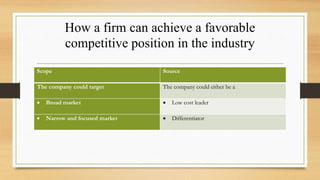
Scope Source
The company could target The company could either be a
 Broad market  Low cost leader
 Narrow and focused market  Differentiator
• Broad
• Narrow
• Low cost Differentiation
• Dell, Amazon, Walmart, Ikea
• Harley Davidson, Caterpillar
• Aircraft charter
• Ducati motor cycles or
Ferari
Cost
leadership
Differentiation
Cost
focus
Differentiation
focus
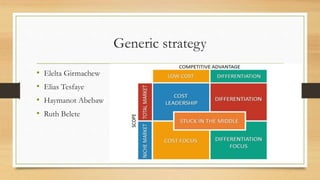
• Overall cost leadership is being
the low cost provider for a broad
customer base.
• Overall differentiation The firm
offers something unique compared
to other firms in the industry so
customers are willing to pay
premium price
• Cost focus target a narrow and
extremely price sensitive but only
carries products that they can
provide a huge discount.
• Differentiation focus these part
segment is willing to pay more for a
particular benefit
Broad Overall Cost leader Overall Differentiation
Narrow Cost focus Differentiation focus
Scope/.source Low cost focus
Cost-Leadership Strategy
• Cost leadership, basically, means the lowest cost of
operation in the industry
• A cost leadership strategy aims to exploit scale of production,
well-defined scope and other economies (e.g., a
good purchasing approach), producing highly
standardized products, using advanced technology
Cont’d
• As its name might imply, cost leadership allows a competitive edge by
manipulating production costs. It does this in two important ways:
• Charging lower prices to increase market share.
• Reducing costs to increase profits
• E.g Walmart
Cost leadership is a defendable strategy because
• I. It defends the firm against powerful buyers. Buyers can drive price
down only to the level of the next most efficient producer.
• II. It defends against powerful suppliers. Cost leadership provides
flexibility to absorb an increase in input costs, whereas competitors may
not have this flexibility.
• III. The factors that lead to cost leadership also provide entry barriers in
many instances. Economies of scale require potential rivals to enter the
industry
Advantage
• high market share, and high
profitability.
• Risk avoidance by customers
reduces switching cost
• convince “their competitors
not to start price wars within
the industry.
Disadvantage
• High level of asset commitment
and capital-intensive activities
• cost reduction methods are easily
imitated or copied by other firms.
• firms often invest considerable
sums of resources into rigid,
inflexible assets and production or
distribution. Difficult to switch to
other products
Cost-leadership strategy
in Kenya Airways
• returning to profitability through revenue enhancement and cost
• containment, refocusing and resizing the business and model, and
• enhancing partnerships, as well as restructuring the capital of the company.
• The changes made have so far resulted in more competitive pricing, better
rates from critical suppliers, improved connectivity at the hub leading to an
increase of 13% in intra Africa traffic year on year amongst numerous other
gains
• minimum price in tickets
• practiced increase in passenger numbers and
• lower operating costs in line
By lowering operating cost
Gross profit up 35.7 per cent
Passenger numbers grew 5.4 %to 4.5 million
Cabin factor up 4 %to 72.3 percent
Cost-leadership strategy by
Fly Dubai
• They have sufficient amount of oil which
gives them competitive advantage
• Tickets are refundable
• Discounts off the highest-priced, most-
restricted ticket classes
Focus
FOCUS STRATEGIES
• Focus strategies are assigned to help a firm target a specific niche within an
industry.
• These niches could be a particular buyer group, a narrow segment of a given
product line, a geographic or regional market, or a niche with distinctive,
special tastes and preference.
• Focus strategies attempt to pursue low-cost or differentiation with respect to
a much narrower targeted market niche or product segment.
Building a focus-Base
• Firms can adopt a cost-based focus in serving a particular niche segment of
the market.
This sort of companies target a narrow and extremely price sensitive but only
carries products that they can provide a huge discount. They have penny
pinching customers.
• They can adopt a differentiation based focus
Focus differentiation is specifically to selected parts of the segments these part
segment is willing to pay more for a particular benefit
Advantage
• Allows businesses to compete on the
basis of low cost, differentiation, and
rapid response against much larger
businesses with greater resources.
• Low costs can be achieved filling niche
needs in a buyer’s operations that larger
rivals either do not want to bother with or
cannot do as cost effectively
• focused company builds up organizational
knowledge about timing sensitive ways to
work with a customer
Disadvantage
• Distinctive tastes and product
characteristics may blur over time
• Firm may takeover target for large
firms seeking to fill out a product
portfolio
Focus strategy implemented
by Djibouti Airlines
Djibouti Airlines focuses on giving services only
to a fixed location which are near by the country
The countries are
• Addis Ababa
• Dire Dawa
• Mogadishu
• Bosaso
• Hargeisa
• Aden
• Cairo
Differentiation
• Differentiating the product offering of a firm means creating something that is
perceived unique industry.
• There are several approaches to differentiation:
• Different design
• Brand image: creating meaningful connections with customers to ensure long-term
loyalty
• Number of features: differentiate want to meet customers’ unique needs
• New technology: by coming out with frequent and useful innovations or product
upgrades, and by providing immaculate customer service
• Promotion: promoting a product’s durability and general utility, which appeals to a
customer’s sense of value
Advantage
• Higher margins give the firm room
to deal with powerful suppliers.
• Differentiation also mitigates buyer
power since buyers now have fewer
alternatives.
• It insulates a firm from competitive
rivalry by creating brand loyalty
• Uniqueness, creates barriers and
reduces substitutes.
Disadvantage
• Cost differentiation between low
cost firms and differentiating firms
becomes too large hold customer
loyalty
• Buyers need for differentiation falls
to hold customer loyalty
• Imitation decreases perceived
differentiation
Differentiation strategy used by
Ethiopian Airlines
Cloud Nine service
• provides passengers who require special
food for dietary, nutritional or religious
reasons have a choice of different meal
on the flights.
• entertainment with the latest movies,
TV shows, games, audio books and
music.
• Offers variety of local cuisines
• Sheba Miles program
• Cargo service
• Aviation Academy
Training are provided for Pilots,
Cabin crew, maintenance
• Construction of a 4 star hotel
• Catering facility
Limitations to generic strategy
• Porter warns companies that do not have defined and a
clear generic strategy they engage in each generic
strategy but fail to achieve any of them they are stuck in
the middle, they possess no competitive advantage,
competitiveness is weak compared to those firms that
have a competitive strategy either as cost-leadership,
focus and differentiation.
Thank You

Generic strategy.pptx

  • 1.
    Generic strategy • EleltaGirmachew • Elias Tesfaye • Haymanot Abebaw • Ruth Belete
  • 2.
    Generic Strategy • Genericstrategy describes how a company pursues competitive advantage across its chosen market scope. • Competitive scope defines the firms target market in its industry • Competitive advantage grows out of value a firm is able to create for its buyers that exceeds the firm's cost of creating it.
  • 3.
    How a firmcan achieve a favorable competitive position in the industry Scope Source The company could target The company could either be a  Broad market  Low cost leader  Narrow and focused market  Differentiator
  • 4.
    • Broad • Narrow •Low cost Differentiation • Dell, Amazon, Walmart, Ikea • Harley Davidson, Caterpillar • Aircraft charter • Ducati motor cycles or Ferari Cost leadership Differentiation Cost focus Differentiation focus
  • 5.
    • Overall costleadership is being the low cost provider for a broad customer base. • Overall differentiation The firm offers something unique compared to other firms in the industry so customers are willing to pay premium price • Cost focus target a narrow and extremely price sensitive but only carries products that they can provide a huge discount. • Differentiation focus these part segment is willing to pay more for a particular benefit Broad Overall Cost leader Overall Differentiation Narrow Cost focus Differentiation focus Scope/.source Low cost focus
  • 7.
    Cost-Leadership Strategy • Costleadership, basically, means the lowest cost of operation in the industry • A cost leadership strategy aims to exploit scale of production, well-defined scope and other economies (e.g., a good purchasing approach), producing highly standardized products, using advanced technology
  • 8.
    Cont’d • As itsname might imply, cost leadership allows a competitive edge by manipulating production costs. It does this in two important ways: • Charging lower prices to increase market share. • Reducing costs to increase profits • E.g Walmart
  • 9.
    Cost leadership isa defendable strategy because • I. It defends the firm against powerful buyers. Buyers can drive price down only to the level of the next most efficient producer. • II. It defends against powerful suppliers. Cost leadership provides flexibility to absorb an increase in input costs, whereas competitors may not have this flexibility. • III. The factors that lead to cost leadership also provide entry barriers in many instances. Economies of scale require potential rivals to enter the industry
  • 10.
    Advantage • high marketshare, and high profitability. • Risk avoidance by customers reduces switching cost • convince “their competitors not to start price wars within the industry. Disadvantage • High level of asset commitment and capital-intensive activities • cost reduction methods are easily imitated or copied by other firms. • firms often invest considerable sums of resources into rigid, inflexible assets and production or distribution. Difficult to switch to other products
  • 11.
    Cost-leadership strategy in KenyaAirways • returning to profitability through revenue enhancement and cost • containment, refocusing and resizing the business and model, and • enhancing partnerships, as well as restructuring the capital of the company. • The changes made have so far resulted in more competitive pricing, better rates from critical suppliers, improved connectivity at the hub leading to an increase of 13% in intra Africa traffic year on year amongst numerous other gains
  • 12.
    • minimum pricein tickets • practiced increase in passenger numbers and • lower operating costs in line By lowering operating cost Gross profit up 35.7 per cent Passenger numbers grew 5.4 %to 4.5 million Cabin factor up 4 %to 72.3 percent
  • 13.
    Cost-leadership strategy by FlyDubai • They have sufficient amount of oil which gives them competitive advantage • Tickets are refundable • Discounts off the highest-priced, most- restricted ticket classes
  • 14.
  • 15.
    FOCUS STRATEGIES • Focusstrategies are assigned to help a firm target a specific niche within an industry. • These niches could be a particular buyer group, a narrow segment of a given product line, a geographic or regional market, or a niche with distinctive, special tastes and preference. • Focus strategies attempt to pursue low-cost or differentiation with respect to a much narrower targeted market niche or product segment.
  • 16.
    Building a focus-Base •Firms can adopt a cost-based focus in serving a particular niche segment of the market. This sort of companies target a narrow and extremely price sensitive but only carries products that they can provide a huge discount. They have penny pinching customers. • They can adopt a differentiation based focus Focus differentiation is specifically to selected parts of the segments these part segment is willing to pay more for a particular benefit
  • 17.
    Advantage • Allows businessesto compete on the basis of low cost, differentiation, and rapid response against much larger businesses with greater resources. • Low costs can be achieved filling niche needs in a buyer’s operations that larger rivals either do not want to bother with or cannot do as cost effectively • focused company builds up organizational knowledge about timing sensitive ways to work with a customer Disadvantage • Distinctive tastes and product characteristics may blur over time • Firm may takeover target for large firms seeking to fill out a product portfolio
  • 18.
    Focus strategy implemented byDjibouti Airlines Djibouti Airlines focuses on giving services only to a fixed location which are near by the country The countries are • Addis Ababa • Dire Dawa • Mogadishu • Bosaso • Hargeisa • Aden • Cairo
  • 20.
    Differentiation • Differentiating theproduct offering of a firm means creating something that is perceived unique industry. • There are several approaches to differentiation: • Different design • Brand image: creating meaningful connections with customers to ensure long-term loyalty • Number of features: differentiate want to meet customers’ unique needs • New technology: by coming out with frequent and useful innovations or product upgrades, and by providing immaculate customer service • Promotion: promoting a product’s durability and general utility, which appeals to a customer’s sense of value
  • 21.
    Advantage • Higher marginsgive the firm room to deal with powerful suppliers. • Differentiation also mitigates buyer power since buyers now have fewer alternatives. • It insulates a firm from competitive rivalry by creating brand loyalty • Uniqueness, creates barriers and reduces substitutes. Disadvantage • Cost differentiation between low cost firms and differentiating firms becomes too large hold customer loyalty • Buyers need for differentiation falls to hold customer loyalty • Imitation decreases perceived differentiation
  • 22.
    Differentiation strategy usedby Ethiopian Airlines Cloud Nine service • provides passengers who require special food for dietary, nutritional or religious reasons have a choice of different meal on the flights. • entertainment with the latest movies, TV shows, games, audio books and music. • Offers variety of local cuisines
  • 23.
    • Sheba Milesprogram • Cargo service • Aviation Academy Training are provided for Pilots, Cabin crew, maintenance • Construction of a 4 star hotel • Catering facility
  • 24.
    Limitations to genericstrategy • Porter warns companies that do not have defined and a clear generic strategy they engage in each generic strategy but fail to achieve any of them they are stuck in the middle, they possess no competitive advantage, competitiveness is weak compared to those firms that have a competitive strategy either as cost-leadership, focus and differentiation.
  • 25.