Embracing Gen AI
at Work
Presented by: Hitesh
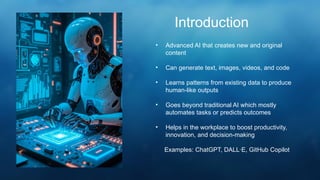
• Advanced AI that creates new and original
content
• Can generate text, images, videos, and code
• Learns patterns from existing data to produce
human-like outputs
• Goes beyond traditional AI which mostly
automates tasks or predicts outcomes
• Helps in the workplace to boost productivity,
innovation, and decision-making
Examples: ChatGPT, DALL·E, GitHub Copilot
Introduction
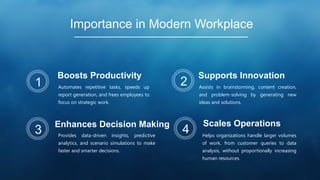
Importance in Modern Workplace
Boosts Productivity
Automates repetitive tasks, speeds up
report generation, and frees employees to
focus on strategic work.
Supports Innovation
Assists in brainstorming, content creation,
and problem-solving by generating new
ideas and solutions.
Enhances Decision Making
Provides data-driven insights, predictive
analytics, and scenario simulations to make
faster and smarter decisions.
Scales Operations
Helps organizations handle larger volumes
of work, from customer queries to data
analysis, without proportionally increasing
human resources.
1 2
3 4
Rise of Generative AI
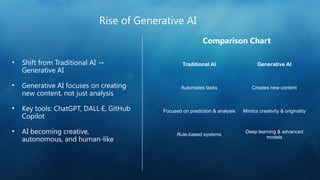
• Shift from Traditional AI →
Generative AI
• Generative AI focuses on creating
new content, not just analysis
• Key tools: ChatGPT, DALL·E, GitHub
Copilot
• AI becoming creative,
autonomous, and human-like
Traditional AI Generative AI
Automates tasks Creates new content
Focused on prediction & analysis Mimics creativity & originality
Rule-based systems
Deep learning & advanced
models
Comparison Chart
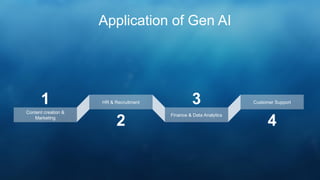
Content creation &
Marketing
HR & Recruitment
Finance & Data Analytics
Customer Support
1 3
2 4
Application of Gen AI
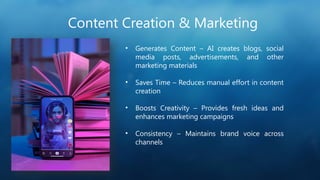
Content Creation & Marketing
• Generates Content – AI creates blogs, social
media posts, advertisements, and other
marketing materials
• Saves Time – Reduces manual effort in content
creation
• Boosts Creativity – Provides fresh ideas and
enhances marketing campaigns
• Consistency – Maintains brand voice across
channels
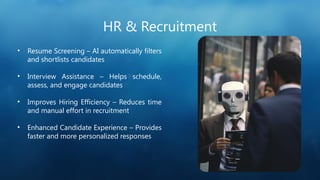
HR & Recruitment
• Resume Screening – AI automatically filters
and shortlists candidates
• Interview Assistance – Helps schedule,
assess, and engage candidates
• Improves Hiring Efficiency – Reduces time
and manual effort in recruitment
• Enhanced Candidate Experience – Provides
faster and more personalized responses
Finance & Data Analytics
• Automates Financial Reports –
Generates reports quickly and
accurately
• Predicts Trends & Risks – Uses AI to
forecast financial patterns and
potential risks
• Supports Decision-Making – Provides
data-driven insights for strategic
choices
• Improves Accuracy & Efficiency –
Reduces human error and saves time
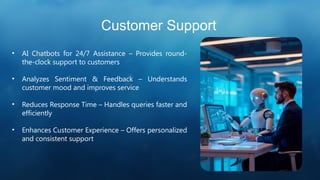
Customer Support
• AI Chatbots for 24/7 Assistance – Provides round-
the-clock support to customers
• Analyzes Sentiment & Feedback – Understands
customer mood and improves service
• Reduces Response Time – Handles queries faster and
efficiently
• Enhances Customer Experience – Offers personalized
and consistent support
Case Studies: Microsoft Copilot – Productivity
Overview
• AI-powered assistant integrated into Microsoft Office apps (Word, Excel,
PowerPoint, Outlook)
• Helps employees create, summarize, and analyze documents efficiently
Key Features
• Document Assistance: Drafts, edits, and summarizes content
• Data Analysis in Excel: Generates charts, highlights trends, predicts outcomes
• Presentation Support: Suggests slide layouts and converts data into slides
• Collaboration: Automates repetitive tasks and enhances team efficiency
Challenges
• Dependence on AI may reduce manual skill practice
• Requires data privacy and security measures
• Can sometimes produce incorrect or generic outputs that need review
Impact in Workplace
• Saves Time: Reduces repetitive work
• Boosts Efficiency: Employees can focus on higher-value tasks
• Enhances Decision-Making: Provides AI-driven insights quickly
• Improves Collaboration: Teams can work more effectively
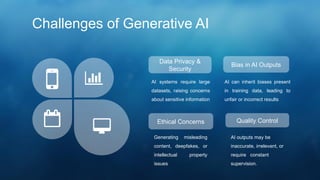
Data Privacy &
Security
Bias in AI Outputs
Ethical Concerns Quality Control
AI systems require large
datasets, raising concerns
about sensitive information
AI can inherit biases present
in training data, leading to
unfair or incorrect results
Generating misleading
content, deepfakes, or
intellectual property
issues
AI outputs may be
inaccurate, irrelevant, or
require constant
supervision.
Challenges of Generative AI
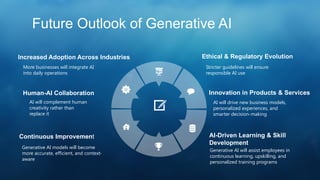
Innovation in Products & Services
AI-Driven Learning & Skill
Development
Ethical & Regulatory Evolution
Human-AI Collaboration
Continuous Improvement
Increased Adoption Across Industries
Future Outlook of Generative AI
Generative AI will assist employees in
continuous learning, upskilling, and
personalized training programs
More businesses will integrate AI
into daily operations
AI will complement human
creativity rather than
replace it
Generative AI models will become
more accurate, efficient, and context-
aware
Stricter guidelines will ensure
responsible AI use
AI will drive new business models,
personalized experiences, and
smarter decision-making
Conclusion
• Generative AI is transforming workplaces by enhancing
productivity, creativity, and decision-making.
• It is being applied across marketing, finance, HR,
customer support, and product design.
• While challenges like bias, ethics, and quality control
exist, proper use ensures responsible AI adoption.
• The future outlook is promising, with AI complementing
human skills, driving innovation, and supporting
continuous learning.
• Businesses that embrace generative AI strategically can
gain a significant competitive advantage.
Thank you

gen AI [Autosaved] Evida smokes Enid which

  • 1.
    Embracing Gen AI atWork Presented by: Hitesh
  • 2.
    • Advanced AIthat creates new and original content • Can generate text, images, videos, and code • Learns patterns from existing data to produce human-like outputs • Goes beyond traditional AI which mostly automates tasks or predicts outcomes • Helps in the workplace to boost productivity, innovation, and decision-making Examples: ChatGPT, DALL·E, GitHub Copilot Introduction
  • 3.
    Importance in ModernWorkplace Boosts Productivity Automates repetitive tasks, speeds up report generation, and frees employees to focus on strategic work. Supports Innovation Assists in brainstorming, content creation, and problem-solving by generating new ideas and solutions. Enhances Decision Making Provides data-driven insights, predictive analytics, and scenario simulations to make faster and smarter decisions. Scales Operations Helps organizations handle larger volumes of work, from customer queries to data analysis, without proportionally increasing human resources. 1 2 3 4
  • 4.
    Rise of GenerativeAI • Shift from Traditional AI → Generative AI • Generative AI focuses on creating new content, not just analysis • Key tools: ChatGPT, DALL·E, GitHub Copilot • AI becoming creative, autonomous, and human-like Traditional AI Generative AI Automates tasks Creates new content Focused on prediction & analysis Mimics creativity & originality Rule-based systems Deep learning & advanced models Comparison Chart
  • 5.
    Content creation & Marketing HR& Recruitment Finance & Data Analytics Customer Support 1 3 2 4 Application of Gen AI
  • 6.
    Content Creation &Marketing • Generates Content – AI creates blogs, social media posts, advertisements, and other marketing materials • Saves Time – Reduces manual effort in content creation • Boosts Creativity – Provides fresh ideas and enhances marketing campaigns • Consistency – Maintains brand voice across channels
  • 7.
    HR & Recruitment •Resume Screening – AI automatically filters and shortlists candidates • Interview Assistance – Helps schedule, assess, and engage candidates • Improves Hiring Efficiency – Reduces time and manual effort in recruitment • Enhanced Candidate Experience – Provides faster and more personalized responses
  • 8.
    Finance & DataAnalytics • Automates Financial Reports – Generates reports quickly and accurately • Predicts Trends & Risks – Uses AI to forecast financial patterns and potential risks • Supports Decision-Making – Provides data-driven insights for strategic choices • Improves Accuracy & Efficiency – Reduces human error and saves time
  • 9.
    Customer Support • AIChatbots for 24/7 Assistance – Provides round- the-clock support to customers • Analyzes Sentiment & Feedback – Understands customer mood and improves service • Reduces Response Time – Handles queries faster and efficiently • Enhances Customer Experience – Offers personalized and consistent support
  • 10.
    Case Studies: MicrosoftCopilot – Productivity Overview • AI-powered assistant integrated into Microsoft Office apps (Word, Excel, PowerPoint, Outlook) • Helps employees create, summarize, and analyze documents efficiently Key Features • Document Assistance: Drafts, edits, and summarizes content • Data Analysis in Excel: Generates charts, highlights trends, predicts outcomes • Presentation Support: Suggests slide layouts and converts data into slides • Collaboration: Automates repetitive tasks and enhances team efficiency
  • 11.
    Challenges • Dependence onAI may reduce manual skill practice • Requires data privacy and security measures • Can sometimes produce incorrect or generic outputs that need review Impact in Workplace • Saves Time: Reduces repetitive work • Boosts Efficiency: Employees can focus on higher-value tasks • Enhances Decision-Making: Provides AI-driven insights quickly • Improves Collaboration: Teams can work more effectively
  • 12.
    Data Privacy & Security Biasin AI Outputs Ethical Concerns Quality Control AI systems require large datasets, raising concerns about sensitive information AI can inherit biases present in training data, leading to unfair or incorrect results Generating misleading content, deepfakes, or intellectual property issues AI outputs may be inaccurate, irrelevant, or require constant supervision. Challenges of Generative AI
  • 13.
    Innovation in Products& Services AI-Driven Learning & Skill Development Ethical & Regulatory Evolution Human-AI Collaboration Continuous Improvement Increased Adoption Across Industries Future Outlook of Generative AI Generative AI will assist employees in continuous learning, upskilling, and personalized training programs More businesses will integrate AI into daily operations AI will complement human creativity rather than replace it Generative AI models will become more accurate, efficient, and context- aware Stricter guidelines will ensure responsible AI use AI will drive new business models, personalized experiences, and smarter decision-making
  • 14.
    Conclusion • Generative AIis transforming workplaces by enhancing productivity, creativity, and decision-making. • It is being applied across marketing, finance, HR, customer support, and product design. • While challenges like bias, ethics, and quality control exist, proper use ensures responsible AI adoption. • The future outlook is promising, with AI complementing human skills, driving innovation, and supporting continuous learning. • Businesses that embrace generative AI strategically can gain a significant competitive advantage.
  • 15.