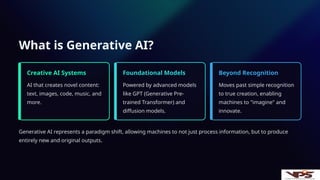
What is GenerativeAI?
Creative AI Systems
AI that creates novel content:
text, images, code, music, and
more.
Foundational Models
Powered by advanced models
like GPT (Generative Pre-
trained Transformer) and
diffusion models.
Beyond Recognition
Moves past simple recognition
to true creation, enabling
machines to "imagine" and
innovate.
Generative AI represents a paradigm shift, allowing machines to not just process information, but to produce
entirely new and original outputs.
3.
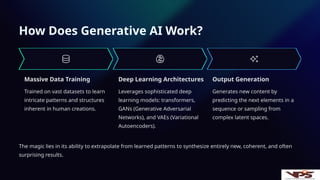
How Does GenerativeAI Work?
Massive Data Training
Trained on vast datasets to learn
intricate patterns and structures
inherent in human creations.
Deep Learning Architectures
Leverages sophisticated deep
learning models: transformers,
GANs (Generative Adversarial
Networks), and VAEs (Variational
Autoencoders).
Output Generation
Generates new content by
predicting the next elements in a
sequence or sampling from
complex latent spaces.
The magic lies in its ability to extrapolate from learned patterns to synthesize entirely new, coherent, and often
surprising results.
4.
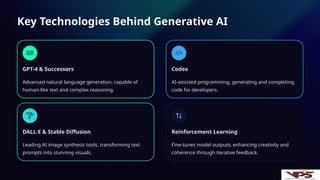
Key Technologies BehindGenerative AI
GPT-4 & Successors
Advanced natural language generation, capable of
human-like text and complex reasoning.
DALL·E & Stable Diffusion
Leading AI image synthesis tools, transforming text
prompts into stunning visuals.
Codex
AI-assisted programming, generating and completing
code for developers.
Reinforcement Learning
Fine-tunes model outputs, enhancing creativity and
coherence through iterative feedback.
5.
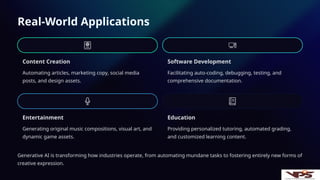
Real-World Applications
Content Creation
Automatingarticles, marketing copy, social media
posts, and design assets.
Software Development
Facilitating auto-coding, debugging, testing, and
comprehensive documentation.
Entertainment
Generating original music compositions, visual art, and
dynamic game assets.
Education
Providing personalized tutoring, automated grading,
and customized learning content.
Generative AI is transforming how industries operate, from automating mundane tasks to fostering entirely new forms of
creative expression.
6.
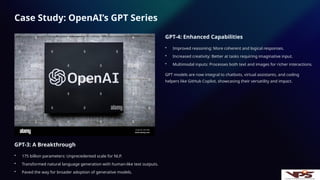
Case Study: OpenAI’sGPT Series
GPT-3: A Breakthrough
• 175 billion parameters: Unprecedented scale for NLP.
• Transformed natural language generation with human-like text outputs.
• Paved the way for broader adoption of generative models.
GPT-4: Enhanced Capabilities
• Improved reasoning: More coherent and logical responses.
• Increased creativity: Better at tasks requiring imaginative input.
• Multimodal inputs: Processes both text and images for richer interactions.
GPT models are now integral to chatbots, virtual assistants, and coding
helpers like GitHub Copilot, showcasing their versatility and impact.
7.
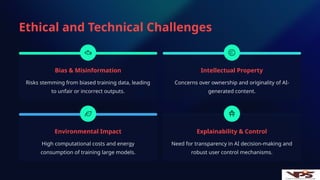
Ethical and TechnicalChallenges
Bias & Misinformation
Risks stemming from biased training data, leading
to unfair or incorrect outputs.
Intellectual Property
Concerns over ownership and originality of AI-
generated content.
Environmental Impact
High computational costs and energy
consumption of training large models.
Explainability & Control
Need for transparency in AI decision-making and
robust user control mechanisms.
8.
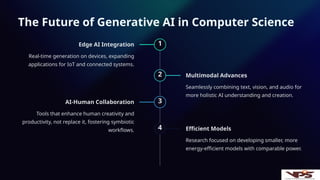
The Future ofGenerative AI in Computer Science
1
Edge AI Integration
Real-time generation on devices, expanding
applications for IoT and connected systems.
2 Multimodal Advances
Seamlessly combining text, vision, and audio for
more holistic AI understanding and creation.
3
AI-Human Collaboration
Tools that enhance human creativity and
productivity, not replace it, fostering symbiotic
workflows. 4 Efficient Models
Research focused on developing smaller, more
energy-efficient models with comparable power.
9.
Embrace the
Generative AI
Wave!
GenerativeAI is not just a
trend; it's a fundamental shift
reshaping industries and
research.
It offers unprecedented
opportunities for innovation
and profound impact across all
sectors.
Equip yourself with the skills to lead and thrive in this
transformative era. The future is generative — be part of creating
it!




![Generative AI_ By Samriti SS]=SSSSSSSSSingh.pptxskjxnsk](https://cdn.slidesharecdn.com/ss_thumbnails/generativeaibysamritisingh-260110133003-4739c439-thumbnail.jpg?width=640&height=640&fit=bounds)


