Generative AI vs Traditional AI: Which One
Is Right for Your Business?
Generative AI vs Traditional AI Which One Is Right for Your Business
Artificial intelligence continues to shape how companies operate, make decisions, and interact
with customers. From data-driven systems to creative outputs, AI technologies for businesses
offer a wide range of possibilities. However, choosing between Generative AI and Traditional AI
depends on your business goals and how each type of AI fits into your workflow.
This guide breaks down the difference between generative AI and traditional AI, outlines use
cases, and helps you decide which option aligns with your needs.
What Is Generative AI?
What Is Generative AI.
Generative AI refers to models that can create original content, such as text, images, video,
code, or audio, based on patterns learned from massive datasets. These models don’t just
classify or predict—they generate.
The most well-known examples include ChatGPT for language tasks and DALL·E for images.
Generative AI development has opened new paths for creative automation and intelligent
content production.
Also read: 20 Best Practices For Integrating AI Chatbots With Your Business
Core Features of Generative AI
● Produces new, human-like content
● Works with unstructured data such as text, audio, or images
● Adapts quickly to varied tasks without task-specific training
Examples of Generative AI in Business
● Writing product descriptions or blog posts
● Creating marketing visuals and social media content
● Generating code snippets for software development
● Building conversational agents that adapt to tone and context
What Is Traditional AI?
What Is Traditional AI
Traditional AI refers to systems designed to perform specific tasks based on predefined rules or
statistical models. These systems learn from structured data and focus on prediction,
classification, and automation.
Most traditional AI applications rely on machine learning or deep learning techniques trained
on labeled data. Over the past decade, businesses have used this type of AI to detect fraud,
recommend products, manage logistics, and automate customer support.
Core Features of Traditional AI:
● Focuses on decision-making and pattern recognition
● Works well with structured and labeled data
● Common in operational and data-heavy environments
Examples of Traditional AI in Business:
● Predictive analytics for sales forecasting
● Recommendation engines for ecommerce
● Chatbots with fixed responses
● Fraud detection systems in banking
● Inventory and supply chain automation
Also read: How Generative AI Models Power Real-World Applications
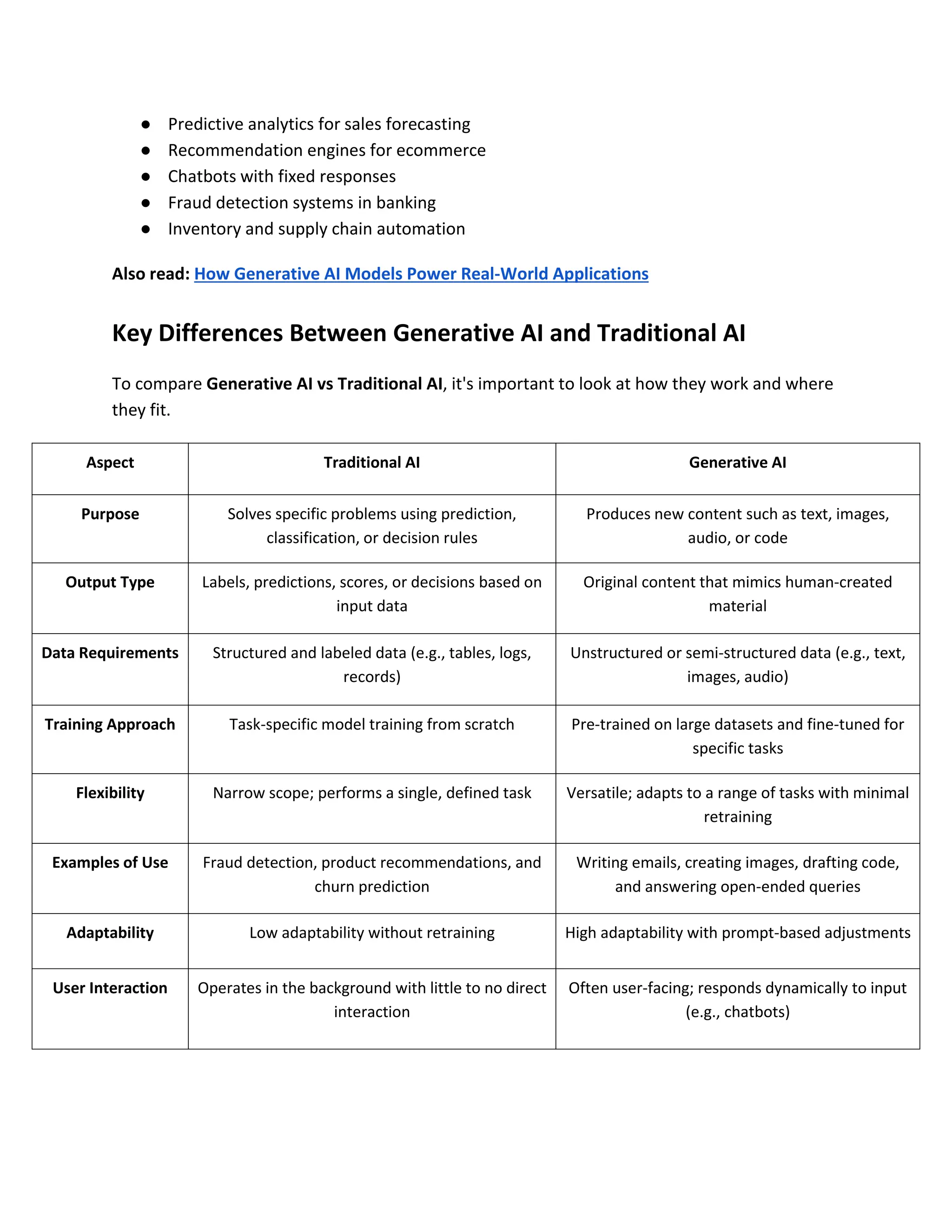
Key Differences Between Generative AI and Traditional AI
To compare Generative AI vs Traditional AI, it's important to look at how they work and where
they fit.
Aspect Traditional AI Generative AI
Purpose Solves specific problems using prediction,
classification, or decision rules
Produces new content such as text, images,
audio, or code
Output Type Labels, predictions, scores, or decisions based on
input data
Original content that mimics human-created
material
Data Requirements Structured and labeled data (e.g., tables, logs,
records)
Unstructured or semi-structured data (e.g., text,
images, audio)
Training Approach Task-specific model training from scratch Pre-trained on large datasets and fine-tuned for
specific tasks
Flexibility Narrow scope; performs a single, defined task Versatile; adapts to a range of tasks with minimal
retraining
Examples of Use Fraud detection, product recommendations, and
churn prediction
Writing emails, creating images, drafting code,
and answering open-ended queries
Adaptability Low adaptability without retraining High adaptability with prompt-based adjustments
User Interaction Operates in the background with little to no direct
interaction
Often user-facing; responds dynamically to input
(e.g., chatbots)
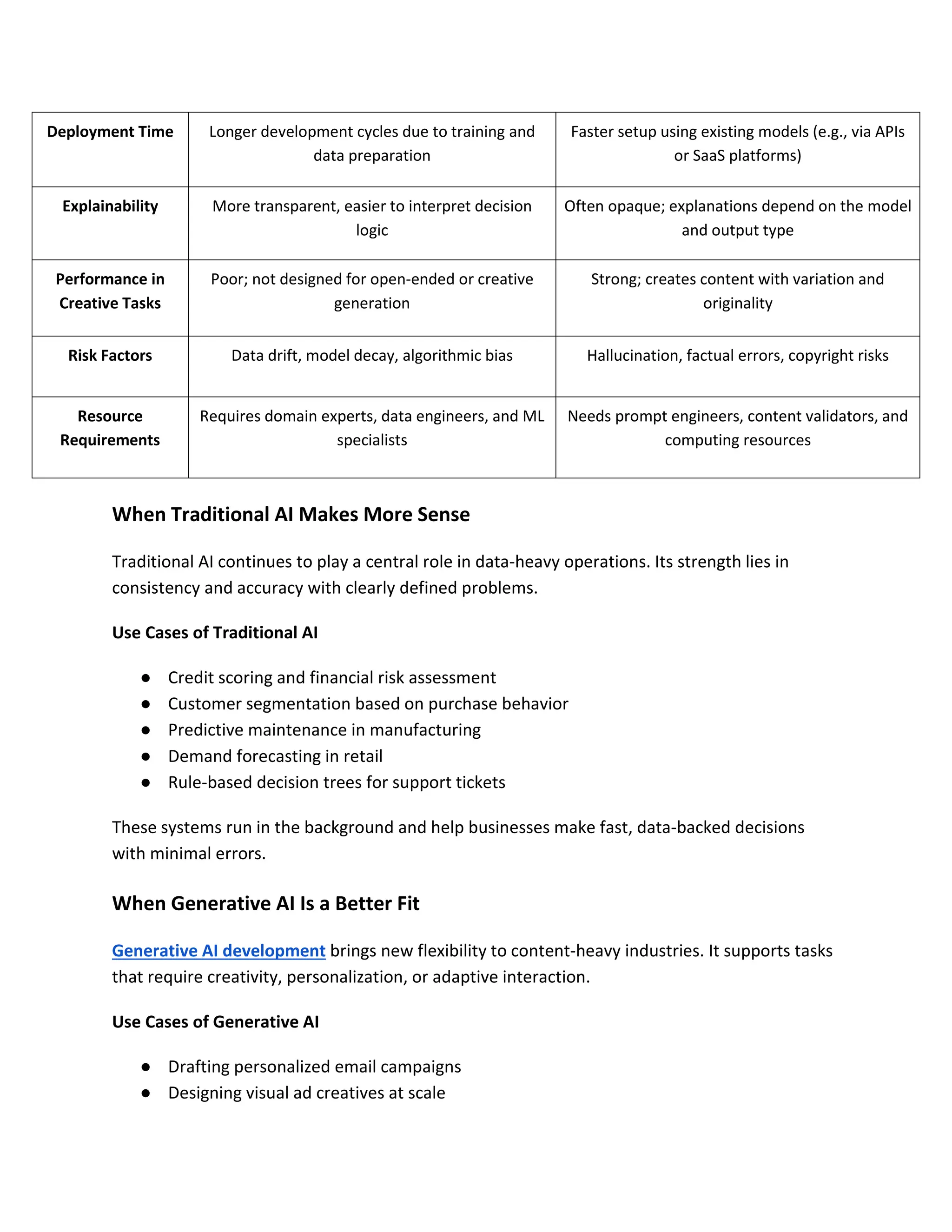
Deployment Time Longer development cycles due to training and
data preparation
Faster setup using existing models (e.g., via APIs
or SaaS platforms)
Explainability More transparent, easier to interpret decision
logic
Often opaque; explanations depend on the model
and output type
Performance in
Creative Tasks
Poor; not designed for open-ended or creative
generation
Strong; creates content with variation and
originality
Risk Factors Data drift, model decay, algorithmic bias Hallucination, factual errors, copyright risks
Resource
Requirements
Requires domain experts, data engineers, and ML
specialists
Needs prompt engineers, content validators, and
computing resources
When Traditional AI Makes More Sense
Traditional AI continues to play a central role in data-heavy operations. Its strength lies in
consistency and accuracy with clearly defined problems.
Use Cases of Traditional AI
● Credit scoring and financial risk assessment
● Customer segmentation based on purchase behavior
● Predictive maintenance in manufacturing
● Demand forecasting in retail
● Rule-based decision trees for support tickets
These systems run in the background and help businesses make fast, data-backed decisions
with minimal errors.
When Generative AI Is a Better Fit
Generative AI development brings new flexibility to content-heavy industries. It supports tasks
that require creativity, personalization, or adaptive interaction.
Use Cases of Generative AI
● Drafting personalized email campaigns
● Designing visual ad creatives at scale
● Generating product listings for ecommerce
● Building knowledge bases or documentation
● Real-time language translation and sentiment-aware chatbots
If your operations involve content, design, or communication at scale, Generative AI tools for
your business can offer a distinct advantage. It might be the right time to explore how these
tools can improve efficiency and output across teams.
Also read: Integrate Generative AI Into Your Enterprise Applications: The Ultimate Guide
Conclusion
Generative AI and Traditional AI both bring solid business value, but they tackle different kinds
of challenges. Traditional AI focuses on logic-driven tasks, data classification, and operational
accuracy. On the other hand, Generative AI excels in producing content, adapting to dynamic
inputs, and supporting creative workflows.
The right choice depends on the kind of work your team does, the data you have, and the
outcomes you expect. Many businesses start with traditional systems to handle structured
processes, then bring in generative tools to support content, communication, or automation
layers.
If you're considering building creative AI tools into your business, whether for text, images, chat,
or smart workflows, Shiv Technolabs offers reliable support in Generative AI development
services. From early-stage planning to integration, our team helps bring AI-driven ideas into
working solutions. Contact us to get started!

Generative AI vs Traditional AI: A Quick Comparison

  • 1.
    Generative AI vsTraditional AI: Which One Is Right for Your Business? Generative AI vs Traditional AI Which One Is Right for Your Business Artificial intelligence continues to shape how companies operate, make decisions, and interact with customers. From data-driven systems to creative outputs, AI technologies for businesses offer a wide range of possibilities. However, choosing between Generative AI and Traditional AI depends on your business goals and how each type of AI fits into your workflow. This guide breaks down the difference between generative AI and traditional AI, outlines use cases, and helps you decide which option aligns with your needs.
  • 2.
    What Is GenerativeAI? What Is Generative AI. Generative AI refers to models that can create original content, such as text, images, video, code, or audio, based on patterns learned from massive datasets. These models don’t just classify or predict—they generate. The most well-known examples include ChatGPT for language tasks and DALL·E for images. Generative AI development has opened new paths for creative automation and intelligent content production. Also read: 20 Best Practices For Integrating AI Chatbots With Your Business Core Features of Generative AI ● Produces new, human-like content ● Works with unstructured data such as text, audio, or images ● Adapts quickly to varied tasks without task-specific training Examples of Generative AI in Business ● Writing product descriptions or blog posts ● Creating marketing visuals and social media content
  • 3.
    ● Generating codesnippets for software development ● Building conversational agents that adapt to tone and context What Is Traditional AI? What Is Traditional AI Traditional AI refers to systems designed to perform specific tasks based on predefined rules or statistical models. These systems learn from structured data and focus on prediction, classification, and automation. Most traditional AI applications rely on machine learning or deep learning techniques trained on labeled data. Over the past decade, businesses have used this type of AI to detect fraud, recommend products, manage logistics, and automate customer support. Core Features of Traditional AI: ● Focuses on decision-making and pattern recognition ● Works well with structured and labeled data ● Common in operational and data-heavy environments Examples of Traditional AI in Business:
  • 4.
    ● Predictive analyticsfor sales forecasting ● Recommendation engines for ecommerce ● Chatbots with fixed responses ● Fraud detection systems in banking ● Inventory and supply chain automation Also read: How Generative AI Models Power Real-World Applications Key Differences Between Generative AI and Traditional AI To compare Generative AI vs Traditional AI, it's important to look at how they work and where they fit. Aspect Traditional AI Generative AI Purpose Solves specific problems using prediction, classification, or decision rules Produces new content such as text, images, audio, or code Output Type Labels, predictions, scores, or decisions based on input data Original content that mimics human-created material Data Requirements Structured and labeled data (e.g., tables, logs, records) Unstructured or semi-structured data (e.g., text, images, audio) Training Approach Task-specific model training from scratch Pre-trained on large datasets and fine-tuned for specific tasks Flexibility Narrow scope; performs a single, defined task Versatile; adapts to a range of tasks with minimal retraining Examples of Use Fraud detection, product recommendations, and churn prediction Writing emails, creating images, drafting code, and answering open-ended queries Adaptability Low adaptability without retraining High adaptability with prompt-based adjustments User Interaction Operates in the background with little to no direct interaction Often user-facing; responds dynamically to input (e.g., chatbots)
  • 5.
    Deployment Time Longerdevelopment cycles due to training and data preparation Faster setup using existing models (e.g., via APIs or SaaS platforms) Explainability More transparent, easier to interpret decision logic Often opaque; explanations depend on the model and output type Performance in Creative Tasks Poor; not designed for open-ended or creative generation Strong; creates content with variation and originality Risk Factors Data drift, model decay, algorithmic bias Hallucination, factual errors, copyright risks Resource Requirements Requires domain experts, data engineers, and ML specialists Needs prompt engineers, content validators, and computing resources When Traditional AI Makes More Sense Traditional AI continues to play a central role in data-heavy operations. Its strength lies in consistency and accuracy with clearly defined problems. Use Cases of Traditional AI ● Credit scoring and financial risk assessment ● Customer segmentation based on purchase behavior ● Predictive maintenance in manufacturing ● Demand forecasting in retail ● Rule-based decision trees for support tickets These systems run in the background and help businesses make fast, data-backed decisions with minimal errors. When Generative AI Is a Better Fit Generative AI development brings new flexibility to content-heavy industries. It supports tasks that require creativity, personalization, or adaptive interaction. Use Cases of Generative AI ● Drafting personalized email campaigns ● Designing visual ad creatives at scale
  • 6.
    ● Generating productlistings for ecommerce ● Building knowledge bases or documentation ● Real-time language translation and sentiment-aware chatbots If your operations involve content, design, or communication at scale, Generative AI tools for your business can offer a distinct advantage. It might be the right time to explore how these tools can improve efficiency and output across teams. Also read: Integrate Generative AI Into Your Enterprise Applications: The Ultimate Guide Conclusion Generative AI and Traditional AI both bring solid business value, but they tackle different kinds of challenges. Traditional AI focuses on logic-driven tasks, data classification, and operational accuracy. On the other hand, Generative AI excels in producing content, adapting to dynamic inputs, and supporting creative workflows. The right choice depends on the kind of work your team does, the data you have, and the outcomes you expect. Many businesses start with traditional systems to handle structured processes, then bring in generative tools to support content, communication, or automation layers. If you're considering building creative AI tools into your business, whether for text, images, chat, or smart workflows, Shiv Technolabs offers reliable support in Generative AI development services. From early-stage planning to integration, our team helps bring AI-driven ideas into working solutions. Contact us to get started!