Generative Adversarial Networks in Computer Vision
SHREE GOWRI RADHAKRISHNA
COMPUTER SCIENCE DEPARTMENT, SAN JOSE STATE UNIVERSITY
A review of,
Generative Adversarial Networks in Computer Vision: A
Survey and Taxonomy
ZHENGWEI WANG,
QI SHE,
TOMÁS E. WARD
https://arxiv.org/abs/1906.01529
Objective
• Introduce GAN
• Understand challenges of GANs and propose improvements
• Look at various GAN architectures from 2 perspectives:
• Architecture-variant
• Loss-variant
Architecture of GAN
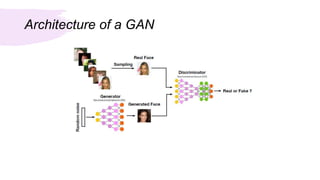
• Two Deep Neural Networks
• Discriminator
• Generator
• Discriminator optimized to distinguish real vs fake images
• Generator creates images to fool discriminator
Architecture of a GAN
Applications of GAN
• Applications:
• Image generation
• Image to image translation
• Image super resolution
• Image completion
• Advantages over tradition Deep Generative Networks:
• Produce better outputs than DGMs
• Can train any type of network
• No restriction on size of latent variable
Challenges in GANs
• High quality image generation
• Diverse image generation
• Stable training.
Two broad classification of GANs
• Architecture – variant GANs
• Focus on architectural improvements to solve issues
• Network Size and Batch Size
• Loss – variant GANs
• Focus on modifying loss function to improve performance
• Normalization and regularization
Architecture Variant GANS
• Fully-connected GAN (FCGAN)
• Laplacian Pyramid of Adversarial Networks (LAPGAN)
• Deep Convolutional GAN (DCGAN)
• Boundary Equilibrium GAN (BEGAN)
• Progressive GAN (PROGAN)
• Self-attention GAN (SAGAN)
• BigGAN
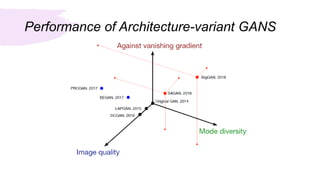
Performance of Architecture-variant GANS
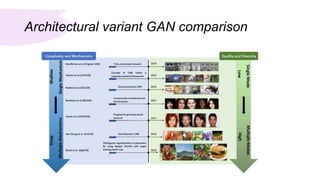
Architectural variant GAN comparison
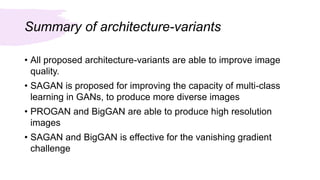
Summary of architecture-variants
• All proposed architecture-variants are able to improve image
quality.
• SAGAN is proposed for improving the capacity of multi-class
learning in GANs, to produce more diverse images
• PROGAN and BigGAN are able to produce high resolution
images
• SAGAN and BigGAN is effective for the vanishing gradient
challenge
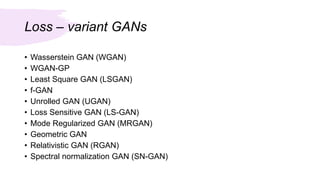
Loss – variant GANs
• Wasserstein GAN (WGAN)
• WGAN-GP
• Least Square GAN (LSGAN)
• f-GAN
• Unrolled GAN (UGAN)
• Loss Sensitive GAN (LS-GAN)
• Mode Regularized GAN (MRGAN)
• Geometric GAN
• Relativistic GAN (RGAN)
• Spectral normalization GAN (SN-GAN)
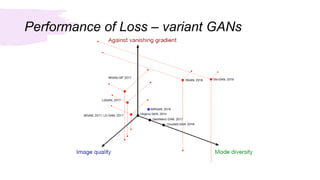
Performance of Loss – variant GANs
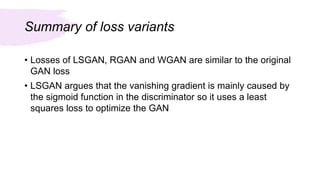
Summary of loss variants
• Losses of LSGAN, RGAN and WGAN are similar to the original
GAN loss
• LSGAN argues that the vanishing gradient is mainly caused by
the sigmoid function in the discriminator so it uses a least
squares loss to optimize the GAN
Conclusion
• Reviewed GAN-variants based on performance improvement
• Stable training: improve loss functions
• Image quality: progressive training in PROGRAN
• Spectral Normalization has good generalization
Thank you

Generative adversarial networks in computer vision

  • 1.
    Generative Adversarial Networksin Computer Vision SHREE GOWRI RADHAKRISHNA COMPUTER SCIENCE DEPARTMENT, SAN JOSE STATE UNIVERSITY
  • 2.
    A review of, GenerativeAdversarial Networks in Computer Vision: A Survey and Taxonomy ZHENGWEI WANG, QI SHE, TOMÁS E. WARD https://arxiv.org/abs/1906.01529
  • 3.
    Objective • Introduce GAN •Understand challenges of GANs and propose improvements • Look at various GAN architectures from 2 perspectives: • Architecture-variant • Loss-variant
  • 4.
    Architecture of GAN •Two Deep Neural Networks • Discriminator • Generator • Discriminator optimized to distinguish real vs fake images • Generator creates images to fool discriminator
  • 5.
  • 6.
    Applications of GAN •Applications: • Image generation • Image to image translation • Image super resolution • Image completion • Advantages over tradition Deep Generative Networks: • Produce better outputs than DGMs • Can train any type of network • No restriction on size of latent variable
  • 7.
    Challenges in GANs •High quality image generation • Diverse image generation • Stable training.
  • 8.
    Two broad classificationof GANs • Architecture – variant GANs • Focus on architectural improvements to solve issues • Network Size and Batch Size • Loss – variant GANs • Focus on modifying loss function to improve performance • Normalization and regularization
  • 9.
    Architecture Variant GANS •Fully-connected GAN (FCGAN) • Laplacian Pyramid of Adversarial Networks (LAPGAN) • Deep Convolutional GAN (DCGAN) • Boundary Equilibrium GAN (BEGAN) • Progressive GAN (PROGAN) • Self-attention GAN (SAGAN) • BigGAN
  • 10.
  • 11.
  • 12.
    Summary of architecture-variants •All proposed architecture-variants are able to improve image quality. • SAGAN is proposed for improving the capacity of multi-class learning in GANs, to produce more diverse images • PROGAN and BigGAN are able to produce high resolution images • SAGAN and BigGAN is effective for the vanishing gradient challenge
  • 13.
    Loss – variantGANs • Wasserstein GAN (WGAN) • WGAN-GP • Least Square GAN (LSGAN) • f-GAN • Unrolled GAN (UGAN) • Loss Sensitive GAN (LS-GAN) • Mode Regularized GAN (MRGAN) • Geometric GAN • Relativistic GAN (RGAN) • Spectral normalization GAN (SN-GAN)
  • 14.
    Performance of Loss– variant GANs
  • 15.
    Summary of lossvariants • Losses of LSGAN, RGAN and WGAN are similar to the original GAN loss • LSGAN argues that the vanishing gradient is mainly caused by the sigmoid function in the discriminator so it uses a least squares loss to optimize the GAN
  • 16.
    Conclusion • Reviewed GAN-variantsbased on performance improvement • Stable training: improve loss functions • Image quality: progressive training in PROGRAN • Spectral Normalization has good generalization
  • 17.