March 10, 2015
GENERATION-NEXT
Building Tomorrow’s Leaders Today…
Generation Next Presentation
Overview
• Problem
• Needs Assessment
• Solution
• Mission/Vision
• How It All Works
• Business Model at a glance
• Areas of Life Change
• Marketing
• ManagementTeam
• Potential Funding Sources
• Impact Statement
The Problem
✤ Today, Black people in America account for a
significantly smaller percentage of GDP than their
representation in the workforce and population
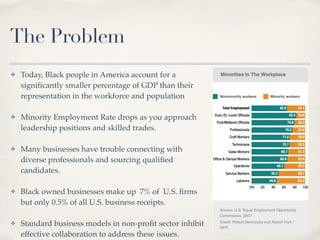
✤ Minority Employment Rate drops as you approach
leadership positions and skilled trades.
✤ Many businesses have trouble connecting with
diverse professionals and sourcing qualified
candidates.
✤ Black owned businesses make up 7% of U.S. firms
but only 0.5% of all U.S. business receipts.
✤ Standard business models in non-profit sector inhibit
effective collaboration to address these issues.
The Problem
Needs Assessment
❖ “Since 2004,American universities have used a six-year standard to measure graduation rates; but
even with the extended time, African-Americans still lag in obtaining degrees. Only 43 percent of
African-Americans who enter college graduate – 20 percent lower than the rate for whites. And for
black men its more alarming, with only 36 percent who enter finishing college.”
1
❖ At the 100 accredited HBCUs, 61.5 percent are women, exceeding the national average of 56
percent. Of the Black males who do attend HBCUs, only 29 percent will graduate within six years.
2
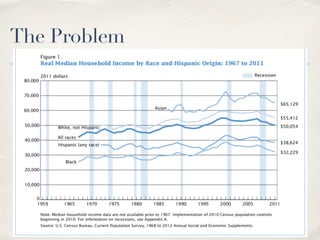
❖ The jobless rates for young men and women with at least a bachelor's degree were 9.5 percent and
8.0 percent, respectively. Black youth not enrolled in school had an unemployment rate of 28.5
percent in October 2011, higher than the rates for their white (15.3 percent), Asian (15.1 percent),
and Hispanic (18.5 percent) counterparts.
3
❖ Despite 60.5% increase of firms, 55% increase of receipts, and 13% increase of businesses with paid
employees, Black owned businesses only make up 7% of all U.S firms and less than a half percent
of all U.S business receipts. African American Adults (ages 10 and up) make up 10% of the adult
population and are therefore underrepresented in the U.S. in terms of business ownership
especially when it comes to earnings.
4
  
1. http://www.cbsnews.com/news/more-blacks-go-to-college-but-graduation-lags/
2. http://www.ajc.com/news/news/local/males-a-distinct-minority-at-hbcus/nQQqT/?__federated=1
3. http://www.bls.gov/news.release/archives/hsgec_04192012.htm
4. http://blackdemographics.com/economics/black-owned-businesses/
Solution
❖ Community Reinvestment
❖ Mentoring
❖ Teach-Me
❖ Career Development
❖ Leadership Development
❖ Public Policy
01
The Solution:
Bringing Organizations into
Collective Impact
✤ To effect change on a mass scale multiple community sectors need to
come together and combine efforts and resources. This includes
NGO’s, private sector business, policy makers, and other community
stakeholders. This process is known as Collective Impact.
01
The Solution:
Bringing Organizations into
Collective Impact
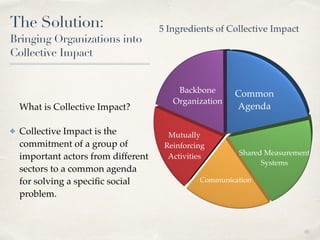
What is Collective Impact?
✤ Collective Impact is the
commitment of a group of
important actors from different
sectors to a common agenda
for solving a specific social
problem.
Our Services
✤ Lead organizations, companies, and other community stakeholders to close
disparities through Collective Impact
✤ Provide Leadership and Career Development opportunities to our members
through in person coaching and online resources:
✤ Strategy Development Meetings
✤ Leadership Training
✤ Connect Portal
✤ Career Development Suite
✤ Webinars
✤ Downloadable Resources (Program Templates, Research Studies)
✤ Provide resources for entrepreneurs and small businesses to grow and thrive
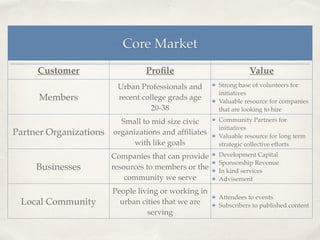
Core Market
Customer Profile Value
Members
Urban Professionals and
recent college grads age
20-38
Strong base of volunteers for
initiatives
Valuable resource for companies
that are looking to hire
Partner Organizations
Small to mid size civic
organizations and affiliates
with like goals
Community Partners for
initiatives
Valuable resource for long term
strategic collective efforts
Businesses
Companies that can provide
resources to members or the
community we serve
Development Capital
Sponsorship Revenue
In kind services
Advisement
Local Community
People living or working in
urban cities that we are
serving
Attendees to events
Subscribers to published content
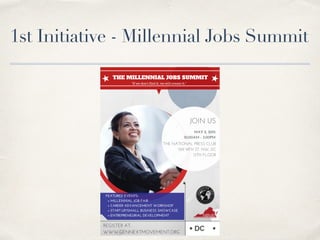
1st Initiative - Millennial Jobs Summit
–Generation-Next’s Mission
“To empower individuals and organizations
through leadership development and collective
action.”
Mission/Vision
❖ Our mission is to empower individuals and organizations through
leadership development and collective action.
❖ Our vision is to work with organizations and individuals across the
public and private sectors to realize the goal of increasing the
impact of Black leadership, and unwavering focus on the shared
values that bring us all together to work for the common good.
Business Model
• We provide mentoring, career and leadership
development for underserved populations in
an effort to decrease disparities in education
employment and entrepreneurship
• We do this through our Leadership Training
Course, Career Center, Our multi-
generational Mentorship program and other
programs.
• We have developed earned-income schema
with our partners affiliate organizations to
fund our programs.
•These ventures will provide a source of funding
sustainability, any additional funding will be
through private donations and grants.
• Our partners would be any progressive
organizations that are focused on the uplift of
underrepresented communities.
• Our aim is to close the achievement,
entrepreneurship and employment gaps present in
american society. Specifically, increasing the number
of African American college graduates, black male
teachers, underrepresented minority entrepreneurs,
and decreasing minority unemployment.
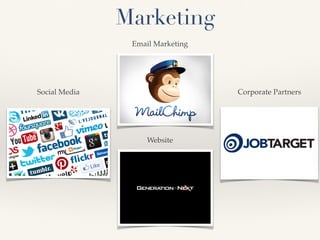
Marketing
Social Media
Email Marketing
Corporate Partners
Website
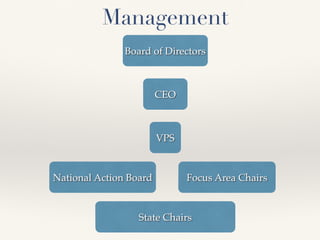
Management
Board of Directors
CEO
VPS
National Action Board Focus Area Chairs
State Chairs
Potential Funding Sources
❖ Career Center powered by Jobtarget™
❖ Leadership program partnership with Dale Carnegie
❖ Membership fees
❖ Millennial Jobs Summit
❖ Next Leaders Entrepreneur Camp
❖ Corporate Partnerships
❖ Community Partnership
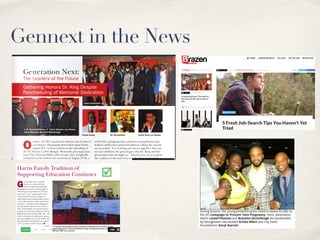
Gennext in the News
Milestones, Assumptions, Theory of Change
Impact
Statement
•Incorporated in the state of Virginia
•1605 IG and 380 twitter followers, 315
Facebook likes
•3.5k+ Subscribers and social media reach
•Full scope of our pilot programs are
complete
•Website, AMS system and Career Center
fully built
•Partnerships with key community
organizations
• 501c3 by Dec 2015
Milestones
Assumptions
Key Milestones
✤ Full scope of our pilot programs are complete
✤ Website, AMS system and Career Center fully built
✤ Partnerships with key community organizations
✤ 3.5k+ Subscribers and social media reach

Generation next slide share

  • 1.
    March 10, 2015 GENERATION-NEXT BuildingTomorrow’s Leaders Today…
  • 2.
    Generation Next Presentation Overview •Problem • Needs Assessment • Solution • Mission/Vision • How It All Works • Business Model at a glance • Areas of Life Change • Marketing • ManagementTeam • Potential Funding Sources • Impact Statement
  • 3.
    The Problem ✤ Today,Black people in America account for a significantly smaller percentage of GDP than their representation in the workforce and population ✤ Minority Employment Rate drops as you approach leadership positions and skilled trades. ✤ Many businesses have trouble connecting with diverse professionals and sourcing qualified candidates. ✤ Black owned businesses make up 7% of U.S. firms but only 0.5% of all U.S. business receipts. ✤ Standard business models in non-profit sector inhibit effective collaboration to address these issues.
  • 4.
  • 5.
    Needs Assessment ❖ “Since2004,American universities have used a six-year standard to measure graduation rates; but even with the extended time, African-Americans still lag in obtaining degrees. Only 43 percent of African-Americans who enter college graduate – 20 percent lower than the rate for whites. And for black men its more alarming, with only 36 percent who enter finishing college.” 1 ❖ At the 100 accredited HBCUs, 61.5 percent are women, exceeding the national average of 56 percent. Of the Black males who do attend HBCUs, only 29 percent will graduate within six years. 2 ❖ The jobless rates for young men and women with at least a bachelor's degree were 9.5 percent and 8.0 percent, respectively. Black youth not enrolled in school had an unemployment rate of 28.5 percent in October 2011, higher than the rates for their white (15.3 percent), Asian (15.1 percent), and Hispanic (18.5 percent) counterparts. 3 ❖ Despite 60.5% increase of firms, 55% increase of receipts, and 13% increase of businesses with paid employees, Black owned businesses only make up 7% of all U.S firms and less than a half percent of all U.S business receipts. African American Adults (ages 10 and up) make up 10% of the adult population and are therefore underrepresented in the U.S. in terms of business ownership especially when it comes to earnings. 4    1. http://www.cbsnews.com/news/more-blacks-go-to-college-but-graduation-lags/ 2. http://www.ajc.com/news/news/local/males-a-distinct-minority-at-hbcus/nQQqT/?__federated=1 3. http://www.bls.gov/news.release/archives/hsgec_04192012.htm 4. http://blackdemographics.com/economics/black-owned-businesses/
  • 6.
    Solution ❖ Community Reinvestment ❖Mentoring ❖ Teach-Me ❖ Career Development ❖ Leadership Development ❖ Public Policy
  • 7.
    01 The Solution: Bringing Organizationsinto Collective Impact ✤ To effect change on a mass scale multiple community sectors need to come together and combine efforts and resources. This includes NGO’s, private sector business, policy makers, and other community stakeholders. This process is known as Collective Impact.
  • 8.
    01 The Solution: Bringing Organizationsinto Collective Impact What is Collective Impact? ✤ Collective Impact is the commitment of a group of important actors from different sectors to a common agenda for solving a specific social problem.
  • 9.
    Our Services ✤ Leadorganizations, companies, and other community stakeholders to close disparities through Collective Impact ✤ Provide Leadership and Career Development opportunities to our members through in person coaching and online resources: ✤ Strategy Development Meetings ✤ Leadership Training ✤ Connect Portal ✤ Career Development Suite ✤ Webinars ✤ Downloadable Resources (Program Templates, Research Studies) ✤ Provide resources for entrepreneurs and small businesses to grow and thrive
  • 10.
    Core Market Customer ProfileValue Members Urban Professionals and recent college grads age 20-38 Strong base of volunteers for initiatives Valuable resource for companies that are looking to hire Partner Organizations Small to mid size civic organizations and affiliates with like goals Community Partners for initiatives Valuable resource for long term strategic collective efforts Businesses Companies that can provide resources to members or the community we serve Development Capital Sponsorship Revenue In kind services Advisement Local Community People living or working in urban cities that we are serving Attendees to events Subscribers to published content
  • 11.
    1st Initiative -Millennial Jobs Summit
  • 12.
    –Generation-Next’s Mission “To empowerindividuals and organizations through leadership development and collective action.”
  • 13.
    Mission/Vision ❖ Our missionis to empower individuals and organizations through leadership development and collective action. ❖ Our vision is to work with organizations and individuals across the public and private sectors to realize the goal of increasing the impact of Black leadership, and unwavering focus on the shared values that bring us all together to work for the common good.
  • 14.
    Business Model • Weprovide mentoring, career and leadership development for underserved populations in an effort to decrease disparities in education employment and entrepreneurship • We do this through our Leadership Training Course, Career Center, Our multi- generational Mentorship program and other programs. • We have developed earned-income schema with our partners affiliate organizations to fund our programs. •These ventures will provide a source of funding sustainability, any additional funding will be through private donations and grants. • Our partners would be any progressive organizations that are focused on the uplift of underrepresented communities. • Our aim is to close the achievement, entrepreneurship and employment gaps present in american society. Specifically, increasing the number of African American college graduates, black male teachers, underrepresented minority entrepreneurs, and decreasing minority unemployment.
  • 15.
  • 16.
    Management Board of Directors CEO VPS NationalAction Board Focus Area Chairs State Chairs
  • 17.
    Potential Funding Sources ❖Career Center powered by Jobtarget™ ❖ Leadership program partnership with Dale Carnegie ❖ Membership fees ❖ Millennial Jobs Summit ❖ Next Leaders Entrepreneur Camp ❖ Corporate Partnerships ❖ Community Partnership
  • 18.
  • 19.
    Milestones, Assumptions, Theoryof Change Impact Statement •Incorporated in the state of Virginia •1605 IG and 380 twitter followers, 315 Facebook likes •3.5k+ Subscribers and social media reach •Full scope of our pilot programs are complete •Website, AMS system and Career Center fully built •Partnerships with key community organizations • 501c3 by Dec 2015 Milestones Assumptions
  • 20.
    Key Milestones ✤ Fullscope of our pilot programs are complete ✤ Website, AMS system and Career Center fully built ✤ Partnerships with key community organizations ✤ 3.5k+ Subscribers and social media reach