Magnetic Field and Force
Aurora or polar
light is
observable in a
few places on
Earth close to
the Arctic and
Antarctic
regions.
2
3
Auroras sway along the vibrating field lines of the earth, as
a result of electrons being flung to Earth, then off the
planet’s magnetosphere, and back again.
It is a demonstration of how charged particles behave in a
magnetic field.
4
What happens to a charged
particle as it moves in a
magnetic field?
5
● interaction between electrically-charged particles
resulting from their motion
● causes the attraction and repulsion of magnetic
materials
● force that results from the interaction between the
different magnetic fields formed by moving charges
Magnetic Force
6
Magnetic force has four distinct characteristics:
1. The magnitude of the magnetic force is proportional to
the magnitude of the charge.
2. The magnitude of the magnetic force is proportional to
the magnitude of the magnetic field.
Magnetic Force on Moving Charges
7
Magnetic force has four distinct characteristics:
3. The magnetic force is affected by the charged particle’s
velocity.
4. Magnetic force is perpendicular to the field and the
velocity.
Magnetic Force on Moving Charges
8
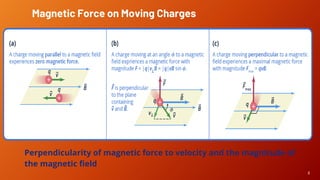
Magnetic Force on Moving Charges
Perpendicularity of magnetic force to velocity and the magnitude of
the magnetic field
12
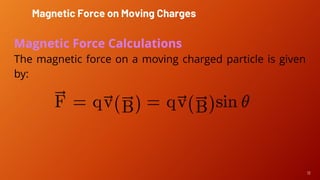
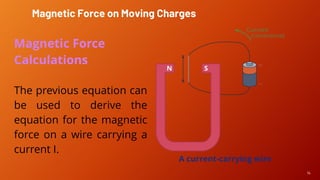
Magnetic Force Calculations
The magnetic force on a moving charged particle is given
by:
Magnetic Force on Moving Charges
13
When two charged particle that have
equal but opposite magnitudes are
moving with equal velocity in the same
field, the forces on the charged
particles are also equal in magnitude,
but opposite in direction.
14
Magnetic Force
Calculations
The previous equation can
be used to derive the
equation for the magnetic
force on a wire carrying a
current I.
Magnetic Force on Moving Charges
A current-carrying wire
15
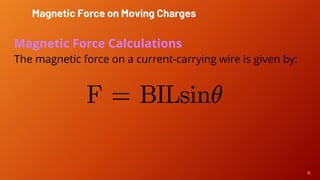
Magnetic Force Calculations
The magnetic force on a current-carrying wire is given by:
Magnetic Force on Moving Charges
16
● The SI unit for magnetic field is tesla
(T).
● Another common unit for field is
gauss (G), equivalent to 10-4 T.
● Magnetic force is measured in
newtons (N).
17
An 8.12-μC charged particle with a speed of 40.0 m/s
is found in a uniform magnetic field with magnitude
0.75 T. Determine the magnitude of the magnetic
force exerted on the charged particle if the particle is
moving perpendicular to the field.
18
An 8.12-μC charged particle with a speed of 40.0 m/s
is found in a uniform magnetic field with magnitude
0.75 T. Determine the magnitude of the magnetic
force exerted on the charged particle if the particle is
moving perpendicular to the field.
The magnitude of the magnetic force is equal to
2.44✕10-4 N.
19
19
A 7.55-μC charged particle with a speed
of 30.50 m/s is found in a uniform
magnetic field with magnitude 1.2 T.
Solve for the magnitude of the magnetic
force exerted on the charged particle if
the particle is moving perpendicular to
the field.
20
A 100-cm wire that carries an electric current of 0.25
A perpendicular to the field has experienced a
magnetic force of 5.50✕10-3 N. Solve for the
magnitude of the magnetic field that caused this
force.
21
A 100-cm wire that carries an electric current of 0.25
A perpendicular to the field has experienced a
magnetic force of 5.50✕10-3 N. Solve for the
magnitude of the magnetic field that caused this
force.
The magnitude of the magnetic field is 0.022 T.
22
22
An 88.30-cm wire that carries an electric
current of 1.35 A perpendicular to the
field has experienced a magnetic force
of 9.0✕10-3 N. Solve for the magnitude of
the magnetic field that caused this
force.
23
A 1.13✕10-19-C negative charge is travelling with a
speed of 3.5✕107 m/s through a uniform field with
magnitude 0.076 T. The charge has a mass of 1.95✕10-
31 kg. Determine the angle the velocity vector makes
with the field if the particle’s acceleration is
1.25✕1017 m/s2.
24
A 1.13✕10-19-C negative charge is travelling with a
speed of 3.5✕107 m/s through a uniform field with
magnitude 0.076 T. The charge has a mass of 1.95✕10-
31 kg. Determine the angle the velocity vector makes
with the field if the particle’s acceleration is
1.25✕1017 m/s2.
The angle between the velocity vector and the
magnetic field is 4.65°.
25
25
A 2.5✕10-19-C negative charge is
travelling with a speed of 4.0✕107 m/s
through a uniform field with magnitude
0.03 T. The charge has a mass of 5.45✕10-
31 kg. Determine the angle the velocity
vector makes with the field if the
particle’s acceleration is 2.3✕1017 m/s2.
26
How do we determine the
magnetic force acting on a
moving charge?
27
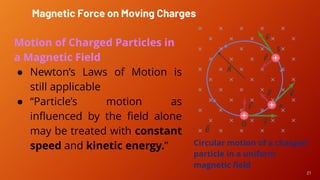
Motion of Charged Particles in
a Magnetic Field
● Newton’s Laws of Motion is
still applicable
● “Particle’s motion as
influenced by the field alone
may be treated with constant
speed and kinetic energy.”
Magnetic Force on Moving Charges
Circular motion of a charged
particle in a uniform
magnetic field
28
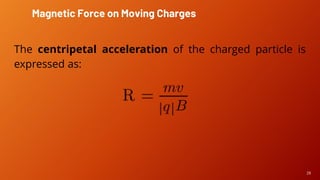
The centripetal acceleration of the charged particle is
expressed as:
Magnetic Force on Moving Charges
29
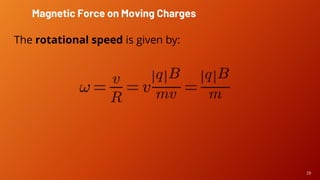
The rotational speed is given by:
Magnetic Force on Moving Charges
30
Motion of Charged Particles in a Magnetic Field
● if charge is positive, the particle’s revolution is
counterclockwise
● if charge is negative, the particle revolves clockwise
around the orbit
Magnetic Force on Moving Charges
31
Motion of Charged Particles in a Magnetic Field
● Cyclotron radius (gyroradius or radius of
gyration) is the radius of the circular path traveled
by the particle in a uniform magnetic field
● Cyclotron frequency is the number of revolutions
per unit time taken by the particle around the path
Magnetic Force on Moving Charges
32
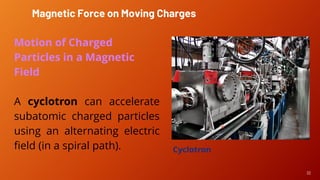
Motion of Charged
Particles in a Magnetic
Field
A cyclotron can accelerate
subatomic charged particles
using an alternating electric
field (in a spiral path).
Magnetic Force on Moving Charges
Cyclotron
33
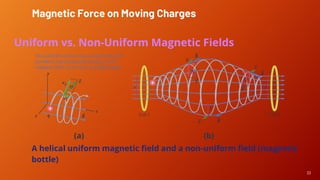
Uniform vs. Non-Uniform Magnetic Fields
Magnetic Force on Moving Charges
A helical uniform magnetic field and a non-uniform field (magnetic
bottle)
34
Magnetic Force on Moving Charges
Uniform vs. Non-Uniform Magnetic Fields
● In a uniform magnetic field, the field lines are
parallel to each other
● In a non-uniform magnetic field, field lines may
converge or diverge.
● An example of a non-uniform field is the magnetic
field of Earth
35
How does magnetic force affect
the speed, and kinetic energy of
a moving particle?
36
Identify whether each statement is true or false.
1. Magnetic force results from the interaction between
electrically-charged particles that are stationary.
1. The magnitude of the magnetic force is proportional to
the magnitude of the magnetic field.
1. When the charged particle is negative, the direction of
the magnetic force is similar to the one the right-hand
rule suggests.
37
Identify what is being referred to in each statement.
1. The charged particle’s motion as influenced by the field
alone may be treated as motion with __________ speed
and kinetic energy.
2. The motion of a charged particle as influenced by a
magnetic field is characterized as __________
acceleration.
3. The radius of the circular path traversed by the particle
in a uniform magnetic field is called the __________ .
38
● Magnetic force (measured in newtons) is the
interaction between electrically-charged particles
resulting from their motion. It causes the
attraction and repulsion of magnetic materials.
● The magnitude of the magnetic force is
proportional to the magnitude of the charge.
39
● The magnitude of the magnetic force is
proportional to the magnitude of the magnetic
field.
● The magnetic force is affected by the charged
particle’s velocity.
● The magnetic force and the magnetic field do not
have similar directions. Instead, magnetic force is
perpendicular to the field and the velocity.
40
● A particle’s motion as influenced by the field alone
may be treated as motion with constant speed
and kinetic energy.
● The radius of the circular path traversed by the
particle in a uniform magnetic field is called the
cyclotron radius. It is also called gyroradius or
radius of gyration.
41
● The number of revolutions per unit of time taken
by the particle around the circular path is called
the cyclotron frequency.
● Uniform magnetic fields produce parallel field
lines. Non-uniform fields have unequal
distributions of field magnitudes throughout, thus
their field lines are either diverging or converging.
42
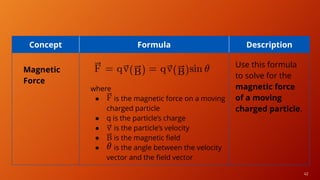
Concept Formula Description
Magnetic
Force
where
● is the magnetic force on a moving
charged particle
● q is the particle’s charge
● is the particle’s velocity
● is the magnetic field
● is the angle between the velocity
vector and the field vector
Use this formula
to solve for the
magnetic force
of a moving
charged particle.
43
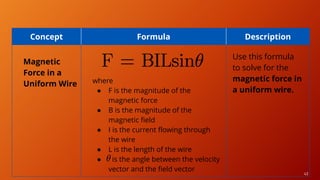
Concept Formula Description
Magnetic
Force in a
Uniform Wire where
● F is the magnitude of the
magnetic force
● B is the magnitude of the
magnetic field
● I is the current flowing through
the wire
● L is the length of the wire
● is the angle between the velocity
vector and the field vector
Use this formula
to solve for the
magnetic force in
a uniform wire.

General Physics 2: Magnetic field and force.pdf

  • 1.
  • 2.
    Aurora or polar lightis observable in a few places on Earth close to the Arctic and Antarctic regions. 2
  • 3.
    3 Auroras sway alongthe vibrating field lines of the earth, as a result of electrons being flung to Earth, then off the planet’s magnetosphere, and back again. It is a demonstration of how charged particles behave in a magnetic field.
  • 4.
    4 What happens toa charged particle as it moves in a magnetic field?
  • 5.
    5 ● interaction betweenelectrically-charged particles resulting from their motion ● causes the attraction and repulsion of magnetic materials ● force that results from the interaction between the different magnetic fields formed by moving charges Magnetic Force
  • 6.
    6 Magnetic force hasfour distinct characteristics: 1. The magnitude of the magnetic force is proportional to the magnitude of the charge. 2. The magnitude of the magnetic force is proportional to the magnitude of the magnetic field. Magnetic Force on Moving Charges
  • 7.
    7 Magnetic force hasfour distinct characteristics: 3. The magnetic force is affected by the charged particle’s velocity. 4. Magnetic force is perpendicular to the field and the velocity. Magnetic Force on Moving Charges
  • 8.
    8 Magnetic Force onMoving Charges Perpendicularity of magnetic force to velocity and the magnitude of the magnetic field
  • 9.
    12 Magnetic Force Calculations Themagnetic force on a moving charged particle is given by: Magnetic Force on Moving Charges
  • 10.
    13 When two chargedparticle that have equal but opposite magnitudes are moving with equal velocity in the same field, the forces on the charged particles are also equal in magnitude, but opposite in direction.
  • 11.
    14 Magnetic Force Calculations The previousequation can be used to derive the equation for the magnetic force on a wire carrying a current I. Magnetic Force on Moving Charges A current-carrying wire
  • 12.
    15 Magnetic Force Calculations Themagnetic force on a current-carrying wire is given by: Magnetic Force on Moving Charges
  • 13.
    16 ● The SIunit for magnetic field is tesla (T). ● Another common unit for field is gauss (G), equivalent to 10-4 T. ● Magnetic force is measured in newtons (N).
  • 14.
    17 An 8.12-μC chargedparticle with a speed of 40.0 m/s is found in a uniform magnetic field with magnitude 0.75 T. Determine the magnitude of the magnetic force exerted on the charged particle if the particle is moving perpendicular to the field.
  • 15.
    18 An 8.12-μC chargedparticle with a speed of 40.0 m/s is found in a uniform magnetic field with magnitude 0.75 T. Determine the magnitude of the magnetic force exerted on the charged particle if the particle is moving perpendicular to the field. The magnitude of the magnetic force is equal to 2.44✕10-4 N.
  • 16.
    19 19 A 7.55-μC chargedparticle with a speed of 30.50 m/s is found in a uniform magnetic field with magnitude 1.2 T. Solve for the magnitude of the magnetic force exerted on the charged particle if the particle is moving perpendicular to the field.
  • 17.
    20 A 100-cm wirethat carries an electric current of 0.25 A perpendicular to the field has experienced a magnetic force of 5.50✕10-3 N. Solve for the magnitude of the magnetic field that caused this force.
  • 18.
    21 A 100-cm wirethat carries an electric current of 0.25 A perpendicular to the field has experienced a magnetic force of 5.50✕10-3 N. Solve for the magnitude of the magnetic field that caused this force. The magnitude of the magnetic field is 0.022 T.
  • 19.
    22 22 An 88.30-cm wirethat carries an electric current of 1.35 A perpendicular to the field has experienced a magnetic force of 9.0✕10-3 N. Solve for the magnitude of the magnetic field that caused this force.
  • 20.
    23 A 1.13✕10-19-C negativecharge is travelling with a speed of 3.5✕107 m/s through a uniform field with magnitude 0.076 T. The charge has a mass of 1.95✕10- 31 kg. Determine the angle the velocity vector makes with the field if the particle’s acceleration is 1.25✕1017 m/s2.
  • 21.
    24 A 1.13✕10-19-C negativecharge is travelling with a speed of 3.5✕107 m/s through a uniform field with magnitude 0.076 T. The charge has a mass of 1.95✕10- 31 kg. Determine the angle the velocity vector makes with the field if the particle’s acceleration is 1.25✕1017 m/s2. The angle between the velocity vector and the magnetic field is 4.65°.
  • 22.
    25 25 A 2.5✕10-19-C negativecharge is travelling with a speed of 4.0✕107 m/s through a uniform field with magnitude 0.03 T. The charge has a mass of 5.45✕10- 31 kg. Determine the angle the velocity vector makes with the field if the particle’s acceleration is 2.3✕1017 m/s2.
  • 23.
    26 How do wedetermine the magnetic force acting on a moving charge?
  • 24.
    27 Motion of ChargedParticles in a Magnetic Field ● Newton’s Laws of Motion is still applicable ● “Particle’s motion as influenced by the field alone may be treated with constant speed and kinetic energy.” Magnetic Force on Moving Charges Circular motion of a charged particle in a uniform magnetic field
  • 25.
    28 The centripetal accelerationof the charged particle is expressed as: Magnetic Force on Moving Charges
  • 26.
    29 The rotational speedis given by: Magnetic Force on Moving Charges
  • 27.
    30 Motion of ChargedParticles in a Magnetic Field ● if charge is positive, the particle’s revolution is counterclockwise ● if charge is negative, the particle revolves clockwise around the orbit Magnetic Force on Moving Charges
  • 28.
    31 Motion of ChargedParticles in a Magnetic Field ● Cyclotron radius (gyroradius or radius of gyration) is the radius of the circular path traveled by the particle in a uniform magnetic field ● Cyclotron frequency is the number of revolutions per unit time taken by the particle around the path Magnetic Force on Moving Charges
  • 29.
    32 Motion of Charged Particlesin a Magnetic Field A cyclotron can accelerate subatomic charged particles using an alternating electric field (in a spiral path). Magnetic Force on Moving Charges Cyclotron
  • 30.
    33 Uniform vs. Non-UniformMagnetic Fields Magnetic Force on Moving Charges A helical uniform magnetic field and a non-uniform field (magnetic bottle)
  • 31.
    34 Magnetic Force onMoving Charges Uniform vs. Non-Uniform Magnetic Fields ● In a uniform magnetic field, the field lines are parallel to each other ● In a non-uniform magnetic field, field lines may converge or diverge. ● An example of a non-uniform field is the magnetic field of Earth
  • 32.
    35 How does magneticforce affect the speed, and kinetic energy of a moving particle?
  • 33.
    36 Identify whether eachstatement is true or false. 1. Magnetic force results from the interaction between electrically-charged particles that are stationary. 1. The magnitude of the magnetic force is proportional to the magnitude of the magnetic field. 1. When the charged particle is negative, the direction of the magnetic force is similar to the one the right-hand rule suggests.
  • 34.
    37 Identify what isbeing referred to in each statement. 1. The charged particle’s motion as influenced by the field alone may be treated as motion with __________ speed and kinetic energy. 2. The motion of a charged particle as influenced by a magnetic field is characterized as __________ acceleration. 3. The radius of the circular path traversed by the particle in a uniform magnetic field is called the __________ .
  • 35.
    38 ● Magnetic force(measured in newtons) is the interaction between electrically-charged particles resulting from their motion. It causes the attraction and repulsion of magnetic materials. ● The magnitude of the magnetic force is proportional to the magnitude of the charge.
  • 36.
    39 ● The magnitudeof the magnetic force is proportional to the magnitude of the magnetic field. ● The magnetic force is affected by the charged particle’s velocity. ● The magnetic force and the magnetic field do not have similar directions. Instead, magnetic force is perpendicular to the field and the velocity.
  • 37.
    40 ● A particle’smotion as influenced by the field alone may be treated as motion with constant speed and kinetic energy. ● The radius of the circular path traversed by the particle in a uniform magnetic field is called the cyclotron radius. It is also called gyroradius or radius of gyration.
  • 38.
    41 ● The numberof revolutions per unit of time taken by the particle around the circular path is called the cyclotron frequency. ● Uniform magnetic fields produce parallel field lines. Non-uniform fields have unequal distributions of field magnitudes throughout, thus their field lines are either diverging or converging.
  • 39.
    42 Concept Formula Description Magnetic Force where ●is the magnetic force on a moving charged particle ● q is the particle’s charge ● is the particle’s velocity ● is the magnetic field ● is the angle between the velocity vector and the field vector Use this formula to solve for the magnetic force of a moving charged particle.
  • 40.
    43 Concept Formula Description Magnetic Forcein a Uniform Wire where ● F is the magnitude of the magnetic force ● B is the magnitude of the magnetic field ● I is the current flowing through the wire ● L is the length of the wire ● is the angle between the velocity vector and the field vector Use this formula to solve for the magnetic force in a uniform wire.