GENERIC CURRICULUM VITAE WILLEM VAN DEN TOORN (JUNE 2015)
Possible role in the project: Institutional and Organisation/Capacity Development Expert, Planning
Economist and Project/Programme Formulator, Evaluator: in capacities:
Expert, Advisor, Team Leader
Status Senior/Category 1
Staff of: Independent consultant
Contact details: toornwh@gmail.com
1. Family name: Van den Toorn
2. First names: Willem
3. Passport Holder: Dutch
4. Place of residence: The Netherlands
5. Education:
Institution Degree(s) or Diploma(s) obtained:
Free University of Amsterdam, Twente University -1984 PhD Development Economics and Institutions. Thesis: ‘Multi-
system Society and Trade-off Based Planning’
Rotterdam School of Economics (Erasmus Un.) -1966 MSc Economics
Rotterdam School of Economics (Erasmus Un.) -1963 BSc Economics
6. Language skills: Competence on a scale of 1 to 5 (1 - excellent; 5 - basic)
Language Reading Speaking Writing
English 1 1 1
Dutch 1 1 1
French 3 3 4
7. Membership of professional bodies: UNDP Evaluators Roster ERG, UN Evaluation Group UNEG, NEDWORC
Association (Development professionals), ELDIS Community, ECOZOEK, Member Editorial Board ‘Journal of
Applied Geo Sciences’ for social science aspects (Elsevier, 1996-2005); Knighthood, ‘Order of the Netherlands
Lion’ (1997).
8. Other skills: 1) Facilitation / Chairing of workshops, seminars, conferences, interviews, focus groups; 2) Participated
in 2 e-courses on evaluation (Evalpartners, 2012, 2013): ‘Real World Evaluations’, ‘Development Evaluation’, 3)
’Excellent writing skills – Programme / project proposals, Aide Memoires, reports, PCM documents, papers, books; 4)
Strong consulting and academic record.
9. Position (June 2015): Independent Consultant; Emeritus Professor; Senior Evaluator Capacity Development
Programme, national Planning Commission. Namibia; Senior Evaluator Strengthening the NAO Office and the TCF for
11th
EDF, Solomon Islands
10. Employment: 20 years permanent positions with consulting firms, 18 years with universities, 18 years as independent
consultant (part-time during university years, full-time thereafter): 1) 1996-2005 part-time, 2005 to date full-time
Independent Consultant; 2) 1996-2005 Professor, International Institute for Geosciences and Earth Observation
(ITC-UT); 3) 1986-1996, Senior Consultant / Project Director / Head Planning and Institutional Development
Division / Managing Director BMB Management Consultants (subsidiary Euroconsult) / Managing Director
International Land Information Systems ILIS (subsidiary Euroconsult) / Member Euroconsult Management Team; 4)
1980-1990 Associate Professor Development Economics and Planning, Twente University; 5) 1976-1980 Senior
Advisor Planning, Harvard Institute for International Development; 6) 1967-1976 Economist, ILACO.
11. Key qualifications:
• More than 35 years of development consulting experience, including tenured professorship of ‘Sustainable
Resource Development, Planning and Management’ (Subjects: Evaluation and Impact Analysis, Economic and
Social Development, Governance and Policy Analysis, Institutional and Organisation Development, Capacity
Building) and Chair, Natural Resources Management (NRM) Degree and Research Programme.
• Over 30 years of management experience - TL, Task Team Manager, Project Director, Chief Advisor, Managing
Director ILIS (International Land Information Systems), Managing Director BMB (BMB Management
1
Consultants), Chair Social Sciences Department / Chair Natural Resources Management Degree Programme
(ITC).
• 2006-2015: involvement with NAO Offices - capacity building, evaluative and advisory services. Cooperation
and interaction with NAO Offices in more than 10 different countries in the Pacific, Africa and the Caribbean
Region. NAO Offices ranging from integrated in the national structures (e.g. Barbados, Namibia) to parallel
institutions (e.g. Malawi, Dominica), from reactive burocratic operations (e.g. Malawi, S. Sudan) to motivated
proactive support to country development (e.g. PNG, St Vincent), from large NAO-SUs (Malawi, St Kitts) to
small and agile systems (e.g. PNG), from major EU portfolios (Most E. Caribbean, Malawi), to diminishing
portfolios and need for EU support (e.g. Namibia, Tanzania, PNG).
• Evaluation - 1) Ex-ante, Mid-Term / Interim and Final / Ex-post evaluation, results based/outcomes oriented
ROM), 2) DAC, EC and WB/UN methodology, adapted to assignment, 3) DAC evaluation criteria -
relevance, effectiveness, efficiency-value for money, impact, sustainability, and criteria related to specific cross-
cutting issues; 4) Approach: a. Preparation of Evaluation Questions / Topics Matrix (EQM) in close consultation
with Client, b. Literature Review and preparation of annex “Literature Review - Evidence and Analysis”, c.
Field visits, Stakeholder Interviews and Focus Group Meetings and preparation of annex “Interviews and
Meetings – Evidence and Analysis”; 5) Formulation of lessons learnt and follow-up recommendations; 6)
Preparation of Draft and Final Evaluation Reports, related workshops and executive seminars; 7) Assignments
including: NAO Offices and Support Units, Organisation and institutional development, Governance and public-
private dialogue,Rural development, Social and economic development, Programmes of various nature
• Policy and governance analysis at national and sub-national/decentralised levels – 1) Review and analysis of
documentation and legislative framework, 2) In-depth interviews with ministers/governors/state and district
decision makers, (top level) public administration officials, international agencies, representatives of key
stakeholders, 3) Preparation of governance profile and subject-matter related policy frameworks, 4) Preparation
of strategic and operational recommendations.
• Development programming / resource mobilisation / work planning – In accordance with: 1) Policies (e.g.
Cotonou and Paris Agreements, Backbone Strategy, Busan), 2) Procedures (e.g. EDF 9, 10 and 11, CSPs, NIPs;
3) Processes and formats (e.g. PCM, PIFs, AFs, FAs, TAPS, Logical Frameworks, Stakeholders Matrices); 4)
NAO Support Offices and aid effectiveness.
• Institutional development; Development of organisations, institutional infrastructure, systems and processes;
Planning and budgeting arrangements; Change management;– 1) Analysis of policy, mandate and functional
framework, 2) Analysis of organisational structure, procedures, operations and performance, supporting
departments, human resources and systems, overall capacity to deliver on mandate, 3) Methodology / approach:
Current state assessment, Formulation of desired state, Formulation and reconciliation of options, Gap analysis,
Formulation of recommendations to bridge the gap, 4) Preparation of change road maps, specific Organisation
Development Plans; 5) Preparation of Training Plans (TNA, curriculum development, methods and techniques).
• Sustainable social and economic development planning, policy and strategy formulation; Integrated land and
water / river basin development – 1) Multi-country, central, decentralised, regional and sector context, 2)
Involving State and Non-state Actors, private sector, civil society, communities, 3) Conflict and trade-off
analysis and formulation of reconciliation options, 4) Policy and strategy analysis / formulation, 5) Long term
vision formulation, commensurate development planning, scenario design / multi-year / multi-stakeholder
development planning and programming.
• Agricultural, rural development, land and water and natural resources development programmes, projects,
policies, planning and evaluation – In various capacities including: expert, team leader, chief planner, policy
analyst, institutional /capacity development specialist, professor;
• Participatory methods, techniques and processes 1) Action Planning and Validation Workshops, Task Team
operations, Executive Seminars, Meta-plan Discussion Technique; 2) Preparation of Interviews and Meetings
schedule, 3) High-level interviews and meetings.
• Regional organisations and international development agencies: 1) Regional organisations: e.g. a. CARICOM
(CDERA and E. Caribbean projects, 2008-2010), b. Mekong River Commission and National Mekong
Committees (Mekong studies 1986-1997, WB Lao PDR economic memorandum background papers, 2009), c.
UNRWA (evaluation of the UNRWA Organisation Development Programme, 2004-2010), d. Zambesi Action
Project 6 Partners (author technical proposal for WB basin’s strategic development planning, 2007); 2) Aid
agencies: EU, WB, DGIS, IADB, ADB, UNDP, FAO.
• Methodology development: 1) Utility-based Trade-off Analysis (UTA): multi-criteria based projects’
prioritisation, scenario formulation; 2) Project Portfolio Management System (PPMS): management of project
portfolios, 3) Diagnosis/Mission-Objectives/Strategy/Structure/Action (DIMSSA) process methodology: strategy
development, change management, organisation development.
12. Geographical experience: 1) Africa: Botswana, Guinea, Kenya, Lesotho, Morocco, Malawi, Namibia, South Sudan,
Sudan, Swaziland, Zambia, Zimbabwe: 2) Asia and Pacific: Azerbaijan, Cambodia, China, Federated States of
Micronesia, India, Indonesia, Laos, Malaysia, Marshall Islands, Pakistan, Papua New Guinea, Philippines,
Tajikistan, Thailand, Vietnam; 3) Caribbean Region: Barbados, Dominican Republic, Guyana, Panama, Surinam,
States of the Eastern Caribbean, Trinidad; 4) Middle East: Iran, Jordan, Lebanon, Palestine (West Bank, Gaza),
Sudan, Syria; 5) E. and C. Europe: Azerbaijan, Bulgaria, Hungary, Romania, Russia.
2
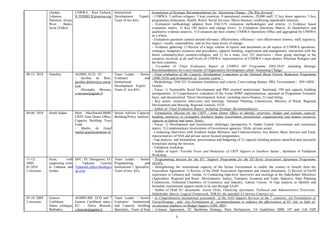
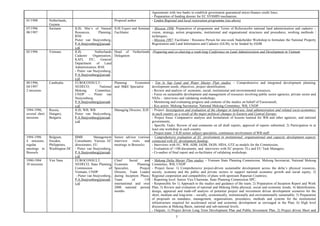
13.Selected professional experience:
Date from –
Date to
Location Companies, clients,
funding agencies
Position Description
10/2010 to
date
Netherlands Comenius Institute;
Private funding;
Participants
- Carla Loog,
- loog@aog.nl
Guest Lecturer and,
Workshop/Seminar
Facilitator
- Incidental Lectures and workshops/seminars on International development assistance, policies and strategies;
poverty reduction strategies; impact analysis; governance; capacity building (ID, OD, HRD);
- Participants: National and international high level civil servants, development managers, private sector executives,
civil society representatives.
06-07/2015
10-11/2015
Solomon Islands - ICE-ECO3, EU, EU
- Michela De
Gregorio,
mdg@ice-org.eu
- Lorena Elvira Ayuso,
lorena.elvira-
ayuso@eeas.europa.eu
Senior Evaluator - (i) Final Evaluation of the Strengthening the National Authorising System Programme, and (ii) Designing the
Technical Cooperation Facility under 11th
EDF for the Solomon Islands;
- Application of EU/DAC evaluation guidelines and criteria;
- Preparation of Evaluation Questions Matrix EQM;
- Formulation of actionable recommendations for future programming (11th
EDF), with particular emphasis on the
design of the TCF, interventions design, compliance with EU PCM and LFM guidelines.
03-06/2015 Namibia ICE, EU, EU
- Michela De
Gregorio,
mdg@ice-org.eu
- Lucia LaCalle
Lucia.lacalle@eeas.euro
pa.eu
Senior Evaluator - Final Evaluation of the Support to the Capacity Development Programme of the National Planning Commission
Secretariat, consisting of three separate projects: (i) Support to NPC CDP, (ii) Support to NAO Function in
Namibia, (iii) Procurement and contracting of IT and Office Equipment
- Application of EU/DAC evaluation guidelines and criteria;
- Preparation of Evaluation Questions Matrix EQM;
- Formulation of actionable recommendations for future programming (11th
EDF), with particular emphasis on
interventions design and compliance with EU PCM and LFM guidelines;
- Critical review of the draft Action Document for the new NAO Support Programme including the TCF.
- Preparation of the three Final Reports.
11-12/2014
– 01/2015
Malawi Baa Consultors, EU, EU
- Clara Raich,
craich@baaconsultors.co
m
- Lena Veierskopf
Lena.veierskopf@eeas.eu
ropa.eu
Senior Evaluator Mid-term Evaluation of the Capacity Development for the National Authorising Officer’s Support Unit’;
- (i) To assess to what degree the expected results have been achieved, (ii) To draw lessons for the remaining period
of implementation;
- Focus on actionable recommendations for the remaining implementation period – focused on re-orientation of the
NAO-SU and design and implementation of incisive organisational change;
- Project duration 2009-2019, including closure period of 24 months;
- Extensive literature review and stakeholder meetings and interviews;
- Application of EU/DAC evaluation methodology and criteria;
- Preparation and presentation of the Final MTR Report’’
08-12/2014 Papua New
Guinea
HTSPE, EU, EU
– Nicolas Fichers,
Nicolas.Fichers@htspe.co
m
- Chiara Tardivo
Chiara.tardivo@eeas.euro
pa.eu
Team Leader, Senior
Evaluator – Team of 2
KEs
Evaluation of governance programmes in PNG: (i) Two final evaluations – Institutional Capacity Building of the
NAO System in PNG (ICB I), and Strengthening Districts and Local Level Government (SDLLG); and (ii) one Mid
Term Review – (ICB II);
- Application of EU/DAC evaluation methodology and criteria, with strong focus on ‘sustainability’;
- Extensive literature review and interview schedule, travel to remote provinces / districts to understand the country’s
challenges and programmes and projects’ impact in difficult geographical and physical conditions;
- Formulation of lessons learned and strategic and operational recommendations aimed at further improvements,
capacity strengthening and programming of 11th
EDF;
- Identification and formulation of ‘exit and bridging strategies’
- Preparation and presentation of the Final Evaluation Report for the three Governance Programmes’.
01-07/2014
Four
missions
Palestine West
Bank and Gaza
EPRD, EU, EU
– Paulina Toporek,
p.toporek@eprd.pl
Senior Evaluator – Team
of 3 KEs
Review of EU PEGASE Programme (2011-2013): (i) Direct Financial Support to the Recurrent Costs of the
Palestinian Authority (GBS, SBS), (ii) Policy reforms and strategies (Education, Health, Social Protection, PFM,
Civil Service Reform), (iii) 10 PEGASE Capacity Building Complementary Interventions (capacity building (OD, ID,
HRD) for improved social protection and strengthened PFM) and aid effectiveness (EU-Representative Office, PA);
- Formulation of lessons learned, constraint analysis and recommendations at central and sector levels;
- More than 70 interviews and focus group meetings: Palestinian Authority bodies, EUREP, EU Member States, WB,
IMF and DFID;
- Extensive literature review (>100 documents), extensive field visits;
- EU/DAC evaluation guidelines for 1) Budget support (GBS, SBS) and 2) Programme/project evaluation;
- Preparation of Social Protection Sector Evaluation Report; Author of final ‘Overall Evaluation Report.’
08/2013 Netherlands,
Swaziland
Proposal author - Institutional and organisational reorientation and capacity development of the Water Authority within the national
water and sanitation sector – sector-wide and integrated.
04/2013 Netherlands,
Tanzania
Proposal author - Advisory services for implementation of an exit from EU Support to the NAO Function in Tanzania.
09/2012-
01/2013
Two
missions
Sudan,
South Sudan
Landell Mills; FAO; EU
- Maria Persson,
MariaP@landell-
mills.com
Senior Evaluator / Key
Expert Institutional and
Organisation
Development – Team of
four KEs
- (i) Final Evaluation and recommendations formulation for further development support programming: ‘Sudan and
South Sudan Productive Capacity Recovery Programme SPCRP (2005-2012)’ and (ii) Formulation of Strategic
Recommendations for Aid Efficiency;
- Comprehensive evaluation of programme performance in 4 states in Sudan and 5 States in South Sudan;
- Direct beneficiaries: Public Administration agencies at Federal, State and County / Local levels, Local rural
communities involved in agriculture / food security / rural development, social and economic development, and peace
and humanitarian initiatives at State and Federal levels;
- Evaluation questions: in accordance with OECD / DAC methodology and criteria – Relevance of SPCRP, Activities
in line with SPCRP, Outputs and results as expected, Capacity of stakeholders to deliver as envisaged, Impact and
sustainability, Cost effectiveness / efficiency, Cross-cutting issues (gender, contribution to peace and humanitarian
conditions);
- Formulation of strategic recommendations for follow-up programming (EU, FAO);
- Specific tasks: 1) Review, analysis and evaluation of institutional, organisational and capacity building dimensions
of the programme, constituent policies, projects and activities, and of public and private beneficiary bodies - overall
programme and specifically Blue Nile State and Lakes State, 2) Applying state of the art evaluation methodology
(e.g. EQ-Matrix, qualitative and quantitative evidence), 3) Drawing lessons learned, and formulation of
recommendations sustaining the positive and mitigating the negative results of the programme in follow-up
development programming;
- Key actors, extensive interviews and meetings: Federal, State and County / Local government agencies; FAO, GIZ
and EMM (TA agencies); various NGOs; village and county communities and NSAs;
- Author of ‘Blue Nile State’ and ‘Lakes State’ evaluation reports’, co-author of ‘SPCRP Evaluation Report’
06-07/2012 Namibia BAa Consultors;
National Planning
Commission; EU
- Clara Raich,
craich@baaconsultors.co
m
- Jacobus de Boer,
jacobus.deboer@eeas.eu
ropa.eu
Team Leader - Senior
Evaluator /
Institutional and
Capacity Building
Expert ; Team of two
KEs
- Mid-Term Review (MTR) of the 10th
EDF Support to National Planning Commission Capacity Development
Programme;
- Independent assessment of capacity building at NPC achieved by the programme against the background of NPC
restructuring and organisational development;
- Formulated strategic and operational recommendations for remaining years centred on three key areas: 1) Strategic
and operational reorientation of the Programme for the remaining two years, 2) Professional TNA for whole NPC
embedded in the new structure, 3) Commissioning of four strategic missions to support the 3 new Departments in
policy and strategy analysis and formulation, national development planning, M&E of plan performance;
- Application of EU/DAC evaluation methodology and criteria, e.g. qualitative evidence based on Evaluation
Questions / Topics Matrix (EQM), interviews, literature review, validation workshop;
- Key actors, extensive interviews/meetings: NPC, EUD, Service Contract consultants, NPC client agencies
- Author of report ‘MTR of the Capacity Development Programme, NPC, Namibia’, facilitator Validation Workshop.
11/2011, 02-
04//2012
Two
missions
Surinam Landell Mills; VP Office
- Surinam Business
Forum; EU
- Charlotte Hansen,
CharlotteH@landell-
mills.com
Senior Evaluator / Policy
Analyst and Change
Management Expert,;
Team of 3 KEs
- Formulation of vision and strategy to strengthen the National Public Private Dialogue (PPD) based on evaluation
of 10th
EDF Suriname Business Forum, Suriname Business Centre Support Programme, and the Suriname
institutional / governance architecture;
- Upon evaluation mission, formulated and elaborated vision and strategic plan centred on three key
recommendations: 1) To establish the Public Private Dialogue Council for Policy Development (CPD), 2) To
Implement commensurate institutional changes and 3) To ensure main-streaming PRS in the PPD;
- Presentation of evaluation results and Strategic Plan at Suriname Council of Ministers and VP Office, and
facilitation of final Validation Workshop;
- Key actors, extensive interviews and meetings: SBF/SBC, Office of VP / Council of Ministers, EUD, Interior
community development project representatives, Surinam Business Women Group
- Main author of ‘Final Report on the Evaluation of the SBF / SBC’
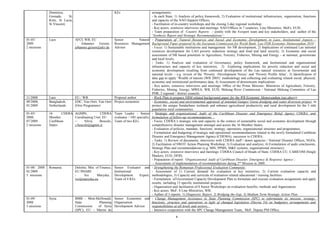
07-11/ 2011 Middle East TRANSTEC; UNRWA, Senior Evaluator and - Comprehensive Evaluation of UNRWA’s agency-wide “Organisational Development Programme, 2004-2011” and
2
(Jordan,
Lebanon,
Palestine (Gaza,
West Bank),
Syria (Video)
UNRWA – Rica Terbeck,
R.TERBECK@unrwa.org
Institutional
Development Expert;
Team of two KEs
formulation of Strategic Recommendations for ’Sustaining Change - The Way forward’;
- UNRWA: 5 million refugees, 5 host countries, 9 operational countries, 29,000 staff, 12 key donor agencies, 5 key
programmes (Education, Health, Relief, Social Services, Micro-finance), conflicting stakeholder interests;
- Evaluation methodology adapted from DAC/UN evaluation methodologies and criteria: 1) Evidence based
evaluation matrix, 2) Key OD factors and change levers, 3) Evaluation Questions Matrix, 4) Quantitative and
qualitative evidence analysis, 5) Evaluation per host country UNRWA Operations Office and aggregated for UNRWA
as a whole;
- Evaluation questions centred around relevance, effectiveness, efficiency / cost effectiveness (money, staff, logistics),
impact / results, sustainability, and on five main levers of change;
- Evidence gathering: 1) Review of a large volume of reports and documents on all aspects of UNRWA operations,
strategies, budgetary resources and procedures, capacity building, organisation and management, interaction with the
donor community/host countries/refugees, and 2) As a team, over 325 interviews / focus group meetings in the
countries involved, at all staff levels of UNRWA, representatives of UNRWA’s main donors, Palestine Refugees and
the host countries;
- Co-author of ‘Final Evaluation Report of UNRWA OD Programme 2004-2010’ including Strategic
Recommendations for a next tranche of Organisation Development called ‘Sustaining Change’.
08-12/ 2010 Namibia AGMIN; ECD; EU
- Jacobus de Boer,
jacobus.deboer@ec.europ
a.eu
- Alexandra Mocanu,
a.mocanu@agmin.it
Team Leader - Senior
Evaluator and
Institutional
Development Expert; ,
Team of two KEs
- Final evaluation of the Capacity Development Component of the National Rural Poverty Reduction Programme
(2006-2010) and formulation of ”Lessons Learnt”;
- Methodology: DAC/EU Evaluation Guidelines and criteria; Cross-cutting themes: PRS, Environment / HIV-AIDS /
Gender;
- Focus: 1) Sustainable Rural Development and PRS oriented institutional, functional, OD and capacity building
arrangements, 2) Comprehensive evaluation of the 4-year RPRP implementation, operated on Programme Estimates
basis, and decentralised ‘Direct Development Action’ including micro-finance, 3) Land titling;
- Key actors, extensive interviews and meetings: National Planning Commission, Ministry of Rural, Regional
Development and Housing, Regional councils, EUD
- Author of ‘Final Evaluation Report, including Strategic Recommendations’.
04-06/ 2010 South Sudan Mott MacDonald-BMB;
CBTF-Joint Donor Office;
Capacity Building Trust
Fund
- Martin de Graaf
martin.graaf@mottmac.nl
Senior Advisor Capacity
Building/Policy Analysis
- Formulation Mission for the CBTF / Joint Donor Office to identify, prioritize, budget and evaluate capacity
building initiatives to strengthen Southern Sudan Government institutional, organisational and human resources
capacity at federal and states’ levels;
- Focus: 1) Development and institutional challenges (prospective S. Sudan Central Government and constituent
states), 2) Complementary involvement of Government agencies, NSAs, private sector;
- Conducting Interviews with Southern Sudan Ministers and Undersecretaries, key donors, Basic Services and Fund,
representatives of NSA and private sector focused programmes;
- Gap analysis, and formulation, prioritisation and budgeting of 12 capacity building projects identified and succinctly
formulated during the mission;
- Validation workshop;
- Author of report ‘Possible Focus and Modalities of CBTF Support to Southern Sudan’, facilitator of Validation
Workshop.
11-12/
2009,
01/2010
2 missions
Syria, with
supporting visits
to Lebanon and
Jordan
DFC; EU Delegation; EU
- Tiphaine Leurent
TiphaineL@bcn.thedfcgro
up.com
Team Leader - Senior
Programming and
Institutional l Specialist;
Team of two KEs
- Programming mission for the EU ‘Support Programme for the EU-Syria Association Agreement Programme
(SAAP);
- Strengthening the institutional capacity of the Syrian Government to enable the country to benefit from the
Association Agreement: 1) Review of the Draft Association Agreement and related documents, 2) Review of SAAP
experience in Lebanon and Jordan, 3) Conducting high-level interviews and meetings at the Stakeholder Ministries
(Agriculture, Regional and Rural Development, Justice, Transport, Economy and Trade, Industry), State Planning
Commission, Federated Chambers of Commerce and Industry, Labour Unions, 4) Gap analysis to Identify and
formulate institutional support needs to be met through SAAP;
- Author of Draft EU documents: Action Fiche, Financing Agreement, Technical and Administrative Provisions,
Stakeholder Matrix, Logical Framework, TOR for the intended TA Service Contract (s).
05-10/ 2009
2 missions
Eastern
Caribbean
States (Antigua,
Barbados,
AGMIN-IBF; ECD and 7
Eastern Caribbean states;
EU - Silvia Boscolo,
s.boscolo@agmin.it
Team Leader - Senior
Evaluator/ Institutional
and Capacity building
Specialist;, Team of four
- (i) Comprehensive institutional assessment of the NAO Support Services in the 7 countries, (ii) Formulation of
Vision/Strategy, and (iii) Formulation of recommendations to enhance the effectiveness of EC Aid, in light of:
Accelerated emphasis on Budget Support (GBS, SBS);
- Cotonou Agreement, EC Backbone Strategy, Paris Declaration, TA Guidelines 2008; 10th
and 11th EDF
3
Dominica,
Grenada, St.
Kitts, St Lucia,
St Vincent)
KEs arrangements;
- In each State: 1) Analysis of policy framework, 2) Evaluation of institutional infrastructure, organisation, functions
and capacity of the NAO Support Offices;
- Facilitation of in-country workshops and the closing 2-day regional workshop;
- Key actors, extensive interviews and meetings: NAO Offices in 7 countries, Line Ministries, MoFs, EUD;
- Team preparation of Country Reports – jointly with the 4-expert team and key stakeholders, and author of the
‘Synthesis Report and Strategic Recommendations’;
01-05/
2009
2 missions
Laos AFCI; WB; EU
- Johannes Geisen,
johannes.geisen@afci.de
Senior Natural
Resources Management
Advisor
- Preparation of ‘Natural Resources and Social and Economic Development in Laos, Institutional Aspects -
Background Paper prepared by the European Commission for World Bank ‘Lao PDR Economic Memorandum 2010’;
- Focus: 1) Sustainable institutions and management for NR development, 2) Implications of continued Lao national
resources development for LAO poverty reduction strategy and food and land security, 3) Economic and social
assessment of NR based potentials in Agriculture, Forestry, Fisheries, Mining and Energy – at national, governorate
and local levels;
- Tasks: 1) Analysis and evaluation of Governance, policy framework, and Institutional and organisational
infrastructure and capacity of key ministries, 2) Exploring implications for poverty reduction and social and
economic development resulting from continued development of the Lao natural resources at Governorate and
national levels – e.g. review of the ‘Poverty –Development Nexus’ and ‘Poverty Profile Atlas’, 3) Identification of
data gap to apply ‘Wealth of nations (WB 2005)‘ methodology and collecting and evaluating related social, physical,
economic and institutional performance data, 4) Assessment of downstream implications.
- Key actors, extensive interviews and meetings: Office of the Prime Minister; Ministries of Agriculture, Forestry,
Fisheries, Mining, Energy; MWEA, WB, EUD, Mekong River Commission / National Mekong Committee of Lao
PDR, 2 regional / district councils.
11/2008 Laos EU / WB Proposal author - Work Plan to prepare NRM related background paper for the WB Economic Memorandum (see above)
09/2008,
01/2009
Bangladesh,
Netherlands
EDC; Van Oort, Van Oort
(Orio Programme)
Project economist - Economic, social and environmental appraisal of intended Ganges/ Gorai dredging and water diversion project, to
protect the unique Sundarbans wetlands and enhance agricultural productivity and rural development for the 5 mln
population rural communities.
01-03/
2008;
07/2009
2 missions
16 CDERA
Member
Caribbean
States
AGMIN; CDERA
Coordinating Unit; EU
-- Silvia Boscolo,
s.boscolo@agmin.it
Team Leader - Senior
evaluator / OD specialis;
Team of two KEs
- Strategic and organizational Audit of the Caribbean Disaster and Emergency Relief Agency CDERA, and
formulation of follow-up recommendations ;
- Focus: CDERA’s strategic role and capacity in the context of sustainable social and economic development through
comprehensive disaster management amongst and across the 16 Member States;
- Evaluation of policies, mandate, functions, strategy, operations, organizational structure and programmes;
- Formulation and budgeting of strategic and operational recommendations related to the newly formulated Caribbean
Disaster and Emergency Management Agency (CDEMA), successor to CDERA;
- Tasks: 1) Review of documents; interviews with CDERA staff / donor agencies / National Disaster Offices, NGOs;
2) Facilitation of SWOT Action Planning Workshop; 3) Evaluation and analysis; 4) Formulation of audit conclusions,
Strategy Plan and recommendations (e.g. MIS, PPMS, M&E systems, organizational structure);
- Key actors, extensive interviews and meetings: CDERA Council of Heads of State, CDERA CU, CARICOM (Single
Market), EUD, DFID;
- Preparation of report: ‘Organizational Audit of Caribbean Disaster, Emergency & Response Agency’;
- Assessment of implementation of recommendations during 2nd
Mission in 2009..
01-08/ 2008
01/2009
5 missions
Romania Deloitte; Min. of Finance;
EU PHARE
- Ivo Maryska,
ivo@maryska.eu
Senior Evaluator and
Institutional
Development Expert,
Team of 4 KEs
- Strengthening the Romanian Professional Evaluation Community;
- Assessment of 1) Current demand for evaluation at key ministries, 2) Current evaluation capacity and
methodologies, 3) Capacity and curricula of evaluation related educational / training facilities
- Formulation of Government Capacity Development Plan to formulate and execute evaluation assignments and apply
results, including 13 specific institutional projects
- Organisation and facilitation of 8 Sector Workshops on evaluation benefits, methods and 4rganization;
- Key actors: MoF, 8 Line Ministries, WB;
- Author of 3 reports: 1) Diagnostic Report, 2) Bridging the Gap, 3) Medium Term Strategic Action Plan.
01-09/
2008
3 missions
Syria BMB – Mott-McDonald;
State Planning
Commission of Syria
(SPC); EU – Martin de
Senior Economist and
Organisation
Development Advisor
- Change Management Assistance to State Planning Commission (SPC) to reformulate its mission, strategy,
functions, structure and operations in light of changed legislation (Decree 54) on budgetary arrangements and
responsibilities at all levels and sectors;
- Intensive cooperation with the SPC Change Management Team, MoF, Deputy PM Office;
4
Graaf,
martin.graaf@mottmac.nl
- Analysis and evaluation of ‘old’ and ‘new’ mandate, implications for functions, procedures, organisational structure,
operations and capacity of the SPC;
- Formulation of Transition Road Map and related Institutional and Management Development Projects;
Key actors: SPC, Office of Vice Prime Minister, ISMF Programme, EUD;
- Author of Policy Document: ‘SPC – Adjustment and Modernisation of Role, Functions and Organisation of
National Social and Economic Analysis and Resource Planning’.
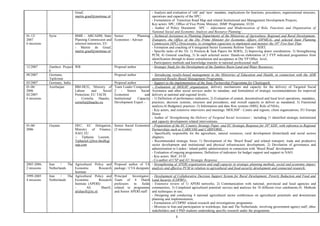
01-12/
2007
6 missions
Syria BMB - ARCADIS; State
Planning Commission and
selected ministries; EU
- Martin de Graaf,
martin.graaf@mottmac.nl
Senior Planning
Economist / Advisor
- Technical Assistance to Planning Departments of the Ministries of Agriculture, Regional and Rural Development,
Transport, the Office of the Dty Prime Minister for Economic Affairs (DPMEA), and selected State Planning
Commission (SPC) Directorates, to strengthen capacities to implement and monitor the 10th
Five-Year Plan;
- Formation and coaching of 4 integrated Sector Economic Reform Teams – SERT;
- Specific tasks of the TA: 1) Position & Task Papers for SERTs; 2) Improving donor coordination; 3) Strengthening
PCM, 4) General coaching, 5) In each selected sector: Hands-on elaboration of 2 FYP indicated programmes from
identification through to donor consultation and acceptance at Dty VP Office level;
- Participatory methods and knowledge transfer to national professional staff.
12/2007 Zambesi Project
6
WB Proposal author - Strategic Study for the Development of the Zambesi Basin Land and Water Resources;
09/2007 Germany,
Tajikistan
Proposal author - Introducing results-based management in the Ministries of Education and Health, in connection with the ADB
sponsored Results-Based Management Programme.
03/2007 Germany, India Proposal author - Support to the implementation of the State Partnership Programme for Chattisgarh.
01-06/
2006
02/2007
4 missions
Azerbaijan BBJ-HCG; Ministry of
Labour and Social
Protection; EU TACIS
- Cornelia Haacke,
cornelia@haacke.eu
Team Leader Component
2 - Senior Social
Economist and
Institutional Capacity
Development Expert –
- Evaluation of MOLSP organization, delivery mechanisms and capacity for the delivery of Targeted Social
Assistance and other social services under its mandate, and formulation of strategic recommendations for improved
delivery at national and regional levels;
- 1) Definition of performance indicators; 2) Evaluation of central, decentralized and local level operations, mandates,
practices, decision systems, structure and procedures, and overall capacity to deliver as mandated; 3) Functional
analysis;4) Budgetary practices ;5) Information and data flow systems (MIS); Role of NSAs;
- Key actors, and extensive interviews and meetings: MOLSSP – Centre and regions, client organizations, EU-Europa
House
- Author of ‘Strengthening the Delivery of Targeted Social Assistance’, including 11 identified strategic institutional
and capacity development related interventions.
01-06/
2006
Guyana DFC; EC Delegation,
Ministry of Finance,
NAO; EU
-- Tiphaine Leurent,
TiphaineL@bcn.thedfcgr
oup.com
Senior Social Economist
(2 missions)
- Preparation of the EC Country Strategy Paper and EC Strategic Response for 10th
EDF, with reference to Regional
Partnerships such as CARICOM and CARIFORM;
- Specifically responsible for the agriculture, natural resources, rural development (hinterland) and social sectors
chapters;
- Recommended strategic focus: 1) Development of the ‘Brazil Road’ and related transport, trade and productive
sector development and institutional and physical infrastructure development, 2) Devolution of governance and
administration to Linden / inland public administration in connection with ‘Brazil Road’ development
- Evaluation of ongoing programmes; Definition of indicators for budget support and support to NAO;
- Key actors: MoF, EUD
- Co-author of CSP and EU Strategic Response.
2005-2006,
2 missions
Iran / The
Netherlands
Agricultural Policy and
Economic Research
Institute
Proposal author of TA
package / CTA designate
- Strengthening of APERI organization and staff capacity in strategic planning methods, social and economic impact
analysis and effective PCM in relation to agricultural and food-security development and connected research;
1999-2005
4 missions
Iran / The
Netherlands
Agricultural Policy and
Economic Research
Institute (APERI)
- Ali Sharifi,
alisharifi@itc.nl
Principal Investigator,
Team of 4 Dutch
professors in fields
related to programme
and Senior APERI staff
- Development of Collaborative Decision Support System for Rural Development, Poverty Reduction and Food and
Land Security (CDPRF);
- Extensive review of 1) APERI networks, 2) Communication with national, provincial and local agencies and
communities, 3) Completed agricultural potential surveys and analyses for 18 different river catchments,4) Methods
and techniques in use;
- Designing and conducting 4 national agricultural sector conferences on agricultural potentials and downstream
planning and implementation;
- Formulation of CDPRF related research and investigations programme;
- Missions to Iran and participation in workshops, Iran and The Netherlands, involving government agency staff, other
stakeholders and 4 PhD students undertaking specific research under the programme.
5
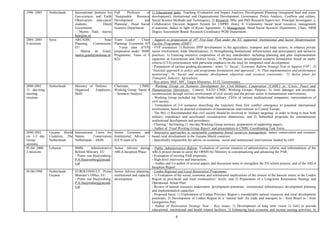
1996 -2005 Netherlands International Institute for
Geo-sciences and Earth
Observation; mid-career
students; Dutch
Government
- Martin Hale, martin
hale@itc.nl
Full Professor of
‘Sustainable Resource
Development and
Planning’, Head Social
Sciences Department
1) Educational tasks: Teaching (Evaluation and Impact Analysis, Development Planning (integrated land and water
development), Institutional and Organisational Development, Governance, Policy Analysis, Conflicts and culture,
Social Science Methods and Techniques); 2) Research: MSc and PhD Research Supervisor; Principal Investigator: a.
Collaborative Decision Support System for CDPRF (Iran); b. Community based local resources management
(Cameroon, India) in light of Kyoto Agreement; 3) Management: Head Social Sciences Department; Chair, NRM
Degree Assessment Board; Research Coordinator PGM Department..
2004 -2005
8 missions
Syria ARCADIS; State
Planning Commission;
EU
- Martin de Graaf,
martin.graaf@mottmac.nl
Team Leader - Chief
Planning Economist 10th
; 5-year plan (FYP)
preparation under ISMF
Programme; Team of 5
KEs
- Support to preparation of 10th
Five-Year Plan under the EU supported ‘Institutional and Sector Modernisation
Facility Programme (ISMF)’;
- FYP orientation: 1) Reforms (PPP development in the agriculture, transport and trade sectors, to enhance private
sector involvement, trade liberalization), 2) Strengthening Institutional infrastructure and participatory and inclusive
practices, 3) Ensuring intensive cooperation of all key stakeholders including planning and plan implementation
capacities at Governorate and District levels., 4) Project-driven development scenario formulation based on multi-
criteria (UTA) prioritization with particular emphasis on the need for integrated rural development;
- Preparation of various guiding documents / notes: 1) ‘Social / Economic Reform Strategy Note to Support FYP’; 2)
‘National approach to policy and programme formulation and appraisal’; 3) ‘Plan implementation and performance
monitoring’; 4) ‘Social and economic development objectives and resource constraints’, 5) Sector plans for
Transport, Industry, Agriculture;
- Key actors: MoF, SPC, Target Ministries, EUD, Governorates.
2000-2002
11 day-long
meeting
sessions
Netherlands Ministry of Defense –
Organised Employers;
MoD
Chairman, CIMIC
Working Group ‘Spoor 4
– Scenario Analysis’
- Working Group on Scenario Development for Civil-Military Cooperation (CiMIC) in ‘Crisis, Peace and
Humanitarian Operations’. Context: NATO CIMIC Working Groups. Purpose: To limit damages and accelerate
reconstruction through serious involvement of civil society and the private sector in humanitarian interventions;
- Working Group included top Netherlands military, CEOs of various multinational companies, representatives of
civil society;
- Formulation of 2-4 scenarios describing the trajectory from first conflict emergence to potential international
involvement, based on detailed evaluations of humanitarian interventions in Central Europe;
- The WG 1) Recommended that civil society should be involved in ‘military targeting’ in order to bring to bear both
military expedience and accelerated reconstruction dimensions, and 2) Submitted proposals for commensurate
institutional development and procedures;
- Chairing / facilitating 11 one-day Working Group sessions, preparation of supporting papers;
- Author of ‘Final Working Group Report’ and presentation to CIMIC Coordinating Task Force.
2000-2002
six 1-2 day
Group
sessions
Guyana Shield
Countries, The
Netherlands
International Union for
Nature Conservation
Netherlands - DGIS
Senior Economic and
Institutional Advisor –
IUCN team of 6
- Innovative approaches to sustainable community-based resources management, nature conservation and resource-
based rural development in the Guyana Shield countries;
- Specifically responsible for advise on economic, social and institutional interventions funded by GEF.
01-04/ 2000
2 missions
Lebanon BMB; Administrative
Reform Ministry; EU
- Pieter van Stuijvenberg,
P.A.Stuijvenberg@arcadi
s.nl
Senior Advisor during
ARLA Inception Phase
- Public Administration Reform: Evaluation of current situation of administrative reform, and reformulation of the
ARLA project meant to assist the ORMVAG Ministry in conceptualizing and advancing the PAR;
- Evaluation of existing PAR proposals;
- High-level interviews and interaction;
- Author and Co-author of several papers and discussion notes to strengthen the PA reform process, and of the ARLA
Inception Report
05-06/1998 Netherlands /
Guyana
EUROCONSULT; Prime
Minister’s Office; EU
- Pieter van Stuijvenberg,
P.A.Stuijvenberg@arcadi
s.nl
Senior Advisor planning,
institutional and capacity
development
- Linden Regional and Local Restoration Programme;
- 1) Evaluation of the social, economic and institutional implications of the closure of the bauxite mines in the Linden
Region at provincial and local communities’ levels, and 2) Preparation of a Long-term Restoration Strategy and
Operational Action Plan;
- Review of natural resources endowment, development potentials, institutional infrastructure, development planning
and implementation capacities
- Proposed focus: 1) Exploitation of Linden Province Region’s considerable natural resources and rural development
potentials; 2) Development of Linden Region as a ‘natural hub’ for trade and transport to / from Brazil to / from
Georgetown Port;
- Author of Restoration Strategy Note – Key issues: 1) Development of long term vision 2) GoG to provide
educational, institutional and health related facilities, 3) Enhancing local economic and income earning activities, 4)
6
Agreements with two banks to establish government guaranteed micro-finance credit lines;
- Preparation of funding dossier for EC SYSMIN mechanism.
01/1998 Netherlands,
Guyana
Proposal author - Linden Regional and local restoration programme (see above)
07/1996
08/1997
Surinam ILIS; Min’s of Natural
Resources, Planning;
RNE
Pieter van Stuijvenberg,
P.A.Stuijvenberg@arcadi
s.nl
ILIS Expert and Seminar
Facilitator
- Mission 1996: Preparation of programme and Terms of Referencefor national land administration and cadastre –
vision, strategy, action programme, institutional and organsational structures and procedures, working methiods /
techniques;
- Mission 1997: Facilitator / Resource Person for one-week Stakeholder Workshop to formulate the National Property
Registration and Land Information and Cadastre (GLIS), to be funded by IADB
05/1996 Vietnam ILIS, Netherlands
Cadastre Organisation,
KAFI, ITC; General
Department of Land
Administration; RNE
- Pieter van Stuijvenberg,
P.A.Stuijvenberg@arcadi
s.nl
Head of Netherlands
Delegation
-Preparing and co-chairing a week-long Conference on Land Administration and Development in Vietnam
09/1996,
04/1997
2 missions
Cambodia EUROCONSULT-
NEDECO; National
Mekong Committee;
UNDP – Pieter van
Stuijvenberg,
P.A.Stuijvenberg@arcadi
s.nl
Planning Economist
and M&E Specialist
- Ton le Sap Land and Water Master Plan studies – Comprehensive and integrated development planning:
development needs, objectives, project identification;
- Review and analysis of economic, social, institutional and environmental resources;
- Focus on sustainable development and management of resources involving public sector agencies, private sector and
NSAs - interviews and validating workshops;
- Monitoring and evaluating progress and contents of the studies on behalf of Euroconsult;
- Key actors: Mekong Secretariat, National Mekong Committee, WB, UNDP.
1994-1996,
several short
missions
Russia,
Hungary,
Bulgaria
ILIS; WB; WB
Pieter van Stuijvenberg,
P.A.Stuijvenberg@arcadi
s.nl
Managing Director, ILIS - Project: Investigation and evaluation of the changes in land-use, land administration and related socio-economics
in each country as a result of the major political changes in Eastern and Central Europe;
- Project focus: Comparative analysis and formulation of lessons learned for WB and other agencies, and national
governments;
- Specific Tasks: Review of and comments on all draft reports, approval of reports submitted; 2) Participation in at
least one workshop in each country.
- Project team: 5 ILIS senior subject specialists, continuous involvement of WB staff.
1994-1996
4 missions,
regular
meetings in
Brussels
Belgium,
Sweden,
Philippines,
Washington DC
BMB Management
Consultants; Various EC
directorates; EU
- Pieter van Stuijvenberg,
P.A.Stuijvenberg@arcadi
s.nl
Senior advisor (various
interview visits and
meetings in Brussels)
- Comprehensive evaluation of EC involvement in institutional, organisational and capacity development aspects
connected with EC development funding;
- Interviews with EC, WB, ADB, IADB, DGIS, SIDA, GTZ as models for the Commission;
- Evaluation of >100 documents, and interviews with EC projects TLs and EU Task Managers;
- Co-author of final report and co-facilitator of validating workshops.
1990-1994
10 missions
Viet Nam EUROCONSULT,
NEDECO; State Planning
Commission of
Vietnam; UNDP
- Pieter van Stuijvenberg,
P.A.Stuijvenberg@arcadi
s.nl
Chief Social and
Economic Planning
Specialist, Project
Director, Team Leader
during Inception Phase,
Team of 110
international and over
2000 national person
months
- Mekong Delta Master Plan studies – Vietnam State Planning Commission, Mekong Secretariat, National Mekong
Committee, WB, UNDP
- Project focus: 1) Comprehensive project-driven sustainable development across the delta’s physical resources,
society, economy and the public and private sectors to support national economic growth and social equity; 2)
Regional cooperation and compatibility of plans with upstream Riparian Countries;
- Reporting level: Senior Vice Chairman, State Planning Commission SPC;
- Responsible for 1) Approach to the studies and guidance of the team; 2) Preparation of Inception Report and Work
Plan; 3) Review and evaluation of national and Mekong Delta physical, social and economic trends; 4) Identification,
design, appraisal and trade-off analysis of potential project and investment driven development scenarios for the
short, medium and long-term – socially, economically, institutionally and environmentally sustainable; 5) Preparation
of proposals on mandates, management, organisations, procedures, methods and systems for the institutional
infrastructure required for accelerated social and economic development as envisaged in the Plan; 6) High level
discussions at Mekong Basin, national and sub-national levels;
- Outputs: 1) Project driven Long Term Development Plan and Public Investment Plan, 2) Project driven Short and
7
Medium Term Operational Plans and Budgets, 3) Matching Institutional and Public Administration Development
Programme, 4) Matching Programme of Studies and Investigations necessary to support downstream decisions; The
four outputs for each Province as well as for the Vietnam Mekong Delta as a whole, 5) Organisation and facilitation
of a number of country workshops and executive seminars and of two international conferences;
- Highly participative cooperation with all stakeholders through e.g. Joint Task Teams, Action Planning Workshops,
Technical Seminars.
1989 Netherlands,
Vietnam
Proposal author - Mekong Delta Master Plan Studies (see above)
1989-1995
8 missions
Indonesia EUROCONSULT;
Public Works Ministry;
WB - Pieter van
Stuijvenberg.
P.A.Stuijvenberg@arcadi
s.nl
Senior ID Expert - -
Project Director
- Formulation and implementation of the National Irrigation Service Fee Programme (ISF);
- Preparation of ISF Strategy Plan: objectives, indicators and measurement criteria;
- Preparation of Action Plan including shifts in governance structure;
- Audit and analysis of mandates, procedures and organizational structures of agencies concerned;
- Social acceptance analysis: Farmers’ organizations, Affordability analysis; Provision of credit lines
- Preparation of regional operational plans, appraisal against the agreed indicators, plan implementation
1986-1989 Botswana,
Kenya, Zambia,
Zimbabwe,
Orissa (India)
Euroconsult; WB; WB
- Pieter van Stuijvenberg.
P.A.Stuijvenberg@arcadi
s.nl
Senior Planning
Economist, Project
Director
- Irrigation Sector Strategy Studies in 5 Countries to support WB / National development strategies and action plans ,
followed by executive and staff seminars in each participating country;
- WB cooperation with national governments to formulate national project-driven Strategy for Irrigation and
Agricultural development;
- Development of UTA planning methodology to rapidly formulate, scan and appraise development options, and
prepare Strategy Plans;
1986-1988
5 missions
Mekong Region
– Riparian
Countries
NEDECO; Mekong
Secretariat; UNDP
- Pieter van Stuijvenberg,
P.A.Stuijvenberg@arcadi
s.nl
Chief Economist -
Project Director and
Team Leader during
inception phase, Team of
55 international person
months and counterpart
teams
- Lower Mekong Indicative Basin Plan.
- 1) Formulation and analysis of options for medium and long term sustainable development strategy in the riparian
countries as well as basin-wide across the 4 riparian countries; 2) Project-driven resource mobilisation and allocation
of the Region’s resources at national riparian country, cross-riparian and basin levels; 3) Charting the conflicting
interests between the riparian countries and designing conflict reconciliation options;
- Outputs: 1) Long Term Integrated Development Vision (20 years), 2) Short, Medium and Long Term Action and
Investment plan – per country and basin-wide, 3) Supporting Studies and Investigations Programme, 4) Organisation
and Institution Development Programme - High level consultations throughout to enhance consensus and
reconciliation of Riparian Countries’ conflicting interests and stakeholder ownership (National Planning
Commissions, National Mekong Committees, Mekong Secretariat): Action Planning Workshops, High-level
Executive Seminars, two international conferences.
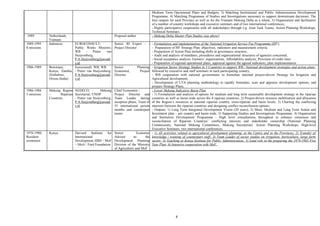
1976-1980,
Resident
economist
Kenya Harvard Institute for
International
Development HIID / MoF
– MoA / Ford Foundation
Senior Economic
Advisor to: the
Development Planning
Division of the Ministry
of Agriculture and MoF
- 1) All activities related to agricultural development planning, at the Centre and in the Provinces; 2) Transfer of
knowledge / training of counterpart staff; 3) Team Leader of sector studies on irrigation, horticulture, large farm
sector; 4) Teaching at Kenya Institute for Public Administration; 5) Lead role in the preparing the 1979-1983 Five
Year Plan; 6) Intensive cooperation with MoF.
8

General - ID OD Eval.1 (1)

  • 1.
    GENERIC CURRICULUM VITAEWILLEM VAN DEN TOORN (JUNE 2015) Possible role in the project: Institutional and Organisation/Capacity Development Expert, Planning Economist and Project/Programme Formulator, Evaluator: in capacities: Expert, Advisor, Team Leader Status Senior/Category 1 Staff of: Independent consultant Contact details: toornwh@gmail.com 1. Family name: Van den Toorn 2. First names: Willem 3. Passport Holder: Dutch 4. Place of residence: The Netherlands 5. Education: Institution Degree(s) or Diploma(s) obtained: Free University of Amsterdam, Twente University -1984 PhD Development Economics and Institutions. Thesis: ‘Multi- system Society and Trade-off Based Planning’ Rotterdam School of Economics (Erasmus Un.) -1966 MSc Economics Rotterdam School of Economics (Erasmus Un.) -1963 BSc Economics 6. Language skills: Competence on a scale of 1 to 5 (1 - excellent; 5 - basic) Language Reading Speaking Writing English 1 1 1 Dutch 1 1 1 French 3 3 4 7. Membership of professional bodies: UNDP Evaluators Roster ERG, UN Evaluation Group UNEG, NEDWORC Association (Development professionals), ELDIS Community, ECOZOEK, Member Editorial Board ‘Journal of Applied Geo Sciences’ for social science aspects (Elsevier, 1996-2005); Knighthood, ‘Order of the Netherlands Lion’ (1997). 8. Other skills: 1) Facilitation / Chairing of workshops, seminars, conferences, interviews, focus groups; 2) Participated in 2 e-courses on evaluation (Evalpartners, 2012, 2013): ‘Real World Evaluations’, ‘Development Evaluation’, 3) ’Excellent writing skills – Programme / project proposals, Aide Memoires, reports, PCM documents, papers, books; 4) Strong consulting and academic record. 9. Position (June 2015): Independent Consultant; Emeritus Professor; Senior Evaluator Capacity Development Programme, national Planning Commission. Namibia; Senior Evaluator Strengthening the NAO Office and the TCF for 11th EDF, Solomon Islands 10. Employment: 20 years permanent positions with consulting firms, 18 years with universities, 18 years as independent consultant (part-time during university years, full-time thereafter): 1) 1996-2005 part-time, 2005 to date full-time Independent Consultant; 2) 1996-2005 Professor, International Institute for Geosciences and Earth Observation (ITC-UT); 3) 1986-1996, Senior Consultant / Project Director / Head Planning and Institutional Development Division / Managing Director BMB Management Consultants (subsidiary Euroconsult) / Managing Director International Land Information Systems ILIS (subsidiary Euroconsult) / Member Euroconsult Management Team; 4) 1980-1990 Associate Professor Development Economics and Planning, Twente University; 5) 1976-1980 Senior Advisor Planning, Harvard Institute for International Development; 6) 1967-1976 Economist, ILACO. 11. Key qualifications: • More than 35 years of development consulting experience, including tenured professorship of ‘Sustainable Resource Development, Planning and Management’ (Subjects: Evaluation and Impact Analysis, Economic and Social Development, Governance and Policy Analysis, Institutional and Organisation Development, Capacity Building) and Chair, Natural Resources Management (NRM) Degree and Research Programme. • Over 30 years of management experience - TL, Task Team Manager, Project Director, Chief Advisor, Managing Director ILIS (International Land Information Systems), Managing Director BMB (BMB Management 1
  • 2.
    Consultants), Chair SocialSciences Department / Chair Natural Resources Management Degree Programme (ITC). • 2006-2015: involvement with NAO Offices - capacity building, evaluative and advisory services. Cooperation and interaction with NAO Offices in more than 10 different countries in the Pacific, Africa and the Caribbean Region. NAO Offices ranging from integrated in the national structures (e.g. Barbados, Namibia) to parallel institutions (e.g. Malawi, Dominica), from reactive burocratic operations (e.g. Malawi, S. Sudan) to motivated proactive support to country development (e.g. PNG, St Vincent), from large NAO-SUs (Malawi, St Kitts) to small and agile systems (e.g. PNG), from major EU portfolios (Most E. Caribbean, Malawi), to diminishing portfolios and need for EU support (e.g. Namibia, Tanzania, PNG). • Evaluation - 1) Ex-ante, Mid-Term / Interim and Final / Ex-post evaluation, results based/outcomes oriented ROM), 2) DAC, EC and WB/UN methodology, adapted to assignment, 3) DAC evaluation criteria - relevance, effectiveness, efficiency-value for money, impact, sustainability, and criteria related to specific cross- cutting issues; 4) Approach: a. Preparation of Evaluation Questions / Topics Matrix (EQM) in close consultation with Client, b. Literature Review and preparation of annex “Literature Review - Evidence and Analysis”, c. Field visits, Stakeholder Interviews and Focus Group Meetings and preparation of annex “Interviews and Meetings – Evidence and Analysis”; 5) Formulation of lessons learnt and follow-up recommendations; 6) Preparation of Draft and Final Evaluation Reports, related workshops and executive seminars; 7) Assignments including: NAO Offices and Support Units, Organisation and institutional development, Governance and public- private dialogue,Rural development, Social and economic development, Programmes of various nature • Policy and governance analysis at national and sub-national/decentralised levels – 1) Review and analysis of documentation and legislative framework, 2) In-depth interviews with ministers/governors/state and district decision makers, (top level) public administration officials, international agencies, representatives of key stakeholders, 3) Preparation of governance profile and subject-matter related policy frameworks, 4) Preparation of strategic and operational recommendations. • Development programming / resource mobilisation / work planning – In accordance with: 1) Policies (e.g. Cotonou and Paris Agreements, Backbone Strategy, Busan), 2) Procedures (e.g. EDF 9, 10 and 11, CSPs, NIPs; 3) Processes and formats (e.g. PCM, PIFs, AFs, FAs, TAPS, Logical Frameworks, Stakeholders Matrices); 4) NAO Support Offices and aid effectiveness. • Institutional development; Development of organisations, institutional infrastructure, systems and processes; Planning and budgeting arrangements; Change management;– 1) Analysis of policy, mandate and functional framework, 2) Analysis of organisational structure, procedures, operations and performance, supporting departments, human resources and systems, overall capacity to deliver on mandate, 3) Methodology / approach: Current state assessment, Formulation of desired state, Formulation and reconciliation of options, Gap analysis, Formulation of recommendations to bridge the gap, 4) Preparation of change road maps, specific Organisation Development Plans; 5) Preparation of Training Plans (TNA, curriculum development, methods and techniques). • Sustainable social and economic development planning, policy and strategy formulation; Integrated land and water / river basin development – 1) Multi-country, central, decentralised, regional and sector context, 2) Involving State and Non-state Actors, private sector, civil society, communities, 3) Conflict and trade-off analysis and formulation of reconciliation options, 4) Policy and strategy analysis / formulation, 5) Long term vision formulation, commensurate development planning, scenario design / multi-year / multi-stakeholder development planning and programming. • Agricultural, rural development, land and water and natural resources development programmes, projects, policies, planning and evaluation – In various capacities including: expert, team leader, chief planner, policy analyst, institutional /capacity development specialist, professor; • Participatory methods, techniques and processes 1) Action Planning and Validation Workshops, Task Team operations, Executive Seminars, Meta-plan Discussion Technique; 2) Preparation of Interviews and Meetings schedule, 3) High-level interviews and meetings. • Regional organisations and international development agencies: 1) Regional organisations: e.g. a. CARICOM (CDERA and E. Caribbean projects, 2008-2010), b. Mekong River Commission and National Mekong Committees (Mekong studies 1986-1997, WB Lao PDR economic memorandum background papers, 2009), c. UNRWA (evaluation of the UNRWA Organisation Development Programme, 2004-2010), d. Zambesi Action Project 6 Partners (author technical proposal for WB basin’s strategic development planning, 2007); 2) Aid agencies: EU, WB, DGIS, IADB, ADB, UNDP, FAO. • Methodology development: 1) Utility-based Trade-off Analysis (UTA): multi-criteria based projects’ prioritisation, scenario formulation; 2) Project Portfolio Management System (PPMS): management of project portfolios, 3) Diagnosis/Mission-Objectives/Strategy/Structure/Action (DIMSSA) process methodology: strategy development, change management, organisation development. 12. Geographical experience: 1) Africa: Botswana, Guinea, Kenya, Lesotho, Morocco, Malawi, Namibia, South Sudan, Sudan, Swaziland, Zambia, Zimbabwe: 2) Asia and Pacific: Azerbaijan, Cambodia, China, Federated States of Micronesia, India, Indonesia, Laos, Malaysia, Marshall Islands, Pakistan, Papua New Guinea, Philippines, Tajikistan, Thailand, Vietnam; 3) Caribbean Region: Barbados, Dominican Republic, Guyana, Panama, Surinam, States of the Eastern Caribbean, Trinidad; 4) Middle East: Iran, Jordan, Lebanon, Palestine (West Bank, Gaza), Sudan, Syria; 5) E. and C. Europe: Azerbaijan, Bulgaria, Hungary, Romania, Russia. 2
  • 3.
    13.Selected professional experience: Datefrom – Date to Location Companies, clients, funding agencies Position Description 10/2010 to date Netherlands Comenius Institute; Private funding; Participants - Carla Loog, - loog@aog.nl Guest Lecturer and, Workshop/Seminar Facilitator - Incidental Lectures and workshops/seminars on International development assistance, policies and strategies; poverty reduction strategies; impact analysis; governance; capacity building (ID, OD, HRD); - Participants: National and international high level civil servants, development managers, private sector executives, civil society representatives. 06-07/2015 10-11/2015 Solomon Islands - ICE-ECO3, EU, EU - Michela De Gregorio, mdg@ice-org.eu - Lorena Elvira Ayuso, lorena.elvira- ayuso@eeas.europa.eu Senior Evaluator - (i) Final Evaluation of the Strengthening the National Authorising System Programme, and (ii) Designing the Technical Cooperation Facility under 11th EDF for the Solomon Islands; - Application of EU/DAC evaluation guidelines and criteria; - Preparation of Evaluation Questions Matrix EQM; - Formulation of actionable recommendations for future programming (11th EDF), with particular emphasis on the design of the TCF, interventions design, compliance with EU PCM and LFM guidelines. 03-06/2015 Namibia ICE, EU, EU - Michela De Gregorio, mdg@ice-org.eu - Lucia LaCalle Lucia.lacalle@eeas.euro pa.eu Senior Evaluator - Final Evaluation of the Support to the Capacity Development Programme of the National Planning Commission Secretariat, consisting of three separate projects: (i) Support to NPC CDP, (ii) Support to NAO Function in Namibia, (iii) Procurement and contracting of IT and Office Equipment - Application of EU/DAC evaluation guidelines and criteria; - Preparation of Evaluation Questions Matrix EQM; - Formulation of actionable recommendations for future programming (11th EDF), with particular emphasis on interventions design and compliance with EU PCM and LFM guidelines; - Critical review of the draft Action Document for the new NAO Support Programme including the TCF. - Preparation of the three Final Reports. 11-12/2014 – 01/2015 Malawi Baa Consultors, EU, EU - Clara Raich, craich@baaconsultors.co m - Lena Veierskopf Lena.veierskopf@eeas.eu ropa.eu Senior Evaluator Mid-term Evaluation of the Capacity Development for the National Authorising Officer’s Support Unit’; - (i) To assess to what degree the expected results have been achieved, (ii) To draw lessons for the remaining period of implementation; - Focus on actionable recommendations for the remaining implementation period – focused on re-orientation of the NAO-SU and design and implementation of incisive organisational change; - Project duration 2009-2019, including closure period of 24 months; - Extensive literature review and stakeholder meetings and interviews; - Application of EU/DAC evaluation methodology and criteria; - Preparation and presentation of the Final MTR Report’’ 08-12/2014 Papua New Guinea HTSPE, EU, EU – Nicolas Fichers, Nicolas.Fichers@htspe.co m - Chiara Tardivo Chiara.tardivo@eeas.euro pa.eu Team Leader, Senior Evaluator – Team of 2 KEs Evaluation of governance programmes in PNG: (i) Two final evaluations – Institutional Capacity Building of the NAO System in PNG (ICB I), and Strengthening Districts and Local Level Government (SDLLG); and (ii) one Mid Term Review – (ICB II); - Application of EU/DAC evaluation methodology and criteria, with strong focus on ‘sustainability’; - Extensive literature review and interview schedule, travel to remote provinces / districts to understand the country’s challenges and programmes and projects’ impact in difficult geographical and physical conditions; - Formulation of lessons learned and strategic and operational recommendations aimed at further improvements, capacity strengthening and programming of 11th EDF; - Identification and formulation of ‘exit and bridging strategies’ - Preparation and presentation of the Final Evaluation Report for the three Governance Programmes’. 01-07/2014 Four missions Palestine West Bank and Gaza EPRD, EU, EU – Paulina Toporek, p.toporek@eprd.pl Senior Evaluator – Team of 3 KEs Review of EU PEGASE Programme (2011-2013): (i) Direct Financial Support to the Recurrent Costs of the Palestinian Authority (GBS, SBS), (ii) Policy reforms and strategies (Education, Health, Social Protection, PFM, Civil Service Reform), (iii) 10 PEGASE Capacity Building Complementary Interventions (capacity building (OD, ID, HRD) for improved social protection and strengthened PFM) and aid effectiveness (EU-Representative Office, PA); - Formulation of lessons learned, constraint analysis and recommendations at central and sector levels; - More than 70 interviews and focus group meetings: Palestinian Authority bodies, EUREP, EU Member States, WB, IMF and DFID;
  • 4.
    - Extensive literaturereview (>100 documents), extensive field visits; - EU/DAC evaluation guidelines for 1) Budget support (GBS, SBS) and 2) Programme/project evaluation; - Preparation of Social Protection Sector Evaluation Report; Author of final ‘Overall Evaluation Report.’ 08/2013 Netherlands, Swaziland Proposal author - Institutional and organisational reorientation and capacity development of the Water Authority within the national water and sanitation sector – sector-wide and integrated. 04/2013 Netherlands, Tanzania Proposal author - Advisory services for implementation of an exit from EU Support to the NAO Function in Tanzania. 09/2012- 01/2013 Two missions Sudan, South Sudan Landell Mills; FAO; EU - Maria Persson, MariaP@landell- mills.com Senior Evaluator / Key Expert Institutional and Organisation Development – Team of four KEs - (i) Final Evaluation and recommendations formulation for further development support programming: ‘Sudan and South Sudan Productive Capacity Recovery Programme SPCRP (2005-2012)’ and (ii) Formulation of Strategic Recommendations for Aid Efficiency; - Comprehensive evaluation of programme performance in 4 states in Sudan and 5 States in South Sudan; - Direct beneficiaries: Public Administration agencies at Federal, State and County / Local levels, Local rural communities involved in agriculture / food security / rural development, social and economic development, and peace and humanitarian initiatives at State and Federal levels; - Evaluation questions: in accordance with OECD / DAC methodology and criteria – Relevance of SPCRP, Activities in line with SPCRP, Outputs and results as expected, Capacity of stakeholders to deliver as envisaged, Impact and sustainability, Cost effectiveness / efficiency, Cross-cutting issues (gender, contribution to peace and humanitarian conditions); - Formulation of strategic recommendations for follow-up programming (EU, FAO); - Specific tasks: 1) Review, analysis and evaluation of institutional, organisational and capacity building dimensions of the programme, constituent policies, projects and activities, and of public and private beneficiary bodies - overall programme and specifically Blue Nile State and Lakes State, 2) Applying state of the art evaluation methodology (e.g. EQ-Matrix, qualitative and quantitative evidence), 3) Drawing lessons learned, and formulation of recommendations sustaining the positive and mitigating the negative results of the programme in follow-up development programming; - Key actors, extensive interviews and meetings: Federal, State and County / Local government agencies; FAO, GIZ and EMM (TA agencies); various NGOs; village and county communities and NSAs; - Author of ‘Blue Nile State’ and ‘Lakes State’ evaluation reports’, co-author of ‘SPCRP Evaluation Report’ 06-07/2012 Namibia BAa Consultors; National Planning Commission; EU - Clara Raich, craich@baaconsultors.co m - Jacobus de Boer, jacobus.deboer@eeas.eu ropa.eu Team Leader - Senior Evaluator / Institutional and Capacity Building Expert ; Team of two KEs - Mid-Term Review (MTR) of the 10th EDF Support to National Planning Commission Capacity Development Programme; - Independent assessment of capacity building at NPC achieved by the programme against the background of NPC restructuring and organisational development; - Formulated strategic and operational recommendations for remaining years centred on three key areas: 1) Strategic and operational reorientation of the Programme for the remaining two years, 2) Professional TNA for whole NPC embedded in the new structure, 3) Commissioning of four strategic missions to support the 3 new Departments in policy and strategy analysis and formulation, national development planning, M&E of plan performance; - Application of EU/DAC evaluation methodology and criteria, e.g. qualitative evidence based on Evaluation Questions / Topics Matrix (EQM), interviews, literature review, validation workshop; - Key actors, extensive interviews/meetings: NPC, EUD, Service Contract consultants, NPC client agencies - Author of report ‘MTR of the Capacity Development Programme, NPC, Namibia’, facilitator Validation Workshop. 11/2011, 02- 04//2012 Two missions Surinam Landell Mills; VP Office - Surinam Business Forum; EU - Charlotte Hansen, CharlotteH@landell- mills.com Senior Evaluator / Policy Analyst and Change Management Expert,; Team of 3 KEs - Formulation of vision and strategy to strengthen the National Public Private Dialogue (PPD) based on evaluation of 10th EDF Suriname Business Forum, Suriname Business Centre Support Programme, and the Suriname institutional / governance architecture; - Upon evaluation mission, formulated and elaborated vision and strategic plan centred on three key recommendations: 1) To establish the Public Private Dialogue Council for Policy Development (CPD), 2) To Implement commensurate institutional changes and 3) To ensure main-streaming PRS in the PPD; - Presentation of evaluation results and Strategic Plan at Suriname Council of Ministers and VP Office, and facilitation of final Validation Workshop; - Key actors, extensive interviews and meetings: SBF/SBC, Office of VP / Council of Ministers, EUD, Interior community development project representatives, Surinam Business Women Group - Main author of ‘Final Report on the Evaluation of the SBF / SBC’ 07-11/ 2011 Middle East TRANSTEC; UNRWA, Senior Evaluator and - Comprehensive Evaluation of UNRWA’s agency-wide “Organisational Development Programme, 2004-2011” and 2
  • 5.
    (Jordan, Lebanon, Palestine (Gaza, West Bank), Syria(Video) UNRWA – Rica Terbeck, R.TERBECK@unrwa.org Institutional Development Expert; Team of two KEs formulation of Strategic Recommendations for ’Sustaining Change - The Way forward’; - UNRWA: 5 million refugees, 5 host countries, 9 operational countries, 29,000 staff, 12 key donor agencies, 5 key programmes (Education, Health, Relief, Social Services, Micro-finance), conflicting stakeholder interests; - Evaluation methodology adapted from DAC/UN evaluation methodologies and criteria: 1) Evidence based evaluation matrix, 2) Key OD factors and change levers, 3) Evaluation Questions Matrix, 4) Quantitative and qualitative evidence analysis, 5) Evaluation per host country UNRWA Operations Office and aggregated for UNRWA as a whole; - Evaluation questions centred around relevance, effectiveness, efficiency / cost effectiveness (money, staff, logistics), impact / results, sustainability, and on five main levers of change; - Evidence gathering: 1) Review of a large volume of reports and documents on all aspects of UNRWA operations, strategies, budgetary resources and procedures, capacity building, organisation and management, interaction with the donor community/host countries/refugees, and 2) As a team, over 325 interviews / focus group meetings in the countries involved, at all staff levels of UNRWA, representatives of UNRWA’s main donors, Palestine Refugees and the host countries; - Co-author of ‘Final Evaluation Report of UNRWA OD Programme 2004-2010’ including Strategic Recommendations for a next tranche of Organisation Development called ‘Sustaining Change’. 08-12/ 2010 Namibia AGMIN; ECD; EU - Jacobus de Boer, jacobus.deboer@ec.europ a.eu - Alexandra Mocanu, a.mocanu@agmin.it Team Leader - Senior Evaluator and Institutional Development Expert; , Team of two KEs - Final evaluation of the Capacity Development Component of the National Rural Poverty Reduction Programme (2006-2010) and formulation of ”Lessons Learnt”; - Methodology: DAC/EU Evaluation Guidelines and criteria; Cross-cutting themes: PRS, Environment / HIV-AIDS / Gender; - Focus: 1) Sustainable Rural Development and PRS oriented institutional, functional, OD and capacity building arrangements, 2) Comprehensive evaluation of the 4-year RPRP implementation, operated on Programme Estimates basis, and decentralised ‘Direct Development Action’ including micro-finance, 3) Land titling; - Key actors, extensive interviews and meetings: National Planning Commission, Ministry of Rural, Regional Development and Housing, Regional councils, EUD - Author of ‘Final Evaluation Report, including Strategic Recommendations’. 04-06/ 2010 South Sudan Mott MacDonald-BMB; CBTF-Joint Donor Office; Capacity Building Trust Fund - Martin de Graaf martin.graaf@mottmac.nl Senior Advisor Capacity Building/Policy Analysis - Formulation Mission for the CBTF / Joint Donor Office to identify, prioritize, budget and evaluate capacity building initiatives to strengthen Southern Sudan Government institutional, organisational and human resources capacity at federal and states’ levels; - Focus: 1) Development and institutional challenges (prospective S. Sudan Central Government and constituent states), 2) Complementary involvement of Government agencies, NSAs, private sector; - Conducting Interviews with Southern Sudan Ministers and Undersecretaries, key donors, Basic Services and Fund, representatives of NSA and private sector focused programmes; - Gap analysis, and formulation, prioritisation and budgeting of 12 capacity building projects identified and succinctly formulated during the mission; - Validation workshop; - Author of report ‘Possible Focus and Modalities of CBTF Support to Southern Sudan’, facilitator of Validation Workshop. 11-12/ 2009, 01/2010 2 missions Syria, with supporting visits to Lebanon and Jordan DFC; EU Delegation; EU - Tiphaine Leurent TiphaineL@bcn.thedfcgro up.com Team Leader - Senior Programming and Institutional l Specialist; Team of two KEs - Programming mission for the EU ‘Support Programme for the EU-Syria Association Agreement Programme (SAAP); - Strengthening the institutional capacity of the Syrian Government to enable the country to benefit from the Association Agreement: 1) Review of the Draft Association Agreement and related documents, 2) Review of SAAP experience in Lebanon and Jordan, 3) Conducting high-level interviews and meetings at the Stakeholder Ministries (Agriculture, Regional and Rural Development, Justice, Transport, Economy and Trade, Industry), State Planning Commission, Federated Chambers of Commerce and Industry, Labour Unions, 4) Gap analysis to Identify and formulate institutional support needs to be met through SAAP; - Author of Draft EU documents: Action Fiche, Financing Agreement, Technical and Administrative Provisions, Stakeholder Matrix, Logical Framework, TOR for the intended TA Service Contract (s). 05-10/ 2009 2 missions Eastern Caribbean States (Antigua, Barbados, AGMIN-IBF; ECD and 7 Eastern Caribbean states; EU - Silvia Boscolo, s.boscolo@agmin.it Team Leader - Senior Evaluator/ Institutional and Capacity building Specialist;, Team of four - (i) Comprehensive institutional assessment of the NAO Support Services in the 7 countries, (ii) Formulation of Vision/Strategy, and (iii) Formulation of recommendations to enhance the effectiveness of EC Aid, in light of: Accelerated emphasis on Budget Support (GBS, SBS); - Cotonou Agreement, EC Backbone Strategy, Paris Declaration, TA Guidelines 2008; 10th and 11th EDF 3
  • 6.
    Dominica, Grenada, St. Kitts, StLucia, St Vincent) KEs arrangements; - In each State: 1) Analysis of policy framework, 2) Evaluation of institutional infrastructure, organisation, functions and capacity of the NAO Support Offices; - Facilitation of in-country workshops and the closing 2-day regional workshop; - Key actors, extensive interviews and meetings: NAO Offices in 7 countries, Line Ministries, MoFs, EUD; - Team preparation of Country Reports – jointly with the 4-expert team and key stakeholders, and author of the ‘Synthesis Report and Strategic Recommendations’; 01-05/ 2009 2 missions Laos AFCI; WB; EU - Johannes Geisen, johannes.geisen@afci.de Senior Natural Resources Management Advisor - Preparation of ‘Natural Resources and Social and Economic Development in Laos, Institutional Aspects - Background Paper prepared by the European Commission for World Bank ‘Lao PDR Economic Memorandum 2010’; - Focus: 1) Sustainable institutions and management for NR development, 2) Implications of continued Lao national resources development for LAO poverty reduction strategy and food and land security, 3) Economic and social assessment of NR based potentials in Agriculture, Forestry, Fisheries, Mining and Energy – at national, governorate and local levels; - Tasks: 1) Analysis and evaluation of Governance, policy framework, and Institutional and organisational infrastructure and capacity of key ministries, 2) Exploring implications for poverty reduction and social and economic development resulting from continued development of the Lao natural resources at Governorate and national levels – e.g. review of the ‘Poverty –Development Nexus’ and ‘Poverty Profile Atlas’, 3) Identification of data gap to apply ‘Wealth of nations (WB 2005)‘ methodology and collecting and evaluating related social, physical, economic and institutional performance data, 4) Assessment of downstream implications. - Key actors, extensive interviews and meetings: Office of the Prime Minister; Ministries of Agriculture, Forestry, Fisheries, Mining, Energy; MWEA, WB, EUD, Mekong River Commission / National Mekong Committee of Lao PDR, 2 regional / district councils. 11/2008 Laos EU / WB Proposal author - Work Plan to prepare NRM related background paper for the WB Economic Memorandum (see above) 09/2008, 01/2009 Bangladesh, Netherlands EDC; Van Oort, Van Oort (Orio Programme) Project economist - Economic, social and environmental appraisal of intended Ganges/ Gorai dredging and water diversion project, to protect the unique Sundarbans wetlands and enhance agricultural productivity and rural development for the 5 mln population rural communities. 01-03/ 2008; 07/2009 2 missions 16 CDERA Member Caribbean States AGMIN; CDERA Coordinating Unit; EU -- Silvia Boscolo, s.boscolo@agmin.it Team Leader - Senior evaluator / OD specialis; Team of two KEs - Strategic and organizational Audit of the Caribbean Disaster and Emergency Relief Agency CDERA, and formulation of follow-up recommendations ; - Focus: CDERA’s strategic role and capacity in the context of sustainable social and economic development through comprehensive disaster management amongst and across the 16 Member States; - Evaluation of policies, mandate, functions, strategy, operations, organizational structure and programmes; - Formulation and budgeting of strategic and operational recommendations related to the newly formulated Caribbean Disaster and Emergency Management Agency (CDEMA), successor to CDERA; - Tasks: 1) Review of documents; interviews with CDERA staff / donor agencies / National Disaster Offices, NGOs; 2) Facilitation of SWOT Action Planning Workshop; 3) Evaluation and analysis; 4) Formulation of audit conclusions, Strategy Plan and recommendations (e.g. MIS, PPMS, M&E systems, organizational structure); - Key actors, extensive interviews and meetings: CDERA Council of Heads of State, CDERA CU, CARICOM (Single Market), EUD, DFID; - Preparation of report: ‘Organizational Audit of Caribbean Disaster, Emergency & Response Agency’; - Assessment of implementation of recommendations during 2nd Mission in 2009.. 01-08/ 2008 01/2009 5 missions Romania Deloitte; Min. of Finance; EU PHARE - Ivo Maryska, ivo@maryska.eu Senior Evaluator and Institutional Development Expert, Team of 4 KEs - Strengthening the Romanian Professional Evaluation Community; - Assessment of 1) Current demand for evaluation at key ministries, 2) Current evaluation capacity and methodologies, 3) Capacity and curricula of evaluation related educational / training facilities - Formulation of Government Capacity Development Plan to formulate and execute evaluation assignments and apply results, including 13 specific institutional projects - Organisation and facilitation of 8 Sector Workshops on evaluation benefits, methods and 4rganization; - Key actors: MoF, 8 Line Ministries, WB; - Author of 3 reports: 1) Diagnostic Report, 2) Bridging the Gap, 3) Medium Term Strategic Action Plan. 01-09/ 2008 3 missions Syria BMB – Mott-McDonald; State Planning Commission of Syria (SPC); EU – Martin de Senior Economist and Organisation Development Advisor - Change Management Assistance to State Planning Commission (SPC) to reformulate its mission, strategy, functions, structure and operations in light of changed legislation (Decree 54) on budgetary arrangements and responsibilities at all levels and sectors; - Intensive cooperation with the SPC Change Management Team, MoF, Deputy PM Office; 4
  • 7.
    Graaf, martin.graaf@mottmac.nl - Analysis andevaluation of ‘old’ and ‘new’ mandate, implications for functions, procedures, organisational structure, operations and capacity of the SPC; - Formulation of Transition Road Map and related Institutional and Management Development Projects; Key actors: SPC, Office of Vice Prime Minister, ISMF Programme, EUD; - Author of Policy Document: ‘SPC – Adjustment and Modernisation of Role, Functions and Organisation of National Social and Economic Analysis and Resource Planning’. 01-12/ 2007 6 missions Syria BMB - ARCADIS; State Planning Commission and selected ministries; EU - Martin de Graaf, martin.graaf@mottmac.nl Senior Planning Economist / Advisor - Technical Assistance to Planning Departments of the Ministries of Agriculture, Regional and Rural Development, Transport, the Office of the Dty Prime Minister for Economic Affairs (DPMEA), and selected State Planning Commission (SPC) Directorates, to strengthen capacities to implement and monitor the 10th Five-Year Plan; - Formation and coaching of 4 integrated Sector Economic Reform Teams – SERT; - Specific tasks of the TA: 1) Position & Task Papers for SERTs; 2) Improving donor coordination; 3) Strengthening PCM, 4) General coaching, 5) In each selected sector: Hands-on elaboration of 2 FYP indicated programmes from identification through to donor consultation and acceptance at Dty VP Office level; - Participatory methods and knowledge transfer to national professional staff. 12/2007 Zambesi Project 6 WB Proposal author - Strategic Study for the Development of the Zambesi Basin Land and Water Resources; 09/2007 Germany, Tajikistan Proposal author - Introducing results-based management in the Ministries of Education and Health, in connection with the ADB sponsored Results-Based Management Programme. 03/2007 Germany, India Proposal author - Support to the implementation of the State Partnership Programme for Chattisgarh. 01-06/ 2006 02/2007 4 missions Azerbaijan BBJ-HCG; Ministry of Labour and Social Protection; EU TACIS - Cornelia Haacke, cornelia@haacke.eu Team Leader Component 2 - Senior Social Economist and Institutional Capacity Development Expert – - Evaluation of MOLSP organization, delivery mechanisms and capacity for the delivery of Targeted Social Assistance and other social services under its mandate, and formulation of strategic recommendations for improved delivery at national and regional levels; - 1) Definition of performance indicators; 2) Evaluation of central, decentralized and local level operations, mandates, practices, decision systems, structure and procedures, and overall capacity to deliver as mandated; 3) Functional analysis;4) Budgetary practices ;5) Information and data flow systems (MIS); Role of NSAs; - Key actors, and extensive interviews and meetings: MOLSSP – Centre and regions, client organizations, EU-Europa House - Author of ‘Strengthening the Delivery of Targeted Social Assistance’, including 11 identified strategic institutional and capacity development related interventions. 01-06/ 2006 Guyana DFC; EC Delegation, Ministry of Finance, NAO; EU -- Tiphaine Leurent, TiphaineL@bcn.thedfcgr oup.com Senior Social Economist (2 missions) - Preparation of the EC Country Strategy Paper and EC Strategic Response for 10th EDF, with reference to Regional Partnerships such as CARICOM and CARIFORM; - Specifically responsible for the agriculture, natural resources, rural development (hinterland) and social sectors chapters; - Recommended strategic focus: 1) Development of the ‘Brazil Road’ and related transport, trade and productive sector development and institutional and physical infrastructure development, 2) Devolution of governance and administration to Linden / inland public administration in connection with ‘Brazil Road’ development - Evaluation of ongoing programmes; Definition of indicators for budget support and support to NAO; - Key actors: MoF, EUD - Co-author of CSP and EU Strategic Response. 2005-2006, 2 missions Iran / The Netherlands Agricultural Policy and Economic Research Institute Proposal author of TA package / CTA designate - Strengthening of APERI organization and staff capacity in strategic planning methods, social and economic impact analysis and effective PCM in relation to agricultural and food-security development and connected research; 1999-2005 4 missions Iran / The Netherlands Agricultural Policy and Economic Research Institute (APERI) - Ali Sharifi, alisharifi@itc.nl Principal Investigator, Team of 4 Dutch professors in fields related to programme and Senior APERI staff - Development of Collaborative Decision Support System for Rural Development, Poverty Reduction and Food and Land Security (CDPRF); - Extensive review of 1) APERI networks, 2) Communication with national, provincial and local agencies and communities, 3) Completed agricultural potential surveys and analyses for 18 different river catchments,4) Methods and techniques in use; - Designing and conducting 4 national agricultural sector conferences on agricultural potentials and downstream planning and implementation; - Formulation of CDPRF related research and investigations programme; - Missions to Iran and participation in workshops, Iran and The Netherlands, involving government agency staff, other stakeholders and 4 PhD students undertaking specific research under the programme. 5
  • 8.
    1996 -2005 NetherlandsInternational Institute for Geo-sciences and Earth Observation; mid-career students; Dutch Government - Martin Hale, martin hale@itc.nl Full Professor of ‘Sustainable Resource Development and Planning’, Head Social Sciences Department 1) Educational tasks: Teaching (Evaluation and Impact Analysis, Development Planning (integrated land and water development), Institutional and Organisational Development, Governance, Policy Analysis, Conflicts and culture, Social Science Methods and Techniques); 2) Research: MSc and PhD Research Supervisor; Principal Investigator: a. Collaborative Decision Support System for CDPRF (Iran); b. Community based local resources management (Cameroon, India) in light of Kyoto Agreement; 3) Management: Head Social Sciences Department; Chair, NRM Degree Assessment Board; Research Coordinator PGM Department.. 2004 -2005 8 missions Syria ARCADIS; State Planning Commission; EU - Martin de Graaf, martin.graaf@mottmac.nl Team Leader - Chief Planning Economist 10th ; 5-year plan (FYP) preparation under ISMF Programme; Team of 5 KEs - Support to preparation of 10th Five-Year Plan under the EU supported ‘Institutional and Sector Modernisation Facility Programme (ISMF)’; - FYP orientation: 1) Reforms (PPP development in the agriculture, transport and trade sectors, to enhance private sector involvement, trade liberalization), 2) Strengthening Institutional infrastructure and participatory and inclusive practices, 3) Ensuring intensive cooperation of all key stakeholders including planning and plan implementation capacities at Governorate and District levels., 4) Project-driven development scenario formulation based on multi- criteria (UTA) prioritization with particular emphasis on the need for integrated rural development; - Preparation of various guiding documents / notes: 1) ‘Social / Economic Reform Strategy Note to Support FYP’; 2) ‘National approach to policy and programme formulation and appraisal’; 3) ‘Plan implementation and performance monitoring’; 4) ‘Social and economic development objectives and resource constraints’, 5) Sector plans for Transport, Industry, Agriculture; - Key actors: MoF, SPC, Target Ministries, EUD, Governorates. 2000-2002 11 day-long meeting sessions Netherlands Ministry of Defense – Organised Employers; MoD Chairman, CIMIC Working Group ‘Spoor 4 – Scenario Analysis’ - Working Group on Scenario Development for Civil-Military Cooperation (CiMIC) in ‘Crisis, Peace and Humanitarian Operations’. Context: NATO CIMIC Working Groups. Purpose: To limit damages and accelerate reconstruction through serious involvement of civil society and the private sector in humanitarian interventions; - Working Group included top Netherlands military, CEOs of various multinational companies, representatives of civil society; - Formulation of 2-4 scenarios describing the trajectory from first conflict emergence to potential international involvement, based on detailed evaluations of humanitarian interventions in Central Europe; - The WG 1) Recommended that civil society should be involved in ‘military targeting’ in order to bring to bear both military expedience and accelerated reconstruction dimensions, and 2) Submitted proposals for commensurate institutional development and procedures; - Chairing / facilitating 11 one-day Working Group sessions, preparation of supporting papers; - Author of ‘Final Working Group Report’ and presentation to CIMIC Coordinating Task Force. 2000-2002 six 1-2 day Group sessions Guyana Shield Countries, The Netherlands International Union for Nature Conservation Netherlands - DGIS Senior Economic and Institutional Advisor – IUCN team of 6 - Innovative approaches to sustainable community-based resources management, nature conservation and resource- based rural development in the Guyana Shield countries; - Specifically responsible for advise on economic, social and institutional interventions funded by GEF. 01-04/ 2000 2 missions Lebanon BMB; Administrative Reform Ministry; EU - Pieter van Stuijvenberg, P.A.Stuijvenberg@arcadi s.nl Senior Advisor during ARLA Inception Phase - Public Administration Reform: Evaluation of current situation of administrative reform, and reformulation of the ARLA project meant to assist the ORMVAG Ministry in conceptualizing and advancing the PAR; - Evaluation of existing PAR proposals; - High-level interviews and interaction; - Author and Co-author of several papers and discussion notes to strengthen the PA reform process, and of the ARLA Inception Report 05-06/1998 Netherlands / Guyana EUROCONSULT; Prime Minister’s Office; EU - Pieter van Stuijvenberg, P.A.Stuijvenberg@arcadi s.nl Senior Advisor planning, institutional and capacity development - Linden Regional and Local Restoration Programme; - 1) Evaluation of the social, economic and institutional implications of the closure of the bauxite mines in the Linden Region at provincial and local communities’ levels, and 2) Preparation of a Long-term Restoration Strategy and Operational Action Plan; - Review of natural resources endowment, development potentials, institutional infrastructure, development planning and implementation capacities - Proposed focus: 1) Exploitation of Linden Province Region’s considerable natural resources and rural development potentials; 2) Development of Linden Region as a ‘natural hub’ for trade and transport to / from Brazil to / from Georgetown Port; - Author of Restoration Strategy Note – Key issues: 1) Development of long term vision 2) GoG to provide educational, institutional and health related facilities, 3) Enhancing local economic and income earning activities, 4) 6
  • 9.
    Agreements with twobanks to establish government guaranteed micro-finance credit lines; - Preparation of funding dossier for EC SYSMIN mechanism. 01/1998 Netherlands, Guyana Proposal author - Linden Regional and local restoration programme (see above) 07/1996 08/1997 Surinam ILIS; Min’s of Natural Resources, Planning; RNE Pieter van Stuijvenberg, P.A.Stuijvenberg@arcadi s.nl ILIS Expert and Seminar Facilitator - Mission 1996: Preparation of programme and Terms of Referencefor national land administration and cadastre – vision, strategy, action programme, institutional and organsational structures and procedures, working methiods / techniques; - Mission 1997: Facilitator / Resource Person for one-week Stakeholder Workshop to formulate the National Property Registration and Land Information and Cadastre (GLIS), to be funded by IADB 05/1996 Vietnam ILIS, Netherlands Cadastre Organisation, KAFI, ITC; General Department of Land Administration; RNE - Pieter van Stuijvenberg, P.A.Stuijvenberg@arcadi s.nl Head of Netherlands Delegation -Preparing and co-chairing a week-long Conference on Land Administration and Development in Vietnam 09/1996, 04/1997 2 missions Cambodia EUROCONSULT- NEDECO; National Mekong Committee; UNDP – Pieter van Stuijvenberg, P.A.Stuijvenberg@arcadi s.nl Planning Economist and M&E Specialist - Ton le Sap Land and Water Master Plan studies – Comprehensive and integrated development planning: development needs, objectives, project identification; - Review and analysis of economic, social, institutional and environmental resources; - Focus on sustainable development and management of resources involving public sector agencies, private sector and NSAs - interviews and validating workshops; - Monitoring and evaluating progress and contents of the studies on behalf of Euroconsult; - Key actors: Mekong Secretariat, National Mekong Committee, WB, UNDP. 1994-1996, several short missions Russia, Hungary, Bulgaria ILIS; WB; WB Pieter van Stuijvenberg, P.A.Stuijvenberg@arcadi s.nl Managing Director, ILIS - Project: Investigation and evaluation of the changes in land-use, land administration and related socio-economics in each country as a result of the major political changes in Eastern and Central Europe; - Project focus: Comparative analysis and formulation of lessons learned for WB and other agencies, and national governments; - Specific Tasks: Review of and comments on all draft reports, approval of reports submitted; 2) Participation in at least one workshop in each country. - Project team: 5 ILIS senior subject specialists, continuous involvement of WB staff. 1994-1996 4 missions, regular meetings in Brussels Belgium, Sweden, Philippines, Washington DC BMB Management Consultants; Various EC directorates; EU - Pieter van Stuijvenberg, P.A.Stuijvenberg@arcadi s.nl Senior advisor (various interview visits and meetings in Brussels) - Comprehensive evaluation of EC involvement in institutional, organisational and capacity development aspects connected with EC development funding; - Interviews with EC, WB, ADB, IADB, DGIS, SIDA, GTZ as models for the Commission; - Evaluation of >100 documents, and interviews with EC projects TLs and EU Task Managers; - Co-author of final report and co-facilitator of validating workshops. 1990-1994 10 missions Viet Nam EUROCONSULT, NEDECO; State Planning Commission of Vietnam; UNDP - Pieter van Stuijvenberg, P.A.Stuijvenberg@arcadi s.nl Chief Social and Economic Planning Specialist, Project Director, Team Leader during Inception Phase, Team of 110 international and over 2000 national person months - Mekong Delta Master Plan studies – Vietnam State Planning Commission, Mekong Secretariat, National Mekong Committee, WB, UNDP - Project focus: 1) Comprehensive project-driven sustainable development across the delta’s physical resources, society, economy and the public and private sectors to support national economic growth and social equity; 2) Regional cooperation and compatibility of plans with upstream Riparian Countries; - Reporting level: Senior Vice Chairman, State Planning Commission SPC; - Responsible for 1) Approach to the studies and guidance of the team; 2) Preparation of Inception Report and Work Plan; 3) Review and evaluation of national and Mekong Delta physical, social and economic trends; 4) Identification, design, appraisal and trade-off analysis of potential project and investment driven development scenarios for the short, medium and long-term – socially, economically, institutionally and environmentally sustainable; 5) Preparation of proposals on mandates, management, organisations, procedures, methods and systems for the institutional infrastructure required for accelerated social and economic development as envisaged in the Plan; 6) High level discussions at Mekong Basin, national and sub-national levels; - Outputs: 1) Project driven Long Term Development Plan and Public Investment Plan, 2) Project driven Short and 7
  • 10.
    Medium Term OperationalPlans and Budgets, 3) Matching Institutional and Public Administration Development Programme, 4) Matching Programme of Studies and Investigations necessary to support downstream decisions; The four outputs for each Province as well as for the Vietnam Mekong Delta as a whole, 5) Organisation and facilitation of a number of country workshops and executive seminars and of two international conferences; - Highly participative cooperation with all stakeholders through e.g. Joint Task Teams, Action Planning Workshops, Technical Seminars. 1989 Netherlands, Vietnam Proposal author - Mekong Delta Master Plan Studies (see above) 1989-1995 8 missions Indonesia EUROCONSULT; Public Works Ministry; WB - Pieter van Stuijvenberg. P.A.Stuijvenberg@arcadi s.nl Senior ID Expert - - Project Director - Formulation and implementation of the National Irrigation Service Fee Programme (ISF); - Preparation of ISF Strategy Plan: objectives, indicators and measurement criteria; - Preparation of Action Plan including shifts in governance structure; - Audit and analysis of mandates, procedures and organizational structures of agencies concerned; - Social acceptance analysis: Farmers’ organizations, Affordability analysis; Provision of credit lines - Preparation of regional operational plans, appraisal against the agreed indicators, plan implementation 1986-1989 Botswana, Kenya, Zambia, Zimbabwe, Orissa (India) Euroconsult; WB; WB - Pieter van Stuijvenberg. P.A.Stuijvenberg@arcadi s.nl Senior Planning Economist, Project Director - Irrigation Sector Strategy Studies in 5 Countries to support WB / National development strategies and action plans , followed by executive and staff seminars in each participating country; - WB cooperation with national governments to formulate national project-driven Strategy for Irrigation and Agricultural development; - Development of UTA planning methodology to rapidly formulate, scan and appraise development options, and prepare Strategy Plans; 1986-1988 5 missions Mekong Region – Riparian Countries NEDECO; Mekong Secretariat; UNDP - Pieter van Stuijvenberg, P.A.Stuijvenberg@arcadi s.nl Chief Economist - Project Director and Team Leader during inception phase, Team of 55 international person months and counterpart teams - Lower Mekong Indicative Basin Plan. - 1) Formulation and analysis of options for medium and long term sustainable development strategy in the riparian countries as well as basin-wide across the 4 riparian countries; 2) Project-driven resource mobilisation and allocation of the Region’s resources at national riparian country, cross-riparian and basin levels; 3) Charting the conflicting interests between the riparian countries and designing conflict reconciliation options; - Outputs: 1) Long Term Integrated Development Vision (20 years), 2) Short, Medium and Long Term Action and Investment plan – per country and basin-wide, 3) Supporting Studies and Investigations Programme, 4) Organisation and Institution Development Programme - High level consultations throughout to enhance consensus and reconciliation of Riparian Countries’ conflicting interests and stakeholder ownership (National Planning Commissions, National Mekong Committees, Mekong Secretariat): Action Planning Workshops, High-level Executive Seminars, two international conferences. 1976-1980, Resident economist Kenya Harvard Institute for International Development HIID / MoF – MoA / Ford Foundation Senior Economic Advisor to: the Development Planning Division of the Ministry of Agriculture and MoF - 1) All activities related to agricultural development planning, at the Centre and in the Provinces; 2) Transfer of knowledge / training of counterpart staff; 3) Team Leader of sector studies on irrigation, horticulture, large farm sector; 4) Teaching at Kenya Institute for Public Administration; 5) Lead role in the preparing the 1979-1983 Five Year Plan; 6) Intensive cooperation with MoF. 8