Products on line →https://www.genemedi.net/
Contact Email: support@genemedi.net | sales@genemedi.net
Octet system
1. Octet system 2
1.1 Advantages 3
1.2 Disadvantages 3
1.3 Test Procedure/Protocol for the Octet system 3
GeneMedi
Products on line →https://www.genemedi.net/
Contact Email: support@genemedi.net | sales@genemedi.net
1. Octet system
Direct measurement of biomolecular interactions plays an important role in biotherapeutic drug
discovery and development. Labelfree analytical technologies such as the Octet® platform from Pall
ForteBio provide a powerful means to obtain accurate information about rate of biomolecular complex
formation and complex stability, key components of a drug-target interaction. The affinity of an
interaction directly affects the dose at which a biopharmaceutical is effective, and understanding
mechanism of binding has implications in efficacy and desirability of a therapeutic candidate. Real
time data on specificity, affinity and kinetics of binding interactions can benefit every stage of
biopharmaceutical development, from early discovery to the manufacturing process.
Octet instrumentation combined with the Dip and Read format of the biosensors offer several
advantages over other label-free technologies. Sample volume is one consideration. The microplate
format enables highly parallel processing in small volumes of as small as 40 µL. Samples are not
consumed or destroyed by analysis, and can be recovered once the assay is complete. Cost is often
another limiting factor in label-free analysis, however the Octet platform’s single-use biosensors are
disposable and cost-effective, offering an advantage over SPR and other platforms where consumables
are much more costly and difficult to manufacture. Although biosensors can be dis posed of after a
single use, regeneration is possible in many cases, resulting in even further reduced cost per assay. The
system measures changes in the interference pattern caused by binding of target molecules to a sensor
surface with immobilized ligands. These changes allow for the quantification of binding kinetics,
affinity, specificity and concentration of proteins, antibodies, and other biomolecules.
In the Octet system, biotinylated ligands are immobilized onto streptavidin-coated biosensors. The
biosensor tip is then dipped into a sample containing the analyte of interest and the interaction between
the analyte and the immobilized ligand is monitored in real-time. The data obtained from the Octet
system can be used to determine binding rate constants, dissociation constants, and the concentration
of the analyte.
GeneMedi
Products on line →https://www.genemedi.net/
Contact Email: support@genemedi.net | sales@genemedi.net
1.1 Advantages
(1) The Octet system has several advantages over traditional methods for measuring biomolecular
interactions, including:
(2) Label-free detection, eliminating the need for fluorescent or radioactive labeling
(3) Real-time measurement of biomolecular interactions, providing kinetic data
(4) High sensitivity and specificity, allowing detection of low-affinity interactions and small
molecules
(5) High throughput capability, facilitating analysis of large numbers of samples in parallel
(6) Minimal sample requirements, conserving precious samples
1.2 Disadvantages
(1) Some potential disadvantages of the Octet system include:
(2) Limited by the number of ligands that can be immobilized on the biosensor surface
(3) Limited to interactions that occur within the dimensions of the biosensor
(4) Sensitivity can be affected by background noise or non-specific binding
(5) Higher cost compared to traditional methods for measuring biomolecular interactions
1.3 Test Procedure/Protocol for the Octet system
The specific test procedure for the Octet system may vary depending on the experiment and target
biomolecules. However, here is a general outline of the steps involved:
1. Instrument Setup: Prepare the Octet system by ensuring it is properly calibrated and set up
according to the manufacturer's instructions.
GeneMedi
Products on line →https://www.genemedi.net/
Contact Email: support@genemedi.net | sales@genemedi.net
2. Sensor Preparation: Attach the appropriate biosensor to the Octet system. The type of biosensor
used depends on the nature of the biomolecular interaction being studied.
3. Sample Loading: Load the biosensor with a reference molecule or capture molecule, using
immobilization techniques such as affinity tags or covalent coupling.
4. Baseline Measurement: Conduct a baseline measurement to establish a stable signal before the
interaction analysis. This step accounts for any non-specific binding or drift in the system.
5. Association: Introduce the sample containing the analyte or target molecule to the biosensor
surface and monitor the binding of the analyte to the immobilized molecule in real-time.
6. Dissociation: After the association phase, wash the biosensor surface to remove any unbound
analyte, and monitor the dissociation of the interaction.
7. Data Analysis: Analyze the binding curves obtained from the association and dissociation phases
to determine the kinetics parameters (e.g., association rate constant, dissociation rate constant).
8. Data Interpretation: Interpret the binding data to understand the affinity, specificity, and strength
of the interaction between the biomolecules.
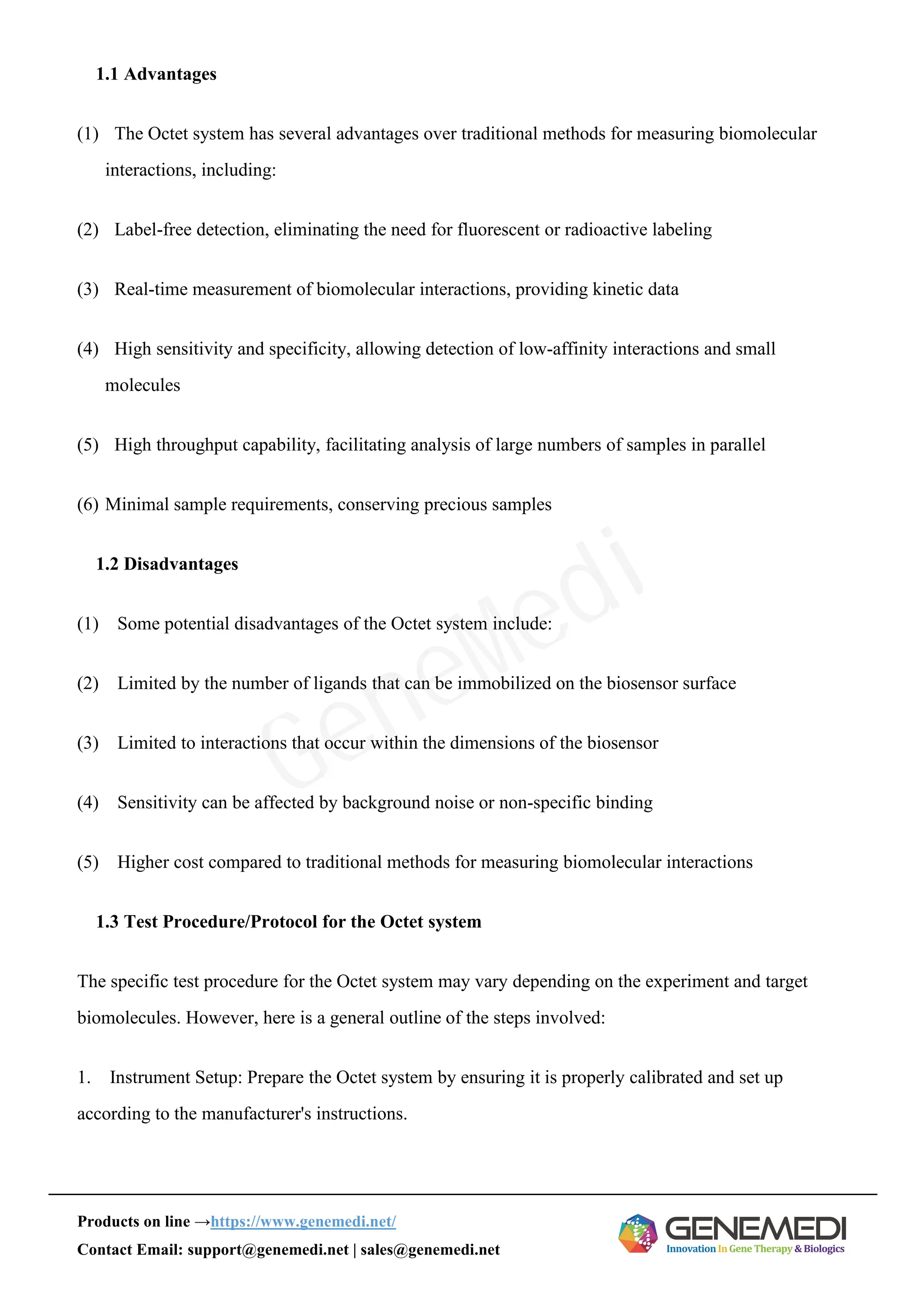
Principle of Octet system (ForteBio BLI technique) (Adopted from: Wallner, Jakob; Lhota, Gabriele;
Jeschek, Dominik; Mader, Alexander and Vorauer-Uhl, Karola. (2013). Application of Bio-Layer
Interferometry for the analysis of protein/liposome interactions. Journal of pharmaceutical and
biomedical analysis. 72. 150-4. 10.1016/j.jpba.2012.10.008.)
GeneMedi

GeneMedi-Octet system

  • 1.
    Products on line→https://www.genemedi.net/ Contact Email: support@genemedi.net | sales@genemedi.net Octet system 1. Octet system 2 1.1 Advantages 3 1.2 Disadvantages 3 1.3 Test Procedure/Protocol for the Octet system 3 GeneMedi
  • 2.
    Products on line→https://www.genemedi.net/ Contact Email: support@genemedi.net | sales@genemedi.net 1. Octet system Direct measurement of biomolecular interactions plays an important role in biotherapeutic drug discovery and development. Labelfree analytical technologies such as the Octet® platform from Pall ForteBio provide a powerful means to obtain accurate information about rate of biomolecular complex formation and complex stability, key components of a drug-target interaction. The affinity of an interaction directly affects the dose at which a biopharmaceutical is effective, and understanding mechanism of binding has implications in efficacy and desirability of a therapeutic candidate. Real time data on specificity, affinity and kinetics of binding interactions can benefit every stage of biopharmaceutical development, from early discovery to the manufacturing process. Octet instrumentation combined with the Dip and Read format of the biosensors offer several advantages over other label-free technologies. Sample volume is one consideration. The microplate format enables highly parallel processing in small volumes of as small as 40 µL. Samples are not consumed or destroyed by analysis, and can be recovered once the assay is complete. Cost is often another limiting factor in label-free analysis, however the Octet platform’s single-use biosensors are disposable and cost-effective, offering an advantage over SPR and other platforms where consumables are much more costly and difficult to manufacture. Although biosensors can be dis posed of after a single use, regeneration is possible in many cases, resulting in even further reduced cost per assay. The system measures changes in the interference pattern caused by binding of target molecules to a sensor surface with immobilized ligands. These changes allow for the quantification of binding kinetics, affinity, specificity and concentration of proteins, antibodies, and other biomolecules. In the Octet system, biotinylated ligands are immobilized onto streptavidin-coated biosensors. The biosensor tip is then dipped into a sample containing the analyte of interest and the interaction between the analyte and the immobilized ligand is monitored in real-time. The data obtained from the Octet system can be used to determine binding rate constants, dissociation constants, and the concentration of the analyte. GeneMedi
  • 3.
    Products on line→https://www.genemedi.net/ Contact Email: support@genemedi.net | sales@genemedi.net 1.1 Advantages (1) The Octet system has several advantages over traditional methods for measuring biomolecular interactions, including: (2) Label-free detection, eliminating the need for fluorescent or radioactive labeling (3) Real-time measurement of biomolecular interactions, providing kinetic data (4) High sensitivity and specificity, allowing detection of low-affinity interactions and small molecules (5) High throughput capability, facilitating analysis of large numbers of samples in parallel (6) Minimal sample requirements, conserving precious samples 1.2 Disadvantages (1) Some potential disadvantages of the Octet system include: (2) Limited by the number of ligands that can be immobilized on the biosensor surface (3) Limited to interactions that occur within the dimensions of the biosensor (4) Sensitivity can be affected by background noise or non-specific binding (5) Higher cost compared to traditional methods for measuring biomolecular interactions 1.3 Test Procedure/Protocol for the Octet system The specific test procedure for the Octet system may vary depending on the experiment and target biomolecules. However, here is a general outline of the steps involved: 1. Instrument Setup: Prepare the Octet system by ensuring it is properly calibrated and set up according to the manufacturer's instructions. GeneMedi
  • 4.
    Products on line→https://www.genemedi.net/ Contact Email: support@genemedi.net | sales@genemedi.net 2. Sensor Preparation: Attach the appropriate biosensor to the Octet system. The type of biosensor used depends on the nature of the biomolecular interaction being studied. 3. Sample Loading: Load the biosensor with a reference molecule or capture molecule, using immobilization techniques such as affinity tags or covalent coupling. 4. Baseline Measurement: Conduct a baseline measurement to establish a stable signal before the interaction analysis. This step accounts for any non-specific binding or drift in the system. 5. Association: Introduce the sample containing the analyte or target molecule to the biosensor surface and monitor the binding of the analyte to the immobilized molecule in real-time. 6. Dissociation: After the association phase, wash the biosensor surface to remove any unbound analyte, and monitor the dissociation of the interaction. 7. Data Analysis: Analyze the binding curves obtained from the association and dissociation phases to determine the kinetics parameters (e.g., association rate constant, dissociation rate constant). 8. Data Interpretation: Interpret the binding data to understand the affinity, specificity, and strength of the interaction between the biomolecules. Principle of Octet system (ForteBio BLI technique) (Adopted from: Wallner, Jakob; Lhota, Gabriele; Jeschek, Dominik; Mader, Alexander and Vorauer-Uhl, Karola. (2013). Application of Bio-Layer Interferometry for the analysis of protein/liposome interactions. Journal of pharmaceutical and biomedical analysis. 72. 150-4. 10.1016/j.jpba.2012.10.008.) GeneMedi