GENDER
AND
SOCIETY
UNIT 1: GENDER CONCEPTS/TERMS
I. Sex vs. Gender
II. GENDER ROLES
III.GENDER STEREOTYPES
IV. SOGIE
IV. Gender Equality vs. Women's Rights
SEX
AND
GENDER
WHAT IS
SEX
?
SEX
Refers to biological and physiological characteristics.
• The good, the bad, and the complicated.
• According to popular culture, sex is something done
for pleasure.
• In a more Freudian sense, it is what drives people to
do certain things.
• defines sex through its biological and not cultural
definition.
• Sex in the biological sense is a category for living
beings specifically related to their reproductive
function.
“Male and Female are used in birth certificates to denote
the sex of children”
SEX
Refers to biological and physiological characteristics.
• The good, the bad, and the complicated.
• According to popular culture, sex is something done
for pleasure.
• In a more Freudian sense, it is what drives people to
do certain things.
• defines sex through its biological and not cultural
definition.
• Sex in the biological sense is a category for living
beings specifically related to their reproductive
function.
“Male and Female are used in birth certificates to denote
the sex of children”
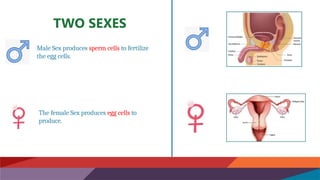
TWO SEXES
Male Sex produces sperm cells to fertilize
the egg cells.
The female Sex produces egg cells to
produce.
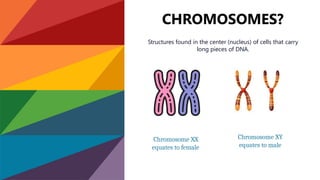
CHROMOSOMES?
CHROMOSOMES?
Structures found in the center (nucleus) of cells that carry
long pieces of DNA.
Chromosome XX
equates to female
Chromosome XY
equates to male
HORMONES
• Estrogen – a group of hormones that promote the
development and maintenance of female characteristics of
the body such as breasts and pubic hair.
• Testosterone – stimulates the development of male
secondary sexual characteristics produced mainly in the
testes.
• Progesterone – stimulates the uterus to prepare for pregnancy.
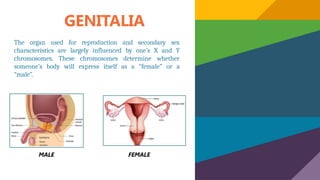
GENITALIA
The organ used for reproduction and secondary sex
characteristics are largely influenced by one’s X and Y
chromosomes. These chromosomes determine whether
someone’s body will express itself as a “female” or a
“male”.
MALE FEMALE
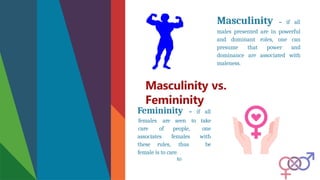
Masculinity vs.
Femininity
Masculinity – if all
males presented are in powerful
and dominant roles, one can
presume that power and
dominance are associated with
maleness.
Femininity – if all
associates
these rules,
people,
females
thus
to
females are seen to take
care of one
with
be
female is to care.
What is
GENDER?
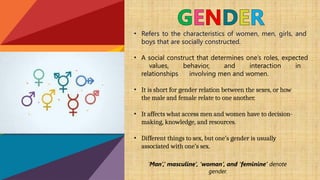
• Refers to the characteristics of women, men, girls, and
boys that are socially constructed.
• A social construct that determines one’s roles, expected
values, behavior, and interaction in
relationships involving men and women.
• It is short for gender relation between the sexes, or how
the male and female relate to one another.
• It affects what access men and women have to decision-
making, knowledge, and resources.
• Different things to sex, but one’s gender is usually
associated with one’s sex.
‘Man’,’ masculine’, ’woman’, and ‘feminine’ denote
gender.
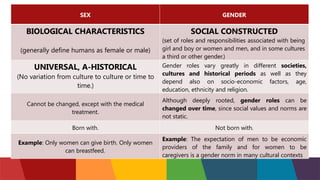
SEX GENDER
BIOLOGICAL CHARACTERISTICS
(generally define humans as female or male)
SOCIAL CONSTRUCTED
(set of roles and responsibilities associated with being
girl and boy or women and men, and in some cultures
a third or other gender.)
UNIVERSAL, A-HISTORICAL
(No variation from culture to culture or time to
time.)
Gender roles vary greatly in different societies,
cultures and historical periods as well as they
depend also on socio-economic factors, age,
education, ethnicity and religion.
Cannot be changed, except with the medical
treatment.
Although deeply rooted, gender roles can be
changed over time, since social values and norms are
not static.
Born with. Not born with.
Example: Only women can give birth. Only women
can breastfeed.
Example: The expectation of men to be economic
providers of the family and for women to be
caregivers is a gender norm in many cultural contexts
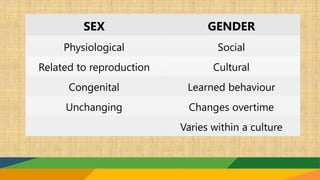
SEX GENDER
Physiological Social
Related to reproduction Cultural
Congenital Learned behaviour
Unchanging Changes overtime
Varies within a culture
Does sex correspond to
gender?
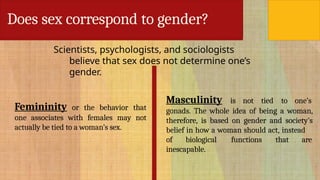
Does sex correspond to gender?
Scientists, psychologists, and sociologists
believe that sex does not determine one’s
gender.
Femininity or the behavior that
one associates with females may not
actually be tied to a woman’s sex.
Masculinity is not tied to one’s
gonads. The whole idea of being a woman,
therefore, is based on gender and society’s
belief in how a woman should act, instead
of biological functions that are
inescapable.
GENDER ROLES
Gender roles are expected attitudes and behaviors a society
associates with each sex.
Defining Roles:
Roles are simply performed
according to social norms
that are shared rules which
guide people’s behavior in
specific situations.
Examples:
• men are expected to perform their role as
the father and breadwinner in the family as
to women are expected to perform their
roles as the mother and nurturer in the
family.
Roles are socially constructed but this does
not mean that an individual cannot deviate
from this social norms and follow what he
wants to be.
Examples are same sex parents, mothers who are
breadwinners and fathers who are nurturers.
Give at least five gender roles in the given settings:
“GENDER
STEREOTYPES
vs
GENDER ROLES”
Gender Roles and Gender
Stereotypes
Gender roles and gender stereotypes are related, but they are not
exactly the same.
Gender roles refer to the societal expectations and norms that
dictate how people should behave based on their gender.
Gender stereotypes, these are generalized beliefs or assumptions
about individuals based on their gender. Unlike gender roles,
stereotypes don't tell someone specifically what they "must" do but
instead shape perceptions of what they are like or should be like.
Gender Stereotypes
A generalized view or preconception
about attributes, or characteristics that are
or ought to be possessed by women and
men or the roles that are or should be
performed by men and women.
ex: Gender stereotypes can be both positive
and negative for example, “women are
nurturing” or “women are weak.
In simple terms, it is an often unfair
and untrue belief that many people have
about all people or things with a particular
characteristic
Gender Stereotypes
• Girls are more fragile
• Girls are more perfectionist and better at
housework.
• Girls are good with language.
• Girls are more manipulative. They toy with
people’s feelings. They are more prideful than
boys.
• Boys don't cry.
• Boys are more disorderly and less meticulous in doing
household.
• Boys are good at math.
• Interactions between boys are more direct and violent
Sexual Stereotypes
Involve assumptions regarding a
person’s sexuality that reinforce
dominant views. Like the assumption
that all persons are only attracted to the
sex opposite theirs.
Example: men are more sexually
adventurous than women, Lesbians hate
men, Trans women are just men
pretending to be women,
What is
SOGIE?
SOGIE
Stands for Sexual Orientation And Gender Identity Expression.
 Sexual Orientation
• Homosexuality
• Heterosexuality
• bisexuality
 Gender Identity
Gender Identity refers to a
person's deeply felt sense of
their own gender, which may
or may not correspond with
the sex they were assigned at
birth.
 Expression.
• refers to how
individuals
express their gender
through
identity
their
behavior, and
outwardly
appearance,
mannerisms.
• It includes factors such as
hairstyles, speech
clothing,
patterns, body language, and
other forms of self-expression.
Sexual orientation
 Involves the person to whom one is
attracted.
 One identifies himself or herself in
relation
to this attraction.
 Includes both romantic and sexual
feelings.
Terms Standing for
SOGIE
Gender Expression
 expresses his or her sexuality through the
actions or manner of presenting oneself.
Gender Identity
 Gender identity refers to a person’s deeply
held sense of their own gender. It is how an
individual personally identifies and
experiences their gender, which may or may
not align with the sex they were assigned at
birth.
 Identify himself or herself as masculine or
feminine.
.
GENDER IDENTITY
2. Transgender: A person whose
gender identity differs from the sex
they were assigned at birth. For
example, someone assigned male at
birth who identifies as a woman
would be considered transgender.
1. Cisgender: A person whose
gender identity aligns with the sex
they were assigned at birth. For
example, someone assigned female
at birth who identifies as a woman
would be considered cisgender.
3. Non-binary: People who do not identify
exclusively as male or female. Non-binary
individuals may see themselves as a mix of
both genders, neither, or a different gender
altogether. Some prefer terms like
"genderqueer," "genderfluid," or "agender."
4. Genderfluid: Someone whose gender
identity shifts or changes over time. A
genderfluid person might feel like one
gender at certain times, and a different
one at others.
.
GENDER IDENTITY
6. Bigender: A person who identifies as
two genders, either simultaneously or at
different times. For example, someone
might identify as both male and female, or
switch between them depending on
context or time.
5. Agender: A person who identifies as
having no gender, or someone who feels
neutral in terms of gender identity. 7. Two-Spirit: A term used by some Indigenous
cultures in North America to describe a person
who embodies both masculine and feminine
qualities or fulfills a unique cultural role. The
term varies between different Indigenous
cultures and should be understood in its
specific cultural context.
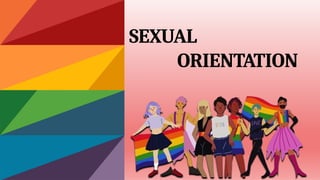
SEXUAL
ORIENTATION
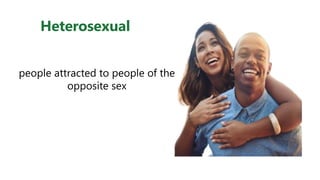
Heterosexual
people attracted to people of the
opposite sex
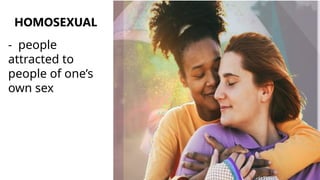
HOMOSEXUAL
- people
attracted to
people of one’s
own sex
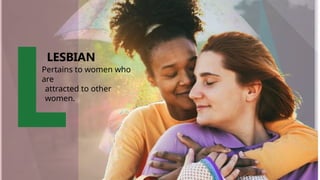
LESBIAN
Pertains to women who
are
attracted to other
women.
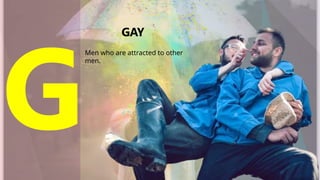
GAY
Men who are attracted to other
men.
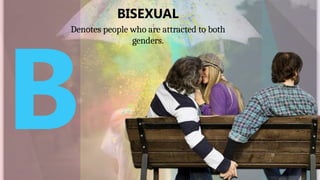
BISEXUAL
Denotes people who are attracted to both
genders.
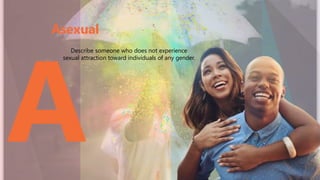
Asexual
Describe someone who does not experience
sexual attraction toward individuals of any gender.
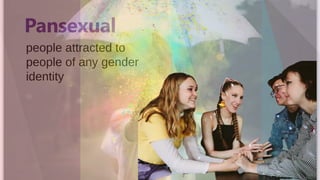
Pansexual
people attracted to
people of any gender
identity
Transgender
vs.
Transexual
TRANSGENDER TRANSEXUAL
 Refers to those trans people who live
permanently in their preferred gender,
without necessarily needing to undergo
any medical intervention/s.
 Refers to people who identify entirely with
the gender role opposite to the sex
assigned at birth and seek to live
permanently in the preferred gender role.
 Transsexual people might intend
to undergo, are undergoing, or
have undergone gender
reassignment treatment (which may or
may not involve hormone therapy or
surgery).


genderandsociety- Lesson 1.pptx,........
  • 1.
  • 2.
    UNIT 1: GENDERCONCEPTS/TERMS I. Sex vs. Gender II. GENDER ROLES III.GENDER STEREOTYPES IV. SOGIE IV. Gender Equality vs. Women's Rights
  • 3.
  • 4.
  • 5.
    SEX Refers to biologicaland physiological characteristics. • The good, the bad, and the complicated. • According to popular culture, sex is something done for pleasure. • In a more Freudian sense, it is what drives people to do certain things. • defines sex through its biological and not cultural definition. • Sex in the biological sense is a category for living beings specifically related to their reproductive function. “Male and Female are used in birth certificates to denote the sex of children”
  • 6.
    SEX Refers to biologicaland physiological characteristics. • The good, the bad, and the complicated. • According to popular culture, sex is something done for pleasure. • In a more Freudian sense, it is what drives people to do certain things. • defines sex through its biological and not cultural definition. • Sex in the biological sense is a category for living beings specifically related to their reproductive function. “Male and Female are used in birth certificates to denote the sex of children”
  • 7.
    TWO SEXES Male Sexproduces sperm cells to fertilize the egg cells. The female Sex produces egg cells to produce.
  • 8.
  • 9.
    CHROMOSOMES? Structures found inthe center (nucleus) of cells that carry long pieces of DNA. Chromosome XX equates to female Chromosome XY equates to male
  • 10.
    HORMONES • Estrogen –a group of hormones that promote the development and maintenance of female characteristics of the body such as breasts and pubic hair. • Testosterone – stimulates the development of male secondary sexual characteristics produced mainly in the testes. • Progesterone – stimulates the uterus to prepare for pregnancy.
  • 11.
    GENITALIA The organ usedfor reproduction and secondary sex characteristics are largely influenced by one’s X and Y chromosomes. These chromosomes determine whether someone’s body will express itself as a “female” or a “male”. MALE FEMALE
  • 12.
    Masculinity vs. Femininity Masculinity –if all males presented are in powerful and dominant roles, one can presume that power and dominance are associated with maleness. Femininity – if all associates these rules, people, females thus to females are seen to take care of one with be female is to care.
  • 13.
  • 14.
    • Refers tothe characteristics of women, men, girls, and boys that are socially constructed. • A social construct that determines one’s roles, expected values, behavior, and interaction in relationships involving men and women. • It is short for gender relation between the sexes, or how the male and female relate to one another. • It affects what access men and women have to decision- making, knowledge, and resources. • Different things to sex, but one’s gender is usually associated with one’s sex. ‘Man’,’ masculine’, ’woman’, and ‘feminine’ denote gender.
  • 15.
    SEX GENDER BIOLOGICAL CHARACTERISTICS (generallydefine humans as female or male) SOCIAL CONSTRUCTED (set of roles and responsibilities associated with being girl and boy or women and men, and in some cultures a third or other gender.) UNIVERSAL, A-HISTORICAL (No variation from culture to culture or time to time.) Gender roles vary greatly in different societies, cultures and historical periods as well as they depend also on socio-economic factors, age, education, ethnicity and religion. Cannot be changed, except with the medical treatment. Although deeply rooted, gender roles can be changed over time, since social values and norms are not static. Born with. Not born with. Example: Only women can give birth. Only women can breastfeed. Example: The expectation of men to be economic providers of the family and for women to be caregivers is a gender norm in many cultural contexts
  • 16.
    SEX GENDER Physiological Social Relatedto reproduction Cultural Congenital Learned behaviour Unchanging Changes overtime Varies within a culture
  • 17.
  • 18.
    Does sex correspondto gender? Scientists, psychologists, and sociologists believe that sex does not determine one’s gender. Femininity or the behavior that one associates with females may not actually be tied to a woman’s sex. Masculinity is not tied to one’s gonads. The whole idea of being a woman, therefore, is based on gender and society’s belief in how a woman should act, instead of biological functions that are inescapable.
  • 20.
    GENDER ROLES Gender rolesare expected attitudes and behaviors a society associates with each sex. Defining Roles: Roles are simply performed according to social norms that are shared rules which guide people’s behavior in specific situations. Examples: • men are expected to perform their role as the father and breadwinner in the family as to women are expected to perform their roles as the mother and nurturer in the family. Roles are socially constructed but this does not mean that an individual cannot deviate from this social norms and follow what he wants to be. Examples are same sex parents, mothers who are breadwinners and fathers who are nurturers.
  • 21.
    Give at leastfive gender roles in the given settings:
  • 22.
  • 23.
    Gender Roles andGender Stereotypes Gender roles and gender stereotypes are related, but they are not exactly the same. Gender roles refer to the societal expectations and norms that dictate how people should behave based on their gender. Gender stereotypes, these are generalized beliefs or assumptions about individuals based on their gender. Unlike gender roles, stereotypes don't tell someone specifically what they "must" do but instead shape perceptions of what they are like or should be like.
  • 24.
    Gender Stereotypes A generalizedview or preconception about attributes, or characteristics that are or ought to be possessed by women and men or the roles that are or should be performed by men and women. ex: Gender stereotypes can be both positive and negative for example, “women are nurturing” or “women are weak. In simple terms, it is an often unfair and untrue belief that many people have about all people or things with a particular characteristic
  • 25.
    Gender Stereotypes • Girlsare more fragile • Girls are more perfectionist and better at housework. • Girls are good with language. • Girls are more manipulative. They toy with people’s feelings. They are more prideful than boys. • Boys don't cry. • Boys are more disorderly and less meticulous in doing household. • Boys are good at math. • Interactions between boys are more direct and violent
  • 26.
    Sexual Stereotypes Involve assumptionsregarding a person’s sexuality that reinforce dominant views. Like the assumption that all persons are only attracted to the sex opposite theirs. Example: men are more sexually adventurous than women, Lesbians hate men, Trans women are just men pretending to be women,
  • 27.
  • 28.
    SOGIE Stands for SexualOrientation And Gender Identity Expression.  Sexual Orientation • Homosexuality • Heterosexuality • bisexuality  Gender Identity Gender Identity refers to a person's deeply felt sense of their own gender, which may or may not correspond with the sex they were assigned at birth.  Expression. • refers to how individuals express their gender through identity their behavior, and outwardly appearance, mannerisms. • It includes factors such as hairstyles, speech clothing, patterns, body language, and other forms of self-expression.
  • 29.
    Sexual orientation  Involvesthe person to whom one is attracted.  One identifies himself or herself in relation to this attraction.  Includes both romantic and sexual feelings. Terms Standing for SOGIE Gender Expression  expresses his or her sexuality through the actions or manner of presenting oneself. Gender Identity  Gender identity refers to a person’s deeply held sense of their own gender. It is how an individual personally identifies and experiences their gender, which may or may not align with the sex they were assigned at birth.  Identify himself or herself as masculine or feminine.
  • 30.
    . GENDER IDENTITY 2. Transgender:A person whose gender identity differs from the sex they were assigned at birth. For example, someone assigned male at birth who identifies as a woman would be considered transgender. 1. Cisgender: A person whose gender identity aligns with the sex they were assigned at birth. For example, someone assigned female at birth who identifies as a woman would be considered cisgender. 3. Non-binary: People who do not identify exclusively as male or female. Non-binary individuals may see themselves as a mix of both genders, neither, or a different gender altogether. Some prefer terms like "genderqueer," "genderfluid," or "agender." 4. Genderfluid: Someone whose gender identity shifts or changes over time. A genderfluid person might feel like one gender at certain times, and a different one at others.
  • 31.
    . GENDER IDENTITY 6. Bigender:A person who identifies as two genders, either simultaneously or at different times. For example, someone might identify as both male and female, or switch between them depending on context or time. 5. Agender: A person who identifies as having no gender, or someone who feels neutral in terms of gender identity. 7. Two-Spirit: A term used by some Indigenous cultures in North America to describe a person who embodies both masculine and feminine qualities or fulfills a unique cultural role. The term varies between different Indigenous cultures and should be understood in its specific cultural context.
  • 32.
  • 33.
    Heterosexual people attracted topeople of the opposite sex
  • 34.
  • 35.
    LESBIAN Pertains to womenwho are attracted to other women.
  • 36.
    GAY Men who areattracted to other men.
  • 37.
    BISEXUAL Denotes people whoare attracted to both genders.
  • 38.
    Asexual Describe someone whodoes not experience sexual attraction toward individuals of any gender.
  • 39.
  • 40.
  • 41.
    TRANSGENDER TRANSEXUAL  Refersto those trans people who live permanently in their preferred gender, without necessarily needing to undergo any medical intervention/s.  Refers to people who identify entirely with the gender role opposite to the sex assigned at birth and seek to live permanently in the preferred gender role.  Transsexual people might intend to undergo, are undergoing, or have undergone gender reassignment treatment (which may or may not involve hormone therapy or surgery).