www.iied.org @IIED
Gender Equality and Social
Protection
Tracy C. Kajumba, Principal Researcher, Climate Change Group
Tracy.Kajumba@iied.org
Tracy KajumbaGender Equality and Social Protection 2
Tracy Kajumba
• Evidence from development contexts suggests that
systematically applying a gender lens to SP enhances
empowerment outcomes for women and men
• Food security
• Productive investments and livelihoods
• Enhancing capacity to manage lifecycle risks
• Smoothing consumption and ultimately contributing to
lifting people out of poverty.
• Programmes that tackle women’s age-related and work-
related vulnerabilities, like childcare, have proven to be
effective
• Cash transfers are better at providing assets to women
than employment schemes and are beneficial for
households
Gender Equality and Social Protection 3
Social protection and gender equality…
Tracy Kajumba
• Social protection supports communities, households and
individuals – but may increase inequalities e.g. target the formal
sector where women are under-represented, fail to address
underlying causes of inequality, etc.
• Household income vs intra household relations - men may
withhold ‘their’ income within the household, and resist women’s
control over resources
• Conditional transfers - conditionalities may act to reinforce the
burden of multiple expectations placed on women.
• Women being principal beneficiaries does not necessarily
enhance women’s decision-making power within the household …
unintended consequence of reinforcing gendered divisions of
labour.
• A narrow focus on women, to the exclusion of men, may assist
women within existing frameworks of gender relations without
necessarily transforming their conditions.
Gender Equality and Social Protection 4
Power relations…
Tracy KajumbaGender Equality and Social Protection 5
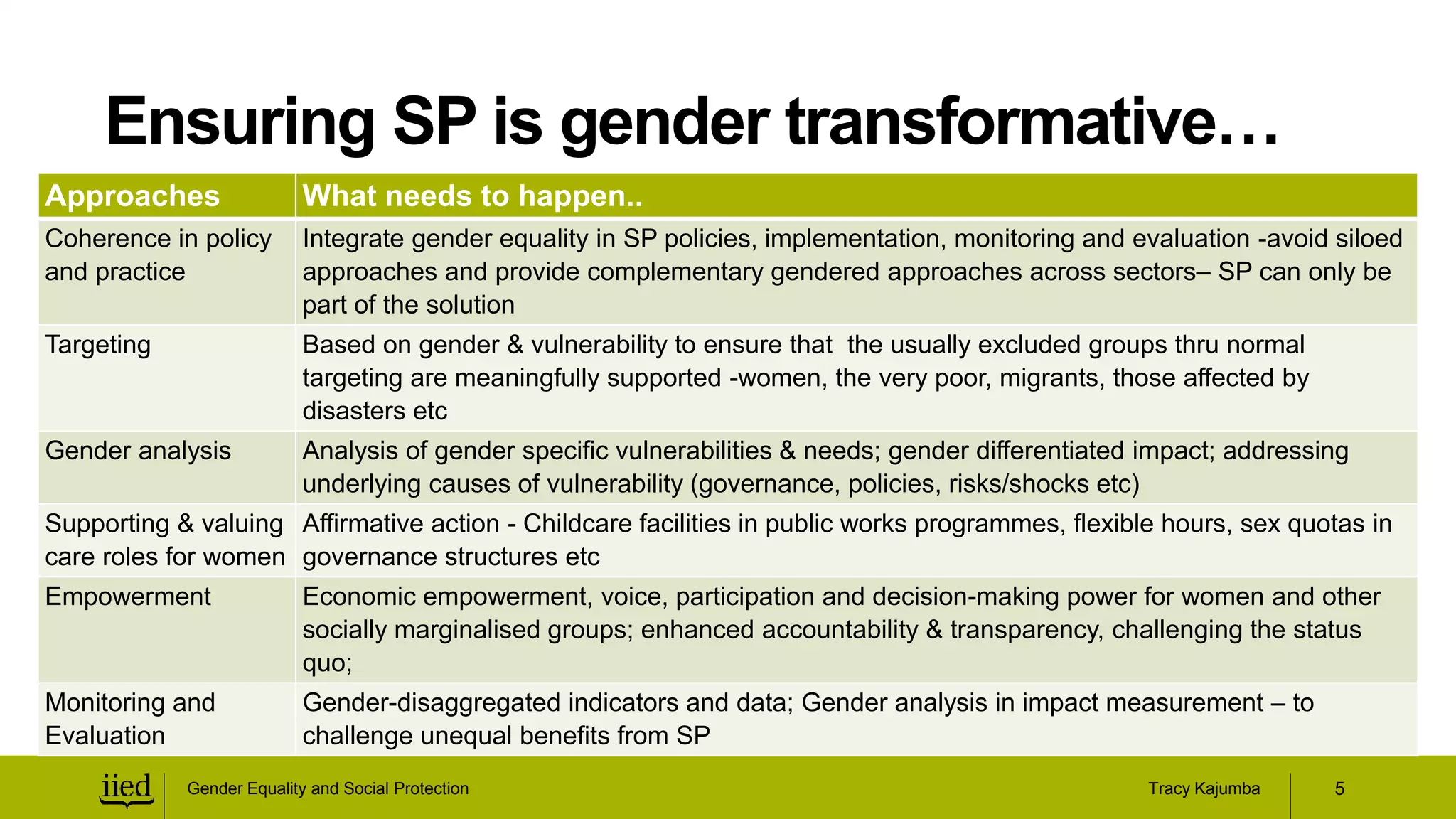
Ensuring SP is gender transformative…
Approaches What needs to happen..
Coherence in policy
and practice
Integrate gender equality in SP policies, implementation, monitoring and evaluation -avoid siloed
approaches and provide complementary gendered approaches across sectors– SP can only be
part of the solution
Targeting Based on gender & vulnerability to ensure that the usually excluded groups thru normal
targeting are meaningfully supported -women, the very poor, migrants, those affected by
disasters etc
Gender analysis Analysis of gender specific vulnerabilities & needs; gender differentiated impact; addressing
underlying causes of vulnerability (governance, policies, risks/shocks etc)
Supporting & valuing
care roles for women
Affirmative action - Childcare facilities in public works programmes, flexible hours, sex quotas in
governance structures etc
Empowerment Economic empowerment, voice, participation and decision-making power for women and other
socially marginalised groups; enhanced accountability & transparency, challenging the status
quo;
Monitoring and
Evaluation
Gender-disaggregated indicators and data; Gender analysis in impact measurement – to
challenge unequal benefits from SP
Tracy KajumbaGender Equality and Social Protection 6
Further reading
Luttrell, C. and Moser, C., 2004, ‘Gender and Social Protection’, Overseas Development
Institute (ODI), London
Social protection floors and gender equality : a brief overview / Lou Tessier, Maya Stern
Plaza, Christina Behrendt, Florence Bonnet, Emmanuelle St-Pierre Guibault ; International
Labour Office, Social Protection Department. - Geneva: ILO, 2013.
https://socialprotection-humanrights.org/expertcom/do-social-protection-programmes-that-
impose-conditionalities-on-women-fail-to-confront-patriarchy-as-a-root-cause-of-inequality/
https://pim.cgiar.org/2020/03/18/toward-gender-equality-in-social-protection-evidence-gaps-
and-priority-research-questions/
https://www.ilo.org/global/about-the-ilo/newsroom/news/WCMS_405766/lang--en/index.htm

Gender equality and social protection

  • 1.
    www.iied.org @IIED Gender Equalityand Social Protection Tracy C. Kajumba, Principal Researcher, Climate Change Group Tracy.Kajumba@iied.org
  • 2.
    Tracy KajumbaGender Equalityand Social Protection 2
  • 3.
    Tracy Kajumba • Evidencefrom development contexts suggests that systematically applying a gender lens to SP enhances empowerment outcomes for women and men • Food security • Productive investments and livelihoods • Enhancing capacity to manage lifecycle risks • Smoothing consumption and ultimately contributing to lifting people out of poverty. • Programmes that tackle women’s age-related and work- related vulnerabilities, like childcare, have proven to be effective • Cash transfers are better at providing assets to women than employment schemes and are beneficial for households Gender Equality and Social Protection 3 Social protection and gender equality…
  • 4.
    Tracy Kajumba • Socialprotection supports communities, households and individuals – but may increase inequalities e.g. target the formal sector where women are under-represented, fail to address underlying causes of inequality, etc. • Household income vs intra household relations - men may withhold ‘their’ income within the household, and resist women’s control over resources • Conditional transfers - conditionalities may act to reinforce the burden of multiple expectations placed on women. • Women being principal beneficiaries does not necessarily enhance women’s decision-making power within the household … unintended consequence of reinforcing gendered divisions of labour. • A narrow focus on women, to the exclusion of men, may assist women within existing frameworks of gender relations without necessarily transforming their conditions. Gender Equality and Social Protection 4 Power relations…
  • 5.
    Tracy KajumbaGender Equalityand Social Protection 5 Ensuring SP is gender transformative… Approaches What needs to happen.. Coherence in policy and practice Integrate gender equality in SP policies, implementation, monitoring and evaluation -avoid siloed approaches and provide complementary gendered approaches across sectors– SP can only be part of the solution Targeting Based on gender & vulnerability to ensure that the usually excluded groups thru normal targeting are meaningfully supported -women, the very poor, migrants, those affected by disasters etc Gender analysis Analysis of gender specific vulnerabilities & needs; gender differentiated impact; addressing underlying causes of vulnerability (governance, policies, risks/shocks etc) Supporting & valuing care roles for women Affirmative action - Childcare facilities in public works programmes, flexible hours, sex quotas in governance structures etc Empowerment Economic empowerment, voice, participation and decision-making power for women and other socially marginalised groups; enhanced accountability & transparency, challenging the status quo; Monitoring and Evaluation Gender-disaggregated indicators and data; Gender analysis in impact measurement – to challenge unequal benefits from SP
  • 6.
    Tracy KajumbaGender Equalityand Social Protection 6 Further reading Luttrell, C. and Moser, C., 2004, ‘Gender and Social Protection’, Overseas Development Institute (ODI), London Social protection floors and gender equality : a brief overview / Lou Tessier, Maya Stern Plaza, Christina Behrendt, Florence Bonnet, Emmanuelle St-Pierre Guibault ; International Labour Office, Social Protection Department. - Geneva: ILO, 2013. https://socialprotection-humanrights.org/expertcom/do-social-protection-programmes-that- impose-conditionalities-on-women-fail-to-confront-patriarchy-as-a-root-cause-of-inequality/ https://pim.cgiar.org/2020/03/18/toward-gender-equality-in-social-protection-evidence-gaps- and-priority-research-questions/ https://www.ilo.org/global/about-the-ilo/newsroom/news/WCMS_405766/lang--en/index.htm

Editor's Notes

  • #2 This cover slide template should be used when there are no partners (it’s solely an IIED presentation) and you aren’t using a cover image. We recommend keeping the background colours the same for consistency and ease of use, but if you do need to change the background colour then it can be done within the slide master section (View > Slide Master > Colours). Most of the white on the right hand side won’t appear when the slide is presented, so don’t add any content to this. Simply replace the placeholder text with your text to use this slide, making note of where the title, subtitle, date and presenter name(s) should go. To make using the template easier in the future, you can save the design as a custom ‘theme’ in PowerPoint. To do this: Select File > Save a copy Choose ‘This PC’ Select folder ‘Custom office templates’ from the list directly below Save as type PowerPoint template Save If you use the template as a custom theme, please bear in mind that you’ll have to enter the footer (slide number and presentation title) manually (using ‘Insert’ > ‘Header & Footer’ > ticking ‘Slide number’ and ‘Footer’ and entering your presentation title in the text box > clicking ‘Apply to all’
  • #3 This slide template shows examples of how charts/figures should be formatted (in terms of colours/fonts). IIED primary colours should be used wherever possible (some secondary palette colours are available if more than 4 colours are needed).
  • #4 This slide template should be used for text slides. Replace the placeholder text with your text, using the formatting shown. The presentation title in the footer can be updated in the ‘Header & Footer’ section within the ‘Insert’ tab. The presentation author names and Twitter handles can be added by going to ‘View’ > ‘Slide Master’ > scrolling up to the very first master slide at the top and typing over the placeholder text. The IIED Twitter handle can be used as default, but can also be replaced with the presenters own if appropriate.
  • #5 This slide template should be used for text slides. Replace the placeholder text with your text, using the formatting shown. The presentation title in the footer can be updated in the ‘Header & Footer’ section within the ‘Insert’ tab. The presentation author names and Twitter handles can be added by going to ‘View’ > ‘Slide Master’ > scrolling up to the very first master slide at the top and typing over the placeholder text. The IIED Twitter handle can be used as default, but can also be replaced with the presenters own if appropriate.
  • #6 This slide template should be used for text slides. Replace the placeholder text with your text, using the formatting shown. The presentation title in the footer can be updated in the ‘Header & Footer’ section within the ‘Insert’ tab. The presentation author names and Twitter handles can be added by going to ‘View’ > ‘Slide Master’ > scrolling up to the very first master slide at the top and typing over the placeholder text. The IIED Twitter handle can be used as default, but can also be replaced with the presenters own if appropriate.
  • #7 This slide template should be used for text slides. Replace the placeholder text with your text, using the formatting shown. The presentation title in the footer can be updated in the ‘Header & Footer’ section within the ‘Insert’ tab. The presentation author names and Twitter handles can be added by going to ‘View’ > ‘Slide Master’ > scrolling up to the very first master slide at the top and typing over the placeholder text. The IIED Twitter handle can be used as default, but can also be replaced with the presenters own if appropriate.