Cellular Types and
Histology
Prepared by: NASRIFAH D. ABDULAZIS
Cells of higher animals
 Somatic cells (body cells)- diverse
in the body of an organism; ex.
neurons, epithelial cells, liver cells,
and much more.
 Germinal cells (sex cells)- essential
for reproduction. Sperm and egg
cell represents germinal cells.
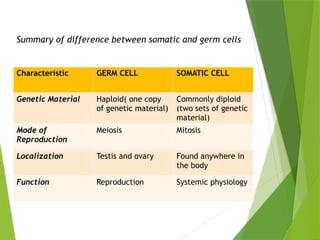
Summary of difference between somatic and germ cells
Characteristic GERM CELL SOMATIC CELL
Genetic Material Haploid( one copy
of genetic material)
Commonly diploid
(two sets of genetic
material)
Mode of
Reproduction
Meiosis Mitosis
Localization Testis and ovary Found anywhere in
the body
Function Reproduction Systemic physiology
Diversity of
Human cells
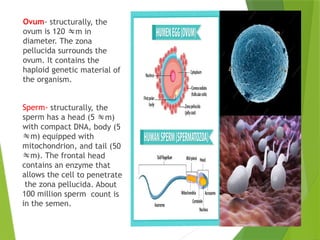
Ovum- structurally, the
ovum is 120 m in
diameter. The zona
pellucida surrounds the
ovum. It contains the
haploid genetic material of
the organism.
Sperm- structurally, the
sperm has a head (5 m)
with compact DNA, body (5
m) equipped with
mitochondrion, and tail (50
m). The frontal head
contains an enzyme that
allows the cell to penetrate
the zona pellucida. About
100 million sperm count is
in the semen.
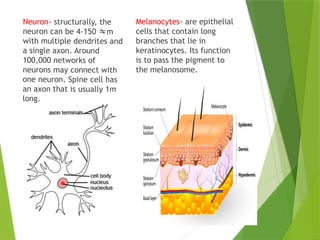
Neuron- structurally, the
neuron can be 4-150 m
with multiple dendrites and
a single axon. Around
100,000 networks of
neurons may connect with
one neuron. Spine cell has
an axon that is usually 1m
long.
Melanocytes- are epithelial
cells that contain long
branches that lie in
keratinocytes. Its function
is to pass the pigment to
the melanosome.
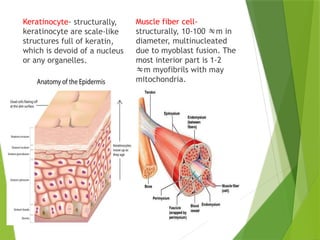
Keratinocyte- structurally,
keratinocyte are scale-like
structures full of keratin,
which is devoid of a nucleus
or any organelles.
Muscle fiber cell-
structurally, 10-100 m in
diameter, multinucleated
due to myoblast fusion. The
most interior part is 1-2
m myofibrils with may
mitochondria.
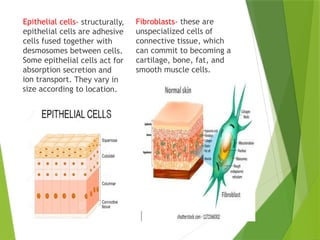
Epithelial cells- structurally,
epithelial cells are adhesive
cells fused together with
desmosomes between cells.
Some epithelial cells act for
absorption secretion and
ion transport. They vary in
size according to location.
Fibroblasts- these are
unspecialized cells of
connective tissue, which
can commit to becoming a
cartilage, bone, fat, and
smooth muscle cells.
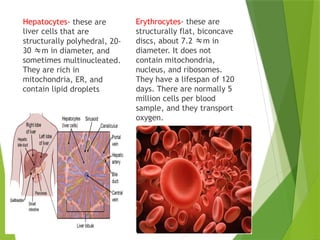
Hepatocytes- these are
liver cells that are
structurally polyhedral, 20-
30 m in diameter, and
sometimes multinucleated.
They are rich in
mitochondria, ER, and
contain lipid droplets
Erythrocytes- these are
structurally flat, biconcave
discs, about 7.2 m in
diameter. It does not
contain mitochondria,
nucleus, and ribosomes.
They have a lifespan of 120
days. There are normally 5
million cells per blood
sample, and they transport
oxygen.
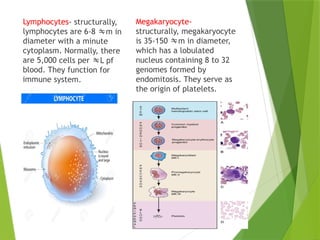
Lymphocytes- structurally,
lymphocytes are 6-8 m in
diameter with a minute
cytoplasm. Normally, there
are 5,000 cells per L pf
blood. They function for
immune system.
Megakaryocyte-
structurally, megakaryocyte
is 35-150 m in diameter,
which has a lobulated
nucleus containing 8 to 32
genomes formed by
endomitosis. They serve as
the origin of platelets.
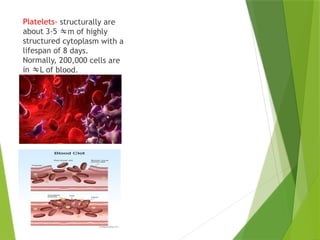
Platelets- structurally are
about 3-5 m of highly
structured cytoplasm with a
lifespan of 8 days.
Normally, 200,000 cells are
in L of blood.
Animal Tissues
Tissues result from the differentiation of
several groups of cells that will form a group
of cells having the same function.
Histology- the study of different tissues.
Different tissues arise from a particular germ
layer during embryonic development.
In animals, the tissues are either epithelial,
connective,muscular, or nervous tissue.
Epithelial Tissue
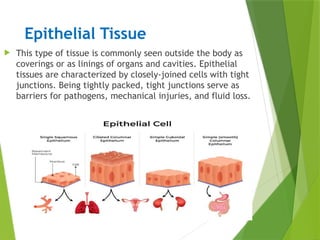
 This type of tissue is commonly seen outside the body as
coverings or as linings of organs and cavities. Epithelial
tissues are characterized by closely-joined cells with tight
junctions. Being tightly packed, tight junctions serve as
barriers for pathogens, mechanical injuries, and fluid loss.
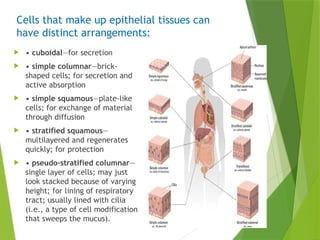
Cells that make up epithelial tissues can
have distinct arrangements:
 • cuboidal—for secretion
 • simple columnar—brick-
shaped cells; for secretion and
active absorption
 • simple squamous—plate-like
cells; for exchange of material
through diffusion
 • stratified squamous—
multilayered and regenerates
quickly; for protection
 • pseudo-stratified columnar—
single layer of cells; may just
look stacked because of varying
height; for lining of respiratory
tract; usually lined with cilia
(i.e., a type of cell modification
that sweeps the mucus).
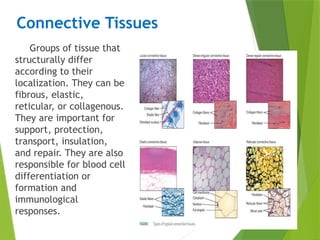
Connective Tissues
Groups of tissue that
structurally differ
according to their
localization. They can be
fibrous, elastic,
reticular, or collagenous.
They are important for
support, protection,
transport, insulation,
and repair. They are also
responsible for blood cell
differentiation or
formation and
immunological
responses.
Connective Tissue composed of the following:
 BLOOD —made up of plasma (i.e., liquid
extracellular matrix); contains water, salts,
and dissolved proteins; erythrocytes that
carry oxygen (RBC), leukocytes for defense
(WBC), and platelets for blood clotting.
 CONNECTIVE TISSUE PROPER (CTP)—made up
of loose connective tissue that is found in the
skin and fibrous connective tissue that is
made up of collagenous fibers found in
tendons and ligaments. Adipose tissues are
also examples of loose connective tissues that
store fats which functions to insulate the
body and store energy.
 CARTILAGE —characterized by collagenous
fibers embedded in chondroitin sulfate.
Chondrocytes are the cells that secrete
collagen and chondroitin sulfate. Cartilage
functions as cushion between bones.
 BONE —mineralized connective tissue made
by bone-forming cells called osteoblasts
which deposit collagen. The matrix of
collagen is combined with calcium,
magnesium, and phosphate ions to make
the bone hard. Blood vessels and nerves
are found at a central canal surrounded by
concentric circles of osteons.
Muscle Tissue
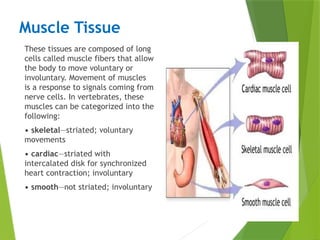
These tissues are composed of long
cells called muscle fibers that allow
the body to move voluntary or
involuntary. Movement of muscles
is a response to signals coming from
nerve cells. In vertebrates, these
muscles can be categorized into the
following:
• skeletal—striated; voluntary
movements
• cardiac—striated with
intercalated disk for synchronized
heart contraction; involuntary
• smooth—not striated; involuntary
Nervous Tissue
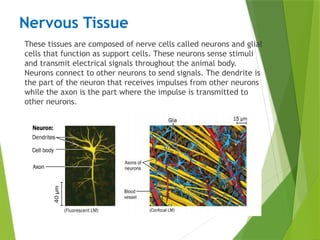
These tissues are composed of nerve cells called neurons and glial
cells that function as support cells. These neurons sense stimuli
and transmit electrical signals throughout the animal body.
Neurons connect to other neurons to send signals. The dendrite is
the part of the neuron that receives impulses from other neurons
while the axon is the part where the impulse is transmitted to
other neurons.
Plant Tissues
Meristematic Tissues
Groups of undifferentiated
tissues found in growing areas of the
plants such as root tip and leaf bud. The
cells of this tissue are actively dividing
and give rise to the organs or other
important plant parts.
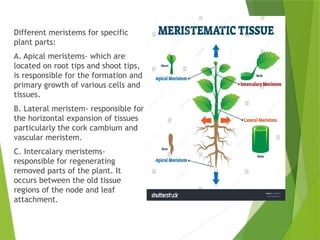
Different meristems for specific
plant parts:
A. Apical meristems- which are
located on root tips and shoot tips,
is responsible for the formation and
primary growth of various cells and
tissues.
B. Lateral meristem- responsible for
the horizontal expansion of tissues
particularly the cork cambium and
vascular meristem.
C. Intercalary meristems-
responsible for regenerating
removed parts of the plant. It
occurs between the old tissue
regions of the node and leaf
attachment.
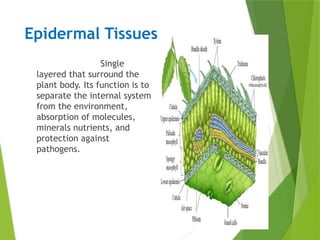
Epidermal Tissues
Single
layered that surround the
plant body. Its function is to
separate the internal system
from the environment,
absorption of molecules,
minerals nutrients, and
protection against
pathogens.
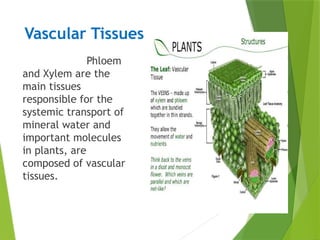
Vascular Tissues
Phloem
and Xylem are the
main tissues
responsible for the
systemic transport of
mineral water and
important molecules
in plants, are
composed of vascular
tissues.
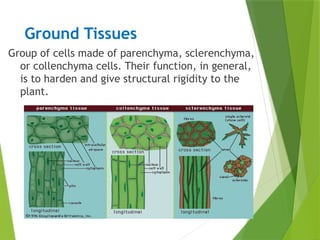
Ground Tissues
Group of cells made of parenchyma, sclerenchyma,
or collenchyma cells. Their function, in general,
is to harden and give structural rigidity to the
plant.
Thank you for listening…

gen_bio_cell_typess in everyyy ling things

  • 1.
    Cellular Types and Histology Preparedby: NASRIFAH D. ABDULAZIS
  • 2.
    Cells of higheranimals  Somatic cells (body cells)- diverse in the body of an organism; ex. neurons, epithelial cells, liver cells, and much more.  Germinal cells (sex cells)- essential for reproduction. Sperm and egg cell represents germinal cells.
  • 3.
    Summary of differencebetween somatic and germ cells Characteristic GERM CELL SOMATIC CELL Genetic Material Haploid( one copy of genetic material) Commonly diploid (two sets of genetic material) Mode of Reproduction Meiosis Mitosis Localization Testis and ovary Found anywhere in the body Function Reproduction Systemic physiology
  • 4.
  • 5.
    Ovum- structurally, the ovumis 120 m in diameter. The zona pellucida surrounds the ovum. It contains the haploid genetic material of the organism. Sperm- structurally, the sperm has a head (5 m) with compact DNA, body (5 m) equipped with mitochondrion, and tail (50 m). The frontal head contains an enzyme that allows the cell to penetrate the zona pellucida. About 100 million sperm count is in the semen.
  • 6.
    Neuron- structurally, the neuroncan be 4-150 m with multiple dendrites and a single axon. Around 100,000 networks of neurons may connect with one neuron. Spine cell has an axon that is usually 1m long. Melanocytes- are epithelial cells that contain long branches that lie in keratinocytes. Its function is to pass the pigment to the melanosome.
  • 7.
    Keratinocyte- structurally, keratinocyte arescale-like structures full of keratin, which is devoid of a nucleus or any organelles. Muscle fiber cell- structurally, 10-100 m in diameter, multinucleated due to myoblast fusion. The most interior part is 1-2 m myofibrils with may mitochondria.
  • 8.
    Epithelial cells- structurally, epithelialcells are adhesive cells fused together with desmosomes between cells. Some epithelial cells act for absorption secretion and ion transport. They vary in size according to location. Fibroblasts- these are unspecialized cells of connective tissue, which can commit to becoming a cartilage, bone, fat, and smooth muscle cells.
  • 9.
    Hepatocytes- these are livercells that are structurally polyhedral, 20- 30 m in diameter, and sometimes multinucleated. They are rich in mitochondria, ER, and contain lipid droplets Erythrocytes- these are structurally flat, biconcave discs, about 7.2 m in diameter. It does not contain mitochondria, nucleus, and ribosomes. They have a lifespan of 120 days. There are normally 5 million cells per blood sample, and they transport oxygen.
  • 10.
    Lymphocytes- structurally, lymphocytes are6-8 m in diameter with a minute cytoplasm. Normally, there are 5,000 cells per L pf blood. They function for immune system. Megakaryocyte- structurally, megakaryocyte is 35-150 m in diameter, which has a lobulated nucleus containing 8 to 32 genomes formed by endomitosis. They serve as the origin of platelets.
  • 11.
    Platelets- structurally are about3-5 m of highly structured cytoplasm with a lifespan of 8 days. Normally, 200,000 cells are in L of blood.
  • 12.
  • 13.
    Tissues result fromthe differentiation of several groups of cells that will form a group of cells having the same function. Histology- the study of different tissues. Different tissues arise from a particular germ layer during embryonic development. In animals, the tissues are either epithelial, connective,muscular, or nervous tissue.
  • 14.
    Epithelial Tissue  Thistype of tissue is commonly seen outside the body as coverings or as linings of organs and cavities. Epithelial tissues are characterized by closely-joined cells with tight junctions. Being tightly packed, tight junctions serve as barriers for pathogens, mechanical injuries, and fluid loss.
  • 15.
    Cells that makeup epithelial tissues can have distinct arrangements:  • cuboidal—for secretion  • simple columnar—brick- shaped cells; for secretion and active absorption  • simple squamous—plate-like cells; for exchange of material through diffusion  • stratified squamous— multilayered and regenerates quickly; for protection  • pseudo-stratified columnar— single layer of cells; may just look stacked because of varying height; for lining of respiratory tract; usually lined with cilia (i.e., a type of cell modification that sweeps the mucus).
  • 16.
    Connective Tissues Groups oftissue that structurally differ according to their localization. They can be fibrous, elastic, reticular, or collagenous. They are important for support, protection, transport, insulation, and repair. They are also responsible for blood cell differentiation or formation and immunological responses.
  • 17.
    Connective Tissue composedof the following:  BLOOD —made up of plasma (i.e., liquid extracellular matrix); contains water, salts, and dissolved proteins; erythrocytes that carry oxygen (RBC), leukocytes for defense (WBC), and platelets for blood clotting.  CONNECTIVE TISSUE PROPER (CTP)—made up of loose connective tissue that is found in the skin and fibrous connective tissue that is made up of collagenous fibers found in tendons and ligaments. Adipose tissues are also examples of loose connective tissues that store fats which functions to insulate the body and store energy.
  • 18.
     CARTILAGE —characterizedby collagenous fibers embedded in chondroitin sulfate. Chondrocytes are the cells that secrete collagen and chondroitin sulfate. Cartilage functions as cushion between bones.  BONE —mineralized connective tissue made by bone-forming cells called osteoblasts which deposit collagen. The matrix of collagen is combined with calcium, magnesium, and phosphate ions to make the bone hard. Blood vessels and nerves are found at a central canal surrounded by concentric circles of osteons.
  • 19.
    Muscle Tissue These tissuesare composed of long cells called muscle fibers that allow the body to move voluntary or involuntary. Movement of muscles is a response to signals coming from nerve cells. In vertebrates, these muscles can be categorized into the following: • skeletal—striated; voluntary movements • cardiac—striated with intercalated disk for synchronized heart contraction; involuntary • smooth—not striated; involuntary
  • 20.
    Nervous Tissue These tissuesare composed of nerve cells called neurons and glial cells that function as support cells. These neurons sense stimuli and transmit electrical signals throughout the animal body. Neurons connect to other neurons to send signals. The dendrite is the part of the neuron that receives impulses from other neurons while the axon is the part where the impulse is transmitted to other neurons.
  • 21.
  • 22.
    Meristematic Tissues Groups ofundifferentiated tissues found in growing areas of the plants such as root tip and leaf bud. The cells of this tissue are actively dividing and give rise to the organs or other important plant parts.
  • 23.
    Different meristems forspecific plant parts: A. Apical meristems- which are located on root tips and shoot tips, is responsible for the formation and primary growth of various cells and tissues. B. Lateral meristem- responsible for the horizontal expansion of tissues particularly the cork cambium and vascular meristem. C. Intercalary meristems- responsible for regenerating removed parts of the plant. It occurs between the old tissue regions of the node and leaf attachment.
  • 24.
    Epidermal Tissues Single layered thatsurround the plant body. Its function is to separate the internal system from the environment, absorption of molecules, minerals nutrients, and protection against pathogens.
  • 25.
    Vascular Tissues Phloem and Xylemare the main tissues responsible for the systemic transport of mineral water and important molecules in plants, are composed of vascular tissues.
  • 26.
    Ground Tissues Group ofcells made of parenchyma, sclerenchyma, or collenchyma cells. Their function, in general, is to harden and give structural rigidity to the plant.
  • 27.
    Thank you forlistening…