Objectives
At the endof this lesson, the learner should be able to
● correctly evaluate logarithms;
● correctly write equations in exponential form to
logarithmic form and vice versa; and
● correctly solve word problems involving
logarithmic functions.
3.
Essential Questions
● Howwill you evaluate logarithms?
● How will you write equations in exponential form to its
logarithmic form and vice versa?
4.
Warm Up!
Before weformally define a logarithmic function, let us
observe the following animation showing the relationship
between exponential and logarithmic equations.
(Click on the link to access the animation.)
Purplemath. "Logarithms: Introduction to "The
Relationship"." Accessed March 26, 2019.
https://bit.ly/1MvvUKt.
5.
Guide Questions
● Whathappens to the base of an exponential expression
after conversion of the equation to logarithmic form?
● What happens to the exponent of an exponential
expression after conversion of the equation to logarithmic
form?
● How can you convert an exponential equation into
logarithmic form?
6.
Learn about It!
Example:
Theinverse of is .
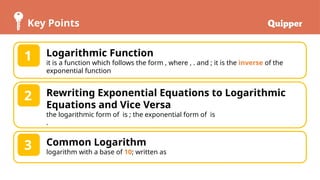
1 Logarithmic Function
it is a function which follows the form , where , . and ; it is the inverse of the
exponential function
7.
Learn about It!
Example:
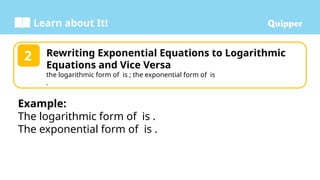
Thelogarithmic form of is .
The exponential form of is .
2 Rewriting Exponential Equations to Logarithmic
Equations and Vice Versa
the logarithmic form of is ; the exponential form of is
.
Try It!
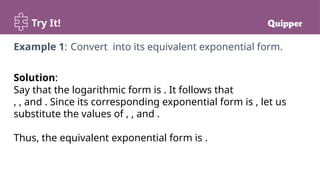
Example 1:Convert into its equivalent exponential form.
Solution:
Say that the logarithmic form is . It follows that
, , and . Since its corresponding exponential form is , let us
substitute the values of , , and .
Thus, the equivalent exponential form is .
Try It!
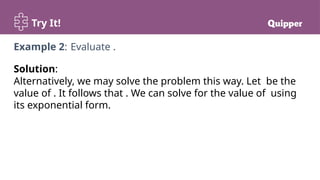
Example 2:Evaluate .
Solution:
The expression means that we are looking for the
exponent of the base to get the answer . Since , it follows
that .
14.
Try It!
Example 2:Evaluate .
Solution:
Alternatively, we may solve the problem this way. Let be the
value of . It follows that . We can solve for the value of using
its exponential form.
15.
Try It!
Example 2:Evaluate .
Solution:
Since , it follows that since the bases are equal.
Therefore, .
Let’s Practice!
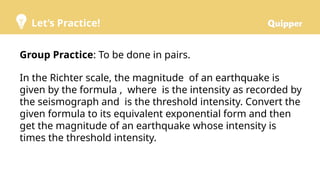
Group Practice:To be done in pairs.
In the Richter scale, the magnitude of an earthquake is
given by the formula , where is the intensity as recorded by
the seismograph and is the threshold intensity. Convert the
given formula to its equivalent exponential form and then
get the magnitude of an earthquake whose intensity is
times the threshold intensity.
18.
Key Points
1 LogarithmicFunction
it is a function which follows the form , where , . and ; it is the inverse of the
exponential function
2 Rewriting Exponential Equations to Logarithmic
Equations and Vice Versa
the logarithmic form of is ; the exponential form of is
.
3 Common Logarithm
logarithm with a base of 10; written as
19.
Key Points
4 NaturalLogarithm
logarithm with a base of (Euler’s number); written as
20.
Synthesis
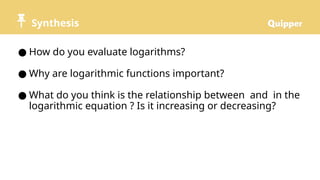
● How doyou evaluate logarithms?
● Why are logarithmic functions important?
● What do you think is the relationship between and in the
logarithmic equation ? Is it increasing or decreasing?