The Future of Artificial Intelligence: Opportunities, Risks, and Reality
An insightful presentation exploring the future of artificial intelligence, its real-world applications, benefits, ethical risks, and how AI will reshape jobs, industries, and skills over the next decade.
The Future of Artificial Intelligence: Opportunities, Risks, and Reality
1.
Navigating the AIRevolution
A comprehensive guide for students and professionals to understand, apply,
and thrive in an AI-driven world.
2.
FUNDAMENTALS
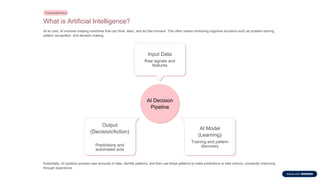
What is ArtificialIntelligence?
At its core, AI involves creating machines that can think, learn, and act like humans. This often means mimicking cognitive functions such as problem-solving,
pattern recognition, and decision-making.
AI Decision
Pipeline
AI Model
(Learning)
Training and pattern
discovery
Output
(Decision/Action)
Predictions and
automated acts
Input Data
Raw signals and
features
Essentially, AI systems process vast amounts of data, identify patterns, and then use these patterns to make predictions or take actions, constantly improving
through experience.
3.
REAL-WORLD IMPACT
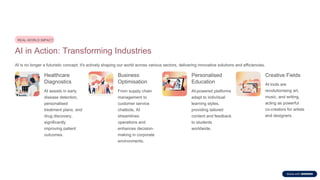
AI inAction: Transforming Industries
AI is no longer a futuristic concept; it's actively shaping our world across various sectors, delivering innovative solutions and efficiencies.
Healthcare
Diagnostics
AI assists in early
disease detection,
personalised
treatment plans, and
drug discovery,
significantly
improving patient
outcomes.
Business
Optimisation
From supply chain
management to
customer service
chatbots, AI
streamlines
operations and
enhances decision-
making in corporate
environments.
Personalised
Education
AI-powered platforms
adapt to individual
learning styles,
providing tailored
content and feedback
to students
worldwide.
Creative Fields
AI tools are
revolutionising art,
music, and writing,
acting as powerful
co-creators for artists
and designers.
4.
DRIVING PROGRESS
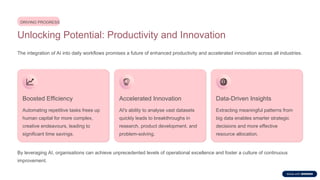
Unlocking Potential:Productivity and Innovation
The integration of AI into daily workflows promises a future of enhanced productivity and accelerated innovation across all industries.
Boosted Efficiency
Automating repetitive tasks frees up
human capital for more complex,
creative endeavours, leading to
significant time savings.
Accelerated Innovation
AI's ability to analyse vast datasets
quickly leads to breakthroughs in
research, product development, and
problem-solving.
Data-Driven Insights
Extracting meaningful patterns from
big data enables smarter strategic
decisions and more effective
resource allocation.
By leveraging AI, organisations can achieve unprecedented levels of operational excellence and foster a culture of continuous
improvement.
5.
CHALLENGES
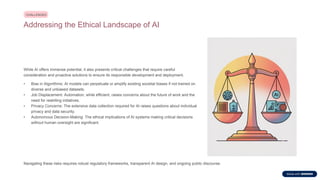
Addressing the EthicalLandscape of AI
While AI offers immense potential, it also presents critical challenges that require careful
consideration and proactive solutions to ensure its responsible development and deployment.
• Bias in Algorithms: AI models can perpetuate or amplify existing societal biases if not trained on
diverse and unbiased datasets.
• Job Displacement: Automation, while efficient, raises concerns about the future of work and the
need for reskilling initiatives.
• Privacy Concerns: The extensive data collection required for AI raises questions about individual
privacy and data security.
• Autonomous Decision-Making: The ethical implications of AI systems making critical decisions
without human oversight are significant.
Navigating these risks requires robust regulatory frameworks, transparent AI design, and ongoing public discourse.
6.
FUTURE OUTLOOK
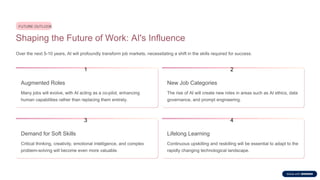
Shaping theFuture of Work: AI's Influence
Over the next 5-10 years, AI will profoundly transform job markets, necessitating a shift in the skills required for success.
1
Augmented Roles
Many jobs will evolve, with AI acting as a co-pilot, enhancing
human capabilities rather than replacing them entirely.
2
New Job Categories
The rise of AI will create new roles in areas such as AI ethics, data
governance, and prompt engineering.
3
Demand for Soft Skills
Critical thinking, creativity, emotional intelligence, and complex
problem-solving will become even more valuable.
4
Lifelong Learning
Continuous upskilling and reskilling will be essential to adapt to the
rapidly changing technological landscape.
7.
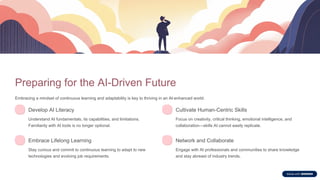
Preparing for theAI-Driven Future
Embracing a mindset of continuous learning and adaptability is key to thriving in an AI-enhanced world.
Develop AI Literacy
Understand AI fundamentals, its capabilities, and limitations.
Familiarity with AI tools is no longer optional.
Cultivate Human-Centric Skills
Focus on creativity, critical thinking, emotional intelligence, and
collaboration—skills AI cannot easily replicate.
Embrace Lifelong Learning
Stay curious and commit to continuous learning to adapt to new
technologies and evolving job requirements.
Network and Collaborate
Engage with AI professionals and communities to share knowledge
and stay abreast of industry trends.