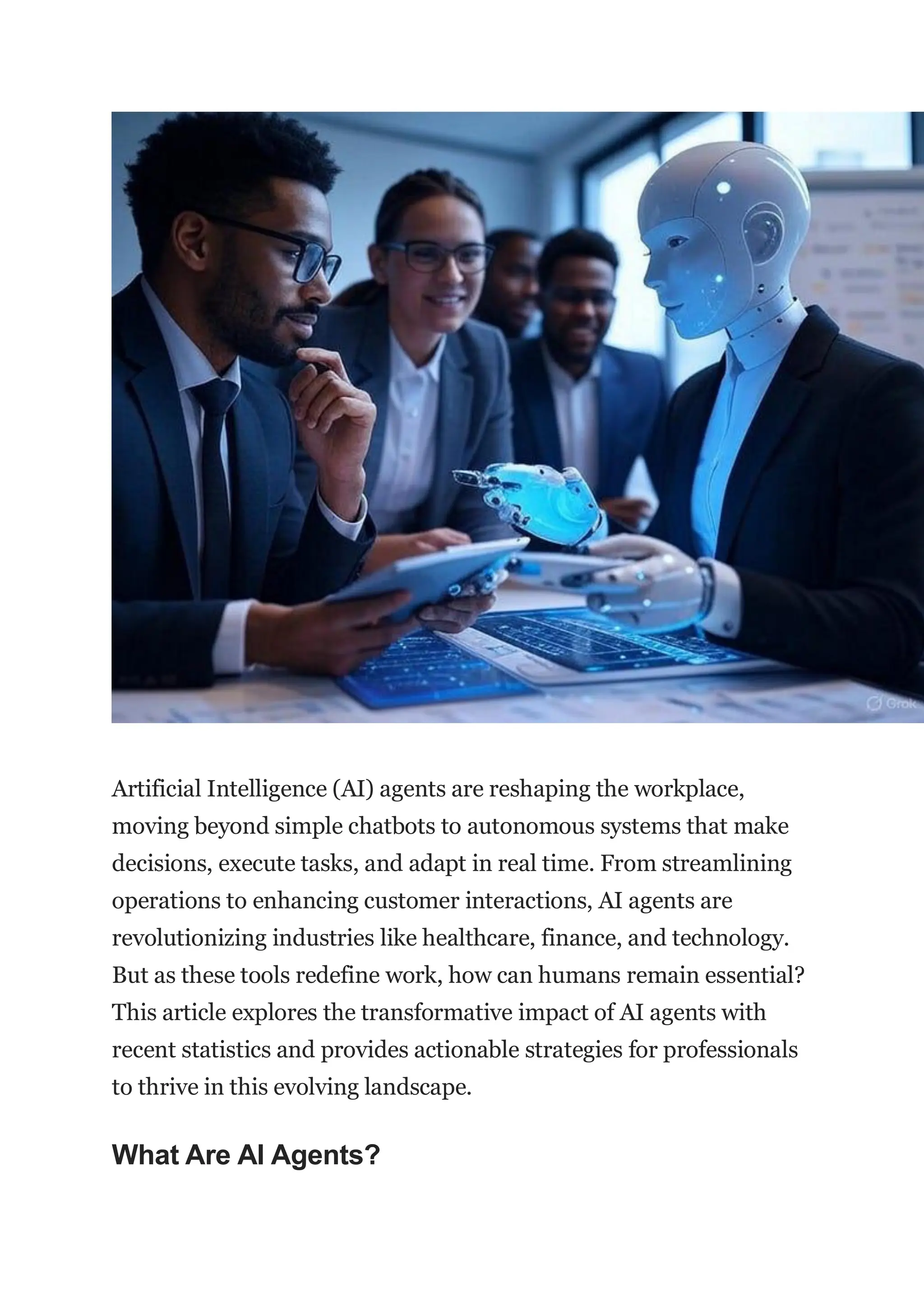
Artificial Intelligence (AI) agents are reshaping the workplace,
moving beyond simple chatbots to autonomous systems that make
decisions, execute tasks, and adapt in real time. From streamlining
operations to enhancing customer interactions, AI agents are
revolutionizing industries like healthcare, finance, and technology.
But as these tools redefine work, how can humans remain essential?
This article explores the transformative impact of AI agents with
recent statistics and provides actionable strategies for professionals
to thrive in this evolving landscape.
What Are AI Agents?
AI agents are advanced systems powered by large language models
(LLMs) like GPT-4 or Claude 3. Unlike traditional automation tools,
they operate independently, analyze complex data, and perform
tasks with minimal human oversight. Examples include virtual
assistants managing schedules, coding agents writing software, and
customer service agents resolving inquiries.
Key Statistics
 The AI agents market for predictive maintenance is projected to
reach $1.811 trillion by 2030 (MarketsandMarkets, 2024).
 25% of enterprises using generative AI will deploy AI agents in
2025, growing to 50% by 2027 (Deloitte).
 AI tools have increased worker productivity by 14% in tech firms,
based on a study of 5,000 customer support agents (Forbes
Advisor).
 AI is expected to create 97 million new jobs by 2025, offsetting
85 million jobs displaced, for a net gain of 12 million jobs
(National University).
How AI Agents Are Changing Work
AI agents are transforming workplaces by automating tasks,
improving decisions, and personalizing experiences. Here’s how
they’re making an impact across industries.
Automating Routine Tasks
AI agents handle repetitive, time-intensive tasks, allowing
employees to focus on strategic priorities.
 In customer service, platforms like Salesforce’s Agentforce have
boosted case resolution by over 40% at companies like Wiley
(Salesforce).
 In software development, 75% of companies plan to use AI
agents for coding tasks like generating and rewriting code
(Capgemini).
 In administrative roles, AI agents manage scheduling, data entry,
and email sorting, saving hours weekly.
Enhancing Decision-Making
By analyzing vast datasets in real time, AI agents provide insights
that drive smarter decisions.
 In finance, 91% of professionals see AI agents as vital for fraud
detection and risk assessment (AllAboutAI, 2024).
 In manufacturing, AI agents monitor machine health, reducing
downtime and improving safety (InfoWorld).
 In retail, 94% of professionals use AI agents for inventory
management and personalized marketing (AllAboutAI, 2024).
Personalizing Customer Interactions
AI agents deliver tailored experiences by analyzing user behavior
and preferences.
 In e-commerce, AI agents create dynamic product
recommendations, increasing engagement and sales.
 In marketing, 46% of businesses use AI for personalized
campaigns, with 68% reporting higher ROI (Forbes Advisor,
HubSpot).
 In customer support, AI agents resolve inquiries faster, with 54%
of consumers valuing quick solutions (Salesforce).
Streamlining Recruitment
AI agents are transforming HR by automating hiring processes and
improving candidate experiences.
 By 2025, 40% of recruitment will leverage AI for resume
screening and preliminary interviews (Gartner, 2023).
 Platforms like HireVue use AI to assess skills, allowing HR teams
to focus on strategic roles (Analytics Vidhya).
Challenges of AI Agents
While AI agents offer significant benefits, they also present
challenges that require careful navigation.
 Job Displacement: 14% of workers have faced job loss due to
AI, particularly in low-skill roles (SEO.ai, 2023).
 Automation Risks: Up to 30% of global work activities could
be automated by 2030, impacting industries like finance and
retail (McKinsey).
 Trust Concerns: 75% of consumers worry about AI
misinformation, and 80% fear AI-driven cyberattacks (National
University).
 Ethical Issues: Autonomous AI decisions raise risks of errors,
necessitating strong oversight (SEO.ai).
How Humans Can Stay Relevant
To succeed in an AI-driven world, professionals must develop new
skills, collaborate with AI, and leverage uniquely human strengths.
Here are practical steps to stay ahead.
Upskill in AI-Related Fields
 Why It Matters: By 2025, 97 million people will work in AI-
related roles like data analysis and system management
(National University).
How to Do It:
 Take online courses in AI, machine learning, or data science on
platforms like Coursera or edX.
 Learn to use tools like Microsoft’s Copilot Studio to build AI
agents (Microsoft).
 Explore roles like AI ethics specialists or agentic system
designers.
Hone Human-Centric Skills
 Why It Matters: AI cannot replicate creativity, emotional
intelligence, or complex problem-solving.
How to Do It:
 Build leadership and communication skills through workshops
or mentorship programs.
 Strengthen empathy in customer-facing roles, where human
connection remains critical.
 Focus on strategic oversight, guiding AI agents to align with
business goals (Analytics Vidhya).
Collaborate with AI Agents
 Why It Matters: AI agents augment human work, boosting
productivity and innovation.
How to Do It:
 Use AI for repetitive tasks like data analysis or content drafting
to prioritize strategy.
 Leverage platforms like Salesforce Agentforce, which cut
negotiation time by 70% at Persistent Systems (Microsoft).
 Provide feedback to refine AI agent performance (McKinsey).
Stay Updated on AI Trends
 Why It Matters: 83% of companies prioritize AI in their
business plans, signaling rapid evolution (Exploding Topics).
How to Do It:
 Read industry reports from McKinsey or Gartner for AI insights.
 Experiment with tools like OpenAI’s o1 series or Writesonic’s AI
agents (Microsoft, Writesonic).
 Join AI communities on LinkedIn or X to connect with
professionals.
Advocate for Ethical AI
 Why It Matters: Transparent AI use builds trust, with 54% of
consumers favoring clear AI processes (National University).
How to Do It:
 Support AI governance initiatives, as larger firms are twice as
likely to have AI roadmaps (McKinsey).
 Promote transparency in AI decisions, such as explaining agent
actions.
 Advocate for training to address ethical concerns, as seen in
CHRO-led programs (McKinsey).
The Future of Work with AI Agents
AI agents are set to reshape the global economy, with 70% of office
work potentially automated by 2034, adding $7 trillion in value
(McKinsey, Goldman Sachs). Companies like Johnson & Johnson
have halved production time using AI agents while upskilling
employees (Business Insider). Microsoft’s Copilot Studio has saved
Pacific Gas & Electric $1.1 million annually on helpdesk costs,
showing AI’s role in enhancing human efforts (Microsoft).
The future hinges on collaboration. Humans who adapt early —
learning AI skills, embracing creativity, and guiding AI systems —
will lead the way. With 75% of executives planning to integrate
generative AI by 2025, the time to prepare is now (PwC).
Conclusion
AI agents are revolutionizing work, driving efficiency, and creating
new opportunities. With a projected $1.811 trillion market and 97
million new jobs by 2030, their impact is undeniable. Yet, challenges
like job displacement and ethical concerns require proactive
solutions. By upskilling, collaborating with AI, and focusing on
human strengths, professionals can thrive in this new era.
Start today: explore AI tools, invest in learning, and embrace the
future. As Salesforce CEO Marc Benioff noted, “The agent revolution
is real… It will provide a level of transformation that we’ve never
seen.” Are you ready?
Call to Action: Share your thoughts on AI agents below! Subscribe
for more insights on the future of work.

How AI agents will transform work and what humans must do to stay relevant.pdf

  • 1.
    Artificial Intelligence (AI)agents are reshaping the workplace, moving beyond simple chatbots to autonomous systems that make decisions, execute tasks, and adapt in real time. From streamlining operations to enhancing customer interactions, AI agents are revolutionizing industries like healthcare, finance, and technology. But as these tools redefine work, how can humans remain essential? This article explores the transformative impact of AI agents with recent statistics and provides actionable strategies for professionals to thrive in this evolving landscape. What Are AI Agents?
  • 2.
    AI agents areadvanced systems powered by large language models (LLMs) like GPT-4 or Claude 3. Unlike traditional automation tools, they operate independently, analyze complex data, and perform tasks with minimal human oversight. Examples include virtual assistants managing schedules, coding agents writing software, and customer service agents resolving inquiries. Key Statistics  The AI agents market for predictive maintenance is projected to reach $1.811 trillion by 2030 (MarketsandMarkets, 2024).  25% of enterprises using generative AI will deploy AI agents in 2025, growing to 50% by 2027 (Deloitte).  AI tools have increased worker productivity by 14% in tech firms, based on a study of 5,000 customer support agents (Forbes Advisor).  AI is expected to create 97 million new jobs by 2025, offsetting 85 million jobs displaced, for a net gain of 12 million jobs (National University). How AI Agents Are Changing Work AI agents are transforming workplaces by automating tasks, improving decisions, and personalizing experiences. Here’s how they’re making an impact across industries. Automating Routine Tasks
  • 3.
    AI agents handlerepetitive, time-intensive tasks, allowing employees to focus on strategic priorities.  In customer service, platforms like Salesforce’s Agentforce have boosted case resolution by over 40% at companies like Wiley (Salesforce).  In software development, 75% of companies plan to use AI agents for coding tasks like generating and rewriting code (Capgemini).  In administrative roles, AI agents manage scheduling, data entry, and email sorting, saving hours weekly. Enhancing Decision-Making By analyzing vast datasets in real time, AI agents provide insights that drive smarter decisions.  In finance, 91% of professionals see AI agents as vital for fraud detection and risk assessment (AllAboutAI, 2024).  In manufacturing, AI agents monitor machine health, reducing downtime and improving safety (InfoWorld).  In retail, 94% of professionals use AI agents for inventory management and personalized marketing (AllAboutAI, 2024). Personalizing Customer Interactions
  • 4.
    AI agents delivertailored experiences by analyzing user behavior and preferences.  In e-commerce, AI agents create dynamic product recommendations, increasing engagement and sales.  In marketing, 46% of businesses use AI for personalized campaigns, with 68% reporting higher ROI (Forbes Advisor, HubSpot).  In customer support, AI agents resolve inquiries faster, with 54% of consumers valuing quick solutions (Salesforce). Streamlining Recruitment AI agents are transforming HR by automating hiring processes and improving candidate experiences.  By 2025, 40% of recruitment will leverage AI for resume screening and preliminary interviews (Gartner, 2023).  Platforms like HireVue use AI to assess skills, allowing HR teams to focus on strategic roles (Analytics Vidhya). Challenges of AI Agents While AI agents offer significant benefits, they also present challenges that require careful navigation.  Job Displacement: 14% of workers have faced job loss due to AI, particularly in low-skill roles (SEO.ai, 2023).
  • 5.
     Automation Risks:Up to 30% of global work activities could be automated by 2030, impacting industries like finance and retail (McKinsey).  Trust Concerns: 75% of consumers worry about AI misinformation, and 80% fear AI-driven cyberattacks (National University).  Ethical Issues: Autonomous AI decisions raise risks of errors, necessitating strong oversight (SEO.ai). How Humans Can Stay Relevant To succeed in an AI-driven world, professionals must develop new skills, collaborate with AI, and leverage uniquely human strengths. Here are practical steps to stay ahead. Upskill in AI-Related Fields  Why It Matters: By 2025, 97 million people will work in AI- related roles like data analysis and system management (National University). How to Do It:  Take online courses in AI, machine learning, or data science on platforms like Coursera or edX.  Learn to use tools like Microsoft’s Copilot Studio to build AI agents (Microsoft).
  • 6.
     Explore roleslike AI ethics specialists or agentic system designers. Hone Human-Centric Skills  Why It Matters: AI cannot replicate creativity, emotional intelligence, or complex problem-solving. How to Do It:  Build leadership and communication skills through workshops or mentorship programs.  Strengthen empathy in customer-facing roles, where human connection remains critical.  Focus on strategic oversight, guiding AI agents to align with business goals (Analytics Vidhya). Collaborate with AI Agents  Why It Matters: AI agents augment human work, boosting productivity and innovation. How to Do It:  Use AI for repetitive tasks like data analysis or content drafting to prioritize strategy.  Leverage platforms like Salesforce Agentforce, which cut negotiation time by 70% at Persistent Systems (Microsoft).
  • 7.
     Provide feedbackto refine AI agent performance (McKinsey). Stay Updated on AI Trends  Why It Matters: 83% of companies prioritize AI in their business plans, signaling rapid evolution (Exploding Topics). How to Do It:  Read industry reports from McKinsey or Gartner for AI insights.  Experiment with tools like OpenAI’s o1 series or Writesonic’s AI agents (Microsoft, Writesonic).  Join AI communities on LinkedIn or X to connect with professionals. Advocate for Ethical AI  Why It Matters: Transparent AI use builds trust, with 54% of consumers favoring clear AI processes (National University). How to Do It:  Support AI governance initiatives, as larger firms are twice as likely to have AI roadmaps (McKinsey).  Promote transparency in AI decisions, such as explaining agent actions.
  • 8.
     Advocate fortraining to address ethical concerns, as seen in CHRO-led programs (McKinsey). The Future of Work with AI Agents AI agents are set to reshape the global economy, with 70% of office work potentially automated by 2034, adding $7 trillion in value (McKinsey, Goldman Sachs). Companies like Johnson & Johnson have halved production time using AI agents while upskilling employees (Business Insider). Microsoft’s Copilot Studio has saved Pacific Gas & Electric $1.1 million annually on helpdesk costs, showing AI’s role in enhancing human efforts (Microsoft). The future hinges on collaboration. Humans who adapt early — learning AI skills, embracing creativity, and guiding AI systems — will lead the way. With 75% of executives planning to integrate generative AI by 2025, the time to prepare is now (PwC). Conclusion AI agents are revolutionizing work, driving efficiency, and creating new opportunities. With a projected $1.811 trillion market and 97 million new jobs by 2030, their impact is undeniable. Yet, challenges like job displacement and ethical concerns require proactive solutions. By upskilling, collaborating with AI, and focusing on human strengths, professionals can thrive in this new era. Start today: explore AI tools, invest in learning, and embrace the future. As Salesforce CEO Marc Benioff noted, “The agent revolution
  • 9.
    is real… Itwill provide a level of transformation that we’ve never seen.” Are you ready? Call to Action: Share your thoughts on AI agents below! Subscribe for more insights on the future of work.