1/15
AI in the workplace: Transforming today's workplace
dynamics
leewayhertz.com/ai-in-the-workplace
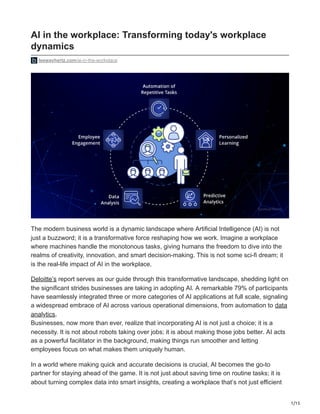
The modern business world is a dynamic landscape where Artificial Intelligence (AI) is not
just a buzzword; it is a transformative force reshaping how we work. Imagine a workplace
where machines handle the monotonous tasks, giving humans the freedom to dive into the
realms of creativity, innovation, and smart decision-making. This is not some sci-fi dream; it
is the real-life impact of AI in the workplace.
Deloitte’s report serves as our guide through this transformative landscape, shedding light on
the significant strides businesses are taking in adopting AI. A remarkable 79% of participants
have seamlessly integrated three or more categories of AI applications at full scale, signaling
a widespread embrace of AI across various operational dimensions, from automation to data
analytics.
Businesses, now more than ever, realize that incorporating AI is not just a choice; it is a
necessity. It is not about robots taking over jobs; it is about making those jobs better. AI acts
as a powerful facilitator in the background, making things run smoother and letting
employees focus on what makes them uniquely human.
In a world where making quick and accurate decisions is crucial, AI becomes the go-to
partner for staying ahead of the game. It is not just about saving time on routine tasks; it is
about turning complex data into smart insights, creating a workplace that’s not just efficient
2/15
but also quick on its feet. As industries evolve, AI proves to be a must-have tool for adapting
to the ever-changing business landscape. Companies embracing AI now are not just keeping
up; they are gearing up to lead in the competitive markets of tomorrow.
This article explores various facets of AI in the workplace, providing an overview of its trends
and applications. It delves into the challenges and benefits of integrating AI, outlines an
implementation roadmap, and discusses how AI technologies are shaping smarter and more
adaptive workplaces. The article concludes by examining future trends that are expected to
further influence the dynamics of AI in the workplace.
AI in the workplace: An overview
What are some pressing workplace challenges, and how does AI address them?
AI technologies shaping smarter and more adaptive workplaces
AI in the workplace: Diverse applications
How does LeewayHertz’s generative AI platform enhance various facets of daily
operations in a workplace?
The roadmap for implementing AI in the workplace
AI in the workplace: Future trends
AI in the workplace: An overview
AI is transforming workplaces, marking a significant shift towards automation and intelligent
decision-making in various industries. In the modern business realm, AI’s role extends from
automating mundane tasks to optimizing complex operations, thereby augmenting human
capabilities. This integration results in significant productivity gains and more efficient
business processes.
A notable technical advancement in AI applications is the deployment of sophisticated
chatbots and virtual assistants. These AI systems utilize Natural Language Processing (NLP)
and Machine Learning (ML) to understand and respond to customer queries, ensuring
consistent and efficient customer service while allowing human staff to focus on tasks
requiring higher cognitive skills.
Furthermore, AI’s predictive analytics, powered by advanced machine learning algorithms,
enable businesses to analyze large datasets to forecast market trends, understand customer
preferences, and make data-driven decisions. These algorithms continuously learn from new
data, improving their accuracy and reliability over time.
AI also plays a crucial role in enhancing workplace collaboration. Through tools like AI-
powered analytics platforms and collaborative robots (cobots), AI systems facilitate real-time
data analysis and seamless communication, enhancing teamwork and decision-making
efficiency.
3/15
However, integrating AI into the workplace also brings challenges, particularly in upskilling
the workforce and aligning AI strategies with ethical considerations and societal impacts.
Organizations must focus on developing AI literacy among employees, ensuring that the
workforce is equipped to leverage AI technologies effectively. Additionally, ethical AI
deployment demands a balanced approach that respects privacy, promotes fairness, and
prevents biases, maintaining trust and transparency in AI systems.
As AI continues to evolve, its integration into the workplace is not just about technological
adoption but also about fostering a culture of continuous learning and adaptation.
Organizations that successfully navigate this balance will be best positioned to capitalize on
AI’s transformative potential, driving innovation and competitive advantage in an increasingly
AI-driven business landscape.
What are some pressing workplace challenges, and how does AI
address them?
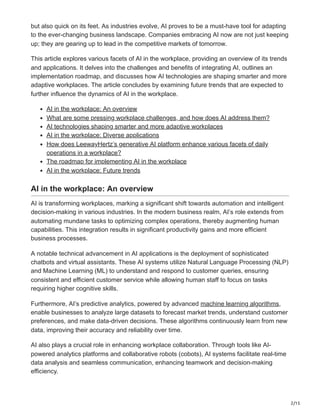
In today’s dynamic work environment, organizations grapple with multifaceted challenges
that can hinder productivity and team dynamics. AI emerges as a strategic ally, offering
tailored solutions to address these challenges and reshape how teams collaborate. The
following section highlights specific workplace challenges and outlines how AI strategically
intervenes to foster a more efficient and harmonious work environment.
Common Workplace Challenges
Communication
Barriers
Information
Overload
Lack of Employee
Engagement
Resistance to
Change
Employee
Burnout
Conflict
Resolution
LeewayHertz
1. Communication barriers: Ineffective communication can lead to misunderstandings,
conflicts, and a lack of cohesion within teams. AI addresses ineffective communication
by deploying language translation tools for diverse teams, ensuring clarity.
Furthermore, AI-driven chatbots facilitate transparent communication, analyze patterns,
and provide insights, enhancing team cohesion and mitigating conflicts.
4/15
2. Information overload: A deluge of information may inundate employees, posing
challenges in task prioritization and maintaining focus on essential responsibilities. AI
tackles information overload by implementing intelligent content curation, delivering
personalized data to aid task prioritization. By understanding individual work patterns,
AI ensures employees can manage information effectively, stay focused on essential
responsibilities, and navigate their tasks more efficiently.
3. Lack of employee engagement: Disengaged employees may experience decreased
motivation, leading to lower productivity levels and potential negative impacts on the
work environment. AI combats the lack of employee engagement by analyzing metrics
to identify trends and patterns. Through real-time feedback, recognition systems, and
personalized interventions, AI boosts motivation, thereby enhancing productivity and
fostering a positive work environment.
4. Resistance to change: Employees may resist adopting new technologies, processes,
or organizational changes, hindering the successful implementation of improvements.
AI addresses resistance to change by introducing innovations gradually through
interactive training simulations and virtual assistants. Predictive analytics identify
potential challenges, enabling proactive communication to convey the benefits of new
technologies and processes, facilitating smoother transitions and successful
implementation of improvements.
5. Employee burnout: Excessive workload, unrealistic expectations, and an imbalance
between work and personal life may lead to employee burnout, impacting individual
well-being and overall team dynamics. AI tackles employee burnout by optimizing
workload management and distributing tasks efficiently to prevent overload. By
monitoring stress indicators and promoting a healthier work-life balance, AI facilitates
early intervention, preserving individual well-being and fostering positive team
dynamics.
6. Conflict resolution: Workplace conflicts, if not addressed promptly and effectively, can
escalate and negatively impact team dynamics, collaboration, and overall work
atmosphere. AI addresses workplace conflicts by monitoring communication patterns to
detect signs of potential issues. Utilizing mediation tools and providing constructive
suggestions, AI facilitates timely intervention, preventing the escalation of conflicts and
preserving positive team dynamics, collaboration, and the overall work atmosphere.
By leveraging AI technologies, organizations can not only mitigate existing challenges but
also create adaptive, innovative work environments that foster collaboration and prioritize
employee well-being.
AI technologies shaping smarter and more adaptive workplaces
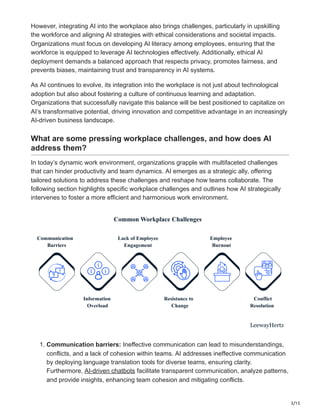
AI technologies have become integral components of modern workplaces, contributing to
enhanced efficiency, decision-making, and innovation. Here are some key AI technologies
commonly utilized in the workplace:
5/15
LeewayHertz
AI Technologies Commonly Utilized in the Workplace
Machine
Learning
Robotic Process
Automation
Deep
Learning
Expert
Systems
Natural Language
Processing
Machine Learning (ML)
Machine Learning (ML) is increasingly integral to workplaces, significantly impacting the way
tasks are accomplished and decisions are made. In the workplace, ML algorithms are
employed for a variety of applications. For instance, in human resources, predictive analytics
powered by ML algorithms can forecast employee turnover, enabling proactive retention
strategies. Additionally, recommendation systems, such as those used by streaming services
or e-commerce platforms, leverage algorithms like collaborative filtering or content-based
filtering to enhance user experiences by suggesting relevant content or products. The
adaptability of ML extends across various sectors, empowering workplaces to harness data-
driven insights, automate repetitive tasks, and optimize processes for heightened efficiency
and innovation.
Natural Language Processing (NLP)
Natural Language Processing (NLP) is a game-changer in the modern workplace, reshaping
communication and information processing. In customer service, NLP-powered chatbots
adeptly handle customer inquiries, offering quick and accurate responses. Algorithms, like
Named Entity Recognition (NER), assist in extracting valuable information from unstructured
data, streamlining document management and facilitating more efficient workflows. Voice-
activated virtual assistants, employing Automatic Speech Recognition (ASR) and NLP
algorithms, are becoming commonplace, enhancing hands-free interactions and improving
accessibility in workplaces. Sentiment analysis, utilizing algorithms such as Long Short-Term
Memory (LSTM) networks, enables organizations to gauge the mood and opinions
expressed in emails, reviews, or internal communications, providing valuable insights for
decision-making. NLP is also pivotal in multilingual workplaces, powering language
translation services that break down communication barriers. Serving as the foundation for
these applications, NLP cultivates a more seamless and spontaneous interaction between
humans and machines, resulting in heightened productivity and a work environment that is
more interconnected and collaborative.
6/15
Robotic Process Automation (RPA)
Robotic Process Automation (RPA) is a transformative force in the workplace, automating
repetitive, rule-based tasks to boost efficiency and reduce human error. RPA bots, equipped
with algorithms like fuzzy logic or decision tree models, emulate the actions of human
operators by interacting with digital systems and software applications. In finance, RPA
streamlines invoice processing and reconciliation, handling routine tasks such as data entry
and validation. Human Resources benefits from RPA in automating employee onboarding
processes, ensuring accuracy and compliance. Across industries, RPA is applied to data
extraction, report generation, and routine communication. This liberates human resources,
allowing them to redirect their focus toward more strategic and intricate activities. The
adaptability of RPA allows integration with existing systems without the need for major
overhauls, making it a versatile tool for enhancing operational efficiency across various
workplace functions. As workplaces continue to evolve, RPA serves as a catalyst for
increased productivity and streamlined workflows, marking a paradigm shift towards a more
automated and agile work environment.
Deep learning
Deep learning is a powerful technology that reshapes the modern workplace by allowing
machines to learn and make decisions from vast amounts of data. In customer service, deep
learning algorithms, including deep neural networks, power chatbots and virtual assistants,
provide more accurate and context-aware responses to user queries. In finance, recurrent
neural networks (RNNs) are employed for time-series analysis, aiding in predicting market
trends and optimizing investment strategies. Image and speech recognition, facilitated by
convolutional neural networks and long short-term memory (LSTM) networks, respectively,
have applications in various workplaces, from manufacturing quality control to transcription
services in meetings.
Deep learning also plays a pivotal role in predictive analytics, helping organizations forecast
trends and make data-driven decisions. In healthcare workplaces, deep learning algorithms
analyze medical images for diagnostic purposes, while in HR, they assist in talent acquisition
by identifying patterns in resumes and predicting candidate success. The adaptability of
deep learning allows it to redefine processes across sectors, making workplaces more
efficient, data-driven, and capable of handling complex tasks with a high degree of accuracy.
As businesses continue to harness the potential of deep learning, its impact on optimizing
workplace operations is poised to grow significantly.
Expert systems
Expert systems in workplaces serve as virtual decision-making tools, harnessing artificial
intelligence to emulate the problem-solving capabilities of human experts in specific
domains. These systems are designed to analyze data and apply predefined rules and logic,
7/15
providing informed recommendations or solutions. In customer support, expert systems
guide users through troubleshooting processes, offering solutions based on accumulated
knowledge. They find applications in healthcare for diagnostics, finance for risk assessment,
and manufacturing for optimizing production processes. The underlying algorithms often
involve decision trees, inference engines, and rule-based systems, allowing these expert
systems to navigate complex scenarios with a high degree of accuracy. The versatility of
expert systems makes them valuable assets across diverse industries, streamlining decision-
making processes, reducing errors, and enhancing overall operational efficiency in the
modern workplace.
These AI technologies collectively contribute to creating smarter, more adaptive, and more
efficient workplaces across various industries. With ongoing technological advancements,
the incorporation of AI into the workplace is poised for expansion, propelling continued
innovation and enhancements in work processes.
AI in the workplace: Diverse applications
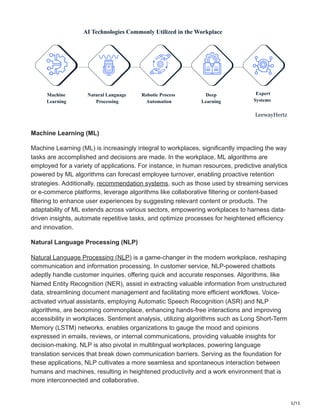
As the gears of industry turn towards innovation, Artificial Intelligence has found its place as
a cornerstone in the contemporary workplace, offering myriad applications that redefine
efficiency and productivity.
Applications of AI in the Workplace
Workflow
Optimization
Cybersecurity
Predictive
Analytics
Chatbots Data Analysis
Employee
Engagement
Personalized
Learning
LeewayHertz
Automation of repetitive tasks
8/15
In the workplace, the application of AI in the automation of repetitive tasks has significantly
transformed operational efficiency. AI-driven systems excel in handling routine and mundane
tasks, including but not limited to data entry, document processing, and basic customer
support. By automating these repetitive tasks, businesses can achieve increased speed and
accuracy in their operations, enabling human employees to focus on more complex and
value-added aspects of their roles. This not only enhances productivity but also reduces the
risk of errors associated with monotonous tasks. AI-driven automation contributes to
streamlined workflows, cost savings, and the optimization of resources, ultimately fostering a
more dynamic and adaptive work environment.
Data analysis and decision-making
AI plays a pivotal role in data analysis and decision-making processes. AI tools, particularly
machine learning algorithms, excel at swiftly processing vast datasets to extract actionable
insights. By discerning patterns, trends, and anomalies within data, AI empowers businesses
to make informed, data-driven decisions. This capability is particularly valuable for strategic
planning, resource allocation, and market forecasting. The speed and precision with which AI
systems analyze complex information contribute to more agile and adaptive decision-making
processes. Organizations leveraging AI for data analysis gain a competitive edge by staying
ahead of market dynamics and responding proactively to changing conditions. As a result, AI
not only enhances the efficiency of decision-making but also fosters a more agile and
responsive business environment.
Predictive analytics in workplace management
AI brings a transformative edge to workplace management through predictive analytics. By
analyzing extensive datasets, AI tools identify patterns and correlations related to various
aspects of employee performance, workflow dynamics, and organizational efficiency. This
application enables organizations to anticipate potential challenges, optimize resource
allocation, and enhance overall operational effectiveness. Professionals can use these
insights to execute targeted interventions, fostering a proactive approach to problem-solving
and decision-making. Integrating AI-driven predictive analytics not only streamlines
workplace processes but also equips organizations to make data-informed decisions that
positively impact productivity, efficiency, and overall performance.
Chatbots and virtual assistants
In the contemporary workplace, chatbots and virtual assistants powered by Artificial
Intelligence (AI) have become invaluable tools for enhancing communication and efficiency.
These AI-driven entities are adept at handling routine queries, providing instant responses,
and automating basic customer support tasks. In an internal context, virtual assistants assist
employees by facilitating information retrieval, scheduling appointments, and executing
administrative functions. By automating these repetitive yet essential interactions, chatbots
9/15
and virtual assistants free up human resources to concentrate on more complex and
strategic aspects of their roles. The result is not only improved operational efficiency but also
enhanced employee productivity and satisfaction.
Communication, collaboration, and culture
AI has significantly influenced communication, collaboration, and workplace culture. AI-
powered tools facilitate seamless communication by offering real-time language translation,
transcription services, and intelligent chatbots that streamline interactions. Virtual
collaboration is enhanced through AI-driven project management tools, fostering efficient
teamwork and coordination among geographically dispersed teams. Additionally, AI
contributes to a positive workplace culture by automating routine tasks, allowing employees
to focus on more meaningful and creative work. It can also analyze employee sentiment,
providing insights into workplace morale. As AI continues to evolve, it plays a pivotal role in
shaping a more connected, collaborative, and adaptive work environment, promoting
effective communication, and nurturing a culture of innovation and productivity.
Personalized learning and development
AI is redefining traditional approaches through personalized learning initiatives. AI-powered
systems analyze individual employee data, learning preferences, and performance metrics to
tailor training programs that cater to unique needs. Adaptive learning platforms leverage AI
algorithms to dynamically adjust content delivery based on an employee’s progress, ensuring
a customized and efficient learning experience. By providing targeted and relevant training
materials, AI contributes to improved skill acquisition, employee engagement, and overall
professional development. This personalized approach not only enhances the effectiveness
of training programs but also aligns learning objectives with individual employee strengths
and areas for improvement, fostering a more skilled and motivated workforce.
Employee engagement and feedback
Artificial intelligence serves as a powerful ally in creating a responsive and positive
workplace environment. AI tools analyze vast sets of employee data, including surveys,
performance metrics, and social interactions, to gauge and understand employee sentiment.
Sentiment analysis enables organizations to identify trends, concerns, and areas for
improvement, fostering a proactive approach to addressing employee needs. AI-driven
chatbots can facilitate real-time feedback and support, enhancing communication channels.
By harnessing AI for employee engagement, organizations can implement targeted initiatives
that boost morale, improve workplace satisfaction and foster a culture of continuous
enhancement. Ultimately, the integration of AI in employee engagement strategies
contributes to a more dynamic, responsive, and employee-centric workplace.
Cybersecurity
10/15
AI stands as a formidable ally, transforming how organizations safeguard their digital assets.
AI-powered cybersecurity systems leverage machine learning algorithms to detect and
respond to threats in real-time. By analyzing patterns, anomalies, and historical data, these
systems can identify potential cyber-attacks and vulnerabilities more rapidly and accurately
than traditional methods. Moreover, AI enhances adaptive defense mechanisms,
continuously evolving to stay ahead of evolving threats. Automated incident response,
behavioral analysis, and anomaly detection are some key applications fortifying the
organization’s security posture. As cyber threats become more sophisticated, AI in
cybersecurity is crucial for ensuring the resilience and integrity of digital infrastructures in the
workplace.
Workflow optimization
AI plays a pivotal role in workflow optimization within the workplace, streamlining processes
and boosting overall efficiency. AI-driven tools analyze and identify areas for improvement in
workflows, automating repetitive tasks and reducing manual interventions. By understanding
task patterns and dependencies, AI contributes to more efficient resource allocation, project
management, and decision-making. Intelligent process automation powered by AI enhances
collaboration, accelerates task completion, and minimizes errors, ultimately leading to
increased productivity and cost-effectiveness. As a result, organizations can achieve a more
agile and responsive operational framework, adapting quickly to changing demands and
maximizing the potential of human resources for more strategic and innovative pursuits.
The applications are ever-expanding as technology evolves! These applications showcase
how AI is more than just a tech upgrade; it’s a transformative force shaping the modern
workplace. Whether it’s enhancing efficiency, improving decision-making, or fostering
innovation, AI is a valuable asset in the professional toolkit.
How does LeewayHertz’s generative AI platform enhance various
facets of daily operations in a workplace?
LeewayHertz’s generative AI platform, ZBrain, plays a crucial role in enhancing and
streamlining various aspects of workplace operations across diverse industries. By
developing custom LLM-based applications tailored to clients’ proprietary data, ZBrain
optimizes workflows within the workplace, ensuring operational efficiency and an enhanced
overall work environment. The platform processes diverse data types, including text, images,
and documents, employing advanced language models like GPT-4, Vicuna, Llama 2, and
GPT-NeoX to construct context-aware applications. These applications contribute to
improved decision-making, deeper insights, and increased productivity, all while upholding
stringent data privacy standards, making it an indispensable tool for modern workplace
operations.
11/15
Challenges such as managing diverse teams, optimizing collaboration processes, and
adapting to evolving work methodologies are prevalent in workplace operations. ZBrain
addresses these challenges through specialized “flows.” These flows serve as detailed, step-
by-step guides, showcasing how ZBrain systematically caters to industry-specific use cases.
By incorporating AI-driven automation and conducting comprehensive data analysis, ZBrain
develops sophisticated apps capable of transforming complex workplace data into actionable
insights. This not only enhances operational efficiency but also minimizes errors and
elevates the overall quality of workplace functions.
For an in-depth exploration of ZBrain’s capabilities, delve into this resource featuring a range
of industry-specific flows. This compilation highlights the platform’s resilience and
adaptability, showcasing how ZBrain adeptly caters to a myriad of industry use cases.
The roadmap for implementing AI in the workplace
Organizations embarking on the journey of implementing AI in the workplace undergo a
meticulous process, encompassing key steps tailored to their unique business scenarios,
selected use cases, and the technologies involved. This detailed roadmap ensures a
systematic and strategic approach to integrating AI seamlessly into the organizational
framework.
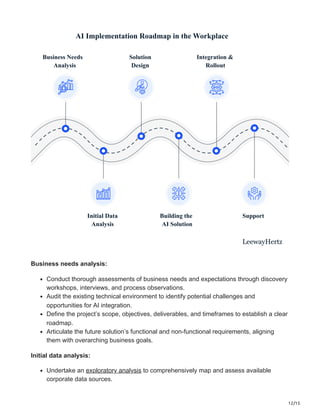
Here is the strategic roadmap:
12/15
AI Implementation Roadmap in the Workplace
Business Needs
Analysis
Initial Data
Analysis
Solution
Design
Building the
AI Solution
Integration &
Rollout
Support
LeewayHertz
Business needs analysis:
Conduct thorough assessments of business needs and expectations through discovery
workshops, interviews, and process observations.
Audit the existing technical environment to identify potential challenges and
opportunities for AI integration.
Define the project’s scope, objectives, deliverables, and timeframes to establish a clear
roadmap.
Articulate the future solution’s functional and non-functional requirements, aligning
them with overarching business goals.
Initial data analysis:
Undertake an exploratory analysis to comprehensively map and assess available
corporate data sources.
13/15
Identify external data sources, including public databases, to supplement and enrich
the organization’s data pool.
Establish a robust data foundation, ensuring the quality, relevance, and accessibility of
data for AI applications.
Solution design:
Design the architecture of the AI solution, outlining the main modules and features to
be incorporated.
Create a thorough project blueprint, ensuring alignment of the plan, budget, and
timeline with the strategic objectives of the organization.
Identify a suitable technology stack based on a thorough technical and business
evaluation, considering scalability, compatibility, and efficiency.
Optionally, deliver a Proof of Concept (PoC) to validate the feasibility, financial viability,
and potential limitations of the proposed AI solution.
Building the AI solution:
Execute data pre-processing activities, encompassing data cleansing, annotation, and
transformation to ensure data readiness for AI model training.
Define clear assessment criteria for the AI solution to evaluate its performance against
predetermined benchmarks.
Implement machine learning techniques, including supervised, unsupervised, and
reinforcement learning, to train one or more AI models capable of producing the
desired output.
Integration and rollout:
Seamlessly integrate the trained AI model into the solution, enabling it to power specific
features with the model’s insightful output.
Deploy the AI-powered product to the designated target environment, whether on-
premise or in the cloud, ensuring a smooth transition into the operational phase.
Support:
Establish a continuous improvement cycle by retraining the AI model with new data
over time, enhancing its accuracy and adaptability.
Provide ongoing maintenance, addressing any issues, bugs, or limitations identified
through user feedback.
Implement regular upgrades, introducing new features and improvements to align with
evolving business needs and technological advancements.
14/15
This comprehensive AI implementation roadmap is designed to guide organizations through
the intricate process of integrating AI into their workplaces, ensuring sustained success,
efficiency gains, and continuous innovation.
AI in the workplace: Future trends
As AI continues to evolve, several future trends are expected to shape its role in the
workplace, influencing how organizations operate, and employees engage with technology.
Here are some key future trends in AI in the workplace:
Ethical AI and bias mitigation: As AI systems become more prevalent, addressing ethical
concerns and mitigating biases in AI algorithms will be a priority. Companies will focus on
creating transparent and fair AI systems to ensure just and equitable workplaces.
Explainable AI (XAI): The demand for transparency in AI decision-making processes will
lead to the development and adoption of Explainable AI, ensuring that users can understand
and trust AI-generated recommendations and outcomes.
AI in employee well-being: AI applications will extend to employee well-being initiatives.
Virtual health assistants, stress detection tools, and personalized well-being plans powered
by AI will contribute to creating healthier and more supportive work environments.
Edge AI for real-time processing: The adoption of Edge AI, where AI processing occurs
closer to the data source, will become more prevalent, enabling real-time analysis and
decision-making in situations where latency is critical.
AI-driven personal productivity assistants: AI-powered personal productivity assistants
will become more advanced, helping users manage schedules, prioritize tasks, and
automate routine activities to optimize individual and team productivity.
AI for Diversity, Equity, and Inclusion (DEI): AI will be leveraged to promote diversity,
equity, and inclusion by identifying and addressing biases in hiring processes, performance
evaluations, and other HR practices.
These trends collectively reflect the trajectory of AI in the workplace, showcasing its potential
to transform how businesses operate, how employees experience work, and how
organizations navigate the complexities of the digital age.
Endnote
Integrating AI into the workplace is a relentless force reshaping the landscape of modern
work environments. As we traverse the digital age, AI’s influence extends far beyond mere
automation; it is a transformative catalyst that enhances efficiency, productivity, and
15/15
innovation. The integration of human intelligence with AI technologies creates a symbiotic
relationship, allowing for the augmentation of human capabilities and the optimization of
complex tasks.
The impact of AI in the workplace is multifaceted, touching on various facets of
organizational dynamics. From streamlining routine processes to unlocking unprecedented
insights through data analysis, AI heralds a new era where mundane tasks are automated,
freeing up human capital for more strategic and creative pursuits. However, this
transformative journey is not without its challenges. Balancing ethical concerns, safeguarding
data privacy, and addressing the possibility of job displacement requires a careful and
thoughtful approach to the integration of AI technologies.
As we navigate the evolving terrain of AI in the workplace, fostering a culture of adaptability
and continuous learning becomes imperative. Companies that embrace this paradigm shift
stand to gain a competitive edge, fostering an environment where humans and machines
collaborate harmoniously. Ultimately, the future of work hinges on harmonious collaboration
between human ingenuity and AI capabilities. This synergy cultivates a workforce that is
dynamic, agile, and well-equipped to confront the diverse challenges and opportunities of the
digital era.
Elevate your workplace with AI’s transformative power! Boost efficiency, streamline
operations, and improve work dynamics with our customized AI solutions. Reach out to
LeewayHertz for tailored solutions designed for your specific requirements.
Listen to the article