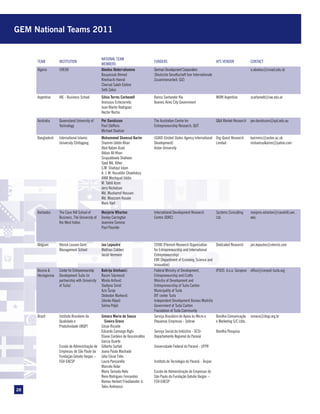
The Global Entrepreneurship Monitor

                                    2011 Global Report

                                    Donna J. Kelley, Slavica Singer,
                                    and Mike Herrington

                                                        Founding and Sponsoring Institutions:

                                                        Babson College, Babson Park, MA, United States
                                                        Leading Sponsoring Institution and Founding Institution

                                                        Universidad del Desarrollo, Santiago, Chile
                                                        Sponsoring Institution

                                                        Universiti Tun Abdul Razak, Kuala Lampur, Malaysia
                                                        Sponsoring Institution

                                                        London Business School, London, United Kingdom
                                                        Founding Institution


                                                           Universidad de Excelencia


Although GEM data were used in the preparation of this report, their interpretation and use are the sole responsibility of the authors.

           The authors thank Niels Bosma, Marcia Cole and Yana Litovsky for their various contributions to this report.

                 The authors would also like to express our gratitude to all participating GEM 2011 national teams.

     © 2012 Donna J. Kelley, Slavica Singer,Mike Herrington, and the Global Entrepreneurship Research Association (GERA)
Table of Contents


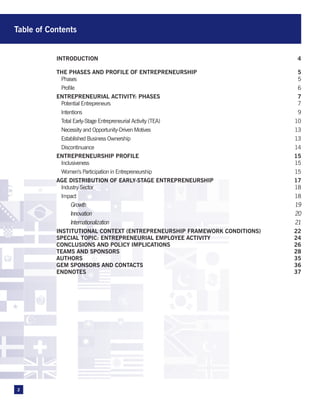
           INTRODUCTION	4

           THE PHASES AND PROFILE OF ENTREPRENEURSHIP	                     5
           	Phases	                                                        5
           	Profile	                                                       6
           ENTREPRENEURIAL ACTIVITY: PHASES	                               7
           	 Potential Entrepreneurs	                                      7
           	Intentions	                                                    9
           	 Total Early-Stage Entrepreneurial Activity (TEA)	            10
           	 Necessity and Opportunity-Driven Motives	                    13
           	 Established Business Ownership	                              13
           	Discontinuance	                                               14
           ENTREPRENEURSHIP PROFILE	                                      15
           	Inclusiveness	                                                15
           	 Women’s Participation in Entrepreneurship	                   15
           AGE DISTRIBUTION OF EARLY-STAGE ENTREPRENEURSHIP	              17
           	 Industry Sector	                                             18
           	Impact	                                                       18
           		 Growth	                                                     19
           		 Innovation	                                                 20
           		 Internationalization	                                       21
           INSTITUTIONAL CONTEXT (ENTREPRENEURSHIP FRAMEWORK CONDITIONS)	 22
           SPECIAL TOPIC: ENTREPRENEURIAL EMPLOYEE ACTIVITY	              24
           CONCLUSIONS AND POLICY IMPLICATIONS	                           26
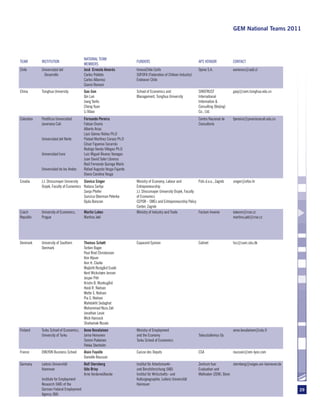
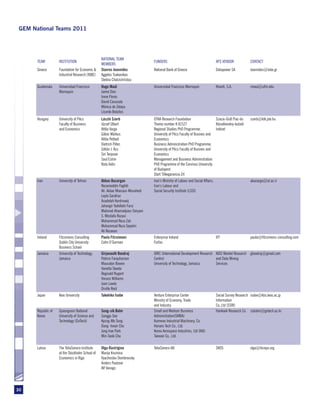
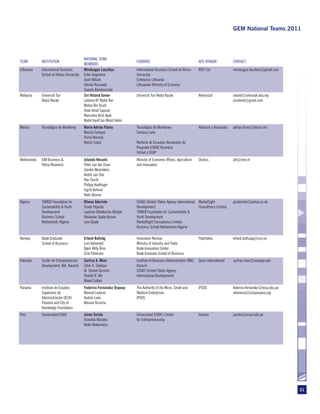
           TEAMS AND SPONSORS	                                            28
           AUTHORS	35
           GEM SPONSORS AND CONTACTS	                                     36
           ENDNOTES	37


2
Table of Contents


LIST OF FIGURES
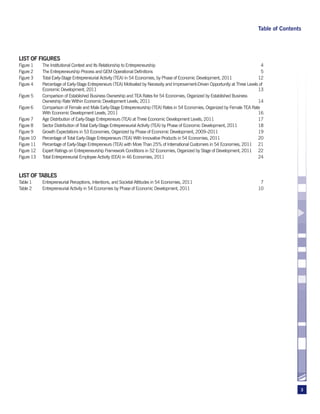
Figure 1	    The Institutional Context and Its Relationship to Entrepreneurship	                                                      4
Figure 2	    The Entrepreneurship Process and GEM Operational Definitions	                                                            5
Figure 3	    Total Early-Stage Entrepreneurial Activity (TEA) in 54 Economies, by Phase of Economic Development, 2011	              12
Figure 4	    Percentage of Early-Stage Entrepreneurs (TEA) Motivated by Necessity and Improvement-Driven Opportunity at Three Levels of
             Economic Development, 2011	                                                                                            13
Figure 5	    Comparison of Established Business Ownership and TEA Rates for 54 Economies, Organized by Established Business
             Ownership Rate Within Economic Development Levels, 2011	                                                               14
Figure 6	    Comparison of Female and Male Early-Stage Entrepreneurship (TEA) Rates in 54 Economies, Organized by Female TEA Rate
             With Economic Development Levels, 2011	                                                                                16
Figure 7	    Age Distribution of Early-Stage Entrepreneurs (TEA) at Three Economic Development Levels, 2011	                        17
Figure 8	    Sector Distribution of Total Early-Stage Entrepreneurial Activity (TEA) by Phase of Economic Development, 2011 	       18
Figure 9	    Growth Expectations in 53 Economies, Organized by Phase of Economic Development, 2009–2011	                            19
Figure 10	   Percentage of Total Early-Stage Entrepreneurs (TEA) With Innovative Products in 54 Economies, 2011	                    20
Figure 11	   Percentage of Early-Stage Entrepreneurs (TEA) with More Than 25% of International Customers in 54 Economies, 2011	 21
Figure 12	   Expert Ratings on Entrepreneurship Framework Conditions in 52 Economies, Organized by Stage of Development, 2011 	 22
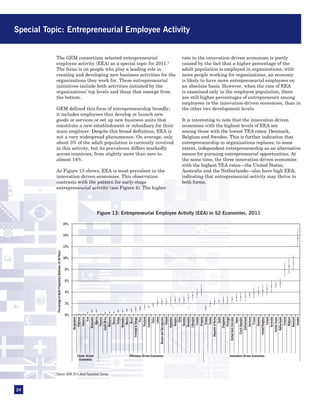
Figure 13	   Total Entrepreneurial Employee Activity (EEA) in 46 Economies, 2011	                                                   24


LIST OF TABLES
Table 1	     Entrepreneurial Perceptions, Intentions, and Societal Attitudes in 54 Economies, 2011	                                  7
Table 2	     Entrepreneurial Activity in 54 Economies by Phase of Economic Development, 2011	                                       10


                                                                                                                                                    3
Introduction


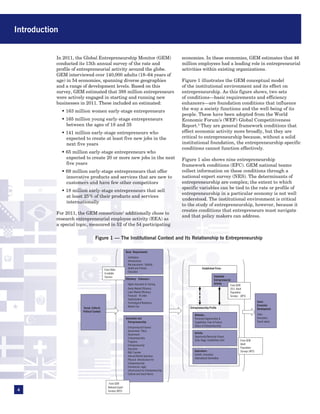
           In 2011, the Global Entrepreneurship Monitor (GEM)                                             economies. In these economies, GEM estimates that 46
           conducted its 13th annual survey of the rate and                                               million employees had a leading role in entrepreneurial
           profile of entrepreneurial activity around the globe.                                          activities within existing organizations.
           GEM interviewed over 140,000 adults (18–64 years of
           age) in 54 economies, spanning diverse geographies                                             Figure 1 illustrates the GEM conceptual model
           and a range of development levels. Based on this                                               of the institutional environment and its effect on
           survey, GEM estimated that 388 million entrepreneurs                                           entrepreneurship. As this figure shows, two sets
           were actively engaged in starting and running new                                              of conditions—basic requirements and efficiency
           businesses in 2011. These included an estimated:                                               enhancers—are foundation conditions that influence
                                                                                                          the way a society functions and the well-being of its
               • 163 million women early-stage entrepreneurs
                                                                                                          people. These have been adopted from the World
               • 165 million young early-stage entrepreneurs                                              Economic Forum’s (WEF) Global Competitiveness
                 between the ages of 18 and 35                                                            Report.2 They are general framework conditions that
               • 141 million early-stage entrepreneurs who                                                effect economic activity more broadly, but they are
                 expected to create at least five new jobs in the                                         critical to entrepreneurship because, without a solid
                 next five years                                                                          institutional foundation, the entrepreneurship-specific
                                                                                                          conditions cannot function effectively.
               • 65 million early-stage entrepreneurs who
                 expected to create 20 or more new jobs in the next                                       Figure 1 also shows nine entrepreneurship
                 five years                                                                               framework conditions (EFC). GEM national teams
               • 69 million early-stage entrepreneurs that offer                                          collect information on these conditions through a
                 innovative products and services that are new to                                         national expert survey (NES). The determinants of
                 customers and have few other competitors                                                 entrepreneurship are complex; the extent to which
                                                                                                          specific variables can be tied to the rate or profile of
               • 18 million early-stage entrepreneurs that sell
                                                                                                          entrepreneurship in a particular economy is not well
                 at least 25% of their products and services
                                                                                                          understood. The institutional environment is critical
                 internationally
                                                                                                          to the study of entrepreneurship, however, because it
                                                                                                          creates conditions that entrepreneurs must navigate
           For 2011, the GEM consortium1 additionally chose to
                                                                                                          and that policy makers can address.
           research entrepreneurial employee activity (EEA) as
           a special topic, measured in 52 of the 54 participating

                                    Figure 1 — The Institutional Context and Its Relationship to Entrepreneurship

                                                                  Basic Requirements
                                                                  -   Institutions
                                                                  -   Infrastructure
                                                                  -   Macroeconomic Stability
                                                                  -   Health and Primary                                 Established Firms
                                             From Other
                                                                      Education
                                             A vailable
                                             Sources                                                                                  Employee
                                                                  Efficiency Enhancers                                                Entrepreneurial
                                                                  - Higher Education & Training                                       Activity
                                                                                                                                                    From GEM
                                                                  - Goods Market Efficiency                                                         2011 Adult
                                                                  - Labor Market Efficiency                                                         Population
                                                                  - Financial M arket                                                               Surveys (APS)
                                                                    Sophistication
                                                                  - Technological Readiness                                                                                 Socio-
                                                                  - Market Size                                                                                             Economic
                         Social, Cultural,                                                                    Entrepreneurship Profile                                      Development
                         Political Context
                                                                                                                  Attitudes:                                                (Jobs,
                                                                  Innovation and                                  Perceived Opportunities &                                 Innovation,
                                                                    Entrepreneurship                              Capabilities; Fear of Failure;                            Social value)
                                                                                                                  Status of Entrepreneurship
                                                                  - Entrepreneurial Finance
                                                                  - Government Policy
                                                                                                                  Activity:
                                                                  - Government
                                                                                                                  Opportunity/Necessity-Driven,
                                                                    Entrepreneurship
                                                                                                                  Early-Stage; Established; Exits           From GEM
                                                                    Programs
                                                                  - Entrepreneurship                                                                        Adult
                                                                    Education                                                                               Population
                                                                                                                  Aspirations:                              Surveys (APS)
                                                                  - R&D Transfer
                                                                                                                  Growth, Innovation
                                                                  - Internal Market Openness
                                                                                                                  International Orientation
                                                                  - Physical Infrastructure for
                                                                    Entrepreneurship
                                                                  - Commercial, Legal
                                                                    Infrastructure for Entrepreneurship
                                                                  - Cultural and Social Norms


                                                 From GEM
                                                National Expert
4                                               Surveys (NES)
The Phases and Profile of Entrepreneurship


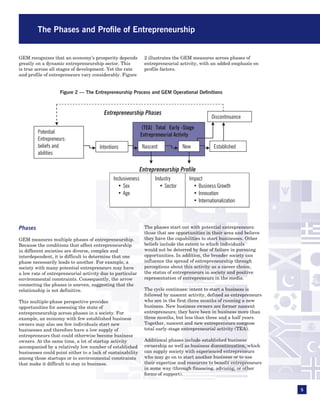
GEM recognizes that an economy’s prosperity depends            2 illustrates the GEM measures across phases of
greatly on a dynamic entrepreneurship sector. This             entrepreneurial activity, with an added emphasis on
is true across all stages of development. Yet the rate         profile factors.
and profile of entrepreneurs vary considerably. Figure


                    Figure 2 — The Entrepreneurship Process and GEM Operational Definitions


                                        Entrepreneurship Phases
                                                                                               Discontinuance
                                                              (TEA) Total Early -Stage
         Potential
                                                             Entrepreneurial Activity
         Entrepreneurs:
         beliefs and                  Intentions              Nascent            New            Established
         abilities

                                                             Entrepreneurship Profile
                                             Inclusiveness          Industry        Impact
                                                • Sex                 • Sector        • Business Growth
                                                • Age                                 • Innovation
                                                                                      • Internationalization


Phases                                                         The phases start out with potential entrepreneurs:
                                                               those that see opportunities in their area and believe
GEM measures multiple phases of entrepreneurship.              they have the capabilities to start businesses. Other
Because the conditions that affect entrepreneurship            beliefs include the extent to which individuals
in different societies are diverse, complex and                would not be deterred by fear of failure in pursuing
interdependent, it is difficult to determine that one          opportunities. In addition, the broader society can
phase necessarily leads to another. For example, a             influence the spread of entrepreneurship through
society with many potential entrepreneurs may have             perceptions about this activity as a career choice,
a low rate of entrepreneurial activity due to particular       the status of entrepreneurs in society and positive
environmental constraints. Consequently, the arrow             representation of entrepreneurs in the media.
connecting the phases is uneven, suggesting that the
relationship is not definitive.                                The cycle continues: intent to start a business is
                                                               followed by nascent activity, defined as entrepreneurs
This multiple-phase perspective provides                       who are in the first three months of running a new
opportunities for assessing the state of                       business. New business owners are former nascent
entrepreneurship across phases in a society. For               entrepreneurs; they have been in business more than
example, an economy with few established business              three months, but less than three and a half years.
owners may also see few individuals start new                  Together, nascent and new entrepreneurs compose
businesses and therefore have a low supply of                  total early-stage entrepreneurial activity (TEA).
entrepreneurs that could otherwise become business
owners. At the same time, a lot of startup activity            Additional phases include established business
accompanied by a relatively low number of established          ownership as well as business discontinuation, which
businesses could point either to a lack of sustainability      can supply society with experienced entrepreneurs
among those startups or to environmental constraints           who may go on to start another business or to use
that make it difficult to stay in business.                    their expertise and resources to benefit entrepreneurs
                                                               in some way (through financing, advising, or other
                                                               forms of support).


                                                                                                                        5
The Phases and Profile of Entrepreneurship


              Profile                                                  societies are more likely to realize the full potential
                                                                       of their entrepreneurial human resources when
              GEM emphasizes that it is not enough to study only       entrepreneurship is inclusive—that is, available to
              the numbers of entrepreneurs and to compare numbers      all people, including women and people of various
              with other economies. The profile of entrepreneurs–the   ages. Second, entrepreneurs will differ in terms of
              characteristics of individuals who participate in this   the sector in which they start businesses (consumer,
              activity—differs considerably across economies.          extractive, manufacturing, business services); the
                                                                       mix of businesses in an economy may have particular
              This report reviews three profile factors:               implications. Finally, entrepreneurs impact their
              inclusiveness, industry, and impact. Their               societies through their innovations, their international
              importance is based on several assumptions. First,       reach, and their growth ambitions.


6
Entrepreneurial Activity: Phases


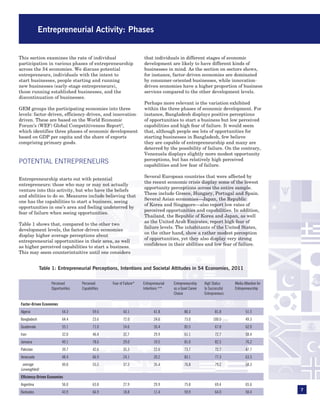
This section examines the rate of individual                          that individuals in different stages of economic
participation in various phases of entrepreneurship                   development are likely to have different kinds of
across the 54 economies. We discuss potential                         businesses in mind. As the section on sectors shows,
entrepreneurs, individuals with the intent to                         for instance, factor-driven economies are dominated
start businesses, people starting and running                         by consumer-oriented businesses, while innovation-
new businesses (early-stage entrepreneurs),                           driven economies have a higher proportion of business
those running established businesses, and the                         services compared to the other development levels.
discontinuation of businesses.
                                                                      Perhaps more relevant is the variation exhibited
GEM groups the participating economies into three                     within the three phases of economic development. For
levels: factor-driven, efficiency-driven, and innovation-             instance, Bangladesh displays positive perceptions
driven. These are based on the World Economic                         of opportunities to start a business but low perceived
Forum’s (WEF) Global Competitiveness Report3,                         capabilities and high fear of failure. It would seem
which identifies three phases of economic development                 that, although people see lots of opportunities for
based on GDP per capita and the share of exports                      starting businesses in Bangladesh, few believe
comprising primary goods.                                             they are capable of entrepreneurship and many are
                                                                      deterred by the possibility of failure. On the contrary,
                                                                      Venezuela displays slightly more modest opportunity
                                                                      perceptions, but has relatively high perceived
POTENTIAL ENTREPRENEURS                                               capabilities and low fear of failure.

                                                                      Several European countries that were affected by
Entrepreneurship starts out with potential
                                                                      the recent economic crisis display some of the lowest
entrepreneurs: those who may or may not actually
                                                                      opportunity perceptions across the entire sample.
venture into this activity, but who have the beliefs
                                                                      These include Greece, Hungary, Portugal and Spain.
and abilities to do so. Measures include believing that
                                                                      Several Asian economies—Japan, the Republic
one has the capabilities to start a business, seeing
                                                                      of Korea and Singapore—also report low rates of
opportunities in one’s area and feeling undeterred by
                                                                      perceived opportunities and capabilities. In addition,
fear of failure when seeing opportunities.
                                                                      Thailand, the Republic of Korea and Japan, as well
                                                                      as the United Arab Emirates, report high fear of
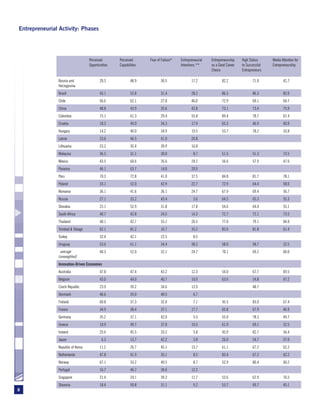
Table 1 shows that, compared to the other two
                                                                      failure levels. The inhabitants of the United States,
development levels, the factor-driven economies
                                                                      on the other hand, show a rather modest perception
display higher average perceptions about
                                                                      of opportunities, yet they also display very strong
entrepreneurial opportunities in their area, as well
                                                                      confidence in their abilities and low fear of failure.
as higher perceived capabilities to start a business.
This may seem counterintuitive until one considers


              Table 1: Entrepreneurial Perceptions, Intentions and Societal Attitudes in 54 Economies, 2011

                    Perceived       Perceived      Fear of Failure*   Entrepreneurial   Entrepreneurship   High Status     Media Attention for
                    Opportunities   Capabilities                      Intentions **     as a Good Career   to Successful   Entrepreneurship
                                                                                        Choice             Entrepreneurs

 Factor-Driven Economies
 Algeria                   54.3            59.6           43.1               41.8              80.3               81.8            51.5
 Bangladesh                64.4            23.6           72.0               24.6              73.0             100.0             49.3
 Guatemala                 55.1            71.0           24.6               26.4              85.5               67.8            62.0
 Iran                      32.0            46.4           32.7               29.9              61.1               72.7            58.4
 Jamaica                   49.1            78.6           29.0               19.5              81.0               82.5            76.2
 Pakistan                  39.7            42.6           35.3               22.6              73.7               72.7            47.7
 Venezuela                 48.4            66.9           24.1               20.2              83.1               77.3            63.3
  average                  49.0            55.5           37.3               26.4              76.8               79.2            58.3
 (unweighted)
 Efficiency-Driven Economies
 Argentina                 56.0            63.8           27.9               29.9              75.8               69.4            65.6
                                                                                                                                                 7
 Barbados                  43.9            66.9           18.8               11.4              59.9               64.0            50.4
Entrepreneurial Activity: Phases


                                   Perceived       Perceived      Fear of Failure*   Entrepreneurial   Entrepreneurship   High Status     Media Attention for
                                   Opportunities   Capabilities                      Intentions **     as a Good Career   to Successful   Entrepreneurship
                                                                                                       Choice             Entrepreneurs

               Bosnia and                 20.5            48.9           30.5               17.2              82.2               71.0            42.7
               Herzegovina
               Brazil                     43.1            52.8           31.4               28.2              86.3               86.3            82.0
               Chile                      56.6            62.1           27.0               46.0              72.9               69.1            64.7
               China                      48.8            43.9           35.6               42.8              73.1               73.4            75.9
               Colombia                   73.1            61.3           29.4               55.8              89.4               78.7            67.4
               Croatia                    18.3            49.0           34.3               17.9              65.3               46.9            40.9
               Hungary                    14.2            40.0           34.9               19.5              53.7               78.2            33.8
               Latvia                     23.6            46.5           41.0               24.8
               Lithuania                  23.2            35.4           39.9               16.8
               Malaysia                   36.5            31.1           30.0                8.7              51.5               51.3            73.5
               Mexico                     43.5            60.6           26.6               24.2              56.6               57.9            47.6
               Panama                     46.1            63.7           14.0               20.9
               Peru                       70.3            72.8           41.0               37.5              84.8               81.7            78.1
               Poland                     33.1            52.0           42.9               22.7              72.9               64.4            58.0
               Romania                    36.1            41.6           36.1               24.7              67.9               69.4            56.7
               Russia                     27.1            33.2           43.4                3.6              64.5               65.3            55.3
               Slovakia                   23.1            52.9           31.8               17.8              54.6               64.4            55.1
               South Africa               40.7            42.8           24.5               14.3              72.7               72.1            73.5
               Thailand                   40.1            42.7           55.1               26.5              77.0               79.1            84.0
               Trinidad & Tobago          62.1            81.2           16.7               35.2              83.6               81.8            61.4
               Turkey                     32.4            42.1           22.5                8.5
               Uruguay                    53.6            61.1           34.4               38.2              58.0               58.7            32.5
                average                   40.3            52.0           32.1               24.7              70.1               69.2            60.0
               (unweighted)
               Innovation-Driven Economies
               Australia                  47.8            47.4           43.2               12.3              54.0               67.7            69.5
               Belgium                    43.0            44.0           40.7               10.9              63.6               54.8            47.2
               Czech Republic             23.9            39.2           34.6               13.9                                 48.7
               Denmark                    46.6            35.0           40.5                6.7
               Finland                    60.8            37.3           32.0                7.1              45.5               83.0            67.4
               France                     34.9            38.4           37.1               17.7              65.8               67.9            46.9
               Germany                    35.2            37.1           42.0                5.5              55.0               78.3            49.7
               Greece                     10.9            49.7           37.8               10.5              61.0               69.1            32.5
               Ireland                    25.6            45.5           33.2                5.8              45.9               82.7            56.4
               Japan                       6.3            13.7           42.2                3.8              26.0               54.7            57.0
               Republic of Korea          11.2            26.7           45.1               15.7              61.1               67.2            62.2
               Netherlands                47.8            41.9           35.1                8.5              83.4               67.2            62.2
               Norway                     67.1            33.2           40.5                8.7              52.9               80.4            60.2
               Portugal                   16.7            46.7           39.6               12.2
               Singapore                  21.4            24.1           39.2               11.7              53.6               62.9            76.5
               Slovenia                   18.4            50.8           31.1                9.2              53.7               69.7            45.1
8
Entrepreneurial Activity: Phases


                          Perceived                Perceived         Fear of Failure*   Entrepreneurial   Entrepreneurship   High Status        Media Attention for
                          Opportunities            Capabilities                         Intentions **     as a Good Career   to Successful      Entrepreneurship
                                                                                                          Choice             Entrepreneurs

 Spain                             14.4                       50.9          38.9                8.0              65.2               66.5               44.6
 Sweden                            71.5                       40.3          34.6                9.8              51.8               70.8               62.3
 Switzerland                       47.4                       42.4          30.6                9.5
 Taiwan                            38.9                       28.6          39.6               28.2              69.0               62.7               85.8
 United Arab                       43.7                       62.1          50.8                2.4              71.1               73.2               62.8
 Emirates
 United Kingdom                    33.3                       42.5          36.1                8.9              51.9               81.0               47.3
 United States                     36.2                       55.7          31.2               10.9
  average                          34.9                       40.6          38.1               10.3              57.3               68.9               57.5
 (unweighted)
* fear of failure assessed among those seeing opportunities
** intentions assessed in non-entrepreneur (non-TEA) population
Source: GEM 2011 Adult Population Survey


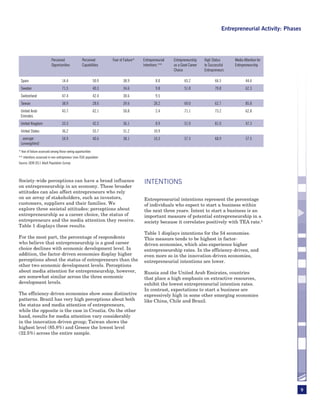
Society-wide perceptions can have a broad influence                                     INTENTIONS
on entrepreneurship in an economy. These broader
attitudes can also affect entrepreneurs who rely
on an array of stakeholders, such as investors,                                         Entrepreneurial intentions represent the percentage
customers, suppliers and their families. We                                             of individuals who expect to start a business within
explore three societal attitudes: perceptions about                                     the next three years. Intent to start a business is an
entrepreneurship as a career choice, the status of                                      important measure of potential entrepreneurship in a
entrepreneurs and the media attention they receive.                                     society because it correlates positively with TEA rate.4
Table 1 displays these results.
                                                                                        Table 1 displays intentions for the 54 economies.
For the most part, the percentage of respondents                                        This measure tends to be highest in factor-
who believe that entrepreneurship is a good career                                      driven economies, which also experience higher
choice declines with economic development level. In                                     entrepreneurship rates. In the efficiency-driven, and
addition, the factor-driven economies display higher                                    even more so in the innovation-driven economies,
perceptions about the status of entrepreneurs than the                                  entrepreneurial intentions are lower.
other two economic development levels. Perceptions
about media attention for entrepreneurship, however,                                    Russia and the United Arab Emirates, countries
are somewhat similar across the three economic                                          that place a high emphasis on extractive resources,
development levels.                                                                     exhibit the lowest entrepreneurial intention rates.
                                                                                        In contrast, expectations to start a business are
The efficiency-driven economies show some distinctive                                   expressively high in some other emerging economies
patterns. Brazil has very high perceptions about both                                   like China, Chile and Brazil.
the status and media attention of entrepreneurs,
while the opposite is the case in Croatia. On the other
hand, results for media attention vary considerably
in the innovation-driven group; Taiwan shows the
highest level (85.8%) and Greece the lowest level
(32.5%) across the entire sample.


                                                                                                                                                                          9
Entrepreneurial Activity: Phases


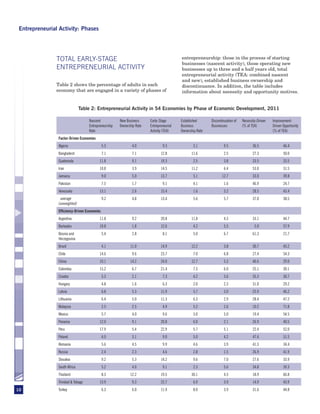
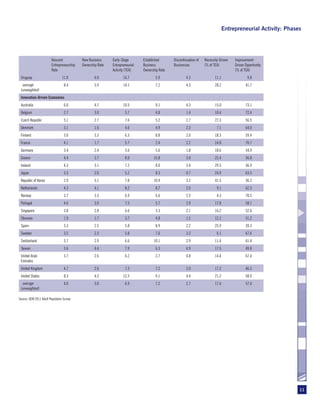
                TOTAL EARLY-STAGE                                                         entrepreneurship: those in the process of starting
                                                                                          businesses (nascent activity), those operating new
                ENTREPRENEURIAL ACTIVITY                                                  businesses up to three and a half years old, total
                                                                                          entrepreneurial activity (TEA: combined nascent
                                                                                          and new), established business ownership and
                Table 2 shows the percentage of adults in each                            discontinuance. In addition, the table includes
                economy that are engaged in a variety of phases of                        information about necessity and opportunity motives.


                               Table 2: Entrepreneurial Activity in 54 Economies by Phase of Economic Development, 2011

                                    Nascent            New Business     Early-Stage       Established      Discontinuation of   Necessity-Driven   Improvement-
                                    Entrepreneurship   Ownership Rate   Entrepreneurial   Business         Businesses           (% of TEA)         Driven Opportunity
                                    Rate                                Activity (TEA)    Ownership Rate                                           (% of TEA)
                Factor-Driven Economies
                Algeria                       5.3             4.0               9.3              3.1               9.5                 36.5               46.4
                Bangladesh                    7.1             7.1              12.8             11.6               2.5                 27.3               50.0
                Guatemala                  11.8               9.1              19.3              2.5               3.8                 33.5               33.5
                Iran                       10.8               3.9              14.5             11.2               6.4                 53.0               31.5
                Jamaica                       9.0             5.0              13.7              5.1              12.7                 33.0               39.8
                Pakistan                      7.5             1.7               9.1              4.1               1.6                 46.9               24.7
                Venezuela                  13.1               2.6              15.4              1.6               3.2                 28.5               43.4
                 average                      9.2             4.8              13.4              5.6               5.7                 37.0               38.5
                (unweighted)
                Efficiency-Driven Economies
                Argentina                  11.8               9.2              20.8             11.8               4.3                 33.1               44.7
                Barbados                   10.8               1.8              12.6              4.2               5.5                  5.0               57.9
                Bosnia and                    5.4             2.8               8.1              5.0               6.7                 61.3               21.7
                Herzegovina
                Brazil                        4.1            11.0              14.9             12.2               3.8                 30.7               45.2
                Chile                      14.6               9.6              23.7              7.0               6.8                 27.4               54.3
                China                      10.1              14.2              24.0             12.7               5.3                 40.6               29.0
                Colombia                   15.2               6.7              21.4              7.5               6.0                 25.1               30.1
                Croatia                       5.3             2.1               7.3              4.2               3.6                 35.3               30.7
                Hungary                       4.8             1.6               6.3              2.0               2.3                 31.0               29.2
                Latvia                        6.8             5.3              11.9              5.7               3.0                 25.9               46.2
                Lithuania                     6.4             5.0              11.3              6.3               2.9                 28.4               47.2
                Malaysia                      2.5             2.5               4.9              5.2               2.6                 10.2               71.8
                Mexico                        5.7             4.0               9.6              3.0               5.0                 19.4               54.5
                Panama                     12.0               9.1              20.8              6.0               2.1                 26.9               40.5
                Peru                       17.9               5.4              22.9              5.7               5.1                 22.4               52.0
                Poland                        6.0             3.1               9.0              5.0               4.2                 47.6               31.5
                Romania                       5.6             4.5               9.9              4.6               3.9                 41.3               34.4
                Russia                        2.4             2.3               4.6              2.8               1.5                 26.9               41.9
                Slovakia                      9.2             5.3              14.2              9.6               7.0                 27.6               33.9
                South Africa                  5.2             4.0               9.1              2.3               5.6                 34.8               39.3
                Thailand                      8.3            12.2              19.5             30.1               4.5                 18.9               66.8
                Trinidad & Tobago          13.9               9.3              22.7              6.9               3.9                 14.9               43.9
10              Turkey                        6.3             6.0              11.9              8.0               3.9                 31.6               44.8
Entrepreneurial Activity: Phases


                         Nascent            New Business     Early-Stage       Established      Discontinuation of   Necessity-Driven   Improvement-
                         Entrepreneurship   Ownership Rate   Entrepreneurial   Business         Businesses           (% of TEA)         Driven Opportunity
                         Rate                                Activity (TEA)    Ownership Rate                                           (% of TEA)
 Uruguay                         11.0              6.0              16.7              5.9               4.3                 11.1                9.8
  average                         8.4              5.9              14.1              7.2               4.3                 28.2               41.7
 (unweighted)
 Innovation-Driven Economies
 Australia                        6.0              4.7              10.5              9.1               4.3                 15.0               73.1
 Belgium                          2.7              3.0               5.7              6.8               1.4                 10.4               72.4
 Czech Republic                   5.1              2.7               7.6              5.2               2.7                 27.3               56.5
 Denmark                          3.1              1.6               4.6              4.9               2.3                  7.1               64.0
 Finland                          3.0              3.3               6.3              8.8               2.0                 18.3               59.4
 France                           4.1              1.7               5.7              2.4               2.2                 14.8               70.7
 Germany                          3.4              2.4               5.6              5.6               1.8                 18.6               54.9
 Greece                           4.4              3.7               8.0             15.8               3.0                 25.4               36.8
 Ireland                          4.3              3.1               7.2              8.0               3.4                 29.5               36.9
 Japan                            3.3              2.0               5.2              8.3               0.7                 24.9               63.5
 Republic of Korea                2.9              5.1               7.8             10.9               3.2                 41.5               36.2
 Netherlands                      4.3              4.1               8.2              8.7               2.0                  9.1               62.3
 Norway                           3.7              3.3               6.9              6.6               2.5                  4.3               70.5
 Portugal                         4.6              3.0               7.5              5.7               2.9                 17.8               58.1
 Singapore                        3.8              2.8               6.6              3.3               2.1                 16.2               52.6
 Slovenia                         1.9              1.7               3.7              4.8               1.5                 12.1               51.2
 Spain                            3.3              2.5               5.8              8.9               2.2                 25.9               39.3
 Sweden                           3.5              2.3               5.8              7.0               3.2                  6.1               67.6
 Switzerland                      3.7              2.9               6.6             10.1               2.9                 11.4               61.4
 Taiwan                           3.6              4.4               7.9              6.3               4.9                 17.5               49.8
 United Arab                      3.7              2.6               6.2              2.7               4.8                 14.4               67.4
 Emirates
 United Kingdom                   4.7              2.6               7.3              7.2               2.0                 17.2               46.3
 United States                    8.3              4.3              12.3              9.1               4.4                 21.2               58.9
  average                         4.0              3.0               6.9              7.2               2.7                 17.6               57.0
 (unweighted)

Source: GEM 2011 Adult Population Survey


                                                                                                                                                                  11
Entrepreneurial Activity: Phases


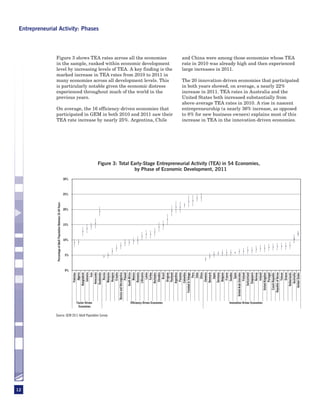
                Figure 3 shows TEA rates across all the economies                                                                       and China were among those economies whose TEA
                in the sample, ranked within economic development                                                                       rate in 2010 was already high and then experienced
                level by increasing levels of TEA. A key finding is the                                                                 large increases in 2011.
                marked increase in TEA rates from 2010 to 2011 in
                many economies across all development levels. This                                                                      The 20 innovation-driven economies that participated
                is particularly notable given the economic distress                                                                     in both years showed, on average, a nearly 22%
                experienced throughout much of the world in the                                                                         increase in 2011. TEA rates in Australia and the
                previous years.                                                                                                         United States both increased substantially from
                                                                                                                                        above-average TEA rates in 2010. A rise in nascent
                On average, the 16 efficiency-driven economies that                                                                     entrepreneurship (a nearly 36% increase, as opposed
                participated in GEM in both 2010 and 2011 saw their                                                                     to 8% for new business owners) explains most of this
                TEA rate increase by nearly 25%. Argentina, Chile                                                                       increase in TEA in the innovation-driven economies.


                                                                                           Figure 3: Total Early-Stage Entrepreneurial Activity (TEA) in 54 Economies,
                                                                                                            by Phase of Economic Development, 2011
                                                                     30%


                                                                     25%
                Percentage of Adult Population Between 18-64 Years


                                                                     20%


                                                                     15%


                                                                     10%


                                                                      5%


                                                                      0%
                                                                                          Pakistan
                                                                                             Algeria
                                                                                       Bangladesh
                                                                                           Jamaica
                                                                                                Iran
                                                                                        Venezuela
                                                                                        Guatemala
                                                                                             Russia
                                                                                          Malaysia
                                                                                          Hungary
                                                                                            Croatia
                                                                           Bosnia and Herzegovina
                                                                                            Poland
                                                                                      South Africa
                                                                                            Mexico
                                                                                          Romania
                                                                                         Lithuania
                                                                                              Latvia
                                                                                             Turkey
                                                                                         Barbados
                                                                                          Slovakia
                                                                                              Brazil
                                                                                           Uruguay
                                                                                          Thailand
                                                                                         Argentina
                                                                                           Panama
                                                                                         Colombia
                                                                                Trinidad & Tobago
                                                                                               Peru
                                                                                               Chile
                                                                                              China
                                                                                          Slovenia

                                                                                              Japan
                                                                                          Germany
                                                                                           Belgium
                                                                                            France
                                                                                           Sweden
                                                                                              Spain
                                                                             United Arab Emirates
                                                                                            Finland
                                                                                       Switzerland
                                                                                        Singapore
                                                                                            Norway
                                                                                            Ireland
                                                                                   United Kingdom
                                                                                          Portugal
                                                                                   Czech Republic
                                                                                 Republic of Korea
                                                                                            Taiwan
                                                                                            Greece
                                                                                      Netherlands
                                                                                         Austrailia
                                                                                     United States
                                                                                          Denmark


                                                                           Factor-Driven                  Efficiency-Driven Economies                        Innovation-Driven Economies
                                                                            Economies

               Source: GEM 2011 Adult Population Survey


12
Entrepreneurial Activity: Phases


NECESSITY- AND OPPORTUNITY-                                    choose to pursue them. GEM also explores the concept
                                                               of “improvement-driven opportunity” motives, where
DRIVEN MOTIVES                                                 people with opportunity motives also seek to improve
                                                               their incomes or independence in their work.

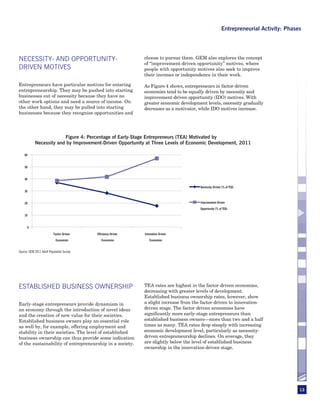
Entrepreneurs have particular motives for entering             As Figure 4 shows, entrepreneurs in factor-driven
entrepreneurship. They may be pushed into starting             economies tend to be equally driven by necessity and
businesses out of necessity because they have no               improvement-driven opportunity (IDO) motives. With
other work options and need a source of income. On             greater economic development levels, necessity gradually
the other hand, they may be pulled into starting               decreases as a motivator, while IDO motives increase.
businesses because they recognize opportunities and


                         Figure 4: Percentage of Early-Stage Entrepreneurs (TEA) Motivated by
            Necessity and by Improvement-Driven Opportunity at Three Levels of Economic Development, 2011

    60


    50


    40

                                                                                         Necessity-Driven (% of TEA)
    30


    20                                                                                   Improvement-Driven
                                                                                         Opportunity (% of TEA)

    10


      0
                          Factor-Driven    Efficiency-Driven   Innovation-Driven
                            Economies         Economies           Economies


Source: GEM 2011 Adult Population Survey


ESTABLISHED BUSINESS OWNERSHIP                                 TEA rates are highest in the factor-driven economies,
                                                               decreasing with greater levels of development.
                                                               Established business ownership rates, however, show
Early-stage entrepreneurs provide dynamism in                  a slight increase from the factor-driven to innovation-
an economy through the introduction of novel ideas             driven stage. The factor-driven economies have
and the creation of new value for their societies.             significantly more early-stage entrepreneurs than
Established business owners play an essential role             established business owners—more than two and a half
as well by, for example, offering employment and               times as many. TEA rates drop steeply with increasing
stability in their societies. The level of established         economic development level, particularly as necessity-
business ownership can thus provide some indication            driven entrepreneurship declines. On average, they
of the sustainability of entrepreneurship in a society.        are slightly below the level of established business
                                                               ownership in the innovation-driven stage.


                                                                                                                                         13
Entrepreneurial Activity: Phases


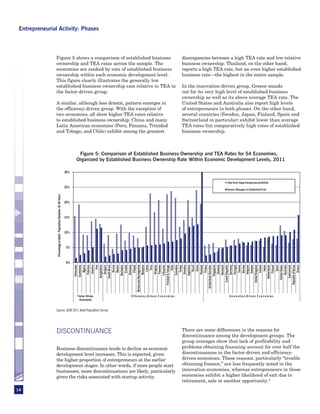
                Figure 5 shows a comparison of established business                                                                                    discrepancies between a high TEA rate and low relative
                ownership and TEA rates across the sample. The                                                                                         business ownership. Thailand, on the other hand,
                economies are ranked by rate of established business                                                                                   reports a high TEA rate, but an even higher established
                ownership within each economic development level.                                                                                      business rate—the highest in the entire sample.
                This figure clearly illustrates the generally low
                established business ownership rate relative to TEA in                                                                                 In the innovation-driven group, Greece stands
                the factor-driven group.                                                                                                               out for its very high level of established business
                                                                                                                                                       ownership as well as its above average TEA rate. The
                A similar, although less drastic, pattern emerges in                                                                                   United States and Australia also report high levels
                the efficiency-driven group. With the exception of                                                                                     of entrepreneurs in both phases. On the other hand,
                two economies, all show higher TEA rates relative                                                                                      several countries (Sweden, Japan, Finland, Spain and
                to established business ownership. China and many                                                                                      Switzerland in particular) exhibit lower than average
                Latin American economies (Peru, Panama, Trinidad                                                                                       TEA rates but comparatively high rates of established
                and Tobago, and Chile) exhibit among the greatest                                                                                      business ownership.


                                                                            Figure 5: Comparison of Established Business Ownership and TEA Rates for 54 Economies,
                                                                           Organized by Established Business Ownership Rate Within Economic Development Levels, 2011

                                                                     30%


                                                                                                                                                                           Total Early-Stage Entrepreneurial Activity
                                                                     25%
                                                                                                                                                                           Owners-Managers in Established Firms
                Percentage of Adult Population Between 18-64 Years


                                                                     20%


                                                                     15%


                                                                     10%


                                                                     5%


                                                                     0%
                                                                                        Venezuela
                                                                                        Guatemala
                                                                                             Algeria
                                                                                          Pakistan
                                                                                           Jamaica
                                                                                                Iran
                                                                                    B Bangladesh
                                                                                           Hungary
                                                                                       South Africa
                                                                                             Russia
                                                                                             Mexico
                                                                                         Barbados
                                                                                            Croatia
                                                                                          Romania
                                                                                             Poland
                                                                           Bosnia and Herzegovina
                                                                                          Malaysia
                                                                                              Latvia
                                                                                               Peru
                                                                                           Uruguay
                                                                                           Panama
                                                                                         Lithuania
                                                                                Trinidad & Tobago
                                                                                               Chile
                                                                                          Colombia
                                                                                             Turkey
                                                                                           Slovakia
                                                                                         Argentina
                                                                                              Brazil
                                                                                              China
                                                                                           Thailand
                                                                                             France
                                                                             United Arab Emirates
                                                                                         Singapore
                                                                                           Slovenia

                                                                                   Czech Republic
                                                                                          Germany
                                                                                           Portugal
                                                                                             Taiwan
                                                                                            Norway
                                                                                           Belgium
                                                                                            Sweden
                                                                                   United Kingdom
                                                                                            Ireland
                                                                                              Japan
                                                                                      Netherlands
                                                                                            Finland
                                                                                              Spain
                                                                                     United States
                                                                                          Australia
                                                                                       Switzerland
                                                                                 Republic of Korea
                                                                                             Greece
                                                                                          Denmark


                                                                                     d
                                                                                    d


                                                                           Factor-Driven          E f f i c i e n c y -D r i v e n E c o n o m i e s                        In n o v a t i o n -D r i v e n E c o n o m i e s
                                                                            Economies


                Source: GEM 2011 Adult Population Survey


                DISCONTINUANCE                                                                                                                         There are some differences in the reasons for
                                                                                                                                                       discontinuance among the development groups. The
                                                                                                                                                       group averages show that lack of profitability and
                Business discontinuance tends to decline as economic                                                                                   problems obtaining financing account for over half the
                development level increases. This is expected, given                                                                                   discontinuances in the factor-driven and efficiency-
                the higher proportion of entrepreneurs at the earlier                                                                                  driven economies. These reasons, particularly “trouble
                development stages. In other words, if more people start                                                                               obtaining finance,” are less frequently noted in the
                businesses, more discontinuations are likely, particularly                                                                             innovation-economies, whereas entrepreneurs in those
                given the risks associated with startup activity.                                                                                      economies exhibit a higher likelihood of exit due to
                                                                                                                                                       retirement, sale or another opportunity.5
14
Entrepreneurship Profile


The value of examining an economy’s entrepreneurship         WOMEN’S PARTICIPATION IN
profile is based on the assumption that a simple
count of entrepreneurs does not paint a full picture         ENTREPRENEURSHIP
of entrepreneurship and its contribution to society.
This section presents three entrepreneurship profile
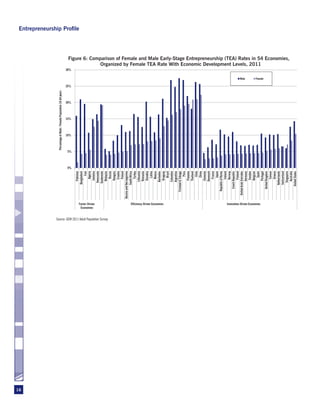
categories: (1) inclusiveness—more specifically, the         Figure 6 reveals the rates of female and male
distribution of entrepreneurship by sex and age; (2)         participation in entrepreneurship across the sample.
industry—the participation of entrepreneurs in key           In just 8 of the 54 economies surveyed, the rates of
sectors; and (3) impact—the entrepreneurs’ growth            female early-stage entrepreneurship are comparable to
aspirations, international market reach and the degree       those of their male equivalents. These eight—Panama,
of innovation in their products and services.                Venezuela, Jamaica, Guatemala, Brazil, Thailand,
                                                             Switzerland and Singapore—come from various
                                                             global regions and represent every phase of economic
                                                             development. In the rest of the sample, entrepreneurship
INCLUSIVENESS                                                rates are lower among women than men.

                                                             In the factor-driven economies, there is a marked
Inclusiveness accounts for the equality of                   split between high levels of women entrepreneurs in
entrepreneurship across a society. It is a measure of        four Latin American/Carribean economies (Panama,
equity; in other words, if two people have equal potential   Venezuela, Jamaica and Guatemala) and low
for entrepreneurship, this activity should not be more       participation rates in Iran, Bangladesh and Pakistan. In
available to one than the other simply because of sex,       Pakistan, only one tenth of entrepreneurs are women.
age or other characteristics, such as ethnicity.
                                                             Among the efficiency-driven economies, Thailand
Factors such as culture and differential education levels    and Brazil have high women participation rates.
may constrain, or at least influence, the ability for all    Conversely, the lowest relative rates of women’s
groups to participate equally in entrepreneurship. On        involvement in entrepreneurship can be found in
the other hand, entrepreneurship may be an outlet            the Eastern European economies, most prominently
and an income source for groups that are excluded            in Poland and Slovakia, where fewer than 30% of
from certain jobs. We next review the frequency of           entrepreneurs are women.
participation of women relative to men, as well as the
distribution of entrepreneurs by age in the 54 economies.    In the innovation-driven economies, it is notable that
                                                             Asia and Western Europe have economies with both
                                                             the lowest and highest relative levels of women’s
                                                             participation relative to men. Singapore and Switzerland
                                                             exhibit comparatively high levels, while France and the
                                                             Republic of Korea report low involvement (about one
                                                             fourth of the entrepreneurs are women).


                                                                                                                        15
16
                                                                                                                      Percentage of Male / Female Population 18-64 years


                                                                                                                                10%
                                                                                                                                              15%
                                                                                                                                                            20%
                                                                                                                                                                           25%
                                                                                                                                                                                          30%


                                                                                                                0%
                                                                                                                     5%
                                                                                                   Pakistan
                                                                                                                                                                                                                                                                                                    Entrepreneurship Profile


                                                                                                Bangladesh
                                                                                                         Iran
                                                                                                      Algeria


                                                 Economies
                                                Factor-Driven
                                                                                                    Jamaica
                                                                                                 Venezuela
                                                                                                 Guatemala
                                                                                                   Malaysia


     Source: GEM 2011 Adult Population Survey
                                                                                                      Russia
                                                                                                   Hungary
                                                                                                     Croatia
                                                                                                      Poland
                                                                                    Bosnia and Herzegovina
                                                                                               South Africa
                                                                                                      Turkey
                                                                                                  Lithuania
                                                                                                   Romania
                                                                                                   Slovakia
                                                                                                       Latvia
                                                                                                      Mexico
                                                                                                  Barbados


                                                      Efficiency-Driven Economies
                                                                                                    Uruguay
                                                                                                       Brazil
                                                                                                  Colombia
                                                                                                  Argentina
                                                                                         Trinidad & Tobago
                                                                                                        Peru
                                                                                                    Panama
                                                                                                   Thailand
                                                                                                        Chile
                                                                                                       China
                                                                                                   Slovenia
                                                                                                  Denmark
                                                                                                      France
                                                                                                       Japan
                                                                                          Republic of Korea
                                                                                                     Ireland
                                                                                                     Norway
                                                                                            Czech Republic
                                                                                                     Finland
                                                                                      United Arab Emirates
                                                                                                                                                                                 Male


                                                                                                   Germany
                                                                                                     Sweden
                                                                                                    Belgium
                                                                                                       Spain
                                                      Innovation-Driven Economies
                                                                                                                                                                                                              Organized by Female TEA Rate With Economic Development Levels, 2011

                                                                                                                                                                                 Female


                                                                                                   Portugal
                                                                                            United Kingdom
                                                                                                      Taiwan
                                                                                                      Greece
                                                                                               Netherlands
                                                                                                Switzerland
                                                                                                 Singapore
                                                                                                                                                                                                Figure 6: Comparison of Female and Male Early-Stage Entrepreneurship (TEA) Rates in 54 Economies,


                                                                                                   Australia
                                                                                              United States
Age Distribution of Early-Stage Entrepreneurship


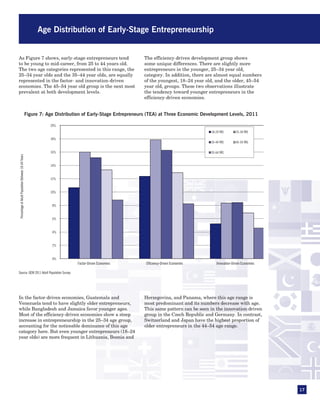
As Figure 7 shows, early-stage entrepreneurs tend                                                         The efficiency-driven development group shows
to be young to mid-career, from 25 to 44 years old.                                                       some unique differences. There are slightly more
The two age categories represented in this range, the                                                     entrepreneurs in the younger, 25–34 year old,
25–34 year olds and the 35–44 year olds, are equally                                                      category. In addition, there are almost equal numbers
represented in the factor- and innovation-driven                                                          of the youngest, 18–24 year old, and the older, 45–54
economies. The 45–54 year old group is the next most                                                      year old, groups. These two observations illustrate
prevalent at both development levels.                                                                     the tendency toward younger entrepreneurs in the
                                                                                                          efficiency-driven economies.


                                                     Figure 7: Age Distribution of Early-Stage Entrepreneurs (TEA) at Three Economic Development Levels, 2011

                                                                20%
                                                                                                                                         18-24 YRS       25-34 YRS

                                                                18%
                                                                                                                                         35-44 YRS       45-54 YRS

                                                                16%                                                                      55-64 YRS
Percentage of Adult Population Between 18-64 Years


                                                                14%


                                                                12%


                                                                10%


                                                                 8%


                                                                 6%


                                                                 4%


                                                                 2%


                                                                 0%
                                                                            Factor-Driven Economies        Efficiency-Driven Economies      Innovation-Driven Economies

Source: GEM 2011 Adult Population Survey


In the factor-driven economies, Guatemala and                                                             Herzegovina, and Panama, where this age range is
Venezuela tend to have slightly older entrepreneurs,                                                      most predominant and its numbers decrease with age.
while Bangladesh and Jamaica favor younger ages.                                                          This same pattern can be seen in the innovation-driven
Most of the efficiency-driven economies show a steep                                                      group in the Czech Republic and Germany. In contrast,
increase in entrepreneurship in the 25–34 age group,                                                      Switzerland and Japan have the highest proportion of
accounting for the noticeable dominance of this age                                                       older entrepreneurs in the 44–54 age range.
category here. But even younger entrepreneurs (18–24
year olds) are more frequent in Lithuania, Bosnia and


                                                                                                                                                                          17
Age Distribution of Early-Stage Entrepreneurship


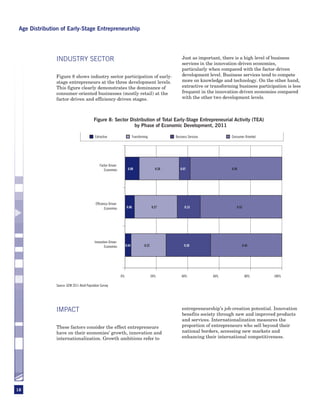
               INDUSTRY SECTOR                                                                            Just as important, there is a high level of business
                                                                                                          services in the innovation-driven economies,
                                                                                                          particularly when compared with the factor-driven
               Figure 8 shows industry sector participation of early-                                     development level. Business services tend to compete
               stage entrepreneurs at the three development levels.                                       more on knowledge and technology. On the other hand,
               This figure clearly demonstrates the dominance of                                          extractive or transforming business participation is less
               consumer-oriented businesses (mostly retail) at the                                        frequent in the innovation-driven economies compared
               factor-driven and efficiency-driven stages.                                                with the other two development levels.


                                           Figure 8: Sector Distribution of Total Early-Stage Entrepreneurial Activity (TEA)
                                                              by Phase of Economic Development, 2011

                                            Extractive                       Transforming             Business Services          Consumer-Oriented


                                                Factor-Driven
                                                   Economies           0.09                    0.26      0.07                    0.58


                                             Efficiency-Driven
                                                     Economies         0.06                  0.27           0.15                    0.52


                                            Innovation-Driven
                                                   Economies          0.04            0.22                  0.28                           0.45


                                                                 0%                          20%          40%             60%               80%       100%

               Source: GEM 2011 Adult Population Survey


               IMPACT                                                                                     entrepreneurship’s job-creation potential. Innovation
                                                                                                          benefits society through new and improved products
                                                                                                          and services. Internationalization measures the
               These factors consider the effect entrepreneurs                                            proportion of entrepreneurs who sell beyond their
               have on their economies’ growth, innovation and                                            national borders, accessing new markets and
               internationalization. Growth ambitions refer to                                            enhancing their international competitiveness.


18
Age Distribution of Early-Stage Entrepreneurship


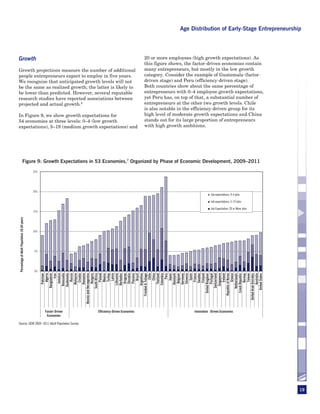
Growth                                                                                           20 or more employees (high growth expectations). As
                                                                                                 this figure shows, the factor-driven economies contain
Growth projections measure the number of additional                                              many entrepreneurs, but mostly in the low growth
people entrepreneurs expect to employ in five years.                                             category. Consider the example of Guatemala (factor-
We recognize that anticipated growth levels will not                                             driven stage) and Peru (efficiency-driven stage).
be the same as realized growth; the latter is likely to                                          Both countries show about the same percentage of
be lower than predicted. However, several reputable                                              entrepreneurs with 0–4 employee growth expectations,
research studies have reported associations between                                              yet Peru has, on top of that, a substantial number of
projected and actual growth.6                                                                    entrepreneurs at the other two growth levels. Chile
                                                                                                 is also notable in the efficiency-driven group for its
In Figure 9, we show growth expectations for                                                     high level of moderate growth expectations and China
54 economies at three levels: 0–4 (low growth                                                    stands out for its large proportion of entrepreneurs
expectations), 5–19 (medium growth expectations) and                                             with high growth ambitions.


                           Figure 9: Growth Expectations in 53 Economies,7 Organized by Phase of Economic Development, 2009–2011
                                             25%


                                             20%
                                                                                                                                  Job expectations: 0-4 jobs

                                                                                                                                  Job expectations: 5-19 Jobs

                                                                                                                                  Job Expectation: 20 or More Jobs
                                             15%
Percentage of Adult Population 18-64 years


                                             10%


                                             5%


                                             0%
                                                                  Pakistan
                                                                     Algeria
                                                               Bangladesh
                                                                        Iran
                                                                   Jamaica
                                                                Venezuela
                                                                Guatemala
                                                                     Russia
                                                                  Malaysia
                                                                    Croatia
                                                                  Romania
                                                   Bosnia and Herzegovina
                                                                  Hungary
                                                              South Africa
                                                                     Poland
                                                                     Mexico
                                                                     Turkey
                                                                      Latvia
                                                                 Lithuania
                                                                 Barbados
                                                                  Uruguay
                                                                  Slovakia
                                                                   Panama
                                                                      Brazil
                                                                 Argentina
                                                        Trinidad & Tobago
                                                                       Chile
                                                                      China
                                                                  Thailand
                                                                 Colombia
                                                                       Peru
                                                                      Japan

                                                                   Belgium
                                                                  Germany
                                                                  Slovenia
                                                                      Spain
                                                                     France
                                                                    Sweden
                                                                    Finland
                                                           United Kingdom
                                                                  Portugal
                                                               Switzerland
                                                                Singapore
                                                                    Ireland
                                                         Republic of Korea
                                                                     Greece
                                                              Netherlands
                                                           Czech Republic
                                                                    Norway
                                                                     Taiwan
                                                     United Arab Emirates
                                                                  Australia
                                                             United States
                                                                 Denmark


                                                   Factor-Driven   Efficiency-Driven Economies                         Innovation -Driven Economies
                                                    Economies

Source: GEM 2009–2011 Adult Population Survey


                                                                                                                                                                     19
Age Distribution of Early-Stage Entrepreneurship


               While the innovation-driven economies consistently                                                                        of their greater competitive intensity. Innovativeness
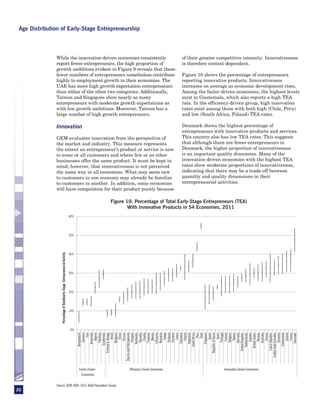
               report fewer entrepreneurs, the high proportion of                                                                        is therefore context-dependent.
               growth ambitions evident in Figure 9 reveals that these
               fewer numbers of entrepreneurs nonetheless contribute                                                                     Figure 10 shows the percentage of entrepreneurs
               highly to employment growth in their economies. The                                                                       reporting innovative products. Innovativeness
               UAE has more high growth expectation entrepreneurs                                                                        increases on average as economic development rises.
               than either of the other two categories. Additionally,                                                                    Among the factor-driven economies, the highest levels
               Taiwan and Singapore show nearly as many                                                                                  exist in Guatemala, which also reports a high TEA
               entrepreneurs with moderate growth expectations as                                                                        rate. In the efficiency-driven group, high innovation
               with low growth ambitions. Moreover, Taiwan has a                                                                         rates exist among those with both high (Chile, Peru)
               large number of high growth entrepreneurs.                                                                                and low (South Africa, Poland) TEA rates.

               Innovation                                                                                                                Denmark shows the highest percentage of
                                                                                                                                         entrepreneurs with innovative products and services.
               GEM evaluates innovation from the perspective of                                                                          This country also has low TEA rates. This suggests
               the market and industry. This measure represents                                                                          that although there are fewer entrepreneurs in
               the extent an entrepreneur’s product or service is new                                                                    Denmark, the higher proportion of innovativeness
               to some or all customers and where few or no other                                                                        is an important quality dimension. Many of the
               businesses offer the same product. It must be kept in                                                                     innovation-driven economies with the highest TEA
               mind, however, that innovativeness is not perceived                                                                       rates show moderate proportions of innovativeness,
               the same way in all economies. What may seem new                                                                          indicating that there may be a trade-off between
               to customers in one economy may already be familiar                                                                       quantity and quality dimensions in their
               to customers in another. In addition, some economies                                                                      entrepreneurial activities.
               will have competition for their product purely because

                                                                                                   Figure 10: Percentage of Total Early-Stage Entrepreneurs (TEA)
                                                                                                           With Innovative Products in 54 Economies, 2011
                                                                             60%


                                                                             50%


                                                                             40%
                  Percentage of TotalEearly-Stage Entrepreneurial Activity


                                                                             30%


                                                                             20%


                                                                             10%


                                                                              0%
                                                                                               Bangladesh
                                                                                                   Jamaica
                                                                                                         Iran
                                                                                                 Venezuela
                                                                                                     Algeria
                                                                                                   Pakistan
                                                                                                Guatemala
                                                                                         Trinidad & Tobago
                                                                                                       Brazil
                                                                                                  Malaysia
                                                                                                       China
                                                                                                     Russia
                                                                                   Bosnia and Herzegovina
                                                                                                   Hungary
                                                                                                  Barbados
                                                                                                   Slovakia
                                                                                                     Croatia
                                                                                                   Thailand
                                                                                                     Mexico
                                                                                                  Lithuania
                                                                                                   Romania
                                                                                                      Turkey
                                                                                                   Uruguay
                                                                                                   Panama
                                                                                                      Latvia
                                                                                                  Colombia
                                                                                                     Poland
                                                                                                  Argentina
                                                                                               South Africa
                                                                                                        Peru
                                                                                                        Chile
                                                                                                 Singapore
                                                                                                       Japan
                                                                                         Republic of Korea
                                                                                                       Spain
                                                                                                   Portugal
                                                                                                    Finland
                                                                                                    Belgium
                                                                                                     Taiwan
                                                                                                  Germany
                                                                                           United Kingdom
                                                                                               Netherlands
                                                                                                    Sweden
                                                                                              United States
                                                                                                    Norway
                                                                                                  Australia
                                                                                                     Greece
                                                                                            Czech Republic
                                                                                     United Arab Emirates
                                                                                                   Slovenia
                                                                                               Switzerland
                                                                                                     Ireland
                                                                                                     France
                                                                                                  Denmark


                                                                                   Factor-Driven           Efficiency-Driven Economies                      Innovation-Driven Economies
                                                                                     Economies


               Source: GEM 2009–2011 Adult Population Survey
20
Age Distribution of Early-Stage Entrepreneurship


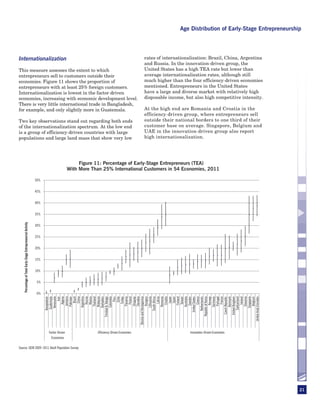
Internationalization                                                                                                           rates of internationalization: Brazil, China, Argentina
                                                                                                                               and Russia. In the innovation-driven group, the
This measure assesses the extent to which                                                                                      United States has a high TEA rate but lower than
entrepreneurs sell to customers outside their                                                                                  average internationalization rates, although still
economies. Figure 11 shows the proportion of                                                                                   much higher than the four efficiency-driven economies
entrepreneurs with at least 25% foreign customers.                                                                             mentioned. Entrepreneurs in the United States
Internationalization is lowest in the factor-driven                                                                            have a large and diverse market with relatively high
economies, increasing with economic development level.                                                                         disposable income, but also high competitive intensity.
There is very little international trade in Bangladesh,
for example, and only slightly more in Guatemala.                                                                              At the high end are Romania and Croatia in the
                                                                                                                               efficiency-driven group, where entrepreneurs sell
Two key observations stand out regarding both ends                                                                             outside their national borders to one third of their
of the internationalization spectrum. At the low end                                                                           customer base on average. Singapore, Belgium and
is a group of efficiency-driven countries with large                                                                           UAE in the innovation-driven group also report
populations and large land mass that show very low                                                                             high internationalization.


                                                                                         Figure 11: Percentage of Early-Stage Entrepreneurs (TEA)
                                                                                    With More Than 25% International Customers in 54 Economies, 2011

                                                              50%


                                                              45%


                                                              40%


                                                              35%
   Percentage of Total Early-Stage Entrepreneurial Activity


                                                              30%


                                                              25%


                                                              20%


                                                              15%


                                                              10%


                                                              5%


                                                              0%
                                                                                Bangladesh
                                                                                 Guatemala
                                                                                  Venezuela
                                                                                          Iran
                                                                                      Algeria
                                                                                    Jamaica
                                                                                    Pakistan
                                                                                        Brazil
                                                                                        China
                                                                                   Argentina
                                                                                      Russia
                                                                                      Mexico
                                                                                    Thailand
                                                                                   Malaysia
                                                                                   Barbados
                                                                          Trinidad & Tobago
                                                                                   Colombia
                                                                                         Peru
                                                                                         Chile
                                                                                       Turkey
                                                                                    Panama
                                                                                      Poland
                                                                                    Uruguay
                                                                                    Slovakia
                                                                    Bosnia and Herzegovina
                                                                                    Hungary
                                                                                   Lithuania
                                                                                South Africa
                                                                                       Latvia
                                                                                    Romania
                                                                                      Croatia
                                                                                        Japan
                                                                                        Spain
                                                                                     Finland
                                                                                      Taiwan
                                                                                   Australia
                                                                                     Sweden
                                                                               United States
                                                                                      Greece
                                                                                Netherlands
                                                                           Republic of Korea
                                                                                     Norway
                                                                                   Germany
                                                                                    Portugal
                                                                                      France
                                                                             Czech Republic
                                                                                   Denmark
                                                                            United Kingdom
                                                                                Switzerland
                                                                                      Ireland
                                                                                    Slovenia
                                                                                  Singapore
                                                                                     Belgium
                                                                      United Arab Emirates


                                                                    Factor-Driven                Efficiency-Driven Economies                        Innovation-Driven Economies
                                                                      Economies

Source: GEM 2009–2011 Adult Population Survey


                                                                                                                                                                                              21
Institutional Context (Entrepreneurship Framework Conditions)


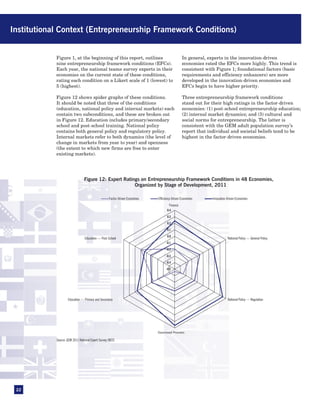
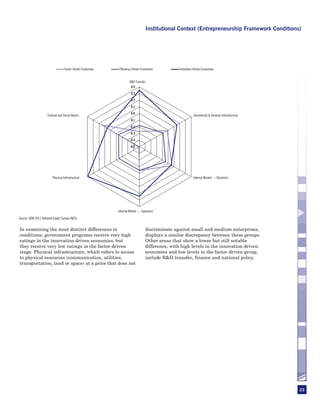
            Figure 1, at the beginning of this report, outlines                                 In general, experts in the innovation-driven
            nine entrepreneurship framework conditions (EFCs).                                  economies rated the EFCs more highly. This trend is
            Each year, the national teams survey experts in their                               consistent with Figure 1; foundational factors (basic
            economies on the current state of these conditions,                                 requirements and efficiency enhancers) are more
            rating each condition on a Likert scale of 1 (lowest) to                            developed in the innovation-driven economies and
            5 (highest).                                                                        EFCs begin to have higher priority.

            Figure 12 shows spider graphs of these conditions.                                  Three entrepreneurship framework conditions
            It should be noted that three of the conditions                                     stand out for their high ratings in the factor-driven
            (education, national policy and internal markets) each                              economies: (1) post-school entrepreneurship education;
            contain two subconditions, and these are broken out                                 (2) internal market dynamics; and (3) cultural and
            in Figure 12. Education includes primary/secondary                                  social norms for entrepreneurship. The latter is
            school and post-school training. National policy                                    consistent with the GEM adult population survey’s
            contains both general policy and regulatory policy.                                 report that individual and societal beliefs tend to be
            Internal markets refer to both dynamics (the level of                               highest in the factor-driven economies.
            change in markets from year to year) and openness
            (the extent to which new firms are free to enter
            existing markets).


                                 Figure 12: Expert Ratings on Entrepreneurship Framework Conditions in 48 Economies,
                                                        Organized by Stage of Development, 2011

                                                    Factor-Driven Economies   Efficiency-Driven Economies     Innovation-Driven Economies
                                                                                      Finance
                                                                                    0.4

                                                                                    0.3

                                                                                    0.2

                                                                                    0.1

                                                                                    0.0
                                 Education — Post-School                                                                 National Policy — General Policy
                                                                                    -0.1

                                                                                    -0.2

                                                                                    -0.3

                                                                                    -0.4

                                                                                    -0.5


                    Education — Primary and Secondary                                                                    National Policy — Regulation


                                                                              Government Programs

            Source: GEM 2011 National Expert Survey (NES)


 22
Institutional Context (Entrepreneurship Framework Conditions)


                                   Factor-Driven Economies   Efficiency-Driven Economies         Innovation-Driven Economies


                                                                     R&D Transfer
                                                                      0.4
                                                                      0.3
                                                                      0.2
                                                                      0.1
                                                                      0.0
                      Cultural and Social Norms                                                             Commercial & Services Infrastructure
                                                                     -0.1
                                                                     -0.2
                                                                     -0.3
                                                                     -0.4
                                                                     -0.5


                          Physical Infrastructure                                                           Internal Market — Dynamics


                                                             Internal Market — Openness
Source: GEM 2011 National Expert Survey (NES)


In examining the most distinct differences in                                    discriminate against small and medium enterprises,
conditions, government programs receive very high                                displays a similar discrepancy between these groups.
ratings in the innovation-driven economies, but                                  Other areas that show a lower but still notable
they receive very low ratings in the factor-driven                               difference, with high levels in the innovation-driven
stage. Physical infrastructure, which refers to access                           economies and low levels in the factor-driven group,
to physical resources (communication, utilities,                                 include R&D transfer, finance and national policy.
transportation, land or space) at a price that does not


                                                                                                                                                   23
Special Topic: Entrepreneurial Employee Activity


           The GEM consortium selected entrepreneurial                                                                            rate in the innovation-driven economies is partly
           employee activity (EEA) as a special topic for 2011.8                                                                  caused by the fact that a higher percentage of the
           The focus is on people who play a leading role in                                                                      adult population is employed in organizations; with
           creating and developing new business activities for the                                                                more people working for organizations, an economy
           organizations they work for. These entrepreneurial                                                                     is likely to have more entrepreneurial employees on
           initiatives include both activities initiated by the                                                                   an absolute basis. However, when the rate of EEA
           organizations’ top levels and those that emerge from                                                                   is examined only in the employee population, there
           the bottom.                                                                                                            are still higher percentages of entrepreneurs among
                                                                                                                                  employees in the innovation-driven economies, than in
           GEM defined this form of entrepreneurship broadly;                                                                     the other two development levels.
           it includes employees that develop or launch new
           goods or services or set up new business units that                                                                    It is interesting to note that the innovation-driven
           constitute a new establishment or subsidiary for their                                                                 economies with the highest levels of EEA are
           main employer. Despite this broad definition, EEA is                                                                   among those with the lowest TEA rates: Denmark,
           not a very widespread phenomenon. On average, only                                                                     Belgium and Sweden. This is further indication that
           about 3% of the adult population is currently involved                                                                 entrepreneurship in organizations replaces, to some
           in this activity, but its prevalence differs markedly                                                                  extent, independent entrepreneurship as an alternative
           across countries, from slightly more than zero to                                                                      means for pursuing entrepreneurial opportunities. At
           almost 14%.                                                                                                            the same time, the three innovation-driven economies
                                                                                                                                  with the highest TEA rates—the United States,
           As Figure 13 shows, EEA is most prevalent in the                                                                       Australia and the Netherlands—also have high EEA,
           innovation-driven economies. This observation                                                                          indicating that entrepreneurial activity may thrive in
           contrasts with the pattern for early-stage                                                                             both forms.
           entrepreneurial activity (see Figure 4). The higher


                                                                                      Figure 13: Entrepreneurial Employee Activity (EEA) in 52 Economies, 2011

                                                                16%


                                                                14%


                                                                12%
           Percentage of Adult Population Between 18-64 Years


                                                                10%


                                                                8%


                                                                6%


                                                                4%


                                                                2%


                                                                0%
                                                                                  Bangladesh
                                                                                             Pa
                                                                                     a akistan
                                                                                      Jamaica
                                                                                           Iran
                                                                                   Venezuela
                                                                                     A Algeria
                                                                                      Panama
                                                                                 South Africa
                                                                                     Malaysia
                                                                                        Russia
                                                                                        Turkey
                                                                                    Barbados
                                                                                        Mexico
                                                                                         Brazil
                                                                           Trinidad & Tobago
                                                                                          Peru
                                                                                     Thailand
                                                                                    Colombia
                                                                                         China
                                                                                         Latvia
                                                                      Bosnia and Herzegovina
                                                                                        Poland
                                                                                    Argentina
                                                                                     Hungary
                                                                                          Chile
                                                                                     Slovakia
                                                                                    o omania
                                                                                    Lithuania
                                                                                     CCroatia
                                                                                      Uruguay
                                                                                     G Greece
                                                                                     T Taiwan
                                                                            Republic of Korea
                                                                                         Spain
                                                                                   Singapore
                                                                                     o ortugal
                                                                                     Emirates
                                                                                         Japan
                                                                              Czech Republic
                                                                                  Switzerland
                                                                                     Germany
                                                                                        France
                                                                                     Slovenia
                                                                              United Kingdom
                                                                                       Ireland
                                                                                    Australia
                                                                                United States
                                                                                 Netherlands
                                                                                       Finland
                                                                                      Belgium

                                                                                       Sweden
                                                                                    Denmark
                                                                                     P
                                                                                     P


                                                                                     a


                                                                                     n
                                                                        United Arab m
                                                                                     R
                                                                                     a


                                                                                     r


                                                                      Factor-Driven                 Efficiency-Driven Economies                        Innovation-Driven Economies
                                                                       Economies


           Source: GEM 2011 Adult Population Survey


24
Special Topic: Entrepreneurial Employee Activity


The age distribution of entrepreneurial employees          employees to be actively involved in setting up a new
follows an inverted U-shape; the highest prevalence        independent business that they will own and manage.
rates are in the 25 to 44 year-old age groups. This        Entrepreneurial employee activity and early-stage
pattern is similar to that of early-stage entrepreneurs.   entrepreneurship thus appear capable of operating as
EEA is also more prevalent among men than among            complements at the individual level.
women, and it is particularly prevalent among more
highly educated employees.                                 Finally, the analysis shows that employees who
                                                           are involved in EEA have substantially higher job
Compared with other employees, people who are              growth expectations for their new business activity
involved in EEA are significantly more likely to           than independent nascent and new entrepreneurs. In
perceive entrepreneurial opportunities and believe         addition, about 70% of the entrepreneurial employees
that they have the ability to start a business. In         introduce goods or services that are new to at least
fact, these perceptions are remarkably similar to          some of the organization’s customers. In this respect,
those of early-stage entrepreneurs. Entrepreneurial        EEA appears to be more innovative than early-stage
employees are also far more likely than other              entrepreneurial activity.


                                                                                                                          25
Conclusions and Implications


           In order to understand the nature of entrepreneurship      of the much higher ratings the innovation-driven
           in an economy, it is important to recognize its            economies show on most of the entrepreneurship
           broader meaning, its multidimensional qualities and        framework conditions, including the availability of
           its interaction with the environment. This report          entrepreneurial finance.
           emphasizes that entrepreneurship encompasses
           multiple phases and that individuals participating in
           this activity exhibit a variety of profiles.
                                                                      CONCLUSIONS AND IMPLICATIONS:
                                                                      ENTREPRENEURIAL PROFILE
           CONCLUSIONS AND IMPLICATIONS:
           ENTREPRENEURSHIP PHASES                                    GEM’s detailed account of the entrepreneurship
                                                                      profile illustrates the diversity of entrepreneurial
                                                                      activity within and across economies. For example,
           In recognizing that entrepreneurship exists in             this report showed considerable variation in early-
           multiple phases, policy makers, practitioners and          stage entrepreneurship participation rates for women
           academics may thus turn their attention to the unique      compared to men. All three economic development
           needs of people at particular points in this process.      levels and many geographic locales exhibited both
           Initiatives may address how to identify, develop           high and low participation rates among women
           or motivate potential entrepreneurs and generate           relative to men. The reasons for these wide swings are
           society-wide attitudes to support these people.            likely complex and context specific.
           Programs may focus on the specific needs of people
           in the process of starting a business as opposed to        The quadrupling of participation in business
           those who are running new or established businesses.       services from the factor- to innovation-driven stage,
           There may be key considerations regarding an               in contrast to the greater prevalence of consumer-
           entrepreneur’s ability to close a business when it is no   oriented businesses in the factor- and efficiency-driven
           longer viable; programs may enable such people to use      economies, is an important profile characteristic with
           their experience and resources to venture out again or     perhaps some key implications about the institutional
           to assist other entrepreneurs.                             environment for entrepreneurship. For example, R&D
                                                                      transfer is rated much more highly in the innovation-
           One interesting finding related to the different           driven economies. This quality may be important for
           phases is the high—then steeply dropping—TEA               participation in sectors that rely on knowledge and
           level that occurs as one moves from low to high            innovation. In addition, this sector profile is consistent
           economic development levels, even as established           with the higher prevalence of innovation in the
           business ownership remains relatively stable. This         innovation-driven economies.
           finding suggests that, in the early development stage
           economies, many individuals start businesses but           The impact characteristics highlight the value of
           fewer sustain them. Conversely, developed economies        looking beyond a simple count of entrepreneurs,
           display an equivalent number of established business       placing an emphasis on the contribution they make
           owners with relatively few starting up.                    in their societies. For instance, while there are fewer
                                                                      entrepreneurs in the innovation-driven economies, those
           An examination of the reasons for discontinuation          that do exist are more likely to affect their societies
           may shed additional light on the above finding.            through growth, innovation and internationalization.
           People who discontinue businesses in the factor- and
           efficiency-driven economies most often cited negative      With regard to internationalization, entrepreneurs
           reasons (lack of profitability and trouble obtaining       and policy makers will need to consider their
           finance). Alternatively, people in innovation-driven       global competitiveness profile, particularly as they
           economies were more likely than those in the other         anticipate or confront international competitors in
           two development levels to have positive explanations       their home regions. Globalization is affecting most
           for leaving their businesses (retirement, sale or          every economy, whether populous or not, emerging or
           another opportunity).                                      developed. International trade can contribute to more
                                                                      efficient migration of entrepreneurs’ knowledge and
           While no one institutional model fits all economies,       global competitiveness.
           the findings regarding the relative rates of
           established business ownership and the reasons
           for discontinuation suggest that the institutional
           environment affects the sustainability of
           businesses. This is particularly apparent in light

26
Conclusions And Implications


CONCLUSIONS AND IMPLICATIONS:                                 high-impact entrepreneurs.10 This is an important
                                                              point for all government policy makers to note because
ENTREPRENEURIAL EMPLOYEE                                      these entrepreneurs contribute greatly to job creation.
ACTIVITY
                                                              Although access to finance is considered a key
                                                              impediment to entrepreneurial development,
Our special topic reveals that employees can                  perhaps initiatives need to link this concern with
exercise their entrepreneurial ambitions within               the development of business skills. Factor-driven
an organizational environment. This conclusion                economies may focus on providing business skills,
illustrates a key message for policy makers and               financial literacy and education. The efficiency-driven
corporate leaders: organizations can better serve             economies can turn their attention toward specialized
their stakeholders’ needs (owners, employees and              and targeted entrepreneurial education as well as
the community) through the initiatives of their               toward increasing access to finance for people with
entrepreneurial employees. That capability can                the necessary business skills. In innovation-driven
therefore generate an enormous hidden asset, but it           (and to some extent efficiency-driven) economies,
requires an entrepreneurial corporate culture and             entrepreneurship can benefit from access to equity
other managerial considerations.                              capital as well as transparent banking procedures.

                                                              Policy recommendations that improve the flexibility
                                                              of labor, communications and market openness while
CONCLUSIONS AND IMPLICATIONS:                                 eliminating bureaucracy and red-tape will contribute
ENTREPRENEURSHIP FRAMEWORK                                    to a more entrepreneurially-focused business
                                                              environment. Cultures that reward hard work and
CONDITIONS                                                    creativity, rather than political connections, will also
                                                              encourage entrepreneurial development, although
                                                              doing so is perhaps a difficult lever to pull in the short
It is not feasible for this global report to offer specific
                                                              term. Governments ensuring that political interests do
policy recommendations that can be applied broadly
                                                              not supersede economic concerns are also more likely
across multiple economies. However, each participating
                                                              to create conditions in which entrepreneurs can grow
GEM team publishes a national report that covers
                                                              and prosper.
specific economy-level considerations.9 Nonetheless,
this report offers some lessons that can provide policy
                                                              By achieving and sustaining economic development,
makers, practitioners and academics with insights for
                                                              societies can help solve some of the biggest problems
each development level. It should be noted, though,
                                                              of mankind, such as poverty and development
that policy recommendations will differ within a
                                                              imbalances around the world. GEM maintains that
developmental level because each economy is shaped by
                                                              economic development requires entrepreneurial
its own political, economic, social and other conditions.
                                                              activity and a supportive environment. In this sense,
                                                              institutions and society contribute toward this activity
For factor-driven economies, policy should center
                                                              and entrepreneurship should therefore be understood
on improving macroeconomic stability, health and
                                                              in the wider sense of having the capacity to act at both
basic education, and public infrastructure. Without
                                                              individual and broader levels. To create such energy
these fundamentals, policies focused specifically
                                                              for making positive changes, societies must consider
on enhancing a society’s entrepreneurial capacity
                                                              that entrepreneurship is not a heroic act of a few
are less viable. Innovation-driven economies, on
                                                              individuals, but the accomplishments of many people
the other hand, already have well-functioning basic
                                                              who pursue their ambitions in a supportive cultural
requirements. Even though they need to maintain
                                                              and institutional environment.
these fundamental conditions, they can additionally
look toward policies that facilitate entrepreneurship
while appreciating local, deeply-rooted customs.

Regardless of development level, however, GEM has
shown that stringent labor regulations and an onerous
regulatory system negatively affect the number of


                                                                                                                                 27
GEM National Teams 2011


                                                 National Team
     Team          Institution                                                  Funders                                      APS Vendor              Contact
                                                 Members
     Algeria       CREAD                         Abedou Abderrahamne            German Development Cooperation                                       a.abedou@cread.edu.dz
                                                 Bouyacoub Ahmed                (Deutsche Gesellschaft fuer Internationale
                                                 Kherbachi Hamid                Zusammenarbeit, GIZ)
                                                 Cherrad Salah Eddine
                                                 Setti Zakia
     Argentina     IAE - Business School         Silvia Torres Carbonell        Banco Santander Rio                          MORI Argentina          scarbonell@iae.edu.ar
                                                 Aranzazu Echezarreta           Buenos Aires City Government
                                                 Juan Martin Rodriguez
                                                 Hector Rocha

     Australia     Queensland University of      Per Davidsson                  The Australian Centre for                    Q&A Market Research     per.davidsson@qut.edu.au
                   Technology                    Paul Steffens                  Entrepreneurship Research, QUT
                                                 Michael Stuetzer
     Bangladesh    International Islamic         Mohammed Shamsul Karim         USAID (United States Agency International Org-Quest Research         karimms@aston.ac.uk
                   University Chittagong         Shamim Uddin Khan              Development)                              Limited                    mshamsulkarim@yahoo.com
                                                 Abul Kalam Azad                Aston University
                                                 Abbas Ali Khan
                                                 Sirajuddowla Shaheen
                                                 Syed Md. Ather
                                                 S.M. Shafiqul Islam
                                                 A. J. M. Nuruddin Chowhdury
                                                 ANM Meshquat Uddin
                                                 M. Tahlil Azim
                                                 Jerry Nicholson
                                                 Md. Musharrof Hossain
                                                 Md. Moazzam Husain
                                                 Mark Hart

     Barbados      The Cave Hill School of       Marjorie Wharton               International Development Research           Systems Consulting      marjorie.wharton@cavehill.uwi.
                   Business, The University of   Donley Carrington              Centre (IDRC)                                Ltd.                    edu
                   the West Indies               Jeannine Comma
                                                 Paul Pounder


     Belgium       Vlerick Leuven Gent           Jan Lepoutre                   STOIO (Flemish Research Organisation         Dedicated Research      jan.lepoutre@vlerick.com
                   Management School             Mathias Cobben                 for Entrepreneurship and International
                                                 Jacob Vermeire                 Entrepreneurship)
                                                                                EWI (Department of Economy, Science and
                                                                                Innovation)
     Bosnia &      Center for Entrepreneurship   Bahrija Umihanić               Federal Ministry of Development,             IPSOS d.o.o. Sarajevo office@cerpod-tuzla.org
     Herzegovina   Development Tuzla (in         Rasim Tulumović                Entrepreneurship and Crafts
                   partnership with University   Mirela Arifović                Ministry of Development and
                   of Tuzla)                     Slađana Simić                  Entrepreneurship of Tuzla Canton
                                                 Aziz Šunje                     Municipality of Tuzla
                                                 Slobodan Marković              BIT center Tuzla
                                                 Zdenko Klepić                  Independent Development Bureau Modriča
                                                 Selma Poljić                   Government of Tuzla Canton
                                                                                Foundation of Tuzla Community
     Brazil        Instituto Brasileiro da    Simara Maria de Souza             Serviço Brasileiro de Apoio às Micro e       Bonilha Comunicação     simara@ibqp.org.br
                   Qualidade e                  Siveira Greco                   Pequenas Empresas - Sebrae                   e Marketing S/C Ltda.
                   Produtividade (IBQP)       César Rissete
                                              Eduardo Camargo Righi             Serviço Social da Indústria - SESI-          Bonilha Pesquisa
                                              Eliane Cordeiro de Vasconcellos   Departamento Regional do Paraná
                                              Garcia Duarte
                   Escola de Administração de Gilberto Sarfati                  Universidade Federal do Paraná - UFPR
                   Empresas de São Paulo da Joana Paula Machado
                   Fundação Getulio Vargas – Júlio César Felix
                   FGV-EAESP                  Laura Pansarella                  Instituto de Tecnologia do Paraná - Tecpar
                                              Marcelo Aidar
                                              Mario Tamada Neto                 Escola de Administração de Empresas de
                                              Rene Rodrigues Fernandes          São Paulo da Fundação Getulio Vargas –
                                              Romeu Herbert Friedlaender Jr.    FGV-EAESP
                                              Tales Andreassi
28
GEM National Teams 2011


                                        NATIONAL TEAM
TEAM       INSTITUTION                                                 FUNDERS                                     APS VENDOR             CONTACT
                                        MEMBERS
Chile      Universidad del              José Ernesto Amorós            InnovaChile Corfo                           Opina S.A.             eamoros@udd.cl
            Desarrollo                  Carlos Poblete                 SOFOFA (Federation of Chilean Industry)
                                        Carlos Albornoz                Endeavor Chile
                                        Gianni Romani
China      Tsinghua University          Gao Jian                       School of Economics and                     SINOTRUST              gaoj@sem.tsinghua.edu.cn
                                        Qin Lan                        Management, Tsinghua University             International
                                        Jiang Yanfu                                                                Information &
                                        Cheng Yuan                                                                 Consulting (Beijing)
                                        Li Xibao                                                                   Co., Ltd.
Colombia   Pontificia Universidad       Fernando Pereira                                                           Centro Nacional de     fpereira@javerianacali.edu.co
           Javeriana Cali               Fabian Osorio                                                              Consultoría
                                        Alberto Arias
                                        Liyis Gómez Núñez Ph.D
           Universidad del Norte        Piedad Martínez Carazo Ph.D
                                        César Figueroa Socarrás
                                        Rodrigo Varela Villegas Ph.D
           Universidad Icesi            Luis Miguel Álvarez Vanegas
                                        Juan David Soler Libreros
                                        Raúl Fernando Quiroga Marín
           Universidad de los Andes     Rafael Augusto Vesga Fajardo
                                        Diana Carolina Vesga
Croatia    J.J. Strossmayer University Slavica Singer                  Ministry of Economy, Labour and             Puls d.o.o., Zagreb    singer@efos.hr
           Osijek, Faculty of Economics Natasa Sarlija                 Entrepreneurship
                                        Sanja Pfeifer                  J.J. Strossmayer University Osijek, Faculty
                                        Suncica Oberman Peterka        of Economics
                                        Djula Borozan                  CEPOR - SMEs and Entrepreneurship Policy
                                                                       Center, Zagreb
Czech      University of Economics,     Martin Lukes                   Ministry of Industry and Trade              Factum Invenio         lukesm@vse.cz
Republic   Prague                       Martina Jakl                                                                                      martina.jakl@vse.cz


Denmark    University of Southern       Thomas Schøtt                  Capacent Epinion                            Catinet                tsc@sam.sdu.dk
           Denmark                      Torben Bager
                                        Poul Rind Christensen
                                        Kim Klyver
                                        Ann H. Clarke
                                        Majbritt Rostgård Evald
                                        Kent Wickstrøm Jensen
                                        Jesper Pihl
                                        Kristin B. Munksgård
                                        Heidi R. Nielsen
                                        Mette S. Nielsen
                                        Pia S. Nielsen
                                        Mahdokht Sedaghat
                                        Mohammad Reza Zali
                                        Jonathan Levie
                                        Mick Hancock
                                        Shahamak Rezaie
Finland    Turku School of Economics,   Anne Kovalainen                Ministry of Employment                                             anne.kovalainen@utu.fi
           University of Turku          Jarna Heinonen                 and the Economy                             Taloustutkimus Oy
                                        Tommi Pukkinen                 Turku School of Economics
                                        Pekka Stenholm
France     EMLYON Business School       Alain Fayolle                  Caisse des Depots                           CSA                    rousson@em-lyon.com
                                        Danielle Rousson
Germany    Leibniz Universität          Rolf Sternberg                 Institut für Arbeitsmarkt-                  Zentrum fuer         sternberg@wigeo.uni-hannover.de
           Hannover                     Udo Brixy                      und Berufsforschung (IAB)                   Evaluation und
                                        Arne Vorderwülbecke            Institut für Wirtschafts- und               Methoden (ZEM), Bonn
           Institute for Employment                                    Kulturgeographie, Leibniz Universität
           Research (IAB) of the                                       Hannover
           German Federal Employment                                                                                                                                      29
           Agency (BA) 
GEM National Teams 2011


                                                  NATIONAL TEAM
       TEAM          INSTITUTION                                                FUNDERS                                         APS VENDOR            CONTACT
                                                  MEMBERS
       Greece        Foundation for Economic &    Stavros Ioannides             National Bank of Greece                         Datapower SA          ioannides@iobe.gr
                     Industrial Research (IOBE)   Aggelos Tsakanikas
                                                  Stelina Chatzichristou
       Guatemala     Universidad Francisco        Hugo Maúl                     Universidad Francisco Marroquin                 Khanti, S.A.          rmaul@ufm.edu
                     Marroquin                    Jaime Diaz
                                                  Irene Flores
                                                  David Casasola
                                                  Mónica de Zelaya
                                                  Lisardo Bolaños
       Hungary       University of Pécs           László Szerb                  OTKA Research Foundation                  Szocio-Gráf Piac-és         szerb@ktk.pte.hu
                     Faculty of Business          József Ulbert                 Theme number K 81527                      Közvélemény-kutató
                     and Economics                Attila Varga                  Regional Studies PhD Programme,           Intézet
                                                  Gábor Márkus                  University of Pécs Faculty of Busines and
                                                  Attila Petheő                 Economics
                                                  Dietrich Péter,               Business Administration PhD Programme,
                                                  Zoltán J. Ács                 University of Pécs Faculty of Busines and
                                                  Siri Terjesen                 Economics  
                                                  Saul Estrin                   Management and Business Administration
                                                  Ruta Aidis                    PhD Programme of the Corvinus University
                                                                                of Budapest
                                                                                Start Tőkegarancia Zrt
       Iran          University of Tehran         Abbas Bazargan                Iran’s Ministry of Labour and Social Affairs,                         abazarga@ut.ac.ir
                                                  Nezameddin Faghih             Iran’s Labour and
                                                  Ali .Akbar Moosavi-Movahedi   Social Security Institute (LSSI)
                                                  Leyla Sarafraz
                                                  Asadolah Kordrnaeij
                                                  Jahangir Yadollahi Farsi
                                                  Mahmod Ahamadpour Daryani
                                                  S. Mostafa Razavi
                                                  Mohammad Reza Zali
                                                  Mohammad Reza Sepehri
                                                  Ali Rezaean
       Ireland       Fitzsimons Consulting        Paula Fitzsimons              Enterprise Ireland                              IFF                   paula@fitzsimons-consulting.com
                     Dublin City University       Colm O’Gorman                 Forfas
                     Business School
       Jamaica       University of Technology,    Girjanauth Boodraj            IDRC (International Development Research KOCI Market Research gboodraj@gmail.com
                     Jamaica                      Patrice Farquharson           Centre)                                  and Data Mining
                                                  Mauvalyn Bowen                University of Technology, Jamaica        Services
                                                  Vanetta Skeete
                                                  Reginald Nugent
                                                  Horace Williams
                                                  Joan Lawla
                                                  Orville Reid
       Japan         Keio University              Takehiko Isobe                Venture Enterprise Center                       Social Survey Research isobe@kbs.keio.ac.jp
                                                                                Ministry of Economy, Trade                      Information
                                                                                and Industry                                    Co.,Ltd (SSRI)
       Republic of   Gyeongnam National           Sung-sik Bahn                 Small and Medium Business                       Hankook Research Co ssbahn@gntech.ac.kr
       Korea         University of Science and    Sanggu Seo                    Administration(SMBA)
                     Technology (GnTech)          Kyung-Mo Song                 Kumwoo Industrial Machinery, Co.
                                                  Dong- hwan Cho                Hanaro Tech Co., Ltd.
                                                  Jong-hae Park                 Korea Aerospace Industries, Ltd (KAI)
                                                  Min-Seok Cha                  Taewan Co., Ltd.

       Latvia        The TeliaSonera Institute    Olga Rastrigina               TeliaSonera AB                                  SKDS                  olga@biceps.org
                     at the Stockholm School of   Marija Krumina
                     Economics in Riga            Vyacheslav Dombrovsky
                                                  Anders Paalzow
                                                  Alf Vanags


30
GEM National Teams 2011


                                             NATIONAL TEAM
TEAM          INSTITUTION                                                FUNDERS                                     APS VENDOR             CONTACT
                                             MEMBERS
Lithuania     International Business         Mindaugas Lauzikas          International Business School at Vilnius    RAIT Ltd.              mindaugas.lauzikas@gmail.com
              School at Vilnius University   Erika Vaiginiene            University
                                             Aiste Miliute               Enterprise Lithuania
                                             Vikinta Rosinaite           Lithuanian Ministry of Economy
                                             Skaiste Batuleviciute
Malaysia      Universiti Tun                 Siri Roland Xavier          Universiti Tun Abdul Razak                  Rehanstat              roland@unirazak.edu.my
              Abdul Razak                    Leilanie BT Mohd Nor                                                                           xsroland@gmail.com
                                             Mohar Bin Yusof
                                             Dewi Amat Sapuan
                                             Noorseha Binti Ayob
                                             Mohd Hanif bin Mohd Helmi
Mexico        Tecnológico de Monterrey       Mario Adrián Flores         Tecnológico de Monterrey                    Alduncin y Asociados   adrian.flores@itesm.mx
                                             Marcia Campos               Campus León
                                             Elvira Naranjo
                                             Natzin López                Rectoría de Escuelas Nacionales de
                                                                         Posgrado EGADE Business
                                                                         School y EGAP
Netherlands   EIM Business &                 Jolanda Hessels             Ministry of Economic Affairs, Agriculture   Stratus                joh@eim.nl
              Policy Research                Peter van der Zwan          and Innovation
                                             Sander Wennekers
                                             André van Stel
                                             Roy Thurik
                                             Philipp Koellinger
                                             Ingrid Verheul
                                             Niels Bosma
Nigeria       TOMEB Foundation for           Rilwan Aderinto             USAID (United States Agency International MarketSight              graderinto@yahoo.co.uk
              Sustainability & Youth         Tunde Popoola               Development)                              Consultancy Limited
              Development                    Luqman Olatokunbo Obileye   TOMEB Foundation for Sustainability &
              Business School                Abubakar Sadiq Kasum        Youth Development
              Netherlands Nigeria            Lere Baale                  MarketSight Consultancy Limited
                                                                         Business School Netherlands Nigeria

Norway        Bodø Graduate                  Erlend Bullvåg              Innovation Norway                           Polarfakta             erlend.bullvaag@uin.no
              School of Business             Lars Kolvereid              Ministry of Industry and Trade
                                             Bjørn Willy Åmo             Bodø Innovation Center
                                             Eirik Pedersen              Bodø Graduate School of Business
Pakistan      Center for Entrepreneurial     Sarfraz A. Mian             Institute of Business Administration (IBA), Oasis International    sarfraz.mian@oswego.edu
              Development, IBA, Karachi      Zafar A. Siddiqui           Karachi
                                             M. Shahid Qureshi           USAID (United States Agency
                                             Shahid R. Mir               International Development)
                                             Moeid Sultan
Panama        Instituto de Estudios          Federico Fernández Dupouy   The Authority of the Micro, Small and       IPSOS                  federico.fernandez@iesa.edu.pa
              Superiores de                  Manuel Lorenzo              Medium Enterprises                                                 mlorenzo@cdspanama.org
              Administración (IESA)          Andrés León                 IPSOS
              Panama and City of             Manuel Arrocha
              Knowledge Foundation
Peru          Universidad ESAN               Jaime Serida                Universidad ESAN’s Center                   Imasen                 jserida@esan.edu.pe
                                             Oswaldo Morales             for Entrepreneurship
                                             Keiko Nakamatsu


                                                                                                                                                                             31
GEM National Teams 2011


                                                 NATIONAL TEAM
       TEAM        INSTITUTION                                            FUNDERS                                     APS VENDOR               CONTACT
                                                 MEMBERS
       Poland      University of Economics in    Przemysław Zbierowski    Polish Agency for                                                    przemek@zbierowski.pl
                   Katowice                      Anna Tarnawa             Enterprise Development                                               anna_tarnawa@parp.gov.pl
                                                 Paulina Zadura-Lichota   University of Economics in Katowice
                                                 Dorota Węcławska
                                                 Mariusz Bratnicki
                                                 Wojciech Dyduch
                                                 Bartłomiej J. Gabryś
                                                 Rafał Kozłowski
                                                 Izabella Kozłowska
                                                 Joanna Pach
                                                 Iwona Karaś
       Portugal    Sociedade Portuguesa e        Augusto Medina           ISCTE - Instituto Universitário de Lisboa   GfKMetris (Metris –      douglasthompson@spi.pt
                   Inovação (SPI)                Luís Reto                (ISCTE-IUL)                                 Métodos de Recolha
                   ISCTE - Instituto             António Caetano                                                      e Investigação Social,
                   Universitário de Lisboa       Nelson Ramalho                                                       S.A.)
                   (ISCTE-IUL)                   Douglas Thompson
                                                 Rui Monteiro
                                                 João Rodrigues
                                                 Nuno Gonçalves
                                                 Ana Ribeiro
       Romania     Babeș-Bolyai University,      Tünde Petra Petru        Babeș-Bolyai University of                  Metro Media              petra.petru@econ.ubbcluj.ro
                   Faculty of Economics and      Annamária Benyovszki     Cluj-Napoca                                 Transilvania             petrutpetra@yahoo.com
                   Business Administration       Ágnes Nagy               OTP Bank Romania
                                                 István Pete              Asociația Pro Oeconomica
                                                 Lehel Györfy
                                                 Dumitru Matiș
                                                 Levente Szász
                                                 Eugenia Matiș
       Russia      State University - Higher     Alexander Chepurenko     State University - Higher School            Levada-Center            achepurenko@hse.ru
                   School of Economics           Olga Obraztsova          of Economics
                                                 Tatiana Alimova          Saint Petersburg University - Graduate
                                                 Maria Gabelko            School of Management
                                                 Ekaterina Murzacheva
                                                 Ekaterina Popovskaya
                   Saint Petersburg University   Olga Verkhovskaya
                   - Graduate School of          Maria Dorokhina
                   Management                    Galina Shirokova

       Singapore   Nanyang Technological         Ho Moon-Ho Ringo         Nanyang Technological University            Joshua Research          homh@ntu.edu.sg
                   University                    Olexander Chernyshenko   NTU Ventures Pte Ltd                        Consultants Pte Ltd
                                                 Chan Kim Yin
                                                 Alex Lin
                                                 Rosa Kang
                                                 LAI Yoke Yong
                                                 Olwen Bedford
                                                 Jonathan Phan
       Slovakia    Comenius University in        Anna Pilkova             Comenius University in Bratislava, Faculty Ipsos Tambor SR,          anna.pilkova@gmail.com
                   Bratislava, Faculty           Zuzana Kovacicova        of Management                              spol. s r. o.
                   of Management                 Maria Bohdalova          National Agency for Development of Small www.ipsos.sk
                                                 Marian Holienka          and Medium Enterprises
                                                 Jan Rehak                Central European Foundation
                                                 Jozef Komornik
                                                 Peter Starchon
       Slovenia    University of Maribor, Faculty Miroslav Rebernik       Ministry of Economy                         RM PLUS                  rebernik@uni-mb.si
                   of Economics                   Polona Tominc           Slovenian Research Agency
                   and Business                   Katja Crnogaj           Finance - Slovenian Business Daily


32
GEM National Teams 2011


                                            NATIONAL TEAM
TEAM           INSTITUTION                                            FUNDERS                                   APS VENDOR               CONTACT
                                            MEMBERS
South Africa   The UCT Centre               Mike Herrington           Swiss South African Cooperation           Nielsen South Africa     mike.herrington@gsb.uct.ac.za
               for Innovation and           Jacqui Kew                Initiative (SSACI)
               Entrepreneurship, Graduate   Miranda Simrie            South African Breweries (SAB)
               School of Business,                                    Small Enterprise Development
               University of Cape Town                                Agency (SEDA)


Spain          Fundación Xavier             Ricardo Hernández         Fundación Xavier de Salas                 Instituto Opinòmetre     acoduras@gemconsortium.org
                 de Salas                   Alicia Coduras            GEM España                                S.L.                     alicia.coduras@fgcasal.org
               Universidad de Extremadura   Juan Carlos Díaz
               Universidad Autónoma         Isidro de Pablo
               de Madrid
               Universidad Autónoma         Yancy Vaillant
               de Barcelona
               Universidad Miguel           José Mª Gómez
               Hernández
               Instituto Vasco de           Iñaki Peña
               Competitividad Orkestra
               Universidad de Murcia        Antonio Aragón
               Confederación de             Araceli de Lucas
               Empresarios de Galicia
               Universidad de Cantabria     F. Javier Martínez
               Universidad de Navarra/      Martín Larraza
               Servicio Navarro
               de Empleo
               Universidad de Zaragoza      Lucio Fuentelsaz
               Universidad de Las Palmas    Rosa Mª Batista
               de Gran Canaria
               Madrid Emprende              Iñaki Ortega
Sweden         Swedish Entrepreneurship     Pontus Braunerhjelm       Vinnova                                   DEMOSKOP                 pontus.braunerhjelm
               Forum                        Per Thulin                Confederation of Swedish Enterprise                                @entreprenorskapsforum.se
                                            Kristina Nyström
                                            Carin Holmquist
                                            Ulrika Stuart Hamilton

Switzerland    School of Business           Rico Baldegger            Kommission für Technologie und Innovation gfs Bern                 rico.baldegger@hefr.ch
               Administration Fribourg      Muriel Berger             KTI / CTI
               University of Applied        Andreas Brülhart          HEG Haute Ecole de Gestion
               Sciences, Lugano             Sabine Frischknecht       Fribourg (HEG-FR)
               ETH Zurich                   Siegfried Alberton
                                            andrea Huber
                                            Fredrick Hacklin
                                            Onur Saglam
                                            Pascal Wild
Taiwan         National Chengchi University Chao-Tung Wen             Small and Medium Enterprise               NCCU Survey Center       jtwen@nccu.edu.tw
               China Youth Career           Chang-Yung Liu            Administration, Ministry
               Development Association      Su-Lee Tsai               of Economic Affairs
               Headquartere (CYCDA)         Yu-Ting Cheng
                                            Yi-Wen Chen
                                            Ru-Mei Hsieh
                                            Chung-Min Lo
                                            Shih-Feng Chou
Thailand       Bangkok University (CEDI -   Pichit Akrathit           Bangkok University                        TNS Research             kossa509@gmail.com
               Creative Entrepreneurship    Koson Sapprasert                                                    International Thailand   sarn33@gmail.com
               Development Institute)       Navaphol Viriyakunkit
                                            Vichate Tantiwanich
                                            Luckxawan Pimsawadi
                                            Veerapong Malai
                                            Yupana Wiwattanakantang
                                            Sarn Aksaranugraha
                                                                                                                                                                         33
GEM National Teams 2011


                                                  NATIONAL TEAM
       TEAM           INSTITUTION                                                 FUNDERS                                     APS VENDOR           CONTACT
                                                  MEMBERS
       Trinidad and   Arthur Lok Jack Graduate    Miguel Carrillo                 International Development Research          Mary King and        m.carrillo@gsb.tt
       Tobago         School of Business,         Henry Bailey                    Centre (IDRC)                               Associates Ltd.
                      University of the           Abhijit Bhattacharya
                      West Indies                 Marvin Pacheco
       Turkey         Yeditepe University         Esra Karadeniz                  Yeditepe University                         Akademetre           ekaradeniz@yeditepe.edu.tr
                      Small and Medium                                            Small and Medium Development
                      Development Organization                                    Organization (KOSGEB)
                      (KOSGEB)
       UAE            Institute for Social &      Mouawiya Al Awad                Khalfa Fund for Enterprise Development -                         mouawiya.alawad@zu.ac.ae
                      Economic Research - Zayed   Constance Van Horne             Abu Dhabi - UAE
                      University                  Victor Huang

       United         Aston Business School       Mark Hart                       Department for Business, Innovation         IFF Research Ltd     mark.hart@aston.ac.uk
       Kingdom                                    Jonathan Levie                  and Skills
                                                  Michael Anyadike-Danes          PRIME (The Prince’s Initiative for Mature
                                                  Yasser Ahmad Bhatti             Enterprise)
                                                  Aloña Martiarena Arrizabalaga   Welsh Assembly Goverment
                                                  Mohammed Karim                  Invest Northern Ireland
                                                  Erkko Autio                     Hunter Centre for Entrepreneurship,
                                                  Liz Blackford                   Strathclyde University
                                                  Mohammed Shamsul Karim          Enterprise UK
                                                                                  Birmingham City Council
       United States Babson College               Donna Kelley                    Babson College                              OpinionSearch Inc.   dkelley@babson.edu
                                                  Abdul Ali
                                                  Candida Brush
                                                  Marcia Cole
                                                  Gang Hu
                                                  Mehdi Majbouri
                                                  Diana Hechavarria
                                                  Moriah Meyskens
                                                  Peter Fleming
                                                  Monica Dean                     Baruch College
                                                  Thomas S. Lyons
                                                  Joseph Onochie
                                                  Albert Suhu
                                                  Ivory Phinisee
                                                  Edward Rogoff
       Uruguay        University of Montevideo    Leonardo Veiga                  University of Montevideo                    Equipos Mori         lveiga@um.edu.uy
                                                  Pablo Regent                    Banco Santander Uruguay
                                                  Fernando Borraz
                                                  Alvaro Cristiani
                                                  Cecilia Gomeza
                                                  Santiago Ramos
                                                  Lucila Arboleya
       Venezuela      Instituto de Estudios       Nunzia Auletta                                                              Datanalisis          nunzia.auletta@iesa.edu.ve
                      Superiores de               Rebeca Vidal                                                                                     rebeca.vidal@iesa.edu.ve
                      Administración (IESA)       Aramís Rodríguez
                                                  Edwin Ojeda


34
About the Authors


DONNA J. KELLEY
Donna Kelley is an Associate Professor of Entrepreneurship at Babson College and holds the Frederic C.
Hamilton Chair of Free Enterprise. She holds a doctorate in management from Rensselaer Polytechnic
Institute. Her entrepreneurship experience includes businesses in the health/fitness, computer hardware and
education fields. Prof. Kelley has published research in top entrepreneurship and innovation management
journals on the topics of innovation in startups and established corporations in the U.S. and Korea, and
on entrepreneurship education in China. She is a board member of the Global Entrepreneurship Research
Association, the oversight board of the GEM project and leader of the GEM U.S. team. She co-authored the 2008
GEM Korea Report, the 2008 GEM Education and Training Report, the 2010 GEM Global Report, and the 2010
GEM Global Women’s Report.


SLAVICA SINGER
Slavica Singer is a professor of strategy and entrepreneurship and the head of entrepreneurial studies at
the J.J. Strossmayer University in Osijek, Croatia. She holds a PhD in Economics from the University of
Zagreb, Croatia. She is a board member of the Global Entrepreneurship Research Association, and has led the
GEM Croatia research team since 2002. Prof. Singer was awarded the UNESCO Chair in Entrepreneurship
in 2008 for her contributions to the development of university-based entrepreneurship education with a
crossdisciplinary approach, and the promotion of entrepreneurship education internationally. She also received
an honorary doctorate from the Turku School of Economics, the University of Turku in Finland in 2010.
Prof. Singer is a member of Croatian Competitiveness Council and Club of Rome, and Country (Croatia) Vice
President of the European Council of Small Business.


MIKE HERRINGTON
Mike Herrington is the Executive Director of the Global Entrepreneurship Monitor. He also serves as Director of
the Centre for Innovation and Entrepreneurship at the Graduate School of Business, University of Cape Town
(UCT), South Africa. The Centre orientates its activities around teaching, research and business creation both in
the high-tech, high-potential sector as well as with small, medium, and micro enterprises. Prof. Herrington teaches
courses in new venture planning, entrepreneurship, and the internationalization of businesses for MBAs and
executives. Before that he was a corporate executive in several African companies, including Nedlor Investments,
Southern Paper Industries, and Classic Holdings. He then started successful businesses in the cosmetics and
hosiery industries, which he later sold. He received an MBA from UCT and a PhD from London University.


                                                                                                                      35
GEM Sponsors and Contacts


                                         GERA AND GEM
                                         The Global Entrepreneurship Research Association (GERA) is, for constitutional
                                         and regulatory purposes, the umbrella organization that hosts the GEM project.
                                         GERA is an association formed of Babson College, London Business School and
                                         representatives of the Association of GEM national teams.
                                         The GEM program is a major initiative aimed at describing and analyzing
                                         entrepreneurial processes within a wide range of countries. The program has three
                                         main objectives:
                                         • To measure differences in the level of entrepreneurial activity between countries
                                         • To uncover factors leading to appropriate levels of entrepreneurship
                                         • To suggest policies that may enhance the national level of entrepreneurial activity.
                                         New developments, and all global, national and special topic reports, can be found
                                         at www.gemconsortium.org.

                                         BABSON COLLEGE
                                         Babson College in Wellesley, Massachusetts, USA, is recognized internationally as
                                         a leader in entrepreneurial management education. Babson College is the Leading
                                         Sponsoring Institution and a Founding Institution. Babson grants B.S. degrees
                                         through its innovative undergraduate program, and grants M.B.A. and custom M.S.
                                         and M.B.A. degrees through the F. W. Olin Graduate School of Business at Babson
                                         College. Babson Executive Education offers executive development programs to
                                         experienced managers worldwide. For information, visit www.babson.edu.

                                         UNIVERSIDAD DEL DESARROLLO
                                         The Universidad Del Desarrollo (UDD) Educational project was driven by
             Universidad de Excelencia   outstanding leaders of the Chilean public and business scene, and is today one
                                         of the top three prestigious private universities in Chile. Success came quickly;
                                         after just 20 years, its rapid growth has become an expression of the University’s
                                         main facet: entrepreneurship. The UDD M.B.A program is rated one of the best
                                         in Latin America and also the best one in entrepreneurship education, according
                                         to América Economía magazine, an achievement that once again represents the
                                         “entrepreneurial” seal that is embedded in the spirit of the University. For more
                                         information visit www.udd.cl. www.udd.cl.

                                         UNIVERSITY TUN ABDUL RAZAK
                                         University Tun Abdul Razak was established on 18 December 1997 as one of the
                                         first private universities in Malaysia. The University was named after Malaysia’s
                                         second Prime Minister, the late YAB Tun Abdul Razak bin Dato’ Hussein, and
                                         was officially launched on 21 December 1998 by Tun Abdul Razak’s eldest son,
                                         YAB Dato’ Seri Mohd Najib bin Tun Abdul Razak, current Prime Minister of
                                         Malaysia and then Minister of Education. On 1 March 2007, the Tun Abdul Razak
                                         Education Foundation (Yayasan PINTAR) acquired Universiti Tun Abdul Razak
                                         Sdn. Bhd. (owner of Universiti Tun Abdul Razak) from KUB Malaysia Berhad.
                                         www.unirazak.edu.my

                                         CONTACTS
                                         For more information on this report, contact Donna J. Kelley at dkelley@babson.
                                         edu; Slavica Singer at singer@efos.hr, or Mike Herrington at
                                         mike.herrington@gsb.uct.ac.za.
                                         To download copies of the GEM Global Report(s), GEM National Team Reports
                                         and to access select data sets, please visit the GEM Website at
                                         www.gemconsortium.org.
                                         Nations not currently represented in the GEM Consortium may express interest
36                                       in joining and request additional information by e-mailing the Executive Director,
                                         Mike Herrington, at mike.herrington@gsb.uct.ac.za.
Endnotes


1
 GEM is a consortium of national teams from each
participating economy. These teams oversee an annual
survey of at least 2,000 adults in their economies.

2
 Schwab, Klaus, ed., The Global Competitiveness Report
2011–2012 (Geneva: World Economic Forum, 2011).

3
 According to the WEF classification, the factor-driven
phase is dominated by subsistence agriculture and
extraction businesses, and it relies heavily on labor
and natural resources. The efficiency-driven phase is
accompanied by industrialization and an increased
reliance on economies of scale; capital-intensive large
organizations are more dominant. In the innovation-
driven phase, businesses are increasingly knowledge
intensive and have an expanding service sector.

4
 See 2011 GEM Global Extended Report at
www.gemconsortium.org.

5
 For more detail on reasons for discontinuation,
see 2011 GEM Global Extended Report at
www.gemconsortium.org.

6
 For example: Baum, R., Locke, E., and Smith, K.
(2001) “Multidimensional Model of Venture Growth,”
The Academy of Management Journal, 44(2): 292–303;
Wiklund, J. and Shepherd, D. (2003) “Aspiring for and
Achieving Growth: The Moderating Role of Resources
and Opportunities,” Journal of Management Studies.
40(8):1919–1941.

7
 Given the typically low prevalence of entrepreneurs
with growth expectations, this analysis was conducted
with aggregate data from a three-year period (2009-
2011); it included 53 economies with sufficient data to
conduct this analysis.

8
 For a detailed account of this special topic, see the
2011 GEM Global Extended Report at
www.gemconsortium.org.

9
 National reports for participating GEM economies are
available at www.gemconsortium.org.

10
  See, for example, Bosma, N.S. and J. Levie (2010)
Global Entrepreneurship Monitor 2009, Executive
Report, Babson Park, MA, USA: Babson College,
Santiago, Chile: Universidad del Desarrollo, Reykjavík,
Iceland: Háskólinn Reykjavík University, London, UK:
Global Entrepreneurship Research Association.


Design and Layout
by Sands Creative Group


                                                          37

Gem 2011

  • 2.
    The Global EntrepreneurshipMonitor 2011 Global Report Donna J. Kelley, Slavica Singer, and Mike Herrington Founding and Sponsoring Institutions: Babson College, Babson Park, MA, United States Leading Sponsoring Institution and Founding Institution Universidad del Desarrollo, Santiago, Chile Sponsoring Institution Universiti Tun Abdul Razak, Kuala Lampur, Malaysia Sponsoring Institution London Business School, London, United Kingdom Founding Institution Universidad de Excelencia Although GEM data were used in the preparation of this report, their interpretation and use are the sole responsibility of the authors. The authors thank Niels Bosma, Marcia Cole and Yana Litovsky for their various contributions to this report. The authors would also like to express our gratitude to all participating GEM 2011 national teams. © 2012 Donna J. Kelley, Slavica Singer,Mike Herrington, and the Global Entrepreneurship Research Association (GERA)
  • 3.
    Table of Contents INTRODUCTION 4 THE PHASES AND PROFILE OF ENTREPRENEURSHIP 5 Phases 5 Profile 6 ENTREPRENEURIAL ACTIVITY: PHASES 7 Potential Entrepreneurs 7 Intentions 9 Total Early-Stage Entrepreneurial Activity (TEA) 10 Necessity and Opportunity-Driven Motives 13 Established Business Ownership 13 Discontinuance 14 ENTREPRENEURSHIP PROFILE 15 Inclusiveness 15 Women’s Participation in Entrepreneurship 15 AGE DISTRIBUTION OF EARLY-STAGE ENTREPRENEURSHIP 17 Industry Sector 18 Impact 18 Growth 19 Innovation 20 Internationalization 21 INSTITUTIONAL CONTEXT (ENTREPRENEURSHIP FRAMEWORK CONDITIONS) 22 SPECIAL TOPIC: ENTREPRENEURIAL EMPLOYEE ACTIVITY 24 CONCLUSIONS AND POLICY IMPLICATIONS 26 TEAMS AND SPONSORS 28 AUTHORS 35 GEM SPONSORS AND CONTACTS 36 ENDNOTES 37 2
  • 4.
    Table of Contents LISTOF FIGURES Figure 1 The Institutional Context and Its Relationship to Entrepreneurship 4 Figure 2 The Entrepreneurship Process and GEM Operational Definitions 5 Figure 3 Total Early-Stage Entrepreneurial Activity (TEA) in 54 Economies, by Phase of Economic Development, 2011 12 Figure 4 Percentage of Early-Stage Entrepreneurs (TEA) Motivated by Necessity and Improvement-Driven Opportunity at Three Levels of Economic Development, 2011 13 Figure 5 Comparison of Established Business Ownership and TEA Rates for 54 Economies, Organized by Established Business Ownership Rate Within Economic Development Levels, 2011 14 Figure 6 Comparison of Female and Male Early-Stage Entrepreneurship (TEA) Rates in 54 Economies, Organized by Female TEA Rate With Economic Development Levels, 2011 16 Figure 7 Age Distribution of Early-Stage Entrepreneurs (TEA) at Three Economic Development Levels, 2011 17 Figure 8 Sector Distribution of Total Early-Stage Entrepreneurial Activity (TEA) by Phase of Economic Development, 2011 18 Figure 9 Growth Expectations in 53 Economies, Organized by Phase of Economic Development, 2009–2011 19 Figure 10 Percentage of Total Early-Stage Entrepreneurs (TEA) With Innovative Products in 54 Economies, 2011 20 Figure 11 Percentage of Early-Stage Entrepreneurs (TEA) with More Than 25% of International Customers in 54 Economies, 2011 21 Figure 12 Expert Ratings on Entrepreneurship Framework Conditions in 52 Economies, Organized by Stage of Development, 2011 22 Figure 13 Total Entrepreneurial Employee Activity (EEA) in 46 Economies, 2011 24 LIST OF TABLES Table 1 Entrepreneurial Perceptions, Intentions, and Societal Attitudes in 54 Economies, 2011 7 Table 2 Entrepreneurial Activity in 54 Economies by Phase of Economic Development, 2011 10 3
  • 5.
    Introduction In 2011, the Global Entrepreneurship Monitor (GEM) economies. In these economies, GEM estimates that 46 conducted its 13th annual survey of the rate and million employees had a leading role in entrepreneurial profile of entrepreneurial activity around the globe. activities within existing organizations. GEM interviewed over 140,000 adults (18–64 years of age) in 54 economies, spanning diverse geographies Figure 1 illustrates the GEM conceptual model and a range of development levels. Based on this of the institutional environment and its effect on survey, GEM estimated that 388 million entrepreneurs entrepreneurship. As this figure shows, two sets were actively engaged in starting and running new of conditions—basic requirements and efficiency businesses in 2011. These included an estimated: enhancers—are foundation conditions that influence the way a society functions and the well-being of its • 163 million women early-stage entrepreneurs people. These have been adopted from the World • 165 million young early-stage entrepreneurs Economic Forum’s (WEF) Global Competitiveness between the ages of 18 and 35 Report.2 They are general framework conditions that • 141 million early-stage entrepreneurs who effect economic activity more broadly, but they are expected to create at least five new jobs in the critical to entrepreneurship because, without a solid next five years institutional foundation, the entrepreneurship-specific conditions cannot function effectively. • 65 million early-stage entrepreneurs who expected to create 20 or more new jobs in the next Figure 1 also shows nine entrepreneurship five years framework conditions (EFC). GEM national teams • 69 million early-stage entrepreneurs that offer collect information on these conditions through a innovative products and services that are new to national expert survey (NES). The determinants of customers and have few other competitors entrepreneurship are complex; the extent to which specific variables can be tied to the rate or profile of • 18 million early-stage entrepreneurs that sell entrepreneurship in a particular economy is not well at least 25% of their products and services understood. The institutional environment is critical internationally to the study of entrepreneurship, however, because it creates conditions that entrepreneurs must navigate For 2011, the GEM consortium1 additionally chose to and that policy makers can address. research entrepreneurial employee activity (EEA) as a special topic, measured in 52 of the 54 participating Figure 1 — The Institutional Context and Its Relationship to Entrepreneurship Basic Requirements - Institutions - Infrastructure - Macroeconomic Stability - Health and Primary Established Firms From Other Education A vailable Sources Employee Efficiency Enhancers Entrepreneurial - Higher Education & Training Activity From GEM - Goods Market Efficiency 2011 Adult - Labor Market Efficiency Population - Financial M arket Surveys (APS) Sophistication - Technological Readiness Socio- - Market Size Economic Social, Cultural, Entrepreneurship Profile Development Political Context Attitudes: (Jobs, Innovation and Perceived Opportunities & Innovation, Entrepreneurship Capabilities; Fear of Failure; Social value) Status of Entrepreneurship - Entrepreneurial Finance - Government Policy Activity: - Government Opportunity/Necessity-Driven, Entrepreneurship Early-Stage; Established; Exits From GEM Programs - Entrepreneurship Adult Education Population Aspirations: Surveys (APS) - R&D Transfer Growth, Innovation - Internal Market Openness International Orientation - Physical Infrastructure for Entrepreneurship - Commercial, Legal Infrastructure for Entrepreneurship - Cultural and Social Norms From GEM National Expert 4 Surveys (NES)
  • 6.
    The Phases andProfile of Entrepreneurship GEM recognizes that an economy’s prosperity depends 2 illustrates the GEM measures across phases of greatly on a dynamic entrepreneurship sector. This entrepreneurial activity, with an added emphasis on is true across all stages of development. Yet the rate profile factors. and profile of entrepreneurs vary considerably. Figure Figure 2 — The Entrepreneurship Process and GEM Operational Definitions Entrepreneurship Phases Discontinuance (TEA) Total Early -Stage Potential Entrepreneurial Activity Entrepreneurs: beliefs and Intentions Nascent New Established abilities Entrepreneurship Profile Inclusiveness Industry Impact • Sex • Sector • Business Growth • Age • Innovation • Internationalization Phases The phases start out with potential entrepreneurs: those that see opportunities in their area and believe GEM measures multiple phases of entrepreneurship. they have the capabilities to start businesses. Other Because the conditions that affect entrepreneurship beliefs include the extent to which individuals in different societies are diverse, complex and would not be deterred by fear of failure in pursuing interdependent, it is difficult to determine that one opportunities. In addition, the broader society can phase necessarily leads to another. For example, a influence the spread of entrepreneurship through society with many potential entrepreneurs may have perceptions about this activity as a career choice, a low rate of entrepreneurial activity due to particular the status of entrepreneurs in society and positive environmental constraints. Consequently, the arrow representation of entrepreneurs in the media. connecting the phases is uneven, suggesting that the relationship is not definitive. The cycle continues: intent to start a business is followed by nascent activity, defined as entrepreneurs This multiple-phase perspective provides who are in the first three months of running a new opportunities for assessing the state of business. New business owners are former nascent entrepreneurship across phases in a society. For entrepreneurs; they have been in business more than example, an economy with few established business three months, but less than three and a half years. owners may also see few individuals start new Together, nascent and new entrepreneurs compose businesses and therefore have a low supply of total early-stage entrepreneurial activity (TEA). entrepreneurs that could otherwise become business owners. At the same time, a lot of startup activity Additional phases include established business accompanied by a relatively low number of established ownership as well as business discontinuation, which businesses could point either to a lack of sustainability can supply society with experienced entrepreneurs among those startups or to environmental constraints who may go on to start another business or to use that make it difficult to stay in business. their expertise and resources to benefit entrepreneurs in some way (through financing, advising, or other forms of support). 5
  • 7.
    The Phases andProfile of Entrepreneurship Profile societies are more likely to realize the full potential of their entrepreneurial human resources when GEM emphasizes that it is not enough to study only entrepreneurship is inclusive—that is, available to the numbers of entrepreneurs and to compare numbers all people, including women and people of various with other economies. The profile of entrepreneurs–the ages. Second, entrepreneurs will differ in terms of characteristics of individuals who participate in this the sector in which they start businesses (consumer, activity—differs considerably across economies. extractive, manufacturing, business services); the mix of businesses in an economy may have particular This report reviews three profile factors: implications. Finally, entrepreneurs impact their inclusiveness, industry, and impact. Their societies through their innovations, their international importance is based on several assumptions. First, reach, and their growth ambitions. 6
  • 8.
    Entrepreneurial Activity: Phases Thissection examines the rate of individual that individuals in different stages of economic participation in various phases of entrepreneurship development are likely to have different kinds of across the 54 economies. We discuss potential businesses in mind. As the section on sectors shows, entrepreneurs, individuals with the intent to for instance, factor-driven economies are dominated start businesses, people starting and running by consumer-oriented businesses, while innovation- new businesses (early-stage entrepreneurs), driven economies have a higher proportion of business those running established businesses, and the services compared to the other development levels. discontinuation of businesses. Perhaps more relevant is the variation exhibited GEM groups the participating economies into three within the three phases of economic development. For levels: factor-driven, efficiency-driven, and innovation- instance, Bangladesh displays positive perceptions driven. These are based on the World Economic of opportunities to start a business but low perceived Forum’s (WEF) Global Competitiveness Report3, capabilities and high fear of failure. It would seem which identifies three phases of economic development that, although people see lots of opportunities for based on GDP per capita and the share of exports starting businesses in Bangladesh, few believe comprising primary goods. they are capable of entrepreneurship and many are deterred by the possibility of failure. On the contrary, Venezuela displays slightly more modest opportunity perceptions, but has relatively high perceived POTENTIAL ENTREPRENEURS capabilities and low fear of failure. Several European countries that were affected by Entrepreneurship starts out with potential the recent economic crisis display some of the lowest entrepreneurs: those who may or may not actually opportunity perceptions across the entire sample. venture into this activity, but who have the beliefs These include Greece, Hungary, Portugal and Spain. and abilities to do so. Measures include believing that Several Asian economies—Japan, the Republic one has the capabilities to start a business, seeing of Korea and Singapore—also report low rates of opportunities in one’s area and feeling undeterred by perceived opportunities and capabilities. In addition, fear of failure when seeing opportunities. Thailand, the Republic of Korea and Japan, as well as the United Arab Emirates, report high fear of Table 1 shows that, compared to the other two failure levels. The inhabitants of the United States, development levels, the factor-driven economies on the other hand, show a rather modest perception display higher average perceptions about of opportunities, yet they also display very strong entrepreneurial opportunities in their area, as well confidence in their abilities and low fear of failure. as higher perceived capabilities to start a business. This may seem counterintuitive until one considers Table 1: Entrepreneurial Perceptions, Intentions and Societal Attitudes in 54 Economies, 2011 Perceived Perceived Fear of Failure* Entrepreneurial Entrepreneurship High Status Media Attention for Opportunities Capabilities Intentions ** as a Good Career to Successful Entrepreneurship Choice Entrepreneurs Factor-Driven Economies Algeria 54.3 59.6 43.1 41.8 80.3 81.8 51.5 Bangladesh 64.4 23.6 72.0 24.6 73.0 100.0 49.3 Guatemala 55.1 71.0 24.6 26.4 85.5 67.8 62.0 Iran 32.0 46.4 32.7 29.9 61.1 72.7 58.4 Jamaica 49.1 78.6 29.0 19.5 81.0 82.5 76.2 Pakistan 39.7 42.6 35.3 22.6 73.7 72.7 47.7 Venezuela 48.4 66.9 24.1 20.2 83.1 77.3 63.3 average 49.0 55.5 37.3 26.4 76.8 79.2 58.3 (unweighted) Efficiency-Driven Economies Argentina 56.0 63.8 27.9 29.9 75.8 69.4 65.6 7 Barbados 43.9 66.9 18.8 11.4 59.9 64.0 50.4
  • 9.
    Entrepreneurial Activity: Phases Perceived Perceived Fear of Failure* Entrepreneurial Entrepreneurship High Status Media Attention for Opportunities Capabilities Intentions ** as a Good Career to Successful Entrepreneurship Choice Entrepreneurs Bosnia and 20.5 48.9 30.5 17.2 82.2 71.0 42.7 Herzegovina Brazil 43.1 52.8 31.4 28.2 86.3 86.3 82.0 Chile 56.6 62.1 27.0 46.0 72.9 69.1 64.7 China 48.8 43.9 35.6 42.8 73.1 73.4 75.9 Colombia 73.1 61.3 29.4 55.8 89.4 78.7 67.4 Croatia 18.3 49.0 34.3 17.9 65.3 46.9 40.9 Hungary 14.2 40.0 34.9 19.5 53.7 78.2 33.8 Latvia 23.6 46.5 41.0 24.8 Lithuania 23.2 35.4 39.9 16.8 Malaysia 36.5 31.1 30.0 8.7 51.5 51.3 73.5 Mexico 43.5 60.6 26.6 24.2 56.6 57.9 47.6 Panama 46.1 63.7 14.0 20.9 Peru 70.3 72.8 41.0 37.5 84.8 81.7 78.1 Poland 33.1 52.0 42.9 22.7 72.9 64.4 58.0 Romania 36.1 41.6 36.1 24.7 67.9 69.4 56.7 Russia 27.1 33.2 43.4 3.6 64.5 65.3 55.3 Slovakia 23.1 52.9 31.8 17.8 54.6 64.4 55.1 South Africa 40.7 42.8 24.5 14.3 72.7 72.1 73.5 Thailand 40.1 42.7 55.1 26.5 77.0 79.1 84.0 Trinidad & Tobago 62.1 81.2 16.7 35.2 83.6 81.8 61.4 Turkey 32.4 42.1 22.5 8.5 Uruguay 53.6 61.1 34.4 38.2 58.0 58.7 32.5 average 40.3 52.0 32.1 24.7 70.1 69.2 60.0 (unweighted) Innovation-Driven Economies Australia 47.8 47.4 43.2 12.3 54.0 67.7 69.5 Belgium 43.0 44.0 40.7 10.9 63.6 54.8 47.2 Czech Republic 23.9 39.2 34.6 13.9 48.7 Denmark 46.6 35.0 40.5 6.7 Finland 60.8 37.3 32.0 7.1 45.5 83.0 67.4 France 34.9 38.4 37.1 17.7 65.8 67.9 46.9 Germany 35.2 37.1 42.0 5.5 55.0 78.3 49.7 Greece 10.9 49.7 37.8 10.5 61.0 69.1 32.5 Ireland 25.6 45.5 33.2 5.8 45.9 82.7 56.4 Japan 6.3 13.7 42.2 3.8 26.0 54.7 57.0 Republic of Korea 11.2 26.7 45.1 15.7 61.1 67.2 62.2 Netherlands 47.8 41.9 35.1 8.5 83.4 67.2 62.2 Norway 67.1 33.2 40.5 8.7 52.9 80.4 60.2 Portugal 16.7 46.7 39.6 12.2 Singapore 21.4 24.1 39.2 11.7 53.6 62.9 76.5 Slovenia 18.4 50.8 31.1 9.2 53.7 69.7 45.1 8
  • 10.
    Entrepreneurial Activity: Phases Perceived Perceived Fear of Failure* Entrepreneurial Entrepreneurship High Status Media Attention for Opportunities Capabilities Intentions ** as a Good Career to Successful Entrepreneurship Choice Entrepreneurs Spain 14.4 50.9 38.9 8.0 65.2 66.5 44.6 Sweden 71.5 40.3 34.6 9.8 51.8 70.8 62.3 Switzerland 47.4 42.4 30.6 9.5 Taiwan 38.9 28.6 39.6 28.2 69.0 62.7 85.8 United Arab 43.7 62.1 50.8 2.4 71.1 73.2 62.8 Emirates United Kingdom 33.3 42.5 36.1 8.9 51.9 81.0 47.3 United States 36.2 55.7 31.2 10.9 average 34.9 40.6 38.1 10.3 57.3 68.9 57.5 (unweighted) * fear of failure assessed among those seeing opportunities ** intentions assessed in non-entrepreneur (non-TEA) population Source: GEM 2011 Adult Population Survey Society-wide perceptions can have a broad influence INTENTIONS on entrepreneurship in an economy. These broader attitudes can also affect entrepreneurs who rely on an array of stakeholders, such as investors, Entrepreneurial intentions represent the percentage customers, suppliers and their families. We of individuals who expect to start a business within explore three societal attitudes: perceptions about the next three years. Intent to start a business is an entrepreneurship as a career choice, the status of important measure of potential entrepreneurship in a entrepreneurs and the media attention they receive. society because it correlates positively with TEA rate.4 Table 1 displays these results. Table 1 displays intentions for the 54 economies. For the most part, the percentage of respondents This measure tends to be highest in factor- who believe that entrepreneurship is a good career driven economies, which also experience higher choice declines with economic development level. In entrepreneurship rates. In the efficiency-driven, and addition, the factor-driven economies display higher even more so in the innovation-driven economies, perceptions about the status of entrepreneurs than the entrepreneurial intentions are lower. other two economic development levels. Perceptions about media attention for entrepreneurship, however, Russia and the United Arab Emirates, countries are somewhat similar across the three economic that place a high emphasis on extractive resources, development levels. exhibit the lowest entrepreneurial intention rates. In contrast, expectations to start a business are The efficiency-driven economies show some distinctive expressively high in some other emerging economies patterns. Brazil has very high perceptions about both like China, Chile and Brazil. the status and media attention of entrepreneurs, while the opposite is the case in Croatia. On the other hand, results for media attention vary considerably in the innovation-driven group; Taiwan shows the highest level (85.8%) and Greece the lowest level (32.5%) across the entire sample. 9
  • 11.
    Entrepreneurial Activity: Phases TOTAL EARLY-STAGE entrepreneurship: those in the process of starting businesses (nascent activity), those operating new ENTREPRENEURIAL ACTIVITY businesses up to three and a half years old, total entrepreneurial activity (TEA: combined nascent and new), established business ownership and Table 2 shows the percentage of adults in each discontinuance. In addition, the table includes economy that are engaged in a variety of phases of information about necessity and opportunity motives. Table 2: Entrepreneurial Activity in 54 Economies by Phase of Economic Development, 2011 Nascent New Business Early-Stage Established Discontinuation of Necessity-Driven Improvement- Entrepreneurship Ownership Rate Entrepreneurial Business Businesses (% of TEA) Driven Opportunity Rate Activity (TEA) Ownership Rate (% of TEA) Factor-Driven Economies Algeria 5.3 4.0 9.3 3.1 9.5 36.5 46.4 Bangladesh 7.1 7.1 12.8 11.6 2.5 27.3 50.0 Guatemala 11.8 9.1 19.3 2.5 3.8 33.5 33.5 Iran 10.8 3.9 14.5 11.2 6.4 53.0 31.5 Jamaica 9.0 5.0 13.7 5.1 12.7 33.0 39.8 Pakistan 7.5 1.7 9.1 4.1 1.6 46.9 24.7 Venezuela 13.1 2.6 15.4 1.6 3.2 28.5 43.4 average 9.2 4.8 13.4 5.6 5.7 37.0 38.5 (unweighted) Efficiency-Driven Economies Argentina 11.8 9.2 20.8 11.8 4.3 33.1 44.7 Barbados 10.8 1.8 12.6 4.2 5.5 5.0 57.9 Bosnia and 5.4 2.8 8.1 5.0 6.7 61.3 21.7 Herzegovina Brazil 4.1 11.0 14.9 12.2 3.8 30.7 45.2 Chile 14.6 9.6 23.7 7.0 6.8 27.4 54.3 China 10.1 14.2 24.0 12.7 5.3 40.6 29.0 Colombia 15.2 6.7 21.4 7.5 6.0 25.1 30.1 Croatia 5.3 2.1 7.3 4.2 3.6 35.3 30.7 Hungary 4.8 1.6 6.3 2.0 2.3 31.0 29.2 Latvia 6.8 5.3 11.9 5.7 3.0 25.9 46.2 Lithuania 6.4 5.0 11.3 6.3 2.9 28.4 47.2 Malaysia 2.5 2.5 4.9 5.2 2.6 10.2 71.8 Mexico 5.7 4.0 9.6 3.0 5.0 19.4 54.5 Panama 12.0 9.1 20.8 6.0 2.1 26.9 40.5 Peru 17.9 5.4 22.9 5.7 5.1 22.4 52.0 Poland 6.0 3.1 9.0 5.0 4.2 47.6 31.5 Romania 5.6 4.5 9.9 4.6 3.9 41.3 34.4 Russia 2.4 2.3 4.6 2.8 1.5 26.9 41.9 Slovakia 9.2 5.3 14.2 9.6 7.0 27.6 33.9 South Africa 5.2 4.0 9.1 2.3 5.6 34.8 39.3 Thailand 8.3 12.2 19.5 30.1 4.5 18.9 66.8 Trinidad & Tobago 13.9 9.3 22.7 6.9 3.9 14.9 43.9 10 Turkey 6.3 6.0 11.9 8.0 3.9 31.6 44.8
  • 12.
    Entrepreneurial Activity: Phases Nascent New Business Early-Stage Established Discontinuation of Necessity-Driven Improvement- Entrepreneurship Ownership Rate Entrepreneurial Business Businesses (% of TEA) Driven Opportunity Rate Activity (TEA) Ownership Rate (% of TEA) Uruguay 11.0 6.0 16.7 5.9 4.3 11.1 9.8 average 8.4 5.9 14.1 7.2 4.3 28.2 41.7 (unweighted) Innovation-Driven Economies Australia 6.0 4.7 10.5 9.1 4.3 15.0 73.1 Belgium 2.7 3.0 5.7 6.8 1.4 10.4 72.4 Czech Republic 5.1 2.7 7.6 5.2 2.7 27.3 56.5 Denmark 3.1 1.6 4.6 4.9 2.3 7.1 64.0 Finland 3.0 3.3 6.3 8.8 2.0 18.3 59.4 France 4.1 1.7 5.7 2.4 2.2 14.8 70.7 Germany 3.4 2.4 5.6 5.6 1.8 18.6 54.9 Greece 4.4 3.7 8.0 15.8 3.0 25.4 36.8 Ireland 4.3 3.1 7.2 8.0 3.4 29.5 36.9 Japan 3.3 2.0 5.2 8.3 0.7 24.9 63.5 Republic of Korea 2.9 5.1 7.8 10.9 3.2 41.5 36.2 Netherlands 4.3 4.1 8.2 8.7 2.0 9.1 62.3 Norway 3.7 3.3 6.9 6.6 2.5 4.3 70.5 Portugal 4.6 3.0 7.5 5.7 2.9 17.8 58.1 Singapore 3.8 2.8 6.6 3.3 2.1 16.2 52.6 Slovenia 1.9 1.7 3.7 4.8 1.5 12.1 51.2 Spain 3.3 2.5 5.8 8.9 2.2 25.9 39.3 Sweden 3.5 2.3 5.8 7.0 3.2 6.1 67.6 Switzerland 3.7 2.9 6.6 10.1 2.9 11.4 61.4 Taiwan 3.6 4.4 7.9 6.3 4.9 17.5 49.8 United Arab 3.7 2.6 6.2 2.7 4.8 14.4 67.4 Emirates United Kingdom 4.7 2.6 7.3 7.2 2.0 17.2 46.3 United States 8.3 4.3 12.3 9.1 4.4 21.2 58.9 average 4.0 3.0 6.9 7.2 2.7 17.6 57.0 (unweighted) Source: GEM 2011 Adult Population Survey 11
  • 13.
    Entrepreneurial Activity: Phases Figure 3 shows TEA rates across all the economies and China were among those economies whose TEA in the sample, ranked within economic development rate in 2010 was already high and then experienced level by increasing levels of TEA. A key finding is the large increases in 2011. marked increase in TEA rates from 2010 to 2011 in many economies across all development levels. This The 20 innovation-driven economies that participated is particularly notable given the economic distress in both years showed, on average, a nearly 22% experienced throughout much of the world in the increase in 2011. TEA rates in Australia and the previous years. United States both increased substantially from above-average TEA rates in 2010. A rise in nascent On average, the 16 efficiency-driven economies that entrepreneurship (a nearly 36% increase, as opposed participated in GEM in both 2010 and 2011 saw their to 8% for new business owners) explains most of this TEA rate increase by nearly 25%. Argentina, Chile increase in TEA in the innovation-driven economies. Figure 3: Total Early-Stage Entrepreneurial Activity (TEA) in 54 Economies, by Phase of Economic Development, 2011 30% 25% Percentage of Adult Population Between 18-64 Years 20% 15% 10% 5% 0% Pakistan Algeria Bangladesh Jamaica Iran Venezuela Guatemala Russia Malaysia Hungary Croatia Bosnia and Herzegovina Poland South Africa Mexico Romania Lithuania Latvia Turkey Barbados Slovakia Brazil Uruguay Thailand Argentina Panama Colombia Trinidad & Tobago Peru Chile China Slovenia Japan Germany Belgium France Sweden Spain United Arab Emirates Finland Switzerland Singapore Norway Ireland United Kingdom Portugal Czech Republic Republic of Korea Taiwan Greece Netherlands Austrailia United States Denmark Factor-Driven Efficiency-Driven Economies Innovation-Driven Economies Economies Source: GEM 2011 Adult Population Survey 12
  • 14.
    Entrepreneurial Activity: Phases NECESSITY-AND OPPORTUNITY- choose to pursue them. GEM also explores the concept of “improvement-driven opportunity” motives, where DRIVEN MOTIVES people with opportunity motives also seek to improve their incomes or independence in their work. Entrepreneurs have particular motives for entering As Figure 4 shows, entrepreneurs in factor-driven entrepreneurship. They may be pushed into starting economies tend to be equally driven by necessity and businesses out of necessity because they have no improvement-driven opportunity (IDO) motives. With other work options and need a source of income. On greater economic development levels, necessity gradually the other hand, they may be pulled into starting decreases as a motivator, while IDO motives increase. businesses because they recognize opportunities and Figure 4: Percentage of Early-Stage Entrepreneurs (TEA) Motivated by Necessity and by Improvement-Driven Opportunity at Three Levels of Economic Development, 2011 60 50 40 Necessity-Driven (% of TEA) 30 20 Improvement-Driven Opportunity (% of TEA) 10 0 Factor-Driven Efficiency-Driven Innovation-Driven Economies Economies Economies Source: GEM 2011 Adult Population Survey ESTABLISHED BUSINESS OWNERSHIP TEA rates are highest in the factor-driven economies, decreasing with greater levels of development. Established business ownership rates, however, show Early-stage entrepreneurs provide dynamism in a slight increase from the factor-driven to innovation- an economy through the introduction of novel ideas driven stage. The factor-driven economies have and the creation of new value for their societies. significantly more early-stage entrepreneurs than Established business owners play an essential role established business owners—more than two and a half as well by, for example, offering employment and times as many. TEA rates drop steeply with increasing stability in their societies. The level of established economic development level, particularly as necessity- business ownership can thus provide some indication driven entrepreneurship declines. On average, they of the sustainability of entrepreneurship in a society. are slightly below the level of established business ownership in the innovation-driven stage. 13
  • 15.
    Entrepreneurial Activity: Phases Figure 5 shows a comparison of established business discrepancies between a high TEA rate and low relative ownership and TEA rates across the sample. The business ownership. Thailand, on the other hand, economies are ranked by rate of established business reports a high TEA rate, but an even higher established ownership within each economic development level. business rate—the highest in the entire sample. This figure clearly illustrates the generally low established business ownership rate relative to TEA in In the innovation-driven group, Greece stands the factor-driven group. out for its very high level of established business ownership as well as its above average TEA rate. The A similar, although less drastic, pattern emerges in United States and Australia also report high levels the efficiency-driven group. With the exception of of entrepreneurs in both phases. On the other hand, two economies, all show higher TEA rates relative several countries (Sweden, Japan, Finland, Spain and to established business ownership. China and many Switzerland in particular) exhibit lower than average Latin American economies (Peru, Panama, Trinidad TEA rates but comparatively high rates of established and Tobago, and Chile) exhibit among the greatest business ownership. Figure 5: Comparison of Established Business Ownership and TEA Rates for 54 Economies, Organized by Established Business Ownership Rate Within Economic Development Levels, 2011 30% Total Early-Stage Entrepreneurial Activity 25% Owners-Managers in Established Firms Percentage of Adult Population Between 18-64 Years 20% 15% 10% 5% 0% Venezuela Guatemala Algeria Pakistan Jamaica Iran B Bangladesh Hungary South Africa Russia Mexico Barbados Croatia Romania Poland Bosnia and Herzegovina Malaysia Latvia Peru Uruguay Panama Lithuania Trinidad & Tobago Chile Colombia Turkey Slovakia Argentina Brazil China Thailand France United Arab Emirates Singapore Slovenia Czech Republic Germany Portugal Taiwan Norway Belgium Sweden United Kingdom Ireland Japan Netherlands Finland Spain United States Australia Switzerland Republic of Korea Greece Denmark d d Factor-Driven E f f i c i e n c y -D r i v e n E c o n o m i e s In n o v a t i o n -D r i v e n E c o n o m i e s Economies Source: GEM 2011 Adult Population Survey DISCONTINUANCE There are some differences in the reasons for discontinuance among the development groups. The group averages show that lack of profitability and Business discontinuance tends to decline as economic problems obtaining financing account for over half the development level increases. This is expected, given discontinuances in the factor-driven and efficiency- the higher proportion of entrepreneurs at the earlier driven economies. These reasons, particularly “trouble development stages. In other words, if more people start obtaining finance,” are less frequently noted in the businesses, more discontinuations are likely, particularly innovation-economies, whereas entrepreneurs in those given the risks associated with startup activity. economies exhibit a higher likelihood of exit due to retirement, sale or another opportunity.5 14
  • 16.
    Entrepreneurship Profile The valueof examining an economy’s entrepreneurship WOMEN’S PARTICIPATION IN profile is based on the assumption that a simple count of entrepreneurs does not paint a full picture ENTREPRENEURSHIP of entrepreneurship and its contribution to society. This section presents three entrepreneurship profile categories: (1) inclusiveness—more specifically, the Figure 6 reveals the rates of female and male distribution of entrepreneurship by sex and age; (2) participation in entrepreneurship across the sample. industry—the participation of entrepreneurs in key In just 8 of the 54 economies surveyed, the rates of sectors; and (3) impact—the entrepreneurs’ growth female early-stage entrepreneurship are comparable to aspirations, international market reach and the degree those of their male equivalents. These eight—Panama, of innovation in their products and services. Venezuela, Jamaica, Guatemala, Brazil, Thailand, Switzerland and Singapore—come from various global regions and represent every phase of economic development. In the rest of the sample, entrepreneurship INCLUSIVENESS rates are lower among women than men. In the factor-driven economies, there is a marked Inclusiveness accounts for the equality of split between high levels of women entrepreneurs in entrepreneurship across a society. It is a measure of four Latin American/Carribean economies (Panama, equity; in other words, if two people have equal potential Venezuela, Jamaica and Guatemala) and low for entrepreneurship, this activity should not be more participation rates in Iran, Bangladesh and Pakistan. In available to one than the other simply because of sex, Pakistan, only one tenth of entrepreneurs are women. age or other characteristics, such as ethnicity. Among the efficiency-driven economies, Thailand Factors such as culture and differential education levels and Brazil have high women participation rates. may constrain, or at least influence, the ability for all Conversely, the lowest relative rates of women’s groups to participate equally in entrepreneurship. On involvement in entrepreneurship can be found in the other hand, entrepreneurship may be an outlet the Eastern European economies, most prominently and an income source for groups that are excluded in Poland and Slovakia, where fewer than 30% of from certain jobs. We next review the frequency of entrepreneurs are women. participation of women relative to men, as well as the distribution of entrepreneurs by age in the 54 economies. In the innovation-driven economies, it is notable that Asia and Western Europe have economies with both the lowest and highest relative levels of women’s participation relative to men. Singapore and Switzerland exhibit comparatively high levels, while France and the Republic of Korea report low involvement (about one fourth of the entrepreneurs are women). 15
  • 17.
    16 Percentage of Male / Female Population 18-64 years 10% 15% 20% 25% 30% 0% 5% Pakistan Entrepreneurship Profile Bangladesh Iran Algeria Economies Factor-Driven Jamaica Venezuela Guatemala Malaysia Source: GEM 2011 Adult Population Survey Russia Hungary Croatia Poland Bosnia and Herzegovina South Africa Turkey Lithuania Romania Slovakia Latvia Mexico Barbados Efficiency-Driven Economies Uruguay Brazil Colombia Argentina Trinidad & Tobago Peru Panama Thailand Chile China Slovenia Denmark France Japan Republic of Korea Ireland Norway Czech Republic Finland United Arab Emirates Male Germany Sweden Belgium Spain Innovation-Driven Economies Organized by Female TEA Rate With Economic Development Levels, 2011 Female Portugal United Kingdom Taiwan Greece Netherlands Switzerland Singapore Figure 6: Comparison of Female and Male Early-Stage Entrepreneurship (TEA) Rates in 54 Economies, Australia United States
  • 18.
    Age Distribution ofEarly-Stage Entrepreneurship As Figure 7 shows, early-stage entrepreneurs tend The efficiency-driven development group shows to be young to mid-career, from 25 to 44 years old. some unique differences. There are slightly more The two age categories represented in this range, the entrepreneurs in the younger, 25–34 year old, 25–34 year olds and the 35–44 year olds, are equally category. In addition, there are almost equal numbers represented in the factor- and innovation-driven of the youngest, 18–24 year old, and the older, 45–54 economies. The 45–54 year old group is the next most year old, groups. These two observations illustrate prevalent at both development levels. the tendency toward younger entrepreneurs in the efficiency-driven economies. Figure 7: Age Distribution of Early-Stage Entrepreneurs (TEA) at Three Economic Development Levels, 2011 20% 18-24 YRS 25-34 YRS 18% 35-44 YRS 45-54 YRS 16% 55-64 YRS Percentage of Adult Population Between 18-64 Years 14% 12% 10% 8% 6% 4% 2% 0% Factor-Driven Economies Efficiency-Driven Economies Innovation-Driven Economies Source: GEM 2011 Adult Population Survey In the factor-driven economies, Guatemala and Herzegovina, and Panama, where this age range is Venezuela tend to have slightly older entrepreneurs, most predominant and its numbers decrease with age. while Bangladesh and Jamaica favor younger ages. This same pattern can be seen in the innovation-driven Most of the efficiency-driven economies show a steep group in the Czech Republic and Germany. In contrast, increase in entrepreneurship in the 25–34 age group, Switzerland and Japan have the highest proportion of accounting for the noticeable dominance of this age older entrepreneurs in the 44–54 age range. category here. But even younger entrepreneurs (18–24 year olds) are more frequent in Lithuania, Bosnia and 17
  • 19.
    Age Distribution ofEarly-Stage Entrepreneurship INDUSTRY SECTOR Just as important, there is a high level of business services in the innovation-driven economies, particularly when compared with the factor-driven Figure 8 shows industry sector participation of early- development level. Business services tend to compete stage entrepreneurs at the three development levels. more on knowledge and technology. On the other hand, This figure clearly demonstrates the dominance of extractive or transforming business participation is less consumer-oriented businesses (mostly retail) at the frequent in the innovation-driven economies compared factor-driven and efficiency-driven stages. with the other two development levels. Figure 8: Sector Distribution of Total Early-Stage Entrepreneurial Activity (TEA) by Phase of Economic Development, 2011 Extractive Transforming Business Services Consumer-Oriented Factor-Driven Economies 0.09 0.26 0.07 0.58 Efficiency-Driven Economies 0.06 0.27 0.15 0.52 Innovation-Driven Economies 0.04 0.22 0.28 0.45 0% 20% 40% 60% 80% 100% Source: GEM 2011 Adult Population Survey IMPACT entrepreneurship’s job-creation potential. Innovation benefits society through new and improved products and services. Internationalization measures the These factors consider the effect entrepreneurs proportion of entrepreneurs who sell beyond their have on their economies’ growth, innovation and national borders, accessing new markets and internationalization. Growth ambitions refer to enhancing their international competitiveness. 18
  • 20.
    Age Distribution ofEarly-Stage Entrepreneurship Growth 20 or more employees (high growth expectations). As this figure shows, the factor-driven economies contain Growth projections measure the number of additional many entrepreneurs, but mostly in the low growth people entrepreneurs expect to employ in five years. category. Consider the example of Guatemala (factor- We recognize that anticipated growth levels will not driven stage) and Peru (efficiency-driven stage). be the same as realized growth; the latter is likely to Both countries show about the same percentage of be lower than predicted. However, several reputable entrepreneurs with 0–4 employee growth expectations, research studies have reported associations between yet Peru has, on top of that, a substantial number of projected and actual growth.6 entrepreneurs at the other two growth levels. Chile is also notable in the efficiency-driven group for its In Figure 9, we show growth expectations for high level of moderate growth expectations and China 54 economies at three levels: 0–4 (low growth stands out for its large proportion of entrepreneurs expectations), 5–19 (medium growth expectations) and with high growth ambitions. Figure 9: Growth Expectations in 53 Economies,7 Organized by Phase of Economic Development, 2009–2011 25% 20% Job expectations: 0-4 jobs Job expectations: 5-19 Jobs Job Expectation: 20 or More Jobs 15% Percentage of Adult Population 18-64 years 10% 5% 0% Pakistan Algeria Bangladesh Iran Jamaica Venezuela Guatemala Russia Malaysia Croatia Romania Bosnia and Herzegovina Hungary South Africa Poland Mexico Turkey Latvia Lithuania Barbados Uruguay Slovakia Panama Brazil Argentina Trinidad & Tobago Chile China Thailand Colombia Peru Japan Belgium Germany Slovenia Spain France Sweden Finland United Kingdom Portugal Switzerland Singapore Ireland Republic of Korea Greece Netherlands Czech Republic Norway Taiwan United Arab Emirates Australia United States Denmark Factor-Driven Efficiency-Driven Economies Innovation -Driven Economies Economies Source: GEM 2009–2011 Adult Population Survey 19
  • 21.
    Age Distribution ofEarly-Stage Entrepreneurship While the innovation-driven economies consistently of their greater competitive intensity. Innovativeness report fewer entrepreneurs, the high proportion of is therefore context-dependent. growth ambitions evident in Figure 9 reveals that these fewer numbers of entrepreneurs nonetheless contribute Figure 10 shows the percentage of entrepreneurs highly to employment growth in their economies. The reporting innovative products. Innovativeness UAE has more high growth expectation entrepreneurs increases on average as economic development rises. than either of the other two categories. Additionally, Among the factor-driven economies, the highest levels Taiwan and Singapore show nearly as many exist in Guatemala, which also reports a high TEA entrepreneurs with moderate growth expectations as rate. In the efficiency-driven group, high innovation with low growth ambitions. Moreover, Taiwan has a rates exist among those with both high (Chile, Peru) large number of high growth entrepreneurs. and low (South Africa, Poland) TEA rates. Innovation Denmark shows the highest percentage of entrepreneurs with innovative products and services. GEM evaluates innovation from the perspective of This country also has low TEA rates. This suggests the market and industry. This measure represents that although there are fewer entrepreneurs in the extent an entrepreneur’s product or service is new Denmark, the higher proportion of innovativeness to some or all customers and where few or no other is an important quality dimension. Many of the businesses offer the same product. It must be kept in innovation-driven economies with the highest TEA mind, however, that innovativeness is not perceived rates show moderate proportions of innovativeness, the same way in all economies. What may seem new indicating that there may be a trade-off between to customers in one economy may already be familiar quantity and quality dimensions in their to customers in another. In addition, some economies entrepreneurial activities. will have competition for their product purely because Figure 10: Percentage of Total Early-Stage Entrepreneurs (TEA) With Innovative Products in 54 Economies, 2011 60% 50% 40% Percentage of TotalEearly-Stage Entrepreneurial Activity 30% 20% 10% 0% Bangladesh Jamaica Iran Venezuela Algeria Pakistan Guatemala Trinidad & Tobago Brazil Malaysia China Russia Bosnia and Herzegovina Hungary Barbados Slovakia Croatia Thailand Mexico Lithuania Romania Turkey Uruguay Panama Latvia Colombia Poland Argentina South Africa Peru Chile Singapore Japan Republic of Korea Spain Portugal Finland Belgium Taiwan Germany United Kingdom Netherlands Sweden United States Norway Australia Greece Czech Republic United Arab Emirates Slovenia Switzerland Ireland France Denmark Factor-Driven Efficiency-Driven Economies Innovation-Driven Economies Economies Source: GEM 2009–2011 Adult Population Survey 20
  • 22.
    Age Distribution ofEarly-Stage Entrepreneurship Internationalization rates of internationalization: Brazil, China, Argentina and Russia. In the innovation-driven group, the This measure assesses the extent to which United States has a high TEA rate but lower than entrepreneurs sell to customers outside their average internationalization rates, although still economies. Figure 11 shows the proportion of much higher than the four efficiency-driven economies entrepreneurs with at least 25% foreign customers. mentioned. Entrepreneurs in the United States Internationalization is lowest in the factor-driven have a large and diverse market with relatively high economies, increasing with economic development level. disposable income, but also high competitive intensity. There is very little international trade in Bangladesh, for example, and only slightly more in Guatemala. At the high end are Romania and Croatia in the efficiency-driven group, where entrepreneurs sell Two key observations stand out regarding both ends outside their national borders to one third of their of the internationalization spectrum. At the low end customer base on average. Singapore, Belgium and is a group of efficiency-driven countries with large UAE in the innovation-driven group also report populations and large land mass that show very low high internationalization. Figure 11: Percentage of Early-Stage Entrepreneurs (TEA) With More Than 25% International Customers in 54 Economies, 2011 50% 45% 40% 35% Percentage of Total Early-Stage Entrepreneurial Activity 30% 25% 20% 15% 10% 5% 0% Bangladesh Guatemala Venezuela Iran Algeria Jamaica Pakistan Brazil China Argentina Russia Mexico Thailand Malaysia Barbados Trinidad & Tobago Colombia Peru Chile Turkey Panama Poland Uruguay Slovakia Bosnia and Herzegovina Hungary Lithuania South Africa Latvia Romania Croatia Japan Spain Finland Taiwan Australia Sweden United States Greece Netherlands Republic of Korea Norway Germany Portugal France Czech Republic Denmark United Kingdom Switzerland Ireland Slovenia Singapore Belgium United Arab Emirates Factor-Driven Efficiency-Driven Economies Innovation-Driven Economies Economies Source: GEM 2009–2011 Adult Population Survey 21
  • 23.
    Institutional Context (EntrepreneurshipFramework Conditions) Figure 1, at the beginning of this report, outlines In general, experts in the innovation-driven nine entrepreneurship framework conditions (EFCs). economies rated the EFCs more highly. This trend is Each year, the national teams survey experts in their consistent with Figure 1; foundational factors (basic economies on the current state of these conditions, requirements and efficiency enhancers) are more rating each condition on a Likert scale of 1 (lowest) to developed in the innovation-driven economies and 5 (highest). EFCs begin to have higher priority. Figure 12 shows spider graphs of these conditions. Three entrepreneurship framework conditions It should be noted that three of the conditions stand out for their high ratings in the factor-driven (education, national policy and internal markets) each economies: (1) post-school entrepreneurship education; contain two subconditions, and these are broken out (2) internal market dynamics; and (3) cultural and in Figure 12. Education includes primary/secondary social norms for entrepreneurship. The latter is school and post-school training. National policy consistent with the GEM adult population survey’s contains both general policy and regulatory policy. report that individual and societal beliefs tend to be Internal markets refer to both dynamics (the level of highest in the factor-driven economies. change in markets from year to year) and openness (the extent to which new firms are free to enter existing markets). Figure 12: Expert Ratings on Entrepreneurship Framework Conditions in 48 Economies, Organized by Stage of Development, 2011 Factor-Driven Economies Efficiency-Driven Economies Innovation-Driven Economies Finance 0.4 0.3 0.2 0.1 0.0 Education — Post-School National Policy — General Policy -0.1 -0.2 -0.3 -0.4 -0.5 Education — Primary and Secondary National Policy — Regulation Government Programs Source: GEM 2011 National Expert Survey (NES) 22
  • 24.
    Institutional Context (EntrepreneurshipFramework Conditions) Factor-Driven Economies Efficiency-Driven Economies Innovation-Driven Economies R&D Transfer 0.4 0.3 0.2 0.1 0.0 Cultural and Social Norms Commercial & Services Infrastructure -0.1 -0.2 -0.3 -0.4 -0.5 Physical Infrastructure Internal Market — Dynamics Internal Market — Openness Source: GEM 2011 National Expert Survey (NES) In examining the most distinct differences in discriminate against small and medium enterprises, conditions, government programs receive very high displays a similar discrepancy between these groups. ratings in the innovation-driven economies, but Other areas that show a lower but still notable they receive very low ratings in the factor-driven difference, with high levels in the innovation-driven stage. Physical infrastructure, which refers to access economies and low levels in the factor-driven group, to physical resources (communication, utilities, include R&D transfer, finance and national policy. transportation, land or space) at a price that does not 23
  • 25.
    Special Topic: EntrepreneurialEmployee Activity The GEM consortium selected entrepreneurial rate in the innovation-driven economies is partly employee activity (EEA) as a special topic for 2011.8 caused by the fact that a higher percentage of the The focus is on people who play a leading role in adult population is employed in organizations; with creating and developing new business activities for the more people working for organizations, an economy organizations they work for. These entrepreneurial is likely to have more entrepreneurial employees on initiatives include both activities initiated by the an absolute basis. However, when the rate of EEA organizations’ top levels and those that emerge from is examined only in the employee population, there the bottom. are still higher percentages of entrepreneurs among employees in the innovation-driven economies, than in GEM defined this form of entrepreneurship broadly; the other two development levels. it includes employees that develop or launch new goods or services or set up new business units that It is interesting to note that the innovation-driven constitute a new establishment or subsidiary for their economies with the highest levels of EEA are main employer. Despite this broad definition, EEA is among those with the lowest TEA rates: Denmark, not a very widespread phenomenon. On average, only Belgium and Sweden. This is further indication that about 3% of the adult population is currently involved entrepreneurship in organizations replaces, to some in this activity, but its prevalence differs markedly extent, independent entrepreneurship as an alternative across countries, from slightly more than zero to means for pursuing entrepreneurial opportunities. At almost 14%. the same time, the three innovation-driven economies with the highest TEA rates—the United States, As Figure 13 shows, EEA is most prevalent in the Australia and the Netherlands—also have high EEA, innovation-driven economies. This observation indicating that entrepreneurial activity may thrive in contrasts with the pattern for early-stage both forms. entrepreneurial activity (see Figure 4). The higher Figure 13: Entrepreneurial Employee Activity (EEA) in 52 Economies, 2011 16% 14% 12% Percentage of Adult Population Between 18-64 Years 10% 8% 6% 4% 2% 0% Bangladesh Pa a akistan Jamaica Iran Venezuela A Algeria Panama South Africa Malaysia Russia Turkey Barbados Mexico Brazil Trinidad & Tobago Peru Thailand Colombia China Latvia Bosnia and Herzegovina Poland Argentina Hungary Chile Slovakia o omania Lithuania CCroatia Uruguay G Greece T Taiwan Republic of Korea Spain Singapore o ortugal Emirates Japan Czech Republic Switzerland Germany France Slovenia United Kingdom Ireland Australia United States Netherlands Finland Belgium Sweden Denmark P P a n United Arab m R a r Factor-Driven Efficiency-Driven Economies Innovation-Driven Economies Economies Source: GEM 2011 Adult Population Survey 24
  • 26.
    Special Topic: EntrepreneurialEmployee Activity The age distribution of entrepreneurial employees employees to be actively involved in setting up a new follows an inverted U-shape; the highest prevalence independent business that they will own and manage. rates are in the 25 to 44 year-old age groups. This Entrepreneurial employee activity and early-stage pattern is similar to that of early-stage entrepreneurs. entrepreneurship thus appear capable of operating as EEA is also more prevalent among men than among complements at the individual level. women, and it is particularly prevalent among more highly educated employees. Finally, the analysis shows that employees who are involved in EEA have substantially higher job Compared with other employees, people who are growth expectations for their new business activity involved in EEA are significantly more likely to than independent nascent and new entrepreneurs. In perceive entrepreneurial opportunities and believe addition, about 70% of the entrepreneurial employees that they have the ability to start a business. In introduce goods or services that are new to at least fact, these perceptions are remarkably similar to some of the organization’s customers. In this respect, those of early-stage entrepreneurs. Entrepreneurial EEA appears to be more innovative than early-stage employees are also far more likely than other entrepreneurial activity. 25
  • 27.
    Conclusions and Implications In order to understand the nature of entrepreneurship of the much higher ratings the innovation-driven in an economy, it is important to recognize its economies show on most of the entrepreneurship broader meaning, its multidimensional qualities and framework conditions, including the availability of its interaction with the environment. This report entrepreneurial finance. emphasizes that entrepreneurship encompasses multiple phases and that individuals participating in this activity exhibit a variety of profiles. CONCLUSIONS AND IMPLICATIONS: ENTREPRENEURIAL PROFILE CONCLUSIONS AND IMPLICATIONS: ENTREPRENEURSHIP PHASES GEM’s detailed account of the entrepreneurship profile illustrates the diversity of entrepreneurial activity within and across economies. For example, In recognizing that entrepreneurship exists in this report showed considerable variation in early- multiple phases, policy makers, practitioners and stage entrepreneurship participation rates for women academics may thus turn their attention to the unique compared to men. All three economic development needs of people at particular points in this process. levels and many geographic locales exhibited both Initiatives may address how to identify, develop high and low participation rates among women or motivate potential entrepreneurs and generate relative to men. The reasons for these wide swings are society-wide attitudes to support these people. likely complex and context specific. Programs may focus on the specific needs of people in the process of starting a business as opposed to The quadrupling of participation in business those who are running new or established businesses. services from the factor- to innovation-driven stage, There may be key considerations regarding an in contrast to the greater prevalence of consumer- entrepreneur’s ability to close a business when it is no oriented businesses in the factor- and efficiency-driven longer viable; programs may enable such people to use economies, is an important profile characteristic with their experience and resources to venture out again or perhaps some key implications about the institutional to assist other entrepreneurs. environment for entrepreneurship. For example, R&D transfer is rated much more highly in the innovation- One interesting finding related to the different driven economies. This quality may be important for phases is the high—then steeply dropping—TEA participation in sectors that rely on knowledge and level that occurs as one moves from low to high innovation. In addition, this sector profile is consistent economic development levels, even as established with the higher prevalence of innovation in the business ownership remains relatively stable. This innovation-driven economies. finding suggests that, in the early development stage economies, many individuals start businesses but The impact characteristics highlight the value of fewer sustain them. Conversely, developed economies looking beyond a simple count of entrepreneurs, display an equivalent number of established business placing an emphasis on the contribution they make owners with relatively few starting up. in their societies. For instance, while there are fewer entrepreneurs in the innovation-driven economies, those An examination of the reasons for discontinuation that do exist are more likely to affect their societies may shed additional light on the above finding. through growth, innovation and internationalization. People who discontinue businesses in the factor- and efficiency-driven economies most often cited negative With regard to internationalization, entrepreneurs reasons (lack of profitability and trouble obtaining and policy makers will need to consider their finance). Alternatively, people in innovation-driven global competitiveness profile, particularly as they economies were more likely than those in the other anticipate or confront international competitors in two development levels to have positive explanations their home regions. Globalization is affecting most for leaving their businesses (retirement, sale or every economy, whether populous or not, emerging or another opportunity). developed. International trade can contribute to more efficient migration of entrepreneurs’ knowledge and While no one institutional model fits all economies, global competitiveness. the findings regarding the relative rates of established business ownership and the reasons for discontinuation suggest that the institutional environment affects the sustainability of businesses. This is particularly apparent in light 26
  • 28.
    Conclusions And Implications CONCLUSIONSAND IMPLICATIONS: high-impact entrepreneurs.10 This is an important point for all government policy makers to note because ENTREPRENEURIAL EMPLOYEE these entrepreneurs contribute greatly to job creation. ACTIVITY Although access to finance is considered a key impediment to entrepreneurial development, Our special topic reveals that employees can perhaps initiatives need to link this concern with exercise their entrepreneurial ambitions within the development of business skills. Factor-driven an organizational environment. This conclusion economies may focus on providing business skills, illustrates a key message for policy makers and financial literacy and education. The efficiency-driven corporate leaders: organizations can better serve economies can turn their attention toward specialized their stakeholders’ needs (owners, employees and and targeted entrepreneurial education as well as the community) through the initiatives of their toward increasing access to finance for people with entrepreneurial employees. That capability can the necessary business skills. In innovation-driven therefore generate an enormous hidden asset, but it (and to some extent efficiency-driven) economies, requires an entrepreneurial corporate culture and entrepreneurship can benefit from access to equity other managerial considerations. capital as well as transparent banking procedures. Policy recommendations that improve the flexibility of labor, communications and market openness while CONCLUSIONS AND IMPLICATIONS: eliminating bureaucracy and red-tape will contribute ENTREPRENEURSHIP FRAMEWORK to a more entrepreneurially-focused business environment. Cultures that reward hard work and CONDITIONS creativity, rather than political connections, will also encourage entrepreneurial development, although doing so is perhaps a difficult lever to pull in the short It is not feasible for this global report to offer specific term. Governments ensuring that political interests do policy recommendations that can be applied broadly not supersede economic concerns are also more likely across multiple economies. However, each participating to create conditions in which entrepreneurs can grow GEM team publishes a national report that covers and prosper. specific economy-level considerations.9 Nonetheless, this report offers some lessons that can provide policy By achieving and sustaining economic development, makers, practitioners and academics with insights for societies can help solve some of the biggest problems each development level. It should be noted, though, of mankind, such as poverty and development that policy recommendations will differ within a imbalances around the world. GEM maintains that developmental level because each economy is shaped by economic development requires entrepreneurial its own political, economic, social and other conditions. activity and a supportive environment. In this sense, institutions and society contribute toward this activity For factor-driven economies, policy should center and entrepreneurship should therefore be understood on improving macroeconomic stability, health and in the wider sense of having the capacity to act at both basic education, and public infrastructure. Without individual and broader levels. To create such energy these fundamentals, policies focused specifically for making positive changes, societies must consider on enhancing a society’s entrepreneurial capacity that entrepreneurship is not a heroic act of a few are less viable. Innovation-driven economies, on individuals, but the accomplishments of many people the other hand, already have well-functioning basic who pursue their ambitions in a supportive cultural requirements. Even though they need to maintain and institutional environment. these fundamental conditions, they can additionally look toward policies that facilitate entrepreneurship while appreciating local, deeply-rooted customs. Regardless of development level, however, GEM has shown that stringent labor regulations and an onerous regulatory system negatively affect the number of 27
  • 29.
    GEM National Teams2011 National Team Team Institution Funders APS Vendor Contact Members Algeria CREAD Abedou Abderrahamne German Development Cooperation a.abedou@cread.edu.dz Bouyacoub Ahmed (Deutsche Gesellschaft fuer Internationale Kherbachi Hamid Zusammenarbeit, GIZ) Cherrad Salah Eddine Setti Zakia Argentina IAE - Business School Silvia Torres Carbonell Banco Santander Rio MORI Argentina scarbonell@iae.edu.ar Aranzazu Echezarreta Buenos Aires City Government Juan Martin Rodriguez Hector Rocha Australia Queensland University of Per Davidsson The Australian Centre for Q&A Market Research per.davidsson@qut.edu.au Technology Paul Steffens Entrepreneurship Research, QUT Michael Stuetzer Bangladesh International Islamic Mohammed Shamsul Karim USAID (United States Agency International Org-Quest Research karimms@aston.ac.uk University Chittagong Shamim Uddin Khan Development) Limited mshamsulkarim@yahoo.com Abul Kalam Azad Aston University Abbas Ali Khan Sirajuddowla Shaheen Syed Md. Ather S.M. Shafiqul Islam A. J. M. Nuruddin Chowhdury ANM Meshquat Uddin M. Tahlil Azim Jerry Nicholson Md. Musharrof Hossain Md. Moazzam Husain Mark Hart Barbados The Cave Hill School of Marjorie Wharton International Development Research Systems Consulting marjorie.wharton@cavehill.uwi. Business, The University of Donley Carrington Centre (IDRC) Ltd. edu the West Indies Jeannine Comma Paul Pounder Belgium Vlerick Leuven Gent Jan Lepoutre STOIO (Flemish Research Organisation Dedicated Research jan.lepoutre@vlerick.com Management School Mathias Cobben for Entrepreneurship and International Jacob Vermeire Entrepreneurship) EWI (Department of Economy, Science and Innovation) Bosnia & Center for Entrepreneurship Bahrija Umihanić Federal Ministry of Development, IPSOS d.o.o. Sarajevo office@cerpod-tuzla.org Herzegovina Development Tuzla (in Rasim Tulumović Entrepreneurship and Crafts partnership with University Mirela Arifović Ministry of Development and of Tuzla) Slađana Simić Entrepreneurship of Tuzla Canton Aziz Šunje Municipality of Tuzla Slobodan Marković BIT center Tuzla Zdenko Klepić Independent Development Bureau Modriča Selma Poljić Government of Tuzla Canton Foundation of Tuzla Community Brazil Instituto Brasileiro da Simara Maria de Souza Serviço Brasileiro de Apoio às Micro e Bonilha Comunicação simara@ibqp.org.br Qualidade e Siveira Greco Pequenas Empresas - Sebrae e Marketing S/C Ltda. Produtividade (IBQP) César Rissete Eduardo Camargo Righi Serviço Social da Indústria - SESI- Bonilha Pesquisa Eliane Cordeiro de Vasconcellos Departamento Regional do Paraná Garcia Duarte Escola de Administração de Gilberto Sarfati Universidade Federal do Paraná - UFPR Empresas de São Paulo da Joana Paula Machado Fundação Getulio Vargas – Júlio César Felix FGV-EAESP Laura Pansarella Instituto de Tecnologia do Paraná - Tecpar Marcelo Aidar Mario Tamada Neto Escola de Administração de Empresas de Rene Rodrigues Fernandes São Paulo da Fundação Getulio Vargas – Romeu Herbert Friedlaender Jr. FGV-EAESP Tales Andreassi 28
  • 30.
    GEM National Teams2011 NATIONAL TEAM TEAM INSTITUTION FUNDERS APS VENDOR CONTACT MEMBERS Chile Universidad del José Ernesto Amorós InnovaChile Corfo Opina S.A. eamoros@udd.cl Desarrollo Carlos Poblete SOFOFA (Federation of Chilean Industry) Carlos Albornoz Endeavor Chile Gianni Romani China Tsinghua University Gao Jian School of Economics and SINOTRUST gaoj@sem.tsinghua.edu.cn Qin Lan Management, Tsinghua University International Jiang Yanfu Information & Cheng Yuan Consulting (Beijing) Li Xibao Co., Ltd. Colombia Pontificia Universidad Fernando Pereira Centro Nacional de fpereira@javerianacali.edu.co Javeriana Cali Fabian Osorio Consultoría Alberto Arias Liyis Gómez Núñez Ph.D Universidad del Norte Piedad Martínez Carazo Ph.D César Figueroa Socarrás Rodrigo Varela Villegas Ph.D Universidad Icesi Luis Miguel Álvarez Vanegas Juan David Soler Libreros Raúl Fernando Quiroga Marín Universidad de los Andes Rafael Augusto Vesga Fajardo Diana Carolina Vesga Croatia J.J. Strossmayer University Slavica Singer Ministry of Economy, Labour and Puls d.o.o., Zagreb singer@efos.hr Osijek, Faculty of Economics Natasa Sarlija Entrepreneurship Sanja Pfeifer J.J. Strossmayer University Osijek, Faculty Suncica Oberman Peterka of Economics Djula Borozan CEPOR - SMEs and Entrepreneurship Policy Center, Zagreb Czech University of Economics, Martin Lukes Ministry of Industry and Trade Factum Invenio lukesm@vse.cz Republic Prague Martina Jakl martina.jakl@vse.cz Denmark University of Southern Thomas Schøtt Capacent Epinion Catinet tsc@sam.sdu.dk Denmark Torben Bager Poul Rind Christensen Kim Klyver Ann H. Clarke Majbritt Rostgård Evald Kent Wickstrøm Jensen Jesper Pihl Kristin B. Munksgård Heidi R. Nielsen Mette S. Nielsen Pia S. Nielsen Mahdokht Sedaghat Mohammad Reza Zali Jonathan Levie Mick Hancock Shahamak Rezaie Finland Turku School of Economics, Anne Kovalainen Ministry of Employment anne.kovalainen@utu.fi University of Turku Jarna Heinonen and the Economy Taloustutkimus Oy Tommi Pukkinen Turku School of Economics Pekka Stenholm France EMLYON Business School Alain Fayolle Caisse des Depots CSA rousson@em-lyon.com Danielle Rousson Germany Leibniz Universität Rolf Sternberg Institut für Arbeitsmarkt- Zentrum fuer sternberg@wigeo.uni-hannover.de Hannover Udo Brixy und Berufsforschung (IAB) Evaluation und Arne Vorderwülbecke Institut für Wirtschafts- und Methoden (ZEM), Bonn Institute for Employment Kulturgeographie, Leibniz Universität Research (IAB) of the Hannover German Federal Employment 29 Agency (BA) 
  • 31.
    GEM National Teams2011 NATIONAL TEAM TEAM INSTITUTION FUNDERS APS VENDOR CONTACT MEMBERS Greece Foundation for Economic & Stavros Ioannides National Bank of Greece Datapower SA ioannides@iobe.gr Industrial Research (IOBE) Aggelos Tsakanikas Stelina Chatzichristou Guatemala Universidad Francisco Hugo Maúl Universidad Francisco Marroquin Khanti, S.A. rmaul@ufm.edu Marroquin Jaime Diaz Irene Flores David Casasola Mónica de Zelaya Lisardo Bolaños Hungary University of Pécs László Szerb OTKA Research Foundation Szocio-Gráf Piac-és szerb@ktk.pte.hu Faculty of Business József Ulbert Theme number K 81527 Közvélemény-kutató and Economics Attila Varga Regional Studies PhD Programme, Intézet Gábor Márkus University of Pécs Faculty of Busines and Attila Petheő Economics Dietrich Péter, Business Administration PhD Programme, Zoltán J. Ács University of Pécs Faculty of Busines and Siri Terjesen Economics   Saul Estrin Management and Business Administration Ruta Aidis PhD Programme of the Corvinus University of Budapest Start Tőkegarancia Zrt Iran University of Tehran Abbas Bazargan Iran’s Ministry of Labour and Social Affairs, abazarga@ut.ac.ir Nezameddin Faghih Iran’s Labour and Ali .Akbar Moosavi-Movahedi Social Security Institute (LSSI) Leyla Sarafraz Asadolah Kordrnaeij Jahangir Yadollahi Farsi Mahmod Ahamadpour Daryani S. Mostafa Razavi Mohammad Reza Zali Mohammad Reza Sepehri Ali Rezaean Ireland Fitzsimons Consulting Paula Fitzsimons Enterprise Ireland IFF paula@fitzsimons-consulting.com Dublin City University Colm O’Gorman Forfas Business School Jamaica University of Technology, Girjanauth Boodraj IDRC (International Development Research KOCI Market Research gboodraj@gmail.com Jamaica Patrice Farquharson Centre) and Data Mining Mauvalyn Bowen University of Technology, Jamaica Services Vanetta Skeete Reginald Nugent Horace Williams Joan Lawla Orville Reid Japan Keio University Takehiko Isobe Venture Enterprise Center Social Survey Research isobe@kbs.keio.ac.jp Ministry of Economy, Trade Information and Industry Co.,Ltd (SSRI) Republic of Gyeongnam National Sung-sik Bahn Small and Medium Business Hankook Research Co ssbahn@gntech.ac.kr Korea University of Science and Sanggu Seo Administration(SMBA) Technology (GnTech) Kyung-Mo Song Kumwoo Industrial Machinery, Co. Dong- hwan Cho Hanaro Tech Co., Ltd. Jong-hae Park Korea Aerospace Industries, Ltd (KAI) Min-Seok Cha Taewan Co., Ltd. Latvia The TeliaSonera Institute Olga Rastrigina TeliaSonera AB SKDS olga@biceps.org at the Stockholm School of Marija Krumina Economics in Riga Vyacheslav Dombrovsky Anders Paalzow Alf Vanags 30
  • 32.
    GEM National Teams2011 NATIONAL TEAM TEAM INSTITUTION FUNDERS APS VENDOR CONTACT MEMBERS Lithuania International Business Mindaugas Lauzikas International Business School at Vilnius RAIT Ltd. mindaugas.lauzikas@gmail.com School at Vilnius University Erika Vaiginiene University Aiste Miliute Enterprise Lithuania Vikinta Rosinaite Lithuanian Ministry of Economy Skaiste Batuleviciute Malaysia Universiti Tun Siri Roland Xavier Universiti Tun Abdul Razak Rehanstat roland@unirazak.edu.my Abdul Razak Leilanie BT Mohd Nor xsroland@gmail.com Mohar Bin Yusof Dewi Amat Sapuan Noorseha Binti Ayob Mohd Hanif bin Mohd Helmi Mexico Tecnológico de Monterrey Mario Adrián Flores Tecnológico de Monterrey Alduncin y Asociados adrian.flores@itesm.mx Marcia Campos Campus León Elvira Naranjo Natzin López Rectoría de Escuelas Nacionales de Posgrado EGADE Business School y EGAP Netherlands EIM Business & Jolanda Hessels Ministry of Economic Affairs, Agriculture Stratus joh@eim.nl Policy Research Peter van der Zwan and Innovation Sander Wennekers André van Stel Roy Thurik Philipp Koellinger Ingrid Verheul Niels Bosma Nigeria TOMEB Foundation for Rilwan Aderinto USAID (United States Agency International MarketSight graderinto@yahoo.co.uk Sustainability & Youth Tunde Popoola Development) Consultancy Limited Development Luqman Olatokunbo Obileye TOMEB Foundation for Sustainability & Business School Abubakar Sadiq Kasum Youth Development Netherlands Nigeria Lere Baale MarketSight Consultancy Limited Business School Netherlands Nigeria Norway Bodø Graduate Erlend Bullvåg Innovation Norway Polarfakta erlend.bullvaag@uin.no School of Business Lars Kolvereid Ministry of Industry and Trade Bjørn Willy Åmo Bodø Innovation Center Eirik Pedersen Bodø Graduate School of Business Pakistan Center for Entrepreneurial Sarfraz A. Mian Institute of Business Administration (IBA), Oasis International sarfraz.mian@oswego.edu Development, IBA, Karachi Zafar A. Siddiqui Karachi M. Shahid Qureshi USAID (United States Agency Shahid R. Mir International Development) Moeid Sultan Panama Instituto de Estudios Federico Fernández Dupouy The Authority of the Micro, Small and IPSOS federico.fernandez@iesa.edu.pa Superiores de Manuel Lorenzo Medium Enterprises  mlorenzo@cdspanama.org Administración (IESA) Andrés León IPSOS Panama and City of Manuel Arrocha Knowledge Foundation Peru Universidad ESAN Jaime Serida Universidad ESAN’s Center Imasen jserida@esan.edu.pe Oswaldo Morales for Entrepreneurship Keiko Nakamatsu 31
  • 33.
    GEM National Teams2011 NATIONAL TEAM TEAM INSTITUTION FUNDERS APS VENDOR CONTACT MEMBERS Poland University of Economics in Przemysław Zbierowski Polish Agency for przemek@zbierowski.pl Katowice Anna Tarnawa Enterprise Development anna_tarnawa@parp.gov.pl Paulina Zadura-Lichota University of Economics in Katowice Dorota Węcławska Mariusz Bratnicki Wojciech Dyduch Bartłomiej J. Gabryś Rafał Kozłowski Izabella Kozłowska Joanna Pach Iwona Karaś Portugal Sociedade Portuguesa e Augusto Medina ISCTE - Instituto Universitário de Lisboa GfKMetris (Metris – douglasthompson@spi.pt Inovação (SPI) Luís Reto (ISCTE-IUL) Métodos de Recolha ISCTE - Instituto António Caetano e Investigação Social, Universitário de Lisboa Nelson Ramalho S.A.) (ISCTE-IUL) Douglas Thompson Rui Monteiro João Rodrigues Nuno Gonçalves Ana Ribeiro Romania Babeș-Bolyai University, Tünde Petra Petru Babeș-Bolyai University of Metro Media petra.petru@econ.ubbcluj.ro Faculty of Economics and Annamária Benyovszki Cluj-Napoca Transilvania petrutpetra@yahoo.com Business Administration Ágnes Nagy OTP Bank Romania István Pete Asociația Pro Oeconomica Lehel Györfy Dumitru Matiș Levente Szász Eugenia Matiș Russia State University - Higher Alexander Chepurenko State University - Higher School Levada-Center achepurenko@hse.ru School of Economics Olga Obraztsova of Economics Tatiana Alimova Saint Petersburg University - Graduate Maria Gabelko School of Management Ekaterina Murzacheva Ekaterina Popovskaya Saint Petersburg University Olga Verkhovskaya - Graduate School of Maria Dorokhina Management Galina Shirokova Singapore Nanyang Technological Ho Moon-Ho Ringo Nanyang Technological University Joshua Research homh@ntu.edu.sg University Olexander Chernyshenko NTU Ventures Pte Ltd Consultants Pte Ltd Chan Kim Yin Alex Lin Rosa Kang LAI Yoke Yong Olwen Bedford Jonathan Phan Slovakia Comenius University in Anna Pilkova Comenius University in Bratislava, Faculty Ipsos Tambor SR, anna.pilkova@gmail.com Bratislava, Faculty Zuzana Kovacicova of Management spol. s r. o. of Management Maria Bohdalova National Agency for Development of Small www.ipsos.sk Marian Holienka and Medium Enterprises Jan Rehak Central European Foundation Jozef Komornik Peter Starchon Slovenia University of Maribor, Faculty Miroslav Rebernik Ministry of Economy RM PLUS rebernik@uni-mb.si of Economics Polona Tominc Slovenian Research Agency and Business Katja Crnogaj Finance - Slovenian Business Daily 32
  • 34.
    GEM National Teams2011 NATIONAL TEAM TEAM INSTITUTION FUNDERS APS VENDOR CONTACT MEMBERS South Africa The UCT Centre Mike Herrington Swiss South African Cooperation Nielsen South Africa mike.herrington@gsb.uct.ac.za for Innovation and Jacqui Kew Initiative (SSACI) Entrepreneurship, Graduate Miranda Simrie South African Breweries (SAB) School of Business, Small Enterprise Development University of Cape Town Agency (SEDA) Spain Fundación Xavier Ricardo Hernández Fundación Xavier de Salas Instituto Opinòmetre acoduras@gemconsortium.org de Salas Alicia Coduras GEM España S.L. alicia.coduras@fgcasal.org Universidad de Extremadura Juan Carlos Díaz Universidad Autónoma Isidro de Pablo de Madrid Universidad Autónoma Yancy Vaillant de Barcelona Universidad Miguel José Mª Gómez Hernández Instituto Vasco de Iñaki Peña Competitividad Orkestra Universidad de Murcia Antonio Aragón Confederación de Araceli de Lucas Empresarios de Galicia Universidad de Cantabria F. Javier Martínez Universidad de Navarra/ Martín Larraza Servicio Navarro de Empleo Universidad de Zaragoza Lucio Fuentelsaz Universidad de Las Palmas Rosa Mª Batista de Gran Canaria Madrid Emprende   Iñaki Ortega Sweden Swedish Entrepreneurship Pontus Braunerhjelm Vinnova DEMOSKOP pontus.braunerhjelm Forum Per Thulin Confederation of Swedish Enterprise @entreprenorskapsforum.se Kristina Nyström Carin Holmquist Ulrika Stuart Hamilton Switzerland School of Business Rico Baldegger Kommission für Technologie und Innovation gfs Bern rico.baldegger@hefr.ch Administration Fribourg Muriel Berger KTI / CTI University of Applied Andreas Brülhart HEG Haute Ecole de Gestion Sciences, Lugano Sabine Frischknecht Fribourg (HEG-FR) ETH Zurich Siegfried Alberton andrea Huber Fredrick Hacklin Onur Saglam Pascal Wild Taiwan National Chengchi University Chao-Tung Wen Small and Medium Enterprise NCCU Survey Center jtwen@nccu.edu.tw China Youth Career Chang-Yung Liu Administration, Ministry Development Association Su-Lee Tsai of Economic Affairs Headquartere (CYCDA) Yu-Ting Cheng Yi-Wen Chen Ru-Mei Hsieh Chung-Min Lo Shih-Feng Chou Thailand Bangkok University (CEDI - Pichit Akrathit Bangkok University TNS Research kossa509@gmail.com Creative Entrepreneurship Koson Sapprasert International Thailand sarn33@gmail.com Development Institute) Navaphol Viriyakunkit Vichate Tantiwanich Luckxawan Pimsawadi Veerapong Malai Yupana Wiwattanakantang Sarn Aksaranugraha 33
  • 35.
    GEM National Teams2011 NATIONAL TEAM TEAM INSTITUTION FUNDERS APS VENDOR CONTACT MEMBERS Trinidad and Arthur Lok Jack Graduate Miguel Carrillo International Development Research Mary King and m.carrillo@gsb.tt Tobago School of Business, Henry Bailey Centre (IDRC) Associates Ltd. University of the Abhijit Bhattacharya West Indies Marvin Pacheco Turkey Yeditepe University Esra Karadeniz Yeditepe University Akademetre ekaradeniz@yeditepe.edu.tr Small and Medium Small and Medium Development Development Organization Organization (KOSGEB) (KOSGEB) UAE Institute for Social & Mouawiya Al Awad Khalfa Fund for Enterprise Development - mouawiya.alawad@zu.ac.ae Economic Research - Zayed Constance Van Horne Abu Dhabi - UAE University Victor Huang United Aston Business School Mark Hart Department for Business, Innovation IFF Research Ltd mark.hart@aston.ac.uk Kingdom Jonathan Levie and Skills Michael Anyadike-Danes PRIME (The Prince’s Initiative for Mature Yasser Ahmad Bhatti Enterprise) Aloña Martiarena Arrizabalaga Welsh Assembly Goverment Mohammed Karim Invest Northern Ireland Erkko Autio Hunter Centre for Entrepreneurship, Liz Blackford Strathclyde University Mohammed Shamsul Karim Enterprise UK Birmingham City Council United States Babson College Donna Kelley Babson College OpinionSearch Inc. dkelley@babson.edu Abdul Ali Candida Brush Marcia Cole Gang Hu Mehdi Majbouri Diana Hechavarria Moriah Meyskens Peter Fleming Monica Dean Baruch College Thomas S. Lyons Joseph Onochie Albert Suhu Ivory Phinisee Edward Rogoff Uruguay University of Montevideo Leonardo Veiga University of Montevideo Equipos Mori lveiga@um.edu.uy Pablo Regent Banco Santander Uruguay Fernando Borraz Alvaro Cristiani Cecilia Gomeza Santiago Ramos Lucila Arboleya Venezuela Instituto de Estudios Nunzia Auletta Datanalisis nunzia.auletta@iesa.edu.ve Superiores de Rebeca Vidal rebeca.vidal@iesa.edu.ve Administración (IESA) Aramís Rodríguez Edwin Ojeda 34
  • 36.
    About the Authors DONNAJ. KELLEY Donna Kelley is an Associate Professor of Entrepreneurship at Babson College and holds the Frederic C. Hamilton Chair of Free Enterprise. She holds a doctorate in management from Rensselaer Polytechnic Institute. Her entrepreneurship experience includes businesses in the health/fitness, computer hardware and education fields. Prof. Kelley has published research in top entrepreneurship and innovation management journals on the topics of innovation in startups and established corporations in the U.S. and Korea, and on entrepreneurship education in China. She is a board member of the Global Entrepreneurship Research Association, the oversight board of the GEM project and leader of the GEM U.S. team. She co-authored the 2008 GEM Korea Report, the 2008 GEM Education and Training Report, the 2010 GEM Global Report, and the 2010 GEM Global Women’s Report. SLAVICA SINGER Slavica Singer is a professor of strategy and entrepreneurship and the head of entrepreneurial studies at the J.J. Strossmayer University in Osijek, Croatia. She holds a PhD in Economics from the University of Zagreb, Croatia. She is a board member of the Global Entrepreneurship Research Association, and has led the GEM Croatia research team since 2002. Prof. Singer was awarded the UNESCO Chair in Entrepreneurship in 2008 for her contributions to the development of university-based entrepreneurship education with a crossdisciplinary approach, and the promotion of entrepreneurship education internationally. She also received an honorary doctorate from the Turku School of Economics, the University of Turku in Finland in 2010. Prof. Singer is a member of Croatian Competitiveness Council and Club of Rome, and Country (Croatia) Vice President of the European Council of Small Business. MIKE HERRINGTON Mike Herrington is the Executive Director of the Global Entrepreneurship Monitor. He also serves as Director of the Centre for Innovation and Entrepreneurship at the Graduate School of Business, University of Cape Town (UCT), South Africa. The Centre orientates its activities around teaching, research and business creation both in the high-tech, high-potential sector as well as with small, medium, and micro enterprises. Prof. Herrington teaches courses in new venture planning, entrepreneurship, and the internationalization of businesses for MBAs and executives. Before that he was a corporate executive in several African companies, including Nedlor Investments, Southern Paper Industries, and Classic Holdings. He then started successful businesses in the cosmetics and hosiery industries, which he later sold. He received an MBA from UCT and a PhD from London University. 35
  • 37.
    GEM Sponsors andContacts GERA AND GEM The Global Entrepreneurship Research Association (GERA) is, for constitutional and regulatory purposes, the umbrella organization that hosts the GEM project. GERA is an association formed of Babson College, London Business School and representatives of the Association of GEM national teams. The GEM program is a major initiative aimed at describing and analyzing entrepreneurial processes within a wide range of countries. The program has three main objectives: • To measure differences in the level of entrepreneurial activity between countries • To uncover factors leading to appropriate levels of entrepreneurship • To suggest policies that may enhance the national level of entrepreneurial activity. New developments, and all global, national and special topic reports, can be found at www.gemconsortium.org. BABSON COLLEGE Babson College in Wellesley, Massachusetts, USA, is recognized internationally as a leader in entrepreneurial management education. Babson College is the Leading Sponsoring Institution and a Founding Institution. Babson grants B.S. degrees through its innovative undergraduate program, and grants M.B.A. and custom M.S. and M.B.A. degrees through the F. W. Olin Graduate School of Business at Babson College. Babson Executive Education offers executive development programs to experienced managers worldwide. For information, visit www.babson.edu. UNIVERSIDAD DEL DESARROLLO The Universidad Del Desarrollo (UDD) Educational project was driven by Universidad de Excelencia outstanding leaders of the Chilean public and business scene, and is today one of the top three prestigious private universities in Chile. Success came quickly; after just 20 years, its rapid growth has become an expression of the University’s main facet: entrepreneurship. The UDD M.B.A program is rated one of the best in Latin America and also the best one in entrepreneurship education, according to América Economía magazine, an achievement that once again represents the “entrepreneurial” seal that is embedded in the spirit of the University. For more information visit www.udd.cl. www.udd.cl. UNIVERSITY TUN ABDUL RAZAK University Tun Abdul Razak was established on 18 December 1997 as one of the first private universities in Malaysia. The University was named after Malaysia’s second Prime Minister, the late YAB Tun Abdul Razak bin Dato’ Hussein, and was officially launched on 21 December 1998 by Tun Abdul Razak’s eldest son, YAB Dato’ Seri Mohd Najib bin Tun Abdul Razak, current Prime Minister of Malaysia and then Minister of Education. On 1 March 2007, the Tun Abdul Razak Education Foundation (Yayasan PINTAR) acquired Universiti Tun Abdul Razak Sdn. Bhd. (owner of Universiti Tun Abdul Razak) from KUB Malaysia Berhad. www.unirazak.edu.my CONTACTS For more information on this report, contact Donna J. Kelley at dkelley@babson. edu; Slavica Singer at singer@efos.hr, or Mike Herrington at mike.herrington@gsb.uct.ac.za. To download copies of the GEM Global Report(s), GEM National Team Reports and to access select data sets, please visit the GEM Website at www.gemconsortium.org. Nations not currently represented in the GEM Consortium may express interest 36 in joining and request additional information by e-mailing the Executive Director, Mike Herrington, at mike.herrington@gsb.uct.ac.za.
  • 38.
    Endnotes 1 GEM isa consortium of national teams from each participating economy. These teams oversee an annual survey of at least 2,000 adults in their economies. 2 Schwab, Klaus, ed., The Global Competitiveness Report 2011–2012 (Geneva: World Economic Forum, 2011). 3 According to the WEF classification, the factor-driven phase is dominated by subsistence agriculture and extraction businesses, and it relies heavily on labor and natural resources. The efficiency-driven phase is accompanied by industrialization and an increased reliance on economies of scale; capital-intensive large organizations are more dominant. In the innovation- driven phase, businesses are increasingly knowledge intensive and have an expanding service sector. 4 See 2011 GEM Global Extended Report at www.gemconsortium.org. 5 For more detail on reasons for discontinuation, see 2011 GEM Global Extended Report at www.gemconsortium.org. 6 For example: Baum, R., Locke, E., and Smith, K. (2001) “Multidimensional Model of Venture Growth,” The Academy of Management Journal, 44(2): 292–303; Wiklund, J. and Shepherd, D. (2003) “Aspiring for and Achieving Growth: The Moderating Role of Resources and Opportunities,” Journal of Management Studies. 40(8):1919–1941. 7 Given the typically low prevalence of entrepreneurs with growth expectations, this analysis was conducted with aggregate data from a three-year period (2009- 2011); it included 53 economies with sufficient data to conduct this analysis. 8 For a detailed account of this special topic, see the 2011 GEM Global Extended Report at www.gemconsortium.org. 9 National reports for participating GEM economies are available at www.gemconsortium.org. 10 See, for example, Bosma, N.S. and J. Levie (2010) Global Entrepreneurship Monitor 2009, Executive Report, Babson Park, MA, USA: Babson College, Santiago, Chile: Universidad del Desarrollo, Reykjavík, Iceland: Háskólinn Reykjavík University, London, UK: Global Entrepreneurship Research Association. Design and Layout by Sands Creative Group 37