Guidelines for
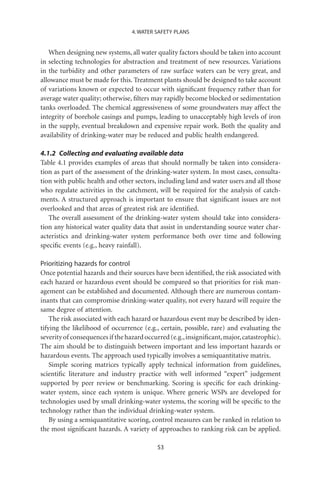
Drinking-water Quality
FIRST ADDENDUM TO THIRD EDITION
            Volume 1
        Recommendations
WHO Library Cataloguing-in-Publication Data
   World Health Organization.
    Guidelines for drinking-water quality [electronic resource] :
    incorporating first addendum. Vol. 1, Recommendations. – 3rd ed.
        Electronic version for the Web.
       1.Potable water – standards. 2.Water – standards. 3.Water quality –
    standards. 4.Guidelines. I. Title.
       ISBN 92 4 154696 4                                                (NLM classification: WA 675)


© World Health Organization 2006
All rights reserved. Publications of the World Health Organization can be obtained from WHO Press, World
Health Organization, 20 Avenue Appia, 1211 Geneva 27, Switzerland (tel: +41 22 791 3264; fax: +41 22 791
4857; email: bookorders@who.int). Requests for permission to reproduce or translate WHO publications
– whether for sale or for noncommercial distribution – should be addressed to WHO Press, at the above
address (fax: +41 22 791 4806; email: permissions@who.int).
The designations employed and the presentation of the material in this publication do not imply the expres-
sion of any opinion whatsoever on the part of the World Health Organization concerning the legal status
of any country, territory, city or area or of its authorities, or concerning the delimitation of its frontiers or
boundaries. Dotted lines on maps represent approximate border lines for which there may not yet be full
agreement.
The mention of specific companies or of certain manufacturers’ products does not imply that they are
endorsed or recommended by the World Health Organization in preference to others of a similar nature
that are not mentioned. Errors and omissions excepted, the names of proprietary products are distinguished
by initial capital letters.
All reasonable precautions have been taken by WHO to verify the information contained in this publica-
tion. However, the published material is being distributed without warranty of any kind, either expressed
or implied. The responsibility for the interpretation and use of the material lies with the reader. In no event
shall the World Health Organization be liable for damages arising from its use.
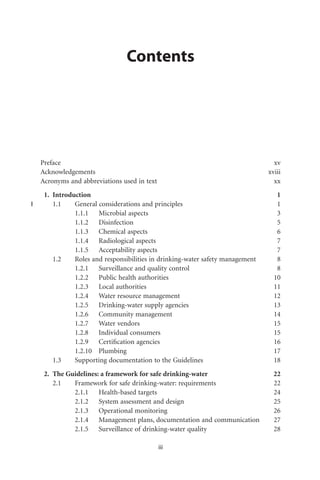
Contents


Preface                                                                       xv
Acknowledgements                                                            xviii
Acronyms and abbreviations used in text                                       xx
 1. Introduction                                                               1
    1.1    General considerations and principles                               1
           1.1.1 Microbial aspects                                             3
           1.1.2 Disinfection                                                  5
           1.1.3 Chemical aspects                                              6
           1.1.4 Radiological aspects                                          7
           1.1.5 Acceptability aspects                                         7
    1.2    Roles and responsibilities in drinking-water safety management      8
           1.2.1 Surveillance and quality control                              8
           1.2.2 Public health authorities                                    10
           1.2.3 Local authorities                                            11
           1.2.4 Water resource management                                    12
           1.2.5 Drinking-water supply agencies                               13
           1.2.6 Community management                                         14
           1.2.7 Water vendors                                                15
           1.2.8 Individual consumers                                         15
           1.2.9 Certification agencies                                        16
           1.2.10 Plumbing                                                    17
    1.3    Supporting documentation to the Guidelines                         18
 2. The Guidelines: a framework for safe drinking-water                       22
    2.1   Framework for safe drinking-water: requirements                     22
          2.1.1 Health-based targets                                          24
          2.1.2 System assessment and design                                  25
          2.1.3 Operational monitoring                                        26
          2.1.4 Management plans, documentation and communication             27
          2.1.5 Surveillance of drinking-water quality                        28

                                          iii
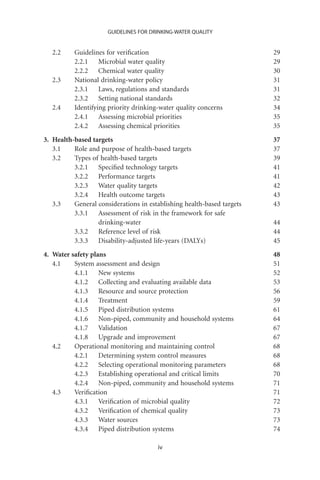
GUIDELINES FOR DRINKING-WATER QUALITY


   2.2    Guidelines for verification                                    29
          2.2.1 Microbial water quality                                 29
          2.2.2 Chemical water quality                                  30
   2.3    National drinking-water policy                                31
          2.3.1 Laws, regulations and standards                         31
          2.3.2 Setting national standards                              32
   2.4    Identifying priority drinking-water quality concerns          34
          2.4.1 Assessing microbial priorities                          35
          2.4.2 Assessing chemical priorities                           35
3. Health-based targets                                                 37
   3.1    Role and purpose of health-based targets                      37
   3.2    Types of health-based targets                                 39
          3.2.1 Specified technology targets                             41
          3.2.2 Performance targets                                     41
          3.2.3 Water quality targets                                   42
          3.2.4 Health outcome targets                                  43
   3.3    General considerations in establishing health-based targets   43
          3.3.1 Assessment of risk in the framework for safe
                  drinking-water                                        44
          3.3.2 Reference level of risk                                 44
          3.3.3 Disability-adjusted life-years (DALYs)                  45
4. Water safety plans                                                   48
   4.1    System assessment and design                                  51
          4.1.1 New systems                                             52
          4.1.2 Collecting and evaluating available data                53
          4.1.3 Resource and source protection                          56
          4.1.4 Treatment                                               59
          4.1.5 Piped distribution systems                              61
          4.1.6 Non-piped, community and household systems              64
          4.1.7 Validation                                              67
          4.1.8 Upgrade and improvement                                 67
   4.2    Operational monitoring and maintaining control                68
          4.2.1 Determining system control measures                     68
          4.2.2 Selecting operational monitoring parameters             68
          4.2.3 Establishing operational and critical limits            70
          4.2.4 Non-piped, community and household systems              71
   4.3    Verification                                                   71
          4.3.1 Verification of microbial quality                        72
          4.3.2 Verification of chemical quality                         73
          4.3.3 Water sources                                           73
          4.3.4 Piped distribution systems                              74

                                       iv
CONTENTS


          4.3.5 Verification for community-managed supplies                 74
          4.3.6 Quality assurance and quality control                      75
  4.4     Management procedures for piped distribution systems             76
          4.4.1 Predictable incidents (“deviations”)                       77
          4.4.2 Unforeseen events                                          77
          4.4.3 Emergencies                                                78
          [4.4.4 Deleted in first addendum to third edition]
          4.4.5 Preparing a monitoring plan                                80
          4.4.6 Supporting programmes                                      80
  4.5     Management of community and household water supplies             81
  4.6     Documentation and communication                                  82
5. Surveillance                                                            84
   5.1     Types of approaches                                             85
           5.1.1 Audit                                                     86
           5.1.2 Direct assessment                                         87
   5.2     Adapting approaches to specific circumstances                    88
           5.2.1 Urban areas in developing countries                       88
           5.2.2 Surveillance of community drinking-water supplies         88
           5.2.3 Surveillance of household treatment and storage systems   89
   5.3     Adequacy of supply                                              90
           5.3.1 Quantity (service level)                                  90
           5.3.2 Accessibility                                             91
           5.3.3 Affordability                                             92
           5.3.4 Continuity                                                92
   5.4     Planning and implementation                                     93
   5.5     Reporting and communicating                                     95
           5.5.1 Interaction with community and consumers                  96
           5.5.2 Regional use of data                                      96
6. Application of the Guidelines in specific circumstances                   99
   6.1    Large buildings                                                   99
          6.1.1 Health risk assessment                                     100
          6.1.2 System assessment                                          100
          6.1.3 Management                                                 101
          6.1.4 Monitoring                                                 101
          6.1.5 Independent surveillance and supporting programmes         102
          6.1.6 Drinking-water quality in health care facilities           102
          6.1.7 Drinking-water quality in schools and day care centres     103
   6.2    Emergencies and disasters                                        104
          6.2.1 Practical considerations                                   105
          6.2.2 Monitoring                                                 106
          6.2.3 Microbial guidelines                                       107

                                      v
GUIDELINES FOR DRINKING-WATER QUALITY


          6.2.4 Sanitary inspections and catchment mapping                108
          6.2.5 Chemical and radiological guidelines                      108
          6.2.6 Testing kits and laboratories                             109
  6.3     Safe drinking-water for travellers                              109
  6.4     Desalination systems                                            111
  6.5     Packaged drinking-water                                         113
          6.5.1 Safety of packaged drinking-water                         113
          6.5.2 Potential health benefits of bottled drinking-water        114
          6.5.3 International standards for bottled drinking-water        114
  6.6     Food production and processing                                  115
  6.7     Aircraft and airports                                           116
          6.7.1 Health risks                                              116
          6.7.2 System risk assessment                                    116
          6.7.3 Operational monitoring                                    116
          6.7.4 Management                                                117
          6.7.5 Surveillance                                              117
  6.8     Ships                                                           117
          6.8.1 Health risks                                              117
          6.8.2 System risk assessment                                    118
          6.8.3 Operational monitoring                                    119
          6.8.4 Management                                                119
          6.8.5 Surveillance                                              120
7. Microbial aspects                                                      121
   7.1   Microbial hazards associated with drinking-water                 121
         7.1.1 Waterborne infections                                      121
         7.1.2 Persistence and growth in water                            124
         7.1.3 Public health aspects                                      125
   7.2   Health-based target setting                                      126
         7.2.1 Health-based targets applied to microbial hazards          126
         7.2.2 Risk assessment approach                                   126
         7.2.3 Risk-based performance target setting                      131
         7.2.4 Presenting the outcome of performance target
                  development                                             133
         7.2.5 Issues in adapting risk-based performance target setting
                  to national/local circumstances                         133
         7.2.6 Health outcome targets                                     134
   7.3   Occurrence and treatment of pathogens                            135
         7.3.1 Occurrence                                                 136
         7.3.2 Treatment                                                  137
   7.4   Verification of microbial safety and quality                      142
   7.5   Methods of detection of faecal indicator bacteria                143


                                      vi
GUIDELINES FOR DRINKING-WATER QUALITY


7.6   Identifying local actions in response to microbial water
      quality problems and emergencies                            144
      7.6.1 Boil water and water avoidance advisories             144
      7.6.2 Actions following an incident                        144c


                                   via
CONTENTS


8. Chemical aspects                                                        145
   8.1   Chemical hazards in drinking-water                                145
   8.2   Derivation of chemical guideline values                           147
         8.2.1 Approaches taken                                            148
         8.2.2 Threshold chemicals                                         149
         8.2.3 Alternative approaches                                      152
         8.2.4 Non-threshold chemicals                                     154
         8.2.5 Data quality                                                154
         8.2.6 Provisional guideline values                                155
         8.2.7 Chemicals with effects on acceptability                     156
         8.2.8 Non-guideline chemicals                                     156
         8.2.9 Mixtures                                                    156
   8.3   Analytical aspects                                                157
         8.3.1 Analytical achievability                                    157
         8.3.2 Analytical methods                                          158
   8.4   Treatment                                                         166
         8.4.1 Treatment achievability                                     166
         8.4.2 Chlorination                                                171
         8.4.3 Ozonation                                                   172
         8.4.4 Other disinfection processes                                172
         8.4.5 Filtration                                                  173
         8.4.6 Aeration                                                    175
         8.4.7 Chemical coagulation                                        175
         8.4.8 Activated carbon adsorption                                 176
         8.4.9 Ion exchange                                                177
         8.4.10 Membrane processes                                         178
         8.4.11 Other treatment processes                                  178
         8.4.12 Disinfection by-products – process control measures        179
         8.4.13 Treatment for corrosion control                            180
   8.5   Guideline values for individual chemicals, by source category     184
         8.5.1 Naturally occurring chemicals                               184
         8.5.2 Chemicals from industrial sources and human dwellings       185
         8.5.3 Chemicals from agricultural activities                      187
         8.5.4 Chemicals used in water treatment or from materials in
                  contact with drinking-water                               188
         8.5.5 Pesticides used in water for public health purposes          190
         8.5.6 Cyanobacterial toxins                                        192
   8.6   Identifying local actions in response to chemical water quality
         problems and emergencies                                           196
         8.6.1 Trigger for action                                          196a
         8.6.2 Investigating the situation                                 196a
         8.6.3 Talking to the right people                                 196b

                                     vii
CONTENTS


          8.6.4  Informing the public                                     196b
          8.6.5  Evaluating the significance to public health and
                 individuals                                              196b
          8.6.6 Determining appropriate action                            196e
          8.6.7 Consumer acceptability                                    196e
          8.6.8 Ensuring remedial action, preventing recurrence and
                 updating the water safety plan                           196e
          8.6.9 Mixtures                                                  196f
          8.6.10 Water avoidance advisories                               196f
9. Radiological aspects                                                   197
   9.1    Sources and health effects of radiation exposure                198
          9.1.1 Radiation exposure through drinking-water                 200
          9.1.2 Radiation-induced health effects through drinking-water   200


                                    viia
GUIDELINES FOR DRINKING-WATER QUALITY


    9.2    Units of radioactivity and radiation dose                  201
    9.3    Guidance levels for radionuclides in drinking-water        202
    9.4    Monitoring and assessment for dissolved radionuclides      204
           9.4.1 Screening of drinking-water supplies                 204
           9.4.2 Strategy for assessing drinking-water                205
           9.4.3 Remedial measures                                    205
    9.5    Radon                                                      206
           9.5.1 Radon in air and water                               206
           9.5.2 Risk                                                 207
           9.5.3 Guidance on radon in drinking-water supplies         207
    9.6    Sampling, analysis and reporting                           207
           9.6.1 Measuring gross alpha and gross beta activity
                   concentrations                                     207
           [9.6.2 Deleted in first addendum to third edition]
           9.6.3 Measuring radon                                      208
           9.6.4 Sampling                                             209
           9.6.5 Reporting of results                                 209

10. Acceptability aspects                                             210
    10.1 Taste, odour and appearance                                  211
           10.1.1 Biologically derived contaminants                   211
           10.1.2 Chemically derived contaminants                     213
           10.1.3 Treatment of taste, odour and appearance problems   219
    10.2 Temperature                                                  220

11. Microbial fact sheets                                             221
    11.1 Bacterial pathogens                                          222
          11.1.1 Acinetobacter                                        222
          11.1.2 Aeromonas                                            224
          11.1.3 Bacillus                                             225
          11.1.4 Burkholderia pseudomallei                            226
          11.1.5 Campylobacter                                        228
          11.1.6 Escherichia coli pathogenic strains                  229
          11.1.7 Helicobacter pylori                                  231
          11.1.8 Klebsiella                                           232
          11.1.9 Legionella                                           233
          11.1.10 Mycobacterium                                       235
          11.1.11 Pseudomonas aeruginosa                              237
          11.1.12 Salmonella                                          239
          11.1.13 Shigella                                            240
          11.1.14 Staphylococcus aureus                               242
          11.1.15 Tsukamurella                                        243

                                       viii
CONTENTS


          11.1.16 Vibrio                                                 244
          11.1.17 Yersinia                                               246
   11.2   Viral pathogens                                                247
          11.2.1 Adenoviruses                                            248
          11.2.2 Astroviruses                                            250
          11.2.3 Caliciviruses                                           251
          11.2.4 Enteroviruses                                           253
          11.2.5 Hepatitis A virus                                       254
          11.2.6 Hepatitis E virus                                       256
          11.2.7 Rotaviruses and orthoreoviruses                         257
   11.3   Protozoan pathogens                                            259
          11.3.1 Acanthamoeba                                            259
          11.3.2 Balantidium coli                                        261
          11.3.3 Cryptosporidium                                         262
          11.3.4 Cyclospora cayetanensis                                 264
          11.3.5 Entamoeba histolytica                                   265
          11.3.6 Giardia intestinalis                                    267
          11.3.7 Isospora belli                                          268
          11.3.8 Microsporidia                                           270
          11.3.9 Naegleria fowleri                                       272
          11.3.10 Toxoplasma gondii                                      274
   11.4   Helminth pathogens                                             275
          11.4.1 Dracunculus medinensis                                  276
          11.4.2 Fasciola spp.                                           278
   11.5   Toxic cyanobacteria                                            279
   11.6   Indicator and index organisms                                  281
          11.6.1 Total coliform bacteria                                 282
          11.6.2 Escherichia coli and thermotolerant coliform bacteria   284
          11.6.3 Heterotrophic plate counts                              285
          11.6.4 Intestinal enterococci                                  287
          11.6.5 Clostridium perfringens                                 288
          11.6.6 Coliphages                                              289
          11.6.7 Bacteroides fragilis phages                             292
          11.6.8 Enteric viruses                                         294

12. Chemical fact sheets                                                 296
    12.1 Acrylamide                                                      296
    12.2 Alachlor                                                        297
    12.3 Aldicarb                                                        298
    12.4 Aldrin and dieldrin                                             300
    12.5 Aluminium                                                       301
    12.6 Ammonia                                                         303

                                      ix
GUIDELINES FOR DRINKING-WATER QUALITY


12.7    Antimony                                                      304
12.8    Arsenic                                                       306
12.9    Asbestos                                                      308
12.10   Atrazine                                                      308
12.11   Barium                                                        310
12.12   Bentazone                                                     311
12.13   Benzene                                                       312
12.14   Boron                                                         313
12.15   Bromate                                                       315
12.16   Brominated acetic acids                                       316
12.17   Cadmium                                                       317
12.18   Carbofuran                                                    319
12.19   Carbon tetrachloride                                          320
12.20   Chloral hydrate (trichloroacetaldehyde)                       321
12.21   Chlordane                                                     323
12.22   Chloride                                                      324
12.23   Chlorine                                                      325
12.24   Chlorite and chlorate                                         326
12.25   Chloroacetones                                                329
12.26   Chlorophenols (2-chlorophenol, 2,4-dichlorophenol,
        2,4,6-trichlorophenol)                                        329
12.27   Chloropicrin                                                  331
12.28   Chlorotoluron                                                 332
12.29   Chlorpyrifos                                                  333
12.30   Chromium                                                      334
12.31   Copper                                                        335
12.32   Cyanazine                                                     337
12.33   Cyanide                                                       339
12.34   Cyanogen chloride                                             340
12.35   2,4-D (2,4-dichlorophenoxyacetic acid)                        340
12.36   2,4-DB                                                        342
12.37   DDT and metabolites                                           343
12.38   Dialkyltins                                                   345
12.39   1,2-Dibromo-3-chloropropane (DBCP)                            346
12.40   1,2-Dibromoethane (ethylene dibromide)                        347
12.41   Dichloroacetic acid                                           349
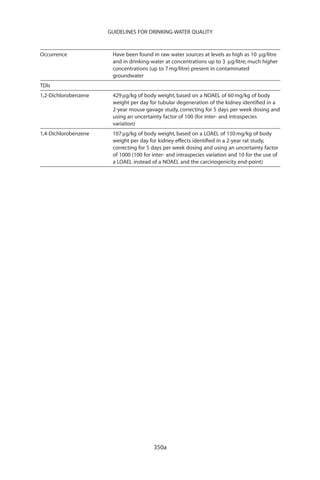
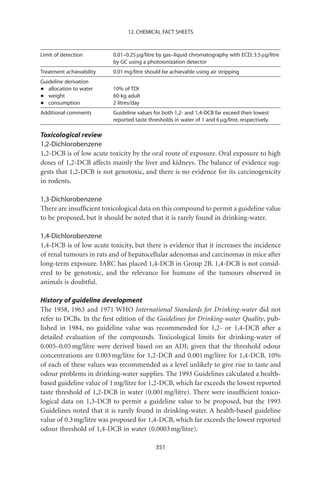
12.42   Dichlorobenzenes (1,2-dichlorobenzene, 1,3-dichlorobenzene,
        1,4-dichlorobenzene)                                          350
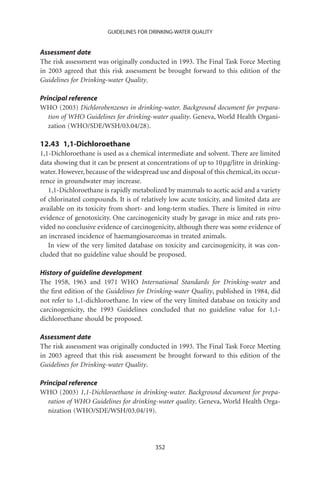
12.43   1,1-Dichloroethane                                            352
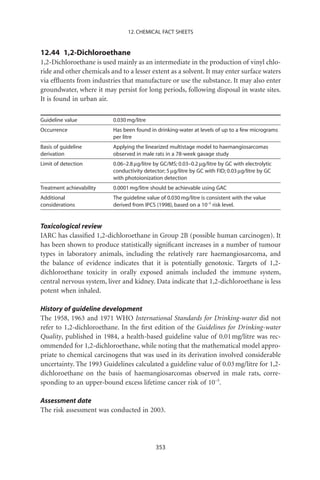
12.44   1,2-Dichloroethane                                            353
12.45   1,1-Dichloroethene                                            354
12.46   1,2-Dichloroethene                                            355

                                    x
CONTENTS


12.47 Dichloromethane                                               357
12.48 1,2-Dichloropropane (1,2-DCP)                                 358
12.49 1,3-Dichloropropane                                           359
12.50 1,3-Dichloropropene                                           360
12.51 Dichlorprop (2,4-DP)                                          361
12.52 Di(2-ethylhexyl)adipate                                       362
12.53 Di(2-ethylhexyl)phthalate                                     363
12.54 Dimethoate                                                    364
12.54(a) 1,4-Dioxane                                                366
12.55 Diquat                                                       366a
12.56 Edetic acid (EDTA)                                            367
12.57 Endosulfan                                                    368
12.58 Endrin                                                        369
12.59 Epichlorohydrin                                               370
12.60 Ethylbenzene                                                  372
12.61 Fenitrothion                                                  373
12.62 Fenoprop (2,4,5-TP; 2,4,5-trichlorophenoxy propionic acid)    374
12.63 Fluoride                                                      375
12.64 Formaldehyde                                                  377
12.65 Glyphosate and AMPA                                           379
12.66 Halogenated acetonitriles (dichloroacetonitrile,
       dibromoacetonitrile, bromochloroacetonitrile,
       trichloroacetonitrile)                                      380
12.67 Hardness                                                     382
12.68 Heptachlor and heptachlor epoxide                            383
12.69 Hexachlorobenzene (HCB)                                      385
12.70 Hexachlorobutadiene (HCBD)                                   386
12.71 Hydrogen sulfide                                              387
12.72 Inorganic tin                                                388
12.73 Iodine                                                       389
12.74 Iron                                                         390
12.75 Isoproturon                                                  391
12.76 Lead                                                         392
12.77 Lindane                                                      394
12.78 Malathion                                                    396
12.79 Manganese                                                    397
12.80 MCPA [4-(2-methyl-4-chlorophenoxy)acetic acid]               399
12.81 Mecoprop (MCPP; [2(2-methyl-chlorophenoxy) propionic
       acid])                                                      401
12.82 Mercury                                                      402
12.83 Methoxychlor                                                 403
12.84 Methyl parathion                                             404

                                   xi
GUIDELINES FOR DRINKING-WATER QUALITY


12.84(a) Methyl tertiary-butyl ether (MTBE)                405
12.85 Metolachlor                                         405a


                                   xia
GUIDELINES FOR DRINKING-WATER QUALITY


12.86 Microcystin-LR                                        407
12.87 Molinate                                              408
12.88 Molybdenum                                            410
12.89 Monochloramine                                        411
12.90 Monochloroacetic acid                                 412
12.91 Monochlorobenzene                                     413
12.92 MX                                                    414
12.93 Nickel                                                415
12.94 Nitrate and nitrite                                   417
12.95 Nitrilotriacetic acid (NTA)                           420
12.96 Parathion                                             421
12.97 Pendimethalin                                         422
12.98 Pentachlorophenol (PCP)                               424
12.99 Permethrin                                            425
12.99(a) Petroleum products                                426a
12.100 pH                                                  426b
12.101 2-Phenylphenol and its sodium salt                   427
12.102 Polynuclear aromatic hydrocarbons (PAHs)             428
12.103 Propanil                                             430
12.104 Pyriproxyfen                                         431
12.105 Selenium                                             432
12.106 Silver                                               434
12.107 Simazine                                             435
12.108 Sodium                                               436
12.109 Styrene                                              437
12.110 Sulfate                                              438
12.111 2,4,5-T (2,4,5-trichlorophenoxyacetic acid)          439
12.112 Terbuthylazine (TBA)                                 440
12.113 Tetrachloroethene                                    442
12.114 Toluene                                              443
12.115 Total dissolved solids (TDS)                         444
12.116 Trichloroacetic acid                                 445
12.117 Trichlorobenzenes (total)                            446
12.118 1,1,1-Trichloroethane                                447
12.119 Trichloroethene                                      448
12.120 Trifluralin                                           450
12.121 Trihalomethanes (bromoform, bromodichloromethane,
       dibromochloromethane, chloroform)                    451
12.122 Uranium                                              454
12.123 Vinyl chloride                                       456
12.124 Xylenes                                              458
12.125 Zinc                                                 459

                                  xii
CONTENTS


Annex 1 Bibliography                                                  461
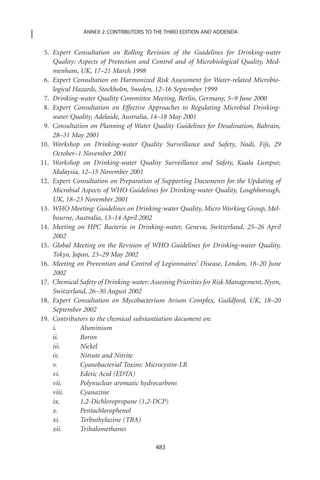
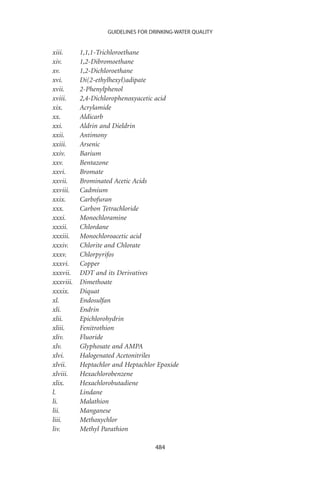
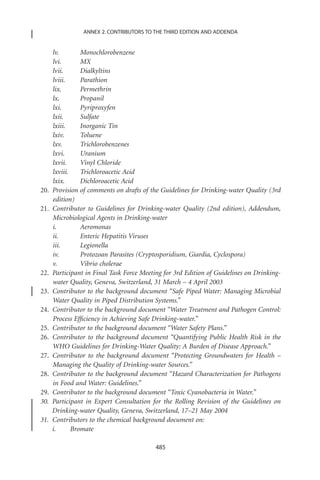
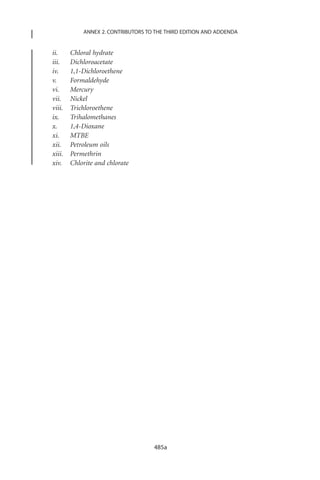
Annex 2 Contributors to the development of the third edition of the
        Guidelines for Drinking-water Quality                         467
[Annex 3 Deleted in first addendum to third edition]
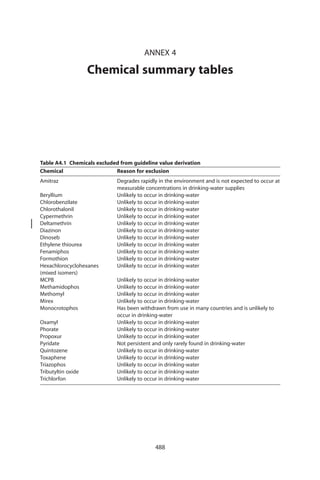
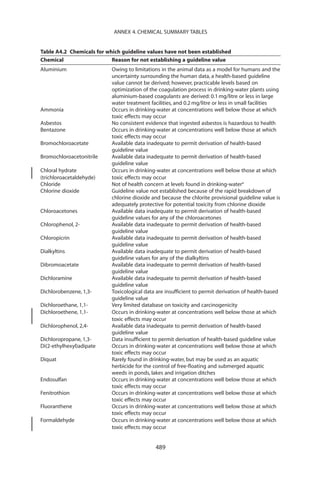
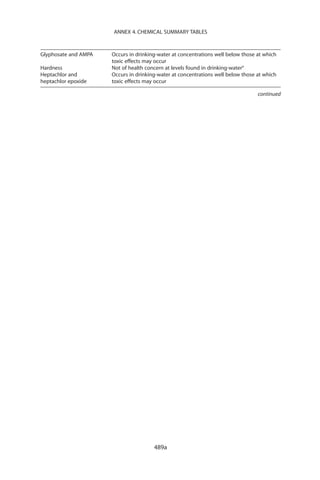
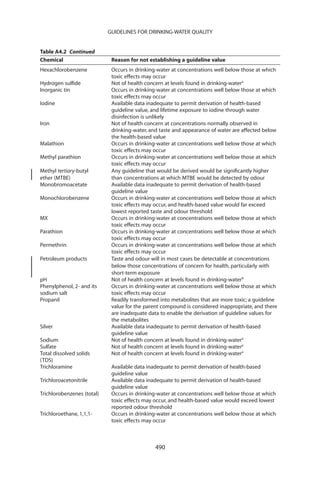
Annex 4 Chemical summary tables                                       488

Index                                                                 494


                                      xiii
Preface


A    ccess to safe drinking-water is essential to health, a basic human right and a com-
     ponent of effective policy for health protection.
   The importance of water, sanitation and hygiene for health and development has
been reflected in the outcomes of a series of international policy forums. These have
included health-oriented conferences such as the International Conference on
Primary Health Care, held in Alma-Ata, Kazakhstan (former Soviet Union), in 1978.
They have also included water-oriented conferences such as the 1977 World Water
Conference in Mar del Plata, Argentina, which launched the water supply and sanita-
tion decade of 1981–1990, as well as the Millennium Development Goals adopted by
the General Assembly of the United Nations (UN) in 2000 and the outcome of the
Johannesburg World Summit for Sustainable Development in 2002. Most recently,
the UN General Assembly declared the period from 2005 to 2015 as the International
Decade for Action, “Water for Life.”
   Access to safe drinking-water is important as a health and development issue at a
national, regional and local level. In some regions, it has been shown that investments
in water supply and sanitation can yield a net economic benefit, since the reductions
in adverse health effects and health care costs outweigh the costs of undertaking the
interventions. This is true for major water supply infrastructure investments through
to water treatment in the home. Experience has also shown that interventions in
improving access to safe water favour the poor in particular, whether in rural or urban
areas, and can be an effective part of poverty alleviation strategies.
   In 1983–1984 and in 1993–1997, the World Health Organization (WHO) published
the first and second editions of the Guidelines for Drinking-water Quality in three
volumes as successors to previous WHO International Standards. In 1995, the
decision was made to pursue the further development of the Guidelines through a
process of rolling revision. This led to the publication of addenda to the second edition
of the Guidelines, on chemical and microbial aspects, in 1998, 1999 and 2002; the
publication of a text on Toxic Cyanobacteria in Water; and the preparation of expert
reviews on key issues preparatory to the development of a third edition of the
Guidelines.

                                           xv
GUIDELINES FOR DRINKING-WATER QUALITY


    In 2000, a detailed plan of work was agreed upon for development of the third
edition of the Guidelines. As with previous editions, this work was shared between
WHO Headquarters and the WHO Regional Office for Europe (EURO). Leading the
process of the development of the third edition were the Programme on Water
Sanitation and Health within Headquarters and the European Centre for Environ-
ment and Health, Rome, within EURO. Within WHO Headquarters, the Programme
on Chemical Safety provided inputs on some chemical hazards, and the Programme
on Radiological Safety contributed to the section dealing with radiological aspects. All
six WHO Regional Offices participated in the process.
    This revised Volume 1 of the Guidelines is accompanied by a series of publications
providing information on the assessment and management of risks associated with
microbial hazards and by internationally peer-reviewed risk assessments for specific
chemicals. These replace the corresponding parts of the previous Volume 2. Volume
3 provides guidance on good practice in surveillance, monitoring and assessment of
drinking-water quality in community supplies. The Guidelines are also accompanied
by other publications explaining the scientific basis of their development and pro-
viding guidance on good practice in implementation.
    This volume of the Guidelines for Drinking-water Quality explains requirements to
ensure drinking-water safety, including minimum procedures and specific guideline
values, and how those requirements are intended to be used. The volume also
describes the approaches used in deriving the guidelines, including guideline values.
It includes fact sheets on significant microbial and chemical hazards. The develop-
ment of this third edition of the Guidelines for Drinking-water Quality includes a sub-
stantive revision of approaches to ensuring microbial safety. This takes account of
important developments in microbial risk assessment and its linkages to risk man-
agement. The development of this orientation and content was led over an extended
period by Dr Arie Havelaar (RIVM, Netherlands) and Dr Jamie Bartram (WHO).
    Since the second edition of WHO’s Guidelines for Drinking-water Quality, there
have been a number of events that have highlighted the importance and furthered
understanding of various aspects of drinking-water quality and health. These are
reflected in this third edition of the Guidelines.
    These Guidelines supersede those in previous editions (1983–1984, 1993–1997 and
addenda in 1998, 1999 and 2002) and previous International Standards (1958, 1963
and 1971). The Guidelines are recognized as representing the position of the UN
system on issues of drinking-water quality and health by “UN-Water,” the body that
coordinates amongst the 24 UN agencies and programmes concerned with water
issues. This edition of the Guidelines further develops concepts, approaches and infor-
mation in previous editions:

•   Experience has shown that microbial hazards continue to be the primary concern
    in both developing and developed countries. Experience has also shown the value


                                          xvi
PREFACE


    of a systematic approach towards securing microbial safety. This edition includes
    significantly expanded guidance on ensuring microbial safety of drinking-water,
    building on principles – such as the multiple-barrier approach and the importance
    of source protection – considered in previous editions. The Guidelines are accom-
    panied by documentation describing approaches towards fulfilling requirements
    for microbial safety and providing guidance to good practice in ensuring that safety
    is achieved.
•   Information on many chemicals has been revised. This includes information on
    chemicals not considered previously; revisions to take account of new scientific
    information; and, in some cases, lesser coverage where new information suggests a
    lesser priority.
•   Experience has also shown the necessity of recognizing the important roles of many
    different stakeholders in ensuring drinking-water safety. This edition includes dis-
    cussion of the roles and responsibilities of key stakeholders in ensuring drinking-
    water safety.
•   The need for different tools and approaches in supporting safe management of
    large piped supplies versus small community supplies remains relevant, and this
    edition describes the principal characteristics of the different approaches.
•   There has been increasing recognition that only a few key chemicals cause large-
    scale health effects through drinking-water exposure. These include fluoride,
    arsenic and nitrate. Other chemicals, such as lead, selenium and uranium, may also
    be significant under certain conditions. Interest in chemical hazards in drinking-
    water was highlighted by recognition of the scale of arsenic exposure through
    drinking-water in Bangladesh and elsewhere. The revised Guidelines and associ-
    ated publications provide guidance on identifying local priorities and on manage-
    ment of the chemicals associated with large-scale effects.
•   WHO is frequently approached for guidance on the application of the Guidelines
    for Drinking-water Quality to situations other than community supplies or
    managed utilities. This revised edition includes information on application of the
    Guidelines to several specific circumstances and is accompanied by texts dealing
    with some of these in greater detail.
   The Guidelines for Drinking-water Quality are kept up to date through a process of
rolling revision, which leads to periodic release of documents that may add to or
supersede information in this volume. This version of the Guidelines integrates the
third edition, which was published in 2004, with the first addendum to the third
edition, published in 2005.
   The Guidelines are addressed primarily to water and health regulators, policy-
makers and their advisors, to assist in the development of national standards. The
Guidelines and associated documents are also used by many others as a source of
information on water quality and health and on effective management approaches.


                                          xvii
Acknowledgements


T   he preparation of the current edition of the Guidelines for Drinking-water Quality
    and supporting documentation covered a period of eight years and involved the
participation of over 490 experts from 90 developing and developed countries. The
contributions of all who participated in the preparation and finalization of the Guide-
lines for Drinking-water Quality, including those individuals listed in Annex 2, are
gratefully acknowledged.
   The work of the following Working Groups was crucial to the development of the
third edition of the Guidelines for Drinking-water Quality:

Microbial aspects working group
Ms T. Boonyakarnkul, Department of Health, Thailand (Surveillance and control)
Dr D. Cunliffe, SA Department of Human Services, Australia (Public health)
Prof. W. Grabow, University of Pretoria, South Africa (Pathogen-specific information)
Dr A. Havelaar, RIVM, The Netherlands (Working Group coordinator; Risk
  assessment)
Prof. M. Sobsey, University of North Carolina, USA (Risk management)

Chemical aspects working group
Mr J.K. Fawell, United Kingdom (Organic and inorganic constituents)
Ms M. Giddings, Health Canada (Disinfectants and disinfection by-products)
Prof. Y. Magara, Hokkaido University, Japan (Analytical achievability)
Dr E. Ohanian, EPA, USA (Disinfectants and disinfection by-products)
Dr P. Toft, Canada (Pesticides)

Protection and control working group
Dr I. Chorus, Umweltbundesamt, Germany (Resource and source protection)
Dr J. Cotruvo, USA (Materials and additives)
Dr G. Howard, DfID, Bangladesh, and formerly Loughborough University, United
  Kingdom (Monitoring and assessment)
Mr P. Jackson, WRc-NSF, United Kingdom (Treatment achievability)

                                         xviii
ACKNOWLEDGEMENTS


  The WHO coordinators were:

—Dr J. Bartram, Coordinator, Programme on Water Sanitation and Health, WHO
 Headquarters, and formerly WHO European Centre for Environmental Health
—Mr P. Callan, Programme on Water Sanitation and Health, WHO Headquarters, on
 secondment from National Health and Medical Research Council, Australia

   Ms C. Vickers acted as a liaison between the Working Groups and the International
Programme on Chemical Safety, WHO Headquarters.
   Ms Marla Sheffer of Ottawa, Canada, was responsible for the editing of the Guide-
lines. Mr Hiroki Hashizume provided support to the work of the Chemical Aspects
Working Group. Ms Mary-Ann Lundby, Ms Grazia Motturi and Ms Penny Ward pro-
vided secretarial and administrative support throughout the process and to individ-
ual meetings.
   The preparation of these Guidelines would not have been possible without the gen-
erous support of the following, which is gratefully acknowledged: the Ministry of
Health of Italy; the Ministry of Health, Labour and Welfare of Japan; the National
Health and Medical Research Council, Australia; the Swedish International Develop-
ment Cooperation Agency, Sweden; and the United States Environmental Protection
Agency.


                                        xix
Acronyms and abbreviations
         used in text


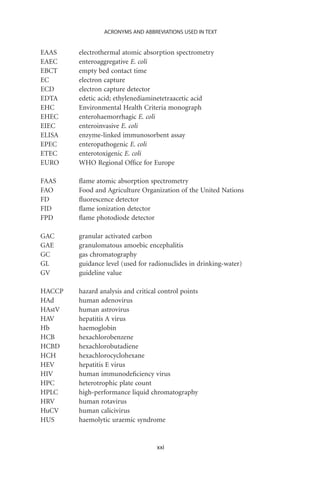
AAS     atomic absorption spectrometry
AD      Alzheimer disease
ADI     acceptable daily intake
AES     atomic emission spectrometry
AIDS    acquired immunodeficiency syndrome
AMPA    aminomethylphosphonic acid

BaP     benzo[a]pyrene
BDCM    bromodichloromethane
BMD     benchmark dose
bw      body weight

CAC     Codex Alimentarius Commission
CAS     Chemical Abstracts Service
CICAD   Concise International Chemical Assessment Document
CSAF    chemical-specific adjustment factor
Ct      product of disinfectant concentration and contact time

DAEC    diffusely adherent E. coli
DALY    disability-adjusted life-year
DBCM    dibromochloromethane
DBCP    1,2-dibromo-3-chloropropane
DBP     disinfection by-product
DCA     dichloroacetic acid
DCB     dichlorobenzene
DCP     dichloropropane
DDT     dichlorodiphenyltrichloroethane
DEHA    di(2-ethylhexyl)adipate
DEHP    di(2-ethylhexyl)phthalate
DNA     deoxyribonucleic acid

                                   xx
ACRONYMS AND ABBREVIATIONS USED IN TEXT


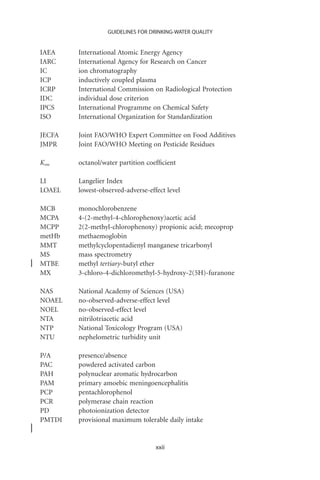
EAAS    electrothermal atomic absorption spectrometry
EAEC    enteroaggregative E. coli
EBCT    empty bed contact time
EC      electron capture
ECD     electron capture detector
EDTA    edetic acid; ethylenediaminetetraacetic acid
EHC     Environmental Health Criteria monograph
EHEC    enterohaemorrhagic E. coli
EIEC    enteroinvasive E. coli
ELISA   enzyme-linked immunosorbent assay
EPEC    enteropathogenic E. coli
ETEC    enterotoxigenic E. coli
EURO    WHO Regional Office for Europe

FAAS    flame atomic absorption spectrometry
FAO     Food and Agriculture Organization of the United Nations
FD      fluorescence detector
FID     flame ionization detector
FPD     flame photodiode detector

GAC     granular activated carbon
GAE     granulomatous amoebic encephalitis
GC      gas chromatography
GL      guidance level (used for radionuclides in drinking-water)
GV      guideline value

HACCP   hazard analysis and critical control points
HAd     human adenovirus
HAstV   human astrovirus
HAV     hepatitis A virus
Hb      haemoglobin
HCB     hexachlorobenzene
HCBD    hexachlorobutadiene
HCH     hexachlorocyclohexane
HEV     hepatitis E virus
HIV     human immunodeficiency virus
HPC     heterotrophic plate count
HPLC    high-performance liquid chromatography
HRV     human rotavirus
HuCV    human calicivirus
HUS     haemolytic uraemic syndrome


                                    xxi
GUIDELINES FOR DRINKING-WATER QUALITY


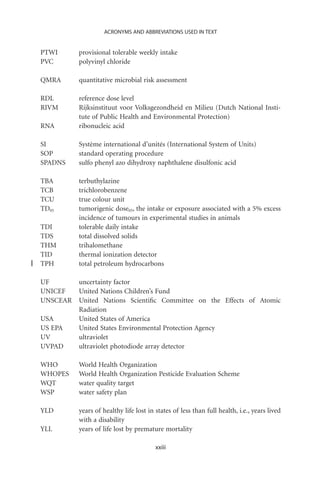
IAEA    International Atomic Energy Agency
IARC    International Agency for Research on Cancer
IC      ion chromatography
ICP     inductively coupled plasma
ICRP    International Commission on Radiological Protection
IDC     individual dose criterion
IPCS    International Programme on Chemical Safety
ISO     International Organization for Standardization

JECFA   Joint FAO/WHO Expert Committee on Food Additives
JMPR    Joint FAO/WHO Meeting on Pesticide Residues

Kow     octanol/water partition coefficient

LI      Langelier Index
LOAEL   lowest-observed-adverse-effect level

MCB     monochlorobenzene
MCPA    4-(2-methyl-4-chlorophenoxy)acetic acid
MCPP    2(2-methyl-chlorophenoxy) propionic acid; mecoprop
metHb   methaemoglobin
MMT     methylcyclopentadienyl manganese tricarbonyl
MS      mass spectrometry
MTBE    methyl tertiary-butyl ether
MX      3-chloro-4-dichloromethyl-5-hydroxy-2(5H)-furanone

NAS     National Academy of Sciences (USA)
NOAEL   no-observed-adverse-effect level
NOEL    no-observed-effect level
NTA     nitrilotriacetic acid
NTP     National Toxicology Program (USA)
NTU     nephelometric turbidity unit

P/A     presence/absence
PAC     powdered activated carbon
PAH     polynuclear aromatic hydrocarbon
PAM     primary amoebic meningoencephalitis
PCP     pentachlorophenol
PCR     polymerase chain reaction
PD      photoionization detector
PMTDI   provisional maximum tolerable daily intake


                                   xxii
GUIDELINES FOR DRINKING-WATER QUALITY


PT     purge and trap
PTDI   provisional tolerable daily intake


                                  xxiia
ACRONYMS AND ABBREVIATIONS USED IN TEXT


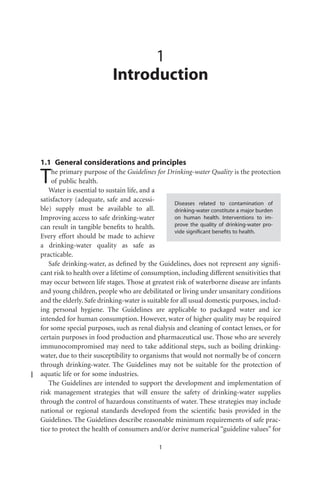
PTWI      provisional tolerable weekly intake
PVC       polyvinyl chloride

QMRA      quantitative microbial risk assessment

RDL       reference dose level
RIVM      Rijksinstituut voor Volksgezondheid en Milieu (Dutch National Insti-
          tute of Public Health and Environmental Protection)
RNA       ribonucleic acid

SI        Système international d’unités (International System of Units)
SOP       standard operating procedure
SPADNS    sulfo phenyl azo dihydroxy naphthalene disulfonic acid

TBA       terbuthylazine
TCB       trichlorobenzene
TCU       true colour unit
TD05      tumorigenic dose05, the intake or exposure associated with a 5% excess
          incidence of tumours in experimental studies in animals
TDI       tolerable daily intake
TDS       total dissolved solids
THM       trihalomethane
TID       thermal ionization detector
TPH       total petroleum hydrocarbons

UF        uncertainty factor
UNICEF    United Nations Children’s Fund
UNSCEAR   United Nations Scientific Committee on the Effects of Atomic
          Radiation
USA       United States of America
US EPA    United States Environmental Protection Agency
UV        ultraviolet
UVPAD     ultraviolet photodiode array detector

WHO       World Health Organization
WHOPES    World Health Organization Pesticide Evaluation Scheme
WQT       water quality target
WSP       water safety plan

YLD       years of healthy life lost in states of less than full health, i.e., years lived
          with a disability
YLL       years of life lost by premature mortality

                                        xxiii
xxiv
1
                           Introduction


1.1 General considerations and principles

T   he primary purpose of the Guidelines for Drinking-water Quality is the protection
    of public health.
   Water is essential to sustain life, and a
satisfactory (adequate, safe and accessi-
                                                   Diseases related to contamination of
ble) supply must be available to all.              drinking-water constitute a major burden
Improving access to safe drinking-water            on human health. Interventions to im-
can result in tangible benefits to health.          prove the quality of drinking-water pro-
                                                   vide significant benefits to health.
Every effort should be made to achieve
a drinking-water quality as safe as
practicable.
   Safe drinking-water, as defined by the Guidelines, does not represent any signifi-
cant risk to health over a lifetime of consumption, including different sensitivities that
may occur between life stages. Those at greatest risk of waterborne disease are infants
and young children, people who are debilitated or living under unsanitary conditions
and the elderly. Safe drinking-water is suitable for all usual domestic purposes, includ-
ing personal hygiene. The Guidelines are applicable to packaged water and ice
intended for human consumption. However, water of higher quality may be required
for some special purposes, such as renal dialysis and cleaning of contact lenses, or for
certain purposes in food production and pharmaceutical use. Those who are severely
immunocompromised may need to take additional steps, such as boiling drinking-
water, due to their susceptibility to organisms that would not normally be of concern
through drinking-water. The Guidelines may not be suitable for the protection of
aquatic life or for some industries.
   The Guidelines are intended to support the development and implementation of
risk management strategies that will ensure the safety of drinking-water supplies
through the control of hazardous constituents of water. These strategies may include
national or regional standards developed from the scientific basis provided in the
Guidelines. The Guidelines describe reasonable minimum requirements of safe prac-
tice to protect the health of consumers and/or derive numerical “guideline values” for

                                            1
GUIDELINES FOR DRINKING-WATER QUALITY


constituents of water or indicators of water quality. In order to define mandatory
limits, it is preferable to consider the guidelines in the context of local or national
environmental, social, economic and cultural conditions.
   The main reason for not promoting the adoption of international standards for
drinking-water quality is the advantage provided by the use of a risk–benefit approach
(qualitative or quantitative) in the establishment of national standards and regulations.
Further, the Guidelines are best implemented through an integrated preventive man-
agement framework for safety applied from catchment to consumer. The Guidelines
provide a scientific point of departure for national authorities to develop drinking-
water regulations and standards appropriate for the national situation. In developing
standards and regulations, care should be taken to ensure that scarce resources are not
unnecessarily diverted to the development of standards and the monitoring of sub-
stances of relatively minor importance to public health. The approach followed in these
Guidelines is intended to lead to national standards and regulations that can be readily
implemented and enforced and are protective of public health.
   The nature and form of drinking-water standards may vary among countries and
regions. There is no single approach that is universally applicable. It is essential in the
development and implementation of standards that the current and planned legisla-
tion relating to water, health and local government are taken into account and that
the capacity to develop and implement regulations is assessed. Approaches that may
work in one country or region will not necessarily transfer to other countries or
regions. It is essential that each country review its needs and capacities in developing
a regulatory framework.
   The judgement of safety – or what is an acceptable level of risk in particular cir-
cumstances – is a matter in which society as a whole has a role to play. The final judge-
ment as to whether the benefit resulting from the adoption of any of the guidelines
and guideline values as national or local standards justifies the cost is for each country
to decide.
   Although the Guidelines describe a quality of water that is acceptable for lifelong
consumption, the establishment of these Guidelines, including guideline values,
should not be regarded as implying that the quality of drinking-water may be
degraded to the recommended level. Indeed, a continuous effort should be made to
maintain drinking-water quality at the highest possible level.
   An important concept in the allocation of resources to improving drinking-water
safety is that of incremental improvements towards long-term targets. Priorities set
to remedy the most urgent problems (e.g., protection from pathogens; see
section 1.1.1) may be linked to long-term targets of further water quality im-
provements (e.g., improvements in the acceptability of drinking-water; see section
1.1.5).
   The basic and essential requirements to ensure the safety of drinking-water are a
“framework” for safe drinking-water, comprising health-based targets established by


                                            2
1. INTRODUCTION


a competent health authority; adequate and properly managed systems (adequate
infrastructure, proper monitoring and effective planning and management); and a
system of independent surveillance.
   A holistic approach to drinking-water supply risk assessment and risk management
increases confidence in the safety of drinking-water. This approach entails systematic
assessment of risks throughout a drinking-water supply – from the catchment and its
source water through to the consumer – and identification of the ways in which these
risks can be managed, including methods to ensure that control measures are working
effectively. It incorporates strategies to deal with day-to-day management of water
quality, including upsets and failures.
   The Guidelines are applicable to large metropolitan and small community piped
drinking-water systems and to non-piped drinking-water systems in communities and
in individual dwellings. The Guidelines are also applicable to a range of specific cir-
cumstances, including large buildings, travellers and conveyances.
   The great majority of evident water-related health problems are the result of micro-
bial (bacteriological, viral, protozoan or other biological) contamination. Neverthe-
less, an appreciable number of serious health concerns may occur as a result of the
chemical contamination of drinking-water.

1.1.1 Microbial aspects
Securing the microbial safety of drinking-water supplies is based on the use of
multiple barriers, from catchment to consumer, to prevent the contamination of
drinking-water or to reduce contamination to levels not injurious to health. Safety is
increased if multiple barriers are in place, including protection of water resources,
proper selection and operation of a series of treatment steps and management of dis-
tribution systems (piped or otherwise)
to maintain and protect treated water
quality. The preferred strategy is a
                                                  The potential health consequences of
management approach that places the               microbial contamination are such that
primary emphasis on preventing or                 its control must always be of para-
reducing the entry of pathogens into              mount importance and must never be
                                                  compromised.
water sources and reducing reliance on
treatment processes for removal of
pathogens.
   In general terms, the greatest microbial risks are associated with ingestion of water
that is contaminated with human or animal (including bird) faeces. Faeces can be a
source of pathogenic bacteria, viruses, protozoa and helminths.
   Faecally derived pathogens are the principal concerns in setting health-based
targets for microbial safety. Microbial water quality often varies rapidly and over a
wide range. Short-term peaks in pathogen concentration may increase disease risks
considerably and may trigger outbreaks of waterborne disease. Furthermore, by the
time microbial contamination is detected, many people may have been exposed. For

                                           3
GUIDELINES FOR DRINKING-WATER QUALITY


these reasons, reliance cannot be placed solely on end-product testing, even when
frequent, to ensure the microbial safety of drinking-water.
   Particular attention should be directed to a water safety framework and imple-
menting comprehensive water safety plans (WSPs) to consistently ensure drinking-
water safety and thereby protect public health (see chapter 4). Management of
microbial drinking-water safety requires a system-wide assessment to determine
potential hazards that can affect the system (see section 4.1); identification of the
control measures needed to reduce or eliminate the hazards, and operational moni-
toring to ensure that barriers within the system are functioning efficiently (see section
4.2); and the development of management plans to describe actions taken under both
normal and incident conditions. These are the three components of a WSP.
   Failure to ensure drinking-water safety may expose the community to the risk of
outbreaks of intestinal and other infectious diseases. Drinking-water-borne outbreaks
are particularly to be avoided because of their capacity to result in the simultaneous
infection of a large number of persons and potentially a high proportion of the
community.
   In addition to faecally borne pathogens, other microbial hazards (e.g., guinea worm
[Dracunculus medinensis], toxic cyanobacteria and Legionella) may be of public health
importance under specific circumstances.
   The infective stages of many helminths, such as parasitic roundworms and flat-
worms, can be transmitted to humans through drinking-water. As a single mature
larva or fertilized egg can cause infection, these should be absent from drinking-water.
However, the water route is relatively unimportant for helminth infection, except in
the case of the guinea worm.
   Legionella bacteria are ubiquitous in the environment and can proliferate at the
higher temperatures experienced at times in piped drinking-water distribution
systems and more commonly in hot and warm water distribution systems. Exposure
to Legionella from drinking-water is through inhalation and can be controlled through
the implementation of basic water quality management measures in buildings and
through the maintenance of disinfection residuals throughout the piped distribution
system.
   Public health concern regarding cyanobacteria relates to their potential to produce
a variety of toxins, known as “cyanotoxins.” In contrast to pathogenic bacteria,
cyanobacteria do not proliferate within the human body after uptake; they prolifer-
ate only in the aquatic environment before intake. While the toxic peptides (e.g.,
microcystins) are usually contained within the cells and thus may be largely elimi-
nated by filtration, toxic alkaloids such as cylindrospermopsin and neurotoxins are
also released into the water and may break through filtration systems.
   Some microorganisms will grow as biofilms on surfaces in contact with water. With
few exceptions, such as Legionella, most of these organisms do not cause illness in
healthy persons, but they can cause nuisance through generation of tastes and odours
or discoloration of drinking-water supplies. Growth following drinking-water treat-

                                           4
1. INTRODUCTION


ment is often referred to as “regrowth.” It is typically reflected in measurement of
increasing heterotrophic plate counts (HPC) in water samples. Elevated HPC occur
especially in stagnant parts of piped distribution systems, in domestic plumbing, in
some bottled water and in plumbed-in devices such as softeners, carbon filters and
vending machines.
   While water can be a very significant source of infectious organisms, many of the
diseases that may be waterborne may also be transmitted by other routes, including
person-to-person contact, droplets and aerosols and food intake. Depending on cir-
cumstance and in the absence of waterborne outbreaks, these routes may be more
important than waterborne transmission.
   Microbial aspects of water quality are considered in more detail in chapter 7, with
fact sheets on specific microorganisms provided in chapter 11.

1.1.2 Disinfection
Disinfection is of unquestionable importance in the supply of safe drinking-water.
The destruction of microbial pathogens is essential and very commonly involves the
use of reactive chemical agents such as chlorine.
   Disinfection is an effective barrier to many pathogens (especially bacteria) during
drinking-water treatment and should be used for surface waters and for groundwa-
ter subject to faecal contamination. Residual disinfection is used to provide a partial
safeguard against low-level contamination and growth within the distribution system.
   Chemical disinfection of a drinking-water supply that is faecally contaminated will
reduce the overall risk of disease but may not necessarily render the supply safe. For
example, chlorine disinfection of drinking-water has limitations against the proto-
zoan pathogens – in particular Cryptosporidium – and some viruses. Disinfection effi-
cacy may also be unsatisfactory against pathogens within flocs or particles, which
protect them from disinfectant action. High levels of turbidity can protect microor-
ganisms from the effects of disinfection, stimulate the growth of bacteria and give rise
to a significant chlorine demand. An effective overall management strategy incorpo-
rates multiple barriers, including source water protection and appropriate treatment
processes, as well as protection during storage and distribution in conjunction with
disinfection to prevent or remove microbial contamination.
   The use of chemical disinfectants in water treatment usually results in the forma-
tion of chemical by-products. However, the risks to health from these by-products are
extremely small in comparison with the
risks associated with inadequate disin-          Disinfection should not be compromised
fection, and it is important that disinfec-      in attempting to control disinfection by-
tion not be compromised in attempting            products (DBPs).

to control such by-products.
   Some disinfectants such as chlorine can be easily monitored and controlled as a
drinking-water disinfectant, and frequent monitoring is recommended wherever
chlorination is practised.

                                            5
GUIDELINES FOR DRINKING-WATER QUALITY


   Disinfection of drinking-water is considered in more detail in chapter 8, with fact
sheets on specific disinfectants and DBPs provided in chapter 12.

1.1.3 Chemical aspects
The health concerns associated with chemical constituents of drinking-water differ
from those associated with microbial contamination and arise primarily from the
ability of chemical constituents to cause adverse health effects after prolonged periods
of exposure. There are few chemical constituents of water that can lead to health prob-
lems resulting from a single exposure, except through massive accidental contamina-
tion of a drinking-water supply. Moreover, experience shows that in many, but not all,
such incidents, the water becomes undrinkable owing to unacceptable taste, odour
and appearance.
    In situations where short-term exposure is not likely to lead to health impairment,
it is often most effective to concentrate the available resources for remedial action on
finding and eliminating the source of contamination, rather than on installing expen-
sive drinking-water treatment for the removal of the chemical constituent.
    There are many chemicals that may occur in drinking-water; however, only a few
are of immediate health concern in any given circumstance. The priority given to both
monitoring and remedial action for chemical contaminants in drinking-water should
be managed to ensure that scarce resources are not unnecessarily directed towards
those of little or no health concern.
    Exposure to high levels of fluoride, which occurs naturally, can lead to mottling of
teeth and, in severe cases, crippling skeletal fluorosis. Similarly, arsenic may occur
naturally, and excess exposure to arsenic in drinking-water may result in a significant
risk of cancer and skin lesions. Other naturally occurring chemicals, including
uranium and selenium, may also give rise to health concern when they are present in
excess.
    The presence of nitrate and nitrite in water has been associated with methaemo-
globinaemia, especially in bottle-fed infants. Nitrate may arise from the excessive
application of fertilizers or from leaching of wastewater or other organic wastes into
surface water and groundwater.
    Particularly in areas with aggressive or acidic waters, the use of lead pipes and fit-
tings or solder can result in elevated lead levels in drinking-water, which cause adverse
neurological effects.
    There are few chemicals for which the contribution from drinking-water to overall
intake is an important factor in preventing disease. One example is the effect of flu-
oride in drinking-water in increasing prevention against dental caries. The Guidelines
do not attempt to define minimum desirable concentrations for chemicals in drink-
ing-water.
    Guideline values are derived for many chemical constituents of drinking-water. A
guideline value normally represents the concentration of a constituent that does not
result in any significant risk to health over a lifetime of consumption. A number of

                                           6
1. INTRODUCTION


provisional guideline values have been established based on the practical level of treat-
ment achievability or analytical achievability. In these cases, the guideline value is
higher than the calculated health-based value.
   The chemical aspects of drinking-water quality are considered in more detail in
chapter 8, with fact sheets on specific chemical contaminants provided in chapter 12.

1.1.4 Radiological aspects
The health risk associated with the presence of naturally occurring radionuclides in
drinking-water should also be taken into consideration, although the contribution of
drinking-water to total exposure to radionuclides is very small under normal
circumstances.
   Formal guideline values are not set for individual radionuclides in drinking-water.
Rather, the approach used is based on screening drinking-water for gross alpha and
gross beta radiation activity. While finding levels of activity above screening values
does not indicate any immediate risk to health, it should trigger further investigation
into determining the radionuclides responsible and the possible risks, taking into
account local circumstances.
   The guidance values recommended in this volume do not apply to drinking-water
supplies contaminated during emergencies arising from accidental releases of radioac-
tive substances to the environment.
   Radiological aspects of drinking-water quality are considered in more detail in
chapter 9.

1.1.5 Acceptability aspects
Water should be free of tastes and odours that would be objectionable to the major-
ity of consumers.
   In assessing the quality of drinking-water, consumers rely principally upon their
senses. Microbial, chemical and physical water constituents may affect the appearance,
odour or taste of the water, and the consumer will evaluate the quality and accept-
ability of the water on the basis of these criteria. Although these substances may have
no direct health effects, water that is highly turbid, is highly coloured or has an objec-
tionable taste or odour may be regarded by consumers as unsafe and may be rejected.
In extreme cases, consumers may avoid aesthetically unacceptable but otherwise safe
drinking-water in favour of more pleasant but potentially unsafe sources. It is there-
fore wise to be aware of consumer perceptions and to take into account both health-
related guidelines and aesthetic criteria when assessing drinking-water supplies and
developing regulations and standards.
   Changes in the normal appearance, odour or taste of a drinking-water supply may
signal changes in the quality of the raw water source or deficiencies in the treatment
process and should be investigated.
   Acceptability aspects of drinking-water quality are considered in more detail in
chapter 10.

                                            7
GUIDELINES FOR DRINKING-WATER QUALITY


1.2 Roles and responsibilities in drinking-water
    safety management
Preventive management is the preferred approach to drinking-water safety and should
take account of the characteristics of the drinking-water supply from catchment and
source to its use by consumers. As many aspects of drinking-water quality manage-
ment are often outside the direct responsibility of the water supplier, it is essential that
a collaborative multiagency approach be adopted to ensure that agencies with respon-
sibility for specific areas within the water cycle are involved in the management of
water quality. One example is where catchments and source waters are beyond the
drinking-water supplier’s jurisdiction.
Consultation with other authorities will
generally be necessary for other elements         A preventive integrated management
                                                  approach with collaboration from all rele-
of drinking-water quality management,             vant agencies is the preferred approach to
such as monitoring and reporting                  ensuring drinking-water safety.
requirements, emergency response plans
and communication strategies.
   Major stakeholders that could affect or be affected by decisions or activities of the
drinking-water supplier should be encouraged to coordinate their planning and man-
agement activities where appropriate. These could include, for example, health and
resource management agencies, consumers, industry and plumbers. Appropriate
mechanisms and documentation should be established for stakeholder commitment
and involvement.

1.2.1 Surveillance and quality control
In order to protect public health, a dual-role approach, differentiating the roles and
responsibilities of service providers from those of an authority responsible for inde-
pendent oversight protective of public health (“drinking-water supply surveillance”),
has proven to be effective.
   Organizational arrangements for the maintenance and improvement of drinking-
water supply services should take into account the vital and complementary roles of
the agency responsible for surveillance and of the water supplier. The two functions
of surveillance and quality control are best performed by separate and independent
entities because of the conflict of interest that arises when the two are combined. In
this:

   — national agencies provide a framework of targets, standards and legislation to
     enable and require suppliers to meet defined obligations;
   — agencies involved in supplying water for consumption by any means should be
     required to ensure and verify that the systems they administer are capable of
     delivering safe water and that they routinely achieve this; and
   — a surveillance agency is responsible for independent (external) surveillance
     through periodic audit of all aspects of safety and/or verification testing.

                                             8
1. INTRODUCTION


    In practice, there may not always be a clear division of responsibilities between the
surveillance and drinking-water supply agencies. In some cases, the range of profes-
sional, governmental, nongovernmental and private institutions may be wider and
more complex than that discussed above. Whatever the existing framework, it is
important that clear strategies and struc-
tures be developed for implementing
                                                   Surveillance of drinking-water quality can
WSPs, quality control and surveillance,
                                                   be defined as “the continuous and vigilant
collating and summarizing data, report-            public health assessment and review of
ing and disseminating the findings and              the safety and acceptability of drinking-
taking remedial action. Clear lines of             water supplies” (WHO, 1976).

accountability and communication are
essential.
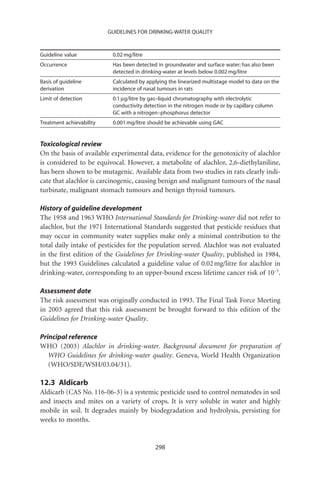
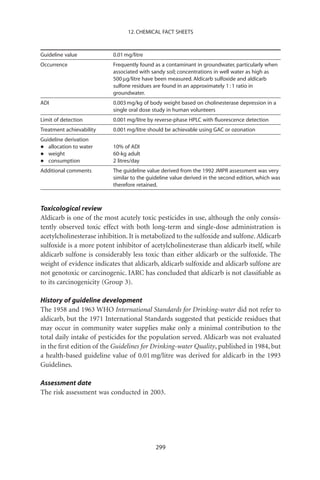
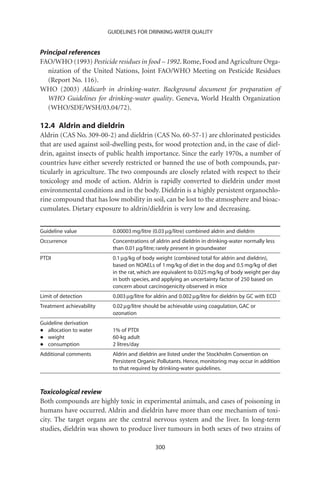
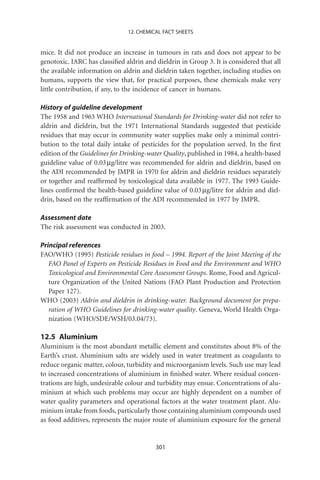
    Surveillance is an investigative activity undertaken to identify and evaluate poten-
tial health risks associated with drinking-water. Surveillance contributes to the pro-
tection of public health by promoting improvement of the quality, quantity,
accessibility, coverage (i.e., populations with reliable access), affordability and conti-
nuity of drinking-water supplies (termed “service indicators”). The surveillance
authority must have the authority to determine whether a water supplier is fulfilling
its obligations.
    In most countries, the agency responsible for the surveillance of drinking-water
supply services is the ministry of health (or public health) and its regional or depart-
mental offices. In some countries, it may be an environmental protection agency; in
others, the environmental health departments of local government may have some
responsibility.
    Surveillance requires a systematic programme of surveys, which may include audit-
ing, analysis, sanitary inspection and/or institutional and community aspects. It
should cover the whole of the drinking-water system, including sources and activities
in the catchment, transmission infrastructure, treatment plants, storage reservoirs and
distribution systems (whether piped or unpiped).
    Ensuring timely action to prevent problems and ensure the correction of faults
should be an aim of a surveillance programme. There may at times be a need for
penalties to encourage and ensure compliance. The surveillance agency must there-
fore be supported by strong and enforce-
able legislation. However, it is important
                                                   Drinking-water suppliers are responsible
that the agency develops a positive and
                                                   at all times for the quality and safety of the
supportive relationship with suppliers,            water that they produce.
with the application of penalties used as
a last resort.
    The surveillance agency should be empowered by law to compel water suppliers to
recommend the boiling of water or other measures when microbial contamination
that could threaten public health is detected.


                                               9
GUIDELINES FOR DRINKING-WATER QUALITY


1.2.2 Public health authorities
In order to effectively support the protection of public health, a national entity with
responsibility for public health will normally act in four areas:

•   Surveillance of health status and trends, including outbreak detection and investi-
    gation, generally directly but in some instances through a decentralized body.
•   Directly establish drinking-water norms and standards. National public health
    authorities often have the primary responsibility for setting norms on drinking-
    water supply, which may include the setting of water quality targets (WQTs), per-
    formance and safety targets and directly specified requirements (e.g., treatment).
    Normative activity is not restricted to water quality but also includes, for example,
    regulation and approval of materials and chemicals used in the production and dis-
    tribution of drinking-water (see section 8.5.4) and establishing minimum stan-
    dards in areas such as domestic plumbing (see section 1.2.10). Nor is it a static
    activity, because as changes occur in drinking-water supply practice, in technolo-
    gies and in materials available (e.g., in plumbing materials and treatment
    processes), so health priorities and responses to them will also change.
•   Representing health concerns in wider policy development, especially health policy
    and integrated water resource management (see section 1.2.4). Health concerns will
    often suggest a supportive role towards resource allocation to those concerned with
    drinking-water supply extension and improvement; will often involve lobbying for
    the primary requirement to satisfy drinking-water needs above other priorities; and
    may imply involvement in conflict resolution.
•   Direct action, generally through subsidiary bodies (e.g., regional and local envi-
    ronmental health administrations) or by providing guidance to other local entities
    (e.g., local government) in surveillance of drinking-water supplies. These roles vary
    widely according to national and local structures and responsibilities and fre-
    quently include a supportive role to community suppliers, where local authorities
    often intervene directly.

   Public health surveillance (i.e., surveillance of health status and trends) contributes
to verifying drinking-water safety. It takes into consideration disease in the entire pop-
ulation, which may be exposed to pathogenic microorganisms from a range of sources,
not only drinking-water. National public health authorities may also undertake or
direct research to evaluate the role of water as a risk factor in disease – for example,
through case–control, cohort or intervention studies. Public health surveillance teams
typically operate at national, regional and local levels, as well as in cities and rural
health centres. Routine public health surveillance includes:

    — ongoing monitoring of reportable diseases, many of which can be caused by
      waterborne pathogens;
    — outbreak detection;
    — long-term trend analysis;

                                           10
1. INTRODUCTION


  — geographic and demographic analysis; and
  — feedback to water authorities.
   Public health surveillance can be enhanced in a variety of ways to identify possi-
ble waterborne outbreaks in response to suspicion about unusual disease incidence
or following deterioration of water quality. Epidemiological investigations include:
  — outbreak investigations;
  — intervention studies to evaluate intervention options; and
  — case–control or cohort studies to evaluate the role of water as a risk factor in
    disease.
   However, public health surveillance cannot be relied upon to provide information
in a timely manner to enable short-term operational response to control waterborne
disease. Limitations include:
  — outbreaks of non-reportable disease;
  — time delay between exposure and illness;
  — time delay between illness and reporting;
  — low level of reporting; and
  — difficulties in identifying causative pathogens and sources.
   The public health authority operates reactively, as well as proactively, against the
background of overall public health policy and in interaction with all stakeholders. In
accounting for public health context, priority will normally be afforded to disadvan-
taged groups. This will generally entail balancing drinking-water safety management
and improvement with the need to ensure access to reliable supplies of safe drinking-
water in adequate quantities.
   In order to develop an understanding of the national drinking-water situation, the
national public health authority should periodically produce reports outlining the
state of national water quality and highlighting public health concerns and priorities
in the context of overall public health priorities. This implies the need for effective
exchange of information between local, regional and national agencies.
   National health authorities should lead or participate in formulation and imple-
mentation of policy to ensure access to some form of reliable, safe drinking-water
supply. Where this has not been achieved, appropriate tools and education should be
made available to implement individual or household-level treatment and safe storage.

1.2.3 Local authorities
Local environmental health authorities often play an important role in managing
water resources and drinking-water supplies. This may include catchment inspection
and authorization of activities in the catchment that may impact on source water
quality. It can also include verifying and auditing (surveillance) of the management
of formal drinking-water systems. Local environmental health authorities will also
give specific guidance to communities or individuals in designing and implementing

                                          11
GUIDELINES FOR DRINKING-WATER QUALITY


community and household drinking-water systems and correcting deficiencies, and
they may also be responsible for surveillance of community and household drinking-
water supplies. They have an important role to play in educating consumers where
household water treatment is necessary.
   Management of household and small community drinking-water supplies gener-
ally requires education programmes about drinking-water supply and water quality.
Such programmes should normally include:
  — water hygiene awareness raising;
  — basic technical training and technology transfer in drinking-water supply and
    management;
  — consideration of and approaches to overcoming sociocultural barriers to accept-
    ance of water quality interventions;
  — motivation, mobilization and social marketing activities; and
  — a system of continued support, follow-up and dissemination of the water quality
    programme to achieve and maintain sustainability.
These programmes can be administered at the community level by local health
authorities or other entities, such as nongovernmental organizations and the private
sector. If the programme arises from other entities, the involvement of the local health
authority in the development and implementation of the water quality education and
training programme is strongly encouraged.
   Approaches to participatory hygiene and sanitation education and training pro-
grammes are described in other WHO documents (see Simpson-Hébert et al., 1996;
Sawyer et al., 1998; Brikké, 2000).

1.2.4 Water resource management
Water resource management is an integral aspect of the preventive management of
drinking-water quality. Prevention of microbial and chemical contamination of
source water is the first barrier against drinking-water contamination of public health
concern.
    Water resource management and potentially polluting human activity in the catch-
ment will influence water quality downstream and in aquifers. This will impact on
treatment steps required to ensure safe water, and preventive action may be prefer-
able to upgrading treatment.
    The influence of land use on water quality should be assessed as part of water
resource management. This assessment is not normally undertaken by health author-
ities or drinking-water supply agencies alone and should take into consideration:
  — land cover modification;
  — extraction activities;
  — construction/modification of waterways;
  — application of fertilizers, herbicides, pesticides and other chemicals;
  — livestock density and application of manure;

                                          12
1. INTRODUCTION


  — road construction, maintenance and use;
  — various forms of recreation;
  — urban or rural residential development, with particular attention to excreta dis-
    posal, sanitation, landfill and waste disposal; and
  — other potentially polluting human activities, such as industry, military sites,
    etc.

Water resource management may be the responsibility of catchment management
agencies and/or other entities controlling or affecting water resources, such as indus-
trial, agricultural, navigation and flood control entities.
    The extent to which the responsibilities of health or drinking-water supply agen-
cies include water resource management varies greatly between countries and com-
munities. Regardless of government structures and sector responsibilities, it is
important that health authorities liaise and collaborate with sectors managing the
water resource and regulating land use in the catchment.
    Establishing close collaboration between the public health authority, water supplier
and resource management agency assists recognition of the health hazards potentially
occurring in the system. It is also important for ensuring that the protection of drink-
ing-water resources is considered in decisions for land use or regulations to control
contamination of water resources. Depending on the setting, this may include involve-
ment of further sectors, such as agriculture, traffic, tourism or urban development.
    To ensure the adequate protection of drinking-water sources, national authorities
will normally interact with other sectors in formulating national policy for integrated
water resource management. Regional and local structures for implementing the
policy will be set up, and national authorities will guide regional and local authori-
ties by providing tools.
    Regional environmental or public health authorities have an important task in par-
ticipating in the preparation of integrated water resource management plans to ensure
the best available drinking-water source quality. For further information, see the sup-
porting documents Protecting Surface Waters for Health and Protecting Groundwaters
for Health (section 1.3).

1.2.5 Drinking-water supply agencies
Drinking-water supplies vary from very large urban systems servicing populations
with tens of millions to small community systems providing water to very small pop-
ulations. In most countries, they include community sources as well as piped means
of supply.
   Drinking-water supply agencies are responsible for quality assurance and quality
control (see section 1.2.1). Their key responsibilities are to prepare and implement
WSPs (for more information, see chapter 4).
   In many cases, the water supplier is not responsible for the management of the
catchment feeding sources of its supplies. The roles of the water supplier with respect

                                          13
GUIDELINES FOR DRINKING-WATER QUALITY


to catchments are to participate in interagency water resource management activities;
to understand the risks arising from potentially contaminating activities and inci-
dents; and to use this information in assessing risks to the drinking-water supply and
developing and applying appropriate management. Although drinking-water suppli-
ers may not undertake catchment surveys and pollution risk assessment alone, their
roles include recognizing the need for them and initiating multiagency collaboration
– for example, with health and environmental authorities.
   Experience has shown that an association of stakeholders in drinking-water supply
(e.g., operators, managers and specialist groups such as small suppliers, scientists, soci-
ologists, legislators, politicians, etc.) can provide a valuable non-threatening forum
for interchange of ideas.
   For further information, see the supporting document Water Safety Plans (section
1.3).

1.2.6 Community management
Community-managed drinking-water systems, with both piped and non-piped dis-
tribution, are common worldwide in both developed and developing countries. The
precise definition of a community drinking-water system will vary. While a definition
based on population size or the type of supply may be appropriate under many con-
ditions, approaches to administration and management provide a distinction between
the drinking-water systems of small communities and those of larger towns and cities.
This includes the increased reliance on often untrained and sometimes unpaid com-
munity members in the administration and operation of community drinking-water
systems. Drinking-water systems in periurban areas in developing countries – the
communities surrounding major towns and cities – may also have the characteristics
of community systems.
   Effective and sustainable programmes for the management of community drink-
ing-water quality require the active support and involvement of local communities.
These communities should be involved at all stages of such programmes, including
initial surveys; decisions on siting of wells, siting of off-takes or establishing protec-
tion zones; monitoring and surveillance of drinking-water supplies; reporting faults,
carrying out maintenance and taking remedial action; and supportive actions, includ-
ing sanitation and hygiene practices.
   A community may already be highly organized and taking action on health or drink-
ing-water supply issues. Alternatively, it may lack a well developed drinking-water
system; some sectors of the community, such as women, may be poorly represented;
and there may be disagreements or factional conflicts. In this situation, achieving com-
munity participation will take more time and effort to bring people together, resolve
differences, agree on common aims and take action. Visits, possibly over several years,
will often be needed to provide support and encouragement and to ensure that the
structures created for safe drinking-water supply continue to operate. This may involve
setting up hygiene and health educational programmes to ensure that the community:

                                            14
1. INTRODUCTION


  — is aware of the importance of drinking-water quality and its relation to health
    and of the need for safe drinking-water in sufficient quantities for domestic use
    for drinking, cooking and hygiene;
  — recognizes the importance of surveillance and the need for a community
    response;
  — understands and is prepared to play its role in the surveillance process;
  — has the necessary skills to perform that role; and
  — is aware of requirements for the protection of drinking-water supplies from
    pollution.

   For further information, see WHO Guidelines for Drinking-water Quality, second
edition, Volume 3; the supporting document Water Safety Plans (section 1.3);
Simpson-Hébert et al. (1996); Sawyer et al. (1998); and Brikké (2000).

1.2.7 Water vendors
Vendors selling water to households or at collection points are common in many parts
of the world where scarcity of water or faults in or lack of infrastructure limits access
to suitable quantities of drinking-water. Water vendors use a range of modes of trans-
port to carry drinking-water for sale directly to the consumer, including tanker trucks
and wheelbarrows/trolleys. In the context of these Guidelines, water vending does not
include bottled or packaged water (which is considered in section 6.5) or water sold
through vending machines.
   There are a number of health concerns associated with water supplied to consumers
by water vendors. These include access to adequate volumes and concern regarding
inadequate treatment or transport in inappropriate containers, which can result in
contamination.
   Where the source of water is uncertain or the quality of the water is unknown,
water can be treated or re-treated in small quantities to significantly improve its
quality and safety. The simplest and most important treatment for microbially con-
taminated water is disinfection. If bulk supplies in tankers are used, sufficient chlo-
rine should be added to ensure that a free residual chlorine concentration of at least
0.5 mg/litre after a contact time of at least 30 min is present at the delivery point.
Tankers should normally be reserved for potable water use. Before use, tankers should
be either chemically disinfected or steam-cleaned.
   Local authorities should implement surveillance programmes for water provided
by vendors and, where necessary, develop education programmes to improve the
collection, treatment and distribution of water to prevent contamination.

1.2.8 Individual consumers
Everyone consumes water from one source or another, and consumers often play
important roles in the collection, treatment and storage of water. Consumer actions
may help to ensure the safety of the water they consume and may also contribute to

                                           15
GUIDELINES FOR DRINKING-WATER QUALITY


improvement or contamination of the water consumed by others. Consumers have
the responsibility for ensuring that their actions do not impact adversely on water
quality. Installation and maintenance of household plumbing systems should be
undertaken preferably by qualified and authorized plumbers (see section 1.2.10) or
other persons with appropriate expertise to ensure that cross-connection or backflow
events do not result in contamination of local water supplies.
   In most countries, there are populations whose water is derived from household
sources, such as private wells and rainwater. In households using non-piped water
supplies, appropriate efforts are needed to ensure safe collection, storage and perhaps
treatment of their drinking-water. In some circumstances, households and individ-
uals may wish to treat water in the home to increase their confidence in its safety, not
only where community supplies are absent, but also where community supplies are
known to be contaminated or causing waterborne disease (see chapter 7). Public
health, surveillance and/or other local authorities may provide guidance to support
households and individual consumers in ensuring the safety of their drinking-water
(see section 6.3). Such guidance is best provided in the context of a community
education and training programme.

1.2.9 Certification agencies
Certification is used to verify that devices and materials used in the drinking-water
supply meet a given level of quality and safety. Certification is a process in which an
independent organization validates the claims of the manufacturers against a formal
standard or criterion or provides an independent assessment of possible risks of con-
tamination from a material or process. The certification agency may be responsible
for seeking data from manufacturers, generating test results, conducting inspections
and audits and possibly making recommendations on product performance.
   Certification has been applied to technologies used at household and community
levels, such as hand pumps; materials used by water supplies, such as treatment chem-
icals; and devices used in the household for collection, treatment and storage.
   Certification of products or processes involved in the collection, treatment, storage
and distribution of water can be overseen by government agencies or private
organizations. Certification procedures will depend on the standards against
which the products are certified, certification criteria and the party that performs the
certification.
   National, local government or private (third-party auditing) certification pro-
grammes have a number of possible objectives:

  — certification of products to ensure that their use does not threaten the safety of
    the user or the general public, such as by causing contamination of drinking-
    water with toxic substances, substances that could affect consumer acceptability
    or substances that support the growth of microorganisms;
  — product testing, to avoid retesting at local levels or prior to each procurement;

                                          16
1. INTRODUCTION


   — ensuring uniform quality and condition of products;
   — certification and accreditation of analytical and other testing laboratories;
     and
   — control of materials and chemicals used for the treatment of drinking-water,
     including the performance of devices for household use.
   An important step in any certification procedure is the establishment of standards,
which must form the basis of assessment of the products. These standards should also
– as far as possible – contain the criteria for approval. In procedures for certification
on technical aspects, these standards are generally developed in cooperation with the
manufacturers, the certifying agency and the consumers. The national public health
authorities should have responsibility for developing the parts of the approval process
or criteria relating directly to public health. For further information, see section 8.5.4.

1.2.10 Plumbing
Significant adverse health effects have been associated with inadequate plumbing
systems within public and private buildings arising from poor design, incorrect instal-
lation, alterations and inadequate maintenance.
    Numerous factors influence the quality of water within a building’s piped distri-
bution system and may result in microbial or chemical contamination of drinking-
water. Outbreaks of gastrointestinal disease can occur through faecal contamination
of drinking-water within buildings arising from deficiencies in roof storage tanks and
cross-connections with wastewater pipes, for example. Poorly designed plumbing
systems can cause stagnation of water and provide a suitable environment for the pro-
liferation of Legionella. Plumbing materials, pipes, fittings and coatings can result in
elevated heavy metal (e.g., lead) concentrations in drinking-water, and inappropriate
materials can be conducive to bacterial growth. Potential adverse health effects may
not be confined to the individual building. Exposure of other consumers to contam-
inants is possible through contamination of the local public distribution system,
beyond the particular building, through cross-contamination of drinking-water and
backflow.
    The delivery of water that complies with relevant standards within buildings gen-
erally relies on a plumbing system that is not directly managed by the water supplier.
Reliance is therefore placed on proper installation and servicing of plumbing and, for
larger buildings, on building-specific WSPs (see section 6.1).
    To ensure the safety of drinking-water supplies within the building system, plumb-
ing practices must prevent the introduction of hazards to health. This can be achieved
by ensuring that:
   — pipes carrying either water or wastes are watertight, durable, of smooth and
     unobstructed interior and protected against anticipated stresses;
   — cross-connections between the drinking-water supply and the wastewater
     removal systems do not occur;

                                            17
GUIDELINES FOR DRINKING-WATER QUALITY


  — water storage systems are intact and not subject to intrusion of microbial and
    chemical contaminants;
  — hot and cold water systems are designed to minimize the proliferation of
    Legionella (see also sections 6.1 and 11.1.9);
  — appropriate protection is in place to prevent backflow;
  — the system design of multistorey buildings minimizes pressure fluctuations;
  — waste is discharged without contaminating drinking-water; and
  — plumbing systems function efficiently.

   It is important that plumbers are appropriately qualified, have the competence
to undertake necessary installation and servicing of plumbing systems to ensure
compliance with local regulations and use only materials approved as safe for use with
drinking-water.
   Design of the plumbing systems of new buildings should normally be approved
prior to construction and be inspected by an appropriate regulatory body during con-
struction and prior to commissioning of the buildings.

1.3 Supporting documentation to the Guidelines
These Guidelines are accompanied by separate texts that provide background infor-
mation substantiating the derivation of the guidelines and providing guidance on
good practice towards effective implementation. These are available as published texts
and electronically through the Internet (http://www.who.int/water_sanitation_
health/dwq/en/) and CD-ROM. Reference details are provided in Annex 1.

Assessing Microbial Safety of Drinking Water: Improving Approaches and Methods
   This book provides a state-of-the-art review of approaches and methods used in
   assessing the microbial safety of drinking-water. It offers guidance on the selection
   and use of indicators alongside operational monitoring to meet specific informa-
   tion needs and looks at potential applications of “new” technologies and emerging
   methods.

Chemical Safety of Drinking-water: Assessing Priorities for Risk Management
  This document provides tools that assist users to undertake a systematic assessment
  of their water supply system(s) locally, regionally or nationally; to prioritize the
  chemicals likely to be of greatest significance; to consider how these might
  be controlled or eliminated; and to review or develop standards that are
  appropriate.

Domestic Water Quantity, Service Level and Health
  This paper reviews the requirements for water for health-related purposes to deter-
  mine acceptable minimum needs for consumption (hydration and food prepara-
  tion) and basic hygiene.

                                          18
1. INTRODUCTION


Evaluation of the H2S Method for Detection of Fecal Contamination of Drinking Water
  This report critically reviews the scientific basis, validity, available data and other
  information concerning the use of “H2S tests” as measures or indicators of faecal
  contamination in drinking-water.

Hazard Characterization for Pathogens in Food and Water: Guidelines
  This document provides a practical framework and structured approach for the
  characterization of microbial hazards, to assist governmental and research
  scientists.

Heterotrophic Plate Counts and Drinking-water Safety: The Significance of HPCs for
Water Quality and Human Health
  This document provides a critical assessment of the role of the HPC measurement
  in drinking-water safety management.

Managing Water in the Home: Accelerated Health Gains from Improved Water Supply
  This report describes and critically reviews the various methods and systems for
  household water collection, treatment and storage. It assesses the ability of house-
  hold water treatment and storage methods to provide water with improved micro-
  bial quality.

Pathogenic Mycobacteria in Water: A Guide to Public Health Consequences, Monitoring
and Management
   This book describes the current knowledge about the distribution of pathogenic
   environmental mycobacteria (PEM) in water and other parts of the environment.
   Included are discussions of the routes of transmission that lead to human infec-
   tion, the most significant disease symptoms that can follow infection and the clas-
   sical and modern methods of analysis of PEM species. The book concludes with a
   discussion of the issues surrounding the control of PEM in drinking-water and the
   assessment and management of risks.

Quantifying Public Health Risk in the WHO Guidelines for Drinking-water Quality:
A Burden of Disease Approach
  This report provides a discussion paper on the concepts and methodology of
  Disability Adjusted Life Years (DALYs) as a common public health metric and its
  usefulness for drinking-water quality and illustrates the approach for several
  drinking-water contaminants already examined using the burden of disease
  approach.

Safe Piped Water: Managing Microbial Water Quality in Piped Distribution Systems
   The development of pressurized pipe networks for supplying drinking-water to
   individual dwellings, buildings and communal taps is an important component in

                                          19
GUIDELINES FOR DRINKING-WATER QUALITY


  the continuing development and health of many communities. This publication
  considers the introduction of microbial contaminants and growth of microorgan-
  isms in distribution networks and the practices that contribute to ensuring drink-
  ing-water safety in piped distribution systems.

Toxic Cyanobacteria in Water: A Guide to their Public Health Consequences, Monitor-
ing and Management
   This book describes the state of knowledge regarding the impact of cyanobacteria
   on health through the use of water. It considers aspects of risk management and
   details the information needed for protecting drinking-water sources and recre-
   ational water bodies from the health hazards caused by cyanobacteria and their
   toxins. It also outlines the state of knowledge regarding the principal considera-
   tions in the design of programmes and studies for monitoring water resources and
   supplies and describes the approaches and procedures used.

Upgrading Water Treatment Plants
  This book provides a practical guide to improving the performance of water treat-
  ment plants. It will be an invaluable source of information for those who are
  responsible for designing, operating, maintaining or upgrading water treatment
  plants.

Water Safety Plans
  The improvement of water quality control strategies, in conjunction with improve-
  ments in excreta disposal and personal hygiene, can be expected to deliver sub-
  stantial health gains in the population. This document provides information on
  improved strategies for the control and monitoring of drinking-water quality.

Water Treatment and Pathogen Control: Process Efficiency in Achieving Safe
Drinking-water
  This publication provides a critical analysis of the literature on removal and inac-
  tivation of pathogenic microbes in water to aid the water quality specialist and
  design engineer in making decisions regarding microbial water quality.

Texts in preparation or in revision:
Arsenic in Drinking-water: Assessing and Managing Health Risks (in preparation)
Desalination for Safe Drinking-water Supply (in preparation)
Guide to Hygiene and Sanitation in Aviation (in revision)
Guide to Ship Sanitation (in revision)
Health Aspects of Plumbing (in preparation)
Legionella and the Prevention of Legionellosis (in finalization)
Protecting Groundwaters for Health – Managing the Quality of Drinking-water Sources
   (in preparation)

                                         20
1. INTRODUCTION


Protecting Surface Waters for Health – Managing the Quality of Drinking-water Sources
   (in preparation)
Rapid Assessment of Drinking-water Quality: A Handbook for Implementation (in
   preparation)


                                         21
2
    The Guidelines: a framework
      for safe drinking-water


T   he quality of drinking-water may be controlled through a combination of pro-
    tection of water sources, control of treatment processes and management of the
distribution and handling of the water. Guidelines must be appropriate for national,
regional and local circumstances, which requires adaptation to environmental, social,
economic and cultural circumstances and priority setting.

2.1 Framework for safe drinking-water: requirements
The Guidelines outline a preventive management “framework for safe drinking-
water” that comprises five key components:
  — health-based targets based on an evaluation of health concerns (chapter 3);
  — system assessment to determine whether the drinking-water supply (from
    source through treatment to the point of consumption) as a whole can deliver
    water that meets the health-based targets (section 4.1);
  — operational monitoring of the control measures in the drinking-water supply
    that are of particular importance in securing drinking-water safety (section 4.2);
  — management plans documenting the system assessment and monitoring plans
    and describing actions to be taken in normal operation and incident conditions,
    including upgrade and improvement, documentation and communication (sec-
    tions 4.4–4.6); and
  — a system of independent surveillance that verifies that the above are operating
    properly (chapter 5).
   In support of the framework for safe drinking-water, the Guidelines provide a range
of supporting information, including microbial aspects (chapters 7 and 11), chemi-
cal aspects (chapters 8 and 12), radiological aspects (chapter 9) and acceptability
aspects (chapter 10). Figure 2.1 provides an overview of the interrelationship of the
individual chapters of the Guidelines in ensuring drinking-water safety.
   There is a wide range of microbial and chemical constituents of drinking-water
that can cause adverse human health effects. The detection of these constituents in
both raw water and water delivered to consumers is often slow, complex and costly,

                                         22
2. THE GUIDELINES: A FRAMEWORK FOR SAFE DRINKING-WATER


               Introduction                The guideline requirements
                   (Chapter 1)                         (Chapter 2)


              FRAMEWORK FOR SAFE DRINKING-WATER                                  SUPPORTING
                                                                                INFORMATION
                   Health-based targets              Public health context         Microbial
                        (Chapter 3)                  and health outcome             aspects
                                                                               (Chapters 7 and 11)

                    Water safety plans                                             Chemical
                       (Chapter 4)                                                  aspects
                                                                               (Chapters 8 and 12)
        System        Monitoring   Management and
                                                                                  Radiological
      assessment                    communication
                                                                                     aspects
                                                                                   (Chapter 9)

                        Surveillance                                             Acceptability
                         (Chapter 5)                                                aspects
                                                                                  (Chapter 10)


                       Application of the Guidelines
                         in specific circumstances
                                (Chapter 6)

                               Large buildings
                         Emergencies and disasters
                                  Travellers
                            Desalination systems
                          Packaged drinking-water
                              Food production
                              Planes and ships

Figure 2.1 Interrelationship of the chapters of the Guidelines for Drinking-water Quality in
           ensuring drinking-water safety


which limits early warning capability and affordability. Reliance on water quality
determination alone is insufficient to protect public health. As it is neither physically
nor economically feasible to test for all drinking-water quality parameters, the use of
monitoring effort and resources should be carefully planned and directed at signifi-
cant or key characteristics.
   Some characteristics not related to health, such as those with significant impacts
on acceptability of water, may also be of importance. Where water has unacceptable
aesthetic characteristics (e.g., appearance, taste and odour), further investigation may
be required to determine whether there are problems with significance for health.
   The control of the microbial and chemical quality of drinking-water requires the
development of management plans, which, when implemented, provide the basis for
system protection and process control to ensure that numbers of pathogens and con-
centrations of chemicals present a negligible risk to public health and that water is
acceptable to consumers. The management plans developed by water suppliers are

                                                      23
GUIDELINES FOR DRINKING-WATER QUALITY


best termed “water safety plans” (WSPs). A WSP comprises system assessment and
design, operational monitoring and management plans, including documentation and
communication. The elements of a WSP build on the multiple-barrier principle, the
principles of hazard analysis and critical control points (HACCP) and other system-
atic management approaches. The plans should address all aspects of the drinking-
water supply and focus on the control of abstraction, treatment and delivery of
drinking-water.
   Many drinking-water supplies provide adequate safe drinking-water in the absence
of formalized WSPs. Major benefits of developing and implementing a WSP for these
supplies include the systematic and detailed assessment and prioritization of hazards
and the operational monitoring of barriers or control measures. In addition, a WSP
provides for an organized and structured system to minimize the chance of failure
through oversight or lapse of management and for contingency plans to respond to
system failures or unforeseen hazardous events.

2.1.1 Health-based targets
Health-based targets are an essential component of the drinking-water safety frame-
work. They should be established by a high-level authority responsible for health
in consultation with others, including water suppliers and affected communities.
They should take account of the overall public health situation and contribution of
drinking-water quality to disease due to waterborne microbes and chemicals, as a part
of overall water and health policy. They must also take account of the importance of
ensuring access to water, especially among those who are not served.
   Health-based targets provide the basis for the application of the Guidelines to all
types of drinking-water supply. Constituents of drinking-water may cause adverse
health effects from single exposures (e.g., microbial pathogens) or long-term expo-
sures (e.g., many chemicals). Due to the range of constituents in water, their mode of
action and the nature of fluctuations in their concentration, there are four principal
types of health-based targets used as a basis for identifying safety requirements:

•   Health outcome targets: In some circumstances, especially where waterborne disease
    contributes to a measurable burden, reducing exposure through drinking-water has
    the potential to appreciably reduce overall risks of disease. In such circumstances,
    it is possible to establish a health-based target in terms of a quantifiable reduction
    in the overall level of disease. This is most applicable where adverse effects follow
    shortly after exposure, where such effects are readily and reliably monitored and
    where changes in exposure can also be readily and reliably monitored. This type of
    health outcome target is primarily applicable to some microbial hazards in devel-
    oping countries and chemical hazards with clearly defined health effects largely
    attributable to water (e.g., fluoride). In other circumstances, health outcome targets
    may be the basis for evaluation of results through quantitative risk assessment
    models. In these cases, health outcomes are estimated based on information con-

                                           24
2. THE GUIDELINES: A FRAMEWORK FOR SAFE DRINKING-WATER


    cerning exposure and dose–response relationships. The results may be employed
    directly as a basis for the specification of water quality targets or provide the basis
    for development of the other types of health-based targets. Health outcome targets
    based on information on the impact of tested interventions on the health of real
    populations are ideal but rarely available. More common are health outcome targets
    based on defined levels of tolerable risk, either absolute or fractions of total disease
    burden, preferably based on epidemiological evidence or, alternatively, risk assess-
    ment studies.
•   Water quality targets (WQTs): WQTs are established for individual drinking-water
    constituents that represent a health risk from long-term exposure and where
    fluctuations in concentration are small or occur over long periods. They are
    typically expressed as guideline values (concentrations) of the substances or
    chemicals of concern.
•   Performance targets: Performance targets are employed for constituents where
    short-term exposure represents a public health risk or where large fluctuations in
    numbers or concentration can occur over short periods with significant health
    implications. They are typically expressed in terms of required reductions of the
    substance of concern or effectiveness in preventing contamination.
•   Specified technology targets: National regulatory agencies may establish targets for
    specific actions for smaller municipal, community and household drinking-water
    supplies. Such targets may identify specific permissible devices or processes for
    given situations and/or for generic drinking-water system types.

   It is important that health-based targets are realistic under local operating condi-
tions and are set to protect and improve public health. Health-based targets under-
pin development of WSPs, provide information with which to evaluate the adequacy
of existing installations and assist in identifying the level and type of inspection and
analytical verifications that are appropriate.
   Most countries apply several types of targets for different types of supply and dif-
ferent contaminants. In order to ensure that they are relevant and supportive, repre-
sentative scenarios should be developed, including description of assumptions,
management options, control measures and indicator systems for verification, where
appropriate. These should be supported by general guidance addressing the identifi-
cation of national, regional or local priorities and progressive implementation, thereby
helping to ensure that best use is made of available resources.
   Health-based targets are considered in more detail in chapter 3.

2.1.2 System assessment and design
Assessment of the drinking-water system is equally applicable to large utilities with
piped distribution systems, piped and non-piped community supplies, including hand
pumps, and individual domestic supplies. Assessment can be of existing infrastructure
or of plans for new supplies or for upgrading of existing supplies. As drinking-water

                                            25
GUIDELINES FOR DRINKING-WATER QUALITY


quality varies throughout the system, the assessment should aim to determine whether
the final quality of water delivered to the consumer will routinely meet established
health-based targets. Understanding source quality and changes through the system
requires expert input. The assessment of systems should be reviewed periodically.
    The system assessment needs to take into consideration the behaviour of selected
constituents or groups of constituents that may influence water quality. Having iden-
tified and documented actual and potential hazards, including potentially hazardous
events and scenarios that may affect water quality, the level of risk for each hazard
can then be estimated and ranked, based on the likelihood and severity of the
consequences.
    Validation is an element of system assessment. It is undertaken to ensure that the
information supporting the plan is correct and is concerned with the assessment of
the scientific and technical inputs into the WSP. Evidence to support the WSP can
come from a wide variety of sources, including scientific literature, trade associations,
regulation and legislation departments, historical data, professional bodies and sup-
plier knowledge.
    If the system is theoretically capable of meeting the health-based targets, the WSP
is the management tool that will assist in actually meeting the health-based targets,
and it should be developed following the steps outlined in subsequent sections. If the
system is unlikely to be capable of meeting the health-based targets, a programme of
upgrading (which may include capital investment or training) should be initiated to
ensure that the drinking-water supply would meet the targets. In the interim, every
effort should be made to supply water of the highest achievable quality. Where a sig-
nificant risk to public health exists, additional measures may be appropriate.
    Assessment and design are considered in more detail in section 4.1 (see also the
supporting document Upgrading Water Treatment Plants; section 1.3).

2.1.3 Operational monitoring
Control measures are actions implemented in the drinking-water system that prevent,
reduce or eliminate contamination and are identified in system assessment. They
include, for example, catchment management actions, the plinth surrounding a well,
filters and disinfection infrastructure and piped distribution systems. If collectively
operating properly, they would ensure that health-based targets are met.
    Operational monitoring is the conduct of planned observations or measurements
to assess whether the control measures in a drinking-water system are operating prop-
erly. It is possible to set limits for control measures, monitor those limits and take cor-
rective action in response to a detected deviation before the water becomes unsafe.
Examples of limits are that the plinth surrounding a hand pump is complete and not
damaged, the turbidity of water following filtration is below a certain value or the
chlorine residual after disinfection plants or at the far point of the distribution system
is above an agreed value.


                                            26
2. THE GUIDELINES: A FRAMEWORK FOR SAFE DRINKING-WATER


   The frequency of operational monitoring varies with the nature of the control
measure – for example, checking plinth integrity monthly to yearly, monitoring tur-
bidity on-line or very frequently and monitoring disinfection residual at multiple
points daily or continuously on-line. If monitoring shows that a limit does not meet
specifications, then there is the potential for water to be, or to become, unsafe. The
objective is timely monitoring of control measures, with a logically based sampling
plan, to prevent the delivery of potentially unsafe water.
   In most cases, operational monitoring will be based on simple and rapid observa-
tions or tests, such as turbidity or structural integrity, rather than complex microbial
or chemical tests. The complex tests are generally applied as part of validation and
verification activities (discussed in sections 4.1.7 and 4.3, respectively) rather than as
part of operational monitoring.
   In order not only to have confidence that the chain of supply is operating prop-
erly, but to confirm that water quality is being maintained and achieved, it is neces-
sary to carry out verification, as outlined in section 2.2.
   The use of indicator bacteria in monitoring of water quality is discussed in the
supporting document Assessing Microbial Safety of Drinking Water (section 1.3), and
operational monitoring is considered in more detail in section 4.2.

2.1.4 Management plans, documentation and communication
A management plan documents system assessment and operational monitoring
and verification plans and describes actions in both normal operation and during
“incidents” where a loss of control of the system may occur. The management plan
should also outline procedures and other supporting programmes required to ensure
optimal operation of the drinking-water system.
   As the management of some aspects of the drinking-water system often falls outside
the responsibility of a single agency, it is essential that the roles, accountabilities and
responsibilities of the various agencies involved be defined in order to coordinate their
planning and management. Appropriate mechanisms and documentation should
therefore be established for ensuring stakeholder involvement and commitment.
This may include establishing working groups, committees or task forces, with
appropriate representatives, and developing partnership agreements, including,
for example, signed memoranda of understanding (see also section 1.2).
   Documentation of all aspects of drinking-water quality management is essential.
Documents should describe activities that are undertaken and how procedures are
performed. They should also include detailed information on:

   — assessment of the drinking-water system (including flow diagrams and poten-
     tial hazards and the outcome of validation);
   — control measures and operational monitoring and verification plan;
   — routine operation and management procedures;


                                            27
GUIDELINES FOR DRINKING-WATER QUALITY


   — incident and emergency response plans; and
   — supporting measures, including:
     — training programmes
     — research and development
     — procedures for evaluating results and reporting
     — performance evaluations, audits and reviews
     — communication protocols
     — community consultation.

   Documentation and record systems should be kept as simple and focused as pos-
sible. The level of detail in the documentation of procedures should be sufficient to
provide assurance of operational control when coupled with a suitably qualified and
competent operator.
   Mechanisms should be established to periodically review and, where necessary,
revise documents to reflect changing circumstances. Documents should be assembled
in a manner that will enable any necessary modifications to be made easily. A docu-
ment control system should be developed to ensure that current versions are in use
and obsolete documents are discarded.
   Appropriate documentation and reporting of incidents or emergencies should also
be established. The organization should learn as much as possible from an incident
to improve preparedness and planning for future events. Review of an incident may
indicate necessary amendments to existing protocols.
   Effective communication to increase community awareness and knowledge of
drinking-water quality issues and the various areas of responsibility helps consumers
to understand and contribute to decisions about the service provided by a drinking-
water supplier or land use constraints imposed in catchment areas. A thorough under-
standing of the diversity of views held by individuals or groups in the community is
necessary to satisfy community expectations.
   Management, documentation and communication are considered in more detail
in sections 4.4, 4.5 and 4.6.

2.1.5 Surveillance of drinking-water quality
The surveillance agency is responsible for an independent (external) and periodic
review of all aspects of safety, whereas the water supplier is responsible at all times for
regular quality control, for operational monitoring and for ensuring good operating
practice.
    Surveillance contributes to the protection of public health by assessing compliance
with WSPs and promoting improvement of the quality, quantity, accessibility, cover-
age, affordability and continuity of drinking-water supplies.
    Surveillance requires a systematic programme of surveys that may include audit-
ing of WSPs, analysis, sanitary inspection and institutional and community aspects.
It should cover the whole of the drinking-water system, including sources and activ-

                                            28
2. THE GUIDELINES: A FRAMEWORK FOR SAFE DRINKING-WATER


ities in the catchment, transmission infrastructure, whether piped or unpiped, treat-
ment plants, storage reservoirs and distribution systems.
    Since incremental improvement and prioritizing action in systems presenting
greatest overall risk to public health are important, there are advantages to adopting
a grading scheme for the relative safety of drinking-water supplies (see chapter 4).
More sophisticated grading schemes may be of particular use in community supplies
where the frequency of testing is low and exclusive reliance on analytical results is par-
ticularly inappropriate. Such schemes will typically take account of both analytical
findings and sanitary inspection through approaches such as those presented in
section 4.1.2.
    The role of surveillance is discussed in section 1.2.1 and chapter 5.

2.2 Guidelines for verification
Drinking-water safety is secured by application of a WSP, which includes monitoring
the efficiency of control measures using appropriately selected determinants. In addi-
tion to this operational monitoring, a final verification of quality is required.
    Verification is the use of methods, procedures or tests in addition to those used in
operational monitoring to determine if the performance of the drinking-water supply
is in compliance with the stated objectives outlined by the health-based targets and/or
whether the WSP needs modification and revalidation.

2.2.1 Microbial water quality
For microbial water quality, verification is likely to include microbiological testing. In
most cases, it will involve the analysis of faecal indicator microorganisms, but in some
circumstances it may also include assessment of specific pathogen densities. Verifica-
tion of the microbial quality of drinking-water may be undertaken by the supplier,
surveillance agencies or a combination of the two (see sections 4.3.1 and 7.4).
   Approaches to verification include testing of source water, water immediately after
treatment, water in distribution systems or stored household water. Verification of the
microbial quality of drinking-water includes testing for Escherichia coli as an indica-
tor of faecal pollution. E. coli provides conclusive evidence of recent faecal pollution
and should not be present in drinking-water. In practice, testing for thermotolerant
coliform bacteria can be an acceptable alternative in many circumstances. While E.
coli is a useful indicator, it has limitations. Enteric viruses and protozoa are more
resistant to disinfection; consequently, the absence of E. coli will not necessarily indi-
cate freedom from these organisms. Under certain circumstances, it may be desirable
to include more resistant microorganisms, such as bacteriophages and/or bacterial
spores. Such circumstances could include the use of source water known to be con-
taminated with enteric viruses and parasites or high levels of viral and parasitic dis-
eases in the community.
   Water quality can vary rapidly, and all systems are subject to occasional failure. For
example, rainfall can greatly increase the levels of microbial contamination in source

                                           29
GUIDELINES FOR DRINKING-WATER QUALITY


waters, and waterborne outbreaks often occur following rainfall. Results of analytical
testing must be interpreted taking this into account.

2.2.2 Chemical water quality
Assessment of the adequacy of the chemical quality of drinking-water relies on com-
parison of the results of water quality analysis with guideline values.
    For additives (i.e., chemicals deriving primarily from materials and chemicals used
in the production and distribution of drinking-water), emphasis is placed on the
direct control of the quality of these products. In controlling drinking-water addi-
tives, testing procedures typically assess the contribution of the additive to drinking-
water and take account of variations over time in deriving a value that can be
compared with the guideline value (see section 8.5.4).
    As indicated in chapter 1, most chemicals are of concern only with long-term expo-
sure; however, some hazardous chemicals that occur in drinking-water are of concern
because of effects arising from sequences of exposures over a short period. Where the
concentration of the chemical of interest varies widely, even a series of analytical
results may fail to fully identify and describe the public health risk (e.g., nitrate, which
is associated with methaemoglobinaemia in bottle-fed infants). In controlling such
hazards, attention must be given to both knowledge of causal factors such as fertilizer
use in agriculture and trends in detected concentrations, since these will indicate
whether a significant problem may arise in the future. Other hazards may arise inter-
mittently, often associated with seasonal activity or seasonal conditions. One example
is the occurrence of blooms of toxic cyanobacteria in surface water.
    A guideline value represents the concentration of a constituent that does not exceed
tolerable risk to the health of the consumer over a lifetime of consumption. Guide-
lines for some chemical contaminants (e.g., lead, nitrate) are set to be protective for
susceptible subpopulations. These guidelines are also protective of the general popu-
lation over a lifetime.


                                            30
2. THE GUIDELINES: A FRAMEWORK FOR SAFE DRINKING-WATER


   It is important that recommended guideline values are both practical and feasible
to implement as well as protective of public health. Guideline values are not normally
set at concentrations lower than the detection limits achievable under routine labo-
ratory operating conditions. Moreover, guideline values are established taking into
account available techniques for controlling, removing or reducing the concentration
of the contaminant to the desired level. In some instances, therefore, provisional guide-
line values have been set for contaminants for which there is some uncertainty in avail-
able information or calculated guideline values are not practically achievable.

2.3 National drinking-water policy
2.3.1 Laws, regulations and standards
The aim of national drinking-water laws and standards should be to ensure that the
consumer enjoys safe potable water, not to shut down deficient water supplies.
    Effective control of drinking-water quality is supported ideally by adequate legis-
lation, standards and codes and their enforcement. The precise nature of the legisla-
tion in each country will depend on national, constitutional and other considerations.
It will generally outline the responsibility and authority of a number of agencies and
describe the relationship between them, as well as establish basic policy principles
(e.g., water supplied for drinking-water should be safe). The national regulations,
adjusted as necessary, should be applicable to all water supplies. This would normally
embody different approaches to situations where formal responsibility for drinking-
water quality is assigned to a defined entity and situations where community man-
agement prevails.
    Legislation should make provision for the establishment and amendment of
drinking-water quality standards and guidelines, as well as for the establishment of
regulations for the development and protection of drinking-water sources and
the treatment, maintenance and distribution of safe drinking-water.
    Legislation should establish the legal functions and responsibilities of the water
supplier and would generally specify that the water supplier is legally responsible at
all times for the quality of the water sold and/or supplied to the consumer and for the
proper supervision, inspection, maintenance and safe operation of the drinking-water
system. It is the water supplier that actually provides water to the public – the “con-
sumer” – and that should be legally responsible for its quality and safety. The supplier
is responsible for continuous and effective quality assurance and quality control of
water supplies, including inspection, supervision, preventive maintenance, routine
testing of water quality and remedial actions as required. However, the supplier is
normally responsible for the quality of the water only up to a defined point in the
distribution system and may not have responsibility for deterioration of water quality


                                           31
GUIDELINES FOR DRINKING-WATER QUALITY


as a result of poor plumbing or unsatisfactory storage tanks in households and
buildings.
   Where consecutive agencies manage water – for example, a drinking-water whole-
saler, a municipal water supplier and a local water distribution company – each agency
should carry responsibility for the quality of the water arising from its actions.
   Legal and organizational arrangements aimed at ensuring compliance with the
legislation, standards or codes of practice for drinking-water quality will normally
provide for an independent surveillance agency, as outlined in section 1.2.1 and
chapter 5. The legislation should define the duties, obligations and powers of the water
surveillance agency. The surveillance agency should preferably be represented at the
national level and should operate at national, regional and local levels. The surveil-
lance agency should be given the necessary powers to administer and enforce laws,
regulations, standards and codes concerned with water quality. It should also be able
to delegate those powers to other specified agencies, such as municipal councils, local
health departments, regional authorities and qualified, government-authorized
private audit or testing services. Its responsibilities should include the surveillance of
water quality to ensure that water delivered to the consumer, through either piped or
non-piped distribution systems, meets drinking-water supply service standards;
approving sources of drinking-water; and surveying the provision of drinking-water
to the population as a whole. There needs to be a high level of knowledge, training
and understanding in such an agency in order that drinking-water supply does not
suffer from inappropriate regulatory action. The surveillance agency should be
empowered by law to compel water suppliers to recommend the boiling of water or
other measures when microbial contamination that could threaten public health is
detected.
   Implementation of programmes to provide safe drinking-water should not be
delayed because of a lack of appropriate legislation. Even where legally binding guide-
lines or standards for drinking-water have yet to be promulgated, it may be possible
to encourage, and even enforce, the supply of safe drinking-water through educational
efforts or commercial, contractual arrangements between consumer and supplier
(e.g., based on civil law) or through interim measures, including health, food or
welfare legislation, for example.
   Drinking-water quality legislation may usefully provide for interim standards, per-
mitted deviations and exemptions as part of a national or regional policy, rather than
as a result of local initiatives. This can take the form of temporary exemptions for
certain communities or areas for defined periods of time. Short- and medium-term
targets should be set so that the most significant risks to human health are controlled
first.

2.3.2 Setting national standards
In countries where universal access to safe drinking-water at an acceptable level of
service has not been achieved, policy should refer to expressed targets for increases in

                                           32
2. THE GUIDELINES: A FRAMEWORK FOR SAFE DRINKING-WATER


access. Such policy statements should be consistent with achievement of the Millen-
nium Development Goals (http://www.developmentgoals.org/) of the United Nations
(UN) Millennium Declaration and should take account of levels of acceptable access
outlined in General Comment 15 on the Right to Water of the UN Committee
on Economic, Social and Cultural Rights (http://www.unhchr.ch/html/menu2/6/
cescr.htm) and associated documents.
   In developing national drinking-water standards based on these Guidelines, it will
be necessary to take account of a variety of environmental, social, cultural, economic,
dietary and other conditions affecting potential exposure. This may lead to national
standards that differ appreciably from these Guidelines. A programme based on
modest but realistic goals – including fewer water quality parameters of priority health
concern at attainable levels consistent with providing a reasonable degree of public
health protection in terms of reduction of disease or reduced risk of disease within
the population – may achieve more than an overambitious one, especially if targets
are upgraded periodically.
   The authority to establish and revise drinking-water standards, codes of practice
and other technical regulations should be delegated to the appropriate government
minister – preferably the minister of health – who is responsible for ensuring the safety
of water supplies and the protection of public health. The authority to establish and
enforce quality standards and regulations may be vested in a ministry other than the
one usually responsible for public and/or environmental health. Consideration should
then be given to requiring that regulations and standards are promulgated only after
approval by the public health or environmental health authority so as to ensure their
conformity with health protection principles.
   Drinking-water supply policy should normally outline the requirements for
protection of water sources and resources, the need for appropriate treatment,
preventive maintenance within distribution systems and requirements to support
maintaining water safety after collection from communal sources.
   The basic water legislation should not specify sampling frequencies but should give
the administration the power to establish a list of parameters to be measured and the
frequency and location of such measurements.
   Standards and codes should normally specify the quality of the water to be sup-
plied to the consumer, the practices to be followed in selecting and developing water
sources and in treatment processes and distribution or household storage systems,
and procedures for approving water systems in terms of water quality.
   Setting national standards should ideally involve consideration of the quality of the
water, the quality of service, “target setting” and the quality of infrastructure and
systems, as well as enforcement action. For example, national standards should define
protection zones around water sources, minimum standard specifications for operat-
ing systems, hygiene practice standards in construction and minimum standards for
health protection. Some countries include these details in a “sanitary code” or “code
of good practice.” It is preferable to include in regulations the requirement to consult

                                           33
GUIDELINES FOR DRINKING-WATER QUALITY


with drinking-water supply agencies and appropriate professional bodies, since doing
so makes it more likely that drinking-water controls will be implemented effectively.
    The costs associated with drinking-water quality surveillance and control should
be taken into account in developing national legislation and standards.
    To ensure that standards are acceptable to consumers, communities served,
together with the major water users, should be involved in the standards-setting
process. Public health agencies may be closer to the community than those responsi-
ble for its drinking-water supply. At a local level, they also interact with other sectors
(e.g., education), and their combined action is essential to ensure active community
involvement.
    Other ministries, such as those responsible for public works, housing, natural
resources or the environment, may administer normative and regulatory functions
concerned with the design of drinking-water supply and waste disposal systems,
equipment standards, plumbing codes and rules, water allocation, natural resource
protection and conservation and waste collection, treatment and disposal.
    In order to account for the variations in exposure from different sources in differ-
ent parts of the world, default values, generally between 10% and 80%, are used to
make an allocation of the tolerable daily intake (TDI) to drinking-water in setting
guideline values for many chemicals. Where relevant exposure data are available,
authorities are encouraged to develop context-specific guideline values that are tai-
lored to local circumstances and conditions. For example, in areas where the intake
of a particular contaminant in drinking-water is known to be much greater than that
from other sources (e.g., air and food), it may be appropriate to allocate a greater pro-
portion of the TDI to drinking-water to derive a guideline value more suited to the
local conditions.
    Volatile substances in water may be released to the atmosphere in showering and
through a range of other household activities. Under such circumstances, inhalation
may become a significant route of exposure. Some substances may also be absorbed
through the skin during bathing, but this is not usually a major source of uptake. In
some parts of the world, houses have a low rate of ventilation, and authorities may
wish to take inhalation exposure into account in adapting the guidelines to local con-
ditions, although other uncertainty factors used in the quantitative assessments may
render this unnecessary. For those substances that are particularly volatile, such as
chloroform, the correction factor would be approximately equivalent to a doubling of
exposure. Where such exposure is shown to be important for a particular substance
(i.e., high volatility, low ventilation rates and high rates of showering/bathing), it may
be appropriate to adjust the guideline value accordingly (e.g., halve the guideline value
to account for an approximate doubling of exposure).

2.4 Identifying priority drinking-water quality concerns
These Guidelines cover a large number of potential constituents in drinking-water in
order to meet the varied needs of countries worldwide. Generally, only a few con-

                                           34
GUIDELINES FOR DRINKING-WATER QUALITY


stituents will be of concern under any given circumstances. It is essential that the
national regulatory agency and local water authorities determine and respond to the
constituents of relevance. This will ensure that efforts and investments can be directed
to those constituents that are of public health significance.
    Guidelines are established for potentially hazardous water constituents and provide
a basis for assessing drinking-water quality. Different parameters may require differ-
ent priorities for management to improve and protect public health. In general, the
order of priority is to:
  — ensure an adequate supply of microbially safe water and maintain acceptability
    to discourage consumers from using potentially less microbially safe water;
  — manage key chemical contaminants known to cause adverse health effects; and
  — address other chemical contaminants.
   Priority setting should be undertaken on the basis of a systematic assessment based
on collaborative effort among all relevant agencies and may be applied at national and
system-specific levels. It may require the formation of a broad-based interagency
committee including authorities such as health, water resources, drinking-water
supply, environment, agriculture and geological services/mining to establish a
mechanism for sharing information and reaching consensus on drinking-water
quality issues.
   Sources of information that should be considered in determining priorities include
catchment type (protected, unprotected), geology, topography, agricultural land use,


                                          34a
2. THE GUIDELINES: A FRAMEWORK FOR SAFE DRINKING-WATER


industrial activities, sanitary surveys, records of previous monitoring, inspections and
local and community knowledge. The wider the range of data sources used, the more
useful the results of the process will be. In many situations, authorities or consumers
may have already identified a number of drinking-water quality problems, particu-
larly where they cause obvious health effects or acceptability problems. These exist-
ing problems would normally be assigned a high priority.

2.4.1 Assessing microbial priorities
The most common and widespread health risk associated with drinking-water is
microbial contamination, the conse-
quences of which mean that its control         The most common and widespread
must always be of paramount impor-             health risk associated with drinking-
                                               water is microbial contamination, the
tance. Priority needs to be given to           consequences of which mean that its
improving and developing the drinking-         control must always be of paramount
water supplies that represent the greatest     importance.
public health risk.
   Microbial contamination of major urban systems has the potential to cause large
outbreaks of waterborne disease. Ensuring quality in such systems is therefore a pri-
ority. Nevertheless, the majority (around 80%) of the global population without
access to improved drinking-water supplies resides in rural areas. Similarly, small and
community supplies in most countries contribute disproportionately to overall drink-
ing-water quality concerns. Identifying local and national priorities should take
factors such as these into account.
   Health-based targets for microbial contaminants are discussed in section 3.2, and
a comprehensive consideration of microbial aspects of drinking-water quality is con-
tained in chapter 7.

2.4.2 Assessing chemical priorities
Not all of the chemicals with guideline values will be present in all water supplies or,
indeed, all countries. If they do exist, they may not be found at levels of concern. Con-
versely, some chemicals without guideline values or not addressed in the Guidelines
may nevertheless be of legitimate local concern under special circumstances.
    Risk management strategies (as reflected in national standards and monitoring
activities) and commitment of resources should give priority to those chemicals that
pose a risk to human health or to those with significant impacts on acceptability of
water.
    Only a few chemicals have been shown to cause widespread health effects in
humans as a consequence of exposure through drinking-water when they are present
in excessive quantities. These include fluoride, arsenic and nitrate. Human health
effects have also been demonstrated in some areas associated with lead (from domes-
tic plumbing), and there is concern because of the potential extent of exposure to sele-
nium and uranium in some areas at concentrations of human health significance. Iron

                                           35
GUIDELINES FOR DRINKING-WATER QUALITY


and manganese are of widespread significance because of their effects on acceptabil-
ity. These constituents should be taken into consideration as part of any priority-
setting process. In some cases, assessment will indicate that no risk of significant
exposure exists at the national, regional or system level.
    Drinking-water may be only a minor contributor to the overall intake of a
particular chemical, and in some circumstances controlling the levels in drinking-
water, at potentially considerable expense, may have little impact on overall exposure.
Drinking-water risk management strategies should therefore be considered in con-
junction with other potential sources of human exposure.
    The process of “short-listing” chemicals of concern may initially be a simple clas-
sification of high and low risk to identify broad issues. This may be refined using data
from more detailed assessments and analysis and may take into consideration rare
events, variability and uncertainty.
    Guidance is provided in the supporting document Chemical Safety of Drinking-
water (section 1.3) on how to undertake prioritization of chemicals in drinking-water.
This deals with issues including:
  — the probability of exposure (including the period of exposure) of the consumer
    to the chemical;
  — the concentration of the chemical that is likely to give rise to health effects (see
    also section 8.5); and
  — the evidence of health effects or exposure arising through drinking-water, as
    opposed to other sources, and relative ease of control of the different sources of
    exposure.
   Additional information on the hazards and risks of many chemicals not included
in these Guidelines is available from several sources, including WHO Environmental
Health Criteria monographs (EHCs) and Concise International Chemical Assessment
Documents (CICADs) (http://www.who.int/pcs/index.htm), reports by the Joint
FAO/WHO Meeting on Pesticide Residues (JMPR) and Joint FAO/WHO Expert
Committee on Food Additives (JECFA) and information from competent national
authorities, such as the US Environmental Protection Agency (US EPA)
(http://www.epa.gov/waterscience). These information sources have been peer
reviewed and provide readily accessible information on toxicology, hazards and risks
of many less common contaminants. They can help water suppliers and health offi-
cials to decide upon the significance (if any) of a detected chemical and on the
response that might be appropriate.


                                          36
3
               Health-based targets


3.1 Role and purpose of health-based targets

H    ealth-based targets should be part of overall public health policy, taking into
     account status and trends and the contribution of drinking-water to the trans-
mission of infectious disease and to overall exposure to hazardous chemicals both in
individual settings and within overall health management. The purpose of setting
targets is to mark out milestones to guide and chart progress towards a predetermined
health and/or water safety goal. To ensure effective health protection and improve-
ment, targets need to be realistic and relevant to local conditions (including economic,
environmental, social and cultural conditions) and financial, technical and institu-
tional resources. This normally implies periodic review and updating of priorities and
targets and, in turn, that norms and standards should be periodically updated to take
account of these factors and the changes in available information (see section 2.3).
   Health-based targets provide a “benchmark” for water suppliers. They provide
information with which to evaluate the adequacy of existing installations and policies
and assist in identifying the level and type of inspection and analytical verification
that are appropriate and in developing auditing schemes. Health-based targets under-
pin the development of WSPs and verification of their successful implementation.
They should lead to improvements in
public health outcomes.
   Health-based targets should assist              The judgement of safety – or what is a
                                                   tolerable risk in particular circumstances –
in determining specific interventions               is a matter in which society as a whole
appropriate to delivering safe drinking-           has a role to play. The final judgement
water, including control measures such             as to whether the benefit resulting from
                                                   the adoption of any of the health-based
as source protection and treatment                 targets justifies the cost is for each
processes.                                         country to decide.
   The use of health-based targets is
applicable in countries at all levels of
development. Different types of target will be applicable for different purposes, so that
in most countries several types of target may be used for various purposes. Care must
be taken to develop targets that account for the exposures that contribute most to

                                              37
GUIDELINES FOR DRINKING-WATER QUALITY


disease. Care must also be taken to reflect the advantages of progressive, incremental
improvement, which will often be based on categorization of public health risk (see
section 4.1.2).
   Health-based targets are typically national in character. Using information and
approaches in these Guidelines, national authorities should be able to establish health-
based targets that will protect and improve drinking-water quality and, consequently,
human health and also support the best use of available resources in specific national
and local circumstances.
   In order to minimize the likelihood of outbreaks of disease, care is required to
account properly for drinking-water supply performance both in steady state and
during maintenance and periods of short-term water quality deterioration. Perfor-
mance of the drinking-water system during short-term events (such as variation in
source water quality, system challenges and process problems) must therefore be con-
sidered in the development of health-based targets. Both short-term and catastrophic
events can result in periods of very degraded source water quality and greatly
decreased efficiency in many processes, both of which provide a logical and sound
justification for the long-established “multiple-barrier principle” in water safety.
   The processes of formulating, implementing and evaluating health-based targets
provide benefits to the overall preventive management of drinking-water quality.
These benefits are outlined in Table 3.1.
   Targets can be a helpful tool both for encouraging and for measuring incremental
progress in improving drinking-water quality management. Improvements can relate
to the scientific basis for target setting, progressive evolution to target types that more
precisely reflect the health protection goals and the use of targets in defining and
promoting categorization for progressive improvement, especially of existing water
supplies. Water quality managers, be they suppliers or legislators, should aim at con-
tinuously improving water quality management. An example of phased improvement


Table 3.1 Benefits of health-based targets
Target development stage        Benefit
Formulation                     Provides insight into the health of the population
                                Reveals gaps in knowledge
                                Supports priority setting
                                Increases the transparency of health policy
                                Promotes consistency among national health programmes
                                Stimulates debate
Implementation                  Inspires and motivates collaborating authorities to take action
                                Improves commitment
                                Fosters accountability
                                Guides the rational allocation of resources
Evaluation                      Supplies established milestones for incremental improvements
                                Provides opportunity to take action to correct deficiencies and/or
                                   deviations
                                Identifies data needs and discrepancies


                                             38
3. HEALTH-BASED TARGETS


is given in section 5.4. The degree of improvement may be large, as in moving from
the initial phase to the intermediate phase, or relatively small.
   Ideally, health-based targets should be set using quantitative risk assessment and
should take into account local conditions and hazards. In practice, however, they may
evolve from epidemiological evidence of waterborne disease based on surveillance,
intervention studies or historical precedent or be adapted from international practice
and guidance.

3.2 Types of health-based targets
The approaches presented here for developing health-based targets are based on a con-
sistent framework applicable to all types of hazards and for all types of water supplies
(see Table 3.2 and below). This offers flexibility to account for national priorities and
to support a risk–benefit approach. The framework includes different types of health-
based targets. They differ considerably with respect to the amount of resources needed
to develop and implement the targets and in relation to the precision with which the
public health benefits of risk management actions can be defined. Target types at the
bottom of Table 3.2 require least interpretation by practitioners in implementation
but depend on a number of assumptions. The targets towards the top of the table
require considerably greater scientific and technical underpinning in order to over-
come the need to make assumptions and are therefore more precisely related to the
level of health protection. The framework is forward looking, in that currently criti-
cal data for developing the next stage of target setting may not be available, and a need
to collect additional data may become obvious.
    Establishing health-based targets should take account not only of “steady-state”
conditions but also the possibility of short-term events (such as variation in envi-
ronmental water quality, system challenges and process problems) that may lead to
significant risk to public health.
    For microbial pathogens, health-based targets will employ groups of selected
pathogens that combine both control challenges and health significance in terms
of health hazard and other relevant data. More than one pathogen is required in
order to assess the diverse range of challenges to the safeguards available. Where the
burden of waterborne microbial disease is high, health-based targets can be based on
achieving a measurable reduction in the existing levels of community disease, such
as diarrhoea or cholera, as an incremental step in public health improvement of
drinking-water quality. While health-based targets may be expressed in terms of tol-
erable exposure to specific pathogens (i.e., WQTs), care is required in relating this to
overall population exposure, which may be focused on short periods of time, and such
targets are inappropriate for direct pathogen monitoring. These conditions relate
to the recognized phenomenon of short periods of decreased efficiency in many
processes and provide a logical justification for the long-established multiple-barrier
principle in water safety. Targets must also account for background rates of disease
during normal conditions of drinking-water supply performance and efficiency.

                                           39
GUIDELINES FOR DRINKING-WATER QUALITY


Table 3.2 Nature, application and assessment of health-based targets
Type of target     Nature of target       Typical applications     Assessment
Health outcome
•  epidemiology
   based
                       Reduction in detected
                       disease incidence or
                                                    Microbial or chemical
                                                    hazards with high
                                                                                  Public health surveillance
                                                                                  and analytical epidemiology
                       prevalence                   measurable disease
                                                    burden largely water-
                                                    associated
•   risk
    assessment
                       Tolerable level of risk
                       from contaminants in
                                                    Microbial or chemical
                                                    hazards in situations
                                                                                  Quantitative risk assessment

    based              drinking-water,              where disease
                       absolute or as a             burden is low or
                       fraction of the total        cannot be measured
                       burden by all                directly
                       exposures
Water quality          Guideline values             Chemical constituents         Periodic measurement of
                       applied to water             found in source waters        key chemical constituents to
                       quality                                                    assess compliance with
                                                                                  relevant guideline values
                                                                                  (see section 8.5)
                       Guideline values             Chemical additives            Testing procedures applied
                       applied in testing           and by-products               to the materials and
                       procedures for                                             chemicals to assess their
                       materials and                                              contribution to drinking-
                       chemicals                                                  water exposure taking
                                                                                  account of variations over
                                                                                  time (see section 8.5)
Performance            Generic performance          Microbial                     Compliance assessment
                       target for removal of        contaminants                  through system assessment
                       groups of microbes                                         (see section 4.1) and
                                                                                  operational monitoring (see
                                                                                  section 4.2)
                       Customized                   Microbial                     Individually reviewed by
                       performance targets          contaminants                  public health authority;
                       for removal of groups                                      assessment would then
                       of microbes                                                proceed as above
                       Guideline values             Threshold chemicals           Compliance assessment
                       applied to water             with effects on health        through system assessment
                       quality                      that vary widely (e.g.,       (see section 4.1) and
                                                    nitrate and                   operational monitoring (see
                                                    cyanobacterial toxins)        section 4.2)
Specified               National authorities         Constituents with             Compliance assessment
technology             specify specific              health effect in small        through system assessment
                       processes to                 municipalities and            (see section 4.1) and
                       adequately address           community supplies            operational monitoring (see
                       constituents with                                          section 4.2)
                       health effects (e.g.,
                       generic WSPs for an
                       unprotected
                       catchment)

Note: Each target type is based on those above it in this table, and assumptions with default values are introduced
in moving down between target types. These assumptions simplify the application of the target and reduce poten-
tial inconsistencies.


                                                       40
3. HEALTH-BASED TARGETS


   For chemical constituents of drinking-water, health-based targets can be developed
using the guideline values outlined in section 8.5. These have been established on the
basis of the health effect of the chemical in water. In developing national drinking-
water standards (or health-based targets) based on these guideline values, it will be
necessary to take into consideration a variety of environmental, social, cultural,
economic, dietary and other conditions affecting potential exposure. This may lead
to national targets that differ appreciably from the guideline values.

3.2.1 Specified technology targets
Specified technology targets are most frequently applied to small community supplies
and to devices used at household level. They may take the form of recommendations
concerning technologies applicable in certain circumstances and/or licensing
programmes to restrict access to certain technologies or provide guidance for their
application.
   Smaller municipal and community drinking-water suppliers often have limited
resources and ability to develop individual system assessments and/or management
plans. National regulatory agencies may therefore directly specify requirements or
approved options. This may imply, for example, providing guidance notes for protec-
tion of well heads, specific and approved treatment processes in relation to source
types and requirements for protection of drinking-water quality in distribution.
   In some circumstances, national or regional authorities may wish to establish
model WSPs to be used by local suppliers either directly or with limited adaptation.
This may be of particular importance when supplies are community managed. In
these circumstances, an approach focusing on ensuring that operators receive ade-
quate training and support to overcome management weaknesses is likely to be more
effective than enforcement of compliance.

3.2.2 Performance targets
Performance targets are most frequently applied to the control of microbial hazards
in piped supplies varying from small to large.
   In situations where short-term exposure is relevant to public health, because water
quality varies rapidly or it is not possible to detect hazards between production and
consumption, it is necessary to ensure that control measures are in place and operat-
ing optimally and to verify their effectiveness in order to secure safe drinking-water.
   Performance targets assist in the selection and use of control measures that are
capable of preventing pathogens from breaching the barriers of source protection,
treatment and distribution systems or preventing growth within the distribution
system.
   Performance targets should define requirements in relation to source water quality
with prime emphasis on processes and practices that will ensure that the targets can
be routinely achieved. Most commonly, targets for removal of pathogen groups
through water treatment processes will be specified in relation to broad categories of

                                          41
GUIDELINES FOR DRINKING-WATER QUALITY


source water quality or source water type and less frequently in relation to specific
data on source water quality. The derivation of performance targets requires the
integration of factors such as tolerable disease burden (tolerable risk), including sever-
ity of disease outcomes and dose–response relationships for specific pathogens (target
microbes) (see section 7.3).
   Performance targets should be developed for target microbes representing groups
of pathogens that combine both control challenges and health significance. In prac-
tice, more than one target microbe will normally be required in order to properly
reflect diverse challenges to the safeguards available. While performance targets may
be derived in relation to exposure to specific pathogens, care is required in relating
this to overall population exposure and risk, which may be concentrated into short
periods of time.
   The principal practical application of performance targets for pathogen control is
in assessing the adequacy of drinking-water treatment infrastructure. This is achieved
by using information on performance targets with either specific information on
treatment performance or assumptions regarding performance of technology types
concerning pathogen removal. Examples of performance targets and of treatment
effects on pathogens are given in chapter 7.
   Performance requirements are also important in certification of devices for drink-
ing-water treatment and for pipe installation that prevents ingress. Certification of
devices and materials is discussed elsewhere (see section 1.2.9).

3.2.3 Water quality targets
Adverse health consequences may arise from exposure to chemicals following long-
term and, in some cases, short-term exposure. Furthermore, concentrations of most
chemicals in drinking-water do not normally fluctuate widely over short periods of
time. Management through periodic analysis of drinking-water quality and compar-
ison with WQTs such as guideline values is therefore commonly applied to many
chemicals in drinking-water where health effects arise from long-term exposure.
While a preventive management approach to water quality should be applied to all
drinking-water systems, the guideline values for individual chemicals described in
section 8.5 provide health-based targets for chemicals in drinking-water.
   Where water treatment processes have been put in place to remove specific chem-
icals (see section 8.4), WQTs should be used to determine appropriate treatment
requirements.
   It is important that WQTs are established only for those chemicals that, following
rigorous assessment, have been determined to be of health concern or of concern for
the acceptability of the drinking-water to consumers. There is little value in under-
taking measurements for chemicals that are unlikely to be in the system, that will be
present only at concentrations much lower than the guideline value or that have no
human health effects or effects on drinking-water acceptability.


                                           42
3. HEALTH-BASED TARGETS


   WQTs are also used in the certification process for chemicals that occur in water
as a result of treatment processes or from materials in contact with water. In such
applications, assumptions are made in order to derive standards for materials and
chemicals that can be employed in their certification. Generally, allowance must be
made for the incremental increase over levels found in water sources. For some mate-
rials (e.g., domestic plumbing), assumptions must also account for the relatively high
release of some substances for a short period following installation.
   For microbial hazards, WQTs in terms of pathogens serve primarily as a step in the
development of performance targets and have no direct application. In some cir-
cumstances, especially where non-conventional technologies are employed in large
facilities, it may be appropriate to establish WQTs for microbial contaminants.

3.2.4 Health outcome targets
In some circumstances, especially where there is a measurable burden of water-related
disease, it is possible to establish a health-based target in terms of a quantifiable reduc-
tion in the overall level of disease. This is most applicable where adverse effects soon
follow exposure and are readily and reliably monitored and where changes in expo-
sure can also be readily and reliably monitored. This type of health outcome target is
therefore primarily applicable to microbial hazards in both developing and developed
countries and to chemical hazards with clearly defined health effects largely attribut-
able to water (e.g., fluoride).
    In other circumstances, health-based targets may be based on the results of quan-
titative risk assessment. In these cases, health outcomes are estimated based on infor-
mation concerning exposure and dose–response relationships. The results may be
employed directly as a basis to define WQTs or may provide the basis for development
of performance targets.
    There are limitations in the available data and models for quantitative microbial
risk assessment (QMRA). Short-term fluctuations in water quality may have a major
impact on overall health risks – including those associated with background rates of
disease and outbreaks – and are a particular focus of concern in expanding applica-
tion of QMRA. Further developments in these fields will significantly enhance the
applicability and usefulness of this approach.

3.3 General considerations in establishing health-based targets
While water can be a major source of enteric pathogens and hazardous chemicals, it
is by no means the only source. In setting targets, consideration needs to be given to
other sources of hazards, including food, air and person-to-person contact, as well as
the impact of poor sanitation and personal hygiene. There is limited value in estab-
lishing a strict target concentration for a chemical if drinking-water provides only a
small proportion of total exposure. The cost of meeting such targets could unneces-
sarily divert funding from other, more pressing health interventions. It is important


                                            43
GUIDELINES FOR DRINKING-WATER QUALITY


to take account of the impact of the proposed intervention on overall rates of disease.
For some pathogens and their associated diseases, interventions in water quality may
be ineffective and may therefore not be justified. This may be the case where other
routes of exposure dominate. For others, long experience has shown the effectiveness
of drinking-water supply and quality management (e.g., typhoid, dysentery caused by
Shigella).
   Health-based targets and water quality improvement programmes in general
should also be viewed in the context of a broader public health policy, including ini-
tiatives to improve sanitation, waste disposal, personal hygiene and public education
on mechanisms for reducing both personal exposure to hazards and the impact
of personal activity on water quality. Improved public health, reduced carriage of
pathogens and reduced human impacts on water resources all contribute to drinking-
water safety (see Howard et al., 2002).

3.3.1 Assessment of risk in the framework for safe drinking-water
In the framework for safe drinking-water, assessment of risk is not a goal in its own
right but is part of an iterative cycle that uses the assessment of risk to derive man-
agement decisions that, when implemented, result in incremental improvements
in water quality. For the purposes of these Guidelines, the emphasis of incremental
improvement is on health. However, in applying the Guidelines to specific circum-
stances, non-health factors should be taken into account, as they may have a consid-
erable impact upon both costs and benefits.

3.3.2 Reference level of risk
Descriptions of a “reference level of risk” in relation to water are typically expressed
in terms of specific health outcomes – for example, a maximum frequency of
diarrhoeal disease or cancer incidence or maximum frequency of infection (but not
necessarily disease) with a specific pathogen.
   There is a range of water-related illnesses with differing severities, including acute,
delayed and chronic effects and both morbidity and mortality. Effects may be as
diverse as adverse birth outcomes, cancer, cholera, dysentery, infectious hepatitis,
intestinal worms, skeletal fluorosis, typhoid and Guillain-Barré syndrome.
   Decisions about risk acceptance are highly complex and need to take account of
different dimensions of risk. In addition to the “objective” dimensions of probability,
severity and duration of an effect, there are important environmental, social, cultural,
economic and political dimensions that play important roles in decision-making.
Negotiations play an important role in these processes, and the outcome may very
well be unique in each situation. Notwithstanding the complexity of decisions about
risk, there is a need for a baseline definition of tolerable risk for the development of
guidelines and as a departure point for decisions in specific situations.
   A reference level of risk enables the comparison of water-related diseases with one
another and a consistent approach for dealing with each hazard. For the purposes of

                                           44
3. HEALTH-BASED TARGETS


these Guidelines, a reference level of risk is used for broad equivalence between the
levels of protection afforded to toxic chemicals and those afforded to microbial
pathogens. For these purposes, only the health effects of waterborne diseases are taken
into account. The reference level of risk is 10-6 disability-adjusted life-years (DALYs)
per person per year, which is approximately equivalent to a lifetime excess cancer risk
of 10-5 (i.e., 1 excess case of cancer per 100 000 of the population ingesting drinking-
water containing the substance at the guideline value over a life span) (see section
3.3.3 for further details). For a pathogen causing watery diarrhoea with a low case
fatality rate (e.g., 1 in 100 000), this reference level of risk would be equivalent to
1/1000 annual risk of disease to an individual (approximately 1/10 over a lifetime).
The reference level of risk can be adapted to local circumstances on the basis of a
risk–benefit approach. In particular, account should be taken of the fraction of the
burden of a particular disease that is likely to be associated with drinking-water. Public
health prioritization would normally indicate that major contributors should be dealt
with preferentially, taking account of the costs and impacts of potential interventions.
This is also the rationale underlying the incremental development and application of
standards. The application of DALYs for setting a reference level of risk is a new and
evolving approach. A particular challenge is to define human health effects associated
with exposure to non-threshold chemicals.

3.3.3 Disability-adjusted life-years (DALYs)
The diverse hazards that may be present in water are associated with very diverse
adverse health outcomes. Some outcomes are acute (diarrhoea, methaemoglobi-
naemia), and others are delayed (cancer by years, infectious hepatitis by weeks);
some are potentially severe (cancer, adverse birth outcomes, typhoid), and others are
typically mild (diarrhoea and dental fluorosis); some especially affect certain age
ranges (skeletal fluorosis in older adults often arises from exposure in childhood;
infection with hepatitis E virus [HEV] has a very high mortality rate among pregnant
women), and some have very specific concern for certain vulnerable subpopulations
(cryptosporidiosis is mild and self-limiting for the population at large but has a
high mortality rate among those who test positive for human immunodeficiency
virus [HIV]). In addition, any one hazard may cause multiple effects (e.g., gastroen-
teritis, Gullain-Barré syndrome, reactive arthritis and mortality associated with
Campylobacter).
   In order to be able to objectively compare water-related hazards and the different
outcomes with which they are associated, a common “metric” that can take account
of differing probabilities, severities and duration of effects is needed. Such a metric
should also be applicable regardless of the type of hazard, applying to microbial,
chemical and radiological hazards. The metric used in the Guidelines for Drinking-
water Quality is the DALY. WHO has quite extensively used DALYs to evaluate public
health priorities and to assess the disease burden associated with environmental
exposures.

                                           45
GUIDELINES FOR DRINKING-WATER QUALITY


   The basic principle of the DALY is to weight each health effect for its severity from
0 (normal good health) to 1 (death). This weight is multiplied by the duration of the
effect – the time in which disease is apparent (when the outcome is death, the “dura-
tion” is the remaining life expectancy) – and by the number of people affected by a
particular outcome. It is then possible to sum the effects of all different outcomes due
to a particular agent.
   Thus, the DALY is the sum of years of life lost by premature mortality (YLL) and
years of healthy life lost in states of less than full health, i.e., years lived with a dis-
ability (YLD), which are standardized by means of severity weights. Thus:
                                   DALY = YLL + YLD
Key advantages of using DALYs are its “aggregation” of different effects and its com-
bining of quality and quantity of life. In addition – and because the approaches taken
require explicit recognition of assumptions made – it is possible to discuss these
and assess the impact of their variation. The use of an outcome metric also focuses
attention on actual rather than potential hazards and thereby promotes and enables
rational public health priority setting. Most of the difficulties in using DALYs
relate to availability of data – for example, on exposure and on epidemiological
associations.
    DALYs can also be used to compare the health impact of different agents in water.
For example, ozone is a chemical disinfectant that produces bromate as a by-product.
DALYs have been used to compare the risks from Cryptosporidium parvum
and bromate and to assess the net health benefits of ozonation in drinking-water
treatment.
    In previous editions of the Guidelines for Drinking-water Quality and in many
national drinking-water standards, a “tolerable” risk of cancer has been used to derive
guideline values for non-threshold chemicals such as genotoxic carcinogens. This is
necessary because there is some (theoretical) risk at any level of exposure. In this and
previous editions of the Guidelines, an upper-bound excess lifetime risk of cancer of
10-5 has been used, while accepting that this is a conservative position and almost
certainly overestimates the true risk.
    Different cancers have different severities, manifested mainly by different mortal-
ity rates. A typical example is renal cell cancer, associated with exposure to bromate
in drinking-water. The theoretical disease burden of renal cell cancer, taking into
account an average case:fatality ratio of 0.6 and average age at onset of 65 years, is
11.4 DALYs per case (Havelaar et al., 2000). These data can be used to assess tolera-
ble lifetime cancer risk and a tolerable annual loss of DALYs. Here, we account for the
lifelong exposure to carcinogens by dividing the tolerable risk over a life span of 70
years and multiplying by the disease burden per case: (10-5 cancer cases / 70 years of
life) ¥ 11.4 DALYs per case = 1.6 ¥ 10-6 DALYs per person-year or a tolerable loss of
1.6 healthy life-years in a population of a million over a year.


                                            46
3. HEALTH-BASED TARGETS


   For guideline derivation, the preferred option is to define an upper level of toler-
able risk that is the same for exposure to each hazard (contaminant or constituent in
water). As noted above, for the purposes of these Guidelines, the reference level of risk
employed is 10-6 DALYs per person-year. This is approximately equivalent to the
10-5 excess lifetime risk of cancer used in this and previous editions of the Guidelines
to determine guideline values for genotoxic carcinogens. For countries that use a
stricter definition of the level of acceptable risk of carcinogens (such as 10-6), the tol-
erable loss will be proportionately lower (such as 10-7 DALYs per person-year).
   Further information on the use of DALYs in establishing health-based targets is
included in the supporting document Quantifying Public Health Risk in the WHO
Guidelines for Drinking-water Quality (see section 1.3).


                                           47
4
                 Water safety plans


T    he most effective means of consistently ensuring the safety of a drinking-water
     supply is through the use of a comprehensive risk assessment and risk manage-
ment approach that encompasses all steps in water supply from catchment to con-
sumer. In these Guidelines, such approaches are termed water safety plans (WSPs).
The WSP approach has been developed to organize and systematize a long history of
management practices applied to drinking-water and to ensure the applicability of
these practices to the management of drinking-water quality. It draws on many of the
principles and concepts from other risk management approaches, in particular the
multiple-barrier approach and HACCP (as used in the food industry).
    This chapter focuses on the principles of WSPs and is not a comprehensive guide
to the application of these practices. Further information on how to develop a WSP
is available in the supporting document Water Safety Plans (section 1.3).
    Some elements of a WSP will often be implemented as part of a drinking-water
supplier’s usual practice or as part of benchmarked good practice without consolida-
tion into a comprehensive WSP. This may include quality assurance systems (e.g., ISO
9001:2000). Existing good management practices provide a suitable platform for inte-
grating WSP principles. However, existing practices may not include system-tailored
hazard identification and risk assessment as a starting point for system management.
    WSPs can vary in complexity, as appropriate for the situation. In many cases, they
will be quite simple, focusing on the key hazards identified for the specific system.
The wide range of examples of control measures given in the following text does not
imply that all of these are appropriate in all cases. WSPs are a powerful tool for the
drinking-water supplier to manage the supply safely. They also assist surveillance by
public health authorities.
    WSPs should, by preference, be developed for individual drinking-water systems.
However, for small systems, this may not be realistic, and either specified technology
WSPs or model WSPs with guides for their development are prepared. For smaller
systems, the WSP is likely to be developed by a statutory body or accredited third-
party organization. In these settings, guidance on household water storage, handling
and use may also be required. Plans dealing with household water should be linked

                                         48
4. WATER SAFETY PLANS


to a hygiene education programme and
advice to households in maintaining              A WSP comprises, as a minimum, the three
                                                 essential actions that are the responsibil-
water safety.                                    ity of the drinking-water supplier in order
   A WSP has three key components                to ensure that drinking-water is safe.
(Figure 4.1), which are guided by health-        These are:
based targets (see chapter 3) and over-          I a system assessment;
seen through drinking-water supply               I effective operational monitoring; and
                                                 I management.
surveillance (see chapter 5). They are:
  — system assessment to determine
    whether the drinking-water supply chain (up to the point of consumption) as
    a whole can deliver water of a quality that meets health-based targets. This also
    includes the assessment of design criteria of new systems;
  — identifying control measures in a drinking-water system that will collectively
    control identified risks and ensure that the health-based targets are met. For each
    control measure identified, an appropriate means of operational monitoring
    should be defined that will ensure that any deviation from required perform-
    ance is rapidly detected in a timely manner; and
  — management plans describing actions to be taken during normal operation or
    incident conditions and documenting the system assessment (including upgrade
    and improvement), monitoring and communication plans and supporting
    programmes.
   The primary objectives of a WSP in ensuring good drinking-water supply practice
are the minimization of contamination of source waters, the reduction or removal of
contamination through treatment processes and the prevention of contamination
during storage, distribution and handling of drinking-water. These objectives are
equally applicable to large piped drinking-water supplies, small community supplies
and household systems and are achieved through:
  — development of an understanding of the specific system and its capability to
    supply water that meets health-based targets;
  — identification of potential sources of contamination and how they can be
    controlled;
  — validation of control measures employed to control hazards;
  — implementation of a system for monitoring the control measures within the
    water system;
  — timely corrective actions to ensure that safe water is consistently supplied; and
  — undertaking verification of drinking-water quality to ensure that the WSP is
    being implemented correctly and is achieving the performance required to meet
    relevant national, regional and local water quality standards or objectives.
  For the WSP to be relied on for controlling the hazards and hazardous events for
which it was set in place, it needs to be supported by accurate and reliable technical

                                            49
GUIDELINES FOR DRINKING-WATER QUALITY


               Assemble the team to prepare the
                     water safety plan


              Document and describe the system


          Undertake a hazard assessment and risk
       characterization to identify and understand how         See section 4.1
           hazards can enter into the water supply


      Assess the existing or proposed system (including a
                                                               See section 4.1
         description of the system and a flow diagram)


       Identify control measures—the means by which
                                                               See section 4.2
                    risks may be controlled


          Define monitoring of control measures—
        what limits define acceptable performance and          See section 4.2
                   how these are monitored


         Establish procedures to verify that the water
        safety plan is working effectively and will meet       See section 4.3
                   the health-based targets


                 Develop supporting programmes
      (e.g., training, hygiene practices, standard operating   See section 4.4
        procedures, upgrade and improvement, research
                        and development, etc.)


              Prepare management procedures
                                                               See section 4.4, Piped distribution
           (including corrective actions) for normal
                    and incident conditions                    See section 4.5, Community + household


                 Establish documentation and                   See section 4.6
                  communication procedures

Figure 4.1 Overview of the key steps in developing a water safety plan (WSP)


information. This process of obtaining evidence that the WSP is effective is known as
validation. Such information could be obtained from relevant industry bodies, from
partnering and benchmarking with larger authorities (to optimize resource sharing),
from scientific and technical literature and from expert judgement. Assumptions and
manufacturer specifications for each piece of equipment and each barrier need to be
validated for each system being studied to ensure that the equipment or barrier is
effective in that system. System-specific validation is essential, as variabilities in water


                                                       50
4. WATER SAFETY PLANS


composition, for instance, may have a large impact on the efficacy of certain removal
processes.
   Validation normally includes more extensive and intensive monitoring than
routine operational monitoring, in order to determine whether system units are
performing as assumed in the system assessment. This process often leads to
improvements in operating performance through the identification of the most effec-
tive and robust operating modes. Additional benefits of the validation process may
include identification of more suitable operational monitoring parameters for unit
performance.
   Verification of drinking-water quality provides an indication of the overall per-
formance of the drinking-water system and the ultimate quality of drinking-water
being supplied to consumers. This incorporates monitoring of drinking-water quality
as well as assessment of consumer satisfaction.
   Where a defined entity is responsible for a drinking-water supply, its responsibil-
ity should include the preparation and implementation of a WSP. This plan should
normally be reviewed and agreed upon with the authority responsible for protection
of public health to ensure that it will deliver water of a quality consistent with the
health-based targets.
   Where there is no formal service provider, the competent national or regional
authority should act as a source of information and guidance on the adequacy of
appropriate management of community and individual drinking-water supplies. This
will include defining requirements for operational monitoring and management.
Approaches to verification in these circumstances will depend on the capacity of local
authorities and communities and should be defined in national policy.

4.1 System assessment and design
The first stage in developing a WSP is to form a multidisciplinary team of experts with
a thorough understanding of the drinking-water system involved. Typically, such a
team would include individuals involved in each stage of the supply of drinking-water,
such as engineers, catchment and water managers, water quality specialists, environ-
mental or public health or hygienist professionals, operational staff and representa-
tives of consumers. In most settings, the team will include members from several
institutions, and there should be some independent members, such as from profes-
sional organizations or universities.
   Effective management of the drinking-water system requires a comprehensive
understanding of the system, the range and magnitude of hazards that may be present
and the ability of existing processes and infrastructure to manage actual or potential
risks. It also requires an assessment of capabilities to meet targets. When a new system
or an upgrade of an existing system is being planned, the first step in developing a
WSP is the collection and evaluation of all available relevant information and con-
sideration of what risks may arise during delivery of water to the consumer.


                                          51
GUIDELINES FOR DRINKING-WATER QUALITY


   Effective risk management requires the identification of potential hazards, their sources and
   potential hazardous events and an assessment of the level of risk presented by each. In this
   context:
   I a hazard is a biological, chemical, physical or radiological agent that has the potential to
      cause harm;
   I a hazardous event is an incident or situation that can lead to the presence of a hazard (what
      can happen and how); and
   I risk is the likelihood of identified hazards causing harm in exposed populations in a speci-
      fied time frame, including the magnitude of that harm and/or the consequences.


   Assessment of the drinking-water system supports subsequent steps in the WSP in
which effective strategies for control of hazards are planned and implemented.
   The assessment and evaluation of a drinking-water system are enhanced through
the development of a flow diagram. Diagrams provide an overview description of the
drinking-water system, including characterization of the source, identification of
potential pollution sources in the catchment, measures for resource and source pro-
tection, treatment processes, storage and distribution infrastructure. It is essential that
the representation of the drinking-water system is conceptually accurate. If the flow
diagram is not correct, it is possible to overlook potential hazards that may be signif-
icant. To ensure accuracy, the flow diagram should be validated by visually checking
the diagram against features observed on the ground.
   Data on the occurrence of pathogens and chemicals in source waters combined
with information concerning the effectiveness of existing controls enable an assess-
ment of whether health-based targets can be achieved with the existing infrastructure.
They also assist in identifying catchment
management        measures,      treatment        It may often be more efficient to invest in
processes and distribution system oper-           preventive processes within the catch-
ating conditions that would reasonably            ment than to invest in major treatment
                                                  infrastructure to manage a hazard.
be expected to achieve those targets if
improvements are required.
   To ensure the accuracy of the assessment, it is essential that all elements of the
drinking-water system (resource and source protection, treatment and distribution)
are considered concurrently and that interactions and influences between each
element and their overall effect are taken into consideration.

4.1.1 New systems
When drinking-water supply sources are being investigated or developed, it is prudent
to undertake a wide range of analyses in order to establish overall safety and to deter-
mine potential sources of contamination of the drinking-water supply source. These
would normally include hydrological analysis, geological assessment and land use
inventories to determine potential chemical and radiological contaminants.

                                                 52
4. WATER SAFETY PLANS


   When designing new systems, all water quality factors should be taken into account
in selecting technologies for abstraction and treatment of new resources. Variations
in the turbidity and other parameters of raw surface waters can be very great, and
allowance must be made for this. Treatment plants should be designed to take account
of variations known or expected to occur with significant frequency rather than for
average water quality; otherwise, filters may rapidly become blocked or sedimentation
tanks overloaded. The chemical aggressiveness of some groundwaters may affect the
integrity of borehole casings and pumps, leading to unacceptably high levels of iron
in the supply, eventual breakdown and expensive repair work. Both the quality and
availability of drinking-water may be reduced and public health endangered.

4.1.2 Collecting and evaluating available data
Table 4.1 provides examples of areas that should normally be taken into considera-
tion as part of the assessment of the drinking-water system. In most cases, consulta-
tion with public health and other sectors, including land and water users and all those
who regulate activities in the catchment, will be required for the analysis of catch-
ments. A structured approach is important to ensure that significant issues are not
overlooked and that areas of greatest risk are identified.
   The overall assessment of the drinking-water system should take into considera-
tion any historical water quality data that assist in understanding source water char-
acteristics and drinking-water system performance both over time and following
specific events (e.g., heavy rainfall).

Prioritizing hazards for control
Once potential hazards and their sources have been identified, the risk associated with
each hazard or hazardous event should be compared so that priorities for risk man-
agement can be established and documented. Although there are numerous contam-
inants that can compromise drinking-water quality, not every hazard will require the
same degree of attention.
    The risk associated with each hazard or hazardous event may be described by iden-
tifying the likelihood of occurrence (e.g., certain, possible, rare) and evaluating the
severity of consequences if the hazard occurred (e.g., insignificant, major, catastrophic).
The aim should be to distinguish between important and less important hazards or
hazardous events. The approach used typically involves a semiquantitative matrix.
    Simple scoring matrices typically apply technical information from guidelines,
scientific literature and industry practice with well informed “expert” judgement
supported by peer review or benchmarking. Scoring is specific for each drinking-
water system, since each system is unique. Where generic WSPs are developed for
technologies used by small drinking-water systems, the scoring will be specific to the
technology rather than the individual drinking-water system.
    By using a semiquantitative scoring, control measures can be ranked in relation to
the most significant hazards. A variety of approaches to ranking risk can be applied.

                                           53
GUIDELINES FOR DRINKING-WATER QUALITY


Table 4.1 Examples of information useful in assessing a drinking-water system
Component of drinking-           Information to consider in assessing component of
water system                     drinking-water system
Catchments                       •   Geology and hydrology
                                 •   Meteorology and weather patterns
                                 •   General catchment and river health
                                 •   Wildlife
                                 •   Competing water uses
                                 •   Nature and intensity of development and land use
                                 •   Other activities in the catchment that potentially release
                                     contaminants into source water
                                 •   Planned future activities
Surface water                    •   Description of water body type (e.g., river, reservoir, dam)
                                 •   Physical characteristics (e.g., size, depth, thermal stratification,
                                     altitude)
                                 •   Flow and reliability of source water
                                 •   Retention times
                                 •   Water constituents (physical, chemical, microbial)
                                 •   Protection (e.g., enclosures, access)
                                 •   Recreational and other human activity
                                 •   Bulk water transport
Groundwater                      •   Confined or unconfined aquifer
                                 •   Aquifer hydrogeology
                                 •   Flow rate and direction
                                 •   Dilution characteristics
                                 •   Recharge area
                                 •   Wellhead protection
                                 •   Depth of casing
                                 •   Bulk water transport
Treatment                        •   Treatment processes (including optional processes)
                                 •   Equipment design
                                 •   Monitoring equipment and automation
                                 •   Water treatment chemicals used
                                 •   Treatment efficiencies
                                 •   Disinfection removals of pathogens
                                 •   Disinfectant residual / contact time
Service reservoirs and           •   Reservoir design
distribution                     •   Retention times
                                 •   Seasonal variations
                                 •   Protection (e.g., covers, enclosures, access)
                                 •   Distribution system design
                                 •   Hydraulic conditions (e.g., water age, pressures, flows)
                                 •   Backflow protection
                                 •   Disinfectant residuals


An example of an approach is given in Table 4.2. Application of this matrix relies to
a significant extent on expert opinion to make judgements on the health risk posed
by hazards or hazardous events.
   An example of descriptors that can be used to rate the likelihood of occurrence
and severity of consequences is given in Table 4.3. A “cut-off ” point must be deter-

                                               54
4. WATER SAFETY PLANS


Table 4.2 Example of a simple risk scoring matrix for ranking risks
                                            Severity of consequences
Likelihood              Insignificant    Minor        Moderate         Major         Catastrophic
Almost certain
Likely
Moderately likely
Unlikely
Rare


Table 4.3 Examples of definitions of likelihood and severity categories that can be used in risk
          scoring
Item                                                      Definition
Likelihood categories
Almost certain                                             Once per day
Likely                                                     Once per week
Moderately likely                                          Once per month
Unlikely                                                   Once per year
Rare                                                       Once every 5 years
Severity categories
Catastrophic                                               Potentially lethal to large population
Major                                                      Potentially lethal to small population
Moderate                                                   Potentially harmful to large population
Minor                                                      Potentially harmful to small population
Insignificant                                               No impact or not detectable


mined, above which all hazards will require immediate attention. There is little value
in expending large amounts of effort to consider very small risks.

Control measures
The assessment and planning of control
measures should ensure that health-                   Control measures are those steps in
                                                      drinking-water supply that directly affect
based targets will be met and should be               drinking-water quality and that collec-
based on hazard identification and                     tively ensure that drinking-water consis-
assessment. The level of control applied              tently meets health-based targets. They
                                                      are activities and processes applied to
to a hazard should be proportional to                 prevent hazard occurrence.
the associated ranking. Assessment of
control measures involves:
   — identifying existing control measures for each significant hazard or hazardous
     event from catchment to consumer;
   — evaluating whether the control measures, when considered together, are effec-
     tive in controlling risk to acceptable levels; and
   — if improvement is required, evaluating alternative and additional control meas-
     ures that could be applied.

                                                55
GUIDELINES FOR DRINKING-WATER QUALITY


   Identification and implementation of control measures should be based on the
multiple-barrier principle. The strength of this approach is that a failure of one barrier
may be compensated by effective operation of the remaining barriers, thus minimiz-
ing the likelihood of contaminants passing through the entire system and being
present in sufficient amounts to cause harm to consumers. Many control measures
may contribute to control more than one hazard, while some hazards may require
more than one control measure for effective control. Examples of control measures
are provided in the following sections.
   All control measures are important and should be afforded ongoing attention. They
should be subject to operational monitoring and control, with the means of moni-
toring and frequency of data collection based on the nature of the control measure
and the rapidity with which change may occur (see section 4.4.3).

4.1.3 Resource and source protection
Effective catchment management has many benefits. By decreasing the contamination
of the source water, the amount of treatment required is reduced. This may reduce
the production of treatment by-products and minimize operational costs.

Hazard identification
Understanding the reasons for variations in raw water quality is important, as it will
influence the requirements for treatment, treatment efficiency and the resulting health
risk associated with the finished water. In general, raw water quality is influenced by
both natural and human use factors. Important natural factors include wildlife,
climate, topography, geology and vegetation. Human use factors include point sources
(e.g., municipal and industrial wastewater discharges) and non-point sources (e.g.,
urban and agricultural runoff, including agrochemicals, livestock or recreational use).
For example, discharges of municipal wastewater can be a major source of pathogens;
urban runoff and livestock can contribute substantial microbial load; body contact
recreation can be a source of faecal contamination; and agricultural runoff can lead
to increased challenges to treatment.
   Whether water is drawn from surface or underground sources, it is important that
the characteristics of the local catchment or aquifer are understood and that the sce-
narios that could lead to water pollution are identified and managed. The extent to
which potentially polluting activities in the catchment can be reduced may appear to
be limited by competition for water and pressure for increased development in the
catchment. However, introducing good practice in containment of hazards is often
possible without substantially restricting activities, and collaboration between
stakeholders may be a powerful tool to reduce pollution without reducing beneficial
development.
   Resource protection and source protection provide the first barriers in protection
of drinking-water quality. Where catchment management is beyond the jurisdiction
of the drinking-water supplier, the planning and implementation of control measures

                                           56
4. WATER SAFETY PLANS


will require coordination with other agencies. These may include planning authori-
ties, catchment boards, environmental and water resource regulators, road authori-
ties, emergency services and agricultural, industrial and other commercial entities
whose activities have an impact on water quality. It may not be possible to apply all
aspects of resource and source protection initially; nevertheless, priority should be
given to catchment management. This will contribute to a sense of ownership and
joint responsibility for drinking-water resources through multistakeholder bodies that
assess pollution risks and develop plans for improving management practices for
reducing these risks.
   Groundwater from depth and confined aquifers is usually microbially safe and
chemically stable in the absence of direct contamination; however, shallow or uncon-
fined aquifers can be subject to contamination from discharges or seepages associated
with agricultural practices (e.g., pathogens, nitrates and pesticides), on-site sanitation
and sewerage (pathogens and nitrates) and industrial wastes. Hazards and hazardous
events that can have an impact on catchments and that should be taken into consid-
eration as part of a hazard assessment include:
  — rapid variations in raw water quality;
  — sewage and septic system discharges;
  — industrial discharges;
  — chemical use in catchment areas (e.g., use of fertilizers and agricultural
    pesticides);
  — major spills (including relationship to public roads and transport routes), both
    accidental and deliberate;
  — human access (e.g., recreational activity);
  — wildlife and livestock;
  — land use (e.g., animal husbandry, agriculture, forestry, industrial area, waste
    disposal, mining) and changes in land use;
  — inadequate buffer zones and vegetation, soil erosion and failure of sediment traps;
  — stormwater flows and discharges;
  — active or closed waste disposal or mining sites / contaminated sites / hazardous
    wastes;
  — geology (naturally occurring chemicals);
  — unconfined and shallow aquifer (including groundwater under direct influence
    of surface water);
  — inadequate wellhead protection, uncased or inadequately cased bores and
    unhygienic practices; and
  — climatic and seasonal variations (e.g., heavy rainfalls, droughts) and natural
    disasters.
   Further hazards and hazardous situations that can have an impact on storage reser-
voirs and intakes and that should be taken into consideration as part of a hazard
assessment include:

                                           57
GUIDELINES FOR DRINKING-WATER QUALITY


  — human access / absence of exclusion areas;
  — short circuiting of reservoir;
  — depletion of reservoir storage;
  — lack of selective withdrawal;
  — lack of alternative water sources;
  — unsuitable intake location;
  — cyanobacterial blooms;
  — stratification; and
  — failure of alarms and monitoring equipment.

Control measures
Effective resource and source protection includes the following elements:
  — developing and implementing a catchment management plan, which includes
    control measures to protect surface water and groundwater sources;
  — ensuring that planning regulations include the protection of water resources
    (land use planning and watershed management) from potentially polluting
    activities and are enforced; and
  — promoting awareness in the community of the impact of human activity on
    water quality.
  Examples of control measures for effective protection of source water and catch-
ments include:
  — designated and limited uses;
  — registration of chemicals used in catchments;
  — specific protective requirements (e.g., containment) for chemical industry or
    refuelling stations;
  — reservoir mixing/destratification to reduce growth of cyanobacteria or to reduce
    anoxic hypolimnion and solubilization of sedimentary manganese and iron;
  — pH adjustment of reservoir water;
  — control of human activities within catchment boundaries;
  — control of wastewater effluents;
  — land use planning procedures, use of planning and environmental regulations
    to regulate potential water-polluting developments;
  — regular inspections of catchment areas;
  — diversion of local stormwater flows;
  — protection of waterways;
  — runoff interception; and
  — security to prevent tampering.
   Similarly, control measures for effective protection of water extraction and storage
systems include:


                                          58
4. WATER SAFETY PLANS


  — use of available water storage during and after periods of heavy rainfall;
  — appropriate location and protection of intake;
  — appropriate choice of off-take depth from reservoirs;
  — proper well construction, including casing, sealing and wellhead security;
  — proper location of wells;
  — water storage systems to maximize retention times;
  — storages and reservoirs with appropriate stormwater collection and drainage;
  — security from access by animals; and
  — security to prevent unauthorized access and tampering.

   Where a number of water sources are available, there may be flexibility in the selec-
tion of water for treatment and supply. It may be possible to avoid taking water
from rivers and streams when water quality is poor (e.g., following heavy rainfall) in
order to reduce risk and prevent potential problems in subsequent treatment processes.
   Retention of water in reservoirs can reduce the number of faecal microorganisms
through settling and inactivation, including solar (ultraviolet [UV]) disinfection, but
also provides opportunities for contamination to be introduced. Most pathogenic
microorganisms of faecal origin (enteric pathogens) do not survive indefinitely in the
environment. Substantial die-off of enteric bacteria will occur over a period of weeks.
Enteric viruses and protozoa will often survive for longer periods (weeks to months)
but are often removed by settling and antagonism from indigenous microbes. Reten-
tion also allows suspended material to settle, which makes subsequent disinfection
more effective and reduces the formation of DBPs.
   Control measures for groundwater sources should include protecting the aquifer
and the local area around the borehead from contamination and ensuring the phys-
ical integrity of the bore (surface sealed, casing intact, etc.).
   Further information on the use of indicators in catchment characterization is avail-
able in chapter 4 of the supporting document Assessing Microbial Safety of Drinking
Water (section 1.3).

4.1.4 Treatment
After source water protection, the next barriers to contamination of the drinking-
water system are those of water treatment processes, including disinfection and phys-
ical removal of contaminants.

Hazard identification
Hazards may be introduced during treatment, or hazardous circumstances may allow
contaminants to pass through treatment in significant concentrations. Constituents
of drinking-water can be introduced through the treatment process, including chem-
ical additives used in the treatment process or products in contact with drinking-
water. Sporadic high turbidity in source water can overwhelm treatment processes,


                                          59
GUIDELINES FOR DRINKING-WATER QUALITY


allowing enteric pathogens into treated water and the distribution system. Similarly,
suboptimal filtration following filter backwashing can lead to the introduction of
pathogens into the distribution system.
   Examples of potential hazards and hazardous events that can have an impact on
the performance of drinking-water treatment include the following:

  — flow variations outside design limits;
  — inappropriate or insufficient treatment processes, including disinfection;
  — inadequate backup (infrastructure, human resources);
  — process control failure and malfunction or poor reliability of equipment;
  — use of unapproved or contaminated water treatment chemicals and materials;
  — chemical dosing failures;
  — inadequate mixing;
  — failure of alarms and monitoring equipment;
  — power failures;
  — accidental and deliberate pollution;
  — natural disasters;
  — formation of DBPs; and
  — cross-connections to contaminated water/wastewater, internal short circuiting.

Control measures
Control measures may include pretreatment, coagulation/flocculation/sedimentation,
filtration and disinfection.
    Pretreatment includes processes such as roughing filters, microstrainers, off-stream
storage and bankside filtration. Pretreatment options may be compatible with a
variety of treatment processes ranging in complexity from simple disinfection to
membrane processes. Pretreatment can reduce and/or stabilize the microbial, natural
organic matter and particulate load.
    Coagulation, flocculation, sedimentation (or flotation) and filtration remove par-
ticles, including microorganisms (bacteria, viruses and protozoa). It is important that
processes are optimized and controlled to achieve consistent and reliable perfor-
mance. Chemical coagulation is the most important step in determining the removal
efficiency of coagulation/flocculation/clarification processes. It also directly affects the
removal efficiency of granular media filtration units and has indirect impacts on the
efficiency of the disinfection process. While it is unlikely that the coagulation process
itself introduces any new microbial hazards to finished water, a failure or inefficiency
in the coagulation process could result in an increased microbial load entering
drinking-water distribution.
    Various filtration processes are used in drinking-water treatment, including gran-
ular, slow sand, precoat and membrane (microfiltration, ultrafiltration, nanofiltration
and reverse osmosis) filtration. With proper design and operation, filtration can act
as a consistent and effective barrier for microbial pathogens and may in some cases

                                           60
4. WATER SAFETY PLANS


be the only treatment barrier (e.g., for removing Cryptosporidium oocysts by direct
filtration when chlorine is used as the sole disinfectant).
   Application of an adequate level of disinfection is an essential element for most
treatment systems to achieve the necessary level of microbial risk reduction. Taking
account of the level of microbial inactivation required for the more resistant micro-
bial pathogens through the application of the Ct concept (product of disinfectant con-
centration and contact time) for a particular pH and temperature ensures that other
more sensitive microbes are also effectively controlled. Where disinfection is used,
measures to minimize DBP formation should be taken into consideration.
   The most commonly used disinfection process is chlorination. Ozonation, UV irra-
diation, chloramination and application of chlorine dioxide are also used. These
methods are very effective in killing bacteria and can be reasonably effective in inac-
tivating viruses (depending on type) and many protozoa, including Giardia and Cryp-
tosporidium. For effective removal or inactivation of protozoal cysts and oocysts,
filtration with the aid of coagulation/flocculation (to reduce particles and turbidity)
followed by disinfection (by one or a combination of disinfectants) is the most prac-
tical method.
   Examples of treatment control measures include:

  — coagulation/flocculation and sedimentation;
  — use of approved water treatment chemicals and materials;
  — control of water treatment chemicals;
  — process controls;
  — availability of backup systems;
  — water treatment process optimization, including
    — chemical dosing
    — filter backwashing
    — flow rate
  — use of water in storage in periods of poor-quality raw water; and
  — security to prevent unauthorized access and tampering.

   Storage of water after disinfection and before supply to consumers can improve
disinfection by increasing disinfectant contact times. This can be particularly impor-
tant for more resistant microorganisms, such as Giardia and some viruses.
   Further information can be found in the supporting document Water Treatment
and Pathogen Control (section 1.3).

4.1.5 Piped distribution systems
Water treatment should be optimized to prevent microbial growth, corrosion of pipe
materials and the formation of deposits through measures such as:
  — continuous and reliable elimination of particles and the production of water of
    low turbidity;

                                          61
GUIDELINES FOR DRINKING-WATER QUALITY


  — precipitation and removal of dissolved (and particulate) iron and manganese;
  — minimizing the carry-over of residual coagulant (dissolved, colloidal or partic-
    ulate), which may precipitate in reservoirs and pipework;
  — reducing as far as possible the dissolved organic matter and especially easily
    biodegradable organic carbon, which provides nutrients for microorganisms; and
  — maintaining the corrosion potential within limits that avoid damage to the
    structural materials and consumption of disinfectant.
Maintaining good water quality in the distribution system will depend on the design
and operation of the system and on maintenance and survey procedures to prevent
contamination and to prevent and remove accumulation of internal deposits.
   Further information is available in the supporting document Safe Piped Water
(section 1.3).

Hazard identification
The protection of the distribution system is essential for providing safe drinking-
water. Because of the nature of the distribution system, which may include many kilo-
metres of pipe, storage tanks, interconnections with industrial users and the potential
for tampering and vandalism, opportunities for microbial and chemical contamina-
tion exist.
   Contamination can occur within the distribution system:
  — when contaminated water in the subsurface material and especially nearby sewers
    surrounding the distribution system enters because of low internal pipe pressure
    or through the effect of a “pressure wave” within the system (infiltration/ingress);
  — when contaminated water is drawn into the distribution system or storage reser-
    voir through backflow resulting from a reduction in line pressure and a physi-
    cal link between contaminated water and the storage or distribution system;
  — through open or insecure treated water storage reservoirs and aqueducts, which
    are potentially vulnerable to surface runoff from the land and to attracting
    animals and waterfowl as faecal contamination sources and may be insecure
    against vandalism and tampering;
  — through pipe bursts when existing mains are repaired or replaced or when new
    water mains are installed, potentially leading to the introduction of contami-
    nated soil or debris into the system;
  — through human error resulting in the unintentional cross-connection of waste-
    water or stormwater pipes to the distribution system or through illegal or unau-
    thorized connections;
  — through leaching of chemicals and heavy metals from materials such as pipes,
    solders / jointing compounds, taps and chemicals used in cleaning and disin-
    fection of distribution systems; and
  — when petrol or oil diffuses through plastic pipes.


                                          62
4. WATER SAFETY PLANS


In each case, if the contaminated water contains pathogens or hazardous chemicals,
it is likely that consumers will be exposed to them.
    Even where disinfectant residuals are employed to limit microbial occurrence, they
may be inadequate to overcome the contamination or may be ineffective against some
or all of the pathogen types introduced. As a result, pathogens may occur in concen-
trations that could lead to infection and illness.
    Where water is supplied intermittently, the resulting low water pressure will allow
the ingress of contaminated water into the system through breaks, cracks, joints and
pinholes. Intermittent supplies are not desirable but are very common in many coun-
tries and are frequently associated with contamination. The control of water quality
in intermittent supplies represents a significant challenge, as the risks of infiltration
and backflow increase significantly. The risks may be elevated seasonally as soil mois-
ture conditions increase the likelihood of a pressure gradient developing from the soil
to the pipe. Where contaminants enter the pipes in an intermittent supply, the charg-
ing of the system when supply is restored may increase risks to consumers, as a con-
centrated “slug” of contaminated water can be expected to flow through the system.
Where household storage is used to overcome intermittent supply, localized use of
disinfectants to reduce microbial proliferation may be warranted.
    Drinking-water entering the distribution system may contain free-living amoebae
and environmental strains of various heterotrophic bacterial and fungal species.
Under favourable conditions, amoebae and heterotrophs, including strains of Cit-
robacter, Enterobacter and Klebsiella, may colonize distribution systems and form
biofilms. There is no evidence to implicate the occurrence of most microorganisms
from biofilms (excepting, for example, Legionella, which can colonize water systems
in buildings) with adverse health effects in the general population through drinking-
water, with the possible exception of severely immunocompromised people (see
the supporting document Heterotrophic Plate Counts and Drinking-water Safety;
section 1.3).
    Water temperatures and nutrient concentrations are not generally elevated enough
within the distribution system to support the growth of E. coli (or enteric pathogenic
bacteria) in biofilms. Thus, the presence of E. coli should be considered as evidence
of recent faecal contamination.
    Natural disasters, including flood, drought and earth tremors, may significantly
affect piped water distribution systems.

Control measures
Water entering the distribution system must be microbially safe and ideally should
also be biologically stable. The distribution system itself must provide a secure barrier
to contamination as the water is transported to the user. Maintaining a disinfectant
residual throughout the distribution system can provide some protection against
contamination and limit microbial growth problems. Chloramination has proved


                                           63
GUIDELINES FOR DRINKING-WATER QUALITY


successful in controlling Naegleria fowleri in water and sediments in long pipelines
and may reduce regrowth of Legionella within buildings.
   Residual disinfectant will provide partial protection against microbial contamina-
tion, but may also mask the detection of contamination through conventional faecal
indicator bacteria such as E. coli, particularly by resistant organisms. Where a disin-
fectant residual is used within a distribution system, measures to minimize DBP pro-
duction should be taken into consideration.
   Water distribution systems should be fully enclosed, and storage reservoirs and
tanks should be securely roofed with external drainage to prevent contamination.
Control of short circuiting and prevention of stagnation in both storage and distri-
bution contribute to prevention of microbial growth. A number of strategies can be
adopted to maintain the quality of water within the distribution system, including use
of backflow prevention devices, maintaining positive pressure throughout the system
and implementation of efficient maintenance procedures. It is also important that
appropriate security measures be put in place to prevent unauthorized access to or
interference with the drinking-water system infrastructure.
   Control measures may include using a more stable secondary disinfecting chemi-
cal (e.g., chloramines instead of free chlorine), undertaking a programme of pipe
replacement, flushing and relining and maintaining positive pressure in the distribu-
tion system. Reducing the time that water is in the system by avoiding stagnation in
storage tanks, loops and dead-end sections will also contribute to maintaining
drinking-water quality.
   Other examples of distribution system control measures include the following:
  — distribution system maintenance;
  — availability of backup systems (power supply);
  — maintaining an adequate disinfectant residual;
  — implementing cross-connection and backflow prevention devices;
  — fully enclosed distribution system and storages;
  — appropriate repair procedures, including subsequent disinfection of water mains;
  — maintaining adequate system pressure; and
  — maintaining security to prevent sabotage, illegal tapping and tampering.
Further information is available in the supporting document Safe Piped Water
(section 1.3).

4.1.6 Non-piped, community and household systems
Hazard identification
Hazard identification would ideally be on a case-by-case basis. In practice, however,
for non-piped, community and household drinking-water systems, reliance is
typically placed on general assumptions of hazardous conditions that are relevant
for technologies or system types and that may be defined at a national or regional
level.

                                          64
4. WATER SAFETY PLANS


  Examples of hazards and hazardous situations potentially associated with various
non-piped sources of water include the following:

•   tubewell fitted with a hand pump
    — ingress of contaminated surface water directly into borehole
    — ingress of contaminants due to poor construction or damage to the lining
    — leaching of microbial contaminants into aquifer
•   simple protected spring
    — contamination directly through “backfill” area
    — contaminated surface water causes rapid recharge
•   simple dug well
    — ingress of contaminants due to poor construction or damage to the lining
    — contamination introduced by buckets
•   rainwater collection
    — bird and other animal droppings found on roof or in guttering
    — first flush of water can enter storage tank.
   Further guidance is provided in the supporting document Water Safety Plans
(section 1.3) and in Volume 3 of the Guidelines for Drinking-water Quality.

Control measures
The control measures required ideally depend on the characteristics of the source
water and the associated catchment; in practice, standard approaches may be applied
for each of these, rather than customized assessment of each system.
   Examples of control measures for various non-piped sources include the
following:

•   tubewell fitted with a hand pump
    — proper wellhead completion measures
    — provide adequate set-back distances for contaminant sources such as latrines or
       animal husbandry, ideally based on travel time
•   simple protected spring
    — maintain effective spring protection measures
    — establish set-back distance based on travel time
•   simple dug well
    — proper construction and use of a mortar seal on lining
    — install and maintain hand pump or other sanitary means of abstraction
•   rainwater collection
    — cleaning of roof and gutters
    — first-flush diversion unit.
   In most cases, contamination of groundwater supplies can be controlled by a com-
bination of simple measures. In the absence of fractures or fissures, which may allow
rapid transport of contaminants to the source, groundwater in confined or deep

                                          65
GUIDELINES FOR DRINKING-WATER QUALITY


aquifers will generally be free of pathogenic microorganisms. Bores should be encased
to a reasonable depth, and boreheads should be sealed to prevent ingress of surface
water or shallow groundwater.
   Rainwater systems, particularly those involving storage in above-ground tanks, can
be a relatively safe supply of water. The principal sources of contamination are birds,
small mammals and debris collected on roofs. The impact of these sources can be
minimized by simple measures: guttering should be cleared regularly; overhanging
branches should be kept to a minimum (because they can be a source of debris and
can increase access to roof catchment areas by birds and small mammals); and inlet
pipes to tanks should include leaf litter strainers. First-flush diverters, which prevent
the initial roof-cleaning wash of water (20–25 litres) from entering tanks, are recom-
mended. If first-flush diverters are not available, a detachable downpipe can be used
manually to provide the same result.
   In general, surface waters will require at least disinfection, and usually also filtra-
tion, to ensure microbial safety. The first barrier is based on minimizing contamina-
tion from human waste, livestock and other hazards at the source.
   The greater the protection of the water source, the less the reliance on treatment
or disinfection. Water should be protected during storage and delivery to consumers
by ensuring that the distribution and storage systems are enclosed.
   This applies to both piped systems (section 4.1.5) and vendor-supplied water
(section 6.5). For water stored in the home, protection from contamination can be
achieved by use of enclosed or otherwise safely designed storage containers that prevent
the introduction of hands, dippers or other extraneous sources of contamination.
   For control of chemical hazards, reliance may be placed primarily on initial screen-
ing of sources and on ensuring the quality and performance of treatment chemicals,
materials and devices available for this use, including water storage systems.
   Model WSPs are available in the supporting document Water Safety Plans (section
1.3) for the following types of water supply:
  — groundwater from protected boreholes / wells with mechanized pumping;
  — conventional treatment of water;
  — multistage filtration;
  — storage and distribution through supplier-managed piped systems;
  — storage and distribution through community-managed piped systems;
  — water vendors;
  — water on conveyances (planes, ships and trains);
  — tubewell from which water is collected by hand;
  — springs from which water is collected by hand;
  — simple protected dug wells; and
  — rainwater catchments.
  Guidance is also available regarding how water safety may be assured for household
water collection, transport and storage (see the supporting document Managing Water

                                           66
4. WATER SAFETY PLANS


in the Home; section 1.3). This should be used in conjunction with hygiene education
programmes to support health promotion in order to reduce water-related disease.

4.1.7 Validation
Validation is concerned with obtaining
evidence on the performance of control             Validation is an investigative activity to
                                                   identify the effectiveness of a control
measures. It should ensure that the                measure. It is typically an intensive activ-
information supporting the WSP is                  ity when a system is initially constructed
correct, thus enabling achievement of              or rehabilitated. It provides information
                                                   on reliably achievable quality improve-
health-based targets.                              ment or maintenance to be used in
   Validation of treatment processes               system assessment in preference to
is required to show that treatment                 assumed values and also to define the
                                                   operational criteria required to ensure
processes can operate as required. It can
                                                   that the control measure contributes to
be undertaken during pilot stage studies           effective control of hazards.
and/or during initial implementation
of a new or modified water treatment
system. It is also a useful tool in the optimization of existing treatment processes.
   The first stage of validation is to consider data that already exist. These will include
data from the scientific literature, trade associations, regulation and legislation depart-
ments and professional bodies, historical data and supplier knowledge. This will
inform the testing requirements. Validation is not used for day-to-day management
of drinking-water supplies; as a result, microbial parameters that may be inappro-
priate for operational monitoring can be used, and the lag time for return of results
and additional costs from pathogen measurements can often be tolerated.

4.1.8 Upgrade and improvement
The assessment of the drinking-water system may indicate that existing practices and
technologies may not ensure drinking-water safety. In some instances, all that may be
needed is to review, document and formalize these practices and address any areas
where improvements are required; in others, major infrastructure changes may be
needed. The assessment of the system should be used as a basis to develop a plan to
address identified needs for full implementation of a WSP.
   Improvement of the drinking-water system may encompass a wide range of issues,
such as:

   — capital works;
   — training;
   — enhanced operational procedures;
   — community consultation programmes;
   — research and development;
   — developing incident protocols; and
   — communication and reporting.

                                              67
GUIDELINES FOR DRINKING-WATER QUALITY


   Upgrade and improvement plans can include short-term (e.g., 1 year) or long-term
programmes. Short-term improvements might include, for example, improvements
to community consultation and the development of community awareness pro-
grammes. Long-term capital works projects could include covering of water storages
or enhanced coagulation and filtration.
   Implementation of improvement plans may have significant budgetary implica-
tions and therefore may require detailed analysis and careful prioritization in accord
with the outcomes of risk assessment. Implementation of plans should be monitored
to confirm that improvements have been made and are effective. Control measures
often require considerable expenditure, and decisions about water quality improve-
ments cannot be made in isolation from other aspects of drinking-water supply that
compete for limited financial resources. Priorities will need to be established, and
improvements may need to be phased in over a period of time.

4.2 Operational monitoring and maintaining control

  Operational monitoring assesses the performance of control measures at appropriate time inter-
  vals. The intervals may vary widely – for example, from on-line control of residual chlorine to
  quarterly verification of the integrity of the plinth surrounding a well.


The objectives of operational monitoring are for the drinking-water supplier to
monitor each control measure in a timely manner to enable effective system man-
agement and to ensure that health-based targets are achieved.

4.2.1 Determining system control measures
The identity and number of control measures are system specific and will be deter-
mined by the number and nature of hazards and magnitude of associated risks.
   Control measures should reflect the likelihood and consequences of loss of con-
trol. Control measures have a number of operational requirements, including the
following:
  — operational monitoring parameters that can be measured and for which limits
    can be set to define the operational effectiveness of the activity;
  — operational monitoring parameters that can be monitored with sufficient fre-
    quency to reveal failures in a timely fashion; and
  — procedures for corrective action that can be implemented in response to devia-
    tion from limits.

4.2.2 Selecting operational monitoring parameters
The parameters selected for operational monitoring should reflect the effectiveness of
each control measure, provide a timely indication of performance, be readily meas-
ured and provide opportunity for an appropriate response. Examples include meas-

                                                68
4. WATER SAFETY PLANS


urable variables, such as chlorine residuals, pH and turbidity, or observable factors,
such as the integrity of vermin-proofing screens.
   Enteric pathogens and indicator bacteria are of limited use for operational moni-
toring, because the time taken to process and analyse water samples does not allow
operational adjustments to be made prior to supply.
   A range of parameters can be used in operational monitoring:

•   For source waters, these include turbidity, UV absorbency, algal growth, flow and
    retention time, colour, conductivity and local meteorological events (see the sup-
    porting documents Protecting Surface Waters for Health and Protecting Groundwa-
    ters for Health; section 1.3).
•   For treatment, parameters may include disinfectant concentration and contact
    time, UV intensity, pH, light absorbency, membrane integrity, turbidity and colour
    (see the supporting document Water Treatment and Pathogen Control; section
    1.3).
•   In piped distribution systems, operational monitoring parameters may include the
    following:
    — Chlorine residual monitoring provides a rapid indication of problems that will
       direct measurement of microbial parameters. A sudden disappearance of an
       otherwise stable residual can indicate ingress of contamination. Alternatively,
       difficulties in maintaining residuals at points in a distribution system or a
       gradual disappearance of residual may indicate that the water or pipework has
       a high oxidant demand due to growth of bacteria.
    — Oxidation–reduction potential (ORP, or redox potential) measurement can also
       be used in the operational monitoring of disinfection efficacy. It is possible to
       define a minimum level of ORP necessary to ensure effective disinfection. This
       value has to be determined on a case-by-case basis; universal values cannot be
       recommended. Further research and evaluation of ORP as an operational mon-
       itoring technique are highly desirable.
    — The presence or absence of faecal indicator bacteria is another commonly used
       operational monitoring parameter. However, there are pathogens that are more
       resistant to chlorine disinfection than the most commonly used indicator – E.
       coli or thermotolerant coliforms. Therefore, the presence of more resistant faecal
       indicator bacteria (e.g., intestinal enterococci), Clostridium perfringens spores or
       coliphages as an operational monitoring parameter may be more appropriate in
       certain circumstances.
    — Heterotrophic bacteria present in a supply can be a useful indicator of changes,
       such as increased microbial growth potential, increased biofilm activity,
       extended retention times or stagnation and a breakdown of integrity of the
       system. The numbers of heterotrophic bacteria present in a supply may reflect
       the presence of large contact surfaces within the treatment system, such as
       in-line filters, and may not be a direct indicator of the condition within the


                                            69
4. WATER SAFETY PLANS


    distribution system (see the supporting document Heterotrophic Plate Counts
    and Drinking-water Safety; section 1.3).
  — Pressure measurement and turbidity are also useful operational monitoring
    parameters in piped distribution systems.
   Guidance for management of distribution system operation and maintenance is
available (see the supporting document Safe Piped Water; section 1.3) and includes


                                       69a
GUIDELINES FOR DRINKING-WATER QUALITY


Table 4.4 Examples of operational monitoring parameters that can be used to monitor control
          measures


                                                                                Sedimentation
                                                                  Coagulation


                                                                                                                            Distribution
                                                                                                             Disinfection
                                                      Raw water


                                                                                                Filtration


                                                                                                                            system
Operational parameter
pH                                                                                                                       
Turbidity (or particle count)                                                                                          
Dissolved oxygen                                      
Stream/river flow                                      
Rainfall                                              
Colour                                                
Conductivity (total dissolved solids, or TDS)         
Organic carbon                                                                 
Algae, algal toxins and metabolites                                                                                        
Chemical dosage                                                                                             
Flow rate                                                                                                 
Net charge                                                        
Streaming current value                                           
Headloss                                                                                        
Cta                                                                                                          
Disinfectant residual                                                                                                      
Oxidation–reduction potential (ORP)                                                                          
DBPs                                                                                                                       
Hydraulic pressure                                                                                                          
a
    Ct = Disinfectant concentration ¥ contact time.


the development of a monitoring programme for water quality and other parameters
such as pressure.
   Examples of operational monitoring parameters are provided in Table 4.4.

4.2.3 Establishing operational and critical limits
Control measures need to have defined limits for operational acceptability – termed
operational limits – that can be applied to operational monitoring parameters. Oper-
ational limits should be defined for parameters applying to each control measure. If
monitoring shows that an operational limit has been exceeded, then predetermined
corrective actions (see section 4.4) need to be applied. The detection of the deviation
and implementation of corrective action(s) should be possible in a time frame ade-
quate to maintain performance and water safety.
   For some control measures, a second series of “critical limits” may also be defined,
outside of which confidence in water safety would be lost. Deviations from critical
limits will usually require urgent action, including immediate notification of the
appropriate health authority.
   Operational and critical limits can be upper limits, lower limits, a range or an “enve-
lope” of performance measures.

                                                      70
4. WATER SAFETY PLANS


4.2.4 Non-piped, community and household systems
Generally, surface water or shallow groundwater should not be used as a source of
drinking-water without sanitary protection or treatment.
   Monitoring of water sources (including rainwater tanks) by community operators
or households will typically involve periodic sanitary inspection. The sanitary inspec-
tion forms used should be comprehensible and easy to use; for instance, the forms
may be pictorial. The risk factors included should be preferably related to activities
that are under the control of the operator and that may affect water quality. The links
to action from the results of operational monitoring should be clear, and training will
be required.
   Operators should also undertake regular physical assessments of the water, espe-
cially after heavy rains, to monitor whether any obvious changes in water quality occur
(e.g., changes in colour, odour or turbidity).
   Treatment of water from community sources (such as boreholes, wells and springs)
as well as household rainwater collection is rarely practised; however, if treatment is
applied, then operational monitoring is advisable.

Collection, transportation and storage of water in the home
Maintaining the quality of water during collection and manual transport is the
responsibility of the household. Good hygiene practices are required and should be
supported through hygiene education. Hygiene education programmes should
provide households and communities with skills to monitor and manage their water
hygiene.
   Household treatment of water has proven to be effective in delivery of public health
gains. Monitoring of treatment processes will be specific to the technology. When
household treatment is introduced, it is essential that information (and, where appro-
priate, training) be provided to users to ensure that they understand basic operational
monitoring requirements.

4.3 Verification


  In addition to operational monitoring of the performance of the individual components of
  a drinking-water system, it is necessary to undertake final verification for reassurance that
  the system as a whole is operating safely. Verification may be undertaken by the supplier, by an
  independent authority or by a combination of these, depending on the administrative regime
  in a given country. It typically includes testing for faecal indicator organisms and hazardous
  chemicals.


Verification provides a final check on the overall safety of the drinking-water supply
chain. Verification may be undertaken by the surveillance agency and/or can be a
component of supplier quality control.

                                                71
GUIDELINES FOR DRINKING-WATER QUALITY


    For microbial verification, testing is typically for faecal indicator bacteria in treated
water and water in distribution. For verification of chemical safety, testing for chem-
icals of concern may be at the end of treatment, in distribution or at the point of
consumption (depending on whether the concentrations are likely to change in
distribution). Trihalomethanes (THMs) and haloacetic acids (HAAs) are the most
common DBPs and occur at among the highest concentrations in drinking-water.
Under many circumstances, they can serve as a suitable measure that will reflect the
concentration of a wide range of related chlorinated DBPs.
    Frequencies of sampling should reflect the need to balance the benefits and costs
of obtaining more information. Sampling frequencies are usually based on the pop-
ulation served or on the volume of water supplied, to reflect the increased population
risk. Frequency of testing for individual characteristics will also depend on variabil-
ity. Sampling and analysis are required most frequently for microbial and less often
for chemical constituents. This is because even brief episodes of microbial contami-
nation can lead directly to illness in consumers, whereas episodes of chemical con-
tamination that would constitute an acute health concern, in the absence of a specific
event (e.g., chemical overdosing at a treatment plant), are rare. Sampling frequencies
for water leaving treatment depend on the quality of the water source and the type of
treatment.

4.3.1 Verification of microbial quality
Verification of microbial quality of water in supply must be designed to ensure
the best possible chance of detecting contamination. Sampling should therefore
account for potential variations of water quality in distribution. This will normally
mean taking account of locations and of times of increased likelihood of
contamination.
   Faecal contamination will not be distributed evenly throughout a piped distri-
bution system. In systems where water quality is good, this significantly reduces
the probability of detecting faecal indicator bacteria in the relatively few samples
collected.
   The chances of detecting contamination in systems reporting predominantly
negative results for faecal indicator bacteria can be increased by using more frequent
presence/absence (P/A) testing. P/A testing can be simpler, faster and less expensive
than quantitative methods. Comparative studies of the P/A and quantitative methods
demonstrate that the P/A methods can maximize the detection of faecal indicator
bacteria. However, P/A testing is appropriate only in a system where the majority of
tests for indicators provide negative results.
   The more frequently the water is examined for faecal indicators, the more likely
it is that contamination will be detected. Frequent examination by a simple
method is more valuable than less frequent examination by a complex test or series
of tests.


                                            72
GUIDELINES FOR DRINKING-WATER QUALITY


   The nature and likelihood of contamination can vary seasonally, with rainfall and
with other local conditions. Sampling should normally be random but should be
increased at times of epidemics, flooding or emergency operations or following inter-
ruptions of supply or repair work.


                                        72a
4. WATER SAFETY PLANS


4.3.2 Verification of chemical quality
Issues that need to be addressed in developing chemical verification include the
availability of appropriate analytical facilities, the cost of analyses, the possible dete-
rioration of samples, the stability of the contaminant, the likely occurrence
of the contaminant in various supplies, the most suitable point for monitoring and
the frequency of sampling.
   For a given chemical, the location and frequency of sampling will be determined
by its principal sources (see chapter 8) and variability. Substances that do not change
significantly in concentration over time require less frequent sampling than those that
might vary significantly.
   In many cases, source water sampling once per year, or even less, may be adequate,
particularly in stable groundwaters, where the naturally occurring substances of
concern will vary very slowly over time. Surface waters are likely to be more variable
and require a greater number of samples, depending on the contaminant and its
importance.
   Sampling locations will depend on the water quality characteristic being examined.
Sampling at the treatment plant or at the head of the distribution system may be suf-
ficient for constituents where concentrations do not change during delivery. However,
for those constituents that can change during distribution, sampling should be under-
taken following consideration of the behaviour and/or source of the specific sub-
stance. Samples should include points near the extremities of the distribution system
and taps connected directly to the mains in houses and large multi-occupancy build-
ings. Lead, for example, should be sampled at consumers’ taps, since the source of lead
is usually service connections or plumbing in buildings.
   For further information, see the supporting document Chemical Safety of
Drinking-water (section 1.3).

4.3.3 Water sources
Testing source waters is particularly important where there is no water treatment. It
will also be useful following failure of the treatment process or as part of an investi-
gation of a waterborne disease outbreak. The frequency of testing will depend on the
reason that the sampling is being carried out. Testing frequency may be:

   — on a regular basis (the frequency of verification testing will depend on several
     factors, including the size of the community supplied, the reliability of the quality
     of the drinking-water / degree of treatment and the presence of local risk factors);
   — on an occasional basis (e.g., random or during visits to community-managed
     drinking-water supplies); and
   — increased following degradation of source water quality resulting from pre-
     dictable incidents, emergencies or unplanned events considered likely to increase
     the potential for a breakthrough in contamination (e.g., following a flood,
     upstream spills).

                                            73
GUIDELINES FOR DRINKING-WATER QUALITY


   Prior to commissioning a new drinking-water supply, a wider range of analyses
should be carried out, including parameters identified as potentially being present
from a review of data from similar supplies or from a risk assessment of the source.

4.3.4 Piped distribution systems
The choice of sampling points will be dependent on the individual water supply. The
nature of the public health risk posed by pathogens and the contamination potential
throughout distribution systems mean that collection of samples for microbial analy-
sis (and associated parameters, such as chlorine residual) will typically be done fre-
quently and from dispersed sampling sites. Careful consideration of sampling points
and frequency is required for chemical constituents that arise from piping and plumb-
ing materials and that are not controlled through their direct regulation and for
constituents that change in distribution, such as THMs.
    Recommended minimum sample numbers for verification of the microbial quality
of drinking-water are shown in Table 4.5.
    The use of stratified random sampling in distribution systems has proven to be
effective.

4.3.5 Verification for community-managed supplies
If the performance of a community drinking-water system is to be properly evalu-
ated, a number of factors must be considered. Some countries that have developed
national strategies for the surveillance and quality control of drinking-water systems
have adopted quantitative service indicators (i.e., quality, quantity, accessibility, cover-
age, affordability and continuity) for application at community, regional and national
levels. Usual practice would be to include the critical parameters for microbial quality
(normally E. coli, chlorine, turbidity and pH) and for a sanitary inspection to be
carried out. Methods for these tests must be standardized and approved. It is recom-
mended that field test kits be validated for performance against reference or standard
methods and approved for use in verification testing.
   Together, service indicators provide a basis for setting targets for community
drinking-water supplies. They serve as a quantitative guide to the adequacy of drink-


Table 4.5 Recommended minimum sample numbers for faecal indicator testing in distribution
          systemsa
Population               Total number of samples per year
Point sources                       Progressive sampling of all sources over 3- to 5-year cycles (maximum)
Piped supplies
  5000                             12
  5000–100 000                      12 per 5000 head of population
  100 000–500 000                  12 per 10 000 head of population plus an additional 120 samples
  500 000                          12 per 100 000 head of population plus an additional 180 samples
a
    Parameters such as chlorine, turbidity and pH should be tested more frequently as part of operational and verifi-
    cation monitoring.


                                                         74
4. WATER SAFETY PLANS


ing-water supplies and provide consumers with an objective measure of the quality
of the overall service and thus the degree of public health protection afforded.
    Periodic testing and sanitary inspection of community drinking-water supplies
should typically be undertaken by the surveillance agency and should assess micro-
bial hazards and known problem chemicals (see also chapter 5). Frequent sampling
is unlikely to be possible, and one approach is therefore a rolling programme of visits
to ensure that each supply is visited once every 3–5 years. The primary purpose is to
inform strategic planning and policy rather than to assess compliance of individual
drinking-water supplies. Comprehensive analysis of chemical quality of all sources is
recommended prior to commissioning as a minimum and preferably every 3–5 years
thereafter.
    Advice on the design of sampling programmes and on the frequency of sampling
is given in ISO standards (Table 4.6).

4.3.6 Quality assurance and quality control
Appropriate quality assurance and analytical quality control procedures should be
implemented for all activities linked to the production of drinking-water quality data.
These procedures will ensure that the data are fit for purpose – in other words, that
the results produced are of adequate accuracy. Fit for purpose, or adequate accuracy,
will be defined in the water quality monitoring programme, which will include a state-
ment about accuracy and precision of the data. Because of the wide range of sub-
stances, methods, equipment and accuracy requirements likely to be involved in the
monitoring of drinking-water, many detailed, practical aspects of analytical quality
control are concerned. These are beyond the scope of this publication.
   The design and implementation of a quality assurance programme for analytical
laboratories are described in detail in Water Quality Monitoring (Bartram  Ballance,


Table 4.6 International Organization for Standardization (ISO) standards for water quality
          giving guidance on sampling
ISO standard no.      Title (water quality)
5667–1:1980           Sampling – Part 1: Guidance on the design of sampling programmes
5667–2:1991           Sampling – Part 2: Guidance on sampling techniques
5667–3:1994           Sampling – Part 3: Guidance on the preservation and handling of samples
5667–4:1987           Sampling – Part 4: Guidance on sampling from lakes, natural and man-made
5667–5:1991           Sampling – Part 5: Guidance on sampling of drinking-water and water used
                      for food and beverage processing
5667–6:1990           Sampling – Part 6: Guidance on sampling of rivers and streams
5667–13:1997          Sampling – Part 13: Guidance on sampling of sludges from sewage and
                      water-treatment works
5667–14:1998          Sampling – Part 14: Guidance on quality assurance of environmental water
                      sampling and handling
5667–16:1998          Sampling – Part 16: Guidance on biotesting of samples
5668–17:2000          Sampling – Part 17: Guidance on sampling of suspended sediments
13530:1997            Water quality – Guide to analytical control for water analysis


                                              75
GUIDELINES FOR DRINKING-WATER QUALITY


1996). The relevant chapter draws upon the standard ISO 17025:2000 General require-
ments for the competence of testing and calibration laboratories, which provides a frame-
work for the management of quality in analytical laboratories.

4.4 Management procedures for piped distribution systems


  Effective management implies definition of actions to be taken in response to variations that
  occur during normal operational conditions; of actions to be taken in specific “incident” situa-
  tions where a loss of control of the system may occur; and of procedures to be followed in unfore-
  seen and emergency situations. Management procedures should be documented alongside
  system assessment, monitoring plans, supporting programmes and communication required to
  ensure safe operation of the system.


Much of a management plan will describe actions to be taken in response to “normal”
variation in operational monitoring parameters in order to maintain optimal opera-
tion in response to operational monitoring parameters reaching operational limits.
   A significant deviation in operational monitoring where a critical limit is exceeded
(or in verification) is often referred to as an “incident.” An incident is any situation in
which there is reason to suspect that water being supplied for drinking may be, or
may become, unsafe (i.e., confidence in water safety is lost). As part of a WSP, man-
agement procedures should be defined for response to predictable incidents as well as
unpredictable incidents and emergencies. Incident triggers could include:
  — non-compliance with operational monitoring criteria;
  — inadequate performance of a sewage treatment plant discharging to source water;
  — spillage of a hazardous substance into source water;
  — failure of the power supply to an essential control measure;
  — extreme rainfall in a catchment;
  — detection of unusually high turbidity (source or treated water);
  — unusual taste, odour or appearance of water;
  — detection of microbial indicator parameters, including unusually high faecal
    indicator densities (source or treated water) and unusually high pathogen den-
    sities (source water); and
  — public health indicators or a disease outbreak for which water is a suspect vector.
  Incident response plans can have a range of alert levels. These can be minor early
warning, necessitating no more than additional investigation, through to emergency.
Emergencies are likely to require the resources of organizations beyond the drinking-
water supplier, particularly the public health authorities.
  Incident response plans typically comprise:
  — accountabilities and contact details for key personnel, often including several
    organizations and individuals;

                                                 76
4. WATER SAFETY PLANS


    — lists of measurable indicators and limit values/conditions that would trigger
      incidents, along with a scale of alert levels;
    — clear description of the actions required in response to alerts;
    — location and identity of the standard operating procedures (SOPs) and required
      equipment;
    — location of backup equipment;
    — relevant logistical and technical information; and
    — checklists and quick reference guides.
The plan may need to be followed at very short notice, so standby rosters, effective
communication systems and up-to-date training and documentation are required.
   Staff should be trained in response to ensure that they can manage incidents and/or
emergencies effectively. Incident and emergency response plans should be periodically
reviewed and practised. This improves preparedness and provides opportunities to
improve the effectiveness of plans before an emergency occurs.
   Following any incident or emergency, an investigation should be undertaken
involving all concerned staff. The investigation should consider factors such as:

•   What was the cause of the problem?
•   How was the problem first identified or recognized?
•   What were the most essential actions required?
•   What communication problems arose, and how were they addressed?
•   What were the immediate and longer-term consequences?
•   How well did the emergency response plan function?
   Appropriate documentation and reporting of the incident or emergency should also
be established. The organization should learn as much as possible from the incident
or emergency to improve preparedness and planning for future incidents. Review of
the incident or emergency may indicate necessary amendments to existing protocols.
   The preparation of clear procedures, definition of accountability and provision of
equipment for the sampling and storing of water in the event of an incident can be
valuable for follow-up epidemiological or other investigations, and the sampling and
storage of water from early on during a suspected incident should be part of the
response plan.

4.4.1 Predictable incidents (“deviations”)
Many incidents (e.g., exceedance of a critical limit) can be foreseen, and management
plans can specify resulting actions. Actions may include, for example, temporary
change of water sources (if possible), increasing coagulation dose, use of backup
disinfection or increasing disinfectant concentrations in distribution systems.

4.4.2 Unforeseen events
Some scenarios that lead to water being considered potentially unsafe might not be
specifically identified within incident response plans. This may be either because the

                                         77
GUIDELINES FOR DRINKING-WATER QUALITY


events were unforeseen or because they were considered too unlikely to justify prepar-
ing detailed corrective action plans. To allow for such events, a general incident
response plan should be developed. The plan would be used to provide general
guidance on identifying and handling of incidents along with specific guidance
on responses that would be applied to many different types of incident.
   A protocol for situation assessment and declaring incidents would be provided in
a general incident response plan that includes personal accountabilities and categor-
ical selection criteria. The selection criteria may include:

  — time to effect;
  — population affected; and
  — nature of the suspected hazard.

   The success of general incident responses depends on the experience, judgement
and skill of the personnel operating and managing the drinking-water systems.
However, generic activities that are common in response to many incidents can be
incorporated within general incident response plans. For example, for piped systems,
emergency flushing SOPs can be prepared and tested for use in the event that con-
taminated water needs to be flushed from a piped system. Similarly, SOPs for rapidly
changing or bypassing reservoirs can be prepared, tested and incorporated. The devel-
opment of such a “toolkit” of supporting material limits the likelihood of error and
speeds up responses during incidents.

4.4.3 Emergencies
Water suppliers should develop plans to be invoked in the event of an emergency.
These plans should consider potential natural disasters (e.g., earthquakes, floods,
damage to electrical equipment by lightning strikes), accidents (e.g., spills in the
watershed), damage to treatment plant and distribution system and human actions
(e.g., strikes, sabotage). Emergency plans should clearly specify responsibilities for
coordinating measures to be taken, a communication plan to alert and inform users
of the drinking-water supply and plans for providing and distributing emergency
supplies of drinking-water.
   Plans should be developed in consultation with relevant regulatory authorities and
other key agencies and should be consistent with national and local emergency
response arrangements. Key areas to be addressed in emergency response plans
include:

  — response actions, including increased monitoring;
  — responsibilities and authorities internal and external to the organization;
  — plans for emergency drinking-water supplies;
  — communication protocols and strategies, including notification procedures
    (internal, regulatory body, media and public); and
  — mechanisms for increased public health surveillance.

                                         78
4. WATER SAFETY PLANS


Response plans for emergencies and unforeseen events involving microorganisms or
chemicals should also include the basis for issuing boil water and water avoidance
advisories. The objective of the advisory should be taken in the public interest, and
the advisory will typically be managed by public health authorities. A decision to close
a drinking-water supply carries an obligation to provide an alternative safe supply and
is very rarely justifiable because of the adverse effects, especially to health, of restrict-
ing access to water. Specific actions in the event of a guideline exceedance or an emer-
gency are discussed in section 7.6 (microbial hazards) and section 8.6 (chemical
hazards). “Practice” emergencies are an important part of the maintenance of readi-
ness for emergencies. They help to determine the potential actions that can be taken
in different circumstances for a specific water supply. Actions in the case of emergen-
cies are considered further in sections 6.2, 7.6 and 8.6.


                                            79
GUIDELINES FOR DRINKING-WATER QUALITY


4.4.4 Preparing a monitoring plan
Programs should be developed for operational and verification monitoring and doc-
umented as part of a WSP, detailing the strategies and procedures to follow for mon-
itoring the various aspects of the drinking-water system. The monitoring plans should
be fully documented and should include the following information:

  — parameters to be monitored;
  — sampling or assessment location and frequency;
  — sampling or assessment methods and equipment;
  — schedules for sampling or assessment;
  — methods for quality assurance and validation of results;
  — requirements for checking and interpreting results;
  — responsibilities and necessary qualifications of staff;
  — requirements for documentation and management of records, including how
    monitoring results will be recorded and stored; and
  — requirements for reporting and communication of results.

4.4.5 Supporting programmes
Many actions are important in ensuring
drinking-water safety but do not directly       Actions that are important in ensuring
                                                drinking-water safety but do not directly
affect drinking-water quality and are           affect drinking-water quality are referred
therefore not control measures. These           to as supporting programmes.
are referred to as “supporting pro-
grammes” and should also be docu-
mented in a WSP.
   Supporting programmes could involve:

  — controlling access to treatment plants, catchments and reservoirs, and imple-
    menting the appropriate security measures to prevent transfer of hazards from
    people when they do enter source water;
  — developing verification protocols for the use of chemicals and materials in the
    drinking-water supply – for instance, to ensure the use of suppliers that partic-
    ipate in quality assurance programmes;
  — using designated equipment for attending to incidents such as mains bursts (e.g.,
    equipment should be designated for potable water work only and not for sewage
    work); and
  — training and educational programmes for personnel involved in activities that
    could influence drinking-water safety; training should be implemented as part
    of induction programmes and frequently updated.

  Supporting programmes will consist almost entirely of items that drinking-water
suppliers and handlers will ordinarily have in place as part of their normal operation.
For most, the implementation of supporting programmes will involve:

                                          80
4. WATER SAFETY PLANS


  — collation of existing operational and management practices;
  — initial and, thereafter, periodic review and updating to continually improve
    practices;
  — promotion of good practices to encourage their use; and
  — audit of practices to check that they are being used, including taking corrective
    actions in case of non-conformance.
   Codes of good operating and management practice and hygienic working practice
are essential elements of supporting programmes. These are often captured within
SOPs. They include, but are not limited to:
  — hygienic working practices documented in maintenance SOPs;
  — attention to personal hygiene;
  — training and competence of personnel involved in drinking-water supply;
  — tools for managing the actions of staff, such as quality assurance systems;
  — securing stakeholder commitment, at all levels, to the provision of safe
    drinking-water;
  — education of communities whose activities may influence drinking-water
    quality;
  — calibration of monitoring equipment; and
  — record keeping.
   Comparison of one set of supporting programmes with the supporting pro-
grammes of other suppliers, through peer review, benchmarking and personnel or
document exchange, can stimulate ideas for improved practice.
   Supporting programmes can be extensive, be varied and involve multiple organi-
zations and individuals. Many supporting programmes involve water resource pro-
tection measures and typically include aspects of land use control. Some water
resource protection measures are engineered, such as effluent treatment processes and
stormwater management practices that may be used as control measures.

4.5 Management of community and household water supplies
Community drinking-water supplies worldwide are more frequently contaminated
than larger drinking-water supplies, may be more prone to operating discontinuously
(or intermittently) and break down or fail more frequently.
   To ensure safe drinking-water, the focus in small supplies should be on:
  — informing the public;
  — assessing the water supply to determine whether it is able to meet identified
    health-based targets (see section 4.1);
  — monitoring identified control measures and training operators to ensure that all
    likely hazards can be controlled and that risks are maintained at a tolerable level
    (see section 4.2);
  — operational monitoring of the drinking-water system (see section 4.2);

                                         81
GUIDELINES FOR DRINKING-WATER QUALITY


  — implementing systematic water quality management procedures (see section
    4.4.1), including documentation and communication (see section 4.6);
  — establishing appropriate incident response protocols (usually encompassing
    actions at the individual supply, backed by training of operators, and
    actions required by local or national authorities) (see sections 4.4.2 and 4.4.3);
    and
  — developing programmes to upgrade and improve existing water delivery (usually
    defined at a national or regional level rather than at the level of individual
    supplies) (see section 4.1.8).

   For point sources serving communities or individual households, the emphasis
should be on selecting the best available quality source water and on protecting its
quality by the use of multiple barriers (usually within source protection) and main-
tenance programmes. Whatever the source (groundwater, surface water or rainwater
tanks), communities and householders should assure themselves that the water is safe
to drink. Generally, surface water and shallow groundwater under the direct influence
of surface water (which includes shallow groundwater with preferential flow paths)
should receive treatment.
   The parameters recommended for the minimum monitoring of community sup-
plies are those that best establish the hygienic state of the water and thus the risk of
waterborne disease. The essential parameters of water quality are E. coli – thermotol-
erant (faecal) coliforms are accepted as suitable substitutes – and chlorine residual (if
chlorination is practised).
   These should be supplemented, where appropriate, by pH adjustment (if chlori-
nation is practised) and measurement of turbidity.
   These parameters may be measured on site using relatively unsophisticated testing
equipment. On-site testing is essential for the determination of turbidity and chlo-
rine residual, which change rapidly during transport and storage; it is also important
for the other parameters where laboratory support is lacking or where transportation
problems would render conventional sampling and analysis impractical.
   Other health-related parameters of local significance should also be measured. The
overall approach to control of chemical contamination is outlined in chapter 8.

4.6 Documentation and communication
Documentation of a WSP should include:

  — description and assessment of the drinking-water system (see section 4.1),
    including programmes to upgrade and improve existing water delivery (see
    section 4.1.8);
  — the plan for operational monitoring and verification of the drinking-water
    system (see section 4.2);


                                           82
4. WATER SAFETY PLANS


  — water safety management procedures for normal operation, incidents (specific
    and unforeseen) and emergency situations (see sections 4.4.1, 4.4.2 and 4.4.3),
    including communication plans; and
  — description of supporting programmes (see section 4.4.6).
   Records are essential to review the adequacy of the WSP and to demonstrate the
adherence of the drinking-water system to the WSP. Five types of records are gener-
ally kept:
  — supporting documentation for developing the WSP including validation;
  — records and results generated through operational monitoring and verification;
  — outcomes of incident investigations;
  — documentation of methods and procedures used; and
  — records of employee training programmes.
   By tracking records generated through operational monitoring and verification, an
operator or manager can detect that a process is approaching its operational or crit-
ical limit. Review of records can be instrumental in identifying trends and in making
operational adjustments. Periodic review of WSP records is recommended so that
trends can be noted and appropriate actions decided upon and implemented. Records
are also essential when surveillance is implemented through auditing-based
approaches.
   Communication strategies should include:
  — procedures for promptly advising of any significant incidents within the drink-
    ing-water supply, including notification of the public health authority;
  — summary information to be made available to consumers – for example,
    through annual reports and on the Internet; and
  — establishment of mechanisms to receive and actively address community com-
    plaints in a timely fashion.
   The right of consumers to health-related information on the water supplied to
them for domestic purposes is fundamental. However, in many communities, the
simple right of access to information will not ensure that individuals are aware of the
quality of the water supplied to them; furthermore, the probability of consuming
unsafe water may be relatively high. The agencies responsible for monitoring should
therefore develop strategies for disseminating and explaining the significance of
health-related information. Further information on communication is provided in
section 5.5.


                                          83
5
                           Surveillance


D     rinking-water supply surveillance is “the continuous and vigilant public health
      assessment and review of the safety and acceptability of drinking-water supplies”
(WHO, 1976). This surveillance contributes to the protection of public health by pro-
moting improvement of the quality, quantity, accessibility, coverage, affordability and
continuity of water supplies (known as service indicators) and is complementary to
the quality control function of the drinking-water supplier. Drinking-water supply
surveillance does not remove or replace the responsibility of the drinking-water sup-
plier to ensure that a drinking-water supply is of acceptable quality and meets prede-
termined health-based and other performance targets.
   All members of the population receive drinking-water by some means – including
the use of piped supplies with or without treatment and with or without pumping
(supplied via domestic connection or public standpipe), delivery by tanker truck or
carriage by beasts of burden or collection from groundwater sources (springs or wells)
or surface sources (lakes, rivers and streams). It is important for the surveillance agency
to build up a picture of the frequency of use of the different types of supply, especially
as a preliminary step in the planning of a surveillance programme. There is little to be
gained from surveillance of piped water supplies alone if these are available to only a
small proportion of the population or if they represent a minority of supplies.
   Information alone does not lead to improvement. Instead, the effective manage-
ment and use of the information generated by surveillance make possible the rational
improvement of water supplies – where “rational” implies that available resources are
used for maximum public health benefit.
   Surveillance is an important element in the development of strategies for incre-
mental improvement of the quality of drinking-water supply services. It is important
that strategies be developed for implementing surveillance, collating, analysing and
summarizing data and reporting and disseminating the findings and are accompanied
by recommendations for remedial action. Follow-up will be required to ensure that
remedial action is taken.
   Surveillance extends beyond drinking-water supplies operated by a discrete
drinking-water supplier to include drinking-water supplies that are managed by

                                            84
5. SURVEILLANCE


communities and includes assurance of good hygiene in the collection and storage of
household water.
   The surveillance agency must have, or have access to, legal expertise in addition to
expertise on drinking-water and water quality (see section 2.3.1). Drinking-water
supply surveillance is also used to ensure that any transgressions that may occur are
appropriately investigated and resolved. In many cases, it will be more appropriate
to use surveillance as a mechanism for collaboration between public health agencies
and drinking-water suppliers to improve drinking-water supply than to resort to
enforcement, particularly where the problem lies mainly with community-managed
drinking-water supplies.
   The authorities responsible for drinking-water supply surveillance may be the
public health ministry or other agency (see section 1.2.1), and their roles encompass
four areas of activity:
  — public health oversight of organized drinking-water supplies;
  — public health oversight and information support to populations without access
    to organized drinking-water supplies, including communities and households;
  — consolidation of information from diverse sources to enable understanding of
    the overall drinking-water supply situation for a country or region as a whole
    as an input to the development of coherent public health-centred policies and
    practices; and
  — participation in the investigation, reporting and compilation of outbreaks of
    waterborne disease.
   A drinking-water supply surveillance programme should normally include
processes for approval of WSPs. This approval will normally involve review of the
system assessment, of the identification of appropriate control measures and sup-
porting programmes and of operational monitoring and management plans. It should
ensure that the WSP covers normal operating conditions and predictable incidents
(deviations) and has contingency plans in case of an emergency or unforeseen event.
   The surveillance agency may also support or undertake the development of WSPs
for community-managed drinking-water supplies and household water storage. Such
plans may be generic for particular technologies rather than specific for individual
systems.

5.1 Types of approaches
There are two types of approaches to surveillance of drinking-water quality: audit-
based approaches and approaches relying on direct assessment. Implementation of
surveillance will generally include a mixture of these approaches according to supply
type and may involve using rolling programmes whereby systems are addressed pro-
gressively. Often it is not possible to undertake extensive surveillance of all commu-
nity or household supplies. In these cases, well designed surveys should be undertaken
in order to understand the situation at the national or regional level.

                                          85
GUIDELINES FOR DRINKING-WATER QUALITY


5.1.1 Audit
In the audit approach to surveillance, assessment activities, including verification
testing, are undertaken largely by the supplier, with third-party auditing to verify
compliance. It is increasingly common that analytical services are procured from
accredited external laboratories. Some authorities are also experimenting with the use
of such arrangements for services such as sanitary inspection, sampling and audit
reviews.
   An audit approach requires the existence of a stable source of expertise and capac-
ity within the surveillance agency in order to:

  — review and approve new WSPs;
  — undertake or oversee auditing of the implementation of individual WSPs as a
    programmed routine activity; and
  — respond to, investigate and provide advice on receipt of reports on significant
    incidents.

  Periodic audit of implementation of WSPs is required:

  — at intervals (the frequency of routine audits will be dependent on factors
    such as the size of the population served and the nature and quality of source
    water / treatment facilities);
  — following substantial changes to the source, the distribution or storage system
    or treatment process; and
  — following significant incidents.

   Periodic audit would normally include the following elements, in addition to
review of the WSP:

  — examination of records to ensure that system management is being carried out
    as described in the WSP;
  — ensuring that operational monitoring parameters are kept within operational
    limits and that compliance is being maintained;
  — ensuring that verification programmes are operated by the water supplier (either
    through in-house expertise or through a third-party arrangement);
  — assessment of supporting programmes and of strategies for improvement and
    updating of the WSP; and
  — in some circumstances, sanitary inspection, which may cover the whole of the
    drinking-water system, including sources, transmission infrastructure, treat-
    ment plants, storage reservoirs and distribution systems.

  In response to reports of significant incidents, it is necessary to ensure that:

  — the event is investigated promptly and appropriately;
  — the cause of the event is determined and corrected;

                                         86
5. SURVEILLANCE


  — the incident and corrective action are documented and reported to appropriate
    authorities; and
  — the WSP is reassessed to avoid the occurrence of a similar situation.
    The implementation of an audit-based approach places responsibility on the
drinking-water supplier to provide the surveillance agency with information regard-
ing system performance against agreed indicators. In addition, a programme of
announced and unannounced visits by auditors to drinking-water suppliers should
be implemented to review documentation and records of operational practice in order
to ensure that data submitted are reliable. Such an approach does not necessarily imply
that water suppliers are likely to falsify records, but it does provide an important
means of reassuring consumers that there is true independent verification of the activ-
ities of the water supplier. The surveillance agency will normally retain the authority
to undertake some analysis of drinking-water quality to verify performance or enter
into a third-party arrangement for such analysis.

5.1.2 Direct assessment
It may be appropriate for the drinking-water supply surveillance agency to carry out
independent testing of water supplies. Such an approach often implies that the agency
has access to analytical facilities of its own, with staff trained to carry out sampling,
analysis and sanitary inspection.
   Direct assessment also implies that surveillance agencies have the capacity to assess
findings and to report to and advise suppliers and communities.
   A surveillance programme based on direct assessment would normally include:
  — specified approaches to large municipality / small municipality / community
    supplies and individual household supplies;
  — sanitary inspections to be carried out by qualified personnel;
  — sampling to be carried out by qualified personnel;
  — tests to be conducted using suitable methods by accredited laboratories or using
    approved field testing equipment and qualified personnel; and
  — procedures on reporting findings and follow-up to ensure that they have been
    acted on.
   For community-managed drinking-water supplies and where the development of
in-house verification or third-party arrangements is limited, direct assessment may
be used as the principal system of surveillance. This may apply to drinking-water sup-
plies in small towns by small-scale private sector operators or local government. Direct
assessment may lead to the identification of requirements to amend or update the
WSP, and the process to be followed when undertaking such amendments should be
clearly identified.
   Where direct assessment is carried out by the surveillance agency, it complements
other verification testing. General guidance on verification testing, which is also appli-
cable to surveillance through direct assessment, is provided in section 4.3.

                                           87
GUIDELINES FOR DRINKING-WATER QUALITY


5.2 Adapting approaches to specific circumstances
5.2.1 Urban areas in developing countries
Drinking-water supply arrangements in urban areas of developing countries are typ-
ically complex. There will often be a large piped supply with household and public
connections and a range of alternative drinking-water supplies, including point
sources and vended water. In these situations, the surveillance programme should take
account of the different sources of drinking-water and the potential for deterioration
in quality during collection, storage and use. Furthermore, the population will vary
in terms of socioeconomic status and vulnerability to water-related disease.
    In many situations, zoning the urban area on the basis of vulnerability and
drinking-water supply arrangements is required. The zoning system should include
all populations within the urban area, including informal and periurban settlements,
regardless of their legal status, in order to direct resources to where greatest improve-
ments (or benefits) to public health will be achieved. This provides a mechanism to
ensure that non-piped drinking-water sources are also included within drinking-water
supply surveillance activities.
    Experience has shown that zoning can be developed using qualitative and quanti-
tative methods and is useful in identifying vulnerable groups and priority communi-
ties where drinking-water supply improvements are required.

5.2.2 Surveillance of community drinking-water supplies
Small community-managed drinking-water supplies are found in most countries and
may be the predominant form of drinking-water supply for large sections of the
population. The precise definition of a “community drinking-water supply” will vary,
but administration and management arrangements are often what set community
supplies apart. Community-managed supplies may include simple piped water
systems or a range of point sources, such as boreholes with hand pumps, dug wells
and protected springs.
   The control of water safety and implementation of surveillance programmes for
such supplies often face significant constraints. These typically include:
  — limited capacity and skills within the community to undertake process control
    and verification; this may increase the need both for surveillance to assess the
    state of drinking-water supplies and for surveillance staff to provide training
    and support to community members; and
  — the very large number of widely dispersed supplies, which significantly increases
    overall costs in undertaking surveillance activities.
Furthermore, it is often these supplies that present the greatest water quality
problems.
   Experience from both developing and developed countries has shown that sur-
veillance of community-managed drinking-water supplies can be effective when well
designed and when the objectives are geared more towards a supportive role to

                                           88
5. SURVEILLANCE


enhance community management and evaluation of overall strategies to their support
than towards enforcement of compliance.
   Surveillance of community drinking-water supplies requires a systematic pro-
gramme of surveys that encompass all aspects of the drinking-water supply to the
population as a whole, including sanitary inspection (including catchments) and insti-
tutional and community aspects. Surveillance should address variability in source
water quality, treatment process efficacy and the quality of distributed or household-
treated and household-stored water.
   Experience has also shown that the role of surveillance may include health educa-
tion and health promotion activities to improve healthy behaviour and management
of drinking-water supply and sanitation. Participatory activities can include sanitary
inspection by communities and, where appropriate, community-based testing of
drinking-water quality using affordable field test kits and other accessible testing
resources.
   In the evaluation of overall strategies, the principal aim should be to derive overall
lessons for improving water safety for all community supplies, rather than relying on
monitoring the performance of individual supplies.
   Frequent visits to every individual supply may be impractical because of the very
large numbers of such supplies and the limitations of resources for such visits.
However, surveillance of large numbers of community supplies can be achieved
through a rolling programme of visits. Commonly, the aim will be to visit each supply
periodically (once every 3–5 years at a minimum) using either stratified random sam-
pling or cluster sampling to select specific supplies to be visited. During each visit,
sanitary inspection and water quality analysis will normally be done to provide insight
to contamination and its causes.
   During each visit, testing of water stored in the home may be undertaken in a
sample of households. The objective for such testing is to determine whether con-
tamination occurs primarily at the source or within the home. This will allow evalu-
ation of the need for investment in supply improvement or education on good hygiene
practices for household treatment and safe storage. Household testing may also be
used to evaluate the impact of a specific hygiene education programme.

5.2.3 Surveillance of household treatment and storage systems
Where water is handled during storage in households, it may be vulnerable to con-
tamination, and sampling of household-stored water is of interest in independent sur-
veillance. It is often undertaken on a “survey” basis to develop insights into the extent
and nature of prevailing problems.
   Surveillance systems managed by public health authorities for drinking-water sup-
plies using household treatment and household storage containers are therefore rec-
ommended. The principal focus of surveillance of household-based interventions will
be assessment of their acceptance and impact through sample surveys so as to evalu-
ate and inform overall strategy development and refinement.

                                           89
GUIDELINES FOR DRINKING-WATER QUALITY


5.3 Adequacy of supply
As the drinking-water supply surveillance agency has an interest in the health of the
population at large, its interest extends beyond water quality to include all aspects of
the adequacy of drinking-water supply for the protection of public health.
   In undertaking an assessment of the adequacy of the drinking-water supply, the
following basic service parameters of a drinking-water supply should normally be
taken into consideration:

•   Quality: whether the supply has an approved WSP (see chapter 4) that has been
    validated and is subject to periodic audit to demonstrate compliance (see chapter
    3);
•   Quantity (service level): the proportion of the population using water from
    different levels of drinking-water supply (e.g., no access, basic access, intermediate
    access and optimal access);
•   Accessibility: the percentage of the population that has reasonable access to an
    improved drinking-water supply;
•   Affordability: the tariff paid by domestic consumers; and
•   Continuity: the percentage of the time during which drinking-water is available
    (daily, weekly and seasonally).

5.3.1 Quantity (service level)
The quantity of water collected and used by households has an important influ-
ence on health. There is a basic human physiological requirement for water to
maintain adequate hydration and an additional requirement for food preparation.
There is a further requirement for water to support hygiene, which is necessary for
health.
   Estimates of the volume of water needed for health purposes vary widely. In deriv-
ing WHO guideline values, it is assumed that the daily per capita consumption of
drinking-water is approximately 2 litres for adults, although actual consumption
varies according to climate, activity level and diet. Based on currently available data,
a minimum volume of 7.5 litres per capita per day will provide sufficient water for
hydration and incorporation into food for most people under most conditions. In
addition, adequate domestic water is needed for food preparation, laundry and per-
sonal and domestic hygiene, which are also important for health. Water may also be
important in income generation and amenity uses.
   The quantities of water collected and used by households are primarily a function
of the distance to the water supply or total collection time required. This broadly
equates to the level of service. Four levels of service can be defined, as shown in
Table 5.1.
   Service level is a useful and easily measured indicator that provides a valid surro-
gate for the quantity of water collected by households and is the preferred indicator
for surveillance. Available evidence indicates that health gains accrue from improving

                                            90
5. SURVEILLANCE


Table 5.1 Service level and quantity of water collected
                                 Likely volumes of Public health risk        Intervention priority
Service level Distance/time      water collected      from poor hygiene      and actions
No access       More than 1 km /   Very low – 5          Very high           Very high
                more than 30       litres per capita     Hygiene practice    Provision of basic
                min round-trip     per day               compromised         level of service
                                                         Basic consumption   Hygiene education
                                                         may be
                                                         compromised
Basic access    Within 1 km /      Average               High                High
                within 30 min      approximately         Hygiene may be      Hygiene education
                round-trip         20 litres per         compromised         Provision of improved
                                   capita per day        Laundry may         level of service
                                                         occur off-plot
Intermediate    Water provided     Average               Low                 Low
access          on-plot through    approximately         Hygiene should      Hygiene promotion
                at least one tap   50 litres per         not be              still yields health
                (yard level)       capita per day        compromised         gains
                                                         Laundry likely to   Encourage optimal
                                                         occur on-plot       access
Optimal         Supply of water    Average               Very low            Very low
access          through multiple   100–200 litres        Hygiene should      Hygiene promotion
                taps within the    per capita per        not be              still yields health
                house              day                   compromised         gains
                                                         Laundry will
                                                         occur on-plot

Source: Howard  Bartram (2003)


service level in two key stages: the delivery of water within 1 km or 30 min total col-
lection time; and when supplied to a yard level of service. Further health gains are
likely to occur once water is supplied through multiple taps, as this will increase water
availability for diverse hygiene practices. The volume of water collected may also
depend on the reliability and cost of water. Therefore, collection of data on these indi-
cators is important.

5.3.2 Accessibility
From the public health standpoint, the proportion of the population with reliable
access to safe drinking-water is the most important single indicator of the overall
success of a drinking-water supply programme.
   There are a number of definitions of access (or coverage), many with qualifications
regarding safety or adequacy. The preferred definition is that used by WHO and
UNICEF in their “Joint Monitoring Programme,” which defines “reasonable access”
to improved sources as being “availability of at least 20 litres per person per day within
one kilometre of the user’s dwelling.” Improved and unimproved water supply tech-
nologies in the WHO/UNICEF Joint Monitoring Programme have been defined in
terms of providing “reasonable access,” as summarized below:

                                                    91
GUIDELINES FOR DRINKING-WATER QUALITY


•   Improved water supply technologies:
    — Household connection
    — Public standpipe
    — Borehole
    — Protected dug well
    — Protected spring
    — Rainwater collection
•   Unimproved water supply technologies:
    — Unprotected well
    — Unprotected spring
    — Vendor-provided water
    — Bottled water
    — Tanker truck provision of water.

5.3.3 Affordability
The affordability of water has a significant influence on the use of water and selec-
tion of water sources. Households with the lowest levels of access to safe water supply
frequently pay more for their water than do households connected to a piped water
system. The high cost of water may force households to use alternative sources of water
of poorer quality that represent a greater risk to health. Furthermore, high costs of
water may reduce the volumes of water used by households, which in turn may influ-
ence hygiene practices and increase risks of disease transmission.
   When assessing affordability, it is important to collect data on the price at the point
of purchase. Where households are connected to the drinking-water supplier, this will
be the tariff applied. Where water is purchased from public standpipes or from neigh-
bours, the price at the point of purchase may be very different from the drinking-
water supplier tariff. Many alternative water sources (notably vendors) also involve
costs, and these costs should be included in evaluations of affordability. In addition
to recurrent costs, the costs for initial acquisition of a connection should also be con-
sidered when evaluating affordability.

5.3.4 Continuity
Interruptions to drinking-water supply either through intermittent sources or result-
ing from engineering inefficiencies are a major determinant of the access to and
quality of drinking-water. Analysis of data on continuity of supply requires the con-
sideration of several components. Continuity can be classified as follows:

•   year-round service from a reliable source with no interruption of flow at the tap
    or source;
•   year-round service with frequent (daily or weekly) interruptions, of which the most
    common causes are:


                                           92
5. SURVEILLANCE


    — restricted pumping regimes in pumped systems, whether planned or due to
       power failure or sporadic failure;
    — peak demand exceeding the flow capacity of the transmission mains or the
       capacity of the reservoir;
    — excessive leakage within the distribution systems;
    — excessive demands on community-managed point sources;
•   seasonal service variation resulting from source fluctuation, which typically has
    three causes:
    — natural variation in source volume during the year;
    — volume limitation because of competition with other uses such as irrigation;
    — periods of high turbidity when the source water may be untreatable; and
•   compounded frequent and seasonal discontinuity.
   This classification reflects broad categories of continuity, which are likely to affect
hygiene in different ways. Daily or weekly discontinuity results in low supply pressure
and a consequent risk of in-pipe recontamination. Other consequences include
reduced availability and lower volume use, which adversely affect hygiene. Household
water storage may be necessary, and this may lead to an increase in the risk of con-
tamination during such storage and associated handling. Seasonal discontinuity often
forces users to obtain water from inferior and distant sources. As a consequence,
in addition to the obvious reduction in quality and quantity, time is lost in water
collection.

5.4 Planning and implementation
For drinking-water supply surveillance to lead to improvements in drinking-water
supply, it is vital that the mechanisms for promoting improvement are recognized and
used.
   The focus of drinking-water supply improvement (whether as investment priority
at regional or national levels, development of hygiene education programmes or
enforcement of compliance) will depend on the nature of the drinking-water supplies
and the types of problems identified. A checklist of mechanisms for drinking-water
supply improvement based on the output of surveillance is given below:

•   Establishing national priorities – When the most common problems and short-
    comings in drinking-water systems have been identified, national strategies can be
    formulated for improvements and remedial measures; these might include changes
    in training (of managers, administrators, engineers or field staff), rolling pro-
    grammes for rehabilitation or improvement or changes in funding strategies to
    target specific needs.
•   Establishing regional priorities – Regional offices of drinking-water supply agen-
    cies can decide which communities to work in and which remedial activities are
    priorities; public health criteria should be considered when priorities are set.


                                          93
GUIDELINES FOR DRINKING-WATER QUALITY


•   Establishing hygiene education programmes – Not all of the problems revealed
    by surveillance are technical in nature, and not all are solved by drinking-water
    suppliers; surveillance also looks at problems involving community and household
    supplies, water collection and transport and household treatment and storage. The
    solutions to many of these problems are likely to require educational and promo-
    tional activities.
•   Auditing of WSPs and upgrading – The information generated by surveillance can
    be used to audit WSPs and to assess whether these are in compliance. Systems and
    their associated WSPs should be upgraded where they are found to be deficient,
    although feasibility must be considered, and enforcement of upgrading should be
    linked to strategies for progressive improvement.
•   Ensuring community operation and maintenance – Support should be provided
    by a designated authority to enable community members to be trained so that they
    are able to assume responsibility for the operation and maintenance of commu-
    nity drinking-water supplies.
•   Establishing public awareness and information channels – Publication of infor-
    mation on public health aspects of drinking-water supplies, water quality and the
    performance of suppliers can encourage suppliers to follow good practices, mobi-
    lize public opinion and response and reduce the need for regulatory enforcement,
    which should be an option of last resort.
   In order to make best use of limited resources where surveillance is not yet prac-
tised, it is advisable to start with a basic programme that develops in a planned
manner. Activities in the early stages should generate enough useful data to demon-
strate the value of surveillance. Thereafter, the objective should be to progress to more
advanced surveillance as resources and conditions permit.
   The activities normally undertaken in the initial, intermediate and advanced stages
of development of drinking-water supply surveillance are summarized as follows:

•   Initial phase:
    — Establish requirements for institutional development.
    — Provide training for staff involved in programme.
    — Define the role of participants, e.g., quality assurance / quality control by sup-
       plier, surveillance by public health authority.
    — Develop methodologies suitable for the area.
    — Commence routine surveillance in priority areas (including inventories).
    — Limit verification to essential parameters and known problem substances.
    — Establish reporting, filing and communication systems.
    — Advocate improvements according to identified priorities.
    — Establish reporting to local suppliers, communities, media and regional
       authorities.
    — Establish liaison with communities; identify community roles in surveillance
       and means of promoting community participation.

                                           94
5. SURVEILLANCE


•   Intermediate phase:
    — Train staff involved in programme.
    — Establish and expand systematic routine surveillance.
    — Expand access to analytical capability (often by means of regional laboratories,
       national laboratories being largely responsible for analytical quality control and
       training of regional laboratory staff).
    — Undertake surveys for chemical contaminants using wider range of analytical
       methods.
    — Evaluate all methodologies (sampling, analysis, etc.).
    — Use appropriate standard methods (e.g., analytical methods, fieldwork
       procedures).
    — Develop capacity for statistical analysis of data.
    — Establish national database.
    — Identify common problems, promote activities to address them at regional and
       national levels.
    — Expand reporting to include interpretation at national level.
    — Draft or revise health-based targets as part of framework for safe drinking-water.
    — Use legal enforcement where necessary.
    — Involve communities routinely in surveillance implementation.
•   Advanced phase:
    — Train staff involved in programme.
    — Establish routine testing for all health and acceptability parameters at defined
       frequencies.
    — Use full network of national, regional and local laboratories (including analyt-
       ical quality control).
    — Use national framework for drinking-water safety.
    — Improve water services on the basis of national and local priorities, hygiene
       education and enforcement of standards.
    — Establish regional database archives compatible with national database.
    — Disseminate data at all levels (local, regional and national).
    — Involve communities routinely in surveillance implementation.

5.5 Reporting and communicating
An essential element of a successful surveillance programme is the reporting of results
to stakeholders. It is important to establish appropriate systems of reporting to all rel-
evant bodies. Proper reporting and feedback will support the development of effec-
tive remedial strategies. The ability of the surveillance programme to identify and
advocate interventions to improve water supply is highly dependent on the ability to
analyse and present information in a meaningful way to different target audiences.
The target audiences for surveillance information will typically include:


                                           95
GUIDELINES FOR DRINKING-WATER QUALITY


  — public health officials at local, regional and national levels;
  — water suppliers;
  — local administrations;
  — communities and water users; and
  — local, regional and national authorities responsible for development planning
    and investment.

5.5.1 Interaction with community and consumers
Community participation is a desirable component of surveillance, particularly
for community and household drinking-water supplies. As primary beneficiaries of
improved drinking-water supplies, community members have a right to take part in
decision-making. The community represents a resource that can be drawn upon for
local knowledge and experience. They are the people who are likely to first notice prob-
lems in the drinking-water supply and therefore can provide an indication of when
immediate remedial action is required. Communication strategies should include:
  — provision of summary information
    to consumers (e.g., through annual
                                                 The right of consumers to information on
    reports or the Internet); and
                                                 the safety of the water supplied to them
  — establishment and involvement of             for domestic purposes is fundamental.
    consumer associations at local,
    regional and national levels.
   However, in many communities, the simple right of access to information will not
ensure that individuals are aware of the quality or safety of the water supplied to them.
The agencies responsible for surveillance should develop strategies for disseminating
and explaining the significance of results obtained.
   It may not be feasible for the surveillance agency to provide feedback information
directly to the entire community. Thus, it may be appropriate to use community
organizations, where these exist, to provide an effective channel for providing
feedback information to users. Some local organizations (e.g., local councils and
community-based organizations, such as women’s groups, religious groups and
schools) have regular meetings in the communities that they serve and can therefore
provide a mechanism of relaying important information to a large number of people
within the community. Furthermore, by using local organizations, it is often easier to
initiate a process of discussion and decision-making within the community concern-
ing water quality. The most important elements in working with local organizations
are to ensure that the organization selected can access the whole community and can
initiate discussion on the results of surveillance.

5.5.2 Regional use of data
Strategies for regional prioritization are typically of a medium-term nature and have
specific data requirements. While the management of information at a national level

                                           96
5. SURVEILLANCE


is aimed at highlighting common or recurrent problems, the objective at a regional
level is to assign a degree of priority to individual interventions. It is therefore impor-
tant to derive a relative measure of health risk. While this information cannot be used
on its own to determine which systems should be given immediate attention (which
would also require the analysis of economic, social, environmental and cultural
factors), it provides an extremely important tool for determining regional priorities.
It should be a declared objective to ensure that remedial action is carried out each
year on a predetermined proportion of the systems classified as high risk.
    At the regional level, it is also important to monitor the improvement in (or dete-
rioration of) both individual drinking-water supplies and the supplies as a whole. In
this context, simple measures, such as the mean sanitary inspection score of all
systems, the proportion of systems with given degrees of faecal contamination, the
population with different levels of service and the mean cost of domestic consump-
tion, should be calculated yearly and changes monitored.
    In many developing and developed countries, a high proportion of small-
community drinking-water systems fail to meet requirements for water safety. In such
circumstances, it is important that realistic goals for progressive improvement are
agreed upon and implemented. It is practical to classify water quality results in terms
of an overall grading for water safety linked to priority for action, as illustrated in
Table 5.2.
    Grading schemes may be of particular use in community supplies where the fre-
quency of testing is low and reliance on analytical results alone is especially inappro-
priate. Such schemes will typically take account of both analytical findings and results
of the sanitary inspection through schema such as illustrated in Figure 5.1.
    Combined analysis of sanitary inspection and water quality data can be used to
identify the most important causes of and control measures for contamination. This
is important to support effective and rational decision-making. For instance, it will
be important to know whether on-site or off-site sanitation could be associated with
contamination of drinking-water, as the remedial actions required to address either
source of contamination will be very different. This analysis may also identify other
factors associated with contamination, such as heavy rainfall. As the data will be non-
parametric, suitable methods for analysis include chi-square, odds ratios and logistic
regression models.

Table 5.2 Categorization of drinking-water systems based on compliance with performance
          and safety targets (see also Table 7.7)
                                             Proportion (%) of samples negative for E. coli
                                                         Population size:
Quality of water system              5000               5000–100 000                100 000
Excellent                              90                      95                       99
Good                                   80                      90                       95
Fair                                   70                      85                       90
Poor                                   60                      80                       85


                                             97
GUIDELINES FOR DRINKING-WATER QUALITY


Figure 5.1 Example of assessment of priority of remedial actions of community drinking-water
           supplies based on a grading system of microbial quality and sanitary inspection
           rating or score

                                                                   Sanitary inspection risk score
                                       0        1         2        3         4        5         6        7         8           9
                               E
                               D
 E. coli classification*


                               C
                               B
                               A

                                     No               Low risk:           Intermediate to high risk:         Very high risk:
                                    action       low action priority        higher action priority           urgent action

 * Based on frequency of E. coli positivity in drinking-water and/or E. coli concentrations in drinking-water.

 Grading                           Description
    A                              Completely satisfactory, extremely low level of risk
    B                              Satisfactory, very low level of risk
    C                              Marginally satisfactory, low level of microbial risk when water leaves the plant,
                                   but may not be satisfactory chemically
                           D       Unsatisfactory level of risk
                           E       Unacceptable level of risk

 Source: Lloyd  Bartram (1991)


                                                                          98
6
   Application of the Guidelines
     in specific circumstances


T   hese Guidelines provide a generally applicable approach to drinking-water safety.
    In chapters 2–5, approaches and, where appropriate, aspects of their application
to drinking-water supply through piped distribution and through community sup-
plies are described. In applying the Guidelines in specific circumstances, additional
factors may be important. This chapter describes the application of the Guidelines in
some commonly encountered specific circumstances and issues that should be taken
into account in each.

6.1 Large buildings
Responsibility for many actions essential to the control of drinking-water quality
in large buildings may be outside the responsibility of the drinking-water sup-
plier. Significant contamination can occur because of factors within the built
environment, and specific requirements in the large building environment (includ-
ing hospitals and health care facilities) are distinct from those in the domestic
environment.
   General drinking-water safety is assured by maintenance protocols, regular clean-
ing, temperature management and maintenance of a disinfectant residual. For these
reasons, authorities responsible for building safety should be responsible for devel-
oping and implementing WSPs. Regulatory or other appropriate authorities may
provide guidance on the development and application of WSPs for large building
drinking-water systems, which should be implemented by managers.
   WSPs for large buildings may usefully address not only drinking-water systems but
also other water systems, such as cooling towers and evaporative condensers of air
conditioning devices.
   The regulator can specify compliance requirements for buildings in general or for
individual buildings. Compliance may require that maintenance and monitoring pro-
grammes be carried out through a building-specific WSP. It may be appropriate to
display maintenance and monitoring programmes and certification of compliance
at a conspicuous location within the building. Compliance could be verified and
certified by an independent auditor.

                                         99
GUIDELINES FOR DRINKING-WATER QUALITY


6.1.1 Health risk assessment
The principal hazards that may accrue in the drinking-water systems of large build-
ings are ingress of microbial contamination (which may affect only the building or
also the wider supply), proliferation and dispersal of bacteria growing on water
contact surfaces (especially Legionella) and addition of chemical substances from
piping, jointing and plumbing materials.
   Faecal contamination may occur through cross-connection and backflow and from
buried/immersed tanks and pipes, especially if not maintained with positive internal
water pressure.
   Legionella bacteria are the cause of legionellosis, including legionnaires’ disease.
They are ubiquitous in the environment and can proliferate at temperatures experi-
enced at times in piped distribution systems. The route of infection is by inhalation
of droplets or aerosols; however, exposure from piped water systems is preventable
through the implementation of basic water quality management measures, including
maintaining water temperature outside the range at which Legionella proliferates
(25–50 °C) and maintaining disinfectant residuals throughout the piped distribution
system.
   Devices such as cooling towers and hot or warm water systems, if not appropriately
maintained, can provide suitable conditions for the survival and growth of Legionella.
In large buildings, there is increased potential for growth of Legionella in long water
distribution systems, and maintenance of these systems needs particular attention. In
addition to supporting the growth of Legionella, devices such as cooling towers and
hot or warm water systems can disseminate contaminated water in aerosols.
   For further information on Legionella in drinking-water, see section 11.1.9 and the
supporting document Legionella and the Prevention of Legionellosis (see section 1.3).
   Hospitals, nursing care homes, other health care facilities, schools, hotels and some
other large buildings are high-risk environments, because of both the complex nature
of their drinking-water systems and the sensitivities of their occupants. Requirements
similar to those outlined above for other large buildings apply, but heightened vigi-
lance in control measure monitoring and verification is generally justified.

6.1.2 System assessment
Because WSPs for large buildings are limited to the building environment and since
dose–response is not easily described for bacteria arising from growth, adequate
control measures are defined in terms of practices that have been shown to be
effective.
   In undertaking an assessment of the building’s distribution system, a range of
specific issues must be taken into consideration. These factors relate to ingress and
proliferation of contaminants and include:

  — pressure of water within the system;
  — intermittent supplies;

                                          100
6. APPLICATION OF THE GUIDELINES IN SPECIFIC CIRCUMSTANCES


  — temperature of water;
  — cross-connections, especially in mixed systems;
  — backflow prevention; and
  — system design to minimize dead/blind ends (i.e., a length of pipe, closed at one
    end, through which no water passes) and other areas of potential stagnation.

6.1.3 Management
The aim of a distribution system within a large building is to supply safe drinking-
water at adequate pressure and flow. Pressure is influenced by the action of friction
at the pipe wall, flow rate and pipe length, gradient and diameter. For the purposes
of maintaining drinking-water quality, it is important to minimize transit times and
avoid low flows and pressures. Pressure at any point in the system should be main-
tained within a range whereby the maximum pressure avoids pipe bursts and the
minimum pressure ensures that water is supplied at adequate flow rates for all
expected demands. In some buildings, this may require pressure boosting in the
network.
   Where piped water is stored in tanks to reduce the effect of intermittent supplies,
and particularly where water is supplied directly to equipment, the potential for back-
flow of water into the mains network exists. This may be driven by high pressures
generated in equipment connected to mains water supplies or by low pressures in the
mains. Water quality in intermittent systems may deteriorate on recharging,
where surges may lead to leakage and dislodgement of biofilm and acceptability
problems.
   A backflow event will be a sanitary problem if there is cross-connection between
the potable supply and a source of contamination. Positive pressure should be main-
tained throughout the piped distribution system. Effective maintenance procedures
should be implemented to prevent backflow. In situations where backflow is of
particular concern, backflow prevention devices may be used in addition to the
primary objective of reducing or eliminating backflow. Situations presenting a poten-
tially high public health risk (e.g., dental chairs, laboratories) should receive special
attention.
   Significant points of risk exist in areas where pipes carrying drinking-water
pass through drains or other places where stagnant water pools. The risk associated
with ingress of contamination in these situations may be controlled by reducing the
formation of such stagnant pools and by routing pipework to avoid such areas.
The design and management of piped water systems in buildings must also take
into account the impact of slow flows and dead ends.
   Wherever possible, drinking-water taps should be situated in areas where the pipes
are well flushed to minimize leaching from pipes, materials and plumbing fittings.

6.1.4 Monitoring
Monitoring of control measures includes:

                                          101
GUIDELINES FOR DRINKING-WATER QUALITY


  — temperature, including frequent (e.g., weekly) monitoring of remote areas;
  — disinfectants and pH, when employed (e.g., weekly to monthly); and
  — microbial quality of water, particularly following system maintenance or repairs.

Daily monitoring may be necessary in the presence of suspected water-related cases
of illness.
   Monitoring of drinking-water quality is required to be more frequent when the
building is new or recently commissioned or following maintenance of the system.
When the building’s drinking-water system has not stabilized, monitoring should be
more frequent until the water quality has stabilized.

6.1.5 Independent surveillance and supporting programmes
Independent surveillance is a desirable element in ensuring continued water safety
within a large building and should be undertaken by the relevant health agency or
other independent authority.
   In order to ensure safety of drinking-water within buildings, supportive activities
of national regulatory agencies include the following:

  — specific attention to application of codes of good practice (e.g., at commission-
    ing and in contracting construction and rehabilitation);
  — suitable training for engineers and plumbers;
  — regulation of the plumbing community;
  — effective certification of materials and devices in the marketplace; and
  — inclusion of WSPs as an essential component of building safety provision.

A WSP would normally document its use of and reliance on such measures – for
instance, in using only approved professionals to conduct maintenance and in
insisting on their use of certified materials.

6.1.6 Drinking-water quality in health care facilities
Health care facilities include hospitals, health centres and hospices, residential care,
dental offices and dialysis units. Drinking-water should be suitable for human con-
sumption and for all usual domestic purposes, including personal hygiene. However,
it may not be suitable for all uses or for some patients within health care facilities,
and further processing or treatment or other safeguards may be required.
   Drinking-water can contain a range of microorganisms, including Pseudomonas
aeruginosa, non-tuberculous Mycobacterium spp., Acinetobacter spp., Aeromonas spp.
and Aspergillus. There is no evidence that these microorganisms represent a health
concern through water consumption by the general population, including most
patients in health care facilities. However, additional processing may be required to
ensure safety for consumption by severely immunosuppressed persons, such as those
with neutrophil counts below 500 per ml (see the supporting document Heterotrophic
Plate Counts and Drinking-water Safety; section 1.3).

                                          102
6. APPLICATION OF THE GUIDELINES IN SPECIFIC CIRCUMSTANCES


    Microorganisms in drinking-water also have the potential to cause infections if
drinking-water is used to wash burns or to wash medical devices such as endoscopes
and catheters. Water used for such purposes needs to be of a higher quality than
described in these Guidelines and may require additional processing, such as micro-
filtration or sterilization, depending on use.
    Health care facilities may include environments that support the proliferation and
dissemination of Legionella (see section 11.1.9 and the supporting document
Legionella and the Prevention of Legionellosis; section 1.3).
    Renal dialysis requires large volumes of water that exceed the chemical and micro-
bial quality requirements for drinking-water. Water used for dialysis requires special
processing to minimize the presence of microorganisms, endotoxins, toxins and
chemical contaminants. The vulnerability of renal dialysis patients was demonstrated
in 1996 by the death of 50 such patients after exposure to water contaminated by high
levels of microcystin (Jochimsen et al., 1998; Pouria et al., 1998). Dialysis patients are
also sensitive to chloramines, and this needs to be considered when chloramination
is used to disinfect drinking-water supplies, particularly in areas where there are home
dialysis patients.
    All health care facilities should have specific WSPs as part of their infection control
programme. These plans should address issues such as water quality and treatment
requirements, cleaning of specialized equipment and control of microbial growth in
water systems and ancillary equipment.

6.1.7 Drinking-water quality in schools and day care centres
A long-term approach to improving hygiene in the community includes working with
children in schools. This enables the concept of good hygiene, of which drinking-water
safety is a part, to become part of a general understanding of health and the influence
of the environment. Schoolchildren can relay hygiene concepts to family and house-
holds. As young children learn from what they see around them, the school environ-
ment itself should meet the requirements of good hygiene – for example, by providing
toilets or latrines, water for hand-washing, generally clean surroundings and hygienic
facilities for the preparation and serving of school meals. Visual demonstration of the
presence of bacteria on unwashed hands has been shown to be valuable (e.g., using
UV fluorescence of bacteria or the hydrogen sulfide paper strip method).
   One of the most important characteristics of effective health education is that it
builds on concepts, ideas and practices that people already have. Hygiene education
programmes should be based on an understanding of the factors that influence behav-
iour at the community level. These might include:

  — enabling factors, such as money, materials and time to carry out appropriate
    patterns of behaviour;
  — pressure from particular members of the family and community (e.g., elders,
    traditional healers, opinion leaders);

                                           103
GUIDELINES FOR DRINKING-WATER QUALITY


  — beliefs and attitudes among community members with respect to hygienic behav-
    iour, especially the perceived benefits and disadvantages of taking action; and
  — the understanding of the relationship between health and hygiene.
   An understanding of the factors that influence hygiene-related behaviours will help
in identifying the resources (e.g., soap, storage containers), the key individuals in the
home and community and the important beliefs that should be taken into account.
This will help to ensure that the content of the hygiene education is relevant to the
community. Good advice should:
  — result in improved health;
  — be affordable;
  — require a minimum of effort and time to put into practice;
  — be realistic;
  — be culturally acceptable;
  — meet a perceived need; and
  — be easy to understand.

6.2 Emergencies and disasters
    Drinking-water safety is one of the most important public health issues in most
emergencies and disasters. The greatest waterborne risk to health in most emergencies
is the transmission of faecal pathogens, due to inadequate sanitation, hygiene and pro-
tection of water sources. Some disasters, including those caused by or involving damage
to chemical and nuclear industrial installations or spillage in transport or volcanic
activity, may create acute problems from chemical or radiological water pollution.
    Different types of disaster affect water quality in different ways. When people are
displaced by conflict and natural disaster, they may move to an area where unpro-
tected water sources are contaminated. When population density is high and sanita-
tion is inadequate, unprotected water sources in and around the temporary settlement
are highly likely to become contaminated. If there is a significant prevalence of disease
cases and carriers in a population of people with low immunity due to malnutrition
or the burden of other diseases, then the risk of an outbreak of waterborne disease is
increased. The quality of urban drinking-water supplies is particularly at risk follow-
ing earthquakes, mudslides and other structurally damaging disasters. Water treat-
ment works may be damaged, causing untreated or partially treated water to be
distributed, and sewers and water transmission pipes may be broken, causing con-
tamination of drinking-water in the distribution system. Floods may contaminate
wells, boreholes and surface water sources with faecal matter washed from the ground
surface or from overflowing latrines and sewers. During droughts, people may be
forced to use unprotected water supplies when normal supplies dry up; as more people
and animals use fewer water sources, the risk of contamination is increased.
    Emergency situations that are appropriately managed tend to stabilize after a
matter of days or weeks. Many develop into long-term situations that can last for

                                          104
6. APPLICATION OF THE GUIDELINES IN SPECIFIC CIRCUMSTANCES


several years before a permanent solution is found. Water quality concerns may change
over that time, and water quality parameters that pose long-term risks to health may
become more important.

6.2.1 Practical considerations
Available sources of water are very limited in most emergency situations, and
providing a sufficient quantity of water for personal and domestic hygiene as well as
for drinking and cooking is important. Guidelines and national drinking-water
quality standards should therefore be flexible, taking into consideration the risks and
benefits to health in the short and long term, and should not excessively restrict water
availability for hygiene, as this would often result in an increased overall risk of
disease transmission.
   There are a number of factors to take into consideration when providing drinking-
water for a population affected by a disaster, including the following:

•   The quantity of water available and the reliability of supply – This is likely to be the
    overriding concern in most emergency situations, as it is usually easier to improve
    water quality than to increase its availability or to move the affected population
    closer to another water source.
•   The equitability of access to water – Even if sufficient water is available to meet
    minimum needs, additional measures may be needed to ensure that access is equi-
    table. Unless water points are sufficiently close to their dwellings, people will not
    be able to collect enough water for their needs. Water may need to be rationed to
    ensure that everyone’s basic needs are met.
•   The quality of the raw water – It is preferable to choose a source of water that
    can be supplied with little or no treatment, provided it is available in sufficient
    quantity.
•   Sources of contamination and the possibility of protecting the water source – This
    should always be a priority in emergencies, whether or not disinfection of the water
    supply is considered necessary.
•   The treatment processes required for rapidly providing a sufficient quantity of potable
    water – As surface water sources are commonly used to provide water to large pop-
    ulations in emergencies, clarification of the raw water – for example, by
    flocculation and sedimentation and/or by filtration – is commonly required before
    disinfection.
•   The treatment processes appropriate for post-emergency situations – The affordabil-
    ity, simplicity and reliability of water treatment processes in the longer term should
    be considered early on in the emergency response.
•   The need to disinfect drinking-water supplies – In emergencies, hygiene conditions
    are normally poor and the risk of disease outbreaks is high, particularly in
    populations with low immunity. It is therefore crucial to disinfect the water
    supplies, ensuring a residual disinfection capacity in the water. This practice would

                                            105
GUIDELINES FOR DRINKING-WATER QUALITY


    considerably reduce the likelihood of disease transmission through contamination
    of water in the home.
•   Acceptability – It is important to ensure that drinking-water provided in
    emergencies is acceptable to the consumers, or they may resort to water from
    unprotected or untreated supplies.
•   The need for vessels to collect and store water – Vessels that are hygienic and appro-
    priate to local needs and habits are needed for the collection and storage of water
    to be used for washing, cooking and bathing.
•   Epidemiological considerations – Contamination of water may occur during
    collection, storage and use in the home, as a result of lack of sanitation or poor
    hygiene due to an insufficient quantity of water. Other transmission routes for
    major waterborne and sanitation-related diseases in emergencies and disasters
    include person-to-person contact, aerosols and food intake. The importance of
    all routes should be considered when applying the Guidelines, selecting and
    protecting water sources and choosing options for water treatment.

   In many emergency situations, water is collected from central water collection
points, stored in containers and then transferred to cooking and drinking vessels by
the affected people. This process provides many opportunities for contamination of
the water after it leaves the supply system. It is therefore important that people are
aware of the risks to health from contamination of water from the point of collection
to the moment of consumption and have the means to reduce or eliminate these risks.
When water sources are close to dwelling areas, they may easily be contaminated
through indiscriminate defecation, which should be strongly discouraged. Establish-
ing and maintaining water quality in emergencies require the rapid recruitment, train-
ing and management of operations staff and the establishment of systems for
maintenance and repairs, consumable supplies and monitoring. Communication with
the affected population is extremely important for reducing health problems due to
poor water quality. Detailed information may be found in Wisner  Adams (2003).

6.2.2 Monitoring
Water safety should be monitored during emergencies. Monitoring may involve
sanitary inspection and one or more of:

    — sanitary inspection and water sampling and analysis;
    — monitoring of water treatment processes, including disinfection;
    — monitoring of water quality at all water collection points and in a sample of
      homes; and
    — water quality assessment in the investigation of disease outbreaks or the evalu-
      ation of hygiene promotion activities, as required.

   Monitoring and reporting systems should be designed and managed to ensure that
action is swiftly taken to protect health. Health information should also be monitored

                                           106
6. APPLICATION OF THE GUIDELINES IN SPECIFIC CIRCUMSTANCES


to ensure that water quality can be rapidly investigated when there is a possibility that
water quality might contribute to a health problem and that treatment processes –
particularly disinfection – can be modified as required.

6.2.3 Microbial guidelines
The objective of zero E. coli per 100 ml of water is the goal for all water supplies and
should be the target even in emergencies; however, it may be difficult to achieve
in the immediate post-disaster period. This highlights the need for appropriate
disinfection.
   An indication of a certain level of faecal indicator bacteria alone is not a reliable
guide to microbial water safety. Some faecal pathogens, including many viruses and
protozoal cysts and oocysts, may be more resistant to treatment (e.g., by chlorine)
than common faecal indicator bacteria. More generally, if a sanitary survey suggests
the risk of faecal contamination, then even a very low level of faecal contamination
may be considered to present a risk, especially during an outbreak of a potentially
waterborne disease, such as cholera.
   Drinking-water should be disinfected in emergency situations, and an adequate
disinfectant residual (e.g., chlorine) should be maintained in the system. Turbid water
should be clarified wherever possible to enable disinfection to be effective. Minimum
target concentrations for chlorine at point of delivery are 0.2 mg/litre in normal
circumstances and 0.5 mg/litre in high-risk circumstances. Local actions that should
be considered in response to microbial water quality problems and emergencies are
further discussed in section 7.6.
   Where there is a concern about the quality of drinking-water in an emergency
situation that cannot be addressed through central services, then the appropriateness
of household-level treatment should be evaluated, including, for example:
  — bringing water to a rolling boil and cooling before consumption;
  — adding sodium or calcium hypochlorite solution, such as household bleach, to
    a bucket of water, mixing thoroughly and allowing to stand for about 30 min
    prior to consumption; turbid water should be clarified by settling and/or filtra-
    tion before disinfection;
  — vigorously shaking small volumes of water in a clean, transparent container, such
    as a soft drink bottle, for 20 s and exposing the container to sunlight for at least
    6 h;
  — applying products such as tablets or other dosing techniques to disinfect the
    water, with or without clarification by flocculation or filtration; and
  — end-use units and devices for field treatment of drinking-water.
   Emergency decontamination processes may not always accomplish the level of
disinfection recommended for optimal conditions, particularly with regard to resist-
ant pathogens. However, implementation of emergency procedures may reduce
numbers of pathogens to levels at which the risk of waterborne disease is largely
controlled.
                                          107
GUIDELINES FOR DRINKING-WATER QUALITY


    The parameters most commonly measured to assess microbial safety are as follows:

•   E. coli (see above): Thermotolerant coliforms may provide a simpler surrogate.
•   Residual chlorine: Taste does not give a reliable indication of chlorine concentra-
    tion. Chlorine content should be tested in the field with, for example, a colour com-
    parator, generally used in the range of 0.2–1 mg/litre.
•   pH: It is necessary to know the pH of water, because more alkaline water requires
    a longer contact time or a higher free residual chlorine level at the end of the
    contact time for adequate disinfection (0.4–0.5 mg/litre at pH 6–8, rising to 0.6
    mg/litre at pH 8–9; chlorination may be ineffective above pH 9).
•   Turbidity: Turbidity adversely affects the efficiency of disinfection. Turbidity is also
    measured to determine what type and level of treatment are needed. It can be
    carried out with a simple turbidity tube that allows a direct reading in nephelo-
    metric turbidity units (NTU).

6.2.4 Sanitary inspections and catchment mapping
It is possible to assess the likelihood of faecal contamination of water sources through
a sanitary inspection. Sanitary inspection and water quality testing are complemen-
tary activities; the findings of each assists the interpretation of the other. Where water
quality analysis cannot be performed, sanitary inspection can still provide valuable
information to support effective decision-making. A sanitary inspection makes it pos-
sible to see what needs to be done to protect the water source. This procedure can be
combined with bacteriological, physical and chemical testing to enable field teams to
assess and act on risks from contamination and to provide the basis for monitoring
water supplies in the post-disaster period.
    Even when it is possible to carry out testing of microbial quality, results are not
instantly available. Thus, the immediate assessment of contamination risk may be
based on gross indicators such as proximity to sources of faecal contamination
(human or animal), colour and smell, the presence of dead fish or animals, the pres-
ence of foreign matter such as ash or debris or the presence of a chemical or radia-
tion hazard or wastewater discharge point upstream. Catchment mapping involving
the identification of sources and pathways of pollution can be an important tool for
assessing the likelihood of contamination of a water source.
    It is important to use a standard reporting format for sanitary inspections and
catchment mapping to ensure that information gathered by different staff is reliable
and that information gathered on different water sources may be compared. For an
example format, see WHO (1997) and Davis  Lambert (2002). For more informa-
tion on catchment mapping, see House  Reed (1997).

6.2.5 Chemical and radiological guidelines
Many chemicals in drinking-water are of concern only after extended periods of
exposure. Thus, to reduce the risk of outbreaks of waterborne and water-washed (e.g.,


                                            108
6. APPLICATION OF THE GUIDELINES IN SPECIFIC CIRCUMSTANCES


trachoma, scabies, skin infections) disease, it is preferable to supply water in an
emergency, even if it significantly exceeds the guideline values for some chemical
parameters, rather than restrict access to water, provided the water can be treated to
kill pathogens and can be supplied rapidly to the affected population. Where water
sources are likely to be used for long periods, chemical and radiological contaminants
of more long-term health concern should be given greater attention. In some situa-
tions, this may entail adding treatment processes or seeking alternative sources. Local
actions that can be considered in the event of a short-term guideline exceedance or
emergency are discussed in section 8.6.
   Water from sources that are considered to have a significant risk of chemical or
radiological contamination should be avoided, even as a temporary measure. In the
long term, achieving the guidelines should be the aim of emergency drinking-water
supply programmes based on the progressive improvement of water quality. Proce-
dures for identifying priority chemicals in drinking-water are outlined in the
supporting document Chemical Safety of Drinking-water (section 1.3).

6.2.6 Testing kits and laboratories
Portable testing kits allow the determination in the field of key water quality param-
eters, such as thermotolerant coliform count, free residual chlorine, pH, turbidity and
filterability.
   Where large numbers of water samples need testing or a broad range of parame-
ters is of interest, laboratory analysis is usually most appropriate. If the drinking-water
supplier’s laboratories or laboratories at environmental health offices and universities
no longer function because of the disaster, then a temporary laboratory may need to
be set up. Where samples are transported to laboratories, handling is important. Poor
handling may lead to meaningless or misleading results.
   Workers should be trained in the correct procedures for collecting, labelling,
packing and transporting samples and in supplying supporting information from the
sanitary survey to help interpret laboratory results. For guidance on methods of water
sampling and testing, see WHO (1997) and Bartram  Ballance (1996).

6.3 Safe drinking-water for travellers
Diarrhoea is the most common cause of ill health for travellers; up to 80% of all trav-
ellers are affected in high-risk areas. In localities where the quality of potable water
and sanitation and food hygiene practices are questionable, the numbers of parasites,
bacteria and viruses in water and food can be substantial, and numerous infections
can occur. Cases occur among people staying in resorts and hotels in all categories.
No vaccine is capable of conferring general protection against diarrhoea, which
is caused by many different pathogens. It is important that travellers are aware of
possible risks and take appropriate steps to minimize these.
    Contaminated food, water and drinks are the most common sources of infections.
Careful selection of drinking-water sources and appropriate water treatment offer

                                           109
6. APPLICATION OF THE GUIDELINES IN SPECIFIC CIRCUMSTANCES


significant protection. Preventive measures while living or travelling in areas with
unsafe drinking-water include the following:


                                        109a
GUIDELINES FOR DRINKING-WATER QUALITY


•   Always avoid consumption or use of unsafe water (even when brushing teeth) if
    you are unsure about water quality.
•   Avoid unpasteurized juices and ice made from untreated water.
•   Avoid salads or other uncooked meals that may have been washed or prepared with
    unsafe water.
•   Drink water that you have boiled, filtered and/or treated with chlorine or iodine
    and stored in clean containers.
•   Consume ice only if it is known to be of drinking-water quality.
•   Drink bottled water if it is known to be safe, carbonated bottled beverages (water
    and sodas) only from sealed, tamper-proof containers and pasteurized/canned
    juices and pasteurized milk.
•   Drink coffee and tea made from boiled water and served and stored in clean
    containers.

   The greatest health risk from drinking-water for travellers is associated with micro-
bial constituents of water. Water can be treated or re-treated in small quantities to
significantly improve its safety. The simplest and most important beneficial treatments
for microbially contaminated water are boiling, disinfection and filtration to inacti-
vate or remove pathogenic microorganisms. These treatments will generally
not reduce most chemical constituents in drinking-water. However, most chemicals
are of health concern only after long-term exposure. Numerous simple treatment
approaches and commercially available technologies are also available to travellers to
treat drinking-water for single-person use.
   Bringing water to a rolling boil is the most effective way to kill disease-causing
pathogens, even at high altitudes and even for turbid water. The hot water should be
allowed to cool down on its own without the addition of ice. If water for boiling is to
be clarified, this should be done before boiling.
   Chemical disinfection is effective for killing bacteria, some viruses and some
protozoa (but not, for example, Cryptosporidium oocysts). Some form of chlorine and
iodine are the chemicals most widely used for disinfection by travellers. After chlori-
nation, a carbon (charcoal) filter may be used to remove excess chlorine taste and, in
the case of iodine treatment, to remove excess iodine. Silver is not very effective for
eliminating disease-causing microorganisms, since silver by itself is slow acting. If
water is turbid (not clear or with suspended solid matter), it should be clarified before
disinfection; clarification includes filtration, settling and decanting. Portable filtration
devices that have been tested and rated to remove protozoa and some bacteria are also
available; ceramic filters and some carbon block filters are the most common types.
The filter’s pore size rating must be 1 mm (absolute) or less to ensure removal of Cryp-
tosporidium oocysts (these very fine filters may require a pre-filter to remove larger
particles in order to avoid clogging the final filter). A combination of technologies
(filtration followed by chemical disinfection or boiling) is recommended, as most
filtering devices do not remove viruses.

                                          110
6. APPLICATION OF THE GUIDELINES IN SPECIFIC CIRCUMSTANCES


    For people with weakened immune systems, extra precautions are recommended
to reduce the risk of infection from contaminated water. While drinking boiled water
is safest, certified bottled or mineral water may also be acceptable. Iodine as a water
disinfectant is not recommended for pregnant women, those with a history of thyroid
disease and those with known hypersensitivity to iodine, unless there is also an effec-
tive post-treatment iodine removal system such as granular carbon in use.

6.4 Desalination systems
The principal purpose of desalination is to enable sources of brackish or salty water,
otherwise unacceptable for human consumption, to be used for this purpose.
   The use of desalination to provide drinking-water is increasing and is likely
to continue to increase because of water scarcity driven by pressures arising from
population growth, over-exploitation of water resources and pollution of other water
sources. While most (around 60%) of currently constructed capacity is in the eastern
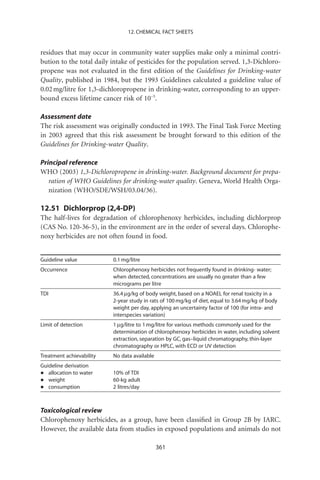
Mediterranean region, desalination facilities exist all over the world, and their use is
likely to increase in all continents.
   Most present applications of desalination are for estuarine water, coastal water and
seawater. Desalination may also be applied to brackish inland waters (both surface
water and groundwater) and may be used on board vessels. Small-scale desalination
units also exist for household and community use and present specific challenges to
effective operation and maintenance.
   Further guidance on desalination for safe drinking-water supply is available in the
supporting document Desalination for Safe Drinking-water Supply (section 1.3).
   In applying the Guidelines to desalinated water supply systems, account should be
taken of certain major differences between these and systems abstracting water from
freshwater sources. These differences include the factors described below. Once taken
into account, the general requirements of these Guidelines for securing microbial,
chemical and radiological safety should apply.
   Brackish water, coastal water and seawater sources may contain hazards not
encountered in freshwater systems. These include diverse harmful algal events
associated with micro- and macroalgae and cyanobacteria; certain free-living
bacteria (including Vibrio spp., such as V. parahaemolyticus and V. cholerae); and some
chemicals, such as boron and bromide, that are more abundant in seawater.
   Harmful algal events may be associated with exo- and endotoxins that may not be
destroyed by heating, are inside algal cells or are free in the water. They are usually
non-volatile, and, where they are destroyed by chlorination, this usually requires
extremely long contact times. Although a number of toxins have been identified, it is
possible that there are other unrecognized toxins. Minimizing of the potential for
abstracting water containing toxic algae through location/siting and intake design plus
effective monitoring and intake management is an important control measure.
   Other chemical issues, such as control of “additives,” DBPs and pesticides, are
similar to those encountered in fresh waters (see chapter 8), except that a larger variety

                                           111
GUIDELINES FOR DRINKING-WATER QUALITY


and greater quantities may be involved in desalination. Due to the presence of
bromide in seawater, the distribution of DBPs will likely be dominated by brominated
organics.
   Approaches to monitoring and assessing the quality of freshwater sources may not
be directly applicable to sources subject to desalination. For example, many faecal
indicator bacteria die off more rapidly than pathogens (especially viruses) in saline
than in fresh water.
   The effectiveness of some of the processes employed in desalination to remove
some substances of health concern remains inadequately understood. Examples of
inefficiencies include imperfect membrane and/or membrane seal integrity (mem-
brane treatment); bacterial growth through membranes/biofilm development on
membranes (in membrane treatment systems); and carry-over, especially of volatile
substances (with vapour).
   Because of the apparently high effectiveness of some of the processes used in
removal of both microorganisms and chemical constituents (especially distillation
and reverse osmosis), these processes may be employed as single-stage treatments or
combined with only a low level of residual disinfectant. The absence of multiple bar-
riers places great stress on the continuously safe operation of that process and implies
that even a short-term decrease in effectiveness may present an increased risk to
human health. This, in turn, implies the need for on-line monitoring linked to rapid
management intervention. For further information, see the supporting document
Water Treatment and Pathogen Control (section 1.3).
   Water produced by desalination is “aggressive” towards materials used, for example,
in water supply and domestic plumbing and pipes. Special consideration should
be given to the quality of such materials, and normal procedures for certification of
materials as suitable for potable water use may not be adequate for water that has not
been “stabilized.”
   Because of the aggressivity of desalinated water and because desalinated water may
be considered bland, flavourless and unacceptable, desalinated water is commonly
treated by adding chemical constituents such as calcium and magnesium carbonate
with carbon dioxide. Once such treatment has been applied, desalinated waters should
be no more aggressive than waters normally encountered in the drinking-water
supply. Chemicals used in such treatment should be subject to normal procedures for
certification.
   Desalinated waters are commonly blended with small volumes of more mineral-
rich waters to improve their acceptability and particularly to reduce their aggressivity
to materials. Blending waters should be fully potable, as described here and elsewhere
in the Guidelines. Where seawater is used for this purpose, the major ions added are
sodium and chloride. This does not contribute to improving hardness or ion balance,
and only small amounts (e.g., 1–3%) can be added without leading to problems of
acceptability. Blended waters from coastal and estuarine areas may be more suscepti-
ble to contamination with petroleum hydrocarbons, which could give rise to taste and

                                          112
6. APPLICATION OF THE GUIDELINES IN SPECIFIC CIRCUMSTANCES


odour problems. Some groundwaters or surface waters, after suitable treatment, may
be employed for blending in higher proportions and may improve hardness and ion
balance.
    Desalinated water is a manufactured product. Concern has been expressed about
the impact of extremes of major ion composition or ratios for human health. There
is limited evidence to describe the health risk associated with long-term consumption
of such water, although concerns regarding mineral content may be limited by the
stabilization processes outlined above (see WHO, 2003b).
    Desalinated water, by virtue of its manufacture, often contains lower than usual
concentrations of other ions commonly found in water, some of which are essential
elements. Water typically contributes a small proportion of these, and most intake is
through food. Exceptions include fluoride, and declining dental health has been
reported from populations consuming desalinated water with very low fluoride
content where there is a moderate to high risk of dental caries (WHO, 2003b).
    Desalinated water may be more subject to “microbial growth” problems than other
waters as a result of one or more of the following: higher initial temperature (from
treatment process), higher temperature (application in hot climates) and/or the effect
of aggressivity on materials (thereby releasing nutrients). The direct health signifi-
cance of such growth (see the supporting document Heterotrophic Plate Counts and
Drinking-water Safety; section 1.3), with the exception of Legionella (see chapter 11),
is inadequately understood. Nitrite formation by organisms in biofilms may prove
problematic where chloramination is practised and excess ammonia is present.
Precaution implies that preventive management should be applied as part of good
management practice.

6.5 Packaged drinking-water
Bottled water and ice are widely available in both industrialized and developing coun-
tries. Consumers may have various reasons for purchasing packaged drinking-water,
such as taste, convenience or fashion; for many consumers, however, safety and poten-
tial health benefits are important considerations.

6.5.1 Safety of packaged drinking-water
Water is packaged for consumption in a range of vessels, including cans, laminated
boxes and plastic bags, and as ice prepared for consumption. However, it is most com-
monly prepared in glass or plastic bottles. Bottled water also comes in various sizes,
from single servings to large carboys holding up to 80 litres.
   In applying the Guidelines to bottled waters, certain chemical constituents may be
more readily controlled than in piped distribution systems, and stricter standards may
therefore be preferred in order to reduce overall population exposure. Similarly, when
flexibility exists regarding the source of the water, stricter standards for certain natu-
rally occurring substances of health concern, such as arsenic, may be more readily
achieved than in piped distribution systems.

                                          113
GUIDELINES FOR DRINKING-WATER QUALITY


   However, some substances may prove to be more difficult to manage in bottled
water than in tap water. Some hazards may be associated with the nature of the
product (e.g., glass chips and metal fragments). Other problems may arise because
bottled water is stored for longer periods and at higher temperatures than water dis-
tributed in piped distribution systems or because containers and bottles are reused
without adequate cleaning or disinfection. Control of materials used in containers and
closures for bottled water is, therefore, of special concern. Some microorganisms that
are normally of little or no public health significance may grow to higher levels in
bottled water. This growth appears to occur less frequently in gasified water and in
water bottled in glass containers than in still water and water bottled in plastic con-
tainers. The public health significance of this microbial growth remains uncertain,
especially for vulnerable individuals, such as bottle-fed infants and immunocompro-
mised individuals. In regard to bottle-fed infants, as bottled water is not sterile, it
should be disinfected – for example, by boiling – prior to its use in the preparation
of infant formula. For further information, see the supporting document
Heterotrophic Plate Counts and Drinking-water Safety (section 1.3).

6.5.2 Potential health benefits of bottled drinking-water
There is a belief by some consumers that natural mineral waters have medicinal prop-
erties or offer other health benefits. Such waters are typically of high mineral content,
sometimes significantly higher than concentrations normally accepted in drinking-
water. Such waters often have a long tradition of use and are often accepted on the
basis that they are considered foods rather than drinking-water per se. Although
certain mineral waters may be useful in providing essential micro-nutrients, such as
calcium, these Guidelines do not make recommendations regarding minimum con-
centrations of essential compounds, because of the uncertainties surrounding mineral
nutrition from drinking-water.
   Packaged waters with very low mineral content, such as distilled or demineralized
waters, are also consumed. Rainwater, which is similarly low in minerals, is consumed
by some populations without apparent adverse health effects. There is insufficient
scientific information on the benefits or hazards of regularly consuming these types
of bottled waters (see WHO, 2003b).

6.5.3 International standards for bottled drinking-water
The Guidelines for Drinking-water Quality provide a basis for derivation of standards
for all packaged waters. As with other sources of drinking-water, safety is pursued
through a combination of safety management and end product quality standards and
testing. The international framework for packaged water regulation is provided by the
Codex Alimentarius Commission (CAC) of WHO and the FAO. CAC has developed
a Standard for Natural Mineral Waters and an associated Code of Practice. The Stan-
dard describes the product and its compositional and quality factors, including limits
for certain chemicals, hygiene, packaging and labelling. The CAC has also developed

                                          114
6. APPLICATION OF THE GUIDELINES IN SPECIFIC CIRCUMSTANCES


a Standard for Bottled/Packaged Waters to cover packaged drinking-water other
than natural mineral waters. Both relevant CAC standards refer directly to these
Guidelines.
   The CAC Code of Practice for Collecting, Processing and Marketing of Natural
Mineral Waters provides guidance on a range of good manufacturing practices and
provides a generic WSP applied to packaged drinking-water.
   Under the existing CAC Standard for Natural Mineral Waters and associated Code
of Practice, natural mineral waters must conform to strict requirements, including
collection and bottling without further treatment from a natural source, such as a
spring or well. In comparison, the CAC Standard for Bottled/Packaged Waters includes
waters from other sources, in addition to springs and wells, and treatment to improve
their safety and quality. The distinctions between these standards are especially
relevant in regions where natural mineral waters have a long cultural history.
   For further information on CAC, its Codex Committee on Natural Mineral Waters,
the CAC Standard for Natural Mineral Waters and its companion Code of Practice,
readers are referred to the CAC website (http://www.codexalimentarius.net/).

6.6 Food production and processing
The quality of water defined by the Guidelines is such that it is suitable for all normal
uses in the food industry. Some processes have special water quality requirements in
order to secure the desired characteristics of the product, and the Guidelines do not
necessarily guarantee that such special requirements are met.
   Deterioration in drinking-water quality may have severe impacts on food process-
ing facilities and potentially upon public health. The consequences of a failure to use
water of potable quality will depend on the use of the water and the subsequent
processing of potentially contaminated materials. Variations in water quality that
may be tolerated occasionally in drinking-water supply may be unacceptable for some
uses in the food industry. These variations may result in a significant financial impact
on food production – for example, through product recalls.
   The diverse uses of water in food production and processing have different water
quality requirements. Uses include:
  — irrigation and livestock watering;
  — those in which water may be incorporated in or adhere to a product (e.g., as an
    ingredient, or where used in washing or “refreshing” of foods);
  — misting of salad vegetables in grocery stores; and
  — those in which contact between the water and foodstuff should be minimal (as
    in heating and cooling and cleaning water).
   To reduce microbial contamination, specific treatments (e.g., heat) capable of
removing a range of pathogenic organisms of public health concern may be used. The
effect of these treatments should be taken into account when assessing the impacts of
deterioration in drinking-water quality on a food production or processing facility.

                                          115
GUIDELINES FOR DRINKING-WATER QUALITY


  Information on deterioration of the quality of a drinking-water supply should be
promptly communicated to vulnerable food production facilities.

6.7 Aircraft and airports
6.7.1 Health risks
The importance of water as a potential vehicle for infectious disease transmission on
aircraft has been well documented. In general terms, the greatest microbial risks are
those associated with ingestion of water that is contaminated with human and animal
excreta.
   If the source of water used to replenish aircraft supplies is contaminated, and unless
adequate precautions are taken, disease can be spread through the aircraft water. It is
thus imperative that airports comply with Article 14.2 (Part III – Health Organiza-
tion) of the International Health Regulations (1969) and be provided with potable
drinking-water from a source approved by the appropriate regulatory agency (WHO,
1983).
   A potable water source is not a safeguard if the water is subsequently contaminated
during transfer, storage or distribution in aircraft. Airports usually have special
arrangements for managing water after it has entered the airport. Water may be deliv-
ered to aircraft by water servicing vehicles or water bowsers. Transfer of water from
the water carriers to the aircraft provides the opportunity for microbial or chemical
contamination (e.g., from water hoses).
   A WSP covering water management within airports from receipt of the water
through to its transfer to the aircraft, complemented by measures (e.g., safe materials
and good practices in design, construction, operation and maintenance of aircraft
systems) to ensure that water quality is maintained on the aircraft, provides a frame-
work for water safety in aviation.

6.7.2 System risk assessment
In undertaking an assessment of the general airport/aircraft water distribution system,
a range of specific issues must be taken into consideration, including:

  — quality of source water;
  — design and construction of airport storage tanks and pipes;
  — design and construction of water servicing vehicles;
  — water loading techniques;
  — any treatment systems on aircraft;
  — maintenance of on-board plumbing; and
  — prevention of cross-connections, including backflow prevention.

6.7.3 Operational monitoring
The airport authority has responsibility for safe drinking-water supply, including for
operational monitoring, until water is transferred to the aircraft operator. The primary

                                          116
6. APPLICATION OF THE GUIDELINES IN SPECIFIC CIRCUMSTANCES


emphasis of monitoring is as a verification of management processes. Monitoring of
control measures includes:

  — quality of source water;
  — hydrants, hoses and bowsers for cleanliness and repair;
  — disinfectant residuals and pH;
  — backflow preventers;
  — filters; and
  — microbial quality of water, particularly after maintenance or repairs.

6.7.4 Management
Even if potable water is supplied to the airport, it is necessary to introduce precau-
tions to prevent contamination during the transfer of water to the aircraft and in the
aircraft drinking-water system itself. Staff employed in drinking-water supply must
not be engaged in activities related to aircraft toilet servicing without first taking all
necessary precautions (e.g., thorough handwashing, change of outer garments).
   All water servicing vehicles must be cleansed and disinfected frequently.
   Supporting programmes that should be documented as part of a WSP for airports
include:

  — suitable training for crews dealing with water transfer and treatment; and
  — effective certification of materials used on aircraft for storage tanks and pipes.

6.7.5 Surveillance
Independent surveillance resembles that described in chapter 5 and is an essential
element in ensuring drinking-water safety in aviation. This implies:

  — periodic audit and direct assessment;
  — review and approval of WSPs;
  — specific attention to the aircraft industry’s codes of practice, the supporting doc-
    ument Guide to Hygiene and Sanitation in Aviation (section 1.3) and airport
    health or airline regulations; and
  — responding, investigating and providing advice on receipt of report on signifi-
    cant incidents.

6.8 Ships
6.8.1 Health risks
The importance of water as a vehicle for infectious disease transmission on ships has
been clearly documented. In general terms, the greatest microbial risks are associated
with ingestion of water that is contaminated with human and animal excreta. Water-
borne transmission of the enterotoxigenic E. coli, Norovirus, Vibrio spp., Salmonella
typhi, Salmonella spp. (non-typhi), Shigella spp., Cryptosporidium spp., Giardia
lamblia and Legionella spp. on ships has been confirmed (see Rooney et al., in press).

                                          117
GUIDELINES FOR DRINKING-WATER QUALITY


   Chemical water poisoning can also occur on ships. For example, one outbreak of
acute chemical poisoning implicated hydroquinone, an ingredient of photo developer,
as the disease-causing agent in the ship’s potable water supply. Chronic chemical
poisoning on a ship could also occur if crew or passengers were exposed to small doses
of harmful chemicals over long periods of time.
   The supporting document Guide to Ship Sanitation (section 1.3) describes the
factors that can be encountered during water treatment, transfer, production, storage
or distribution in ships. This revised Guide includes description of specific features
of the organization of the supply and the regulatory framework.
   The organization of water supply systems covering shore facilities and ships differs
considerably from conventional water transfer on land. Even though a port authority
may receive potable water from a municipal or private supply, it usually has special
arrangements for managing the water after it has entered the port. Water is delivered
to ships by hoses or transferred to the ship via water boats or barges. Transfer of
water from shore to ships can provide possibilities for microbial or chemical
contamination.
   In contrast to a shore facility, plumbing aboard ships consists of numerous piping
systems, carrying potable water, seawater, sewage and fuel, fitted into a relatively con-
fined space. Piping systems are normally extensive and complex, making them diffi-
cult to inspect, repair and maintain. A number of waterborne outbreaks on ships have
been caused by contamination of potable water after it had been loaded onto the ship
– for example, by sewage or bilge when the water storage systems were not adequately
designed and constructed. During distribution, it may be difficult to prevent water
quality deterioration due to stagnant water and dead ends.
   Water distribution on ships may also provide greater opportunities for contami-
nation to occur than onshore, because ship movement increases the possibility of
surge and backflow.

6.8.2 System risk assessment
In undertaking an assessment of the ship’s drinking-water system, a range of specific
issues must be taken into consideration, including:
  — quality of source water;
  — water loading equipment;
  — water loading techniques;
  — design and construction of storage tanks and pipes;
  — filtration systems and other treatment systems on board the ship;
  — backflow prevention;
  — pressure of water within the system;
  — system design to minimize dead ends and areas of stagnation; and
  — residual disinfection.


                                          118
6. APPLICATION OF THE GUIDELINES IN SPECIFIC CIRCUMSTANCES


6.8.3 Operational monitoring
The ship’s master is responsible for operational monitoring. The primary emphasis
of monitoring is as a verification of management processes. Monitoring of control
measures includes:
   — quality of source water;
   — hydrants and hoses for cleanliness and repair;
   — disinfectant residuals and pH (e.g., daily);
   — backflow prevention devices (e.g., monthly to yearly);
   — filters (before and during each use); and
   — microbial quality of treated water, particularly after maintenance or repairs.
   The frequency of monitoring should reflect the probable rate of change in water
quality. For example, monitoring of drinking-water on ships may be more frequent
when the ship is new or recently commissioned, with frequencies decreasing in the
light of review of results. Similarly, if the ship’s water system has been out of control,
monitoring following restoration of the system would be more frequent until it is
verified that the system is clearly under control.

6.8.4 Management
The port authority has responsibility for providing safe potable water for loading onto
vessels. The ship’s master will not normally have direct control of pollution of water
supplied at port. If water is suspected to have come from an unsafe source, the ship’s
master may have to decide if any additional treatment (e.g., hyperchlorination and/or
filtration) is necessary. When treatment on board or prior to boarding is necessary,
the treatment selected should be that which is best suited to the water and which is
most easily operated and maintained by the ship’s officers and crew.
   During transfer from shore to ship and on board, water must be provided with
sanitary safeguards through the shore distribution system, including connections to
the ship system, and throughout the ship system, to prevent contamination of the
water.
   Potable water should be stored in one or more tanks that are constructed, located
and protected so as to be safe against contamination. Potable water lines should be
protected and located so that they will not be submerged in bilge water or pass
through tanks storing non-potable liquids.
   The ship’s master should ensure that crew and passengers receive a sufficient and
uninterrupted drinking-water supply and that contamination is not introduced in the
distribution system. The distribution systems on ships are especially vulnerable to
contamination when the pressure falls. Backflow prevention devices should be
installed to prevent contamination of water where loss of pressure could result in
backflow.
   The potable water distribution lines should not be cross-connected with the piping
or storage tanks of any non-potable water system.

                                           119
GUIDELINES FOR DRINKING-WATER QUALITY


   Water safety is secured through repair and maintenance protocols, including the
ability to contain potential contamination by valving and the cleanliness of person-
nel, their working practices and the materials employed.
   Current practice on many ships is to use disinfectant residuals to control the growth
of microorganisms in the distribution system. Residual disinfection alone should not
be relied on to “treat” contaminated water, since the disinfection can be readily over-
whelmed by contamination.
   Supporting programmes that should be documented as part of the WSP for ships
include:
  — suitable training for crew dealing with water transfer and treatment; and
  — effective certification of materials used on ships for storage tanks and pipes.

6.8.5 Surveillance
Independent surveillance is a desirable element in ensuring drinking-water safety on
ships. This implies:
  — periodic audit and direct assessment;
  — review and approval of WSPs;
  — specific attention to the shipping industry’s codes of practice, the supporting
    document Guide to Ship Sanitation (section 1.3) and port health or shipping
    regulations; and
  — responding, investigating and providing advice on receipt of report on signifi-
    cant incidents.


                                          120
7
                   Microbial aspects


T   he greatest risk from microbes in water is associated with consumption of
    drinking-water that is contaminated with human and animal excreta, although
other sources and routes of exposure may also be significant.
   This chapter focuses on organisms for which there is evidence, from outbreak
studies or from prospective studies in non-outbreak situations, of disease being caused
by ingestion of drinking-water, inhalation of droplets or contact with drinking-water;
and their control.

7.1 Microbial hazards associated with drinking-water
Infectious diseases caused by pathogenic bacteria, viruses and parasites (e.g., proto-
zoa and helminths) are the most common and widespread health risk associated
with drinking-water. The public health burden is determined by the severity of the
illness(es) associated with pathogens, their infectivity and the population exposed.
    Breakdown in water supply safety may lead to large-scale contamination and
potentially to detectable disease outbreaks. Other breakdowns and low-level, poten-
tially repeated contamination may lead to significant sporadic disease, but is unlikely
to be associated with the drinking-water source by public health surveillance.
    Quantified risk assessment can assist in understanding and managing risks, espe-
cially those associated with sporadic disease.

7.1.1 Waterborne infections
The pathogens that may be transmitted through contaminated drinking-water are
diverse. Table 7.1 and Figure 7.1 provide general information on pathogens that are
of relevance for drinking-water supply management. The spectrum changes in
response to variables such as increases in human and animal populations, escalating
use of wastewater, changes in lifestyles and medical interventions, population move-
ment and travel and selective pressures for new pathogens and mutants or recombi-
nations of existing pathogens. The immunity of individuals also varies considerably,
whether acquired by contact with a pathogen or influenced by such factors as age, sex,
state of health and living conditions.

                                         121
GUIDELINES FOR DRINKING-WATER QUALITY


Table 7.1 Waterborne pathogens and their significance in water supplies
                                           Persistence   Resistance               Important
                            Health         in water      to          Relative     animal
Pathogen                    significance suppliesa        chlorineb   infectivityc source
Bacteria
Burkholderia pseudomallei             Low              May multiply      Low             Low             No
Campylobacter jejuni, C. coli         High             Moderate          Low             Moderate        Yes
Escherichia coli – Pathogenicd        High             Moderate          Low             Low             Yes
E. coli – Enterohaemorrhagic          High             Moderate          Low             High            Yes
Legionella spp.                       High             Multiply          Low             Moderate        No
Non-tuberculous mycobacteria          Low              Multiply          High            Low             No
Pseudomonas aeruginosae               Moderate         May multiply      Moderate        Low             No
Salmonella typhi                      High             Moderate          Low             Low             No
Other salmonellae                     High             May multiply      Low             Low             Yes
Shigella spp.                         High             Short             Low             Moderate        No
Vibrio cholerae                       High             Short             Low             Low             No
Yersinia enterocolitica               High             Long              Low             Low             Yes
Viruses
Adenoviruses                          High             Long              Moderate        High            No
Enteroviruses                         High             Long              Moderate        High            No
Hepatitis A virus                     High             Long              Moderate        High            No
Hepatitis E virus                     High             Long              Moderate        High            Potentially
Noroviruses and sapoviruses           High             Long              Moderate        High            Potentially
Rotaviruses                           High             Long              Moderate        High            No
Protozoa                                                                                                 No
Acanthamoeba spp.                     High             Long              High            High            No
Cryptosporidium parvum                High             Long              High            High            Yes
Cyclospora cayetanensis               High             Long              High            High            No
Entamoeba histolytica                 High             Moderate          High            High            No
Giardia intestinalis                  High             Moderate          High            High            Yes
Naegleria fowleri                     High             May multiplyf     High            High            No
Toxoplasma gondii                     High             Long              High            High            Yes
Helminths
Dracunculus medinensis                High             Moderate          Moderate        High            No
Schistosoma spp.                      High             Short             Moderate        High            Yes

Note: Waterborne transmission of the pathogens listed has been confirmed by epidemiological studies and case his-
tories. Part of the demonstration of pathogenicity involves reproducing the disease in suitable hosts. Experimental
studies in which volunteers are exposed to known numbers of pathogens provide relative information. As most studies
are done with healthy adult volunteers, such data are applicable to only a part of the exposed population, and extrap-
olation to more sensitive groups is an issue that remains to be studied in more detail.
a
  Detection period for infective stage in water at 20 °C: short, up to 1 week; moderate, 1 week to 1 month; long, over
  1 month.
b
  When the infective stage is freely suspended in water treated at conventional doses and contact times. Resistance
  moderate, agent may not be completely destroyed.
c
  From experiments with human volunteers or from epidemiological evidence.
d
  Includes enteropathogenic, enterotoxigenic and enteroinvasive.
e
  Main route of infection is by skin contact, but can infect immunosuppressed or cancer patients orally.
f
  In warm water.

    For pathogens transmitted by the faecal–oral route, drinking-water is only one
vehicle of transmission. Contamination of food, hands, utensils and clothing can also
play a role, particularly when domestic sanitation and hygiene are poor. Improvements
in the quality and availability of water, in excreta disposal and in general hygiene are
all important in reducing faecal–oral disease transmission.

                                                        122
7. MICROBIAL ASPECTS


                                      Ingestion                     Inhalation and        Contact
                                      (Drinking)                      aspiration          (Bathing)
                                                                       (Aerosols)


Route of
infection                                                                              Skin (especially
(Sepsis and                                                                             if abraded),
generalized                       Gastrointestinal                   Respiratory           mucous
infection                                                                               membranes,
may occur)                                                                              wounds,eyes


                   Bacteria         Viruses        Protozoa and       Legionella     Acanthamoeba spp.
              Campylobacter spp. Adenoviruses        helminths      pneumophila        Aeromonas spp.
                     E. coli      Astroviruses    Cryptosporidium   Mycobacteria         Burkholderia
               Salmonella spp.   Enteroviruses        parvum      (non-tuberculous)     pseudomallei
                 Shigella spp.  Hepatitis A virus   Dracunculus    Naegleria fowleri    Mycobacteria
                Vibrio cholerae Hepatitis E virus    medinensis      Diverse viral    (non-tuberculous)
                 Yersinia spp.    Noroviruses       Entamoeba         infections       Leptospira spp.*
                                  Rotaviruses        histolytica     Many other         Pseudomonas
                                  Sapoviruses Giardia intestinalis agents in high-        aeruginosa
                                                    Toxoplasma         exposure          Schistosoma
                                                       gondii         situations           mansoni*

* Primarily from contact with highly contaminated surface waters.

Figure 7.1 Transmission pathways for and examples of water-related pathogens


   Drinking-water safety is not related
only to faecal contamination. Some                   Infectious diseases caused by pathogenic
                                                     bacteria, viruses, protozoa and helminths
organisms grow in piped water distribu-              are the most common and widespread
tion systems (e.g., Legionella), whereas             health risk associated with drinking-water.
others occur in source waters (guinea
worm Dracunculus medinensis) and may
cause outbreaks and individual cases. Some other microbes (e.g., toxic cyanobacteria)
require specific management approaches, which are covered elsewhere in these Guide-
lines (see section 11.5).
   Certain serious illnesses result from inhalation of water droplets (aerosols) in
which the causative organisms have multiplied because of warm temperatures and the
presence of nutrients. These include legionellosis and Legionnaires’ disease, caused by
Legionella spp., and those caused by the amoebae Naegleria fowleri (primary amoebic
meningoencephalitis [PAM]) and Acanthamoeba spp. (amoebic meningitis, pul-
monary infections).
   Schistosomiasis (bilharziasis) is a major parasitic disease of tropical and subtropi-
cal regions that is transmitted when the larval stage (cercariae), which is released by
infected aquatic snails, penetrates the skin. It is primarily spread by contact with water.
Ready availability of safe drinking-water contributes to disease prevention by reduc-
ing the need for contact with contaminated water resources – for example, when col-
lecting water to carry to the home or when using water for bathing or laundry.

                                                       123
GUIDELINES FOR DRINKING-WATER QUALITY


   It is conceivable that unsafe drinking-water contaminated with soil or faeces could
act as a carrier of other parasitic infections, such as balantidiasis (Balantidium coli)
and certain helminths (species of Fasciola, Fasciolopsis, Echinococcus, Spirometra,
Ascaris, Trichuris, Toxocara, Necator, Ancylostoma and Strongyloides and Taenia
solium). However, in most of these, the normal mode of transmission is ingestion of
the eggs in food contaminated with faeces or faecally contaminated soil (in the case
of Taenia solium, ingestion of the larval cysticercus stage in uncooked pork) rather
than ingestion of contaminated drinking-water.
   Other pathogens that may be naturally present in the environment may be able to
cause disease in people with impaired local or general immune defence mechanisms,
such as the elderly or the very young, patients with burns or extensive wounds, those
undergoing immunosuppressive therapy or those with acquired immunodeficiency
syndrome (AIDS). If water used by such persons for drinking or bathing contains suf-
ficient numbers of these organisms, they can produce various infections of the skin
and the mucous membranes of the eye, ear, nose and throat. Examples of such agents
are Pseudomonas aeruginosa and species of Flavobacterium, Acinetobacter, Klebsiella,
Serratia, Aeromonas and certain “slow-growing” (non-tuberculous) mycobacteria (see
the supporting document Pathogenic Mycobacteria in Water; section 1.3).
   Most of the human pathogens listed in Table 7.1 (which are described in more
detail in chapter 11) are distributed worldwide; some, however, such as those causing
outbreaks of cholera or guinea worm disease, are regional. Eradication of D.
medinensis is a recognized target of the World Health Assembly (1991).
   It is likely that there are pathogens not shown in Table 7.1 that are also trans-
mitted by water. This is because the number of known pathogens for which water is
a transmission route continues to increase as new or previously unrecognized
pathogens continue to be discovered (see WHO, 2003a).

7.1.2 Persistence and growth in water
While typical waterborne pathogens are able to persist in drinking-water, most do not
grow or proliferate in water. Microorganisms like E. coli and Campylobacter can accu-
mulate in sediments and are mobilized when water flow increases.
   After leaving the body of their host, most pathogens gradually lose viability and
the ability to infect. The rate of decay is usually exponential, and a pathogen will
become undetectable after a certain period. Pathogens with low persistence must
rapidly find new hosts and are more likely to be spread by person-to-person contact
or poor personal hygiene than by drinking-water. Persistence is affected by several
factors, of which temperature is the most important. Decay is usually faster at higher
temperatures and may be mediated by the lethal effects of UV radiation in sunlight
acting near the water surface.
   The most common waterborne pathogens and parasites are those that have high
infectivity and either can proliferate in water or possess high resistance to decay
outside the body.

                                          124
7. MICROBIAL ASPECTS


   Viruses and the resting stages of parasites (cysts, oocysts, ova) are unable to mul-
tiply in water. Conversely, relatively high amounts of biodegradable organic carbon,
together with warm temperatures and low residual concentrations of chlorine, can
permit growth of Legionella, V. cholerae, Naegleria fowleri, Acanthamoeba and
nuisance organisms in some surface waters and during water distribution (see also
the supporting document Heterotrophic Plate Counts and Drinking-water Safety;
section 1.3).
   Microbial water quality may vary rapidly and widely. Short-term peaks in pathogen
concentration may increase disease risks considerably and may also trigger outbreaks
of waterborne disease. Results of water quality testing for microbes are not normally
available in time to inform management action and prevent the supply of unsafe
water.

7.1.3 Public health aspects
Outbreaks of waterborne disease may affect large numbers of persons, and the first
priority in developing and applying controls on drinking-water quality should be the
control of such outbreaks. Available evidence also suggests that drinking-water can
contribute to background rates of disease in non-outbreak situations, and control of
drinking-water quality should therefore also address waterborne disease in the general
community.
   Experience has shown that systems for the detection of waterborne disease out-
breaks are typically inefficient in countries at all levels of socioeconomic development,
and failure to detect outbreaks is not a guarantee that they do not occur; nor does it
suggest that drinking-water should necessarily be considered safe.
   Some of the pathogens that are known to be transmitted through contaminated
drinking-water lead to severe and sometimes life-threatening disease. Examples
include typhoid, cholera, infectious hepatitis (caused by hepatitis A virus [HAV] or
HEV) and disease caused by Shigella spp. and E. coli O157. Others are typically
associated with less severe outcomes, such as self-limiting diarrhoeal disease (e.g.,
Norovirus, Cryptosporidium).
   The effects of exposure to pathogens are not the same for all individuals or, as a
consequence, for all populations. Repeated exposure to a pathogen may be associated
with a lower probability or severity of illness because of the effects of acquired immu-
nity. For some pathogens (e.g., HAV), immunity is lifelong, whereas for others (e.g.,
Campylobacter), the protective effects may be restricted to a few months to years. On
the other hand, sensitive subgroups (e.g., the young, the elderly, pregnant women and
the immunocompromised) in the population may have a greater probability of illness
or the illness may be more severe, including mortality. Not all pathogens have greater
effects in all sensitive subgroups.
   Not all infected individuals will develop symptomatic disease. The proportion of
the infected population that is asymptomatic (including carriers) differs between
pathogens and also depends on population characteristics, such as prevalence of

                                          125
GUIDELINES FOR DRINKING-WATER QUALITY


immunity. Carriers and those with asymptomatic infections as well as individuals
developing symptoms may all contribute to secondary spread of pathogens.

7.2 Health-based target setting
7.2.1 Health-based targets applied to microbial hazards
General approaches to health-based target setting are described in section 2.1.1 and
chapter 3.
   Sources of information on health risks may be from both epidemiology and risk
assessment, and typically both are employed as complementary sources.
   Health-based targets may also be set using a health outcome approach, where the
waterborne disease burden is believed to be sufficiently high to allow measurement
of the impact of interventions – i.e., to measure reductions in disease that can be
attributed to drinking-water.
   Risk assessment is especially valuable where the fraction of disease that can be
attributed to drinking-water is low or difficult to measure directly through public
health surveillance or analytical epidemiological studies.
   Data – from both epidemiology and risk assessment – with which to develop
health-based targets for many pathogens are limited, but are increasingly being pro-
duced. Locally generated data will always be of great value in setting national targets.
   For the control of microbial hazards, the most frequent form of health-based target
applied is performance targets (see section 3.2.2), which are anchored to a tolerable
burden of disease. WQTs (see section 3.2.3) are typically not developed for pathogens,
because monitoring finished water for pathogens is not considered a feasible or cost-
effective option.

7.2.2 Risk assessment approach
In many circumstances, estimating the effects of improved drinking-water quality on
health risks in the population is possible through constructing and applying risk
assessment models.
   QMRA is a rapidly evolving field that systematically combines available informa-
tion on exposure and dose–response to produce estimates of the disease burden
associated with exposure to pathogens. Mathematical modelling is used to estimate
the effects of low doses of pathogens in drinking-water on populations and
subpopulations.
   Interpreting and applying information from analytical epidemiological studies to
derive health-based targets for application at a national or local level require con-
sideration of a number of factors, including the following:

•   Are specific estimates of disease reduction or indicative ranges of expected reduc-
    tions to be provided?
•   How representative of the target population was the study sample in order to ensure
    confidence in the reliability of the results across a wider group?

                                          126
7. MICROBIAL ASPECTS


•   To what extent will minor differences in demographic or socioeconomic conditions
    affect expected outcomes?
    Risk assessment commences with problem formulation to identify all possible
hazards and their pathways from source(s) to recipient(s). Human exposure to the
pathogens (environmental concentrations and volumes ingested) and dose–responses
of these selected organisms are then combined to characterize the risks. With the use
of additional information (social, cultural, political, economic, environmental, etc.),
management options can be prioritized. To encourage stakeholder support and par-
ticipation, a transparent procedure and active risk communication at each stage of the
process are important. An example of a risk assessment approach is described in Table
7.2 and outlined below.

Problem formulation and hazard identification
All potential hazards, sources and events that can lead to the presence of these hazards
(i.e., what can happen and how) should be identified and documented for each com-
ponent of the drinking-water system, regardless of whether or not the component is
under the direct control of the drinking-water supplier. This includes point sources
of pollution (e.g., human and industrial waste discharge) as well as diffuse sources
(e.g., those arising from agricultural and animal husbandry activities). Continuous,
intermittent or seasonal pollution patterns should also be considered, as well as
extreme and infrequent events, such as droughts and floods.
    The broader sense of hazards focuses on hazardous scenarios, which are events that
may lead to exposure of consumers to specific pathogenic microorganisms. In this,
the hazardous event (e.g., peak contamination of source water with domestic waste-
water) may be referred to as the hazard.
    Representative organisms are selected that, if controlled, would ensure control of
all pathogens of concern. Typically, this implies inclusion of at least one bacterial
pathogen, virus and protozoan.


Table 7.2 Risk assessment paradigm for pathogen health risks
Step                       Aim
1. Problem formulation           To identify all possible hazards associated with drinking-water that
   and hazard                    would have an adverse public health consequence, as well as their
   identification                 pathways from source(s) to consumer(s)
2. Exposure assessment           To determine the size and nature of the population exposed and the
                                 route, amount and duration of the exposure
3. Dose–response                 To characterize the relationship between exposure and the incidence of
   assessment                    the health effect
4. Risk characterization         To integrate the information from exposure, dose–response and health
                                 interventions in order to estimate the magnitude of the public health
                                 problem and to evaluate variability and uncertainty

Source: Adapted from Haas et al. (1999).


                                                   127
GUIDELINES FOR DRINKING-WATER QUALITY


Exposure assessment
Exposure assessment involves estimation of the number of pathogenic microbes to
which an individual is exposed, principally through ingestion. Exposure assessment
is a predictive activity that often involves subjective judgement. It inevitably contains
uncertainty and must account for variability of factors such as concentrations of
microorganisms over time, volumes ingested, etc.
    Exposure can be considered as a single dose of pathogens that a consumer ingests
at a certain point of time or the total amount over several exposures (e.g., over a year).
Exposure is determined by the concentration of microbes in drinking-water and the
volume of water consumed.
    It is rarely possible or appropriate to directly measure pathogens in drinking-water
on a regular basis. More often, concentrations in source waters are assumed or meas-
ured, and estimated reductions – for example, through treatment – are applied to esti-
mate the concentration in the water consumed. Pathogen measurement, when
performed, is generally best carried out at the location where the pathogens are at
highest concentration (generally source waters). Estimation of their removal by
sequential control measures is generally achieved by the use of surrogates (such as E.
coli for enteric bacterial pathogens) (see also the supporting document Water Treat-
ment and Pathogen Control; section 1.3).
    The other component of exposure assessment, which is common to all pathogens,
is the volume of unboiled water consumed by the population, including person-to-
person variation in consumption behaviour and especially consumption behaviour of
at-risk groups. For microbial hazards, it is important that the unboiled volume of
drinking-water, both consumed directly and used in food preparation, is used in the
risk assessment, as heating will rapidly inactivate pathogens. This amount is lower
than that used for deriving chemical guideline values and WQTs.
    The daily exposure of a consumer can be assessed by multiplying the concentra-
tion of pathogens in drinking-water by the volume of drinking-water consumed. For
the purposes of the Guidelines, unboiled drinking-water consumption is assumed to
be 1 litre of water per day.

Dose–response assessment
The probability of an adverse health effect following exposure to one or more path-
ogenic organisms is derived from a dose–response model. Available dose–response
data have been obtained mainly from studies using healthy adult volunteers. Several
subgroups in the population, such as children, the elderly and immunocompromised
persons, are more sensitive to infectious disease; currently, however, adequate data are
lacking to account for this.
   The conceptual basis for the infection model is the observation that exposure to
the described dose leads to the probability of infection as a conditional event. For
infection to occur, one or more viable pathogens must have been ingested. Further-
more, one or more of these ingested pathogens must have survived in the host’s body.

                                           128
GUIDELINES FOR DRINKING-WATER QUALITY


An important concept is the single-hit principle (i.e., that even a single organism may


                                         128a
7. MICROBIAL ASPECTS


be able to cause infection and disease, possibly with a low probability). This concept
supersedes the concept of (minimum) infectious dose that is frequently used in older
literature (see the supporting document Hazard Characterization for Pathogens in Food
and Water; section 1.3).
    In general, well dispersed pathogens in water are considered to be Poisson distrib-
uted. When the individual probability of any organism to survive and start infection
is the same, the dose–response relation simplifies to an exponential function. If,
however, there is heterogeneity in this individual probability, this leads to the beta-
Poisson dose–response relation, where the “beta” stands for the distribution of the
individual probabilities among pathogens (and hosts). At low exposures, such as
would typically occur in drinking-water, the dose–response model is approximately
linear and can be represented simply as the probability of infection resulting from
exposure to a single organism (see the supporting document Hazard Characterization
for Pathogens in Food and Water; section 1.3).

Risk characterization
Risk characterization brings together the data collected on pathogen exposure,
dose–response, severity and disease burden.
   The probability of infection can be estimated as the product of the exposure by
drinking-water and the probability that exposure to one organism would result in
infection. The probability of infection per day is multiplied by 365 to calculate the
probability of infection per year. In doing so, it is assumed that different exposure
events are independent, in that no protective immunity is built up. This simplifica-
tion is justified for low risks only.
   Not all infected individuals will develop clinical illness; asymptomatic infection is
common for most pathogens. The percentage of infected persons that will develop
clinical illness depends on the pathogen, but also on other factors, such as the immune
status of the host. Risk of illness per year is obtained by multiplying the probability
of infection by the probability of illness given infection.
   The low numbers in Table 7.3 can be interpreted to represent the probability that
a single individual will develop illness in a given year. For example, a risk of illness
for Campylobacter of 2.5 ¥ 10-4 per year indicates that, on average, 1 out of 4000 con-
sumers would contract campylobacteriosis from drinking-water.
   To translate the risk of developing a specific illness to disease burden per case, the
metric DALYs is used. This should reflect not only the effects of acute end-points (e.g.,
diarrhoeal illness) but also mortality and the effects of more serious end-points (e.g.,
Guillain-Barré syndrome associated with Campylobacter). Disease burden per case
varies widely. For example, the disease burden per 1000 cases of rotavirus diarrhoea
is 480 DALYs in low-income regions, where child mortality frequently occurs.
However, it is only 14 DALYs per 1000 cases in high-income regions, where hospital
facilities are accessible to the great majority of the population (see the supporting
document Quantifying Public Health Risk in the WHO Guidelines for Drinking-water

                                          129
GUIDELINES FOR DRINKING-WATER QUALITY


Table 7.3 Linking tolerable disease burden and source water quality for reference pathogens:
          example calculation
River water (human
and animal pollution)                        Cryptosporidium     Campylobacter      Rotavirusa
Raw water quality (CR)          Organisms per litre               10                      100                 10
Treatment effect                Percent reduction              99.994%                99.99987%           99.99968%
needed to reach
tolerable risk (PT)
Drinking-water                  Organisms per litre            6.3 ¥ 10-4              1.3 ¥ 10-4          3.2 ¥ 10-5
quality (CD)
Consumption of                  Litres per day                     1                        1                   1
unheated
drinking-water (V)
Exposure by                     Organisms per day              6.3 ¥ 10-4              1.3 ¥ 10-4          3.2 ¥ 10-5
drinking-water (E)
Dose–response (r)               Probability of                 4.0 ¥ 10-3              1.8 ¥ 10-2          2.7 ¥ 10-1
                                infection per
                                organism
Risk of infection (Pinf,d)      Per day                        2.5 ¥ 10-6              2.3 ¥ 10-6          8.5 ¥ 10-6
Risk of infection (Pinf,y)      Per year                       9.2 ¥ 10-4              8.3 ¥ 10-4          3.1 ¥ 10-3
Risk of (diarrhoeal)                                              0.7                     0.3                 0.5
illness given infection
(Pill|inf)
Risk of (diarrhoeal)            Per year                       6.4 ¥ 10-4              2.5 ¥ 10-4          1.6 ¥ 10-3
illness (Pill)
Disease burden (db)             DALYs per case                 1.5 ¥ 10-3              4.6 ¥ 10-3          1.4 ¥ 10-2
Susceptible fraction            Percentage of                    100%                    100%                 6%
(fs)                            population
Disease burden (DB)             DALYs per year                 1 ¥ 10-6                 1 ¥ 10-6            1 ¥ 10-6
Formulas:                       CD = CR ¥ (1 - PT)
                                E = CD ¥ V
                                Pinf,d = E ¥ r
a
    Data from high-income regions. In low-income regions, severity is typically higher, but drinking-water transmission
    is unlikely to dominate.


Quality; section 1.3). This considerable difference in disease burden results in far
stricter treatment requirements in low-income regions for the same source water
quality in order to obtain the same risk (expressed as DALYs per year). Ideally, the
default disease burden estimates in Table 7.3 should be adapted to specific national
situations. In Table 7.3, no accounting is made for effects on immunocompromised
persons (e.g., cryptosporidiosis in HIV/AIDS patients), which is significant in some
countries. Section 3.3.3 gives more information on the DALY metric and how it is
applied to derive a reference level of risk.
   Only a proportion of the population may be susceptible to some pathogens,
because immunity developed after an initial episode of infection or illness may
provide lifelong protection. Examples include HAV and rotaviruses. It is estimated
that in developing countries, all children above the age of 5 years are immune to
rotaviruses because of repeated exposure in the first years of life. This translates to an

                                                         130
7. MICROBIAL ASPECTS


average of 17% of the population being susceptible to rotavirus illness. In developed
countries, rotavirus infection is also common in the first years of life, and the illness
is diagnosed mainly in young children, but the percentage of young children as part
of the total population is lower. This translates to an average of 6% of the population
in developed countries being susceptible.
   The uncertainty of the risk estimate is the result of the uncertainty and variability
of the data collected in the various steps of the risk assessment. Risk assessment
models should ideally account for this variability and uncertainty, although here we
present only point estimates (see below).
   It is important to choose the most appropriate point estimate for each of the vari-
ables. Theoretical considerations show that risks are directly proportional to the
arithmetic mean of the ingested dose. Hence, arithmetic means of variables such as
concentration in raw water, removal by treatment and consumption of drinking-water
are recommended. This recommendation is different from the usual practice among
microbiologists and engineers of converting concentrations and treatment effects to
log-values and making calculations or specifications on the log-scale. Such calcula-
tions result in estimates of the geometric mean rather than the arithmetic mean, and
these may significantly underestimate risk. Analysing site-specific data may therefore
require going back to the raw data rather than relying on reported log-transformed
values.

7.2.3 Risk-based performance target setting
The process outlined above enables estimation of risk on a population level, taking
account of source water quality and impact of control. This can be compared with
the reference level of risk (see section 3.3.2) or a locally developed tolerable risk. The
calculations enable quantification of the degree of source protection or treatment that
is needed to achieve a specified level of acceptable risk and analysis of the estimated
impact of changes in control measures.
   Performance targets are most frequently applied to treatment performance – i.e.,
to determine the microbial reduction necessary to ensure water safety. A performance
target may be applied to a specific system (i.e., allow account to be taken of specific
source water characteristics) or generalized (e.g., impose source water quality assump-
tions on all systems of a certain type or abstracting water from a certain type of
source) (see also the supporting document Water Treatment and Pathogen Control;
section 1.3).
   Figure 7.2 illustrates the targets for treatment performance for a range of pathogens
occurring in the raw water. For example, 10 microorganisms per litre of source water
will lead to a performance target of 4.2 logs (or 99.994%) for Cryptosporidium or of
5.5 logs (99.99968%) for rotavirus in high-income regions (see also Table 7.4 below).
The difference in performance targets for rotavirus in high- and low-income coun-
tries (5.5 and 7.6 logs; Figure 7.2) is related to the difference in disease severity by this
organism. In low-income countries, the child case fatality rate is relatively high, and,

                                            131
7. MICROBIAL ASPECTS


as a consequence, the disease burden is higher. Also, a larger proportion of the


                                      131a
GUIDELINES FOR DRINKING-WATER QUALITY


Figure 7.2 Performance targets for selected bacterial, viral and protozoan pathogens
           in relation to raw water quality (to achieve 10-6 DALYs per person per year)

                                                 10
                                                           Rotavirus, low income
                                                 9
                                                           Rotavirus, high income
                                                           Campylobacter
                                                 8
          Performance target (log10 reduction)


                                                           C. parvum
                                                 7

                                                 6

                                                 5

                                                 4

                                                 3

                                                 2

                                                 1

                                                 0
                                                  0.001   0.01         0.1           1            10           100        1000
                                                                  Raw water quality (organisms per litre)


Table 7.4 Health-based targets derived from example calculation in Table 7.3
                           Cryptosporidium       Campylobacter            Rotavirusa
Organisms per litre in                                       10                          100                     10
source water
Health outcome target                                        10-6 DALYs per              10-6 DALYs per          10-6 DALYs per
                                                             person per year             person per year         person per year
Risk of diarrhoeal illnessb                                  1 per 1600 per year         1 per 4000 per year     1 per 11 000 per year
Drinking-water quality                                       1 per 1600 litres           1 per 8000 litres       1 per 32 000 litres
Performance targetc                                          4.2 log10 units             5.9 log10 units         5.5 log10 units
a
    Data from high-income regions. In low-income regions, severity is typically higher, but drinking-water transmission
    is unlikely to dominate.
b
    For the susceptible population.
c
    Performance target is a measure of log reduction of pathogens based on source water quality.


population in low-income countries is under the age of 5 and at risk for rotavirus
infection.
   The derivation of these performance targets is described in Table 7.4, which pro-
vides an example of the data and calculations that would normally be used to con-
struct a risk assessment model for waterborne pathogens. The table presents data for
representatives of the three major groups of pathogens (bacteria, viruses and proto-
zoa) from a range of sources. These example calculations aim at achieving the refer-
ence level of risk of 10-6 DALYs per person per year, as described in section 3.3.3. The

                                                                               132
7. MICROBIAL ASPECTS


data in the table illustrate the calculations needed to arrive at a risk estimate and are
not guideline values.

7.2.4 Presenting the outcome of performance target development
Table 7.4 presents some data from Table 7.3 in a format that is more meaningful to
risk managers. The average concentration of pathogens in drinking-water is included
for information. It is not a WQT, nor is it intended to encourage pathogen monitor-
ing in finished water. As an example, a concentration of 6.3 ¥ 10-4 Cryptosporidium
per litre (see Table 7.3) corresponds to 1 oocyst per 1600 litres (see Table 7.4). The
performance target (in the row “Treatment effect” in Table 7.3), expressed as a percent
reduction, is the most important management information in the risk assessment
table. It can also be expressed as a log-reduction value. For example, 99.99968% reduc-
tion for rotavirus corresponds to 5.5 log10 units.

7.2.5 Issues in adapting risk-based performance target setting to
        national/local circumstances
The choice of pathogens in Table 7.4 was based mainly on availability of data on resist-
ance to water treatment, infectivity and disease burden. The pathogens illustrated may
not be priority pathogens in all regions of the world, although amending pathogen
selection would normally have a small impact on the overall conclusions derived from
applying the model.
   Wherever possible, country- or site-specific information should be used in assess-
ments of this type. If no specific data are available, an approximate risk estimate can
be based on default values (see Table 7.5 below).
   Table 7.4 accounts only for changes in water quality derived from treatment and
not source protection measures, which are often important contributors to overall
safety, impacting on pathogen concentration and/or variability. The risk estimates pre-
sented in Table 7.3 also assume that there is no degradation of water quality in the
distribution network. These may not be realistic assumptions under all circumstances,
and it is advisable to take these factors into account wherever possible.
   Table 7.4 presents point estimates only and does not account for variability and
uncertainty. Full risk assessment models would incorporate such factors by repre-
senting the input variables by statistical distributions rather than by point estimates.
However, such models are currently beyond the means of many countries, and data
to define such distributions are scarce. Producing such data may involve considerable
efforts in terms of time and resources, but will lead to much improved insight into
the actual source water quality and treatment performance.
   The necessary degree of treatment also depends on the values assumed for vari-
ables (e.g., drinking-water consumption, fraction of the population that is suscepti-
ble) that can be taken into account in the risk assessment model. Figure 7.3 shows the
effect of variation in the consumption of unboiled drinking-water on the perform-
ance targets for Cryptosporidium parvum. For example, if the raw water concentration

                                          133
GUIDELINES FOR DRINKING-WATER QUALITY


                                                 Cryptosporidium parvum
                                             7
                                                           2 litres
                                                           1 litre
                                             6
                                                           0.25 litre
      Performance target (log10 reduction)


                                             5


                                             4


                                             3


                                             2


                                             1


                                             0
                                             0.001        0.01            0.1            1           10         100   1000
                                                                      Raw water quality (organisms per litre)

Figure 7.3 Performance targets for Cryptosporidium parvum in relation to the daily
           consumption of unboiled drinking-water (to achieve 10-6 DALYs per person
           per year)


is 1 oocyst per litre, the performance target varies between 2.6 and 3.5 log10 units if
consumption values vary between 0.25 and 2 litres per day. Some outbreak data
suggest that in developed countries, a significant proportion of the population above
5 years of age may not be immune to rotavirus illness. Figure 7.4 shows the effect of
variation in the susceptible fraction of the population. For example, if the raw water
concentration is 10 virus particles per litre, the performance target increases from 5.5
to 6.7 if the susceptible fraction increases from 6 to 100%.

7.2.6 Health outcome targets
Health outcome targets that identify disease reductions in a community may be
applied to the WSPs developed for specified water quality interventions at commu-
nity and household levels. These targets would identify expected disease reductions
in communities receiving the interventions.
   The prioritization of water quality interventions should focus on those aspects that
are estimated to contribute more than, for example, 5% of the burden of a given
disease (e.g., 5% of total diarrhoea). In many parts of the world, the implementation
of a water quality intervention that results in an estimated health gain of more than


                                                                                   134
7. MICROBIAL ASPECTS


                                                  Rotavirus, high-income countries
                                              9
                                                             100% susceptible
                                              8              20% susceptible
                                                             6% susceptible
                                              7
       Performance target (log10 reduction)


                                              6

                                              5

                                              4

                                              3

                                              2

                                              1

                                              0
                                              0.001        0.01         0.1            1           10         100   1000
                                                                    Raw water quality (organisms per litre)

Figure 7.4 Performance targets for rotavirus in relation to the fraction of the population that is
           susceptible to illness (to achieve 10-6 DALYs per person per year)


5% would be considered extremely worthwhile. Directly demonstrating the health
gains arising from improving water quality – as assessed, for example, by reduced E.
coli counts at the point of consumption – may be possible where disease burden is
high and effective interventions are applied and can be a powerful tool to demon-
strate a first step in incremental water safety improvement.
   Where a specified quantified disease reduction is identified as a health outcome
target, it may be advisable to undertake ongoing proactive public health surveillance
among representative communities rather than through passive surveillance.

7.3 Occurrence and treatment of pathogens
As discussed in section 4.1, system assessment involves determining whether the
drinking-water supply chain as a whole can deliver drinking-water quality that meets
identified targets. This requires an understanding of the quality of source water and
the efficacy of control measures.
   An understanding of pathogen occurrence in source waters is essential, because it
facilitates selection of the highest-quality source for drinking-water supply, deter-
mines pathogen loads and concentrations in source waters and provides a basis for
establishing treatment requirements to meet health-based targets within a WSP.


                                                                                 135
GUIDELINES FOR DRINKING-WATER QUALITY


   Understanding the efficacy of control measures includes validation (see sections
2.1.2 and 4.1.7). Validation is important both in ensuring that treatment will achieve
the desired goals (performance targets) and in assessing areas in which efficacy may
be improved (e.g., by comparing performance achieved with that shown to be achiev-
able through well run processes).

7.3.1 Occurrence
The occurrence of pathogens and indicator organisms in groundwater and surface
water sources depends on a number of factors, including intrinsic physical and chem-
ical characteristics of the catchment area and the magnitude and range of human
activities and animal sources that release pathogens to the environment.
    In surface waters, potential pathogen sources include point sources, such as munic-
ipal sewerage and urban stormwater overflows, as well as non-point sources, such as
contaminated runoff from agricultural areas and areas with sanitation through on-
site septic systems and latrines. Other sources are wildlife and direct access of live-
stock to surface water bodies. Many pathogens in surface water bodies will reduce
in concentration due to dilution, settling and die-off due to environmental effects
(thermal, sunlight, predation, etc.).
    Groundwater is often less vulnerable to the immediate influence of contamination
sources due to the barrier effects provided by the overlying soil and its unsaturated
zone. Groundwater contamination is more frequent where these protective barriers
are breached, allowing direct contamination. This may occur through contaminated
or abandoned wells or underground pollution sources, such as latrines and sewer
lines. However, a number of studies have demonstrated pathogens and indicator
organisms in groundwater, even at depth in the absence of such hazardous circum-
stances, especially where surface contamination is intense, as with land application of
manures or other faecal impacts from intensive animal husbandry (e.g., feedlots).
Impacts of these contamination sources can be greatly reduced by, for example,
aquifer protection measures and proper well design and construction.
    For more detailed discussion on both pathogen sources and key factors determin-
ing their fate, refer to the supporting documents Protecting Surface Waters for Health
and Protecting Groundwaters for Health (section 1.3).
    Table 7.5 presents estimates of high concentrations of enteric pathogens and micro-
bial indicators in different types of surface waters and groundwaters, derived primarily
from a review of published data. High values have been presented because they repre-
sent higher-risk situations and, therefore, greater degrees of vulnerability. The table
includes two categories of data for rivers and streams: one for impacted sources and
one for less impacted sources. More detailed information about these data is published
in a variety of references, including several papers cited in Dangendorf et al. (2003).
    The data in Table 7.5 provide a useful guide to the concentrations of enteric
pathogens and indicator microorganisms in a variety of sources. However, there are
a number of limitations and sources of uncertainty in these data, including:

                                          136
7. MICROBIAL ASPECTS


Table 7.5 Examples of high detectable concentrations (per litre) of enteric pathogens and
          faecal indicators in different types of source waters from the scientific literature
Pathogen or         Lakes and             Impacted rivers     Wilderness rivers
indicator group     reservoirs            and streams         and streams            Groundwater
Campylobacter               20–500                  90–2500           0–1100          0–10
Salmonella                     —                     3–58 000         1–4               —
                                                    (3–1000)a
E. coli (generic)       10 000–1 000 000        30 000–1 000 000   6000–30 000        0–1000
Viruses                      1–10                   30–60             0–3             0–2
Cryptosporidium              4–290                   2–480            2–240           0–1
Giardia                      2–30                    1–470            1–2             0–1
a
    Lower range is a more recent measurement.


     — the lack of knowledge on sampling locations in relation to pollution sources;
     — concerns about the sensitivity of analytical techniques, particularly for viruses
       and protozoa; and
     — the lack of knowledge about the viability and human infectivity of Cryp-
       tosporidium oocysts, Giardia cysts and viruses detected in the different studies,
       because the various methods used are based upon non-culture methods (e.g.,
       microscopy or molecular/nucleic acid analysis).
   While the table provides an indication of concentrations that might be present in
water sources, by far the most accurate way of determining pathogen loads and con-
centrations in specific catchments and other water sources is by analysing water
quality over a period of time, taking care to include consideration of seasonal varia-
tion and peak events such as storms. Direct measurement of pathogens and indica-
tors in the specific source waters for which a WSP and its target pathogens are being
established is recommended wherever possible, because this provides the best esti-
mates of microbial concentrations and loads.

7.3.2 Treatment
Waters of very high quality – for example, groundwater from confined aquifers – may
rely on source water and distribution system protection as the principal control meas-
ures for provision of safe water. More typically, water treatment is required to remove
or destroy pathogenic microorganisms. In many cases (e.g., poor-quality surface
water), multiple treatment stages are required, including, for example, coagulation,
flocculation, sedimentation, filtration and disinfection. Table 7.6 provides a summary
of treatment processes that are commonly used individually or in combination to
achieve microbial reductions.
   The microbial reductions presented in Table 7.6 are for broad groups or categories
of microbes: bacteria, viruses and protozoa. This is because it is generally the case that
treatment efficacy for microbial reduction differs among these microbial groups due
to the inherently different properties of the microbes (e.g., size, nature of protective
outer layers, physicochemical surface properties, etc.). Within these microbial groups,

                                                     137
GUIDELINES FOR DRINKING-WATER QUALITY


Table 7.6 Reductions of bacteria, viruses and protozoa achieved by typical and enhanced
          water treatment processes
                   Enteric
Treatment          pathogen
process            group       Baseline removal                  Maximum removal possible
Pretreatment
Roughing filters   Bacteria       50%                                Up to 95% if protected from
                                                                    turbidity spikes by dynamic
                                                                    filter or if used only when
                                                                    ripened
                  Viruses        No data available
                  Protozoa       No data available, some removal    Performance for protozoan
                                 likely                             removal likely to correspond
                                                                    to turbidity removal
Microstraining    Bacteria,      Zero                               Generally ineffective
                  viruses,
                  protozoa
Off-stream/       All            Recontamination may be             Avoiding intake at periods of
bankside                         significant and add to pollution    peak turbidity equivalent to
storage                          levels in incoming water; growth   90% removal;
                                 of algae may cause deterioration   compartmentalized storages
                                 in quality                         provide 15–230 times rates
                                                                    of removal
                  Bacteria       Zero (assumes short circuiting)    90% removal in 10–40 days
                                                                    actual detention time
                  Viruses        Zero (assumes short circuiting)    93% removal in 100 days
                                                                    actual detention time
                  Protozoa       Zero (assumes short circuiting)    99% removal in 3 weeks
                                                                    actual detention time
Bankside          Bacteria   99.9% after 2 m
infiltration                  99.99% after 4 m (minimum
                             based on virus removal)
                 Viruses     99.9% after 2 m
                             99.99% after 4 m
                 Protozoa    99.99%
Coagulation/flocculation/sedimentation
Conventional     Bacteria    30%                                    90% (depending on the
clarification                                                        coagulant, pH, temperature,
                                                                    alkalinity, turbidity)
                  Viruses        30%                                70% (as above)
                  Protozoa       30%                                90% (as above)
High-rate         Bacteria       At least 30%
clarification      Viruses        At least 30%
                  Protozoa       95%                                99.99% (depending on use of
                                                                    appropriate blanket polymer)
Dissolved air     Bacteria       No data available
flotation          Viruses        No data available
                  Protozoa       95%                                99.9% (depending on pH,
                                                                    coagulant dose, flocculation
                                                                    time, recycle ratio)


                                                138
7. MICROBIAL ASPECTS


Table 7.6 Continued
                  Enteric
Treatment         pathogen
process           group      Baseline removal                  Maximum removal possible
Lime softening    Bacteria   20% at pH 9.5 for 6 h at 2–8 °C   99% at pH 11.5 for 6 h at 2–8 °C
                  Viruses    90% at pH  11 for 6 h            99.99% at pH  11, depending
                                                               on the virus and on settling
                                                               time
                  Protozoa   Low inactivation                  99% through precipitative
                                                               sedimentation and
                                                               inactivation at pH 11.5
Ion exchange
                  Bacteria   Zero
                  Viruses    Zero
                  Protozoa   Zero
Filtration
Granular          Bacteria   No data available                 99% under optimum
high-rate                                                      coagulation conditions
filtration         Viruses    No data available                 99.9% under optimum
                                                               coagulation conditions
                  Protozoa   70%                               99.9% under optimum
                                                               coagulation conditions
Slow sand         Bacteria   50%                               99.5% under optimum
filtration                                                      ripening, cleaning and
                                                               refilling and in the absence of
                                                               short circuiting
                  Viruses    20%                               99.99% under optimum
                                                               ripening, cleaning and
                                                               refilling and in the absence of
                                                               short circuiting
                  Protozoa   50%                               99% under optimum ripening,
                                                               cleaning and refilling and in
                                                               the absence of short circuiting
Precoat           Bacteria   30–50%                            96–99.9% using chemical
filtration,                                                     pretreatment with coagulants
including                                                      or polymers
diatomaceous      Viruses    90%                               98% using chemical
earth and                                                      pretreatment with coagulants
perlite                                                        or polymers
                  Protozoa   99.9%                             99.99%, depending on media
                                                               grade and filtration rate
Membrane          Bacteria   99.9–99.99%, providing
filtration –                  adequate pretreatment and
microfiltration               membrane integrity conserved
                  Viruses    90%
                  Protozoa   99.9–99.99%, providing
                             adequate pretreatment and
                             membrane integrity conserved
Membrane          Bacteria   Complete removal, providing
filtration –                  adequate pretreatment and
ultrafiltration,              membrane integrity conserved

                                                                                     continued


                                            139
GUIDELINES FOR DRINKING-WATER QUALITY


Table 7.6 Continued
                  Enteric
Treatment         pathogen
process           group           Baseline removal                       Maximum removal possible
nanofiltration      Viruses        Complete removal with
and reverse                       nanofilters, with reverse osmosis
osmosis                           and at lower pore sizes of
                                  ultrafilters, providing adequate
                                  pretreatment and membrane
                                  integrity conserved
                   Protozoa       Complete removal, providing
                                  adequate pretreatment and
                                  membrane integrity conserved
Disinfection
Chlorine           Bacteria       Ct99: 0.08 mg·min/litre at 1–2 °C,
                                  pH 7; 3.3 mg·min/litre at 1–2 °C,
                                  pH 8.5
                   Viruses        Ct99: 12 mg·min/litre at 0–5 °C;
                                  8 mg·min/litre at 10 °C; both at
                                  pH 7–7.5
                   Protozoa       Giardia
                                  Ct99: 230 mg·min/litre at 0.5 °C;
                                  100 mg·min/litre at 10 °C;
                                  41 mg·min/litre at 25 °C; all at pH
                                  7–7.5
                                  Cryptosporidium not killed
Monochloramine     Bacteria       Ct99: 94 mg·min/litre at 1–2 °C,
                                  pH 7; 278 mg·min/litre at 1–2 °C,
                                  pH 8.5
                   Viruses        Ct99: 1240 mg·min/litre at 1 °C;
                                  430 mg·min/litre at 15 °C; both
                                  at pH 6–9
                   Protozoa       Giardia
                                  Ct99: 2550 mg·min/litre at 1 °C;
                                  1000 mg·min/litre at 15 °C; both
                                  at pH 6–9
                                  Cryptosporidium not inactivated
Chlorine dioxide   Bacteria       Ct99: 0.13 mg·min/litre at 1–2 °C,
                                  pH 7; 0.19 mg·min/litre at
                                  1–2 °C, pH 8.5
                   Viruses        Ct99: 8.4 mg·min/litre at 1 °C;
                                  2.8 mg·min/litre at 15 °C; both
                                  at pH 6–9
                   Protozoa       Giardia
                                  Ct99: 42 mg·min/litre at 1 °C;
                                  15 mg·min/litre at 10 °C;
                                  7.3 mg·min/litre at 25 °C; all at pH
                                  6–9
                                  Cryptosporidium
                                  Ct99: 40 mg·min/litre at 22 °C,
                                  pH 8


                                                  140
7. MICROBIAL ASPECTS


Table 7.6 Continued
                  Enteric
Treatment         pathogen
process           group              Baseline removal                        Maximum removal possible
Ozone                 Bacteria       Ct99: 0.02 mg·min/litre at 5 °C,
                                     pH 6–7
                      Viruses        Ct99: 0.9 mg·min/litre at 1 °C,
                                     0.3 mg·min/litre at 15 °C
                      Protozoa       Giardia
                                     Ct99: 1.9 mg·min/litre at 1 °C;
                                     0.63 mg·min/litre at 15 °C, pH
                                     6–9
                                     Cryptosporidium
                                     Ct99: 40 mg·min/litre at 1 °C;
                                     4.4 mg·min/litre at 22 °C
UV irradiation        Bacteria       99% inactivation: 7 mJ/cm2
                      Viruses        99% inactivation: 59 mJ/cm2
                      Protozoa       Giardia
                                     99% inactivation: 5 mJ/cm2
                                     Cryptosporidium
                                     99.9% inactivation: 10 mJ/cm2

Note: Ct and UV apply to microorganisms in suspension, not embedded in particles or in biofilm.


differences in treatment process efficiencies are smaller among the specific species,
types or strains of microbes. Such differences do occur, however, and the table pres-
ents conservative estimates of microbial reductions based on the more resistant or
persistent pathogenic members of that microbial group. Where differences in removal
by treatment between specific members of a microbial group are great, the results for
the individual microbes are presented separately in the table.
   Non-piped water supplies such as roof catchments (rainwater harvesting) and
water collected from wells or springs may often be contaminated with pathogens. Such
sources often require treatment and protected storage to achieve safe water. Many of
the processes used for water treatment in households are the same as those used for
community-managed and other piped water supplies (Table 7.6). The performance
of these treatment processes at the household level is likely to be similar to that for
baseline removal of microbes, as shown in Table 7.6. However, there are additional
water treatment technologies recommended for use in non-piped water supplies at
the household level that typically are not used for piped supplies.
   Further information about these water treatment processes, their operations and
their performance for pathogen reduction is provided in more detail in supporting
documents (for piped water supplies: Water Treatment and Pathogen Control; for
non-piped [primarily household] water supplies: Managing Water in the Home; see
section 1.3).

                                                     141
GUIDELINES FOR DRINKING-WATER QUALITY


7.4 Verification of microbial safety and quality
Pathogenic agents have several properties that distinguish them from other drinking-
water contaminants:

•   Pathogens are discrete and not in solution.
•   Pathogens are often clumped or adherent to suspended solids in water.
•   The likelihood of a successful challenge by a pathogen, resulting in infection,
    depends upon the invasiveness and virulence of the pathogen, as well as upon the
    immunity of the individual.
•   If infection is established, pathogens multiply in their host. Certain pathogenic bac-
    teria are also able to multiply in food or beverages, thereby perpetuating or even
    increasing the chances of infection.
•   Unlike many chemical agents, the dose–response of pathogens is not cumulative.
   Faecal indicator bacteria, including E. coli, are important parameters for verifica-
tion of microbial quality (see also section 2.2.1). Such water quality verification com-
plements operational monitoring and assessments of contamination risks – for
instance, through auditing of treatment works, evaluation of process control and san-
itary inspection.
   Faecal indicator bacteria should fulfil certain criteria to give meaningful results.
They should be universally present in high numbers in the faeces of humans and other
warm-blooded animals, should be readily detectable by simple methods and should
not grow in natural water.
   The indicator organism of choice for faecal pollution is E. coli. Thermotolerant
coliforms can be used as an alternative to the test for E. coli in many circumstances.
   Water intended for human consumption should contain no indicator organisms.
In the majority of cases, monitoring for indicator bacteria provides a high degree of
safety because of their large numbers in polluted waters.
   Pathogens more resistant to conventional environmental conditions or treatment
technologies may be present in treated drinking-water in the absence of E. coli. Ret-
rospective studies of waterborne disease outbreaks and advances in the understand-
ing of the behaviour of pathogens in water have shown that continued reliance on
assumptions surrounding the absence or presence of E. coli does not ensure that
optimal decisions are made regarding water safety.
   Protozoa and some enteroviruses are more resistant to many disinfectants, includ-
ing chlorine, and may remain viable (and pathogenic) in drinking-water following
disinfection. Other organisms may be more appropriate indicators of persistent
microbial hazards, and their selection as additional indicators should be evaluated in
relation to local circumstances and scientific understanding. Therefore, verification
may require analysis of a range of organisms, such as intestinal enterococci, (spores
of) Clostridium perfringens and bacteriophages.
   Table 7.7 presents guideline values for verification of microbial quality of
drinking-water. Individual values should not be used directly from the tables. The

                                           142
7. MICROBIAL ASPECTS


Table 7.7 Guideline values for verification of microbial qualitya (see also Table 5.2)
Organisms                                           Guideline value
All water directly intended for drinking
E. coli or thermotolerant coliform bacteriab,c                     Must not be detectable in any 100-ml sample
Treated water entering the distribution system
E. coli or thermotolerant coliform bacteriab                       Must not be detectable in any 100-ml sample
Treated water in the distribution system
E. coli or thermotolerant coliform bacteriab                       Must not be detectable in any 100-ml sample
a
    Immediate investigative action must be taken if E. coli are detected.
b
    Although E. coli is the more precise indicator of faecal pollution, the count of thermotolerant coliform bacteria is an
    acceptable alternative. If necessary, proper confirmatory tests must be carried out. Total coliform bacteria are not
    acceptable indicators of the sanitary quality of water supplies, particularly in tropical areas, where many bacteria of
    no sanitary significance occur in almost all untreated supplies.
c
    It is recognized that in the great majority of rural water supplies, especially in developing countries, faecal con-
    tamination is widespread. Especially under these conditions, medium-term targets for the progressive improvement
    of water supplies should be set.


guidelines values should be used and interpreted in conjunction with the information
contained in these Guidelines and other supporting documentation.
   A consequence of variable susceptibility to pathogens is that exposure to drinking-
water of a particular quality may lead to different health effects in different popula-
tions. For guideline derivation, it is necessary to define reference populations or, in
some cases, to focus on specific sensitive subgroups. National or local authorities may
wish to apply specific characteristics of their populations in deriving national
standards.

7.5 Methods of detection of faecal indicator bacteria
Analysis for faecal indicator bacteria provides a sensitive, although not the most rapid,
indication of pollution of drinking-water supplies. Because the growth medium and
the conditions of incubation, as well as the nature and age of the water sample, can
influence the species isolated and the count, microbiological examinations may have
variable accuracy. This means that the standardization of methods and of laboratory
procedures is of great importance if criteria for the microbial quality of water are to
be uniform in different laboratories and internationally.
   International standard methods should be evaluated under local circumstances
before being adopted. Established standard methods are available, such as those of the
ISO (Table 7.8) or methods of equivalent efficacy and reliability. It is desirable that
established standard methods be used for routine examinations. Whatever method
is chosen for detection of E. coli or thermotolerant coliforms, the importance of
“resuscitating” or recovering environmentally damaged or disinfectant-damaged
strains must be considered.


                                                           143
GUIDELINES FOR DRINKING-WATER QUALITY


Table 7.8 International Organization for Standardization (ISO) standards for detection and
          enumeration of faecal indicator bacteria in water
ISO standard     Title (water quality)
6461-1:1986      Detection and enumeration of the spores of sulfite-reducing anaerobes (clostridia)
                 — Part 1: Method by enrichment in a liquid medium
6461-2:1986      Detection and enumeration of the spores of sulfite-reducing anaerobes (clostridia)
                 — Part 2: Method by membrane filtration
7704:1985        Evaluation of membrane filters used for microbiological analyses
7899-1:1984      Detection and enumeration of faecal streptococci – Part 1: Method by
                 enrichment in a liquid medium
7899-2:1984      Detection and enumeration of faecal streptococci – Part 2: Method by membrane
                  filtration
9308-1:1990      Detection and enumeration of coliform organisms, thermotolerant coliform
                 organisms and presumptive Escherichia coli – Part 1: Membrane filtration method
9308-2:1990      Detection and enumeration of coliform organisms, thermotolerant coliform
                 organisms and presumptive Escherichia coli – Part 2: Multiple tube (most
                 probable number) method


7.6 Identifying local actions in response to microbial water quality
    problems and emergencies
During an emergency in which there is evidence of faecal contamination of the drink-
ing-water supply, it may be necessary either to modify the treatment of existing
sources or to temporarily use alternative sources of drinking-water. It may be neces-
sary to increase disinfection at source, following treatment or during distribution.
   If microbial quality cannot be maintained, it may be necessary to advise consumers
to boil the water during the emergency (see section 7.6.1). Initiating superchlorina-
tion and undertaking immediate corrective measures may be preferable where the
speed of response is sufficient to prevent significant quantities of contaminated water
reaching consumers.
   During outbreaks of potentially waterborne disease or when faecal contamination
of a drinking-water supply is detected, the concentration of free chlorine should be
increased to greater than 0.5 mg/litre throughout the system as a minimum immedi-
ate response. It is most important that decisions are taken in consultation with public
health authorities and, where appropriate, civil authorities (see also section 8.6).

7.6.1 Boil water and water avoidance advisories
Water suppliers in conjunction with public health authorities should develop proto-
cols for boil water orders and water avoidance advisories. Protocols should be pre-
pared prior to the occurrence of incidents and incorporated within management
plans. Decisions to issue advisories are often made within a short period of time, and
developing responses during an event can complicate decision-making, compromise
communication and undermine public confidence.
   In addition to the information discussed in section 4.4.3, the protocols should deal
with:

                                              144
GUIDELINES FOR DRINKING-WATER QUALITY


  — criteria for issuing and rescinding advisories;
  — information to be provided to the general public and specific groups; and
  — activities impacted by the advisory.
   Protocols should identify mechanisms for the communication of boil water and
water avoidance advisories. The mechanisms may vary, depending on the nature of
the supply and the size of the community affected, and could include:
  — media releases through television, radio and newspapers;
  — telephone, e-mail and fax contact of specific facilities, community groups and
    local authorities;
  — posting of notices in conspicuous locations;
  — personal delivery; and
  — mail delivery.
The methods chosen should provide a reasonable surety that all of those impacted
by the advisory, including residents, workers and travellers, are notified as soon as
possible.
    Boil water advisories should indicate that the water can be made safe by bringing
it to a rolling boil. After boiling, the water should be allowed to cool down on its own
without the addition of ice. This procedure is effective at all altitudes and with turbid
water.
    The types of event that should lead to consideration of boil water advisories
include:
  — substantial deterioration in source water quality;
  — major failures associated with treatment processes or the integrity of distribu-
    tion systems;
  — inadequate disinfection;
  — detection of pathogens or faecal indicators in drinking-water; and
  — epidemiological evidence suggesting that drinking-water is responsible for an
    outbreak of illness.
   Boil water advisories are a serious measure that can have substantial adverse con-
sequences. Advice to boil water can have negative public health consequences through
scalding and increased anxiety, even after the advice is rescinded. In addition, not all
consumers will follow the advice issued, even at the outset; if boil water advisories are
issued frequently or are left in place for long periods, compliance will decrease. Hence,
advisories should be issued only after careful consideration of all available informa-
tion by the public health authority and the incident response team and conclusion
that there is an ongoing risk to public health that outweighs any risk from the advice
to boil water. For example, where microbial contamination is detected in samples of
drinking-water, factors that should be considered in evaluating the need for an advi-
sory include:


                                          144a
GUIDELINES FOR DRINKING-WATER QUALITY


   — reliability and accuracy of results;
   — vulnerability of source water to contamination;
   — evidence of deterioration in source water quality;
   — source water monitoring results;
   — results from operational monitoring of treatment and disinfection processes;
   — disinfectant residuals; and
   — physical integrity of the distribution system.
The available information should be reviewed to determine the likely source of the
contamination and the likelihood of recurrence or persistence.
   When issued, a boil water advisory should be clear and easily understood by recip-
ients, or it may be ignored. Advisories should normally include a description of the
problem, potential health risks and symptoms, activities that are impacted, investiga-
tive actions and corrective measures that have been initiated, as well as the expected
time to resolve the problem. If the advisory is related to an outbreak of illness, spe-
cific information should be provided on the nature of the outbreak, the illness and
the public health response.
   Boil water advisories should identify both affected and unaffected uses of
drinking-water supplies. Generally, the advisory will indicate that unboiled water
should not be used for drinking, preparing cold drinks, making ice, preparing or
washing food or brushing teeth. Unless heavily contaminated, unboiled water will gen-
erally be safe for bathing (providing swallowing of water is avoided) and washing
clothes. A boil water advisory could include specific advice for vulnerable groups, such
as pregnant women and those who might be immunocompromised.
   Specific advice should also be provided to facilities such as dental clinics, dialysis
centres, doctors’ offices, hospitals and other health care facilities, child care facilities,
schools, food suppliers and manufacturers, hotels, restaurants and operators of public
swimming pools and spas.
   Provision of alternative supplies of drinking-water, such as bottled water or bulk
water, should be considered when temporary boil water or water avoidance advisories
are in place. The protocols should identify sources of alternative supplies and mech-
anisms for delivery.
   Protocols should include criteria for rescinding boil water and water avoidance
advisories. Depending on the reason for issuing the advisory, the criteria could include
one or more of the following:
   — evidence that source water quality has returned to normal;
   — correction of failures associated with treatment processes or distribution
     systems;
   — correction of faults in disinfection processes and restoration of normal disin-
     fectant residuals;
   — where detection of microbial contamination in drinking-water initiated the
     advisory, evidence that this contamination has been removed or inactivated;

                                           144b
GUIDELINES FOR DRINKING-WATER QUALITY


  — evidence that sufficient mains flushing or water displacement has removed
    potentially contaminated water and biofilms; and/or
  — epidemiological evidence indicating that an outbreak has concluded.
   When boil water and water avoidance advisories are rescinded, information should
be provided through similar channels and to the same groups that received the orig-
inal advice. In addition, operators/managers or occupants of large buildings and
buildings with storage tanks should be advised of the need to ensure that storages and
extensive internal distribution systems are thoroughly flushed before normal uses are
restored.
   Water avoidance advisories, which share many features with boil water advisories
but are less common, are applied when the parameter of concern, primarily chemi-
cal contaminants, is not susceptible to boiling (see section 8.6).

7.6.2 Actions following an incident
It is important that any incident be properly investigated and remedial action insti-
gated to prevent its recurrence. The WSP will require revision to take into account the
experience gained, and the findings may also be of importance in informing actions
regarding other water supplies to prevent a similar event from occurring elsewhere.
Where appropriate, epidemiological investigations by the health authority will also
help to inform actions for the future.


                                         144c
8
                   Chemical aspects


M     ost chemicals arising in drinking-water are of health concern only after
      extended exposure of years, rather than months. The principal exception is
nitrate. Typically, changes in water quality occur progressively, except for those
substances that are discharged or leach intermittently to flowing surface waters or
groundwater supplies from, for example, contaminated landfill sites.
   In some cases, there are groups of chemicals that arise from related sources – for
example, the DBPs – and it may not be necessary to set standards for all of the sub-
stances for which there are guideline values. If chlorination is practised, the THMs,
of which chloroform is the major component, are likely to be the main DBPs, together
with the chlorinated acetic acids in some instances. In some cases, control of chloro-
form levels and, where appropriate, trichloroacetic acid levels will also provide an
adequate measure of control over other chlorination by-products.
   Several of the inorganic elements for which guideline values have been recom-
mended are recognized to be essential elements in human nutrition. No attempt has
been made here at this time to define a minimum desirable concentration of such
substances in drinking-water.
   Fact sheets for individual chemical contaminants are provided in chapter 12.
For those contaminants for which a guideline value has been established, the fact
sheets include a brief toxicological overview of the chemical, the basis for guideline
derivation, treatment achievability and analytical limit of detection. More detailed
chemical reviews are available (http://www.who.int/water_sanitation_health/dwq/
guidelines/en/).

8.1 Chemical hazards in drinking-water
A number of chemical contaminants have been shown to cause adverse health effects
in humans as a consequence of prolonged exposure through drinking-water. However,
this is only a very small proportion of the chemicals that may reach drinking-water
from various sources.
   The substances considered here have been assessed for possible health effects, and
guideline values have been proposed only on the basis of health concerns. Additional

                                         145
GUIDELINES FOR DRINKING-WATER QUALITY


consideration of the potential effects of
chemical contaminants on the accept-               The lists of chemicals addressed in these
                                                   Guidelines do not imply that all of these
ability of drinking-water to consumers is          chemicals will always be present or that
included in chapter 10. Some substances            other chemicals not addressed will be
of health concern have effects on the              absent.
acceptability of drinking-water that
would normally lead to rejection of the water at concentrations significantly lower than
those of health concern. For such substances, health-based guideline values are needed,
for instance, for use in interpreting data collected in response to consumer complaints.
    In section 2.3.2, it is indicated that “In developing national drinking-water stan-
dards based on these Guidelines, it will be necessary to take account of a variety of
environmental, social, cultural, economic, dietary and other conditions affecting
potential exposure. This may lead to
national standards that differ apprecia-
bly from these Guidelines.” This is                It is important that chemical contami-
particularly applicable to chemical con-           nants be prioritized so that the most
                                                   important are considered for inclusion in
taminants, for which there is a long list,         national standards and monitoring pro-
and setting standards for, or including,           grammes.
all of them in monitoring programmes
is neither feasible nor desirable.
    The probability that any particular chemical may occur in significant concentra-
tions in any particular setting must be assessed on a case-by-case basis. The presence
of certain chemicals may already be known within a particular country, but others
may be more difficult to assess.
    In most countries, whether developing or industrialized, water sector profession-
als are likely to be aware of a number of chemicals that are present in significant con-
centrations in drinking-water supplies. A body of local knowledge that has been built
up by practical experience over a period of time is invaluable. Hence, the presence
of a limited number of chemical contaminants in drinking-water is usually already
known in many countries and in many local systems. Significant problems, even crises,
can occur, however, when chemicals posing high health risk are widespread but their
presence is unknown because their long-term health effect is caused by chronic expo-
sure as opposed to acute exposure. Such has been the case of arsenic in groundwater
in Bangladesh and West Bengal, for example.
    For some contaminants, there will be exposure from sources other than drinking-
water, and this may need to be taken into account when setting standards and con-
sidering the need for standards. It may also be important when considering the need
for monitoring. In some cases, drinking-water will be a minor source of exposure, and
controlling levels in water will have little impact on overall exposure. In other cases,
controlling a contaminant in water may be the most cost-effective way of reducing
exposure. Drinking-water monitoring strategies, therefore, should not be considered
in isolation from other potential routes of exposure to chemicals in the environment.

                                            146
8. CHEMICAL ASPECTS


Table 8.1 Categorization of source of chemical constituents
Source of chemical constituents             Examples of sources
Naturally occurring                            Rocks, soils and the effects of the geological setting
                                               and climate
Industrial sources and human dwellings         Mining (extractive industries) and manufacturing and
                                               processing industries, sewage, solid wastes, urban
                                               runoff, fuel leakages
Agricultural activities                        Manures, fertilizers, intensive animal practices and
                                               pesticides
Water treatment or materials in contact with   Coagulants, DBPs, piping materials
drinking-water
Pesticides used in water for public health     Larvicides used in the control of insect vectors of
                                               disease
Cyanobacteria                                  Eutrophic lakes


    The scientific basis for each of the guideline values is summarized in chapter 12.
This information is important in helping to modify guideline values to suit national
requirements or in assessing the significance for health of concentrations of a con-
taminant that are greater than the guideline value.
    Chemical contaminants in drinking-water may be categorized in various ways;
however, the most appropriate is to consider the primary source of the contaminant
– i.e., to group chemicals according to where control may be effectively exercised. This
aids in the development of approaches that are designed to prevent or minimize con-
tamination, rather than those that rely primarily on the measurement of contaminant
levels in final waters.
    In general, approaches to the management of chemical hazards in drinking-water
vary between those where the source water is a significant contributor (with control
effected, for example, through source water selection, pollution control, treatment or
blending) and those from materials and chemicals used in the production and distri-
bution of drinking-water (controlled by process optimization or product specifica-
tion). In these Guidelines, chemicals are therefore divided into six major source
groups, as shown in Table 8.1.
    Categories may not always be clear-cut. The group of naturally occurring contami-
nants, for example, includes many inorganic chemicals that are found in drinking-water
as a consequence of release from rocks and soils by rainfall, some of which may become
problematical where there is environmental disturbance, such as in mining areas.

8.2 Derivation of chemical guideline values
The criteria used to decide whether a guideline value is established for a particular
chemical constituent are as follows:
   — there is credible evidence of occurrence of the chemical in drinking-water, com-
     bined with evidence of actual or potential toxicity; or

                                               147
GUIDELINES FOR DRINKING-WATER QUALITY


   — the chemical is of significant international concern; or
   — the chemical is being considered for inclusion or is included in the WHO
     Pesticide Evaluation Scheme (WHOPES) programme (approval programme for
     direct application of pesticides to drinking-water for control of insect vectors of
     disease).

   Guideline values are derived for many chemical constituents of drinking-water. A
guideline value normally represents the concentration of a constituent that does not
result in any significant risk to health over a lifetime of consumption. A number of
provisional guideline values have been established at concentrations that are reason-
ably achievable through practical treatment approaches or in analytical laboratories;
in these cases, the guideline value is above the concentration that would normally
represent the calculated health-based value. Guideline values are also designated as
provisional when there is a high degree of uncertainty in the toxicology and health
data (see also section 8.2.6).
   There are two principal sources of information on health effects resulting from
exposure to chemicals that can be used in deriving guideline values. The first and pre-
ferred source is studies on human populations. However, the value of such studies for
many substances is limited, owing to lack of quantitative information on the concen-
tration to which people have been exposed or on simultaneous exposure to other
agents. However, for some substances, such studies are the primary basis on which
guideline values are developed. The second and most frequently used source of infor-
mation is toxicity studies using laboratory animals. The limitations of toxicology
studies include the relatively small number of animals used and the relatively high
doses administered, which create uncertainty as to the relevance of particular find-
ings to human health. This is because there is a need to extrapolate the results from
animals to humans and to the low doses to which human populations are usually
exposed. In most cases, the study used to derive the guideline value is supported by a
range of other studies, including human data, and these are also considered in carry-
ing out a health risk assessment.
   In order to derive a guideline value to protect human health, it is necessary to select
the most suitable study or studies. Data from well conducted studies, where a clear
dose–response relationship has been demonstrated, are preferred. Expert judgement
was exercised in the selection of the most appropriate study from the range of infor-
mation available.

8.2.1 Approaches taken
Two approaches to the derivation of guideline values are used: one for “threshold chem-
icals” and the other for “non-threshold chemicals” (mostly genotoxic carcinogens).
   It is generally considered that the initiating event in the process of genotoxic chem-
ical carcinogenesis is the induction of a mutation in the genetic material (DNA) of
somatic cells (i.e., cells other than ova or sperm) and that there is a theoretical risk at

                                           148
8. CHEMICAL ASPECTS


any level of exposure (i.e., no threshold). On the other hand, there are carcinogens
that are capable of producing tumours in animals or humans without exerting a geno-
toxic activity, but acting through an indirect mechanism. It is generally believed that
a demonstrable threshold dose exists for non-genotoxic carcinogens.
   In deriving guideline values for carcinogens, consideration was given to the
potential mechanism(s) by which the substance may cause cancer, in order to decide
whether a threshold or non-threshold approach should be used (see sections 8.2.2 and
8.2.4).
   The evaluation of the potential carcinogenicity of chemical substances is usually
based on long-term animal studies. Sometimes data are available on carcinogenicity
in humans, mostly from occupational exposure.
   On the basis of the available evidence, the International Agency for Research on
Cancer (IARC) categorizes chemical substances with respect to their potential car-
cinogenic risk into the following groups:

Group 1:     the agent is carcinogenic to humans
Group 2A:    the agent is probably carcinogenic to humans
Group 2B:    the agent is possibly carcinogenic to humans
Group 3:     the agent is not classifiable as to its carcinogenicity to humans
Group 4:     the agent is probably not carcinogenic to humans

According to IARC, these classifications represent a first step in carcinogenic risk
assessment, which leads to a second step of quantitative risk assessment where pos-
sible. In establishing guideline values for drinking-water, the IARC evaluation of
carcinogenic compounds, where available, is taken into consideration.

8.2.2 Threshold chemicals
For most kinds of toxicity, it is believed that there is a dose below which no adverse
effect will occur. For chemicals that give rise to such toxic effects, a tolerable daily
intake (TDI) should be derived as follows, using the most sensitive end-point in the
most relevant study, preferably involving administration in drinking-water:

                           TDI = (NOAEL or LOAEL) UF

where:

•   NOAEL = no-observed-adverse-effect level
•   LOAEL = lowest-observed-adverse-effect level
•   UF    = uncertainty factor
The guideline value (GV) is then derived from the TDI as follows:

                               GV = (TDI ¥ bw ¥ P) C

where:

                                          149
GUIDELINES FOR DRINKING-WATER QUALITY


•   bw = body weight (see below)
•   P = fraction of the TDI allocated to drinking-water
•   C = daily drinking-water consumption (see below)

Tolerable daily intake
The TDI is an estimate of the amount of a substance in food and drinking-water,
expressed on a body weight basis (mg/kg or mg/kg of body weight), that can be
ingested over a lifetime without appreciable health risk.
   Acceptable daily intakes (ADIs) are established for food additives and pesticide
residues that occur in food for necessary technological purposes or plant protection
reasons. For chemical contaminants, which usually have no intended function in
drinking-water, the term “tolerable daily intake” is more appropriate than “acceptable
daily intake,” as it signifies permissibility rather than acceptability.
   Over many years, JECFA and JMPR have developed certain principles in the deri-
vation of ADIs. These principles have been adopted where appropriate in the deriva-
tion of TDIs used in developing guideline values for drinking-water quality.
   As TDIs are regarded as representing a tolerable intake for a lifetime, they are not
so precise that they cannot be exceeded for short periods of time. Short-term expo-
sure to levels exceeding the TDI is not a cause for concern, provided the individual’s
intake averaged over longer periods of time does not appreciably exceed the level set.
The large uncertainty factors generally involved in establishing a TDI (see below) serve
to provide assurance that exposure exceeding the TDI for short periods is unlikely to
have any deleterious effects upon health. However, consideration should be given to
any potential acute effects that may occur if the TDI is substantially exceeded for short
periods of time.

No-observed-adverse-effect level and lowest-observed-adverse-effect level
The NOAEL is defined as the highest dose or concentration of a chemical in a single
study, found by experiment or observation, that causes no detectable adverse health
effect. Wherever possible, the NOAEL is based on long-term studies, preferably of
ingestion in drinking-water. However, NOAELs obtained from short-term studies and
studies using other sources of exposure (e.g., food, air) may also be used.
   If a NOAEL is not available, a LOAEL may be used, which is the lowest observed
dose or concentration of a substance at which there is a detectable adverse health
effect. When a LOAEL is used instead of a NOAEL, an additional uncertainty factor
is normally applied (see below).

Uncertainty factors
The application of uncertainty (or safety) factors has been widely used in the deriva-
tion of ADIs and TDIs for food additives, pesticides and environmental contaminants.
The derivation of these factors requires expert judgement and careful consideration
of the available scientific evidence.

                                          150
8. CHEMICAL ASPECTS


Table 8.2 Source of uncertainty in derivation of guideline values
Source of uncertainty                                                            Factor
Interspecies variation (animals to humans)                                       1–10
Intraspecies variation (individual variations within species)                    1–10
Adequacy of studies or database                                                  1–10
Nature and severity of effect                                                    1–10


   In the derivation of guideline values, uncertainty factors are applied to the NOAEL
or LOAEL for the response considered to be the most biologically significant.
   In relation to exposure of the general population, the NOAEL for the critical effect
in animals is normally divided by an uncertainty factor of 100. This comprises two
10-fold factors, one for interspecies differences and one for interindividual variabil-
ity in humans (see Table 8.2). Extra uncertainty factors may be incorporated to allow
for database deficiencies and for the severity and irreversibility of effects.
   Factors lower than 10 were used, for example, for interspecies variation when
humans are known to be less sensitive than the animal species studied. Inadequate
studies or databases include those where a LOAEL was used instead of a NOAEL and
studies considered to be shorter in duration than desirable. Situations in which the
nature or severity of effect might warrant an additional uncertainty factor include
studies in which the end-point was malformation of a fetus or in which the end-point
determining the NOAEL was directly related to possible carcinogenicity. In the latter
case, an additional uncertainty factor was usually applied for carcinogenic compounds
for which the guideline value was derived using a TDI approach rather than a theo-
retical risk extrapolation approach.
   For substances for which the uncertainty factors were greater than 1000, guideline
values are designated as provisional in order to emphasize the higher level of uncer-
tainty inherent in these values. A high uncertainty factor indicates that the guideline
value may be considerably lower than the concentration at which health effects would
actually occur in a real human population. Guideline values with high uncertainty are
more likely to be modified as new information becomes available.
   The selection and application of uncertainty factors are important in the deriva-
tion of guideline values for chemicals, as they can make a considerable difference in
the values set. For contaminants for which there is sufficient confidence in the data-
base, the guideline value was derived using a smaller uncertainty factor. For most
contaminants, however, there is greater scientific uncertainty, and a relatively large
uncertainty factor was used. The use of uncertainty factors enables the particular
attributes of the chemical and the data available to be considered in the derivation of
guideline values.

Allocation of intake
Drinking-water is not usually the sole source of human exposure to the substances
for which guideline values have been set. In many cases, the intake of chemical con-

                                                   151
GUIDELINES FOR DRINKING-WATER QUALITY


taminants from drinking-water is small in comparison with that from other sources,
such as food, air and consumer products. Some consideration is therefore needed as
to the proportion of the TDI that may be allowed from different sources in develop-
ing guidelines and risk management strategies. This approach ensures that total daily
intake from all sources (including drinking-water containing concentrations of the
substance at or near the guideline value) does not exceed the TDI.
   Wherever possible, data concerning the proportion of total intake normally
ingested in drinking-water (based on mean levels in food, air and drinking-water) or
intakes estimated on the basis of consideration of physical and chemical properties
were used in the derivation of the guideline values. In developing guideline values that
can be applied throughout the world, it is difficult to obtain such data, which are
highly variable for many chemicals. Where appropriate information is not available,
values are applied that reflect the likely contribution from water for various chemi-
cals. The values generally vary from 10% for substances for which exposure from food
is probably the major source to 80% for substances for which exposure is primarily
through drinking-water. Although the values chosen are, in most cases, sufficient to
account for additional routes of intake (i.e., inhalation and dermal absorption) of con-
taminants in water, under certain circumstances, authorities may wish to take inhala-
tion and dermal exposure into account in adapting the guidelines to local conditions
(see section 2.3.2).
   Where locally relevant exposure data are available, authorities are encouraged to
develop context-specific guideline values that are tailored to local circumstances and
conditions. For example, in areas where the intake of a particular contaminant in
drinking-water is known to be much greater than that from other sources (e.g., air
and food), it may be appropriate to allocate a greater proportion of the TDI to drink-
ing-water to derive a guideline value more suited to the local conditions.

Default assumptions
There is variation in both the volume of water consumed by, and the body weight of,
consumers. It is, therefore, necessary to apply some assumptions in order to deter-
mine a guideline value. The default assumption for consumption by an adult is 2 litres
of water per day, while the default assumption for body weight is 60 kg. It is recog-
nized that water intake can vary significantly in different parts of the world, particu-
larly where consumers are involved in manual labour in hot climates. In the case of a
few parameters, such as fluoride, local adjustment may be needed in setting local stan-
dards. For most other substances, the drinking-water intake range is very small
(perhaps a factor of 2–4) compared with the much larger range in the toxicological
uncertainty factors. In some cases, the guideline value is based on children, where they
are considered to be particularly vulnerable to a particular substance. In this event, a
default intake of 1 litre is assumed for a body weight of 10 kg; where the most vul-
nerable group is considered to be bottle-fed infants, an intake of 0.75 litre is assumed
for a body weight of 5 kg.

                                          152
8. CHEMICAL ASPECTS


Significant figures
The calculated TDI is used to derive the guideline value, which is then rounded to
one significant figure. In some instances, ADI values with only one significant figure
set by JECFA or JMPR were used to calculate the guideline value. The guideline value
was generally rounded to one significant figure to reflect the uncertainty in animal
toxicity data and exposure assumptions made.

8.2.3 Alternative approaches
Alternative approaches being considered in the derivation of TDIs for threshold effects
include the benchmark dose (BMD) and chemical-specific adjustment factors
(CSAFs). The BMD is the lower confidence limit of the dose that produces a small
increase in the level of adverse effects (e.g., 5% or 10%), to which uncertainty factors
can be applied to develop a tolerable intake. The BMD has a number of advantages
over the NOAEL, including the fact that it is derived on the basis of data from the
entire dose–response curve for the critical effect rather than from the single dose
group at the NOAEL (IPCS, 1994). CSAFs, which were previously called “data-derived
uncertainty factors,” are derived from quantitative toxicokinetic and toxicodynamic
data and replace the default values for extrapolation between species and between
routes of exposure. As such, they reduce reliance on empirical mathematical model-
ling (IPCS, 2001).


                                          153
GUIDELINES FOR DRINKING-WATER QUALITY


8.2.4 Non-threshold chemicals
In the case of compounds considered to be genotoxic carcinogens, guideline values
were normally determined using a mathematical model. Although several models
exist, the linearized multistage model was generally adopted. Other models were con-
sidered more appropriate in a few cases. These models compute an estimate of risk at
a particular level of exposure, along with upper and lower bounds of confidence on
the calculation, which may include zero at the lower bound. Guideline values are con-
servatively presented as the concentrations in drinking-water associated with an esti-
mated upper-bound excess lifetime cancer risk of 10-5 (or one additional cancer per
100 000 of the population ingesting drinking-water containing the substance at the
guideline value for 70 years). This value does not equate to the number of cases of
cancer that will be caused by exposure to the substance at this level. It is the maximum
potential risk, taking into account large uncertainties. It is highly probable that the
actual level of risk is less than this, but risks at low levels of exposure cannot be exper-
imentally verified. Member States may consider that a different level of risk is more
appropriate to their circumstances, and values relating to risks of 10-4 or 10-6 may be
determined by respectively multiplying or dividing the guideline value by 10.
   The mathematical models used for deriving guideline values for non-threshold
chemicals cannot be verified experimentally, and they do not usually take into account
a number of biologically important considerations, such as pharmacokinetics, DNA
repair or protection by the immune system. They also assume the validity of a linear
extrapolation of very high dose exposures in test animals to very low dose exposures
in humans. As a consequence, the models used are conservative (i.e., err on the side
of caution). The guideline values derived using these models should be interpreted
differently from TDI-derived values because of the lack of precision of the models.
Moderate short-term exposure to levels exceeding the guideline value for non-
threshold chemicals does not significantly affect the risk.

8.2.5 Data quality
The following factors were taken into account in assessing the quality and reliability
of available information:


                                            154
8. CHEMICAL ASPECTS


•   Oral studies are preferred (in particular, drinking-water studies), using the pure
    substance with appropriate dosing regime and a good-quality pathology.
•   The database should be sufficiently broad that all potential toxicological end-points
    of concern have been identified.
•   The quality of the studies is such that they are considered reliable; for example,
    there has been adequate consideration of confounding factors in epidemiological
    studies.
•   There is reasonable consistency between studies; the end-point and study used to
    derive a guideline value do not contradict the overall weight of evidence.
•   For inorganic substances, there is some consideration of speciation in drinking-
    water.
•   There is appropriate consideration of multimedia exposure in the case of
    epidemiological studies.
   In the development of guideline values, existing international approaches were
carefully considered. In particular, previous risk assessments developed by the Inter-
national Programme on Chemical Safety (IPCS) in EHC monographs and CICADs,
IARC, JMPR and JECFA were reviewed. These assessments were relied upon except
where new information justified a reassessment, but the quality of new data was crit-
ically evaluated before it was used in any risk assessment. Where international reviews
were not available, other sources of data were used in the derivation of guideline
values, including published reports from peer-reviewed open literature, national
reviews recognized to be of high quality, information submitted by governments and
other interested parties and, to a limited extent, unpublished proprietary data (pri-
marily for the evaluation of pesticides). Future revisions and assessments of pesticides
will take place primarily through WHO/IPCS/JMPR/JECFA processes.

8.2.6 Provisional guideline values
The use and designation of provisional guideline values are outlined in Table 8.3.
   For non-threshold substances, in cases in which the concentration associated with
an upper-bound excess lifetime cancer risk of 10-5 is not feasible as a result of inade-


Table 8.3 Use and designation of provisional guideline values
Situations where a provisional guideline applies       Designation
Significant scientific uncertainties regarding derivation of   P
  health-based guideline value
Calculated guideline value is below the practical            A   (Guideline value is set at the
  quantification level                                              achievable quantification level)
Calculated guideline value is below the level that can be    T   (Guideline value is set at the practical
  achieved through practical treatment methods                     treatment limit)
Calculated guideline value is likely to be exceeded as a     D   (Guideline value is set on the basis of
  result of disinfection procedures                                health, but disinfection of
                                                                   drinking-water remains paramount)


                                                 155
GUIDELINES FOR DRINKING-WATER QUALITY


quate analytical or treatment technology, a provisional guideline value (designated A
or T, respectively) is recommended at a practicable level.

8.2.7 Chemicals with effects on acceptability
Some substances of health concern have effects on the taste, odour or appearance of
drinking-water that would normally lead to rejection of water at concentrations sig-
nificantly lower than those of concern for health. Such substances are not normally
appropriate for routine monitoring. Nevertheless, health-based guideline values
may be needed – for instance, for use in interpreting data collected in response to
consumer complaints. In these circumstances, a health-based summary statement
and guideline value are presented in the usual way. In the summary statement, the
relationship between concentrations relevant to health and those relevant to the
acceptability of the drinking-water is explained. In tables of guideline values, the
health-based guideline values are designated with a “C.”

8.2.8 Non-guideline chemicals
Additional information on many chemicals not included in these Guidelines is
available from several credible sources, including WHO EHCs and CICADs
(www.who.int/pcs/index), chemical risk assessment reports from JMPR, JECFA and
IARC, and published documents from a number of national sources, such as the US
EPA. Although these information sources may not have been reviewed for these
Guidelines, they have been peer reviewed and provide readily accessible information
on the toxicology of many additional chemicals. They can help drinking-water
suppliers and health officials decide upon the significance (if any) of a detected
chemical and on the response that might be appropriate.

8.2.9 Mixtures
Chemical contaminants of drinking-water supplies are present with numerous other
inorganic and/or organic constituents. The guideline values are calculated separately
for individual substances, without specific consideration of the potential for interac-
tion of each substance with other compounds present. The large margin of uncer-
tainty incorporated in the majority of the guideline values is considered to be
sufficient to account for potential interactions. In addition, the majority of contami-
nants will not be continuously present at concentrations at or near their guideline
value.
   For many chemical contaminants, mechanisms of toxicity are different; conse-
quently, there is no reason to assume that there are interactions. There may, however,
be occasions when a number of contaminants with similar toxicological mechanisms
are present at levels near their respective guideline values. In such cases, decisions con-
cerning appropriate action should be made, taking into consideration local circum-
stances. Unless there is evidence to the contrary, it is appropriate to assume that the
toxic effects of these compounds are additive.

                                           156
8. CHEMICAL ASPECTS


8.3 Analytical aspects
As noted above, guideline values are not set at concentrations of substances that
cannot reasonably be measured. In such circumstances, provisional guideline values
are set at the reasonable analytical limits.
   Guidance provided in this section is intended to assist readers to select appropri-
ate analytical methods for specific circumstances.

8.3.1 Analytical achievability
Various collections of “standard” or “recommended” methods for water analysis are
published by a number of national and international agencies. It is often thought that
adequate analytical accuracy can be achieved provided that all laboratories use the
same standard method. Experience shows that this is not always the case, as a variety
of factors may affect the accuracy of the results. Examples include reagent purity,
apparatus type and performance, degree of modification of the method in a particu-
lar laboratory and the skill and care of the analyst. These factors are likely to vary both
between the laboratories and over time in an individual laboratory. Moreover, the pre-
cision and accuracy that can be achieved with a particular method frequently depend
upon the adequacy of sampling and nature of the sample (“matrix”). While it is not
essential to use standard methods, it is important that the methods used are properly
validated and precision and accuracy determined before significant decisions are made
based on the results. In the case of “non-specific” variables such as taste and odour,
colour and turbidity, the result is method specific, and this needs to be considered
when using the data to make comparisons.
   A number of considerations are important in selecting methods:

•   The overriding consideration is that the method chosen is demonstrated to have
    the required accuracy. Other factors, such as speed and convenience, should be con-
    sidered only in selecting among methods that meet this primary criterion.
•   There are a number of markedly different procedures for measuring and report-
    ing the errors to which all methods are subject. This complicates and prejudices
    the effectiveness of method selection, and suggestions for standardizing such
    procedures have been made. It is therefore desirable that details of all analytical
    methods are published together with performance characteristics that can be inter-
    preted unambiguously.
•   If the analytical results from one laboratory are to be compared with those from
    others and/or with a numerical standard, it is obviously preferable for them not
    to have any associated systematic error. In practice, this is not possible, but each
    laboratory should select methods whose systematic errors have been thoroughly
    evaluated and shown to be acceptably small.
   A qualitative ranking of analytical methods based on their degree of technical com-
plexity is given in Table 8.4 for inorganic chemicals and in Table 8.5 for organic chem-
icals. These groups of chemicals are separated, as the analytical methods used differ

                                           157
GUIDELINES FOR DRINKING-WATER QUALITY


Table 8.4 Ranking of complexity of analytical methods for inorganic chemicals
Ranking                     Example of analytical methods
1                            Volumetric method, colorimetric method
2                            Electrode method
3                            Ion chromatography
4                            High-performance liquid chromatography (HPLC)
5                            Flame atomic absorption spectrometry (FAAS)
6                            Electrothermal atomic absorption spectrometry (EAAS)
7                            Inductively coupled plasma (ICP)/atomic emission spectrometry (AES)
8                            ICP/mass spectrometry (MS)


greatly. The higher the ranking, the more complex the process in terms of equipment
and/or operation. In general, higher rankings are also associated with higher total
costs. Analytical achievabilities of the chemical guideline values based on detection
limits are given in Tables 8.6–8.10.
   There are many kinds of field test kits that are used for compliance examinations
as well as operational monitoring of drinking-water quality. Although the field test
kits are generally available at relatively low prices, their analytical accuracy is gener-
ally less than that of the methods shown in Tables 8.4 and 8.5. It is therefore neces-
sary to check the validity of the field test kit before applying it.

               Table 8.5 Ranking of complexity of analytical methods for
                         organic chemicals
               Ranking                        Example of analytical methods
               1                                HPLC
               2                                Gas chromatography (GC)
               3                                GC/MS
               4                                Headspace GC/MS
               5                                Purge-and-trap GC
                                                Purge-and-trap GC/MS


8.3.2 Analytical methods
In volumetric titration, chemicals are analysed by titration with a standardized titrant.
The titration end-point is identified by the development of colour resulting from the
reaction with an indicator, by the change of electrical potential or by the change of
pH value.
   Colorimetric methods are based on measuring the intensity of colour of a coloured
target chemical or reaction product. The optical absorbance is measured using light
of a suitable wavelength. The concentration is determined by means of a calibration
curve obtained using known concentrations of the determinant. The UV method is
similar to this method except that UV light is used.
   For ionic materials, the ion concentration can be measured using an ion-selective
electrode. The measured potential is proportional to the logarithm of the ion
concentration.

                                             158
8. CHEMICAL ASPECTS


Table 8.6 Analytical achievability for inorganic chemicals for which guideline values have been
          established, by source categorya
                   Field methods                           Laboratory methods
                         Col        Absor          IC        FAAS    EAAS    ICP        ICP/MS
Naturally occurring chemicals
Arsenic                        #                 +(H)      ++ +++(H)       ++(H)         +++
Barium                                            +             +++         +++          +++
Boron                         ++                                             ++          +++
Chromium                       #                  +             +++         +++          +++
Fluoride            #          +       ++
Manganese           +         ++                  ++            +++         +++          +++
Molybdenum                                                        +         +++          +++
Selenium                       #                   #          +++(H)       ++(H)          +
Uranium                                                                       +          +++
Chemicals from industrial sources and human dwellings
Cadmium                        #                                 ++          ++          +++
Cyanide             #          +        +
Mercury                                                           +
Chemicals from agricultural activities
Nitrate/nitrite    +++       +++        #
Chemicals used in water treatment or materials in contact with drinking-water
Antimony                                           #           ++(H)       ++(H)         +++
Copper              #        +++                 +++            +++         +++          +++
Lead                           #                                  +           +           ++
Nickel                         +                   #              +         +++           ++
a
    For definitions and notes to Table 8.6, see below Table 8.10.


   Some organic compounds absorb UV light (wavelength 190–380 nm) in propor-
tion to their concentration. UV absorption is useful for qualitative estimation of
organic substances, because a strong correlation may exist between UV absorption
and organic carbon content.
   Atomic absorption spectrometry (AAS) is used for determination of metals. It is
based on the phenomenon that the atom in the ground state absorbs the light of wave-
lengths that are characteristic to each element when light is passed through the atoms
in the vapour state. Because this absorption of light depends on the concentration of
atoms in the vapour, the concentration of the target element in the water sample
is determined from the measured absorbance. The Beer-Lambert law describes the
relationship between concentration and absorbance.
   In flame atomic absorption spectrometry (FAAS), a sample is aspirated into a flame
and atomized. A light beam from a hollow cathode lamp of the same element as the
target metal is radiated through the flame, and the amount of absorbed light is meas-
ured by the detector. This method is much more sensitive than other methods and
free from spectral or radiation interference by co-existing elements. Pretreatment is
either unnecessary or straightforward. However, it is not suitable for simultaneous
analysis of many elements, because the light source is different for each target element.

                                                          159
Table 8.7 Analytical achievability for organic chemicals from industrial sources and human dwellings for which guideline values have been
                establisheda
                                                                      GC/    GC/     GC/    GC/    PT-                             HPLC/
                                 Col      GC     GC/PD     GC/EC      FID    FPD     TID     MS   GC/MS      HPLC     HPLC/FD      UVPAD     EAAS   IC/FD
      Benzene                                                            ++     +                 +++
      Carbon tetrachloride                                                +                        +
      Di(2-ethylhexyl)phthalate                                                           ++
      1,2-Dichlorobenzene                                    +++         +++                      +++
      1,4-Dichlorobenzene                                    +++         +++                      +++
      1,2-Dichloroethane                                                 +++                       ++
      1,1-Dichloroethene                                                 +++   +                  +++
      1,2-Dichloroethene                                                  ++   ++                 +++
      Dichloromethane                                                      #    +                 +++


160
      1,4-Dioxane                                                                        +++
      Edetic acid (EDTA)                                                                 +++
      Ethylbenzene                                                       +++   +++                +++
      Hexachlorobutadiene                                                                          +
      Nitrilotriacetic acid (NTA)                 +++
      Pentachlorophenol                                                   ++                      +++       +++
      Styrene                                                             ++    +                 +++
                                                                                                                                                            GUIDELINES FOR DRINKING-WATER QUALITY


      Tetrachloroethene                                                  +++    +                 +++
      Toluene                                                                  +++                +++
      Trichloroethene                                                    +++    +                 +++                                                +
      Xylenes                                                                  +++                +++
      a
          For definitions and notes to Table 8.7, see below Table 8.10.
Table 8.8 Analytical achievability for organic chemicals from agricultural activities for which guideline values have been establisheda
                                                                       GC/     GC/      GC/      GC/      PT-                          HPLC/
                                      Col     GC     GC/PD    GC/EC     FID    FPD      TID      MS     GC/MS     HPLC     HPLC/FD    UVPAD     EAAS   IC/FD
      Alachlor                                                                                +++
      Aldicarb                                                                                                                          +
      Aldrin and dieldrin                                                 +
      Atrazine                                                                               +++
      Carbofuran                                                                      ++                                    ++
      Chlordane                                                           +
      Chlorotoluron
      Cyanazine                                                                                ++                                       +
      2,4-D                                                              ++                   +++
      2,4-DB                                                             ++                    ++
      1,2-Dibromo-3-chloropropane                                                             +++       ++
      1,2-Dibromoethane                                                                        +         +
      1,2-Dichloropropane                                                +++                           +++
      1,3-Dichloropropene                                                +++                           +++


161
      Dichlorprop (2,4-DP)                                                                    +++
      Dimethoate                                                                              +++
      Endrin                                                               +                   #
                                                                                                                                                               8. CHEMICAL ASPECTS


      Fenoprop                                                             +
      Isoproturon                                                          +                                                           +++
      Lindane                                                              +
      MCPA                                                               +++                  +++                                      +++
      Mecoprop                                                            ++                   ++
      Methoxychlor                                    +++
      Metolachlor                                                        +++
      Molinate                                                                                +++
      Pendimethalin                                                      +++          ++      +++
      Simazine                                                                 +       +      +++
      2,4,5-T                                                     +      +++
      Terbuthylazine (TBA)                                                                    +++                                       ++
      Trifluralin                                      +++                                     +++                                       +
      a
          For definitions and notes to Table 8.8, see below Table 8.10.
Table 8.9 Analytical achievability for chemicals used in water treatment or from materials in contact with water for which guideline values have been
                establisheda
                                                                    GC/    GC/      GC/                PT-                            HPLC/
                                 Col     GC     GC/PD     GC/EC     FID    FPD      TID   GC/MS       GC/MS     HPLC      HPLC/FD     UVPAD      EAAS     IC
      Disinfectants
      Monochloramine           +++
      Chlorine                 +++                                                                             +++                                       +++
      Disinfection by-products
      Bromate                                                                                                                                             +
      Bromodichloromethane                                               +++                          +++
      Bromoform                                                          +++                          +++
      Chloral hydrate                                                     +                 +
      (trichloroacetaldehyde)
      Chlorate
      Chlorite
      Chloroform                                                         +++                          +++
      Cyanogen chloride


162
      Dibromoacetonitrile
      Dibromochloromethane                                               +++                          +++
      Dichloroacetate
      Dichloroacetonitrile                                               +++                +
      Formaldehyde
      Monochloroacetate               ++                                                    ++
      Trichloroacetate
                                                                                                                                                               GUIDELINES FOR DRINKING-WATER QUALITY


      2,4,6-Trichlorophenol                                              +++               +++
      Trihalomethanesb                                                   +++                          +++
      Organic contaminants from treatment chemicals
      Acrylamide                       +                                           +                                        +
      Epichlorohydrin                                                     +    +                       +
      Organic contaminants from pipes and fittings
      Benzo[a]pyrene                                                                        ++                             ++
      Vinyl chloride                                                      +                            +
      a
          For definitions and notes to Table 8.9, see below Table 8.10.
      b
          See also individual THMs.
Table 8.10 Analytical achievability for pesticides used in water for public health purposes for which guideline values have been establisheda
                                                                   GC/     GC/     GC/                 PT-                           HPLC/
                               Col    GC      GC/PD      GC/EC     FID     FPD     TID     GC/MS     GC/MS     HPLC      HPLC/FD    UVPAD       EAAS                                         IC/FD
      Chlorpyrifos                                                   +++        +++         +       +++        +++
      DDT (and metabolites)                                          +++                                        +
      Pyriproxyfen                                                                                             +++
      a
         For definitions and notes to Table 8.10, see below.
      Definitions to Tables 8.6–8.10
      Col          Colorimetry
      Absor        Absorptiometry
      GC           Gas chromatography
      GC/PD        Gas chromatography photoionization detector
      GC/EC        Gas chromatography electron capture
      GC/FID       Gas chromatography flame ionization detector
      GC/FPD       Gas chromatography flame photodiode detector
      GC/TID       Gas chromatography thermal ionization detector
      GC/MS        Gas chromatography mass spectrometry


163
      PT-GC/MS Purge-and-trap gas chromatography mass spectrometry
      HPLC         High-performance liquid chromatography
      HPLC/FD High-performance liquid chromatography fluorescence detector
      HPLC/        High-performance liquid chromatography ultraviolet
                                                                                                                                                                                                     8. CHEMICAL ASPECTS


      UVPAD        photodiode array detector
      EAAS         Electrothermal atomic absorption spectrometry
      IC           Ion chromatography
      ICP          Inductively coupled plasma
      ICP/MS       Inductively coupled plasma mass spectrometry
      FAAS         Flame atomic absorption spectrometry
      IC/FAAS      Ion chromatography flame atomic absorption spectrometry
      IC/FD        Ion chromatography fluorescence detector
      Notes to Tables 8.6–8.10
      +            The detection limit is between the guideline value and 1/10 of its value.
      ++           The detection limit is between 1/10 and 1/50 of the guideline value.
      +++          The detection limit is under 1/100 of the guideline value.
      #            The analytical method is available for detection of the concentration of the guideline value, but it is difficult to detect the concentration of 1/10 of the guideline value.
                   The detection method(s) is/are available for the item.
      (H)          This method is applicable to the determination by conversion to their hydrides by hydride generator.
GUIDELINES FOR DRINKING-WATER QUALITY


    Electrothermal atomic absorption spectrometry (EAAS) is based on the same princi-
ple as FAAS, but an electrically heated atomizer or graphite furnace replaces the
standard burner head for determination of metals. In comparison with FAAS, EAAS
gives higher sensitivities and lower detection limits, and a smaller sample volume is
required. EAAS suffers from more interference through light scattering by co-existing
elements and requires a longer analysis time than FAAS.
    The principle of inductively coupled plasma/atomic emission spectrometry
(ICP/AES) for determination of metals is as follows. An ICP source consists of a
flowing stream of argon gas ionized by an applied radio frequency. A sample aerosol
is generated in a nebulizer and spray chamber and then carried into the plasma
through an injector tube. A sample is heated and excited in the high-temperature
plasma. The high temperature of the plasma causes the atoms to become excited. On
returning to the ground state, the excited atoms produce ionic emission spectra. A
monochromator is used to separate specific wavelengths corresponding to different
elements, and a detector measures the intensity of radiation of each wavelength. A sig-
nificant reduction in chemical interference is achieved. In the case of water with low
pollution, simultaneous or sequential analysis is possible without special pretreatment
to achieve low detection limits for many elements. This, coupled with the extended
dynamic range from three digits to five digits, means that multi-element determina-
tion of metals can be achieved. ICP/AES has similar sensitivity to FAAS or EAAS.
    In inductively coupled plasma/mass spectrometry (ICP/MS), elements are atomized
and excited as in ICP/AES, then passed to a mass spectrometer. Once inside the mass
spectrometer, the ions are accelerated by high voltage and passed through a series of
ion optics, an electrostatic analyser and, finally, a magnet. By varying the strength of
the magnet, ions are separated according to mass/charge ratio and passed through a
slit into the detector, which records only a very small atomic mass range at a given
time. By varying the magnet and electrostatic analyser settings, the entire mass range
can be scanned within a relatively short period of time. In the case of water with low
pollution, simultaneous or sequential analysis is possible without special pretreatment
to achieve low detection limits for many elements. This, coupled with the extended
dynamic range from three digits to five digits, means that multi-element determina-
tion of metals can be achieved.
    Chromatography is a separation method based on the affinity difference between
two phases, the stationary and mobile phases. A sample is injected into a column,
either packed or coated with the stationary phase, and separated by the mobile phase
based on the difference in interaction (distribution or adsorption) between com-
pounds and the stationary phase. Compounds with a low affinity for the stationary
phase move more quickly through the column and elute earlier. The compounds that
elute from the end of the column are determined by a suitable detector.
    In ion chromatography, an ion exchanger is used as the stationary phase, and the
eluant for determination of anions is typically a dilute solution of sodium hydrogen
carbonate and sodium carbonate. Colorimetric, electrometric or titrimetric detectors

                                         164
8. CHEMICAL ASPECTS


can be used for determining individual anions. In suppressed ion chromatography,
anions are converted to their highly conductive acid forms; in the carbonate–
bicarbonate eluant, anions are converted to weakly conductive carbonic acid. The
separated acid forms are measured by conductivity and identified on the basis of
retention time as compared with their standards.
    High-performance liquid chromatography (HPLC) is an analytical technique using
a liquid mobile phase and a column containing a liquid stationary phase. Detection
of the separated compounds is achieved through the use of absorbance detectors for
organic compounds and through conductivity or electrochemical detectors for metal-
lic and inorganic compounds.
    Gas chromatography (GC) permits the identification and quantification of trace
organic compounds. In GC, gas is used as the mobile phase, and the stationary phase
is a liquid that is coated either on an inert granular solid or on the walls of a capil-
lary column. When the sample is injected into the column, the organic compounds
are vaporized and moved through the column by the carrier gas at different rates
depending on differences in partition coefficients between the mobile and stationary
phases. The gas exiting the column is passed to a suitable detector. A variety of
detectors can be used, including flame ionization (FID), electron capture (ECD) and
nitrogen–phosphorus. Since separation ability is good in this method, mixtures of
substances with similar structure are systematically separated, identified and deter-
mined quantitatively in a single operation.
    The gas chromatography/mass spectrometry (GC/MS) method is based on the same
principle as the GC method, using a mass spectrometer as the detector. As the gas
emerges from the end of the GC column opening, it flows through a capillary column
interface into the MS. The sample then enters the ionization chamber, where a colli-
mated beam of electrons impacts the sample molecules, causing ionization and frag-
mentation. The next component is a mass analyser, which uses a magnetic field to
separate the positively charged particles according to their mass. Several types of sep-
arating techniques exist; the most common are quadrupoles and ion traps. After the
ions are separated according to their masses, they enter a detector.
    The purge-and-trap packed-column GC/MS method or purge-and-trap packed-
column GC method is applicable to the determination of various purgeable organic
compounds that are transferred from the aqueous to the vapour phase by bubbling
purge gas through a water sample at ambient temperature. The vapour is trapped with
a cooled trap. The trap is heated and backflushed with the same purge gas to desorb
the compounds onto a GC column. The principles of GC or GC/MS are as referred
to above.
    The principle of enzyme-linked immunosorbent assay (ELISA) is as follows. The
protein (antibody) against the chemical of interest (antigen) is coated onto the solid
material. The target chemical in the water sample binds to the antibody, and a second
antibody with an enzyme attached is also added that will attach to the chemical of
interest. After washing to remove any of the free reagents, a chromogen is added that

                                          165
GUIDELINES FOR DRINKING-WATER QUALITY


will give a colour reaction due to cleavage by the enzyme that is proportional to the
quantity of the chemical of interest. The ELISA method can be used to determine
microcystin and synthetic surfactants.

8.4 Treatment
As noted above, where a health-based guideline value cannot be achieved by reason-
ably practicable treatment, then the guideline value is designated as provisional and
set at the concentration that can be reasonably achieved through treatment.
   Collection, treatment, storage and distribution of drinking-water involve deliber-
ate additions of numerous chemicals to improve the safety and quality of the finished
drinking-water for consumers (direct additives). In addition, water is in constant
contact with pipes, valves, taps and tank surfaces, all of which have the potential to
impart additional chemicals to the water (indirect additives). The chemicals used in
water treatment or from materials in contact with drinking-water are discussed in
more detail in section 8.5.4.

8.4.1 Treatment achievability
The ability to achieve a guideline value within a drinking-water supply depends on a
number of factors, including:
  — the concentration of the chemical in the raw water;
  — control measures employed throughout the drinking-water system;
  — nature of the raw water (groundwater or surface water, presence of natural back-
    ground and other components); and
  — treatment processes already installed.
If a guideline value cannot be met with the existing system, then additional treatment
may need to be considered, or water should be obtained from alternative sources.
    The cost of achieving a guideline value will depend on the complexity of any
additional treatment or other control measures required. It is not possible to provide
general quantitative information on the cost of achieving individual guideline values.
Treatment costs (capital and operating) will depend not only on the factors identified
above, but also on issues such as plant throughput; local costs for labour, civil and
mechanical works, chemicals and electricity; life expectancy of the plant; and so on.
    A qualitative ranking of treatment processes based on their degree of technical
complexity is given in Table 8.11. The higher the ranking, the more complex the


                                         166
GUIDELINES FOR DRINKING-WATER QUALITY


Table 8.11 Ranking of technical complexity and cost of water
           treatment processes
Ranking               Examples of treatment processes
1                     Simple chlorination
                      Plain filtration (rapid sand, slow sand)
2                     Pre-chlorination plus filtration
                      Aeration
3                     Chemical coagulation
                      Process optimization for control of
                      DBPs
4                     Granular activated carbon (GAC) treatment
                      Ion exchange
5                     Ozonation
6                     Advanced oxidation processes
                      Membrane treatment


                            166a
8. CHEMICAL ASPECTS


Table 8.12 Treatment achievability for naturally occurring chemicals for which guideline
           values have been establisheda,b


                                                        Ion exchange


                                                                         Precipitation
                       Chlorination


                                        Coagulation


                                                                                                                                Membranes
                                                                                                                  Ozonation
                                                                         softening


                                                                                         Activated


                                                                                                     Activated
                                                                                         alumina


                                                                                                     carbon
Arsenic                                +++             +++               +++              +++                                  +++
                                      0.005          0.005            0.005           0.005                               0.005
Fluoride                                ++                                                +++                                  +++
                                                                                           1                                   1
Manganese             +++              ++                                                                         +++          +++
                     0.05                                                                                       0.05        0.05
Selenium                               ++              +++                                +++                                  +++
                                                      0.01                              0.01                                0.01
Uranium                                ++              +++                   ++           +++
                                                      0.001                             0.001
a
    Symbols are as follows:
    ++ 50% or more removal
    +++ 80% or more removal
b
    The table includes only those chemicals for which some treatment data are available. A blank entry in the table indi-
    cates either that the process is completely ineffective or that there are no data on the effectiveness of the process.
    For the most effective process(es), the table indicates the concentration of the chemical, in mg/litre, that should be
    achievable.


process in terms of plant and/or operation. In general, higher rankings are also asso-
ciated with higher costs.
   Tables 8.12–8.16 summarize the treatment processes that are capable of removing
chemical contaminants of health significance. The tables include only those chemi-
cals for which some treatment data are available.
   These tables are provided to help inform decisions regarding the ability of existing
treatment to meet guidelines and what additional treatment might need to be
installed. They have been compiled on the basis of published literature, which includes
mainly laboratory experiments, some pilot plant investigations and relatively few full-
scale studies of water treatment processes. Consequently:

•    Many of the treatments outlined are designed for larger treatment plants and may
     not necessarily be appropriate for smaller treatment plants or individual type treat-
     ment. In these cases, the choice of technology must be made on a case-by-case basis.
•    The information is probably “best case,” since the data would have been obtained
     under laboratory conditions or with a carefully controlled plant for the purposes
     of experimentation.
•    Actual process performance will depend on the concentration of the chemical in
     the raw water and on general raw water quality. For example, chlorination and
     removal of organic chemicals and pesticides using activated carbon or ozonation
     will be impaired if there is a high concentration of natural organic matter.

                                                                       167
GUIDELINES FOR DRINKING-WATER QUALITY


Table 8.13 Treatment achievability for chemicals from industrial sources and human dwellings
           for which guideline values have been establisheda,b


                                                                   Ion exchange


                                                                                   Precipitation
                                 Air stripping


                                                   Coagulation


                                                                                                                                            Membranes
                                                                                                                  Ozonation


                                                                                                                              Advanced
                                                                                   softening


                                                                                                    Activated


                                                                                                                              oxidation
                                                                                                    carbon
Cadmium                                            +++            +++               +++                                                    +++
                                                 0.002          0.002           0.002                                                  0.002
Mercury                                            +++                              +++              +++                                   +++
                                                 0.0001                          0.0001          0.0001                                0.0001
Benzene                        +++                                                                   +++          +++
                              0.01                                                                 0.01        0.01
Carbon tetrachloride           +++                 +                                                 +++                                   +++
                              0.001                                                               0.001                                 0.001
1,2-Dichlorobenzene            +++                                                                   +++          +++
                              0.01                                                                 0.01        0.01
1,4-Dichlorobenzene            +++                                                                   +++          +++
                              0.01                                                                 0.01        0.01
1,2-Dichloroethane              +                                                                    +++           +           ++
                                                                                                    0.01
1,2-Dichloroethene              +++                                                                  +++          +++
                               0.01                                                               0.01         0.01
1,4-Dioxane                                                                                                       +++
                                                                                                                no data
Edetic acid (EDTA)                                                                                   +++
                                                                                                    0.01
Ethylbenzene                   +++                 +                                                 +++         +++
                              0.001                                                               0.001       0.001
Hexachlorobutadiene                                                                                  +++
                                                                                                   0.001
Nitrilotriacetic acid                                                                                +++
(NTA)                                                                                              no data
Pentachlorophenol                                                                                    +++
                                                                                                   0.0004
Styrene                        +++                                                                   +++
                              0.02                                                                0.002
Tetrachloroethene              +++                                                                   +++
                              0.001                                                               0.001
Toluene                        +++                                                                   +++         +++          +++
                              0.001                                                               0.001       0.001        0.001
Trichloroethene                +++                                                                   +++         +++          +++
                              0.02                                                                 0.02       0.02         0.02
Xylenes                        +++                                                                   +++                      +++
                              0.005                                                               0.005                     0.005
a
    Symbols are as follows:
    +    Limited removal
    ++ 50% or more removal
    +++ 80% or more removal
b
    The table includes only those chemicals for which some treatment data are available. A blank entry in the table indi-
    cates either that the process is completely ineffective or that there are no data on the effectiveness of the process.
    For the most effective process(es), the table indicates the concentration of the chemical, in mg/litre, that should be
    achievable.


                                                                           168
8. CHEMICAL ASPECTS


Table 8.14 Treatment achievability for chemicals from agricultural activities for which
           guideline values have been establisheda,b


                                                                         Ion exchange
                                         Air stripping
                        Chlorination


                                                           Coagulation


                                                                                                                                  Membranes
                                                                                                       Ozonation


                                                                                                                                                  treatment
                                                                                                                    Advanced


                                                                                                                                                  Biological
                                                                                         Activated


                                                                                                                    oxidation
                                                                                         carbon
Nitrate                                                                  +++                                                     +++              +++
                                                                         5                                                       5               5
Nitrite                +++                                                                            +++           +++
                       0.1                                                                           0.1          0.1
Alachlor                                                                                  +++          ++           +++
                                                                                                                     +++
                                                                                         0.001                    0.001
                                                                                                                   0.001
Aldicarb               +++                                                                +++       +++              +++
                      0.001                                                             0.001   0.001           0.001
Aldrin/dieldrin                                           ++                              +++       +++              +++
                                                                                        0.00002 0.00002         0.00002
Atrazine                                                    +                             +++        ++     +++      +++
                                                                                        0.0001           0.0001 0.0001
Carbofuran               +                                                                +++                        +++
                                                                                         0.001                    0.001
Chlordane                                                                                 +++       +++
                                                                                        0.0001   0.0001
Chlorotoluron                                                                             +++       +++
                                                                                        0.0001   0.0001
Cyanazine                                                                                 +++        +               +++
                                                                                        0.0001                    0.0001
2,4-Dichlorophe-                                            +                             +++       +++
noxyacetic acid                                                                          0.001   0.001
(2,4-D)
1,2-Dibromo-3-                            ++                                              +++
chloropropane                          0.001                                           0.0001
1,2-Dibromoethane                        +++                                              +++
                                       0.0001                                          0.0001
1,2-Dichloropropane                                                                       +++           +                        +++
(1,2-DCP)                                                                                0.001                                 0.001
Dimethoate             +++                                                                 ++          ++
                      0.001
Endrin                                                      +                             +++
                                                                                        0.0002
Isoproturon            ++                                                                 +++          +++           +++          +++
                                                                                        0.0001      0.0001       0.0001      0.0001
Lindane                                                                                   +++          ++
                                                                                        0.0001
MCPA                                                                                      +++          +++
                                                                                        0.0001      0.0001
Mecoprop                                                                                  +++          +++
                                                                                        0.0001      0.0001
Methoxychlor                                              ++                              +++          +++
                                                                                        0.0001      0.0001
Metalochlor                                                                               +++          ++
                                                                                        0.0001
                                                                                                                                              continued


                                                                               169
GUIDELINES FOR DRINKING-WATER QUALITY


Table 8.14 Continued


                                                                                             Ion exchange
                                                             Air stripping
                               Chlorination


                                                                               Coagulation


                                                                                                                                                                        Membranes
                                                                                                                           Ozonation


                                                                                                                                                                                       treatment
                                                                                                                                                    Advanced


                                                                                                                                                                                       Biological
                                                                                                             Activated


                                                                                                                                                    oxidation
                                                                                                             carbon
Simazine                        +                                                                             +++          ++                        +++                +++
                                                                                                            0.0001                                0.0001            0.0001
2,4,5-T                                                                        ++                             +++           +
                                                                                                            0.001
Terbuthylazine                                                                  +                             +++          ++
(TBA)                                                                                                       0.0001
Trifluralin                                                                                                    +++                                                       +++
                                                                                                            0.0001                                                   0.0001
a
    Symbols are as follows:
    +    Limited removal
    ++ 50% or more removal
    +++ 80% or more removal
b
    The table includes only those chemicals for which some treatment data are available. A blank entry in the table indi-
    cates either that the process is completely ineffective or that there are no data on the effectiveness of the process.
    For the most effective process(es), the table indicates the concentration of the chemical, in mg/litre, that should be
    achievable.


•    For many contaminants, potentially several different processes could be appropri-
     ate, and the choice between processes should be made on the basis of technical
     complexity and cost, taking into account local circumstances. For example,
     membrane processes can remove a broad spectrum of chemicals, but simpler and
     cheaper alternatives are effective for the removal of most chemicals.
•    It is normal practice to use a series of unit processes to achieve desired water quality
     objectives (e.g., coagulation, sedimentation, filtration, GAC, chlorination). Each
     of these may contribute to the removal of chemicals. It may be technically and


Table 8.15 Treatment achievability for pesticides used in water for public health for which
           guideline values have been establisheda,b
                                              Chlorination


                                                                               Coagulation


                                                                                                                                                                                      Membranes
                                                                                                                                       Ozonation


                                                                                                                                                          Advanced
                                                                                                               Activated


                                                                                                                                                          oxidation
                                                                                                               carbon


DDT and metabolites                            +                               +++                             +++                     +                 +++                          +++
                                                                             0.0001                         0.0001                                   0.0001                      0.0001
Pyriproxyfen                                                                                                   +++
                                                                                                             0.001
a
    Symbols are as follows:
    +    Limited removal
    +++ 80% or more removal
b
    The table includes only those chemicals for which some treatment data are available. A blank entry in the table indi-
    cates either that the process is completely ineffective or that there are no data on the effectiveness of the process.
    For the most effective process(es), the table indicates the concentration of the chemical, in mg/litre, that should be
    achievable.


                                                                                                   170
8. CHEMICAL ASPECTS


Table 8.16 Treatment achievability for cyanobacterial cells and cyanotoxins for which
           guideline values have been establisheda,b,c


                                     Chlorination


                                                       Coagulation


                                                                                                                      Membranes
                                                                                       Ozonation


                                                                                                    Advanced
                                                                           Activated


                                                                                                    oxidation
                                                                           carbon
Cyanobacterial cells                                  +++                                                            +++
Cyanotoxins                         +++                                    +++         +++          +++
a
    Chlorination or ozonation may release cyanotoxins.
b
    +++ = 80% or more removal.
c
    The table includes only those chemicals for which some treatment data are available. A blank entry in the table indi-
    cates either that the process is completely ineffective or that there are no data on the effectiveness of the process.


     economically advantageous to use a combination of processes (e.g., ozonation plus
     GAC) to remove particular chemicals.
•    The effectiveness of potential processes should be assessed using laboratory or pilot
     plant tests on the actual raw water concerned. These tests should be of sufficient
     duration to identify potential seasonal or other temporal variations in contami-
     nant concentrations and process performance.

8.4.2 Chlorination
Chlorination can be achieved by using liquefied chlorine gas, sodium hypochlorite
solution or calcium hypochlorite granules and on-site chlorine generators. Liquefied
chlorine gas is supplied in pressurized containers. The gas is withdrawn from the
cylinder and is dosed into water by a chlorinator, which both controls and measures
the gas flow rate. Sodium hypochlorite solution is dosed using a positive-displacement
electric dosing pump or gravity feed system. Calcium hypochlorite has to be dissolved
in water, then mixed with the main supply. Chlorine, whether in the form of chlorine
gas from a cylinder, sodium hypochlorite or calcium hypochlorite, dissolves in water
to form hypochlorous acid (HOCl) and hypochlorite ion (OCl-).
    Different techniques of chlorination can be used, including breakpoint chlorina-
tion, marginal chlorination and superchlorination/dechlorination. Breakpoint chlo-
rination is a method in which the chlorine dose is sufficient to rapidly oxidize all the
ammonia nitrogen in the water and to leave a suitable free residual chlorine available
to protect the water against reinfection from the point of chlorination to the point of
use. Superchlorination/dechlorination is the addition of a large dose of chlorine to
effect rapid disinfection and chemical reaction, followed by reduction of excess free
chlorine residual. Removing excess chlorine is important to prevent taste problems.
It is used mainly when the bacterial load is variable or the detention time in a tank is
not enough. Marginal chlorination is used where water supplies are of high quality
and is the simple dosing of chlorine to produce a desired level of free residual chlo-
rine. The chlorine demand in these supplies is very low, and a breakpoint might not
even occur.

                                                                     171
GUIDELINES FOR DRINKING-WATER QUALITY


   Chlorination is employed primarily for microbial disinfection. However, chlorine
also acts as an oxidant and can remove or assist in the removal of some chemicals –
for example, decomposition of easily oxidized pesticides such as aldicarb; oxidation
of dissolved species (e.g., manganese(II)) to form insoluble products that can be
removed by subsequent filtration; and oxidation of dissolved species to more easily
removable forms (e.g., arsenite to arsenate).
   A disadvantage of chlorine is its ability to react with natural organic matter to
produce THMs and other halogenated DBPs. However, by-product formation may be
controlled by optimization of the treatment system.

8.4.3 Ozonation
Ozone is a powerful oxidant and has many uses in water treatment, including oxida-
tion of organic chemicals. Ozone can be used as a primary disinfectant. Ozone gas
(O3) is formed by passing dry air or oxygen through a high-voltage electric field. The
resultant ozone-enriched air is dosed directly into the water by means of porous dif-
fusers at the base of baffled contactor tanks. The contactor tanks, typically about 5 m
deep, provide 10–20 min of contact time. Dissolution of at least 80% of the applied
ozone should be possible, with the remainder contained in the off-gas, which is passed
through an ozone destructor and vented to the atmosphere.
   The performance of ozonation relies on achieving the desired concentration after
a given contact period. For oxidation of organic chemicals, such as a few oxidizable
pesticides, a residual of about 0.5 mg/litre after a contact time of up to 20 min is
typically used. The doses required to achieve this vary with the type of water but are
typically in the range 2–5 mg/litre. Higher doses are needed for untreated waters,
because of the ozone demand of the natural background organics.
   Ozone reacts with natural organics to increase their biodegradability, measured as
assimilable organic carbon. To avoid undesirable bacterial growth in distribution,
ozonation is normally used with subsequent treatment, such as filtration or GAC, to
remove biodegradable organics, followed by a chlorine residual, since it does not
provide a disinfectant residual. Ozone is effective for the degradation of a wide range
of pesticides and other organic chemicals.

8.4.4 Other disinfection processes
Other disinfection methods include chloramination, the use of chlorine dioxide, UV
radiation and advanced oxidation processes.
   Chloramines (monochloramine, dichloramine and “trichloramine,” or nitrogen
trichloride) are produced by the reaction of aqueous chlorine with ammonia. Mono-
chloramine is the only useful chloramine disinfectant, and conditions employed for
chloramination are designed to produce only monochloramine. Monochloramine is
a less effective disinfectant than free chlorine, but it is persistent, and it is therefore
an attractive secondary disinfectant for the maintenance of a stable distribution
system residual.

                                           172
8. CHEMICAL ASPECTS


   Although historically chlorine dioxide was not widely used for drinking-water dis-
infection, it has been used in recent years because of concerns about THM produc-
tion associated with chlorine disinfection. Typically, chlorine dioxide is generated
immediately prior to application by the addition of chlorine gas or an aqueous chlo-
rine solution to aqueous sodium chlorite. Chlorine dioxide decomposes in water to
form chlorite and chlorate. As chlorine dioxide does not oxidize bromide (in the
absence of sunlight), water treatment with chlorine dioxide will not form bromoform
or bromate.
   Use of UV radiation in potable water treatment has typically been restricted to
small facilities. UV radiation, emitted by a low-pressure mercury arc lamp, is biocidal
between wavelengths of 180 and 320 nm. It can be used to inactivate protozoa, bacte-
ria, bacteriophage, yeast, viruses, fungi and algae. Turbidity can inhibit UV disinfec-
tion. UV radiation can act as a strong catalyst in oxidation reactions when used in
conjunction with ozone.
   Processes aimed at generating hydroxyl radicals are known collectively as advanced
oxidation processes and can be effective for the destruction of chemicals that are dif-
ficult to treat using other methods, such as ozone alone. Chemicals can react either
directly with molecular ozone or with the hydroxyl radical (HO · ), which is a product
of the decomposition of ozone in water and is an exceedingly powerful indiscrimi-
nate oxidant that reacts readily with a wide range of organic chemicals. The forma-
tion of hydroxyl radicals can be encouraged by using ozone at high pH. One advanced
oxidation process using ozone plus hydrogen peroxide involves dosing hydrogen
peroxide simultaneously with ozone at a rate of approximately 0.4 mg of hydrogen
peroxide per litre per mg of ozone dosed per litre (the theoretical optimum ratio
for hydroxyl radical production) and bicarbonate.

8.4.5 Filtration
Particulate matter can be removed from raw waters by rapid gravity, horizontal, pres-
sure or slow sand filters. Slow sand filtration is essentially a biological process, whereas
the others are physical treatment processes.
   Rapid gravity, horizontal and pressure filters can be used for direct filtration of raw
water, without pretreatment. Rapid gravity and pressure filters are commonly used to
filter water that has been pretreated by coagulation and sedimentation. An alternative
process is direct filtration, in which coagulation is added to the water, which then
passes directly onto the filter where the precipitated floc (with contaminants) is
removed; the application of direct filtration is limited by the available storage within
the filter to accommodate solids.

Rapid gravity filters
Rapid gravity sand filters usually consist of open rectangular tanks (usually 100 m2)
containing silica sand (size range 0.5–1.0 mm) to a depth of between 0.6 and 2.0 m.
The water flows downwards, and solids become concentrated in the upper layers of

                                           173
GUIDELINES FOR DRINKING-WATER QUALITY


the bed. The flow rate is generally in the range 4–20 m3/m2 · h. Treated water is col-
lected via nozzles in the floor of the filter. The accumulated solids are removed peri-
odically by backwashing with treated water, sometimes preceded by scouring of the
sand with air. A dilute sludge that requires disposal is produced.
    In addition to single-medium sand filters, dual-media or multimedia filters are used.
Such filters incorporate different materials, such that the structure is from coarse to fine
as the water passes through the filter. Materials of suitable density are used in order to
maintain the segregation of the different layers following backwashing. A common
example of a dual-media filter is the anthracite–sand filter, which typically consists
of a 0.2-m-deep layer of 1.5-mm anthracite over a 0.6-m-deep layer of silica sand.
Anthracite, sand and garnet can be used in multimedia filters. The advantage of dual-
and multimedia filters is that there is more efficient use of the whole bed depth for par-
ticle retention – the rate of headloss development can be half that of single-medium
filters, which can allow higher flow rates without increasing headloss development.
    Rapid gravity filters are most commonly used to remove floc from coagulated
waters (see section 8.4.7). They may also be used to reduce turbidity (including
adsorbed chemicals) and oxidized iron and manganese from raw waters.

Roughing filters
Roughing filters can be applied as pre-filters prior to other processes such as slow sand
filters. Roughing filters with coarse gravel or crushed stones as the filter medium can
successfully treat water of high turbidity (50 NTU). The main advantage of rough-
ing filtration is that as the water passes through the filter, particles are removed by
both filtration and gravity settling. Horizontal filters can be up to 10 m long and are
operated at filtration rates of 0.3–1.0 m3/m2 · h.

Pressure filters
Pressure filters are sometimes used where it is necessary to maintain head in order to
eliminate the need for pumping into supply. The filter bed is enclosed in a cylindri-
cal shell. Small pressure filters, capable of treating up to about 15 m3/h, can be man-
ufactured in glass-reinforced plastics. Larger pressure filters, up to 4 m in diameter,
are manufactured in specially coated steel. Operation and performance are generally
as described for the rapid gravity filter, and similar facilities are required for back-
washing and disposal of the dilute sludge.

Slow sand filters
Slow sand filters usually consist of tanks containing sand (effective size range 0.15–
0.3 mm) to a depth of between 0.5 and 1.5 m. The raw water flows downwards, and
turbidity and microorganisms are removed primarily in the top few centimetres of
the sand. A biological layer, known as the “schmutzdecke,” develops on the surface of
the filter and can be effective in removing microorganisms. Treated water is collected
in underdrains or pipework at the bottom of the filter. The top few centimetres of

                                           174
8. CHEMICAL ASPECTS


sand containing the accumulated solids are removed and replaced periodically. Slow
sand filters are operated at a water flow rate of between 0.1 and 0.3 m3/m2 · h.
   Slow sand filters are suitable only for low-turbidity water or water that has been
pre-filtered. They are used to remove algae and microorganisms, including protozoa,
and, if preceded by microstraining or coarse filtration, to reduce turbidity (including
adsorbed chemicals). Slow sand filtration is effective for the removal of organics,
including certain pesticides and ammonia.

8.4.6 Aeration
Aeration processes are designed to achieve removal of gases and volatile compounds
by air stripping. Oxygen transfer can usually be achieved using a simple cascade or
diffusion of air into water, without the need for elaborate equipment. Stripping of
gases or volatile compounds, however, may require a specialized plant that provides
a high degree of mass transfer from the liquid phase to the gas phase.
   For oxygen transfer, cascade or step aerators are designed so that water flows in a
thin film to achieve efficient mass transfer. Cascade aeration may introduce a signif-
icant headloss; design requirements are between 1 and 3 m to provide a loading of
10–30 m3/m2 · h. Alternatively, compressed air can be diffused through a system of sub-
merged perforated pipes. These types of aerator are used for oxidation and precipi-
tation of iron and manganese.
   Air stripping can be used for removal of volatile organics (e.g., solvents), some
taste- and odour-causing compounds and radon. Aeration processes to achieve air
stripping need to be much more elaborate to provide the necessary contact between
the air and water. The most common technique is cascade aeration, usually in packed
towers in which water is allowed to flow in thin films over plastic media with air blown
counter-current. The required tower height and diameter are functions of the volatil-
ity and concentration of the compounds to be removed and the flow rate.

8.4.7 Chemical coagulation
Chemical coagulation-based treatment is the most common approach for treatment
of surface waters and is almost always based on the following unit processes.
   Chemical coagulants, usually salts of aluminium or iron, are dosed to the raw water
under controlled conditions to form a solid flocculent metal hydroxide. Typical coag-
ulant doses are 2–5 mg/litre as aluminium or 4–10 mg/litre as iron. The precipitated
floc removes suspended and dissolved contaminants by mechanisms of charge neu-
tralization, adsorption and entrapment. The efficiency of the coagulation process
depends on raw water quality, the coagulant or coagulant aids used and operational
factors, including mixing conditions, coagulation dose and pH. The floc is removed
from the treated water by subsequent solid–liquid separation processes such as sedi-
mentation or flotation and/or rapid or pressure gravity filtration.
   Effective operation of the coagulation process depends on selection of the optimum
coagulant dose and also the pH value. The required dose and pH can be determined

                                         175
GUIDELINES FOR DRINKING-WATER QUALITY


by using small-scale batch coagulation tests, often termed “jar tests.” Increasing doses
of coagulant are applied to raw water samples that are stirred, then allowed to settle.
The optimum dose is selected as that which achieves adequate removal of colour and
turbidity; the optimum pH can be selected in a similar manner. These tests have to
be conducted at a sufficient frequency to keep pace with changes in raw water quality
and hence coagulant demand.
   Powdered activated carbon (PAC) may be dosed during coagulation to adsorb
organic chemicals such as some hydrophobic pesticides. The PAC will be removed as
an integral fraction of the floc and disposed of with the waterworks sludge.
   The floc may be removed by sedimentation to reduce the solids loading to the sub-
sequent rapid gravity filters. Sedimentation is most commonly achieved in horizontal
flow or floc blanket clarifiers. Alternatively, floc may be removed by dissolved air flota-
tion, in which solids are contacted with fine bubbles of air that attach to the floc, causing
them to float to the surface of the tank, where they are removed periodically as a layer
of sludge. The treated water from either process is passed to rapid gravity filters (see
section 8.4.5), where remaining solids are removed. Filtered water may be passed to a
further stage of treatment, such as additional oxidation and filtration (for removal of
manganese), ozonation and/or GAC adsorption (for removal of pesticides and other
trace organics), prior to final disinfection before the treated water enters supply.
   Coagulation is suitable for removal of certain heavy metals and low-solubility
organic chemicals, such as certain organochlorine pesticides. For other organic chem-
icals, coagulation is generally ineffective, except where the chemical is bound to humic
material or adsorbed onto particulates.

8.4.8 Activated carbon adsorption
Activated carbon is produced by the controlled thermalization of carbonaceous mate-
rial, normally wood, coal, coconut shells or peat. This activation produces a porous
material with a large surface area (500–1500 m2/g) and a high affinity for organic com-
pounds. It is normally used either in powdered (PAC) or in granular (GAC) form.
When the adsorption capacity of the carbon is exhausted, it can be reactivated by
burning off the organics in a controlled manner. However, PAC (and some GAC) is
normally used only once before disposal. Different types of activated carbon have dif-
ferent affinities for types of contaminants.
   The choice between PAC and GAC will depend upon the frequency and dose
required. PAC would generally be preferred in the case of seasonal or intermittent con-
tamination or where low dosage rates are required.
   PAC is dosed as a slurry into the water and is removed by subsequent treatment
processes together with the waterworks sludge. Its use is therefore restricted to surface
water treatment works with existing filters. GAC in fixed-bed adsorbers is used much
more efficiently than PAC dosed into the water, and the effective carbon use per water
volume treated would be much lower than the dose of PAC required to achieve the
same removal.

                                           176
8. CHEMICAL ASPECTS


   GAC is used for taste and odour control. It is normally used in fixed beds, either
in purpose-built adsorbers for chemicals or in existing filter shells by replacement of
sand with GAC of a similar particle size. Although at most treatment works it would
be cheaper to convert existing filters rather than build separate adsorbers, use of exist-
ing filters usually allows only short contact times. It is therefore common practice to
install additional GAC adsorbers (in some cases preceded by ozonation) between the
rapid gravity filters and final disinfection. Most groundwater sources do not have
existing filters, and separate adsorbers would need to be installed.
   The service life of a GAC bed is dependent on the capacity of the carbon used and
the contact time between the water and the carbon, the empty bed contact time
(EBCT), controlled by the flow rate of the water. EBCTs are usually in the range 5–
30 min. GACs vary considerably in their capacity for specific organic compounds,
which can have a considerable effect upon their service life. A guide to capacity can
be obtained from published isotherm data. Carbon capacity is strongly dependent on
the water source and is greatly reduced by the presence of background organic
compounds. The properties of a chemical that influence its adsorption onto acti-
vated carbon include the water solubility and octanol/water partition coefficient
(log Kow). As a general rule, chemicals with low solubility and high log Kow are well
adsorbed.
   Activated carbon is used for the removal of pesticides and other organic chemicals,
taste and odour compounds, cyanobacterial toxins and total organic carbon.

8.4.9 Ion exchange
Ion exchange is a process in which ions of like charge are exchanged between the water
phase and the solid resin phase. Water softening is achieved by cation exchange. Water
is passed through a bed of cationic resin, and the calcium ions and magnesium ions
in the water are replaced by sodium ions. When the ion exchange resin is exhausted
(i.e., the sodium ions are depleted), it is regenerated using a solution of sodium chlo-
ride. The process of “dealkalization” can also soften water. Water is passed through a
bed of weakly acidic resin, and the calcium and magnesium ions are replaced by
hydrogen ions. The hydrogen ions react with the carbonate and bicarbonate ions to
produce carbon dioxide. The hardness of the water is thus reduced without any
increase in sodium levels. Anion exchange can be used to remove contaminants such
as nitrate, which is exchanged for chloride. Nitrate-specific resins are available for this
purpose.
    An ion exchange plant normally consists of two or more resin beds contained in
pressure shells with appropriate pumps, pipework and ancillary equipment for regen-
eration. The pressure shells are typically up to 4 m in diameter, containing 0.6–1.5 m
depth of resin.
    Cation exchange can be used for removal of certain heavy metals. Potential appli-
cations of anionic resins, in addition to nitrate removal, are for removal of arsenic
and selenium species.

                                           177
GUIDELINES FOR DRINKING-WATER QUALITY


8.4.10 Membrane processes
The membrane processes of most significance in water treatment are reverse osmosis,
ultrafiltration, microfiltration and nanofiltration. These processes have traditionally
been applied to the production of water for industrial or pharmaceutical applications
but are now being applied to the treatment of drinking-water.

High-pressure processes
If two solutions are separated by a semi-permeable membrane (i.e., a membrane that
allows the passage of the solvent but not of the solute), the solvent will naturally pass
from the lower-concentration solution to the higher-concentration solution. This
process is known as osmosis. It is possible, however, to force the flow of solvent in the
opposite direction, from the higher to the lower concentration, by increasing the pres-
sure on the higher-concentration solution. The required pressure differential is known
as the osmotic pressure, and the process is known as reverse osmosis.
    Reverse osmosis results in the production of a treated water stream and a relatively
concentrated waste stream. Typical operating pressures are in the range 15–50 bar,
depending on the application. Reverse osmosis rejects monovalent ions and organics
of molecular weight greater than about 50 (membrane pore sizes are less than
0.002 mm). The most common application of reverse osmosis is desalination of brack-
ish water and seawater.
    Nanofiltration uses a membrane with properties between those of reverse osmosis
and ultrafiltration membranes; pore sizes are typically 0.001–0.01 mm. Nanofiltration
membranes allow monovalent ions such as sodium or potassium to pass but reject a
high proportion of divalent ions such as calcium and magnesium and organic mole-
cules of molecular weight greater than 200. Operating pressures are typically about 5
bar. Nanofiltration may be effective for the removal of colour and organic compounds.

Lower-pressure processes
Ultrafiltration is similar in principle to reverse osmosis, but the membranes have
much larger pore sizes (typically 0.002–0.03 mm) and operate at lower pressures.
Ultrafiltration membranes reject organic molecules of molecular weight above about
800 and usually operate at pressures less than 5 bar.
   Microfiltration is a direct extension of conventional filtration into the sub-
micrometre range. Microfiltration membranes have pore sizes typically in the range
0.01–12 mm and do not separate molecules but reject colloidal and suspended mate-
rial at operating pressures of 1–2 bar. Microfiltration is capable of sieving out parti-
cles greater than 0.05 mm. It has been used for water treatment in combination with
coagulation or PAC to remove dissolved organic carbon and to improve permeate flux.

8.4.11 Other treatment processes
Other treatment processes that can be used in certain applications include:


                                          178
8. CHEMICAL ASPECTS


   — precipitation softening (addition of lime, lime plus sodium carbonate or sodium
     hydroxide to precipitate hardness at high pH);
   — biological denitrification for removal of nitrate from surface waters;
   — biological nitrification for removal of ammonia from surface waters; and
   — activated alumina (or other adsorbents) for specialized applications, such as
     removal of fluoride and arsenic.

8.4.12 Disinfection by-products – process control measures
All chemical disinfectants produce inor-
ganic and/or organic DBPs that may be
                                                  In attempting to control DBP concentra-
of concern.                                       tions, it is of paramount importance that
   The principal DBPs formed during               the efficiency of disinfection is not com-
chlorination are THMs, chlorinated                promised and that a suitable residual level
                                                  of disinfectant is maintained throughout
acetic acids, chlorinated ketones and             the distribution system.
haloacetonitriles, as a result of chlorina-
tion of naturally occurring organic pre-
cursors such as humic substances. Monochloramine produces lower THM
concentrations than chlorine but produces other DBPs, including cyanogen chloride.
   Ozone oxidizes bromide to produce hypohalous acids, which react with precursors
to form brominated THMs. A range of other DBPs, including aldehydes and car-
boxylic acids, may also be formed. Of particular concern is bromate, formed by oxi-
dation of bromide. Bromate may also be present in some sources of hypochlorite, but
usually at concentrations that will give rise to levels in final water that are below the
guideline value.
   The main by-products from the use of chlorine dioxide are chlorite ion, which is
an inevitable decomposition product, and chlorate ion. Chlorate is also produced in
hypochlorate as it ages.
   The basic strategies that can be adopted for reducing the concentrations of DBPs
are:

   — changing process conditions (including removal of precursor compounds prior
     to application);
   — using a different chemical disinfectant with a lower propensity to produce by-
     products with the source water;
   — using non-chemical disinfection; and/or
   — removing DBPs prior to distribution.

Changes to process conditions
The formation of THMs during chlorination can be reduced by removing precursors
prior to contact with chlorine – for example, by installing or enhancing coagulation
(this may involve using higher coagulant doses and/or lower coagulation pH than are


                                            179
GUIDELINES FOR DRINKING-WATER QUALITY


applied conventionally). DBP formation can also be reduced by lowering the applied
chlorine dose; if this is done, it must be ensured that disinfection is still effective.
   The pH value during chlorination affects the distribution of chlorinated by-
products. Reducing the pH lowers the THM concentration, but at the expense of
increased formation of haloacetic acids. Conversely, increasing the pH reduces
haloacetic acid production but leads to increased THM formation.
   The formation of bromate during ozonation depends on several factors, including
concentrations of bromide and ozone and the pH. It is not practicable to remove
bromide from raw water, and it is difficult to remove bromate once formed, although
GAC filtration has been reported to be effective under certain circumstances. Bromate
formation can be minimized by using lower ozone dose, shorter contact time and a
lower residual ozone concentration. Operating at lower pH (e.g., pH 6.5) followed
by raising the pH after ozonation also reduces bromate formation, and addition of
ammonia can also be effective. Addition of hydrogen peroxide can increase or decrease
bromate formation.

Changing disinfectants
It may be feasible to change disinfectant in order to achieve guideline values for DBPs.
The extent to which this is possible will be dependent on raw water quality and
installed treatment (e.g., for precursor removal).
   It may be effective to change from chlorine to monochloramine, at least to provide
a residual disinfectant within distribution, in order to reduce THM formation and
subsequent development within the distribution system. While monochloramine pro-
vides a more stable residual within distribution, it is a less powerful disinfectant and
should not be used as a primary disinfectant.
   Chlorine dioxide can be considered as a potential alternative to both chlorine and
ozone disinfection, although it does not provide a residual effect. The main concerns
with chlorine dioxide are with the residual concentrations of chlorine dioxide and the
by-products chlorite and chlorate. These can be addressed by controlling the dose of
chlorine dioxide at the treatment plant.

Non-chemical disinfection
UV irradiation or membrane processes can be considered as alternatives to chemical
disinfection. Neither of these provides any residual disinfection, and it may be con-
sidered appropriate to add a small dose of a persistent disinfectant such as chlorine
or monochloramine to act as a preservative during distribution.

Removing DBPs prior to distribution
It is technically feasible to remove DBPs prior to distribution; however, this is the least
attractive option for controlling DBP concentrations. Feasible processes include air
stripping to remove volatile DBPs such as THMs or adsorption onto activated carbon.
These processes would need to be followed by a further disinfection step to guard

                                           180
GUIDELINES FOR DRINKING-WATER QUALITY


against microbial contamination and to ensure a residual concentration of disinfec-
tant within distribution.

8.4.13 Treatment for corrosion control
General
Corrosion is the partial dissolution of the materials constituting the treatment and
supply systems, tanks, pipes, valves and pumps. It may lead to structural failure, leaks,
loss of capacity and deterioration of chemical and microbial water quality. The inter-


                                          180a
8. CHEMICAL ASPECTS


nal corrosion of pipes and fittings can have a direct impact on the concentration of
some water constituents, including lead and copper. Corrosion control is therefore an
important aspect of the management of a drinking-water system for safety.
   Corrosion control involves many parameters, including the concentrations of
calcium, bicarbonate, carbonate and dissolved oxygen, as well as pH. The detailed
requirements differ depending on water quality and the materials used in the distri-
bution system. The pH controls the solubility and rate of reaction of most of the metal
species involved in corrosion reactions. It is particularly important in relation to the
formation of a protective film at the metal surface. For some metals, alkalinity (car-
bonate and bicarbonate) and calcium (hardness) also affect corrosion rates.

Iron
Iron is frequently used in water distribution systems, and its corrosion is of concern.
While structural failure as a result of iron corrosion is rare, water quality problems
(e.g., “red water”) can arise as a result of excessive corrosion of iron pipes. The cor-
rosion of iron is a complex process that involves the oxidation of the metal, normally
by dissolved oxygen, ultimately to form a precipitate of iron(III). This leads to the for-
mation of tubercules on the pipe surface. The major water quality factors that deter-
mine whether the precipitate forms a protective scale are pH and alkalinity. The
concentrations of calcium, chloride and sulfate also influence iron corrosion. Suc-
cessful control of iron corrosion has been achieved by adjusting the pH to the range
6.8–7.3, hardness and alkalinity to at least 40 mg/litre (as calcium carbonate), over-
saturation with calcium carbonate of 4–10 mg/litre and a ratio of alkalinity to Cl- +
SO42- of at least 5 (when both are expressed as calcium carbonate).
    Silicates and polyphosphates are often described as “corrosion inhibitors,” but there
is no guarantee that they will inhibit corrosion in water distribution systems. However,
they can complex dissolved iron (in the iron(II) state) and prevent its precipitation
as visibly obvious red “rust.” These compounds may act by masking the effects of cor-
rosion rather than by preventing it. Orthophosphate is a possible corrosion inhibitor
and, like polyphosphates, is used to prevent “red water.”

Lead
Lead corrosion (plumbosolvency) is of particular concern. Lead piping is still
common in old houses in some countries, and lead solders have been used widely
for jointing copper tube. The solubility of lead is governed by the formation of
lead carbonates as pipe deposits. Wherever practicable, lead pipework should be
replaced.
   The solubility of lead increases markedly as the pH is reduced below 8 because of
the substantial decrease in the equilibrium carbonate concentration. Thus, plumbo-
solvency tends to be at a maximum in waters with a low pH and low alkalinity, and
a useful interim control procedure pending pipe replacement is to increase the pH to
8.0–8.5 after chlorination, and possibly to dose orthophosphate.

                                           181
GUIDELINES FOR DRINKING-WATER QUALITY


   Lead can corrode more rapidly when it is coupled to copper. The rate of such gal-
vanic corrosion is faster than that of simple oxidative corrosion, and lead concentra-
tions are not limited by the solubility of the corrosion products. The rate of galvanic
corrosion is affected principally by chloride concentration. Galvanic corrosion is less
easily controlled but can be reduced by dosing zinc in conjunction with orthophos-
phate and by adjustment of pH.
   Treatment to reduce plumbosolvency usually involves pH adjustment. When
the water is very soft (less than 50 mg of calcium carbonate per litre), the optimum
pH is about 8.0–8.5. Alternatively, dosing with orthophosphoric acid or sodium
orthophosphate might be more effective, particularly when plumbosolvency occurs
in non-acidic waters.

Copper
The corrosion of copper pipework and hot water cylinders can cause blue water, blue
or green staining of bathroom fittings and, occasionally, taste problems. Copper tubing
may be subject to general corrosion, impingement attack and pitting corrosion.
    General corrosion is most often associated with soft, acidic waters; waters with pH
below 6.5 and hardness of less than 60 mg of calcium carbonate per litre are very
aggressive to copper. Copper, like lead, can enter water by dissolution of the corro-
sion product, basic copper carbonate. The solubility is mainly a function of pH and
total inorganic carbon. Solubility decreases with increase in pH, but increases with
increase in concentrations of carbonate species. Raising the pH to between 8 and 8.5
is the usual procedure to overcome these difficulties.
    Impingement attack is the result of excessive flow velocities and is aggravated in
soft water at high temperature and low pH.
    The pitting of copper is commonly associated with hard groundwaters having a
carbon dioxide concentration above 5 mg/litre and high dissolved oxygen. Surface
waters with organic colour may also be associated with pitting corrosion. Copper
pipes can fail by pitting corrosion, which involves highly localized attacks leading to
perforations with negligible loss of metal. Two main types of attack are recognized.
Type I pitting affects cold water systems (below 40 °C) and is associated, particularly,
with hard borehole waters and the presence of a carbon film in the bore of the pipe,
derived from the manufacturing process. Tubes that have had the carbon removed by
cleaning are immune from Type I pitting. Type II pitting occurs in hot water systems
(above 60 °C) and is associated with soft waters. A high proportion of general and
pitting corrosion problems are associated with new pipe in which a protective oxide
layer has not yet formed.

Brass
The main corrosion problem with brasses is dezincification, which is the selective dis-
solution of zinc from duplex brass, leaving behind copper as a porous mass of low
mechanical strength. Meringue dezincification, in which a voluminous corrosion

                                          182
8. CHEMICAL ASPECTS


product of basic zinc carbonate forms on the brass surface, largely depends on the
ratio of chloride to alkalinity. Meringue dezincification can be controlled by main-
taining a low zinc to copper ratio (1 : 3 or lower) and by keeping pH below 8.3.
   General dissolution of brass can also occur, releasing metals, including lead, into
the water. Impingement attack can occur under conditions of high water velocity with
waters that form poorly protective corrosion product layers and that contain large
amounts of dissolved or entrained air.

Zinc
The solubility of zinc in water is a function of pH and total inorganic carbon con-
centrations; the solubility of basic zinc carbonate decreases with increase in pH and
concentrations of carbonate species. For low-alkalinity waters, an increase of pH to
8.5 should be sufficient to control the dissolution of zinc.
   With galvanized iron, the zinc layer initially protects the steel by corroding prefer-
entially. In the long term, a protective deposit of basic zinc carbonate forms. Protec-
tive deposits do not form in soft waters where the alkalinity is less than 50 mg/litre
as calcium carbonate or waters containing high carbon dioxide concentrations
(25 mg/litre as carbon dioxide), and galvanized steel is unsuitable for these waters.
The corrosion of galvanized steel increases when it is coupled with copper tubing.

Nickel
Nickel may arise due to the leaching of nickel from new nickel/chromium-plated taps.
Low concentrations may also arise from stainless steel pipes and fittings. Nickel leach-
ing falls off over time. An increase of pH to control corrosion of other materials should
also reduce leaching of nickel.

Concrete and cement
Concrete is a composite material consisting of a cement binder in which an inert
aggregate is embedded. Cement is primarily a mixture of calcium silicates and alu-
minates together with some free lime. Cement mortar, in which the aggregate is fine
sand, is used as a protective lining in iron and steel water pipes. In asbestos–cement
pipe, the aggregate is asbestos fibres. Cement is subject to deterioration on prolonged
exposure to aggressive water, due either to the dissolution of lime and other soluble
compounds or to chemical attack by aggressive ions such as chloride or sulfate, and
this may result in structural failure. Cement contains a variety of metals that can be
leached into the water. Aggressiveness to cement is related to the “aggressivity index,”
which has been used specifically to assess the potential for the dissolution of concrete.
A pH of 8.5 or higher may be necessary to control cement corrosion.

Characterizing corrosivity
Most of the indices that have been developed to characterize the corrosion potential
of waters are based on the assumption that water with a tendency to deposit a calcium

                                          183
GUIDELINES FOR DRINKING-WATER QUALITY


carbonate scale on metal surfaces will be less corrosive. The Langelier Index (LI) is
the difference between the actual pH of a water and its “saturation pH,” this being the
pH at which a water of the same alkalinity and calcium hardness would be at equi-
librium with solid calcium carbonate. Waters with positive LI are capable of deposit-
ing calcium carbonate scale from solution.
   There is no corrosion index that applies to all materials, and corrosion indices, par-
ticularly those related to calcium carbonate saturation, have given mixed results. The
parameters related to calcium carbonate saturation status are, strictly speaking,
indicators of the tendency to deposit or dissolve calcium carbonate (calcite) scale,
not indicators of the “corrosivity” of a water. For example, there are many waters with
negative LI that are non-corrosive and many with positive LI that are corrosive. Nev-
ertheless, there are many documented instances of the use of saturation indices for
corrosion control based on the concept of laying down a protective “eggshell” scale of
calcite in iron pipes. In general, waters with high pH, calcium and alkalinity are less
corrosive, and this tends to be correlated with a positive LI.
   The ratio of the chloride and sulfate concentrations to the bicarbonate concentra-
tion (Larson ratio) has been shown to be helpful in assessing the corrosiveness of water
to cast iron and steel. A similar approach has been used in studying zinc dissolution
from brass fittings – the Turner diagram.

Water treatment for corrosion control
To control corrosion in water distribution networks, the methods most commonly
applied are adjusting pH, increasing the alkalinity and/or hardness or adding corro-
sion inhibitors, such as polyphosphates, silicates and orthophosphates. The quality
and maximum dose to be used should be in line with specifications for such water
treatment chemicals. Although pH adjustment is an important approach, its possible
impact on other aspects of water supply technology, including disinfection, must
always be taken into account.
   It is not always possible to achieve the desired values for all parameters. For
example, the pH of hard waters cannot be increased too much, or softening will occur.
The application of lime and carbon dioxide to soft waters can be used to increase both
the calcium concentration and the alkalinity to at least 40 mg/litre as calcium
carbonate.

8.5 Guideline values for individual chemicals, by source category
8.5.1 Naturally occurring chemicals
There are a number of sources of naturally occurring chemicals in drinking-water. All
natural water contains a range of inorganic and organic chemicals. The former derive
from the rocks and soil through which water percolates or over which it flows. The
latter derive from the breakdown of plant material or from algae and other microor-
ganisms that grow in the water or on sediments. Most of the naturally occurring
chemicals for which guideline values have been derived or that have been considered

                                          184
8. CHEMICAL ASPECTS


for guideline value derivation are inorganic. Only one, microcystin-LR, a toxin pro-
duced by cyanobacteria or blue-green algae, is organic; it is discussed in section 8.5.6.
   The approach to dealing with naturally occurring chemicals will vary according to
the nature of the chemical and the source. For inorganic contaminants that arise from
rocks and sediments, it is important to screen possible water sources to determine
whether the source is suitable for use or whether it will be necessary to treat the water
to remove the contaminants of concern along with microbial contaminants. In some
cases, where a number of sources may be available, dilution or blending of the water
containing high levels of a contaminant with a water containing much lower levels
may achieve the desired result.
   A number of the most important chemical contaminants (i.e., those that have
been shown to cause adverse health effects as a consequence of exposure through
drinking-water) fall into the category of naturally occurring chemicals. Some natu-
rally occurring chemicals have other primary sources and are therefore discussed in
other sections of this chapter.
   Guideline values have not been established for the chemicals listed in Table 8.17
for the reasons indicated in the table. Summary statements are included in
chapter 12.
   Guideline values have been established for the chemicals listed in Table 8.18,
which meet the criteria for inclusion. Summary statements are included for each in
chapter 12.

8.5.2 Chemicals from industrial sources and human dwellings
Chemicals from industrial sources can reach drinking-water directly from discharges
or indirectly from diffuse sources arising from the use and disposal of materials and
products containing the chemical. In some cases, inappropriate handling and disposal
may lead to contamination, e.g., degreasing agents that are allowed to reach ground-


Table 8.17 Naturally occurring chemicals for which guideline values have not been established
Chemical        Reason for not establishing a guideline value Remarks
Chloride          Occurs in drinking-water at concentrations well    May affect acceptability of
                  below those at which toxic effects may occur       drinking-water (see chapter 10)
Hardness          Occurs in drinking-water at concentrations well    May affect acceptability of
                  below those at which toxic effects may occur       drinking-water (see chapter 10)
Hydrogen          Occurs in drinking-water at concentrations well    May affect acceptability of
sulfide            belowthose at which toxic effects may occur        drinking-water (see chapter 10)
pH                Values in drinking-water are well below those at   An important operational
                  which toxic effects may occur                      water quality parameter
Sodium            Occurs in drinking-water at concentrations well    May affect acceptability of
                  below those at which toxic effects may occur       drinking-water (see chapter 10)
Sulfate           Occurs in drinking-water at concentrations well    May affect acceptability of
                  below those at which toxic effects may occur       drinking-water (see chapter 10)
Total dissolved   Occurs in drinking-water at concentrations well    May affect acceptability of
solids (TDS)      below those at which toxic effects may occur       drinking-water (see chapter 10)


                                                185
GUIDELINES FOR DRINKING-WATER QUALITY


Table 8.18 Guideline values for naturally occurring chemicals that are of health significance in
           drinking-water
                  Guideline valuea
Chemical          (mg/litre)             Remarks
Arsenic                 0.01 (P)
Barium                  0.7
Boron                   0.5 (T)
Chromium                0.05 (P)                    For total chromium
Fluoride                1.5                         Volume of water consumed and intake from other sources
                                                    should be considered when setting national standards
Manganese               0.4 (C)
Molybdenum              0.07
Selenium                0.01
Uranium                 0.015 (P, T)                Only chemical aspects of uranium addressed
a
    P = provisional guideline value, as there is evidence of a hazard, but the available information on health effects is
    limited; T = provisional guideline value because calculated guideline value is below the level that can be achieved
    through practical treatment methods, source protection, etc.; C = concentrations of the substance at or below the
    health-based guideline value may affect the appearance, taste or odour of the water, resulting in consumer
    complaints.


water. Some of these chemicals, particularly inorganic substances, may also be
encountered as a consequence of natural contamination, but this may also be a by-
product of industrial activity, such as mining, that changes drainage patterns. Many
of these chemicals are used in small industrial units within human settlements, and,
particularly where such units are found in groups of similar enterprises, they may be
a significant source of pollution. Petroleum oils are widely used in human settlements,
and improper handling or disposal can lead to significant pollution of surface water
and groundwater. Where plastic pipes are used, the smaller aromatic molecules in
petroleum oils can sometimes penetrate the pipes where they are surrounded by earth
soaked in the oil, with subsequent pollution of the local water supply.
    A number of chemicals can reach water as a consequence of disposal of general
household chemicals; in particular, a number of heavy metals may be found in domes-
tic wastewater. Where wastewater is treated, these will usually partition out into the
sludge. Some chemicals that are widely used both in industry and in materials used
in a domestic setting are found widely in the environment, e.g., di(2-ethylhexyl)phtha-
late, and these may be found in water sources, although usually at low concentrations.
    Some chemicals that reach drinking-water from industrial sources or human set-
tlements have other primary sources and are therefore discussed in other sections of
this chapter. Where latrines and septic tanks are poorly sited, these can lead to con-
tamination of drinking-water sources with nitrate (see section 8.5.3).
    Identification of the potential for contamination by chemicals from industrial
activities and human dwellings requires assessment of activities in the catchment
and of the risk that particular contaminants may reach water sources. The primary
approach to addressing these contaminants is prevention of contamination by encour-
aging good practices. However, if contamination has occurred, then it may be neces-
sary to consider the introduction of treatment.

                                                          186
8. CHEMICAL ASPECTS


                 Table 8.19 Chemicals from industrial sources and human
                            dwellings excluded from guideline value derivation
                 Chemical                     Reason for exclusion
                 Beryllium                         Unlikely to occur in drinking-water


   The chemical listed in Table 8.19 has been excluded from guideline value deriva-
tion, as a review of the literature on occurrence and/or credibility of occurrence in
drinking-water has shown evidence that it does not occur in drinking-water.
   Guideline values have not been established for the chemicals listed in Table 8.20
for the reasons indicated in the table. Summary statements for each are included in
chapter 12.
   Guideline values have been established for the chemicals listed in Table 8.21, which
meet all of the criteria for inclusion. Summary statements are included in chapter 12.

8.5.3 Chemicals from agricultural activities
Chemicals are used in agriculture on crops and in animal husbandry. Nitrate may be
present as a consequence of tillage when there is no growth to take up nitrate released
from decomposing plants, from the application of excess inorganic or organic fertil-
izer and in slurry from animal production. Most chemicals that may arise from agri-


Table 8.20 Chemicals from industrial sources and human dwellings for which guideline values
           have not been established
Chemical                Reason for not establishing a guideline value
Dichlorobenzene, 1,3-        Toxicological data are insufficient to permit derivation of health-based
                             guideline value
Dichloroethane, 1,1-         Very limited database on toxicity and carcinogenicity
Dichloroethene, 1,1-         Occurs in drinking-water at concentrations well below those at which
                             toxic effects may occur
Di(2-ethylhexyl)adipate      Occurs in drinking-water at concentrations well below those at which
                             toxic effects may occur
Hexachlorobenzene            Occurs in drinking-water at concentrations well below those at which
                             toxic effects may occur
Methyl tertiary-butyl        Any guideline that would be derived would be significantly higher than
ether (MTBE)                 concentrations at which MTBE would be detected by odour
Monochlorobenzene            Occurs in drinking-water at concentrations well below those at which
                             toxic effects may occur, and health-based value would far exceed lowest
                             reported taste and odour threshold
Petroleum products           Taste and odour will in most cases be detectable at concentrations below
                             those concentrations of concern for health, particularly with short-term
                             exposure
Trichlorobenzenes (total)    Occur in drinking-water at concentrations well below those at which toxic
                             effects may occur, and health-based value would exceed lowest reported
                             odour threshold
Trichloroethane, 1,1,1-      Occurs in drinking-water at concentrations well below those at which
                             toxic effects may occur


                                                 187
8. CHEMICAL ASPECTS


culture are pesticides, although their presence will depend on many factors, and not
all pesticides are used in all circumstances or climates. Contamination can result from
application and subsequent movement following rainfall or from inappropriate dis-
posal methods.
    Some pesticides are also used in non-agricultural circumstances, such as the control
of weeds on roads and railway lines. These pesticides are also included in this section.


                                         187a
GUIDELINES FOR DRINKING-WATER QUALITY


Table 8.21 Guideline values for chemicals from industrial sources and human dwellings that
           are of health significance in drinking-water
Inorganics                  Guideline value (mg/litre)  Remarks
Cadmium                                       0.003
Cyanide                                       0.07
Mercury                                       0.006                     For inorganic mercury
                                         Guideline valuea
Organics                                    (mg/litre)                  Remarks
Benzene                                         10b
Carbon tetrachloride                             4
Di(2-ethylhexyl)phthalate                        8
Dichlorobenzene, 1,2-                         1000 (C)
Dichlorobenzene, 1,4-                          300 (C)
Dichloroethane, 1,2-                            30b
Dichloroethene, 1,2-                            50
Dichloromethane                                 20
Dioxane, 1,4-                                   50b
Edetic acid (EDTA)                             600                      Applies to the free acid
Ethylbenzene                                   300 (C)
Hexachlorobutadiene                              0.6
Nitrilotriacetic acid (NTA)                    200
Pentachlorophenol                                9b (P)
Styrene                                         20 (C)
Tetrachloroethene                               40
Toluene                                        700 (C)
Trichloroethene                                 20 (P)
Xylenes                                        500 (C)
a
    P = provisional guideline value, as there is evidence of a hazard, but the available information on health effects is
    limited; C = concentrations of the substance at or below the health-based guideline value may affect the appear-
    ance, taste or odour of the water, leading to consumer complaints.
b
    For non-threshold substances, the guideline value is the concentration in drinking-water associated with an upper-
    bound excess lifetime cancer risk of 10-5 (one additional cancer per 100 000 of the population ingesting drinking-
    water containing the substance at the guideline value for 70 years). Concentrations associated with estimated
    upper-bound excess lifetime cancer risks of 10-4 and 10-6 can be calculated by multiplying and dividing, respec-
    tively, the guideline value by 10.


   Guideline values have not been established for the chemicals listed in Table 8.22,
as a review of the literature on occurrence and/or credibility of occurrence in
drinking-water has shown evidence that the chemicals do not occur in drinking-water.
   Guideline values have not been established for the chemicals listed in Table 8.23
for the reasons indicated in the table. Summary statements are included in
chapter 12.
   Guideline values have been established for the chemicals listed in Table 8.24, which
meet the criteria for inclusion. Summary statements are included in chapter 12.

8.5.4 Chemicals used in water treatment or from materials in contact with
      drinking-water
Chemicals used in water treatment and chemicals arising from materials in contact
with water may give rise to contaminants in the final water.

                                                          188
8. CHEMICAL ASPECTS


Table 8.22 Chemicals from agricultural activities excluded from guideline value derivation
Chemical                    Reason for exclusion
Amitraz                       Degrades rapidly in the environment and is not expected to occur at
                              measurable concentrations in drinking-water supplies
Chlorobenzilate               Unlikely to occur in drinking-water
Chlorothalonil                Unlikely to occur in drinking-water
Cypermethrin                  Unlikely to occur in drinking-water
Deltamethrin                  Unlikely to occur in drinking-water
Diazinon                      Unlikely to occur in drinking-water
Dinoseb                       Unlikely to occur in drinking-water
Ethylene thiourea             Unlikely to occur in drinking-water
Fenamiphos                    Unlikely to occur in drinking-water
Formothion                    Unlikely to occur in drinking-water
Hexachlorocyclohexanes        Unlikely to occur in drinking-water
(mixed isomers)
MCPB                          Unlikely to occur in drinking-water
Methamidophos                 Unlikely to occur in drinking-water
Methomyl                      Unlikely to occur in drinking-water
Mirex                         Unlikely to occur in drinking-water
Monocrotophos                 Has been withdrawn from use in many countries and is unlikely to
                              occur in drinking-water
Oxamyl                        Unlikely to occur in drinking-water
Phorate                       Unlikely to occur in drinking-water
Propoxur                      Unlikely to occur in drinking-water
Pyridate                      Not persistent and only rarely found in drinking-water
Quintozene                    Unlikely to occur in drinking-water
Toxaphene                     Unlikely to occur in drinking-water
Triazophos                    Unlikely to occur in drinking-water
Tributyltin oxide             Unlikely to occur in drinking-water
Trichlorfon                   Unlikely to occur in drinking-water


   Some substances are deliberately added to water in the course of treatment (direct
additives), some of which may be inadvertently retained in the finished water (e.g.,
salts, coagulant polymer residues or monomers). Chloramine and chlorine disinfec-
tant residuals, for example, are deliberate additives, and their presence confers a
benefit. Others, such as DBPs, are generated during chemical interactions between dis-
infectant chemicals and substances normally in water (see Table 8.25). Chlorination
by-products and other DBPs may also occur in swimming pools, from which expo-
sure by inhalation and skin absorption will be of greater importance (WHO, 2000).
   Other chemicals, such as lead or copper from pipes or brass taps and chemicals
leaching from coatings, may be taken up from contact with surfaces during treatment
or distribution (indirect additives).
   Some chemicals used in water treatment (e.g., fluoride) or in materials in contact
with drinking-water (e.g., styrene) have other principal sources and are therefore dis-
cussed in detail in other sections of this chapter.
   Many of these additives, both direct and indirect, are components of processes for
producing safe drinking-water. The approach to monitoring and management is

                                              189
8. CHEMICAL ASPECTS


preferably through control of the material or chemical. It is important to optimize
treatment processes and to ensure that such processes remain optimized in order to
control residuals of chemicals used in treatment and to control the formation of DBPs.
Inadvertent contamination caused by poor quality materials is best controlled by
applying specifications governing the composition of the products themselves rather
than by setting limits on the quality of finished water, whereas contamination due to
the inappropriate use of additives can be addressed by guidance on use. Similarly, reg-
ulations on the quality of pipe can avoid possible contamination of water by leach-
able materials. Control of contamination from in situ applied coatings requires
suitable codes of practice on their application in addition to controls on the compo-
sition of materials.
    Numerous national and third-party evaluation and approval systems for additives
exist throughout the world; however, many countries do not have or operate such
systems. Governments and other organizations should consider establishing or adapt-
ing additive management systems and setting product quality standards and guidance
on use that would apply to determining acceptable water contact products. Ideally,
harmonized standards between countries or reciprocal recognition would reduce costs
and increase access to such standards (see also section 1.2.9).
    Guideline values have not been established for the chemicals listed in Table 8.26
for the reasons indicated in the table. Summary statements are included in chapter
12.


                                         189a
GUIDELINES FOR DRINKING-WATER QUALITY


Table 8.23 Chemicals from agricultural activities for which guideline values have not been
           established
Chemical                Reason for not establishing a guideline value
Ammonia                 Occurs in drinking-water at concentrations well below those at which toxic
                        effects may occur
Bentazone               Occurs in drinking-water at concentrations well below those at which toxic
                        effects may occur
Dichloropropane, 1,3-   Data insufficient to permit derivation of health-based guideline value
Diquat                  Rarely found in drinking-water, but may be used as an aquatic herbicide
                        for the control of free-floating and submerged aquatic weeds in ponds,
                        lakes and irrigation ditches
Endosulfan              Occurs in drinking-water at concentrations well below those at which toxic
                        effects may occur
Fenitrothion            Occurs in drinking-water at concentrations well below those at which toxic
                        effects may occur
Glyphosate and AMPA     Occurs in drinking-water at concentrations well below those at which toxic
                        effects may occur
Heptachlor and          Occurs in drinking-water at concentrations well below those at which toxic
heptachlor epoxide      effects may occur
Malathion               Occurs in drinking-water at concentrations well below those at which toxic
                        effects may occur
Methyl parathion        Occurs in drinking-water at concentrations well below those at which toxic
                        effects may occur
Parathion               Occurs in drinking-water at concentrations well below those at which toxic
                        effects may occur
Permethrin              Occurs in drinking-water at concentrations well below those at which toxic
                        effects may occur
Phenylphenol, 2-        Occurs in drinking-water at concentrations well below those at which toxic
and its sodium salt     effects may occur
Propanil                Readily transformed into metabolites that are more toxic; a guideline value
                        for the parent compound is considered inappropriate, and there are
                        inadequate data to enable the derivation of guideline values for the
                        metabolites


  Guideline values have been established for the chemicals listed in Table 8.27, which
meet the criteria for inclusion. Summary statements are included in chapter 12.

Indicator substances for monitoring chlorination by-products
Although guidelines have been established for a number of chlorination by-products,
data from drinking-water supplies indicate that THMs and HAAs are adequate as
indicators of the majority of chlorination by-products. The most appropriate means
of controlling chlorination by-products is to remove the organic precursors, which
are largely of natural origin. Measurement of THMs and, if appropriate, HAAs (e.g.,
where water is chlorinated at a low pH) can be used to optimize treatment efficiency
and to establish the boundaries of other operational parameters that can be used to
monitor treatment performance. In these circumstances, monitoring frequencies of
other chlorination by-products can be reduced. Although total organohalogen (TOX)

                                              190
GUIDELINES FOR DRINKING-WATER QUALITY


does not correlate well with either THMs or HAAs, it does correlate with total
chlorination by-products and may be another potential indicator.
   In all circumstances, disinfection efficiency should not be compromised in trying
to meet guidelines for DBPs, including chlorination by-products, or in trying to
reduce concentrations of these substances.

Contaminants from storage and generation of hypochlorite solutions
Sodium hypochlorite solutions slowly decompose — more rapidly at warmer tem-
peratures — to produce chlorate and chlorite ions. As the solution ages and the avail-
able chlorine concentration decreases, it is necessary to dose more product to achieve
the desired residual chlorine concentration, with a consequent increase in the
amounts of chlorate and chlorite added to the treated water. The decomposition of
solid calcium hypochlorite is much slower, and consequently contamination is less
likely to be significant. However, if calcium hypochlorite solutions are prepared and
stored before use, then decomposition to form chlorate and chlorite would also occur.
   Sodium hypochlorite is manufactured by electrolysing sodium chloride, which nat-
urally contains small concentrations of sodium bromide. This results in the presence
of bromate in the sodium hypochlorite solution. This will contribute bromate to the
treated water. The quality and acceptability of sodium hypochlorite will partly be a
function of the bromate residue concentration. Industrial-grade product may not be
acceptable for drinking-water applications. The sodium bromide present in sodium
chloride will also be oxidized to form bromate in systems using on-site electrochem-
ical generation of hypochlorite.

Contaminants from use of ozone and chlorine dioxide
The use of ozone can lead to elevated bromate concentrations through oxidation of
bromide present in the water. As a general rule, the higher the water bromide con-
centration, the more bromate is produced.
   Chlorine dioxide solutions can contain chlorate as a result of reactions that
compete with the desired reaction for generation of chlorine dioxide. Chlorite ion is
an inevitable decomposition product from the use of chlorine dioxide; typically,
60–70% of the applied dose is converted to chlorite in the treated water.

8.5.5 Pesticides used in water for public health purposes
Some pesticides are used for public health purposes, including the addition to water
to control the aquatic larval stages of insects of public health significance (e.g., mos-
quitos for the control of malaria and typhus). There are currently four insecticide
compounds and a bacterial larvicide recommended by WHO (under WHOPES) for
addition to drinking-water as larvicides: temephos, methoprene, pyriproxyfen, per-
methrin and Bacillus thuringiensis israelensis. Of these, only pyriproxyfen has been
reviewed to date. Other insecticides that are not recommended for addition to water
for public health purposes by WHOPES but may be used in some countries as aquatic
larvicides, or have been used as such in the past, include chlorpyrifos and DDT.
                                         190a
8. CHEMICAL ASPECTS


Table 8.24 Guideline values for chemicals from agricultural activities that are of health
           significance in drinking-water
Non-pesticides                      Guideline valuea (mg/litre)       Remarks
Nitrate (as NO3-)                                       50                             Short-term exposure
Nitrite (as NO2-)                                         3                            Short-term exposure
                                                          0.2 (P)                      Long-term exposure
Pesticides used in agriculture                 Guideline valuea (mg/litre)             Remarks
Alachlor                                                    20b
Aldicarb                                                    10                         Applies to aldicarb sulfoxide
                                                                                       and aldicarb sulfone
Aldrin and dieldrin                                          0.03                      For combined aldrin plus
                                                                                       dieldrin
Atrazine                                                     2
Carbofuran                                                   7
Chlordane                                                    0.2
Chlorotoluron                                               30
Cyanazine                                                    0.6
2,4-D (2,4-dichlorophenoxyacetic                            30                         Applies to free acid
acid)
2,4-DB                                                     90
1,2-Dibromo-3-chloropropane                                 1b
1,2-Dibromoethane                                           0.4b (P)
1,2-Dichloropropane (1,2-DCP)                              40 (P)
1,3-Dichloropropene                                        20b
Dichlorprop                                               100
Dimethoate                                                  6
Endrin                                                      0.6
Fenoprop                                                    9
Isoproturon                                                 9
Lindane                                                     2
MCPA                                                        2
Mecoprop                                                   10
Methoxychlor                                               20
Metolachlor                                                10
Molinate                                                    6
Pendimethalin                                              20
Simazine                                                    2
2,4,5-T                                                     9
Terbuthylazine                                              7
Trifluralin                                                 20
a
    P = provisional guideline value, as there is evidence of a hazard, but the available information on health effects is
    limited.
b
    For substances that are considered to be carcinogenic, the guideline value is the concentration in drinking-water
    associated with an upper-bound excess lifetime cancer risk of 10-5 (one additional cancer per 100 000 of the pop-
    ulation ingesting drinking-water containing the substance at the guideline value for 70 years). Concentrations asso-
    ciated with estimated upper-bound excess lifetime cancer risks of 10-4 and 10-6 can be calculated by multiplying
    and dividing, respectively, the guideline value by 10.


   In considering those pesticides that may be added to water used for drinking-water
for purposes of protection of public health, every effort should be made not to develop
guidelines that are unnecessarily stringent as to impede their use. This approach
enables a suitable balance to be achieved between the protection of drinking-water

                                                          191
GUIDELINES FOR DRINKING-WATER QUALITY


Table 8.25 Disinfection by-products present in disinfected waters (from IPCS, 2000)
                Significant organohalogen       Significant inorganic Significant non-
Disinfectant    products                       products                halogenated products
Chlorine/      THMs, haloacetic acids,           chlorate (mostly from   aldehydes, cyanoalkanoic
hypochlorous   haloacetonitriles, chloral        hypochlorite use)       acids, alkanoic acids,
acid           hydrate, chloropicrin,                                    benzene, carboxylic acids
               chlorophenols, N-chloramines,
               halofuranones, bromohydrins
Chlorine                                         chlorite, chlorate      unknown
dioxide
Chloramine     haloacetonitriles, cyanogen       nitrate, nitrite,       aldehydes, ketones
               chloride, organic chloramines,    chlorate, hydrazine
               chloramino acids, chloral
               hydrate, haloketones
Ozone          bromoform, monobromoacetic        chlorate, iodate,       aldehydes, ketoacids,
               acid, dibromoacetic acid,         bromate, hydrogen       ketones, carboxylic acids
               dibromoacetone, cyanogen          peroxide,
               bromide                           hypobromous acid,
                                                 epoxides, ozonates


quality and the control of insects of public health significance. However, it is stressed
that every effort should be made to keep overall exposure and the concentration of
any larvicide as low as possible.
   As for the other groups of chemicals discussed in this chapter, this category is not
clear-cut. It includes pesticides that are extensively used for purposes other than public
health protection – for example, agricultural purposes, in the case of chlorpyrifos.
   In addition to the use of larvicides approved for drinking-water application to
control disease vector insects, other control measures should also be considered. For
example, the stocking of fish of appropriate varieties (e.g., larvae-eating mosquitofish)
in water bodies may adequately control infestations and breeding of mosquitoes in
those bodies. Other mosquito breeding areas where water collects should be managed
by draining, especially after rainfall.
   Guideline values that have been derived for these larvicides are provided in Table
8.28. Summary statements are included in chapter 12.

8.5.6 Cyanobacterial toxins
Cyanobacteria (see also section 11.5) occur widely in lakes, reservoirs, ponds and
slow-flowing rivers. Many species are known to produce toxins, i.e., “cyanotoxins,” a
number of which are of concern for health. Cyanotoxins vary in structure and may
be found within cells or released into water. There is wide variation in the toxicity of
recognized cyanotoxins (including different structural variants within a group, e.g.,
microcystins), and it is likely that further toxins remain unrecognized.
   The toxins are classified, according to their mode of action, as hepatotoxins
(microcystins and cylindrospermopsins), neurotoxins (anatoxin-a, saxitoxins and
anatoxin-a(S)) and irritants or inflammatory agents (lipopolysaccharides). The hepa-

                                                192
GUIDELINES FOR DRINKING-WATER QUALITY


totoxins are produced by various species within the genera Microcystis, Planktothrix,
Anabaena, Aphanizomenon, Nodularia, Nostoc, Cylindrospermopsis and Umezakia. The
cyanotoxins occurring most frequently in elevated concentrations (i.e., 1 mg/litre)
seem to be microcystins (oligopeptides) and cylindrospermopsin (an alkaloid),
whereas the cyanobacterial neurotoxins appear to occur in high concentrations only
occasionally.


                                        192a
Table 8.26 Chemicals used in water treatment or materials in contact with drinking-water for
           which guideline values have not been established
Chemical                 Reason for not establishing a guideline value
Disinfectants
Chlorine dioxide           Rapid breakdown of chlorine dioxide; also, the chlorite provisional
                           guideline value is protective for potential toxicity from chlorine dioxide
Dichloramine               Available data inadequate to permit derivation of health-based guideline
                           value
Iodine                     Available data inadequate to permit derivation of health-based guideline
                           value, and lifetime exposure to iodine through water disinfection is
                           unlikely
Silver                     Available data inadequate to permit derivation of health-based guideline
                           value
Trichloramine              Available data inadequate to permit derivation of health-based guideline
                           value
Disinfection by-products
Bromochloroacetate       Available data inadequate to permit derivation of health-based guideline
                         value
Bromochloroacetonitrile  Available data inadequate to permit derivation of health-based guideline
                         value
Chloral hydrate          Occurs in drinking-water at concentrations well below those at which
(trichloroacetaldehyde)  toxic effects may occur
Chloroacetones           Available data inadequate to permit derivation of health-based guideline
                         values for any of the chloroacetones
Chlorophenol, 2-         Available data inadequate to permit derivation of health-based guideline
                         value
Chloropicrin             Available data inadequate to permit derivation of health-based guideline
                         value
Dibromoacetate           Available data inadequate to permit derivation of health-based guideline
                         value
Dichlorophenol, 2,4-     Available data inadequate to permit derivation of health-based guideline
                         value
Formaldehyde             Occurs in drinking-water at concentrations well below those at which
                         toxic effects may occur
Monobromoacetate         Available data inadequate to permit derivation of health-based guideline
                         value
MX                       Occurs in drinking-water at concentrations well below those at which
                         toxic effects may occur
Trichloroacetonitrile    Available data inadequate to permit derivation of health-based guideline
                         value
Contaminants from treatment chemicals
Aluminium                Owing to limitations in the animal data as a model for humans and the
                         uncertainty surrounding the human data, a health-based guideline value
                         cannot be derived; however, practicable levels based on optimization of
                         the coagulation process in drinking-water plants using aluminium-based
                         coagulants are derived: 0.1 mg/litre or less in large water treatment
                         facilities, and 0.2 mg/litre or less in small facilities
Iron                     Not of health concern at concentrations normally observed in drinking-
                         water, and taste and appearance of water are affected at concentrations
                         below the health-based value
Contaminants from pipes and fittings
Asbestos                 No consistent evidence that ingested asbestos is hazardous to health
Dialkyltins              Available data inadequate to permit derivation of health-based guideline
                         values for any of the dialkyltins
Fluoranthene             Occurs in drinking-water at concentrations well below those at which
                         toxic effects may occur
Inorganic tin            Occurs in drinking-water at concentrations well below those at which
                         toxic effects may occur
Zinc                     Not of health concern at concentrations normally observed in drinking-
                         water, but may affect the acceptability of water

                                               193
GUIDELINES FOR DRINKING-WATER QUALITY


Table 8.27 Guideline values for chemicals used in water treatment or materials in contact with
           drinking-water that are of health significance in drinking-water
                           Guideline valuea
Disinfectants                  (mg/litre)      Remarks
Chlorine                                     5 (C)          For effective disinfection, there should be a residual
                                                            concentration of free chlorine of ≥0.5 mg/litre after
                                                            at least 30 min contact time at pH 8.0
Monochloramine                             3
                                    Guideline valuea
Disinfection by-products               (mg/litre)           Remarks
Bromate                                    10b (A, T)
Bromodichloromethane                       60b
Bromoform                                 100
Chlorate                                  700 (D)
Chlorite                                  700 (D)
Chloroform                                300
Cyanogen chloride                          70               For cyanide as total cyanogenic compounds
Dibromoacetonitrile                        70
Dibromochloromethane                      100
Dichloroacetate                            50b (T, D)
Dichloroacetonitrile                       20 (P)
Monochloroacetate                          20
Trichloroacetate                          200
Trichlorophenol, 2,4,6-                   200b (C)
Trihalomethanes                                             The sum of the ratio of the concentration of each to
                                                            its respective guideline value should not exceed 1
Contaminants from                   Guideline valuea
treatment chemicals                    (mg/litre)           Remarks
                                                 b
Acrylamide                                 0.5
Epichlorohydrin                            0.4 (P)
Contaminants from pipes             Guideline valuea
and fittings                            (mg/litre)           Remarks
Antimony                                   20
Benzo[a]pyrene                              0.7b
Copper                                   2000               Staining of laundry and sanitary ware may occur
                                                            below guideline value
Lead                                        10
Nickel                                      70
Vinyl chloride                               0.3b
a
    P = provisional guideline value, as there is evidence of a hazard, but the available information on health effects is
    limited; A = provisional guideline value because calculated guideline value is below the practical quantification level;
    T = provisional guideline value because calculated guideline value is below the level that can be achieved through
    practical treatment methods, source control, etc.; D = provisional guideline value because disinfection is likely to
    result in the guideline value being exceeded; C = concentrations of the substance at or below the health-based
    guideline value may affect the appearance, taste or odour of the water, causing consumer complaints.
b
    For substances that are considered to be carcinogenic, the guideline value is the concentration in drinking-water
    associated with an upper-bound excess lifetime cancer risk of 10-5 (one additional cancer per 100 000 of the
    population ingesting drinking-water containing the substance at the guideline value for 70 years). Concentrations
    associated with estimated upper-bound excess lifetime cancer risks of 10-4 and 10-6 can be calculated by multi-
    plying and dividing, respectively, the guideline value by 10.


                                                           194
8. CHEMICAL ASPECTS


Table 8.28 Guideline values for pesticides used in water for public health purposes that are of
            health significance in drinking-water
Pesticides used in water for public health purposesa                   Guideline value (mg/litre)
Chlorpyrifos                                                                                               30
DDT and metabolites                                                                                         1
Permethrin                                                                                                300
Pyriproxyfen                                                                                              300
a
    Only pyriproxyfen is recommended by WHO for addition to water for public health purposes. Permethrin is not rec-
    ommended by WHO for this purpose, as part of its policy to exclude the use of any pyrethroids for larviciding of mos-
    quito vectors of human disease. This policy is based on concern over the possible accelerated development of vector
    resistance to synthetic pyrethroids, which, in their application to insecticide-treated mosquito nets, are crucial in the
    current global anti-malaria strategy.


Table 8.29. Guideline values for cyanotoxins that are of health significance in drinking-water
                         Guideline valuea
                             (mg/litre)              Remarks
Microcystin-LR                           1 (P)                       For total microcystin-LR (free plus cell-bound)
a
    P = provisional guideline value, as there is evidence of a hazard, but the available information on health effects is
    limited.


   Cyanotoxins can reach concentrations potentially hazardous to human health pri-
marily in situations of high cell density through excessive growth, sometimes termed
“bloom” events. These occur in response to elevated concentrations of nutrients
(phosphorus and sometimes nitrogen) and may be triggered by conditions such as
water body stratification and sufficiently high temperature. Blooms tend to recur in
the same water bodies. Cells of some cyanobacterial species may accumulate at the
surface as scums or at the theromocline of thermally stratified reservoirs. Such accu-
mulations may develop rapidly, and they may be of short duration. In many circum-
stances, blooms and accumulations are seasonal.
   A variety of resource protection and source management actions are available to
decrease the probability of bloom occurrence, and some treatment methods, includ-
ing filtration and chlorination, are available for removal of cyanobacteria and cyan-
otoxins. Filtration can effectively remove cyanobacterial cells and, with that, often a
high share of the toxins. Oxidation through ozone or chlorine at sufficient concen-
trations and contact times can effectively remove most cyanotoxins dissolved in water.
   Chemical analysis of cyanotoxins is not the preferred focus of routine monitoring.
The preferred approach is monitoring of source water for evidence of blooms, or
bloom-forming potential, and increased vigilance where such events occur. Analysis
of cyanotoxins requires time, equipment and expertise, and quantitative analysis of
some cyanotoxins is hampered by the lack of analytical standards. However, rapid
methods, such as ELISA and enzyme assays, are becoming available for a small
number, e.g., microcystins.
   Chemical analysis of cyanotoxins is useful for assessing the efficacy of treatment
and preventive strategies, i.e., as validation of control measures in a WSP (see chapter

                                                            195
8. CHEMICAL ASPECTS


4). While guideline values are derived where sufficient data exist, they are primarily
intended to inform setting targets for control measures.
   A provisional guideline value has been established for microcystin-LR, which meets
the criteria for inclusion (see Table 8.29). Microcystin-LR is one of the most toxic of


                                         195a
GUIDELINES FOR DRINKING-WATER QUALITY


more than 70 structural variants of microcystin. Although, on a global scale, it appears
to be one of the most widespread microcystins, in many regions it is not the most
commonly occurring variant, and others may well be less toxic. If the provisional
guideline value for microcystin-LR is used as a surrogate for their assessment and for
setting targets, this serves as a worst-case estimate. A more detailed discussion of using
“concentration equivalents” or “toxicity equivalents” for relating microcystins to
microcystin-LR is given in Chorus  Bartram (1999).

8.6 Identifying local actions in response to chemical water quality
    problems and emergencies
It is difficult to give comprehensive guidance concerning emergencies in which chem-
icals cause massive contamination of the drinking-water supply, caused either by acci-
dent or by deliberate action. Most of the guideline values recommended in these
Guidelines (see section 8.5 and annex 4) relate to a level of exposure that is regarded
as tolerable throughout life. Acute toxic effects are considered for a limited number
of chemicals. The length of time for which exposure to a chemical far in excess of the
guideline value would have adverse effects on health will depend upon factors that
vary from contaminant to contaminant. In an emergency situation, the public health
authorities should be consulted about appropriate action.
    The exceedance of a guideline value may not result in a significant or increased risk
to health. Therefore, deviations above the guideline values in either the short or long
term may not mean that the water is unsuitable for consumption. The amount by
which, and the period for which, any guideline value can be exceeded without affect-
ing public health depends upon the specific substance involved. However, exceedance
should be a signal:
  — as a minimum, to investigate the cause with a view to taking remedial action as
    necessary; and
  — to consult the authority responsible for public health for advice on suitable
    action, taking into account the intake of the substance from sources other than
    drinking-water, the toxicity of the substance, the likelihood and nature of any
    adverse effects and the practicality of remedial measures.
    If a guideline value is to be exceeded by a significant amount or for more than a
few days, it may be necessary to act rapidly so as to ensure that health protective action
is taken and to inform consumers of the situation so that they can act appropriately.
    The primary aim with regard to chemical contaminants when a guideline is
exceeded or in an emergency is to prevent exposure of the population to toxic con-
centrations of pollutants. However, in applying the Guidelines under such circum-
stances, an important consideration is that, unless there are appropriate alternative
supplies of drinking-water available, maintenance of adequate quantities of water is
a high priority. In the case of an incident in which chemical contaminants are spilt
into a source water and enter a drinking-water supply or enter a supply through treat-

                                           196
GUIDELINES FOR DRINKING-WATER QUALITY


ment or during distribution, the primary aim is to minimize the risk of adverse effects
without unnecessarily disrupting the use of the water supply.
   This section of the Guidelines can be used to assist evaluation of the risks associ-
ated with a particular situation and – especially if a guideline value exists or an author-
itative risk assessment is available from an alternative source – support appropriate
decision-making on short- and medium-term actions. The approaches proposed
provide a basis for discussion between various authorities and for judging the urgency
of taking further action.
   Normally, a specific review of the situation will be required and should call on
suitable expertise. It is important to take local circumstances into account, including
the availability of alternative water supplies and exposure to the contaminant from
other sources, such as food. It is also important to consider what water treatment is
applied and/or available and whether this will reduce the concentration of the
substance.
   Where the nature of contamination is unknown, expert opinion should be sought
as quickly as possible to identify the contaminants and to determine what actions can
be taken to:
   — prevent the contaminants from entering the supply; and/or
   — minimize the exposure of the population and so minimize any potential for
     adverse effects.
   A WSP should include planning for response to both predictable events and unde-
fined “emergencies.” Such planning facilitates rapid and appropriate response to
events when they occur (see section 4.4).
   Consideration of emergency planning and planning for response to incidents in
which a guideline value is exceeded, covering both microbial and chemical contami-
nants, is discussed in section 4.4. Broader discussion of actions in emergency situa-
tions can be found in section 6.2 and, for microbial contamination, section 7.6.

8.6.1 Trigger for action
Triggers for action may include:
   — detection of a spill by, or reporting of a spill to, the drinking-water supplier;
   — an alarm raised by the observation of items, such as chemical drums, adjacent
     to a vulnerable part of the drinking-water supply;
   — the detection of a substance in the water;
   — a sudden change to water treatment; or
   — consumer complaints (e.g., an unusual odour, taste or discoloration).

8.6.2 Investigating the situation
Each incident is unique, and it is therefore important to determine associated facts,
including what the contaminant is; what the likely concentration is, and by how much


                                           196a
GUIDELINES FOR DRINKING-WATER QUALITY


the guideline has been exceeded, if at all; and the potential duration of the incident.
These are important in determining the actions to be taken.

8.6.3 Talking to the right people
In any emergency, it is important that there be good communication between the
various authorities, particularly the water supplier and health authorities. It will
usually be the health authorities that make the final decisions, but knowledge of the
water supply and the nature of the supply is vital in making the most appropriate
decisions. In addition, timely and clear communication with consumers is a vital part
of successfully handling drinking-water problems and emergencies.
   Liaison with key authorities is discussed in section 4.4. It is particularly important
to inform the public health authority of any exceedance or likely exceedance of a
guideline value or other conditions likely to affect human health and to ensure that
the public health authority is involved in decision-making. In the event of actions that
require all consumers to be informed or where the provision of temporary supplies
of drinking-water is appropriate, civil authorities should also be involved. Planning
for these actions is an important part of the development of WSPs. Involving the
public health authorities at an early stage enables them to obtain specialist informa-
tion and to make the appropriate staff available.

8.6.4 Informing the public
Consumers may be aware of a potential problem with the safety of their drinking-
water because of media coverage, their own senses or informal networks. Lack of con-
fidence in the drinking-water or the authorities may drive consumers to alternative,
potentially less safe sources. Not only do consumers have a right to information on
the safety of their drinking-water, but they have an important role to play in assist-
ing the authorities in an incident by their own actions and by carrying out the nec-
essary measures at the household level. Trust and goodwill from consumers are
extremely important in both the short and long term.
   The health authorities should be involved whenever a decision to inform the public
of health-based concerns or advice to adopt health protection measures such as
boiling of water may be required. Such guidance needs to be both timely and clear.

8.6.5 Evaluating the significance to public health and individuals
In assessing the significance of an exceedance of a guideline value, account should be
taken of:
  — information underpinning the guideline value derivation;
  — local exposure to the substance of concern through other routes (e.g., food);
  — any sensitive subpopulations; and
  — locally relevant protective measures to prevent the chemical from entering the
    source water or supply in the case of a spill.


                                          196b
GUIDELINES FOR DRINKING-WATER QUALITY


Information underpinning guideline value derivation
The derivation of guideline values for chemical contaminants is described in section
8.2.
    Most guideline values are derived by calculating a TDI or using an existing TDI or
ADI. A proportion of the TDI or ADI is then allocated to drinking-water to make
allowance for exposure from other sources, particularly food. This allocation is often
10%, but it may be as low as 1% or as high as 80%. In many circumstances, a review
of likely local sources of exposure may identify that sources other than drinking-water
are less significant than assumed and that a larger proportion of total exposure can
be safely allocated to drinking-water. The summary statements in chapter 12 and
background documents on all chemicals addressed in these Guidelines (http://
www.who.int/water_sanitation_health/dwq/chemicals/en/#V) provide further infor-
mation on likely sources of the chemicals concerned, including their allocation factors.
When rapid decision-making is required for such chemicals, it is possible to allow
100% of the TDI to come from drinking-water for a short period (e.g., a few days)
while undertaking a more substantive review. In the event that there is significant
exposure from other sources or exposure is likely to be for more than a few days, then
it is possible to allocate more than the allocation used in the guideline value deriva-
tion, but no more than 100%.
    In some cases, the guideline value is derived from epidemiological or clinical studies
in humans. In most cases (e.g., benzene, barium), these relate to long-term exposure,
and short-term exposure to concentrations higher than the guideline value are
unlikely to be of significant concern; however, it is important to seek expert advice.
In other cases of guidelines derived from epidemiological studies, the associated health
effects are acute in nature (e.g., nitrate/nitrite, copper):

•   The guideline value (50 mg/litre) for nitrate is based on the occurrence of
    methaemoglobinaemia, or blue-baby syndrome, in bottle-fed infants. This
    outcome is complicated by the presence of microbial contamination, which can
    increase the risk to this group significantly. Methaemoglobinaemia has rarely been
    associated with nitrate in the absence of faecal contamination of the drinking-
    water. As a short-term measure, water should not be used for bottle-fed infants
    when nitrate levels are above 100 mg/litre; however, it may be used if medical
    authorities are increasingly vigilant when the nitrate concentration is between 50
    and 100 mg/litre, provided that the water is known and is confirmed to be micro-
    bially safe. The guideline value for nitrate relates to a specific and vulnerable
    subgroup (i.e., bottle-fed infants), and therefore the guideline will be more than
    adequately protective for older children and adults.
•   The guideline value for copper is also based on short-term exposure but is intended
    to protect against direct gastric irritation, which is a concentration-dependent phe-
    nomenon. The guideline value may be exceeded, but there will be an increasing
    risk of consumers suffering from gastrointestinal irritation as the concentration


                                          196c
GUIDELINES FOR DRINKING-WATER QUALITY


  increases above the guideline value. The occurrence of such irritation can be
  assessed in exposed populations.
   In some cases, the guideline value is derived from a cancer risk estimate derived
from studies in laboratory animals. In these cases, short-term (a few months to a year)
exposure to concentrations up to 10 times the guideline value would result in only a
small increase in estimated risk of cancer. Because the estimate of risk varies over a
wide range, there may be no, or a very small, increase in risk. In such a circumstance,
accepting a 10-fold increase in the guideline value for a short period would have no
discernible impact on the risk over a lifetime. However, care would be needed to deter-
mine whether other toxicological end-points more relevant for short-term exposure,
such as neurotoxicity, would become significant.

Assessing locally relevant sources of the substance of concern through other
routes of exposure
The most useful sources of information regarding local exposure to substances
through food and, to a lesser extent, air and other environmental routes are usually
government departments dealing with food and environmental pollution. Other
sources may include universities. In the absence of specific data, the Guidelines back-
ground documents consider the sources of exposure and give a generic assessment
that can be used to make a local evaluation as to the potential use of a chemical and
whether this would be likely to enter the food-chain. Further information is available
in Chemical Safety of Drinking-water: Assessing Priorities for Risk Management (see
section 1.3).

Sensitive subpopulations
   In some cases, there may be a specific subpopulation that is at greater risk from a
substance than the rest of the population. These usually relate to high exposure
(e.g., bottle-fed infants) or a particular sensitivity (e.g., fetal haemoglobin and
nitrate/nitrite). However, some genetic subpopulations may show greater sensitivity
to particular toxicity (e.g., glucose-6-phosphate dehydrogenase-deficient groups and
oxidative stress on red blood cells). If the potential exposure from drinking-water in
an incident is greater than the TDI or exposure is likely to be extended beyond a few
days, then this would require consideration in conjunction with health authorities. In
such circumstances, it may be possible to target action to avoid exposure at the spe-
cific group concerned, such as supplying bottled water for bottle-fed infants.

Specific mitigation measures affecting risk assessment
Such measures relate to actions taken locally or on a household basis that can impact
on the presence of a particular contaminant. For example, the presence of a substance
that is volatile or heat labile will be affected by heating the water for cooking or the
preparation of beverages. Where such measures are routinely undertaken by the


                                         196d
GUIDELINES FOR DRINKING-WATER QUALITY


exposed population, the risk assessment may be modified accordingly. Alternatively,
such steps can be used on a household basis to reduce exposure and allow the con-
tinued use of the supply without interruption.

8.6.6 Determining appropriate action
Determining appropriate action means that various risks will need to be balanced.
The interruption of water supply to consumers is a serious step and can lead to risks
associated with contamination of drinking-water stored in the household with
pathogens and limiting use for purposes of hygiene and health protection. Issuing a
“do not drink” notice may allow the use of the supply for hygiene purposes such as
showering or bathing, but creates pressure on consumers and authorities to provide
a safe alternative for drinking and cooking. In some cases, this option will be expen-
sive and could divert resources from other more important issues. Appropriate action
will always be decided on a case-by-case basis in conjunction with other authorities,
including the health protection and civil authorities, who may be required to
participate in informing consumers, delivering alternative supplies or supervising
the collection of water from bowsers and tankers. Responding to a potential risk to
health from a chemical contaminant should not lead to an increase in overall
health risk from disruption of supply, microbial contaminants or other chemical
contaminants.

8.6.7 Consumer acceptability
Even though, in an emergency, supplying water that contains a substance present at
higher concentrations than would normally be desirable may not result in an undue
risk to health, the water may not be acceptable to consumers. A number of substances
that can contaminate drinking-water supplies as a consequence of spills can give rise
to severe problems with taste and/or odour. Under these circumstances, drinking-
water may become so unpalatable as to render the water undrinkable or to cause con-
sumers to turn to alternative drinking-water sources that may present a greater risk
to health. In addition, water that is clearly contaminated may cause some consumers
to feel unwell due to a perception of poor water quality. Consumer acceptability may
be the most important factor in determining the advice given to consumers about
whether or not the water should be used for drinking or cooking.

8.6.8 Ensuring remedial action, preventing recurrence and updating the water
       safety plan
The recording of an incident, the decisions taken and the reasons for them are essen-
tial parts of handling an incident. The WSP, as discussed in chapter 4, should be
updated in the light of experience. This would include making sure that problem areas
identified during an incident are corrected. Where possible, it would also mean that
the cause of the incident is dealt with to prevent its recurrence. For example, if the
incident has arisen as a consequence of a spill from industry, the source of the spill

                                        196e
GUIDELINES FOR DRINKING-WATER QUALITY


can be advised as to how to prevent another spill and the information passed on to
other similar industrial establishments.

8.6.9 Mixtures
A spill may contain more than one contaminant of potential health concern (see
section 8.2.9). Under these circumstances, it will be important to determine whether
the substances present interact. Where the substances have a similar mechanism/mode
of action, it is appropriate to consider them as additive. This may be particularly true
of some pesticides, such as atrazine and simazine. In these circumstances, appropri-
ate action must take local circumstances into consideration. Specialist advice should
generally be sought.

8.6.10 Water avoidance advisories
Water avoidance advisories share many features with boil water advisories (see section
7.6.1), but are less common. Like boil water advisories, they are a serious measure that
should be instituted only when there is evidence that an advisory is necessary to reduce
a substantial public health risk. In cases where alternative sources of water are rec-
ommended, particular consideration should be given to the potential for microbial
hazards in those alternative sources. Water avoidance advisories are applied when the
parameter of concern is not susceptible to boiling or when risks from dermal contact
or inhalation of the contaminant are also significant. Water avoidance advisories may
also be issued when an unknown agent or chemical substance is detected in the dis-
tribution system. It is important that the water avoidance advisories include the infor-
mation that boiling is ineffective and/or insufficient to reduce the risk.
   As with the case of boil water advisories, water suppliers in conjunction with public
health authorities should develop protocols for water avoidance advisories. Protocols
should be prepared before any incident occurs and incorporated within WSPs.
Decisions to issue advisories are often made within a short period of time, and
developing responses during an event can complicate decision-making, compromise
communication and undermine public confidence.
   In addition to the information discussed in section 4.4.3, the protocols should
provide information to the general public and specific groups on the following:
  — criteria for issuing and rescinding advisories;
  — activities impacted by the advisory; and
  — alternative sources of safe water for drinking and other domestic uses.
   Protocols should identify mechanisms for the communication of water avoidance
advisories. The mechanisms may vary, depending on the nature of the supply and the
size of the community affected, and could include:
  — media releases through television, radio and newspapers;
  — telephone, e-mail and fax contact of specific facilities, community groups and
    local authorities;
                                         196f
GUIDELINES FOR DRINKING-WATER QUALITY


  — posting of notices in conspicuous locations;
  — personal delivery; and
  — mail delivery.
The methods chosen should provide a reasonable assurance that all of those impacted
by the advisory, including residents, workers and travellers, are notified as soon as
possible.
   The issuing of a water avoidance advisory may be necessary, for example, follow-
ing contamination – e.g., chemical, radiological or microbial – of accidental, natural
or malicious origin that leads to:
  — a significant exceedance of a guideline value, which may pose a threat to health
    from short-term exposure;
  — concentrations of a chemical with no guideline value that may pose a threat to
    health from short-term exposure; and
  — significant odour or taste that has no identified source or that will give rise to
    significant public anxiety.
    When issued, water avoidance advisories should provide information on the same
issues included in boil water advisories (see section 7.6.1), although recommendations
relating to affected uses and users will vary, depending on the nature of the problem.
For example, for elevated concentrations of contaminants that are of concern only
from a drinking or cooking perspective, the public could be advised to avoid using
the water for drinking, food preparation, preparing cold drinks, making ice and
hygienic uses such as tooth brushing. Where the advisory applies to elevated levels of
chemicals that can cause skin or eye irritation or gastrointestinal upsets, the public
could be advised not to use the water for drinking, cooking, tooth brushing or
bathing/showering. Alternatively, specific water avoidance advice might be issued
where the contamination might affect subgroups of the population – for example,
pregnant women or bottle-fed infants.
    As for boil water advisories, specific advice may need to be issued for dentists,
doctors, hospitals and other health care facilities, child care facilities, schools, food
suppliers and manufacturers, hotels, restaurants and operators of public swimming
pools.
    Water avoidance advisories do not equate to cessation of supply; water will gener-
ally be suitable for flushing toilets and other uses, such as clothes washing. However,
suitable alternative supplies of drinking-water, such as bottled water and/or carted or
tankered water, will be required for drinking and other domestic uses.
    Criteria for rescinding water avoidance advisories will generally be based on evi-
dence that the source of elevated concentrations of hazardous contaminants has been
removed, that distribution systems have been appropriately flushed and that the water
is safe for drinking and other uses. In buildings, the flushing would extend to stor-
ages and internal plumbing systems.


                                          196g
9
                Radiological aspects


T   he objective of this chapter is to provide criteria with which to assess the safety of
    drinking-water with respect to its radionuclide content. The Guidelines do not
differentiate between naturally occurring and artificial or human-made radionuclides.
   The guidance values for radioactivity in drinking-water recommended in the first
edition of the Guidelines were based on the risks of exposure to radiation sources and
the health consequences of exposure to radiation. The second edition of the Guidelines
incorporated the 1990 recommendations of the International Commission on Radio-
logical Protection (ICRP, 1991). The third edition incorporates recent developments,
including the ICRP publications on prolonged exposures and on dose coefficients.
   Radiological hazards may derive from ionizing radiation emitted by a number of
radioactive substances (chemicals) in drinking-water. Such hazards from drinking-
water are rarely of public health significance, and radiation exposure from drinking-
water must be assessed alongside exposure from other sources.
   The approach taken in the Guidelines for controlling radiological hazards has two
stages:
   — initial screening for gross alpha and/or beta activity to determine whether the
     activity concentrations (in Bq/litre) are below levels at which no further action
     is required; and
   — if these screening levels are exceeded, investigation of the concentrations of indi-
     vidual radionuclides and comparison with specific guidance levels.
   The risk due to radon in drinking-water derived from groundwater is typically low
compared with that due to total inhaled radon but is distinct, as exposure occurs
through both consumption of dissolved gas and inhalation of released radon and its
daughter radionuclides. Greatest exposure is general ambient inhalation and inhala-
tion from terrestrial sources, where the gas is infiltrating into dwellings, especially into
basements. Radon of groundwater origin would usually be a small increment of the
total, but may indicate deposits in the region that are emitting into basements.
   The screening and guidance levels apply to routine (“normal”) operational condi-
tions of existing or new drinking-water supplies. They do not apply to a water supply

                                           197
GUIDELINES FOR DRINKING-WATER QUALITY


contaminated during an emergency involving the release of radionuclides into the
environment. Guidance and generic action levels covering emergency situations are
available elsewhere (IAEA, 1996, 1997, 1999, 2002).
   The current Guidelines are based on:

    — a recommended reference dose level (RDL) of the committed effective dose, equal
      to 0.1 mSv from 1 year’s consumption of drinking-water (from the possible total
      radioactive contamination of the annual drinking-water consumption). This
      comprises 10% of the intervention exemption level recommended by the ICRP
      for dominant commodities (e.g., food and drinking-water) for prolonged expo-
      sure situations, which is most relevant to long-term consumption of drinking-
      water by the public (ICRP, 2000). The RDL of 0.1 mSv is also equal to 10% of the
      dose limit for members of the population, recommended by both the ICRP (1991)
      and the International Basic Safety Standards (IAEA, 1996). These are accepted by
      most WHO Member States, the European Commission, FAO and WHO.
    — dose coefficients for adults, provided by the ICRP.

The additional risk to health from exposure to an annual dose of 0.1 mSv associated
with the intake of radionuclides from drinking-water is considered to be low for the
following reasons:

•   The nominal probability coefficient for radiation-induced stochastic health effects,
    which include fatal cancer, non-fatal cancer and severe hereditary effects for the
    whole population, is 7.3 ¥ 10-2/Sv (ICRP, 1991). Multiplying this by an RDL equal
    to 0.1 mSv annual exposure via drinking-water gives an estimated upper-bound
    lifetime risk of stochastic health effects of approximately 10-4, which can be con-
    sidered small in comparison with many other health risks. This reference risk esti-
    mation for radionuclides is quite reliable due to the extensive scientific databases
    that have included human population exposure data. As with chemical carcinogen
    risk extrapolations, the lower-bound risk is zero.
•   Background radiation exposures vary widely across the Earth, but the average is
    about 2.4 mSv/year, with the highest local levels being up to 10 times higher without
    any detected increased health risks from population studies; 0.1 mSv therefore
    represents a small addition to background levels.


9.1 Sources and health effects of radiation exposure
Environmental radiation originates from a number of naturally occurring and
human-made sources. Radioactive materials occur naturally everywhere in the en-
vironment (e.g., uranium, thorium and potassium-40). By far the largest proportion
of human exposure to radiation comes from natural sources – from external sources
of radiation, including cosmic and terrestrial radiation, and from inhalation or inges-
tion of radioactive materials (Figure 9.1). The United Nations Scientific Committee


                                           198
9. RADIOLOGICAL ASPECTS


                                                                               Radon (natural
                                                                             internal exposure)
             Other artificial                                                       43%
             (human-made)
                sources
                  1%


        Food, water
      (natural internal
         exposure)
            8%
                                                                                          Earth gamma
                                                                                            radiation
                                                                                        (natural external
                                                                                            exposure)
                                                                                              15%

             Medical exposure
                  20%

                                                                         Cosmic rays
                                                                 (natural external exposure)
                                                                             13%

Figure 9.1 Sources and distribution of average radiation exposure for the world population


on the Effects of Atomic Radiation (UNSCEAR, 2000) has estimated that the global
average annual human exposure from natural sources is 2.4 mSv/year (Table 9.1).
Some sources (e.g., uranium) can be concentrated during extraction by mining and
other industrial activities.
   There are large local variations in human exposure to radiation, depending on a
number of factors, such as height above sea level, the amount and type of radio-
nuclides in the soil (terrestrial exposure), the composition of radionuclides in the air,
food and drinking-water and the amount taken into the body via inhalation or inges-
tion. There are certain areas of the world, such as parts of the Kerala state in India
and the Pocos del Caldas plateau in Brazil, where levels of background radiation are

Table 9.1 Average radiation dose from natural sources
                                               Worldwide average
                                              annual effective dose                               Typical range
Source                                                (mSv)                                          (mSv)
External exposure
Cosmic rays                                                        0.4                               0.3–1.0
Terrestrial gamma raysa                                            0.5                               0.3–0.6
Internal exposure
Inhalation (mainly radon)                                          1.2                               0.2–10b
Ingestion (food and drinking-water)                                0.3                               0.2–0.8
Total                                                              2.4                                 1–10
a
  Terrestrial exposure is due to radionuclides in the soil and building materials.
b
  Dose from inhalation of radon may exceed 10 mSv/year in certain residential areas.
Source: UNSCEAR (2000).


                                                      199
GUIDELINES FOR DRINKING-WATER QUALITY


relatively high. Levels of exposure for the general population in such areas may be up
to 10 times higher than the average background level of 2.4 mSv given in Table 9.1.
No deleterious health effects associated with this elevated radiation exposure have
been detected (UNSCEAR, 2000).
   Several radioactive compounds may be released into the environment, and hence
into drinking-water supplies, from human activities and human-made sources (e.g.,
from medical or industrial use of radioactive sources). The worldwide per capita effec-
tive dose from diagnostic medical examination in 2000 was 0.4 mSv/year (typical
range is 0.04–1.0 mSv/year, depending on level of health care). There is only a very
small worldwide contribution from nuclear power production and nuclear weapons
testing. The worldwide annual per capita effective dose from nuclear weapons testing
in 2000 was estimated at 0.005 mSv; from the Chernobyl accident, 0.002 mSv; and
from nuclear power production, 0.0002 mSv (UNSCEAR, 2000).

9.1.1 Radiation exposure through drinking-water
Radioactive constituents of drinking-water can result from:
  — naturally occurring radioactive species (e.g., radionuclides of the thorium and
    uranium decay series in drinking-water sources), in particular radium-226/228
    and a few others;
  — technological processes involving naturally occurring radioactive materials (e.g.,
    the mining and processing of mineral sands or phosphate fertilizer production);
  — radionuclides discharged from nuclear fuel cycle facilities;
  — manufactured radionuclides (produced and used in unsealed form), which
    might enter drinking-water supplies as a result of regular discharges and, in par-
    ticular, in case of improper medical or industrial use and disposal of radioac-
    tive materials; such incidents are different from emergencies, which are outside
    the scope of these Guidelines; and
  — past releases of radionuclides into the environment, including water sources.
   The contribution of drinking-water to total exposure is typically very small and is
due largely to naturally occurring radionuclides in the uranium and thorium decay
series. Radionuclides from the nuclear fuel cycle and from medical and other uses of
radioactive materials may, however, enter drinking-water supplies. The contributions
from these sources are normally limited by regulatory control of the source or practice,
and it is normally through this regulatory mechanism that remedial action should be
taken in the event that such sources cause concern by contaminating drinking-water.

9.1.2 Radiation-induced health effects through drinking-water
There is evidence from both human and animal studies that radiation exposure at low
to moderate doses may increase the long-term incidence of cancer. Animal studies in
particular suggest that the rate of genetic malformations may be increased by radia-
tion exposure.

                                          200
9. RADIOLOGICAL ASPECTS


   No deleterious radiological health effects are expected from consumption of
drinking-water if the concentrations of radionuclides are below the guidance levels
(equivalent to a committed effective dose below 0.1 mSv/year).
   Acute health effects of radiation, leading to reduced blood cell counts and, in very
severe cases, death, occur at very high doses of exposure of the whole body or large
part of the body (IAEA, 1998). Due to the low levels of radionuclides typically found
in drinking-water supplies, acute health effects of radiation are not a concern for
drinking-water supplies.

9.2 Units of radioactivity and radiation dose
The SI unit of radioactivity is the becquerel (Bq), where 1 Bq = 1 disintegration per
second. Guidance levels for drinking-water are given as the activity of the radio-
nuclide per litre, called the activity concentration (Bq/litre). The radiation dose
resulting from ingestion of a radionuclide depends on a number of chemical and
biological factors. These include the fraction of the intake that is absorbed from the
gut, the organs or tissues to which the radionuclide is transported and the time during
which the radionuclide remains in the organ or tissue before excretion. The nature of
the radiation emitted on decay and the sensitivity of the irradiated organs or tissues
to radiation must also be considered.
   The absorbed dose refers to how much energy is deposited in material by the radi-
ation. The SI unit for absorbed dose is the gray (Gy), where 1 Gy = 1 J/kg (joule per
kilogram).
   The equivalent dose is the product of the absorbed dose and a factor related to the
particular type of radiation (depending on the ionizing capacity and density).
   The effective dose of radiation received by a person is, in simple terms, the sum of
the equivalent doses received by all tissues or organs, weighted for “tissue weighting
factors.” These reflect different sensitivities to radiation of different organs and tissues
in the human body. The SI unit for the equivalent and effective dose is the sievert (Sv),
where 1 Sv = 1 J/kg.
   To reflect the persistence of radionuclides in the body once ingested, the committed
effective dose is a measure of the total effective dose received over a lifetime (70 years)
following intake of a radionuclide (internal exposure).
   The term “dose” may be used as a general term to mean either absorbed dose (Gy)
or effective dose (Sv), depending on the situation. For monitoring purposes, doses are
determined from the activity concentration of the radionuclide in a given material.
In the case of water, activity concentration is given in becquerels per litre (Bq/litre).
This value can be related to an effective dose per year (mSv/year) using a dose coef-
ficient (mSv/Bq) and the average annual consumption of water (litres/year).
   The effective dose arising from the ingestion of a radioisotope in a particular
chemical form can be estimated using a dose coefficient. Data for age-related dose
coefficients for ingestion of radionuclides have been published by the ICRP and the
International Atomic Energy Agency (IAEA). Table 9.2 shows the dose coefficients for

                                           201
GUIDELINES FOR DRINKING-WATER QUALITY


Table 9.2 Dose coefficients for ingestion of radionuclides by adult members of the public
Category                              Radionuclide                   Dose coefficient (mSv/Bq)
Natural uranium series               Uranium-238                            4.5 ¥ 10-5
                                     Uranium-234                            4.9 ¥ 10-5
                                     Thorium-230                            2.1 ¥ 10-4
                                     Radium-226                             2.8 ¥ 10-4
                                     Lead-210                               6.9 ¥ 10-4
                                     Polonium-210                           1.2 ¥ 10-3
Natural thorium series               Thorium-232                            2.3 ¥ 10-4
                                     Radium-228                             6.9 ¥ 10-4
                                     Thorium-228                            7.2 ¥ 10-5
Fission products                     Caesium-134                            1.9 ¥ 10-5
                                     Caesium-137                            1.3 ¥ 10-5
                                     Strontium-90                           2.8 ¥ 10-5
                                     Iodine-131                             2.2 ¥ 10-5
Other radionuclides                  Tritium                                1.8 ¥ 10-8
                                     Carbon-14                              5.8 ¥ 10-7
                                     Plutonium-239                          2.5 ¥ 10-4
                                     Americium-241                          2.0 ¥ 10-4


naturally occurring radionuclides or those arising from human activities that might
be found in drinking-water supplies (IAEA, 1996; ICRP, 1996).

9.3 Guidance levels for radionuclides in drinking-water
The guidance levels for radionuclides in drinking-water are presented in Table 9.3 for
radionuclides originating from natural sources or discharged into the environment as
the result of current or past activities. These levels also apply to radionuclides released
due to nuclear accidents that occurred more than 1 year previously. The activity con-
centration values in Table 9.3 correspond to an RDL of 0.1 mSv/year from each
radionuclide listed if their concentration in the drinking-water consumed during the
year does not exceed these values. The associated risk estimate was given at the begin-
ning of this chapter. However, for the first year immediately after an accident, generic
action levels for foodstuffs apply as described in the International Basic Safety
Standards (IAEA, 1996) and other relevant WHO and IAEA publications (WHO,
1988; IAEA, 1997, 1999).
   The guidance levels for radionuclides in drinking-water were calculated by the
following equation:
                                    GL = IDC (h ing◊q )
where:
GL = guidance level of radionuclide in drinking-water (Bq/litre),
IDC = individual dose criterion, equal to 0.1 mSv/year for this calculation,
hing = dose coefficient for ingestion by adults (mSv/Bq),
q = annual ingested volume of drinking-water, assumed to be 730 litres/year.

                                            202
9. RADIOLOGICAL ASPECTS


Table 9.3 Guidance levels for radionuclides in drinking-water
                  Guidance                           Guidance                      Guidance
                     level                             level                         level
Radionuclides     (Bq/litre)a    Radionuclides       (Bq/litre)a   Radionuclides   (Bq/litre)a
3                                     93                               140
 H                  10 000              Mo               100               La          100
7                                     99                               139
 Be                 10 000              Mo               100               Ce         1000
14                                    96                               141
  C                    100              Tc               100               Ce          100
22                                    97                               143
  Na                   100              Tc              1000               Ce          100
32                                    97m                              144
  P                    100                 Tc            100               Ce           10
33                                    99                               143
  P                  1 000              Tc               100               Pr          100
35                                    97                               147
  S                    100              Ru              1000               Nd          100
36                                    103                              147
  Cl                   100                Ru             100               Pm         1000
45                                    106                              149
  Ca                   100                Ru              10               Pm          100
47                                    105                              151
  Ca                   100                Rh            1000               Sm         1000
46                                    103                              153
  Sc                   100                Pd            1000               Sm          100
47                                    105                              152
  Sc                   100                Ag             100               Eu          100
48                                    110m                             154
  Sc                   100                  Ag           100               Eu          100
48                                    111                              155
  V                    100                Ag             100               Eu         1000
51                                    109                              153
  Cr                10 000                Cd             100               Gd         1000
52                                    115                              160
  Mn                   100                Cd             100               Tb          100
53                                    115m                             169
  Mn                10 000                  Cd           100               Er         1000
54                                    111                              171
  Mn                   100                In            1000               Tm         1000
55                                    114m                             175
  Fe                 1 000                  In           100               Yb         1000
59                                    113                              182
  Fe                   100                Sn             100               Ta          100
56                                    125                              181
  Co                   100                Sn             100               W          1000
57                                    122                              185
  Co                 1 000                Sb             100               W          1000
58                                    124                              186
  Co                   100                Sb             100               Re          100
60                                    125                              185
  Co                   100                Sb             100               Os          100
59                                    123m                             191
  Ni                 1 000                  Te           100               Os          100
63                                    127                              193
  Ni                 1 000                Te            1000               Os          100
65                                    127m                             190
  Zn                   100                  Te           100               Ir          100
71                                    129                              192
  Ge                10 000                Te            1000               Ir          100
73                                    129m                             191
  As                 1 000                  Te           100               Pt         1000
74                                    131                              193m
  As                   100                Te            1000                 Pt       1000
76                                    131m                             198
  As                   100                  Te           100               Au          100
77                                    132                              199
  As                 1 000                Te             100               Au         1000
75                                    125                              197
  Se                   100                I               10               Hg         1000
82                                    126                              203
  Br                   100                I               10               Hg          100
86                                    129                              200
  Rb                   100                I             1000               Tl         1000
85                                    131                              201
  Sr                   100                I               10               Tl         1000
89                                    129                              202
  Sr                   100                Cs            1000               Tl         1000
90                                    131                              204
  Sr                    10                Cs            1000               Tl          100
90                                    132                              203
  Y                    100                Cs             100               Pb         1000
91                                    134                              206
  Y                    100                Cs              10               Bi          100
93                                    135                              207
  Zr                   100                Cs             100               Bi          100
95                                    136                              210 b
  Zr                   100                Cs             100               Bi          100
93m                                   137                              210
    Nb               1 000                Cs              10               Pbb           0.1
94                                    131                              210
  Nb                   100                Ba            1000               Pob           0.1
95                                    140                              223
  Nb                   100                Ba             100               Rab           1
224
    Rab                  1            235 b
                                          U                1           242
                                                                           Cm           10
225                                   236 b                            243
    Ra                   1                U                1               Cm            1
226
    Rab                  1            237
                                          U              100           244
                                                                           Cm            1
228
    Rab                  0.1          238 b,c
                                          U               10           245
                                                                           Cm            1

                                                                                   continued

                                                 203
GUIDELINES FOR DRINKING-WATER QUALITY


Table 9.3 Continued
                  Guidance                                        Guidance                                Guidance
                    level                                           level                                   level
Radionuclides     (Bq/litre)              Radionuclides           (Bq/litre)       Radionuclides          (Bq/litre)
227    b                                        237                                      246
    Th                        10                    Np                  1                    Cm                  1
228
    Thb                        1                239
                                                    Np                100                247
                                                                                             Cm                  1
229                                             236                                      248
    Th                         0.1                  Pu                  1                    Cm                  0.1
230
    Thb                        1                237
                                                    Pu               1000                249
                                                                                             Bk                100
231
    Thb                    1 000                238
                                                    Pu                  1                246
                                                                                             Cf                100
232
    Thb                        1                239
                                                    Pu                  1                248
                                                                                             Cf                 10
234
    Thb                      100                240
                                                    Pu                  1                249
                                                                                             Cf                  1
230                                             241                                      250
    Pa                       100                    Pu                 10                    Cf                  1
231
    Pab                        0.1              242
                                                    Pu                  1                251
                                                                                             Cf                  1
233                                             244                                      252
    Pa                       100                    Pu                  1                    Cf                  1
230                                             241                                      253
    U                          1                    Am                  1                    Cf                100
231                                             242                                      254
    U                      1 000                    Am               1000                    Cf                  1
232                                             242m                                     253
    U                          1                     Am                 1                    Es                 10
233                                             243                                      254
    U                          1                    Am                  1                    Es                 10
234 b                                                                                    254m
    U                         10                                                              Es               100
a
    Guidance levels are rounded according to averaging the log scale values (to 10n if the calculated value was below
    3 ¥ 10n and above 3 ¥ 10n-1).
b
    Natural radionuclides.
c
    The provisional guideline value for uranium in drinking-water is 15 mg/litre based on its chemical toxicity for the
    kidney (see section 8.5).


The higher age-dependent dose coefficients calculated for children (accounting for
the higher uptake and/or metabolic rates) do not lead to significantly higher doses
due to the lower mean volume of drinking-water consumed by infants and children.
Consequently, the recommended RDL of committed effective dose of 0.1 mSv/year
from 1 year’s consumption of drinking-water applies independently of age.

9.4 Monitoring and assessment for dissolved radionuclides
9.4.1 Screening of drinking-water supplies
The process of identifying individual radioactive species and determining their con-
centration requires sophisticated and expensive analysis, which is normally not justi-
fied, because the concentrations of radionuclides in most circumstances are very low.
A more practical approach is to use a screening procedure, where the total radioac-
tivity present in the form of alpha and beta radiation is first determined, without
regard to the identity of specific radionuclides.
   Screening levels for drinking-water below which no further action is required are
0.5 Bq/litre for gross alpha activity and 1 Bq/litre for gross beta activity. The gross beta
activity screening level was published in the second edition of the Guidelines and,
in the worse case (radium-222), would lead to a dose close to the guidance RDL of
0.1 mSv/year. The screening level for gross alpha activity is 0.5 Bq/litre (instead of
the former 0.1 Bq/litre), as this activity concentration reflects values nearer the
radionuclide-specific guidance RDL.

                                                          204
9. RADIOLOGICAL ASPECTS


9.4.2 Strategy for assessing drinking-water
If either of the screening levels is exceeded, then the specific radionuclides producing
this activity should be identified and their individual activity concentrations meas-
ured. From these data, an estimate of committed effective dose for each radionuclide
should be made and the sum of these doses determined. If the following additive
formula is satisfied, no further action is required:

                                             Ci
                                        Â GL      i
                                                      £1
                                         i


where:
Ci = the measured activity concentration of radionuclide i, and
GLi = the guidance level value (see Table 9.3) of radionuclide i that, at an intake of
      2 litres/day for 1 year, will result in a committed effective dose of 0.1 mSv/year.
Where the sum exceeds unity for a single sample, the RDL of 0.1 mSv would be
exceeded only if the exposure to the same measured concentrations were to continue
for a full year. Hence, such a sample does not in itself imply that the water is unsuitable
for consumption but should be regarded as an indication that further investigation,
including additional sampling, is needed. Gross beta and gross alpha activity screen-
ing has to be repeated first, then radionuclide-specific analysis conducted only if sub-
sequently measured gross values exceed the recommended practical screening values
(1 Bq/litre and 0.5 Bq/litre, respectively).
   The application of these recommendations is summarized in Figure 9.2.
   The gross beta measurement includes a contribution from potassium-40, a beta
emitter that occurs naturally in a fixed ratio to stable potassium. Potassium is an essen-
tial element for humans and is absorbed mainly from ingested food. Potassium-40
does not accumulate in the body but is maintained at a constant level independent of
intake. The contribution of potassium-40 to beta activity should therefore be sub-
tracted following a separate determination of total potassium. The specific activity of
potassium-40 is 30.7 Bq/g of potassium. However, not all the radiation from
potassium-40 appears as beta activity. The beta activity of potassium-40 is 27.6 Bq/g
of stable potassium, which is the factor that should be used to calculate the beta
activity due to potassium-40.

9.4.3 Remedial measures
If the RDL of 0.1 mSv/year is being exceeded on aggregate, then the options available
to the competent authority to reduce the dose should be examined. Where remedial
measures are contemplated, any strategy considered should first be justified (in the
sense that it achieves a net benefit) and then optimized in accordance with the
recommendations of ICRP (1989, 1991) in order to produce the maximum net
benefit.

                                             205
GUIDELINES FOR DRINKING-WATER QUALITY


                                  Determine gross α
                                  and gross β activity


   Gross α ≤ 0.5 Bq/litre                                           Gross α  0.5 Bq/litre
           and                                                               or
    Gross β ≤ 1 Bq/litre                                             Gross β  1 Bq/litre


                                                                    Determine individual
                                                                 radionuclide concentrations
                                                                      and compare with
                                                                       guidance levels


                                                         Dose ≤ 0.1 mSv               Dose  0.1 mSv


                                                       Water suitable,                 Consider and,
                                                      no further action              when justified, take
                                                          necessary                  remedial action to
                                                                                        reduce dose

Figure 9.2 Application of screening and guidance levels for radionuclides in drinking-water


9.5 Radon
9.5.1 Radon in air and water
The largest fraction of natural radiation exposure comes from radon, a radioactive
gas (see Table 9.1 and Figure 9.1), due to decay of radium contained in rocks and soil
as part of the uranium radionuclide chain. The term radon in general refers mostly
to radon-222. Radon is present virtually everywhere on Earth, but particularly in the
air over land and in buildings.
   Underground rock containing natural uranium continuously releases radon into
water in contact with it (groundwater). Radon is readily released from surface water;
consequently, groundwater has potentially much higher concentrations of radon than
surface water. The average concentration of radon is usually less than 0.4 Bq/litre in
public water supplies derived from surface waters and about 20 Bq/litre from ground-
water sources. However, some wells have been identified with higher concentrations,
up to 400 times the average, and in rare cases exceeding 10 kBq/litre.
   In assessing the dose from radon ingestion, it is important that water processing
technology that can remove radon be considered before consumption is taken into
account. Moreover, the use of radon-containing groundwater supplies not treated for
radon removal (usually by aeration) for general domestic purposes will increase the
levels of radon in the indoor air, thus increasing the dose from indoor inhalation. This

                                                206
GUIDELINES FOR DRINKING-WATER QUALITY


dose depends markedly on the forms of domestic usage and housing construction
(NCRP, 1989), because most of the indoor air radon usually enters from the founda-
tion of the house in contact with the ground rather than from the water. The amount


                                       206a
9. RADIOLOGICAL ASPECTS


and form of water intake, other domestic usage of water and the construction of
houses vary widely throughout the world.
   UNSCEAR (2000) refers to a US NAS (1999) report and calculates the “average
doses from radon in drinking water to be as low as 0.025 mSv/year via inhalation and
0.002 mSv/year from ingestion” compared with the inhalation dose of 1.1 mSv/year
from radon and its decay products in air.

9.5.2 Risk
One report estimates that 12% of lung cancer deaths in the USA are linked to radon
(radon-222 and its short-lived decay products) in indoor air (US NAS, 1999). Thus,
radon causes about 19 000 deaths (in the range of 15 000–22 000) due to lung cancer
annually out of a total of about 160 000 deaths from lung cancer, which are mainly as
a result of smoking tobacco (US NRC, 1999).
   US NAS (1999) reports an approximately 100-fold smaller risk from exposure to
radon in drinking-water (i.e., 183 deaths each year). In addition to the 19 000 deaths
from lung cancer caused by radon in indoor air, a further 160 were estimated to result
from inhaling radon that was emitted from water used in the home. For comparison,
about 700 lung cancer deaths each year were attributed to exposure to natural levels
of radon while people are outdoors.
   The US NAS (1999) also assessed that the risk of stomach cancer caused by
drinking-water that contains dissolved radon is extremely small, with the probability
of about 20 deaths annually compared with the 13 000 deaths from stomach cancer
that arise each year from other causes in the USA.

9.5.3 Guidance on radon in drinking-water supplies
Controls should be implemented if the radon concentration of drinking-water for
public water supplies exceeds 100 Bq/litre. Any new, especially public, drinking-water
supply using groundwater should be tested prior to being used for general consump-
tion. If the radon concentration exceeds 100 Bq/litre, treatment of the water source
should be undertaken to reduce the radon levels to well below 100 Bq/litre. If there
are significant amounts of radon-producing minerals around the water source, then
it may be appropriate for larger drinking-water supplies to test for radon concentra-
tion periodically – for example, every 5 years.

9.6 Sampling, analysis and reporting
9.6.1 Measuring gross alpha and gross beta activity concentrations
To analyse drinking-water for gross alpha and gross beta activities (excluding radon),
the most common approach is to evaporate a known volume of the sample to dryness
and measure the activity of the residue. As alpha radiation is easily absorbed within
a thin layer of solid material, the reliability and sensitivity of the method for alpha
determination may be reduced in samples with a high TDS content.


                                         207
GUIDELINES FOR DRINKING-WATER QUALITY


Table 9.4 Methods for the analysis of gross alpha and gross beta activities in drinking-water
Method, reference          Technique           Detection limit   Application
International Organization    Evaporation        0.02–0.1 Bq/litre   Groundwater with TDS greater
for Standardization:                                                 than 0.1 g/litre
ISO-9695 (for gross beta)
ISO-9696 (gross alpha)
(ISO, 1991a, 1991b)
American Public Health        Co-precipitation   0.02 Bq/litre       Surface water and groundwater
Association (APHA, 1998)                                             (TDS is not a factor)


   Where possible, standardized methods should be used to determine concentrations
of gross alpha and gross beta activities. Three procedures for this analysis are listed in
Table 9.4.
   The determination of gross beta activity using the evaporation method includes
the contribution from potassium-40. An additional analysis of total potassium is
therefore required if the gross beta screening value is exceeded.
   The co-precipitation technique (APHA, 1998) excludes the contribution due to
potassium-40; therefore, determination of total potassium is not necessary. This
method is not applicable to assessment of water samples containing certain fission
products, such as caesium-137. However, under normal circumstances, concentrations
of fission products in drinking-water supplies are extremely low.


9.6.3 Measuring radon
There are difficulties in deriving activity concentrations of radon-222 in drinking-
water arising from the ease with which radon is released from water during handling.
Stirring and transferring water from one container to another will liberate dissolved
radon. According to the widely used Pylon technique (Pylon, 1989, 2003), detection
of radon in drinking-water is performed using a water degassing unit and Lucas scin-
tillation chambers. Water that has been left to stand will have reduced radon activity,
and boiling will remove radon completely.


                                                 208
9. RADIOLOGICAL ASPECTS


9.6.4 Sampling
New groundwater sources for public supplies should be sampled at least once to deter-
mine their suitability for drinking-water supply before design and construction to
characterize the radiological quality of the water supply and to assess any seasonal
variation in radionuclide concentrations. This should include analysis for radon and
radon daughters.
   Once measurements indicate the normal range of the supply, then the sampling
frequency can be reduced to, for example, every 5 years. However, if sources of
potential radionuclide contamination exist nearby (e.g., mining activity or nuclear
reactors), then sampling should be more frequent. Less significant surface and under-
ground drinking-water sources may be sampled less frequently.
   Levels of radon and radon daughters in groundwater supplies are usually stable
over time. Monitoring of water for radon and its daughters can therefore be relatively
infrequent. Knowledge of the geology of the area should be considered in determin-
ing whether the source is likely to contain significant concentrations of radon and
radon daughters. An additional risk factor would be the presence of mining in the
vicinity; in such circumstances, more frequent monitoring may be appropriate.
   Guidance on assessing water quality, sampling techniques and programmes and the
preservation and handling of samples is given in the Australian and New Zealand
Standard (AS, 1998).

9.6.5 Reporting of results
The analytical results for each sample should contain the following information:
  — sample identifying code or information;
  — reference date and time for the reported results (e.g., sample collection date);
  — identification of the standard analytical method used or a brief description of
    any non-standard method used;
  — identification of the radionuclide(s) or type and total radioactivity determined;
  — measurement-based concentration or activity value calculated using the appro-
    priate blank for each radionuclide;
  — estimates of the counting uncertainty and total projected uncertainty; and
  — minimum detectable concentration for each radionuclide or parameter
    analysed.
   The estimate of total projected uncertainty of the reported result should include
the contributions from all the parameters within the analytical method (i.e., count-
ing and other random and systematic uncertainties or errors).


                                         209
10
              Acceptability aspects


T   he most undesirable constituents of drinking-water are those capable of having
    a direct adverse impact on public health. Many of these are described in other
chapters of these Guidelines.
   To a large extent, consumers have no means of judging the safety of their
drinking-water themselves, but their attitude towards their drinking-water supply and
their drinking-water suppliers will be affected to a considerable extent by the aspects
of water quality that they are able to perceive with their own senses. It is natural for
consumers to regard with suspicion water that appears dirty or discoloured or that
has an unpleasant taste or smell, even though these characteristics may not in them-
selves be of direct consequence to health.
   The provision of drinking-water that is not only safe but also acceptable in appear-
ance, taste and odour is of high priority.
Water that is aesthetically unacceptable
                                                 The appearance, taste and odour of
will undermine the confidence of con-
                                                 drinking-water should be acceptable to
sumers, lead to complaints and, more             the consumer.
importantly, possibly lead to the use of
water from sources that are less safe.
   It is important to consider whether existing or proposed water treatment and
distribution practices can affect the acceptability of drinking-water. For example, a
change in disinfection practice may generate an odorous compound such as trichlo-
ramine in the treated water. Other effects may be indirect, such as the disturbance of
internal pipe deposits and biofilms when changing between or blending waters from
different sources in distribution systems.
   The acceptability of drinking-water to consumers is subjective and can be influ-
enced by many different constituents. The concentration at which constituents are
objectionable to consumers is variable and dependent on individual and local factors,
including the quality of the water to which the community is accustomed and a variety
of social, environmental and cultural considerations. Guideline values have not been
established for constituents influencing water quality that have no direct link to
adverse health impacts.

                                          210
10. ACCEPTABILITY ASPECTS


   In the summaries in this chapter and chapter 12, reference is made to levels likely
to give rise to complaints from consumers. These are not precise numbers, and
problems may occur at lower or higher levels, depending on individual and local
circumstances.
   It is not normally appropriate to directly regulate or monitor substances of health
concern whose effects on the acceptability of water would normally lead to rejection
of the water at concentrations significantly lower than those of concern for health;
rather, these substances may be addressed through a general requirement that water
be acceptable to the majority of consumers. For such substances, a health-based
summary statement and guideline value are derived in these Guidelines in the usual
way. In the summary statement, this is explained, and information on acceptability is
described. In the tables of guideline values (see chapter 8 and Annex 4), the health-
based guideline value is designated with a “C,” with a footnote explaining that while
the substance is of health significance, water would normally be rejected by consumers
at concentrations well below the health-based guideline value. Monitoring of such
substances should be undertaken in response to consumer complaints.
   There are other water constituents that are of no direct consequence to health at
the concentrations at which they normally occur in water but which nevertheless may
be objectionable to consumers for various reasons.

10.1 Taste, odour and appearance
Taste and odour can originate from natural inorganic and organic chemical con-
taminants and biological sources or processes (e.g., aquatic microorganisms), from
contamination by synthetic chemicals, from corrosion or as a result of water treat-
ment (e.g., chlorination). Taste and odour may also develop during storage and dis-
tribution due to microbial activity.
    Taste and odour in drinking-water may be indicative of some form of pollution or
of a malfunction during water treatment or distribution. It may therefore be an
indication of the presence of potentially harmful substances. The cause should be
investigated and the appropriate health authorities should be consulted, particularly
if there is a sudden or substantial change.
    Colour, cloudiness, particulate matter and visible organisms may also be noticed
by consumers and may create concerns about the quality and acceptability of a
drinking-water supply.

10.1.1 Biologically derived contaminants
There are a number of diverse organisms that may have no public health significance
but which are undesirable because they produce taste and odour. As well as affecting
the acceptability of the water, they indicate that water treatment and/or the state of
maintenance and repair of the distribution system are insufficient.


                                         211
GUIDELINES FOR DRINKING-WATER QUALITY


Actinomycetes and fungi
Actinomycetes and fungi can be abundant in surface water sources, including reser-
voirs, and they also can grow on unsuitable materials in the water supply distribution
systems, such as rubber. They can give rise to geosmin, 2-methyl isoborneol and other
substances, resulting in objectionable tastes and odours in the drinking-water.

Animal life1
Invertebrate animals are naturally present in many water resources used as sources for
the supply of drinking-water and often infest shallow, open wells. Small numbers of
invertebrates may also pass through water treatment works where the barriers to par-
ticulate matter are not completely effective and colonize the distribution system. Their
motility may enable them and their larvae to penetrate filters at the treatment works
and vents on storage reservoirs.
   The types of animal concerned can be considered, for control purposes, as belong-
ing to two groups. First, there are free-swimming organisms in the water itself or
on water surfaces, such as the crustaceans Gammarus pulex (freshwater shrimp),
Crangonyx pseudogracilis, Cyclops spp. and Chydorus sphaericus. Second, there are
other animals that either move along surfaces or are anchored to them (e.g., water
louse Asellus aquaticus, snails, zebra mussel Dreissena polymorpha, other bivalve mol-
luscs and the bryozoan Plumatella sp.) or inhabit slimes (e.g., Nais spp., nematodes
and the larvae of chironomids). In warm weather, slow sand filters can sometimes
discharge the larvae of gnats (Chironomus and Culex spp.) into the water.
   Many of these animals can survive, deriving food from bacteria, algae and pro-
tozoa in the water or present on slimes on pipe and tank surfaces. Few, if any, water
distribution systems are completely free of animals. However, the density and com-
position of animal populations vary widely, from heavy infestations, including readily
visible species that are objectionable to consumers, to sparse occurrences of micro-
scopic species.
   The presence of animals has largely been regarded by piped drinking-water sup-
pliers in temperate regions as an acceptability problem, either directly or through their
association with discoloured water. In tropical and subtropical countries, on the other
hand, there are species of aquatic animal that act as secondary hosts for parasites. For
example, the small crustacean Cyclops is the intermediate host of the guinea worm
Dracunculus medinensis (see sections 7.1.1 and 11.4). However, there is no evidence
that guinea worm transmission occurs from piped drinking-water supplies. The
presence of animals in drinking-water, especially if visible, raises consumer concern
about the quality of the drinking-water supply and should be controlled.
   Penetration of waterworks and mains is more likely to be a problem when low-
quality raw waters are abstracted and high-rate filtration processes are used.
Pre-chlorination assists in destroying animal life and in its removal by filtration.

1
    The section was drawn largely from Evins (2004).


                                                  212
10. ACCEPTABILITY ASPECTS


Production of high-quality water, maintenance of chlorine residuals in the distribu-
tion system and the regular cleaning of water mains by flushing or swabbing will
usually control infestation.
   Treatment of invertebrate infestations in piped distribution systems is discussed in
detail in chapter 6 of the supporting document Safe, Piped Water (section 1.3).

Cyanobacteria and algae
Blooms of cyanobacteria and other algae in reservoirs and in river waters may impede
coagulation and filtration, causing coloration and turbidity of water after filtration.
They can also give rise to geosmin, 2-methyl isoborneol and other chemicals, which
have taste thresholds in drinking-water of a few nanograms per litre. Some cyanobac-
terial products – cyanotoxins – are also of direct health significance (see section
8.5.6).

Iron bacteria
In waters containing ferrous and manganous salts, oxidation by iron bacteria (or by
exposure to air) may cause rust-coloured deposits on the walls of tanks, pipes and
channels and carry-over of deposits into the water.

10.1.2 Chemically derived contaminants
Aluminium
Naturally occurring aluminium as well as aluminium salts used as coagulants in
drinking-water treatment are the most common sources of aluminium in drinking-
water. The presence of aluminium at concentrations in excess of 0.1–0.2 mg/litre often
leads to consumer complaints as a result of deposition of aluminium hydroxide floc
in distribution systems and the exacerbation of discoloration of water by iron. It is
therefore important to optimize treatment processes in order to minimize any resid-
ual aluminium entering the supply. Under good operating conditions, aluminium
concentrations of less than 0.1 mg/litre are achievable in many circumstances. Avail-
able evidence does not support the derivation of a health-based guideline value for
aluminium in drinking-water (see sections 8.5.4 and 12.5).

Ammonia
The threshold odour concentration of ammonia at alkaline pH is approximately
1.5 mg/litre, and a taste threshold of 35 mg/litre has been proposed for the ammo-
nium cation. Ammonia is not of direct relevance to health at these levels, and no
health-based guideline value has been proposed (see sections 8.5.3 and 12.6).

Chloride
High concentrations of chloride give a salty taste to water and beverages. Taste thresh-
olds for the chloride anion depend on the associated cation and are in the range of
200–300 mg/litre for sodium, potassium and calcium chloride. Concentrations in

                                          213
GUIDELINES FOR DRINKING-WATER QUALITY


excess of 250 mg/litre are increasingly likely to be detected by taste, but some con-
sumers may become accustomed to low levels of chloride-induced taste. No health-
based guideline value is proposed for chloride in drinking-water (see sections 8.5.4
and 12.22).

Chlorine
Most individuals are able to taste or smell chlorine in drinking-water at concentra-
tions well below 5 mg/litre, and some at levels as low as 0.3 mg/litre. At a residual free
chlorine concentration of between 0.6 and 1.0 mg/litre, there is an increasing likeli-
hood that some consumers may object to the taste. The taste threshold for chlorine
is below the health-based guideline value (see sections 8.5.4 and 12.23).

Chlorophenols
Chlorophenols generally have very low taste and odour thresholds. The taste thresh-
olds in water for 2-chlorophenol, 2,4-dichlorophenol and 2,4,6-trichlorophenol are
0.1, 0.3 and 2 mg/litre, respectively. Odour thresholds are 10, 40 and 300 mg/litre,
respectively. If water containing 2,4,6-trichlorophenol is free from taste, it is unlikely
to present a significant risk to health (see section 12.26). Microorganisms in distri-
bution systems may sometimes methylate chlorophenols to produce chlorinated
anisoles, for which the odour threshold is considerably lower.

Colour
Drinking-water should ideally have no visible colour. Colour in drinking-water is
usually due to the presence of coloured organic matter (primarily humic and fulvic
acids) associated with the humus fraction of soil. Colour is also strongly influenced
by the presence of iron and other metals, either as natural impurities or as corrosion
products. It may also result from the contamination of the water source with indus-
trial effluents and may be the first indication of a hazardous situation. The source of
colour in a drinking-water supply should be investigated, particularly if a substantial
change has taken place.
   Most people can detect colours above 15 true colour units (TCU) in a glass of water.
Levels of colour below 15 TCU are usually acceptable to consumers, but acceptability
may vary. High colour could also indicate a high propensity to produce by-products
from disinfection processes. No health-based guideline value is proposed for colour
in drinking-water.

Copper
Copper in a drinking-water supply usually arises from the corrosive action of water
leaching copper from copper pipes. Concentrations can vary significantly with the
period of time the water has been standing in contact with the pipes; for example,
first-draw water would be expected to have a higher copper concentration than a fully
flushed sample. High concentrations can interfere with the intended domestic uses of

                                           214
10. ACCEPTABILITY ASPECTS


the water. Copper in drinking-water may increase the corrosion of galvanized iron
and steel fittings. Staining of laundry and sanitary ware occurs at copper concentra-
tions above 1 mg/litre. At levels above 5 mg/litre, copper also imparts a colour and an
undesirable bitter taste to water. Although copper can give rise to taste, it should be
acceptable at the health-based guideline value (see sections 8.5.4 and 12.31).

Dichlorobenzenes
Odour thresholds of 2–10 and 0.3–30 mg/litre have been reported for 1,2- and 1,4-
dichlorobenzene, respectively. Taste thresholds of 1 and 6 mg/litre have been reported
for 1,2- and 1,4-dichlorobenzene, respectively. The health-based guideline values
derived for 1,2- and 1,4-dichlorobenzene (see sections 8.5.4 and 12.42) far exceed the
lowest reported taste and odour thresholds for these compounds.

Dissolved oxygen
The dissolved oxygen content of water is influenced by the source, raw water temper-
ature, treatment and chemical or biological processes taking place in the distribution
system. Depletion of dissolved oxygen in water supplies can encourage the microbial
reduction of nitrate to nitrite and sulfate to sulfide. It can also cause an increase in the
concentration of ferrous iron in solution, with subsequent discoloration at the tap
when the water is aerated. No health-based guideline value is recommended.

Ethylbenzene
Ethylbenzene has an aromatic odour; the reported odour threshold in water ranges
from 2 to 130 mg/litre. The lowest reported odour threshold is 100-fold lower than the
health-based guideline value (see sections 8.5.4 and 12.60). The taste threshold ranges
from 72 to 200 mg/litre.

Hardness
Hardness caused by calcium and magnesium is usually indicated by precipitation of
soap scum and the need for excess use of soap to achieve cleaning. Public acceptabil-
ity of the degree of hardness of water may vary considerably from one community to
another, depending on local conditions. In particular, consumers are likely to notice
changes in hardness.
   The taste threshold for the calcium ion is in the range of 100–300 mg/litre, depend-
ing on the associated anion, and the taste threshold for magnesium is probably lower
than that for calcium. In some instances, consumers tolerate water hardness in excess
of 500 mg/litre.
   Depending on the interaction of other factors, such as pH and alkalinity, water with
a hardness above approximately 200 mg/litre may cause scale deposition in the treat-
ment works, distribution system and pipework and tanks within buildings. It will also
result in excessive soap consumption and subsequent “scum” formation. On heating,
hard waters form deposits of calcium carbonate scale. Soft water, with a hardness of

                                           215
GUIDELINES FOR DRINKING-WATER QUALITY


less than 100 mg/litre, may, on the other hand, have a low buffering capacity and so
be more corrosive for water pipes.
   No health-based guideline value is proposed for hardness in drinking-water.

Hydrogen sulfide
The taste and odour thresholds of hydrogen sulfide in water are estimated to be
between 0.05 and 0.1 mg/litre. The “rotten eggs” odour of hydrogen sulfide is par-
ticularly noticeable in some groundwaters and in stagnant drinking-water in the
distribution system, as a result of oxygen depletion and the subsequent reduction of
sulfate by bacterial activity.
   Sulfide is oxidized rapidly to sulfate in well aerated or chlorinated water, and hydro-
gen sulfide levels in oxygenated water supplies are normally very low. The presence of
hydrogen sulfide in drinking-water can be easily detected by the consumer and
requires immediate corrective action. It is unlikely that a person could consume a
harmful dose of hydrogen sulfide from drinking-water, and hence a health-based
guideline value has not been derived for this compound (see sections 8.5.1 and 12.71).

Iron
Anaerobic groundwater may contain ferrous iron at concentrations of up to several
milligrams per litre without discoloration or turbidity in the water when directly
pumped from a well. On exposure to the atmosphere, however, the ferrous iron oxi-
dizes to ferric iron, giving an objectionable reddish-brown colour to the water.
   Iron also promotes the growth of “iron bacteria,” which derive their energy from
the oxidation of ferrous iron to ferric iron and in the process deposit a slimy coating
on the piping. At levels above 0.3 mg/litre, iron stains laundry and plumbing fixtures.
There is usually no noticeable taste at iron concentrations below 0.3 mg/litre, although
turbidity and colour may develop. No health-based guideline value is proposed for
iron (see sections 8.5.4 and 12.74).

Manganese
At levels exceeding 0.1 mg/litre, manganese in water supplies causes an undesirable
taste in beverages and stains sanitary ware and laundry. The presence of manganese
in drinking-water, like that of iron, may lead to the accumulation of deposits in the
distribution system. Concentrations below 0.1 mg/litre are usually acceptable to con-
sumers. Even at a concentration of 0.2 mg/litre, manganese will often form a coating
on pipes, which may slough off as a black precipitate. The health-based guideline value
for manganese is 4 times higher than this acceptability threshold of 0.1 mg/litre (see
sections 8.5.1 and 12.79).

Monochloramine
Most individuals are able to taste or smell monochloramine, generated from the
reaction of chlorine with ammonia, in drinking-water at concentrations well below

                                          216
10. ACCEPTABILITY ASPECTS


5 mg/litre, and some at levels as low as 0.3 mg/litre. The taste threshold for mono-
chloramine is below the health-based guideline value (see sections 8.5.4 and 12.89).

Monochlorobenzene
Taste and odour thresholds of 10–20 mg/litre and odour thresholds ranging from 40
to 120 mg/litre have been reported for monochlorobenzene. A health-based guideline
value has not been derived for monochlorobenzene (see sections 8.5.4 and 12.91),
although the health-based value that could be derived far exceeds the lowest reported
taste and odour threshold in water.

Petroleum oils
Petroleum oils can give rise to the presence of a number of low molecular weight
hydrocarbons that have low odour thresholds in drinking-water. Although there are
no formal data, experience indicates that these may have lower odour thresholds when
several are present as a mixture. Benzene, toluene, ethylbenzene and xylenes are con-
sidered individually in this section, as health-based guideline values have been derived
for these chemicals. However, a number of other hydrocarbons, particularly alkyl-
benzenes such as trimethylbenzene, may give rise to a very unpleasant “diesel-like”
odour at concentrations of a few micrograms per litre.

pH and corrosion
Although pH usually has no direct impact on consumers, it is one of the most impor-
tant operational water quality parameters. Careful attention to pH control is neces-
sary at all stages of water treatment to ensure satisfactory water clarification and
disinfection (see the supporting document Safe, Piped Water; section 1.3). For effec-
tive disinfection with chlorine, the pH should preferably be less than 8; however,
lower-pH water is likely to be corrosive. The pH of the water entering the distribu-
tion system must be controlled to minimize the corrosion of water mains and pipes
in household water systems. Alkalinity and calcium management also contribute to
the stability of water and control its aggressiveness to pipe and appliance. Failure to
minimize corrosion can result in the contamination of drinking-water and in adverse
effects on its taste and appearance. The optimum pH required will vary in different
supplies according to the composition of the water and the nature of the construc-
tion materials used in the distribution system, but it is usually in the range 6.5–8.
Extreme values of pH can result from accidental spills, treatment breakdowns and
insufficiently cured cement mortar pipe linings or cement mortar linings applied
when the alkalinity of the water is low. No health-based guideline value has been pro-
posed for pH (see sections 8.5.1 and 12.100).

Sodium
The taste threshold concentration of sodium in water depends on the associated anion
and the temperature of the solution. At room temperature, the average taste thresh-

                                          217
GUIDELINES FOR DRINKING-WATER QUALITY


old for sodium is about 200 mg/litre. No health-based guideline value has been derived
(see sections 8.5.1 and 12.108).

Styrene
Styrene has a sweet odour, and reported odour thresholds for styrene in water range
from 4 to 2600 mg/litre, depending on temperature. Styrene may therefore be detected
in water at concentrations below its health-based guideline value (see sections 8.5.2
and 12.109).

Sulfate
The presence of sulfate in drinking-water can cause noticeable taste, and very high
levels might cause a laxative effect in unaccustomed consumers. Taste impairment
varies with the nature of the associated cation; taste thresholds have been found to
range from 250 mg/litre for sodium sulfate to 1000 mg/litre for calcium sulfate. It is
generally considered that taste impairment is minimal at levels below 250 mg/litre. No
health-based guideline value has been derived for sulfate (see sections 8.5.1 and
12.110).

Synthetic detergents
In many countries, persistent types of anionic detergent have been replaced by others
that are more easily biodegraded, and hence the levels found in water sources have
decreased substantially. The concentration of detergents in drinking-water should
not be allowed to reach levels giving rise to either foaming or taste problems. The
presence of any detergent may indicate sanitary contamination of source water.

Toluene
Toluene has a sweet, pungent, benzene-like odour. The reported taste threshold ranges
from 40 to 120 mg/litre. The reported odour threshold for toluene in water ranges from
24 to 170 mg/litre. Toluene may therefore affect the acceptability of water at concen-
trations below its health-based guideline value (see sections 8.5.2 and 12.114).

Total dissolved solids
The palatability of water with a TDS level of less than 600 mg/litre is generally con-
sidered to be good; drinking-water becomes significantly and increasingly unpalat-
able at TDS levels greater than about 1000 mg/litre. The presence of high levels of TDS
may also be objectionable to consumers, owing to excessive scaling in water pipes,
heaters, boilers and household appliances. No health-based guideline value for TDS
has been proposed (see sections 8.5.1 and 12.115).

Trichlorobenzenes
Odour thresholds of 10, 5–30 and 50 mg/litre have been reported for 1,2,3-, 1,2,4- and
1,3,5-trichlorobenzene, respectively. A taste and odour threshold concentration of

                                         218
10. ACCEPTABILITY ASPECTS


30 mg/litre has been reported for 1,2,4-trichlorobenzene. A health-based guideline
value was not derived for trichlorobenzenes, although the health-based value that
could be derived (see sections 8.5.2 and 12.117) exceeds the lowest reported odour
threshold in water of 5 mg/litre.

Turbidity
Turbidity in drinking-water is caused by particulate matter that may be present from
source water as a consequence of inadequate filtration or from resuspension of sedi-
ment in the distribution system. It may also be due to the presence of inorganic par-
ticulate matter in some groundwaters or sloughing of biofilm within the distribution
system. The appearance of water with a turbidity of less than 5 NTU is usually accept-
able to consumers, although this may vary with local circumstances.
   Particulates can protect microorganisms from the effects of disinfection and can
stimulate bacterial growth. In all cases where water is disinfected, the turbidity must
be low so that disinfection can be effective. The impact of turbidity on disinfection
efficiency is discussed in more detail in section 4.1.
   Turbidity is also an important operational parameter in process control and can
indicate problems with treatment processes, particularly coagulation/sedimentation
and filtration.
   No health-based guideline value for turbidity has been proposed; ideally, however,
median turbidity should be below 0.1 NTU for effective disinfection, and changes in
turbidity are an important process control parameter.

Xylenes
Xylene concentrations in the range of 300 mg/litre produce a detectable taste and
odour. The odour threshold for xylene isomers in water has been reported to range
from 20 to 1800 mg/litre. The lowest odour threshold is well below the health-based
guideline value derived for the compound (see sections 8.5.2 and 12.124).

Zinc
Zinc imparts an undesirable astringent taste to water at a taste threshold concentra-
tion of about 4 mg/litre (as zinc sulfate). Water containing zinc at concentrations in
excess of 3–5 mg/litre may appear opalescent and develop a greasy film on boiling.
Although drinking-water seldom contains zinc at concentrations above 0.1 mg/litre,
levels in tap water can be considerably higher because of the zinc used in older gal-
vanized plumbing materials. No health-based guideline value has been proposed for
zinc in drinking-water (see sections 8.5.4 and 12.125).

10.1.3 Treatment of taste, odour and appearance problems
The following water treatment techniques are generally effective in removing organic
chemicals that cause tastes and odours:


                                         219
GUIDELINES FOR DRINKING-WATER QUALITY


  — aeration (see section 8.4.6);
  — activated carbon (GAC or PAC) (see section 8.4.8); and
  — ozonation (see section 8.4.3).
Tastes and odours caused by disinfectants and DBPs are best controlled through
careful operation of the disinfection process. In principle, they can be removed by
activated carbon.
   Manganese can be removed by chlorination followed by filtration. Techniques for
removing hydrogen sulfide include aeration, GAC, filtration and oxidation. Ammonia
can be removed by biological nitrification. Precipitation softening or cation exchange
can reduce hardness. Other taste- and odour-causing inorganic chemicals (e.g.,
chloride and sulfate) are generally not amenable to treatment (see the supporting
document Chemical Safety of Drinking-water; section 1.3).

10.2 Temperature
Cool water is generally more palatable than warm water, and temperature will impact
on the acceptability of a number of other inorganic constituents and chemical con-
taminants that may affect taste. High water temperature enhances the growth of
microorganisms and may increase taste, odour, colour and corrosion problems.


                                        220
11
               Microbial fact sheets


F  act sheets are provided on potential waterborne pathogens as well as on indicator
   and index microorganisms.
  The potential waterborne pathogens include:
  — bacteria, viruses, protozoa and helminths identified in Table 7.1 and Figure 7.1,
    with the exception of Schistosoma, which is primarily spread by contact with
    contaminated surface water during bathing and washing;
  — potentially emerging pathogens, including Helicobacter pylori, Tsukamurella,
    Isospora belli and microsporidia, for which waterborne transmission is plausi-
    ble but unconfirmed;
  — Bacillus, which includes the foodborne pathogenic species Bacillus cereus but for
    which there is no evidence at this time of waterborne transmission; and
  — hazardous cyanobacteria.
   The human health effects caused by waterborne transmission vary in severity from
mild gastroenteritis to severe and sometimes fatal diarrhoea, dysentery, hepatitis and
typhoid fever. Contaminated water can be the source of large outbreaks of disease,
including cholera, dysentery and cryptosporidiosis; for the majority of waterborne
pathogens, however, there are other important sources of infection, such as person-
to-person contact and food.
   Most waterborne pathogens are introduced into drinking-water supplies in human
or animal faeces, do not grow in water and initiate infection in the gastrointestinal
tract following ingestion. However, Legionella, atypical mycobacteria, Burkholderia
pseudomallei and Naegleria fowleri are environmental organisms that can grow in
water and soil. Besides ingestion, other routes of transmission can include inhalation,
leading to infections of the respiratory tract (e.g., Legionella, atypical mycobacteria),
and contact, leading to infections at sites as diverse as the skin and brain (e.g.,
Naegleria fowleri, Burkholderia pseudomallei).
   Of all the waterborne pathogens, the helminth Dracunculus medinensis is
unique in that it is the only pathogen that is solely transmitted through drinking-
water.

                                          221
GUIDELINES FOR DRINKING-WATER QUALITY


   The fact sheets on potential pathogens include information on human health
effects, sources and occurrence, routes of transmission and the significance of drink-
ing-water as a source of infection. The fact sheets on microorganisms that can be used
as indicators of the effectiveness of control measures or as indices for the potential
presence of pathogenic microorganisms provide information on indicator value,
source and occurrence, application and significance of detection.

11.1 Bacterial pathogens
Most bacterial pathogens potentially transmitted by water infect the gastrointestinal
tract and are excreted in the faeces of infected humans and other animals. However,
there are also some waterborne bacterial pathogens, such as Legionella, Burkholderia
pseudomallei and atypical mycobacteria, that can grow in water and soil. The routes
of transmission of these bacteria include inhalation and contact (bathing), with infec-
tions occurring in the respiratory tract, in skin lesions or in the brain.

11.1.1 Acinetobacter
General description
Acinetobacter spp. are Gram-negative, oxidase-negative, non-motile coccobacilli
(short plump rods). Owing to difficulties in naming individual species and biovars,
the term Acinetobacter calcoaceticus baumannii complex is used in some classification
schemes to cover all subgroups of this species, such as A. baumannii, A. iwoffii and A.
junii.

Human health effects
Acinetobacter spp. are usually commensal organisms, but they occasionally cause
infections, predominantly in susceptible patients in hospitals. They are opportunistic
pathogens that may cause urinary tract infections, pneumonia, bacteraemia, second-
ary meningitis and wound infections. These diseases are predisposed by factors
such as malignancy, burns, major surgery and weakened immune systems, such as in
neonates and elderly individuals. The emergence and rapid spread of multidrug-
resistant A. calcoaceticus baumannii complex, causing nosocomial infections, are of
concern in health care facilities.

Source and occurrence
Acinetobacter spp. are ubiquitous inhabitants of soil, water and sewage environments.
Acinetobacter has been isolated from 97% of natural surface water samples in numbers
of up to 100/ml. The organisms have been found to represent 1.0–5.5% of the HPC
flora in drinking-water samples and have been isolated from 5–92% of distribution
water samples. In a survey of untreated groundwater supplies in the USA, Acineto-
bacter spp. were detected in 38% of the groundwater supplies at an arithmetic mean
density of 8/100 ml. The study also revealed that slime production, a virulence factor
for A. calcoaceticus, was not significantly different between well water isolates and

                                         222
11. MICROBIAL FACT SHEETS


clinical strains, suggesting some degree of pathogenic potential for strains isolated
from groundwater. Acinetobacter spp. are part of the natural microbial flora of the
skin and occasionally the respiratory tract of healthy individuals.

Routes of exposure
Environmental sources within hospitals and person-to-person transmission are the
likely sources for most outbreaks of hospital infections. Infection is most commonly
associated with contact with wounds and burns or inhalation by susceptible individ-
uals. In patients with Acinetobacter bacteraemia, intravenous catheters have also been
identified as a source of infection. Outbreaks of infection have been associated with
water baths and room humidifiers. Ingestion is not a usual source of infection.

Significance in drinking-water
While Acinetobacter spp. are often detected in treated drinking-water supplies, an asso-
ciation between the presence of Acinetobacter spp. in drinking-water and clinical
disease has not been confirmed. There is no evidence of gastrointestinal infection
through ingestion of Acinetobacter spp. in drinking-water among the general popula-
tion. However, transmission of non-gastrointestinal infections by drinking-water may
be possible in susceptible individuals, particularly in settings such as health care facil-
ities and hospitals. As discussed in chapter 6, specific WSPs should be developed for
buildings, including hospitals and other health care facilities. These plans need to
take account of particular sensitivities of occupants. Acinetobacter spp. are sensitive
to disinfectants such as chlorine, and numbers will be low in the presence of a dis-
infectant residual. Control measures that can limit growth of the bacteria in distri-
bution systems include treatment to optimize organic carbon removal, restriction
of the residence time of water in distribution systems and maintenance of dis-
infectant residuals. Acinetobacter spp. are detected by HPC, which can be used
together with parameters such as disinfectant residuals to indicate conditions that
could support growth of these organisms. However, E. coli (or, alternatively, thermo-
tolerant coliforms) cannot be used as an index for the presence/absence of Acineto-
bacter spp.

Selected bibliography
Bartram J et al., eds. (2003) Heterotrophic plate counts and drinking-water safety: the
   significance of HPCs for water quality and human health. WHO Emerging Issues in
   Water and Infectious Disease Series. London, IWA Publishing.
Bergogne-Berezin E, Towner KJ (1996) Acinetobacter as nosocomial pathogens: micro-
   biological, clinical and epidemiological features. Clinical Microbiology Reviews,
   9:148–165.
Bifulco JM, Shirey JJ, Bissonnette GK (1989) Detection of Acinetobacter spp. in rural
   drinking water supplies. Applied and Environmental Microbiology, 55:2214–
   2219.

                                           223
GUIDELINES FOR DRINKING-WATER QUALITY


Jellison TK, McKinnon PS, Rybak MJ (2001) Epidemiology, resistance and outcomes
    of Acinetobacter baumannii bacteremia treated with imipenem-cilastatin or
    ampicillin-sulbactam. Pharmacotherapy, 21:142–148.
Rusin PA et al. (1997) Risk assessment of opportunistic bacterial pathogens in drink-
    ing-water. Reviews of Environmental Contamination and Toxicology, 152:57–83.

11.1.2 Aeromonas
General description
Aeromonas spp. are Gram-negative, non-spore-forming, facultative anaerobic bacilli
belonging to the family Vibrionaceae. They bear many similarities to the Enterobac-
teriaceae. The genus is divided into two groups. The group of psychrophilic non-
motile aeromonads consists of only one species, A. salmonicida, an obligate fish
pathogen that is not considered further here. The group of mesophilic motile (single
polar flagellum) aeromonads is considered of potential human health significance and
consists of the species A. hydrophila, A. caviae, A. veronii subsp. sobria, A. jandaei, A.
veronii subsp. veronii and A. schubertii. The bacteria are normal inhabitants of fresh
water and occur in water, soil and many foods, particularly meat and milk.

Human health effects
Aeromonas spp. can cause infections in humans, including septicaemia, particularly
in immunocompromised patients, wound infections and respiratory tract infections.
There have been some claims that Aeromonas spp. can cause gastrointestinal illness,
but epidemiological evidence is not consistent. Despite marked toxin production by
Aeromonas spp. in vitro, diarrhoea has not yet been introduced in test animals or
human volunteers.

Source and occurrence
Aeromonas spp. occur in water, soil and food, particularly meat, fish and milk.
Aeromonas spp. are generally readily found in most fresh waters, and they have been
detected in many treated drinking-water supplies, mainly as a result of growth in dis-
tribution systems. The factors that affect the occurrence of Aeromonas spp. in water
distribution systems are not fully understood, but organic content, temperature, the
residence time of water in the distribution network and the presence of residual
chlorine have been shown to influence population sizes.

Routes of exposure
Wound infections have been associated with contaminated soil and water-related
activities, such as swimming, diving, boating and fishing. Septicaemia can follow from
such wound infections. In immunocompromised individuals, septicaemia may arise
from aeromonads present in their own gastrointestinal tract.


                                           224
11. MICROBIAL FACT SHEETS


Significance in drinking-water
Despite frequent isolation of Aeromonas spp. from drinking-water, the body of
evidence does not provide significant support for waterborne transmission.
Aeromonads typically found in drinking-water do not belong to the same DNA
homology groups as those associated with cases of gastroenteritis. The presence of
Aeromonas spp. in drinking-water supplies is generally considered a nuisance. Entry
of aeromonads into distribution systems can be minimized by adequate disinfection.
Control measures that can limit growth of the bacteria in distribution systems include
treatment to optimize organic carbon removal, restriction of the residence time of
water in distribution systems and maintenance of disinfectant residuals. Aeromonas
spp. are detected by HPC, which can be used together with parameters such as disin-
fectant residuals to indicate conditions that could support growth of these organisms.
However, E. coli (or, alternatively, thermotolerant coliforms) cannot be used as an
index for the presence/absence of Aeromonas spp.

Selected bibliography
Bartram J et al., eds. (2003) Heterotrophic plate counts and drinking-water safety: the
   significance of HPCs for water quality and human health. WHO Emerging Issues in
   Water and Infectious Disease Series. London, IWA Publishing.
Borchardt MA, Stemper ME, Standridge JH (2003) Aeromonas isolates from human
   diarrheic stool and groundwater compared by pulsed-field gel electrophoresis.
   Emerging Infectious Diseases, 9:224–228.
WHO (2002) Aeromonas. In: Guidelines for drinking-water quality, 2nd ed. Addendum:
   Microbiological agents in drinking water. Geneva, World Health Organization.

11.1.3 Bacillus
General description
Bacillus spp. are large (4–10 mm), Gram-positive, strictly aerobic or facultatively anaer-
obic encapsulated bacilli. They have the important feature of producing spores that
are exceptionally resistant to unfavourable conditions. Bacillus spp. are classified into
the subgroups B. polymyxa, B. subtilis (which includes B. cereus and B. licheniformis),
B. brevis and B. anthracis.

Human health effects
Although most Bacillus spp. are harmless, a few are pathogenic to humans and
animals. Bacillus cereus causes food poisoning similar to staphylococcal food poison-
ing. Some strains produce heat-stable toxin in food that is associated with spore
germination and gives rise to a syndrome of vomiting within 1–5 h of ingestion. Other
strains produce a heat-labile enterotoxin after ingestion that causes diarrhoea within
10–15 h. Bacillus cereus is known to cause bacteraemia in immunocompromised
patients as well as symptoms such as vomiting and diarrhoea. Bacillus anthracis causes
anthrax in humans and animals.

                                           225
GUIDELINES FOR DRINKING-WATER QUALITY


Source and occurrence
Bacillus spp. commonly occur in a wide range of natural environments, such as soil
and water. They form part of the HPC bacteria, which are readily detected in most
drinking-water supplies.

Routes of exposure
Infection with Bacillus spp. is associated with the consumption of a variety of foods,
especially rice, pastas and vegetables, as well as raw milk and meat products. Disease
may result from the ingestion of the organisms or toxins produced by the organisms.
Drinking-water has not been identified as a source of infection of pathogenic Bacil-
lus spp., including Bacillus cereus. Waterborne transmission of Bacillus gastroenteritis
has not been confirmed.

Significance in drinking-water
Bacillus spp. are often detected in drinking-water supplies, even supplies treated and
disinfected by acceptable procedures. This is largely due to the resistance of spores to
disinfection processes. Owing to a lack of evidence that waterborne Bacillus spp. are
clinically significant, specific management strategies are not required.

Selected bibliography
Bartram J et al., eds. (2003) Heterotrophic plate counts and drinking-water safety: the
   significance of HPCs for water quality and human health. WHO Emerging Issues in
   Water and Infectious Disease Series. London, IWA Publishing.

11.1.4 Burkholderia pseudomallei
General description
Burkholderia pseudomallei is a Gram-negative bacillus commonly found in soil and
muddy water, predominantly in tropical regions such as northern Australia and south-
east Asia. The organism is acid tolerant and survives in water for prolonged periods
in the absence of nutrients.

Human health effects
Burkholderia pseudomallei can cause the disease melioidosis, which is endemic in
northern Australia and other tropical regions. The most common clinical manifesta-
tion is pneumonia, which may be fatal. In some of these areas, melioidosis is the most
common cause of community-acquired pneumonia. Cases appear throughout the
year but peak during the rainy season. Many patients present with milder forms of
pneumonia, which respond well to appropriate antibiotics, but some may present with
a severe septicaemic pneumonia. Other symptoms include skin abscesses or ulcers,
abscesses in internal organs and unusual neurological illnesses, such as brainstem
encephalitis and acute paraplegia. Although melioidosis can occur in healthy children
and adults, it occurs mainly in people whose defence mechanisms against infection

                                          226
11. MICROBIAL FACT SHEETS


are impaired by underlying conditions or poor general health associated with poor
nutrition or living conditions.

Source and occurrence
The organism occurs predominantly in tropical regions, typically in soil or surface-
accumulated muddy water, from where it may reach raw water sources and also drink-
ing-water supplies. The number of organisms in drinking-water that would constitute
a significant risk of infection is not known.

Routes of exposure
Most infections appear to be through contact of skin cuts or abrasions with contam-
inated water. In south-east Asia, rice paddies represent a significant source of infec-
tion. Infection may also occur via other routes, particularly through inhalation or
ingestion. The relative importance of these routes of infection is not known.

Significance in drinking-water
In two Australian outbreaks of melioidosis, indistinguishable isolates of B. pseudo-
mallei were cultured from cases and the drinking-water supply. The detection of
the organisms in one drinking-water supply followed replacement of water pipes and
chlorination failure, while the second supply was unchlorinated. Within a WSP,
control measures that should provide effective protection against this organism
include application of established treatment and disinfection processes for drinking-
water coupled with protection of the distribution system from contamination, includ-
ing during repairs and maintenance. HPC and disinfectant residual as measures of
water treatment effectiveness and application of appropriate mains repair procedures
could be used to indicate protection against B. pseudomallei. Because of the environ-
mental occurrence of B. pseudomallei, E. coli (or, alternatively, thermotolerant
coliforms) is not a suitable index for the presence/absence of this organism.

Selected bibliography
Ainsworth R, ed. (2004) Safe piped water: Managing microbial water quality in piped
   distribution systems. IWA Publishing, London, for the World Health Organization,
   Geneva.
Currie BJ (2000) The epidemiology of melioidosis in Australia and Papua New
   Guinea. Acta Tropica, 74:121–127.
Currie BJ et al. (2001) A cluster of melioidosis cases from an endemic region is clonal
   and is linked to the water supply using molecular typing of Burkholderia pseudo-
   mallei isolates. American Journal of Tropical Medicine and Hygiene, 65:177–179.
Inglis TJJ et al. (2000) Outbreak strain of Burkholderia pseudomallei traced to water
   treatment plant. Emerging Infectious Diseases, 6:56–59.


                                         227
GUIDELINES FOR DRINKING-WATER QUALITY


11.1.5 Campylobacter
General description
Campylobacter spp. are microaerophilic (require decreased oxygen) and capnophilic
(require increased carbon dioxide), Gram-negative, curved spiral rods with a single
unsheathed polar flagellum. Campylobacter spp. are one of the most important causes
of acute gastroenteritis worldwide. Campylobacter jejuni is the most frequently
isolated species from patients with acute diarrhoeal disease, whereas C. coli, C. laridis
and C. fetus have also been isolated in a small proportion of cases. Two closely related
genera, Helicobacter and Archobacter, include species previously classified as Campy-
lobacter spp.

Human health effects
An important feature of C. jejuni is relatively high infectivity compared with other
bacterial pathogens. As few as 1000 organisms can cause infection. Most symptomatic
infections occur in infancy and early childhood. The incubation period is usually 2–4
days. Clinical symptoms of C. jejuni infection are characterized by abdominal pain,
diarrhoea (with or without blood or faecal leukocytes), vomiting, chills and fever. The
infection is self-limited and resolves in 3–7 days. Relapses may occur in 5–10% of
untreated patients. Other clinical manifestations of C. jejuni infections in humans
include reactive arthritis and meningitis. Several reports have associated C. jejuni
infection with Guillain-Barré syndrome, an acute demyelinating disease of the periph-
eral nerves.

Source and occurrence
Campylobacter spp. occur in a variety of environments. Wild and domestic animals,
especially poultry, wild birds and cattle, are important reservoirs. Pets and other
animals may also be reservoirs. Food, including meat and unpasteurized milk, are
important sources of Campylobacter infections. Water is also a significant source. The
occurrence of the organisms in surface waters has proved to be strongly dependent
on rainfall, water temperature and the presence of waterfowl.

Routes of exposure
Most Campylobacter infections are reported as sporadic in nature, with food consid-
ered a common source of infection. Transmission to humans typically occurs by the
consumption of animal products. Meat, particularly poultry products, and unpas-
teurized milk are important sources of infection. Contaminated drinking-water sup-
plies have been identified as a source of outbreaks. The number of cases in these
outbreaks ranged from a few to several thousand, with sources including unchlori-
nated or inadequately chlorinated surface water supplies and faecal contamination of
water storage reservoirs by wild birds.


                                          228
11. MICROBIAL FACT SHEETS


Significance in drinking-water
Contaminated drinking-water supplies have been identified as a significant source of
outbreaks of campylobacteriosis. The detection of waterborne outbreaks and cases
appears to be increasing. Waterborne transmission has been confirmed by the isola-
tion of the same strains from patients and drinking-water they had consumed. Within
a WSP, control measures that can be applied to manage potential risk from Campy-
lobacter spp. include protection of raw water supplies from animal and human waste,
adequate treatment and protection of water during distribution. Storages of treated
and disinfected water should be protected from bird faeces. Campylobacter spp. are
faecally borne pathogens and are not particularly resistant to disinfection. Hence, E.
coli (or thermotolerant coliforms) is an appropriate indicator for the presence/absence
of Campylobacter spp. in drinking-water supplies.

Selected bibliography
Frost JA (2001) Current epidemiological issues in human campylobacteriosis. Journal
   of Applied Microbiology, 90:85S–95S.
Koenraad PMFJ, Rombouts FM, Notermans SHW (1997) Epidemiological aspects of
   thermophilic Campylobacter in water-related environments: A review. Water
   Environment Research, 69:52–63.
Kuroki S et al. (1991) Guillain-Barré syndrome associated with Campylobacter infec-
   tion. Pediatric Infectious Diseases Journal, 10:149–151.

11.1.6 Escherichia coli pathogenic strains
General description
Escherichia coli is present in large numbers in the normal intestinal flora of humans
and animals, where it generally causes no harm. However, in other parts of the body,
E. coli can cause serious disease, such as urinary tract infections, bacteraemia and
meningitis. A limited number of enteropathogenic strains can cause acute diarrhoea.
Several classes of enteropathogenic E. coli have been identified on the basis of differ-
ent virulence factors, including enterohaemorrhagic E. coli (EHEC), enterotoxigenic
E. coli (ETEC), enteropathogenic E. coli (EPEC), enteroinvasive E. coli (EIEC),
enteroaggregative E. coli (EAEC) and diffusely adherent E. coli (DAEC). More is
known about the first four classes named; the pathogenicity and prevalence of EAEC
and DAEC strains are less well established.

Human health effects
EHEC serotypes, such as E. coli O157:H7 and E. coli O111, cause diarrhoea that ranges
from mild and non-bloody to highly bloody, which is indistinguishable from haem-
orrhagic colitis. Between 2% and 7% of cases can develop the potentially fatal
haemolytic uraemic syndrome (HUS), which is characterized by acute renal failure
and haemolytic anaemia. Children under 5 years of age are at most risk of develop-
ing HUS. The infectivity of EHEC strains is substantially higher than that of the other

                                         229
GUIDELINES FOR DRINKING-WATER QUALITY


strains. As few as 100 EHEC organisms can cause infection. ETEC produces heat-labile
or heat-stable E. coli enterotoxin, or both toxins simultaneously, and is an important
cause of diarrhoea in developing countries, especially in young children. Symptoms
of ETEC infection include mild watery diarrhoea, abdominal cramps, nausea and
headache. Infection with EPEC has been associated with severe, chronic, non-bloody
diarrhoea, vomiting and fever in infants. EPEC infections are rare in developed coun-
tries, but occur commonly in developing countries, with infants presenting with mal-
nutrition, weight loss and growth retardation. EIEC causes watery and occasionally
bloody diarrhoea where strains invade colon cells by a pathogenic mechanism similar
to that of Shigella.

Source and occurrence
Enteropathogenic E. coli are enteric organisms, and humans are the major reservoir,
particularly of EPEC, ETEC and EIEC strains. Livestock, such as cattle and sheep and,
to a lesser extent, goats, pigs and chickens, are a major source of EHEC strains.
The latter have also been associated with raw vegetables, such as bean sprouts. The
pathogens have been detected in a variety of water environments.

Routes of exposure
Infection is associated with person-to-person transmission, contact with animals,
food and consumption of contaminated water. Person-to-person transmissions are
particularly prevalent in communities where there is close contact between individu-
als, such as nursing homes and day care centres.

Significance in drinking-water
Waterborne transmission of pathogenic E. coli has been well documented for recre-
ational waters and contaminated drinking-water. A well publicized waterborne out-
break of illness caused by E. coli O157:H7 (and Campylobacter jejuni) occurred in the
farming community of Walkerton in Ontario, Canada. The outbreak took place in
May 2000 and led to 7 deaths and more than 2300 illnesses. The drinking-water supply
was contaminated by rainwater runoff containing cattle excreta. Within a WSP, control
measures that can be applied to manage potential risk from enteropathogenic E. coli
include protection of raw water supplies from animal and human waste, adequate
treatment and protection of water during distribution. There is no indication that the
response of enteropathogenic strains of E. coli to water treatment and disinfection
procedures differs from that of other E. coli. Hence, conventional testing for E. coli
(or, alternatively, thermotolerant coliform bacteria) provides an appropriate index for
the enteropathogenic serotypes in drinking-water. This applies even though standard
tests will generally not detect EHEC strains.


                                         230
11. MICROBIAL FACT SHEETS


Selected bibliography
Nataro JP, Kaper JB (1998) Diarrheagenic Escherichia coli. Clinical Microbiology
   Reviews, 11:142–201.
O’Connor DR (2002) Report of the Walkerton Inquiry: The events of May 2000 and
   related issues. Part 1: A summary. Toronto, Ontario, Ontario Ministry of the
   Attorney General, Queen’s Printer for Ontario.

11.1.7 Helicobacter pylori
General description
Helicobacter pylori, originally classified as Campylobacter pylori, is a Gram-negative,
microaerophilic, spiral-shaped, motile bacterium. There are at least 14 species of
Helicobacter, but only H. pylori has been identified as a human pathogen.

Human health effects
Helicobacter pylori is found in the stomach; although most infections are asympto-
matic, the organism is associated with chronic gastritis, which may lead to complica-
tions such as peptic and duodenal ulcer disease and gastric cancer. Whether the
organism is truly the cause of these conditions remains unclear. The majority of H.
pylori infections are initiated in childhood and without treatment are chronic. The
infections are more prevalent in developing countries and are associated with
overcrowded living conditions. Interfamilial clustering is common.

Source and occurrence
Humans appear to be the primary host of H. pylori. Other hosts may include domes-
tic cats. There is evidence that H. pylori is sensitive to bile salts, which would reduce
the likelihood of faecal excretion, although it has been isolated from faeces of young
children. Helicobacter pylori has been detected in water. Although H. pylori is unlikely
to grow in the environment, it has been found to survive for 3 weeks in biofilms and
up to 20–30 days in surface waters. In a study conducted in the USA, H. pylori was
found in the majority of surface water and shallow groundwater samples. The pres-
ence of H. pylori was not correlated with the presence of E. coli. Possible contamina-
tion of the environment can be through children with diarrhoea or through vomiting
by children as well as adults.

Routes of exposure
Person-to-person contact within families has been identified as the most likely source
of infection through oral–oral transmission. Helicobacter pylori can survive well in
mucus or vomit. However, it is difficult to detect in mouth or faecal samples.
Faecal–oral transmission is also considered possible.


                                          231
GUIDELINES FOR DRINKING-WATER QUALITY


Significance in drinking-water
Consumption of contaminated drinking-water has been suggested as a potential
source of infection, but further investigation is required to establish any link with
waterborne transmission. Humans are the principal source of H. pylori, and the organ-
ism is sensitive to oxidizing disinfectants. Hence, control measures that can be applied
to protect drinking-water supplies from H. pylori include preventing contamination
by human waste and adequate disinfection. Escherichia coli (or, alternatively, thermo-
tolerant coliforms) is not a reliable index for the presence/absence of this organism.

Selected bibliography
Dunn BE, Cohen H, Blaser MJ (1997) Helicobacter pylori. Clinical Microbiology
   Reviews, 10:720–741.
Hegarty JP, Dowd MT, Baker KH (1999) Occurrence of Helicobacter pylori in surface
   water in the United States. Journal of Applied Microbiology, 87:697–701.
Hulten K et al. (1996) Helicobacter pylori in drinking-water in Peru. Gastroenterology,
   110:1031–1035.
Mazari-Hiriart M, López-Vidal Y, Calva JJ (2001) Helicobacter pylori in water systems
   for human use in Mexico City. Water Science and Technology, 43:93–98.

11.1.8 Klebsiella
General description
Klebsiella spp. are Gram-negative, non-motile bacilli that belong to the family Enter-
obacteriaceae. The genus Klebsiella consists of a number of species, including K.
pneumoniae, K. oxytoca, K. planticola and K. terrigena. The outermost layer of Kleb-
siella spp. consists of a large polysaccharide capsule that distinguishes the organisms
from other members of the family. Approximately 60–80% of all Klebsiella spp.
isolated from faeces and clinical specimens are K. pneumoniae and are positive in the
thermotolerant coliform test. Klebsiella oxytoca has also been identified as a pathogen.

Human health effects
Klebsiella spp. have been identified as colonizing hospital patients, where spread is
associated with the frequent handling of patients (e.g., in intensive care units). Patients
at highest risk are those with impaired immune systems, such as the elderly or very
young, patients with burns or excessive wounds, those undergoing immunosuppres-
sive therapy or those with HIV/AIDS infection. Colonization may lead to invasive
infections. On rare occasions, Klebsiella spp., notably K. pneumoniae and K. oxytoca,
may cause serious infections, such as destructive pneumonia.

Source and occurrence
Klebsiella spp. are natural inhabitants of many water environments, and they may mul-
tiply to high numbers in waters rich in nutrients, such as pulp mill wastes, textile fin-
ishing plants and sugar-cane processing operations. In drinking-water distribution

                                           232
11. MICROBIAL FACT SHEETS


systems, they are known to colonize washers in taps. The organisms can grow in water
distribution systems. Klebsiella spp. are also excreted in the faeces of many healthy
humans and animals, and they are readily detected in sewage-polluted water.

Routes of exposure
Klebsiella can cause nosocomial infections, and contaminated water and aerosols may
be a potential source of the organisms in hospital environments and other health care
facilities.

Significance in drinking-water
Klebsiella spp. are not considered to represent a source of gastrointestinal illness in the
general population through ingestion of drinking-water. Klebsiella spp. detected in
drinking-water are generally biofilm organisms and are unlikely to represent a health
risk. The organisms are reasonably sensitive to disinfectants, and entry into distribu-
tion systems can be prevented by adequate treatment. Growth within distribution
systems can be minimized by strategies that are designed to minimize biofilm growth,
including treatment to optimize organic carbon removal, restriction of the residence
time of water in distribution systems and maintenance of disinfectant residuals.
Klebsiella is a coliform and can be detected by traditional tests for total coliforms.

Selected bibliography
Ainsworth R, ed. (2004) Safe, piped water: Managing microbial water quality in piped
   distribution systems. IWA Publishing, London, for the World Health Organization,
   Geneva.
Bartram J et al., eds. (2003) Heterotrophic plate counts and drinking-water safety: the
   significance of HPCs for water quality and human health. WHO Emerging Issues in
   Water and Infectious Disease Series. London, IWA Publishing.

11.1.9 Legionella
General description
The genus Legionella, a member of the family Legionellaceae, has at least 42 species.
Legionellae are Gram-negative, rod-shaped, non-spore-forming bacteria that require
L-cysteine for growth and primary isolation. Legionella spp. are heterotrophic bacte-
ria found in a wide range of water environments and can proliferate at temperatures
above 25 °C.

Human health effects
Although all Legionella spp. are considered potentially pathogenic for humans, L.
pneumophila is the major waterborne pathogen responsible for legionellosis, of which
two clinical forms are known: Legionnaires’ disease and Pontiac fever. The former is
a pneumonic illness with an incubation period of 3–6 days. Host factors influence the
likelihood of illness: males are more frequently affected than females, and most cases

                                           233
GUIDELINES FOR DRINKING-WATER QUALITY


occur in the 40- to 70-year age group. Risk factors include smoking, alcohol abuse,
cancer, diabetes, chronic respiratory or kidney disease and immunosuppression, as in
transplant recipients. Pontiac fever is a milder, self-limiting disease with a high attack
rate and an onset (5 h to 3 days) and symptoms similar to those of influenza: fever,
headache, nausea, vomiting, aching muscles and coughing. Studies of seroprevalence
of antibodies indicate that many infections are asymptomatic.

Source and occurrence
Legionella spp. are members of the natural flora of many freshwater environments,
such as rivers, streams and impoundments, where they occur in relatively low
numbers. However, they thrive in certain human-made water environments, such as
water cooling devices (cooling towers and evaporative condensers) associated with air
conditioning systems, hot water distribution systems and spas, which provide suitable
temperatures (25–50 °C) and conditions for their multiplication. Devices that support
multiplication of Legionella have been associated with outbreaks of Legionnaires’
disease. Legionella survive and grow in biofilms and sediments and are more easily
detected from swab samples than from flowing water. Legionellae can be ingested by
trophozoites of certain amoebae such as Acanthamoeba, Hartmanella and Naegleria,
which may play a role in their persistence in water environments.

Routes of exposure
The most common route of infection is the inhalation of aerosols containing the bac-
teria. Such aerosols can be generated by contaminated cooling towers, warm water
showers, humidifiers and spas. Aspiration has also been identified as a route of infec-
tion in some cases associated with contaminated water, food and ice. There is no
evidence of person-to-person transmission.

Significance in drinking-water
Legionella spp. are common waterborne organisms, and devices such as cooling
towers, hot water systems and spas that utilize mains water have been associated with
outbreaks of infection. Owing to the prevalence of Legionella, the potential for ingress
into drinking-water systems should be considered as a possibility, and control meas-
ures should be employed to reduce the likelihood of survival and multiplication.
Disinfection strategies designed to minimize biofilm growth and temperature control
can minimize the potential risk from Legionella spp. The organisms are sensitive to
disinfection. Monochloramine has been shown to be particularly effective, probably
due to its stability and greater effectiveness against biofilms. Water temperature is an
important element of control strategies. Wherever possible, water temperatures
should be kept outside the range of 25–50 °C. In hot water systems, storages should
be maintained above 55 °C, and similar temperatures throughout associated pipework
will prevent growth of the organism. However, maintaining temperatures of hot water
above 50 °C may represent a scalding risk in young children, the elderly and other vul-

                                           234
11. MICROBIAL FACT SHEETS


nerable groups. Where temperatures in hot or cold water distribution systems cannot
be maintained outside the range of 25–50 °C, greater attention to disinfection and
strategies aimed at limiting development of biofilms are required. Accumulation of
sludge, scale, rust, algae or slime deposits in water distribution systems supports the
growth of Legionella spp., as does stagnant water. Systems that are kept clean and
flowing are less likely to support excess growth of Legionella spp. Care should also be
taken to select plumbing materials that do not support microbial growth and the
development of biofilms.
   Legionella spp. represent a particular concern in devices such as cooling towers and
hot water systems in large buildings. As discussed in chapter 6, specific WSPs incor-
porating control measures for Legionella spp. should be developed for these buildings.
Legionella are not detected by HPC techniques, and E. coli (or, alternatively, thermo-
tolerant coliforms) is not a suitable index for the presence/absence of this organism.

Selected bibliography
Codony F et al. (2002) Factors promoting colonization by legionellae in residential
   water distribution systems: an environmental case–control survey. European
   Journal of Clinical Microbiology and Infectious Diseases, 21:717–721.
Emmerson AM (2001) Emerging waterborne infections in health-care settings. Emerg-
   ing Infectious Diseases, 7:272–276.
Rusin PA et al. (1997) Risk assessment of opportunistic bacterial pathogens in drink-
   ing-water. Reviews of Environmental Contamination and Toxicology, 152:57–83.
WHO (in preparation) Legionella and the prevention of legionellosis. Geneva, World
   Health Organization.

11.1.10 Mycobacterium
General description
The tuberculous or “typical” species of Mycobacterium, such as M. tuberculosis, M.
bovis, M. africanum and M. leprae, have only human or animal reservoirs and are not
transmitted by water. In contrast, the non-tuberculous or “atypical” species of
Mycobacterium are natural inhabitants of a variety of water environments. These
aerobic, rod-shaped and acid-fast bacteria grow slowly in suitable water environments
and on culture media. Typical examples include the species M. gordonae, M. kansasii,
M. marinum, M. scrofulaceum, M. xenopi, M. intracellulare and M. avium and the more
rapid growers M. chelonae and M. fortuitum. The term M. avium complex has
been used to describe a group of pathogenic species including M. avium and M.
intracellulare. However, other atypical mycobacteria are also pathogenic. A distinct
feature of all Mycobacterium spp. is a cell wall with high lipid content, which is used
in identification of the organisms using acid-fast staining.


                                         235
GUIDELINES FOR DRINKING-WATER QUALITY


Human health effects
Atypical Mycobacterium spp. can cause a range of diseases involving the skeleton,
lymph nodes, skin and soft tissues, as well as the respiratory, gastrointestinal and
genitourinary tracts. Manifestations include pulmonary disease, Buruli ulcer,
osteomyelitis and septic arthritis in people with no known predisposing factors. These
bacteria are a major cause of disseminated infections in immunocompromised
patients and are a common cause of death in HIV-positive persons.

Source and occurrence
Atypical Mycobacterium spp. multiply in a variety of suitable water environments,
notably biofilms. One of the most commonly occurring species is M. gordonae. Other
species have also been isolated from water, including M. avium, M. intracellulare, M.
kansasii, M. fortuitum and M. chelonae. High numbers of atypical Mycobacterium spp.
may occur in distribution systems after events that dislodge biofilms, such as flushing
or flow reversals. They are relatively resistant to treatment and disinfection and have
been detected in well operated and maintained drinking-water supplies with HPC less
than 500/ml and total chlorine residuals of up to 2.8 mg/litre. The growth of these
organisms in biofilms reduces the effectiveness of disinfection. In one survey, the
organisms were detected in 54% of ice and 35% of public drinking-water samples.

Routes of exposure
Principal routes of infection appear to be inhalation, contact and ingestion of con-
taminated water. Infections by various species have been associated with their pres-
ence in drinking-water supplies. In 1968, an endemic of M. kansasii infections was
associated with the presence of the organisms in the drinking-water supply, and
the spread of the organisms was associated with aerosols from showerheads. In
Rotterdam, Netherlands, an investigation into the frequent isolation of M. kansasii
from clinical specimens revealed the presence of the same strains, confirmed by phage
type and weak nitrase activity, in tap water. An increase in numbers of infections by
the M. avium complex in Massachusetts, USA, has also been attributed to their inci-
dence in drinking-water. In all these cases, there is only circumstantial evidence of a
causal relationship between the occurrence of the bacteria in drinking-water and
human disease. Infections have been linked to contaminated water in spas.

Significance in drinking-water
Detections of atypical mycobacteria in drinking-water and the identified routes of
transmission suggest that drinking-water supplies are a plausible source of infection.
There are limited data on the effectiveness of control measures that could be applied
to reduce the potential risk from these organisms. One study showed that a water
treatment plant could achieve a 99% reduction in numbers of mycobacteria from raw
water. Atypical mycobacteria are relatively resistant to disinfection. Persistent residual
disinfectant should reduce numbers of mycobacteria in the water column but is

                                           236
11. MICROBIAL FACT SHEETS


unlikely to be effective against organisms present in biofilms. Control measures that
are designed to minimize biofilm growth, including treatment to optimize organic
carbon removal, restriction of the residence time of water in distribution systems and
maintenance of disinfectant residuals, could result in less growth of these organisms.
Mycobacteria are not detected by HPC techniques, and E. coli (or, alternatively,
thermotolerant coliforms) is not a suitable index for the presence/absence of this
organism.

Selected bibliography
Bartram J et al., eds. (2003) Heterotrophic plate counts and drinking-water safety: the
   significance of HPCs for water quality and human health. WHO Emerging Issues in
   Water and Infectious Disease Series. London, IWA Publishing.
Bartram J et al., eds. (2004) Pathogenic mycobacteria in water: A guide to public health
   consequences, monitoring and management. Geneva, World Health Organization.
Covert TC et al. (1999) Occurrence of nontuberculous mycobacteria in environmen-
   tal samples. Applied and Environmental Microbiology, 65:2492–2496.
Falkinham JO, Norton CD, LeChevallier MW (2001) Factors influencing numbers of
   Mycobacterium avium, Mycobacterium intracellulare and other mycobacteria in
   drinking water distribution systems. Applied and Environmental Microbiology,
   66:1225–1231.
Grabow WOK (1996) Waterborne diseases: Update on water quality assessment and
   control. Water SA, 22:193–202.
Rusin PA et al. (1997) Risk assessment of opportunistic bacterial pathogens in drink-
   ing-water. Reviews of Environmental Contamination and Toxicology, 152:57–83.
Singh N, Yu VL (1994) Potable water and Mycobacterium avium complex in HIV
   patients: is prevention possible? Lancet, 343:1110–1111.
Von Reyn CF et al. (1994) Persistent colonization of potable water as a source of
   Mycobacterium avium infection in AIDS. Lancet, 343:1137–1141.

11.1.11 Pseudomonas aeruginosa
General description
Pseudomonas aeruginosa is a member of the family Pseudomonadaceae and is a polarly
flagellated, aerobic, Gram-negative rod. When grown in suitable media, it produces
the non-fluorescent bluish pigment pyocyanin. Many strains also produce the fluo-
rescent green pigment pyoverdin. Pseudomonas aeruginosa, like other fluorescent
pseudomonads, produces catalase, oxidase and ammonia from arginine and can grow
on citrate as the sole source of carbon.

Human health effects
Pseudomonas aeruginosa can cause a range of infections but rarely causes serious
illness in healthy individuals without some predisposing factor. It predominantly col-
onizes damaged sites such as burn and surgical wounds, the respiratory tract of people

                                          237
GUIDELINES FOR DRINKING-WATER QUALITY


with underlying disease and physically damaged eyes. From these sites, it may invade
the body, causing destructive lesions or septicaemia and meningitis. Cystic fibrosis and
immunocompromised patients are prone to colonization with P. aeruginosa, which
may lead to serious progressive pulmonary infections. Water-related folliculitis and
ear infections are associated with warm, moist environments such as swimming pools
and spas. Many strains are resistant to a range of antimicrobial agents, which can
increase the significance of the organism in hospital settings.

Source and occurrence
Pseudomonas aeruginosa is a common environmental organism and can be found in
faeces, soil, water and sewage. It can multiply in water environments and also on the
surface of suitable organic materials in contact with water. Pseudomonas aeruginosa is
a recognized cause of hospital-acquired infections with potentially serious complica-
tions. It has been isolated from a range of moist environments such as sinks, water
baths, hot water systems, showers and spa pools.

Routes of exposure
The main route of infection is by exposure of susceptible tissue, notably wounds and
mucous membranes, to contaminated water or contamination of surgical instru-
ments. Cleaning of contact lenses with contaminated water can cause a form of
keratitis. Ingestion of drinking-water is not an important source of infection.

Significance in drinking-water
Although P. aeruginosa can be significant in certain settings such as health care facil-
ities, there is no evidence that normal uses of drinking-water supplies are a source
of infection in the general population. However, the presence of high numbers of
P. aeruginosa in potable water, notably in packaged water, can be associated with
complaints about taste, odour and turbidity. Pseudomonas aeruginosa is sensitive to
disinfection, and entry into distribution systems can be minimized by adequate dis-
infection. Control measures that are designed to minimize biofilm growth, including
treatment to optimize organic carbon removal, restriction of the residence time of
water in distribution systems and maintenance of disinfectant residuals, should reduce
the growth of these organisms. Pseudomonas aeruginosa is detected by HPC, which
can be used together with parameters such as disinfectant residuals to indicate con-
ditions that could support growth of these organisms. However, as P. aeruginosa is a
common environmental organism, E. coli (or, alternatively, thermotolerant coliforms)
cannot be used for this purpose.

Selected bibliography
Bartram J et al., eds. (2003) Heterotrophic plate counts and drinking-water safety: the
   significance of HPCs for water quality and human health. WHO Emerging Issues in
   Water and Infectious Disease Series. London, IWA Publishing.

                                         238
11. MICROBIAL FACT SHEETS


de Victorica J, Galván M (2001) Pseudomonas aeruginosa as an indicator of health risk
   in water for human consumption. Water Science and Technology, 43:49–52.
Hardalo C, Edberg SC (1997) Pseudomonas aeruginosa: Assessment of risk from drink-
   ing-water. Critical Reviews in Microbiology, 23:47–75.

11.1.12 Salmonella
General description
Salmonella spp. belong to the family Enterobacteriaceae. They are motile, Gram-
negative bacilli that do not ferment lactose, but most produce hydrogen sulfide
or gas from carbohydrate fermentation. Originally, they were grouped into more than
2000 species (serotypes) according to their somatic (O) and flagellar (H) antigens
(Kauffmann-White classification). It is now considered that this classification is
below species level and that there are actually no more than 2–3 species (Salmonella
enterica or Salmonella choleraesuis, Salmonella bongori and Salmonella typhi), with the
serovars being subspecies. All of the enteric pathogens except S. typhi are members of
the species S. enterica. Convention has dictated that subspecies are abbreviated, so that
S. enterica serovar Paratyphi A becomes S. Paratyphi A.

Human health effects
Salmonella infections typically cause four clinical manifestations: gastroenteritis
(ranging from mild to fulminant diarrhoea, nausea and vomiting), bacteraemia or
septicaemia (high spiking fever with positive blood cultures), typhoid fever / enteric
fever (sustained fever with or without diarrhoea) and a carrier state in persons with
previous infections. In regard to enteric illness, Salmonella spp. can be divided into
two fairly distinct groups: the typhoidal species/serovars (Salmonella typhi and S.
Paratyphi) and the remaining non-typhoidal species/serovars. Symptoms of non-
typhoidal gastroenteritis appear from 6 to 72 h after ingestion of contaminated food
or water. Diarrhoea lasts 3–5 days and is accompanied by fever and abdominal pain.
Usually the disease is self-limiting. The incubation period for typhoid fever can be
1–14 days but is usually 3–5 days. Typhoid fever is a more severe illness and can be
fatal. Although typhoid is uncommon in areas with good sanitary systems, it is still
prevalent elsewhere, and there are many millions of cases each year.

Source and occurrence
Salmonella spp. are widely distributed in the environment, but some species or
serovars show host specificity. Notably, S. typhi and generally S. Paratyphi are
restricted to humans, although livestock can occasionally be a source of S. Paratyphi.
A large number of serovars, including S. Typhimurium and S. Enteritidis, infect
humans and also a wide range of animals, including poultry, cows, pigs, sheep, birds
and even reptiles. The pathogens typically gain entry into water systems through faecal
contamination from sewage discharges, livestock and wild animals. Contamination
has been detected in a wide variety of foods and milk.

                                          239
GUIDELINES FOR DRINKING-WATER QUALITY


Routes of exposure
Salmonella is spread by the faecal–oral route. Infections with non-typhoidal serovars
are primarily associated with person-to-person contact, the consumption of a variety
of contaminated foods and exposure to animals. Infection by typhoid species is asso-
ciated with the consumption of contaminated water or food, with direct person-to-
person spread being uncommon.

Significance in drinking-water
Waterborne typhoid fever outbreaks have devastating public health implications.
However, despite their widespread occurrence, non-typhoidal Salmonella spp. rarely
cause drinking-water-borne outbreaks. Transmission, most commonly involving S.
Typhimurium, has been associated with the consumption of contaminated ground-
water and surface water supplies. In an outbreak of illness associated with a commu-
nal rainwater supply, bird faeces were implicated as a source of contamination.
Salmonella spp. are relatively sensitive to disinfection. Within a WSP, control meas-
ures that can be applied to manage risk include protection of raw water supplies from
animal and human waste, adequate treatment and protection of water during distri-
bution. Escherichia coli (or, alternatively, thermotolerant coliforms) is a generally
reliable index for Salmonella spp. in drinking-water supplies.

Selected bibliography
Angulo FJ et al. (1997) A community waterborne outbreak of salmonellosis and the
   effectiveness of a boil water order. American Journal of Public Health, 87:580–584.
Escartin EF et al. (2002) Potential Salmonella transmission from ornamental foun-
   tains. Journal of Environmental Health, 65:9–12.
Koplan JP et al. (1978) Contaminated roof-collected rainwater as a possible cause of
   an outbreak of salmonellosis. Journal of Hygiene, 81:303–309.

11.1.13 Shigella
General description
Shigella spp. are Gram-negative, non-spore-forming, non-motile, rod-like members
of the family Enterobacteriaceae, which grow in the presence or absence of oxygen.
Members of the genus have a complex antigenic pattern, and classification is based
on their somatic O antigens, many of which are shared with other enteric bacilli,
including E. coli. There are four species: S. dysenteriae, S. flexneri, S. boydii and S.
sonnei.

Human health effects
Shigella spp. can cause serious intestinal diseases, including bacillary dysentery. Over
2 million infections occur each year, resulting in about 600 000 deaths, predominantly
in developing countries. Most cases of Shigella infection occur in children under 10
years of age. The incubation period for shigellosis is usually 24–72 h. Ingestion of as

                                          240
11. MICROBIAL FACT SHEETS


few as 10–100 organisms may lead to infection, which is substantially less than the
infective dose of most other enteric bacteria. Abdominal cramps, fever and watery
diarrhoea occur early in the disease. All species can produce severe disease, but illness
due to S. sonnei is usually relatively mild and self-limiting. In the case of S. dysente-
riae, clinical manifestations may proceed to an ulceration process, with bloody diar-
rhoea and high concentrations of neutrofils in the stool. The production of Shiga toxin
by the pathogen plays an important role in this outcome. Shigella spp. seem to be
better adapted to cause human disease than most other enteric bacterial pathogens.

Source and occurrence
Humans and other higher primates appear to be the only natural hosts for the shigel-
lae. The bacteria remain localized in the intestinal epithelial cells of their hosts.
Epidemics of shigellosis occur in crowded communities and where hygiene is poor.
Many cases of shigellosis are associated with day care centres, prisons and psychiatric
institutions. Military field groups and travellers to areas with poor sanitation are also
prone to infection.

Routes of exposure
Shigella spp. are enteric pathogens predominantly transmitted by the faecal–oral route
through person-to-person contact, contaminated food and water. Flies have also been
identified as a transmission vector from contaminated faecal waste.

Significance in drinking-water
A number of large waterborne outbreaks of shigellosis have been recorded. As the
organisms are not particularly stable in water environments, their presence in drink-
ing-water indicates recent human faecal pollution. Available data on prevalence in
water supplies may be an underestimate, because detection techniques generally used
can have a relatively low sensitivity and reliability. The control of Shigella spp. in drink-
ing-water supplies is of special public health importance in view of the severity of the
disease caused. Shigella spp. are relatively sensitive to disinfection. Within a WSP,
control measures that can be applied to manage potential risk include protection of
raw water supplies from human waste, adequate treatment and protection of water
during distribution. Escherichia coli (or, alternatively, thermotolerant coliforms) is a
generally reliable index for Shigella spp. in drinking-water supplies.

Selected bibliography
Alamanos Y et al. (2000) A community waterborne outbreak of gastro-enteritis attrib-
   uted to Shigella sonnei. Epidemiology and Infection, 125:499–503.
Pegram GC, Rollins N, Espay Q (1998) Estimating the cost of diarrhoea and epidemic
   dysentery in Kwa-Zulu-Natal and South Africa. Water SA, 24:11–20.


                                            241
GUIDELINES FOR DRINKING-WATER QUALITY


11.1.14 Staphylococcus aureus
General description
Staphylococcus aureus is an aerobic or anaerobic, non-motile, non-spore-forming,
catalase- and coagulase-positive, Gram-positive coccus, usually arranged in grapelike
irregular clusters. The genus Staphylococcus contains at least 15 different species. Apart
from S. aureus, the species S. epidermidis and S. saprophyticus are also associated with
disease in humans.

Human health effects
Although Staphylococcus aureus is a common member of the human microflora, it can
produce disease through two different mechanisms. One is based on the ability of the
organisms to multiply and spread widely in tissues, and the other is based on the
ability of the organisms to produce extracellular enzymes and toxins. Infections based
on the multiplication of the organisms are a significant problem in hospitals and other
health care facilities. Multiplication in tissues can result in manifestations such as
boils, skin sepsis, post-operative wound infections, enteric infections, septicaemia,
endocarditis, osteomyelitis and pneumonia. The onset of clinical symptoms for these
infections is relatively long, usually several days. Gastrointestinal disease (enterocoli-
tis or food poisoning) is caused by a heat-stable staphylococcal enterotoxin and char-
acterized by projectile vomiting, diarrhoea, fever, abdominal cramps, electrolyte
imbalance and loss of fluids. Onset of disease in this case has a characteristic short
incubation period of 1–8 h. The same applies to the toxic shock syndrome caused by
toxic shock syndrome toxin-1.

Source and occurrence
Staphylococcus aureus is relatively widespread in the environment but is found mainly
on the skin and mucous membranes of animals. The organism is a member of the
normal microbial flora of the human skin and is found in the nasopharynx of 20–30%
of adults at any one time. Staphylococci are occasionally detected in the gastroin-
testinal tract and can be detected in sewage. Staphylococcus aureus can be released by
human contact into water environments such as swimming pools, spa pools and other
recreational waters. It has also been detected in drinking-water supplies.

Routes of exposure
Hand contact is by far the most common route of transmission. Inadequate hygiene
can lead to contamination of food. Foods such as ham, poultry and potato and egg
salads kept at room or higher temperature offer an ideal environment for the multi-
plication of S. aureus and the release of toxins. The consumption of foods containing
S. aureus toxins can lead to enterotoxin food poisoning within a few hours.


                                           242
11. MICROBIAL FACT SHEETS


Significance in drinking-water
Although S. aureus can occur in drinking-water supplies, there is no evidence of trans-
mission through the consumption of such water. Although staphylococci are slightly
more resistant to chlorine residuals than E. coli, their presence in water is readily con-
trolled by conventional treatment and disinfection processes. Since faecal material
is not their usual source, E. coli (or, alternatively, thermotolerant coliforms) is not a
suitable index for S. aureus in drinking-water supplies.

Selected bibliography
Antai SP (1987) Incidence of Staphylococcus aureus, coliforms and antibiotic-resistant
   strains of Escherichia coli in rural water supplies in Port Harcourt. Journal of Applied
   Bacteriology, 62:371–375.
LeChevallier MW, Seidler RJ (1980) Staphylococcus aureus in rural drinking-water.
   Applied and Environmental Microbiology, 39:739–742.

11.1.15 Tsukamurella
General description
The genus Tsukamurella belongs to the family Nocardiaceae. Tsukamurella spp. are
Gram-positive, weakly or variably acid-fast, non-motile, obligate aerobic, irregular
rod-shaped bacteria. They are actinomycetes related to Rhodococcus, Nocardia and
Mycobacterium. The genus was created in 1988 to accommodate a group of chemi-
cally unique organisms characterized by a series of very long chain (68–76 carbons),
highly unsaturated mycolic acids, meso-diaminopimelic acid and arabinogalactan,
common to the genus Corynebacterium. The type species is T. paurometabola, and
the following additional species were proposed in the 1990s: T. wratislaviensis, T.
inchonensis, T. pulmonis, T. tyrosinosolvens and T. strandjordae.

Human health effects
Tsukamurella spp. cause disease mainly in immunocompromised individuals. Infec-
tions with these microorganisms have been associated with chronic lung diseases,
immune suppression (leukaemia, tumours, HIV/AIDS infection) and post-operative
wound infections. Tsukamurella were reported in four cases of catheter-related
bacteraemia and in individual cases including chronic lung infection, necrotizing
tenosynovitis with subcutaneous abscesses, cutaneous and bone infections, meningi-
tis and peritonitis.

Source and occurrence
Tsukamurella spp. exist primarily as environmental saprophytes in soil, water and
foam (thick stable scum on aeration vessels and sedimentation tanks) of activated
sludge. Tsukamurella are represented in HPC populations in drinking-water.


                                           243
GUIDELINES FOR DRINKING-WATER QUALITY


Routes of exposure
Tsukamurella spp. appear to be transmitted through devices such as catheters or
lesions. The original source of the contaminating organisms is unknown.

Significance in drinking-water
Tsukamurella organisms have been detected in drinking-water supplies, but the sig-
nificance is unclear. There is no evidence of a link between organisms in water and
illness. As Tsukamurella is an environmental organism, E. coli (or, alternatively,
thermotolerant coliforms) is not a suitable index for this organism.

Selected bibliography
Bartram J et al., eds. (2003) Heterotrophic plate counts and drinking-water safety: the
   significance of HPCs for water quality and human health. WHO Emerging Issues in
   Water and Infectious Disease Series. London, IWA Publishing.
Kattar MM et al. (2001) Tsukamurella strandjordae sp. nov., a proposed new species
   causing sepsis. Journal of Clinical Microbiology, 39:1467–1476.
Larkin JA et al. (1999) Infection of a knee prosthesis with Tsukamurella species. South-
   ern Medical Journal, 92:831–832.

11.1.16 Vibrio
General description
Vibrio spp. are small, curved (comma-shaped), Gram-negative bacteria with a single
polar flagellum. Species are typed according to their O antigens. There are a number
of pathogenic species, including V. cholerae, V. parahaemolyticus and V. vulnificus.
Vibrio cholerae is the only pathogenic species of significance from freshwater envi-
ronments. While a number of serotypes can cause diarrhoea, only O1 and O139 cur-
rently cause the classical cholera symptoms in which a proportion of cases suffer
fulminating and severe watery diarrhoea. The O1 serovar has been further divided
into “classical” and “El Tor” biotypes. The latter is distinguished by features such as
the ability to produce a dialysable heat-labile haemolysin, active against sheep and
goat red blood cells. The classical biotype is considered responsible for the first six
cholera pandemics, while the El Tor biotype is responsible for the seventh pandemic
that commenced in 1961. Strains of V. cholerae O1 and O139 that cause cholera
produce an enterotoxin (cholera toxin) that alters the ionic fluxes across the intestinal
mucosa, resulting in substantial loss of water and electrolytes in liquid stools. Other
factors associated with infection are an adhesion factor and an attachment pilus. Not
all strains of serotypes O1 or O139 possess the virulence factors, and they are rarely
possessed by non-O1/O139 strains.

Human health effects
Cholera outbreaks continue to occur in many areas of the developing world. Symp-
toms are caused by heat-labile cholera enterotoxin carried by toxigenic strains of V.

                                          244
11. MICROBIAL FACT SHEETS


cholerae O1/O139. A large percentage of infected persons do not develop illness; about
60% of the classical and 75% of the El Tor group infections are asymptomatic. Symp-
tomatic illness ranges from mild or moderate to severe disease. The initial symptoms
of cholera are an increase in peristalses followed by loose, watery and mucus-flecked
“rice-water” stools that may cause a patient to lose as much as 10–15 litres of liquid
per day. Decreasing gastric acidity by administration of sodium bicarbonate reduces
the infective dose of V. cholerae O1 from more than 108 to about 104 organisms. Case
fatality rates vary according to facilities and preparedness. As many as 60% of
untreated patients may die as a result of severe dehydration and loss of electrolytes,
but well established diarrhoeal disease control programmes can reduce fatalities to
less than 1%. Non-toxigenic strains of V. cholerae can cause self-limiting gastroen-
teritis, wound infections and bacteraemia.

Source and occurrence
Non-toxigenic V. cholerae is widely distributed in water environments, but toxigenic
strains are not distributed as widely. Humans are an established source of toxigenic
V. cholerae; in the presence of disease, the organism can be detected in sewage.
Although V. cholerae O1 can be isolated from water in areas without disease, the
strains are not generally toxigenic. Toxigenic V. cholerae has also been found
in association with live copepods as well as other aquatic organisms, including
molluscs, crustaceans, plants, algae and cyanobacteria. Numbers associated with these
aquatic organisms are often higher than in the water column. Non-toxigenic V.
cholerae has been isolated from birds and herbivores in areas far away from marine
and coastal waters. The prevalence of V. cholerae decreases as water temperatures fall
below 20 °C.

Routes of exposure
Cholera is typically transmitted by the faecal–oral route, and the infection is pre-
dominantly contracted by the ingestion of faecally contaminated water and food. The
high numbers required to cause infection make person-to-person contact an unlikely
route of transmission.

Significance in drinking-water
Contamination of water due to poor sanitation is largely responsible for transmission,
but this does not fully explain the seasonality of recurrence, and factors other than
poor sanitation must play a role. The presence of the pathogenic V. cholerae O1 and
O139 serotypes in drinking-water supplies is of major public health importance and
can have serious health and economic implications in the affected communities.
Vibrio cholerae is highly sensitive to disinfection processes. Within a WSP, control
measures that can be applied to manage potential risk from toxigenic V. cholerae
include protection of raw water supplies from human waste, adequate treatment and
protection of water during distribution. Vibrio cholerae O1 and non-O1 have been

                                         245
GUIDELINES FOR DRINKING-WATER QUALITY


detected in the absence of E. coli, and this organism (or, alternatively, thermotolerant
coliforms) is not a reliable index for V. cholerae in drinking-water.

Selected bibliography
Kaper JB, Morris JG, Levine MM (1995) Cholera. Clinical Microbiology Reviews,
   8:48–86.
Ogg JE, Ryder RA, Smith HL (1989) Isolation of Vibrio cholerae from aquatic birds in
   Colorado and Utah. Applied and Environmental Microbiology, 55:95–99.
Rhodes JB, Schweitzer D, Ogg JE (1985) Isolation of non-O1 Vibrio cholerae associ-
   ated with enteric disease of herbivores in western Colorado. Journal of Clinical
   Microbiology, 22:572–575.
WHO (2002) Vibrio cholerae. In: Guidelines for drinking-water quality, 2nd ed. Adden-
   dum: Microbiological agents in drinking water. Geneva, World Health Organization,
   pp. 119–142.

11.1.17 Yersinia
General description
The genus Yersinia is classified in the family Enterobacteriaceae and comprises seven
species. The species Y. pestis, Y. pseudotuberculosis and certain serotypes of Y. entero-
colitica are pathogens for humans. Yersinia pestis is the cause of bubonic plague
through contact with rodents and their fleas. Yersinia spp. are Gram-negative rods that
are motile at 25 °C but not at 37 °C.

Human health effects
Yersinia enterocolitica penetrates cells of the intestinal mucosa, causing ulcerations
of the terminal ilium. Yersiniosis generally presents as an acute gastroenteritis with
diarrhoea, fever and abdominal pain. Other clinical manifestations include greatly
enlarged painful lymph nodes referred to as “buboes.” The disease seems to be more
acute in children than in adults.

Source and occurrence
Domestic and wild animals are the principal reservoir for Yersinia spp.; pigs are the
major reservoir of pathogenic Y. enterocolitica, whereas rodents and small animals
are the major reservoir of Y. pseudotuberculosis. Pathogenic Y. enterocolitica has been
detected in sewage and polluted surface waters. However, Y. enterocolitica strains
detected in drinking-water are more commonly non-pathogenic strains of probable
environmental origin. At least some species and strains of Yersinia seem to be able to
replicate in water environments if at least trace amounts of organic nitrogen are
present, even at temperatures as low as 4 °C.


                                          246
11. MICROBIAL FACT SHEETS


Routes of exposure
Yersinia spp. are transmitted by the faecal–oral route, with the major source of infec-
tion considered to be foods, particularly meat and meat products, milk and dairy
products. Ingestion of contaminated water is also a potential source of infection.
Direct transmission from person to person and from animals to humans is also known
to occur.

Significance in drinking-water
Although most Yersinia spp. detected in water are probably non-pathogenic, circum-
stantial evidence has been presented to support transmission of Y. enterocolitica and
Y. pseudotuberculosis to humans from untreated drinking-water. The most likely
source of pathogenic Yersinia spp. is human or animal waste. The organisms are
sensitive to disinfection processes. Within a WSP, control measures that can be used
to minimize the presence of pathogenic Yersinia spp. in drinking-water supplies
include protection of raw water supplies from human and animal waste, adequate dis-
infection and protection of water during distribution. Owing to the long survival
and/or growth of some strains of Yersinia spp. in water, E. coli (or, alternatively, ther-
motolerant coliforms) is not a suitable index for the presence/absence of these organ-
isms in drinking-water.

Selected bibliography
Aleksic S, Bockemuhl J (1988) Serological and biochemical characteristics of 416
   Yersinia strains from well water and drinking water plants in the Federal Republic
   of Germany: lack of evidence that these strains are of public health significance.
   Zentralblatt für Bakteriologie, Mikrobiologie und Hygiene B, 185:527–533.
Inoue M et al. (1988) Three outbreaks of Yersinia pseudotuberculosis infection.
   Zentralblatt für Bakteriologie, Mikrobiologie und Hygiene B, 186:504–511.
Ostroff SM et al. (1994) Sources of sporadic Yersinia enterocolitica infections in
   Norway: a prospective case control study. Epidemiology and Infection, 112:133–
   141.
Waage AS et al. (1999) Detection of low numbers of pathogenic Yersinia enterocolit-
   ica in environmental water and sewage samples by nested polymerase chain reac-
   tion. Journal of Applied Microbiology, 87:814–821.

11.2 Viral pathogens
Viruses associated with waterborne transmission are predominantly those that can
infect the gastrointestinal tract and are excreted in the faeces of infected humans
(enteric viruses). With the exception of hepatitis E, humans are considered to be the
only source of human infectious species. Enteric viruses typically cause acute disease
with a short incubation period. Water may also play a role in the transmission of other
viruses with different modes of action. As a group, viruses can cause a wide variety of
infections and symptoms involving different routes of transmission, routes and sites

                                           247
GUIDELINES FOR DRINKING-WATER QUALITY


of infection and routes of excretion. The combination of these routes and sites of
infection can vary and will not always follow expected patterns. For example, viruses
that are considered to primarily cause respiratory infections and symptoms are usually
transmitted by person-to-person spread of respiratory droplets. However, some of
these respiratory viruses may be discharged in faeces, leading to potential contami-
nation of water and subsequent transmission through aerosols and droplets. Another
example is viruses excreted in urine, such as polyomaviruses, which could contami-
nate and then be potentially transmitted by water, with possible long-term health
effects, such as cancer, that are not readily associated epidemiologically with water-
borne transmission.

11.2.1 Adenoviruses
General description
The family Adenoviridae is classified into the two genera Mastadenovirus (mammal
hosts) and Aviadenovirus (avian hosts). Adenoviruses are widespread in nature, infect-
ing birds, mammals and amphibians. To date, 51 antigenic types of human aden-
oviruses (HAds) have been described. HAds have been classified into six groups (A–F)
on the basis of their physical, chemical and biological properties. Adenoviruses consist
of a double-stranded DNA genome in a non-enveloped icosahedral capsid with a
diameter of about 80 nm and unique fibres. The subgroups A–E grow readily in cell
culture, but serotypes 40 and 41 are fastidious and do not grow well. Identification of
serotypes 40 and 41 in environmental samples is generally based on polymerase chain
reaction (PCR) techniques with or without initial cell culture amplification.

Human health effects
HAds cause a wide range of infections with a spectrum of clinical manifestations.
These include infections of the gastrointestinal tract (gastroenteritis), the respiratory
tract (acute respiratory diseases, pneumonia, pharyngoconjunctival fever), the urinary
tract (cervicitis, urethritis, haemorrhagic cystitis) and the eyes (epidemic keratocon-
junctivitis, also known as “shipyard eye”; pharyngoconjunctival fever, also known as
“swimming pool conjunctivitis”). Different serotypes are associated with specific ill-
nesses; for example, types 40 and 41 are the main cause of enteric illness. Adenoviruses
are an important source of childhood gastroenteritis. In general, infants and children
are most susceptible to adenovirus infections, and many infections are asymptomatic.
High attack rates in outbreaks imply that infecting doses are low.

Source and occurrence
Adenoviruses are excreted in large numbers in human faeces and are known to occur
in sewage, raw water sources and treated drinking-water supplies worldwide. Although
the subgroup of enteric adenoviruses (mainly types 40 and 41) is a major cause of
gastroenteritis worldwide, notably in developing communities, little is known about
the prevalence of these enteric adenoviruses in water sources. The limited availability

                                          248
11. MICROBIAL FACT SHEETS


of information on enteric adenoviruses is largely due to the fact that they are not
detectable by conventional cell culture isolation.

Routes of exposure
Owing to the diverse epidemiology of the wide spectrum of HAds, exposure and infec-
tion are possible by a variety of routes. Person-to-person contact plays a major role
in the transmission of illness; depending on the nature of illness, this can include
faecal–oral, oral–oral and hand–eye contact transmission, as well as indirect transfer
through contaminated surfaces or shared utensils. There have been numerous
outbreaks associated with hospitals, military establishments, child care centres and
schools. Symptoms recorded in most outbreaks were acute respiratory disease,
keratoconjunctivitis and conjunctivitis. Outbreaks of gastroenteritis have also been
reported. The consumption of contaminated food or water may be an important
source of enteric illness, although there is no substantial evidence supporting this
route of transmission. Eye infections may be contracted by the exposure of eyes to
contaminated water, the sharing of towels at swimming pools or the sharing of
goggles, as in the case of “shipyard eye.” Confirmed outbreaks of adenovirus infec-
tions associated with water have been limited to pharyngitis and/or conjunctivitis,
with exposure arising from use of swimming pools.

Significance in drinking-water
HAds have been shown to occur in substantial numbers in raw water sources and
treated drinking-water supplies. In one study, the incidence of HAds in such waters
was exceeded only by the group of enteroviruses among viruses detectable by PCR-
based techniques. In view of their prevalence as an enteric pathogen and detection in
water, contaminated drinking-water represents a likely but unconfirmed source of
HAd infections. HAds are also considered important because they are exceptionally
resistant to some water treatment and disinfection processes, notably UV light irra-
diation. HAds have been detected in drinking-water supplies that met accepted spec-
ifications for treatment, disinfection and conventional indicator organisms. Within a
WSP, control measures to reduce potential risk from HAds should focus on preven-
tion of source water contamination by human waste, followed by adequate treatment
and disinfection. The effectiveness of treatment processes used to remove HAds will
require validation. Drinking-water supplies should also be protected from contami-
nation during distribution. Because of the high resistance of the viruses to disinfec-
tion, E. coli (or, alternatively, thermotolerant coliforms) is not a reliable index of the
presence/absence of HAds in drinking-water supplies.

Selected bibliography
Chapron CD et al. (2000) Detection of astroviruses, enteroviruses and adenoviruses
   types 40 and 41 in surface waters collected and evaluated by the information


                                           249
GUIDELINES FOR DRINKING-WATER QUALITY


  collection rule and integrated cell culture-nested PCR procedure. Applied and
  Environmental Microbiology, 66:2520–2525.
D’Angelo LJ et al. (1979) Pharyngoconjunctival fever caused by adenovirus type 4:
  Report of a swimming pool-related outbreak with recovery of virus from pool
  water. Journal of Infectious Diseases, 140:42–47.
Grabow WOK, Taylor MB, de Villiers JC (2001) New methods for the detection
  of viruses: call for review of drinking water quality guidelines. Water Science and
  Technology, 43:1–8.
Puig M et al. (1994) Detection of adenoviruses and enteroviruses in polluted water
  by nested PCR amplification. Applied and Environmental Microbiology,
  60:2963–2970.

11.2.2 Astroviruses
General description
Human and animal strains of astroviruses are single-stranded RNA viruses classified
in the family Astroviridae. Astroviruses consist of a single-stranded RNA genome in
a non-enveloped icosahedral capsid with a diameter of about 28 nm. In a proportion
of the particles, a distinct surface star-shaped structure can be seen by electron
microscopy. Eight different serotypes of human astroviruses (HAstVs) have been
described. The most commonly identified is HAstV serotype 1. HAstVs can be
detected in environmental samples using PCR techniques with or without initial cell
culture amplification.

Human health effects
HAstVs cause gastroenteritis, predominantly diarrhoea, mainly in children under 5
years of age, although it has also been reported in adults. Seroprevalence studies
showed that more than 80% of children between 5 and 10 years of age have antibod-
ies against HAstVs. Occasional outbreaks in schools, nurseries and families have been
reported. The illness is self-limiting, is of short duration and has a peak incidence in
the winter. HAstVs are the cause of only a small proportion of reported gastroenteri-
tis infections. However, the number of infections may be underestimated, since the
illness is usually mild, and many cases will go unreported.

Source and occurrence
Infected individuals generally excrete large numbers of HAstVs in faeces; hence, the
viruses will be present in sewage. HAstVs have been detected in water sources and in
drinking-water supplies.

Routes of exposure
HAstVs are transmitted by the faecal–oral route. Person-to-person spread is consid-
ered the most common route of transmission, and clusters of cases are seen in child


                                          250
11. MICROBIAL FACT SHEETS


care centres, paediatric wards, families, homes for the elderly and military establish-
ments. Ingestion of contaminated food or water could also be important.

Significance in drinking-water
The presence of HAstVs in treated drinking-water supplies has been confirmed. Since
the viruses are typically transmitted by the faecal–oral route, transmission by drink-
ing-water seems likely, but has not been confirmed. HAstVs have been detected in
drinking-water supplies that met accepted specifications for treatment, disinfection
and conventional indicator organisms. Within a WSP, control measures to reduce
potential risk from HAstVs should focus on prevention of source water contamina-
tion by human waste, followed by adequate treatment and disinfection. The effec-
tiveness of treatment processes used to remove HAstVs will require validation.
Drinking-water supplies should also be protected from contamination during distri-
bution. Owing to the higher resistance of the viruses to disinfection, E. coli (or, alter-
natively, thermotolerant coliforms) is not a reliable index of the presence/absence of
HAstVs in drinking-water supplies.

Selected bibliography
Grabow WOK, Taylor MB, de Villiers JC (2001) New methods for the detection
   of viruses: call for review of drinking water quality guidelines. Water Science and
   Technology, 43:1–8.
Nadan S et al. (2003) Molecular characterization of astroviruses by reverse transcrip-
   tase PCR and sequence analysis: comparison of clinical and environmental isolates
   from South Africa. Applied and Environmental Microbiology, 69:747–753.
Pintó RM et al. (2001) Astrovirus detection in wastewater. Water Science and
   Technology, 43:73–77.

11.2.3 Caliciviruses
General description
The family Caliciviridae consists of four genera of single-stranded RNA viruses with
a non-enveloped capsid (diameter 35–40 nm), which generally displays a typical
surface morphology resembling cup-like structures. Human caliciviruses (HuCVs)
include the genera Norovirus (Norwalk-like viruses) and Sapovirus (Sapporo-like
viruses). Sapovirus spp. demonstrate the typical calicivirus morphology and are called
classical caliciviruses. Noroviruses generally fail to reveal the typical morphology and
were in the past referred to as small round-structured viruses. The remaining two
genera of the family contain viruses that infect animals other than humans. HuCVs
cannot be propagated in available cell culture systems. The viruses were originally dis-
covered by electron microscopy. Some Norovirus spp. can be detected by ELISA using
antibodies raised against baculovirus-expressed Norovirus capsid proteins. Several
reverse transcriptase PCR procedures have been described for the detection of HuCVs.


                                           251
GUIDELINES FOR DRINKING-WATER QUALITY


Human health effects
HuCVs are a major cause of acute viral gastroenteritis in all age groups. Symptoms
include nausea, vomiting and abdominal cramps. Usually about 40% of infected indi-
viduals present with diarrhoea; some have fever, chills, headache and muscular pain.
Since some cases present with vomiting only and no diarrhoea, the condition is also
known as “winter vomiting disease.” Infections by HuCVs induce a short-lived immu-
nity. The symptoms are usually relatively mild and rarely last for more than 3 days.
High attack rates in outbreaks indicate that the infecting dose is low.

Source and occurrence
HuCVs are excreted in faeces of infected individuals and will therefore be present in
domestic wastewaters as well as faecally contaminated food and water, including
drinking-water supplies.

Routes of exposure
The epidemiology of the disease indicates that person-to-person contact and the
inhalation of contaminated aerosols and dust particles, as well as airborne particles
of vomitus, are the most common routes of transmission. Drinking-water and a wide
variety of foods contaminated with human faeces have been confirmed as major
sources of exposure. Numerous outbreaks have been associated with contaminated
drinking-water, ice, water on cruise ships and recreational waters. Shellfish harvested
from sewage-contaminated waters have also been identified as a source of outbreaks.

Significance in drinking-water
Many HuCV outbreaks have been epidemiologically linked to contaminated drink-
ing-water supplies. Within a WSP, control measures to reduce potential risk from
HuCV should focus on prevention of source water contamination by human waste,
followed by adequate treatment and disinfection. The effectiveness of treatment
processes used to remove HuCV will require validation. Drinking-water supplies
should also be protected from contamination during distribution. Owing to the
higher resistance of the viruses to disinfection, E. coli (or, alternatively, thermotoler-
ant coliforms) is not a reliable index of the presence/absence of HuCVs in drinking-
water supplies.

Selected bibliography
Berke T et al. (1997) Phylogenetic analysis of the Caliciviridae. Journal of Medical
   Virology, 52:419–424.
Jiang X et al. (1999) Design and evaluation of a primer pair that detects both Norwalk-
   and Sapporo-like caliciviruses by RT-PCR. Journal of Virological Methods,
   83:145–154.


                                           252
11. MICROBIAL FACT SHEETS


Mauer AM, Sturchler DA (2000) A waterborne outbreak of small round-structured
  virus, Campylobacter and Shigella co-infections in La Neuveville, Switzerland, 1998.
  Epidemiology and Infection, 125:325–332.
Monroe SS, Ando T, Glass R (2000) Introduction: Human enteric caliciviruses – An
  emerging pathogen whose time has come. Journal of Infectious Diseases, 181(Suppl.
  2):S249–251.

11.2.4 Enteroviruses
General description
The genus Enterovirus is a member of the family Picornaviridae. This genus consists
of 69 serotypes (species) that infect humans: poliovirus types 1–3, coxsackievirus
types A1–A24, coxsackievirus types B1–B6, echovirus types 1–33 and the numbered
enterovirus types EV68–EV73. Members of the genus are collectively referred to as
enteroviruses. Other species of the genus infect animals other than humans – for
instance, the bovine group of enteroviruses. Enteroviruses are among the smallest
known viruses and consist of a single-stranded RNA genome in a non-enveloped
icosahedral capsid with a diameter of 20–30 nm. Some members of the genus are
readily isolated by cytopathogenic effect in cell cultures, notably poliovirus, coxsack-
ievirus B, echovirus and enterovirus.

Human health effects
Enteroviruses are one of the most common causes of human infections. They have
been estimated to cause about 30 million infections in the USA each year. The spec-
trum of diseases caused by enteroviruses is broad and ranges from a mild febrile illness
to myocarditis, meningoencephalitis, poliomyelitis, herpangina, hand-foot-and-
mouth disease and neonatal multi-organ failure. The persistence of the viruses in
chronic conditions such as polymyositis, dilated cardiomyopathy and chronic fatigue
syndrome has been described. Most infections, particularly in children, are asympto-
matic, but still lead to the excretion of large numbers of the viruses, which may cause
clinical disease in other individuals.

Source and occurrence
Enteroviruses are excreted in the faeces of infected individuals. Among the types of
viruses detectable by conventional cell culture isolation, enteroviruses are generally
the most numerous in sewage, water resources and treated drinking-water supplies.
The viruses are also readily detected in many foods.

Routes of exposure
Person-to-person contact and inhalation of airborne viruses or viruses in respiratory
droplets are considered to be the predominant routes of transmission of enteroviruses
in communities. Transmission from drinking-water could also be important, but this
has not yet been confirmed. Waterborne transmission of enteroviruses (coxsackievirus

                                          253
GUIDELINES FOR DRINKING-WATER QUALITY


A16 and B5) has been epidemiologically confirmed for only two outbreaks, and these
were associated with children bathing in lake water in the 1970s.

Significance in drinking-water
Enteroviruses have been shown to occur in substantial numbers in raw water sources
and treated drinking-water supplies. In view of their prevalence, drinking-water
represents a likely, although unconfirmed, source of enterovirus infection. The limited
knowledge on the role of waterborne transmission could be related to a number of
factors, including the wide range of clinical symptoms, frequent asymptomatic infec-
tion, the diversity of serotypes and the dominance of person-to-person spread.
Enteroviruses have been detected in drinking-water supplies that met accepted spec-
ifications for treatment, disinfection and conventional indicator organisms. Within a
WSP, control measures to reduce potential risk from enteroviruses should focus on
prevention of source water contamination by human waste, followed by adequate
treatment and disinfection. The effectiveness of treatment processes used to remove
enteroviruses will require validation. Drinking-water supplies should also be pro-
tected from contamination during distribution. Owing to the higher resistance of the
viruses to disinfection, E. coli (or, alternatively, thermotolerant coliforms) is not a reli-
able index of the presence/absence of enteroviruses in drinking-water supplies.

Selected bibliography
Grabow WOK, Taylor MB, de Villiers JC (2001) New methods for the detection of
   viruses: call for review of drinking water quality guidelines. Water Science and
   Technology, 43:1–8.
Hawley HB et al. (1973) Coxsackie B epidemic at a boys’ summer camp. Journal of the
   American Medical Association, 226:33–36.

11.2.5 Hepatitis A virus
General description
HAV is the only species of the genus Hepatovirus in the family Picornaviridae. The
virus shares basic structural and morphological features with other members of the
family, as described for enteroviruses. Human and simian HAVs are genotypically dis-
tinguishable. HAV cannot be readily detected or cultivated in conventional cell culture
systems, and identification in environmental samples is based on the use of PCR
techniques.

Human health effects
HAV is highly infectious, and the infecting dose is considered to be low. The virus
causes the disease hepatitis A, commonly known as “infectious hepatitis.” Like other
members of the group enteric viruses, HAV enters the gastrointestinal tract by inges-
tion, where it infects epithelial cells. From here, the virus enters the bloodstream and
reaches the liver, where it may cause severe damage to liver cells. In as many as 90%

                                            254
11. MICROBIAL FACT SHEETS


of cases, particularly in children, there is little, if any, liver damage, and the infection
passes without clinical symptoms and elicits lifelong immunity. In general, the sever-
ity of illness increases with age. The damage to liver cells results in the release of liver-
specific enzymes such as aspartate aminotransferase, which are detectable in the
bloodstream and used as a diagnostic tool. The damage also results in the failure of
the liver to remove bilirubin from the bloodstream; the accumulation of bilirubin
causes the typical symptoms of jaundice and dark urine. After a relatively long incu-
bation period of 28–30 days on average, there is a characteristic sudden onset of
illness, including symptoms such as fever, malaise, nausea, anorexia, abdominal dis-
comfort and eventually jaundice. Although mortality is generally less than 1%, repair
of the liver damage is a slow process that may keep patients incapacitated for 6 weeks
or longer. This has substantial burden of disease implications. Mortality is higher in
those over 50 years of age.

Source and occurrence
HAV occurs worldwide, but the prevalence of clinical disease has typical geographi-
cally based characteristics. HAV is excreted in faecal material of infected people, and
there is strong epidemiological evidence that faecally contaminated food and water
are common sources of the virus. In areas with poor sanitation, children are often
infected at a very early age and become immune for life without clinical symptoms
of disease. In areas with good sanitation, infection tends to occur later in life.

Routes of exposure
Person-to-person spread is probably the most common route of transmission, but
contaminated food and water are important sources of infection. There is stronger
epidemiological evidence for waterborne transmission of HAV than for any other
virus. Foodborne outbreaks are also relatively common, with sources of infection
including infected food handlers, shellfish harvested from contaminated water and
contaminated produce. Travel of people from areas with good sanitation to those with
poor sanitation provides a high risk of infection. Infection can also be spread in
association with injecting and non-injecting drug use.

Significance in drinking-water
The transmission of HAV by drinking-water supplies is well established, and the pres-
ence of HAV in drinking-water constitutes a substantial health risk. Within a WSP,
control measures to reduce potential risk from HAV should focus on prevention of
source water contamination by human waste, followed by adequate treatment and dis-
infection. The effectiveness of treatment processes used to remove HAV will require
validation. Drinking-water supplies should also be protected from contamination
during distribution. Owing to the higher resistance of the viruses to disinfection,
E. coli (or, alternatively, thermotolerant coliforms) is not a reliable index of the
presence/absence of HAV in drinking-water supplies.

                                            255
GUIDELINES FOR DRINKING-WATER QUALITY


Selected bibliography
Cuthbert JA (2001) Hepatitis A: Old and new. Clinical Microbiology Reviews, 14:38–58.
WHO (2002) Enteric hepatitis viruses. In: Guidelines for drinking-water quality, 2nd
   ed. Addendum: Microbiological agents in drinking water. Geneva, World Health
   Organization, pp. 18–39.

11.2.6 Hepatitis E virus
General description
HEV consists of a single-stranded RNA genome in a non-enveloped icosahedral
capsid with a diameter of 27–34 nm. HEV shares properties with a number of viruses,
and classification is a challenge. At one stage, HEV was classified as a member of the
family Caliciviridae, but most recently it has been placed in a separate family called
hepatitis E-like viruses. There are indications of antigenic variation, and possibly even
differences in serotypes of the virus, whereas human HAV consists of only one clearly
defined serotype. HEV cannot be readily detected or cultivated in conventional cell
culture systems, and identification in environmental samples is based on the use of
PCR techniques.

Human health effects
HEV causes hepatitis that is in many respects similar to that caused by HAV. However,
the incubation period tends to be longer (average 40 days), and infections typically
have a mortality rate of up to 25% in pregnant women. In endemic regions, first infec-
tions are typically seen in young adults rather than young children. Despite evidence
of antigenic variation, single infection appears to provide lifelong immunity to HEV.
Global prevalence has a characteristic geographic distribution. HEV is endemic and
causes clinical diseases in certain developing parts of the world, such as India, Nepal,
central Asia, Mexico and parts of Africa. In many of these areas, HEV is the most
important cause of viral hepatitis. Although seroprevalence can be high, clinical cases
and outbreaks are rare in certain parts of the world, such as Japan, South Africa, the
United Kingdom, North and South America, Australasia and central Europe. The
reason for the lack of clinical cases in the presence of the virus is unknown.

Source and occurrence
HEV is excreted in faeces of infected people, and the virus has been detected in raw
and treated sewage. Contaminated water has been associated with very large out-
breaks. HEV is distinctive, in that it is the only enteric virus with a meaningful animal
reservoir, including domestic animals, particularly pigs, as well as cattle, goats and
even rodents.

Routes of exposure
Secondary transmission of HEV from cases to contacts and particularly nursing staff
has been reported, but appears to be much less common than for HAV. The lower

                                          256
11. MICROBIAL FACT SHEETS


level of person-to-person spread suggests that faecally polluted water could play a
much more important role in the spread of HEV than of HAV. Waterborne outbreaks
involving thousands of cases are on record. These include one outbreak in 1954 with
approximately 40 000 cases in Delhi, India; one with more than 100 000 cases in
1986–1988 in the Xinjiang Uighar region of China; and one in 1991 with some 79 000
cases in Kanpur, India. Animal reservoirs may also serve as a route of exposure, but
the extent to which humans contract HEV infection from animals remains to be
elucidated.

Significance in drinking-water
The role of contaminated water as a source of HEV has been confirmed, and the pres-
ence of the virus in drinking-water constitutes a major health risk. There is no labo-
ratory information on the resistance of the virus to disinfection processes, but data
on waterborne outbreaks suggest that HEV may be as resistant as other enteric viruses.
Within a WSP, control measures to reduce potential risk from HEV should focus on
prevention of source water contamination by human and animal waste, followed by
adequate treatment and disinfection. The effectiveness of treatment processes used to
remove HEV will require validation. Drinking-water supplies should also be protected
from contamination during distribution. Due to the likelihood that the virus has a
higher resistance to disinfection, E. coli (or, alternatively, thermotolerant coliforms) is
not a reliable index of the presence/absence of HEV in drinking-water supplies.

Selected bibliography
Pina S et al. (1998) Characterization of a strain of infectious hepatitis E virus isolated
   from sewage in an area where hepatitis E is not endemic. Applied and Environmental
   Microbiology, 64:4485–4488.
Van der Poel WHM et al. (2001) Hepatitis E virus sequence in swine related to
   sequences in humans, the Netherlands. Emerging Infectious Diseases, 7:970–976.
WHO (2002) Enteric hepatitis viruses. In: Guidelines for drinking-water quality, 2nd
   ed. Addendum: Microbiological agents in drinking water. Geneva, World Health
   Organization, pp. 18–39.

11.2.7 Rotaviruses and orthoreoviruses
General description
Members of the genus Rotavirus consist of a segmented double-stranded RNA genome
in a non-enveloped icosahedral capsid with a diameter of 50–65 nm. This capsid is
surrounded by a double-layered shell, giving the virus the appearance of a wheel –
hence the name rotavirus. The diameter of the entire virus is about 80 nm. Rotavirus
and Orthoreovirus are the two genera of the family Reoviridae typically associated with
human infection. Orthoreoviruses are readily isolated by cytopathogenic effect on cell
cultures. The genus Rotavirus is serologically divided into seven groups, A–G, each of
which consists of a number of subgroups; some of these subgroups specifically infect

                                           257
GUIDELINES FOR DRINKING-WATER QUALITY


humans, whereas others infect a wide spectrum of animals. Groups A–C are found in
humans, with group A being the most important human pathogens. Wild-type strains
of rotavirus group A are not readily grown in cell culture, but there are a number of
PCR-based detection methods available for testing environmental samples.

Human health effects
Human rotaviruses (HRVs) are the most important single cause of infant death in the
world. Typically, 50–60% of cases of acute gastroenteritis of hospitalized children
throughout the world are caused by HRVs. The viruses infect cells in the villi of the
small intestine, with disruption of sodium and glucose transport. Acute infection has
an abrupt onset of severe watery diarrhoea with fever, abdominal pain and vomiting;
dehydration and metabolic acidosis may develop, and the outcome may be fatal if the
infection is not appropriately treated. The burden of disease of rotavirus infections is
extremely high. Members of the genus Orthoreovirus infect many humans, but they
are typical “orphan viruses” and not associated with any meaningful disease.

Source and occurrence
HRVs are excreted by patients in numbers up to 1011 per gram of faeces for periods
of about 8 days. This implies that domestic sewage and any environments polluted
with the human faeces are likely to contain large numbers of HRVs. The viruses have
been detected in sewage, rivers, lakes and treated drinking-water. Orthoreoviruses
generally occur in wastewater in substantial numbers.

Routes of exposure
HRVs are transmitted by the faecal–oral route. Person-to-person transmission and the
inhalation of airborne HRVs or aerosols containing the viruses would appear to play
a much more important role than ingestion of contaminated food or water. This is
confirmed by the spread of infections in children’s wards in hospitals, which takes
place much faster than can be accounted for by the ingestion of food or water con-
taminated by the faeces of infected patients. The role of contaminated water in trans-
mission is lower than expected, given the prevalence of HRV infections and presence
in contaminated water. However, occasional waterborne and foodborne outbreaks
have been described. Two large outbreaks in China in 1982–1983 were linked to con-
taminated water supplies.

Significance in drinking-water
Although ingestion of drinking-water is not the most common route of transmission,
the presence of HRVs in drinking-water constitutes a public health risk. There is some
evidence that the rotaviruses are more resistant to disinfection than other enteric
viruses. Within a WSP, control measures to reduce potential risk from HRVs should
focus on prevention of source water contamination by human waste, followed by ade-
quate treatment and disinfection. The effectiveness of treatment processes used to

                                          258
11. MICROBIAL FACT SHEETS


remove HRVs will require validation. Drinking-water supplies should also be pro-
tected from contamination during distribution. Due to a higher resistance of the
viruses to disinfection, E. coli (or, alternatively, thermotolerant coliforms) is not a
reliable index of the presence/absence of HRVs in drinking-water supplies.

Selected bibliography
Baggi F, Peduzzi R (2000) Genotyping of rotaviruses in environmental water and stool
   samples in southern Switzerland by nucleotide sequence analysis of 189 base pairs
   at the 5’ end of the VP7 gene. Journal of Clinical Microbiology, 38:3681–3685.
Gerba CP et al. (1996) Waterborne rotavirus: a risk assessment. Water Research,
   30:2929–2940.
Hopkins RS et al. (1984) A community waterborne gastroenteritis outbreak: evidence
   for rotavirus as the agent. American Journal of Public Health, 74:263–265.
Hung T et al. (1984) Waterborne outbreak of rotavirus diarrhoea in adults in China
   caused by a novel rotavirus. Lancet, i:1139–1142.
Sattar SA, Raphael RA, Springthorpe VS (1984) Rotavirus survival in conventionally
   treated drinking water. Canadian Journal of Microbiology, 30:653–656.

11.3 Protozoan pathogens
Protozoa and helminths are among the most common causes of infection and disease
in humans and other animals. The diseases have a major public health and socioeco-
nomic impact. Water plays an important role in the transmission of some of these
pathogens. The control of waterborne transmission presents real challenges, because
most of the pathogens produce cysts, oocysts or eggs that are extremely resistant to
processes generally used for the disinfection of water and in some cases can be diffi-
cult to remove by filtration processes. Some of these organisms cause “emerging dis-
eases.” In the last 25 years, the most notable example of an emerging disease caused
by a protozoan pathogen is cryptosporidiosis. Other examples are diseases caused by
microsporidia and Cyclospora. As evidence for waterborne transmission of “emerging
diseases” has been reported relatively recently, some questions about their epidemiol-
ogy and behaviour in water treatment and disinfection processes remain to be eluci-
dated. It would appear that the role of water in the transmission of this group of
pathogens may increase substantially in importance and complexity as human and
animal populations grow and the demands for potable drinking-water escalate.
   Further information on emerging diseases is provided in Emerging Issues in Water
and Infectious Disease (WHO, 2003) and associated texts.

11.3.1 Acanthamoeba
General description
Acanthamoeba spp. are free-living amoebae (10–50 mm in diameter) common in
aquatic environments and one of the prominent protozoa in soil. The genus contains
some 20 species, of which A. castellanii, A. polyphaga and A. culbertsoni are known to

                                         259
GUIDELINES FOR DRINKING-WATER QUALITY


be human pathogens. However, the taxonomy of the genus may change substantially
when evolving molecular biological knowledge is taken into consideration.
Acanthamoeba has a feeding, replicative trophozoite, which, under unfavourable
conditions, such as an anaerobic environment, will develop into a dormant cyst that
can withstand extremes of temperature (-20 to 56 °C), disinfection and desiccation.

Human health effects
Acanthamoeba culbertsoni causes granulomatous amoebic encephalitis (GAE),
whereas A. castellanii and A. polyphaga are associated with acanthamoebic keratitis
and acanthamoebic uveitis.
    GAE is a multifocal, haemorrhagic and necrotizing encephalitis that is generally
seen only in debilitated or immunodeficient persons. It is a rare but usually fatal
disease. Early symptoms include drowsiness, personality changes, intense headaches,
stiff neck, nausea, vomiting, sporadic low fevers, focal neurological changes, hemi-
paresis and seizures. This is followed by an altered mental status, diplopia, paresis,
lethargy, cerebellar ataxia and coma. Death follows within a week to a year after the
appearance of the first symptoms, usually as a result of bronchopneumonia. Associ-
ated disorders of GAE include skin ulcers, liver disease, pneumonitis, renal failure and
pharyngitis.
    Acanthamoebic keratitis is a painful infection of the cornea and can occur in
healthy individuals, especially among contact lens wearers. It is a rare disease that may
lead to impaired vision, permanent blindness and loss of the eye. The prevalence of
antibodies to Acanthamoeba and the detection of the organism in the upper airways
of healthy persons suggest that infection may be common with few apparent symp-
toms in the vast majority of cases.

Source and occurrence
The wide distribution of Acanthamoeba in the natural environment makes soil, air-
borne dust and water all potential sources. Acanthamoeba can be found in many types
of aquatic environments, including surface water, tap water, swimming pools and
contact lens solutions. Depending on the species, Acanthamoeba can grow over a wide
temperature range in water, with the optimum temperature for pathogenic species
being 30 °C. Trophozoites can exist and replicate in water while feeding on bacteria,
yeasts and other organisms. Infections occur in most temperate and tropical regions
of the world.

Routes of exposure
Acanthamoebic keratitis has been associated with soft contact lenses being washed
with contaminated home-made saline solutions or contamination of the contact lens
containers. Although the source of the contaminating organisms has not been estab-
lished, tap water is one possibility. Warnings have been issued by a number of health
agencies that only sterile water should be used to prepare wash solutions for contact

                                          260
11. MICROBIAL FACT SHEETS


lenses. The mode of transmission of GAE has not been established, but water is not
considered to be a source of infection. The more likely routes of transmission are via
the blood from other sites of colonization, such as skin lesions or lungs.

Significance in drinking-water
Cases of acanthamoebic keratitis have been associated with drinking-water due to use
of tap water in preparing solutions for washing contact lenses. Cleaning of contact
lenses is not considered to be a normal use for tap water, and a higher-quality water
may be required. Compared with Cryptosporidium and Giardia, Acanthamoeba is
relatively large and is amenable to removal from raw water by filtration. Reducing the
presence of biofilm organisms is likely to reduce food sources and growth of the
organism in distribution systems, but the organism is highly resistant to disinfection.
However, as normal uses of drinking-water lack significance as a source of infection,
setting a health-based target for Acanthamoeba spp. is not warranted.

Selected bibliography
Marshall MM et al. (1997) Waterborne protozoan pathogens. Clinical Microbiology
   Reviews, 10:67–85.
Yagita K, Endo T, De Jonckheere JF (1999) Clustering of Acanthamoeba isolates from
   human eye infections by means of mitochondrial DNA digestion patterns.
   Parasitology Research, 85:284–289.

11.3.2 Balantidium coli
General description
Balantidium coli is a unicellular protozoan parasite with a length up to 200 mm,
making it the largest of the human intestinal protozoa. The trophozoites are oval in
shape and covered with cilia for motility. The cysts are 60–70 mm in length and resist-
ant to unfavourable environmental conditions, such as pH and temperature extremes.
Balantidium coli belongs to the largest protozoan group, the ciliates, with about 7200
species, of which only B. coli is known to infect humans.

Human health effects
Infections in humans are relatively rare, and most are asymptomatic. The trophozoites
invade the mucosa and submucosa of the large intestine and destroy the host cells
when multiplying. The multiplying parasites form nests and small abscesses that break
down into oval, irregular ulcers. Clinical symptoms may include dysentery similar to
amoebiasis, colitis, diarrhoea, nausea, vomiting, headache and anorexia. The infec-
tions are generally self-limiting, with complete recovery.

Source and occurrence
Humans seem to be the most important host of B. coli, and the organism can be
detected in domestic sewage. Animal reservoirs, particularly swine, also contribute to

                                         261
GUIDELINES FOR DRINKING-WATER QUALITY


the prevalence of the cysts in the environment. The cysts have been detected in water
sources, but the prevalence in tap water is unknown.

Routes of exposure
Transmission of B. coli is by the faecal–oral route, from person to person, from contact
with infected swine or by consumption of contaminated water or food. One water-
borne outbreak of balantidiasis has been reported. This outbreak occurred in 1971
when a drinking-water supply was contaminated with stormwater runoff containing
swine faeces after a typhoon.

Significance in drinking-water
Although water does not appear to play an important role in the spread of this organ-
ism, one waterborne outbreak is on record. Balantidium coli is large and amenable to
removal by filtration, but cysts are highly resistant to disinfection. Within a WSP,
control measures to reduce potential risk from B. coli should focus on prevention
of source water contamination by human and swine waste, followed by adequate
treatment. Due to resistance to disinfection, E. coli (or, alternatively, thermotolerant
coliforms) is not a reliable index for the presence/absence of B. coli in drinking-water
supplies.

Selected bibliography
Garcia LS (1999) Flagellates and ciliates. Clinics in Laboratory Medicine, 19:621–638.
Walzer PD et al. (1973) Balantidiasis outbreak in Truk. American Journal of Tropical
   Medicine and Hygiene, 22:33–41.

11.3.3 Cryptosporidium
General description
Cryptosporidium is an obligate, intracellular, coccidian parasite with a complex life
cycle including sexual and asexual replication. Thick-walled oocysts with a diameter
of 4–6 mm are shed in faeces. The genus Cryptosporidium has about eight species, of
which C. parvum is responsible for most human infections, although other species
can cause illness. Cryptosporidium is one of the best examples of an “emerging
disease”-causing organism. It was discovered to infect humans only in 1976, and
waterborne transmission was confirmed for the first time in 1984.

Human health effects
Cryptosporidium generally causes a self-limiting diarrhoea, sometimes including
nausea, vomiting and fever, which usually resolves within a week in normally healthy
people, but can last for a month or more. Severity of cryptosporidiosis varies accord-
ing to age and immune status, and infections in severely immunocompromised people
can be life-threatening. The impact of cryptosporidiosis outbreaks is relatively high
due to the large numbers of people that may be involved and the associated socioe-

                                          262
11. MICROBIAL FACT SHEETS


conomic implications. The total cost of illness associated with the 1993 outbreak in
Milwaukee, USA, has been estimated at US$96.2 million.

Source and occurrence
A large range of animals are reservoirs of C. parvum, but humans and livestock,
particularly young animals, are the most significant source of human infectious
organisms. Calves can excrete 1010 oocysts per day. Concentrations of oocysts as high
as 14 000 per litre for raw sewage and 5800 per litre for surface water have been
reported. Oocysts can survive for weeks to months in fresh water. Cryptosporidium
oocysts have been detected in many drinking-water supplies. However, in most cases,
there is little information about whether human infectious species were present. The
currently available standard analytical techniques provide an indirect measure of via-
bility and no indication of human infectivity. Oocysts also occur in recreational
waters.

Routes of exposure
Cryptosporidium is transmitted by the faecal–oral route. The major route of infection
is person-to-person contact. Other sources of infection include the consumption of
contaminated food and water and direct contact with infected farm animals and pos-
sibly domestic pets. Contaminated drinking-water, recreational water and, to a lesser
extent, food have been associated with outbreaks. In 1993, Cryptosporidium caused
the largest waterborne outbreak of disease on record, when more than 400 000 people
were infected by the drinking-water supply of Milwaukee, USA. The infectivity of
Cryptosporidium oocysts is relatively high. Studies on healthy human volunteers
revealed that ingestion of fewer than 10 oocysts can lead to infection.

Significance in drinking-water
The role of drinking-water in the transmission of Cryptosporidium, including in large
outbreaks, is well established. Attention to these organisms is therefore important.
The oocysts are extremely resistant to oxidizing disinfectants such as chlorine, but
investigations based on assays for infectivity have shown that UV light irradiation
inactivates oocysts. Within a WSP, control measures to reduce potential risk from
Cryptosporidium should focus on prevention of source water contamination by
human and livestock waste, adequate treatment and protection of water during dis-
tribution. Because of their relatively small size, the oocysts represent a challenge for
removal by conventional granular media-based filtration processes. Acceptable
removal requires well designed and operated systems. Membrane filtration processes
that provide a direct physical barrier may represent a viable alternative for the effec-
tive removal of Cryptosporidium oocysts. Owing to the exceptional resistance of the
oocysts to disinfectants, E. coli (or, alternatively, thermotolerant coliforms) cannot
be relied upon as an index for the presence/absence of Cryptosporidium oocysts in
drinking-water supplies.

                                          263
GUIDELINES FOR DRINKING-WATER QUALITY


Selected bibliography
Corso PS et al. (2003) Cost of illness in the 1993 waterborne Cryptosporidium
   outbreak, Milwaukee, Wisconsin. Emerging Infectious Diseases, 9:426–431.
Haas CN et al. (1996) Risk assessment of Cryptosporidium parvum oocysts in drink-
   ing water. Journal of the American Water Works Association, 88:131–136.
Leav BA, Mackay M, Ward HD (2003) Cryptosporidium species: new insight and old
   challenges. Clinical Infectious Diseases, 36:903–908.
Linden KG, Shin G, Sobsey MD (2001) Comparative effectiveness of UV wavelengths
   for the inactivation of Cryptosporidium parvum oocysts in water. Water Science and
   Technology, 43:171–174.
Okhuysen PC et al. (1999) Virulence of three distinct Cryptosporidium parvum
   isolates for healthy adults. Journal of Infectious Diseases, 180:1275–1281.
WHO (2002) Protozoan parasites (Cryptosporidium, Giardia, Cyclospora). In: Guide-
   lines for drinking-water quality, 2nd ed. Addendum: Microbiological agents in drink-
   ing water. Geneva, World Health Organization, pp. 70–118.

11.3.4 Cyclospora cayetanensis
General description
Cyclospora cayetanensis is a single-cell, obligate, intracellular, coccidian protozoan par-
asite, which belongs to the family Eimeriidae. It produces thick-walled oocysts of 8–10
mm in diameter that are excreted in the faeces of infected individuals. Cyclospora
cayetanensis is considered an emerging waterborne pathogen.

Human health effects
Sporozoites are released from the oocysts when ingested and penetrate epithelial cells
in the small intestine of susceptible individuals. Clinical symptoms of cyclosporiasis
include watery diarrhoea, abdominal cramping, weight loss, anorexia, myalgia and
occasionally vomiting and/or fever. Relapsing illness often occurs.

Source and occurrence
Humans are the only host identified for this parasite. The unsporulated oocysts pass
into the external environment with faeces and undergo sporulation, which is com-
plete in 7–12 days, depending on environmental conditions. Only the sporulated
oocysts are infectious. Due to the lack of a quantification technique, there is limited
information on the prevalence of Cyclospora in water environments. However,
Cyclospora has been detected in sewage and water sources.

Routes of exposure
Cyclospora cayetanensis is transmitted by the faecal–oral route. Person-to-person
transmission is virtually impossible, because the oocysts must sporulate outside the
host to become infectious. The primary routes of exposure are contaminated water
and food. The initial source of organisms in foodborne outbreaks has generally not

                                           264
11. MICROBIAL FACT SHEETS


been established, but contaminated water has been implicated in several cases. Drink-
ing-water has also been implicated as a cause of outbreaks. The first report was among
staff of a hospital in Chicago, USA, in 1990. The infections were associated with drink-
ing tap water that had possibly been contaminated with stagnant water from a rooftop
storage reservoir. Another outbreak was reported from Nepal, where drinking-water
consisting of a mixture of river and municipal water was associated with infections
in 12 of 14 soldiers.

Significance in drinking-water
Transmission of the pathogens by drinking-water has been confirmed. The oocysts
are resistant to disinfection and are not inactivated by chlorination practices gener-
ally applied in the production of drinking-water. Within a WSP, control measures that
can be applied to manage potential risk from Cyclospora include prevention of source
water contamination by human waste, followed by adequate treatment and protec-
tion of water during distribution. Owing to the resistance of the oocysts to disinfec-
tants, E. coli (or, alternatively, thermotolerant coliforms) cannot be relied upon as an
index of the presence/absence of Cyclospora in drinking-water supplies.

Selected bibliography
Curry A, Smith HV (1998) Emerging pathogens: Isospora, Cyclospora and
   microsporidia. Parasitology, 117:S143–159.
Dowd SE et al. (2003) Confirmed detection of Cyclospora cayetanensis, Encephalito-
   zoon intestinalis and Cryptosporidium parvum in water used for drinking. Journal
   of Water and Health, 1:117–123.
Goodgame R (2003) Emerging causes of traveller’s diarrhea: Cryptosporidium,
   Cyclospora, Isospora and microsporidia. Current Infectious Disease Reports, 5:66–
   73.
Herwaldt BL (2000) Cyclospora cayetanensis: A review, focusing on the outbreaks of
   cyclosporiasis in the 1990s. Clinical Infectious Diseases, 31:1040–1057.
Rabold JG et al. (1994) Cyclospora outbreak associated with chlorinated drinking-
   water [letter]. Lancet, 344:1360–1361.
WHO (2002) Protozoan parasites (Cryptosporidium, Giardia, Cyclospora). In: Guide-
   lines for drinking-water quality, 2nd ed. Addendum: Microbiological agents in drink-
   ing water. Geneva, World Health Organization, pp. 70–118.

11.3.5 Entamoeba histolytica
General description
Entamoeba histolytica is the most prevalent intestinal protozoan pathogen worldwide
and belongs to the superclass Rhizopoda in the subphylum Sarcodina. Entamoeba has
a feeding, replicative trophozoite (diameter 10–60 mm), which, under unfavourable
conditions, will develop into a dormant cyst (diameter 10–20 mm). Infection is con-
tracted by the ingestion of cysts. Recent studies with RNA and DNA probes demon-

                                          265
GUIDELINES FOR DRINKING-WATER QUALITY


strated genetic differences between pathogenic and non-pathogenic E. histolytica; the
latter has been separated and reclassified as E. dispar.

Human health effects
About 85–95% of human infections with E. histolytica are asymptomatic. Acute intes-
tinal amoebiasis has an incubation period of 1–14 weeks. Clinical disease results from
the penetration of the epithelial cells in the gastrointestinal tract by the amoebic
trophozoites. Approximately 10% of infected individuals present with dysentery or
colitis. Symptoms of amoebic dysentery include diarrhoea with cramping, lower
abdominal pain, low-grade fever and the presence of blood and mucus in the stool.
The ulcers produced by the invasion of the trophozoites may deepen into the classic
flask-shaped ulcers of amoebic colitis. Entamoeba histolytica may invade other parts
of the body, such as the liver, lungs and brain, sometimes with fatal outcome.

Source and occurrence
Humans are the reservoir of infection, and there would not appear to be other mean-
ingful animal reservoirs of E. histolytica. In the acute phase of infection, patients
excrete only trophozoites that are not infectious. Chronic cases and asymptomatic car-
riers who excrete cysts are more important sources of infection and can discharge
up to 1.5 ¥ 107 cysts daily. Entamoeba histolytica can be present in sewage and
contaminated water. Cysts may remain viable in suitable aquatic environments for
several months at low temperature. The potential for waterborne transmission is
greater in the tropics, where the carrier rate sometimes exceeds 50%, compared with
more temperate regions, where the prevalence in the general population may be less
than 10%.

Routes of exposure
Person-to-person contact and contamination of food by infected food handlers
appear to be the most significant means of transmission, although contaminated water
also plays a substantial role. Ingestion of faecally contaminated water and consump-
tion of food crops irrigated with contaminated water can both lead to transmission
of amoebiasis. Sexual transmission, particularly among male homosexuals, has also
been documented.

Significance in drinking-water
The transmission of E. histolytica by contaminated drinking-water has been con-
firmed. The cysts are relatively resistant to disinfection and may not be inactivated by
chlorination practices generally applied in the production of drinking-water. Within
a WSP, control measures that can be applied to manage potential risk from E.
histolytica include prevention of source water contamination by human waste, fol-
lowed by adequate treatment and protection of water during distribution. Owing to
the resistance of the oocysts to disinfectants, E. coli (or, alternatively, thermotolerant

                                           266
11. MICROBIAL FACT SHEETS


coliforms) cannot be relied upon as an index of the presence/absence of E. histolytica
in drinking-water supplies.

Selected bibliography
Marshall MM et al. (1997) Waterborne protozoan pathogens. Clinical Microbiology
   Reviews, 10:67–85.

11.3.6 Giardia intestinalis
General description
Giardia spp. are flagellated protozoa that parasitize the gastrointestinal tract of
humans and certain animals. The genus Giardia consists of a number of species, but
human infection (giardiasis) is usually assigned to G. intestinalis, also known as G.
lamblia or G. duodenalis. Giardia has a relatively simple life cycle consisting of a flag-
ellate trophozoite that multiplies in the gastrointestinal tract and an infective thick-
walled cyst that is shed intermittently but in large numbers in faeces. The trophozoites
are bilaterally symmetrical and ellipsoidal in shape. The cysts are ovoid in shape and
8–12 mm in diameter.

Human health effects
Giardia has been known as a human parasite for 200 years. After ingestion and excys-
tation of cysts, the trophozoites attach to surfaces of the gastrointestinal tract. Infec-
tions in both children and adults may be asymptomatic. In day care centres, as many
as 20% of children may carry Giardia and excrete cysts without clinical symptoms.
The symptoms of giardiasis may result from damage caused by the trophozoites,
although the mechanisms by which Giardia causes diarrhoea and intestinal malab-
sorption remain controversial. Symptoms generally include diarrhoea and abdominal
cramps; in severe cases, however, malabsorption deficiencies in the small intestine may
be present, mostly among young children. Giardiasis is self-limiting in most cases, but
it may be chronic in some patients, lasting more than 1 year, even in otherwise healthy
people. Studies on human volunteers revealed that fewer than 10 cysts constitute a
meaningful risk of infection.

Source and occurrence
Giardia can multiply in a wide range of animal species, including humans, which
excrete cysts into the environment. Numbers of cysts as high as 88 000 per litre in raw
sewage and 240 per litre in surface water resources have been reported. These cysts
are robust and can survive for weeks to months in fresh water. The presence of cysts
in raw water sources and drinking-water supplies has been confirmed. However, there
is no information on whether human infectious species were present. The currently
available standard analytical techniques provide an indirect measure of viability and
no indication of human infectivity. Cysts also occur in recreational waters and
contaminated food.

                                           267
GUIDELINES FOR DRINKING-WATER QUALITY


Routes of exposure
By far the most common route of transmission of Giardia is person-to-person contact,
particularly between children. Contaminated drinking-water, recreational water and,
to a lesser extent, food have been associated with outbreaks. Animals have been impli-
cated as a source of human infectious G. intestinalis, but further investigations are
required to determine their role.

Significance in drinking-water
Waterborne outbreaks of giardiasis have been associated with drinking-water supplies
for over 30 years; at one stage, Giardia was the most commonly identified cause of
waterborne outbreaks in the USA. Giardia cysts are more resistant than enteric
bacteria to oxidative disinfectants such as chlorine, but they are not as resistant as
Cryptosporidium oocysts. The time required for 90% inactivation at a free chlorine
residual of 1 mg/litre is about 25–30 min. Within a WSP, control measures that can be
applied to manage potential risk from Giardia include prevention of source water con-
tamination by human and animal waste, followed by adequate treatment and disin-
fection and protection of water during distribution. Owing to the resistance of the
cysts to disinfectants, E. coli (or, alternatively, thermotolerant coliforms) cannot be
relied upon as an index of the presence/absence of Giardia in drinking-water supplies.

Selected bibliography
LeChevallier MW, Norton WD, Lee RG (1991) Occurrence of Giardia and Cryp-
   tosporidium species in surface water supplies. Applied and Environmental Microbi-
   ology, 57:2610–2616.
Ong C et al. (1996) Studies of Giardia spp. and Cryptosporidium spp. in two adjacent
   watersheds. Applied and Environmental Microbiology, 62:2798–2805.
Rimhanen-Finne R et al. (2002) An IC-PCR method for detection of Cryptosporid-
   ium and Giardia in natural surface waters in Finland. Journal of Microbiological
   Methods, 50:299–303.
Slifko TR, Smith HV, Rose JB (2000) Emerging parasite zoonoses associated with water
   and food. International Journal for Parasitology, 30:1379–1393.
Stuart JM et al. (2003) Risk factors for sporadic giardiasis: a case–control study in
   southwestern England. Emerging Infectious Diseases, 9:229–233.
WHO (2002) Protozoan parasites (Cryptosporidium, Giardia, Cyclospora). In: Guide-
   lines for drinking-water quality, 2nd ed. Addendum: Microbiological agents in drink-
   ing water. Geneva, World Health Organization, pp. 70–118.

11.3.7 Isospora belli
General description
Isospora is a coccidian, single-celled, obligate parasite related to Cryptosporidium and
Cyclospora. There are many species of Isospora that infect animals, but only I. belli is
known to infect humans, the only known host for this species. Isospora belli is one of

                                          268
11. MICROBIAL FACT SHEETS


the few coccidia that undergo sexual reproduction in the human intestine. Sporulated
oocysts are ingested, and, after complete asexual and sexual life cycles in the mucosal
epithelium of the upper small intestine, unsporulated oocysts are released in faeces.

Human health effects
Illness caused by I. belli is similar to that caused by Cryptosporidium and Giardia.
About 1 week after ingestion of viable cysts, a low-grade fever, lassitude and malaise
may appear, followed soon by mild diarrhoea and vague abdominal pain. The infec-
tion is usually self-limited after 1–2 weeks, but occasionally diarrhoea, weight loss and
fever may last for 6 weeks to 6 months. Symptomatic isosporiasis is more common in
children than in adults. Infection is often associated with immunocompromised
patients, in whom symptoms are more severe and likely to be recurrent or chronic,
leading to malabsorption and weight loss. Infections are usually sporadic and most
common in the tropics and subtropics, although they also occur elsewhere, including
industrialized countries. They have been reported from Central and South America,
Africa and south-east Asia.

Source and occurrence
Unsporulated oocysts are excreted in the faeces of infected individuals. The oocysts
sporulate within 1–2 days in the environment to produce the potentially infectious
form of the organism. Few data are available on numbers of oocysts in sewage and
raw and treated water sources. This is largely because sensitive and reliable techniques
for the quantitative enumeration of oocysts in water environments are not available.
Little is known about the survival of oocysts in water and related environments.

Routes of exposure
Poor sanitation and faecally contaminated food and water are the most likely sources
of infection, but waterborne transmission has not been confirmed. The oocysts are
less likely than Cryptosporidium oocysts or Giardia cysts to be transmitted directly
from person to person, because freshly shed I. belli oocysts require 1–2 days in the
environment to sporulate before they are capable of infecting humans.

Significance in drinking-water
The characteristics of I. belli suggest that illness could be transmitted by contaminated
drinking-water supplies, but this has not been confirmed. No information is available
on the effectiveness of water treatment processes for removal of I. belli, but it is likely
that the organism is relatively resistant to disinfectants. It is considerably larger than
Cryptosporidium and should be easier to remove by filtration. Within a WSP, control
measures that can be applied to manage potential risk from I. belli include prevention
of source water contamination by human waste, followed by adequate treatment and
disinfection and protection of water during distribution. Owing to the likely resist-
ance of the oocysts to disinfectants, E. coli (or, alternatively, thermotolerant coliforms)

                                           269
GUIDELINES FOR DRINKING-WATER QUALITY


cannot be relied upon as an index of the presence/absence of I. belli in drinking-water
supplies.

Selected bibliography
Ballal M et al. (1999) Cryptosporidium and Isospora belli diarrhoea in immunocom-
   promised hosts. Indian Journal of Cancer, 36:38–42.
Bialek R et al. (2002) Comparison of autofluorescence and iodine staining for detec-
   tion of Isospora belli in feces. American Journal of Tropical Medicine and Hygiene,
   67:304–305.
Curry A, Smith HV (1998) Emerging pathogens: Isospora, Cyclospora and
   microsporidia. Parasitology, 117:S143–159.
Goodgame R (2003) Emerging causes of traveller’s diarrhea: Cryptosporidium,
   Cyclospora, Isospora and microsporidia. Current Infectious Disease Reports, 5:66–73.

11.3.8 Microsporidia
General description
The term “microsporidia” is a non-taxonomic designation commonly used to describe
a group of obligate intracellular protozoa belonging to the phylum Microspora. More
than 100 microsporidial genera and almost 1000 species have been identified. Infec-
tions occur in every major animal group, including vertebrates and invertebrates. A
number of genera have been implicated in human infections, including Enterocyto-
zoon, Encephalitozoon (including Septata), Nosema, Pleistophora, Vittaforma and Tra-
chipleistophora, as well as a collective group of unclassified microsporidia referred to
as microsporidium. Microsporidia are among the smallest eukaryotes. They produce
unicellular spores with a diameter of 1.0–4.5 mm and a characteristic coiled polar fil-
ament for injecting the sporoplasm into a host cell to initiate infection. Within an
infected cell, a complex process of multiplication takes place, and new spores are pro-
duced and released in faeces, urine, respiratory secretions or other body fluids,
depending on the type of species and the site of infection.

Human health effects
Microsporidia are emerging human pathogens identified predominantly in persons
with AIDS, but their ability to cause disease in immunologically normal hosts has
been recognized. Reported human infections are globally dispersed and have been
documented in persons from all continents. The most common clinical manifestation
in AIDS patients is a severe enteritis involving chronic diarrhoea, dehydration and
weight loss. Prolonged illness for up to 48 months has been reported. Infections in
the general population are less pronounced. Enterocytozoon infection generally
appears to be limited to intestinal enterocytes and biliary epithelium. Encephalitozoon
spp. infect a variety of cells, including epithelial and endothelial cells, fibroblasts,
kidney tubule cells, macrophages and possibly other cell types. Unusual complications
include keratoconjunctivitis, myositis and hepatitis.

                                         270
11. MICROBIAL FACT SHEETS


Source and occurrence
The sources of microsporidia infecting humans are uncertain. Spores are likely to be
excreted in faeces and are also excreted in urine and respiratory secretions. Due to the
lack of a quantification technique, there is limited information on the prevalence of
microsporidia spores in water environments. However, microsporidia have been
detected in sewage and water sources. Indications are that their numbers in raw sewage
may be similar to those of Cryptosporidium and Giardia, and they may survive in
certain water environments for many months. Certain animals, notably swine, may
serve as a host for human infectious species.

Routes of exposure
Little is known about transmission of microsporidia. Person-to-person contact and
ingestion of spores in water or food contaminated with human faeces or urine are
probably important routes of exposure. A waterborne outbreak of microsporidiosis
has been reported involving about 200 cases in Lyon, France, during the summer of
1995. However, the source of the organism and faecal contamination of the drinking-
water supply were not demonstrated. Transmission by the inhalation of airborne
spores or aerosols containing spores seems possible. The role of animals in transmis-
sion to humans remains unclear. Epidemiological and experimental studies in
mammals suggest that Encephalitozoon spp. can be transmitted transplacentally from
mother to offspring. No information is available on the infectivity of the spores.
However, in view of the infectivity of spores of closely related species, the infectivity
of microsporidia may be high.

Significance in drinking-water
Waterborne transmission has been reported, and infection arising from contaminated
drinking-water is plausible but unconfirmed. Little is known about the response of
microsporidia to water treatment processes. One study has suggested that the spores
may be susceptible to chlorine. The small size of the organism is likely to make
them difficult to remove by filtration processes. Within a WSP, control measures
that can be applied to manage potential risk from microsporidia include prevention
of source water contamination by human and animal waste, followed by adequate
treatment and disinfection and protection of water during distribution. Owing to the
lack of information on sensitivity of infectious species of microsporidia to disinfec-
tion, the reliability of E. coli (or, alternatively, thermotolerant coliforms) as an index
for the presence/absence of these organisms from drinking-water supplies is
unknown.

Selected bibliography
Coote L et al. (2000) Waterborne outbreak of intestinal microsporidiosis in persons
   with and without human immunodeficiency virus infection. Journal of Infectious
   Diseases, 180:2003–2008.

                                           271
GUIDELINES FOR DRINKING-WATER QUALITY


Dowd SE et al. (2003) Confirmed detection of Cyclospora cayetanensis, Encephalito-
   zoon intestinalis and Cryptosporidium parvum in water used for drinking. Journal
   of Water and Health, 1:117–123.
Goodgame R (2003) Emerging causes of traveller’s diarrhea: Cryptosporidium,
   Cyclospora, Isospora and microsporidia. Current Infectious Disease Reports, 5:66–73.
Joynson DHM (1999) Emerging parasitic infections in man. The Infectious Disease
   Review, 1:131–134.
Slifko TR, Smith HV, Rose JB (2000) Emerging parasite zoonoses associated with water
   and food. International Journal for Parasitology, 30:1379–1393.

11.3.9 Naegleria fowleri
General description
Naegleria are free-living amoeboflagellates distributed widely in the environment.
There are several species of Naegleria, of which N. fowleri is the primary infectious
species. Naegleria spp. exist as a trophozoite, a flagellate and a cyst stage. The tropho-
zoite (10–20 mm) moves by eruptive pseudopod formation feeding on bacteria and
reproduces by binary fission. The trophozoite can transform into a flagellate stage with
two anterior flagella. The flagellate does not divide but reverts to the trophozoite stage.
Under adverse conditions, the trophozoite transforms into a circular cyst (7–15 mm),
which is resistant to unfavourable conditions.

Human health effects
Naegleria fowleri causes primary amoebic meningoencephalitis (PAM) in healthy indi-
viduals. The amoeba enters the brain by penetrating the olfactory mucosa and cribi-
form plate. The disease is acute, and patients often die within 5–10 days and before
the infectious agent can be diagnosed. Treatment is difficult. Although the infection
is rare, new cases are reported every year.

Source and occurrence
Naegleria fowleri is thermophilic and grows well at temperatures up to 45 °C. It occurs
naturally in fresh water of suitable temperature, and prevalence is only indirectly
related to human activity, inasmuch as such activity may modify temperature or
promote bacterial (food source) production. The pathogen has been reported from
many countries, usually associated with thermally polluted water environments such
as geothermal water or heated swimming pools. However, the organism has been
detected in drinking-water supplies, particularly where water temperature can exceed
25–30 °C. Water is the only known source of infection. The first cases of amoebic
meningitis were diagnosed in 1965 in Australia and Florida. Since that time, about
100 cases of PAM have been reported throughout the world.


                                          272
11. MICROBIAL FACT SHEETS


Routes of exposure
Infection with N. fowleri is almost exclusively contracted by exposure of the nasal
passages to contaminated water. Infection is predominantly associated with recre-
ational use of water, including swimming pools and spas, as well as surface waters nat-
urally heated by the sun, industrial cooling waters and geothermal springs. In a limited
number of cases, a link to recreational water exposure is lacking. The occurrence of
PAM is highest during hot summer months, when many people engage in water recre-
ation and when the temperature of water is conducive to growth of the organism.
Consumption of contaminated water or food and person-to-person spread have not
been reported as routes of transmission.

Significance in drinking-water
Naegleria fowleri has been detected in drinking-water supplies. Although unproven, a
direct or indirect role of drinking-water-derived organisms – for example, through
use of drinking-water in swimming pools – is possible. Any water supply that sea-
sonally exceeds 30 °C or that continually exceeds 25 °C can potentially support the
growth of N. fowleri. In such cases, a periodic prospective study would be valuable.
Free chlorine or monochloramine residuals in excess of 0.5 mg/litre have been shown
to control N. fowleri, providing the disinfectant persists through the water distribu-
tion system. In addition to maintaining persistent disinfectant residuals, other control
measures aimed at limiting the presence of biofilm organisms will reduce food sources
and hence growth of the organism in distribution systems. Owing to the environ-
mental nature of this amoeba, E. coli (or, alternatively, thermotolerant coliforms)
cannot be relied upon as an index for the presence/absence of N. fowleri in drinking-
water supplies.

Selected bibliography
Behets J et al. (2003) Detection of Naegleria spp. and Naegleria fowleri: a comparison
   of flagellation tests, ELISA and PCR. Water Science and Technology, 47:117–122.
Cabanes P-A et al. (2001) Assessing the risk of primary amoebic meningoencephali-
   tis from swimming in the presence of environmental Naegleria fowleri. Applied and
   Environmental Microbiology, 67:2927–2931.
Dorsch MM, Cameron AS, Robinson BS (1983) The epidemiology and control of
   primary amoebic meningoencephalitis with particular reference to South Australia.
   Transactions of the Royal Society of Tropical Medicine and Hygiene, 77:372–377.
Martinez AJ, Visvesvara GS (1997) Free-living amphizoic and opportunistic amebas.
   Brain Pathology, 7:583–598.
Parija SC, Jayakeerthee SR (1999) Naegleria fowleri: a free living amoeba of emerging
   medical importance. Communicable Diseases, 31:153–159.


                                          273
GUIDELINES FOR DRINKING-WATER QUALITY


11.3.10 Toxoplasma gondii
General description
Many species of Toxoplasma and Toxoplasma-like organisms have been described, but
it would appear that T. gondii is the only human infectious species. Toxoplasma gondii
is a coccidian parasite, and the cat is the definitive host. Only cats harbour the para-
site in the intestinal tract, where sexual reproduction takes place. The actively multi-
plying asexual form in the human host is an obligate, intracellular parasite (diameter
3–6 mm) called a tachyzoite. A chronic phase of the disease develops as the tachyzoites
transform into slowly replicating bradyzoites, which eventually become cysts in the
host tissue. In the natural cycle, mice and rats containing infective cysts are eaten by
cats, which host the sexual stage of the parasite. The cyst wall is digested, and brady-
zoites penetrate epithelial cells of the small intestine. Several generations of intra-
cellular multiplication lead to the development of micro- and macrogametes.
Fertilization of the latter leads to the development of oocysts that are excreted in faeces
as early as 5 days after a cat has ingested the cysts. Oocysts require 1–5 days to sporu-
late in the environment. Sporulated oocysts and tissue-borne cysts can both cause
infections in susceptible hosts.

Human health effects
Toxoplasmosis is usually asymptomatic in humans. In a small percentage of cases,
flu-like symptoms, lymphadenopathy and hepatosplenomegaly present 5–23 days
after the ingestion of cysts or oocysts. Dormant cysts, formed in organ tissue after
primary infection, can be reactivated when the immune system becomes suppressed,
producing disseminated disease involving the central nervous system and lungs and
leading to severe neurological disorders or pneumonia. When these infection sites
are involved, the disease can be fatal in immunocompromised patients. Congenital
toxoplasmosis is mostly asymptomatic, but can produce chorioretinitis, cerebral
calcifications, hydrocephalus, severe thrombocytopenia and convulsions. Primary
infection during early pregnancy can lead to spontaneous abortion, stillbirth or
fetal abnormality.

Source and occurrence
Toxoplasmosis is found worldwide. Estimates indicate that in many parts of the world,
15–30% of lamb and pork meat is infected with cysts. The prevalence of oocyst-
shedding cats may be 1%. By the third decade of life, about 50% of the European
population is infected, and in France this proportion is close to 80%. Toxoplasma
gondii oocysts may occur in water sources and supplies contaminated with the faeces
of infected cats. Due to a lack of practical methods for the detection of T. gondii
oocysts, there is little information on the prevalence of the oocysts in raw and treated
water supplies. Details on the survival and behaviour of the oocysts in water envi-
ronments are also not available. However, qualitative evidence of the presence of
oocysts in faecally polluted water has been reported, and results suggest that T. gondii

                                           274
11. MICROBIAL FACT SHEETS


oocysts may be as resistant to unfavourable conditions in water environments as the
oocysts of related parasites.

Routes of exposure
Both T. gondii oocysts that sporulate after excretion by cats and tissue-borne cysts are
potentially infectious. Humans can become infected by ingestion of oocysts excreted
by cats by direct contact or through contact with contaminated soil or water. Two out-
breaks of toxoplasmosis have been associated with consumption of contaminated
water. In Panama, creek water contaminated by oocysts from jungle cats was identi-
fied as the most likely source of infection, while in 1995, an outbreak in Canada was
associated with a drinking-water reservoir being contaminated by excreta from
domestic or wild cats. A study in Brazil during 1997–1999 identified the consump-
tion of unfiltered drinking-water as a risk factor for T. gondii seropositivity. More com-
monly, humans contract toxoplasmosis through the consumption of undercooked or
raw meat and meat products containing T. gondii cysts. Transplacental infection also
occurs.

Significance in drinking-water
Contaminated drinking-water has been identified as a source of toxoplasmosis out-
breaks. Little is known about the response of T. gondii to water treatment processes.
The oocysts are larger than Cryptosporidium oocysts and should be amenable to
removal by filtration. Within a WSP, control measures to manage potential risk from
T. gondii should be focused on prevention of source water contamination by wild and
domesticated cats. If necessary, the organisms can be removed by filtration. Owing to
the lack of information on sensitivity of T. gondii to disinfection, the reliability of
E. coli (or, alternatively, thermotolerant coliforms) as an indicator for the
presence/absence of these organisms in drinking-water supplies is unknown.

Selected bibliography
Aramini JJ et al. (1999) Potential contamination of drinking water with Toxoplasma
   gondii oocysts. Epidemiology and Infection, 122:305–315.
Bahia-Oliveira LMG et al. (2003) Highly endemic, waterborne toxoplasmosis in North
   Rio de Janeiro State, Brazil. Emerging Infectious Diseases, 9:55–62.
Bowie WR et al. (1997) Outbreak of toxoplasmosis associated with municipal drink-
   ing water. The BC Toxoplasma Investigation Team. Lancet, 350:173–177.
Kourenti C et al. (2003) Development and application of different methods for the
   detection of Toxoplasma gondii in water. Applied and Environmental Microbiology,
   69:102–106.

11.4 Helminth pathogens
The word “helminth” comes from the Greek word meaning “worm” and refers to all
types of worms, both free-living and parasitic. The major parasitic worms are classi-

                                          275
GUIDELINES FOR DRINKING-WATER QUALITY


fied primarily in the phylum Nematoda (roundworms) and the phylum Platy-
helminthes (flatworms including trematodes). Helminth parasites infect a large
number of people and animals worldwide. For most helminths, drinking-water is not
a significant route of transmission. There are two exceptions: Dracunculus medinen-
sis (guinea worm) and Fasciola spp. (F. hepatica and F. gigantica) (liver flukes).
Dracunculiasis and fascioliasis both require intermediate hosts to complete their life
cycles but are transmitted through drinking-water by different mechanisms. Other
helminthiases can be transmitted through water contact (schistosomiasis) or are asso-
ciated with the use of untreated wastewater in agriculture (ascariasis, trichuriasis,
hookworm infections and strongyloidiasis) but are not usually transmitted through
drinking-water.

11.4.1 Dracunculus medinensis
Dracunculus medinensis, commonly known as “guinea worm,” belongs to the phylum
Nematoda and is the only nematode associated with significant transmission by drink-
ing-water.
   The eradication of guinea worm infection from the world by 1995 was a target
of the International Drinking Water Supply and Sanitation Decade (1981–1990),
and the World Health Assembly formally committed itself to this goal in 1991. The
Dracunculus Eradication Programme has achieved a massive reduction in the
number of cases. There were an estimated 3.3 million cases in 1986, 625 000 cases
in 1990 and fewer than 60 000 cases in 2002, with the majority occurring in Sudan.
Dracunculiasis is restricted to a central belt of countries in sub-Saharan Africa.

General description
The D. medinensis worms inhabit the cutaneous and subcutaneous tissues of infected
individuals, the female reaching a length of up to 700 mm, and the male 25 mm. When
the female is ready to discharge larvae (embryos), its anterior end emerges from a
blister or ulcer, usually on the foot or lower limb, and releases large numbers of rhab-
ditiform larvae when the affected part of the body is immersed in water. The larvae
can move about in water for approximately 3 days and during that time can be
ingested by many species of Cyclops (cyclopoid Copepoda, Crustacea). The larvae pen-
etrate into the haemocoelom, moult twice and are infective to a new host in about 2
weeks. If the Cyclops (0.5–2.0 mm) are swallowed in drinking-water, the larvae are
released in the stomach, penetrate the intestinal and peritoneal walls and inhabit the
subcutaneous tissues.

Human health effects
The onset of symptoms occurs just prior to the local eruption of the worm. The early
manifestations of urticaria, erythema, dyspnoea, vomiting, pruritus and giddiness are
of an allergic nature. In about 50% of cases, the whole worm is extruded in a few
weeks; the lesion then heals rapidly, and disability is of limited duration. In the

                                          276
11. MICROBIAL FACT SHEETS


remaining cases, however, complications ensue, and the track of the worm becomes
secondarily infected, leading to a severe inflammatory reaction that may result in
abscess formation with disabling pain that lasts for months. Mortality is extremely
rare, but permanent disability can result from contractures of tendons and chronic
arthritis. The economic impact can be substantial. One study reported an 11% annual
reduction in rice production from an area of eastern Nigeria, at a cost of US$20
million.

Source and occurrence
Infection with guinea worm is geographically limited to a central belt of countries in
sub-Saharan Africa. Drinking-water containing infected Cyclops is the only source of
infection with Dracunculus. The disease typically occurs in rural areas where piped
water supplies are not available. Transmission tends to be highly seasonal, depending
on changes in water sources. For instance, transmission is highest in the early rainy
season in a dry savannah zone of Mali with under 800 mm annual rainfall but in the
dry season in the humid savannah area of southern Nigeria with over 1300 mm annual
rainfall. The eradication strategy combines a variety of interventions, including inte-
grated surveillance systems, intensified case containment measures, provision of safe
water and health education.

Routes of exposure
The only route of exposure is the consumption of drinking-water containing Cyclops
spp. carrying infectious Dracunculus larvae.

Significance in drinking-water
Dracunculus medinensis is the only human parasite that may be eradicated in the near
future by the provision of safe drinking-water. Infection can be prevented by a number
of relatively simple control measures. These include intervention strategies to prevent
the release of D. medinensis larvae from female worms in infected patients into water
and control of Cyclops spp. in water resources by means of fish. Prevention can also
be achieved through the provision of boreholes and safe wells. Wells and springs
should be surrounded by cement curbings, and bathing and washing in these waters
should be avoided. Other control measures include filtration of water carrying infec-
tious Dracunculus larvae through a fine mesh cloth to remove Cyclops spp. or inacti-
vation of Cyclops spp. in drinking-water by treatment with chlorine.

Selected bibliography
Cairncross S, Muller R, Zagaria N (2002) Dracunculiasis (guinea worm disease) and
   the eradication initiative. Clinical Microbiology Reviews, 15:223–246.
Hopkins DR, Ruiz-Tiben E (1991) Strategies for dracunculiasis eradication. Bulletin
   of the World Health Organization, 69:533–540.


                                         277
GUIDELINES FOR DRINKING-WATER QUALITY


11.4.2 Fasciola spp.
Fascioliasis is caused by two trematode species of the genus Fasciola: F. hepatica,
present in Europe, Africa, Asia, the Americas and Oceania, and F. gigantica, mainly
distributed in Africa and Asia. Human fascioliasis was considered a secondary
zoonotic disease until the mid-1990s. In most regions, fascioliasis is a foodborne
disease. However, the discovery of floating metacercariae in hyperendemic regions
(including the Andean Altiplano region in South America) indicates that drinking-
water may be a significant transmission route for fascioliasis in certain locations.

General description
The life cycle of F. hepatica and F. gigantica takes about 14–23 weeks and requires two
hosts. The life cycle comprises four phases. In the first phase, the definitive host ingests
metacercariae. The metacercariae excyst in the intestinal tract and then migrate to the
liver and bile ducts. After 3–4 months, the flukes attain sexual maturity and produce
eggs, which are excreted into the bile and intestine. Adult flukes can live for 9–14 years
in the host. In the second phase, the eggs are excreted by the human or animal. Once
in fresh water, a miracidium develops inside. In the third phase, miracidia penetrate
a snail host and develop into cercaria, which are released into the water. In the fourth
and final phase, cercaria swim for a short period of time until they reach a suitable
attachment site (aquatic plants), where they encyst to form metacercariae, which
become infective within 24 h. Some metacercariae do not attach to plants but remain
floating in the water.

Human health effects
The parasites inhabit the large biliary passages and the gall-bladder. Disease symp-
toms are different for the acute and chronic phases of the infection. The invasive or
acute phase may last from 2 to 4 months and is characterized by symptoms such as
dyspepsia, nausea and vomiting, abdominal pain and a high fever (up to 40 °C).
Anaemia and allergic responses (e.g., pruritis, urticaria) may also occur. In children,
the acute infection can be accompanied by severe symptoms and sometimes causes
death. The obstructive or chronic phase (after months to years of infection) may be
characterized by painful liver enlargement and in some cases obstructive jaundice,
chest pains, loss of weight and cholelithiasis. The most important pathogenic seque-
lae are hepatic lesions and fibrosis and chronic inflammation of the bile ducts. Imma-
ture flukes may deviate during migration, enter other organs and cause ectopic
fascioliasis in a range of subcutaneous tissues. Fascioliasis can be treated with
triclabendazole.

Source and occurrence
Human cases have been increasing in 51 countries on five continents. Estimates of the
numbers of humans with fascioliasis range from 2.4 to 17 million people or even
higher, depending on unquantified prevalence in many African and Asian countries.

                                           278
11. MICROBIAL FACT SHEETS


   Analysis of the geographical distribution of human cases shows that the correla-
tion between animal and human fascioliasis occurs only at a basic level. High preva-
lences in humans are not necessarily related to areas where fascioliasis is a great
veterinary problem. Major health problems associated with fascioliasis occur in
Andean countries (Bolivia, Peru, Chile, Ecuador), the Caribbean (Cuba), northern
Africa (Egypt), Near East (Iran and neighbouring countries) and western Europe
(Portugal, France and Spain).

Routes of exposure
Humans can contract fascioliasis when they ingest infective metacercariae by eating
raw aquatic plants (and, in some cases, terrestrial plants, such as lettuce, irrigated with
contaminated water), drinking contaminated water, using utensils washed in con-
taminated water or eating raw liver infected with immature flukes.

Significance in drinking-water
Water is often cited as a human infection source. In the Bolivian Altiplano, 13% of
metacercariae isolates are floating. Untreated drinking-water in hyperendemic regions
often contains floating metacercariae; for example, a small stream crossing in the
Altiplano region of Bolivia contained up to 7 metacercariae per 500 ml. The impor-
tance of fascioliasis transmission through water is supported by indirect evidence.
There are significant positive associations between liver fluke infection and infection
by other waterborne protozoans and helminths in Andean countries and in Egypt. In
many human hyperendemic areas of the Americas, people do not have a history of
eating watercress or other water plants. In the Nile Delta region, people living in
houses with piped water had a higher infection risk. Metacercariae are likely to be
resistant to chlorine disinfection but should be removed by various filtration
processes. For example, in Tiba, Egypt, human prevalence was markedly decreased
after filtered water was supplied to specially constructed washing units.

Selected bibliography
Mas-Coma S (2004) Human fascioliasis. In: Waterborne zoonoses: Identification, causes,
   and controls. IWA Publishing, London, on behalf of the World Health Organiza-
   tion, Geneva.
Mas-Coma S, Esteban JG, Bargues MD (1999) Epidemiology of human fascioliasis: a
   review and proposed new classification. Bulletin of the World Health Organization,
   77(4):340–346.
WHO (1995) Control of foodborne trematode infections. Geneva, World Health
   Organization (WHO Technical Report Series 849).

11.5 Toxic cyanobacteria
More detailed information on toxic cyanobacteria is available in the supporting
document Toxic Cyanobacteria in Water (see section 1.3).

                                           279
GUIDELINES FOR DRINKING-WATER QUALITY


General description
Cyanobacteria are photosynthetic bacteria that share some properties with algae.
Notably, they possess chlorophyll-a and liberate oxygen during photosynthesis. The
first species to be recognized were blue-green in colour; hence, a common term for
these organisms is blue-green algae. However, owing to the production of different
pigments, there are a large number that are not blue-green, and they can range in
colour from blue-green to yellow-brown and red. Most cyanobacteria are aerobic pho-
totrophs, but some exhibit heterotrophic growth. They may grow as separate cells or
in multicellular filaments or colonies. They can be identified by their morphology to
genus level under a microscope. Some species form surface blooms or scums, while
others stay mixed in the water column or are bottom dwelling (benthic). Some
cyanobacteria possess the ability to regulate their buoyancy via intracellular gas
vacuoles, and some species can fix elemental nitrogen dissolved in water. The most
notable feature of cyanobacteria in terms of public health impact is that a range of
species can produce toxins.

Human health effects
Many cyanobacteria produce potent toxins, as shown in Table 11.1. Cyanobacterial
toxins are also discussed in section 8.5.6. Each toxin has specific properties, with dis-
tinct concerns including liver damage, neurotoxicity and tumour promotion. Acute
symptoms reported after exposure include gastrointenstinal disorders, fever and
irritations of the skin, ears, eyes, throat and respiratory tract. Cyanobacteria do not
multiply in the human body and hence are not infectious.

Source and occurrence
Cyanobacteria are widespread and found in a diverse range of environments, includ-
ing soils, seawater and, most notably, freshwater environments. Some environmental
conditions, including sunlight, warm weather, low turbulence and high nutrient levels,
can promote growth. Depending on the species, this may result in greenish discol-

Table 11.1 Cyanotoxins produced by cyanobacteria
Toxic species                                Cyanotoxin
Potentially Anabaena spp.                      Anatoxin-a(S), anatoxin-a, microcystins, saxitoxins
Anabaenopsis millenii                          Microcystins
Aphanizomenon spp.                             Anatoxin-a, saxitoxins, cylindrospermopsin
Cylindrospermum spp.                           Cylindrospermopsin, saxitoxins, anatoxin-a
Lyngbya spp.                                   Saxitoxins, lyngbyatoxins
Microcystis spp.                               Microcystins, anatoxin-a (minor amounts)
Nodularia spp.                                 Nodularins
Nostoc spp.                                    Microcystins
Oscillatoria spp.                              Anatoxin-a, microcystins
Planktothrix spp.                              Anatoxin-a, homoanatoxin-a, microcystins
Raphidiopsis curvata                           Cylindrospermopsin
Umezakia natans                                Cylindrospermopsin


                                            280
11. MICROBIAL FACT SHEETS


oration of water due to a high density of suspended cells and, in some cases, the
formation of surface scums. Such cell accumulations may lead to high toxin
concentrations.

Routes of exposure
Potential health concerns arise from exposure to the toxins through ingestion of
drinking-water, during recreation, through showering and potentially through con-
sumption of algal food supplement tablets. Repeated or chronic exposure is the
primary concern for many of the cyanotoxins; in some cases, however, acute toxicity
is more important (e.g., lyngbyatoxins and the neurotoxins saxitoxin and anatoxin).
Human fatalities have occurred through use of inadequately treated water containing
high cyanotoxin levels for renal dialysis. Dermal exposure may lead to irritation of the
skin and mucous membranes and to allergic reactions.

Significance in drinking-water
Cyanobacteria occur in low cell density in most surface waters. However, in suitable
environmental conditions, high-density “blooms” can occur. Eutrophication
(increased biological growth associated with increased nutrients) can support the
development of cyanobacterial blooms (see also section 8.5.6).

Selected bibliography
Backer LC (2002) Cyanobacterial harmful algal blooms (CyanoHABs): Developing a
   public health response. Lake and Reservoir Management, 18:20–31.
Chorus I, Bartram J, eds. (1999) Toxic cyanobacteria in water: A guide to their public
   health consequences, monitoring and management. Published by E  FN Spon,
   London, on behalf of the World Health Organization, Geneva.
Lahti K et al. (2001) Occurrence of microcystins in raw water sources and treated
   drinking water of Finnish waterworks. Water Science and Technology, 43:225–228.

11.6 Indicator and index organisms
Owing to issues relating to complexity, cost and timeliness of obtaining results, testing
for specific pathogens is generally limited to validation, where monitoring is used to
determine whether a treatment or other process is effective in removing target organ-
isms. Very occasionally, pathogen testing may be performed to verify that a specific
treatment or process has been effective. However, microbial testing included as part
of operational and verification (including surveillance) monitoring is usually limited
to that for indicator organisms, either to measure the effectiveness of control meas-
ures or as an index of faecal pollution.
   The concept of using indicator organisms as signals of faecal pollution is a well
established practice in the assessment of drinking-water quality. The criteria deter-
mined for such indicators were that they should not be pathogens themselves and
should:

                                          281
GUIDELINES FOR DRINKING-WATER QUALITY


  — be universally present in faeces of humans and animals in large numbers;
  — not multiply in natural waters;
  — persist in water in a similar manner to faecal pathogens;
  — be present in higher numbers than faecal pathogens;
  — respond to treatment processes in a similar fashion to faecal pathogens; and
  — be readily detected by simple, inexpensive methods.

These criteria reflect an assumption that the same indicator organism could be used
as both an index of faecal pollution and an indicator of treatment/process efficacy.
However, it has become clear that one indicator cannot fulfil these two roles. Increased
attention has focused on shortcomings of traditional indicators, such as E. coli, as sur-
rogates for enteric viruses and protozoa, and alternative indicators of these pathogens,
such as bacteriophages and bacterial spores, have been suggested. In addition, greater
reliance is being placed on parameters that can be used as indicators for the effec-
tiveness of treatments and processes designed to remove faecal pathogens, including
bacteria, viruses, protozoa and helminths.
   It is important to distinguish between microbial testing undertaken to signal the
presence of faecal pathogens or alternatively to measure the effectiveness of treat-
ments/processes. As a first step, the separate terms index and indicator have been
proposed, whereby:

  — an index organism is one that points to the presence of pathogenic organisms –
    for example, as an index of faecal pathogens; and
  — an indicator organism is one that is used to measure the effectiveness of a process
    – for example, a process indicator or disinfection indicator.

These terms can also be applied to non-microbial parameters; hence, turbidity can be
used a filtration indicator.
   Further discussion on index and indicator organisms is contained in the support-
ing document Assessing Microbial Safety of Drinking Water (see section 1.3).

11.6.1 Total coliform bacteria
General description
Total coliform bacteria include a wide range of aerobic and facultatively anaerobic,
Gram-negative, non-spore-forming bacilli capable of growing in the presence of rel-
atively high concentrations of bile salts with the fermentation of lactose and produc-
tion of acid or aldehyde within 24 h at 35–37 °C. Escherichia coli and thermotolerant
coliforms are a subset of the total coliform group that can ferment lactose at higher
temperatures (see section 11.6.2). As part of lactose fermentation, total coliforms
produce the enzyme b-galactosidase. Traditionally, coliform bacteria were regarded as
belonging to the genera Escherichia, Citrobacter, Klebsiella and Enterobacter, but the
group is more heterogeneous and includes a wider range of genera, such as Serratia
and Hafnia. The total coliform group includes both faecal and environmental species.

                                          282
11. MICROBIAL FACT SHEETS


Indicator value
Total coliforms include organisms that can survive and grow in water. Hence, they are
not useful as an index of faecal pathogens, but they can be used as an indicator of
treatment effectiveness and to assess the cleanliness and integrity of distribution
systems and the potential presence of biofilms. However, there are better indicators
for these purposes. As a disinfection indicator, the test for total coliforms is far slower
and less reliable than direct measurement of disinfectant residual. In addition, total
coliforms are far more sensitive to disinfection than are enteric viruses and protozoa.
HPC measurements detect a wider range of microorganisms and are generally
considered a better indicator of distribution system integrity and cleanliness.

Source and occurrence
Total coliform bacteria (excluding E. coli) occur in both sewage and natural waters.
Some of these bacteria are excreted in the faeces of humans and animals, but many
coliforms are heterotrophic and able to multiply in water and soil environments. Total
coliforms can also survive and grow in water distribution systems, particularly in the
presence of biofilms.

Application in practice
Total coliforms are generally measured in 100-ml samples of water. A variety of rela-
tively simple procedures are available based on the production of acid from lactose or
the production of the enzyme b-galactosidase. The procedures include membrane fil-
tration followed by incubation of the membranes on selective media at 35–37 °C and
counting of colonies after 24 h. Alternative methods include most probable number
procedures using tubes or micro-titre plates and P/A tests. Field test kits are available.

Significance in drinking-water
Total coliforms should be absent immediately after disinfection, and the presence of
these organisms indicates inadequate treatment. The presence of total coliforms in
distribution systems and stored water supplies can reveal regrowth and possible
biofilm formation or contamination through ingress of foreign material, including
soil or plants.

Selected bibliography
Ashbolt NJ, Grabow WOK, Snozzi M (2001) Indicators of microbial water quality.
   In: Fewtrell L, Bartram J, eds. Water quality: Guidelines, standards and health –
   Assessment of risk and risk management for water-related infectious disease. WHO
   Water Series. London, IWA Publishing, pp. 289–315.
Grabow WOK (1996) Waterborne diseases: Update on water quality assessment and
   control. Water SA, 22:193–202.


                                           283
GUIDELINES FOR DRINKING-WATER QUALITY


Sueiro RA et al. (2001) Evaluation of Coli-ID and MUG Plus media for recovering
  Escherichia coli and other coliform bacteria from groundwater samples. Water
  Science and Technology, 43:213–216.

11.6.2 Escherichia coli and thermotolerant coliform bacteria
General description
Total coliform bacteria that are able to ferment lactose at 44–45 °C are known as ther-
motolerant coliforms. In most waters, the predominant genus is Escherichia, but some
types of Citrobacter, Klebsiella and Enterobacter are also thermotolerant. Escherichia
coli can be differentiated from the other thermotolerant coliforms by the ability to
produce indole from tryptophan or by the production of the enzyme b-glucuronidase.
Escherichia coli is present in very high numbers in human and animal faeces and is
rarely found in the absence of faecal pollution, although there is some evidence for
growth in tropical soils. Thermotolerant coliform species other than E. coli can include
environmental organisms.

Indicator value
Escherichia coli is considered the most suitable index of faecal contamination. In most
circumstances, populations of thermotolerant coliforms are composed predominantly
of E. coli; as a result, this group is regarded as a less reliable but acceptable index of
faecal pollution. Escherichia coli (or, alternatively, thermotolerant coliforms) is the first
organism of choice in monitoring programmes for verification, including surveillance
of drinking-water quality. These organisms are also used as disinfection indicators,
but testing is far slower and less reliable than direct measurement of disinfectant resid-
ual. In addition, E. coli is far more sensitive to disinfection than are enteric viruses
and protozoa.

Source and occurrence
Escherichia coli occurs in high numbers in human and animal faeces, sewage and water
subject to recent faecal pollution. Water temperatures and nutrient conditions present
in drinking-water distribution systems are highly unlikely to support the growth of
these organisms.

Application in practice
Escherichia coli (or, alternatively, thermotolerant coliforms) are generally measured in
100-ml samples of water. A variety of relatively simple procedures are available based
on the production of acid and gas from lactose or the production of the enzyme b-
glucuronidase. The procedures include membrane filtration followed by incubation
of the membranes on selective media at 44–45 °C and counting of colonies after 24 h.
Alternative methods include most probable number procedures using tubes or micro-
titre plates and P/A tests, some for volumes of water larger than 100 ml. Field test kits
are available.

                                            284
11. MICROBIAL FACT SHEETS


Significance in drinking-water
The presence of E. coli (or, alternatively, thermotolerant coliforms) provides evidence
of recent faecal contamination, and detection should lead to consideration of further
action, which could include further sampling and investigation of potential sources
such as inadequate treatment or breaches in distribution system integrity.

Selected bibliography
Ashbolt NJ, Grabow WOK, Snozzi M (2001) Indicators of microbial water quality.
   In: Fewtrell L, Bartram J, eds. Water quality: Guidelines, standards and health –
   Assessment of risk and risk management for water-related infectious disease. WHO
   Water Series. London, IWA Publishing, pp. 289–315.
George I et al. (2001) Use of rapid enzymatic assays to study the distribution of faecal
   coliforms in the Seine river (France). Water Science and Technology, 43:77–80.
Grabow WOK (1996) Waterborne diseases: Update on water quality assessment and
   control. Water SA, 22:193–202.
Sueiro RA et al. (2001) Evaluation of Coli-ID and MUG Plus media for recovering
   Escherichia coli and other coliform bacteria from groundwater samples. Water
   Science and Technology, 43:213–216.

11.6.3 Heterotrophic plate counts
A substantial review of the use of HPC is available (Bartram et al., 2003).

General description
HPC measurement detects a wide spectrum of heterotrophic microorganisms, includ-
ing bacteria and fungi, based on the ability of the organisms to grow on rich growth
media, without inhibitory or selective agents, over a specified incubation period and
at a defined temperature. The spectrum of organisms detected by HPC testing
includes organisms sensitive to disinfection processes, such as coliform bacteria;
organisms resistant to disinfection, such as spore formers; and organisms that rapidly
proliferate in treated water in the absence of residual disinfectants. The tests detect
only a small proportion of the microorganisms that are present in water. The popu-
lation recovered will differ according to the method and conditions applied. Although
standard methods have been developed, there is no single universal HPC measure-
ment. A range of media is available, incubation temperatures used vary from 20 °C to
37 °C and incubation periods range from a few hours to 7 days or more.

Indicator value
The test has little value as an index of pathogen presence but can be useful in opera-
tional monitoring as a treatment and disinfectant indicator, where the objective is
to keep numbers as low as possible. In addition, HPC measurement can be used in
assessing the cleanliness and integrity of distribution systems and the presence of
biofilms.

                                          285
GUIDELINES FOR DRINKING-WATER QUALITY


Source and occurrence
Heterotrophic microorganisms include both members of the natural (typically non-
hazardous) microbial flora of water environments and organisms present in a range
of pollution sources. They occur in large numbers in raw water sources. The actual
organisms detected by HPC tests vary widely between locations and between consec-
utive samples. Some drinking-water treatment processes, such as coagulation and
sedimentation, reduce the number of HPC organisms in water. However, the organ-
isms proliferate in other treatment processes, such as biologically active carbon and
sand filtration. Numbers of HPC organisms are reduced significantly by disinfection
practices, such as chlorination, ozonation and UV light irradiation. However, in prac-
tice, none of the disinfection processes sterilizes water; under suitable conditions, such
as the absence of disinfectant residuals, HPC organisms can grow rapidly. HPC organ-
isms can grow in water and on surfaces in contact with water as biofilms. The prin-
cipal determinants of growth or “regrowth” are temperature, availability of nutrients,
including assimilable organic carbon, lack of disinfectant residual and stagnation.

Application in practice
No sophisticated laboratory facilities or highly trained staff are required. Results on
simple aerobically incubated agar plates are available within hours to days, depend-
ing on the characteristics of the procedure used.

Significance in drinking-water
After disinfection, numbers would be expected to be low; for most uses of HPC test
results, however, actual numbers are of less value than changes in numbers at partic-
ular locations. In distribution systems, increasing numbers can indicate a deteriora-
tion in cleanliness, possibly stagnation and the potential development of biofilms.
HPC can include potentially “opportunistic” pathogens such as Acinetobacter,
Aeromonas, Flavobacterium, Klebsiella, Moraxella, Serratia, Pseudomonas and Xan-
thomonas. However, there is no evidence of an association of any of these organisms
with gastrointestinal infection through ingestion of drinking-water in the general
population.

Selected bibliography
Ashbolt NJ, Grabow WOK, Snozzi M (2001) Indicators of microbial water quality.
   In: Fewtrell L, Bartram J, eds. Water quality: Guidelines, standards and health –
   Assessment of risk and risk management for water-related infectious disease. WHO
   Water Series. London, IWA Publishing, pp. 289–315.
Bartram J et al., eds. (2003) Heterotrophic plate counts and drinking-water safety: the
   significance of HPCs for water quality and human health. WHO Emerging Issues in
   Water and Infectious Disease Series. London, IWA Publishing.


                                           286
11. MICROBIAL FACT SHEETS


11.6.4 Intestinal enterococci
General description
Intestinal enterococci are a subgroup of the larger group of organisms defined as
faecal streptococci, comprising species of the genus Streptococcus. These bacteria are
Gram-positive and relatively tolerant of sodium chloride and alkaline pH levels. They
are facultatively anaerobic and occur singly, in pairs or as short chains. Faecal strep-
tococci including intestinal enterococci all give a positive reaction with Lancefield’s
Group D antisera and have been isolated from the faeces of warm-blooded animals.
The subgroup intestinal enterococci consists of the species Enterococcus faecalis, E.
faecium, E. durans and E. hirae. This group was separated from the rest of the faecal
streptococci because they are relatively specific for faecal pollution. However, some
intestinal enterococci isolated from water may occasionally also originate from other
habitats, including soil, in the absence of faecal pollution.

Indicator value
The intestinal enterococci group can be used as an index of faecal pollution. Most
species do not multiply in water environments. The numbers of intestinal enterococci
in human faeces are generally about an order of magnitude lower than those of E. coli.
Important advantages of this group are that they tend to survive longer in water envi-
ronments than E. coli (or thermotolerant coliforms), are more resistant to drying and
are more resistant to chlorination. Intestinal enterococci have been used in testing of
raw water as an index of faecal pathogens that survive longer than E. coli and in drink-
ing-water to augment testing for E. coli. In addition, they have been used to test water
quality after repairs to distribution systems or after new mains have been laid.

Source and occurrence
Intestinal enterococci are typically excreted in the faeces of humans and other warm-
blooded animals. Some members of the group have also been detected in soil in the
absence of faecal contamination. Intestinal enterococci are present in large numbers
in sewage and water environments polluted by sewage or wastes from humans and
animals.

Application in practice
Enterococci are detectable by simple, inexpensive cultural methods that require basic
bacteriology laboratory facilities. Commonly used methods include membrane filtra-
tion with incubation of membranes on selective media and counting of colonies after
incubation at 35–37 °C for 48 h. Other methods include a most probable number
technique using micro-titre plates where detection is based on the ability of intestinal
enterococci to hydrolyse 4-methyl-umbelliferyl-b-D-glucoside in the presence of
thallium acetate and nalidixic acid within 36 h at 41 °C.


                                          287
GUIDELINES FOR DRINKING-WATER QUALITY


Significance in drinking-water
The presence of intestinal enterococci provides evidence of recent faecal contamina-
tion, and detection should lead to consideration of further action, which could include
further sampling and investigation of potential sources such as inadequate treatment
or breaches in distribution system integrity.

Selected bibliography
Ashbolt NJ, Grabow WOK, Snozzi M (2001) Indicators of microbial water quality.
   In: Fewtrell L, Bartram J, eds. Water quality: Guidelines, standards and health –
   Assessment of risk and risk management for water-related infectious disease. WHO
   Water Series. London, IWA Publishing, pp. 289–315.
Grabow WOK (1996) Waterborne diseases: Update on water quality assessment and
   control. Water SA, 22:193–202.
Junco TT et al. (2001) Identification and antibiotic resistance of faecal enterococci
   isolated from water samples. International Journal of Hygiene and Environmental
   Health, 203:363–368.
Pinto B et al. (1999) Characterization of “faecal streptococci” as indicators of faecal
   pollution and distribution in the environment. Letters in Applied Microbiology,
   29:258–263.

11.6.5 Clostridium perfringens
General description
Clostridium spp. are Gram-positive, anaerobic, sulfite-reducing bacilli. They produce
spores that are exceptionally resistant to unfavourable conditions in water environ-
ments, including UV irradiation, temperature and pH extremes, and disinfection
processes, such as chlorination. The characteristic species of the genus, C. perfringens,
is a member of the normal intestinal flora of 13–35% of humans and other warm-
blooded animals. Other species are not exclusively of faecal origin. Like E. coli, C.
perfringens does not multiply in most water environments and is a highly specific indi-
cator of faecal pollution.

Indicator value
In view of the exceptional resistance of C. perfringens spores to disinfection processes
and other unfavourable environmental conditions, C. perfringens has been proposed
as an index of enteric viruses and protozoa in treated drinking-water supplies. In addi-
tion, C. perfringens can serve as an index of faecal pollution that took place previously
and hence indicate sources liable to intermittent contamination. Clostridium perfrin-
gens is not recommended for routine monitoring, as the exceptionally long survival
times of its spores are likely to far exceed those of enteric pathogens, including viruses
and protozoa. Clostridium perfringens spores are smaller than protozoan (oo)cysts and
may be useful indicators of the effectiveness of filtration processes. Low numbers in


                                           288
11. MICROBIAL FACT SHEETS


some source waters suggest that use of C. perfringens spores for this purpose may be
limited to validation of processes rather than routine monitoring.

Source and occurrence
Clostridium perfringens and its spores are virtually always present in sewage. The
organism does not multiply in water environments. Clostridium perfringens is present
more often and in higher numbers in the faeces of some animals, such as dogs, than
in the faeces of humans and less often in the faeces of many other warm-blooded
animals. The numbers excreted in faeces are normally substantially lower than those
of E. coli.

Application in practice
Vegetative cells and spores of C. perfringens are usually detected by membrane filtra-
tion techniques in which membranes are incubated on selective media under strict
anaerobic conditions. These detection techniques are not as simple and inexpensive
as those for other indicators, such as E. coli and intestinal enterococci.

Significance in drinking-water
The presence of C. perfringens in drinking-water can be an index of intermittent faecal
contamination. Potential sources of contamination should be investigated. Filtration
processes designed to remove enteric viruses or protozoa should also remove C.
perfringens. Detection in water immediately after treatment should lead to investiga-
tion of filtration plant performance.

Selected bibliography
Araujo M et al. (2001) Evaluation of fluorogenic TSC agar for recovering Clostridium
   perfringens in groundwater samples. Water Science and Technology, 43:201–204.
Ashbolt NJ, Grabow WOK, Snozzi M (2001) Indicators of microbial water quality.
   In: Fewtrell L, Bartram J, eds. Water quality: Guidelines, standards and health –
   Assessment of risk and risk management for water-related infectious disease. WHO
   Water Series. London, IWA Publishing, pp. 289–315.
Nieminski EC, Bellamy WD, Moss LR (2000) Using surrogates to improve plant
   performance. Journal of the American Water Works Association, 92(3):67–78.
Payment P, Franco E (1993) Clostridium perfringens and somatic coliphages as indi-
   cators of the efficiency of drinking-water treatment for viruses and protozoan cysts.
   Applied and Environmental Microbiology, 59:2418–2424.

11.6.6 Coliphages
General description
Bacteriophages (phages) are viruses that use only bacteria as hosts for replication.
Coliphages use E. coli and closely related species as hosts and hence can be released


                                         289
GUIDELINES FOR DRINKING-WATER QUALITY


by these bacterial hosts into the faeces of humans and other warm-blooded animals.
Coliphages used in water quality assessment are divided into the major groups of
somatic coliphages and F-RNA coliphages. Differences between the two groups
include the route of infection.
   Somatic coliphages initiate infection by attaching to receptors permanently located
on the cell wall of hosts. They replicate more frequently in the gastrointestinal tract
of warm-blooded animals but can also replicate in water environments. Somatic
coliphages consist of a wide range of phages (members of the phage families
Myoviridae, Siphoviridae, Podoviridae and Microviridae) with a spectrum of mor-
phological types.
   F-RNA coliphages initiate infection by attaching to fertility (F-, sex) fimbriae on E.
coli hosts. These F-fimbriae are produced only by bacteria carrying the fertility (F-)
plasmid. Since F-fimbriae are produced only in the logarithmic growth phase at tem-
peratures above 30 °C, F-RNA phages are not likely to replicate in environments other
than the gastrointestinal tract of warm-blooded animals. F-RNA coliphages comprise
a restricted group of closely related phages, which belong to the family Leviviridae,
and consist of a single-stranded RNA genome and an icosahedral capsid that is mor-
phologically similar to that of picornaviruses. F-RNA coliphages have been divided
into serological types I–IV, which can be identified as genotypes by molecular tech-
niques such as gene probe hybridization. Members of groups I and IV have to date
been found exclusively in animal faeces, and group III in human faeces. Group II
phages have been detected in human faeces and no animal faeces other than about
28% of porcine faeces. This specificity, which is not fully understood, offers a poten-
tial tool to distinguish between faecal pollution of human and animal origin under
certain conditions and limitations.

Indicator value
Phages share many properties with human viruses, notably composition, morphol-
ogy, structure and mode of replication. As a result, coliphages are useful models or
surrogates to assess the behaviour of enteric viruses in water environments and the
sensitivity to treatment and disinfection processes. In this regard, they are superior to
faecal bacteria. However, there is no direct correlation between numbers of coliphages
and numbers of enteric viruses. In addition, coliphages cannot be absolutely relied
upon as an index for enteric viruses. This has been confirmed by the isolation of
enteric viruses from treated and disinfected drinking-water supplies that yielded
negative results in conventional tests for coliphages.
   F-RNA coliphages provide a more specific index of faecal pollution than somatic
phages. In addition, F-RNA coliphages are better indicators of the behaviour of enteric
viruses in water environments and their response to treatment and disinfection
processes than are somatic coliphages. This has been confirmed by studies in which
the behaviour and survival of F-RNA coliphages, somatic phages, faecal bacteria and
enteric viruses have been compared. Available data indicate that the specificity of F-

                                          290
11. MICROBIAL FACT SHEETS


RNA serogroups (genotypes) for human and animal excreta may prove useful in the
distinction between faecal pollution of human and animal origin. However, there are
shortcomings and conflicting data that need to be resolved, and the extent to which
this tool can be applied in practice remains to be elucidated. Due to the limitations
of coliphages, they are best used in laboratory investigations, pilot trials and possibly
validation testing. They are not suitable for operational or verification (including
surveillance) monitoring.

Source and occurrence
Coliphages are excreted by humans and animals in relatively low numbers. As a result
of their respective modes of replication and host specificity, somatic coliphages are
generally excreted by most humans and animals, whereas F-RNA coliphages are
excreted by a variable and generally lower percentage of humans and animals. Avail-
able data indicate that in some communities, F-RNA phages are detectable in 10% of
human, 45% of bovine, 60% of porcine and 70% of poultry faecal specimens. Somatic
coliphages have been found to generally outnumber F-RNA phages in water environ-
ments by a factor of about 5 and cytopathogenic human viruses by a factor of about
500, although these ratios vary considerably. Sewage contains somatic coliphages in
numbers of the order of 106–108 per litre; in one study, slaughterhouse wastewater was
found to contain somatic coliphages in numbers up to 1010 per litre. There are indi-
cations that they may multiply in sewage, and somatic coliphages may multiply in
natural water environments using saprophytic hosts. Somatic phages and F-RNA
phages have been detected in numbers up to 105 per litre in lake and river water.

Application in practice
Somatic coliphages are detectable by relatively simple and inexpensive plaque assays,
which yield results within 24 h. Plaque assays for F-RNA coliphages are not quite as
simple, because the culture of host bacteria has to be in the logarithmic growth phase
at a temperature above 30 °C to ensure that F-fimbriae are present. Plaque assays using
large petri dishes have been designed for the quantitative enumeration of plaques in
100-ml samples, and P/A tests have been developed for volumes of water of 500 ml or
more.

Significance in drinking-water
Since coliphages typically replicate in the gastrointestinal tract of humans and
warm-blooded animals, their presence in drinking-water provides an index of faecal
pollution and hence the potential presence of enteric viruses and possibly also other
pathogens. The presence of coliphages in drinking-water also indicates shortcomings
in treatment and disinfection processes designed to remove enteric viruses. F-RNA
coliphages provide a more specific index for faecal pollution. The absence of col-
iphages from treated drinking-water supplies does not confirm the absence of
pathogens such as enteric viruses and protozoan parasites.

                                          291
GUIDELINES FOR DRINKING-WATER QUALITY


Selected bibliography
Ashbolt NJ, Grabow WOK, Snozzi M (2001) Indicators of microbial water quality.
   In: Fewtrell L, Bartram J, eds. Water quality: Guidelines, standards and health –
   Assessment of risk and risk management for water-related infectious disease. WHO
   Water Series. London, IWA Publishing, pp. 289–315.
Grabow WOK (2001) Bacteriophages: Update on application as models for viruses in
   water. Water SA, 27:251–268.
Mooijman KA et al. (2001) Optimisation of the ISO-method on enumeration of
   somatic coliphages (draft ISO 10705–2). Water Science and Technology, 43:205–208.
Schaper M et al. (2002) Distribution of genotypes of F-specific RNA bacteriophages
   in human and non-human sources of faecal pollution in South Africa and Spain.
   Journal of Applied Microbiology, 92:657–667.
Storey MV, Ashbolt NJ (2001) Persistence of two model enteric viruses (B40-8 and
   MS-2 bacteriophages) in water distribution pipe biofilms. Water Science and
   Technology, 43:133–138.

11.6.7 Bacteroides fragilis phages
General description
The bacterial genus Bacteroides inhabits the human gastrointestinal tract in greater
numbers than E. coli. Faeces can contain 109–1010 Bacteroides per gram compared with
106–108 E. coli per gram. Bacteroides are rapidly inactivated by environmental oxygen
levels, but Bacteroides bacteriophages are resistant to unfavourable conditions. Two
groups of B. fragilis phages are used as indicators in water quality assessment. One is
a restricted group of phages that specifically uses B. fragilis strain HSP40 as host. This
group of phages appears unique, because it is found only in human faeces and not in
faeces of other animals. The numbers of these phages in sewage appear to be relatively
low, and they are almost absent in some geographical areas. The B. fragilis HSP40
phages belong to the family Siphoviridae, with flexible non-contractile tails, double-
stranded DNA and capsids with a diameter of up to 60 nm. The second group of
Bacteroides phages used as indicators is those that use B. fragilis strain RYC2056 as a
host. This group includes a substantially wider spectrum of phages, occurring in the
faeces of humans and many other animals. The numbers of these phages in sewage
are generally substantially higher than those of B. fragilis HSP40 phages.

Indicator value
Bacteroides bacteriophages have been proposed as a possible index of faecal pollution
due to their specific association with faecal material and exceptional resistance to envi-
ronmental conditions. In particular, B. fragilis HSP40 phages are found only in human
faeces. Bacteroides fragilis phage B40-8, a typical member of the group of B. fragilis
HSP40 phages, has been found to be more resistant to inactivation by chlorine than
poliovirus type 1, simian rotavirus SA11, coliphage f2, E. coli and Streptococcus fae-
calis. Bacteroides fragilis strain RYC2056 phages seem to be likewise relatively resistant

                                           292
11. MICROBIAL FACT SHEETS


to disinfection. Indicator shortcomings of B. fragilis phages include relatively low
numbers in sewage and polluted water environments. This applies in particular to B.
fragilis HSP40 phages. Human enteric viruses have been detected in drinking-water
supplies that yielded negative results in conventional tests for B. fragilis HSP40 phages.
Owing to the limitations of Bacteroides bacteriophages, they are best used in labora-
tory investigations, pilot trials and possibly validation testing. They are not suitable
for operational or verification (including surveillance) monitoring.

Source and occurrence
Bacteroides fragilis HSP40 phages are excreted by about 10–20% of humans in certain
parts of the world; consequently, their numbers in sewage are substantially lower than
those of somatic and even F-RNA coliphages. A mean count of 67 B. fragilis HSP40
phages per litre in a sewage-polluted river has been reported. In some parts of the
world, B. fragilis HSP40 phages would appear not to be detectable in sewage at all.
Phages using B. fragilis RYC2056 as host are excreted in larger numbers and seem to
occur more universally. On average, these phages are excreted by more than 25% of
humans. In a survey of water environments, B. fragilis HSP40 phages have been found
to outnumber cytopathogenic enteric viruses on average by only about 5-fold. Theo-
retically, wastewaters could be expected to contain higher levels of B. fragilis phages
than those detected. The reason for the discrepancy may be due to failure in main-
taining sufficiently anaerobic conditions during the performance of plaque assays.
Improvement of detection methods may result in the recording of higher numbers of
B. fragilis phages in sewage and polluted water environments.

Application in practice
Disadvantages of B. fragilis phages are that the detection methods are more complex
and expensive than those for coliphages. Costs are increased by the need to use antibi-
otics for purposes of selection and to incubate cultures and plaque assays under
absolute anaerobic conditions. Results of plaque assays are usually available after
about 24 h compared with about 8 h for coliphages.

Significance in drinking-water
The presence of B. fragilis phages in drinking-water is sound evidence of faecal pol-
lution as well as shortcomings in water treatment and disinfection processes. In addi-
tion, the presence of B. fragilis HSP40 phages strongly indicates faecal pollution of
human origin. However, B. fragilis phages occur in relatively low numbers in sewage,
polluted water environments and drinking-water supplies. This implies that the
absence of B. fragilis phages from treated drinking-water supplies does not confirm
the absence of pathogens such as enteric viruses and protozoan parasites.


                                           293
GUIDELINES FOR DRINKING-WATER QUALITY


Selected bibliography
Bradley G et al. (1999) Distribution of the human faecal bacterium Bacteroides frag-
   ilis and their relationship to current sewage pollution indicators in bathing waters.
   Journal of Applied Microbiology, 85(Suppl.):90S–100S.
Grabow WOK (2001) Bacteriophages: Update on application as models for viruses in
   water. Water SA, 27:251–268.
Puig A et al. (1999) Diversity of Bacteroides fragilis strains in their capacity to recover
   phages from human and animal wastes and from fecally polluted wastewater.
   Applied and Environmental Microbiology, 65:1772–1776.
Storey MV, Ashbolt NJ (2001) Persistence of two model enteric viruses (B40-8 and
   MS-2 bacteriophages) in water distribution pipe biofilms. Water Science and
   Technology, 43:133–138.
Tartera C, Lucena F, Jofre J (1989) Human origin of Bacteroides fragilis bacteriophages
   present in the environment. Applied and Environmental Microbiology,
   10:2696–2701.

11.6.8 Enteric viruses
General description
The viruses referred to here are a combined group of those that infect the human
gastrointestinal tract and are predominantly transmitted by the faecal–oral route.
Well known members of this group include the enteroviruses, astroviruses, enteric
adenoviruses, orthoreoviruses, rotaviruses, caliciviruses and hepatitis A and E viruses.
The enteric viruses cover a wide spectrum of viruses, members of which are a major
cause of morbidity and mortality worldwide. Members of the group of enteric viruses
differ with regard to structure, composition, nucleic acid and morphology. There are
also differences in the numbers and frequency of excretion, survival in the environ-
ment and resistance to water treatment processes. Enteric viruses have robust capsids
that enable them to survive unfavourable conditions in the environment as well as
allowing passage through the acidic and proteolytic conditions in the stomach on their
way to the duodenum, where they infect susceptible epithelial cells.

Indicator value
The use of enteric viruses as indicator or index organisms is based on the shortcom-
ings of the existing choices. The survival of faecal bacteria in water environments and
the sensitivity to treatment and disinfection processes differ substantially from those
of enteric viruses. Monitoring based on one or more representatives of the large group
of enteric viruses themselves would, therefore, be more valuable for assessment of the
presence of any of the enteric viruses in water and the response to control measures.

Source and occurrence
Enteric viruses are excreted by individuals worldwide at a frequency and in numbers
that result in many of these viruses being universally present in substantial numbers

                                           294
11. MICROBIAL FACT SHEETS


in wastewater. However, the prevalence of individual members may vary to a large
extent due to variations in rates of infection and excretion. Much higher numbers
would be present during outbreaks.

Application in practice
Practical methods are not yet available for the routine monitoring of water supplies
for a broad spectrum of enteric viruses. Viruses that are more readily detectable
include members of the enterovirus, adenovirus and orthoreovirus groups. These
viruses occur in polluted environments in relatively high numbers and can be detected
by reasonably practical and moderate-cost techniques based on cytopathogenic effect
in cell culture that yield results within 3–12 days (depending on the type of virus). In
addition, progress in technology and expertise is decreasing costs. The cost for the
recovery of enteric viruses from large volumes of drinking-water has been reduced
extensively. Some techniques – for instance, those based on glass wool
adsorption–elution – are inexpensive. The cost of cell culture procedures has also been
reduced. Consequently, the cost of testing drinking-water supplies for cytopathogenic
viruses has become acceptable for certain purposes. Testing could be used to validate
effectiveness of treatment processes and, in certain circumstances, as part of specific
investigations to verify performance of processes. The incubation times, cost and rel-
ative complexity of testing mean that enteric virus testing is not suitable for opera-
tional or verification (including surveillance) monitoring. Orthoreoviruses, and at
least the vaccine strains of polioviruses detected in many water environments, also
have the advantage of not constituting a health risk to laboratory workers.

Significance in drinking-water
The presence of any enteric viruses in drinking-water should be regarded as an index
for the potential presence of other enteric viruses, is conclusive evidence of faecal
pollution and also provides evidence of shortcomings in water treatment and disin-
fection processes.

Selected bibliography
Ashbolt NJ, Grabow WOK, Snozzi M (2001) Indicators of microbial water quality. In:
   Fewtrell L, Bartram J, eds. Water quality: Guidelines, standards and health – Assess-
   ment of risk and risk management for water-related infectious disease. WHO Water
   Series. London, IWA Publishing, pp. 289–315.
Grabow WOK, Taylor MB, de Villiers JC (2001) New methods for the detection of
   viruses: call for review of drinking-water quality guidelines. Water Science and
   Technology, 43:1–8.


                                          295
12
                     Chemical fact sheets


T  he background documents referred to in this chapter may be found on the Water
   Sanitation and Health website at http://www.who.int/water_sanitation_health/
dwq/guidelines/en/.

12.1 Acrylamide
Residual acrylamide monomer occurs in polyacrylamide coagulants used in the treat-
ment of drinking-water. In general, the maximum authorized dose of polymer is
1 mg/litre. At a monomer content of 0.05%, this corresponds to a maximum theoret-
ical concentration of 0.5 mg/litre of the monomer in water. Practical concentrations
may be lower by a factor of 2–3. This applies to the anionic and non-ionic polyacry-
lamides, but residual levels from cationic polyacrylamides may be higher. Polyacry-
lamides are also used as grouting agents in the construction of drinking-water
reservoirs and wells. Additional human exposure might result from food, owing to the
use of polyacrylamide in food processing and the potential formation of acrylamide
in foods cooked at high temperatures.

Guideline value           0.0005 mg/litre (0.5 mg/litre)
Occurrence                Concentrations of a few micrograms per litre have been detected in
                          tap water.
Basis of guideline        Combined mammary, thyroid and uterine tumours observed in
derivation                female rats in a drinking-water study, and using the linearized
                          multistage model
Limit of detection        0.032 mg/litre by GC; 0.2 mg/litre by HPLC; 10 mg/litre by HPLC with UV
                          detection
Treatment achievability   Conventional treatment processes do not remove acrylamide.
                          Acrylamide concentrations in drinking-water are controlled by limiting
                          either the acrylamide content of polyacrylamide flocculants or the
                          dose used, or both.
Additional comments       Although the practical quantification level for acrylamide in most
                          laboratories is above the guideline value (generally in the order of 1
                          mg/litre), concentrations in drinking-water can be controlled by
                          product and dose specification.


                                             296
12. CHEMICAL FACT SHEETS


Toxicological review
Following ingestion, acrylamide is readily absorbed from the gastrointestinal tract and
widely distributed in body fluids. Acrylamide can cross the placenta. It is neurotoxic,
affects germ cells and impairs reproductive function. In mutagenicity assays, acry-
lamide was negative in the Ames test but induced gene mutations in mammalian cells
and chromosomal aberrations in vitro and in vivo. In a long-term carcinogenicity
study in rats exposed via drinking-water, acrylamide induced scrotal, thyroid and
adrenal tumours in males and mammary, thyroid and uterine tumours in females.
IARC has placed acrylamide in Group 2A. Recent data have shown that exposure to
acrylamide from cooked food is much higher than previously thought. The signifi-
cance of this new information for the risk assessment has not yet been determined.

History of guideline development
The 1958, 1963 and 1971 WHO International Standards for Drinking-water and the
first edition of the Guidelines for Drinking-water Quality, published in 1984, did
not refer to acrylamide. The 1993 Guidelines established a guideline value of
0.0005 mg/litre associated with an upper-bound excess lifetime cancer risk of 10-5,
noting that although the practical quantification level for acrylamide is generally in
the order of 0.001 mg/litre, concentrations in drinking-water can be controlled by
product and dose specification.

Assessment date
The risk assessment was conducted in 2003.

Principal reference
WHO (2003) Acrylamide in drinking-water. Background document for preparation of
   WHO Guidelines for drinking-water quality. Geneva, World Health Organization
   (WHO/SDE/WSH/03.04/71).

12.2 Alachlor
Alachlor (CAS No. 15972-60-8) is a pre- and post-emergence herbicide used to control
annual grasses and many broad-leaved weeds in maize and a number of other crops.
It is lost from soil mainly through volatilization, photodegradation and biodegrada-
tion. Many alachlor degradation products have been identified in soil.


                                         297
GUIDELINES FOR DRINKING-WATER QUALITY


Guideline value            0.02 mg/litre
Occurrence                 Has been detected in groundwater and surface water; has also been
                           detected in drinking-water at levels below 0.002 mg/litre
Basis of guideline         Calculated by applying the linearized multistage model to data on the
derivation                 incidence of nasal tumours in rats
Limit of detection         0.1 mg/litre by gas–liquid chromatography with electrolytic
                           conductivity detection in the nitrogen mode or by capillary column
                           GC with a nitrogen–phosphorus detector
Treatment achievability    0.001 mg/litre should be achievable using GAC


Toxicological review
On the basis of available experimental data, evidence for the genotoxicity of alachlor
is considered to be equivocal. However, a metabolite of alachlor, 2,6-diethylaniline,
has been shown to be mutagenic. Available data from two studies in rats clearly indi-
cate that alachlor is carcinogenic, causing benign and malignant tumours of the nasal
turbinate, malignant stomach tumours and benign thyroid tumours.

History of guideline development
The 1958 and 1963 WHO International Standards for Drinking-water did not refer to
alachlor, but the 1971 International Standards suggested that pesticide residues that
may occur in community water supplies make only a minimal contribution to the
total daily intake of pesticides for the population served. Alachlor was not evaluated
in the first edition of the Guidelines for Drinking-water Quality, published in 1984,
but the 1993 Guidelines calculated a guideline value of 0.02 mg/litre for alachlor in
drinking-water, corresponding to an upper-bound excess lifetime cancer risk of 10-5.

Assessment date
The risk assessment was originally conducted in 1993. The Final Task Force Meeting
in 2003 agreed that this risk assessment be brought forward to this edition of the
Guidelines for Drinking-water Quality.

Principal reference
WHO (2003) Alachlor in drinking-water. Background document for preparation of
   WHO Guidelines for drinking-water quality. Geneva, World Health Organization
   (WHO/SDE/WSH/03.04/31).

12.3 Aldicarb
Aldicarb (CAS No. 116-06-3) is a systemic pesticide used to control nematodes in soil
and insects and mites on a variety of crops. It is very soluble in water and highly
mobile in soil. It degrades mainly by biodegradation and hydrolysis, persisting for
weeks to months.


                                            298
12. CHEMICAL FACT SHEETS


Guideline value           0.01 mg/litre
Occurrence                Frequently found as a contaminant in groundwater, particularly when
                          associated with sandy soil; concentrations in well water as high as
                          500 mg/litre have been measured. Aldicarb sulfoxide and aldicarb
                          sulfone residues are found in an approximately 1 : 1 ratio in
                          groundwater.
ADI                       0.003 mg/kg of body weight based on cholinesterase depression in a
                          single oral dose study in human volunteers
Limit of detection        0.001 mg/litre by reverse-phase HPLC with fluorescence detection
Treatment achievability   0.001 mg/litre should be achievable using GAC or ozonation
Guideline derivation
•  allocation to water    10% of ADI
•  weight                 60-kg adult
•  consumption            2 litres/day
Additional comments       The guideline value derived from the 1992 JMPR assessment was very
                          similar to the guideline value derived in the second edition, which was
                          therefore retained.


Toxicological review
Aldicarb is one of the most acutely toxic pesticides in use, although the only consis-
tently observed toxic effect with both long-term and single-dose administration is
acetylcholinesterase inhibition. It is metabolized to the sulfoxide and sulfone. Aldicarb
sulfoxide is a more potent inhibitor of acetylcholinesterase than aldicarb itself, while
aldicarb sulfone is considerably less toxic than either aldicarb or the sulfoxide. The
weight of evidence indicates that aldicarb, aldicarb sulfoxide and aldicarb sulfone are
not genotoxic or carcinogenic. IARC has concluded that aldicarb is not classifiable as
to its carcinogenicity (Group 3).

History of guideline development
The 1958 and 1963 WHO International Standards for Drinking-water did not refer to
aldicarb, but the 1971 International Standards suggested that pesticide residues that
may occur in community water supplies make only a minimal contribution to the
total daily intake of pesticides for the population served. Aldicarb was not evaluated
in the first edition of the Guidelines for Drinking-water Quality, published in 1984, but
a health-based guideline value of 0.01 mg/litre was derived for aldicarb in the 1993
Guidelines.

Assessment date
The risk assessment was conducted in 2003.


                                            299
GUIDELINES FOR DRINKING-WATER QUALITY


Principal references
FAO/WHO (1993) Pesticide residues in food – 1992. Rome, Food and Agriculture Orga-
   nization of the United Nations, Joint FAO/WHO Meeting on Pesticide Residues
   (Report No. 116).
WHO (2003) Aldicarb in drinking-water. Background document for preparation of
   WHO Guidelines for drinking-water quality. Geneva, World Health Organization
   (WHO/SDE/WSH/03.04/72).

12.4 Aldrin and dieldrin
Aldrin (CAS No. 309-00-2) and dieldrin (CAS No. 60-57-1) are chlorinated pesticides
that are used against soil-dwelling pests, for wood protection and, in the case of diel-
drin, against insects of public health importance. Since the early 1970s, a number of
countries have either severely restricted or banned the use of both compounds, par-
ticularly in agriculture. The two compounds are closely related with respect to their
toxicology and mode of action. Aldrin is rapidly converted to dieldrin under most
environmental conditions and in the body. Dieldrin is a highly persistent organochlo-
rine compound that has low mobility in soil, can be lost to the atmosphere and bioac-
cumulates. Dietary exposure to aldrin/dieldrin is very low and decreasing.


Guideline value            0.00003 mg/litre (0.03 mg/litre) combined aldrin and dieldrin
Occurrence                 Concentrations of aldrin and dieldrin in drinking-water normally less
                           than 0.01 mg/litre; rarely present in groundwater
PTDI                       0.1 mg/kg of body weight (combined total for aldrin and dieldrin),
                           based on NOAELs of 1 mg/kg of diet in the dog and 0.5 mg/kg of diet
                           in the rat, which are equivalent to 0.025 mg/kg of body weight per day
                           in both species, and applying an uncertainty factor of 250 based on
                           concern about carcinogenicity observed in mice
Limit of detection         0.003 mg/litre for aldrin and 0.002 mg/litre for dieldrin by GC with ECD
Treatment achievability    0.02 mg/litre should be achievable using coagulation, GAC or
                           ozonation
Guideline derivation
•  allocation to water     1% of PTDI
•  weight                  60-kg adult
•  consumption             2 litres/day
Additional comments        Aldrin and dieldrin are listed under the Stockholm Convention on
                           Persistent Organic Pollutants. Hence, monitoring may occur in addition
                           to that required by drinking-water guidelines.


Toxicological review
Both compounds are highly toxic in experimental animals, and cases of poisoning in
humans have occurred. Aldrin and dieldrin have more than one mechanism of toxi-
city. The target organs are the central nervous system and the liver. In long-term
studies, dieldrin was shown to produce liver tumours in both sexes of two strains of

                                             300
12. CHEMICAL FACT SHEETS


mice. It did not produce an increase in tumours in rats and does not appear to be
genotoxic. IARC has classified aldrin and dieldrin in Group 3. It is considered that all
the available information on aldrin and dieldrin taken together, including studies on
humans, supports the view that, for practical purposes, these chemicals make very
little contribution, if any, to the incidence of cancer in humans.

History of guideline development
The 1958 and 1963 WHO International Standards for Drinking-water did not refer to
aldrin and dieldrin, but the 1971 International Standards suggested that pesticide
residues that may occur in community water supplies make only a minimal contri-
bution to the total daily intake of pesticides for the population served. In the first
edition of the Guidelines for Drinking-water Quality, published in 1984, a health-based
guideline value of 0.03 mg/litre was recommended for aldrin and dieldrin, based on
the ADI recommended by JMPR in 1970 for aldrin and dieldrin residues separately
or together and reaffirmed by toxicological data available in 1977. The 1993 Guide-
lines confirmed the health-based guideline value of 0.03 mg/litre for aldrin and diel-
drin, based on the reaffirmation of the ADI recommended in 1977 by JMPR.

Assessment date
The risk assessment was conducted in 2003.

Principal references
FAO/WHO (1995) Pesticide residues in food – 1994. Report of the Joint Meeting of the
   FAO Panel of Experts on Pesticide Residues in Food and the Environment and WHO
   Toxicological and Environmental Core Assessment Groups. Rome, Food and Agricul-
   ture Organization of the United Nations (FAO Plant Production and Protection
   Paper 127).
WHO (2003) Aldrin and dieldrin in drinking-water. Background document for prepa-
   ration of WHO Guidelines for drinking-water quality. Geneva, World Health Orga-
   nization (WHO/SDE/WSH/03.04/73).

12.5 Aluminium
Aluminium is the most abundant metallic element and constitutes about 8% of the
Earth’s crust. Aluminium salts are widely used in water treatment as coagulants to
reduce organic matter, colour, turbidity and microorganism levels. Such use may lead
to increased concentrations of aluminium in finished water. Where residual concen-
trations are high, undesirable colour and turbidity may ensue. Concentrations of alu-
minium at which such problems may occur are highly dependent on a number of
water quality parameters and operational factors at the water treatment plant. Alu-
minium intake from foods, particularly those containing aluminium compounds used
as food additives, represents the major route of aluminium exposure for the general


                                         301
GUIDELINES FOR DRINKING-WATER QUALITY


public. The contribution of drinking-water to the total oral exposure to aluminium
is usually less than 5% of the total intake.
   In humans, aluminium and its compounds appear to be poorly absorbed, although
the rate and extent of absorption have not been adequately studied for all sectors of
the population. The degree of aluminium absorption depends on a number of param-
eters, such as the aluminium salt administered, pH (for aluminium speciation and
solubility), bioavailability and dietary factors. These parameters should be taken into
consideration during tissue dosimetry and response assessment. The use of currently
available animal studies to develop a guideline value for aluminium is not appropri-
ate because of these specific toxicokinetic/toxicodynamic considerations.
   There is little indication that orally ingested aluminium is acutely toxic to humans
despite the widespread occurrence of the element in foods, drinking-water and many
antacid preparations. It has been hypothesized that aluminium exposure is a risk
factor for the development or acceleration of onset of Alzheimer disease (AD) in
humans. The 1997 WHO EHC document for aluminium concludes that:

   On the whole, the positive relationship between aluminium in drinking-water and AD,
   which was demonstrated in several epidemiological studies, cannot be totally dismissed.
   However, strong reservations about inferring a causal relationship are warranted in view of
   the failure of these studies to account for demonstrated confounding factors and for total
   aluminium intake from all sources.
       Taken together, the relative risks for AD from exposure to aluminium in drinking-water
   above 100 mg/litre, as determined in these studies, are low (less than 2.0). But, because the
   risk estimates are imprecise for a variety of methodological reasons, a population-attribut-
   able risk cannot be calculated with precision. Such imprecise predictions may, however, be
   useful in making decisions about the need to control exposures to aluminium in the general
   population.

Owing to the limitations of the animal data as a model for humans and the uncer-
tainty surrounding the human data, a health-based guideline value for aluminium
cannot be derived at this time.
   The beneficial effects of the use of aluminium as a coagulant in water treatment
are recognized. Taking this into account, and considering the health concerns about
aluminium (i.e., its potential neurotoxicity), a practicable level is derived, based on
optimization of the coagulation process in drinking-water plants using aluminium-
based coagulants, to minimize aluminium levels in finished water.
   Several approaches are available for minimizing residual aluminium concentra-
tions in treated water. These include use of optimum pH in the coagulation process,
avoiding excessive aluminium dosage, good mixing at the point of application of the
coagulant, optimum paddle speeds for flocculation and efficient filtration of the alu-
minium floc. Under good operating conditions, concentrations of aluminium of
0.1 mg/litre or less are achievable in large water treatment facilities. Small facilities
(e.g., those serving fewer than 10 000 people) might experience some difficulties in
attaining this level, because the small size of the plant provides little buffering for fluc-
tuation in operation; moreover, such facilities often have limited resources and limited

                                             302
12. CHEMICAL FACT SHEETS


access to the expertise needed to solve specific operational problems. For these small
facilities, 0.2 mg/litre or less is a practicable level for aluminium in finished water.

History of guideline development
The 1958, 1963 and 1971 WHO International Standards for Drinking-water did not
refer to aluminium. In the first edition of the Guidelines for Drinking-water Quality,
published in 1984, a guideline value of 0.2 mg/litre was established for aluminium,
based on aesthetic considerations (as a compromise between the use of aluminium
compounds in water treatment and discoloration that may be observed if levels above
0.1 mg/litre remain in the distributed water). No health-based guideline value was rec-
ommended in the 1993 Guidelines, but the Guidelines confirmed that a concentration
of 0.2 mg/litre in drinking-water provides a compromise between the practical use of
aluminium salts in water treatment and discoloration of distributed water. No health-
based guideline value was derived for aluminium in the addendum to the Guidelines
published in 1998, owing to the limitations of the animal data as a model for humans
and the uncertainty surrounding the human data. However, taking the beneficial
effects of the use of aluminium as a coagulant in water treatment into account and
considering the health concerns about aluminium (i.e., its potential neurotoxicity),
a practicable level was derived based on optimization of the coagulation process in
drinking-water plants using aluminium-based coagulants, to minimize aluminium
levels in finished water. Under good operating conditions, concentrations of alu-
minium of 0.1 mg/litre or less are achievable in large water treatment facilities. For
small facilities, 0.2 mg/litre or less is a practicable level for aluminium in finished
water.

Assessment date
The risk assessment was originally conducted in 1998. The Final Task Force Meeting
in 2003 agreed that this risk assessment be brought forward to this edition of the
Guidelines for Drinking-water Quality.

Principal reference
WHO (2003) Aluminium in drinking-water. Background document for preparation of
   WHO Guidelines for drinking-water quality. Geneva, World Health Organization
   (WHO/SDE/WSH/03.04/53).

12.6 Ammonia
The term ammonia includes the non-ionized (NH3) and ionized (NH4+) species.
Ammonia in the environment originates from metabolic, agricultural and industrial
processes and from disinfection with chloramine. Natural levels in groundwater and
surface water are usually below 0.2 mg/litre. Anaerobic groundwaters may contain up
to 3 mg/litre. Intensive rearing of farm animals can give rise to much higher levels
in surface water. Ammonia contamination can also arise from cement mortar pipe

                                         303
GUIDELINES FOR DRINKING-WATER QUALITY


linings. Ammonia in water is an indicator of possible bacterial, sewage and animal
waste pollution.
   Ammonia is a major component of the metabolism of mammals. Exposure from
environmental sources is insignificant in comparison with endogenous synthesis of
ammonia. Toxicological effects are observed only at exposures above about 200 mg/kg
of body weight.
   Ammonia in drinking-water is not of immediate health relevance, and therefore
no health-based guideline value is proposed. However, ammonia can compromise dis-
infection efficiency, result in nitrite formation in distribution systems, cause the failure
of filters for the removal of manganese and cause taste and odour problems (see also
chapter 10).

History of guideline development
The 1958, 1963 and 1971 WHO International Standards for Drinking-water and the
first edition of the Guidelines for Drinking-water Quality, published in 1984, did not
refer to ammonia. In the 1993 Guidelines, no health-based guideline value was rec-
ommended, but the Guidelines stated that ammonia could cause taste and odour
problems at concentrations above 35 and 1.5 mg/litre, respectively.

Assessment date
The risk assessment was originally conducted in 1993. The Final Task Force Meeting
in 2003 agreed that this risk assessment be brought forward to this edition of the
Guidelines for Drinking-water Quality.

Principal reference
WHO (2003) Ammonia in drinking-water. Background document for preparation of
   WHO Guidelines for drinking-water quality. Geneva, World Health Organization
   (WHO/SDE/WSH/03.04/1).

12.7 Antimony
Elemental antimony forms very hard alloys with copper, lead and tin. Antimony com-
pounds have various therapeutic uses. Antimony was considered as a possible replace-
ment for lead in solders, but there is no evidence of any significant contribution to
drinking-water concentrations from this source. Daily oral uptake of antimony
appears to be significantly higher than exposure by inhalation, although total expo-
sure from environmental sources, food and drinking-water is very low compared with
occupational exposure.


                                           304
12. CHEMICAL FACT SHEETS


Guideline value           0.02 mg/litre
Occurrence                Concentrations in groundwater and surface water normally range
                          from 0.1 to 0.2 mg/litre; concentrations in drinking-water appear to be
                          less than 5 mg/litre.
TDI                       6 mg/kg of body weight, based on a NOAEL of 6.0 mg/kg of body
                          weight per day for decreased body weight gain and reduced food and
                          water intake in a 90-day study in which rats were administered
                          potassium antimony tartrate in drinking-water, using an uncertainty
                          factor of 1000 (100 for inter- and intraspecies variation, 10 for the
                          short duration of the study)
Limit of detection        0.01 mg/litre by EAAS; 0.1–1 mg/litre by ICP/MS; 0.8 mg/litre by graphite
                          furnace atomic absorption spectrophotometry; 5 mg/litre by hydride
                          generation AAS
Treatment achievability   Conventional treatment processes do not remove antimony. However,
                          antimony is not normally a raw water contaminant. As the most
                          common source of antimony in drinking-water appears to be
                          dissolution from metal plumbing and fittings, control of antimony
                          from such sources would be by product control.
Guideline derivation
•  allocation to water    10% of TDI
•  weight                 60-kg adult
•  consumption            2 litres/day


Toxicological review
There has been a significant increase in the toxicity data available since the previous
review, although much of it pertains to the intraperitoneal route of exposure. The
form of antimony in drinking-water is a key determinant of the toxicity, and it would
appear that antimony leached from antimony-containing materials would be in the
form of the antimony(V) oxo-anion, which is the less toxic form. The subchronic tox-
icity of antimony trioxide is lower than that of potassium antimony tartrate, which is
the most soluble form. Antimony trioxide, due to its low bioavailability, is genotoxic
only in some in vitro tests, but not in vivo, whereas soluble antimony(III) salts exert
genotoxic effects in vitro and in vivo. Animal experiments from which the carcino-
genic potential of soluble or insoluble antimony compounds may be quantified are
not available. IARC has concluded that antimony trioxide is possibly carcinogenic to
humans (Group 2B) on the basis of an inhalation study in rats, but that antimony
trisulfide was not classifiable as to its carcinogenicity to humans (Group 3). However,
chronic oral uptake of potassium antimony tartrate may not be associated with an
additional carcinogenic risk, since antimony after inhalation exposure was carcino-
genic only in the lung but not in other organs and is known to cause direct lung
damage following chronic inhalation as a consequence of overload with insoluble par-
ticulates. Although there is some evidence for the carcinogenicity of certain antimony
compounds by inhalation, there are no data to indicate carcinogenicity by the oral
route.

                                            305
GUIDELINES FOR DRINKING-WATER QUALITY


History of guideline development
The 1958, 1963 and 1971 WHO International Standards for Drinking-water did not
refer to antimony. In the first edition of the Guidelines for Drinking-water Quality,
published in 1984, it was concluded that no action was required for antimony. A
provisional guideline value for antimony was set at a practical quantification level of
0.005 mg/litre in the 1993 Guidelines, based on available toxicological data.

Assessment date
The risk assessment was conducted in 2003.

Principal reference
WHO (2003) Antimony in drinking-water. Background document for preparation of
   WHO Guidelines for drinking-water quality. Geneva, World Health Organization
   (WHO/SDE/WSH/03.04/74).

12.8 Arsenic
Arsenic is widely distributed throughout the Earth’s crust, most often as arsenic sulfide
or as metal arsenates and arsenides. Arsenicals are used commercially and industri-
ally, primarily as alloying agents in the manufacture of transistors, lasers and semi-
conductors. Arsenic is introduced into drinking-water sources primarily through the
dissolution of naturally occurring minerals and ores. Except for individuals who are
occupationally exposed to arsenic, the most important route of exposure is through
the oral intake of food and beverages. There are a number of regions where arsenic
may be present in drinking-water sources, particularly groundwater, at elevated
concentrations. Arsenic in drinking-water is a significant cause of health effects in
some areas, and arsenic is considered to be a high-priority substance for screening in
drinking-water sources. Concentrations are often highly dependent on the depth to
which the well is sunk.

Provisional guideline     0.01 mg/litre
value                     The guideline value is designated as provisional in view of the
                          scientific uncertainties.
Occurrence                Levels in natural waters generally range between 1 and 2 mg/litre,
                          although concentrations may be elevated (up to 12 mg/litre) in areas
                          containing natural sources.
Basis of guideline        There remains considerable uncertainty over the actual risks at low
derivation                concentrations, and available data on mode of action do not provide a
                          biological basis for using either linear or non-linear extrapolation. In
                          view of the significant uncertainties surrounding the risk assessment
                          for arsenic carcinogenicity, the practical quantification limit in the
                          region of 1–10 mg/litre and the practical difficulties in removing
                          arsenic from drinking-water, the guideline value of 10 mg/litre is
                          retained. In view of the scientific uncertainties, the guideline value is
                          designated as provisional.


                                            306
12. CHEMICAL FACT SHEETS


Limit of detection         0.1 mg/litre by ICP/MS; 2 mg/litre by hydride generation AAS or FAAS
Treatment achievability    It is technically feasible to achieve arsenic concentrations of 5 mg/litre
                           or lower using any of several possible treatment methods. However,
                           this requires careful process optimization and control, and a more
                           reasonable expectation is that 10 mg/litre should be achievable by
                           conventional treatment, e.g., coagulation.
Additional comments        •   A management guidance document on arsenic is available.
                           •   In many countries, this guideline value may not be attainable.
                               Where this is the case, every effort should be made to keep
                               concentrations as low as possible.


Toxicological review
Arsenic has not been demonstrated to be essential in humans. It is an important
drinking-water contaminant, as it is one of the few substances shown to cause cancer
in humans through consumption of drinking-water. There is overwhelming evidence
from epidemiological studies that consumption of elevated levels of arsenic through
drinking-water is causally related to the development of cancer at several sites, par-
ticularly skin, bladder and lung. In several parts of the world, arsenic-induced disease,
including cancer, is a significant public health problem. Because trivalent inorganic
arsenic has greater reactivity and toxicity than pentavalent inorganic arsenic, it is gen-
erally believed that the trivalent form is the carcinogen. However, there remain con-
siderable uncertainty and controversy over both the mechanism of carcinogenicity
and the shape of the dose–response curve at low intakes. Inorganic arsenic compounds
are classified by IARC in Group 1 (carcinogenic to humans) on the basis of sufficient
evidence for carcinogenicity in humans and limited evidence for carcinogenicity in
animals.

History of guideline development
The 1958 WHO International Standards for Drinking-water recommended a
maximum allowable concentration of 0.2 mg/litre for arsenic, based on health con-
cerns. In the 1963 International Standards, this value was lowered to 0.05 mg/litre,
which was retained as a tentative upper concentration limit in the 1971 International
Standards. The guideline value of 0.05 mg/litre was also retained in the first edition
of the Guidelines for Drinking-water Quality, published in 1984. A provisional guide-
line value for arsenic was set at the practical quantification limit of 0.01 mg/litre in
the 1993 Guidelines, based on concern regarding its carcinogenicity in humans.

Assessment date
The risk assessment was conducted in 2003.

Principal references
IPCS (2001) Arsenic and arsenic compounds. Geneva, World Health Organization,
   International Programme on Chemical Safety (Environmental Health Criteria 224).

                                              307
GUIDELINES FOR DRINKING-WATER QUALITY


WHO (2003) Arsenic in drinking-water. Background document for preparation of
 WHO Guidelines for drinking-water quality. Geneva, World Health Organization
 (WHO/SDE/WSH/03.04/75).

12.9 Asbestos
Asbestos is introduced into water by the dissolution of asbestos-containing minerals
and ores as well as from industrial effluents, atmospheric pollution and asbestos-
cement pipes in the distribution system. Exfoliation of asbestos fibres from asbestos-
cement pipes is related to the aggressiveness of the water supply. Limited data indicate
that exposure to airborne asbestos released from tap water during showers or humid-
ification is negligible.
   Asbestos is a known human carcinogen by the inhalation route. Although well
studied, there has been little convincing evidence of the carcinogenicity of ingested
asbestos in epidemiological studies of populations with drinking-water supplies con-
taining high concentrations of asbestos. Moreover, in extensive studies in animal
species, asbestos has not consistently increased the incidence of tumours of the gas-
trointestinal tract. There is, therefore, no consistent evidence that ingested asbestos is
hazardous to health, and thus it is concluded that there is no need to establish a health-
based guideline value for asbestos in drinking-water.

History of guideline development
The 1958, 1963 and 1971 WHO International Standards for Drinking-water did not
refer to asbestos. In the first edition of the Guidelines for Drinking-water Quality, pub-
lished in 1984, it was noted that available data were insufficient to determine whether
a guideline value was needed for asbestos. The 1993 Guidelines concluded that there
was no consistent evidence that ingested asbestos was hazardous to health and that
there was therefore no need to establish a health-based guideline value for asbestos in
drinking-water.

Assessment date
The risk assessment was originally conducted in 1993. The Final Task Force Meeting
in 2003 agreed that this risk assessment be brought forward to this edition of the
Guidelines for Drinking-water Quality.

Principal reference
WHO (2003) Asbestos in drinking-water. Background document for preparation of
   WHO Guidelines for drinking-water quality. Geneva, World Health Organization
   (WHO/SDE/WSH/03.04/2).

12.10 Atrazine
Atrazine (CAS No. 1912-24-9) is a selective pre- and early post-emergence herbicide.
It has been found in surface water and groundwater as a result of its mobility in soil.

                                           308
12. CHEMICAL FACT SHEETS


It is relatively stable in soil and aquatic environments, with a half-life measured in
months, but is degraded by photolysis and microbial action in soil.

Guideline value           0.002 mg/litre
Occurrence                Found in groundwater and drinking-water at levels below 10 mg/litre
TDI                       0.5 mg/kg of body weight based on a NOAEL of 0.5 mg/kg of body
                          weight per day in a carcinogenicity study in the rat and an uncertainty
                          factor of 1000 (100 for inter- and intraspecies variation and 10 to
                          reflect potential neoplasia)
Limit of detection        0.01 mg/litre by GC/MS
Treatment achievability   0.1 mg/litre should be achievable using GAC
Guideline derivation
•  allocation to water    10% of TDI
•  weight                 60-kg adult
•  consumption            2 litres/day


Toxicological review
The weight of evidence from a wide variety of genotoxicity assays indicates that
atrazine is not genotoxic. There is evidence that atrazine can induce mammary
tumours in rats. It is highly probable that the mechanism for this process is non-
genotoxic. No significant increase in neoplasia has been observed in mice. IARC
has concluded that atrazine is not classifiable as to its carcinogenicity in humans
(Group 3).

History of guideline development
The 1958 and 1963 WHO International Standards for Drinking-water did not refer to
atrazine, but the 1971 International Standards suggested that pesticide residues that
may occur in community water supplies make only a minimal contribution to the
total daily intake of pesticides for the population served. Atrazine was not evaluated
in the first edition of the Guidelines for Drinking-water Quality, published in 1984, but
the 1993 Guidelines established a health-based guideline value of 0.002 mg/litre for
atrazine in drinking-water.

Assessment date
The risk assessment was originally conducted in 1993. The Final Task Force Meeting
in 2003 agreed that this risk assessment be brought forward to this edition of the
Guidelines for Drinking-water Quality.

Principal reference
WHO (2003) Atrazine in drinking-water. Background document for preparation of
   WHO Guidelines for drinking-water quality. Geneva, World Health Organization
   (WHO/SDE/WSH/03.04/32).

                                            309
GUIDELINES FOR DRINKING-WATER QUALITY


12.11 Barium
Barium is present as a trace element in both igneous and sedimentary rocks, and
barium compounds are used in a variety of industrial applications; however, barium
in water comes primarily from natural sources. Food is the primary source of intake
for the non-occupationally exposed population. However, where barium levels in
water are high, drinking-water may contribute significantly to total intake.

Guideline value            0.7 mg/litre
Occurrence                 Concentrations in drinking-water are generally below 100 mg/litre,
                           although concentrations above 1 mg/litre have been measured in
                           drinking-water derived from groundwater.
NOAEL in humans            7.3 mg/litre in the most sensitive epidemiological study conducted to
                           date, in which there were no significant differences in blood pressure
                           or in the prevalence of cardiovascular disease between a population
                           drinking water containing a mean barium concentration of
                           7.3 mg/litre and one whose water contained a barium concentration
                           of 0.1 mg/litre
Guideline derivation       Uncertainty factor of 10 for intraspecies variation applied to NOAEL in
                           humans
Limit of detection         0.1 mg/litre by ICP/MS; 2 mg/litre by AAS; 3 mg/litre by ICP/optical
                           emission spectroscopy
Treatment achievability    0.1 mg/litre should be achievable using either ion exchange or
                           precipitation softening; other conventional processes are ineffective
Additional comments        The guideline value for barium is based on an epidemiological study
                           in which no adverse effects were observed, although the study
                           population was relatively small and the power of the study was
                           limited. As a consequence, an uncertainty factor of 10 was applied to
                           the level of barium in the drinking-water of the study population.
                           However, the level at which effects would be seen may be significantly
                           greater than this concentration, so the guideline value for barium may
                           be highly conservative and the margin of safety is likely to be high.


Toxicological review
There is no evidence that barium is carcinogenic or mutagenic. Barium has been
shown to cause nephropathy in laboratory animals, but the toxicological end-point
of greatest concern to humans appears to be its potential to cause hypertension.

History of guideline development
The 1958 WHO International Standards for Drinking-water did not refer to barium.
The 1963 International Standards recommended a maximum allowable concentra-
tion of 1.0 mg/litre, based on health concerns. The 1971 International Standards stated
that barium should be controlled in drinking-water, but that insufficient information
was available to enable a tentative limit to be established. In the first edition of the
Guidelines for Drinking-water Quality, published in 1984, it was concluded that it was


                                              310
GUIDELINES FOR DRINKING-WATER QUALITY


not necessary to establish a guideline value for barium in drinking-water, as there was
no firm evidence of any health effects associated with the normally low levels of
barium in water. A health-based guideline value of 0.7 mg/litre was derived for barium
in the 1993 Guidelines, based on concern regarding the potential of barium to cause
hypertension.

Assessment date
The risk assessment was conducted in 2003.


                                         310a
12. CHEMICAL FACT SHEETS


Principal references
IPCS (2001) Barium and barium compounds. Geneva, World Health Organization,
   International Programme on Chemical Safety (Concise International Chemical
   Assessment Document 33).
WHO (2003) Barium in drinking-water. Background document for preparation of
   WHO Guidelines for drinking-water quality. Geneva, World Health Organization
   (WHO/SDE/WSH/03.04/76).

12.12 Bentazone
Bentazone (CAS No. 25057-89-0) is a broad-spectrum herbicide used for a variety of
crops. Photodegradation occurs in soil and water; however, bentazone is very mobile
in soil and moderately persistent in the environment. Bentazone has been reported to
occur in surface water, groundwater and drinking-water at concentrations of a few
micrograms per litre or less. Although it has been found in groundwater and has a
high affinity for the water compartment, it does not seem to accumulate in the
environment. Exposure from food is unlikely to be high.
   Long-term studies conducted in rats and mice have not indicated a carcinogenic
potential, and a variety of in vitro and in vivo assays have indicated that bentazone is
not genotoxic. A health-based value of 300 mg/litre can be calculated on the basis of
an ADI of 0.1 mg/kg of body weight established by JMPR, based on haematological
effects observed in a 2-year dietary study in rats. However, because bentazone occurs
at concentrations well below those at which toxic effects are observed, it is not con-
sidered necessary to derive a health-based guideline value.

History of guideline development
The 1958 and 1963 WHO International Standards for Drinking-water did not refer to
bentazone, but the 1971 International Standards suggested that pesticide residues that
may occur in community water supplies make only a minimal contribution to the total
daily intake of pesticides for the population served. Bentazone was not evaluated in the
first edition of the Guidelines for Drinking-water Quality, published in 1984, but the
1993 Guidelines established a health-based guideline value of 0.03 mg/litre for benta-
zone, based on an ADI established by JMPR in 1991. This guideline value was amended
to 0.3 mg/litre in the addendum to the Guidelines, published in 1998, based on new
information on the environmental behaviour of bentazone and exposure from food.

Assessment date
The risk assessment was conducted in 2003.

Principal references
FAO/WHO (1999) Pesticide residues in food – 1998. Evaluations – 1998. Part II – Tox-
   icology. Geneva, World Health Organization, Joint FAO/WHO Meeting on Pesti-
   cide Residues (WHO/PCS/01.12).

                                          311
GUIDELINES FOR DRINKING-WATER QUALITY


WHO (2003) Bentazone in drinking-water. Background document for preparation of
 WHO Guidelines for drinking-water quality. Geneva, World Health Organization
 (WHO/SDE/WSH/03.04/77).

12.13 Benzene
Benzene is used principally in the production of other organic chemicals. It is present
in petrol, and vehicular emissions constitute the main source of benzene in the envi-
ronment. Benzene may be introduced into water by industrial effluents and atmos-
pheric pollution.

Guideline value            0.01 mg/litre
Occurrence                 Concentrations in drinking-water generally less than 5 mg/litre
Basis of guideline         Robust linear extrapolation model (because of statistical lack of fit of
derivation                 some of the data with the linearized multistage model) applied to
                           leukaemia and lymphomas in female mice and oral cavity squamous
                           cell carcinomas in male rats in a 2-year gavage study in rats and mice
Limit of detection         0.2 mg/litre by GC with photoionization detection and confirmation by
                           MS
Treatment achievability    0.01 mg/litre should be achievable using GAC or air stripping
Additional comments        Lower end of estimated range of concentrations in drinking-water
                           corresponding to an upper-bound excess lifetime cancer risk of 10-5
                           (10–80 mg/litre) corresponds to the estimate derived from data on
                           leukaemia from epidemiological studies involving inhalation exposure,
                           which formed the basis for the previous guideline value. The previous
                           guideline value is therefore retained.


Toxicological review
Acute exposure of humans to high concentrations of benzene primarily affects the
central nervous system. At lower concentrations, benzene is toxic to the haematopoi-
etic system, causing a continuum of haematological changes, including leukaemia.
Because benzene is carcinogenic to humans, IARC has classified it in Group 1. Haema-
tological abnormalities similar to those observed in humans have been observed in
animal species exposed to benzene. In animal studies, benzene was shown to be car-
cinogenic following both inhalation and ingestion. It induced several types of tumours
in both rats and mice in a 2-year carcinogenesis bioassay by gavage in corn oil. Benzene
has not been found to be mutagenic in bacterial assays, but it has been shown to cause
chromosomal aberrations in vivo in a number of species, including humans, and to
be positive in the mouse micronucleus test.

History of guideline development
The 1958, 1963 and 1971 WHO International Standards for Drinking-water did not
refer to benzene. In the first edition of the Guidelines for Drinking-water Quality, pub-
lished in 1984, a health-based guideline value of 0.01 mg/litre was recommended for

                                             312
12. CHEMICAL FACT SHEETS


benzene based on human leukaemia data from inhalation exposure applied to a linear
multistage extrapolation model. The 1993 Guidelines estimated the range of benzene
concentrations in drinking-water corresponding to an upper-bound excess lifetime
cancer risk of 10-5 to be 0.01–0.08 mg/litre based on carcinogenicity in female mice
and male rats. As the lower end of this estimate corresponds to the estimate derived
from epidemiological data, which formed the basis for the previous guideline value
of 0.01 mg/litre associated with a 10-5 upper-bound excess lifetime cancer risk, the
guideline value of 0.01 mg/litre was retained.

Assessment date
The risk assessment was originally conducted in 1993. The Final Task Force Meeting
in 2003 agreed that this risk assessment be brought forward to this edition of the
Guidelines for Drinking-water Quality.

Principal reference
WHO (2003) Benzene in drinking-water. Background document for preparation of
   WHO Guidelines for drinking-water quality. Geneva, World Health Organization
   (WHO/SDE/WSH/03.04/24).

12.14 Boron
Boron compounds are used in the manufacture of glass, soaps and detergents and as
flame retardants. The general population obtains the greatest amount of boron
through food intake, as it is naturally found in many edible plants. Boron is found
naturally in groundwater, but its presence in surface water is frequently a consequence
of the discharge of treated sewage effluent, in which it arises from use in some deter-
gents, to surface waters.

Provisional guideline value   0.5 mg/litre
                              The guideline is designated as provisional because it will be difficult to
                              achieve in areas with high natural boron levels with the treatment
                              technology available.
Occurrence                    Concentrations vary widely and depend on the surrounding geology
                              and wastewater discharges. For most of the world, the concentration
                              range of boron in drinking-water is judged to be between 0.1 and
                              0.3 mg/litre.
TDI                           0.16 mg/kg of body weight, based on a NOAEL of 9.6 mg/kg of body
                              weight per day for developmental toxicity (decreased fetal body
                              weight in rats) and an uncertainty factor of 60 (10 for interspecies
                              variation and 6 for intraspecies variation)
Limit of detection            0.2 mg/litre by ICP/MS; 6–10 mg/litre by ICP/AES


                                                313
GUIDELINES FOR DRINKING-WATER QUALITY


Treatment achievability    Conventional water treatment (coagulation, sedimentation, filtration)
                           does not significantly remove boron, and special methods need to be
                           installed in order to remove boron from waters with high boron
                           concentrations. Ion exchange and reverse osmosis processes may
                           enable substantial reduction but are likely to be prohibitively
                           expensive. Blending with low-boron supplies may be the only
                           economical method to reduce boron concentrations in waters where
                           these concentrations are high.
Guideline derivation
•  allocation to water     10% of TDI
•  weight                  60-kg adult
•  consumption             2 litres/day


Toxicological review
Short- and long-term oral exposures to boric acid or borax in laboratory animals have
demonstrated that the male reproductive tract is a consistent target of toxicity. Tes-
ticular lesions have been observed in rats, mice and dogs given boric acid or borax in
food or drinking-water. Developmental toxicity has been demonstrated experimen-
tally in rats, mice and rabbits. Negative results in a large number of mutagenicity
assays indicate that boric acid and borax are not genotoxic. In long-term studies in
mice and rats, boric acid and borax caused no increase in tumour incidence.

History of guideline development
The 1958, 1963 and 1971 WHO International Standards for Drinking-water did not
refer to boron. In the first edition of the Guidelines for Drinking-water Quality, pub-
lished in 1984, it was concluded that no action was required for boron. A health-based
guideline value of 0.3 mg/litre for boron was established in the 1993 Guidelines, while
noting that boron’s removal by drinking-water treatment appears to be poor. This
guideline value was increased to 0.5 mg/litre in the addendum to the Guidelines pub-
lished in 1998 and was designated as provisional because, with the treatment tech-
nology available, the guideline value will be difficult to achieve in areas with high
natural boron levels.

Assessment date
The risk assessment was originally conducted in 1998. The Final Task Force Meeting
in 2003 agreed that this risk assessment be brought forward to this edition of the
Guidelines for Drinking-water Quality.

Principal reference
WHO (2003) Boron in drinking-water. Background document for preparation of
   WHO Guidelines for drinking-water quality. Geneva, World Health Organization
   (WHO/SDE/WSH/03.04/54).


                                            314
12. CHEMICAL FACT SHEETS


12.15 Bromate
Sodium and potassium bromate are powerful oxidizers used mainly in permanent
wave neutralizing solutions and the dyeing of textiles using sulfur dyes. Potassium
bromate is also used as an oxidizer to mature flour during milling, in treating barley
in beer making and in fish paste products, although JECFA has concluded that the use
of potassium bromate in food processing is not appropriate. Bromate is not normally
found in water, but may be formed during ozonation when the bromide ion is present
in water. Under certain conditions, bromate may also be formed in concentrated
hypochlorite solutions used to disinfect drinking-water.


Provisional guideline     0.01 mg/litre
value                     The guideline value is provisional because of limitations in available
                          analytical and treatment methods.
Occurrence                Has been reported in drinking-water with a variety of source water
                          characteristics after ozonation at concentrations ranging from 2 to
                          293 mg/litre, depending on bromide ion concentration, ozone dosage,
                          pH, alkalinity and dissolved organic carbon; can also be formed in the
                          electrolytic generation of chlorine and hypochlorite from brine with a
                          high level of bromide contamination
Basis of guideline        Upper-bound estimate of cancer potency for bromate is 0.19 per
derivation                mg/kg of body weight per day, based on low-dose linear extrapolation
                          (a one-stage Weibull time-to-tumour model was applied to the
                          incidence of mesotheliomas, renal tubule tumours and thyroid
                          follicular tumours in male rats given potassium bromate in drinking-
                          water, using the 12-, 26-, 52- and 77-week interim kill data). A health-
                          based value of 2 mg/litre is associated with the upper-bound excess
                          cancer risk of 10-5. A similar conclusion may be reached through
                          several other methods of extrapolation, leading to values in the range
                          2–6 mg/litre.
Limit of detection        1.5 mg/litre by ion chromatography with suppressed conductivity
                          detection; 0.2 mg/litre by ion chromatography with UV/visible
                          absorbance detection; 0.3 mg/litre by ion chromatography with
                          detection by ICP/MS
Treatment achievability   Bromate is difficult to remove once formed. By appropriate control of
                          disinfection conditions, it is possible to achieve bromate
                          concentrations below 0.01 mg/litre.


Toxicological review
IARC has concluded that although there is inadequate evidence of carcinogenicity in
humans, there is sufficient evidence for the carcinogenicity of potassium bromate in
experimental animals and has classified it in Group 2B (possibly carcinogenic to
humans). Bromate is mutagenic both in vitro and in vivo. At this time, there is not
sufficient evidence to conclude the mode of carcinogenic action for potassium
bromate. Observation of tumours at a relatively early time and the positive response
of bromate in a variety of genotoxicity assays suggest that the predominant mode of
action at low doses is due to DNA reactivity. Although there is limited evidence to
                                            315
GUIDELINES FOR DRINKING-WATER QUALITY


suggest that the DNA reactivity in kidney tumours may have a non-linear
dose–response relationship, there is no evidence to suggest that this same
dose–response relationship operates in the development of mesotheliomas or thyroid
tumours. Oxidative stress may play a role in the formation of kidney tumours, but
the evidence is insufficient to establish lipid peroxidation and free radical production
as key events responsible for induction of kidney tumours. Also, there are no data cur-
rently available to suggest that any single mechanism, including oxidative stress, is
responsible for the production of thyroid and peritoneal tumours by bromate.

History of guideline development
The 1958, 1963 and 1971 WHO International Standards for Drinking-water and the
first edition of the Guidelines for Drinking-water Quality, published in 1984, did not
refer to bromate. The 1993 Guidelines calculated the concentration of bromate in
drinking-water associated with an upper-bound excess lifetime cancer risk of 10-5 to
be 0.003 mg/litre. However, because of limitations in available analytical and treat-
ment methods, a provisional guideline value of 0.025 mg/litre, associated with an
upper-bound excess lifetime cancer risk of 7 ¥ 10-5, was recommended.

Assessment date
The risk assessment was conducted in 2003.

Principal reference
WHO (2003) Bromate in drinking-water. Background document for preparation of
   WHO Guidelines for drinking-water quality. Geneva, World Health Organization
   (WHO/SDE/WSH/03.04/78).

12.16 Brominated acetic acids
Brominated acetic acids are formed during disinfection of water that contains
bromide ions and organic matter. Bromide ions occur naturally in surface water and
groundwater and exhibit seasonal fluctuations in levels. Bromide ion levels can
increase due to saltwater intrusion resulting from drought conditions or due to pol-
lution. Brominated acetates are generally present in surface water and groundwater
distribution systems at mean concentrations below 5 mg/litre.
   The database for dibromoacetic acid is considered inadequate for the derivation of
a guideline value. There are no systemic toxicity studies of subchronic duration or
longer. The database also lacks suitable toxicokinetic studies, a carcinogenicity study,
a developmental study in a second species and a multigeneration reproductive toxic-
ity study (one has been conducted but is currently being evaluated by the US EPA).
Available mutagenicity data suggest that dibromoacetate is genotoxic.
   Data are also limited on the oral toxicity of monobromoacetic acid and bro-
mochloroacetic acid. Limited mutagenicity and genotoxicity data give mixed results
for monobromoacetic acid and generally positive results for bromochloroacetic acid.

                                          316
12. CHEMICAL FACT SHEETS


Data gaps include subchronic or chronic toxicity studies, multigeneration reproduc-
tive toxicity studies, standard developmental toxicity studies and carcinogenicity
studies. The available data are considered inadequate to establish guideline values for
these chemicals.

History of guideline development
The 1958, 1963 and 1971 WHO International Standards for Drinking-water did not
refer to brominated acetic acids. Brominated acetic acids were not evaluated in the
first edition of the Guidelines for Drinking-water Quality, published in 1984, in the
second edition, published in 1993, or in the addendum to the second edition, pub-
lished in 1998.

Assessment date
The risk assessment was conducted in 2003.

Principal references
IPCS (2000) Disinfectants and disinfectant by-products. Geneva, World Health Orga-
   nization, International Programme on Chemical Safety (Environmental Health
   Criteria 216).
WHO (2003) Brominated acetic acids in drinking-water. Background document for
   preparation of WHO Guidelines for drinking-water quality. Geneva, World Health
   Organization (WHO/SDE/WSH/03.04/79).

12.17 Cadmium
Cadmium metal is used in the steel industry and in plastics. Cadmium compounds
are widely used in batteries. Cadmium is released to the environment in wastewater,
and diffuse pollution is caused by contamination from fertilizers and local air pollu-
tion. Contamination in drinking-water may also be caused by impurities in the zinc
of galvanized pipes and solders and some metal fittings. Food is the main source of
daily exposure to cadmium. The daily oral intake is 10–35 mg. Smoking is a significant
additional source of cadmium exposure.


Guideline value           0.003 mg/litre
Occurrence                Levels in drinking-water usually less than 1 mg/litre
PTWI                      7 mg/kg of body weight, on the basis that if levels of cadmium in the
                          renal cortex are not to exceed 50 mg/kg, total intake of cadmium
                          (assuming an absorption rate for dietary cadmium of 5% and a daily
                          excretion rate of 0.005% of body burden) should not exceed 1 mg/kg
                          of body weight per day
Limit of detection        0.01 mg/litre by ICP/MS; 2 mg/litre by FAAS
Treatment achievability   0.002 mg/litre should be achievable using coagulation or precipitation
                          softening


                                            317
GUIDELINES FOR DRINKING-WATER QUALITY


Guideline derivation
•  allocation to water    10% of PTWI
•  weight                 60-kg adult
•  consumption            2 litres/day
Additional comments       •   Although new information indicates that a proportion of the
                              general population may be at increased risk for tubular
                              dysfunction when exposed at the current PTWI, the risk estimates
                              that can be made at present are imprecise.
                          •   It is recognized that the margin between the PTWI and the actual
                              weekly intake of cadmium by the general population is small, less
                              than 10-fold, and that this margin may be even smaller in smokers.


Toxicological review
Absorption of cadmium compounds is dependent on the solubility of the compounds.
Cadmium accumulates primarily in the kidneys and has a long biological half-life in
humans of 10–35 years. There is evidence that cadmium is carcinogenic by the inhala-
tion route, and IARC has classified cadmium and cadmium compounds in Group 2A.
However, there is no evidence of carcinogenicity by the oral route and no clear evi-
dence for the genotoxicity of cadmium. The kidney is the main target organ for
cadmium toxicity. The critical cadmium concentration in the renal cortex that would
produce a 10% prevalence of low-molecular-weight proteinuria in the general popu-
lation is about 200 mg/kg and would be reached after a daily dietary intake of about
175 mg per person for 50 years.

History of guideline development
The 1958 WHO International Standards for Drinking-water did not refer to cadmium.
The 1963 International Standards recommended a maximum allowable concentra-
tion of 0.01 mg/litre, based on health concerns. This value was retained in the 1971
International Standards as a tentative upper concentration limit, based on the lowest
concentration that could be conveniently measured. In the first edition of the Guide-
lines for Drinking-water Quality, published in 1984, a guideline value of 0.005 mg/litre
was recommended for cadmium in drinking-water. This value was lowered to 0.003
mg/litre in the 1993 Guidelines, based on the PTWI set by JECFA.

Assessment date
The risk assessment was conducted in 2003.

Principal references
JECFA (2000) Summary and conclusions of the fifty-fifth meeting, Geneva, 6–15 June
   2000. Geneva, World Health Organization, Joint FAO/WHO Expert Committee on
   Food Additives.


                                            318
12. CHEMICAL FACT SHEETS


WHO (2003) Cadmium in drinking-water. Background document for preparation of
 WHO Guidelines for drinking-water quality. Geneva, World Health Organization
 (WHO/SDE/WSH/03.04/80).

12.18 Carbofuran
Carbofuran (CAS No. 1563-66-2) is used worldwide as a pesticide for many crops.
Residues in treated crops are generally very low or not detectable. The physical and
chemical properties of carbofuran and the few data on occurrence indicate that drink-
ing-water from both groundwater and surface water sources is potentially the major
route of exposure.

Guideline value           0.007 mg/litre
Occurrence                Has been detected in surface water, groundwater and drinking-water,
                          generally at levels of a few micrograms per litre or lower; highest
                          concentration (30 mg/litre) measured in groundwater
ADI                       0.002 mg/kg of body weight based on a NOAEL of 0.22 mg/kg of body
                          weight per day for acute (reversible) effects in dogs in a short-term (4-
                          week) study conducted as an adjunct to a 13-week study in which
                          inhibition of erythrocyte acetylcholinesterase activity was observed,
                          and using an uncertainty factor of 100
Limit of detection        0.1 mg/litre by GC with a nitrogen–phosphorus detector; 0.9 mg/litre by
                          reverse-phase HPLC with a fluorescence detector
Treatment achievability   1 mg/litre should be achievable using GAC
Guideline derivation
•  allocation to water    10% of ADI
•  weight                 60-kg adult
•  consumption            2 litres/day
Additional comments       Use of a 4-week study was considered appropriate because the NOAEL
                          is based on a reversible acute effect; the NOAEL will also be protective
                          for chronic effects.


Toxicological review
Carbofuran is highly toxic after acute oral administration. The main systemic effect
of carbofuran poisoning in short- and long-term toxicity studies appears to be
cholinesterase inhibition. No evidence of teratogenicity has been found in reproduc-
tive toxicity studies. On the basis of available studies, carbofuran does not appear to
be carcinogenic or genotoxic.

History of guideline development
The 1958 and 1963 WHO International Standards for Drinking-water did not refer to
carbofuran, but the 1971 International Standards suggested that pesticide residues that
may occur in community water supplies make only a minimal contribution to the total
daily intake of pesticides for the population served. Carbofuran was not evaluated in
the first edition of the Guidelines for Drinking-water Quality, published in 1984, but a

                                            319
GUIDELINES FOR DRINKING-WATER QUALITY


health-based guideline value of 0.005 mg/litre was established for carbofuran in the
1993 Guidelines, based on human data and supported by observations in laboratory
animals. This value was amended to 0.007 mg/litre in the addendum to the Guidelines
published in 1998, on the basis of the ADI established by JMPR in 1996.

Assessment date
The risk assessment was originally conducted in 1998. The Final Task Force Meeting
in 2003 agreed that this risk assessment be brought forward to this edition of the
Guidelines for Drinking-water Quality.

Principal references
FAO/WHO (1997) Pesticide residues in food – 1996. Evaluations – 1996. Part II – Tox-
   icological. Geneva, World Health Organization, Joint FAO/WHO Meeting on Pes-
   ticide Residues (WHO/PCS/97.1).
WHO (2003) Carbofuran in drinking-water. Background document for preparation of
   WHO Guidelines for drinking-water quality. Geneva, World Health Organization
   (WHO/SDE/WSH/03.04/81).

12.19 Carbon tetrachloride
Carbon tetrachloride is used mainly in the production of chlorofluorocarbon refrig-
erants, foam-blowing agents and solvents. However, since the Montreal Protocol on
Substances that Deplete the Ozone Layer (1987) and its amendments (1990 and 1992)
established a timetable for the phase-out of the production and consumption of
carbon tetrachloride, manufacture and use have dropped and will continue to drop.
Carbon tetrachloride is released mostly into the atmosphere but also into industrial
wastewater. Although it readily migrates from surface water to the atmosphere, levels
in anaerobic groundwater may remain elevated for months or even years. Although
available data on concentrations in food are limited, the intake from air is expected
to be much greater than that from food or drinking-water.

Guideline value            0.004 mg/litre
Occurrence                 Concentrations in drinking-water generally less than 5 mg/litre
TDI                        1.4 mg/kg of body weight, based on a NOAEL of 1 mg/kg of body
                           weight per day for hepatotoxic effects in a 12-week oral gavage study
                           in rats, incorporating a conversion factor of 5/7 for daily dosing and
                           applying an uncertainty factor of 500 (100 for inter- and intraspecies
                           variation, 10 for the duration of the study and a modifying factor of
                           0.5 because it was a bolus study)
Limit of detection         0.1–0.3 mg/litre by GC with ECD or MS
Treatment achievability    0.001 mg/litre should be achievable using air stripping


                                             320
12. CHEMICAL FACT SHEETS


Guideline derivation
•  allocation to water    10% of TDI
•  weight                 60-kg adult
•  consumption            2 litres/day
Additional comments       The guideline value is lower than the range of values associated with
                          upper-bound lifetime excess cancer risks of 10-4, 10-5 and 10-6
                          calculated by linear extrapolation.


Toxicological review
The primary targets for carbon tetrachloride toxicity are liver and kidney. In experi-
ments with mice and rats, carbon tetrachloride proved to be capable of inducing
hepatomas and hepatocellular carcinomas. The doses inducing hepatic tumours were
higher than those inducing cell toxicity. It is likely that the carcinogenicity of carbon
tetrachloride is secondary to its hepatotoxic effects. On the basis of available data,
carbon tetrachloride can be considered to be a non-genotoxic compound. Carbon
tetrachloride is classified by IARC as being possibly carcinogenic to humans (Group
2B): there is sufficient evidence that carbon tetrachloride is carcinogenic in labora-
tory animals, but inadequate evidence in humans.

History of guideline development
The 1958, 1963 and 1971 WHO International Standards for Drinking-water did not
refer to carbon tetrachloride. In the first edition of the Guidelines for Drinking-water
Quality, published in 1984, a tentative guideline value of 0.003 mg/litre was recom-
mended; the guideline was designated as tentative because reliable evidence on which
to calculate a guideline value based on carcinogenicity was available in only one
animal species, because of the good qualitative supporting data and because of its fre-
quency of occurrence in water. The 1993 Guidelines established a health-based guide-
line value of 0.002 mg/litre for carbon tetrachloride.

Assessment date
The risk assessment was conducted in 2003.

Principal references
IPCS (1999) Carbon tetrachloride. Geneva, World Health Organization, International
   Programme on Chemical Safety (Environmental Health Criteria 208).
WHO (2003) Carbon tetrachloride in drinking-water. Background document for prepa-
   ration of WHO Guidelines for drinking-water quality. Geneva, World Health Orga-
   nization (WHO/SDE/WSH/03.04/82).

12.20 Chloral hydrate (trichloroacetaldehyde)
Chloral hydrate can be formed as a by-product of the chlorination of water contain-
ing organic precursor material, such as fulvic and humic acids. It has been found in
drinking-water at concentrations of up to 100 mg/litre, but concentrations are usually

                                           321
GUIDELINES FOR DRINKING-WATER QUALITY


below 10 mg/litre. Concentrations are generally higher in surface water than in
groundwater, and concentrations appear to increase during distribution.
   Chloral hydrate is used as an intermediate in the production of insecticides, her-
bicides and hypnotic drugs. It has also been widely used as a sedative or hypnotic drug
in humans at oral doses of up to about 750–1000 mg/day. Although intake from clin-
ical use is considerably higher than intake from drinking-water, clinical exposure is of
shorter-term duration.
   No epidemiological or carcinogenic studies were found in humans that associated
exposure to chloral hydrate with cancer, despite the fact that chloral hydrate has been
used for many decades (and still is used) as a sedative and hypnotic drug in adults
and children (specifically for dental procedures). IARC classified chloral hydrate as
not classifiable as to its carcinogenicity to humans (Group 3), based on inadequate
evidence in humans and limited evidence in experimental animals. There is equivo-
cal evidence of genotoxicity for chloral hydrate.
   A health-based value of 0.1 mg/litre (rounded figure) can be calculated on the basis
of a TDI of 0.0045 mg/kg of body weight per day derived based on an increased inci-
dence of liver histopathology observed in B6C3F1 mice in a 2-year drinking-water
study, allocating 80% of the TDI to drinking-water (because most exposure to chloral
hydrate is from drinking-water) and assuming a 60-kg adult consuming 2 litres of
water per day. However, because chloral hydrate usually occurs in drinking-water at
concentrations well below those at which toxic effects are observed, it is not consid-
ered necessary to derive a guideline value.
   Chloral hydrate levels in drinking-water can be controlled by changes to disinfec-
tion practice (e.g., enhanced coagulation and softening to remove organic precursor
compounds, moving the point of disinfection to reduce the reaction between chlo-
rine and precursor compounds and using chloramines for residual disinfection
instead of chlorine) and by GAC treatment.

History of guideline development
The 1958, 1963 and 1971 WHO International Standards for Drinking-water and the
first edition of the Guidelines for Drinking-water Quality, published in 1984, did not
refer to chloral hydrate. The 1993 Guidelines established a provisional health-based
guideline value of 0.01 mg/litre for chloral hydrate in drinking-water. The guideline
value was designated as provisional because of the limitations of the available data-
base, necessitating the use of an uncertainty factor of 10 000. This guideline value was
brought forward to the third edition of the Guidelines.

Assessment date
The risk assessment was conducted in 2004.


                                          322
GUIDELINES FOR DRINKING-WATER QUALITY


Principal references
IPCS (2000) Chloral hydrate. Geneva, World Health Organization, International Pro-
   gramme on Chemical Safety (Concise International Chemical Assessment Docu-
   ment 25).
IPCS (2000) Disinfectants and disinfectant by-products. Geneva, World Health Orga-
   nization, International Programme on Chemical Safety (Environmental Health
   Criteria 216).
WHO (2005) Chloral hydrate in drinking-water. Background document for development
   of WHO Guidelines for drinking-water quality. Geneva, World Health Organization
   (WHO/SDE/WSH/05.08/49).


                                       322a
12. CHEMICAL FACT SHEETS


12.21 Chlordane
Chlordane (CAS No. 57-47-9) is a broad-spectrum insecticide that has been used since
1947. Its use has recently been increasingly restricted in many countries, and it is now
used mainly to destroy termites by subsurface injection into soil. Chlordane may be
a low-level source of contamination of groundwater when applied by subsurface injec-
tion. Technical chlordane is a mixture of compounds, with the cis and trans forms of
chlordane predominating. It is very resistant to degradation, is highly immobile in soil
and it unlikely to migrate to groundwater, where it has only rarely been found. It is
readily lost to the atmosphere. Although levels of chlordane in food have been decreas-
ing, it is highly persistent and has a high bioaccumulation potential.

Guideline value           0.0002 mg/litre (0.2 mg/litre)
Occurrence                Has been detected in both drinking-water and groundwater, usually at
                          levels below 0.1 mg/litre
PTDI                      0.5 mg/kg of body weight based on a NOAEL of 50 mg/kg of body
                          weight per day for increased liver weights, serum bilirubin levels and
                          incidence of hepatocellular swelling, derived from a long-term dietary
                          study in rats, and using an uncertainty factor of 100
Limit of detection        0.014 mg/litre by GC with an ECD
Treatment achievability   0.1 mg/litre should be achievable using GAC
Guideline derivation
•  allocation to water    1% of PTDI
•  weight                 60-kg adult
•  consumption            2 litres/day
Additional comments       Chlordane is listed under the Stockholm Convention on Persistent
                          Organic Pollutants. Hence, monitoring may occur in addition to that
                          required by drinking-water guidelines.


Toxicological review
In experimental animals, prolonged exposure in the diet causes liver damage. Chlor-
dane produces liver tumours in mice, but the weight of evidence indicates that it is
not genotoxic. Chlordane can interfere with cell communication in vitro, a charac-
teristic of many tumour promoters. IARC re-evaluated chlordane in 1991 and con-
cluded that there is inadequate evidence for its carcinogenicity in humans and
sufficient evidence for its carcinogenicity in animals, classifying it in Group 2B.

History of guideline development
The 1958 and 1963 WHO International Standards for Drinking-water did not refer to
chlordane, but the 1971 International Standards suggested that pesticide residues that
may occur in community water supplies make only a minimal contribution to the
total daily intake of pesticides for the population served. In the first edition of the
Guidelines for Drinking-water Quality, published in 1984, a health-based guideline
value of 0.3 mg/litre was recommended for chlordane (total isomers), based on the

                                             323
GUIDELINES FOR DRINKING-WATER QUALITY


ADI recommended by JMPR in 1977. The 1993 Guidelines established a health-based
guideline value of 0.2 mg/litre for chlordane in drinking-water, based on an ADI estab-
lished by JMPR in 1986.

Assessment date
The risk assessment was conducted in 2003.

Principal references
FAO/WHO (1995) Pesticide residues in food – 1994. Report of the Joint Meeting of the
   FAO Panel of Experts on Pesticide Residues in Food and the Environment and WHO
   Toxicological and Environmental Core Assessment Groups. Rome, Food and Agricul-
   ture Organization of the United Nations (FAO Plant Production and Protection
   Paper 127).
WHO (2003) Chlordane in drinking-water. Background document for preparation of
   WHO Guidelines for drinking-water quality. Geneva, World Health Organization
   (WHO/SDE/WSH/03.04/84).

12.22 Chloride
Chloride in drinking-water originates from natural sources, sewage and industrial
effluents, urban runoff containing de-icing salt and saline intrusion.
   The main source of human exposure to chloride is the addition of salt to food, and
the intake from this source is usually greatly in excess of that from drinking-water.
   Excessive chloride concentrations increase rates of corrosion of metals in the dis-
tribution system, depending on the alkalinity of the water. This can lead to increased
concentrations of metals in the supply.
   No health-based guideline value is proposed for chloride in drinking-water.
However, chloride concentrations in excess of about 250 mg/litre can give rise to
detectable taste in water (see chapter 10).

History of guideline development
The 1958 WHO International Standards for Drinking-water suggested that concentra-
tions of chloride greater than 600 mg/litre would markedly impair the potability
of the water. The 1963 and 1971 International Standards retained this value as a
maximum allowable or permissible concentration. In the first edition of the Guide-
lines for Drinking-water Quality, published in 1984, a guideline value of 250 mg/litre
was established for chloride, based on taste considerations. No health-based guideline
value for chloride in drinking-water was proposed in the 1993 Guidelines, although
it was confirmed that chloride concentrations in excess of about 250 mg/litre can give
rise to detectable taste in water.


                                         324
12. CHEMICAL FACT SHEETS


Assessment date
The risk assessment was originally conducted in 1993. The Final Task Force Meeting
in 2003 agreed that this risk assessment be brought forward to this edition of the
Guidelines for Drinking-water Quality.

Principal reference
WHO (2003) Chloride in drinking-water. Background document for preparation of
   WHO Guidelines for drinking-water quality. Geneva, World Health Organization
   (WHO/SDE/WSH/03.04/3).

12.23 Chlorine
Chlorine is produced in large amounts and widely used both industrially and domes-
tically as an important disinfectant and bleach. In particular, it is widely used in the
disinfection of swimming pools and is the most commonly used disinfectant and
oxidant in drinking-water treatment. In water, chlorine reacts to form hypochlorous
acid and hypochlorites.

Guideline value           5 mg/litre
Occurrence                Present in most disinfected drinking-water at concentrations of
                          0.2–1 mg/litre
TDI                       150 mg/kg of body weight, derived from a NOAEL for the absence of
                          toxicity in rodents ingesting chlorine in drinking-water for 2 years
Limit of detection        0.01 mg/litre following pre-column derivatization to
                          4-bromoacetanilide by HPLC; 10 mg/litre as free chlorine by
                          colorimetry; 0.2 mg/litre by ion chromatography
Treatment achievability   It is possible to reduce the concentration of chlorine effectively to zero
                          ( 0.1 mg/litre) by reduction. However, it is normal practice to supply
                          water with a chlorine residual of a few tenths of a milligram per litre to
                          act as a preservative during distribution.
Guideline derivation
•  allocation to water    100% of TDI
•  weight                 60-kg adult
•  consumption            2 litres/day
Additional comments       •   The guideline value is conservative, as no adverse effect level was
                              identified in the critical study.
                          •   Most individuals are able to taste chlorine at the guideline value.


Toxicological review
In humans and animals exposed to chlorine in drinking-water, no specific adverse
treatment-related effects have been observed. IARC has classified hypochlorite in
Group 3.


                                            325
GUIDELINES FOR DRINKING-WATER QUALITY


History of guideline development
The 1958, 1963 and 1971 WHO International Standards for Drinking-water and the
first edition of the Guidelines for Drinking-water Quality, published in 1984, did not
refer to chlorine. The 1993 Guidelines established a guideline value of 5 mg/litre for
free chlorine in drinking-water, but noted that this value is conservative, as no adverse
effect level was identified in the study used. It was also noted that most individuals
are able to taste chlorine at the guideline value.

Assessment date
The risk assessment was originally conducted in 1993. The Final Task Force Meeting
in 2003 agreed that this risk assessment be brought forward to this edition of the
Guidelines for Drinking-water Quality.

Principal reference
WHO (2003) Chlorine in drinking-water. Background document for preparation of
   WHO Guidelines for drinking-water quality. Geneva, World Health Organization
   (WHO/SDE/WSH/03.04/45).

12.24 Chlorite and chlorate
Chlorite and chlorate are DBPs resulting from the use of chlorine dioxide as a disin-
fectant and for odour/taste control in water. Chlorine dioxide is also used as a bleach-
ing agent for cellulose, paper pulp, flour and oils. Sodium chlorite and sodium chlorate
are both used in the production of chlorine dioxide as well as for other commercial
purposes. Chlorine dioxide rapidly decomposes into chlorite, chlorate and chloride
ions in treated water, chlorite being the predominant species; this reaction is favoured
by alkaline conditions. The major route of environmental exposure to chlorine
dioxide, sodium chlorite and sodium chlorate is through drinking-water.

Provisional guideline
values
Chlorite                  0.7 mg/litre
Chlorate                  0.7 mg/litre The guideline values for chlorite and chlorate are
                          designated as provisional because use of chlorine dioxide as a
                          disinfectant may result in the chlorite and chlorate guideline values
                          being exceeded, and difficulties in meeting the guideline value must
                          never be a reason for compromising adequate disinfection.
Occurrence                Levels of chlorite in water reported in one study ranged from 3.2 to
                          7.0 mg/litre; however, the combined levels will not exceed the dose of
                          chlorine dioxide applied. Chlorate can also form in hypochlorite
                          solutions on storage.


                                            326
12. CHEMICAL FACT SHEETS


TDIs
Chlorite                  30 mg/kg of body weight based on a NOAEL of 2.9 mg/kg of body
                          weight per day identified in a two-generation study in rats, based on
                          lower startle amplitude, decreased absolute brain weight in the F1 and
                          F2 generations and altered liver weights in two generations, using an
                          uncertainty factor of 100 (10 each for inter- and intraspecies variation)
Chlorate                  30 mg/kg of body weight based on a NOAEL of 30 mg/kg of body
                          weight per day in a recent well conducted 90-day study in rats, based
                          on thyroid gland colloid depletion at the next higher dose, and using
                          an uncertainty factor of 1000 (10 each for inter- and intraspecies
                          variation and 10 for the short duration of the study)
Limit of detection        5 mg/litre by ion chromatography with suppressed conductivity
                          detection for chlorate
Treatment achievability   It is possible to reduce the concentration of chlorine dioxide
                          effectively to zero (  0.1 mg/litre) by reduction; however, it is normal
                          practice to supply water with a chlorine dioxide residual of a few
                          tenths of a milligram per litre to act as a preservative during
                          distribution. Chlorate concentrations arising from the use of sodium
                          hypochlorite are generally around 0.1 mg/litre, although
                          concentrations above 1 mg/litre have been reported. With chlorine
                          dioxide disinfection, the concentration of chlorate depends heavily on
                          process conditions (in both the chlorine dioxide generator and the
                          water treatment plant) and applied dose of chlorine dioxide. As there
                          is no viable option for reducing chlorate concentrations, control of
                          chlorate concentration must rely on preventing its addition (from
                          sodium hypochlorite) or formation (from chlorine dioxide). Chlorite ion
                          is an inevitable by-product arising from the use of chlorine dioxide.
                          When chlorine dioxide is used as the final disinfectant at typical doses,
                          the resulting chlorite concentration should be 0.2 mg/litre. If chlorine
                          dioxide is used as a pre-oxidant, the resulting chlorite concentration
                          may need to be reduced using ferrous iron or activated carbon.
Guideline derivation
•  allocation to water    80% of TDI
•  weight                 60-kg adult
•  consumption            2 litres/day


Toxicological review
Chlorine dioxide
Chlorine dioxide has been shown to impair neurobehavioural and neurological devel-
opment in rats exposed perinatally. Significant depression of thyroid hormones has
also been observed in rats and monkeys exposed to it in drinking-water studies. A
guideline value has not been established for chlorine dioxide because of its rapid
hydrolysis to chlorite and because the chlorite provisional guideline value is ade-
quately protective for potential toxicity from chlorine dioxide. The taste and odour
threshold for this compound is 0.4 mg/litre.


                                            327
GUIDELINES FOR DRINKING-WATER QUALITY


Chlorite
IARC has concluded that chlorite is not classifiable as to its carcinogenicity to humans.
The primary and most consistent finding arising from exposure to chlorite is oxida-
tive stress resulting in changes in the red blood cells. This end-point is seen in labo-
ratory animals and, by analogy with chlorate, in humans exposed to high doses in
poisoning incidents. Studies with human volunteers for up to 12 weeks did not iden-
tify any effect on blood parameters at the highest dose tested, 36 mg/kg of body weight
per day.

Chlorate
Like chlorite, the primary concern with chlorate is oxidative damage to red blood cells.
Also like chlorite, a chlorate dose of 36 mg/kg of body weight per day for 12 weeks did
not result in any adverse effects in human volunteers. Although the database for chlo-
rate is less extensive than that for chlorite, a recent well conducted 90-day study in
rats is available. A long-term study is in progress, which should provide more infor-
mation on chronic exposure to chlorate.

History of guideline development
The 1958, 1963 and 1971 WHO International Standards for Drinking-water and the
first edition of the Guidelines for Drinking-water Quality, published in 1984, did not
refer to chlorine dioxide, chlorate or chlorite. The 1993 Guidelines established a pro-
visional health-based guideline value of 0.2 mg/litre for chlorite in drinking-water.
The guideline value was designated as provisional because use of chlorine dioxide as
a disinfectant may result in the chlorite guideline value being exceeded, and difficul-
ties in meeting the guideline value must never be a reason for compromising disin-
fection. The 1993 Guidelines did not establish a health-based guideline value for
chlorine dioxide in drinking-water because of its rapid breakdown and because the
provisional guideline value for chlorite is adequately protective for potential toxicity
from chlorine dioxide. The 1993 Guidelines concluded that available data on the
effects of chlorate in humans and experimental animals are insufficient to permit
development of a guideline value and recommended that further research was needed
to characterize the non-lethal effects of chlorate. It was noted that the taste and odour
threshold for chlorine dioxide is 0.4 mg/litre.

Assessment date
The risk assessment was conducted in 2003.

Principal references
IPCS (2000) Disinfectants and disinfectant by-products. Geneva, World Health Orga-
   nization, International Programme on Chemical Safety (Environmental Health
   Criteria 216).


                                          328
12. CHEMICAL FACT SHEETS


WHO (2003) Chlorite and chlorate in drinking-water. Background document for prepa-
 ration of WHO Guidelines for drinking-water quality. Geneva, World Health Orga-
 nization (WHO/SDE/WSH/03.04/86).

12.25 Chloroacetones
1,1-Dichloroacetone is formed from the reaction between chlorine and organic pre-
cursors and has been detected in chlorinated drinking-water. Concentrations are esti-
mated to be less than 10 mg/litre and usually less than 1 mg/litre.
   The toxicological data on 1,1-dichloroacetone are very limited, although studies
with single doses indicate that it affects the liver.
   There are insufficient data at present to permit the proposal of guideline values for
1,1-dichloroacetone or any of the other chloroacetones.

History of guideline development
The 1958, 1963 and 1971 WHO International Standards for Drinking-water and the
first edition of the Guidelines for Drinking-water Quality, published in 1984, did not
refer to chloroacetones. The 1993 Guidelines concluded that there were insufficient
data available to permit the proposal of guideline values for any of the chloroacetones.

Assessment date
The risk assessment was originally conducted in 1993. The Final Task Force Meeting
in 2003 agreed that this risk assessment be brought forward to this edition of the
Guidelines for Drinking-water Quality.

Principal reference
WHO (2003) Chloroacetones in drinking-water. Background document for preparation
   of WHO Guidelines for drinking-water quality. Geneva, World Health Organization
   (WHO/SDE/WSH/03.04/50).

12.26 Chlorophenols (2-chlorophenol, 2,4-dichlorophenol,
      2,4,6-trichlorophenol)
Chlorophenols are present in drinking-water as a result of the chlorination of phenols,
as by-products of the reaction of hypochlorite with phenolic acids, as biocides or as
degradation products of phenoxy herbicides. Those most likely to occur in drinking-
water as by-products of chlorination are 2-chlorophenol, 2,4-dichlorophenol and
2,4,6-trichlorophenol. The taste thresholds for chlorophenols in drinking-water are
low.


                                          329
GUIDELINES FOR DRINKING-WATER QUALITY


Guideline value for        0.2 mg/litre
2,4,6-trichlorophenol
Occurrence                 Concentrations of chlorophenols in drinking-water are usually less
                           than 1 mg/litre.
Basis of guideline         Applying the linearized multistage model to leukaemias in male rats
derivation                 observed in a 2-year feeding study (hepatic tumours found in this
                           study were not used for risk estimation because of the possible role of
                           contaminants in their induction)
Limit of detection         0.5–5 mg/litre by formation of pentafluorobenzyl ether derivatives;
                           1–10 mg/litre (monochlorophenols), 0.5 mg/litre (dichlorophenols) and
                           0.01 mg/litre (trichlorophenols) using GC with ECD
Treatment achievability    2,4,6-Trichlorophenol concentrations are generally less than 1 mg/litre.
                           If necessary, 2,4,6-trichlorophenol concentrations can be reduced
                           using GAC.
Additional comments        The guideline value for 2,4,6-trichlorophenol exceeds its lowest
                           reported taste threshold.


Toxicological review
2-Chlorophenol
Data on the toxicity of 2-chlorophenol are limited. Therefore, no health-based guide-
line value has been derived.

2,4-Dichlorophenol
Data on the toxicity of 2,4-dichlorophenol are limited. Therefore, no health-based
guideline value has been derived.

2,4,6-Trichlorophenol
2,4,6-Trichlorophenol has been reported to induce lymphomas and leukaemias in
male rats and hepatic tumours in male and female mice. The compound has not been
shown to be mutagenic in the Ames test but has shown weak mutagenic activity in
other in vitro and in vivo studies. IARC has classified 2,4,6-trichlorophenol in Group
2B.

History of guideline development
The 1958, 1963 and 1971 WHO International Standards for Drinking-water did not
refer to chlorophenols. In the first edition of the Guidelines for Drinking-water Quality,
published in 1984, no guideline values for 2-chlorophenol, 4-chlorophenol, 2,4-
dichlorophenol, 2,6-dichlorophenol or 2,4,5-trichlorophenol were recommended
after a detailed evaluation of the compounds, although it was suggested that individ-
ual chlorophenols should not be present in drinking-water at a level above 0.0001
mg/litre for organoleptic reasons (and the total phenol content of water to be chlori-
nated should be kept below 0.001 mg/litre). In the same edition, a health-based guide-
line value of 0.01 mg/litre was recommended for 2,4,6-trichlorophenol, while noting

                                             330
12. CHEMICAL FACT SHEETS


that the linear multistage extrapolation model appropriate for chemical carcinogens
that was used in its derivation involved considerable uncertainty. It was also noted
that 2,4,6-trichlorophenol may be detected by its taste and odour at a concentration
of 0.0001 mg/litre. No health-based guidelines for 2-chlorophenol or 2,4-dichlorophe-
nol were derived in the 1993 Guidelines, as data on their toxicity were limited. A guide-
line value of 0.2 mg/litre, associated with a 10-5 upper-bound excess lifetime cancer
risk, was calculated for 2,4,6-trichlorophenol. This concentration exceeds the lowest
reported taste threshold for the chemical (0.002 mg/litre).

Assessment date
The risk assessment was originally conducted in 1993. The Final Task Force Meeting
in 2003 agreed that this risk assessment be brought forward to this edition of the
Guidelines for Drinking-water Quality.

Principal reference
WHO (2003) Chlorophenols in drinking-water. Background document for preparation
   of WHO Guidelines for drinking-water quality. Geneva, World Health Organization
   (WHO/SDE/WSH/03.04/47).

12.27 Chloropicrin
Chloropicrin, or trichloronitromethane, is formed by the reaction of chlorine with
humic and amino acids and with nitrophenols. Its formation is increased in the pres-
ence of nitrates. Limited data from the USA indicate that concentrations in drinking-
water are usually less than 5 mg/litre.
   Decreased survival and body weights have been reported following long-term oral
exposure in laboratory animals. Chloropicrin has been shown to be mutagenic in bac-
terial tests and in in vitro assays in lymphocytes. Because of the high mortality in a
carcinogenesis bioassay and the limited number of end-points examined in the 78-
week toxicity study, the available data were considered inadequate to permit the estab-
lishment of a guideline value for chloropicrin.

History of guideline development
The 1958, 1963 and 1971 WHO International Standards for Drinking-water and
the first edition of the Guidelines for Drinking-water Quality, published in 1984, did
not refer to chloropicrin. The 1993 Guidelines considered the available data to be
inadequate to permit the establishment of a guideline value for chloropicrin in
drinking-water.

Assessment date
The risk assessment was originally conducted in 1993. The Final Task Force Meeting
in 2003 agreed that this risk assessment be brought forward to this edition of the
Guidelines for Drinking-water Quality.

                                          331
GUIDELINES FOR DRINKING-WATER QUALITY


Principal reference
WHO (2003) Chloropicrin in drinking-water. Background document for preparation of
   WHO Guidelines for drinking-water quality. Geneva, World Health Organization
   (WHO/SDE/WSH/03.04/52).

12.28 Chlorotoluron
Chlorotoluron (CAS No. 15545-48-9) is a pre- or early post-emergence herbicide that
is slowly biodegradable and mobile in soil. There is only very limited exposure to this
compound from food.

Guideline value            0.03 mg/litre
Occurrence                 Detected in drinking-water at concentrations of less than 1 mg/litre
TDI                        11.3 mg/kg of body weight, derived from a NOAEL of 11.3 mg/kg of
                           body weight per day for systemic effects in a 2-year feeding study in
                           mice using an uncertainty factor of 1000 (100 for inter- and
                           intraspecies variation and 10 for evidence of carcinogenicity)
Limit of detection         0.1 mg/litre by separation by reverse-phase HPLC followed by UV and
                           electrochemical detection
Treatment achievability    0.1 mg/litre should be achievable using GAC
Guideline derivation
•  allocation to water     10% of TDI
•  weight                  60-kg adult
•  consumption             2 litres/day


Toxicological review
Chlorotoluron is of low toxicity in single, short-term and long-term exposures in
animals, but it has been shown to cause an increase in adenomas and carcinomas
of the kidneys of male mice given high doses for 2 years. As no carcinogenic effects
were reported in a 2-year study in rats, it has been suggested that chlorotoluron has
a carcinogenic potential that is both species- and sex-specific. Chlorotoluron and its
metabolites have shown no evidence of genotoxicity.

History of guideline development
The 1958 and 1963 WHO International Standards for Drinking-water did not refer to
chlorotoluron, but the 1971 International Standards suggested that pesticide residues
that may occur in community water supplies make only a minimal contribution
to the total daily intake of pesticides for the population served. Chlorotoluron was
not evaluated in the first edition of the Guidelines for Drinking-water Quality, pub-
lished in 1984, but the 1993 Guidelines established a health-based guideline value
of 0.03 mg/litre for chlorotoluron in drinking-water.


                                             332
12. CHEMICAL FACT SHEETS


Assessment date
The risk assessment was originally conducted in 1993. The Final Task Force Meeting
in 2003 agreed that this risk assessment be brought forward to this edition of the
Guidelines for Drinking-water Quality.

Principal reference
WHO (2003) Chlorotoluron in drinking-water. Background document for preparation
   of WHO Guidelines for drinking-water quality. Geneva, World Health Organization
   (WHO/SDE/WSH/03.04/33).

12.29 Chlorpyrifos
Chlorpyrifos (CAS No. 2921-88-2) is a broad-spectrum organophosphorus insecti-
cide used for the control of mosquitos, flies, various crop pests in soil and on foliage,
household pests and aquatic larvae. Athough it is not recommended for addition
to water for public health purposes by WHOPES, it may be used in some countries
as an aquatic larvicide for the control of mosquito larvae. Chlorpyrifos is strongly
absorbed by soil and does not readily leach from it, degrading slowly by microbial
action. It has a low solubility in water and great tendency to partition from aqueous
into organic phases in the environment.

Guideline value           0.03 mg/litre
Occurrence                Detected in surface waters in USA, usually at concentrations below 0.1
                          mg/litre; also detected in groundwater in less than 1% of the wells
                          tested, usually at concentrations below 0.01 mg/litre
ADI                       0.01 mg/kg of body weight on the basis of a NOAEL of 1 mg/kg of
                          body weight per day for inhibition of brain acetylcholinesterase
                          activity in studies in mice, rats and dogs, using a 100-fold uncertainty
                          factor, and on the basis of a NOAEL of 0.1 mg/kg of body weight per
                          day for inhibition of erythrocyte acetylcholinesterase activity in a
                          study of human subjects exposed for 9 days, using a 10-fold
                          uncertainty factor
Limit of detection        1 mg/litre by GC using an ECD or flame photometric detection
Treatment achievability   No data available; should be amenable to treatment by coagulation
                          (10–20% removal), activated carbon adsorption and ozonation
Guideline derivation
•  allocation to water    10% of ADI
•  weight                 60-kg adult
•  consumption            2 litres/day


Toxicological review
JMPR concluded that chlorpyrifos is unlikely to pose a carcinogenic risk to humans.
Chlorpyrifos was not genotoxic in an adequate range of studies in vitro and in vivo.
In long-term studies, inhibition of cholinesterase activity was the main toxicological
finding in all species.

                                            333
GUIDELINES FOR DRINKING-WATER QUALITY


History of guideline development
The 1958 and 1963 WHO International Standards for Drinking-water did not refer to
chlorpyrifos, but the 1971 International Standards suggested that pesticide residues
that may occur in community water supplies make only a minimal contribution to
the total daily intake of pesticides for the population served. Chlorpyrifos was not
evaluated in the first edition of the Guidelines for Drinking-water Quality, published
in 1984, in the second edition, published in 1993, or in the addendum to the second
edition, published in 1998.

Assessment date
The risk assessment was conducted in 2003.

Principal references
FAO/WHO (2000) Pesticide residues in food – 1999 evaluations. Part II – Toxicological.
   Geneva, World Health Organization, Joint FAO/WHO Meeting on Pesticide
   Residues (WHO/PCS/00.4).
WHO (2003) Chlorpyrifos in drinking-water. Background document for preparation of
   WHO Guidelines for drinking-water quality. Geneva, World Health Organization
   (WHO/SDE/WSH/03.04/87).

12.30 Chromium
Chromium is widely distributed in the Earth’s crust. It can exist in valences of +2 to
+6. In general, food appears to be the major source of intake.


Provisional guideline       0.05 mg/litre for total chromium
value                       The guideline value is designated as provisional because of
                            uncertainties in the toxicological database.
Occurrence                  Total chromium concentrations in drinking-water are usually less than
                            2 mg/litre, although concentrations as high as 120 mg/litre have been
                            reported.
Basis of guideline value    There are no adequate toxicity studies available to provide a basis for
derivation                  a NOAEL. The guideline value was first proposed in 1958 for
                            hexavalent chromium, based on health concerns, but was later
                            changed to a guideline for total chromium because of difficulties in
                            analysing for the hexavalent form only.
Limit of detection          0.05–0.2 mg/litre for total chromium by AAS
Treatment achievability     0.015 mg/litre should be achievable using coagulation


Toxicological review
In a long-term carcinogenicity study in rats given chromium(III) by the oral route,
no increase in tumour incidence was observed. In rats, chromium(VI) is a carcino-
gen via the inhalation route, although the limited data available do not show evidence

                                              334
12. CHEMICAL FACT SHEETS


for carcinogenicity via the oral route. In epidemiological studies, an association has
been found between exposure to chromium(VI) by the inhalation route and lung
cancer. IARC has classified chromium(VI) in Group 1 (human carcinogen) and
chromium(III) in Group 3. Chromium(VI) compounds are active in a wide range of
in vitro and in vivo genotoxicity tests, whereas chromium(III) compounds are not.

History of guideline development
The 1958 WHO International Standards for Drinking-water recommended a
maximum allowable concentration of 0.05 mg/litre for chromium (hexavalent), based
on health concerns. This value was retained in the 1963 International Standards.
Chromium was not evaluated in the 1971 International Standards. In the first edition
of the Guidelines for Drinking-water Quality, published in 1984, the guideline value of
0.05 mg/litre for total chromium was retained; total chromium was specified because
of difficulties in analysing for the hexavalent form only. The 1993 Guidelines ques-
tioned the guideline value of 0.05 mg/litre because of the carcinogenicity of hexava-
lent chromium by the inhalation route and its genotoxicity, although the available
toxicological data did not support the derivation of a new value. As a practical
measure, 0.05 mg/litre, which is considered to be unlikely to give rise to significant
health risks, was retained as the provisional guideline value until additional informa-
tion becomes available and chromium can be re-evaluated.

Assessment date
The risk assessment was originally conducted in 1993. The Final Task Force Meeting
in 2003 agreed that this risk assessment be brought forward to this edition of the
Guidelines for Drinking-water Quality.

Principal reference
WHO (2003) Chromium in drinking-water. Background document for preparation of
   WHO Guidelines for drinking-water quality. Geneva, World Health Organization
   (WHO/SDE/WSH/03.04/4).

12.31 Copper
Copper is both an essential nutrient and a drinking-water contaminant. It has many
commercial uses. It is used to make pipes, valves and fittings and is present in alloys
and coatings. Copper sulfate pentahydrate is sometimes added to surface water for
the control of algae. Copper concentrations in drinking-water vary widely, with the
primary source most often being the corrosion of interior copper plumbing. Levels
in running or fully flushed water tend to be low, whereas those in standing or par-
tially flushed water samples are more variable and can be substantially higher (fre-
quently  1 mg/litre). Copper concentrations in treated water often increase during
distribution, especially in systems with an acid pH or high-carbonate waters with an
alkaline pH. Food and water are the primary sources of copper exposure in developed

                                         335
GUIDELINES FOR DRINKING-WATER QUALITY


countries. Consumption of standing or partially flushed water from a distribution
system that includes copper pipes or fittings can considerably increase total daily
copper exposure, especially for infants fed formula reconstituted with tap water.


Guideline value            2 mg/litre
Occurrence                 Concentrations in drinking-water range from £0.005 to 30 mg/litre,
                           primarily as a result of the corrosion of interior copper plumbing.
Basis of guideline         To be protective against acute gastrointestinal effects of copper and
derivation                 provide an adequate margin of safety in populations with normal
                           copper homeostasis
Limit of detection         0.02–0.1 mg/litre by ICP/MS; 0.3 mg/litre by ICP/optical emission
                           spectroscopy; 0.5 mg/litre by FAAS
Treatment achievability    Copper is not removed by conventional treatment processes. However,
                           copper is not normally a raw water contaminant.
Additional comments        •   For adults with normal copper homeostasis, the guideline value
                               should permit consumption of 2 or 3 litres of water per day, use of
                               a nutritional supplement and copper from foods without
                               exceeding the tolerable upper intake level of 10 mg/day or eliciting
                               an adverse gastrointestinal response.
                           •   Staining of laundry and sanitary ware occurs at copper
                               concentrations above 1 mg/litre. At levels above 2.5 mg/litre,
                               copper imparts an undesirable bitter taste to water; at higher
                               levels, the colour of water is also impacted.
                           •   In most instances where copper tubing is used as a plumbing
                               material, concentrations of copper will be below the guideline
                               value. However, there are some conditions, such as highly acidic or
                               aggressive waters, that will give rise to much higher copper
                               concentrations, and the use of copper tubing may not be
                               appropriate in such circumstances.


Toxicological review
IPCS concluded that the upper limit of the acceptable range of oral intake in adults
is uncertain but is most likely in the range of several (more than 2 or 3) but not many
milligrams per day in adults. This evaluation was based solely on studies of gastroin-
testinal effects of copper-contaminated drinking-water. The available data on toxicity
in animals were not considered helpful in establishing the upper limit of the accept-
able range of oral intake due to uncertainty about an appropriate model for humans,
but they help to establish a mode of action for the response. The data on the gas-
trointestinal effects of copper must be used with caution, since the effects observed
are influenced by the concentration of ingested copper to a greater extent than the
total mass or dose ingested in a 24-h period. Recent studies have delineated the thresh-
old for the effects of copper in drinking-water on the gastrointestinal tract, but there
is still some uncertainty regarding the long-term effects of copper on sensitive popu-
lations, such as carriers of the gene for Wilson disease and other metabolic disorders
of copper homeostasis.

                                             336
12. CHEMICAL FACT SHEETS


History of guideline development
The 1958 WHO International Standards for Drinking-water suggested that concentra-
tions of copper greater than 1.5 mg/litre would markedly impair the potability of the
water. The 1963 and 1971 International Standards retained this value as a maximum
allowable or permissible concentration. In the first edition of the Guidelines for Drink-
ing-water Quality, published in 1984, a guideline value of 1.0 mg/litre was established
for copper, based on its laundry and other staining properties. The 1993 Guidelines
derived a provisional health-based guideline value of 2 mg/litre for copper from the
PMTDI proposed by JECFA, based on a rather old study in dogs that did not take into
account differences in copper metabolism between infants and adults. The guideline
value was considered provisional because of the uncertainties regarding copper toxi-
city in humans. This guideline value was retained in the addendum to the Guidelines
published in 1998 and remained provisional as a result of uncertainties in the
dose–response relationship between copper in drinking-water and acute gastroin-
testinal effects in humans. It was stressed that the outcome of epidemiological studies
in progress in Chile, Sweden and the USA may permit more accurate quantification
of effect levels for copper-induced toxicity in humans, including sensitive subpopu-
lations. Copper can also give rise to taste problems at concentrations above 5 mg/litre
and can stain laundry and sanitary ware at concentrations above 1 mg/litre.

Assessment date
The risk assessment was conducted in 2003.

Principal references
IPCS (1998) Copper. Geneva, World Health Organization, International Programme
   on Chemical Safety (Environmental Health Criteria 200).
WHO (2003) Copper in drinking-water. Background document for preparation of
   WHO Guidelines for drinking-water quality. Geneva, World Health Organization
   (WHO/SDE/WSH/03.04/88).

12.32 Cyanazine
Cyanazine (CAS No. 21725-46-2) is a member of the triazine family of herbicides. It
is used as a pre- and post-emergence herbicide for the control of annual grasses and
broadleaf weeds. It can be degraded in soil and water by microorganisms and by
hydrolysis.

Guideline value           0.0006 mg/litre (0.6 mg/litre)
Occurrence                Has been detected in surface water and groundwater, usually at
                          concentrations of a few micrograms per litre, although levels as high
                          as 1.3 and 3.5 mg/litre have been measured in surface water and
                          groundwater, respectively


                                             337
GUIDELINES FOR DRINKING-WATER QUALITY


TDI                        0.198 mg/kg of body weight based on a NOAEL of 0.198 mg/kg of body
                           weight for hyperactivity in male rats in a 2-year
                           toxicity/carcinogenicity study, with an uncertainty factor of 1000 (100
                           for inter- and intraspecies variation and 10 for limited evidence of
                           carcinogenicity)
Limit of detection         0.01 mg/litre by GC with MS
Treatment achievability    0.1 mg/litre should be achievable using GAC
Guideline derivation
•  allocation to water     10% of TDI
•  weight                  60-kg adult
•  consumption             2 litres/day


Toxicological review
On the basis of the available mutagenicity data on cyanazine, evidence for genotoxi-
city is equivocal. Cyanazine causes mammary gland tumours in Sprague-Dawley rats
but not in mice. The mechanism of mammary gland tumour development in Sprague-
Dawley rats is currently under investigation and may prove to be hormonal (cf.
atrazine). Cyanazine is also teratogenic in Fischer 344 rats at dose levels of 25 mg/kg
of body weight per day and higher.

History of guideline development
The 1958 and 1963 WHO International Standards for Drinking-water did not refer to
cyanazine, but the 1971 International Standards suggested that pesticide residues that
may occur in community water supplies make only a minimal contribution to the
total daily intake of pesticides for the population served. In the first edition of the
Guidelines for Drinking-water Quality, published in 1984, no guideline value for tri-
azine herbicides, which include cyanazine, was recommended after a detailed evalua-
tion of the compounds. Cyanazine was not evaluated in the second edition of the
Guidelines for Drinking-water Quality, published in 1993. In the addendum to the
second edition of these Guidelines, published in 1998, a health-based guideline value
of 0.6 mg/litre was established for cyanazine in drinking-water.

Assessment date
The risk assessment was originally conducted in 1998. The Final Task Force Meeting
in 2003 agreed that this risk assessment be brought forward to this edition of the
Guidelines for Drinking-water Quality.

Principal reference
WHO (2003) Cyanazine in drinking-water. Background document for preparation of
   WHO Guidelines for drinking-water quality. Geneva, World Health Organization
   (WHO/SDE/WSH/03.04/60).


                                             338
12. CHEMICAL FACT SHEETS


12.33 Cyanide
Cyanides can be found in some foods, particularly in some developing countries, and
they are occasionally found in drinking-water, primarily as a consequence of indus-
trial contamination.

Guideline value           0.07 mg/litre
Occurrence                Occasionally found in drinking-water
TDI                       12 mg/kg of body weight, based on a LOAEL of 1.2 mg/kg of body
                          weight per day for effects on behavioural patterns and serum
                          biochemistry in a 6-month study in pigs, using an uncertainty factor of
                          100 for inter- and intraspecies variation (no additional factor for use of
                          a LOAEL instead of a NOAEL was considered necessary because of
                          doubts over the biological significance of the observed changes)
Limit of detection        2 mg/litre by titrimetric and photometric techniques
Treatment achievability   Cyanide is removed from water by high doses of chlorine.
Guideline derivation
•  allocation to water    20% of TDI (because exposure to cyanide from other sources is
                          normally small and because exposure from water is only intermittent)
•     weight              60-kg adult
•     consumption         2 litres/day
Additional                The guideline value is considered to be protective for acute and
considerations            long-term exposure.


Toxicological review
The acute toxicity of cyanides is high. Effects on the thyroid and particularly the
nervous system were observed in some populations as a consequence of the long-term
consumption of inadequately processed cassava containing high levels of cyanide.

History of guideline development
The 1958 WHO International Standards for Drinking-water recommended a
maximum allowable concentration of 0.01 mg/litre for cyanide, based on health con-
cerns. This value was raised to 0.2 mg/litre in the 1963 International Standards. The
tentative upper concentration limit was lowered to 0.05 mg/litre in the 1971 Interna-
tional Standards upon consideration of the ADI of hydrogen cyanide residues in some
fumigated foods of 0.05 mg/kg of body weight and to ensure that the water source is
not too highly contaminated by industrial effluents and that water treatment has been
adequate. In the first edition of the Guidelines for Drinking-water Quality, published
in 1984, it was determined that a guideline value of 0.1 mg/litre would be a rea-
sonable level for the protection of public health. A health-based guideline value of
0.07 mg/litre, which was considered to be protective for both acute and long-term
exposure, was derived in the 1993 Guidelines.


                                            339
GUIDELINES FOR DRINKING-WATER QUALITY


Assessment date
The risk assessment was originally conducted in 1993. The Final Task Force Meeting
in 2003 agreed that this risk assessment be brought forward to this edition of the
Guidelines for Drinking-water Quality.

Principal reference
WHO (2003) Cyanide in drinking-water. Background document for preparation of
   WHO Guidelines for drinking-water quality. Geneva, World Health Organization
   (WHO/SDE/WSH/03.04/5).

12.34 Cyanogen chloride
Cyanogen chloride is a by-product of chloramination. It is a reaction product of
organic precursors with hypochlorous acid in the presence of ammonium ion. Con-
centrations detected in drinking-water treated with chlorine and chloramine were 0.4
and 1.6 mg/litre, respectively.
   Cyanogen chloride is rapidly metabolized to cyanide in the body. There are few
data on the oral toxicity of cyanogen chloride, and the guideline value is based, there-
fore, on cyanide. The guideline value is 70 mg/litre for cyanide as total cyanogenic com-
pounds (see Cyanide in section 12.33).

History of guideline development
The 1958, 1963 and 1971 WHO International Standards for Drinking-water and the
first edition of the Guidelines for Drinking-water Quality, published in 1984, did not
refer to cyanogen chloride. The 1993 Guidelines derived a health-based guideline
value for cyanogen chloride based on cyanide, as cyanogen chloride is rapidly metab-
olized to cyanide in the body and as there are few data on the oral toxicity of cyanogen
chloride. The guideline value is 0.07 mg/litre for cyanide as total cyanogenic com-
pounds (see Cyanide in section 12.33).

Assessment date
The risk assessment was originally conducted in 1993. The Final Task Force Meeting
in 2003 agreed that this risk assessment be brought forward to this edition of the
Guidelines for Drinking-water Quality.

Principal reference
WHO (2003) Cyanogen chloride in drinking-water. Background document for prepara-
   tion of WHO Guidelines for drinking-water quality. Geneva, World Health Organi-
   zation (WHO/SDE/WSH/03.04/51).

12.35 2,4-D (2,4-dichlorophenoxyacetic acid)
The term 2,4-D is used here to refer to the free acid, 2,4-dichlorophenoxyacetic acid
(CAS No. 94-75-7). Commercial 2,4-D products are marketed as the free acid, alkali

                                          340
12. CHEMICAL FACT SHEETS


and amine salts, and ester formulations. 2,4-D itself is chemically stable, but its esters
are rapidly hydrolysed to the free acid. 2,4-D is a systemic herbicide used for control
of broad-leaved weeds, including aquatic weeds. 2,4-D is rapidly biodegraded in the
environment. Residues of 2,4-D in food rarely exceed a few tens of micrograms per
kilogram.


Guideline value            0.03 mg/litre
Occurrence                 Levels in water usually below 0.5 mg/litre, although concentrations as
                           high as 30 mg/litre have been measured
ADI                        0.01 mg/kg of body weight for the sum of 2,4-D and its salts and
                           esters, expressed as 2,4-D, on the basis of a NOAEL of 1 mg/kg of body
                           weight per day in a 1-year study of toxicity in dogs (for a variety of
                           effects, including histopathological lesions in kidneys and liver) and a
                           2-year study of toxicity and carcinogenicity in rats (for renal lesions)
Limit of detection         0.1 mg/litre by gas–liquid chromatography with electrolytic
                           conductivity detection
Treatment achievability    1 mg/litre should be achievable using GAC
Guideline derivation
•  allocation to water     10% of ADI
•  weight                  60-kg adult
•  consumption             2 litres/day
Additional comments        The guideline value applies to 2,4-D, as salts and esters of 2,4-D are
                           rapidly hydrolysed to the free acid in water


Toxicological review
Epidemiological studies have suggested an association between exposure to
chlorophenoxy herbicides, including 2,4-D, and two forms of cancer in humans: soft-
tissue sarcomas and non-Hodgkin lymphoma. The results of these studies, however,
are inconsistent; the associations found are weak, and conflicting conclusions have
been reached by the investigators. Most of the studies did not provide information on
exposure specifically to 2,4-D, and the risk was related to the general category of
chlorophenoxy herbicides, a group that includes 2,4,5-trichlorophenoxyacetic acid
(2,4,5-T), which was potentially contaminated with dioxins. JMPR concluded that it
was not possible to evaluate the carcinogenic potential of 2,4-D on the basis of the
available epidemiological studies. JMPR has also concluded that 2,4-D and its salts
and esters are not genotoxic. The toxicity of the salts and esters of 2,4-D is compara-
ble to that of the acid.

History of guideline development
The 1958 and 1963 WHO International Standards for Drinking-water did not refer to
2,4-D, but the 1971 International Standards suggested that pesticide residues that may
occur in community water supplies make only a minimal contribution to the total
daily intake of pesticides for the population served. In the first edition of the Guide-

                                             341
GUIDELINES FOR DRINKING-WATER QUALITY


lines for Drinking-water Quality, published in 1984, a health-based guideline value of
0.1 mg/litre was recommended for 2,4-D, based on the ADI recommended by WHO
in 1976, but it was noted that some individuals may be able to detect 2,4-D by taste
and odour at levels exceeding 0.05 mg/litre. The 1993 Guidelines established a health-
based guideline value of 0.03 mg/litre for 2,4-D in drinking-water. This guideline value
was retained in the addendum to these Guidelines, published in 1998, but was based
on the more recent (1996) toxicological evaluation conducted by JMPR. This guide-
line value applies to 2,4-D, as salts and esters of 2,4-D are rapidly hydrolysed to the
free acid in water.

Assessment date
The risk assessment was originally conducted in 1998. The Final Task Force Meeting
in 2003 agreed that this risk assessment be brought forward to this edition of the
Guidelines for Drinking-water Quality.

Principal references
FAO/WHO (1997) Pesticide residues in food – 1996. Evaluations 1996. Part II – Toxi-
   cological. Geneva, World Health Organization, Joint FAO/WHO Meeting on
   Pesticide Residues (WHO/PCS/97.1).
WHO (2003) 2,4-D in drinking-water. Background document for preparation of WHO
   Guidelines for drinking-water quality. Geneva, World Health Organization
   (WHO/SDE/WSH/03.04/70).

12.36 2,4-DB
The half-lives for degradation of chlorophenoxy herbicides, including 2,4-DB (CAS
No. 94-82-6), in the environment are in the order of several days. Chlorophenoxy her-
bicides are not often found in food.

Guideline value            0.09 mg/litre
Occurrence                 Chlorophenoxy herbicides not frequently found in drinking- water;
                           when detected, concentrations are usually no greater than a few
                           micrograms per litre
TDI                        30 mg/kg of body weight, based on a NOAEL of 3 mg/kg of body
                           weight per day for effects on body and organ weights, blood
                           chemistry and haematological parameters in a 2-year study in rats,
                           with an uncertainty factor of 100 (for inter- and intraspecies variation)
Limit of detection         1 mg/litre to 1 mg/litre for various methods commonly used for the
                           determination of chlorophenoxy herbicides in water, including solvent
                           extraction, separation by GC, gas–liquid chromatography, thin-layer
                           chromatography or HPLC, with ECD or UV detection
Treatment achievability    0.1 mg/litre should be achievable using GAC


                                             342
12. CHEMICAL FACT SHEETS


Guideline derivation
•  allocation to water    10% of TDI
•  weight                 60-kg adult
•  consumption            2 litres/day
Additional                The NOAEL used in the guideline value derivation is similar
considerations            to the NOAEL of 2.5 mg/kg of body weight per day obtained in a
                          short-term study in beagle dogs and the NOAEL for hepatocyte
                          hypertrophy of 5 mg/kg of body weight per day obtained in a 3-
                          month study in rats.


Toxicological review
Chlorophenoxy herbicides, as a group, have been classified in Group 2B by IARC.
However, the available data from studies in exposed populations and animals do not
permit assessment of the carcinogenic potential to humans of any specific chlorophe-
noxy herbicide. Therefore, drinking-water guidelines for these compounds are based
on a threshold approach for other toxic effects.

History of guideline development
The 1958 and 1963 WHO International Standards for Drinking-water did not refer to
chlorophenoxy herbicides, including 2,4-DB, but the 1971 International Standards
suggested that pesticide residues that may occur in community water supplies make
only a minimal contribution to the total daily intake of pesticides for the population
served. 2,4-DB was not evaluated in the first edition of the Guidelines for Drinking-
water Quality, published in 1984, but the 1993 Guidelines established a health-based
guideline value of 0.09 mg/litre for 2,4-DB.

Assessment date
The risk assessment was originally conducted in 1993. The Final Task Force Meeting
in 2003 agreed that this risk assessment be brought forward to this edition of the
Guidelines for Drinking-water Quality.

Principal reference
WHO (2003) Chlorophenoxy herbicides (excluding 2,4-D and MCPA) in drinking-
   water. Background document for preparation of WHO Guidelines for drinking-water
   quality. Geneva, World Health Organization (WHO/SDE/WSH/03.04/44).

12.37 DDT and metabolites
The structure of DDT (CAS No. 107917-42-0) permits several different isomeric
forms, and commercial products consist predominantly of p,p’-DDT. Its use has been
restricted or banned in several countries, although DDT is still used in some coun-
tries for the control of vectors that transmit yellow fever, sleeping sickness, typhus,
malaria and other insect-transmitted diseases. DDT and its metabolites are persistent

                                           343
GUIDELINES FOR DRINKING-WATER QUALITY


in the environment and resistant to complete degradation by microorganisms.
Food is the major source of intake of DDT and related compounds for the general
population.


Guideline value            0.001 mg/litre
Occurrence                 Detected in surface water at concentrations below 1 mg/litre; also
                           detected in drinking-water at 100-fold lower concentrations
PTDI                       0.01 mg/kg of body weight based on a NOAEL of 1 mg/kg of body
                           weight per day for developmental toxicity in rats, applying an
                           uncertainty factor of 100
Limit of detection         0.011 mg/litre by GC using an ECD
Treatment achievability    0.1 mg/litre should be achievable using coagulation or GAC
Guideline derivation
•  allocation to water     1% of PTDI
•  weight                  10-kg child
•  consumption             1 litre/day
Additional comments        •   DDT is listed under the Stockholm Convention on Persistent
                               Organic Pollutants. Hence, monitoring may occur in addition to
                               that required by drinking-water guidelines.
                           •   The guideline value is derived on the basis of a 10-kg child
                               consuming 1 litre of drinking-water per day, because infants and
                               children may be exposed to greater amounts of chemicals in
                               relation to their body weight and because of concern over the
                               bioaccumulation of DDT.
                           •   It should be emphasized that the benefits of DDT use in malaria
                               and other vector control programmes outweigh any health risk
                               from the presence of DDT in drinking-water.


Toxicological review
A working group convened by IARC classified the DDT complex as a non-genotoxic
carcinogen in rodents and a potent promoter of liver tumours. IARC has concluded
that there is insufficient evidence in humans and sufficient evidence in experimental
animals for the carcinogenicity of DDT (Group 2B) based upon liver tumours
observed in rats and mice. The results of epidemiological studies of pancreatic cancer,
multiple myeloma, non-Hodgkin lymphoma and uterine cancer did not support the
hypothesis of an association with environmental exposure to the DDT complex. Con-
flicting data were obtained with regard to some genotoxic end-points. In most studies,
DDT did not induce genotoxic effects in rodent or human cell systems, nor was it
mutagenic to fungi or bacteria. The US Agency for Toxic Substances and Disease Reg-
istry concluded that the DDT complex could impair reproduction and/or develop-
ment in several species. Hepatic effects of DDT in rats include increased liver weights,
hypertrophy, hyperplasia, induction of microsomal enzymes, including cytochrome
P450, cell necrosis, increased activity of serum liver enzymes and mitogenic effects,
which might be related to a regenerative liver response to DDT.

                                             344
12. CHEMICAL FACT SHEETS


History of guideline development
The 1958 and 1963 WHO International Standards for Drinking-water did not refer to
DDT, but the 1971 International Standards suggested that pesticide residues that may
occur in community water supplies make only a minimal contribution to the total
daily intake of pesticides for the population served. In the first edition of the Guide-
lines for Drinking-water Quality, published in 1984, a health-based guideline value of
0.001 mg/litre was recommended for DDT (total isomers), based on the ADI recom-
mended by JMPR in 1969. The 1993 Guidelines established a health-based guideline
value of 0.002 mg/litre for DDT and its metabolites in drinking-water, derived from
the ADI recommended by JMPR in 1984 and taking into consideration the fact that
infants and children may be exposed to greater amounts of chemicals in relation to
their body weight, concern over the bioaccumulation of DDT and the significant
exposure to DDT by routes other than water. It was noted that the guideline value
exceeds the water solubility of DDT of 0.001 mg/litre, but that some DDT may be
adsorbed onto the small amount of particulate matter present in drinking-water, so
the guideline value could be reached under certain circumstances. It was also empha-
sized that the benefits of DDT use in malaria and other vector control programmes
far outweigh any health risk from the presence of DDT in drinking-water.

Assessment date
The risk assessment was conducted in 2003.

Principal references
FAO/WHO (2001) Pesticide residues in food – 2000. Evaluations – 2000. Part II –
   Toxicology. Geneva, World Health Organization, Joint FAO/WHO Meeting on
   Pesticide Residues (WHO/PCS/01.3).
WHO (2003) DDT and its derivatives in drinking-water. Background document for
   preparation of WHO Guidelines for drinking-water quality. Geneva, World Health
   Organization (WHO/SDE/WSH/03.04/89).

12.38 Dialkyltins
The group of chemicals known as the organotins is composed of a large number of
compounds with differing properties and applications. The most widely used of the
organotins are the disubstituted compounds, which are employed as stabilizers in
plastics, including polyvinyl chloride (PVC) water pipes, and the trisubstituted com-
pounds, which are widely used as biocides.
   The disubstituted compounds that may leach from PVC water pipes at low con-
centrations for a short time after installation are primarily immunotoxins, although
they appear to be of low general toxicity. The data available are insufficient to permit
the proposal of guideline values for individual dialkyltins.


                                         345
GUIDELINES FOR DRINKING-WATER QUALITY


History of guideline development
The 1958, 1963 and 1971 WHO International Standards for Drinking-water and the
first edition of the Guidelines for Drinking-water Quality, published in 1984, did not
refer to dialkyltins. The 1993 Guidelines concluded that the data available were insuf-
ficient to permit the proposal of guideline values for individual dialkyltins.

Assessment date
The risk assessment was conducted in 2003.

Principal reference
WHO (2003) Dialkyltins in drinking-water. Background document for preparation of
   WHO Guidelines for drinking-water quality. Geneva, World Health Organization
   (WHO/SDE/WSH/03.04/109).

12.39 1,2-Dibromo-3-chloropropane (DBCP)
1,2-Dibromo-3-chloropropane (CAS No. 96-12-8) is a soil fumigant that is highly
soluble in water. It has a taste and odour threshold in water of 10 mg/litre. DBCP was
detected in vegetables grown in treated soils, and low levels have been detected in air.

Guideline value            0.001 mg/litre
Occurrence                 Limited survey found levels of up to a few micrograms per litre in
                           drinking-water
Basis of guideline         Linearized multistage model was applied to the data on the incidence
derivation                 of stomach, kidney and liver tumours in the male rat in a 104-week
                           dietary study
Limit of detection         0.02 mg/litre by GC with ECD
Treatment achievability    1 mg/litre should be achievable using air stripping followed by GAC
Additional comments        The guideline value of 1 mg/litre should be protective for the
                           reproductive toxicity of DBCP.


Toxicological review
On the basis of animal data from different strains of rats and mice, DBCP was deter-
mined to be carcinogenic in both sexes by the oral, inhalation and dermal routes.
DBCP was also determined to be a reproductive toxicant in humans and several
species of laboratory animals. DBCP was found to be genotoxic in a majority of in
vitro and in vivo assays. IARC has classified DBCP in Group 2B based upon sufficient
evidence of carcinogenicity in animals. Recent epidemiological evidence suggests an
increase in cancer mortality in individuals exposed to high levels of DBCP.

History of guideline development
The 1958 and 1963 WHO International Standards for Drinking-water did not refer to
DBCP, but the 1971 International Standards suggested that pesticide residues that may

                                             346
12. CHEMICAL FACT SHEETS


occur in community water supplies make only a minimal contribution to the total
daily intake of pesticides for the population served. DBCP was not evaluated in the
first edition of the Guidelines for Drinking-water Quality, published in 1984, but the
1993 Guidelines calculated a guideline value of 0.001 mg/litre for DBCP in drinking-
water, corresponding to an upper-bound excess lifetime cancer risk of 10-5 and suffi-
ciently protective for the reproductive toxicity of the pesticide. It was noted that for
a contaminated water supply, extensive treatment would be required to reduce the
level of DBCP to the guideline value.

Assessment date
The risk assessment was originally conducted in 1993. The Final Task Force Meeting
in 2003 agreed that this risk assessment be brought forward to this edition of the
Guidelines for Drinking-water Quality.

Principal reference
WHO (2003) 1,2-Dibromo-3-chloropropane in drinking-water. Background document
   for preparation of WHO Guidelines for drinking-water quality. Geneva, World Health
   Organization (WHO/SDE/WSH/03.04/34).

12.40 1,2-Dibromoethane (ethylene dibromide)
1,2-Dibromoethane (CAS No. 106-93-4) is used as a lead scavenger in tetra-alkyl lead
petrol and antiknock preparations and as a fumigant for soils, grains and fruits.
However, with the phasing out of leaded petrol and of the use of 1,2-dibromoethane
in agricultural applications in many countries, use of this substance has declined sig-
nificantly. In addition to its continued use as a petrol additive in some countries, 1,2-
dibromoethane is currently used principally as a solvent and as an intermediate in the
chemical industry.

Provisional guideline     0.0004 mg/litre (0.4 mg/litre)
value                     The guideline value is provisional due to serious limitations of the
                          critical studies.
Occurrence                Detected in groundwater following its use as a soil fumigant at
                          concentrations as high as 100 mg/litre
Basis of guideline        Lower end of the range (and thus more conservative estimate) of
derivation                lifetime low-dose cancer risks calculated by linearized multistage
                          modelling of the incidences of haemangiosarcomas and tumours in
                          the stomach, liver, lung and adrenal cortex (adjusted for the observed
                          high early mortality, where appropriate, and corrected for the
                          expected rate of increase in tumour formation in rodents in a standard
                          bioassay of 104 weeks) of rats and/or mice exposed to 1,2-
                          dibromoethane by gavage


                                            347
GUIDELINES FOR DRINKING-WATER QUALITY


Limit of detection         0.01 mg/litre by microextraction GC/MS; 0.03 mg/litre by purge and trap
                           GC with halogen-specific detector; 0.8 mg/litre by purge-and-trap
                           capillary column GC with photoionization and electrolytic
                           conductivity detectors in series
Treatment achievability    0.1 mg/litre should be achievable using GAC


Toxicological review
1,2-Dibromoethane has induced an increased incidence of tumours at several sites in
all carcinogenicity bioassays identified in which rats or mice were exposed to the com-
pound by gavage, ingestion in drinking-water, dermal application and inhalation.
However, many of these studies were characterized by high early mortality, limited
histopathological examination, small group sizes or use of only one exposure level.
The substance acted as an initiator of liver foci in an initiation/promotion assay but
did not initiate skin tumour development. 1,2-Dibromoethane was consistently geno-
toxic in in vitro assays, although results of in vivo assays were mixed. Biotransforma-
tion to active metabolites, which have been demonstrated to bind to DNA, is probably
involved in the induction of tumours. Available data do not support the existence of
a non-genotoxic mechanism of tumour induction. The available data thus indicate
that 1,2-dibromoethane is a genotoxic carcinogen in rodents. Data on the potential
carcinogenicity in humans are inadequate; however, it is likely that 1,2-dibromoethane
is metabolized similarly in rodent species and in humans (although there may be
varying potential for the production of active metabolites in humans, owing to genetic
polymorphism). IARC classified 1,2-dibromoethane in Group 2A (the agent is prob-
ably carcinogenic to humans).

History of guideline development
The 1958 and 1963 WHO International Standards for Drinking-water did not refer to
1,2-dibromoethane, but the 1971 International Standards suggested that pesticide
residues that may occur in community water supplies make only a minimal con-
tribution to the total daily intake of pesticides for the population served. 1,2-
Dibromoethane was not evaluated in the first edition of the Guidelines for Drinking-
water Quality, published in 1984, but the 1993 Guidelines noted that 1,2-
dibromoethane appears to be a genotoxic carcinogen. However, as the studies to date
were inadequate for mathematical risk extrapolation, a guideline value for 1,2-
dibromoethane was not derived. The Guidelines recommended that 1,2-dibro-
moethane be re-evaluated as soon as new data became available. In the addendum to
these Guidelines, published in 1998, the guideline value that corresponds to an upper-
bound excess lifetime cancer risk for various tumour types of 10-5 was calculated to
be in the range 0.0004–0.015 mg/litre. This guideline value was considered to be pro-
visional because of the serious limitations of the critical studies.


                                             348
12. CHEMICAL FACT SHEETS


Assessment date
The risk assessment was conducted in 2003.

Principal references
IPCS (1995) Report of the 1994 meeting of the Core Assessment Group. Geneva, World
   Health Organization, International Programme on Chemical Safety, Joint Meeting
   on Pesticides (WHO/PCS/95.7).
IPCS (1996) 1,2-Dibromoethane. Geneva, World Health Organization, International
   Programme on Chemical Safety (Environmental Health Criteria 177).
WHO (2003) 1,2-Dibromoethane in drinking-water. Background document for prepa-
   ration of WHO Guidelines for drinking-water quality. Geneva, World Health Orga-
   nization (WHO/SDE/WSH/03.04/66).

12.41 Dichloroacetic acid
Chlorinated acetic acids, including dichloroacetic acid (DCA), are formed from
organic material during water chlorination. DCA has been used as a therapeutic agent
to treat lactic acidosis, diabetes and familial hyperlipidaemia in humans.

Provisional guideline           0.05 mg/litre
value                           The guideline value is designated as provisional because the data on
                                treatment are insufficient to ensure that the health-based value of
                                0.04 mg/litre is technically achievable in a wide range of
                                circumstances. Difficulties in meeting a guideline value must never be
                                a reason to compromise adequate disinfection.
Occurrence                      Found in groundwater and surface water distribution systems at
                                concentrations up to about 100 mg/litre, with mean concentrations
                                below 20 mg/litre
Basis of guideline derivation   Using the tumour prevalence data from male mice, the combined data
                                for carcinomas and adenomas in male B6C3F1 mice exposed to doses
                                of 0, 8, 84, 168, 315 or 429 mg/kg of body weight per day for up to 2
                                years were plotted using the US EPA’s Benchmark Dose software
                                version 1.3.1. The slope factor of 0.0075 (mg/kg of body weight per
                                day)-1 was derived from the BMDL10 using a linear multistage model of
                                the dose–response data.
Limit of detection              0.1–0.4 mg/litre by GC with ECD; practical quantification level
                                1 mg/litre
Treatment achievability         Concentrations may be reduced by installing or optimizing
                                coagulation to remove precursors and/or by controlling the pH during
                                chlorination.
Additional comments             The concentration associated with a 10-5 upper-bound excess lifetime
                                cancer risk is 40 mg/litre. However, it may not be possible to
                                adequately disinfect potable water and maintain DCA levels below 40
                                mg/litre, so the provisional guideline value of 50 mg/litre is retained.


                                                  349
GUIDELINES FOR DRINKING-WATER QUALITY


Toxicological review
IARC reclassified DCA as Group 2B (possibly carcinogenic to humans) in 2002, based
on the absence of data on human carcinogenicity and sufficient evidence of its car-
cinogenicity in experimental animals. This classification was based primarily on find-
ings of liver tumours in rats and mice. Genotoxicity data are considered to be
inconclusive, particularly at lower doses. Glycogen deposition, peroxisome prolifera-
tion, changes in signal transduction pathways and DNA hypomethylation have all
been observed following DCA exposure and have been hypothesized to be involved
in its carcinogenicity. However, the available data are not sufficient to establish a
cancer mode of action with reasonable certainty, especially at the very low exposure
levels expected to apply to humans ingesting chlorinated drinking-water. Recent data
suggest that there may be more than one mechanism leading to tumours, since altered
hepatic foci from treated mice were found to have three different types of cellular
characteristics.

History of guideline development
The 1958, 1963 and 1971 WHO International Standards for Drinking-water and the
first edition of the Guidelines for Drinking-water Quality, published in 1984, did not
refer to DCA. In the 1993 Guidelines, a provisional guideline value of 0.05 mg/litre
was derived for DCA; the guideline value was designated as provisional because the
data were insufficient to ensure that the value was technically achievable. This guide-
line value was brought forward to the third edition.

Assessment date
The risk assessment was conducted in 2004.

Principal reference
WHO (2005) Dichloroacetic acid in drinking-water. Background document for develop-
   ment of WHO Guidelines for drinking-water quality. Geneva, World Health Orga-
   nization (WHO/SDE/WSH/05.08/121).

12.42 Dichlorobenzenes (1,2-dichlorobenzene, 1,3-dichlorobenzene,
      1,4-dichlorobenzene)
The dichlorobenzenes (DCBs) are widely used in industry and in domestic products
such as odour-masking agents, chemical dyestuffs and pesticides. Sources of human
exposure are predominantly air and food.

Guideline values
1,2-Dichlorobenzene       1 mg/litre
1,4-Dichlorobenzene       0.3 mg/litre


                                         350
GUIDELINES FOR DRINKING-WATER QUALITY


Occurrence             Have been found in raw water sources at levels as high as 10 mg/litre
                       and in drinking-water at concentrations up to 3 mg/litre; much higher
                       concentrations (up to 7 mg/litre) present in contaminated
                       groundwater
TDIs
1,2-Dichlorobenzene    429 mg/kg of body weight, based on a NOAEL of 60 mg/kg of body
                       weight per day for tubular degeneration of the kidney identified in a
                       2-year mouse gavage study, correcting for 5 days per week dosing and
                       using an uncertainty factor of 100 (for inter- and intraspecies
                       variation)
1,4-Dichlorobenzene    107 mg/kg of body weight, based on a LOAEL of 150 mg/kg of body
                       weight per day for kidney effects identified in a 2-year rat study,
                       correcting for 5 days per week dosing and using an uncertainty factor
                       of 1000 (100 for inter- and intraspecies variation and 10 for the use of
                       a LOAEL instead of a NOAEL and the carcinogenicity end-point)


                                        350a
12. CHEMICAL FACT SHEETS


Limit of detection        0.01–0.25 mg/litre by gas–liquid chromatography with ECD; 3.5 mg/litre
                          by GC using a photoionization detector
Treatment achievability   0.01 mg/litre should be achievable using air stripping
Guideline derivation
•  allocation to water    10% of TDI
•  weight                 60-kg adult
•  consumption            2 litres/day
Additional comments       Guideline values for both 1,2- and 1,4-DCB far exceed their lowest
                          reported taste thresholds in water of 1 and 6 mg/litre, respectively.

Toxicological review
1,2-Dichlorobenzene
1,2-DCB is of low acute toxicity by the oral route of exposure. Oral exposure to high
doses of 1,2-DCB affects mainly the liver and kidneys. The balance of evidence sug-
gests that 1,2-DCB is not genotoxic, and there is no evidence for its carcinogenicity
in rodents.

1,3-Dichlorobenzene
There are insufficient toxicological data on this compound to permit a guideline value
to be proposed, but it should be noted that it is rarely found in drinking-water.

1,4-Dichlorobenzene
1,4-DCB is of low acute toxicity, but there is evidence that it increases the incidence
of renal tumours in rats and of hepatocellular adenomas and carcinomas in mice after
long-term exposure. IARC has placed 1,4-DCB in Group 2B. 1,4-DCB is not consid-
ered to be genotoxic, and the relevance for humans of the tumours observed in
animals is doubtful.

History of guideline development
The 1958, 1963 and 1971 WHO International Standards for Drinking-water did not
refer to DCBs. In the first edition of the Guidelines for Drinking-water Quality, pub-
lished in 1984, no guideline value was recommended for 1,2- or 1,4-DCB after a
detailed evaluation of the compounds. Toxicological limits for drinking-water of
0.005–0.05 mg/litre were derived based on an ADI; given that the threshold odour
concentrations are 0.003 mg/litre for 1,2-DCB and 0.001 mg/litre for 1,4-DCB, 10%
of each of these values was recommended as a level unlikely to give rise to taste and
odour problems in drinking-water supplies. The 1993 Guidelines calculated a health-
based guideline value of 1 mg/litre for 1,2-DCB, which far exceeds the lowest reported
taste threshold of 1,2-DCB in water (0.001 mg/litre). There were insufficient toxico-
logical data on 1,3-DCB to permit a guideline value to be proposed, but the 1993
Guidelines noted that it is rarely found in drinking-water. A health-based guideline
value of 0.3 mg/litre was proposed for 1,4-DCB, which far exceeds the lowest reported
odour threshold of 1,4-DCB in water (0.0003 mg/litre).

                                            351
GUIDELINES FOR DRINKING-WATER QUALITY


Assessment date
The risk assessment was originally conducted in 1993. The Final Task Force Meeting
in 2003 agreed that this risk assessment be brought forward to this edition of the
Guidelines for Drinking-water Quality.

Principal reference
WHO (2003) Dichlorobenzenes in drinking-water. Background document for prepara-
   tion of WHO Guidelines for drinking-water quality. Geneva, World Health Organi-
   zation (WHO/SDE/WSH/03.04/28).

12.43 1,1-Dichloroethane
1,1-Dichloroethane is used as a chemical intermediate and solvent. There are limited
data showing that it can be present at concentrations of up to 10 mg/litre in drinking-
water. However, because of the widespread use and disposal of this chemical, its occur-
rence in groundwater may increase.
   1,1-Dichloroethane is rapidly metabolized by mammals to acetic acid and a variety
of chlorinated compounds. It is of relatively low acute toxicity, and limited data are
available on its toxicity from short- and long-term studies. There is limited in vitro
evidence of genotoxicity. One carcinogenicity study by gavage in mice and rats pro-
vided no conclusive evidence of carcinogenicity, although there was some evidence of
an increased incidence of haemangiosarcomas in treated animals.
   In view of the very limited database on toxicity and carcinogenicity, it was con-
cluded that no guideline value should be proposed.

History of guideline development
The 1958, 1963 and 1971 WHO International Standards for Drinking-water and
the first edition of the Guidelines for Drinking-water Quality, published in 1984, did
not refer to 1,1-dichloroethane. In view of the very limited database on toxicity and
carcinogenicity, the 1993 Guidelines concluded that no guideline value for 1,1-
dichloroethane should be proposed.

Assessment date
The risk assessment was originally conducted in 1993. The Final Task Force Meeting
in 2003 agreed that this risk assessment be brought forward to this edition of the
Guidelines for Drinking-water Quality.

Principal reference
WHO (2003) 1,1-Dichloroethane in drinking-water. Background document for prepa-
   ration of WHO Guidelines for drinking-water quality. Geneva, World Health Orga-
   nization (WHO/SDE/WSH/03.04/19).


                                         352
12. CHEMICAL FACT SHEETS


12.44 1,2-Dichloroethane
1,2-Dichloroethane is used mainly as an intermediate in the production of vinyl chlo-
ride and other chemicals and to a lesser extent as a solvent. It may enter surface waters
via effluents from industries that manufacture or use the substance. It may also enter
groundwater, where it may persist for long periods, following disposal in waste sites.
It is found in urban air.

Guideline value           0.030 mg/litre
Occurrence                Has been found in drinking-water at levels of up to a few micrograms
                          per litre
Basis of guideline        Applying the linearized multistage model to haemangiosarcomas
derivation                observed in male rats in a 78-week gavage study
Limit of detection        0.06–2.8 mg/litre by GC/MS; 0.03–0.2 mg/litre by GC with electrolytic
                          conductivity detector; 5 mg/litre by GC with FID; 0.03 mg/litre by GC
                          with photoionization detection
Treatment achievability   0.0001 mg/litre should be achievable using GAC
Additional                The guideline value of 0.030 mg/litre is consistent with the value
considerations            derived from IPCS (1998), based on a 10-5 risk level.


Toxicological review
IARC has classified 1,2-dichloroethane in Group 2B (possible human carcinogen). It
has been shown to produce statistically significant increases in a number of tumour
types in laboratory animals, including the relatively rare haemangiosarcoma, and
the balance of evidence indicates that it is potentially genotoxic. Targets of 1,2-
dichloroethane toxicity in orally exposed animals included the immune system,
central nervous system, liver and kidney. Data indicate that 1,2-dichloroethane is less
potent when inhaled.

History of guideline development
The 1958, 1963 and 1971 WHO International Standards for Drinking-water did not
refer to 1,2-dichloroethane. In the first edition of the Guidelines for Drinking-water
Quality, published in 1984, a health-based guideline value of 0.01 mg/litre was rec-
ommended for 1,2-dichloroethane, while noting that the mathematical model appro-
priate to chemical carcinogens that was used in its derivation involved considerable
uncertainty. The 1993 Guidelines calculated a guideline value of 0.03 mg/litre for 1,2-
dichloroethane on the basis of haemangiosarcomas observed in male rats, corre-
sponding to an upper-bound excess lifetime cancer risk of 10-5.

Assessment date
The risk assessment was conducted in 2003.


                                            353
GUIDELINES FOR DRINKING-WATER QUALITY


Principal references
IPCS (1995) 1,2-Dichloroethane, 2nd ed. Geneva, World Health Organization, Inter-
   national Programme on Chemical Safety (Environmental Health Criteria 176).
IPCS (1998) 1,2-Dichloroethane. Geneva, World Health Organization, International
   Programme on Chemical Safety (Concise International Chemical Assessment
   Document 1).
WHO (2003) 1,2-Dichloroethane in drinking-water. Background document for prepa-
   ration of WHO Guidelines for drinking-water quality. Geneva, World Health Orga-
   nization (WHO/SDE/WSH/03.04/67).

12.45 1,1-Dichloroethene
1,1-Dichloroethene, or vinylidene chloride, is used mainly as a monomer in the pro-
duction of polyvinylidene chloride co-polymers and as an intermediate in the syn-
thesis of other organic chemicals. It is an occasional contaminant of drinking-water,
usually being found together with other chlorinated hydrocarbons. There are no data
on levels in food, but levels in air are generally less than 40 ng/m3 except at some man-
ufacturing sites. 1,1-Dichloroethene is detected in finished drinking-water taken from
groundwater sources at median concentrations of 0.28–1.2 mg/litre and in public
drinking-water supplies at concentrations ranging from £0.2 to 0.5 mg/litre.
   1,1-Dichloroethene is a central nervous system depressant and may cause liver and
kidney toxicity in occupationally exposed humans. It causes liver and kidney damage
in laboratory animals. IARC has placed 1,1-dichloroethene in Group 3. It was found
to be genotoxic in a number of test systems in vitro but was not active in the domi-
nant lethal and micronucleus assays in vivo. It induced kidney tumours in mice in one
inhalation study but was reported not to be carcinogenic in a number of other studies,
including several in which it was given in drinking-water.
   A health-based value of 140 mg/litre (rounded value) can be derived from a TDI of
0.046 mg/kg of body weight, derived using the BMD approach from a study in which
the critical effect was minimal hepatocellular mid-zonal fatty change in female rats.
However, this value is significantly higher than the concentrations of 1,1-
dichloroethene normally found in drinking-water. It is therefore considered unneces-
sary to set a formal guideline value for 1,1-dichloroethene in drinking-water.

History of guideline development
The 1958, 1963 and 1971 WHO International Standards for Drinking-water did not
refer to 1,1-dichloroethene. In the first edition of the Guidelines for Drinking-water
Quality, published in 1984, a health-based guideline value of 0.0003 mg/litre was rec-
ommended for 1,1-dichloroethene, while noting that the mathematical model appro-
priate to chemical carcinogens that was used in its derivation involved considerable
uncertainty. A health-based guideline value of 0.03 mg/litre for 1,1-dichloroethene
was recommended in the 1993 Guidelines. This value was brought forward to the third
edition of the Guidelines.

                                          354
12. CHEMICAL FACT SHEETS


Assessment date
The risk assessment was conducted in 2004.

Principal references
IPCS (2003) 1,1-Dichloroethene (vinylidene chloride). Geneva, World Health Organi-
   zation, International Programme on Chemical Safety (Concise International
   Chemical Assessment Document 51).
WHO (2005) 1,1-Dichloroethene in drinking-water. Background document for develop-
   ment of WHO Guidelines for drinking-water quality. Geneva, World Health Orga-
   nization (WHO/SDE/WSH/05.08/20).

12.46 1,2-Dichloroethene
1,2-Dichloroethene exists in a cis and a trans form. The cis form is more frequently
found as a water contaminant. The presence of these two isomers, which are metabo-
lites of other unsaturated halogenated hydrocarbons in wastewater and anaerobic
groundwater, may indicate the simultaneous presence of more toxic organochlorine
chemicals, such as vinyl chloride. Accordingly, their presence indicates that more
intensive monitoring should be conducted. There are no data on exposure from
food. Concentrations in air are low, with higher concentrations, in the microgram per
cubic metre range, near production sites. The cis isomer was previously used as an
anaesthetic.

Guideline value           0.05 mg/litre
Occurrence                Has been found in drinking-water supplies derived from groundwater
                          at levels up to 120 mg/litre
TDI                       17 mg/kg of body weight, based on a NOAEL (for increases in serum
                          alkaline phosphatase levels and increased thymus weight) of 17
                          mg/kg of body weight from a 90-day study in mice administered
                          trans-1,2-dichloroethene in drinking-water, using an uncertainty factor
                          of 1000 (100 for inter- and intraspecies variation and 10 for the short
                          duration of the study)
Limit of detection        0.17 mg/litre by GC with MS
Treatment achievability   0.01 mg/litre should be achievable using GAC or air stripping


                                            355
GUIDELINES FOR DRINKING-WATER QUALITY


Guideline derivation
•  allocation to water     10% of TDI
•  weight                  60-kg adult
•  consumption             2 litres/day
Additional comments        Data on the trans isomer were used to calculate a joint guideline value
                           for both isomers because toxicity for the trans isomer occurred at a
                           lower dose than for the cis isomer and because data suggest that the
                           mouse is a more sensitive species than the rat.


Toxicological review
There is little information on the absorption, distribution and excretion of 1,2-
dichloroethene. However, by analogy with 1,1-dichloroethene, it would be expected
to be readily absorbed, distributed mainly to the liver, kidneys and lungs and rapidly
excreted. The cis isomer is more rapidly metabolized than the trans isomer in in vitro
systems. Both isomers have been reported to cause increased serum alkaline phos-
phatase levels in rodents. In a 3-month study in mice given the trans isomer in drink-
ing-water, there was a reported increase in serum alkaline phosphatase and reduced
thymus and lung weights. Transient immunological effects were also reported, the tox-
icological significance of which is unclear. Trans-1,2-dichloroethene also caused
reduced kidney weights in rats, but at higher doses. Only one rat toxicity study is avail-
able for the cis isomer, which produced toxic effects in rats similar in magnitude to
those induced by the trans isomer in mice, but at higher doses. There are limited data
to suggest that both isomers may possess some genotoxic activity. There is no infor-
mation on carcinogenicity.

History of guideline development
The 1958, 1963 and 1971 WHO International Standards for Drinking-water did not
refer to 1,2-dichloroethene. In the first edition of the Guidelines for Drinking-water
Quality, published in 1984, no guideline value was recommended after a detailed
evaluation of the compound. In the 1993 Guidelines, a joint guideline value of
0.05 mg/litre was calculated for both 1,2-dichloroethene isomers using toxicity data
on the trans isomer.

Assessment date
The risk assessment was originally conducted in 1993. The Final Task Force Meeting
in 2003 agreed that this risk assessment be brought forward to this edition of the
Guidelines for Drinking-water Quality.

Principal reference
WHO (2003) 1,2-Dichloroethene in drinking-water. Background document for prepa-
   ration of WHO Guidelines for drinking-water quality. Geneva, World Health Orga-
   nization (WHO/SDE/WSH/03.04/72).


                                             356
12. CHEMICAL FACT SHEETS


12.47 Dichloromethane
Dichloromethane, or methylene chloride, is widely used as a solvent for many pur-
poses, including coffee decaffeination and paint stripping. Exposure from drinking-
water is likely to be insignificant compared with that from other sources.

Guideline value           0.02 mg/litre
Occurrence                Dichloromethane has been found in surface water samples at
                          concentrations ranging from 0.1 to 743 mg/litre. Levels are usually
                          higher in groundwater because volatilization is restricted;
                          concentrations as high as 3600 mg/litre have been reported. Mean
                          concentrations in drinking-water were less than 1 mg/litre.
TDI                       6 mg/kg of body weight, derived from a NOAEL of 6 mg/kg of body
                          weight per day for hepatotoxic effects in a 2-year drinking-water study
                          in rats, using an uncertainty factor of 1000 (100 for inter- and
                          intraspecies variation and 10 for concern about carcinogenic
                          potential)
Limit of detection        0.3 mg/litre by purge-and-trap GC with MS detection (note that
                          dichloromethane vapour readily penetrates tubing during the
                          procedure)
Treatment achievability   20 mg/litre should be achievable using air stripping
Guideline derivation
•  allocation to water    10% of TDI
•  weight                 60-kg adult
•  consumption            2 litres/day


Toxicological review
Dichloromethane is of low acute toxicity. An inhalation study in mice provided con-
clusive evidence of carcinogenicity, whereas drinking-water studies in rats and mice
provided only suggestive evidence. IARC has placed dichloromethane in Group 2B;
however, the balance of evidence suggests that it is not a genotoxic carcinogen and
that genotoxic metabolites are not formed in relevant amounts in vivo.

History of guideline development
The 1958, 1963 and 1971 WHO International Standards for Drinking-water did not
refer to dichloromethane. In the first edition of the Guidelines for Drinking-water
Quality, published in 1984, no guideline value was recommended after a detailed eval-
uation of the compound. The 1993 Guidelines established a health-based guideline
value of 0.02 mg/litre for dichloromethane, noting that widespread exposure from
other sources is possible.

Assessment date
The risk assessment was originally conducted in 1993. The Final Task Force Meeting
in 2003 agreed that this risk assessment be brought forward to this edition of the
Guidelines for Drinking-water Quality.

                                            357
GUIDELINES FOR DRINKING-WATER QUALITY


Principal reference
WHO (2003) Dichloromethane in drinking-water. Background document for prepara-
   tion of WHO Guidelines for drinking-water quality. Geneva, World Health Organi-
   zation (WHO/SDE/WSH/03.04/18).

12.48 1,2-Dichloropropane (1,2-DCP)
1,2-Dichloropropane (CAS No. 78-87-5) is used as an insecticide fumigant on grain
and soil and to control peach tree borers. It is also used as an intermediate in the pro-
duction of perchloroethylene and other chlorinated products and as a solvent. 1,2-
DCP is relatively resistant to hydrolysis, is poorly adsorbed onto soil and can migrate
into groundwater.

Provisional guideline      0.04 mg/litre
value                      The guideline value is provisional owing to limitations of the
                           toxicological database.
Occurrence                 Detected in groundwater and drinking-water, usually at
                           concentrations below 20 mg/litre, although levels as high as 440
                           mg/litre have been measured in well water
TDI                        14 mg/kg of body weight based on a LOAEL of 71.4 mg/kg of body
                           weight per day (100 mg/kg of body weight per day corrected for 5
                           days per week dosing) for changes in haematological parameters in a
                           13-week study in male rats, with an uncertainty factor of 5000 (100 for
                           inter- and intraspecies variation, 10 for use of a LOAEL and 5 to reflect
                           limitations of the database, including the limited data on in vivo
                           genotoxicity and use of a subchronic study)
Limit of detection         0.02 mg/litre by a purge-and-trap GC method with an electrolytic
                           conductivity detector or GC/MS
Treatment achievability    1 mg/litre should be achievable using GAC
Guideline derivation
•  allocation to water     10% of TDI
•  weight                  60-kg adult
•  consumption             2 litres/day


Toxicological review
1,2-DCP was evaluated by IARC in 1986 and 1987. The substance was classified in
Group 3 (not classifiable as to its carcinogenicity to humans) on the basis of limited
evidence for its carcinogenicity in experimental animals and insufficient data with
which to evaluate its carcinogenicity in humans. Results from in vitro assays for muta-
genicity were mixed. The in vivo studies, which were limited in number and design,
were negative. In accordance with the IARC evaluation, the evidence from the long-
term carcinogenicity studies in mice and rats was considered limited, and it was con-
cluded that the use of a threshold approach for the toxicological evaluation of
1,2-DCP was appropriate.


                                             358
12. CHEMICAL FACT SHEETS


History of guideline development
The 1958 and 1963 WHO International Standards for Drinking-water did not refer to
1,2-DCP, but the 1971 International Standards suggested that pesticide residues that
may occur in community water supplies make only a minimal contribution to the
total daily intake of pesticides for the population served. 1,2-DCP was not evaluated
in the first edition of the Guidelines for Drinking-water Quality, published in 1984,
but the 1993 Guidelines proposed a provisional health-based guideline value of
0.02 mg/litre for 1,2-DCP in drinking-water. The value was provisional because an
uncertainty factor of 10 000 was used in its derivation. This guideline value was
amended to 0.04 mg/litre in the addendum to these Guidelines, published in 1998,
using a lower uncertainty factor. This guideline value was considered to be provisional
owing to the magnitude of the uncertainty factor and the fact that the database had
not changed since the previous guideline value had been derived.

Assessment date
The risk assessment was originally conducted in 1998. The Final Task Force Meeting
in 2003 agreed that this risk assessment be brought forward to this edition of the
Guidelines for Drinking-water Quality.

Principal reference
WHO (2003) 1,2-Dichloropropane (1,2-DCP) in drinking-water. Background document
   for preparation of WHO Guidelines for drinking-water quality. Geneva, World Health
   Organization (WHO/SDE/WSH/03.04/61).

12.49 1,3-Dichloropropane
1,3-Dichloropropane (CAS No. 142-28-9) has several industrial uses and may be
found as a contaminant of soil fumigants containing 1,3-dichloropropene. It is rarely
found in water.
   1,3-Dichloropropane is of low acute toxicity. There is some indication that it may
be genotoxic in bacterial systems. No short-term, long-term, reproductive or devel-
opmental toxicity data pertinent to exposure via drinking-water could be located in
the literature. The available data are considered insufficient to permit recommenda-
tion of a guideline value.

History of guideline development
The 1958 and 1963 WHO International Standards for Drinking-water did not refer to
1,3-dichloropropane, but the 1971 International Standards suggested that pesticide
residues that may occur in community water supplies make only a minimal contri-
bution to the total daily intake of pesticides for the population served. 1,3-Dichloro-
propane was not evaluated in the first edition of the Guidelines for Drinking-water
Quality, published in 1984, but the 1993 Guidelines concluded that the available data


                                         359
GUIDELINES FOR DRINKING-WATER QUALITY


were insufficient to permit recommendation of a guideline value for 1,3-dichloro-
propane in drinking-water.

Assessment date
The risk assessment was originally conducted in 1993. The Final Task Force Meeting
in 2003 agreed that this risk assessment be brought forward to this edition of the
Guidelines for Drinking-water Quality.

Principal reference
WHO (2003) 1,3-Dichloropropane in drinking-water. Background document for prepa-
   ration of WHO Guidelines for drinking-water quality. Geneva, World Health Orga-
   nization (WHO/SDE/WSH/03.04/35).

12.50 1,3-Dichloropropene
1,3-Dichloropropene (CAS Nos. 542-75-6 isomer mixture; 10061-01-5 cis isomer;
10061-02-6 trans isomer) is a soil fumigant, the commercial product being a mixture
of cis and trans isomers. It is used to control a wide variety of soil pests, particularly
nematodes in sandy soils. Notwithstanding its high vapour pressure, it is soluble in
water at the gram per litre level and can be considered a potential water contaminant.


Guideline value            0.02 mg/litre
Occurrence                 Has been found in surface water and groundwater at concentrations
                           of a few micrograms per litre
Basis of guideline         Calculated by applying the linearized multistage model to the
derivation                 observation of lung and bladder tumours in female mice in a 2-year
                           gavage study
Limit of detection         0.34 and 0.20 mg/litre by purge-and-trap packed column GC using an
                           electrolytic conductivity detector or microcoulometric detector for cis-
                           1,3-dichloropropene and trans-1,3- dichloropropene, respectively
Treatment achievability    No information found on removal from water


Toxicological review
1,3-Dichloropropene is a direct-acting mutagen that has been shown to produce
forestomach tumours following long-term oral gavage exposure in rats and mice.
Tumours have also been found in the bladder and lungs of female mice and the liver
of male rats. Long-term inhalation studies in the rat have proved negative, whereas
some benign lung tumours have been reported in inhalation studies in mice. IARC
has classified 1,3-dichloropropene in Group 2B (possible human carcinogen).

History of guideline development
The 1958 and 1963 WHO International Standards for Drinking-water did not refer to
1,3-dichloropropene, but the 1971 International Standards suggested that pesticide

                                             360
12. CHEMICAL FACT SHEETS


residues that may occur in community water supplies make only a minimal contri-
bution to the total daily intake of pesticides for the population served. 1,3-Dichloro-
propene was not evaluated in the first edition of the Guidelines for Drinking-water
Quality, published in 1984, but the 1993 Guidelines calculated a guideline value of
0.02 mg/litre for 1,3-dichloropropene in drinking-water, corresponding to an upper-
bound excess lifetime cancer risk of 10-5.

Assessment date
The risk assessment was originally conducted in 1993. The Final Task Force Meeting
in 2003 agreed that this risk assessment be brought forward to this edition of the
Guidelines for Drinking-water Quality.

Principal reference
WHO (2003) 1,3-Dichloropropene in drinking-water. Background document for prepa-
   ration of WHO Guidelines for drinking-water quality. Geneva, World Health Orga-
   nization (WHO/SDE/WSH/03.04/36).

12.51 Dichlorprop (2,4-DP)
The half-lives for degradation of chlorophenoxy herbicides, including dichlorprop
(CAS No. 120-36-5), in the environment are in the order of several days. Chlorophe-
noxy herbicides are not often found in food.


Guideline value           0.1 mg/litre
Occurrence                Chlorophenoxy herbicides not frequently found in drinking- water;
                          when detected, concentrations are usually no greater than a few
                          micrograms per litre
TDI                       36.4 mg/kg of body weight, based on a NOAEL for renal toxicity in a
                          2-year study in rats of 100 mg/kg of diet, equal to 3.64 mg/kg of body
                          weight per day, applying an uncertainty factor of 100 (for intra- and
                          interspecies variation)
Limit of detection        1 mg/litre to 1 mg/litre for various methods commonly used for the
                          determination of chlorophenoxy herbicides in water, including solvent
                          extraction, separation by GC, gas–liquid chromatography, thin-layer
                          chromatography or HPLC, with ECD or UV detection
Treatment achievability   No data available
Guideline derivation
•  allocation to water    10% of TDI
•  weight                 60-kg adult
•  consumption            2 litres/day


Toxicological review
Chlorophenoxy herbicides, as a group, have been classified in Group 2B by IARC.
However, the available data from studies in exposed populations and animals do not

                                              361
GUIDELINES FOR DRINKING-WATER QUALITY


permit assessment of the carcinogenic potential to humans of any specific chlorophe-
noxy herbicide. Therefore, drinking-water guidelines for these compounds are based
on a threshold approach for other toxic effects. In dietary studies in rats, slight liver
hypertrophy was observed in a 3-month study, and effects in a 2-year study included
hepatocellular swelling, mild anaemia, increased incidence of brown pigment in the
kidneys (possibly indicative of slight degeneration of the tubular epithelium) and
decreased urinary specific gravity and protein.

History of guideline development
The 1958 and 1963 WHO International Standards for Drinking-water did not refer to
chlorophenoxy herbicides, including dichlorprop, but the 1971 International Stan-
dards suggested that pesticide residues that may occur in community water supplies
make only a minimal contribution to the total daily intake of pesticides for the
population served. Dichlorprop was not evaluated in the first edition of the Guide-
lines for Drinking-water Quality, published in 1984, but the 1993 Guidelines estab-
lished a health-based guideline value of 0.1 mg/litre for dichlorprop.

Assessment date
The risk assessment was originally conducted in 1993. The Final Task Force Meeting
in 2003 agreed that this risk assessment be brought forward to this edition of the
Guidelines for Drinking-water Quality.

Principal reference
WHO (2003) Chlorophenoxy herbicides (excluding 2,4-D and MCPA) in drinking-
water. Background document for preparation of WHO Guidelines for drinking-water
quality. Geneva, World Health Organization (WHO/SDE/WSH/03.04/44).

12.52 Di(2-ethylhexyl)adipate
Di(2-ethylhexyl)adipate (DEHA) is used mainly as a plasticizer for synthetic resins
such as PVC. Reports of the presence of DEHA in surface water and drinking-water
are scarce, but DEHA has occasionally been identified in drinking-water at levels of a
few micrograms per litre. As a consequence of its use in PVC films, food is the most
important source of human exposure (up to 20 mg/day).
   DEHA is of low short-term toxicity; however, dietary levels above 6000 mg/kg of
feed induce peroxisomal proliferation in the liver of rodents. This effect is often asso-
ciated with the development of liver tumours. DEHA induced liver carcinomas in
female mice at very high doses but not in male mice or rats. It is not genotoxic. IARC
has placed DEHA in Group 3.
   A health-based value of 80 mg/litre can be calculated for DEHA on the basis of a
TDI of 280 mg/kg of body weight, based on fetotoxicity in rats, and allocating 1% of
the TDI to drinking-water. However, because DEHA occurs at concentrations well


                                          362
12. CHEMICAL FACT SHEETS


below those at which toxic effects are observed, it is not considered necessary to derive
a health-based guideline value.

History of guideline development
The 1958, 1963 and 1971 WHO International Standards for Drinking-water and the
first edition of the Guidelines for Drinking-water Quality, published in 1984, did not
refer to DEHA. The 1993 Guidelines proposed a health-based guideline value of 0.08
mg/litre for DEHA in drinking-water.

Assessment date
The risk assessment was conducted in 2003.

Principal reference
WHO (2003) Di(2-ethylhexyl)adipate in drinking-water. Background document for
preparation of WHO Guidelines for drinking-water quality. Geneva, World Health
Organization (WHO/SDE/WSH/03.04/68).

12.53 Di(2-ethylhexyl)phthalate
Di(2-ethylhexyl)phthalate (DEHP) is used primarily as a plasticizer. Exposure among
individuals may vary considerably because of the broad nature of products into which
DEHP is incorporated. In general, food will be the main exposure route.

Guideline value           0.008 mg/litre
Occurrence                Found in surface water, groundwater and drinking-water in
                          concentrations of a few micrograms per litre; in polluted surface water
                          and groundwater, concentrations of hundreds of micrograms per litre
                          have been reported
TDI                       25 mg/kg of body weight, based on a NOAEL of 2.5 mg/kg of body
                          weight per day for peroxisomal proliferation in the liver in rats, using
                          an uncertainty factor of 100 for inter- and Intraspecies variation
Limit of detection        0.1 mg/litre by GC/MS
Treatment achievability   No data available
Guideline derivation
•  allocation to water    1% of TDI
•  weight                 60-kg adult
•  consumption            2 litres/day
Additional comments       The reliability of some data on environmental water samples is
                          questionable because of secondary contamination during sampling
                          and working-up procedures. Concentrations that exceed the solubility
                          more than 10-fold have been reported.


Toxicological review
In rats, DEHP is readily absorbed from the gastrointestinal tract. In primates (includ-
ing humans), absorption after ingestion is lower. Species differences are also observed

                                              363
GUIDELINES FOR DRINKING-WATER QUALITY


in the metabolic profile. Most species excrete primarily the conjugated mono-ester in
urine. Rats, however, predominantly excrete terminal oxidation products. DEHP is
widely distributed in the body, with highest levels in liver and adipose tissue, without
showing significant accumulation. The acute oral toxicity is low. The most striking
effect in short-term toxicity studies is the proliferation of hepatic peroxisomes, indi-
cated by increased peroxisomal enzyme activity and histopathological changes. The
available information suggests that primates, including humans, are far less sensitive
to this effect than rodents. In long-term oral carcinogenicity studies, hepatocellular
carcinomas were found in rats and mice. IARC has concluded that DEHP is possibly
carcinogenic to humans (Group 2B). In 1988, JECFA evaluated DEHP and recom-
mended that human exposure to this compound in food be reduced to the lowest level
attainable. The Committee considered that this might be achieved by using alterna-
tive plasticizers or alternatives to plastic material containing DEHP. In a variety of in
vitro and in vivo studies, DEHP and its metabolites have shown no evidence of geno-
toxicity, with the exception of induction of aneuploidy and cell transformation.

History of guideline development
The 1958, 1963 and 1971 WHO International Standards for Drinking-water and the
first edition of the Guidelines for Drinking-water Quality, published in 1984, did not
refer to DEHP. The 1993 Guidelines established a health-based guideline value of
0.008 mg/litre for DEHP in drinking-water.

Assessment date
The risk assessment was originally conducted in 1993. The Final Task Force Meeting
in 2003 agreed that this risk assessment be brought forward to this edition of the
Guidelines for Drinking-water Quality.

Principal reference
WHO (2003) Di(2-ethylhexyl)phthalate in drinking-water. Background document for
preparation of WHO Guidelines for drinking-water quality. Geneva, World Health
Organization (WHO/SDE/WSH/03.04/29).

12.54 Dimethoate
Dimethoate (CAS No. 60-51-5) is an organophosphorus insecticide used to control a
broad range of insects in agriculture, as well as the housefly. It has a half-life of 18 h
to 8 weeks and is not expected to persist in water, although it is relatively stable at pH
2–7. A total daily intake from food of 0.001 mg/kg of body weight has been estimated.


                                           364
12. CHEMICAL FACT SHEETS


Guideline value           0.006 mg/litre
Occurrence                Detected at trace levels in a private well in Canada, but not detected
                          in a Canadian survey of surface water or drinking- water supplies
ADI                       0.002 mg/kg of body weight based on an apparent NOAEL of
                          1.2 mg/kg of body weight per day for reproductive performance in a
                          study of reproductive toxicity in rats, applying an uncertainty factor of
                          500 to take into consideration concern regarding whether this could
                          be a LOAEL
Limit of detection        0.05 mg/litre by GC/MS
Treatment achievability   1 mg/litre should be achievable using GAC and chlorination
Guideline derivation
•  allocation to water    10% of ADI
•  weight                 60-kg adult
•  consumption            2 litres/day


Toxicological review
In studies with human volunteers, dimethoate has been shown to be a cholinesterase
inhibitor and a skin irritant. Dimethoate is not carcinogenic to rodents. JMPR con-
cluded that although in vitro studies indicate that dimethoate has mutagenic poten-
tial, this potential does not appear to be expressed in vivo. In a multigeneration study
of reproductive toxicity in rats, the NOAEL appeared to be 1.2 mg/kg of body weight
per day, but there was some indication that reproductive performance may have been
affected at lower doses. No data were available to assess whether the effects on repro-
ductive performance were secondary to inhibition of cholinesterase. JMPR concluded
that it was not appropriate to base the ADI on the results of the studies of volunteers,
since the crucial end-point (reproductive performance) has not been assessed in
humans. It was suggested that there may be a need to re-evaluate the toxicity of
dimethoate after the periodic review of the residue and analytical aspects of
dimethoate has been completed if it is determined that omethoate is a major residue.

History of guideline development
The 1958 and 1963 WHO International Standards for Drinking-water did not refer to
dimethoate, but the 1971 International Standards suggested that pesticide residues
that may occur in community water supplies make only a minimal contribution to
the total daily intake of pesticides for the population served. Dimethoate was not eval-
uated in the first edition of the Guidelines for Drinking-water Quality, published in
1984, in the second edition, published in 1993, or in the addendum to the second
edition, published in 1998.

Assessment date
The risk assessment was conducted in 2003.


                                            365
GUIDELINES FOR DRINKING-WATER QUALITY


Principal references
FAO/WHO (1997) Pesticide residues in food – 1996 evaluations. Part II – Toxicological.
   Geneva, World Health Organization, Joint FAO/WHO Meeting on Pesticide
   Residues (WHO/PCS/97.1).
WHO (2003) Dimethoate in drinking-water. Background document for preparation of
   WHO Guidelines for drinking-water quality. Geneva, 1World Health Organization
   (WHO/SDE/WSH/03.04/90).

12.54(a) 1,4-Dioxane
1,4-Dioxane is used as a stabilizer in chlorinated solvents and as a solvent for resins,
oils and waxes, for agricultural and biochemical intermediates and for adhesives,
sealants, cosmetics, pharmaceuticals, rubber chemicals and surface coatings.

Guideline value                  0.05 mg/litre (derived using TDI approach as well as linear multistage
                                 modelling)
Occurrence                       Has been measured in surface water at concentrations up to
                                 40 mg/litre and in groundwater at concentrations up to 80 mg/litre
TDI                              16 mg/kg of body weight, based on a NOAEL of 16 mg/kg of body
                                 weight per day for hepatocellular tumours observed in a long-term
                                 drinking-water study in rats, using an uncertainty factor of 1000 (100
                                 for inter- and intraspecies variation and 10 for non-genotoxic
                                 carcinogenicity)
Guideline derivation
•  allocation to water           10% of TDI
•  weight                        60-kg adult
•  consumption                   2 litres/day
Basis of guideline derivation    Linear multistage model applied to data for hepatic tumours
based on carcinogenicity         from drinking-water studies in rats
Limit of detection               0.1–50 mg/litre by GC/MS
Treatment achievability          Not removed using conventional water treatment processes;
                                 effectively removed by biological activated carbon treatment
Additional comments              Similar guideline values were derived using the TDI approach
                                 (assuming 1,4-dioxane is not genotoxic in humans at low doses) and
                                 linear multistage modelling (because the compound clearly induces
                                 multiple tumours in various organs).


Toxicological review
1,4-Dioxane caused hepatic and nasal cavity tumours in rodents in most long-term
oral studies conducted. Tumours in peritoneum, skin and mammary gland were also
observed in rats given a high dose. Lung tumours were specifically detected after
intraperitoneal injection. Although cohort studies of workers did not reveal any ele-
vation in the incidence of death by cancer, a significant increase in the incidence of
liver cancer was found in a comparative mortality study. However, the evidence is
inadequate for human carcinogenicity assessment because of small samples or lack of

                                                   366
GUIDELINES FOR DRINKING-WATER QUALITY


exposure data. A possibly weak genotoxic potential of 1,4-dioxane has been suggested.
IARC has classified 1,4-dioxane as Group 2B (possibly carcinogenic to humans).

History of guideline development
1,4-Dioxane was not referred to in the 1958, 1963 and 1971 WHO International Stan-
dards for Drinking-water, the first edition of the Guidelines for Drinking-water Quality,
published in 1984, the second edition of the Guidelines, published in 1993, or the
third edition, published in 2004.

Assessment date
The risk assessment was conducted in 2004.

Principal reference
WHO (2005) 1,4-Dioxane in drinking-water. Background document for development of
   WHO Guidelines for drinking-water quality. Geneva, World Health Organization
   (WHO/SDE/WSH/05.08/120).

12.55 Diquat
Diquat (CAS No. 2764-72-9) is a non-selective contact herbicide and crop desiccant.
Diquat may also be used (at or below 1 mg/litre) as an aquatic herbicide for the control
of free-floating and submerged aquatic weeds in ponds, lakes and irrigation ditches.
Because of its rapid degradation in water and strong adsorption onto sediments,
diquat has rarely been found in drinking-water.
    Diquat does not appear to be carcinogenic or genotoxic. The main toxicological
finding in experimental animals is cataract formation. A health-based value of
6 mg/litre for diquat ion can be calculated on the basis of an ADI of 0.002 mg of diquat
ion per kg of body weight, based on cataract formation at the next higher dose in a
2-year study in rats. However, because diquat has rarely been found in drinking-water,
it is not considered necessary to derive a guideline value. It should also be noted that
the limit of detection of diquat in water is 0.001 mg/litre, and its practical quantifica-
tion limit is about 0.01 mg/litre.

History of guideline development
The 1958 and 1963 WHO International Standards for Drinking-water did not refer to
diquat, but the 1971 International Standards suggested that pesticide residues that
may occur in community water supplies make only a minimal contribution to the
total daily intake of pesticides for the population served. Diquat was not evaluated in
the first two editions of the Guidelines for Drinking-water Quality, published in
1984 and 1993. In the addendum to the second edition of these Guidelines, published
in 1998, a health-based value of 0.006 mg/litre was calculated for the diquat ion
using the ADI established by JMPR in 1993. However, the limit of detection of diquat
in water is 0.001 mg/litre, and its practical quantification limit is about 0.01 mg/litre.

                                          366a
GUIDELINES FOR DRINKING-WATER QUALITY


A provisional guideline value of 0.01 mg/litre was therefore established for
diquation.

Assessment date
The risk assessment was conducted in 2003.

Principal references
FAO/WHO (1994) Pesticide residues in food – 1993. Evaluations – 1993. Part II – Tox-
   icology. Geneva, World Health Organization, Joint FAO/WHO Meeting on Pesti-
   cide Residues (WHO/PCS/94.4).


                                       366b
12. CHEMICAL FACT SHEETS


WHO (2003) Diquat in drinking-water. Background document for preparation of
 WHO Guidelines for drinking-water quality. Geneva, World Health Organization
 (WHO/SDE/WSH/03.04/91).

12.56 Edetic acid (EDTA)
Human exposure to EDTA arises directly from its use in food additives, medicines,
and personal care and hygiene products. Exposure to EDTA from drinking-water is
probably very small in comparison with that from other sources. Once EDTA is
present in the aquatic environment, its speciation will depend on the water quality
and the presence of trace metals with which it will combine. The removal of EDTA
from communal wastewater by biodegradation in sewage purification plants is very
limited.

Guideline value           0.6 mg/litre (for EDTA as the free acid)
Occurrence                Present in surface waters generally at concentrations below
                          70 mg/litre, although higher concentrations (900 mg/litre) have been
                          measured; detected in drinking-water prepared from surface waters at
                          concentrations of 10–30 mg/litre
ADI                       1.9 mg/kg of body weight as the free acid (ADI of 2.5 mg/kg of body
                          weight proposed by JECFA for calcium disodium edetate as a food
                          additive)
Limit of detection        1 mg/litre by potentiometric stripping analyis
Treatment achievability   0.01 mg/litre using GAC plus ozonation
Guideline derivation
•  allocation to water    1% of ADI
•  weight                 60-kg adult
•  consumption            2 litres/day
Additional comments       Concern has been expressed over the ability of EDTA to complex, and
                          therefore reduce the availability of, zinc. However, this is of significance
                          only at elevated doses substantially in excess of those encountered in
                          the environment.


Toxicological review
Calcium disodium edetate is poorly absorbed from the gut. The long-term toxicity of
EDTA is complicated by its ability to chelate essential and toxic metals. Those toxi-
cological studies that are available indicate that the apparent toxicological effects of
EDTA have in fact been due to zinc deficiency as a consequence of complexation.
EDTA does not appear to be teratogenic or carcinogenic in animals. The vast clinical
experience of the use of EDTA in the treatment of metal poisoning has demonstrated
its safety in humans.

History of guideline development
The 1958, 1963 and 1971 WHO International Standards for Drinking-water and the
first edition of the Guidelines for Drinking-water Quality, published in 1984, did not

                                             367
GUIDELINES FOR DRINKING-WATER QUALITY


refer to edetic acid. The 1993 Guidelines proposed a provisional health-based guide-
line value of 0.2 mg/litre for edetic acid, based on an ADI for calcium disodium edetate
as a food additive proposed by JECFA in 1973 and assuming that a 10-kg child con-
sumes 1 litre of water per day, in view of the possibility of zinc complexation. The
value was considered provisional to reflect the fact that the JECFA ADI had not been
considered since 1973. JECFA further evaluated the toxicological studies available on
EDTA in 1993 and was unable to add any further important information regarding
the toxicity of EDTA and its calcium and sodium salts to the 1973 evaluation. In the
addendum to the second edition of the Guidelines, published in 1998, a guideline
value of 0.6 mg/litre was derived for EDTA (free acid), using different assumptions
from those used in the derivation of the provisional guideline value in the 1993 Guide-
lines. In particular, it was noted that the ability of EDTA to complex, and therefore
reduce the availability of, zinc was of significance only at elevated doses substantially
in excess of those encountered in the environment.

Assessment date
The risk assessment was originally conducted in 1998. The Final Task Force Meeting
in 2003 agreed that this risk assessment be brought forward to this edition of the
Guidelines for Drinking-water Quality.

Principal reference
WHO (2003) Edetic acid (EDTA) in drinking-water. Background document for prepa-
   ration of WHO Guidelines for drinking-water quality. Geneva, World Health Orga-
   nization (WHO/SDE/WSH/03.04/58).

12.57 Endosulfan
Endosulfan (CAS No. 115-29-7) is an insecticide used in countries throughout the
world to control pests on fruit, vegetables and tea and on non-food crops such as
tobacco and cotton. In addition to its agricultural use, it is used in the control of the
tsetse fly, as a wood preservative and for the control of home garden pests. Endosul-
fan contamination does not appear to be widespread in the aquatic environment, but
the chemical has been found in agricultural runoff and rivers in industrialized areas
where it is manufactured or formulated, as well as in surface water and groundwater
samples collected from hazardous waste sites in the USA. Surface water samples in the
USA generally contain less than 1 mg/litre. The main source of exposure of the general
population is food, but residues have generally been found to be well below the
FAO/WHO maximum residue limits. Another important route of exposure to endo-
sulfan for the general population is the use of tobacco products.
    JMPR concluded that endosulfan is not genotoxic, and no carcinogenic effects were
noted in long-term studies using mice and rats. The kidney is the target organ for tox-
icity. Several recent studies have shown that endosulfan, alone or in combination with
other pesticides, may bind to estrogen receptors and perturb the endocrine system. A

                                          368
12. CHEMICAL FACT SHEETS


health-based value of 20 mg/litre can be calculated for endosulfan on the basis of an
ADI of 0.006 mg/kg of body weight, based on results from a 2-year dietary study of
toxicity in rats, and supported by a 78-week study in mice, a 1-year study in dogs and
a developmental toxicity study in rats. However, because endosulfan occurs at con-
centrations well below those at which toxic effects are observed, it is not considered
necessary to derive a guideline value.

History of guideline development
The 1958 and 1963 WHO International Standards for Drinking-water did not refer to
endosulfan, but the 1971 International Standards suggested that pesticide residues that
may occur in community water supplies make only a minimal contribution to the
total daily intake of pesticides for the population served. Endosulfan was not evalu-
ated in the first edition of the Guidelines for Drinking-water Quality, published in 1984,
in the second edition, published in 1993, or in the addendum to the second edition,
published in 1998.

Assessment date
The risk assessment was conducted in 2003.

Principal references
FAO/WHO (1999) Pesticide residues in food – 1998 evaluations. Part II – Toxicological.
   Geneva, World Health Organization, Joint FAO/WHO Meeting on Pesticide
   Residues (WHO/PCS/99.18).
WHO (2003) Endosulfan in drinking-water. Background document for preparation of
   WHO Guidelines for drinking-water quality. Geneva, World Health Organization
   (WHO/SDE/WSH/03.04/92).

12.58 Endrin
Endrin (CAS No. 72-20-8) is a broad-spectrum foliar insecticide that acts against a
wide range of agricultural pests. It is also used as a rodenticide. Small amounts of
endrin are present in food, but the total intake from food appears to be decreasing.

Guideline value           0.0006 mg/litre (0.6 mg/litre)
Occurrence                Traces of endrin found in the drinking-water supplies of several
                          countries
PTDI                      0.0002 mg/kg of body weight, based on a NOAEL of 0.025 mg/kg of
                          body weight per day in a 2-year study in dogs and applying an
                          uncertainty factor of 100
Limit of detection        0.002 mg/litre by GC with ECD
Treatment achievability   0.2 mg/litre should be achievable using GAC


                                             369
GUIDELINES FOR DRINKING-WATER QUALITY


Guideline derivation
•  allocation to water    10% of PTDI
•  weight                 60-kg adult
•  consumption            2 litres/day
Additional comments       Endrin is listed under the Stockholm Convention on Persistent Organic
                          Pollutants. Hence, monitoring may occur in addition to that required
                          by drinking-water guidelines.


Toxicological review
Toxicological data are insufficient to indicate whether endrin is a carcinogenic hazard
to humans. The primary site of action of endrin is the central nervous system.

History of guideline development
The 1958 and 1963 WHO International Standards for Drinking-water did not refer to
endrin, but the 1971 International Standards suggested that pesticide residues that
may occur in community water supplies make only a minimal contribution to the
total daily intake of pesticides for the population served. Endrin was not evaluated in
the first edition of the Guidelines for Drinking-water Quality, published in 1984, in the
second edition, published in 1993, or in the addendum to the second edition, pub-
lished in 1998.

Assessment date
The risk assessment was conducted in 2003.

Principal references
FAO/WHO (1995) Pesticide residues in food – 1994. Report of the Joint Meeting of the
   FAO Panel of Experts on Pesticide Residues in Food and the Environment and WHO
   Toxicological and Environmental Core Assessment Groups. Rome, Food and Agricul-
   ture Organization of the United Nations (FAO Plant Production and Protection
   Paper 127).
IPCS (1992) Endrin. Geneva, World Health Organization, International Programme
   on Chemical Safety (Environmental Health Criteria 130).
WHO (2003) Endrin in drinking-water. Background document for preparation of WHO
   Guidelines for drinking-water quality. Geneva, World Health Organization
   (WHO/SDE/WSH/03.04/93).

12.59 Epichlorohydrin
Epichlorohydrin is used for the manufacture of glycerol, unmodified epoxy resins and
water treatment resins. No quantitative data are available on its occurrence in food or
drinking-water. Epichlorohydrin is hydrolysed in aqueous media.


                                           370
12. CHEMICAL FACT SHEETS


Provisional guideline     0.0004 mg/litre (0.4 mg/litre)
value                     The guideline value is considered to be provisional because of the
                          uncertainties surrounding the toxicity of epichlorohydrin and the use
                          of a large uncertainty factor in deriving the guideline value.
Occurrence                No quantitative data available
TDI                       0.14 mg/kg of body weight, on the basis of a LOAEL of 2 mg/kg of body
                          weight per day for forestomach hyperplasia observed in a 2-year
                          gavage study in rats, correcting for 5 days per week dosing and using
                          an uncertainty factor of 10 000 to take into consideration inter- and
                          intraspecies variation (100), the use of a LOAEL instead of a NOAEL (10)
                          and carcinogenicity (10)
Limit of detection        0.01 mg/litre by GC with ECD; 0.1 and 0.5 mg/litre by GC/MS;
                          0.01 mg/litre by GC with FID
Treatment achievability   Conventional treatment processes do not remove epichlorohydrin.
                          Epichlorohydrin concentrations in drinking- water are controlled by
                          limiting either the epichlorohydrin content of polyamine flocculants or
                          the dose used, or both.
Guideline derivation
•  allocation to water    10% of TDI
•  weight                 60-kg adult
•  consumption            2 litres/day
Additional comments       Although epichlorohydrin is a genotoxic carcinogen, the use of the
                          linearized multistage model for estimating cancer risk was considered
                          inappropriate because tumours are seen only at the site of
                          administration, where epichlorohydrin is highly irritating.


Toxicological review
Epichlorohydrin is rapidly and extensively absorbed following oral, inhalation or
dermal exposure. It binds easily to cellular components. Major toxic effects are local
irritation and damage to the central nervous system. It induces squamous cell carci-
nomas in the nasal cavity by inhalation and forestomach tumours by the oral route.
It has been shown to be genotoxic in vitro and in vivo. IARC has placed epichlorohy-
drin in Group 2A (probably carcinogenic to humans).

History of guideline development
The 1958, 1963 and 1971 WHO International Standards for Drinking-water and the
first edition of the Guidelines for Drinking-water Quality, published in 1984, did not
refer to epichlorohydrin. The 1993 Guidelines proposed a provisional health-based
guideline value of 0.0004 mg/litre for epichlorohydrin. The value was provisional
because it was derived using an uncertainty factor of 10 000. It was noted that a prac-
tical quantification level for epichlorohydrin is of the order of 0.03 mg/litre, but con-
centrations in drinking-water can be controlled by specifying the epichlorohydrin
content of products coming into contact with it.


                                            371
GUIDELINES FOR DRINKING-WATER QUALITY


Assessment date
The risk assessment was conducted in 2003.

Principal reference
WHO (2003) Epichlorohydrin in drinking-water. Background document for preparation
   of WHO Guidelines for drinking-water quality. Geneva, World Health Organization
   (WHO/SDE/WSH/03.04/94).

12.60 Ethylbenzene
The primary sources of ethylbenzene in the environment are the petroleum industry
and the use of petroleum products. Because of its physical and chemical properties,
more than 96% of ethylbenzene in the environment can be expected to be present in
air. Values of up to 26 mg/m3 in air have been reported. Ethylbenzene is found in trace
amounts in surface water, groundwater, drinking-water and food.

Guideline value            0.3 mg/litre
Occurrence                 Concentrations in drinking-water are generally below 1 mg/litre; levels
                           up to 300 mg/litre have been reported in groundwater contaminated
                           by point emissions.
TDI                        97.1 mg/kg of body weight, based on a NOAEL of 136 mg/kg of body
                           weight per day for hepatotoxicity and nephrotoxicity observed in a
                           limited 6-month study in rats, correcting for 5 days per week dosing
                           and using an uncertainty factor of 1000 (100 for inter- and
                           intraspecies variation and 10 for the limited database and short
                           duration of the study)
Limit of detection         0.002–0.005 mg/litre by GC with photoionization detector;
                           0.03–0.06 mg/litre by GC/MS
Treatment achievability    0.001 mg/litre should be achievable using air stripping
Guideline derivation
•  allocation to water     10% of TDI
•  weight                  60-kg adult
•  consumption             2 litres/day
Additional comments        The guideline value exceeds the lowest reported odour threshold for
                           ethylbenzene in drinking-water (0.002 mg/litre).


Toxicological review
Ethylbenzene is readily absorbed by oral, inhalation or dermal routes. In humans,
storage in fat has been reported. Ethylbenzene is almost completely converted to
soluble metabolites, which are excreted rapidly in urine. The acute oral toxicity is low.
No definite conclusions can be drawn from limited teratogenicity data. No data on
reproduction, long-term toxicity or carcinogenicity are available. Ethylbenzene has
shown no evidence of genotoxicity in in vitro or in in vivo systems.


                                             372
12. CHEMICAL FACT SHEETS


History of guideline development
The 1958, 1963 and 1971 WHO International Standards for Drinking-water and the
first edition of the Guidelines for Drinking-water Quality, published in 1984, did not
refer to ethylbenzene. The 1993 Guidelines proposed a health-based guideline value
of 0.3 mg/litre for ethylbenzene, noting that this value exceeds the lowest reported
odour threshold for ethylbenzene in drinking-water (0.002 mg/litre).

Assessment date
The risk assessment was originally conducted in 1993. The Final Task Force Meeting
in 2003 agreed that this risk assessment be brought forward to this edition of the
Guidelines for Drinking-water Quality.

Principal reference
WHO (2003) Ethylbenzene in drinking-water. Background document for preparation of
   WHO Guidelines for drinking-water quality. Geneva, World Health Organization
   (WHO/SDE/WSH/03.04/26).

12.61 Fenitrothion
Fenitrothion (CAS No. 122-14-5) is mainly used in agriculture for controlling insects
on rice, cereals, fruits, vegetables, stored grains and cotton and in forest areas. It is also
used for the control of flies, mosquitos and cockroaches in public health programmes
and/or indoor use. Fenitrothion is stable in water only in the absence of sunlight or
microbial contamination. In soil, biodegradation is the primary route of degradation,
although photolysis may also play a role. Fenitrothion residues detected in water were
low (maximum 1.30 mg/litre) during the spruce budworm spray programme. Follow-
ing the spraying of forests to control spruce budworm, water samples did not contain
detectable amounts of fenitrothion; post-spray samples contained 0.01 mg/litre.
Levels of fenitrothion residues in fruits, vegetables and cereal grains decline rapidly
after treatment, with a half-life of 1–2 days. Intake of fenitrothion appears to be pri-
marily (95%) from food.
   On the basis of testing in an adequate range of studies in vitro and in vivo, JMPR
concluded that fenitrothion is unlikely to be genotoxic. It also concluded that feni-
trothion is unlikely to pose a carcinogenic risk to humans. In long-term studies of
toxicity, inhibition of cholinesterase activity was the main toxicological finding in all
species. A health-based value of 8 mg/litre can be calculated for fenitrothion on the
basis of an ADI of 0.005 mg/kg of body weight, based on a NOAEL of 0.5 mg/kg of
body weight per day for inhibition of brain and erythrocyte cholinesterase activity in
a 2-year study of toxicity in rats and supported by a NOAEL of 0.57 mg/kg of body
weight per day for inhibition of brain and erythrocyte cholinesterase activity in a 3-
month study of ocular toxicity in rats and a NOAEL of 0.65 mg/kg of body weight per
day for reduced food consumption and body weight gain in a study of reproductive
toxicity in rats, and allocating 5% of the ADI to drinking-water. However, because

                                             373
GUIDELINES FOR DRINKING-WATER QUALITY


fenitrothion occurs at concentrations well below those at which toxic effects are
observed, it is not considered necessary to derive a guideline value.

History of guideline development
The 1958 and 1963 WHO International Standards for Drinking-water did not refer to
fenitrothion, but the 1971 International Standards suggested that pesticide residues
that may occur in community water supplies make only a minimal contribution to
the total daily intake of pesticides for the population served. Fenitrothion was not
evaluated in the first edition of the Guidelines for Drinking-water Quality, published
in 1984, in the second edition, published in 1993, or in the addendum to the second
edition, published in 1998.

Assessment date
The risk assessment was conducted in 2003.

Principal references
FAO/WHO (2001) Pesticide residues in food – 2000 evaluations. Part II – Toxicological.
   Geneva, World Health Organization, Joint FAO/WHO Meeting on Pesticide
   Residues (WHO/PCS/01.3).
WHO (2003) Fenitrothion in drinking-water. Background document for preparation of
   WHO Guidelines for drinking-water quality. Geneva, World Health Organization
   (WHO/SDE/WSH/03.04/95).

12.62 Fenoprop (2,4,5-TP; 2,4,5-trichlorophenoxy propionic acid)
The half-lives for degradation of chlorophenoxy herbicides, including fenoprop (CAS
No. 93-72-1), in the environment are in the order of several days. Chlorophenoxy her-
bicides are not often found in food.


Guideline value            0.009 mg/litre
Occurrence                 Chlorophenoxy herbicides not frequently found in drinking- water;
                           when detected, concentrations are usually no greater than a few
                           micrograms per litre
TDI                        3 mg/kg of body weight, based on a NOAEL of 0.9 mg/kg of body
                           weight for adverse effects on the liver in a study in which beagle dogs
                           were administered fenoprop in the diet for 2 years, with an
                           uncertainty factor of 300 (100 for inter- and intraspecies variation
                           and 3 for limitations in the database)
Limit of detection         0.2 mg/litre by either packed or capillary column GC with ECD
Treatment achievability    No data found; 0.001 mg/litre should be achievable using GAC
Guideline derivation
•  allocation to water     10% of TDI
•  weight                  60-kg adult
•  consumption             2 litres/day


                                             374
12. CHEMICAL FACT SHEETS


Toxicological review
Chlorophenoxy herbicides, as a group, have been classified in Group 2B by IARC.
However, the available data from studies in exposed populations and animals do not
permit assessment of the carcinogenic potential to humans of any specific chlorophe-
noxy herbicide. Therefore, drinking-water guidelines for these compounds are based
on a threshold approach for other toxic effects. Effects observed in long-term studies
with beagle dogs given fenoprop in the diet include mild degeneration and necrosis
of hepatocytes and fibroblastic proliferation in one study and severe liver pathology
in another study. In rats, increased kidney weight was observed in two long-term
dietary studies.

History of guideline development
The 1958 and 1963 WHO International Standards for Drinking-water did not refer to
chlorophenoxy herbicides, including fenoprop, but the 1971 International Standards
suggested that pesticide residues that may occur in community water supplies make
only a minimal contribution to the total daily intake of pesticides for the population
served. Fenoprop was not evaluated in the first edition of the Guidelines for Drinking-
water Quality, published in 1984, but the 1993 Guidelines established a health-based
guideline value of 0.009 mg/litre for fenoprop.

Assessment date
The risk assessment was originally conducted in 1993. The Final Task Force Meeting
in 2003 agreed that this risk assessment be brought forward to this edition of the
Guidelines for Drinking-water Quality.

Principal reference
WHO (2003) Chlorophenoxy herbicides (excluding 2,4-D and MCPA) in drinking-
   water. Background document for preparation of WHO Guidelines for drinking-water
   quality. Geneva, World Health Organization (WHO/SDE/WSH/03.04/44).

12.63 Fluoride
Fluoride accounts for about 0.3 g/kg of the Earth’s crust and exists in the form of flu-
orides in a number of minerals. The most important source of fluoride in drinking-
water is naturally occurring. Inorganic fluoride-containing minerals are used widely
in industry for a wide range of purposes, including aluminium production. Fluorides
can be released to the environment from the phosphate-containing rock used to
produce phosphate fertilizers; these phosphate deposits contain about 4% fluorine.
Fluorosilicic acid, sodium hexafluorosilicate and sodium fluoride are used in munic-
ipal water fluoridation schemes. Daily exposure to fluoride depends mainly on the
geographical area. In most circumstances, food seems to be the primary source of flu-
oride intake, with lesser contributions from drinking-water and from toothpaste. In
areas with relatively high concentrations, particularly in groundwater, drinking-water

                                         375
GUIDELINES FOR DRINKING-WATER QUALITY


becomes increasingly important as a source of fluoride. Intakes in areas where high-
fluoride coal is used indoors may also be significant.


Guideline value            1.5 mg/litre
Occurrence                 In groundwater, concentrations vary with the type of rock the water
                           flows through but do not usually exceed 10 mg/litre; the highest
                           natural level reported is 2800 mg/litre.
Basis of guideline         Epidemiological evidence that concentrations above this value carry
derivation                 an increasing risk of dental fluorosis, and progressively higher
                           concentrations lead to increasing risks of skeletal fluorosis. The value is
                           higher than that recommended for artificial fluoridation of water
                           supplies, which is usually 0.5–1.0 mg/litre.
Limit of detection         0.01 mg/litre by ion chromatography; 0.1 mg/litre by ion- selective
                           electrodes or the SPADNS (sulfo phenyl azo dihydroxy naphthalene
                           disulfonic acid) colorimetric method
Treatment achievability    1 mg/litre should be achievable using activated alumina (not a
                           “conventional” treatment process, but relatively simple to install filters)
Additional comments        •   A management guidance document on fluoride is available.
                           •   In setting national standards for fluoride or in evaluating the
                               possible health consequences of exposure to fluoride, it is essential
                               to consider the intake of water by the population of interest and
                               the intake of fluoride from other sources (e.g., from food, air and
                               dental preparations). Where the intakes from other sources are
                               likely to approach, or be greater than, 6 mg/day, it would be
                               appropriate to consider setting standards at a lower concentration
                               than the guideline value.
                           •   In areas with high natural fluoride levels in drinking-water, the
                               guideline value may be difficult to achieve, in some circumstances,
                               with the treatment technology available.


Toxicological review
Many epidemiological studies of possible adverse effects of the long-term ingestion
of fluoride via drinking-water have been carried out. These studies clearly establish
that fluoride primarily produces effects on skeletal tissues (bones and teeth). In many
regions with high fluoride exposure, fluoride is a significant cause of morbidity. Low
concentrations provide protection against dental caries, especially in children. The
pre- and post-eruptive protective effects of fluoride (involving the incorporation of
fluoride into the matrix of the tooth during its formation, the development of shal-
lower tooth grooves, which are consequently less prone to decay, and surface contact
with enamel) increase with fluoride concentration up to about 2 mg/litre of drinking-
water; the minimum concentration of fluoride in drinking-water required to produce
it is approximately 0.5 mg/litre. However, fluoride can also have an adverse effect on
tooth enamel and may give rise to mild dental fluorosis at drinking-water concentra-
tions between 0.9 and 1.2 mg/litre, depending on intake. Elevated fluoride intakes can
also have more serious effects on skeletal tissues. It has been concluded that there is

                                             376
12. CHEMICAL FACT SHEETS


a clear excess risk of adverse skeletal effects for a total intake of 14 mg/day and sug-
gestive evidence of an increased risk of effects on the skeleton at total fluoride intakes
above about 6 mg/day.

History of guideline development
The 1958 and 1963 WHO International Standards for Drinking-water referred to flu-
oride, stating that concentrations in drinking-water in excess of 1.0–1.5 mg of fluo-
rine per litre may give rise to dental fluorosis in some children, and much higher
concentrations may eventually result in skeletal damage in both children and adults.
To prevent the development of dental caries in children, a number of communal water
supplies are fluoridated to bring the fluorine concentration to 1.0 mg/litre. The 1971
International Standards recommended control limits for fluorides in drinking-water
for various ranges of the annual average of maximum daily air temperatures; control
limits ranged from 0.6–0.8 mg/litre for temperatures of 26.3–32.6 °C to 0.9–1.7
mg/litre for temperatures of 10–12 °C. In the first edition of the Guidelines for Drink-
ing-water Quality, published in 1984, a guideline value of 1.5 mg/litre was established
for fluoride, as mottling of teeth has been reported very occasionally at higher levels.
It was also noted that local application of the guideline value must take into account
climatic conditions and higher levels of water intake. The 1993 Guidelines concluded
that there was no evidence to suggest that the guideline value of 1.5 mg/litre set in
1984 needed to be revised. It was also recognized that in areas with high natural flu-
oride levels, the guideline value may be difficult to achieve in some circumstances with
the treatment technology available. It was also emphasized that in setting national
standards for fluoride, it is particularly important to consider climatic conditions,
volume of water intake and intake of fluoride from other sources.

Assessment date
The risk assessment was conducted in 2003.

Principal references
IPCS (2002) Fluorides. Geneva, World Health Organization, International Programme
   on Chemical Safety (Environmental Health Criteria 227).
WHO (2003) Fluoride in drinking-water. Background document for preparation of
   WHO Guidelines for drinking-water quality. Geneva, World Health Organization
   (WHO/SDE/WSH/03.04/96).

12.64 Formaldehyde
Formaldehyde occurs in industrial effluents and is emitted into air from plastic mate-
rials and resin glues. Formaldehyde in drinking-water results primarily from the oxi-
dation of natural organic matter during ozonation and chlorination. Concentrations
of up to 30 mg/litre have been found in ozonated drinking-water. Formaldehyde can
also be found in drinking-water as a result of release from polyacetal plastic fittings.

                                          377
GUIDELINES FOR DRINKING-WATER QUALITY


Formaldehyde’s physicochemical properties suggest that it is unlikely to volatilize from
water, so exposure by inhalation during showering is expected to be low.
   Rats and mice exposed to formaldehyde by inhalation exhibited an increased inci-
dence of carcinomas of the nasal cavity at doses that caused irritation of the nasal
epithelium. Ingestion of formaldehyde in drinking-water for 2 years caused stomach
irritation in rats. Papillomas of the stomach associated with severe tissue irritation
were observed in one study. IARC has classified formaldehyde in Group 2A (proba-
bly carcinogenic to humans). The weight of evidence indicates that formaldehyde is
not carcinogenic by the oral route.
   Owing to formaldehyde’s high reactivity, effects in the tissue of first contact fol-
lowing ingestion are more likely to be related to the concentration of the formalde-
hyde consumed than to its total intake. A tolerable concentration of 2.6 mg/litre for
ingested formaldehyde has been established based on a NOEL of 260 mg/litre for
histopathological effects in the oral and gastric mucosa of rats administered formalde-
hyde in their drinking-water for 2 years, using an uncertainty factor of 100 (10 for
interspecies variation and 10 for intraspecies variation). In view of the significant dif-
ference between the expected concentrations of formaldehyde in drinking-water and
the tolerable concentration, it is not considered necessary to set a formal guideline
value for formaldehyde.

History of guideline development
The 1958, 1963 and 1971 WHO International Standards for Drinking-water and the
first edition of the Guidelines for Drinking-water Quality, published in 1984, did not
refer to formaldehyde. The second edition of the Guidelines established a health-based
guideline value of 0.9 mg/litre for formaldehyde in drinking-water. This value was
brought forward to the third edition.

Assessment date
The risk assessment was conducted in 2004.

Principal references
IPCS (2002) Formaldehyde. Geneva, World Health Organization, International Pro-
   gramme on Chemical Safety (Concise International Chemical Assessment Docu-
   ment 40).
WHO (2005) Formaldehyde in drinking-water. Background document for development
   of WHO Guidelines for drinking-water quality. Geneva, World Health Organization
   (WHO/SDE/WSH/05.08/48).


                                          378
12. CHEMICAL FACT SHEETS


12.65 Glyphosate and AMPA
Glyphosate (CAS No. 1071-83-6) is a broad-spectrum herbicide used in both agri-
culture and forestry and for aquatic weed control. Microbial biodegradation of
glyphosate occurs in soil, aquatic sediment and water, the major metabolite being
aminomethylphosphonic acid (AMPA) (CAS No. 1066-51-9). Glyphosate is chemi-
cally stable in water and is not subject to photochemical degradation. The low mobil-
ity of glyphosate in soil indicates minimal potential for the contamination of
groundwater. Glyphosate can, however, enter surface and subsurface waters after
direct use near aquatic environments or by runoff or leaching from terrestrial
applications.
   Glyphosate and AMPA have similar toxicological profiles, and both are considered
to exhibit low toxicity. A health-based value of 0.9 mg/litre can be derived based on
the group ADI for AMPA alone or in combination with glyphosate of 0.3 mg/kg of
body weight, based upon a NOAEL of 32 mg/kg of body weight per day, the highest
dose tested, identified in a 26-month study of toxicity in rats fed technical-grade
glyphosate and using an uncertainty factor of 100.
   Because of their low toxicity, the health-based value derived for AMPA alone or in
combination with glyphosate is orders of magnitude higher than concentrations of
glyphosate or AMPA normally found in drinking-water. Under usual conditions,
therefore, the presence of glyphosate and AMPA in drinking-water does not represent
a hazard to human health. For this reason, the establishment of a guideline value for
glyphosate and AMPA is not deemed necessary.

History of guideline development
The 1958 and 1963 WHO International Standards for Drinking-water did not refer to
glyphosate, but the 1971 International Standards suggested that pesticide residues that
may occur in community water supplies make only a minimal contribution to the
total daily intake of pesticides for the population served. Glyphosate was not evalu-
ated in the first two editions of the Guidelines for Drinking-water Quality, published
in 1984 and 1993. In the addendum to these Guidelines, published in 1998, a health-
based value of 5 mg/litre was derived for glyphosate using the ADI derived in the EHC
monograph for glyphosate published in 1994. However, the health-based value is
orders of magnitude higher than the concentrations normally found in drinking-
water. Under usual conditions, therefore, the presence of glyphosate in drinking-water
does not represent a hazard to human health, and it was not deemed necessary to
establish a guideline value for glyphosate. It was noted that most AMPA, the major
metabolite of glyphosate, found in water comes from sources other than glyphosate
degradation.

Assessment date
The risk assessment was conducted in 2003.


                                         379
GUIDELINES FOR DRINKING-WATER QUALITY


Principal references
FAO/WHO (1998) Pesticide residues in food – 1997 evaluations. Part II – Toxicological
   and environmental. Geneva, World Health Organization, Joint FAO/WHO Meeting
   on Pesticide Residues (WHO/PCS/98.6).
IPCS (1994) Glyphosate. Geneva, World Health Organization, International Pro-
   gramme on Chemical Safety (Environmental Health Criteria 159).
WHO (2003) Glyphosate and AMPA in drinking-water. Background document for
   preparation of WHO Guidelines for drinking-water quality. Geneva, World Health
   Organization (WHO/SDE/WSH/03.04/97).

12.66 Halogenated acetonitriles (dichloroacetonitrile,
      dibromoacetonitrile, bromochloroacetonitrile,
      trichloroacetonitrile)
Halogenated acetonitriles are produced during water chlorination or chloramination
from naturally occurring substances, including algae, fulvic acid and proteinaceous
material. In general, increasing temperature and/or decreasing pH have been associ-
ated with increasing concentrations of halogenated acetonitriles. Ambient bromide
levels appear to influence, to some degree, the speciation of halogenated acetonitrile
compounds. Dichloroacetonitrile is by far the most predominant halogenated ace-
tonitrile species detected in drinking-water.

Provisional guideline    0.02 mg/litre
value for                The guideline value for dichloroacetonitrile is provisional due to
dichloroacetonitrile     limitations of the toxicological database.
Guideline value for      0.07 mg/litre
dibromoacetonitrile
Occurrence               Halogenated acetonitriles have been found in surface water and
                         groundwater distribution systems at concentrations generally below
                         10 mg/litre and usually below 1 mg/litre.
TDIs
Dichloroacetonitrile     2.7 mg/kg of body weight based on a LOAEL of 8 mg/kg of body
                         weight per day for increased relative liver weight in male and female
                         rats in a 90-day study, using an uncertainty factor of 3000 (taking into
                         consideration intra- and interspecies variation, the short duration of
                         the study, the use of a minimal LOAEL and database deficiencies)
Dibromoacetonitrile      11 mg/kg of body weight, based on a NOAEL of 11.3 mg/kg of body
                         weight per day for decreased body weight in male F344 rats in a
                         90-day drinking-water study and an uncertainty factor of 1000
                         (accounting for inter- and intraspecies variation, subchronic to chronic
                         extrapolation and database insufficiencies)
Limit of detection       0.03 mg/litre by GC with an ECD


                                           380
12. CHEMICAL FACT SHEETS


Treatment achievability    Concentrations of individual halogenated acetonitriles can exceed
                           0.01 mg/litre, although levels of 0.002 mg/litre or less are more usual.
                           Trichloroacetonitrile concentrations are likely to be much less than
                           0.001 mg/litre. Reduction of organic precursors will reduce their
                           formation.
Guideline derivation
•  allocation to water     20% of TDI
•  weight                  60-kg adult
•  consumption             2 litres/day


Toxicological review
IARC has concluded that dichloro-, dibromo-, bromochloro- and trichloroacetoni-
trile are not classifiable as to their carcinogenicity in humans. Dichloroacetonitrile and
bromochloroacetonitrile have been shown to be mutagenic in bacterial assays, whereas
results for dibromoacetonitrile and trichloroacetonitrile were negative. All four of
these halogenated acetonitriles induced sister chromatid exchange and DNA strand
breaks and adducts in mammalian cells in vitro but were negative in the mouse
micronucleus test.
    The majority of reproductive and developmental toxicity studies of the halogenated
acetonitriles were conducted using tricaprylin as a vehicle for gavage administration
of the compound under study. As tricaprylin was subsequently demonstrated to be a
developmental toxicant that potentiated the effects of trichloroacetonitrile and, pre-
sumably, other halogenated acetonitriles, results reported for developmental studies
using tricaprylin as the gavage vehicle are likely to overestimate the developmental
toxicity of these halogenated acetonitriles.

Dichloroacetonitrile
Dichloroacetonitrile induced decreases in body weight and increases in relative liver
weight in short-term studies. Although developmental toxicity has been demon-
strated, the studies used tricaprylin as the vehicle for gavage administration.

Dibromoacetonitrile
Dibromoacetonitrile is currently under test for chronic toxicity in mice and rats. None
of the available reproductive or developmental studies were adequate to use in the
quantitative dose–response assessment. The data gap may be particularly relevant
since cyanide, a metabolite of dibromoacetonitrile, induces male reproductive system
toxicity, and due to uncertainty regarding the significance of the testes effects observed
in the 14-day National Toxicology Program (NTP) rat study.

Bromochloroacetonitrile
Available data are insufficient to serve as a basis for derivation of a guideline value for
bromochloroacetonitrile.


                                             381
GUIDELINES FOR DRINKING-WATER QUALITY


Trichloroacetonitrile
Available data are also insufficient to serve as a basis for derivation of a guideline value
for trichloroacetonitrile. The previous provisional guideline value of 1 mg/litre was
based on a developmental toxicity study in which trichloroacetonitrile was adminis-
tered by gavage in tricaprylin vehicle, and a recent re-evaluation judged this study to
be unreliable in light of the finding in a more recent study that tricaprylin potenti-
ates the developmental and teratogenic effects of halogenated acetonitriles and alters
the spectrum of malformations in the fetuses of treated dams.

History of guideline development
The 1958, 1963 and 1971 WHO International Standards for Drinking-water and the
first edition of the Guidelines for Drinking-water Quality, published in 1984, did not
refer to halogenated acetonitriles. The 1993 Guidelines established provisional health-
based guideline values of 0.09 mg/litre for dichloroacetonitrile, 0.1 mg/litre for dibro-
moacetonitrile and 0.001 mg/litre for trichloroacetonitrile. The guideline values were
designated as provisional because of the limitations of the databases (i.e., lack of long-
term toxicity and carcinogenicity bioassays). Available data were insufficient to serve
as a basis for derivation of a guideline value for bromochloroacetonitrile.

Assessment date
The risk assessment was conducted in 2003.

Principal references
IPCS (2000) Disinfectants and disinfectant by-products. Geneva, World Health
   Organization, International Programme on Chemical Safety (Environmental
   Health Criteria 216).
WHO (2003) Halogenated acetonitriles in drinking-water. Background document for
   preparation of WHO Guidelines for drinking-water quality. Geneva, World Health
   Organization (WHO/SDE/WSH/03.04/98).

12.67 Hardness
Hardness in water is caused by dissolved calcium and, to a lesser extent, magnesium.
It is usually expressed as the equivalent quantity of calcium carbonate.
    Depending on pH and alkalinity, hardness above about 200 mg/litre can result
in scale deposition, particularly on heating. Soft waters with a hardness of less than
about 100 mg/litre have a low buffering capacity and may be more corrosive to water
pipes.
    A number of ecological and analytical epidemiological studies have shown a sta-
tistically significant inverse relationship between hardness of drinking-water and car-
diovascular disease. There is some indication that very soft waters may have an adverse
effect on mineral balance, but detailed studies were not available for evaluation.


                                           382
12. CHEMICAL FACT SHEETS


   No health-based guideline value is proposed for hardness. However, the degree of
hardness in water may affect its acceptability to the consumer in terms of taste and
scale deposition (see chapter 10).

History of guideline development
The 1958 and 1963 WHO International Standards for Drinking-water did not refer to
hardness. The 1971 International Standards stated that the maximum permissible
level of hardness in drinking-water was 10 mEq/litre (500 mg calcium carbonate/litre),
based on the acceptability of water for domestic use. In the first edition of the Guide-
lines for Drinking-water Quality, published in 1984, it was concluded that there was
no firm evidence that drinking hard water causes any adverse effects on human health
and that no recommendation on the restriction of municipal water softening or on
the maintenance of a minimum residual calcium or magnesium level was warranted.
A guideline value of 500 mg/litre (as calcium carbonate) was established for hardness,
based on taste and household use considerations. No health-based guideline value for
hardness was proposed in the 1993 Guidelines, although hardness above approxi-
mately 200 mg/litre may cause scale deposition in the distribution system. Public
acceptability of the degree of hardness may vary considerably from one community
to another, depending on local conditions, and the taste of water with hardness in
excess of 500 mg/litre is tolerated by consumers in some instances.

Assessment date
The risk assessment was originally conducted in 1993. The Final Task Force Meeting
in 2003 agreed that this risk assessment be brought forward to this edition of the
Guidelines for Drinking-water Quality.

Principal reference
WHO (2003) Hardness in drinking-water. Background document for preparation of
   WHO Guidelines for drinking-water quality. Geneva, World Health Organization
   (WHO/SDE/WSH/03.04/6).

12.68 Heptachlor and heptachlor epoxide
Heptachlor (CAS No. 76-44-8) is a broad-spectrum insecticide, the use of which has
been banned or restricted in many countries. At present, the major use of heptachlor
is for termite control by subsurface injection into soil. Heptachlor is quite persistent
in soil, where it is mainly transformed to its epoxide. Heptachlor epoxide (CAS No.
1024-57-3) is very resistant to further degradation. Heptachlor and heptachlor
epoxide bind to soil particles and migrate very slowly. Heptachlor and heptachlor
epoxide have been found in drinking-water at levels of nanograms per litre. Diet is
considered to represent the major source of exposure to heptachlor, although intake
is decreasing.


                                          383
GUIDELINES FOR DRINKING-WATER QUALITY


   Prolonged exposure to heptachlor has been associated with damage to the liver and
central nervous system toxicity. In 1991, IARC reviewed the data on heptachlor and
concluded that the evidence for carcinogenicity was sufficient in animals and inade-
quate in humans, classifying it in Group 2B. A health-based value of 0.03 mg/litre can
be calculated for heptachlor and heptachlor epoxide on the basis of a PTDI of
0.1 mg/kg of body weight, based on a NOAEL for heptachlor of 0.025 mg/kg of body
weight per day from two studies in the dog, taking into consideration inadequacies of
the database and allocating 1% of the PTDI to drinking-water. However, because hep-
tachlor and heptachlor epoxide occur at concentrations well below those at which
toxic effects are observed, it is not considered necessary to derive a guideline value. It
should also be noted that concentrations below 0.1 mg/litre are generally not achiev-
able using conventional treatment technology.

History of guideline development
The 1958 and 1963 WHO International Standards for Drinking-water did not refer to
heptachlor and heptachlor epoxide, but the 1971 International Standards suggested
that pesticide residues that may occur in community water supplies make only a
minimal contribution to the total daily intake of pesticides for the population served.
In the first edition of the Guidelines for Drinking-water Quality, published in 1984, a
health-based guideline value of 0.1 mg/litre was recommended for heptachlor and hep-
tachlor epoxide, based on the ADI recommended by JMPR. It was noted that this
guideline value was less than the value that would have been calculated by applying
the multistage model at a projected incremental cancer risk of 1 per 100 000 per life-
time. The 1993 Guidelines established a health-based guideline value of 0.03 mg/litre
for heptachlor, based on an ADI established by JMPR in 1991 and taking into con-
sideration the fact that the main source of exposure seems to be food.

Assessment date
The risk assessment was conducted in 2003.

Principal references
FAO/WHO (1992) Pesticide residues in food – 1991. Evaluations – 1991. Part II.
   Toxicology. Geneva, World Health Organization, Joint FAO/WHO Meeting on
   Pesticide Residues (WHO/PCS/92.52).
FAO/WHO (1995) Pesticide residues in food – 1994. Report of the Joint Meeting of the
   FAO Panel of Experts on Pesticide Residues in Food and the Environment and WHO
   Toxicological and Environmental Core Assessment Groups. Rome, Food and Agricul-
   ture Organization of the United Nations (FAO Plant Production and Protection
   Paper 127).
WHO (2003) Heptachlor and heptachlor epoxide in drinking-water. Background docu-
   ment for preparation of WHO Guidelines for drinking-water quality. Geneva, World
   Health Organization (WHO/SDE/WSH/03.04/99).

                                           384
12. CHEMICAL FACT SHEETS


12.69 Hexachlorobenzene (HCB)
The major agricultural application for HCB (CAS No. 118-74-1) was as a seed dress-
ing for crops to prevent the growth of fungi, but its use is now uncommon. At present,
it appears mainly as a by-product of several chemical processes or an impurity in some
pesticides. HCB is distributed throughout the environment because it is mobile and
resistant to degradation. It bioaccumulates in organisms because of its physico-
chemical properties and its slow elimination. HCB is commonly detected at low levels
in food, and it is generally present at low concentrations in ambient air. It has been
detected only infrequently, and at very low concentrations (below 0.1 mg/litre), in
drinking-water supplies.
    IARC has evaluated the evidence for the carcinogenicity of HCB in animals and
humans and assigned it to Group 2B. HCB has been shown to induce tumours in
three animal species and at a variety of sites. A health-based value of 1 mg/litre can be
derived for HCB by applying the linearized multistage low-dose extrapolation model
to liver tumours observed in female rats in a 2-year dietary study. Using an alterna-
tive (TD05) approach, a health-based guidance value of 0.16 mg/kg body weight per
day can be calculated, which corresponds to a drinking-water concentration of
approximately 0.05 mg/litre, if one assumes a 1% allocation of the guidance value to
drinking-water.
    Because the health-based values derived from both of these approaches are con-
siderably higher than the concentrations at which HCB is detected in drinking-water
(i.e., sub-nanograms per litre), when it is detected, it is not considered necessary to
establish a guideline value for HCB in drinking-water. Hexachlorobenzene is listed
under the Stockholm Convention on Persistent Organic Pollutants.

History of guideline development
The 1958 and 1963 WHO International Standards for Drinking-water did not refer to
HCB, but the 1971 International Standards suggested that pesticide residues that may
occur in community water supplies make only a minimal contribution to the total
daily intake of pesticides for the population served. In the first edition of the Guide-
lines for Drinking-water Quality, published in 1984, a health-based guideline value of
0.01 mg/litre was recommended for HCB, derived from the linear multistage extrapo-
lation model for a cancer risk of less than 1 in 100 000 for a lifetime of exposure; it
was noted that the mathematical model used involved considerable uncertainty. The
1993 Guidelines calculated a guideline value of 1 mg/litre for HCB in drinking-water,
corresponding to an upper-bound excess lifetime cancer risk of 10-5.

Assessment date
The risk assessment was conducted in 2003.


                                          385
GUIDELINES FOR DRINKING-WATER QUALITY


Principal references
IPCS (1997) Hexachlorobenzene. Geneva, World Health Organization, International
   Programme on Chemical Safety (Environmental Health Criteria 195).
WHO (2003) Hexachlorobenzene in drinking-water. Background document for prepa-
   ration of WHO Guidelines for drinking-water quality. Geneva, World Health
   Organization (WHO/SDE/WSH/03.04/100).

12.70 Hexachlorobutadiene (HCBD)
HCBD is used as a solvent in chlorine gas production, a pesticide, an intermediate in
the manufacture of rubber compounds and a lubricant. Concentrations of up to
6 mg/litre have been reported in the effluents from chemical manufacturing plants.
It is also found in air and food.


Guideline value            0.0006 mg/litre (0.6 mg/litre)
Occurrence                 Has been detected in surface water at concentrations of a few
                           micrograms per litre and in drinking-water at concentrations below
                           0.5 mg/litre
TDI                        0.2 mg/kg of body weight, based on a NOAEL of 0.2 mg/kg of body
                           weight per day for renal toxicity in a 2-year feeding study in rats, using
                           an uncertainty factor of 1000 (100 for inter- and intraspecies variation
                           and 10 for limited evidence of carcinogenicity and genotoxicity of
                           some metabolites)
Limit of detection         0.01 mg/litre by GC/MS; 0.18 mg/litre by GC with ECD
Treatment achievability    0.001 mg/litre should be achievable using GAC
Guideline derivation
•  allocation to water     10% of TDI
•  weight                  60-kg adult
•  consumption             2 litres/day
Additional comments        The practical quantification level for HCBD is of the order of 2 mg/litre,
                           but concentrations in drinking-water can be controlled by specifying
                           the HCBD content of products coming into contact with it.


Toxicological review
HCBD is easily absorbed and metabolized via conjugation with glutathione. This con-
jugate can be further metabolized to a nephrotoxic derivative. Kidney tumours were
observed in a long-term oral study in rats. HCBD has not been shown to be carcino-
genic by other routes of exposure. IARC has placed HCBD in Group 3. Positive and
negative results for HCBD have been obtained in bacterial assays for point mutation;
however, several metabolites have given positive results.

History of guideline development
The 1958, 1963 and 1971 WHO International Standards for Drinking-water and the
first edition of the Guidelines for Drinking-water Quality, published in 1984, did not

                                              386
12. CHEMICAL FACT SHEETS


refer to HCBD. The 1993 Guidelines derived a health-based guideline value of 0.0006
mg/litre for HCBD, noting that although a practical quantification level for HCBD is
of the order of 0.002 mg/litre, concentrations in drinking-water can be controlled by
specifying the HCBD content of products coming into contact with it.

Assessment date
The risk assessment was conducted in in 2003.

Principal references
IPCS (1994) Hexachlorobutadiene. Geneva, World Health Organization, International
   Programme on Chemical Safety (Environmental Health Criteria 156).
WHO (2003) Hexachlorobutadiene in drinking-water. Background document for prepa-
   ration of WHO Guidelines for drinking-water quality. Geneva, World Health
   Organization (WHO/SDE/WSH/03.04/101).

12.71 Hydrogen sulfide
Hydrogen sulfide is a gas with an offensive “rotten eggs” odour that is detectable at
very low concentrations, below 0.8 mg/m3 in air. It is formed when sulfides are hydrol-
ysed in water. However, the level of hydrogen sulfide found in drinking-water will
usually be low, because sulfides are readily oxidized in well aerated water.
   The acute toxicity to humans of hydrogen sulfide following inhalation of the gas
is high; eye irritation can be observed at concentrations of 15–30 mg/m3. Although
oral toxicity data are lacking, it is unlikely that a person could consume a harmful
dose of hydrogen sulfide from drinking-water. Consequently, no guideline value is
proposed. However, hydrogen sulfide should not be detectable in drinking-water by
taste or odour (see chapter 10).

History of guideline development
The 1958, 1963 and 1971 WHO International Standards for Drinking-water did not
refer to hydrogen sulfide. In the first edition of the Guidelines for Drinking-water
Quality, published in 1984, it was recommended that hydrogen sulfide should not be
detectable by the consumer, based on aesthetic considerations. A guideline value was
not needed, since any contamination can be easily detected by the consumer. The 1993
Guidelines did not propose a health-based guideline value, as oral toxicity data are
lacking; nevertheless, it is unlikely that a person could consume a harmful dose of
hydrogen sulfide from drinking-water. The taste and odour thresholds of hydrogen
sulfide in water are estimated to be between 0.05 and 0.1 mg/litre.

Assessment date
The risk assessment was originally conducted in 1993. The Final Task Force Meeting
in 2003 agreed that this risk assessment be brought forward to this edition of the
Guidelines for Drinking-water Quality.

                                         387
GUIDELINES FOR DRINKING-WATER QUALITY


Principal reference
WHO (2003) Hydrogen sulfide in drinking-water. Background document for prepara-
   tion of WHO Guidelines for drinking-water quality. Geneva, World Health Organi-
   zation (WHO/SDE/WSH/03.04/7).

12.72 Inorganic tin
Tin is used principally in the production of coatings used in the food industry. Food,
particularly canned food, therefore represents the major route of human exposure to
tin. For the general population, drinking-water is not a significant source of tin, and
levels in drinking-water greater than 1–2 mg/litre are exceptional. However, there is
increasing use of tin in solder, which may be used in domestic plumbing, and tin has
been proposed for use as a corrosion inhibitor.
   Tin and inorganic tin compounds are poorly absorbed from the gastrointestinal
tract, do not accumulate in tissues and are rapidly excreted, primarily in the faeces.
   No increased incidence of tumours was observed in long-term carcinogenicity
studies conducted in mice and rats fed stannous chloride. Tin has not been shown to
be teratogenic or fetotoxic in mice, rats or hamsters. In rats, the NOAEL in a long-
term feeding study was 20 mg/kg of body weight per day.
   The main adverse effect on humans of excessive levels of tin in canned beverages
(above 150 mg/kg) or other canned foods (above 250 m/kg) has been acute gastric irri-
tation. There is no evidence of adverse effects in humans associated with chronic expo-
sure to tin.
   In 1989, JECFA established a PTWI of 14 mg/kg of body weight from a TDI of
2 mg/kg of body weight on the basis that the problem with tin is associated with acute
gastrointestinal irritancy, the threshold for which is about 200 mg/kg in food. This was
reaffirmed by JECFA in 2000. In view of its low toxicity, the presence of tin in drink-
ing-water does not, therefore, represent a hazard to human health. For this reason, the
establishment of a guideline value for inorganic tin is not deemed necessary.

History of guideline development
The 1958 and 1963 WHO International Standards for Drinking-water did not refer to
inorganic tin. The 1971 International Standards stated that tin should be controlled
in drinking-water, but that insufficient information was available to enable a tenta-
tive limit to be established. In the first edition of the Guidelines for Drinking-water
Quality, published in 1984, it was concluded that no action was required for tin. The
establishment of a guideline value for inorganic tin was not deemed necessary in the
1993 Guidelines, as, because of the low toxicity of inorganic tin, a tentative guideline
value could be derived 3 orders of magnitude higher than the normal tin concentra-
tion in drinking-water. Therefore, the presence of tin in drinking-water does not rep-
resent a hazard to human health.


                                          388
12. CHEMICAL FACT SHEETS


Assessment date
The risk assessment was conducted in 2003.

Principal reference
WHO (2003) Inorganic tin in drinking-water. Background document for preparation of
   WHO Guidelines for drinking-water quality. Geneva, World Health Organization
   (WHO/SDE/WSH/03.04/115).

12.73 Iodine
Iodine occurs naturally in water in the form of iodide. Traces of iodine are produced
by oxidation of iodide during water treatment. Iodine is occasionally used for water
disinfection in the field or in emergency situations.
    Iodine is an essential element for the synthesis of thyroid hormones. Estimates of
the dietary requirement for adult humans range from 80 to 150 mg/day; in many parts
of the world, there are dietary deficiencies in iodine. In 1988, JECFA set a PMTDI for
iodine of 1 mg/day (17 mg/kg of body weight per day) from all sources, based prima-
rily on data on the effects of iodide. However, recent data from studies in rats indi-
cate that the effects of iodine in drinking-water on thyroid hormone concentrations
in the blood differ from those of iodide.
    Available data therefore suggest that derivation of a guideline value for iodine on
the basis of information on the effects of iodide is inappropriate, and there are few
relevant data on the effects of iodine. Because iodine is not recommended for long-
term disinfection, lifetime exposure to iodine concentrations such as might occur
from water disinfection is unlikely. For these reasons, a guideline value for iodine has
not been established at this time. There is, however, a need for guidance concerning
the use of iodine as a disinfectant in emergency situations and for travellers.

History of guideline development
The 1958, 1963 and 1971 WHO International Standards for Drinking-water and the
first edition of the Guidelines for Drinking-water Quality, published in 1984, did not
refer to iodine. The 1993 Guidelines did not establish a guideline value for iodine
because available data suggest that derivation of a guideline value for iodine on the
basis of information on the effects of iodide is inappropriate and there are few rele-
vant data on the effects of iodine; also, because iodine is not recommended for long-
term disinfection, lifetime exposure to iodine concentrations such as might occur
from water disinfection is unlikely.

Assessment date
The risk assessment was originally conducted in 1993. The Final Task Force Meeting
in 2003 agreed that this risk assessment be brought forward to this edition of the
Guidelines for Drinking-water Quality.


                                          389
GUIDELINES FOR DRINKING-WATER QUALITY


Principal reference
WHO (2003) Iodine in drinking-water. Background document for preparation of
   WHO Guidelines for drinking-water quality. Geneva, World Health Organization
   (WHO/SDE/WSH/03.04/46).

12.74 Iron
Iron is one of the most abundant metals in the Earth’s crust. It is found in natural
fresh waters at levels ranging from 0.5 to 50 mg/litre. Iron may also be present in
drinking-water as a result of the use of iron coagulants or the corrosion of steel and
cast iron pipes during water distribution.
   Iron is an essential element in human nutrition. Estimates of the minimum daily
requirement for iron depend on age, sex, physiological status and iron bioavailability
and range from about 10 to 50 mg/day.
   As a precaution against storage in the body of excessive iron, in 1983 JECFA estab-
lished a PMTDI of 0.8 mg/kg of body weight, which applies to iron from all sources
except for iron oxides used as colouring agents and iron supplements taken during
pregnancy and lactation or for specific clinical requirements. An allocation of 10% of
this PMTDI to drinking-water gives a value of about 2 mg/litre, which does not
present a hazard to health. The taste and appearance of drinking-water will usually
be affected below this level (see chapter 10).
   No guideline value for iron in drinking-water is proposed.

History of guideline development
The 1958 WHO International Standards for Drinking-water suggested that concentra-
tions of iron greater than 1.0 mg/litre would markedly impair the potability of the
water. The 1963 and 1971 International Standards retained this value as a maximum
allowable or permissible concentration. In the first edition of the Guidelines for
Drinking-water Quality, published in 1984, a guideline value of 0.3 mg/litre was estab-
lished, as a compromise between iron’s use in water treatment and aesthetic consid-
erations. No health-based guideline value for iron in drinking-water was proposed in
the 1993 Guidelines, but it was mentioned that a value of about 2 mg/litre can be
derived from the PMTDI established in 1983 by JECFA as a precaution against storage
in the body of excessive iron. Iron stains laundry and plumbing fixtures at levels above
0.3 mg/litre; there is usually no noticeable taste at iron concentrations below 0.3
mg/litre, and concentrations of 1–3 mg/litre can be acceptable for people drinking
anaerobic well water.

Assessment date
The risk assessment was originally conducted in 1993. The Final Task Force Meeting
in 2003 agreed that this risk assessment be brought forward to this edition of the
Guidelines for Drinking-water Quality.


                                         390
12. CHEMICAL FACT SHEETS


Principal reference
WHO (2003) Iron in drinking-water. Background document for preparation of WHO
   Guidelines for drinking-water quality. Geneva, World Health Organization
   (WHO/SDE/WSH/03.04/8).

12.75 Isoproturon
Isoproturon (CAS No. 34123-59-6) is a selective, systemic herbicide used in the
control of annual grasses and broad-leaved weeds in cereals. It can be photodegraded,
hydrolysed and biodegraded and persists for periods ranging from days to weeks. It
is mobile in soil. There is evidence that exposure to this compound through food is
low.


Guideline value           0.009 mg/litre
Occurrence                Has been detected in surface water and groundwater, usually at
                          concentrations below 0.1 mg/litre; levels above 0.1 mg/litre have
                          occasionally been detected in drinking-water
TDI                       3 mg/kg of body weight based on a NOAEL of approximately 3 mg/kg
                          of body weight in a 90-day study in dogs and a 2-year Feeding study
                          in rats, with an uncertainty factor of 1000 (100 for inter- and
                          intraspecies variation and 10 for evidence of non-genotoxic
                          carcinogenicity in rats)
Limit of detection        10–100 ng/litre by reverse-phase HPLC followed by UV or
                          electrochemical detection
Treatment achievability   0.1 mg/litre should be achievable using ozonation
Guideline derivation
•  allocation to water    10% of TDI
•  weight                 60-kg adult
•  consumption            2 litres/day


Toxicological review
Isoproturon is of low acute toxicity and low to moderate toxicity following short- and
long-term exposures. It does not possess significant genotoxic activity, but it causes
marked enzyme induction and liver enlargement. Isoproturon caused an increase in
hepatocellular tumours in male and female rats, but this was apparent only at doses
that also caused liver toxicity. Isoproturon appears to be a tumour promoter rather
than a complete carcinogen.

History of guideline development
The 1958 and 1963 WHO International Standards for Drinking-water did not refer to
isoproturon, but the 1971 International Standards suggested that pesticide residues
that may occur in community water supplies make only a minimal contribution to
the total daily intake of pesticides for the population served. Isoproturon was not eval-
uated in the first edition of the Guidelines for Drinking-water Quality, published in

                                            391
GUIDELINES FOR DRINKING-WATER QUALITY


1984, but the 1993 Guidelines calculated a health-based guideline value of
0.009 mg/litre for isoproturon in drinking-water.

Assessment date
The risk assessment was originally conducted in 1993. The Final Task Force Meeting
in 2003 agreed that this risk assessment be brought forward to this edition of the
Guidelines for Drinking-water Quality.

Principal reference
WHO (2003) Isoproturon in drinking-water. Background document for preparation of
   WHO Guidelines for drinking-water quality. Geneva, World Health Organization
   (WHO/SDE/WSH/03.04/37).

12.76 Lead
Lead is used principally in the production of lead-acid batteries, solder and alloys. The
organolead compounds tetraethyl and tetramethyl lead have also been used exten-
sively as antiknock and lubricating agents in petrol, although their use for these
purposes in many countries is being phased out. Owing to the decreasing use of lead-
containing additives in petrol and of lead-containing solder in the food processing
industry, concentrations in air and food are declining, and intake from drinking-water
constitutes a greater proportion of total intake. Lead is rarely present in tap water as
a result of its dissolution from natural sources; rather, its presence is primarily from
household plumbing systems containing lead in pipes, solder, fittings or the service
connections to homes. The amount of lead dissolved from the plumbing system
depends on several factors, including pH, temperature, water hardness and standing
time of the water, with soft, acidic water being the most plumbosolvent.

Guideline value            0.01 mg/litre
Occurrence                 Concentrations in drinking-water are generally below 5 mg/litre,
                           although much higher concentrations (above 100 mg/litre) have been
                           measured where lead fittings are present.
PTWI                       25 mg/kg of body weight (equivalent to 3.5 mg/kg of body weight per
                           day) for infants and children on the basis that lead is a cumulative
                           poison and that there should be no accumulation of body burden of
                           lead
Limit of detection         1 mg/litre by AAS
Treatment achievability    Not a raw water contaminant; treatment not applicable
Guideline derivation
•  allocation to water     50% of PTWI
•  weight                  5-kg infant
•  consumption             0.75 litre/day


                                               392
12. CHEMICAL FACT SHEETS


Additional comments        •   As infants are considered to be the most sensitive subgroup of the
                               population, this guideline value will also be protective for other
                               age groups.
                           •   Lead is exceptional in that most lead in drinking-water arises from
                               plumbing in buildings and the remedy consists principally of
                               removing plumbing and fittings containing lead. This requires
                               much time and money, and it is recognized that not all water will
                               meet the guideline immediately. Meanwhile, all other practical
                               measures to reduce total exposure to lead, including corrosion
                               control, should be implemented.


Toxicological review
Placental transfer of lead occurs in humans as early as the 12th week of gestation and
continues throughout development. Young children absorb 4–5 times as much lead
as adults, and the biological half-life may be considerably longer in children than in
adults. Lead is a general toxicant that accumulates in the skeleton. Infants, children
up to 6 years of age and pregnant women are most susceptible to its adverse health
effects. Inhibition of the activity of d-aminolaevulinic dehydratase (porphobilinogen
synthase; one of the major enzymes involved in the biosynthesis of haem) in children
has been observed at blood lead levels as low as 5 mg/dl, although adverse effects are
not associated with its inhibition at this level. Lead also interferes with calcium metab-
olism, both directly and by interfering with vitamin D metabolism. These effects have
been observed in children at blood lead levels ranging from 12 to 120 mg/dl, with no
evidence of a threshold. Lead is toxic to both the central and peripheral nervous
systems, inducing subencephalopathic neurological and behavioural effects. There is
electrophysiological evidence of effects on the nervous system in children with blood
lead levels well below 30 mg/dl. The balance of evidence from cross-sectional epi-
demiological studies indicates that there are statistically significant associations
between blood lead levels of 30 mg/dl and more and intelligence quotient deficits of
about four points in children. Results from prospective (longitudinal) epidemiologi-
cal studies suggest that prenatal exposure to lead may have early effects on mental
development that do not persist to the age of 4 years. Research on primates has sup-
ported the results of the epidemiological studies, in that significant behavioural and
cognitive effects have been observed following postnatal exposure resulting in blood
lead levels ranging from 11 to 33 mg/dl. Renal tumours have been induced in experi-
mental animals exposed to high concentrations of lead compounds in the diet, and
IARC has classified lead and inorganic lead compounds in Group 2B (possible human
carcinogen). However, there is evidence from studies in humans that adverse neuro-
toxic effects other than cancer may occur at very low concentrations of lead and that
a guideline value derived on this basis would also be protective for carcinogenic effects.

History of guideline development
The 1958 WHO International Standards for Drinking-water recommended a
maximum allowable concentration of 0.1 mg/litre for lead, based on health concerns.

                                             393
GUIDELINES FOR DRINKING-WATER QUALITY


This value was lowered to 0.05 mg/litre in the 1963 International Standards. The ten-
tative upper concentration limit was increased to 0.1 mg/litre in the 1971 International
Standards, because this level was accepted in many countries and the water had been
consumed for many years without apparent ill effects, and it was difficult to reach a
lower level in countries where lead pipes were used. In the first edition of the Guide-
lines for Drinking-water Quality, published in 1984, a health-based guideline value of
0.05 mg/litre was recommended. The 1993 Guidelines proposed a health-based guide-
line value of 0.01 mg/litre, using the PTWI established by JECFA for infants and chil-
dren, on the basis that lead is a cumulative poison and that there should be no
accumulation of body burden of lead. As infants are considered to be the most sen-
sitive subgroup of the population, this guideline value would also be protective for
other age groups. The Guidelines also recognized that lead is exceptional, in that most
lead in drinking-water arises from plumbing, and the remedy consists principally of
removing plumbing and fittings containing lead. As this requires much time and
money, it is recognized that not all water will meet the guideline immediately. Mean-
while, all other practical measures to reduce total exposure to lead, including corro-
sion control, should be implemented. JECFA has reassessed lead and confirmed the
previously derived PTWI.

Assessment date
The risk assessment was originally conducted in 1993. The Final Task Force Meeting
in 2003 agreed that this risk assessment be brought forward to this edition of the
Guidelines for Drinking-water Quality.

Principal reference
WHO (2003) Lead in drinking-water. Background document for preparation of WHO
   Guidelines for drinking-water quality. Geneva, World Health Organization
   (WHO/SDE/WSH/03.04/9).

12.77 Lindane
Lindane (g-hexachlorocyclohexane, g-HCH) (CAS No. 58-89-9) is used as an insecti-
cide on fruit and vegetable crops, for seed treatment and in forestry. It is also used as
a therapeutic pesticide in humans and animals. Several countries have restricted the
use of lindane. Lindane can be degraded in soil and rarely leaches to groundwater. In
surface waters, it can be removed by evaporation. Exposure of humans occurs mainly
via food, but this is decreasing. There may also be exposure from its use in public
health and as a wood preservative.


                                          394
12. CHEMICAL FACT SHEETS


Guideline value           0.002 mg/litre
Occurrence                Has been detected in both surface water and groundwater, usually at
                          concentrations below 0.1 mg/litre, although concentrations as high as
                          12 mg/litre have been measured in wastewater-contaminated rivers
ADI                       0.005 mg/kg of body weight on the basis of a NOAEL of 0.47 mg/kg of
                          body weight per day in a 2-year toxicity/carcinogenicity study in rats
                          in which an increased incidence of periacinar hepatocellular
                          hypertrophy, increased liver and spleen weights and increased
                          mortality occurred at higher doses, using an uncertainty factor of 100
Limit of detection        0.01 mg/litre using GC
Treatment achievability   0.1 mg/litre should be achievable using GAC
Guideline derivation
•  allocation to water    1% of ADI
•  weight                 60-kg adult
•  consumption            2 litres/day


Toxicological review
Lindane was toxic to the kidney and liver after administration orally, dermally or by
inhalation in short-term and long-term studies of toxicity and reproductive toxicity
in rats. The renal toxicity of lindane was specific to male rats and was considered not
to be relevant to human risk assessment, since it is a consequence of accumulation of
a2u-globulin, a protein that is not found in humans. Hepatocellular hypertrophy was
observed in a number of studies in mice, rats and rabbits and was reversed only par-
tially after recovery periods of up to 6 weeks. Lindane did not induce a carcinogenic
response in rats or dogs, but it caused an increased incidence of adenomas and car-
cinomas of the liver in agouti and pseudoagouti mice, but not in black or any other
strains of mice, in a study of the role of genetic background in the latency and inci-
dence of tumorigenesis. JMPR has concluded that there was no evidence of genotox-
icity. In the absence of genotoxicity and on the basis of the weight of the evidence
from the studies of carcinogenicity, JMPR has concluded that lindane is not likely to
pose a carcinogenic risk to humans. Further, in an epidemiological study designed to
assess the potential association between breast cancer and exposure to chlorinated
pesticides, no correlation with lindane was found.

History of guideline development
The 1958 and 1963 WHO International Standards for Drinking-water did not refer to
lindane, but the 1971 International Standards suggested that pesticide residues that
may occur in community water supplies make only a minimal contribution to the
total daily intake of pesticides for the population served. In the first edition of the
Guidelines for Drinking-water Quality, published in 1984, a health-based guideline
value of 3 mg/litre was recommended for lindane, based on the ADI recommended by
JMPR. The 1993 Guidelines established a health-based guideline value of 2 mg/litre for
lindane in drinking-water, on the basis of a study used to establish an ADI by JMPR

                                            395
GUIDELINES FOR DRINKING-WATER QUALITY


in 1989 but using a compound intake estimate considered to be more appropriate in
light of additional data and recognizing that there may be substantial exposure to
lindane from its use in public health and as a wood preservative.

Assessment date
The risk assessment was conducted in 2003.

Principal references
FAO/WHO (2002) Pesticide residues in food – 2002. Rome, Food and Agriculture Orga-
   nization of the United Nations, Joint FAO/WHO Meeting on Pesticide Residues
   (FAO Plant Production and Protection Paper 172).
WHO (2003) Lindane in drinking-water. Background document for preparation of
   WHO Guidelines for drinking-water quality. Geneva, World Health Organization
   (WHO/SDE/WSH/03.04/102).

12.78 Malathion
Malathion (CAS No. 121-75-5) is commonly used to control mosquitos and a variety
of insects that attack fruits, vegetables, landscaping plants and shrubs. It can also be
found in other pesticide products used indoors, on pets to control ticks and insects
and to control human head and body lice. Under least favourable conditions (i.e.,
low pH and little organic content), malathion may persist in water with a half-life of
months or even years. However, under most conditions, the half-life appears to be
roughly 7–14 days. Malathion has been detected in surface water and drinking-water
at concentrations below 2 mg/litre.
   Malathion inhibits cholinesterase activity in mice, rats and human volunteers. It
increased the incidence of liver adenomas in mice when administered in the diet. Most
of the evidence indicates that malathion is not genotoxic, although some studies indi-
cate that it can produce chromosomal aberrations and sister chromatid exchange in
vitro. JMPR has concluded that malathion is not genotoxic.
   A health-based value of 0.9 mg/litre can be calculated for malathion based on an
allocation of 10% of the JMPR ADI – based on a NOAEL of 29 mg/kg of body weight
per day in a 2-year study of toxicity and carcinogenicity in rats, using an uncertainty
factor of 100 and supported by a NOAEL of 25 mg/kg of body weight per day in a
developmental toxicity study in rabbits – to drinking-water. However, intake of
malathion from all sources is generally low and well below the ADI. As the chemical
occurs in drinking-water at concentrations much lower than the health-based value,
the presence of malathion in drinking-water under usual conditions is unlikely to rep-
resent a hazard to human health. For this reason, it is considered unnecessary to derive
a guideline value for malathion in drinking-water.


                                          396
12. CHEMICAL FACT SHEETS


History of guideline development
The 1958 and 1963 WHO International Standards for Drinking-water did not refer to
malathion, but the 1971 International Standards suggested that pesticide residues that
may occur in community water supplies make only a minimal contribution to the
total daily intake of pesticides for the population served. Malathion was not evaluated
in the first edition of the Guidelines for Drinking-water Quality, published in 1984, in
the second edition, published in 1993, or in the addendum to the second edition, pub-
lished in 1998.

Assessment date
The risk assessment was conducted in 2003.

Principal references
FAO/WHO (1998) Pesticide residues in food – 1997 evaluations. Part II – Toxicological
   and environmental. Geneva, World Health Organization, Joint FAO/WHO Meeting
   on Pesticide Residues (WHO/PCS/98.6).
WHO (2003) Malathion in drinking-water. Background document for preparation of
   WHO Guidelines for drinking-water quality. Geneva, World Health Organization
   (WHO/SDE/WSH/03.04/103).

12.79 Manganese
Manganese is one of the most abundant metals in the Earth’s crust, usually occurring
with iron. It is used principally in the manufacture of iron and steel alloys, as an
oxidant for cleaning, bleaching and disinfection as potassium permanganate and as
an ingredient in various products. More recently, it has been used in an organic com-
pound, MMT, as an octane enhancer in petrol in North America. Manganese green-
sands are used in some locations for potable water treatment. Manganese is an
essential element for humans and other animals and occurs naturally in many food
sources. The most important oxidative states for the environment and biology are
Mn2+, Mn4+ and Mn7+. Manganese is naturally occurring in many surface water and
groundwater sources, particularly in anaerobic or low oxidation conditions, and this
is the most important source for drinking-water. The greatest exposure to manganese
is usually from food.


                                         397
GUIDELINES FOR DRINKING-WATER QUALITY


Guideline value            0.4 mg/litre
Occurrence                 Levels in fresh water typically range from 1 to 200 mg/litre, although
                           levels as high as 10 mg/litre in acidic groundwater have been
                           reported; higher levels in aerobic waters usually associated with
                           industrial pollution
TDI                        0.06 mg/kg of body weight, based on the upper range value of
                           manganese intake of 11 mg/day, identified using dietary surveys, at
                           which there are no observed adverse effects (i.e., considered a
                           NOAEL), using an uncertainty factor of 3 to take into consideration the
                           possible increased bioavailability of manganese from water
Limit of detection         0.01 mg/litre by AAS; 0.05 mg/litre by ICP/MS; 0.5 mg/litre by ICP/optical
                           emission spectroscopy; 1 mg/litre by EAAS; 10 mg/litre by FAAS
Treatment achievability    0.05 mg/litre should be achievable using oxidation and filtration
Guideline derivation
•  allocation to water     20% of TDI (because manganese is essential trace element)
•  weight                  60-kg adult
•  consumption             2 litres/day
Additional comments        The presence of manganese in drinking-water will be objectionable to
                           consumers if it is deposited in water mains and causes water
                           discoloration. Concentrations below 0.05–0.1 mg/litre are usually
                           acceptable to consumers but may sometimes still give rise to the
                           deposition of black deposits in water mains over an extended period;
                           this may vary with local circumstances.


Toxicological review
Manganese is an essential element for humans and other animals. Adverse effects can
result from both deficiency and overexposure. Manganese is known to cause neuro-
logical effects following inhalation exposure, particularly in occupational settings, and
there have been epidemiological studies that report adverse neurological effects fol-
lowing extended exposure to very high levels in drinking-water. However, there are a
number of significant potential confounding factors in these studies, and a number
of other studies have failed to observe adverse effects following exposure through
drinking-water. Animal data, especially rodent data, are not desirable for human risk
assessment because the physiological requirements for manganese vary among dif-
ferent species. Further, rodents are of limited value in assessing the neurobehavioural
effects, because the neurological effects (e.g., tremor, gait disorders) seen in primates
are often preceded or accompanied by psychological symptoms (e.g., irritability, emo-
tional lability), which are not apparent in rodents. The only primate study is of limited
use in a quantitative risk assessment because only one dose group was studied in a
small number of animals and the manganese content in the basal diet was not
provided.

History of guideline development
The 1958 WHO International Standards for Drinking-water suggested that concentra-
tions of manganese greater than 0.5 mg/litre would markedly impair the potability of

                                              398
12. CHEMICAL FACT SHEETS


the water. The 1963 and 1971 International Standards retained this value as a
maximum allowable or permissible concentration. In the first edition of the Guide-
lines for Drinking-water Quality, published in 1984, a guideline value of 0.1 mg/litre
was established for manganese, based on its staining properties. The 1993 Guidelines
concluded that although no single study is suitable for use in calculating a guideline
value, the weight of evidence from actual daily intake and toxicity studies in labora-
tory animals given manganese in drinking-water supports the view that a provisional
health-based guideline value of 0.5 mg/litre should be adequate to protect public
health. It was also noted that concentrations below 0.1 mg/litre are usually acceptable
to consumers, although this may vary with local circumstances.

Assessment date
The risk assessment was conducted in 2003.

Principal references
IPCS (1999) Manganese and its compounds. Geneva, World Health Organization,
   International Programme on Chemical Safety (Concise International Chemical
   Assessment Document 12).
WHO (2003) Manganese in drinking-water. Background document for preparation of
   WHO Guidelines for drinking-water quality. Geneva, World Health Organization
   (WHO/SDE/WSH/03.04/104).

12.80 MCPA [4-(2-methyl-4-chlorophenoxy)acetic acid]
MCPA (CAS No. 94-74-6) is a chlorophenoxy post-emergence herbicide that is very
soluble, is highly mobile and can leach from the soil. It is metabolized by bacteria and
can be photochemically degraded. MCPA has only limited persistence in water.


Guideline value           0.002 mg/litre
Occurrence                Not frequently detected in drinking-water; has been measured in
                          surface water and groundwater at concentrations below 0.54 and
                          5.5 mg/litre, respectively
TDI                       0.5 mg/kg of body weight, based on a NOAEL of 0.15 mg/kg of body
                          weight for renal and liver toxicity observed at higher dose levels in a
                          1-year feeding study in dogs, with an uncertainty factor of 300 (100 for
                          inter- and intraspecies variation and 3 for inadequacies in the
                          database)
Limit of detection        0.01 mg/litre by GC/MS and by GC with ECD
Treatment achievability   0.1 mg/litre should be achievable using GAC or ozonation
Guideline derivation
•  allocation to water    10% of TDI
•  weight                 60-kg adult
•  consumption            2 litres/day


                                            399
GUIDELINES FOR DRINKING-WATER QUALITY


Toxicological review
There are only limited and inconclusive data on the genotoxicity of MCPA. IARC eval-
uated MCPA in 1983 and concluded that the available data on humans and experi-
mental animals were inadequate for an evaluation of carcinogenicity. Further
evaluations by IARC on chlorophenoxy herbicides in 1986 and 1987 concluded that
evidence for their carcinogenicity was limited in humans and inadequate in animals
(Group 2B). Recent carcinogenicity studies on rats and mice did not indicate that
MCPA was carcinogenic. No adequate epidemiological data on exposure to MCPA
alone are available.

History of guideline development
The 1958 and 1963 WHO International Standards for Drinking-water did not refer to
MCPA, but the 1971 International Standards suggested that pesticide residues that
may occur in community water supplies make only a minimal contribution to the
total daily intake of pesticides for the population served. MCPA was not evaluated in
the first edition of the Guidelines for Drinking-water Quality, published in 1984, but
the 1993 Guidelines established a health-based guideline value of 0.002 mg/litre for
MCPA in drinking-water.

Assessment date
The risk assessment was originally conducted in 1993. The Final Task Force Meeting
in 2003 agreed that this risk assessment be brought forward to this edition of the
Guidelines for Drinking-water Quality.

Principal reference
WHO (2003) MCPA in drinking-water. Background document for preparation of WHO
   Guidelines for drinking-water quality. Geneva, World Health Organization
   (WHO/SDE/WSH/03.04/38).

12.81 Mecoprop (MCPP; [2(2-methyl-chlorophenoxy) propionic
      acid])
The half-lives for degradation of chlorophenoxy herbicides, including mecoprop (CAS
No. 93-65-2; 7085-19-0 racemic mixture), in the environment are in the order of
several days. Chlorophenoxy herbicides are not often found in food.


                                        400
12. CHEMICAL FACT SHEETS


Guideline value           0.01 mg/litre
Occurrence                Chlorophenoxy herbicides not frequently found in drinking- water;
                          when detected, concentrations are usually no greater than a few
                          micrograms per litre
TDI                       3.33 mg/kg of body weight, based on a NOAEL of 1 mg/kg of body
                          weight for effects on kidney weight in 1- and 2-year studies in rats,
                          with an uncertainty factor of 300 (100 for inter- and intraspecies
                          variation and 3 for limitations in the database)
Limit of detection        0.01 mg/litre by GC/MS; 0.01–0.02 mg/litre by GC with ECD
Treatment achievability   0.1 mg/litre should be achievable using GAC or ozonation
Guideline derivation
•  allocation to water    10% of TDI
•  weight                 60-kg adult
•  consumption            2 litres/day


Toxicological review
Chlorophenoxy herbicides, as a group, have been classified in Group 2B by IARC.
However, the available data from studies in exposed populations and animals do not
permit assessment of the carcinogenic potential to humans of any specific chlorophe-
noxy herbicide. Therefore, drinking-water guidelines for these compounds are based
on a threshold approach for other toxic effects. Effects of dietary administration of
mecoprop in short- and long-term studies include decreased relative kidney weight
(rats and beagle dogs), increased relative liver weight (rats), effects on blood param-
eters (rats and beagle dogs) and depressed body weight gain (beagle dogs).

History of guideline development
The 1958 and 1963 WHO International Standards for Drinking-water did not refer to
chlorophenoxy herbicides, including mecoprop, but the 1971 International Standards
suggested that pesticide residues that may occur in community water supplies make
only a minimal contribution to the total daily intake of pesticides for the population
served. Mecoprop was not evaluated in the first edition of the Guidelines for Drink-
ing-water Quality, published in 1984, but the 1993 Guidelines established a health-
based guideline value of 0.01 mg/litre for mecoprop.

Assessment date
The risk assessment was originally conducted in 1993. The Final Task Force Meeting
in 2003 agreed that this risk assessment be brought forward to this edition of the
Guidelines for Drinking-water Quality.

Principal reference
WHO (2003) Chlorophenoxy herbicides (excluding 2,4-D and MCPA) in drinking-
   water. Background document for preparation of WHO Guidelines for drinking-water
   quality. Geneva, World Health Organization (WHO/SDE/WSH/03.04/44).

                                            401
GUIDELINES FOR DRINKING-WATER QUALITY


12.82 Mercury
Mercury is used in the electrolytic production of chlorine, in electrical appliances, in
dental amalgams and as a raw material for various mercury compounds. Methylation
of inorganic mercury has been shown to occur in fresh water and in seawater, although
almost all mercury in uncontaminated drinking-water is thought to be in the form of
Hg2+. Thus, it is unlikely that there is any direct risk of the intake of organic mercury
compounds, especially of alkylmercurials, as a result of the ingestion of drinking-
water. However, there is a possibility that methylmercury will be converted into inor-
ganic mercury. Food is the main source of mercury in non-occupationally exposed
populations; the mean dietary intake of mercury in various countries ranges from 2
to 20 mg/day per person.

Guideline value            0.006 mg/litre for inorganic mercury
Occurrence                 Mercury is present in the inorganic form in surface water and
                           groundwater at concentrations usually below 0.5 mg/litre, although
                           local mineral deposits may produce higher levels in groundwater.
TDI                        2 mg/kg of body weight for inorganic mercury based on a NOAEL of
                           0.23 mg/kg of body weight per day for kidney effects in a 26-week
                           study in rats and applying an uncertainty factor of 100 (for inter- and
                           intraspecies variation) after adjusting for 5 days/week dosing
Limit of detection         0.05 mg/litre by cold vapour AAS; 0.6 mg/litre by ICP; 5 mg/litre by FAAS
Treatment achievability    It should be possible to achieve a concentration below 1 mg/litre by
                           treatment of raw waters that are not grossly contaminated with
                           mercury using methods that include coagulation/sedimentation/
                           filtration, PAC and ion exchange.
Guideline derivation
•  allocation to water     10% of TDI
•  weight                  60-kg adult
•  consumption             2 litres/day
Additional comments        •   A similar TDI may be obtained by applying an uncertainty factor of
                               1000 (an additional uncertainty factor of 10 for adjustment from a
                               LOAEL to a NOAEL) to the LOAEL for renal effects of 1.9 mg/kg of
                               body weight per day in a 2-year NTP study in rats.
                           •   The new guideline value applies to inorganic mercury, which is the
                               form found in drinking-water, whereas the previous guideline value
                               applied to total (inorganic and organic) mercury.


Toxicological review
The toxic effects of inorganic mercury compounds are seen mainly in the kidney in
both humans and laboratory animals following short- and long-term exposure. In
rats, effects include increased absolute and relative kidney weights, tubular necrosis,
proteinuria and hypoalbuminaemia. In humans, acute oral poisoning results prima-
rily in haemorrhagic gastritis and colitis; the ultimate damage is to the kidney. The
overall weight of evidence is that mercury(II) chloride has the potential to increase


                                             402
12. CHEMICAL FACT SHEETS


the incidence of some benign tumours at sites where tissue damage is apparent and
that it possesses weak genotoxic activity but does not cause point mutations.

History of guideline development
The 1958 and 1963 WHO International Standards for Drinking-water did not mention
mercury. Mercury was first mentioned in the 1971 International Standards, which
gave the tentative upper concentration limit for mercury as 0.001 mg/litre (total
mercury), based on health concerns. It was noted that this figure was related to levels
found in natural water. In the first edition of the Guidelines for Drinking-water Quality,
published in 1984, the guideline value of 0.001 mg/litre was retained for total mercury.
The 1993 Guidelines also retained the guideline value of 0.001 mg/litre for total
mercury, based on the PTWI for methylmercury established by JECFA in 1972 and
reaffirmed by JECFA in 1988. This value was brought forward to the third edition.

Assessment date
The risk assessment was conducted in 2004.

Principal references
IPCS (2003) Elemental mercury and inorganic mercury compounds: human health
   aspects. Geneva, World Health Organization, International Programme on Chem-
   ical Safety (Concise International Chemical Assessment Document 50).
WHO (2005) Mercury in drinking-water. Background document for development of
   WHO Guidelines for drinking-water quality. Geneva, World Health Organization
   (WHO/SDE/WSH/05.08/10).

12.83 Methoxychlor
Methoxychlor (CAS No. 72-43-5) is an insecticide used on vegetables, fruit, trees,
fodder and farm animals. It is poorly soluble in water and highly immobile in most
agricultural soils. Under normal conditions of use, methoxychlor does not seem to be
of environmental concern. Daily intake from food and air is expected to be below
1 mg per person. Environmental metabolites are formed preferentially under anaero-
bic rather than aerobic conditions and include mainly the dechlorinated and demethy-
lated products. There is some potential for the accumulation of the parent compound
and its metabolites in surface water sediments.

Guideline value           0.02 mg/litre
Occurrence                Detected occasionally in drinking-water, at concentrations as high as
                          300 mg/litre in rural areas
TDI                       5 mg/kg of body weight, based on a systemic NOAEL of 5 mg/kg of
                          body weight in a teratology study in rabbits, with an uncertainty
                          factor of 1000 (100 for inter- and intraspecies variation and 10
                          reflecting concern for threshold carcinogenicity and the limited
                          database)

                                            403
12. CHEMICAL FACT SHEETS


Limit of detection        0.001–0.01 mg/litre by GC
Treatment achievability   0.1 mg/litre should be achievable using GAC
Guideline derivation
•  allocation to water    10% of TDI
•  weight                 60-kg adult
•  consumption            2 litres/day


Toxicological review
The genotoxic potential of methoxychlor appears to be negligible. In 1979, IARC
assigned methoxychlor to Group 3. Subsequent data suggest a carcinogenic potential
of methoxychlor for liver and testes in mice. This may be due to the hormonal activ-
ity of proestrogenic mammalian metabolites of methoxychlor and may therefore have


                                           403a
GUIDELINES FOR DRINKING-WATER QUALITY


a threshold. The study, however, was inadequate because only one dose was used and
because this dose may have been above the maximum tolerated dose. The database
for studies on long-term, short-term and reproductive toxicity is inadequate. A tera-
tology study in rabbits reported a systemic NOAEL of 5 mg/kg of body weight per day,
which is lower than the LOAELs and NOAELs from other studies. This NOAEL was
therefore selected for use in the derivation of a TDI.

History of guideline development
The 1958 and 1963 WHO International Standards for Drinking-water did not refer to
methoxychlor, but the 1971 International Standards suggested that pesticide residues
that may occur in community water supplies make only a minimal contribution to
the total daily intake of pesticides for the population served. In the first edition of the
Guidelines for Drinking-water Quality, published in 1984, a health-based guideline
value of 0.03 mg/litre was recommended for methoxychlor, based on the ADI recom-
mended by JMPR in 1965 and reaffirmed in 1977. The 1993 Guidelines established a
health-based guideline value of 0.02 mg/litre for methoxychlor in drinking-water.

Assessment date
The risk assessment was originally conducted in 1993. The Final Task Force Meeting
in 2003 agreed that this risk assessment be brought forward to this edition of the
Guidelines for Drinking-water Quality.

Principal reference
WHO (2003) Methoxychlor in drinking-water. Background document for preparation of
   WHO Guidelines for drinking-water quality. Geneva, World Health Organization
   (WHO/SDE/WSH/03.04/105).

12.84 Methyl parathion
Methyl parathion (CAS No. 298-00-0) is a non-systemic insecticide and acaricide that
is produced throughout the world and has been registered for use on many crops, in
particular cotton. It partitions mainly to air and soil in the environment. There is vir-
tually no movement through soil, and neither the parent compound nor its break-
down products will reach groundwater. By far the most important route for the
environmental degradation of methyl parathion is microbial degradation. Half-lives
of methyl parathion in water are in the order of weeks to months. Concentrations of
methyl parathion in natural waters of agricultural areas in the USA ranged up to
0.46 mg/litre, with highest levels in summer. The general population can come into
contact with methyl parathion via air, water or food.
   A NOAEL of 0.3 mg/kg of body weight per day was derived from the combined
results of several studies conducted in humans, based on the depression of erythro-
cyte and plasma cholinesterase activities. Methyl parathion decreased cholinesterase
activities in long-term studies in mice and rats, but did not induce carcinogenic

                                           404
12. CHEMICAL FACT SHEETS


effects. Methyl parathion was mutagenic in bacteria, but there was no evidence of
genotoxicity in a limited range of studies in mammalian systems.
   A health-based value of 9 mg/litre can be calculated for methyl parathion on the
basis of an ADI of 0.003 mg/kg of body weight, based on a NOAEL of 0.25 mg/kg
of body weight per day in a 2-year study in rats for retinal degeneration, sciatic
nerve demyelination, reduced body weight, anaemia and decreased brain acetyl-
cholinesterase activity, using an uncertainty factor of 100. Since the toxicological
end-points seen in animals were other than acetylcholinesterase inhibition, it was con-
sidered more appropriate to use these data rather than the NOAEL derived for
cholinesterase inhibition in humans.
   Intake of methyl parathion from all sources is generally low and well below the
ADI. As the health-based value is much higher than methyl parathion concentrations
likely to be found in drinking-water, the presence of methyl parathion in drinking-
water under usual conditions is unlikely to represent a hazard to human health. For
this reason, the establishment of a guideline value for methyl parathion is not deemed
necessary.

History of guideline development
The 1958 and 1963 WHO International Standards for Drinking-water did not refer to
methyl parathion, but the 1971 International Standards suggested that pesticide
residues that may occur in community water supplies make only a minimal contri-
bution to the total daily intake of pesticides for the population served. Methyl
parathion was not evaluated in the first edition of the Guidelines for Drinking-water
Quality, published in 1984, in the second edition, published in 1993, or in the adden-
dum to the second edition, published in 1998.

Assessment date
The risk assessment was conducted in 2003.

Principal references
FAO/WHO (1996) Pesticide residues in food – 1995 evaluations. Part II – Toxicological
   and environmental. Geneva, World Health Organization, Joint FAO/WHO Meeting
   on Pesticide Residues (WHO/PCS/96.48).
IPCS (1992) Methyl parathion. Geneva, World Health Organization, International
   Programme on Chemical Safety (Environmental Health Criteria 145).
WHO (2003) Methyl parathion in drinking-water. Background document for prepara-
   tion of WHO Guidelines for drinking-water quality. Geneva, World Health Organi-
   zation (WHO/SDE/WSH/03.04/106).

12.84(a) Methyl tertiary-butyl ether (MTBE)
The major use of MTBE is as a gasoline additive. Surface water can be contaminated
by gasoline spills; however, due to the high volatility of MTBE, most is lost to evapo-

                                         405
12. CHEMICAL FACT SHEETS


ration. Spills and leaking storage tanks can cause more serious problems in ground-
water, where MTBE is more persistent. MTBE has been detected in groundwater and
drinking-water at concentrations in the ng/litre to mg/litre range.
    No human cancer studies have been published for either the general population or
occupationally exposed cohorts. There have been a number of human studies of neu-
rological and clinical effects of exposure to MTBE by inhalation, with mixed results.
In general, no objective changes could be seen at levels of MTBE normally found, even
in such microenvironments as gasoline filling stations.
    The weight of evidence suggests that MTBE is not genotoxic. A large number of
studies using in vitro and in vivo mammalian and non-mammalian systems have been
conducted to assess the mutagenicity of MTBE, almost all of which have produced
negative results. These results suggest that the mechanism of action of MTBE is more
likely to be non-genotoxic than genotoxic, although no one mechanism appears to
explain all of the observed effects.
    It has been concluded that MTBE should be considered a rodent carcinogen but
that it is not genotoxic, and the carcinogenic response is evident only at high levels of
exposure that also induce other adverse effects. The available data are therefore con-
sidered inconclusive and prohibit their use for human carcinogenic risk assessment.
A health-based guideline value has not been derived for MTBE, due to the fact that
any guideline value that would be derived would be significantly higher than the con-
centration at which it would be detected by odour (15 mg/litre is the lowest level elic-
iting a response in a study using taste- and odour-sensitive participants).

History of guideline development
MTBE was not evaluated in WHO International Standards for Drinking-water or in
the first, second or third editions of the Guidelines for Drinking-water Quality.

Assessment date
The risk assessment was conducted in 2004.

Principal references
IPCS (1998) Methyl tertiary-butyl ether. Geneva, World Health Organization, Inter-
   national Programme on Chemical Safety (Environmental Health Criteria 206).
WHO (2005) Methyl tertiary-butyl ether (MTBE) in drinking-water. Background doc-
   ument for development of WHO Guidelines for drinking-water quality. Geneva,
   World Health Organization (WHO/SDE/WSH/05.08/122).

12.85 Metolachlor
Metolachlor (CAS No. 51218-45-2) is a selective pre-emergence herbicide used on a
number of crops. It can be lost from the soil through biodegradation, photodegrada-


                                          405a
GUIDELINES FOR DRINKING-WATER QUALITY


tion and volatilization. It is fairly mobile and under certain conditions can contami-
nate groundwater, but it is mostly found in surface water.

Guideline value            0.01 mg/litre
Occurrence                 Detected in surface water and groundwater at concentrations that can
                           exceed 10 mg/litre
TDI                        3.5 mg/kg of body weight, based on a NOAEL of 3.5 mg/kg of body
                           weight for an apparent decrease in kidney weight at the two highest
                           dose levels in a 1-year dog study, with an uncertainty factor of 1000
                           (100 for inter- and intraspecies variation and 10 reflecting some
                           concern regarding carcinogenicity)
Limit of detection         0.75–0.01 mg/litre by GC with nitrogen–phosphorus detection
Treatment achievability    0.1 mg/litre should be achievable using GAC
Guideline derivation
•  allocation to water     10% of TDI
•  weight                  60-kg adult
•  consumption             2 litres/day


Toxicological review
In a 1-year study in beagle dogs, administration of metolachlor resulted in decreased
kidney weight at the two highest dose levels. In 2-year studies with rodents fed meto-
lachlor in the diet, the only toxicological effects observed in albino mice were
decreased body weight gain and decreased survival in females at the highest dose level,
whereas rats showed decreased body weight gain and food consumption at the highest
dose level. There is no evidence from available studies that metolachlor is carcino-
genic in mice. In rats, an increase in liver tumours in females as well as a few nasal
tumours in males have been observed. Metolachlor is not genotoxic.

History of guideline development
The 1958 and 1963 WHO International Standards for Drinking-water did not refer to
metolachlor, but the 1971 International Standards suggested that pesticide residues
that may occur in community water supplies make only a minimal contribution to
the total daily intake of pesticides for the population served. Metolachlor was not
evaluated in the first edition of the Guidelines for Drinking-water Quality, published
in 1984, but the 1993 Guidelines established a health-based guideline value of
0.01 mg/litre for metolachlor in drinking-water.

Assessment date
The risk assessment was originally conducted in 1993. The Final Task Force Meeting
in 2003 agreed that this risk assessment be brought forward to this edition of the
Guidelines for Drinking-water Quality.


                                            406
12. CHEMICAL FACT SHEETS


Principal reference
WHO (2003) Metolachlor in drinking-water. Background document for preparation of
   WHO Guidelines for drinking-water quality. Geneva, World Health Organization
   (WHO/SDE/WSH/03.04/39).

12.86 Microcystin-LR
Among the more than 80 microcystins identified to date, only a few occur frequently
and in high concentrations. Microcystin-LR is among the most frequent and most
toxic microcystin congeners. Frequently occurring cyanobacterial genera that contain
these toxins are Microcystis, Planktothrix and Anabaena. Microcystins usually occur
within the cells; substantial amounts are released to the surrounding water only in sit-
uations of cell rupture (i.e., lysis).

Provisional guideline     0.001 mg/litre (for total microcystin-LR, free plus cell-bound)
value                     The guideline value is provisional, as it covers only microcystin-LR, the
                          database is limited and new data for the toxicity of cyanobacterial
                          toxins are being generated.
TDI                       0.04 mg/kg of body weight, based on liver pathology observed in a 13-
                          week study in mice and applying an uncertainty factor of 1000, taking
                          into consideration limitations in the database, in particular lack of data
                          on chronic toxicity and carcinogenicity
Limit of detection        0.1–1 mg/litre by HPLC following extraction of cells with 75% aqueous
                          methanol or following concentration of microcystins from liquid
                          samples on C-18; will allow differentiation between variants where
                          standards are available.
                          0.1–0.5 mg/litre by commercially available immunoassay kits (ELISA) for
                          microcystins dissolved in water or in aqueous extracts of cells; will
                          detect most microcystins. These are less precise in quantification than
                          HPLC, but useful for screening.
                          0.5–1.5 mg/litre by protein phosphatase assay for microcystins
                          dissolved in water or in aqueous extracts of cells; will detect all
                          microcystins. This assay is less precise in quantification and
                          identification than HPLC, but useful for screening.
Monitoring                The preferred approach is visual monitoring (including microscopy for
                          potentially microcystin-containing genera) of source water for
                          evidence of increasing cyanobacterial cell density (blooms) or bloom-
                          forming potential, and increased vigilance where such events occur.
                          Chemical monitoring of microcystins is not the preferred focus.
Prevention and            Actions to decrease the probability of bloom occurrence include
treatment                 catchment and source water management, such as reducing nutrient
                          loading or changing reservoir stratification and mixing. Treatment
                          effective for the removal of cyanobacteria includes filtration to remove
                          intact cells. Treatment effective against free microcystins in water (as
                          well as most other free cyanotoxins) includes oxidation through ozone
                          or chlorine at sufficient concentrations and contact times, as well as
                          GAC and some PAC applications.


                                            407
GUIDELINES FOR DRINKING-WATER QUALITY


Guideline derivation
•  allocation to water    80% of TDI
•  weight                 60-kg adult
•  consumption            2 litres/day
Additional comments       While guideline values are derived where sufficient data exist, they are
                          intended to inform the interpretation of monitoring data and not to
                          indicate that there is a requirement for routine monitoring by
                          chemical analysis.


Toxicological review
Microcystin-LR is a potent inhibitor of eukaryotic protein serine/threonine phos-
phatases 1 and 2A. The primary target for microcystin toxicity is the liver, as micro-
cystins cross cell membranes chiefly through the bile acid transporter. Guideline
derivation was based on an oral 13-week study with mice, supported by an oral 44-
day study with pigs. A large number of poisonings of livestock and wildlife have been
recorded. Evidence of tumour promotion has been published.

History of guideline development
Cyanobacterial toxins were not evaluated in the 1958, 1963 and 1971 WHO Interna-
tional Standards for Drinking-water or in the first two editions of the Guidelines for
Drinking-water Quality, published in 1984 and 1993. In the addendum to the second
edition of the Guidelines, published in 1998, it was concluded that there were insuf-
ficient data to allow a guideline value to be derived for any cyanobacterial toxins other
than microcystin-LR. A health-based guideline value for total microcystin-LR (free
plus cell-bound) of 0.001 mg/litre was derived, assuming significant exposure from
drinking-water. The guideline value was designated as provisional, as it covers only
microcystin-LR, the database is limited and new data for the toxicity of cyanobacte-
rial toxins are being generated.

Assessment date
The risk assessment was conducted in 2003.

Principal references
Chorus I, Bartram J, eds. (1999) Toxic cyanobacteria in water: A guide to their public
   health consequences, monitoring and management. Published by E  FN Spon,
   London, on behalf of the World Health Organization, Geneva.
WHO (2003) Cyanobacterial toxins: Microcystin-LR in drinking-water. Background
   document for preparation of WHO Guidelines for drinking-water quality. Geneva,
   World Health Organization (WHO/SDE/WSH/03.04/57).

12.87 Molinate
Molinate (CAS No. 2212-67-1) is a herbicide used to control broad-leaved and grassy
weeds in rice. The available data suggest that groundwater pollution by molinate is

                                            408
12. CHEMICAL FACT SHEETS


restricted to some rice-growing regions. Data on the occurrence of molinate in the
environment are limited. Molinate is of low persistence in water and soil, with a half-
life of about 5 days.

Guideline value           0.006 mg/litre
Occurrence                Concentrations in water rarely exceed 1 mg/litre.
TDI                       2 mg/kg of body weight, based on a NOAEL for reproductive toxicity in
                          the rat of 0.2 mg/kg of body weight, with an uncertainty factor of 100
                          (for inter- and intraspecies variation)
Limit of detection        0.01 mg/litre by GC/MS
Treatment achievability   0.001 mg/litre should be achievable using GAC
Guideline derivation
•  allocation to water    10% of TDI
•  weight                 60-kg adult
•  consumption            2 litres/day


Toxicological review
On the basis of the limited information available, molinate does not seem to be car-
cinogenic or mutagenic in animals. Evidence suggests that impairment of the repro-
ductive performance of the male rat represents the most sensitive indicator of
molinate exposure. However, epidemiological data based on the examination of
workers involved in molinate production do not indicate any effect on human
fertility.

History of guideline development
The 1958 and 1963 WHO International Standards for Drinking-water did not refer to
molinate, but the 1971 International Standards suggested that pesticide residues that
may occur in community water supplies make only a minimal contribution to the
total daily intake of pesticides for the population served. Molinate was not evaluated
in the first edition of the Guidelines for Drinking-water Quality, published in 1984, but
the 1993 Guidelines established a health-based guideline value of 0.006 mg/litre for
molinate in drinking-water.

Assessment date
The risk assessment was originally conducted in 1993. The Final Task Force Meeting
in 2003 agreed that this risk assessment be brought forward to this edition of the
Guidelines for Drinking-water Quality.

Principal reference
WHO (2003) Molinate in drinking-water. Background document for preparation of
   WHO Guidelines for drinking-water quality. Geneva, World Health Organization
   (WHO/SDE/WSH/03.04/40).

                                            409
GUIDELINES FOR DRINKING-WATER QUALITY


12.88 Molybdenum
Molybdenum is found naturally in soil and is used in the manufacture of special steels
and in the production of tungsten and pigments, and molybdenum compounds are
used as lubricant additives and in agriculture to prevent molybdenum deficiency in
crops.

Guideline value            0.07 mg/litre
Occurrence                 Concentrations in drinking-water are usually less than 0.01 mg/litre,
                           although concentrations as high as 200 mg/litre have been reported in
                           areas near mining sites.
NOAEL                      0.2 mg/litre in a 2-year study of humans exposed through their
                           drinking-water, using an uncertainty factor of 3 for intraspecies
                           variation (because molybdenum is an essential element)
Limit of detection         0.25 mg/litre by graphite furnace AAS; 2 mg/litre by ICP/AES
Treatment achievability    Molybdenum is not removed from drinking-water.
Additional comments        The guideline value is within the range of that derived on the basis of
                           results of toxicological studies in animal species and is consistent with
                           the essential daily requirement.


Toxicological review
Molybdenum is considered to be an essential element, with an estimated daily require-
ment of 0.1–0.3 mg for adults. No data are available on the carcinogenicity of molyb-
denum by the oral route. Additional toxicological information is needed on the impact
of molybdenum on bottle-fed infants.

History of guideline development
The 1958 and 1963 WHO International Standards for Drinking-water did not refer to
molybdenum. The 1971 International Standards stated that molybdenum should be
controlled in drinking-water, but that insufficient information was available to enable
a tentative limit to be established. In the first edition of the Guidelines for Drinking-
water Quality, published in 1984, it was concluded that no action was required
for molybdenum. The 1993 Guidelines proposed a health-based guideline value of
0.07 mg/litre for molybdenum based on a 2-year study of humans exposed through
their drinking-water. This value is within the range of that derived on the basis of
results of toxicological studies in animal species and is consistent with the essential
daily requirement.

Assessment date
The risk assessment was originally conducted in 1993. The Final Task Force Meeting
in 2003 agreed that this risk assessment be brought forward to this edition of the
Guidelines for Drinking-water Quality.


                                             410
12. CHEMICAL FACT SHEETS


Principal reference
WHO (2003) Molybdenum in drinking-water. Background document for preparation of
   WHO Guidelines for drinking-water quality. Geneva, World Health Organization
   (WHO/SDE/WSH/03.04/11).

12.89 Monochloramine
Mono-, di- and trichloramines are considered by-products of drinking-water chlori-
nation, being formed when ammonia is added to chlorinated water. Monochloramine
may also be added to maintain residual disinfection activity in potable water distri-
bution systems. The use of chloramines for disinfection instead of chlorine reduces
the formation of THMs in drinking-water supplies. However, formation of other by-
products, such as haloketones, chloropicrin, cyanogen chloride, haloacetic acids,
haloacetonitriles, aldehydes and chlorophenols, has been reported. Monochloramine
is recognized as a less effective disinfectant than chlorine. Only monochloramine, the
most abundant chloramine, is considered here, as it has been the most extensively
studied.

Guideline value           3 mg/litre
Occurrence                Typical chloramine concentrations of 0.5–2 mg/litre are found in
                          drinking-water supplies where chloramine is used as a primary
                          disinfectant or to provide a chlorine residual in the distribution
                          system.
TDI                       94 mg/kg of body weight, based on a NOAEL of 9.4 mg/kg of body
                          weight per day, the highest dose administered to male rats in a 2-year
                          NTP drinking-water study (although mean body weights of rats given
                          the highest dose were lower than those of their respective control
                          groups, it is probable that the lower body weights were caused by the
                          unpalatability of the drinking-water)
Limit of detection        10 mg/litre by colorimetric methods
Treatment achievability   It is possible to reduce the concentration of chloramine effectively to
                          zero (0.1 mg/litre) by reduction; however, it is normal practice to
                          supply water with a chloramine residual of a few tenths of a milligram
                          per litre to act as a preservative during distribution.
Guideline derivation
•  allocation to water    100% of TDI
•  weight                 60-kg adult
•  consumption            2 litres/day
Additional comments       •   An additional uncertainty factor for possible carcinogenicity was
                              not applied because equivocal cancer effects reported in the NTP
                              study in only one species and in only one sex were within the
                              range observed in historical controls.
                          •   Most individuals are able to taste chloramines at concentrations
                              below 5 mg/litre, and some at levels as low as 0.3 mg/litre.


                                            411
GUIDELINES FOR DRINKING-WATER QUALITY


Toxicological review
Although monochloramine has been shown to be mutagenic in some in vitro studies,
it has not been found to be genotoxic in vivo. IARC has classified chloramine in Group
3, and the US EPA has classified monochloramine in group D (not classifiable as to
human carcinogenicity, as there is inadequate human and animal evidence). In the
NTP bioassay in two species, the incidence of mononuclear cell leukaemias in female
F344/N rats was increased, but no other increases in tumour incidence were observed.
IPCS (2000) did not consider that the increase in mononuclear cell leukaemia was
treatment-related.

History of guideline development
The 1958, 1963 and 1971 WHO International Standards for Drinking-water and the
first edition of the Guidelines for Drinking-water Quality, published in 1984, did not
refer to chloramines. The 1993 Guidelines established a health-based guideline value
of 3 mg/litre for monochloramine in drinking-water. Available data were insufficient
for the establishment of guideline values for dichloramine and trichloramine. It was
noted that the odour thresholds for dichloramine and trichloramine are much lower
than that for monochloramine.

Assessment date
The risk assessment was conducted in 2003.

Principal references
IPCS (2000) Disinfectants and disinfectant by-products. Geneva, World Health Orga-
   nization, International Programme on Chemical Safety (Environmental Health
   Criteria 216).
WHO (2003) Monochloramine in drinking-water. Background document for prepara-
   tion of WHO Guidelines for drinking-water quality. Geneva, World Health Organi-
   zation (WHO/SDE/WSH/03.04/83).

12.90 Monochloroacetic acid
Chlorinated acetic acids are formed from organic material during water chlorination.


                                        412
12. CHEMICAL FACT SHEETS


Guideline value           0.02 mg/litre
Occurrence                Present in surface water-derived drinking-water at 2–82 mg/litre
                          (mean 2.1 mg/litre)
TDI                       3.5 mg/kg of body weight, based on a LOAEL of 3.5 mg/kg of body
                          weight per day from a study in which increased absolute and relative
                          spleen weights were observed in male rats exposed to
                          monochloroacetic acid in drinking-water for 2 years, and using an
                          uncertainty factor of 1000 (100 for inter- and intraspecies variation
                          and 10 for use of a minimal LOAEL instead of a NOAEL and database
                          deficiencies, including the lack of a multigeneration reproductive
                          toxicity study)
Limit of detection        2 mg/litre by GC with ECD; 5 mg/litre by GC/MS
Treatment achievability   No information available
Guideline derivation
•  allocation to water    20% of TDI
•  weight                 60-kg adult
•  consumption            2 litres/day


Toxicological review
No evidence of carcinogenicity of monochloroacetate was found in 2-year gavage
bioassays with rats and mice. Monochloroacetate has given mixed results in a limited
number of mutagenicity assays and has been negative for clastogenicity in genotoxi-
city studies. IARC has not classified the carcinogenicity of monochloroacetic acid.

History of guideline development
The 1958, 1963 and 1971 WHO International Standards for Drinking-water and the
first edition of the Guidelines for Drinking-water Quality, published in 1984, did not
refer to monochloroacetic acid. The 1993 Guidelines did not establish a guideline
value for monochloroacetic acid, as available toxicity data were considered insuffi-
cient.

Assessment date
The risk assessment was conducted in 2003.

Principal reference
WHO (2003) Monochloroacetic acid in drinking-water. Background document for
   preparation of WHO Guidelines for drinking-water quality. Geneva, World Health
   Organization (WHO/SDE/WSH/03.04/85).

12.91 Monochlorobenzene
Releases of monochlorobenzene (MCB) to the environment are thought to be mainly
due to volatilization losses associated with its use as a solvent in pesticide formula-
tions, as a degreasing agent and from other industrial applications. MCB has been

                                            413
GUIDELINES FOR DRINKING-WATER QUALITY


detected in surface water, groundwater and drinking-water; mean concentrations were
less than 1 mg/litre in some potable water sources (maximum 5 mg/litre) in Canada.
The major source of human exposure is probably air.
    MCB is of low acute toxicity. Oral exposure to high doses of MCB affects mainly
the liver, kidneys and haematopoietic system. There is limited evidence of carcino-
genicity in male rats, with high doses increasing the occurrence of neoplastic nodules
in the liver. The majority of evidence suggests that MCB is not mutagenic; although
it binds to DNA in vivo, the level of binding is low.
    A health-based value of 300 mg/litre can be calculated for MCB on the basis of a
TDI of 85.7 mg/kg of body weight, based on neoplastic nodules identified in a 2-year
rat study with dosing by gavage, and taking into consideration the limited evidence
of carcinogenicity. However, because MCB occurs at concentrations well below those
at which toxic effects are observed, it is not considered necessary to derive a guideline
value. It should also be noted that the health-based value far exceeds the lowest
reported taste and odour threshold for MCB in water.

History of guideline development
The 1958, 1963 and 1971 WHO International Standards for Drinking-water did not
refer to MCB. In the first edition of the Guidelines for Drinking-water Quality, pub-
lished in 1984, no guideline value for chlorobenzene was recommended after a
detailed evaluation of the compound. Following consideration of the calculated tox-
icological limit for drinking-water of 0.005–0.05 mg/litre based on a tentative ADI and
the fact that the threshold odour concentration of MCB in water is 0.03 mg/litre, no
guideline value was recommended, and 0.003 mg/litre was recommended to avoid
taste and odour problems in drinking-water. The 1993 Guidelines proposed a health-
based guideline value of 0.3 mg/litre for MCB, noting that this value far exceeds the
lowest reported taste and odour threshold for MCB in water (0.01 mg/litre).

Assessment date
The risk assessment was conducted in 2003.

Principal reference
WHO (2003) Monochlorobenzene in drinking-water. Background document for prepa-
   ration of WHO Guidelines for drinking-water quality. Geneva, World Health
   Organization (WHO/SDE/WSH/03.04/107).

12.92 MX
MX, which is the common name for 3-chloro-4-dichloromethyl-5-hydroxy-2(5H)-
furanone, is formed by the reaction of chlorine with complex organic matter in
drinking-water. It has been identified in chlorinated humic acid solutions and
drinking-water in Finland, the United Kingdom and the USA and was found to be


                                          414
12. CHEMICAL FACT SHEETS


present in 37 water sources at levels of 2–67 ng/litre. Five drinking-water samples from
different Japanese cities contained MX at concentrations ranging from 3 to 9 ng/litre.
   MX is a potent mutagen in bacteria and in cells in vitro and has undergone a life-
time study in rats in which some tumorigenic responses were observed. These data
indicate that MX induces thyroid and bile duct tumours. IARC has classified MX in
Group 2B on the basis of rat tumorigenicity and its strong mutagenicity.
   A health-based value of 1.8 mg/litre can be calculated for MX on the basis of the
increase in cholangiomas and cholangiocarcinomas in female rats using the linearized
multistage model (without a body surface area correction). However, this is signifi-
cantly above the concentrations that would be found in drinking-water, and, in
view of the analytical difficulties in measuring this compound at such low concen-
trations, it is considered unnecessary to propose a formal guideline value for MX in
drinking-water.

History of guideline development
The 1958, 1963 and 1971 WHO International Standards for Drinking-water and the
first edition of the Guidelines for Drinking-water Quality, published in 1984, did not
refer to MX. The 1993 Guidelines concluded that available data were inadequate to
permit a guideline value for MX to be established.

Assessment date
The risk assessment was conducted in 2003.

Principal references
IPCS (2000) Disinfectants and disinfectant by-products. Geneva, World Health Orga-
   nization, International Programme on Chemical Safety (Environmental Health
   Criteria 216).
WHO (2003) MX in drinking-water. Background document for preparation of WHO
   Guidelines for drinking-water quality. Geneva, World Health Organization
   (WHO/SDE/WSH/03.04/108).

12.93 Nickel
Nickel is used mainly in the production of stainless steel and nickel alloys. Food is the
dominant source of nickel exposure in the non-smoking, non-occupationally exposed
population; water is generally a minor contributor to the total daily oral intake.
However, where there is heavy pollution, where there are areas in which nickel that
naturally occurs in groundwater is mobilized or where there is use of certain types
of kettles, of non-resistant material in wells or of water that has come into contact
with nickel- or chromium-plated taps, the nickel contribution from water may be
significant.


                                          415
GUIDELINES FOR DRINKING-WATER QUALITY


Guideline value            0.07 mg/litre
Occurrence                 The concentration of nickel in drinking-water is normally less than
                           0.02 mg/litre, although nickel released from taps and fittings may
                           contribute up to 1 mg/litre. In special cases of release from natural or
                           industrial nickel deposits in the ground, the nickel concentrations in
                           drinking-water may be higher.
TDI                        12 mg/kg of body weight, derived from a LOAEL established after oral
                           provocation of fasted patients with an empty stomach
Limit of detection         0.1 mg/litre by ICP-MS; 0.5 mg/litre by FAAS; 10 mg/litre by ICP-AES
Treatment achievability    20 mg/litre should be achievable by conventional treatment, e.g.,
                           coagulation. Where naturally occurring nickel is mobilized in
                           groundwater, removal is by ion exchange or adsorption. Where nickel
                           leaches from alloys in contact with drinking-water or from chromium-
                           or nickel-plated taps, control is by appropriate control of materials in
                           contact with the drinking-water and flushing taps before using the
                           water.
Guideline derivation
•  allocation to water     20% of TDI
•  weight                  60-kg adult
•  consumption             2 litres/day
Additional comments        •   Although the guideline value is close to the acute LOAEL, the
                               LOAEL is based on total exposure from drinking-water, and
                               absorption from drinking-water on an empty stomach is 10- to 40-
                               fold higher than absorption from food. Deriving the total
                               acceptable intake for oral challenge from studies using drinking-
                               water on an empty stomach in fasted patients can, therefore, be
                               considered a worst-case scenario.
                           •   A general toxicity value of 130 mg/litre could be determined from a
                               well conducted two-generation study in rats. However, this general
                               toxicity value may not be sufficiently protective of individuals
                               sensitized to nickel, for whom a sufficiently high oral challenge has
                               been shown to elicit an eczematous reaction.


Toxicological review
IARC concluded that inhaled nickel compounds are carcinogenic to humans (Group
1) and that metallic nickel is possibly carcinogenic (Group 2B). However, there is a
lack of evidence of a carcinogenic risk from oral exposure to nickel. In a well con-
ducted two-generation reproductive study in rats administered nickel by gavage, a
clear NOEL was observed for adult rats and their offspring for all the end-points
studied, including integrity and performance of male and female reproductive
systems, growth and development of offspring and post-implantation/perinatal
lethality. Allergic contact dermatitis is the most prevalent effect of nickel in the general
population.

History of guideline development
The 1958, 1963 and 1971 WHO International Standards for Drinking-water did not
refer to nickel. In the first edition of the Guidelines for Drinking-water Quality, pub-

                                             416
12. CHEMICAL FACT SHEETS


lished in 1984, it was concluded that the toxicological data available indicate that a
guideline value for nickel in drinking-water was not required. A health-based guide-
line value of 0.02 mg/litre was derived in the second edition of the Guidelines, pub-
lished in 1993, which should provide sufficient protection for individuals who are
sensitive to nickel. This guideline value was maintained in the addendum to the
second edition, published in 1998, because, on the basis of the available data, it was
considered to provide sufficient protection for individuals who are sensitive to nickel.
However, the guideline value was designated as provisional owing to uncertainties
about the effect level for perinatal mortality. This value was brought forward to the
third edition.

Assessment date
The risk assessment was conducted in 2004.

Principal reference
WHO (2005) Nickel in drinking-water. Background document for development of WHO
   Guidelines for drinking-water quality. Geneva, World Health Organization
   (WHO/SDE/WSH/05.08/55).

12.94 Nitrate and nitrite
Nitrate and nitrite are naturally occurring ions that are part of the nitrogen cycle.
Nitrate is used mainly in inorganic fertilizers, and sodium nitrite is used as a food
preservative, especially in cured meats. The nitrate concentration in groundwater and
surface water is normally low but can reach high levels as a result of leaching or runoff
from agricultural land or contamination from human or animal wastes as a conse-
quence of the oxidation of ammonia and similar sources. Anaerobic conditions may
result in the formation and persistence of nitrite. Chloramination may give rise to the
formation of nitrite within the distribution system if the formation of chloramine is
not sufficiently controlled. The formation of nitrite is as a consequence of microbial
activity and may be intermittent. Nitrification in distribution systems can increase
nitrite levels, usually by 0.2–1.5 mg/litre.

Guideline value for       50 mg/litre to protect against methaemoglobinaemia in bottle-fed
nitrate                   infants (short-term exposure)
Guideline value /
Provisional guideline
                          • exposure) for methaemoglobinaemia in infants (short-term
                             3 mg/litre

value for nitrite         • 0.2 mg/litrevalue for chronic effects of nitrite is considered
                          The guideline
                                         (provisional) (long-term exposure)

                          provisional owing to uncertainty surrounding the relevance of the
                          observed adverse health effects for humans and the susceptibility of
                          humans compared with animals. The occurrence of nitrite in
                          distribution as a consequence of chloramine use will be intermittent,
                          and average exposures over time should not exceed the provisional
                          guideline value.


                                            417
12. CHEMICAL FACT SHEETS


Guideline value for   The sum of the ratios of the concentrations of each to its guideline
combined nitrate      value should not exceed 1.
plus nitrite
Occurrence            In most countries, nitrate levels in drinking-water derived from surface
                      water do not exceed 10 mg/litre, although nitrate levels in well water
                      often exceed 50 mg/litre; nitrite levels are normally lower, less than a
                      few milligrams per litre.


                                       417a
GUIDELINES FOR DRINKING-WATER QUALITY


Basis of guideline
derivation
                          •   nitrate (bottle-fed infants): in epidemiological studies,
                              methaemoglobinaemia was not reported in infants in areas where
                              drinking-water consistently contained less than 50 mg of nitrate
                              per litre
                          •   nitrite (bottle-fed infants): nitrite is 10 times more potent than
                              nitrate on a molar basis with respect to methaemoglobin
                              formation
                          •   nitrite (long-term exposure): based on allocation to drinking- water
                              of 10% of JECFA ADI of 0.06 mg/kg of body weight per day, based
                              on nitrite-induced morphological changes in the adrenals, heart
                              and lungs in laboratory animal studies
Limit of detection        0.1 mg/litre (nitrate) and 0.05 mg/litre (nitrite) by liquid
                          chromatography; 0.01–1 mg/litre (nitrate) by spectrometric
                          techniques; 0.005–0.01 mg/litre (nitrite) by a molecular absorption
                          spectrometric method; 22 mg/litre (nitrate) and 35 mg/litre (nitrite) by
                          ion chromatography
Treatment
achievability
                          •   nitrate: 5 mg/litre or lower should be achievable using biological
                              denitrification (surface waters) or ion exchange (groundwaters)
                          •   nitrite: 0.1 mg/litre should be achievable using chlorination
                              (to form nitrate)
Additional comments       •   Nitrite can occur in distribution at higher concentrations when
                              chloramination is used, but the occurrence is almost invariably
                              sporadic. Methaemoglobinaemia is therefore the most important
                              consideration, and the guideline derived for protection against
                              methaemoglobinaemia would be the most appropriate under
                              these circumstances, allowing for any nitrate that may also be
                              present.
                          •   All water systems that practise chloramination should closely and
                              regularly monitor their systems to verify disinfectant levels,
                              microbiological quality and nitrite levels. If nitrification is detected
                              (e.g., reduced disinfectant residuals and increased nitrite levels),
                              steps should be taken to modify the treatment train or water
                              chemistry in order to maintain a safe water quality. Efficient
                              disinfection must never be compromised.
                          •   Methaemoglobinaemia in infants also appears to be associated
                              with simultaneous exposure to microbial contaminants.


Toxicological review
The primary health concern regarding nitrate and nitrite is the formation of
methaemoglobinaemia, so-called “blue-baby syndrome.” Nitrate is reduced to nitrite
in the stomach of infants, and nitrite is able to oxidize haemoglobin (Hb) to
methaemoglobin (metHb), which is unable to transport oxygen around the body. The
reduced oxygen transport becomes clinically manifest when metHb concentrations
reach 10% or more of normal Hb concentrations; the condition, called methaemo-
globinaemia, causes cyanosis and, at higher concentrations, asphyxia. The normal
metHb level in infants under 3 months of age is less than 3%.
   The Hb of young infants is more susceptible to metHb formation than that of older
children and adults; this is believed to be the result of the large proportion of fetal

                                             418
12. CHEMICAL FACT SHEETS


Hb, which is more easily oxidized to metHb, still present in the blood of infants. In
addition, there is a deficiency in infants of metHb reductase, the enzyme responsible
for the reduction of metHb to Hb. The reduction of nitrate to nitrite by gastric bac-
teria is also higher in infants because of low gastric acidity. The level of nitrate in
breast milk is relatively low; when bottle-fed, however, these young infants are at risk
because of the potential for exposure to nitrate/nitrite in drinking-water and the rel-
atively high intake of water in relation to body weight. The higher reduction of nitrate
to nitrite in young infants is not very well quantified, but it appears that gastroin-
testinal infections exacerbate the conversion from nitrate to nitrite.
   The weight of evidence is strongly against there being an association between nitrite
and nitrate exposure in humans and the risk of cancer.
   Studies with nitrite in laboratory rats have reported hypertrophy of the adrenal
zona glomerulosa. The mechanism of induction of this effect and whether it occurs
in other species is unclear. JECFA developed an ADI of 5 mg of potassium nitrite per
kg of body weight based on the NOAEL in these studies.

History of guideline development
The 1958 WHO International Standards for Drinking-water referred to nitrates, stating
that the ingestion of water containing nitrates in excess of 50–100 mg/litre (as nitrate)
may give rise to methaemoglobinaemia in infants under 1 year of age. In the 1963
International Standards, this value was lowered to 45 mg/litre (as nitrate), which was
retained in the 1971 International Standards. The 1971 International Standards first
mentioned concern over the possibility of nitrosamine formation in vivo; as
nitrosamines are a possible hazard to human health, the 1971 Standards stated that it
may eventually become necessary to reduce the level of nitrates in water if it is found
that this source makes a significant contribution to the hazard to human health arising
from nitrosamines. In the first edition of the Guidelines for Drinking-water Quality,
published in 1984, a guideline value of 10 mg/litre for nitrate-nitrogen was recom-
mended. It was also recommended that the guideline value for nitrite must be corre-
spondingly lower than that for nitrate, and it was noted that the nitrite-nitrogen level
should be considerably lower than 1 mg/litre where drinking-water is correctly treated.
The 1993 Guidelines concluded that extensive epidemiological data support the
current guideline value for nitrate-nitrogen of 10 mg/litre, but stated that this value
should be expressed not on the basis of nitrate-nitrogen but on the basis of nitrate
itself, which is the chemical entity of concern to health. The guideline value for nitrate
is therefore 50 mg/litre. This guideline value for methaemoglobinaemia in infants, an
acute effect, was confirmed in the addendum to the Guidelines, published in 1998. It
was also concluded in the 1993 Guidelines that a guideline value for nitrite should be
proposed, although no suitable animal studies of methaemoglobinaemia were avail-
able. A provisional guideline value for nitrite of 3 mg/litre was therefore proposed by
accepting a relative potency for nitrite and nitrate with respect to methaemoglobin
formation of 10 : 1 (on a molar basis). In the addendum to the Guidelines, published

                                           419
GUIDELINES FOR DRINKING-WATER QUALITY


in 1998, it was concluded that human data on nitrite reviewed by JECFA supported
the current provisional guideline value of 3 mg/litre, based on induction of
methaemoglobinaemia in infants. In addition, a guideline value of 0.2 mg/litre for
nitrate ion associated with long-term exposure was derived in the addendum to the
Guidelines, based on JECFA’s ADI derived in 1995. However, because of the uncer-
tainty surrounding the relevance of the observed adverse health effects for humans
and the susceptibility of humans compared with animals, this guideline value was con-
sidered provisional. Because of the possibility of simultaneous occurrence of nitrite
and nitrate in drinking-water, it was recommended in the 1993 and 1998 Guidelines
that the sum of the ratios of the concentration of each to its guideline value should
not exceed 1.

Assessment date
The risk assessment was originally conducted in 1998. The Final Task Force Meeting
in 2003 agreed that this risk assessment be brought forward to this edition of the
Guidelines for Drinking-water Quality.

Principal reference
WHO (2003) Nitrate and nitrite in drinking-water. Background document for prepara-
   tion of WHO Guidelines for drinking-water quality. Geneva, World Health Organi-
   zation (WHO/SDE/WSH/03.04/56).

12.95 Nitrilotriacetic acid (NTA)
Nitrilotriacetic acid (NTA) is used primarily in laundry detergents as a replacement
for phosphates and in the treatment of boiler water to prevent accumulation of
mineral scale.

Guideline value            0.2 mg/litre
Occurrence                 Concentrations in drinking-water usually do not exceed a few
                           micrograms per litre, although concentrations as high as 35 mg/litre
                           have been measured.
TDI                        10 mg/kg of body weight, based on nephritis and nephrosis in a 2-year
                           study in rats and using an uncertainty factor of 1000 (100 for inter-
                           and intraspecies variation and 10 for carcinogenic potential at high
                           doses)
Limit of detection         0.2 mg/litre using GC with a nitrogen-specific detector
Treatment achievability    No data available
Guideline derivation
•  allocation to water     50% of TDI
•  weight                  60-kg adult
•  consumption             2 litres/day


                                               420
12. CHEMICAL FACT SHEETS


Toxicological review
NTA is not metabolized in animals and is rapidly eliminated, although some may be
briefly retained in bone. It is of low acute toxicity to animals, but it has been shown
to produce kidney tumours in rodents following long-term exposure to doses higher
than those required to produce nephrotoxicity. IARC has placed NTA in Group 2B. It
is not genotoxic, and the reported induction of tumours is believed to be due to cyto-
toxicity resulting from the chelation of divalent cations such as zinc and calcium in
the urinary tract, leading to the development of hyperplasia and subsequently
neoplasia.

History of guideline development
The 1958 and 1963 WHO International Standards for Drinking-water did not refer to
NTA. The 1971 International Standards stated that NTA should be controlled in
drinking-water, but that insufficient information was available to enable a tentative
limit to be established. In the first edition of the Guidelines for Drinking-water Quality,
published in 1984, it was determined that no further action on NTA was required.
A health-based guideline value of 0.2 mg/litre was established for NTA in the 1993
Guidelines.

Assessment date
The risk assessment was originally conducted in 1993. The Final Task Force Meeting
in 2003 agreed that this risk assessment be brought forward to this edition of the
Guidelines for Drinking-water Quality.

Principal reference
WHO (2003) Nitrilotriacetic acid in drinking-water. Background document for prepa-
   ration of WHO Guidelines for drinking-water quality. Geneva, World Health Orga-
   nization (WHO/SDE/WSH/03.04/30).

12.96 Parathion
Parathion (CAS No. 56-38-2) is a non-systemic insecticide that is used in many coun-
tries throughout the world. It is used as a fumigant and acaricide and as a pre-harvest
soil and foliage treatment on a wide variety of crops, both outdoors and in green-
houses. Parathion released to the environment will adsorb strongly to the top layer of
soil and is not likely to leach significantly. Parathion disappears from surface waters
in about a week. The general population is not usually exposed to parathion from air
or water. Parathion residues in food are the main source of exposure.
   Parathion inhibits cholinesterase activity in all species tested. There has been no
evidence of carcinogenicity in 2-year rat studies. JMPR concluded that parathion is
not genotoxic.
   A health-based value of 10 mg/litre can be calculated for parathion on the basis of
an ADI of 0.004 mg/kg of body weight based on a NOAEL of 0.4 mg/kg body weight

                                           421
GUIDELINES FOR DRINKING-WATER QUALITY


per day in a 2-year study in rats for retinal atrophy and inhibition of brain acetyl-
cholinesterase at the higher dose, and using an uncertainty factor of 100. Lower
NOAELs in animals, based only on inhibition of erythrocyte or brain acetyl-
cholinesterase, were not considered relevant because of the availability of a NOAEL
for erythrocyte acetylcholinesterase inhibition in humans, which was 0.1 mg/kg of
body weight per day.
   Intake of parathion from all sources is generally low and well below the ADI. As
the health-based value is much higher than parathion concentrations likely to be
found in drinking-water, the presence of parathion in drinking-water under usual
conditions is unlikely to represent a hazard to human health. For this reason, the estab-
lishment of a guideline value for parathion is not deemed necessary.

History of guideline development
The 1958 and 1963 WHO International Standards for Drinking-water did not refer to
parathion, but the 1971 International Standards suggested that pesticide residues that
may occur in community water supplies make only a minimal contribution to the
total daily intake of pesticides for the population served. Parathion was not evaluated
in the first edition of the Guidelines for Drinking-water Quality, published in 1984,
in the second edition, published in 1993, or in the addendum to the second edition,
published in 1998.

Assessment date
The risk assessment was conducted in 2003.

Principal references
FAO/WHO (1996) Pesticide residues in food – 1995 evaluations. Part II – Toxicological
   and environmental. Geneva, World Health Organization, Joint FAO/WHO Meeting
   on Pesticide Residues (WHO/PCS/96.48).
WHO (2003) Parathion in drinking-water. Background document for preparation of
   WHO Guidelines for drinking-water quality. Geneva, World Health Organization
   (WHO/SDE/WSH/03.04/110).

12.97 Pendimethalin
Pendimethalin (CAS No. 40487-42-1) is a pre-emergence herbicide that is fairly
immobile and persistent in soil. It is used in large amounts in Japan (5000 tonnes per
year). It is lost through photodegradation, biodegradation and volatilization. The
leaching potential of pendimethalin appears to be very low, but little is known about
its more polar degradation products.


                                          422
12. CHEMICAL FACT SHEETS


Guideline value           0.02 mg/litre
Occurrence                Rarely been found in drinking-water in the limited studies available
                          (detection limit 0.01 mg/litre)
TDI                       5 mg/kg of body weight, based on evidence of slight liver toxicity even
                          at the lowest dose tested (5 mg/kg of body weight) in a long-term rat
                          feeding study, with an uncertainty factor of 1000 (100 for inter- and
                          intraspecies variation and 10 for a combination of the use of a LOAEL
                          instead of a NOAEL and limitations of the database)
Limit of detection        0.01 mg/litre by GC/MS
Treatment achievability   1 mg/litre should be achievable using GAC
Guideline derivation
•  allocation to water    10% of TDI
•  weight                 60-kg adult
•  consumption            2 litres/day


Toxicological review
In a short-term dietary study in rats, a variety of indications of hepatotoxicity as well
as increased kidney weights in males were observed at the highest dose level. In a long-
term dietary study, some toxic effects (hyperglycaemia in the mouse and hepatotoxi-
city in the rat) were present even at the lowest dose level. On the basis of available
data, pendimethalin does not appear to have significant mutagenic activity. Long-term
studies in mice and rats have not provided evidence of carcinogenicity; however, these
studies have some important methodological limitations.

History of guideline development
The 1958 and 1963 WHO International Standards for Drinking-water did not refer to
pendimethalin, but the 1971 International Standards suggested that pesticide residues
that may occur in community water supplies make only a minimal contribution to
the total daily intake of pesticides for the population served. Pendimethalin was not
evaluated in the first edition of the Guidelines for Drinking-water Quality, published
in 1984, but the 1993 Guidelines established a health-based guideline value of
0.02 mg/litre for pendimethalin in drinking-water.

Assessment date
The risk assessment was originally conducted in 1993. The Final Task Force Meeting
in 2003 agreed that this risk assessment be brought forward to this edition of the
Guidelines for Drinking-water Quality.

Principal reference
WHO (2003) Pendimethalin in drinking-water. Background document for preparation
   of WHO Guidelines for drinking-water quality. Geneva, World Health Organization
   (WHO/SDE/WSH/03.04/41).

                                            423
GUIDELINES FOR DRINKING-WATER QUALITY


12.98 Pentachlorophenol (PCP)
PCP (CAS No. 87-86-5) and other chlorophenols are used primarily for protecting
wood from fungal growth. Food is usually the major source of exposure to PCP unless
there is a specific local chlorophenol contamination of drinking-water or exposure
from log homes treated with PCP.


Provisional guideline      0.009 mg/litre
value                      The guideline value is considered provisional because of the variations
                           in metabolism between experimental animals and humans.
Occurrence                 Concentrations in water samples are usually below 10 mg/litre,
                           although much higher concentrations in groundwater may be
                           measured under certain conditions.
Basis of guideline         Multistage modelling of tumour incidence in a US NTP bioassay
derivation                 without incorporation of a body surface area correction, recognizing
                           that there are interspecies differences in metabolism between animals
                           and humans, with an important metabolite formed in rats being only
                           a minor metabolite in humans
Limit of detection         0.005–0.01 mg/litre by GC with ECD
Treatment achievability    0.4 mg/litre should be achievable using GAC
Additional comments        The concentration of PCP associated with a 10-5 upper-bound excess
                           lifetime cancer risk is similar to the guideline value established in the
                           second edition, so that guideline value is retained.


Toxicological review
IARC classified PCP in Group 2B (the agent is possibly carcinogenic to humans) on
the basis of inadequate evidence of carcinogenicity in humans but sufficient evidence
in experimental animals. There is suggestive, although inconclusive, evidence of the
carcinogenicity of PCP from epidemiological studies of populations exposed to mix-
tures that include PCP. Conclusive evidence of carcinogenicity has been obtained in
one animal species (mice). Although there are notable variations in metabolism
between experimental animals and humans, it was considered prudent to treat PCP
as a potential carcinogen.

History of guideline development
The 1958 and 1963 WHO International Standards for Drinking-water did not refer to
PCP, but the 1971 International Standards suggested that pesticide residues that may
occur in community water supplies make only a minimal contribution to the total
daily intake of pesticides for the population served. In the first edition of the Guide-
lines for Drinking-water Quality, published in 1984, a health-based guideline value of
0.01 mg/litre was recommended for PCP. The 1993 Guidelines established a health-
based guideline value of 0.009 mg/litre for PCP in drinking-water. This value was con-
sidered provisional because PCP was evaluated only at the Final Task Group Meeting
on the basis of an EHC monograph (No. 71). The concentration of PCP associated

                                              424
12. CHEMICAL FACT SHEETS


with a 10-5 upper-bound excess lifetime cancer risk was found to be similar to the
provisional guideline value established in 1993, and so that provisional guideline value
was retained in the addendum to the Guidelines, published in 1998.

Assessment date
The risk assessment was originally conducted in 1998. The Final Task Force Meeting
in 2003 agreed that this risk assessment be brought forward to this edition of the
Guidelines for Drinking-water Quality.

Principal reference
WHO (2003) Pentachlorophenol in drinking-water. Background document for pre-
   paration of WHO Guidelines for drinking-water quality. Geneva, World Health
   Organization (WHO/SDE/WSH/03.04/62).

12.99 Permethrin
Permethrin (CAS No. 52645-53-1) is a contact insecticide effective against a broad
range of pests in agriculture, forestry and public health. It has been used as a larvi-
cide to control aquatic invertebrates in water mains. Permethrin is photodegraded
both in water and on soil surfaces. In soil, permethrin is rapidly degraded by hydrol-
ysis and microbial action under aerobic conditions. Exposure of the general popula-
tion to permethrin is mainly via the diet.

Guideline value           0.3 mg/litre (when permethrin is used as a larvicide)
                          This guideline value is applicable where permethrin is applied directly
                          to water as a larvicide. In other situations, it is not considered
                          necessary to derive a health-based guideline value (see Additional
                          comments below).
Occurrence                Concentrations as high as 0.8 mg/litre have been recorded in surface
                          water; in the United Kingdom, levels in drinking-water are below
                          0.1 mg/litre, but no data were located from elsewhere.
ADI                       0.05 mg/kg of body weight, established for technical-grade
                          permethrin with cis : trans ratios of 25 : 75 to 40 : 60 on the basis of a
                          NOAEL of 100 mg/kg, equivalent to 5 mg/kg of body weight per day, in
                          a 2-year study in rats, which was based on clinical signs and changes
                          in body and organ weights and blood chemistry at 500 mg/kg, and a
                          NOAEL of 5 mg/kg of body weight per day in a 1-year study in dogs,
                          based on reduced body weight at 100 mg/kg of body weight per day,
                          and applying an uncertainty factor of 100
Limit of detection        0.05 mg/litre by gas–liquid chromatography with an ECD or FID
Treatment achievability   Permethrin adsorbs to a wide range of materials and is readily
                          removed by conventional treatment methods; neither cis- nor trans-
                          permethrin reacts with chlorine under normal disinfection conditions.


                                            425
GUIDELINES FOR DRINKING-WATER QUALITY


Guideline derivation
•  allocation to water    20% (where permethrin is used as a larvicide in water)
•  weight                 60 kg
•  consumption            2 litres/day
Additional comments       •   A health-based value of 20 mg/litre (rounded value) can be derived
                              by allocating 1% of the ADI to drinking-water, because there is
                              significant exposure to permethrin from food. However, because
                              permethrin usually occurs in drinking-water at concentrations well
                              below those at which toxic effects are observed, it is not
                              considered necessary to derive a health-based guideline value
                              where permethrin is not added directly to water as a larvicide.
                          •   Adding permethrin directly to drinking-water for public health
                              purposes is not recommended by WHO, as part of its policy to
                              exclude the use of any pyrethroids for larviciding of mosquito
                              vectors of human disease. This policy is based on concern over the
                              possible accelerated development of vector resistance to synthetic
                              pyrethroids, which, in their application to insecticide-treated
                              mosquito nets, are crucial in the current global anti-malaria
                              strategy.


Toxicological review
Technical-grade permethrin is of low acute toxicity. The cis isomer is considerably
more toxic than the trans isomer. IARC has classified permethrin in Group 3 (not clas-
sifiable as to its carcinogenicity to humans), as there are no human data and only
limited data from animal studies. Permethrin is not genotoxic. JMPR has concluded
that technical-grade permethrin is not a reproductive or developmental toxin.

History of guideline development
The 1958 and 1963 WHO International Standards for Drinking-water did not refer to
permethrin, but the 1971 International Standards suggested that pesticide residues
that may occur in community water supplies make only a minimal contribution to
the total daily intake of pesticides for the population served. Permethrin was not eval-
uated in the first edition of the Guidelines for Drinking-water Quality, published in
1984, but the second edition of the Guidelines (1993) established a health-based
guideline value of 0.02 mg/litre for permethrin in drinking-water, based on an ADI
established by JMPR in 1987 for 2 : 3 and 1 : 3 cis : trans-permethrin and recognizing
the significant exposure to permethrin from the environment. It was noted that if
permethrin is to be used as a larvicide for the control of mosquitoes and other insects
of health significance in drinking-water sources, the share of the ADI allocated to
drinking-water may be increased.

Assessment date
The risk assessment was conducted in 2004.


                                            426
GUIDELINES FOR DRINKING-WATER QUALITY


Principal references
FAO/WHO (2000) Pesticide residues in food – 1999. Evaluations – 1999. Part II – Tox-
   icology. Geneva, World Health Organization, Joint FAO/WHO Meeting on Pesti-
   cide Residues (WHO/PCS/00.4).
WHO (2005) Permethrin in drinking-water. Background document for development of
   WHO Guidelines for drinking-water quality. Geneva, World Health Organization
   (WHO/SDE/WSH/05.08/111).

12.99(a) Petroleum products
Petroleum products are used in large quantities, primarily as fuels. They are complex
mixtures of chemicals derived from crude oil by distillation and fractionation. They
consist primarily of a wide range of aliphatic and aromatic hydrocarbons, many of
which are of extremely low solubility in water. Petroleum products are widely stored
and handled and are often spilt. The primary concern for drinking-water is the poten-
tial for spills into source water, penetration of distribution systems and contamina-
tion of drinking-water treatment works.
    Exposure to the constituents of petroleum products through drinking-water is fre-
quently short term, as the result of an accidental spill or short-term incident. Such
incidents may lead to high concentrations of total petroleum hydrocarbons (TPH).
However, a number of the most soluble aromatic hydrocarbons will be detectable by
taste and/or odour at concentrations below those concentrations of concern for
health, particularly for short-term exposure. Substances such as the alkyl benzenes
and the alkyl naphthalenes have taste and odour thresholds of a few micrograms per
litre. In view of the above, it is not considered appropriate to set a formal health-based
guideline value for petroleum products in drinking-water.
    In the event of a spill, it may be necessary to carry out a context-specific assess-
ment of the risk to health. The fact that petroleum products are complex mixtures of
many individual hydrocarbons is a complicating factor in determining the potential
risks to consumers. The traditional approach of evaluating individual chemicals in
assessing the risks from drinking-water is, therefore, largely inappropriate. In order to
overcome this difficulty, it is more practical to consider a series of hydrocarbon frac-
tions and to determine appropriate tolerable concentrations for those fractions. The
most widely accepted approach is that developed by the Total Petroleum Hydrocar-
bons Criteria Working Group in the USA, which divided TPH into a series of aliphatic
and aromatic fractions based on the number of carbon atoms and the boiling point,
to give equivalent carbon numbers.
    This pragmatic approach provides a suitable basis for assessing the potential health
risks associated with larger-scale contamination of drinking-water by petroleum
products. The allocation of 10% of each of the reference doses, equivalent to TDIs,
for the various fractions to drinking-water provides a conservative assessment of the
risks. Although the approach is based on the analysis of hydrocarbon fractions, most


                                          426a
GUIDELINES FOR DRINKING-WATER QUALITY


are of low solubility, and the most soluble fractions, consisting largely of lower molec-
ular weight aromatic hydrocarbons, will be present in the greatest concentration.

History of guideline development
The 1958, 1963 and 1971 WHO International Standards for Drinking-water and the
first, second and third editions of the Guidelines for Drinking-water Quality did not
refer to petroleum products in general, although guideline values have been estab-
lished for individual petroleum hydrocarbons (e.g., benzene, ethylbenzene, toluene,
xylenes) and individual polycyclic aromatic hydrocarbon contaminants of petroleum
products (e.g., benzo(a)pyrene).

Assessment date
The risk assessment was conducted in 2004.

Principal reference
WHO (2005) Petroleum products in drinking-water. Background document for devel-
   opment of WHO Guidelines for drinking-water quality. Geneva, World Health Orga-
   nization (WHO/SDE/WSH/05.08/123).

12.100 pH
No health-based guideline value is proposed for pH. Although pH usually has no
direct impact on consumers, it is one of the most important operational water quality
parameters (see chapter 10).

History of guideline development
The 1958 WHO International Standards for Drinking-water suggested that pH less
than 6.5 or greater than 9.2 would markedly impair the potability of the water. The
1963 and 1971 International Standards retained the pH range 6.5–9.2 as the allow-
able or permissible range. In the first edition of the Guidelines for Drinking-water
Quality, published in 1984, a guideline value pH range of 6.5–8.5 was established for
pH, based on aesthetic considerations. It was noted that the acceptable range of pH
may be broader in the absence of a distribution system. No health-based guideline
value was proposed for pH in the 1993 Guidelines. Although pH usually has no direct
impact on consumers, it is one of the most important operational water quality
parameters, the optimum pH required often being in the range 6.5–9.5.

Assessment date
The risk assessment was originally conducted in 1993. The Final Task Force Meeting
in 2003 agreed that this risk assessment be brought forward to this edition of the
Guidelines for Drinking-water Quality.


                                          426b
12. CHEMICAL FACT SHEETS


Principal reference
WHO (2003) pH in drinking-water. Background document for preparation of
   WHO Guidelines for drinking-water quality. Geneva, World Health Organization
   (WHO/SDE/WSH/03.04/12).

12.101 2-Phenylphenol and its sodium salt
2-Phenylphenol (CAS No. 90-43-7) is used as a disinfectant, bactericide and virucide.
In agriculture, it is used in disinfecting fruits, vegetables and eggs. It is also used as a
general surface disinfectant in hospitals, nursing homes, veterinary hospitals, poultry
farms, dairy farms, commercial laundries, barbershops and food processing plants.
2-Phenylphenol is readily degraded in surface waters, with a half-life of about 1 week
in river water.
   2-Phenylphenol has been determined to be of low toxicity. Both 2-phenylphenol
and its sodium salt are carcinogenic in male rats, and 2-phenylphenol is carcinogenic
in male mice. However, urinary bladder tumours observed in male rats and liver
tumours observed in male mice exposed to 2-phenylphenol appear to be threshold
phenomena that are species- and sex-specific. JMPR has concluded that 2-phenylphe-
nol is unlikely to represent a carcinogenic risk to humans. Although a working group
convened by IARC has classified 2-phenylphenol, sodium salt, in Group 2B (possibly
carcinogenic to humans) and 2-phenylphenol in Group 3 (not classifiable as to its
carcinogenicity to humans), JMPR noted that the IARC classification is based on
hazard identification, not risk assessment, and is furthermore limited to published lit-
erature, excluding unpublished studies on toxicity and carcinogenicity. JMPR also
concluded that there are unresolved questions about the genotoxic potential of
2-phenylphenol.
   A health-based value of 1 mg/litre can be calculated for 2-phenylphenol on the basis
of an ADI of 0.4 mg/kg of body weight, based on a NOAEL of 39 mg/kg of body weight
per day in a 2-year toxicity study for decreased body weight gain and hyperplasia of
the urinary bladder and carcinogenicity of the urinary bladder in male rats, using an
uncertainty factor of 100. Because of its low toxicity, however, the health-based value
derived for 2-phenylphenol is much higher than 2-phenylphenol concentrations likely
to be found in drinking-water. Under usual conditions, therefore, the presence of 2-
phenylphenol in drinking-water is unlikely to represent a hazard to human health.
For this reason, the establishment of a guideline value for 2-phenylphenol is not
deemed necessary.

History of guideline development
The 1958 and 1963 WHO International Standards for Drinking-water did not refer to
2-phenylphenol, but the 1971 International Standards suggested that pesticide
residues that may occur in community water supplies make only a minimal contri-
bution to the total daily intake of pesticides for the population served. 2-Phenylphe-
nol was not evaluated in the first edition of the Guidelines for Drinking-water Quality,

                                            427
GUIDELINES FOR DRINKING-WATER QUALITY


published in 1984, in the second edition, published in 1993, or in the addendum to
the second edition, published in 1998.

Assessment date
The risk assessment was conducted in 2003.

Principal references
FAO/WHO (2000) Pesticide residues in food – 1999 evaluations. Part II – Toxicological.
   Geneva, World Health Organization, Joint FAO/WHO Meeting on Pesticide
   Residues (WHO/PCS/00.4).
WHO (2003) 2-Phenylphenol and its sodium salt in drinking-water. Background docu-
   ment for preparation of WHO Guidelines for drinking-water quality. Geneva, World
   Health Organization (WHO/SDE/WSH/03.04/69).

12.102 Polynuclear aromatic hydrocarbons (PAHs)
PAHs form a class of diverse organic compounds each containing two or more fused
aromatic rings of carbon and hydrogen atoms. Most PAHs enter the environment via
the atmosphere from a variety of combustion processes and pyrolysis sources. Owing
to their low solubility and high affinity for particulate matter, they are not usually
found in water in notable concentrations. The main source of PAH contamination in
drinking-water is usually the coal-tar coating of drinking-water distribution pipes,
used to protect the pipes from corrosion. Fluoranthene is the most commonly
detected PAH in drinking-water and is associated primarily with coal-tar linings of
cast iron or ductile iron distribution pipes. PAHs have been detected in a variety of
foods as a result of the deposition of airborne PAHs and in fish from contaminated
waters. PAHs are also formed during some methods of food preparation, such as char-
broiling, grilling, roasting, frying or baking. For the general population, the major
routes of exposure to PAHs are from food and ambient and indoor air. The use of
open fires for heating and cooking may increase PAH exposure, especially in devel-
oping countries. Where there are elevated levels of contamination by coal-tar coat-
ings of water pipes, PAH intake from drinking-water could equal or even exceed that
from food.

Guideline value for       0.0007 mg/litre (0.7 mg/litre)
benzo[a]pyrene (BaP)
Occurrence                PAH levels in uncontaminated groundwater usually in range
                          0–5 ng/litre; concentrations in contaminated groundwater may exceed
                          10 mg/litre; typical concentration range for sum of selected PAHs in
                          drinking-water is from about 1 ng/litre to 11 mg/litre


                                             428
12. CHEMICAL FACT SHEETS


Basis of guideline        Based on an oral carcinogenicity study in mice and calculated using
derivation                a two-stage birth–death mutation model, which incorporates variable
                          dosing patterns and time of killing; quantification of dose–response
                          for tumours, on the basis of new studies in which the carcinogenicity
                          of BaP was examined following oral administration in mice, but for
                          which the number of dose groups was smaller, confirms this value
Limit of detection        0.01 mg/litre by GC/MS and reverse-phase HPLC with a fluorescence
                          detector
Treatment achievability   0.05 mg/litre should be achievable using coagulation
Additional comments       •   The presence of significant concentrations of BaP in drinking-water
                              in the absence of very high concentrations of fluoranthene
                              indicates the presence of coal-tar particles, which may arise from
                              seriously deteriorating coal-tar pipe linings.
                          •   It is recommended that the use of coal-tar-based and similar
                              materials for pipe linings and coatings on storage tanks be
                              discontinued.


Toxicological review
Evidence that mixtures of PAHs are carcinogenic to humans comes primarily from
occupational studies of workers following inhalation and dermal exposure. No data
are available for humans for the oral route of exposure. There are few data on the oral
toxicity of PAHs other than BaP, particularly in drinking-water. Relative potencies of
carcinogenic PAHs have been determined by comparison of data from dermal and
other studies. The order of potencies is consistent, and this scheme therefore provides
a useful indicator of PAH potency relative to BaP.
   A health-based value of 4 mg/litre can be calculated for fluoranthene on the
basis of a NOAEL of 125 mg/kg of body weight per day for increased serum gluta-
mate–pyruvate transaminase levels, kidney and liver pathology, and clinical and
haematological changes in a 13-week oral gavage study in mice, using an uncertainty
factor of 10 000 (100 for inter- and intraspecies variation, 10 for the use of a sub-
chronic study and inadequate database and 10 because of clear evidence of co-
carcinogenicity with BaP in mouse skin painting studies). However, this health-based
value is significantly above the concentrations normally found in drinking-water.
Under usual conditions, therefore, the presence of fluoranthene in drinking-water
does not represent a hazard to human health. For this reason, the establishment of a
guideline value for fluoranthene is not deemed necessary.

History of guideline development
The 1958 and 1963 WHO International Standards for Drinking-water did not refer to
PAHs. The 1971 International Standards stated that some PAHs are known to be
carcinogenic and that the concentrations of six representative PAH compounds
(fluoranthene, 3,4-benzfluoranthene, 11,12-benzfluoranthene, 3,4-benzpyrene, 1,12-
benzpyrene and indeno [1,2,3-cd] pyrene) should therefore not, in general, exceed
0.0002 mg/litre. In the first edition of the Guidelines for Drinking-water Quality,

                                            429
GUIDELINES FOR DRINKING-WATER QUALITY


published in 1984, the only PAH for which there was sufficient substantiated toxico-
logical evidence to set a guideline value was BaP. A health-based guideline value of
0.00001 mg/litre was recommended for BaP, while noting that the mathematical
model appropriate to chemical carcinogens that was used in its derivation involved
considerable uncertainty. It was also recommended that the control of PAHs in
drinking-water should be based on the concept that the levels found in unpolluted
groundwater should not be exceeded. The 1993 Guidelines concluded that there were
insufficient data available to derive drinking-water guidelines for PAHs other than
BaP. The guideline value for BaP, corresponding to an upper-bound excess lifetime
cancer risk of 10-5, was calculated to be 0.0007 mg/litre. This guideline value was
retained in the addendum to the second edition of the Guidelines, published in 1998,
as it was confirmed by new studies on the carcinogenicity of the compound. It was
also recommended that the use of coal-tar-based and similar materials for pipe linings
and coatings on storage tanks be discontinued. Although a health-based value for flu-
oranthene was calculated in the addendum, it was significantly above the concentra-
tions found in drinking-water, and it was concluded that, under usual conditions, the
presence of fluoranthene in drinking-water does not represent a hazard to human
health; thus, the establishment of a guideline value for fluoranthene was not deemed
necessary. As there are few data on the oral toxicity of other PAHs, particularly in
drinking-water, relative potencies of carcinogenic PAHs were determined by compar-
ison of data from dermal and other studies, which provides a useful indicator of PAH
potency relative to BaP.

Assessment date
The risk assessment was originally conducted in 1998. The Final Task Force Meeting
in 2003 agreed that this risk assessment be brought forward to this edition of the
Guidelines for Drinking-water Quality.

Principal reference
WHO (2003) Polynuclear aromatic hydrocarbons in drinking-water. Background docu-
   ment for preparation of WHO Guidelines for drinking-water quality. Geneva, World
   Health Organization (WHO/SDE/WSH/03.04/59).

12.103 Propanil
Propanil (CAS No. 709-98-8) is a contact post-emergence herbicide used to control
broad-leaved and grassy weeds, mainly in rice. It is a mobile compound with affinity
for the water compartment. Propanil is not, however, persistent, being easily trans-
formed under natural conditions to several metabolites. Two of these metabolites,
3,4-dichloroaniline and 3,3¢,4,4¢-tetrachloroazobenzene, are more toxic and more per-
sistent than the parent compound. Although used in a number of countries, propanil
has only occasionally been detected in groundwater.


                                         430
12. CHEMICAL FACT SHEETS


   Although a health-based value for propanil can be derived, this has not been done,
because propanil is readily transformed into metabolites that are more toxic. There-
fore, a guideline value for the parent compound is considered inappropriate, and there
are inadequate data on the metabolites to allow the derivation of a guideline value for
them. Authorities should consider the possible presence in water of more toxic envi-
ronmental metabolites.

History of guideline development
The 1958 and 1963 WHO International Standards for Drinking-water did not refer to
propanil, but the 1971 International Standards suggested that pesticide residues that
may occur in community water supplies make only a minimal contribution to the
total daily intake of pesticides for the population served. Propanil was not evaluated
in the first edition of the Guidelines for Drinking-water Quality, published in 1984, but
the 1993 Guidelines established a health-based guideline value of 0.02 mg/litre for
propanil in drinking-water, noting that in applying this guideline, authorities should
consider the possible presence of more toxic metabolites in water.

Assessment date
The risk assessment was conducted in 2003.

Principal reference
WHO (2003) Propanil in drinking-water. Background document for preparation of
   WHO Guidelines for drinking-water quality. Geneva, World Health Organization
   (WHO/SDE/WSH/03.04/112).

12.104 Pyriproxyfen
Pyriproxyfen (CAS No. 95737-68-1) is a broad-spectrum insect growth regulator with
insecticidal activity against public health insect pests. It is a WHOPES-recommended
insecticide for the control of mosquito larvae. In agriculture and horticulture,
pyriproxyfen has registered uses for the control of scale, whitefly, bollworm, jassids,
aphids and cutworms. Pyriproxyfen degrades rapidly in soil under aerobic conditions,
with a half-life of 6.4–36 days. It disappeared from aerobic lake water–sediment
systems with half-lives of 16 and 21 days. Pyriproxyfen appeared to be degraded much
more slowly in anaerobic lake water–sediment systems. As pyriproxyfen is a new pes-
ticide, few environmental data have been collected. Intake of pyriproxyfen from all
sources is generally low and below the ADI.


                                          431
GUIDELINES FOR DRINKING-WATER QUALITY


Guideline value            0.3 mg/litre
Occurrence                 No detectable concentrations found in surface water in the USA
ADI                        0.1 mg/kg of body weight based on an overall NOAEL of 10 mg/kg of
                           body weight per day for increased relative liver weight and increased
                           total plasma cholesterol concentration in male dogs in two 1-year
                           toxicity studies, using an uncertainty factor of 100
Limit of detection         No information found
Treatment achievability    No data available; 1 mg/litre should be achievable using GAC
Guideline derivation
•  allocation to water     10% of ADI
•  weight                  60-kg adult
•  consumption             2 litres/day


Toxicological review
JMPR concluded that pyriproxyfen was not carcinogenic or genotoxic. In short- and
long-term studies of the effects of pyriproxyfen in mice, rats and dogs, the liver
(increases in liver weight and changes in plasma lipid concentrations, particularly cho-
lesterol) was the main toxicological target.

History of guideline development
The 1958 and 1963 WHO International Standards for Drinking-water did not refer to
pyriproxyfen, but the 1971 International Standards suggested that pesticide residues
that may occur in community water supplies make only a minimal contribution to
the total daily intake of pesticides for the population served. Pyriproxyfen was not
evaluated in the first edition of the Guidelines for Drinking-water Quality, published
in 1984, in the second edition, published in 1993, or in the addendum to the second
edition, published in 1998.

Assessment date
The risk assessment was conducted in 2003.

Principal references
FAO/WHO (2000) Pesticide residues in food – 1999 evaluations. Part II – Toxicological.
   Geneva, World Health Organization, Joint FAO/WHO Meeting on Pesticide
   Residues (WHO/PCS/00.4).
WHO (2003) Pyriproxyfen in drinking-water. Background document for preparation of
   WHO Guidelines for drinking-water quality. Geneva, World Health Organization
   (WHO/SDE/WSH/03.04/113).

12.105 Selenium
Selenium is present in the Earth’s crust, often in association with sulfur-containing
minerals. Selenium is an essential trace element, and foodstuffs such as cereals, meat

                                            432
12. CHEMICAL FACT SHEETS


and fish are the principal source of selenium in the general population. Levels in food
also vary greatly according to geographical area of production.

Guideline value           0.01 mg/litre
Occurrence                Levels in drinking-water vary greatly in different geographical areas
                          but are usually much less than 0.01 mg/litre.
NOAEL in humans           Estimated to be about 4 mg/kg of body weight per day, based on data
                          in which a group of 142 persons with a mean daily intake of 4 mg/kg
                          body weight showed no clinical or biochemical signs of selenium
                          toxicity
Limit of detection        0.5 mg/litre by AAS with hydride generation
Treatment achievability   0.01 mg/litre should be achievable using coagulation for selenium(IV)
                          removal; selenium(VI) is not removed by conventional treatment
                          processes
Guideline derivation
•  allocation to wate     10% of NOAEL
•  weight                 60-kg adult
•  consumption            2 litres/day


Toxicological review
Selenium is an essential element for humans, with a recommended daily intake of
about 1 mg/kg of body weight for adults. Selenium compounds have been shown to
be genotoxic in in vitro systems with metabolic activation, but not in humans. There
was no evidence of teratogenic effects in monkeys. Long-term toxicity in rats is char-
acterized by depression of growth and liver pathology. In humans, the toxic effects of
long-term selenium exposure are manifested in nails, hair and liver. Data from China
indicate that clinical and biochemical signs occur at a daily intake above 0.8 mg. Daily
intakes of Venezuelan children with clinical signs were estimated to be about 0.7 mg
on the basis of their blood levels and the Chinese data on the relationship between
blood level and intake. Effects on synthesis of a liver protein were also seen in a small
group of patients with rheumatoid arthritis given selenium at a rate of 0.25 mg/day
in addition to selenium from food. No clinical or biochemical signs of selenium tox-
icity were reported in a group of 142 persons with a mean daily intake of 0.24 mg
(maximum 0.72 mg) from food.

History of guideline development
The 1958 WHO International Standards for Drinking-water recommended a maxi-
mum allowable concentration of 0.05 mg/litre for selenium, based on health concerns.
In the 1963 International Standards, this value was lowered to 0.01 mg/litre, which was
retained in the 1971 International Standards as a tentative upper concentration limit,
while recognizing that selenium is an essential trace element for some species. In the
first edition of the Guidelines for Drinking-water Quality, published in 1984, the guide-
line value of 0.01 mg/litre was again retained, although it was noted that in areas of

                                            433
GUIDELINES FOR DRINKING-WATER QUALITY


relatively higher or lower selenium dietary intake, the guideline value may have to be
modified accordingly. The 1993 Guidelines proposed a health-based guideline value
of 0.01 mg/litre on the basis of human studies.

Assessment date
The risk assessment was originally conducted in 1993. The Final Task Force Meeting
in 2003 agreed that this risk assessment be brought forward to this edition of the
Guidelines for Drinking-water Quality.

Principal reference
WHO (2003) Selenium in drinking-water. Background document for preparation of
   WHO Guidelines for drinking-water quality. Geneva, World Health Organization
   (WHO/SDE/WSH/03.04/13).

12.106 Silver
Silver occurs naturally mainly in the form of its very insoluble and immobile oxides,
sulfides and some salts. It has occasionally been found in groundwater, surface water
and drinking-water at concentrations above 5 mg/litre. Levels in drinking-water
treated with silver for disinfection may be above 50 mg/litre. Recent estimates of daily
intake are about 7 mg per person.
    Only a small percentage of silver is absorbed. Retention rates in humans and lab-
oratory animals range between 0 and 10%.
    The only obvious sign of silver overload is argyria, a condition in which skin and
hair are heavily discoloured by silver in the tissues. An oral NOAEL for argyria in
humans for a total lifetime intake of 10 g of silver was estimated on the basis of human
case reports and long-term animal experiments.
    The low levels of silver in drinking-water, generally below 5 mg/litre, are not rele-
vant to human health with respect to argyria. On the other hand, special situations
exist where silver salts may be used to maintain the bacteriological quality of
drinking-water. Higher levels of silver, up to 0.1 mg/litre (this concentration gives a
total dose over 70 years of half the human NOAEL of 10 g), could be tolerated in such
cases without risk to health.
    There are no adequate data with which to derive a health-based guideline value for
silver in drinking-water.

History of guideline development
The 1958, 1963 and 1971 WHO International Standards for Drinking-water did not
refer to silver. In the first edition of the Guidelines for Drinking-water Quality, pub-
lished in 1984, it was not considered necessary to establish a guideline value for silver
in drinking-water. No health-based guideline value for silver was proposed in the 1993
Guidelines. Where silver salts are used to maintain the bacteriological quality of


                                          434
12. CHEMICAL FACT SHEETS


drinking-water, levels of silver up to 0.1 mg/litre can be tolerated without risk to
health.

Assessment date
The risk assessment was originally conducted in 1993. The Final Task Force Meeting
in 2003 agreed that this risk assessment be brought forward to this edition of the
Guidelines for Drinking-water Quality.

Principal reference
WHO (2003) Silver in drinking-water. Background document for preparation of
   WHO Guidelines for drinking-water quality. Geneva, World Health Organization
   (WHO/SDE/WSH/03.04/14).

12.107 Simazine
Simazine (CAS No. 122-34-9) is a pre-emergence herbicide used on a number of crops
as well as in non-crop areas. It is fairly resistant to physical and chemical dissipation
processes in the soil. It is persistent and mobile in the environment.


Guideline value           0.002 mg/litre
Occurrence                Frequently detected in groundwater and surface water at
                          concentrations of up to a few micrograms per litre
TDI                       0.52 mg/kg of body weight, based on a NOAEL of 0.52 mg/kg of body
                          weight from a long-term study in the rat (based on weight changes,
                          effects on haematological parameters and an increase in mammary
                          tumours) and an uncertainty factor of 1000 (100 for inter- and
                          intraspecies variation and 10 for possible non-genotoxic
                          carcinogenicity)
Limit of detection        0.01 mg/litre by GC/MS; 0.1–0.2 mg/litre by GC with flame thermionic
                          detection
Treatment achievability   0.1 mg/litre should be achievable using GAC
Guideline derivation
•  allocation to water    10% of TDI
•  weight                 60-kg adult
•  consumption            2 litres/day


Toxicological review
Simazine does not appear to be genotoxic in mammalian systems. Recent studies have
shown an increase in mammary tumours in the female rat but no effects in the mouse.
IARC has classified simazine in Group 3.

History of guideline development
The 1958 and 1963 WHO International Standards for Drinking-water did not refer to
simazine, but the 1971 International Standards suggested that pesticide residues that

                                           435
GUIDELINES FOR DRINKING-WATER QUALITY


may occur in community water supplies make only a minimal contribution to the
total daily intake of pesticides for the population served. Simazine was not evaluated
in the first edition of the Guidelines for Drinking-water Quality, published in 1984, but
the 1993 Guidelines established a health-based guideline value of 0.002 mg/litre for
simazine in drinking-water.

Assessment date
The risk assessment was originally conducted in 1993. The Final Task Force Meeting
in 2003 agreed that this risk assessment be brought forward to this edition of the
Guidelines for Drinking-water Quality.

Principal reference
WHO (2003) Simazine in drinking-water. Background document for preparation of
   WHO Guidelines for drinking-water quality. Geneva, World Health Organization
   (WHO/SDE/WSH/03.04/42).

12.108 Sodium
Sodium salts (e.g., sodium chloride) are found in virtually all food (the main source
of daily exposure) and drinking-water. Although concentrations of sodium in potable
water are typically less than 20 mg/litre, they can greatly exceed this in some coun-
tries. The levels of sodium salts in air are normally low in relation to those in food or
water. It should be noted that some water softeners can add significantly to the sodium
content of drinking-water.
   No firm conclusions can be drawn concerning the possible association between
sodium in drinking-water and the occurrence of hypertension. Therefore, no health-
based guideline value is proposed. However, concentrations in excess of 200 mg/litre
may give rise to unacceptable taste (see chapter 10).

History of guideline development
The 1958, 1963 and 1971 WHO International Standards for Drinking-water did not
refer to sodium. In the first edition of the Guidelines for Drinking-water Quality, pub-
lished in 1984, it was concluded that there was insufficient evidence to justify a guide-
line value for sodium in water based on health risk considerations, but it was noted
that intake of sodium from drinking-water may be of greater significance in persons
who require a sodium-restricted diet and bottle-fed infants. A guideline value of
200 mg/litre was established for sodium based on taste considerations. No health-
based guideline value was proposed for sodium in the 1993 Guidelines, as no firm
conclusions could be drawn concerning the possible association between sodium in
drinking-water and the occurrence of hypertension. However, concentrations in
excess of 200 mg/litre may give rise to unacceptable taste.


                                          436
12. CHEMICAL FACT SHEETS


Assessment date
The risk assessment was originally conducted in 1993. The Final Task Force Meeting
in 2003 agreed that this risk assessment be brought forward to this edition of the
Guidelines for Drinking-water Quality.

Principal reference
WHO (2003) Sodium in drinking-water. Background document for preparation of
   WHO Guidelines for drinking-water quality. Geneva, World Health Organization
   (WHO/SDE/WSH/03.04/15).

12.109 Styrene
Styrene, which is used primarily for the production of plastics and resins, is found in
trace amounts in surface water, drinking-water and food. In industrial areas, expo-
sure via air can result in intake of a few hundred micrograms per day. Smoking may
increase daily exposure by up to 10-fold.


Guideline value           0.02 mg/litre
Occurrence                Has been detected in drinking-water and surface water at
                          concentrations below 1 mg/litre
TDI                       7.7 mg/kg of body weight, based on a NOAEL of 7.7 mg/kg of body
                          weight per day for decreased body weight observed in a 2- year
                          drinking-water study in rats, and using an uncertainty factor of 1000
                          (100 for inter- and intraspecies variation and 10 for the
                          carcinogenicity and genotoxicity of the reactive intermediate styrene-
                          7,8-oxide)
Limit of detection        0.3 mg/litre by GC with photoionization detection and confirmation by
                          MS
Treatment achievability   0.02 mg/litre may be achievable using GAC
Guideline derivation
•  allocation to water    10% of TDI
•  weight                 60-kg adult
•  consumption            2 litres/day
Additional comments       Styrene may affect the acceptability of drinking-water at the
                          guideline value.


Toxicological review
Following oral or inhalation exposure, styrene is rapidly absorbed and widely dis-
tributed in the body, with a preference for lipid depots. It is metabolized to the active
intermediate styrene-7,8-oxide, which is conjugated with glutathione or further
metabolized. Metabolites are rapidly and almost completely excreted in urine. Styrene
has a low acute toxicity. In short-term toxicity studies in rats, impairment of glu-
tathione transferase activity and reduced glutathione concentrations were observed.
In in vitro tests, styrene has been shown to be mutagenic in the presence of metabolic

                                            437
GUIDELINES FOR DRINKING-WATER QUALITY


activation only. In in vitro as well as in in vivo studies, chromosomal aberrations have
been observed, mostly at high doses of styrene. The reactive intermediate styrene-7,8-
oxide is a direct-acting mutagen. In long-term studies, orally administered styrene
increased the incidence of lung tumours in mice at high dose levels but had no
carcinogenic effect in rats. Styrene-7,8-oxide was carcinogenic in rats after oral
administration. IARC has classified styrene in Group 2B. The available data suggest
that the carcinogenicity of styrene is due to overloading of the detoxification mecha-
nism for styrene-7,8-oxide (e.g., glutathione depletion).

History of guideline development
The 1958, 1963 and 1971 WHO International Standards for Drinking-water and the
first edition of the Guidelines for Drinking-water Quality, published in 1984, did not
refer to styrene. The 1993 Guidelines established a health-based guideline value of
0.02 mg/litre for styrene, noting that styrene may affect the acceptability of drinking-
water at this concentration.

Assessment date
The risk assessment was originally conducted in 1993. The Final Task Force Meeting
in 2003 agreed that this risk assessment be brought forward to this edition of the
Guidelines for Drinking-water Quality.

Principal reference
WHO (2003) Styrene in drinking-water. Background document for preparation of
   WHO Guidelines for drinking-water quality. Geneva, World Health Organization
   (WHO/SDE/WSH/03.04/27).

12.110 Sulfate
Sulfates occur naturally in numerous minerals and are used commercially, principally
in the chemical industry. They are discharged into water in industrial wastes and
through atmospheric deposition; however, the highest levels usually occur in ground-
water and are from natural sources. In general, the average daily intake of sulfate from
drinking-water, air and food is approximately 500 mg, food being the major source.
However, in areas with drinking-water supplies containing high levels of sulfate,
drinking-water may constitute the principal source of intake.
   The existing data do not identify a level of sulfate in drinking-water that is likely
to cause adverse human health effects. The data from a liquid diet piglet study and
from tap water studies with human volunteers indicate a laxative effect at concentra-
tions of 1000–1200 mg/litre but no increase in diarrhoea, dehydration or weight loss.
   No health-based guideline is proposed for sulfate. However, because of the gas-
trointestinal effects resulting from ingestion of drinking-water containing high sulfate
levels, it is recommended that health authorities be notified of sources of drinking-
water that contain sulfate concentrations in excess of 500 mg/litre. The presence of

                                          438
12. CHEMICAL FACT SHEETS


sulfate in drinking-water may also cause noticeable taste (see chapter 10) and may
contribute to the corrosion of distribution systems.

History of guideline development
The 1958 WHO International Standards for Drinking-water suggested that concentra-
tions of sulfate greater than 400 mg/litre would markedly impair the potability of the
water. The 1963 and 1971 International Standards retained this value as a maximum
allowable or permissible concentration. The first two editions of the International Stan-
dards also suggested that concentrations of magnesium plus sodium sulfate in excess
of 1000 mg/litre would markedly impair drinking-water potability. In the first edition
of the Guidelines for Drinking-water Quality, published in 1984, a guideline value of 400
mg/litre for sulfate was established, based on taste considerations. No health-based
guideline value for sulfate was proposed in the 1993 Guidelines. However, because of
the gastrointestinal effects resulting from ingestion of drinking-water containing high
sulfate levels, it was recommended that health authorities be notified of sources of
drinking-water that contain sulfate concentrations in excess of 500 mg/litre. The pres-
ence of sulfate in drinking-water may also cause noticeable taste at concentrations
above 250 mg/litre and may contribute to the corrosion of distribution systems.

Assessment date
The risk assessment was conducted in 2003.

Principal reference
WHO (2003) Sulfate in drinking-water. Background document for preparation of
   WHO Guidelines for drinking-water quality. Geneva, World Health Organization
   (WHO/SDE/WSH/03.04/114).

12.111 2,4,5-T (2,4,5-Trichlorophenoxyacetic acid)
The half-lives for degradation of chlorophenoxy herbicides, including 2,4,5-T (CAS
No. 93-76-5), in the environment are in the order of several days. Chlorophenoxy her-
bicides are not often found in food.


Guideline value           0.009 mg/litre
Occurrence                Chlorophenoxy herbicides not frequently found in drinking- water;
                          when detected, concentrations are usually no greater than a few
                          micrograms per litre
TDI                       3 mg/kg of body weight, based on a NOAEL of 3 mg/kg of body weight
                          for reduced body weight gain, increased liver and kidney weights and
                          renal toxicity in a 2-year study in rats, with an uncertainty factor of
                          1000 (100 for inter- and intraspecies variation and 10 to take into
                          consideration the suggested association between 2,4,5-T and soft
                          tissue sarcoma and non- Hodgkin lymphoma in epidemiological
                          studies)


                                            439
GUIDELINES FOR DRINKING-WATER QUALITY


Limit of detection         0.02 mg/litre by GC with an ECD
Treatment achievability    1 mg/litre should be achievable using GAC
Guideline derivation
•  allocation to water     10% of TDI
•  weight                  60-kg adult
•  consumption             2 litres/day


Toxicological review
Chlorophenoxy herbicides, as a group, have been classified in Group 2B by IARC.
However, the available data from studies in exposed populations and animals do not
permit assessment of the carcinogenic potential to humans of any specific chlorophe-
noxy herbicide. Therefore, drinking-water guidelines for these compounds are based
on a threshold approach for other toxic effects. The NOAEL for reproductive effects
(reduced neonatal survival, decreased fertility, reduced relative liver weights and
thymus weights in litters) of dioxin-free (0.03 mg/kg) 2,4,5-T in a three-generation
reproduction study in rats is the same as the NOAEL for reduced body weight gain,
increased liver and kidney weights and renal toxicity in a toxicity study in which rats
were fed 2,4,5-T (practically free from dioxin contamination) in the diet for 2 years.

History of guideline development
The 1958 and 1963 WHO International Standards for Drinking-water did not refer to
chlorophenoxy herbicides, including 2,4,5-T, but the 1971 International Standards
suggested that pesticide residues that may occur in community water supplies make
only a minimal contribution to the total daily intake of pesticides for the population
served. 2,4,5-T was not evaluated in the first edition of the Guidelines for Drinking-
water Quality, published in 1984, but the 1993 Guidelines established a health-based
guideline value of 0.009 mg/litre for 2,4,5-T.

Assessment date
The risk assessment was originally conducted in 1993. The Final Task Force Meeting
in 2003 agreed that this risk assessment be brought forward to this edition of the
Guidelines for Drinking-water Quality.

Principal reference
WHO (2003) Chlorophenoxy herbicides (excluding 2,4-D and MCPA) in drinking-
   water. Background document for preparation of WHO Guidelines for drinking-water
   quality. Geneva, World Health Organization (WHO/SDE/WSH/03.04/44).

12.112 Terbuthylazine (TBA)
TBA (CAS No. 5915-41-3), a herbicide that belongs to the chlorotriazine family, is
used in both pre- and post-emergence treatment of a variety of agricultural crops and


                                            440
12. CHEMICAL FACT SHEETS


in forestry. Degradation of TBA in natural water depends on the presence of sedi-
ments and biological activity.

Guideline value           0.007 mg/litre
Occurrence                Concentrations in water seldom exceed 0.2 mg/litre, although higher
                          concentrations have been observed.
TDI                       2.2 mg/kg of body weight, based on a NOAEL of 0.22 mg/kg of body
                          weight for decreased body weight gain at the next higher dose in a 2-
                          year toxicity/carcinogenicity study in rats, with an uncertainty factor of
                          100 (for inter- and intraspecies variation)
Limit of detection        0.1 mg/litre by HPLC with UV detection
Treatment achievability   0.1 mg/litre should be achievable using GAC
Guideline derivation
•  allocation to water    10% of TDI
•  weight                 60-kg adult
•  consumption            2 litres/day


Toxicological review
There is no evidence that TBA is carcinogenic or mutagenic. In long-term dietary
studies in rats, effects on red blood cell parameters in females, an increased incidence
of non-neoplastic lesions in the liver, lung, thyroid and testis and a slight decrease in
body weight gain were observed.

History of guideline development
The 1958 and 1963 WHO International Standards for Drinking-water did not refer to
TBA, but the 1971 International Standards suggested that pesticide residues that may
occur in community water supplies make only a minimal contribution to the total
daily intake of pesticides for the population served. In the first edition of the Guide-
lines for Drinking-water Quality, published in 1984, no guideline value for triazine her-
bicides, which include TBA, was recommended after a detailed evaluation of the
compounds. TBA was not evaluated in the second edition of the Guidelines for Drink-
ing-water Quality, published in 1993. In the addendum to the second edition of the
Guidelines, published in 1998, a health-based guideline value of 0.007 mg/litre was
derived for TBA in drinking-water.

Assessment date
The risk assessment was originally conducted in 1998. The Final Task Force Meeting
in 2003 agreed that this risk assessment be brought forward to this edition of the
Guidelines for Drinking-water Quality.


                                            441
GUIDELINES FOR DRINKING-WATER QUALITY


Principal reference
WHO (2003) Terbuthylazine in drinking-water. Background document for preparation
   of WHO Guidelines for drinking-water quality. Geneva, World Health Organization
   (WHO/SDE/WSH/03.04/63).

12.113 Tetrachloroethene
Tetrachloroethene has been used primarily as a solvent in dry cleaning industries and
to a lesser extent as a degreasing solvent. It is widespread in the environment and is
found in trace amounts in water, aquatic organisms, air, foodstuffs and human tissue.
The highest environmental levels of tetrachloroethene are found in the commercial
dry cleaning and metal degreasing industries. Emissions can sometimes lead to high
concentrations in groundwater. Tetrachloroethene in anaerobic groundwater may
degrade to more toxic compounds, including vinyl chloride.

Guideline value            0.04 mg/litre
Occurrence                 Concentrations in drinking-water are generally below 3 mg/litre,
                           although much higher concentrations have been detected in well
                           water (23 mg/litre) and in contaminated groundwater (1 mg/litre).
TDI                        14 mg/kg of body weight, based on hepatotoxic effects observed in a
                           6-week gavage study in male mice and a 90-day drinking-water study
                           in male and female rats, and taking into consideration carcinogenic
                           potential (but not the short length of the study, in view of the
                           database and considerations regarding the application of the dose via
                           drinking-water in one of the two critical studies)
Limit of detection         0.2 mg/litre by GC with ECD; 4.1 mg/litre by GC/MS
Treatment achievability    0.001 mg/litre should be achievable using air stripping
Guideline derivation
•  allocation to water     10% of TDI
•  weight                  60-kg adult
•  consumption             2 litres/day


Toxicological review
At high concentrations, tetrachloroethene causes central nervous system depression.
Lower concentrations of tetrachloroethene have been reported to damage the
liver and the kidneys. IARC has classified tetrachloroethene in Group 2A. Tetra-
chloroethene has been reported to produce liver tumours in male and female mice,
with some evidence of mononuclear cell leukaemia in male and female rats and kidney
tumours in male rats. The overall evidence from studies conducted to assess the geno-
toxicity of tetrachloroethene, including induction of single-strand DNA breaks, muta-
tion in germ cells and chromosomal aberrations in vitro and in vivo, indicates that
tetrachloroethene is not genotoxic.


                                             442
12. CHEMICAL FACT SHEETS


History of guideline development
The 1958, 1963 and 1971 WHO International Standards for Drinking-water did not
refer to tetrachloroethene. In the first edition of the Guidelines for Drinking-water
Quality, published in 1984, a tentative guideline value of 0.01 mg/litre was recom-
mended; the guideline was designated as tentative because, although the carcino-
genicity data did not justify a full guideline value, the compound was considered to
have important health implications when present in drinking-water. The 1993 Guide-
lines established a health-based guideline value of 0.04 mg/litre for tetrachloroethene.

Assessment date
The risk assessment was originally conducted in 1993. The Final Task Force Meeting
in 2003 agreed that this risk assessment be brought forward to this edition of the
Guidelines for Drinking-water Quality.

Principal reference
WHO (2003) Tetrachloroethene in drinking-water. Background document for prepara-
   tion of WHO Guidelines for drinking-water quality. Geneva, World Health Organi-
   zation (WHO/SDE/WSH/03.04/23).

12.114 Toluene
Most toluene (in the form of benzene–toluene–xylene mixtures) is used in the blend-
ing of petrol. It is also used as a solvent and as a raw material in chemical production.
The main exposure is via air. Exposure is increased by smoking and in traffic.

Guideline value           0.7 mg/litre
Occurrence                Concentrations of a few micrograms per litre have been found in
                          surface water, groundwater and drinking-water; point emissions can
                          lead to higher concentrations in groundwater (up to 1 mg/litre). It may
                          also penetrate plastic pipes from contaminated soil.
TDI                       223 mg/kg of body weight, based on a LOAEL of 312 mg/kg of body
                          weight per day for marginal hepatotoxic effects observed in a 13-
                          week gavage study in mice, correcting for 5 days per week dosing and
                          using an uncertainty factor of 1000 (100 for inter- and intraspecies
                          variation and 10 for the short duration of the study and use of a
                          LOAEL instead of a NOAEL)
Limit of detection        0.13 mg/litre by GC with FID; 6 mg/litre by GC/MS
Treatment achievability   0.001 mg/litre should be achievable using air stripping
Guideline derivation
•  allocation to water    10% of TDI
•  weight                 60-kg adult
•  consumption            2 litres/day
Additional comments       The guideline value exceeds the lowest reported odour threshold for
                          toluene in water.


                                            443
GUIDELINES FOR DRINKING-WATER QUALITY


Toxicological review
Toluene is absorbed completely from the gastrointestinal tract and rapidly distributed
in the body, with a preference for adipose tissue. Toluene is rapidly metabolized and,
following conjugation, excreted predominantly in urine. With occupational exposure
to toluene by inhalation, impairment of the central nervous system and irritation of
mucous membranes are observed. The acute oral toxicity is low. Toluene exerts embry-
otoxic and fetotoxic effects, but there is no clear evidence of teratogenic activity in
laboratory animals and humans. In long-term inhalation studies in rats and mice,
there is no evidence for carcinogenicity of toluene. Genotoxicity tests in vitro were
negative, whereas in vivo assays showed conflicting results with respect to chromoso-
mal aberrations. IARC has concluded that there is inadequate evidence for the car-
cinogenicity of toluene in both experimental animals and humans and classified it as
Group 3 (not classifiable as to its carcinogenicity to humans).

History of guideline development
The 1958, 1963 and 1971 WHO International Standards for Drinking-water did not
refer to toluene. In the first edition of the Guidelines for Drinking-water Quality, pub-
lished in 1984, no guideline value was recommended after a detailed evaluation of
the compound. The 1993 Guidelines established a health-based guideline value of
0.7 mg/litre for toluene, but noted that this value exceeds the lowest reported odour
threshold for toluene in water (0.024 mg/litre).

Assessment date
The risk assessment was conducted in 2003.

Principal reference
WHO (2003) Toluene in drinking-water. Background document for preparation of
   WHO Guidelines for drinking-water quality. Geneva, World Health Organization
   (WHO/SDE/WSH/03.04/116).

12.115 Total dissolved solids (TDS)
TDS comprise inorganic salts (principally calcium, magnesium, potassium, sodium,
bicarbonates, chlorides and sulfates) and small amounts of organic matter that are
dissolved in water. TDS in drinking-water originate from natural sources, sewage,
urban runoff and industrial wastewater. Salts used for road de-icing in some coun-
tries may also contribute to the TDS content of drinking-water. Concentrations of
TDS in water vary considerably in different geological regions owing to differences in
the solubilities of minerals.
   Reliable data on possible health effects associated with the ingestion of TDS in
drinking-water are not available, and no health-based guideline value is proposed.
However, the presence of high levels of TDS in drinking-water may be objectionable
to consumers (see chapter 10).

                                          444
12. CHEMICAL FACT SHEETS


History of guideline development
The 1958 WHO International Standards for Drinking-water suggested that concentra-
tions of total solids greater than 1500 mg/litre would markedly impair the potability
of the water. The 1963 and 1971 International Standards retained this value as a
maximum allowable or permissible concentration. In the first edition of the Guide-
lines for Drinking-water Quality, published in 1984, a guideline value of 1000 mg/litre
was established for TDS, based on taste considerations. No health-based guideline
value for TDS was proposed in the 1993 Guidelines, as reliable data on possible health
effects associated with the ingestion of TDS in drinking-water were not available.
However, the presence of high levels of TDS in drinking-water (greater than
1200 mg/litre) may be objectionable to consumers. Water with extremely low con-
centrations of TDS may also be unacceptable because of its flat, insipid taste.

Assessment date
The risk assessment was originally conducted in 1993. The Final Task Force Meeting
in 2003 agreed that this risk assessment be brought forward to this edition of the
Guidelines for Drinking-water Quality.

Principal reference
WHO (2003) Total dissolved solids in drinking-water. Background document for prepa-
   ration of WHO Guidelines for drinking-water quality. Geneva, World Health Orga-
   nization (WHO/SDE/WSH/03.04/16).

12.116 Trichloroacetic acid
Chlorinated acetic acids are formed from organic material during water chlorination.


Guideline value           0.2 mg/litre
Occurrence                Detected in US groundwater and surface water distribution systems at
                          mean concentrations of 5.3 mg/litre (range 1.0–80 mg/litre) and
                          16 mg/litre (range 1.0–174 mg/litre), respectively; maximum
                          concentration (200 mg/litre) measured in chlorinated water in Australia
TDI                       32.5 mg/kg of body weight, based on a NOAEL of 32.5 mg/kg of body
                          weight per day from a study in which decreased body weight,
                          increased liver serum enzyme activity and liver histopathology were
                          seen in rats exposed to trichloroacetate in drinking-water for 2 years,
                          incorporating an uncertainty factor of 1000 (100 for inter- and
                          intraspecies variation and 10 for database deficiencies, including the
                          absence of a multigeneration reproductive study, the lack of a
                          developmental study in a second species and the absence of full
                          histopathological data in a second species)
Limit of detection        1 mg/litre by GC with ECD; 1 mg/litre by GC/MS


                                            445
GUIDELINES FOR DRINKING-WATER QUALITY


Treatment achievability    Trichloroacetic acid concentrations in drinking-water are generally
                           below 0.1 mg/litre. Concentrations may be reduced by installing or
                           optimizing coagulation to remove precursors and/or by controlling
                           the pH during chlorination.
Guideline derivation
•  allocation to water     20% of TDI
•  weight                  60-kg adult
•  consumption             2 litres/day
Additional comments        A similar TDI for trichloroacetate was established by IPCS based on a
                           NOAEL for hepatic toxicity in a long-term study in mice.


Toxicological review
Trichloroacetic acid has been shown to induce tumours in the liver of mice. It has
given mixed results in in vitro assays for mutations and chromosomal aberrations and
has been reported to cause chromosomal aberrations in in vivo studies. IARC has clas-
sified trichloroacetic acid in Group 3, not classifiable as to its carcinogenicity to
humans. The weight of evidence indicates that trichloroacetic acid is not a genotoxic
carcinogen.

History of guideline development
The 1958, 1963 and 1971 WHO International Standards for Drinking-water and the
first edition of the Guidelines for Drinking-water Quality, published in 1984, did not
refer to trichloroacetic acid. In the 1993 Guidelines, a provisional guideline value of
0.1 mg/litre was derived for trichloroacetic acid, with the provisional designation
because of the limitations of the available toxicological database and because there
were inadequate data to judge whether the guideline value was technically achievable.
It was emphasized that difficulties in meeting the guideline value must never be a
reason for compromising adequate disinfection.

Assessment date
The risk assessment was conducted in 2003.

Principal reference
WHO (2003) Trichloroacetic acid in drinking-water. Background document for prepa-
   ration of WHO Guidelines for drinking-water quality. Geneva, World Health Orga-
   nization (WHO/SDE/WSH/03.04/120).

12.117 Trichlorobenzenes (total)
Releases of trichlorobenzenes (TCBs) into the environment occur through their man-
ufacture and use as industrial chemicals, chemical intermediates and solvents. TCBs
are found in drinking-water, but rarely at levels above 1 mg/litre. General population
exposure will primarily result from air and food.


                                             446
12. CHEMICAL FACT SHEETS


    The TCBs are of moderate acute toxicity. After short-term oral exposure, all three
isomers show similar toxic effects, predominantly on the liver. Long-term toxicity and
carcinogenicity studies via the oral route have not been carried out, but the data avail-
able suggest that all three isomers are non-genotoxic.
    A health-based value of 20 mg/litre can be calculated for total TCBs on the basis of
a TDI of 7.7 mg/kg of body weight, based on liver toxicity identified in a 13-week rat
study, taking into consideration the short duration of the study. However, because
TCBs occur at concentrations well below those at which toxic effects are observed, it
is not considered necessary to derive a health-based guideline value. It should be noted
that the health-based value exceeds the lowest reported odour threshold in water.

History of guideline development
The 1958, 1963 and 1971 WHO International Standards for Drinking-water did not
refer to TCBs. In the first edition of the Guidelines for Drinking-water Quality, pub-
lished in 1984, it was concluded that insufficient health data were available from which
to derive a guideline value for 1,2,4-TCB. The 1993 Guidelines proposed a health-
based guideline value of 0.02 mg/litre for total TCBs, because of the similarity in the
toxicity of the three isomers, but noted that this value exceeds the lowest reported
odour threshold in water (0.005 mg/litre for 1,2,4-TCB).

Assessment date
The risk assessment was conducted in 2003.

Principal reference
WHO (2003) Trichlorobenzenes in drinking-water. Background document for prepara-
   tion of WHO Guidelines for drinking-water quality. Geneva, World Health Organi-
   zation (WHO/SDE/WSH/03.04/117).

12.118 1,1,1-Trichloroethane
1,1,1-Trichloroethane is widely used as a cleaning solvent for electrical equipment, as
a solvent for adhesives, coatings and textile dyes and as a coolant and lubricant. It is
found mainly in the atmosphere, although it is mobile in soils and readily migrates
to groundwaters. 1,1,1-Trichloroethane has been found in only a small proportion of
surface waters and groundwaters, usually at concentrations of less than 20 mg/litre;
higher concentrations (up to 150 mg/litre) have been observed in a few instances. There
appears to be increasing exposure to 1,1,1-trichloroethane from other sources.
   1,1,1-Trichloroethane is rapidly absorbed from the lungs and gastrointestinal tract,
but only small amounts – about 6% in humans and 3% in experimental animals –
are metabolized. Exposure to high concentrations can lead to hepatic steatosis (fatty
liver) in both humans and laboratory animals. In a well conducted oral study in mice
and rats, effects included reduced liver weight and changes in the kidney consistent


                                          447
GUIDELINES FOR DRINKING-WATER QUALITY


with hyaline droplet neuropathy. IARC has placed 1,1,1-trichloroethane in Group 3.
1,1,1-Trichloroethane does not appear to be mutagenic.
   A health-based value of 2 mg/litre can be calculated for 1,1,1-trichloroethane on
the basis of a TDI of 0.6 mg/kg of body weight, based on changes in the kidney that
were consistent with hyaline droplet nephropathy observed in a 13-week oral study
in male rats, and taking into account the short duration of the study. However, because
1,1,1-trichloroethane occurs at concentrations well below those at which toxic effects
are observed, it is not considered necessary to derive a guideline value.

History of guideline development
The 1958, 1963 and 1971 WHO International Standards for Drinking-water did not
refer to 1,1,1-trichloroethane. In the first edition of the Guidelines for Drinking-water
Quality, published in 1984, no guideline value was recommended after a detailed eval-
uation of the compound. The 1993 Guidelines proposed a provisional guideline value
of 2 mg/litre for 1,1,1-trichloroethane. The value was provisional because it was based
on an inhalation study rather than an oral study. It was strongly recommended that
an adequate oral toxicity study be conducted to provide more acceptable data for the
derivation of a guideline value.

Assessment date
The risk assessment was conducted in 2003.

Principal reference
WHO (2003) 1,1,1-Trichloroethane in drinking-water. Background document for prepa-
   ration of WHO Guidelines for drinking-water quality. Geneva, World Health Orga-
   nization (WHO/SDE/WSH/03.04/65).

12.119 Trichloroethene
Trichloroethene is used primarily in metal degreasing. It is emitted mainly to the
atmosphere, but it may also be introduced into groundwater and, to a lesser extent,
surface water in industrial effluents. Poor handling as well as improper disposal of
trichloroethene in landfills have been the main causes of groundwater contamination.
It is expected that exposure to trichloroethene from air will be greater than that from
food or drinking-water, unless the drinking-water contains trichloroethene at levels
above about 10 mg/litre.

Provisional guideline value    0.02 mg/litre
                               The guideline value is designated as provisional because of
                               deficiencies in the toxicological database.
Occurrence                     Due to its high volatility, concentrations are normally low (1 mg/litre)
                               in surface water; concentrations may be higher (usually below
                               100 mg/litre) in groundwater systems where volatilization and
                               biodegradation are limited.

                                                 448
12. CHEMICAL FACT SHEETS


TDI                        1.46 mg/kg of body weight per day in a developmental toxicity study
                           in rats, based on a BMDL10 (the lower 95% confidence limit
                           corresponding to a 10% increase in extra risk of fetal heart
                           malformations over background) of 0.146 mg/kg of body weight per
                           day and using an uncertainty factor of 100 for intra- and interspecies
                           variation
Limit of detection         0.01–3.0 mg/litre by purge and trap capillary GC with photoionization
                           detectors or with photoionization detectors and ECD in series; 0.5
                           mg/litre by purge and trap capillary GC with MS; 0.01 mg/litre by
                           liquid–liquid extraction and GC with ECD; practical quantification limit
                           considered to be achievable by most good laboratories is 5 mg/litre
Treatment achievability    0.002 mg/litre should be achievable by air stripping, possibly in
                           combination with GAC adsorption
Guideline derivation
•  allocation to water     50% of TDI
•  weight                  60-kg adult
•  consumption             2 litres/day
Additional comments        •   The guideline value is protective for both cancer and non-cancer
                               end-points.
                           •   In countries with low rates of ventilation in houses and high rates
                               of showering and bathing, authorities may wish to take the
                               additional exposures through the dermal and inhalation routes
                               into consideration in developing national standards from the
                               provisional guideline value.


Toxicological review
Although trichloroethene appears to be weakly genotoxic in in vitro and in vivo assays,
several of its metabolites are genotoxic, and some are established as known or likely
human carcinogens. In view of the sufficient weight of evidence of carcinogenicity in
two species of experimental animals with supporting human data, IARC classified
trichloroethene as Group 2A (probably carcinogenic to humans). Developmental tox-
icity is considered to be the critical non-cancer effect, because of the low adverse effect
level, the severity of the end-point (heart malformations) and the presence of evi-
dence for similar effects (e.g., cardiac anomalies) from epidemiological studies.

History of guideline development
The 1958, 1963 and 1971 WHO International Standards for Drinking-water did not
refer to trichloroethene. In the first edition of the Guidelines for Drinking-water
Quality, published in 1984, a tentative guideline value of 0.03 mg/litre was recom-
mended; the guideline was designated as tentative because, although carcinogenicity
was observed in one species only, the compound occurs relatively frequently in drink-
ing-water. The second edition of the Guidelines (1993) established a provisional
health-based guideline value of 0.07 mg/litre for trichloroethene. The value was pro-
visional because an uncertainty factor of 3000 was used in its derivation. This guide-
line value was brought forward to the third edition.


                                             449
12. CHEMICAL FACT SHEETS


Assessment date
The risk assessment was conducted in 2004.

Principal reference
WHO (2005) Trichloroethene in drinking-water. Background document for development
   of WHO Guidelines for drinking-water quality. Geneva, World Health Organization
   (WHO/SDE/WSH/05.08/22).


                                      449a
GUIDELINES FOR DRINKING-WATER QUALITY


12.120 Trifluralin
Trifluralin (CAS No. 1582-09-8) is a pre-emergence herbicide used in a number of
crops. It has low water solubility and a high affinity for soil. However, biodegradation
and photodegradation processes may give rise to polar metabolites that may contam-
inate drinking-water sources. Although this compound is used in many countries, rel-
atively few data are available concerning contamination of drinking-water.

Guideline value            0.02 mg/litre
Occurrence                 Not detected in the small number of drinking-water samples analysed;
                           has been detected in surface water at concentrations above
                           0.5 mg/litre and rarely in groundwater
TDI                        7.5 mg/kg of body weight, based on a NOAEL of 0.75 mg/kg of body
                           weight for mild hepatic effects in a 1-year feeding study in dogs, with
                           an uncertainty factor of 100 (for inter- and intraspecies variation)
Limit of detection         0.05 mg/litre by GC with nitrogen–phosphorus detection
Treatment achievability    1 mg/litre should be achievable using GAC
Guideline derivation
•  allocation to water     10% of TDI
•  weight                  60-kg adult
•  consumption             2 litres/day
Additional comments        Authorities should note that some impure technical grades of
                           trifluralin could contain potent carcinogenic compounds and
                           therefore should not be used.


Toxicological review
Trifluralin of high purity does not possess mutagenic properties. Technical trifluralin
of low purity may contain nitroso contaminants and has been found to be mutagenic.
No evidence of carcinogenicity was demonstrated in a number of long-term toxic-
ity/carcinogenicity studies with pure (99%) test material. IARC recently evaluated
technical-grade trifluralin and assigned it to Group 3.

History of guideline development
The 1958 and 1963 WHO International Standards for Drinking-water did not refer to
trifluralin, but the 1971 International Standards suggested that pesticide residues that
may occur in community water supplies make only a minimal contribution to the
total daily intake of pesticides for the population served. Trifluralin was not evaluated
in the first edition of the Guidelines for Drinking-water Quality, published in 1984, but
the 1993 Guidelines established a health-based guideline value of 0.02 mg/litre for tri-
fluralin in drinking-water, noting that authorities should be aware that some impure
technical grades of trifluralin could contain potent carcinogenic compounds and
therefore should not be used.


                                             450
12. CHEMICAL FACT SHEETS


Assessment date
The risk assessment was originally conducted in 1993. The Final Task Force Meeting
in 2003 agreed that this risk assessment be brought forward to this edition of the
Guidelines for Drinking-water Quality.

Principal reference
WHO (2003) Trifluralin in drinking-water. Background document for preparation of
   WHO Guidelines for drinking-water quality. Geneva, World Health Organization
   (WHO/SDE/WSH/03.04/43).

12.121 Trihalomethanes (bromoform, bromodichloromethane,
       dibromochloromethane, chloroform)
Trihalomethanes (THMs) are formed in drinking-water primarily as a result of chlo-
rination of organic matter present naturally in raw water supplies. The rate and degree
of THM formation increase as a function of the chlorine and humic acid concentra-
tion, temperature, pH and bromide ion concentration. Chloroform is the most
common THM and the principal DBP in chlorinated drinking-water. In the presence
of bromides, brominated THMs are formed preferentially and chloroform concen-
trations decrease proportionally. It is assumed that most THMs present in water are
ultimately transferred to air as a result of their volatility. For chloroform, for example,
individuals may be exposed during showering to elevated concentrations from chlo-
rinated tap water. For the volatile THMs, approximately equal contributions to total
exposure come from four areas: ingestion of drinking-water, inhalation of indoor air
largely due to volatilization from drinking-water, inhalation and dermal exposure
during showering or bathing, and ingestion of food, with all but food exposure arising
primarily from drinking-water. Indoor air exposure to the volatile THMs is particu-
larly important in countries with low rates of ventilation in houses and high rates of
showering and bathing.

Guideline values
Chloroform                 0.3 mg/litre
Bromoform                  0.1 mg/litre
Dibromochloromethane       0.1 mg/litre
(DBCM)
Bromodichloromethane       0.06 mg/litre
(BDCM)
Occurrence                 THMs are not expected to be found in raw water (unless near a
                           pollution source) but are usually present in finished or chlorinated
                           water; concentrations are generally below 100 mg/litre. In most
                           circumstances, chloroform is the dominant compound.


                                             451
GUIDELINES FOR DRINKING-WATER QUALITY


TDIs
Chloroform                 15 mg/kg of body weight, derived from the lower 95% confidence limit
                           for the 5% incidence of hepatic cysts, generated by PBPK modelling, in
                           beagle dogs that ingested chloroform in toothpaste for 7.5 years,
                           using an uncertainty factor of 25 (10 for intraspecies differences in
                           toxicokinetics and toxicodynamics and 2.5 for differences in
                           interspecies toxicodynamics)
Bromoform                  17.9 mg/kg of body weight, based on the absence of histopathological
                           lesions in the liver in a well conducted and well documented 90-day
                           study in rats, using an uncertainty factor of 1000 (100 for intra- and
                           interspecies variation and 10 for possible carcinogenicity and short
                           duration of exposure)
DBCM                       21.4 mg/kg of body weight, based on the absence of histopathological
                           effects in the liver in a well conducted and well documented 90-day
                           study in rats, using an uncertainty factor of 1000 (100 for intra- and
                           interspecies variation and 10 for the short duration of the study); an
                           additional uncertainty factor for potential carcinogenicity was not
                           applied because of the questions regarding mouse liver tumours from
                           corn oil vehicles and inconclusive evidence of genotoxicity
Basis of guideline         Application of the linearized multistage model for the observed
derivation for BDCM        increases in incidence of kidney tumours in male mice observed in an
                           NTP bioassay, as these tumours yield the most protective value
Limit of detection         0.1–0.2 mg/litre (method detection limits) by purge-and-trap and
                           liquid–liquid extraction and direct aqueous injection in combination
                           with a chromatographic system; 0.1 mg/litre by GC with ECD; 2.2 mg/
                           litre by GC/MS
Treatment achievability    Concentrations of chloroform, bromoform, BDCM and DBCM in
                           drinking-water are generally below 0.05 mg/litre. Concentrations can
                           be reduced by changes to disinfection practice (e.g., reducing organic
                           THM precursors) or using air stripping.
Guideline derivation
•  allocation to water     20% of TDI for bromoform and DBCM
                           75% of TDI for chloroform
•   weight                 60-kg adult
•   consumption            2 litres/day
Additional comments on     For authorities wishing to establish a total THM standard to account
THMs                       for additive toxicity, the following fractionation approach could be
                           taken:
                                         Cbromoform  C      C      C
                                                    + DBCM + BDCM + chloroform £ 1
                                         GVbromoform GVDBCM GVBDCM GVchloroform
                           where C = concentration and GV = guideline value.

                           It is emphasized that adequate disinfection should never be
                           compromised in attempting to meet guidelines for THMs.
                           Nevertheless, in view of the potential link between adverse
                           reproductive outcomes and THMs, particularly brominated THMs, it is
                           recommended that THM levels in drinking-water be kept as low as
                           practicable.


                                             452
12. CHEMICAL FACT SHEETS


Additional comments on
chloroform
                          •   In countries with low rates of ventilation in houses and high rates
                              of showering and bathing, the guideline value could be lowered to
                              account for the additional exposures from inhalation of indoor air
                              largely due to volatilization from drinking-water and inhalation and
                              dermal exposure during showering or bathing.
                          •   The guideline value is based on the same study as in the third
                              edition; the increase in value is primarily a result of an increase in
                              the allocation of exposure in drinking-water from 50% to 75% to
                              account for the fact that chloroform is used less now than it was in
                              1993 when the original guideline was developed.
Additional comments on
BDCM
                          •   Although a health-based value of 21 mg/litre is derived, the
                              previous guideline of 60 mg/litre has been retained for two reasons:
                              1) both calculations were based on the same study, the only
                              differences being the model and model assumptions used to
                              derive the guideline value; there is therefore no scientific basis on
                              which to justify a change in the guideline value; and 2) BDCM
                              concentrations below 50 mg/litre may be difficult to achieve using
                              currently available technology without compromising the
                              effectiveness of disinfection.
                          •   As with chloroform, countries with low rates of ventilation and
                              high rates of showering and bathing may wish to lower the
                              guideline value to account for dermal and inhalation exposures,
                              although, as noted above, concentrations below 50 mg/litre may be
                              difficult to achieve using currently available technology without
                              compromising the effectiveness of disinfection.


Toxicological review
Chloroform
The weight of evidence for genotoxicity of chloroform is considered negative. IARC
has classified chloroform as possibly carcinogenic to humans (Group 2B) based on
limited evidence of carcinogenicity in humans but sufficient evidence of carcino-
genicity in experimental animals. The weight of evidence for liver tumours in mice is
consistent with a threshold mechanism of induction. Although it is plausible that
kidney tumours in rats may similarly be associated with a threshold mechanism, there
are some limitations of the database in this regard. The most universally observed
toxic effect of chloroform is damage to the centrilobular region of the liver. The sever-
ity of these effects per unit dose administered depends on the species, vehicle and
method by which the chloroform is administered.

Bromoform
In an NTP bioassay, bromoform induced a small increase in relatively rare tumours
of the large intestine in rats of both sexes but did not induce tumours in mice. Data
from a variety of assays on the genotoxicity of bromoform are equivocal. IARC has
classified bromoform in Group 3 (not classifiable as to its carcinogenicity to humans).


                                             453
GUIDELINES FOR DRINKING-WATER QUALITY


Dibromochloromethane
In an NTP bioassay, DBCM induced hepatic tumours in female and possibly in male
mice but not in rats. The genotoxicity of DBCM has been studied in a number of
assays, but the available data are considered inconclusive. IARC has classified DBCM
in Group 3 (not classifiable as to its carcinogenicity to humans).

Bromodichloromethane
IARC has classified BDCM in Group 2B (possibly carcinogenic to humans). BDCM
gave both positive and negative results in a variety of in vitro and in vivo genotoxic-
ity assays. In an NTP bioassay, BDCM induced renal adenomas and adenocarcinomas
in both sexes of rats and male mice, rare tumours of the large intestine (adenoma-
tous polyps and adenocarcinomas) in both sexes of rats and hepatocellular adenomas
and adenocarcinomas in female mice. Exposure to BDCM has also been linked to a
possible increase in reproductive effects (increased risk for spontaneous abortion or
stillbirth).

History of guideline development
The 1958, 1963 and 1971 WHO International Standards for Drinking-water did not
refer to THMs. In the first edition of the Guidelines for Drinking-water Quality, pub-
lished in 1984, no guideline values for THMs other than chloroform were recom-
mended after a detailed evaluation of the compounds. A health-based guideline value
of 0.03 mg/litre was established for chloroform only, as few data existed for the
remaining THMs and, for most water supplies, chloroform was the most commonly
encountered member of the group. It was noted that the guideline value for chloro-
form was obtained using a linear multistage extrapolation of data obtained from male
rats, a mathematical model that involves considerable uncertainty. It was also men-
tioned that although the available toxicological data were useful in establishing a
guideline value for chloroform only, the concentrations of the other THMs should
also be minimized. Limits ranging from 0.025 to 0.25 mg/litre, which represent a
balance between the levels that can be achieved given certain circumstances and those
that are desirable, have been set in several countries for the sum of bromoform,
DBCM, BDCM and chloroform. In the second edition of the Guidelines, published
in 1993, no guideline value was set for total THMs, but guideline values were estab-
lished separately for all four THMs. Authorities wishing to establish a total THM stan-
dard to account for additive toxicity could use a fractionation approach in which the
sum of the ratios of each of the four THMs to their respective guideline values is less
than or equal to 1. The 1993 Guidelines established health-based guideline values of
0.1 mg/litre for both bromoform and DBCM, and guideline values of 0.06 mg/litre for
BDCM and 0.2 mg/litre for chloroform, associated with an upper-bound excess life-
time cancer risk of 10-5, were derived. The guideline value of 0.2 mg/litre for chloro-
form was retained in the addendum to the second edition of the Guidelines, published


                                         454
GUIDELINES FOR DRINKING-WATER QUALITY


in 1998, but was developed on the basis of a TDI for threshold effects. These guide-
line values were brought forward to the third edition.

Assessment date
The risk assessment was conducted in 2004.

Principal references
IPCS (2000) Disinfectants and disinfectant by-products. Geneva, World Health Orga-
   nization, International Programme on Chemical Safety (Environmental Health
   Criteria 216).
IPCS (2004) Chloroform. Geneva, World Health Organization, International Pro-
   gramme on Chemical Safety (Concise International Chemical Assessment Docu-
   ment 58).
WHO (2005) Trihalomethanes in drinking-water. Background document for develop-
   ment of WHO Guidelines for drinking-water quality. Geneva, World Health Orga-
   nization (WHO/SDE/WSH/05.08/64).

12.122 Uranium
Uranium is widespread in nature, occurring in granites and various other mineral
deposits. Uranium is used mainly as fuel in nuclear power stations. Uranium is present
in the environment as a result of leaching from natural deposits, release in mill tail-
ings, emissions from the nuclear industry, the combustion of coal and other fuels and
the use of phosphate fertilizers that contain uranium. Intake of uranium through air
is low, and it appears that intake through food is between 1 and 4 mg/day. Intake
through drinking-water is normally extremely low; however, in circumstances in
which uranium is present in a drinking-water source, the majority of intake can be
through drinking-water.

Provisional guideline     0.015 mg/litre
value                     The guideline value is designated as provisional because of
                          outstanding uncertainties regarding the toxicology and epidemiology
                          of uranium as well as difficulties concerning its technical achievability
                          in smaller supplies.
Occurrence                Levels in drinking-water are generally less than 1 mg/litre, although
                          concentrations as high as 700 mg/litre have been measured in private
                          supplies.


                                           454a
12. CHEMICAL FACT SHEETS


TDI                       0.6 mg/kg of body weight per day, based on the application of an
                          uncertainty factor of 100 (for inter- and intraspecies variation) to a
                          LOAEL (equivalent to 60 mg of uranium per kg of body weight per day)
                          for degenerative lesions in the proximal convoluted tubule of the
                          kidney in male rats in a 91-day study in which uranyl nitrate
                          hexahydrate was administered in drinking-water. It was considered
                          unnecessary to apply an additional uncertainty factor for the use of a
                          LOAEL instead of a NOAEL and the short length of the study because
                          of the minimal degree of severity of the lesions and the short half-life
                          of uranium in the kidney, with no indication that the severity of the
                          renal lesions will be exacerbated following continued exposure. This is
                          supported by data from epidemiological studies.
Limit of detection        0.01 mg/litre by ICP/MS; 0.1 mg/litre by solid fluorimetry with either
                          laser excitation or UV light; 0.2 mg/litre by ICP using adsorption with
                          chelating resin
Treatment                 1 mg/litre should be achievable using conventional treatment, e.g.,
achievability             coagulation or ion exchange
Guideline derivation
•  allocation to water    80% of TDI (because intake from other sources is low in most areas)
•  weight                 60-kg adult
•  consumption            2 litres/day
Additional comments       •   The data on intake from food in most areas suggest that intake
                              from food is low and support the higher allocation to drinking-
                              water. In some regions, exposure from sources such as soil may be
                              higher and should be taken into account in setting national or
                              local standards.
                          •   The concentration of uranium in drinking-water associated with
                              the onset of measurable tubular dysfunction remains uncertain, as
                              does the clinical significance of the observed changes at low
                              exposure levels. A guideline value of up to 30 mg/litre may be
                              protective of kidney toxicity because of uncertainty regarding the
                              clinical significance of changes observed in epidemiological
                              studies.
                          •   Only chemical, not radiological, aspects of uranium toxicity have
                              been addressed here.
                          •   A document on depleted uranium, which is a by-product of natural
                              uranium, is available.


Toxicological review
There are insufficient data regarding the carcinogenicity of uranium in humans and
experimental animals. Nephritis is the primary chemically induced effect of uranium
in humans. Little information is available on the chronic health effects of exposure to
environmental uranium in humans. A number of epidemiological studies of popula-
tions exposed to uranium in drinking-water have shown a correlation with alkaline
phosphatase and b-microglobulin in urine along with modest alterations in proximal
tubular function. However, the actual measurements were still within the normal
physiological range.


                                            455
GUIDELINES FOR DRINKING-WATER QUALITY


History of guideline development
The 1958 and 1963 WHO International Standards for Drinking-water did not refer to
uranium. The 1971 International Standards stated that uranium should be controlled
in drinking-water, but that insufficient information was available to enable a tenta-
tive limit to be established. In the first edition of the Guidelines for Drinking-water
Quality, published in 1984, it was concluded that no action was required for uranium.
A health-based guideline value for uranium was not derived in the 1993 Guidelines,
as adequate short- and long-term studies on the chemical toxicity of uranium were
not available. Until such information became available, it was recommended that the
limits for radiological characteristics of uranium be used. The equivalent for natural
uranium, based on these limits, is approximately 0.14 mg/litre. In the addendum to
the Guidelines, published in 1998, a health-based guideline value of 0.002 mg/litre was
established. This guideline value was designated as provisional, because it may be dif-
ficult to achieve in areas with high natural uranium levels with the treatment tech-
nology available and because of limitations in the key study. It was noted that several
human studies are under way that may provide helpful additional data.

Assessment date
The risk assessment was conducted in 2003.

Principal reference
WHO (2003) Uranium in drinking-water. Background document for preparation of
   WHO Guidelines for drinking-water quality. Geneva, World Health Organization
   (WHO/SDE/WSH/03.04/118).

12.123 Vinyl chloride
Vinyl chloride is used primarily for the production of PVC. Owing to its high volatil-
ity, vinyl chloride has rarely been detected in surface waters, except in contaminated
areas. Unplasticized PVC is increasingly being used in some countries for water mains
supplies. Migration of vinyl chloride monomer from unplasticized PVC is a possible
source of vinyl chloride in drinking-water. It appears that inhalation is the most
important route of vinyl chloride intake, although drinking-water may contribute
a substantial portion of daily intake where PVC piping with a high residual content
of vinyl chloride monomer is used in the distribution network. Vinyl chloride has
been reported in groundwater as a degradation product of the chlorinated solvents
trichloroethene and tetrachloroethene.


                                         456
12. CHEMICAL FACT SHEETS


Guideline value            0.0003 mg/litre (0.3 mg/litre)
Occurrence                 Rarely detected in surface waters, the concentrations measured
                           generally not exceeding 10 mg/litre; much higher concentrations
                           found in groundwater and well water in contaminated areas;
                           concentrations up to 10 mg/litre detected in drinking-water
Basis for guideline        Application of a linear extrapolation by drawing a straight line
derivation                 between the dose, determined using a pharmocokinetic model,
                           resulting in tumours in 10% of animals in rat bioassays involving oral
                           exposure and the origin (zero dose), determining the value associated
                           with the upper-bound risk of 10-5 and assuming a doubling of the risk
                           for exposure from birth
Limit of detection         0.01 mg/litre by GC with ECD or FID with MS for confirmation
Treatment achievability    0.001 mg/litre should be achievable using air stripping
Additional comments        •   The results of the linear extrapolation are nearly identical to those
                               derived using the linearized multistage model.
                           •   As vinyl chloride is a known human carcinogen, exposure to this
                               compound should be avoided as far as practicable, and levels
                               should be kept as low as technically feasible.
                           •   Vinyl chloride is primarily of concern as a potential contaminant
                               from some grades of PVC pipe and is best controlled by
                               specification of material quality.


Toxicological review
There is sufficient evidence of the carcinogenicity of vinyl chloride in humans from
industrial populations exposed to high concentrations via the inhalation route, and
IARC has classified vinyl chloride in Group 1. Studies of workers employed in the
vinyl chloride industry have shown a marked exposure–response for all liver cancers,
angiosarcomas and hepatocellular carcinoma, but no strong relationship between
cumulative vinyl chloride exposure and other cancers. Animal data show vinyl chlo-
ride to be a multisite carcinogen. When administered orally or by inhalation to mice,
rats and hamsters, it produced tumours in the mammary gland, lungs, Zymbal gland
and skin, as well as angiosarcomas of the liver and other sites. Evidence indicates that
vinyl chloride metabolites are genotoxic, interacting directly with DNA. DNA adducts
formed by the reaction of DNA with a vinyl chloride metabolite have also been iden-
tified. Occupational exposure has resulted in chromosomal aberrations, micronuclei
and sister chromatid exchanges; response levels were correlated with exposure levels.

History of guideline development
The 1958, 1963 and 1971 WHO International Standards for Drinking-water did not
refer to vinyl chloride. In the first edition of the Guidelines for Drinking-water Quality,
published in 1984, no guideline value was recommended, because the occurrence of
vinyl chloride in water seemed to be associated primarily with the use of poorly
polymerized PVC water pipes, a problem that was more appropriately controlled
by product specification. The 1993 Guidelines calculated a guideline value of

                                              457
GUIDELINES FOR DRINKING-WATER QUALITY


0.005 mg/litre for vinyl chloride based on an upper-bound excess lifetime cancer risk
of 10-5.

Assessment date
The risk assessment was conducted in 2003.

Principal references
IPCS (1999) Vinyl chloride. Geneva, World Health Organization, International Pro-
   gramme on Chemical Safety (Environmental Health Criteria 215).
WHO (2003) Vinyl chloride in drinking-water. Background document for preparation
   of WHO Guidelines for drinking-water quality. Geneva, World Health Organization
   (WHO/SDE/WSH/03.04/119).

12.124 Xylenes
Xylenes are used in blending petrol, as a solvent and as a chemical intermediate. They
are released to the environment largely via air. Exposure to xylenes is mainly from air,
and exposure is increased by smoking.

Guideline value            0.5 mg/litre
Occurrence                 Concentrations of up to 8 mg/litre have been reported in surface water,
                           groundwater and drinking-water; levels of a few milligrams per litre
                           were found in groundwater polluted by point emissions. Xylenes can
                           also penetrate plastic pipe from contaminated soil.
TDI                        179 mg/kg of body weight, based on a NOAEL of 250 mg/kg of body
                           weight per day for decreased body weight in a 103- week gavage
                           study in rats, correcting for 5 days per week dosing and using an
                           uncertainty factor of 1000 (100 for inter- and intraspecies variation
                           and 10 for the limited toxicological end-points)
Limit of detection         0.1 mg/litre by GC/MS; 1 mg/litre by GC with FID
Treatment achievability    0.005 mg/litre should be achievable using GAC or air stripping
Guideline derivation
•  allocation to water     10% of TDI
•  weight                  60-kg adult
•  consumption             2 litres/day
Additional comments        The guideline value exceeds the lowest reported odour threshold for
                           xylenes in drinking-water.


Toxicological review
Xylenes are rapidly absorbed by inhalation. Data on oral exposure are lacking. Xylenes
are rapidly distributed in the body, predominantly in adipose tissue. They are almost
completely metabolized and excreted in urine. The acute oral toxicity of xylenes is
low. No convincing evidence for teratogenicity has been found. Long-term carcino-


                                             458
12. CHEMICAL FACT SHEETS


genicity studies have shown no evidence for carcinogenicity. In vitro as well as in vivo
mutagenicity tests have proved negative.

History of guideline development
The 1958, 1963 and 1971 WHO International Standards for Drinking-water and the
first edition of the Guidelines for Drinking-water Quality, published in 1984, did not
refer to xylenes. The 1993 Guidelines proposed a health-based guideline value of 0.5
mg/litre for xylenes, noting that this value exceeds the lowest reported odour thresh-
old for xylenes in drinking-water (0.02 mg/litre).

Assessment date
The risk assessment was originally conducted in 1993. The Final Task Force Meeting
in 2003 agreed that this risk assessment be brought forward to this edition of the
Guidelines for Drinking-water Quality.

Principal reference
WHO (2003) Xylenes in drinking-water. Background document for preparation of
   WHO Guidelines for drinking-water quality. Geneva, World Health Organization
   (WHO/SDE/WSH/03.04/25).

12.125 Zinc
Zinc is an essential trace element found in virtually all food and potable water in the
form of salts or organic complexes. The diet is normally the principal source of zinc.
Although levels of zinc in surface water and groundwater normally do not exceed 0.01
and 0.05 mg/litre, respectively, concentrations in tap water can be much higher as a
result of dissolution of zinc from pipes.
   In 1982, JECFA proposed a PMTDI for zinc of 1 mg/kg of body weight. The daily
requirement for adult men is 15–20 mg/day. It was considered that, taking into account
recent studies on humans, the derivation of a guideline value is not required at this
time. However, drinking-water containing zinc at levels above 3 mg/litre may not be
acceptable to consumers (see chapter 10).

History of guideline development
The 1958 WHO International Standards for Drinking-water suggested that concentra-
tions of zinc greater than 15 mg/litre would markedly impair the potability of the
water. The 1963 and 1971 International Standards retained this value as a maximum
allowable or permissible concentration. In the first edition of the Guidelines for Drink-
ing-water Quality, published in 1984, a guideline value of 5.0 mg/litre was established
for zinc, based on taste considerations. The 1993 Guidelines concluded that, taking
into account recent studies on humans, the derivation of a guideline value was not
required at this time. However, drinking-water containing zinc at levels above
3 mg/litre may not be acceptable to consumers.

                                          459
GUIDELINES FOR DRINKING-WATER QUALITY


Assessment date
The risk assessment was originally conducted in 1993. The Final Task Force Meeting
in 2003 agreed that this risk assessment be brought forward to this edition of the
Guidelines for Drinking-water Quality.

Principal reference
WHO (2003) Zinc in drinking-water. Background document for preparation of
   WHO Guidelines for drinking-water quality. Geneva, World Health Organization
   (WHO/SDE/WSH/03.04/17).


                                       460
ANNEX 1

                              Bibliography


Supporting documents
Ainsworth R, ed. (2004) Safe piped water: Managing microbial water quality in piped
  distribution systems. IWA Publishing, London, for the World Health Organization,
  Geneva.
Bartram J et al., eds. (2003) Heterotrophic plate counts and drinking-water safety: the
  significance of HPCs for water quality and human health. WHO Emerging Issues in
  Water and Infectious Disease Series. London, IWA Publishing.
Bartram J et al., eds. (2004) Pathogenic mycobacteria in water: A guide to public health
  consequences, monitoring and management. Geneva, World Health Organization.
Chorus I, Bartram J, eds. (1999) Toxic cyanobacteria in water: A guide to their public
  health consequences, monitoring and management. Published by E  FN Spon,
  London, on behalf of the World Health Organization, Geneva.
Davison A et al. (2004) Water safety plans. Geneva, World Health Organization.
Dufour A et al. (2003) Assessing microbial safety of drinking water: Improving
  approaches and methods. Geneva, Organisation for Economic Co-operation and
  Development/World Health Organization.
FAO/WHO (2003) Hazard characterization for pathogens in food and water: guidelines.
  Geneva, Food and Agriculture Organization of the United Nations/World
  Health Organization (Microbiological Risk Assessment Series No. 3). Available at
  http://www.who.int/foodsafety/publications/micro/en/pathogen.pdf.
Havelaar AH, Melse JM (2003) Quantifying public health risks in the WHO Guidelines
  for drinking-water quality: A burden of disease approach. Bilthoven, National Insti-
  tute for Public Health and the Environment (RIVM Report 734301022/2003).
Howard G, Bartram J (2003) Domestic water quantity, service level and health. Geneva,
  World Health Organization.
LeChevallier MW, Au K-K (2004) Water treatment and pathogen control: Process effi-
  ciency in achieving safe drinking-water. Geneva, World Health Organization and
  IWA.
Sobsey M (2002) Managing water in the home: Accelerated health gains from improved
  water supply. Geneva, World Health Organization (WHO/SDE/WSH/02.07).

                                          461
GUIDELINES FOR DRINKING-WATER QUALITY


Sobsey MD, Pfaender FK (2002) Evaluation of the H2S method for detection of
  fecal contamination of drinking water. Geneva, World Health Organization
  (WHO/SDE/WSH/02.08).
Thompson T et al. (2004) Chemical safety of drinking-water: Assessing priorities for risk
  management. Geneva, World Health Organization.
Wagner EG, Pinheiro RG (2001) Upgrading water treatment plants. Published by E 
  FN Spon, London, on behalf of the World Health Organization, Geneva.
WHO (in preparation) The arsenic monograph. Geneva, World Health Organization.
WHO (in preparation) Desalination for safe drinking-water supply. Geneva, World
  Health Organization.
WHO (in revision) Guide to hygiene and sanitation in aviation. Geneva, World Health
  Organization.
WHO (in revision) Guide to ship sanitation. Geneva, World Health Organization.
WHO (in preparation) Health aspects of plumbing. Geneva, World Health
  Organization.
WHO (in preparation) Legionella and the prevention of legionellosis. Geneva, World
  Health Organization.
WHO (in preparation) Managing the safety of materials and chemicals used in the pro-
  duction and distribution of drinking-water. Geneva, World Health Organization.
WHO (in preparation) Protecting groundwaters for health – Managing the quality of
  drinking-water sources. Geneva, World Health Organization.
WHO (in preparation) Protecting surface waters for health – Managing the quality of
  drinking-water sources. Geneva, World Health Organization.
WHO (in preparation) Rapid assessment of drinking-water quality: a handbook for
  implementation. Geneva, World Health Organization.
WHO (in preparation) Safe drinking-water for travelers and emergencies. Geneva,
  World Health Organization.

Cited references1
APHA (1998) Standard methods for the examination of water and wastewater, 20th ed.
   Washington, DC, American Public Health Association.
AS (1998) Water quality – Sampling – Guidance on the design of sampling programs,
   sampling techniques and the preservation and handling of samples. Australia and New
   Zealand Standards (AS/NZS 5667.1.1998).
Bartram J, Ballance R, eds. (1996) Water quality monitoring: a practical guide to the
   design and implementation of freshwater quality studies and monitoring programmes.
   Published by E  FN Spon, London, on behalf of the United Nations Educational,
   Scientific and Cultural Organization, the World Health Organization and the
   United Nations Environment Programme.

1
    In chapter 11, selected bibliographical references are included at the end of each microbial fact sheet. In
    chapter 12, principal references are provided at the end of each chemical fact sheet.


                                                      462
ANNEX 1. BIBLIOGRAPHY


Brikké F (2000) Operation and maintenance of rural water supply and sanitation
   systems: a training package for managers and planners. Delft, IRC International
   Water and Sanitation Centre; and Geneva, World Health Organization. Available
   at http://www.irc.nl/pdf/publ/ome.pdf.
Codex Alimentarius Commission (1985) Code of practice for collecting, processing and
   marketing of natural mineral waters. Rome, Food and Agriculture Organization of
   the United Nations and World Health Organization (CAC RCP 33). Available at
   ftp://ftp.fao.org/codex/standard/en/CXP_033e.pdf.
Codex Alimentarius Commission (1997) Standard for natural mineral waters. Rome,
   Food and Agriculture Organization of the United Nations and World Health
   Organization (CODEX STAN 108). Available at ftp://ftp.fao.org/codex/standard/
   en/CXS_108e.pdf.
Codex Alimentarius Commission (2001) General standard for bottled/packaged waters
   (other than natural mineral waters). Rome, Food and Agriculture Organization of
   the United Nations and World Health Organization (CAC/RCP 48). Available at
   ftp://ftp.fao.org/codex/standard/en/CXP_048e.pdf.
Crump KS (1984) A new method for determining allowable daily intakes. Funda-
   mental and Applied Toxicology, 4:854–871.
Dangendorf F et al. (2003) The occurrence of pathogens in surface water. Bonn, Uni-
   versity of Bonn, World Health Organization Collaborating Centre (draft report).
Davis J, Lambert R (2002) Engineering in emergencies: a practical guide for relief
   workers, 2nd ed. London, Intermediate Technology Publications.
Evins C (2004) Small animals in drinking water systems. In: Ainsworth R, ed. Safe,
   piped water: Managing microbial water quality in piped distribution systems. IWA
   Publishing, London, for the World Health Organization, Geneva.
Haas CN, Rose JB, Gerba CP (1999) Quantitative microbial risk assessment. New York,
   NY, Wiley.
Havelaar AH et al. (2000) Balancing the risks of drinking water disinfection: Disabil-
   ity adjusted life-years on the scale. Environmental Health Perspectives, 108:315–321.
House SF, Reed RA (1997) Emergency water sources: Guidelines for selection and treat-
   ment. Loughborough, Water, Engineering and Development Centre.


                                          463
GUIDELINES FOR DRINKING-WATER QUALITY


Howard G et al. (2002) Healthy villages: A guide for communities and community health
  workers. Geneva, World Health Organization.
IAEA (1996) International basic safety standards for protection against ionizing radia-
  tion and for the safety of radiation sources. Vienna, International Atomic Energy
  Agency.
IAEA (1997) Generic assessment procedures for determining protective actions during a
  reactor accident. Vienna, International Atomic Energy Agency (IAEA-TecDoc-955).
IAEA (1998) Diagnosis and treatment of radiation injuries. Vienna, International
  Atomic Energy Agency/World Health Organization (Safety Reports Series No. 2).
IAEA (1999) Generic procedures for monitoring in a nuclear or radiological emergency.
  Vienna, International Atomic Energy Agency (IAEA-TecDoc-1092).
IAEA (2002) Safety requirements on preparedness and response for a nuclear or radio-
  logical emergency. Vienna, International Atomic Energy Agency (Safety Standards
  Series No. GS-R-2).
ICRP (1989) Optimization and decision-making in radiological protection. Annals of the
  ICRP, 20(1).
ICRP (1991) 1990 recommendations of the ICRP. Annals of the ICRP, 21(1.3). Oxford,
  Pergamon Press (International Commission on Radiological Protection Publica-
  tion 60).
ICRP (1996) Age-dependent doses to members of the public from intake of radionuclides:
  Part 5. Compilation of ingestion and inhalation dose coefficients. Oxford, Pergamon
  Press (International Commission on Radiological Protection Publication 72).
ICRP (2000) Protection of the public in situations of prolonged radiation exposure.
  Oxford, Pergamon Press (International Commission on Radiological Protection
  Publication 82).
IPCS (1994) Assessing human health risks of chemicals: derivation of guidance values for
  health-based exposure limits. Geneva, World Health Organization, International
  Programme on Chemical Safety (Environmental Health Criteria 170).
IPCS (2000) Disinfectants and disinfectant by-products. Geneva, World Health Orga-
  nization, International Programme on Chemical Safety (Environmental Health
  Criteria 216).
IPCS (2001) Guidance document for the use of data in development of chemical-specific
  adjustment factors (CSAFs) for interspecies differences and human variability in
  dose/concentration–response assessment. Geneva, World Health Organization, Inter-
  national Programme on Chemical Safety (February 2001 draft).
ISO (1991a) Water quality – Measurement of gross beta activity in non-saline water –
  Thick source method. Geneva, International Organization for Standardization
  (International Standard 9695).


                                          464
ANNEX 1. BIBLIOGRAPHY


ISO (1991b) Water quality – Measurement of gross alpha activity in non-saline water –
   Thick source method. Geneva, International Organization for Standardization
   (International Standard 9696).
Jochimsen EM et al. (1998) Liver failure and death after exposure to microcystins at
   a hemodialysis center in Brazil. New England Journal of Medicine, 338(13):873–878.
Lloyd B, Bartram J (1991) Surveillance solutions to microbiological problems in water
   quality control in developing countries. Water Science and Technology, 24(2):61–75.
NCRP (1989) Control of radon in houses. Recommendations of the National Council on
   Radiation Protection and Measurements. Bethesda, MD, National Council on Radi-
   ation Protection and Measurements (NCRP Report No. 103).
Pouria S et al. (1998) Fatal microcystin intoxication in haemodialysis unit in Caruaru,
   Brazil. Lancet, 352:21–26.
Pylon (1989) Instruction manual for using Pylon Model 110A and 300A Lucas cells with
   the Pylon Model AB-5. Ottawa, Ontario, Pylon Electronic Development Company
   Ltd., 43 pp.
Pylon (2003) Water degassing with Pylon WG-1001 to measure Rn in Lucas cells. Avail-
   able at http://www.pylonelectronics.com/nukeinst/sections/2.htm.
Rooney RM et al. (in press) Water safety on ships. A review of outbreaks of water-
   borne disease associated with ships. Accepted for publication in Public Health
   Reports.
Sawyer R, Simpson-Hébert M, Wood S (1998) PHAST step-by-step guide: A
   participatory approach for the control of diarrhoeal disease. Geneva, World
   Health Organization (unpublished document WHO/EOS/98.3). Available at
   http://www.who.int/water_sanitation_health/hygiene/envsan/phastep/en/.
Simpson-Hébert M, Sawyer R, Clarke L (1996) The Participatory Hygiene and Sanita-
   tion Transformation (PHAST) initiative: a new approach to working with com-
   munities. Geneva, World Health Organization, United Nations Development
   Programme/World Bank Water and Sanitation Program (WHO/EOS/96.11). Avail-
   able at http://www.who.int/water_sanitation_health/hygiene/envsan/phast/en/.
UNSCEAR (2000) Sources, effects and risks of ionizing radiation. UNSCEAR 2000 report
   to the General Assembly. New York, NY, United Nations Scientific Committee on
   the Effects of Atomic Radiation.
US NAS (1999) Risk assessment of radon in drinking water. National Academy of Sci-
   ences, Committee on Risk Assessment of Exposure to Radon in Drinking Water.
   Washington, DC, National Academy Press, 296 pp.
US NRC (1999) Health effects of exposure to radon; BEIR VI. US National Research
   Council. Washington, DC, National Academy Press.
WHO (1976) Surveillance of drinking-water quality. Geneva, World Health
   Organization.


                                         465
GUIDELINES FOR DRINKING-WATER QUALITY


WHO (1983) Article 14.2. In: International Health Regulations (1969), 3rd annotated
  ed. (updated and reprinted in 1992 and 1995). Geneva, World Health
  Organization. Available at http://policy.who.int/cgi-bin/om_isapi.dll?advquery=
  aircrafthitsperheading=oninfobase=ihregrankhits=50record={96}soft-
  page=Doc_Frame_Pg42x=37y=12zz=.
WHO (1988) Derived intervention levels for radionuclides in food. Geneva, World
  Health Organization.
WHO (1997) Guidelines for drinking-water quality, 2nd ed. Vol. 3. Surveillance and
  control of community supplies. Geneva, World Health Organization. Available at
  http://www.who.int/water_sanitation_health/dwq/guidelines4/en/.
WHO (2003a) Emerging issues in water and infectious disease. Geneva, World Health
  Organization.
WHO (2003b) Report of the WHO workshop: Nutrient minerals in drinking water and
  the potential health consequences of long-term consumption of demineralized and
  remineralized and altered mineral content drinking waters. Rome, 11–13 November
  2003 (SDE/WSH/04.01).
WHO (in revision) Guidelines for safe recreational water environments. Vol. 2. Swim-
  ming pools and similar recreational water environments. Geneva, World Health
  Organization, Water, Sanitation and Health.
WHO/UNICEF Joint Monitoring Programme for Water Supply and Sanitation (2000)
  Global water supply and sanitation assessment 2000 report. Geneva, World Health
  Organization, Water Supply and Sanitation Collaborative Council and United
  Nations Children Fund.
Wisner B, Adams J (2003) Environmental health in emergencies and disasters. Geneva,
  World Health Organization.
World Health Assembly (1991) Elimination of dracunculiasis: resolution of the 44th
  World Health Assembly. Geneva, World Health Organization (Resolution No. WHA
  44.5).


                                        466
ANNEX 2

  Contributors to the development of the
    third edition of the Guidelines for
   drinking-water quality and addenda


Mr M. Abbaszadegan, (21: iv), American Water Works Services Inc., Belleville, IL, USA
Dr M. Abdulraheem, (9), United Nations Environment Programme, Manama,
  Bahrain
Dr H. Abouzaid, (1, 7, 9, 15, 23, 25, 27), WHO, Regional Office for the Eastern Mediter-
  ranean, Cairo, Egypt
Mr R. Abrams, (19), WHO, Regional Office for the Western Pacific, Manila,
  Philippines
Mr J. Adams, (5), (formerly of Oxfam, Oxford, UK)
Dr Z. Adeel, (15), The United Nations University, Tokyo, Japan
Mr M. Adriaanse, (5), United Nations Environment Programme, The Hague,
  Netherlands
Mr R. Aertgeerts, (7, 15, 23, 25, 27), European Centre for Environment and Health,
  Rome, Italy
Dr F. Ahmed, (30), Bangladesh University of Engineering and Technology, Bangladesh
Dr R. Ainsworth, (12, 20, 23, 25), Water Science and Technology, Bucklebury, UK
Dr A. Aitio, (26, 30), WHO, Geneva, Switzerland
Ms M. Al Alili, (9), Abu Dhabi Water and Electricity Authority, Abu Dhabi, United
  Arab Emirates
Dr F. Al Awadhi, (9), United Nations Environment Programme, Bahrain, and Regional
  Organization for the Protection of the Marine Environment, Kuwait
Dr M.M.Z. Al-Ghali, (21), Ministry of Health, Damascus, Syria
Dr B. Ali, (27), Kwame Nkrumah University of Science and Technology, Kumasi,
  Ghana
Dr M. Ali, (27), Water, Engineering and Development Centre, Loughborough Uni-
  versity, Loughborough, UK
Dr A. Ali Alawadhi, (9), Ministry of Electricity and Water, Manama, Bahrain
Mr M. Al Jabri, (9), Ministry of Regional Municipalities, Environment and Water
  Resources, Muscat, Oman
Dr A. Allen, (27), University of York, Ireland
Dr M. Allen, (14), American Water Works Association, Denver, CO, USA

                                         467
ANNEX 2. CONTRIBUTORS TO THE THIRD EDITION AND ADDENDA


Mr H. Al Motairy, (9), Ministry of Defence and Aviation, Jeddah, Saudi Arabia


                                       467a
GUIDELINES FOR DRINKING-WATER QUALITY


Ms E. Al Nakhi, (9), Abu Dhabi Water and Electricity Authority, Abu Dhabi, United
  Arab Emirates
Dr M. Al Rashed, (9), Kuwait Institute for Scientific Research, Safat, Kuwait
Mr M. Al Sofi, (9), House of Sofia, Al Khobar, Saudi Arabia
Dr M. Al Sulaiti, (9), Qatar Electricity and Water Corporation, Doha, Qatar
Dr S. Ambu, (11), Ministry of Health, Kuala Lumpur, Malaysia
American Chemistry Council, (19), Washington, DC, USA
Dr L.K. Andersen, (31: vii), The Danish Environmental Protection Agency,
  Copenhagen, Denmark
Ms Y. Andersson, (6), Swedish Institute for Infectious Disease Control, Solna, Sweden
Dr M. Ando, (15), Ministry of Health, Labour and Welfare, Tokyo, Japan
Dr M. Asami, (11, 15), National Institute of Public Health, Tokyo, Japan
Dr N. Ashbolt, (6, 8, 13, 14, 23, 28), University of New South Wales, Sydney, Australia
Ms K. Asora, (10), Samoa Water Supply, Apia, Samoa
Dr K.-K. Au, (24), Greeley and Hansen, Limited Liability Company, Chicago, USA
Dr S. Azevedo, (29), Federal University of Rio de Janeiro, Rio de Janeiro, Brazil
Dr L. Backer, (19), National Center for Environmental Health, Atlanta, USA
Mr D. Bahadur Shrestha, (15), Department of Water Supply and Sewerage, Kath-
  mandu, Nepal
Dr K. Bailey, (5), WRc-NSF Ltd, Marlow, UK (now retired)
Dr H. Bakir, (9), Centre for Environmental Health Activities, Amman, Jordan
Dr G. Ball, (3), NSF International, Ann Arbor, MI, USA
Dr M. Balonov, (20), International Atomic Energy Agency, Vienna, Austria
Mr R. Bannerman, (27), Water Resources Consultancy Service, Accra, Ghana
Dr M. Baril, (31: ii), Institut de Recherche Robert-Sauvé en Santé et en Sécurité du
  Travail, Montreal, Canada
Dr J. Bartram, (1, 2, 3, 4, 5, 6, 7, 8, 9, 12, 13, 14, 15, 16, 18, 19: xiii–lii, liv–lxviii, 21:
  i–v, 22, 23, 24, 25, 29, 30), WHO, Geneva, Switzerland
Dr A. Basaran, (10, 11, 12, 15, 25), WHO, Regional Office for the Western Pacific,
  Manila, Philippines
Dr H. Bates, (31: vii), Nickel Producers Environmental Research Association, Durham,
  NC, USA
Dr A. Bathija, (19: xxvi, 30), US Environmental Protection Agency, Washington, DC,
  USA
Mr U. Bayar, (11), State Inspectorate for Health, Ulaanbaatar, Mongolia
Mr A. Beaudoin, (31: ii), Health Canada, Ottawa, Canada
Mr G. Bellen, (2), NSF International, Ann Arbor, MI, USA
Dr R. Belmar, (15), Ministry of Health of Chile, Santiago, Chile
Dr R. Benson, (31: viii), US Environmental Protection Agency, Denver, CO, USA
Dr R. Bentham, (16), Department of Environmental Health, Adelaide, Australia
Dr K. Bentley, (4), Centre for Environmental Health, Woden, Australia


                                              468
GUIDELINES FOR DRINKING-WATER QUALITY


Mrs U. Bera, (10), Ministry of Health, Suva, Fiji
Dr P. Berger, (21: iv, 27), US Environmental Protection Agency, Washington, DC, USA
Dr U. Blumenthal, (6, 28), London School of Hygiene and Tropical Medicine, London,
  UK
Dr A. Boehncke, (19: vii), Fraunhofer Institute of Toxicology and Experimental Med-
  icine, Hanover, Germany
Ms E. Bolt, (27), International Research Centre on Water and Sanitation, Delft,
  Netherlands
Dr L. Bonadonna, (14, 21: i), Istituto Superiore di Sanità, Rome, Italy


                                       468a
ANNEX 2. CONTRIBUTORS TO THE THIRD EDITION AND ADDENDA


Dr X. Bonnefoy, (19: xii, liii, lxix), WHO European Center for Environment and
  Health, Bonn, Germany (formerly of WHO Regional Office for Europe, Copen-
  hagen, Denmark)
Mr L. Bontoux, (6), European Commission, Brussels, Belgium
Ms T. Boonyakarnkul, (8, 12, 15, 22, 25), Ministry of Public Health, Nonthaburi,
  Thailand
Mr R. Bos, (30, 31: xiii), WHO, Geneva, Switzerland
Professor K. Botzenhart, (5, 16, 21: iii), Tuebingen University, Tuebingen, Germany
Dr L. Bowling, (29), Department of Land and Water Conservation, Parramatta,
  Australia
Dr E. Briand, (16), Centre Scientifique et Technique du Bâtiment, Marne-la Vallée,
  France
Dr S. Bumaa, (11), Health Inspection Services, Ulaanbaatar, Mongolia
Mr M. Burch, (8, 29), Australian Water Quality Centre, Salisbury, Australia
Dr T. Burns, (19), The Vinyl Institute, Inc., Arlington, VA, USA
Professor D. Bursill, (8), Australian Water Quality Centre, Salisbury, Australia
Dr J. Butler, (21: iii), Centers for Disease Control and Prevention, Atlanta, GA, USA
Dr P. Byleveld, (10), New South Wales Department of Health, Gladesville, Australia
Mr P. Callan, (7, 8, 13, 15, 17, 19: xiii–lii, liv–lxviii, 22, 25), National Health and
  Medical Research Council, Canberra, Australia
Professor G. Cangelosi, (18), Seattle Biomedical Research Institute, Seattle, USA
Professor W. Carmichael, (29), Wright State University, Ohio, USA
Mr R. Carr, (23), WHO, Geneva, Switzerland
Mr R. Carrier, (31: ii, viii, ix, xi), Health Canada, Ottawa, Canada
Dr R. Carter, (27), Cranfield University, Silsoe, UK
Dr C. Castell-Exner, (27), The German Technical and Scientific Association for Gas
  and Water, Bonn, Germany
Dr M. Cavalieri, (29), Local Agency for Electricity and Water Supply, Rome, Italy
Dr R. Chalmers, (26), Public Health Laboratory Service, Swansea, UK
Dr K. Chambers, (23), WRc-NSF Ltd, Swindon, UK
Professor P. Chambon, (1, 4, 19: i–xii), University of Lyon, Lyon, France,
Mr C.K.R. Chan, (11), Shatin Treatment Works, Shatin, Hong Kong, Special Admin-
  istrative Region of China
Mr S. Chantaphone, (11), Ministry of Health, Ventiane, Lao People’s Democratic
  Republic
Dr D. Chapman, (29), Cork, Ireland
Mr G.P.R. Chaney, (7), International Association of Plumbing and Mechanical Offi-
  cials, Ontario, CA, USA
Ms L. Channan, (10), South Pacific Applied Geoscience Commission, Suva, Fiji
Professor W. Chee Woon, (11), University of Malaya, Kuala Lumpur, Malaysia
Dr R.S. Chhabra, (31: ii), National Institute of Environmental Health Sciences,
  Research Triangle Park, NC, USA

                                         469
ANNEX 2. CONTRIBUTORS TO THE THIRD EDITION AND ADDENDA


Dr T. Chi Ho, (11), Health Department, Macao, Macao, People’s Republic of China
Dr N. Chiu, (15, 19: xlvi), US Environmental Protection Agency, Washington, DC,
  USA
Dr Y.-G. Cho, (11), Waterworks Gwangju, Gwangju City, Republic of Korea


                                      469a
GUIDELINES FOR DRINKING-WATER QUALITY


Dr I. Chorus, (2, 5, 7, 8, 15, 20, 22, 25, 27, 29), Umweltbundesamt, Berlin, Germany
Dr W.T. Chung, (11), Department of Health, Wan Chai, Hong Kong, Special Admin-
  istrative Region of China
Dr M. Cikrt, (31: ii), National Institute of Public Health, Prague, Czech Republic
Dr J. Clancy, (23), Clancy Environmental Consultants, St. Albans, VT, USA
Dr J. Clark-Curtiss, (18), Washington University, St. Louis, MO, USA
Dr E. Clayton, (21: ii), US Armed Forces Research Institute of Medical Sciences,
  Bangkok, Thailand
Professor G. Codd, (29), University of Dundee, Dundee, UK
Dr O. Conerly, (19), US Environmental Protection Agency, Washington, DC, USA
Dr M. Cooper, (19), Envirorad Services Pty Ltd, Victoria, Australia
Dr C. Corvalan, (26), WHO, Geneva, Switzerland
Dr A.L. Corwin, (21: ii), US Armed Forces Research Institute of Medical Sciences,
  Jakarta, Indonesia
Dr J. Cotruvo, (3, 5, 7, 9, 14, 18, 22, 23, 25, 30), Joseph Cotruvo  Associates, Limited
  Liability Company, and NSF International, Washington, DC, USA
Professor D.Crawford-Brown,(26),University of North Carolina,Chapel Hill,NC,USA
Dr J. Creasy, (23), WRc-NSF Ltd, Swindon, UK
Dr S. Crespi, (16), Policlinica Miramar, Palma, Spain
Dr G. Cronberg, (29), Lund University, Lund, Sweden
Dr D. Cunliffe, (8, 13, 19, 20, 21: iv, 22, 23, 25, 27, 30), Environmental Health Service,
  Adelaide, Australia
Dr F. Dagendorf, (16), Institute for Hygiene and Public Health, Bonn, Germany
Dr J.L. Daroussin, (20), European Commission, Luxembourg
Dr H. Darpito, (19, 20, 22), Ministry of Health, Jakarta Pusat, Indonesia
Dr A. Davison, (13, 25), Water Futures, Dundas Valley, NSW, Australia (formerly of
  the Ministry of Energy and Utilities, Parramatta, NSW, Australia)
Dr F. de Buttet, (19, 20), Gisenec-Unesen, Paris, France
Dr M.-A. DeGroote, (18), University of Colorado, Denver, CO, USA
Dr G. de Hollander, (26), National Institute for Public Health and the Environment
  (RIVM), Bilthoven, Netherlands
Dr D. Deere, (6, 8, 12, 13, 23, 25, 27), Water Futures, Dundas Valley, Australia (for-
  merly of South East Water Ltd, Moorabbin, Australia)
Mr W. Delai, (10), Ministry of Health, Suva, Fiji
Dr J.M. Delattre, (14, 21: i), Institut Pasteur de Lille, Lille, France
Dr A.M. de Roda Husman, (30), National Institute of Public Health and the Envi-
  ronment, Bilthoven, Netherlands
Dr S. Dethoudom, (11), Water Supply Authority, Ventiane, Lao People’s Democratic
  Republic
Professor B. De Villiers, (27), Potchefstroom University for CHE, Potchefstroom,
  South Africa
Mr I. Deyab, (9), Environment Public Authority, Safat, Kuwait

                                           470
GUIDELINES FOR DRINKING-WATER QUALITY


Professor H. Dieter, (19: xxii), Federal Environment Agency, Berlin, Germany
Dr P. Dillon, (27), Commonwealth Scientific and Industrial Research Organisation,
  Land and Water, Glen Osmond, Australia
Dr B.A. Dmytrasz, (31: xii), Petroleum Products CONCAWE, Brussels, Belgium


                                      470a
ANNEX 2. CONTRIBUTORS TO THE THIRD EDITION AND ADDENDA


Dr J. Donohue, (7, 19: xxxvi, 31: iii), US Environmental Protection Agency,
  Washington, DC, USA
Dr J. Doss, (19, 20), International Bottled Water Association, Alexandria, USA
Dr V. Drasar, (16), OHS-National Legionella Reference Laboratory, Vyskov, Czech
  Republic
Dr M. Drikas, (19, 29), Australian Water Quality Center, Salisbury, Australia
Dr J. Du, (19: lii), US Environmental Protection Agency, Washington, DC, USA
Dr A. Dufour, (6, 8, 14, 16, 27), US Environmental Protection Agency, Cincinnati, OH,
  USA
Dr S. Edberg, (14), Yale University, New Haven, CT, USA
Dr N. Edmonds, (19: xxxi), Health Canada, Ottawa, Canada
Dr J. Eisenberg, (6, 28), University of California, Berkeley, CA, USA
Dr M. El Desouky, (9), Kuwait Institute for Scientific Research, Safat, Kuwait
Dr H. El Habr, (9), United Nations Environment Programme, Managa, Bahrain
Professor F. El Zaatari, (18), Baylor College of Medicine, Houston, TX, USA
Dr M. Ema, (19: xlii, xlix, 31: x), National Institute of Health Sciences, Tokyo, Japan
Mr P. Emile, (10), Ministry of Health, Rarotonga, Cook Islands
Dr R. Enderlein, (29), United Nations Economic Commission for Europe, Geneva,
  Switzerland
Dr T. Endo, (5, 7, 14, 15, 19, 22, 30), Ministry of Health, Labor and Welfare, Tokyo,
  Japan
Mr H. Enevoldsen, (9), Intergovernmental Oceanographic Commission of UNESCO,
  IOC Science and Communication Centre on Harmful Algae, Copenhagen,
  Denmark
Dr S. Enkhsetseg, (15), Ministry of Health, Ulaanbaatar, Mongolia
Dr O. Espinoza, (19: xii, liii, lxix), WHO Regional Office for Europe, Copenhagen,
  Denmark
Mr S. Esrey, (6), deceased (formerly of UNICEF, New York, USA)
Mr G. Ethier, (4), International Council of Metals and the Environment, Ottawa,
  Canada
Dr C. Evins, (23), Drinking Water Inspectorate, London, UK
Dr M. Exner, (14, 16, 22), Universität Bonn, Bonn, Germany
Professor I. Falconer, (29), University of Adelaide, Adelaide, Australia
Dr J. Falkinham, (18), Fralin Biotechnology Center, Blacksburg, VA, USA
Dr M. Farrimond, (23), UK Water Industry Research, London, UK
Dr J. Fastner, (15, 29), Federal Environmental Agency, Berlin, Germany
Professor B. Fattal, (6), Hebrew University of Jerusalem, Jerusalem, Israel
Mr J. Fawell, (4, 5, 7, 15, 17, 19: vi, xii–lxix, 20, 22, 29, 30, 31: iv–vii, xii), independ-
  ent consultant, High Wycombe, UK
Ms F. Feagai, (10), Princess Margaret Hospital, Funafuti, Tuvalu
Dr T. Fengthong, (15), Ministry of Health, Ventiane, Lao People’s Democratic
  Republic
Dr I. Feuerpfeil, (21: iv), Umweltbundesamt, Bad Elster, Germany
                                            471
GUIDELINES FOR DRINKING-WATER QUALITY


Dr L. Fewtrell, (6, 12), Center for Research into Environment  Health, University of
  Wales, Aberystwyth, UK
Dr B. Fields, (16), Centers for Disease Control and Prevention, Atlanta, GA, USA
Mr J. Filiomea, (10), Ministry of Health and Medical Service, Honiara, Solomon
  Islands
Dr J. Fitch, (20), South Australian Health Commission, Adelaide, Australia
Dr J. Fitzgerald, (29), South Australian Health Commission, Adelaide, Australia
Dr J. Fleisher, (6), State University of New York, Downstate Medical Center, New York,
  NY, USA
Dr L. Forbes, (23), Leith Forbes  Associates Pty Ltd, Victoria, Australia
Dr T. Ford, (18), Montana State University, Bozeman, MT, USA
Dr R. Franceys, (27), Cranfield University, Silsoe, UK
Ms P. Franz, (10), Paulau Environment Quality Protection Agency, Koror, Republic of
  Palau
Dr I. Fraser, (19, 20), Department of Health, London, UK
Dr C. Fricker, (14, 21: iv), CRF Consulting, Reading, UK
Dr A. Friday, (22), Ministry of Health, Kampala, Uganda
Dr E. Funari, (7), Istituto Superiore di Sanità, Rome, Italy
Dr H. Galal-Gorchev, (1, 2, 4, 5, 19: i–xii, liii, lxix), US Environmental Protection
  Agency, Washington, DC (formerly of WHO, Geneva, Switzerland)
Dr P. Gale, (8), WRc-NSF Ltd, Marlow, UK
Dr Luiz Augusto Galvao, (30), Regional Office for the Americas/Pan American Health
  Organization, Washington, DC, USA
Dr Y. Ganou, (22), Ministry of Health, Ougadougo, Burkino Faso
Dr M. Gardner, (19), WRc-NSF Ltd, Marlow, UK
Dr A.E.H. Gassim, (22), Ministry of Health, Makkah, Saudi Arabia
Dr R. Gaunt, (4), International Council of Metals and the Environment, Ottawa,
  Canada
Dr A.-M. Gebhart, (3), NSF International, Ann Arbor, MI, USA
Dr B. Genthe, (27), Division Environment, Pretoria, South Africa
Dr C. Gerba, (14, 28), Arizona University, Tucson, AZ, USA
Dr T. Gerschel, (19), European Copper Institute, Brussels, Belgium
Dr A. Geyid, (30), Ethiopian Health and Nutrition Research Institute, Addis Ababa,
  Ethiopia
Dr H. Gezairy, (9), WHO, Regional Office for the Eastern Mediterranean, Cairo, Egypt
Ms M. Giddings, (15, 19: xiii–lii, liv–lxviii, 20, 22, 29, 30, 31: ii, viii, ix, xi), Health
  Canada, Ottawa, Canada
Professor W. Giger, (27), Swiss Federal Institute for Environmental Science and Tech-
  nology, Dübendorf, Switzerland
Dr N. Gjolme, (29), National Institute for Public Health, Oslo, Norway
Dr A. Glasmacher, (14), Universität Bonn, Bonn, Germany
Dr A. Godfree, (23, 25, 27), United Utilities Water, Warrington, UK

                                            472
GUIDELINES FOR DRINKING-WATER QUALITY


Mr S. Godfrey, (10, 12), Water, Engineering and Development Centre, Loughborough
  University, Loughborough, UK
Dr M.I. Gonzalez, (19, 20, 22), National Institute of Hygiene, Epidemiology and
  Microbiology, Havana, Cuba
Mr B. Gordon, (30), WHO, Geneva, Switzerland
Ms F. Gore, (22, 30), WHO, Geneva, Switzerland


                                      472a
ANNEX 2. CONTRIBUTORS TO THE THIRD EDITION AND ADDENDA


Dr P. Gosling, (21: i), Department of Health, London, UK
Dr P. Gowin, (9), International Atomic Energy Agency, Vienna, Austria
Professor W. Grabow, (5, 6, 8, 13, 19, 20, 21: ii, 22, 25), retired (formerly of Univer-
  sity of Pretoria, Pretoria, South Africa)
Professor R.C. Grafström, (31: v), Institute of Environmental Medicine, Stockholm,
  Sweden
Mr W. Graham, (4), CropLife International, Brussels, Belgium
Dr P. Grandjean, (19, 20), Institute of Public Health, Odense, Denmark
Ms S. Grant-Trusdale, (19: xxxiv, 31: ix, xi), Health Canada, Ottawa, Canada
Dr R. Gregory, (29), WRc-NSF Ltd, Swindon, UK
Professor A. Grohmann, (19, 27), independent, Berlin, Germany
Professor J. Gunnar, (31: xi), Institute of Environmental Medicine, Karolinska Insti-
  tutet, Stockholm, Sweden
Dr S. Gupta, (19: v), Health Canada, Ottawa, Canada
Professor C. Haas, (6, 28), Drexel University, Philadelphia, PA, USA
Dr W. Haas, (18), Robert Koch Institute, Berlin, Germany
Ms L. Haller, (12), WHO, Geneva, Switzerland
Mr F. Hannecart, (10), Noumea City Hygiene Service, Noumea, New Caledonia
Dr K.-I. Harada, (29), Meijo University, Nagoya, Japan
Dr M. Hardiman, (20), WHO, Geneva, Switzerland
Mr H. Hashizume, (5, 9, 15, 17, 19: xiii–lii, liv–lxviii, 22), Ministry of the Environ-
  ment, Tokyo, Japan (formerly of WHO, Geneva, Switzerland)
Dr A. Havelaar, (1, 2, 5, 6, 7, 8, 20, 21: i–v, 22, 25, 26, 28), National Institute for Public
  Health and the Environment (RIVM), Bilthoven, Netherlands
Mr T. Hayakawa, (1, 5), Ministry of Health  Welfare, Tokyo, Japan
Mr J. Hayes, (16), Institute for Healthcare Management, High Wycombe, UK
Mr P. Hecq, (22), European Commission, Brussels, Belgium
Mr H. Heijnen, (30), WHO, New Delhi, India
Mr P. Heinsbroek, (10, 11, 15), WHO, Regional Office for the South Pacific, Manila,
  Philippines
Dr R. Heinze, (29), Umweltbundesamt, Bad Elster, Germany
Mr E. Hellan, (10), Pohnpei Environment Protection Agency, Kolonia, Federated
  States of Micronesia
Dr R. Helmer, (1, 4, 19: xii, liii, lxix, 22), retired (formerly of WHO, Geneva, Switzer-
  land)
Dr P. Henriksen, (29), National Environmental Research Institute, Roskilde, Denmark
Dr N. Hepworth, (27), Lancaster, UK
Professor J. Hermon-Taylor, (18), St George’s Hospital Medical School, London, UK
Mr A. Hicking, (10), Marshall Islands Environment Protection Agency, Majuro, Mar-
  shall Islands
Dr R. Hilton, (31: vii), Inco Limited, Toronto, Ontario, Canada
Dr G. Hoetzel, (29), La Trobe University, Victoria, Australia

                                             473
ANNEX 2. CONTRIBUTORS TO THE THIRD EDITION AND ADDENDA


Dr A. Hogue, (6), US Department of Agriculture, Washington, DC, USA (formerly of
  WHO, Geneva, Switzerland)
Dr D. Holt, (23), Thames Water Utilities Ltd, Reading, UK
Mr M. Hori, (7), Ministry of Health and Welfare, Tokyo, Japan
Professor H. Höring, (2), Umweltbundesamt, Bad Elster, Germany
Ms M. Hoshino, (15), UNICEF, Tokyo, Japan


                                      473a
GUIDELINES FOR DRINKING-WATER QUALITY


Dr G. Howard, (2, 5, 7, 8, 12, 13, 15, 19, 20, 22, 23, 25, 30), DFID Bangladesh, Dhaka,
   Bangladesh (formerly of Water Engineering and Development Centre, Loughbor-
   ough University, Loughborough, UK)
Dr P. Howsam, (27), Cranfield University, Silsoe, UK
Professor S. Hrudey, (8, 29), University of Alberta, Edmonton, Canada
Mr J. Hueb, (20, 21: v, 23, 30), WHO, Geneva, Switzerland
Dr J. Hulka, (19, 20), National Radiation Protection Institute, Prague, Czech
   Republic
Dr N. Hung Long, (15), Ministry of Health, Han Noi, Viet Nam
Dr P. Hunter, (14, 23), University of East Anglia, Norwich, UK
Dr K. Hussain, (9), Ministry of Health, Manama, Bahrain
Mr O.D. Hydes, (4, 5, 7), independent consultant, West Sussex, UK (formerly of Drink-
   ing Water Inspectorate, London, UK)
Dr A. Iannucci, (3), NSF International, Ann Arbor, MI, USA
Mr S. Iddings, (11, 15), WHO, Phnom Penh, Cambodia
Dr M. Ince, (12, 25), independent consultant, Loughborough, UK (formerly of Water,
   Engineering and Development Centre, Loughborough University, Loughborough,
   UK)
International Bottled Water Association, (19), Alexandria, VA, USA
Mr K. Ishii, (15), Japan Water Works Association, Tokyo, Japan
Mr J. Ishiwata, (11), Ministry of Health, Labour and Welfare, Tokyo, Japan
Mr P. Jackson, (2, 5, 7, 15, 19: xiii–lii, liv–lxviii, 22, 25, 30, 31: i, xiv), WRc-NSF Ltd,
   Marlow, UK
Dr J. Jacob, (21: v), (formerly of Umweltbundesamt, Bad Elster, Germany)
Dr M. Janda, (21: i), Health and Welfare Agency, Berkeley, CA, USA
Mr A. Jensen, (1, 2), DHI Water and Environment, Horsholm, Denmark
Dr R. Johnson, (19), Rohm and Haas Company, USA
Dr D. Jonas, (7), Industry Council for Development, Ramsgate, UK
Dr G. Jones, (29), Commonwealth Scientific and Industrial Research Organisation,
   Brisbane, Australia
Mr C. Jörgensen, (5), DHI Water and Environment, Horsholm, Denmark
Dr C. Joseph, (16), Communicable Disease Surveillance Control, London, UK
Mr H. Kai-Chye, (10), Canberra, Australia
Ms R. Kalmet, (10), Mines and Water Resources, Port Vila, Vanuatu
Mr I. Karnjanareka, (15), Ministry of Public Health, Nonthaburi, Thailand
Dr D. Kay, (6), University of Wales, Abeystwyth, UK
Dr H. Kerndorff, (27), Umweltbundesamt, Berlin, Germany
Dr S. Khamdan, (9), Ministry of State for Municipalities and Environment Affairs,
   Manama, Bahrain
Mr P. Khanna, (21: ii), National Environmental Engineering Institute, Nagpur, India
Mr M. Kidanu, (22), WHO, Regional Office for Africa, Harare, Zimbabwe
Dr J. Kielhorn, (4, 19: vii, xv, lxvii), Fraunhofer Institute of Toxicology and Experi-
   mental Medicine, Hanover, Germany
                                            474
ANNEX 2. CONTRIBUTORS TO THE THIRD EDITION AND ADDENDA


Dr R. Kirby, (8, 25), Industry Council for Development, Ramsgate, UK
Dr G. Klein, (1), WHO, Bonn, Germany (formerly of Umweltbundesamt, Bad Elster,
  Germany)
Dr J. Komarkova, (29), Hydrobiological Institute of the Czech Academy of Sciences,
  Ceské Budejovice, Czech Republic
Dr H. Komulainen, (22), National Public Health Institute, Kuopio, Finland
Dr F. Kondo, (29), Aichi Prefectural Institute of Public Health, Nagoya, Japan
Dr M. Koopmans, (26), National Institute for Public Health and the Environment
  (RIVM), Bilthoven, Netherlands
Dr F. Kozisek, (19), National Institute of Public Health, Prague, Czech Republic
Dr A. Kozma-Törökne, (29), National Institute for Public Health, Budapest, Hungary
Dr T. Kuiper-Goodman, (29), Health Canada, Ottawa, Canada
Dr S. Kumar, (30), University of Malaya, Kuala Lumpur, Malaysia
Dr S. Kunikane, (7, 15, 17, 22, 30), Ministry of Health, Labour and Welfare, Tokyo,
  Japan
Dr T. Kwader, (27), URS Corporation, Tallahassee, FL, USA
Miss K. Kwee-Chu, (11), Ministry of Health, Kuala Lumpur, Malaysia
Mr P. Lafitaga, (10), Department of Health, Pago-pago, American Samoa
Dr B. Lang, (4), Novartis Crop Protection AG, Basel, Switzerland
Dr J. Langford, (8), Water Services Association, Melbourne, Australia
Dr P.B. Larsen, (31: vii), The Danish Environmental Protection Agency, Copenhagen,
  Denmark
Dr J. Latorre Monterro, (25, 30), Universidad del Valle, Cali, Colombia
Dr L. Lawton, (29), Robert Gordon University of Aberdeen, Aberdeen, UK
Dr M. LeChevallier, (7, 8, 14, 18, 23, 24), American Water Works Service Company,
  Inc., Voorhees, NJ, USA
Dr H. Leclerc, (14, 19, 20), University of Lille, Lille, France
Dr J. Lee, (5, 16, 21: iii), Queen’s Medical Centre, Nottingham, UK
Mr F. Leitz, (9), Water Treatment Engineering and Research Group, Denver, CO, USA
Professor Le The Thu, (11), Institute of Hygiene and Public Health, Ho Chi Minh
  City, Viet Nam
Dr Y. Levi, (23), Laboratoire Santé Publique – Environnement, Université Paris XI,
  Chatenay-Malabry, France
Dr D. Levy, (19, 20), Centers for Disease Control and Prevention, Atlanta, GA, USA
Dr N. Lightfoot, (14), UK Public Health Laboratory Service, Newcastle-upon-Tyne,
  UK
Dr P. Literathy, (2, 5, 29, 31: xii), Kuwait Institute for Scientific Research, Safat, Kuwait
  (formerly of Water Resource Research Centre VITUKI, Budapest, Hungary)
Mr S. Loau, (15), Preventive Health Services, Apia, Samoa
Dr J.F. Luna, (26), Secretariat of Health, Mexico City, Mexico
Dr U. Lund, (4, 7, 19: i–xii, liii, lxix), DHI Water and Environment, Horsholm,
  Denmark

                                            475
ANNEX 2. CONTRIBUTORS TO THE THIRD EDITION AND ADDENDA


Dr Y. Magara, (1, 4, 5, 7, 14, 15, 19: xiii–lii, liv–lxviii, 21: iv, 22, 30, 31: x), Hokkaido
  University, Sapporo, Japan
Mr T. Magno, (10), WHO Representative’s Office in Papua New Guinea, Port Moresby,
  Papua New Guinea


                                            475a
GUIDELINES FOR DRINKING-WATER QUALITY


Dr B. Magtibay, (11, 22), Bureau of International Health Cooperation, Manila, Philip-
  pines
Dr I. Mäkeläinen, (20), Radiation and Nuclear Safety Authority, Helsinki, Finland
Mr M. Malkawi, (30), WHO, Regional Office for the Eastern Mediterranean, Cairo,
  Egypt
Dr A.K. Mallett, (31: xii), Consultant, Woking, UK
Dr D. Mangino, (3), NSF International, Ann Arbor, MI, USA
Dr A. Marandi, (19), University of Tartu, Tartu, Estonia
Dr T. Mariee, (21: iii), Queen Elizabeth II Health Science Centre, Halifax, Canada
Mr A. Marquez, (10),Guam Environmental Protection Agency, Barrigada, Guam
Dr B. Marsalek, (29), Institute of Botany, Brno, Czech Republic
Professor M. Martin, (27), Bangladesh University of Engineering and Technology,
  Dhaka, Bangladesh
Dr R. Mascarenhas, (19: xxiii, xxiv, xxx, lvi, lxii, lxiii), Metcalf and Eddy, Devizes, UK
Dr D. McFadden, (3), NSF International, Ann Arbor, MI, USA
Dr D. McGregor, (31: xi), Toxicity Evaluation Consultants, Aberdour, UK
Dr M. McLaughlin, (27), Commonwealth Scientific and Industrial Research Organi-
  sation, Land and Water, Glen Osmond, Australia
Dr B. McRae, (8), Australian Water Association, Artarmon, Australia
Dr D. Medeiros, (26), Health Canada, Ottawa, Canada
Dr G. Medema, (5, 7, 8, 21: iv), KIWA N.V, Nieuwegein, Netherlands
Ms M.E. Meek, (4), Health Canada, Ottawa, Canada
Dr J. Meheus, (4), International Water Supply Association, Antwerpen, Belgium
Ms G. Melix, (10), Papeete, French Polynesia
Dr J.M. Melse, (26), National Institute for Public Health and the Environment
  (RIVM), Utrecht, Netherlands
Dr T. Meredith, (22), WHO, Geneva, Switzerland
Mr T. Metutera, (10), Public Utilities Board, Tarawa, Kiribati
Dr E. Meyer, (3), Umweltbundesamt, Berlin, Germany
Dr S. Miller, (27), US Department of Agriculture – Agricultural Research Service
  (USDA-ARS), Tucson, AZ, USA
Dr B. Mintz, (19: xii, liii, lxix), Centers for Disease Control and Prevention (CDC),
  Atlanta, GA, USA
Mr M.Z. bin Mohd Talha, (11), Ministry of Health, Kuala Lumpur, Malaysia
Ms M.N. Mons, (7), KIWA Research and Consultancy, Nieuwegein, Netherlands
Professor M.R. Moore, (19), National Research Centre for Environmental Toxicology,
  Queensland, University of Queensland, Queensland, Australia
Dr G. Morace, (21: ii), Istituto Superiore di Sanità, Rome, Italy
Dr A. Moreau, (14, 19, 20), Danone Water Technology Centre, Evian, France
Dr R. Morris, (5, 7, 23), IWA, London, UK
Dr D. Mossel, (14), Eijkman Foundation, Utrecht, Netherlands
Ms G. Motturi, (2, 5), WHO, Regional Office for Europe, Copenhagen, Denmark

                                           476
GUIDELINES FOR DRINKING-WATER QUALITY


Dr G. Moy, (4, 29), WHO, Geneva, Switzerland
Dr L. Mur, (29), University of Amsterdam, Amsterdam, Netherlands
Ms S. Murcott, (19, 20), Massachusetts Institute of Technology, Massachusetts, USA
Dr P. Murphy, (26), US Environmental Protection Agency, Edison, NJ, USA


                                       476a
ANNEX 2. CONTRIBUTORS TO THE THIRD EDITION AND ADDENDA


Dr S. Murphy, (3), NSF International, Ann Arbor, MI, USA
Dr F.J. Murray, (4), International Life Sciences Institute, San José, CA, USA
Mr M.W. Muru, (10), Health Protection, Waigani, Papua New Guinea
Mr C. Mwesigye, (7), WHO, Kampala, Uganda
Dr D. Nabarro, (22), WHO, Geneva, Switzerland
Dr G.B. Nair, (21: v), National Institute of Cholera and Enteric Diseases, Calcutta,
   India
Pr. K. Nath, (19), Institution of Public Health Engineering, Calcutta, India
Mr P. Navuth, (11), Ministry of Industry, Mines and Energy, Phnom Penh,
   Cambodia
Mr M. Neal, (19), Invista, Teesside, UK
Dr A. Neller, (8), University of Sunshine Coast, Maroochydore, Australia
Mr J. Newbold, (16), Health and Safety Executive, Bootle, UK
Dr E. Ngoni Mudege, (27), Institute of Water and Sanitation Development, Harare,
   Zimbabwe
Dr C. Nhachi, (15), WHO, Regional Office for Africa, Harare, Zimbabwe
Dr G. Nichols, (18), Health Protection Agency, London, UK
Dr T. Nishimura, (15, 19: xix, xlii, xlix, lvii, 31: x), Ministry of Health, Labour and
   Welfare, Tokyo, Japan
Ms S. Nofal, (9), WHO, Cairo, Egypt
Dr C. Nokes, (25), Environmental Science and Research Ltd, Christchurch, New
   Zealand
Dr N. Nwachuku, (30), US Environmental Protection Agency, Washington, DC, USA
Dr L. Ofanoa, (10), Ministry of Health, Nuku’olofa, Tonga
Dr H. Ogawa, (23, 30), WHO, Regional Office for the Western Pacific, Manila, Philip-
   pines
Dr E. Ohanian, (4, 7, 19: i–lii; liv–lxviii, 22), US Environmental Protection Agency,
   Washington, DC, USA
Dr Y. Okumura, (20), Nagasaki University, Japan
Ms J. Orme-Zavaleta, (1), US Environmental Protection Agency, Washington, DC,
   USA
Dr Y. Ortega, (21: iv), University of Arizona, Tucson, AZ, USA
Dr M. Ouahdi, (22), Ministry of Health and Population, Alger, Algeria
Dr J. Padisák, (29), University of Veszprém, Veszprém, Hungary
Dr F. Pamminger, (23), Yarra Valley Water, Melbourne, Australia
Mr I. Papadopoulos, (5, 7), European Commission, Athens, Greece (formerly of Euro-
   pean Commission, Brussels, Belgium)
Dr C.N. Paramasivan, (18), Indian Council of Medical Research, Chennai, India
Mr R. Paramasivan, (21: ii), National Environmental Engineering Research Institute,
   Nagpur, India
Mr D. Parish, (10), Pacific Water Association, Suva, Fiji
Dr C. Pastoris, (21: iii), Istituto Superiore di Sanità, Rome, Italy

                                         477
ANNEX 2. CONTRIBUTORS TO THE THIRD EDITION AND ADDENDA


Dr E. Pawlitzky, (29), Umweltbundesamt, Berlin, Germany
Dr P. Payment, (6, 14, 23), National Institute of Scientific Research, University of
  Quebec, Montreal, Canada


                                       477a
GUIDELINES FOR DRINKING-WATER QUALITY


Dr S. Pedley, (5, 21: ii, 29), Robens Centre, University of Surrey, Guildford, UK
Dr H.K. bin Pengiran Haji Ismail, (11), Ministry of Health, Bandar Seri Begawan
  Negara 1210, Brunei Darussalam
Dr G. Peralta, (10, 11, 15), University of the Philippines, Quezon City, Philippines
Mr A. Percival, (8), Consumer Health Forum, Cobargo, Australia
Dr K. Petersson Grawé, (4, 19: iii), National Food Administration, Uppsala, Sweden
Dr M.S. Pillay, (11, 15, 27), Ministry of Health, Kuala Lumpur, Malaysia
Mr S. Pita Helu, (15), Tonga Water Board, Nuku’alofa, Tonga
Dr J. Plouffe, (21: iii), University Hospitals, Columbus, OH, USA
Dr A. Pozniak, (18), Chelsea  Westminster Hospital, London, UK
Dr E. Pozio, (21: iv), Istituto Superiore di Sanità, Rome, Italy
Dr A. Pozniak, (18), Chelsea  Westminster Hospital, London, UK
Mr M. Pretrick, (10), National Government, Palikir, Federated States of Micronesia
Dr C. Price, (19, 20), American Chemical Council, Arlington, VA, USA
Mr F. Properzi, (22, 30), WHO, Geneva, Switzerland
Dr V. Puklova, (19), National Institute of Public Health, Prague, Czech Republic
Mr T. Pule, (23, 25, 27), WHO, Regional Office for Africa, Harare, Zimbabwe
Dr D. Purkiss, (3), NSF International, Ann Arbor, MI, USA
Dr A. Pruess-Ustun, (6, 26), WHO, Geneva, Switzerland
Dr L. Quiggle, (3), NSF International, Ann Arbor, MI, USA
Dr P.P. Raingsey, (11), Ministry of Health, Phnom Penh, Cambodia
Dr C. Ramsay, (22), Scottish Centre for Infection and Environmental Health, Glasgow,
  UK
Dr P. Ravest-Weber, (3), NSF International, Ann Arbor, MI, USA
Dr D. Reasoner, (14, 23), National Risk Management Research Laboratory, US Envi-
  ronmental Protection Agency, Cincinnati, OH, USA
Dr G. Rees, (7, 18), Askham Bryan College, York, UK (formerly University of Surrey,
  Guildford, UK)
Dr S. Regli, (21: iv, 23), US Environmental Protection Agency, Washington, DC, USA
Dr R. Reilly, (26), Scottish Centre for Infection and Environmental Health, Glasgow,
  UK
Dr M. Repacholi, (20, 22), WHO, Geneva, Switzerland
Mrs M. Richold, (4), European Centre for Ecotoxicology and Toxicology, Sharnbrook,
  UK
Dr J. Ridgway, (3, 5), WRc-NSF Ltd, Marlow, UK
Ms J. Riego de Dios, (11, 15), National Center for Disease Prevention and Control,
  Manila, Philippines
Mrs U. Ringelband, (5), Umweltbundesamt, Berlin, Germany
Dr M. Rivett, (27), University of Birmingham, Birmingham, UK
Mr W. Robertson, (3, 7, 8, 14, 23, 26), Health Canada, Ottawa, Canada
Dr C. Robinson, (20), International Atomic Energy Agency, Vienna, Austria
Dr J. Rocourt, (28), WHO, Geneva, Switzerland

                                        478
ANNEX 2. CONTRIBUTORS TO THE THIRD EDITION AND ADDENDA


Ms R. Rooney, (12, 16), WHO, Geneva, Switzerland
Dr J. Rose, (14, 21: iv, 28), University of South Florida, St. Petersburg, FL, USA
Dr K. Rotert, (19, 20), US Environmental Protection Agency, Washington, DC, USA
Dr J. Rothel, (18), Cellestis Limited, Victoria, Australia
Mr H. Salas, (2), WHO, Regional Office for the Americas, Washington, DC, USA
Mr A. Salem, (9), Abu Dhabi Water and Electricity Authority, Abu Dhabi, United Arab
  Emirates
Dr P. Samnang, (15), Ministry of Health, Phnom Penh, Cambodia
Dr M. Santamaria, (16), WHO, Geneva, Switzerland
Mr M. Saray, (11), Ministry of Rural Development, Phnom Penh, Cambodia
Mr D. Sartory, (5, 21: i), Severn Trent Water Ltd, Shelton, UK
Dr M. Savkin, (20), Institut Biophysics, Moscow, Russian Federation
Dr S. Schaub, (6, 16, 21: iv, 28), US Environmental Protection Agency, Washington,
  DC, USA
Professor R. Schertenleib, (27), Swiss Federal Institute for Environmental Science and
  Technology, Dübendorf, Switzerland
Dr J. Schijven, (27), National Institute for Public Health and the Environment
  (RIVM), Bilthoven, Netherlands
Mrs G. Schlag, (5), Umweltbundesamt, Berlin, Germany
Mr O. Schmoll, (8, 15, 27), Umweltbundesamt, Berlin, Germany
Professor L. Schwartzbrod, (19, 20), WHO Collaborating Center for Microorganisms
  in Wastewater, Nancy, France
Mr P. Scott, (8), Melbourne Water, Melbourne, Australia
Professor K.-P. Seiler, (27), National Research Center for Environment and Health,
  Institut für Hydrologie, Neuherberg, Germany
Dr S. Semalulu, (31: viii, ix), Health Canada, Ottawa, Canada
Dr Y.-C. Seo, (11), Sangji University, Wonju, Republic of Korea
Dr I. Shalaru, (19, 20, 22), Ministry of Health, Chisinau, Republic of Moldova
Dr D. Sharp, (10, 15), WHO Representative Office in South Pacific, Suva, Fiji
Ms S. Shaw, (7, 21: iv), US Environmental Protection Agency, Washington, DC, USA
Ms F. Shoaie, (9), Department of the Environment, Tehran, Islamic Republic of Iran
Dr Y. Shun-Zhang, (29), Institute of Public Health, Shanghai, People’s Republic of
  China
Dr E. Sievers, (19, 20), Kiel, Germany
Dr D. Simazaki, (15), National Institute of Public Health, Tokyo, Japan
Professor I. Simmers, (27), Vrije University, Amsterdam, Netherlands
Mr T. Simons, (1, 4), European Commission, Brussels, Belgium
Ms J. Sims, (30), WHO, Geneva, Switzerland
Dr M. Sinclair, (8), Monash University Medical School, Prahran, Australia
Dr K. Sivonen, (29), University of Helsinki, Helsinki, Finland
Dr B. Skinner, (12), Water, Engineering and Development Centre, Loughborough Uni-
  versity, Loughborough, UK
Dr O. Skulberg, (29), Norwegian Institute for Public Health, Oslo, Norway
                                         479
GUIDELINES FOR DRINKING-WATER QUALITY


Professor H.V. Smith, (5, 21: iv), Scottish Parasite Diagnostic Laboratory, Stobhill Hos-
  pital, Glasgow, UK
Dr M. Smith, (23), Water, Engineering and Development Centre, Loughborough Uni-
  versity, Loughborough, UK
Dr M. Snozzi, (7), Swiss Federal Institute for Environmental Science and Technology,
  Dübendorf, Switzerland
Professor M. Sobsey, (7, 8, 12, 13, 20, 22, 25, 28, 30), University of North Carolina,
  Chapel Hill, USA
Professor J.A. Sokal, (19, 20, 22), Institute of Occupational Medicine and Environ-
  mental Health, Sosnowiec, Poland
Dr R. Solecki, (30), Federal Institute for Risk Assessment, Thielallee, Berlin
Dr F. Solsona, (15, 23, 25, 27), retired (formerly of WHO, Regional Office for the
  Americas/Centro Panamericano de Ingeneria Sanitaria Ciencias del Ambiente
  [CEPIS], Lima, Peru)
Dr G.J.A. Speijers, (4, 19: iv), National Institute for Public Health and the Environ-
  ment (RIVM), Bilthoven, Netherlands
Dr D. Srinivasan, (10), University of the South Pacific, Suva, Fiji
Dr G. Stanfield, (5, 7, 21: ii, 25), WRc-NSF Ltd, Marlow, UK
Dr U. Stenius, (31: viii), Institute of Environmental Medicine, Karolinska Institutet,
  Stockholm, Sweden
Dr T.A. Stenstrom, (6, 16, 22), Swedish Institute for Infectious Disease Control, Solna,
  Sweden
Dr M. Stevens, (8, 12, 13, 14, 15, 19, 20, 23, 25), Melbourne Water Corporation, Mel-
  bourne, Australia
Dr T. Stinear, (18), Institut Pasteur, Paris, France
Dr M. Storey, (23), University of New South Wales, Sydney, Australia
Mr M. Strauss, (6), Swiss Federal Institute for Environmental Science and Technol-
  ogy, Dübendorf, Switzerland
Dr K. Subramanian, (7), Health Canada, Ottawa, Canada
Dr S. Surman, (16), Health Protection Agency, London, UK
Mr T. Taeuea, (10), Ministry of Health, Tarawa, Kiribati
Mr P. Talota, (10), Ministry of Health and Medical Service, Honiara, Solomon Islands
Mr C. Tan, (11), Ministry of Environment, Singapore
Mr B. Tanner, (2), NSF International, Brussels, Belgium
Mr H. Tano, (4), Ministry of Health and Welfare, Tokyo, Japan
Professor I. Tartakovsky, (16), Gamaleya Research Institute for Epidemiology and
  Microbiology, Moscow, Russian Federation
Dr A. Tayeh, (20), WHO, Geneva, Switzerland
Dr M. Taylor, (8, 19, 20, 22, 27), Ministry of Health, Wellington, New Zealand
Dr R. Taylor, (8, 10, 15), Health Surveillance and Disease Control, Rockhampton,
  Australia
Mr J. Teio, (10), Department of Health, Waigani, Papua New Guinea

                                          480
GUIDELINES FOR DRINKING-WATER QUALITY


Dr P.F.M. Teunis, (7, 8, 28), National Institute for Public Health and the Environment
  (RIVM), Bilthoven, Netherlands


                                        480a
ANNEX 2. CONTRIBUTORS TO THE THIRD EDITION AND ADDENDA


Dr B.H. Thomas, (4, 31: xi), independent consultant (formerly Health Canada,
  Ottawa, Canada)
Mr T. Thompson, (7, 12, 15, 17, 22, 23, 25, 27, 30), WHO, Regional Office for South-
  East Asia, New Delhi, India
Dr F. Tiefenbrunner, (21: iii), Institute of Hygiene and Social Medicine, Innsbruck,
  Austria
Mr Tiew King Nyau, (11), Public Utilities Board, Singapore
Dr D. Till, (8, 28), Consultant Public Health Microbiologist, Wellington, New Zealand
Mr T. Tipi, (10), Health Department, Apia, Samoa
Mr T.Q. Toan, (11), National Institute of Occupational and Environmental Health,
  Hanoi, Viet Nam
Dr P. Toft, (1, 4, 7, 15, 19: xiii–lii, liv–lxviii, 22, 31: xiii), independent consultant,
  Qualicum Beach, Canada
Mr V. Tovu, (10), Ministry of Health, Port Vila, Vanuatu
Dr A. Tritscher, (30), WHO, Geneva, Switzerland
Mr L. Tu’itupou, (10), Ministry of Health, Nuku’olafo, Tonga
Professor J. Tuomisto, (4, 19: x), National Public Health Institute, Kuopio, Finland
Dr I. Turai, (20, 22), WHO, Geneva, Switzerland
Dr R. Uauy, (4, 15, 19, 20), Instituto de Nutrición y Technologia de los Alimentos,
  Santiago, Chile
Mr S. Unisuga, (2), Ministry of Health and Welfare, Tokyo, Japan
Dr H. Utkilen, (29), National Institute for Public Health, Oslo, Norway
Dr J. van Den Berg, (3), KIWA N.V., Nieuwegein, Netherlands
Dr D. van der Kooij, (14, 21: i, 23), KIWA N.V., Nieuwegein, Netherlands
Ms K. VandeVelde, (19), International Antimony Oxide Industry Association,
  Campine, Beerse, Belgium
Dr A.M. van Dijk-Looijaard, (4), KIWA N.V, Nieuwegein, Netherlands
Dr F.X.R. van Leeuwen, (4), National Institute of Public Health and the Environment
  (RIVM), Bilthoven, Netherlands (formerly of WHO European Centre for Envi-
  ronment and Health, Netherlands)
Dr M. van Raaij, (30), National Institute for Public Health and the Environment,
  Bilthoven, Netherlands
Dr J. Vapnek, (29), Food and Agriculture Organization of the United Nations, Rome,
  Italy
Mr A. Versteegh, (16), National Institute for Public Health and the Environment
  (RIVM), Bilthoven, Netherlands
Ms C. Vickers, (15, 19: xiii–lii, liv–lxviii, 30), WHO, Geneva, Switzerland
Dr V. Vincent, (18), Institut Pasteur, Paris, France
The Vinyl Institute, (19), Arlington, VA, USA
Dr D. Vitanage, (23), Sydney Water, Sydney, Australia
Dr U. von Gunten, (19), Swiss Federal Institute for Environmental Science and Tech-
  nology Dübendorf, Switzerland

                                           481
ANNEX 2. CONTRIBUTORS TO THE THIRD EDITION AND ADDENDA


Professor F. Von Reyn, (18), Dartmouth Hitchcock Medical Centre, Hanover, NH,
  USA


                                     481a
GUIDELINES FOR DRINKING-WATER QUALITY


Professor M. Von Sperling, (6), Federal University of Minas Gerais, Belo Horizonte,
  Brazil
Dr T. Vourtsanis, (23), Sydney Water, Sydney, Australia
Dr P. Waggit, (27), Environment Australia, Darwin, Australia
Dr I. Wagner, (3), Technologie Zentrum Wasser, Karlsruhe, Germany
Mr M. Waite, (6), Drinking Water Inspectorate, London, UK
Dr G. Wallace, (31: xi), The European Fuel Oxygenates Association, Brussels, Belgium
Mr M. Waring, (19, 20), Department of Health, London, UK
Ms M. Whittaker, (3), NSF International, Ann Arbor, MI, USA
Dr B. Wilkins, (20), National Radiological Protection Board, UK
Dr C. Willert, (31: vii), Jacques Whitford Limited, Markham, Ontario, Canada
Dr J. Wilson, (3), NSF International, Ann Arbor, MI, USA
Dr R. Wolter, (27), Umweltbundesamt, Berlin, Germany
Dr D. Wong, (19: xxvii, xxxiii, lxviii, 31: iii), US Environmental Protection Agency,
  Washington, DC, USA
Dr A. Wrixon, (20), International Atomic Energy Agency, Vienna, Austria
Professor Y. Xu, (27), University of the Western Cape, Bellville, South Africa
Mr T. Yamamura, (7), (formerly of WHO, Geneva, Switzerland)
Dr S. Yamashita, (20), Nagasaki University, Japan
Dr C. Yayan, (15), Institute of Environmental Health Monitoring, Beijing, People’s
  Republic of China
Dr B. Yessekin, (27), The Regional Environmental Centre for Central Asia, Almaty,
  Kazakhstan
Dr Z. Yinfa, (11), Ministry of Health, Beijing, People’s Republic of China
Dr Abdul Sattar Yoosuf, (30), Regional Office for South-East Asia, New Delhi, India
Mr N. Yoshiguti, (1), Ministry of Health and Welfare, Tokyo, Japan
Dr M. Younes, (1, 7, 20), WHO, Geneva, Switzerland
Mr J. Youngson, (10), Crown Public Health, Christchurch, New Zealand
Dr V. Yu, (21: iii), Pittsburgh University, Pittsburgh, PA, USA
Professor Q. Yuhui, (11), Institute of Environmental Health Monitoring, Beijing,
  People’s Republic of China
Mrs N. Zainuddin, (11), Ministry of Health, Kuala Lumpur, Malaysia


 1. Expert Consultation on Rolling Revision of WHO Guidelines for Drinking-water
    Quality, Geneva, 13–15 December 1995
 2. Expert Consultation on Protection and Control of Water Quality for the Updating
    of the WHO Guidelines for Drinking-water Quality, Bad Elster, Germany, 17–19
    June 1996
 3. Expert Consultation on Safety of Materials and Chemicals Used in Production and
    Distribution of Drinking-water, Ann Arbor, Michigan, USA, 23–24 January 1997


                                        482
GUIDELINES FOR DRINKING-WATER QUALITY


4. Expert Consultation on Rolling Revision of the Guidelines for Drinking-water
   Quality: Report of Working Group Meeting on Chemical Substances for the Updat-
   ing of WHO Guidelines for Drinking-water Quality, Geneva, Switzerland, 22–26
   April 1997


                                     482a
ANNEX 2. CONTRIBUTORS TO THE THIRD EDITION AND ADDENDA


 5. Expert Consultation on Rolling Revision of the Guidelines for Drinking-water
    Quality: Aspects of Protection and Control and of Microbiological Quality, Med-
    menham, UK, 17–21 March 1998
 6. Expert Consultation on Harmonized Risk Assessment for Water-related Microbio-
    logical Hazards, Stockholm, Sweden, 12–16 September 1999
 7. Drinking-water Quality Committee Meeting, Berlin, Germany, 5–9 June 2000
 8. Expert Consultation on Effective Approaches to Regulating Microbial Drinking-
    water Quality, Adelaide, Australia, 14–18 May 2001
 9. Consultation on Planning of Water Quality Guidelines for Desalination, Bahrain,
    28–31 May 2001
10. Workshop on Drinking-water Quality Surveillance and Safety, Nadi, Fiji, 29
    October–1 November 2001
11. Workshop on Drinking-water Quality Surveillance and Safety, Kuala Lumpur,
    Malaysia, 12–15 November 2001
12. Expert Consultation on Preparation of Supporting Documents for the Updating of
    Microbial Aspects of WHO Guidelines for Drinking-water Quality, Loughborough,
    UK, 18–23 November 2001
13. WHO Meeting: Guidelines on Drinking-water Quality, Micro Working Group, Mel-
    bourne, Australia, 13–14 April 2002
14. Meeting on HPC Bacteria in Drinking-water, Geneva, Switzerland, 25–26 April
    2002
15. Global Meeting on the Revision of WHO Guidelines for Drinking-water Quality,
    Tokyo, Japan, 23–29 May 2002
16. Meeting on Prevention and Control of Legionnaires’ Disease, London, 18–20 June
    2002
17. Chemical Safety of Drinking-water: Assessing Priorities for Risk Management, Nyon,
    Switzerland, 26–30 August 2002
18. Expert Consultation on Mycobacterium Avium Complex, Guildford, UK, 18–20
    September 2002
19. Contributors to the chemical substantiation document on:
    i.        Aluminium
    ii.       Boron
    iii.      Nickel
    iv.       Nitrate and Nitrite
    v.        Cyanobacterial Toxins: Microcystin-LR
    vi.       Edetic Acid (EDTA)
    vii.      Polynuclear aromatic hydrocarbons
    viii.     Cyanazine
    ix.       1,2-Dichloropropane (1,2-DCP)
    x.        Pentachlorophenol
    xi.       Terbuthylazine (TBA)
    xii.      Trihalomethanes

                                         483
GUIDELINES FOR DRINKING-WATER QUALITY


xiii.      1,1,1-Trichloroethane
xiv.       1,2-Dibromoethane
xv.        1,2-Dichloroethane
xvi.       Di(2-ethylhexyl)adipate
xvii.      2-Phenylphenol
xviii.     2,4-Dichlorophenoxyacetic acid
xix.       Acrylamide
xx.        Aldicarb
xxi.       Aldrin and Dieldrin
xxii.      Antimony
xxiii.     Arsenic
xxiv.      Barium
xxv.       Bentazone
xxvi.      Bromate
xxvii.     Brominated Acetic Acids
xxviii.    Cadmium
xxix.      Carbofuran
xxx.       Carbon Tetrachloride
xxxi.      Monochloramine
xxxii.     Chlordane
xxxiii.    Monochloroacetic acid
xxxiv.     Chlorite and Chlorate
xxxv.      Chlorpyrifos
xxxvi.     Copper
xxxvii.    DDT and its Derivatives
xxxviii.   Dimethoate
xxxix.     Diquat
xl.        Endosulfan
xli.       Endrin
xlii.      Epichlorohydrin
xliii.     Fenitrothion
xliv.      Fluoride
xlv.       Glyphosate and AMPA
xlvi.      Halogenated Acetonitriles
xlvii.     Heptachlor and Heptachlor Epoxide
xlviii.    Hexachlorobenzene
xlix.      Hexachlorobutadiene
l.         Lindane
li.        Malathion
lii.       Manganese
liii.      Methoxychlor
liv.       Methyl Parathion

                                    484
ANNEX 2. CONTRIBUTORS TO THE THIRD EDITION AND ADDENDA


      lv.        Monochlorobenzene
      lvi.       MX
      lvii.      Dialkyltins
      lviii.     Parathion
      lix.       Permethrin
      lx.        Propanil
      lxi.       Pyriproxyfen
      lxii.      Sulfate
      lxiii.     Inorganic Tin
      lxiv.      Toluene
      lxv.       Trichlorobenzenes
      lxvi.      Uranium
      lxvii.     Vinyl Chloride
      lxviii.    Trichloroacetic Acid
      lxix.      Dichloroacetic Acid
20.   Provision of comments on drafts of the Guidelines for Drinking-water Quality (3rd
      edition)
21.   Contributor to Guidelines for Drinking-water Quality (2nd edition), Addendum,
      Microbiological Agents in Drinking-water
      i.         Aeromonas
      ii.        Enteric Hepatitis Viruses
      iii.       Legionella
      iv.        Protozoan Parasites (Cryptosporidium, Giardia, Cyclospora)
      v.         Vibrio cholerae
22.   Participant in Final Task Force Meeting for 3rd Edition of Guidelines on Drinking-
      water Quality, Geneva, Switzerland, 31 March – 4 April 2003
23.   Contributor to the background document “Safe Piped Water: Managing Microbial
      Water Quality in Piped Distribution Systems.”
24.   Contributor to the background document “Water Treatment and Pathogen Control:
      Process Efficiency in Achieving Safe Drinking-water.”
25.   Contributor to the background document “Water Safety Plans.”
26.   Contributor to the background document “Quantifying Public Health Risk in the
      WHO Guidelines for Drinking-Water Quality: A Burden of Disease Approach.”
27.   Contributor to the background document “Protecting Groundwaters for Health –
      Managing the Quality of Drinking-water Sources.”
28.   Contributor to the background document “Hazard Characterization for Pathogens
      in Food and Water: Guidelines.”
29.   Contributor to the background document “Toxic Cyanobacteria in Water.”
30.   Participant in Expert Consultation for the Rolling Revision of the Guidelines on
      Drinking-water Quality, Geneva, Switzerland, 17–21 May 2004
31.   Contributors to the chemical background document on:
      i.      Bromate

                                           485
ANNEX 2. CONTRIBUTORS TO THE THIRD EDITION AND ADDENDA


ii.     Chloral hydrate
iii.    Dichloroacetate
iv.     1,1-Dichloroethene
v.      Formaldehyde
vi.     Mercury
vii.    Nickel
viii.   Trichloroethene
ix.     Trihalomethanes
x.      1,4-Dioxane
xi.     MTBE
xii.    Petroleum oils
xiii.   Permethrin
xiv.    Chlorite and chlorate


                                    485a
ANNEX 3


Annex 3 has been deleted in the first addendum to the Third Edition
ANNEX 4

                    Chemical summary tables


Table A4.1 Chemicals excluded from guideline value derivation
Chemical                    Reason for exclusion
Amitraz                      Degrades rapidly in the environment and is not expected to occur at
                             measurable concentrations in drinking-water supplies
Beryllium                    Unlikely to occur in drinking-water
Chlorobenzilate              Unlikely to occur in drinking-water
Chlorothalonil               Unlikely to occur in drinking-water
Cypermethrin                 Unlikely to occur in drinking-water
Deltamethrin                 Unlikely to occur in drinking-water
Diazinon                     Unlikely to occur in drinking-water
Dinoseb                      Unlikely to occur in drinking-water
Ethylene thiourea            Unlikely to occur in drinking-water
Fenamiphos                   Unlikely to occur in drinking-water
Formothion                   Unlikely to occur in drinking-water
Hexachlorocyclohexanes       Unlikely to occur in drinking-water
(mixed isomers)
MCPB                         Unlikely to occur in drinking-water
Methamidophos                Unlikely to occur in drinking-water
Methomyl                     Unlikely to occur in drinking-water
Mirex                        Unlikely to occur in drinking-water
Monocrotophos                Has been withdrawn from use in many countries and is unlikely to
                             occur in drinking-water
Oxamyl                       Unlikely to occur in drinking-water
Phorate                      Unlikely to occur in drinking-water
Propoxur                     Unlikely to occur in drinking-water
Pyridate                     Not persistent and only rarely found in drinking-water
Quintozene                   Unlikely to occur in drinking-water
Toxaphene                    Unlikely to occur in drinking-water
Triazophos                   Unlikely to occur in drinking-water
Tributyltin oxide            Unlikely to occur in drinking-water
Trichlorfon                  Unlikely to occur in drinking-water


                                            488
ANNEX 4. CHEMICAL SUMMARY TABLES


Table A4.2 Chemicals for which guideline values have not been established
Chemical                   Reason for not establishing a guideline value
Aluminium                  Owing to limitations in the animal data as a model for humans and the
                           uncertainty surrounding the human data, a health-based guideline
                           value cannot be derived; however, practicable levels based on
                           optimization of the coagulation process in drinking-water plants using
                           aluminium-based coagulants are derived: 0.1 mg/litre or less in large
                           water treatment facilities, and 0.2 mg/litre or less in small facilities
Ammonia                    Occurs in drinking-water at concentrations well below those at which
                           toxic effects may occur
Asbestos                   No consistent evidence that ingested asbestos is hazardous to health
Bentazone                  Occurs in drinking-water at concentrations well below those at which
                           toxic effects may occur
Bromochloroacetate         Available data inadequate to permit derivation of health-based
                           guideline value
Bromochloroacetonitrile    Available data inadequate to permit derivation of health-based
                           guideline value
Chloral hydrate            Occurs in drinking-water at concentrations well below those at which
(trichloroacetaldehyde)    toxic effects may occur
Chloride                   Not of health concern at levels found in drinking-watera
Chlorine dioxide           Guideline value not established because of the rapid breakdown of
                           chlorine dioxide and because the chlorite provisional guideline value is
                           adequately protective for potential toxicity from chlorine dioxide
Chloroacetones             Available data inadequate to permit derivation of health-based
                           guideline values for any of the chloroacetones
Chlorophenol, 2-           Available data inadequate to permit derivation of health-based
                           guideline value
Chloropicrin               Available data inadequate to permit derivation of health-based
                           guideline value
Dialkyltins                Available data inadequate to permit derivation of health-based
                           guideline values for any of the dialkyltins
Dibromoacetate             Available data inadequate to permit derivation of health-based
                           guideline value
Dichloramine               Available data inadequate to permit derivation of health-based
                           guideline value
Dichlorobenzene, 1,3-      Toxicological data are insufficient to permit derivation of health-based
                           guideline value
Dichloroethane, 1,1-       Very limited database on toxicity and carcinogenicity
Dichloroethene, 1,1-       Occurs in drinking-water at concentrations well below those at which
                           toxic effects may occur
Dichlorophenol, 2,4-       Available data inadequate to permit derivation of health-based
                           guideline value
Dichloropropane, 1,3-      Data insufficient to permit derivation of health-based guideline value
Di(2-ethylhexyl)adipate    Occurs in drinking-water at concentrations well below those at which
                           toxic effects may occur
Diquat                     Rarely found in drinking-water, but may be used as an aquatic
                           herbicide for the control of free-floating and submerged aquatic
                           weeds in ponds, lakes and irrigation ditches
Endosulfan                 Occurs in drinking-water at concentrations well below those at which
                           toxic effects may occur
Fenitrothion               Occurs in drinking-water at concentrations well below those at which
                           toxic effects may occur
Fluoranthene               Occurs in drinking-water at concentrations well below those at which
                           toxic effects may occur
Formaldehyde               Occurs in drinking-water at concentrations well below those at which
                           toxic effects may occur


                                             489
ANNEX 4. CHEMICAL SUMMARY TABLES


Glyphosate and AMPA   Occurs in drinking-water at concentrations well below those at which
                      toxic effects may occur
Hardness              Not of health concern at levels found in drinking-watera
Heptachlor and        Occurs in drinking-water at concentrations well below those at which
heptachlor epoxide    toxic effects may occur

                                                                                  continued


                                       489a
GUIDELINES FOR DRINKING-WATER QUALITY


Table A4.2 Continued
Chemical                     Reason for not establishing a guideline value
Hexachlorobenzene            Occurs in drinking-water at concentrations well below those at which
                             toxic effects may occur
Hydrogen sulfide              Not of health concern at levels found in drinking-watera
Inorganic tin                Occurs in drinking-water at concentrations well below those at which
                             toxic effects may occur
Iodine                       Available data inadequate to permit derivation of health-based
                             guideline value, and lifetime exposure to iodine through water
                             disinfection is unlikely
Iron                         Not of health concern at concentrations normally observed in
                             drinking-water, and taste and appearance of water are affected below
                             the health-based value
Malathion                    Occurs in drinking-water at concentrations well below those at which
                             toxic effects may occur
Methyl parathion             Occurs in drinking-water at concentrations well below those at which
                             toxic effects may occur
Methyl tertiary-butyl        Any guideline that would be derived would be significantly higher
ether (MTBE)                 than concentrations at which MTBE would be detected by odour
Monobromoacetate             Available data inadequate to permit derivation of health-based
                             guideline value
Monochlorobenzene            Occurs in drinking-water at concentrations well below those at which
                             toxic effects may occur, and health-based value would far exceed
                             lowest reported taste and odour threshold
MX                           Occurs in drinking-water at concentrations well below those at which
                             toxic effects may occur
Parathion                    Occurs in drinking-water at concentrations well below those at which
                             toxic effects may occur
Permethrin                   Occurs in drinking-water at concentrations well below those at which
                             toxic effects may occur
Petroleum products           Taste and odour will in most cases be detectable at concentrations
                             below those concentrations of concern for health, particularly with
                             short-term exposure
pH                           Not of health concern at levels found in drinking-waterb
Phenylphenol, 2- and its     Occurs in drinking-water at concentrations well below those at which
sodium salt                  toxic effects may occur
Propanil                     Readily transformed into metabolites that are more toxic; a guideline
                             value for the parent compound is considered inappropriate, and there
                             are inadequate data to enable the derivation of guideline values for
                             the metabolites
Silver                       Available data inadequate to permit derivation of health-based
                             guideline value
Sodium                       Not of health concern at levels found in drinking-watera
Sulfate                      Not of health concern at levels found in drinking-watera
Total dissolved solids       Not of health concern at levels found in drinking-watera
(TDS)
Trichloramine                Available data inadequate to permit derivation of health-based
                             guideline value
Trichloroacetonitrile        Available data inadequate to permit derivation of health-based
                             guideline value
Trichlorobenzenes (total)    Occurs in drinking-water at concentrations well below those at which
                             toxic effects may occur, and health-based value would exceed lowest
                             reported odour threshold
Trichloroethane, 1,1,1-      Occurs in drinking-water at concentrations well below those at which
                             toxic effects may occur


                                               490
GUIDELINES FOR DRINKING-WATER QUALITY


Zinc                                Not of health concern at concentrations normally observed in
                                    drinking-watera
a
    May affect acceptability of drinking-water (see chapter 10).
b
    An important operational water quality parameter.


                                                         490a
ANNEX 4. CHEMICAL SUMMARY TABLES


Table A4.3 Guideline values for chemicals that are of health significance in drinking-water
                                   Guideline valuea
Chemical                              (mg/litre)        Remarks
Acrylamide                              0.0005b
Alachlor                                 0.02b
Aldicarb                                  0.01          Applies to aldicarb sulfoxide and
                                                        aldicarb sulfone
Aldrin and dieldrin                    0.00003          For combined aldrin plus dieldrin
Antimony                                  0.02
Arsenic                                 0.01 (P)
Atrazine                                 0.002
Barium                                    0.7
Benzene                                  0.01b
Benzo[a]pyrene                          0.0007b
Boron                                   0.5 (T)
Bromate                               0.01b (A, T)
Bromodichloromethane                     0.06b
Bromoform                                 0.1
Cadmium                                  0.003
Carbofuran                               0.007
Carbon tetrachloride                     0.004
Chlorate                                0.7 (D)
Chlordane                               0.0002
Chlorine                                 5 (C)          For effective disinfection, there should
                                                        be a residual concentration of free
                                                        chlorine of ≥0.5 mg/litre after at least
                                                        30 min contact time at pH 8.0
Chlorite                                0.7 (D)
Chloroform                                 0.3
Chlorotoluron                             0.03
Chlorpyrifos                              0.03
Chromium                                0.05 (P)        For total chromium
Copper                                      2           Staining of laundry and sanitary ware
                                                        may occur below guideline value
Cyanazine                               0.0006
Cyanide                                  0.07
Cyanogen chloride                        0.07           For cyanide as total cyanogenic
                                                        compounds
2,4-D (2,4-dichlorophenoxyacetic         0.03           Applies to free acid
acid)
2,4-DB                                    0.09
DDT and metabolites                      0.001
Di(2-ethylhexyl)phthalate                0.008
Dibromoacetonitrile                       0.07
Dibromochloromethane                       0.1
1,2-Dibromo-3-chloropropane             0.001b
1,2-Dibromoethane                     0.0004b (P)
Dichloroacetate                       0.05b (T, D)
Dichloroacetonitrile                    0.02 (P)
Dichlorobenzene, 1,2-                    1 (C)

                                                                                         continued


                                              491
GUIDELINES FOR DRINKING-WATER QUALITY


Table A4.3 Continued
                                      Guideline value
Chemical                                (mg/litre)      Remarks
Dichlorobenzene, 1,4-                      0.3 (C)
Dichloroethane, 1,2-                        0.03b
Dichloroethene, 1,2-                        0.05
Dichloromethane                             0.02
1,2-Dichloropropane (1,2-DCP)             0.04 (P)
1,3-Dichloropropene                         0.02b
Dichlorprop                                  0.1
Dimethoate                                  0.006
Dioxane, 1,4-                               0.05b
Edetic acid (EDTA)                           0.6        Applies to the free acid
Endrin                                     0.0006
Epichlorohydrin                          0.0004 (P)
Ethylbenzene                               0.3 (C)
Fenoprop                                    0.009
Fluoride                                     1.5        Volume of water consumed and intake
                                                        from other sources should be considered
                                                        when setting national standards
Hexachlorobutadiene                       0.0006
Isoproturon                                0.009
Lead                                        0.01
Lindane                                    0.002
Manganese                                 0.4 (C)
MCPA                                       0.002
Mecoprop                                    0.01
Mercury                                    0.006        For inorganic mercury
Methoxychlor                                0.02
Metolachlor                                 0.01
Microcystin-LR                           0.001 (P)      For total microcystin-LR (free plus cell-
                                                        bound)
Molinate                                   0.006
Molybdenum                                  0.07
Monochloramine                                3
Monochloroacetate                           0.02
Nickel                                      0.07
Nitrate (as NO3-)                            50         Short-term exposure
Nitrilotriacetic acid (NTA)                  0.2
Nitrite (as NO2-)                             3         Short-term exposure
                                           0.2 (P)      Long-term exposure
Pendimethalin                               0.02
Pentachlorophenol                        0.009b (P)
Permethrin                                   0.3        Only when used as a larvicide for public
                                                        health purposes
Pyriproxyfen                                0.3
Selenium                                    0.01
Simazine                                   0.002
Styrene                                   0.02 (C)
2,4,5-T                                    0.009
Terbuthylazine                             0.007
Tetrachloroethene                           0.04
Toluene                                   0.7 (C)


                                                492
ANNEX 4. CHEMICAL SUMMARY TABLES


Table A4.3 Continued
                                              Guideline value
Chemical                                        (mg/litre)              Remarks
Trichloroacetate                                       0.2
Trichloroethene                                     0.02 (P)
Trichlorophenol, 2,4,6-                             0.2b (C)
Trifluralin                                            0.02
Trihalomethanes                                                         The sum of the ratio of the
                                                                        concentration of each to its respective
                                                                        guideline value should not exceed 1
Uranium                                           0.015 (P, T)          Only chemical aspects of uranium
                                                                        addressed
Vinyl chloride                                      0.0003b
Xylenes                                             0.5 (C)
a
    P = provisional guideline value, as there is evidence of a hazard, but the available information on health effects is
    limited; T = provisional guideline value because calculated guideline value is below the level that can be achieved
    through practical treatment methods, source protection, etc.; A = provisional guideline value because calculated
    guideline value is below the achievable quantification level; D = provisional guideline value because disinfection is
    likely to result in the guideline value being exceeded; C = concentrations of the substance at or below the health-
    based guideline value may affect the appearance, taste or odour of the water, leading to consumer complaints.
b
    For substances that are considered to be carcinogenic, the guideline value is the concentration in drinking-water
    associated with an upper-bound excess lifetime cancer risk of 10-5 (one additional cancer per 100 000 of the pop-
    ulation ingesting drinking-water containing the substance at the guideline value for 70 years). Concentrations asso-
    ciated with upper-bound estimated excess lifetime cancer risks of 10-4 and 10-6 can be calculated by multiplying
    and dividing, respectively, the guideline value by 10.


                                                          493
Note: This index has not been updated. It does not reflect any new entries or changes
that result from the incorporation of the first addendum into the third edition of the
Guidelines for Drinking-water Quality.
Index


Page numbers in bold indicate main discussions.

Acanthamoeba 122, 123, 125, 259–261               Agricultural activities, chemicals from 147
Acceptability 7, 23, 210–220                        analysis 159, 161
  biologically derived contaminants                 guideline values 187–188, 189, 190, 191
        211–213                                     treatment achievabilities 169–170
  chemical contaminants 146, 156,                 AIDS 124, 270
        213–219                                   Air
  desalinated water 112–113                         chemical intake 152
  in emergency and disaster situations              radon intake 206–207
        106                                       Air stripping 175
Acceptable daily intake (ADI) 150                 Aircraft 116–117
  derivation of guideline values 152              Airports 116–117
  uncertainty factors 150–151                     Alachlor 297–298
Access to water (accessibility) 90, 91–92           analysis 161
  definition of reasonable 91                        guideline value 191, 298, 491
  equitability 105                                  treatment achievability 169, 298
Acinetobacter 102, 124, 222–224, 286              Aldicarb 298–300
Acrylamide 296–297                                  analysis 161
  analysis 162                                      guideline value 191, 299, 491
  guideline value 194, 296, 491                     treatment achievability 169, 299
Actinomycetes 212                                 Aldrin 300–301
Activated alumina 179                               analysis 161
Activated carbon                                    guideline value 191, 300, 491
  adsorption 176–177                                treatment achievability 169, 300
  granular (GAC) 176, 177                         Algae 213
  powdered (PAC) 176                                blue-green see Cyanobacteria
Additives 30                                        harmful events 111, 213
Adenoviruses 122, 248–250, 295                      toxins 111
Adequacy of supply, surveillance 90–93            Alkalinity 217
ADI see Acceptable daily intake                     corrosion and 181, 184
Advanced oxidation processes 173                    see also pH
Aeration processes 175                            Alkylbenzenes 217
Aeromonas 102, 124, 224–225, 286                  Alpha radiation activity
Aerosols 123                                        measurement 207–208
Affordability 90, 92                                screening levels 204, 205, 206
Aggressivity, desalinated water 112               Alumina, activated 179
Aggressivity index 183                            Aluminium 193, 213, 301–303, 489


                                            494
INDEX


Alzheimer disease (AD) 302                            Atrazine 308–309
Americium-241 202                                       analysis 161
Aminomethylphosphonic acid (AMPA)                       guideline value 191, 309, 491
        190, 379–380, 489                               treatment achievability 169, 309
Amitraz 189, 488                                      Audit 86–87, 94
Ammonia 190, 303–304, 489                             Avoidance, water 79
  taste and odour 213
  treatment to remove 220                             Bacillus 221, 225–226
Amoebae 63                                            Bacillus cereus 221, 225, 226
  Legionella ingestion 234                            Bacillus thuringiensis israelensis 190
  persistence in water 125                            Backflow 62, 63
  see also Acanthamoeba; Entamoeba                       large buildings 101
        histolytica; Naegleria fowleri                Bacteria 221
Amoebiasis 266                                           indicator and index 282–289
Amoebic meningoencephalitis, primary                     pathogenic 122, 222–247
        (PAM) 123, 272, 273                              persistence in water 125
AMPA 190, 379–380, 489                                   treatment effects 138–141
Analytical methods                                    Bacteriophages 142, 289–294
  chemicals 157–166                                      Bacteroides fragilis 292–294
  radionuclides 207–208                                  coliphages 289–292
Ancylostoma 124                                       Bacteroides fragilis phages 292–294
Animals                                               Balantidium coli (balantidiasis) 124,
  in drinking-water 212–213                                    261–262
  toxicity studies 148                                Barium 310–311
  uncertainty factors 151                                analysis 159
Anion exchange 177                                       guideline value 186, 310, 491
Anthrax 225                                           BDCM see Bromodichloromethane
Antimony 304–306                                      Becquerel (Bq) 201
  analysis 159                                        Benchmark dose (BMD) 152, 153
  guideline value 194, 305, 491                       Bentazone 190, 311–312, 489
Appearance 7, 210, 211–220                            Benzene 312–313
  biologically derived contaminants                      analysis 160
        211–213                                          guideline value 188, 312, 491
  chemical contaminants 213–219                          treatment achievability 168, 312
  treatments for improving 219–220                    3,4-Benzfluoranthene 429
Argyria 434                                           11,12-Benzfluoranthene 429
Arsenic 6, 306–308                                    Benzo[a]pyrene 428–429, 430
  analysis 159                                           analysis 162
  in drinking-water sources 146, 306                     guideline value 194, 428, 491
  guideline value 186, 306, 491                       1,12-Benzpyrene 429
  priority 35–36                                      3,4-Benzpyrene 429
  treatment achievability 167, 307                    Beryllium 187, 488
Asbestos 193, 308, 489                                Beta-Poisson dose–response relation 129
Asbestos–cement pipes 183                             Beta radiation activity 205
Ascariasis (Ascaris) 124, 276                            measurement 207–208
Asellus aquaticus 212                                    screening levels 204, 205, 206
Aspergillus 102                                       Bilharziasis 123
Assessing Microbial Safety of Drinking Water:         Biofilms 4–5, 63
        Improving Approaches and Methods                 atypical mycobacteria 235, 236
        18, 59                                           coliform bacteria 283
Astroviruses 250–251                                     desalinated water 113
Atomic absorption spectrometry (AAS)                     Klebsiella 233
        159–164                                          Legionella 234, 235
Atomic emission spectrometry (AES) 164                Biological denitrification 179


                                                495
GUIDELINES FOR DRINKING-WATER QUALITY


Biological nitrification 179                         scale 183–184, 215–216
Biologically derived contaminants 211–213           see also Hardness
Bleach, household 107                             Calcium hypochlorite 107, 171
Blooms, cyanobacterial 195, 213, 281              Calcium sulfate 218
“Blue-baby syndrome”                              Caliciviruses 251–253
        (methaemoglobinaemia) 6, 418–420          Campylobacter 228–229
Blue-green algae see Cyanobacteria                  performance target setting 132
Body weight 150                                     risk characterization 129, 130
  assumptions 486                                   in source waters 137
Boil water orders 79                              Campylobacter coli 122, 228
Boiling of water                                  Campylobacter jejuni 122, 228
  bottle-fed infants 114                          Campylobacter pylori see Helicobacter pylori
  emergencies and disasters 79, 107               Cancer
  travellers 110                                    radiation-induced 200
Borehole water supplies 65–66                       radon-related risk 207
Boron 313–314                                       tolerable risk 46–47
  analysis 159                                      see also Carcinogens
  guideline value 186, 313, 491                   Carbofuran 161, 319–320
Bottle-fed infants 114, 418, 419                    guideline value 191, 319, 491
Bottled water 113–115                               treatment achievability 169, 319
  international standards 114–115                 Carbon, activated see Activated carbon
  potential health benefits 114                    Carbon-14 (14C), 202
  travellers 110, 111                             Carbon tetrachloride 320–321
Brackish water 111                                  analysis 160
Brass corrosion 182–183                             guideline value 188, 320, 491
Bromate 179, 315–316                                treatment achievability 168, 320
  analysis 162                                    Carcinogens
  guideline value 194, 315, 491                     derivation of guideline values 149
  strategies for reducing 180                       genotoxic 148–149, 154
Brominated acetic acids 316–317                     guideline values 154
Bromochloroacetate 193, 316–317, 489                IARC classification 149
Bromochloroacetonitrile 193, 380–382, 489           non-genotoxic 149
Bromodichloromethane (BDCM) 451–454                 tolerable risk 46–47
  analysis 162, 452                                 uncertainty factors 151
  guideline value 194, 451, 491                   Cascade aeration 175
Bromoform 451–454                                 Catchments 53, 54, 56–59
  analysis 162                                      control measures 58–59
  guideline value 194, 451, 491                     hazard identification 56–58
Buildings                                           mapping, emergency and disaster
  large 99–104, 235                                       situations 108
  plumbing systems 17–18                            new systems 52–53
Burkholderia pseudomallei 122, 221,                 roles and responsibilities 11, 12–13, 14
        226–227                                     see also Source waters
Burns injuries 103                                Categorical regression 152, 153–154
                                                  Cation exchange 177
Cadmium 317–319                                   Cement, corrosion 183
  analysis 159                                    Cercariae 123
  guideline value 188, 317, 491                   Certification 16–17, 42
  treatment achievability 168, 317                  agencies 16–17
Caesium-134 (134Cs), 202                            chemicals in water 43
Caesium-137 (137Cs), 202                            desalination systems 112
Calcium, taste threshold 215                      Chemical Safety of Drinking-water: Assessing
Calcium carbonate                                         Priorities for Risk Management 18,
  corrosion control 181, 182, 183, 184                    36


                                            496
INDEX


Chemical-specific adjustment factors                      targets 42–43
        (CSAF) 152, 154                                  verification 30–31, 72, 73
Chemicals 6–7, 145–196                              Children
  acceptability aspects 146, 156, 213–219             consumption assumptions 486
  agricultural activities see Agricultural            hygiene education 103–104
        activities, chemicals from                    radionuclide guidance levels 204
  allocation of intake 151–152                        see also Infants
  alternative routes of exposure 43–44, 146         Chironomus larvae 212
  analytical methods 157–166                        Chloral hydrate (trichloroacetaldehyde)
     achievabilities 157–158, 159, 160–163                  321–322
     ranking of complexity 158                        analysis 162
  categorization by source 147                        guideline value 194, 322, 491
  desalination systems 111–112                      Chloramination 63–64, 172
  emergencies involving 79, 108–109                   by-products 179, 180, 192
  guideline values see Guideline values               nitrite formation 417, 418
  health-based targets 41, 42–43                    Chloramines 172
  health hazards 6–7, 145–147                         dialysis water 103
  IARC classification 149                              see also Monochloramine
  industrial sources and human dwellings            Chlorate 179, 326–329
        see Industrial sources and human              analysis 162
        dwellings, chemicals from                     guideline value 194, 326, 491
  information sources 36, 148, 156                  Chlordane 323–324
  inorganic                                           analysis 161
     analytical methods 158, 159                      guideline value 191, 323, 491
     guideline values 185, 186                        treatment achievability 169, 323
  mixtures 156                                      Chloride 185, 324–325, 489
  naturally occurring see Naturally                   acceptability 213–214, 324
        occurring chemicals                           corrosion and 181, 182, 184
  non-guideline 156                                 Chlorinated acetic acids 145, 179, 349–350,
  non-threshold 148–149                                     412–413, 445–446
     derivation of guideline values 154             Chlorinated anisoles 214
     provisional guideline values 155–156           Chlorinated ketones 179
  organic, analytical methods 158,                  Chlorination 61, 171–172
        160–161                                       breakpoint 171
  priority setting 35–36                              by-products 145, 179–180, 192, 451
  on ships 118                                        in emergencies 79
  “short-listing” 36                                  marginal 171
  summary tables 488–493                              microbial reduction 140
  threshold 148, 149–154                              for travellers 110
     alternative approaches 152–154                 Chlorine 5, 171, 325–326
     derivation of guideline values 149–152           acceptable levels 214
  treatment 166–184                                   analysis 162
     achievabilities 166–171                          gas, liquefied 171
     for corrosion control 180–184                    guideline value 194, 325, 491
     process control measures 179–180                 residual
     processes 171–179                                   emergency and disaster situations 107,
  used in treatment/materials in contact                    108
        with water 147                                   monitoring 69, 82
     analysis 159, 162                                treatment see Chlorination
     guideline values 188–190, 193–194              Chlorine dioxide 326
     see also Disinfection by-products                by-products 179, 180, 192, 326
  water quality                                          see also Chlorate; Chlorite
     emergency and disaster situations                guideline value 193, 328, 489
        108–109                                       microbial reduction 140


                                              497
GUIDELINES FOR DRINKING-WATER QUALITY


  toxicity 327                                          Coliform bacteria
  water treatment 173                                     detection methods 144
Chlorite 179, 326–329                                     thermotolerant 142, 143, 282, 284–285
  analysis 162                                            total 282–284
  guideline value 194, 326, 491                         Coliphages 289–292
3-Chloro-4-dichloromethyl-5-hydroxy-                      F-RNA 290–291
        2(5H)-furanone (MX) 193,                          somatic 290, 291
        414–415, 490                                    Colitis, amoebic 266
Chloroacetones 193, 329, 489                            Collection, water
Chlorobenzilate 189, 488                                  emergency and disaster situations
Chloroform 145, 451–454                                          106
  analysis 162, 452                                       household use 71
  guideline value 194, 451, 491                         Colorimetric methods 158
2-Chlorophenol 193, 214, 329–331,                       Colour 211, 214
        489                                             Communication 27–28
Chlorophenols 214, 329–331                                emergency and disaster situations
Chlorophenoxy herbicides 341, 342–343,                           106
        361–362, 374–375, 439–440                         surveillance information 95–97
Chloropicrin 193, 331–332, 489                            water safety plans 82–83
Chlorothalonil 189, 488                                 Community
Chlorotoluron 332–333                                     communication 28, 96
  analysis 161                                            involvement in setting standards 34
  guideline value 191, 332, 491                           organizations 12, 96
  treatment achievability 169, 332                      Community drinking-water systems
Chlorpyrifos 190, 333–334                                        64–67
  analysis 163                                            control measures 65–67
  guideline value 195, 333, 491                           development of water safety plans
Cholera 244–245                                                  (WSPs) 85
Chromatography 164–165                                    ensuring operation and maintenance
Chromium 334–335                                                 94
  analysis 159                                            grading schemes 97, 98
  guideline value 186, 334, 491                           hazard identification 64–65
Chydorus sphaericus 212                                   management 81–82
Citrobacter 282, 284                                      operational monitoring 71, 82
Clarification 138–139                                      roles and responsibilities 11–12, 14–15
  drinking-water for travellers 110                       surveillance 87, 88–89
  emergency and disaster situations 105,                  verification testing 74–75
        107                                             Concise International Chemical Assessment
Clostridium perfringens 142, 288–289                             Documents (CICADs) 36
Closure, drinking-water supply 79                       Concrete, dissolution 183
Cloudiness 211                                          Confidence intervals 153
Co-precipitation method, radionuclide                   Conjunctivitis, adenovirus 248, 249
        analysis 208                                    Consumers
Coagulation (chemical) 60, 175–176                        acceptability to see Acceptability
  before disinfection 179–180                             interaction with 96
  microbial reduction 138–139                             right of access to information 83, 96
Coal-tar linings, pipes 428, 430                          roles and responsibilities 15–16
Coastal water 111                                       Consumption, drinking-water, daily per
Code of good practice 33–34                                      capita 90
Code of Practice for Collecting, Processing and           assumptions 486
        Marketing of Natural Mineral Waters               performance target setting and 128,
        115                                                      133–134
Codex Alimentarius Commission (CAC)                     Contact, transmission via 221
        114–115                                         Contact lenses 238, 260–261


                                                  498
INDEX


Continuity of supply 90, 92–93                   Cyanogen chloride 162, 194, 340, 491
Control measures 26, 49, 68                      Cyanotoxins 4, 280, 281
  assessment and planning 55–56                    classification 192
  defined 55                                        guideline values 192–196
  monitoring performance see Operational           treatment 171, 195
        monitoring                                 see also Microcystin-LR
  operational and critical limits 70             Cyclops 212, 276, 277
  prioritizing hazards 53–55                     Cyclospora cayetanensis 122, 259,
  validation see Validation                              264–265
Cooling towers 100, 234                          Cyclosporiasis 264
Copper 335–337                                   Cylindrospermopsin 192, 280
  acceptability 214–215                          Cypermethrin 189, 488
  analysis 159                                   Cystic fibrosis 238
  corrosion 182
  guideline value 194, 336, 491                  2,4-D (2,4-dichlorophenoxyacetic acid)
  impingement attack 182                                 340–342
  pitting 182                                       analysis 161
Corrosion 180–184, 217                              guideline value 191, 341, 491
  control strategies 184                            treatment achievability 169, 341
  galvanic 182                                   DALYs see Disability-adjusted life years
  indices 183–184                                Data
  inhibitors 181, 184                               fitness for purpose 75
  pitting 182                                       regional use 96–97, 98
Costs                                               system assessment and design 53–56
  treatment 166–167                              Day care centres 103–104
  water supply 92                                2,4-DB 161, 191, 342–343, 491
Coxsackieviruses 253–254                         DBCP see 1,2-Dibromo-3-chloropropane
Crangonyx pseudogracilis 212                     DBPs see Disinfection by-products
Critical limits 70                               DCBs see Dichlorobenzenes
Crustaceans 212                                  DDT and metabolites 190, 343–345
Cryptosporidiosis 259, 262–263                      analysis 163
Cryptosporidium (parvum) 122,                       guideline value 195, 344, 491
        262–264                                     treatment achievability 170, 344
  disinfection 140–141                           “Dealkalization” 177
  oocysts 110, 262, 263                          Dechlorination 171
  performance target setting 131–132,            DEHA see Di(2-ethylhexyl)adipate
        133–134                                  DEHP see Di(2-ethylhexyl)phthalate
  risk characterization 130                      Demineralized water 114
  in source waters 137                           Denitrification, biological 179
Ct concept 61                                    Dermal absorption
Culex larvae 212                                    assumptions 486–487
Cyanazine 337–338                                   chemicals 152
  analysis 161                                   Desalination systems 111–113, 178
  guideline value 191, 337, 491                  Detergents, synthetic 218
  treatment achievability 169                    Developing countries, urban areas 88
Cyanide 339–340                                  “Deviations” 77
  analysis 159                                   Devices
  guideline value 188, 339, 491                     certification see Certification
Cyanobacteria 147, 192, 221, 279–281                medical, washing 103
  acceptability 213                              Dezincification of brass 182
  blooms 195, 213, 281                           Di(2-ethylhexyl)adipate (DEHA) 187,
  health concerns 4                                      362–363, 489
  toxins see Cyanotoxins                         Dialkyltins 193, 345–346, 489
  treatment 171, 195                             Dialysis, renal 103


                                           499
GUIDELINES FOR DRINKING-WATER QUALITY


Diarrhoea                                           1,2-Dichloropropane (1,2-DCP) 358–359
   cryptosporidiosis 262–263                           analysis 161
   Escherichia coli 230                                guideline value 191, 358, 492
   Giardia 267                                         treatment achievability 169, 358
   rotavirus 258                                    1,3-Dichloropropane 190, 359–360, 489
   travellers’ 109                                  1,3-Dichloropropene 161, 191, 360–361,
Diatomaceous earth 139                                       492
Diazinon 189, 488                                   Dichlorprop (2,4-DP) 161, 191, 361–362,
1,2-Dibromo-3-chloropropane (DBCP)                           492
        346–347                                     Dieldrin 300–301
   analysis 161                                        analysis 161
   guideline value 191, 346, 491                       guideline value 191, 300, 491
   treatment achievability 169, 346                    treatment achievability 169, 300
Dibromoacetate 193, 316, 489                        Dimethoate 364–366
Dibromoacetonitrile 162, 194, 380–382,                 analysis 161
        491                                            guideline value 191, 365, 492
Dibromochloromethane (DCBM) 451–454                    treatment achievability 169, 365
   analysis 162                                     Dinoseb 189, 488
   guideline value 194, 451, 491                    1,4-Dioxane 168
1,2-Dibromoethane (ethylene dibromide)              Di(2-ethylhexyl)phthalate (DEHP) 160,
        347–349                                              188, 363–364, 491
   analysis 161                                     Diquat 190, 366–367, 489
   guideline value 191, 347, 491                    Disability-adjusted life years (DALYs)
   treatment achievability 169, 348                          45–47
Dichloramine 193, 411, 489                             microbial hazards 129–130
Dichloroacetate 162, 194, 349–350, 491                 reference level of risk and 45
1,1-Dichloroacetone 329                             Disasters 63, 104–109
Dichloroacetonitrile 162, 194, 380–382, 491            chemical and radiological guidelines
3,4-Dichloroaniline 430                                      108–109
1,2-Dichlorobenzene 350–352                            microbial guidelines 107–108
   acceptable levels 215                               monitoring 106–107
   analysis 160                                        practical considerations 105–106
   guideline value 188, 350, 491                       sanitary inspections and catchment
   treatment achievability 168, 351                          mapping 108
1,3-Dichlorobenzene 187, 350–352, 489                  testing kits and laboratories 109
1,4-Dichlorobenzene 350–352                            see also Emergencies
   acceptable levels 215                            Disease burden
   analysis 160                                        health outcome targets and 134–135
   guideline value 188, 350, 492                       waterborne infections 129–130
   treatment achievability 168, 351                 Disinfectants 188–189
Dichlorobenzenes (DCBs) 215, 350–352                   analysis 162
1,1-Dichloroethane 187, 352, 489                       DBP formation and 180
1,2-Dichloroethane 353–354                             guideline values 193, 194
   analysis 160                                        residual, piped distribution systems 63
   guideline value 188, 353, 492                       see also specific disinfectants
   treatment achievability 168, 353                 Disinfection 5–6, 61
1,1-Dichloroethene 160, 188, 354–355, 492              in emergency and disaster situations
1,2-Dichloroethene 355–356                                   105–106, 107
   analysis 160                                        indicator organisms 283, 284, 286
   guideline value 188, 355, 492                       limitations 5
   treatment achievability 168, 355                    methods 171–173
Dichloromethane 160, 188, 357–358, 492                 microbial reduction 140–141
2,4-Dichlorophenol 193, 214, 329–331, 489              non-chemical 180
2,4-Dichlorophenoxyacetic acid see 2,4-D               resistant organisms 142


                                              500
INDEX


  on ships 120                                       documentation and reporting 28, 77
  for travellers 110                                 follow-up investigation 77
  vendor supplies 15                                 microbial guidelines 107–108
Disinfection by-products (DBPs) 5, 145,              monitoring 106–107
        179–180, 189, 192                            practical considerations 105–106
  analysis 162                                       radionuclide releases 198
  desalinated water 111–112                          response plans 76–77, 78–79
  guideline values 193, 194                          sanitary inspections and catchment
  strategies for reducing 179–180                          mapping 108
  see also specific chemicals                         testing kits and laboratories 109
Displaced populations 104                            see also Disasters; Incidents
Distilled water 114                                Emerging diseases 259
Documentation 27–28                                Empty bed contact time (EBCT) 177
  incidents and emergencies 28, 77                 Encephalitis, granulomatous amoebic
  supporting 18–21                                         (GAE) 260, 261
  water safety plans 82–83                         Encephalitozoon 270, 271
Domestic supplies see Household drinking-          Endosulfan 190, 368–369, 489
        water supplies                             Endrin 369–370
Domestic Water Quantity, Service Level and           analysis 161
        Health 18                                    guideline value 191, 369, 492
Dose, infectious 129                                 treatment achievability 169, 369
Dose–response assessment, microbial                Entamoeba histolytica 122, 265–267
        pathogens 127, 128–129                     Enteric fever 239
Dracunculus Eradication Programme 276              Enteric pathogens, in source waters
Dracunculus medinensis (guinea worm)                       136–137
        123, 124, 221, 276–277                     Enteric viruses 247–248, 294–295
  intermediate host 212                              coliphages as indicator 290–291
  significance in drinking-water 122, 277             indicator value 294
Dreissena polymorpha 212                             in source waters 137
Droughts 104                                       Enterobacter 282, 284
Dysentery                                          Enterococci, intestinal 287–288
  amoebic 266                                      Enterococcus spp. 287
  bacillary 240–241                                Enterocolitis, Staphylococcus aureus 242
                                                   Enterocytozoon 270
Earthquakes 104                                    Enteroviruses 122, 142, 253–254, 295
Echinococcus 124                                   Environmental Health Criteria monographs
Echoviruses 253                                            (EHCs) 36
Edetic acid (EDTA) 367–368                         Environmental Protection Agency, US (US
  analysis 160                                             EPA) 36
  guideline value 188, 367, 492                    Enzyme-linked immunosorbent assay
  treatment achievability 168, 367                         (ELISA) 165–166
EDTA see Edetic acid                               Epichlorohydrin (ECH) 162, 194, 370–372,
Education programmes 12, 71, 89                            492
  establishing 94                                  Equitability, access to water 105
  schools and day care centres 103–104             Escherichia coli 282
Electrode, ion-selective 158                         detection methods 144
Electron capture detection (ECD) 165                 emergency and disaster situations
Electrothermal atomic absorption                           108
        spectrometry (EAAS) 164                      enterohaemorrhagic (EHEC) 122,
ELISA (enzyme-linked immunosorbent                         229–230
        assay) 165–166                               enteroinvasive (EIEC) 229, 230
Emergencies 76, 104–109                              enteropathogenic (EPEC) 229, 230
  chemical and radiological guidelines               enterotoxigenic (ETEC) 229, 230
        108–109                                      guideline values 143


                                             501
GUIDELINES FOR DRINKING-WATER QUALITY


  as indicator of faecal pollution 29, 142,            direct 173
        284–285                                        drinking-water for travellers 110
  pathogenic 122, 229–231                              dual-media or multimedia 174
  phages (coliphages) 289–292                          granular high-rate 139
  piped distribution systems 63                        horizontal 173, 174
  in source waters 137                                 membrane 139
  see also Coliform bacteria                           microbial reduction 139–140
Ethylbenzene 372–373                                   precoat 139
  analysis 160                                         pressure 173, 174
  guideline value 188, 372, 492                        rapid gravity 173–174
  odour and taste thresholds 215                       roughing 138, 174
  treatment achievability 168, 372                     slow sand 139, 173, 174–175
Ethylene dibromide see 1,2-Dibromoethane            First-flush diverters 66
Ethylene thiourea 189, 488                          Fit for purpose 75
Evaluation of the H2S Method for Detection          Flame atomic absorption spectrometry
        of Fecal Contamination of Drinking                  (FAAS) 159
        Water 19                                    Flame ionization detection (FID) 165
Evaporation method, radionuclide analysis           Flavobacterium 124, 286
        207–208                                     Flocculation 60, 138–139, 175–176
Exposure assessment, microbial pathogens            Floods 104
        127, 128                                    Flotation, dissolved air 138, 176
Eye infections                                      Flow diagrams 52
  Acanthamoeba 260                                  Fluoranthene 193, 428, 489
  adenovirus 248, 249                                  health-based values 429, 430
                                                    Fluoride 375–377
Faecal–oral route of transmission 122, 221             analysis 159
Faecal contamination 3–4                               desalinated water 113
   control measures 5, 59                              guideline value 186, 376, 492
   in emergencies 79, 107                              health concerns 6, 376–377
   indicator organisms see Faecal indicator            priority 35–36
         organisms                                     treatment achievability 167, 376
   large buildings 100                              Fluorosis 376–377
   on ships 117                                     Food
Faecal indicator organisms 29, 281–295                 acceptable daily intakes (ADIs) 150
   community supplies 82                               intake of chemicals 152
   criteria 281–282                                    production and processing 115–116
   desalinated water 112                               safety, travellers 109–110
   emergency and disaster situations 107,           Food and Agriculture Organization (FAO)
         108                                                114
   guideline values 143                             Food poisoning
   methods of detection 143–144                        Bacillus cereus 225, 226
   operational monitoring 69                           Campylobacter 228
   presence/absence (P/A) testing 72                   Salmonella 239, 240
   in source waters 136–137                            Staphylococcus aureus 242
   verification testing 72, 74, 142                  Formaldehyde 162, 194, 377–378, 492
Fasciola 124, 276, 278–279                          Formothion 189, 488
Fascioliasis 278–279                                Framework for safe drinking water 2–3,
Fasciolopsis 124                                            22–36
Fenamiphos 189, 488                                    health-based targets 24–25
Fenitrothion 190, 373–374, 489                         key components 22
Fenoprop 161, 191, 374–375, 492                        management plans, documentation and
Field test kits 109, 158                                    communication 27–28
Filtration 60–61, 173–175                              operational monitoring 26–27
   after coagulation 176                               requirements 22–29


                                              502
INDEX


  risk assessment 44                                derivation 47, 147–156
  supporting information 22–23                         approaches 148–149
  surveillance of drinking-water quality               data quality 154–155
        28–29                                          non-threshold chemicals (non-TDI-
  system assessment and design 25–26                      based) 154–155
Fulvic acids 214                                       significant figures 152
Fungi 212                                              threshold chemicals (TDI-based)
                                                          149–154
b-Galactosidase 282, 283                               see also Tolerable daily intake
Galvanized iron 183                                 in emergencies 108–109
Gammarus pulex 212                                  health-based targets based on 41
Gas chromatography (GC) 165                         mixtures of chemicals and 156
Gas chromatography/mass spectrometry                provisional 31, 148, 155–156
        (GC/MS) 165                                    high uncertainty and 151
Gastroenteritis                                        use and designation 155
  adenovirus 248–249                                radionuclides 202–204
  astrovirus 250                                    radon 207
  calicivirus 252                                   summary tables 488–493
  Campylobacter 228                                 treatment achievability 166–171
  rotavirus 258                                     verification of microbial quality 143
  Salmonella 239                                  Guillain–Barré syndrome 228
  Yersinia 246                                    Guinea worm see Dracunculus medinensis
Genotoxic carcinogens 148–149
Geosmin 212, 213                                  Haemolytic uraemic syndrome (HUS)
Geothermal waters 272, 273                                229–230
Giardia (intestinalis) 122, 267–268               Hafnia 282
  disinfection 140–141                            Halogenated acetonitriles 380–382
  in source waters 137                            Hardness 185, 382–383, 489
Giardiasis 267                                      acceptability 215–216
b-Glucuronidase 284                                 corrosion and 182, 184
Glyphosate 190, 379–380, 489                        treatment to reduce 220
Gnat larvae 212                                   Hazard 52
Grading schemes, safety of drinking-water           identification 127
        29, 53–55, 97, 98                           prioritization, for control 53–55
Granular activated carbon (GAC) 176, 177          Hazard Characterization for Pathogens in
Granulomatous amoebic encephalitis (GAE)                  Food and Water: Guidelines 19
        260, 261                                  Hazardous events 52, 127
Gray (Gy) 201                                     Health-based targets 24–25, 37–47
Groundwaters                                        benefits 38
  Acinetobacter 222–223                             establishing 43–47
  arsenic contamination 146                         microbial hazards 126–135
  control measures 58, 59, 65–66                    role and purpose 37–39
  hazard identification 56, 57                       types 39–43
  pathogen occurrence 136–137                     Health care facilities
  radon 206                                         drinking-water quality 102–103
  system assessment and design 53, 54               health risk assessment 100
Guide to Ship Sanitation 118                      Health education 89, 103–104
Guideline values (GVs) 1–2, 6–7, 25, 30             see also Education programmes
  acceptability and 156                           Health outcome targets 24–25, 40, 43
  applying 30–31                                    waterborne infections 134–135
  chemicals by source category 184–196            Health promotion 89
  chemicals excluded 488                          Health risks 3–7
  chemicals of health significance 491–493           aircraft and airports 116
  chemicals without established 489–490             chemicals 6–7, 145–147


                                            503
GUIDELINES FOR DRINKING-WATER QUALITY


  large buildings 100                               Human dwellings, chemicals originating
  microbial see Microbial hazards                          from see Industrial sources and
  radiological 7, 198, 200–201                             human dwellings, chemicals
  ships 117–118                                            from
  travellers 109                                    Humic acids 214
Helicobacter pylori 221, 231–232                    Hydrocarbons, low molecular weight 217
Helminths 4, 221, 275–279                           Hydrogen peroxide 173, 180
  significance in drinking-water 122, 124            Hydrogen sulfide 185, 387–388, 490
Hepatitis A virus (HAV) 122, 125,                     acceptable levels 216
        254–256                                       treatment to remove 220
Hepatitis E virus (HEV) 122, 256–257                Hydroquinone 118
Heptachlor 190, 383–384, 489                        Hydroxyl radicals 173
Heptachlor epoxide 190, 383–384, 489                Hygiene
Heterotrophic micro-organisms 69, 286                 education programmes see Education
Heterotrophic plate counts (HPC) 5,                        programmes
        285–286                                       service level and 90, 91
Heterotrophic Plate Counts and Drinking-            Hypertension 436
        water Safety 19                             Hypochlorite 107, 171
Hexachlorobenzene (HCB) 187, 385–386,               Hypochlorous acid 171
        490
Hexachlorobutadiene (HCBD) 386–387                  Ice 110, 113
  analysis 160                                      Immunity
  guideline value 188, 386, 492                        acquired 125, 130–131
  treatment achievability 168, 386                     variations in 121, 125
Hexachlorocyclohexanes 189, 488                     Immunocompromised persons 102, 124
High-income countries, rotavirus                       Aeromonas infections 224
        performance targets 131–132                    atypical mycobacteria infections 236
High-performance liquid chromatography                 disease burden estimates 130
        (HPLC) 165                                     isosporiasis 269
Holistic approach 3                                    Klebsiella infections 232
Hookworm infections 276                                Pseudomonas aeruginosa 238
Hospital-acquired (nosocomial) infections              toxoplasmosis 274
  Acinetobacter 222, 223                               travellers 111
  Klebsiella 232, 233                                  Tsukamurella infections 243
  Pseudomonas aeruginosa 238                        Impingement attack 182, 183
Hospitals                                           Improvement, drinking-water systems
  drinking-water quality 102–103                             67–68
  health risk assessment 100                        Incidents 76
Hot water systems 100, 234–235                         audit 86–87
Hotels 100                                             documentation and reporting 28, 77
Household drinking-water supplies                      follow-up investigation 77
  collection, transportation and storage of            predictable 77
        water 71                                       response plans 76–77, 78
  control measures 65–67                               unplanned events 77–78
  hazard identification 64–65                           see also Emergencies
  management 81–82                                  Indeno [1,2,3-cd] pyrene 429
  operational monitoring 71                         Index organisms 281–295
  quantity of water collected and used              Indicator organisms 29, 281–295
        90–91                                       Inductively coupled plasma/atomic
  roles and responsibilities 11–12, 15–16                    emission spectrometry (ICP/AES)
  surveillance 89                                            164
  system assessment 64–67                           Inductively coupled plasma/mass
  treatment 141                                              spectrometry (ICP/MS) 164
  water safety plans (WSPs) 48–49, 85               Industrial effluents 214


                                              504
INDEX


Industrial sources and human dwellings,             Intestinal enterococci 287–288
        chemicals from                              Invertebrate animals 212–213
  analysis 159, 160                                 Iodine 389–390
  guideline values 185–187, 188                        guideline value 193, 389, 490
  treatment achievability 168                          treatment, for travellers 110, 111
Infants                                             Iodine-131 202
  bottle-fed 114, 418, 419                          Ion chromatography 164–165
  consumption assumptions 486                       Ion exchange 139, 177
  see also Children                                 Ion-selective electrode 158
Infections, waterborne 4, 121–124,                  Iron 193, 390–391, 490
        221                                            acceptable levels 216, 390
  asymptomatic 125–126                                 corrosion 181
  emergency and disaster situations 79,                galvanized 183
        104, 106                                       priority 35–36
  health-based targets 39, 43                       Iron bacteria 213, 216
  health outcome targets 134–135                    Isoproturon 391–392
  public health aspects 10–11, 125–126                 analysis 161
  risk characterization 127, 129–131                   guideline value 191, 391, 492
  routes of transmission 221                           treatment achievability 169, 391
  ships 117                                         Isospora belli 221, 268–270
  see also Pathogens                                Isosporiasis 269
Infiltration
  bankside 138                                      Jar tests 176
  contamination via 62, 63                          Joint FAO/WHO Expert Committee
Information channels, establishing 94                        on Food Additives (JECFA) 36,
Ingress                                                      150
  non-piped distribution systems 65                 Joint FAO/WHO Meetings on Pesticide
  piped distribution systems 62, 63                          Residues (JMPR) 36, 150
Inhalation
  assumptions 486–487                               Keratitis, Acanthamoeba 260–261
  chemicals 152                                     Keratoconjunctivitis, epidemic (“shipyard
  micro-organisms 123, 221                                   eye”) 248, 249
  radionuclides 197                                 Kits, testing 109, 158
  radon 206–207                                     Klebsiella 232–233
Inorganic tin 193, 388–389                            as indicator organism 282, 284, 286
Insecticides, aquatic 190                             pathogenicity 124, 232
Intakes
  control measures 59                               Laboratories, in emergencies and disasters
  hazard identification 57–58                               109
Intermittent water supply 63, 92–93,                Lactose fermentation 282, 283, 284
        101                                         Lakes 137
International Agency for Research on                Land use 12–13
        Cancer (IARC) 149                           Langelier index (LI) 184
International Atomic Energy Agency (IAEA)           Large buildings 99–104, 235
        201–202                                       drinking-water quality 102–104
International Commission on Radiological              health risk assessment 100
        Protection (ICRP) 197, 198,                   independent surveillance and supporting
        201–202                                            programmes 102
International Health Regulations 116                  management 101
International Organization for                        monitoring 101–102
        Standardization (ISO) standards 75,           system assessment 100–101
        76, 144, 208                                Larson ratio 184
International standards 2                           Larvae 212
Interspecies variation 151                          Larvicides, aquatic 190


                                              505
GUIDELINES FOR DRINKING-WATER QUALITY


Latrines, contamination from 186                 MCPA (4-(2-methyl-4-
Laws, national drinking-water 31–32                     chlorophenoxy)acetic acid) 399–400
Lead 6, 392–394                                    analysis 161
  analysis 159                                     guideline value 191, 399, 492
  corrosion 181–182                                treatment achievability 169, 399
  guideline value 194, 392, 492                  MCPB 189, 488
  priority 35–36                                 MCPP see Mecoprop
  sampling locations 73                          Mean, arithmetic vs geometric 131
Lead-210 202                                     Mecoprop 400–401
Legionella spp. 4, 123, 221, 233–235               analysis 161
  control measures 64. 234–235                     guideline value 191, 401, 492
  health care facilities 103                       treatment achievability 169, 401
  large building systems 100, 235                Medical devices, cleaning 103
  persistence 125                                Melioidosis 226–227
  significance in drinking-water 122,             Membrane processes, water treatment 178,
        234–235                                         180
Legionellosis 100, 123, 233–234                  Meningoencephalitis, primary amoebic
Legionnaires’ disease 123, 233–234                      (PAM) 123, 272, 273
Likelihood categories 54–55                      Mercury 402–403
Lime softening 139, 179                            analysis 159
Lindane 394–396                                    guideline value 188, 402, 492
  analysis 161, 395                                treatment achievability 168, 402
  guideline value 191, 395, 492                  Meringue dezincification 182–183
  treatment achievability 169, 395               Methaemoglobinaemia 6, 418–420
Liver flukes see Fasciola                         Methamidophos 189, 488
LOAEL see Lowest-observed-adverse-effect         Methomyl 189, 488
        level                                    Methoprene 190
Local authorities 11–12                          Methoxychlor 403–404
Low-income countries, rotavirus                    analysis 161
        performance targets 131–132                guideline value 191, 403, 492
Lowest-observed-adverse-effect level               treatment achievability 169, 403
        (LOAEL) 149, 150                         4-(2-Methyl-4-chlorophenoxy)acetic acid
  uncertainty factors 151                               see MCPA
Lung cancer, radon-related risk 207              2-(2-Methyl-chlorophenoxy) propionic acid
                                                        see Mecoprop
Magnesium 215                                    2-Methyl isoborneol 212, 213
Malathion 190, 396–397, 490                      Methyl parathion 190, 404–405, 490
Management                                       Methylene chloride see Dichloromethane
 aircraft and airports 117                       Methylmercury 402
 community and household supplies                Metolachlor 405–407
       81–82                                       analysis 161
 large buildings 101                               guideline value 191, 406, 492
 piped distribution systems 76–81                  treatment achievability 169, 406
 plans 27–28, 49                                 Micro-organisms, indicator and index
 roles and responsibilities 8–18                        281–295
 ships 119–120                                   Microbial aspects 3–5, 121–144
Managing Water in the Home 19, 66–67             Microbial growth
Manganese 397–399                                  bottled water 114
 acceptability 216, 398                            desalinated water 113
 analysis 159                                    Microbial hazards 3–4, 121–126
 guideline value 186, 398, 492                     health-based target setting 126–135
 priority 36                                       identification 127
 treatment to remove 167, 220                      water quality targets 43, 126
Mass spectrometry (MS) 164, 165                  Microbial pathogens see Pathogens


                                           506
INDEX


Microbial quality                                   Naegleria fowleri 123, 125, 221, 272–273
 assessing priorities 35                              control measures 64, 273
 emergency and disaster situations 79,                significance in drinking-water 122, 273
       107–108                                      Nais worms 212
 grading schemes based on 97, 98                    Nanofiltration 140, 178
 health care facilities 102–103                     National Academy of Sciences (NAS) (USA)
 verification 29–30, 72, 142–143                             207
Microcystin-LR 195–196, 407–408, 492                National drinking-water policy 31–34
Microcystins 103, 192, 196, 280                     National performance targets 133–134
Microfiltration 139, 178                             National priorities, supply improvement
Microsporidia 221, 259, 270–272                             93
Microstraining 138                                  National standards and regulations 31–32
Millennium Development Goals 33                       chemical contaminants 146
Mineral waters, natural 114–115                       developing 2, 32–34
 see also Bottled water                             Natural disasters 63, 104
Mining activities 186                               Naturally occurring chemicals 147
Minister of health 33                                 analysis 159
Ministries, government 33, 34                         guideline values 184–185, 186
Mirex 189, 488                                        treatment achievability 167
Molinate 161, 191, 408–409, 492                       see also Chemicals
Molluscs 212                                        Necator 124
Molybdenum 159, 186, 410–411, 492                   Nematodes 212, 276
Monitoring                                          New drinking-water supply systems
 dissolved radionuclides 204–205                      assessment and design 52–53
 emergency and disaster situations                    source verification 74
       106–107                                      Nickel 415–417
 operational see Operational monitoring               analysis 159, 416
 plans, preparing 80                                  guideline value 194, 416, 492
 see also Sanitary inspection; Surveillance           leaching 183
Monobromoacetate 193, 316–317, 490                  Nitrate 6, 417–420
Monochloramine 411–412                                agricultural sources 187
 acceptability 216–217                                analysis 159, 418
 analysis 162                                         guideline value 191, 417, 492
 by-products 179, 180                                 treatment achievability 169, 418
 disinfection activity 140, 172                     Nitrification, biological 179
 guideline value 194, 411, 492                      Nitrilotriacetic acid (NTA) 420–421
Monochloroacetate 162, 194, 412–413,                  analysis 160, 420
       492                                            guideline value 188, 420, 492
Monochlorobenzene (MCB) 187, 217,                     treatment achievability 168
       413–414, 490                                 Nitrite 6, 417–420
Monocrotophos 189, 488                                analysis 159, 418
Moraxella 286                                         desalinated water 113
Mudslides 104                                         guideline value 191, 417, 492
Multiagency approach, collaborative 8                 treatment achievability 169, 418
Multiple-barrier concept 3, 5, 56                   Nitrosamines 419
MX (3-chloro-4-dichloromethyl-5-                    No-observed-adverse-effect level (NOAEL)
       hydroxy-2(5H)-furanone) 193,                         149, 150
       414–415, 490                                   uncertainty factors 151
Mycobacterium (mycobacteria) 235–237                  vs benchmark dose 153
 atypical (non-tuberculous) 122, 124,               NOAEL see No-observed-adverse-effect
       221                                                  level
 health care facilities 102                         Non-piped water systems 64–67
Mycobacterium avium complex 235, 236                  control measures 65–67
Mycobacterium kansasii 235, 236                       hazard identification 64–65


                                              507
GUIDELINES FOR DRINKING-WATER QUALITY


  operational monitoring 71                         Particulate matter 211, 219
  roles and responsibilities 16                     Pathogenic Mycobacteria in Water 19
  treatment 141                                     Pathogens 121–124
Norms, drinking-water 10                              alternative routes of transmission 5,
Noroviruses (Norwalk-like viruses) 122,                      43–44, 122
       251                                            bacterial 222–247
Nosema 270                                            dose–response assessment 127, 128–129
Nosocomial infections see Hospital-acquired           exposure assessment 127, 128
       infections                                     fact sheets 221–279
Nuisance organisms 4–5                                health-based targets 39
Nursing care homes 100                                helminth 275–279
                                                      occurrence 135, 136–137
Octanol/water partition coefficient 177                performance targets 41–42, 131–134
Odour 7, 210, 211–220                                 persistence and growth in water 124–125
  biologically derived contaminants                   protozoan 259–275
        211–213                                       special properties 142
  chemical contaminants 213–219                       transmission pathways 123
  treatments for removing 219–220                     treatment 137–141
Oils, petroleum 186, 217                              viral 247–259
Operational limits 70                                 see also Infections, waterborne
Operational monitoring 26–27, 49, 68–71             Pendimethalin 422–423
  aircraft and airports 116–117                       analysis 161
  community supplies 71, 82                           guideline value 191, 423, 492
  defined 68                                         Pentachlorophenol (PCP) 424–425
  large buildings 101–102                             analysis 160, 424
  parameters 68–70                                    guideline value 188, 424, 492
  ships 119                                           treatment achievability 168, 424
Organic matter 214                                  Performance targets 25, 40, 41–42, 126
Organisms, visible 211, 212–213                       national/local adaptation 133–134
Organotins 345–346                                    pathogens in raw water 131–132, 133
Orthophosphate 181, 182                               risk-based development 131–134
Orthoreoviruses 257–259, 295                        Perlite 139
Osmosis 178                                         Permethrin 190, 425–426, 490
  reverse 140, 178                                  Pesticides 187
Oxamyl 189, 488                                       used in water for public health 147
Oxidation processes, advanced 173                         analysis 161, 163
Oxygen                                                    guideline values 190–192, 195
  dissolved 215                                           treatment achievability 170
  transfer 175                                        see also Agricultural activities, chemicals
Ozonation 172                                                from; specific compounds
  by-products 179, 180, 192                         Petroleum oils 186, 217
  microbial reduction 141                           pH 185, 426–427, 490
Ozone 172, 173                                        chemical coagulation 175–176
                                                      community supplies 82
Packaged drinking-water 113–115                       corrosion and 181, 182, 184
  international standards 114–115                     DBP formation and 179–180
  safety 113–114                                      emergency and disaster situations 108
  see also Bottled water                              optimum range 217, 426
Parasites 420                                         saturation 184
  persistence in water 125                          Phages see Bacteriophages
  secondary hosts 212                               Pharyngoconjunctival fever 248
  waterborne 122, 124                               2-Phenylphenol (and its sodium salt) 190,
  see also Helminths; Protozoa                               427–428, 490
Parathion 190, 421–422, 490                         Phorate 189, 488


                                              508
INDEX


Piped distribution systems 61–64                 Priorities
   assessment and design 54                        assessing chemical 35–36
   control measures 63–64                          assessing microbial 35
   hazard identification 62–63                      identifying 34–36
   intermittent supply 63                          setting 34
   large buildings 100, 101                      Problem formulation, microbial hazards 127
   management procedures 76–81                   Propanil 190, 430–431, 490
   microbial hazards 123                         Propoxur 189, 488
   operational monitoring parameters 69          Protozoa 221
   on ships 118, 119                               cysts and oocysts, removal 61
   verification testing 74                          pathogenic 122, 259–275
Pipes 17–18                                        resistance to treatment 142
   bursts 62                                       treatment effects 138–141
   cement lining 183                             Pseudomonas 286
   coal-tar linings 428, 430                     Pseudomonas aeruginosa 102, 122, 124,
   contaminants 193, 194                                 237–239
   corrosion 181, 182, 183                       Public awareness, establishing 94
   lead 181                                      Public health
Pitting corrosion 182                              authorities, roles and responsibilities
Platyhelminthes 276                                      10–11, 13
Pleistophora 270                                   policy context 44
Plumatella 212                                     surveillance 10–11
Plumbing 17–18                                     waterborne infections and 125–126
   household 16                                  Purge-and-trap packed-column GC method
   on ships 118                                          165
Plumbosolvency 181–182                           Purge-and-trap packed-column GC/MS
Plutonium-239 (239Pu) 202                                method 165
Pneumonia, Burkholderia pseudomallei 226         Pylon technique 208
Poisson distribution 129                         Pyridate 189, 488
Policy                                           Pyriproxyfen 190, 431–432
   development, wider 10                           analysis 163
   national drinking-water 31–34                   guideline value 195, 432, 492
Poliovirus 253, 295                                treatment achievability 170, 432
Polonium-210 (210Po) 202
Polyacrylamides 296                              QMRA see Quantitative microbial risk
Polynuclear aromatic hydrocarbons (PAHs)                 assessment
        428–430                                  Quality assurance 75–76
Polyphosphates 181                               Quality control 8–9, 75–76
Polyvinylchloride (PVC) 456                      Quantifying Public Health Risk in the WHO
Pontiac fever 233, 234                                   Guidelines for Drinking-water
Pools, stagnant 101                                      Quality 19, 47
Port authority 118, 119                          Quantitative microbial risk assessment
Potassium-40 (40K) 205                                   (QMRA) 43, 126–131
Potassium bromate 315                              dose–response assessment 128–129
Powdered activated carbon (PAC) 176                exposure assessment 128
Presence/absence (P/A) testing 72                  problem formulation and hazard
Pressure, water 62, 63                                   identification 127
   large buildings 101                             risk characterization 129–131
   measurement, operational monitoring           Quantitative risk assessment 43
        69                                       Quantitative service indicators 74–75
Pretreatment 60, 138                             Quantity of supply
Prevention, disease 6                              assessment of adequacy 90–91
Preventive integrated management                   emergency and disaster situations 105
        approach 8                               Quintozene 189, 488


                                           509
GUIDELINES FOR DRINKING-WATER QUALITY


Radiation                                            Regulations, national see National standards
  absorbed dose 201                                          and regulations
  background exposures 198                           Reoviridae 257
  committed effective dose 201, 205                  Reporting
  dose 201–202                                         incidents and emergencies 28, 77
  effective dose 201                                   radioactivity analysis 209
  equivalent dose 201                                  surveillance information 95–97
  exposure through drinking-water 200                Reservoirs 54
  health risks 7, 198, 200–201                         control measures 58–59, 64
  reference dose level (RDL) 198, 202                  hazard identification 57–58
  sources 198–201                                      occurrence of pathogens 137
Radioactivity                                        Resource protection 56–59, 81
  measurement 207–208                                  control measures 58–59
  screening 204                                        hazard identification 56–58
  units 201–202                                      Respiratory infections, adenoviral 248
Radiological aspects 7, 197–209                      Reverse osmosis 140, 178
Radionuclides 7, 197–209                             Risk
  activity concentration 201, 202                      defined 52
  analytical methods 207–208                           judgement of tolerable 2, 37
  dose coefficients 201–202                             reference level 44–45, 47, 132–133
  emergency and disaster situations                    scoring 53–55
        108–109                                      Risk–benefit approach 2, 45
  guidance levels 202–204                            Risk assessment 53–55
  monitoring and assessment for dissolved              in framework for safe drinking water 44
        204–205                                        quantitative 43
  remedial measures 205                                quantitative microbial see Quantitative
  reporting of results 209                                   microbial risk assessment
  sampling 209                                       Risk characterization, waterborne infection
  screening for 204, 206                                     127, 129–131
  sources 200                                        Rivers, occurrence of pathogens 136, 137
  strategy for assessing drinking-water 205,         Roles and responsibilities, management
        206                                                  8–18
Radium-226 (226Ra) 202                               Rotaviruses (HRVs) 122, 257–259
Radium-228 (228Ra) 202                                 performance target setting 131–132, 133,
Radon (222Rn) 197, 206–207                                   134, 135
  in air and water 206                                 risk characterization 129, 130–131
  guidance levels 207                                Roughing filters 138, 174
  measurement 208                                    Routes of transmission 123
  risk 207
  sampling 209                                       Safe Piped Water: Managing Microbial Water
Rainfall 29–30                                               Quality in Piped Distribution Systems
Rainwater                                                    19–20
  collection systems 65, 66, 141                     Salmonella (salmonellae) 122, 137, 239–240
  consumption 114                                    Salmonella Enteritidis 239
Records see Documentation                            Salmonella Paratyphi 239
“Red water” 181, 216                                 Salmonella typhi 122, 239
Reference dose level (RDL) 198, 202                  Salmonella Typhimurium 239, 240
Reference level of risk 44–45, 47, 132–133           Sample numbers, minimum 74
Regional level                                       Sampling
  performance target setting 133–134                   community-managed supplies 89
  supply improvement 93                                frequencies 72, 73, 75
  use of data for priority setting 96–97,              ISO standards 75
        98                                             locations 73
“Regrowth” 5                                           radioactive contaminants 209


                                               510
INDEX


Sanitary code 33–34                                Sodium hypochlorite 107, 171
Sanitary inspection 86                             Sodium sulfate 218
   community-managed supplies 71, 74, 75,          Softening 177
         89                                           lime 139, 179
   emergency and disaster situations 108              precipitation 179
   use of data 97, 98                              Solids, total dissolved (TDS) 185, 218,
Sapovirus (Sapporo-like viruses) 122, 251                   444–445, 490
Scale, calcium carbonate 183–184, 215–216          Solubility, water 177
Schistosoma spp. 122, 221                          Source protection 56–59, 66
Schistosomiasis 123, 276                           Source waters
“Schmutzdecke” 174                                    chemical contaminants 147
Schools 100, 103–104                                  community and household systems 71,
Screening, radionuclides in drinking-water                  82
         204, 206                                     control measures 58–59
Scum 215                                              desalination systems 111
Seasonal discontinuity of supply 93                   emergency and disaster situations 105
Seawater 111, 112                                     hazard identification 56–58
Sedimentation 60, 138–139, 176                        microbial hazards 123
Selenium 6, 432–434                                   naturally occurring chemicals 185
   analysis 159, 433                                  new systems 52–53
   guideline value 186, 433, 492                      operational monitoring 69, 71
   priority setting and 35–36                         pathogen occurrence 135, 136–137
   treatment achievability 167, 433                   seasonal fluctuation 93
Septata 270                                           verification 73–74
Septic tanks 186                                      see also Catchments
Serratia 124, 282, 286                             Spas 234, 273
Service indicators, quantitative 74–75             Specified technology targets 25, 40, 41
Service levels 90–91                               Spirometra 124
Severity categories 54–55                          Springs 65, 141
Shigella 122, 240–241                              Stagnant pools 101
Shigellosis 240–241                                Standard for Bottled/Packaged Waters 115
Ships 117–120                                      Standard for Natural Mineral Waters
   health risks 117–118                                     114–115
   management 119–120                              Standard operating procedures (SOPs) 81
   operational monitoring 119                         incident responses 77, 78
   surveillance 120                                Standards
   system risk assessment 118                         bottled drinking-water 114–115
“Shipyard eye” 248, 249                               certification 17
Sievert (Sv) 201                                      drinking-water 10
Significant figures 152                                 national see National standards and
Silicates 181                                               regulations
Silver 434–435                                     Staphylococcus aureus 242–243
   guideline value 193, 490                        Stomach cancer, radon-related risk 207
   treatment, for travellers 110                   Storage
Simazine 435–436                                      after disinfection 61
   analysis 161                                       emergency and disaster situations 106
   guideline value 191, 435, 492                      home 71
   treatment achievability 170, 435                   large buildings 101
Single-hit principle 128–129                          off-stream/bankside 138
Skin absorption see Dermal absorption                 on ships 119
Snails 123, 212                                       systems
Sodium 185, 436–437, 490                                 control measures 58–59, 64, 66
   taste threshold 217–218, 436                          surveillance 89
Sodium bromate 315                                 Streams, occurrence of pathogens 136, 137


                                             511
GUIDELINES FOR DRINKING-WATER QUALITY


Streptococci, faecal 142, 287                           public health 10–11
Strongyloidiasis (Strongyloides) 124, 276               reporting and communicating 95–97
Strontium-90 (90Sr) 202                                 ships 120
Styrene 437–438                                         stages of development 94–95
   analysis 160, 437                                    urban areas in developing countries 88
   guideline value 188, 437, 492                        see also Monitoring
   odour threshold 218                                Swimming pools 249, 272, 273
   treatment achievability 168, 437                   System assessment and design 25–26, 49,
Styrene-7,8-oxide 437, 438                                    51–68
Sulfate 185, 438–439, 490                               aircraft and airports 116
   acceptable level 218                                 collecting and evaluating available data
   corrosion control 181, 184                                 53–56
   notifiable level 438–439                              large buildings 100–101
Superchlorination/dechlorination 171                    ships 118
Suppliers, drinking-water                               treatment 59–61
   audit-based surveillance 87                        Systems, drinking-water
   independence of surveillance 8–9                     large buildings 99, 100
   legal functions and responsibilities 31–32           maintaining control 68–71
   management plans see Water safety plans              new 52–53, 74
   roles and responsibilities 9, 13–14                  non-piped see Non-piped water systems
Supply, drinking-water                                  operational monitoring see Operational
   adequacy 90–93                                             monitoring
   emergency and disaster situations                    piped see Piped distribution systems
         105–106                                        resource and source protection 56–59
   improved technologies 92                             on ships 118
   intermittent 63, 92–93, 101                          upgrade and improvement 67–68, 94
   planning and implementing                            validation see Validation
         improvement 93–94                              verification see Verification
   unimproved technologies 92
Supporting programmes 80–81                           2,4,5-T (2,4,5-trichlorophenoxy acetic acid)
   aircraft and airports 117                                  439–440
   large buildings 102                                   analysis 161
   ships 120                                             guideline value 191, 439, 492
Surface waters                                           treatment achievability 170, 440
   control measures 58, 66                            Taenia solium 124
   emergency and disaster situations 105              Tankers, water 15
   hazard identification 56–57                         Tanks, storage 64
   Helicobacter pylori 231                            Taps 101
   pathogen occurrence 136–137                        Targets
   system assessment and design 53, 54                   health-based see Health-based targets
   verification 73                                        health outcome 24–25, 40, 43
Surveillance 8–9, 28–29, 84–98                           incremental improvements towards 2
   adapted to specific circumstances 88–89                performance see Performance targets
   adequacy of supply 90–93                              specified technology 25, 40, 41
   agencies 9, 32, 85                                    water quality see Water quality targets
   aircraft and airports 117                          Taste 7, 210, 211–220
   approaches 85–87                                      biologically derived contaminants
      audit-based 86–87                                       211–213
      direct assessment 87                               chemical contaminants 213–219
   community drinking-water supplies 87,                 treatments for removing 219–220
         88–89                                        TBA see Terbuthylazine
   definition 9, 84                                    TDI see Tolerable daily intake
   large buildings 102                                Team, water safety planning 51
   planning and implementation 93–95                  Temephos 190


                                                512
INDEX


Temperature, water                                     emergency and disaster situations 105,
   acceptable levels 220                                     107
   Legionella growth/survival 100, 234–235             hazard identification 59–60
   Naegleria survival 272, 273                         household 71, 89, 141
Terbuthylazine (TBA) 440–442                           indicator organisms 282, 286
   analysis 161                                        membrane processes 178, 180
   guideline value 191, 441, 492                       operational monitoring parameters
   treatment achievability 170, 441                          69
Testing kits 109, 158                                  pathogen removal 137–141
3,3¢,4,4¢-Tetrachloroazobenzene 430                    performance target setting and 131–132,
Tetrachloroethene 442–443                                    133–134
   analysis 160, 442                                   processes 138–141, 171–179
   guideline value 188, 442, 492                          control measures 179–180
   treatment achievability 168, 442                       ranking of complexity/costs 166–167
Thermotolerant coliform bacteria 142, 143,                validation 67
        282, 284–285                                      see also specific treatments
THMs see Trihalomethanes                               for ships 119
Thorium-228 202                                        system assessment and design 53, 54
Thorium-230 202                                        taste, odour and appearance problems
Thorium-232 202                                              219–220
Tin, inorganic 193, 388–389, 490                       for travellers 110
Titration, volumetric 158                              water quality targets 42
Tolerable daily intake (TDI) 149, 150                  see also Disinfection
   allocation to drinking-water 151–152             Triazophos 189, 488
   alternative approaches 152–154                   Tributyltin oxide (TBTO) 189, 488
   calculation of guideline values 149–150,         Trichloramine 193, 411, 490
        152                                         Trichlorfon 189, 488
   uncertainty factors 150–151                      Trichloroacetaldehyde see Chloral
Toluene 443–444                                              hydrate
   acceptability 218                                Trichloroacetic acid 145, 445–446
   analysis 160, 443                                   analysis 162, 445
   guideline value 188, 443, 492                       guideline value 194, 445, 493
   treatment achievability 168, 443                 Trichloroacetonitrile 193, 380–382, 490
Total coliform bacteria 282–284                     Trichlorobenzenes (TCBs) 187, 218–219,
Total dissolved solids (TDS) 185, 218,                       446–447, 490
        444–445, 490                                1,1,1-Trichloroethane 187, 447–448, 490
Toxaphene 189, 488                                  Trichloroethene 448–449
Toxic Cyanobacteria in Water 20                        analysis 160, 449
Toxic shock syndrome 242                               guideline value 188, 448, 493
Toxicity studies, animal 148                           treatment achievability 168, 449
Toxocara 124                                        Trichloronitromethane see Chloropicrin
Toxoplasma gondii 122, 274–275                      2,4,6-Trichlorophenol 329–331
Toxoplasmosis 274, 275                                 acceptable levels 214
2,4,5-TP see Fenoprop                                  analysis 162
Trachipleistophora 270                                 guideline value 194, 330, 493
Transportation, household water 71                  2,4,5-Trichlorophenoxy acetic acid see
Travellers 109–111                                           2,4,5-T
Treatment 59–61, 166–184                            2,4,5-Trichlorophenoxy propionic acid see
   achievability 166–171                                     Fenoprop
   chemicals used in see under Chemicals            Trichuriasis (Trichuris) 124, 276
   community sources 71                             Trifluralin 450–451
   control measures 60–61                              analysis 161
   for corrosion control 180–184                       guideline value 191, 450, 493
   desalinated water 112                               treatment achievability 170, 450


                                              513
GUIDELINES FOR DRINKING-WATER QUALITY


Trihalomethanes (THMs) 145, 179, 451–454           Vibrio 244–246
  analysis 162                                     Vibrio cholerae 122, 125, 244–246
  guideline values 194, 451, 493                   Vinyl chloride 456–458
  strategies for reducing 179–180                    analysis 162
Trimethylbenzene 217                                 guideline value 194, 457, 493
Tritium (3H) 202                                   Vinylidene chloride see 1,1-Dichloroethene
True colour units (TCU) 214                        Viruses 221
Tsukamurella 221, 243–244                            enteric see Enteric viruses
Tubewells 65                                         indicator and index 289–295
Turbidity 5, 219                                     pathogenic 122, 247–259
  community supplies 82                              persistence in water 125
  emergency and disaster situations 108              treatment effects 138–141
  operational monitoring 69                        Visible organisms 211, 212–213
Turner diagram 184                                 Vittaforma 270
Typhoid fever 239, 240                             Volumetric titration 158

Ultrafiltration 139, 178                            Warm water systems 100
Ultraviolet (UV) absorption 159                    Wastewater, domestic, chemicals in 186
Ultraviolet (UV) irradiation 141, 173, 180         Water avoidance orders 79
Uncertainty factors (UF) 149, 150–151              Water extraction systems, control measures
  data-derived 154                                        58–59
United Nations Scientific Committee on the          Water quality 90
        Effects of Atomic Radiation                 health care facilities 102–103
        (UNSCEAR) 198–199, 207                      monitoring see Monitoring
Unplanned events 77–78                              sources, in disaster situations 105
Upgrading, drinking-water systems 67–68,            see also Guideline values
        94                                         Water Quality Monitoring (Bartram 
Upgrading Water Treatment Plants 20                       Ballance) 75–76
Uranium 6, 454–456                                 Water quality targets (WQTs) 25, 40, 42–43,
  analysis 159, 455                                       126
  guideline value 186, 454, 493                    Water resource management 12–13
  priority setting and 35–36                        see also Resource protection
  treatment achievability 167, 455                 Water Safety Plans 20, 48, 66
Uranium-234 (234U) 202                             Water safety plans (WSPs) 4, 24, 26, 48–83
Uranium-238 (238U) 202                              aircraft and airports 116
Urban areas                                         approval and review 85
  in developing countries 88                        audit 86, 94
  zoning 88                                         community and household supplies 85
Uveitis, Acanthamoeba 260                           documentation and communication
                                                          82–83
Validation 26, 50–51, 67, 136                       health care facilities 103
Vendors, water 15                                   key components 49
Verification 29–31, 51, 71–76                        large buildings 99, 102
  chemical quality 30–31, 72, 73                    management 76–82
  community-managed supplies 74–75                  model 66
  microbial safety and quality 29–30, 72,           operational monitoring and maintaining
        142–143, 284                                      control 68–71
  piped distribution systems 74                     ships 120
  quality assurance and quality control             stages in development 50
        75–76                                       supporting programmes 80–81
  water sources 73–74                               surveillance see Surveillance
Vessels                                             system assessment and design 51–68
  emergency and disaster situations 106             verification see Verification
  packaged drinking-water 113                      Water sources see Source waters


                                             514
INDEX


Water suppliers see Suppliers, drinking-         Xanthomonas 286
       water                                     Xylenes 458–459
Water treatment see Treatment                      acceptable level 219
Water Treatment and Pathogen Control 20,           analysis 160, 458
       61                                          guideline value 188, 458, 493
Water vendors 15                                   treatment achievability 168, 458
Waterborne infections see Infections,
       waterborne                                Yersinia 246–247
Weight, body see Body weight                     Yersinia enterocolitica 122, 246, 247
Wells 59, 65, 141                                Yersinia pseudotuberculosis 246, 247
WHO Pesticide Evaluation Scheme
       (WHOPES) programme 148, 190               Zinc 193, 459–460, 490
Winter vomiting disease 252                        acceptable level 219, 459
Wound infections, Aeromonas 224                    corrosion 183
WQTs see Water quality targets                     dissolution from brass 182–183
WSPs see Water safety plans                      Zoning, urban areas 88


                                           515
Gdwq0506

Gdwq0506

  • 1.
    Guidelines for Drinking-water Quality FIRSTADDENDUM TO THIRD EDITION Volume 1 Recommendations
  • 2.
    WHO Library Cataloguing-in-PublicationData World Health Organization. Guidelines for drinking-water quality [electronic resource] : incorporating first addendum. Vol. 1, Recommendations. – 3rd ed. Electronic version for the Web. 1.Potable water – standards. 2.Water – standards. 3.Water quality – standards. 4.Guidelines. I. Title. ISBN 92 4 154696 4 (NLM classification: WA 675) © World Health Organization 2006 All rights reserved. Publications of the World Health Organization can be obtained from WHO Press, World Health Organization, 20 Avenue Appia, 1211 Geneva 27, Switzerland (tel: +41 22 791 3264; fax: +41 22 791 4857; email: bookorders@who.int). Requests for permission to reproduce or translate WHO publications – whether for sale or for noncommercial distribution – should be addressed to WHO Press, at the above address (fax: +41 22 791 4806; email: permissions@who.int). The designations employed and the presentation of the material in this publication do not imply the expres- sion of any opinion whatsoever on the part of the World Health Organization concerning the legal status of any country, territory, city or area or of its authorities, or concerning the delimitation of its frontiers or boundaries. Dotted lines on maps represent approximate border lines for which there may not yet be full agreement. The mention of specific companies or of certain manufacturers’ products does not imply that they are endorsed or recommended by the World Health Organization in preference to others of a similar nature that are not mentioned. Errors and omissions excepted, the names of proprietary products are distinguished by initial capital letters. All reasonable precautions have been taken by WHO to verify the information contained in this publica- tion. However, the published material is being distributed without warranty of any kind, either expressed or implied. The responsibility for the interpretation and use of the material lies with the reader. In no event shall the World Health Organization be liable for damages arising from its use.
  • 3.
    Contents Preface xv Acknowledgements xviii Acronyms and abbreviations used in text xx 1. Introduction 1 1.1 General considerations and principles 1 1.1.1 Microbial aspects 3 1.1.2 Disinfection 5 1.1.3 Chemical aspects 6 1.1.4 Radiological aspects 7 1.1.5 Acceptability aspects 7 1.2 Roles and responsibilities in drinking-water safety management 8 1.2.1 Surveillance and quality control 8 1.2.2 Public health authorities 10 1.2.3 Local authorities 11 1.2.4 Water resource management 12 1.2.5 Drinking-water supply agencies 13 1.2.6 Community management 14 1.2.7 Water vendors 15 1.2.8 Individual consumers 15 1.2.9 Certification agencies 16 1.2.10 Plumbing 17 1.3 Supporting documentation to the Guidelines 18 2. The Guidelines: a framework for safe drinking-water 22 2.1 Framework for safe drinking-water: requirements 22 2.1.1 Health-based targets 24 2.1.2 System assessment and design 25 2.1.3 Operational monitoring 26 2.1.4 Management plans, documentation and communication 27 2.1.5 Surveillance of drinking-water quality 28 iii
  • 4.
    GUIDELINES FOR DRINKING-WATERQUALITY 2.2 Guidelines for verification 29 2.2.1 Microbial water quality 29 2.2.2 Chemical water quality 30 2.3 National drinking-water policy 31 2.3.1 Laws, regulations and standards 31 2.3.2 Setting national standards 32 2.4 Identifying priority drinking-water quality concerns 34 2.4.1 Assessing microbial priorities 35 2.4.2 Assessing chemical priorities 35 3. Health-based targets 37 3.1 Role and purpose of health-based targets 37 3.2 Types of health-based targets 39 3.2.1 Specified technology targets 41 3.2.2 Performance targets 41 3.2.3 Water quality targets 42 3.2.4 Health outcome targets 43 3.3 General considerations in establishing health-based targets 43 3.3.1 Assessment of risk in the framework for safe drinking-water 44 3.3.2 Reference level of risk 44 3.3.3 Disability-adjusted life-years (DALYs) 45 4. Water safety plans 48 4.1 System assessment and design 51 4.1.1 New systems 52 4.1.2 Collecting and evaluating available data 53 4.1.3 Resource and source protection 56 4.1.4 Treatment 59 4.1.5 Piped distribution systems 61 4.1.6 Non-piped, community and household systems 64 4.1.7 Validation 67 4.1.8 Upgrade and improvement 67 4.2 Operational monitoring and maintaining control 68 4.2.1 Determining system control measures 68 4.2.2 Selecting operational monitoring parameters 68 4.2.3 Establishing operational and critical limits 70 4.2.4 Non-piped, community and household systems 71 4.3 Verification 71 4.3.1 Verification of microbial quality 72 4.3.2 Verification of chemical quality 73 4.3.3 Water sources 73 4.3.4 Piped distribution systems 74 iv
  • 5.
    CONTENTS 4.3.5 Verification for community-managed supplies 74 4.3.6 Quality assurance and quality control 75 4.4 Management procedures for piped distribution systems 76 4.4.1 Predictable incidents (“deviations”) 77 4.4.2 Unforeseen events 77 4.4.3 Emergencies 78 [4.4.4 Deleted in first addendum to third edition] 4.4.5 Preparing a monitoring plan 80 4.4.6 Supporting programmes 80 4.5 Management of community and household water supplies 81 4.6 Documentation and communication 82 5. Surveillance 84 5.1 Types of approaches 85 5.1.1 Audit 86 5.1.2 Direct assessment 87 5.2 Adapting approaches to specific circumstances 88 5.2.1 Urban areas in developing countries 88 5.2.2 Surveillance of community drinking-water supplies 88 5.2.3 Surveillance of household treatment and storage systems 89 5.3 Adequacy of supply 90 5.3.1 Quantity (service level) 90 5.3.2 Accessibility 91 5.3.3 Affordability 92 5.3.4 Continuity 92 5.4 Planning and implementation 93 5.5 Reporting and communicating 95 5.5.1 Interaction with community and consumers 96 5.5.2 Regional use of data 96 6. Application of the Guidelines in specific circumstances 99 6.1 Large buildings 99 6.1.1 Health risk assessment 100 6.1.2 System assessment 100 6.1.3 Management 101 6.1.4 Monitoring 101 6.1.5 Independent surveillance and supporting programmes 102 6.1.6 Drinking-water quality in health care facilities 102 6.1.7 Drinking-water quality in schools and day care centres 103 6.2 Emergencies and disasters 104 6.2.1 Practical considerations 105 6.2.2 Monitoring 106 6.2.3 Microbial guidelines 107 v
  • 6.
    GUIDELINES FOR DRINKING-WATERQUALITY 6.2.4 Sanitary inspections and catchment mapping 108 6.2.5 Chemical and radiological guidelines 108 6.2.6 Testing kits and laboratories 109 6.3 Safe drinking-water for travellers 109 6.4 Desalination systems 111 6.5 Packaged drinking-water 113 6.5.1 Safety of packaged drinking-water 113 6.5.2 Potential health benefits of bottled drinking-water 114 6.5.3 International standards for bottled drinking-water 114 6.6 Food production and processing 115 6.7 Aircraft and airports 116 6.7.1 Health risks 116 6.7.2 System risk assessment 116 6.7.3 Operational monitoring 116 6.7.4 Management 117 6.7.5 Surveillance 117 6.8 Ships 117 6.8.1 Health risks 117 6.8.2 System risk assessment 118 6.8.3 Operational monitoring 119 6.8.4 Management 119 6.8.5 Surveillance 120 7. Microbial aspects 121 7.1 Microbial hazards associated with drinking-water 121 7.1.1 Waterborne infections 121 7.1.2 Persistence and growth in water 124 7.1.3 Public health aspects 125 7.2 Health-based target setting 126 7.2.1 Health-based targets applied to microbial hazards 126 7.2.2 Risk assessment approach 126 7.2.3 Risk-based performance target setting 131 7.2.4 Presenting the outcome of performance target development 133 7.2.5 Issues in adapting risk-based performance target setting to national/local circumstances 133 7.2.6 Health outcome targets 134 7.3 Occurrence and treatment of pathogens 135 7.3.1 Occurrence 136 7.3.2 Treatment 137 7.4 Verification of microbial safety and quality 142 7.5 Methods of detection of faecal indicator bacteria 143 vi
  • 7.
    GUIDELINES FOR DRINKING-WATERQUALITY 7.6 Identifying local actions in response to microbial water quality problems and emergencies 144 7.6.1 Boil water and water avoidance advisories 144 7.6.2 Actions following an incident 144c via
  • 8.
    CONTENTS 8. Chemical aspects 145 8.1 Chemical hazards in drinking-water 145 8.2 Derivation of chemical guideline values 147 8.2.1 Approaches taken 148 8.2.2 Threshold chemicals 149 8.2.3 Alternative approaches 152 8.2.4 Non-threshold chemicals 154 8.2.5 Data quality 154 8.2.6 Provisional guideline values 155 8.2.7 Chemicals with effects on acceptability 156 8.2.8 Non-guideline chemicals 156 8.2.9 Mixtures 156 8.3 Analytical aspects 157 8.3.1 Analytical achievability 157 8.3.2 Analytical methods 158 8.4 Treatment 166 8.4.1 Treatment achievability 166 8.4.2 Chlorination 171 8.4.3 Ozonation 172 8.4.4 Other disinfection processes 172 8.4.5 Filtration 173 8.4.6 Aeration 175 8.4.7 Chemical coagulation 175 8.4.8 Activated carbon adsorption 176 8.4.9 Ion exchange 177 8.4.10 Membrane processes 178 8.4.11 Other treatment processes 178 8.4.12 Disinfection by-products – process control measures 179 8.4.13 Treatment for corrosion control 180 8.5 Guideline values for individual chemicals, by source category 184 8.5.1 Naturally occurring chemicals 184 8.5.2 Chemicals from industrial sources and human dwellings 185 8.5.3 Chemicals from agricultural activities 187 8.5.4 Chemicals used in water treatment or from materials in contact with drinking-water 188 8.5.5 Pesticides used in water for public health purposes 190 8.5.6 Cyanobacterial toxins 192 8.6 Identifying local actions in response to chemical water quality problems and emergencies 196 8.6.1 Trigger for action 196a 8.6.2 Investigating the situation 196a 8.6.3 Talking to the right people 196b vii
  • 9.
    CONTENTS 8.6.4 Informing the public 196b 8.6.5 Evaluating the significance to public health and individuals 196b 8.6.6 Determining appropriate action 196e 8.6.7 Consumer acceptability 196e 8.6.8 Ensuring remedial action, preventing recurrence and updating the water safety plan 196e 8.6.9 Mixtures 196f 8.6.10 Water avoidance advisories 196f 9. Radiological aspects 197 9.1 Sources and health effects of radiation exposure 198 9.1.1 Radiation exposure through drinking-water 200 9.1.2 Radiation-induced health effects through drinking-water 200 viia
  • 10.
    GUIDELINES FOR DRINKING-WATERQUALITY 9.2 Units of radioactivity and radiation dose 201 9.3 Guidance levels for radionuclides in drinking-water 202 9.4 Monitoring and assessment for dissolved radionuclides 204 9.4.1 Screening of drinking-water supplies 204 9.4.2 Strategy for assessing drinking-water 205 9.4.3 Remedial measures 205 9.5 Radon 206 9.5.1 Radon in air and water 206 9.5.2 Risk 207 9.5.3 Guidance on radon in drinking-water supplies 207 9.6 Sampling, analysis and reporting 207 9.6.1 Measuring gross alpha and gross beta activity concentrations 207 [9.6.2 Deleted in first addendum to third edition] 9.6.3 Measuring radon 208 9.6.4 Sampling 209 9.6.5 Reporting of results 209 10. Acceptability aspects 210 10.1 Taste, odour and appearance 211 10.1.1 Biologically derived contaminants 211 10.1.2 Chemically derived contaminants 213 10.1.3 Treatment of taste, odour and appearance problems 219 10.2 Temperature 220 11. Microbial fact sheets 221 11.1 Bacterial pathogens 222 11.1.1 Acinetobacter 222 11.1.2 Aeromonas 224 11.1.3 Bacillus 225 11.1.4 Burkholderia pseudomallei 226 11.1.5 Campylobacter 228 11.1.6 Escherichia coli pathogenic strains 229 11.1.7 Helicobacter pylori 231 11.1.8 Klebsiella 232 11.1.9 Legionella 233 11.1.10 Mycobacterium 235 11.1.11 Pseudomonas aeruginosa 237 11.1.12 Salmonella 239 11.1.13 Shigella 240 11.1.14 Staphylococcus aureus 242 11.1.15 Tsukamurella 243 viii
  • 11.
    CONTENTS 11.1.16 Vibrio 244 11.1.17 Yersinia 246 11.2 Viral pathogens 247 11.2.1 Adenoviruses 248 11.2.2 Astroviruses 250 11.2.3 Caliciviruses 251 11.2.4 Enteroviruses 253 11.2.5 Hepatitis A virus 254 11.2.6 Hepatitis E virus 256 11.2.7 Rotaviruses and orthoreoviruses 257 11.3 Protozoan pathogens 259 11.3.1 Acanthamoeba 259 11.3.2 Balantidium coli 261 11.3.3 Cryptosporidium 262 11.3.4 Cyclospora cayetanensis 264 11.3.5 Entamoeba histolytica 265 11.3.6 Giardia intestinalis 267 11.3.7 Isospora belli 268 11.3.8 Microsporidia 270 11.3.9 Naegleria fowleri 272 11.3.10 Toxoplasma gondii 274 11.4 Helminth pathogens 275 11.4.1 Dracunculus medinensis 276 11.4.2 Fasciola spp. 278 11.5 Toxic cyanobacteria 279 11.6 Indicator and index organisms 281 11.6.1 Total coliform bacteria 282 11.6.2 Escherichia coli and thermotolerant coliform bacteria 284 11.6.3 Heterotrophic plate counts 285 11.6.4 Intestinal enterococci 287 11.6.5 Clostridium perfringens 288 11.6.6 Coliphages 289 11.6.7 Bacteroides fragilis phages 292 11.6.8 Enteric viruses 294 12. Chemical fact sheets 296 12.1 Acrylamide 296 12.2 Alachlor 297 12.3 Aldicarb 298 12.4 Aldrin and dieldrin 300 12.5 Aluminium 301 12.6 Ammonia 303 ix
  • 12.
    GUIDELINES FOR DRINKING-WATERQUALITY 12.7 Antimony 304 12.8 Arsenic 306 12.9 Asbestos 308 12.10 Atrazine 308 12.11 Barium 310 12.12 Bentazone 311 12.13 Benzene 312 12.14 Boron 313 12.15 Bromate 315 12.16 Brominated acetic acids 316 12.17 Cadmium 317 12.18 Carbofuran 319 12.19 Carbon tetrachloride 320 12.20 Chloral hydrate (trichloroacetaldehyde) 321 12.21 Chlordane 323 12.22 Chloride 324 12.23 Chlorine 325 12.24 Chlorite and chlorate 326 12.25 Chloroacetones 329 12.26 Chlorophenols (2-chlorophenol, 2,4-dichlorophenol, 2,4,6-trichlorophenol) 329 12.27 Chloropicrin 331 12.28 Chlorotoluron 332 12.29 Chlorpyrifos 333 12.30 Chromium 334 12.31 Copper 335 12.32 Cyanazine 337 12.33 Cyanide 339 12.34 Cyanogen chloride 340 12.35 2,4-D (2,4-dichlorophenoxyacetic acid) 340 12.36 2,4-DB 342 12.37 DDT and metabolites 343 12.38 Dialkyltins 345 12.39 1,2-Dibromo-3-chloropropane (DBCP) 346 12.40 1,2-Dibromoethane (ethylene dibromide) 347 12.41 Dichloroacetic acid 349 12.42 Dichlorobenzenes (1,2-dichlorobenzene, 1,3-dichlorobenzene, 1,4-dichlorobenzene) 350 12.43 1,1-Dichloroethane 352 12.44 1,2-Dichloroethane 353 12.45 1,1-Dichloroethene 354 12.46 1,2-Dichloroethene 355 x
  • 13.
    CONTENTS 12.47 Dichloromethane 357 12.48 1,2-Dichloropropane (1,2-DCP) 358 12.49 1,3-Dichloropropane 359 12.50 1,3-Dichloropropene 360 12.51 Dichlorprop (2,4-DP) 361 12.52 Di(2-ethylhexyl)adipate 362 12.53 Di(2-ethylhexyl)phthalate 363 12.54 Dimethoate 364 12.54(a) 1,4-Dioxane 366 12.55 Diquat 366a 12.56 Edetic acid (EDTA) 367 12.57 Endosulfan 368 12.58 Endrin 369 12.59 Epichlorohydrin 370 12.60 Ethylbenzene 372 12.61 Fenitrothion 373 12.62 Fenoprop (2,4,5-TP; 2,4,5-trichlorophenoxy propionic acid) 374 12.63 Fluoride 375 12.64 Formaldehyde 377 12.65 Glyphosate and AMPA 379 12.66 Halogenated acetonitriles (dichloroacetonitrile, dibromoacetonitrile, bromochloroacetonitrile, trichloroacetonitrile) 380 12.67 Hardness 382 12.68 Heptachlor and heptachlor epoxide 383 12.69 Hexachlorobenzene (HCB) 385 12.70 Hexachlorobutadiene (HCBD) 386 12.71 Hydrogen sulfide 387 12.72 Inorganic tin 388 12.73 Iodine 389 12.74 Iron 390 12.75 Isoproturon 391 12.76 Lead 392 12.77 Lindane 394 12.78 Malathion 396 12.79 Manganese 397 12.80 MCPA [4-(2-methyl-4-chlorophenoxy)acetic acid] 399 12.81 Mecoprop (MCPP; [2(2-methyl-chlorophenoxy) propionic acid]) 401 12.82 Mercury 402 12.83 Methoxychlor 403 12.84 Methyl parathion 404 xi
  • 14.
    GUIDELINES FOR DRINKING-WATERQUALITY 12.84(a) Methyl tertiary-butyl ether (MTBE) 405 12.85 Metolachlor 405a xia
  • 15.
    GUIDELINES FOR DRINKING-WATERQUALITY 12.86 Microcystin-LR 407 12.87 Molinate 408 12.88 Molybdenum 410 12.89 Monochloramine 411 12.90 Monochloroacetic acid 412 12.91 Monochlorobenzene 413 12.92 MX 414 12.93 Nickel 415 12.94 Nitrate and nitrite 417 12.95 Nitrilotriacetic acid (NTA) 420 12.96 Parathion 421 12.97 Pendimethalin 422 12.98 Pentachlorophenol (PCP) 424 12.99 Permethrin 425 12.99(a) Petroleum products 426a 12.100 pH 426b 12.101 2-Phenylphenol and its sodium salt 427 12.102 Polynuclear aromatic hydrocarbons (PAHs) 428 12.103 Propanil 430 12.104 Pyriproxyfen 431 12.105 Selenium 432 12.106 Silver 434 12.107 Simazine 435 12.108 Sodium 436 12.109 Styrene 437 12.110 Sulfate 438 12.111 2,4,5-T (2,4,5-trichlorophenoxyacetic acid) 439 12.112 Terbuthylazine (TBA) 440 12.113 Tetrachloroethene 442 12.114 Toluene 443 12.115 Total dissolved solids (TDS) 444 12.116 Trichloroacetic acid 445 12.117 Trichlorobenzenes (total) 446 12.118 1,1,1-Trichloroethane 447 12.119 Trichloroethene 448 12.120 Trifluralin 450 12.121 Trihalomethanes (bromoform, bromodichloromethane, dibromochloromethane, chloroform) 451 12.122 Uranium 454 12.123 Vinyl chloride 456 12.124 Xylenes 458 12.125 Zinc 459 xii
  • 16.
    CONTENTS Annex 1 Bibliography 461 Annex 2 Contributors to the development of the third edition of the Guidelines for Drinking-water Quality 467 [Annex 3 Deleted in first addendum to third edition] Annex 4 Chemical summary tables 488 Index 494 xiii
  • 18.
    Preface A ccess to safe drinking-water is essential to health, a basic human right and a com- ponent of effective policy for health protection. The importance of water, sanitation and hygiene for health and development has been reflected in the outcomes of a series of international policy forums. These have included health-oriented conferences such as the International Conference on Primary Health Care, held in Alma-Ata, Kazakhstan (former Soviet Union), in 1978. They have also included water-oriented conferences such as the 1977 World Water Conference in Mar del Plata, Argentina, which launched the water supply and sanita- tion decade of 1981–1990, as well as the Millennium Development Goals adopted by the General Assembly of the United Nations (UN) in 2000 and the outcome of the Johannesburg World Summit for Sustainable Development in 2002. Most recently, the UN General Assembly declared the period from 2005 to 2015 as the International Decade for Action, “Water for Life.” Access to safe drinking-water is important as a health and development issue at a national, regional and local level. In some regions, it has been shown that investments in water supply and sanitation can yield a net economic benefit, since the reductions in adverse health effects and health care costs outweigh the costs of undertaking the interventions. This is true for major water supply infrastructure investments through to water treatment in the home. Experience has also shown that interventions in improving access to safe water favour the poor in particular, whether in rural or urban areas, and can be an effective part of poverty alleviation strategies. In 1983–1984 and in 1993–1997, the World Health Organization (WHO) published the first and second editions of the Guidelines for Drinking-water Quality in three volumes as successors to previous WHO International Standards. In 1995, the decision was made to pursue the further development of the Guidelines through a process of rolling revision. This led to the publication of addenda to the second edition of the Guidelines, on chemical and microbial aspects, in 1998, 1999 and 2002; the publication of a text on Toxic Cyanobacteria in Water; and the preparation of expert reviews on key issues preparatory to the development of a third edition of the Guidelines. xv
  • 19.
    GUIDELINES FOR DRINKING-WATERQUALITY In 2000, a detailed plan of work was agreed upon for development of the third edition of the Guidelines. As with previous editions, this work was shared between WHO Headquarters and the WHO Regional Office for Europe (EURO). Leading the process of the development of the third edition were the Programme on Water Sanitation and Health within Headquarters and the European Centre for Environ- ment and Health, Rome, within EURO. Within WHO Headquarters, the Programme on Chemical Safety provided inputs on some chemical hazards, and the Programme on Radiological Safety contributed to the section dealing with radiological aspects. All six WHO Regional Offices participated in the process. This revised Volume 1 of the Guidelines is accompanied by a series of publications providing information on the assessment and management of risks associated with microbial hazards and by internationally peer-reviewed risk assessments for specific chemicals. These replace the corresponding parts of the previous Volume 2. Volume 3 provides guidance on good practice in surveillance, monitoring and assessment of drinking-water quality in community supplies. The Guidelines are also accompanied by other publications explaining the scientific basis of their development and pro- viding guidance on good practice in implementation. This volume of the Guidelines for Drinking-water Quality explains requirements to ensure drinking-water safety, including minimum procedures and specific guideline values, and how those requirements are intended to be used. The volume also describes the approaches used in deriving the guidelines, including guideline values. It includes fact sheets on significant microbial and chemical hazards. The develop- ment of this third edition of the Guidelines for Drinking-water Quality includes a sub- stantive revision of approaches to ensuring microbial safety. This takes account of important developments in microbial risk assessment and its linkages to risk man- agement. The development of this orientation and content was led over an extended period by Dr Arie Havelaar (RIVM, Netherlands) and Dr Jamie Bartram (WHO). Since the second edition of WHO’s Guidelines for Drinking-water Quality, there have been a number of events that have highlighted the importance and furthered understanding of various aspects of drinking-water quality and health. These are reflected in this third edition of the Guidelines. These Guidelines supersede those in previous editions (1983–1984, 1993–1997 and addenda in 1998, 1999 and 2002) and previous International Standards (1958, 1963 and 1971). The Guidelines are recognized as representing the position of the UN system on issues of drinking-water quality and health by “UN-Water,” the body that coordinates amongst the 24 UN agencies and programmes concerned with water issues. This edition of the Guidelines further develops concepts, approaches and infor- mation in previous editions: • Experience has shown that microbial hazards continue to be the primary concern in both developing and developed countries. Experience has also shown the value xvi
  • 20.
    PREFACE of a systematic approach towards securing microbial safety. This edition includes significantly expanded guidance on ensuring microbial safety of drinking-water, building on principles – such as the multiple-barrier approach and the importance of source protection – considered in previous editions. The Guidelines are accom- panied by documentation describing approaches towards fulfilling requirements for microbial safety and providing guidance to good practice in ensuring that safety is achieved. • Information on many chemicals has been revised. This includes information on chemicals not considered previously; revisions to take account of new scientific information; and, in some cases, lesser coverage where new information suggests a lesser priority. • Experience has also shown the necessity of recognizing the important roles of many different stakeholders in ensuring drinking-water safety. This edition includes dis- cussion of the roles and responsibilities of key stakeholders in ensuring drinking- water safety. • The need for different tools and approaches in supporting safe management of large piped supplies versus small community supplies remains relevant, and this edition describes the principal characteristics of the different approaches. • There has been increasing recognition that only a few key chemicals cause large- scale health effects through drinking-water exposure. These include fluoride, arsenic and nitrate. Other chemicals, such as lead, selenium and uranium, may also be significant under certain conditions. Interest in chemical hazards in drinking- water was highlighted by recognition of the scale of arsenic exposure through drinking-water in Bangladesh and elsewhere. The revised Guidelines and associ- ated publications provide guidance on identifying local priorities and on manage- ment of the chemicals associated with large-scale effects. • WHO is frequently approached for guidance on the application of the Guidelines for Drinking-water Quality to situations other than community supplies or managed utilities. This revised edition includes information on application of the Guidelines to several specific circumstances and is accompanied by texts dealing with some of these in greater detail. The Guidelines for Drinking-water Quality are kept up to date through a process of rolling revision, which leads to periodic release of documents that may add to or supersede information in this volume. This version of the Guidelines integrates the third edition, which was published in 2004, with the first addendum to the third edition, published in 2005. The Guidelines are addressed primarily to water and health regulators, policy- makers and their advisors, to assist in the development of national standards. The Guidelines and associated documents are also used by many others as a source of information on water quality and health and on effective management approaches. xvii
  • 21.
    Acknowledgements T he preparation of the current edition of the Guidelines for Drinking-water Quality and supporting documentation covered a period of eight years and involved the participation of over 490 experts from 90 developing and developed countries. The contributions of all who participated in the preparation and finalization of the Guide- lines for Drinking-water Quality, including those individuals listed in Annex 2, are gratefully acknowledged. The work of the following Working Groups was crucial to the development of the third edition of the Guidelines for Drinking-water Quality: Microbial aspects working group Ms T. Boonyakarnkul, Department of Health, Thailand (Surveillance and control) Dr D. Cunliffe, SA Department of Human Services, Australia (Public health) Prof. W. Grabow, University of Pretoria, South Africa (Pathogen-specific information) Dr A. Havelaar, RIVM, The Netherlands (Working Group coordinator; Risk assessment) Prof. M. Sobsey, University of North Carolina, USA (Risk management) Chemical aspects working group Mr J.K. Fawell, United Kingdom (Organic and inorganic constituents) Ms M. Giddings, Health Canada (Disinfectants and disinfection by-products) Prof. Y. Magara, Hokkaido University, Japan (Analytical achievability) Dr E. Ohanian, EPA, USA (Disinfectants and disinfection by-products) Dr P. Toft, Canada (Pesticides) Protection and control working group Dr I. Chorus, Umweltbundesamt, Germany (Resource and source protection) Dr J. Cotruvo, USA (Materials and additives) Dr G. Howard, DfID, Bangladesh, and formerly Loughborough University, United Kingdom (Monitoring and assessment) Mr P. Jackson, WRc-NSF, United Kingdom (Treatment achievability) xviii
  • 22.
    ACKNOWLEDGEMENTS TheWHO coordinators were: —Dr J. Bartram, Coordinator, Programme on Water Sanitation and Health, WHO Headquarters, and formerly WHO European Centre for Environmental Health —Mr P. Callan, Programme on Water Sanitation and Health, WHO Headquarters, on secondment from National Health and Medical Research Council, Australia Ms C. Vickers acted as a liaison between the Working Groups and the International Programme on Chemical Safety, WHO Headquarters. Ms Marla Sheffer of Ottawa, Canada, was responsible for the editing of the Guide- lines. Mr Hiroki Hashizume provided support to the work of the Chemical Aspects Working Group. Ms Mary-Ann Lundby, Ms Grazia Motturi and Ms Penny Ward pro- vided secretarial and administrative support throughout the process and to individ- ual meetings. The preparation of these Guidelines would not have been possible without the gen- erous support of the following, which is gratefully acknowledged: the Ministry of Health of Italy; the Ministry of Health, Labour and Welfare of Japan; the National Health and Medical Research Council, Australia; the Swedish International Develop- ment Cooperation Agency, Sweden; and the United States Environmental Protection Agency. xix
  • 23.
    Acronyms and abbreviations used in text AAS atomic absorption spectrometry AD Alzheimer disease ADI acceptable daily intake AES atomic emission spectrometry AIDS acquired immunodeficiency syndrome AMPA aminomethylphosphonic acid BaP benzo[a]pyrene BDCM bromodichloromethane BMD benchmark dose bw body weight CAC Codex Alimentarius Commission CAS Chemical Abstracts Service CICAD Concise International Chemical Assessment Document CSAF chemical-specific adjustment factor Ct product of disinfectant concentration and contact time DAEC diffusely adherent E. coli DALY disability-adjusted life-year DBCM dibromochloromethane DBCP 1,2-dibromo-3-chloropropane DBP disinfection by-product DCA dichloroacetic acid DCB dichlorobenzene DCP dichloropropane DDT dichlorodiphenyltrichloroethane DEHA di(2-ethylhexyl)adipate DEHP di(2-ethylhexyl)phthalate DNA deoxyribonucleic acid xx
  • 24.
    ACRONYMS AND ABBREVIATIONSUSED IN TEXT EAAS electrothermal atomic absorption spectrometry EAEC enteroaggregative E. coli EBCT empty bed contact time EC electron capture ECD electron capture detector EDTA edetic acid; ethylenediaminetetraacetic acid EHC Environmental Health Criteria monograph EHEC enterohaemorrhagic E. coli EIEC enteroinvasive E. coli ELISA enzyme-linked immunosorbent assay EPEC enteropathogenic E. coli ETEC enterotoxigenic E. coli EURO WHO Regional Office for Europe FAAS flame atomic absorption spectrometry FAO Food and Agriculture Organization of the United Nations FD fluorescence detector FID flame ionization detector FPD flame photodiode detector GAC granular activated carbon GAE granulomatous amoebic encephalitis GC gas chromatography GL guidance level (used for radionuclides in drinking-water) GV guideline value HACCP hazard analysis and critical control points HAd human adenovirus HAstV human astrovirus HAV hepatitis A virus Hb haemoglobin HCB hexachlorobenzene HCBD hexachlorobutadiene HCH hexachlorocyclohexane HEV hepatitis E virus HIV human immunodeficiency virus HPC heterotrophic plate count HPLC high-performance liquid chromatography HRV human rotavirus HuCV human calicivirus HUS haemolytic uraemic syndrome xxi
  • 25.
    GUIDELINES FOR DRINKING-WATERQUALITY IAEA International Atomic Energy Agency IARC International Agency for Research on Cancer IC ion chromatography ICP inductively coupled plasma ICRP International Commission on Radiological Protection IDC individual dose criterion IPCS International Programme on Chemical Safety ISO International Organization for Standardization JECFA Joint FAO/WHO Expert Committee on Food Additives JMPR Joint FAO/WHO Meeting on Pesticide Residues Kow octanol/water partition coefficient LI Langelier Index LOAEL lowest-observed-adverse-effect level MCB monochlorobenzene MCPA 4-(2-methyl-4-chlorophenoxy)acetic acid MCPP 2(2-methyl-chlorophenoxy) propionic acid; mecoprop metHb methaemoglobin MMT methylcyclopentadienyl manganese tricarbonyl MS mass spectrometry MTBE methyl tertiary-butyl ether MX 3-chloro-4-dichloromethyl-5-hydroxy-2(5H)-furanone NAS National Academy of Sciences (USA) NOAEL no-observed-adverse-effect level NOEL no-observed-effect level NTA nitrilotriacetic acid NTP National Toxicology Program (USA) NTU nephelometric turbidity unit P/A presence/absence PAC powdered activated carbon PAH polynuclear aromatic hydrocarbon PAM primary amoebic meningoencephalitis PCP pentachlorophenol PCR polymerase chain reaction PD photoionization detector PMTDI provisional maximum tolerable daily intake xxii
  • 26.
    GUIDELINES FOR DRINKING-WATERQUALITY PT purge and trap PTDI provisional tolerable daily intake xxiia
  • 27.
    ACRONYMS AND ABBREVIATIONSUSED IN TEXT PTWI provisional tolerable weekly intake PVC polyvinyl chloride QMRA quantitative microbial risk assessment RDL reference dose level RIVM Rijksinstituut voor Volksgezondheid en Milieu (Dutch National Insti- tute of Public Health and Environmental Protection) RNA ribonucleic acid SI Système international d’unités (International System of Units) SOP standard operating procedure SPADNS sulfo phenyl azo dihydroxy naphthalene disulfonic acid TBA terbuthylazine TCB trichlorobenzene TCU true colour unit TD05 tumorigenic dose05, the intake or exposure associated with a 5% excess incidence of tumours in experimental studies in animals TDI tolerable daily intake TDS total dissolved solids THM trihalomethane TID thermal ionization detector TPH total petroleum hydrocarbons UF uncertainty factor UNICEF United Nations Children’s Fund UNSCEAR United Nations Scientific Committee on the Effects of Atomic Radiation USA United States of America US EPA United States Environmental Protection Agency UV ultraviolet UVPAD ultraviolet photodiode array detector WHO World Health Organization WHOPES World Health Organization Pesticide Evaluation Scheme WQT water quality target WSP water safety plan YLD years of healthy life lost in states of less than full health, i.e., years lived with a disability YLL years of life lost by premature mortality xxiii
  • 28.
  • 29.
    1 Introduction 1.1 General considerations and principles T he primary purpose of the Guidelines for Drinking-water Quality is the protection of public health. Water is essential to sustain life, and a satisfactory (adequate, safe and accessi- Diseases related to contamination of ble) supply must be available to all. drinking-water constitute a major burden Improving access to safe drinking-water on human health. Interventions to im- can result in tangible benefits to health. prove the quality of drinking-water pro- vide significant benefits to health. Every effort should be made to achieve a drinking-water quality as safe as practicable. Safe drinking-water, as defined by the Guidelines, does not represent any signifi- cant risk to health over a lifetime of consumption, including different sensitivities that may occur between life stages. Those at greatest risk of waterborne disease are infants and young children, people who are debilitated or living under unsanitary conditions and the elderly. Safe drinking-water is suitable for all usual domestic purposes, includ- ing personal hygiene. The Guidelines are applicable to packaged water and ice intended for human consumption. However, water of higher quality may be required for some special purposes, such as renal dialysis and cleaning of contact lenses, or for certain purposes in food production and pharmaceutical use. Those who are severely immunocompromised may need to take additional steps, such as boiling drinking- water, due to their susceptibility to organisms that would not normally be of concern through drinking-water. The Guidelines may not be suitable for the protection of aquatic life or for some industries. The Guidelines are intended to support the development and implementation of risk management strategies that will ensure the safety of drinking-water supplies through the control of hazardous constituents of water. These strategies may include national or regional standards developed from the scientific basis provided in the Guidelines. The Guidelines describe reasonable minimum requirements of safe prac- tice to protect the health of consumers and/or derive numerical “guideline values” for 1
  • 30.
    GUIDELINES FOR DRINKING-WATERQUALITY constituents of water or indicators of water quality. In order to define mandatory limits, it is preferable to consider the guidelines in the context of local or national environmental, social, economic and cultural conditions. The main reason for not promoting the adoption of international standards for drinking-water quality is the advantage provided by the use of a risk–benefit approach (qualitative or quantitative) in the establishment of national standards and regulations. Further, the Guidelines are best implemented through an integrated preventive man- agement framework for safety applied from catchment to consumer. The Guidelines provide a scientific point of departure for national authorities to develop drinking- water regulations and standards appropriate for the national situation. In developing standards and regulations, care should be taken to ensure that scarce resources are not unnecessarily diverted to the development of standards and the monitoring of sub- stances of relatively minor importance to public health. The approach followed in these Guidelines is intended to lead to national standards and regulations that can be readily implemented and enforced and are protective of public health. The nature and form of drinking-water standards may vary among countries and regions. There is no single approach that is universally applicable. It is essential in the development and implementation of standards that the current and planned legisla- tion relating to water, health and local government are taken into account and that the capacity to develop and implement regulations is assessed. Approaches that may work in one country or region will not necessarily transfer to other countries or regions. It is essential that each country review its needs and capacities in developing a regulatory framework. The judgement of safety – or what is an acceptable level of risk in particular cir- cumstances – is a matter in which society as a whole has a role to play. The final judge- ment as to whether the benefit resulting from the adoption of any of the guidelines and guideline values as national or local standards justifies the cost is for each country to decide. Although the Guidelines describe a quality of water that is acceptable for lifelong consumption, the establishment of these Guidelines, including guideline values, should not be regarded as implying that the quality of drinking-water may be degraded to the recommended level. Indeed, a continuous effort should be made to maintain drinking-water quality at the highest possible level. An important concept in the allocation of resources to improving drinking-water safety is that of incremental improvements towards long-term targets. Priorities set to remedy the most urgent problems (e.g., protection from pathogens; see section 1.1.1) may be linked to long-term targets of further water quality im- provements (e.g., improvements in the acceptability of drinking-water; see section 1.1.5). The basic and essential requirements to ensure the safety of drinking-water are a “framework” for safe drinking-water, comprising health-based targets established by 2
  • 31.
    1. INTRODUCTION a competenthealth authority; adequate and properly managed systems (adequate infrastructure, proper monitoring and effective planning and management); and a system of independent surveillance. A holistic approach to drinking-water supply risk assessment and risk management increases confidence in the safety of drinking-water. This approach entails systematic assessment of risks throughout a drinking-water supply – from the catchment and its source water through to the consumer – and identification of the ways in which these risks can be managed, including methods to ensure that control measures are working effectively. It incorporates strategies to deal with day-to-day management of water quality, including upsets and failures. The Guidelines are applicable to large metropolitan and small community piped drinking-water systems and to non-piped drinking-water systems in communities and in individual dwellings. The Guidelines are also applicable to a range of specific cir- cumstances, including large buildings, travellers and conveyances. The great majority of evident water-related health problems are the result of micro- bial (bacteriological, viral, protozoan or other biological) contamination. Neverthe- less, an appreciable number of serious health concerns may occur as a result of the chemical contamination of drinking-water. 1.1.1 Microbial aspects Securing the microbial safety of drinking-water supplies is based on the use of multiple barriers, from catchment to consumer, to prevent the contamination of drinking-water or to reduce contamination to levels not injurious to health. Safety is increased if multiple barriers are in place, including protection of water resources, proper selection and operation of a series of treatment steps and management of dis- tribution systems (piped or otherwise) to maintain and protect treated water quality. The preferred strategy is a The potential health consequences of management approach that places the microbial contamination are such that primary emphasis on preventing or its control must always be of para- reducing the entry of pathogens into mount importance and must never be compromised. water sources and reducing reliance on treatment processes for removal of pathogens. In general terms, the greatest microbial risks are associated with ingestion of water that is contaminated with human or animal (including bird) faeces. Faeces can be a source of pathogenic bacteria, viruses, protozoa and helminths. Faecally derived pathogens are the principal concerns in setting health-based targets for microbial safety. Microbial water quality often varies rapidly and over a wide range. Short-term peaks in pathogen concentration may increase disease risks considerably and may trigger outbreaks of waterborne disease. Furthermore, by the time microbial contamination is detected, many people may have been exposed. For 3
  • 32.
    GUIDELINES FOR DRINKING-WATERQUALITY these reasons, reliance cannot be placed solely on end-product testing, even when frequent, to ensure the microbial safety of drinking-water. Particular attention should be directed to a water safety framework and imple- menting comprehensive water safety plans (WSPs) to consistently ensure drinking- water safety and thereby protect public health (see chapter 4). Management of microbial drinking-water safety requires a system-wide assessment to determine potential hazards that can affect the system (see section 4.1); identification of the control measures needed to reduce or eliminate the hazards, and operational moni- toring to ensure that barriers within the system are functioning efficiently (see section 4.2); and the development of management plans to describe actions taken under both normal and incident conditions. These are the three components of a WSP. Failure to ensure drinking-water safety may expose the community to the risk of outbreaks of intestinal and other infectious diseases. Drinking-water-borne outbreaks are particularly to be avoided because of their capacity to result in the simultaneous infection of a large number of persons and potentially a high proportion of the community. In addition to faecally borne pathogens, other microbial hazards (e.g., guinea worm [Dracunculus medinensis], toxic cyanobacteria and Legionella) may be of public health importance under specific circumstances. The infective stages of many helminths, such as parasitic roundworms and flat- worms, can be transmitted to humans through drinking-water. As a single mature larva or fertilized egg can cause infection, these should be absent from drinking-water. However, the water route is relatively unimportant for helminth infection, except in the case of the guinea worm. Legionella bacteria are ubiquitous in the environment and can proliferate at the higher temperatures experienced at times in piped drinking-water distribution systems and more commonly in hot and warm water distribution systems. Exposure to Legionella from drinking-water is through inhalation and can be controlled through the implementation of basic water quality management measures in buildings and through the maintenance of disinfection residuals throughout the piped distribution system. Public health concern regarding cyanobacteria relates to their potential to produce a variety of toxins, known as “cyanotoxins.” In contrast to pathogenic bacteria, cyanobacteria do not proliferate within the human body after uptake; they prolifer- ate only in the aquatic environment before intake. While the toxic peptides (e.g., microcystins) are usually contained within the cells and thus may be largely elimi- nated by filtration, toxic alkaloids such as cylindrospermopsin and neurotoxins are also released into the water and may break through filtration systems. Some microorganisms will grow as biofilms on surfaces in contact with water. With few exceptions, such as Legionella, most of these organisms do not cause illness in healthy persons, but they can cause nuisance through generation of tastes and odours or discoloration of drinking-water supplies. Growth following drinking-water treat- 4
  • 33.
    1. INTRODUCTION ment isoften referred to as “regrowth.” It is typically reflected in measurement of increasing heterotrophic plate counts (HPC) in water samples. Elevated HPC occur especially in stagnant parts of piped distribution systems, in domestic plumbing, in some bottled water and in plumbed-in devices such as softeners, carbon filters and vending machines. While water can be a very significant source of infectious organisms, many of the diseases that may be waterborne may also be transmitted by other routes, including person-to-person contact, droplets and aerosols and food intake. Depending on cir- cumstance and in the absence of waterborne outbreaks, these routes may be more important than waterborne transmission. Microbial aspects of water quality are considered in more detail in chapter 7, with fact sheets on specific microorganisms provided in chapter 11. 1.1.2 Disinfection Disinfection is of unquestionable importance in the supply of safe drinking-water. The destruction of microbial pathogens is essential and very commonly involves the use of reactive chemical agents such as chlorine. Disinfection is an effective barrier to many pathogens (especially bacteria) during drinking-water treatment and should be used for surface waters and for groundwa- ter subject to faecal contamination. Residual disinfection is used to provide a partial safeguard against low-level contamination and growth within the distribution system. Chemical disinfection of a drinking-water supply that is faecally contaminated will reduce the overall risk of disease but may not necessarily render the supply safe. For example, chlorine disinfection of drinking-water has limitations against the proto- zoan pathogens – in particular Cryptosporidium – and some viruses. Disinfection effi- cacy may also be unsatisfactory against pathogens within flocs or particles, which protect them from disinfectant action. High levels of turbidity can protect microor- ganisms from the effects of disinfection, stimulate the growth of bacteria and give rise to a significant chlorine demand. An effective overall management strategy incorpo- rates multiple barriers, including source water protection and appropriate treatment processes, as well as protection during storage and distribution in conjunction with disinfection to prevent or remove microbial contamination. The use of chemical disinfectants in water treatment usually results in the forma- tion of chemical by-products. However, the risks to health from these by-products are extremely small in comparison with the risks associated with inadequate disin- Disinfection should not be compromised fection, and it is important that disinfec- in attempting to control disinfection by- tion not be compromised in attempting products (DBPs). to control such by-products. Some disinfectants such as chlorine can be easily monitored and controlled as a drinking-water disinfectant, and frequent monitoring is recommended wherever chlorination is practised. 5
  • 34.
    GUIDELINES FOR DRINKING-WATERQUALITY Disinfection of drinking-water is considered in more detail in chapter 8, with fact sheets on specific disinfectants and DBPs provided in chapter 12. 1.1.3 Chemical aspects The health concerns associated with chemical constituents of drinking-water differ from those associated with microbial contamination and arise primarily from the ability of chemical constituents to cause adverse health effects after prolonged periods of exposure. There are few chemical constituents of water that can lead to health prob- lems resulting from a single exposure, except through massive accidental contamina- tion of a drinking-water supply. Moreover, experience shows that in many, but not all, such incidents, the water becomes undrinkable owing to unacceptable taste, odour and appearance. In situations where short-term exposure is not likely to lead to health impairment, it is often most effective to concentrate the available resources for remedial action on finding and eliminating the source of contamination, rather than on installing expen- sive drinking-water treatment for the removal of the chemical constituent. There are many chemicals that may occur in drinking-water; however, only a few are of immediate health concern in any given circumstance. The priority given to both monitoring and remedial action for chemical contaminants in drinking-water should be managed to ensure that scarce resources are not unnecessarily directed towards those of little or no health concern. Exposure to high levels of fluoride, which occurs naturally, can lead to mottling of teeth and, in severe cases, crippling skeletal fluorosis. Similarly, arsenic may occur naturally, and excess exposure to arsenic in drinking-water may result in a significant risk of cancer and skin lesions. Other naturally occurring chemicals, including uranium and selenium, may also give rise to health concern when they are present in excess. The presence of nitrate and nitrite in water has been associated with methaemo- globinaemia, especially in bottle-fed infants. Nitrate may arise from the excessive application of fertilizers or from leaching of wastewater or other organic wastes into surface water and groundwater. Particularly in areas with aggressive or acidic waters, the use of lead pipes and fit- tings or solder can result in elevated lead levels in drinking-water, which cause adverse neurological effects. There are few chemicals for which the contribution from drinking-water to overall intake is an important factor in preventing disease. One example is the effect of flu- oride in drinking-water in increasing prevention against dental caries. The Guidelines do not attempt to define minimum desirable concentrations for chemicals in drink- ing-water. Guideline values are derived for many chemical constituents of drinking-water. A guideline value normally represents the concentration of a constituent that does not result in any significant risk to health over a lifetime of consumption. A number of 6
  • 35.
    1. INTRODUCTION provisional guidelinevalues have been established based on the practical level of treat- ment achievability or analytical achievability. In these cases, the guideline value is higher than the calculated health-based value. The chemical aspects of drinking-water quality are considered in more detail in chapter 8, with fact sheets on specific chemical contaminants provided in chapter 12. 1.1.4 Radiological aspects The health risk associated with the presence of naturally occurring radionuclides in drinking-water should also be taken into consideration, although the contribution of drinking-water to total exposure to radionuclides is very small under normal circumstances. Formal guideline values are not set for individual radionuclides in drinking-water. Rather, the approach used is based on screening drinking-water for gross alpha and gross beta radiation activity. While finding levels of activity above screening values does not indicate any immediate risk to health, it should trigger further investigation into determining the radionuclides responsible and the possible risks, taking into account local circumstances. The guidance values recommended in this volume do not apply to drinking-water supplies contaminated during emergencies arising from accidental releases of radioac- tive substances to the environment. Radiological aspects of drinking-water quality are considered in more detail in chapter 9. 1.1.5 Acceptability aspects Water should be free of tastes and odours that would be objectionable to the major- ity of consumers. In assessing the quality of drinking-water, consumers rely principally upon their senses. Microbial, chemical and physical water constituents may affect the appearance, odour or taste of the water, and the consumer will evaluate the quality and accept- ability of the water on the basis of these criteria. Although these substances may have no direct health effects, water that is highly turbid, is highly coloured or has an objec- tionable taste or odour may be regarded by consumers as unsafe and may be rejected. In extreme cases, consumers may avoid aesthetically unacceptable but otherwise safe drinking-water in favour of more pleasant but potentially unsafe sources. It is there- fore wise to be aware of consumer perceptions and to take into account both health- related guidelines and aesthetic criteria when assessing drinking-water supplies and developing regulations and standards. Changes in the normal appearance, odour or taste of a drinking-water supply may signal changes in the quality of the raw water source or deficiencies in the treatment process and should be investigated. Acceptability aspects of drinking-water quality are considered in more detail in chapter 10. 7
  • 36.
    GUIDELINES FOR DRINKING-WATERQUALITY 1.2 Roles and responsibilities in drinking-water safety management Preventive management is the preferred approach to drinking-water safety and should take account of the characteristics of the drinking-water supply from catchment and source to its use by consumers. As many aspects of drinking-water quality manage- ment are often outside the direct responsibility of the water supplier, it is essential that a collaborative multiagency approach be adopted to ensure that agencies with respon- sibility for specific areas within the water cycle are involved in the management of water quality. One example is where catchments and source waters are beyond the drinking-water supplier’s jurisdiction. Consultation with other authorities will generally be necessary for other elements A preventive integrated management approach with collaboration from all rele- of drinking-water quality management, vant agencies is the preferred approach to such as monitoring and reporting ensuring drinking-water safety. requirements, emergency response plans and communication strategies. Major stakeholders that could affect or be affected by decisions or activities of the drinking-water supplier should be encouraged to coordinate their planning and man- agement activities where appropriate. These could include, for example, health and resource management agencies, consumers, industry and plumbers. Appropriate mechanisms and documentation should be established for stakeholder commitment and involvement. 1.2.1 Surveillance and quality control In order to protect public health, a dual-role approach, differentiating the roles and responsibilities of service providers from those of an authority responsible for inde- pendent oversight protective of public health (“drinking-water supply surveillance”), has proven to be effective. Organizational arrangements for the maintenance and improvement of drinking- water supply services should take into account the vital and complementary roles of the agency responsible for surveillance and of the water supplier. The two functions of surveillance and quality control are best performed by separate and independent entities because of the conflict of interest that arises when the two are combined. In this: — national agencies provide a framework of targets, standards and legislation to enable and require suppliers to meet defined obligations; — agencies involved in supplying water for consumption by any means should be required to ensure and verify that the systems they administer are capable of delivering safe water and that they routinely achieve this; and — a surveillance agency is responsible for independent (external) surveillance through periodic audit of all aspects of safety and/or verification testing. 8
  • 37.
    1. INTRODUCTION In practice, there may not always be a clear division of responsibilities between the surveillance and drinking-water supply agencies. In some cases, the range of profes- sional, governmental, nongovernmental and private institutions may be wider and more complex than that discussed above. Whatever the existing framework, it is important that clear strategies and struc- tures be developed for implementing Surveillance of drinking-water quality can WSPs, quality control and surveillance, be defined as “the continuous and vigilant collating and summarizing data, report- public health assessment and review of ing and disseminating the findings and the safety and acceptability of drinking- taking remedial action. Clear lines of water supplies” (WHO, 1976). accountability and communication are essential. Surveillance is an investigative activity undertaken to identify and evaluate poten- tial health risks associated with drinking-water. Surveillance contributes to the pro- tection of public health by promoting improvement of the quality, quantity, accessibility, coverage (i.e., populations with reliable access), affordability and conti- nuity of drinking-water supplies (termed “service indicators”). The surveillance authority must have the authority to determine whether a water supplier is fulfilling its obligations. In most countries, the agency responsible for the surveillance of drinking-water supply services is the ministry of health (or public health) and its regional or depart- mental offices. In some countries, it may be an environmental protection agency; in others, the environmental health departments of local government may have some responsibility. Surveillance requires a systematic programme of surveys, which may include audit- ing, analysis, sanitary inspection and/or institutional and community aspects. It should cover the whole of the drinking-water system, including sources and activities in the catchment, transmission infrastructure, treatment plants, storage reservoirs and distribution systems (whether piped or unpiped). Ensuring timely action to prevent problems and ensure the correction of faults should be an aim of a surveillance programme. There may at times be a need for penalties to encourage and ensure compliance. The surveillance agency must there- fore be supported by strong and enforce- able legislation. However, it is important Drinking-water suppliers are responsible that the agency develops a positive and at all times for the quality and safety of the supportive relationship with suppliers, water that they produce. with the application of penalties used as a last resort. The surveillance agency should be empowered by law to compel water suppliers to recommend the boiling of water or other measures when microbial contamination that could threaten public health is detected. 9
  • 38.
    GUIDELINES FOR DRINKING-WATERQUALITY 1.2.2 Public health authorities In order to effectively support the protection of public health, a national entity with responsibility for public health will normally act in four areas: • Surveillance of health status and trends, including outbreak detection and investi- gation, generally directly but in some instances through a decentralized body. • Directly establish drinking-water norms and standards. National public health authorities often have the primary responsibility for setting norms on drinking- water supply, which may include the setting of water quality targets (WQTs), per- formance and safety targets and directly specified requirements (e.g., treatment). Normative activity is not restricted to water quality but also includes, for example, regulation and approval of materials and chemicals used in the production and dis- tribution of drinking-water (see section 8.5.4) and establishing minimum stan- dards in areas such as domestic plumbing (see section 1.2.10). Nor is it a static activity, because as changes occur in drinking-water supply practice, in technolo- gies and in materials available (e.g., in plumbing materials and treatment processes), so health priorities and responses to them will also change. • Representing health concerns in wider policy development, especially health policy and integrated water resource management (see section 1.2.4). Health concerns will often suggest a supportive role towards resource allocation to those concerned with drinking-water supply extension and improvement; will often involve lobbying for the primary requirement to satisfy drinking-water needs above other priorities; and may imply involvement in conflict resolution. • Direct action, generally through subsidiary bodies (e.g., regional and local envi- ronmental health administrations) or by providing guidance to other local entities (e.g., local government) in surveillance of drinking-water supplies. These roles vary widely according to national and local structures and responsibilities and fre- quently include a supportive role to community suppliers, where local authorities often intervene directly. Public health surveillance (i.e., surveillance of health status and trends) contributes to verifying drinking-water safety. It takes into consideration disease in the entire pop- ulation, which may be exposed to pathogenic microorganisms from a range of sources, not only drinking-water. National public health authorities may also undertake or direct research to evaluate the role of water as a risk factor in disease – for example, through case–control, cohort or intervention studies. Public health surveillance teams typically operate at national, regional and local levels, as well as in cities and rural health centres. Routine public health surveillance includes: — ongoing monitoring of reportable diseases, many of which can be caused by waterborne pathogens; — outbreak detection; — long-term trend analysis; 10
  • 39.
    1. INTRODUCTION — geographic and demographic analysis; and — feedback to water authorities. Public health surveillance can be enhanced in a variety of ways to identify possi- ble waterborne outbreaks in response to suspicion about unusual disease incidence or following deterioration of water quality. Epidemiological investigations include: — outbreak investigations; — intervention studies to evaluate intervention options; and — case–control or cohort studies to evaluate the role of water as a risk factor in disease. However, public health surveillance cannot be relied upon to provide information in a timely manner to enable short-term operational response to control waterborne disease. Limitations include: — outbreaks of non-reportable disease; — time delay between exposure and illness; — time delay between illness and reporting; — low level of reporting; and — difficulties in identifying causative pathogens and sources. The public health authority operates reactively, as well as proactively, against the background of overall public health policy and in interaction with all stakeholders. In accounting for public health context, priority will normally be afforded to disadvan- taged groups. This will generally entail balancing drinking-water safety management and improvement with the need to ensure access to reliable supplies of safe drinking- water in adequate quantities. In order to develop an understanding of the national drinking-water situation, the national public health authority should periodically produce reports outlining the state of national water quality and highlighting public health concerns and priorities in the context of overall public health priorities. This implies the need for effective exchange of information between local, regional and national agencies. National health authorities should lead or participate in formulation and imple- mentation of policy to ensure access to some form of reliable, safe drinking-water supply. Where this has not been achieved, appropriate tools and education should be made available to implement individual or household-level treatment and safe storage. 1.2.3 Local authorities Local environmental health authorities often play an important role in managing water resources and drinking-water supplies. This may include catchment inspection and authorization of activities in the catchment that may impact on source water quality. It can also include verifying and auditing (surveillance) of the management of formal drinking-water systems. Local environmental health authorities will also give specific guidance to communities or individuals in designing and implementing 11
  • 40.
    GUIDELINES FOR DRINKING-WATERQUALITY community and household drinking-water systems and correcting deficiencies, and they may also be responsible for surveillance of community and household drinking- water supplies. They have an important role to play in educating consumers where household water treatment is necessary. Management of household and small community drinking-water supplies gener- ally requires education programmes about drinking-water supply and water quality. Such programmes should normally include: — water hygiene awareness raising; — basic technical training and technology transfer in drinking-water supply and management; — consideration of and approaches to overcoming sociocultural barriers to accept- ance of water quality interventions; — motivation, mobilization and social marketing activities; and — a system of continued support, follow-up and dissemination of the water quality programme to achieve and maintain sustainability. These programmes can be administered at the community level by local health authorities or other entities, such as nongovernmental organizations and the private sector. If the programme arises from other entities, the involvement of the local health authority in the development and implementation of the water quality education and training programme is strongly encouraged. Approaches to participatory hygiene and sanitation education and training pro- grammes are described in other WHO documents (see Simpson-Hébert et al., 1996; Sawyer et al., 1998; Brikké, 2000). 1.2.4 Water resource management Water resource management is an integral aspect of the preventive management of drinking-water quality. Prevention of microbial and chemical contamination of source water is the first barrier against drinking-water contamination of public health concern. Water resource management and potentially polluting human activity in the catch- ment will influence water quality downstream and in aquifers. This will impact on treatment steps required to ensure safe water, and preventive action may be prefer- able to upgrading treatment. The influence of land use on water quality should be assessed as part of water resource management. This assessment is not normally undertaken by health author- ities or drinking-water supply agencies alone and should take into consideration: — land cover modification; — extraction activities; — construction/modification of waterways; — application of fertilizers, herbicides, pesticides and other chemicals; — livestock density and application of manure; 12
  • 41.
    1. INTRODUCTION — road construction, maintenance and use; — various forms of recreation; — urban or rural residential development, with particular attention to excreta dis- posal, sanitation, landfill and waste disposal; and — other potentially polluting human activities, such as industry, military sites, etc. Water resource management may be the responsibility of catchment management agencies and/or other entities controlling or affecting water resources, such as indus- trial, agricultural, navigation and flood control entities. The extent to which the responsibilities of health or drinking-water supply agen- cies include water resource management varies greatly between countries and com- munities. Regardless of government structures and sector responsibilities, it is important that health authorities liaise and collaborate with sectors managing the water resource and regulating land use in the catchment. Establishing close collaboration between the public health authority, water supplier and resource management agency assists recognition of the health hazards potentially occurring in the system. It is also important for ensuring that the protection of drink- ing-water resources is considered in decisions for land use or regulations to control contamination of water resources. Depending on the setting, this may include involve- ment of further sectors, such as agriculture, traffic, tourism or urban development. To ensure the adequate protection of drinking-water sources, national authorities will normally interact with other sectors in formulating national policy for integrated water resource management. Regional and local structures for implementing the policy will be set up, and national authorities will guide regional and local authori- ties by providing tools. Regional environmental or public health authorities have an important task in par- ticipating in the preparation of integrated water resource management plans to ensure the best available drinking-water source quality. For further information, see the sup- porting documents Protecting Surface Waters for Health and Protecting Groundwaters for Health (section 1.3). 1.2.5 Drinking-water supply agencies Drinking-water supplies vary from very large urban systems servicing populations with tens of millions to small community systems providing water to very small pop- ulations. In most countries, they include community sources as well as piped means of supply. Drinking-water supply agencies are responsible for quality assurance and quality control (see section 1.2.1). Their key responsibilities are to prepare and implement WSPs (for more information, see chapter 4). In many cases, the water supplier is not responsible for the management of the catchment feeding sources of its supplies. The roles of the water supplier with respect 13
  • 42.
    GUIDELINES FOR DRINKING-WATERQUALITY to catchments are to participate in interagency water resource management activities; to understand the risks arising from potentially contaminating activities and inci- dents; and to use this information in assessing risks to the drinking-water supply and developing and applying appropriate management. Although drinking-water suppli- ers may not undertake catchment surveys and pollution risk assessment alone, their roles include recognizing the need for them and initiating multiagency collaboration – for example, with health and environmental authorities. Experience has shown that an association of stakeholders in drinking-water supply (e.g., operators, managers and specialist groups such as small suppliers, scientists, soci- ologists, legislators, politicians, etc.) can provide a valuable non-threatening forum for interchange of ideas. For further information, see the supporting document Water Safety Plans (section 1.3). 1.2.6 Community management Community-managed drinking-water systems, with both piped and non-piped dis- tribution, are common worldwide in both developed and developing countries. The precise definition of a community drinking-water system will vary. While a definition based on population size or the type of supply may be appropriate under many con- ditions, approaches to administration and management provide a distinction between the drinking-water systems of small communities and those of larger towns and cities. This includes the increased reliance on often untrained and sometimes unpaid com- munity members in the administration and operation of community drinking-water systems. Drinking-water systems in periurban areas in developing countries – the communities surrounding major towns and cities – may also have the characteristics of community systems. Effective and sustainable programmes for the management of community drink- ing-water quality require the active support and involvement of local communities. These communities should be involved at all stages of such programmes, including initial surveys; decisions on siting of wells, siting of off-takes or establishing protec- tion zones; monitoring and surveillance of drinking-water supplies; reporting faults, carrying out maintenance and taking remedial action; and supportive actions, includ- ing sanitation and hygiene practices. A community may already be highly organized and taking action on health or drink- ing-water supply issues. Alternatively, it may lack a well developed drinking-water system; some sectors of the community, such as women, may be poorly represented; and there may be disagreements or factional conflicts. In this situation, achieving com- munity participation will take more time and effort to bring people together, resolve differences, agree on common aims and take action. Visits, possibly over several years, will often be needed to provide support and encouragement and to ensure that the structures created for safe drinking-water supply continue to operate. This may involve setting up hygiene and health educational programmes to ensure that the community: 14
  • 43.
    1. INTRODUCTION — is aware of the importance of drinking-water quality and its relation to health and of the need for safe drinking-water in sufficient quantities for domestic use for drinking, cooking and hygiene; — recognizes the importance of surveillance and the need for a community response; — understands and is prepared to play its role in the surveillance process; — has the necessary skills to perform that role; and — is aware of requirements for the protection of drinking-water supplies from pollution. For further information, see WHO Guidelines for Drinking-water Quality, second edition, Volume 3; the supporting document Water Safety Plans (section 1.3); Simpson-Hébert et al. (1996); Sawyer et al. (1998); and Brikké (2000). 1.2.7 Water vendors Vendors selling water to households or at collection points are common in many parts of the world where scarcity of water or faults in or lack of infrastructure limits access to suitable quantities of drinking-water. Water vendors use a range of modes of trans- port to carry drinking-water for sale directly to the consumer, including tanker trucks and wheelbarrows/trolleys. In the context of these Guidelines, water vending does not include bottled or packaged water (which is considered in section 6.5) or water sold through vending machines. There are a number of health concerns associated with water supplied to consumers by water vendors. These include access to adequate volumes and concern regarding inadequate treatment or transport in inappropriate containers, which can result in contamination. Where the source of water is uncertain or the quality of the water is unknown, water can be treated or re-treated in small quantities to significantly improve its quality and safety. The simplest and most important treatment for microbially con- taminated water is disinfection. If bulk supplies in tankers are used, sufficient chlo- rine should be added to ensure that a free residual chlorine concentration of at least 0.5 mg/litre after a contact time of at least 30 min is present at the delivery point. Tankers should normally be reserved for potable water use. Before use, tankers should be either chemically disinfected or steam-cleaned. Local authorities should implement surveillance programmes for water provided by vendors and, where necessary, develop education programmes to improve the collection, treatment and distribution of water to prevent contamination. 1.2.8 Individual consumers Everyone consumes water from one source or another, and consumers often play important roles in the collection, treatment and storage of water. Consumer actions may help to ensure the safety of the water they consume and may also contribute to 15
  • 44.
    GUIDELINES FOR DRINKING-WATERQUALITY improvement or contamination of the water consumed by others. Consumers have the responsibility for ensuring that their actions do not impact adversely on water quality. Installation and maintenance of household plumbing systems should be undertaken preferably by qualified and authorized plumbers (see section 1.2.10) or other persons with appropriate expertise to ensure that cross-connection or backflow events do not result in contamination of local water supplies. In most countries, there are populations whose water is derived from household sources, such as private wells and rainwater. In households using non-piped water supplies, appropriate efforts are needed to ensure safe collection, storage and perhaps treatment of their drinking-water. In some circumstances, households and individ- uals may wish to treat water in the home to increase their confidence in its safety, not only where community supplies are absent, but also where community supplies are known to be contaminated or causing waterborne disease (see chapter 7). Public health, surveillance and/or other local authorities may provide guidance to support households and individual consumers in ensuring the safety of their drinking-water (see section 6.3). Such guidance is best provided in the context of a community education and training programme. 1.2.9 Certification agencies Certification is used to verify that devices and materials used in the drinking-water supply meet a given level of quality and safety. Certification is a process in which an independent organization validates the claims of the manufacturers against a formal standard or criterion or provides an independent assessment of possible risks of con- tamination from a material or process. The certification agency may be responsible for seeking data from manufacturers, generating test results, conducting inspections and audits and possibly making recommendations on product performance. Certification has been applied to technologies used at household and community levels, such as hand pumps; materials used by water supplies, such as treatment chem- icals; and devices used in the household for collection, treatment and storage. Certification of products or processes involved in the collection, treatment, storage and distribution of water can be overseen by government agencies or private organizations. Certification procedures will depend on the standards against which the products are certified, certification criteria and the party that performs the certification. National, local government or private (third-party auditing) certification pro- grammes have a number of possible objectives: — certification of products to ensure that their use does not threaten the safety of the user or the general public, such as by causing contamination of drinking- water with toxic substances, substances that could affect consumer acceptability or substances that support the growth of microorganisms; — product testing, to avoid retesting at local levels or prior to each procurement; 16
  • 45.
    1. INTRODUCTION — ensuring uniform quality and condition of products; — certification and accreditation of analytical and other testing laboratories; and — control of materials and chemicals used for the treatment of drinking-water, including the performance of devices for household use. An important step in any certification procedure is the establishment of standards, which must form the basis of assessment of the products. These standards should also – as far as possible – contain the criteria for approval. In procedures for certification on technical aspects, these standards are generally developed in cooperation with the manufacturers, the certifying agency and the consumers. The national public health authorities should have responsibility for developing the parts of the approval process or criteria relating directly to public health. For further information, see section 8.5.4. 1.2.10 Plumbing Significant adverse health effects have been associated with inadequate plumbing systems within public and private buildings arising from poor design, incorrect instal- lation, alterations and inadequate maintenance. Numerous factors influence the quality of water within a building’s piped distri- bution system and may result in microbial or chemical contamination of drinking- water. Outbreaks of gastrointestinal disease can occur through faecal contamination of drinking-water within buildings arising from deficiencies in roof storage tanks and cross-connections with wastewater pipes, for example. Poorly designed plumbing systems can cause stagnation of water and provide a suitable environment for the pro- liferation of Legionella. Plumbing materials, pipes, fittings and coatings can result in elevated heavy metal (e.g., lead) concentrations in drinking-water, and inappropriate materials can be conducive to bacterial growth. Potential adverse health effects may not be confined to the individual building. Exposure of other consumers to contam- inants is possible through contamination of the local public distribution system, beyond the particular building, through cross-contamination of drinking-water and backflow. The delivery of water that complies with relevant standards within buildings gen- erally relies on a plumbing system that is not directly managed by the water supplier. Reliance is therefore placed on proper installation and servicing of plumbing and, for larger buildings, on building-specific WSPs (see section 6.1). To ensure the safety of drinking-water supplies within the building system, plumb- ing practices must prevent the introduction of hazards to health. This can be achieved by ensuring that: — pipes carrying either water or wastes are watertight, durable, of smooth and unobstructed interior and protected against anticipated stresses; — cross-connections between the drinking-water supply and the wastewater removal systems do not occur; 17
  • 46.
    GUIDELINES FOR DRINKING-WATERQUALITY — water storage systems are intact and not subject to intrusion of microbial and chemical contaminants; — hot and cold water systems are designed to minimize the proliferation of Legionella (see also sections 6.1 and 11.1.9); — appropriate protection is in place to prevent backflow; — the system design of multistorey buildings minimizes pressure fluctuations; — waste is discharged without contaminating drinking-water; and — plumbing systems function efficiently. It is important that plumbers are appropriately qualified, have the competence to undertake necessary installation and servicing of plumbing systems to ensure compliance with local regulations and use only materials approved as safe for use with drinking-water. Design of the plumbing systems of new buildings should normally be approved prior to construction and be inspected by an appropriate regulatory body during con- struction and prior to commissioning of the buildings. 1.3 Supporting documentation to the Guidelines These Guidelines are accompanied by separate texts that provide background infor- mation substantiating the derivation of the guidelines and providing guidance on good practice towards effective implementation. These are available as published texts and electronically through the Internet (http://www.who.int/water_sanitation_ health/dwq/en/) and CD-ROM. Reference details are provided in Annex 1. Assessing Microbial Safety of Drinking Water: Improving Approaches and Methods This book provides a state-of-the-art review of approaches and methods used in assessing the microbial safety of drinking-water. It offers guidance on the selection and use of indicators alongside operational monitoring to meet specific informa- tion needs and looks at potential applications of “new” technologies and emerging methods. Chemical Safety of Drinking-water: Assessing Priorities for Risk Management This document provides tools that assist users to undertake a systematic assessment of their water supply system(s) locally, regionally or nationally; to prioritize the chemicals likely to be of greatest significance; to consider how these might be controlled or eliminated; and to review or develop standards that are appropriate. Domestic Water Quantity, Service Level and Health This paper reviews the requirements for water for health-related purposes to deter- mine acceptable minimum needs for consumption (hydration and food prepara- tion) and basic hygiene. 18
  • 47.
    1. INTRODUCTION Evaluation ofthe H2S Method for Detection of Fecal Contamination of Drinking Water This report critically reviews the scientific basis, validity, available data and other information concerning the use of “H2S tests” as measures or indicators of faecal contamination in drinking-water. Hazard Characterization for Pathogens in Food and Water: Guidelines This document provides a practical framework and structured approach for the characterization of microbial hazards, to assist governmental and research scientists. Heterotrophic Plate Counts and Drinking-water Safety: The Significance of HPCs for Water Quality and Human Health This document provides a critical assessment of the role of the HPC measurement in drinking-water safety management. Managing Water in the Home: Accelerated Health Gains from Improved Water Supply This report describes and critically reviews the various methods and systems for household water collection, treatment and storage. It assesses the ability of house- hold water treatment and storage methods to provide water with improved micro- bial quality. Pathogenic Mycobacteria in Water: A Guide to Public Health Consequences, Monitoring and Management This book describes the current knowledge about the distribution of pathogenic environmental mycobacteria (PEM) in water and other parts of the environment. Included are discussions of the routes of transmission that lead to human infec- tion, the most significant disease symptoms that can follow infection and the clas- sical and modern methods of analysis of PEM species. The book concludes with a discussion of the issues surrounding the control of PEM in drinking-water and the assessment and management of risks. Quantifying Public Health Risk in the WHO Guidelines for Drinking-water Quality: A Burden of Disease Approach This report provides a discussion paper on the concepts and methodology of Disability Adjusted Life Years (DALYs) as a common public health metric and its usefulness for drinking-water quality and illustrates the approach for several drinking-water contaminants already examined using the burden of disease approach. Safe Piped Water: Managing Microbial Water Quality in Piped Distribution Systems The development of pressurized pipe networks for supplying drinking-water to individual dwellings, buildings and communal taps is an important component in 19
  • 48.
    GUIDELINES FOR DRINKING-WATERQUALITY the continuing development and health of many communities. This publication considers the introduction of microbial contaminants and growth of microorgan- isms in distribution networks and the practices that contribute to ensuring drink- ing-water safety in piped distribution systems. Toxic Cyanobacteria in Water: A Guide to their Public Health Consequences, Monitor- ing and Management This book describes the state of knowledge regarding the impact of cyanobacteria on health through the use of water. It considers aspects of risk management and details the information needed for protecting drinking-water sources and recre- ational water bodies from the health hazards caused by cyanobacteria and their toxins. It also outlines the state of knowledge regarding the principal considera- tions in the design of programmes and studies for monitoring water resources and supplies and describes the approaches and procedures used. Upgrading Water Treatment Plants This book provides a practical guide to improving the performance of water treat- ment plants. It will be an invaluable source of information for those who are responsible for designing, operating, maintaining or upgrading water treatment plants. Water Safety Plans The improvement of water quality control strategies, in conjunction with improve- ments in excreta disposal and personal hygiene, can be expected to deliver sub- stantial health gains in the population. This document provides information on improved strategies for the control and monitoring of drinking-water quality. Water Treatment and Pathogen Control: Process Efficiency in Achieving Safe Drinking-water This publication provides a critical analysis of the literature on removal and inac- tivation of pathogenic microbes in water to aid the water quality specialist and design engineer in making decisions regarding microbial water quality. Texts in preparation or in revision: Arsenic in Drinking-water: Assessing and Managing Health Risks (in preparation) Desalination for Safe Drinking-water Supply (in preparation) Guide to Hygiene and Sanitation in Aviation (in revision) Guide to Ship Sanitation (in revision) Health Aspects of Plumbing (in preparation) Legionella and the Prevention of Legionellosis (in finalization) Protecting Groundwaters for Health – Managing the Quality of Drinking-water Sources (in preparation) 20
  • 49.
    1. INTRODUCTION Protecting SurfaceWaters for Health – Managing the Quality of Drinking-water Sources (in preparation) Rapid Assessment of Drinking-water Quality: A Handbook for Implementation (in preparation) 21
  • 50.
    2 The Guidelines: a framework for safe drinking-water T he quality of drinking-water may be controlled through a combination of pro- tection of water sources, control of treatment processes and management of the distribution and handling of the water. Guidelines must be appropriate for national, regional and local circumstances, which requires adaptation to environmental, social, economic and cultural circumstances and priority setting. 2.1 Framework for safe drinking-water: requirements The Guidelines outline a preventive management “framework for safe drinking- water” that comprises five key components: — health-based targets based on an evaluation of health concerns (chapter 3); — system assessment to determine whether the drinking-water supply (from source through treatment to the point of consumption) as a whole can deliver water that meets the health-based targets (section 4.1); — operational monitoring of the control measures in the drinking-water supply that are of particular importance in securing drinking-water safety (section 4.2); — management plans documenting the system assessment and monitoring plans and describing actions to be taken in normal operation and incident conditions, including upgrade and improvement, documentation and communication (sec- tions 4.4–4.6); and — a system of independent surveillance that verifies that the above are operating properly (chapter 5). In support of the framework for safe drinking-water, the Guidelines provide a range of supporting information, including microbial aspects (chapters 7 and 11), chemi- cal aspects (chapters 8 and 12), radiological aspects (chapter 9) and acceptability aspects (chapter 10). Figure 2.1 provides an overview of the interrelationship of the individual chapters of the Guidelines in ensuring drinking-water safety. There is a wide range of microbial and chemical constituents of drinking-water that can cause adverse human health effects. The detection of these constituents in both raw water and water delivered to consumers is often slow, complex and costly, 22
  • 51.
    2. THE GUIDELINES:A FRAMEWORK FOR SAFE DRINKING-WATER Introduction The guideline requirements (Chapter 1) (Chapter 2) FRAMEWORK FOR SAFE DRINKING-WATER SUPPORTING INFORMATION Health-based targets Public health context Microbial (Chapter 3) and health outcome aspects (Chapters 7 and 11) Water safety plans Chemical (Chapter 4) aspects (Chapters 8 and 12) System Monitoring Management and Radiological assessment communication aspects (Chapter 9) Surveillance Acceptability (Chapter 5) aspects (Chapter 10) Application of the Guidelines in specific circumstances (Chapter 6) Large buildings Emergencies and disasters Travellers Desalination systems Packaged drinking-water Food production Planes and ships Figure 2.1 Interrelationship of the chapters of the Guidelines for Drinking-water Quality in ensuring drinking-water safety which limits early warning capability and affordability. Reliance on water quality determination alone is insufficient to protect public health. As it is neither physically nor economically feasible to test for all drinking-water quality parameters, the use of monitoring effort and resources should be carefully planned and directed at signifi- cant or key characteristics. Some characteristics not related to health, such as those with significant impacts on acceptability of water, may also be of importance. Where water has unacceptable aesthetic characteristics (e.g., appearance, taste and odour), further investigation may be required to determine whether there are problems with significance for health. The control of the microbial and chemical quality of drinking-water requires the development of management plans, which, when implemented, provide the basis for system protection and process control to ensure that numbers of pathogens and con- centrations of chemicals present a negligible risk to public health and that water is acceptable to consumers. The management plans developed by water suppliers are 23
  • 52.
    GUIDELINES FOR DRINKING-WATERQUALITY best termed “water safety plans” (WSPs). A WSP comprises system assessment and design, operational monitoring and management plans, including documentation and communication. The elements of a WSP build on the multiple-barrier principle, the principles of hazard analysis and critical control points (HACCP) and other system- atic management approaches. The plans should address all aspects of the drinking- water supply and focus on the control of abstraction, treatment and delivery of drinking-water. Many drinking-water supplies provide adequate safe drinking-water in the absence of formalized WSPs. Major benefits of developing and implementing a WSP for these supplies include the systematic and detailed assessment and prioritization of hazards and the operational monitoring of barriers or control measures. In addition, a WSP provides for an organized and structured system to minimize the chance of failure through oversight or lapse of management and for contingency plans to respond to system failures or unforeseen hazardous events. 2.1.1 Health-based targets Health-based targets are an essential component of the drinking-water safety frame- work. They should be established by a high-level authority responsible for health in consultation with others, including water suppliers and affected communities. They should take account of the overall public health situation and contribution of drinking-water quality to disease due to waterborne microbes and chemicals, as a part of overall water and health policy. They must also take account of the importance of ensuring access to water, especially among those who are not served. Health-based targets provide the basis for the application of the Guidelines to all types of drinking-water supply. Constituents of drinking-water may cause adverse health effects from single exposures (e.g., microbial pathogens) or long-term expo- sures (e.g., many chemicals). Due to the range of constituents in water, their mode of action and the nature of fluctuations in their concentration, there are four principal types of health-based targets used as a basis for identifying safety requirements: • Health outcome targets: In some circumstances, especially where waterborne disease contributes to a measurable burden, reducing exposure through drinking-water has the potential to appreciably reduce overall risks of disease. In such circumstances, it is possible to establish a health-based target in terms of a quantifiable reduction in the overall level of disease. This is most applicable where adverse effects follow shortly after exposure, where such effects are readily and reliably monitored and where changes in exposure can also be readily and reliably monitored. This type of health outcome target is primarily applicable to some microbial hazards in devel- oping countries and chemical hazards with clearly defined health effects largely attributable to water (e.g., fluoride). In other circumstances, health outcome targets may be the basis for evaluation of results through quantitative risk assessment models. In these cases, health outcomes are estimated based on information con- 24
  • 53.
    2. THE GUIDELINES:A FRAMEWORK FOR SAFE DRINKING-WATER cerning exposure and dose–response relationships. The results may be employed directly as a basis for the specification of water quality targets or provide the basis for development of the other types of health-based targets. Health outcome targets based on information on the impact of tested interventions on the health of real populations are ideal but rarely available. More common are health outcome targets based on defined levels of tolerable risk, either absolute or fractions of total disease burden, preferably based on epidemiological evidence or, alternatively, risk assess- ment studies. • Water quality targets (WQTs): WQTs are established for individual drinking-water constituents that represent a health risk from long-term exposure and where fluctuations in concentration are small or occur over long periods. They are typically expressed as guideline values (concentrations) of the substances or chemicals of concern. • Performance targets: Performance targets are employed for constituents where short-term exposure represents a public health risk or where large fluctuations in numbers or concentration can occur over short periods with significant health implications. They are typically expressed in terms of required reductions of the substance of concern or effectiveness in preventing contamination. • Specified technology targets: National regulatory agencies may establish targets for specific actions for smaller municipal, community and household drinking-water supplies. Such targets may identify specific permissible devices or processes for given situations and/or for generic drinking-water system types. It is important that health-based targets are realistic under local operating condi- tions and are set to protect and improve public health. Health-based targets under- pin development of WSPs, provide information with which to evaluate the adequacy of existing installations and assist in identifying the level and type of inspection and analytical verifications that are appropriate. Most countries apply several types of targets for different types of supply and dif- ferent contaminants. In order to ensure that they are relevant and supportive, repre- sentative scenarios should be developed, including description of assumptions, management options, control measures and indicator systems for verification, where appropriate. These should be supported by general guidance addressing the identifi- cation of national, regional or local priorities and progressive implementation, thereby helping to ensure that best use is made of available resources. Health-based targets are considered in more detail in chapter 3. 2.1.2 System assessment and design Assessment of the drinking-water system is equally applicable to large utilities with piped distribution systems, piped and non-piped community supplies, including hand pumps, and individual domestic supplies. Assessment can be of existing infrastructure or of plans for new supplies or for upgrading of existing supplies. As drinking-water 25
  • 54.
    GUIDELINES FOR DRINKING-WATERQUALITY quality varies throughout the system, the assessment should aim to determine whether the final quality of water delivered to the consumer will routinely meet established health-based targets. Understanding source quality and changes through the system requires expert input. The assessment of systems should be reviewed periodically. The system assessment needs to take into consideration the behaviour of selected constituents or groups of constituents that may influence water quality. Having iden- tified and documented actual and potential hazards, including potentially hazardous events and scenarios that may affect water quality, the level of risk for each hazard can then be estimated and ranked, based on the likelihood and severity of the consequences. Validation is an element of system assessment. It is undertaken to ensure that the information supporting the plan is correct and is concerned with the assessment of the scientific and technical inputs into the WSP. Evidence to support the WSP can come from a wide variety of sources, including scientific literature, trade associations, regulation and legislation departments, historical data, professional bodies and sup- plier knowledge. If the system is theoretically capable of meeting the health-based targets, the WSP is the management tool that will assist in actually meeting the health-based targets, and it should be developed following the steps outlined in subsequent sections. If the system is unlikely to be capable of meeting the health-based targets, a programme of upgrading (which may include capital investment or training) should be initiated to ensure that the drinking-water supply would meet the targets. In the interim, every effort should be made to supply water of the highest achievable quality. Where a sig- nificant risk to public health exists, additional measures may be appropriate. Assessment and design are considered in more detail in section 4.1 (see also the supporting document Upgrading Water Treatment Plants; section 1.3). 2.1.3 Operational monitoring Control measures are actions implemented in the drinking-water system that prevent, reduce or eliminate contamination and are identified in system assessment. They include, for example, catchment management actions, the plinth surrounding a well, filters and disinfection infrastructure and piped distribution systems. If collectively operating properly, they would ensure that health-based targets are met. Operational monitoring is the conduct of planned observations or measurements to assess whether the control measures in a drinking-water system are operating prop- erly. It is possible to set limits for control measures, monitor those limits and take cor- rective action in response to a detected deviation before the water becomes unsafe. Examples of limits are that the plinth surrounding a hand pump is complete and not damaged, the turbidity of water following filtration is below a certain value or the chlorine residual after disinfection plants or at the far point of the distribution system is above an agreed value. 26
  • 55.
    2. THE GUIDELINES:A FRAMEWORK FOR SAFE DRINKING-WATER The frequency of operational monitoring varies with the nature of the control measure – for example, checking plinth integrity monthly to yearly, monitoring tur- bidity on-line or very frequently and monitoring disinfection residual at multiple points daily or continuously on-line. If monitoring shows that a limit does not meet specifications, then there is the potential for water to be, or to become, unsafe. The objective is timely monitoring of control measures, with a logically based sampling plan, to prevent the delivery of potentially unsafe water. In most cases, operational monitoring will be based on simple and rapid observa- tions or tests, such as turbidity or structural integrity, rather than complex microbial or chemical tests. The complex tests are generally applied as part of validation and verification activities (discussed in sections 4.1.7 and 4.3, respectively) rather than as part of operational monitoring. In order not only to have confidence that the chain of supply is operating prop- erly, but to confirm that water quality is being maintained and achieved, it is neces- sary to carry out verification, as outlined in section 2.2. The use of indicator bacteria in monitoring of water quality is discussed in the supporting document Assessing Microbial Safety of Drinking Water (section 1.3), and operational monitoring is considered in more detail in section 4.2. 2.1.4 Management plans, documentation and communication A management plan documents system assessment and operational monitoring and verification plans and describes actions in both normal operation and during “incidents” where a loss of control of the system may occur. The management plan should also outline procedures and other supporting programmes required to ensure optimal operation of the drinking-water system. As the management of some aspects of the drinking-water system often falls outside the responsibility of a single agency, it is essential that the roles, accountabilities and responsibilities of the various agencies involved be defined in order to coordinate their planning and management. Appropriate mechanisms and documentation should therefore be established for ensuring stakeholder involvement and commitment. This may include establishing working groups, committees or task forces, with appropriate representatives, and developing partnership agreements, including, for example, signed memoranda of understanding (see also section 1.2). Documentation of all aspects of drinking-water quality management is essential. Documents should describe activities that are undertaken and how procedures are performed. They should also include detailed information on: — assessment of the drinking-water system (including flow diagrams and poten- tial hazards and the outcome of validation); — control measures and operational monitoring and verification plan; — routine operation and management procedures; 27
  • 56.
    GUIDELINES FOR DRINKING-WATERQUALITY — incident and emergency response plans; and — supporting measures, including: — training programmes — research and development — procedures for evaluating results and reporting — performance evaluations, audits and reviews — communication protocols — community consultation. Documentation and record systems should be kept as simple and focused as pos- sible. The level of detail in the documentation of procedures should be sufficient to provide assurance of operational control when coupled with a suitably qualified and competent operator. Mechanisms should be established to periodically review and, where necessary, revise documents to reflect changing circumstances. Documents should be assembled in a manner that will enable any necessary modifications to be made easily. A docu- ment control system should be developed to ensure that current versions are in use and obsolete documents are discarded. Appropriate documentation and reporting of incidents or emergencies should also be established. The organization should learn as much as possible from an incident to improve preparedness and planning for future events. Review of an incident may indicate necessary amendments to existing protocols. Effective communication to increase community awareness and knowledge of drinking-water quality issues and the various areas of responsibility helps consumers to understand and contribute to decisions about the service provided by a drinking- water supplier or land use constraints imposed in catchment areas. A thorough under- standing of the diversity of views held by individuals or groups in the community is necessary to satisfy community expectations. Management, documentation and communication are considered in more detail in sections 4.4, 4.5 and 4.6. 2.1.5 Surveillance of drinking-water quality The surveillance agency is responsible for an independent (external) and periodic review of all aspects of safety, whereas the water supplier is responsible at all times for regular quality control, for operational monitoring and for ensuring good operating practice. Surveillance contributes to the protection of public health by assessing compliance with WSPs and promoting improvement of the quality, quantity, accessibility, cover- age, affordability and continuity of drinking-water supplies. Surveillance requires a systematic programme of surveys that may include audit- ing of WSPs, analysis, sanitary inspection and institutional and community aspects. It should cover the whole of the drinking-water system, including sources and activ- 28
  • 57.
    2. THE GUIDELINES:A FRAMEWORK FOR SAFE DRINKING-WATER ities in the catchment, transmission infrastructure, whether piped or unpiped, treat- ment plants, storage reservoirs and distribution systems. Since incremental improvement and prioritizing action in systems presenting greatest overall risk to public health are important, there are advantages to adopting a grading scheme for the relative safety of drinking-water supplies (see chapter 4). More sophisticated grading schemes may be of particular use in community supplies where the frequency of testing is low and exclusive reliance on analytical results is par- ticularly inappropriate. Such schemes will typically take account of both analytical findings and sanitary inspection through approaches such as those presented in section 4.1.2. The role of surveillance is discussed in section 1.2.1 and chapter 5. 2.2 Guidelines for verification Drinking-water safety is secured by application of a WSP, which includes monitoring the efficiency of control measures using appropriately selected determinants. In addi- tion to this operational monitoring, a final verification of quality is required. Verification is the use of methods, procedures or tests in addition to those used in operational monitoring to determine if the performance of the drinking-water supply is in compliance with the stated objectives outlined by the health-based targets and/or whether the WSP needs modification and revalidation. 2.2.1 Microbial water quality For microbial water quality, verification is likely to include microbiological testing. In most cases, it will involve the analysis of faecal indicator microorganisms, but in some circumstances it may also include assessment of specific pathogen densities. Verifica- tion of the microbial quality of drinking-water may be undertaken by the supplier, surveillance agencies or a combination of the two (see sections 4.3.1 and 7.4). Approaches to verification include testing of source water, water immediately after treatment, water in distribution systems or stored household water. Verification of the microbial quality of drinking-water includes testing for Escherichia coli as an indica- tor of faecal pollution. E. coli provides conclusive evidence of recent faecal pollution and should not be present in drinking-water. In practice, testing for thermotolerant coliform bacteria can be an acceptable alternative in many circumstances. While E. coli is a useful indicator, it has limitations. Enteric viruses and protozoa are more resistant to disinfection; consequently, the absence of E. coli will not necessarily indi- cate freedom from these organisms. Under certain circumstances, it may be desirable to include more resistant microorganisms, such as bacteriophages and/or bacterial spores. Such circumstances could include the use of source water known to be con- taminated with enteric viruses and parasites or high levels of viral and parasitic dis- eases in the community. Water quality can vary rapidly, and all systems are subject to occasional failure. For example, rainfall can greatly increase the levels of microbial contamination in source 29
  • 58.
    GUIDELINES FOR DRINKING-WATERQUALITY waters, and waterborne outbreaks often occur following rainfall. Results of analytical testing must be interpreted taking this into account. 2.2.2 Chemical water quality Assessment of the adequacy of the chemical quality of drinking-water relies on com- parison of the results of water quality analysis with guideline values. For additives (i.e., chemicals deriving primarily from materials and chemicals used in the production and distribution of drinking-water), emphasis is placed on the direct control of the quality of these products. In controlling drinking-water addi- tives, testing procedures typically assess the contribution of the additive to drinking- water and take account of variations over time in deriving a value that can be compared with the guideline value (see section 8.5.4). As indicated in chapter 1, most chemicals are of concern only with long-term expo- sure; however, some hazardous chemicals that occur in drinking-water are of concern because of effects arising from sequences of exposures over a short period. Where the concentration of the chemical of interest varies widely, even a series of analytical results may fail to fully identify and describe the public health risk (e.g., nitrate, which is associated with methaemoglobinaemia in bottle-fed infants). In controlling such hazards, attention must be given to both knowledge of causal factors such as fertilizer use in agriculture and trends in detected concentrations, since these will indicate whether a significant problem may arise in the future. Other hazards may arise inter- mittently, often associated with seasonal activity or seasonal conditions. One example is the occurrence of blooms of toxic cyanobacteria in surface water. A guideline value represents the concentration of a constituent that does not exceed tolerable risk to the health of the consumer over a lifetime of consumption. Guide- lines for some chemical contaminants (e.g., lead, nitrate) are set to be protective for susceptible subpopulations. These guidelines are also protective of the general popu- lation over a lifetime. 30
  • 59.
    2. THE GUIDELINES:A FRAMEWORK FOR SAFE DRINKING-WATER It is important that recommended guideline values are both practical and feasible to implement as well as protective of public health. Guideline values are not normally set at concentrations lower than the detection limits achievable under routine labo- ratory operating conditions. Moreover, guideline values are established taking into account available techniques for controlling, removing or reducing the concentration of the contaminant to the desired level. In some instances, therefore, provisional guide- line values have been set for contaminants for which there is some uncertainty in avail- able information or calculated guideline values are not practically achievable. 2.3 National drinking-water policy 2.3.1 Laws, regulations and standards The aim of national drinking-water laws and standards should be to ensure that the consumer enjoys safe potable water, not to shut down deficient water supplies. Effective control of drinking-water quality is supported ideally by adequate legis- lation, standards and codes and their enforcement. The precise nature of the legisla- tion in each country will depend on national, constitutional and other considerations. It will generally outline the responsibility and authority of a number of agencies and describe the relationship between them, as well as establish basic policy principles (e.g., water supplied for drinking-water should be safe). The national regulations, adjusted as necessary, should be applicable to all water supplies. This would normally embody different approaches to situations where formal responsibility for drinking- water quality is assigned to a defined entity and situations where community man- agement prevails. Legislation should make provision for the establishment and amendment of drinking-water quality standards and guidelines, as well as for the establishment of regulations for the development and protection of drinking-water sources and the treatment, maintenance and distribution of safe drinking-water. Legislation should establish the legal functions and responsibilities of the water supplier and would generally specify that the water supplier is legally responsible at all times for the quality of the water sold and/or supplied to the consumer and for the proper supervision, inspection, maintenance and safe operation of the drinking-water system. It is the water supplier that actually provides water to the public – the “con- sumer” – and that should be legally responsible for its quality and safety. The supplier is responsible for continuous and effective quality assurance and quality control of water supplies, including inspection, supervision, preventive maintenance, routine testing of water quality and remedial actions as required. However, the supplier is normally responsible for the quality of the water only up to a defined point in the distribution system and may not have responsibility for deterioration of water quality 31
  • 60.
    GUIDELINES FOR DRINKING-WATERQUALITY as a result of poor plumbing or unsatisfactory storage tanks in households and buildings. Where consecutive agencies manage water – for example, a drinking-water whole- saler, a municipal water supplier and a local water distribution company – each agency should carry responsibility for the quality of the water arising from its actions. Legal and organizational arrangements aimed at ensuring compliance with the legislation, standards or codes of practice for drinking-water quality will normally provide for an independent surveillance agency, as outlined in section 1.2.1 and chapter 5. The legislation should define the duties, obligations and powers of the water surveillance agency. The surveillance agency should preferably be represented at the national level and should operate at national, regional and local levels. The surveil- lance agency should be given the necessary powers to administer and enforce laws, regulations, standards and codes concerned with water quality. It should also be able to delegate those powers to other specified agencies, such as municipal councils, local health departments, regional authorities and qualified, government-authorized private audit or testing services. Its responsibilities should include the surveillance of water quality to ensure that water delivered to the consumer, through either piped or non-piped distribution systems, meets drinking-water supply service standards; approving sources of drinking-water; and surveying the provision of drinking-water to the population as a whole. There needs to be a high level of knowledge, training and understanding in such an agency in order that drinking-water supply does not suffer from inappropriate regulatory action. The surveillance agency should be empowered by law to compel water suppliers to recommend the boiling of water or other measures when microbial contamination that could threaten public health is detected. Implementation of programmes to provide safe drinking-water should not be delayed because of a lack of appropriate legislation. Even where legally binding guide- lines or standards for drinking-water have yet to be promulgated, it may be possible to encourage, and even enforce, the supply of safe drinking-water through educational efforts or commercial, contractual arrangements between consumer and supplier (e.g., based on civil law) or through interim measures, including health, food or welfare legislation, for example. Drinking-water quality legislation may usefully provide for interim standards, per- mitted deviations and exemptions as part of a national or regional policy, rather than as a result of local initiatives. This can take the form of temporary exemptions for certain communities or areas for defined periods of time. Short- and medium-term targets should be set so that the most significant risks to human health are controlled first. 2.3.2 Setting national standards In countries where universal access to safe drinking-water at an acceptable level of service has not been achieved, policy should refer to expressed targets for increases in 32
  • 61.
    2. THE GUIDELINES:A FRAMEWORK FOR SAFE DRINKING-WATER access. Such policy statements should be consistent with achievement of the Millen- nium Development Goals (http://www.developmentgoals.org/) of the United Nations (UN) Millennium Declaration and should take account of levels of acceptable access outlined in General Comment 15 on the Right to Water of the UN Committee on Economic, Social and Cultural Rights (http://www.unhchr.ch/html/menu2/6/ cescr.htm) and associated documents. In developing national drinking-water standards based on these Guidelines, it will be necessary to take account of a variety of environmental, social, cultural, economic, dietary and other conditions affecting potential exposure. This may lead to national standards that differ appreciably from these Guidelines. A programme based on modest but realistic goals – including fewer water quality parameters of priority health concern at attainable levels consistent with providing a reasonable degree of public health protection in terms of reduction of disease or reduced risk of disease within the population – may achieve more than an overambitious one, especially if targets are upgraded periodically. The authority to establish and revise drinking-water standards, codes of practice and other technical regulations should be delegated to the appropriate government minister – preferably the minister of health – who is responsible for ensuring the safety of water supplies and the protection of public health. The authority to establish and enforce quality standards and regulations may be vested in a ministry other than the one usually responsible for public and/or environmental health. Consideration should then be given to requiring that regulations and standards are promulgated only after approval by the public health or environmental health authority so as to ensure their conformity with health protection principles. Drinking-water supply policy should normally outline the requirements for protection of water sources and resources, the need for appropriate treatment, preventive maintenance within distribution systems and requirements to support maintaining water safety after collection from communal sources. The basic water legislation should not specify sampling frequencies but should give the administration the power to establish a list of parameters to be measured and the frequency and location of such measurements. Standards and codes should normally specify the quality of the water to be sup- plied to the consumer, the practices to be followed in selecting and developing water sources and in treatment processes and distribution or household storage systems, and procedures for approving water systems in terms of water quality. Setting national standards should ideally involve consideration of the quality of the water, the quality of service, “target setting” and the quality of infrastructure and systems, as well as enforcement action. For example, national standards should define protection zones around water sources, minimum standard specifications for operat- ing systems, hygiene practice standards in construction and minimum standards for health protection. Some countries include these details in a “sanitary code” or “code of good practice.” It is preferable to include in regulations the requirement to consult 33
  • 62.
    GUIDELINES FOR DRINKING-WATERQUALITY with drinking-water supply agencies and appropriate professional bodies, since doing so makes it more likely that drinking-water controls will be implemented effectively. The costs associated with drinking-water quality surveillance and control should be taken into account in developing national legislation and standards. To ensure that standards are acceptable to consumers, communities served, together with the major water users, should be involved in the standards-setting process. Public health agencies may be closer to the community than those responsi- ble for its drinking-water supply. At a local level, they also interact with other sectors (e.g., education), and their combined action is essential to ensure active community involvement. Other ministries, such as those responsible for public works, housing, natural resources or the environment, may administer normative and regulatory functions concerned with the design of drinking-water supply and waste disposal systems, equipment standards, plumbing codes and rules, water allocation, natural resource protection and conservation and waste collection, treatment and disposal. In order to account for the variations in exposure from different sources in differ- ent parts of the world, default values, generally between 10% and 80%, are used to make an allocation of the tolerable daily intake (TDI) to drinking-water in setting guideline values for many chemicals. Where relevant exposure data are available, authorities are encouraged to develop context-specific guideline values that are tai- lored to local circumstances and conditions. For example, in areas where the intake of a particular contaminant in drinking-water is known to be much greater than that from other sources (e.g., air and food), it may be appropriate to allocate a greater pro- portion of the TDI to drinking-water to derive a guideline value more suited to the local conditions. Volatile substances in water may be released to the atmosphere in showering and through a range of other household activities. Under such circumstances, inhalation may become a significant route of exposure. Some substances may also be absorbed through the skin during bathing, but this is not usually a major source of uptake. In some parts of the world, houses have a low rate of ventilation, and authorities may wish to take inhalation exposure into account in adapting the guidelines to local con- ditions, although other uncertainty factors used in the quantitative assessments may render this unnecessary. For those substances that are particularly volatile, such as chloroform, the correction factor would be approximately equivalent to a doubling of exposure. Where such exposure is shown to be important for a particular substance (i.e., high volatility, low ventilation rates and high rates of showering/bathing), it may be appropriate to adjust the guideline value accordingly (e.g., halve the guideline value to account for an approximate doubling of exposure). 2.4 Identifying priority drinking-water quality concerns These Guidelines cover a large number of potential constituents in drinking-water in order to meet the varied needs of countries worldwide. Generally, only a few con- 34
  • 63.
    GUIDELINES FOR DRINKING-WATERQUALITY stituents will be of concern under any given circumstances. It is essential that the national regulatory agency and local water authorities determine and respond to the constituents of relevance. This will ensure that efforts and investments can be directed to those constituents that are of public health significance. Guidelines are established for potentially hazardous water constituents and provide a basis for assessing drinking-water quality. Different parameters may require differ- ent priorities for management to improve and protect public health. In general, the order of priority is to: — ensure an adequate supply of microbially safe water and maintain acceptability to discourage consumers from using potentially less microbially safe water; — manage key chemical contaminants known to cause adverse health effects; and — address other chemical contaminants. Priority setting should be undertaken on the basis of a systematic assessment based on collaborative effort among all relevant agencies and may be applied at national and system-specific levels. It may require the formation of a broad-based interagency committee including authorities such as health, water resources, drinking-water supply, environment, agriculture and geological services/mining to establish a mechanism for sharing information and reaching consensus on drinking-water quality issues. Sources of information that should be considered in determining priorities include catchment type (protected, unprotected), geology, topography, agricultural land use, 34a
  • 64.
    2. THE GUIDELINES:A FRAMEWORK FOR SAFE DRINKING-WATER industrial activities, sanitary surveys, records of previous monitoring, inspections and local and community knowledge. The wider the range of data sources used, the more useful the results of the process will be. In many situations, authorities or consumers may have already identified a number of drinking-water quality problems, particu- larly where they cause obvious health effects or acceptability problems. These exist- ing problems would normally be assigned a high priority. 2.4.1 Assessing microbial priorities The most common and widespread health risk associated with drinking-water is microbial contamination, the conse- quences of which mean that its control The most common and widespread must always be of paramount impor- health risk associated with drinking- water is microbial contamination, the tance. Priority needs to be given to consequences of which mean that its improving and developing the drinking- control must always be of paramount water supplies that represent the greatest importance. public health risk. Microbial contamination of major urban systems has the potential to cause large outbreaks of waterborne disease. Ensuring quality in such systems is therefore a pri- ority. Nevertheless, the majority (around 80%) of the global population without access to improved drinking-water supplies resides in rural areas. Similarly, small and community supplies in most countries contribute disproportionately to overall drink- ing-water quality concerns. Identifying local and national priorities should take factors such as these into account. Health-based targets for microbial contaminants are discussed in section 3.2, and a comprehensive consideration of microbial aspects of drinking-water quality is con- tained in chapter 7. 2.4.2 Assessing chemical priorities Not all of the chemicals with guideline values will be present in all water supplies or, indeed, all countries. If they do exist, they may not be found at levels of concern. Con- versely, some chemicals without guideline values or not addressed in the Guidelines may nevertheless be of legitimate local concern under special circumstances. Risk management strategies (as reflected in national standards and monitoring activities) and commitment of resources should give priority to those chemicals that pose a risk to human health or to those with significant impacts on acceptability of water. Only a few chemicals have been shown to cause widespread health effects in humans as a consequence of exposure through drinking-water when they are present in excessive quantities. These include fluoride, arsenic and nitrate. Human health effects have also been demonstrated in some areas associated with lead (from domes- tic plumbing), and there is concern because of the potential extent of exposure to sele- nium and uranium in some areas at concentrations of human health significance. Iron 35
  • 65.
    GUIDELINES FOR DRINKING-WATERQUALITY and manganese are of widespread significance because of their effects on acceptabil- ity. These constituents should be taken into consideration as part of any priority- setting process. In some cases, assessment will indicate that no risk of significant exposure exists at the national, regional or system level. Drinking-water may be only a minor contributor to the overall intake of a particular chemical, and in some circumstances controlling the levels in drinking- water, at potentially considerable expense, may have little impact on overall exposure. Drinking-water risk management strategies should therefore be considered in con- junction with other potential sources of human exposure. The process of “short-listing” chemicals of concern may initially be a simple clas- sification of high and low risk to identify broad issues. This may be refined using data from more detailed assessments and analysis and may take into consideration rare events, variability and uncertainty. Guidance is provided in the supporting document Chemical Safety of Drinking- water (section 1.3) on how to undertake prioritization of chemicals in drinking-water. This deals with issues including: — the probability of exposure (including the period of exposure) of the consumer to the chemical; — the concentration of the chemical that is likely to give rise to health effects (see also section 8.5); and — the evidence of health effects or exposure arising through drinking-water, as opposed to other sources, and relative ease of control of the different sources of exposure. Additional information on the hazards and risks of many chemicals not included in these Guidelines is available from several sources, including WHO Environmental Health Criteria monographs (EHCs) and Concise International Chemical Assessment Documents (CICADs) (http://www.who.int/pcs/index.htm), reports by the Joint FAO/WHO Meeting on Pesticide Residues (JMPR) and Joint FAO/WHO Expert Committee on Food Additives (JECFA) and information from competent national authorities, such as the US Environmental Protection Agency (US EPA) (http://www.epa.gov/waterscience). These information sources have been peer reviewed and provide readily accessible information on toxicology, hazards and risks of many less common contaminants. They can help water suppliers and health offi- cials to decide upon the significance (if any) of a detected chemical and on the response that might be appropriate. 36
  • 66.
    3 Health-based targets 3.1 Role and purpose of health-based targets H ealth-based targets should be part of overall public health policy, taking into account status and trends and the contribution of drinking-water to the trans- mission of infectious disease and to overall exposure to hazardous chemicals both in individual settings and within overall health management. The purpose of setting targets is to mark out milestones to guide and chart progress towards a predetermined health and/or water safety goal. To ensure effective health protection and improve- ment, targets need to be realistic and relevant to local conditions (including economic, environmental, social and cultural conditions) and financial, technical and institu- tional resources. This normally implies periodic review and updating of priorities and targets and, in turn, that norms and standards should be periodically updated to take account of these factors and the changes in available information (see section 2.3). Health-based targets provide a “benchmark” for water suppliers. They provide information with which to evaluate the adequacy of existing installations and policies and assist in identifying the level and type of inspection and analytical verification that are appropriate and in developing auditing schemes. Health-based targets under- pin the development of WSPs and verification of their successful implementation. They should lead to improvements in public health outcomes. Health-based targets should assist The judgement of safety – or what is a tolerable risk in particular circumstances – in determining specific interventions is a matter in which society as a whole appropriate to delivering safe drinking- has a role to play. The final judgement water, including control measures such as to whether the benefit resulting from the adoption of any of the health-based as source protection and treatment targets justifies the cost is for each processes. country to decide. The use of health-based targets is applicable in countries at all levels of development. Different types of target will be applicable for different purposes, so that in most countries several types of target may be used for various purposes. Care must be taken to develop targets that account for the exposures that contribute most to 37
  • 67.
    GUIDELINES FOR DRINKING-WATERQUALITY disease. Care must also be taken to reflect the advantages of progressive, incremental improvement, which will often be based on categorization of public health risk (see section 4.1.2). Health-based targets are typically national in character. Using information and approaches in these Guidelines, national authorities should be able to establish health- based targets that will protect and improve drinking-water quality and, consequently, human health and also support the best use of available resources in specific national and local circumstances. In order to minimize the likelihood of outbreaks of disease, care is required to account properly for drinking-water supply performance both in steady state and during maintenance and periods of short-term water quality deterioration. Perfor- mance of the drinking-water system during short-term events (such as variation in source water quality, system challenges and process problems) must therefore be con- sidered in the development of health-based targets. Both short-term and catastrophic events can result in periods of very degraded source water quality and greatly decreased efficiency in many processes, both of which provide a logical and sound justification for the long-established “multiple-barrier principle” in water safety. The processes of formulating, implementing and evaluating health-based targets provide benefits to the overall preventive management of drinking-water quality. These benefits are outlined in Table 3.1. Targets can be a helpful tool both for encouraging and for measuring incremental progress in improving drinking-water quality management. Improvements can relate to the scientific basis for target setting, progressive evolution to target types that more precisely reflect the health protection goals and the use of targets in defining and promoting categorization for progressive improvement, especially of existing water supplies. Water quality managers, be they suppliers or legislators, should aim at con- tinuously improving water quality management. An example of phased improvement Table 3.1 Benefits of health-based targets Target development stage Benefit Formulation Provides insight into the health of the population Reveals gaps in knowledge Supports priority setting Increases the transparency of health policy Promotes consistency among national health programmes Stimulates debate Implementation Inspires and motivates collaborating authorities to take action Improves commitment Fosters accountability Guides the rational allocation of resources Evaluation Supplies established milestones for incremental improvements Provides opportunity to take action to correct deficiencies and/or deviations Identifies data needs and discrepancies 38
  • 68.
    3. HEALTH-BASED TARGETS isgiven in section 5.4. The degree of improvement may be large, as in moving from the initial phase to the intermediate phase, or relatively small. Ideally, health-based targets should be set using quantitative risk assessment and should take into account local conditions and hazards. In practice, however, they may evolve from epidemiological evidence of waterborne disease based on surveillance, intervention studies or historical precedent or be adapted from international practice and guidance. 3.2 Types of health-based targets The approaches presented here for developing health-based targets are based on a con- sistent framework applicable to all types of hazards and for all types of water supplies (see Table 3.2 and below). This offers flexibility to account for national priorities and to support a risk–benefit approach. The framework includes different types of health- based targets. They differ considerably with respect to the amount of resources needed to develop and implement the targets and in relation to the precision with which the public health benefits of risk management actions can be defined. Target types at the bottom of Table 3.2 require least interpretation by practitioners in implementation but depend on a number of assumptions. The targets towards the top of the table require considerably greater scientific and technical underpinning in order to over- come the need to make assumptions and are therefore more precisely related to the level of health protection. The framework is forward looking, in that currently criti- cal data for developing the next stage of target setting may not be available, and a need to collect additional data may become obvious. Establishing health-based targets should take account not only of “steady-state” conditions but also the possibility of short-term events (such as variation in envi- ronmental water quality, system challenges and process problems) that may lead to significant risk to public health. For microbial pathogens, health-based targets will employ groups of selected pathogens that combine both control challenges and health significance in terms of health hazard and other relevant data. More than one pathogen is required in order to assess the diverse range of challenges to the safeguards available. Where the burden of waterborne microbial disease is high, health-based targets can be based on achieving a measurable reduction in the existing levels of community disease, such as diarrhoea or cholera, as an incremental step in public health improvement of drinking-water quality. While health-based targets may be expressed in terms of tol- erable exposure to specific pathogens (i.e., WQTs), care is required in relating this to overall population exposure, which may be focused on short periods of time, and such targets are inappropriate for direct pathogen monitoring. These conditions relate to the recognized phenomenon of short periods of decreased efficiency in many processes and provide a logical justification for the long-established multiple-barrier principle in water safety. Targets must also account for background rates of disease during normal conditions of drinking-water supply performance and efficiency. 39
  • 69.
    GUIDELINES FOR DRINKING-WATERQUALITY Table 3.2 Nature, application and assessment of health-based targets Type of target Nature of target Typical applications Assessment Health outcome • epidemiology based Reduction in detected disease incidence or Microbial or chemical hazards with high Public health surveillance and analytical epidemiology prevalence measurable disease burden largely water- associated • risk assessment Tolerable level of risk from contaminants in Microbial or chemical hazards in situations Quantitative risk assessment based drinking-water, where disease absolute or as a burden is low or fraction of the total cannot be measured burden by all directly exposures Water quality Guideline values Chemical constituents Periodic measurement of applied to water found in source waters key chemical constituents to quality assess compliance with relevant guideline values (see section 8.5) Guideline values Chemical additives Testing procedures applied applied in testing and by-products to the materials and procedures for chemicals to assess their materials and contribution to drinking- chemicals water exposure taking account of variations over time (see section 8.5) Performance Generic performance Microbial Compliance assessment target for removal of contaminants through system assessment groups of microbes (see section 4.1) and operational monitoring (see section 4.2) Customized Microbial Individually reviewed by performance targets contaminants public health authority; for removal of groups assessment would then of microbes proceed as above Guideline values Threshold chemicals Compliance assessment applied to water with effects on health through system assessment quality that vary widely (e.g., (see section 4.1) and nitrate and operational monitoring (see cyanobacterial toxins) section 4.2) Specified National authorities Constituents with Compliance assessment technology specify specific health effect in small through system assessment processes to municipalities and (see section 4.1) and adequately address community supplies operational monitoring (see constituents with section 4.2) health effects (e.g., generic WSPs for an unprotected catchment) Note: Each target type is based on those above it in this table, and assumptions with default values are introduced in moving down between target types. These assumptions simplify the application of the target and reduce poten- tial inconsistencies. 40
  • 70.
    3. HEALTH-BASED TARGETS For chemical constituents of drinking-water, health-based targets can be developed using the guideline values outlined in section 8.5. These have been established on the basis of the health effect of the chemical in water. In developing national drinking- water standards (or health-based targets) based on these guideline values, it will be necessary to take into consideration a variety of environmental, social, cultural, economic, dietary and other conditions affecting potential exposure. This may lead to national targets that differ appreciably from the guideline values. 3.2.1 Specified technology targets Specified technology targets are most frequently applied to small community supplies and to devices used at household level. They may take the form of recommendations concerning technologies applicable in certain circumstances and/or licensing programmes to restrict access to certain technologies or provide guidance for their application. Smaller municipal and community drinking-water suppliers often have limited resources and ability to develop individual system assessments and/or management plans. National regulatory agencies may therefore directly specify requirements or approved options. This may imply, for example, providing guidance notes for protec- tion of well heads, specific and approved treatment processes in relation to source types and requirements for protection of drinking-water quality in distribution. In some circumstances, national or regional authorities may wish to establish model WSPs to be used by local suppliers either directly or with limited adaptation. This may be of particular importance when supplies are community managed. In these circumstances, an approach focusing on ensuring that operators receive ade- quate training and support to overcome management weaknesses is likely to be more effective than enforcement of compliance. 3.2.2 Performance targets Performance targets are most frequently applied to the control of microbial hazards in piped supplies varying from small to large. In situations where short-term exposure is relevant to public health, because water quality varies rapidly or it is not possible to detect hazards between production and consumption, it is necessary to ensure that control measures are in place and operat- ing optimally and to verify their effectiveness in order to secure safe drinking-water. Performance targets assist in the selection and use of control measures that are capable of preventing pathogens from breaching the barriers of source protection, treatment and distribution systems or preventing growth within the distribution system. Performance targets should define requirements in relation to source water quality with prime emphasis on processes and practices that will ensure that the targets can be routinely achieved. Most commonly, targets for removal of pathogen groups through water treatment processes will be specified in relation to broad categories of 41
  • 71.
    GUIDELINES FOR DRINKING-WATERQUALITY source water quality or source water type and less frequently in relation to specific data on source water quality. The derivation of performance targets requires the integration of factors such as tolerable disease burden (tolerable risk), including sever- ity of disease outcomes and dose–response relationships for specific pathogens (target microbes) (see section 7.3). Performance targets should be developed for target microbes representing groups of pathogens that combine both control challenges and health significance. In prac- tice, more than one target microbe will normally be required in order to properly reflect diverse challenges to the safeguards available. While performance targets may be derived in relation to exposure to specific pathogens, care is required in relating this to overall population exposure and risk, which may be concentrated into short periods of time. The principal practical application of performance targets for pathogen control is in assessing the adequacy of drinking-water treatment infrastructure. This is achieved by using information on performance targets with either specific information on treatment performance or assumptions regarding performance of technology types concerning pathogen removal. Examples of performance targets and of treatment effects on pathogens are given in chapter 7. Performance requirements are also important in certification of devices for drink- ing-water treatment and for pipe installation that prevents ingress. Certification of devices and materials is discussed elsewhere (see section 1.2.9). 3.2.3 Water quality targets Adverse health consequences may arise from exposure to chemicals following long- term and, in some cases, short-term exposure. Furthermore, concentrations of most chemicals in drinking-water do not normally fluctuate widely over short periods of time. Management through periodic analysis of drinking-water quality and compar- ison with WQTs such as guideline values is therefore commonly applied to many chemicals in drinking-water where health effects arise from long-term exposure. While a preventive management approach to water quality should be applied to all drinking-water systems, the guideline values for individual chemicals described in section 8.5 provide health-based targets for chemicals in drinking-water. Where water treatment processes have been put in place to remove specific chem- icals (see section 8.4), WQTs should be used to determine appropriate treatment requirements. It is important that WQTs are established only for those chemicals that, following rigorous assessment, have been determined to be of health concern or of concern for the acceptability of the drinking-water to consumers. There is little value in under- taking measurements for chemicals that are unlikely to be in the system, that will be present only at concentrations much lower than the guideline value or that have no human health effects or effects on drinking-water acceptability. 42
  • 72.
    3. HEALTH-BASED TARGETS WQTs are also used in the certification process for chemicals that occur in water as a result of treatment processes or from materials in contact with water. In such applications, assumptions are made in order to derive standards for materials and chemicals that can be employed in their certification. Generally, allowance must be made for the incremental increase over levels found in water sources. For some mate- rials (e.g., domestic plumbing), assumptions must also account for the relatively high release of some substances for a short period following installation. For microbial hazards, WQTs in terms of pathogens serve primarily as a step in the development of performance targets and have no direct application. In some cir- cumstances, especially where non-conventional technologies are employed in large facilities, it may be appropriate to establish WQTs for microbial contaminants. 3.2.4 Health outcome targets In some circumstances, especially where there is a measurable burden of water-related disease, it is possible to establish a health-based target in terms of a quantifiable reduc- tion in the overall level of disease. This is most applicable where adverse effects soon follow exposure and are readily and reliably monitored and where changes in expo- sure can also be readily and reliably monitored. This type of health outcome target is therefore primarily applicable to microbial hazards in both developing and developed countries and to chemical hazards with clearly defined health effects largely attribut- able to water (e.g., fluoride). In other circumstances, health-based targets may be based on the results of quan- titative risk assessment. In these cases, health outcomes are estimated based on infor- mation concerning exposure and dose–response relationships. The results may be employed directly as a basis to define WQTs or may provide the basis for development of performance targets. There are limitations in the available data and models for quantitative microbial risk assessment (QMRA). Short-term fluctuations in water quality may have a major impact on overall health risks – including those associated with background rates of disease and outbreaks – and are a particular focus of concern in expanding applica- tion of QMRA. Further developments in these fields will significantly enhance the applicability and usefulness of this approach. 3.3 General considerations in establishing health-based targets While water can be a major source of enteric pathogens and hazardous chemicals, it is by no means the only source. In setting targets, consideration needs to be given to other sources of hazards, including food, air and person-to-person contact, as well as the impact of poor sanitation and personal hygiene. There is limited value in estab- lishing a strict target concentration for a chemical if drinking-water provides only a small proportion of total exposure. The cost of meeting such targets could unneces- sarily divert funding from other, more pressing health interventions. It is important 43
  • 73.
    GUIDELINES FOR DRINKING-WATERQUALITY to take account of the impact of the proposed intervention on overall rates of disease. For some pathogens and their associated diseases, interventions in water quality may be ineffective and may therefore not be justified. This may be the case where other routes of exposure dominate. For others, long experience has shown the effectiveness of drinking-water supply and quality management (e.g., typhoid, dysentery caused by Shigella). Health-based targets and water quality improvement programmes in general should also be viewed in the context of a broader public health policy, including ini- tiatives to improve sanitation, waste disposal, personal hygiene and public education on mechanisms for reducing both personal exposure to hazards and the impact of personal activity on water quality. Improved public health, reduced carriage of pathogens and reduced human impacts on water resources all contribute to drinking- water safety (see Howard et al., 2002). 3.3.1 Assessment of risk in the framework for safe drinking-water In the framework for safe drinking-water, assessment of risk is not a goal in its own right but is part of an iterative cycle that uses the assessment of risk to derive man- agement decisions that, when implemented, result in incremental improvements in water quality. For the purposes of these Guidelines, the emphasis of incremental improvement is on health. However, in applying the Guidelines to specific circum- stances, non-health factors should be taken into account, as they may have a consid- erable impact upon both costs and benefits. 3.3.2 Reference level of risk Descriptions of a “reference level of risk” in relation to water are typically expressed in terms of specific health outcomes – for example, a maximum frequency of diarrhoeal disease or cancer incidence or maximum frequency of infection (but not necessarily disease) with a specific pathogen. There is a range of water-related illnesses with differing severities, including acute, delayed and chronic effects and both morbidity and mortality. Effects may be as diverse as adverse birth outcomes, cancer, cholera, dysentery, infectious hepatitis, intestinal worms, skeletal fluorosis, typhoid and Guillain-Barré syndrome. Decisions about risk acceptance are highly complex and need to take account of different dimensions of risk. In addition to the “objective” dimensions of probability, severity and duration of an effect, there are important environmental, social, cultural, economic and political dimensions that play important roles in decision-making. Negotiations play an important role in these processes, and the outcome may very well be unique in each situation. Notwithstanding the complexity of decisions about risk, there is a need for a baseline definition of tolerable risk for the development of guidelines and as a departure point for decisions in specific situations. A reference level of risk enables the comparison of water-related diseases with one another and a consistent approach for dealing with each hazard. For the purposes of 44
  • 74.
    3. HEALTH-BASED TARGETS theseGuidelines, a reference level of risk is used for broad equivalence between the levels of protection afforded to toxic chemicals and those afforded to microbial pathogens. For these purposes, only the health effects of waterborne diseases are taken into account. The reference level of risk is 10-6 disability-adjusted life-years (DALYs) per person per year, which is approximately equivalent to a lifetime excess cancer risk of 10-5 (i.e., 1 excess case of cancer per 100 000 of the population ingesting drinking- water containing the substance at the guideline value over a life span) (see section 3.3.3 for further details). For a pathogen causing watery diarrhoea with a low case fatality rate (e.g., 1 in 100 000), this reference level of risk would be equivalent to 1/1000 annual risk of disease to an individual (approximately 1/10 over a lifetime). The reference level of risk can be adapted to local circumstances on the basis of a risk–benefit approach. In particular, account should be taken of the fraction of the burden of a particular disease that is likely to be associated with drinking-water. Public health prioritization would normally indicate that major contributors should be dealt with preferentially, taking account of the costs and impacts of potential interventions. This is also the rationale underlying the incremental development and application of standards. The application of DALYs for setting a reference level of risk is a new and evolving approach. A particular challenge is to define human health effects associated with exposure to non-threshold chemicals. 3.3.3 Disability-adjusted life-years (DALYs) The diverse hazards that may be present in water are associated with very diverse adverse health outcomes. Some outcomes are acute (diarrhoea, methaemoglobi- naemia), and others are delayed (cancer by years, infectious hepatitis by weeks); some are potentially severe (cancer, adverse birth outcomes, typhoid), and others are typically mild (diarrhoea and dental fluorosis); some especially affect certain age ranges (skeletal fluorosis in older adults often arises from exposure in childhood; infection with hepatitis E virus [HEV] has a very high mortality rate among pregnant women), and some have very specific concern for certain vulnerable subpopulations (cryptosporidiosis is mild and self-limiting for the population at large but has a high mortality rate among those who test positive for human immunodeficiency virus [HIV]). In addition, any one hazard may cause multiple effects (e.g., gastroen- teritis, Gullain-Barré syndrome, reactive arthritis and mortality associated with Campylobacter). In order to be able to objectively compare water-related hazards and the different outcomes with which they are associated, a common “metric” that can take account of differing probabilities, severities and duration of effects is needed. Such a metric should also be applicable regardless of the type of hazard, applying to microbial, chemical and radiological hazards. The metric used in the Guidelines for Drinking- water Quality is the DALY. WHO has quite extensively used DALYs to evaluate public health priorities and to assess the disease burden associated with environmental exposures. 45
  • 75.
    GUIDELINES FOR DRINKING-WATERQUALITY The basic principle of the DALY is to weight each health effect for its severity from 0 (normal good health) to 1 (death). This weight is multiplied by the duration of the effect – the time in which disease is apparent (when the outcome is death, the “dura- tion” is the remaining life expectancy) – and by the number of people affected by a particular outcome. It is then possible to sum the effects of all different outcomes due to a particular agent. Thus, the DALY is the sum of years of life lost by premature mortality (YLL) and years of healthy life lost in states of less than full health, i.e., years lived with a dis- ability (YLD), which are standardized by means of severity weights. Thus: DALY = YLL + YLD Key advantages of using DALYs are its “aggregation” of different effects and its com- bining of quality and quantity of life. In addition – and because the approaches taken require explicit recognition of assumptions made – it is possible to discuss these and assess the impact of their variation. The use of an outcome metric also focuses attention on actual rather than potential hazards and thereby promotes and enables rational public health priority setting. Most of the difficulties in using DALYs relate to availability of data – for example, on exposure and on epidemiological associations. DALYs can also be used to compare the health impact of different agents in water. For example, ozone is a chemical disinfectant that produces bromate as a by-product. DALYs have been used to compare the risks from Cryptosporidium parvum and bromate and to assess the net health benefits of ozonation in drinking-water treatment. In previous editions of the Guidelines for Drinking-water Quality and in many national drinking-water standards, a “tolerable” risk of cancer has been used to derive guideline values for non-threshold chemicals such as genotoxic carcinogens. This is necessary because there is some (theoretical) risk at any level of exposure. In this and previous editions of the Guidelines, an upper-bound excess lifetime risk of cancer of 10-5 has been used, while accepting that this is a conservative position and almost certainly overestimates the true risk. Different cancers have different severities, manifested mainly by different mortal- ity rates. A typical example is renal cell cancer, associated with exposure to bromate in drinking-water. The theoretical disease burden of renal cell cancer, taking into account an average case:fatality ratio of 0.6 and average age at onset of 65 years, is 11.4 DALYs per case (Havelaar et al., 2000). These data can be used to assess tolera- ble lifetime cancer risk and a tolerable annual loss of DALYs. Here, we account for the lifelong exposure to carcinogens by dividing the tolerable risk over a life span of 70 years and multiplying by the disease burden per case: (10-5 cancer cases / 70 years of life) ¥ 11.4 DALYs per case = 1.6 ¥ 10-6 DALYs per person-year or a tolerable loss of 1.6 healthy life-years in a population of a million over a year. 46
  • 76.
    3. HEALTH-BASED TARGETS For guideline derivation, the preferred option is to define an upper level of toler- able risk that is the same for exposure to each hazard (contaminant or constituent in water). As noted above, for the purposes of these Guidelines, the reference level of risk employed is 10-6 DALYs per person-year. This is approximately equivalent to the 10-5 excess lifetime risk of cancer used in this and previous editions of the Guidelines to determine guideline values for genotoxic carcinogens. For countries that use a stricter definition of the level of acceptable risk of carcinogens (such as 10-6), the tol- erable loss will be proportionately lower (such as 10-7 DALYs per person-year). Further information on the use of DALYs in establishing health-based targets is included in the supporting document Quantifying Public Health Risk in the WHO Guidelines for Drinking-water Quality (see section 1.3). 47
  • 77.
    4 Water safety plans T he most effective means of consistently ensuring the safety of a drinking-water supply is through the use of a comprehensive risk assessment and risk manage- ment approach that encompasses all steps in water supply from catchment to con- sumer. In these Guidelines, such approaches are termed water safety plans (WSPs). The WSP approach has been developed to organize and systematize a long history of management practices applied to drinking-water and to ensure the applicability of these practices to the management of drinking-water quality. It draws on many of the principles and concepts from other risk management approaches, in particular the multiple-barrier approach and HACCP (as used in the food industry). This chapter focuses on the principles of WSPs and is not a comprehensive guide to the application of these practices. Further information on how to develop a WSP is available in the supporting document Water Safety Plans (section 1.3). Some elements of a WSP will often be implemented as part of a drinking-water supplier’s usual practice or as part of benchmarked good practice without consolida- tion into a comprehensive WSP. This may include quality assurance systems (e.g., ISO 9001:2000). Existing good management practices provide a suitable platform for inte- grating WSP principles. However, existing practices may not include system-tailored hazard identification and risk assessment as a starting point for system management. WSPs can vary in complexity, as appropriate for the situation. In many cases, they will be quite simple, focusing on the key hazards identified for the specific system. The wide range of examples of control measures given in the following text does not imply that all of these are appropriate in all cases. WSPs are a powerful tool for the drinking-water supplier to manage the supply safely. They also assist surveillance by public health authorities. WSPs should, by preference, be developed for individual drinking-water systems. However, for small systems, this may not be realistic, and either specified technology WSPs or model WSPs with guides for their development are prepared. For smaller systems, the WSP is likely to be developed by a statutory body or accredited third- party organization. In these settings, guidance on household water storage, handling and use may also be required. Plans dealing with household water should be linked 48
  • 78.
    4. WATER SAFETYPLANS to a hygiene education programme and advice to households in maintaining A WSP comprises, as a minimum, the three essential actions that are the responsibil- water safety. ity of the drinking-water supplier in order A WSP has three key components to ensure that drinking-water is safe. (Figure 4.1), which are guided by health- These are: based targets (see chapter 3) and over- I a system assessment; seen through drinking-water supply I effective operational monitoring; and I management. surveillance (see chapter 5). They are: — system assessment to determine whether the drinking-water supply chain (up to the point of consumption) as a whole can deliver water of a quality that meets health-based targets. This also includes the assessment of design criteria of new systems; — identifying control measures in a drinking-water system that will collectively control identified risks and ensure that the health-based targets are met. For each control measure identified, an appropriate means of operational monitoring should be defined that will ensure that any deviation from required perform- ance is rapidly detected in a timely manner; and — management plans describing actions to be taken during normal operation or incident conditions and documenting the system assessment (including upgrade and improvement), monitoring and communication plans and supporting programmes. The primary objectives of a WSP in ensuring good drinking-water supply practice are the minimization of contamination of source waters, the reduction or removal of contamination through treatment processes and the prevention of contamination during storage, distribution and handling of drinking-water. These objectives are equally applicable to large piped drinking-water supplies, small community supplies and household systems and are achieved through: — development of an understanding of the specific system and its capability to supply water that meets health-based targets; — identification of potential sources of contamination and how they can be controlled; — validation of control measures employed to control hazards; — implementation of a system for monitoring the control measures within the water system; — timely corrective actions to ensure that safe water is consistently supplied; and — undertaking verification of drinking-water quality to ensure that the WSP is being implemented correctly and is achieving the performance required to meet relevant national, regional and local water quality standards or objectives. For the WSP to be relied on for controlling the hazards and hazardous events for which it was set in place, it needs to be supported by accurate and reliable technical 49
  • 79.
    GUIDELINES FOR DRINKING-WATERQUALITY Assemble the team to prepare the water safety plan Document and describe the system Undertake a hazard assessment and risk characterization to identify and understand how See section 4.1 hazards can enter into the water supply Assess the existing or proposed system (including a See section 4.1 description of the system and a flow diagram) Identify control measures—the means by which See section 4.2 risks may be controlled Define monitoring of control measures— what limits define acceptable performance and See section 4.2 how these are monitored Establish procedures to verify that the water safety plan is working effectively and will meet See section 4.3 the health-based targets Develop supporting programmes (e.g., training, hygiene practices, standard operating See section 4.4 procedures, upgrade and improvement, research and development, etc.) Prepare management procedures See section 4.4, Piped distribution (including corrective actions) for normal and incident conditions See section 4.5, Community + household Establish documentation and See section 4.6 communication procedures Figure 4.1 Overview of the key steps in developing a water safety plan (WSP) information. This process of obtaining evidence that the WSP is effective is known as validation. Such information could be obtained from relevant industry bodies, from partnering and benchmarking with larger authorities (to optimize resource sharing), from scientific and technical literature and from expert judgement. Assumptions and manufacturer specifications for each piece of equipment and each barrier need to be validated for each system being studied to ensure that the equipment or barrier is effective in that system. System-specific validation is essential, as variabilities in water 50
  • 80.
    4. WATER SAFETYPLANS composition, for instance, may have a large impact on the efficacy of certain removal processes. Validation normally includes more extensive and intensive monitoring than routine operational monitoring, in order to determine whether system units are performing as assumed in the system assessment. This process often leads to improvements in operating performance through the identification of the most effec- tive and robust operating modes. Additional benefits of the validation process may include identification of more suitable operational monitoring parameters for unit performance. Verification of drinking-water quality provides an indication of the overall per- formance of the drinking-water system and the ultimate quality of drinking-water being supplied to consumers. This incorporates monitoring of drinking-water quality as well as assessment of consumer satisfaction. Where a defined entity is responsible for a drinking-water supply, its responsibil- ity should include the preparation and implementation of a WSP. This plan should normally be reviewed and agreed upon with the authority responsible for protection of public health to ensure that it will deliver water of a quality consistent with the health-based targets. Where there is no formal service provider, the competent national or regional authority should act as a source of information and guidance on the adequacy of appropriate management of community and individual drinking-water supplies. This will include defining requirements for operational monitoring and management. Approaches to verification in these circumstances will depend on the capacity of local authorities and communities and should be defined in national policy. 4.1 System assessment and design The first stage in developing a WSP is to form a multidisciplinary team of experts with a thorough understanding of the drinking-water system involved. Typically, such a team would include individuals involved in each stage of the supply of drinking-water, such as engineers, catchment and water managers, water quality specialists, environ- mental or public health or hygienist professionals, operational staff and representa- tives of consumers. In most settings, the team will include members from several institutions, and there should be some independent members, such as from profes- sional organizations or universities. Effective management of the drinking-water system requires a comprehensive understanding of the system, the range and magnitude of hazards that may be present and the ability of existing processes and infrastructure to manage actual or potential risks. It also requires an assessment of capabilities to meet targets. When a new system or an upgrade of an existing system is being planned, the first step in developing a WSP is the collection and evaluation of all available relevant information and con- sideration of what risks may arise during delivery of water to the consumer. 51
  • 81.
    GUIDELINES FOR DRINKING-WATERQUALITY Effective risk management requires the identification of potential hazards, their sources and potential hazardous events and an assessment of the level of risk presented by each. In this context: I a hazard is a biological, chemical, physical or radiological agent that has the potential to cause harm; I a hazardous event is an incident or situation that can lead to the presence of a hazard (what can happen and how); and I risk is the likelihood of identified hazards causing harm in exposed populations in a speci- fied time frame, including the magnitude of that harm and/or the consequences. Assessment of the drinking-water system supports subsequent steps in the WSP in which effective strategies for control of hazards are planned and implemented. The assessment and evaluation of a drinking-water system are enhanced through the development of a flow diagram. Diagrams provide an overview description of the drinking-water system, including characterization of the source, identification of potential pollution sources in the catchment, measures for resource and source pro- tection, treatment processes, storage and distribution infrastructure. It is essential that the representation of the drinking-water system is conceptually accurate. If the flow diagram is not correct, it is possible to overlook potential hazards that may be signif- icant. To ensure accuracy, the flow diagram should be validated by visually checking the diagram against features observed on the ground. Data on the occurrence of pathogens and chemicals in source waters combined with information concerning the effectiveness of existing controls enable an assess- ment of whether health-based targets can be achieved with the existing infrastructure. They also assist in identifying catchment management measures, treatment It may often be more efficient to invest in processes and distribution system oper- preventive processes within the catch- ating conditions that would reasonably ment than to invest in major treatment infrastructure to manage a hazard. be expected to achieve those targets if improvements are required. To ensure the accuracy of the assessment, it is essential that all elements of the drinking-water system (resource and source protection, treatment and distribution) are considered concurrently and that interactions and influences between each element and their overall effect are taken into consideration. 4.1.1 New systems When drinking-water supply sources are being investigated or developed, it is prudent to undertake a wide range of analyses in order to establish overall safety and to deter- mine potential sources of contamination of the drinking-water supply source. These would normally include hydrological analysis, geological assessment and land use inventories to determine potential chemical and radiological contaminants. 52
  • 82.
    4. WATER SAFETYPLANS When designing new systems, all water quality factors should be taken into account in selecting technologies for abstraction and treatment of new resources. Variations in the turbidity and other parameters of raw surface waters can be very great, and allowance must be made for this. Treatment plants should be designed to take account of variations known or expected to occur with significant frequency rather than for average water quality; otherwise, filters may rapidly become blocked or sedimentation tanks overloaded. The chemical aggressiveness of some groundwaters may affect the integrity of borehole casings and pumps, leading to unacceptably high levels of iron in the supply, eventual breakdown and expensive repair work. Both the quality and availability of drinking-water may be reduced and public health endangered. 4.1.2 Collecting and evaluating available data Table 4.1 provides examples of areas that should normally be taken into considera- tion as part of the assessment of the drinking-water system. In most cases, consulta- tion with public health and other sectors, including land and water users and all those who regulate activities in the catchment, will be required for the analysis of catch- ments. A structured approach is important to ensure that significant issues are not overlooked and that areas of greatest risk are identified. The overall assessment of the drinking-water system should take into considera- tion any historical water quality data that assist in understanding source water char- acteristics and drinking-water system performance both over time and following specific events (e.g., heavy rainfall). Prioritizing hazards for control Once potential hazards and their sources have been identified, the risk associated with each hazard or hazardous event should be compared so that priorities for risk man- agement can be established and documented. Although there are numerous contam- inants that can compromise drinking-water quality, not every hazard will require the same degree of attention. The risk associated with each hazard or hazardous event may be described by iden- tifying the likelihood of occurrence (e.g., certain, possible, rare) and evaluating the severity of consequences if the hazard occurred (e.g., insignificant, major, catastrophic). The aim should be to distinguish between important and less important hazards or hazardous events. The approach used typically involves a semiquantitative matrix. Simple scoring matrices typically apply technical information from guidelines, scientific literature and industry practice with well informed “expert” judgement supported by peer review or benchmarking. Scoring is specific for each drinking- water system, since each system is unique. Where generic WSPs are developed for technologies used by small drinking-water systems, the scoring will be specific to the technology rather than the individual drinking-water system. By using a semiquantitative scoring, control measures can be ranked in relation to the most significant hazards. A variety of approaches to ranking risk can be applied. 53
  • 83.
    GUIDELINES FOR DRINKING-WATERQUALITY Table 4.1 Examples of information useful in assessing a drinking-water system Component of drinking- Information to consider in assessing component of water system drinking-water system Catchments • Geology and hydrology • Meteorology and weather patterns • General catchment and river health • Wildlife • Competing water uses • Nature and intensity of development and land use • Other activities in the catchment that potentially release contaminants into source water • Planned future activities Surface water • Description of water body type (e.g., river, reservoir, dam) • Physical characteristics (e.g., size, depth, thermal stratification, altitude) • Flow and reliability of source water • Retention times • Water constituents (physical, chemical, microbial) • Protection (e.g., enclosures, access) • Recreational and other human activity • Bulk water transport Groundwater • Confined or unconfined aquifer • Aquifer hydrogeology • Flow rate and direction • Dilution characteristics • Recharge area • Wellhead protection • Depth of casing • Bulk water transport Treatment • Treatment processes (including optional processes) • Equipment design • Monitoring equipment and automation • Water treatment chemicals used • Treatment efficiencies • Disinfection removals of pathogens • Disinfectant residual / contact time Service reservoirs and • Reservoir design distribution • Retention times • Seasonal variations • Protection (e.g., covers, enclosures, access) • Distribution system design • Hydraulic conditions (e.g., water age, pressures, flows) • Backflow protection • Disinfectant residuals An example of an approach is given in Table 4.2. Application of this matrix relies to a significant extent on expert opinion to make judgements on the health risk posed by hazards or hazardous events. An example of descriptors that can be used to rate the likelihood of occurrence and severity of consequences is given in Table 4.3. A “cut-off ” point must be deter- 54
  • 84.
    4. WATER SAFETYPLANS Table 4.2 Example of a simple risk scoring matrix for ranking risks Severity of consequences Likelihood Insignificant Minor Moderate Major Catastrophic Almost certain Likely Moderately likely Unlikely Rare Table 4.3 Examples of definitions of likelihood and severity categories that can be used in risk scoring Item Definition Likelihood categories Almost certain Once per day Likely Once per week Moderately likely Once per month Unlikely Once per year Rare Once every 5 years Severity categories Catastrophic Potentially lethal to large population Major Potentially lethal to small population Moderate Potentially harmful to large population Minor Potentially harmful to small population Insignificant No impact or not detectable mined, above which all hazards will require immediate attention. There is little value in expending large amounts of effort to consider very small risks. Control measures The assessment and planning of control measures should ensure that health- Control measures are those steps in drinking-water supply that directly affect based targets will be met and should be drinking-water quality and that collec- based on hazard identification and tively ensure that drinking-water consis- assessment. The level of control applied tently meets health-based targets. They are activities and processes applied to to a hazard should be proportional to prevent hazard occurrence. the associated ranking. Assessment of control measures involves: — identifying existing control measures for each significant hazard or hazardous event from catchment to consumer; — evaluating whether the control measures, when considered together, are effec- tive in controlling risk to acceptable levels; and — if improvement is required, evaluating alternative and additional control meas- ures that could be applied. 55
  • 85.
    GUIDELINES FOR DRINKING-WATERQUALITY Identification and implementation of control measures should be based on the multiple-barrier principle. The strength of this approach is that a failure of one barrier may be compensated by effective operation of the remaining barriers, thus minimiz- ing the likelihood of contaminants passing through the entire system and being present in sufficient amounts to cause harm to consumers. Many control measures may contribute to control more than one hazard, while some hazards may require more than one control measure for effective control. Examples of control measures are provided in the following sections. All control measures are important and should be afforded ongoing attention. They should be subject to operational monitoring and control, with the means of moni- toring and frequency of data collection based on the nature of the control measure and the rapidity with which change may occur (see section 4.4.3). 4.1.3 Resource and source protection Effective catchment management has many benefits. By decreasing the contamination of the source water, the amount of treatment required is reduced. This may reduce the production of treatment by-products and minimize operational costs. Hazard identification Understanding the reasons for variations in raw water quality is important, as it will influence the requirements for treatment, treatment efficiency and the resulting health risk associated with the finished water. In general, raw water quality is influenced by both natural and human use factors. Important natural factors include wildlife, climate, topography, geology and vegetation. Human use factors include point sources (e.g., municipal and industrial wastewater discharges) and non-point sources (e.g., urban and agricultural runoff, including agrochemicals, livestock or recreational use). For example, discharges of municipal wastewater can be a major source of pathogens; urban runoff and livestock can contribute substantial microbial load; body contact recreation can be a source of faecal contamination; and agricultural runoff can lead to increased challenges to treatment. Whether water is drawn from surface or underground sources, it is important that the characteristics of the local catchment or aquifer are understood and that the sce- narios that could lead to water pollution are identified and managed. The extent to which potentially polluting activities in the catchment can be reduced may appear to be limited by competition for water and pressure for increased development in the catchment. However, introducing good practice in containment of hazards is often possible without substantially restricting activities, and collaboration between stakeholders may be a powerful tool to reduce pollution without reducing beneficial development. Resource protection and source protection provide the first barriers in protection of drinking-water quality. Where catchment management is beyond the jurisdiction of the drinking-water supplier, the planning and implementation of control measures 56
  • 86.
    4. WATER SAFETYPLANS will require coordination with other agencies. These may include planning authori- ties, catchment boards, environmental and water resource regulators, road authori- ties, emergency services and agricultural, industrial and other commercial entities whose activities have an impact on water quality. It may not be possible to apply all aspects of resource and source protection initially; nevertheless, priority should be given to catchment management. This will contribute to a sense of ownership and joint responsibility for drinking-water resources through multistakeholder bodies that assess pollution risks and develop plans for improving management practices for reducing these risks. Groundwater from depth and confined aquifers is usually microbially safe and chemically stable in the absence of direct contamination; however, shallow or uncon- fined aquifers can be subject to contamination from discharges or seepages associated with agricultural practices (e.g., pathogens, nitrates and pesticides), on-site sanitation and sewerage (pathogens and nitrates) and industrial wastes. Hazards and hazardous events that can have an impact on catchments and that should be taken into consid- eration as part of a hazard assessment include: — rapid variations in raw water quality; — sewage and septic system discharges; — industrial discharges; — chemical use in catchment areas (e.g., use of fertilizers and agricultural pesticides); — major spills (including relationship to public roads and transport routes), both accidental and deliberate; — human access (e.g., recreational activity); — wildlife and livestock; — land use (e.g., animal husbandry, agriculture, forestry, industrial area, waste disposal, mining) and changes in land use; — inadequate buffer zones and vegetation, soil erosion and failure of sediment traps; — stormwater flows and discharges; — active or closed waste disposal or mining sites / contaminated sites / hazardous wastes; — geology (naturally occurring chemicals); — unconfined and shallow aquifer (including groundwater under direct influence of surface water); — inadequate wellhead protection, uncased or inadequately cased bores and unhygienic practices; and — climatic and seasonal variations (e.g., heavy rainfalls, droughts) and natural disasters. Further hazards and hazardous situations that can have an impact on storage reser- voirs and intakes and that should be taken into consideration as part of a hazard assessment include: 57
  • 87.
    GUIDELINES FOR DRINKING-WATERQUALITY — human access / absence of exclusion areas; — short circuiting of reservoir; — depletion of reservoir storage; — lack of selective withdrawal; — lack of alternative water sources; — unsuitable intake location; — cyanobacterial blooms; — stratification; and — failure of alarms and monitoring equipment. Control measures Effective resource and source protection includes the following elements: — developing and implementing a catchment management plan, which includes control measures to protect surface water and groundwater sources; — ensuring that planning regulations include the protection of water resources (land use planning and watershed management) from potentially polluting activities and are enforced; and — promoting awareness in the community of the impact of human activity on water quality. Examples of control measures for effective protection of source water and catch- ments include: — designated and limited uses; — registration of chemicals used in catchments; — specific protective requirements (e.g., containment) for chemical industry or refuelling stations; — reservoir mixing/destratification to reduce growth of cyanobacteria or to reduce anoxic hypolimnion and solubilization of sedimentary manganese and iron; — pH adjustment of reservoir water; — control of human activities within catchment boundaries; — control of wastewater effluents; — land use planning procedures, use of planning and environmental regulations to regulate potential water-polluting developments; — regular inspections of catchment areas; — diversion of local stormwater flows; — protection of waterways; — runoff interception; and — security to prevent tampering. Similarly, control measures for effective protection of water extraction and storage systems include: 58
  • 88.
    4. WATER SAFETYPLANS — use of available water storage during and after periods of heavy rainfall; — appropriate location and protection of intake; — appropriate choice of off-take depth from reservoirs; — proper well construction, including casing, sealing and wellhead security; — proper location of wells; — water storage systems to maximize retention times; — storages and reservoirs with appropriate stormwater collection and drainage; — security from access by animals; and — security to prevent unauthorized access and tampering. Where a number of water sources are available, there may be flexibility in the selec- tion of water for treatment and supply. It may be possible to avoid taking water from rivers and streams when water quality is poor (e.g., following heavy rainfall) in order to reduce risk and prevent potential problems in subsequent treatment processes. Retention of water in reservoirs can reduce the number of faecal microorganisms through settling and inactivation, including solar (ultraviolet [UV]) disinfection, but also provides opportunities for contamination to be introduced. Most pathogenic microorganisms of faecal origin (enteric pathogens) do not survive indefinitely in the environment. Substantial die-off of enteric bacteria will occur over a period of weeks. Enteric viruses and protozoa will often survive for longer periods (weeks to months) but are often removed by settling and antagonism from indigenous microbes. Reten- tion also allows suspended material to settle, which makes subsequent disinfection more effective and reduces the formation of DBPs. Control measures for groundwater sources should include protecting the aquifer and the local area around the borehead from contamination and ensuring the phys- ical integrity of the bore (surface sealed, casing intact, etc.). Further information on the use of indicators in catchment characterization is avail- able in chapter 4 of the supporting document Assessing Microbial Safety of Drinking Water (section 1.3). 4.1.4 Treatment After source water protection, the next barriers to contamination of the drinking- water system are those of water treatment processes, including disinfection and phys- ical removal of contaminants. Hazard identification Hazards may be introduced during treatment, or hazardous circumstances may allow contaminants to pass through treatment in significant concentrations. Constituents of drinking-water can be introduced through the treatment process, including chem- ical additives used in the treatment process or products in contact with drinking- water. Sporadic high turbidity in source water can overwhelm treatment processes, 59
  • 89.
    GUIDELINES FOR DRINKING-WATERQUALITY allowing enteric pathogens into treated water and the distribution system. Similarly, suboptimal filtration following filter backwashing can lead to the introduction of pathogens into the distribution system. Examples of potential hazards and hazardous events that can have an impact on the performance of drinking-water treatment include the following: — flow variations outside design limits; — inappropriate or insufficient treatment processes, including disinfection; — inadequate backup (infrastructure, human resources); — process control failure and malfunction or poor reliability of equipment; — use of unapproved or contaminated water treatment chemicals and materials; — chemical dosing failures; — inadequate mixing; — failure of alarms and monitoring equipment; — power failures; — accidental and deliberate pollution; — natural disasters; — formation of DBPs; and — cross-connections to contaminated water/wastewater, internal short circuiting. Control measures Control measures may include pretreatment, coagulation/flocculation/sedimentation, filtration and disinfection. Pretreatment includes processes such as roughing filters, microstrainers, off-stream storage and bankside filtration. Pretreatment options may be compatible with a variety of treatment processes ranging in complexity from simple disinfection to membrane processes. Pretreatment can reduce and/or stabilize the microbial, natural organic matter and particulate load. Coagulation, flocculation, sedimentation (or flotation) and filtration remove par- ticles, including microorganisms (bacteria, viruses and protozoa). It is important that processes are optimized and controlled to achieve consistent and reliable perfor- mance. Chemical coagulation is the most important step in determining the removal efficiency of coagulation/flocculation/clarification processes. It also directly affects the removal efficiency of granular media filtration units and has indirect impacts on the efficiency of the disinfection process. While it is unlikely that the coagulation process itself introduces any new microbial hazards to finished water, a failure or inefficiency in the coagulation process could result in an increased microbial load entering drinking-water distribution. Various filtration processes are used in drinking-water treatment, including gran- ular, slow sand, precoat and membrane (microfiltration, ultrafiltration, nanofiltration and reverse osmosis) filtration. With proper design and operation, filtration can act as a consistent and effective barrier for microbial pathogens and may in some cases 60
  • 90.
    4. WATER SAFETYPLANS be the only treatment barrier (e.g., for removing Cryptosporidium oocysts by direct filtration when chlorine is used as the sole disinfectant). Application of an adequate level of disinfection is an essential element for most treatment systems to achieve the necessary level of microbial risk reduction. Taking account of the level of microbial inactivation required for the more resistant micro- bial pathogens through the application of the Ct concept (product of disinfectant con- centration and contact time) for a particular pH and temperature ensures that other more sensitive microbes are also effectively controlled. Where disinfection is used, measures to minimize DBP formation should be taken into consideration. The most commonly used disinfection process is chlorination. Ozonation, UV irra- diation, chloramination and application of chlorine dioxide are also used. These methods are very effective in killing bacteria and can be reasonably effective in inac- tivating viruses (depending on type) and many protozoa, including Giardia and Cryp- tosporidium. For effective removal or inactivation of protozoal cysts and oocysts, filtration with the aid of coagulation/flocculation (to reduce particles and turbidity) followed by disinfection (by one or a combination of disinfectants) is the most prac- tical method. Examples of treatment control measures include: — coagulation/flocculation and sedimentation; — use of approved water treatment chemicals and materials; — control of water treatment chemicals; — process controls; — availability of backup systems; — water treatment process optimization, including — chemical dosing — filter backwashing — flow rate — use of water in storage in periods of poor-quality raw water; and — security to prevent unauthorized access and tampering. Storage of water after disinfection and before supply to consumers can improve disinfection by increasing disinfectant contact times. This can be particularly impor- tant for more resistant microorganisms, such as Giardia and some viruses. Further information can be found in the supporting document Water Treatment and Pathogen Control (section 1.3). 4.1.5 Piped distribution systems Water treatment should be optimized to prevent microbial growth, corrosion of pipe materials and the formation of deposits through measures such as: — continuous and reliable elimination of particles and the production of water of low turbidity; 61
  • 91.
    GUIDELINES FOR DRINKING-WATERQUALITY — precipitation and removal of dissolved (and particulate) iron and manganese; — minimizing the carry-over of residual coagulant (dissolved, colloidal or partic- ulate), which may precipitate in reservoirs and pipework; — reducing as far as possible the dissolved organic matter and especially easily biodegradable organic carbon, which provides nutrients for microorganisms; and — maintaining the corrosion potential within limits that avoid damage to the structural materials and consumption of disinfectant. Maintaining good water quality in the distribution system will depend on the design and operation of the system and on maintenance and survey procedures to prevent contamination and to prevent and remove accumulation of internal deposits. Further information is available in the supporting document Safe Piped Water (section 1.3). Hazard identification The protection of the distribution system is essential for providing safe drinking- water. Because of the nature of the distribution system, which may include many kilo- metres of pipe, storage tanks, interconnections with industrial users and the potential for tampering and vandalism, opportunities for microbial and chemical contamina- tion exist. Contamination can occur within the distribution system: — when contaminated water in the subsurface material and especially nearby sewers surrounding the distribution system enters because of low internal pipe pressure or through the effect of a “pressure wave” within the system (infiltration/ingress); — when contaminated water is drawn into the distribution system or storage reser- voir through backflow resulting from a reduction in line pressure and a physi- cal link between contaminated water and the storage or distribution system; — through open or insecure treated water storage reservoirs and aqueducts, which are potentially vulnerable to surface runoff from the land and to attracting animals and waterfowl as faecal contamination sources and may be insecure against vandalism and tampering; — through pipe bursts when existing mains are repaired or replaced or when new water mains are installed, potentially leading to the introduction of contami- nated soil or debris into the system; — through human error resulting in the unintentional cross-connection of waste- water or stormwater pipes to the distribution system or through illegal or unau- thorized connections; — through leaching of chemicals and heavy metals from materials such as pipes, solders / jointing compounds, taps and chemicals used in cleaning and disin- fection of distribution systems; and — when petrol or oil diffuses through plastic pipes. 62
  • 92.
    4. WATER SAFETYPLANS In each case, if the contaminated water contains pathogens or hazardous chemicals, it is likely that consumers will be exposed to them. Even where disinfectant residuals are employed to limit microbial occurrence, they may be inadequate to overcome the contamination or may be ineffective against some or all of the pathogen types introduced. As a result, pathogens may occur in concen- trations that could lead to infection and illness. Where water is supplied intermittently, the resulting low water pressure will allow the ingress of contaminated water into the system through breaks, cracks, joints and pinholes. Intermittent supplies are not desirable but are very common in many coun- tries and are frequently associated with contamination. The control of water quality in intermittent supplies represents a significant challenge, as the risks of infiltration and backflow increase significantly. The risks may be elevated seasonally as soil mois- ture conditions increase the likelihood of a pressure gradient developing from the soil to the pipe. Where contaminants enter the pipes in an intermittent supply, the charg- ing of the system when supply is restored may increase risks to consumers, as a con- centrated “slug” of contaminated water can be expected to flow through the system. Where household storage is used to overcome intermittent supply, localized use of disinfectants to reduce microbial proliferation may be warranted. Drinking-water entering the distribution system may contain free-living amoebae and environmental strains of various heterotrophic bacterial and fungal species. Under favourable conditions, amoebae and heterotrophs, including strains of Cit- robacter, Enterobacter and Klebsiella, may colonize distribution systems and form biofilms. There is no evidence to implicate the occurrence of most microorganisms from biofilms (excepting, for example, Legionella, which can colonize water systems in buildings) with adverse health effects in the general population through drinking- water, with the possible exception of severely immunocompromised people (see the supporting document Heterotrophic Plate Counts and Drinking-water Safety; section 1.3). Water temperatures and nutrient concentrations are not generally elevated enough within the distribution system to support the growth of E. coli (or enteric pathogenic bacteria) in biofilms. Thus, the presence of E. coli should be considered as evidence of recent faecal contamination. Natural disasters, including flood, drought and earth tremors, may significantly affect piped water distribution systems. Control measures Water entering the distribution system must be microbially safe and ideally should also be biologically stable. The distribution system itself must provide a secure barrier to contamination as the water is transported to the user. Maintaining a disinfectant residual throughout the distribution system can provide some protection against contamination and limit microbial growth problems. Chloramination has proved 63
  • 93.
    GUIDELINES FOR DRINKING-WATERQUALITY successful in controlling Naegleria fowleri in water and sediments in long pipelines and may reduce regrowth of Legionella within buildings. Residual disinfectant will provide partial protection against microbial contamina- tion, but may also mask the detection of contamination through conventional faecal indicator bacteria such as E. coli, particularly by resistant organisms. Where a disin- fectant residual is used within a distribution system, measures to minimize DBP pro- duction should be taken into consideration. Water distribution systems should be fully enclosed, and storage reservoirs and tanks should be securely roofed with external drainage to prevent contamination. Control of short circuiting and prevention of stagnation in both storage and distri- bution contribute to prevention of microbial growth. A number of strategies can be adopted to maintain the quality of water within the distribution system, including use of backflow prevention devices, maintaining positive pressure throughout the system and implementation of efficient maintenance procedures. It is also important that appropriate security measures be put in place to prevent unauthorized access to or interference with the drinking-water system infrastructure. Control measures may include using a more stable secondary disinfecting chemi- cal (e.g., chloramines instead of free chlorine), undertaking a programme of pipe replacement, flushing and relining and maintaining positive pressure in the distribu- tion system. Reducing the time that water is in the system by avoiding stagnation in storage tanks, loops and dead-end sections will also contribute to maintaining drinking-water quality. Other examples of distribution system control measures include the following: — distribution system maintenance; — availability of backup systems (power supply); — maintaining an adequate disinfectant residual; — implementing cross-connection and backflow prevention devices; — fully enclosed distribution system and storages; — appropriate repair procedures, including subsequent disinfection of water mains; — maintaining adequate system pressure; and — maintaining security to prevent sabotage, illegal tapping and tampering. Further information is available in the supporting document Safe Piped Water (section 1.3). 4.1.6 Non-piped, community and household systems Hazard identification Hazard identification would ideally be on a case-by-case basis. In practice, however, for non-piped, community and household drinking-water systems, reliance is typically placed on general assumptions of hazardous conditions that are relevant for technologies or system types and that may be defined at a national or regional level. 64
  • 94.
    4. WATER SAFETYPLANS Examples of hazards and hazardous situations potentially associated with various non-piped sources of water include the following: • tubewell fitted with a hand pump — ingress of contaminated surface water directly into borehole — ingress of contaminants due to poor construction or damage to the lining — leaching of microbial contaminants into aquifer • simple protected spring — contamination directly through “backfill” area — contaminated surface water causes rapid recharge • simple dug well — ingress of contaminants due to poor construction or damage to the lining — contamination introduced by buckets • rainwater collection — bird and other animal droppings found on roof or in guttering — first flush of water can enter storage tank. Further guidance is provided in the supporting document Water Safety Plans (section 1.3) and in Volume 3 of the Guidelines for Drinking-water Quality. Control measures The control measures required ideally depend on the characteristics of the source water and the associated catchment; in practice, standard approaches may be applied for each of these, rather than customized assessment of each system. Examples of control measures for various non-piped sources include the following: • tubewell fitted with a hand pump — proper wellhead completion measures — provide adequate set-back distances for contaminant sources such as latrines or animal husbandry, ideally based on travel time • simple protected spring — maintain effective spring protection measures — establish set-back distance based on travel time • simple dug well — proper construction and use of a mortar seal on lining — install and maintain hand pump or other sanitary means of abstraction • rainwater collection — cleaning of roof and gutters — first-flush diversion unit. In most cases, contamination of groundwater supplies can be controlled by a com- bination of simple measures. In the absence of fractures or fissures, which may allow rapid transport of contaminants to the source, groundwater in confined or deep 65
  • 95.
    GUIDELINES FOR DRINKING-WATERQUALITY aquifers will generally be free of pathogenic microorganisms. Bores should be encased to a reasonable depth, and boreheads should be sealed to prevent ingress of surface water or shallow groundwater. Rainwater systems, particularly those involving storage in above-ground tanks, can be a relatively safe supply of water. The principal sources of contamination are birds, small mammals and debris collected on roofs. The impact of these sources can be minimized by simple measures: guttering should be cleared regularly; overhanging branches should be kept to a minimum (because they can be a source of debris and can increase access to roof catchment areas by birds and small mammals); and inlet pipes to tanks should include leaf litter strainers. First-flush diverters, which prevent the initial roof-cleaning wash of water (20–25 litres) from entering tanks, are recom- mended. If first-flush diverters are not available, a detachable downpipe can be used manually to provide the same result. In general, surface waters will require at least disinfection, and usually also filtra- tion, to ensure microbial safety. The first barrier is based on minimizing contamina- tion from human waste, livestock and other hazards at the source. The greater the protection of the water source, the less the reliance on treatment or disinfection. Water should be protected during storage and delivery to consumers by ensuring that the distribution and storage systems are enclosed. This applies to both piped systems (section 4.1.5) and vendor-supplied water (section 6.5). For water stored in the home, protection from contamination can be achieved by use of enclosed or otherwise safely designed storage containers that prevent the introduction of hands, dippers or other extraneous sources of contamination. For control of chemical hazards, reliance may be placed primarily on initial screen- ing of sources and on ensuring the quality and performance of treatment chemicals, materials and devices available for this use, including water storage systems. Model WSPs are available in the supporting document Water Safety Plans (section 1.3) for the following types of water supply: — groundwater from protected boreholes / wells with mechanized pumping; — conventional treatment of water; — multistage filtration; — storage and distribution through supplier-managed piped systems; — storage and distribution through community-managed piped systems; — water vendors; — water on conveyances (planes, ships and trains); — tubewell from which water is collected by hand; — springs from which water is collected by hand; — simple protected dug wells; and — rainwater catchments. Guidance is also available regarding how water safety may be assured for household water collection, transport and storage (see the supporting document Managing Water 66
  • 96.
    4. WATER SAFETYPLANS in the Home; section 1.3). This should be used in conjunction with hygiene education programmes to support health promotion in order to reduce water-related disease. 4.1.7 Validation Validation is concerned with obtaining evidence on the performance of control Validation is an investigative activity to identify the effectiveness of a control measures. It should ensure that the measure. It is typically an intensive activ- information supporting the WSP is ity when a system is initially constructed correct, thus enabling achievement of or rehabilitated. It provides information on reliably achievable quality improve- health-based targets. ment or maintenance to be used in Validation of treatment processes system assessment in preference to is required to show that treatment assumed values and also to define the operational criteria required to ensure processes can operate as required. It can that the control measure contributes to be undertaken during pilot stage studies effective control of hazards. and/or during initial implementation of a new or modified water treatment system. It is also a useful tool in the optimization of existing treatment processes. The first stage of validation is to consider data that already exist. These will include data from the scientific literature, trade associations, regulation and legislation depart- ments and professional bodies, historical data and supplier knowledge. This will inform the testing requirements. Validation is not used for day-to-day management of drinking-water supplies; as a result, microbial parameters that may be inappro- priate for operational monitoring can be used, and the lag time for return of results and additional costs from pathogen measurements can often be tolerated. 4.1.8 Upgrade and improvement The assessment of the drinking-water system may indicate that existing practices and technologies may not ensure drinking-water safety. In some instances, all that may be needed is to review, document and formalize these practices and address any areas where improvements are required; in others, major infrastructure changes may be needed. The assessment of the system should be used as a basis to develop a plan to address identified needs for full implementation of a WSP. Improvement of the drinking-water system may encompass a wide range of issues, such as: — capital works; — training; — enhanced operational procedures; — community consultation programmes; — research and development; — developing incident protocols; and — communication and reporting. 67
  • 97.
    GUIDELINES FOR DRINKING-WATERQUALITY Upgrade and improvement plans can include short-term (e.g., 1 year) or long-term programmes. Short-term improvements might include, for example, improvements to community consultation and the development of community awareness pro- grammes. Long-term capital works projects could include covering of water storages or enhanced coagulation and filtration. Implementation of improvement plans may have significant budgetary implica- tions and therefore may require detailed analysis and careful prioritization in accord with the outcomes of risk assessment. Implementation of plans should be monitored to confirm that improvements have been made and are effective. Control measures often require considerable expenditure, and decisions about water quality improve- ments cannot be made in isolation from other aspects of drinking-water supply that compete for limited financial resources. Priorities will need to be established, and improvements may need to be phased in over a period of time. 4.2 Operational monitoring and maintaining control Operational monitoring assesses the performance of control measures at appropriate time inter- vals. The intervals may vary widely – for example, from on-line control of residual chlorine to quarterly verification of the integrity of the plinth surrounding a well. The objectives of operational monitoring are for the drinking-water supplier to monitor each control measure in a timely manner to enable effective system man- agement and to ensure that health-based targets are achieved. 4.2.1 Determining system control measures The identity and number of control measures are system specific and will be deter- mined by the number and nature of hazards and magnitude of associated risks. Control measures should reflect the likelihood and consequences of loss of con- trol. Control measures have a number of operational requirements, including the following: — operational monitoring parameters that can be measured and for which limits can be set to define the operational effectiveness of the activity; — operational monitoring parameters that can be monitored with sufficient fre- quency to reveal failures in a timely fashion; and — procedures for corrective action that can be implemented in response to devia- tion from limits. 4.2.2 Selecting operational monitoring parameters The parameters selected for operational monitoring should reflect the effectiveness of each control measure, provide a timely indication of performance, be readily meas- ured and provide opportunity for an appropriate response. Examples include meas- 68
  • 98.
    4. WATER SAFETYPLANS urable variables, such as chlorine residuals, pH and turbidity, or observable factors, such as the integrity of vermin-proofing screens. Enteric pathogens and indicator bacteria are of limited use for operational moni- toring, because the time taken to process and analyse water samples does not allow operational adjustments to be made prior to supply. A range of parameters can be used in operational monitoring: • For source waters, these include turbidity, UV absorbency, algal growth, flow and retention time, colour, conductivity and local meteorological events (see the sup- porting documents Protecting Surface Waters for Health and Protecting Groundwa- ters for Health; section 1.3). • For treatment, parameters may include disinfectant concentration and contact time, UV intensity, pH, light absorbency, membrane integrity, turbidity and colour (see the supporting document Water Treatment and Pathogen Control; section 1.3). • In piped distribution systems, operational monitoring parameters may include the following: — Chlorine residual monitoring provides a rapid indication of problems that will direct measurement of microbial parameters. A sudden disappearance of an otherwise stable residual can indicate ingress of contamination. Alternatively, difficulties in maintaining residuals at points in a distribution system or a gradual disappearance of residual may indicate that the water or pipework has a high oxidant demand due to growth of bacteria. — Oxidation–reduction potential (ORP, or redox potential) measurement can also be used in the operational monitoring of disinfection efficacy. It is possible to define a minimum level of ORP necessary to ensure effective disinfection. This value has to be determined on a case-by-case basis; universal values cannot be recommended. Further research and evaluation of ORP as an operational mon- itoring technique are highly desirable. — The presence or absence of faecal indicator bacteria is another commonly used operational monitoring parameter. However, there are pathogens that are more resistant to chlorine disinfection than the most commonly used indicator – E. coli or thermotolerant coliforms. Therefore, the presence of more resistant faecal indicator bacteria (e.g., intestinal enterococci), Clostridium perfringens spores or coliphages as an operational monitoring parameter may be more appropriate in certain circumstances. — Heterotrophic bacteria present in a supply can be a useful indicator of changes, such as increased microbial growth potential, increased biofilm activity, extended retention times or stagnation and a breakdown of integrity of the system. The numbers of heterotrophic bacteria present in a supply may reflect the presence of large contact surfaces within the treatment system, such as in-line filters, and may not be a direct indicator of the condition within the 69
  • 99.
    4. WATER SAFETYPLANS distribution system (see the supporting document Heterotrophic Plate Counts and Drinking-water Safety; section 1.3). — Pressure measurement and turbidity are also useful operational monitoring parameters in piped distribution systems. Guidance for management of distribution system operation and maintenance is available (see the supporting document Safe Piped Water; section 1.3) and includes 69a
  • 100.
    GUIDELINES FOR DRINKING-WATERQUALITY Table 4.4 Examples of operational monitoring parameters that can be used to monitor control measures Sedimentation Coagulation Distribution Disinfection Raw water Filtration system Operational parameter pH Turbidity (or particle count) Dissolved oxygen Stream/river flow Rainfall Colour Conductivity (total dissolved solids, or TDS) Organic carbon Algae, algal toxins and metabolites Chemical dosage Flow rate Net charge Streaming current value Headloss Cta Disinfectant residual Oxidation–reduction potential (ORP) DBPs Hydraulic pressure a Ct = Disinfectant concentration ¥ contact time. the development of a monitoring programme for water quality and other parameters such as pressure. Examples of operational monitoring parameters are provided in Table 4.4. 4.2.3 Establishing operational and critical limits Control measures need to have defined limits for operational acceptability – termed operational limits – that can be applied to operational monitoring parameters. Oper- ational limits should be defined for parameters applying to each control measure. If monitoring shows that an operational limit has been exceeded, then predetermined corrective actions (see section 4.4) need to be applied. The detection of the deviation and implementation of corrective action(s) should be possible in a time frame ade- quate to maintain performance and water safety. For some control measures, a second series of “critical limits” may also be defined, outside of which confidence in water safety would be lost. Deviations from critical limits will usually require urgent action, including immediate notification of the appropriate health authority. Operational and critical limits can be upper limits, lower limits, a range or an “enve- lope” of performance measures. 70
  • 101.
    4. WATER SAFETYPLANS 4.2.4 Non-piped, community and household systems Generally, surface water or shallow groundwater should not be used as a source of drinking-water without sanitary protection or treatment. Monitoring of water sources (including rainwater tanks) by community operators or households will typically involve periodic sanitary inspection. The sanitary inspec- tion forms used should be comprehensible and easy to use; for instance, the forms may be pictorial. The risk factors included should be preferably related to activities that are under the control of the operator and that may affect water quality. The links to action from the results of operational monitoring should be clear, and training will be required. Operators should also undertake regular physical assessments of the water, espe- cially after heavy rains, to monitor whether any obvious changes in water quality occur (e.g., changes in colour, odour or turbidity). Treatment of water from community sources (such as boreholes, wells and springs) as well as household rainwater collection is rarely practised; however, if treatment is applied, then operational monitoring is advisable. Collection, transportation and storage of water in the home Maintaining the quality of water during collection and manual transport is the responsibility of the household. Good hygiene practices are required and should be supported through hygiene education. Hygiene education programmes should provide households and communities with skills to monitor and manage their water hygiene. Household treatment of water has proven to be effective in delivery of public health gains. Monitoring of treatment processes will be specific to the technology. When household treatment is introduced, it is essential that information (and, where appro- priate, training) be provided to users to ensure that they understand basic operational monitoring requirements. 4.3 Verification In addition to operational monitoring of the performance of the individual components of a drinking-water system, it is necessary to undertake final verification for reassurance that the system as a whole is operating safely. Verification may be undertaken by the supplier, by an independent authority or by a combination of these, depending on the administrative regime in a given country. It typically includes testing for faecal indicator organisms and hazardous chemicals. Verification provides a final check on the overall safety of the drinking-water supply chain. Verification may be undertaken by the surveillance agency and/or can be a component of supplier quality control. 71
  • 102.
    GUIDELINES FOR DRINKING-WATERQUALITY For microbial verification, testing is typically for faecal indicator bacteria in treated water and water in distribution. For verification of chemical safety, testing for chem- icals of concern may be at the end of treatment, in distribution or at the point of consumption (depending on whether the concentrations are likely to change in distribution). Trihalomethanes (THMs) and haloacetic acids (HAAs) are the most common DBPs and occur at among the highest concentrations in drinking-water. Under many circumstances, they can serve as a suitable measure that will reflect the concentration of a wide range of related chlorinated DBPs. Frequencies of sampling should reflect the need to balance the benefits and costs of obtaining more information. Sampling frequencies are usually based on the pop- ulation served or on the volume of water supplied, to reflect the increased population risk. Frequency of testing for individual characteristics will also depend on variabil- ity. Sampling and analysis are required most frequently for microbial and less often for chemical constituents. This is because even brief episodes of microbial contami- nation can lead directly to illness in consumers, whereas episodes of chemical con- tamination that would constitute an acute health concern, in the absence of a specific event (e.g., chemical overdosing at a treatment plant), are rare. Sampling frequencies for water leaving treatment depend on the quality of the water source and the type of treatment. 4.3.1 Verification of microbial quality Verification of microbial quality of water in supply must be designed to ensure the best possible chance of detecting contamination. Sampling should therefore account for potential variations of water quality in distribution. This will normally mean taking account of locations and of times of increased likelihood of contamination. Faecal contamination will not be distributed evenly throughout a piped distri- bution system. In systems where water quality is good, this significantly reduces the probability of detecting faecal indicator bacteria in the relatively few samples collected. The chances of detecting contamination in systems reporting predominantly negative results for faecal indicator bacteria can be increased by using more frequent presence/absence (P/A) testing. P/A testing can be simpler, faster and less expensive than quantitative methods. Comparative studies of the P/A and quantitative methods demonstrate that the P/A methods can maximize the detection of faecal indicator bacteria. However, P/A testing is appropriate only in a system where the majority of tests for indicators provide negative results. The more frequently the water is examined for faecal indicators, the more likely it is that contamination will be detected. Frequent examination by a simple method is more valuable than less frequent examination by a complex test or series of tests. 72
  • 103.
    GUIDELINES FOR DRINKING-WATERQUALITY The nature and likelihood of contamination can vary seasonally, with rainfall and with other local conditions. Sampling should normally be random but should be increased at times of epidemics, flooding or emergency operations or following inter- ruptions of supply or repair work. 72a
  • 104.
    4. WATER SAFETYPLANS 4.3.2 Verification of chemical quality Issues that need to be addressed in developing chemical verification include the availability of appropriate analytical facilities, the cost of analyses, the possible dete- rioration of samples, the stability of the contaminant, the likely occurrence of the contaminant in various supplies, the most suitable point for monitoring and the frequency of sampling. For a given chemical, the location and frequency of sampling will be determined by its principal sources (see chapter 8) and variability. Substances that do not change significantly in concentration over time require less frequent sampling than those that might vary significantly. In many cases, source water sampling once per year, or even less, may be adequate, particularly in stable groundwaters, where the naturally occurring substances of concern will vary very slowly over time. Surface waters are likely to be more variable and require a greater number of samples, depending on the contaminant and its importance. Sampling locations will depend on the water quality characteristic being examined. Sampling at the treatment plant or at the head of the distribution system may be suf- ficient for constituents where concentrations do not change during delivery. However, for those constituents that can change during distribution, sampling should be under- taken following consideration of the behaviour and/or source of the specific sub- stance. Samples should include points near the extremities of the distribution system and taps connected directly to the mains in houses and large multi-occupancy build- ings. Lead, for example, should be sampled at consumers’ taps, since the source of lead is usually service connections or plumbing in buildings. For further information, see the supporting document Chemical Safety of Drinking-water (section 1.3). 4.3.3 Water sources Testing source waters is particularly important where there is no water treatment. It will also be useful following failure of the treatment process or as part of an investi- gation of a waterborne disease outbreak. The frequency of testing will depend on the reason that the sampling is being carried out. Testing frequency may be: — on a regular basis (the frequency of verification testing will depend on several factors, including the size of the community supplied, the reliability of the quality of the drinking-water / degree of treatment and the presence of local risk factors); — on an occasional basis (e.g., random or during visits to community-managed drinking-water supplies); and — increased following degradation of source water quality resulting from pre- dictable incidents, emergencies or unplanned events considered likely to increase the potential for a breakthrough in contamination (e.g., following a flood, upstream spills). 73
  • 105.
    GUIDELINES FOR DRINKING-WATERQUALITY Prior to commissioning a new drinking-water supply, a wider range of analyses should be carried out, including parameters identified as potentially being present from a review of data from similar supplies or from a risk assessment of the source. 4.3.4 Piped distribution systems The choice of sampling points will be dependent on the individual water supply. The nature of the public health risk posed by pathogens and the contamination potential throughout distribution systems mean that collection of samples for microbial analy- sis (and associated parameters, such as chlorine residual) will typically be done fre- quently and from dispersed sampling sites. Careful consideration of sampling points and frequency is required for chemical constituents that arise from piping and plumb- ing materials and that are not controlled through their direct regulation and for constituents that change in distribution, such as THMs. Recommended minimum sample numbers for verification of the microbial quality of drinking-water are shown in Table 4.5. The use of stratified random sampling in distribution systems has proven to be effective. 4.3.5 Verification for community-managed supplies If the performance of a community drinking-water system is to be properly evalu- ated, a number of factors must be considered. Some countries that have developed national strategies for the surveillance and quality control of drinking-water systems have adopted quantitative service indicators (i.e., quality, quantity, accessibility, cover- age, affordability and continuity) for application at community, regional and national levels. Usual practice would be to include the critical parameters for microbial quality (normally E. coli, chlorine, turbidity and pH) and for a sanitary inspection to be carried out. Methods for these tests must be standardized and approved. It is recom- mended that field test kits be validated for performance against reference or standard methods and approved for use in verification testing. Together, service indicators provide a basis for setting targets for community drinking-water supplies. They serve as a quantitative guide to the adequacy of drink- Table 4.5 Recommended minimum sample numbers for faecal indicator testing in distribution systemsa Population Total number of samples per year Point sources Progressive sampling of all sources over 3- to 5-year cycles (maximum) Piped supplies 5000 12 5000–100 000 12 per 5000 head of population 100 000–500 000 12 per 10 000 head of population plus an additional 120 samples 500 000 12 per 100 000 head of population plus an additional 180 samples a Parameters such as chlorine, turbidity and pH should be tested more frequently as part of operational and verifi- cation monitoring. 74
  • 106.
    4. WATER SAFETYPLANS ing-water supplies and provide consumers with an objective measure of the quality of the overall service and thus the degree of public health protection afforded. Periodic testing and sanitary inspection of community drinking-water supplies should typically be undertaken by the surveillance agency and should assess micro- bial hazards and known problem chemicals (see also chapter 5). Frequent sampling is unlikely to be possible, and one approach is therefore a rolling programme of visits to ensure that each supply is visited once every 3–5 years. The primary purpose is to inform strategic planning and policy rather than to assess compliance of individual drinking-water supplies. Comprehensive analysis of chemical quality of all sources is recommended prior to commissioning as a minimum and preferably every 3–5 years thereafter. Advice on the design of sampling programmes and on the frequency of sampling is given in ISO standards (Table 4.6). 4.3.6 Quality assurance and quality control Appropriate quality assurance and analytical quality control procedures should be implemented for all activities linked to the production of drinking-water quality data. These procedures will ensure that the data are fit for purpose – in other words, that the results produced are of adequate accuracy. Fit for purpose, or adequate accuracy, will be defined in the water quality monitoring programme, which will include a state- ment about accuracy and precision of the data. Because of the wide range of sub- stances, methods, equipment and accuracy requirements likely to be involved in the monitoring of drinking-water, many detailed, practical aspects of analytical quality control are concerned. These are beyond the scope of this publication. The design and implementation of a quality assurance programme for analytical laboratories are described in detail in Water Quality Monitoring (Bartram Ballance, Table 4.6 International Organization for Standardization (ISO) standards for water quality giving guidance on sampling ISO standard no. Title (water quality) 5667–1:1980 Sampling – Part 1: Guidance on the design of sampling programmes 5667–2:1991 Sampling – Part 2: Guidance on sampling techniques 5667–3:1994 Sampling – Part 3: Guidance on the preservation and handling of samples 5667–4:1987 Sampling – Part 4: Guidance on sampling from lakes, natural and man-made 5667–5:1991 Sampling – Part 5: Guidance on sampling of drinking-water and water used for food and beverage processing 5667–6:1990 Sampling – Part 6: Guidance on sampling of rivers and streams 5667–13:1997 Sampling – Part 13: Guidance on sampling of sludges from sewage and water-treatment works 5667–14:1998 Sampling – Part 14: Guidance on quality assurance of environmental water sampling and handling 5667–16:1998 Sampling – Part 16: Guidance on biotesting of samples 5668–17:2000 Sampling – Part 17: Guidance on sampling of suspended sediments 13530:1997 Water quality – Guide to analytical control for water analysis 75
  • 107.
    GUIDELINES FOR DRINKING-WATERQUALITY 1996). The relevant chapter draws upon the standard ISO 17025:2000 General require- ments for the competence of testing and calibration laboratories, which provides a frame- work for the management of quality in analytical laboratories. 4.4 Management procedures for piped distribution systems Effective management implies definition of actions to be taken in response to variations that occur during normal operational conditions; of actions to be taken in specific “incident” situa- tions where a loss of control of the system may occur; and of procedures to be followed in unfore- seen and emergency situations. Management procedures should be documented alongside system assessment, monitoring plans, supporting programmes and communication required to ensure safe operation of the system. Much of a management plan will describe actions to be taken in response to “normal” variation in operational monitoring parameters in order to maintain optimal opera- tion in response to operational monitoring parameters reaching operational limits. A significant deviation in operational monitoring where a critical limit is exceeded (or in verification) is often referred to as an “incident.” An incident is any situation in which there is reason to suspect that water being supplied for drinking may be, or may become, unsafe (i.e., confidence in water safety is lost). As part of a WSP, man- agement procedures should be defined for response to predictable incidents as well as unpredictable incidents and emergencies. Incident triggers could include: — non-compliance with operational monitoring criteria; — inadequate performance of a sewage treatment plant discharging to source water; — spillage of a hazardous substance into source water; — failure of the power supply to an essential control measure; — extreme rainfall in a catchment; — detection of unusually high turbidity (source or treated water); — unusual taste, odour or appearance of water; — detection of microbial indicator parameters, including unusually high faecal indicator densities (source or treated water) and unusually high pathogen den- sities (source water); and — public health indicators or a disease outbreak for which water is a suspect vector. Incident response plans can have a range of alert levels. These can be minor early warning, necessitating no more than additional investigation, through to emergency. Emergencies are likely to require the resources of organizations beyond the drinking- water supplier, particularly the public health authorities. Incident response plans typically comprise: — accountabilities and contact details for key personnel, often including several organizations and individuals; 76
  • 108.
    4. WATER SAFETYPLANS — lists of measurable indicators and limit values/conditions that would trigger incidents, along with a scale of alert levels; — clear description of the actions required in response to alerts; — location and identity of the standard operating procedures (SOPs) and required equipment; — location of backup equipment; — relevant logistical and technical information; and — checklists and quick reference guides. The plan may need to be followed at very short notice, so standby rosters, effective communication systems and up-to-date training and documentation are required. Staff should be trained in response to ensure that they can manage incidents and/or emergencies effectively. Incident and emergency response plans should be periodically reviewed and practised. This improves preparedness and provides opportunities to improve the effectiveness of plans before an emergency occurs. Following any incident or emergency, an investigation should be undertaken involving all concerned staff. The investigation should consider factors such as: • What was the cause of the problem? • How was the problem first identified or recognized? • What were the most essential actions required? • What communication problems arose, and how were they addressed? • What were the immediate and longer-term consequences? • How well did the emergency response plan function? Appropriate documentation and reporting of the incident or emergency should also be established. The organization should learn as much as possible from the incident or emergency to improve preparedness and planning for future incidents. Review of the incident or emergency may indicate necessary amendments to existing protocols. The preparation of clear procedures, definition of accountability and provision of equipment for the sampling and storing of water in the event of an incident can be valuable for follow-up epidemiological or other investigations, and the sampling and storage of water from early on during a suspected incident should be part of the response plan. 4.4.1 Predictable incidents (“deviations”) Many incidents (e.g., exceedance of a critical limit) can be foreseen, and management plans can specify resulting actions. Actions may include, for example, temporary change of water sources (if possible), increasing coagulation dose, use of backup disinfection or increasing disinfectant concentrations in distribution systems. 4.4.2 Unforeseen events Some scenarios that lead to water being considered potentially unsafe might not be specifically identified within incident response plans. This may be either because the 77
  • 109.
    GUIDELINES FOR DRINKING-WATERQUALITY events were unforeseen or because they were considered too unlikely to justify prepar- ing detailed corrective action plans. To allow for such events, a general incident response plan should be developed. The plan would be used to provide general guidance on identifying and handling of incidents along with specific guidance on responses that would be applied to many different types of incident. A protocol for situation assessment and declaring incidents would be provided in a general incident response plan that includes personal accountabilities and categor- ical selection criteria. The selection criteria may include: — time to effect; — population affected; and — nature of the suspected hazard. The success of general incident responses depends on the experience, judgement and skill of the personnel operating and managing the drinking-water systems. However, generic activities that are common in response to many incidents can be incorporated within general incident response plans. For example, for piped systems, emergency flushing SOPs can be prepared and tested for use in the event that con- taminated water needs to be flushed from a piped system. Similarly, SOPs for rapidly changing or bypassing reservoirs can be prepared, tested and incorporated. The devel- opment of such a “toolkit” of supporting material limits the likelihood of error and speeds up responses during incidents. 4.4.3 Emergencies Water suppliers should develop plans to be invoked in the event of an emergency. These plans should consider potential natural disasters (e.g., earthquakes, floods, damage to electrical equipment by lightning strikes), accidents (e.g., spills in the watershed), damage to treatment plant and distribution system and human actions (e.g., strikes, sabotage). Emergency plans should clearly specify responsibilities for coordinating measures to be taken, a communication plan to alert and inform users of the drinking-water supply and plans for providing and distributing emergency supplies of drinking-water. Plans should be developed in consultation with relevant regulatory authorities and other key agencies and should be consistent with national and local emergency response arrangements. Key areas to be addressed in emergency response plans include: — response actions, including increased monitoring; — responsibilities and authorities internal and external to the organization; — plans for emergency drinking-water supplies; — communication protocols and strategies, including notification procedures (internal, regulatory body, media and public); and — mechanisms for increased public health surveillance. 78
  • 110.
    4. WATER SAFETYPLANS Response plans for emergencies and unforeseen events involving microorganisms or chemicals should also include the basis for issuing boil water and water avoidance advisories. The objective of the advisory should be taken in the public interest, and the advisory will typically be managed by public health authorities. A decision to close a drinking-water supply carries an obligation to provide an alternative safe supply and is very rarely justifiable because of the adverse effects, especially to health, of restrict- ing access to water. Specific actions in the event of a guideline exceedance or an emer- gency are discussed in section 7.6 (microbial hazards) and section 8.6 (chemical hazards). “Practice” emergencies are an important part of the maintenance of readi- ness for emergencies. They help to determine the potential actions that can be taken in different circumstances for a specific water supply. Actions in the case of emergen- cies are considered further in sections 6.2, 7.6 and 8.6. 79
  • 111.
    GUIDELINES FOR DRINKING-WATERQUALITY 4.4.4 Preparing a monitoring plan Programs should be developed for operational and verification monitoring and doc- umented as part of a WSP, detailing the strategies and procedures to follow for mon- itoring the various aspects of the drinking-water system. The monitoring plans should be fully documented and should include the following information: — parameters to be monitored; — sampling or assessment location and frequency; — sampling or assessment methods and equipment; — schedules for sampling or assessment; — methods for quality assurance and validation of results; — requirements for checking and interpreting results; — responsibilities and necessary qualifications of staff; — requirements for documentation and management of records, including how monitoring results will be recorded and stored; and — requirements for reporting and communication of results. 4.4.5 Supporting programmes Many actions are important in ensuring drinking-water safety but do not directly Actions that are important in ensuring drinking-water safety but do not directly affect drinking-water quality and are affect drinking-water quality are referred therefore not control measures. These to as supporting programmes. are referred to as “supporting pro- grammes” and should also be docu- mented in a WSP. Supporting programmes could involve: — controlling access to treatment plants, catchments and reservoirs, and imple- menting the appropriate security measures to prevent transfer of hazards from people when they do enter source water; — developing verification protocols for the use of chemicals and materials in the drinking-water supply – for instance, to ensure the use of suppliers that partic- ipate in quality assurance programmes; — using designated equipment for attending to incidents such as mains bursts (e.g., equipment should be designated for potable water work only and not for sewage work); and — training and educational programmes for personnel involved in activities that could influence drinking-water safety; training should be implemented as part of induction programmes and frequently updated. Supporting programmes will consist almost entirely of items that drinking-water suppliers and handlers will ordinarily have in place as part of their normal operation. For most, the implementation of supporting programmes will involve: 80
  • 112.
    4. WATER SAFETYPLANS — collation of existing operational and management practices; — initial and, thereafter, periodic review and updating to continually improve practices; — promotion of good practices to encourage their use; and — audit of practices to check that they are being used, including taking corrective actions in case of non-conformance. Codes of good operating and management practice and hygienic working practice are essential elements of supporting programmes. These are often captured within SOPs. They include, but are not limited to: — hygienic working practices documented in maintenance SOPs; — attention to personal hygiene; — training and competence of personnel involved in drinking-water supply; — tools for managing the actions of staff, such as quality assurance systems; — securing stakeholder commitment, at all levels, to the provision of safe drinking-water; — education of communities whose activities may influence drinking-water quality; — calibration of monitoring equipment; and — record keeping. Comparison of one set of supporting programmes with the supporting pro- grammes of other suppliers, through peer review, benchmarking and personnel or document exchange, can stimulate ideas for improved practice. Supporting programmes can be extensive, be varied and involve multiple organi- zations and individuals. Many supporting programmes involve water resource pro- tection measures and typically include aspects of land use control. Some water resource protection measures are engineered, such as effluent treatment processes and stormwater management practices that may be used as control measures. 4.5 Management of community and household water supplies Community drinking-water supplies worldwide are more frequently contaminated than larger drinking-water supplies, may be more prone to operating discontinuously (or intermittently) and break down or fail more frequently. To ensure safe drinking-water, the focus in small supplies should be on: — informing the public; — assessing the water supply to determine whether it is able to meet identified health-based targets (see section 4.1); — monitoring identified control measures and training operators to ensure that all likely hazards can be controlled and that risks are maintained at a tolerable level (see section 4.2); — operational monitoring of the drinking-water system (see section 4.2); 81
  • 113.
    GUIDELINES FOR DRINKING-WATERQUALITY — implementing systematic water quality management procedures (see section 4.4.1), including documentation and communication (see section 4.6); — establishing appropriate incident response protocols (usually encompassing actions at the individual supply, backed by training of operators, and actions required by local or national authorities) (see sections 4.4.2 and 4.4.3); and — developing programmes to upgrade and improve existing water delivery (usually defined at a national or regional level rather than at the level of individual supplies) (see section 4.1.8). For point sources serving communities or individual households, the emphasis should be on selecting the best available quality source water and on protecting its quality by the use of multiple barriers (usually within source protection) and main- tenance programmes. Whatever the source (groundwater, surface water or rainwater tanks), communities and householders should assure themselves that the water is safe to drink. Generally, surface water and shallow groundwater under the direct influence of surface water (which includes shallow groundwater with preferential flow paths) should receive treatment. The parameters recommended for the minimum monitoring of community sup- plies are those that best establish the hygienic state of the water and thus the risk of waterborne disease. The essential parameters of water quality are E. coli – thermotol- erant (faecal) coliforms are accepted as suitable substitutes – and chlorine residual (if chlorination is practised). These should be supplemented, where appropriate, by pH adjustment (if chlori- nation is practised) and measurement of turbidity. These parameters may be measured on site using relatively unsophisticated testing equipment. On-site testing is essential for the determination of turbidity and chlo- rine residual, which change rapidly during transport and storage; it is also important for the other parameters where laboratory support is lacking or where transportation problems would render conventional sampling and analysis impractical. Other health-related parameters of local significance should also be measured. The overall approach to control of chemical contamination is outlined in chapter 8. 4.6 Documentation and communication Documentation of a WSP should include: — description and assessment of the drinking-water system (see section 4.1), including programmes to upgrade and improve existing water delivery (see section 4.1.8); — the plan for operational monitoring and verification of the drinking-water system (see section 4.2); 82
  • 114.
    4. WATER SAFETYPLANS — water safety management procedures for normal operation, incidents (specific and unforeseen) and emergency situations (see sections 4.4.1, 4.4.2 and 4.4.3), including communication plans; and — description of supporting programmes (see section 4.4.6). Records are essential to review the adequacy of the WSP and to demonstrate the adherence of the drinking-water system to the WSP. Five types of records are gener- ally kept: — supporting documentation for developing the WSP including validation; — records and results generated through operational monitoring and verification; — outcomes of incident investigations; — documentation of methods and procedures used; and — records of employee training programmes. By tracking records generated through operational monitoring and verification, an operator or manager can detect that a process is approaching its operational or crit- ical limit. Review of records can be instrumental in identifying trends and in making operational adjustments. Periodic review of WSP records is recommended so that trends can be noted and appropriate actions decided upon and implemented. Records are also essential when surveillance is implemented through auditing-based approaches. Communication strategies should include: — procedures for promptly advising of any significant incidents within the drink- ing-water supply, including notification of the public health authority; — summary information to be made available to consumers – for example, through annual reports and on the Internet; and — establishment of mechanisms to receive and actively address community com- plaints in a timely fashion. The right of consumers to health-related information on the water supplied to them for domestic purposes is fundamental. However, in many communities, the simple right of access to information will not ensure that individuals are aware of the quality of the water supplied to them; furthermore, the probability of consuming unsafe water may be relatively high. The agencies responsible for monitoring should therefore develop strategies for disseminating and explaining the significance of health-related information. Further information on communication is provided in section 5.5. 83
  • 115.
    5 Surveillance D rinking-water supply surveillance is “the continuous and vigilant public health assessment and review of the safety and acceptability of drinking-water supplies” (WHO, 1976). This surveillance contributes to the protection of public health by pro- moting improvement of the quality, quantity, accessibility, coverage, affordability and continuity of water supplies (known as service indicators) and is complementary to the quality control function of the drinking-water supplier. Drinking-water supply surveillance does not remove or replace the responsibility of the drinking-water sup- plier to ensure that a drinking-water supply is of acceptable quality and meets prede- termined health-based and other performance targets. All members of the population receive drinking-water by some means – including the use of piped supplies with or without treatment and with or without pumping (supplied via domestic connection or public standpipe), delivery by tanker truck or carriage by beasts of burden or collection from groundwater sources (springs or wells) or surface sources (lakes, rivers and streams). It is important for the surveillance agency to build up a picture of the frequency of use of the different types of supply, especially as a preliminary step in the planning of a surveillance programme. There is little to be gained from surveillance of piped water supplies alone if these are available to only a small proportion of the population or if they represent a minority of supplies. Information alone does not lead to improvement. Instead, the effective manage- ment and use of the information generated by surveillance make possible the rational improvement of water supplies – where “rational” implies that available resources are used for maximum public health benefit. Surveillance is an important element in the development of strategies for incre- mental improvement of the quality of drinking-water supply services. It is important that strategies be developed for implementing surveillance, collating, analysing and summarizing data and reporting and disseminating the findings and are accompanied by recommendations for remedial action. Follow-up will be required to ensure that remedial action is taken. Surveillance extends beyond drinking-water supplies operated by a discrete drinking-water supplier to include drinking-water supplies that are managed by 84
  • 116.
    5. SURVEILLANCE communities andincludes assurance of good hygiene in the collection and storage of household water. The surveillance agency must have, or have access to, legal expertise in addition to expertise on drinking-water and water quality (see section 2.3.1). Drinking-water supply surveillance is also used to ensure that any transgressions that may occur are appropriately investigated and resolved. In many cases, it will be more appropriate to use surveillance as a mechanism for collaboration between public health agencies and drinking-water suppliers to improve drinking-water supply than to resort to enforcement, particularly where the problem lies mainly with community-managed drinking-water supplies. The authorities responsible for drinking-water supply surveillance may be the public health ministry or other agency (see section 1.2.1), and their roles encompass four areas of activity: — public health oversight of organized drinking-water supplies; — public health oversight and information support to populations without access to organized drinking-water supplies, including communities and households; — consolidation of information from diverse sources to enable understanding of the overall drinking-water supply situation for a country or region as a whole as an input to the development of coherent public health-centred policies and practices; and — participation in the investigation, reporting and compilation of outbreaks of waterborne disease. A drinking-water supply surveillance programme should normally include processes for approval of WSPs. This approval will normally involve review of the system assessment, of the identification of appropriate control measures and sup- porting programmes and of operational monitoring and management plans. It should ensure that the WSP covers normal operating conditions and predictable incidents (deviations) and has contingency plans in case of an emergency or unforeseen event. The surveillance agency may also support or undertake the development of WSPs for community-managed drinking-water supplies and household water storage. Such plans may be generic for particular technologies rather than specific for individual systems. 5.1 Types of approaches There are two types of approaches to surveillance of drinking-water quality: audit- based approaches and approaches relying on direct assessment. Implementation of surveillance will generally include a mixture of these approaches according to supply type and may involve using rolling programmes whereby systems are addressed pro- gressively. Often it is not possible to undertake extensive surveillance of all commu- nity or household supplies. In these cases, well designed surveys should be undertaken in order to understand the situation at the national or regional level. 85
  • 117.
    GUIDELINES FOR DRINKING-WATERQUALITY 5.1.1 Audit In the audit approach to surveillance, assessment activities, including verification testing, are undertaken largely by the supplier, with third-party auditing to verify compliance. It is increasingly common that analytical services are procured from accredited external laboratories. Some authorities are also experimenting with the use of such arrangements for services such as sanitary inspection, sampling and audit reviews. An audit approach requires the existence of a stable source of expertise and capac- ity within the surveillance agency in order to: — review and approve new WSPs; — undertake or oversee auditing of the implementation of individual WSPs as a programmed routine activity; and — respond to, investigate and provide advice on receipt of reports on significant incidents. Periodic audit of implementation of WSPs is required: — at intervals (the frequency of routine audits will be dependent on factors such as the size of the population served and the nature and quality of source water / treatment facilities); — following substantial changes to the source, the distribution or storage system or treatment process; and — following significant incidents. Periodic audit would normally include the following elements, in addition to review of the WSP: — examination of records to ensure that system management is being carried out as described in the WSP; — ensuring that operational monitoring parameters are kept within operational limits and that compliance is being maintained; — ensuring that verification programmes are operated by the water supplier (either through in-house expertise or through a third-party arrangement); — assessment of supporting programmes and of strategies for improvement and updating of the WSP; and — in some circumstances, sanitary inspection, which may cover the whole of the drinking-water system, including sources, transmission infrastructure, treat- ment plants, storage reservoirs and distribution systems. In response to reports of significant incidents, it is necessary to ensure that: — the event is investigated promptly and appropriately; — the cause of the event is determined and corrected; 86
  • 118.
    5. SURVEILLANCE — the incident and corrective action are documented and reported to appropriate authorities; and — the WSP is reassessed to avoid the occurrence of a similar situation. The implementation of an audit-based approach places responsibility on the drinking-water supplier to provide the surveillance agency with information regard- ing system performance against agreed indicators. In addition, a programme of announced and unannounced visits by auditors to drinking-water suppliers should be implemented to review documentation and records of operational practice in order to ensure that data submitted are reliable. Such an approach does not necessarily imply that water suppliers are likely to falsify records, but it does provide an important means of reassuring consumers that there is true independent verification of the activ- ities of the water supplier. The surveillance agency will normally retain the authority to undertake some analysis of drinking-water quality to verify performance or enter into a third-party arrangement for such analysis. 5.1.2 Direct assessment It may be appropriate for the drinking-water supply surveillance agency to carry out independent testing of water supplies. Such an approach often implies that the agency has access to analytical facilities of its own, with staff trained to carry out sampling, analysis and sanitary inspection. Direct assessment also implies that surveillance agencies have the capacity to assess findings and to report to and advise suppliers and communities. A surveillance programme based on direct assessment would normally include: — specified approaches to large municipality / small municipality / community supplies and individual household supplies; — sanitary inspections to be carried out by qualified personnel; — sampling to be carried out by qualified personnel; — tests to be conducted using suitable methods by accredited laboratories or using approved field testing equipment and qualified personnel; and — procedures on reporting findings and follow-up to ensure that they have been acted on. For community-managed drinking-water supplies and where the development of in-house verification or third-party arrangements is limited, direct assessment may be used as the principal system of surveillance. This may apply to drinking-water sup- plies in small towns by small-scale private sector operators or local government. Direct assessment may lead to the identification of requirements to amend or update the WSP, and the process to be followed when undertaking such amendments should be clearly identified. Where direct assessment is carried out by the surveillance agency, it complements other verification testing. General guidance on verification testing, which is also appli- cable to surveillance through direct assessment, is provided in section 4.3. 87
  • 119.
    GUIDELINES FOR DRINKING-WATERQUALITY 5.2 Adapting approaches to specific circumstances 5.2.1 Urban areas in developing countries Drinking-water supply arrangements in urban areas of developing countries are typ- ically complex. There will often be a large piped supply with household and public connections and a range of alternative drinking-water supplies, including point sources and vended water. In these situations, the surveillance programme should take account of the different sources of drinking-water and the potential for deterioration in quality during collection, storage and use. Furthermore, the population will vary in terms of socioeconomic status and vulnerability to water-related disease. In many situations, zoning the urban area on the basis of vulnerability and drinking-water supply arrangements is required. The zoning system should include all populations within the urban area, including informal and periurban settlements, regardless of their legal status, in order to direct resources to where greatest improve- ments (or benefits) to public health will be achieved. This provides a mechanism to ensure that non-piped drinking-water sources are also included within drinking-water supply surveillance activities. Experience has shown that zoning can be developed using qualitative and quanti- tative methods and is useful in identifying vulnerable groups and priority communi- ties where drinking-water supply improvements are required. 5.2.2 Surveillance of community drinking-water supplies Small community-managed drinking-water supplies are found in most countries and may be the predominant form of drinking-water supply for large sections of the population. The precise definition of a “community drinking-water supply” will vary, but administration and management arrangements are often what set community supplies apart. Community-managed supplies may include simple piped water systems or a range of point sources, such as boreholes with hand pumps, dug wells and protected springs. The control of water safety and implementation of surveillance programmes for such supplies often face significant constraints. These typically include: — limited capacity and skills within the community to undertake process control and verification; this may increase the need both for surveillance to assess the state of drinking-water supplies and for surveillance staff to provide training and support to community members; and — the very large number of widely dispersed supplies, which significantly increases overall costs in undertaking surveillance activities. Furthermore, it is often these supplies that present the greatest water quality problems. Experience from both developing and developed countries has shown that sur- veillance of community-managed drinking-water supplies can be effective when well designed and when the objectives are geared more towards a supportive role to 88
  • 120.
    5. SURVEILLANCE enhance communitymanagement and evaluation of overall strategies to their support than towards enforcement of compliance. Surveillance of community drinking-water supplies requires a systematic pro- gramme of surveys that encompass all aspects of the drinking-water supply to the population as a whole, including sanitary inspection (including catchments) and insti- tutional and community aspects. Surveillance should address variability in source water quality, treatment process efficacy and the quality of distributed or household- treated and household-stored water. Experience has also shown that the role of surveillance may include health educa- tion and health promotion activities to improve healthy behaviour and management of drinking-water supply and sanitation. Participatory activities can include sanitary inspection by communities and, where appropriate, community-based testing of drinking-water quality using affordable field test kits and other accessible testing resources. In the evaluation of overall strategies, the principal aim should be to derive overall lessons for improving water safety for all community supplies, rather than relying on monitoring the performance of individual supplies. Frequent visits to every individual supply may be impractical because of the very large numbers of such supplies and the limitations of resources for such visits. However, surveillance of large numbers of community supplies can be achieved through a rolling programme of visits. Commonly, the aim will be to visit each supply periodically (once every 3–5 years at a minimum) using either stratified random sam- pling or cluster sampling to select specific supplies to be visited. During each visit, sanitary inspection and water quality analysis will normally be done to provide insight to contamination and its causes. During each visit, testing of water stored in the home may be undertaken in a sample of households. The objective for such testing is to determine whether con- tamination occurs primarily at the source or within the home. This will allow evalu- ation of the need for investment in supply improvement or education on good hygiene practices for household treatment and safe storage. Household testing may also be used to evaluate the impact of a specific hygiene education programme. 5.2.3 Surveillance of household treatment and storage systems Where water is handled during storage in households, it may be vulnerable to con- tamination, and sampling of household-stored water is of interest in independent sur- veillance. It is often undertaken on a “survey” basis to develop insights into the extent and nature of prevailing problems. Surveillance systems managed by public health authorities for drinking-water sup- plies using household treatment and household storage containers are therefore rec- ommended. The principal focus of surveillance of household-based interventions will be assessment of their acceptance and impact through sample surveys so as to evalu- ate and inform overall strategy development and refinement. 89
  • 121.
    GUIDELINES FOR DRINKING-WATERQUALITY 5.3 Adequacy of supply As the drinking-water supply surveillance agency has an interest in the health of the population at large, its interest extends beyond water quality to include all aspects of the adequacy of drinking-water supply for the protection of public health. In undertaking an assessment of the adequacy of the drinking-water supply, the following basic service parameters of a drinking-water supply should normally be taken into consideration: • Quality: whether the supply has an approved WSP (see chapter 4) that has been validated and is subject to periodic audit to demonstrate compliance (see chapter 3); • Quantity (service level): the proportion of the population using water from different levels of drinking-water supply (e.g., no access, basic access, intermediate access and optimal access); • Accessibility: the percentage of the population that has reasonable access to an improved drinking-water supply; • Affordability: the tariff paid by domestic consumers; and • Continuity: the percentage of the time during which drinking-water is available (daily, weekly and seasonally). 5.3.1 Quantity (service level) The quantity of water collected and used by households has an important influ- ence on health. There is a basic human physiological requirement for water to maintain adequate hydration and an additional requirement for food preparation. There is a further requirement for water to support hygiene, which is necessary for health. Estimates of the volume of water needed for health purposes vary widely. In deriv- ing WHO guideline values, it is assumed that the daily per capita consumption of drinking-water is approximately 2 litres for adults, although actual consumption varies according to climate, activity level and diet. Based on currently available data, a minimum volume of 7.5 litres per capita per day will provide sufficient water for hydration and incorporation into food for most people under most conditions. In addition, adequate domestic water is needed for food preparation, laundry and per- sonal and domestic hygiene, which are also important for health. Water may also be important in income generation and amenity uses. The quantities of water collected and used by households are primarily a function of the distance to the water supply or total collection time required. This broadly equates to the level of service. Four levels of service can be defined, as shown in Table 5.1. Service level is a useful and easily measured indicator that provides a valid surro- gate for the quantity of water collected by households and is the preferred indicator for surveillance. Available evidence indicates that health gains accrue from improving 90
  • 122.
    5. SURVEILLANCE Table 5.1Service level and quantity of water collected Likely volumes of Public health risk Intervention priority Service level Distance/time water collected from poor hygiene and actions No access More than 1 km / Very low – 5 Very high Very high more than 30 litres per capita Hygiene practice Provision of basic min round-trip per day compromised level of service Basic consumption Hygiene education may be compromised Basic access Within 1 km / Average High High within 30 min approximately Hygiene may be Hygiene education round-trip 20 litres per compromised Provision of improved capita per day Laundry may level of service occur off-plot Intermediate Water provided Average Low Low access on-plot through approximately Hygiene should Hygiene promotion at least one tap 50 litres per not be still yields health (yard level) capita per day compromised gains Laundry likely to Encourage optimal occur on-plot access Optimal Supply of water Average Very low Very low access through multiple 100–200 litres Hygiene should Hygiene promotion taps within the per capita per not be still yields health house day compromised gains Laundry will occur on-plot Source: Howard Bartram (2003) service level in two key stages: the delivery of water within 1 km or 30 min total col- lection time; and when supplied to a yard level of service. Further health gains are likely to occur once water is supplied through multiple taps, as this will increase water availability for diverse hygiene practices. The volume of water collected may also depend on the reliability and cost of water. Therefore, collection of data on these indi- cators is important. 5.3.2 Accessibility From the public health standpoint, the proportion of the population with reliable access to safe drinking-water is the most important single indicator of the overall success of a drinking-water supply programme. There are a number of definitions of access (or coverage), many with qualifications regarding safety or adequacy. The preferred definition is that used by WHO and UNICEF in their “Joint Monitoring Programme,” which defines “reasonable access” to improved sources as being “availability of at least 20 litres per person per day within one kilometre of the user’s dwelling.” Improved and unimproved water supply tech- nologies in the WHO/UNICEF Joint Monitoring Programme have been defined in terms of providing “reasonable access,” as summarized below: 91
  • 123.
    GUIDELINES FOR DRINKING-WATERQUALITY • Improved water supply technologies: — Household connection — Public standpipe — Borehole — Protected dug well — Protected spring — Rainwater collection • Unimproved water supply technologies: — Unprotected well — Unprotected spring — Vendor-provided water — Bottled water — Tanker truck provision of water. 5.3.3 Affordability The affordability of water has a significant influence on the use of water and selec- tion of water sources. Households with the lowest levels of access to safe water supply frequently pay more for their water than do households connected to a piped water system. The high cost of water may force households to use alternative sources of water of poorer quality that represent a greater risk to health. Furthermore, high costs of water may reduce the volumes of water used by households, which in turn may influ- ence hygiene practices and increase risks of disease transmission. When assessing affordability, it is important to collect data on the price at the point of purchase. Where households are connected to the drinking-water supplier, this will be the tariff applied. Where water is purchased from public standpipes or from neigh- bours, the price at the point of purchase may be very different from the drinking- water supplier tariff. Many alternative water sources (notably vendors) also involve costs, and these costs should be included in evaluations of affordability. In addition to recurrent costs, the costs for initial acquisition of a connection should also be con- sidered when evaluating affordability. 5.3.4 Continuity Interruptions to drinking-water supply either through intermittent sources or result- ing from engineering inefficiencies are a major determinant of the access to and quality of drinking-water. Analysis of data on continuity of supply requires the con- sideration of several components. Continuity can be classified as follows: • year-round service from a reliable source with no interruption of flow at the tap or source; • year-round service with frequent (daily or weekly) interruptions, of which the most common causes are: 92
  • 124.
    5. SURVEILLANCE — restricted pumping regimes in pumped systems, whether planned or due to power failure or sporadic failure; — peak demand exceeding the flow capacity of the transmission mains or the capacity of the reservoir; — excessive leakage within the distribution systems; — excessive demands on community-managed point sources; • seasonal service variation resulting from source fluctuation, which typically has three causes: — natural variation in source volume during the year; — volume limitation because of competition with other uses such as irrigation; — periods of high turbidity when the source water may be untreatable; and • compounded frequent and seasonal discontinuity. This classification reflects broad categories of continuity, which are likely to affect hygiene in different ways. Daily or weekly discontinuity results in low supply pressure and a consequent risk of in-pipe recontamination. Other consequences include reduced availability and lower volume use, which adversely affect hygiene. Household water storage may be necessary, and this may lead to an increase in the risk of con- tamination during such storage and associated handling. Seasonal discontinuity often forces users to obtain water from inferior and distant sources. As a consequence, in addition to the obvious reduction in quality and quantity, time is lost in water collection. 5.4 Planning and implementation For drinking-water supply surveillance to lead to improvements in drinking-water supply, it is vital that the mechanisms for promoting improvement are recognized and used. The focus of drinking-water supply improvement (whether as investment priority at regional or national levels, development of hygiene education programmes or enforcement of compliance) will depend on the nature of the drinking-water supplies and the types of problems identified. A checklist of mechanisms for drinking-water supply improvement based on the output of surveillance is given below: • Establishing national priorities – When the most common problems and short- comings in drinking-water systems have been identified, national strategies can be formulated for improvements and remedial measures; these might include changes in training (of managers, administrators, engineers or field staff), rolling pro- grammes for rehabilitation or improvement or changes in funding strategies to target specific needs. • Establishing regional priorities – Regional offices of drinking-water supply agen- cies can decide which communities to work in and which remedial activities are priorities; public health criteria should be considered when priorities are set. 93
  • 125.
    GUIDELINES FOR DRINKING-WATERQUALITY • Establishing hygiene education programmes – Not all of the problems revealed by surveillance are technical in nature, and not all are solved by drinking-water suppliers; surveillance also looks at problems involving community and household supplies, water collection and transport and household treatment and storage. The solutions to many of these problems are likely to require educational and promo- tional activities. • Auditing of WSPs and upgrading – The information generated by surveillance can be used to audit WSPs and to assess whether these are in compliance. Systems and their associated WSPs should be upgraded where they are found to be deficient, although feasibility must be considered, and enforcement of upgrading should be linked to strategies for progressive improvement. • Ensuring community operation and maintenance – Support should be provided by a designated authority to enable community members to be trained so that they are able to assume responsibility for the operation and maintenance of commu- nity drinking-water supplies. • Establishing public awareness and information channels – Publication of infor- mation on public health aspects of drinking-water supplies, water quality and the performance of suppliers can encourage suppliers to follow good practices, mobi- lize public opinion and response and reduce the need for regulatory enforcement, which should be an option of last resort. In order to make best use of limited resources where surveillance is not yet prac- tised, it is advisable to start with a basic programme that develops in a planned manner. Activities in the early stages should generate enough useful data to demon- strate the value of surveillance. Thereafter, the objective should be to progress to more advanced surveillance as resources and conditions permit. The activities normally undertaken in the initial, intermediate and advanced stages of development of drinking-water supply surveillance are summarized as follows: • Initial phase: — Establish requirements for institutional development. — Provide training for staff involved in programme. — Define the role of participants, e.g., quality assurance / quality control by sup- plier, surveillance by public health authority. — Develop methodologies suitable for the area. — Commence routine surveillance in priority areas (including inventories). — Limit verification to essential parameters and known problem substances. — Establish reporting, filing and communication systems. — Advocate improvements according to identified priorities. — Establish reporting to local suppliers, communities, media and regional authorities. — Establish liaison with communities; identify community roles in surveillance and means of promoting community participation. 94
  • 126.
    5. SURVEILLANCE • Intermediate phase: — Train staff involved in programme. — Establish and expand systematic routine surveillance. — Expand access to analytical capability (often by means of regional laboratories, national laboratories being largely responsible for analytical quality control and training of regional laboratory staff). — Undertake surveys for chemical contaminants using wider range of analytical methods. — Evaluate all methodologies (sampling, analysis, etc.). — Use appropriate standard methods (e.g., analytical methods, fieldwork procedures). — Develop capacity for statistical analysis of data. — Establish national database. — Identify common problems, promote activities to address them at regional and national levels. — Expand reporting to include interpretation at national level. — Draft or revise health-based targets as part of framework for safe drinking-water. — Use legal enforcement where necessary. — Involve communities routinely in surveillance implementation. • Advanced phase: — Train staff involved in programme. — Establish routine testing for all health and acceptability parameters at defined frequencies. — Use full network of national, regional and local laboratories (including analyt- ical quality control). — Use national framework for drinking-water safety. — Improve water services on the basis of national and local priorities, hygiene education and enforcement of standards. — Establish regional database archives compatible with national database. — Disseminate data at all levels (local, regional and national). — Involve communities routinely in surveillance implementation. 5.5 Reporting and communicating An essential element of a successful surveillance programme is the reporting of results to stakeholders. It is important to establish appropriate systems of reporting to all rel- evant bodies. Proper reporting and feedback will support the development of effec- tive remedial strategies. The ability of the surveillance programme to identify and advocate interventions to improve water supply is highly dependent on the ability to analyse and present information in a meaningful way to different target audiences. The target audiences for surveillance information will typically include: 95
  • 127.
    GUIDELINES FOR DRINKING-WATERQUALITY — public health officials at local, regional and national levels; — water suppliers; — local administrations; — communities and water users; and — local, regional and national authorities responsible for development planning and investment. 5.5.1 Interaction with community and consumers Community participation is a desirable component of surveillance, particularly for community and household drinking-water supplies. As primary beneficiaries of improved drinking-water supplies, community members have a right to take part in decision-making. The community represents a resource that can be drawn upon for local knowledge and experience. They are the people who are likely to first notice prob- lems in the drinking-water supply and therefore can provide an indication of when immediate remedial action is required. Communication strategies should include: — provision of summary information to consumers (e.g., through annual The right of consumers to information on reports or the Internet); and the safety of the water supplied to them — establishment and involvement of for domestic purposes is fundamental. consumer associations at local, regional and national levels. However, in many communities, the simple right of access to information will not ensure that individuals are aware of the quality or safety of the water supplied to them. The agencies responsible for surveillance should develop strategies for disseminating and explaining the significance of results obtained. It may not be feasible for the surveillance agency to provide feedback information directly to the entire community. Thus, it may be appropriate to use community organizations, where these exist, to provide an effective channel for providing feedback information to users. Some local organizations (e.g., local councils and community-based organizations, such as women’s groups, religious groups and schools) have regular meetings in the communities that they serve and can therefore provide a mechanism of relaying important information to a large number of people within the community. Furthermore, by using local organizations, it is often easier to initiate a process of discussion and decision-making within the community concern- ing water quality. The most important elements in working with local organizations are to ensure that the organization selected can access the whole community and can initiate discussion on the results of surveillance. 5.5.2 Regional use of data Strategies for regional prioritization are typically of a medium-term nature and have specific data requirements. While the management of information at a national level 96
  • 128.
    5. SURVEILLANCE is aimedat highlighting common or recurrent problems, the objective at a regional level is to assign a degree of priority to individual interventions. It is therefore impor- tant to derive a relative measure of health risk. While this information cannot be used on its own to determine which systems should be given immediate attention (which would also require the analysis of economic, social, environmental and cultural factors), it provides an extremely important tool for determining regional priorities. It should be a declared objective to ensure that remedial action is carried out each year on a predetermined proportion of the systems classified as high risk. At the regional level, it is also important to monitor the improvement in (or dete- rioration of) both individual drinking-water supplies and the supplies as a whole. In this context, simple measures, such as the mean sanitary inspection score of all systems, the proportion of systems with given degrees of faecal contamination, the population with different levels of service and the mean cost of domestic consump- tion, should be calculated yearly and changes monitored. In many developing and developed countries, a high proportion of small- community drinking-water systems fail to meet requirements for water safety. In such circumstances, it is important that realistic goals for progressive improvement are agreed upon and implemented. It is practical to classify water quality results in terms of an overall grading for water safety linked to priority for action, as illustrated in Table 5.2. Grading schemes may be of particular use in community supplies where the fre- quency of testing is low and reliance on analytical results alone is especially inappro- priate. Such schemes will typically take account of both analytical findings and results of the sanitary inspection through schema such as illustrated in Figure 5.1. Combined analysis of sanitary inspection and water quality data can be used to identify the most important causes of and control measures for contamination. This is important to support effective and rational decision-making. For instance, it will be important to know whether on-site or off-site sanitation could be associated with contamination of drinking-water, as the remedial actions required to address either source of contamination will be very different. This analysis may also identify other factors associated with contamination, such as heavy rainfall. As the data will be non- parametric, suitable methods for analysis include chi-square, odds ratios and logistic regression models. Table 5.2 Categorization of drinking-water systems based on compliance with performance and safety targets (see also Table 7.7) Proportion (%) of samples negative for E. coli Population size: Quality of water system 5000 5000–100 000 100 000 Excellent 90 95 99 Good 80 90 95 Fair 70 85 90 Poor 60 80 85 97
  • 129.
    GUIDELINES FOR DRINKING-WATERQUALITY Figure 5.1 Example of assessment of priority of remedial actions of community drinking-water supplies based on a grading system of microbial quality and sanitary inspection rating or score Sanitary inspection risk score 0 1 2 3 4 5 6 7 8 9 E D E. coli classification* C B A No Low risk: Intermediate to high risk: Very high risk: action low action priority higher action priority urgent action * Based on frequency of E. coli positivity in drinking-water and/or E. coli concentrations in drinking-water. Grading Description A Completely satisfactory, extremely low level of risk B Satisfactory, very low level of risk C Marginally satisfactory, low level of microbial risk when water leaves the plant, but may not be satisfactory chemically D Unsatisfactory level of risk E Unacceptable level of risk Source: Lloyd Bartram (1991) 98
  • 130.
    6 Application of the Guidelines in specific circumstances T hese Guidelines provide a generally applicable approach to drinking-water safety. In chapters 2–5, approaches and, where appropriate, aspects of their application to drinking-water supply through piped distribution and through community sup- plies are described. In applying the Guidelines in specific circumstances, additional factors may be important. This chapter describes the application of the Guidelines in some commonly encountered specific circumstances and issues that should be taken into account in each. 6.1 Large buildings Responsibility for many actions essential to the control of drinking-water quality in large buildings may be outside the responsibility of the drinking-water sup- plier. Significant contamination can occur because of factors within the built environment, and specific requirements in the large building environment (includ- ing hospitals and health care facilities) are distinct from those in the domestic environment. General drinking-water safety is assured by maintenance protocols, regular clean- ing, temperature management and maintenance of a disinfectant residual. For these reasons, authorities responsible for building safety should be responsible for devel- oping and implementing WSPs. Regulatory or other appropriate authorities may provide guidance on the development and application of WSPs for large building drinking-water systems, which should be implemented by managers. WSPs for large buildings may usefully address not only drinking-water systems but also other water systems, such as cooling towers and evaporative condensers of air conditioning devices. The regulator can specify compliance requirements for buildings in general or for individual buildings. Compliance may require that maintenance and monitoring pro- grammes be carried out through a building-specific WSP. It may be appropriate to display maintenance and monitoring programmes and certification of compliance at a conspicuous location within the building. Compliance could be verified and certified by an independent auditor. 99
  • 131.
    GUIDELINES FOR DRINKING-WATERQUALITY 6.1.1 Health risk assessment The principal hazards that may accrue in the drinking-water systems of large build- ings are ingress of microbial contamination (which may affect only the building or also the wider supply), proliferation and dispersal of bacteria growing on water contact surfaces (especially Legionella) and addition of chemical substances from piping, jointing and plumbing materials. Faecal contamination may occur through cross-connection and backflow and from buried/immersed tanks and pipes, especially if not maintained with positive internal water pressure. Legionella bacteria are the cause of legionellosis, including legionnaires’ disease. They are ubiquitous in the environment and can proliferate at temperatures experi- enced at times in piped distribution systems. The route of infection is by inhalation of droplets or aerosols; however, exposure from piped water systems is preventable through the implementation of basic water quality management measures, including maintaining water temperature outside the range at which Legionella proliferates (25–50 °C) and maintaining disinfectant residuals throughout the piped distribution system. Devices such as cooling towers and hot or warm water systems, if not appropriately maintained, can provide suitable conditions for the survival and growth of Legionella. In large buildings, there is increased potential for growth of Legionella in long water distribution systems, and maintenance of these systems needs particular attention. In addition to supporting the growth of Legionella, devices such as cooling towers and hot or warm water systems can disseminate contaminated water in aerosols. For further information on Legionella in drinking-water, see section 11.1.9 and the supporting document Legionella and the Prevention of Legionellosis (see section 1.3). Hospitals, nursing care homes, other health care facilities, schools, hotels and some other large buildings are high-risk environments, because of both the complex nature of their drinking-water systems and the sensitivities of their occupants. Requirements similar to those outlined above for other large buildings apply, but heightened vigi- lance in control measure monitoring and verification is generally justified. 6.1.2 System assessment Because WSPs for large buildings are limited to the building environment and since dose–response is not easily described for bacteria arising from growth, adequate control measures are defined in terms of practices that have been shown to be effective. In undertaking an assessment of the building’s distribution system, a range of specific issues must be taken into consideration. These factors relate to ingress and proliferation of contaminants and include: — pressure of water within the system; — intermittent supplies; 100
  • 132.
    6. APPLICATION OFTHE GUIDELINES IN SPECIFIC CIRCUMSTANCES — temperature of water; — cross-connections, especially in mixed systems; — backflow prevention; and — system design to minimize dead/blind ends (i.e., a length of pipe, closed at one end, through which no water passes) and other areas of potential stagnation. 6.1.3 Management The aim of a distribution system within a large building is to supply safe drinking- water at adequate pressure and flow. Pressure is influenced by the action of friction at the pipe wall, flow rate and pipe length, gradient and diameter. For the purposes of maintaining drinking-water quality, it is important to minimize transit times and avoid low flows and pressures. Pressure at any point in the system should be main- tained within a range whereby the maximum pressure avoids pipe bursts and the minimum pressure ensures that water is supplied at adequate flow rates for all expected demands. In some buildings, this may require pressure boosting in the network. Where piped water is stored in tanks to reduce the effect of intermittent supplies, and particularly where water is supplied directly to equipment, the potential for back- flow of water into the mains network exists. This may be driven by high pressures generated in equipment connected to mains water supplies or by low pressures in the mains. Water quality in intermittent systems may deteriorate on recharging, where surges may lead to leakage and dislodgement of biofilm and acceptability problems. A backflow event will be a sanitary problem if there is cross-connection between the potable supply and a source of contamination. Positive pressure should be main- tained throughout the piped distribution system. Effective maintenance procedures should be implemented to prevent backflow. In situations where backflow is of particular concern, backflow prevention devices may be used in addition to the primary objective of reducing or eliminating backflow. Situations presenting a poten- tially high public health risk (e.g., dental chairs, laboratories) should receive special attention. Significant points of risk exist in areas where pipes carrying drinking-water pass through drains or other places where stagnant water pools. The risk associated with ingress of contamination in these situations may be controlled by reducing the formation of such stagnant pools and by routing pipework to avoid such areas. The design and management of piped water systems in buildings must also take into account the impact of slow flows and dead ends. Wherever possible, drinking-water taps should be situated in areas where the pipes are well flushed to minimize leaching from pipes, materials and plumbing fittings. 6.1.4 Monitoring Monitoring of control measures includes: 101
  • 133.
    GUIDELINES FOR DRINKING-WATERQUALITY — temperature, including frequent (e.g., weekly) monitoring of remote areas; — disinfectants and pH, when employed (e.g., weekly to monthly); and — microbial quality of water, particularly following system maintenance or repairs. Daily monitoring may be necessary in the presence of suspected water-related cases of illness. Monitoring of drinking-water quality is required to be more frequent when the building is new or recently commissioned or following maintenance of the system. When the building’s drinking-water system has not stabilized, monitoring should be more frequent until the water quality has stabilized. 6.1.5 Independent surveillance and supporting programmes Independent surveillance is a desirable element in ensuring continued water safety within a large building and should be undertaken by the relevant health agency or other independent authority. In order to ensure safety of drinking-water within buildings, supportive activities of national regulatory agencies include the following: — specific attention to application of codes of good practice (e.g., at commission- ing and in contracting construction and rehabilitation); — suitable training for engineers and plumbers; — regulation of the plumbing community; — effective certification of materials and devices in the marketplace; and — inclusion of WSPs as an essential component of building safety provision. A WSP would normally document its use of and reliance on such measures – for instance, in using only approved professionals to conduct maintenance and in insisting on their use of certified materials. 6.1.6 Drinking-water quality in health care facilities Health care facilities include hospitals, health centres and hospices, residential care, dental offices and dialysis units. Drinking-water should be suitable for human con- sumption and for all usual domestic purposes, including personal hygiene. However, it may not be suitable for all uses or for some patients within health care facilities, and further processing or treatment or other safeguards may be required. Drinking-water can contain a range of microorganisms, including Pseudomonas aeruginosa, non-tuberculous Mycobacterium spp., Acinetobacter spp., Aeromonas spp. and Aspergillus. There is no evidence that these microorganisms represent a health concern through water consumption by the general population, including most patients in health care facilities. However, additional processing may be required to ensure safety for consumption by severely immunosuppressed persons, such as those with neutrophil counts below 500 per ml (see the supporting document Heterotrophic Plate Counts and Drinking-water Safety; section 1.3). 102
  • 134.
    6. APPLICATION OFTHE GUIDELINES IN SPECIFIC CIRCUMSTANCES Microorganisms in drinking-water also have the potential to cause infections if drinking-water is used to wash burns or to wash medical devices such as endoscopes and catheters. Water used for such purposes needs to be of a higher quality than described in these Guidelines and may require additional processing, such as micro- filtration or sterilization, depending on use. Health care facilities may include environments that support the proliferation and dissemination of Legionella (see section 11.1.9 and the supporting document Legionella and the Prevention of Legionellosis; section 1.3). Renal dialysis requires large volumes of water that exceed the chemical and micro- bial quality requirements for drinking-water. Water used for dialysis requires special processing to minimize the presence of microorganisms, endotoxins, toxins and chemical contaminants. The vulnerability of renal dialysis patients was demonstrated in 1996 by the death of 50 such patients after exposure to water contaminated by high levels of microcystin (Jochimsen et al., 1998; Pouria et al., 1998). Dialysis patients are also sensitive to chloramines, and this needs to be considered when chloramination is used to disinfect drinking-water supplies, particularly in areas where there are home dialysis patients. All health care facilities should have specific WSPs as part of their infection control programme. These plans should address issues such as water quality and treatment requirements, cleaning of specialized equipment and control of microbial growth in water systems and ancillary equipment. 6.1.7 Drinking-water quality in schools and day care centres A long-term approach to improving hygiene in the community includes working with children in schools. This enables the concept of good hygiene, of which drinking-water safety is a part, to become part of a general understanding of health and the influence of the environment. Schoolchildren can relay hygiene concepts to family and house- holds. As young children learn from what they see around them, the school environ- ment itself should meet the requirements of good hygiene – for example, by providing toilets or latrines, water for hand-washing, generally clean surroundings and hygienic facilities for the preparation and serving of school meals. Visual demonstration of the presence of bacteria on unwashed hands has been shown to be valuable (e.g., using UV fluorescence of bacteria or the hydrogen sulfide paper strip method). One of the most important characteristics of effective health education is that it builds on concepts, ideas and practices that people already have. Hygiene education programmes should be based on an understanding of the factors that influence behav- iour at the community level. These might include: — enabling factors, such as money, materials and time to carry out appropriate patterns of behaviour; — pressure from particular members of the family and community (e.g., elders, traditional healers, opinion leaders); 103
  • 135.
    GUIDELINES FOR DRINKING-WATERQUALITY — beliefs and attitudes among community members with respect to hygienic behav- iour, especially the perceived benefits and disadvantages of taking action; and — the understanding of the relationship between health and hygiene. An understanding of the factors that influence hygiene-related behaviours will help in identifying the resources (e.g., soap, storage containers), the key individuals in the home and community and the important beliefs that should be taken into account. This will help to ensure that the content of the hygiene education is relevant to the community. Good advice should: — result in improved health; — be affordable; — require a minimum of effort and time to put into practice; — be realistic; — be culturally acceptable; — meet a perceived need; and — be easy to understand. 6.2 Emergencies and disasters Drinking-water safety is one of the most important public health issues in most emergencies and disasters. The greatest waterborne risk to health in most emergencies is the transmission of faecal pathogens, due to inadequate sanitation, hygiene and pro- tection of water sources. Some disasters, including those caused by or involving damage to chemical and nuclear industrial installations or spillage in transport or volcanic activity, may create acute problems from chemical or radiological water pollution. Different types of disaster affect water quality in different ways. When people are displaced by conflict and natural disaster, they may move to an area where unpro- tected water sources are contaminated. When population density is high and sanita- tion is inadequate, unprotected water sources in and around the temporary settlement are highly likely to become contaminated. If there is a significant prevalence of disease cases and carriers in a population of people with low immunity due to malnutrition or the burden of other diseases, then the risk of an outbreak of waterborne disease is increased. The quality of urban drinking-water supplies is particularly at risk follow- ing earthquakes, mudslides and other structurally damaging disasters. Water treat- ment works may be damaged, causing untreated or partially treated water to be distributed, and sewers and water transmission pipes may be broken, causing con- tamination of drinking-water in the distribution system. Floods may contaminate wells, boreholes and surface water sources with faecal matter washed from the ground surface or from overflowing latrines and sewers. During droughts, people may be forced to use unprotected water supplies when normal supplies dry up; as more people and animals use fewer water sources, the risk of contamination is increased. Emergency situations that are appropriately managed tend to stabilize after a matter of days or weeks. Many develop into long-term situations that can last for 104
  • 136.
    6. APPLICATION OFTHE GUIDELINES IN SPECIFIC CIRCUMSTANCES several years before a permanent solution is found. Water quality concerns may change over that time, and water quality parameters that pose long-term risks to health may become more important. 6.2.1 Practical considerations Available sources of water are very limited in most emergency situations, and providing a sufficient quantity of water for personal and domestic hygiene as well as for drinking and cooking is important. Guidelines and national drinking-water quality standards should therefore be flexible, taking into consideration the risks and benefits to health in the short and long term, and should not excessively restrict water availability for hygiene, as this would often result in an increased overall risk of disease transmission. There are a number of factors to take into consideration when providing drinking- water for a population affected by a disaster, including the following: • The quantity of water available and the reliability of supply – This is likely to be the overriding concern in most emergency situations, as it is usually easier to improve water quality than to increase its availability or to move the affected population closer to another water source. • The equitability of access to water – Even if sufficient water is available to meet minimum needs, additional measures may be needed to ensure that access is equi- table. Unless water points are sufficiently close to their dwellings, people will not be able to collect enough water for their needs. Water may need to be rationed to ensure that everyone’s basic needs are met. • The quality of the raw water – It is preferable to choose a source of water that can be supplied with little or no treatment, provided it is available in sufficient quantity. • Sources of contamination and the possibility of protecting the water source – This should always be a priority in emergencies, whether or not disinfection of the water supply is considered necessary. • The treatment processes required for rapidly providing a sufficient quantity of potable water – As surface water sources are commonly used to provide water to large pop- ulations in emergencies, clarification of the raw water – for example, by flocculation and sedimentation and/or by filtration – is commonly required before disinfection. • The treatment processes appropriate for post-emergency situations – The affordabil- ity, simplicity and reliability of water treatment processes in the longer term should be considered early on in the emergency response. • The need to disinfect drinking-water supplies – In emergencies, hygiene conditions are normally poor and the risk of disease outbreaks is high, particularly in populations with low immunity. It is therefore crucial to disinfect the water supplies, ensuring a residual disinfection capacity in the water. This practice would 105
  • 137.
    GUIDELINES FOR DRINKING-WATERQUALITY considerably reduce the likelihood of disease transmission through contamination of water in the home. • Acceptability – It is important to ensure that drinking-water provided in emergencies is acceptable to the consumers, or they may resort to water from unprotected or untreated supplies. • The need for vessels to collect and store water – Vessels that are hygienic and appro- priate to local needs and habits are needed for the collection and storage of water to be used for washing, cooking and bathing. • Epidemiological considerations – Contamination of water may occur during collection, storage and use in the home, as a result of lack of sanitation or poor hygiene due to an insufficient quantity of water. Other transmission routes for major waterborne and sanitation-related diseases in emergencies and disasters include person-to-person contact, aerosols and food intake. The importance of all routes should be considered when applying the Guidelines, selecting and protecting water sources and choosing options for water treatment. In many emergency situations, water is collected from central water collection points, stored in containers and then transferred to cooking and drinking vessels by the affected people. This process provides many opportunities for contamination of the water after it leaves the supply system. It is therefore important that people are aware of the risks to health from contamination of water from the point of collection to the moment of consumption and have the means to reduce or eliminate these risks. When water sources are close to dwelling areas, they may easily be contaminated through indiscriminate defecation, which should be strongly discouraged. Establish- ing and maintaining water quality in emergencies require the rapid recruitment, train- ing and management of operations staff and the establishment of systems for maintenance and repairs, consumable supplies and monitoring. Communication with the affected population is extremely important for reducing health problems due to poor water quality. Detailed information may be found in Wisner Adams (2003). 6.2.2 Monitoring Water safety should be monitored during emergencies. Monitoring may involve sanitary inspection and one or more of: — sanitary inspection and water sampling and analysis; — monitoring of water treatment processes, including disinfection; — monitoring of water quality at all water collection points and in a sample of homes; and — water quality assessment in the investigation of disease outbreaks or the evalu- ation of hygiene promotion activities, as required. Monitoring and reporting systems should be designed and managed to ensure that action is swiftly taken to protect health. Health information should also be monitored 106
  • 138.
    6. APPLICATION OFTHE GUIDELINES IN SPECIFIC CIRCUMSTANCES to ensure that water quality can be rapidly investigated when there is a possibility that water quality might contribute to a health problem and that treatment processes – particularly disinfection – can be modified as required. 6.2.3 Microbial guidelines The objective of zero E. coli per 100 ml of water is the goal for all water supplies and should be the target even in emergencies; however, it may be difficult to achieve in the immediate post-disaster period. This highlights the need for appropriate disinfection. An indication of a certain level of faecal indicator bacteria alone is not a reliable guide to microbial water safety. Some faecal pathogens, including many viruses and protozoal cysts and oocysts, may be more resistant to treatment (e.g., by chlorine) than common faecal indicator bacteria. More generally, if a sanitary survey suggests the risk of faecal contamination, then even a very low level of faecal contamination may be considered to present a risk, especially during an outbreak of a potentially waterborne disease, such as cholera. Drinking-water should be disinfected in emergency situations, and an adequate disinfectant residual (e.g., chlorine) should be maintained in the system. Turbid water should be clarified wherever possible to enable disinfection to be effective. Minimum target concentrations for chlorine at point of delivery are 0.2 mg/litre in normal circumstances and 0.5 mg/litre in high-risk circumstances. Local actions that should be considered in response to microbial water quality problems and emergencies are further discussed in section 7.6. Where there is a concern about the quality of drinking-water in an emergency situation that cannot be addressed through central services, then the appropriateness of household-level treatment should be evaluated, including, for example: — bringing water to a rolling boil and cooling before consumption; — adding sodium or calcium hypochlorite solution, such as household bleach, to a bucket of water, mixing thoroughly and allowing to stand for about 30 min prior to consumption; turbid water should be clarified by settling and/or filtra- tion before disinfection; — vigorously shaking small volumes of water in a clean, transparent container, such as a soft drink bottle, for 20 s and exposing the container to sunlight for at least 6 h; — applying products such as tablets or other dosing techniques to disinfect the water, with or without clarification by flocculation or filtration; and — end-use units and devices for field treatment of drinking-water. Emergency decontamination processes may not always accomplish the level of disinfection recommended for optimal conditions, particularly with regard to resist- ant pathogens. However, implementation of emergency procedures may reduce numbers of pathogens to levels at which the risk of waterborne disease is largely controlled. 107
  • 139.
    GUIDELINES FOR DRINKING-WATERQUALITY The parameters most commonly measured to assess microbial safety are as follows: • E. coli (see above): Thermotolerant coliforms may provide a simpler surrogate. • Residual chlorine: Taste does not give a reliable indication of chlorine concentra- tion. Chlorine content should be tested in the field with, for example, a colour com- parator, generally used in the range of 0.2–1 mg/litre. • pH: It is necessary to know the pH of water, because more alkaline water requires a longer contact time or a higher free residual chlorine level at the end of the contact time for adequate disinfection (0.4–0.5 mg/litre at pH 6–8, rising to 0.6 mg/litre at pH 8–9; chlorination may be ineffective above pH 9). • Turbidity: Turbidity adversely affects the efficiency of disinfection. Turbidity is also measured to determine what type and level of treatment are needed. It can be carried out with a simple turbidity tube that allows a direct reading in nephelo- metric turbidity units (NTU). 6.2.4 Sanitary inspections and catchment mapping It is possible to assess the likelihood of faecal contamination of water sources through a sanitary inspection. Sanitary inspection and water quality testing are complemen- tary activities; the findings of each assists the interpretation of the other. Where water quality analysis cannot be performed, sanitary inspection can still provide valuable information to support effective decision-making. A sanitary inspection makes it pos- sible to see what needs to be done to protect the water source. This procedure can be combined with bacteriological, physical and chemical testing to enable field teams to assess and act on risks from contamination and to provide the basis for monitoring water supplies in the post-disaster period. Even when it is possible to carry out testing of microbial quality, results are not instantly available. Thus, the immediate assessment of contamination risk may be based on gross indicators such as proximity to sources of faecal contamination (human or animal), colour and smell, the presence of dead fish or animals, the pres- ence of foreign matter such as ash or debris or the presence of a chemical or radia- tion hazard or wastewater discharge point upstream. Catchment mapping involving the identification of sources and pathways of pollution can be an important tool for assessing the likelihood of contamination of a water source. It is important to use a standard reporting format for sanitary inspections and catchment mapping to ensure that information gathered by different staff is reliable and that information gathered on different water sources may be compared. For an example format, see WHO (1997) and Davis Lambert (2002). For more informa- tion on catchment mapping, see House Reed (1997). 6.2.5 Chemical and radiological guidelines Many chemicals in drinking-water are of concern only after extended periods of exposure. Thus, to reduce the risk of outbreaks of waterborne and water-washed (e.g., 108
  • 140.
    6. APPLICATION OFTHE GUIDELINES IN SPECIFIC CIRCUMSTANCES trachoma, scabies, skin infections) disease, it is preferable to supply water in an emergency, even if it significantly exceeds the guideline values for some chemical parameters, rather than restrict access to water, provided the water can be treated to kill pathogens and can be supplied rapidly to the affected population. Where water sources are likely to be used for long periods, chemical and radiological contaminants of more long-term health concern should be given greater attention. In some situa- tions, this may entail adding treatment processes or seeking alternative sources. Local actions that can be considered in the event of a short-term guideline exceedance or emergency are discussed in section 8.6. Water from sources that are considered to have a significant risk of chemical or radiological contamination should be avoided, even as a temporary measure. In the long term, achieving the guidelines should be the aim of emergency drinking-water supply programmes based on the progressive improvement of water quality. Proce- dures for identifying priority chemicals in drinking-water are outlined in the supporting document Chemical Safety of Drinking-water (section 1.3). 6.2.6 Testing kits and laboratories Portable testing kits allow the determination in the field of key water quality param- eters, such as thermotolerant coliform count, free residual chlorine, pH, turbidity and filterability. Where large numbers of water samples need testing or a broad range of parame- ters is of interest, laboratory analysis is usually most appropriate. If the drinking-water supplier’s laboratories or laboratories at environmental health offices and universities no longer function because of the disaster, then a temporary laboratory may need to be set up. Where samples are transported to laboratories, handling is important. Poor handling may lead to meaningless or misleading results. Workers should be trained in the correct procedures for collecting, labelling, packing and transporting samples and in supplying supporting information from the sanitary survey to help interpret laboratory results. For guidance on methods of water sampling and testing, see WHO (1997) and Bartram Ballance (1996). 6.3 Safe drinking-water for travellers Diarrhoea is the most common cause of ill health for travellers; up to 80% of all trav- ellers are affected in high-risk areas. In localities where the quality of potable water and sanitation and food hygiene practices are questionable, the numbers of parasites, bacteria and viruses in water and food can be substantial, and numerous infections can occur. Cases occur among people staying in resorts and hotels in all categories. No vaccine is capable of conferring general protection against diarrhoea, which is caused by many different pathogens. It is important that travellers are aware of possible risks and take appropriate steps to minimize these. Contaminated food, water and drinks are the most common sources of infections. Careful selection of drinking-water sources and appropriate water treatment offer 109
  • 141.
    6. APPLICATION OFTHE GUIDELINES IN SPECIFIC CIRCUMSTANCES significant protection. Preventive measures while living or travelling in areas with unsafe drinking-water include the following: 109a
  • 142.
    GUIDELINES FOR DRINKING-WATERQUALITY • Always avoid consumption or use of unsafe water (even when brushing teeth) if you are unsure about water quality. • Avoid unpasteurized juices and ice made from untreated water. • Avoid salads or other uncooked meals that may have been washed or prepared with unsafe water. • Drink water that you have boiled, filtered and/or treated with chlorine or iodine and stored in clean containers. • Consume ice only if it is known to be of drinking-water quality. • Drink bottled water if it is known to be safe, carbonated bottled beverages (water and sodas) only from sealed, tamper-proof containers and pasteurized/canned juices and pasteurized milk. • Drink coffee and tea made from boiled water and served and stored in clean containers. The greatest health risk from drinking-water for travellers is associated with micro- bial constituents of water. Water can be treated or re-treated in small quantities to significantly improve its safety. The simplest and most important beneficial treatments for microbially contaminated water are boiling, disinfection and filtration to inacti- vate or remove pathogenic microorganisms. These treatments will generally not reduce most chemical constituents in drinking-water. However, most chemicals are of health concern only after long-term exposure. Numerous simple treatment approaches and commercially available technologies are also available to travellers to treat drinking-water for single-person use. Bringing water to a rolling boil is the most effective way to kill disease-causing pathogens, even at high altitudes and even for turbid water. The hot water should be allowed to cool down on its own without the addition of ice. If water for boiling is to be clarified, this should be done before boiling. Chemical disinfection is effective for killing bacteria, some viruses and some protozoa (but not, for example, Cryptosporidium oocysts). Some form of chlorine and iodine are the chemicals most widely used for disinfection by travellers. After chlori- nation, a carbon (charcoal) filter may be used to remove excess chlorine taste and, in the case of iodine treatment, to remove excess iodine. Silver is not very effective for eliminating disease-causing microorganisms, since silver by itself is slow acting. If water is turbid (not clear or with suspended solid matter), it should be clarified before disinfection; clarification includes filtration, settling and decanting. Portable filtration devices that have been tested and rated to remove protozoa and some bacteria are also available; ceramic filters and some carbon block filters are the most common types. The filter’s pore size rating must be 1 mm (absolute) or less to ensure removal of Cryp- tosporidium oocysts (these very fine filters may require a pre-filter to remove larger particles in order to avoid clogging the final filter). A combination of technologies (filtration followed by chemical disinfection or boiling) is recommended, as most filtering devices do not remove viruses. 110
  • 143.
    6. APPLICATION OFTHE GUIDELINES IN SPECIFIC CIRCUMSTANCES For people with weakened immune systems, extra precautions are recommended to reduce the risk of infection from contaminated water. While drinking boiled water is safest, certified bottled or mineral water may also be acceptable. Iodine as a water disinfectant is not recommended for pregnant women, those with a history of thyroid disease and those with known hypersensitivity to iodine, unless there is also an effec- tive post-treatment iodine removal system such as granular carbon in use. 6.4 Desalination systems The principal purpose of desalination is to enable sources of brackish or salty water, otherwise unacceptable for human consumption, to be used for this purpose. The use of desalination to provide drinking-water is increasing and is likely to continue to increase because of water scarcity driven by pressures arising from population growth, over-exploitation of water resources and pollution of other water sources. While most (around 60%) of currently constructed capacity is in the eastern Mediterranean region, desalination facilities exist all over the world, and their use is likely to increase in all continents. Most present applications of desalination are for estuarine water, coastal water and seawater. Desalination may also be applied to brackish inland waters (both surface water and groundwater) and may be used on board vessels. Small-scale desalination units also exist for household and community use and present specific challenges to effective operation and maintenance. Further guidance on desalination for safe drinking-water supply is available in the supporting document Desalination for Safe Drinking-water Supply (section 1.3). In applying the Guidelines to desalinated water supply systems, account should be taken of certain major differences between these and systems abstracting water from freshwater sources. These differences include the factors described below. Once taken into account, the general requirements of these Guidelines for securing microbial, chemical and radiological safety should apply. Brackish water, coastal water and seawater sources may contain hazards not encountered in freshwater systems. These include diverse harmful algal events associated with micro- and macroalgae and cyanobacteria; certain free-living bacteria (including Vibrio spp., such as V. parahaemolyticus and V. cholerae); and some chemicals, such as boron and bromide, that are more abundant in seawater. Harmful algal events may be associated with exo- and endotoxins that may not be destroyed by heating, are inside algal cells or are free in the water. They are usually non-volatile, and, where they are destroyed by chlorination, this usually requires extremely long contact times. Although a number of toxins have been identified, it is possible that there are other unrecognized toxins. Minimizing of the potential for abstracting water containing toxic algae through location/siting and intake design plus effective monitoring and intake management is an important control measure. Other chemical issues, such as control of “additives,” DBPs and pesticides, are similar to those encountered in fresh waters (see chapter 8), except that a larger variety 111
  • 144.
    GUIDELINES FOR DRINKING-WATERQUALITY and greater quantities may be involved in desalination. Due to the presence of bromide in seawater, the distribution of DBPs will likely be dominated by brominated organics. Approaches to monitoring and assessing the quality of freshwater sources may not be directly applicable to sources subject to desalination. For example, many faecal indicator bacteria die off more rapidly than pathogens (especially viruses) in saline than in fresh water. The effectiveness of some of the processes employed in desalination to remove some substances of health concern remains inadequately understood. Examples of inefficiencies include imperfect membrane and/or membrane seal integrity (mem- brane treatment); bacterial growth through membranes/biofilm development on membranes (in membrane treatment systems); and carry-over, especially of volatile substances (with vapour). Because of the apparently high effectiveness of some of the processes used in removal of both microorganisms and chemical constituents (especially distillation and reverse osmosis), these processes may be employed as single-stage treatments or combined with only a low level of residual disinfectant. The absence of multiple bar- riers places great stress on the continuously safe operation of that process and implies that even a short-term decrease in effectiveness may present an increased risk to human health. This, in turn, implies the need for on-line monitoring linked to rapid management intervention. For further information, see the supporting document Water Treatment and Pathogen Control (section 1.3). Water produced by desalination is “aggressive” towards materials used, for example, in water supply and domestic plumbing and pipes. Special consideration should be given to the quality of such materials, and normal procedures for certification of materials as suitable for potable water use may not be adequate for water that has not been “stabilized.” Because of the aggressivity of desalinated water and because desalinated water may be considered bland, flavourless and unacceptable, desalinated water is commonly treated by adding chemical constituents such as calcium and magnesium carbonate with carbon dioxide. Once such treatment has been applied, desalinated waters should be no more aggressive than waters normally encountered in the drinking-water supply. Chemicals used in such treatment should be subject to normal procedures for certification. Desalinated waters are commonly blended with small volumes of more mineral- rich waters to improve their acceptability and particularly to reduce their aggressivity to materials. Blending waters should be fully potable, as described here and elsewhere in the Guidelines. Where seawater is used for this purpose, the major ions added are sodium and chloride. This does not contribute to improving hardness or ion balance, and only small amounts (e.g., 1–3%) can be added without leading to problems of acceptability. Blended waters from coastal and estuarine areas may be more suscepti- ble to contamination with petroleum hydrocarbons, which could give rise to taste and 112
  • 145.
    6. APPLICATION OFTHE GUIDELINES IN SPECIFIC CIRCUMSTANCES odour problems. Some groundwaters or surface waters, after suitable treatment, may be employed for blending in higher proportions and may improve hardness and ion balance. Desalinated water is a manufactured product. Concern has been expressed about the impact of extremes of major ion composition or ratios for human health. There is limited evidence to describe the health risk associated with long-term consumption of such water, although concerns regarding mineral content may be limited by the stabilization processes outlined above (see WHO, 2003b). Desalinated water, by virtue of its manufacture, often contains lower than usual concentrations of other ions commonly found in water, some of which are essential elements. Water typically contributes a small proportion of these, and most intake is through food. Exceptions include fluoride, and declining dental health has been reported from populations consuming desalinated water with very low fluoride content where there is a moderate to high risk of dental caries (WHO, 2003b). Desalinated water may be more subject to “microbial growth” problems than other waters as a result of one or more of the following: higher initial temperature (from treatment process), higher temperature (application in hot climates) and/or the effect of aggressivity on materials (thereby releasing nutrients). The direct health signifi- cance of such growth (see the supporting document Heterotrophic Plate Counts and Drinking-water Safety; section 1.3), with the exception of Legionella (see chapter 11), is inadequately understood. Nitrite formation by organisms in biofilms may prove problematic where chloramination is practised and excess ammonia is present. Precaution implies that preventive management should be applied as part of good management practice. 6.5 Packaged drinking-water Bottled water and ice are widely available in both industrialized and developing coun- tries. Consumers may have various reasons for purchasing packaged drinking-water, such as taste, convenience or fashion; for many consumers, however, safety and poten- tial health benefits are important considerations. 6.5.1 Safety of packaged drinking-water Water is packaged for consumption in a range of vessels, including cans, laminated boxes and plastic bags, and as ice prepared for consumption. However, it is most com- monly prepared in glass or plastic bottles. Bottled water also comes in various sizes, from single servings to large carboys holding up to 80 litres. In applying the Guidelines to bottled waters, certain chemical constituents may be more readily controlled than in piped distribution systems, and stricter standards may therefore be preferred in order to reduce overall population exposure. Similarly, when flexibility exists regarding the source of the water, stricter standards for certain natu- rally occurring substances of health concern, such as arsenic, may be more readily achieved than in piped distribution systems. 113
  • 146.
    GUIDELINES FOR DRINKING-WATERQUALITY However, some substances may prove to be more difficult to manage in bottled water than in tap water. Some hazards may be associated with the nature of the product (e.g., glass chips and metal fragments). Other problems may arise because bottled water is stored for longer periods and at higher temperatures than water dis- tributed in piped distribution systems or because containers and bottles are reused without adequate cleaning or disinfection. Control of materials used in containers and closures for bottled water is, therefore, of special concern. Some microorganisms that are normally of little or no public health significance may grow to higher levels in bottled water. This growth appears to occur less frequently in gasified water and in water bottled in glass containers than in still water and water bottled in plastic con- tainers. The public health significance of this microbial growth remains uncertain, especially for vulnerable individuals, such as bottle-fed infants and immunocompro- mised individuals. In regard to bottle-fed infants, as bottled water is not sterile, it should be disinfected – for example, by boiling – prior to its use in the preparation of infant formula. For further information, see the supporting document Heterotrophic Plate Counts and Drinking-water Safety (section 1.3). 6.5.2 Potential health benefits of bottled drinking-water There is a belief by some consumers that natural mineral waters have medicinal prop- erties or offer other health benefits. Such waters are typically of high mineral content, sometimes significantly higher than concentrations normally accepted in drinking- water. Such waters often have a long tradition of use and are often accepted on the basis that they are considered foods rather than drinking-water per se. Although certain mineral waters may be useful in providing essential micro-nutrients, such as calcium, these Guidelines do not make recommendations regarding minimum con- centrations of essential compounds, because of the uncertainties surrounding mineral nutrition from drinking-water. Packaged waters with very low mineral content, such as distilled or demineralized waters, are also consumed. Rainwater, which is similarly low in minerals, is consumed by some populations without apparent adverse health effects. There is insufficient scientific information on the benefits or hazards of regularly consuming these types of bottled waters (see WHO, 2003b). 6.5.3 International standards for bottled drinking-water The Guidelines for Drinking-water Quality provide a basis for derivation of standards for all packaged waters. As with other sources of drinking-water, safety is pursued through a combination of safety management and end product quality standards and testing. The international framework for packaged water regulation is provided by the Codex Alimentarius Commission (CAC) of WHO and the FAO. CAC has developed a Standard for Natural Mineral Waters and an associated Code of Practice. The Stan- dard describes the product and its compositional and quality factors, including limits for certain chemicals, hygiene, packaging and labelling. The CAC has also developed 114
  • 147.
    6. APPLICATION OFTHE GUIDELINES IN SPECIFIC CIRCUMSTANCES a Standard for Bottled/Packaged Waters to cover packaged drinking-water other than natural mineral waters. Both relevant CAC standards refer directly to these Guidelines. The CAC Code of Practice for Collecting, Processing and Marketing of Natural Mineral Waters provides guidance on a range of good manufacturing practices and provides a generic WSP applied to packaged drinking-water. Under the existing CAC Standard for Natural Mineral Waters and associated Code of Practice, natural mineral waters must conform to strict requirements, including collection and bottling without further treatment from a natural source, such as a spring or well. In comparison, the CAC Standard for Bottled/Packaged Waters includes waters from other sources, in addition to springs and wells, and treatment to improve their safety and quality. The distinctions between these standards are especially relevant in regions where natural mineral waters have a long cultural history. For further information on CAC, its Codex Committee on Natural Mineral Waters, the CAC Standard for Natural Mineral Waters and its companion Code of Practice, readers are referred to the CAC website (http://www.codexalimentarius.net/). 6.6 Food production and processing The quality of water defined by the Guidelines is such that it is suitable for all normal uses in the food industry. Some processes have special water quality requirements in order to secure the desired characteristics of the product, and the Guidelines do not necessarily guarantee that such special requirements are met. Deterioration in drinking-water quality may have severe impacts on food process- ing facilities and potentially upon public health. The consequences of a failure to use water of potable quality will depend on the use of the water and the subsequent processing of potentially contaminated materials. Variations in water quality that may be tolerated occasionally in drinking-water supply may be unacceptable for some uses in the food industry. These variations may result in a significant financial impact on food production – for example, through product recalls. The diverse uses of water in food production and processing have different water quality requirements. Uses include: — irrigation and livestock watering; — those in which water may be incorporated in or adhere to a product (e.g., as an ingredient, or where used in washing or “refreshing” of foods); — misting of salad vegetables in grocery stores; and — those in which contact between the water and foodstuff should be minimal (as in heating and cooling and cleaning water). To reduce microbial contamination, specific treatments (e.g., heat) capable of removing a range of pathogenic organisms of public health concern may be used. The effect of these treatments should be taken into account when assessing the impacts of deterioration in drinking-water quality on a food production or processing facility. 115
  • 148.
    GUIDELINES FOR DRINKING-WATERQUALITY Information on deterioration of the quality of a drinking-water supply should be promptly communicated to vulnerable food production facilities. 6.7 Aircraft and airports 6.7.1 Health risks The importance of water as a potential vehicle for infectious disease transmission on aircraft has been well documented. In general terms, the greatest microbial risks are those associated with ingestion of water that is contaminated with human and animal excreta. If the source of water used to replenish aircraft supplies is contaminated, and unless adequate precautions are taken, disease can be spread through the aircraft water. It is thus imperative that airports comply with Article 14.2 (Part III – Health Organiza- tion) of the International Health Regulations (1969) and be provided with potable drinking-water from a source approved by the appropriate regulatory agency (WHO, 1983). A potable water source is not a safeguard if the water is subsequently contaminated during transfer, storage or distribution in aircraft. Airports usually have special arrangements for managing water after it has entered the airport. Water may be deliv- ered to aircraft by water servicing vehicles or water bowsers. Transfer of water from the water carriers to the aircraft provides the opportunity for microbial or chemical contamination (e.g., from water hoses). A WSP covering water management within airports from receipt of the water through to its transfer to the aircraft, complemented by measures (e.g., safe materials and good practices in design, construction, operation and maintenance of aircraft systems) to ensure that water quality is maintained on the aircraft, provides a frame- work for water safety in aviation. 6.7.2 System risk assessment In undertaking an assessment of the general airport/aircraft water distribution system, a range of specific issues must be taken into consideration, including: — quality of source water; — design and construction of airport storage tanks and pipes; — design and construction of water servicing vehicles; — water loading techniques; — any treatment systems on aircraft; — maintenance of on-board plumbing; and — prevention of cross-connections, including backflow prevention. 6.7.3 Operational monitoring The airport authority has responsibility for safe drinking-water supply, including for operational monitoring, until water is transferred to the aircraft operator. The primary 116
  • 149.
    6. APPLICATION OFTHE GUIDELINES IN SPECIFIC CIRCUMSTANCES emphasis of monitoring is as a verification of management processes. Monitoring of control measures includes: — quality of source water; — hydrants, hoses and bowsers for cleanliness and repair; — disinfectant residuals and pH; — backflow preventers; — filters; and — microbial quality of water, particularly after maintenance or repairs. 6.7.4 Management Even if potable water is supplied to the airport, it is necessary to introduce precau- tions to prevent contamination during the transfer of water to the aircraft and in the aircraft drinking-water system itself. Staff employed in drinking-water supply must not be engaged in activities related to aircraft toilet servicing without first taking all necessary precautions (e.g., thorough handwashing, change of outer garments). All water servicing vehicles must be cleansed and disinfected frequently. Supporting programmes that should be documented as part of a WSP for airports include: — suitable training for crews dealing with water transfer and treatment; and — effective certification of materials used on aircraft for storage tanks and pipes. 6.7.5 Surveillance Independent surveillance resembles that described in chapter 5 and is an essential element in ensuring drinking-water safety in aviation. This implies: — periodic audit and direct assessment; — review and approval of WSPs; — specific attention to the aircraft industry’s codes of practice, the supporting doc- ument Guide to Hygiene and Sanitation in Aviation (section 1.3) and airport health or airline regulations; and — responding, investigating and providing advice on receipt of report on signifi- cant incidents. 6.8 Ships 6.8.1 Health risks The importance of water as a vehicle for infectious disease transmission on ships has been clearly documented. In general terms, the greatest microbial risks are associated with ingestion of water that is contaminated with human and animal excreta. Water- borne transmission of the enterotoxigenic E. coli, Norovirus, Vibrio spp., Salmonella typhi, Salmonella spp. (non-typhi), Shigella spp., Cryptosporidium spp., Giardia lamblia and Legionella spp. on ships has been confirmed (see Rooney et al., in press). 117
  • 150.
    GUIDELINES FOR DRINKING-WATERQUALITY Chemical water poisoning can also occur on ships. For example, one outbreak of acute chemical poisoning implicated hydroquinone, an ingredient of photo developer, as the disease-causing agent in the ship’s potable water supply. Chronic chemical poisoning on a ship could also occur if crew or passengers were exposed to small doses of harmful chemicals over long periods of time. The supporting document Guide to Ship Sanitation (section 1.3) describes the factors that can be encountered during water treatment, transfer, production, storage or distribution in ships. This revised Guide includes description of specific features of the organization of the supply and the regulatory framework. The organization of water supply systems covering shore facilities and ships differs considerably from conventional water transfer on land. Even though a port authority may receive potable water from a municipal or private supply, it usually has special arrangements for managing the water after it has entered the port. Water is delivered to ships by hoses or transferred to the ship via water boats or barges. Transfer of water from shore to ships can provide possibilities for microbial or chemical contamination. In contrast to a shore facility, plumbing aboard ships consists of numerous piping systems, carrying potable water, seawater, sewage and fuel, fitted into a relatively con- fined space. Piping systems are normally extensive and complex, making them diffi- cult to inspect, repair and maintain. A number of waterborne outbreaks on ships have been caused by contamination of potable water after it had been loaded onto the ship – for example, by sewage or bilge when the water storage systems were not adequately designed and constructed. During distribution, it may be difficult to prevent water quality deterioration due to stagnant water and dead ends. Water distribution on ships may also provide greater opportunities for contami- nation to occur than onshore, because ship movement increases the possibility of surge and backflow. 6.8.2 System risk assessment In undertaking an assessment of the ship’s drinking-water system, a range of specific issues must be taken into consideration, including: — quality of source water; — water loading equipment; — water loading techniques; — design and construction of storage tanks and pipes; — filtration systems and other treatment systems on board the ship; — backflow prevention; — pressure of water within the system; — system design to minimize dead ends and areas of stagnation; and — residual disinfection. 118
  • 151.
    6. APPLICATION OFTHE GUIDELINES IN SPECIFIC CIRCUMSTANCES 6.8.3 Operational monitoring The ship’s master is responsible for operational monitoring. The primary emphasis of monitoring is as a verification of management processes. Monitoring of control measures includes: — quality of source water; — hydrants and hoses for cleanliness and repair; — disinfectant residuals and pH (e.g., daily); — backflow prevention devices (e.g., monthly to yearly); — filters (before and during each use); and — microbial quality of treated water, particularly after maintenance or repairs. The frequency of monitoring should reflect the probable rate of change in water quality. For example, monitoring of drinking-water on ships may be more frequent when the ship is new or recently commissioned, with frequencies decreasing in the light of review of results. Similarly, if the ship’s water system has been out of control, monitoring following restoration of the system would be more frequent until it is verified that the system is clearly under control. 6.8.4 Management The port authority has responsibility for providing safe potable water for loading onto vessels. The ship’s master will not normally have direct control of pollution of water supplied at port. If water is suspected to have come from an unsafe source, the ship’s master may have to decide if any additional treatment (e.g., hyperchlorination and/or filtration) is necessary. When treatment on board or prior to boarding is necessary, the treatment selected should be that which is best suited to the water and which is most easily operated and maintained by the ship’s officers and crew. During transfer from shore to ship and on board, water must be provided with sanitary safeguards through the shore distribution system, including connections to the ship system, and throughout the ship system, to prevent contamination of the water. Potable water should be stored in one or more tanks that are constructed, located and protected so as to be safe against contamination. Potable water lines should be protected and located so that they will not be submerged in bilge water or pass through tanks storing non-potable liquids. The ship’s master should ensure that crew and passengers receive a sufficient and uninterrupted drinking-water supply and that contamination is not introduced in the distribution system. The distribution systems on ships are especially vulnerable to contamination when the pressure falls. Backflow prevention devices should be installed to prevent contamination of water where loss of pressure could result in backflow. The potable water distribution lines should not be cross-connected with the piping or storage tanks of any non-potable water system. 119
  • 152.
    GUIDELINES FOR DRINKING-WATERQUALITY Water safety is secured through repair and maintenance protocols, including the ability to contain potential contamination by valving and the cleanliness of person- nel, their working practices and the materials employed. Current practice on many ships is to use disinfectant residuals to control the growth of microorganisms in the distribution system. Residual disinfection alone should not be relied on to “treat” contaminated water, since the disinfection can be readily over- whelmed by contamination. Supporting programmes that should be documented as part of the WSP for ships include: — suitable training for crew dealing with water transfer and treatment; and — effective certification of materials used on ships for storage tanks and pipes. 6.8.5 Surveillance Independent surveillance is a desirable element in ensuring drinking-water safety on ships. This implies: — periodic audit and direct assessment; — review and approval of WSPs; — specific attention to the shipping industry’s codes of practice, the supporting document Guide to Ship Sanitation (section 1.3) and port health or shipping regulations; and — responding, investigating and providing advice on receipt of report on signifi- cant incidents. 120
  • 153.
    7 Microbial aspects T he greatest risk from microbes in water is associated with consumption of drinking-water that is contaminated with human and animal excreta, although other sources and routes of exposure may also be significant. This chapter focuses on organisms for which there is evidence, from outbreak studies or from prospective studies in non-outbreak situations, of disease being caused by ingestion of drinking-water, inhalation of droplets or contact with drinking-water; and their control. 7.1 Microbial hazards associated with drinking-water Infectious diseases caused by pathogenic bacteria, viruses and parasites (e.g., proto- zoa and helminths) are the most common and widespread health risk associated with drinking-water. The public health burden is determined by the severity of the illness(es) associated with pathogens, their infectivity and the population exposed. Breakdown in water supply safety may lead to large-scale contamination and potentially to detectable disease outbreaks. Other breakdowns and low-level, poten- tially repeated contamination may lead to significant sporadic disease, but is unlikely to be associated with the drinking-water source by public health surveillance. Quantified risk assessment can assist in understanding and managing risks, espe- cially those associated with sporadic disease. 7.1.1 Waterborne infections The pathogens that may be transmitted through contaminated drinking-water are diverse. Table 7.1 and Figure 7.1 provide general information on pathogens that are of relevance for drinking-water supply management. The spectrum changes in response to variables such as increases in human and animal populations, escalating use of wastewater, changes in lifestyles and medical interventions, population move- ment and travel and selective pressures for new pathogens and mutants or recombi- nations of existing pathogens. The immunity of individuals also varies considerably, whether acquired by contact with a pathogen or influenced by such factors as age, sex, state of health and living conditions. 121
  • 154.
    GUIDELINES FOR DRINKING-WATERQUALITY Table 7.1 Waterborne pathogens and their significance in water supplies Persistence Resistance Important Health in water to Relative animal Pathogen significance suppliesa chlorineb infectivityc source Bacteria Burkholderia pseudomallei Low May multiply Low Low No Campylobacter jejuni, C. coli High Moderate Low Moderate Yes Escherichia coli – Pathogenicd High Moderate Low Low Yes E. coli – Enterohaemorrhagic High Moderate Low High Yes Legionella spp. High Multiply Low Moderate No Non-tuberculous mycobacteria Low Multiply High Low No Pseudomonas aeruginosae Moderate May multiply Moderate Low No Salmonella typhi High Moderate Low Low No Other salmonellae High May multiply Low Low Yes Shigella spp. High Short Low Moderate No Vibrio cholerae High Short Low Low No Yersinia enterocolitica High Long Low Low Yes Viruses Adenoviruses High Long Moderate High No Enteroviruses High Long Moderate High No Hepatitis A virus High Long Moderate High No Hepatitis E virus High Long Moderate High Potentially Noroviruses and sapoviruses High Long Moderate High Potentially Rotaviruses High Long Moderate High No Protozoa No Acanthamoeba spp. High Long High High No Cryptosporidium parvum High Long High High Yes Cyclospora cayetanensis High Long High High No Entamoeba histolytica High Moderate High High No Giardia intestinalis High Moderate High High Yes Naegleria fowleri High May multiplyf High High No Toxoplasma gondii High Long High High Yes Helminths Dracunculus medinensis High Moderate Moderate High No Schistosoma spp. High Short Moderate High Yes Note: Waterborne transmission of the pathogens listed has been confirmed by epidemiological studies and case his- tories. Part of the demonstration of pathogenicity involves reproducing the disease in suitable hosts. Experimental studies in which volunteers are exposed to known numbers of pathogens provide relative information. As most studies are done with healthy adult volunteers, such data are applicable to only a part of the exposed population, and extrap- olation to more sensitive groups is an issue that remains to be studied in more detail. a Detection period for infective stage in water at 20 °C: short, up to 1 week; moderate, 1 week to 1 month; long, over 1 month. b When the infective stage is freely suspended in water treated at conventional doses and contact times. Resistance moderate, agent may not be completely destroyed. c From experiments with human volunteers or from epidemiological evidence. d Includes enteropathogenic, enterotoxigenic and enteroinvasive. e Main route of infection is by skin contact, but can infect immunosuppressed or cancer patients orally. f In warm water. For pathogens transmitted by the faecal–oral route, drinking-water is only one vehicle of transmission. Contamination of food, hands, utensils and clothing can also play a role, particularly when domestic sanitation and hygiene are poor. Improvements in the quality and availability of water, in excreta disposal and in general hygiene are all important in reducing faecal–oral disease transmission. 122
  • 155.
    7. MICROBIAL ASPECTS Ingestion Inhalation and Contact (Drinking) aspiration (Bathing) (Aerosols) Route of infection Skin (especially (Sepsis and if abraded), generalized Gastrointestinal Respiratory mucous infection membranes, may occur) wounds,eyes Bacteria Viruses Protozoa and Legionella Acanthamoeba spp. Campylobacter spp. Adenoviruses helminths pneumophila Aeromonas spp. E. coli Astroviruses Cryptosporidium Mycobacteria Burkholderia Salmonella spp. Enteroviruses parvum (non-tuberculous) pseudomallei Shigella spp. Hepatitis A virus Dracunculus Naegleria fowleri Mycobacteria Vibrio cholerae Hepatitis E virus medinensis Diverse viral (non-tuberculous) Yersinia spp. Noroviruses Entamoeba infections Leptospira spp.* Rotaviruses histolytica Many other Pseudomonas Sapoviruses Giardia intestinalis agents in high- aeruginosa Toxoplasma exposure Schistosoma gondii situations mansoni* * Primarily from contact with highly contaminated surface waters. Figure 7.1 Transmission pathways for and examples of water-related pathogens Drinking-water safety is not related only to faecal contamination. Some Infectious diseases caused by pathogenic bacteria, viruses, protozoa and helminths organisms grow in piped water distribu- are the most common and widespread tion systems (e.g., Legionella), whereas health risk associated with drinking-water. others occur in source waters (guinea worm Dracunculus medinensis) and may cause outbreaks and individual cases. Some other microbes (e.g., toxic cyanobacteria) require specific management approaches, which are covered elsewhere in these Guide- lines (see section 11.5). Certain serious illnesses result from inhalation of water droplets (aerosols) in which the causative organisms have multiplied because of warm temperatures and the presence of nutrients. These include legionellosis and Legionnaires’ disease, caused by Legionella spp., and those caused by the amoebae Naegleria fowleri (primary amoebic meningoencephalitis [PAM]) and Acanthamoeba spp. (amoebic meningitis, pul- monary infections). Schistosomiasis (bilharziasis) is a major parasitic disease of tropical and subtropi- cal regions that is transmitted when the larval stage (cercariae), which is released by infected aquatic snails, penetrates the skin. It is primarily spread by contact with water. Ready availability of safe drinking-water contributes to disease prevention by reduc- ing the need for contact with contaminated water resources – for example, when col- lecting water to carry to the home or when using water for bathing or laundry. 123
  • 156.
    GUIDELINES FOR DRINKING-WATERQUALITY It is conceivable that unsafe drinking-water contaminated with soil or faeces could act as a carrier of other parasitic infections, such as balantidiasis (Balantidium coli) and certain helminths (species of Fasciola, Fasciolopsis, Echinococcus, Spirometra, Ascaris, Trichuris, Toxocara, Necator, Ancylostoma and Strongyloides and Taenia solium). However, in most of these, the normal mode of transmission is ingestion of the eggs in food contaminated with faeces or faecally contaminated soil (in the case of Taenia solium, ingestion of the larval cysticercus stage in uncooked pork) rather than ingestion of contaminated drinking-water. Other pathogens that may be naturally present in the environment may be able to cause disease in people with impaired local or general immune defence mechanisms, such as the elderly or the very young, patients with burns or extensive wounds, those undergoing immunosuppressive therapy or those with acquired immunodeficiency syndrome (AIDS). If water used by such persons for drinking or bathing contains suf- ficient numbers of these organisms, they can produce various infections of the skin and the mucous membranes of the eye, ear, nose and throat. Examples of such agents are Pseudomonas aeruginosa and species of Flavobacterium, Acinetobacter, Klebsiella, Serratia, Aeromonas and certain “slow-growing” (non-tuberculous) mycobacteria (see the supporting document Pathogenic Mycobacteria in Water; section 1.3). Most of the human pathogens listed in Table 7.1 (which are described in more detail in chapter 11) are distributed worldwide; some, however, such as those causing outbreaks of cholera or guinea worm disease, are regional. Eradication of D. medinensis is a recognized target of the World Health Assembly (1991). It is likely that there are pathogens not shown in Table 7.1 that are also trans- mitted by water. This is because the number of known pathogens for which water is a transmission route continues to increase as new or previously unrecognized pathogens continue to be discovered (see WHO, 2003a). 7.1.2 Persistence and growth in water While typical waterborne pathogens are able to persist in drinking-water, most do not grow or proliferate in water. Microorganisms like E. coli and Campylobacter can accu- mulate in sediments and are mobilized when water flow increases. After leaving the body of their host, most pathogens gradually lose viability and the ability to infect. The rate of decay is usually exponential, and a pathogen will become undetectable after a certain period. Pathogens with low persistence must rapidly find new hosts and are more likely to be spread by person-to-person contact or poor personal hygiene than by drinking-water. Persistence is affected by several factors, of which temperature is the most important. Decay is usually faster at higher temperatures and may be mediated by the lethal effects of UV radiation in sunlight acting near the water surface. The most common waterborne pathogens and parasites are those that have high infectivity and either can proliferate in water or possess high resistance to decay outside the body. 124
  • 157.
    7. MICROBIAL ASPECTS Viruses and the resting stages of parasites (cysts, oocysts, ova) are unable to mul- tiply in water. Conversely, relatively high amounts of biodegradable organic carbon, together with warm temperatures and low residual concentrations of chlorine, can permit growth of Legionella, V. cholerae, Naegleria fowleri, Acanthamoeba and nuisance organisms in some surface waters and during water distribution (see also the supporting document Heterotrophic Plate Counts and Drinking-water Safety; section 1.3). Microbial water quality may vary rapidly and widely. Short-term peaks in pathogen concentration may increase disease risks considerably and may also trigger outbreaks of waterborne disease. Results of water quality testing for microbes are not normally available in time to inform management action and prevent the supply of unsafe water. 7.1.3 Public health aspects Outbreaks of waterborne disease may affect large numbers of persons, and the first priority in developing and applying controls on drinking-water quality should be the control of such outbreaks. Available evidence also suggests that drinking-water can contribute to background rates of disease in non-outbreak situations, and control of drinking-water quality should therefore also address waterborne disease in the general community. Experience has shown that systems for the detection of waterborne disease out- breaks are typically inefficient in countries at all levels of socioeconomic development, and failure to detect outbreaks is not a guarantee that they do not occur; nor does it suggest that drinking-water should necessarily be considered safe. Some of the pathogens that are known to be transmitted through contaminated drinking-water lead to severe and sometimes life-threatening disease. Examples include typhoid, cholera, infectious hepatitis (caused by hepatitis A virus [HAV] or HEV) and disease caused by Shigella spp. and E. coli O157. Others are typically associated with less severe outcomes, such as self-limiting diarrhoeal disease (e.g., Norovirus, Cryptosporidium). The effects of exposure to pathogens are not the same for all individuals or, as a consequence, for all populations. Repeated exposure to a pathogen may be associated with a lower probability or severity of illness because of the effects of acquired immu- nity. For some pathogens (e.g., HAV), immunity is lifelong, whereas for others (e.g., Campylobacter), the protective effects may be restricted to a few months to years. On the other hand, sensitive subgroups (e.g., the young, the elderly, pregnant women and the immunocompromised) in the population may have a greater probability of illness or the illness may be more severe, including mortality. Not all pathogens have greater effects in all sensitive subgroups. Not all infected individuals will develop symptomatic disease. The proportion of the infected population that is asymptomatic (including carriers) differs between pathogens and also depends on population characteristics, such as prevalence of 125
  • 158.
    GUIDELINES FOR DRINKING-WATERQUALITY immunity. Carriers and those with asymptomatic infections as well as individuals developing symptoms may all contribute to secondary spread of pathogens. 7.2 Health-based target setting 7.2.1 Health-based targets applied to microbial hazards General approaches to health-based target setting are described in section 2.1.1 and chapter 3. Sources of information on health risks may be from both epidemiology and risk assessment, and typically both are employed as complementary sources. Health-based targets may also be set using a health outcome approach, where the waterborne disease burden is believed to be sufficiently high to allow measurement of the impact of interventions – i.e., to measure reductions in disease that can be attributed to drinking-water. Risk assessment is especially valuable where the fraction of disease that can be attributed to drinking-water is low or difficult to measure directly through public health surveillance or analytical epidemiological studies. Data – from both epidemiology and risk assessment – with which to develop health-based targets for many pathogens are limited, but are increasingly being pro- duced. Locally generated data will always be of great value in setting national targets. For the control of microbial hazards, the most frequent form of health-based target applied is performance targets (see section 3.2.2), which are anchored to a tolerable burden of disease. WQTs (see section 3.2.3) are typically not developed for pathogens, because monitoring finished water for pathogens is not considered a feasible or cost- effective option. 7.2.2 Risk assessment approach In many circumstances, estimating the effects of improved drinking-water quality on health risks in the population is possible through constructing and applying risk assessment models. QMRA is a rapidly evolving field that systematically combines available informa- tion on exposure and dose–response to produce estimates of the disease burden associated with exposure to pathogens. Mathematical modelling is used to estimate the effects of low doses of pathogens in drinking-water on populations and subpopulations. Interpreting and applying information from analytical epidemiological studies to derive health-based targets for application at a national or local level require con- sideration of a number of factors, including the following: • Are specific estimates of disease reduction or indicative ranges of expected reduc- tions to be provided? • How representative of the target population was the study sample in order to ensure confidence in the reliability of the results across a wider group? 126
  • 159.
    7. MICROBIAL ASPECTS • To what extent will minor differences in demographic or socioeconomic conditions affect expected outcomes? Risk assessment commences with problem formulation to identify all possible hazards and their pathways from source(s) to recipient(s). Human exposure to the pathogens (environmental concentrations and volumes ingested) and dose–responses of these selected organisms are then combined to characterize the risks. With the use of additional information (social, cultural, political, economic, environmental, etc.), management options can be prioritized. To encourage stakeholder support and par- ticipation, a transparent procedure and active risk communication at each stage of the process are important. An example of a risk assessment approach is described in Table 7.2 and outlined below. Problem formulation and hazard identification All potential hazards, sources and events that can lead to the presence of these hazards (i.e., what can happen and how) should be identified and documented for each com- ponent of the drinking-water system, regardless of whether or not the component is under the direct control of the drinking-water supplier. This includes point sources of pollution (e.g., human and industrial waste discharge) as well as diffuse sources (e.g., those arising from agricultural and animal husbandry activities). Continuous, intermittent or seasonal pollution patterns should also be considered, as well as extreme and infrequent events, such as droughts and floods. The broader sense of hazards focuses on hazardous scenarios, which are events that may lead to exposure of consumers to specific pathogenic microorganisms. In this, the hazardous event (e.g., peak contamination of source water with domestic waste- water) may be referred to as the hazard. Representative organisms are selected that, if controlled, would ensure control of all pathogens of concern. Typically, this implies inclusion of at least one bacterial pathogen, virus and protozoan. Table 7.2 Risk assessment paradigm for pathogen health risks Step Aim 1. Problem formulation To identify all possible hazards associated with drinking-water that and hazard would have an adverse public health consequence, as well as their identification pathways from source(s) to consumer(s) 2. Exposure assessment To determine the size and nature of the population exposed and the route, amount and duration of the exposure 3. Dose–response To characterize the relationship between exposure and the incidence of assessment the health effect 4. Risk characterization To integrate the information from exposure, dose–response and health interventions in order to estimate the magnitude of the public health problem and to evaluate variability and uncertainty Source: Adapted from Haas et al. (1999). 127
  • 160.
    GUIDELINES FOR DRINKING-WATERQUALITY Exposure assessment Exposure assessment involves estimation of the number of pathogenic microbes to which an individual is exposed, principally through ingestion. Exposure assessment is a predictive activity that often involves subjective judgement. It inevitably contains uncertainty and must account for variability of factors such as concentrations of microorganisms over time, volumes ingested, etc. Exposure can be considered as a single dose of pathogens that a consumer ingests at a certain point of time or the total amount over several exposures (e.g., over a year). Exposure is determined by the concentration of microbes in drinking-water and the volume of water consumed. It is rarely possible or appropriate to directly measure pathogens in drinking-water on a regular basis. More often, concentrations in source waters are assumed or meas- ured, and estimated reductions – for example, through treatment – are applied to esti- mate the concentration in the water consumed. Pathogen measurement, when performed, is generally best carried out at the location where the pathogens are at highest concentration (generally source waters). Estimation of their removal by sequential control measures is generally achieved by the use of surrogates (such as E. coli for enteric bacterial pathogens) (see also the supporting document Water Treat- ment and Pathogen Control; section 1.3). The other component of exposure assessment, which is common to all pathogens, is the volume of unboiled water consumed by the population, including person-to- person variation in consumption behaviour and especially consumption behaviour of at-risk groups. For microbial hazards, it is important that the unboiled volume of drinking-water, both consumed directly and used in food preparation, is used in the risk assessment, as heating will rapidly inactivate pathogens. This amount is lower than that used for deriving chemical guideline values and WQTs. The daily exposure of a consumer can be assessed by multiplying the concentra- tion of pathogens in drinking-water by the volume of drinking-water consumed. For the purposes of the Guidelines, unboiled drinking-water consumption is assumed to be 1 litre of water per day. Dose–response assessment The probability of an adverse health effect following exposure to one or more path- ogenic organisms is derived from a dose–response model. Available dose–response data have been obtained mainly from studies using healthy adult volunteers. Several subgroups in the population, such as children, the elderly and immunocompromised persons, are more sensitive to infectious disease; currently, however, adequate data are lacking to account for this. The conceptual basis for the infection model is the observation that exposure to the described dose leads to the probability of infection as a conditional event. For infection to occur, one or more viable pathogens must have been ingested. Further- more, one or more of these ingested pathogens must have survived in the host’s body. 128
  • 161.
    GUIDELINES FOR DRINKING-WATERQUALITY An important concept is the single-hit principle (i.e., that even a single organism may 128a
  • 162.
    7. MICROBIAL ASPECTS beable to cause infection and disease, possibly with a low probability). This concept supersedes the concept of (minimum) infectious dose that is frequently used in older literature (see the supporting document Hazard Characterization for Pathogens in Food and Water; section 1.3). In general, well dispersed pathogens in water are considered to be Poisson distrib- uted. When the individual probability of any organism to survive and start infection is the same, the dose–response relation simplifies to an exponential function. If, however, there is heterogeneity in this individual probability, this leads to the beta- Poisson dose–response relation, where the “beta” stands for the distribution of the individual probabilities among pathogens (and hosts). At low exposures, such as would typically occur in drinking-water, the dose–response model is approximately linear and can be represented simply as the probability of infection resulting from exposure to a single organism (see the supporting document Hazard Characterization for Pathogens in Food and Water; section 1.3). Risk characterization Risk characterization brings together the data collected on pathogen exposure, dose–response, severity and disease burden. The probability of infection can be estimated as the product of the exposure by drinking-water and the probability that exposure to one organism would result in infection. The probability of infection per day is multiplied by 365 to calculate the probability of infection per year. In doing so, it is assumed that different exposure events are independent, in that no protective immunity is built up. This simplifica- tion is justified for low risks only. Not all infected individuals will develop clinical illness; asymptomatic infection is common for most pathogens. The percentage of infected persons that will develop clinical illness depends on the pathogen, but also on other factors, such as the immune status of the host. Risk of illness per year is obtained by multiplying the probability of infection by the probability of illness given infection. The low numbers in Table 7.3 can be interpreted to represent the probability that a single individual will develop illness in a given year. For example, a risk of illness for Campylobacter of 2.5 ¥ 10-4 per year indicates that, on average, 1 out of 4000 con- sumers would contract campylobacteriosis from drinking-water. To translate the risk of developing a specific illness to disease burden per case, the metric DALYs is used. This should reflect not only the effects of acute end-points (e.g., diarrhoeal illness) but also mortality and the effects of more serious end-points (e.g., Guillain-Barré syndrome associated with Campylobacter). Disease burden per case varies widely. For example, the disease burden per 1000 cases of rotavirus diarrhoea is 480 DALYs in low-income regions, where child mortality frequently occurs. However, it is only 14 DALYs per 1000 cases in high-income regions, where hospital facilities are accessible to the great majority of the population (see the supporting document Quantifying Public Health Risk in the WHO Guidelines for Drinking-water 129
  • 163.
    GUIDELINES FOR DRINKING-WATERQUALITY Table 7.3 Linking tolerable disease burden and source water quality for reference pathogens: example calculation River water (human and animal pollution) Cryptosporidium Campylobacter Rotavirusa Raw water quality (CR) Organisms per litre 10 100 10 Treatment effect Percent reduction 99.994% 99.99987% 99.99968% needed to reach tolerable risk (PT) Drinking-water Organisms per litre 6.3 ¥ 10-4 1.3 ¥ 10-4 3.2 ¥ 10-5 quality (CD) Consumption of Litres per day 1 1 1 unheated drinking-water (V) Exposure by Organisms per day 6.3 ¥ 10-4 1.3 ¥ 10-4 3.2 ¥ 10-5 drinking-water (E) Dose–response (r) Probability of 4.0 ¥ 10-3 1.8 ¥ 10-2 2.7 ¥ 10-1 infection per organism Risk of infection (Pinf,d) Per day 2.5 ¥ 10-6 2.3 ¥ 10-6 8.5 ¥ 10-6 Risk of infection (Pinf,y) Per year 9.2 ¥ 10-4 8.3 ¥ 10-4 3.1 ¥ 10-3 Risk of (diarrhoeal) 0.7 0.3 0.5 illness given infection (Pill|inf) Risk of (diarrhoeal) Per year 6.4 ¥ 10-4 2.5 ¥ 10-4 1.6 ¥ 10-3 illness (Pill) Disease burden (db) DALYs per case 1.5 ¥ 10-3 4.6 ¥ 10-3 1.4 ¥ 10-2 Susceptible fraction Percentage of 100% 100% 6% (fs) population Disease burden (DB) DALYs per year 1 ¥ 10-6 1 ¥ 10-6 1 ¥ 10-6 Formulas: CD = CR ¥ (1 - PT) E = CD ¥ V Pinf,d = E ¥ r a Data from high-income regions. In low-income regions, severity is typically higher, but drinking-water transmission is unlikely to dominate. Quality; section 1.3). This considerable difference in disease burden results in far stricter treatment requirements in low-income regions for the same source water quality in order to obtain the same risk (expressed as DALYs per year). Ideally, the default disease burden estimates in Table 7.3 should be adapted to specific national situations. In Table 7.3, no accounting is made for effects on immunocompromised persons (e.g., cryptosporidiosis in HIV/AIDS patients), which is significant in some countries. Section 3.3.3 gives more information on the DALY metric and how it is applied to derive a reference level of risk. Only a proportion of the population may be susceptible to some pathogens, because immunity developed after an initial episode of infection or illness may provide lifelong protection. Examples include HAV and rotaviruses. It is estimated that in developing countries, all children above the age of 5 years are immune to rotaviruses because of repeated exposure in the first years of life. This translates to an 130
  • 164.
    7. MICROBIAL ASPECTS averageof 17% of the population being susceptible to rotavirus illness. In developed countries, rotavirus infection is also common in the first years of life, and the illness is diagnosed mainly in young children, but the percentage of young children as part of the total population is lower. This translates to an average of 6% of the population in developed countries being susceptible. The uncertainty of the risk estimate is the result of the uncertainty and variability of the data collected in the various steps of the risk assessment. Risk assessment models should ideally account for this variability and uncertainty, although here we present only point estimates (see below). It is important to choose the most appropriate point estimate for each of the vari- ables. Theoretical considerations show that risks are directly proportional to the arithmetic mean of the ingested dose. Hence, arithmetic means of variables such as concentration in raw water, removal by treatment and consumption of drinking-water are recommended. This recommendation is different from the usual practice among microbiologists and engineers of converting concentrations and treatment effects to log-values and making calculations or specifications on the log-scale. Such calcula- tions result in estimates of the geometric mean rather than the arithmetic mean, and these may significantly underestimate risk. Analysing site-specific data may therefore require going back to the raw data rather than relying on reported log-transformed values. 7.2.3 Risk-based performance target setting The process outlined above enables estimation of risk on a population level, taking account of source water quality and impact of control. This can be compared with the reference level of risk (see section 3.3.2) or a locally developed tolerable risk. The calculations enable quantification of the degree of source protection or treatment that is needed to achieve a specified level of acceptable risk and analysis of the estimated impact of changes in control measures. Performance targets are most frequently applied to treatment performance – i.e., to determine the microbial reduction necessary to ensure water safety. A performance target may be applied to a specific system (i.e., allow account to be taken of specific source water characteristics) or generalized (e.g., impose source water quality assump- tions on all systems of a certain type or abstracting water from a certain type of source) (see also the supporting document Water Treatment and Pathogen Control; section 1.3). Figure 7.2 illustrates the targets for treatment performance for a range of pathogens occurring in the raw water. For example, 10 microorganisms per litre of source water will lead to a performance target of 4.2 logs (or 99.994%) for Cryptosporidium or of 5.5 logs (99.99968%) for rotavirus in high-income regions (see also Table 7.4 below). The difference in performance targets for rotavirus in high- and low-income coun- tries (5.5 and 7.6 logs; Figure 7.2) is related to the difference in disease severity by this organism. In low-income countries, the child case fatality rate is relatively high, and, 131
  • 165.
    7. MICROBIAL ASPECTS asa consequence, the disease burden is higher. Also, a larger proportion of the 131a
  • 166.
    GUIDELINES FOR DRINKING-WATERQUALITY Figure 7.2 Performance targets for selected bacterial, viral and protozoan pathogens in relation to raw water quality (to achieve 10-6 DALYs per person per year) 10 Rotavirus, low income 9 Rotavirus, high income Campylobacter 8 Performance target (log10 reduction) C. parvum 7 6 5 4 3 2 1 0 0.001 0.01 0.1 1 10 100 1000 Raw water quality (organisms per litre) Table 7.4 Health-based targets derived from example calculation in Table 7.3 Cryptosporidium Campylobacter Rotavirusa Organisms per litre in 10 100 10 source water Health outcome target 10-6 DALYs per 10-6 DALYs per 10-6 DALYs per person per year person per year person per year Risk of diarrhoeal illnessb 1 per 1600 per year 1 per 4000 per year 1 per 11 000 per year Drinking-water quality 1 per 1600 litres 1 per 8000 litres 1 per 32 000 litres Performance targetc 4.2 log10 units 5.9 log10 units 5.5 log10 units a Data from high-income regions. In low-income regions, severity is typically higher, but drinking-water transmission is unlikely to dominate. b For the susceptible population. c Performance target is a measure of log reduction of pathogens based on source water quality. population in low-income countries is under the age of 5 and at risk for rotavirus infection. The derivation of these performance targets is described in Table 7.4, which pro- vides an example of the data and calculations that would normally be used to con- struct a risk assessment model for waterborne pathogens. The table presents data for representatives of the three major groups of pathogens (bacteria, viruses and proto- zoa) from a range of sources. These example calculations aim at achieving the refer- ence level of risk of 10-6 DALYs per person per year, as described in section 3.3.3. The 132
  • 167.
    7. MICROBIAL ASPECTS datain the table illustrate the calculations needed to arrive at a risk estimate and are not guideline values. 7.2.4 Presenting the outcome of performance target development Table 7.4 presents some data from Table 7.3 in a format that is more meaningful to risk managers. The average concentration of pathogens in drinking-water is included for information. It is not a WQT, nor is it intended to encourage pathogen monitor- ing in finished water. As an example, a concentration of 6.3 ¥ 10-4 Cryptosporidium per litre (see Table 7.3) corresponds to 1 oocyst per 1600 litres (see Table 7.4). The performance target (in the row “Treatment effect” in Table 7.3), expressed as a percent reduction, is the most important management information in the risk assessment table. It can also be expressed as a log-reduction value. For example, 99.99968% reduc- tion for rotavirus corresponds to 5.5 log10 units. 7.2.5 Issues in adapting risk-based performance target setting to national/local circumstances The choice of pathogens in Table 7.4 was based mainly on availability of data on resist- ance to water treatment, infectivity and disease burden. The pathogens illustrated may not be priority pathogens in all regions of the world, although amending pathogen selection would normally have a small impact on the overall conclusions derived from applying the model. Wherever possible, country- or site-specific information should be used in assess- ments of this type. If no specific data are available, an approximate risk estimate can be based on default values (see Table 7.5 below). Table 7.4 accounts only for changes in water quality derived from treatment and not source protection measures, which are often important contributors to overall safety, impacting on pathogen concentration and/or variability. The risk estimates pre- sented in Table 7.3 also assume that there is no degradation of water quality in the distribution network. These may not be realistic assumptions under all circumstances, and it is advisable to take these factors into account wherever possible. Table 7.4 presents point estimates only and does not account for variability and uncertainty. Full risk assessment models would incorporate such factors by repre- senting the input variables by statistical distributions rather than by point estimates. However, such models are currently beyond the means of many countries, and data to define such distributions are scarce. Producing such data may involve considerable efforts in terms of time and resources, but will lead to much improved insight into the actual source water quality and treatment performance. The necessary degree of treatment also depends on the values assumed for vari- ables (e.g., drinking-water consumption, fraction of the population that is suscepti- ble) that can be taken into account in the risk assessment model. Figure 7.3 shows the effect of variation in the consumption of unboiled drinking-water on the perform- ance targets for Cryptosporidium parvum. For example, if the raw water concentration 133
  • 168.
    GUIDELINES FOR DRINKING-WATERQUALITY Cryptosporidium parvum 7 2 litres 1 litre 6 0.25 litre Performance target (log10 reduction) 5 4 3 2 1 0 0.001 0.01 0.1 1 10 100 1000 Raw water quality (organisms per litre) Figure 7.3 Performance targets for Cryptosporidium parvum in relation to the daily consumption of unboiled drinking-water (to achieve 10-6 DALYs per person per year) is 1 oocyst per litre, the performance target varies between 2.6 and 3.5 log10 units if consumption values vary between 0.25 and 2 litres per day. Some outbreak data suggest that in developed countries, a significant proportion of the population above 5 years of age may not be immune to rotavirus illness. Figure 7.4 shows the effect of variation in the susceptible fraction of the population. For example, if the raw water concentration is 10 virus particles per litre, the performance target increases from 5.5 to 6.7 if the susceptible fraction increases from 6 to 100%. 7.2.6 Health outcome targets Health outcome targets that identify disease reductions in a community may be applied to the WSPs developed for specified water quality interventions at commu- nity and household levels. These targets would identify expected disease reductions in communities receiving the interventions. The prioritization of water quality interventions should focus on those aspects that are estimated to contribute more than, for example, 5% of the burden of a given disease (e.g., 5% of total diarrhoea). In many parts of the world, the implementation of a water quality intervention that results in an estimated health gain of more than 134
  • 169.
    7. MICROBIAL ASPECTS Rotavirus, high-income countries 9 100% susceptible 8 20% susceptible 6% susceptible 7 Performance target (log10 reduction) 6 5 4 3 2 1 0 0.001 0.01 0.1 1 10 100 1000 Raw water quality (organisms per litre) Figure 7.4 Performance targets for rotavirus in relation to the fraction of the population that is susceptible to illness (to achieve 10-6 DALYs per person per year) 5% would be considered extremely worthwhile. Directly demonstrating the health gains arising from improving water quality – as assessed, for example, by reduced E. coli counts at the point of consumption – may be possible where disease burden is high and effective interventions are applied and can be a powerful tool to demon- strate a first step in incremental water safety improvement. Where a specified quantified disease reduction is identified as a health outcome target, it may be advisable to undertake ongoing proactive public health surveillance among representative communities rather than through passive surveillance. 7.3 Occurrence and treatment of pathogens As discussed in section 4.1, system assessment involves determining whether the drinking-water supply chain as a whole can deliver drinking-water quality that meets identified targets. This requires an understanding of the quality of source water and the efficacy of control measures. An understanding of pathogen occurrence in source waters is essential, because it facilitates selection of the highest-quality source for drinking-water supply, deter- mines pathogen loads and concentrations in source waters and provides a basis for establishing treatment requirements to meet health-based targets within a WSP. 135
  • 170.
    GUIDELINES FOR DRINKING-WATERQUALITY Understanding the efficacy of control measures includes validation (see sections 2.1.2 and 4.1.7). Validation is important both in ensuring that treatment will achieve the desired goals (performance targets) and in assessing areas in which efficacy may be improved (e.g., by comparing performance achieved with that shown to be achiev- able through well run processes). 7.3.1 Occurrence The occurrence of pathogens and indicator organisms in groundwater and surface water sources depends on a number of factors, including intrinsic physical and chem- ical characteristics of the catchment area and the magnitude and range of human activities and animal sources that release pathogens to the environment. In surface waters, potential pathogen sources include point sources, such as munic- ipal sewerage and urban stormwater overflows, as well as non-point sources, such as contaminated runoff from agricultural areas and areas with sanitation through on- site septic systems and latrines. Other sources are wildlife and direct access of live- stock to surface water bodies. Many pathogens in surface water bodies will reduce in concentration due to dilution, settling and die-off due to environmental effects (thermal, sunlight, predation, etc.). Groundwater is often less vulnerable to the immediate influence of contamination sources due to the barrier effects provided by the overlying soil and its unsaturated zone. Groundwater contamination is more frequent where these protective barriers are breached, allowing direct contamination. This may occur through contaminated or abandoned wells or underground pollution sources, such as latrines and sewer lines. However, a number of studies have demonstrated pathogens and indicator organisms in groundwater, even at depth in the absence of such hazardous circum- stances, especially where surface contamination is intense, as with land application of manures or other faecal impacts from intensive animal husbandry (e.g., feedlots). Impacts of these contamination sources can be greatly reduced by, for example, aquifer protection measures and proper well design and construction. For more detailed discussion on both pathogen sources and key factors determin- ing their fate, refer to the supporting documents Protecting Surface Waters for Health and Protecting Groundwaters for Health (section 1.3). Table 7.5 presents estimates of high concentrations of enteric pathogens and micro- bial indicators in different types of surface waters and groundwaters, derived primarily from a review of published data. High values have been presented because they repre- sent higher-risk situations and, therefore, greater degrees of vulnerability. The table includes two categories of data for rivers and streams: one for impacted sources and one for less impacted sources. More detailed information about these data is published in a variety of references, including several papers cited in Dangendorf et al. (2003). The data in Table 7.5 provide a useful guide to the concentrations of enteric pathogens and indicator microorganisms in a variety of sources. However, there are a number of limitations and sources of uncertainty in these data, including: 136
  • 171.
    7. MICROBIAL ASPECTS Table7.5 Examples of high detectable concentrations (per litre) of enteric pathogens and faecal indicators in different types of source waters from the scientific literature Pathogen or Lakes and Impacted rivers Wilderness rivers indicator group reservoirs and streams and streams Groundwater Campylobacter 20–500 90–2500 0–1100 0–10 Salmonella — 3–58 000 1–4 — (3–1000)a E. coli (generic) 10 000–1 000 000 30 000–1 000 000 6000–30 000 0–1000 Viruses 1–10 30–60 0–3 0–2 Cryptosporidium 4–290 2–480 2–240 0–1 Giardia 2–30 1–470 1–2 0–1 a Lower range is a more recent measurement. — the lack of knowledge on sampling locations in relation to pollution sources; — concerns about the sensitivity of analytical techniques, particularly for viruses and protozoa; and — the lack of knowledge about the viability and human infectivity of Cryp- tosporidium oocysts, Giardia cysts and viruses detected in the different studies, because the various methods used are based upon non-culture methods (e.g., microscopy or molecular/nucleic acid analysis). While the table provides an indication of concentrations that might be present in water sources, by far the most accurate way of determining pathogen loads and con- centrations in specific catchments and other water sources is by analysing water quality over a period of time, taking care to include consideration of seasonal varia- tion and peak events such as storms. Direct measurement of pathogens and indica- tors in the specific source waters for which a WSP and its target pathogens are being established is recommended wherever possible, because this provides the best esti- mates of microbial concentrations and loads. 7.3.2 Treatment Waters of very high quality – for example, groundwater from confined aquifers – may rely on source water and distribution system protection as the principal control meas- ures for provision of safe water. More typically, water treatment is required to remove or destroy pathogenic microorganisms. In many cases (e.g., poor-quality surface water), multiple treatment stages are required, including, for example, coagulation, flocculation, sedimentation, filtration and disinfection. Table 7.6 provides a summary of treatment processes that are commonly used individually or in combination to achieve microbial reductions. The microbial reductions presented in Table 7.6 are for broad groups or categories of microbes: bacteria, viruses and protozoa. This is because it is generally the case that treatment efficacy for microbial reduction differs among these microbial groups due to the inherently different properties of the microbes (e.g., size, nature of protective outer layers, physicochemical surface properties, etc.). Within these microbial groups, 137
  • 172.
    GUIDELINES FOR DRINKING-WATERQUALITY Table 7.6 Reductions of bacteria, viruses and protozoa achieved by typical and enhanced water treatment processes Enteric Treatment pathogen process group Baseline removal Maximum removal possible Pretreatment Roughing filters Bacteria 50% Up to 95% if protected from turbidity spikes by dynamic filter or if used only when ripened Viruses No data available Protozoa No data available, some removal Performance for protozoan likely removal likely to correspond to turbidity removal Microstraining Bacteria, Zero Generally ineffective viruses, protozoa Off-stream/ All Recontamination may be Avoiding intake at periods of bankside significant and add to pollution peak turbidity equivalent to storage levels in incoming water; growth 90% removal; of algae may cause deterioration compartmentalized storages in quality provide 15–230 times rates of removal Bacteria Zero (assumes short circuiting) 90% removal in 10–40 days actual detention time Viruses Zero (assumes short circuiting) 93% removal in 100 days actual detention time Protozoa Zero (assumes short circuiting) 99% removal in 3 weeks actual detention time Bankside Bacteria 99.9% after 2 m infiltration 99.99% after 4 m (minimum based on virus removal) Viruses 99.9% after 2 m 99.99% after 4 m Protozoa 99.99% Coagulation/flocculation/sedimentation Conventional Bacteria 30% 90% (depending on the clarification coagulant, pH, temperature, alkalinity, turbidity) Viruses 30% 70% (as above) Protozoa 30% 90% (as above) High-rate Bacteria At least 30% clarification Viruses At least 30% Protozoa 95% 99.99% (depending on use of appropriate blanket polymer) Dissolved air Bacteria No data available flotation Viruses No data available Protozoa 95% 99.9% (depending on pH, coagulant dose, flocculation time, recycle ratio) 138
  • 173.
    7. MICROBIAL ASPECTS Table7.6 Continued Enteric Treatment pathogen process group Baseline removal Maximum removal possible Lime softening Bacteria 20% at pH 9.5 for 6 h at 2–8 °C 99% at pH 11.5 for 6 h at 2–8 °C Viruses 90% at pH 11 for 6 h 99.99% at pH 11, depending on the virus and on settling time Protozoa Low inactivation 99% through precipitative sedimentation and inactivation at pH 11.5 Ion exchange Bacteria Zero Viruses Zero Protozoa Zero Filtration Granular Bacteria No data available 99% under optimum high-rate coagulation conditions filtration Viruses No data available 99.9% under optimum coagulation conditions Protozoa 70% 99.9% under optimum coagulation conditions Slow sand Bacteria 50% 99.5% under optimum filtration ripening, cleaning and refilling and in the absence of short circuiting Viruses 20% 99.99% under optimum ripening, cleaning and refilling and in the absence of short circuiting Protozoa 50% 99% under optimum ripening, cleaning and refilling and in the absence of short circuiting Precoat Bacteria 30–50% 96–99.9% using chemical filtration, pretreatment with coagulants including or polymers diatomaceous Viruses 90% 98% using chemical earth and pretreatment with coagulants perlite or polymers Protozoa 99.9% 99.99%, depending on media grade and filtration rate Membrane Bacteria 99.9–99.99%, providing filtration – adequate pretreatment and microfiltration membrane integrity conserved Viruses 90% Protozoa 99.9–99.99%, providing adequate pretreatment and membrane integrity conserved Membrane Bacteria Complete removal, providing filtration – adequate pretreatment and ultrafiltration, membrane integrity conserved continued 139
  • 174.
    GUIDELINES FOR DRINKING-WATERQUALITY Table 7.6 Continued Enteric Treatment pathogen process group Baseline removal Maximum removal possible nanofiltration Viruses Complete removal with and reverse nanofilters, with reverse osmosis osmosis and at lower pore sizes of ultrafilters, providing adequate pretreatment and membrane integrity conserved Protozoa Complete removal, providing adequate pretreatment and membrane integrity conserved Disinfection Chlorine Bacteria Ct99: 0.08 mg·min/litre at 1–2 °C, pH 7; 3.3 mg·min/litre at 1–2 °C, pH 8.5 Viruses Ct99: 12 mg·min/litre at 0–5 °C; 8 mg·min/litre at 10 °C; both at pH 7–7.5 Protozoa Giardia Ct99: 230 mg·min/litre at 0.5 °C; 100 mg·min/litre at 10 °C; 41 mg·min/litre at 25 °C; all at pH 7–7.5 Cryptosporidium not killed Monochloramine Bacteria Ct99: 94 mg·min/litre at 1–2 °C, pH 7; 278 mg·min/litre at 1–2 °C, pH 8.5 Viruses Ct99: 1240 mg·min/litre at 1 °C; 430 mg·min/litre at 15 °C; both at pH 6–9 Protozoa Giardia Ct99: 2550 mg·min/litre at 1 °C; 1000 mg·min/litre at 15 °C; both at pH 6–9 Cryptosporidium not inactivated Chlorine dioxide Bacteria Ct99: 0.13 mg·min/litre at 1–2 °C, pH 7; 0.19 mg·min/litre at 1–2 °C, pH 8.5 Viruses Ct99: 8.4 mg·min/litre at 1 °C; 2.8 mg·min/litre at 15 °C; both at pH 6–9 Protozoa Giardia Ct99: 42 mg·min/litre at 1 °C; 15 mg·min/litre at 10 °C; 7.3 mg·min/litre at 25 °C; all at pH 6–9 Cryptosporidium Ct99: 40 mg·min/litre at 22 °C, pH 8 140
  • 175.
    7. MICROBIAL ASPECTS Table7.6 Continued Enteric Treatment pathogen process group Baseline removal Maximum removal possible Ozone Bacteria Ct99: 0.02 mg·min/litre at 5 °C, pH 6–7 Viruses Ct99: 0.9 mg·min/litre at 1 °C, 0.3 mg·min/litre at 15 °C Protozoa Giardia Ct99: 1.9 mg·min/litre at 1 °C; 0.63 mg·min/litre at 15 °C, pH 6–9 Cryptosporidium Ct99: 40 mg·min/litre at 1 °C; 4.4 mg·min/litre at 22 °C UV irradiation Bacteria 99% inactivation: 7 mJ/cm2 Viruses 99% inactivation: 59 mJ/cm2 Protozoa Giardia 99% inactivation: 5 mJ/cm2 Cryptosporidium 99.9% inactivation: 10 mJ/cm2 Note: Ct and UV apply to microorganisms in suspension, not embedded in particles or in biofilm. differences in treatment process efficiencies are smaller among the specific species, types or strains of microbes. Such differences do occur, however, and the table pres- ents conservative estimates of microbial reductions based on the more resistant or persistent pathogenic members of that microbial group. Where differences in removal by treatment between specific members of a microbial group are great, the results for the individual microbes are presented separately in the table. Non-piped water supplies such as roof catchments (rainwater harvesting) and water collected from wells or springs may often be contaminated with pathogens. Such sources often require treatment and protected storage to achieve safe water. Many of the processes used for water treatment in households are the same as those used for community-managed and other piped water supplies (Table 7.6). The performance of these treatment processes at the household level is likely to be similar to that for baseline removal of microbes, as shown in Table 7.6. However, there are additional water treatment technologies recommended for use in non-piped water supplies at the household level that typically are not used for piped supplies. Further information about these water treatment processes, their operations and their performance for pathogen reduction is provided in more detail in supporting documents (for piped water supplies: Water Treatment and Pathogen Control; for non-piped [primarily household] water supplies: Managing Water in the Home; see section 1.3). 141
  • 176.
    GUIDELINES FOR DRINKING-WATERQUALITY 7.4 Verification of microbial safety and quality Pathogenic agents have several properties that distinguish them from other drinking- water contaminants: • Pathogens are discrete and not in solution. • Pathogens are often clumped or adherent to suspended solids in water. • The likelihood of a successful challenge by a pathogen, resulting in infection, depends upon the invasiveness and virulence of the pathogen, as well as upon the immunity of the individual. • If infection is established, pathogens multiply in their host. Certain pathogenic bac- teria are also able to multiply in food or beverages, thereby perpetuating or even increasing the chances of infection. • Unlike many chemical agents, the dose–response of pathogens is not cumulative. Faecal indicator bacteria, including E. coli, are important parameters for verifica- tion of microbial quality (see also section 2.2.1). Such water quality verification com- plements operational monitoring and assessments of contamination risks – for instance, through auditing of treatment works, evaluation of process control and san- itary inspection. Faecal indicator bacteria should fulfil certain criteria to give meaningful results. They should be universally present in high numbers in the faeces of humans and other warm-blooded animals, should be readily detectable by simple methods and should not grow in natural water. The indicator organism of choice for faecal pollution is E. coli. Thermotolerant coliforms can be used as an alternative to the test for E. coli in many circumstances. Water intended for human consumption should contain no indicator organisms. In the majority of cases, monitoring for indicator bacteria provides a high degree of safety because of their large numbers in polluted waters. Pathogens more resistant to conventional environmental conditions or treatment technologies may be present in treated drinking-water in the absence of E. coli. Ret- rospective studies of waterborne disease outbreaks and advances in the understand- ing of the behaviour of pathogens in water have shown that continued reliance on assumptions surrounding the absence or presence of E. coli does not ensure that optimal decisions are made regarding water safety. Protozoa and some enteroviruses are more resistant to many disinfectants, includ- ing chlorine, and may remain viable (and pathogenic) in drinking-water following disinfection. Other organisms may be more appropriate indicators of persistent microbial hazards, and their selection as additional indicators should be evaluated in relation to local circumstances and scientific understanding. Therefore, verification may require analysis of a range of organisms, such as intestinal enterococci, (spores of) Clostridium perfringens and bacteriophages. Table 7.7 presents guideline values for verification of microbial quality of drinking-water. Individual values should not be used directly from the tables. The 142
  • 177.
    7. MICROBIAL ASPECTS Table7.7 Guideline values for verification of microbial qualitya (see also Table 5.2) Organisms Guideline value All water directly intended for drinking E. coli or thermotolerant coliform bacteriab,c Must not be detectable in any 100-ml sample Treated water entering the distribution system E. coli or thermotolerant coliform bacteriab Must not be detectable in any 100-ml sample Treated water in the distribution system E. coli or thermotolerant coliform bacteriab Must not be detectable in any 100-ml sample a Immediate investigative action must be taken if E. coli are detected. b Although E. coli is the more precise indicator of faecal pollution, the count of thermotolerant coliform bacteria is an acceptable alternative. If necessary, proper confirmatory tests must be carried out. Total coliform bacteria are not acceptable indicators of the sanitary quality of water supplies, particularly in tropical areas, where many bacteria of no sanitary significance occur in almost all untreated supplies. c It is recognized that in the great majority of rural water supplies, especially in developing countries, faecal con- tamination is widespread. Especially under these conditions, medium-term targets for the progressive improvement of water supplies should be set. guidelines values should be used and interpreted in conjunction with the information contained in these Guidelines and other supporting documentation. A consequence of variable susceptibility to pathogens is that exposure to drinking- water of a particular quality may lead to different health effects in different popula- tions. For guideline derivation, it is necessary to define reference populations or, in some cases, to focus on specific sensitive subgroups. National or local authorities may wish to apply specific characteristics of their populations in deriving national standards. 7.5 Methods of detection of faecal indicator bacteria Analysis for faecal indicator bacteria provides a sensitive, although not the most rapid, indication of pollution of drinking-water supplies. Because the growth medium and the conditions of incubation, as well as the nature and age of the water sample, can influence the species isolated and the count, microbiological examinations may have variable accuracy. This means that the standardization of methods and of laboratory procedures is of great importance if criteria for the microbial quality of water are to be uniform in different laboratories and internationally. International standard methods should be evaluated under local circumstances before being adopted. Established standard methods are available, such as those of the ISO (Table 7.8) or methods of equivalent efficacy and reliability. It is desirable that established standard methods be used for routine examinations. Whatever method is chosen for detection of E. coli or thermotolerant coliforms, the importance of “resuscitating” or recovering environmentally damaged or disinfectant-damaged strains must be considered. 143
  • 178.
    GUIDELINES FOR DRINKING-WATERQUALITY Table 7.8 International Organization for Standardization (ISO) standards for detection and enumeration of faecal indicator bacteria in water ISO standard Title (water quality) 6461-1:1986 Detection and enumeration of the spores of sulfite-reducing anaerobes (clostridia) — Part 1: Method by enrichment in a liquid medium 6461-2:1986 Detection and enumeration of the spores of sulfite-reducing anaerobes (clostridia) — Part 2: Method by membrane filtration 7704:1985 Evaluation of membrane filters used for microbiological analyses 7899-1:1984 Detection and enumeration of faecal streptococci – Part 1: Method by enrichment in a liquid medium 7899-2:1984 Detection and enumeration of faecal streptococci – Part 2: Method by membrane filtration 9308-1:1990 Detection and enumeration of coliform organisms, thermotolerant coliform organisms and presumptive Escherichia coli – Part 1: Membrane filtration method 9308-2:1990 Detection and enumeration of coliform organisms, thermotolerant coliform organisms and presumptive Escherichia coli – Part 2: Multiple tube (most probable number) method 7.6 Identifying local actions in response to microbial water quality problems and emergencies During an emergency in which there is evidence of faecal contamination of the drink- ing-water supply, it may be necessary either to modify the treatment of existing sources or to temporarily use alternative sources of drinking-water. It may be neces- sary to increase disinfection at source, following treatment or during distribution. If microbial quality cannot be maintained, it may be necessary to advise consumers to boil the water during the emergency (see section 7.6.1). Initiating superchlorina- tion and undertaking immediate corrective measures may be preferable where the speed of response is sufficient to prevent significant quantities of contaminated water reaching consumers. During outbreaks of potentially waterborne disease or when faecal contamination of a drinking-water supply is detected, the concentration of free chlorine should be increased to greater than 0.5 mg/litre throughout the system as a minimum immedi- ate response. It is most important that decisions are taken in consultation with public health authorities and, where appropriate, civil authorities (see also section 8.6). 7.6.1 Boil water and water avoidance advisories Water suppliers in conjunction with public health authorities should develop proto- cols for boil water orders and water avoidance advisories. Protocols should be pre- pared prior to the occurrence of incidents and incorporated within management plans. Decisions to issue advisories are often made within a short period of time, and developing responses during an event can complicate decision-making, compromise communication and undermine public confidence. In addition to the information discussed in section 4.4.3, the protocols should deal with: 144
  • 179.
    GUIDELINES FOR DRINKING-WATERQUALITY — criteria for issuing and rescinding advisories; — information to be provided to the general public and specific groups; and — activities impacted by the advisory. Protocols should identify mechanisms for the communication of boil water and water avoidance advisories. The mechanisms may vary, depending on the nature of the supply and the size of the community affected, and could include: — media releases through television, radio and newspapers; — telephone, e-mail and fax contact of specific facilities, community groups and local authorities; — posting of notices in conspicuous locations; — personal delivery; and — mail delivery. The methods chosen should provide a reasonable surety that all of those impacted by the advisory, including residents, workers and travellers, are notified as soon as possible. Boil water advisories should indicate that the water can be made safe by bringing it to a rolling boil. After boiling, the water should be allowed to cool down on its own without the addition of ice. This procedure is effective at all altitudes and with turbid water. The types of event that should lead to consideration of boil water advisories include: — substantial deterioration in source water quality; — major failures associated with treatment processes or the integrity of distribu- tion systems; — inadequate disinfection; — detection of pathogens or faecal indicators in drinking-water; and — epidemiological evidence suggesting that drinking-water is responsible for an outbreak of illness. Boil water advisories are a serious measure that can have substantial adverse con- sequences. Advice to boil water can have negative public health consequences through scalding and increased anxiety, even after the advice is rescinded. In addition, not all consumers will follow the advice issued, even at the outset; if boil water advisories are issued frequently or are left in place for long periods, compliance will decrease. Hence, advisories should be issued only after careful consideration of all available informa- tion by the public health authority and the incident response team and conclusion that there is an ongoing risk to public health that outweighs any risk from the advice to boil water. For example, where microbial contamination is detected in samples of drinking-water, factors that should be considered in evaluating the need for an advi- sory include: 144a
  • 180.
    GUIDELINES FOR DRINKING-WATERQUALITY — reliability and accuracy of results; — vulnerability of source water to contamination; — evidence of deterioration in source water quality; — source water monitoring results; — results from operational monitoring of treatment and disinfection processes; — disinfectant residuals; and — physical integrity of the distribution system. The available information should be reviewed to determine the likely source of the contamination and the likelihood of recurrence or persistence. When issued, a boil water advisory should be clear and easily understood by recip- ients, or it may be ignored. Advisories should normally include a description of the problem, potential health risks and symptoms, activities that are impacted, investiga- tive actions and corrective measures that have been initiated, as well as the expected time to resolve the problem. If the advisory is related to an outbreak of illness, spe- cific information should be provided on the nature of the outbreak, the illness and the public health response. Boil water advisories should identify both affected and unaffected uses of drinking-water supplies. Generally, the advisory will indicate that unboiled water should not be used for drinking, preparing cold drinks, making ice, preparing or washing food or brushing teeth. Unless heavily contaminated, unboiled water will gen- erally be safe for bathing (providing swallowing of water is avoided) and washing clothes. A boil water advisory could include specific advice for vulnerable groups, such as pregnant women and those who might be immunocompromised. Specific advice should also be provided to facilities such as dental clinics, dialysis centres, doctors’ offices, hospitals and other health care facilities, child care facilities, schools, food suppliers and manufacturers, hotels, restaurants and operators of public swimming pools and spas. Provision of alternative supplies of drinking-water, such as bottled water or bulk water, should be considered when temporary boil water or water avoidance advisories are in place. The protocols should identify sources of alternative supplies and mech- anisms for delivery. Protocols should include criteria for rescinding boil water and water avoidance advisories. Depending on the reason for issuing the advisory, the criteria could include one or more of the following: — evidence that source water quality has returned to normal; — correction of failures associated with treatment processes or distribution systems; — correction of faults in disinfection processes and restoration of normal disin- fectant residuals; — where detection of microbial contamination in drinking-water initiated the advisory, evidence that this contamination has been removed or inactivated; 144b
  • 181.
    GUIDELINES FOR DRINKING-WATERQUALITY — evidence that sufficient mains flushing or water displacement has removed potentially contaminated water and biofilms; and/or — epidemiological evidence indicating that an outbreak has concluded. When boil water and water avoidance advisories are rescinded, information should be provided through similar channels and to the same groups that received the orig- inal advice. In addition, operators/managers or occupants of large buildings and buildings with storage tanks should be advised of the need to ensure that storages and extensive internal distribution systems are thoroughly flushed before normal uses are restored. Water avoidance advisories, which share many features with boil water advisories but are less common, are applied when the parameter of concern, primarily chemi- cal contaminants, is not susceptible to boiling (see section 8.6). 7.6.2 Actions following an incident It is important that any incident be properly investigated and remedial action insti- gated to prevent its recurrence. The WSP will require revision to take into account the experience gained, and the findings may also be of importance in informing actions regarding other water supplies to prevent a similar event from occurring elsewhere. Where appropriate, epidemiological investigations by the health authority will also help to inform actions for the future. 144c
  • 182.
    8 Chemical aspects M ost chemicals arising in drinking-water are of health concern only after extended exposure of years, rather than months. The principal exception is nitrate. Typically, changes in water quality occur progressively, except for those substances that are discharged or leach intermittently to flowing surface waters or groundwater supplies from, for example, contaminated landfill sites. In some cases, there are groups of chemicals that arise from related sources – for example, the DBPs – and it may not be necessary to set standards for all of the sub- stances for which there are guideline values. If chlorination is practised, the THMs, of which chloroform is the major component, are likely to be the main DBPs, together with the chlorinated acetic acids in some instances. In some cases, control of chloro- form levels and, where appropriate, trichloroacetic acid levels will also provide an adequate measure of control over other chlorination by-products. Several of the inorganic elements for which guideline values have been recom- mended are recognized to be essential elements in human nutrition. No attempt has been made here at this time to define a minimum desirable concentration of such substances in drinking-water. Fact sheets for individual chemical contaminants are provided in chapter 12. For those contaminants for which a guideline value has been established, the fact sheets include a brief toxicological overview of the chemical, the basis for guideline derivation, treatment achievability and analytical limit of detection. More detailed chemical reviews are available (http://www.who.int/water_sanitation_health/dwq/ guidelines/en/). 8.1 Chemical hazards in drinking-water A number of chemical contaminants have been shown to cause adverse health effects in humans as a consequence of prolonged exposure through drinking-water. However, this is only a very small proportion of the chemicals that may reach drinking-water from various sources. The substances considered here have been assessed for possible health effects, and guideline values have been proposed only on the basis of health concerns. Additional 145
  • 183.
    GUIDELINES FOR DRINKING-WATERQUALITY consideration of the potential effects of chemical contaminants on the accept- The lists of chemicals addressed in these Guidelines do not imply that all of these ability of drinking-water to consumers is chemicals will always be present or that included in chapter 10. Some substances other chemicals not addressed will be of health concern have effects on the absent. acceptability of drinking-water that would normally lead to rejection of the water at concentrations significantly lower than those of health concern. For such substances, health-based guideline values are needed, for instance, for use in interpreting data collected in response to consumer complaints. In section 2.3.2, it is indicated that “In developing national drinking-water stan- dards based on these Guidelines, it will be necessary to take account of a variety of environmental, social, cultural, economic, dietary and other conditions affecting potential exposure. This may lead to national standards that differ apprecia- bly from these Guidelines.” This is It is important that chemical contami- particularly applicable to chemical con- nants be prioritized so that the most important are considered for inclusion in taminants, for which there is a long list, national standards and monitoring pro- and setting standards for, or including, grammes. all of them in monitoring programmes is neither feasible nor desirable. The probability that any particular chemical may occur in significant concentra- tions in any particular setting must be assessed on a case-by-case basis. The presence of certain chemicals may already be known within a particular country, but others may be more difficult to assess. In most countries, whether developing or industrialized, water sector profession- als are likely to be aware of a number of chemicals that are present in significant con- centrations in drinking-water supplies. A body of local knowledge that has been built up by practical experience over a period of time is invaluable. Hence, the presence of a limited number of chemical contaminants in drinking-water is usually already known in many countries and in many local systems. Significant problems, even crises, can occur, however, when chemicals posing high health risk are widespread but their presence is unknown because their long-term health effect is caused by chronic expo- sure as opposed to acute exposure. Such has been the case of arsenic in groundwater in Bangladesh and West Bengal, for example. For some contaminants, there will be exposure from sources other than drinking- water, and this may need to be taken into account when setting standards and con- sidering the need for standards. It may also be important when considering the need for monitoring. In some cases, drinking-water will be a minor source of exposure, and controlling levels in water will have little impact on overall exposure. In other cases, controlling a contaminant in water may be the most cost-effective way of reducing exposure. Drinking-water monitoring strategies, therefore, should not be considered in isolation from other potential routes of exposure to chemicals in the environment. 146
  • 184.
    8. CHEMICAL ASPECTS Table8.1 Categorization of source of chemical constituents Source of chemical constituents Examples of sources Naturally occurring Rocks, soils and the effects of the geological setting and climate Industrial sources and human dwellings Mining (extractive industries) and manufacturing and processing industries, sewage, solid wastes, urban runoff, fuel leakages Agricultural activities Manures, fertilizers, intensive animal practices and pesticides Water treatment or materials in contact with Coagulants, DBPs, piping materials drinking-water Pesticides used in water for public health Larvicides used in the control of insect vectors of disease Cyanobacteria Eutrophic lakes The scientific basis for each of the guideline values is summarized in chapter 12. This information is important in helping to modify guideline values to suit national requirements or in assessing the significance for health of concentrations of a con- taminant that are greater than the guideline value. Chemical contaminants in drinking-water may be categorized in various ways; however, the most appropriate is to consider the primary source of the contaminant – i.e., to group chemicals according to where control may be effectively exercised. This aids in the development of approaches that are designed to prevent or minimize con- tamination, rather than those that rely primarily on the measurement of contaminant levels in final waters. In general, approaches to the management of chemical hazards in drinking-water vary between those where the source water is a significant contributor (with control effected, for example, through source water selection, pollution control, treatment or blending) and those from materials and chemicals used in the production and distri- bution of drinking-water (controlled by process optimization or product specifica- tion). In these Guidelines, chemicals are therefore divided into six major source groups, as shown in Table 8.1. Categories may not always be clear-cut. The group of naturally occurring contami- nants, for example, includes many inorganic chemicals that are found in drinking-water as a consequence of release from rocks and soils by rainfall, some of which may become problematical where there is environmental disturbance, such as in mining areas. 8.2 Derivation of chemical guideline values The criteria used to decide whether a guideline value is established for a particular chemical constituent are as follows: — there is credible evidence of occurrence of the chemical in drinking-water, com- bined with evidence of actual or potential toxicity; or 147
  • 185.
    GUIDELINES FOR DRINKING-WATERQUALITY — the chemical is of significant international concern; or — the chemical is being considered for inclusion or is included in the WHO Pesticide Evaluation Scheme (WHOPES) programme (approval programme for direct application of pesticides to drinking-water for control of insect vectors of disease). Guideline values are derived for many chemical constituents of drinking-water. A guideline value normally represents the concentration of a constituent that does not result in any significant risk to health over a lifetime of consumption. A number of provisional guideline values have been established at concentrations that are reason- ably achievable through practical treatment approaches or in analytical laboratories; in these cases, the guideline value is above the concentration that would normally represent the calculated health-based value. Guideline values are also designated as provisional when there is a high degree of uncertainty in the toxicology and health data (see also section 8.2.6). There are two principal sources of information on health effects resulting from exposure to chemicals that can be used in deriving guideline values. The first and pre- ferred source is studies on human populations. However, the value of such studies for many substances is limited, owing to lack of quantitative information on the concen- tration to which people have been exposed or on simultaneous exposure to other agents. However, for some substances, such studies are the primary basis on which guideline values are developed. The second and most frequently used source of infor- mation is toxicity studies using laboratory animals. The limitations of toxicology studies include the relatively small number of animals used and the relatively high doses administered, which create uncertainty as to the relevance of particular find- ings to human health. This is because there is a need to extrapolate the results from animals to humans and to the low doses to which human populations are usually exposed. In most cases, the study used to derive the guideline value is supported by a range of other studies, including human data, and these are also considered in carry- ing out a health risk assessment. In order to derive a guideline value to protect human health, it is necessary to select the most suitable study or studies. Data from well conducted studies, where a clear dose–response relationship has been demonstrated, are preferred. Expert judgement was exercised in the selection of the most appropriate study from the range of infor- mation available. 8.2.1 Approaches taken Two approaches to the derivation of guideline values are used: one for “threshold chem- icals” and the other for “non-threshold chemicals” (mostly genotoxic carcinogens). It is generally considered that the initiating event in the process of genotoxic chem- ical carcinogenesis is the induction of a mutation in the genetic material (DNA) of somatic cells (i.e., cells other than ova or sperm) and that there is a theoretical risk at 148
  • 186.
    8. CHEMICAL ASPECTS anylevel of exposure (i.e., no threshold). On the other hand, there are carcinogens that are capable of producing tumours in animals or humans without exerting a geno- toxic activity, but acting through an indirect mechanism. It is generally believed that a demonstrable threshold dose exists for non-genotoxic carcinogens. In deriving guideline values for carcinogens, consideration was given to the potential mechanism(s) by which the substance may cause cancer, in order to decide whether a threshold or non-threshold approach should be used (see sections 8.2.2 and 8.2.4). The evaluation of the potential carcinogenicity of chemical substances is usually based on long-term animal studies. Sometimes data are available on carcinogenicity in humans, mostly from occupational exposure. On the basis of the available evidence, the International Agency for Research on Cancer (IARC) categorizes chemical substances with respect to their potential car- cinogenic risk into the following groups: Group 1: the agent is carcinogenic to humans Group 2A: the agent is probably carcinogenic to humans Group 2B: the agent is possibly carcinogenic to humans Group 3: the agent is not classifiable as to its carcinogenicity to humans Group 4: the agent is probably not carcinogenic to humans According to IARC, these classifications represent a first step in carcinogenic risk assessment, which leads to a second step of quantitative risk assessment where pos- sible. In establishing guideline values for drinking-water, the IARC evaluation of carcinogenic compounds, where available, is taken into consideration. 8.2.2 Threshold chemicals For most kinds of toxicity, it is believed that there is a dose below which no adverse effect will occur. For chemicals that give rise to such toxic effects, a tolerable daily intake (TDI) should be derived as follows, using the most sensitive end-point in the most relevant study, preferably involving administration in drinking-water: TDI = (NOAEL or LOAEL) UF where: • NOAEL = no-observed-adverse-effect level • LOAEL = lowest-observed-adverse-effect level • UF = uncertainty factor The guideline value (GV) is then derived from the TDI as follows: GV = (TDI ¥ bw ¥ P) C where: 149
  • 187.
    GUIDELINES FOR DRINKING-WATERQUALITY • bw = body weight (see below) • P = fraction of the TDI allocated to drinking-water • C = daily drinking-water consumption (see below) Tolerable daily intake The TDI is an estimate of the amount of a substance in food and drinking-water, expressed on a body weight basis (mg/kg or mg/kg of body weight), that can be ingested over a lifetime without appreciable health risk. Acceptable daily intakes (ADIs) are established for food additives and pesticide residues that occur in food for necessary technological purposes or plant protection reasons. For chemical contaminants, which usually have no intended function in drinking-water, the term “tolerable daily intake” is more appropriate than “acceptable daily intake,” as it signifies permissibility rather than acceptability. Over many years, JECFA and JMPR have developed certain principles in the deri- vation of ADIs. These principles have been adopted where appropriate in the deriva- tion of TDIs used in developing guideline values for drinking-water quality. As TDIs are regarded as representing a tolerable intake for a lifetime, they are not so precise that they cannot be exceeded for short periods of time. Short-term expo- sure to levels exceeding the TDI is not a cause for concern, provided the individual’s intake averaged over longer periods of time does not appreciably exceed the level set. The large uncertainty factors generally involved in establishing a TDI (see below) serve to provide assurance that exposure exceeding the TDI for short periods is unlikely to have any deleterious effects upon health. However, consideration should be given to any potential acute effects that may occur if the TDI is substantially exceeded for short periods of time. No-observed-adverse-effect level and lowest-observed-adverse-effect level The NOAEL is defined as the highest dose or concentration of a chemical in a single study, found by experiment or observation, that causes no detectable adverse health effect. Wherever possible, the NOAEL is based on long-term studies, preferably of ingestion in drinking-water. However, NOAELs obtained from short-term studies and studies using other sources of exposure (e.g., food, air) may also be used. If a NOAEL is not available, a LOAEL may be used, which is the lowest observed dose or concentration of a substance at which there is a detectable adverse health effect. When a LOAEL is used instead of a NOAEL, an additional uncertainty factor is normally applied (see below). Uncertainty factors The application of uncertainty (or safety) factors has been widely used in the deriva- tion of ADIs and TDIs for food additives, pesticides and environmental contaminants. The derivation of these factors requires expert judgement and careful consideration of the available scientific evidence. 150
  • 188.
    8. CHEMICAL ASPECTS Table8.2 Source of uncertainty in derivation of guideline values Source of uncertainty Factor Interspecies variation (animals to humans) 1–10 Intraspecies variation (individual variations within species) 1–10 Adequacy of studies or database 1–10 Nature and severity of effect 1–10 In the derivation of guideline values, uncertainty factors are applied to the NOAEL or LOAEL for the response considered to be the most biologically significant. In relation to exposure of the general population, the NOAEL for the critical effect in animals is normally divided by an uncertainty factor of 100. This comprises two 10-fold factors, one for interspecies differences and one for interindividual variabil- ity in humans (see Table 8.2). Extra uncertainty factors may be incorporated to allow for database deficiencies and for the severity and irreversibility of effects. Factors lower than 10 were used, for example, for interspecies variation when humans are known to be less sensitive than the animal species studied. Inadequate studies or databases include those where a LOAEL was used instead of a NOAEL and studies considered to be shorter in duration than desirable. Situations in which the nature or severity of effect might warrant an additional uncertainty factor include studies in which the end-point was malformation of a fetus or in which the end-point determining the NOAEL was directly related to possible carcinogenicity. In the latter case, an additional uncertainty factor was usually applied for carcinogenic compounds for which the guideline value was derived using a TDI approach rather than a theo- retical risk extrapolation approach. For substances for which the uncertainty factors were greater than 1000, guideline values are designated as provisional in order to emphasize the higher level of uncer- tainty inherent in these values. A high uncertainty factor indicates that the guideline value may be considerably lower than the concentration at which health effects would actually occur in a real human population. Guideline values with high uncertainty are more likely to be modified as new information becomes available. The selection and application of uncertainty factors are important in the deriva- tion of guideline values for chemicals, as they can make a considerable difference in the values set. For contaminants for which there is sufficient confidence in the data- base, the guideline value was derived using a smaller uncertainty factor. For most contaminants, however, there is greater scientific uncertainty, and a relatively large uncertainty factor was used. The use of uncertainty factors enables the particular attributes of the chemical and the data available to be considered in the derivation of guideline values. Allocation of intake Drinking-water is not usually the sole source of human exposure to the substances for which guideline values have been set. In many cases, the intake of chemical con- 151
  • 189.
    GUIDELINES FOR DRINKING-WATERQUALITY taminants from drinking-water is small in comparison with that from other sources, such as food, air and consumer products. Some consideration is therefore needed as to the proportion of the TDI that may be allowed from different sources in develop- ing guidelines and risk management strategies. This approach ensures that total daily intake from all sources (including drinking-water containing concentrations of the substance at or near the guideline value) does not exceed the TDI. Wherever possible, data concerning the proportion of total intake normally ingested in drinking-water (based on mean levels in food, air and drinking-water) or intakes estimated on the basis of consideration of physical and chemical properties were used in the derivation of the guideline values. In developing guideline values that can be applied throughout the world, it is difficult to obtain such data, which are highly variable for many chemicals. Where appropriate information is not available, values are applied that reflect the likely contribution from water for various chemi- cals. The values generally vary from 10% for substances for which exposure from food is probably the major source to 80% for substances for which exposure is primarily through drinking-water. Although the values chosen are, in most cases, sufficient to account for additional routes of intake (i.e., inhalation and dermal absorption) of con- taminants in water, under certain circumstances, authorities may wish to take inhala- tion and dermal exposure into account in adapting the guidelines to local conditions (see section 2.3.2). Where locally relevant exposure data are available, authorities are encouraged to develop context-specific guideline values that are tailored to local circumstances and conditions. For example, in areas where the intake of a particular contaminant in drinking-water is known to be much greater than that from other sources (e.g., air and food), it may be appropriate to allocate a greater proportion of the TDI to drink- ing-water to derive a guideline value more suited to the local conditions. Default assumptions There is variation in both the volume of water consumed by, and the body weight of, consumers. It is, therefore, necessary to apply some assumptions in order to deter- mine a guideline value. The default assumption for consumption by an adult is 2 litres of water per day, while the default assumption for body weight is 60 kg. It is recog- nized that water intake can vary significantly in different parts of the world, particu- larly where consumers are involved in manual labour in hot climates. In the case of a few parameters, such as fluoride, local adjustment may be needed in setting local stan- dards. For most other substances, the drinking-water intake range is very small (perhaps a factor of 2–4) compared with the much larger range in the toxicological uncertainty factors. In some cases, the guideline value is based on children, where they are considered to be particularly vulnerable to a particular substance. In this event, a default intake of 1 litre is assumed for a body weight of 10 kg; where the most vul- nerable group is considered to be bottle-fed infants, an intake of 0.75 litre is assumed for a body weight of 5 kg. 152
  • 190.
    8. CHEMICAL ASPECTS Significantfigures The calculated TDI is used to derive the guideline value, which is then rounded to one significant figure. In some instances, ADI values with only one significant figure set by JECFA or JMPR were used to calculate the guideline value. The guideline value was generally rounded to one significant figure to reflect the uncertainty in animal toxicity data and exposure assumptions made. 8.2.3 Alternative approaches Alternative approaches being considered in the derivation of TDIs for threshold effects include the benchmark dose (BMD) and chemical-specific adjustment factors (CSAFs). The BMD is the lower confidence limit of the dose that produces a small increase in the level of adverse effects (e.g., 5% or 10%), to which uncertainty factors can be applied to develop a tolerable intake. The BMD has a number of advantages over the NOAEL, including the fact that it is derived on the basis of data from the entire dose–response curve for the critical effect rather than from the single dose group at the NOAEL (IPCS, 1994). CSAFs, which were previously called “data-derived uncertainty factors,” are derived from quantitative toxicokinetic and toxicodynamic data and replace the default values for extrapolation between species and between routes of exposure. As such, they reduce reliance on empirical mathematical model- ling (IPCS, 2001). 153
  • 191.
    GUIDELINES FOR DRINKING-WATERQUALITY 8.2.4 Non-threshold chemicals In the case of compounds considered to be genotoxic carcinogens, guideline values were normally determined using a mathematical model. Although several models exist, the linearized multistage model was generally adopted. Other models were con- sidered more appropriate in a few cases. These models compute an estimate of risk at a particular level of exposure, along with upper and lower bounds of confidence on the calculation, which may include zero at the lower bound. Guideline values are con- servatively presented as the concentrations in drinking-water associated with an esti- mated upper-bound excess lifetime cancer risk of 10-5 (or one additional cancer per 100 000 of the population ingesting drinking-water containing the substance at the guideline value for 70 years). This value does not equate to the number of cases of cancer that will be caused by exposure to the substance at this level. It is the maximum potential risk, taking into account large uncertainties. It is highly probable that the actual level of risk is less than this, but risks at low levels of exposure cannot be exper- imentally verified. Member States may consider that a different level of risk is more appropriate to their circumstances, and values relating to risks of 10-4 or 10-6 may be determined by respectively multiplying or dividing the guideline value by 10. The mathematical models used for deriving guideline values for non-threshold chemicals cannot be verified experimentally, and they do not usually take into account a number of biologically important considerations, such as pharmacokinetics, DNA repair or protection by the immune system. They also assume the validity of a linear extrapolation of very high dose exposures in test animals to very low dose exposures in humans. As a consequence, the models used are conservative (i.e., err on the side of caution). The guideline values derived using these models should be interpreted differently from TDI-derived values because of the lack of precision of the models. Moderate short-term exposure to levels exceeding the guideline value for non- threshold chemicals does not significantly affect the risk. 8.2.5 Data quality The following factors were taken into account in assessing the quality and reliability of available information: 154
  • 192.
    8. CHEMICAL ASPECTS • Oral studies are preferred (in particular, drinking-water studies), using the pure substance with appropriate dosing regime and a good-quality pathology. • The database should be sufficiently broad that all potential toxicological end-points of concern have been identified. • The quality of the studies is such that they are considered reliable; for example, there has been adequate consideration of confounding factors in epidemiological studies. • There is reasonable consistency between studies; the end-point and study used to derive a guideline value do not contradict the overall weight of evidence. • For inorganic substances, there is some consideration of speciation in drinking- water. • There is appropriate consideration of multimedia exposure in the case of epidemiological studies. In the development of guideline values, existing international approaches were carefully considered. In particular, previous risk assessments developed by the Inter- national Programme on Chemical Safety (IPCS) in EHC monographs and CICADs, IARC, JMPR and JECFA were reviewed. These assessments were relied upon except where new information justified a reassessment, but the quality of new data was crit- ically evaluated before it was used in any risk assessment. Where international reviews were not available, other sources of data were used in the derivation of guideline values, including published reports from peer-reviewed open literature, national reviews recognized to be of high quality, information submitted by governments and other interested parties and, to a limited extent, unpublished proprietary data (pri- marily for the evaluation of pesticides). Future revisions and assessments of pesticides will take place primarily through WHO/IPCS/JMPR/JECFA processes. 8.2.6 Provisional guideline values The use and designation of provisional guideline values are outlined in Table 8.3. For non-threshold substances, in cases in which the concentration associated with an upper-bound excess lifetime cancer risk of 10-5 is not feasible as a result of inade- Table 8.3 Use and designation of provisional guideline values Situations where a provisional guideline applies Designation Significant scientific uncertainties regarding derivation of P health-based guideline value Calculated guideline value is below the practical A (Guideline value is set at the quantification level achievable quantification level) Calculated guideline value is below the level that can be T (Guideline value is set at the practical achieved through practical treatment methods treatment limit) Calculated guideline value is likely to be exceeded as a D (Guideline value is set on the basis of result of disinfection procedures health, but disinfection of drinking-water remains paramount) 155
  • 193.
    GUIDELINES FOR DRINKING-WATERQUALITY quate analytical or treatment technology, a provisional guideline value (designated A or T, respectively) is recommended at a practicable level. 8.2.7 Chemicals with effects on acceptability Some substances of health concern have effects on the taste, odour or appearance of drinking-water that would normally lead to rejection of water at concentrations sig- nificantly lower than those of concern for health. Such substances are not normally appropriate for routine monitoring. Nevertheless, health-based guideline values may be needed – for instance, for use in interpreting data collected in response to consumer complaints. In these circumstances, a health-based summary statement and guideline value are presented in the usual way. In the summary statement, the relationship between concentrations relevant to health and those relevant to the acceptability of the drinking-water is explained. In tables of guideline values, the health-based guideline values are designated with a “C.” 8.2.8 Non-guideline chemicals Additional information on many chemicals not included in these Guidelines is available from several credible sources, including WHO EHCs and CICADs (www.who.int/pcs/index), chemical risk assessment reports from JMPR, JECFA and IARC, and published documents from a number of national sources, such as the US EPA. Although these information sources may not have been reviewed for these Guidelines, they have been peer reviewed and provide readily accessible information on the toxicology of many additional chemicals. They can help drinking-water suppliers and health officials decide upon the significance (if any) of a detected chemical and on the response that might be appropriate. 8.2.9 Mixtures Chemical contaminants of drinking-water supplies are present with numerous other inorganic and/or organic constituents. The guideline values are calculated separately for individual substances, without specific consideration of the potential for interac- tion of each substance with other compounds present. The large margin of uncer- tainty incorporated in the majority of the guideline values is considered to be sufficient to account for potential interactions. In addition, the majority of contami- nants will not be continuously present at concentrations at or near their guideline value. For many chemical contaminants, mechanisms of toxicity are different; conse- quently, there is no reason to assume that there are interactions. There may, however, be occasions when a number of contaminants with similar toxicological mechanisms are present at levels near their respective guideline values. In such cases, decisions con- cerning appropriate action should be made, taking into consideration local circum- stances. Unless there is evidence to the contrary, it is appropriate to assume that the toxic effects of these compounds are additive. 156
  • 194.
    8. CHEMICAL ASPECTS 8.3Analytical aspects As noted above, guideline values are not set at concentrations of substances that cannot reasonably be measured. In such circumstances, provisional guideline values are set at the reasonable analytical limits. Guidance provided in this section is intended to assist readers to select appropri- ate analytical methods for specific circumstances. 8.3.1 Analytical achievability Various collections of “standard” or “recommended” methods for water analysis are published by a number of national and international agencies. It is often thought that adequate analytical accuracy can be achieved provided that all laboratories use the same standard method. Experience shows that this is not always the case, as a variety of factors may affect the accuracy of the results. Examples include reagent purity, apparatus type and performance, degree of modification of the method in a particu- lar laboratory and the skill and care of the analyst. These factors are likely to vary both between the laboratories and over time in an individual laboratory. Moreover, the pre- cision and accuracy that can be achieved with a particular method frequently depend upon the adequacy of sampling and nature of the sample (“matrix”). While it is not essential to use standard methods, it is important that the methods used are properly validated and precision and accuracy determined before significant decisions are made based on the results. In the case of “non-specific” variables such as taste and odour, colour and turbidity, the result is method specific, and this needs to be considered when using the data to make comparisons. A number of considerations are important in selecting methods: • The overriding consideration is that the method chosen is demonstrated to have the required accuracy. Other factors, such as speed and convenience, should be con- sidered only in selecting among methods that meet this primary criterion. • There are a number of markedly different procedures for measuring and report- ing the errors to which all methods are subject. This complicates and prejudices the effectiveness of method selection, and suggestions for standardizing such procedures have been made. It is therefore desirable that details of all analytical methods are published together with performance characteristics that can be inter- preted unambiguously. • If the analytical results from one laboratory are to be compared with those from others and/or with a numerical standard, it is obviously preferable for them not to have any associated systematic error. In practice, this is not possible, but each laboratory should select methods whose systematic errors have been thoroughly evaluated and shown to be acceptably small. A qualitative ranking of analytical methods based on their degree of technical com- plexity is given in Table 8.4 for inorganic chemicals and in Table 8.5 for organic chem- icals. These groups of chemicals are separated, as the analytical methods used differ 157
  • 195.
    GUIDELINES FOR DRINKING-WATERQUALITY Table 8.4 Ranking of complexity of analytical methods for inorganic chemicals Ranking Example of analytical methods 1 Volumetric method, colorimetric method 2 Electrode method 3 Ion chromatography 4 High-performance liquid chromatography (HPLC) 5 Flame atomic absorption spectrometry (FAAS) 6 Electrothermal atomic absorption spectrometry (EAAS) 7 Inductively coupled plasma (ICP)/atomic emission spectrometry (AES) 8 ICP/mass spectrometry (MS) greatly. The higher the ranking, the more complex the process in terms of equipment and/or operation. In general, higher rankings are also associated with higher total costs. Analytical achievabilities of the chemical guideline values based on detection limits are given in Tables 8.6–8.10. There are many kinds of field test kits that are used for compliance examinations as well as operational monitoring of drinking-water quality. Although the field test kits are generally available at relatively low prices, their analytical accuracy is gener- ally less than that of the methods shown in Tables 8.4 and 8.5. It is therefore neces- sary to check the validity of the field test kit before applying it. Table 8.5 Ranking of complexity of analytical methods for organic chemicals Ranking Example of analytical methods 1 HPLC 2 Gas chromatography (GC) 3 GC/MS 4 Headspace GC/MS 5 Purge-and-trap GC Purge-and-trap GC/MS 8.3.2 Analytical methods In volumetric titration, chemicals are analysed by titration with a standardized titrant. The titration end-point is identified by the development of colour resulting from the reaction with an indicator, by the change of electrical potential or by the change of pH value. Colorimetric methods are based on measuring the intensity of colour of a coloured target chemical or reaction product. The optical absorbance is measured using light of a suitable wavelength. The concentration is determined by means of a calibration curve obtained using known concentrations of the determinant. The UV method is similar to this method except that UV light is used. For ionic materials, the ion concentration can be measured using an ion-selective electrode. The measured potential is proportional to the logarithm of the ion concentration. 158
  • 196.
    8. CHEMICAL ASPECTS Table8.6 Analytical achievability for inorganic chemicals for which guideline values have been established, by source categorya Field methods Laboratory methods Col Absor IC FAAS EAAS ICP ICP/MS Naturally occurring chemicals Arsenic # +(H) ++ +++(H) ++(H) +++ Barium + +++ +++ +++ Boron ++ ++ +++ Chromium # + +++ +++ +++ Fluoride # + ++ Manganese + ++ ++ +++ +++ +++ Molybdenum + +++ +++ Selenium # # +++(H) ++(H) + Uranium + +++ Chemicals from industrial sources and human dwellings Cadmium # ++ ++ +++ Cyanide # + + Mercury + Chemicals from agricultural activities Nitrate/nitrite +++ +++ # Chemicals used in water treatment or materials in contact with drinking-water Antimony # ++(H) ++(H) +++ Copper # +++ +++ +++ +++ +++ Lead # + + ++ Nickel + # + +++ ++ a For definitions and notes to Table 8.6, see below Table 8.10. Some organic compounds absorb UV light (wavelength 190–380 nm) in propor- tion to their concentration. UV absorption is useful for qualitative estimation of organic substances, because a strong correlation may exist between UV absorption and organic carbon content. Atomic absorption spectrometry (AAS) is used for determination of metals. It is based on the phenomenon that the atom in the ground state absorbs the light of wave- lengths that are characteristic to each element when light is passed through the atoms in the vapour state. Because this absorption of light depends on the concentration of atoms in the vapour, the concentration of the target element in the water sample is determined from the measured absorbance. The Beer-Lambert law describes the relationship between concentration and absorbance. In flame atomic absorption spectrometry (FAAS), a sample is aspirated into a flame and atomized. A light beam from a hollow cathode lamp of the same element as the target metal is radiated through the flame, and the amount of absorbed light is meas- ured by the detector. This method is much more sensitive than other methods and free from spectral or radiation interference by co-existing elements. Pretreatment is either unnecessary or straightforward. However, it is not suitable for simultaneous analysis of many elements, because the light source is different for each target element. 159
  • 197.
    Table 8.7 Analyticalachievability for organic chemicals from industrial sources and human dwellings for which guideline values have been establisheda GC/ GC/ GC/ GC/ PT- HPLC/ Col GC GC/PD GC/EC FID FPD TID MS GC/MS HPLC HPLC/FD UVPAD EAAS IC/FD Benzene ++ + +++ Carbon tetrachloride + + Di(2-ethylhexyl)phthalate ++ 1,2-Dichlorobenzene +++ +++ +++ 1,4-Dichlorobenzene +++ +++ +++ 1,2-Dichloroethane +++ ++ 1,1-Dichloroethene +++ + +++ 1,2-Dichloroethene ++ ++ +++ Dichloromethane # + +++ 160 1,4-Dioxane +++ Edetic acid (EDTA) +++ Ethylbenzene +++ +++ +++ Hexachlorobutadiene + Nitrilotriacetic acid (NTA) +++ Pentachlorophenol ++ +++ +++ Styrene ++ + +++ GUIDELINES FOR DRINKING-WATER QUALITY Tetrachloroethene +++ + +++ Toluene +++ +++ Trichloroethene +++ + +++ + Xylenes +++ +++ a For definitions and notes to Table 8.7, see below Table 8.10.
  • 198.
    Table 8.8 Analyticalachievability for organic chemicals from agricultural activities for which guideline values have been establisheda GC/ GC/ GC/ GC/ PT- HPLC/ Col GC GC/PD GC/EC FID FPD TID MS GC/MS HPLC HPLC/FD UVPAD EAAS IC/FD Alachlor +++ Aldicarb + Aldrin and dieldrin + Atrazine +++ Carbofuran ++ ++ Chlordane + Chlorotoluron Cyanazine ++ + 2,4-D ++ +++ 2,4-DB ++ ++ 1,2-Dibromo-3-chloropropane +++ ++ 1,2-Dibromoethane + + 1,2-Dichloropropane +++ +++ 1,3-Dichloropropene +++ +++ 161 Dichlorprop (2,4-DP) +++ Dimethoate +++ Endrin + # 8. CHEMICAL ASPECTS Fenoprop + Isoproturon + +++ Lindane + MCPA +++ +++ +++ Mecoprop ++ ++ Methoxychlor +++ Metolachlor +++ Molinate +++ Pendimethalin +++ ++ +++ Simazine + + +++ 2,4,5-T + +++ Terbuthylazine (TBA) +++ ++ Trifluralin +++ +++ + a For definitions and notes to Table 8.8, see below Table 8.10.
  • 199.
    Table 8.9 Analyticalachievability for chemicals used in water treatment or from materials in contact with water for which guideline values have been establisheda GC/ GC/ GC/ PT- HPLC/ Col GC GC/PD GC/EC FID FPD TID GC/MS GC/MS HPLC HPLC/FD UVPAD EAAS IC Disinfectants Monochloramine +++ Chlorine +++ +++ +++ Disinfection by-products Bromate + Bromodichloromethane +++ +++ Bromoform +++ +++ Chloral hydrate + + (trichloroacetaldehyde) Chlorate Chlorite Chloroform +++ +++ Cyanogen chloride 162 Dibromoacetonitrile Dibromochloromethane +++ +++ Dichloroacetate Dichloroacetonitrile +++ + Formaldehyde Monochloroacetate ++ ++ Trichloroacetate GUIDELINES FOR DRINKING-WATER QUALITY 2,4,6-Trichlorophenol +++ +++ Trihalomethanesb +++ +++ Organic contaminants from treatment chemicals Acrylamide + + + Epichlorohydrin + + + Organic contaminants from pipes and fittings Benzo[a]pyrene ++ ++ Vinyl chloride + + a For definitions and notes to Table 8.9, see below Table 8.10. b See also individual THMs.
  • 200.
    Table 8.10 Analyticalachievability for pesticides used in water for public health purposes for which guideline values have been establisheda GC/ GC/ GC/ PT- HPLC/ Col GC GC/PD GC/EC FID FPD TID GC/MS GC/MS HPLC HPLC/FD UVPAD EAAS IC/FD Chlorpyrifos +++ +++ + +++ +++ DDT (and metabolites) +++ + Pyriproxyfen +++ a For definitions and notes to Table 8.10, see below. Definitions to Tables 8.6–8.10 Col Colorimetry Absor Absorptiometry GC Gas chromatography GC/PD Gas chromatography photoionization detector GC/EC Gas chromatography electron capture GC/FID Gas chromatography flame ionization detector GC/FPD Gas chromatography flame photodiode detector GC/TID Gas chromatography thermal ionization detector GC/MS Gas chromatography mass spectrometry 163 PT-GC/MS Purge-and-trap gas chromatography mass spectrometry HPLC High-performance liquid chromatography HPLC/FD High-performance liquid chromatography fluorescence detector HPLC/ High-performance liquid chromatography ultraviolet 8. CHEMICAL ASPECTS UVPAD photodiode array detector EAAS Electrothermal atomic absorption spectrometry IC Ion chromatography ICP Inductively coupled plasma ICP/MS Inductively coupled plasma mass spectrometry FAAS Flame atomic absorption spectrometry IC/FAAS Ion chromatography flame atomic absorption spectrometry IC/FD Ion chromatography fluorescence detector Notes to Tables 8.6–8.10 + The detection limit is between the guideline value and 1/10 of its value. ++ The detection limit is between 1/10 and 1/50 of the guideline value. +++ The detection limit is under 1/100 of the guideline value. # The analytical method is available for detection of the concentration of the guideline value, but it is difficult to detect the concentration of 1/10 of the guideline value. The detection method(s) is/are available for the item. (H) This method is applicable to the determination by conversion to their hydrides by hydride generator.
  • 201.
    GUIDELINES FOR DRINKING-WATERQUALITY Electrothermal atomic absorption spectrometry (EAAS) is based on the same princi- ple as FAAS, but an electrically heated atomizer or graphite furnace replaces the standard burner head for determination of metals. In comparison with FAAS, EAAS gives higher sensitivities and lower detection limits, and a smaller sample volume is required. EAAS suffers from more interference through light scattering by co-existing elements and requires a longer analysis time than FAAS. The principle of inductively coupled plasma/atomic emission spectrometry (ICP/AES) for determination of metals is as follows. An ICP source consists of a flowing stream of argon gas ionized by an applied radio frequency. A sample aerosol is generated in a nebulizer and spray chamber and then carried into the plasma through an injector tube. A sample is heated and excited in the high-temperature plasma. The high temperature of the plasma causes the atoms to become excited. On returning to the ground state, the excited atoms produce ionic emission spectra. A monochromator is used to separate specific wavelengths corresponding to different elements, and a detector measures the intensity of radiation of each wavelength. A sig- nificant reduction in chemical interference is achieved. In the case of water with low pollution, simultaneous or sequential analysis is possible without special pretreatment to achieve low detection limits for many elements. This, coupled with the extended dynamic range from three digits to five digits, means that multi-element determina- tion of metals can be achieved. ICP/AES has similar sensitivity to FAAS or EAAS. In inductively coupled plasma/mass spectrometry (ICP/MS), elements are atomized and excited as in ICP/AES, then passed to a mass spectrometer. Once inside the mass spectrometer, the ions are accelerated by high voltage and passed through a series of ion optics, an electrostatic analyser and, finally, a magnet. By varying the strength of the magnet, ions are separated according to mass/charge ratio and passed through a slit into the detector, which records only a very small atomic mass range at a given time. By varying the magnet and electrostatic analyser settings, the entire mass range can be scanned within a relatively short period of time. In the case of water with low pollution, simultaneous or sequential analysis is possible without special pretreatment to achieve low detection limits for many elements. This, coupled with the extended dynamic range from three digits to five digits, means that multi-element determina- tion of metals can be achieved. Chromatography is a separation method based on the affinity difference between two phases, the stationary and mobile phases. A sample is injected into a column, either packed or coated with the stationary phase, and separated by the mobile phase based on the difference in interaction (distribution or adsorption) between com- pounds and the stationary phase. Compounds with a low affinity for the stationary phase move more quickly through the column and elute earlier. The compounds that elute from the end of the column are determined by a suitable detector. In ion chromatography, an ion exchanger is used as the stationary phase, and the eluant for determination of anions is typically a dilute solution of sodium hydrogen carbonate and sodium carbonate. Colorimetric, electrometric or titrimetric detectors 164
  • 202.
    8. CHEMICAL ASPECTS canbe used for determining individual anions. In suppressed ion chromatography, anions are converted to their highly conductive acid forms; in the carbonate– bicarbonate eluant, anions are converted to weakly conductive carbonic acid. The separated acid forms are measured by conductivity and identified on the basis of retention time as compared with their standards. High-performance liquid chromatography (HPLC) is an analytical technique using a liquid mobile phase and a column containing a liquid stationary phase. Detection of the separated compounds is achieved through the use of absorbance detectors for organic compounds and through conductivity or electrochemical detectors for metal- lic and inorganic compounds. Gas chromatography (GC) permits the identification and quantification of trace organic compounds. In GC, gas is used as the mobile phase, and the stationary phase is a liquid that is coated either on an inert granular solid or on the walls of a capil- lary column. When the sample is injected into the column, the organic compounds are vaporized and moved through the column by the carrier gas at different rates depending on differences in partition coefficients between the mobile and stationary phases. The gas exiting the column is passed to a suitable detector. A variety of detectors can be used, including flame ionization (FID), electron capture (ECD) and nitrogen–phosphorus. Since separation ability is good in this method, mixtures of substances with similar structure are systematically separated, identified and deter- mined quantitatively in a single operation. The gas chromatography/mass spectrometry (GC/MS) method is based on the same principle as the GC method, using a mass spectrometer as the detector. As the gas emerges from the end of the GC column opening, it flows through a capillary column interface into the MS. The sample then enters the ionization chamber, where a colli- mated beam of electrons impacts the sample molecules, causing ionization and frag- mentation. The next component is a mass analyser, which uses a magnetic field to separate the positively charged particles according to their mass. Several types of sep- arating techniques exist; the most common are quadrupoles and ion traps. After the ions are separated according to their masses, they enter a detector. The purge-and-trap packed-column GC/MS method or purge-and-trap packed- column GC method is applicable to the determination of various purgeable organic compounds that are transferred from the aqueous to the vapour phase by bubbling purge gas through a water sample at ambient temperature. The vapour is trapped with a cooled trap. The trap is heated and backflushed with the same purge gas to desorb the compounds onto a GC column. The principles of GC or GC/MS are as referred to above. The principle of enzyme-linked immunosorbent assay (ELISA) is as follows. The protein (antibody) against the chemical of interest (antigen) is coated onto the solid material. The target chemical in the water sample binds to the antibody, and a second antibody with an enzyme attached is also added that will attach to the chemical of interest. After washing to remove any of the free reagents, a chromogen is added that 165
  • 203.
    GUIDELINES FOR DRINKING-WATERQUALITY will give a colour reaction due to cleavage by the enzyme that is proportional to the quantity of the chemical of interest. The ELISA method can be used to determine microcystin and synthetic surfactants. 8.4 Treatment As noted above, where a health-based guideline value cannot be achieved by reason- ably practicable treatment, then the guideline value is designated as provisional and set at the concentration that can be reasonably achieved through treatment. Collection, treatment, storage and distribution of drinking-water involve deliber- ate additions of numerous chemicals to improve the safety and quality of the finished drinking-water for consumers (direct additives). In addition, water is in constant contact with pipes, valves, taps and tank surfaces, all of which have the potential to impart additional chemicals to the water (indirect additives). The chemicals used in water treatment or from materials in contact with drinking-water are discussed in more detail in section 8.5.4. 8.4.1 Treatment achievability The ability to achieve a guideline value within a drinking-water supply depends on a number of factors, including: — the concentration of the chemical in the raw water; — control measures employed throughout the drinking-water system; — nature of the raw water (groundwater or surface water, presence of natural back- ground and other components); and — treatment processes already installed. If a guideline value cannot be met with the existing system, then additional treatment may need to be considered, or water should be obtained from alternative sources. The cost of achieving a guideline value will depend on the complexity of any additional treatment or other control measures required. It is not possible to provide general quantitative information on the cost of achieving individual guideline values. Treatment costs (capital and operating) will depend not only on the factors identified above, but also on issues such as plant throughput; local costs for labour, civil and mechanical works, chemicals and electricity; life expectancy of the plant; and so on. A qualitative ranking of treatment processes based on their degree of technical complexity is given in Table 8.11. The higher the ranking, the more complex the 166
  • 204.
    GUIDELINES FOR DRINKING-WATERQUALITY Table 8.11 Ranking of technical complexity and cost of water treatment processes Ranking Examples of treatment processes 1 Simple chlorination Plain filtration (rapid sand, slow sand) 2 Pre-chlorination plus filtration Aeration 3 Chemical coagulation Process optimization for control of DBPs 4 Granular activated carbon (GAC) treatment Ion exchange 5 Ozonation 6 Advanced oxidation processes Membrane treatment 166a
  • 205.
    8. CHEMICAL ASPECTS Table8.12 Treatment achievability for naturally occurring chemicals for which guideline values have been establisheda,b Ion exchange Precipitation Chlorination Coagulation Membranes Ozonation softening Activated Activated alumina carbon Arsenic +++ +++ +++ +++ +++ 0.005 0.005 0.005 0.005 0.005 Fluoride ++ +++ +++ 1 1 Manganese +++ ++ +++ +++ 0.05 0.05 0.05 Selenium ++ +++ +++ +++ 0.01 0.01 0.01 Uranium ++ +++ ++ +++ 0.001 0.001 a Symbols are as follows: ++ 50% or more removal +++ 80% or more removal b The table includes only those chemicals for which some treatment data are available. A blank entry in the table indi- cates either that the process is completely ineffective or that there are no data on the effectiveness of the process. For the most effective process(es), the table indicates the concentration of the chemical, in mg/litre, that should be achievable. process in terms of plant and/or operation. In general, higher rankings are also asso- ciated with higher costs. Tables 8.12–8.16 summarize the treatment processes that are capable of removing chemical contaminants of health significance. The tables include only those chemi- cals for which some treatment data are available. These tables are provided to help inform decisions regarding the ability of existing treatment to meet guidelines and what additional treatment might need to be installed. They have been compiled on the basis of published literature, which includes mainly laboratory experiments, some pilot plant investigations and relatively few full- scale studies of water treatment processes. Consequently: • Many of the treatments outlined are designed for larger treatment plants and may not necessarily be appropriate for smaller treatment plants or individual type treat- ment. In these cases, the choice of technology must be made on a case-by-case basis. • The information is probably “best case,” since the data would have been obtained under laboratory conditions or with a carefully controlled plant for the purposes of experimentation. • Actual process performance will depend on the concentration of the chemical in the raw water and on general raw water quality. For example, chlorination and removal of organic chemicals and pesticides using activated carbon or ozonation will be impaired if there is a high concentration of natural organic matter. 167
  • 206.
    GUIDELINES FOR DRINKING-WATERQUALITY Table 8.13 Treatment achievability for chemicals from industrial sources and human dwellings for which guideline values have been establisheda,b Ion exchange Precipitation Air stripping Coagulation Membranes Ozonation Advanced softening Activated oxidation carbon Cadmium +++ +++ +++ +++ 0.002 0.002 0.002 0.002 Mercury +++ +++ +++ +++ 0.0001 0.0001 0.0001 0.0001 Benzene +++ +++ +++ 0.01 0.01 0.01 Carbon tetrachloride +++ + +++ +++ 0.001 0.001 0.001 1,2-Dichlorobenzene +++ +++ +++ 0.01 0.01 0.01 1,4-Dichlorobenzene +++ +++ +++ 0.01 0.01 0.01 1,2-Dichloroethane + +++ + ++ 0.01 1,2-Dichloroethene +++ +++ +++ 0.01 0.01 0.01 1,4-Dioxane +++ no data Edetic acid (EDTA) +++ 0.01 Ethylbenzene +++ + +++ +++ 0.001 0.001 0.001 Hexachlorobutadiene +++ 0.001 Nitrilotriacetic acid +++ (NTA) no data Pentachlorophenol +++ 0.0004 Styrene +++ +++ 0.02 0.002 Tetrachloroethene +++ +++ 0.001 0.001 Toluene +++ +++ +++ +++ 0.001 0.001 0.001 0.001 Trichloroethene +++ +++ +++ +++ 0.02 0.02 0.02 0.02 Xylenes +++ +++ +++ 0.005 0.005 0.005 a Symbols are as follows: + Limited removal ++ 50% or more removal +++ 80% or more removal b The table includes only those chemicals for which some treatment data are available. A blank entry in the table indi- cates either that the process is completely ineffective or that there are no data on the effectiveness of the process. For the most effective process(es), the table indicates the concentration of the chemical, in mg/litre, that should be achievable. 168
  • 207.
    8. CHEMICAL ASPECTS Table8.14 Treatment achievability for chemicals from agricultural activities for which guideline values have been establisheda,b Ion exchange Air stripping Chlorination Coagulation Membranes Ozonation treatment Advanced Biological Activated oxidation carbon Nitrate +++ +++ +++ 5 5 5 Nitrite +++ +++ +++ 0.1 0.1 0.1 Alachlor +++ ++ +++ +++ 0.001 0.001 0.001 Aldicarb +++ +++ +++ +++ 0.001 0.001 0.001 0.001 Aldrin/dieldrin ++ +++ +++ +++ 0.00002 0.00002 0.00002 Atrazine + +++ ++ +++ +++ 0.0001 0.0001 0.0001 Carbofuran + +++ +++ 0.001 0.001 Chlordane +++ +++ 0.0001 0.0001 Chlorotoluron +++ +++ 0.0001 0.0001 Cyanazine +++ + +++ 0.0001 0.0001 2,4-Dichlorophe- + +++ +++ noxyacetic acid 0.001 0.001 (2,4-D) 1,2-Dibromo-3- ++ +++ chloropropane 0.001 0.0001 1,2-Dibromoethane +++ +++ 0.0001 0.0001 1,2-Dichloropropane +++ + +++ (1,2-DCP) 0.001 0.001 Dimethoate +++ ++ ++ 0.001 Endrin + +++ 0.0002 Isoproturon ++ +++ +++ +++ +++ 0.0001 0.0001 0.0001 0.0001 Lindane +++ ++ 0.0001 MCPA +++ +++ 0.0001 0.0001 Mecoprop +++ +++ 0.0001 0.0001 Methoxychlor ++ +++ +++ 0.0001 0.0001 Metalochlor +++ ++ 0.0001 continued 169
  • 208.
    GUIDELINES FOR DRINKING-WATERQUALITY Table 8.14 Continued Ion exchange Air stripping Chlorination Coagulation Membranes Ozonation treatment Advanced Biological Activated oxidation carbon Simazine + +++ ++ +++ +++ 0.0001 0.0001 0.0001 2,4,5-T ++ +++ + 0.001 Terbuthylazine + +++ ++ (TBA) 0.0001 Trifluralin +++ +++ 0.0001 0.0001 a Symbols are as follows: + Limited removal ++ 50% or more removal +++ 80% or more removal b The table includes only those chemicals for which some treatment data are available. A blank entry in the table indi- cates either that the process is completely ineffective or that there are no data on the effectiveness of the process. For the most effective process(es), the table indicates the concentration of the chemical, in mg/litre, that should be achievable. • For many contaminants, potentially several different processes could be appropri- ate, and the choice between processes should be made on the basis of technical complexity and cost, taking into account local circumstances. For example, membrane processes can remove a broad spectrum of chemicals, but simpler and cheaper alternatives are effective for the removal of most chemicals. • It is normal practice to use a series of unit processes to achieve desired water quality objectives (e.g., coagulation, sedimentation, filtration, GAC, chlorination). Each of these may contribute to the removal of chemicals. It may be technically and Table 8.15 Treatment achievability for pesticides used in water for public health for which guideline values have been establisheda,b Chlorination Coagulation Membranes Ozonation Advanced Activated oxidation carbon DDT and metabolites + +++ +++ + +++ +++ 0.0001 0.0001 0.0001 0.0001 Pyriproxyfen +++ 0.001 a Symbols are as follows: + Limited removal +++ 80% or more removal b The table includes only those chemicals for which some treatment data are available. A blank entry in the table indi- cates either that the process is completely ineffective or that there are no data on the effectiveness of the process. For the most effective process(es), the table indicates the concentration of the chemical, in mg/litre, that should be achievable. 170
  • 209.
    8. CHEMICAL ASPECTS Table8.16 Treatment achievability for cyanobacterial cells and cyanotoxins for which guideline values have been establisheda,b,c Chlorination Coagulation Membranes Ozonation Advanced Activated oxidation carbon Cyanobacterial cells +++ +++ Cyanotoxins +++ +++ +++ +++ a Chlorination or ozonation may release cyanotoxins. b +++ = 80% or more removal. c The table includes only those chemicals for which some treatment data are available. A blank entry in the table indi- cates either that the process is completely ineffective or that there are no data on the effectiveness of the process. economically advantageous to use a combination of processes (e.g., ozonation plus GAC) to remove particular chemicals. • The effectiveness of potential processes should be assessed using laboratory or pilot plant tests on the actual raw water concerned. These tests should be of sufficient duration to identify potential seasonal or other temporal variations in contami- nant concentrations and process performance. 8.4.2 Chlorination Chlorination can be achieved by using liquefied chlorine gas, sodium hypochlorite solution or calcium hypochlorite granules and on-site chlorine generators. Liquefied chlorine gas is supplied in pressurized containers. The gas is withdrawn from the cylinder and is dosed into water by a chlorinator, which both controls and measures the gas flow rate. Sodium hypochlorite solution is dosed using a positive-displacement electric dosing pump or gravity feed system. Calcium hypochlorite has to be dissolved in water, then mixed with the main supply. Chlorine, whether in the form of chlorine gas from a cylinder, sodium hypochlorite or calcium hypochlorite, dissolves in water to form hypochlorous acid (HOCl) and hypochlorite ion (OCl-). Different techniques of chlorination can be used, including breakpoint chlorina- tion, marginal chlorination and superchlorination/dechlorination. Breakpoint chlo- rination is a method in which the chlorine dose is sufficient to rapidly oxidize all the ammonia nitrogen in the water and to leave a suitable free residual chlorine available to protect the water against reinfection from the point of chlorination to the point of use. Superchlorination/dechlorination is the addition of a large dose of chlorine to effect rapid disinfection and chemical reaction, followed by reduction of excess free chlorine residual. Removing excess chlorine is important to prevent taste problems. It is used mainly when the bacterial load is variable or the detention time in a tank is not enough. Marginal chlorination is used where water supplies are of high quality and is the simple dosing of chlorine to produce a desired level of free residual chlo- rine. The chlorine demand in these supplies is very low, and a breakpoint might not even occur. 171
  • 210.
    GUIDELINES FOR DRINKING-WATERQUALITY Chlorination is employed primarily for microbial disinfection. However, chlorine also acts as an oxidant and can remove or assist in the removal of some chemicals – for example, decomposition of easily oxidized pesticides such as aldicarb; oxidation of dissolved species (e.g., manganese(II)) to form insoluble products that can be removed by subsequent filtration; and oxidation of dissolved species to more easily removable forms (e.g., arsenite to arsenate). A disadvantage of chlorine is its ability to react with natural organic matter to produce THMs and other halogenated DBPs. However, by-product formation may be controlled by optimization of the treatment system. 8.4.3 Ozonation Ozone is a powerful oxidant and has many uses in water treatment, including oxida- tion of organic chemicals. Ozone can be used as a primary disinfectant. Ozone gas (O3) is formed by passing dry air or oxygen through a high-voltage electric field. The resultant ozone-enriched air is dosed directly into the water by means of porous dif- fusers at the base of baffled contactor tanks. The contactor tanks, typically about 5 m deep, provide 10–20 min of contact time. Dissolution of at least 80% of the applied ozone should be possible, with the remainder contained in the off-gas, which is passed through an ozone destructor and vented to the atmosphere. The performance of ozonation relies on achieving the desired concentration after a given contact period. For oxidation of organic chemicals, such as a few oxidizable pesticides, a residual of about 0.5 mg/litre after a contact time of up to 20 min is typically used. The doses required to achieve this vary with the type of water but are typically in the range 2–5 mg/litre. Higher doses are needed for untreated waters, because of the ozone demand of the natural background organics. Ozone reacts with natural organics to increase their biodegradability, measured as assimilable organic carbon. To avoid undesirable bacterial growth in distribution, ozonation is normally used with subsequent treatment, such as filtration or GAC, to remove biodegradable organics, followed by a chlorine residual, since it does not provide a disinfectant residual. Ozone is effective for the degradation of a wide range of pesticides and other organic chemicals. 8.4.4 Other disinfection processes Other disinfection methods include chloramination, the use of chlorine dioxide, UV radiation and advanced oxidation processes. Chloramines (monochloramine, dichloramine and “trichloramine,” or nitrogen trichloride) are produced by the reaction of aqueous chlorine with ammonia. Mono- chloramine is the only useful chloramine disinfectant, and conditions employed for chloramination are designed to produce only monochloramine. Monochloramine is a less effective disinfectant than free chlorine, but it is persistent, and it is therefore an attractive secondary disinfectant for the maintenance of a stable distribution system residual. 172
  • 211.
    8. CHEMICAL ASPECTS Although historically chlorine dioxide was not widely used for drinking-water dis- infection, it has been used in recent years because of concerns about THM produc- tion associated with chlorine disinfection. Typically, chlorine dioxide is generated immediately prior to application by the addition of chlorine gas or an aqueous chlo- rine solution to aqueous sodium chlorite. Chlorine dioxide decomposes in water to form chlorite and chlorate. As chlorine dioxide does not oxidize bromide (in the absence of sunlight), water treatment with chlorine dioxide will not form bromoform or bromate. Use of UV radiation in potable water treatment has typically been restricted to small facilities. UV radiation, emitted by a low-pressure mercury arc lamp, is biocidal between wavelengths of 180 and 320 nm. It can be used to inactivate protozoa, bacte- ria, bacteriophage, yeast, viruses, fungi and algae. Turbidity can inhibit UV disinfec- tion. UV radiation can act as a strong catalyst in oxidation reactions when used in conjunction with ozone. Processes aimed at generating hydroxyl radicals are known collectively as advanced oxidation processes and can be effective for the destruction of chemicals that are dif- ficult to treat using other methods, such as ozone alone. Chemicals can react either directly with molecular ozone or with the hydroxyl radical (HO · ), which is a product of the decomposition of ozone in water and is an exceedingly powerful indiscrimi- nate oxidant that reacts readily with a wide range of organic chemicals. The forma- tion of hydroxyl radicals can be encouraged by using ozone at high pH. One advanced oxidation process using ozone plus hydrogen peroxide involves dosing hydrogen peroxide simultaneously with ozone at a rate of approximately 0.4 mg of hydrogen peroxide per litre per mg of ozone dosed per litre (the theoretical optimum ratio for hydroxyl radical production) and bicarbonate. 8.4.5 Filtration Particulate matter can be removed from raw waters by rapid gravity, horizontal, pres- sure or slow sand filters. Slow sand filtration is essentially a biological process, whereas the others are physical treatment processes. Rapid gravity, horizontal and pressure filters can be used for direct filtration of raw water, without pretreatment. Rapid gravity and pressure filters are commonly used to filter water that has been pretreated by coagulation and sedimentation. An alternative process is direct filtration, in which coagulation is added to the water, which then passes directly onto the filter where the precipitated floc (with contaminants) is removed; the application of direct filtration is limited by the available storage within the filter to accommodate solids. Rapid gravity filters Rapid gravity sand filters usually consist of open rectangular tanks (usually 100 m2) containing silica sand (size range 0.5–1.0 mm) to a depth of between 0.6 and 2.0 m. The water flows downwards, and solids become concentrated in the upper layers of 173
  • 212.
    GUIDELINES FOR DRINKING-WATERQUALITY the bed. The flow rate is generally in the range 4–20 m3/m2 · h. Treated water is col- lected via nozzles in the floor of the filter. The accumulated solids are removed peri- odically by backwashing with treated water, sometimes preceded by scouring of the sand with air. A dilute sludge that requires disposal is produced. In addition to single-medium sand filters, dual-media or multimedia filters are used. Such filters incorporate different materials, such that the structure is from coarse to fine as the water passes through the filter. Materials of suitable density are used in order to maintain the segregation of the different layers following backwashing. A common example of a dual-media filter is the anthracite–sand filter, which typically consists of a 0.2-m-deep layer of 1.5-mm anthracite over a 0.6-m-deep layer of silica sand. Anthracite, sand and garnet can be used in multimedia filters. The advantage of dual- and multimedia filters is that there is more efficient use of the whole bed depth for par- ticle retention – the rate of headloss development can be half that of single-medium filters, which can allow higher flow rates without increasing headloss development. Rapid gravity filters are most commonly used to remove floc from coagulated waters (see section 8.4.7). They may also be used to reduce turbidity (including adsorbed chemicals) and oxidized iron and manganese from raw waters. Roughing filters Roughing filters can be applied as pre-filters prior to other processes such as slow sand filters. Roughing filters with coarse gravel or crushed stones as the filter medium can successfully treat water of high turbidity (50 NTU). The main advantage of rough- ing filtration is that as the water passes through the filter, particles are removed by both filtration and gravity settling. Horizontal filters can be up to 10 m long and are operated at filtration rates of 0.3–1.0 m3/m2 · h. Pressure filters Pressure filters are sometimes used where it is necessary to maintain head in order to eliminate the need for pumping into supply. The filter bed is enclosed in a cylindri- cal shell. Small pressure filters, capable of treating up to about 15 m3/h, can be man- ufactured in glass-reinforced plastics. Larger pressure filters, up to 4 m in diameter, are manufactured in specially coated steel. Operation and performance are generally as described for the rapid gravity filter, and similar facilities are required for back- washing and disposal of the dilute sludge. Slow sand filters Slow sand filters usually consist of tanks containing sand (effective size range 0.15– 0.3 mm) to a depth of between 0.5 and 1.5 m. The raw water flows downwards, and turbidity and microorganisms are removed primarily in the top few centimetres of the sand. A biological layer, known as the “schmutzdecke,” develops on the surface of the filter and can be effective in removing microorganisms. Treated water is collected in underdrains or pipework at the bottom of the filter. The top few centimetres of 174
  • 213.
    8. CHEMICAL ASPECTS sandcontaining the accumulated solids are removed and replaced periodically. Slow sand filters are operated at a water flow rate of between 0.1 and 0.3 m3/m2 · h. Slow sand filters are suitable only for low-turbidity water or water that has been pre-filtered. They are used to remove algae and microorganisms, including protozoa, and, if preceded by microstraining or coarse filtration, to reduce turbidity (including adsorbed chemicals). Slow sand filtration is effective for the removal of organics, including certain pesticides and ammonia. 8.4.6 Aeration Aeration processes are designed to achieve removal of gases and volatile compounds by air stripping. Oxygen transfer can usually be achieved using a simple cascade or diffusion of air into water, without the need for elaborate equipment. Stripping of gases or volatile compounds, however, may require a specialized plant that provides a high degree of mass transfer from the liquid phase to the gas phase. For oxygen transfer, cascade or step aerators are designed so that water flows in a thin film to achieve efficient mass transfer. Cascade aeration may introduce a signif- icant headloss; design requirements are between 1 and 3 m to provide a loading of 10–30 m3/m2 · h. Alternatively, compressed air can be diffused through a system of sub- merged perforated pipes. These types of aerator are used for oxidation and precipi- tation of iron and manganese. Air stripping can be used for removal of volatile organics (e.g., solvents), some taste- and odour-causing compounds and radon. Aeration processes to achieve air stripping need to be much more elaborate to provide the necessary contact between the air and water. The most common technique is cascade aeration, usually in packed towers in which water is allowed to flow in thin films over plastic media with air blown counter-current. The required tower height and diameter are functions of the volatil- ity and concentration of the compounds to be removed and the flow rate. 8.4.7 Chemical coagulation Chemical coagulation-based treatment is the most common approach for treatment of surface waters and is almost always based on the following unit processes. Chemical coagulants, usually salts of aluminium or iron, are dosed to the raw water under controlled conditions to form a solid flocculent metal hydroxide. Typical coag- ulant doses are 2–5 mg/litre as aluminium or 4–10 mg/litre as iron. The precipitated floc removes suspended and dissolved contaminants by mechanisms of charge neu- tralization, adsorption and entrapment. The efficiency of the coagulation process depends on raw water quality, the coagulant or coagulant aids used and operational factors, including mixing conditions, coagulation dose and pH. The floc is removed from the treated water by subsequent solid–liquid separation processes such as sedi- mentation or flotation and/or rapid or pressure gravity filtration. Effective operation of the coagulation process depends on selection of the optimum coagulant dose and also the pH value. The required dose and pH can be determined 175
  • 214.
    GUIDELINES FOR DRINKING-WATERQUALITY by using small-scale batch coagulation tests, often termed “jar tests.” Increasing doses of coagulant are applied to raw water samples that are stirred, then allowed to settle. The optimum dose is selected as that which achieves adequate removal of colour and turbidity; the optimum pH can be selected in a similar manner. These tests have to be conducted at a sufficient frequency to keep pace with changes in raw water quality and hence coagulant demand. Powdered activated carbon (PAC) may be dosed during coagulation to adsorb organic chemicals such as some hydrophobic pesticides. The PAC will be removed as an integral fraction of the floc and disposed of with the waterworks sludge. The floc may be removed by sedimentation to reduce the solids loading to the sub- sequent rapid gravity filters. Sedimentation is most commonly achieved in horizontal flow or floc blanket clarifiers. Alternatively, floc may be removed by dissolved air flota- tion, in which solids are contacted with fine bubbles of air that attach to the floc, causing them to float to the surface of the tank, where they are removed periodically as a layer of sludge. The treated water from either process is passed to rapid gravity filters (see section 8.4.5), where remaining solids are removed. Filtered water may be passed to a further stage of treatment, such as additional oxidation and filtration (for removal of manganese), ozonation and/or GAC adsorption (for removal of pesticides and other trace organics), prior to final disinfection before the treated water enters supply. Coagulation is suitable for removal of certain heavy metals and low-solubility organic chemicals, such as certain organochlorine pesticides. For other organic chem- icals, coagulation is generally ineffective, except where the chemical is bound to humic material or adsorbed onto particulates. 8.4.8 Activated carbon adsorption Activated carbon is produced by the controlled thermalization of carbonaceous mate- rial, normally wood, coal, coconut shells or peat. This activation produces a porous material with a large surface area (500–1500 m2/g) and a high affinity for organic com- pounds. It is normally used either in powdered (PAC) or in granular (GAC) form. When the adsorption capacity of the carbon is exhausted, it can be reactivated by burning off the organics in a controlled manner. However, PAC (and some GAC) is normally used only once before disposal. Different types of activated carbon have dif- ferent affinities for types of contaminants. The choice between PAC and GAC will depend upon the frequency and dose required. PAC would generally be preferred in the case of seasonal or intermittent con- tamination or where low dosage rates are required. PAC is dosed as a slurry into the water and is removed by subsequent treatment processes together with the waterworks sludge. Its use is therefore restricted to surface water treatment works with existing filters. GAC in fixed-bed adsorbers is used much more efficiently than PAC dosed into the water, and the effective carbon use per water volume treated would be much lower than the dose of PAC required to achieve the same removal. 176
  • 215.
    8. CHEMICAL ASPECTS GAC is used for taste and odour control. It is normally used in fixed beds, either in purpose-built adsorbers for chemicals or in existing filter shells by replacement of sand with GAC of a similar particle size. Although at most treatment works it would be cheaper to convert existing filters rather than build separate adsorbers, use of exist- ing filters usually allows only short contact times. It is therefore common practice to install additional GAC adsorbers (in some cases preceded by ozonation) between the rapid gravity filters and final disinfection. Most groundwater sources do not have existing filters, and separate adsorbers would need to be installed. The service life of a GAC bed is dependent on the capacity of the carbon used and the contact time between the water and the carbon, the empty bed contact time (EBCT), controlled by the flow rate of the water. EBCTs are usually in the range 5– 30 min. GACs vary considerably in their capacity for specific organic compounds, which can have a considerable effect upon their service life. A guide to capacity can be obtained from published isotherm data. Carbon capacity is strongly dependent on the water source and is greatly reduced by the presence of background organic compounds. The properties of a chemical that influence its adsorption onto acti- vated carbon include the water solubility and octanol/water partition coefficient (log Kow). As a general rule, chemicals with low solubility and high log Kow are well adsorbed. Activated carbon is used for the removal of pesticides and other organic chemicals, taste and odour compounds, cyanobacterial toxins and total organic carbon. 8.4.9 Ion exchange Ion exchange is a process in which ions of like charge are exchanged between the water phase and the solid resin phase. Water softening is achieved by cation exchange. Water is passed through a bed of cationic resin, and the calcium ions and magnesium ions in the water are replaced by sodium ions. When the ion exchange resin is exhausted (i.e., the sodium ions are depleted), it is regenerated using a solution of sodium chlo- ride. The process of “dealkalization” can also soften water. Water is passed through a bed of weakly acidic resin, and the calcium and magnesium ions are replaced by hydrogen ions. The hydrogen ions react with the carbonate and bicarbonate ions to produce carbon dioxide. The hardness of the water is thus reduced without any increase in sodium levels. Anion exchange can be used to remove contaminants such as nitrate, which is exchanged for chloride. Nitrate-specific resins are available for this purpose. An ion exchange plant normally consists of two or more resin beds contained in pressure shells with appropriate pumps, pipework and ancillary equipment for regen- eration. The pressure shells are typically up to 4 m in diameter, containing 0.6–1.5 m depth of resin. Cation exchange can be used for removal of certain heavy metals. Potential appli- cations of anionic resins, in addition to nitrate removal, are for removal of arsenic and selenium species. 177
  • 216.
    GUIDELINES FOR DRINKING-WATERQUALITY 8.4.10 Membrane processes The membrane processes of most significance in water treatment are reverse osmosis, ultrafiltration, microfiltration and nanofiltration. These processes have traditionally been applied to the production of water for industrial or pharmaceutical applications but are now being applied to the treatment of drinking-water. High-pressure processes If two solutions are separated by a semi-permeable membrane (i.e., a membrane that allows the passage of the solvent but not of the solute), the solvent will naturally pass from the lower-concentration solution to the higher-concentration solution. This process is known as osmosis. It is possible, however, to force the flow of solvent in the opposite direction, from the higher to the lower concentration, by increasing the pres- sure on the higher-concentration solution. The required pressure differential is known as the osmotic pressure, and the process is known as reverse osmosis. Reverse osmosis results in the production of a treated water stream and a relatively concentrated waste stream. Typical operating pressures are in the range 15–50 bar, depending on the application. Reverse osmosis rejects monovalent ions and organics of molecular weight greater than about 50 (membrane pore sizes are less than 0.002 mm). The most common application of reverse osmosis is desalination of brack- ish water and seawater. Nanofiltration uses a membrane with properties between those of reverse osmosis and ultrafiltration membranes; pore sizes are typically 0.001–0.01 mm. Nanofiltration membranes allow monovalent ions such as sodium or potassium to pass but reject a high proportion of divalent ions such as calcium and magnesium and organic mole- cules of molecular weight greater than 200. Operating pressures are typically about 5 bar. Nanofiltration may be effective for the removal of colour and organic compounds. Lower-pressure processes Ultrafiltration is similar in principle to reverse osmosis, but the membranes have much larger pore sizes (typically 0.002–0.03 mm) and operate at lower pressures. Ultrafiltration membranes reject organic molecules of molecular weight above about 800 and usually operate at pressures less than 5 bar. Microfiltration is a direct extension of conventional filtration into the sub- micrometre range. Microfiltration membranes have pore sizes typically in the range 0.01–12 mm and do not separate molecules but reject colloidal and suspended mate- rial at operating pressures of 1–2 bar. Microfiltration is capable of sieving out parti- cles greater than 0.05 mm. It has been used for water treatment in combination with coagulation or PAC to remove dissolved organic carbon and to improve permeate flux. 8.4.11 Other treatment processes Other treatment processes that can be used in certain applications include: 178
  • 217.
    8. CHEMICAL ASPECTS — precipitation softening (addition of lime, lime plus sodium carbonate or sodium hydroxide to precipitate hardness at high pH); — biological denitrification for removal of nitrate from surface waters; — biological nitrification for removal of ammonia from surface waters; and — activated alumina (or other adsorbents) for specialized applications, such as removal of fluoride and arsenic. 8.4.12 Disinfection by-products – process control measures All chemical disinfectants produce inor- ganic and/or organic DBPs that may be In attempting to control DBP concentra- of concern. tions, it is of paramount importance that The principal DBPs formed during the efficiency of disinfection is not com- chlorination are THMs, chlorinated promised and that a suitable residual level of disinfectant is maintained throughout acetic acids, chlorinated ketones and the distribution system. haloacetonitriles, as a result of chlorina- tion of naturally occurring organic pre- cursors such as humic substances. Monochloramine produces lower THM concentrations than chlorine but produces other DBPs, including cyanogen chloride. Ozone oxidizes bromide to produce hypohalous acids, which react with precursors to form brominated THMs. A range of other DBPs, including aldehydes and car- boxylic acids, may also be formed. Of particular concern is bromate, formed by oxi- dation of bromide. Bromate may also be present in some sources of hypochlorite, but usually at concentrations that will give rise to levels in final water that are below the guideline value. The main by-products from the use of chlorine dioxide are chlorite ion, which is an inevitable decomposition product, and chlorate ion. Chlorate is also produced in hypochlorate as it ages. The basic strategies that can be adopted for reducing the concentrations of DBPs are: — changing process conditions (including removal of precursor compounds prior to application); — using a different chemical disinfectant with a lower propensity to produce by- products with the source water; — using non-chemical disinfection; and/or — removing DBPs prior to distribution. Changes to process conditions The formation of THMs during chlorination can be reduced by removing precursors prior to contact with chlorine – for example, by installing or enhancing coagulation (this may involve using higher coagulant doses and/or lower coagulation pH than are 179
  • 218.
    GUIDELINES FOR DRINKING-WATERQUALITY applied conventionally). DBP formation can also be reduced by lowering the applied chlorine dose; if this is done, it must be ensured that disinfection is still effective. The pH value during chlorination affects the distribution of chlorinated by- products. Reducing the pH lowers the THM concentration, but at the expense of increased formation of haloacetic acids. Conversely, increasing the pH reduces haloacetic acid production but leads to increased THM formation. The formation of bromate during ozonation depends on several factors, including concentrations of bromide and ozone and the pH. It is not practicable to remove bromide from raw water, and it is difficult to remove bromate once formed, although GAC filtration has been reported to be effective under certain circumstances. Bromate formation can be minimized by using lower ozone dose, shorter contact time and a lower residual ozone concentration. Operating at lower pH (e.g., pH 6.5) followed by raising the pH after ozonation also reduces bromate formation, and addition of ammonia can also be effective. Addition of hydrogen peroxide can increase or decrease bromate formation. Changing disinfectants It may be feasible to change disinfectant in order to achieve guideline values for DBPs. The extent to which this is possible will be dependent on raw water quality and installed treatment (e.g., for precursor removal). It may be effective to change from chlorine to monochloramine, at least to provide a residual disinfectant within distribution, in order to reduce THM formation and subsequent development within the distribution system. While monochloramine pro- vides a more stable residual within distribution, it is a less powerful disinfectant and should not be used as a primary disinfectant. Chlorine dioxide can be considered as a potential alternative to both chlorine and ozone disinfection, although it does not provide a residual effect. The main concerns with chlorine dioxide are with the residual concentrations of chlorine dioxide and the by-products chlorite and chlorate. These can be addressed by controlling the dose of chlorine dioxide at the treatment plant. Non-chemical disinfection UV irradiation or membrane processes can be considered as alternatives to chemical disinfection. Neither of these provides any residual disinfection, and it may be con- sidered appropriate to add a small dose of a persistent disinfectant such as chlorine or monochloramine to act as a preservative during distribution. Removing DBPs prior to distribution It is technically feasible to remove DBPs prior to distribution; however, this is the least attractive option for controlling DBP concentrations. Feasible processes include air stripping to remove volatile DBPs such as THMs or adsorption onto activated carbon. These processes would need to be followed by a further disinfection step to guard 180
  • 219.
    GUIDELINES FOR DRINKING-WATERQUALITY against microbial contamination and to ensure a residual concentration of disinfec- tant within distribution. 8.4.13 Treatment for corrosion control General Corrosion is the partial dissolution of the materials constituting the treatment and supply systems, tanks, pipes, valves and pumps. It may lead to structural failure, leaks, loss of capacity and deterioration of chemical and microbial water quality. The inter- 180a
  • 220.
    8. CHEMICAL ASPECTS nalcorrosion of pipes and fittings can have a direct impact on the concentration of some water constituents, including lead and copper. Corrosion control is therefore an important aspect of the management of a drinking-water system for safety. Corrosion control involves many parameters, including the concentrations of calcium, bicarbonate, carbonate and dissolved oxygen, as well as pH. The detailed requirements differ depending on water quality and the materials used in the distri- bution system. The pH controls the solubility and rate of reaction of most of the metal species involved in corrosion reactions. It is particularly important in relation to the formation of a protective film at the metal surface. For some metals, alkalinity (car- bonate and bicarbonate) and calcium (hardness) also affect corrosion rates. Iron Iron is frequently used in water distribution systems, and its corrosion is of concern. While structural failure as a result of iron corrosion is rare, water quality problems (e.g., “red water”) can arise as a result of excessive corrosion of iron pipes. The cor- rosion of iron is a complex process that involves the oxidation of the metal, normally by dissolved oxygen, ultimately to form a precipitate of iron(III). This leads to the for- mation of tubercules on the pipe surface. The major water quality factors that deter- mine whether the precipitate forms a protective scale are pH and alkalinity. The concentrations of calcium, chloride and sulfate also influence iron corrosion. Suc- cessful control of iron corrosion has been achieved by adjusting the pH to the range 6.8–7.3, hardness and alkalinity to at least 40 mg/litre (as calcium carbonate), over- saturation with calcium carbonate of 4–10 mg/litre and a ratio of alkalinity to Cl- + SO42- of at least 5 (when both are expressed as calcium carbonate). Silicates and polyphosphates are often described as “corrosion inhibitors,” but there is no guarantee that they will inhibit corrosion in water distribution systems. However, they can complex dissolved iron (in the iron(II) state) and prevent its precipitation as visibly obvious red “rust.” These compounds may act by masking the effects of cor- rosion rather than by preventing it. Orthophosphate is a possible corrosion inhibitor and, like polyphosphates, is used to prevent “red water.” Lead Lead corrosion (plumbosolvency) is of particular concern. Lead piping is still common in old houses in some countries, and lead solders have been used widely for jointing copper tube. The solubility of lead is governed by the formation of lead carbonates as pipe deposits. Wherever practicable, lead pipework should be replaced. The solubility of lead increases markedly as the pH is reduced below 8 because of the substantial decrease in the equilibrium carbonate concentration. Thus, plumbo- solvency tends to be at a maximum in waters with a low pH and low alkalinity, and a useful interim control procedure pending pipe replacement is to increase the pH to 8.0–8.5 after chlorination, and possibly to dose orthophosphate. 181
  • 221.
    GUIDELINES FOR DRINKING-WATERQUALITY Lead can corrode more rapidly when it is coupled to copper. The rate of such gal- vanic corrosion is faster than that of simple oxidative corrosion, and lead concentra- tions are not limited by the solubility of the corrosion products. The rate of galvanic corrosion is affected principally by chloride concentration. Galvanic corrosion is less easily controlled but can be reduced by dosing zinc in conjunction with orthophos- phate and by adjustment of pH. Treatment to reduce plumbosolvency usually involves pH adjustment. When the water is very soft (less than 50 mg of calcium carbonate per litre), the optimum pH is about 8.0–8.5. Alternatively, dosing with orthophosphoric acid or sodium orthophosphate might be more effective, particularly when plumbosolvency occurs in non-acidic waters. Copper The corrosion of copper pipework and hot water cylinders can cause blue water, blue or green staining of bathroom fittings and, occasionally, taste problems. Copper tubing may be subject to general corrosion, impingement attack and pitting corrosion. General corrosion is most often associated with soft, acidic waters; waters with pH below 6.5 and hardness of less than 60 mg of calcium carbonate per litre are very aggressive to copper. Copper, like lead, can enter water by dissolution of the corro- sion product, basic copper carbonate. The solubility is mainly a function of pH and total inorganic carbon. Solubility decreases with increase in pH, but increases with increase in concentrations of carbonate species. Raising the pH to between 8 and 8.5 is the usual procedure to overcome these difficulties. Impingement attack is the result of excessive flow velocities and is aggravated in soft water at high temperature and low pH. The pitting of copper is commonly associated with hard groundwaters having a carbon dioxide concentration above 5 mg/litre and high dissolved oxygen. Surface waters with organic colour may also be associated with pitting corrosion. Copper pipes can fail by pitting corrosion, which involves highly localized attacks leading to perforations with negligible loss of metal. Two main types of attack are recognized. Type I pitting affects cold water systems (below 40 °C) and is associated, particularly, with hard borehole waters and the presence of a carbon film in the bore of the pipe, derived from the manufacturing process. Tubes that have had the carbon removed by cleaning are immune from Type I pitting. Type II pitting occurs in hot water systems (above 60 °C) and is associated with soft waters. A high proportion of general and pitting corrosion problems are associated with new pipe in which a protective oxide layer has not yet formed. Brass The main corrosion problem with brasses is dezincification, which is the selective dis- solution of zinc from duplex brass, leaving behind copper as a porous mass of low mechanical strength. Meringue dezincification, in which a voluminous corrosion 182
  • 222.
    8. CHEMICAL ASPECTS productof basic zinc carbonate forms on the brass surface, largely depends on the ratio of chloride to alkalinity. Meringue dezincification can be controlled by main- taining a low zinc to copper ratio (1 : 3 or lower) and by keeping pH below 8.3. General dissolution of brass can also occur, releasing metals, including lead, into the water. Impingement attack can occur under conditions of high water velocity with waters that form poorly protective corrosion product layers and that contain large amounts of dissolved or entrained air. Zinc The solubility of zinc in water is a function of pH and total inorganic carbon con- centrations; the solubility of basic zinc carbonate decreases with increase in pH and concentrations of carbonate species. For low-alkalinity waters, an increase of pH to 8.5 should be sufficient to control the dissolution of zinc. With galvanized iron, the zinc layer initially protects the steel by corroding prefer- entially. In the long term, a protective deposit of basic zinc carbonate forms. Protec- tive deposits do not form in soft waters where the alkalinity is less than 50 mg/litre as calcium carbonate or waters containing high carbon dioxide concentrations (25 mg/litre as carbon dioxide), and galvanized steel is unsuitable for these waters. The corrosion of galvanized steel increases when it is coupled with copper tubing. Nickel Nickel may arise due to the leaching of nickel from new nickel/chromium-plated taps. Low concentrations may also arise from stainless steel pipes and fittings. Nickel leach- ing falls off over time. An increase of pH to control corrosion of other materials should also reduce leaching of nickel. Concrete and cement Concrete is a composite material consisting of a cement binder in which an inert aggregate is embedded. Cement is primarily a mixture of calcium silicates and alu- minates together with some free lime. Cement mortar, in which the aggregate is fine sand, is used as a protective lining in iron and steel water pipes. In asbestos–cement pipe, the aggregate is asbestos fibres. Cement is subject to deterioration on prolonged exposure to aggressive water, due either to the dissolution of lime and other soluble compounds or to chemical attack by aggressive ions such as chloride or sulfate, and this may result in structural failure. Cement contains a variety of metals that can be leached into the water. Aggressiveness to cement is related to the “aggressivity index,” which has been used specifically to assess the potential for the dissolution of concrete. A pH of 8.5 or higher may be necessary to control cement corrosion. Characterizing corrosivity Most of the indices that have been developed to characterize the corrosion potential of waters are based on the assumption that water with a tendency to deposit a calcium 183
  • 223.
    GUIDELINES FOR DRINKING-WATERQUALITY carbonate scale on metal surfaces will be less corrosive. The Langelier Index (LI) is the difference between the actual pH of a water and its “saturation pH,” this being the pH at which a water of the same alkalinity and calcium hardness would be at equi- librium with solid calcium carbonate. Waters with positive LI are capable of deposit- ing calcium carbonate scale from solution. There is no corrosion index that applies to all materials, and corrosion indices, par- ticularly those related to calcium carbonate saturation, have given mixed results. The parameters related to calcium carbonate saturation status are, strictly speaking, indicators of the tendency to deposit or dissolve calcium carbonate (calcite) scale, not indicators of the “corrosivity” of a water. For example, there are many waters with negative LI that are non-corrosive and many with positive LI that are corrosive. Nev- ertheless, there are many documented instances of the use of saturation indices for corrosion control based on the concept of laying down a protective “eggshell” scale of calcite in iron pipes. In general, waters with high pH, calcium and alkalinity are less corrosive, and this tends to be correlated with a positive LI. The ratio of the chloride and sulfate concentrations to the bicarbonate concentra- tion (Larson ratio) has been shown to be helpful in assessing the corrosiveness of water to cast iron and steel. A similar approach has been used in studying zinc dissolution from brass fittings – the Turner diagram. Water treatment for corrosion control To control corrosion in water distribution networks, the methods most commonly applied are adjusting pH, increasing the alkalinity and/or hardness or adding corro- sion inhibitors, such as polyphosphates, silicates and orthophosphates. The quality and maximum dose to be used should be in line with specifications for such water treatment chemicals. Although pH adjustment is an important approach, its possible impact on other aspects of water supply technology, including disinfection, must always be taken into account. It is not always possible to achieve the desired values for all parameters. For example, the pH of hard waters cannot be increased too much, or softening will occur. The application of lime and carbon dioxide to soft waters can be used to increase both the calcium concentration and the alkalinity to at least 40 mg/litre as calcium carbonate. 8.5 Guideline values for individual chemicals, by source category 8.5.1 Naturally occurring chemicals There are a number of sources of naturally occurring chemicals in drinking-water. All natural water contains a range of inorganic and organic chemicals. The former derive from the rocks and soil through which water percolates or over which it flows. The latter derive from the breakdown of plant material or from algae and other microor- ganisms that grow in the water or on sediments. Most of the naturally occurring chemicals for which guideline values have been derived or that have been considered 184
  • 224.
    8. CHEMICAL ASPECTS forguideline value derivation are inorganic. Only one, microcystin-LR, a toxin pro- duced by cyanobacteria or blue-green algae, is organic; it is discussed in section 8.5.6. The approach to dealing with naturally occurring chemicals will vary according to the nature of the chemical and the source. For inorganic contaminants that arise from rocks and sediments, it is important to screen possible water sources to determine whether the source is suitable for use or whether it will be necessary to treat the water to remove the contaminants of concern along with microbial contaminants. In some cases, where a number of sources may be available, dilution or blending of the water containing high levels of a contaminant with a water containing much lower levels may achieve the desired result. A number of the most important chemical contaminants (i.e., those that have been shown to cause adverse health effects as a consequence of exposure through drinking-water) fall into the category of naturally occurring chemicals. Some natu- rally occurring chemicals have other primary sources and are therefore discussed in other sections of this chapter. Guideline values have not been established for the chemicals listed in Table 8.17 for the reasons indicated in the table. Summary statements are included in chapter 12. Guideline values have been established for the chemicals listed in Table 8.18, which meet the criteria for inclusion. Summary statements are included for each in chapter 12. 8.5.2 Chemicals from industrial sources and human dwellings Chemicals from industrial sources can reach drinking-water directly from discharges or indirectly from diffuse sources arising from the use and disposal of materials and products containing the chemical. In some cases, inappropriate handling and disposal may lead to contamination, e.g., degreasing agents that are allowed to reach ground- Table 8.17 Naturally occurring chemicals for which guideline values have not been established Chemical Reason for not establishing a guideline value Remarks Chloride Occurs in drinking-water at concentrations well May affect acceptability of below those at which toxic effects may occur drinking-water (see chapter 10) Hardness Occurs in drinking-water at concentrations well May affect acceptability of below those at which toxic effects may occur drinking-water (see chapter 10) Hydrogen Occurs in drinking-water at concentrations well May affect acceptability of sulfide belowthose at which toxic effects may occur drinking-water (see chapter 10) pH Values in drinking-water are well below those at An important operational which toxic effects may occur water quality parameter Sodium Occurs in drinking-water at concentrations well May affect acceptability of below those at which toxic effects may occur drinking-water (see chapter 10) Sulfate Occurs in drinking-water at concentrations well May affect acceptability of below those at which toxic effects may occur drinking-water (see chapter 10) Total dissolved Occurs in drinking-water at concentrations well May affect acceptability of solids (TDS) below those at which toxic effects may occur drinking-water (see chapter 10) 185
  • 225.
    GUIDELINES FOR DRINKING-WATERQUALITY Table 8.18 Guideline values for naturally occurring chemicals that are of health significance in drinking-water Guideline valuea Chemical (mg/litre) Remarks Arsenic 0.01 (P) Barium 0.7 Boron 0.5 (T) Chromium 0.05 (P) For total chromium Fluoride 1.5 Volume of water consumed and intake from other sources should be considered when setting national standards Manganese 0.4 (C) Molybdenum 0.07 Selenium 0.01 Uranium 0.015 (P, T) Only chemical aspects of uranium addressed a P = provisional guideline value, as there is evidence of a hazard, but the available information on health effects is limited; T = provisional guideline value because calculated guideline value is below the level that can be achieved through practical treatment methods, source protection, etc.; C = concentrations of the substance at or below the health-based guideline value may affect the appearance, taste or odour of the water, resulting in consumer complaints. water. Some of these chemicals, particularly inorganic substances, may also be encountered as a consequence of natural contamination, but this may also be a by- product of industrial activity, such as mining, that changes drainage patterns. Many of these chemicals are used in small industrial units within human settlements, and, particularly where such units are found in groups of similar enterprises, they may be a significant source of pollution. Petroleum oils are widely used in human settlements, and improper handling or disposal can lead to significant pollution of surface water and groundwater. Where plastic pipes are used, the smaller aromatic molecules in petroleum oils can sometimes penetrate the pipes where they are surrounded by earth soaked in the oil, with subsequent pollution of the local water supply. A number of chemicals can reach water as a consequence of disposal of general household chemicals; in particular, a number of heavy metals may be found in domes- tic wastewater. Where wastewater is treated, these will usually partition out into the sludge. Some chemicals that are widely used both in industry and in materials used in a domestic setting are found widely in the environment, e.g., di(2-ethylhexyl)phtha- late, and these may be found in water sources, although usually at low concentrations. Some chemicals that reach drinking-water from industrial sources or human set- tlements have other primary sources and are therefore discussed in other sections of this chapter. Where latrines and septic tanks are poorly sited, these can lead to con- tamination of drinking-water sources with nitrate (see section 8.5.3). Identification of the potential for contamination by chemicals from industrial activities and human dwellings requires assessment of activities in the catchment and of the risk that particular contaminants may reach water sources. The primary approach to addressing these contaminants is prevention of contamination by encour- aging good practices. However, if contamination has occurred, then it may be neces- sary to consider the introduction of treatment. 186
  • 226.
    8. CHEMICAL ASPECTS Table 8.19 Chemicals from industrial sources and human dwellings excluded from guideline value derivation Chemical Reason for exclusion Beryllium Unlikely to occur in drinking-water The chemical listed in Table 8.19 has been excluded from guideline value deriva- tion, as a review of the literature on occurrence and/or credibility of occurrence in drinking-water has shown evidence that it does not occur in drinking-water. Guideline values have not been established for the chemicals listed in Table 8.20 for the reasons indicated in the table. Summary statements for each are included in chapter 12. Guideline values have been established for the chemicals listed in Table 8.21, which meet all of the criteria for inclusion. Summary statements are included in chapter 12. 8.5.3 Chemicals from agricultural activities Chemicals are used in agriculture on crops and in animal husbandry. Nitrate may be present as a consequence of tillage when there is no growth to take up nitrate released from decomposing plants, from the application of excess inorganic or organic fertil- izer and in slurry from animal production. Most chemicals that may arise from agri- Table 8.20 Chemicals from industrial sources and human dwellings for which guideline values have not been established Chemical Reason for not establishing a guideline value Dichlorobenzene, 1,3- Toxicological data are insufficient to permit derivation of health-based guideline value Dichloroethane, 1,1- Very limited database on toxicity and carcinogenicity Dichloroethene, 1,1- Occurs in drinking-water at concentrations well below those at which toxic effects may occur Di(2-ethylhexyl)adipate Occurs in drinking-water at concentrations well below those at which toxic effects may occur Hexachlorobenzene Occurs in drinking-water at concentrations well below those at which toxic effects may occur Methyl tertiary-butyl Any guideline that would be derived would be significantly higher than ether (MTBE) concentrations at which MTBE would be detected by odour Monochlorobenzene Occurs in drinking-water at concentrations well below those at which toxic effects may occur, and health-based value would far exceed lowest reported taste and odour threshold Petroleum products Taste and odour will in most cases be detectable at concentrations below those concentrations of concern for health, particularly with short-term exposure Trichlorobenzenes (total) Occur in drinking-water at concentrations well below those at which toxic effects may occur, and health-based value would exceed lowest reported odour threshold Trichloroethane, 1,1,1- Occurs in drinking-water at concentrations well below those at which toxic effects may occur 187
  • 227.
    8. CHEMICAL ASPECTS cultureare pesticides, although their presence will depend on many factors, and not all pesticides are used in all circumstances or climates. Contamination can result from application and subsequent movement following rainfall or from inappropriate dis- posal methods. Some pesticides are also used in non-agricultural circumstances, such as the control of weeds on roads and railway lines. These pesticides are also included in this section. 187a
  • 228.
    GUIDELINES FOR DRINKING-WATERQUALITY Table 8.21 Guideline values for chemicals from industrial sources and human dwellings that are of health significance in drinking-water Inorganics Guideline value (mg/litre) Remarks Cadmium 0.003 Cyanide 0.07 Mercury 0.006 For inorganic mercury Guideline valuea Organics (mg/litre) Remarks Benzene 10b Carbon tetrachloride 4 Di(2-ethylhexyl)phthalate 8 Dichlorobenzene, 1,2- 1000 (C) Dichlorobenzene, 1,4- 300 (C) Dichloroethane, 1,2- 30b Dichloroethene, 1,2- 50 Dichloromethane 20 Dioxane, 1,4- 50b Edetic acid (EDTA) 600 Applies to the free acid Ethylbenzene 300 (C) Hexachlorobutadiene 0.6 Nitrilotriacetic acid (NTA) 200 Pentachlorophenol 9b (P) Styrene 20 (C) Tetrachloroethene 40 Toluene 700 (C) Trichloroethene 20 (P) Xylenes 500 (C) a P = provisional guideline value, as there is evidence of a hazard, but the available information on health effects is limited; C = concentrations of the substance at or below the health-based guideline value may affect the appear- ance, taste or odour of the water, leading to consumer complaints. b For non-threshold substances, the guideline value is the concentration in drinking-water associated with an upper- bound excess lifetime cancer risk of 10-5 (one additional cancer per 100 000 of the population ingesting drinking- water containing the substance at the guideline value for 70 years). Concentrations associated with estimated upper-bound excess lifetime cancer risks of 10-4 and 10-6 can be calculated by multiplying and dividing, respec- tively, the guideline value by 10. Guideline values have not been established for the chemicals listed in Table 8.22, as a review of the literature on occurrence and/or credibility of occurrence in drinking-water has shown evidence that the chemicals do not occur in drinking-water. Guideline values have not been established for the chemicals listed in Table 8.23 for the reasons indicated in the table. Summary statements are included in chapter 12. Guideline values have been established for the chemicals listed in Table 8.24, which meet the criteria for inclusion. Summary statements are included in chapter 12. 8.5.4 Chemicals used in water treatment or from materials in contact with drinking-water Chemicals used in water treatment and chemicals arising from materials in contact with water may give rise to contaminants in the final water. 188
  • 229.
    8. CHEMICAL ASPECTS Table8.22 Chemicals from agricultural activities excluded from guideline value derivation Chemical Reason for exclusion Amitraz Degrades rapidly in the environment and is not expected to occur at measurable concentrations in drinking-water supplies Chlorobenzilate Unlikely to occur in drinking-water Chlorothalonil Unlikely to occur in drinking-water Cypermethrin Unlikely to occur in drinking-water Deltamethrin Unlikely to occur in drinking-water Diazinon Unlikely to occur in drinking-water Dinoseb Unlikely to occur in drinking-water Ethylene thiourea Unlikely to occur in drinking-water Fenamiphos Unlikely to occur in drinking-water Formothion Unlikely to occur in drinking-water Hexachlorocyclohexanes Unlikely to occur in drinking-water (mixed isomers) MCPB Unlikely to occur in drinking-water Methamidophos Unlikely to occur in drinking-water Methomyl Unlikely to occur in drinking-water Mirex Unlikely to occur in drinking-water Monocrotophos Has been withdrawn from use in many countries and is unlikely to occur in drinking-water Oxamyl Unlikely to occur in drinking-water Phorate Unlikely to occur in drinking-water Propoxur Unlikely to occur in drinking-water Pyridate Not persistent and only rarely found in drinking-water Quintozene Unlikely to occur in drinking-water Toxaphene Unlikely to occur in drinking-water Triazophos Unlikely to occur in drinking-water Tributyltin oxide Unlikely to occur in drinking-water Trichlorfon Unlikely to occur in drinking-water Some substances are deliberately added to water in the course of treatment (direct additives), some of which may be inadvertently retained in the finished water (e.g., salts, coagulant polymer residues or monomers). Chloramine and chlorine disinfec- tant residuals, for example, are deliberate additives, and their presence confers a benefit. Others, such as DBPs, are generated during chemical interactions between dis- infectant chemicals and substances normally in water (see Table 8.25). Chlorination by-products and other DBPs may also occur in swimming pools, from which expo- sure by inhalation and skin absorption will be of greater importance (WHO, 2000). Other chemicals, such as lead or copper from pipes or brass taps and chemicals leaching from coatings, may be taken up from contact with surfaces during treatment or distribution (indirect additives). Some chemicals used in water treatment (e.g., fluoride) or in materials in contact with drinking-water (e.g., styrene) have other principal sources and are therefore dis- cussed in detail in other sections of this chapter. Many of these additives, both direct and indirect, are components of processes for producing safe drinking-water. The approach to monitoring and management is 189
  • 230.
    8. CHEMICAL ASPECTS preferablythrough control of the material or chemical. It is important to optimize treatment processes and to ensure that such processes remain optimized in order to control residuals of chemicals used in treatment and to control the formation of DBPs. Inadvertent contamination caused by poor quality materials is best controlled by applying specifications governing the composition of the products themselves rather than by setting limits on the quality of finished water, whereas contamination due to the inappropriate use of additives can be addressed by guidance on use. Similarly, reg- ulations on the quality of pipe can avoid possible contamination of water by leach- able materials. Control of contamination from in situ applied coatings requires suitable codes of practice on their application in addition to controls on the compo- sition of materials. Numerous national and third-party evaluation and approval systems for additives exist throughout the world; however, many countries do not have or operate such systems. Governments and other organizations should consider establishing or adapt- ing additive management systems and setting product quality standards and guidance on use that would apply to determining acceptable water contact products. Ideally, harmonized standards between countries or reciprocal recognition would reduce costs and increase access to such standards (see also section 1.2.9). Guideline values have not been established for the chemicals listed in Table 8.26 for the reasons indicated in the table. Summary statements are included in chapter 12. 189a
  • 231.
    GUIDELINES FOR DRINKING-WATERQUALITY Table 8.23 Chemicals from agricultural activities for which guideline values have not been established Chemical Reason for not establishing a guideline value Ammonia Occurs in drinking-water at concentrations well below those at which toxic effects may occur Bentazone Occurs in drinking-water at concentrations well below those at which toxic effects may occur Dichloropropane, 1,3- Data insufficient to permit derivation of health-based guideline value Diquat Rarely found in drinking-water, but may be used as an aquatic herbicide for the control of free-floating and submerged aquatic weeds in ponds, lakes and irrigation ditches Endosulfan Occurs in drinking-water at concentrations well below those at which toxic effects may occur Fenitrothion Occurs in drinking-water at concentrations well below those at which toxic effects may occur Glyphosate and AMPA Occurs in drinking-water at concentrations well below those at which toxic effects may occur Heptachlor and Occurs in drinking-water at concentrations well below those at which toxic heptachlor epoxide effects may occur Malathion Occurs in drinking-water at concentrations well below those at which toxic effects may occur Methyl parathion Occurs in drinking-water at concentrations well below those at which toxic effects may occur Parathion Occurs in drinking-water at concentrations well below those at which toxic effects may occur Permethrin Occurs in drinking-water at concentrations well below those at which toxic effects may occur Phenylphenol, 2- Occurs in drinking-water at concentrations well below those at which toxic and its sodium salt effects may occur Propanil Readily transformed into metabolites that are more toxic; a guideline value for the parent compound is considered inappropriate, and there are inadequate data to enable the derivation of guideline values for the metabolites Guideline values have been established for the chemicals listed in Table 8.27, which meet the criteria for inclusion. Summary statements are included in chapter 12. Indicator substances for monitoring chlorination by-products Although guidelines have been established for a number of chlorination by-products, data from drinking-water supplies indicate that THMs and HAAs are adequate as indicators of the majority of chlorination by-products. The most appropriate means of controlling chlorination by-products is to remove the organic precursors, which are largely of natural origin. Measurement of THMs and, if appropriate, HAAs (e.g., where water is chlorinated at a low pH) can be used to optimize treatment efficiency and to establish the boundaries of other operational parameters that can be used to monitor treatment performance. In these circumstances, monitoring frequencies of other chlorination by-products can be reduced. Although total organohalogen (TOX) 190
  • 232.
    GUIDELINES FOR DRINKING-WATERQUALITY does not correlate well with either THMs or HAAs, it does correlate with total chlorination by-products and may be another potential indicator. In all circumstances, disinfection efficiency should not be compromised in trying to meet guidelines for DBPs, including chlorination by-products, or in trying to reduce concentrations of these substances. Contaminants from storage and generation of hypochlorite solutions Sodium hypochlorite solutions slowly decompose — more rapidly at warmer tem- peratures — to produce chlorate and chlorite ions. As the solution ages and the avail- able chlorine concentration decreases, it is necessary to dose more product to achieve the desired residual chlorine concentration, with a consequent increase in the amounts of chlorate and chlorite added to the treated water. The decomposition of solid calcium hypochlorite is much slower, and consequently contamination is less likely to be significant. However, if calcium hypochlorite solutions are prepared and stored before use, then decomposition to form chlorate and chlorite would also occur. Sodium hypochlorite is manufactured by electrolysing sodium chloride, which nat- urally contains small concentrations of sodium bromide. This results in the presence of bromate in the sodium hypochlorite solution. This will contribute bromate to the treated water. The quality and acceptability of sodium hypochlorite will partly be a function of the bromate residue concentration. Industrial-grade product may not be acceptable for drinking-water applications. The sodium bromide present in sodium chloride will also be oxidized to form bromate in systems using on-site electrochem- ical generation of hypochlorite. Contaminants from use of ozone and chlorine dioxide The use of ozone can lead to elevated bromate concentrations through oxidation of bromide present in the water. As a general rule, the higher the water bromide con- centration, the more bromate is produced. Chlorine dioxide solutions can contain chlorate as a result of reactions that compete with the desired reaction for generation of chlorine dioxide. Chlorite ion is an inevitable decomposition product from the use of chlorine dioxide; typically, 60–70% of the applied dose is converted to chlorite in the treated water. 8.5.5 Pesticides used in water for public health purposes Some pesticides are used for public health purposes, including the addition to water to control the aquatic larval stages of insects of public health significance (e.g., mos- quitos for the control of malaria and typhus). There are currently four insecticide compounds and a bacterial larvicide recommended by WHO (under WHOPES) for addition to drinking-water as larvicides: temephos, methoprene, pyriproxyfen, per- methrin and Bacillus thuringiensis israelensis. Of these, only pyriproxyfen has been reviewed to date. Other insecticides that are not recommended for addition to water for public health purposes by WHOPES but may be used in some countries as aquatic larvicides, or have been used as such in the past, include chlorpyrifos and DDT. 190a
  • 233.
    8. CHEMICAL ASPECTS Table8.24 Guideline values for chemicals from agricultural activities that are of health significance in drinking-water Non-pesticides Guideline valuea (mg/litre) Remarks Nitrate (as NO3-) 50 Short-term exposure Nitrite (as NO2-) 3 Short-term exposure 0.2 (P) Long-term exposure Pesticides used in agriculture Guideline valuea (mg/litre) Remarks Alachlor 20b Aldicarb 10 Applies to aldicarb sulfoxide and aldicarb sulfone Aldrin and dieldrin 0.03 For combined aldrin plus dieldrin Atrazine 2 Carbofuran 7 Chlordane 0.2 Chlorotoluron 30 Cyanazine 0.6 2,4-D (2,4-dichlorophenoxyacetic 30 Applies to free acid acid) 2,4-DB 90 1,2-Dibromo-3-chloropropane 1b 1,2-Dibromoethane 0.4b (P) 1,2-Dichloropropane (1,2-DCP) 40 (P) 1,3-Dichloropropene 20b Dichlorprop 100 Dimethoate 6 Endrin 0.6 Fenoprop 9 Isoproturon 9 Lindane 2 MCPA 2 Mecoprop 10 Methoxychlor 20 Metolachlor 10 Molinate 6 Pendimethalin 20 Simazine 2 2,4,5-T 9 Terbuthylazine 7 Trifluralin 20 a P = provisional guideline value, as there is evidence of a hazard, but the available information on health effects is limited. b For substances that are considered to be carcinogenic, the guideline value is the concentration in drinking-water associated with an upper-bound excess lifetime cancer risk of 10-5 (one additional cancer per 100 000 of the pop- ulation ingesting drinking-water containing the substance at the guideline value for 70 years). Concentrations asso- ciated with estimated upper-bound excess lifetime cancer risks of 10-4 and 10-6 can be calculated by multiplying and dividing, respectively, the guideline value by 10. In considering those pesticides that may be added to water used for drinking-water for purposes of protection of public health, every effort should be made not to develop guidelines that are unnecessarily stringent as to impede their use. This approach enables a suitable balance to be achieved between the protection of drinking-water 191
  • 234.
    GUIDELINES FOR DRINKING-WATERQUALITY Table 8.25 Disinfection by-products present in disinfected waters (from IPCS, 2000) Significant organohalogen Significant inorganic Significant non- Disinfectant products products halogenated products Chlorine/ THMs, haloacetic acids, chlorate (mostly from aldehydes, cyanoalkanoic hypochlorous haloacetonitriles, chloral hypochlorite use) acids, alkanoic acids, acid hydrate, chloropicrin, benzene, carboxylic acids chlorophenols, N-chloramines, halofuranones, bromohydrins Chlorine chlorite, chlorate unknown dioxide Chloramine haloacetonitriles, cyanogen nitrate, nitrite, aldehydes, ketones chloride, organic chloramines, chlorate, hydrazine chloramino acids, chloral hydrate, haloketones Ozone bromoform, monobromoacetic chlorate, iodate, aldehydes, ketoacids, acid, dibromoacetic acid, bromate, hydrogen ketones, carboxylic acids dibromoacetone, cyanogen peroxide, bromide hypobromous acid, epoxides, ozonates quality and the control of insects of public health significance. However, it is stressed that every effort should be made to keep overall exposure and the concentration of any larvicide as low as possible. As for the other groups of chemicals discussed in this chapter, this category is not clear-cut. It includes pesticides that are extensively used for purposes other than public health protection – for example, agricultural purposes, in the case of chlorpyrifos. In addition to the use of larvicides approved for drinking-water application to control disease vector insects, other control measures should also be considered. For example, the stocking of fish of appropriate varieties (e.g., larvae-eating mosquitofish) in water bodies may adequately control infestations and breeding of mosquitoes in those bodies. Other mosquito breeding areas where water collects should be managed by draining, especially after rainfall. Guideline values that have been derived for these larvicides are provided in Table 8.28. Summary statements are included in chapter 12. 8.5.6 Cyanobacterial toxins Cyanobacteria (see also section 11.5) occur widely in lakes, reservoirs, ponds and slow-flowing rivers. Many species are known to produce toxins, i.e., “cyanotoxins,” a number of which are of concern for health. Cyanotoxins vary in structure and may be found within cells or released into water. There is wide variation in the toxicity of recognized cyanotoxins (including different structural variants within a group, e.g., microcystins), and it is likely that further toxins remain unrecognized. The toxins are classified, according to their mode of action, as hepatotoxins (microcystins and cylindrospermopsins), neurotoxins (anatoxin-a, saxitoxins and anatoxin-a(S)) and irritants or inflammatory agents (lipopolysaccharides). The hepa- 192
  • 235.
    GUIDELINES FOR DRINKING-WATERQUALITY totoxins are produced by various species within the genera Microcystis, Planktothrix, Anabaena, Aphanizomenon, Nodularia, Nostoc, Cylindrospermopsis and Umezakia. The cyanotoxins occurring most frequently in elevated concentrations (i.e., 1 mg/litre) seem to be microcystins (oligopeptides) and cylindrospermopsin (an alkaloid), whereas the cyanobacterial neurotoxins appear to occur in high concentrations only occasionally. 192a
  • 236.
    Table 8.26 Chemicalsused in water treatment or materials in contact with drinking-water for which guideline values have not been established Chemical Reason for not establishing a guideline value Disinfectants Chlorine dioxide Rapid breakdown of chlorine dioxide; also, the chlorite provisional guideline value is protective for potential toxicity from chlorine dioxide Dichloramine Available data inadequate to permit derivation of health-based guideline value Iodine Available data inadequate to permit derivation of health-based guideline value, and lifetime exposure to iodine through water disinfection is unlikely Silver Available data inadequate to permit derivation of health-based guideline value Trichloramine Available data inadequate to permit derivation of health-based guideline value Disinfection by-products Bromochloroacetate Available data inadequate to permit derivation of health-based guideline value Bromochloroacetonitrile Available data inadequate to permit derivation of health-based guideline value Chloral hydrate Occurs in drinking-water at concentrations well below those at which (trichloroacetaldehyde) toxic effects may occur Chloroacetones Available data inadequate to permit derivation of health-based guideline values for any of the chloroacetones Chlorophenol, 2- Available data inadequate to permit derivation of health-based guideline value Chloropicrin Available data inadequate to permit derivation of health-based guideline value Dibromoacetate Available data inadequate to permit derivation of health-based guideline value Dichlorophenol, 2,4- Available data inadequate to permit derivation of health-based guideline value Formaldehyde Occurs in drinking-water at concentrations well below those at which toxic effects may occur Monobromoacetate Available data inadequate to permit derivation of health-based guideline value MX Occurs in drinking-water at concentrations well below those at which toxic effects may occur Trichloroacetonitrile Available data inadequate to permit derivation of health-based guideline value Contaminants from treatment chemicals Aluminium Owing to limitations in the animal data as a model for humans and the uncertainty surrounding the human data, a health-based guideline value cannot be derived; however, practicable levels based on optimization of the coagulation process in drinking-water plants using aluminium-based coagulants are derived: 0.1 mg/litre or less in large water treatment facilities, and 0.2 mg/litre or less in small facilities Iron Not of health concern at concentrations normally observed in drinking- water, and taste and appearance of water are affected at concentrations below the health-based value Contaminants from pipes and fittings Asbestos No consistent evidence that ingested asbestos is hazardous to health Dialkyltins Available data inadequate to permit derivation of health-based guideline values for any of the dialkyltins Fluoranthene Occurs in drinking-water at concentrations well below those at which toxic effects may occur Inorganic tin Occurs in drinking-water at concentrations well below those at which toxic effects may occur Zinc Not of health concern at concentrations normally observed in drinking- water, but may affect the acceptability of water 193
  • 237.
    GUIDELINES FOR DRINKING-WATERQUALITY Table 8.27 Guideline values for chemicals used in water treatment or materials in contact with drinking-water that are of health significance in drinking-water Guideline valuea Disinfectants (mg/litre) Remarks Chlorine 5 (C) For effective disinfection, there should be a residual concentration of free chlorine of ≥0.5 mg/litre after at least 30 min contact time at pH 8.0 Monochloramine 3 Guideline valuea Disinfection by-products (mg/litre) Remarks Bromate 10b (A, T) Bromodichloromethane 60b Bromoform 100 Chlorate 700 (D) Chlorite 700 (D) Chloroform 300 Cyanogen chloride 70 For cyanide as total cyanogenic compounds Dibromoacetonitrile 70 Dibromochloromethane 100 Dichloroacetate 50b (T, D) Dichloroacetonitrile 20 (P) Monochloroacetate 20 Trichloroacetate 200 Trichlorophenol, 2,4,6- 200b (C) Trihalomethanes The sum of the ratio of the concentration of each to its respective guideline value should not exceed 1 Contaminants from Guideline valuea treatment chemicals (mg/litre) Remarks b Acrylamide 0.5 Epichlorohydrin 0.4 (P) Contaminants from pipes Guideline valuea and fittings (mg/litre) Remarks Antimony 20 Benzo[a]pyrene 0.7b Copper 2000 Staining of laundry and sanitary ware may occur below guideline value Lead 10 Nickel 70 Vinyl chloride 0.3b a P = provisional guideline value, as there is evidence of a hazard, but the available information on health effects is limited; A = provisional guideline value because calculated guideline value is below the practical quantification level; T = provisional guideline value because calculated guideline value is below the level that can be achieved through practical treatment methods, source control, etc.; D = provisional guideline value because disinfection is likely to result in the guideline value being exceeded; C = concentrations of the substance at or below the health-based guideline value may affect the appearance, taste or odour of the water, causing consumer complaints. b For substances that are considered to be carcinogenic, the guideline value is the concentration in drinking-water associated with an upper-bound excess lifetime cancer risk of 10-5 (one additional cancer per 100 000 of the population ingesting drinking-water containing the substance at the guideline value for 70 years). Concentrations associated with estimated upper-bound excess lifetime cancer risks of 10-4 and 10-6 can be calculated by multi- plying and dividing, respectively, the guideline value by 10. 194
  • 238.
    8. CHEMICAL ASPECTS Table8.28 Guideline values for pesticides used in water for public health purposes that are of health significance in drinking-water Pesticides used in water for public health purposesa Guideline value (mg/litre) Chlorpyrifos 30 DDT and metabolites 1 Permethrin 300 Pyriproxyfen 300 a Only pyriproxyfen is recommended by WHO for addition to water for public health purposes. Permethrin is not rec- ommended by WHO for this purpose, as part of its policy to exclude the use of any pyrethroids for larviciding of mos- quito vectors of human disease. This policy is based on concern over the possible accelerated development of vector resistance to synthetic pyrethroids, which, in their application to insecticide-treated mosquito nets, are crucial in the current global anti-malaria strategy. Table 8.29. Guideline values for cyanotoxins that are of health significance in drinking-water Guideline valuea (mg/litre) Remarks Microcystin-LR 1 (P) For total microcystin-LR (free plus cell-bound) a P = provisional guideline value, as there is evidence of a hazard, but the available information on health effects is limited. Cyanotoxins can reach concentrations potentially hazardous to human health pri- marily in situations of high cell density through excessive growth, sometimes termed “bloom” events. These occur in response to elevated concentrations of nutrients (phosphorus and sometimes nitrogen) and may be triggered by conditions such as water body stratification and sufficiently high temperature. Blooms tend to recur in the same water bodies. Cells of some cyanobacterial species may accumulate at the surface as scums or at the theromocline of thermally stratified reservoirs. Such accu- mulations may develop rapidly, and they may be of short duration. In many circum- stances, blooms and accumulations are seasonal. A variety of resource protection and source management actions are available to decrease the probability of bloom occurrence, and some treatment methods, includ- ing filtration and chlorination, are available for removal of cyanobacteria and cyan- otoxins. Filtration can effectively remove cyanobacterial cells and, with that, often a high share of the toxins. Oxidation through ozone or chlorine at sufficient concen- trations and contact times can effectively remove most cyanotoxins dissolved in water. Chemical analysis of cyanotoxins is not the preferred focus of routine monitoring. The preferred approach is monitoring of source water for evidence of blooms, or bloom-forming potential, and increased vigilance where such events occur. Analysis of cyanotoxins requires time, equipment and expertise, and quantitative analysis of some cyanotoxins is hampered by the lack of analytical standards. However, rapid methods, such as ELISA and enzyme assays, are becoming available for a small number, e.g., microcystins. Chemical analysis of cyanotoxins is useful for assessing the efficacy of treatment and preventive strategies, i.e., as validation of control measures in a WSP (see chapter 195
  • 239.
    8. CHEMICAL ASPECTS 4).While guideline values are derived where sufficient data exist, they are primarily intended to inform setting targets for control measures. A provisional guideline value has been established for microcystin-LR, which meets the criteria for inclusion (see Table 8.29). Microcystin-LR is one of the most toxic of 195a
  • 240.
    GUIDELINES FOR DRINKING-WATERQUALITY more than 70 structural variants of microcystin. Although, on a global scale, it appears to be one of the most widespread microcystins, in many regions it is not the most commonly occurring variant, and others may well be less toxic. If the provisional guideline value for microcystin-LR is used as a surrogate for their assessment and for setting targets, this serves as a worst-case estimate. A more detailed discussion of using “concentration equivalents” or “toxicity equivalents” for relating microcystins to microcystin-LR is given in Chorus Bartram (1999). 8.6 Identifying local actions in response to chemical water quality problems and emergencies It is difficult to give comprehensive guidance concerning emergencies in which chem- icals cause massive contamination of the drinking-water supply, caused either by acci- dent or by deliberate action. Most of the guideline values recommended in these Guidelines (see section 8.5 and annex 4) relate to a level of exposure that is regarded as tolerable throughout life. Acute toxic effects are considered for a limited number of chemicals. The length of time for which exposure to a chemical far in excess of the guideline value would have adverse effects on health will depend upon factors that vary from contaminant to contaminant. In an emergency situation, the public health authorities should be consulted about appropriate action. The exceedance of a guideline value may not result in a significant or increased risk to health. Therefore, deviations above the guideline values in either the short or long term may not mean that the water is unsuitable for consumption. The amount by which, and the period for which, any guideline value can be exceeded without affect- ing public health depends upon the specific substance involved. However, exceedance should be a signal: — as a minimum, to investigate the cause with a view to taking remedial action as necessary; and — to consult the authority responsible for public health for advice on suitable action, taking into account the intake of the substance from sources other than drinking-water, the toxicity of the substance, the likelihood and nature of any adverse effects and the practicality of remedial measures. If a guideline value is to be exceeded by a significant amount or for more than a few days, it may be necessary to act rapidly so as to ensure that health protective action is taken and to inform consumers of the situation so that they can act appropriately. The primary aim with regard to chemical contaminants when a guideline is exceeded or in an emergency is to prevent exposure of the population to toxic con- centrations of pollutants. However, in applying the Guidelines under such circum- stances, an important consideration is that, unless there are appropriate alternative supplies of drinking-water available, maintenance of adequate quantities of water is a high priority. In the case of an incident in which chemical contaminants are spilt into a source water and enter a drinking-water supply or enter a supply through treat- 196
  • 241.
    GUIDELINES FOR DRINKING-WATERQUALITY ment or during distribution, the primary aim is to minimize the risk of adverse effects without unnecessarily disrupting the use of the water supply. This section of the Guidelines can be used to assist evaluation of the risks associ- ated with a particular situation and – especially if a guideline value exists or an author- itative risk assessment is available from an alternative source – support appropriate decision-making on short- and medium-term actions. The approaches proposed provide a basis for discussion between various authorities and for judging the urgency of taking further action. Normally, a specific review of the situation will be required and should call on suitable expertise. It is important to take local circumstances into account, including the availability of alternative water supplies and exposure to the contaminant from other sources, such as food. It is also important to consider what water treatment is applied and/or available and whether this will reduce the concentration of the substance. Where the nature of contamination is unknown, expert opinion should be sought as quickly as possible to identify the contaminants and to determine what actions can be taken to: — prevent the contaminants from entering the supply; and/or — minimize the exposure of the population and so minimize any potential for adverse effects. A WSP should include planning for response to both predictable events and unde- fined “emergencies.” Such planning facilitates rapid and appropriate response to events when they occur (see section 4.4). Consideration of emergency planning and planning for response to incidents in which a guideline value is exceeded, covering both microbial and chemical contami- nants, is discussed in section 4.4. Broader discussion of actions in emergency situa- tions can be found in section 6.2 and, for microbial contamination, section 7.6. 8.6.1 Trigger for action Triggers for action may include: — detection of a spill by, or reporting of a spill to, the drinking-water supplier; — an alarm raised by the observation of items, such as chemical drums, adjacent to a vulnerable part of the drinking-water supply; — the detection of a substance in the water; — a sudden change to water treatment; or — consumer complaints (e.g., an unusual odour, taste or discoloration). 8.6.2 Investigating the situation Each incident is unique, and it is therefore important to determine associated facts, including what the contaminant is; what the likely concentration is, and by how much 196a
  • 242.
    GUIDELINES FOR DRINKING-WATERQUALITY the guideline has been exceeded, if at all; and the potential duration of the incident. These are important in determining the actions to be taken. 8.6.3 Talking to the right people In any emergency, it is important that there be good communication between the various authorities, particularly the water supplier and health authorities. It will usually be the health authorities that make the final decisions, but knowledge of the water supply and the nature of the supply is vital in making the most appropriate decisions. In addition, timely and clear communication with consumers is a vital part of successfully handling drinking-water problems and emergencies. Liaison with key authorities is discussed in section 4.4. It is particularly important to inform the public health authority of any exceedance or likely exceedance of a guideline value or other conditions likely to affect human health and to ensure that the public health authority is involved in decision-making. In the event of actions that require all consumers to be informed or where the provision of temporary supplies of drinking-water is appropriate, civil authorities should also be involved. Planning for these actions is an important part of the development of WSPs. Involving the public health authorities at an early stage enables them to obtain specialist informa- tion and to make the appropriate staff available. 8.6.4 Informing the public Consumers may be aware of a potential problem with the safety of their drinking- water because of media coverage, their own senses or informal networks. Lack of con- fidence in the drinking-water or the authorities may drive consumers to alternative, potentially less safe sources. Not only do consumers have a right to information on the safety of their drinking-water, but they have an important role to play in assist- ing the authorities in an incident by their own actions and by carrying out the nec- essary measures at the household level. Trust and goodwill from consumers are extremely important in both the short and long term. The health authorities should be involved whenever a decision to inform the public of health-based concerns or advice to adopt health protection measures such as boiling of water may be required. Such guidance needs to be both timely and clear. 8.6.5 Evaluating the significance to public health and individuals In assessing the significance of an exceedance of a guideline value, account should be taken of: — information underpinning the guideline value derivation; — local exposure to the substance of concern through other routes (e.g., food); — any sensitive subpopulations; and — locally relevant protective measures to prevent the chemical from entering the source water or supply in the case of a spill. 196b
  • 243.
    GUIDELINES FOR DRINKING-WATERQUALITY Information underpinning guideline value derivation The derivation of guideline values for chemical contaminants is described in section 8.2. Most guideline values are derived by calculating a TDI or using an existing TDI or ADI. A proportion of the TDI or ADI is then allocated to drinking-water to make allowance for exposure from other sources, particularly food. This allocation is often 10%, but it may be as low as 1% or as high as 80%. In many circumstances, a review of likely local sources of exposure may identify that sources other than drinking-water are less significant than assumed and that a larger proportion of total exposure can be safely allocated to drinking-water. The summary statements in chapter 12 and background documents on all chemicals addressed in these Guidelines (http:// www.who.int/water_sanitation_health/dwq/chemicals/en/#V) provide further infor- mation on likely sources of the chemicals concerned, including their allocation factors. When rapid decision-making is required for such chemicals, it is possible to allow 100% of the TDI to come from drinking-water for a short period (e.g., a few days) while undertaking a more substantive review. In the event that there is significant exposure from other sources or exposure is likely to be for more than a few days, then it is possible to allocate more than the allocation used in the guideline value deriva- tion, but no more than 100%. In some cases, the guideline value is derived from epidemiological or clinical studies in humans. In most cases (e.g., benzene, barium), these relate to long-term exposure, and short-term exposure to concentrations higher than the guideline value are unlikely to be of significant concern; however, it is important to seek expert advice. In other cases of guidelines derived from epidemiological studies, the associated health effects are acute in nature (e.g., nitrate/nitrite, copper): • The guideline value (50 mg/litre) for nitrate is based on the occurrence of methaemoglobinaemia, or blue-baby syndrome, in bottle-fed infants. This outcome is complicated by the presence of microbial contamination, which can increase the risk to this group significantly. Methaemoglobinaemia has rarely been associated with nitrate in the absence of faecal contamination of the drinking- water. As a short-term measure, water should not be used for bottle-fed infants when nitrate levels are above 100 mg/litre; however, it may be used if medical authorities are increasingly vigilant when the nitrate concentration is between 50 and 100 mg/litre, provided that the water is known and is confirmed to be micro- bially safe. The guideline value for nitrate relates to a specific and vulnerable subgroup (i.e., bottle-fed infants), and therefore the guideline will be more than adequately protective for older children and adults. • The guideline value for copper is also based on short-term exposure but is intended to protect against direct gastric irritation, which is a concentration-dependent phe- nomenon. The guideline value may be exceeded, but there will be an increasing risk of consumers suffering from gastrointestinal irritation as the concentration 196c
  • 244.
    GUIDELINES FOR DRINKING-WATERQUALITY increases above the guideline value. The occurrence of such irritation can be assessed in exposed populations. In some cases, the guideline value is derived from a cancer risk estimate derived from studies in laboratory animals. In these cases, short-term (a few months to a year) exposure to concentrations up to 10 times the guideline value would result in only a small increase in estimated risk of cancer. Because the estimate of risk varies over a wide range, there may be no, or a very small, increase in risk. In such a circumstance, accepting a 10-fold increase in the guideline value for a short period would have no discernible impact on the risk over a lifetime. However, care would be needed to deter- mine whether other toxicological end-points more relevant for short-term exposure, such as neurotoxicity, would become significant. Assessing locally relevant sources of the substance of concern through other routes of exposure The most useful sources of information regarding local exposure to substances through food and, to a lesser extent, air and other environmental routes are usually government departments dealing with food and environmental pollution. Other sources may include universities. In the absence of specific data, the Guidelines back- ground documents consider the sources of exposure and give a generic assessment that can be used to make a local evaluation as to the potential use of a chemical and whether this would be likely to enter the food-chain. Further information is available in Chemical Safety of Drinking-water: Assessing Priorities for Risk Management (see section 1.3). Sensitive subpopulations In some cases, there may be a specific subpopulation that is at greater risk from a substance than the rest of the population. These usually relate to high exposure (e.g., bottle-fed infants) or a particular sensitivity (e.g., fetal haemoglobin and nitrate/nitrite). However, some genetic subpopulations may show greater sensitivity to particular toxicity (e.g., glucose-6-phosphate dehydrogenase-deficient groups and oxidative stress on red blood cells). If the potential exposure from drinking-water in an incident is greater than the TDI or exposure is likely to be extended beyond a few days, then this would require consideration in conjunction with health authorities. In such circumstances, it may be possible to target action to avoid exposure at the spe- cific group concerned, such as supplying bottled water for bottle-fed infants. Specific mitigation measures affecting risk assessment Such measures relate to actions taken locally or on a household basis that can impact on the presence of a particular contaminant. For example, the presence of a substance that is volatile or heat labile will be affected by heating the water for cooking or the preparation of beverages. Where such measures are routinely undertaken by the 196d
  • 245.
    GUIDELINES FOR DRINKING-WATERQUALITY exposed population, the risk assessment may be modified accordingly. Alternatively, such steps can be used on a household basis to reduce exposure and allow the con- tinued use of the supply without interruption. 8.6.6 Determining appropriate action Determining appropriate action means that various risks will need to be balanced. The interruption of water supply to consumers is a serious step and can lead to risks associated with contamination of drinking-water stored in the household with pathogens and limiting use for purposes of hygiene and health protection. Issuing a “do not drink” notice may allow the use of the supply for hygiene purposes such as showering or bathing, but creates pressure on consumers and authorities to provide a safe alternative for drinking and cooking. In some cases, this option will be expen- sive and could divert resources from other more important issues. Appropriate action will always be decided on a case-by-case basis in conjunction with other authorities, including the health protection and civil authorities, who may be required to participate in informing consumers, delivering alternative supplies or supervising the collection of water from bowsers and tankers. Responding to a potential risk to health from a chemical contaminant should not lead to an increase in overall health risk from disruption of supply, microbial contaminants or other chemical contaminants. 8.6.7 Consumer acceptability Even though, in an emergency, supplying water that contains a substance present at higher concentrations than would normally be desirable may not result in an undue risk to health, the water may not be acceptable to consumers. A number of substances that can contaminate drinking-water supplies as a consequence of spills can give rise to severe problems with taste and/or odour. Under these circumstances, drinking- water may become so unpalatable as to render the water undrinkable or to cause con- sumers to turn to alternative drinking-water sources that may present a greater risk to health. In addition, water that is clearly contaminated may cause some consumers to feel unwell due to a perception of poor water quality. Consumer acceptability may be the most important factor in determining the advice given to consumers about whether or not the water should be used for drinking or cooking. 8.6.8 Ensuring remedial action, preventing recurrence and updating the water safety plan The recording of an incident, the decisions taken and the reasons for them are essen- tial parts of handling an incident. The WSP, as discussed in chapter 4, should be updated in the light of experience. This would include making sure that problem areas identified during an incident are corrected. Where possible, it would also mean that the cause of the incident is dealt with to prevent its recurrence. For example, if the incident has arisen as a consequence of a spill from industry, the source of the spill 196e
  • 246.
    GUIDELINES FOR DRINKING-WATERQUALITY can be advised as to how to prevent another spill and the information passed on to other similar industrial establishments. 8.6.9 Mixtures A spill may contain more than one contaminant of potential health concern (see section 8.2.9). Under these circumstances, it will be important to determine whether the substances present interact. Where the substances have a similar mechanism/mode of action, it is appropriate to consider them as additive. This may be particularly true of some pesticides, such as atrazine and simazine. In these circumstances, appropri- ate action must take local circumstances into consideration. Specialist advice should generally be sought. 8.6.10 Water avoidance advisories Water avoidance advisories share many features with boil water advisories (see section 7.6.1), but are less common. Like boil water advisories, they are a serious measure that should be instituted only when there is evidence that an advisory is necessary to reduce a substantial public health risk. In cases where alternative sources of water are rec- ommended, particular consideration should be given to the potential for microbial hazards in those alternative sources. Water avoidance advisories are applied when the parameter of concern is not susceptible to boiling or when risks from dermal contact or inhalation of the contaminant are also significant. Water avoidance advisories may also be issued when an unknown agent or chemical substance is detected in the dis- tribution system. It is important that the water avoidance advisories include the infor- mation that boiling is ineffective and/or insufficient to reduce the risk. As with the case of boil water advisories, water suppliers in conjunction with public health authorities should develop protocols for water avoidance advisories. Protocols should be prepared before any incident occurs and incorporated within WSPs. Decisions to issue advisories are often made within a short period of time, and developing responses during an event can complicate decision-making, compromise communication and undermine public confidence. In addition to the information discussed in section 4.4.3, the protocols should provide information to the general public and specific groups on the following: — criteria for issuing and rescinding advisories; — activities impacted by the advisory; and — alternative sources of safe water for drinking and other domestic uses. Protocols should identify mechanisms for the communication of water avoidance advisories. The mechanisms may vary, depending on the nature of the supply and the size of the community affected, and could include: — media releases through television, radio and newspapers; — telephone, e-mail and fax contact of specific facilities, community groups and local authorities; 196f
  • 247.
    GUIDELINES FOR DRINKING-WATERQUALITY — posting of notices in conspicuous locations; — personal delivery; and — mail delivery. The methods chosen should provide a reasonable assurance that all of those impacted by the advisory, including residents, workers and travellers, are notified as soon as possible. The issuing of a water avoidance advisory may be necessary, for example, follow- ing contamination – e.g., chemical, radiological or microbial – of accidental, natural or malicious origin that leads to: — a significant exceedance of a guideline value, which may pose a threat to health from short-term exposure; — concentrations of a chemical with no guideline value that may pose a threat to health from short-term exposure; and — significant odour or taste that has no identified source or that will give rise to significant public anxiety. When issued, water avoidance advisories should provide information on the same issues included in boil water advisories (see section 7.6.1), although recommendations relating to affected uses and users will vary, depending on the nature of the problem. For example, for elevated concentrations of contaminants that are of concern only from a drinking or cooking perspective, the public could be advised to avoid using the water for drinking, food preparation, preparing cold drinks, making ice and hygienic uses such as tooth brushing. Where the advisory applies to elevated levels of chemicals that can cause skin or eye irritation or gastrointestinal upsets, the public could be advised not to use the water for drinking, cooking, tooth brushing or bathing/showering. Alternatively, specific water avoidance advice might be issued where the contamination might affect subgroups of the population – for example, pregnant women or bottle-fed infants. As for boil water advisories, specific advice may need to be issued for dentists, doctors, hospitals and other health care facilities, child care facilities, schools, food suppliers and manufacturers, hotels, restaurants and operators of public swimming pools. Water avoidance advisories do not equate to cessation of supply; water will gener- ally be suitable for flushing toilets and other uses, such as clothes washing. However, suitable alternative supplies of drinking-water, such as bottled water and/or carted or tankered water, will be required for drinking and other domestic uses. Criteria for rescinding water avoidance advisories will generally be based on evi- dence that the source of elevated concentrations of hazardous contaminants has been removed, that distribution systems have been appropriately flushed and that the water is safe for drinking and other uses. In buildings, the flushing would extend to stor- ages and internal plumbing systems. 196g
  • 248.
    9 Radiological aspects T he objective of this chapter is to provide criteria with which to assess the safety of drinking-water with respect to its radionuclide content. The Guidelines do not differentiate between naturally occurring and artificial or human-made radionuclides. The guidance values for radioactivity in drinking-water recommended in the first edition of the Guidelines were based on the risks of exposure to radiation sources and the health consequences of exposure to radiation. The second edition of the Guidelines incorporated the 1990 recommendations of the International Commission on Radio- logical Protection (ICRP, 1991). The third edition incorporates recent developments, including the ICRP publications on prolonged exposures and on dose coefficients. Radiological hazards may derive from ionizing radiation emitted by a number of radioactive substances (chemicals) in drinking-water. Such hazards from drinking- water are rarely of public health significance, and radiation exposure from drinking- water must be assessed alongside exposure from other sources. The approach taken in the Guidelines for controlling radiological hazards has two stages: — initial screening for gross alpha and/or beta activity to determine whether the activity concentrations (in Bq/litre) are below levels at which no further action is required; and — if these screening levels are exceeded, investigation of the concentrations of indi- vidual radionuclides and comparison with specific guidance levels. The risk due to radon in drinking-water derived from groundwater is typically low compared with that due to total inhaled radon but is distinct, as exposure occurs through both consumption of dissolved gas and inhalation of released radon and its daughter radionuclides. Greatest exposure is general ambient inhalation and inhala- tion from terrestrial sources, where the gas is infiltrating into dwellings, especially into basements. Radon of groundwater origin would usually be a small increment of the total, but may indicate deposits in the region that are emitting into basements. The screening and guidance levels apply to routine (“normal”) operational condi- tions of existing or new drinking-water supplies. They do not apply to a water supply 197
  • 249.
    GUIDELINES FOR DRINKING-WATERQUALITY contaminated during an emergency involving the release of radionuclides into the environment. Guidance and generic action levels covering emergency situations are available elsewhere (IAEA, 1996, 1997, 1999, 2002). The current Guidelines are based on: — a recommended reference dose level (RDL) of the committed effective dose, equal to 0.1 mSv from 1 year’s consumption of drinking-water (from the possible total radioactive contamination of the annual drinking-water consumption). This comprises 10% of the intervention exemption level recommended by the ICRP for dominant commodities (e.g., food and drinking-water) for prolonged expo- sure situations, which is most relevant to long-term consumption of drinking- water by the public (ICRP, 2000). The RDL of 0.1 mSv is also equal to 10% of the dose limit for members of the population, recommended by both the ICRP (1991) and the International Basic Safety Standards (IAEA, 1996). These are accepted by most WHO Member States, the European Commission, FAO and WHO. — dose coefficients for adults, provided by the ICRP. The additional risk to health from exposure to an annual dose of 0.1 mSv associated with the intake of radionuclides from drinking-water is considered to be low for the following reasons: • The nominal probability coefficient for radiation-induced stochastic health effects, which include fatal cancer, non-fatal cancer and severe hereditary effects for the whole population, is 7.3 ¥ 10-2/Sv (ICRP, 1991). Multiplying this by an RDL equal to 0.1 mSv annual exposure via drinking-water gives an estimated upper-bound lifetime risk of stochastic health effects of approximately 10-4, which can be con- sidered small in comparison with many other health risks. This reference risk esti- mation for radionuclides is quite reliable due to the extensive scientific databases that have included human population exposure data. As with chemical carcinogen risk extrapolations, the lower-bound risk is zero. • Background radiation exposures vary widely across the Earth, but the average is about 2.4 mSv/year, with the highest local levels being up to 10 times higher without any detected increased health risks from population studies; 0.1 mSv therefore represents a small addition to background levels. 9.1 Sources and health effects of radiation exposure Environmental radiation originates from a number of naturally occurring and human-made sources. Radioactive materials occur naturally everywhere in the en- vironment (e.g., uranium, thorium and potassium-40). By far the largest proportion of human exposure to radiation comes from natural sources – from external sources of radiation, including cosmic and terrestrial radiation, and from inhalation or inges- tion of radioactive materials (Figure 9.1). The United Nations Scientific Committee 198
  • 250.
    9. RADIOLOGICAL ASPECTS Radon (natural internal exposure) Other artificial 43% (human-made) sources 1% Food, water (natural internal exposure) 8% Earth gamma radiation (natural external exposure) 15% Medical exposure 20% Cosmic rays (natural external exposure) 13% Figure 9.1 Sources and distribution of average radiation exposure for the world population on the Effects of Atomic Radiation (UNSCEAR, 2000) has estimated that the global average annual human exposure from natural sources is 2.4 mSv/year (Table 9.1). Some sources (e.g., uranium) can be concentrated during extraction by mining and other industrial activities. There are large local variations in human exposure to radiation, depending on a number of factors, such as height above sea level, the amount and type of radio- nuclides in the soil (terrestrial exposure), the composition of radionuclides in the air, food and drinking-water and the amount taken into the body via inhalation or inges- tion. There are certain areas of the world, such as parts of the Kerala state in India and the Pocos del Caldas plateau in Brazil, where levels of background radiation are Table 9.1 Average radiation dose from natural sources Worldwide average annual effective dose Typical range Source (mSv) (mSv) External exposure Cosmic rays 0.4 0.3–1.0 Terrestrial gamma raysa 0.5 0.3–0.6 Internal exposure Inhalation (mainly radon) 1.2 0.2–10b Ingestion (food and drinking-water) 0.3 0.2–0.8 Total 2.4 1–10 a Terrestrial exposure is due to radionuclides in the soil and building materials. b Dose from inhalation of radon may exceed 10 mSv/year in certain residential areas. Source: UNSCEAR (2000). 199
  • 251.
    GUIDELINES FOR DRINKING-WATERQUALITY relatively high. Levels of exposure for the general population in such areas may be up to 10 times higher than the average background level of 2.4 mSv given in Table 9.1. No deleterious health effects associated with this elevated radiation exposure have been detected (UNSCEAR, 2000). Several radioactive compounds may be released into the environment, and hence into drinking-water supplies, from human activities and human-made sources (e.g., from medical or industrial use of radioactive sources). The worldwide per capita effec- tive dose from diagnostic medical examination in 2000 was 0.4 mSv/year (typical range is 0.04–1.0 mSv/year, depending on level of health care). There is only a very small worldwide contribution from nuclear power production and nuclear weapons testing. The worldwide annual per capita effective dose from nuclear weapons testing in 2000 was estimated at 0.005 mSv; from the Chernobyl accident, 0.002 mSv; and from nuclear power production, 0.0002 mSv (UNSCEAR, 2000). 9.1.1 Radiation exposure through drinking-water Radioactive constituents of drinking-water can result from: — naturally occurring radioactive species (e.g., radionuclides of the thorium and uranium decay series in drinking-water sources), in particular radium-226/228 and a few others; — technological processes involving naturally occurring radioactive materials (e.g., the mining and processing of mineral sands or phosphate fertilizer production); — radionuclides discharged from nuclear fuel cycle facilities; — manufactured radionuclides (produced and used in unsealed form), which might enter drinking-water supplies as a result of regular discharges and, in par- ticular, in case of improper medical or industrial use and disposal of radioac- tive materials; such incidents are different from emergencies, which are outside the scope of these Guidelines; and — past releases of radionuclides into the environment, including water sources. The contribution of drinking-water to total exposure is typically very small and is due largely to naturally occurring radionuclides in the uranium and thorium decay series. Radionuclides from the nuclear fuel cycle and from medical and other uses of radioactive materials may, however, enter drinking-water supplies. The contributions from these sources are normally limited by regulatory control of the source or practice, and it is normally through this regulatory mechanism that remedial action should be taken in the event that such sources cause concern by contaminating drinking-water. 9.1.2 Radiation-induced health effects through drinking-water There is evidence from both human and animal studies that radiation exposure at low to moderate doses may increase the long-term incidence of cancer. Animal studies in particular suggest that the rate of genetic malformations may be increased by radia- tion exposure. 200
  • 252.
    9. RADIOLOGICAL ASPECTS No deleterious radiological health effects are expected from consumption of drinking-water if the concentrations of radionuclides are below the guidance levels (equivalent to a committed effective dose below 0.1 mSv/year). Acute health effects of radiation, leading to reduced blood cell counts and, in very severe cases, death, occur at very high doses of exposure of the whole body or large part of the body (IAEA, 1998). Due to the low levels of radionuclides typically found in drinking-water supplies, acute health effects of radiation are not a concern for drinking-water supplies. 9.2 Units of radioactivity and radiation dose The SI unit of radioactivity is the becquerel (Bq), where 1 Bq = 1 disintegration per second. Guidance levels for drinking-water are given as the activity of the radio- nuclide per litre, called the activity concentration (Bq/litre). The radiation dose resulting from ingestion of a radionuclide depends on a number of chemical and biological factors. These include the fraction of the intake that is absorbed from the gut, the organs or tissues to which the radionuclide is transported and the time during which the radionuclide remains in the organ or tissue before excretion. The nature of the radiation emitted on decay and the sensitivity of the irradiated organs or tissues to radiation must also be considered. The absorbed dose refers to how much energy is deposited in material by the radi- ation. The SI unit for absorbed dose is the gray (Gy), where 1 Gy = 1 J/kg (joule per kilogram). The equivalent dose is the product of the absorbed dose and a factor related to the particular type of radiation (depending on the ionizing capacity and density). The effective dose of radiation received by a person is, in simple terms, the sum of the equivalent doses received by all tissues or organs, weighted for “tissue weighting factors.” These reflect different sensitivities to radiation of different organs and tissues in the human body. The SI unit for the equivalent and effective dose is the sievert (Sv), where 1 Sv = 1 J/kg. To reflect the persistence of radionuclides in the body once ingested, the committed effective dose is a measure of the total effective dose received over a lifetime (70 years) following intake of a radionuclide (internal exposure). The term “dose” may be used as a general term to mean either absorbed dose (Gy) or effective dose (Sv), depending on the situation. For monitoring purposes, doses are determined from the activity concentration of the radionuclide in a given material. In the case of water, activity concentration is given in becquerels per litre (Bq/litre). This value can be related to an effective dose per year (mSv/year) using a dose coef- ficient (mSv/Bq) and the average annual consumption of water (litres/year). The effective dose arising from the ingestion of a radioisotope in a particular chemical form can be estimated using a dose coefficient. Data for age-related dose coefficients for ingestion of radionuclides have been published by the ICRP and the International Atomic Energy Agency (IAEA). Table 9.2 shows the dose coefficients for 201
  • 253.
    GUIDELINES FOR DRINKING-WATERQUALITY Table 9.2 Dose coefficients for ingestion of radionuclides by adult members of the public Category Radionuclide Dose coefficient (mSv/Bq) Natural uranium series Uranium-238 4.5 ¥ 10-5 Uranium-234 4.9 ¥ 10-5 Thorium-230 2.1 ¥ 10-4 Radium-226 2.8 ¥ 10-4 Lead-210 6.9 ¥ 10-4 Polonium-210 1.2 ¥ 10-3 Natural thorium series Thorium-232 2.3 ¥ 10-4 Radium-228 6.9 ¥ 10-4 Thorium-228 7.2 ¥ 10-5 Fission products Caesium-134 1.9 ¥ 10-5 Caesium-137 1.3 ¥ 10-5 Strontium-90 2.8 ¥ 10-5 Iodine-131 2.2 ¥ 10-5 Other radionuclides Tritium 1.8 ¥ 10-8 Carbon-14 5.8 ¥ 10-7 Plutonium-239 2.5 ¥ 10-4 Americium-241 2.0 ¥ 10-4 naturally occurring radionuclides or those arising from human activities that might be found in drinking-water supplies (IAEA, 1996; ICRP, 1996). 9.3 Guidance levels for radionuclides in drinking-water The guidance levels for radionuclides in drinking-water are presented in Table 9.3 for radionuclides originating from natural sources or discharged into the environment as the result of current or past activities. These levels also apply to radionuclides released due to nuclear accidents that occurred more than 1 year previously. The activity con- centration values in Table 9.3 correspond to an RDL of 0.1 mSv/year from each radionuclide listed if their concentration in the drinking-water consumed during the year does not exceed these values. The associated risk estimate was given at the begin- ning of this chapter. However, for the first year immediately after an accident, generic action levels for foodstuffs apply as described in the International Basic Safety Standards (IAEA, 1996) and other relevant WHO and IAEA publications (WHO, 1988; IAEA, 1997, 1999). The guidance levels for radionuclides in drinking-water were calculated by the following equation: GL = IDC (h ing◊q ) where: GL = guidance level of radionuclide in drinking-water (Bq/litre), IDC = individual dose criterion, equal to 0.1 mSv/year for this calculation, hing = dose coefficient for ingestion by adults (mSv/Bq), q = annual ingested volume of drinking-water, assumed to be 730 litres/year. 202
  • 254.
    9. RADIOLOGICAL ASPECTS Table9.3 Guidance levels for radionuclides in drinking-water Guidance Guidance Guidance level level level Radionuclides (Bq/litre)a Radionuclides (Bq/litre)a Radionuclides (Bq/litre)a 3 93 140 H 10 000 Mo 100 La 100 7 99 139 Be 10 000 Mo 100 Ce 1000 14 96 141 C 100 Tc 100 Ce 100 22 97 143 Na 100 Tc 1000 Ce 100 32 97m 144 P 100 Tc 100 Ce 10 33 99 143 P 1 000 Tc 100 Pr 100 35 97 147 S 100 Ru 1000 Nd 100 36 103 147 Cl 100 Ru 100 Pm 1000 45 106 149 Ca 100 Ru 10 Pm 100 47 105 151 Ca 100 Rh 1000 Sm 1000 46 103 153 Sc 100 Pd 1000 Sm 100 47 105 152 Sc 100 Ag 100 Eu 100 48 110m 154 Sc 100 Ag 100 Eu 100 48 111 155 V 100 Ag 100 Eu 1000 51 109 153 Cr 10 000 Cd 100 Gd 1000 52 115 160 Mn 100 Cd 100 Tb 100 53 115m 169 Mn 10 000 Cd 100 Er 1000 54 111 171 Mn 100 In 1000 Tm 1000 55 114m 175 Fe 1 000 In 100 Yb 1000 59 113 182 Fe 100 Sn 100 Ta 100 56 125 181 Co 100 Sn 100 W 1000 57 122 185 Co 1 000 Sb 100 W 1000 58 124 186 Co 100 Sb 100 Re 100 60 125 185 Co 100 Sb 100 Os 100 59 123m 191 Ni 1 000 Te 100 Os 100 63 127 193 Ni 1 000 Te 1000 Os 100 65 127m 190 Zn 100 Te 100 Ir 100 71 129 192 Ge 10 000 Te 1000 Ir 100 73 129m 191 As 1 000 Te 100 Pt 1000 74 131 193m As 100 Te 1000 Pt 1000 76 131m 198 As 100 Te 100 Au 100 77 132 199 As 1 000 Te 100 Au 1000 75 125 197 Se 100 I 10 Hg 1000 82 126 203 Br 100 I 10 Hg 100 86 129 200 Rb 100 I 1000 Tl 1000 85 131 201 Sr 100 I 10 Tl 1000 89 129 202 Sr 100 Cs 1000 Tl 1000 90 131 204 Sr 10 Cs 1000 Tl 100 90 132 203 Y 100 Cs 100 Pb 1000 91 134 206 Y 100 Cs 10 Bi 100 93 135 207 Zr 100 Cs 100 Bi 100 95 136 210 b Zr 100 Cs 100 Bi 100 93m 137 210 Nb 1 000 Cs 10 Pbb 0.1 94 131 210 Nb 100 Ba 1000 Pob 0.1 95 140 223 Nb 100 Ba 100 Rab 1 224 Rab 1 235 b U 1 242 Cm 10 225 236 b 243 Ra 1 U 1 Cm 1 226 Rab 1 237 U 100 244 Cm 1 228 Rab 0.1 238 b,c U 10 245 Cm 1 continued 203
  • 255.
    GUIDELINES FOR DRINKING-WATERQUALITY Table 9.3 Continued Guidance Guidance Guidance level level level Radionuclides (Bq/litre) Radionuclides (Bq/litre) Radionuclides (Bq/litre) 227 b 237 246 Th 10 Np 1 Cm 1 228 Thb 1 239 Np 100 247 Cm 1 229 236 248 Th 0.1 Pu 1 Cm 0.1 230 Thb 1 237 Pu 1000 249 Bk 100 231 Thb 1 000 238 Pu 1 246 Cf 100 232 Thb 1 239 Pu 1 248 Cf 10 234 Thb 100 240 Pu 1 249 Cf 1 230 241 250 Pa 100 Pu 10 Cf 1 231 Pab 0.1 242 Pu 1 251 Cf 1 233 244 252 Pa 100 Pu 1 Cf 1 230 241 253 U 1 Am 1 Cf 100 231 242 254 U 1 000 Am 1000 Cf 1 232 242m 253 U 1 Am 1 Es 10 233 243 254 U 1 Am 1 Es 10 234 b 254m U 10 Es 100 a Guidance levels are rounded according to averaging the log scale values (to 10n if the calculated value was below 3 ¥ 10n and above 3 ¥ 10n-1). b Natural radionuclides. c The provisional guideline value for uranium in drinking-water is 15 mg/litre based on its chemical toxicity for the kidney (see section 8.5). The higher age-dependent dose coefficients calculated for children (accounting for the higher uptake and/or metabolic rates) do not lead to significantly higher doses due to the lower mean volume of drinking-water consumed by infants and children. Consequently, the recommended RDL of committed effective dose of 0.1 mSv/year from 1 year’s consumption of drinking-water applies independently of age. 9.4 Monitoring and assessment for dissolved radionuclides 9.4.1 Screening of drinking-water supplies The process of identifying individual radioactive species and determining their con- centration requires sophisticated and expensive analysis, which is normally not justi- fied, because the concentrations of radionuclides in most circumstances are very low. A more practical approach is to use a screening procedure, where the total radioac- tivity present in the form of alpha and beta radiation is first determined, without regard to the identity of specific radionuclides. Screening levels for drinking-water below which no further action is required are 0.5 Bq/litre for gross alpha activity and 1 Bq/litre for gross beta activity. The gross beta activity screening level was published in the second edition of the Guidelines and, in the worse case (radium-222), would lead to a dose close to the guidance RDL of 0.1 mSv/year. The screening level for gross alpha activity is 0.5 Bq/litre (instead of the former 0.1 Bq/litre), as this activity concentration reflects values nearer the radionuclide-specific guidance RDL. 204
  • 256.
    9. RADIOLOGICAL ASPECTS 9.4.2Strategy for assessing drinking-water If either of the screening levels is exceeded, then the specific radionuclides producing this activity should be identified and their individual activity concentrations meas- ured. From these data, an estimate of committed effective dose for each radionuclide should be made and the sum of these doses determined. If the following additive formula is satisfied, no further action is required: Ci  GL i £1 i where: Ci = the measured activity concentration of radionuclide i, and GLi = the guidance level value (see Table 9.3) of radionuclide i that, at an intake of 2 litres/day for 1 year, will result in a committed effective dose of 0.1 mSv/year. Where the sum exceeds unity for a single sample, the RDL of 0.1 mSv would be exceeded only if the exposure to the same measured concentrations were to continue for a full year. Hence, such a sample does not in itself imply that the water is unsuitable for consumption but should be regarded as an indication that further investigation, including additional sampling, is needed. Gross beta and gross alpha activity screen- ing has to be repeated first, then radionuclide-specific analysis conducted only if sub- sequently measured gross values exceed the recommended practical screening values (1 Bq/litre and 0.5 Bq/litre, respectively). The application of these recommendations is summarized in Figure 9.2. The gross beta measurement includes a contribution from potassium-40, a beta emitter that occurs naturally in a fixed ratio to stable potassium. Potassium is an essen- tial element for humans and is absorbed mainly from ingested food. Potassium-40 does not accumulate in the body but is maintained at a constant level independent of intake. The contribution of potassium-40 to beta activity should therefore be sub- tracted following a separate determination of total potassium. The specific activity of potassium-40 is 30.7 Bq/g of potassium. However, not all the radiation from potassium-40 appears as beta activity. The beta activity of potassium-40 is 27.6 Bq/g of stable potassium, which is the factor that should be used to calculate the beta activity due to potassium-40. 9.4.3 Remedial measures If the RDL of 0.1 mSv/year is being exceeded on aggregate, then the options available to the competent authority to reduce the dose should be examined. Where remedial measures are contemplated, any strategy considered should first be justified (in the sense that it achieves a net benefit) and then optimized in accordance with the recommendations of ICRP (1989, 1991) in order to produce the maximum net benefit. 205
  • 257.
    GUIDELINES FOR DRINKING-WATERQUALITY Determine gross α and gross β activity Gross α ≤ 0.5 Bq/litre Gross α 0.5 Bq/litre and or Gross β ≤ 1 Bq/litre Gross β 1 Bq/litre Determine individual radionuclide concentrations and compare with guidance levels Dose ≤ 0.1 mSv Dose 0.1 mSv Water suitable, Consider and, no further action when justified, take necessary remedial action to reduce dose Figure 9.2 Application of screening and guidance levels for radionuclides in drinking-water 9.5 Radon 9.5.1 Radon in air and water The largest fraction of natural radiation exposure comes from radon, a radioactive gas (see Table 9.1 and Figure 9.1), due to decay of radium contained in rocks and soil as part of the uranium radionuclide chain. The term radon in general refers mostly to radon-222. Radon is present virtually everywhere on Earth, but particularly in the air over land and in buildings. Underground rock containing natural uranium continuously releases radon into water in contact with it (groundwater). Radon is readily released from surface water; consequently, groundwater has potentially much higher concentrations of radon than surface water. The average concentration of radon is usually less than 0.4 Bq/litre in public water supplies derived from surface waters and about 20 Bq/litre from ground- water sources. However, some wells have been identified with higher concentrations, up to 400 times the average, and in rare cases exceeding 10 kBq/litre. In assessing the dose from radon ingestion, it is important that water processing technology that can remove radon be considered before consumption is taken into account. Moreover, the use of radon-containing groundwater supplies not treated for radon removal (usually by aeration) for general domestic purposes will increase the levels of radon in the indoor air, thus increasing the dose from indoor inhalation. This 206
  • 258.
    GUIDELINES FOR DRINKING-WATERQUALITY dose depends markedly on the forms of domestic usage and housing construction (NCRP, 1989), because most of the indoor air radon usually enters from the founda- tion of the house in contact with the ground rather than from the water. The amount 206a
  • 259.
    9. RADIOLOGICAL ASPECTS andform of water intake, other domestic usage of water and the construction of houses vary widely throughout the world. UNSCEAR (2000) refers to a US NAS (1999) report and calculates the “average doses from radon in drinking water to be as low as 0.025 mSv/year via inhalation and 0.002 mSv/year from ingestion” compared with the inhalation dose of 1.1 mSv/year from radon and its decay products in air. 9.5.2 Risk One report estimates that 12% of lung cancer deaths in the USA are linked to radon (radon-222 and its short-lived decay products) in indoor air (US NAS, 1999). Thus, radon causes about 19 000 deaths (in the range of 15 000–22 000) due to lung cancer annually out of a total of about 160 000 deaths from lung cancer, which are mainly as a result of smoking tobacco (US NRC, 1999). US NAS (1999) reports an approximately 100-fold smaller risk from exposure to radon in drinking-water (i.e., 183 deaths each year). In addition to the 19 000 deaths from lung cancer caused by radon in indoor air, a further 160 were estimated to result from inhaling radon that was emitted from water used in the home. For comparison, about 700 lung cancer deaths each year were attributed to exposure to natural levels of radon while people are outdoors. The US NAS (1999) also assessed that the risk of stomach cancer caused by drinking-water that contains dissolved radon is extremely small, with the probability of about 20 deaths annually compared with the 13 000 deaths from stomach cancer that arise each year from other causes in the USA. 9.5.3 Guidance on radon in drinking-water supplies Controls should be implemented if the radon concentration of drinking-water for public water supplies exceeds 100 Bq/litre. Any new, especially public, drinking-water supply using groundwater should be tested prior to being used for general consump- tion. If the radon concentration exceeds 100 Bq/litre, treatment of the water source should be undertaken to reduce the radon levels to well below 100 Bq/litre. If there are significant amounts of radon-producing minerals around the water source, then it may be appropriate for larger drinking-water supplies to test for radon concentra- tion periodically – for example, every 5 years. 9.6 Sampling, analysis and reporting 9.6.1 Measuring gross alpha and gross beta activity concentrations To analyse drinking-water for gross alpha and gross beta activities (excluding radon), the most common approach is to evaporate a known volume of the sample to dryness and measure the activity of the residue. As alpha radiation is easily absorbed within a thin layer of solid material, the reliability and sensitivity of the method for alpha determination may be reduced in samples with a high TDS content. 207
  • 260.
    GUIDELINES FOR DRINKING-WATERQUALITY Table 9.4 Methods for the analysis of gross alpha and gross beta activities in drinking-water Method, reference Technique Detection limit Application International Organization Evaporation 0.02–0.1 Bq/litre Groundwater with TDS greater for Standardization: than 0.1 g/litre ISO-9695 (for gross beta) ISO-9696 (gross alpha) (ISO, 1991a, 1991b) American Public Health Co-precipitation 0.02 Bq/litre Surface water and groundwater Association (APHA, 1998) (TDS is not a factor) Where possible, standardized methods should be used to determine concentrations of gross alpha and gross beta activities. Three procedures for this analysis are listed in Table 9.4. The determination of gross beta activity using the evaporation method includes the contribution from potassium-40. An additional analysis of total potassium is therefore required if the gross beta screening value is exceeded. The co-precipitation technique (APHA, 1998) excludes the contribution due to potassium-40; therefore, determination of total potassium is not necessary. This method is not applicable to assessment of water samples containing certain fission products, such as caesium-137. However, under normal circumstances, concentrations of fission products in drinking-water supplies are extremely low. 9.6.3 Measuring radon There are difficulties in deriving activity concentrations of radon-222 in drinking- water arising from the ease with which radon is released from water during handling. Stirring and transferring water from one container to another will liberate dissolved radon. According to the widely used Pylon technique (Pylon, 1989, 2003), detection of radon in drinking-water is performed using a water degassing unit and Lucas scin- tillation chambers. Water that has been left to stand will have reduced radon activity, and boiling will remove radon completely. 208
  • 261.
    9. RADIOLOGICAL ASPECTS 9.6.4Sampling New groundwater sources for public supplies should be sampled at least once to deter- mine their suitability for drinking-water supply before design and construction to characterize the radiological quality of the water supply and to assess any seasonal variation in radionuclide concentrations. This should include analysis for radon and radon daughters. Once measurements indicate the normal range of the supply, then the sampling frequency can be reduced to, for example, every 5 years. However, if sources of potential radionuclide contamination exist nearby (e.g., mining activity or nuclear reactors), then sampling should be more frequent. Less significant surface and under- ground drinking-water sources may be sampled less frequently. Levels of radon and radon daughters in groundwater supplies are usually stable over time. Monitoring of water for radon and its daughters can therefore be relatively infrequent. Knowledge of the geology of the area should be considered in determin- ing whether the source is likely to contain significant concentrations of radon and radon daughters. An additional risk factor would be the presence of mining in the vicinity; in such circumstances, more frequent monitoring may be appropriate. Guidance on assessing water quality, sampling techniques and programmes and the preservation and handling of samples is given in the Australian and New Zealand Standard (AS, 1998). 9.6.5 Reporting of results The analytical results for each sample should contain the following information: — sample identifying code or information; — reference date and time for the reported results (e.g., sample collection date); — identification of the standard analytical method used or a brief description of any non-standard method used; — identification of the radionuclide(s) or type and total radioactivity determined; — measurement-based concentration or activity value calculated using the appro- priate blank for each radionuclide; — estimates of the counting uncertainty and total projected uncertainty; and — minimum detectable concentration for each radionuclide or parameter analysed. The estimate of total projected uncertainty of the reported result should include the contributions from all the parameters within the analytical method (i.e., count- ing and other random and systematic uncertainties or errors). 209
  • 262.
    10 Acceptability aspects T he most undesirable constituents of drinking-water are those capable of having a direct adverse impact on public health. Many of these are described in other chapters of these Guidelines. To a large extent, consumers have no means of judging the safety of their drinking-water themselves, but their attitude towards their drinking-water supply and their drinking-water suppliers will be affected to a considerable extent by the aspects of water quality that they are able to perceive with their own senses. It is natural for consumers to regard with suspicion water that appears dirty or discoloured or that has an unpleasant taste or smell, even though these characteristics may not in them- selves be of direct consequence to health. The provision of drinking-water that is not only safe but also acceptable in appear- ance, taste and odour is of high priority. Water that is aesthetically unacceptable The appearance, taste and odour of will undermine the confidence of con- drinking-water should be acceptable to sumers, lead to complaints and, more the consumer. importantly, possibly lead to the use of water from sources that are less safe. It is important to consider whether existing or proposed water treatment and distribution practices can affect the acceptability of drinking-water. For example, a change in disinfection practice may generate an odorous compound such as trichlo- ramine in the treated water. Other effects may be indirect, such as the disturbance of internal pipe deposits and biofilms when changing between or blending waters from different sources in distribution systems. The acceptability of drinking-water to consumers is subjective and can be influ- enced by many different constituents. The concentration at which constituents are objectionable to consumers is variable and dependent on individual and local factors, including the quality of the water to which the community is accustomed and a variety of social, environmental and cultural considerations. Guideline values have not been established for constituents influencing water quality that have no direct link to adverse health impacts. 210
  • 263.
    10. ACCEPTABILITY ASPECTS In the summaries in this chapter and chapter 12, reference is made to levels likely to give rise to complaints from consumers. These are not precise numbers, and problems may occur at lower or higher levels, depending on individual and local circumstances. It is not normally appropriate to directly regulate or monitor substances of health concern whose effects on the acceptability of water would normally lead to rejection of the water at concentrations significantly lower than those of concern for health; rather, these substances may be addressed through a general requirement that water be acceptable to the majority of consumers. For such substances, a health-based summary statement and guideline value are derived in these Guidelines in the usual way. In the summary statement, this is explained, and information on acceptability is described. In the tables of guideline values (see chapter 8 and Annex 4), the health- based guideline value is designated with a “C,” with a footnote explaining that while the substance is of health significance, water would normally be rejected by consumers at concentrations well below the health-based guideline value. Monitoring of such substances should be undertaken in response to consumer complaints. There are other water constituents that are of no direct consequence to health at the concentrations at which they normally occur in water but which nevertheless may be objectionable to consumers for various reasons. 10.1 Taste, odour and appearance Taste and odour can originate from natural inorganic and organic chemical con- taminants and biological sources or processes (e.g., aquatic microorganisms), from contamination by synthetic chemicals, from corrosion or as a result of water treat- ment (e.g., chlorination). Taste and odour may also develop during storage and dis- tribution due to microbial activity. Taste and odour in drinking-water may be indicative of some form of pollution or of a malfunction during water treatment or distribution. It may therefore be an indication of the presence of potentially harmful substances. The cause should be investigated and the appropriate health authorities should be consulted, particularly if there is a sudden or substantial change. Colour, cloudiness, particulate matter and visible organisms may also be noticed by consumers and may create concerns about the quality and acceptability of a drinking-water supply. 10.1.1 Biologically derived contaminants There are a number of diverse organisms that may have no public health significance but which are undesirable because they produce taste and odour. As well as affecting the acceptability of the water, they indicate that water treatment and/or the state of maintenance and repair of the distribution system are insufficient. 211
  • 264.
    GUIDELINES FOR DRINKING-WATERQUALITY Actinomycetes and fungi Actinomycetes and fungi can be abundant in surface water sources, including reser- voirs, and they also can grow on unsuitable materials in the water supply distribution systems, such as rubber. They can give rise to geosmin, 2-methyl isoborneol and other substances, resulting in objectionable tastes and odours in the drinking-water. Animal life1 Invertebrate animals are naturally present in many water resources used as sources for the supply of drinking-water and often infest shallow, open wells. Small numbers of invertebrates may also pass through water treatment works where the barriers to par- ticulate matter are not completely effective and colonize the distribution system. Their motility may enable them and their larvae to penetrate filters at the treatment works and vents on storage reservoirs. The types of animal concerned can be considered, for control purposes, as belong- ing to two groups. First, there are free-swimming organisms in the water itself or on water surfaces, such as the crustaceans Gammarus pulex (freshwater shrimp), Crangonyx pseudogracilis, Cyclops spp. and Chydorus sphaericus. Second, there are other animals that either move along surfaces or are anchored to them (e.g., water louse Asellus aquaticus, snails, zebra mussel Dreissena polymorpha, other bivalve mol- luscs and the bryozoan Plumatella sp.) or inhabit slimes (e.g., Nais spp., nematodes and the larvae of chironomids). In warm weather, slow sand filters can sometimes discharge the larvae of gnats (Chironomus and Culex spp.) into the water. Many of these animals can survive, deriving food from bacteria, algae and pro- tozoa in the water or present on slimes on pipe and tank surfaces. Few, if any, water distribution systems are completely free of animals. However, the density and com- position of animal populations vary widely, from heavy infestations, including readily visible species that are objectionable to consumers, to sparse occurrences of micro- scopic species. The presence of animals has largely been regarded by piped drinking-water sup- pliers in temperate regions as an acceptability problem, either directly or through their association with discoloured water. In tropical and subtropical countries, on the other hand, there are species of aquatic animal that act as secondary hosts for parasites. For example, the small crustacean Cyclops is the intermediate host of the guinea worm Dracunculus medinensis (see sections 7.1.1 and 11.4). However, there is no evidence that guinea worm transmission occurs from piped drinking-water supplies. The presence of animals in drinking-water, especially if visible, raises consumer concern about the quality of the drinking-water supply and should be controlled. Penetration of waterworks and mains is more likely to be a problem when low- quality raw waters are abstracted and high-rate filtration processes are used. Pre-chlorination assists in destroying animal life and in its removal by filtration. 1 The section was drawn largely from Evins (2004). 212
  • 265.
    10. ACCEPTABILITY ASPECTS Productionof high-quality water, maintenance of chlorine residuals in the distribu- tion system and the regular cleaning of water mains by flushing or swabbing will usually control infestation. Treatment of invertebrate infestations in piped distribution systems is discussed in detail in chapter 6 of the supporting document Safe, Piped Water (section 1.3). Cyanobacteria and algae Blooms of cyanobacteria and other algae in reservoirs and in river waters may impede coagulation and filtration, causing coloration and turbidity of water after filtration. They can also give rise to geosmin, 2-methyl isoborneol and other chemicals, which have taste thresholds in drinking-water of a few nanograms per litre. Some cyanobac- terial products – cyanotoxins – are also of direct health significance (see section 8.5.6). Iron bacteria In waters containing ferrous and manganous salts, oxidation by iron bacteria (or by exposure to air) may cause rust-coloured deposits on the walls of tanks, pipes and channels and carry-over of deposits into the water. 10.1.2 Chemically derived contaminants Aluminium Naturally occurring aluminium as well as aluminium salts used as coagulants in drinking-water treatment are the most common sources of aluminium in drinking- water. The presence of aluminium at concentrations in excess of 0.1–0.2 mg/litre often leads to consumer complaints as a result of deposition of aluminium hydroxide floc in distribution systems and the exacerbation of discoloration of water by iron. It is therefore important to optimize treatment processes in order to minimize any resid- ual aluminium entering the supply. Under good operating conditions, aluminium concentrations of less than 0.1 mg/litre are achievable in many circumstances. Avail- able evidence does not support the derivation of a health-based guideline value for aluminium in drinking-water (see sections 8.5.4 and 12.5). Ammonia The threshold odour concentration of ammonia at alkaline pH is approximately 1.5 mg/litre, and a taste threshold of 35 mg/litre has been proposed for the ammo- nium cation. Ammonia is not of direct relevance to health at these levels, and no health-based guideline value has been proposed (see sections 8.5.3 and 12.6). Chloride High concentrations of chloride give a salty taste to water and beverages. Taste thresh- olds for the chloride anion depend on the associated cation and are in the range of 200–300 mg/litre for sodium, potassium and calcium chloride. Concentrations in 213
  • 266.
    GUIDELINES FOR DRINKING-WATERQUALITY excess of 250 mg/litre are increasingly likely to be detected by taste, but some con- sumers may become accustomed to low levels of chloride-induced taste. No health- based guideline value is proposed for chloride in drinking-water (see sections 8.5.4 and 12.22). Chlorine Most individuals are able to taste or smell chlorine in drinking-water at concentra- tions well below 5 mg/litre, and some at levels as low as 0.3 mg/litre. At a residual free chlorine concentration of between 0.6 and 1.0 mg/litre, there is an increasing likeli- hood that some consumers may object to the taste. The taste threshold for chlorine is below the health-based guideline value (see sections 8.5.4 and 12.23). Chlorophenols Chlorophenols generally have very low taste and odour thresholds. The taste thresh- olds in water for 2-chlorophenol, 2,4-dichlorophenol and 2,4,6-trichlorophenol are 0.1, 0.3 and 2 mg/litre, respectively. Odour thresholds are 10, 40 and 300 mg/litre, respectively. If water containing 2,4,6-trichlorophenol is free from taste, it is unlikely to present a significant risk to health (see section 12.26). Microorganisms in distri- bution systems may sometimes methylate chlorophenols to produce chlorinated anisoles, for which the odour threshold is considerably lower. Colour Drinking-water should ideally have no visible colour. Colour in drinking-water is usually due to the presence of coloured organic matter (primarily humic and fulvic acids) associated with the humus fraction of soil. Colour is also strongly influenced by the presence of iron and other metals, either as natural impurities or as corrosion products. It may also result from the contamination of the water source with indus- trial effluents and may be the first indication of a hazardous situation. The source of colour in a drinking-water supply should be investigated, particularly if a substantial change has taken place. Most people can detect colours above 15 true colour units (TCU) in a glass of water. Levels of colour below 15 TCU are usually acceptable to consumers, but acceptability may vary. High colour could also indicate a high propensity to produce by-products from disinfection processes. No health-based guideline value is proposed for colour in drinking-water. Copper Copper in a drinking-water supply usually arises from the corrosive action of water leaching copper from copper pipes. Concentrations can vary significantly with the period of time the water has been standing in contact with the pipes; for example, first-draw water would be expected to have a higher copper concentration than a fully flushed sample. High concentrations can interfere with the intended domestic uses of 214
  • 267.
    10. ACCEPTABILITY ASPECTS thewater. Copper in drinking-water may increase the corrosion of galvanized iron and steel fittings. Staining of laundry and sanitary ware occurs at copper concentra- tions above 1 mg/litre. At levels above 5 mg/litre, copper also imparts a colour and an undesirable bitter taste to water. Although copper can give rise to taste, it should be acceptable at the health-based guideline value (see sections 8.5.4 and 12.31). Dichlorobenzenes Odour thresholds of 2–10 and 0.3–30 mg/litre have been reported for 1,2- and 1,4- dichlorobenzene, respectively. Taste thresholds of 1 and 6 mg/litre have been reported for 1,2- and 1,4-dichlorobenzene, respectively. The health-based guideline values derived for 1,2- and 1,4-dichlorobenzene (see sections 8.5.4 and 12.42) far exceed the lowest reported taste and odour thresholds for these compounds. Dissolved oxygen The dissolved oxygen content of water is influenced by the source, raw water temper- ature, treatment and chemical or biological processes taking place in the distribution system. Depletion of dissolved oxygen in water supplies can encourage the microbial reduction of nitrate to nitrite and sulfate to sulfide. It can also cause an increase in the concentration of ferrous iron in solution, with subsequent discoloration at the tap when the water is aerated. No health-based guideline value is recommended. Ethylbenzene Ethylbenzene has an aromatic odour; the reported odour threshold in water ranges from 2 to 130 mg/litre. The lowest reported odour threshold is 100-fold lower than the health-based guideline value (see sections 8.5.4 and 12.60). The taste threshold ranges from 72 to 200 mg/litre. Hardness Hardness caused by calcium and magnesium is usually indicated by precipitation of soap scum and the need for excess use of soap to achieve cleaning. Public acceptabil- ity of the degree of hardness of water may vary considerably from one community to another, depending on local conditions. In particular, consumers are likely to notice changes in hardness. The taste threshold for the calcium ion is in the range of 100–300 mg/litre, depend- ing on the associated anion, and the taste threshold for magnesium is probably lower than that for calcium. In some instances, consumers tolerate water hardness in excess of 500 mg/litre. Depending on the interaction of other factors, such as pH and alkalinity, water with a hardness above approximately 200 mg/litre may cause scale deposition in the treat- ment works, distribution system and pipework and tanks within buildings. It will also result in excessive soap consumption and subsequent “scum” formation. On heating, hard waters form deposits of calcium carbonate scale. Soft water, with a hardness of 215
  • 268.
    GUIDELINES FOR DRINKING-WATERQUALITY less than 100 mg/litre, may, on the other hand, have a low buffering capacity and so be more corrosive for water pipes. No health-based guideline value is proposed for hardness in drinking-water. Hydrogen sulfide The taste and odour thresholds of hydrogen sulfide in water are estimated to be between 0.05 and 0.1 mg/litre. The “rotten eggs” odour of hydrogen sulfide is par- ticularly noticeable in some groundwaters and in stagnant drinking-water in the distribution system, as a result of oxygen depletion and the subsequent reduction of sulfate by bacterial activity. Sulfide is oxidized rapidly to sulfate in well aerated or chlorinated water, and hydro- gen sulfide levels in oxygenated water supplies are normally very low. The presence of hydrogen sulfide in drinking-water can be easily detected by the consumer and requires immediate corrective action. It is unlikely that a person could consume a harmful dose of hydrogen sulfide from drinking-water, and hence a health-based guideline value has not been derived for this compound (see sections 8.5.1 and 12.71). Iron Anaerobic groundwater may contain ferrous iron at concentrations of up to several milligrams per litre without discoloration or turbidity in the water when directly pumped from a well. On exposure to the atmosphere, however, the ferrous iron oxi- dizes to ferric iron, giving an objectionable reddish-brown colour to the water. Iron also promotes the growth of “iron bacteria,” which derive their energy from the oxidation of ferrous iron to ferric iron and in the process deposit a slimy coating on the piping. At levels above 0.3 mg/litre, iron stains laundry and plumbing fixtures. There is usually no noticeable taste at iron concentrations below 0.3 mg/litre, although turbidity and colour may develop. No health-based guideline value is proposed for iron (see sections 8.5.4 and 12.74). Manganese At levels exceeding 0.1 mg/litre, manganese in water supplies causes an undesirable taste in beverages and stains sanitary ware and laundry. The presence of manganese in drinking-water, like that of iron, may lead to the accumulation of deposits in the distribution system. Concentrations below 0.1 mg/litre are usually acceptable to con- sumers. Even at a concentration of 0.2 mg/litre, manganese will often form a coating on pipes, which may slough off as a black precipitate. The health-based guideline value for manganese is 4 times higher than this acceptability threshold of 0.1 mg/litre (see sections 8.5.1 and 12.79). Monochloramine Most individuals are able to taste or smell monochloramine, generated from the reaction of chlorine with ammonia, in drinking-water at concentrations well below 216
  • 269.
    10. ACCEPTABILITY ASPECTS 5mg/litre, and some at levels as low as 0.3 mg/litre. The taste threshold for mono- chloramine is below the health-based guideline value (see sections 8.5.4 and 12.89). Monochlorobenzene Taste and odour thresholds of 10–20 mg/litre and odour thresholds ranging from 40 to 120 mg/litre have been reported for monochlorobenzene. A health-based guideline value has not been derived for monochlorobenzene (see sections 8.5.4 and 12.91), although the health-based value that could be derived far exceeds the lowest reported taste and odour threshold in water. Petroleum oils Petroleum oils can give rise to the presence of a number of low molecular weight hydrocarbons that have low odour thresholds in drinking-water. Although there are no formal data, experience indicates that these may have lower odour thresholds when several are present as a mixture. Benzene, toluene, ethylbenzene and xylenes are con- sidered individually in this section, as health-based guideline values have been derived for these chemicals. However, a number of other hydrocarbons, particularly alkyl- benzenes such as trimethylbenzene, may give rise to a very unpleasant “diesel-like” odour at concentrations of a few micrograms per litre. pH and corrosion Although pH usually has no direct impact on consumers, it is one of the most impor- tant operational water quality parameters. Careful attention to pH control is neces- sary at all stages of water treatment to ensure satisfactory water clarification and disinfection (see the supporting document Safe, Piped Water; section 1.3). For effec- tive disinfection with chlorine, the pH should preferably be less than 8; however, lower-pH water is likely to be corrosive. The pH of the water entering the distribu- tion system must be controlled to minimize the corrosion of water mains and pipes in household water systems. Alkalinity and calcium management also contribute to the stability of water and control its aggressiveness to pipe and appliance. Failure to minimize corrosion can result in the contamination of drinking-water and in adverse effects on its taste and appearance. The optimum pH required will vary in different supplies according to the composition of the water and the nature of the construc- tion materials used in the distribution system, but it is usually in the range 6.5–8. Extreme values of pH can result from accidental spills, treatment breakdowns and insufficiently cured cement mortar pipe linings or cement mortar linings applied when the alkalinity of the water is low. No health-based guideline value has been pro- posed for pH (see sections 8.5.1 and 12.100). Sodium The taste threshold concentration of sodium in water depends on the associated anion and the temperature of the solution. At room temperature, the average taste thresh- 217
  • 270.
    GUIDELINES FOR DRINKING-WATERQUALITY old for sodium is about 200 mg/litre. No health-based guideline value has been derived (see sections 8.5.1 and 12.108). Styrene Styrene has a sweet odour, and reported odour thresholds for styrene in water range from 4 to 2600 mg/litre, depending on temperature. Styrene may therefore be detected in water at concentrations below its health-based guideline value (see sections 8.5.2 and 12.109). Sulfate The presence of sulfate in drinking-water can cause noticeable taste, and very high levels might cause a laxative effect in unaccustomed consumers. Taste impairment varies with the nature of the associated cation; taste thresholds have been found to range from 250 mg/litre for sodium sulfate to 1000 mg/litre for calcium sulfate. It is generally considered that taste impairment is minimal at levels below 250 mg/litre. No health-based guideline value has been derived for sulfate (see sections 8.5.1 and 12.110). Synthetic detergents In many countries, persistent types of anionic detergent have been replaced by others that are more easily biodegraded, and hence the levels found in water sources have decreased substantially. The concentration of detergents in drinking-water should not be allowed to reach levels giving rise to either foaming or taste problems. The presence of any detergent may indicate sanitary contamination of source water. Toluene Toluene has a sweet, pungent, benzene-like odour. The reported taste threshold ranges from 40 to 120 mg/litre. The reported odour threshold for toluene in water ranges from 24 to 170 mg/litre. Toluene may therefore affect the acceptability of water at concen- trations below its health-based guideline value (see sections 8.5.2 and 12.114). Total dissolved solids The palatability of water with a TDS level of less than 600 mg/litre is generally con- sidered to be good; drinking-water becomes significantly and increasingly unpalat- able at TDS levels greater than about 1000 mg/litre. The presence of high levels of TDS may also be objectionable to consumers, owing to excessive scaling in water pipes, heaters, boilers and household appliances. No health-based guideline value for TDS has been proposed (see sections 8.5.1 and 12.115). Trichlorobenzenes Odour thresholds of 10, 5–30 and 50 mg/litre have been reported for 1,2,3-, 1,2,4- and 1,3,5-trichlorobenzene, respectively. A taste and odour threshold concentration of 218
  • 271.
    10. ACCEPTABILITY ASPECTS 30mg/litre has been reported for 1,2,4-trichlorobenzene. A health-based guideline value was not derived for trichlorobenzenes, although the health-based value that could be derived (see sections 8.5.2 and 12.117) exceeds the lowest reported odour threshold in water of 5 mg/litre. Turbidity Turbidity in drinking-water is caused by particulate matter that may be present from source water as a consequence of inadequate filtration or from resuspension of sedi- ment in the distribution system. It may also be due to the presence of inorganic par- ticulate matter in some groundwaters or sloughing of biofilm within the distribution system. The appearance of water with a turbidity of less than 5 NTU is usually accept- able to consumers, although this may vary with local circumstances. Particulates can protect microorganisms from the effects of disinfection and can stimulate bacterial growth. In all cases where water is disinfected, the turbidity must be low so that disinfection can be effective. The impact of turbidity on disinfection efficiency is discussed in more detail in section 4.1. Turbidity is also an important operational parameter in process control and can indicate problems with treatment processes, particularly coagulation/sedimentation and filtration. No health-based guideline value for turbidity has been proposed; ideally, however, median turbidity should be below 0.1 NTU for effective disinfection, and changes in turbidity are an important process control parameter. Xylenes Xylene concentrations in the range of 300 mg/litre produce a detectable taste and odour. The odour threshold for xylene isomers in water has been reported to range from 20 to 1800 mg/litre. The lowest odour threshold is well below the health-based guideline value derived for the compound (see sections 8.5.2 and 12.124). Zinc Zinc imparts an undesirable astringent taste to water at a taste threshold concentra- tion of about 4 mg/litre (as zinc sulfate). Water containing zinc at concentrations in excess of 3–5 mg/litre may appear opalescent and develop a greasy film on boiling. Although drinking-water seldom contains zinc at concentrations above 0.1 mg/litre, levels in tap water can be considerably higher because of the zinc used in older gal- vanized plumbing materials. No health-based guideline value has been proposed for zinc in drinking-water (see sections 8.5.4 and 12.125). 10.1.3 Treatment of taste, odour and appearance problems The following water treatment techniques are generally effective in removing organic chemicals that cause tastes and odours: 219
  • 272.
    GUIDELINES FOR DRINKING-WATERQUALITY — aeration (see section 8.4.6); — activated carbon (GAC or PAC) (see section 8.4.8); and — ozonation (see section 8.4.3). Tastes and odours caused by disinfectants and DBPs are best controlled through careful operation of the disinfection process. In principle, they can be removed by activated carbon. Manganese can be removed by chlorination followed by filtration. Techniques for removing hydrogen sulfide include aeration, GAC, filtration and oxidation. Ammonia can be removed by biological nitrification. Precipitation softening or cation exchange can reduce hardness. Other taste- and odour-causing inorganic chemicals (e.g., chloride and sulfate) are generally not amenable to treatment (see the supporting document Chemical Safety of Drinking-water; section 1.3). 10.2 Temperature Cool water is generally more palatable than warm water, and temperature will impact on the acceptability of a number of other inorganic constituents and chemical con- taminants that may affect taste. High water temperature enhances the growth of microorganisms and may increase taste, odour, colour and corrosion problems. 220
  • 273.
    11 Microbial fact sheets F act sheets are provided on potential waterborne pathogens as well as on indicator and index microorganisms. The potential waterborne pathogens include: — bacteria, viruses, protozoa and helminths identified in Table 7.1 and Figure 7.1, with the exception of Schistosoma, which is primarily spread by contact with contaminated surface water during bathing and washing; — potentially emerging pathogens, including Helicobacter pylori, Tsukamurella, Isospora belli and microsporidia, for which waterborne transmission is plausi- ble but unconfirmed; — Bacillus, which includes the foodborne pathogenic species Bacillus cereus but for which there is no evidence at this time of waterborne transmission; and — hazardous cyanobacteria. The human health effects caused by waterborne transmission vary in severity from mild gastroenteritis to severe and sometimes fatal diarrhoea, dysentery, hepatitis and typhoid fever. Contaminated water can be the source of large outbreaks of disease, including cholera, dysentery and cryptosporidiosis; for the majority of waterborne pathogens, however, there are other important sources of infection, such as person- to-person contact and food. Most waterborne pathogens are introduced into drinking-water supplies in human or animal faeces, do not grow in water and initiate infection in the gastrointestinal tract following ingestion. However, Legionella, atypical mycobacteria, Burkholderia pseudomallei and Naegleria fowleri are environmental organisms that can grow in water and soil. Besides ingestion, other routes of transmission can include inhalation, leading to infections of the respiratory tract (e.g., Legionella, atypical mycobacteria), and contact, leading to infections at sites as diverse as the skin and brain (e.g., Naegleria fowleri, Burkholderia pseudomallei). Of all the waterborne pathogens, the helminth Dracunculus medinensis is unique in that it is the only pathogen that is solely transmitted through drinking- water. 221
  • 274.
    GUIDELINES FOR DRINKING-WATERQUALITY The fact sheets on potential pathogens include information on human health effects, sources and occurrence, routes of transmission and the significance of drink- ing-water as a source of infection. The fact sheets on microorganisms that can be used as indicators of the effectiveness of control measures or as indices for the potential presence of pathogenic microorganisms provide information on indicator value, source and occurrence, application and significance of detection. 11.1 Bacterial pathogens Most bacterial pathogens potentially transmitted by water infect the gastrointestinal tract and are excreted in the faeces of infected humans and other animals. However, there are also some waterborne bacterial pathogens, such as Legionella, Burkholderia pseudomallei and atypical mycobacteria, that can grow in water and soil. The routes of transmission of these bacteria include inhalation and contact (bathing), with infec- tions occurring in the respiratory tract, in skin lesions or in the brain. 11.1.1 Acinetobacter General description Acinetobacter spp. are Gram-negative, oxidase-negative, non-motile coccobacilli (short plump rods). Owing to difficulties in naming individual species and biovars, the term Acinetobacter calcoaceticus baumannii complex is used in some classification schemes to cover all subgroups of this species, such as A. baumannii, A. iwoffii and A. junii. Human health effects Acinetobacter spp. are usually commensal organisms, but they occasionally cause infections, predominantly in susceptible patients in hospitals. They are opportunistic pathogens that may cause urinary tract infections, pneumonia, bacteraemia, second- ary meningitis and wound infections. These diseases are predisposed by factors such as malignancy, burns, major surgery and weakened immune systems, such as in neonates and elderly individuals. The emergence and rapid spread of multidrug- resistant A. calcoaceticus baumannii complex, causing nosocomial infections, are of concern in health care facilities. Source and occurrence Acinetobacter spp. are ubiquitous inhabitants of soil, water and sewage environments. Acinetobacter has been isolated from 97% of natural surface water samples in numbers of up to 100/ml. The organisms have been found to represent 1.0–5.5% of the HPC flora in drinking-water samples and have been isolated from 5–92% of distribution water samples. In a survey of untreated groundwater supplies in the USA, Acineto- bacter spp. were detected in 38% of the groundwater supplies at an arithmetic mean density of 8/100 ml. The study also revealed that slime production, a virulence factor for A. calcoaceticus, was not significantly different between well water isolates and 222
  • 275.
    11. MICROBIAL FACTSHEETS clinical strains, suggesting some degree of pathogenic potential for strains isolated from groundwater. Acinetobacter spp. are part of the natural microbial flora of the skin and occasionally the respiratory tract of healthy individuals. Routes of exposure Environmental sources within hospitals and person-to-person transmission are the likely sources for most outbreaks of hospital infections. Infection is most commonly associated with contact with wounds and burns or inhalation by susceptible individ- uals. In patients with Acinetobacter bacteraemia, intravenous catheters have also been identified as a source of infection. Outbreaks of infection have been associated with water baths and room humidifiers. Ingestion is not a usual source of infection. Significance in drinking-water While Acinetobacter spp. are often detected in treated drinking-water supplies, an asso- ciation between the presence of Acinetobacter spp. in drinking-water and clinical disease has not been confirmed. There is no evidence of gastrointestinal infection through ingestion of Acinetobacter spp. in drinking-water among the general popula- tion. However, transmission of non-gastrointestinal infections by drinking-water may be possible in susceptible individuals, particularly in settings such as health care facil- ities and hospitals. As discussed in chapter 6, specific WSPs should be developed for buildings, including hospitals and other health care facilities. These plans need to take account of particular sensitivities of occupants. Acinetobacter spp. are sensitive to disinfectants such as chlorine, and numbers will be low in the presence of a dis- infectant residual. Control measures that can limit growth of the bacteria in distri- bution systems include treatment to optimize organic carbon removal, restriction of the residence time of water in distribution systems and maintenance of dis- infectant residuals. Acinetobacter spp. are detected by HPC, which can be used together with parameters such as disinfectant residuals to indicate conditions that could support growth of these organisms. However, E. coli (or, alternatively, thermo- tolerant coliforms) cannot be used as an index for the presence/absence of Acineto- bacter spp. Selected bibliography Bartram J et al., eds. (2003) Heterotrophic plate counts and drinking-water safety: the significance of HPCs for water quality and human health. WHO Emerging Issues in Water and Infectious Disease Series. London, IWA Publishing. Bergogne-Berezin E, Towner KJ (1996) Acinetobacter as nosocomial pathogens: micro- biological, clinical and epidemiological features. Clinical Microbiology Reviews, 9:148–165. Bifulco JM, Shirey JJ, Bissonnette GK (1989) Detection of Acinetobacter spp. in rural drinking water supplies. Applied and Environmental Microbiology, 55:2214– 2219. 223
  • 276.
    GUIDELINES FOR DRINKING-WATERQUALITY Jellison TK, McKinnon PS, Rybak MJ (2001) Epidemiology, resistance and outcomes of Acinetobacter baumannii bacteremia treated with imipenem-cilastatin or ampicillin-sulbactam. Pharmacotherapy, 21:142–148. Rusin PA et al. (1997) Risk assessment of opportunistic bacterial pathogens in drink- ing-water. Reviews of Environmental Contamination and Toxicology, 152:57–83. 11.1.2 Aeromonas General description Aeromonas spp. are Gram-negative, non-spore-forming, facultative anaerobic bacilli belonging to the family Vibrionaceae. They bear many similarities to the Enterobac- teriaceae. The genus is divided into two groups. The group of psychrophilic non- motile aeromonads consists of only one species, A. salmonicida, an obligate fish pathogen that is not considered further here. The group of mesophilic motile (single polar flagellum) aeromonads is considered of potential human health significance and consists of the species A. hydrophila, A. caviae, A. veronii subsp. sobria, A. jandaei, A. veronii subsp. veronii and A. schubertii. The bacteria are normal inhabitants of fresh water and occur in water, soil and many foods, particularly meat and milk. Human health effects Aeromonas spp. can cause infections in humans, including septicaemia, particularly in immunocompromised patients, wound infections and respiratory tract infections. There have been some claims that Aeromonas spp. can cause gastrointestinal illness, but epidemiological evidence is not consistent. Despite marked toxin production by Aeromonas spp. in vitro, diarrhoea has not yet been introduced in test animals or human volunteers. Source and occurrence Aeromonas spp. occur in water, soil and food, particularly meat, fish and milk. Aeromonas spp. are generally readily found in most fresh waters, and they have been detected in many treated drinking-water supplies, mainly as a result of growth in dis- tribution systems. The factors that affect the occurrence of Aeromonas spp. in water distribution systems are not fully understood, but organic content, temperature, the residence time of water in the distribution network and the presence of residual chlorine have been shown to influence population sizes. Routes of exposure Wound infections have been associated with contaminated soil and water-related activities, such as swimming, diving, boating and fishing. Septicaemia can follow from such wound infections. In immunocompromised individuals, septicaemia may arise from aeromonads present in their own gastrointestinal tract. 224
  • 277.
    11. MICROBIAL FACTSHEETS Significance in drinking-water Despite frequent isolation of Aeromonas spp. from drinking-water, the body of evidence does not provide significant support for waterborne transmission. Aeromonads typically found in drinking-water do not belong to the same DNA homology groups as those associated with cases of gastroenteritis. The presence of Aeromonas spp. in drinking-water supplies is generally considered a nuisance. Entry of aeromonads into distribution systems can be minimized by adequate disinfection. Control measures that can limit growth of the bacteria in distribution systems include treatment to optimize organic carbon removal, restriction of the residence time of water in distribution systems and maintenance of disinfectant residuals. Aeromonas spp. are detected by HPC, which can be used together with parameters such as disin- fectant residuals to indicate conditions that could support growth of these organisms. However, E. coli (or, alternatively, thermotolerant coliforms) cannot be used as an index for the presence/absence of Aeromonas spp. Selected bibliography Bartram J et al., eds. (2003) Heterotrophic plate counts and drinking-water safety: the significance of HPCs for water quality and human health. WHO Emerging Issues in Water and Infectious Disease Series. London, IWA Publishing. Borchardt MA, Stemper ME, Standridge JH (2003) Aeromonas isolates from human diarrheic stool and groundwater compared by pulsed-field gel electrophoresis. Emerging Infectious Diseases, 9:224–228. WHO (2002) Aeromonas. In: Guidelines for drinking-water quality, 2nd ed. Addendum: Microbiological agents in drinking water. Geneva, World Health Organization. 11.1.3 Bacillus General description Bacillus spp. are large (4–10 mm), Gram-positive, strictly aerobic or facultatively anaer- obic encapsulated bacilli. They have the important feature of producing spores that are exceptionally resistant to unfavourable conditions. Bacillus spp. are classified into the subgroups B. polymyxa, B. subtilis (which includes B. cereus and B. licheniformis), B. brevis and B. anthracis. Human health effects Although most Bacillus spp. are harmless, a few are pathogenic to humans and animals. Bacillus cereus causes food poisoning similar to staphylococcal food poison- ing. Some strains produce heat-stable toxin in food that is associated with spore germination and gives rise to a syndrome of vomiting within 1–5 h of ingestion. Other strains produce a heat-labile enterotoxin after ingestion that causes diarrhoea within 10–15 h. Bacillus cereus is known to cause bacteraemia in immunocompromised patients as well as symptoms such as vomiting and diarrhoea. Bacillus anthracis causes anthrax in humans and animals. 225
  • 278.
    GUIDELINES FOR DRINKING-WATERQUALITY Source and occurrence Bacillus spp. commonly occur in a wide range of natural environments, such as soil and water. They form part of the HPC bacteria, which are readily detected in most drinking-water supplies. Routes of exposure Infection with Bacillus spp. is associated with the consumption of a variety of foods, especially rice, pastas and vegetables, as well as raw milk and meat products. Disease may result from the ingestion of the organisms or toxins produced by the organisms. Drinking-water has not been identified as a source of infection of pathogenic Bacil- lus spp., including Bacillus cereus. Waterborne transmission of Bacillus gastroenteritis has not been confirmed. Significance in drinking-water Bacillus spp. are often detected in drinking-water supplies, even supplies treated and disinfected by acceptable procedures. This is largely due to the resistance of spores to disinfection processes. Owing to a lack of evidence that waterborne Bacillus spp. are clinically significant, specific management strategies are not required. Selected bibliography Bartram J et al., eds. (2003) Heterotrophic plate counts and drinking-water safety: the significance of HPCs for water quality and human health. WHO Emerging Issues in Water and Infectious Disease Series. London, IWA Publishing. 11.1.4 Burkholderia pseudomallei General description Burkholderia pseudomallei is a Gram-negative bacillus commonly found in soil and muddy water, predominantly in tropical regions such as northern Australia and south- east Asia. The organism is acid tolerant and survives in water for prolonged periods in the absence of nutrients. Human health effects Burkholderia pseudomallei can cause the disease melioidosis, which is endemic in northern Australia and other tropical regions. The most common clinical manifesta- tion is pneumonia, which may be fatal. In some of these areas, melioidosis is the most common cause of community-acquired pneumonia. Cases appear throughout the year but peak during the rainy season. Many patients present with milder forms of pneumonia, which respond well to appropriate antibiotics, but some may present with a severe septicaemic pneumonia. Other symptoms include skin abscesses or ulcers, abscesses in internal organs and unusual neurological illnesses, such as brainstem encephalitis and acute paraplegia. Although melioidosis can occur in healthy children and adults, it occurs mainly in people whose defence mechanisms against infection 226
  • 279.
    11. MICROBIAL FACTSHEETS are impaired by underlying conditions or poor general health associated with poor nutrition or living conditions. Source and occurrence The organism occurs predominantly in tropical regions, typically in soil or surface- accumulated muddy water, from where it may reach raw water sources and also drink- ing-water supplies. The number of organisms in drinking-water that would constitute a significant risk of infection is not known. Routes of exposure Most infections appear to be through contact of skin cuts or abrasions with contam- inated water. In south-east Asia, rice paddies represent a significant source of infec- tion. Infection may also occur via other routes, particularly through inhalation or ingestion. The relative importance of these routes of infection is not known. Significance in drinking-water In two Australian outbreaks of melioidosis, indistinguishable isolates of B. pseudo- mallei were cultured from cases and the drinking-water supply. The detection of the organisms in one drinking-water supply followed replacement of water pipes and chlorination failure, while the second supply was unchlorinated. Within a WSP, control measures that should provide effective protection against this organism include application of established treatment and disinfection processes for drinking- water coupled with protection of the distribution system from contamination, includ- ing during repairs and maintenance. HPC and disinfectant residual as measures of water treatment effectiveness and application of appropriate mains repair procedures could be used to indicate protection against B. pseudomallei. Because of the environ- mental occurrence of B. pseudomallei, E. coli (or, alternatively, thermotolerant coliforms) is not a suitable index for the presence/absence of this organism. Selected bibliography Ainsworth R, ed. (2004) Safe piped water: Managing microbial water quality in piped distribution systems. IWA Publishing, London, for the World Health Organization, Geneva. Currie BJ (2000) The epidemiology of melioidosis in Australia and Papua New Guinea. Acta Tropica, 74:121–127. Currie BJ et al. (2001) A cluster of melioidosis cases from an endemic region is clonal and is linked to the water supply using molecular typing of Burkholderia pseudo- mallei isolates. American Journal of Tropical Medicine and Hygiene, 65:177–179. Inglis TJJ et al. (2000) Outbreak strain of Burkholderia pseudomallei traced to water treatment plant. Emerging Infectious Diseases, 6:56–59. 227
  • 280.
    GUIDELINES FOR DRINKING-WATERQUALITY 11.1.5 Campylobacter General description Campylobacter spp. are microaerophilic (require decreased oxygen) and capnophilic (require increased carbon dioxide), Gram-negative, curved spiral rods with a single unsheathed polar flagellum. Campylobacter spp. are one of the most important causes of acute gastroenteritis worldwide. Campylobacter jejuni is the most frequently isolated species from patients with acute diarrhoeal disease, whereas C. coli, C. laridis and C. fetus have also been isolated in a small proportion of cases. Two closely related genera, Helicobacter and Archobacter, include species previously classified as Campy- lobacter spp. Human health effects An important feature of C. jejuni is relatively high infectivity compared with other bacterial pathogens. As few as 1000 organisms can cause infection. Most symptomatic infections occur in infancy and early childhood. The incubation period is usually 2–4 days. Clinical symptoms of C. jejuni infection are characterized by abdominal pain, diarrhoea (with or without blood or faecal leukocytes), vomiting, chills and fever. The infection is self-limited and resolves in 3–7 days. Relapses may occur in 5–10% of untreated patients. Other clinical manifestations of C. jejuni infections in humans include reactive arthritis and meningitis. Several reports have associated C. jejuni infection with Guillain-Barré syndrome, an acute demyelinating disease of the periph- eral nerves. Source and occurrence Campylobacter spp. occur in a variety of environments. Wild and domestic animals, especially poultry, wild birds and cattle, are important reservoirs. Pets and other animals may also be reservoirs. Food, including meat and unpasteurized milk, are important sources of Campylobacter infections. Water is also a significant source. The occurrence of the organisms in surface waters has proved to be strongly dependent on rainfall, water temperature and the presence of waterfowl. Routes of exposure Most Campylobacter infections are reported as sporadic in nature, with food consid- ered a common source of infection. Transmission to humans typically occurs by the consumption of animal products. Meat, particularly poultry products, and unpas- teurized milk are important sources of infection. Contaminated drinking-water sup- plies have been identified as a source of outbreaks. The number of cases in these outbreaks ranged from a few to several thousand, with sources including unchlori- nated or inadequately chlorinated surface water supplies and faecal contamination of water storage reservoirs by wild birds. 228
  • 281.
    11. MICROBIAL FACTSHEETS Significance in drinking-water Contaminated drinking-water supplies have been identified as a significant source of outbreaks of campylobacteriosis. The detection of waterborne outbreaks and cases appears to be increasing. Waterborne transmission has been confirmed by the isola- tion of the same strains from patients and drinking-water they had consumed. Within a WSP, control measures that can be applied to manage potential risk from Campy- lobacter spp. include protection of raw water supplies from animal and human waste, adequate treatment and protection of water during distribution. Storages of treated and disinfected water should be protected from bird faeces. Campylobacter spp. are faecally borne pathogens and are not particularly resistant to disinfection. Hence, E. coli (or thermotolerant coliforms) is an appropriate indicator for the presence/absence of Campylobacter spp. in drinking-water supplies. Selected bibliography Frost JA (2001) Current epidemiological issues in human campylobacteriosis. Journal of Applied Microbiology, 90:85S–95S. Koenraad PMFJ, Rombouts FM, Notermans SHW (1997) Epidemiological aspects of thermophilic Campylobacter in water-related environments: A review. Water Environment Research, 69:52–63. Kuroki S et al. (1991) Guillain-Barré syndrome associated with Campylobacter infec- tion. Pediatric Infectious Diseases Journal, 10:149–151. 11.1.6 Escherichia coli pathogenic strains General description Escherichia coli is present in large numbers in the normal intestinal flora of humans and animals, where it generally causes no harm. However, in other parts of the body, E. coli can cause serious disease, such as urinary tract infections, bacteraemia and meningitis. A limited number of enteropathogenic strains can cause acute diarrhoea. Several classes of enteropathogenic E. coli have been identified on the basis of differ- ent virulence factors, including enterohaemorrhagic E. coli (EHEC), enterotoxigenic E. coli (ETEC), enteropathogenic E. coli (EPEC), enteroinvasive E. coli (EIEC), enteroaggregative E. coli (EAEC) and diffusely adherent E. coli (DAEC). More is known about the first four classes named; the pathogenicity and prevalence of EAEC and DAEC strains are less well established. Human health effects EHEC serotypes, such as E. coli O157:H7 and E. coli O111, cause diarrhoea that ranges from mild and non-bloody to highly bloody, which is indistinguishable from haem- orrhagic colitis. Between 2% and 7% of cases can develop the potentially fatal haemolytic uraemic syndrome (HUS), which is characterized by acute renal failure and haemolytic anaemia. Children under 5 years of age are at most risk of develop- ing HUS. The infectivity of EHEC strains is substantially higher than that of the other 229
  • 282.
    GUIDELINES FOR DRINKING-WATERQUALITY strains. As few as 100 EHEC organisms can cause infection. ETEC produces heat-labile or heat-stable E. coli enterotoxin, or both toxins simultaneously, and is an important cause of diarrhoea in developing countries, especially in young children. Symptoms of ETEC infection include mild watery diarrhoea, abdominal cramps, nausea and headache. Infection with EPEC has been associated with severe, chronic, non-bloody diarrhoea, vomiting and fever in infants. EPEC infections are rare in developed coun- tries, but occur commonly in developing countries, with infants presenting with mal- nutrition, weight loss and growth retardation. EIEC causes watery and occasionally bloody diarrhoea where strains invade colon cells by a pathogenic mechanism similar to that of Shigella. Source and occurrence Enteropathogenic E. coli are enteric organisms, and humans are the major reservoir, particularly of EPEC, ETEC and EIEC strains. Livestock, such as cattle and sheep and, to a lesser extent, goats, pigs and chickens, are a major source of EHEC strains. The latter have also been associated with raw vegetables, such as bean sprouts. The pathogens have been detected in a variety of water environments. Routes of exposure Infection is associated with person-to-person transmission, contact with animals, food and consumption of contaminated water. Person-to-person transmissions are particularly prevalent in communities where there is close contact between individu- als, such as nursing homes and day care centres. Significance in drinking-water Waterborne transmission of pathogenic E. coli has been well documented for recre- ational waters and contaminated drinking-water. A well publicized waterborne out- break of illness caused by E. coli O157:H7 (and Campylobacter jejuni) occurred in the farming community of Walkerton in Ontario, Canada. The outbreak took place in May 2000 and led to 7 deaths and more than 2300 illnesses. The drinking-water supply was contaminated by rainwater runoff containing cattle excreta. Within a WSP, control measures that can be applied to manage potential risk from enteropathogenic E. coli include protection of raw water supplies from animal and human waste, adequate treatment and protection of water during distribution. There is no indication that the response of enteropathogenic strains of E. coli to water treatment and disinfection procedures differs from that of other E. coli. Hence, conventional testing for E. coli (or, alternatively, thermotolerant coliform bacteria) provides an appropriate index for the enteropathogenic serotypes in drinking-water. This applies even though standard tests will generally not detect EHEC strains. 230
  • 283.
    11. MICROBIAL FACTSHEETS Selected bibliography Nataro JP, Kaper JB (1998) Diarrheagenic Escherichia coli. Clinical Microbiology Reviews, 11:142–201. O’Connor DR (2002) Report of the Walkerton Inquiry: The events of May 2000 and related issues. Part 1: A summary. Toronto, Ontario, Ontario Ministry of the Attorney General, Queen’s Printer for Ontario. 11.1.7 Helicobacter pylori General description Helicobacter pylori, originally classified as Campylobacter pylori, is a Gram-negative, microaerophilic, spiral-shaped, motile bacterium. There are at least 14 species of Helicobacter, but only H. pylori has been identified as a human pathogen. Human health effects Helicobacter pylori is found in the stomach; although most infections are asympto- matic, the organism is associated with chronic gastritis, which may lead to complica- tions such as peptic and duodenal ulcer disease and gastric cancer. Whether the organism is truly the cause of these conditions remains unclear. The majority of H. pylori infections are initiated in childhood and without treatment are chronic. The infections are more prevalent in developing countries and are associated with overcrowded living conditions. Interfamilial clustering is common. Source and occurrence Humans appear to be the primary host of H. pylori. Other hosts may include domes- tic cats. There is evidence that H. pylori is sensitive to bile salts, which would reduce the likelihood of faecal excretion, although it has been isolated from faeces of young children. Helicobacter pylori has been detected in water. Although H. pylori is unlikely to grow in the environment, it has been found to survive for 3 weeks in biofilms and up to 20–30 days in surface waters. In a study conducted in the USA, H. pylori was found in the majority of surface water and shallow groundwater samples. The pres- ence of H. pylori was not correlated with the presence of E. coli. Possible contamina- tion of the environment can be through children with diarrhoea or through vomiting by children as well as adults. Routes of exposure Person-to-person contact within families has been identified as the most likely source of infection through oral–oral transmission. Helicobacter pylori can survive well in mucus or vomit. However, it is difficult to detect in mouth or faecal samples. Faecal–oral transmission is also considered possible. 231
  • 284.
    GUIDELINES FOR DRINKING-WATERQUALITY Significance in drinking-water Consumption of contaminated drinking-water has been suggested as a potential source of infection, but further investigation is required to establish any link with waterborne transmission. Humans are the principal source of H. pylori, and the organ- ism is sensitive to oxidizing disinfectants. Hence, control measures that can be applied to protect drinking-water supplies from H. pylori include preventing contamination by human waste and adequate disinfection. Escherichia coli (or, alternatively, thermo- tolerant coliforms) is not a reliable index for the presence/absence of this organism. Selected bibliography Dunn BE, Cohen H, Blaser MJ (1997) Helicobacter pylori. Clinical Microbiology Reviews, 10:720–741. Hegarty JP, Dowd MT, Baker KH (1999) Occurrence of Helicobacter pylori in surface water in the United States. Journal of Applied Microbiology, 87:697–701. Hulten K et al. (1996) Helicobacter pylori in drinking-water in Peru. Gastroenterology, 110:1031–1035. Mazari-Hiriart M, López-Vidal Y, Calva JJ (2001) Helicobacter pylori in water systems for human use in Mexico City. Water Science and Technology, 43:93–98. 11.1.8 Klebsiella General description Klebsiella spp. are Gram-negative, non-motile bacilli that belong to the family Enter- obacteriaceae. The genus Klebsiella consists of a number of species, including K. pneumoniae, K. oxytoca, K. planticola and K. terrigena. The outermost layer of Kleb- siella spp. consists of a large polysaccharide capsule that distinguishes the organisms from other members of the family. Approximately 60–80% of all Klebsiella spp. isolated from faeces and clinical specimens are K. pneumoniae and are positive in the thermotolerant coliform test. Klebsiella oxytoca has also been identified as a pathogen. Human health effects Klebsiella spp. have been identified as colonizing hospital patients, where spread is associated with the frequent handling of patients (e.g., in intensive care units). Patients at highest risk are those with impaired immune systems, such as the elderly or very young, patients with burns or excessive wounds, those undergoing immunosuppres- sive therapy or those with HIV/AIDS infection. Colonization may lead to invasive infections. On rare occasions, Klebsiella spp., notably K. pneumoniae and K. oxytoca, may cause serious infections, such as destructive pneumonia. Source and occurrence Klebsiella spp. are natural inhabitants of many water environments, and they may mul- tiply to high numbers in waters rich in nutrients, such as pulp mill wastes, textile fin- ishing plants and sugar-cane processing operations. In drinking-water distribution 232
  • 285.
    11. MICROBIAL FACTSHEETS systems, they are known to colonize washers in taps. The organisms can grow in water distribution systems. Klebsiella spp. are also excreted in the faeces of many healthy humans and animals, and they are readily detected in sewage-polluted water. Routes of exposure Klebsiella can cause nosocomial infections, and contaminated water and aerosols may be a potential source of the organisms in hospital environments and other health care facilities. Significance in drinking-water Klebsiella spp. are not considered to represent a source of gastrointestinal illness in the general population through ingestion of drinking-water. Klebsiella spp. detected in drinking-water are generally biofilm organisms and are unlikely to represent a health risk. The organisms are reasonably sensitive to disinfectants, and entry into distribu- tion systems can be prevented by adequate treatment. Growth within distribution systems can be minimized by strategies that are designed to minimize biofilm growth, including treatment to optimize organic carbon removal, restriction of the residence time of water in distribution systems and maintenance of disinfectant residuals. Klebsiella is a coliform and can be detected by traditional tests for total coliforms. Selected bibliography Ainsworth R, ed. (2004) Safe, piped water: Managing microbial water quality in piped distribution systems. IWA Publishing, London, for the World Health Organization, Geneva. Bartram J et al., eds. (2003) Heterotrophic plate counts and drinking-water safety: the significance of HPCs for water quality and human health. WHO Emerging Issues in Water and Infectious Disease Series. London, IWA Publishing. 11.1.9 Legionella General description The genus Legionella, a member of the family Legionellaceae, has at least 42 species. Legionellae are Gram-negative, rod-shaped, non-spore-forming bacteria that require L-cysteine for growth and primary isolation. Legionella spp. are heterotrophic bacte- ria found in a wide range of water environments and can proliferate at temperatures above 25 °C. Human health effects Although all Legionella spp. are considered potentially pathogenic for humans, L. pneumophila is the major waterborne pathogen responsible for legionellosis, of which two clinical forms are known: Legionnaires’ disease and Pontiac fever. The former is a pneumonic illness with an incubation period of 3–6 days. Host factors influence the likelihood of illness: males are more frequently affected than females, and most cases 233
  • 286.
    GUIDELINES FOR DRINKING-WATERQUALITY occur in the 40- to 70-year age group. Risk factors include smoking, alcohol abuse, cancer, diabetes, chronic respiratory or kidney disease and immunosuppression, as in transplant recipients. Pontiac fever is a milder, self-limiting disease with a high attack rate and an onset (5 h to 3 days) and symptoms similar to those of influenza: fever, headache, nausea, vomiting, aching muscles and coughing. Studies of seroprevalence of antibodies indicate that many infections are asymptomatic. Source and occurrence Legionella spp. are members of the natural flora of many freshwater environments, such as rivers, streams and impoundments, where they occur in relatively low numbers. However, they thrive in certain human-made water environments, such as water cooling devices (cooling towers and evaporative condensers) associated with air conditioning systems, hot water distribution systems and spas, which provide suitable temperatures (25–50 °C) and conditions for their multiplication. Devices that support multiplication of Legionella have been associated with outbreaks of Legionnaires’ disease. Legionella survive and grow in biofilms and sediments and are more easily detected from swab samples than from flowing water. Legionellae can be ingested by trophozoites of certain amoebae such as Acanthamoeba, Hartmanella and Naegleria, which may play a role in their persistence in water environments. Routes of exposure The most common route of infection is the inhalation of aerosols containing the bac- teria. Such aerosols can be generated by contaminated cooling towers, warm water showers, humidifiers and spas. Aspiration has also been identified as a route of infec- tion in some cases associated with contaminated water, food and ice. There is no evidence of person-to-person transmission. Significance in drinking-water Legionella spp. are common waterborne organisms, and devices such as cooling towers, hot water systems and spas that utilize mains water have been associated with outbreaks of infection. Owing to the prevalence of Legionella, the potential for ingress into drinking-water systems should be considered as a possibility, and control meas- ures should be employed to reduce the likelihood of survival and multiplication. Disinfection strategies designed to minimize biofilm growth and temperature control can minimize the potential risk from Legionella spp. The organisms are sensitive to disinfection. Monochloramine has been shown to be particularly effective, probably due to its stability and greater effectiveness against biofilms. Water temperature is an important element of control strategies. Wherever possible, water temperatures should be kept outside the range of 25–50 °C. In hot water systems, storages should be maintained above 55 °C, and similar temperatures throughout associated pipework will prevent growth of the organism. However, maintaining temperatures of hot water above 50 °C may represent a scalding risk in young children, the elderly and other vul- 234
  • 287.
    11. MICROBIAL FACTSHEETS nerable groups. Where temperatures in hot or cold water distribution systems cannot be maintained outside the range of 25–50 °C, greater attention to disinfection and strategies aimed at limiting development of biofilms are required. Accumulation of sludge, scale, rust, algae or slime deposits in water distribution systems supports the growth of Legionella spp., as does stagnant water. Systems that are kept clean and flowing are less likely to support excess growth of Legionella spp. Care should also be taken to select plumbing materials that do not support microbial growth and the development of biofilms. Legionella spp. represent a particular concern in devices such as cooling towers and hot water systems in large buildings. As discussed in chapter 6, specific WSPs incor- porating control measures for Legionella spp. should be developed for these buildings. Legionella are not detected by HPC techniques, and E. coli (or, alternatively, thermo- tolerant coliforms) is not a suitable index for the presence/absence of this organism. Selected bibliography Codony F et al. (2002) Factors promoting colonization by legionellae in residential water distribution systems: an environmental case–control survey. European Journal of Clinical Microbiology and Infectious Diseases, 21:717–721. Emmerson AM (2001) Emerging waterborne infections in health-care settings. Emerg- ing Infectious Diseases, 7:272–276. Rusin PA et al. (1997) Risk assessment of opportunistic bacterial pathogens in drink- ing-water. Reviews of Environmental Contamination and Toxicology, 152:57–83. WHO (in preparation) Legionella and the prevention of legionellosis. Geneva, World Health Organization. 11.1.10 Mycobacterium General description The tuberculous or “typical” species of Mycobacterium, such as M. tuberculosis, M. bovis, M. africanum and M. leprae, have only human or animal reservoirs and are not transmitted by water. In contrast, the non-tuberculous or “atypical” species of Mycobacterium are natural inhabitants of a variety of water environments. These aerobic, rod-shaped and acid-fast bacteria grow slowly in suitable water environments and on culture media. Typical examples include the species M. gordonae, M. kansasii, M. marinum, M. scrofulaceum, M. xenopi, M. intracellulare and M. avium and the more rapid growers M. chelonae and M. fortuitum. The term M. avium complex has been used to describe a group of pathogenic species including M. avium and M. intracellulare. However, other atypical mycobacteria are also pathogenic. A distinct feature of all Mycobacterium spp. is a cell wall with high lipid content, which is used in identification of the organisms using acid-fast staining. 235
  • 288.
    GUIDELINES FOR DRINKING-WATERQUALITY Human health effects Atypical Mycobacterium spp. can cause a range of diseases involving the skeleton, lymph nodes, skin and soft tissues, as well as the respiratory, gastrointestinal and genitourinary tracts. Manifestations include pulmonary disease, Buruli ulcer, osteomyelitis and septic arthritis in people with no known predisposing factors. These bacteria are a major cause of disseminated infections in immunocompromised patients and are a common cause of death in HIV-positive persons. Source and occurrence Atypical Mycobacterium spp. multiply in a variety of suitable water environments, notably biofilms. One of the most commonly occurring species is M. gordonae. Other species have also been isolated from water, including M. avium, M. intracellulare, M. kansasii, M. fortuitum and M. chelonae. High numbers of atypical Mycobacterium spp. may occur in distribution systems after events that dislodge biofilms, such as flushing or flow reversals. They are relatively resistant to treatment and disinfection and have been detected in well operated and maintained drinking-water supplies with HPC less than 500/ml and total chlorine residuals of up to 2.8 mg/litre. The growth of these organisms in biofilms reduces the effectiveness of disinfection. In one survey, the organisms were detected in 54% of ice and 35% of public drinking-water samples. Routes of exposure Principal routes of infection appear to be inhalation, contact and ingestion of con- taminated water. Infections by various species have been associated with their pres- ence in drinking-water supplies. In 1968, an endemic of M. kansasii infections was associated with the presence of the organisms in the drinking-water supply, and the spread of the organisms was associated with aerosols from showerheads. In Rotterdam, Netherlands, an investigation into the frequent isolation of M. kansasii from clinical specimens revealed the presence of the same strains, confirmed by phage type and weak nitrase activity, in tap water. An increase in numbers of infections by the M. avium complex in Massachusetts, USA, has also been attributed to their inci- dence in drinking-water. In all these cases, there is only circumstantial evidence of a causal relationship between the occurrence of the bacteria in drinking-water and human disease. Infections have been linked to contaminated water in spas. Significance in drinking-water Detections of atypical mycobacteria in drinking-water and the identified routes of transmission suggest that drinking-water supplies are a plausible source of infection. There are limited data on the effectiveness of control measures that could be applied to reduce the potential risk from these organisms. One study showed that a water treatment plant could achieve a 99% reduction in numbers of mycobacteria from raw water. Atypical mycobacteria are relatively resistant to disinfection. Persistent residual disinfectant should reduce numbers of mycobacteria in the water column but is 236
  • 289.
    11. MICROBIAL FACTSHEETS unlikely to be effective against organisms present in biofilms. Control measures that are designed to minimize biofilm growth, including treatment to optimize organic carbon removal, restriction of the residence time of water in distribution systems and maintenance of disinfectant residuals, could result in less growth of these organisms. Mycobacteria are not detected by HPC techniques, and E. coli (or, alternatively, thermotolerant coliforms) is not a suitable index for the presence/absence of this organism. Selected bibliography Bartram J et al., eds. (2003) Heterotrophic plate counts and drinking-water safety: the significance of HPCs for water quality and human health. WHO Emerging Issues in Water and Infectious Disease Series. London, IWA Publishing. Bartram J et al., eds. (2004) Pathogenic mycobacteria in water: A guide to public health consequences, monitoring and management. Geneva, World Health Organization. Covert TC et al. (1999) Occurrence of nontuberculous mycobacteria in environmen- tal samples. Applied and Environmental Microbiology, 65:2492–2496. Falkinham JO, Norton CD, LeChevallier MW (2001) Factors influencing numbers of Mycobacterium avium, Mycobacterium intracellulare and other mycobacteria in drinking water distribution systems. Applied and Environmental Microbiology, 66:1225–1231. Grabow WOK (1996) Waterborne diseases: Update on water quality assessment and control. Water SA, 22:193–202. Rusin PA et al. (1997) Risk assessment of opportunistic bacterial pathogens in drink- ing-water. Reviews of Environmental Contamination and Toxicology, 152:57–83. Singh N, Yu VL (1994) Potable water and Mycobacterium avium complex in HIV patients: is prevention possible? Lancet, 343:1110–1111. Von Reyn CF et al. (1994) Persistent colonization of potable water as a source of Mycobacterium avium infection in AIDS. Lancet, 343:1137–1141. 11.1.11 Pseudomonas aeruginosa General description Pseudomonas aeruginosa is a member of the family Pseudomonadaceae and is a polarly flagellated, aerobic, Gram-negative rod. When grown in suitable media, it produces the non-fluorescent bluish pigment pyocyanin. Many strains also produce the fluo- rescent green pigment pyoverdin. Pseudomonas aeruginosa, like other fluorescent pseudomonads, produces catalase, oxidase and ammonia from arginine and can grow on citrate as the sole source of carbon. Human health effects Pseudomonas aeruginosa can cause a range of infections but rarely causes serious illness in healthy individuals without some predisposing factor. It predominantly col- onizes damaged sites such as burn and surgical wounds, the respiratory tract of people 237
  • 290.
    GUIDELINES FOR DRINKING-WATERQUALITY with underlying disease and physically damaged eyes. From these sites, it may invade the body, causing destructive lesions or septicaemia and meningitis. Cystic fibrosis and immunocompromised patients are prone to colonization with P. aeruginosa, which may lead to serious progressive pulmonary infections. Water-related folliculitis and ear infections are associated with warm, moist environments such as swimming pools and spas. Many strains are resistant to a range of antimicrobial agents, which can increase the significance of the organism in hospital settings. Source and occurrence Pseudomonas aeruginosa is a common environmental organism and can be found in faeces, soil, water and sewage. It can multiply in water environments and also on the surface of suitable organic materials in contact with water. Pseudomonas aeruginosa is a recognized cause of hospital-acquired infections with potentially serious complica- tions. It has been isolated from a range of moist environments such as sinks, water baths, hot water systems, showers and spa pools. Routes of exposure The main route of infection is by exposure of susceptible tissue, notably wounds and mucous membranes, to contaminated water or contamination of surgical instru- ments. Cleaning of contact lenses with contaminated water can cause a form of keratitis. Ingestion of drinking-water is not an important source of infection. Significance in drinking-water Although P. aeruginosa can be significant in certain settings such as health care facil- ities, there is no evidence that normal uses of drinking-water supplies are a source of infection in the general population. However, the presence of high numbers of P. aeruginosa in potable water, notably in packaged water, can be associated with complaints about taste, odour and turbidity. Pseudomonas aeruginosa is sensitive to disinfection, and entry into distribution systems can be minimized by adequate dis- infection. Control measures that are designed to minimize biofilm growth, including treatment to optimize organic carbon removal, restriction of the residence time of water in distribution systems and maintenance of disinfectant residuals, should reduce the growth of these organisms. Pseudomonas aeruginosa is detected by HPC, which can be used together with parameters such as disinfectant residuals to indicate con- ditions that could support growth of these organisms. However, as P. aeruginosa is a common environmental organism, E. coli (or, alternatively, thermotolerant coliforms) cannot be used for this purpose. Selected bibliography Bartram J et al., eds. (2003) Heterotrophic plate counts and drinking-water safety: the significance of HPCs for water quality and human health. WHO Emerging Issues in Water and Infectious Disease Series. London, IWA Publishing. 238
  • 291.
    11. MICROBIAL FACTSHEETS de Victorica J, Galván M (2001) Pseudomonas aeruginosa as an indicator of health risk in water for human consumption. Water Science and Technology, 43:49–52. Hardalo C, Edberg SC (1997) Pseudomonas aeruginosa: Assessment of risk from drink- ing-water. Critical Reviews in Microbiology, 23:47–75. 11.1.12 Salmonella General description Salmonella spp. belong to the family Enterobacteriaceae. They are motile, Gram- negative bacilli that do not ferment lactose, but most produce hydrogen sulfide or gas from carbohydrate fermentation. Originally, they were grouped into more than 2000 species (serotypes) according to their somatic (O) and flagellar (H) antigens (Kauffmann-White classification). It is now considered that this classification is below species level and that there are actually no more than 2–3 species (Salmonella enterica or Salmonella choleraesuis, Salmonella bongori and Salmonella typhi), with the serovars being subspecies. All of the enteric pathogens except S. typhi are members of the species S. enterica. Convention has dictated that subspecies are abbreviated, so that S. enterica serovar Paratyphi A becomes S. Paratyphi A. Human health effects Salmonella infections typically cause four clinical manifestations: gastroenteritis (ranging from mild to fulminant diarrhoea, nausea and vomiting), bacteraemia or septicaemia (high spiking fever with positive blood cultures), typhoid fever / enteric fever (sustained fever with or without diarrhoea) and a carrier state in persons with previous infections. In regard to enteric illness, Salmonella spp. can be divided into two fairly distinct groups: the typhoidal species/serovars (Salmonella typhi and S. Paratyphi) and the remaining non-typhoidal species/serovars. Symptoms of non- typhoidal gastroenteritis appear from 6 to 72 h after ingestion of contaminated food or water. Diarrhoea lasts 3–5 days and is accompanied by fever and abdominal pain. Usually the disease is self-limiting. The incubation period for typhoid fever can be 1–14 days but is usually 3–5 days. Typhoid fever is a more severe illness and can be fatal. Although typhoid is uncommon in areas with good sanitary systems, it is still prevalent elsewhere, and there are many millions of cases each year. Source and occurrence Salmonella spp. are widely distributed in the environment, but some species or serovars show host specificity. Notably, S. typhi and generally S. Paratyphi are restricted to humans, although livestock can occasionally be a source of S. Paratyphi. A large number of serovars, including S. Typhimurium and S. Enteritidis, infect humans and also a wide range of animals, including poultry, cows, pigs, sheep, birds and even reptiles. The pathogens typically gain entry into water systems through faecal contamination from sewage discharges, livestock and wild animals. Contamination has been detected in a wide variety of foods and milk. 239
  • 292.
    GUIDELINES FOR DRINKING-WATERQUALITY Routes of exposure Salmonella is spread by the faecal–oral route. Infections with non-typhoidal serovars are primarily associated with person-to-person contact, the consumption of a variety of contaminated foods and exposure to animals. Infection by typhoid species is asso- ciated with the consumption of contaminated water or food, with direct person-to- person spread being uncommon. Significance in drinking-water Waterborne typhoid fever outbreaks have devastating public health implications. However, despite their widespread occurrence, non-typhoidal Salmonella spp. rarely cause drinking-water-borne outbreaks. Transmission, most commonly involving S. Typhimurium, has been associated with the consumption of contaminated ground- water and surface water supplies. In an outbreak of illness associated with a commu- nal rainwater supply, bird faeces were implicated as a source of contamination. Salmonella spp. are relatively sensitive to disinfection. Within a WSP, control meas- ures that can be applied to manage risk include protection of raw water supplies from animal and human waste, adequate treatment and protection of water during distri- bution. Escherichia coli (or, alternatively, thermotolerant coliforms) is a generally reliable index for Salmonella spp. in drinking-water supplies. Selected bibliography Angulo FJ et al. (1997) A community waterborne outbreak of salmonellosis and the effectiveness of a boil water order. American Journal of Public Health, 87:580–584. Escartin EF et al. (2002) Potential Salmonella transmission from ornamental foun- tains. Journal of Environmental Health, 65:9–12. Koplan JP et al. (1978) Contaminated roof-collected rainwater as a possible cause of an outbreak of salmonellosis. Journal of Hygiene, 81:303–309. 11.1.13 Shigella General description Shigella spp. are Gram-negative, non-spore-forming, non-motile, rod-like members of the family Enterobacteriaceae, which grow in the presence or absence of oxygen. Members of the genus have a complex antigenic pattern, and classification is based on their somatic O antigens, many of which are shared with other enteric bacilli, including E. coli. There are four species: S. dysenteriae, S. flexneri, S. boydii and S. sonnei. Human health effects Shigella spp. can cause serious intestinal diseases, including bacillary dysentery. Over 2 million infections occur each year, resulting in about 600 000 deaths, predominantly in developing countries. Most cases of Shigella infection occur in children under 10 years of age. The incubation period for shigellosis is usually 24–72 h. Ingestion of as 240
  • 293.
    11. MICROBIAL FACTSHEETS few as 10–100 organisms may lead to infection, which is substantially less than the infective dose of most other enteric bacteria. Abdominal cramps, fever and watery diarrhoea occur early in the disease. All species can produce severe disease, but illness due to S. sonnei is usually relatively mild and self-limiting. In the case of S. dysente- riae, clinical manifestations may proceed to an ulceration process, with bloody diar- rhoea and high concentrations of neutrofils in the stool. The production of Shiga toxin by the pathogen plays an important role in this outcome. Shigella spp. seem to be better adapted to cause human disease than most other enteric bacterial pathogens. Source and occurrence Humans and other higher primates appear to be the only natural hosts for the shigel- lae. The bacteria remain localized in the intestinal epithelial cells of their hosts. Epidemics of shigellosis occur in crowded communities and where hygiene is poor. Many cases of shigellosis are associated with day care centres, prisons and psychiatric institutions. Military field groups and travellers to areas with poor sanitation are also prone to infection. Routes of exposure Shigella spp. are enteric pathogens predominantly transmitted by the faecal–oral route through person-to-person contact, contaminated food and water. Flies have also been identified as a transmission vector from contaminated faecal waste. Significance in drinking-water A number of large waterborne outbreaks of shigellosis have been recorded. As the organisms are not particularly stable in water environments, their presence in drink- ing-water indicates recent human faecal pollution. Available data on prevalence in water supplies may be an underestimate, because detection techniques generally used can have a relatively low sensitivity and reliability. The control of Shigella spp. in drink- ing-water supplies is of special public health importance in view of the severity of the disease caused. Shigella spp. are relatively sensitive to disinfection. Within a WSP, control measures that can be applied to manage potential risk include protection of raw water supplies from human waste, adequate treatment and protection of water during distribution. Escherichia coli (or, alternatively, thermotolerant coliforms) is a generally reliable index for Shigella spp. in drinking-water supplies. Selected bibliography Alamanos Y et al. (2000) A community waterborne outbreak of gastro-enteritis attrib- uted to Shigella sonnei. Epidemiology and Infection, 125:499–503. Pegram GC, Rollins N, Espay Q (1998) Estimating the cost of diarrhoea and epidemic dysentery in Kwa-Zulu-Natal and South Africa. Water SA, 24:11–20. 241
  • 294.
    GUIDELINES FOR DRINKING-WATERQUALITY 11.1.14 Staphylococcus aureus General description Staphylococcus aureus is an aerobic or anaerobic, non-motile, non-spore-forming, catalase- and coagulase-positive, Gram-positive coccus, usually arranged in grapelike irregular clusters. The genus Staphylococcus contains at least 15 different species. Apart from S. aureus, the species S. epidermidis and S. saprophyticus are also associated with disease in humans. Human health effects Although Staphylococcus aureus is a common member of the human microflora, it can produce disease through two different mechanisms. One is based on the ability of the organisms to multiply and spread widely in tissues, and the other is based on the ability of the organisms to produce extracellular enzymes and toxins. Infections based on the multiplication of the organisms are a significant problem in hospitals and other health care facilities. Multiplication in tissues can result in manifestations such as boils, skin sepsis, post-operative wound infections, enteric infections, septicaemia, endocarditis, osteomyelitis and pneumonia. The onset of clinical symptoms for these infections is relatively long, usually several days. Gastrointestinal disease (enterocoli- tis or food poisoning) is caused by a heat-stable staphylococcal enterotoxin and char- acterized by projectile vomiting, diarrhoea, fever, abdominal cramps, electrolyte imbalance and loss of fluids. Onset of disease in this case has a characteristic short incubation period of 1–8 h. The same applies to the toxic shock syndrome caused by toxic shock syndrome toxin-1. Source and occurrence Staphylococcus aureus is relatively widespread in the environment but is found mainly on the skin and mucous membranes of animals. The organism is a member of the normal microbial flora of the human skin and is found in the nasopharynx of 20–30% of adults at any one time. Staphylococci are occasionally detected in the gastroin- testinal tract and can be detected in sewage. Staphylococcus aureus can be released by human contact into water environments such as swimming pools, spa pools and other recreational waters. It has also been detected in drinking-water supplies. Routes of exposure Hand contact is by far the most common route of transmission. Inadequate hygiene can lead to contamination of food. Foods such as ham, poultry and potato and egg salads kept at room or higher temperature offer an ideal environment for the multi- plication of S. aureus and the release of toxins. The consumption of foods containing S. aureus toxins can lead to enterotoxin food poisoning within a few hours. 242
  • 295.
    11. MICROBIAL FACTSHEETS Significance in drinking-water Although S. aureus can occur in drinking-water supplies, there is no evidence of trans- mission through the consumption of such water. Although staphylococci are slightly more resistant to chlorine residuals than E. coli, their presence in water is readily con- trolled by conventional treatment and disinfection processes. Since faecal material is not their usual source, E. coli (or, alternatively, thermotolerant coliforms) is not a suitable index for S. aureus in drinking-water supplies. Selected bibliography Antai SP (1987) Incidence of Staphylococcus aureus, coliforms and antibiotic-resistant strains of Escherichia coli in rural water supplies in Port Harcourt. Journal of Applied Bacteriology, 62:371–375. LeChevallier MW, Seidler RJ (1980) Staphylococcus aureus in rural drinking-water. Applied and Environmental Microbiology, 39:739–742. 11.1.15 Tsukamurella General description The genus Tsukamurella belongs to the family Nocardiaceae. Tsukamurella spp. are Gram-positive, weakly or variably acid-fast, non-motile, obligate aerobic, irregular rod-shaped bacteria. They are actinomycetes related to Rhodococcus, Nocardia and Mycobacterium. The genus was created in 1988 to accommodate a group of chemi- cally unique organisms characterized by a series of very long chain (68–76 carbons), highly unsaturated mycolic acids, meso-diaminopimelic acid and arabinogalactan, common to the genus Corynebacterium. The type species is T. paurometabola, and the following additional species were proposed in the 1990s: T. wratislaviensis, T. inchonensis, T. pulmonis, T. tyrosinosolvens and T. strandjordae. Human health effects Tsukamurella spp. cause disease mainly in immunocompromised individuals. Infec- tions with these microorganisms have been associated with chronic lung diseases, immune suppression (leukaemia, tumours, HIV/AIDS infection) and post-operative wound infections. Tsukamurella were reported in four cases of catheter-related bacteraemia and in individual cases including chronic lung infection, necrotizing tenosynovitis with subcutaneous abscesses, cutaneous and bone infections, meningi- tis and peritonitis. Source and occurrence Tsukamurella spp. exist primarily as environmental saprophytes in soil, water and foam (thick stable scum on aeration vessels and sedimentation tanks) of activated sludge. Tsukamurella are represented in HPC populations in drinking-water. 243
  • 296.
    GUIDELINES FOR DRINKING-WATERQUALITY Routes of exposure Tsukamurella spp. appear to be transmitted through devices such as catheters or lesions. The original source of the contaminating organisms is unknown. Significance in drinking-water Tsukamurella organisms have been detected in drinking-water supplies, but the sig- nificance is unclear. There is no evidence of a link between organisms in water and illness. As Tsukamurella is an environmental organism, E. coli (or, alternatively, thermotolerant coliforms) is not a suitable index for this organism. Selected bibliography Bartram J et al., eds. (2003) Heterotrophic plate counts and drinking-water safety: the significance of HPCs for water quality and human health. WHO Emerging Issues in Water and Infectious Disease Series. London, IWA Publishing. Kattar MM et al. (2001) Tsukamurella strandjordae sp. nov., a proposed new species causing sepsis. Journal of Clinical Microbiology, 39:1467–1476. Larkin JA et al. (1999) Infection of a knee prosthesis with Tsukamurella species. South- ern Medical Journal, 92:831–832. 11.1.16 Vibrio General description Vibrio spp. are small, curved (comma-shaped), Gram-negative bacteria with a single polar flagellum. Species are typed according to their O antigens. There are a number of pathogenic species, including V. cholerae, V. parahaemolyticus and V. vulnificus. Vibrio cholerae is the only pathogenic species of significance from freshwater envi- ronments. While a number of serotypes can cause diarrhoea, only O1 and O139 cur- rently cause the classical cholera symptoms in which a proportion of cases suffer fulminating and severe watery diarrhoea. The O1 serovar has been further divided into “classical” and “El Tor” biotypes. The latter is distinguished by features such as the ability to produce a dialysable heat-labile haemolysin, active against sheep and goat red blood cells. The classical biotype is considered responsible for the first six cholera pandemics, while the El Tor biotype is responsible for the seventh pandemic that commenced in 1961. Strains of V. cholerae O1 and O139 that cause cholera produce an enterotoxin (cholera toxin) that alters the ionic fluxes across the intestinal mucosa, resulting in substantial loss of water and electrolytes in liquid stools. Other factors associated with infection are an adhesion factor and an attachment pilus. Not all strains of serotypes O1 or O139 possess the virulence factors, and they are rarely possessed by non-O1/O139 strains. Human health effects Cholera outbreaks continue to occur in many areas of the developing world. Symp- toms are caused by heat-labile cholera enterotoxin carried by toxigenic strains of V. 244
  • 297.
    11. MICROBIAL FACTSHEETS cholerae O1/O139. A large percentage of infected persons do not develop illness; about 60% of the classical and 75% of the El Tor group infections are asymptomatic. Symp- tomatic illness ranges from mild or moderate to severe disease. The initial symptoms of cholera are an increase in peristalses followed by loose, watery and mucus-flecked “rice-water” stools that may cause a patient to lose as much as 10–15 litres of liquid per day. Decreasing gastric acidity by administration of sodium bicarbonate reduces the infective dose of V. cholerae O1 from more than 108 to about 104 organisms. Case fatality rates vary according to facilities and preparedness. As many as 60% of untreated patients may die as a result of severe dehydration and loss of electrolytes, but well established diarrhoeal disease control programmes can reduce fatalities to less than 1%. Non-toxigenic strains of V. cholerae can cause self-limiting gastroen- teritis, wound infections and bacteraemia. Source and occurrence Non-toxigenic V. cholerae is widely distributed in water environments, but toxigenic strains are not distributed as widely. Humans are an established source of toxigenic V. cholerae; in the presence of disease, the organism can be detected in sewage. Although V. cholerae O1 can be isolated from water in areas without disease, the strains are not generally toxigenic. Toxigenic V. cholerae has also been found in association with live copepods as well as other aquatic organisms, including molluscs, crustaceans, plants, algae and cyanobacteria. Numbers associated with these aquatic organisms are often higher than in the water column. Non-toxigenic V. cholerae has been isolated from birds and herbivores in areas far away from marine and coastal waters. The prevalence of V. cholerae decreases as water temperatures fall below 20 °C. Routes of exposure Cholera is typically transmitted by the faecal–oral route, and the infection is pre- dominantly contracted by the ingestion of faecally contaminated water and food. The high numbers required to cause infection make person-to-person contact an unlikely route of transmission. Significance in drinking-water Contamination of water due to poor sanitation is largely responsible for transmission, but this does not fully explain the seasonality of recurrence, and factors other than poor sanitation must play a role. The presence of the pathogenic V. cholerae O1 and O139 serotypes in drinking-water supplies is of major public health importance and can have serious health and economic implications in the affected communities. Vibrio cholerae is highly sensitive to disinfection processes. Within a WSP, control measures that can be applied to manage potential risk from toxigenic V. cholerae include protection of raw water supplies from human waste, adequate treatment and protection of water during distribution. Vibrio cholerae O1 and non-O1 have been 245
  • 298.
    GUIDELINES FOR DRINKING-WATERQUALITY detected in the absence of E. coli, and this organism (or, alternatively, thermotolerant coliforms) is not a reliable index for V. cholerae in drinking-water. Selected bibliography Kaper JB, Morris JG, Levine MM (1995) Cholera. Clinical Microbiology Reviews, 8:48–86. Ogg JE, Ryder RA, Smith HL (1989) Isolation of Vibrio cholerae from aquatic birds in Colorado and Utah. Applied and Environmental Microbiology, 55:95–99. Rhodes JB, Schweitzer D, Ogg JE (1985) Isolation of non-O1 Vibrio cholerae associ- ated with enteric disease of herbivores in western Colorado. Journal of Clinical Microbiology, 22:572–575. WHO (2002) Vibrio cholerae. In: Guidelines for drinking-water quality, 2nd ed. Adden- dum: Microbiological agents in drinking water. Geneva, World Health Organization, pp. 119–142. 11.1.17 Yersinia General description The genus Yersinia is classified in the family Enterobacteriaceae and comprises seven species. The species Y. pestis, Y. pseudotuberculosis and certain serotypes of Y. entero- colitica are pathogens for humans. Yersinia pestis is the cause of bubonic plague through contact with rodents and their fleas. Yersinia spp. are Gram-negative rods that are motile at 25 °C but not at 37 °C. Human health effects Yersinia enterocolitica penetrates cells of the intestinal mucosa, causing ulcerations of the terminal ilium. Yersiniosis generally presents as an acute gastroenteritis with diarrhoea, fever and abdominal pain. Other clinical manifestations include greatly enlarged painful lymph nodes referred to as “buboes.” The disease seems to be more acute in children than in adults. Source and occurrence Domestic and wild animals are the principal reservoir for Yersinia spp.; pigs are the major reservoir of pathogenic Y. enterocolitica, whereas rodents and small animals are the major reservoir of Y. pseudotuberculosis. Pathogenic Y. enterocolitica has been detected in sewage and polluted surface waters. However, Y. enterocolitica strains detected in drinking-water are more commonly non-pathogenic strains of probable environmental origin. At least some species and strains of Yersinia seem to be able to replicate in water environments if at least trace amounts of organic nitrogen are present, even at temperatures as low as 4 °C. 246
  • 299.
    11. MICROBIAL FACTSHEETS Routes of exposure Yersinia spp. are transmitted by the faecal–oral route, with the major source of infec- tion considered to be foods, particularly meat and meat products, milk and dairy products. Ingestion of contaminated water is also a potential source of infection. Direct transmission from person to person and from animals to humans is also known to occur. Significance in drinking-water Although most Yersinia spp. detected in water are probably non-pathogenic, circum- stantial evidence has been presented to support transmission of Y. enterocolitica and Y. pseudotuberculosis to humans from untreated drinking-water. The most likely source of pathogenic Yersinia spp. is human or animal waste. The organisms are sensitive to disinfection processes. Within a WSP, control measures that can be used to minimize the presence of pathogenic Yersinia spp. in drinking-water supplies include protection of raw water supplies from human and animal waste, adequate dis- infection and protection of water during distribution. Owing to the long survival and/or growth of some strains of Yersinia spp. in water, E. coli (or, alternatively, ther- motolerant coliforms) is not a suitable index for the presence/absence of these organ- isms in drinking-water. Selected bibliography Aleksic S, Bockemuhl J (1988) Serological and biochemical characteristics of 416 Yersinia strains from well water and drinking water plants in the Federal Republic of Germany: lack of evidence that these strains are of public health significance. Zentralblatt für Bakteriologie, Mikrobiologie und Hygiene B, 185:527–533. Inoue M et al. (1988) Three outbreaks of Yersinia pseudotuberculosis infection. Zentralblatt für Bakteriologie, Mikrobiologie und Hygiene B, 186:504–511. Ostroff SM et al. (1994) Sources of sporadic Yersinia enterocolitica infections in Norway: a prospective case control study. Epidemiology and Infection, 112:133– 141. Waage AS et al. (1999) Detection of low numbers of pathogenic Yersinia enterocolit- ica in environmental water and sewage samples by nested polymerase chain reac- tion. Journal of Applied Microbiology, 87:814–821. 11.2 Viral pathogens Viruses associated with waterborne transmission are predominantly those that can infect the gastrointestinal tract and are excreted in the faeces of infected humans (enteric viruses). With the exception of hepatitis E, humans are considered to be the only source of human infectious species. Enteric viruses typically cause acute disease with a short incubation period. Water may also play a role in the transmission of other viruses with different modes of action. As a group, viruses can cause a wide variety of infections and symptoms involving different routes of transmission, routes and sites 247
  • 300.
    GUIDELINES FOR DRINKING-WATERQUALITY of infection and routes of excretion. The combination of these routes and sites of infection can vary and will not always follow expected patterns. For example, viruses that are considered to primarily cause respiratory infections and symptoms are usually transmitted by person-to-person spread of respiratory droplets. However, some of these respiratory viruses may be discharged in faeces, leading to potential contami- nation of water and subsequent transmission through aerosols and droplets. Another example is viruses excreted in urine, such as polyomaviruses, which could contami- nate and then be potentially transmitted by water, with possible long-term health effects, such as cancer, that are not readily associated epidemiologically with water- borne transmission. 11.2.1 Adenoviruses General description The family Adenoviridae is classified into the two genera Mastadenovirus (mammal hosts) and Aviadenovirus (avian hosts). Adenoviruses are widespread in nature, infect- ing birds, mammals and amphibians. To date, 51 antigenic types of human aden- oviruses (HAds) have been described. HAds have been classified into six groups (A–F) on the basis of their physical, chemical and biological properties. Adenoviruses consist of a double-stranded DNA genome in a non-enveloped icosahedral capsid with a diameter of about 80 nm and unique fibres. The subgroups A–E grow readily in cell culture, but serotypes 40 and 41 are fastidious and do not grow well. Identification of serotypes 40 and 41 in environmental samples is generally based on polymerase chain reaction (PCR) techniques with or without initial cell culture amplification. Human health effects HAds cause a wide range of infections with a spectrum of clinical manifestations. These include infections of the gastrointestinal tract (gastroenteritis), the respiratory tract (acute respiratory diseases, pneumonia, pharyngoconjunctival fever), the urinary tract (cervicitis, urethritis, haemorrhagic cystitis) and the eyes (epidemic keratocon- junctivitis, also known as “shipyard eye”; pharyngoconjunctival fever, also known as “swimming pool conjunctivitis”). Different serotypes are associated with specific ill- nesses; for example, types 40 and 41 are the main cause of enteric illness. Adenoviruses are an important source of childhood gastroenteritis. In general, infants and children are most susceptible to adenovirus infections, and many infections are asymptomatic. High attack rates in outbreaks imply that infecting doses are low. Source and occurrence Adenoviruses are excreted in large numbers in human faeces and are known to occur in sewage, raw water sources and treated drinking-water supplies worldwide. Although the subgroup of enteric adenoviruses (mainly types 40 and 41) is a major cause of gastroenteritis worldwide, notably in developing communities, little is known about the prevalence of these enteric adenoviruses in water sources. The limited availability 248
  • 301.
    11. MICROBIAL FACTSHEETS of information on enteric adenoviruses is largely due to the fact that they are not detectable by conventional cell culture isolation. Routes of exposure Owing to the diverse epidemiology of the wide spectrum of HAds, exposure and infec- tion are possible by a variety of routes. Person-to-person contact plays a major role in the transmission of illness; depending on the nature of illness, this can include faecal–oral, oral–oral and hand–eye contact transmission, as well as indirect transfer through contaminated surfaces or shared utensils. There have been numerous outbreaks associated with hospitals, military establishments, child care centres and schools. Symptoms recorded in most outbreaks were acute respiratory disease, keratoconjunctivitis and conjunctivitis. Outbreaks of gastroenteritis have also been reported. The consumption of contaminated food or water may be an important source of enteric illness, although there is no substantial evidence supporting this route of transmission. Eye infections may be contracted by the exposure of eyes to contaminated water, the sharing of towels at swimming pools or the sharing of goggles, as in the case of “shipyard eye.” Confirmed outbreaks of adenovirus infec- tions associated with water have been limited to pharyngitis and/or conjunctivitis, with exposure arising from use of swimming pools. Significance in drinking-water HAds have been shown to occur in substantial numbers in raw water sources and treated drinking-water supplies. In one study, the incidence of HAds in such waters was exceeded only by the group of enteroviruses among viruses detectable by PCR- based techniques. In view of their prevalence as an enteric pathogen and detection in water, contaminated drinking-water represents a likely but unconfirmed source of HAd infections. HAds are also considered important because they are exceptionally resistant to some water treatment and disinfection processes, notably UV light irra- diation. HAds have been detected in drinking-water supplies that met accepted spec- ifications for treatment, disinfection and conventional indicator organisms. Within a WSP, control measures to reduce potential risk from HAds should focus on preven- tion of source water contamination by human waste, followed by adequate treatment and disinfection. The effectiveness of treatment processes used to remove HAds will require validation. Drinking-water supplies should also be protected from contami- nation during distribution. Because of the high resistance of the viruses to disinfec- tion, E. coli (or, alternatively, thermotolerant coliforms) is not a reliable index of the presence/absence of HAds in drinking-water supplies. Selected bibliography Chapron CD et al. (2000) Detection of astroviruses, enteroviruses and adenoviruses types 40 and 41 in surface waters collected and evaluated by the information 249
  • 302.
    GUIDELINES FOR DRINKING-WATERQUALITY collection rule and integrated cell culture-nested PCR procedure. Applied and Environmental Microbiology, 66:2520–2525. D’Angelo LJ et al. (1979) Pharyngoconjunctival fever caused by adenovirus type 4: Report of a swimming pool-related outbreak with recovery of virus from pool water. Journal of Infectious Diseases, 140:42–47. Grabow WOK, Taylor MB, de Villiers JC (2001) New methods for the detection of viruses: call for review of drinking water quality guidelines. Water Science and Technology, 43:1–8. Puig M et al. (1994) Detection of adenoviruses and enteroviruses in polluted water by nested PCR amplification. Applied and Environmental Microbiology, 60:2963–2970. 11.2.2 Astroviruses General description Human and animal strains of astroviruses are single-stranded RNA viruses classified in the family Astroviridae. Astroviruses consist of a single-stranded RNA genome in a non-enveloped icosahedral capsid with a diameter of about 28 nm. In a proportion of the particles, a distinct surface star-shaped structure can be seen by electron microscopy. Eight different serotypes of human astroviruses (HAstVs) have been described. The most commonly identified is HAstV serotype 1. HAstVs can be detected in environmental samples using PCR techniques with or without initial cell culture amplification. Human health effects HAstVs cause gastroenteritis, predominantly diarrhoea, mainly in children under 5 years of age, although it has also been reported in adults. Seroprevalence studies showed that more than 80% of children between 5 and 10 years of age have antibod- ies against HAstVs. Occasional outbreaks in schools, nurseries and families have been reported. The illness is self-limiting, is of short duration and has a peak incidence in the winter. HAstVs are the cause of only a small proportion of reported gastroenteri- tis infections. However, the number of infections may be underestimated, since the illness is usually mild, and many cases will go unreported. Source and occurrence Infected individuals generally excrete large numbers of HAstVs in faeces; hence, the viruses will be present in sewage. HAstVs have been detected in water sources and in drinking-water supplies. Routes of exposure HAstVs are transmitted by the faecal–oral route. Person-to-person spread is consid- ered the most common route of transmission, and clusters of cases are seen in child 250
  • 303.
    11. MICROBIAL FACTSHEETS care centres, paediatric wards, families, homes for the elderly and military establish- ments. Ingestion of contaminated food or water could also be important. Significance in drinking-water The presence of HAstVs in treated drinking-water supplies has been confirmed. Since the viruses are typically transmitted by the faecal–oral route, transmission by drink- ing-water seems likely, but has not been confirmed. HAstVs have been detected in drinking-water supplies that met accepted specifications for treatment, disinfection and conventional indicator organisms. Within a WSP, control measures to reduce potential risk from HAstVs should focus on prevention of source water contamina- tion by human waste, followed by adequate treatment and disinfection. The effec- tiveness of treatment processes used to remove HAstVs will require validation. Drinking-water supplies should also be protected from contamination during distri- bution. Owing to the higher resistance of the viruses to disinfection, E. coli (or, alter- natively, thermotolerant coliforms) is not a reliable index of the presence/absence of HAstVs in drinking-water supplies. Selected bibliography Grabow WOK, Taylor MB, de Villiers JC (2001) New methods for the detection of viruses: call for review of drinking water quality guidelines. Water Science and Technology, 43:1–8. Nadan S et al. (2003) Molecular characterization of astroviruses by reverse transcrip- tase PCR and sequence analysis: comparison of clinical and environmental isolates from South Africa. Applied and Environmental Microbiology, 69:747–753. Pintó RM et al. (2001) Astrovirus detection in wastewater. Water Science and Technology, 43:73–77. 11.2.3 Caliciviruses General description The family Caliciviridae consists of four genera of single-stranded RNA viruses with a non-enveloped capsid (diameter 35–40 nm), which generally displays a typical surface morphology resembling cup-like structures. Human caliciviruses (HuCVs) include the genera Norovirus (Norwalk-like viruses) and Sapovirus (Sapporo-like viruses). Sapovirus spp. demonstrate the typical calicivirus morphology and are called classical caliciviruses. Noroviruses generally fail to reveal the typical morphology and were in the past referred to as small round-structured viruses. The remaining two genera of the family contain viruses that infect animals other than humans. HuCVs cannot be propagated in available cell culture systems. The viruses were originally dis- covered by electron microscopy. Some Norovirus spp. can be detected by ELISA using antibodies raised against baculovirus-expressed Norovirus capsid proteins. Several reverse transcriptase PCR procedures have been described for the detection of HuCVs. 251
  • 304.
    GUIDELINES FOR DRINKING-WATERQUALITY Human health effects HuCVs are a major cause of acute viral gastroenteritis in all age groups. Symptoms include nausea, vomiting and abdominal cramps. Usually about 40% of infected indi- viduals present with diarrhoea; some have fever, chills, headache and muscular pain. Since some cases present with vomiting only and no diarrhoea, the condition is also known as “winter vomiting disease.” Infections by HuCVs induce a short-lived immu- nity. The symptoms are usually relatively mild and rarely last for more than 3 days. High attack rates in outbreaks indicate that the infecting dose is low. Source and occurrence HuCVs are excreted in faeces of infected individuals and will therefore be present in domestic wastewaters as well as faecally contaminated food and water, including drinking-water supplies. Routes of exposure The epidemiology of the disease indicates that person-to-person contact and the inhalation of contaminated aerosols and dust particles, as well as airborne particles of vomitus, are the most common routes of transmission. Drinking-water and a wide variety of foods contaminated with human faeces have been confirmed as major sources of exposure. Numerous outbreaks have been associated with contaminated drinking-water, ice, water on cruise ships and recreational waters. Shellfish harvested from sewage-contaminated waters have also been identified as a source of outbreaks. Significance in drinking-water Many HuCV outbreaks have been epidemiologically linked to contaminated drink- ing-water supplies. Within a WSP, control measures to reduce potential risk from HuCV should focus on prevention of source water contamination by human waste, followed by adequate treatment and disinfection. The effectiveness of treatment processes used to remove HuCV will require validation. Drinking-water supplies should also be protected from contamination during distribution. Owing to the higher resistance of the viruses to disinfection, E. coli (or, alternatively, thermotoler- ant coliforms) is not a reliable index of the presence/absence of HuCVs in drinking- water supplies. Selected bibliography Berke T et al. (1997) Phylogenetic analysis of the Caliciviridae. Journal of Medical Virology, 52:419–424. Jiang X et al. (1999) Design and evaluation of a primer pair that detects both Norwalk- and Sapporo-like caliciviruses by RT-PCR. Journal of Virological Methods, 83:145–154. 252
  • 305.
    11. MICROBIAL FACTSHEETS Mauer AM, Sturchler DA (2000) A waterborne outbreak of small round-structured virus, Campylobacter and Shigella co-infections in La Neuveville, Switzerland, 1998. Epidemiology and Infection, 125:325–332. Monroe SS, Ando T, Glass R (2000) Introduction: Human enteric caliciviruses – An emerging pathogen whose time has come. Journal of Infectious Diseases, 181(Suppl. 2):S249–251. 11.2.4 Enteroviruses General description The genus Enterovirus is a member of the family Picornaviridae. This genus consists of 69 serotypes (species) that infect humans: poliovirus types 1–3, coxsackievirus types A1–A24, coxsackievirus types B1–B6, echovirus types 1–33 and the numbered enterovirus types EV68–EV73. Members of the genus are collectively referred to as enteroviruses. Other species of the genus infect animals other than humans – for instance, the bovine group of enteroviruses. Enteroviruses are among the smallest known viruses and consist of a single-stranded RNA genome in a non-enveloped icosahedral capsid with a diameter of 20–30 nm. Some members of the genus are readily isolated by cytopathogenic effect in cell cultures, notably poliovirus, coxsack- ievirus B, echovirus and enterovirus. Human health effects Enteroviruses are one of the most common causes of human infections. They have been estimated to cause about 30 million infections in the USA each year. The spec- trum of diseases caused by enteroviruses is broad and ranges from a mild febrile illness to myocarditis, meningoencephalitis, poliomyelitis, herpangina, hand-foot-and- mouth disease and neonatal multi-organ failure. The persistence of the viruses in chronic conditions such as polymyositis, dilated cardiomyopathy and chronic fatigue syndrome has been described. Most infections, particularly in children, are asympto- matic, but still lead to the excretion of large numbers of the viruses, which may cause clinical disease in other individuals. Source and occurrence Enteroviruses are excreted in the faeces of infected individuals. Among the types of viruses detectable by conventional cell culture isolation, enteroviruses are generally the most numerous in sewage, water resources and treated drinking-water supplies. The viruses are also readily detected in many foods. Routes of exposure Person-to-person contact and inhalation of airborne viruses or viruses in respiratory droplets are considered to be the predominant routes of transmission of enteroviruses in communities. Transmission from drinking-water could also be important, but this has not yet been confirmed. Waterborne transmission of enteroviruses (coxsackievirus 253
  • 306.
    GUIDELINES FOR DRINKING-WATERQUALITY A16 and B5) has been epidemiologically confirmed for only two outbreaks, and these were associated with children bathing in lake water in the 1970s. Significance in drinking-water Enteroviruses have been shown to occur in substantial numbers in raw water sources and treated drinking-water supplies. In view of their prevalence, drinking-water represents a likely, although unconfirmed, source of enterovirus infection. The limited knowledge on the role of waterborne transmission could be related to a number of factors, including the wide range of clinical symptoms, frequent asymptomatic infec- tion, the diversity of serotypes and the dominance of person-to-person spread. Enteroviruses have been detected in drinking-water supplies that met accepted spec- ifications for treatment, disinfection and conventional indicator organisms. Within a WSP, control measures to reduce potential risk from enteroviruses should focus on prevention of source water contamination by human waste, followed by adequate treatment and disinfection. The effectiveness of treatment processes used to remove enteroviruses will require validation. Drinking-water supplies should also be pro- tected from contamination during distribution. Owing to the higher resistance of the viruses to disinfection, E. coli (or, alternatively, thermotolerant coliforms) is not a reli- able index of the presence/absence of enteroviruses in drinking-water supplies. Selected bibliography Grabow WOK, Taylor MB, de Villiers JC (2001) New methods for the detection of viruses: call for review of drinking water quality guidelines. Water Science and Technology, 43:1–8. Hawley HB et al. (1973) Coxsackie B epidemic at a boys’ summer camp. Journal of the American Medical Association, 226:33–36. 11.2.5 Hepatitis A virus General description HAV is the only species of the genus Hepatovirus in the family Picornaviridae. The virus shares basic structural and morphological features with other members of the family, as described for enteroviruses. Human and simian HAVs are genotypically dis- tinguishable. HAV cannot be readily detected or cultivated in conventional cell culture systems, and identification in environmental samples is based on the use of PCR techniques. Human health effects HAV is highly infectious, and the infecting dose is considered to be low. The virus causes the disease hepatitis A, commonly known as “infectious hepatitis.” Like other members of the group enteric viruses, HAV enters the gastrointestinal tract by inges- tion, where it infects epithelial cells. From here, the virus enters the bloodstream and reaches the liver, where it may cause severe damage to liver cells. In as many as 90% 254
  • 307.
    11. MICROBIAL FACTSHEETS of cases, particularly in children, there is little, if any, liver damage, and the infection passes without clinical symptoms and elicits lifelong immunity. In general, the sever- ity of illness increases with age. The damage to liver cells results in the release of liver- specific enzymes such as aspartate aminotransferase, which are detectable in the bloodstream and used as a diagnostic tool. The damage also results in the failure of the liver to remove bilirubin from the bloodstream; the accumulation of bilirubin causes the typical symptoms of jaundice and dark urine. After a relatively long incu- bation period of 28–30 days on average, there is a characteristic sudden onset of illness, including symptoms such as fever, malaise, nausea, anorexia, abdominal dis- comfort and eventually jaundice. Although mortality is generally less than 1%, repair of the liver damage is a slow process that may keep patients incapacitated for 6 weeks or longer. This has substantial burden of disease implications. Mortality is higher in those over 50 years of age. Source and occurrence HAV occurs worldwide, but the prevalence of clinical disease has typical geographi- cally based characteristics. HAV is excreted in faecal material of infected people, and there is strong epidemiological evidence that faecally contaminated food and water are common sources of the virus. In areas with poor sanitation, children are often infected at a very early age and become immune for life without clinical symptoms of disease. In areas with good sanitation, infection tends to occur later in life. Routes of exposure Person-to-person spread is probably the most common route of transmission, but contaminated food and water are important sources of infection. There is stronger epidemiological evidence for waterborne transmission of HAV than for any other virus. Foodborne outbreaks are also relatively common, with sources of infection including infected food handlers, shellfish harvested from contaminated water and contaminated produce. Travel of people from areas with good sanitation to those with poor sanitation provides a high risk of infection. Infection can also be spread in association with injecting and non-injecting drug use. Significance in drinking-water The transmission of HAV by drinking-water supplies is well established, and the pres- ence of HAV in drinking-water constitutes a substantial health risk. Within a WSP, control measures to reduce potential risk from HAV should focus on prevention of source water contamination by human waste, followed by adequate treatment and dis- infection. The effectiveness of treatment processes used to remove HAV will require validation. Drinking-water supplies should also be protected from contamination during distribution. Owing to the higher resistance of the viruses to disinfection, E. coli (or, alternatively, thermotolerant coliforms) is not a reliable index of the presence/absence of HAV in drinking-water supplies. 255
  • 308.
    GUIDELINES FOR DRINKING-WATERQUALITY Selected bibliography Cuthbert JA (2001) Hepatitis A: Old and new. Clinical Microbiology Reviews, 14:38–58. WHO (2002) Enteric hepatitis viruses. In: Guidelines for drinking-water quality, 2nd ed. Addendum: Microbiological agents in drinking water. Geneva, World Health Organization, pp. 18–39. 11.2.6 Hepatitis E virus General description HEV consists of a single-stranded RNA genome in a non-enveloped icosahedral capsid with a diameter of 27–34 nm. HEV shares properties with a number of viruses, and classification is a challenge. At one stage, HEV was classified as a member of the family Caliciviridae, but most recently it has been placed in a separate family called hepatitis E-like viruses. There are indications of antigenic variation, and possibly even differences in serotypes of the virus, whereas human HAV consists of only one clearly defined serotype. HEV cannot be readily detected or cultivated in conventional cell culture systems, and identification in environmental samples is based on the use of PCR techniques. Human health effects HEV causes hepatitis that is in many respects similar to that caused by HAV. However, the incubation period tends to be longer (average 40 days), and infections typically have a mortality rate of up to 25% in pregnant women. In endemic regions, first infec- tions are typically seen in young adults rather than young children. Despite evidence of antigenic variation, single infection appears to provide lifelong immunity to HEV. Global prevalence has a characteristic geographic distribution. HEV is endemic and causes clinical diseases in certain developing parts of the world, such as India, Nepal, central Asia, Mexico and parts of Africa. In many of these areas, HEV is the most important cause of viral hepatitis. Although seroprevalence can be high, clinical cases and outbreaks are rare in certain parts of the world, such as Japan, South Africa, the United Kingdom, North and South America, Australasia and central Europe. The reason for the lack of clinical cases in the presence of the virus is unknown. Source and occurrence HEV is excreted in faeces of infected people, and the virus has been detected in raw and treated sewage. Contaminated water has been associated with very large out- breaks. HEV is distinctive, in that it is the only enteric virus with a meaningful animal reservoir, including domestic animals, particularly pigs, as well as cattle, goats and even rodents. Routes of exposure Secondary transmission of HEV from cases to contacts and particularly nursing staff has been reported, but appears to be much less common than for HAV. The lower 256
  • 309.
    11. MICROBIAL FACTSHEETS level of person-to-person spread suggests that faecally polluted water could play a much more important role in the spread of HEV than of HAV. Waterborne outbreaks involving thousands of cases are on record. These include one outbreak in 1954 with approximately 40 000 cases in Delhi, India; one with more than 100 000 cases in 1986–1988 in the Xinjiang Uighar region of China; and one in 1991 with some 79 000 cases in Kanpur, India. Animal reservoirs may also serve as a route of exposure, but the extent to which humans contract HEV infection from animals remains to be elucidated. Significance in drinking-water The role of contaminated water as a source of HEV has been confirmed, and the pres- ence of the virus in drinking-water constitutes a major health risk. There is no labo- ratory information on the resistance of the virus to disinfection processes, but data on waterborne outbreaks suggest that HEV may be as resistant as other enteric viruses. Within a WSP, control measures to reduce potential risk from HEV should focus on prevention of source water contamination by human and animal waste, followed by adequate treatment and disinfection. The effectiveness of treatment processes used to remove HEV will require validation. Drinking-water supplies should also be protected from contamination during distribution. Due to the likelihood that the virus has a higher resistance to disinfection, E. coli (or, alternatively, thermotolerant coliforms) is not a reliable index of the presence/absence of HEV in drinking-water supplies. Selected bibliography Pina S et al. (1998) Characterization of a strain of infectious hepatitis E virus isolated from sewage in an area where hepatitis E is not endemic. Applied and Environmental Microbiology, 64:4485–4488. Van der Poel WHM et al. (2001) Hepatitis E virus sequence in swine related to sequences in humans, the Netherlands. Emerging Infectious Diseases, 7:970–976. WHO (2002) Enteric hepatitis viruses. In: Guidelines for drinking-water quality, 2nd ed. Addendum: Microbiological agents in drinking water. Geneva, World Health Organization, pp. 18–39. 11.2.7 Rotaviruses and orthoreoviruses General description Members of the genus Rotavirus consist of a segmented double-stranded RNA genome in a non-enveloped icosahedral capsid with a diameter of 50–65 nm. This capsid is surrounded by a double-layered shell, giving the virus the appearance of a wheel – hence the name rotavirus. The diameter of the entire virus is about 80 nm. Rotavirus and Orthoreovirus are the two genera of the family Reoviridae typically associated with human infection. Orthoreoviruses are readily isolated by cytopathogenic effect on cell cultures. The genus Rotavirus is serologically divided into seven groups, A–G, each of which consists of a number of subgroups; some of these subgroups specifically infect 257
  • 310.
    GUIDELINES FOR DRINKING-WATERQUALITY humans, whereas others infect a wide spectrum of animals. Groups A–C are found in humans, with group A being the most important human pathogens. Wild-type strains of rotavirus group A are not readily grown in cell culture, but there are a number of PCR-based detection methods available for testing environmental samples. Human health effects Human rotaviruses (HRVs) are the most important single cause of infant death in the world. Typically, 50–60% of cases of acute gastroenteritis of hospitalized children throughout the world are caused by HRVs. The viruses infect cells in the villi of the small intestine, with disruption of sodium and glucose transport. Acute infection has an abrupt onset of severe watery diarrhoea with fever, abdominal pain and vomiting; dehydration and metabolic acidosis may develop, and the outcome may be fatal if the infection is not appropriately treated. The burden of disease of rotavirus infections is extremely high. Members of the genus Orthoreovirus infect many humans, but they are typical “orphan viruses” and not associated with any meaningful disease. Source and occurrence HRVs are excreted by patients in numbers up to 1011 per gram of faeces for periods of about 8 days. This implies that domestic sewage and any environments polluted with the human faeces are likely to contain large numbers of HRVs. The viruses have been detected in sewage, rivers, lakes and treated drinking-water. Orthoreoviruses generally occur in wastewater in substantial numbers. Routes of exposure HRVs are transmitted by the faecal–oral route. Person-to-person transmission and the inhalation of airborne HRVs or aerosols containing the viruses would appear to play a much more important role than ingestion of contaminated food or water. This is confirmed by the spread of infections in children’s wards in hospitals, which takes place much faster than can be accounted for by the ingestion of food or water con- taminated by the faeces of infected patients. The role of contaminated water in trans- mission is lower than expected, given the prevalence of HRV infections and presence in contaminated water. However, occasional waterborne and foodborne outbreaks have been described. Two large outbreaks in China in 1982–1983 were linked to con- taminated water supplies. Significance in drinking-water Although ingestion of drinking-water is not the most common route of transmission, the presence of HRVs in drinking-water constitutes a public health risk. There is some evidence that the rotaviruses are more resistant to disinfection than other enteric viruses. Within a WSP, control measures to reduce potential risk from HRVs should focus on prevention of source water contamination by human waste, followed by ade- quate treatment and disinfection. The effectiveness of treatment processes used to 258
  • 311.
    11. MICROBIAL FACTSHEETS remove HRVs will require validation. Drinking-water supplies should also be pro- tected from contamination during distribution. Due to a higher resistance of the viruses to disinfection, E. coli (or, alternatively, thermotolerant coliforms) is not a reliable index of the presence/absence of HRVs in drinking-water supplies. Selected bibliography Baggi F, Peduzzi R (2000) Genotyping of rotaviruses in environmental water and stool samples in southern Switzerland by nucleotide sequence analysis of 189 base pairs at the 5’ end of the VP7 gene. Journal of Clinical Microbiology, 38:3681–3685. Gerba CP et al. (1996) Waterborne rotavirus: a risk assessment. Water Research, 30:2929–2940. Hopkins RS et al. (1984) A community waterborne gastroenteritis outbreak: evidence for rotavirus as the agent. American Journal of Public Health, 74:263–265. Hung T et al. (1984) Waterborne outbreak of rotavirus diarrhoea in adults in China caused by a novel rotavirus. Lancet, i:1139–1142. Sattar SA, Raphael RA, Springthorpe VS (1984) Rotavirus survival in conventionally treated drinking water. Canadian Journal of Microbiology, 30:653–656. 11.3 Protozoan pathogens Protozoa and helminths are among the most common causes of infection and disease in humans and other animals. The diseases have a major public health and socioeco- nomic impact. Water plays an important role in the transmission of some of these pathogens. The control of waterborne transmission presents real challenges, because most of the pathogens produce cysts, oocysts or eggs that are extremely resistant to processes generally used for the disinfection of water and in some cases can be diffi- cult to remove by filtration processes. Some of these organisms cause “emerging dis- eases.” In the last 25 years, the most notable example of an emerging disease caused by a protozoan pathogen is cryptosporidiosis. Other examples are diseases caused by microsporidia and Cyclospora. As evidence for waterborne transmission of “emerging diseases” has been reported relatively recently, some questions about their epidemiol- ogy and behaviour in water treatment and disinfection processes remain to be eluci- dated. It would appear that the role of water in the transmission of this group of pathogens may increase substantially in importance and complexity as human and animal populations grow and the demands for potable drinking-water escalate. Further information on emerging diseases is provided in Emerging Issues in Water and Infectious Disease (WHO, 2003) and associated texts. 11.3.1 Acanthamoeba General description Acanthamoeba spp. are free-living amoebae (10–50 mm in diameter) common in aquatic environments and one of the prominent protozoa in soil. The genus contains some 20 species, of which A. castellanii, A. polyphaga and A. culbertsoni are known to 259
  • 312.
    GUIDELINES FOR DRINKING-WATERQUALITY be human pathogens. However, the taxonomy of the genus may change substantially when evolving molecular biological knowledge is taken into consideration. Acanthamoeba has a feeding, replicative trophozoite, which, under unfavourable conditions, such as an anaerobic environment, will develop into a dormant cyst that can withstand extremes of temperature (-20 to 56 °C), disinfection and desiccation. Human health effects Acanthamoeba culbertsoni causes granulomatous amoebic encephalitis (GAE), whereas A. castellanii and A. polyphaga are associated with acanthamoebic keratitis and acanthamoebic uveitis. GAE is a multifocal, haemorrhagic and necrotizing encephalitis that is generally seen only in debilitated or immunodeficient persons. It is a rare but usually fatal disease. Early symptoms include drowsiness, personality changes, intense headaches, stiff neck, nausea, vomiting, sporadic low fevers, focal neurological changes, hemi- paresis and seizures. This is followed by an altered mental status, diplopia, paresis, lethargy, cerebellar ataxia and coma. Death follows within a week to a year after the appearance of the first symptoms, usually as a result of bronchopneumonia. Associ- ated disorders of GAE include skin ulcers, liver disease, pneumonitis, renal failure and pharyngitis. Acanthamoebic keratitis is a painful infection of the cornea and can occur in healthy individuals, especially among contact lens wearers. It is a rare disease that may lead to impaired vision, permanent blindness and loss of the eye. The prevalence of antibodies to Acanthamoeba and the detection of the organism in the upper airways of healthy persons suggest that infection may be common with few apparent symp- toms in the vast majority of cases. Source and occurrence The wide distribution of Acanthamoeba in the natural environment makes soil, air- borne dust and water all potential sources. Acanthamoeba can be found in many types of aquatic environments, including surface water, tap water, swimming pools and contact lens solutions. Depending on the species, Acanthamoeba can grow over a wide temperature range in water, with the optimum temperature for pathogenic species being 30 °C. Trophozoites can exist and replicate in water while feeding on bacteria, yeasts and other organisms. Infections occur in most temperate and tropical regions of the world. Routes of exposure Acanthamoebic keratitis has been associated with soft contact lenses being washed with contaminated home-made saline solutions or contamination of the contact lens containers. Although the source of the contaminating organisms has not been estab- lished, tap water is one possibility. Warnings have been issued by a number of health agencies that only sterile water should be used to prepare wash solutions for contact 260
  • 313.
    11. MICROBIAL FACTSHEETS lenses. The mode of transmission of GAE has not been established, but water is not considered to be a source of infection. The more likely routes of transmission are via the blood from other sites of colonization, such as skin lesions or lungs. Significance in drinking-water Cases of acanthamoebic keratitis have been associated with drinking-water due to use of tap water in preparing solutions for washing contact lenses. Cleaning of contact lenses is not considered to be a normal use for tap water, and a higher-quality water may be required. Compared with Cryptosporidium and Giardia, Acanthamoeba is relatively large and is amenable to removal from raw water by filtration. Reducing the presence of biofilm organisms is likely to reduce food sources and growth of the organism in distribution systems, but the organism is highly resistant to disinfection. However, as normal uses of drinking-water lack significance as a source of infection, setting a health-based target for Acanthamoeba spp. is not warranted. Selected bibliography Marshall MM et al. (1997) Waterborne protozoan pathogens. Clinical Microbiology Reviews, 10:67–85. Yagita K, Endo T, De Jonckheere JF (1999) Clustering of Acanthamoeba isolates from human eye infections by means of mitochondrial DNA digestion patterns. Parasitology Research, 85:284–289. 11.3.2 Balantidium coli General description Balantidium coli is a unicellular protozoan parasite with a length up to 200 mm, making it the largest of the human intestinal protozoa. The trophozoites are oval in shape and covered with cilia for motility. The cysts are 60–70 mm in length and resist- ant to unfavourable environmental conditions, such as pH and temperature extremes. Balantidium coli belongs to the largest protozoan group, the ciliates, with about 7200 species, of which only B. coli is known to infect humans. Human health effects Infections in humans are relatively rare, and most are asymptomatic. The trophozoites invade the mucosa and submucosa of the large intestine and destroy the host cells when multiplying. The multiplying parasites form nests and small abscesses that break down into oval, irregular ulcers. Clinical symptoms may include dysentery similar to amoebiasis, colitis, diarrhoea, nausea, vomiting, headache and anorexia. The infec- tions are generally self-limiting, with complete recovery. Source and occurrence Humans seem to be the most important host of B. coli, and the organism can be detected in domestic sewage. Animal reservoirs, particularly swine, also contribute to 261
  • 314.
    GUIDELINES FOR DRINKING-WATERQUALITY the prevalence of the cysts in the environment. The cysts have been detected in water sources, but the prevalence in tap water is unknown. Routes of exposure Transmission of B. coli is by the faecal–oral route, from person to person, from contact with infected swine or by consumption of contaminated water or food. One water- borne outbreak of balantidiasis has been reported. This outbreak occurred in 1971 when a drinking-water supply was contaminated with stormwater runoff containing swine faeces after a typhoon. Significance in drinking-water Although water does not appear to play an important role in the spread of this organ- ism, one waterborne outbreak is on record. Balantidium coli is large and amenable to removal by filtration, but cysts are highly resistant to disinfection. Within a WSP, control measures to reduce potential risk from B. coli should focus on prevention of source water contamination by human and swine waste, followed by adequate treatment. Due to resistance to disinfection, E. coli (or, alternatively, thermotolerant coliforms) is not a reliable index for the presence/absence of B. coli in drinking-water supplies. Selected bibliography Garcia LS (1999) Flagellates and ciliates. Clinics in Laboratory Medicine, 19:621–638. Walzer PD et al. (1973) Balantidiasis outbreak in Truk. American Journal of Tropical Medicine and Hygiene, 22:33–41. 11.3.3 Cryptosporidium General description Cryptosporidium is an obligate, intracellular, coccidian parasite with a complex life cycle including sexual and asexual replication. Thick-walled oocysts with a diameter of 4–6 mm are shed in faeces. The genus Cryptosporidium has about eight species, of which C. parvum is responsible for most human infections, although other species can cause illness. Cryptosporidium is one of the best examples of an “emerging disease”-causing organism. It was discovered to infect humans only in 1976, and waterborne transmission was confirmed for the first time in 1984. Human health effects Cryptosporidium generally causes a self-limiting diarrhoea, sometimes including nausea, vomiting and fever, which usually resolves within a week in normally healthy people, but can last for a month or more. Severity of cryptosporidiosis varies accord- ing to age and immune status, and infections in severely immunocompromised people can be life-threatening. The impact of cryptosporidiosis outbreaks is relatively high due to the large numbers of people that may be involved and the associated socioe- 262
  • 315.
    11. MICROBIAL FACTSHEETS conomic implications. The total cost of illness associated with the 1993 outbreak in Milwaukee, USA, has been estimated at US$96.2 million. Source and occurrence A large range of animals are reservoirs of C. parvum, but humans and livestock, particularly young animals, are the most significant source of human infectious organisms. Calves can excrete 1010 oocysts per day. Concentrations of oocysts as high as 14 000 per litre for raw sewage and 5800 per litre for surface water have been reported. Oocysts can survive for weeks to months in fresh water. Cryptosporidium oocysts have been detected in many drinking-water supplies. However, in most cases, there is little information about whether human infectious species were present. The currently available standard analytical techniques provide an indirect measure of via- bility and no indication of human infectivity. Oocysts also occur in recreational waters. Routes of exposure Cryptosporidium is transmitted by the faecal–oral route. The major route of infection is person-to-person contact. Other sources of infection include the consumption of contaminated food and water and direct contact with infected farm animals and pos- sibly domestic pets. Contaminated drinking-water, recreational water and, to a lesser extent, food have been associated with outbreaks. In 1993, Cryptosporidium caused the largest waterborne outbreak of disease on record, when more than 400 000 people were infected by the drinking-water supply of Milwaukee, USA. The infectivity of Cryptosporidium oocysts is relatively high. Studies on healthy human volunteers revealed that ingestion of fewer than 10 oocysts can lead to infection. Significance in drinking-water The role of drinking-water in the transmission of Cryptosporidium, including in large outbreaks, is well established. Attention to these organisms is therefore important. The oocysts are extremely resistant to oxidizing disinfectants such as chlorine, but investigations based on assays for infectivity have shown that UV light irradiation inactivates oocysts. Within a WSP, control measures to reduce potential risk from Cryptosporidium should focus on prevention of source water contamination by human and livestock waste, adequate treatment and protection of water during dis- tribution. Because of their relatively small size, the oocysts represent a challenge for removal by conventional granular media-based filtration processes. Acceptable removal requires well designed and operated systems. Membrane filtration processes that provide a direct physical barrier may represent a viable alternative for the effec- tive removal of Cryptosporidium oocysts. Owing to the exceptional resistance of the oocysts to disinfectants, E. coli (or, alternatively, thermotolerant coliforms) cannot be relied upon as an index for the presence/absence of Cryptosporidium oocysts in drinking-water supplies. 263
  • 316.
    GUIDELINES FOR DRINKING-WATERQUALITY Selected bibliography Corso PS et al. (2003) Cost of illness in the 1993 waterborne Cryptosporidium outbreak, Milwaukee, Wisconsin. Emerging Infectious Diseases, 9:426–431. Haas CN et al. (1996) Risk assessment of Cryptosporidium parvum oocysts in drink- ing water. Journal of the American Water Works Association, 88:131–136. Leav BA, Mackay M, Ward HD (2003) Cryptosporidium species: new insight and old challenges. Clinical Infectious Diseases, 36:903–908. Linden KG, Shin G, Sobsey MD (2001) Comparative effectiveness of UV wavelengths for the inactivation of Cryptosporidium parvum oocysts in water. Water Science and Technology, 43:171–174. Okhuysen PC et al. (1999) Virulence of three distinct Cryptosporidium parvum isolates for healthy adults. Journal of Infectious Diseases, 180:1275–1281. WHO (2002) Protozoan parasites (Cryptosporidium, Giardia, Cyclospora). In: Guide- lines for drinking-water quality, 2nd ed. Addendum: Microbiological agents in drink- ing water. Geneva, World Health Organization, pp. 70–118. 11.3.4 Cyclospora cayetanensis General description Cyclospora cayetanensis is a single-cell, obligate, intracellular, coccidian protozoan par- asite, which belongs to the family Eimeriidae. It produces thick-walled oocysts of 8–10 mm in diameter that are excreted in the faeces of infected individuals. Cyclospora cayetanensis is considered an emerging waterborne pathogen. Human health effects Sporozoites are released from the oocysts when ingested and penetrate epithelial cells in the small intestine of susceptible individuals. Clinical symptoms of cyclosporiasis include watery diarrhoea, abdominal cramping, weight loss, anorexia, myalgia and occasionally vomiting and/or fever. Relapsing illness often occurs. Source and occurrence Humans are the only host identified for this parasite. The unsporulated oocysts pass into the external environment with faeces and undergo sporulation, which is com- plete in 7–12 days, depending on environmental conditions. Only the sporulated oocysts are infectious. Due to the lack of a quantification technique, there is limited information on the prevalence of Cyclospora in water environments. However, Cyclospora has been detected in sewage and water sources. Routes of exposure Cyclospora cayetanensis is transmitted by the faecal–oral route. Person-to-person transmission is virtually impossible, because the oocysts must sporulate outside the host to become infectious. The primary routes of exposure are contaminated water and food. The initial source of organisms in foodborne outbreaks has generally not 264
  • 317.
    11. MICROBIAL FACTSHEETS been established, but contaminated water has been implicated in several cases. Drink- ing-water has also been implicated as a cause of outbreaks. The first report was among staff of a hospital in Chicago, USA, in 1990. The infections were associated with drink- ing tap water that had possibly been contaminated with stagnant water from a rooftop storage reservoir. Another outbreak was reported from Nepal, where drinking-water consisting of a mixture of river and municipal water was associated with infections in 12 of 14 soldiers. Significance in drinking-water Transmission of the pathogens by drinking-water has been confirmed. The oocysts are resistant to disinfection and are not inactivated by chlorination practices gener- ally applied in the production of drinking-water. Within a WSP, control measures that can be applied to manage potential risk from Cyclospora include prevention of source water contamination by human waste, followed by adequate treatment and protec- tion of water during distribution. Owing to the resistance of the oocysts to disinfec- tants, E. coli (or, alternatively, thermotolerant coliforms) cannot be relied upon as an index of the presence/absence of Cyclospora in drinking-water supplies. Selected bibliography Curry A, Smith HV (1998) Emerging pathogens: Isospora, Cyclospora and microsporidia. Parasitology, 117:S143–159. Dowd SE et al. (2003) Confirmed detection of Cyclospora cayetanensis, Encephalito- zoon intestinalis and Cryptosporidium parvum in water used for drinking. Journal of Water and Health, 1:117–123. Goodgame R (2003) Emerging causes of traveller’s diarrhea: Cryptosporidium, Cyclospora, Isospora and microsporidia. Current Infectious Disease Reports, 5:66– 73. Herwaldt BL (2000) Cyclospora cayetanensis: A review, focusing on the outbreaks of cyclosporiasis in the 1990s. Clinical Infectious Diseases, 31:1040–1057. Rabold JG et al. (1994) Cyclospora outbreak associated with chlorinated drinking- water [letter]. Lancet, 344:1360–1361. WHO (2002) Protozoan parasites (Cryptosporidium, Giardia, Cyclospora). In: Guide- lines for drinking-water quality, 2nd ed. Addendum: Microbiological agents in drink- ing water. Geneva, World Health Organization, pp. 70–118. 11.3.5 Entamoeba histolytica General description Entamoeba histolytica is the most prevalent intestinal protozoan pathogen worldwide and belongs to the superclass Rhizopoda in the subphylum Sarcodina. Entamoeba has a feeding, replicative trophozoite (diameter 10–60 mm), which, under unfavourable conditions, will develop into a dormant cyst (diameter 10–20 mm). Infection is con- tracted by the ingestion of cysts. Recent studies with RNA and DNA probes demon- 265
  • 318.
    GUIDELINES FOR DRINKING-WATERQUALITY strated genetic differences between pathogenic and non-pathogenic E. histolytica; the latter has been separated and reclassified as E. dispar. Human health effects About 85–95% of human infections with E. histolytica are asymptomatic. Acute intes- tinal amoebiasis has an incubation period of 1–14 weeks. Clinical disease results from the penetration of the epithelial cells in the gastrointestinal tract by the amoebic trophozoites. Approximately 10% of infected individuals present with dysentery or colitis. Symptoms of amoebic dysentery include diarrhoea with cramping, lower abdominal pain, low-grade fever and the presence of blood and mucus in the stool. The ulcers produced by the invasion of the trophozoites may deepen into the classic flask-shaped ulcers of amoebic colitis. Entamoeba histolytica may invade other parts of the body, such as the liver, lungs and brain, sometimes with fatal outcome. Source and occurrence Humans are the reservoir of infection, and there would not appear to be other mean- ingful animal reservoirs of E. histolytica. In the acute phase of infection, patients excrete only trophozoites that are not infectious. Chronic cases and asymptomatic car- riers who excrete cysts are more important sources of infection and can discharge up to 1.5 ¥ 107 cysts daily. Entamoeba histolytica can be present in sewage and contaminated water. Cysts may remain viable in suitable aquatic environments for several months at low temperature. The potential for waterborne transmission is greater in the tropics, where the carrier rate sometimes exceeds 50%, compared with more temperate regions, where the prevalence in the general population may be less than 10%. Routes of exposure Person-to-person contact and contamination of food by infected food handlers appear to be the most significant means of transmission, although contaminated water also plays a substantial role. Ingestion of faecally contaminated water and consump- tion of food crops irrigated with contaminated water can both lead to transmission of amoebiasis. Sexual transmission, particularly among male homosexuals, has also been documented. Significance in drinking-water The transmission of E. histolytica by contaminated drinking-water has been con- firmed. The cysts are relatively resistant to disinfection and may not be inactivated by chlorination practices generally applied in the production of drinking-water. Within a WSP, control measures that can be applied to manage potential risk from E. histolytica include prevention of source water contamination by human waste, fol- lowed by adequate treatment and protection of water during distribution. Owing to the resistance of the oocysts to disinfectants, E. coli (or, alternatively, thermotolerant 266
  • 319.
    11. MICROBIAL FACTSHEETS coliforms) cannot be relied upon as an index of the presence/absence of E. histolytica in drinking-water supplies. Selected bibliography Marshall MM et al. (1997) Waterborne protozoan pathogens. Clinical Microbiology Reviews, 10:67–85. 11.3.6 Giardia intestinalis General description Giardia spp. are flagellated protozoa that parasitize the gastrointestinal tract of humans and certain animals. The genus Giardia consists of a number of species, but human infection (giardiasis) is usually assigned to G. intestinalis, also known as G. lamblia or G. duodenalis. Giardia has a relatively simple life cycle consisting of a flag- ellate trophozoite that multiplies in the gastrointestinal tract and an infective thick- walled cyst that is shed intermittently but in large numbers in faeces. The trophozoites are bilaterally symmetrical and ellipsoidal in shape. The cysts are ovoid in shape and 8–12 mm in diameter. Human health effects Giardia has been known as a human parasite for 200 years. After ingestion and excys- tation of cysts, the trophozoites attach to surfaces of the gastrointestinal tract. Infec- tions in both children and adults may be asymptomatic. In day care centres, as many as 20% of children may carry Giardia and excrete cysts without clinical symptoms. The symptoms of giardiasis may result from damage caused by the trophozoites, although the mechanisms by which Giardia causes diarrhoea and intestinal malab- sorption remain controversial. Symptoms generally include diarrhoea and abdominal cramps; in severe cases, however, malabsorption deficiencies in the small intestine may be present, mostly among young children. Giardiasis is self-limiting in most cases, but it may be chronic in some patients, lasting more than 1 year, even in otherwise healthy people. Studies on human volunteers revealed that fewer than 10 cysts constitute a meaningful risk of infection. Source and occurrence Giardia can multiply in a wide range of animal species, including humans, which excrete cysts into the environment. Numbers of cysts as high as 88 000 per litre in raw sewage and 240 per litre in surface water resources have been reported. These cysts are robust and can survive for weeks to months in fresh water. The presence of cysts in raw water sources and drinking-water supplies has been confirmed. However, there is no information on whether human infectious species were present. The currently available standard analytical techniques provide an indirect measure of viability and no indication of human infectivity. Cysts also occur in recreational waters and contaminated food. 267
  • 320.
    GUIDELINES FOR DRINKING-WATERQUALITY Routes of exposure By far the most common route of transmission of Giardia is person-to-person contact, particularly between children. Contaminated drinking-water, recreational water and, to a lesser extent, food have been associated with outbreaks. Animals have been impli- cated as a source of human infectious G. intestinalis, but further investigations are required to determine their role. Significance in drinking-water Waterborne outbreaks of giardiasis have been associated with drinking-water supplies for over 30 years; at one stage, Giardia was the most commonly identified cause of waterborne outbreaks in the USA. Giardia cysts are more resistant than enteric bacteria to oxidative disinfectants such as chlorine, but they are not as resistant as Cryptosporidium oocysts. The time required for 90% inactivation at a free chlorine residual of 1 mg/litre is about 25–30 min. Within a WSP, control measures that can be applied to manage potential risk from Giardia include prevention of source water con- tamination by human and animal waste, followed by adequate treatment and disin- fection and protection of water during distribution. Owing to the resistance of the cysts to disinfectants, E. coli (or, alternatively, thermotolerant coliforms) cannot be relied upon as an index of the presence/absence of Giardia in drinking-water supplies. Selected bibliography LeChevallier MW, Norton WD, Lee RG (1991) Occurrence of Giardia and Cryp- tosporidium species in surface water supplies. Applied and Environmental Microbi- ology, 57:2610–2616. Ong C et al. (1996) Studies of Giardia spp. and Cryptosporidium spp. in two adjacent watersheds. Applied and Environmental Microbiology, 62:2798–2805. Rimhanen-Finne R et al. (2002) An IC-PCR method for detection of Cryptosporid- ium and Giardia in natural surface waters in Finland. Journal of Microbiological Methods, 50:299–303. Slifko TR, Smith HV, Rose JB (2000) Emerging parasite zoonoses associated with water and food. International Journal for Parasitology, 30:1379–1393. Stuart JM et al. (2003) Risk factors for sporadic giardiasis: a case–control study in southwestern England. Emerging Infectious Diseases, 9:229–233. WHO (2002) Protozoan parasites (Cryptosporidium, Giardia, Cyclospora). In: Guide- lines for drinking-water quality, 2nd ed. Addendum: Microbiological agents in drink- ing water. Geneva, World Health Organization, pp. 70–118. 11.3.7 Isospora belli General description Isospora is a coccidian, single-celled, obligate parasite related to Cryptosporidium and Cyclospora. There are many species of Isospora that infect animals, but only I. belli is known to infect humans, the only known host for this species. Isospora belli is one of 268
  • 321.
    11. MICROBIAL FACTSHEETS the few coccidia that undergo sexual reproduction in the human intestine. Sporulated oocysts are ingested, and, after complete asexual and sexual life cycles in the mucosal epithelium of the upper small intestine, unsporulated oocysts are released in faeces. Human health effects Illness caused by I. belli is similar to that caused by Cryptosporidium and Giardia. About 1 week after ingestion of viable cysts, a low-grade fever, lassitude and malaise may appear, followed soon by mild diarrhoea and vague abdominal pain. The infec- tion is usually self-limited after 1–2 weeks, but occasionally diarrhoea, weight loss and fever may last for 6 weeks to 6 months. Symptomatic isosporiasis is more common in children than in adults. Infection is often associated with immunocompromised patients, in whom symptoms are more severe and likely to be recurrent or chronic, leading to malabsorption and weight loss. Infections are usually sporadic and most common in the tropics and subtropics, although they also occur elsewhere, including industrialized countries. They have been reported from Central and South America, Africa and south-east Asia. Source and occurrence Unsporulated oocysts are excreted in the faeces of infected individuals. The oocysts sporulate within 1–2 days in the environment to produce the potentially infectious form of the organism. Few data are available on numbers of oocysts in sewage and raw and treated water sources. This is largely because sensitive and reliable techniques for the quantitative enumeration of oocysts in water environments are not available. Little is known about the survival of oocysts in water and related environments. Routes of exposure Poor sanitation and faecally contaminated food and water are the most likely sources of infection, but waterborne transmission has not been confirmed. The oocysts are less likely than Cryptosporidium oocysts or Giardia cysts to be transmitted directly from person to person, because freshly shed I. belli oocysts require 1–2 days in the environment to sporulate before they are capable of infecting humans. Significance in drinking-water The characteristics of I. belli suggest that illness could be transmitted by contaminated drinking-water supplies, but this has not been confirmed. No information is available on the effectiveness of water treatment processes for removal of I. belli, but it is likely that the organism is relatively resistant to disinfectants. It is considerably larger than Cryptosporidium and should be easier to remove by filtration. Within a WSP, control measures that can be applied to manage potential risk from I. belli include prevention of source water contamination by human waste, followed by adequate treatment and disinfection and protection of water during distribution. Owing to the likely resist- ance of the oocysts to disinfectants, E. coli (or, alternatively, thermotolerant coliforms) 269
  • 322.
    GUIDELINES FOR DRINKING-WATERQUALITY cannot be relied upon as an index of the presence/absence of I. belli in drinking-water supplies. Selected bibliography Ballal M et al. (1999) Cryptosporidium and Isospora belli diarrhoea in immunocom- promised hosts. Indian Journal of Cancer, 36:38–42. Bialek R et al. (2002) Comparison of autofluorescence and iodine staining for detec- tion of Isospora belli in feces. American Journal of Tropical Medicine and Hygiene, 67:304–305. Curry A, Smith HV (1998) Emerging pathogens: Isospora, Cyclospora and microsporidia. Parasitology, 117:S143–159. Goodgame R (2003) Emerging causes of traveller’s diarrhea: Cryptosporidium, Cyclospora, Isospora and microsporidia. Current Infectious Disease Reports, 5:66–73. 11.3.8 Microsporidia General description The term “microsporidia” is a non-taxonomic designation commonly used to describe a group of obligate intracellular protozoa belonging to the phylum Microspora. More than 100 microsporidial genera and almost 1000 species have been identified. Infec- tions occur in every major animal group, including vertebrates and invertebrates. A number of genera have been implicated in human infections, including Enterocyto- zoon, Encephalitozoon (including Septata), Nosema, Pleistophora, Vittaforma and Tra- chipleistophora, as well as a collective group of unclassified microsporidia referred to as microsporidium. Microsporidia are among the smallest eukaryotes. They produce unicellular spores with a diameter of 1.0–4.5 mm and a characteristic coiled polar fil- ament for injecting the sporoplasm into a host cell to initiate infection. Within an infected cell, a complex process of multiplication takes place, and new spores are pro- duced and released in faeces, urine, respiratory secretions or other body fluids, depending on the type of species and the site of infection. Human health effects Microsporidia are emerging human pathogens identified predominantly in persons with AIDS, but their ability to cause disease in immunologically normal hosts has been recognized. Reported human infections are globally dispersed and have been documented in persons from all continents. The most common clinical manifestation in AIDS patients is a severe enteritis involving chronic diarrhoea, dehydration and weight loss. Prolonged illness for up to 48 months has been reported. Infections in the general population are less pronounced. Enterocytozoon infection generally appears to be limited to intestinal enterocytes and biliary epithelium. Encephalitozoon spp. infect a variety of cells, including epithelial and endothelial cells, fibroblasts, kidney tubule cells, macrophages and possibly other cell types. Unusual complications include keratoconjunctivitis, myositis and hepatitis. 270
  • 323.
    11. MICROBIAL FACTSHEETS Source and occurrence The sources of microsporidia infecting humans are uncertain. Spores are likely to be excreted in faeces and are also excreted in urine and respiratory secretions. Due to the lack of a quantification technique, there is limited information on the prevalence of microsporidia spores in water environments. However, microsporidia have been detected in sewage and water sources. Indications are that their numbers in raw sewage may be similar to those of Cryptosporidium and Giardia, and they may survive in certain water environments for many months. Certain animals, notably swine, may serve as a host for human infectious species. Routes of exposure Little is known about transmission of microsporidia. Person-to-person contact and ingestion of spores in water or food contaminated with human faeces or urine are probably important routes of exposure. A waterborne outbreak of microsporidiosis has been reported involving about 200 cases in Lyon, France, during the summer of 1995. However, the source of the organism and faecal contamination of the drinking- water supply were not demonstrated. Transmission by the inhalation of airborne spores or aerosols containing spores seems possible. The role of animals in transmis- sion to humans remains unclear. Epidemiological and experimental studies in mammals suggest that Encephalitozoon spp. can be transmitted transplacentally from mother to offspring. No information is available on the infectivity of the spores. However, in view of the infectivity of spores of closely related species, the infectivity of microsporidia may be high. Significance in drinking-water Waterborne transmission has been reported, and infection arising from contaminated drinking-water is plausible but unconfirmed. Little is known about the response of microsporidia to water treatment processes. One study has suggested that the spores may be susceptible to chlorine. The small size of the organism is likely to make them difficult to remove by filtration processes. Within a WSP, control measures that can be applied to manage potential risk from microsporidia include prevention of source water contamination by human and animal waste, followed by adequate treatment and disinfection and protection of water during distribution. Owing to the lack of information on sensitivity of infectious species of microsporidia to disinfec- tion, the reliability of E. coli (or, alternatively, thermotolerant coliforms) as an index for the presence/absence of these organisms from drinking-water supplies is unknown. Selected bibliography Coote L et al. (2000) Waterborne outbreak of intestinal microsporidiosis in persons with and without human immunodeficiency virus infection. Journal of Infectious Diseases, 180:2003–2008. 271
  • 324.
    GUIDELINES FOR DRINKING-WATERQUALITY Dowd SE et al. (2003) Confirmed detection of Cyclospora cayetanensis, Encephalito- zoon intestinalis and Cryptosporidium parvum in water used for drinking. Journal of Water and Health, 1:117–123. Goodgame R (2003) Emerging causes of traveller’s diarrhea: Cryptosporidium, Cyclospora, Isospora and microsporidia. Current Infectious Disease Reports, 5:66–73. Joynson DHM (1999) Emerging parasitic infections in man. The Infectious Disease Review, 1:131–134. Slifko TR, Smith HV, Rose JB (2000) Emerging parasite zoonoses associated with water and food. International Journal for Parasitology, 30:1379–1393. 11.3.9 Naegleria fowleri General description Naegleria are free-living amoeboflagellates distributed widely in the environment. There are several species of Naegleria, of which N. fowleri is the primary infectious species. Naegleria spp. exist as a trophozoite, a flagellate and a cyst stage. The tropho- zoite (10–20 mm) moves by eruptive pseudopod formation feeding on bacteria and reproduces by binary fission. The trophozoite can transform into a flagellate stage with two anterior flagella. The flagellate does not divide but reverts to the trophozoite stage. Under adverse conditions, the trophozoite transforms into a circular cyst (7–15 mm), which is resistant to unfavourable conditions. Human health effects Naegleria fowleri causes primary amoebic meningoencephalitis (PAM) in healthy indi- viduals. The amoeba enters the brain by penetrating the olfactory mucosa and cribi- form plate. The disease is acute, and patients often die within 5–10 days and before the infectious agent can be diagnosed. Treatment is difficult. Although the infection is rare, new cases are reported every year. Source and occurrence Naegleria fowleri is thermophilic and grows well at temperatures up to 45 °C. It occurs naturally in fresh water of suitable temperature, and prevalence is only indirectly related to human activity, inasmuch as such activity may modify temperature or promote bacterial (food source) production. The pathogen has been reported from many countries, usually associated with thermally polluted water environments such as geothermal water or heated swimming pools. However, the organism has been detected in drinking-water supplies, particularly where water temperature can exceed 25–30 °C. Water is the only known source of infection. The first cases of amoebic meningitis were diagnosed in 1965 in Australia and Florida. Since that time, about 100 cases of PAM have been reported throughout the world. 272
  • 325.
    11. MICROBIAL FACTSHEETS Routes of exposure Infection with N. fowleri is almost exclusively contracted by exposure of the nasal passages to contaminated water. Infection is predominantly associated with recre- ational use of water, including swimming pools and spas, as well as surface waters nat- urally heated by the sun, industrial cooling waters and geothermal springs. In a limited number of cases, a link to recreational water exposure is lacking. The occurrence of PAM is highest during hot summer months, when many people engage in water recre- ation and when the temperature of water is conducive to growth of the organism. Consumption of contaminated water or food and person-to-person spread have not been reported as routes of transmission. Significance in drinking-water Naegleria fowleri has been detected in drinking-water supplies. Although unproven, a direct or indirect role of drinking-water-derived organisms – for example, through use of drinking-water in swimming pools – is possible. Any water supply that sea- sonally exceeds 30 °C or that continually exceeds 25 °C can potentially support the growth of N. fowleri. In such cases, a periodic prospective study would be valuable. Free chlorine or monochloramine residuals in excess of 0.5 mg/litre have been shown to control N. fowleri, providing the disinfectant persists through the water distribu- tion system. In addition to maintaining persistent disinfectant residuals, other control measures aimed at limiting the presence of biofilm organisms will reduce food sources and hence growth of the organism in distribution systems. Owing to the environ- mental nature of this amoeba, E. coli (or, alternatively, thermotolerant coliforms) cannot be relied upon as an index for the presence/absence of N. fowleri in drinking- water supplies. Selected bibliography Behets J et al. (2003) Detection of Naegleria spp. and Naegleria fowleri: a comparison of flagellation tests, ELISA and PCR. Water Science and Technology, 47:117–122. Cabanes P-A et al. (2001) Assessing the risk of primary amoebic meningoencephali- tis from swimming in the presence of environmental Naegleria fowleri. Applied and Environmental Microbiology, 67:2927–2931. Dorsch MM, Cameron AS, Robinson BS (1983) The epidemiology and control of primary amoebic meningoencephalitis with particular reference to South Australia. Transactions of the Royal Society of Tropical Medicine and Hygiene, 77:372–377. Martinez AJ, Visvesvara GS (1997) Free-living amphizoic and opportunistic amebas. Brain Pathology, 7:583–598. Parija SC, Jayakeerthee SR (1999) Naegleria fowleri: a free living amoeba of emerging medical importance. Communicable Diseases, 31:153–159. 273
  • 326.
    GUIDELINES FOR DRINKING-WATERQUALITY 11.3.10 Toxoplasma gondii General description Many species of Toxoplasma and Toxoplasma-like organisms have been described, but it would appear that T. gondii is the only human infectious species. Toxoplasma gondii is a coccidian parasite, and the cat is the definitive host. Only cats harbour the para- site in the intestinal tract, where sexual reproduction takes place. The actively multi- plying asexual form in the human host is an obligate, intracellular parasite (diameter 3–6 mm) called a tachyzoite. A chronic phase of the disease develops as the tachyzoites transform into slowly replicating bradyzoites, which eventually become cysts in the host tissue. In the natural cycle, mice and rats containing infective cysts are eaten by cats, which host the sexual stage of the parasite. The cyst wall is digested, and brady- zoites penetrate epithelial cells of the small intestine. Several generations of intra- cellular multiplication lead to the development of micro- and macrogametes. Fertilization of the latter leads to the development of oocysts that are excreted in faeces as early as 5 days after a cat has ingested the cysts. Oocysts require 1–5 days to sporu- late in the environment. Sporulated oocysts and tissue-borne cysts can both cause infections in susceptible hosts. Human health effects Toxoplasmosis is usually asymptomatic in humans. In a small percentage of cases, flu-like symptoms, lymphadenopathy and hepatosplenomegaly present 5–23 days after the ingestion of cysts or oocysts. Dormant cysts, formed in organ tissue after primary infection, can be reactivated when the immune system becomes suppressed, producing disseminated disease involving the central nervous system and lungs and leading to severe neurological disorders or pneumonia. When these infection sites are involved, the disease can be fatal in immunocompromised patients. Congenital toxoplasmosis is mostly asymptomatic, but can produce chorioretinitis, cerebral calcifications, hydrocephalus, severe thrombocytopenia and convulsions. Primary infection during early pregnancy can lead to spontaneous abortion, stillbirth or fetal abnormality. Source and occurrence Toxoplasmosis is found worldwide. Estimates indicate that in many parts of the world, 15–30% of lamb and pork meat is infected with cysts. The prevalence of oocyst- shedding cats may be 1%. By the third decade of life, about 50% of the European population is infected, and in France this proportion is close to 80%. Toxoplasma gondii oocysts may occur in water sources and supplies contaminated with the faeces of infected cats. Due to a lack of practical methods for the detection of T. gondii oocysts, there is little information on the prevalence of the oocysts in raw and treated water supplies. Details on the survival and behaviour of the oocysts in water envi- ronments are also not available. However, qualitative evidence of the presence of oocysts in faecally polluted water has been reported, and results suggest that T. gondii 274
  • 327.
    11. MICROBIAL FACTSHEETS oocysts may be as resistant to unfavourable conditions in water environments as the oocysts of related parasites. Routes of exposure Both T. gondii oocysts that sporulate after excretion by cats and tissue-borne cysts are potentially infectious. Humans can become infected by ingestion of oocysts excreted by cats by direct contact or through contact with contaminated soil or water. Two out- breaks of toxoplasmosis have been associated with consumption of contaminated water. In Panama, creek water contaminated by oocysts from jungle cats was identi- fied as the most likely source of infection, while in 1995, an outbreak in Canada was associated with a drinking-water reservoir being contaminated by excreta from domestic or wild cats. A study in Brazil during 1997–1999 identified the consump- tion of unfiltered drinking-water as a risk factor for T. gondii seropositivity. More com- monly, humans contract toxoplasmosis through the consumption of undercooked or raw meat and meat products containing T. gondii cysts. Transplacental infection also occurs. Significance in drinking-water Contaminated drinking-water has been identified as a source of toxoplasmosis out- breaks. Little is known about the response of T. gondii to water treatment processes. The oocysts are larger than Cryptosporidium oocysts and should be amenable to removal by filtration. Within a WSP, control measures to manage potential risk from T. gondii should be focused on prevention of source water contamination by wild and domesticated cats. If necessary, the organisms can be removed by filtration. Owing to the lack of information on sensitivity of T. gondii to disinfection, the reliability of E. coli (or, alternatively, thermotolerant coliforms) as an indicator for the presence/absence of these organisms in drinking-water supplies is unknown. Selected bibliography Aramini JJ et al. (1999) Potential contamination of drinking water with Toxoplasma gondii oocysts. Epidemiology and Infection, 122:305–315. Bahia-Oliveira LMG et al. (2003) Highly endemic, waterborne toxoplasmosis in North Rio de Janeiro State, Brazil. Emerging Infectious Diseases, 9:55–62. Bowie WR et al. (1997) Outbreak of toxoplasmosis associated with municipal drink- ing water. The BC Toxoplasma Investigation Team. Lancet, 350:173–177. Kourenti C et al. (2003) Development and application of different methods for the detection of Toxoplasma gondii in water. Applied and Environmental Microbiology, 69:102–106. 11.4 Helminth pathogens The word “helminth” comes from the Greek word meaning “worm” and refers to all types of worms, both free-living and parasitic. The major parasitic worms are classi- 275
  • 328.
    GUIDELINES FOR DRINKING-WATERQUALITY fied primarily in the phylum Nematoda (roundworms) and the phylum Platy- helminthes (flatworms including trematodes). Helminth parasites infect a large number of people and animals worldwide. For most helminths, drinking-water is not a significant route of transmission. There are two exceptions: Dracunculus medinen- sis (guinea worm) and Fasciola spp. (F. hepatica and F. gigantica) (liver flukes). Dracunculiasis and fascioliasis both require intermediate hosts to complete their life cycles but are transmitted through drinking-water by different mechanisms. Other helminthiases can be transmitted through water contact (schistosomiasis) or are asso- ciated with the use of untreated wastewater in agriculture (ascariasis, trichuriasis, hookworm infections and strongyloidiasis) but are not usually transmitted through drinking-water. 11.4.1 Dracunculus medinensis Dracunculus medinensis, commonly known as “guinea worm,” belongs to the phylum Nematoda and is the only nematode associated with significant transmission by drink- ing-water. The eradication of guinea worm infection from the world by 1995 was a target of the International Drinking Water Supply and Sanitation Decade (1981–1990), and the World Health Assembly formally committed itself to this goal in 1991. The Dracunculus Eradication Programme has achieved a massive reduction in the number of cases. There were an estimated 3.3 million cases in 1986, 625 000 cases in 1990 and fewer than 60 000 cases in 2002, with the majority occurring in Sudan. Dracunculiasis is restricted to a central belt of countries in sub-Saharan Africa. General description The D. medinensis worms inhabit the cutaneous and subcutaneous tissues of infected individuals, the female reaching a length of up to 700 mm, and the male 25 mm. When the female is ready to discharge larvae (embryos), its anterior end emerges from a blister or ulcer, usually on the foot or lower limb, and releases large numbers of rhab- ditiform larvae when the affected part of the body is immersed in water. The larvae can move about in water for approximately 3 days and during that time can be ingested by many species of Cyclops (cyclopoid Copepoda, Crustacea). The larvae pen- etrate into the haemocoelom, moult twice and are infective to a new host in about 2 weeks. If the Cyclops (0.5–2.0 mm) are swallowed in drinking-water, the larvae are released in the stomach, penetrate the intestinal and peritoneal walls and inhabit the subcutaneous tissues. Human health effects The onset of symptoms occurs just prior to the local eruption of the worm. The early manifestations of urticaria, erythema, dyspnoea, vomiting, pruritus and giddiness are of an allergic nature. In about 50% of cases, the whole worm is extruded in a few weeks; the lesion then heals rapidly, and disability is of limited duration. In the 276
  • 329.
    11. MICROBIAL FACTSHEETS remaining cases, however, complications ensue, and the track of the worm becomes secondarily infected, leading to a severe inflammatory reaction that may result in abscess formation with disabling pain that lasts for months. Mortality is extremely rare, but permanent disability can result from contractures of tendons and chronic arthritis. The economic impact can be substantial. One study reported an 11% annual reduction in rice production from an area of eastern Nigeria, at a cost of US$20 million. Source and occurrence Infection with guinea worm is geographically limited to a central belt of countries in sub-Saharan Africa. Drinking-water containing infected Cyclops is the only source of infection with Dracunculus. The disease typically occurs in rural areas where piped water supplies are not available. Transmission tends to be highly seasonal, depending on changes in water sources. For instance, transmission is highest in the early rainy season in a dry savannah zone of Mali with under 800 mm annual rainfall but in the dry season in the humid savannah area of southern Nigeria with over 1300 mm annual rainfall. The eradication strategy combines a variety of interventions, including inte- grated surveillance systems, intensified case containment measures, provision of safe water and health education. Routes of exposure The only route of exposure is the consumption of drinking-water containing Cyclops spp. carrying infectious Dracunculus larvae. Significance in drinking-water Dracunculus medinensis is the only human parasite that may be eradicated in the near future by the provision of safe drinking-water. Infection can be prevented by a number of relatively simple control measures. These include intervention strategies to prevent the release of D. medinensis larvae from female worms in infected patients into water and control of Cyclops spp. in water resources by means of fish. Prevention can also be achieved through the provision of boreholes and safe wells. Wells and springs should be surrounded by cement curbings, and bathing and washing in these waters should be avoided. Other control measures include filtration of water carrying infec- tious Dracunculus larvae through a fine mesh cloth to remove Cyclops spp. or inacti- vation of Cyclops spp. in drinking-water by treatment with chlorine. Selected bibliography Cairncross S, Muller R, Zagaria N (2002) Dracunculiasis (guinea worm disease) and the eradication initiative. Clinical Microbiology Reviews, 15:223–246. Hopkins DR, Ruiz-Tiben E (1991) Strategies for dracunculiasis eradication. Bulletin of the World Health Organization, 69:533–540. 277
  • 330.
    GUIDELINES FOR DRINKING-WATERQUALITY 11.4.2 Fasciola spp. Fascioliasis is caused by two trematode species of the genus Fasciola: F. hepatica, present in Europe, Africa, Asia, the Americas and Oceania, and F. gigantica, mainly distributed in Africa and Asia. Human fascioliasis was considered a secondary zoonotic disease until the mid-1990s. In most regions, fascioliasis is a foodborne disease. However, the discovery of floating metacercariae in hyperendemic regions (including the Andean Altiplano region in South America) indicates that drinking- water may be a significant transmission route for fascioliasis in certain locations. General description The life cycle of F. hepatica and F. gigantica takes about 14–23 weeks and requires two hosts. The life cycle comprises four phases. In the first phase, the definitive host ingests metacercariae. The metacercariae excyst in the intestinal tract and then migrate to the liver and bile ducts. After 3–4 months, the flukes attain sexual maturity and produce eggs, which are excreted into the bile and intestine. Adult flukes can live for 9–14 years in the host. In the second phase, the eggs are excreted by the human or animal. Once in fresh water, a miracidium develops inside. In the third phase, miracidia penetrate a snail host and develop into cercaria, which are released into the water. In the fourth and final phase, cercaria swim for a short period of time until they reach a suitable attachment site (aquatic plants), where they encyst to form metacercariae, which become infective within 24 h. Some metacercariae do not attach to plants but remain floating in the water. Human health effects The parasites inhabit the large biliary passages and the gall-bladder. Disease symp- toms are different for the acute and chronic phases of the infection. The invasive or acute phase may last from 2 to 4 months and is characterized by symptoms such as dyspepsia, nausea and vomiting, abdominal pain and a high fever (up to 40 °C). Anaemia and allergic responses (e.g., pruritis, urticaria) may also occur. In children, the acute infection can be accompanied by severe symptoms and sometimes causes death. The obstructive or chronic phase (after months to years of infection) may be characterized by painful liver enlargement and in some cases obstructive jaundice, chest pains, loss of weight and cholelithiasis. The most important pathogenic seque- lae are hepatic lesions and fibrosis and chronic inflammation of the bile ducts. Imma- ture flukes may deviate during migration, enter other organs and cause ectopic fascioliasis in a range of subcutaneous tissues. Fascioliasis can be treated with triclabendazole. Source and occurrence Human cases have been increasing in 51 countries on five continents. Estimates of the numbers of humans with fascioliasis range from 2.4 to 17 million people or even higher, depending on unquantified prevalence in many African and Asian countries. 278
  • 331.
    11. MICROBIAL FACTSHEETS Analysis of the geographical distribution of human cases shows that the correla- tion between animal and human fascioliasis occurs only at a basic level. High preva- lences in humans are not necessarily related to areas where fascioliasis is a great veterinary problem. Major health problems associated with fascioliasis occur in Andean countries (Bolivia, Peru, Chile, Ecuador), the Caribbean (Cuba), northern Africa (Egypt), Near East (Iran and neighbouring countries) and western Europe (Portugal, France and Spain). Routes of exposure Humans can contract fascioliasis when they ingest infective metacercariae by eating raw aquatic plants (and, in some cases, terrestrial plants, such as lettuce, irrigated with contaminated water), drinking contaminated water, using utensils washed in con- taminated water or eating raw liver infected with immature flukes. Significance in drinking-water Water is often cited as a human infection source. In the Bolivian Altiplano, 13% of metacercariae isolates are floating. Untreated drinking-water in hyperendemic regions often contains floating metacercariae; for example, a small stream crossing in the Altiplano region of Bolivia contained up to 7 metacercariae per 500 ml. The impor- tance of fascioliasis transmission through water is supported by indirect evidence. There are significant positive associations between liver fluke infection and infection by other waterborne protozoans and helminths in Andean countries and in Egypt. In many human hyperendemic areas of the Americas, people do not have a history of eating watercress or other water plants. In the Nile Delta region, people living in houses with piped water had a higher infection risk. Metacercariae are likely to be resistant to chlorine disinfection but should be removed by various filtration processes. For example, in Tiba, Egypt, human prevalence was markedly decreased after filtered water was supplied to specially constructed washing units. Selected bibliography Mas-Coma S (2004) Human fascioliasis. In: Waterborne zoonoses: Identification, causes, and controls. IWA Publishing, London, on behalf of the World Health Organiza- tion, Geneva. Mas-Coma S, Esteban JG, Bargues MD (1999) Epidemiology of human fascioliasis: a review and proposed new classification. Bulletin of the World Health Organization, 77(4):340–346. WHO (1995) Control of foodborne trematode infections. Geneva, World Health Organization (WHO Technical Report Series 849). 11.5 Toxic cyanobacteria More detailed information on toxic cyanobacteria is available in the supporting document Toxic Cyanobacteria in Water (see section 1.3). 279
  • 332.
    GUIDELINES FOR DRINKING-WATERQUALITY General description Cyanobacteria are photosynthetic bacteria that share some properties with algae. Notably, they possess chlorophyll-a and liberate oxygen during photosynthesis. The first species to be recognized were blue-green in colour; hence, a common term for these organisms is blue-green algae. However, owing to the production of different pigments, there are a large number that are not blue-green, and they can range in colour from blue-green to yellow-brown and red. Most cyanobacteria are aerobic pho- totrophs, but some exhibit heterotrophic growth. They may grow as separate cells or in multicellular filaments or colonies. They can be identified by their morphology to genus level under a microscope. Some species form surface blooms or scums, while others stay mixed in the water column or are bottom dwelling (benthic). Some cyanobacteria possess the ability to regulate their buoyancy via intracellular gas vacuoles, and some species can fix elemental nitrogen dissolved in water. The most notable feature of cyanobacteria in terms of public health impact is that a range of species can produce toxins. Human health effects Many cyanobacteria produce potent toxins, as shown in Table 11.1. Cyanobacterial toxins are also discussed in section 8.5.6. Each toxin has specific properties, with dis- tinct concerns including liver damage, neurotoxicity and tumour promotion. Acute symptoms reported after exposure include gastrointenstinal disorders, fever and irritations of the skin, ears, eyes, throat and respiratory tract. Cyanobacteria do not multiply in the human body and hence are not infectious. Source and occurrence Cyanobacteria are widespread and found in a diverse range of environments, includ- ing soils, seawater and, most notably, freshwater environments. Some environmental conditions, including sunlight, warm weather, low turbulence and high nutrient levels, can promote growth. Depending on the species, this may result in greenish discol- Table 11.1 Cyanotoxins produced by cyanobacteria Toxic species Cyanotoxin Potentially Anabaena spp. Anatoxin-a(S), anatoxin-a, microcystins, saxitoxins Anabaenopsis millenii Microcystins Aphanizomenon spp. Anatoxin-a, saxitoxins, cylindrospermopsin Cylindrospermum spp. Cylindrospermopsin, saxitoxins, anatoxin-a Lyngbya spp. Saxitoxins, lyngbyatoxins Microcystis spp. Microcystins, anatoxin-a (minor amounts) Nodularia spp. Nodularins Nostoc spp. Microcystins Oscillatoria spp. Anatoxin-a, microcystins Planktothrix spp. Anatoxin-a, homoanatoxin-a, microcystins Raphidiopsis curvata Cylindrospermopsin Umezakia natans Cylindrospermopsin 280
  • 333.
    11. MICROBIAL FACTSHEETS oration of water due to a high density of suspended cells and, in some cases, the formation of surface scums. Such cell accumulations may lead to high toxin concentrations. Routes of exposure Potential health concerns arise from exposure to the toxins through ingestion of drinking-water, during recreation, through showering and potentially through con- sumption of algal food supplement tablets. Repeated or chronic exposure is the primary concern for many of the cyanotoxins; in some cases, however, acute toxicity is more important (e.g., lyngbyatoxins and the neurotoxins saxitoxin and anatoxin). Human fatalities have occurred through use of inadequately treated water containing high cyanotoxin levels for renal dialysis. Dermal exposure may lead to irritation of the skin and mucous membranes and to allergic reactions. Significance in drinking-water Cyanobacteria occur in low cell density in most surface waters. However, in suitable environmental conditions, high-density “blooms” can occur. Eutrophication (increased biological growth associated with increased nutrients) can support the development of cyanobacterial blooms (see also section 8.5.6). Selected bibliography Backer LC (2002) Cyanobacterial harmful algal blooms (CyanoHABs): Developing a public health response. Lake and Reservoir Management, 18:20–31. Chorus I, Bartram J, eds. (1999) Toxic cyanobacteria in water: A guide to their public health consequences, monitoring and management. Published by E FN Spon, London, on behalf of the World Health Organization, Geneva. Lahti K et al. (2001) Occurrence of microcystins in raw water sources and treated drinking water of Finnish waterworks. Water Science and Technology, 43:225–228. 11.6 Indicator and index organisms Owing to issues relating to complexity, cost and timeliness of obtaining results, testing for specific pathogens is generally limited to validation, where monitoring is used to determine whether a treatment or other process is effective in removing target organ- isms. Very occasionally, pathogen testing may be performed to verify that a specific treatment or process has been effective. However, microbial testing included as part of operational and verification (including surveillance) monitoring is usually limited to that for indicator organisms, either to measure the effectiveness of control meas- ures or as an index of faecal pollution. The concept of using indicator organisms as signals of faecal pollution is a well established practice in the assessment of drinking-water quality. The criteria deter- mined for such indicators were that they should not be pathogens themselves and should: 281
  • 334.
    GUIDELINES FOR DRINKING-WATERQUALITY — be universally present in faeces of humans and animals in large numbers; — not multiply in natural waters; — persist in water in a similar manner to faecal pathogens; — be present in higher numbers than faecal pathogens; — respond to treatment processes in a similar fashion to faecal pathogens; and — be readily detected by simple, inexpensive methods. These criteria reflect an assumption that the same indicator organism could be used as both an index of faecal pollution and an indicator of treatment/process efficacy. However, it has become clear that one indicator cannot fulfil these two roles. Increased attention has focused on shortcomings of traditional indicators, such as E. coli, as sur- rogates for enteric viruses and protozoa, and alternative indicators of these pathogens, such as bacteriophages and bacterial spores, have been suggested. In addition, greater reliance is being placed on parameters that can be used as indicators for the effec- tiveness of treatments and processes designed to remove faecal pathogens, including bacteria, viruses, protozoa and helminths. It is important to distinguish between microbial testing undertaken to signal the presence of faecal pathogens or alternatively to measure the effectiveness of treat- ments/processes. As a first step, the separate terms index and indicator have been proposed, whereby: — an index organism is one that points to the presence of pathogenic organisms – for example, as an index of faecal pathogens; and — an indicator organism is one that is used to measure the effectiveness of a process – for example, a process indicator or disinfection indicator. These terms can also be applied to non-microbial parameters; hence, turbidity can be used a filtration indicator. Further discussion on index and indicator organisms is contained in the support- ing document Assessing Microbial Safety of Drinking Water (see section 1.3). 11.6.1 Total coliform bacteria General description Total coliform bacteria include a wide range of aerobic and facultatively anaerobic, Gram-negative, non-spore-forming bacilli capable of growing in the presence of rel- atively high concentrations of bile salts with the fermentation of lactose and produc- tion of acid or aldehyde within 24 h at 35–37 °C. Escherichia coli and thermotolerant coliforms are a subset of the total coliform group that can ferment lactose at higher temperatures (see section 11.6.2). As part of lactose fermentation, total coliforms produce the enzyme b-galactosidase. Traditionally, coliform bacteria were regarded as belonging to the genera Escherichia, Citrobacter, Klebsiella and Enterobacter, but the group is more heterogeneous and includes a wider range of genera, such as Serratia and Hafnia. The total coliform group includes both faecal and environmental species. 282
  • 335.
    11. MICROBIAL FACTSHEETS Indicator value Total coliforms include organisms that can survive and grow in water. Hence, they are not useful as an index of faecal pathogens, but they can be used as an indicator of treatment effectiveness and to assess the cleanliness and integrity of distribution systems and the potential presence of biofilms. However, there are better indicators for these purposes. As a disinfection indicator, the test for total coliforms is far slower and less reliable than direct measurement of disinfectant residual. In addition, total coliforms are far more sensitive to disinfection than are enteric viruses and protozoa. HPC measurements detect a wider range of microorganisms and are generally considered a better indicator of distribution system integrity and cleanliness. Source and occurrence Total coliform bacteria (excluding E. coli) occur in both sewage and natural waters. Some of these bacteria are excreted in the faeces of humans and animals, but many coliforms are heterotrophic and able to multiply in water and soil environments. Total coliforms can also survive and grow in water distribution systems, particularly in the presence of biofilms. Application in practice Total coliforms are generally measured in 100-ml samples of water. A variety of rela- tively simple procedures are available based on the production of acid from lactose or the production of the enzyme b-galactosidase. The procedures include membrane fil- tration followed by incubation of the membranes on selective media at 35–37 °C and counting of colonies after 24 h. Alternative methods include most probable number procedures using tubes or micro-titre plates and P/A tests. Field test kits are available. Significance in drinking-water Total coliforms should be absent immediately after disinfection, and the presence of these organisms indicates inadequate treatment. The presence of total coliforms in distribution systems and stored water supplies can reveal regrowth and possible biofilm formation or contamination through ingress of foreign material, including soil or plants. Selected bibliography Ashbolt NJ, Grabow WOK, Snozzi M (2001) Indicators of microbial water quality. In: Fewtrell L, Bartram J, eds. Water quality: Guidelines, standards and health – Assessment of risk and risk management for water-related infectious disease. WHO Water Series. London, IWA Publishing, pp. 289–315. Grabow WOK (1996) Waterborne diseases: Update on water quality assessment and control. Water SA, 22:193–202. 283
  • 336.
    GUIDELINES FOR DRINKING-WATERQUALITY Sueiro RA et al. (2001) Evaluation of Coli-ID and MUG Plus media for recovering Escherichia coli and other coliform bacteria from groundwater samples. Water Science and Technology, 43:213–216. 11.6.2 Escherichia coli and thermotolerant coliform bacteria General description Total coliform bacteria that are able to ferment lactose at 44–45 °C are known as ther- motolerant coliforms. In most waters, the predominant genus is Escherichia, but some types of Citrobacter, Klebsiella and Enterobacter are also thermotolerant. Escherichia coli can be differentiated from the other thermotolerant coliforms by the ability to produce indole from tryptophan or by the production of the enzyme b-glucuronidase. Escherichia coli is present in very high numbers in human and animal faeces and is rarely found in the absence of faecal pollution, although there is some evidence for growth in tropical soils. Thermotolerant coliform species other than E. coli can include environmental organisms. Indicator value Escherichia coli is considered the most suitable index of faecal contamination. In most circumstances, populations of thermotolerant coliforms are composed predominantly of E. coli; as a result, this group is regarded as a less reliable but acceptable index of faecal pollution. Escherichia coli (or, alternatively, thermotolerant coliforms) is the first organism of choice in monitoring programmes for verification, including surveillance of drinking-water quality. These organisms are also used as disinfection indicators, but testing is far slower and less reliable than direct measurement of disinfectant resid- ual. In addition, E. coli is far more sensitive to disinfection than are enteric viruses and protozoa. Source and occurrence Escherichia coli occurs in high numbers in human and animal faeces, sewage and water subject to recent faecal pollution. Water temperatures and nutrient conditions present in drinking-water distribution systems are highly unlikely to support the growth of these organisms. Application in practice Escherichia coli (or, alternatively, thermotolerant coliforms) are generally measured in 100-ml samples of water. A variety of relatively simple procedures are available based on the production of acid and gas from lactose or the production of the enzyme b- glucuronidase. The procedures include membrane filtration followed by incubation of the membranes on selective media at 44–45 °C and counting of colonies after 24 h. Alternative methods include most probable number procedures using tubes or micro- titre plates and P/A tests, some for volumes of water larger than 100 ml. Field test kits are available. 284
  • 337.
    11. MICROBIAL FACTSHEETS Significance in drinking-water The presence of E. coli (or, alternatively, thermotolerant coliforms) provides evidence of recent faecal contamination, and detection should lead to consideration of further action, which could include further sampling and investigation of potential sources such as inadequate treatment or breaches in distribution system integrity. Selected bibliography Ashbolt NJ, Grabow WOK, Snozzi M (2001) Indicators of microbial water quality. In: Fewtrell L, Bartram J, eds. Water quality: Guidelines, standards and health – Assessment of risk and risk management for water-related infectious disease. WHO Water Series. London, IWA Publishing, pp. 289–315. George I et al. (2001) Use of rapid enzymatic assays to study the distribution of faecal coliforms in the Seine river (France). Water Science and Technology, 43:77–80. Grabow WOK (1996) Waterborne diseases: Update on water quality assessment and control. Water SA, 22:193–202. Sueiro RA et al. (2001) Evaluation of Coli-ID and MUG Plus media for recovering Escherichia coli and other coliform bacteria from groundwater samples. Water Science and Technology, 43:213–216. 11.6.3 Heterotrophic plate counts A substantial review of the use of HPC is available (Bartram et al., 2003). General description HPC measurement detects a wide spectrum of heterotrophic microorganisms, includ- ing bacteria and fungi, based on the ability of the organisms to grow on rich growth media, without inhibitory or selective agents, over a specified incubation period and at a defined temperature. The spectrum of organisms detected by HPC testing includes organisms sensitive to disinfection processes, such as coliform bacteria; organisms resistant to disinfection, such as spore formers; and organisms that rapidly proliferate in treated water in the absence of residual disinfectants. The tests detect only a small proportion of the microorganisms that are present in water. The popu- lation recovered will differ according to the method and conditions applied. Although standard methods have been developed, there is no single universal HPC measure- ment. A range of media is available, incubation temperatures used vary from 20 °C to 37 °C and incubation periods range from a few hours to 7 days or more. Indicator value The test has little value as an index of pathogen presence but can be useful in opera- tional monitoring as a treatment and disinfectant indicator, where the objective is to keep numbers as low as possible. In addition, HPC measurement can be used in assessing the cleanliness and integrity of distribution systems and the presence of biofilms. 285
  • 338.
    GUIDELINES FOR DRINKING-WATERQUALITY Source and occurrence Heterotrophic microorganisms include both members of the natural (typically non- hazardous) microbial flora of water environments and organisms present in a range of pollution sources. They occur in large numbers in raw water sources. The actual organisms detected by HPC tests vary widely between locations and between consec- utive samples. Some drinking-water treatment processes, such as coagulation and sedimentation, reduce the number of HPC organisms in water. However, the organ- isms proliferate in other treatment processes, such as biologically active carbon and sand filtration. Numbers of HPC organisms are reduced significantly by disinfection practices, such as chlorination, ozonation and UV light irradiation. However, in prac- tice, none of the disinfection processes sterilizes water; under suitable conditions, such as the absence of disinfectant residuals, HPC organisms can grow rapidly. HPC organ- isms can grow in water and on surfaces in contact with water as biofilms. The prin- cipal determinants of growth or “regrowth” are temperature, availability of nutrients, including assimilable organic carbon, lack of disinfectant residual and stagnation. Application in practice No sophisticated laboratory facilities or highly trained staff are required. Results on simple aerobically incubated agar plates are available within hours to days, depend- ing on the characteristics of the procedure used. Significance in drinking-water After disinfection, numbers would be expected to be low; for most uses of HPC test results, however, actual numbers are of less value than changes in numbers at partic- ular locations. In distribution systems, increasing numbers can indicate a deteriora- tion in cleanliness, possibly stagnation and the potential development of biofilms. HPC can include potentially “opportunistic” pathogens such as Acinetobacter, Aeromonas, Flavobacterium, Klebsiella, Moraxella, Serratia, Pseudomonas and Xan- thomonas. However, there is no evidence of an association of any of these organisms with gastrointestinal infection through ingestion of drinking-water in the general population. Selected bibliography Ashbolt NJ, Grabow WOK, Snozzi M (2001) Indicators of microbial water quality. In: Fewtrell L, Bartram J, eds. Water quality: Guidelines, standards and health – Assessment of risk and risk management for water-related infectious disease. WHO Water Series. London, IWA Publishing, pp. 289–315. Bartram J et al., eds. (2003) Heterotrophic plate counts and drinking-water safety: the significance of HPCs for water quality and human health. WHO Emerging Issues in Water and Infectious Disease Series. London, IWA Publishing. 286
  • 339.
    11. MICROBIAL FACTSHEETS 11.6.4 Intestinal enterococci General description Intestinal enterococci are a subgroup of the larger group of organisms defined as faecal streptococci, comprising species of the genus Streptococcus. These bacteria are Gram-positive and relatively tolerant of sodium chloride and alkaline pH levels. They are facultatively anaerobic and occur singly, in pairs or as short chains. Faecal strep- tococci including intestinal enterococci all give a positive reaction with Lancefield’s Group D antisera and have been isolated from the faeces of warm-blooded animals. The subgroup intestinal enterococci consists of the species Enterococcus faecalis, E. faecium, E. durans and E. hirae. This group was separated from the rest of the faecal streptococci because they are relatively specific for faecal pollution. However, some intestinal enterococci isolated from water may occasionally also originate from other habitats, including soil, in the absence of faecal pollution. Indicator value The intestinal enterococci group can be used as an index of faecal pollution. Most species do not multiply in water environments. The numbers of intestinal enterococci in human faeces are generally about an order of magnitude lower than those of E. coli. Important advantages of this group are that they tend to survive longer in water envi- ronments than E. coli (or thermotolerant coliforms), are more resistant to drying and are more resistant to chlorination. Intestinal enterococci have been used in testing of raw water as an index of faecal pathogens that survive longer than E. coli and in drink- ing-water to augment testing for E. coli. In addition, they have been used to test water quality after repairs to distribution systems or after new mains have been laid. Source and occurrence Intestinal enterococci are typically excreted in the faeces of humans and other warm- blooded animals. Some members of the group have also been detected in soil in the absence of faecal contamination. Intestinal enterococci are present in large numbers in sewage and water environments polluted by sewage or wastes from humans and animals. Application in practice Enterococci are detectable by simple, inexpensive cultural methods that require basic bacteriology laboratory facilities. Commonly used methods include membrane filtra- tion with incubation of membranes on selective media and counting of colonies after incubation at 35–37 °C for 48 h. Other methods include a most probable number technique using micro-titre plates where detection is based on the ability of intestinal enterococci to hydrolyse 4-methyl-umbelliferyl-b-D-glucoside in the presence of thallium acetate and nalidixic acid within 36 h at 41 °C. 287
  • 340.
    GUIDELINES FOR DRINKING-WATERQUALITY Significance in drinking-water The presence of intestinal enterococci provides evidence of recent faecal contamina- tion, and detection should lead to consideration of further action, which could include further sampling and investigation of potential sources such as inadequate treatment or breaches in distribution system integrity. Selected bibliography Ashbolt NJ, Grabow WOK, Snozzi M (2001) Indicators of microbial water quality. In: Fewtrell L, Bartram J, eds. Water quality: Guidelines, standards and health – Assessment of risk and risk management for water-related infectious disease. WHO Water Series. London, IWA Publishing, pp. 289–315. Grabow WOK (1996) Waterborne diseases: Update on water quality assessment and control. Water SA, 22:193–202. Junco TT et al. (2001) Identification and antibiotic resistance of faecal enterococci isolated from water samples. International Journal of Hygiene and Environmental Health, 203:363–368. Pinto B et al. (1999) Characterization of “faecal streptococci” as indicators of faecal pollution and distribution in the environment. Letters in Applied Microbiology, 29:258–263. 11.6.5 Clostridium perfringens General description Clostridium spp. are Gram-positive, anaerobic, sulfite-reducing bacilli. They produce spores that are exceptionally resistant to unfavourable conditions in water environ- ments, including UV irradiation, temperature and pH extremes, and disinfection processes, such as chlorination. The characteristic species of the genus, C. perfringens, is a member of the normal intestinal flora of 13–35% of humans and other warm- blooded animals. Other species are not exclusively of faecal origin. Like E. coli, C. perfringens does not multiply in most water environments and is a highly specific indi- cator of faecal pollution. Indicator value In view of the exceptional resistance of C. perfringens spores to disinfection processes and other unfavourable environmental conditions, C. perfringens has been proposed as an index of enteric viruses and protozoa in treated drinking-water supplies. In addi- tion, C. perfringens can serve as an index of faecal pollution that took place previously and hence indicate sources liable to intermittent contamination. Clostridium perfrin- gens is not recommended for routine monitoring, as the exceptionally long survival times of its spores are likely to far exceed those of enteric pathogens, including viruses and protozoa. Clostridium perfringens spores are smaller than protozoan (oo)cysts and may be useful indicators of the effectiveness of filtration processes. Low numbers in 288
  • 341.
    11. MICROBIAL FACTSHEETS some source waters suggest that use of C. perfringens spores for this purpose may be limited to validation of processes rather than routine monitoring. Source and occurrence Clostridium perfringens and its spores are virtually always present in sewage. The organism does not multiply in water environments. Clostridium perfringens is present more often and in higher numbers in the faeces of some animals, such as dogs, than in the faeces of humans and less often in the faeces of many other warm-blooded animals. The numbers excreted in faeces are normally substantially lower than those of E. coli. Application in practice Vegetative cells and spores of C. perfringens are usually detected by membrane filtra- tion techniques in which membranes are incubated on selective media under strict anaerobic conditions. These detection techniques are not as simple and inexpensive as those for other indicators, such as E. coli and intestinal enterococci. Significance in drinking-water The presence of C. perfringens in drinking-water can be an index of intermittent faecal contamination. Potential sources of contamination should be investigated. Filtration processes designed to remove enteric viruses or protozoa should also remove C. perfringens. Detection in water immediately after treatment should lead to investiga- tion of filtration plant performance. Selected bibliography Araujo M et al. (2001) Evaluation of fluorogenic TSC agar for recovering Clostridium perfringens in groundwater samples. Water Science and Technology, 43:201–204. Ashbolt NJ, Grabow WOK, Snozzi M (2001) Indicators of microbial water quality. In: Fewtrell L, Bartram J, eds. Water quality: Guidelines, standards and health – Assessment of risk and risk management for water-related infectious disease. WHO Water Series. London, IWA Publishing, pp. 289–315. Nieminski EC, Bellamy WD, Moss LR (2000) Using surrogates to improve plant performance. Journal of the American Water Works Association, 92(3):67–78. Payment P, Franco E (1993) Clostridium perfringens and somatic coliphages as indi- cators of the efficiency of drinking-water treatment for viruses and protozoan cysts. Applied and Environmental Microbiology, 59:2418–2424. 11.6.6 Coliphages General description Bacteriophages (phages) are viruses that use only bacteria as hosts for replication. Coliphages use E. coli and closely related species as hosts and hence can be released 289
  • 342.
    GUIDELINES FOR DRINKING-WATERQUALITY by these bacterial hosts into the faeces of humans and other warm-blooded animals. Coliphages used in water quality assessment are divided into the major groups of somatic coliphages and F-RNA coliphages. Differences between the two groups include the route of infection. Somatic coliphages initiate infection by attaching to receptors permanently located on the cell wall of hosts. They replicate more frequently in the gastrointestinal tract of warm-blooded animals but can also replicate in water environments. Somatic coliphages consist of a wide range of phages (members of the phage families Myoviridae, Siphoviridae, Podoviridae and Microviridae) with a spectrum of mor- phological types. F-RNA coliphages initiate infection by attaching to fertility (F-, sex) fimbriae on E. coli hosts. These F-fimbriae are produced only by bacteria carrying the fertility (F-) plasmid. Since F-fimbriae are produced only in the logarithmic growth phase at tem- peratures above 30 °C, F-RNA phages are not likely to replicate in environments other than the gastrointestinal tract of warm-blooded animals. F-RNA coliphages comprise a restricted group of closely related phages, which belong to the family Leviviridae, and consist of a single-stranded RNA genome and an icosahedral capsid that is mor- phologically similar to that of picornaviruses. F-RNA coliphages have been divided into serological types I–IV, which can be identified as genotypes by molecular tech- niques such as gene probe hybridization. Members of groups I and IV have to date been found exclusively in animal faeces, and group III in human faeces. Group II phages have been detected in human faeces and no animal faeces other than about 28% of porcine faeces. This specificity, which is not fully understood, offers a poten- tial tool to distinguish between faecal pollution of human and animal origin under certain conditions and limitations. Indicator value Phages share many properties with human viruses, notably composition, morphol- ogy, structure and mode of replication. As a result, coliphages are useful models or surrogates to assess the behaviour of enteric viruses in water environments and the sensitivity to treatment and disinfection processes. In this regard, they are superior to faecal bacteria. However, there is no direct correlation between numbers of coliphages and numbers of enteric viruses. In addition, coliphages cannot be absolutely relied upon as an index for enteric viruses. This has been confirmed by the isolation of enteric viruses from treated and disinfected drinking-water supplies that yielded negative results in conventional tests for coliphages. F-RNA coliphages provide a more specific index of faecal pollution than somatic phages. In addition, F-RNA coliphages are better indicators of the behaviour of enteric viruses in water environments and their response to treatment and disinfection processes than are somatic coliphages. This has been confirmed by studies in which the behaviour and survival of F-RNA coliphages, somatic phages, faecal bacteria and enteric viruses have been compared. Available data indicate that the specificity of F- 290
  • 343.
    11. MICROBIAL FACTSHEETS RNA serogroups (genotypes) for human and animal excreta may prove useful in the distinction between faecal pollution of human and animal origin. However, there are shortcomings and conflicting data that need to be resolved, and the extent to which this tool can be applied in practice remains to be elucidated. Due to the limitations of coliphages, they are best used in laboratory investigations, pilot trials and possibly validation testing. They are not suitable for operational or verification (including surveillance) monitoring. Source and occurrence Coliphages are excreted by humans and animals in relatively low numbers. As a result of their respective modes of replication and host specificity, somatic coliphages are generally excreted by most humans and animals, whereas F-RNA coliphages are excreted by a variable and generally lower percentage of humans and animals. Avail- able data indicate that in some communities, F-RNA phages are detectable in 10% of human, 45% of bovine, 60% of porcine and 70% of poultry faecal specimens. Somatic coliphages have been found to generally outnumber F-RNA phages in water environ- ments by a factor of about 5 and cytopathogenic human viruses by a factor of about 500, although these ratios vary considerably. Sewage contains somatic coliphages in numbers of the order of 106–108 per litre; in one study, slaughterhouse wastewater was found to contain somatic coliphages in numbers up to 1010 per litre. There are indi- cations that they may multiply in sewage, and somatic coliphages may multiply in natural water environments using saprophytic hosts. Somatic phages and F-RNA phages have been detected in numbers up to 105 per litre in lake and river water. Application in practice Somatic coliphages are detectable by relatively simple and inexpensive plaque assays, which yield results within 24 h. Plaque assays for F-RNA coliphages are not quite as simple, because the culture of host bacteria has to be in the logarithmic growth phase at a temperature above 30 °C to ensure that F-fimbriae are present. Plaque assays using large petri dishes have been designed for the quantitative enumeration of plaques in 100-ml samples, and P/A tests have been developed for volumes of water of 500 ml or more. Significance in drinking-water Since coliphages typically replicate in the gastrointestinal tract of humans and warm-blooded animals, their presence in drinking-water provides an index of faecal pollution and hence the potential presence of enteric viruses and possibly also other pathogens. The presence of coliphages in drinking-water also indicates shortcomings in treatment and disinfection processes designed to remove enteric viruses. F-RNA coliphages provide a more specific index for faecal pollution. The absence of col- iphages from treated drinking-water supplies does not confirm the absence of pathogens such as enteric viruses and protozoan parasites. 291
  • 344.
    GUIDELINES FOR DRINKING-WATERQUALITY Selected bibliography Ashbolt NJ, Grabow WOK, Snozzi M (2001) Indicators of microbial water quality. In: Fewtrell L, Bartram J, eds. Water quality: Guidelines, standards and health – Assessment of risk and risk management for water-related infectious disease. WHO Water Series. London, IWA Publishing, pp. 289–315. Grabow WOK (2001) Bacteriophages: Update on application as models for viruses in water. Water SA, 27:251–268. Mooijman KA et al. (2001) Optimisation of the ISO-method on enumeration of somatic coliphages (draft ISO 10705–2). Water Science and Technology, 43:205–208. Schaper M et al. (2002) Distribution of genotypes of F-specific RNA bacteriophages in human and non-human sources of faecal pollution in South Africa and Spain. Journal of Applied Microbiology, 92:657–667. Storey MV, Ashbolt NJ (2001) Persistence of two model enteric viruses (B40-8 and MS-2 bacteriophages) in water distribution pipe biofilms. Water Science and Technology, 43:133–138. 11.6.7 Bacteroides fragilis phages General description The bacterial genus Bacteroides inhabits the human gastrointestinal tract in greater numbers than E. coli. Faeces can contain 109–1010 Bacteroides per gram compared with 106–108 E. coli per gram. Bacteroides are rapidly inactivated by environmental oxygen levels, but Bacteroides bacteriophages are resistant to unfavourable conditions. Two groups of B. fragilis phages are used as indicators in water quality assessment. One is a restricted group of phages that specifically uses B. fragilis strain HSP40 as host. This group of phages appears unique, because it is found only in human faeces and not in faeces of other animals. The numbers of these phages in sewage appear to be relatively low, and they are almost absent in some geographical areas. The B. fragilis HSP40 phages belong to the family Siphoviridae, with flexible non-contractile tails, double- stranded DNA and capsids with a diameter of up to 60 nm. The second group of Bacteroides phages used as indicators is those that use B. fragilis strain RYC2056 as a host. This group includes a substantially wider spectrum of phages, occurring in the faeces of humans and many other animals. The numbers of these phages in sewage are generally substantially higher than those of B. fragilis HSP40 phages. Indicator value Bacteroides bacteriophages have been proposed as a possible index of faecal pollution due to their specific association with faecal material and exceptional resistance to envi- ronmental conditions. In particular, B. fragilis HSP40 phages are found only in human faeces. Bacteroides fragilis phage B40-8, a typical member of the group of B. fragilis HSP40 phages, has been found to be more resistant to inactivation by chlorine than poliovirus type 1, simian rotavirus SA11, coliphage f2, E. coli and Streptococcus fae- calis. Bacteroides fragilis strain RYC2056 phages seem to be likewise relatively resistant 292
  • 345.
    11. MICROBIAL FACTSHEETS to disinfection. Indicator shortcomings of B. fragilis phages include relatively low numbers in sewage and polluted water environments. This applies in particular to B. fragilis HSP40 phages. Human enteric viruses have been detected in drinking-water supplies that yielded negative results in conventional tests for B. fragilis HSP40 phages. Owing to the limitations of Bacteroides bacteriophages, they are best used in labora- tory investigations, pilot trials and possibly validation testing. They are not suitable for operational or verification (including surveillance) monitoring. Source and occurrence Bacteroides fragilis HSP40 phages are excreted by about 10–20% of humans in certain parts of the world; consequently, their numbers in sewage are substantially lower than those of somatic and even F-RNA coliphages. A mean count of 67 B. fragilis HSP40 phages per litre in a sewage-polluted river has been reported. In some parts of the world, B. fragilis HSP40 phages would appear not to be detectable in sewage at all. Phages using B. fragilis RYC2056 as host are excreted in larger numbers and seem to occur more universally. On average, these phages are excreted by more than 25% of humans. In a survey of water environments, B. fragilis HSP40 phages have been found to outnumber cytopathogenic enteric viruses on average by only about 5-fold. Theo- retically, wastewaters could be expected to contain higher levels of B. fragilis phages than those detected. The reason for the discrepancy may be due to failure in main- taining sufficiently anaerobic conditions during the performance of plaque assays. Improvement of detection methods may result in the recording of higher numbers of B. fragilis phages in sewage and polluted water environments. Application in practice Disadvantages of B. fragilis phages are that the detection methods are more complex and expensive than those for coliphages. Costs are increased by the need to use antibi- otics for purposes of selection and to incubate cultures and plaque assays under absolute anaerobic conditions. Results of plaque assays are usually available after about 24 h compared with about 8 h for coliphages. Significance in drinking-water The presence of B. fragilis phages in drinking-water is sound evidence of faecal pol- lution as well as shortcomings in water treatment and disinfection processes. In addi- tion, the presence of B. fragilis HSP40 phages strongly indicates faecal pollution of human origin. However, B. fragilis phages occur in relatively low numbers in sewage, polluted water environments and drinking-water supplies. This implies that the absence of B. fragilis phages from treated drinking-water supplies does not confirm the absence of pathogens such as enteric viruses and protozoan parasites. 293
  • 346.
    GUIDELINES FOR DRINKING-WATERQUALITY Selected bibliography Bradley G et al. (1999) Distribution of the human faecal bacterium Bacteroides frag- ilis and their relationship to current sewage pollution indicators in bathing waters. Journal of Applied Microbiology, 85(Suppl.):90S–100S. Grabow WOK (2001) Bacteriophages: Update on application as models for viruses in water. Water SA, 27:251–268. Puig A et al. (1999) Diversity of Bacteroides fragilis strains in their capacity to recover phages from human and animal wastes and from fecally polluted wastewater. Applied and Environmental Microbiology, 65:1772–1776. Storey MV, Ashbolt NJ (2001) Persistence of two model enteric viruses (B40-8 and MS-2 bacteriophages) in water distribution pipe biofilms. Water Science and Technology, 43:133–138. Tartera C, Lucena F, Jofre J (1989) Human origin of Bacteroides fragilis bacteriophages present in the environment. Applied and Environmental Microbiology, 10:2696–2701. 11.6.8 Enteric viruses General description The viruses referred to here are a combined group of those that infect the human gastrointestinal tract and are predominantly transmitted by the faecal–oral route. Well known members of this group include the enteroviruses, astroviruses, enteric adenoviruses, orthoreoviruses, rotaviruses, caliciviruses and hepatitis A and E viruses. The enteric viruses cover a wide spectrum of viruses, members of which are a major cause of morbidity and mortality worldwide. Members of the group of enteric viruses differ with regard to structure, composition, nucleic acid and morphology. There are also differences in the numbers and frequency of excretion, survival in the environ- ment and resistance to water treatment processes. Enteric viruses have robust capsids that enable them to survive unfavourable conditions in the environment as well as allowing passage through the acidic and proteolytic conditions in the stomach on their way to the duodenum, where they infect susceptible epithelial cells. Indicator value The use of enteric viruses as indicator or index organisms is based on the shortcom- ings of the existing choices. The survival of faecal bacteria in water environments and the sensitivity to treatment and disinfection processes differ substantially from those of enteric viruses. Monitoring based on one or more representatives of the large group of enteric viruses themselves would, therefore, be more valuable for assessment of the presence of any of the enteric viruses in water and the response to control measures. Source and occurrence Enteric viruses are excreted by individuals worldwide at a frequency and in numbers that result in many of these viruses being universally present in substantial numbers 294
  • 347.
    11. MICROBIAL FACTSHEETS in wastewater. However, the prevalence of individual members may vary to a large extent due to variations in rates of infection and excretion. Much higher numbers would be present during outbreaks. Application in practice Practical methods are not yet available for the routine monitoring of water supplies for a broad spectrum of enteric viruses. Viruses that are more readily detectable include members of the enterovirus, adenovirus and orthoreovirus groups. These viruses occur in polluted environments in relatively high numbers and can be detected by reasonably practical and moderate-cost techniques based on cytopathogenic effect in cell culture that yield results within 3–12 days (depending on the type of virus). In addition, progress in technology and expertise is decreasing costs. The cost for the recovery of enteric viruses from large volumes of drinking-water has been reduced extensively. Some techniques – for instance, those based on glass wool adsorption–elution – are inexpensive. The cost of cell culture procedures has also been reduced. Consequently, the cost of testing drinking-water supplies for cytopathogenic viruses has become acceptable for certain purposes. Testing could be used to validate effectiveness of treatment processes and, in certain circumstances, as part of specific investigations to verify performance of processes. The incubation times, cost and rel- ative complexity of testing mean that enteric virus testing is not suitable for opera- tional or verification (including surveillance) monitoring. Orthoreoviruses, and at least the vaccine strains of polioviruses detected in many water environments, also have the advantage of not constituting a health risk to laboratory workers. Significance in drinking-water The presence of any enteric viruses in drinking-water should be regarded as an index for the potential presence of other enteric viruses, is conclusive evidence of faecal pollution and also provides evidence of shortcomings in water treatment and disin- fection processes. Selected bibliography Ashbolt NJ, Grabow WOK, Snozzi M (2001) Indicators of microbial water quality. In: Fewtrell L, Bartram J, eds. Water quality: Guidelines, standards and health – Assess- ment of risk and risk management for water-related infectious disease. WHO Water Series. London, IWA Publishing, pp. 289–315. Grabow WOK, Taylor MB, de Villiers JC (2001) New methods for the detection of viruses: call for review of drinking-water quality guidelines. Water Science and Technology, 43:1–8. 295
  • 348.
    12 Chemical fact sheets T he background documents referred to in this chapter may be found on the Water Sanitation and Health website at http://www.who.int/water_sanitation_health/ dwq/guidelines/en/. 12.1 Acrylamide Residual acrylamide monomer occurs in polyacrylamide coagulants used in the treat- ment of drinking-water. In general, the maximum authorized dose of polymer is 1 mg/litre. At a monomer content of 0.05%, this corresponds to a maximum theoret- ical concentration of 0.5 mg/litre of the monomer in water. Practical concentrations may be lower by a factor of 2–3. This applies to the anionic and non-ionic polyacry- lamides, but residual levels from cationic polyacrylamides may be higher. Polyacry- lamides are also used as grouting agents in the construction of drinking-water reservoirs and wells. Additional human exposure might result from food, owing to the use of polyacrylamide in food processing and the potential formation of acrylamide in foods cooked at high temperatures. Guideline value 0.0005 mg/litre (0.5 mg/litre) Occurrence Concentrations of a few micrograms per litre have been detected in tap water. Basis of guideline Combined mammary, thyroid and uterine tumours observed in derivation female rats in a drinking-water study, and using the linearized multistage model Limit of detection 0.032 mg/litre by GC; 0.2 mg/litre by HPLC; 10 mg/litre by HPLC with UV detection Treatment achievability Conventional treatment processes do not remove acrylamide. Acrylamide concentrations in drinking-water are controlled by limiting either the acrylamide content of polyacrylamide flocculants or the dose used, or both. Additional comments Although the practical quantification level for acrylamide in most laboratories is above the guideline value (generally in the order of 1 mg/litre), concentrations in drinking-water can be controlled by product and dose specification. 296
  • 349.
    12. CHEMICAL FACTSHEETS Toxicological review Following ingestion, acrylamide is readily absorbed from the gastrointestinal tract and widely distributed in body fluids. Acrylamide can cross the placenta. It is neurotoxic, affects germ cells and impairs reproductive function. In mutagenicity assays, acry- lamide was negative in the Ames test but induced gene mutations in mammalian cells and chromosomal aberrations in vitro and in vivo. In a long-term carcinogenicity study in rats exposed via drinking-water, acrylamide induced scrotal, thyroid and adrenal tumours in males and mammary, thyroid and uterine tumours in females. IARC has placed acrylamide in Group 2A. Recent data have shown that exposure to acrylamide from cooked food is much higher than previously thought. The signifi- cance of this new information for the risk assessment has not yet been determined. History of guideline development The 1958, 1963 and 1971 WHO International Standards for Drinking-water and the first edition of the Guidelines for Drinking-water Quality, published in 1984, did not refer to acrylamide. The 1993 Guidelines established a guideline value of 0.0005 mg/litre associated with an upper-bound excess lifetime cancer risk of 10-5, noting that although the practical quantification level for acrylamide is generally in the order of 0.001 mg/litre, concentrations in drinking-water can be controlled by product and dose specification. Assessment date The risk assessment was conducted in 2003. Principal reference WHO (2003) Acrylamide in drinking-water. Background document for preparation of WHO Guidelines for drinking-water quality. Geneva, World Health Organization (WHO/SDE/WSH/03.04/71). 12.2 Alachlor Alachlor (CAS No. 15972-60-8) is a pre- and post-emergence herbicide used to control annual grasses and many broad-leaved weeds in maize and a number of other crops. It is lost from soil mainly through volatilization, photodegradation and biodegrada- tion. Many alachlor degradation products have been identified in soil. 297
  • 350.
    GUIDELINES FOR DRINKING-WATERQUALITY Guideline value 0.02 mg/litre Occurrence Has been detected in groundwater and surface water; has also been detected in drinking-water at levels below 0.002 mg/litre Basis of guideline Calculated by applying the linearized multistage model to data on the derivation incidence of nasal tumours in rats Limit of detection 0.1 mg/litre by gas–liquid chromatography with electrolytic conductivity detection in the nitrogen mode or by capillary column GC with a nitrogen–phosphorus detector Treatment achievability 0.001 mg/litre should be achievable using GAC Toxicological review On the basis of available experimental data, evidence for the genotoxicity of alachlor is considered to be equivocal. However, a metabolite of alachlor, 2,6-diethylaniline, has been shown to be mutagenic. Available data from two studies in rats clearly indi- cate that alachlor is carcinogenic, causing benign and malignant tumours of the nasal turbinate, malignant stomach tumours and benign thyroid tumours. History of guideline development The 1958 and 1963 WHO International Standards for Drinking-water did not refer to alachlor, but the 1971 International Standards suggested that pesticide residues that may occur in community water supplies make only a minimal contribution to the total daily intake of pesticides for the population served. Alachlor was not evaluated in the first edition of the Guidelines for Drinking-water Quality, published in 1984, but the 1993 Guidelines calculated a guideline value of 0.02 mg/litre for alachlor in drinking-water, corresponding to an upper-bound excess lifetime cancer risk of 10-5. Assessment date The risk assessment was originally conducted in 1993. The Final Task Force Meeting in 2003 agreed that this risk assessment be brought forward to this edition of the Guidelines for Drinking-water Quality. Principal reference WHO (2003) Alachlor in drinking-water. Background document for preparation of WHO Guidelines for drinking-water quality. Geneva, World Health Organization (WHO/SDE/WSH/03.04/31). 12.3 Aldicarb Aldicarb (CAS No. 116-06-3) is a systemic pesticide used to control nematodes in soil and insects and mites on a variety of crops. It is very soluble in water and highly mobile in soil. It degrades mainly by biodegradation and hydrolysis, persisting for weeks to months. 298
  • 351.
    12. CHEMICAL FACTSHEETS Guideline value 0.01 mg/litre Occurrence Frequently found as a contaminant in groundwater, particularly when associated with sandy soil; concentrations in well water as high as 500 mg/litre have been measured. Aldicarb sulfoxide and aldicarb sulfone residues are found in an approximately 1 : 1 ratio in groundwater. ADI 0.003 mg/kg of body weight based on cholinesterase depression in a single oral dose study in human volunteers Limit of detection 0.001 mg/litre by reverse-phase HPLC with fluorescence detection Treatment achievability 0.001 mg/litre should be achievable using GAC or ozonation Guideline derivation • allocation to water 10% of ADI • weight 60-kg adult • consumption 2 litres/day Additional comments The guideline value derived from the 1992 JMPR assessment was very similar to the guideline value derived in the second edition, which was therefore retained. Toxicological review Aldicarb is one of the most acutely toxic pesticides in use, although the only consis- tently observed toxic effect with both long-term and single-dose administration is acetylcholinesterase inhibition. It is metabolized to the sulfoxide and sulfone. Aldicarb sulfoxide is a more potent inhibitor of acetylcholinesterase than aldicarb itself, while aldicarb sulfone is considerably less toxic than either aldicarb or the sulfoxide. The weight of evidence indicates that aldicarb, aldicarb sulfoxide and aldicarb sulfone are not genotoxic or carcinogenic. IARC has concluded that aldicarb is not classifiable as to its carcinogenicity (Group 3). History of guideline development The 1958 and 1963 WHO International Standards for Drinking-water did not refer to aldicarb, but the 1971 International Standards suggested that pesticide residues that may occur in community water supplies make only a minimal contribution to the total daily intake of pesticides for the population served. Aldicarb was not evaluated in the first edition of the Guidelines for Drinking-water Quality, published in 1984, but a health-based guideline value of 0.01 mg/litre was derived for aldicarb in the 1993 Guidelines. Assessment date The risk assessment was conducted in 2003. 299
  • 352.
    GUIDELINES FOR DRINKING-WATERQUALITY Principal references FAO/WHO (1993) Pesticide residues in food – 1992. Rome, Food and Agriculture Orga- nization of the United Nations, Joint FAO/WHO Meeting on Pesticide Residues (Report No. 116). WHO (2003) Aldicarb in drinking-water. Background document for preparation of WHO Guidelines for drinking-water quality. Geneva, World Health Organization (WHO/SDE/WSH/03.04/72). 12.4 Aldrin and dieldrin Aldrin (CAS No. 309-00-2) and dieldrin (CAS No. 60-57-1) are chlorinated pesticides that are used against soil-dwelling pests, for wood protection and, in the case of diel- drin, against insects of public health importance. Since the early 1970s, a number of countries have either severely restricted or banned the use of both compounds, par- ticularly in agriculture. The two compounds are closely related with respect to their toxicology and mode of action. Aldrin is rapidly converted to dieldrin under most environmental conditions and in the body. Dieldrin is a highly persistent organochlo- rine compound that has low mobility in soil, can be lost to the atmosphere and bioac- cumulates. Dietary exposure to aldrin/dieldrin is very low and decreasing. Guideline value 0.00003 mg/litre (0.03 mg/litre) combined aldrin and dieldrin Occurrence Concentrations of aldrin and dieldrin in drinking-water normally less than 0.01 mg/litre; rarely present in groundwater PTDI 0.1 mg/kg of body weight (combined total for aldrin and dieldrin), based on NOAELs of 1 mg/kg of diet in the dog and 0.5 mg/kg of diet in the rat, which are equivalent to 0.025 mg/kg of body weight per day in both species, and applying an uncertainty factor of 250 based on concern about carcinogenicity observed in mice Limit of detection 0.003 mg/litre for aldrin and 0.002 mg/litre for dieldrin by GC with ECD Treatment achievability 0.02 mg/litre should be achievable using coagulation, GAC or ozonation Guideline derivation • allocation to water 1% of PTDI • weight 60-kg adult • consumption 2 litres/day Additional comments Aldrin and dieldrin are listed under the Stockholm Convention on Persistent Organic Pollutants. Hence, monitoring may occur in addition to that required by drinking-water guidelines. Toxicological review Both compounds are highly toxic in experimental animals, and cases of poisoning in humans have occurred. Aldrin and dieldrin have more than one mechanism of toxi- city. The target organs are the central nervous system and the liver. In long-term studies, dieldrin was shown to produce liver tumours in both sexes of two strains of 300
  • 353.
    12. CHEMICAL FACTSHEETS mice. It did not produce an increase in tumours in rats and does not appear to be genotoxic. IARC has classified aldrin and dieldrin in Group 3. It is considered that all the available information on aldrin and dieldrin taken together, including studies on humans, supports the view that, for practical purposes, these chemicals make very little contribution, if any, to the incidence of cancer in humans. History of guideline development The 1958 and 1963 WHO International Standards for Drinking-water did not refer to aldrin and dieldrin, but the 1971 International Standards suggested that pesticide residues that may occur in community water supplies make only a minimal contri- bution to the total daily intake of pesticides for the population served. In the first edition of the Guidelines for Drinking-water Quality, published in 1984, a health-based guideline value of 0.03 mg/litre was recommended for aldrin and dieldrin, based on the ADI recommended by JMPR in 1970 for aldrin and dieldrin residues separately or together and reaffirmed by toxicological data available in 1977. The 1993 Guide- lines confirmed the health-based guideline value of 0.03 mg/litre for aldrin and diel- drin, based on the reaffirmation of the ADI recommended in 1977 by JMPR. Assessment date The risk assessment was conducted in 2003. Principal references FAO/WHO (1995) Pesticide residues in food – 1994. Report of the Joint Meeting of the FAO Panel of Experts on Pesticide Residues in Food and the Environment and WHO Toxicological and Environmental Core Assessment Groups. Rome, Food and Agricul- ture Organization of the United Nations (FAO Plant Production and Protection Paper 127). WHO (2003) Aldrin and dieldrin in drinking-water. Background document for prepa- ration of WHO Guidelines for drinking-water quality. Geneva, World Health Orga- nization (WHO/SDE/WSH/03.04/73). 12.5 Aluminium Aluminium is the most abundant metallic element and constitutes about 8% of the Earth’s crust. Aluminium salts are widely used in water treatment as coagulants to reduce organic matter, colour, turbidity and microorganism levels. Such use may lead to increased concentrations of aluminium in finished water. Where residual concen- trations are high, undesirable colour and turbidity may ensue. Concentrations of alu- minium at which such problems may occur are highly dependent on a number of water quality parameters and operational factors at the water treatment plant. Alu- minium intake from foods, particularly those containing aluminium compounds used as food additives, represents the major route of aluminium exposure for the general 301
  • 354.
    GUIDELINES FOR DRINKING-WATERQUALITY public. The contribution of drinking-water to the total oral exposure to aluminium is usually less than 5% of the total intake. In humans, aluminium and its compounds appear to be poorly absorbed, although the rate and extent of absorption have not been adequately studied for all sectors of the population. The degree of aluminium absorption depends on a number of param- eters, such as the aluminium salt administered, pH (for aluminium speciation and solubility), bioavailability and dietary factors. These parameters should be taken into consideration during tissue dosimetry and response assessment. The use of currently available animal studies to develop a guideline value for aluminium is not appropri- ate because of these specific toxicokinetic/toxicodynamic considerations. There is little indication that orally ingested aluminium is acutely toxic to humans despite the widespread occurrence of the element in foods, drinking-water and many antacid preparations. It has been hypothesized that aluminium exposure is a risk factor for the development or acceleration of onset of Alzheimer disease (AD) in humans. The 1997 WHO EHC document for aluminium concludes that: On the whole, the positive relationship between aluminium in drinking-water and AD, which was demonstrated in several epidemiological studies, cannot be totally dismissed. However, strong reservations about inferring a causal relationship are warranted in view of the failure of these studies to account for demonstrated confounding factors and for total aluminium intake from all sources. Taken together, the relative risks for AD from exposure to aluminium in drinking-water above 100 mg/litre, as determined in these studies, are low (less than 2.0). But, because the risk estimates are imprecise for a variety of methodological reasons, a population-attribut- able risk cannot be calculated with precision. Such imprecise predictions may, however, be useful in making decisions about the need to control exposures to aluminium in the general population. Owing to the limitations of the animal data as a model for humans and the uncer- tainty surrounding the human data, a health-based guideline value for aluminium cannot be derived at this time. The beneficial effects of the use of aluminium as a coagulant in water treatment are recognized. Taking this into account, and considering the health concerns about aluminium (i.e., its potential neurotoxicity), a practicable level is derived, based on optimization of the coagulation process in drinking-water plants using aluminium- based coagulants, to minimize aluminium levels in finished water. Several approaches are available for minimizing residual aluminium concentra- tions in treated water. These include use of optimum pH in the coagulation process, avoiding excessive aluminium dosage, good mixing at the point of application of the coagulant, optimum paddle speeds for flocculation and efficient filtration of the alu- minium floc. Under good operating conditions, concentrations of aluminium of 0.1 mg/litre or less are achievable in large water treatment facilities. Small facilities (e.g., those serving fewer than 10 000 people) might experience some difficulties in attaining this level, because the small size of the plant provides little buffering for fluc- tuation in operation; moreover, such facilities often have limited resources and limited 302
  • 355.
    12. CHEMICAL FACTSHEETS access to the expertise needed to solve specific operational problems. For these small facilities, 0.2 mg/litre or less is a practicable level for aluminium in finished water. History of guideline development The 1958, 1963 and 1971 WHO International Standards for Drinking-water did not refer to aluminium. In the first edition of the Guidelines for Drinking-water Quality, published in 1984, a guideline value of 0.2 mg/litre was established for aluminium, based on aesthetic considerations (as a compromise between the use of aluminium compounds in water treatment and discoloration that may be observed if levels above 0.1 mg/litre remain in the distributed water). No health-based guideline value was rec- ommended in the 1993 Guidelines, but the Guidelines confirmed that a concentration of 0.2 mg/litre in drinking-water provides a compromise between the practical use of aluminium salts in water treatment and discoloration of distributed water. No health- based guideline value was derived for aluminium in the addendum to the Guidelines published in 1998, owing to the limitations of the animal data as a model for humans and the uncertainty surrounding the human data. However, taking the beneficial effects of the use of aluminium as a coagulant in water treatment into account and considering the health concerns about aluminium (i.e., its potential neurotoxicity), a practicable level was derived based on optimization of the coagulation process in drinking-water plants using aluminium-based coagulants, to minimize aluminium levels in finished water. Under good operating conditions, concentrations of alu- minium of 0.1 mg/litre or less are achievable in large water treatment facilities. For small facilities, 0.2 mg/litre or less is a practicable level for aluminium in finished water. Assessment date The risk assessment was originally conducted in 1998. The Final Task Force Meeting in 2003 agreed that this risk assessment be brought forward to this edition of the Guidelines for Drinking-water Quality. Principal reference WHO (2003) Aluminium in drinking-water. Background document for preparation of WHO Guidelines for drinking-water quality. Geneva, World Health Organization (WHO/SDE/WSH/03.04/53). 12.6 Ammonia The term ammonia includes the non-ionized (NH3) and ionized (NH4+) species. Ammonia in the environment originates from metabolic, agricultural and industrial processes and from disinfection with chloramine. Natural levels in groundwater and surface water are usually below 0.2 mg/litre. Anaerobic groundwaters may contain up to 3 mg/litre. Intensive rearing of farm animals can give rise to much higher levels in surface water. Ammonia contamination can also arise from cement mortar pipe 303
  • 356.
    GUIDELINES FOR DRINKING-WATERQUALITY linings. Ammonia in water is an indicator of possible bacterial, sewage and animal waste pollution. Ammonia is a major component of the metabolism of mammals. Exposure from environmental sources is insignificant in comparison with endogenous synthesis of ammonia. Toxicological effects are observed only at exposures above about 200 mg/kg of body weight. Ammonia in drinking-water is not of immediate health relevance, and therefore no health-based guideline value is proposed. However, ammonia can compromise dis- infection efficiency, result in nitrite formation in distribution systems, cause the failure of filters for the removal of manganese and cause taste and odour problems (see also chapter 10). History of guideline development The 1958, 1963 and 1971 WHO International Standards for Drinking-water and the first edition of the Guidelines for Drinking-water Quality, published in 1984, did not refer to ammonia. In the 1993 Guidelines, no health-based guideline value was rec- ommended, but the Guidelines stated that ammonia could cause taste and odour problems at concentrations above 35 and 1.5 mg/litre, respectively. Assessment date The risk assessment was originally conducted in 1993. The Final Task Force Meeting in 2003 agreed that this risk assessment be brought forward to this edition of the Guidelines for Drinking-water Quality. Principal reference WHO (2003) Ammonia in drinking-water. Background document for preparation of WHO Guidelines for drinking-water quality. Geneva, World Health Organization (WHO/SDE/WSH/03.04/1). 12.7 Antimony Elemental antimony forms very hard alloys with copper, lead and tin. Antimony com- pounds have various therapeutic uses. Antimony was considered as a possible replace- ment for lead in solders, but there is no evidence of any significant contribution to drinking-water concentrations from this source. Daily oral uptake of antimony appears to be significantly higher than exposure by inhalation, although total expo- sure from environmental sources, food and drinking-water is very low compared with occupational exposure. 304
  • 357.
    12. CHEMICAL FACTSHEETS Guideline value 0.02 mg/litre Occurrence Concentrations in groundwater and surface water normally range from 0.1 to 0.2 mg/litre; concentrations in drinking-water appear to be less than 5 mg/litre. TDI 6 mg/kg of body weight, based on a NOAEL of 6.0 mg/kg of body weight per day for decreased body weight gain and reduced food and water intake in a 90-day study in which rats were administered potassium antimony tartrate in drinking-water, using an uncertainty factor of 1000 (100 for inter- and intraspecies variation, 10 for the short duration of the study) Limit of detection 0.01 mg/litre by EAAS; 0.1–1 mg/litre by ICP/MS; 0.8 mg/litre by graphite furnace atomic absorption spectrophotometry; 5 mg/litre by hydride generation AAS Treatment achievability Conventional treatment processes do not remove antimony. However, antimony is not normally a raw water contaminant. As the most common source of antimony in drinking-water appears to be dissolution from metal plumbing and fittings, control of antimony from such sources would be by product control. Guideline derivation • allocation to water 10% of TDI • weight 60-kg adult • consumption 2 litres/day Toxicological review There has been a significant increase in the toxicity data available since the previous review, although much of it pertains to the intraperitoneal route of exposure. The form of antimony in drinking-water is a key determinant of the toxicity, and it would appear that antimony leached from antimony-containing materials would be in the form of the antimony(V) oxo-anion, which is the less toxic form. The subchronic tox- icity of antimony trioxide is lower than that of potassium antimony tartrate, which is the most soluble form. Antimony trioxide, due to its low bioavailability, is genotoxic only in some in vitro tests, but not in vivo, whereas soluble antimony(III) salts exert genotoxic effects in vitro and in vivo. Animal experiments from which the carcino- genic potential of soluble or insoluble antimony compounds may be quantified are not available. IARC has concluded that antimony trioxide is possibly carcinogenic to humans (Group 2B) on the basis of an inhalation study in rats, but that antimony trisulfide was not classifiable as to its carcinogenicity to humans (Group 3). However, chronic oral uptake of potassium antimony tartrate may not be associated with an additional carcinogenic risk, since antimony after inhalation exposure was carcino- genic only in the lung but not in other organs and is known to cause direct lung damage following chronic inhalation as a consequence of overload with insoluble par- ticulates. Although there is some evidence for the carcinogenicity of certain antimony compounds by inhalation, there are no data to indicate carcinogenicity by the oral route. 305
  • 358.
    GUIDELINES FOR DRINKING-WATERQUALITY History of guideline development The 1958, 1963 and 1971 WHO International Standards for Drinking-water did not refer to antimony. In the first edition of the Guidelines for Drinking-water Quality, published in 1984, it was concluded that no action was required for antimony. A provisional guideline value for antimony was set at a practical quantification level of 0.005 mg/litre in the 1993 Guidelines, based on available toxicological data. Assessment date The risk assessment was conducted in 2003. Principal reference WHO (2003) Antimony in drinking-water. Background document for preparation of WHO Guidelines for drinking-water quality. Geneva, World Health Organization (WHO/SDE/WSH/03.04/74). 12.8 Arsenic Arsenic is widely distributed throughout the Earth’s crust, most often as arsenic sulfide or as metal arsenates and arsenides. Arsenicals are used commercially and industri- ally, primarily as alloying agents in the manufacture of transistors, lasers and semi- conductors. Arsenic is introduced into drinking-water sources primarily through the dissolution of naturally occurring minerals and ores. Except for individuals who are occupationally exposed to arsenic, the most important route of exposure is through the oral intake of food and beverages. There are a number of regions where arsenic may be present in drinking-water sources, particularly groundwater, at elevated concentrations. Arsenic in drinking-water is a significant cause of health effects in some areas, and arsenic is considered to be a high-priority substance for screening in drinking-water sources. Concentrations are often highly dependent on the depth to which the well is sunk. Provisional guideline 0.01 mg/litre value The guideline value is designated as provisional in view of the scientific uncertainties. Occurrence Levels in natural waters generally range between 1 and 2 mg/litre, although concentrations may be elevated (up to 12 mg/litre) in areas containing natural sources. Basis of guideline There remains considerable uncertainty over the actual risks at low derivation concentrations, and available data on mode of action do not provide a biological basis for using either linear or non-linear extrapolation. In view of the significant uncertainties surrounding the risk assessment for arsenic carcinogenicity, the practical quantification limit in the region of 1–10 mg/litre and the practical difficulties in removing arsenic from drinking-water, the guideline value of 10 mg/litre is retained. In view of the scientific uncertainties, the guideline value is designated as provisional. 306
  • 359.
    12. CHEMICAL FACTSHEETS Limit of detection 0.1 mg/litre by ICP/MS; 2 mg/litre by hydride generation AAS or FAAS Treatment achievability It is technically feasible to achieve arsenic concentrations of 5 mg/litre or lower using any of several possible treatment methods. However, this requires careful process optimization and control, and a more reasonable expectation is that 10 mg/litre should be achievable by conventional treatment, e.g., coagulation. Additional comments • A management guidance document on arsenic is available. • In many countries, this guideline value may not be attainable. Where this is the case, every effort should be made to keep concentrations as low as possible. Toxicological review Arsenic has not been demonstrated to be essential in humans. It is an important drinking-water contaminant, as it is one of the few substances shown to cause cancer in humans through consumption of drinking-water. There is overwhelming evidence from epidemiological studies that consumption of elevated levels of arsenic through drinking-water is causally related to the development of cancer at several sites, par- ticularly skin, bladder and lung. In several parts of the world, arsenic-induced disease, including cancer, is a significant public health problem. Because trivalent inorganic arsenic has greater reactivity and toxicity than pentavalent inorganic arsenic, it is gen- erally believed that the trivalent form is the carcinogen. However, there remain con- siderable uncertainty and controversy over both the mechanism of carcinogenicity and the shape of the dose–response curve at low intakes. Inorganic arsenic compounds are classified by IARC in Group 1 (carcinogenic to humans) on the basis of sufficient evidence for carcinogenicity in humans and limited evidence for carcinogenicity in animals. History of guideline development The 1958 WHO International Standards for Drinking-water recommended a maximum allowable concentration of 0.2 mg/litre for arsenic, based on health con- cerns. In the 1963 International Standards, this value was lowered to 0.05 mg/litre, which was retained as a tentative upper concentration limit in the 1971 International Standards. The guideline value of 0.05 mg/litre was also retained in the first edition of the Guidelines for Drinking-water Quality, published in 1984. A provisional guide- line value for arsenic was set at the practical quantification limit of 0.01 mg/litre in the 1993 Guidelines, based on concern regarding its carcinogenicity in humans. Assessment date The risk assessment was conducted in 2003. Principal references IPCS (2001) Arsenic and arsenic compounds. Geneva, World Health Organization, International Programme on Chemical Safety (Environmental Health Criteria 224). 307
  • 360.
    GUIDELINES FOR DRINKING-WATERQUALITY WHO (2003) Arsenic in drinking-water. Background document for preparation of WHO Guidelines for drinking-water quality. Geneva, World Health Organization (WHO/SDE/WSH/03.04/75). 12.9 Asbestos Asbestos is introduced into water by the dissolution of asbestos-containing minerals and ores as well as from industrial effluents, atmospheric pollution and asbestos- cement pipes in the distribution system. Exfoliation of asbestos fibres from asbestos- cement pipes is related to the aggressiveness of the water supply. Limited data indicate that exposure to airborne asbestos released from tap water during showers or humid- ification is negligible. Asbestos is a known human carcinogen by the inhalation route. Although well studied, there has been little convincing evidence of the carcinogenicity of ingested asbestos in epidemiological studies of populations with drinking-water supplies con- taining high concentrations of asbestos. Moreover, in extensive studies in animal species, asbestos has not consistently increased the incidence of tumours of the gas- trointestinal tract. There is, therefore, no consistent evidence that ingested asbestos is hazardous to health, and thus it is concluded that there is no need to establish a health- based guideline value for asbestos in drinking-water. History of guideline development The 1958, 1963 and 1971 WHO International Standards for Drinking-water did not refer to asbestos. In the first edition of the Guidelines for Drinking-water Quality, pub- lished in 1984, it was noted that available data were insufficient to determine whether a guideline value was needed for asbestos. The 1993 Guidelines concluded that there was no consistent evidence that ingested asbestos was hazardous to health and that there was therefore no need to establish a health-based guideline value for asbestos in drinking-water. Assessment date The risk assessment was originally conducted in 1993. The Final Task Force Meeting in 2003 agreed that this risk assessment be brought forward to this edition of the Guidelines for Drinking-water Quality. Principal reference WHO (2003) Asbestos in drinking-water. Background document for preparation of WHO Guidelines for drinking-water quality. Geneva, World Health Organization (WHO/SDE/WSH/03.04/2). 12.10 Atrazine Atrazine (CAS No. 1912-24-9) is a selective pre- and early post-emergence herbicide. It has been found in surface water and groundwater as a result of its mobility in soil. 308
  • 361.
    12. CHEMICAL FACTSHEETS It is relatively stable in soil and aquatic environments, with a half-life measured in months, but is degraded by photolysis and microbial action in soil. Guideline value 0.002 mg/litre Occurrence Found in groundwater and drinking-water at levels below 10 mg/litre TDI 0.5 mg/kg of body weight based on a NOAEL of 0.5 mg/kg of body weight per day in a carcinogenicity study in the rat and an uncertainty factor of 1000 (100 for inter- and intraspecies variation and 10 to reflect potential neoplasia) Limit of detection 0.01 mg/litre by GC/MS Treatment achievability 0.1 mg/litre should be achievable using GAC Guideline derivation • allocation to water 10% of TDI • weight 60-kg adult • consumption 2 litres/day Toxicological review The weight of evidence from a wide variety of genotoxicity assays indicates that atrazine is not genotoxic. There is evidence that atrazine can induce mammary tumours in rats. It is highly probable that the mechanism for this process is non- genotoxic. No significant increase in neoplasia has been observed in mice. IARC has concluded that atrazine is not classifiable as to its carcinogenicity in humans (Group 3). History of guideline development The 1958 and 1963 WHO International Standards for Drinking-water did not refer to atrazine, but the 1971 International Standards suggested that pesticide residues that may occur in community water supplies make only a minimal contribution to the total daily intake of pesticides for the population served. Atrazine was not evaluated in the first edition of the Guidelines for Drinking-water Quality, published in 1984, but the 1993 Guidelines established a health-based guideline value of 0.002 mg/litre for atrazine in drinking-water. Assessment date The risk assessment was originally conducted in 1993. The Final Task Force Meeting in 2003 agreed that this risk assessment be brought forward to this edition of the Guidelines for Drinking-water Quality. Principal reference WHO (2003) Atrazine in drinking-water. Background document for preparation of WHO Guidelines for drinking-water quality. Geneva, World Health Organization (WHO/SDE/WSH/03.04/32). 309
  • 362.
    GUIDELINES FOR DRINKING-WATERQUALITY 12.11 Barium Barium is present as a trace element in both igneous and sedimentary rocks, and barium compounds are used in a variety of industrial applications; however, barium in water comes primarily from natural sources. Food is the primary source of intake for the non-occupationally exposed population. However, where barium levels in water are high, drinking-water may contribute significantly to total intake. Guideline value 0.7 mg/litre Occurrence Concentrations in drinking-water are generally below 100 mg/litre, although concentrations above 1 mg/litre have been measured in drinking-water derived from groundwater. NOAEL in humans 7.3 mg/litre in the most sensitive epidemiological study conducted to date, in which there were no significant differences in blood pressure or in the prevalence of cardiovascular disease between a population drinking water containing a mean barium concentration of 7.3 mg/litre and one whose water contained a barium concentration of 0.1 mg/litre Guideline derivation Uncertainty factor of 10 for intraspecies variation applied to NOAEL in humans Limit of detection 0.1 mg/litre by ICP/MS; 2 mg/litre by AAS; 3 mg/litre by ICP/optical emission spectroscopy Treatment achievability 0.1 mg/litre should be achievable using either ion exchange or precipitation softening; other conventional processes are ineffective Additional comments The guideline value for barium is based on an epidemiological study in which no adverse effects were observed, although the study population was relatively small and the power of the study was limited. As a consequence, an uncertainty factor of 10 was applied to the level of barium in the drinking-water of the study population. However, the level at which effects would be seen may be significantly greater than this concentration, so the guideline value for barium may be highly conservative and the margin of safety is likely to be high. Toxicological review There is no evidence that barium is carcinogenic or mutagenic. Barium has been shown to cause nephropathy in laboratory animals, but the toxicological end-point of greatest concern to humans appears to be its potential to cause hypertension. History of guideline development The 1958 WHO International Standards for Drinking-water did not refer to barium. The 1963 International Standards recommended a maximum allowable concentra- tion of 1.0 mg/litre, based on health concerns. The 1971 International Standards stated that barium should be controlled in drinking-water, but that insufficient information was available to enable a tentative limit to be established. In the first edition of the Guidelines for Drinking-water Quality, published in 1984, it was concluded that it was 310
  • 363.
    GUIDELINES FOR DRINKING-WATERQUALITY not necessary to establish a guideline value for barium in drinking-water, as there was no firm evidence of any health effects associated with the normally low levels of barium in water. A health-based guideline value of 0.7 mg/litre was derived for barium in the 1993 Guidelines, based on concern regarding the potential of barium to cause hypertension. Assessment date The risk assessment was conducted in 2003. 310a
  • 364.
    12. CHEMICAL FACTSHEETS Principal references IPCS (2001) Barium and barium compounds. Geneva, World Health Organization, International Programme on Chemical Safety (Concise International Chemical Assessment Document 33). WHO (2003) Barium in drinking-water. Background document for preparation of WHO Guidelines for drinking-water quality. Geneva, World Health Organization (WHO/SDE/WSH/03.04/76). 12.12 Bentazone Bentazone (CAS No. 25057-89-0) is a broad-spectrum herbicide used for a variety of crops. Photodegradation occurs in soil and water; however, bentazone is very mobile in soil and moderately persistent in the environment. Bentazone has been reported to occur in surface water, groundwater and drinking-water at concentrations of a few micrograms per litre or less. Although it has been found in groundwater and has a high affinity for the water compartment, it does not seem to accumulate in the environment. Exposure from food is unlikely to be high. Long-term studies conducted in rats and mice have not indicated a carcinogenic potential, and a variety of in vitro and in vivo assays have indicated that bentazone is not genotoxic. A health-based value of 300 mg/litre can be calculated on the basis of an ADI of 0.1 mg/kg of body weight established by JMPR, based on haematological effects observed in a 2-year dietary study in rats. However, because bentazone occurs at concentrations well below those at which toxic effects are observed, it is not con- sidered necessary to derive a health-based guideline value. History of guideline development The 1958 and 1963 WHO International Standards for Drinking-water did not refer to bentazone, but the 1971 International Standards suggested that pesticide residues that may occur in community water supplies make only a minimal contribution to the total daily intake of pesticides for the population served. Bentazone was not evaluated in the first edition of the Guidelines for Drinking-water Quality, published in 1984, but the 1993 Guidelines established a health-based guideline value of 0.03 mg/litre for benta- zone, based on an ADI established by JMPR in 1991. This guideline value was amended to 0.3 mg/litre in the addendum to the Guidelines, published in 1998, based on new information on the environmental behaviour of bentazone and exposure from food. Assessment date The risk assessment was conducted in 2003. Principal references FAO/WHO (1999) Pesticide residues in food – 1998. Evaluations – 1998. Part II – Tox- icology. Geneva, World Health Organization, Joint FAO/WHO Meeting on Pesti- cide Residues (WHO/PCS/01.12). 311
  • 365.
    GUIDELINES FOR DRINKING-WATERQUALITY WHO (2003) Bentazone in drinking-water. Background document for preparation of WHO Guidelines for drinking-water quality. Geneva, World Health Organization (WHO/SDE/WSH/03.04/77). 12.13 Benzene Benzene is used principally in the production of other organic chemicals. It is present in petrol, and vehicular emissions constitute the main source of benzene in the envi- ronment. Benzene may be introduced into water by industrial effluents and atmos- pheric pollution. Guideline value 0.01 mg/litre Occurrence Concentrations in drinking-water generally less than 5 mg/litre Basis of guideline Robust linear extrapolation model (because of statistical lack of fit of derivation some of the data with the linearized multistage model) applied to leukaemia and lymphomas in female mice and oral cavity squamous cell carcinomas in male rats in a 2-year gavage study in rats and mice Limit of detection 0.2 mg/litre by GC with photoionization detection and confirmation by MS Treatment achievability 0.01 mg/litre should be achievable using GAC or air stripping Additional comments Lower end of estimated range of concentrations in drinking-water corresponding to an upper-bound excess lifetime cancer risk of 10-5 (10–80 mg/litre) corresponds to the estimate derived from data on leukaemia from epidemiological studies involving inhalation exposure, which formed the basis for the previous guideline value. The previous guideline value is therefore retained. Toxicological review Acute exposure of humans to high concentrations of benzene primarily affects the central nervous system. At lower concentrations, benzene is toxic to the haematopoi- etic system, causing a continuum of haematological changes, including leukaemia. Because benzene is carcinogenic to humans, IARC has classified it in Group 1. Haema- tological abnormalities similar to those observed in humans have been observed in animal species exposed to benzene. In animal studies, benzene was shown to be car- cinogenic following both inhalation and ingestion. It induced several types of tumours in both rats and mice in a 2-year carcinogenesis bioassay by gavage in corn oil. Benzene has not been found to be mutagenic in bacterial assays, but it has been shown to cause chromosomal aberrations in vivo in a number of species, including humans, and to be positive in the mouse micronucleus test. History of guideline development The 1958, 1963 and 1971 WHO International Standards for Drinking-water did not refer to benzene. In the first edition of the Guidelines for Drinking-water Quality, pub- lished in 1984, a health-based guideline value of 0.01 mg/litre was recommended for 312
  • 366.
    12. CHEMICAL FACTSHEETS benzene based on human leukaemia data from inhalation exposure applied to a linear multistage extrapolation model. The 1993 Guidelines estimated the range of benzene concentrations in drinking-water corresponding to an upper-bound excess lifetime cancer risk of 10-5 to be 0.01–0.08 mg/litre based on carcinogenicity in female mice and male rats. As the lower end of this estimate corresponds to the estimate derived from epidemiological data, which formed the basis for the previous guideline value of 0.01 mg/litre associated with a 10-5 upper-bound excess lifetime cancer risk, the guideline value of 0.01 mg/litre was retained. Assessment date The risk assessment was originally conducted in 1993. The Final Task Force Meeting in 2003 agreed that this risk assessment be brought forward to this edition of the Guidelines for Drinking-water Quality. Principal reference WHO (2003) Benzene in drinking-water. Background document for preparation of WHO Guidelines for drinking-water quality. Geneva, World Health Organization (WHO/SDE/WSH/03.04/24). 12.14 Boron Boron compounds are used in the manufacture of glass, soaps and detergents and as flame retardants. The general population obtains the greatest amount of boron through food intake, as it is naturally found in many edible plants. Boron is found naturally in groundwater, but its presence in surface water is frequently a consequence of the discharge of treated sewage effluent, in which it arises from use in some deter- gents, to surface waters. Provisional guideline value 0.5 mg/litre The guideline is designated as provisional because it will be difficult to achieve in areas with high natural boron levels with the treatment technology available. Occurrence Concentrations vary widely and depend on the surrounding geology and wastewater discharges. For most of the world, the concentration range of boron in drinking-water is judged to be between 0.1 and 0.3 mg/litre. TDI 0.16 mg/kg of body weight, based on a NOAEL of 9.6 mg/kg of body weight per day for developmental toxicity (decreased fetal body weight in rats) and an uncertainty factor of 60 (10 for interspecies variation and 6 for intraspecies variation) Limit of detection 0.2 mg/litre by ICP/MS; 6–10 mg/litre by ICP/AES 313
  • 367.
    GUIDELINES FOR DRINKING-WATERQUALITY Treatment achievability Conventional water treatment (coagulation, sedimentation, filtration) does not significantly remove boron, and special methods need to be installed in order to remove boron from waters with high boron concentrations. Ion exchange and reverse osmosis processes may enable substantial reduction but are likely to be prohibitively expensive. Blending with low-boron supplies may be the only economical method to reduce boron concentrations in waters where these concentrations are high. Guideline derivation • allocation to water 10% of TDI • weight 60-kg adult • consumption 2 litres/day Toxicological review Short- and long-term oral exposures to boric acid or borax in laboratory animals have demonstrated that the male reproductive tract is a consistent target of toxicity. Tes- ticular lesions have been observed in rats, mice and dogs given boric acid or borax in food or drinking-water. Developmental toxicity has been demonstrated experimen- tally in rats, mice and rabbits. Negative results in a large number of mutagenicity assays indicate that boric acid and borax are not genotoxic. In long-term studies in mice and rats, boric acid and borax caused no increase in tumour incidence. History of guideline development The 1958, 1963 and 1971 WHO International Standards for Drinking-water did not refer to boron. In the first edition of the Guidelines for Drinking-water Quality, pub- lished in 1984, it was concluded that no action was required for boron. A health-based guideline value of 0.3 mg/litre for boron was established in the 1993 Guidelines, while noting that boron’s removal by drinking-water treatment appears to be poor. This guideline value was increased to 0.5 mg/litre in the addendum to the Guidelines pub- lished in 1998 and was designated as provisional because, with the treatment tech- nology available, the guideline value will be difficult to achieve in areas with high natural boron levels. Assessment date The risk assessment was originally conducted in 1998. The Final Task Force Meeting in 2003 agreed that this risk assessment be brought forward to this edition of the Guidelines for Drinking-water Quality. Principal reference WHO (2003) Boron in drinking-water. Background document for preparation of WHO Guidelines for drinking-water quality. Geneva, World Health Organization (WHO/SDE/WSH/03.04/54). 314
  • 368.
    12. CHEMICAL FACTSHEETS 12.15 Bromate Sodium and potassium bromate are powerful oxidizers used mainly in permanent wave neutralizing solutions and the dyeing of textiles using sulfur dyes. Potassium bromate is also used as an oxidizer to mature flour during milling, in treating barley in beer making and in fish paste products, although JECFA has concluded that the use of potassium bromate in food processing is not appropriate. Bromate is not normally found in water, but may be formed during ozonation when the bromide ion is present in water. Under certain conditions, bromate may also be formed in concentrated hypochlorite solutions used to disinfect drinking-water. Provisional guideline 0.01 mg/litre value The guideline value is provisional because of limitations in available analytical and treatment methods. Occurrence Has been reported in drinking-water with a variety of source water characteristics after ozonation at concentrations ranging from 2 to 293 mg/litre, depending on bromide ion concentration, ozone dosage, pH, alkalinity and dissolved organic carbon; can also be formed in the electrolytic generation of chlorine and hypochlorite from brine with a high level of bromide contamination Basis of guideline Upper-bound estimate of cancer potency for bromate is 0.19 per derivation mg/kg of body weight per day, based on low-dose linear extrapolation (a one-stage Weibull time-to-tumour model was applied to the incidence of mesotheliomas, renal tubule tumours and thyroid follicular tumours in male rats given potassium bromate in drinking- water, using the 12-, 26-, 52- and 77-week interim kill data). A health- based value of 2 mg/litre is associated with the upper-bound excess cancer risk of 10-5. A similar conclusion may be reached through several other methods of extrapolation, leading to values in the range 2–6 mg/litre. Limit of detection 1.5 mg/litre by ion chromatography with suppressed conductivity detection; 0.2 mg/litre by ion chromatography with UV/visible absorbance detection; 0.3 mg/litre by ion chromatography with detection by ICP/MS Treatment achievability Bromate is difficult to remove once formed. By appropriate control of disinfection conditions, it is possible to achieve bromate concentrations below 0.01 mg/litre. Toxicological review IARC has concluded that although there is inadequate evidence of carcinogenicity in humans, there is sufficient evidence for the carcinogenicity of potassium bromate in experimental animals and has classified it in Group 2B (possibly carcinogenic to humans). Bromate is mutagenic both in vitro and in vivo. At this time, there is not sufficient evidence to conclude the mode of carcinogenic action for potassium bromate. Observation of tumours at a relatively early time and the positive response of bromate in a variety of genotoxicity assays suggest that the predominant mode of action at low doses is due to DNA reactivity. Although there is limited evidence to 315
  • 369.
    GUIDELINES FOR DRINKING-WATERQUALITY suggest that the DNA reactivity in kidney tumours may have a non-linear dose–response relationship, there is no evidence to suggest that this same dose–response relationship operates in the development of mesotheliomas or thyroid tumours. Oxidative stress may play a role in the formation of kidney tumours, but the evidence is insufficient to establish lipid peroxidation and free radical production as key events responsible for induction of kidney tumours. Also, there are no data cur- rently available to suggest that any single mechanism, including oxidative stress, is responsible for the production of thyroid and peritoneal tumours by bromate. History of guideline development The 1958, 1963 and 1971 WHO International Standards for Drinking-water and the first edition of the Guidelines for Drinking-water Quality, published in 1984, did not refer to bromate. The 1993 Guidelines calculated the concentration of bromate in drinking-water associated with an upper-bound excess lifetime cancer risk of 10-5 to be 0.003 mg/litre. However, because of limitations in available analytical and treat- ment methods, a provisional guideline value of 0.025 mg/litre, associated with an upper-bound excess lifetime cancer risk of 7 ¥ 10-5, was recommended. Assessment date The risk assessment was conducted in 2003. Principal reference WHO (2003) Bromate in drinking-water. Background document for preparation of WHO Guidelines for drinking-water quality. Geneva, World Health Organization (WHO/SDE/WSH/03.04/78). 12.16 Brominated acetic acids Brominated acetic acids are formed during disinfection of water that contains bromide ions and organic matter. Bromide ions occur naturally in surface water and groundwater and exhibit seasonal fluctuations in levels. Bromide ion levels can increase due to saltwater intrusion resulting from drought conditions or due to pol- lution. Brominated acetates are generally present in surface water and groundwater distribution systems at mean concentrations below 5 mg/litre. The database for dibromoacetic acid is considered inadequate for the derivation of a guideline value. There are no systemic toxicity studies of subchronic duration or longer. The database also lacks suitable toxicokinetic studies, a carcinogenicity study, a developmental study in a second species and a multigeneration reproductive toxic- ity study (one has been conducted but is currently being evaluated by the US EPA). Available mutagenicity data suggest that dibromoacetate is genotoxic. Data are also limited on the oral toxicity of monobromoacetic acid and bro- mochloroacetic acid. Limited mutagenicity and genotoxicity data give mixed results for monobromoacetic acid and generally positive results for bromochloroacetic acid. 316
  • 370.
    12. CHEMICAL FACTSHEETS Data gaps include subchronic or chronic toxicity studies, multigeneration reproduc- tive toxicity studies, standard developmental toxicity studies and carcinogenicity studies. The available data are considered inadequate to establish guideline values for these chemicals. History of guideline development The 1958, 1963 and 1971 WHO International Standards for Drinking-water did not refer to brominated acetic acids. Brominated acetic acids were not evaluated in the first edition of the Guidelines for Drinking-water Quality, published in 1984, in the second edition, published in 1993, or in the addendum to the second edition, pub- lished in 1998. Assessment date The risk assessment was conducted in 2003. Principal references IPCS (2000) Disinfectants and disinfectant by-products. Geneva, World Health Orga- nization, International Programme on Chemical Safety (Environmental Health Criteria 216). WHO (2003) Brominated acetic acids in drinking-water. Background document for preparation of WHO Guidelines for drinking-water quality. Geneva, World Health Organization (WHO/SDE/WSH/03.04/79). 12.17 Cadmium Cadmium metal is used in the steel industry and in plastics. Cadmium compounds are widely used in batteries. Cadmium is released to the environment in wastewater, and diffuse pollution is caused by contamination from fertilizers and local air pollu- tion. Contamination in drinking-water may also be caused by impurities in the zinc of galvanized pipes and solders and some metal fittings. Food is the main source of daily exposure to cadmium. The daily oral intake is 10–35 mg. Smoking is a significant additional source of cadmium exposure. Guideline value 0.003 mg/litre Occurrence Levels in drinking-water usually less than 1 mg/litre PTWI 7 mg/kg of body weight, on the basis that if levels of cadmium in the renal cortex are not to exceed 50 mg/kg, total intake of cadmium (assuming an absorption rate for dietary cadmium of 5% and a daily excretion rate of 0.005% of body burden) should not exceed 1 mg/kg of body weight per day Limit of detection 0.01 mg/litre by ICP/MS; 2 mg/litre by FAAS Treatment achievability 0.002 mg/litre should be achievable using coagulation or precipitation softening 317
  • 371.
    GUIDELINES FOR DRINKING-WATERQUALITY Guideline derivation • allocation to water 10% of PTWI • weight 60-kg adult • consumption 2 litres/day Additional comments • Although new information indicates that a proportion of the general population may be at increased risk for tubular dysfunction when exposed at the current PTWI, the risk estimates that can be made at present are imprecise. • It is recognized that the margin between the PTWI and the actual weekly intake of cadmium by the general population is small, less than 10-fold, and that this margin may be even smaller in smokers. Toxicological review Absorption of cadmium compounds is dependent on the solubility of the compounds. Cadmium accumulates primarily in the kidneys and has a long biological half-life in humans of 10–35 years. There is evidence that cadmium is carcinogenic by the inhala- tion route, and IARC has classified cadmium and cadmium compounds in Group 2A. However, there is no evidence of carcinogenicity by the oral route and no clear evi- dence for the genotoxicity of cadmium. The kidney is the main target organ for cadmium toxicity. The critical cadmium concentration in the renal cortex that would produce a 10% prevalence of low-molecular-weight proteinuria in the general popu- lation is about 200 mg/kg and would be reached after a daily dietary intake of about 175 mg per person for 50 years. History of guideline development The 1958 WHO International Standards for Drinking-water did not refer to cadmium. The 1963 International Standards recommended a maximum allowable concentra- tion of 0.01 mg/litre, based on health concerns. This value was retained in the 1971 International Standards as a tentative upper concentration limit, based on the lowest concentration that could be conveniently measured. In the first edition of the Guide- lines for Drinking-water Quality, published in 1984, a guideline value of 0.005 mg/litre was recommended for cadmium in drinking-water. This value was lowered to 0.003 mg/litre in the 1993 Guidelines, based on the PTWI set by JECFA. Assessment date The risk assessment was conducted in 2003. Principal references JECFA (2000) Summary and conclusions of the fifty-fifth meeting, Geneva, 6–15 June 2000. Geneva, World Health Organization, Joint FAO/WHO Expert Committee on Food Additives. 318
  • 372.
    12. CHEMICAL FACTSHEETS WHO (2003) Cadmium in drinking-water. Background document for preparation of WHO Guidelines for drinking-water quality. Geneva, World Health Organization (WHO/SDE/WSH/03.04/80). 12.18 Carbofuran Carbofuran (CAS No. 1563-66-2) is used worldwide as a pesticide for many crops. Residues in treated crops are generally very low or not detectable. The physical and chemical properties of carbofuran and the few data on occurrence indicate that drink- ing-water from both groundwater and surface water sources is potentially the major route of exposure. Guideline value 0.007 mg/litre Occurrence Has been detected in surface water, groundwater and drinking-water, generally at levels of a few micrograms per litre or lower; highest concentration (30 mg/litre) measured in groundwater ADI 0.002 mg/kg of body weight based on a NOAEL of 0.22 mg/kg of body weight per day for acute (reversible) effects in dogs in a short-term (4- week) study conducted as an adjunct to a 13-week study in which inhibition of erythrocyte acetylcholinesterase activity was observed, and using an uncertainty factor of 100 Limit of detection 0.1 mg/litre by GC with a nitrogen–phosphorus detector; 0.9 mg/litre by reverse-phase HPLC with a fluorescence detector Treatment achievability 1 mg/litre should be achievable using GAC Guideline derivation • allocation to water 10% of ADI • weight 60-kg adult • consumption 2 litres/day Additional comments Use of a 4-week study was considered appropriate because the NOAEL is based on a reversible acute effect; the NOAEL will also be protective for chronic effects. Toxicological review Carbofuran is highly toxic after acute oral administration. The main systemic effect of carbofuran poisoning in short- and long-term toxicity studies appears to be cholinesterase inhibition. No evidence of teratogenicity has been found in reproduc- tive toxicity studies. On the basis of available studies, carbofuran does not appear to be carcinogenic or genotoxic. History of guideline development The 1958 and 1963 WHO International Standards for Drinking-water did not refer to carbofuran, but the 1971 International Standards suggested that pesticide residues that may occur in community water supplies make only a minimal contribution to the total daily intake of pesticides for the population served. Carbofuran was not evaluated in the first edition of the Guidelines for Drinking-water Quality, published in 1984, but a 319
  • 373.
    GUIDELINES FOR DRINKING-WATERQUALITY health-based guideline value of 0.005 mg/litre was established for carbofuran in the 1993 Guidelines, based on human data and supported by observations in laboratory animals. This value was amended to 0.007 mg/litre in the addendum to the Guidelines published in 1998, on the basis of the ADI established by JMPR in 1996. Assessment date The risk assessment was originally conducted in 1998. The Final Task Force Meeting in 2003 agreed that this risk assessment be brought forward to this edition of the Guidelines for Drinking-water Quality. Principal references FAO/WHO (1997) Pesticide residues in food – 1996. Evaluations – 1996. Part II – Tox- icological. Geneva, World Health Organization, Joint FAO/WHO Meeting on Pes- ticide Residues (WHO/PCS/97.1). WHO (2003) Carbofuran in drinking-water. Background document for preparation of WHO Guidelines for drinking-water quality. Geneva, World Health Organization (WHO/SDE/WSH/03.04/81). 12.19 Carbon tetrachloride Carbon tetrachloride is used mainly in the production of chlorofluorocarbon refrig- erants, foam-blowing agents and solvents. However, since the Montreal Protocol on Substances that Deplete the Ozone Layer (1987) and its amendments (1990 and 1992) established a timetable for the phase-out of the production and consumption of carbon tetrachloride, manufacture and use have dropped and will continue to drop. Carbon tetrachloride is released mostly into the atmosphere but also into industrial wastewater. Although it readily migrates from surface water to the atmosphere, levels in anaerobic groundwater may remain elevated for months or even years. Although available data on concentrations in food are limited, the intake from air is expected to be much greater than that from food or drinking-water. Guideline value 0.004 mg/litre Occurrence Concentrations in drinking-water generally less than 5 mg/litre TDI 1.4 mg/kg of body weight, based on a NOAEL of 1 mg/kg of body weight per day for hepatotoxic effects in a 12-week oral gavage study in rats, incorporating a conversion factor of 5/7 for daily dosing and applying an uncertainty factor of 500 (100 for inter- and intraspecies variation, 10 for the duration of the study and a modifying factor of 0.5 because it was a bolus study) Limit of detection 0.1–0.3 mg/litre by GC with ECD or MS Treatment achievability 0.001 mg/litre should be achievable using air stripping 320
  • 374.
    12. CHEMICAL FACTSHEETS Guideline derivation • allocation to water 10% of TDI • weight 60-kg adult • consumption 2 litres/day Additional comments The guideline value is lower than the range of values associated with upper-bound lifetime excess cancer risks of 10-4, 10-5 and 10-6 calculated by linear extrapolation. Toxicological review The primary targets for carbon tetrachloride toxicity are liver and kidney. In experi- ments with mice and rats, carbon tetrachloride proved to be capable of inducing hepatomas and hepatocellular carcinomas. The doses inducing hepatic tumours were higher than those inducing cell toxicity. It is likely that the carcinogenicity of carbon tetrachloride is secondary to its hepatotoxic effects. On the basis of available data, carbon tetrachloride can be considered to be a non-genotoxic compound. Carbon tetrachloride is classified by IARC as being possibly carcinogenic to humans (Group 2B): there is sufficient evidence that carbon tetrachloride is carcinogenic in labora- tory animals, but inadequate evidence in humans. History of guideline development The 1958, 1963 and 1971 WHO International Standards for Drinking-water did not refer to carbon tetrachloride. In the first edition of the Guidelines for Drinking-water Quality, published in 1984, a tentative guideline value of 0.003 mg/litre was recom- mended; the guideline was designated as tentative because reliable evidence on which to calculate a guideline value based on carcinogenicity was available in only one animal species, because of the good qualitative supporting data and because of its fre- quency of occurrence in water. The 1993 Guidelines established a health-based guide- line value of 0.002 mg/litre for carbon tetrachloride. Assessment date The risk assessment was conducted in 2003. Principal references IPCS (1999) Carbon tetrachloride. Geneva, World Health Organization, International Programme on Chemical Safety (Environmental Health Criteria 208). WHO (2003) Carbon tetrachloride in drinking-water. Background document for prepa- ration of WHO Guidelines for drinking-water quality. Geneva, World Health Orga- nization (WHO/SDE/WSH/03.04/82). 12.20 Chloral hydrate (trichloroacetaldehyde) Chloral hydrate can be formed as a by-product of the chlorination of water contain- ing organic precursor material, such as fulvic and humic acids. It has been found in drinking-water at concentrations of up to 100 mg/litre, but concentrations are usually 321
  • 375.
    GUIDELINES FOR DRINKING-WATERQUALITY below 10 mg/litre. Concentrations are generally higher in surface water than in groundwater, and concentrations appear to increase during distribution. Chloral hydrate is used as an intermediate in the production of insecticides, her- bicides and hypnotic drugs. It has also been widely used as a sedative or hypnotic drug in humans at oral doses of up to about 750–1000 mg/day. Although intake from clin- ical use is considerably higher than intake from drinking-water, clinical exposure is of shorter-term duration. No epidemiological or carcinogenic studies were found in humans that associated exposure to chloral hydrate with cancer, despite the fact that chloral hydrate has been used for many decades (and still is used) as a sedative and hypnotic drug in adults and children (specifically for dental procedures). IARC classified chloral hydrate as not classifiable as to its carcinogenicity to humans (Group 3), based on inadequate evidence in humans and limited evidence in experimental animals. There is equivo- cal evidence of genotoxicity for chloral hydrate. A health-based value of 0.1 mg/litre (rounded figure) can be calculated on the basis of a TDI of 0.0045 mg/kg of body weight per day derived based on an increased inci- dence of liver histopathology observed in B6C3F1 mice in a 2-year drinking-water study, allocating 80% of the TDI to drinking-water (because most exposure to chloral hydrate is from drinking-water) and assuming a 60-kg adult consuming 2 litres of water per day. However, because chloral hydrate usually occurs in drinking-water at concentrations well below those at which toxic effects are observed, it is not consid- ered necessary to derive a guideline value. Chloral hydrate levels in drinking-water can be controlled by changes to disinfec- tion practice (e.g., enhanced coagulation and softening to remove organic precursor compounds, moving the point of disinfection to reduce the reaction between chlo- rine and precursor compounds and using chloramines for residual disinfection instead of chlorine) and by GAC treatment. History of guideline development The 1958, 1963 and 1971 WHO International Standards for Drinking-water and the first edition of the Guidelines for Drinking-water Quality, published in 1984, did not refer to chloral hydrate. The 1993 Guidelines established a provisional health-based guideline value of 0.01 mg/litre for chloral hydrate in drinking-water. The guideline value was designated as provisional because of the limitations of the available data- base, necessitating the use of an uncertainty factor of 10 000. This guideline value was brought forward to the third edition of the Guidelines. Assessment date The risk assessment was conducted in 2004. 322
  • 376.
    GUIDELINES FOR DRINKING-WATERQUALITY Principal references IPCS (2000) Chloral hydrate. Geneva, World Health Organization, International Pro- gramme on Chemical Safety (Concise International Chemical Assessment Docu- ment 25). IPCS (2000) Disinfectants and disinfectant by-products. Geneva, World Health Orga- nization, International Programme on Chemical Safety (Environmental Health Criteria 216). WHO (2005) Chloral hydrate in drinking-water. Background document for development of WHO Guidelines for drinking-water quality. Geneva, World Health Organization (WHO/SDE/WSH/05.08/49). 322a
  • 377.
    12. CHEMICAL FACTSHEETS 12.21 Chlordane Chlordane (CAS No. 57-47-9) is a broad-spectrum insecticide that has been used since 1947. Its use has recently been increasingly restricted in many countries, and it is now used mainly to destroy termites by subsurface injection into soil. Chlordane may be a low-level source of contamination of groundwater when applied by subsurface injec- tion. Technical chlordane is a mixture of compounds, with the cis and trans forms of chlordane predominating. It is very resistant to degradation, is highly immobile in soil and it unlikely to migrate to groundwater, where it has only rarely been found. It is readily lost to the atmosphere. Although levels of chlordane in food have been decreas- ing, it is highly persistent and has a high bioaccumulation potential. Guideline value 0.0002 mg/litre (0.2 mg/litre) Occurrence Has been detected in both drinking-water and groundwater, usually at levels below 0.1 mg/litre PTDI 0.5 mg/kg of body weight based on a NOAEL of 50 mg/kg of body weight per day for increased liver weights, serum bilirubin levels and incidence of hepatocellular swelling, derived from a long-term dietary study in rats, and using an uncertainty factor of 100 Limit of detection 0.014 mg/litre by GC with an ECD Treatment achievability 0.1 mg/litre should be achievable using GAC Guideline derivation • allocation to water 1% of PTDI • weight 60-kg adult • consumption 2 litres/day Additional comments Chlordane is listed under the Stockholm Convention on Persistent Organic Pollutants. Hence, monitoring may occur in addition to that required by drinking-water guidelines. Toxicological review In experimental animals, prolonged exposure in the diet causes liver damage. Chlor- dane produces liver tumours in mice, but the weight of evidence indicates that it is not genotoxic. Chlordane can interfere with cell communication in vitro, a charac- teristic of many tumour promoters. IARC re-evaluated chlordane in 1991 and con- cluded that there is inadequate evidence for its carcinogenicity in humans and sufficient evidence for its carcinogenicity in animals, classifying it in Group 2B. History of guideline development The 1958 and 1963 WHO International Standards for Drinking-water did not refer to chlordane, but the 1971 International Standards suggested that pesticide residues that may occur in community water supplies make only a minimal contribution to the total daily intake of pesticides for the population served. In the first edition of the Guidelines for Drinking-water Quality, published in 1984, a health-based guideline value of 0.3 mg/litre was recommended for chlordane (total isomers), based on the 323
  • 378.
    GUIDELINES FOR DRINKING-WATERQUALITY ADI recommended by JMPR in 1977. The 1993 Guidelines established a health-based guideline value of 0.2 mg/litre for chlordane in drinking-water, based on an ADI estab- lished by JMPR in 1986. Assessment date The risk assessment was conducted in 2003. Principal references FAO/WHO (1995) Pesticide residues in food – 1994. Report of the Joint Meeting of the FAO Panel of Experts on Pesticide Residues in Food and the Environment and WHO Toxicological and Environmental Core Assessment Groups. Rome, Food and Agricul- ture Organization of the United Nations (FAO Plant Production and Protection Paper 127). WHO (2003) Chlordane in drinking-water. Background document for preparation of WHO Guidelines for drinking-water quality. Geneva, World Health Organization (WHO/SDE/WSH/03.04/84). 12.22 Chloride Chloride in drinking-water originates from natural sources, sewage and industrial effluents, urban runoff containing de-icing salt and saline intrusion. The main source of human exposure to chloride is the addition of salt to food, and the intake from this source is usually greatly in excess of that from drinking-water. Excessive chloride concentrations increase rates of corrosion of metals in the dis- tribution system, depending on the alkalinity of the water. This can lead to increased concentrations of metals in the supply. No health-based guideline value is proposed for chloride in drinking-water. However, chloride concentrations in excess of about 250 mg/litre can give rise to detectable taste in water (see chapter 10). History of guideline development The 1958 WHO International Standards for Drinking-water suggested that concentra- tions of chloride greater than 600 mg/litre would markedly impair the potability of the water. The 1963 and 1971 International Standards retained this value as a maximum allowable or permissible concentration. In the first edition of the Guide- lines for Drinking-water Quality, published in 1984, a guideline value of 250 mg/litre was established for chloride, based on taste considerations. No health-based guideline value for chloride in drinking-water was proposed in the 1993 Guidelines, although it was confirmed that chloride concentrations in excess of about 250 mg/litre can give rise to detectable taste in water. 324
  • 379.
    12. CHEMICAL FACTSHEETS Assessment date The risk assessment was originally conducted in 1993. The Final Task Force Meeting in 2003 agreed that this risk assessment be brought forward to this edition of the Guidelines for Drinking-water Quality. Principal reference WHO (2003) Chloride in drinking-water. Background document for preparation of WHO Guidelines for drinking-water quality. Geneva, World Health Organization (WHO/SDE/WSH/03.04/3). 12.23 Chlorine Chlorine is produced in large amounts and widely used both industrially and domes- tically as an important disinfectant and bleach. In particular, it is widely used in the disinfection of swimming pools and is the most commonly used disinfectant and oxidant in drinking-water treatment. In water, chlorine reacts to form hypochlorous acid and hypochlorites. Guideline value 5 mg/litre Occurrence Present in most disinfected drinking-water at concentrations of 0.2–1 mg/litre TDI 150 mg/kg of body weight, derived from a NOAEL for the absence of toxicity in rodents ingesting chlorine in drinking-water for 2 years Limit of detection 0.01 mg/litre following pre-column derivatization to 4-bromoacetanilide by HPLC; 10 mg/litre as free chlorine by colorimetry; 0.2 mg/litre by ion chromatography Treatment achievability It is possible to reduce the concentration of chlorine effectively to zero ( 0.1 mg/litre) by reduction. However, it is normal practice to supply water with a chlorine residual of a few tenths of a milligram per litre to act as a preservative during distribution. Guideline derivation • allocation to water 100% of TDI • weight 60-kg adult • consumption 2 litres/day Additional comments • The guideline value is conservative, as no adverse effect level was identified in the critical study. • Most individuals are able to taste chlorine at the guideline value. Toxicological review In humans and animals exposed to chlorine in drinking-water, no specific adverse treatment-related effects have been observed. IARC has classified hypochlorite in Group 3. 325
  • 380.
    GUIDELINES FOR DRINKING-WATERQUALITY History of guideline development The 1958, 1963 and 1971 WHO International Standards for Drinking-water and the first edition of the Guidelines for Drinking-water Quality, published in 1984, did not refer to chlorine. The 1993 Guidelines established a guideline value of 5 mg/litre for free chlorine in drinking-water, but noted that this value is conservative, as no adverse effect level was identified in the study used. It was also noted that most individuals are able to taste chlorine at the guideline value. Assessment date The risk assessment was originally conducted in 1993. The Final Task Force Meeting in 2003 agreed that this risk assessment be brought forward to this edition of the Guidelines for Drinking-water Quality. Principal reference WHO (2003) Chlorine in drinking-water. Background document for preparation of WHO Guidelines for drinking-water quality. Geneva, World Health Organization (WHO/SDE/WSH/03.04/45). 12.24 Chlorite and chlorate Chlorite and chlorate are DBPs resulting from the use of chlorine dioxide as a disin- fectant and for odour/taste control in water. Chlorine dioxide is also used as a bleach- ing agent for cellulose, paper pulp, flour and oils. Sodium chlorite and sodium chlorate are both used in the production of chlorine dioxide as well as for other commercial purposes. Chlorine dioxide rapidly decomposes into chlorite, chlorate and chloride ions in treated water, chlorite being the predominant species; this reaction is favoured by alkaline conditions. The major route of environmental exposure to chlorine dioxide, sodium chlorite and sodium chlorate is through drinking-water. Provisional guideline values Chlorite 0.7 mg/litre Chlorate 0.7 mg/litre The guideline values for chlorite and chlorate are designated as provisional because use of chlorine dioxide as a disinfectant may result in the chlorite and chlorate guideline values being exceeded, and difficulties in meeting the guideline value must never be a reason for compromising adequate disinfection. Occurrence Levels of chlorite in water reported in one study ranged from 3.2 to 7.0 mg/litre; however, the combined levels will not exceed the dose of chlorine dioxide applied. Chlorate can also form in hypochlorite solutions on storage. 326
  • 381.
    12. CHEMICAL FACTSHEETS TDIs Chlorite 30 mg/kg of body weight based on a NOAEL of 2.9 mg/kg of body weight per day identified in a two-generation study in rats, based on lower startle amplitude, decreased absolute brain weight in the F1 and F2 generations and altered liver weights in two generations, using an uncertainty factor of 100 (10 each for inter- and intraspecies variation) Chlorate 30 mg/kg of body weight based on a NOAEL of 30 mg/kg of body weight per day in a recent well conducted 90-day study in rats, based on thyroid gland colloid depletion at the next higher dose, and using an uncertainty factor of 1000 (10 each for inter- and intraspecies variation and 10 for the short duration of the study) Limit of detection 5 mg/litre by ion chromatography with suppressed conductivity detection for chlorate Treatment achievability It is possible to reduce the concentration of chlorine dioxide effectively to zero ( 0.1 mg/litre) by reduction; however, it is normal practice to supply water with a chlorine dioxide residual of a few tenths of a milligram per litre to act as a preservative during distribution. Chlorate concentrations arising from the use of sodium hypochlorite are generally around 0.1 mg/litre, although concentrations above 1 mg/litre have been reported. With chlorine dioxide disinfection, the concentration of chlorate depends heavily on process conditions (in both the chlorine dioxide generator and the water treatment plant) and applied dose of chlorine dioxide. As there is no viable option for reducing chlorate concentrations, control of chlorate concentration must rely on preventing its addition (from sodium hypochlorite) or formation (from chlorine dioxide). Chlorite ion is an inevitable by-product arising from the use of chlorine dioxide. When chlorine dioxide is used as the final disinfectant at typical doses, the resulting chlorite concentration should be 0.2 mg/litre. If chlorine dioxide is used as a pre-oxidant, the resulting chlorite concentration may need to be reduced using ferrous iron or activated carbon. Guideline derivation • allocation to water 80% of TDI • weight 60-kg adult • consumption 2 litres/day Toxicological review Chlorine dioxide Chlorine dioxide has been shown to impair neurobehavioural and neurological devel- opment in rats exposed perinatally. Significant depression of thyroid hormones has also been observed in rats and monkeys exposed to it in drinking-water studies. A guideline value has not been established for chlorine dioxide because of its rapid hydrolysis to chlorite and because the chlorite provisional guideline value is ade- quately protective for potential toxicity from chlorine dioxide. The taste and odour threshold for this compound is 0.4 mg/litre. 327
  • 382.
    GUIDELINES FOR DRINKING-WATERQUALITY Chlorite IARC has concluded that chlorite is not classifiable as to its carcinogenicity to humans. The primary and most consistent finding arising from exposure to chlorite is oxida- tive stress resulting in changes in the red blood cells. This end-point is seen in labo- ratory animals and, by analogy with chlorate, in humans exposed to high doses in poisoning incidents. Studies with human volunteers for up to 12 weeks did not iden- tify any effect on blood parameters at the highest dose tested, 36 mg/kg of body weight per day. Chlorate Like chlorite, the primary concern with chlorate is oxidative damage to red blood cells. Also like chlorite, a chlorate dose of 36 mg/kg of body weight per day for 12 weeks did not result in any adverse effects in human volunteers. Although the database for chlo- rate is less extensive than that for chlorite, a recent well conducted 90-day study in rats is available. A long-term study is in progress, which should provide more infor- mation on chronic exposure to chlorate. History of guideline development The 1958, 1963 and 1971 WHO International Standards for Drinking-water and the first edition of the Guidelines for Drinking-water Quality, published in 1984, did not refer to chlorine dioxide, chlorate or chlorite. The 1993 Guidelines established a pro- visional health-based guideline value of 0.2 mg/litre for chlorite in drinking-water. The guideline value was designated as provisional because use of chlorine dioxide as a disinfectant may result in the chlorite guideline value being exceeded, and difficul- ties in meeting the guideline value must never be a reason for compromising disin- fection. The 1993 Guidelines did not establish a health-based guideline value for chlorine dioxide in drinking-water because of its rapid breakdown and because the provisional guideline value for chlorite is adequately protective for potential toxicity from chlorine dioxide. The 1993 Guidelines concluded that available data on the effects of chlorate in humans and experimental animals are insufficient to permit development of a guideline value and recommended that further research was needed to characterize the non-lethal effects of chlorate. It was noted that the taste and odour threshold for chlorine dioxide is 0.4 mg/litre. Assessment date The risk assessment was conducted in 2003. Principal references IPCS (2000) Disinfectants and disinfectant by-products. Geneva, World Health Orga- nization, International Programme on Chemical Safety (Environmental Health Criteria 216). 328
  • 383.
    12. CHEMICAL FACTSHEETS WHO (2003) Chlorite and chlorate in drinking-water. Background document for prepa- ration of WHO Guidelines for drinking-water quality. Geneva, World Health Orga- nization (WHO/SDE/WSH/03.04/86). 12.25 Chloroacetones 1,1-Dichloroacetone is formed from the reaction between chlorine and organic pre- cursors and has been detected in chlorinated drinking-water. Concentrations are esti- mated to be less than 10 mg/litre and usually less than 1 mg/litre. The toxicological data on 1,1-dichloroacetone are very limited, although studies with single doses indicate that it affects the liver. There are insufficient data at present to permit the proposal of guideline values for 1,1-dichloroacetone or any of the other chloroacetones. History of guideline development The 1958, 1963 and 1971 WHO International Standards for Drinking-water and the first edition of the Guidelines for Drinking-water Quality, published in 1984, did not refer to chloroacetones. The 1993 Guidelines concluded that there were insufficient data available to permit the proposal of guideline values for any of the chloroacetones. Assessment date The risk assessment was originally conducted in 1993. The Final Task Force Meeting in 2003 agreed that this risk assessment be brought forward to this edition of the Guidelines for Drinking-water Quality. Principal reference WHO (2003) Chloroacetones in drinking-water. Background document for preparation of WHO Guidelines for drinking-water quality. Geneva, World Health Organization (WHO/SDE/WSH/03.04/50). 12.26 Chlorophenols (2-chlorophenol, 2,4-dichlorophenol, 2,4,6-trichlorophenol) Chlorophenols are present in drinking-water as a result of the chlorination of phenols, as by-products of the reaction of hypochlorite with phenolic acids, as biocides or as degradation products of phenoxy herbicides. Those most likely to occur in drinking- water as by-products of chlorination are 2-chlorophenol, 2,4-dichlorophenol and 2,4,6-trichlorophenol. The taste thresholds for chlorophenols in drinking-water are low. 329
  • 384.
    GUIDELINES FOR DRINKING-WATERQUALITY Guideline value for 0.2 mg/litre 2,4,6-trichlorophenol Occurrence Concentrations of chlorophenols in drinking-water are usually less than 1 mg/litre. Basis of guideline Applying the linearized multistage model to leukaemias in male rats derivation observed in a 2-year feeding study (hepatic tumours found in this study were not used for risk estimation because of the possible role of contaminants in their induction) Limit of detection 0.5–5 mg/litre by formation of pentafluorobenzyl ether derivatives; 1–10 mg/litre (monochlorophenols), 0.5 mg/litre (dichlorophenols) and 0.01 mg/litre (trichlorophenols) using GC with ECD Treatment achievability 2,4,6-Trichlorophenol concentrations are generally less than 1 mg/litre. If necessary, 2,4,6-trichlorophenol concentrations can be reduced using GAC. Additional comments The guideline value for 2,4,6-trichlorophenol exceeds its lowest reported taste threshold. Toxicological review 2-Chlorophenol Data on the toxicity of 2-chlorophenol are limited. Therefore, no health-based guide- line value has been derived. 2,4-Dichlorophenol Data on the toxicity of 2,4-dichlorophenol are limited. Therefore, no health-based guideline value has been derived. 2,4,6-Trichlorophenol 2,4,6-Trichlorophenol has been reported to induce lymphomas and leukaemias in male rats and hepatic tumours in male and female mice. The compound has not been shown to be mutagenic in the Ames test but has shown weak mutagenic activity in other in vitro and in vivo studies. IARC has classified 2,4,6-trichlorophenol in Group 2B. History of guideline development The 1958, 1963 and 1971 WHO International Standards for Drinking-water did not refer to chlorophenols. In the first edition of the Guidelines for Drinking-water Quality, published in 1984, no guideline values for 2-chlorophenol, 4-chlorophenol, 2,4- dichlorophenol, 2,6-dichlorophenol or 2,4,5-trichlorophenol were recommended after a detailed evaluation of the compounds, although it was suggested that individ- ual chlorophenols should not be present in drinking-water at a level above 0.0001 mg/litre for organoleptic reasons (and the total phenol content of water to be chlori- nated should be kept below 0.001 mg/litre). In the same edition, a health-based guide- line value of 0.01 mg/litre was recommended for 2,4,6-trichlorophenol, while noting 330
  • 385.
    12. CHEMICAL FACTSHEETS that the linear multistage extrapolation model appropriate for chemical carcinogens that was used in its derivation involved considerable uncertainty. It was also noted that 2,4,6-trichlorophenol may be detected by its taste and odour at a concentration of 0.0001 mg/litre. No health-based guidelines for 2-chlorophenol or 2,4-dichlorophe- nol were derived in the 1993 Guidelines, as data on their toxicity were limited. A guide- line value of 0.2 mg/litre, associated with a 10-5 upper-bound excess lifetime cancer risk, was calculated for 2,4,6-trichlorophenol. This concentration exceeds the lowest reported taste threshold for the chemical (0.002 mg/litre). Assessment date The risk assessment was originally conducted in 1993. The Final Task Force Meeting in 2003 agreed that this risk assessment be brought forward to this edition of the Guidelines for Drinking-water Quality. Principal reference WHO (2003) Chlorophenols in drinking-water. Background document for preparation of WHO Guidelines for drinking-water quality. Geneva, World Health Organization (WHO/SDE/WSH/03.04/47). 12.27 Chloropicrin Chloropicrin, or trichloronitromethane, is formed by the reaction of chlorine with humic and amino acids and with nitrophenols. Its formation is increased in the pres- ence of nitrates. Limited data from the USA indicate that concentrations in drinking- water are usually less than 5 mg/litre. Decreased survival and body weights have been reported following long-term oral exposure in laboratory animals. Chloropicrin has been shown to be mutagenic in bac- terial tests and in in vitro assays in lymphocytes. Because of the high mortality in a carcinogenesis bioassay and the limited number of end-points examined in the 78- week toxicity study, the available data were considered inadequate to permit the estab- lishment of a guideline value for chloropicrin. History of guideline development The 1958, 1963 and 1971 WHO International Standards for Drinking-water and the first edition of the Guidelines for Drinking-water Quality, published in 1984, did not refer to chloropicrin. The 1993 Guidelines considered the available data to be inadequate to permit the establishment of a guideline value for chloropicrin in drinking-water. Assessment date The risk assessment was originally conducted in 1993. The Final Task Force Meeting in 2003 agreed that this risk assessment be brought forward to this edition of the Guidelines for Drinking-water Quality. 331
  • 386.
    GUIDELINES FOR DRINKING-WATERQUALITY Principal reference WHO (2003) Chloropicrin in drinking-water. Background document for preparation of WHO Guidelines for drinking-water quality. Geneva, World Health Organization (WHO/SDE/WSH/03.04/52). 12.28 Chlorotoluron Chlorotoluron (CAS No. 15545-48-9) is a pre- or early post-emergence herbicide that is slowly biodegradable and mobile in soil. There is only very limited exposure to this compound from food. Guideline value 0.03 mg/litre Occurrence Detected in drinking-water at concentrations of less than 1 mg/litre TDI 11.3 mg/kg of body weight, derived from a NOAEL of 11.3 mg/kg of body weight per day for systemic effects in a 2-year feeding study in mice using an uncertainty factor of 1000 (100 for inter- and intraspecies variation and 10 for evidence of carcinogenicity) Limit of detection 0.1 mg/litre by separation by reverse-phase HPLC followed by UV and electrochemical detection Treatment achievability 0.1 mg/litre should be achievable using GAC Guideline derivation • allocation to water 10% of TDI • weight 60-kg adult • consumption 2 litres/day Toxicological review Chlorotoluron is of low toxicity in single, short-term and long-term exposures in animals, but it has been shown to cause an increase in adenomas and carcinomas of the kidneys of male mice given high doses for 2 years. As no carcinogenic effects were reported in a 2-year study in rats, it has been suggested that chlorotoluron has a carcinogenic potential that is both species- and sex-specific. Chlorotoluron and its metabolites have shown no evidence of genotoxicity. History of guideline development The 1958 and 1963 WHO International Standards for Drinking-water did not refer to chlorotoluron, but the 1971 International Standards suggested that pesticide residues that may occur in community water supplies make only a minimal contribution to the total daily intake of pesticides for the population served. Chlorotoluron was not evaluated in the first edition of the Guidelines for Drinking-water Quality, pub- lished in 1984, but the 1993 Guidelines established a health-based guideline value of 0.03 mg/litre for chlorotoluron in drinking-water. 332
  • 387.
    12. CHEMICAL FACTSHEETS Assessment date The risk assessment was originally conducted in 1993. The Final Task Force Meeting in 2003 agreed that this risk assessment be brought forward to this edition of the Guidelines for Drinking-water Quality. Principal reference WHO (2003) Chlorotoluron in drinking-water. Background document for preparation of WHO Guidelines for drinking-water quality. Geneva, World Health Organization (WHO/SDE/WSH/03.04/33). 12.29 Chlorpyrifos Chlorpyrifos (CAS No. 2921-88-2) is a broad-spectrum organophosphorus insecti- cide used for the control of mosquitos, flies, various crop pests in soil and on foliage, household pests and aquatic larvae. Athough it is not recommended for addition to water for public health purposes by WHOPES, it may be used in some countries as an aquatic larvicide for the control of mosquito larvae. Chlorpyrifos is strongly absorbed by soil and does not readily leach from it, degrading slowly by microbial action. It has a low solubility in water and great tendency to partition from aqueous into organic phases in the environment. Guideline value 0.03 mg/litre Occurrence Detected in surface waters in USA, usually at concentrations below 0.1 mg/litre; also detected in groundwater in less than 1% of the wells tested, usually at concentrations below 0.01 mg/litre ADI 0.01 mg/kg of body weight on the basis of a NOAEL of 1 mg/kg of body weight per day for inhibition of brain acetylcholinesterase activity in studies in mice, rats and dogs, using a 100-fold uncertainty factor, and on the basis of a NOAEL of 0.1 mg/kg of body weight per day for inhibition of erythrocyte acetylcholinesterase activity in a study of human subjects exposed for 9 days, using a 10-fold uncertainty factor Limit of detection 1 mg/litre by GC using an ECD or flame photometric detection Treatment achievability No data available; should be amenable to treatment by coagulation (10–20% removal), activated carbon adsorption and ozonation Guideline derivation • allocation to water 10% of ADI • weight 60-kg adult • consumption 2 litres/day Toxicological review JMPR concluded that chlorpyrifos is unlikely to pose a carcinogenic risk to humans. Chlorpyrifos was not genotoxic in an adequate range of studies in vitro and in vivo. In long-term studies, inhibition of cholinesterase activity was the main toxicological finding in all species. 333
  • 388.
    GUIDELINES FOR DRINKING-WATERQUALITY History of guideline development The 1958 and 1963 WHO International Standards for Drinking-water did not refer to chlorpyrifos, but the 1971 International Standards suggested that pesticide residues that may occur in community water supplies make only a minimal contribution to the total daily intake of pesticides for the population served. Chlorpyrifos was not evaluated in the first edition of the Guidelines for Drinking-water Quality, published in 1984, in the second edition, published in 1993, or in the addendum to the second edition, published in 1998. Assessment date The risk assessment was conducted in 2003. Principal references FAO/WHO (2000) Pesticide residues in food – 1999 evaluations. Part II – Toxicological. Geneva, World Health Organization, Joint FAO/WHO Meeting on Pesticide Residues (WHO/PCS/00.4). WHO (2003) Chlorpyrifos in drinking-water. Background document for preparation of WHO Guidelines for drinking-water quality. Geneva, World Health Organization (WHO/SDE/WSH/03.04/87). 12.30 Chromium Chromium is widely distributed in the Earth’s crust. It can exist in valences of +2 to +6. In general, food appears to be the major source of intake. Provisional guideline 0.05 mg/litre for total chromium value The guideline value is designated as provisional because of uncertainties in the toxicological database. Occurrence Total chromium concentrations in drinking-water are usually less than 2 mg/litre, although concentrations as high as 120 mg/litre have been reported. Basis of guideline value There are no adequate toxicity studies available to provide a basis for derivation a NOAEL. The guideline value was first proposed in 1958 for hexavalent chromium, based on health concerns, but was later changed to a guideline for total chromium because of difficulties in analysing for the hexavalent form only. Limit of detection 0.05–0.2 mg/litre for total chromium by AAS Treatment achievability 0.015 mg/litre should be achievable using coagulation Toxicological review In a long-term carcinogenicity study in rats given chromium(III) by the oral route, no increase in tumour incidence was observed. In rats, chromium(VI) is a carcino- gen via the inhalation route, although the limited data available do not show evidence 334
  • 389.
    12. CHEMICAL FACTSHEETS for carcinogenicity via the oral route. In epidemiological studies, an association has been found between exposure to chromium(VI) by the inhalation route and lung cancer. IARC has classified chromium(VI) in Group 1 (human carcinogen) and chromium(III) in Group 3. Chromium(VI) compounds are active in a wide range of in vitro and in vivo genotoxicity tests, whereas chromium(III) compounds are not. History of guideline development The 1958 WHO International Standards for Drinking-water recommended a maximum allowable concentration of 0.05 mg/litre for chromium (hexavalent), based on health concerns. This value was retained in the 1963 International Standards. Chromium was not evaluated in the 1971 International Standards. In the first edition of the Guidelines for Drinking-water Quality, published in 1984, the guideline value of 0.05 mg/litre for total chromium was retained; total chromium was specified because of difficulties in analysing for the hexavalent form only. The 1993 Guidelines ques- tioned the guideline value of 0.05 mg/litre because of the carcinogenicity of hexava- lent chromium by the inhalation route and its genotoxicity, although the available toxicological data did not support the derivation of a new value. As a practical measure, 0.05 mg/litre, which is considered to be unlikely to give rise to significant health risks, was retained as the provisional guideline value until additional informa- tion becomes available and chromium can be re-evaluated. Assessment date The risk assessment was originally conducted in 1993. The Final Task Force Meeting in 2003 agreed that this risk assessment be brought forward to this edition of the Guidelines for Drinking-water Quality. Principal reference WHO (2003) Chromium in drinking-water. Background document for preparation of WHO Guidelines for drinking-water quality. Geneva, World Health Organization (WHO/SDE/WSH/03.04/4). 12.31 Copper Copper is both an essential nutrient and a drinking-water contaminant. It has many commercial uses. It is used to make pipes, valves and fittings and is present in alloys and coatings. Copper sulfate pentahydrate is sometimes added to surface water for the control of algae. Copper concentrations in drinking-water vary widely, with the primary source most often being the corrosion of interior copper plumbing. Levels in running or fully flushed water tend to be low, whereas those in standing or par- tially flushed water samples are more variable and can be substantially higher (fre- quently 1 mg/litre). Copper concentrations in treated water often increase during distribution, especially in systems with an acid pH or high-carbonate waters with an alkaline pH. Food and water are the primary sources of copper exposure in developed 335
  • 390.
    GUIDELINES FOR DRINKING-WATERQUALITY countries. Consumption of standing or partially flushed water from a distribution system that includes copper pipes or fittings can considerably increase total daily copper exposure, especially for infants fed formula reconstituted with tap water. Guideline value 2 mg/litre Occurrence Concentrations in drinking-water range from £0.005 to 30 mg/litre, primarily as a result of the corrosion of interior copper plumbing. Basis of guideline To be protective against acute gastrointestinal effects of copper and derivation provide an adequate margin of safety in populations with normal copper homeostasis Limit of detection 0.02–0.1 mg/litre by ICP/MS; 0.3 mg/litre by ICP/optical emission spectroscopy; 0.5 mg/litre by FAAS Treatment achievability Copper is not removed by conventional treatment processes. However, copper is not normally a raw water contaminant. Additional comments • For adults with normal copper homeostasis, the guideline value should permit consumption of 2 or 3 litres of water per day, use of a nutritional supplement and copper from foods without exceeding the tolerable upper intake level of 10 mg/day or eliciting an adverse gastrointestinal response. • Staining of laundry and sanitary ware occurs at copper concentrations above 1 mg/litre. At levels above 2.5 mg/litre, copper imparts an undesirable bitter taste to water; at higher levels, the colour of water is also impacted. • In most instances where copper tubing is used as a plumbing material, concentrations of copper will be below the guideline value. However, there are some conditions, such as highly acidic or aggressive waters, that will give rise to much higher copper concentrations, and the use of copper tubing may not be appropriate in such circumstances. Toxicological review IPCS concluded that the upper limit of the acceptable range of oral intake in adults is uncertain but is most likely in the range of several (more than 2 or 3) but not many milligrams per day in adults. This evaluation was based solely on studies of gastroin- testinal effects of copper-contaminated drinking-water. The available data on toxicity in animals were not considered helpful in establishing the upper limit of the accept- able range of oral intake due to uncertainty about an appropriate model for humans, but they help to establish a mode of action for the response. The data on the gas- trointestinal effects of copper must be used with caution, since the effects observed are influenced by the concentration of ingested copper to a greater extent than the total mass or dose ingested in a 24-h period. Recent studies have delineated the thresh- old for the effects of copper in drinking-water on the gastrointestinal tract, but there is still some uncertainty regarding the long-term effects of copper on sensitive popu- lations, such as carriers of the gene for Wilson disease and other metabolic disorders of copper homeostasis. 336
  • 391.
    12. CHEMICAL FACTSHEETS History of guideline development The 1958 WHO International Standards for Drinking-water suggested that concentra- tions of copper greater than 1.5 mg/litre would markedly impair the potability of the water. The 1963 and 1971 International Standards retained this value as a maximum allowable or permissible concentration. In the first edition of the Guidelines for Drink- ing-water Quality, published in 1984, a guideline value of 1.0 mg/litre was established for copper, based on its laundry and other staining properties. The 1993 Guidelines derived a provisional health-based guideline value of 2 mg/litre for copper from the PMTDI proposed by JECFA, based on a rather old study in dogs that did not take into account differences in copper metabolism between infants and adults. The guideline value was considered provisional because of the uncertainties regarding copper toxi- city in humans. This guideline value was retained in the addendum to the Guidelines published in 1998 and remained provisional as a result of uncertainties in the dose–response relationship between copper in drinking-water and acute gastroin- testinal effects in humans. It was stressed that the outcome of epidemiological studies in progress in Chile, Sweden and the USA may permit more accurate quantification of effect levels for copper-induced toxicity in humans, including sensitive subpopu- lations. Copper can also give rise to taste problems at concentrations above 5 mg/litre and can stain laundry and sanitary ware at concentrations above 1 mg/litre. Assessment date The risk assessment was conducted in 2003. Principal references IPCS (1998) Copper. Geneva, World Health Organization, International Programme on Chemical Safety (Environmental Health Criteria 200). WHO (2003) Copper in drinking-water. Background document for preparation of WHO Guidelines for drinking-water quality. Geneva, World Health Organization (WHO/SDE/WSH/03.04/88). 12.32 Cyanazine Cyanazine (CAS No. 21725-46-2) is a member of the triazine family of herbicides. It is used as a pre- and post-emergence herbicide for the control of annual grasses and broadleaf weeds. It can be degraded in soil and water by microorganisms and by hydrolysis. Guideline value 0.0006 mg/litre (0.6 mg/litre) Occurrence Has been detected in surface water and groundwater, usually at concentrations of a few micrograms per litre, although levels as high as 1.3 and 3.5 mg/litre have been measured in surface water and groundwater, respectively 337
  • 392.
    GUIDELINES FOR DRINKING-WATERQUALITY TDI 0.198 mg/kg of body weight based on a NOAEL of 0.198 mg/kg of body weight for hyperactivity in male rats in a 2-year toxicity/carcinogenicity study, with an uncertainty factor of 1000 (100 for inter- and intraspecies variation and 10 for limited evidence of carcinogenicity) Limit of detection 0.01 mg/litre by GC with MS Treatment achievability 0.1 mg/litre should be achievable using GAC Guideline derivation • allocation to water 10% of TDI • weight 60-kg adult • consumption 2 litres/day Toxicological review On the basis of the available mutagenicity data on cyanazine, evidence for genotoxi- city is equivocal. Cyanazine causes mammary gland tumours in Sprague-Dawley rats but not in mice. The mechanism of mammary gland tumour development in Sprague- Dawley rats is currently under investigation and may prove to be hormonal (cf. atrazine). Cyanazine is also teratogenic in Fischer 344 rats at dose levels of 25 mg/kg of body weight per day and higher. History of guideline development The 1958 and 1963 WHO International Standards for Drinking-water did not refer to cyanazine, but the 1971 International Standards suggested that pesticide residues that may occur in community water supplies make only a minimal contribution to the total daily intake of pesticides for the population served. In the first edition of the Guidelines for Drinking-water Quality, published in 1984, no guideline value for tri- azine herbicides, which include cyanazine, was recommended after a detailed evalua- tion of the compounds. Cyanazine was not evaluated in the second edition of the Guidelines for Drinking-water Quality, published in 1993. In the addendum to the second edition of these Guidelines, published in 1998, a health-based guideline value of 0.6 mg/litre was established for cyanazine in drinking-water. Assessment date The risk assessment was originally conducted in 1998. The Final Task Force Meeting in 2003 agreed that this risk assessment be brought forward to this edition of the Guidelines for Drinking-water Quality. Principal reference WHO (2003) Cyanazine in drinking-water. Background document for preparation of WHO Guidelines for drinking-water quality. Geneva, World Health Organization (WHO/SDE/WSH/03.04/60). 338
  • 393.
    12. CHEMICAL FACTSHEETS 12.33 Cyanide Cyanides can be found in some foods, particularly in some developing countries, and they are occasionally found in drinking-water, primarily as a consequence of indus- trial contamination. Guideline value 0.07 mg/litre Occurrence Occasionally found in drinking-water TDI 12 mg/kg of body weight, based on a LOAEL of 1.2 mg/kg of body weight per day for effects on behavioural patterns and serum biochemistry in a 6-month study in pigs, using an uncertainty factor of 100 for inter- and intraspecies variation (no additional factor for use of a LOAEL instead of a NOAEL was considered necessary because of doubts over the biological significance of the observed changes) Limit of detection 2 mg/litre by titrimetric and photometric techniques Treatment achievability Cyanide is removed from water by high doses of chlorine. Guideline derivation • allocation to water 20% of TDI (because exposure to cyanide from other sources is normally small and because exposure from water is only intermittent) • weight 60-kg adult • consumption 2 litres/day Additional The guideline value is considered to be protective for acute and considerations long-term exposure. Toxicological review The acute toxicity of cyanides is high. Effects on the thyroid and particularly the nervous system were observed in some populations as a consequence of the long-term consumption of inadequately processed cassava containing high levels of cyanide. History of guideline development The 1958 WHO International Standards for Drinking-water recommended a maximum allowable concentration of 0.01 mg/litre for cyanide, based on health con- cerns. This value was raised to 0.2 mg/litre in the 1963 International Standards. The tentative upper concentration limit was lowered to 0.05 mg/litre in the 1971 Interna- tional Standards upon consideration of the ADI of hydrogen cyanide residues in some fumigated foods of 0.05 mg/kg of body weight and to ensure that the water source is not too highly contaminated by industrial effluents and that water treatment has been adequate. In the first edition of the Guidelines for Drinking-water Quality, published in 1984, it was determined that a guideline value of 0.1 mg/litre would be a rea- sonable level for the protection of public health. A health-based guideline value of 0.07 mg/litre, which was considered to be protective for both acute and long-term exposure, was derived in the 1993 Guidelines. 339
  • 394.
    GUIDELINES FOR DRINKING-WATERQUALITY Assessment date The risk assessment was originally conducted in 1993. The Final Task Force Meeting in 2003 agreed that this risk assessment be brought forward to this edition of the Guidelines for Drinking-water Quality. Principal reference WHO (2003) Cyanide in drinking-water. Background document for preparation of WHO Guidelines for drinking-water quality. Geneva, World Health Organization (WHO/SDE/WSH/03.04/5). 12.34 Cyanogen chloride Cyanogen chloride is a by-product of chloramination. It is a reaction product of organic precursors with hypochlorous acid in the presence of ammonium ion. Con- centrations detected in drinking-water treated with chlorine and chloramine were 0.4 and 1.6 mg/litre, respectively. Cyanogen chloride is rapidly metabolized to cyanide in the body. There are few data on the oral toxicity of cyanogen chloride, and the guideline value is based, there- fore, on cyanide. The guideline value is 70 mg/litre for cyanide as total cyanogenic com- pounds (see Cyanide in section 12.33). History of guideline development The 1958, 1963 and 1971 WHO International Standards for Drinking-water and the first edition of the Guidelines for Drinking-water Quality, published in 1984, did not refer to cyanogen chloride. The 1993 Guidelines derived a health-based guideline value for cyanogen chloride based on cyanide, as cyanogen chloride is rapidly metab- olized to cyanide in the body and as there are few data on the oral toxicity of cyanogen chloride. The guideline value is 0.07 mg/litre for cyanide as total cyanogenic com- pounds (see Cyanide in section 12.33). Assessment date The risk assessment was originally conducted in 1993. The Final Task Force Meeting in 2003 agreed that this risk assessment be brought forward to this edition of the Guidelines for Drinking-water Quality. Principal reference WHO (2003) Cyanogen chloride in drinking-water. Background document for prepara- tion of WHO Guidelines for drinking-water quality. Geneva, World Health Organi- zation (WHO/SDE/WSH/03.04/51). 12.35 2,4-D (2,4-dichlorophenoxyacetic acid) The term 2,4-D is used here to refer to the free acid, 2,4-dichlorophenoxyacetic acid (CAS No. 94-75-7). Commercial 2,4-D products are marketed as the free acid, alkali 340
  • 395.
    12. CHEMICAL FACTSHEETS and amine salts, and ester formulations. 2,4-D itself is chemically stable, but its esters are rapidly hydrolysed to the free acid. 2,4-D is a systemic herbicide used for control of broad-leaved weeds, including aquatic weeds. 2,4-D is rapidly biodegraded in the environment. Residues of 2,4-D in food rarely exceed a few tens of micrograms per kilogram. Guideline value 0.03 mg/litre Occurrence Levels in water usually below 0.5 mg/litre, although concentrations as high as 30 mg/litre have been measured ADI 0.01 mg/kg of body weight for the sum of 2,4-D and its salts and esters, expressed as 2,4-D, on the basis of a NOAEL of 1 mg/kg of body weight per day in a 1-year study of toxicity in dogs (for a variety of effects, including histopathological lesions in kidneys and liver) and a 2-year study of toxicity and carcinogenicity in rats (for renal lesions) Limit of detection 0.1 mg/litre by gas–liquid chromatography with electrolytic conductivity detection Treatment achievability 1 mg/litre should be achievable using GAC Guideline derivation • allocation to water 10% of ADI • weight 60-kg adult • consumption 2 litres/day Additional comments The guideline value applies to 2,4-D, as salts and esters of 2,4-D are rapidly hydrolysed to the free acid in water Toxicological review Epidemiological studies have suggested an association between exposure to chlorophenoxy herbicides, including 2,4-D, and two forms of cancer in humans: soft- tissue sarcomas and non-Hodgkin lymphoma. The results of these studies, however, are inconsistent; the associations found are weak, and conflicting conclusions have been reached by the investigators. Most of the studies did not provide information on exposure specifically to 2,4-D, and the risk was related to the general category of chlorophenoxy herbicides, a group that includes 2,4,5-trichlorophenoxyacetic acid (2,4,5-T), which was potentially contaminated with dioxins. JMPR concluded that it was not possible to evaluate the carcinogenic potential of 2,4-D on the basis of the available epidemiological studies. JMPR has also concluded that 2,4-D and its salts and esters are not genotoxic. The toxicity of the salts and esters of 2,4-D is compara- ble to that of the acid. History of guideline development The 1958 and 1963 WHO International Standards for Drinking-water did not refer to 2,4-D, but the 1971 International Standards suggested that pesticide residues that may occur in community water supplies make only a minimal contribution to the total daily intake of pesticides for the population served. In the first edition of the Guide- 341
  • 396.
    GUIDELINES FOR DRINKING-WATERQUALITY lines for Drinking-water Quality, published in 1984, a health-based guideline value of 0.1 mg/litre was recommended for 2,4-D, based on the ADI recommended by WHO in 1976, but it was noted that some individuals may be able to detect 2,4-D by taste and odour at levels exceeding 0.05 mg/litre. The 1993 Guidelines established a health- based guideline value of 0.03 mg/litre for 2,4-D in drinking-water. This guideline value was retained in the addendum to these Guidelines, published in 1998, but was based on the more recent (1996) toxicological evaluation conducted by JMPR. This guide- line value applies to 2,4-D, as salts and esters of 2,4-D are rapidly hydrolysed to the free acid in water. Assessment date The risk assessment was originally conducted in 1998. The Final Task Force Meeting in 2003 agreed that this risk assessment be brought forward to this edition of the Guidelines for Drinking-water Quality. Principal references FAO/WHO (1997) Pesticide residues in food – 1996. Evaluations 1996. Part II – Toxi- cological. Geneva, World Health Organization, Joint FAO/WHO Meeting on Pesticide Residues (WHO/PCS/97.1). WHO (2003) 2,4-D in drinking-water. Background document for preparation of WHO Guidelines for drinking-water quality. Geneva, World Health Organization (WHO/SDE/WSH/03.04/70). 12.36 2,4-DB The half-lives for degradation of chlorophenoxy herbicides, including 2,4-DB (CAS No. 94-82-6), in the environment are in the order of several days. Chlorophenoxy her- bicides are not often found in food. Guideline value 0.09 mg/litre Occurrence Chlorophenoxy herbicides not frequently found in drinking- water; when detected, concentrations are usually no greater than a few micrograms per litre TDI 30 mg/kg of body weight, based on a NOAEL of 3 mg/kg of body weight per day for effects on body and organ weights, blood chemistry and haematological parameters in a 2-year study in rats, with an uncertainty factor of 100 (for inter- and intraspecies variation) Limit of detection 1 mg/litre to 1 mg/litre for various methods commonly used for the determination of chlorophenoxy herbicides in water, including solvent extraction, separation by GC, gas–liquid chromatography, thin-layer chromatography or HPLC, with ECD or UV detection Treatment achievability 0.1 mg/litre should be achievable using GAC 342
  • 397.
    12. CHEMICAL FACTSHEETS Guideline derivation • allocation to water 10% of TDI • weight 60-kg adult • consumption 2 litres/day Additional The NOAEL used in the guideline value derivation is similar considerations to the NOAEL of 2.5 mg/kg of body weight per day obtained in a short-term study in beagle dogs and the NOAEL for hepatocyte hypertrophy of 5 mg/kg of body weight per day obtained in a 3- month study in rats. Toxicological review Chlorophenoxy herbicides, as a group, have been classified in Group 2B by IARC. However, the available data from studies in exposed populations and animals do not permit assessment of the carcinogenic potential to humans of any specific chlorophe- noxy herbicide. Therefore, drinking-water guidelines for these compounds are based on a threshold approach for other toxic effects. History of guideline development The 1958 and 1963 WHO International Standards for Drinking-water did not refer to chlorophenoxy herbicides, including 2,4-DB, but the 1971 International Standards suggested that pesticide residues that may occur in community water supplies make only a minimal contribution to the total daily intake of pesticides for the population served. 2,4-DB was not evaluated in the first edition of the Guidelines for Drinking- water Quality, published in 1984, but the 1993 Guidelines established a health-based guideline value of 0.09 mg/litre for 2,4-DB. Assessment date The risk assessment was originally conducted in 1993. The Final Task Force Meeting in 2003 agreed that this risk assessment be brought forward to this edition of the Guidelines for Drinking-water Quality. Principal reference WHO (2003) Chlorophenoxy herbicides (excluding 2,4-D and MCPA) in drinking- water. Background document for preparation of WHO Guidelines for drinking-water quality. Geneva, World Health Organization (WHO/SDE/WSH/03.04/44). 12.37 DDT and metabolites The structure of DDT (CAS No. 107917-42-0) permits several different isomeric forms, and commercial products consist predominantly of p,p’-DDT. Its use has been restricted or banned in several countries, although DDT is still used in some coun- tries for the control of vectors that transmit yellow fever, sleeping sickness, typhus, malaria and other insect-transmitted diseases. DDT and its metabolites are persistent 343
  • 398.
    GUIDELINES FOR DRINKING-WATERQUALITY in the environment and resistant to complete degradation by microorganisms. Food is the major source of intake of DDT and related compounds for the general population. Guideline value 0.001 mg/litre Occurrence Detected in surface water at concentrations below 1 mg/litre; also detected in drinking-water at 100-fold lower concentrations PTDI 0.01 mg/kg of body weight based on a NOAEL of 1 mg/kg of body weight per day for developmental toxicity in rats, applying an uncertainty factor of 100 Limit of detection 0.011 mg/litre by GC using an ECD Treatment achievability 0.1 mg/litre should be achievable using coagulation or GAC Guideline derivation • allocation to water 1% of PTDI • weight 10-kg child • consumption 1 litre/day Additional comments • DDT is listed under the Stockholm Convention on Persistent Organic Pollutants. Hence, monitoring may occur in addition to that required by drinking-water guidelines. • The guideline value is derived on the basis of a 10-kg child consuming 1 litre of drinking-water per day, because infants and children may be exposed to greater amounts of chemicals in relation to their body weight and because of concern over the bioaccumulation of DDT. • It should be emphasized that the benefits of DDT use in malaria and other vector control programmes outweigh any health risk from the presence of DDT in drinking-water. Toxicological review A working group convened by IARC classified the DDT complex as a non-genotoxic carcinogen in rodents and a potent promoter of liver tumours. IARC has concluded that there is insufficient evidence in humans and sufficient evidence in experimental animals for the carcinogenicity of DDT (Group 2B) based upon liver tumours observed in rats and mice. The results of epidemiological studies of pancreatic cancer, multiple myeloma, non-Hodgkin lymphoma and uterine cancer did not support the hypothesis of an association with environmental exposure to the DDT complex. Con- flicting data were obtained with regard to some genotoxic end-points. In most studies, DDT did not induce genotoxic effects in rodent or human cell systems, nor was it mutagenic to fungi or bacteria. The US Agency for Toxic Substances and Disease Reg- istry concluded that the DDT complex could impair reproduction and/or develop- ment in several species. Hepatic effects of DDT in rats include increased liver weights, hypertrophy, hyperplasia, induction of microsomal enzymes, including cytochrome P450, cell necrosis, increased activity of serum liver enzymes and mitogenic effects, which might be related to a regenerative liver response to DDT. 344
  • 399.
    12. CHEMICAL FACTSHEETS History of guideline development The 1958 and 1963 WHO International Standards for Drinking-water did not refer to DDT, but the 1971 International Standards suggested that pesticide residues that may occur in community water supplies make only a minimal contribution to the total daily intake of pesticides for the population served. In the first edition of the Guide- lines for Drinking-water Quality, published in 1984, a health-based guideline value of 0.001 mg/litre was recommended for DDT (total isomers), based on the ADI recom- mended by JMPR in 1969. The 1993 Guidelines established a health-based guideline value of 0.002 mg/litre for DDT and its metabolites in drinking-water, derived from the ADI recommended by JMPR in 1984 and taking into consideration the fact that infants and children may be exposed to greater amounts of chemicals in relation to their body weight, concern over the bioaccumulation of DDT and the significant exposure to DDT by routes other than water. It was noted that the guideline value exceeds the water solubility of DDT of 0.001 mg/litre, but that some DDT may be adsorbed onto the small amount of particulate matter present in drinking-water, so the guideline value could be reached under certain circumstances. It was also empha- sized that the benefits of DDT use in malaria and other vector control programmes far outweigh any health risk from the presence of DDT in drinking-water. Assessment date The risk assessment was conducted in 2003. Principal references FAO/WHO (2001) Pesticide residues in food – 2000. Evaluations – 2000. Part II – Toxicology. Geneva, World Health Organization, Joint FAO/WHO Meeting on Pesticide Residues (WHO/PCS/01.3). WHO (2003) DDT and its derivatives in drinking-water. Background document for preparation of WHO Guidelines for drinking-water quality. Geneva, World Health Organization (WHO/SDE/WSH/03.04/89). 12.38 Dialkyltins The group of chemicals known as the organotins is composed of a large number of compounds with differing properties and applications. The most widely used of the organotins are the disubstituted compounds, which are employed as stabilizers in plastics, including polyvinyl chloride (PVC) water pipes, and the trisubstituted com- pounds, which are widely used as biocides. The disubstituted compounds that may leach from PVC water pipes at low con- centrations for a short time after installation are primarily immunotoxins, although they appear to be of low general toxicity. The data available are insufficient to permit the proposal of guideline values for individual dialkyltins. 345
  • 400.
    GUIDELINES FOR DRINKING-WATERQUALITY History of guideline development The 1958, 1963 and 1971 WHO International Standards for Drinking-water and the first edition of the Guidelines for Drinking-water Quality, published in 1984, did not refer to dialkyltins. The 1993 Guidelines concluded that the data available were insuf- ficient to permit the proposal of guideline values for individual dialkyltins. Assessment date The risk assessment was conducted in 2003. Principal reference WHO (2003) Dialkyltins in drinking-water. Background document for preparation of WHO Guidelines for drinking-water quality. Geneva, World Health Organization (WHO/SDE/WSH/03.04/109). 12.39 1,2-Dibromo-3-chloropropane (DBCP) 1,2-Dibromo-3-chloropropane (CAS No. 96-12-8) is a soil fumigant that is highly soluble in water. It has a taste and odour threshold in water of 10 mg/litre. DBCP was detected in vegetables grown in treated soils, and low levels have been detected in air. Guideline value 0.001 mg/litre Occurrence Limited survey found levels of up to a few micrograms per litre in drinking-water Basis of guideline Linearized multistage model was applied to the data on the incidence derivation of stomach, kidney and liver tumours in the male rat in a 104-week dietary study Limit of detection 0.02 mg/litre by GC with ECD Treatment achievability 1 mg/litre should be achievable using air stripping followed by GAC Additional comments The guideline value of 1 mg/litre should be protective for the reproductive toxicity of DBCP. Toxicological review On the basis of animal data from different strains of rats and mice, DBCP was deter- mined to be carcinogenic in both sexes by the oral, inhalation and dermal routes. DBCP was also determined to be a reproductive toxicant in humans and several species of laboratory animals. DBCP was found to be genotoxic in a majority of in vitro and in vivo assays. IARC has classified DBCP in Group 2B based upon sufficient evidence of carcinogenicity in animals. Recent epidemiological evidence suggests an increase in cancer mortality in individuals exposed to high levels of DBCP. History of guideline development The 1958 and 1963 WHO International Standards for Drinking-water did not refer to DBCP, but the 1971 International Standards suggested that pesticide residues that may 346
  • 401.
    12. CHEMICAL FACTSHEETS occur in community water supplies make only a minimal contribution to the total daily intake of pesticides for the population served. DBCP was not evaluated in the first edition of the Guidelines for Drinking-water Quality, published in 1984, but the 1993 Guidelines calculated a guideline value of 0.001 mg/litre for DBCP in drinking- water, corresponding to an upper-bound excess lifetime cancer risk of 10-5 and suffi- ciently protective for the reproductive toxicity of the pesticide. It was noted that for a contaminated water supply, extensive treatment would be required to reduce the level of DBCP to the guideline value. Assessment date The risk assessment was originally conducted in 1993. The Final Task Force Meeting in 2003 agreed that this risk assessment be brought forward to this edition of the Guidelines for Drinking-water Quality. Principal reference WHO (2003) 1,2-Dibromo-3-chloropropane in drinking-water. Background document for preparation of WHO Guidelines for drinking-water quality. Geneva, World Health Organization (WHO/SDE/WSH/03.04/34). 12.40 1,2-Dibromoethane (ethylene dibromide) 1,2-Dibromoethane (CAS No. 106-93-4) is used as a lead scavenger in tetra-alkyl lead petrol and antiknock preparations and as a fumigant for soils, grains and fruits. However, with the phasing out of leaded petrol and of the use of 1,2-dibromoethane in agricultural applications in many countries, use of this substance has declined sig- nificantly. In addition to its continued use as a petrol additive in some countries, 1,2- dibromoethane is currently used principally as a solvent and as an intermediate in the chemical industry. Provisional guideline 0.0004 mg/litre (0.4 mg/litre) value The guideline value is provisional due to serious limitations of the critical studies. Occurrence Detected in groundwater following its use as a soil fumigant at concentrations as high as 100 mg/litre Basis of guideline Lower end of the range (and thus more conservative estimate) of derivation lifetime low-dose cancer risks calculated by linearized multistage modelling of the incidences of haemangiosarcomas and tumours in the stomach, liver, lung and adrenal cortex (adjusted for the observed high early mortality, where appropriate, and corrected for the expected rate of increase in tumour formation in rodents in a standard bioassay of 104 weeks) of rats and/or mice exposed to 1,2- dibromoethane by gavage 347
  • 402.
    GUIDELINES FOR DRINKING-WATERQUALITY Limit of detection 0.01 mg/litre by microextraction GC/MS; 0.03 mg/litre by purge and trap GC with halogen-specific detector; 0.8 mg/litre by purge-and-trap capillary column GC with photoionization and electrolytic conductivity detectors in series Treatment achievability 0.1 mg/litre should be achievable using GAC Toxicological review 1,2-Dibromoethane has induced an increased incidence of tumours at several sites in all carcinogenicity bioassays identified in which rats or mice were exposed to the com- pound by gavage, ingestion in drinking-water, dermal application and inhalation. However, many of these studies were characterized by high early mortality, limited histopathological examination, small group sizes or use of only one exposure level. The substance acted as an initiator of liver foci in an initiation/promotion assay but did not initiate skin tumour development. 1,2-Dibromoethane was consistently geno- toxic in in vitro assays, although results of in vivo assays were mixed. Biotransforma- tion to active metabolites, which have been demonstrated to bind to DNA, is probably involved in the induction of tumours. Available data do not support the existence of a non-genotoxic mechanism of tumour induction. The available data thus indicate that 1,2-dibromoethane is a genotoxic carcinogen in rodents. Data on the potential carcinogenicity in humans are inadequate; however, it is likely that 1,2-dibromoethane is metabolized similarly in rodent species and in humans (although there may be varying potential for the production of active metabolites in humans, owing to genetic polymorphism). IARC classified 1,2-dibromoethane in Group 2A (the agent is prob- ably carcinogenic to humans). History of guideline development The 1958 and 1963 WHO International Standards for Drinking-water did not refer to 1,2-dibromoethane, but the 1971 International Standards suggested that pesticide residues that may occur in community water supplies make only a minimal con- tribution to the total daily intake of pesticides for the population served. 1,2- Dibromoethane was not evaluated in the first edition of the Guidelines for Drinking- water Quality, published in 1984, but the 1993 Guidelines noted that 1,2- dibromoethane appears to be a genotoxic carcinogen. However, as the studies to date were inadequate for mathematical risk extrapolation, a guideline value for 1,2- dibromoethane was not derived. The Guidelines recommended that 1,2-dibro- moethane be re-evaluated as soon as new data became available. In the addendum to these Guidelines, published in 1998, the guideline value that corresponds to an upper- bound excess lifetime cancer risk for various tumour types of 10-5 was calculated to be in the range 0.0004–0.015 mg/litre. This guideline value was considered to be pro- visional because of the serious limitations of the critical studies. 348
  • 403.
    12. CHEMICAL FACTSHEETS Assessment date The risk assessment was conducted in 2003. Principal references IPCS (1995) Report of the 1994 meeting of the Core Assessment Group. Geneva, World Health Organization, International Programme on Chemical Safety, Joint Meeting on Pesticides (WHO/PCS/95.7). IPCS (1996) 1,2-Dibromoethane. Geneva, World Health Organization, International Programme on Chemical Safety (Environmental Health Criteria 177). WHO (2003) 1,2-Dibromoethane in drinking-water. Background document for prepa- ration of WHO Guidelines for drinking-water quality. Geneva, World Health Orga- nization (WHO/SDE/WSH/03.04/66). 12.41 Dichloroacetic acid Chlorinated acetic acids, including dichloroacetic acid (DCA), are formed from organic material during water chlorination. DCA has been used as a therapeutic agent to treat lactic acidosis, diabetes and familial hyperlipidaemia in humans. Provisional guideline 0.05 mg/litre value The guideline value is designated as provisional because the data on treatment are insufficient to ensure that the health-based value of 0.04 mg/litre is technically achievable in a wide range of circumstances. Difficulties in meeting a guideline value must never be a reason to compromise adequate disinfection. Occurrence Found in groundwater and surface water distribution systems at concentrations up to about 100 mg/litre, with mean concentrations below 20 mg/litre Basis of guideline derivation Using the tumour prevalence data from male mice, the combined data for carcinomas and adenomas in male B6C3F1 mice exposed to doses of 0, 8, 84, 168, 315 or 429 mg/kg of body weight per day for up to 2 years were plotted using the US EPA’s Benchmark Dose software version 1.3.1. The slope factor of 0.0075 (mg/kg of body weight per day)-1 was derived from the BMDL10 using a linear multistage model of the dose–response data. Limit of detection 0.1–0.4 mg/litre by GC with ECD; practical quantification level 1 mg/litre Treatment achievability Concentrations may be reduced by installing or optimizing coagulation to remove precursors and/or by controlling the pH during chlorination. Additional comments The concentration associated with a 10-5 upper-bound excess lifetime cancer risk is 40 mg/litre. However, it may not be possible to adequately disinfect potable water and maintain DCA levels below 40 mg/litre, so the provisional guideline value of 50 mg/litre is retained. 349
  • 404.
    GUIDELINES FOR DRINKING-WATERQUALITY Toxicological review IARC reclassified DCA as Group 2B (possibly carcinogenic to humans) in 2002, based on the absence of data on human carcinogenicity and sufficient evidence of its car- cinogenicity in experimental animals. This classification was based primarily on find- ings of liver tumours in rats and mice. Genotoxicity data are considered to be inconclusive, particularly at lower doses. Glycogen deposition, peroxisome prolifera- tion, changes in signal transduction pathways and DNA hypomethylation have all been observed following DCA exposure and have been hypothesized to be involved in its carcinogenicity. However, the available data are not sufficient to establish a cancer mode of action with reasonable certainty, especially at the very low exposure levels expected to apply to humans ingesting chlorinated drinking-water. Recent data suggest that there may be more than one mechanism leading to tumours, since altered hepatic foci from treated mice were found to have three different types of cellular characteristics. History of guideline development The 1958, 1963 and 1971 WHO International Standards for Drinking-water and the first edition of the Guidelines for Drinking-water Quality, published in 1984, did not refer to DCA. In the 1993 Guidelines, a provisional guideline value of 0.05 mg/litre was derived for DCA; the guideline value was designated as provisional because the data were insufficient to ensure that the value was technically achievable. This guide- line value was brought forward to the third edition. Assessment date The risk assessment was conducted in 2004. Principal reference WHO (2005) Dichloroacetic acid in drinking-water. Background document for develop- ment of WHO Guidelines for drinking-water quality. Geneva, World Health Orga- nization (WHO/SDE/WSH/05.08/121). 12.42 Dichlorobenzenes (1,2-dichlorobenzene, 1,3-dichlorobenzene, 1,4-dichlorobenzene) The dichlorobenzenes (DCBs) are widely used in industry and in domestic products such as odour-masking agents, chemical dyestuffs and pesticides. Sources of human exposure are predominantly air and food. Guideline values 1,2-Dichlorobenzene 1 mg/litre 1,4-Dichlorobenzene 0.3 mg/litre 350
  • 405.
    GUIDELINES FOR DRINKING-WATERQUALITY Occurrence Have been found in raw water sources at levels as high as 10 mg/litre and in drinking-water at concentrations up to 3 mg/litre; much higher concentrations (up to 7 mg/litre) present in contaminated groundwater TDIs 1,2-Dichlorobenzene 429 mg/kg of body weight, based on a NOAEL of 60 mg/kg of body weight per day for tubular degeneration of the kidney identified in a 2-year mouse gavage study, correcting for 5 days per week dosing and using an uncertainty factor of 100 (for inter- and intraspecies variation) 1,4-Dichlorobenzene 107 mg/kg of body weight, based on a LOAEL of 150 mg/kg of body weight per day for kidney effects identified in a 2-year rat study, correcting for 5 days per week dosing and using an uncertainty factor of 1000 (100 for inter- and intraspecies variation and 10 for the use of a LOAEL instead of a NOAEL and the carcinogenicity end-point) 350a
  • 406.
    12. CHEMICAL FACTSHEETS Limit of detection 0.01–0.25 mg/litre by gas–liquid chromatography with ECD; 3.5 mg/litre by GC using a photoionization detector Treatment achievability 0.01 mg/litre should be achievable using air stripping Guideline derivation • allocation to water 10% of TDI • weight 60-kg adult • consumption 2 litres/day Additional comments Guideline values for both 1,2- and 1,4-DCB far exceed their lowest reported taste thresholds in water of 1 and 6 mg/litre, respectively. Toxicological review 1,2-Dichlorobenzene 1,2-DCB is of low acute toxicity by the oral route of exposure. Oral exposure to high doses of 1,2-DCB affects mainly the liver and kidneys. The balance of evidence sug- gests that 1,2-DCB is not genotoxic, and there is no evidence for its carcinogenicity in rodents. 1,3-Dichlorobenzene There are insufficient toxicological data on this compound to permit a guideline value to be proposed, but it should be noted that it is rarely found in drinking-water. 1,4-Dichlorobenzene 1,4-DCB is of low acute toxicity, but there is evidence that it increases the incidence of renal tumours in rats and of hepatocellular adenomas and carcinomas in mice after long-term exposure. IARC has placed 1,4-DCB in Group 2B. 1,4-DCB is not consid- ered to be genotoxic, and the relevance for humans of the tumours observed in animals is doubtful. History of guideline development The 1958, 1963 and 1971 WHO International Standards for Drinking-water did not refer to DCBs. In the first edition of the Guidelines for Drinking-water Quality, pub- lished in 1984, no guideline value was recommended for 1,2- or 1,4-DCB after a detailed evaluation of the compounds. Toxicological limits for drinking-water of 0.005–0.05 mg/litre were derived based on an ADI; given that the threshold odour concentrations are 0.003 mg/litre for 1,2-DCB and 0.001 mg/litre for 1,4-DCB, 10% of each of these values was recommended as a level unlikely to give rise to taste and odour problems in drinking-water supplies. The 1993 Guidelines calculated a health- based guideline value of 1 mg/litre for 1,2-DCB, which far exceeds the lowest reported taste threshold of 1,2-DCB in water (0.001 mg/litre). There were insufficient toxico- logical data on 1,3-DCB to permit a guideline value to be proposed, but the 1993 Guidelines noted that it is rarely found in drinking-water. A health-based guideline value of 0.3 mg/litre was proposed for 1,4-DCB, which far exceeds the lowest reported odour threshold of 1,4-DCB in water (0.0003 mg/litre). 351
  • 407.
    GUIDELINES FOR DRINKING-WATERQUALITY Assessment date The risk assessment was originally conducted in 1993. The Final Task Force Meeting in 2003 agreed that this risk assessment be brought forward to this edition of the Guidelines for Drinking-water Quality. Principal reference WHO (2003) Dichlorobenzenes in drinking-water. Background document for prepara- tion of WHO Guidelines for drinking-water quality. Geneva, World Health Organi- zation (WHO/SDE/WSH/03.04/28). 12.43 1,1-Dichloroethane 1,1-Dichloroethane is used as a chemical intermediate and solvent. There are limited data showing that it can be present at concentrations of up to 10 mg/litre in drinking- water. However, because of the widespread use and disposal of this chemical, its occur- rence in groundwater may increase. 1,1-Dichloroethane is rapidly metabolized by mammals to acetic acid and a variety of chlorinated compounds. It is of relatively low acute toxicity, and limited data are available on its toxicity from short- and long-term studies. There is limited in vitro evidence of genotoxicity. One carcinogenicity study by gavage in mice and rats pro- vided no conclusive evidence of carcinogenicity, although there was some evidence of an increased incidence of haemangiosarcomas in treated animals. In view of the very limited database on toxicity and carcinogenicity, it was con- cluded that no guideline value should be proposed. History of guideline development The 1958, 1963 and 1971 WHO International Standards for Drinking-water and the first edition of the Guidelines for Drinking-water Quality, published in 1984, did not refer to 1,1-dichloroethane. In view of the very limited database on toxicity and carcinogenicity, the 1993 Guidelines concluded that no guideline value for 1,1- dichloroethane should be proposed. Assessment date The risk assessment was originally conducted in 1993. The Final Task Force Meeting in 2003 agreed that this risk assessment be brought forward to this edition of the Guidelines for Drinking-water Quality. Principal reference WHO (2003) 1,1-Dichloroethane in drinking-water. Background document for prepa- ration of WHO Guidelines for drinking-water quality. Geneva, World Health Orga- nization (WHO/SDE/WSH/03.04/19). 352
  • 408.
    12. CHEMICAL FACTSHEETS 12.44 1,2-Dichloroethane 1,2-Dichloroethane is used mainly as an intermediate in the production of vinyl chlo- ride and other chemicals and to a lesser extent as a solvent. It may enter surface waters via effluents from industries that manufacture or use the substance. It may also enter groundwater, where it may persist for long periods, following disposal in waste sites. It is found in urban air. Guideline value 0.030 mg/litre Occurrence Has been found in drinking-water at levels of up to a few micrograms per litre Basis of guideline Applying the linearized multistage model to haemangiosarcomas derivation observed in male rats in a 78-week gavage study Limit of detection 0.06–2.8 mg/litre by GC/MS; 0.03–0.2 mg/litre by GC with electrolytic conductivity detector; 5 mg/litre by GC with FID; 0.03 mg/litre by GC with photoionization detection Treatment achievability 0.0001 mg/litre should be achievable using GAC Additional The guideline value of 0.030 mg/litre is consistent with the value considerations derived from IPCS (1998), based on a 10-5 risk level. Toxicological review IARC has classified 1,2-dichloroethane in Group 2B (possible human carcinogen). It has been shown to produce statistically significant increases in a number of tumour types in laboratory animals, including the relatively rare haemangiosarcoma, and the balance of evidence indicates that it is potentially genotoxic. Targets of 1,2- dichloroethane toxicity in orally exposed animals included the immune system, central nervous system, liver and kidney. Data indicate that 1,2-dichloroethane is less potent when inhaled. History of guideline development The 1958, 1963 and 1971 WHO International Standards for Drinking-water did not refer to 1,2-dichloroethane. In the first edition of the Guidelines for Drinking-water Quality, published in 1984, a health-based guideline value of 0.01 mg/litre was rec- ommended for 1,2-dichloroethane, while noting that the mathematical model appro- priate to chemical carcinogens that was used in its derivation involved considerable uncertainty. The 1993 Guidelines calculated a guideline value of 0.03 mg/litre for 1,2- dichloroethane on the basis of haemangiosarcomas observed in male rats, corre- sponding to an upper-bound excess lifetime cancer risk of 10-5. Assessment date The risk assessment was conducted in 2003. 353
  • 409.
    GUIDELINES FOR DRINKING-WATERQUALITY Principal references IPCS (1995) 1,2-Dichloroethane, 2nd ed. Geneva, World Health Organization, Inter- national Programme on Chemical Safety (Environmental Health Criteria 176). IPCS (1998) 1,2-Dichloroethane. Geneva, World Health Organization, International Programme on Chemical Safety (Concise International Chemical Assessment Document 1). WHO (2003) 1,2-Dichloroethane in drinking-water. Background document for prepa- ration of WHO Guidelines for drinking-water quality. Geneva, World Health Orga- nization (WHO/SDE/WSH/03.04/67). 12.45 1,1-Dichloroethene 1,1-Dichloroethene, or vinylidene chloride, is used mainly as a monomer in the pro- duction of polyvinylidene chloride co-polymers and as an intermediate in the syn- thesis of other organic chemicals. It is an occasional contaminant of drinking-water, usually being found together with other chlorinated hydrocarbons. There are no data on levels in food, but levels in air are generally less than 40 ng/m3 except at some man- ufacturing sites. 1,1-Dichloroethene is detected in finished drinking-water taken from groundwater sources at median concentrations of 0.28–1.2 mg/litre and in public drinking-water supplies at concentrations ranging from £0.2 to 0.5 mg/litre. 1,1-Dichloroethene is a central nervous system depressant and may cause liver and kidney toxicity in occupationally exposed humans. It causes liver and kidney damage in laboratory animals. IARC has placed 1,1-dichloroethene in Group 3. It was found to be genotoxic in a number of test systems in vitro but was not active in the domi- nant lethal and micronucleus assays in vivo. It induced kidney tumours in mice in one inhalation study but was reported not to be carcinogenic in a number of other studies, including several in which it was given in drinking-water. A health-based value of 140 mg/litre (rounded value) can be derived from a TDI of 0.046 mg/kg of body weight, derived using the BMD approach from a study in which the critical effect was minimal hepatocellular mid-zonal fatty change in female rats. However, this value is significantly higher than the concentrations of 1,1- dichloroethene normally found in drinking-water. It is therefore considered unneces- sary to set a formal guideline value for 1,1-dichloroethene in drinking-water. History of guideline development The 1958, 1963 and 1971 WHO International Standards for Drinking-water did not refer to 1,1-dichloroethene. In the first edition of the Guidelines for Drinking-water Quality, published in 1984, a health-based guideline value of 0.0003 mg/litre was rec- ommended for 1,1-dichloroethene, while noting that the mathematical model appro- priate to chemical carcinogens that was used in its derivation involved considerable uncertainty. A health-based guideline value of 0.03 mg/litre for 1,1-dichloroethene was recommended in the 1993 Guidelines. This value was brought forward to the third edition of the Guidelines. 354
  • 410.
    12. CHEMICAL FACTSHEETS Assessment date The risk assessment was conducted in 2004. Principal references IPCS (2003) 1,1-Dichloroethene (vinylidene chloride). Geneva, World Health Organi- zation, International Programme on Chemical Safety (Concise International Chemical Assessment Document 51). WHO (2005) 1,1-Dichloroethene in drinking-water. Background document for develop- ment of WHO Guidelines for drinking-water quality. Geneva, World Health Orga- nization (WHO/SDE/WSH/05.08/20). 12.46 1,2-Dichloroethene 1,2-Dichloroethene exists in a cis and a trans form. The cis form is more frequently found as a water contaminant. The presence of these two isomers, which are metabo- lites of other unsaturated halogenated hydrocarbons in wastewater and anaerobic groundwater, may indicate the simultaneous presence of more toxic organochlorine chemicals, such as vinyl chloride. Accordingly, their presence indicates that more intensive monitoring should be conducted. There are no data on exposure from food. Concentrations in air are low, with higher concentrations, in the microgram per cubic metre range, near production sites. The cis isomer was previously used as an anaesthetic. Guideline value 0.05 mg/litre Occurrence Has been found in drinking-water supplies derived from groundwater at levels up to 120 mg/litre TDI 17 mg/kg of body weight, based on a NOAEL (for increases in serum alkaline phosphatase levels and increased thymus weight) of 17 mg/kg of body weight from a 90-day study in mice administered trans-1,2-dichloroethene in drinking-water, using an uncertainty factor of 1000 (100 for inter- and intraspecies variation and 10 for the short duration of the study) Limit of detection 0.17 mg/litre by GC with MS Treatment achievability 0.01 mg/litre should be achievable using GAC or air stripping 355
  • 411.
    GUIDELINES FOR DRINKING-WATERQUALITY Guideline derivation • allocation to water 10% of TDI • weight 60-kg adult • consumption 2 litres/day Additional comments Data on the trans isomer were used to calculate a joint guideline value for both isomers because toxicity for the trans isomer occurred at a lower dose than for the cis isomer and because data suggest that the mouse is a more sensitive species than the rat. Toxicological review There is little information on the absorption, distribution and excretion of 1,2- dichloroethene. However, by analogy with 1,1-dichloroethene, it would be expected to be readily absorbed, distributed mainly to the liver, kidneys and lungs and rapidly excreted. The cis isomer is more rapidly metabolized than the trans isomer in in vitro systems. Both isomers have been reported to cause increased serum alkaline phos- phatase levels in rodents. In a 3-month study in mice given the trans isomer in drink- ing-water, there was a reported increase in serum alkaline phosphatase and reduced thymus and lung weights. Transient immunological effects were also reported, the tox- icological significance of which is unclear. Trans-1,2-dichloroethene also caused reduced kidney weights in rats, but at higher doses. Only one rat toxicity study is avail- able for the cis isomer, which produced toxic effects in rats similar in magnitude to those induced by the trans isomer in mice, but at higher doses. There are limited data to suggest that both isomers may possess some genotoxic activity. There is no infor- mation on carcinogenicity. History of guideline development The 1958, 1963 and 1971 WHO International Standards for Drinking-water did not refer to 1,2-dichloroethene. In the first edition of the Guidelines for Drinking-water Quality, published in 1984, no guideline value was recommended after a detailed evaluation of the compound. In the 1993 Guidelines, a joint guideline value of 0.05 mg/litre was calculated for both 1,2-dichloroethene isomers using toxicity data on the trans isomer. Assessment date The risk assessment was originally conducted in 1993. The Final Task Force Meeting in 2003 agreed that this risk assessment be brought forward to this edition of the Guidelines for Drinking-water Quality. Principal reference WHO (2003) 1,2-Dichloroethene in drinking-water. Background document for prepa- ration of WHO Guidelines for drinking-water quality. Geneva, World Health Orga- nization (WHO/SDE/WSH/03.04/72). 356
  • 412.
    12. CHEMICAL FACTSHEETS 12.47 Dichloromethane Dichloromethane, or methylene chloride, is widely used as a solvent for many pur- poses, including coffee decaffeination and paint stripping. Exposure from drinking- water is likely to be insignificant compared with that from other sources. Guideline value 0.02 mg/litre Occurrence Dichloromethane has been found in surface water samples at concentrations ranging from 0.1 to 743 mg/litre. Levels are usually higher in groundwater because volatilization is restricted; concentrations as high as 3600 mg/litre have been reported. Mean concentrations in drinking-water were less than 1 mg/litre. TDI 6 mg/kg of body weight, derived from a NOAEL of 6 mg/kg of body weight per day for hepatotoxic effects in a 2-year drinking-water study in rats, using an uncertainty factor of 1000 (100 for inter- and intraspecies variation and 10 for concern about carcinogenic potential) Limit of detection 0.3 mg/litre by purge-and-trap GC with MS detection (note that dichloromethane vapour readily penetrates tubing during the procedure) Treatment achievability 20 mg/litre should be achievable using air stripping Guideline derivation • allocation to water 10% of TDI • weight 60-kg adult • consumption 2 litres/day Toxicological review Dichloromethane is of low acute toxicity. An inhalation study in mice provided con- clusive evidence of carcinogenicity, whereas drinking-water studies in rats and mice provided only suggestive evidence. IARC has placed dichloromethane in Group 2B; however, the balance of evidence suggests that it is not a genotoxic carcinogen and that genotoxic metabolites are not formed in relevant amounts in vivo. History of guideline development The 1958, 1963 and 1971 WHO International Standards for Drinking-water did not refer to dichloromethane. In the first edition of the Guidelines for Drinking-water Quality, published in 1984, no guideline value was recommended after a detailed eval- uation of the compound. The 1993 Guidelines established a health-based guideline value of 0.02 mg/litre for dichloromethane, noting that widespread exposure from other sources is possible. Assessment date The risk assessment was originally conducted in 1993. The Final Task Force Meeting in 2003 agreed that this risk assessment be brought forward to this edition of the Guidelines for Drinking-water Quality. 357
  • 413.
    GUIDELINES FOR DRINKING-WATERQUALITY Principal reference WHO (2003) Dichloromethane in drinking-water. Background document for prepara- tion of WHO Guidelines for drinking-water quality. Geneva, World Health Organi- zation (WHO/SDE/WSH/03.04/18). 12.48 1,2-Dichloropropane (1,2-DCP) 1,2-Dichloropropane (CAS No. 78-87-5) is used as an insecticide fumigant on grain and soil and to control peach tree borers. It is also used as an intermediate in the pro- duction of perchloroethylene and other chlorinated products and as a solvent. 1,2- DCP is relatively resistant to hydrolysis, is poorly adsorbed onto soil and can migrate into groundwater. Provisional guideline 0.04 mg/litre value The guideline value is provisional owing to limitations of the toxicological database. Occurrence Detected in groundwater and drinking-water, usually at concentrations below 20 mg/litre, although levels as high as 440 mg/litre have been measured in well water TDI 14 mg/kg of body weight based on a LOAEL of 71.4 mg/kg of body weight per day (100 mg/kg of body weight per day corrected for 5 days per week dosing) for changes in haematological parameters in a 13-week study in male rats, with an uncertainty factor of 5000 (100 for inter- and intraspecies variation, 10 for use of a LOAEL and 5 to reflect limitations of the database, including the limited data on in vivo genotoxicity and use of a subchronic study) Limit of detection 0.02 mg/litre by a purge-and-trap GC method with an electrolytic conductivity detector or GC/MS Treatment achievability 1 mg/litre should be achievable using GAC Guideline derivation • allocation to water 10% of TDI • weight 60-kg adult • consumption 2 litres/day Toxicological review 1,2-DCP was evaluated by IARC in 1986 and 1987. The substance was classified in Group 3 (not classifiable as to its carcinogenicity to humans) on the basis of limited evidence for its carcinogenicity in experimental animals and insufficient data with which to evaluate its carcinogenicity in humans. Results from in vitro assays for muta- genicity were mixed. The in vivo studies, which were limited in number and design, were negative. In accordance with the IARC evaluation, the evidence from the long- term carcinogenicity studies in mice and rats was considered limited, and it was con- cluded that the use of a threshold approach for the toxicological evaluation of 1,2-DCP was appropriate. 358
  • 414.
    12. CHEMICAL FACTSHEETS History of guideline development The 1958 and 1963 WHO International Standards for Drinking-water did not refer to 1,2-DCP, but the 1971 International Standards suggested that pesticide residues that may occur in community water supplies make only a minimal contribution to the total daily intake of pesticides for the population served. 1,2-DCP was not evaluated in the first edition of the Guidelines for Drinking-water Quality, published in 1984, but the 1993 Guidelines proposed a provisional health-based guideline value of 0.02 mg/litre for 1,2-DCP in drinking-water. The value was provisional because an uncertainty factor of 10 000 was used in its derivation. This guideline value was amended to 0.04 mg/litre in the addendum to these Guidelines, published in 1998, using a lower uncertainty factor. This guideline value was considered to be provisional owing to the magnitude of the uncertainty factor and the fact that the database had not changed since the previous guideline value had been derived. Assessment date The risk assessment was originally conducted in 1998. The Final Task Force Meeting in 2003 agreed that this risk assessment be brought forward to this edition of the Guidelines for Drinking-water Quality. Principal reference WHO (2003) 1,2-Dichloropropane (1,2-DCP) in drinking-water. Background document for preparation of WHO Guidelines for drinking-water quality. Geneva, World Health Organization (WHO/SDE/WSH/03.04/61). 12.49 1,3-Dichloropropane 1,3-Dichloropropane (CAS No. 142-28-9) has several industrial uses and may be found as a contaminant of soil fumigants containing 1,3-dichloropropene. It is rarely found in water. 1,3-Dichloropropane is of low acute toxicity. There is some indication that it may be genotoxic in bacterial systems. No short-term, long-term, reproductive or devel- opmental toxicity data pertinent to exposure via drinking-water could be located in the literature. The available data are considered insufficient to permit recommenda- tion of a guideline value. History of guideline development The 1958 and 1963 WHO International Standards for Drinking-water did not refer to 1,3-dichloropropane, but the 1971 International Standards suggested that pesticide residues that may occur in community water supplies make only a minimal contri- bution to the total daily intake of pesticides for the population served. 1,3-Dichloro- propane was not evaluated in the first edition of the Guidelines for Drinking-water Quality, published in 1984, but the 1993 Guidelines concluded that the available data 359
  • 415.
    GUIDELINES FOR DRINKING-WATERQUALITY were insufficient to permit recommendation of a guideline value for 1,3-dichloro- propane in drinking-water. Assessment date The risk assessment was originally conducted in 1993. The Final Task Force Meeting in 2003 agreed that this risk assessment be brought forward to this edition of the Guidelines for Drinking-water Quality. Principal reference WHO (2003) 1,3-Dichloropropane in drinking-water. Background document for prepa- ration of WHO Guidelines for drinking-water quality. Geneva, World Health Orga- nization (WHO/SDE/WSH/03.04/35). 12.50 1,3-Dichloropropene 1,3-Dichloropropene (CAS Nos. 542-75-6 isomer mixture; 10061-01-5 cis isomer; 10061-02-6 trans isomer) is a soil fumigant, the commercial product being a mixture of cis and trans isomers. It is used to control a wide variety of soil pests, particularly nematodes in sandy soils. Notwithstanding its high vapour pressure, it is soluble in water at the gram per litre level and can be considered a potential water contaminant. Guideline value 0.02 mg/litre Occurrence Has been found in surface water and groundwater at concentrations of a few micrograms per litre Basis of guideline Calculated by applying the linearized multistage model to the derivation observation of lung and bladder tumours in female mice in a 2-year gavage study Limit of detection 0.34 and 0.20 mg/litre by purge-and-trap packed column GC using an electrolytic conductivity detector or microcoulometric detector for cis- 1,3-dichloropropene and trans-1,3- dichloropropene, respectively Treatment achievability No information found on removal from water Toxicological review 1,3-Dichloropropene is a direct-acting mutagen that has been shown to produce forestomach tumours following long-term oral gavage exposure in rats and mice. Tumours have also been found in the bladder and lungs of female mice and the liver of male rats. Long-term inhalation studies in the rat have proved negative, whereas some benign lung tumours have been reported in inhalation studies in mice. IARC has classified 1,3-dichloropropene in Group 2B (possible human carcinogen). History of guideline development The 1958 and 1963 WHO International Standards for Drinking-water did not refer to 1,3-dichloropropene, but the 1971 International Standards suggested that pesticide 360
  • 416.
    12. CHEMICAL FACTSHEETS residues that may occur in community water supplies make only a minimal contri- bution to the total daily intake of pesticides for the population served. 1,3-Dichloro- propene was not evaluated in the first edition of the Guidelines for Drinking-water Quality, published in 1984, but the 1993 Guidelines calculated a guideline value of 0.02 mg/litre for 1,3-dichloropropene in drinking-water, corresponding to an upper- bound excess lifetime cancer risk of 10-5. Assessment date The risk assessment was originally conducted in 1993. The Final Task Force Meeting in 2003 agreed that this risk assessment be brought forward to this edition of the Guidelines for Drinking-water Quality. Principal reference WHO (2003) 1,3-Dichloropropene in drinking-water. Background document for prepa- ration of WHO Guidelines for drinking-water quality. Geneva, World Health Orga- nization (WHO/SDE/WSH/03.04/36). 12.51 Dichlorprop (2,4-DP) The half-lives for degradation of chlorophenoxy herbicides, including dichlorprop (CAS No. 120-36-5), in the environment are in the order of several days. Chlorophe- noxy herbicides are not often found in food. Guideline value 0.1 mg/litre Occurrence Chlorophenoxy herbicides not frequently found in drinking- water; when detected, concentrations are usually no greater than a few micrograms per litre TDI 36.4 mg/kg of body weight, based on a NOAEL for renal toxicity in a 2-year study in rats of 100 mg/kg of diet, equal to 3.64 mg/kg of body weight per day, applying an uncertainty factor of 100 (for intra- and interspecies variation) Limit of detection 1 mg/litre to 1 mg/litre for various methods commonly used for the determination of chlorophenoxy herbicides in water, including solvent extraction, separation by GC, gas–liquid chromatography, thin-layer chromatography or HPLC, with ECD or UV detection Treatment achievability No data available Guideline derivation • allocation to water 10% of TDI • weight 60-kg adult • consumption 2 litres/day Toxicological review Chlorophenoxy herbicides, as a group, have been classified in Group 2B by IARC. However, the available data from studies in exposed populations and animals do not 361
  • 417.
    GUIDELINES FOR DRINKING-WATERQUALITY permit assessment of the carcinogenic potential to humans of any specific chlorophe- noxy herbicide. Therefore, drinking-water guidelines for these compounds are based on a threshold approach for other toxic effects. In dietary studies in rats, slight liver hypertrophy was observed in a 3-month study, and effects in a 2-year study included hepatocellular swelling, mild anaemia, increased incidence of brown pigment in the kidneys (possibly indicative of slight degeneration of the tubular epithelium) and decreased urinary specific gravity and protein. History of guideline development The 1958 and 1963 WHO International Standards for Drinking-water did not refer to chlorophenoxy herbicides, including dichlorprop, but the 1971 International Stan- dards suggested that pesticide residues that may occur in community water supplies make only a minimal contribution to the total daily intake of pesticides for the population served. Dichlorprop was not evaluated in the first edition of the Guide- lines for Drinking-water Quality, published in 1984, but the 1993 Guidelines estab- lished a health-based guideline value of 0.1 mg/litre for dichlorprop. Assessment date The risk assessment was originally conducted in 1993. The Final Task Force Meeting in 2003 agreed that this risk assessment be brought forward to this edition of the Guidelines for Drinking-water Quality. Principal reference WHO (2003) Chlorophenoxy herbicides (excluding 2,4-D and MCPA) in drinking- water. Background document for preparation of WHO Guidelines for drinking-water quality. Geneva, World Health Organization (WHO/SDE/WSH/03.04/44). 12.52 Di(2-ethylhexyl)adipate Di(2-ethylhexyl)adipate (DEHA) is used mainly as a plasticizer for synthetic resins such as PVC. Reports of the presence of DEHA in surface water and drinking-water are scarce, but DEHA has occasionally been identified in drinking-water at levels of a few micrograms per litre. As a consequence of its use in PVC films, food is the most important source of human exposure (up to 20 mg/day). DEHA is of low short-term toxicity; however, dietary levels above 6000 mg/kg of feed induce peroxisomal proliferation in the liver of rodents. This effect is often asso- ciated with the development of liver tumours. DEHA induced liver carcinomas in female mice at very high doses but not in male mice or rats. It is not genotoxic. IARC has placed DEHA in Group 3. A health-based value of 80 mg/litre can be calculated for DEHA on the basis of a TDI of 280 mg/kg of body weight, based on fetotoxicity in rats, and allocating 1% of the TDI to drinking-water. However, because DEHA occurs at concentrations well 362
  • 418.
    12. CHEMICAL FACTSHEETS below those at which toxic effects are observed, it is not considered necessary to derive a health-based guideline value. History of guideline development The 1958, 1963 and 1971 WHO International Standards for Drinking-water and the first edition of the Guidelines for Drinking-water Quality, published in 1984, did not refer to DEHA. The 1993 Guidelines proposed a health-based guideline value of 0.08 mg/litre for DEHA in drinking-water. Assessment date The risk assessment was conducted in 2003. Principal reference WHO (2003) Di(2-ethylhexyl)adipate in drinking-water. Background document for preparation of WHO Guidelines for drinking-water quality. Geneva, World Health Organization (WHO/SDE/WSH/03.04/68). 12.53 Di(2-ethylhexyl)phthalate Di(2-ethylhexyl)phthalate (DEHP) is used primarily as a plasticizer. Exposure among individuals may vary considerably because of the broad nature of products into which DEHP is incorporated. In general, food will be the main exposure route. Guideline value 0.008 mg/litre Occurrence Found in surface water, groundwater and drinking-water in concentrations of a few micrograms per litre; in polluted surface water and groundwater, concentrations of hundreds of micrograms per litre have been reported TDI 25 mg/kg of body weight, based on a NOAEL of 2.5 mg/kg of body weight per day for peroxisomal proliferation in the liver in rats, using an uncertainty factor of 100 for inter- and Intraspecies variation Limit of detection 0.1 mg/litre by GC/MS Treatment achievability No data available Guideline derivation • allocation to water 1% of TDI • weight 60-kg adult • consumption 2 litres/day Additional comments The reliability of some data on environmental water samples is questionable because of secondary contamination during sampling and working-up procedures. Concentrations that exceed the solubility more than 10-fold have been reported. Toxicological review In rats, DEHP is readily absorbed from the gastrointestinal tract. In primates (includ- ing humans), absorption after ingestion is lower. Species differences are also observed 363
  • 419.
    GUIDELINES FOR DRINKING-WATERQUALITY in the metabolic profile. Most species excrete primarily the conjugated mono-ester in urine. Rats, however, predominantly excrete terminal oxidation products. DEHP is widely distributed in the body, with highest levels in liver and adipose tissue, without showing significant accumulation. The acute oral toxicity is low. The most striking effect in short-term toxicity studies is the proliferation of hepatic peroxisomes, indi- cated by increased peroxisomal enzyme activity and histopathological changes. The available information suggests that primates, including humans, are far less sensitive to this effect than rodents. In long-term oral carcinogenicity studies, hepatocellular carcinomas were found in rats and mice. IARC has concluded that DEHP is possibly carcinogenic to humans (Group 2B). In 1988, JECFA evaluated DEHP and recom- mended that human exposure to this compound in food be reduced to the lowest level attainable. The Committee considered that this might be achieved by using alterna- tive plasticizers or alternatives to plastic material containing DEHP. In a variety of in vitro and in vivo studies, DEHP and its metabolites have shown no evidence of geno- toxicity, with the exception of induction of aneuploidy and cell transformation. History of guideline development The 1958, 1963 and 1971 WHO International Standards for Drinking-water and the first edition of the Guidelines for Drinking-water Quality, published in 1984, did not refer to DEHP. The 1993 Guidelines established a health-based guideline value of 0.008 mg/litre for DEHP in drinking-water. Assessment date The risk assessment was originally conducted in 1993. The Final Task Force Meeting in 2003 agreed that this risk assessment be brought forward to this edition of the Guidelines for Drinking-water Quality. Principal reference WHO (2003) Di(2-ethylhexyl)phthalate in drinking-water. Background document for preparation of WHO Guidelines for drinking-water quality. Geneva, World Health Organization (WHO/SDE/WSH/03.04/29). 12.54 Dimethoate Dimethoate (CAS No. 60-51-5) is an organophosphorus insecticide used to control a broad range of insects in agriculture, as well as the housefly. It has a half-life of 18 h to 8 weeks and is not expected to persist in water, although it is relatively stable at pH 2–7. A total daily intake from food of 0.001 mg/kg of body weight has been estimated. 364
  • 420.
    12. CHEMICAL FACTSHEETS Guideline value 0.006 mg/litre Occurrence Detected at trace levels in a private well in Canada, but not detected in a Canadian survey of surface water or drinking- water supplies ADI 0.002 mg/kg of body weight based on an apparent NOAEL of 1.2 mg/kg of body weight per day for reproductive performance in a study of reproductive toxicity in rats, applying an uncertainty factor of 500 to take into consideration concern regarding whether this could be a LOAEL Limit of detection 0.05 mg/litre by GC/MS Treatment achievability 1 mg/litre should be achievable using GAC and chlorination Guideline derivation • allocation to water 10% of ADI • weight 60-kg adult • consumption 2 litres/day Toxicological review In studies with human volunteers, dimethoate has been shown to be a cholinesterase inhibitor and a skin irritant. Dimethoate is not carcinogenic to rodents. JMPR con- cluded that although in vitro studies indicate that dimethoate has mutagenic poten- tial, this potential does not appear to be expressed in vivo. In a multigeneration study of reproductive toxicity in rats, the NOAEL appeared to be 1.2 mg/kg of body weight per day, but there was some indication that reproductive performance may have been affected at lower doses. No data were available to assess whether the effects on repro- ductive performance were secondary to inhibition of cholinesterase. JMPR concluded that it was not appropriate to base the ADI on the results of the studies of volunteers, since the crucial end-point (reproductive performance) has not been assessed in humans. It was suggested that there may be a need to re-evaluate the toxicity of dimethoate after the periodic review of the residue and analytical aspects of dimethoate has been completed if it is determined that omethoate is a major residue. History of guideline development The 1958 and 1963 WHO International Standards for Drinking-water did not refer to dimethoate, but the 1971 International Standards suggested that pesticide residues that may occur in community water supplies make only a minimal contribution to the total daily intake of pesticides for the population served. Dimethoate was not eval- uated in the first edition of the Guidelines for Drinking-water Quality, published in 1984, in the second edition, published in 1993, or in the addendum to the second edition, published in 1998. Assessment date The risk assessment was conducted in 2003. 365
  • 421.
    GUIDELINES FOR DRINKING-WATERQUALITY Principal references FAO/WHO (1997) Pesticide residues in food – 1996 evaluations. Part II – Toxicological. Geneva, World Health Organization, Joint FAO/WHO Meeting on Pesticide Residues (WHO/PCS/97.1). WHO (2003) Dimethoate in drinking-water. Background document for preparation of WHO Guidelines for drinking-water quality. Geneva, 1World Health Organization (WHO/SDE/WSH/03.04/90). 12.54(a) 1,4-Dioxane 1,4-Dioxane is used as a stabilizer in chlorinated solvents and as a solvent for resins, oils and waxes, for agricultural and biochemical intermediates and for adhesives, sealants, cosmetics, pharmaceuticals, rubber chemicals and surface coatings. Guideline value 0.05 mg/litre (derived using TDI approach as well as linear multistage modelling) Occurrence Has been measured in surface water at concentrations up to 40 mg/litre and in groundwater at concentrations up to 80 mg/litre TDI 16 mg/kg of body weight, based on a NOAEL of 16 mg/kg of body weight per day for hepatocellular tumours observed in a long-term drinking-water study in rats, using an uncertainty factor of 1000 (100 for inter- and intraspecies variation and 10 for non-genotoxic carcinogenicity) Guideline derivation • allocation to water 10% of TDI • weight 60-kg adult • consumption 2 litres/day Basis of guideline derivation Linear multistage model applied to data for hepatic tumours based on carcinogenicity from drinking-water studies in rats Limit of detection 0.1–50 mg/litre by GC/MS Treatment achievability Not removed using conventional water treatment processes; effectively removed by biological activated carbon treatment Additional comments Similar guideline values were derived using the TDI approach (assuming 1,4-dioxane is not genotoxic in humans at low doses) and linear multistage modelling (because the compound clearly induces multiple tumours in various organs). Toxicological review 1,4-Dioxane caused hepatic and nasal cavity tumours in rodents in most long-term oral studies conducted. Tumours in peritoneum, skin and mammary gland were also observed in rats given a high dose. Lung tumours were specifically detected after intraperitoneal injection. Although cohort studies of workers did not reveal any ele- vation in the incidence of death by cancer, a significant increase in the incidence of liver cancer was found in a comparative mortality study. However, the evidence is inadequate for human carcinogenicity assessment because of small samples or lack of 366
  • 422.
    GUIDELINES FOR DRINKING-WATERQUALITY exposure data. A possibly weak genotoxic potential of 1,4-dioxane has been suggested. IARC has classified 1,4-dioxane as Group 2B (possibly carcinogenic to humans). History of guideline development 1,4-Dioxane was not referred to in the 1958, 1963 and 1971 WHO International Stan- dards for Drinking-water, the first edition of the Guidelines for Drinking-water Quality, published in 1984, the second edition of the Guidelines, published in 1993, or the third edition, published in 2004. Assessment date The risk assessment was conducted in 2004. Principal reference WHO (2005) 1,4-Dioxane in drinking-water. Background document for development of WHO Guidelines for drinking-water quality. Geneva, World Health Organization (WHO/SDE/WSH/05.08/120). 12.55 Diquat Diquat (CAS No. 2764-72-9) is a non-selective contact herbicide and crop desiccant. Diquat may also be used (at or below 1 mg/litre) as an aquatic herbicide for the control of free-floating and submerged aquatic weeds in ponds, lakes and irrigation ditches. Because of its rapid degradation in water and strong adsorption onto sediments, diquat has rarely been found in drinking-water. Diquat does not appear to be carcinogenic or genotoxic. The main toxicological finding in experimental animals is cataract formation. A health-based value of 6 mg/litre for diquat ion can be calculated on the basis of an ADI of 0.002 mg of diquat ion per kg of body weight, based on cataract formation at the next higher dose in a 2-year study in rats. However, because diquat has rarely been found in drinking-water, it is not considered necessary to derive a guideline value. It should also be noted that the limit of detection of diquat in water is 0.001 mg/litre, and its practical quantifica- tion limit is about 0.01 mg/litre. History of guideline development The 1958 and 1963 WHO International Standards for Drinking-water did not refer to diquat, but the 1971 International Standards suggested that pesticide residues that may occur in community water supplies make only a minimal contribution to the total daily intake of pesticides for the population served. Diquat was not evaluated in the first two editions of the Guidelines for Drinking-water Quality, published in 1984 and 1993. In the addendum to the second edition of these Guidelines, published in 1998, a health-based value of 0.006 mg/litre was calculated for the diquat ion using the ADI established by JMPR in 1993. However, the limit of detection of diquat in water is 0.001 mg/litre, and its practical quantification limit is about 0.01 mg/litre. 366a
  • 423.
    GUIDELINES FOR DRINKING-WATERQUALITY A provisional guideline value of 0.01 mg/litre was therefore established for diquation. Assessment date The risk assessment was conducted in 2003. Principal references FAO/WHO (1994) Pesticide residues in food – 1993. Evaluations – 1993. Part II – Tox- icology. Geneva, World Health Organization, Joint FAO/WHO Meeting on Pesti- cide Residues (WHO/PCS/94.4). 366b
  • 424.
    12. CHEMICAL FACTSHEETS WHO (2003) Diquat in drinking-water. Background document for preparation of WHO Guidelines for drinking-water quality. Geneva, World Health Organization (WHO/SDE/WSH/03.04/91). 12.56 Edetic acid (EDTA) Human exposure to EDTA arises directly from its use in food additives, medicines, and personal care and hygiene products. Exposure to EDTA from drinking-water is probably very small in comparison with that from other sources. Once EDTA is present in the aquatic environment, its speciation will depend on the water quality and the presence of trace metals with which it will combine. The removal of EDTA from communal wastewater by biodegradation in sewage purification plants is very limited. Guideline value 0.6 mg/litre (for EDTA as the free acid) Occurrence Present in surface waters generally at concentrations below 70 mg/litre, although higher concentrations (900 mg/litre) have been measured; detected in drinking-water prepared from surface waters at concentrations of 10–30 mg/litre ADI 1.9 mg/kg of body weight as the free acid (ADI of 2.5 mg/kg of body weight proposed by JECFA for calcium disodium edetate as a food additive) Limit of detection 1 mg/litre by potentiometric stripping analyis Treatment achievability 0.01 mg/litre using GAC plus ozonation Guideline derivation • allocation to water 1% of ADI • weight 60-kg adult • consumption 2 litres/day Additional comments Concern has been expressed over the ability of EDTA to complex, and therefore reduce the availability of, zinc. However, this is of significance only at elevated doses substantially in excess of those encountered in the environment. Toxicological review Calcium disodium edetate is poorly absorbed from the gut. The long-term toxicity of EDTA is complicated by its ability to chelate essential and toxic metals. Those toxi- cological studies that are available indicate that the apparent toxicological effects of EDTA have in fact been due to zinc deficiency as a consequence of complexation. EDTA does not appear to be teratogenic or carcinogenic in animals. The vast clinical experience of the use of EDTA in the treatment of metal poisoning has demonstrated its safety in humans. History of guideline development The 1958, 1963 and 1971 WHO International Standards for Drinking-water and the first edition of the Guidelines for Drinking-water Quality, published in 1984, did not 367
  • 425.
    GUIDELINES FOR DRINKING-WATERQUALITY refer to edetic acid. The 1993 Guidelines proposed a provisional health-based guide- line value of 0.2 mg/litre for edetic acid, based on an ADI for calcium disodium edetate as a food additive proposed by JECFA in 1973 and assuming that a 10-kg child con- sumes 1 litre of water per day, in view of the possibility of zinc complexation. The value was considered provisional to reflect the fact that the JECFA ADI had not been considered since 1973. JECFA further evaluated the toxicological studies available on EDTA in 1993 and was unable to add any further important information regarding the toxicity of EDTA and its calcium and sodium salts to the 1973 evaluation. In the addendum to the second edition of the Guidelines, published in 1998, a guideline value of 0.6 mg/litre was derived for EDTA (free acid), using different assumptions from those used in the derivation of the provisional guideline value in the 1993 Guide- lines. In particular, it was noted that the ability of EDTA to complex, and therefore reduce the availability of, zinc was of significance only at elevated doses substantially in excess of those encountered in the environment. Assessment date The risk assessment was originally conducted in 1998. The Final Task Force Meeting in 2003 agreed that this risk assessment be brought forward to this edition of the Guidelines for Drinking-water Quality. Principal reference WHO (2003) Edetic acid (EDTA) in drinking-water. Background document for prepa- ration of WHO Guidelines for drinking-water quality. Geneva, World Health Orga- nization (WHO/SDE/WSH/03.04/58). 12.57 Endosulfan Endosulfan (CAS No. 115-29-7) is an insecticide used in countries throughout the world to control pests on fruit, vegetables and tea and on non-food crops such as tobacco and cotton. In addition to its agricultural use, it is used in the control of the tsetse fly, as a wood preservative and for the control of home garden pests. Endosul- fan contamination does not appear to be widespread in the aquatic environment, but the chemical has been found in agricultural runoff and rivers in industrialized areas where it is manufactured or formulated, as well as in surface water and groundwater samples collected from hazardous waste sites in the USA. Surface water samples in the USA generally contain less than 1 mg/litre. The main source of exposure of the general population is food, but residues have generally been found to be well below the FAO/WHO maximum residue limits. Another important route of exposure to endo- sulfan for the general population is the use of tobacco products. JMPR concluded that endosulfan is not genotoxic, and no carcinogenic effects were noted in long-term studies using mice and rats. The kidney is the target organ for tox- icity. Several recent studies have shown that endosulfan, alone or in combination with other pesticides, may bind to estrogen receptors and perturb the endocrine system. A 368
  • 426.
    12. CHEMICAL FACTSHEETS health-based value of 20 mg/litre can be calculated for endosulfan on the basis of an ADI of 0.006 mg/kg of body weight, based on results from a 2-year dietary study of toxicity in rats, and supported by a 78-week study in mice, a 1-year study in dogs and a developmental toxicity study in rats. However, because endosulfan occurs at con- centrations well below those at which toxic effects are observed, it is not considered necessary to derive a guideline value. History of guideline development The 1958 and 1963 WHO International Standards for Drinking-water did not refer to endosulfan, but the 1971 International Standards suggested that pesticide residues that may occur in community water supplies make only a minimal contribution to the total daily intake of pesticides for the population served. Endosulfan was not evalu- ated in the first edition of the Guidelines for Drinking-water Quality, published in 1984, in the second edition, published in 1993, or in the addendum to the second edition, published in 1998. Assessment date The risk assessment was conducted in 2003. Principal references FAO/WHO (1999) Pesticide residues in food – 1998 evaluations. Part II – Toxicological. Geneva, World Health Organization, Joint FAO/WHO Meeting on Pesticide Residues (WHO/PCS/99.18). WHO (2003) Endosulfan in drinking-water. Background document for preparation of WHO Guidelines for drinking-water quality. Geneva, World Health Organization (WHO/SDE/WSH/03.04/92). 12.58 Endrin Endrin (CAS No. 72-20-8) is a broad-spectrum foliar insecticide that acts against a wide range of agricultural pests. It is also used as a rodenticide. Small amounts of endrin are present in food, but the total intake from food appears to be decreasing. Guideline value 0.0006 mg/litre (0.6 mg/litre) Occurrence Traces of endrin found in the drinking-water supplies of several countries PTDI 0.0002 mg/kg of body weight, based on a NOAEL of 0.025 mg/kg of body weight per day in a 2-year study in dogs and applying an uncertainty factor of 100 Limit of detection 0.002 mg/litre by GC with ECD Treatment achievability 0.2 mg/litre should be achievable using GAC 369
  • 427.
    GUIDELINES FOR DRINKING-WATERQUALITY Guideline derivation • allocation to water 10% of PTDI • weight 60-kg adult • consumption 2 litres/day Additional comments Endrin is listed under the Stockholm Convention on Persistent Organic Pollutants. Hence, monitoring may occur in addition to that required by drinking-water guidelines. Toxicological review Toxicological data are insufficient to indicate whether endrin is a carcinogenic hazard to humans. The primary site of action of endrin is the central nervous system. History of guideline development The 1958 and 1963 WHO International Standards for Drinking-water did not refer to endrin, but the 1971 International Standards suggested that pesticide residues that may occur in community water supplies make only a minimal contribution to the total daily intake of pesticides for the population served. Endrin was not evaluated in the first edition of the Guidelines for Drinking-water Quality, published in 1984, in the second edition, published in 1993, or in the addendum to the second edition, pub- lished in 1998. Assessment date The risk assessment was conducted in 2003. Principal references FAO/WHO (1995) Pesticide residues in food – 1994. Report of the Joint Meeting of the FAO Panel of Experts on Pesticide Residues in Food and the Environment and WHO Toxicological and Environmental Core Assessment Groups. Rome, Food and Agricul- ture Organization of the United Nations (FAO Plant Production and Protection Paper 127). IPCS (1992) Endrin. Geneva, World Health Organization, International Programme on Chemical Safety (Environmental Health Criteria 130). WHO (2003) Endrin in drinking-water. Background document for preparation of WHO Guidelines for drinking-water quality. Geneva, World Health Organization (WHO/SDE/WSH/03.04/93). 12.59 Epichlorohydrin Epichlorohydrin is used for the manufacture of glycerol, unmodified epoxy resins and water treatment resins. No quantitative data are available on its occurrence in food or drinking-water. Epichlorohydrin is hydrolysed in aqueous media. 370
  • 428.
    12. CHEMICAL FACTSHEETS Provisional guideline 0.0004 mg/litre (0.4 mg/litre) value The guideline value is considered to be provisional because of the uncertainties surrounding the toxicity of epichlorohydrin and the use of a large uncertainty factor in deriving the guideline value. Occurrence No quantitative data available TDI 0.14 mg/kg of body weight, on the basis of a LOAEL of 2 mg/kg of body weight per day for forestomach hyperplasia observed in a 2-year gavage study in rats, correcting for 5 days per week dosing and using an uncertainty factor of 10 000 to take into consideration inter- and intraspecies variation (100), the use of a LOAEL instead of a NOAEL (10) and carcinogenicity (10) Limit of detection 0.01 mg/litre by GC with ECD; 0.1 and 0.5 mg/litre by GC/MS; 0.01 mg/litre by GC with FID Treatment achievability Conventional treatment processes do not remove epichlorohydrin. Epichlorohydrin concentrations in drinking- water are controlled by limiting either the epichlorohydrin content of polyamine flocculants or the dose used, or both. Guideline derivation • allocation to water 10% of TDI • weight 60-kg adult • consumption 2 litres/day Additional comments Although epichlorohydrin is a genotoxic carcinogen, the use of the linearized multistage model for estimating cancer risk was considered inappropriate because tumours are seen only at the site of administration, where epichlorohydrin is highly irritating. Toxicological review Epichlorohydrin is rapidly and extensively absorbed following oral, inhalation or dermal exposure. It binds easily to cellular components. Major toxic effects are local irritation and damage to the central nervous system. It induces squamous cell carci- nomas in the nasal cavity by inhalation and forestomach tumours by the oral route. It has been shown to be genotoxic in vitro and in vivo. IARC has placed epichlorohy- drin in Group 2A (probably carcinogenic to humans). History of guideline development The 1958, 1963 and 1971 WHO International Standards for Drinking-water and the first edition of the Guidelines for Drinking-water Quality, published in 1984, did not refer to epichlorohydrin. The 1993 Guidelines proposed a provisional health-based guideline value of 0.0004 mg/litre for epichlorohydrin. The value was provisional because it was derived using an uncertainty factor of 10 000. It was noted that a prac- tical quantification level for epichlorohydrin is of the order of 0.03 mg/litre, but con- centrations in drinking-water can be controlled by specifying the epichlorohydrin content of products coming into contact with it. 371
  • 429.
    GUIDELINES FOR DRINKING-WATERQUALITY Assessment date The risk assessment was conducted in 2003. Principal reference WHO (2003) Epichlorohydrin in drinking-water. Background document for preparation of WHO Guidelines for drinking-water quality. Geneva, World Health Organization (WHO/SDE/WSH/03.04/94). 12.60 Ethylbenzene The primary sources of ethylbenzene in the environment are the petroleum industry and the use of petroleum products. Because of its physical and chemical properties, more than 96% of ethylbenzene in the environment can be expected to be present in air. Values of up to 26 mg/m3 in air have been reported. Ethylbenzene is found in trace amounts in surface water, groundwater, drinking-water and food. Guideline value 0.3 mg/litre Occurrence Concentrations in drinking-water are generally below 1 mg/litre; levels up to 300 mg/litre have been reported in groundwater contaminated by point emissions. TDI 97.1 mg/kg of body weight, based on a NOAEL of 136 mg/kg of body weight per day for hepatotoxicity and nephrotoxicity observed in a limited 6-month study in rats, correcting for 5 days per week dosing and using an uncertainty factor of 1000 (100 for inter- and intraspecies variation and 10 for the limited database and short duration of the study) Limit of detection 0.002–0.005 mg/litre by GC with photoionization detector; 0.03–0.06 mg/litre by GC/MS Treatment achievability 0.001 mg/litre should be achievable using air stripping Guideline derivation • allocation to water 10% of TDI • weight 60-kg adult • consumption 2 litres/day Additional comments The guideline value exceeds the lowest reported odour threshold for ethylbenzene in drinking-water (0.002 mg/litre). Toxicological review Ethylbenzene is readily absorbed by oral, inhalation or dermal routes. In humans, storage in fat has been reported. Ethylbenzene is almost completely converted to soluble metabolites, which are excreted rapidly in urine. The acute oral toxicity is low. No definite conclusions can be drawn from limited teratogenicity data. No data on reproduction, long-term toxicity or carcinogenicity are available. Ethylbenzene has shown no evidence of genotoxicity in in vitro or in in vivo systems. 372
  • 430.
    12. CHEMICAL FACTSHEETS History of guideline development The 1958, 1963 and 1971 WHO International Standards for Drinking-water and the first edition of the Guidelines for Drinking-water Quality, published in 1984, did not refer to ethylbenzene. The 1993 Guidelines proposed a health-based guideline value of 0.3 mg/litre for ethylbenzene, noting that this value exceeds the lowest reported odour threshold for ethylbenzene in drinking-water (0.002 mg/litre). Assessment date The risk assessment was originally conducted in 1993. The Final Task Force Meeting in 2003 agreed that this risk assessment be brought forward to this edition of the Guidelines for Drinking-water Quality. Principal reference WHO (2003) Ethylbenzene in drinking-water. Background document for preparation of WHO Guidelines for drinking-water quality. Geneva, World Health Organization (WHO/SDE/WSH/03.04/26). 12.61 Fenitrothion Fenitrothion (CAS No. 122-14-5) is mainly used in agriculture for controlling insects on rice, cereals, fruits, vegetables, stored grains and cotton and in forest areas. It is also used for the control of flies, mosquitos and cockroaches in public health programmes and/or indoor use. Fenitrothion is stable in water only in the absence of sunlight or microbial contamination. In soil, biodegradation is the primary route of degradation, although photolysis may also play a role. Fenitrothion residues detected in water were low (maximum 1.30 mg/litre) during the spruce budworm spray programme. Follow- ing the spraying of forests to control spruce budworm, water samples did not contain detectable amounts of fenitrothion; post-spray samples contained 0.01 mg/litre. Levels of fenitrothion residues in fruits, vegetables and cereal grains decline rapidly after treatment, with a half-life of 1–2 days. Intake of fenitrothion appears to be pri- marily (95%) from food. On the basis of testing in an adequate range of studies in vitro and in vivo, JMPR concluded that fenitrothion is unlikely to be genotoxic. It also concluded that feni- trothion is unlikely to pose a carcinogenic risk to humans. In long-term studies of toxicity, inhibition of cholinesterase activity was the main toxicological finding in all species. A health-based value of 8 mg/litre can be calculated for fenitrothion on the basis of an ADI of 0.005 mg/kg of body weight, based on a NOAEL of 0.5 mg/kg of body weight per day for inhibition of brain and erythrocyte cholinesterase activity in a 2-year study of toxicity in rats and supported by a NOAEL of 0.57 mg/kg of body weight per day for inhibition of brain and erythrocyte cholinesterase activity in a 3- month study of ocular toxicity in rats and a NOAEL of 0.65 mg/kg of body weight per day for reduced food consumption and body weight gain in a study of reproductive toxicity in rats, and allocating 5% of the ADI to drinking-water. However, because 373
  • 431.
    GUIDELINES FOR DRINKING-WATERQUALITY fenitrothion occurs at concentrations well below those at which toxic effects are observed, it is not considered necessary to derive a guideline value. History of guideline development The 1958 and 1963 WHO International Standards for Drinking-water did not refer to fenitrothion, but the 1971 International Standards suggested that pesticide residues that may occur in community water supplies make only a minimal contribution to the total daily intake of pesticides for the population served. Fenitrothion was not evaluated in the first edition of the Guidelines for Drinking-water Quality, published in 1984, in the second edition, published in 1993, or in the addendum to the second edition, published in 1998. Assessment date The risk assessment was conducted in 2003. Principal references FAO/WHO (2001) Pesticide residues in food – 2000 evaluations. Part II – Toxicological. Geneva, World Health Organization, Joint FAO/WHO Meeting on Pesticide Residues (WHO/PCS/01.3). WHO (2003) Fenitrothion in drinking-water. Background document for preparation of WHO Guidelines for drinking-water quality. Geneva, World Health Organization (WHO/SDE/WSH/03.04/95). 12.62 Fenoprop (2,4,5-TP; 2,4,5-trichlorophenoxy propionic acid) The half-lives for degradation of chlorophenoxy herbicides, including fenoprop (CAS No. 93-72-1), in the environment are in the order of several days. Chlorophenoxy her- bicides are not often found in food. Guideline value 0.009 mg/litre Occurrence Chlorophenoxy herbicides not frequently found in drinking- water; when detected, concentrations are usually no greater than a few micrograms per litre TDI 3 mg/kg of body weight, based on a NOAEL of 0.9 mg/kg of body weight for adverse effects on the liver in a study in which beagle dogs were administered fenoprop in the diet for 2 years, with an uncertainty factor of 300 (100 for inter- and intraspecies variation and 3 for limitations in the database) Limit of detection 0.2 mg/litre by either packed or capillary column GC with ECD Treatment achievability No data found; 0.001 mg/litre should be achievable using GAC Guideline derivation • allocation to water 10% of TDI • weight 60-kg adult • consumption 2 litres/day 374
  • 432.
    12. CHEMICAL FACTSHEETS Toxicological review Chlorophenoxy herbicides, as a group, have been classified in Group 2B by IARC. However, the available data from studies in exposed populations and animals do not permit assessment of the carcinogenic potential to humans of any specific chlorophe- noxy herbicide. Therefore, drinking-water guidelines for these compounds are based on a threshold approach for other toxic effects. Effects observed in long-term studies with beagle dogs given fenoprop in the diet include mild degeneration and necrosis of hepatocytes and fibroblastic proliferation in one study and severe liver pathology in another study. In rats, increased kidney weight was observed in two long-term dietary studies. History of guideline development The 1958 and 1963 WHO International Standards for Drinking-water did not refer to chlorophenoxy herbicides, including fenoprop, but the 1971 International Standards suggested that pesticide residues that may occur in community water supplies make only a minimal contribution to the total daily intake of pesticides for the population served. Fenoprop was not evaluated in the first edition of the Guidelines for Drinking- water Quality, published in 1984, but the 1993 Guidelines established a health-based guideline value of 0.009 mg/litre for fenoprop. Assessment date The risk assessment was originally conducted in 1993. The Final Task Force Meeting in 2003 agreed that this risk assessment be brought forward to this edition of the Guidelines for Drinking-water Quality. Principal reference WHO (2003) Chlorophenoxy herbicides (excluding 2,4-D and MCPA) in drinking- water. Background document for preparation of WHO Guidelines for drinking-water quality. Geneva, World Health Organization (WHO/SDE/WSH/03.04/44). 12.63 Fluoride Fluoride accounts for about 0.3 g/kg of the Earth’s crust and exists in the form of flu- orides in a number of minerals. The most important source of fluoride in drinking- water is naturally occurring. Inorganic fluoride-containing minerals are used widely in industry for a wide range of purposes, including aluminium production. Fluorides can be released to the environment from the phosphate-containing rock used to produce phosphate fertilizers; these phosphate deposits contain about 4% fluorine. Fluorosilicic acid, sodium hexafluorosilicate and sodium fluoride are used in munic- ipal water fluoridation schemes. Daily exposure to fluoride depends mainly on the geographical area. In most circumstances, food seems to be the primary source of flu- oride intake, with lesser contributions from drinking-water and from toothpaste. In areas with relatively high concentrations, particularly in groundwater, drinking-water 375
  • 433.
    GUIDELINES FOR DRINKING-WATERQUALITY becomes increasingly important as a source of fluoride. Intakes in areas where high- fluoride coal is used indoors may also be significant. Guideline value 1.5 mg/litre Occurrence In groundwater, concentrations vary with the type of rock the water flows through but do not usually exceed 10 mg/litre; the highest natural level reported is 2800 mg/litre. Basis of guideline Epidemiological evidence that concentrations above this value carry derivation an increasing risk of dental fluorosis, and progressively higher concentrations lead to increasing risks of skeletal fluorosis. The value is higher than that recommended for artificial fluoridation of water supplies, which is usually 0.5–1.0 mg/litre. Limit of detection 0.01 mg/litre by ion chromatography; 0.1 mg/litre by ion- selective electrodes or the SPADNS (sulfo phenyl azo dihydroxy naphthalene disulfonic acid) colorimetric method Treatment achievability 1 mg/litre should be achievable using activated alumina (not a “conventional” treatment process, but relatively simple to install filters) Additional comments • A management guidance document on fluoride is available. • In setting national standards for fluoride or in evaluating the possible health consequences of exposure to fluoride, it is essential to consider the intake of water by the population of interest and the intake of fluoride from other sources (e.g., from food, air and dental preparations). Where the intakes from other sources are likely to approach, or be greater than, 6 mg/day, it would be appropriate to consider setting standards at a lower concentration than the guideline value. • In areas with high natural fluoride levels in drinking-water, the guideline value may be difficult to achieve, in some circumstances, with the treatment technology available. Toxicological review Many epidemiological studies of possible adverse effects of the long-term ingestion of fluoride via drinking-water have been carried out. These studies clearly establish that fluoride primarily produces effects on skeletal tissues (bones and teeth). In many regions with high fluoride exposure, fluoride is a significant cause of morbidity. Low concentrations provide protection against dental caries, especially in children. The pre- and post-eruptive protective effects of fluoride (involving the incorporation of fluoride into the matrix of the tooth during its formation, the development of shal- lower tooth grooves, which are consequently less prone to decay, and surface contact with enamel) increase with fluoride concentration up to about 2 mg/litre of drinking- water; the minimum concentration of fluoride in drinking-water required to produce it is approximately 0.5 mg/litre. However, fluoride can also have an adverse effect on tooth enamel and may give rise to mild dental fluorosis at drinking-water concentra- tions between 0.9 and 1.2 mg/litre, depending on intake. Elevated fluoride intakes can also have more serious effects on skeletal tissues. It has been concluded that there is 376
  • 434.
    12. CHEMICAL FACTSHEETS a clear excess risk of adverse skeletal effects for a total intake of 14 mg/day and sug- gestive evidence of an increased risk of effects on the skeleton at total fluoride intakes above about 6 mg/day. History of guideline development The 1958 and 1963 WHO International Standards for Drinking-water referred to flu- oride, stating that concentrations in drinking-water in excess of 1.0–1.5 mg of fluo- rine per litre may give rise to dental fluorosis in some children, and much higher concentrations may eventually result in skeletal damage in both children and adults. To prevent the development of dental caries in children, a number of communal water supplies are fluoridated to bring the fluorine concentration to 1.0 mg/litre. The 1971 International Standards recommended control limits for fluorides in drinking-water for various ranges of the annual average of maximum daily air temperatures; control limits ranged from 0.6–0.8 mg/litre for temperatures of 26.3–32.6 °C to 0.9–1.7 mg/litre for temperatures of 10–12 °C. In the first edition of the Guidelines for Drink- ing-water Quality, published in 1984, a guideline value of 1.5 mg/litre was established for fluoride, as mottling of teeth has been reported very occasionally at higher levels. It was also noted that local application of the guideline value must take into account climatic conditions and higher levels of water intake. The 1993 Guidelines concluded that there was no evidence to suggest that the guideline value of 1.5 mg/litre set in 1984 needed to be revised. It was also recognized that in areas with high natural flu- oride levels, the guideline value may be difficult to achieve in some circumstances with the treatment technology available. It was also emphasized that in setting national standards for fluoride, it is particularly important to consider climatic conditions, volume of water intake and intake of fluoride from other sources. Assessment date The risk assessment was conducted in 2003. Principal references IPCS (2002) Fluorides. Geneva, World Health Organization, International Programme on Chemical Safety (Environmental Health Criteria 227). WHO (2003) Fluoride in drinking-water. Background document for preparation of WHO Guidelines for drinking-water quality. Geneva, World Health Organization (WHO/SDE/WSH/03.04/96). 12.64 Formaldehyde Formaldehyde occurs in industrial effluents and is emitted into air from plastic mate- rials and resin glues. Formaldehyde in drinking-water results primarily from the oxi- dation of natural organic matter during ozonation and chlorination. Concentrations of up to 30 mg/litre have been found in ozonated drinking-water. Formaldehyde can also be found in drinking-water as a result of release from polyacetal plastic fittings. 377
  • 435.
    GUIDELINES FOR DRINKING-WATERQUALITY Formaldehyde’s physicochemical properties suggest that it is unlikely to volatilize from water, so exposure by inhalation during showering is expected to be low. Rats and mice exposed to formaldehyde by inhalation exhibited an increased inci- dence of carcinomas of the nasal cavity at doses that caused irritation of the nasal epithelium. Ingestion of formaldehyde in drinking-water for 2 years caused stomach irritation in rats. Papillomas of the stomach associated with severe tissue irritation were observed in one study. IARC has classified formaldehyde in Group 2A (proba- bly carcinogenic to humans). The weight of evidence indicates that formaldehyde is not carcinogenic by the oral route. Owing to formaldehyde’s high reactivity, effects in the tissue of first contact fol- lowing ingestion are more likely to be related to the concentration of the formalde- hyde consumed than to its total intake. A tolerable concentration of 2.6 mg/litre for ingested formaldehyde has been established based on a NOEL of 260 mg/litre for histopathological effects in the oral and gastric mucosa of rats administered formalde- hyde in their drinking-water for 2 years, using an uncertainty factor of 100 (10 for interspecies variation and 10 for intraspecies variation). In view of the significant dif- ference between the expected concentrations of formaldehyde in drinking-water and the tolerable concentration, it is not considered necessary to set a formal guideline value for formaldehyde. History of guideline development The 1958, 1963 and 1971 WHO International Standards for Drinking-water and the first edition of the Guidelines for Drinking-water Quality, published in 1984, did not refer to formaldehyde. The second edition of the Guidelines established a health-based guideline value of 0.9 mg/litre for formaldehyde in drinking-water. This value was brought forward to the third edition. Assessment date The risk assessment was conducted in 2004. Principal references IPCS (2002) Formaldehyde. Geneva, World Health Organization, International Pro- gramme on Chemical Safety (Concise International Chemical Assessment Docu- ment 40). WHO (2005) Formaldehyde in drinking-water. Background document for development of WHO Guidelines for drinking-water quality. Geneva, World Health Organization (WHO/SDE/WSH/05.08/48). 378
  • 436.
    12. CHEMICAL FACTSHEETS 12.65 Glyphosate and AMPA Glyphosate (CAS No. 1071-83-6) is a broad-spectrum herbicide used in both agri- culture and forestry and for aquatic weed control. Microbial biodegradation of glyphosate occurs in soil, aquatic sediment and water, the major metabolite being aminomethylphosphonic acid (AMPA) (CAS No. 1066-51-9). Glyphosate is chemi- cally stable in water and is not subject to photochemical degradation. The low mobil- ity of glyphosate in soil indicates minimal potential for the contamination of groundwater. Glyphosate can, however, enter surface and subsurface waters after direct use near aquatic environments or by runoff or leaching from terrestrial applications. Glyphosate and AMPA have similar toxicological profiles, and both are considered to exhibit low toxicity. A health-based value of 0.9 mg/litre can be derived based on the group ADI for AMPA alone or in combination with glyphosate of 0.3 mg/kg of body weight, based upon a NOAEL of 32 mg/kg of body weight per day, the highest dose tested, identified in a 26-month study of toxicity in rats fed technical-grade glyphosate and using an uncertainty factor of 100. Because of their low toxicity, the health-based value derived for AMPA alone or in combination with glyphosate is orders of magnitude higher than concentrations of glyphosate or AMPA normally found in drinking-water. Under usual conditions, therefore, the presence of glyphosate and AMPA in drinking-water does not represent a hazard to human health. For this reason, the establishment of a guideline value for glyphosate and AMPA is not deemed necessary. History of guideline development The 1958 and 1963 WHO International Standards for Drinking-water did not refer to glyphosate, but the 1971 International Standards suggested that pesticide residues that may occur in community water supplies make only a minimal contribution to the total daily intake of pesticides for the population served. Glyphosate was not evalu- ated in the first two editions of the Guidelines for Drinking-water Quality, published in 1984 and 1993. In the addendum to these Guidelines, published in 1998, a health- based value of 5 mg/litre was derived for glyphosate using the ADI derived in the EHC monograph for glyphosate published in 1994. However, the health-based value is orders of magnitude higher than the concentrations normally found in drinking- water. Under usual conditions, therefore, the presence of glyphosate in drinking-water does not represent a hazard to human health, and it was not deemed necessary to establish a guideline value for glyphosate. It was noted that most AMPA, the major metabolite of glyphosate, found in water comes from sources other than glyphosate degradation. Assessment date The risk assessment was conducted in 2003. 379
  • 437.
    GUIDELINES FOR DRINKING-WATERQUALITY Principal references FAO/WHO (1998) Pesticide residues in food – 1997 evaluations. Part II – Toxicological and environmental. Geneva, World Health Organization, Joint FAO/WHO Meeting on Pesticide Residues (WHO/PCS/98.6). IPCS (1994) Glyphosate. Geneva, World Health Organization, International Pro- gramme on Chemical Safety (Environmental Health Criteria 159). WHO (2003) Glyphosate and AMPA in drinking-water. Background document for preparation of WHO Guidelines for drinking-water quality. Geneva, World Health Organization (WHO/SDE/WSH/03.04/97). 12.66 Halogenated acetonitriles (dichloroacetonitrile, dibromoacetonitrile, bromochloroacetonitrile, trichloroacetonitrile) Halogenated acetonitriles are produced during water chlorination or chloramination from naturally occurring substances, including algae, fulvic acid and proteinaceous material. In general, increasing temperature and/or decreasing pH have been associ- ated with increasing concentrations of halogenated acetonitriles. Ambient bromide levels appear to influence, to some degree, the speciation of halogenated acetonitrile compounds. Dichloroacetonitrile is by far the most predominant halogenated ace- tonitrile species detected in drinking-water. Provisional guideline 0.02 mg/litre value for The guideline value for dichloroacetonitrile is provisional due to dichloroacetonitrile limitations of the toxicological database. Guideline value for 0.07 mg/litre dibromoacetonitrile Occurrence Halogenated acetonitriles have been found in surface water and groundwater distribution systems at concentrations generally below 10 mg/litre and usually below 1 mg/litre. TDIs Dichloroacetonitrile 2.7 mg/kg of body weight based on a LOAEL of 8 mg/kg of body weight per day for increased relative liver weight in male and female rats in a 90-day study, using an uncertainty factor of 3000 (taking into consideration intra- and interspecies variation, the short duration of the study, the use of a minimal LOAEL and database deficiencies) Dibromoacetonitrile 11 mg/kg of body weight, based on a NOAEL of 11.3 mg/kg of body weight per day for decreased body weight in male F344 rats in a 90-day drinking-water study and an uncertainty factor of 1000 (accounting for inter- and intraspecies variation, subchronic to chronic extrapolation and database insufficiencies) Limit of detection 0.03 mg/litre by GC with an ECD 380
  • 438.
    12. CHEMICAL FACTSHEETS Treatment achievability Concentrations of individual halogenated acetonitriles can exceed 0.01 mg/litre, although levels of 0.002 mg/litre or less are more usual. Trichloroacetonitrile concentrations are likely to be much less than 0.001 mg/litre. Reduction of organic precursors will reduce their formation. Guideline derivation • allocation to water 20% of TDI • weight 60-kg adult • consumption 2 litres/day Toxicological review IARC has concluded that dichloro-, dibromo-, bromochloro- and trichloroacetoni- trile are not classifiable as to their carcinogenicity in humans. Dichloroacetonitrile and bromochloroacetonitrile have been shown to be mutagenic in bacterial assays, whereas results for dibromoacetonitrile and trichloroacetonitrile were negative. All four of these halogenated acetonitriles induced sister chromatid exchange and DNA strand breaks and adducts in mammalian cells in vitro but were negative in the mouse micronucleus test. The majority of reproductive and developmental toxicity studies of the halogenated acetonitriles were conducted using tricaprylin as a vehicle for gavage administration of the compound under study. As tricaprylin was subsequently demonstrated to be a developmental toxicant that potentiated the effects of trichloroacetonitrile and, pre- sumably, other halogenated acetonitriles, results reported for developmental studies using tricaprylin as the gavage vehicle are likely to overestimate the developmental toxicity of these halogenated acetonitriles. Dichloroacetonitrile Dichloroacetonitrile induced decreases in body weight and increases in relative liver weight in short-term studies. Although developmental toxicity has been demon- strated, the studies used tricaprylin as the vehicle for gavage administration. Dibromoacetonitrile Dibromoacetonitrile is currently under test for chronic toxicity in mice and rats. None of the available reproductive or developmental studies were adequate to use in the quantitative dose–response assessment. The data gap may be particularly relevant since cyanide, a metabolite of dibromoacetonitrile, induces male reproductive system toxicity, and due to uncertainty regarding the significance of the testes effects observed in the 14-day National Toxicology Program (NTP) rat study. Bromochloroacetonitrile Available data are insufficient to serve as a basis for derivation of a guideline value for bromochloroacetonitrile. 381
  • 439.
    GUIDELINES FOR DRINKING-WATERQUALITY Trichloroacetonitrile Available data are also insufficient to serve as a basis for derivation of a guideline value for trichloroacetonitrile. The previous provisional guideline value of 1 mg/litre was based on a developmental toxicity study in which trichloroacetonitrile was adminis- tered by gavage in tricaprylin vehicle, and a recent re-evaluation judged this study to be unreliable in light of the finding in a more recent study that tricaprylin potenti- ates the developmental and teratogenic effects of halogenated acetonitriles and alters the spectrum of malformations in the fetuses of treated dams. History of guideline development The 1958, 1963 and 1971 WHO International Standards for Drinking-water and the first edition of the Guidelines for Drinking-water Quality, published in 1984, did not refer to halogenated acetonitriles. The 1993 Guidelines established provisional health- based guideline values of 0.09 mg/litre for dichloroacetonitrile, 0.1 mg/litre for dibro- moacetonitrile and 0.001 mg/litre for trichloroacetonitrile. The guideline values were designated as provisional because of the limitations of the databases (i.e., lack of long- term toxicity and carcinogenicity bioassays). Available data were insufficient to serve as a basis for derivation of a guideline value for bromochloroacetonitrile. Assessment date The risk assessment was conducted in 2003. Principal references IPCS (2000) Disinfectants and disinfectant by-products. Geneva, World Health Organization, International Programme on Chemical Safety (Environmental Health Criteria 216). WHO (2003) Halogenated acetonitriles in drinking-water. Background document for preparation of WHO Guidelines for drinking-water quality. Geneva, World Health Organization (WHO/SDE/WSH/03.04/98). 12.67 Hardness Hardness in water is caused by dissolved calcium and, to a lesser extent, magnesium. It is usually expressed as the equivalent quantity of calcium carbonate. Depending on pH and alkalinity, hardness above about 200 mg/litre can result in scale deposition, particularly on heating. Soft waters with a hardness of less than about 100 mg/litre have a low buffering capacity and may be more corrosive to water pipes. A number of ecological and analytical epidemiological studies have shown a sta- tistically significant inverse relationship between hardness of drinking-water and car- diovascular disease. There is some indication that very soft waters may have an adverse effect on mineral balance, but detailed studies were not available for evaluation. 382
  • 440.
    12. CHEMICAL FACTSHEETS No health-based guideline value is proposed for hardness. However, the degree of hardness in water may affect its acceptability to the consumer in terms of taste and scale deposition (see chapter 10). History of guideline development The 1958 and 1963 WHO International Standards for Drinking-water did not refer to hardness. The 1971 International Standards stated that the maximum permissible level of hardness in drinking-water was 10 mEq/litre (500 mg calcium carbonate/litre), based on the acceptability of water for domestic use. In the first edition of the Guide- lines for Drinking-water Quality, published in 1984, it was concluded that there was no firm evidence that drinking hard water causes any adverse effects on human health and that no recommendation on the restriction of municipal water softening or on the maintenance of a minimum residual calcium or magnesium level was warranted. A guideline value of 500 mg/litre (as calcium carbonate) was established for hardness, based on taste and household use considerations. No health-based guideline value for hardness was proposed in the 1993 Guidelines, although hardness above approxi- mately 200 mg/litre may cause scale deposition in the distribution system. Public acceptability of the degree of hardness may vary considerably from one community to another, depending on local conditions, and the taste of water with hardness in excess of 500 mg/litre is tolerated by consumers in some instances. Assessment date The risk assessment was originally conducted in 1993. The Final Task Force Meeting in 2003 agreed that this risk assessment be brought forward to this edition of the Guidelines for Drinking-water Quality. Principal reference WHO (2003) Hardness in drinking-water. Background document for preparation of WHO Guidelines for drinking-water quality. Geneva, World Health Organization (WHO/SDE/WSH/03.04/6). 12.68 Heptachlor and heptachlor epoxide Heptachlor (CAS No. 76-44-8) is a broad-spectrum insecticide, the use of which has been banned or restricted in many countries. At present, the major use of heptachlor is for termite control by subsurface injection into soil. Heptachlor is quite persistent in soil, where it is mainly transformed to its epoxide. Heptachlor epoxide (CAS No. 1024-57-3) is very resistant to further degradation. Heptachlor and heptachlor epoxide bind to soil particles and migrate very slowly. Heptachlor and heptachlor epoxide have been found in drinking-water at levels of nanograms per litre. Diet is considered to represent the major source of exposure to heptachlor, although intake is decreasing. 383
  • 441.
    GUIDELINES FOR DRINKING-WATERQUALITY Prolonged exposure to heptachlor has been associated with damage to the liver and central nervous system toxicity. In 1991, IARC reviewed the data on heptachlor and concluded that the evidence for carcinogenicity was sufficient in animals and inade- quate in humans, classifying it in Group 2B. A health-based value of 0.03 mg/litre can be calculated for heptachlor and heptachlor epoxide on the basis of a PTDI of 0.1 mg/kg of body weight, based on a NOAEL for heptachlor of 0.025 mg/kg of body weight per day from two studies in the dog, taking into consideration inadequacies of the database and allocating 1% of the PTDI to drinking-water. However, because hep- tachlor and heptachlor epoxide occur at concentrations well below those at which toxic effects are observed, it is not considered necessary to derive a guideline value. It should also be noted that concentrations below 0.1 mg/litre are generally not achiev- able using conventional treatment technology. History of guideline development The 1958 and 1963 WHO International Standards for Drinking-water did not refer to heptachlor and heptachlor epoxide, but the 1971 International Standards suggested that pesticide residues that may occur in community water supplies make only a minimal contribution to the total daily intake of pesticides for the population served. In the first edition of the Guidelines for Drinking-water Quality, published in 1984, a health-based guideline value of 0.1 mg/litre was recommended for heptachlor and hep- tachlor epoxide, based on the ADI recommended by JMPR. It was noted that this guideline value was less than the value that would have been calculated by applying the multistage model at a projected incremental cancer risk of 1 per 100 000 per life- time. The 1993 Guidelines established a health-based guideline value of 0.03 mg/litre for heptachlor, based on an ADI established by JMPR in 1991 and taking into con- sideration the fact that the main source of exposure seems to be food. Assessment date The risk assessment was conducted in 2003. Principal references FAO/WHO (1992) Pesticide residues in food – 1991. Evaluations – 1991. Part II. Toxicology. Geneva, World Health Organization, Joint FAO/WHO Meeting on Pesticide Residues (WHO/PCS/92.52). FAO/WHO (1995) Pesticide residues in food – 1994. Report of the Joint Meeting of the FAO Panel of Experts on Pesticide Residues in Food and the Environment and WHO Toxicological and Environmental Core Assessment Groups. Rome, Food and Agricul- ture Organization of the United Nations (FAO Plant Production and Protection Paper 127). WHO (2003) Heptachlor and heptachlor epoxide in drinking-water. Background docu- ment for preparation of WHO Guidelines for drinking-water quality. Geneva, World Health Organization (WHO/SDE/WSH/03.04/99). 384
  • 442.
    12. CHEMICAL FACTSHEETS 12.69 Hexachlorobenzene (HCB) The major agricultural application for HCB (CAS No. 118-74-1) was as a seed dress- ing for crops to prevent the growth of fungi, but its use is now uncommon. At present, it appears mainly as a by-product of several chemical processes or an impurity in some pesticides. HCB is distributed throughout the environment because it is mobile and resistant to degradation. It bioaccumulates in organisms because of its physico- chemical properties and its slow elimination. HCB is commonly detected at low levels in food, and it is generally present at low concentrations in ambient air. It has been detected only infrequently, and at very low concentrations (below 0.1 mg/litre), in drinking-water supplies. IARC has evaluated the evidence for the carcinogenicity of HCB in animals and humans and assigned it to Group 2B. HCB has been shown to induce tumours in three animal species and at a variety of sites. A health-based value of 1 mg/litre can be derived for HCB by applying the linearized multistage low-dose extrapolation model to liver tumours observed in female rats in a 2-year dietary study. Using an alterna- tive (TD05) approach, a health-based guidance value of 0.16 mg/kg body weight per day can be calculated, which corresponds to a drinking-water concentration of approximately 0.05 mg/litre, if one assumes a 1% allocation of the guidance value to drinking-water. Because the health-based values derived from both of these approaches are con- siderably higher than the concentrations at which HCB is detected in drinking-water (i.e., sub-nanograms per litre), when it is detected, it is not considered necessary to establish a guideline value for HCB in drinking-water. Hexachlorobenzene is listed under the Stockholm Convention on Persistent Organic Pollutants. History of guideline development The 1958 and 1963 WHO International Standards for Drinking-water did not refer to HCB, but the 1971 International Standards suggested that pesticide residues that may occur in community water supplies make only a minimal contribution to the total daily intake of pesticides for the population served. In the first edition of the Guide- lines for Drinking-water Quality, published in 1984, a health-based guideline value of 0.01 mg/litre was recommended for HCB, derived from the linear multistage extrapo- lation model for a cancer risk of less than 1 in 100 000 for a lifetime of exposure; it was noted that the mathematical model used involved considerable uncertainty. The 1993 Guidelines calculated a guideline value of 1 mg/litre for HCB in drinking-water, corresponding to an upper-bound excess lifetime cancer risk of 10-5. Assessment date The risk assessment was conducted in 2003. 385
  • 443.
    GUIDELINES FOR DRINKING-WATERQUALITY Principal references IPCS (1997) Hexachlorobenzene. Geneva, World Health Organization, International Programme on Chemical Safety (Environmental Health Criteria 195). WHO (2003) Hexachlorobenzene in drinking-water. Background document for prepa- ration of WHO Guidelines for drinking-water quality. Geneva, World Health Organization (WHO/SDE/WSH/03.04/100). 12.70 Hexachlorobutadiene (HCBD) HCBD is used as a solvent in chlorine gas production, a pesticide, an intermediate in the manufacture of rubber compounds and a lubricant. Concentrations of up to 6 mg/litre have been reported in the effluents from chemical manufacturing plants. It is also found in air and food. Guideline value 0.0006 mg/litre (0.6 mg/litre) Occurrence Has been detected in surface water at concentrations of a few micrograms per litre and in drinking-water at concentrations below 0.5 mg/litre TDI 0.2 mg/kg of body weight, based on a NOAEL of 0.2 mg/kg of body weight per day for renal toxicity in a 2-year feeding study in rats, using an uncertainty factor of 1000 (100 for inter- and intraspecies variation and 10 for limited evidence of carcinogenicity and genotoxicity of some metabolites) Limit of detection 0.01 mg/litre by GC/MS; 0.18 mg/litre by GC with ECD Treatment achievability 0.001 mg/litre should be achievable using GAC Guideline derivation • allocation to water 10% of TDI • weight 60-kg adult • consumption 2 litres/day Additional comments The practical quantification level for HCBD is of the order of 2 mg/litre, but concentrations in drinking-water can be controlled by specifying the HCBD content of products coming into contact with it. Toxicological review HCBD is easily absorbed and metabolized via conjugation with glutathione. This con- jugate can be further metabolized to a nephrotoxic derivative. Kidney tumours were observed in a long-term oral study in rats. HCBD has not been shown to be carcino- genic by other routes of exposure. IARC has placed HCBD in Group 3. Positive and negative results for HCBD have been obtained in bacterial assays for point mutation; however, several metabolites have given positive results. History of guideline development The 1958, 1963 and 1971 WHO International Standards for Drinking-water and the first edition of the Guidelines for Drinking-water Quality, published in 1984, did not 386
  • 444.
    12. CHEMICAL FACTSHEETS refer to HCBD. The 1993 Guidelines derived a health-based guideline value of 0.0006 mg/litre for HCBD, noting that although a practical quantification level for HCBD is of the order of 0.002 mg/litre, concentrations in drinking-water can be controlled by specifying the HCBD content of products coming into contact with it. Assessment date The risk assessment was conducted in in 2003. Principal references IPCS (1994) Hexachlorobutadiene. Geneva, World Health Organization, International Programme on Chemical Safety (Environmental Health Criteria 156). WHO (2003) Hexachlorobutadiene in drinking-water. Background document for prepa- ration of WHO Guidelines for drinking-water quality. Geneva, World Health Organization (WHO/SDE/WSH/03.04/101). 12.71 Hydrogen sulfide Hydrogen sulfide is a gas with an offensive “rotten eggs” odour that is detectable at very low concentrations, below 0.8 mg/m3 in air. It is formed when sulfides are hydrol- ysed in water. However, the level of hydrogen sulfide found in drinking-water will usually be low, because sulfides are readily oxidized in well aerated water. The acute toxicity to humans of hydrogen sulfide following inhalation of the gas is high; eye irritation can be observed at concentrations of 15–30 mg/m3. Although oral toxicity data are lacking, it is unlikely that a person could consume a harmful dose of hydrogen sulfide from drinking-water. Consequently, no guideline value is proposed. However, hydrogen sulfide should not be detectable in drinking-water by taste or odour (see chapter 10). History of guideline development The 1958, 1963 and 1971 WHO International Standards for Drinking-water did not refer to hydrogen sulfide. In the first edition of the Guidelines for Drinking-water Quality, published in 1984, it was recommended that hydrogen sulfide should not be detectable by the consumer, based on aesthetic considerations. A guideline value was not needed, since any contamination can be easily detected by the consumer. The 1993 Guidelines did not propose a health-based guideline value, as oral toxicity data are lacking; nevertheless, it is unlikely that a person could consume a harmful dose of hydrogen sulfide from drinking-water. The taste and odour thresholds of hydrogen sulfide in water are estimated to be between 0.05 and 0.1 mg/litre. Assessment date The risk assessment was originally conducted in 1993. The Final Task Force Meeting in 2003 agreed that this risk assessment be brought forward to this edition of the Guidelines for Drinking-water Quality. 387
  • 445.
    GUIDELINES FOR DRINKING-WATERQUALITY Principal reference WHO (2003) Hydrogen sulfide in drinking-water. Background document for prepara- tion of WHO Guidelines for drinking-water quality. Geneva, World Health Organi- zation (WHO/SDE/WSH/03.04/7). 12.72 Inorganic tin Tin is used principally in the production of coatings used in the food industry. Food, particularly canned food, therefore represents the major route of human exposure to tin. For the general population, drinking-water is not a significant source of tin, and levels in drinking-water greater than 1–2 mg/litre are exceptional. However, there is increasing use of tin in solder, which may be used in domestic plumbing, and tin has been proposed for use as a corrosion inhibitor. Tin and inorganic tin compounds are poorly absorbed from the gastrointestinal tract, do not accumulate in tissues and are rapidly excreted, primarily in the faeces. No increased incidence of tumours was observed in long-term carcinogenicity studies conducted in mice and rats fed stannous chloride. Tin has not been shown to be teratogenic or fetotoxic in mice, rats or hamsters. In rats, the NOAEL in a long- term feeding study was 20 mg/kg of body weight per day. The main adverse effect on humans of excessive levels of tin in canned beverages (above 150 mg/kg) or other canned foods (above 250 m/kg) has been acute gastric irri- tation. There is no evidence of adverse effects in humans associated with chronic expo- sure to tin. In 1989, JECFA established a PTWI of 14 mg/kg of body weight from a TDI of 2 mg/kg of body weight on the basis that the problem with tin is associated with acute gastrointestinal irritancy, the threshold for which is about 200 mg/kg in food. This was reaffirmed by JECFA in 2000. In view of its low toxicity, the presence of tin in drink- ing-water does not, therefore, represent a hazard to human health. For this reason, the establishment of a guideline value for inorganic tin is not deemed necessary. History of guideline development The 1958 and 1963 WHO International Standards for Drinking-water did not refer to inorganic tin. The 1971 International Standards stated that tin should be controlled in drinking-water, but that insufficient information was available to enable a tenta- tive limit to be established. In the first edition of the Guidelines for Drinking-water Quality, published in 1984, it was concluded that no action was required for tin. The establishment of a guideline value for inorganic tin was not deemed necessary in the 1993 Guidelines, as, because of the low toxicity of inorganic tin, a tentative guideline value could be derived 3 orders of magnitude higher than the normal tin concentra- tion in drinking-water. Therefore, the presence of tin in drinking-water does not rep- resent a hazard to human health. 388
  • 446.
    12. CHEMICAL FACTSHEETS Assessment date The risk assessment was conducted in 2003. Principal reference WHO (2003) Inorganic tin in drinking-water. Background document for preparation of WHO Guidelines for drinking-water quality. Geneva, World Health Organization (WHO/SDE/WSH/03.04/115). 12.73 Iodine Iodine occurs naturally in water in the form of iodide. Traces of iodine are produced by oxidation of iodide during water treatment. Iodine is occasionally used for water disinfection in the field or in emergency situations. Iodine is an essential element for the synthesis of thyroid hormones. Estimates of the dietary requirement for adult humans range from 80 to 150 mg/day; in many parts of the world, there are dietary deficiencies in iodine. In 1988, JECFA set a PMTDI for iodine of 1 mg/day (17 mg/kg of body weight per day) from all sources, based prima- rily on data on the effects of iodide. However, recent data from studies in rats indi- cate that the effects of iodine in drinking-water on thyroid hormone concentrations in the blood differ from those of iodide. Available data therefore suggest that derivation of a guideline value for iodine on the basis of information on the effects of iodide is inappropriate, and there are few relevant data on the effects of iodine. Because iodine is not recommended for long- term disinfection, lifetime exposure to iodine concentrations such as might occur from water disinfection is unlikely. For these reasons, a guideline value for iodine has not been established at this time. There is, however, a need for guidance concerning the use of iodine as a disinfectant in emergency situations and for travellers. History of guideline development The 1958, 1963 and 1971 WHO International Standards for Drinking-water and the first edition of the Guidelines for Drinking-water Quality, published in 1984, did not refer to iodine. The 1993 Guidelines did not establish a guideline value for iodine because available data suggest that derivation of a guideline value for iodine on the basis of information on the effects of iodide is inappropriate and there are few rele- vant data on the effects of iodine; also, because iodine is not recommended for long- term disinfection, lifetime exposure to iodine concentrations such as might occur from water disinfection is unlikely. Assessment date The risk assessment was originally conducted in 1993. The Final Task Force Meeting in 2003 agreed that this risk assessment be brought forward to this edition of the Guidelines for Drinking-water Quality. 389
  • 447.
    GUIDELINES FOR DRINKING-WATERQUALITY Principal reference WHO (2003) Iodine in drinking-water. Background document for preparation of WHO Guidelines for drinking-water quality. Geneva, World Health Organization (WHO/SDE/WSH/03.04/46). 12.74 Iron Iron is one of the most abundant metals in the Earth’s crust. It is found in natural fresh waters at levels ranging from 0.5 to 50 mg/litre. Iron may also be present in drinking-water as a result of the use of iron coagulants or the corrosion of steel and cast iron pipes during water distribution. Iron is an essential element in human nutrition. Estimates of the minimum daily requirement for iron depend on age, sex, physiological status and iron bioavailability and range from about 10 to 50 mg/day. As a precaution against storage in the body of excessive iron, in 1983 JECFA estab- lished a PMTDI of 0.8 mg/kg of body weight, which applies to iron from all sources except for iron oxides used as colouring agents and iron supplements taken during pregnancy and lactation or for specific clinical requirements. An allocation of 10% of this PMTDI to drinking-water gives a value of about 2 mg/litre, which does not present a hazard to health. The taste and appearance of drinking-water will usually be affected below this level (see chapter 10). No guideline value for iron in drinking-water is proposed. History of guideline development The 1958 WHO International Standards for Drinking-water suggested that concentra- tions of iron greater than 1.0 mg/litre would markedly impair the potability of the water. The 1963 and 1971 International Standards retained this value as a maximum allowable or permissible concentration. In the first edition of the Guidelines for Drinking-water Quality, published in 1984, a guideline value of 0.3 mg/litre was estab- lished, as a compromise between iron’s use in water treatment and aesthetic consid- erations. No health-based guideline value for iron in drinking-water was proposed in the 1993 Guidelines, but it was mentioned that a value of about 2 mg/litre can be derived from the PMTDI established in 1983 by JECFA as a precaution against storage in the body of excessive iron. Iron stains laundry and plumbing fixtures at levels above 0.3 mg/litre; there is usually no noticeable taste at iron concentrations below 0.3 mg/litre, and concentrations of 1–3 mg/litre can be acceptable for people drinking anaerobic well water. Assessment date The risk assessment was originally conducted in 1993. The Final Task Force Meeting in 2003 agreed that this risk assessment be brought forward to this edition of the Guidelines for Drinking-water Quality. 390
  • 448.
    12. CHEMICAL FACTSHEETS Principal reference WHO (2003) Iron in drinking-water. Background document for preparation of WHO Guidelines for drinking-water quality. Geneva, World Health Organization (WHO/SDE/WSH/03.04/8). 12.75 Isoproturon Isoproturon (CAS No. 34123-59-6) is a selective, systemic herbicide used in the control of annual grasses and broad-leaved weeds in cereals. It can be photodegraded, hydrolysed and biodegraded and persists for periods ranging from days to weeks. It is mobile in soil. There is evidence that exposure to this compound through food is low. Guideline value 0.009 mg/litre Occurrence Has been detected in surface water and groundwater, usually at concentrations below 0.1 mg/litre; levels above 0.1 mg/litre have occasionally been detected in drinking-water TDI 3 mg/kg of body weight based on a NOAEL of approximately 3 mg/kg of body weight in a 90-day study in dogs and a 2-year Feeding study in rats, with an uncertainty factor of 1000 (100 for inter- and intraspecies variation and 10 for evidence of non-genotoxic carcinogenicity in rats) Limit of detection 10–100 ng/litre by reverse-phase HPLC followed by UV or electrochemical detection Treatment achievability 0.1 mg/litre should be achievable using ozonation Guideline derivation • allocation to water 10% of TDI • weight 60-kg adult • consumption 2 litres/day Toxicological review Isoproturon is of low acute toxicity and low to moderate toxicity following short- and long-term exposures. It does not possess significant genotoxic activity, but it causes marked enzyme induction and liver enlargement. Isoproturon caused an increase in hepatocellular tumours in male and female rats, but this was apparent only at doses that also caused liver toxicity. Isoproturon appears to be a tumour promoter rather than a complete carcinogen. History of guideline development The 1958 and 1963 WHO International Standards for Drinking-water did not refer to isoproturon, but the 1971 International Standards suggested that pesticide residues that may occur in community water supplies make only a minimal contribution to the total daily intake of pesticides for the population served. Isoproturon was not eval- uated in the first edition of the Guidelines for Drinking-water Quality, published in 391
  • 449.
    GUIDELINES FOR DRINKING-WATERQUALITY 1984, but the 1993 Guidelines calculated a health-based guideline value of 0.009 mg/litre for isoproturon in drinking-water. Assessment date The risk assessment was originally conducted in 1993. The Final Task Force Meeting in 2003 agreed that this risk assessment be brought forward to this edition of the Guidelines for Drinking-water Quality. Principal reference WHO (2003) Isoproturon in drinking-water. Background document for preparation of WHO Guidelines for drinking-water quality. Geneva, World Health Organization (WHO/SDE/WSH/03.04/37). 12.76 Lead Lead is used principally in the production of lead-acid batteries, solder and alloys. The organolead compounds tetraethyl and tetramethyl lead have also been used exten- sively as antiknock and lubricating agents in petrol, although their use for these purposes in many countries is being phased out. Owing to the decreasing use of lead- containing additives in petrol and of lead-containing solder in the food processing industry, concentrations in air and food are declining, and intake from drinking-water constitutes a greater proportion of total intake. Lead is rarely present in tap water as a result of its dissolution from natural sources; rather, its presence is primarily from household plumbing systems containing lead in pipes, solder, fittings or the service connections to homes. The amount of lead dissolved from the plumbing system depends on several factors, including pH, temperature, water hardness and standing time of the water, with soft, acidic water being the most plumbosolvent. Guideline value 0.01 mg/litre Occurrence Concentrations in drinking-water are generally below 5 mg/litre, although much higher concentrations (above 100 mg/litre) have been measured where lead fittings are present. PTWI 25 mg/kg of body weight (equivalent to 3.5 mg/kg of body weight per day) for infants and children on the basis that lead is a cumulative poison and that there should be no accumulation of body burden of lead Limit of detection 1 mg/litre by AAS Treatment achievability Not a raw water contaminant; treatment not applicable Guideline derivation • allocation to water 50% of PTWI • weight 5-kg infant • consumption 0.75 litre/day 392
  • 450.
    12. CHEMICAL FACTSHEETS Additional comments • As infants are considered to be the most sensitive subgroup of the population, this guideline value will also be protective for other age groups. • Lead is exceptional in that most lead in drinking-water arises from plumbing in buildings and the remedy consists principally of removing plumbing and fittings containing lead. This requires much time and money, and it is recognized that not all water will meet the guideline immediately. Meanwhile, all other practical measures to reduce total exposure to lead, including corrosion control, should be implemented. Toxicological review Placental transfer of lead occurs in humans as early as the 12th week of gestation and continues throughout development. Young children absorb 4–5 times as much lead as adults, and the biological half-life may be considerably longer in children than in adults. Lead is a general toxicant that accumulates in the skeleton. Infants, children up to 6 years of age and pregnant women are most susceptible to its adverse health effects. Inhibition of the activity of d-aminolaevulinic dehydratase (porphobilinogen synthase; one of the major enzymes involved in the biosynthesis of haem) in children has been observed at blood lead levels as low as 5 mg/dl, although adverse effects are not associated with its inhibition at this level. Lead also interferes with calcium metab- olism, both directly and by interfering with vitamin D metabolism. These effects have been observed in children at blood lead levels ranging from 12 to 120 mg/dl, with no evidence of a threshold. Lead is toxic to both the central and peripheral nervous systems, inducing subencephalopathic neurological and behavioural effects. There is electrophysiological evidence of effects on the nervous system in children with blood lead levels well below 30 mg/dl. The balance of evidence from cross-sectional epi- demiological studies indicates that there are statistically significant associations between blood lead levels of 30 mg/dl and more and intelligence quotient deficits of about four points in children. Results from prospective (longitudinal) epidemiologi- cal studies suggest that prenatal exposure to lead may have early effects on mental development that do not persist to the age of 4 years. Research on primates has sup- ported the results of the epidemiological studies, in that significant behavioural and cognitive effects have been observed following postnatal exposure resulting in blood lead levels ranging from 11 to 33 mg/dl. Renal tumours have been induced in experi- mental animals exposed to high concentrations of lead compounds in the diet, and IARC has classified lead and inorganic lead compounds in Group 2B (possible human carcinogen). However, there is evidence from studies in humans that adverse neuro- toxic effects other than cancer may occur at very low concentrations of lead and that a guideline value derived on this basis would also be protective for carcinogenic effects. History of guideline development The 1958 WHO International Standards for Drinking-water recommended a maximum allowable concentration of 0.1 mg/litre for lead, based on health concerns. 393
  • 451.
    GUIDELINES FOR DRINKING-WATERQUALITY This value was lowered to 0.05 mg/litre in the 1963 International Standards. The ten- tative upper concentration limit was increased to 0.1 mg/litre in the 1971 International Standards, because this level was accepted in many countries and the water had been consumed for many years without apparent ill effects, and it was difficult to reach a lower level in countries where lead pipes were used. In the first edition of the Guide- lines for Drinking-water Quality, published in 1984, a health-based guideline value of 0.05 mg/litre was recommended. The 1993 Guidelines proposed a health-based guide- line value of 0.01 mg/litre, using the PTWI established by JECFA for infants and chil- dren, on the basis that lead is a cumulative poison and that there should be no accumulation of body burden of lead. As infants are considered to be the most sen- sitive subgroup of the population, this guideline value would also be protective for other age groups. The Guidelines also recognized that lead is exceptional, in that most lead in drinking-water arises from plumbing, and the remedy consists principally of removing plumbing and fittings containing lead. As this requires much time and money, it is recognized that not all water will meet the guideline immediately. Mean- while, all other practical measures to reduce total exposure to lead, including corro- sion control, should be implemented. JECFA has reassessed lead and confirmed the previously derived PTWI. Assessment date The risk assessment was originally conducted in 1993. The Final Task Force Meeting in 2003 agreed that this risk assessment be brought forward to this edition of the Guidelines for Drinking-water Quality. Principal reference WHO (2003) Lead in drinking-water. Background document for preparation of WHO Guidelines for drinking-water quality. Geneva, World Health Organization (WHO/SDE/WSH/03.04/9). 12.77 Lindane Lindane (g-hexachlorocyclohexane, g-HCH) (CAS No. 58-89-9) is used as an insecti- cide on fruit and vegetable crops, for seed treatment and in forestry. It is also used as a therapeutic pesticide in humans and animals. Several countries have restricted the use of lindane. Lindane can be degraded in soil and rarely leaches to groundwater. In surface waters, it can be removed by evaporation. Exposure of humans occurs mainly via food, but this is decreasing. There may also be exposure from its use in public health and as a wood preservative. 394
  • 452.
    12. CHEMICAL FACTSHEETS Guideline value 0.002 mg/litre Occurrence Has been detected in both surface water and groundwater, usually at concentrations below 0.1 mg/litre, although concentrations as high as 12 mg/litre have been measured in wastewater-contaminated rivers ADI 0.005 mg/kg of body weight on the basis of a NOAEL of 0.47 mg/kg of body weight per day in a 2-year toxicity/carcinogenicity study in rats in which an increased incidence of periacinar hepatocellular hypertrophy, increased liver and spleen weights and increased mortality occurred at higher doses, using an uncertainty factor of 100 Limit of detection 0.01 mg/litre using GC Treatment achievability 0.1 mg/litre should be achievable using GAC Guideline derivation • allocation to water 1% of ADI • weight 60-kg adult • consumption 2 litres/day Toxicological review Lindane was toxic to the kidney and liver after administration orally, dermally or by inhalation in short-term and long-term studies of toxicity and reproductive toxicity in rats. The renal toxicity of lindane was specific to male rats and was considered not to be relevant to human risk assessment, since it is a consequence of accumulation of a2u-globulin, a protein that is not found in humans. Hepatocellular hypertrophy was observed in a number of studies in mice, rats and rabbits and was reversed only par- tially after recovery periods of up to 6 weeks. Lindane did not induce a carcinogenic response in rats or dogs, but it caused an increased incidence of adenomas and car- cinomas of the liver in agouti and pseudoagouti mice, but not in black or any other strains of mice, in a study of the role of genetic background in the latency and inci- dence of tumorigenesis. JMPR has concluded that there was no evidence of genotox- icity. In the absence of genotoxicity and on the basis of the weight of the evidence from the studies of carcinogenicity, JMPR has concluded that lindane is not likely to pose a carcinogenic risk to humans. Further, in an epidemiological study designed to assess the potential association between breast cancer and exposure to chlorinated pesticides, no correlation with lindane was found. History of guideline development The 1958 and 1963 WHO International Standards for Drinking-water did not refer to lindane, but the 1971 International Standards suggested that pesticide residues that may occur in community water supplies make only a minimal contribution to the total daily intake of pesticides for the population served. In the first edition of the Guidelines for Drinking-water Quality, published in 1984, a health-based guideline value of 3 mg/litre was recommended for lindane, based on the ADI recommended by JMPR. The 1993 Guidelines established a health-based guideline value of 2 mg/litre for lindane in drinking-water, on the basis of a study used to establish an ADI by JMPR 395
  • 453.
    GUIDELINES FOR DRINKING-WATERQUALITY in 1989 but using a compound intake estimate considered to be more appropriate in light of additional data and recognizing that there may be substantial exposure to lindane from its use in public health and as a wood preservative. Assessment date The risk assessment was conducted in 2003. Principal references FAO/WHO (2002) Pesticide residues in food – 2002. Rome, Food and Agriculture Orga- nization of the United Nations, Joint FAO/WHO Meeting on Pesticide Residues (FAO Plant Production and Protection Paper 172). WHO (2003) Lindane in drinking-water. Background document for preparation of WHO Guidelines for drinking-water quality. Geneva, World Health Organization (WHO/SDE/WSH/03.04/102). 12.78 Malathion Malathion (CAS No. 121-75-5) is commonly used to control mosquitos and a variety of insects that attack fruits, vegetables, landscaping plants and shrubs. It can also be found in other pesticide products used indoors, on pets to control ticks and insects and to control human head and body lice. Under least favourable conditions (i.e., low pH and little organic content), malathion may persist in water with a half-life of months or even years. However, under most conditions, the half-life appears to be roughly 7–14 days. Malathion has been detected in surface water and drinking-water at concentrations below 2 mg/litre. Malathion inhibits cholinesterase activity in mice, rats and human volunteers. It increased the incidence of liver adenomas in mice when administered in the diet. Most of the evidence indicates that malathion is not genotoxic, although some studies indi- cate that it can produce chromosomal aberrations and sister chromatid exchange in vitro. JMPR has concluded that malathion is not genotoxic. A health-based value of 0.9 mg/litre can be calculated for malathion based on an allocation of 10% of the JMPR ADI – based on a NOAEL of 29 mg/kg of body weight per day in a 2-year study of toxicity and carcinogenicity in rats, using an uncertainty factor of 100 and supported by a NOAEL of 25 mg/kg of body weight per day in a developmental toxicity study in rabbits – to drinking-water. However, intake of malathion from all sources is generally low and well below the ADI. As the chemical occurs in drinking-water at concentrations much lower than the health-based value, the presence of malathion in drinking-water under usual conditions is unlikely to rep- resent a hazard to human health. For this reason, it is considered unnecessary to derive a guideline value for malathion in drinking-water. 396
  • 454.
    12. CHEMICAL FACTSHEETS History of guideline development The 1958 and 1963 WHO International Standards for Drinking-water did not refer to malathion, but the 1971 International Standards suggested that pesticide residues that may occur in community water supplies make only a minimal contribution to the total daily intake of pesticides for the population served. Malathion was not evaluated in the first edition of the Guidelines for Drinking-water Quality, published in 1984, in the second edition, published in 1993, or in the addendum to the second edition, pub- lished in 1998. Assessment date The risk assessment was conducted in 2003. Principal references FAO/WHO (1998) Pesticide residues in food – 1997 evaluations. Part II – Toxicological and environmental. Geneva, World Health Organization, Joint FAO/WHO Meeting on Pesticide Residues (WHO/PCS/98.6). WHO (2003) Malathion in drinking-water. Background document for preparation of WHO Guidelines for drinking-water quality. Geneva, World Health Organization (WHO/SDE/WSH/03.04/103). 12.79 Manganese Manganese is one of the most abundant metals in the Earth’s crust, usually occurring with iron. It is used principally in the manufacture of iron and steel alloys, as an oxidant for cleaning, bleaching and disinfection as potassium permanganate and as an ingredient in various products. More recently, it has been used in an organic com- pound, MMT, as an octane enhancer in petrol in North America. Manganese green- sands are used in some locations for potable water treatment. Manganese is an essential element for humans and other animals and occurs naturally in many food sources. The most important oxidative states for the environment and biology are Mn2+, Mn4+ and Mn7+. Manganese is naturally occurring in many surface water and groundwater sources, particularly in anaerobic or low oxidation conditions, and this is the most important source for drinking-water. The greatest exposure to manganese is usually from food. 397
  • 455.
    GUIDELINES FOR DRINKING-WATERQUALITY Guideline value 0.4 mg/litre Occurrence Levels in fresh water typically range from 1 to 200 mg/litre, although levels as high as 10 mg/litre in acidic groundwater have been reported; higher levels in aerobic waters usually associated with industrial pollution TDI 0.06 mg/kg of body weight, based on the upper range value of manganese intake of 11 mg/day, identified using dietary surveys, at which there are no observed adverse effects (i.e., considered a NOAEL), using an uncertainty factor of 3 to take into consideration the possible increased bioavailability of manganese from water Limit of detection 0.01 mg/litre by AAS; 0.05 mg/litre by ICP/MS; 0.5 mg/litre by ICP/optical emission spectroscopy; 1 mg/litre by EAAS; 10 mg/litre by FAAS Treatment achievability 0.05 mg/litre should be achievable using oxidation and filtration Guideline derivation • allocation to water 20% of TDI (because manganese is essential trace element) • weight 60-kg adult • consumption 2 litres/day Additional comments The presence of manganese in drinking-water will be objectionable to consumers if it is deposited in water mains and causes water discoloration. Concentrations below 0.05–0.1 mg/litre are usually acceptable to consumers but may sometimes still give rise to the deposition of black deposits in water mains over an extended period; this may vary with local circumstances. Toxicological review Manganese is an essential element for humans and other animals. Adverse effects can result from both deficiency and overexposure. Manganese is known to cause neuro- logical effects following inhalation exposure, particularly in occupational settings, and there have been epidemiological studies that report adverse neurological effects fol- lowing extended exposure to very high levels in drinking-water. However, there are a number of significant potential confounding factors in these studies, and a number of other studies have failed to observe adverse effects following exposure through drinking-water. Animal data, especially rodent data, are not desirable for human risk assessment because the physiological requirements for manganese vary among dif- ferent species. Further, rodents are of limited value in assessing the neurobehavioural effects, because the neurological effects (e.g., tremor, gait disorders) seen in primates are often preceded or accompanied by psychological symptoms (e.g., irritability, emo- tional lability), which are not apparent in rodents. The only primate study is of limited use in a quantitative risk assessment because only one dose group was studied in a small number of animals and the manganese content in the basal diet was not provided. History of guideline development The 1958 WHO International Standards for Drinking-water suggested that concentra- tions of manganese greater than 0.5 mg/litre would markedly impair the potability of 398
  • 456.
    12. CHEMICAL FACTSHEETS the water. The 1963 and 1971 International Standards retained this value as a maximum allowable or permissible concentration. In the first edition of the Guide- lines for Drinking-water Quality, published in 1984, a guideline value of 0.1 mg/litre was established for manganese, based on its staining properties. The 1993 Guidelines concluded that although no single study is suitable for use in calculating a guideline value, the weight of evidence from actual daily intake and toxicity studies in labora- tory animals given manganese in drinking-water supports the view that a provisional health-based guideline value of 0.5 mg/litre should be adequate to protect public health. It was also noted that concentrations below 0.1 mg/litre are usually acceptable to consumers, although this may vary with local circumstances. Assessment date The risk assessment was conducted in 2003. Principal references IPCS (1999) Manganese and its compounds. Geneva, World Health Organization, International Programme on Chemical Safety (Concise International Chemical Assessment Document 12). WHO (2003) Manganese in drinking-water. Background document for preparation of WHO Guidelines for drinking-water quality. Geneva, World Health Organization (WHO/SDE/WSH/03.04/104). 12.80 MCPA [4-(2-methyl-4-chlorophenoxy)acetic acid] MCPA (CAS No. 94-74-6) is a chlorophenoxy post-emergence herbicide that is very soluble, is highly mobile and can leach from the soil. It is metabolized by bacteria and can be photochemically degraded. MCPA has only limited persistence in water. Guideline value 0.002 mg/litre Occurrence Not frequently detected in drinking-water; has been measured in surface water and groundwater at concentrations below 0.54 and 5.5 mg/litre, respectively TDI 0.5 mg/kg of body weight, based on a NOAEL of 0.15 mg/kg of body weight for renal and liver toxicity observed at higher dose levels in a 1-year feeding study in dogs, with an uncertainty factor of 300 (100 for inter- and intraspecies variation and 3 for inadequacies in the database) Limit of detection 0.01 mg/litre by GC/MS and by GC with ECD Treatment achievability 0.1 mg/litre should be achievable using GAC or ozonation Guideline derivation • allocation to water 10% of TDI • weight 60-kg adult • consumption 2 litres/day 399
  • 457.
    GUIDELINES FOR DRINKING-WATERQUALITY Toxicological review There are only limited and inconclusive data on the genotoxicity of MCPA. IARC eval- uated MCPA in 1983 and concluded that the available data on humans and experi- mental animals were inadequate for an evaluation of carcinogenicity. Further evaluations by IARC on chlorophenoxy herbicides in 1986 and 1987 concluded that evidence for their carcinogenicity was limited in humans and inadequate in animals (Group 2B). Recent carcinogenicity studies on rats and mice did not indicate that MCPA was carcinogenic. No adequate epidemiological data on exposure to MCPA alone are available. History of guideline development The 1958 and 1963 WHO International Standards for Drinking-water did not refer to MCPA, but the 1971 International Standards suggested that pesticide residues that may occur in community water supplies make only a minimal contribution to the total daily intake of pesticides for the population served. MCPA was not evaluated in the first edition of the Guidelines for Drinking-water Quality, published in 1984, but the 1993 Guidelines established a health-based guideline value of 0.002 mg/litre for MCPA in drinking-water. Assessment date The risk assessment was originally conducted in 1993. The Final Task Force Meeting in 2003 agreed that this risk assessment be brought forward to this edition of the Guidelines for Drinking-water Quality. Principal reference WHO (2003) MCPA in drinking-water. Background document for preparation of WHO Guidelines for drinking-water quality. Geneva, World Health Organization (WHO/SDE/WSH/03.04/38). 12.81 Mecoprop (MCPP; [2(2-methyl-chlorophenoxy) propionic acid]) The half-lives for degradation of chlorophenoxy herbicides, including mecoprop (CAS No. 93-65-2; 7085-19-0 racemic mixture), in the environment are in the order of several days. Chlorophenoxy herbicides are not often found in food. 400
  • 458.
    12. CHEMICAL FACTSHEETS Guideline value 0.01 mg/litre Occurrence Chlorophenoxy herbicides not frequently found in drinking- water; when detected, concentrations are usually no greater than a few micrograms per litre TDI 3.33 mg/kg of body weight, based on a NOAEL of 1 mg/kg of body weight for effects on kidney weight in 1- and 2-year studies in rats, with an uncertainty factor of 300 (100 for inter- and intraspecies variation and 3 for limitations in the database) Limit of detection 0.01 mg/litre by GC/MS; 0.01–0.02 mg/litre by GC with ECD Treatment achievability 0.1 mg/litre should be achievable using GAC or ozonation Guideline derivation • allocation to water 10% of TDI • weight 60-kg adult • consumption 2 litres/day Toxicological review Chlorophenoxy herbicides, as a group, have been classified in Group 2B by IARC. However, the available data from studies in exposed populations and animals do not permit assessment of the carcinogenic potential to humans of any specific chlorophe- noxy herbicide. Therefore, drinking-water guidelines for these compounds are based on a threshold approach for other toxic effects. Effects of dietary administration of mecoprop in short- and long-term studies include decreased relative kidney weight (rats and beagle dogs), increased relative liver weight (rats), effects on blood param- eters (rats and beagle dogs) and depressed body weight gain (beagle dogs). History of guideline development The 1958 and 1963 WHO International Standards for Drinking-water did not refer to chlorophenoxy herbicides, including mecoprop, but the 1971 International Standards suggested that pesticide residues that may occur in community water supplies make only a minimal contribution to the total daily intake of pesticides for the population served. Mecoprop was not evaluated in the first edition of the Guidelines for Drink- ing-water Quality, published in 1984, but the 1993 Guidelines established a health- based guideline value of 0.01 mg/litre for mecoprop. Assessment date The risk assessment was originally conducted in 1993. The Final Task Force Meeting in 2003 agreed that this risk assessment be brought forward to this edition of the Guidelines for Drinking-water Quality. Principal reference WHO (2003) Chlorophenoxy herbicides (excluding 2,4-D and MCPA) in drinking- water. Background document for preparation of WHO Guidelines for drinking-water quality. Geneva, World Health Organization (WHO/SDE/WSH/03.04/44). 401
  • 459.
    GUIDELINES FOR DRINKING-WATERQUALITY 12.82 Mercury Mercury is used in the electrolytic production of chlorine, in electrical appliances, in dental amalgams and as a raw material for various mercury compounds. Methylation of inorganic mercury has been shown to occur in fresh water and in seawater, although almost all mercury in uncontaminated drinking-water is thought to be in the form of Hg2+. Thus, it is unlikely that there is any direct risk of the intake of organic mercury compounds, especially of alkylmercurials, as a result of the ingestion of drinking- water. However, there is a possibility that methylmercury will be converted into inor- ganic mercury. Food is the main source of mercury in non-occupationally exposed populations; the mean dietary intake of mercury in various countries ranges from 2 to 20 mg/day per person. Guideline value 0.006 mg/litre for inorganic mercury Occurrence Mercury is present in the inorganic form in surface water and groundwater at concentrations usually below 0.5 mg/litre, although local mineral deposits may produce higher levels in groundwater. TDI 2 mg/kg of body weight for inorganic mercury based on a NOAEL of 0.23 mg/kg of body weight per day for kidney effects in a 26-week study in rats and applying an uncertainty factor of 100 (for inter- and intraspecies variation) after adjusting for 5 days/week dosing Limit of detection 0.05 mg/litre by cold vapour AAS; 0.6 mg/litre by ICP; 5 mg/litre by FAAS Treatment achievability It should be possible to achieve a concentration below 1 mg/litre by treatment of raw waters that are not grossly contaminated with mercury using methods that include coagulation/sedimentation/ filtration, PAC and ion exchange. Guideline derivation • allocation to water 10% of TDI • weight 60-kg adult • consumption 2 litres/day Additional comments • A similar TDI may be obtained by applying an uncertainty factor of 1000 (an additional uncertainty factor of 10 for adjustment from a LOAEL to a NOAEL) to the LOAEL for renal effects of 1.9 mg/kg of body weight per day in a 2-year NTP study in rats. • The new guideline value applies to inorganic mercury, which is the form found in drinking-water, whereas the previous guideline value applied to total (inorganic and organic) mercury. Toxicological review The toxic effects of inorganic mercury compounds are seen mainly in the kidney in both humans and laboratory animals following short- and long-term exposure. In rats, effects include increased absolute and relative kidney weights, tubular necrosis, proteinuria and hypoalbuminaemia. In humans, acute oral poisoning results prima- rily in haemorrhagic gastritis and colitis; the ultimate damage is to the kidney. The overall weight of evidence is that mercury(II) chloride has the potential to increase 402
  • 460.
    12. CHEMICAL FACTSHEETS the incidence of some benign tumours at sites where tissue damage is apparent and that it possesses weak genotoxic activity but does not cause point mutations. History of guideline development The 1958 and 1963 WHO International Standards for Drinking-water did not mention mercury. Mercury was first mentioned in the 1971 International Standards, which gave the tentative upper concentration limit for mercury as 0.001 mg/litre (total mercury), based on health concerns. It was noted that this figure was related to levels found in natural water. In the first edition of the Guidelines for Drinking-water Quality, published in 1984, the guideline value of 0.001 mg/litre was retained for total mercury. The 1993 Guidelines also retained the guideline value of 0.001 mg/litre for total mercury, based on the PTWI for methylmercury established by JECFA in 1972 and reaffirmed by JECFA in 1988. This value was brought forward to the third edition. Assessment date The risk assessment was conducted in 2004. Principal references IPCS (2003) Elemental mercury and inorganic mercury compounds: human health aspects. Geneva, World Health Organization, International Programme on Chem- ical Safety (Concise International Chemical Assessment Document 50). WHO (2005) Mercury in drinking-water. Background document for development of WHO Guidelines for drinking-water quality. Geneva, World Health Organization (WHO/SDE/WSH/05.08/10). 12.83 Methoxychlor Methoxychlor (CAS No. 72-43-5) is an insecticide used on vegetables, fruit, trees, fodder and farm animals. It is poorly soluble in water and highly immobile in most agricultural soils. Under normal conditions of use, methoxychlor does not seem to be of environmental concern. Daily intake from food and air is expected to be below 1 mg per person. Environmental metabolites are formed preferentially under anaero- bic rather than aerobic conditions and include mainly the dechlorinated and demethy- lated products. There is some potential for the accumulation of the parent compound and its metabolites in surface water sediments. Guideline value 0.02 mg/litre Occurrence Detected occasionally in drinking-water, at concentrations as high as 300 mg/litre in rural areas TDI 5 mg/kg of body weight, based on a systemic NOAEL of 5 mg/kg of body weight in a teratology study in rabbits, with an uncertainty factor of 1000 (100 for inter- and intraspecies variation and 10 reflecting concern for threshold carcinogenicity and the limited database) 403
  • 461.
    12. CHEMICAL FACTSHEETS Limit of detection 0.001–0.01 mg/litre by GC Treatment achievability 0.1 mg/litre should be achievable using GAC Guideline derivation • allocation to water 10% of TDI • weight 60-kg adult • consumption 2 litres/day Toxicological review The genotoxic potential of methoxychlor appears to be negligible. In 1979, IARC assigned methoxychlor to Group 3. Subsequent data suggest a carcinogenic potential of methoxychlor for liver and testes in mice. This may be due to the hormonal activ- ity of proestrogenic mammalian metabolites of methoxychlor and may therefore have 403a
  • 462.
    GUIDELINES FOR DRINKING-WATERQUALITY a threshold. The study, however, was inadequate because only one dose was used and because this dose may have been above the maximum tolerated dose. The database for studies on long-term, short-term and reproductive toxicity is inadequate. A tera- tology study in rabbits reported a systemic NOAEL of 5 mg/kg of body weight per day, which is lower than the LOAELs and NOAELs from other studies. This NOAEL was therefore selected for use in the derivation of a TDI. History of guideline development The 1958 and 1963 WHO International Standards for Drinking-water did not refer to methoxychlor, but the 1971 International Standards suggested that pesticide residues that may occur in community water supplies make only a minimal contribution to the total daily intake of pesticides for the population served. In the first edition of the Guidelines for Drinking-water Quality, published in 1984, a health-based guideline value of 0.03 mg/litre was recommended for methoxychlor, based on the ADI recom- mended by JMPR in 1965 and reaffirmed in 1977. The 1993 Guidelines established a health-based guideline value of 0.02 mg/litre for methoxychlor in drinking-water. Assessment date The risk assessment was originally conducted in 1993. The Final Task Force Meeting in 2003 agreed that this risk assessment be brought forward to this edition of the Guidelines for Drinking-water Quality. Principal reference WHO (2003) Methoxychlor in drinking-water. Background document for preparation of WHO Guidelines for drinking-water quality. Geneva, World Health Organization (WHO/SDE/WSH/03.04/105). 12.84 Methyl parathion Methyl parathion (CAS No. 298-00-0) is a non-systemic insecticide and acaricide that is produced throughout the world and has been registered for use on many crops, in particular cotton. It partitions mainly to air and soil in the environment. There is vir- tually no movement through soil, and neither the parent compound nor its break- down products will reach groundwater. By far the most important route for the environmental degradation of methyl parathion is microbial degradation. Half-lives of methyl parathion in water are in the order of weeks to months. Concentrations of methyl parathion in natural waters of agricultural areas in the USA ranged up to 0.46 mg/litre, with highest levels in summer. The general population can come into contact with methyl parathion via air, water or food. A NOAEL of 0.3 mg/kg of body weight per day was derived from the combined results of several studies conducted in humans, based on the depression of erythro- cyte and plasma cholinesterase activities. Methyl parathion decreased cholinesterase activities in long-term studies in mice and rats, but did not induce carcinogenic 404
  • 463.
    12. CHEMICAL FACTSHEETS effects. Methyl parathion was mutagenic in bacteria, but there was no evidence of genotoxicity in a limited range of studies in mammalian systems. A health-based value of 9 mg/litre can be calculated for methyl parathion on the basis of an ADI of 0.003 mg/kg of body weight, based on a NOAEL of 0.25 mg/kg of body weight per day in a 2-year study in rats for retinal degeneration, sciatic nerve demyelination, reduced body weight, anaemia and decreased brain acetyl- cholinesterase activity, using an uncertainty factor of 100. Since the toxicological end-points seen in animals were other than acetylcholinesterase inhibition, it was con- sidered more appropriate to use these data rather than the NOAEL derived for cholinesterase inhibition in humans. Intake of methyl parathion from all sources is generally low and well below the ADI. As the health-based value is much higher than methyl parathion concentrations likely to be found in drinking-water, the presence of methyl parathion in drinking- water under usual conditions is unlikely to represent a hazard to human health. For this reason, the establishment of a guideline value for methyl parathion is not deemed necessary. History of guideline development The 1958 and 1963 WHO International Standards for Drinking-water did not refer to methyl parathion, but the 1971 International Standards suggested that pesticide residues that may occur in community water supplies make only a minimal contri- bution to the total daily intake of pesticides for the population served. Methyl parathion was not evaluated in the first edition of the Guidelines for Drinking-water Quality, published in 1984, in the second edition, published in 1993, or in the adden- dum to the second edition, published in 1998. Assessment date The risk assessment was conducted in 2003. Principal references FAO/WHO (1996) Pesticide residues in food – 1995 evaluations. Part II – Toxicological and environmental. Geneva, World Health Organization, Joint FAO/WHO Meeting on Pesticide Residues (WHO/PCS/96.48). IPCS (1992) Methyl parathion. Geneva, World Health Organization, International Programme on Chemical Safety (Environmental Health Criteria 145). WHO (2003) Methyl parathion in drinking-water. Background document for prepara- tion of WHO Guidelines for drinking-water quality. Geneva, World Health Organi- zation (WHO/SDE/WSH/03.04/106). 12.84(a) Methyl tertiary-butyl ether (MTBE) The major use of MTBE is as a gasoline additive. Surface water can be contaminated by gasoline spills; however, due to the high volatility of MTBE, most is lost to evapo- 405
  • 464.
    12. CHEMICAL FACTSHEETS ration. Spills and leaking storage tanks can cause more serious problems in ground- water, where MTBE is more persistent. MTBE has been detected in groundwater and drinking-water at concentrations in the ng/litre to mg/litre range. No human cancer studies have been published for either the general population or occupationally exposed cohorts. There have been a number of human studies of neu- rological and clinical effects of exposure to MTBE by inhalation, with mixed results. In general, no objective changes could be seen at levels of MTBE normally found, even in such microenvironments as gasoline filling stations. The weight of evidence suggests that MTBE is not genotoxic. A large number of studies using in vitro and in vivo mammalian and non-mammalian systems have been conducted to assess the mutagenicity of MTBE, almost all of which have produced negative results. These results suggest that the mechanism of action of MTBE is more likely to be non-genotoxic than genotoxic, although no one mechanism appears to explain all of the observed effects. It has been concluded that MTBE should be considered a rodent carcinogen but that it is not genotoxic, and the carcinogenic response is evident only at high levels of exposure that also induce other adverse effects. The available data are therefore con- sidered inconclusive and prohibit their use for human carcinogenic risk assessment. A health-based guideline value has not been derived for MTBE, due to the fact that any guideline value that would be derived would be significantly higher than the con- centration at which it would be detected by odour (15 mg/litre is the lowest level elic- iting a response in a study using taste- and odour-sensitive participants). History of guideline development MTBE was not evaluated in WHO International Standards for Drinking-water or in the first, second or third editions of the Guidelines for Drinking-water Quality. Assessment date The risk assessment was conducted in 2004. Principal references IPCS (1998) Methyl tertiary-butyl ether. Geneva, World Health Organization, Inter- national Programme on Chemical Safety (Environmental Health Criteria 206). WHO (2005) Methyl tertiary-butyl ether (MTBE) in drinking-water. Background doc- ument for development of WHO Guidelines for drinking-water quality. Geneva, World Health Organization (WHO/SDE/WSH/05.08/122). 12.85 Metolachlor Metolachlor (CAS No. 51218-45-2) is a selective pre-emergence herbicide used on a number of crops. It can be lost from the soil through biodegradation, photodegrada- 405a
  • 465.
    GUIDELINES FOR DRINKING-WATERQUALITY tion and volatilization. It is fairly mobile and under certain conditions can contami- nate groundwater, but it is mostly found in surface water. Guideline value 0.01 mg/litre Occurrence Detected in surface water and groundwater at concentrations that can exceed 10 mg/litre TDI 3.5 mg/kg of body weight, based on a NOAEL of 3.5 mg/kg of body weight for an apparent decrease in kidney weight at the two highest dose levels in a 1-year dog study, with an uncertainty factor of 1000 (100 for inter- and intraspecies variation and 10 reflecting some concern regarding carcinogenicity) Limit of detection 0.75–0.01 mg/litre by GC with nitrogen–phosphorus detection Treatment achievability 0.1 mg/litre should be achievable using GAC Guideline derivation • allocation to water 10% of TDI • weight 60-kg adult • consumption 2 litres/day Toxicological review In a 1-year study in beagle dogs, administration of metolachlor resulted in decreased kidney weight at the two highest dose levels. In 2-year studies with rodents fed meto- lachlor in the diet, the only toxicological effects observed in albino mice were decreased body weight gain and decreased survival in females at the highest dose level, whereas rats showed decreased body weight gain and food consumption at the highest dose level. There is no evidence from available studies that metolachlor is carcino- genic in mice. In rats, an increase in liver tumours in females as well as a few nasal tumours in males have been observed. Metolachlor is not genotoxic. History of guideline development The 1958 and 1963 WHO International Standards for Drinking-water did not refer to metolachlor, but the 1971 International Standards suggested that pesticide residues that may occur in community water supplies make only a minimal contribution to the total daily intake of pesticides for the population served. Metolachlor was not evaluated in the first edition of the Guidelines for Drinking-water Quality, published in 1984, but the 1993 Guidelines established a health-based guideline value of 0.01 mg/litre for metolachlor in drinking-water. Assessment date The risk assessment was originally conducted in 1993. The Final Task Force Meeting in 2003 agreed that this risk assessment be brought forward to this edition of the Guidelines for Drinking-water Quality. 406
  • 466.
    12. CHEMICAL FACTSHEETS Principal reference WHO (2003) Metolachlor in drinking-water. Background document for preparation of WHO Guidelines for drinking-water quality. Geneva, World Health Organization (WHO/SDE/WSH/03.04/39). 12.86 Microcystin-LR Among the more than 80 microcystins identified to date, only a few occur frequently and in high concentrations. Microcystin-LR is among the most frequent and most toxic microcystin congeners. Frequently occurring cyanobacterial genera that contain these toxins are Microcystis, Planktothrix and Anabaena. Microcystins usually occur within the cells; substantial amounts are released to the surrounding water only in sit- uations of cell rupture (i.e., lysis). Provisional guideline 0.001 mg/litre (for total microcystin-LR, free plus cell-bound) value The guideline value is provisional, as it covers only microcystin-LR, the database is limited and new data for the toxicity of cyanobacterial toxins are being generated. TDI 0.04 mg/kg of body weight, based on liver pathology observed in a 13- week study in mice and applying an uncertainty factor of 1000, taking into consideration limitations in the database, in particular lack of data on chronic toxicity and carcinogenicity Limit of detection 0.1–1 mg/litre by HPLC following extraction of cells with 75% aqueous methanol or following concentration of microcystins from liquid samples on C-18; will allow differentiation between variants where standards are available. 0.1–0.5 mg/litre by commercially available immunoassay kits (ELISA) for microcystins dissolved in water or in aqueous extracts of cells; will detect most microcystins. These are less precise in quantification than HPLC, but useful for screening. 0.5–1.5 mg/litre by protein phosphatase assay for microcystins dissolved in water or in aqueous extracts of cells; will detect all microcystins. This assay is less precise in quantification and identification than HPLC, but useful for screening. Monitoring The preferred approach is visual monitoring (including microscopy for potentially microcystin-containing genera) of source water for evidence of increasing cyanobacterial cell density (blooms) or bloom- forming potential, and increased vigilance where such events occur. Chemical monitoring of microcystins is not the preferred focus. Prevention and Actions to decrease the probability of bloom occurrence include treatment catchment and source water management, such as reducing nutrient loading or changing reservoir stratification and mixing. Treatment effective for the removal of cyanobacteria includes filtration to remove intact cells. Treatment effective against free microcystins in water (as well as most other free cyanotoxins) includes oxidation through ozone or chlorine at sufficient concentrations and contact times, as well as GAC and some PAC applications. 407
  • 467.
    GUIDELINES FOR DRINKING-WATERQUALITY Guideline derivation • allocation to water 80% of TDI • weight 60-kg adult • consumption 2 litres/day Additional comments While guideline values are derived where sufficient data exist, they are intended to inform the interpretation of monitoring data and not to indicate that there is a requirement for routine monitoring by chemical analysis. Toxicological review Microcystin-LR is a potent inhibitor of eukaryotic protein serine/threonine phos- phatases 1 and 2A. The primary target for microcystin toxicity is the liver, as micro- cystins cross cell membranes chiefly through the bile acid transporter. Guideline derivation was based on an oral 13-week study with mice, supported by an oral 44- day study with pigs. A large number of poisonings of livestock and wildlife have been recorded. Evidence of tumour promotion has been published. History of guideline development Cyanobacterial toxins were not evaluated in the 1958, 1963 and 1971 WHO Interna- tional Standards for Drinking-water or in the first two editions of the Guidelines for Drinking-water Quality, published in 1984 and 1993. In the addendum to the second edition of the Guidelines, published in 1998, it was concluded that there were insuf- ficient data to allow a guideline value to be derived for any cyanobacterial toxins other than microcystin-LR. A health-based guideline value for total microcystin-LR (free plus cell-bound) of 0.001 mg/litre was derived, assuming significant exposure from drinking-water. The guideline value was designated as provisional, as it covers only microcystin-LR, the database is limited and new data for the toxicity of cyanobacte- rial toxins are being generated. Assessment date The risk assessment was conducted in 2003. Principal references Chorus I, Bartram J, eds. (1999) Toxic cyanobacteria in water: A guide to their public health consequences, monitoring and management. Published by E FN Spon, London, on behalf of the World Health Organization, Geneva. WHO (2003) Cyanobacterial toxins: Microcystin-LR in drinking-water. Background document for preparation of WHO Guidelines for drinking-water quality. Geneva, World Health Organization (WHO/SDE/WSH/03.04/57). 12.87 Molinate Molinate (CAS No. 2212-67-1) is a herbicide used to control broad-leaved and grassy weeds in rice. The available data suggest that groundwater pollution by molinate is 408
  • 468.
    12. CHEMICAL FACTSHEETS restricted to some rice-growing regions. Data on the occurrence of molinate in the environment are limited. Molinate is of low persistence in water and soil, with a half- life of about 5 days. Guideline value 0.006 mg/litre Occurrence Concentrations in water rarely exceed 1 mg/litre. TDI 2 mg/kg of body weight, based on a NOAEL for reproductive toxicity in the rat of 0.2 mg/kg of body weight, with an uncertainty factor of 100 (for inter- and intraspecies variation) Limit of detection 0.01 mg/litre by GC/MS Treatment achievability 0.001 mg/litre should be achievable using GAC Guideline derivation • allocation to water 10% of TDI • weight 60-kg adult • consumption 2 litres/day Toxicological review On the basis of the limited information available, molinate does not seem to be car- cinogenic or mutagenic in animals. Evidence suggests that impairment of the repro- ductive performance of the male rat represents the most sensitive indicator of molinate exposure. However, epidemiological data based on the examination of workers involved in molinate production do not indicate any effect on human fertility. History of guideline development The 1958 and 1963 WHO International Standards for Drinking-water did not refer to molinate, but the 1971 International Standards suggested that pesticide residues that may occur in community water supplies make only a minimal contribution to the total daily intake of pesticides for the population served. Molinate was not evaluated in the first edition of the Guidelines for Drinking-water Quality, published in 1984, but the 1993 Guidelines established a health-based guideline value of 0.006 mg/litre for molinate in drinking-water. Assessment date The risk assessment was originally conducted in 1993. The Final Task Force Meeting in 2003 agreed that this risk assessment be brought forward to this edition of the Guidelines for Drinking-water Quality. Principal reference WHO (2003) Molinate in drinking-water. Background document for preparation of WHO Guidelines for drinking-water quality. Geneva, World Health Organization (WHO/SDE/WSH/03.04/40). 409
  • 469.
    GUIDELINES FOR DRINKING-WATERQUALITY 12.88 Molybdenum Molybdenum is found naturally in soil and is used in the manufacture of special steels and in the production of tungsten and pigments, and molybdenum compounds are used as lubricant additives and in agriculture to prevent molybdenum deficiency in crops. Guideline value 0.07 mg/litre Occurrence Concentrations in drinking-water are usually less than 0.01 mg/litre, although concentrations as high as 200 mg/litre have been reported in areas near mining sites. NOAEL 0.2 mg/litre in a 2-year study of humans exposed through their drinking-water, using an uncertainty factor of 3 for intraspecies variation (because molybdenum is an essential element) Limit of detection 0.25 mg/litre by graphite furnace AAS; 2 mg/litre by ICP/AES Treatment achievability Molybdenum is not removed from drinking-water. Additional comments The guideline value is within the range of that derived on the basis of results of toxicological studies in animal species and is consistent with the essential daily requirement. Toxicological review Molybdenum is considered to be an essential element, with an estimated daily require- ment of 0.1–0.3 mg for adults. No data are available on the carcinogenicity of molyb- denum by the oral route. Additional toxicological information is needed on the impact of molybdenum on bottle-fed infants. History of guideline development The 1958 and 1963 WHO International Standards for Drinking-water did not refer to molybdenum. The 1971 International Standards stated that molybdenum should be controlled in drinking-water, but that insufficient information was available to enable a tentative limit to be established. In the first edition of the Guidelines for Drinking- water Quality, published in 1984, it was concluded that no action was required for molybdenum. The 1993 Guidelines proposed a health-based guideline value of 0.07 mg/litre for molybdenum based on a 2-year study of humans exposed through their drinking-water. This value is within the range of that derived on the basis of results of toxicological studies in animal species and is consistent with the essential daily requirement. Assessment date The risk assessment was originally conducted in 1993. The Final Task Force Meeting in 2003 agreed that this risk assessment be brought forward to this edition of the Guidelines for Drinking-water Quality. 410
  • 470.
    12. CHEMICAL FACTSHEETS Principal reference WHO (2003) Molybdenum in drinking-water. Background document for preparation of WHO Guidelines for drinking-water quality. Geneva, World Health Organization (WHO/SDE/WSH/03.04/11). 12.89 Monochloramine Mono-, di- and trichloramines are considered by-products of drinking-water chlori- nation, being formed when ammonia is added to chlorinated water. Monochloramine may also be added to maintain residual disinfection activity in potable water distri- bution systems. The use of chloramines for disinfection instead of chlorine reduces the formation of THMs in drinking-water supplies. However, formation of other by- products, such as haloketones, chloropicrin, cyanogen chloride, haloacetic acids, haloacetonitriles, aldehydes and chlorophenols, has been reported. Monochloramine is recognized as a less effective disinfectant than chlorine. Only monochloramine, the most abundant chloramine, is considered here, as it has been the most extensively studied. Guideline value 3 mg/litre Occurrence Typical chloramine concentrations of 0.5–2 mg/litre are found in drinking-water supplies where chloramine is used as a primary disinfectant or to provide a chlorine residual in the distribution system. TDI 94 mg/kg of body weight, based on a NOAEL of 9.4 mg/kg of body weight per day, the highest dose administered to male rats in a 2-year NTP drinking-water study (although mean body weights of rats given the highest dose were lower than those of their respective control groups, it is probable that the lower body weights were caused by the unpalatability of the drinking-water) Limit of detection 10 mg/litre by colorimetric methods Treatment achievability It is possible to reduce the concentration of chloramine effectively to zero (0.1 mg/litre) by reduction; however, it is normal practice to supply water with a chloramine residual of a few tenths of a milligram per litre to act as a preservative during distribution. Guideline derivation • allocation to water 100% of TDI • weight 60-kg adult • consumption 2 litres/day Additional comments • An additional uncertainty factor for possible carcinogenicity was not applied because equivocal cancer effects reported in the NTP study in only one species and in only one sex were within the range observed in historical controls. • Most individuals are able to taste chloramines at concentrations below 5 mg/litre, and some at levels as low as 0.3 mg/litre. 411
  • 471.
    GUIDELINES FOR DRINKING-WATERQUALITY Toxicological review Although monochloramine has been shown to be mutagenic in some in vitro studies, it has not been found to be genotoxic in vivo. IARC has classified chloramine in Group 3, and the US EPA has classified monochloramine in group D (not classifiable as to human carcinogenicity, as there is inadequate human and animal evidence). In the NTP bioassay in two species, the incidence of mononuclear cell leukaemias in female F344/N rats was increased, but no other increases in tumour incidence were observed. IPCS (2000) did not consider that the increase in mononuclear cell leukaemia was treatment-related. History of guideline development The 1958, 1963 and 1971 WHO International Standards for Drinking-water and the first edition of the Guidelines for Drinking-water Quality, published in 1984, did not refer to chloramines. The 1993 Guidelines established a health-based guideline value of 3 mg/litre for monochloramine in drinking-water. Available data were insufficient for the establishment of guideline values for dichloramine and trichloramine. It was noted that the odour thresholds for dichloramine and trichloramine are much lower than that for monochloramine. Assessment date The risk assessment was conducted in 2003. Principal references IPCS (2000) Disinfectants and disinfectant by-products. Geneva, World Health Orga- nization, International Programme on Chemical Safety (Environmental Health Criteria 216). WHO (2003) Monochloramine in drinking-water. Background document for prepara- tion of WHO Guidelines for drinking-water quality. Geneva, World Health Organi- zation (WHO/SDE/WSH/03.04/83). 12.90 Monochloroacetic acid Chlorinated acetic acids are formed from organic material during water chlorination. 412
  • 472.
    12. CHEMICAL FACTSHEETS Guideline value 0.02 mg/litre Occurrence Present in surface water-derived drinking-water at 2–82 mg/litre (mean 2.1 mg/litre) TDI 3.5 mg/kg of body weight, based on a LOAEL of 3.5 mg/kg of body weight per day from a study in which increased absolute and relative spleen weights were observed in male rats exposed to monochloroacetic acid in drinking-water for 2 years, and using an uncertainty factor of 1000 (100 for inter- and intraspecies variation and 10 for use of a minimal LOAEL instead of a NOAEL and database deficiencies, including the lack of a multigeneration reproductive toxicity study) Limit of detection 2 mg/litre by GC with ECD; 5 mg/litre by GC/MS Treatment achievability No information available Guideline derivation • allocation to water 20% of TDI • weight 60-kg adult • consumption 2 litres/day Toxicological review No evidence of carcinogenicity of monochloroacetate was found in 2-year gavage bioassays with rats and mice. Monochloroacetate has given mixed results in a limited number of mutagenicity assays and has been negative for clastogenicity in genotoxi- city studies. IARC has not classified the carcinogenicity of monochloroacetic acid. History of guideline development The 1958, 1963 and 1971 WHO International Standards for Drinking-water and the first edition of the Guidelines for Drinking-water Quality, published in 1984, did not refer to monochloroacetic acid. The 1993 Guidelines did not establish a guideline value for monochloroacetic acid, as available toxicity data were considered insuffi- cient. Assessment date The risk assessment was conducted in 2003. Principal reference WHO (2003) Monochloroacetic acid in drinking-water. Background document for preparation of WHO Guidelines for drinking-water quality. Geneva, World Health Organization (WHO/SDE/WSH/03.04/85). 12.91 Monochlorobenzene Releases of monochlorobenzene (MCB) to the environment are thought to be mainly due to volatilization losses associated with its use as a solvent in pesticide formula- tions, as a degreasing agent and from other industrial applications. MCB has been 413
  • 473.
    GUIDELINES FOR DRINKING-WATERQUALITY detected in surface water, groundwater and drinking-water; mean concentrations were less than 1 mg/litre in some potable water sources (maximum 5 mg/litre) in Canada. The major source of human exposure is probably air. MCB is of low acute toxicity. Oral exposure to high doses of MCB affects mainly the liver, kidneys and haematopoietic system. There is limited evidence of carcino- genicity in male rats, with high doses increasing the occurrence of neoplastic nodules in the liver. The majority of evidence suggests that MCB is not mutagenic; although it binds to DNA in vivo, the level of binding is low. A health-based value of 300 mg/litre can be calculated for MCB on the basis of a TDI of 85.7 mg/kg of body weight, based on neoplastic nodules identified in a 2-year rat study with dosing by gavage, and taking into consideration the limited evidence of carcinogenicity. However, because MCB occurs at concentrations well below those at which toxic effects are observed, it is not considered necessary to derive a guideline value. It should also be noted that the health-based value far exceeds the lowest reported taste and odour threshold for MCB in water. History of guideline development The 1958, 1963 and 1971 WHO International Standards for Drinking-water did not refer to MCB. In the first edition of the Guidelines for Drinking-water Quality, pub- lished in 1984, no guideline value for chlorobenzene was recommended after a detailed evaluation of the compound. Following consideration of the calculated tox- icological limit for drinking-water of 0.005–0.05 mg/litre based on a tentative ADI and the fact that the threshold odour concentration of MCB in water is 0.03 mg/litre, no guideline value was recommended, and 0.003 mg/litre was recommended to avoid taste and odour problems in drinking-water. The 1993 Guidelines proposed a health- based guideline value of 0.3 mg/litre for MCB, noting that this value far exceeds the lowest reported taste and odour threshold for MCB in water (0.01 mg/litre). Assessment date The risk assessment was conducted in 2003. Principal reference WHO (2003) Monochlorobenzene in drinking-water. Background document for prepa- ration of WHO Guidelines for drinking-water quality. Geneva, World Health Organization (WHO/SDE/WSH/03.04/107). 12.92 MX MX, which is the common name for 3-chloro-4-dichloromethyl-5-hydroxy-2(5H)- furanone, is formed by the reaction of chlorine with complex organic matter in drinking-water. It has been identified in chlorinated humic acid solutions and drinking-water in Finland, the United Kingdom and the USA and was found to be 414
  • 474.
    12. CHEMICAL FACTSHEETS present in 37 water sources at levels of 2–67 ng/litre. Five drinking-water samples from different Japanese cities contained MX at concentrations ranging from 3 to 9 ng/litre. MX is a potent mutagen in bacteria and in cells in vitro and has undergone a life- time study in rats in which some tumorigenic responses were observed. These data indicate that MX induces thyroid and bile duct tumours. IARC has classified MX in Group 2B on the basis of rat tumorigenicity and its strong mutagenicity. A health-based value of 1.8 mg/litre can be calculated for MX on the basis of the increase in cholangiomas and cholangiocarcinomas in female rats using the linearized multistage model (without a body surface area correction). However, this is signifi- cantly above the concentrations that would be found in drinking-water, and, in view of the analytical difficulties in measuring this compound at such low concen- trations, it is considered unnecessary to propose a formal guideline value for MX in drinking-water. History of guideline development The 1958, 1963 and 1971 WHO International Standards for Drinking-water and the first edition of the Guidelines for Drinking-water Quality, published in 1984, did not refer to MX. The 1993 Guidelines concluded that available data were inadequate to permit a guideline value for MX to be established. Assessment date The risk assessment was conducted in 2003. Principal references IPCS (2000) Disinfectants and disinfectant by-products. Geneva, World Health Orga- nization, International Programme on Chemical Safety (Environmental Health Criteria 216). WHO (2003) MX in drinking-water. Background document for preparation of WHO Guidelines for drinking-water quality. Geneva, World Health Organization (WHO/SDE/WSH/03.04/108). 12.93 Nickel Nickel is used mainly in the production of stainless steel and nickel alloys. Food is the dominant source of nickel exposure in the non-smoking, non-occupationally exposed population; water is generally a minor contributor to the total daily oral intake. However, where there is heavy pollution, where there are areas in which nickel that naturally occurs in groundwater is mobilized or where there is use of certain types of kettles, of non-resistant material in wells or of water that has come into contact with nickel- or chromium-plated taps, the nickel contribution from water may be significant. 415
  • 475.
    GUIDELINES FOR DRINKING-WATERQUALITY Guideline value 0.07 mg/litre Occurrence The concentration of nickel in drinking-water is normally less than 0.02 mg/litre, although nickel released from taps and fittings may contribute up to 1 mg/litre. In special cases of release from natural or industrial nickel deposits in the ground, the nickel concentrations in drinking-water may be higher. TDI 12 mg/kg of body weight, derived from a LOAEL established after oral provocation of fasted patients with an empty stomach Limit of detection 0.1 mg/litre by ICP-MS; 0.5 mg/litre by FAAS; 10 mg/litre by ICP-AES Treatment achievability 20 mg/litre should be achievable by conventional treatment, e.g., coagulation. Where naturally occurring nickel is mobilized in groundwater, removal is by ion exchange or adsorption. Where nickel leaches from alloys in contact with drinking-water or from chromium- or nickel-plated taps, control is by appropriate control of materials in contact with the drinking-water and flushing taps before using the water. Guideline derivation • allocation to water 20% of TDI • weight 60-kg adult • consumption 2 litres/day Additional comments • Although the guideline value is close to the acute LOAEL, the LOAEL is based on total exposure from drinking-water, and absorption from drinking-water on an empty stomach is 10- to 40- fold higher than absorption from food. Deriving the total acceptable intake for oral challenge from studies using drinking- water on an empty stomach in fasted patients can, therefore, be considered a worst-case scenario. • A general toxicity value of 130 mg/litre could be determined from a well conducted two-generation study in rats. However, this general toxicity value may not be sufficiently protective of individuals sensitized to nickel, for whom a sufficiently high oral challenge has been shown to elicit an eczematous reaction. Toxicological review IARC concluded that inhaled nickel compounds are carcinogenic to humans (Group 1) and that metallic nickel is possibly carcinogenic (Group 2B). However, there is a lack of evidence of a carcinogenic risk from oral exposure to nickel. In a well con- ducted two-generation reproductive study in rats administered nickel by gavage, a clear NOEL was observed for adult rats and their offspring for all the end-points studied, including integrity and performance of male and female reproductive systems, growth and development of offspring and post-implantation/perinatal lethality. Allergic contact dermatitis is the most prevalent effect of nickel in the general population. History of guideline development The 1958, 1963 and 1971 WHO International Standards for Drinking-water did not refer to nickel. In the first edition of the Guidelines for Drinking-water Quality, pub- 416
  • 476.
    12. CHEMICAL FACTSHEETS lished in 1984, it was concluded that the toxicological data available indicate that a guideline value for nickel in drinking-water was not required. A health-based guide- line value of 0.02 mg/litre was derived in the second edition of the Guidelines, pub- lished in 1993, which should provide sufficient protection for individuals who are sensitive to nickel. This guideline value was maintained in the addendum to the second edition, published in 1998, because, on the basis of the available data, it was considered to provide sufficient protection for individuals who are sensitive to nickel. However, the guideline value was designated as provisional owing to uncertainties about the effect level for perinatal mortality. This value was brought forward to the third edition. Assessment date The risk assessment was conducted in 2004. Principal reference WHO (2005) Nickel in drinking-water. Background document for development of WHO Guidelines for drinking-water quality. Geneva, World Health Organization (WHO/SDE/WSH/05.08/55). 12.94 Nitrate and nitrite Nitrate and nitrite are naturally occurring ions that are part of the nitrogen cycle. Nitrate is used mainly in inorganic fertilizers, and sodium nitrite is used as a food preservative, especially in cured meats. The nitrate concentration in groundwater and surface water is normally low but can reach high levels as a result of leaching or runoff from agricultural land or contamination from human or animal wastes as a conse- quence of the oxidation of ammonia and similar sources. Anaerobic conditions may result in the formation and persistence of nitrite. Chloramination may give rise to the formation of nitrite within the distribution system if the formation of chloramine is not sufficiently controlled. The formation of nitrite is as a consequence of microbial activity and may be intermittent. Nitrification in distribution systems can increase nitrite levels, usually by 0.2–1.5 mg/litre. Guideline value for 50 mg/litre to protect against methaemoglobinaemia in bottle-fed nitrate infants (short-term exposure) Guideline value / Provisional guideline • exposure) for methaemoglobinaemia in infants (short-term 3 mg/litre value for nitrite • 0.2 mg/litrevalue for chronic effects of nitrite is considered The guideline (provisional) (long-term exposure) provisional owing to uncertainty surrounding the relevance of the observed adverse health effects for humans and the susceptibility of humans compared with animals. The occurrence of nitrite in distribution as a consequence of chloramine use will be intermittent, and average exposures over time should not exceed the provisional guideline value. 417
  • 477.
    12. CHEMICAL FACTSHEETS Guideline value for The sum of the ratios of the concentrations of each to its guideline combined nitrate value should not exceed 1. plus nitrite Occurrence In most countries, nitrate levels in drinking-water derived from surface water do not exceed 10 mg/litre, although nitrate levels in well water often exceed 50 mg/litre; nitrite levels are normally lower, less than a few milligrams per litre. 417a
  • 478.
    GUIDELINES FOR DRINKING-WATERQUALITY Basis of guideline derivation • nitrate (bottle-fed infants): in epidemiological studies, methaemoglobinaemia was not reported in infants in areas where drinking-water consistently contained less than 50 mg of nitrate per litre • nitrite (bottle-fed infants): nitrite is 10 times more potent than nitrate on a molar basis with respect to methaemoglobin formation • nitrite (long-term exposure): based on allocation to drinking- water of 10% of JECFA ADI of 0.06 mg/kg of body weight per day, based on nitrite-induced morphological changes in the adrenals, heart and lungs in laboratory animal studies Limit of detection 0.1 mg/litre (nitrate) and 0.05 mg/litre (nitrite) by liquid chromatography; 0.01–1 mg/litre (nitrate) by spectrometric techniques; 0.005–0.01 mg/litre (nitrite) by a molecular absorption spectrometric method; 22 mg/litre (nitrate) and 35 mg/litre (nitrite) by ion chromatography Treatment achievability • nitrate: 5 mg/litre or lower should be achievable using biological denitrification (surface waters) or ion exchange (groundwaters) • nitrite: 0.1 mg/litre should be achievable using chlorination (to form nitrate) Additional comments • Nitrite can occur in distribution at higher concentrations when chloramination is used, but the occurrence is almost invariably sporadic. Methaemoglobinaemia is therefore the most important consideration, and the guideline derived for protection against methaemoglobinaemia would be the most appropriate under these circumstances, allowing for any nitrate that may also be present. • All water systems that practise chloramination should closely and regularly monitor their systems to verify disinfectant levels, microbiological quality and nitrite levels. If nitrification is detected (e.g., reduced disinfectant residuals and increased nitrite levels), steps should be taken to modify the treatment train or water chemistry in order to maintain a safe water quality. Efficient disinfection must never be compromised. • Methaemoglobinaemia in infants also appears to be associated with simultaneous exposure to microbial contaminants. Toxicological review The primary health concern regarding nitrate and nitrite is the formation of methaemoglobinaemia, so-called “blue-baby syndrome.” Nitrate is reduced to nitrite in the stomach of infants, and nitrite is able to oxidize haemoglobin (Hb) to methaemoglobin (metHb), which is unable to transport oxygen around the body. The reduced oxygen transport becomes clinically manifest when metHb concentrations reach 10% or more of normal Hb concentrations; the condition, called methaemo- globinaemia, causes cyanosis and, at higher concentrations, asphyxia. The normal metHb level in infants under 3 months of age is less than 3%. The Hb of young infants is more susceptible to metHb formation than that of older children and adults; this is believed to be the result of the large proportion of fetal 418
  • 479.
    12. CHEMICAL FACTSHEETS Hb, which is more easily oxidized to metHb, still present in the blood of infants. In addition, there is a deficiency in infants of metHb reductase, the enzyme responsible for the reduction of metHb to Hb. The reduction of nitrate to nitrite by gastric bac- teria is also higher in infants because of low gastric acidity. The level of nitrate in breast milk is relatively low; when bottle-fed, however, these young infants are at risk because of the potential for exposure to nitrate/nitrite in drinking-water and the rel- atively high intake of water in relation to body weight. The higher reduction of nitrate to nitrite in young infants is not very well quantified, but it appears that gastroin- testinal infections exacerbate the conversion from nitrate to nitrite. The weight of evidence is strongly against there being an association between nitrite and nitrate exposure in humans and the risk of cancer. Studies with nitrite in laboratory rats have reported hypertrophy of the adrenal zona glomerulosa. The mechanism of induction of this effect and whether it occurs in other species is unclear. JECFA developed an ADI of 5 mg of potassium nitrite per kg of body weight based on the NOAEL in these studies. History of guideline development The 1958 WHO International Standards for Drinking-water referred to nitrates, stating that the ingestion of water containing nitrates in excess of 50–100 mg/litre (as nitrate) may give rise to methaemoglobinaemia in infants under 1 year of age. In the 1963 International Standards, this value was lowered to 45 mg/litre (as nitrate), which was retained in the 1971 International Standards. The 1971 International Standards first mentioned concern over the possibility of nitrosamine formation in vivo; as nitrosamines are a possible hazard to human health, the 1971 Standards stated that it may eventually become necessary to reduce the level of nitrates in water if it is found that this source makes a significant contribution to the hazard to human health arising from nitrosamines. In the first edition of the Guidelines for Drinking-water Quality, published in 1984, a guideline value of 10 mg/litre for nitrate-nitrogen was recom- mended. It was also recommended that the guideline value for nitrite must be corre- spondingly lower than that for nitrate, and it was noted that the nitrite-nitrogen level should be considerably lower than 1 mg/litre where drinking-water is correctly treated. The 1993 Guidelines concluded that extensive epidemiological data support the current guideline value for nitrate-nitrogen of 10 mg/litre, but stated that this value should be expressed not on the basis of nitrate-nitrogen but on the basis of nitrate itself, which is the chemical entity of concern to health. The guideline value for nitrate is therefore 50 mg/litre. This guideline value for methaemoglobinaemia in infants, an acute effect, was confirmed in the addendum to the Guidelines, published in 1998. It was also concluded in the 1993 Guidelines that a guideline value for nitrite should be proposed, although no suitable animal studies of methaemoglobinaemia were avail- able. A provisional guideline value for nitrite of 3 mg/litre was therefore proposed by accepting a relative potency for nitrite and nitrate with respect to methaemoglobin formation of 10 : 1 (on a molar basis). In the addendum to the Guidelines, published 419
  • 480.
    GUIDELINES FOR DRINKING-WATERQUALITY in 1998, it was concluded that human data on nitrite reviewed by JECFA supported the current provisional guideline value of 3 mg/litre, based on induction of methaemoglobinaemia in infants. In addition, a guideline value of 0.2 mg/litre for nitrate ion associated with long-term exposure was derived in the addendum to the Guidelines, based on JECFA’s ADI derived in 1995. However, because of the uncer- tainty surrounding the relevance of the observed adverse health effects for humans and the susceptibility of humans compared with animals, this guideline value was con- sidered provisional. Because of the possibility of simultaneous occurrence of nitrite and nitrate in drinking-water, it was recommended in the 1993 and 1998 Guidelines that the sum of the ratios of the concentration of each to its guideline value should not exceed 1. Assessment date The risk assessment was originally conducted in 1998. The Final Task Force Meeting in 2003 agreed that this risk assessment be brought forward to this edition of the Guidelines for Drinking-water Quality. Principal reference WHO (2003) Nitrate and nitrite in drinking-water. Background document for prepara- tion of WHO Guidelines for drinking-water quality. Geneva, World Health Organi- zation (WHO/SDE/WSH/03.04/56). 12.95 Nitrilotriacetic acid (NTA) Nitrilotriacetic acid (NTA) is used primarily in laundry detergents as a replacement for phosphates and in the treatment of boiler water to prevent accumulation of mineral scale. Guideline value 0.2 mg/litre Occurrence Concentrations in drinking-water usually do not exceed a few micrograms per litre, although concentrations as high as 35 mg/litre have been measured. TDI 10 mg/kg of body weight, based on nephritis and nephrosis in a 2-year study in rats and using an uncertainty factor of 1000 (100 for inter- and intraspecies variation and 10 for carcinogenic potential at high doses) Limit of detection 0.2 mg/litre using GC with a nitrogen-specific detector Treatment achievability No data available Guideline derivation • allocation to water 50% of TDI • weight 60-kg adult • consumption 2 litres/day 420
  • 481.
    12. CHEMICAL FACTSHEETS Toxicological review NTA is not metabolized in animals and is rapidly eliminated, although some may be briefly retained in bone. It is of low acute toxicity to animals, but it has been shown to produce kidney tumours in rodents following long-term exposure to doses higher than those required to produce nephrotoxicity. IARC has placed NTA in Group 2B. It is not genotoxic, and the reported induction of tumours is believed to be due to cyto- toxicity resulting from the chelation of divalent cations such as zinc and calcium in the urinary tract, leading to the development of hyperplasia and subsequently neoplasia. History of guideline development The 1958 and 1963 WHO International Standards for Drinking-water did not refer to NTA. The 1971 International Standards stated that NTA should be controlled in drinking-water, but that insufficient information was available to enable a tentative limit to be established. In the first edition of the Guidelines for Drinking-water Quality, published in 1984, it was determined that no further action on NTA was required. A health-based guideline value of 0.2 mg/litre was established for NTA in the 1993 Guidelines. Assessment date The risk assessment was originally conducted in 1993. The Final Task Force Meeting in 2003 agreed that this risk assessment be brought forward to this edition of the Guidelines for Drinking-water Quality. Principal reference WHO (2003) Nitrilotriacetic acid in drinking-water. Background document for prepa- ration of WHO Guidelines for drinking-water quality. Geneva, World Health Orga- nization (WHO/SDE/WSH/03.04/30). 12.96 Parathion Parathion (CAS No. 56-38-2) is a non-systemic insecticide that is used in many coun- tries throughout the world. It is used as a fumigant and acaricide and as a pre-harvest soil and foliage treatment on a wide variety of crops, both outdoors and in green- houses. Parathion released to the environment will adsorb strongly to the top layer of soil and is not likely to leach significantly. Parathion disappears from surface waters in about a week. The general population is not usually exposed to parathion from air or water. Parathion residues in food are the main source of exposure. Parathion inhibits cholinesterase activity in all species tested. There has been no evidence of carcinogenicity in 2-year rat studies. JMPR concluded that parathion is not genotoxic. A health-based value of 10 mg/litre can be calculated for parathion on the basis of an ADI of 0.004 mg/kg of body weight based on a NOAEL of 0.4 mg/kg body weight 421
  • 482.
    GUIDELINES FOR DRINKING-WATERQUALITY per day in a 2-year study in rats for retinal atrophy and inhibition of brain acetyl- cholinesterase at the higher dose, and using an uncertainty factor of 100. Lower NOAELs in animals, based only on inhibition of erythrocyte or brain acetyl- cholinesterase, were not considered relevant because of the availability of a NOAEL for erythrocyte acetylcholinesterase inhibition in humans, which was 0.1 mg/kg of body weight per day. Intake of parathion from all sources is generally low and well below the ADI. As the health-based value is much higher than parathion concentrations likely to be found in drinking-water, the presence of parathion in drinking-water under usual conditions is unlikely to represent a hazard to human health. For this reason, the estab- lishment of a guideline value for parathion is not deemed necessary. History of guideline development The 1958 and 1963 WHO International Standards for Drinking-water did not refer to parathion, but the 1971 International Standards suggested that pesticide residues that may occur in community water supplies make only a minimal contribution to the total daily intake of pesticides for the population served. Parathion was not evaluated in the first edition of the Guidelines for Drinking-water Quality, published in 1984, in the second edition, published in 1993, or in the addendum to the second edition, published in 1998. Assessment date The risk assessment was conducted in 2003. Principal references FAO/WHO (1996) Pesticide residues in food – 1995 evaluations. Part II – Toxicological and environmental. Geneva, World Health Organization, Joint FAO/WHO Meeting on Pesticide Residues (WHO/PCS/96.48). WHO (2003) Parathion in drinking-water. Background document for preparation of WHO Guidelines for drinking-water quality. Geneva, World Health Organization (WHO/SDE/WSH/03.04/110). 12.97 Pendimethalin Pendimethalin (CAS No. 40487-42-1) is a pre-emergence herbicide that is fairly immobile and persistent in soil. It is used in large amounts in Japan (5000 tonnes per year). It is lost through photodegradation, biodegradation and volatilization. The leaching potential of pendimethalin appears to be very low, but little is known about its more polar degradation products. 422
  • 483.
    12. CHEMICAL FACTSHEETS Guideline value 0.02 mg/litre Occurrence Rarely been found in drinking-water in the limited studies available (detection limit 0.01 mg/litre) TDI 5 mg/kg of body weight, based on evidence of slight liver toxicity even at the lowest dose tested (5 mg/kg of body weight) in a long-term rat feeding study, with an uncertainty factor of 1000 (100 for inter- and intraspecies variation and 10 for a combination of the use of a LOAEL instead of a NOAEL and limitations of the database) Limit of detection 0.01 mg/litre by GC/MS Treatment achievability 1 mg/litre should be achievable using GAC Guideline derivation • allocation to water 10% of TDI • weight 60-kg adult • consumption 2 litres/day Toxicological review In a short-term dietary study in rats, a variety of indications of hepatotoxicity as well as increased kidney weights in males were observed at the highest dose level. In a long- term dietary study, some toxic effects (hyperglycaemia in the mouse and hepatotoxi- city in the rat) were present even at the lowest dose level. On the basis of available data, pendimethalin does not appear to have significant mutagenic activity. Long-term studies in mice and rats have not provided evidence of carcinogenicity; however, these studies have some important methodological limitations. History of guideline development The 1958 and 1963 WHO International Standards for Drinking-water did not refer to pendimethalin, but the 1971 International Standards suggested that pesticide residues that may occur in community water supplies make only a minimal contribution to the total daily intake of pesticides for the population served. Pendimethalin was not evaluated in the first edition of the Guidelines for Drinking-water Quality, published in 1984, but the 1993 Guidelines established a health-based guideline value of 0.02 mg/litre for pendimethalin in drinking-water. Assessment date The risk assessment was originally conducted in 1993. The Final Task Force Meeting in 2003 agreed that this risk assessment be brought forward to this edition of the Guidelines for Drinking-water Quality. Principal reference WHO (2003) Pendimethalin in drinking-water. Background document for preparation of WHO Guidelines for drinking-water quality. Geneva, World Health Organization (WHO/SDE/WSH/03.04/41). 423
  • 484.
    GUIDELINES FOR DRINKING-WATERQUALITY 12.98 Pentachlorophenol (PCP) PCP (CAS No. 87-86-5) and other chlorophenols are used primarily for protecting wood from fungal growth. Food is usually the major source of exposure to PCP unless there is a specific local chlorophenol contamination of drinking-water or exposure from log homes treated with PCP. Provisional guideline 0.009 mg/litre value The guideline value is considered provisional because of the variations in metabolism between experimental animals and humans. Occurrence Concentrations in water samples are usually below 10 mg/litre, although much higher concentrations in groundwater may be measured under certain conditions. Basis of guideline Multistage modelling of tumour incidence in a US NTP bioassay derivation without incorporation of a body surface area correction, recognizing that there are interspecies differences in metabolism between animals and humans, with an important metabolite formed in rats being only a minor metabolite in humans Limit of detection 0.005–0.01 mg/litre by GC with ECD Treatment achievability 0.4 mg/litre should be achievable using GAC Additional comments The concentration of PCP associated with a 10-5 upper-bound excess lifetime cancer risk is similar to the guideline value established in the second edition, so that guideline value is retained. Toxicological review IARC classified PCP in Group 2B (the agent is possibly carcinogenic to humans) on the basis of inadequate evidence of carcinogenicity in humans but sufficient evidence in experimental animals. There is suggestive, although inconclusive, evidence of the carcinogenicity of PCP from epidemiological studies of populations exposed to mix- tures that include PCP. Conclusive evidence of carcinogenicity has been obtained in one animal species (mice). Although there are notable variations in metabolism between experimental animals and humans, it was considered prudent to treat PCP as a potential carcinogen. History of guideline development The 1958 and 1963 WHO International Standards for Drinking-water did not refer to PCP, but the 1971 International Standards suggested that pesticide residues that may occur in community water supplies make only a minimal contribution to the total daily intake of pesticides for the population served. In the first edition of the Guide- lines for Drinking-water Quality, published in 1984, a health-based guideline value of 0.01 mg/litre was recommended for PCP. The 1993 Guidelines established a health- based guideline value of 0.009 mg/litre for PCP in drinking-water. This value was con- sidered provisional because PCP was evaluated only at the Final Task Group Meeting on the basis of an EHC monograph (No. 71). The concentration of PCP associated 424
  • 485.
    12. CHEMICAL FACTSHEETS with a 10-5 upper-bound excess lifetime cancer risk was found to be similar to the provisional guideline value established in 1993, and so that provisional guideline value was retained in the addendum to the Guidelines, published in 1998. Assessment date The risk assessment was originally conducted in 1998. The Final Task Force Meeting in 2003 agreed that this risk assessment be brought forward to this edition of the Guidelines for Drinking-water Quality. Principal reference WHO (2003) Pentachlorophenol in drinking-water. Background document for pre- paration of WHO Guidelines for drinking-water quality. Geneva, World Health Organization (WHO/SDE/WSH/03.04/62). 12.99 Permethrin Permethrin (CAS No. 52645-53-1) is a contact insecticide effective against a broad range of pests in agriculture, forestry and public health. It has been used as a larvi- cide to control aquatic invertebrates in water mains. Permethrin is photodegraded both in water and on soil surfaces. In soil, permethrin is rapidly degraded by hydrol- ysis and microbial action under aerobic conditions. Exposure of the general popula- tion to permethrin is mainly via the diet. Guideline value 0.3 mg/litre (when permethrin is used as a larvicide) This guideline value is applicable where permethrin is applied directly to water as a larvicide. In other situations, it is not considered necessary to derive a health-based guideline value (see Additional comments below). Occurrence Concentrations as high as 0.8 mg/litre have been recorded in surface water; in the United Kingdom, levels in drinking-water are below 0.1 mg/litre, but no data were located from elsewhere. ADI 0.05 mg/kg of body weight, established for technical-grade permethrin with cis : trans ratios of 25 : 75 to 40 : 60 on the basis of a NOAEL of 100 mg/kg, equivalent to 5 mg/kg of body weight per day, in a 2-year study in rats, which was based on clinical signs and changes in body and organ weights and blood chemistry at 500 mg/kg, and a NOAEL of 5 mg/kg of body weight per day in a 1-year study in dogs, based on reduced body weight at 100 mg/kg of body weight per day, and applying an uncertainty factor of 100 Limit of detection 0.05 mg/litre by gas–liquid chromatography with an ECD or FID Treatment achievability Permethrin adsorbs to a wide range of materials and is readily removed by conventional treatment methods; neither cis- nor trans- permethrin reacts with chlorine under normal disinfection conditions. 425
  • 486.
    GUIDELINES FOR DRINKING-WATERQUALITY Guideline derivation • allocation to water 20% (where permethrin is used as a larvicide in water) • weight 60 kg • consumption 2 litres/day Additional comments • A health-based value of 20 mg/litre (rounded value) can be derived by allocating 1% of the ADI to drinking-water, because there is significant exposure to permethrin from food. However, because permethrin usually occurs in drinking-water at concentrations well below those at which toxic effects are observed, it is not considered necessary to derive a health-based guideline value where permethrin is not added directly to water as a larvicide. • Adding permethrin directly to drinking-water for public health purposes is not recommended by WHO, as part of its policy to exclude the use of any pyrethroids for larviciding of mosquito vectors of human disease. This policy is based on concern over the possible accelerated development of vector resistance to synthetic pyrethroids, which, in their application to insecticide-treated mosquito nets, are crucial in the current global anti-malaria strategy. Toxicological review Technical-grade permethrin is of low acute toxicity. The cis isomer is considerably more toxic than the trans isomer. IARC has classified permethrin in Group 3 (not clas- sifiable as to its carcinogenicity to humans), as there are no human data and only limited data from animal studies. Permethrin is not genotoxic. JMPR has concluded that technical-grade permethrin is not a reproductive or developmental toxin. History of guideline development The 1958 and 1963 WHO International Standards for Drinking-water did not refer to permethrin, but the 1971 International Standards suggested that pesticide residues that may occur in community water supplies make only a minimal contribution to the total daily intake of pesticides for the population served. Permethrin was not eval- uated in the first edition of the Guidelines for Drinking-water Quality, published in 1984, but the second edition of the Guidelines (1993) established a health-based guideline value of 0.02 mg/litre for permethrin in drinking-water, based on an ADI established by JMPR in 1987 for 2 : 3 and 1 : 3 cis : trans-permethrin and recognizing the significant exposure to permethrin from the environment. It was noted that if permethrin is to be used as a larvicide for the control of mosquitoes and other insects of health significance in drinking-water sources, the share of the ADI allocated to drinking-water may be increased. Assessment date The risk assessment was conducted in 2004. 426
  • 487.
    GUIDELINES FOR DRINKING-WATERQUALITY Principal references FAO/WHO (2000) Pesticide residues in food – 1999. Evaluations – 1999. Part II – Tox- icology. Geneva, World Health Organization, Joint FAO/WHO Meeting on Pesti- cide Residues (WHO/PCS/00.4). WHO (2005) Permethrin in drinking-water. Background document for development of WHO Guidelines for drinking-water quality. Geneva, World Health Organization (WHO/SDE/WSH/05.08/111). 12.99(a) Petroleum products Petroleum products are used in large quantities, primarily as fuels. They are complex mixtures of chemicals derived from crude oil by distillation and fractionation. They consist primarily of a wide range of aliphatic and aromatic hydrocarbons, many of which are of extremely low solubility in water. Petroleum products are widely stored and handled and are often spilt. The primary concern for drinking-water is the poten- tial for spills into source water, penetration of distribution systems and contamina- tion of drinking-water treatment works. Exposure to the constituents of petroleum products through drinking-water is fre- quently short term, as the result of an accidental spill or short-term incident. Such incidents may lead to high concentrations of total petroleum hydrocarbons (TPH). However, a number of the most soluble aromatic hydrocarbons will be detectable by taste and/or odour at concentrations below those concentrations of concern for health, particularly for short-term exposure. Substances such as the alkyl benzenes and the alkyl naphthalenes have taste and odour thresholds of a few micrograms per litre. In view of the above, it is not considered appropriate to set a formal health-based guideline value for petroleum products in drinking-water. In the event of a spill, it may be necessary to carry out a context-specific assess- ment of the risk to health. The fact that petroleum products are complex mixtures of many individual hydrocarbons is a complicating factor in determining the potential risks to consumers. The traditional approach of evaluating individual chemicals in assessing the risks from drinking-water is, therefore, largely inappropriate. In order to overcome this difficulty, it is more practical to consider a series of hydrocarbon frac- tions and to determine appropriate tolerable concentrations for those fractions. The most widely accepted approach is that developed by the Total Petroleum Hydrocar- bons Criteria Working Group in the USA, which divided TPH into a series of aliphatic and aromatic fractions based on the number of carbon atoms and the boiling point, to give equivalent carbon numbers. This pragmatic approach provides a suitable basis for assessing the potential health risks associated with larger-scale contamination of drinking-water by petroleum products. The allocation of 10% of each of the reference doses, equivalent to TDIs, for the various fractions to drinking-water provides a conservative assessment of the risks. Although the approach is based on the analysis of hydrocarbon fractions, most 426a
  • 488.
    GUIDELINES FOR DRINKING-WATERQUALITY are of low solubility, and the most soluble fractions, consisting largely of lower molec- ular weight aromatic hydrocarbons, will be present in the greatest concentration. History of guideline development The 1958, 1963 and 1971 WHO International Standards for Drinking-water and the first, second and third editions of the Guidelines for Drinking-water Quality did not refer to petroleum products in general, although guideline values have been estab- lished for individual petroleum hydrocarbons (e.g., benzene, ethylbenzene, toluene, xylenes) and individual polycyclic aromatic hydrocarbon contaminants of petroleum products (e.g., benzo(a)pyrene). Assessment date The risk assessment was conducted in 2004. Principal reference WHO (2005) Petroleum products in drinking-water. Background document for devel- opment of WHO Guidelines for drinking-water quality. Geneva, World Health Orga- nization (WHO/SDE/WSH/05.08/123). 12.100 pH No health-based guideline value is proposed for pH. Although pH usually has no direct impact on consumers, it is one of the most important operational water quality parameters (see chapter 10). History of guideline development The 1958 WHO International Standards for Drinking-water suggested that pH less than 6.5 or greater than 9.2 would markedly impair the potability of the water. The 1963 and 1971 International Standards retained the pH range 6.5–9.2 as the allow- able or permissible range. In the first edition of the Guidelines for Drinking-water Quality, published in 1984, a guideline value pH range of 6.5–8.5 was established for pH, based on aesthetic considerations. It was noted that the acceptable range of pH may be broader in the absence of a distribution system. No health-based guideline value was proposed for pH in the 1993 Guidelines. Although pH usually has no direct impact on consumers, it is one of the most important operational water quality parameters, the optimum pH required often being in the range 6.5–9.5. Assessment date The risk assessment was originally conducted in 1993. The Final Task Force Meeting in 2003 agreed that this risk assessment be brought forward to this edition of the Guidelines for Drinking-water Quality. 426b
  • 489.
    12. CHEMICAL FACTSHEETS Principal reference WHO (2003) pH in drinking-water. Background document for preparation of WHO Guidelines for drinking-water quality. Geneva, World Health Organization (WHO/SDE/WSH/03.04/12). 12.101 2-Phenylphenol and its sodium salt 2-Phenylphenol (CAS No. 90-43-7) is used as a disinfectant, bactericide and virucide. In agriculture, it is used in disinfecting fruits, vegetables and eggs. It is also used as a general surface disinfectant in hospitals, nursing homes, veterinary hospitals, poultry farms, dairy farms, commercial laundries, barbershops and food processing plants. 2-Phenylphenol is readily degraded in surface waters, with a half-life of about 1 week in river water. 2-Phenylphenol has been determined to be of low toxicity. Both 2-phenylphenol and its sodium salt are carcinogenic in male rats, and 2-phenylphenol is carcinogenic in male mice. However, urinary bladder tumours observed in male rats and liver tumours observed in male mice exposed to 2-phenylphenol appear to be threshold phenomena that are species- and sex-specific. JMPR has concluded that 2-phenylphe- nol is unlikely to represent a carcinogenic risk to humans. Although a working group convened by IARC has classified 2-phenylphenol, sodium salt, in Group 2B (possibly carcinogenic to humans) and 2-phenylphenol in Group 3 (not classifiable as to its carcinogenicity to humans), JMPR noted that the IARC classification is based on hazard identification, not risk assessment, and is furthermore limited to published lit- erature, excluding unpublished studies on toxicity and carcinogenicity. JMPR also concluded that there are unresolved questions about the genotoxic potential of 2-phenylphenol. A health-based value of 1 mg/litre can be calculated for 2-phenylphenol on the basis of an ADI of 0.4 mg/kg of body weight, based on a NOAEL of 39 mg/kg of body weight per day in a 2-year toxicity study for decreased body weight gain and hyperplasia of the urinary bladder and carcinogenicity of the urinary bladder in male rats, using an uncertainty factor of 100. Because of its low toxicity, however, the health-based value derived for 2-phenylphenol is much higher than 2-phenylphenol concentrations likely to be found in drinking-water. Under usual conditions, therefore, the presence of 2- phenylphenol in drinking-water is unlikely to represent a hazard to human health. For this reason, the establishment of a guideline value for 2-phenylphenol is not deemed necessary. History of guideline development The 1958 and 1963 WHO International Standards for Drinking-water did not refer to 2-phenylphenol, but the 1971 International Standards suggested that pesticide residues that may occur in community water supplies make only a minimal contri- bution to the total daily intake of pesticides for the population served. 2-Phenylphe- nol was not evaluated in the first edition of the Guidelines for Drinking-water Quality, 427
  • 490.
    GUIDELINES FOR DRINKING-WATERQUALITY published in 1984, in the second edition, published in 1993, or in the addendum to the second edition, published in 1998. Assessment date The risk assessment was conducted in 2003. Principal references FAO/WHO (2000) Pesticide residues in food – 1999 evaluations. Part II – Toxicological. Geneva, World Health Organization, Joint FAO/WHO Meeting on Pesticide Residues (WHO/PCS/00.4). WHO (2003) 2-Phenylphenol and its sodium salt in drinking-water. Background docu- ment for preparation of WHO Guidelines for drinking-water quality. Geneva, World Health Organization (WHO/SDE/WSH/03.04/69). 12.102 Polynuclear aromatic hydrocarbons (PAHs) PAHs form a class of diverse organic compounds each containing two or more fused aromatic rings of carbon and hydrogen atoms. Most PAHs enter the environment via the atmosphere from a variety of combustion processes and pyrolysis sources. Owing to their low solubility and high affinity for particulate matter, they are not usually found in water in notable concentrations. The main source of PAH contamination in drinking-water is usually the coal-tar coating of drinking-water distribution pipes, used to protect the pipes from corrosion. Fluoranthene is the most commonly detected PAH in drinking-water and is associated primarily with coal-tar linings of cast iron or ductile iron distribution pipes. PAHs have been detected in a variety of foods as a result of the deposition of airborne PAHs and in fish from contaminated waters. PAHs are also formed during some methods of food preparation, such as char- broiling, grilling, roasting, frying or baking. For the general population, the major routes of exposure to PAHs are from food and ambient and indoor air. The use of open fires for heating and cooking may increase PAH exposure, especially in devel- oping countries. Where there are elevated levels of contamination by coal-tar coat- ings of water pipes, PAH intake from drinking-water could equal or even exceed that from food. Guideline value for 0.0007 mg/litre (0.7 mg/litre) benzo[a]pyrene (BaP) Occurrence PAH levels in uncontaminated groundwater usually in range 0–5 ng/litre; concentrations in contaminated groundwater may exceed 10 mg/litre; typical concentration range for sum of selected PAHs in drinking-water is from about 1 ng/litre to 11 mg/litre 428
  • 491.
    12. CHEMICAL FACTSHEETS Basis of guideline Based on an oral carcinogenicity study in mice and calculated using derivation a two-stage birth–death mutation model, which incorporates variable dosing patterns and time of killing; quantification of dose–response for tumours, on the basis of new studies in which the carcinogenicity of BaP was examined following oral administration in mice, but for which the number of dose groups was smaller, confirms this value Limit of detection 0.01 mg/litre by GC/MS and reverse-phase HPLC with a fluorescence detector Treatment achievability 0.05 mg/litre should be achievable using coagulation Additional comments • The presence of significant concentrations of BaP in drinking-water in the absence of very high concentrations of fluoranthene indicates the presence of coal-tar particles, which may arise from seriously deteriorating coal-tar pipe linings. • It is recommended that the use of coal-tar-based and similar materials for pipe linings and coatings on storage tanks be discontinued. Toxicological review Evidence that mixtures of PAHs are carcinogenic to humans comes primarily from occupational studies of workers following inhalation and dermal exposure. No data are available for humans for the oral route of exposure. There are few data on the oral toxicity of PAHs other than BaP, particularly in drinking-water. Relative potencies of carcinogenic PAHs have been determined by comparison of data from dermal and other studies. The order of potencies is consistent, and this scheme therefore provides a useful indicator of PAH potency relative to BaP. A health-based value of 4 mg/litre can be calculated for fluoranthene on the basis of a NOAEL of 125 mg/kg of body weight per day for increased serum gluta- mate–pyruvate transaminase levels, kidney and liver pathology, and clinical and haematological changes in a 13-week oral gavage study in mice, using an uncertainty factor of 10 000 (100 for inter- and intraspecies variation, 10 for the use of a sub- chronic study and inadequate database and 10 because of clear evidence of co- carcinogenicity with BaP in mouse skin painting studies). However, this health-based value is significantly above the concentrations normally found in drinking-water. Under usual conditions, therefore, the presence of fluoranthene in drinking-water does not represent a hazard to human health. For this reason, the establishment of a guideline value for fluoranthene is not deemed necessary. History of guideline development The 1958 and 1963 WHO International Standards for Drinking-water did not refer to PAHs. The 1971 International Standards stated that some PAHs are known to be carcinogenic and that the concentrations of six representative PAH compounds (fluoranthene, 3,4-benzfluoranthene, 11,12-benzfluoranthene, 3,4-benzpyrene, 1,12- benzpyrene and indeno [1,2,3-cd] pyrene) should therefore not, in general, exceed 0.0002 mg/litre. In the first edition of the Guidelines for Drinking-water Quality, 429
  • 492.
    GUIDELINES FOR DRINKING-WATERQUALITY published in 1984, the only PAH for which there was sufficient substantiated toxico- logical evidence to set a guideline value was BaP. A health-based guideline value of 0.00001 mg/litre was recommended for BaP, while noting that the mathematical model appropriate to chemical carcinogens that was used in its derivation involved considerable uncertainty. It was also recommended that the control of PAHs in drinking-water should be based on the concept that the levels found in unpolluted groundwater should not be exceeded. The 1993 Guidelines concluded that there were insufficient data available to derive drinking-water guidelines for PAHs other than BaP. The guideline value for BaP, corresponding to an upper-bound excess lifetime cancer risk of 10-5, was calculated to be 0.0007 mg/litre. This guideline value was retained in the addendum to the second edition of the Guidelines, published in 1998, as it was confirmed by new studies on the carcinogenicity of the compound. It was also recommended that the use of coal-tar-based and similar materials for pipe linings and coatings on storage tanks be discontinued. Although a health-based value for flu- oranthene was calculated in the addendum, it was significantly above the concentra- tions found in drinking-water, and it was concluded that, under usual conditions, the presence of fluoranthene in drinking-water does not represent a hazard to human health; thus, the establishment of a guideline value for fluoranthene was not deemed necessary. As there are few data on the oral toxicity of other PAHs, particularly in drinking-water, relative potencies of carcinogenic PAHs were determined by compar- ison of data from dermal and other studies, which provides a useful indicator of PAH potency relative to BaP. Assessment date The risk assessment was originally conducted in 1998. The Final Task Force Meeting in 2003 agreed that this risk assessment be brought forward to this edition of the Guidelines for Drinking-water Quality. Principal reference WHO (2003) Polynuclear aromatic hydrocarbons in drinking-water. Background docu- ment for preparation of WHO Guidelines for drinking-water quality. Geneva, World Health Organization (WHO/SDE/WSH/03.04/59). 12.103 Propanil Propanil (CAS No. 709-98-8) is a contact post-emergence herbicide used to control broad-leaved and grassy weeds, mainly in rice. It is a mobile compound with affinity for the water compartment. Propanil is not, however, persistent, being easily trans- formed under natural conditions to several metabolites. Two of these metabolites, 3,4-dichloroaniline and 3,3¢,4,4¢-tetrachloroazobenzene, are more toxic and more per- sistent than the parent compound. Although used in a number of countries, propanil has only occasionally been detected in groundwater. 430
  • 493.
    12. CHEMICAL FACTSHEETS Although a health-based value for propanil can be derived, this has not been done, because propanil is readily transformed into metabolites that are more toxic. There- fore, a guideline value for the parent compound is considered inappropriate, and there are inadequate data on the metabolites to allow the derivation of a guideline value for them. Authorities should consider the possible presence in water of more toxic envi- ronmental metabolites. History of guideline development The 1958 and 1963 WHO International Standards for Drinking-water did not refer to propanil, but the 1971 International Standards suggested that pesticide residues that may occur in community water supplies make only a minimal contribution to the total daily intake of pesticides for the population served. Propanil was not evaluated in the first edition of the Guidelines for Drinking-water Quality, published in 1984, but the 1993 Guidelines established a health-based guideline value of 0.02 mg/litre for propanil in drinking-water, noting that in applying this guideline, authorities should consider the possible presence of more toxic metabolites in water. Assessment date The risk assessment was conducted in 2003. Principal reference WHO (2003) Propanil in drinking-water. Background document for preparation of WHO Guidelines for drinking-water quality. Geneva, World Health Organization (WHO/SDE/WSH/03.04/112). 12.104 Pyriproxyfen Pyriproxyfen (CAS No. 95737-68-1) is a broad-spectrum insect growth regulator with insecticidal activity against public health insect pests. It is a WHOPES-recommended insecticide for the control of mosquito larvae. In agriculture and horticulture, pyriproxyfen has registered uses for the control of scale, whitefly, bollworm, jassids, aphids and cutworms. Pyriproxyfen degrades rapidly in soil under aerobic conditions, with a half-life of 6.4–36 days. It disappeared from aerobic lake water–sediment systems with half-lives of 16 and 21 days. Pyriproxyfen appeared to be degraded much more slowly in anaerobic lake water–sediment systems. As pyriproxyfen is a new pes- ticide, few environmental data have been collected. Intake of pyriproxyfen from all sources is generally low and below the ADI. 431
  • 494.
    GUIDELINES FOR DRINKING-WATERQUALITY Guideline value 0.3 mg/litre Occurrence No detectable concentrations found in surface water in the USA ADI 0.1 mg/kg of body weight based on an overall NOAEL of 10 mg/kg of body weight per day for increased relative liver weight and increased total plasma cholesterol concentration in male dogs in two 1-year toxicity studies, using an uncertainty factor of 100 Limit of detection No information found Treatment achievability No data available; 1 mg/litre should be achievable using GAC Guideline derivation • allocation to water 10% of ADI • weight 60-kg adult • consumption 2 litres/day Toxicological review JMPR concluded that pyriproxyfen was not carcinogenic or genotoxic. In short- and long-term studies of the effects of pyriproxyfen in mice, rats and dogs, the liver (increases in liver weight and changes in plasma lipid concentrations, particularly cho- lesterol) was the main toxicological target. History of guideline development The 1958 and 1963 WHO International Standards for Drinking-water did not refer to pyriproxyfen, but the 1971 International Standards suggested that pesticide residues that may occur in community water supplies make only a minimal contribution to the total daily intake of pesticides for the population served. Pyriproxyfen was not evaluated in the first edition of the Guidelines for Drinking-water Quality, published in 1984, in the second edition, published in 1993, or in the addendum to the second edition, published in 1998. Assessment date The risk assessment was conducted in 2003. Principal references FAO/WHO (2000) Pesticide residues in food – 1999 evaluations. Part II – Toxicological. Geneva, World Health Organization, Joint FAO/WHO Meeting on Pesticide Residues (WHO/PCS/00.4). WHO (2003) Pyriproxyfen in drinking-water. Background document for preparation of WHO Guidelines for drinking-water quality. Geneva, World Health Organization (WHO/SDE/WSH/03.04/113). 12.105 Selenium Selenium is present in the Earth’s crust, often in association with sulfur-containing minerals. Selenium is an essential trace element, and foodstuffs such as cereals, meat 432
  • 495.
    12. CHEMICAL FACTSHEETS and fish are the principal source of selenium in the general population. Levels in food also vary greatly according to geographical area of production. Guideline value 0.01 mg/litre Occurrence Levels in drinking-water vary greatly in different geographical areas but are usually much less than 0.01 mg/litre. NOAEL in humans Estimated to be about 4 mg/kg of body weight per day, based on data in which a group of 142 persons with a mean daily intake of 4 mg/kg body weight showed no clinical or biochemical signs of selenium toxicity Limit of detection 0.5 mg/litre by AAS with hydride generation Treatment achievability 0.01 mg/litre should be achievable using coagulation for selenium(IV) removal; selenium(VI) is not removed by conventional treatment processes Guideline derivation • allocation to wate 10% of NOAEL • weight 60-kg adult • consumption 2 litres/day Toxicological review Selenium is an essential element for humans, with a recommended daily intake of about 1 mg/kg of body weight for adults. Selenium compounds have been shown to be genotoxic in in vitro systems with metabolic activation, but not in humans. There was no evidence of teratogenic effects in monkeys. Long-term toxicity in rats is char- acterized by depression of growth and liver pathology. In humans, the toxic effects of long-term selenium exposure are manifested in nails, hair and liver. Data from China indicate that clinical and biochemical signs occur at a daily intake above 0.8 mg. Daily intakes of Venezuelan children with clinical signs were estimated to be about 0.7 mg on the basis of their blood levels and the Chinese data on the relationship between blood level and intake. Effects on synthesis of a liver protein were also seen in a small group of patients with rheumatoid arthritis given selenium at a rate of 0.25 mg/day in addition to selenium from food. No clinical or biochemical signs of selenium tox- icity were reported in a group of 142 persons with a mean daily intake of 0.24 mg (maximum 0.72 mg) from food. History of guideline development The 1958 WHO International Standards for Drinking-water recommended a maxi- mum allowable concentration of 0.05 mg/litre for selenium, based on health concerns. In the 1963 International Standards, this value was lowered to 0.01 mg/litre, which was retained in the 1971 International Standards as a tentative upper concentration limit, while recognizing that selenium is an essential trace element for some species. In the first edition of the Guidelines for Drinking-water Quality, published in 1984, the guide- line value of 0.01 mg/litre was again retained, although it was noted that in areas of 433
  • 496.
    GUIDELINES FOR DRINKING-WATERQUALITY relatively higher or lower selenium dietary intake, the guideline value may have to be modified accordingly. The 1993 Guidelines proposed a health-based guideline value of 0.01 mg/litre on the basis of human studies. Assessment date The risk assessment was originally conducted in 1993. The Final Task Force Meeting in 2003 agreed that this risk assessment be brought forward to this edition of the Guidelines for Drinking-water Quality. Principal reference WHO (2003) Selenium in drinking-water. Background document for preparation of WHO Guidelines for drinking-water quality. Geneva, World Health Organization (WHO/SDE/WSH/03.04/13). 12.106 Silver Silver occurs naturally mainly in the form of its very insoluble and immobile oxides, sulfides and some salts. It has occasionally been found in groundwater, surface water and drinking-water at concentrations above 5 mg/litre. Levels in drinking-water treated with silver for disinfection may be above 50 mg/litre. Recent estimates of daily intake are about 7 mg per person. Only a small percentage of silver is absorbed. Retention rates in humans and lab- oratory animals range between 0 and 10%. The only obvious sign of silver overload is argyria, a condition in which skin and hair are heavily discoloured by silver in the tissues. An oral NOAEL for argyria in humans for a total lifetime intake of 10 g of silver was estimated on the basis of human case reports and long-term animal experiments. The low levels of silver in drinking-water, generally below 5 mg/litre, are not rele- vant to human health with respect to argyria. On the other hand, special situations exist where silver salts may be used to maintain the bacteriological quality of drinking-water. Higher levels of silver, up to 0.1 mg/litre (this concentration gives a total dose over 70 years of half the human NOAEL of 10 g), could be tolerated in such cases without risk to health. There are no adequate data with which to derive a health-based guideline value for silver in drinking-water. History of guideline development The 1958, 1963 and 1971 WHO International Standards for Drinking-water did not refer to silver. In the first edition of the Guidelines for Drinking-water Quality, pub- lished in 1984, it was not considered necessary to establish a guideline value for silver in drinking-water. No health-based guideline value for silver was proposed in the 1993 Guidelines. Where silver salts are used to maintain the bacteriological quality of 434
  • 497.
    12. CHEMICAL FACTSHEETS drinking-water, levels of silver up to 0.1 mg/litre can be tolerated without risk to health. Assessment date The risk assessment was originally conducted in 1993. The Final Task Force Meeting in 2003 agreed that this risk assessment be brought forward to this edition of the Guidelines for Drinking-water Quality. Principal reference WHO (2003) Silver in drinking-water. Background document for preparation of WHO Guidelines for drinking-water quality. Geneva, World Health Organization (WHO/SDE/WSH/03.04/14). 12.107 Simazine Simazine (CAS No. 122-34-9) is a pre-emergence herbicide used on a number of crops as well as in non-crop areas. It is fairly resistant to physical and chemical dissipation processes in the soil. It is persistent and mobile in the environment. Guideline value 0.002 mg/litre Occurrence Frequently detected in groundwater and surface water at concentrations of up to a few micrograms per litre TDI 0.52 mg/kg of body weight, based on a NOAEL of 0.52 mg/kg of body weight from a long-term study in the rat (based on weight changes, effects on haematological parameters and an increase in mammary tumours) and an uncertainty factor of 1000 (100 for inter- and intraspecies variation and 10 for possible non-genotoxic carcinogenicity) Limit of detection 0.01 mg/litre by GC/MS; 0.1–0.2 mg/litre by GC with flame thermionic detection Treatment achievability 0.1 mg/litre should be achievable using GAC Guideline derivation • allocation to water 10% of TDI • weight 60-kg adult • consumption 2 litres/day Toxicological review Simazine does not appear to be genotoxic in mammalian systems. Recent studies have shown an increase in mammary tumours in the female rat but no effects in the mouse. IARC has classified simazine in Group 3. History of guideline development The 1958 and 1963 WHO International Standards for Drinking-water did not refer to simazine, but the 1971 International Standards suggested that pesticide residues that 435
  • 498.
    GUIDELINES FOR DRINKING-WATERQUALITY may occur in community water supplies make only a minimal contribution to the total daily intake of pesticides for the population served. Simazine was not evaluated in the first edition of the Guidelines for Drinking-water Quality, published in 1984, but the 1993 Guidelines established a health-based guideline value of 0.002 mg/litre for simazine in drinking-water. Assessment date The risk assessment was originally conducted in 1993. The Final Task Force Meeting in 2003 agreed that this risk assessment be brought forward to this edition of the Guidelines for Drinking-water Quality. Principal reference WHO (2003) Simazine in drinking-water. Background document for preparation of WHO Guidelines for drinking-water quality. Geneva, World Health Organization (WHO/SDE/WSH/03.04/42). 12.108 Sodium Sodium salts (e.g., sodium chloride) are found in virtually all food (the main source of daily exposure) and drinking-water. Although concentrations of sodium in potable water are typically less than 20 mg/litre, they can greatly exceed this in some coun- tries. The levels of sodium salts in air are normally low in relation to those in food or water. It should be noted that some water softeners can add significantly to the sodium content of drinking-water. No firm conclusions can be drawn concerning the possible association between sodium in drinking-water and the occurrence of hypertension. Therefore, no health- based guideline value is proposed. However, concentrations in excess of 200 mg/litre may give rise to unacceptable taste (see chapter 10). History of guideline development The 1958, 1963 and 1971 WHO International Standards for Drinking-water did not refer to sodium. In the first edition of the Guidelines for Drinking-water Quality, pub- lished in 1984, it was concluded that there was insufficient evidence to justify a guide- line value for sodium in water based on health risk considerations, but it was noted that intake of sodium from drinking-water may be of greater significance in persons who require a sodium-restricted diet and bottle-fed infants. A guideline value of 200 mg/litre was established for sodium based on taste considerations. No health- based guideline value was proposed for sodium in the 1993 Guidelines, as no firm conclusions could be drawn concerning the possible association between sodium in drinking-water and the occurrence of hypertension. However, concentrations in excess of 200 mg/litre may give rise to unacceptable taste. 436
  • 499.
    12. CHEMICAL FACTSHEETS Assessment date The risk assessment was originally conducted in 1993. The Final Task Force Meeting in 2003 agreed that this risk assessment be brought forward to this edition of the Guidelines for Drinking-water Quality. Principal reference WHO (2003) Sodium in drinking-water. Background document for preparation of WHO Guidelines for drinking-water quality. Geneva, World Health Organization (WHO/SDE/WSH/03.04/15). 12.109 Styrene Styrene, which is used primarily for the production of plastics and resins, is found in trace amounts in surface water, drinking-water and food. In industrial areas, expo- sure via air can result in intake of a few hundred micrograms per day. Smoking may increase daily exposure by up to 10-fold. Guideline value 0.02 mg/litre Occurrence Has been detected in drinking-water and surface water at concentrations below 1 mg/litre TDI 7.7 mg/kg of body weight, based on a NOAEL of 7.7 mg/kg of body weight per day for decreased body weight observed in a 2- year drinking-water study in rats, and using an uncertainty factor of 1000 (100 for inter- and intraspecies variation and 10 for the carcinogenicity and genotoxicity of the reactive intermediate styrene- 7,8-oxide) Limit of detection 0.3 mg/litre by GC with photoionization detection and confirmation by MS Treatment achievability 0.02 mg/litre may be achievable using GAC Guideline derivation • allocation to water 10% of TDI • weight 60-kg adult • consumption 2 litres/day Additional comments Styrene may affect the acceptability of drinking-water at the guideline value. Toxicological review Following oral or inhalation exposure, styrene is rapidly absorbed and widely dis- tributed in the body, with a preference for lipid depots. It is metabolized to the active intermediate styrene-7,8-oxide, which is conjugated with glutathione or further metabolized. Metabolites are rapidly and almost completely excreted in urine. Styrene has a low acute toxicity. In short-term toxicity studies in rats, impairment of glu- tathione transferase activity and reduced glutathione concentrations were observed. In in vitro tests, styrene has been shown to be mutagenic in the presence of metabolic 437
  • 500.
    GUIDELINES FOR DRINKING-WATERQUALITY activation only. In in vitro as well as in in vivo studies, chromosomal aberrations have been observed, mostly at high doses of styrene. The reactive intermediate styrene-7,8- oxide is a direct-acting mutagen. In long-term studies, orally administered styrene increased the incidence of lung tumours in mice at high dose levels but had no carcinogenic effect in rats. Styrene-7,8-oxide was carcinogenic in rats after oral administration. IARC has classified styrene in Group 2B. The available data suggest that the carcinogenicity of styrene is due to overloading of the detoxification mecha- nism for styrene-7,8-oxide (e.g., glutathione depletion). History of guideline development The 1958, 1963 and 1971 WHO International Standards for Drinking-water and the first edition of the Guidelines for Drinking-water Quality, published in 1984, did not refer to styrene. The 1993 Guidelines established a health-based guideline value of 0.02 mg/litre for styrene, noting that styrene may affect the acceptability of drinking- water at this concentration. Assessment date The risk assessment was originally conducted in 1993. The Final Task Force Meeting in 2003 agreed that this risk assessment be brought forward to this edition of the Guidelines for Drinking-water Quality. Principal reference WHO (2003) Styrene in drinking-water. Background document for preparation of WHO Guidelines for drinking-water quality. Geneva, World Health Organization (WHO/SDE/WSH/03.04/27). 12.110 Sulfate Sulfates occur naturally in numerous minerals and are used commercially, principally in the chemical industry. They are discharged into water in industrial wastes and through atmospheric deposition; however, the highest levels usually occur in ground- water and are from natural sources. In general, the average daily intake of sulfate from drinking-water, air and food is approximately 500 mg, food being the major source. However, in areas with drinking-water supplies containing high levels of sulfate, drinking-water may constitute the principal source of intake. The existing data do not identify a level of sulfate in drinking-water that is likely to cause adverse human health effects. The data from a liquid diet piglet study and from tap water studies with human volunteers indicate a laxative effect at concentra- tions of 1000–1200 mg/litre but no increase in diarrhoea, dehydration or weight loss. No health-based guideline is proposed for sulfate. However, because of the gas- trointestinal effects resulting from ingestion of drinking-water containing high sulfate levels, it is recommended that health authorities be notified of sources of drinking- water that contain sulfate concentrations in excess of 500 mg/litre. The presence of 438
  • 501.
    12. CHEMICAL FACTSHEETS sulfate in drinking-water may also cause noticeable taste (see chapter 10) and may contribute to the corrosion of distribution systems. History of guideline development The 1958 WHO International Standards for Drinking-water suggested that concentra- tions of sulfate greater than 400 mg/litre would markedly impair the potability of the water. The 1963 and 1971 International Standards retained this value as a maximum allowable or permissible concentration. The first two editions of the International Stan- dards also suggested that concentrations of magnesium plus sodium sulfate in excess of 1000 mg/litre would markedly impair drinking-water potability. In the first edition of the Guidelines for Drinking-water Quality, published in 1984, a guideline value of 400 mg/litre for sulfate was established, based on taste considerations. No health-based guideline value for sulfate was proposed in the 1993 Guidelines. However, because of the gastrointestinal effects resulting from ingestion of drinking-water containing high sulfate levels, it was recommended that health authorities be notified of sources of drinking-water that contain sulfate concentrations in excess of 500 mg/litre. The pres- ence of sulfate in drinking-water may also cause noticeable taste at concentrations above 250 mg/litre and may contribute to the corrosion of distribution systems. Assessment date The risk assessment was conducted in 2003. Principal reference WHO (2003) Sulfate in drinking-water. Background document for preparation of WHO Guidelines for drinking-water quality. Geneva, World Health Organization (WHO/SDE/WSH/03.04/114). 12.111 2,4,5-T (2,4,5-Trichlorophenoxyacetic acid) The half-lives for degradation of chlorophenoxy herbicides, including 2,4,5-T (CAS No. 93-76-5), in the environment are in the order of several days. Chlorophenoxy her- bicides are not often found in food. Guideline value 0.009 mg/litre Occurrence Chlorophenoxy herbicides not frequently found in drinking- water; when detected, concentrations are usually no greater than a few micrograms per litre TDI 3 mg/kg of body weight, based on a NOAEL of 3 mg/kg of body weight for reduced body weight gain, increased liver and kidney weights and renal toxicity in a 2-year study in rats, with an uncertainty factor of 1000 (100 for inter- and intraspecies variation and 10 to take into consideration the suggested association between 2,4,5-T and soft tissue sarcoma and non- Hodgkin lymphoma in epidemiological studies) 439
  • 502.
    GUIDELINES FOR DRINKING-WATERQUALITY Limit of detection 0.02 mg/litre by GC with an ECD Treatment achievability 1 mg/litre should be achievable using GAC Guideline derivation • allocation to water 10% of TDI • weight 60-kg adult • consumption 2 litres/day Toxicological review Chlorophenoxy herbicides, as a group, have been classified in Group 2B by IARC. However, the available data from studies in exposed populations and animals do not permit assessment of the carcinogenic potential to humans of any specific chlorophe- noxy herbicide. Therefore, drinking-water guidelines for these compounds are based on a threshold approach for other toxic effects. The NOAEL for reproductive effects (reduced neonatal survival, decreased fertility, reduced relative liver weights and thymus weights in litters) of dioxin-free (0.03 mg/kg) 2,4,5-T in a three-generation reproduction study in rats is the same as the NOAEL for reduced body weight gain, increased liver and kidney weights and renal toxicity in a toxicity study in which rats were fed 2,4,5-T (practically free from dioxin contamination) in the diet for 2 years. History of guideline development The 1958 and 1963 WHO International Standards for Drinking-water did not refer to chlorophenoxy herbicides, including 2,4,5-T, but the 1971 International Standards suggested that pesticide residues that may occur in community water supplies make only a minimal contribution to the total daily intake of pesticides for the population served. 2,4,5-T was not evaluated in the first edition of the Guidelines for Drinking- water Quality, published in 1984, but the 1993 Guidelines established a health-based guideline value of 0.009 mg/litre for 2,4,5-T. Assessment date The risk assessment was originally conducted in 1993. The Final Task Force Meeting in 2003 agreed that this risk assessment be brought forward to this edition of the Guidelines for Drinking-water Quality. Principal reference WHO (2003) Chlorophenoxy herbicides (excluding 2,4-D and MCPA) in drinking- water. Background document for preparation of WHO Guidelines for drinking-water quality. Geneva, World Health Organization (WHO/SDE/WSH/03.04/44). 12.112 Terbuthylazine (TBA) TBA (CAS No. 5915-41-3), a herbicide that belongs to the chlorotriazine family, is used in both pre- and post-emergence treatment of a variety of agricultural crops and 440
  • 503.
    12. CHEMICAL FACTSHEETS in forestry. Degradation of TBA in natural water depends on the presence of sedi- ments and biological activity. Guideline value 0.007 mg/litre Occurrence Concentrations in water seldom exceed 0.2 mg/litre, although higher concentrations have been observed. TDI 2.2 mg/kg of body weight, based on a NOAEL of 0.22 mg/kg of body weight for decreased body weight gain at the next higher dose in a 2- year toxicity/carcinogenicity study in rats, with an uncertainty factor of 100 (for inter- and intraspecies variation) Limit of detection 0.1 mg/litre by HPLC with UV detection Treatment achievability 0.1 mg/litre should be achievable using GAC Guideline derivation • allocation to water 10% of TDI • weight 60-kg adult • consumption 2 litres/day Toxicological review There is no evidence that TBA is carcinogenic or mutagenic. In long-term dietary studies in rats, effects on red blood cell parameters in females, an increased incidence of non-neoplastic lesions in the liver, lung, thyroid and testis and a slight decrease in body weight gain were observed. History of guideline development The 1958 and 1963 WHO International Standards for Drinking-water did not refer to TBA, but the 1971 International Standards suggested that pesticide residues that may occur in community water supplies make only a minimal contribution to the total daily intake of pesticides for the population served. In the first edition of the Guide- lines for Drinking-water Quality, published in 1984, no guideline value for triazine her- bicides, which include TBA, was recommended after a detailed evaluation of the compounds. TBA was not evaluated in the second edition of the Guidelines for Drink- ing-water Quality, published in 1993. In the addendum to the second edition of the Guidelines, published in 1998, a health-based guideline value of 0.007 mg/litre was derived for TBA in drinking-water. Assessment date The risk assessment was originally conducted in 1998. The Final Task Force Meeting in 2003 agreed that this risk assessment be brought forward to this edition of the Guidelines for Drinking-water Quality. 441
  • 504.
    GUIDELINES FOR DRINKING-WATERQUALITY Principal reference WHO (2003) Terbuthylazine in drinking-water. Background document for preparation of WHO Guidelines for drinking-water quality. Geneva, World Health Organization (WHO/SDE/WSH/03.04/63). 12.113 Tetrachloroethene Tetrachloroethene has been used primarily as a solvent in dry cleaning industries and to a lesser extent as a degreasing solvent. It is widespread in the environment and is found in trace amounts in water, aquatic organisms, air, foodstuffs and human tissue. The highest environmental levels of tetrachloroethene are found in the commercial dry cleaning and metal degreasing industries. Emissions can sometimes lead to high concentrations in groundwater. Tetrachloroethene in anaerobic groundwater may degrade to more toxic compounds, including vinyl chloride. Guideline value 0.04 mg/litre Occurrence Concentrations in drinking-water are generally below 3 mg/litre, although much higher concentrations have been detected in well water (23 mg/litre) and in contaminated groundwater (1 mg/litre). TDI 14 mg/kg of body weight, based on hepatotoxic effects observed in a 6-week gavage study in male mice and a 90-day drinking-water study in male and female rats, and taking into consideration carcinogenic potential (but not the short length of the study, in view of the database and considerations regarding the application of the dose via drinking-water in one of the two critical studies) Limit of detection 0.2 mg/litre by GC with ECD; 4.1 mg/litre by GC/MS Treatment achievability 0.001 mg/litre should be achievable using air stripping Guideline derivation • allocation to water 10% of TDI • weight 60-kg adult • consumption 2 litres/day Toxicological review At high concentrations, tetrachloroethene causes central nervous system depression. Lower concentrations of tetrachloroethene have been reported to damage the liver and the kidneys. IARC has classified tetrachloroethene in Group 2A. Tetra- chloroethene has been reported to produce liver tumours in male and female mice, with some evidence of mononuclear cell leukaemia in male and female rats and kidney tumours in male rats. The overall evidence from studies conducted to assess the geno- toxicity of tetrachloroethene, including induction of single-strand DNA breaks, muta- tion in germ cells and chromosomal aberrations in vitro and in vivo, indicates that tetrachloroethene is not genotoxic. 442
  • 505.
    12. CHEMICAL FACTSHEETS History of guideline development The 1958, 1963 and 1971 WHO International Standards for Drinking-water did not refer to tetrachloroethene. In the first edition of the Guidelines for Drinking-water Quality, published in 1984, a tentative guideline value of 0.01 mg/litre was recom- mended; the guideline was designated as tentative because, although the carcino- genicity data did not justify a full guideline value, the compound was considered to have important health implications when present in drinking-water. The 1993 Guide- lines established a health-based guideline value of 0.04 mg/litre for tetrachloroethene. Assessment date The risk assessment was originally conducted in 1993. The Final Task Force Meeting in 2003 agreed that this risk assessment be brought forward to this edition of the Guidelines for Drinking-water Quality. Principal reference WHO (2003) Tetrachloroethene in drinking-water. Background document for prepara- tion of WHO Guidelines for drinking-water quality. Geneva, World Health Organi- zation (WHO/SDE/WSH/03.04/23). 12.114 Toluene Most toluene (in the form of benzene–toluene–xylene mixtures) is used in the blend- ing of petrol. It is also used as a solvent and as a raw material in chemical production. The main exposure is via air. Exposure is increased by smoking and in traffic. Guideline value 0.7 mg/litre Occurrence Concentrations of a few micrograms per litre have been found in surface water, groundwater and drinking-water; point emissions can lead to higher concentrations in groundwater (up to 1 mg/litre). It may also penetrate plastic pipes from contaminated soil. TDI 223 mg/kg of body weight, based on a LOAEL of 312 mg/kg of body weight per day for marginal hepatotoxic effects observed in a 13- week gavage study in mice, correcting for 5 days per week dosing and using an uncertainty factor of 1000 (100 for inter- and intraspecies variation and 10 for the short duration of the study and use of a LOAEL instead of a NOAEL) Limit of detection 0.13 mg/litre by GC with FID; 6 mg/litre by GC/MS Treatment achievability 0.001 mg/litre should be achievable using air stripping Guideline derivation • allocation to water 10% of TDI • weight 60-kg adult • consumption 2 litres/day Additional comments The guideline value exceeds the lowest reported odour threshold for toluene in water. 443
  • 506.
    GUIDELINES FOR DRINKING-WATERQUALITY Toxicological review Toluene is absorbed completely from the gastrointestinal tract and rapidly distributed in the body, with a preference for adipose tissue. Toluene is rapidly metabolized and, following conjugation, excreted predominantly in urine. With occupational exposure to toluene by inhalation, impairment of the central nervous system and irritation of mucous membranes are observed. The acute oral toxicity is low. Toluene exerts embry- otoxic and fetotoxic effects, but there is no clear evidence of teratogenic activity in laboratory animals and humans. In long-term inhalation studies in rats and mice, there is no evidence for carcinogenicity of toluene. Genotoxicity tests in vitro were negative, whereas in vivo assays showed conflicting results with respect to chromoso- mal aberrations. IARC has concluded that there is inadequate evidence for the car- cinogenicity of toluene in both experimental animals and humans and classified it as Group 3 (not classifiable as to its carcinogenicity to humans). History of guideline development The 1958, 1963 and 1971 WHO International Standards for Drinking-water did not refer to toluene. In the first edition of the Guidelines for Drinking-water Quality, pub- lished in 1984, no guideline value was recommended after a detailed evaluation of the compound. The 1993 Guidelines established a health-based guideline value of 0.7 mg/litre for toluene, but noted that this value exceeds the lowest reported odour threshold for toluene in water (0.024 mg/litre). Assessment date The risk assessment was conducted in 2003. Principal reference WHO (2003) Toluene in drinking-water. Background document for preparation of WHO Guidelines for drinking-water quality. Geneva, World Health Organization (WHO/SDE/WSH/03.04/116). 12.115 Total dissolved solids (TDS) TDS comprise inorganic salts (principally calcium, magnesium, potassium, sodium, bicarbonates, chlorides and sulfates) and small amounts of organic matter that are dissolved in water. TDS in drinking-water originate from natural sources, sewage, urban runoff and industrial wastewater. Salts used for road de-icing in some coun- tries may also contribute to the TDS content of drinking-water. Concentrations of TDS in water vary considerably in different geological regions owing to differences in the solubilities of minerals. Reliable data on possible health effects associated with the ingestion of TDS in drinking-water are not available, and no health-based guideline value is proposed. However, the presence of high levels of TDS in drinking-water may be objectionable to consumers (see chapter 10). 444
  • 507.
    12. CHEMICAL FACTSHEETS History of guideline development The 1958 WHO International Standards for Drinking-water suggested that concentra- tions of total solids greater than 1500 mg/litre would markedly impair the potability of the water. The 1963 and 1971 International Standards retained this value as a maximum allowable or permissible concentration. In the first edition of the Guide- lines for Drinking-water Quality, published in 1984, a guideline value of 1000 mg/litre was established for TDS, based on taste considerations. No health-based guideline value for TDS was proposed in the 1993 Guidelines, as reliable data on possible health effects associated with the ingestion of TDS in drinking-water were not available. However, the presence of high levels of TDS in drinking-water (greater than 1200 mg/litre) may be objectionable to consumers. Water with extremely low con- centrations of TDS may also be unacceptable because of its flat, insipid taste. Assessment date The risk assessment was originally conducted in 1993. The Final Task Force Meeting in 2003 agreed that this risk assessment be brought forward to this edition of the Guidelines for Drinking-water Quality. Principal reference WHO (2003) Total dissolved solids in drinking-water. Background document for prepa- ration of WHO Guidelines for drinking-water quality. Geneva, World Health Orga- nization (WHO/SDE/WSH/03.04/16). 12.116 Trichloroacetic acid Chlorinated acetic acids are formed from organic material during water chlorination. Guideline value 0.2 mg/litre Occurrence Detected in US groundwater and surface water distribution systems at mean concentrations of 5.3 mg/litre (range 1.0–80 mg/litre) and 16 mg/litre (range 1.0–174 mg/litre), respectively; maximum concentration (200 mg/litre) measured in chlorinated water in Australia TDI 32.5 mg/kg of body weight, based on a NOAEL of 32.5 mg/kg of body weight per day from a study in which decreased body weight, increased liver serum enzyme activity and liver histopathology were seen in rats exposed to trichloroacetate in drinking-water for 2 years, incorporating an uncertainty factor of 1000 (100 for inter- and intraspecies variation and 10 for database deficiencies, including the absence of a multigeneration reproductive study, the lack of a developmental study in a second species and the absence of full histopathological data in a second species) Limit of detection 1 mg/litre by GC with ECD; 1 mg/litre by GC/MS 445
  • 508.
    GUIDELINES FOR DRINKING-WATERQUALITY Treatment achievability Trichloroacetic acid concentrations in drinking-water are generally below 0.1 mg/litre. Concentrations may be reduced by installing or optimizing coagulation to remove precursors and/or by controlling the pH during chlorination. Guideline derivation • allocation to water 20% of TDI • weight 60-kg adult • consumption 2 litres/day Additional comments A similar TDI for trichloroacetate was established by IPCS based on a NOAEL for hepatic toxicity in a long-term study in mice. Toxicological review Trichloroacetic acid has been shown to induce tumours in the liver of mice. It has given mixed results in in vitro assays for mutations and chromosomal aberrations and has been reported to cause chromosomal aberrations in in vivo studies. IARC has clas- sified trichloroacetic acid in Group 3, not classifiable as to its carcinogenicity to humans. The weight of evidence indicates that trichloroacetic acid is not a genotoxic carcinogen. History of guideline development The 1958, 1963 and 1971 WHO International Standards for Drinking-water and the first edition of the Guidelines for Drinking-water Quality, published in 1984, did not refer to trichloroacetic acid. In the 1993 Guidelines, a provisional guideline value of 0.1 mg/litre was derived for trichloroacetic acid, with the provisional designation because of the limitations of the available toxicological database and because there were inadequate data to judge whether the guideline value was technically achievable. It was emphasized that difficulties in meeting the guideline value must never be a reason for compromising adequate disinfection. Assessment date The risk assessment was conducted in 2003. Principal reference WHO (2003) Trichloroacetic acid in drinking-water. Background document for prepa- ration of WHO Guidelines for drinking-water quality. Geneva, World Health Orga- nization (WHO/SDE/WSH/03.04/120). 12.117 Trichlorobenzenes (total) Releases of trichlorobenzenes (TCBs) into the environment occur through their man- ufacture and use as industrial chemicals, chemical intermediates and solvents. TCBs are found in drinking-water, but rarely at levels above 1 mg/litre. General population exposure will primarily result from air and food. 446
  • 509.
    12. CHEMICAL FACTSHEETS The TCBs are of moderate acute toxicity. After short-term oral exposure, all three isomers show similar toxic effects, predominantly on the liver. Long-term toxicity and carcinogenicity studies via the oral route have not been carried out, but the data avail- able suggest that all three isomers are non-genotoxic. A health-based value of 20 mg/litre can be calculated for total TCBs on the basis of a TDI of 7.7 mg/kg of body weight, based on liver toxicity identified in a 13-week rat study, taking into consideration the short duration of the study. However, because TCBs occur at concentrations well below those at which toxic effects are observed, it is not considered necessary to derive a health-based guideline value. It should be noted that the health-based value exceeds the lowest reported odour threshold in water. History of guideline development The 1958, 1963 and 1971 WHO International Standards for Drinking-water did not refer to TCBs. In the first edition of the Guidelines for Drinking-water Quality, pub- lished in 1984, it was concluded that insufficient health data were available from which to derive a guideline value for 1,2,4-TCB. The 1993 Guidelines proposed a health- based guideline value of 0.02 mg/litre for total TCBs, because of the similarity in the toxicity of the three isomers, but noted that this value exceeds the lowest reported odour threshold in water (0.005 mg/litre for 1,2,4-TCB). Assessment date The risk assessment was conducted in 2003. Principal reference WHO (2003) Trichlorobenzenes in drinking-water. Background document for prepara- tion of WHO Guidelines for drinking-water quality. Geneva, World Health Organi- zation (WHO/SDE/WSH/03.04/117). 12.118 1,1,1-Trichloroethane 1,1,1-Trichloroethane is widely used as a cleaning solvent for electrical equipment, as a solvent for adhesives, coatings and textile dyes and as a coolant and lubricant. It is found mainly in the atmosphere, although it is mobile in soils and readily migrates to groundwaters. 1,1,1-Trichloroethane has been found in only a small proportion of surface waters and groundwaters, usually at concentrations of less than 20 mg/litre; higher concentrations (up to 150 mg/litre) have been observed in a few instances. There appears to be increasing exposure to 1,1,1-trichloroethane from other sources. 1,1,1-Trichloroethane is rapidly absorbed from the lungs and gastrointestinal tract, but only small amounts – about 6% in humans and 3% in experimental animals – are metabolized. Exposure to high concentrations can lead to hepatic steatosis (fatty liver) in both humans and laboratory animals. In a well conducted oral study in mice and rats, effects included reduced liver weight and changes in the kidney consistent 447
  • 510.
    GUIDELINES FOR DRINKING-WATERQUALITY with hyaline droplet neuropathy. IARC has placed 1,1,1-trichloroethane in Group 3. 1,1,1-Trichloroethane does not appear to be mutagenic. A health-based value of 2 mg/litre can be calculated for 1,1,1-trichloroethane on the basis of a TDI of 0.6 mg/kg of body weight, based on changes in the kidney that were consistent with hyaline droplet nephropathy observed in a 13-week oral study in male rats, and taking into account the short duration of the study. However, because 1,1,1-trichloroethane occurs at concentrations well below those at which toxic effects are observed, it is not considered necessary to derive a guideline value. History of guideline development The 1958, 1963 and 1971 WHO International Standards for Drinking-water did not refer to 1,1,1-trichloroethane. In the first edition of the Guidelines for Drinking-water Quality, published in 1984, no guideline value was recommended after a detailed eval- uation of the compound. The 1993 Guidelines proposed a provisional guideline value of 2 mg/litre for 1,1,1-trichloroethane. The value was provisional because it was based on an inhalation study rather than an oral study. It was strongly recommended that an adequate oral toxicity study be conducted to provide more acceptable data for the derivation of a guideline value. Assessment date The risk assessment was conducted in 2003. Principal reference WHO (2003) 1,1,1-Trichloroethane in drinking-water. Background document for prepa- ration of WHO Guidelines for drinking-water quality. Geneva, World Health Orga- nization (WHO/SDE/WSH/03.04/65). 12.119 Trichloroethene Trichloroethene is used primarily in metal degreasing. It is emitted mainly to the atmosphere, but it may also be introduced into groundwater and, to a lesser extent, surface water in industrial effluents. Poor handling as well as improper disposal of trichloroethene in landfills have been the main causes of groundwater contamination. It is expected that exposure to trichloroethene from air will be greater than that from food or drinking-water, unless the drinking-water contains trichloroethene at levels above about 10 mg/litre. Provisional guideline value 0.02 mg/litre The guideline value is designated as provisional because of deficiencies in the toxicological database. Occurrence Due to its high volatility, concentrations are normally low (1 mg/litre) in surface water; concentrations may be higher (usually below 100 mg/litre) in groundwater systems where volatilization and biodegradation are limited. 448
  • 511.
    12. CHEMICAL FACTSHEETS TDI 1.46 mg/kg of body weight per day in a developmental toxicity study in rats, based on a BMDL10 (the lower 95% confidence limit corresponding to a 10% increase in extra risk of fetal heart malformations over background) of 0.146 mg/kg of body weight per day and using an uncertainty factor of 100 for intra- and interspecies variation Limit of detection 0.01–3.0 mg/litre by purge and trap capillary GC with photoionization detectors or with photoionization detectors and ECD in series; 0.5 mg/litre by purge and trap capillary GC with MS; 0.01 mg/litre by liquid–liquid extraction and GC with ECD; practical quantification limit considered to be achievable by most good laboratories is 5 mg/litre Treatment achievability 0.002 mg/litre should be achievable by air stripping, possibly in combination with GAC adsorption Guideline derivation • allocation to water 50% of TDI • weight 60-kg adult • consumption 2 litres/day Additional comments • The guideline value is protective for both cancer and non-cancer end-points. • In countries with low rates of ventilation in houses and high rates of showering and bathing, authorities may wish to take the additional exposures through the dermal and inhalation routes into consideration in developing national standards from the provisional guideline value. Toxicological review Although trichloroethene appears to be weakly genotoxic in in vitro and in vivo assays, several of its metabolites are genotoxic, and some are established as known or likely human carcinogens. In view of the sufficient weight of evidence of carcinogenicity in two species of experimental animals with supporting human data, IARC classified trichloroethene as Group 2A (probably carcinogenic to humans). Developmental tox- icity is considered to be the critical non-cancer effect, because of the low adverse effect level, the severity of the end-point (heart malformations) and the presence of evi- dence for similar effects (e.g., cardiac anomalies) from epidemiological studies. History of guideline development The 1958, 1963 and 1971 WHO International Standards for Drinking-water did not refer to trichloroethene. In the first edition of the Guidelines for Drinking-water Quality, published in 1984, a tentative guideline value of 0.03 mg/litre was recom- mended; the guideline was designated as tentative because, although carcinogenicity was observed in one species only, the compound occurs relatively frequently in drink- ing-water. The second edition of the Guidelines (1993) established a provisional health-based guideline value of 0.07 mg/litre for trichloroethene. The value was pro- visional because an uncertainty factor of 3000 was used in its derivation. This guide- line value was brought forward to the third edition. 449
  • 512.
    12. CHEMICAL FACTSHEETS Assessment date The risk assessment was conducted in 2004. Principal reference WHO (2005) Trichloroethene in drinking-water. Background document for development of WHO Guidelines for drinking-water quality. Geneva, World Health Organization (WHO/SDE/WSH/05.08/22). 449a
  • 513.
    GUIDELINES FOR DRINKING-WATERQUALITY 12.120 Trifluralin Trifluralin (CAS No. 1582-09-8) is a pre-emergence herbicide used in a number of crops. It has low water solubility and a high affinity for soil. However, biodegradation and photodegradation processes may give rise to polar metabolites that may contam- inate drinking-water sources. Although this compound is used in many countries, rel- atively few data are available concerning contamination of drinking-water. Guideline value 0.02 mg/litre Occurrence Not detected in the small number of drinking-water samples analysed; has been detected in surface water at concentrations above 0.5 mg/litre and rarely in groundwater TDI 7.5 mg/kg of body weight, based on a NOAEL of 0.75 mg/kg of body weight for mild hepatic effects in a 1-year feeding study in dogs, with an uncertainty factor of 100 (for inter- and intraspecies variation) Limit of detection 0.05 mg/litre by GC with nitrogen–phosphorus detection Treatment achievability 1 mg/litre should be achievable using GAC Guideline derivation • allocation to water 10% of TDI • weight 60-kg adult • consumption 2 litres/day Additional comments Authorities should note that some impure technical grades of trifluralin could contain potent carcinogenic compounds and therefore should not be used. Toxicological review Trifluralin of high purity does not possess mutagenic properties. Technical trifluralin of low purity may contain nitroso contaminants and has been found to be mutagenic. No evidence of carcinogenicity was demonstrated in a number of long-term toxic- ity/carcinogenicity studies with pure (99%) test material. IARC recently evaluated technical-grade trifluralin and assigned it to Group 3. History of guideline development The 1958 and 1963 WHO International Standards for Drinking-water did not refer to trifluralin, but the 1971 International Standards suggested that pesticide residues that may occur in community water supplies make only a minimal contribution to the total daily intake of pesticides for the population served. Trifluralin was not evaluated in the first edition of the Guidelines for Drinking-water Quality, published in 1984, but the 1993 Guidelines established a health-based guideline value of 0.02 mg/litre for tri- fluralin in drinking-water, noting that authorities should be aware that some impure technical grades of trifluralin could contain potent carcinogenic compounds and therefore should not be used. 450
  • 514.
    12. CHEMICAL FACTSHEETS Assessment date The risk assessment was originally conducted in 1993. The Final Task Force Meeting in 2003 agreed that this risk assessment be brought forward to this edition of the Guidelines for Drinking-water Quality. Principal reference WHO (2003) Trifluralin in drinking-water. Background document for preparation of WHO Guidelines for drinking-water quality. Geneva, World Health Organization (WHO/SDE/WSH/03.04/43). 12.121 Trihalomethanes (bromoform, bromodichloromethane, dibromochloromethane, chloroform) Trihalomethanes (THMs) are formed in drinking-water primarily as a result of chlo- rination of organic matter present naturally in raw water supplies. The rate and degree of THM formation increase as a function of the chlorine and humic acid concentra- tion, temperature, pH and bromide ion concentration. Chloroform is the most common THM and the principal DBP in chlorinated drinking-water. In the presence of bromides, brominated THMs are formed preferentially and chloroform concen- trations decrease proportionally. It is assumed that most THMs present in water are ultimately transferred to air as a result of their volatility. For chloroform, for example, individuals may be exposed during showering to elevated concentrations from chlo- rinated tap water. For the volatile THMs, approximately equal contributions to total exposure come from four areas: ingestion of drinking-water, inhalation of indoor air largely due to volatilization from drinking-water, inhalation and dermal exposure during showering or bathing, and ingestion of food, with all but food exposure arising primarily from drinking-water. Indoor air exposure to the volatile THMs is particu- larly important in countries with low rates of ventilation in houses and high rates of showering and bathing. Guideline values Chloroform 0.3 mg/litre Bromoform 0.1 mg/litre Dibromochloromethane 0.1 mg/litre (DBCM) Bromodichloromethane 0.06 mg/litre (BDCM) Occurrence THMs are not expected to be found in raw water (unless near a pollution source) but are usually present in finished or chlorinated water; concentrations are generally below 100 mg/litre. In most circumstances, chloroform is the dominant compound. 451
  • 515.
    GUIDELINES FOR DRINKING-WATERQUALITY TDIs Chloroform 15 mg/kg of body weight, derived from the lower 95% confidence limit for the 5% incidence of hepatic cysts, generated by PBPK modelling, in beagle dogs that ingested chloroform in toothpaste for 7.5 years, using an uncertainty factor of 25 (10 for intraspecies differences in toxicokinetics and toxicodynamics and 2.5 for differences in interspecies toxicodynamics) Bromoform 17.9 mg/kg of body weight, based on the absence of histopathological lesions in the liver in a well conducted and well documented 90-day study in rats, using an uncertainty factor of 1000 (100 for intra- and interspecies variation and 10 for possible carcinogenicity and short duration of exposure) DBCM 21.4 mg/kg of body weight, based on the absence of histopathological effects in the liver in a well conducted and well documented 90-day study in rats, using an uncertainty factor of 1000 (100 for intra- and interspecies variation and 10 for the short duration of the study); an additional uncertainty factor for potential carcinogenicity was not applied because of the questions regarding mouse liver tumours from corn oil vehicles and inconclusive evidence of genotoxicity Basis of guideline Application of the linearized multistage model for the observed derivation for BDCM increases in incidence of kidney tumours in male mice observed in an NTP bioassay, as these tumours yield the most protective value Limit of detection 0.1–0.2 mg/litre (method detection limits) by purge-and-trap and liquid–liquid extraction and direct aqueous injection in combination with a chromatographic system; 0.1 mg/litre by GC with ECD; 2.2 mg/ litre by GC/MS Treatment achievability Concentrations of chloroform, bromoform, BDCM and DBCM in drinking-water are generally below 0.05 mg/litre. Concentrations can be reduced by changes to disinfection practice (e.g., reducing organic THM precursors) or using air stripping. Guideline derivation • allocation to water 20% of TDI for bromoform and DBCM 75% of TDI for chloroform • weight 60-kg adult • consumption 2 litres/day Additional comments on For authorities wishing to establish a total THM standard to account THMs for additive toxicity, the following fractionation approach could be taken: Cbromoform C C C + DBCM + BDCM + chloroform £ 1 GVbromoform GVDBCM GVBDCM GVchloroform where C = concentration and GV = guideline value. It is emphasized that adequate disinfection should never be compromised in attempting to meet guidelines for THMs. Nevertheless, in view of the potential link between adverse reproductive outcomes and THMs, particularly brominated THMs, it is recommended that THM levels in drinking-water be kept as low as practicable. 452
  • 516.
    12. CHEMICAL FACTSHEETS Additional comments on chloroform • In countries with low rates of ventilation in houses and high rates of showering and bathing, the guideline value could be lowered to account for the additional exposures from inhalation of indoor air largely due to volatilization from drinking-water and inhalation and dermal exposure during showering or bathing. • The guideline value is based on the same study as in the third edition; the increase in value is primarily a result of an increase in the allocation of exposure in drinking-water from 50% to 75% to account for the fact that chloroform is used less now than it was in 1993 when the original guideline was developed. Additional comments on BDCM • Although a health-based value of 21 mg/litre is derived, the previous guideline of 60 mg/litre has been retained for two reasons: 1) both calculations were based on the same study, the only differences being the model and model assumptions used to derive the guideline value; there is therefore no scientific basis on which to justify a change in the guideline value; and 2) BDCM concentrations below 50 mg/litre may be difficult to achieve using currently available technology without compromising the effectiveness of disinfection. • As with chloroform, countries with low rates of ventilation and high rates of showering and bathing may wish to lower the guideline value to account for dermal and inhalation exposures, although, as noted above, concentrations below 50 mg/litre may be difficult to achieve using currently available technology without compromising the effectiveness of disinfection. Toxicological review Chloroform The weight of evidence for genotoxicity of chloroform is considered negative. IARC has classified chloroform as possibly carcinogenic to humans (Group 2B) based on limited evidence of carcinogenicity in humans but sufficient evidence of carcino- genicity in experimental animals. The weight of evidence for liver tumours in mice is consistent with a threshold mechanism of induction. Although it is plausible that kidney tumours in rats may similarly be associated with a threshold mechanism, there are some limitations of the database in this regard. The most universally observed toxic effect of chloroform is damage to the centrilobular region of the liver. The sever- ity of these effects per unit dose administered depends on the species, vehicle and method by which the chloroform is administered. Bromoform In an NTP bioassay, bromoform induced a small increase in relatively rare tumours of the large intestine in rats of both sexes but did not induce tumours in mice. Data from a variety of assays on the genotoxicity of bromoform are equivocal. IARC has classified bromoform in Group 3 (not classifiable as to its carcinogenicity to humans). 453
  • 517.
    GUIDELINES FOR DRINKING-WATERQUALITY Dibromochloromethane In an NTP bioassay, DBCM induced hepatic tumours in female and possibly in male mice but not in rats. The genotoxicity of DBCM has been studied in a number of assays, but the available data are considered inconclusive. IARC has classified DBCM in Group 3 (not classifiable as to its carcinogenicity to humans). Bromodichloromethane IARC has classified BDCM in Group 2B (possibly carcinogenic to humans). BDCM gave both positive and negative results in a variety of in vitro and in vivo genotoxic- ity assays. In an NTP bioassay, BDCM induced renal adenomas and adenocarcinomas in both sexes of rats and male mice, rare tumours of the large intestine (adenoma- tous polyps and adenocarcinomas) in both sexes of rats and hepatocellular adenomas and adenocarcinomas in female mice. Exposure to BDCM has also been linked to a possible increase in reproductive effects (increased risk for spontaneous abortion or stillbirth). History of guideline development The 1958, 1963 and 1971 WHO International Standards for Drinking-water did not refer to THMs. In the first edition of the Guidelines for Drinking-water Quality, pub- lished in 1984, no guideline values for THMs other than chloroform were recom- mended after a detailed evaluation of the compounds. A health-based guideline value of 0.03 mg/litre was established for chloroform only, as few data existed for the remaining THMs and, for most water supplies, chloroform was the most commonly encountered member of the group. It was noted that the guideline value for chloro- form was obtained using a linear multistage extrapolation of data obtained from male rats, a mathematical model that involves considerable uncertainty. It was also men- tioned that although the available toxicological data were useful in establishing a guideline value for chloroform only, the concentrations of the other THMs should also be minimized. Limits ranging from 0.025 to 0.25 mg/litre, which represent a balance between the levels that can be achieved given certain circumstances and those that are desirable, have been set in several countries for the sum of bromoform, DBCM, BDCM and chloroform. In the second edition of the Guidelines, published in 1993, no guideline value was set for total THMs, but guideline values were estab- lished separately for all four THMs. Authorities wishing to establish a total THM stan- dard to account for additive toxicity could use a fractionation approach in which the sum of the ratios of each of the four THMs to their respective guideline values is less than or equal to 1. The 1993 Guidelines established health-based guideline values of 0.1 mg/litre for both bromoform and DBCM, and guideline values of 0.06 mg/litre for BDCM and 0.2 mg/litre for chloroform, associated with an upper-bound excess life- time cancer risk of 10-5, were derived. The guideline value of 0.2 mg/litre for chloro- form was retained in the addendum to the second edition of the Guidelines, published 454
  • 518.
    GUIDELINES FOR DRINKING-WATERQUALITY in 1998, but was developed on the basis of a TDI for threshold effects. These guide- line values were brought forward to the third edition. Assessment date The risk assessment was conducted in 2004. Principal references IPCS (2000) Disinfectants and disinfectant by-products. Geneva, World Health Orga- nization, International Programme on Chemical Safety (Environmental Health Criteria 216). IPCS (2004) Chloroform. Geneva, World Health Organization, International Pro- gramme on Chemical Safety (Concise International Chemical Assessment Docu- ment 58). WHO (2005) Trihalomethanes in drinking-water. Background document for develop- ment of WHO Guidelines for drinking-water quality. Geneva, World Health Orga- nization (WHO/SDE/WSH/05.08/64). 12.122 Uranium Uranium is widespread in nature, occurring in granites and various other mineral deposits. Uranium is used mainly as fuel in nuclear power stations. Uranium is present in the environment as a result of leaching from natural deposits, release in mill tail- ings, emissions from the nuclear industry, the combustion of coal and other fuels and the use of phosphate fertilizers that contain uranium. Intake of uranium through air is low, and it appears that intake through food is between 1 and 4 mg/day. Intake through drinking-water is normally extremely low; however, in circumstances in which uranium is present in a drinking-water source, the majority of intake can be through drinking-water. Provisional guideline 0.015 mg/litre value The guideline value is designated as provisional because of outstanding uncertainties regarding the toxicology and epidemiology of uranium as well as difficulties concerning its technical achievability in smaller supplies. Occurrence Levels in drinking-water are generally less than 1 mg/litre, although concentrations as high as 700 mg/litre have been measured in private supplies. 454a
  • 519.
    12. CHEMICAL FACTSHEETS TDI 0.6 mg/kg of body weight per day, based on the application of an uncertainty factor of 100 (for inter- and intraspecies variation) to a LOAEL (equivalent to 60 mg of uranium per kg of body weight per day) for degenerative lesions in the proximal convoluted tubule of the kidney in male rats in a 91-day study in which uranyl nitrate hexahydrate was administered in drinking-water. It was considered unnecessary to apply an additional uncertainty factor for the use of a LOAEL instead of a NOAEL and the short length of the study because of the minimal degree of severity of the lesions and the short half-life of uranium in the kidney, with no indication that the severity of the renal lesions will be exacerbated following continued exposure. This is supported by data from epidemiological studies. Limit of detection 0.01 mg/litre by ICP/MS; 0.1 mg/litre by solid fluorimetry with either laser excitation or UV light; 0.2 mg/litre by ICP using adsorption with chelating resin Treatment 1 mg/litre should be achievable using conventional treatment, e.g., achievability coagulation or ion exchange Guideline derivation • allocation to water 80% of TDI (because intake from other sources is low in most areas) • weight 60-kg adult • consumption 2 litres/day Additional comments • The data on intake from food in most areas suggest that intake from food is low and support the higher allocation to drinking- water. In some regions, exposure from sources such as soil may be higher and should be taken into account in setting national or local standards. • The concentration of uranium in drinking-water associated with the onset of measurable tubular dysfunction remains uncertain, as does the clinical significance of the observed changes at low exposure levels. A guideline value of up to 30 mg/litre may be protective of kidney toxicity because of uncertainty regarding the clinical significance of changes observed in epidemiological studies. • Only chemical, not radiological, aspects of uranium toxicity have been addressed here. • A document on depleted uranium, which is a by-product of natural uranium, is available. Toxicological review There are insufficient data regarding the carcinogenicity of uranium in humans and experimental animals. Nephritis is the primary chemically induced effect of uranium in humans. Little information is available on the chronic health effects of exposure to environmental uranium in humans. A number of epidemiological studies of popula- tions exposed to uranium in drinking-water have shown a correlation with alkaline phosphatase and b-microglobulin in urine along with modest alterations in proximal tubular function. However, the actual measurements were still within the normal physiological range. 455
  • 520.
    GUIDELINES FOR DRINKING-WATERQUALITY History of guideline development The 1958 and 1963 WHO International Standards for Drinking-water did not refer to uranium. The 1971 International Standards stated that uranium should be controlled in drinking-water, but that insufficient information was available to enable a tenta- tive limit to be established. In the first edition of the Guidelines for Drinking-water Quality, published in 1984, it was concluded that no action was required for uranium. A health-based guideline value for uranium was not derived in the 1993 Guidelines, as adequate short- and long-term studies on the chemical toxicity of uranium were not available. Until such information became available, it was recommended that the limits for radiological characteristics of uranium be used. The equivalent for natural uranium, based on these limits, is approximately 0.14 mg/litre. In the addendum to the Guidelines, published in 1998, a health-based guideline value of 0.002 mg/litre was established. This guideline value was designated as provisional, because it may be dif- ficult to achieve in areas with high natural uranium levels with the treatment tech- nology available and because of limitations in the key study. It was noted that several human studies are under way that may provide helpful additional data. Assessment date The risk assessment was conducted in 2003. Principal reference WHO (2003) Uranium in drinking-water. Background document for preparation of WHO Guidelines for drinking-water quality. Geneva, World Health Organization (WHO/SDE/WSH/03.04/118). 12.123 Vinyl chloride Vinyl chloride is used primarily for the production of PVC. Owing to its high volatil- ity, vinyl chloride has rarely been detected in surface waters, except in contaminated areas. Unplasticized PVC is increasingly being used in some countries for water mains supplies. Migration of vinyl chloride monomer from unplasticized PVC is a possible source of vinyl chloride in drinking-water. It appears that inhalation is the most important route of vinyl chloride intake, although drinking-water may contribute a substantial portion of daily intake where PVC piping with a high residual content of vinyl chloride monomer is used in the distribution network. Vinyl chloride has been reported in groundwater as a degradation product of the chlorinated solvents trichloroethene and tetrachloroethene. 456
  • 521.
    12. CHEMICAL FACTSHEETS Guideline value 0.0003 mg/litre (0.3 mg/litre) Occurrence Rarely detected in surface waters, the concentrations measured generally not exceeding 10 mg/litre; much higher concentrations found in groundwater and well water in contaminated areas; concentrations up to 10 mg/litre detected in drinking-water Basis for guideline Application of a linear extrapolation by drawing a straight line derivation between the dose, determined using a pharmocokinetic model, resulting in tumours in 10% of animals in rat bioassays involving oral exposure and the origin (zero dose), determining the value associated with the upper-bound risk of 10-5 and assuming a doubling of the risk for exposure from birth Limit of detection 0.01 mg/litre by GC with ECD or FID with MS for confirmation Treatment achievability 0.001 mg/litre should be achievable using air stripping Additional comments • The results of the linear extrapolation are nearly identical to those derived using the linearized multistage model. • As vinyl chloride is a known human carcinogen, exposure to this compound should be avoided as far as practicable, and levels should be kept as low as technically feasible. • Vinyl chloride is primarily of concern as a potential contaminant from some grades of PVC pipe and is best controlled by specification of material quality. Toxicological review There is sufficient evidence of the carcinogenicity of vinyl chloride in humans from industrial populations exposed to high concentrations via the inhalation route, and IARC has classified vinyl chloride in Group 1. Studies of workers employed in the vinyl chloride industry have shown a marked exposure–response for all liver cancers, angiosarcomas and hepatocellular carcinoma, but no strong relationship between cumulative vinyl chloride exposure and other cancers. Animal data show vinyl chlo- ride to be a multisite carcinogen. When administered orally or by inhalation to mice, rats and hamsters, it produced tumours in the mammary gland, lungs, Zymbal gland and skin, as well as angiosarcomas of the liver and other sites. Evidence indicates that vinyl chloride metabolites are genotoxic, interacting directly with DNA. DNA adducts formed by the reaction of DNA with a vinyl chloride metabolite have also been iden- tified. Occupational exposure has resulted in chromosomal aberrations, micronuclei and sister chromatid exchanges; response levels were correlated with exposure levels. History of guideline development The 1958, 1963 and 1971 WHO International Standards for Drinking-water did not refer to vinyl chloride. In the first edition of the Guidelines for Drinking-water Quality, published in 1984, no guideline value was recommended, because the occurrence of vinyl chloride in water seemed to be associated primarily with the use of poorly polymerized PVC water pipes, a problem that was more appropriately controlled by product specification. The 1993 Guidelines calculated a guideline value of 457
  • 522.
    GUIDELINES FOR DRINKING-WATERQUALITY 0.005 mg/litre for vinyl chloride based on an upper-bound excess lifetime cancer risk of 10-5. Assessment date The risk assessment was conducted in 2003. Principal references IPCS (1999) Vinyl chloride. Geneva, World Health Organization, International Pro- gramme on Chemical Safety (Environmental Health Criteria 215). WHO (2003) Vinyl chloride in drinking-water. Background document for preparation of WHO Guidelines for drinking-water quality. Geneva, World Health Organization (WHO/SDE/WSH/03.04/119). 12.124 Xylenes Xylenes are used in blending petrol, as a solvent and as a chemical intermediate. They are released to the environment largely via air. Exposure to xylenes is mainly from air, and exposure is increased by smoking. Guideline value 0.5 mg/litre Occurrence Concentrations of up to 8 mg/litre have been reported in surface water, groundwater and drinking-water; levels of a few milligrams per litre were found in groundwater polluted by point emissions. Xylenes can also penetrate plastic pipe from contaminated soil. TDI 179 mg/kg of body weight, based on a NOAEL of 250 mg/kg of body weight per day for decreased body weight in a 103- week gavage study in rats, correcting for 5 days per week dosing and using an uncertainty factor of 1000 (100 for inter- and intraspecies variation and 10 for the limited toxicological end-points) Limit of detection 0.1 mg/litre by GC/MS; 1 mg/litre by GC with FID Treatment achievability 0.005 mg/litre should be achievable using GAC or air stripping Guideline derivation • allocation to water 10% of TDI • weight 60-kg adult • consumption 2 litres/day Additional comments The guideline value exceeds the lowest reported odour threshold for xylenes in drinking-water. Toxicological review Xylenes are rapidly absorbed by inhalation. Data on oral exposure are lacking. Xylenes are rapidly distributed in the body, predominantly in adipose tissue. They are almost completely metabolized and excreted in urine. The acute oral toxicity of xylenes is low. No convincing evidence for teratogenicity has been found. Long-term carcino- 458
  • 523.
    12. CHEMICAL FACTSHEETS genicity studies have shown no evidence for carcinogenicity. In vitro as well as in vivo mutagenicity tests have proved negative. History of guideline development The 1958, 1963 and 1971 WHO International Standards for Drinking-water and the first edition of the Guidelines for Drinking-water Quality, published in 1984, did not refer to xylenes. The 1993 Guidelines proposed a health-based guideline value of 0.5 mg/litre for xylenes, noting that this value exceeds the lowest reported odour thresh- old for xylenes in drinking-water (0.02 mg/litre). Assessment date The risk assessment was originally conducted in 1993. The Final Task Force Meeting in 2003 agreed that this risk assessment be brought forward to this edition of the Guidelines for Drinking-water Quality. Principal reference WHO (2003) Xylenes in drinking-water. Background document for preparation of WHO Guidelines for drinking-water quality. Geneva, World Health Organization (WHO/SDE/WSH/03.04/25). 12.125 Zinc Zinc is an essential trace element found in virtually all food and potable water in the form of salts or organic complexes. The diet is normally the principal source of zinc. Although levels of zinc in surface water and groundwater normally do not exceed 0.01 and 0.05 mg/litre, respectively, concentrations in tap water can be much higher as a result of dissolution of zinc from pipes. In 1982, JECFA proposed a PMTDI for zinc of 1 mg/kg of body weight. The daily requirement for adult men is 15–20 mg/day. It was considered that, taking into account recent studies on humans, the derivation of a guideline value is not required at this time. However, drinking-water containing zinc at levels above 3 mg/litre may not be acceptable to consumers (see chapter 10). History of guideline development The 1958 WHO International Standards for Drinking-water suggested that concentra- tions of zinc greater than 15 mg/litre would markedly impair the potability of the water. The 1963 and 1971 International Standards retained this value as a maximum allowable or permissible concentration. In the first edition of the Guidelines for Drink- ing-water Quality, published in 1984, a guideline value of 5.0 mg/litre was established for zinc, based on taste considerations. The 1993 Guidelines concluded that, taking into account recent studies on humans, the derivation of a guideline value was not required at this time. However, drinking-water containing zinc at levels above 3 mg/litre may not be acceptable to consumers. 459
  • 524.
    GUIDELINES FOR DRINKING-WATERQUALITY Assessment date The risk assessment was originally conducted in 1993. The Final Task Force Meeting in 2003 agreed that this risk assessment be brought forward to this edition of the Guidelines for Drinking-water Quality. Principal reference WHO (2003) Zinc in drinking-water. Background document for preparation of WHO Guidelines for drinking-water quality. Geneva, World Health Organization (WHO/SDE/WSH/03.04/17). 460
  • 525.
    ANNEX 1 Bibliography Supporting documents Ainsworth R, ed. (2004) Safe piped water: Managing microbial water quality in piped distribution systems. IWA Publishing, London, for the World Health Organization, Geneva. Bartram J et al., eds. (2003) Heterotrophic plate counts and drinking-water safety: the significance of HPCs for water quality and human health. WHO Emerging Issues in Water and Infectious Disease Series. London, IWA Publishing. Bartram J et al., eds. (2004) Pathogenic mycobacteria in water: A guide to public health consequences, monitoring and management. Geneva, World Health Organization. Chorus I, Bartram J, eds. (1999) Toxic cyanobacteria in water: A guide to their public health consequences, monitoring and management. Published by E FN Spon, London, on behalf of the World Health Organization, Geneva. Davison A et al. (2004) Water safety plans. Geneva, World Health Organization. Dufour A et al. (2003) Assessing microbial safety of drinking water: Improving approaches and methods. Geneva, Organisation for Economic Co-operation and Development/World Health Organization. FAO/WHO (2003) Hazard characterization for pathogens in food and water: guidelines. Geneva, Food and Agriculture Organization of the United Nations/World Health Organization (Microbiological Risk Assessment Series No. 3). Available at http://www.who.int/foodsafety/publications/micro/en/pathogen.pdf. Havelaar AH, Melse JM (2003) Quantifying public health risks in the WHO Guidelines for drinking-water quality: A burden of disease approach. Bilthoven, National Insti- tute for Public Health and the Environment (RIVM Report 734301022/2003). Howard G, Bartram J (2003) Domestic water quantity, service level and health. Geneva, World Health Organization. LeChevallier MW, Au K-K (2004) Water treatment and pathogen control: Process effi- ciency in achieving safe drinking-water. Geneva, World Health Organization and IWA. Sobsey M (2002) Managing water in the home: Accelerated health gains from improved water supply. Geneva, World Health Organization (WHO/SDE/WSH/02.07). 461
  • 526.
    GUIDELINES FOR DRINKING-WATERQUALITY Sobsey MD, Pfaender FK (2002) Evaluation of the H2S method for detection of fecal contamination of drinking water. Geneva, World Health Organization (WHO/SDE/WSH/02.08). Thompson T et al. (2004) Chemical safety of drinking-water: Assessing priorities for risk management. Geneva, World Health Organization. Wagner EG, Pinheiro RG (2001) Upgrading water treatment plants. Published by E FN Spon, London, on behalf of the World Health Organization, Geneva. WHO (in preparation) The arsenic monograph. Geneva, World Health Organization. WHO (in preparation) Desalination for safe drinking-water supply. Geneva, World Health Organization. WHO (in revision) Guide to hygiene and sanitation in aviation. Geneva, World Health Organization. WHO (in revision) Guide to ship sanitation. Geneva, World Health Organization. WHO (in preparation) Health aspects of plumbing. Geneva, World Health Organization. WHO (in preparation) Legionella and the prevention of legionellosis. Geneva, World Health Organization. WHO (in preparation) Managing the safety of materials and chemicals used in the pro- duction and distribution of drinking-water. Geneva, World Health Organization. WHO (in preparation) Protecting groundwaters for health – Managing the quality of drinking-water sources. Geneva, World Health Organization. WHO (in preparation) Protecting surface waters for health – Managing the quality of drinking-water sources. Geneva, World Health Organization. WHO (in preparation) Rapid assessment of drinking-water quality: a handbook for implementation. Geneva, World Health Organization. WHO (in preparation) Safe drinking-water for travelers and emergencies. Geneva, World Health Organization. Cited references1 APHA (1998) Standard methods for the examination of water and wastewater, 20th ed. Washington, DC, American Public Health Association. AS (1998) Water quality – Sampling – Guidance on the design of sampling programs, sampling techniques and the preservation and handling of samples. Australia and New Zealand Standards (AS/NZS 5667.1.1998). Bartram J, Ballance R, eds. (1996) Water quality monitoring: a practical guide to the design and implementation of freshwater quality studies and monitoring programmes. Published by E FN Spon, London, on behalf of the United Nations Educational, Scientific and Cultural Organization, the World Health Organization and the United Nations Environment Programme. 1 In chapter 11, selected bibliographical references are included at the end of each microbial fact sheet. In chapter 12, principal references are provided at the end of each chemical fact sheet. 462
  • 527.
    ANNEX 1. BIBLIOGRAPHY BrikkéF (2000) Operation and maintenance of rural water supply and sanitation systems: a training package for managers and planners. Delft, IRC International Water and Sanitation Centre; and Geneva, World Health Organization. Available at http://www.irc.nl/pdf/publ/ome.pdf. Codex Alimentarius Commission (1985) Code of practice for collecting, processing and marketing of natural mineral waters. Rome, Food and Agriculture Organization of the United Nations and World Health Organization (CAC RCP 33). Available at ftp://ftp.fao.org/codex/standard/en/CXP_033e.pdf. Codex Alimentarius Commission (1997) Standard for natural mineral waters. Rome, Food and Agriculture Organization of the United Nations and World Health Organization (CODEX STAN 108). Available at ftp://ftp.fao.org/codex/standard/ en/CXS_108e.pdf. Codex Alimentarius Commission (2001) General standard for bottled/packaged waters (other than natural mineral waters). Rome, Food and Agriculture Organization of the United Nations and World Health Organization (CAC/RCP 48). Available at ftp://ftp.fao.org/codex/standard/en/CXP_048e.pdf. Crump KS (1984) A new method for determining allowable daily intakes. Funda- mental and Applied Toxicology, 4:854–871. Dangendorf F et al. (2003) The occurrence of pathogens in surface water. Bonn, Uni- versity of Bonn, World Health Organization Collaborating Centre (draft report). Davis J, Lambert R (2002) Engineering in emergencies: a practical guide for relief workers, 2nd ed. London, Intermediate Technology Publications. Evins C (2004) Small animals in drinking water systems. In: Ainsworth R, ed. Safe, piped water: Managing microbial water quality in piped distribution systems. IWA Publishing, London, for the World Health Organization, Geneva. Haas CN, Rose JB, Gerba CP (1999) Quantitative microbial risk assessment. New York, NY, Wiley. Havelaar AH et al. (2000) Balancing the risks of drinking water disinfection: Disabil- ity adjusted life-years on the scale. Environmental Health Perspectives, 108:315–321. House SF, Reed RA (1997) Emergency water sources: Guidelines for selection and treat- ment. Loughborough, Water, Engineering and Development Centre. 463
  • 528.
    GUIDELINES FOR DRINKING-WATERQUALITY Howard G et al. (2002) Healthy villages: A guide for communities and community health workers. Geneva, World Health Organization. IAEA (1996) International basic safety standards for protection against ionizing radia- tion and for the safety of radiation sources. Vienna, International Atomic Energy Agency. IAEA (1997) Generic assessment procedures for determining protective actions during a reactor accident. Vienna, International Atomic Energy Agency (IAEA-TecDoc-955). IAEA (1998) Diagnosis and treatment of radiation injuries. Vienna, International Atomic Energy Agency/World Health Organization (Safety Reports Series No. 2). IAEA (1999) Generic procedures for monitoring in a nuclear or radiological emergency. Vienna, International Atomic Energy Agency (IAEA-TecDoc-1092). IAEA (2002) Safety requirements on preparedness and response for a nuclear or radio- logical emergency. Vienna, International Atomic Energy Agency (Safety Standards Series No. GS-R-2). ICRP (1989) Optimization and decision-making in radiological protection. Annals of the ICRP, 20(1). ICRP (1991) 1990 recommendations of the ICRP. Annals of the ICRP, 21(1.3). Oxford, Pergamon Press (International Commission on Radiological Protection Publica- tion 60). ICRP (1996) Age-dependent doses to members of the public from intake of radionuclides: Part 5. Compilation of ingestion and inhalation dose coefficients. Oxford, Pergamon Press (International Commission on Radiological Protection Publication 72). ICRP (2000) Protection of the public in situations of prolonged radiation exposure. Oxford, Pergamon Press (International Commission on Radiological Protection Publication 82). IPCS (1994) Assessing human health risks of chemicals: derivation of guidance values for health-based exposure limits. Geneva, World Health Organization, International Programme on Chemical Safety (Environmental Health Criteria 170). IPCS (2000) Disinfectants and disinfectant by-products. Geneva, World Health Orga- nization, International Programme on Chemical Safety (Environmental Health Criteria 216). IPCS (2001) Guidance document for the use of data in development of chemical-specific adjustment factors (CSAFs) for interspecies differences and human variability in dose/concentration–response assessment. Geneva, World Health Organization, Inter- national Programme on Chemical Safety (February 2001 draft). ISO (1991a) Water quality – Measurement of gross beta activity in non-saline water – Thick source method. Geneva, International Organization for Standardization (International Standard 9695). 464
  • 529.
    ANNEX 1. BIBLIOGRAPHY ISO(1991b) Water quality – Measurement of gross alpha activity in non-saline water – Thick source method. Geneva, International Organization for Standardization (International Standard 9696). Jochimsen EM et al. (1998) Liver failure and death after exposure to microcystins at a hemodialysis center in Brazil. New England Journal of Medicine, 338(13):873–878. Lloyd B, Bartram J (1991) Surveillance solutions to microbiological problems in water quality control in developing countries. Water Science and Technology, 24(2):61–75. NCRP (1989) Control of radon in houses. Recommendations of the National Council on Radiation Protection and Measurements. Bethesda, MD, National Council on Radi- ation Protection and Measurements (NCRP Report No. 103). Pouria S et al. (1998) Fatal microcystin intoxication in haemodialysis unit in Caruaru, Brazil. Lancet, 352:21–26. Pylon (1989) Instruction manual for using Pylon Model 110A and 300A Lucas cells with the Pylon Model AB-5. Ottawa, Ontario, Pylon Electronic Development Company Ltd., 43 pp. Pylon (2003) Water degassing with Pylon WG-1001 to measure Rn in Lucas cells. Avail- able at http://www.pylonelectronics.com/nukeinst/sections/2.htm. Rooney RM et al. (in press) Water safety on ships. A review of outbreaks of water- borne disease associated with ships. Accepted for publication in Public Health Reports. Sawyer R, Simpson-Hébert M, Wood S (1998) PHAST step-by-step guide: A participatory approach for the control of diarrhoeal disease. Geneva, World Health Organization (unpublished document WHO/EOS/98.3). Available at http://www.who.int/water_sanitation_health/hygiene/envsan/phastep/en/. Simpson-Hébert M, Sawyer R, Clarke L (1996) The Participatory Hygiene and Sanita- tion Transformation (PHAST) initiative: a new approach to working with com- munities. Geneva, World Health Organization, United Nations Development Programme/World Bank Water and Sanitation Program (WHO/EOS/96.11). Avail- able at http://www.who.int/water_sanitation_health/hygiene/envsan/phast/en/. UNSCEAR (2000) Sources, effects and risks of ionizing radiation. UNSCEAR 2000 report to the General Assembly. New York, NY, United Nations Scientific Committee on the Effects of Atomic Radiation. US NAS (1999) Risk assessment of radon in drinking water. National Academy of Sci- ences, Committee on Risk Assessment of Exposure to Radon in Drinking Water. Washington, DC, National Academy Press, 296 pp. US NRC (1999) Health effects of exposure to radon; BEIR VI. US National Research Council. Washington, DC, National Academy Press. WHO (1976) Surveillance of drinking-water quality. Geneva, World Health Organization. 465
  • 530.
    GUIDELINES FOR DRINKING-WATERQUALITY WHO (1983) Article 14.2. In: International Health Regulations (1969), 3rd annotated ed. (updated and reprinted in 1992 and 1995). Geneva, World Health Organization. Available at http://policy.who.int/cgi-bin/om_isapi.dll?advquery= aircrafthitsperheading=oninfobase=ihregrankhits=50record={96}soft- page=Doc_Frame_Pg42x=37y=12zz=. WHO (1988) Derived intervention levels for radionuclides in food. Geneva, World Health Organization. WHO (1997) Guidelines for drinking-water quality, 2nd ed. Vol. 3. Surveillance and control of community supplies. Geneva, World Health Organization. Available at http://www.who.int/water_sanitation_health/dwq/guidelines4/en/. WHO (2003a) Emerging issues in water and infectious disease. Geneva, World Health Organization. WHO (2003b) Report of the WHO workshop: Nutrient minerals in drinking water and the potential health consequences of long-term consumption of demineralized and remineralized and altered mineral content drinking waters. Rome, 11–13 November 2003 (SDE/WSH/04.01). WHO (in revision) Guidelines for safe recreational water environments. Vol. 2. Swim- ming pools and similar recreational water environments. Geneva, World Health Organization, Water, Sanitation and Health. WHO/UNICEF Joint Monitoring Programme for Water Supply and Sanitation (2000) Global water supply and sanitation assessment 2000 report. Geneva, World Health Organization, Water Supply and Sanitation Collaborative Council and United Nations Children Fund. Wisner B, Adams J (2003) Environmental health in emergencies and disasters. Geneva, World Health Organization. World Health Assembly (1991) Elimination of dracunculiasis: resolution of the 44th World Health Assembly. Geneva, World Health Organization (Resolution No. WHA 44.5). 466
  • 531.
    ANNEX 2 Contributors to the development of the third edition of the Guidelines for drinking-water quality and addenda Mr M. Abbaszadegan, (21: iv), American Water Works Services Inc., Belleville, IL, USA Dr M. Abdulraheem, (9), United Nations Environment Programme, Manama, Bahrain Dr H. Abouzaid, (1, 7, 9, 15, 23, 25, 27), WHO, Regional Office for the Eastern Mediter- ranean, Cairo, Egypt Mr R. Abrams, (19), WHO, Regional Office for the Western Pacific, Manila, Philippines Mr J. Adams, (5), (formerly of Oxfam, Oxford, UK) Dr Z. Adeel, (15), The United Nations University, Tokyo, Japan Mr M. Adriaanse, (5), United Nations Environment Programme, The Hague, Netherlands Mr R. Aertgeerts, (7, 15, 23, 25, 27), European Centre for Environment and Health, Rome, Italy Dr F. Ahmed, (30), Bangladesh University of Engineering and Technology, Bangladesh Dr R. Ainsworth, (12, 20, 23, 25), Water Science and Technology, Bucklebury, UK Dr A. Aitio, (26, 30), WHO, Geneva, Switzerland Ms M. Al Alili, (9), Abu Dhabi Water and Electricity Authority, Abu Dhabi, United Arab Emirates Dr F. Al Awadhi, (9), United Nations Environment Programme, Bahrain, and Regional Organization for the Protection of the Marine Environment, Kuwait Dr M.M.Z. Al-Ghali, (21), Ministry of Health, Damascus, Syria Dr B. Ali, (27), Kwame Nkrumah University of Science and Technology, Kumasi, Ghana Dr M. Ali, (27), Water, Engineering and Development Centre, Loughborough Uni- versity, Loughborough, UK Dr A. Ali Alawadhi, (9), Ministry of Electricity and Water, Manama, Bahrain Mr M. Al Jabri, (9), Ministry of Regional Municipalities, Environment and Water Resources, Muscat, Oman Dr A. Allen, (27), University of York, Ireland Dr M. Allen, (14), American Water Works Association, Denver, CO, USA 467
  • 532.
    ANNEX 2. CONTRIBUTORSTO THE THIRD EDITION AND ADDENDA Mr H. Al Motairy, (9), Ministry of Defence and Aviation, Jeddah, Saudi Arabia 467a
  • 533.
    GUIDELINES FOR DRINKING-WATERQUALITY Ms E. Al Nakhi, (9), Abu Dhabi Water and Electricity Authority, Abu Dhabi, United Arab Emirates Dr M. Al Rashed, (9), Kuwait Institute for Scientific Research, Safat, Kuwait Mr M. Al Sofi, (9), House of Sofia, Al Khobar, Saudi Arabia Dr M. Al Sulaiti, (9), Qatar Electricity and Water Corporation, Doha, Qatar Dr S. Ambu, (11), Ministry of Health, Kuala Lumpur, Malaysia American Chemistry Council, (19), Washington, DC, USA Dr L.K. Andersen, (31: vii), The Danish Environmental Protection Agency, Copenhagen, Denmark Ms Y. Andersson, (6), Swedish Institute for Infectious Disease Control, Solna, Sweden Dr M. Ando, (15), Ministry of Health, Labour and Welfare, Tokyo, Japan Dr M. Asami, (11, 15), National Institute of Public Health, Tokyo, Japan Dr N. Ashbolt, (6, 8, 13, 14, 23, 28), University of New South Wales, Sydney, Australia Ms K. Asora, (10), Samoa Water Supply, Apia, Samoa Dr K.-K. Au, (24), Greeley and Hansen, Limited Liability Company, Chicago, USA Dr S. Azevedo, (29), Federal University of Rio de Janeiro, Rio de Janeiro, Brazil Dr L. Backer, (19), National Center for Environmental Health, Atlanta, USA Mr D. Bahadur Shrestha, (15), Department of Water Supply and Sewerage, Kath- mandu, Nepal Dr K. Bailey, (5), WRc-NSF Ltd, Marlow, UK (now retired) Dr H. Bakir, (9), Centre for Environmental Health Activities, Amman, Jordan Dr G. Ball, (3), NSF International, Ann Arbor, MI, USA Dr M. Balonov, (20), International Atomic Energy Agency, Vienna, Austria Mr R. Bannerman, (27), Water Resources Consultancy Service, Accra, Ghana Dr M. Baril, (31: ii), Institut de Recherche Robert-Sauvé en Santé et en Sécurité du Travail, Montreal, Canada Dr J. Bartram, (1, 2, 3, 4, 5, 6, 7, 8, 9, 12, 13, 14, 15, 16, 18, 19: xiii–lii, liv–lxviii, 21: i–v, 22, 23, 24, 25, 29, 30), WHO, Geneva, Switzerland Dr A. Basaran, (10, 11, 12, 15, 25), WHO, Regional Office for the Western Pacific, Manila, Philippines Dr H. Bates, (31: vii), Nickel Producers Environmental Research Association, Durham, NC, USA Dr A. Bathija, (19: xxvi, 30), US Environmental Protection Agency, Washington, DC, USA Mr U. Bayar, (11), State Inspectorate for Health, Ulaanbaatar, Mongolia Mr A. Beaudoin, (31: ii), Health Canada, Ottawa, Canada Mr G. Bellen, (2), NSF International, Ann Arbor, MI, USA Dr R. Belmar, (15), Ministry of Health of Chile, Santiago, Chile Dr R. Benson, (31: viii), US Environmental Protection Agency, Denver, CO, USA Dr R. Bentham, (16), Department of Environmental Health, Adelaide, Australia Dr K. Bentley, (4), Centre for Environmental Health, Woden, Australia 468
  • 534.
    GUIDELINES FOR DRINKING-WATERQUALITY Mrs U. Bera, (10), Ministry of Health, Suva, Fiji Dr P. Berger, (21: iv, 27), US Environmental Protection Agency, Washington, DC, USA Dr U. Blumenthal, (6, 28), London School of Hygiene and Tropical Medicine, London, UK Dr A. Boehncke, (19: vii), Fraunhofer Institute of Toxicology and Experimental Med- icine, Hanover, Germany Ms E. Bolt, (27), International Research Centre on Water and Sanitation, Delft, Netherlands Dr L. Bonadonna, (14, 21: i), Istituto Superiore di Sanità, Rome, Italy 468a
  • 535.
    ANNEX 2. CONTRIBUTORSTO THE THIRD EDITION AND ADDENDA Dr X. Bonnefoy, (19: xii, liii, lxix), WHO European Center for Environment and Health, Bonn, Germany (formerly of WHO Regional Office for Europe, Copen- hagen, Denmark) Mr L. Bontoux, (6), European Commission, Brussels, Belgium Ms T. Boonyakarnkul, (8, 12, 15, 22, 25), Ministry of Public Health, Nonthaburi, Thailand Mr R. Bos, (30, 31: xiii), WHO, Geneva, Switzerland Professor K. Botzenhart, (5, 16, 21: iii), Tuebingen University, Tuebingen, Germany Dr L. Bowling, (29), Department of Land and Water Conservation, Parramatta, Australia Dr E. Briand, (16), Centre Scientifique et Technique du Bâtiment, Marne-la Vallée, France Dr S. Bumaa, (11), Health Inspection Services, Ulaanbaatar, Mongolia Mr M. Burch, (8, 29), Australian Water Quality Centre, Salisbury, Australia Dr T. Burns, (19), The Vinyl Institute, Inc., Arlington, VA, USA Professor D. Bursill, (8), Australian Water Quality Centre, Salisbury, Australia Dr J. Butler, (21: iii), Centers for Disease Control and Prevention, Atlanta, GA, USA Dr P. Byleveld, (10), New South Wales Department of Health, Gladesville, Australia Mr P. Callan, (7, 8, 13, 15, 17, 19: xiii–lii, liv–lxviii, 22, 25), National Health and Medical Research Council, Canberra, Australia Professor G. Cangelosi, (18), Seattle Biomedical Research Institute, Seattle, USA Professor W. Carmichael, (29), Wright State University, Ohio, USA Mr R. Carr, (23), WHO, Geneva, Switzerland Mr R. Carrier, (31: ii, viii, ix, xi), Health Canada, Ottawa, Canada Dr R. Carter, (27), Cranfield University, Silsoe, UK Dr C. Castell-Exner, (27), The German Technical and Scientific Association for Gas and Water, Bonn, Germany Dr M. Cavalieri, (29), Local Agency for Electricity and Water Supply, Rome, Italy Dr R. Chalmers, (26), Public Health Laboratory Service, Swansea, UK Dr K. Chambers, (23), WRc-NSF Ltd, Swindon, UK Professor P. Chambon, (1, 4, 19: i–xii), University of Lyon, Lyon, France, Mr C.K.R. Chan, (11), Shatin Treatment Works, Shatin, Hong Kong, Special Admin- istrative Region of China Mr S. Chantaphone, (11), Ministry of Health, Ventiane, Lao People’s Democratic Republic Dr D. Chapman, (29), Cork, Ireland Mr G.P.R. Chaney, (7), International Association of Plumbing and Mechanical Offi- cials, Ontario, CA, USA Ms L. Channan, (10), South Pacific Applied Geoscience Commission, Suva, Fiji Professor W. Chee Woon, (11), University of Malaya, Kuala Lumpur, Malaysia Dr R.S. Chhabra, (31: ii), National Institute of Environmental Health Sciences, Research Triangle Park, NC, USA 469
  • 536.
    ANNEX 2. CONTRIBUTORSTO THE THIRD EDITION AND ADDENDA Dr T. Chi Ho, (11), Health Department, Macao, Macao, People’s Republic of China Dr N. Chiu, (15, 19: xlvi), US Environmental Protection Agency, Washington, DC, USA Dr Y.-G. Cho, (11), Waterworks Gwangju, Gwangju City, Republic of Korea 469a
  • 537.
    GUIDELINES FOR DRINKING-WATERQUALITY Dr I. Chorus, (2, 5, 7, 8, 15, 20, 22, 25, 27, 29), Umweltbundesamt, Berlin, Germany Dr W.T. Chung, (11), Department of Health, Wan Chai, Hong Kong, Special Admin- istrative Region of China Dr M. Cikrt, (31: ii), National Institute of Public Health, Prague, Czech Republic Dr J. Clancy, (23), Clancy Environmental Consultants, St. Albans, VT, USA Dr J. Clark-Curtiss, (18), Washington University, St. Louis, MO, USA Dr E. Clayton, (21: ii), US Armed Forces Research Institute of Medical Sciences, Bangkok, Thailand Professor G. Codd, (29), University of Dundee, Dundee, UK Dr O. Conerly, (19), US Environmental Protection Agency, Washington, DC, USA Dr M. Cooper, (19), Envirorad Services Pty Ltd, Victoria, Australia Dr C. Corvalan, (26), WHO, Geneva, Switzerland Dr A.L. Corwin, (21: ii), US Armed Forces Research Institute of Medical Sciences, Jakarta, Indonesia Dr J. Cotruvo, (3, 5, 7, 9, 14, 18, 22, 23, 25, 30), Joseph Cotruvo Associates, Limited Liability Company, and NSF International, Washington, DC, USA Professor D.Crawford-Brown,(26),University of North Carolina,Chapel Hill,NC,USA Dr J. Creasy, (23), WRc-NSF Ltd, Swindon, UK Dr S. Crespi, (16), Policlinica Miramar, Palma, Spain Dr G. Cronberg, (29), Lund University, Lund, Sweden Dr D. Cunliffe, (8, 13, 19, 20, 21: iv, 22, 23, 25, 27, 30), Environmental Health Service, Adelaide, Australia Dr F. Dagendorf, (16), Institute for Hygiene and Public Health, Bonn, Germany Dr J.L. Daroussin, (20), European Commission, Luxembourg Dr H. Darpito, (19, 20, 22), Ministry of Health, Jakarta Pusat, Indonesia Dr A. Davison, (13, 25), Water Futures, Dundas Valley, NSW, Australia (formerly of the Ministry of Energy and Utilities, Parramatta, NSW, Australia) Dr F. de Buttet, (19, 20), Gisenec-Unesen, Paris, France Dr M.-A. DeGroote, (18), University of Colorado, Denver, CO, USA Dr G. de Hollander, (26), National Institute for Public Health and the Environment (RIVM), Bilthoven, Netherlands Dr D. Deere, (6, 8, 12, 13, 23, 25, 27), Water Futures, Dundas Valley, Australia (for- merly of South East Water Ltd, Moorabbin, Australia) Mr W. Delai, (10), Ministry of Health, Suva, Fiji Dr J.M. Delattre, (14, 21: i), Institut Pasteur de Lille, Lille, France Dr A.M. de Roda Husman, (30), National Institute of Public Health and the Envi- ronment, Bilthoven, Netherlands Dr S. Dethoudom, (11), Water Supply Authority, Ventiane, Lao People’s Democratic Republic Professor B. De Villiers, (27), Potchefstroom University for CHE, Potchefstroom, South Africa Mr I. Deyab, (9), Environment Public Authority, Safat, Kuwait 470
  • 538.
    GUIDELINES FOR DRINKING-WATERQUALITY Professor H. Dieter, (19: xxii), Federal Environment Agency, Berlin, Germany Dr P. Dillon, (27), Commonwealth Scientific and Industrial Research Organisation, Land and Water, Glen Osmond, Australia Dr B.A. Dmytrasz, (31: xii), Petroleum Products CONCAWE, Brussels, Belgium 470a
  • 539.
    ANNEX 2. CONTRIBUTORSTO THE THIRD EDITION AND ADDENDA Dr J. Donohue, (7, 19: xxxvi, 31: iii), US Environmental Protection Agency, Washington, DC, USA Dr J. Doss, (19, 20), International Bottled Water Association, Alexandria, USA Dr V. Drasar, (16), OHS-National Legionella Reference Laboratory, Vyskov, Czech Republic Dr M. Drikas, (19, 29), Australian Water Quality Center, Salisbury, Australia Dr J. Du, (19: lii), US Environmental Protection Agency, Washington, DC, USA Dr A. Dufour, (6, 8, 14, 16, 27), US Environmental Protection Agency, Cincinnati, OH, USA Dr S. Edberg, (14), Yale University, New Haven, CT, USA Dr N. Edmonds, (19: xxxi), Health Canada, Ottawa, Canada Dr J. Eisenberg, (6, 28), University of California, Berkeley, CA, USA Dr M. El Desouky, (9), Kuwait Institute for Scientific Research, Safat, Kuwait Dr H. El Habr, (9), United Nations Environment Programme, Managa, Bahrain Professor F. El Zaatari, (18), Baylor College of Medicine, Houston, TX, USA Dr M. Ema, (19: xlii, xlix, 31: x), National Institute of Health Sciences, Tokyo, Japan Mr P. Emile, (10), Ministry of Health, Rarotonga, Cook Islands Dr R. Enderlein, (29), United Nations Economic Commission for Europe, Geneva, Switzerland Dr T. Endo, (5, 7, 14, 15, 19, 22, 30), Ministry of Health, Labor and Welfare, Tokyo, Japan Mr H. Enevoldsen, (9), Intergovernmental Oceanographic Commission of UNESCO, IOC Science and Communication Centre on Harmful Algae, Copenhagen, Denmark Dr S. Enkhsetseg, (15), Ministry of Health, Ulaanbaatar, Mongolia Dr O. Espinoza, (19: xii, liii, lxix), WHO Regional Office for Europe, Copenhagen, Denmark Mr S. Esrey, (6), deceased (formerly of UNICEF, New York, USA) Mr G. Ethier, (4), International Council of Metals and the Environment, Ottawa, Canada Dr C. Evins, (23), Drinking Water Inspectorate, London, UK Dr M. Exner, (14, 16, 22), Universität Bonn, Bonn, Germany Professor I. Falconer, (29), University of Adelaide, Adelaide, Australia Dr J. Falkinham, (18), Fralin Biotechnology Center, Blacksburg, VA, USA Dr M. Farrimond, (23), UK Water Industry Research, London, UK Dr J. Fastner, (15, 29), Federal Environmental Agency, Berlin, Germany Professor B. Fattal, (6), Hebrew University of Jerusalem, Jerusalem, Israel Mr J. Fawell, (4, 5, 7, 15, 17, 19: vi, xii–lxix, 20, 22, 29, 30, 31: iv–vii, xii), independ- ent consultant, High Wycombe, UK Ms F. Feagai, (10), Princess Margaret Hospital, Funafuti, Tuvalu Dr T. Fengthong, (15), Ministry of Health, Ventiane, Lao People’s Democratic Republic Dr I. Feuerpfeil, (21: iv), Umweltbundesamt, Bad Elster, Germany 471
  • 540.
    GUIDELINES FOR DRINKING-WATERQUALITY Dr L. Fewtrell, (6, 12), Center for Research into Environment Health, University of Wales, Aberystwyth, UK Dr B. Fields, (16), Centers for Disease Control and Prevention, Atlanta, GA, USA Mr J. Filiomea, (10), Ministry of Health and Medical Service, Honiara, Solomon Islands Dr J. Fitch, (20), South Australian Health Commission, Adelaide, Australia Dr J. Fitzgerald, (29), South Australian Health Commission, Adelaide, Australia Dr J. Fleisher, (6), State University of New York, Downstate Medical Center, New York, NY, USA Dr L. Forbes, (23), Leith Forbes Associates Pty Ltd, Victoria, Australia Dr T. Ford, (18), Montana State University, Bozeman, MT, USA Dr R. Franceys, (27), Cranfield University, Silsoe, UK Ms P. Franz, (10), Paulau Environment Quality Protection Agency, Koror, Republic of Palau Dr I. Fraser, (19, 20), Department of Health, London, UK Dr C. Fricker, (14, 21: iv), CRF Consulting, Reading, UK Dr A. Friday, (22), Ministry of Health, Kampala, Uganda Dr E. Funari, (7), Istituto Superiore di Sanità, Rome, Italy Dr H. Galal-Gorchev, (1, 2, 4, 5, 19: i–xii, liii, lxix), US Environmental Protection Agency, Washington, DC (formerly of WHO, Geneva, Switzerland) Dr P. Gale, (8), WRc-NSF Ltd, Marlow, UK Dr Luiz Augusto Galvao, (30), Regional Office for the Americas/Pan American Health Organization, Washington, DC, USA Dr Y. Ganou, (22), Ministry of Health, Ougadougo, Burkino Faso Dr M. Gardner, (19), WRc-NSF Ltd, Marlow, UK Dr A.E.H. Gassim, (22), Ministry of Health, Makkah, Saudi Arabia Dr R. Gaunt, (4), International Council of Metals and the Environment, Ottawa, Canada Dr A.-M. Gebhart, (3), NSF International, Ann Arbor, MI, USA Dr B. Genthe, (27), Division Environment, Pretoria, South Africa Dr C. Gerba, (14, 28), Arizona University, Tucson, AZ, USA Dr T. Gerschel, (19), European Copper Institute, Brussels, Belgium Dr A. Geyid, (30), Ethiopian Health and Nutrition Research Institute, Addis Ababa, Ethiopia Dr H. Gezairy, (9), WHO, Regional Office for the Eastern Mediterranean, Cairo, Egypt Ms M. Giddings, (15, 19: xiii–lii, liv–lxviii, 20, 22, 29, 30, 31: ii, viii, ix, xi), Health Canada, Ottawa, Canada Professor W. Giger, (27), Swiss Federal Institute for Environmental Science and Tech- nology, Dübendorf, Switzerland Dr N. Gjolme, (29), National Institute for Public Health, Oslo, Norway Dr A. Glasmacher, (14), Universität Bonn, Bonn, Germany Dr A. Godfree, (23, 25, 27), United Utilities Water, Warrington, UK 472
  • 541.
    GUIDELINES FOR DRINKING-WATERQUALITY Mr S. Godfrey, (10, 12), Water, Engineering and Development Centre, Loughborough University, Loughborough, UK Dr M.I. Gonzalez, (19, 20, 22), National Institute of Hygiene, Epidemiology and Microbiology, Havana, Cuba Mr B. Gordon, (30), WHO, Geneva, Switzerland Ms F. Gore, (22, 30), WHO, Geneva, Switzerland 472a
  • 542.
    ANNEX 2. CONTRIBUTORSTO THE THIRD EDITION AND ADDENDA Dr P. Gosling, (21: i), Department of Health, London, UK Dr P. Gowin, (9), International Atomic Energy Agency, Vienna, Austria Professor W. Grabow, (5, 6, 8, 13, 19, 20, 21: ii, 22, 25), retired (formerly of Univer- sity of Pretoria, Pretoria, South Africa) Professor R.C. Grafström, (31: v), Institute of Environmental Medicine, Stockholm, Sweden Mr W. Graham, (4), CropLife International, Brussels, Belgium Dr P. Grandjean, (19, 20), Institute of Public Health, Odense, Denmark Ms S. Grant-Trusdale, (19: xxxiv, 31: ix, xi), Health Canada, Ottawa, Canada Dr R. Gregory, (29), WRc-NSF Ltd, Swindon, UK Professor A. Grohmann, (19, 27), independent, Berlin, Germany Professor J. Gunnar, (31: xi), Institute of Environmental Medicine, Karolinska Insti- tutet, Stockholm, Sweden Dr S. Gupta, (19: v), Health Canada, Ottawa, Canada Professor C. Haas, (6, 28), Drexel University, Philadelphia, PA, USA Dr W. Haas, (18), Robert Koch Institute, Berlin, Germany Ms L. Haller, (12), WHO, Geneva, Switzerland Mr F. Hannecart, (10), Noumea City Hygiene Service, Noumea, New Caledonia Dr K.-I. Harada, (29), Meijo University, Nagoya, Japan Dr M. Hardiman, (20), WHO, Geneva, Switzerland Mr H. Hashizume, (5, 9, 15, 17, 19: xiii–lii, liv–lxviii, 22), Ministry of the Environ- ment, Tokyo, Japan (formerly of WHO, Geneva, Switzerland) Dr A. Havelaar, (1, 2, 5, 6, 7, 8, 20, 21: i–v, 22, 25, 26, 28), National Institute for Public Health and the Environment (RIVM), Bilthoven, Netherlands Mr T. Hayakawa, (1, 5), Ministry of Health Welfare, Tokyo, Japan Mr J. Hayes, (16), Institute for Healthcare Management, High Wycombe, UK Mr P. Hecq, (22), European Commission, Brussels, Belgium Mr H. Heijnen, (30), WHO, New Delhi, India Mr P. Heinsbroek, (10, 11, 15), WHO, Regional Office for the South Pacific, Manila, Philippines Dr R. Heinze, (29), Umweltbundesamt, Bad Elster, Germany Mr E. Hellan, (10), Pohnpei Environment Protection Agency, Kolonia, Federated States of Micronesia Dr R. Helmer, (1, 4, 19: xii, liii, lxix, 22), retired (formerly of WHO, Geneva, Switzer- land) Dr P. Henriksen, (29), National Environmental Research Institute, Roskilde, Denmark Dr N. Hepworth, (27), Lancaster, UK Professor J. Hermon-Taylor, (18), St George’s Hospital Medical School, London, UK Mr A. Hicking, (10), Marshall Islands Environment Protection Agency, Majuro, Mar- shall Islands Dr R. Hilton, (31: vii), Inco Limited, Toronto, Ontario, Canada Dr G. Hoetzel, (29), La Trobe University, Victoria, Australia 473
  • 543.
    ANNEX 2. CONTRIBUTORSTO THE THIRD EDITION AND ADDENDA Dr A. Hogue, (6), US Department of Agriculture, Washington, DC, USA (formerly of WHO, Geneva, Switzerland) Dr D. Holt, (23), Thames Water Utilities Ltd, Reading, UK Mr M. Hori, (7), Ministry of Health and Welfare, Tokyo, Japan Professor H. Höring, (2), Umweltbundesamt, Bad Elster, Germany Ms M. Hoshino, (15), UNICEF, Tokyo, Japan 473a
  • 544.
    GUIDELINES FOR DRINKING-WATERQUALITY Dr G. Howard, (2, 5, 7, 8, 12, 13, 15, 19, 20, 22, 23, 25, 30), DFID Bangladesh, Dhaka, Bangladesh (formerly of Water Engineering and Development Centre, Loughbor- ough University, Loughborough, UK) Dr P. Howsam, (27), Cranfield University, Silsoe, UK Professor S. Hrudey, (8, 29), University of Alberta, Edmonton, Canada Mr J. Hueb, (20, 21: v, 23, 30), WHO, Geneva, Switzerland Dr J. Hulka, (19, 20), National Radiation Protection Institute, Prague, Czech Republic Dr N. Hung Long, (15), Ministry of Health, Han Noi, Viet Nam Dr P. Hunter, (14, 23), University of East Anglia, Norwich, UK Dr K. Hussain, (9), Ministry of Health, Manama, Bahrain Mr O.D. Hydes, (4, 5, 7), independent consultant, West Sussex, UK (formerly of Drink- ing Water Inspectorate, London, UK) Dr A. Iannucci, (3), NSF International, Ann Arbor, MI, USA Mr S. Iddings, (11, 15), WHO, Phnom Penh, Cambodia Dr M. Ince, (12, 25), independent consultant, Loughborough, UK (formerly of Water, Engineering and Development Centre, Loughborough University, Loughborough, UK) International Bottled Water Association, (19), Alexandria, VA, USA Mr K. Ishii, (15), Japan Water Works Association, Tokyo, Japan Mr J. Ishiwata, (11), Ministry of Health, Labour and Welfare, Tokyo, Japan Mr P. Jackson, (2, 5, 7, 15, 19: xiii–lii, liv–lxviii, 22, 25, 30, 31: i, xiv), WRc-NSF Ltd, Marlow, UK Dr J. Jacob, (21: v), (formerly of Umweltbundesamt, Bad Elster, Germany) Dr M. Janda, (21: i), Health and Welfare Agency, Berkeley, CA, USA Mr A. Jensen, (1, 2), DHI Water and Environment, Horsholm, Denmark Dr R. Johnson, (19), Rohm and Haas Company, USA Dr D. Jonas, (7), Industry Council for Development, Ramsgate, UK Dr G. Jones, (29), Commonwealth Scientific and Industrial Research Organisation, Brisbane, Australia Mr C. Jörgensen, (5), DHI Water and Environment, Horsholm, Denmark Dr C. Joseph, (16), Communicable Disease Surveillance Control, London, UK Mr H. Kai-Chye, (10), Canberra, Australia Ms R. Kalmet, (10), Mines and Water Resources, Port Vila, Vanuatu Mr I. Karnjanareka, (15), Ministry of Public Health, Nonthaburi, Thailand Dr D. Kay, (6), University of Wales, Abeystwyth, UK Dr H. Kerndorff, (27), Umweltbundesamt, Berlin, Germany Dr S. Khamdan, (9), Ministry of State for Municipalities and Environment Affairs, Manama, Bahrain Mr P. Khanna, (21: ii), National Environmental Engineering Institute, Nagpur, India Mr M. Kidanu, (22), WHO, Regional Office for Africa, Harare, Zimbabwe Dr J. Kielhorn, (4, 19: vii, xv, lxvii), Fraunhofer Institute of Toxicology and Experi- mental Medicine, Hanover, Germany 474
  • 545.
    ANNEX 2. CONTRIBUTORSTO THE THIRD EDITION AND ADDENDA Dr R. Kirby, (8, 25), Industry Council for Development, Ramsgate, UK Dr G. Klein, (1), WHO, Bonn, Germany (formerly of Umweltbundesamt, Bad Elster, Germany) Dr J. Komarkova, (29), Hydrobiological Institute of the Czech Academy of Sciences, Ceské Budejovice, Czech Republic Dr H. Komulainen, (22), National Public Health Institute, Kuopio, Finland Dr F. Kondo, (29), Aichi Prefectural Institute of Public Health, Nagoya, Japan Dr M. Koopmans, (26), National Institute for Public Health and the Environment (RIVM), Bilthoven, Netherlands Dr F. Kozisek, (19), National Institute of Public Health, Prague, Czech Republic Dr A. Kozma-Törökne, (29), National Institute for Public Health, Budapest, Hungary Dr T. Kuiper-Goodman, (29), Health Canada, Ottawa, Canada Dr S. Kumar, (30), University of Malaya, Kuala Lumpur, Malaysia Dr S. Kunikane, (7, 15, 17, 22, 30), Ministry of Health, Labour and Welfare, Tokyo, Japan Dr T. Kwader, (27), URS Corporation, Tallahassee, FL, USA Miss K. Kwee-Chu, (11), Ministry of Health, Kuala Lumpur, Malaysia Mr P. Lafitaga, (10), Department of Health, Pago-pago, American Samoa Dr B. Lang, (4), Novartis Crop Protection AG, Basel, Switzerland Dr J. Langford, (8), Water Services Association, Melbourne, Australia Dr P.B. Larsen, (31: vii), The Danish Environmental Protection Agency, Copenhagen, Denmark Dr J. Latorre Monterro, (25, 30), Universidad del Valle, Cali, Colombia Dr L. Lawton, (29), Robert Gordon University of Aberdeen, Aberdeen, UK Dr M. LeChevallier, (7, 8, 14, 18, 23, 24), American Water Works Service Company, Inc., Voorhees, NJ, USA Dr H. Leclerc, (14, 19, 20), University of Lille, Lille, France Dr J. Lee, (5, 16, 21: iii), Queen’s Medical Centre, Nottingham, UK Mr F. Leitz, (9), Water Treatment Engineering and Research Group, Denver, CO, USA Professor Le The Thu, (11), Institute of Hygiene and Public Health, Ho Chi Minh City, Viet Nam Dr Y. Levi, (23), Laboratoire Santé Publique – Environnement, Université Paris XI, Chatenay-Malabry, France Dr D. Levy, (19, 20), Centers for Disease Control and Prevention, Atlanta, GA, USA Dr N. Lightfoot, (14), UK Public Health Laboratory Service, Newcastle-upon-Tyne, UK Dr P. Literathy, (2, 5, 29, 31: xii), Kuwait Institute for Scientific Research, Safat, Kuwait (formerly of Water Resource Research Centre VITUKI, Budapest, Hungary) Mr S. Loau, (15), Preventive Health Services, Apia, Samoa Dr J.F. Luna, (26), Secretariat of Health, Mexico City, Mexico Dr U. Lund, (4, 7, 19: i–xii, liii, lxix), DHI Water and Environment, Horsholm, Denmark 475
  • 546.
    ANNEX 2. CONTRIBUTORSTO THE THIRD EDITION AND ADDENDA Dr Y. Magara, (1, 4, 5, 7, 14, 15, 19: xiii–lii, liv–lxviii, 21: iv, 22, 30, 31: x), Hokkaido University, Sapporo, Japan Mr T. Magno, (10), WHO Representative’s Office in Papua New Guinea, Port Moresby, Papua New Guinea 475a
  • 547.
    GUIDELINES FOR DRINKING-WATERQUALITY Dr B. Magtibay, (11, 22), Bureau of International Health Cooperation, Manila, Philip- pines Dr I. Mäkeläinen, (20), Radiation and Nuclear Safety Authority, Helsinki, Finland Mr M. Malkawi, (30), WHO, Regional Office for the Eastern Mediterranean, Cairo, Egypt Dr A.K. Mallett, (31: xii), Consultant, Woking, UK Dr D. Mangino, (3), NSF International, Ann Arbor, MI, USA Dr A. Marandi, (19), University of Tartu, Tartu, Estonia Dr T. Mariee, (21: iii), Queen Elizabeth II Health Science Centre, Halifax, Canada Mr A. Marquez, (10),Guam Environmental Protection Agency, Barrigada, Guam Dr B. Marsalek, (29), Institute of Botany, Brno, Czech Republic Professor M. Martin, (27), Bangladesh University of Engineering and Technology, Dhaka, Bangladesh Dr R. Mascarenhas, (19: xxiii, xxiv, xxx, lvi, lxii, lxiii), Metcalf and Eddy, Devizes, UK Dr D. McFadden, (3), NSF International, Ann Arbor, MI, USA Dr D. McGregor, (31: xi), Toxicity Evaluation Consultants, Aberdour, UK Dr M. McLaughlin, (27), Commonwealth Scientific and Industrial Research Organi- sation, Land and Water, Glen Osmond, Australia Dr B. McRae, (8), Australian Water Association, Artarmon, Australia Dr D. Medeiros, (26), Health Canada, Ottawa, Canada Dr G. Medema, (5, 7, 8, 21: iv), KIWA N.V, Nieuwegein, Netherlands Ms M.E. Meek, (4), Health Canada, Ottawa, Canada Dr J. Meheus, (4), International Water Supply Association, Antwerpen, Belgium Ms G. Melix, (10), Papeete, French Polynesia Dr J.M. Melse, (26), National Institute for Public Health and the Environment (RIVM), Utrecht, Netherlands Dr T. Meredith, (22), WHO, Geneva, Switzerland Mr T. Metutera, (10), Public Utilities Board, Tarawa, Kiribati Dr E. Meyer, (3), Umweltbundesamt, Berlin, Germany Dr S. Miller, (27), US Department of Agriculture – Agricultural Research Service (USDA-ARS), Tucson, AZ, USA Dr B. Mintz, (19: xii, liii, lxix), Centers for Disease Control and Prevention (CDC), Atlanta, GA, USA Mr M.Z. bin Mohd Talha, (11), Ministry of Health, Kuala Lumpur, Malaysia Ms M.N. Mons, (7), KIWA Research and Consultancy, Nieuwegein, Netherlands Professor M.R. Moore, (19), National Research Centre for Environmental Toxicology, Queensland, University of Queensland, Queensland, Australia Dr G. Morace, (21: ii), Istituto Superiore di Sanità, Rome, Italy Dr A. Moreau, (14, 19, 20), Danone Water Technology Centre, Evian, France Dr R. Morris, (5, 7, 23), IWA, London, UK Dr D. Mossel, (14), Eijkman Foundation, Utrecht, Netherlands Ms G. Motturi, (2, 5), WHO, Regional Office for Europe, Copenhagen, Denmark 476
  • 548.
    GUIDELINES FOR DRINKING-WATERQUALITY Dr G. Moy, (4, 29), WHO, Geneva, Switzerland Dr L. Mur, (29), University of Amsterdam, Amsterdam, Netherlands Ms S. Murcott, (19, 20), Massachusetts Institute of Technology, Massachusetts, USA Dr P. Murphy, (26), US Environmental Protection Agency, Edison, NJ, USA 476a
  • 549.
    ANNEX 2. CONTRIBUTORSTO THE THIRD EDITION AND ADDENDA Dr S. Murphy, (3), NSF International, Ann Arbor, MI, USA Dr F.J. Murray, (4), International Life Sciences Institute, San José, CA, USA Mr M.W. Muru, (10), Health Protection, Waigani, Papua New Guinea Mr C. Mwesigye, (7), WHO, Kampala, Uganda Dr D. Nabarro, (22), WHO, Geneva, Switzerland Dr G.B. Nair, (21: v), National Institute of Cholera and Enteric Diseases, Calcutta, India Pr. K. Nath, (19), Institution of Public Health Engineering, Calcutta, India Mr P. Navuth, (11), Ministry of Industry, Mines and Energy, Phnom Penh, Cambodia Mr M. Neal, (19), Invista, Teesside, UK Dr A. Neller, (8), University of Sunshine Coast, Maroochydore, Australia Mr J. Newbold, (16), Health and Safety Executive, Bootle, UK Dr E. Ngoni Mudege, (27), Institute of Water and Sanitation Development, Harare, Zimbabwe Dr C. Nhachi, (15), WHO, Regional Office for Africa, Harare, Zimbabwe Dr G. Nichols, (18), Health Protection Agency, London, UK Dr T. Nishimura, (15, 19: xix, xlii, xlix, lvii, 31: x), Ministry of Health, Labour and Welfare, Tokyo, Japan Ms S. Nofal, (9), WHO, Cairo, Egypt Dr C. Nokes, (25), Environmental Science and Research Ltd, Christchurch, New Zealand Dr N. Nwachuku, (30), US Environmental Protection Agency, Washington, DC, USA Dr L. Ofanoa, (10), Ministry of Health, Nuku’olofa, Tonga Dr H. Ogawa, (23, 30), WHO, Regional Office for the Western Pacific, Manila, Philip- pines Dr E. Ohanian, (4, 7, 19: i–lii; liv–lxviii, 22), US Environmental Protection Agency, Washington, DC, USA Dr Y. Okumura, (20), Nagasaki University, Japan Ms J. Orme-Zavaleta, (1), US Environmental Protection Agency, Washington, DC, USA Dr Y. Ortega, (21: iv), University of Arizona, Tucson, AZ, USA Dr M. Ouahdi, (22), Ministry of Health and Population, Alger, Algeria Dr J. Padisák, (29), University of Veszprém, Veszprém, Hungary Dr F. Pamminger, (23), Yarra Valley Water, Melbourne, Australia Mr I. Papadopoulos, (5, 7), European Commission, Athens, Greece (formerly of Euro- pean Commission, Brussels, Belgium) Dr C.N. Paramasivan, (18), Indian Council of Medical Research, Chennai, India Mr R. Paramasivan, (21: ii), National Environmental Engineering Research Institute, Nagpur, India Mr D. Parish, (10), Pacific Water Association, Suva, Fiji Dr C. Pastoris, (21: iii), Istituto Superiore di Sanità, Rome, Italy 477
  • 550.
    ANNEX 2. CONTRIBUTORSTO THE THIRD EDITION AND ADDENDA Dr E. Pawlitzky, (29), Umweltbundesamt, Berlin, Germany Dr P. Payment, (6, 14, 23), National Institute of Scientific Research, University of Quebec, Montreal, Canada 477a
  • 551.
    GUIDELINES FOR DRINKING-WATERQUALITY Dr S. Pedley, (5, 21: ii, 29), Robens Centre, University of Surrey, Guildford, UK Dr H.K. bin Pengiran Haji Ismail, (11), Ministry of Health, Bandar Seri Begawan Negara 1210, Brunei Darussalam Dr G. Peralta, (10, 11, 15), University of the Philippines, Quezon City, Philippines Mr A. Percival, (8), Consumer Health Forum, Cobargo, Australia Dr K. Petersson Grawé, (4, 19: iii), National Food Administration, Uppsala, Sweden Dr M.S. Pillay, (11, 15, 27), Ministry of Health, Kuala Lumpur, Malaysia Mr S. Pita Helu, (15), Tonga Water Board, Nuku’alofa, Tonga Dr J. Plouffe, (21: iii), University Hospitals, Columbus, OH, USA Dr A. Pozniak, (18), Chelsea Westminster Hospital, London, UK Dr E. Pozio, (21: iv), Istituto Superiore di Sanità, Rome, Italy Dr A. Pozniak, (18), Chelsea Westminster Hospital, London, UK Mr M. Pretrick, (10), National Government, Palikir, Federated States of Micronesia Dr C. Price, (19, 20), American Chemical Council, Arlington, VA, USA Mr F. Properzi, (22, 30), WHO, Geneva, Switzerland Dr V. Puklova, (19), National Institute of Public Health, Prague, Czech Republic Mr T. Pule, (23, 25, 27), WHO, Regional Office for Africa, Harare, Zimbabwe Dr D. Purkiss, (3), NSF International, Ann Arbor, MI, USA Dr A. Pruess-Ustun, (6, 26), WHO, Geneva, Switzerland Dr L. Quiggle, (3), NSF International, Ann Arbor, MI, USA Dr P.P. Raingsey, (11), Ministry of Health, Phnom Penh, Cambodia Dr C. Ramsay, (22), Scottish Centre for Infection and Environmental Health, Glasgow, UK Dr P. Ravest-Weber, (3), NSF International, Ann Arbor, MI, USA Dr D. Reasoner, (14, 23), National Risk Management Research Laboratory, US Envi- ronmental Protection Agency, Cincinnati, OH, USA Dr G. Rees, (7, 18), Askham Bryan College, York, UK (formerly University of Surrey, Guildford, UK) Dr S. Regli, (21: iv, 23), US Environmental Protection Agency, Washington, DC, USA Dr R. Reilly, (26), Scottish Centre for Infection and Environmental Health, Glasgow, UK Dr M. Repacholi, (20, 22), WHO, Geneva, Switzerland Mrs M. Richold, (4), European Centre for Ecotoxicology and Toxicology, Sharnbrook, UK Dr J. Ridgway, (3, 5), WRc-NSF Ltd, Marlow, UK Ms J. Riego de Dios, (11, 15), National Center for Disease Prevention and Control, Manila, Philippines Mrs U. Ringelband, (5), Umweltbundesamt, Berlin, Germany Dr M. Rivett, (27), University of Birmingham, Birmingham, UK Mr W. Robertson, (3, 7, 8, 14, 23, 26), Health Canada, Ottawa, Canada Dr C. Robinson, (20), International Atomic Energy Agency, Vienna, Austria Dr J. Rocourt, (28), WHO, Geneva, Switzerland 478
  • 552.
    ANNEX 2. CONTRIBUTORSTO THE THIRD EDITION AND ADDENDA Ms R. Rooney, (12, 16), WHO, Geneva, Switzerland Dr J. Rose, (14, 21: iv, 28), University of South Florida, St. Petersburg, FL, USA Dr K. Rotert, (19, 20), US Environmental Protection Agency, Washington, DC, USA Dr J. Rothel, (18), Cellestis Limited, Victoria, Australia Mr H. Salas, (2), WHO, Regional Office for the Americas, Washington, DC, USA Mr A. Salem, (9), Abu Dhabi Water and Electricity Authority, Abu Dhabi, United Arab Emirates Dr P. Samnang, (15), Ministry of Health, Phnom Penh, Cambodia Dr M. Santamaria, (16), WHO, Geneva, Switzerland Mr M. Saray, (11), Ministry of Rural Development, Phnom Penh, Cambodia Mr D. Sartory, (5, 21: i), Severn Trent Water Ltd, Shelton, UK Dr M. Savkin, (20), Institut Biophysics, Moscow, Russian Federation Dr S. Schaub, (6, 16, 21: iv, 28), US Environmental Protection Agency, Washington, DC, USA Professor R. Schertenleib, (27), Swiss Federal Institute for Environmental Science and Technology, Dübendorf, Switzerland Dr J. Schijven, (27), National Institute for Public Health and the Environment (RIVM), Bilthoven, Netherlands Mrs G. Schlag, (5), Umweltbundesamt, Berlin, Germany Mr O. Schmoll, (8, 15, 27), Umweltbundesamt, Berlin, Germany Professor L. Schwartzbrod, (19, 20), WHO Collaborating Center for Microorganisms in Wastewater, Nancy, France Mr P. Scott, (8), Melbourne Water, Melbourne, Australia Professor K.-P. Seiler, (27), National Research Center for Environment and Health, Institut für Hydrologie, Neuherberg, Germany Dr S. Semalulu, (31: viii, ix), Health Canada, Ottawa, Canada Dr Y.-C. Seo, (11), Sangji University, Wonju, Republic of Korea Dr I. Shalaru, (19, 20, 22), Ministry of Health, Chisinau, Republic of Moldova Dr D. Sharp, (10, 15), WHO Representative Office in South Pacific, Suva, Fiji Ms S. Shaw, (7, 21: iv), US Environmental Protection Agency, Washington, DC, USA Ms F. Shoaie, (9), Department of the Environment, Tehran, Islamic Republic of Iran Dr Y. Shun-Zhang, (29), Institute of Public Health, Shanghai, People’s Republic of China Dr E. Sievers, (19, 20), Kiel, Germany Dr D. Simazaki, (15), National Institute of Public Health, Tokyo, Japan Professor I. Simmers, (27), Vrije University, Amsterdam, Netherlands Mr T. Simons, (1, 4), European Commission, Brussels, Belgium Ms J. Sims, (30), WHO, Geneva, Switzerland Dr M. Sinclair, (8), Monash University Medical School, Prahran, Australia Dr K. Sivonen, (29), University of Helsinki, Helsinki, Finland Dr B. Skinner, (12), Water, Engineering and Development Centre, Loughborough Uni- versity, Loughborough, UK Dr O. Skulberg, (29), Norwegian Institute for Public Health, Oslo, Norway 479
  • 553.
    GUIDELINES FOR DRINKING-WATERQUALITY Professor H.V. Smith, (5, 21: iv), Scottish Parasite Diagnostic Laboratory, Stobhill Hos- pital, Glasgow, UK Dr M. Smith, (23), Water, Engineering and Development Centre, Loughborough Uni- versity, Loughborough, UK Dr M. Snozzi, (7), Swiss Federal Institute for Environmental Science and Technology, Dübendorf, Switzerland Professor M. Sobsey, (7, 8, 12, 13, 20, 22, 25, 28, 30), University of North Carolina, Chapel Hill, USA Professor J.A. Sokal, (19, 20, 22), Institute of Occupational Medicine and Environ- mental Health, Sosnowiec, Poland Dr R. Solecki, (30), Federal Institute for Risk Assessment, Thielallee, Berlin Dr F. Solsona, (15, 23, 25, 27), retired (formerly of WHO, Regional Office for the Americas/Centro Panamericano de Ingeneria Sanitaria Ciencias del Ambiente [CEPIS], Lima, Peru) Dr G.J.A. Speijers, (4, 19: iv), National Institute for Public Health and the Environ- ment (RIVM), Bilthoven, Netherlands Dr D. Srinivasan, (10), University of the South Pacific, Suva, Fiji Dr G. Stanfield, (5, 7, 21: ii, 25), WRc-NSF Ltd, Marlow, UK Dr U. Stenius, (31: viii), Institute of Environmental Medicine, Karolinska Institutet, Stockholm, Sweden Dr T.A. Stenstrom, (6, 16, 22), Swedish Institute for Infectious Disease Control, Solna, Sweden Dr M. Stevens, (8, 12, 13, 14, 15, 19, 20, 23, 25), Melbourne Water Corporation, Mel- bourne, Australia Dr T. Stinear, (18), Institut Pasteur, Paris, France Dr M. Storey, (23), University of New South Wales, Sydney, Australia Mr M. Strauss, (6), Swiss Federal Institute for Environmental Science and Technol- ogy, Dübendorf, Switzerland Dr K. Subramanian, (7), Health Canada, Ottawa, Canada Dr S. Surman, (16), Health Protection Agency, London, UK Mr T. Taeuea, (10), Ministry of Health, Tarawa, Kiribati Mr P. Talota, (10), Ministry of Health and Medical Service, Honiara, Solomon Islands Mr C. Tan, (11), Ministry of Environment, Singapore Mr B. Tanner, (2), NSF International, Brussels, Belgium Mr H. Tano, (4), Ministry of Health and Welfare, Tokyo, Japan Professor I. Tartakovsky, (16), Gamaleya Research Institute for Epidemiology and Microbiology, Moscow, Russian Federation Dr A. Tayeh, (20), WHO, Geneva, Switzerland Dr M. Taylor, (8, 19, 20, 22, 27), Ministry of Health, Wellington, New Zealand Dr R. Taylor, (8, 10, 15), Health Surveillance and Disease Control, Rockhampton, Australia Mr J. Teio, (10), Department of Health, Waigani, Papua New Guinea 480
  • 554.
    GUIDELINES FOR DRINKING-WATERQUALITY Dr P.F.M. Teunis, (7, 8, 28), National Institute for Public Health and the Environment (RIVM), Bilthoven, Netherlands 480a
  • 555.
    ANNEX 2. CONTRIBUTORSTO THE THIRD EDITION AND ADDENDA Dr B.H. Thomas, (4, 31: xi), independent consultant (formerly Health Canada, Ottawa, Canada) Mr T. Thompson, (7, 12, 15, 17, 22, 23, 25, 27, 30), WHO, Regional Office for South- East Asia, New Delhi, India Dr F. Tiefenbrunner, (21: iii), Institute of Hygiene and Social Medicine, Innsbruck, Austria Mr Tiew King Nyau, (11), Public Utilities Board, Singapore Dr D. Till, (8, 28), Consultant Public Health Microbiologist, Wellington, New Zealand Mr T. Tipi, (10), Health Department, Apia, Samoa Mr T.Q. Toan, (11), National Institute of Occupational and Environmental Health, Hanoi, Viet Nam Dr P. Toft, (1, 4, 7, 15, 19: xiii–lii, liv–lxviii, 22, 31: xiii), independent consultant, Qualicum Beach, Canada Mr V. Tovu, (10), Ministry of Health, Port Vila, Vanuatu Dr A. Tritscher, (30), WHO, Geneva, Switzerland Mr L. Tu’itupou, (10), Ministry of Health, Nuku’olafo, Tonga Professor J. Tuomisto, (4, 19: x), National Public Health Institute, Kuopio, Finland Dr I. Turai, (20, 22), WHO, Geneva, Switzerland Dr R. Uauy, (4, 15, 19, 20), Instituto de Nutrición y Technologia de los Alimentos, Santiago, Chile Mr S. Unisuga, (2), Ministry of Health and Welfare, Tokyo, Japan Dr H. Utkilen, (29), National Institute for Public Health, Oslo, Norway Dr J. van Den Berg, (3), KIWA N.V., Nieuwegein, Netherlands Dr D. van der Kooij, (14, 21: i, 23), KIWA N.V., Nieuwegein, Netherlands Ms K. VandeVelde, (19), International Antimony Oxide Industry Association, Campine, Beerse, Belgium Dr A.M. van Dijk-Looijaard, (4), KIWA N.V, Nieuwegein, Netherlands Dr F.X.R. van Leeuwen, (4), National Institute of Public Health and the Environment (RIVM), Bilthoven, Netherlands (formerly of WHO European Centre for Envi- ronment and Health, Netherlands) Dr M. van Raaij, (30), National Institute for Public Health and the Environment, Bilthoven, Netherlands Dr J. Vapnek, (29), Food and Agriculture Organization of the United Nations, Rome, Italy Mr A. Versteegh, (16), National Institute for Public Health and the Environment (RIVM), Bilthoven, Netherlands Ms C. Vickers, (15, 19: xiii–lii, liv–lxviii, 30), WHO, Geneva, Switzerland Dr V. Vincent, (18), Institut Pasteur, Paris, France The Vinyl Institute, (19), Arlington, VA, USA Dr D. Vitanage, (23), Sydney Water, Sydney, Australia Dr U. von Gunten, (19), Swiss Federal Institute for Environmental Science and Tech- nology Dübendorf, Switzerland 481
  • 556.
    ANNEX 2. CONTRIBUTORSTO THE THIRD EDITION AND ADDENDA Professor F. Von Reyn, (18), Dartmouth Hitchcock Medical Centre, Hanover, NH, USA 481a
  • 557.
    GUIDELINES FOR DRINKING-WATERQUALITY Professor M. Von Sperling, (6), Federal University of Minas Gerais, Belo Horizonte, Brazil Dr T. Vourtsanis, (23), Sydney Water, Sydney, Australia Dr P. Waggit, (27), Environment Australia, Darwin, Australia Dr I. Wagner, (3), Technologie Zentrum Wasser, Karlsruhe, Germany Mr M. Waite, (6), Drinking Water Inspectorate, London, UK Dr G. Wallace, (31: xi), The European Fuel Oxygenates Association, Brussels, Belgium Mr M. Waring, (19, 20), Department of Health, London, UK Ms M. Whittaker, (3), NSF International, Ann Arbor, MI, USA Dr B. Wilkins, (20), National Radiological Protection Board, UK Dr C. Willert, (31: vii), Jacques Whitford Limited, Markham, Ontario, Canada Dr J. Wilson, (3), NSF International, Ann Arbor, MI, USA Dr R. Wolter, (27), Umweltbundesamt, Berlin, Germany Dr D. Wong, (19: xxvii, xxxiii, lxviii, 31: iii), US Environmental Protection Agency, Washington, DC, USA Dr A. Wrixon, (20), International Atomic Energy Agency, Vienna, Austria Professor Y. Xu, (27), University of the Western Cape, Bellville, South Africa Mr T. Yamamura, (7), (formerly of WHO, Geneva, Switzerland) Dr S. Yamashita, (20), Nagasaki University, Japan Dr C. Yayan, (15), Institute of Environmental Health Monitoring, Beijing, People’s Republic of China Dr B. Yessekin, (27), The Regional Environmental Centre for Central Asia, Almaty, Kazakhstan Dr Z. Yinfa, (11), Ministry of Health, Beijing, People’s Republic of China Dr Abdul Sattar Yoosuf, (30), Regional Office for South-East Asia, New Delhi, India Mr N. Yoshiguti, (1), Ministry of Health and Welfare, Tokyo, Japan Dr M. Younes, (1, 7, 20), WHO, Geneva, Switzerland Mr J. Youngson, (10), Crown Public Health, Christchurch, New Zealand Dr V. Yu, (21: iii), Pittsburgh University, Pittsburgh, PA, USA Professor Q. Yuhui, (11), Institute of Environmental Health Monitoring, Beijing, People’s Republic of China Mrs N. Zainuddin, (11), Ministry of Health, Kuala Lumpur, Malaysia 1. Expert Consultation on Rolling Revision of WHO Guidelines for Drinking-water Quality, Geneva, 13–15 December 1995 2. Expert Consultation on Protection and Control of Water Quality for the Updating of the WHO Guidelines for Drinking-water Quality, Bad Elster, Germany, 17–19 June 1996 3. Expert Consultation on Safety of Materials and Chemicals Used in Production and Distribution of Drinking-water, Ann Arbor, Michigan, USA, 23–24 January 1997 482
  • 558.
    GUIDELINES FOR DRINKING-WATERQUALITY 4. Expert Consultation on Rolling Revision of the Guidelines for Drinking-water Quality: Report of Working Group Meeting on Chemical Substances for the Updat- ing of WHO Guidelines for Drinking-water Quality, Geneva, Switzerland, 22–26 April 1997 482a
  • 559.
    ANNEX 2. CONTRIBUTORSTO THE THIRD EDITION AND ADDENDA 5. Expert Consultation on Rolling Revision of the Guidelines for Drinking-water Quality: Aspects of Protection and Control and of Microbiological Quality, Med- menham, UK, 17–21 March 1998 6. Expert Consultation on Harmonized Risk Assessment for Water-related Microbio- logical Hazards, Stockholm, Sweden, 12–16 September 1999 7. Drinking-water Quality Committee Meeting, Berlin, Germany, 5–9 June 2000 8. Expert Consultation on Effective Approaches to Regulating Microbial Drinking- water Quality, Adelaide, Australia, 14–18 May 2001 9. Consultation on Planning of Water Quality Guidelines for Desalination, Bahrain, 28–31 May 2001 10. Workshop on Drinking-water Quality Surveillance and Safety, Nadi, Fiji, 29 October–1 November 2001 11. Workshop on Drinking-water Quality Surveillance and Safety, Kuala Lumpur, Malaysia, 12–15 November 2001 12. Expert Consultation on Preparation of Supporting Documents for the Updating of Microbial Aspects of WHO Guidelines for Drinking-water Quality, Loughborough, UK, 18–23 November 2001 13. WHO Meeting: Guidelines on Drinking-water Quality, Micro Working Group, Mel- bourne, Australia, 13–14 April 2002 14. Meeting on HPC Bacteria in Drinking-water, Geneva, Switzerland, 25–26 April 2002 15. Global Meeting on the Revision of WHO Guidelines for Drinking-water Quality, Tokyo, Japan, 23–29 May 2002 16. Meeting on Prevention and Control of Legionnaires’ Disease, London, 18–20 June 2002 17. Chemical Safety of Drinking-water: Assessing Priorities for Risk Management, Nyon, Switzerland, 26–30 August 2002 18. Expert Consultation on Mycobacterium Avium Complex, Guildford, UK, 18–20 September 2002 19. Contributors to the chemical substantiation document on: i. Aluminium ii. Boron iii. Nickel iv. Nitrate and Nitrite v. Cyanobacterial Toxins: Microcystin-LR vi. Edetic Acid (EDTA) vii. Polynuclear aromatic hydrocarbons viii. Cyanazine ix. 1,2-Dichloropropane (1,2-DCP) x. Pentachlorophenol xi. Terbuthylazine (TBA) xii. Trihalomethanes 483
  • 560.
    GUIDELINES FOR DRINKING-WATERQUALITY xiii. 1,1,1-Trichloroethane xiv. 1,2-Dibromoethane xv. 1,2-Dichloroethane xvi. Di(2-ethylhexyl)adipate xvii. 2-Phenylphenol xviii. 2,4-Dichlorophenoxyacetic acid xix. Acrylamide xx. Aldicarb xxi. Aldrin and Dieldrin xxii. Antimony xxiii. Arsenic xxiv. Barium xxv. Bentazone xxvi. Bromate xxvii. Brominated Acetic Acids xxviii. Cadmium xxix. Carbofuran xxx. Carbon Tetrachloride xxxi. Monochloramine xxxii. Chlordane xxxiii. Monochloroacetic acid xxxiv. Chlorite and Chlorate xxxv. Chlorpyrifos xxxvi. Copper xxxvii. DDT and its Derivatives xxxviii. Dimethoate xxxix. Diquat xl. Endosulfan xli. Endrin xlii. Epichlorohydrin xliii. Fenitrothion xliv. Fluoride xlv. Glyphosate and AMPA xlvi. Halogenated Acetonitriles xlvii. Heptachlor and Heptachlor Epoxide xlviii. Hexachlorobenzene xlix. Hexachlorobutadiene l. Lindane li. Malathion lii. Manganese liii. Methoxychlor liv. Methyl Parathion 484
  • 561.
    ANNEX 2. CONTRIBUTORSTO THE THIRD EDITION AND ADDENDA lv. Monochlorobenzene lvi. MX lvii. Dialkyltins lviii. Parathion lix. Permethrin lx. Propanil lxi. Pyriproxyfen lxii. Sulfate lxiii. Inorganic Tin lxiv. Toluene lxv. Trichlorobenzenes lxvi. Uranium lxvii. Vinyl Chloride lxviii. Trichloroacetic Acid lxix. Dichloroacetic Acid 20. Provision of comments on drafts of the Guidelines for Drinking-water Quality (3rd edition) 21. Contributor to Guidelines for Drinking-water Quality (2nd edition), Addendum, Microbiological Agents in Drinking-water i. Aeromonas ii. Enteric Hepatitis Viruses iii. Legionella iv. Protozoan Parasites (Cryptosporidium, Giardia, Cyclospora) v. Vibrio cholerae 22. Participant in Final Task Force Meeting for 3rd Edition of Guidelines on Drinking- water Quality, Geneva, Switzerland, 31 March – 4 April 2003 23. Contributor to the background document “Safe Piped Water: Managing Microbial Water Quality in Piped Distribution Systems.” 24. Contributor to the background document “Water Treatment and Pathogen Control: Process Efficiency in Achieving Safe Drinking-water.” 25. Contributor to the background document “Water Safety Plans.” 26. Contributor to the background document “Quantifying Public Health Risk in the WHO Guidelines for Drinking-Water Quality: A Burden of Disease Approach.” 27. Contributor to the background document “Protecting Groundwaters for Health – Managing the Quality of Drinking-water Sources.” 28. Contributor to the background document “Hazard Characterization for Pathogens in Food and Water: Guidelines.” 29. Contributor to the background document “Toxic Cyanobacteria in Water.” 30. Participant in Expert Consultation for the Rolling Revision of the Guidelines on Drinking-water Quality, Geneva, Switzerland, 17–21 May 2004 31. Contributors to the chemical background document on: i. Bromate 485
  • 562.
    ANNEX 2. CONTRIBUTORSTO THE THIRD EDITION AND ADDENDA ii. Chloral hydrate iii. Dichloroacetate iv. 1,1-Dichloroethene v. Formaldehyde vi. Mercury vii. Nickel viii. Trichloroethene ix. Trihalomethanes x. 1,4-Dioxane xi. MTBE xii. Petroleum oils xiii. Permethrin xiv. Chlorite and chlorate 485a
  • 563.
    ANNEX 3 Annex 3has been deleted in the first addendum to the Third Edition
  • 564.
    ANNEX 4 Chemical summary tables Table A4.1 Chemicals excluded from guideline value derivation Chemical Reason for exclusion Amitraz Degrades rapidly in the environment and is not expected to occur at measurable concentrations in drinking-water supplies Beryllium Unlikely to occur in drinking-water Chlorobenzilate Unlikely to occur in drinking-water Chlorothalonil Unlikely to occur in drinking-water Cypermethrin Unlikely to occur in drinking-water Deltamethrin Unlikely to occur in drinking-water Diazinon Unlikely to occur in drinking-water Dinoseb Unlikely to occur in drinking-water Ethylene thiourea Unlikely to occur in drinking-water Fenamiphos Unlikely to occur in drinking-water Formothion Unlikely to occur in drinking-water Hexachlorocyclohexanes Unlikely to occur in drinking-water (mixed isomers) MCPB Unlikely to occur in drinking-water Methamidophos Unlikely to occur in drinking-water Methomyl Unlikely to occur in drinking-water Mirex Unlikely to occur in drinking-water Monocrotophos Has been withdrawn from use in many countries and is unlikely to occur in drinking-water Oxamyl Unlikely to occur in drinking-water Phorate Unlikely to occur in drinking-water Propoxur Unlikely to occur in drinking-water Pyridate Not persistent and only rarely found in drinking-water Quintozene Unlikely to occur in drinking-water Toxaphene Unlikely to occur in drinking-water Triazophos Unlikely to occur in drinking-water Tributyltin oxide Unlikely to occur in drinking-water Trichlorfon Unlikely to occur in drinking-water 488
  • 565.
    ANNEX 4. CHEMICALSUMMARY TABLES Table A4.2 Chemicals for which guideline values have not been established Chemical Reason for not establishing a guideline value Aluminium Owing to limitations in the animal data as a model for humans and the uncertainty surrounding the human data, a health-based guideline value cannot be derived; however, practicable levels based on optimization of the coagulation process in drinking-water plants using aluminium-based coagulants are derived: 0.1 mg/litre or less in large water treatment facilities, and 0.2 mg/litre or less in small facilities Ammonia Occurs in drinking-water at concentrations well below those at which toxic effects may occur Asbestos No consistent evidence that ingested asbestos is hazardous to health Bentazone Occurs in drinking-water at concentrations well below those at which toxic effects may occur Bromochloroacetate Available data inadequate to permit derivation of health-based guideline value Bromochloroacetonitrile Available data inadequate to permit derivation of health-based guideline value Chloral hydrate Occurs in drinking-water at concentrations well below those at which (trichloroacetaldehyde) toxic effects may occur Chloride Not of health concern at levels found in drinking-watera Chlorine dioxide Guideline value not established because of the rapid breakdown of chlorine dioxide and because the chlorite provisional guideline value is adequately protective for potential toxicity from chlorine dioxide Chloroacetones Available data inadequate to permit derivation of health-based guideline values for any of the chloroacetones Chlorophenol, 2- Available data inadequate to permit derivation of health-based guideline value Chloropicrin Available data inadequate to permit derivation of health-based guideline value Dialkyltins Available data inadequate to permit derivation of health-based guideline values for any of the dialkyltins Dibromoacetate Available data inadequate to permit derivation of health-based guideline value Dichloramine Available data inadequate to permit derivation of health-based guideline value Dichlorobenzene, 1,3- Toxicological data are insufficient to permit derivation of health-based guideline value Dichloroethane, 1,1- Very limited database on toxicity and carcinogenicity Dichloroethene, 1,1- Occurs in drinking-water at concentrations well below those at which toxic effects may occur Dichlorophenol, 2,4- Available data inadequate to permit derivation of health-based guideline value Dichloropropane, 1,3- Data insufficient to permit derivation of health-based guideline value Di(2-ethylhexyl)adipate Occurs in drinking-water at concentrations well below those at which toxic effects may occur Diquat Rarely found in drinking-water, but may be used as an aquatic herbicide for the control of free-floating and submerged aquatic weeds in ponds, lakes and irrigation ditches Endosulfan Occurs in drinking-water at concentrations well below those at which toxic effects may occur Fenitrothion Occurs in drinking-water at concentrations well below those at which toxic effects may occur Fluoranthene Occurs in drinking-water at concentrations well below those at which toxic effects may occur Formaldehyde Occurs in drinking-water at concentrations well below those at which toxic effects may occur 489
  • 566.
    ANNEX 4. CHEMICALSUMMARY TABLES Glyphosate and AMPA Occurs in drinking-water at concentrations well below those at which toxic effects may occur Hardness Not of health concern at levels found in drinking-watera Heptachlor and Occurs in drinking-water at concentrations well below those at which heptachlor epoxide toxic effects may occur continued 489a
  • 567.
    GUIDELINES FOR DRINKING-WATERQUALITY Table A4.2 Continued Chemical Reason for not establishing a guideline value Hexachlorobenzene Occurs in drinking-water at concentrations well below those at which toxic effects may occur Hydrogen sulfide Not of health concern at levels found in drinking-watera Inorganic tin Occurs in drinking-water at concentrations well below those at which toxic effects may occur Iodine Available data inadequate to permit derivation of health-based guideline value, and lifetime exposure to iodine through water disinfection is unlikely Iron Not of health concern at concentrations normally observed in drinking-water, and taste and appearance of water are affected below the health-based value Malathion Occurs in drinking-water at concentrations well below those at which toxic effects may occur Methyl parathion Occurs in drinking-water at concentrations well below those at which toxic effects may occur Methyl tertiary-butyl Any guideline that would be derived would be significantly higher ether (MTBE) than concentrations at which MTBE would be detected by odour Monobromoacetate Available data inadequate to permit derivation of health-based guideline value Monochlorobenzene Occurs in drinking-water at concentrations well below those at which toxic effects may occur, and health-based value would far exceed lowest reported taste and odour threshold MX Occurs in drinking-water at concentrations well below those at which toxic effects may occur Parathion Occurs in drinking-water at concentrations well below those at which toxic effects may occur Permethrin Occurs in drinking-water at concentrations well below those at which toxic effects may occur Petroleum products Taste and odour will in most cases be detectable at concentrations below those concentrations of concern for health, particularly with short-term exposure pH Not of health concern at levels found in drinking-waterb Phenylphenol, 2- and its Occurs in drinking-water at concentrations well below those at which sodium salt toxic effects may occur Propanil Readily transformed into metabolites that are more toxic; a guideline value for the parent compound is considered inappropriate, and there are inadequate data to enable the derivation of guideline values for the metabolites Silver Available data inadequate to permit derivation of health-based guideline value Sodium Not of health concern at levels found in drinking-watera Sulfate Not of health concern at levels found in drinking-watera Total dissolved solids Not of health concern at levels found in drinking-watera (TDS) Trichloramine Available data inadequate to permit derivation of health-based guideline value Trichloroacetonitrile Available data inadequate to permit derivation of health-based guideline value Trichlorobenzenes (total) Occurs in drinking-water at concentrations well below those at which toxic effects may occur, and health-based value would exceed lowest reported odour threshold Trichloroethane, 1,1,1- Occurs in drinking-water at concentrations well below those at which toxic effects may occur 490
  • 568.
    GUIDELINES FOR DRINKING-WATERQUALITY Zinc Not of health concern at concentrations normally observed in drinking-watera a May affect acceptability of drinking-water (see chapter 10). b An important operational water quality parameter. 490a
  • 569.
    ANNEX 4. CHEMICALSUMMARY TABLES Table A4.3 Guideline values for chemicals that are of health significance in drinking-water Guideline valuea Chemical (mg/litre) Remarks Acrylamide 0.0005b Alachlor 0.02b Aldicarb 0.01 Applies to aldicarb sulfoxide and aldicarb sulfone Aldrin and dieldrin 0.00003 For combined aldrin plus dieldrin Antimony 0.02 Arsenic 0.01 (P) Atrazine 0.002 Barium 0.7 Benzene 0.01b Benzo[a]pyrene 0.0007b Boron 0.5 (T) Bromate 0.01b (A, T) Bromodichloromethane 0.06b Bromoform 0.1 Cadmium 0.003 Carbofuran 0.007 Carbon tetrachloride 0.004 Chlorate 0.7 (D) Chlordane 0.0002 Chlorine 5 (C) For effective disinfection, there should be a residual concentration of free chlorine of ≥0.5 mg/litre after at least 30 min contact time at pH 8.0 Chlorite 0.7 (D) Chloroform 0.3 Chlorotoluron 0.03 Chlorpyrifos 0.03 Chromium 0.05 (P) For total chromium Copper 2 Staining of laundry and sanitary ware may occur below guideline value Cyanazine 0.0006 Cyanide 0.07 Cyanogen chloride 0.07 For cyanide as total cyanogenic compounds 2,4-D (2,4-dichlorophenoxyacetic 0.03 Applies to free acid acid) 2,4-DB 0.09 DDT and metabolites 0.001 Di(2-ethylhexyl)phthalate 0.008 Dibromoacetonitrile 0.07 Dibromochloromethane 0.1 1,2-Dibromo-3-chloropropane 0.001b 1,2-Dibromoethane 0.0004b (P) Dichloroacetate 0.05b (T, D) Dichloroacetonitrile 0.02 (P) Dichlorobenzene, 1,2- 1 (C) continued 491
  • 570.
    GUIDELINES FOR DRINKING-WATERQUALITY Table A4.3 Continued Guideline value Chemical (mg/litre) Remarks Dichlorobenzene, 1,4- 0.3 (C) Dichloroethane, 1,2- 0.03b Dichloroethene, 1,2- 0.05 Dichloromethane 0.02 1,2-Dichloropropane (1,2-DCP) 0.04 (P) 1,3-Dichloropropene 0.02b Dichlorprop 0.1 Dimethoate 0.006 Dioxane, 1,4- 0.05b Edetic acid (EDTA) 0.6 Applies to the free acid Endrin 0.0006 Epichlorohydrin 0.0004 (P) Ethylbenzene 0.3 (C) Fenoprop 0.009 Fluoride 1.5 Volume of water consumed and intake from other sources should be considered when setting national standards Hexachlorobutadiene 0.0006 Isoproturon 0.009 Lead 0.01 Lindane 0.002 Manganese 0.4 (C) MCPA 0.002 Mecoprop 0.01 Mercury 0.006 For inorganic mercury Methoxychlor 0.02 Metolachlor 0.01 Microcystin-LR 0.001 (P) For total microcystin-LR (free plus cell- bound) Molinate 0.006 Molybdenum 0.07 Monochloramine 3 Monochloroacetate 0.02 Nickel 0.07 Nitrate (as NO3-) 50 Short-term exposure Nitrilotriacetic acid (NTA) 0.2 Nitrite (as NO2-) 3 Short-term exposure 0.2 (P) Long-term exposure Pendimethalin 0.02 Pentachlorophenol 0.009b (P) Permethrin 0.3 Only when used as a larvicide for public health purposes Pyriproxyfen 0.3 Selenium 0.01 Simazine 0.002 Styrene 0.02 (C) 2,4,5-T 0.009 Terbuthylazine 0.007 Tetrachloroethene 0.04 Toluene 0.7 (C) 492
  • 571.
    ANNEX 4. CHEMICALSUMMARY TABLES Table A4.3 Continued Guideline value Chemical (mg/litre) Remarks Trichloroacetate 0.2 Trichloroethene 0.02 (P) Trichlorophenol, 2,4,6- 0.2b (C) Trifluralin 0.02 Trihalomethanes The sum of the ratio of the concentration of each to its respective guideline value should not exceed 1 Uranium 0.015 (P, T) Only chemical aspects of uranium addressed Vinyl chloride 0.0003b Xylenes 0.5 (C) a P = provisional guideline value, as there is evidence of a hazard, but the available information on health effects is limited; T = provisional guideline value because calculated guideline value is below the level that can be achieved through practical treatment methods, source protection, etc.; A = provisional guideline value because calculated guideline value is below the achievable quantification level; D = provisional guideline value because disinfection is likely to result in the guideline value being exceeded; C = concentrations of the substance at or below the health- based guideline value may affect the appearance, taste or odour of the water, leading to consumer complaints. b For substances that are considered to be carcinogenic, the guideline value is the concentration in drinking-water associated with an upper-bound excess lifetime cancer risk of 10-5 (one additional cancer per 100 000 of the pop- ulation ingesting drinking-water containing the substance at the guideline value for 70 years). Concentrations asso- ciated with upper-bound estimated excess lifetime cancer risks of 10-4 and 10-6 can be calculated by multiplying and dividing, respectively, the guideline value by 10. 493
  • 572.
    Note: This indexhas not been updated. It does not reflect any new entries or changes that result from the incorporation of the first addendum into the third edition of the Guidelines for Drinking-water Quality.
  • 573.
    Index Page numbers inbold indicate main discussions. Acanthamoeba 122, 123, 125, 259–261 Agricultural activities, chemicals from 147 Acceptability 7, 23, 210–220 analysis 159, 161 biologically derived contaminants guideline values 187–188, 189, 190, 191 211–213 treatment achievabilities 169–170 chemical contaminants 146, 156, AIDS 124, 270 213–219 Air desalinated water 112–113 chemical intake 152 in emergency and disaster situations radon intake 206–207 106 Air stripping 175 Acceptable daily intake (ADI) 150 Aircraft 116–117 derivation of guideline values 152 Airports 116–117 uncertainty factors 150–151 Alachlor 297–298 Access to water (accessibility) 90, 91–92 analysis 161 definition of reasonable 91 guideline value 191, 298, 491 equitability 105 treatment achievability 169, 298 Acinetobacter 102, 124, 222–224, 286 Aldicarb 298–300 Acrylamide 296–297 analysis 161 analysis 162 guideline value 191, 299, 491 guideline value 194, 296, 491 treatment achievability 169, 299 Actinomycetes 212 Aldrin 300–301 Activated alumina 179 analysis 161 Activated carbon guideline value 191, 300, 491 adsorption 176–177 treatment achievability 169, 300 granular (GAC) 176, 177 Algae 213 powdered (PAC) 176 blue-green see Cyanobacteria Additives 30 harmful events 111, 213 Adenoviruses 122, 248–250, 295 toxins 111 Adequacy of supply, surveillance 90–93 Alkalinity 217 ADI see Acceptable daily intake corrosion and 181, 184 Advanced oxidation processes 173 see also pH Aeration processes 175 Alkylbenzenes 217 Aeromonas 102, 124, 224–225, 286 Alpha radiation activity Aerosols 123 measurement 207–208 Affordability 90, 92 screening levels 204, 205, 206 Aggressivity, desalinated water 112 Alumina, activated 179 Aggressivity index 183 Aluminium 193, 213, 301–303, 489 494
  • 574.
    INDEX Alzheimer disease (AD)302 Atrazine 308–309 Americium-241 202 analysis 161 Aminomethylphosphonic acid (AMPA) guideline value 191, 309, 491 190, 379–380, 489 treatment achievability 169, 309 Amitraz 189, 488 Audit 86–87, 94 Ammonia 190, 303–304, 489 Avoidance, water 79 taste and odour 213 treatment to remove 220 Bacillus 221, 225–226 Amoebae 63 Bacillus cereus 221, 225, 226 Legionella ingestion 234 Bacillus thuringiensis israelensis 190 persistence in water 125 Backflow 62, 63 see also Acanthamoeba; Entamoeba large buildings 101 histolytica; Naegleria fowleri Bacteria 221 Amoebiasis 266 indicator and index 282–289 Amoebic meningoencephalitis, primary pathogenic 122, 222–247 (PAM) 123, 272, 273 persistence in water 125 AMPA 190, 379–380, 489 treatment effects 138–141 Analytical methods Bacteriophages 142, 289–294 chemicals 157–166 Bacteroides fragilis 292–294 radionuclides 207–208 coliphages 289–292 Ancylostoma 124 Bacteroides fragilis phages 292–294 Animals Balantidium coli (balantidiasis) 124, in drinking-water 212–213 261–262 toxicity studies 148 Barium 310–311 uncertainty factors 151 analysis 159 Anion exchange 177 guideline value 186, 310, 491 Anthrax 225 BDCM see Bromodichloromethane Antimony 304–306 Becquerel (Bq) 201 analysis 159 Benchmark dose (BMD) 152, 153 guideline value 194, 305, 491 Bentazone 190, 311–312, 489 Appearance 7, 210, 211–220 Benzene 312–313 biologically derived contaminants analysis 160 211–213 guideline value 188, 312, 491 chemical contaminants 213–219 treatment achievability 168, 312 treatments for improving 219–220 3,4-Benzfluoranthene 429 Argyria 434 11,12-Benzfluoranthene 429 Arsenic 6, 306–308 Benzo[a]pyrene 428–429, 430 analysis 159 analysis 162 in drinking-water sources 146, 306 guideline value 194, 428, 491 guideline value 186, 306, 491 1,12-Benzpyrene 429 priority 35–36 3,4-Benzpyrene 429 treatment achievability 167, 307 Beryllium 187, 488 Asbestos 193, 308, 489 Beta-Poisson dose–response relation 129 Asbestos–cement pipes 183 Beta radiation activity 205 Ascariasis (Ascaris) 124, 276 measurement 207–208 Asellus aquaticus 212 screening levels 204, 205, 206 Aspergillus 102 Bilharziasis 123 Assessing Microbial Safety of Drinking Water: Biofilms 4–5, 63 Improving Approaches and Methods atypical mycobacteria 235, 236 18, 59 coliform bacteria 283 Astroviruses 250–251 desalinated water 113 Atomic absorption spectrometry (AAS) Klebsiella 233 159–164 Legionella 234, 235 Atomic emission spectrometry (AES) 164 Biological denitrification 179 495
  • 575.
    GUIDELINES FOR DRINKING-WATERQUALITY Biological nitrification 179 scale 183–184, 215–216 Biologically derived contaminants 211–213 see also Hardness Bleach, household 107 Calcium hypochlorite 107, 171 Blooms, cyanobacterial 195, 213, 281 Calcium sulfate 218 “Blue-baby syndrome” Caliciviruses 251–253 (methaemoglobinaemia) 6, 418–420 Campylobacter 228–229 Blue-green algae see Cyanobacteria performance target setting 132 Body weight 150 risk characterization 129, 130 assumptions 486 in source waters 137 Boil water orders 79 Campylobacter coli 122, 228 Boiling of water Campylobacter jejuni 122, 228 bottle-fed infants 114 Campylobacter pylori see Helicobacter pylori emergencies and disasters 79, 107 Cancer travellers 110 radiation-induced 200 Borehole water supplies 65–66 radon-related risk 207 Boron 313–314 tolerable risk 46–47 analysis 159 see also Carcinogens guideline value 186, 313, 491 Carbofuran 161, 319–320 Bottle-fed infants 114, 418, 419 guideline value 191, 319, 491 Bottled water 113–115 treatment achievability 169, 319 international standards 114–115 Carbon, activated see Activated carbon potential health benefits 114 Carbon-14 (14C), 202 travellers 110, 111 Carbon tetrachloride 320–321 Brackish water 111 analysis 160 Brass corrosion 182–183 guideline value 188, 320, 491 Bromate 179, 315–316 treatment achievability 168, 320 analysis 162 Carcinogens guideline value 194, 315, 491 derivation of guideline values 149 strategies for reducing 180 genotoxic 148–149, 154 Brominated acetic acids 316–317 guideline values 154 Bromochloroacetate 193, 316–317, 489 IARC classification 149 Bromochloroacetonitrile 193, 380–382, 489 non-genotoxic 149 Bromodichloromethane (BDCM) 451–454 tolerable risk 46–47 analysis 162, 452 uncertainty factors 151 guideline value 194, 451, 491 Cascade aeration 175 Bromoform 451–454 Catchments 53, 54, 56–59 analysis 162 control measures 58–59 guideline value 194, 451, 491 hazard identification 56–58 Buildings mapping, emergency and disaster large 99–104, 235 situations 108 plumbing systems 17–18 new systems 52–53 Burkholderia pseudomallei 122, 221, roles and responsibilities 11, 12–13, 14 226–227 see also Source waters Burns injuries 103 Categorical regression 152, 153–154 Cation exchange 177 Cadmium 317–319 Cement, corrosion 183 analysis 159 Cercariae 123 guideline value 188, 317, 491 Certification 16–17, 42 treatment achievability 168, 317 agencies 16–17 Caesium-134 (134Cs), 202 chemicals in water 43 Caesium-137 (137Cs), 202 desalination systems 112 Calcium, taste threshold 215 Chemical Safety of Drinking-water: Assessing Calcium carbonate Priorities for Risk Management 18, corrosion control 181, 182, 183, 184 36 496
  • 576.
    INDEX Chemical-specific adjustment factors targets 42–43 (CSAF) 152, 154 verification 30–31, 72, 73 Chemicals 6–7, 145–196 Children acceptability aspects 146, 156, 213–219 consumption assumptions 486 agricultural activities see Agricultural hygiene education 103–104 activities, chemicals from radionuclide guidance levels 204 allocation of intake 151–152 see also Infants alternative routes of exposure 43–44, 146 Chironomus larvae 212 analytical methods 157–166 Chloral hydrate (trichloroacetaldehyde) achievabilities 157–158, 159, 160–163 321–322 ranking of complexity 158 analysis 162 categorization by source 147 guideline value 194, 322, 491 desalination systems 111–112 Chloramination 63–64, 172 emergencies involving 79, 108–109 by-products 179, 180, 192 guideline values see Guideline values nitrite formation 417, 418 health-based targets 41, 42–43 Chloramines 172 health hazards 6–7, 145–147 dialysis water 103 IARC classification 149 see also Monochloramine industrial sources and human dwellings Chlorate 179, 326–329 see Industrial sources and human analysis 162 dwellings, chemicals from guideline value 194, 326, 491 information sources 36, 148, 156 Chlordane 323–324 inorganic analysis 161 analytical methods 158, 159 guideline value 191, 323, 491 guideline values 185, 186 treatment achievability 169, 323 mixtures 156 Chloride 185, 324–325, 489 naturally occurring see Naturally acceptability 213–214, 324 occurring chemicals corrosion and 181, 182, 184 non-guideline 156 Chlorinated acetic acids 145, 179, 349–350, non-threshold 148–149 412–413, 445–446 derivation of guideline values 154 Chlorinated anisoles 214 provisional guideline values 155–156 Chlorinated ketones 179 organic, analytical methods 158, Chlorination 61, 171–172 160–161 breakpoint 171 priority setting 35–36 by-products 145, 179–180, 192, 451 on ships 118 in emergencies 79 “short-listing” 36 marginal 171 summary tables 488–493 microbial reduction 140 threshold 148, 149–154 for travellers 110 alternative approaches 152–154 Chlorine 5, 171, 325–326 derivation of guideline values 149–152 acceptable levels 214 treatment 166–184 analysis 162 achievabilities 166–171 gas, liquefied 171 for corrosion control 180–184 guideline value 194, 325, 491 process control measures 179–180 residual processes 171–179 emergency and disaster situations 107, used in treatment/materials in contact 108 with water 147 monitoring 69, 82 analysis 159, 162 treatment see Chlorination guideline values 188–190, 193–194 Chlorine dioxide 326 see also Disinfection by-products by-products 179, 180, 192, 326 water quality see also Chlorate; Chlorite emergency and disaster situations guideline value 193, 328, 489 108–109 microbial reduction 140 497
  • 577.
    GUIDELINES FOR DRINKING-WATERQUALITY toxicity 327 Coliform bacteria water treatment 173 detection methods 144 Chlorite 179, 326–329 thermotolerant 142, 143, 282, 284–285 analysis 162 total 282–284 guideline value 194, 326, 491 Coliphages 289–292 3-Chloro-4-dichloromethyl-5-hydroxy- F-RNA 290–291 2(5H)-furanone (MX) 193, somatic 290, 291 414–415, 490 Colitis, amoebic 266 Chloroacetones 193, 329, 489 Collection, water Chlorobenzilate 189, 488 emergency and disaster situations Chloroform 145, 451–454 106 analysis 162, 452 household use 71 guideline value 194, 451, 491 Colorimetric methods 158 2-Chlorophenol 193, 214, 329–331, Colour 211, 214 489 Communication 27–28 Chlorophenols 214, 329–331 emergency and disaster situations Chlorophenoxy herbicides 341, 342–343, 106 361–362, 374–375, 439–440 surveillance information 95–97 Chloropicrin 193, 331–332, 489 water safety plans 82–83 Chlorothalonil 189, 488 Community Chlorotoluron 332–333 communication 28, 96 analysis 161 involvement in setting standards 34 guideline value 191, 332, 491 organizations 12, 96 treatment achievability 169, 332 Community drinking-water systems Chlorpyrifos 190, 333–334 64–67 analysis 163 control measures 65–67 guideline value 195, 333, 491 development of water safety plans Cholera 244–245 (WSPs) 85 Chromatography 164–165 ensuring operation and maintenance Chromium 334–335 94 analysis 159 grading schemes 97, 98 guideline value 186, 334, 491 hazard identification 64–65 Chydorus sphaericus 212 management 81–82 Citrobacter 282, 284 operational monitoring 71, 82 Clarification 138–139 roles and responsibilities 11–12, 14–15 drinking-water for travellers 110 surveillance 87, 88–89 emergency and disaster situations 105, verification testing 74–75 107 Concise International Chemical Assessment Clostridium perfringens 142, 288–289 Documents (CICADs) 36 Closure, drinking-water supply 79 Concrete, dissolution 183 Cloudiness 211 Confidence intervals 153 Co-precipitation method, radionuclide Conjunctivitis, adenovirus 248, 249 analysis 208 Consumers Coagulation (chemical) 60, 175–176 acceptability to see Acceptability before disinfection 179–180 interaction with 96 microbial reduction 138–139 right of access to information 83, 96 Coal-tar linings, pipes 428, 430 roles and responsibilities 15–16 Coastal water 111 Consumption, drinking-water, daily per Code of good practice 33–34 capita 90 Code of Practice for Collecting, Processing and assumptions 486 Marketing of Natural Mineral Waters performance target setting and 128, 115 133–134 Codex Alimentarius Commission (CAC) Contact, transmission via 221 114–115 Contact lenses 238, 260–261 498
  • 578.
    INDEX Continuity of supply90, 92–93 Cyanogen chloride 162, 194, 340, 491 Control measures 26, 49, 68 Cyanotoxins 4, 280, 281 assessment and planning 55–56 classification 192 defined 55 guideline values 192–196 monitoring performance see Operational treatment 171, 195 monitoring see also Microcystin-LR operational and critical limits 70 Cyclops 212, 276, 277 prioritizing hazards 53–55 Cyclospora cayetanensis 122, 259, validation see Validation 264–265 Cooling towers 100, 234 Cyclosporiasis 264 Copper 335–337 Cylindrospermopsin 192, 280 acceptability 214–215 Cypermethrin 189, 488 analysis 159 Cystic fibrosis 238 corrosion 182 guideline value 194, 336, 491 2,4-D (2,4-dichlorophenoxyacetic acid) impingement attack 182 340–342 pitting 182 analysis 161 Corrosion 180–184, 217 guideline value 191, 341, 491 control strategies 184 treatment achievability 169, 341 galvanic 182 DALYs see Disability-adjusted life years indices 183–184 Data inhibitors 181, 184 fitness for purpose 75 pitting 182 regional use 96–97, 98 Costs system assessment and design 53–56 treatment 166–167 Day care centres 103–104 water supply 92 2,4-DB 161, 191, 342–343, 491 Coxsackieviruses 253–254 DBCP see 1,2-Dibromo-3-chloropropane Crangonyx pseudogracilis 212 DBPs see Disinfection by-products Critical limits 70 DCBs see Dichlorobenzenes Crustaceans 212 DDT and metabolites 190, 343–345 Cryptosporidiosis 259, 262–263 analysis 163 Cryptosporidium (parvum) 122, guideline value 195, 344, 491 262–264 treatment achievability 170, 344 disinfection 140–141 “Dealkalization” 177 oocysts 110, 262, 263 Dechlorination 171 performance target setting 131–132, DEHA see Di(2-ethylhexyl)adipate 133–134 DEHP see Di(2-ethylhexyl)phthalate risk characterization 130 Demineralized water 114 in source waters 137 Denitrification, biological 179 Ct concept 61 Dermal absorption Culex larvae 212 assumptions 486–487 Cyanazine 337–338 chemicals 152 analysis 161 Desalination systems 111–113, 178 guideline value 191, 337, 491 Detergents, synthetic 218 treatment achievability 169 Developing countries, urban areas 88 Cyanide 339–340 “Deviations” 77 analysis 159 Devices guideline value 188, 339, 491 certification see Certification Cyanobacteria 147, 192, 221, 279–281 medical, washing 103 acceptability 213 Dezincification of brass 182 blooms 195, 213, 281 Di(2-ethylhexyl)adipate (DEHA) 187, health concerns 4 362–363, 489 toxins see Cyanotoxins Dialkyltins 193, 345–346, 489 treatment 171, 195 Dialysis, renal 103 499
  • 579.
    GUIDELINES FOR DRINKING-WATERQUALITY Diarrhoea 1,2-Dichloropropane (1,2-DCP) 358–359 cryptosporidiosis 262–263 analysis 161 Escherichia coli 230 guideline value 191, 358, 492 Giardia 267 treatment achievability 169, 358 rotavirus 258 1,3-Dichloropropane 190, 359–360, 489 travellers’ 109 1,3-Dichloropropene 161, 191, 360–361, Diatomaceous earth 139 492 Diazinon 189, 488 Dichlorprop (2,4-DP) 161, 191, 361–362, 1,2-Dibromo-3-chloropropane (DBCP) 492 346–347 Dieldrin 300–301 analysis 161 analysis 161 guideline value 191, 346, 491 guideline value 191, 300, 491 treatment achievability 169, 346 treatment achievability 169, 300 Dibromoacetate 193, 316, 489 Dimethoate 364–366 Dibromoacetonitrile 162, 194, 380–382, analysis 161 491 guideline value 191, 365, 492 Dibromochloromethane (DCBM) 451–454 treatment achievability 169, 365 analysis 162 Dinoseb 189, 488 guideline value 194, 451, 491 1,4-Dioxane 168 1,2-Dibromoethane (ethylene dibromide) Di(2-ethylhexyl)phthalate (DEHP) 160, 347–349 188, 363–364, 491 analysis 161 Diquat 190, 366–367, 489 guideline value 191, 347, 491 Disability-adjusted life years (DALYs) treatment achievability 169, 348 45–47 Dichloramine 193, 411, 489 microbial hazards 129–130 Dichloroacetate 162, 194, 349–350, 491 reference level of risk and 45 1,1-Dichloroacetone 329 Disasters 63, 104–109 Dichloroacetonitrile 162, 194, 380–382, 491 chemical and radiological guidelines 3,4-Dichloroaniline 430 108–109 1,2-Dichlorobenzene 350–352 microbial guidelines 107–108 acceptable levels 215 monitoring 106–107 analysis 160 practical considerations 105–106 guideline value 188, 350, 491 sanitary inspections and catchment treatment achievability 168, 351 mapping 108 1,3-Dichlorobenzene 187, 350–352, 489 testing kits and laboratories 109 1,4-Dichlorobenzene 350–352 see also Emergencies acceptable levels 215 Disease burden analysis 160 health outcome targets and 134–135 guideline value 188, 350, 492 waterborne infections 129–130 treatment achievability 168, 351 Disinfectants 188–189 Dichlorobenzenes (DCBs) 215, 350–352 analysis 162 1,1-Dichloroethane 187, 352, 489 DBP formation and 180 1,2-Dichloroethane 353–354 guideline values 193, 194 analysis 160 residual, piped distribution systems 63 guideline value 188, 353, 492 see also specific disinfectants treatment achievability 168, 353 Disinfection 5–6, 61 1,1-Dichloroethene 160, 188, 354–355, 492 in emergency and disaster situations 1,2-Dichloroethene 355–356 105–106, 107 analysis 160 indicator organisms 283, 284, 286 guideline value 188, 355, 492 limitations 5 treatment achievability 168, 355 methods 171–173 Dichloromethane 160, 188, 357–358, 492 microbial reduction 140–141 2,4-Dichlorophenol 193, 214, 329–331, 489 non-chemical 180 2,4-Dichlorophenoxyacetic acid see 2,4-D resistant organisms 142 500
  • 580.
    INDEX onships 120 documentation and reporting 28, 77 for travellers 110 follow-up investigation 77 vendor supplies 15 microbial guidelines 107–108 Disinfection by-products (DBPs) 5, 145, monitoring 106–107 179–180, 189, 192 practical considerations 105–106 analysis 162 radionuclide releases 198 desalinated water 111–112 response plans 76–77, 78–79 guideline values 193, 194 sanitary inspections and catchment strategies for reducing 179–180 mapping 108 see also specific chemicals testing kits and laboratories 109 Displaced populations 104 see also Disasters; Incidents Distilled water 114 Emerging diseases 259 Documentation 27–28 Empty bed contact time (EBCT) 177 incidents and emergencies 28, 77 Encephalitis, granulomatous amoebic supporting 18–21 (GAE) 260, 261 water safety plans 82–83 Encephalitozoon 270, 271 Domestic supplies see Household drinking- Endosulfan 190, 368–369, 489 water supplies Endrin 369–370 Domestic Water Quantity, Service Level and analysis 161 Health 18 guideline value 191, 369, 492 Dose, infectious 129 treatment achievability 169, 369 Dose–response assessment, microbial Entamoeba histolytica 122, 265–267 pathogens 127, 128–129 Enteric fever 239 Dracunculus Eradication Programme 276 Enteric pathogens, in source waters Dracunculus medinensis (guinea worm) 136–137 123, 124, 221, 276–277 Enteric viruses 247–248, 294–295 intermediate host 212 coliphages as indicator 290–291 significance in drinking-water 122, 277 indicator value 294 Dreissena polymorpha 212 in source waters 137 Droughts 104 Enterobacter 282, 284 Dysentery Enterococci, intestinal 287–288 amoebic 266 Enterococcus spp. 287 bacillary 240–241 Enterocolitis, Staphylococcus aureus 242 Enterocytozoon 270 Earthquakes 104 Enteroviruses 122, 142, 253–254, 295 Echinococcus 124 Environmental Health Criteria monographs Echoviruses 253 (EHCs) 36 Edetic acid (EDTA) 367–368 Environmental Protection Agency, US (US analysis 160 EPA) 36 guideline value 188, 367, 492 Enzyme-linked immunosorbent assay treatment achievability 168, 367 (ELISA) 165–166 EDTA see Edetic acid Epichlorohydrin (ECH) 162, 194, 370–372, Education programmes 12, 71, 89 492 establishing 94 Equitability, access to water 105 schools and day care centres 103–104 Escherichia coli 282 Electrode, ion-selective 158 detection methods 144 Electron capture detection (ECD) 165 emergency and disaster situations Electrothermal atomic absorption 108 spectrometry (EAAS) 164 enterohaemorrhagic (EHEC) 122, ELISA (enzyme-linked immunosorbent 229–230 assay) 165–166 enteroinvasive (EIEC) 229, 230 Emergencies 76, 104–109 enteropathogenic (EPEC) 229, 230 chemical and radiological guidelines enterotoxigenic (ETEC) 229, 230 108–109 guideline values 143 501
  • 581.
    GUIDELINES FOR DRINKING-WATERQUALITY as indicator of faecal pollution 29, 142, direct 173 284–285 drinking-water for travellers 110 pathogenic 122, 229–231 dual-media or multimedia 174 phages (coliphages) 289–292 granular high-rate 139 piped distribution systems 63 horizontal 173, 174 in source waters 137 membrane 139 see also Coliform bacteria microbial reduction 139–140 Ethylbenzene 372–373 precoat 139 analysis 160 pressure 173, 174 guideline value 188, 372, 492 rapid gravity 173–174 odour and taste thresholds 215 roughing 138, 174 treatment achievability 168, 372 slow sand 139, 173, 174–175 Ethylene dibromide see 1,2-Dibromoethane First-flush diverters 66 Ethylene thiourea 189, 488 Fit for purpose 75 Evaluation of the H2S Method for Detection Flame atomic absorption spectrometry of Fecal Contamination of Drinking (FAAS) 159 Water 19 Flame ionization detection (FID) 165 Evaporation method, radionuclide analysis Flavobacterium 124, 286 207–208 Flocculation 60, 138–139, 175–176 Exposure assessment, microbial pathogens Floods 104 127, 128 Flotation, dissolved air 138, 176 Eye infections Flow diagrams 52 Acanthamoeba 260 Fluoranthene 193, 428, 489 adenovirus 248, 249 health-based values 429, 430 Fluoride 375–377 Faecal–oral route of transmission 122, 221 analysis 159 Faecal contamination 3–4 desalinated water 113 control measures 5, 59 guideline value 186, 376, 492 in emergencies 79, 107 health concerns 6, 376–377 indicator organisms see Faecal indicator priority 35–36 organisms treatment achievability 167, 376 large buildings 100 Fluorosis 376–377 on ships 117 Food Faecal indicator organisms 29, 281–295 acceptable daily intakes (ADIs) 150 community supplies 82 intake of chemicals 152 criteria 281–282 production and processing 115–116 desalinated water 112 safety, travellers 109–110 emergency and disaster situations 107, Food and Agriculture Organization (FAO) 108 114 guideline values 143 Food poisoning methods of detection 143–144 Bacillus cereus 225, 226 operational monitoring 69 Campylobacter 228 presence/absence (P/A) testing 72 Salmonella 239, 240 in source waters 136–137 Staphylococcus aureus 242 verification testing 72, 74, 142 Formaldehyde 162, 194, 377–378, 492 Fasciola 124, 276, 278–279 Formothion 189, 488 Fascioliasis 278–279 Framework for safe drinking water 2–3, Fasciolopsis 124 22–36 Fenamiphos 189, 488 health-based targets 24–25 Fenitrothion 190, 373–374, 489 key components 22 Fenoprop 161, 191, 374–375, 492 management plans, documentation and Field test kits 109, 158 communication 27–28 Filtration 60–61, 173–175 operational monitoring 26–27 after coagulation 176 requirements 22–29 502
  • 582.
    INDEX riskassessment 44 derivation 47, 147–156 supporting information 22–23 approaches 148–149 surveillance of drinking-water quality data quality 154–155 28–29 non-threshold chemicals (non-TDI- system assessment and design 25–26 based) 154–155 Fulvic acids 214 significant figures 152 Fungi 212 threshold chemicals (TDI-based) 149–154 b-Galactosidase 282, 283 see also Tolerable daily intake Galvanized iron 183 in emergencies 108–109 Gammarus pulex 212 health-based targets based on 41 Gas chromatography (GC) 165 mixtures of chemicals and 156 Gas chromatography/mass spectrometry provisional 31, 148, 155–156 (GC/MS) 165 high uncertainty and 151 Gastroenteritis use and designation 155 adenovirus 248–249 radionuclides 202–204 astrovirus 250 radon 207 calicivirus 252 summary tables 488–493 Campylobacter 228 treatment achievability 166–171 rotavirus 258 verification of microbial quality 143 Salmonella 239 Guillain–Barré syndrome 228 Yersinia 246 Guinea worm see Dracunculus medinensis Genotoxic carcinogens 148–149 Geosmin 212, 213 Haemolytic uraemic syndrome (HUS) Geothermal waters 272, 273 229–230 Giardia (intestinalis) 122, 267–268 Hafnia 282 disinfection 140–141 Halogenated acetonitriles 380–382 in source waters 137 Hardness 185, 382–383, 489 Giardiasis 267 acceptability 215–216 b-Glucuronidase 284 corrosion and 182, 184 Glyphosate 190, 379–380, 489 treatment to reduce 220 Gnat larvae 212 Hazard 52 Grading schemes, safety of drinking-water identification 127 29, 53–55, 97, 98 prioritization, for control 53–55 Granular activated carbon (GAC) 176, 177 Hazard Characterization for Pathogens in Granulomatous amoebic encephalitis (GAE) Food and Water: Guidelines 19 260, 261 Hazardous events 52, 127 Gray (Gy) 201 Health-based targets 24–25, 37–47 Groundwaters benefits 38 Acinetobacter 222–223 establishing 43–47 arsenic contamination 146 microbial hazards 126–135 control measures 58, 59, 65–66 role and purpose 37–39 hazard identification 56, 57 types 39–43 pathogen occurrence 136–137 Health care facilities radon 206 drinking-water quality 102–103 system assessment and design 53, 54 health risk assessment 100 Guide to Ship Sanitation 118 Health education 89, 103–104 Guideline values (GVs) 1–2, 6–7, 25, 30 see also Education programmes acceptability and 156 Health outcome targets 24–25, 40, 43 applying 30–31 waterborne infections 134–135 chemicals by source category 184–196 Health promotion 89 chemicals excluded 488 Health risks 3–7 chemicals of health significance 491–493 aircraft and airports 116 chemicals without established 489–490 chemicals 6–7, 145–147 503
  • 583.
    GUIDELINES FOR DRINKING-WATERQUALITY large buildings 100 Human dwellings, chemicals originating microbial see Microbial hazards from see Industrial sources and radiological 7, 198, 200–201 human dwellings, chemicals ships 117–118 from travellers 109 Humic acids 214 Helicobacter pylori 221, 231–232 Hydrocarbons, low molecular weight 217 Helminths 4, 221, 275–279 Hydrogen peroxide 173, 180 significance in drinking-water 122, 124 Hydrogen sulfide 185, 387–388, 490 Hepatitis A virus (HAV) 122, 125, acceptable levels 216 254–256 treatment to remove 220 Hepatitis E virus (HEV) 122, 256–257 Hydroquinone 118 Heptachlor 190, 383–384, 489 Hydroxyl radicals 173 Heptachlor epoxide 190, 383–384, 489 Hygiene Heterotrophic micro-organisms 69, 286 education programmes see Education Heterotrophic plate counts (HPC) 5, programmes 285–286 service level and 90, 91 Heterotrophic Plate Counts and Drinking- Hypertension 436 water Safety 19 Hypochlorite 107, 171 Hexachlorobenzene (HCB) 187, 385–386, Hypochlorous acid 171 490 Hexachlorobutadiene (HCBD) 386–387 Ice 110, 113 analysis 160 Immunity guideline value 188, 386, 492 acquired 125, 130–131 treatment achievability 168, 386 variations in 121, 125 Hexachlorocyclohexanes 189, 488 Immunocompromised persons 102, 124 High-income countries, rotavirus Aeromonas infections 224 performance targets 131–132 atypical mycobacteria infections 236 High-performance liquid chromatography disease burden estimates 130 (HPLC) 165 isosporiasis 269 Holistic approach 3 Klebsiella infections 232 Hookworm infections 276 Pseudomonas aeruginosa 238 Hospital-acquired (nosocomial) infections toxoplasmosis 274 Acinetobacter 222, 223 travellers 111 Klebsiella 232, 233 Tsukamurella infections 243 Pseudomonas aeruginosa 238 Impingement attack 182, 183 Hospitals Improvement, drinking-water systems drinking-water quality 102–103 67–68 health risk assessment 100 Incidents 76 Hot water systems 100, 234–235 audit 86–87 Hotels 100 documentation and reporting 28, 77 Household drinking-water supplies follow-up investigation 77 collection, transportation and storage of predictable 77 water 71 response plans 76–77, 78 control measures 65–67 unplanned events 77–78 hazard identification 64–65 see also Emergencies management 81–82 Indeno [1,2,3-cd] pyrene 429 operational monitoring 71 Index organisms 281–295 quantity of water collected and used Indicator organisms 29, 281–295 90–91 Inductively coupled plasma/atomic roles and responsibilities 11–12, 15–16 emission spectrometry (ICP/AES) surveillance 89 164 system assessment 64–67 Inductively coupled plasma/mass treatment 141 spectrometry (ICP/MS) 164 water safety plans (WSPs) 48–49, 85 Industrial effluents 214 504
  • 584.
    INDEX Industrial sources andhuman dwellings, Intestinal enterococci 287–288 chemicals from Invertebrate animals 212–213 analysis 159, 160 Iodine 389–390 guideline values 185–187, 188 guideline value 193, 389, 490 treatment achievability 168 treatment, for travellers 110, 111 Infants Iodine-131 202 bottle-fed 114, 418, 419 Ion chromatography 164–165 consumption assumptions 486 Ion exchange 139, 177 see also Children Ion-selective electrode 158 Infections, waterborne 4, 121–124, Iron 193, 390–391, 490 221 acceptable levels 216, 390 asymptomatic 125–126 corrosion 181 emergency and disaster situations 79, galvanized 183 104, 106 priority 35–36 health-based targets 39, 43 Iron bacteria 213, 216 health outcome targets 134–135 Isoproturon 391–392 public health aspects 10–11, 125–126 analysis 161 risk characterization 127, 129–131 guideline value 191, 391, 492 routes of transmission 221 treatment achievability 169, 391 ships 117 Isospora belli 221, 268–270 see also Pathogens Isosporiasis 269 Infiltration bankside 138 Jar tests 176 contamination via 62, 63 Joint FAO/WHO Expert Committee Information channels, establishing 94 on Food Additives (JECFA) 36, Ingress 150 non-piped distribution systems 65 Joint FAO/WHO Meetings on Pesticide piped distribution systems 62, 63 Residues (JMPR) 36, 150 Inhalation assumptions 486–487 Keratitis, Acanthamoeba 260–261 chemicals 152 Keratoconjunctivitis, epidemic (“shipyard micro-organisms 123, 221 eye”) 248, 249 radionuclides 197 Kits, testing 109, 158 radon 206–207 Klebsiella 232–233 Inorganic tin 193, 388–389 as indicator organism 282, 284, 286 Insecticides, aquatic 190 pathogenicity 124, 232 Intakes control measures 59 Laboratories, in emergencies and disasters hazard identification 57–58 109 Intermittent water supply 63, 92–93, Lactose fermentation 282, 283, 284 101 Lakes 137 International Agency for Research on Land use 12–13 Cancer (IARC) 149 Langelier index (LI) 184 International Atomic Energy Agency (IAEA) Large buildings 99–104, 235 201–202 drinking-water quality 102–104 International Commission on Radiological health risk assessment 100 Protection (ICRP) 197, 198, independent surveillance and supporting 201–202 programmes 102 International Health Regulations 116 management 101 International Organization for monitoring 101–102 Standardization (ISO) standards 75, system assessment 100–101 76, 144, 208 Larson ratio 184 International standards 2 Larvae 212 Interspecies variation 151 Larvicides, aquatic 190 505
  • 585.
    GUIDELINES FOR DRINKING-WATERQUALITY Latrines, contamination from 186 MCPA (4-(2-methyl-4- Laws, national drinking-water 31–32 chlorophenoxy)acetic acid) 399–400 Lead 6, 392–394 analysis 161 analysis 159 guideline value 191, 399, 492 corrosion 181–182 treatment achievability 169, 399 guideline value 194, 392, 492 MCPB 189, 488 priority 35–36 MCPP see Mecoprop sampling locations 73 Mean, arithmetic vs geometric 131 Lead-210 202 Mecoprop 400–401 Legionella spp. 4, 123, 221, 233–235 analysis 161 control measures 64. 234–235 guideline value 191, 401, 492 health care facilities 103 treatment achievability 169, 401 large building systems 100, 235 Medical devices, cleaning 103 persistence 125 Melioidosis 226–227 significance in drinking-water 122, Membrane processes, water treatment 178, 234–235 180 Legionellosis 100, 123, 233–234 Meningoencephalitis, primary amoebic Legionnaires’ disease 123, 233–234 (PAM) 123, 272, 273 Likelihood categories 54–55 Mercury 402–403 Lime softening 139, 179 analysis 159 Lindane 394–396 guideline value 188, 402, 492 analysis 161, 395 treatment achievability 168, 402 guideline value 191, 395, 492 Meringue dezincification 182–183 treatment achievability 169, 395 Methaemoglobinaemia 6, 418–420 Liver flukes see Fasciola Methamidophos 189, 488 LOAEL see Lowest-observed-adverse-effect Methomyl 189, 488 level Methoprene 190 Local authorities 11–12 Methoxychlor 403–404 Low-income countries, rotavirus analysis 161 performance targets 131–132 guideline value 191, 403, 492 Lowest-observed-adverse-effect level treatment achievability 169, 403 (LOAEL) 149, 150 4-(2-Methyl-4-chlorophenoxy)acetic acid uncertainty factors 151 see MCPA Lung cancer, radon-related risk 207 2-(2-Methyl-chlorophenoxy) propionic acid see Mecoprop Magnesium 215 2-Methyl isoborneol 212, 213 Malathion 190, 396–397, 490 Methyl parathion 190, 404–405, 490 Management Methylene chloride see Dichloromethane aircraft and airports 117 Methylmercury 402 community and household supplies Metolachlor 405–407 81–82 analysis 161 large buildings 101 guideline value 191, 406, 492 piped distribution systems 76–81 treatment achievability 169, 406 plans 27–28, 49 Micro-organisms, indicator and index roles and responsibilities 8–18 281–295 ships 119–120 Microbial aspects 3–5, 121–144 Managing Water in the Home 19, 66–67 Microbial growth Manganese 397–399 bottled water 114 acceptability 216, 398 desalinated water 113 analysis 159 Microbial hazards 3–4, 121–126 guideline value 186, 398, 492 health-based target setting 126–135 priority 36 identification 127 treatment to remove 167, 220 water quality targets 43, 126 Mass spectrometry (MS) 164, 165 Microbial pathogens see Pathogens 506
  • 586.
    INDEX Microbial quality Naegleria fowleri 123, 125, 221, 272–273 assessing priorities 35 control measures 64, 273 emergency and disaster situations 79, significance in drinking-water 122, 273 107–108 Nais worms 212 grading schemes based on 97, 98 Nanofiltration 140, 178 health care facilities 102–103 National Academy of Sciences (NAS) (USA) verification 29–30, 72, 142–143 207 Microcystin-LR 195–196, 407–408, 492 National drinking-water policy 31–34 Microcystins 103, 192, 196, 280 National performance targets 133–134 Microfiltration 139, 178 National priorities, supply improvement Microsporidia 221, 259, 270–272 93 Microstraining 138 National standards and regulations 31–32 Millennium Development Goals 33 chemical contaminants 146 Mineral waters, natural 114–115 developing 2, 32–34 see also Bottled water Natural disasters 63, 104 Mining activities 186 Naturally occurring chemicals 147 Minister of health 33 analysis 159 Ministries, government 33, 34 guideline values 184–185, 186 Mirex 189, 488 treatment achievability 167 Molinate 161, 191, 408–409, 492 see also Chemicals Molluscs 212 Necator 124 Molybdenum 159, 186, 410–411, 492 Nematodes 212, 276 Monitoring New drinking-water supply systems dissolved radionuclides 204–205 assessment and design 52–53 emergency and disaster situations source verification 74 106–107 Nickel 415–417 operational see Operational monitoring analysis 159, 416 plans, preparing 80 guideline value 194, 416, 492 see also Sanitary inspection; Surveillance leaching 183 Monobromoacetate 193, 316–317, 490 Nitrate 6, 417–420 Monochloramine 411–412 agricultural sources 187 acceptability 216–217 analysis 159, 418 analysis 162 guideline value 191, 417, 492 by-products 179, 180 treatment achievability 169, 418 disinfection activity 140, 172 Nitrification, biological 179 guideline value 194, 411, 492 Nitrilotriacetic acid (NTA) 420–421 Monochloroacetate 162, 194, 412–413, analysis 160, 420 492 guideline value 188, 420, 492 Monochlorobenzene (MCB) 187, 217, treatment achievability 168 413–414, 490 Nitrite 6, 417–420 Monocrotophos 189, 488 analysis 159, 418 Moraxella 286 desalinated water 113 Mudslides 104 guideline value 191, 417, 492 Multiagency approach, collaborative 8 treatment achievability 169, 418 Multiple-barrier concept 3, 5, 56 Nitrosamines 419 MX (3-chloro-4-dichloromethyl-5- No-observed-adverse-effect level (NOAEL) hydroxy-2(5H)-furanone) 193, 149, 150 414–415, 490 uncertainty factors 151 Mycobacterium (mycobacteria) 235–237 vs benchmark dose 153 atypical (non-tuberculous) 122, 124, NOAEL see No-observed-adverse-effect 221 level health care facilities 102 Non-piped water systems 64–67 Mycobacterium avium complex 235, 236 control measures 65–67 Mycobacterium kansasii 235, 236 hazard identification 64–65 507
  • 587.
    GUIDELINES FOR DRINKING-WATERQUALITY operational monitoring 71 Particulate matter 211, 219 roles and responsibilities 16 Pathogenic Mycobacteria in Water 19 treatment 141 Pathogens 121–124 Norms, drinking-water 10 alternative routes of transmission 5, Noroviruses (Norwalk-like viruses) 122, 43–44, 122 251 bacterial 222–247 Nosema 270 dose–response assessment 127, 128–129 Nosocomial infections see Hospital-acquired exposure assessment 127, 128 infections fact sheets 221–279 Nuisance organisms 4–5 health-based targets 39 Nursing care homes 100 helminth 275–279 occurrence 135, 136–137 Octanol/water partition coefficient 177 performance targets 41–42, 131–134 Odour 7, 210, 211–220 persistence and growth in water 124–125 biologically derived contaminants protozoan 259–275 211–213 special properties 142 chemical contaminants 213–219 transmission pathways 123 treatments for removing 219–220 treatment 137–141 Oils, petroleum 186, 217 viral 247–259 Operational limits 70 see also Infections, waterborne Operational monitoring 26–27, 49, 68–71 Pendimethalin 422–423 aircraft and airports 116–117 analysis 161 community supplies 71, 82 guideline value 191, 423, 492 defined 68 Pentachlorophenol (PCP) 424–425 large buildings 101–102 analysis 160, 424 parameters 68–70 guideline value 188, 424, 492 ships 119 treatment achievability 168, 424 Organic matter 214 Performance targets 25, 40, 41–42, 126 Organisms, visible 211, 212–213 national/local adaptation 133–134 Organotins 345–346 pathogens in raw water 131–132, 133 Orthophosphate 181, 182 risk-based development 131–134 Orthoreoviruses 257–259, 295 Perlite 139 Osmosis 178 Permethrin 190, 425–426, 490 reverse 140, 178 Pesticides 187 Oxamyl 189, 488 used in water for public health 147 Oxidation processes, advanced 173 analysis 161, 163 Oxygen guideline values 190–192, 195 dissolved 215 treatment achievability 170 transfer 175 see also Agricultural activities, chemicals Ozonation 172 from; specific compounds by-products 179, 180, 192 Petroleum oils 186, 217 microbial reduction 141 pH 185, 426–427, 490 Ozone 172, 173 chemical coagulation 175–176 community supplies 82 Packaged drinking-water 113–115 corrosion and 181, 182, 184 international standards 114–115 DBP formation and 179–180 safety 113–114 emergency and disaster situations 108 see also Bottled water optimum range 217, 426 Parasites 420 saturation 184 persistence in water 125 Phages see Bacteriophages secondary hosts 212 Pharyngoconjunctival fever 248 waterborne 122, 124 2-Phenylphenol (and its sodium salt) 190, see also Helminths; Protozoa 427–428, 490 Parathion 190, 421–422, 490 Phorate 189, 488 508
  • 588.
    INDEX Piped distribution systems61–64 Priorities assessment and design 54 assessing chemical 35–36 control measures 63–64 assessing microbial 35 hazard identification 62–63 identifying 34–36 intermittent supply 63 setting 34 large buildings 100, 101 Problem formulation, microbial hazards 127 management procedures 76–81 Propanil 190, 430–431, 490 microbial hazards 123 Propoxur 189, 488 operational monitoring parameters 69 Protozoa 221 on ships 118, 119 cysts and oocysts, removal 61 verification testing 74 pathogenic 122, 259–275 Pipes 17–18 resistance to treatment 142 bursts 62 treatment effects 138–141 cement lining 183 Pseudomonas 286 coal-tar linings 428, 430 Pseudomonas aeruginosa 102, 122, 124, contaminants 193, 194 237–239 corrosion 181, 182, 183 Public awareness, establishing 94 lead 181 Public health Pitting corrosion 182 authorities, roles and responsibilities Platyhelminthes 276 10–11, 13 Pleistophora 270 policy context 44 Plumatella 212 surveillance 10–11 Plumbing 17–18 waterborne infections and 125–126 household 16 Purge-and-trap packed-column GC method on ships 118 165 Plumbosolvency 181–182 Purge-and-trap packed-column GC/MS Plutonium-239 (239Pu) 202 method 165 Pneumonia, Burkholderia pseudomallei 226 Pylon technique 208 Poisson distribution 129 Pyridate 189, 488 Policy Pyriproxyfen 190, 431–432 development, wider 10 analysis 163 national drinking-water 31–34 guideline value 195, 432, 492 Poliovirus 253, 295 treatment achievability 170, 432 Polonium-210 (210Po) 202 Polyacrylamides 296 QMRA see Quantitative microbial risk Polynuclear aromatic hydrocarbons (PAHs) assessment 428–430 Quality assurance 75–76 Polyphosphates 181 Quality control 8–9, 75–76 Polyvinylchloride (PVC) 456 Quantifying Public Health Risk in the WHO Pontiac fever 233, 234 Guidelines for Drinking-water Pools, stagnant 101 Quality 19, 47 Port authority 118, 119 Quantitative microbial risk assessment Potassium-40 (40K) 205 (QMRA) 43, 126–131 Potassium bromate 315 dose–response assessment 128–129 Powdered activated carbon (PAC) 176 exposure assessment 128 Presence/absence (P/A) testing 72 problem formulation and hazard Pressure, water 62, 63 identification 127 large buildings 101 risk characterization 129–131 measurement, operational monitoring Quantitative risk assessment 43 69 Quantitative service indicators 74–75 Pretreatment 60, 138 Quantity of supply Prevention, disease 6 assessment of adequacy 90–91 Preventive integrated management emergency and disaster situations 105 approach 8 Quintozene 189, 488 509
  • 589.
    GUIDELINES FOR DRINKING-WATERQUALITY Radiation Regulations, national see National standards absorbed dose 201 and regulations background exposures 198 Reoviridae 257 committed effective dose 201, 205 Reporting dose 201–202 incidents and emergencies 28, 77 effective dose 201 radioactivity analysis 209 equivalent dose 201 surveillance information 95–97 exposure through drinking-water 200 Reservoirs 54 health risks 7, 198, 200–201 control measures 58–59, 64 reference dose level (RDL) 198, 202 hazard identification 57–58 sources 198–201 occurrence of pathogens 137 Radioactivity Resource protection 56–59, 81 measurement 207–208 control measures 58–59 screening 204 hazard identification 56–58 units 201–202 Respiratory infections, adenoviral 248 Radiological aspects 7, 197–209 Reverse osmosis 140, 178 Radionuclides 7, 197–209 Risk activity concentration 201, 202 defined 52 analytical methods 207–208 judgement of tolerable 2, 37 dose coefficients 201–202 reference level 44–45, 47, 132–133 emergency and disaster situations scoring 53–55 108–109 Risk–benefit approach 2, 45 guidance levels 202–204 Risk assessment 53–55 monitoring and assessment for dissolved in framework for safe drinking water 44 204–205 quantitative 43 remedial measures 205 quantitative microbial see Quantitative reporting of results 209 microbial risk assessment sampling 209 Risk characterization, waterborne infection screening for 204, 206 127, 129–131 sources 200 Rivers, occurrence of pathogens 136, 137 strategy for assessing drinking-water 205, Roles and responsibilities, management 206 8–18 Radium-226 (226Ra) 202 Rotaviruses (HRVs) 122, 257–259 Radium-228 (228Ra) 202 performance target setting 131–132, 133, Radon (222Rn) 197, 206–207 134, 135 in air and water 206 risk characterization 129, 130–131 guidance levels 207 Roughing filters 138, 174 measurement 208 Routes of transmission 123 risk 207 sampling 209 Safe Piped Water: Managing Microbial Water Rainfall 29–30 Quality in Piped Distribution Systems Rainwater 19–20 collection systems 65, 66, 141 Salmonella (salmonellae) 122, 137, 239–240 consumption 114 Salmonella Enteritidis 239 Records see Documentation Salmonella Paratyphi 239 “Red water” 181, 216 Salmonella typhi 122, 239 Reference dose level (RDL) 198, 202 Salmonella Typhimurium 239, 240 Reference level of risk 44–45, 47, 132–133 Sample numbers, minimum 74 Regional level Sampling performance target setting 133–134 community-managed supplies 89 supply improvement 93 frequencies 72, 73, 75 use of data for priority setting 96–97, ISO standards 75 98 locations 73 “Regrowth” 5 radioactive contaminants 209 510
  • 590.
    INDEX Sanitary code 33–34 Sodium hypochlorite 107, 171 Sanitary inspection 86 Sodium sulfate 218 community-managed supplies 71, 74, 75, Softening 177 89 lime 139, 179 emergency and disaster situations 108 precipitation 179 use of data 97, 98 Solids, total dissolved (TDS) 185, 218, Sapovirus (Sapporo-like viruses) 122, 251 444–445, 490 Scale, calcium carbonate 183–184, 215–216 Solubility, water 177 Schistosoma spp. 122, 221 Source protection 56–59, 66 Schistosomiasis 123, 276 Source waters “Schmutzdecke” 174 chemical contaminants 147 Schools 100, 103–104 community and household systems 71, Screening, radionuclides in drinking-water 82 204, 206 control measures 58–59 Scum 215 desalination systems 111 Seasonal discontinuity of supply 93 emergency and disaster situations 105 Seawater 111, 112 hazard identification 56–58 Sedimentation 60, 138–139, 176 microbial hazards 123 Selenium 6, 432–434 naturally occurring chemicals 185 analysis 159, 433 new systems 52–53 guideline value 186, 433, 492 operational monitoring 69, 71 priority setting and 35–36 pathogen occurrence 135, 136–137 treatment achievability 167, 433 seasonal fluctuation 93 Septata 270 verification 73–74 Septic tanks 186 see also Catchments Serratia 124, 282, 286 Spas 234, 273 Service indicators, quantitative 74–75 Specified technology targets 25, 40, 41 Service levels 90–91 Spirometra 124 Severity categories 54–55 Springs 65, 141 Shigella 122, 240–241 Stagnant pools 101 Shigellosis 240–241 Standard for Bottled/Packaged Waters 115 Ships 117–120 Standard for Natural Mineral Waters health risks 117–118 114–115 management 119–120 Standard operating procedures (SOPs) 81 operational monitoring 119 incident responses 77, 78 surveillance 120 Standards system risk assessment 118 bottled drinking-water 114–115 “Shipyard eye” 248, 249 certification 17 Sievert (Sv) 201 drinking-water 10 Significant figures 152 national see National standards and Silicates 181 regulations Silver 434–435 Staphylococcus aureus 242–243 guideline value 193, 490 Stomach cancer, radon-related risk 207 treatment, for travellers 110 Storage Simazine 435–436 after disinfection 61 analysis 161 emergency and disaster situations 106 guideline value 191, 435, 492 home 71 treatment achievability 170, 435 large buildings 101 Single-hit principle 128–129 off-stream/bankside 138 Skin absorption see Dermal absorption on ships 119 Snails 123, 212 systems Sodium 185, 436–437, 490 control measures 58–59, 64, 66 taste threshold 217–218, 436 surveillance 89 Sodium bromate 315 Streams, occurrence of pathogens 136, 137 511
  • 591.
    GUIDELINES FOR DRINKING-WATERQUALITY Streptococci, faecal 142, 287 public health 10–11 Strongyloidiasis (Strongyloides) 124, 276 reporting and communicating 95–97 Strontium-90 (90Sr) 202 ships 120 Styrene 437–438 stages of development 94–95 analysis 160, 437 urban areas in developing countries 88 guideline value 188, 437, 492 see also Monitoring odour threshold 218 Swimming pools 249, 272, 273 treatment achievability 168, 437 System assessment and design 25–26, 49, Styrene-7,8-oxide 437, 438 51–68 Sulfate 185, 438–439, 490 aircraft and airports 116 acceptable level 218 collecting and evaluating available data corrosion control 181, 184 53–56 notifiable level 438–439 large buildings 100–101 Superchlorination/dechlorination 171 ships 118 Suppliers, drinking-water treatment 59–61 audit-based surveillance 87 Systems, drinking-water independence of surveillance 8–9 large buildings 99, 100 legal functions and responsibilities 31–32 maintaining control 68–71 management plans see Water safety plans new 52–53, 74 roles and responsibilities 9, 13–14 non-piped see Non-piped water systems Supply, drinking-water operational monitoring see Operational adequacy 90–93 monitoring emergency and disaster situations piped see Piped distribution systems 105–106 resource and source protection 56–59 improved technologies 92 on ships 118 intermittent 63, 92–93, 101 upgrade and improvement 67–68, 94 planning and implementing validation see Validation improvement 93–94 verification see Verification unimproved technologies 92 Supporting programmes 80–81 2,4,5-T (2,4,5-trichlorophenoxy acetic acid) aircraft and airports 117 439–440 large buildings 102 analysis 161 ships 120 guideline value 191, 439, 492 Surface waters treatment achievability 170, 440 control measures 58, 66 Taenia solium 124 emergency and disaster situations 105 Tankers, water 15 hazard identification 56–57 Tanks, storage 64 Helicobacter pylori 231 Taps 101 pathogen occurrence 136–137 Targets system assessment and design 53, 54 health-based see Health-based targets verification 73 health outcome 24–25, 40, 43 Surveillance 8–9, 28–29, 84–98 incremental improvements towards 2 adapted to specific circumstances 88–89 performance see Performance targets adequacy of supply 90–93 specified technology 25, 40, 41 agencies 9, 32, 85 water quality see Water quality targets aircraft and airports 117 Taste 7, 210, 211–220 approaches 85–87 biologically derived contaminants audit-based 86–87 211–213 direct assessment 87 chemical contaminants 213–219 community drinking-water supplies 87, treatments for removing 219–220 88–89 TBA see Terbuthylazine definition 9, 84 TDI see Tolerable daily intake large buildings 102 Team, water safety planning 51 planning and implementation 93–95 Temephos 190 512
  • 592.
    INDEX Temperature, water emergency and disaster situations 105, acceptable levels 220 107 Legionella growth/survival 100, 234–235 hazard identification 59–60 Naegleria survival 272, 273 household 71, 89, 141 Terbuthylazine (TBA) 440–442 indicator organisms 282, 286 analysis 161 membrane processes 178, 180 guideline value 191, 441, 492 operational monitoring parameters treatment achievability 170, 441 69 Testing kits 109, 158 pathogen removal 137–141 3,3¢,4,4¢-Tetrachloroazobenzene 430 performance target setting and 131–132, Tetrachloroethene 442–443 133–134 analysis 160, 442 processes 138–141, 171–179 guideline value 188, 442, 492 control measures 179–180 treatment achievability 168, 442 ranking of complexity/costs 166–167 Thermotolerant coliform bacteria 142, 143, validation 67 282, 284–285 see also specific treatments THMs see Trihalomethanes for ships 119 Thorium-228 202 system assessment and design 53, 54 Thorium-230 202 taste, odour and appearance problems Thorium-232 202 219–220 Tin, inorganic 193, 388–389, 490 for travellers 110 Titration, volumetric 158 water quality targets 42 Tolerable daily intake (TDI) 149, 150 see also Disinfection allocation to drinking-water 151–152 Triazophos 189, 488 alternative approaches 152–154 Tributyltin oxide (TBTO) 189, 488 calculation of guideline values 149–150, Trichloramine 193, 411, 490 152 Trichlorfon 189, 488 uncertainty factors 150–151 Trichloroacetaldehyde see Chloral Toluene 443–444 hydrate acceptability 218 Trichloroacetic acid 145, 445–446 analysis 160, 443 analysis 162, 445 guideline value 188, 443, 492 guideline value 194, 445, 493 treatment achievability 168, 443 Trichloroacetonitrile 193, 380–382, 490 Total coliform bacteria 282–284 Trichlorobenzenes (TCBs) 187, 218–219, Total dissolved solids (TDS) 185, 218, 446–447, 490 444–445, 490 1,1,1-Trichloroethane 187, 447–448, 490 Toxaphene 189, 488 Trichloroethene 448–449 Toxic Cyanobacteria in Water 20 analysis 160, 449 Toxic shock syndrome 242 guideline value 188, 448, 493 Toxicity studies, animal 148 treatment achievability 168, 449 Toxocara 124 Trichloronitromethane see Chloropicrin Toxoplasma gondii 122, 274–275 2,4,6-Trichlorophenol 329–331 Toxoplasmosis 274, 275 acceptable levels 214 2,4,5-TP see Fenoprop analysis 162 Trachipleistophora 270 guideline value 194, 330, 493 Transportation, household water 71 2,4,5-Trichlorophenoxy acetic acid see Travellers 109–111 2,4,5-T Treatment 59–61, 166–184 2,4,5-Trichlorophenoxy propionic acid see achievability 166–171 Fenoprop chemicals used in see under Chemicals Trichuriasis (Trichuris) 124, 276 community sources 71 Trifluralin 450–451 control measures 60–61 analysis 161 for corrosion control 180–184 guideline value 191, 450, 493 desalinated water 112 treatment achievability 170, 450 513
  • 593.
    GUIDELINES FOR DRINKING-WATERQUALITY Trihalomethanes (THMs) 145, 179, 451–454 Vibrio 244–246 analysis 162 Vibrio cholerae 122, 125, 244–246 guideline values 194, 451, 493 Vinyl chloride 456–458 strategies for reducing 179–180 analysis 162 Trimethylbenzene 217 guideline value 194, 457, 493 Tritium (3H) 202 Vinylidene chloride see 1,1-Dichloroethene True colour units (TCU) 214 Viruses 221 Tsukamurella 221, 243–244 enteric see Enteric viruses Tubewells 65 indicator and index 289–295 Turbidity 5, 219 pathogenic 122, 247–259 community supplies 82 persistence in water 125 emergency and disaster situations 108 treatment effects 138–141 operational monitoring 69 Visible organisms 211, 212–213 Turner diagram 184 Vittaforma 270 Typhoid fever 239, 240 Volumetric titration 158 Ultrafiltration 139, 178 Warm water systems 100 Ultraviolet (UV) absorption 159 Wastewater, domestic, chemicals in 186 Ultraviolet (UV) irradiation 141, 173, 180 Water avoidance orders 79 Uncertainty factors (UF) 149, 150–151 Water extraction systems, control measures data-derived 154 58–59 United Nations Scientific Committee on the Water quality 90 Effects of Atomic Radiation health care facilities 102–103 (UNSCEAR) 198–199, 207 monitoring see Monitoring Unplanned events 77–78 sources, in disaster situations 105 Upgrading, drinking-water systems 67–68, see also Guideline values 94 Water Quality Monitoring (Bartram Upgrading Water Treatment Plants 20 Ballance) 75–76 Uranium 6, 454–456 Water quality targets (WQTs) 25, 40, 42–43, analysis 159, 455 126 guideline value 186, 454, 493 Water resource management 12–13 priority setting and 35–36 see also Resource protection treatment achievability 167, 455 Water Safety Plans 20, 48, 66 Uranium-234 (234U) 202 Water safety plans (WSPs) 4, 24, 26, 48–83 Uranium-238 (238U) 202 aircraft and airports 116 Urban areas approval and review 85 in developing countries 88 audit 86, 94 zoning 88 community and household supplies 85 Uveitis, Acanthamoeba 260 documentation and communication 82–83 Validation 26, 50–51, 67, 136 health care facilities 103 Vendors, water 15 key components 49 Verification 29–31, 51, 71–76 large buildings 99, 102 chemical quality 30–31, 72, 73 management 76–82 community-managed supplies 74–75 model 66 microbial safety and quality 29–30, 72, operational monitoring and maintaining 142–143, 284 control 68–71 piped distribution systems 74 ships 120 quality assurance and quality control stages in development 50 75–76 supporting programmes 80–81 water sources 73–74 surveillance see Surveillance Vessels system assessment and design 51–68 emergency and disaster situations 106 verification see Verification packaged drinking-water 113 Water sources see Source waters 514
  • 594.
    INDEX Water suppliers seeSuppliers, drinking- Xanthomonas 286 water Xylenes 458–459 Water treatment see Treatment acceptable level 219 Water Treatment and Pathogen Control 20, analysis 160, 458 61 guideline value 188, 458, 493 Water vendors 15 treatment achievability 168, 458 Waterborne infections see Infections, waterborne Yersinia 246–247 Weight, body see Body weight Yersinia enterocolitica 122, 246, 247 Wells 59, 65, 141 Yersinia pseudotuberculosis 246, 247 WHO Pesticide Evaluation Scheme (WHOPES) programme 148, 190 Zinc 193, 459–460, 490 Winter vomiting disease 252 acceptable level 219, 459 Wound infections, Aeromonas 224 corrosion 183 WQTs see Water quality targets dissolution from brass 182–183 WSPs see Water safety plans Zoning, urban areas 88 515