Prepared by: Alyana Gurung and Ayuja Amatya
Compiled and edited by: Bishnu Karki
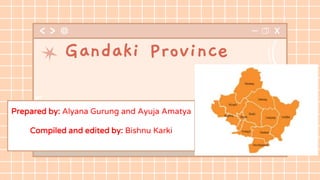
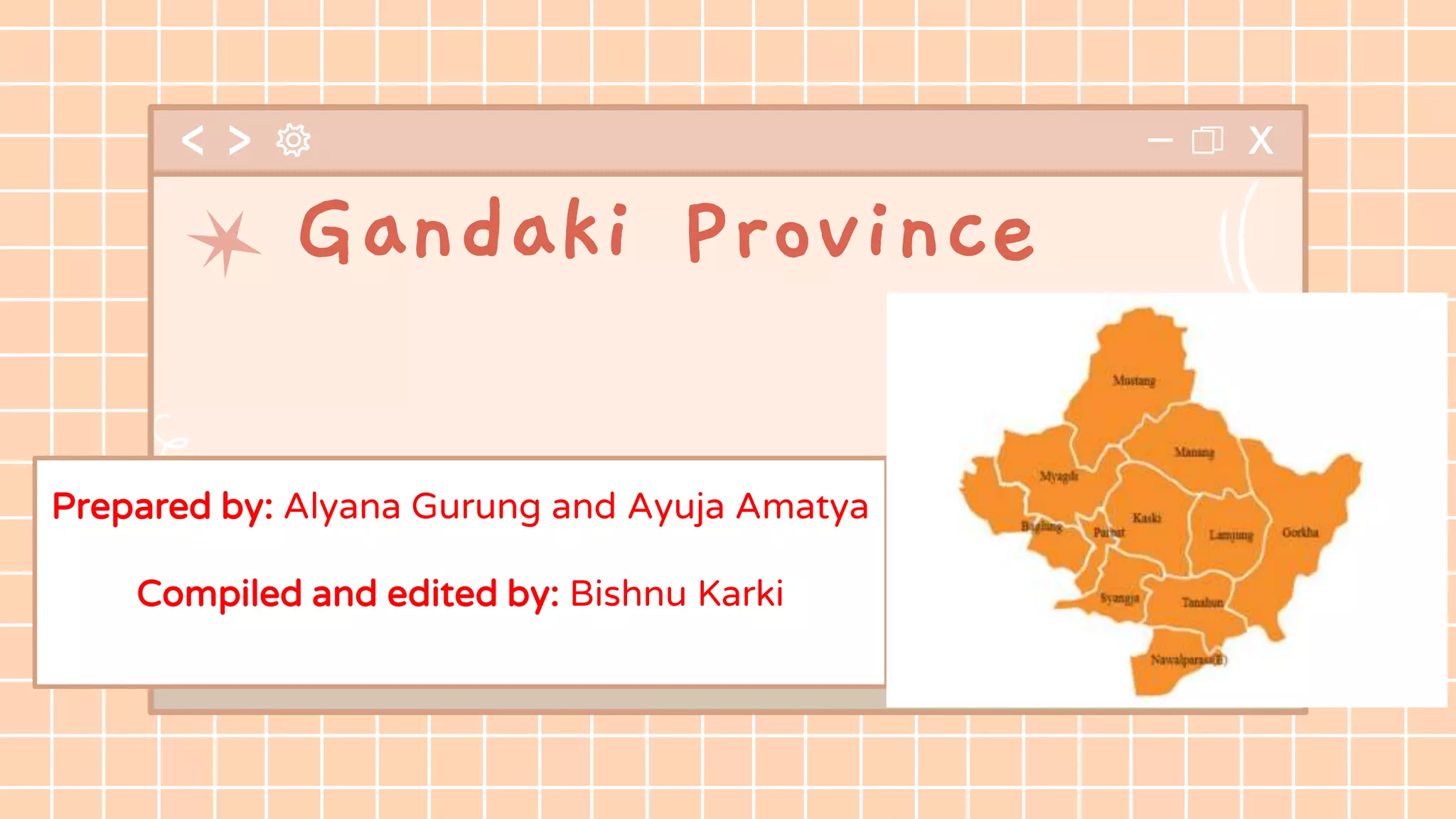
Gandaki Province
Introduction
Gandaki Province is one of the seven federal provinces established by the current
constitution of Nepal which was promulgated on 3rd Ashwin, 2072 BS. The province has an
area of 21,773 km2 which is about 14.66% of the total area of Nepal. In terms of terrain, the
province is spread over the Himalayan region (26.8%), Hilly region (67.2%) and Terai region
(6%) of Nepal. Pokhara is the province’s capital city. It borders the Tibet Autonomous
Region of China to the north, Bagmati Province to the east, Karnali Province to the west and
Lumbini Province and Bihar of India to the south. Among the 7 provinces in Nepal, province
4 is one of the most promising provinces and more importantly, a renowned place for tourist
destination for the people of Nepal as well as abroad. Pokhara, the province 4 headquarter, is
world famous tourist place due to existence of Fewa Lake, Begnas Lake and opportunity to
see the Annapurna, Machhapuchhre and Dhaulagiri Himalayan Range. Also, this province is
important from religious point of view too, where the world famous Muktinath Chhetra lies.
Similarly, the province is observed to be economically viable since it can contribute in rural
livelihood through promotion of tourism, Hydropower Projects and production of agricultural
products.
1. Districts: 11 ( Gorkha, Lamjung, Tanahun, Kaski, Manag, Pravat, Syangja, Myagdi,
Baglung as well as Nawalpur
2. Metropolitan City: One (Pokhara)
3. Municipalities: 26
4. Rivers: Saptagandaki (seti, Kaligandaki, Daraundi, Madi, Marsyangdi), Tinau,
Modikhola, Myagdikhola, etc.
5. Lakes/Pond: Fewa, Rupa, Begnas, Tilicho, Dipang
6. Mountains/Hills: Dhaulagiri, Annapurna, Manaslu, Machhapuchhre, Himalchuli,
Ganesh Himal
7. Tourism Centres: Pokhara, Baglung, Muktinath, Ghandruk, Gorkha, etc
8. Earning Activities: Farming (apple, sugarcane, orange, etc), animal husbandry,
tourism, trade and business, foreign employment, etc.
9. Highways: Prithvi Highway, Pokhara Highway, etc
10. Castes of People: Gurung, Magar, Thakali, Brahmin, Chhetri, Tharu, etc
Facts of Gandaki Province
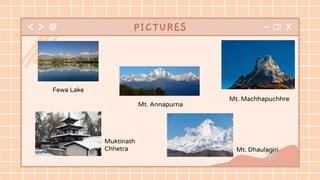
PICTURES
Fewa Lake
Mt. Annapurna
Mt. Machhapuchhre
Muktinath
Chhetra Mt. Dhaulagiri
GOVERNMENT AND ADMINISTRATION
The Governor acts as the head of the province while
the Chief Minister is the head of the provincial
government. The Chief Judge of the Pokhara High
Court is the head of the judiciary. The present
Governor, Chief Minister and Chief Judge are Sita
Poudel, Prithvi Subba Gurung and Purushottam
Bhandari. The province has 60 provincial assembly
constituencies and 18 federal House of
Representatives constituencies.
According to the 2011 Nepal census, there
are total 88 languages spoken in Gandaki
Pradesh. Nepali, Magar, Tharu, Gurung,
Darai, Ghale, Thakali, etc are the main
languages which is spoken by communities
in Gandaki Pradesh. Nepali, Magar and
Gurung are the three most spoken languages
in this province.
DEMOGRAPHICS AND LANGUAGE
The province has a population of 2,403,016
which is just about 9.06% of the total population
of Nepal. The sex ratio is 89 males for 100
females, with a total of 948,028 males and
1,144,124 females recorded in 2011. The urban
population of the region is 60.5% and the rural
population is 39.5% of the whole population.
Status
11% population is
below the poverty
line and literacy
rate is 77%. Kaski
ranks first in the
HDI and Gorkha
last. Gandaki has
37% of the forest
area and has
conserved majority
of it.
Drinking water
and electricity
On the cabinet led by Prithvi
Subba Gurung on Feb. 6,
2018, the government
announced they shall provide
drinking water and electricity
to all 578,000 households in 2
years. But, only 50% of water
supply has been completed.
Tourism
In 2019, Gandaki set out a plan
to boost domestic and
mainstream tourism by training
people, encouraging local
people, promoting homestays,
etc. They discussed alternative
trekking routes for some
mountains and to use cable
cars to Annapurna, Dhaulagi,
Manaslu base camps in the
future.
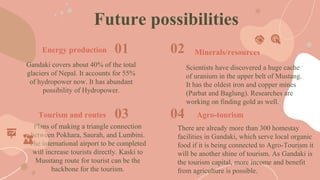
Gandaki covers about 40% of the total
glaciers of Nepal. It accounts for 55%
of hydropower now. It has abundant
possibility of Hydropower.
Scientists have discovered a huge cache
of uranium in the upper belt of Mustang.
It has the oldest iron and copper mines
(Parbat and Baglung). Researches are
working on finding gold as well.
Plans of making a triangle connection
between Pokhara, Saurah, and Lumbini.
The international airport to be completed
will increase tourists directly. Kaski to
Musstang route for tourist can be the
backbone for the tourism.
There are already more than 300 homestay
facilities in Gandaki, which serve local organic
food if it is being connected to Agro-Tourism it
will be another shine of tourism. As Gandaki is
the tourism capital, more income and benefit
from agriculture is possible.
Energy production
Tourism and routes
Minerals/resources
Agro-tourism
Future possibilities
01 02
03 04
CREDITS: This presentation template was created by Slidesgo,
including icons by Flaticon, infographics & images by Freepik
THANK YOU!

Gandaki

  • 1.
    Prepared by: AlyanaGurung and Ayuja Amatya Compiled and edited by: Bishnu Karki Gandaki Province
  • 2.
    Introduction Gandaki Province isone of the seven federal provinces established by the current constitution of Nepal which was promulgated on 3rd Ashwin, 2072 BS. The province has an area of 21,773 km2 which is about 14.66% of the total area of Nepal. In terms of terrain, the province is spread over the Himalayan region (26.8%), Hilly region (67.2%) and Terai region (6%) of Nepal. Pokhara is the province’s capital city. It borders the Tibet Autonomous Region of China to the north, Bagmati Province to the east, Karnali Province to the west and Lumbini Province and Bihar of India to the south. Among the 7 provinces in Nepal, province 4 is one of the most promising provinces and more importantly, a renowned place for tourist destination for the people of Nepal as well as abroad. Pokhara, the province 4 headquarter, is world famous tourist place due to existence of Fewa Lake, Begnas Lake and opportunity to see the Annapurna, Machhapuchhre and Dhaulagiri Himalayan Range. Also, this province is important from religious point of view too, where the world famous Muktinath Chhetra lies. Similarly, the province is observed to be economically viable since it can contribute in rural livelihood through promotion of tourism, Hydropower Projects and production of agricultural products.
  • 3.
    1. Districts: 11( Gorkha, Lamjung, Tanahun, Kaski, Manag, Pravat, Syangja, Myagdi, Baglung as well as Nawalpur 2. Metropolitan City: One (Pokhara) 3. Municipalities: 26 4. Rivers: Saptagandaki (seti, Kaligandaki, Daraundi, Madi, Marsyangdi), Tinau, Modikhola, Myagdikhola, etc. 5. Lakes/Pond: Fewa, Rupa, Begnas, Tilicho, Dipang 6. Mountains/Hills: Dhaulagiri, Annapurna, Manaslu, Machhapuchhre, Himalchuli, Ganesh Himal 7. Tourism Centres: Pokhara, Baglung, Muktinath, Ghandruk, Gorkha, etc 8. Earning Activities: Farming (apple, sugarcane, orange, etc), animal husbandry, tourism, trade and business, foreign employment, etc. 9. Highways: Prithvi Highway, Pokhara Highway, etc 10. Castes of People: Gurung, Magar, Thakali, Brahmin, Chhetri, Tharu, etc Facts of Gandaki Province
  • 4.
    PICTURES Fewa Lake Mt. Annapurna Mt.Machhapuchhre Muktinath Chhetra Mt. Dhaulagiri
  • 5.
    GOVERNMENT AND ADMINISTRATION TheGovernor acts as the head of the province while the Chief Minister is the head of the provincial government. The Chief Judge of the Pokhara High Court is the head of the judiciary. The present Governor, Chief Minister and Chief Judge are Sita Poudel, Prithvi Subba Gurung and Purushottam Bhandari. The province has 60 provincial assembly constituencies and 18 federal House of Representatives constituencies.
  • 6.
    According to the2011 Nepal census, there are total 88 languages spoken in Gandaki Pradesh. Nepali, Magar, Tharu, Gurung, Darai, Ghale, Thakali, etc are the main languages which is spoken by communities in Gandaki Pradesh. Nepali, Magar and Gurung are the three most spoken languages in this province. DEMOGRAPHICS AND LANGUAGE The province has a population of 2,403,016 which is just about 9.06% of the total population of Nepal. The sex ratio is 89 males for 100 females, with a total of 948,028 males and 1,144,124 females recorded in 2011. The urban population of the region is 60.5% and the rural population is 39.5% of the whole population.
  • 7.
    Status 11% population is belowthe poverty line and literacy rate is 77%. Kaski ranks first in the HDI and Gorkha last. Gandaki has 37% of the forest area and has conserved majority of it. Drinking water and electricity On the cabinet led by Prithvi Subba Gurung on Feb. 6, 2018, the government announced they shall provide drinking water and electricity to all 578,000 households in 2 years. But, only 50% of water supply has been completed. Tourism In 2019, Gandaki set out a plan to boost domestic and mainstream tourism by training people, encouraging local people, promoting homestays, etc. They discussed alternative trekking routes for some mountains and to use cable cars to Annapurna, Dhaulagi, Manaslu base camps in the future.
  • 8.
    Gandaki covers about40% of the total glaciers of Nepal. It accounts for 55% of hydropower now. It has abundant possibility of Hydropower. Scientists have discovered a huge cache of uranium in the upper belt of Mustang. It has the oldest iron and copper mines (Parbat and Baglung). Researches are working on finding gold as well. Plans of making a triangle connection between Pokhara, Saurah, and Lumbini. The international airport to be completed will increase tourists directly. Kaski to Musstang route for tourist can be the backbone for the tourism. There are already more than 300 homestay facilities in Gandaki, which serve local organic food if it is being connected to Agro-Tourism it will be another shine of tourism. As Gandaki is the tourism capital, more income and benefit from agriculture is possible. Energy production Tourism and routes Minerals/resources Agro-tourism Future possibilities 01 02 03 04
  • 9.
    CREDITS: This presentationtemplate was created by Slidesgo, including icons by Flaticon, infographics & images by Freepik THANK YOU!