Bandit-based Monte-Carlo planning: the game
 of Go and beyond


Games

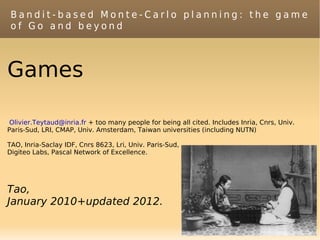
 Olivier.Teytaud@inria.fr + too many people for being all cited. Includes Inria, Cnrs, Univ.
Paris-Sud, LRI, CMAP, Univ. Amsterdam, Taiwan universities (including NUTN)

TAO, Inria-Saclay IDF, Cnrs 8623, Lri, Univ. Paris-Sud,
Digiteo Labs, Pascal Network of Excellence.


Tao,
January 2010+updated 2012.
Games


Introduction

Complexity measures

Computational complexity

Partial observability

Zoology
Introduction to games

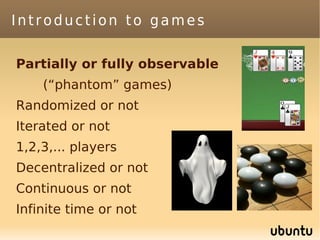
Partially or fully observable
    (“phantom” games)
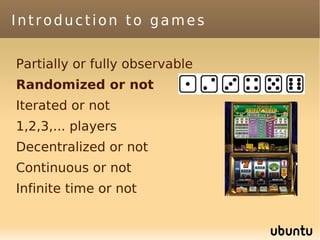
Randomized or not
Iterated or not
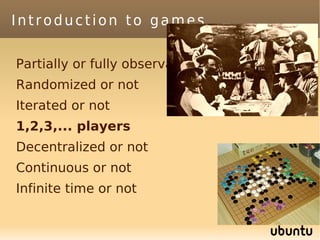
1,2,3,... players
Decentralized or not
Continuous or not
Infinite time or not
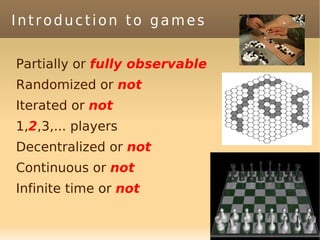
Introduction to games

Partially or fully observable
Randomized or not
Iterated or not
1,2,3,... players
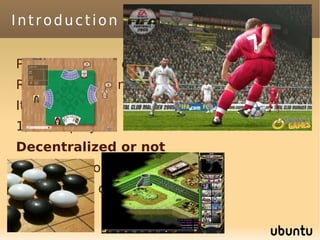
Decentralized or not
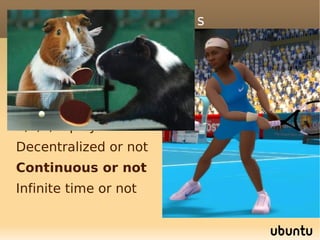
Continuous or not
Infinite time or not
Introduction to games

Partially or fully observable
Randomized or not
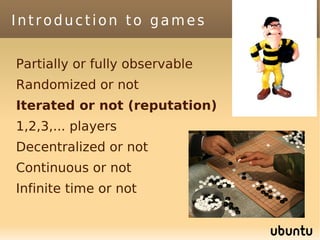
Iterated or not (reputation)
1,2,3,... players
Decentralized or not
Continuous or not
Infinite time or not
Introduction to games

Partially or fully observable
Randomized or not
Iterated or not
1,2,3,... players
Decentralized or not
Continuous or not
Infinite time or not
Introduction to games

Partially or fully observable
Randomized or not
Iterated or not
1,2,3,... players
Decentralized or not
Continuous or not
Infinite time or not

              (rengo)
Introduction to games

Partially or fully observable
Randomized or not
Iterated or not
1,2,3,... players
Decentralized or not
Continuous or not
Infinite time or not
Introduction to games

Partially or fully observable
Randomized or not
Iterated or not
1,2,3,... players
Decentralized or not
Continuous or not
Infinite time or not
Introduction to games

Partially or fully observable
Randomized or not
Iterated or not
1,2,3,... players
Decentralized or not
Continuous or not
Infinite time or not
Games


Introduction

Complexity measures

Computational complexity

Partial observability

Zoology
Complexity measures
(not always well defined)


State-space complexity
Game-tree size
Decision complexity
Game-tree complexity
Computational complexity
Perfect-play complexity
State of the art level
Complexity measures
(not always well defined)

State-space complexity = number
        of possible states
Game-tree size
Decision complexity
Game-tree complexity
Computational complexity
Perfect-play complexity
State of the art level
Complexity measures
(not always well defined)


State-space complexity
Game-tree size = number of leafs
Decision complexity
Game-tree complexity
Computational complexity
Perfect-play complexity
State of the art level
Complexity measures
(not always well defined)

State-space complexity
Game-tree size
Decision complexity = min # of
leafs of tree showing perfect play
Game-tree complexity
Computational complexity
Perfect-play complexity
State of the art level
Complexity measures
(not always well defined)

State-space complexity
Game-tree size
Decision complexity
Game-tree complexity = # of leafs
for perfect play with constant depth
Computational complexity
Perfect-play complexity
State of the art level
Complexity measures
(not always well defined)

State-space complexity
Game-tree size
Decision complexity
Game-tree complexity
Computational complexity (=
complexity classes, later)
Perfect-play complexity
State of the art level
Complexity measures
(not always well defined)

State-space complexity
Game-tree size
Decision complexity
Game-tree complexity
Computational complexity
Perfect-play complexity (complexity
of perfect algorithm)
State of the art level
Complexity measures
(not always well defined)


State-space complexity
Game-tree size
Decision complexity
Game-tree complexity
Computational complexity
Perfect-play complexity
State of the art level


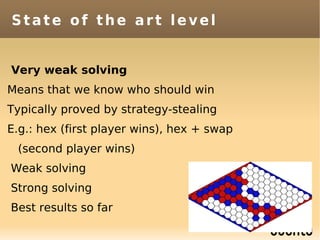
Very weak solving
Means that we know who should win
Typically proved by strategy-stealing
E.g.: hex (first player wins), hex + swap
 (second player wins)
Weak solving
Strong solving
Best results so far
State of the art
level

Very weak solving
Weak solving
Perfect play reached with reasonnable computation
time
Biggest success: draughts (tenths of years of
computation on tenths of machines)
Strong solving
Best results so far
State of the art
level

Very weak solving
Weak solving
Strong solving
       Perfect play from any situation in
       reasonable time (variants of Tic-Tac-Toe)
Best results so far
State of the art level

Very weak solving
Weak solving
Strong solving

Best results so far
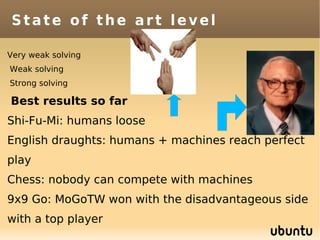
Shi-Fu-Mi: humans loose
English draughts: humans + machines reach perfect
play
Chess: nobody can compete with machines
9x9 Go: MoGoTW won with the disadvantageous side
with a top player
Games

Introduction

Complexity measures

Computational

    complexity

Partial observability

Zoology
Computational complexity:
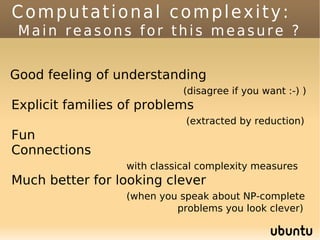
 Main reasons for this measure ?


Good feeling of understanding
                             (disagree if you want :-) )
Explicit families of problems
                             (extracted by reduction)
Fun
Connections
                  with classical complexity measures
Much better for looking clever
                  (when you speak about NP-complete
                           problems you look clever)
Computational complexity:
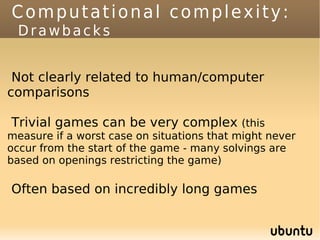
  Drawbacks


 Not clearly related to human/computer
comparisons

Trivial games can be very complex (this
measure if a worst case on situations that might never
occur from the start of the game - many solvings are
based on openings restricting the game)

Often based on incredibly long games
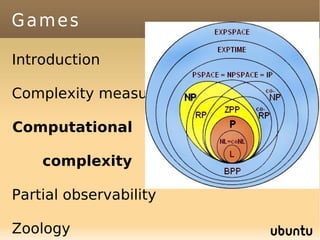
Computational complexity

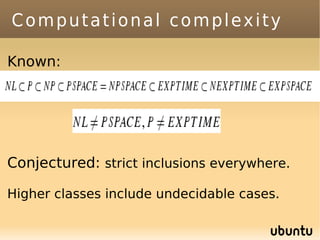
Known:


Conjectured: strict inclusions everywhere.

Higher classes include undecidable cases.
Computational complexity

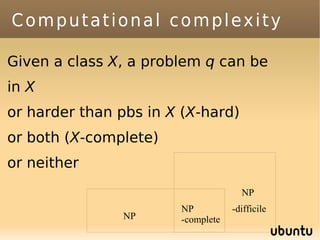
Given a class X, a problem q can be
in X
or harder than pbs in X (X-hard)
or both (X-complete)
or neither
                                     NP
                       NP          -difficile
               NP      -complete
Complexity quizz

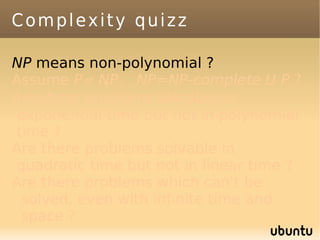
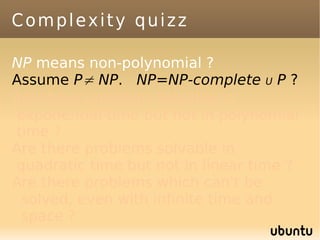
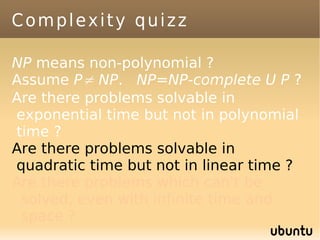
NP means non-polynomial ?
Assume P≠ NP. NP=NP-complete U P ?
Are there problems solvable in
exponential time but not in polynomial
time ?
Are there problems solvable in
quadratic time but not in linear time ?
Are there problems which can't be
 solved, even with infinite time and
 space ?
Complexity quizz

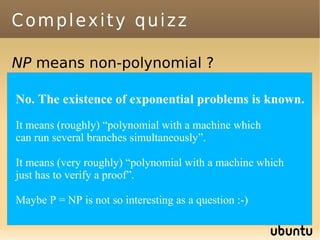
NP means non-polynomial ?
Assume P≠ NP. NP=NP-complete U P ?
Are The existence of exponential problems is known.
No. there problems solvable in
exponential time but not in polynomial
It means (roughly) “polynomial with a machine which
time ?
can run several branches simultaneously”.
Are there problems solvable in
It means (very roughly) “polynomial in linear time ?
quadratic time but not with a machine which
just has to verify a proof”.
Are there problems which can't be
  solved, even with infinite time and
Maybe P = NP is not so interesting as a question :-)
  space ?
Complexity quizz

NP means non-polynomial ?
Assume P≠ NP. NP=NP-complete U P ?
Are there problems solvable in
exponential time but not in polynomial
time ?
Are there problems solvable in
quadratic time but not in linear time ?
Are there problems which can't be
 solved, even with infinite time and
 space ?
Complexity quizz

NP means non-polynomial ?
Assume P≠ NP. NP=NP-complete U P ?
Are there problems solvable in
exponential time but not in polynomial
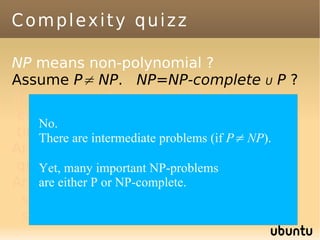
    No.
time ? are intermediate problems (if P≠ NP).
    There
Are there problems solvable in
quadratic time butNP-problems
    Yet, many important not in linear time ?
Are are eitherproblems which can't be
    there P or NP-complete.
 solved, even with infinite time and
 space ?
Complexity quizz

NP means non-polynomial ?
Assume P≠ NP. NP=NP-complete U P ?
Are there problems solvable in
exponential time but not in polynomial
time ?
Are there problems solvable in
quadratic time but not in linear time ?
Are there problems which can't be
 solved, even with infinite time and
 space ?
Complexity quizz

NP means non-polynomial ?
Assume P≠ NP. NP=NP-complete U P ?
Are there problems solvable in
exponential time but not in polynomial
time ?
Are there problems solvable in
quadratic time but not in linear time ?
Are there problems which can't be
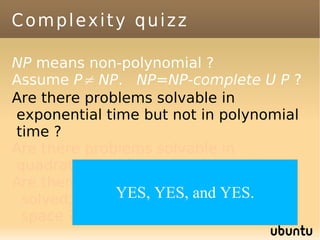
              YES, infinite time and
 solved, even with YES, and YES.
 space ?
Complexity quizz

NP means non-polynomial ?
Assume P≠ NP. NP=NP-complete U P ?
Are there problems solvable in
exponential time but not in polynomial
time ?
Are there problems solvable in
quadratic time but not in linear time ?
Are there problems which can't be
 solved, even with infinite time and
 space ?
Complexity quizz

NP means non-polynomial ?
Assume P≠ NP. NP=NP-complete U P ?
Are there problems solvable in
exponential time but not in polynomial
time ?
Are there problems solvable in
quadratic time but not in linear time ?
Are there problems which can't be
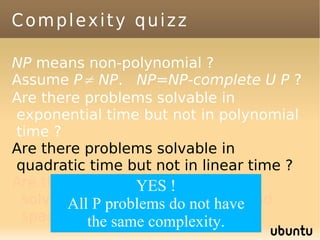
                 YES !
 solved, even with infinite time and
       All P problems do not have
 space ? the same complexity.
Complexity quizz

NP means non-polynomial ?
Assume P≠ NP. NP=NP-complete U P ?
Are there problems solvable in
exponential time but not in polynomial
time ?
Are there problems solvable in
quadratic time but not in linear time ?
Are there problems which can't be
 solved, even with infinite time and
 space ?
Complexity quizz

NP means non-polynomial ?
Assume P≠ NP. NP=NP-complete U P ?
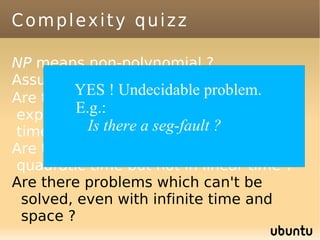
        YES ! Undecidable problem.
Are there problems solvable in
         E.g.: time but not in polynomial
exponential
time ?     Is there a seg-fault ?
Are there problems solvable in
quadratic time but not in linear time ?
Are there problems which can't be
 solved, even with infinite time and
 space ?
Computational complexity

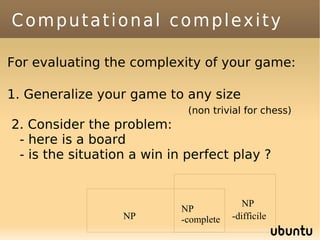
For evaluating the complexity of your game:

1. Generalize your game to any size
                             (non trivial for chess)
2. Consider the problem:
 - here is a board
 - is the situation a win in perfect play ?


                                           NP
                            NP
                  NP        -complete   -difficile
How to show X-completeness

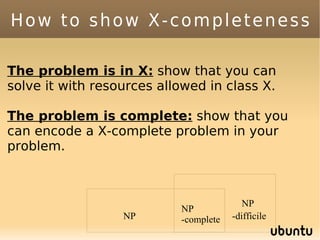
The problem is in X: show that you can
solve it with resources allowed in class X.

The problem is complete: show that you
can encode a X-complete problem in your
problem.


                                          NP
                           NP
                  NP       -complete   -difficile
Computational complexity

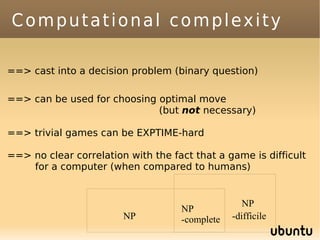
==> cast into a decision problem (binary question)

==> can be used for choosing optimal move
                             (but not necessary)

==> trivial games can be EXPTIME-hard

==> no clear correlation with the fact that a game is difficult
    for a computer (when compared to humans)


                                                   NP
                                    NP
                        NP          -complete   -difficile
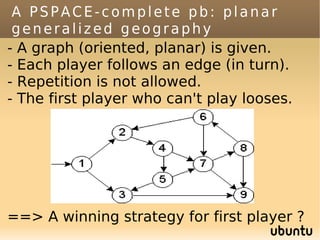
A PSPACE-complete pb: planar
 generalized geography
- A graph (oriented, planar) is given.
- Each player follows an edge (in turn).
- Repetition is not allowed.
- The first player who can't play looses.


==> A winning strategy for first player ?
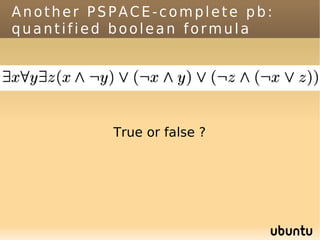
Another PSPACE-complete pb:
quantified boolean formula


          True or false ?
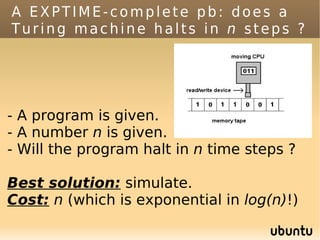
A EXPTIME-complete pb: does a
Turing machine halts in n steps ?


- A program is given.
- A number n is given.
- Will the program halt in n time steps ?

Best solution: simulate.
Cost: n (which is exponential in log(n)!)
Games


Introduction

Complexity measures

Computational complexity

Partial observability

Zoology
Partial observability


Here discussed in the compact case
        (i.e. representation by formula)

Usually, compact ==> bigger cost
          (e.g. P ==> PSPACE)
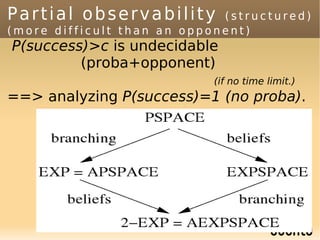
Partial observability        (structured)
(more difficult than an opponent)
P(success)>c is undecidable
         (proba+opponent)
                           (if no time limit.)
==> analyzing P(success)=1 (no proba).
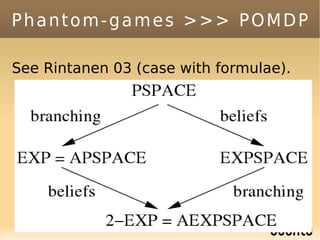
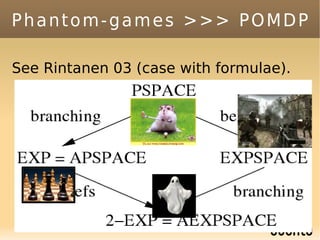
Phantom-games >>> POMDP

See Rintanen 03 (case with formulae).
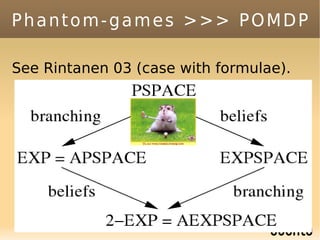
Phantom-games >>> POMDP

See Rintanen 03 (case with formulae).
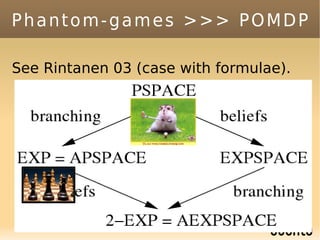
Phantom-games >>> POMDP

See Rintanen 03 (case with formulae).
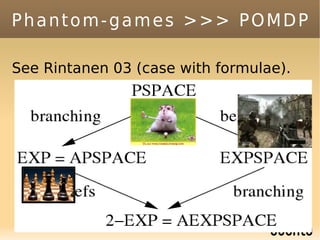
Phantom-games >>> POMDP

See Rintanen 03 (case with formulae).
Phantom-games >>> POMDP

See Rintanen 03 (case with formulae).
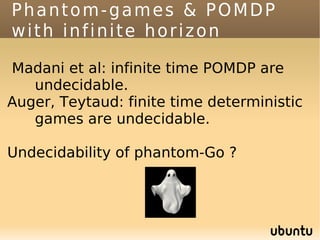
Phantom-games & POMDP
with infinite horizon

Madani et al: infinite time POMDP are
   undecidable.
Auger, Teytaud: finite time deterministic
   games are undecidable.

Undecidability of phantom-Go ?
Games


Introduction

Complexity measures

Computational complexity

Partial observability

Zoology
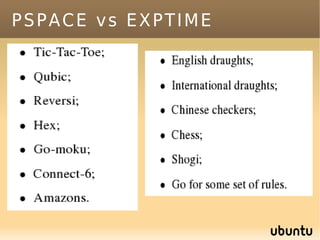
PSPACE vs EXPTIME

==> many important games are either PSPACE or EXPTIME


Theorem: If playing = filling a location
for eternity, then it is PSPACE.
                   (not necessarily PSPACE-complete!)


Proof: Depth-first search.
Applis: Hex, Havannah, Tic-Tac-Toe,
       Atari-Go...
PSPACE vs EXPTIME
Appendix 1: the game of Go
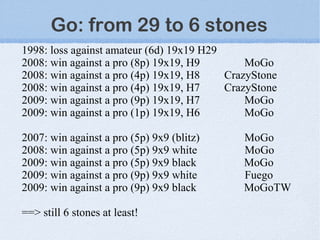
Go: from 29 to 6 stones
1998: loss against amateur (6d) 19x19 H29
2008: win against a pro (8p) 19x19, H9        MoGo
2008: win against a pro (4p) 19x19, H8    CrazyStone
2008: win against a pro (4p) 19x19, H7    CrazyStone
2009: win against a pro (9p) 19x19, H7        MoGo
2009: win against a pro (1p) 19x19, H6        MoGo

2007: win against a pro (5p) 9x9 (blitz)     MoGo
2008: win against a pro (5p) 9x9 white       MoGo
2009: win against a pro (5p) 9x9 black       MoGo
2009: win against a pro (9p) 9x9 white       Fuego
2009: win against a pro (9p) 9x9 black       MoGoTW

==> still 6 stones at least!
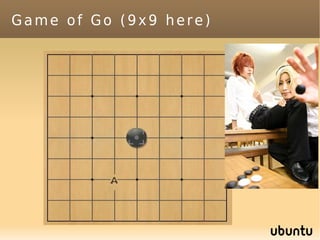
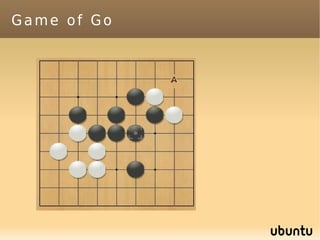
Game of Go (9x9 here)
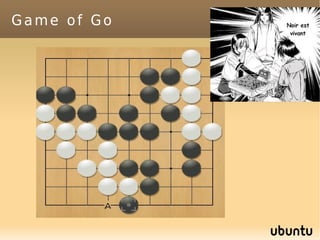
Game of Go
Game of Go
Game of Go
Game of Go - capture
Game of Go
Game of Go
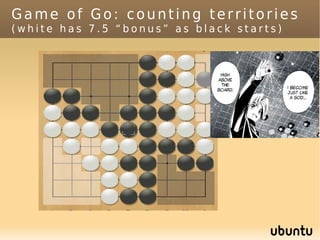
Game of Go: counting territories
(white has 7.5 “bonus” as black starts)
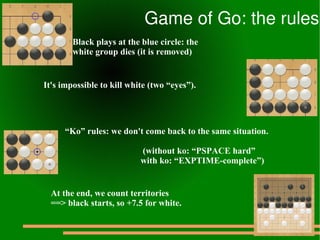
Game of Go: the rules
        Black plays at the blue circle: the
        white group dies (it is removed)


It's impossible to kill white (two “eyes”).


      “Ko” rules: we don't come back to the same situation.

                           (without ko: “PSPACE hard”
                           with ko: “EXPTIME-complete”)


  At the end, we count territories
  ==> black starts, so +7.5 for white.
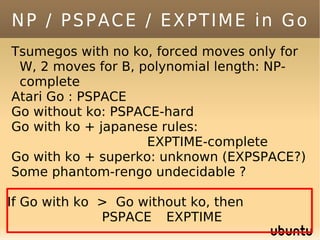
NP / PSPACE / EXPTIME in Go
Tsumegos with no ko, forced moves only for
 W, 2 moves for B, polynomial length: NP-
 complete
Atari Go : PSPACE
Go without ko: PSPACE-hard
Go with ko + japanese rules:
                    EXPTIME-complete
Go with ko + superko: unknown (EXPSPACE?)
Some phantom-rengo undecidable ?

If Go with ko > Go without ko, then
              PSPACE EXPTIME
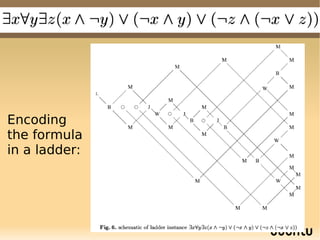
NP / PSPACE / EXPTIME in Go


Encoding
the formula
in a ladder:
Appendix 2: what is difficult for
computers ? Visual things ?


                 70
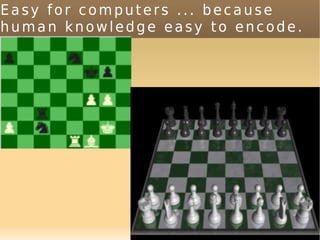
Easy for computers ... because
human knowledge easy to encode.


               71
Difficult for computers
Muy difícil para las ordenadores.


                  72
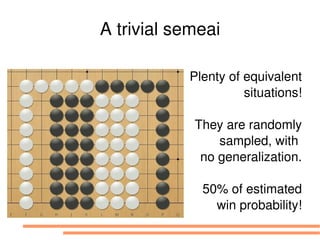
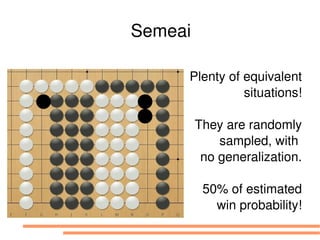
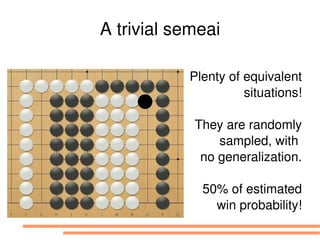
A trivial semeai

           Plenty of equivalent
                     situations!

            They are randomly
                sampled, with 
             no generalization.

             50% of estimated
               win probability!
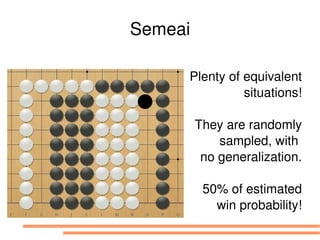
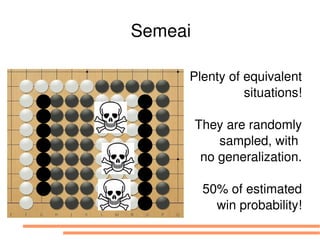
Semeai

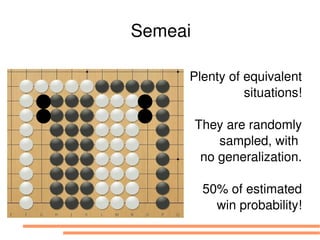
     Plenty of equivalent
               situations!

         They are randomly
             sampled, with 
          no generalization.

          50% of estimated
            win probability!
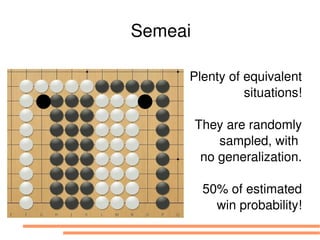
Semeai

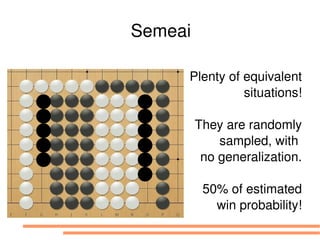
     Plenty of equivalent
               situations!

         They are randomly
             sampled, with 
          no generalization.

          50% of estimated
            win probability!
Semeai

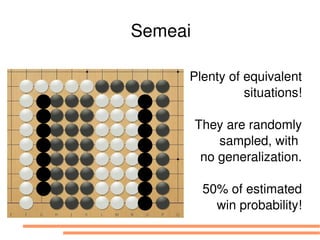
     Plenty of equivalent
               situations!

         They are randomly
             sampled, with 
          no generalization.

          50% of estimated
            win probability!
Semeai

     Plenty of equivalent
               situations!

         They are randomly
             sampled, with 
          no generalization.

          50% of estimated
            win probability!
Semeai

     Plenty of equivalent
               situations!

         They are randomly
             sampled, with 
          no generalization.

          50% of estimated
            win probability!
Semeai

     Plenty of equivalent
               situations!

         They are randomly
             sampled, with 
          no generalization.

          50% of estimated
            win probability!
Semeai

     Plenty of equivalent
               situations!

         They are randomly
             sampled, with 
          no generalization.

          50% of estimated
            win probability!
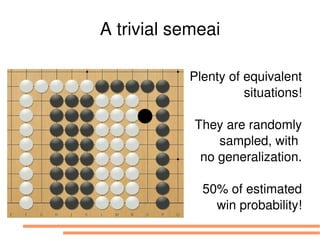
A trivial semeai

           Plenty of equivalent
                     situations!

            They are randomly
                sampled, with 
             no generalization.

             50% of estimated
               win probability!
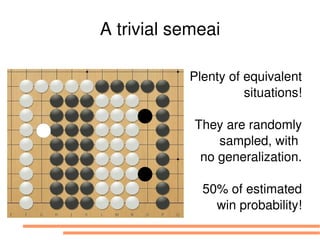
A trivial semeai

           Plenty of equivalent
                     situations!

            They are randomly
                sampled, with 
             no generalization.

             50% of estimated
               win probability!
A trivial semeai

           Plenty of equivalent
                     situations!

            They are randomly
                sampled, with 
             no generalization.

             50% of estimated
               win probability!
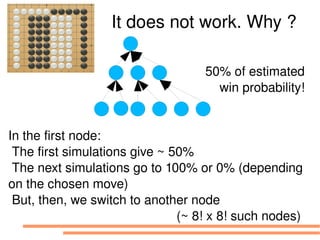
It does not work. Why ?

                                             50% of estimated
                                               win probability!


In the first node:
 The first simulations give ~ 50%
 The next simulations go to 100% or 0% (depending 
on the chosen move)
 But, then, we switch to another node 
                                               (~ 8! x 8! such nodes)
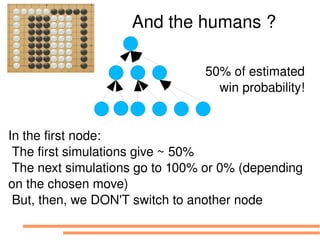
And the humans ?

                                 50% of estimated
                                   win probability!


In the first node:
 The first simulations give ~ 50%
 The next simulations go to 100% or 0% (depending 
on the chosen move)
 But, then, we DON'T switch to another node 
 
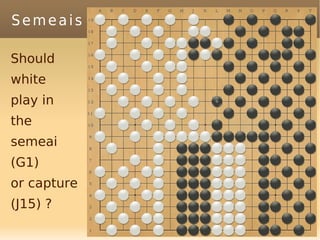
Semeais

Should
white
play in
the
semeai
(G1)
or capture
(J15) ?
             86
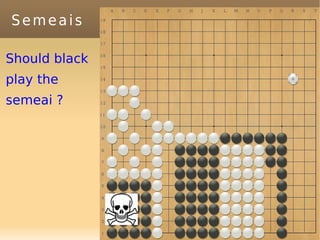
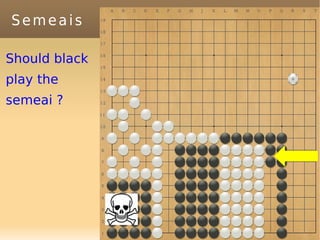
Semeais

Should black
play the
semeai ?


               87
Semeais

Should black
play the
semeai ?


               88
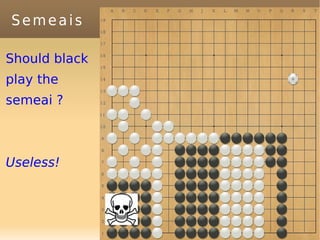
Semeais

Should black
play the
semeai ?


Useless!


               89
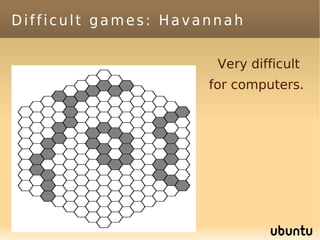
Difficult games: Havannah

                      Very difficult
                     for computers.
Conclusions + other
               elements
 Go complexity:
superko ?
Ishi-no-shita (captures / recaptures) ?
 (more generally: characterizing strength /weakness of programs ?)

 Huge complexity classes for
structured games
partially observable games            (what about phantom-games ?)
decentralized games

Great results for MCTS in GGP + difficult games. Next MCTS-challenges:
Partially observable cases & large horizon : cf Cazenave, Rolet
Solve main weaknesses of MCTS
           (learning the MC ? Meta-actions ? Nested MC ?
  Mixing with value-function as in amazon ?)
Biblio
Complexity: Robson, Tromp, Taylor, Crasmaru, ...
Bandits: Lai, Robbins, Auer, Cesa-Bianchi...
UCT: Kocsis, Szepesvari, Coquelin, Munos...
MCTS (Go): Coulom, Chaslot, Fiter, Gelly, Hoock, Silver, Muller,
                                               Pérez, Rimmel, Wang...
Tree + DP for industrial applicationl: Péret, Garcia...
Bandits with infinitely many arms:
     Audibert, Coulom, Munos, Wang...
Applications far from Go: Rolet,
     Teytaud (F), Rimmel, De Mesmay
     ...
Links with “macro-actions” ?
Parallelization, mixing with offline
  learning, bias...
Paul Veyssière
                                                              Hassen Doghmen
Amine Bourki
Matthieu Coulm   Contributors                                 Colleagues from
                                                              NUTN and CJCU

 Bandits: Lai, Robbins, Auer, Cesa-Bianchi...
 UCT: Kocsis, Szepesvari, Coquelin, Munos...
 MCTS (Go): Coulom, Chaslot, Fiter, Gelly, Hoock, Silver, Muller,
                                                Pérez, Rimmel, Wang...
 Tree + DP for industrial applicationl: Péret, Garcia...
 Bandits with infinitely many arms:
      Audibert, Coulom, Munos, Wang...
 Applications far from Go: Rolet,
      Teytaud (F), Rimmel, De Mesmay
      ...
 Links with “macro-actions” ?
 Parallelization, mixing with offline
   learning, bias...

Theory of games

  • 1.
    Bandit-based Monte-Carlo planning:the game of Go and beyond Games Olivier.Teytaud@inria.fr + too many people for being all cited. Includes Inria, Cnrs, Univ. Paris-Sud, LRI, CMAP, Univ. Amsterdam, Taiwan universities (including NUTN) TAO, Inria-Saclay IDF, Cnrs 8623, Lri, Univ. Paris-Sud, Digiteo Labs, Pascal Network of Excellence. Tao, January 2010+updated 2012.
  • 2.
  • 3.
    Introduction to games Partiallyor fully observable (“phantom” games) Randomized or not Iterated or not 1,2,3,... players Decentralized or not Continuous or not Infinite time or not
  • 4.
    Introduction to games Partiallyor fully observable Randomized or not Iterated or not 1,2,3,... players Decentralized or not Continuous or not Infinite time or not
  • 5.
    Introduction to games Partiallyor fully observable Randomized or not Iterated or not (reputation) 1,2,3,... players Decentralized or not Continuous or not Infinite time or not
  • 6.
    Introduction to games Partiallyor fully observable Randomized or not Iterated or not 1,2,3,... players Decentralized or not Continuous or not Infinite time or not
  • 7.
    Introduction to games Partiallyor fully observable Randomized or not Iterated or not 1,2,3,... players Decentralized or not Continuous or not Infinite time or not (rengo)
  • 8.
    Introduction to games Partiallyor fully observable Randomized or not Iterated or not 1,2,3,... players Decentralized or not Continuous or not Infinite time or not
  • 9.
    Introduction to games Partiallyor fully observable Randomized or not Iterated or not 1,2,3,... players Decentralized or not Continuous or not Infinite time or not
  • 10.
    Introduction to games Partiallyor fully observable Randomized or not Iterated or not 1,2,3,... players Decentralized or not Continuous or not Infinite time or not
  • 11.
  • 12.
    Complexity measures (not alwayswell defined) State-space complexity Game-tree size Decision complexity Game-tree complexity Computational complexity Perfect-play complexity State of the art level
  • 13.
    Complexity measures (not alwayswell defined) State-space complexity = number of possible states Game-tree size Decision complexity Game-tree complexity Computational complexity Perfect-play complexity State of the art level
  • 14.
    Complexity measures (not alwayswell defined) State-space complexity Game-tree size = number of leafs Decision complexity Game-tree complexity Computational complexity Perfect-play complexity State of the art level
  • 15.
    Complexity measures (not alwayswell defined) State-space complexity Game-tree size Decision complexity = min # of leafs of tree showing perfect play Game-tree complexity Computational complexity Perfect-play complexity State of the art level
  • 16.
    Complexity measures (not alwayswell defined) State-space complexity Game-tree size Decision complexity Game-tree complexity = # of leafs for perfect play with constant depth Computational complexity Perfect-play complexity State of the art level
  • 17.
    Complexity measures (not alwayswell defined) State-space complexity Game-tree size Decision complexity Game-tree complexity Computational complexity (= complexity classes, later) Perfect-play complexity State of the art level
  • 18.
    Complexity measures (not alwayswell defined) State-space complexity Game-tree size Decision complexity Game-tree complexity Computational complexity Perfect-play complexity (complexity of perfect algorithm) State of the art level
  • 19.
    Complexity measures (not alwayswell defined) State-space complexity Game-tree size Decision complexity Game-tree complexity Computational complexity Perfect-play complexity State of the art level
  • 20.
    State of theart level Very weak solving Means that we know who should win Typically proved by strategy-stealing E.g.: hex (first player wins), hex + swap (second player wins) Weak solving Strong solving Best results so far
  • 21.
    State of theart level Very weak solving Weak solving Perfect play reached with reasonnable computation time Biggest success: draughts (tenths of years of computation on tenths of machines) Strong solving Best results so far
  • 22.
    State of theart level Very weak solving Weak solving Strong solving Perfect play from any situation in reasonable time (variants of Tic-Tac-Toe) Best results so far
  • 23.
    State of theart level Very weak solving Weak solving Strong solving Best results so far Shi-Fu-Mi: humans loose English draughts: humans + machines reach perfect play Chess: nobody can compete with machines 9x9 Go: MoGoTW won with the disadvantageous side with a top player
  • 24.
    Games Introduction Complexity measures Computational complexity Partial observability Zoology
  • 25.
    Computational complexity: Mainreasons for this measure ? Good feeling of understanding (disagree if you want :-) ) Explicit families of problems (extracted by reduction) Fun Connections with classical complexity measures Much better for looking clever (when you speak about NP-complete problems you look clever)
  • 26.
    Computational complexity: Drawbacks Not clearly related to human/computer comparisons Trivial games can be very complex (this measure if a worst case on situations that might never occur from the start of the game - many solvings are based on openings restricting the game) Often based on incredibly long games
  • 27.
    Computational complexity Known: Conjectured: strictinclusions everywhere. Higher classes include undecidable cases.
  • 28.
    Computational complexity Given aclass X, a problem q can be in X or harder than pbs in X (X-hard) or both (X-complete) or neither NP NP -difficile NP -complete
  • 29.
    Complexity quizz NP meansnon-polynomial ? Assume P≠ NP. NP=NP-complete U P ? Are there problems solvable in exponential time but not in polynomial time ? Are there problems solvable in quadratic time but not in linear time ? Are there problems which can't be solved, even with infinite time and space ?
  • 30.
    Complexity quizz NP meansnon-polynomial ? Assume P≠ NP. NP=NP-complete U P ? Are The existence of exponential problems is known. No. there problems solvable in exponential time but not in polynomial It means (roughly) “polynomial with a machine which time ? can run several branches simultaneously”. Are there problems solvable in It means (very roughly) “polynomial in linear time ? quadratic time but not with a machine which just has to verify a proof”. Are there problems which can't be solved, even with infinite time and Maybe P = NP is not so interesting as a question :-) space ?
  • 31.
    Complexity quizz NP meansnon-polynomial ? Assume P≠ NP. NP=NP-complete U P ? Are there problems solvable in exponential time but not in polynomial time ? Are there problems solvable in quadratic time but not in linear time ? Are there problems which can't be solved, even with infinite time and space ?
  • 32.
    Complexity quizz NP meansnon-polynomial ? Assume P≠ NP. NP=NP-complete U P ? Are there problems solvable in exponential time but not in polynomial No. time ? are intermediate problems (if P≠ NP). There Are there problems solvable in quadratic time butNP-problems Yet, many important not in linear time ? Are are eitherproblems which can't be there P or NP-complete. solved, even with infinite time and space ?
  • 33.
    Complexity quizz NP meansnon-polynomial ? Assume P≠ NP. NP=NP-complete U P ? Are there problems solvable in exponential time but not in polynomial time ? Are there problems solvable in quadratic time but not in linear time ? Are there problems which can't be solved, even with infinite time and space ?
  • 34.
    Complexity quizz NP meansnon-polynomial ? Assume P≠ NP. NP=NP-complete U P ? Are there problems solvable in exponential time but not in polynomial time ? Are there problems solvable in quadratic time but not in linear time ? Are there problems which can't be YES, infinite time and solved, even with YES, and YES. space ?
  • 35.
    Complexity quizz NP meansnon-polynomial ? Assume P≠ NP. NP=NP-complete U P ? Are there problems solvable in exponential time but not in polynomial time ? Are there problems solvable in quadratic time but not in linear time ? Are there problems which can't be solved, even with infinite time and space ?
  • 36.
    Complexity quizz NP meansnon-polynomial ? Assume P≠ NP. NP=NP-complete U P ? Are there problems solvable in exponential time but not in polynomial time ? Are there problems solvable in quadratic time but not in linear time ? Are there problems which can't be YES ! solved, even with infinite time and All P problems do not have space ? the same complexity.
  • 37.
    Complexity quizz NP meansnon-polynomial ? Assume P≠ NP. NP=NP-complete U P ? Are there problems solvable in exponential time but not in polynomial time ? Are there problems solvable in quadratic time but not in linear time ? Are there problems which can't be solved, even with infinite time and space ?
  • 38.
    Complexity quizz NP meansnon-polynomial ? Assume P≠ NP. NP=NP-complete U P ? YES ! Undecidable problem. Are there problems solvable in E.g.: time but not in polynomial exponential time ? Is there a seg-fault ? Are there problems solvable in quadratic time but not in linear time ? Are there problems which can't be solved, even with infinite time and space ?
  • 39.
    Computational complexity For evaluatingthe complexity of your game: 1. Generalize your game to any size (non trivial for chess) 2. Consider the problem: - here is a board - is the situation a win in perfect play ? NP NP NP -complete -difficile
  • 40.
    How to showX-completeness The problem is in X: show that you can solve it with resources allowed in class X. The problem is complete: show that you can encode a X-complete problem in your problem. NP NP NP -complete -difficile
  • 41.
    Computational complexity ==> castinto a decision problem (binary question) ==> can be used for choosing optimal move (but not necessary) ==> trivial games can be EXPTIME-hard ==> no clear correlation with the fact that a game is difficult for a computer (when compared to humans) NP NP NP -complete -difficile
  • 42.
    A PSPACE-complete pb:planar generalized geography - A graph (oriented, planar) is given. - Each player follows an edge (in turn). - Repetition is not allowed. - The first player who can't play looses. ==> A winning strategy for first player ?
  • 43.
    Another PSPACE-complete pb: quantifiedboolean formula True or false ?
  • 44.
    A EXPTIME-complete pb:does a Turing machine halts in n steps ? - A program is given. - A number n is given. - Will the program halt in n time steps ? Best solution: simulate. Cost: n (which is exponential in log(n)!)
  • 45.
  • 46.
    Partial observability Here discussedin the compact case (i.e. representation by formula) Usually, compact ==> bigger cost (e.g. P ==> PSPACE)
  • 47.
    Partial observability (structured) (more difficult than an opponent) P(success)>c is undecidable (proba+opponent) (if no time limit.) ==> analyzing P(success)=1 (no proba).
  • 48.
    Phantom-games >>> POMDP SeeRintanen 03 (case with formulae).
  • 49.
    Phantom-games >>> POMDP SeeRintanen 03 (case with formulae).
  • 50.
    Phantom-games >>> POMDP SeeRintanen 03 (case with formulae).
  • 51.
    Phantom-games >>> POMDP SeeRintanen 03 (case with formulae).
  • 52.
    Phantom-games >>> POMDP SeeRintanen 03 (case with formulae).
  • 53.
    Phantom-games & POMDP withinfinite horizon Madani et al: infinite time POMDP are undecidable. Auger, Teytaud: finite time deterministic games are undecidable. Undecidability of phantom-Go ?
  • 54.
  • 55.
    PSPACE vs EXPTIME ==>many important games are either PSPACE or EXPTIME Theorem: If playing = filling a location for eternity, then it is PSPACE. (not necessarily PSPACE-complete!) Proof: Depth-first search. Applis: Hex, Havannah, Tic-Tac-Toe, Atari-Go...
  • 56.
  • 57.
    Appendix 1: thegame of Go
  • 58.
    Go: from 29to 6 stones 1998: loss against amateur (6d) 19x19 H29 2008: win against a pro (8p) 19x19, H9 MoGo 2008: win against a pro (4p) 19x19, H8 CrazyStone 2008: win against a pro (4p) 19x19, H7 CrazyStone 2009: win against a pro (9p) 19x19, H7 MoGo 2009: win against a pro (1p) 19x19, H6 MoGo 2007: win against a pro (5p) 9x9 (blitz) MoGo 2008: win against a pro (5p) 9x9 white MoGo 2009: win against a pro (5p) 9x9 black MoGo 2009: win against a pro (9p) 9x9 white Fuego 2009: win against a pro (9p) 9x9 black MoGoTW ==> still 6 stones at least!
  • 59.
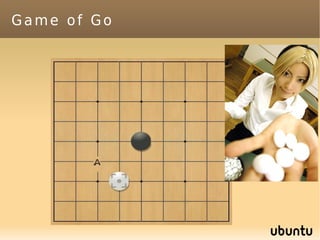
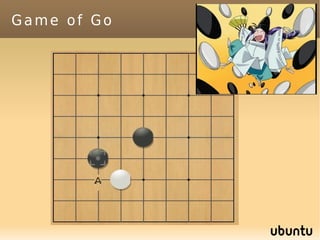
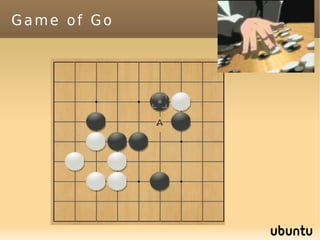
    Game of Go(9x9 here)
  • 60.
  • 61.
  • 62.
  • 63.
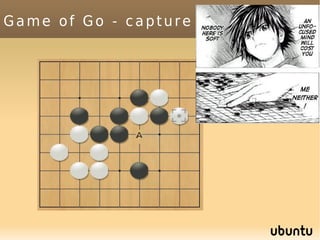
    Game of Go- capture
  • 64.
  • 65.
  • 66.
    Game of Go:counting territories (white has 7.5 “bonus” as black starts)
  • 67.
    Game of Go: the rules Black plays at the blue circle: the white group dies (it is removed) It's impossible to kill white (two “eyes”). “Ko” rules: we don't come back to the same situation. (without ko: “PSPACE hard” with ko: “EXPTIME-complete”) At the end, we count territories ==> black starts, so +7.5 for white.
  • 68.
    NP / PSPACE/ EXPTIME in Go Tsumegos with no ko, forced moves only for W, 2 moves for B, polynomial length: NP- complete Atari Go : PSPACE Go without ko: PSPACE-hard Go with ko + japanese rules: EXPTIME-complete Go with ko + superko: unknown (EXPSPACE?) Some phantom-rengo undecidable ? If Go with ko > Go without ko, then PSPACE EXPTIME
  • 69.
    NP / PSPACE/ EXPTIME in Go Encoding the formula in a ladder:
  • 70.
    Appendix 2: whatis difficult for computers ? Visual things ? 70
  • 71.
    Easy for computers... because human knowledge easy to encode. 71
  • 72.
    Difficult for computers Muydifícil para las ordenadores. 72
  • 73.
    A trivial semeai Plenty of equivalent situations! They are randomly sampled, with  no generalization. 50% of estimated win probability!
  • 74.
    Semeai Plenty of equivalent situations! They are randomly sampled, with  no generalization. 50% of estimated win probability!
  • 75.
    Semeai Plenty of equivalent situations! They are randomly sampled, with  no generalization. 50% of estimated win probability!
  • 76.
    Semeai Plenty of equivalent situations! They are randomly sampled, with  no generalization. 50% of estimated win probability!
  • 77.
    Semeai Plenty of equivalent situations! They are randomly sampled, with  no generalization. 50% of estimated win probability!
  • 78.
    Semeai Plenty of equivalent situations! They are randomly sampled, with  no generalization. 50% of estimated win probability!
  • 79.
    Semeai Plenty of equivalent situations! They are randomly sampled, with  no generalization. 50% of estimated win probability!
  • 80.
    Semeai Plenty of equivalent situations! They are randomly sampled, with  no generalization. 50% of estimated win probability!
  • 81.
    A trivial semeai Plenty of equivalent situations! They are randomly sampled, with  no generalization. 50% of estimated win probability!
  • 82.
    A trivial semeai Plenty of equivalent situations! They are randomly sampled, with  no generalization. 50% of estimated win probability!
  • 83.
    A trivial semeai Plenty of equivalent situations! They are randomly sampled, with  no generalization. 50% of estimated win probability!
  • 84.
    It does not work. Why ? 50% of estimated win probability! In the first node:  The first simulations give ~ 50%  The next simulations go to 100% or 0% (depending  on the chosen move)  But, then, we switch to another node                                                 (~ 8! x 8! such nodes)
  • 85.
    And the humans ? 50% of estimated win probability! In the first node:  The first simulations give ~ 50%  The next simulations go to 100% or 0% (depending  on the chosen move)  But, then, we DON'T switch to another node   
  • 86.
  • 87.
  • 88.
  • 89.
  • 90.
    Difficult games: Havannah Very difficult for computers.
  • 91.
    Conclusions + other elements Go complexity: superko ? Ishi-no-shita (captures / recaptures) ? (more generally: characterizing strength /weakness of programs ?) Huge complexity classes for structured games partially observable games (what about phantom-games ?) decentralized games Great results for MCTS in GGP + difficult games. Next MCTS-challenges: Partially observable cases & large horizon : cf Cazenave, Rolet Solve main weaknesses of MCTS (learning the MC ? Meta-actions ? Nested MC ? Mixing with value-function as in amazon ?)
  • 92.
    Biblio Complexity: Robson, Tromp,Taylor, Crasmaru, ... Bandits: Lai, Robbins, Auer, Cesa-Bianchi... UCT: Kocsis, Szepesvari, Coquelin, Munos... MCTS (Go): Coulom, Chaslot, Fiter, Gelly, Hoock, Silver, Muller, Pérez, Rimmel, Wang... Tree + DP for industrial applicationl: Péret, Garcia... Bandits with infinitely many arms: Audibert, Coulom, Munos, Wang... Applications far from Go: Rolet, Teytaud (F), Rimmel, De Mesmay ... Links with “macro-actions” ? Parallelization, mixing with offline learning, bias...
  • 93.
    Paul Veyssière Hassen Doghmen Amine Bourki Matthieu Coulm Contributors Colleagues from NUTN and CJCU Bandits: Lai, Robbins, Auer, Cesa-Bianchi... UCT: Kocsis, Szepesvari, Coquelin, Munos... MCTS (Go): Coulom, Chaslot, Fiter, Gelly, Hoock, Silver, Muller, Pérez, Rimmel, Wang... Tree + DP for industrial applicationl: Péret, Garcia... Bandits with infinitely many arms: Audibert, Coulom, Munos, Wang... Applications far from Go: Rolet, Teytaud (F), Rimmel, De Mesmay ... Links with “macro-actions” ? Parallelization, mixing with offline learning, bias...