Ths.BS. ĐẶNG THỊ KIM LIÊN
dangthikimlien6368@gmail.com
GALLBLADDER POLYPS
Gallbladder (GB) polyps are defined as mucosal
projection of the GB wall into the lumen(1)
1. Helmberger, T., Bartolozzi, C., Vagli, P. (2008). Cholecystoses. In: Baert, A.L. (eds) Encyclopedia of Diagnostic
Imaging. Springer, Berlin, Heidelberg. https://doi.org/10.1007/978-3-540-35280-8_480
☞ Surgery?
☞ Follow-up?
Gallbladder polyps
• Common benign lesion, 3 – 12,3% of the population(1)
• 3 - 7% of abdominal ultrasound examinations(2)
• 2 - 12% of cholecystectomy specimens (2)
• Only adenomatous harbor any malignant potential(1)
1. Courtney M. Townsend Jr., R. Daniel Beauchamp, B. Mark Evers, Kenneth L. Mattox - Sabiston Textbook of Surgery_ The Biological Basis of
Modern Surgical Practice-Elsevier (2021) p.1506
2. Jarnagin, W. R. (Ed.). (2022). Blumgart's Surgery of the Liver, Biliary Tract and Pancreas, 2-Volume Set-E-Book. Elsevier Health Sciences
Gallbladder polyps
In recent series of resected GB polyps,
< 20% were found to be adenomatous &
the rate of malignancy was around ≤ 5%
Michael Zinner, Stanley Ashley, O. Joe Hines - Maingot’s Abdominal Operations-McGraw-Hill Education
_ Medical (2018) p2997
Classification
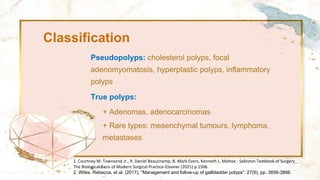
Pseudopolyps: cholesterol polyps, focal
adenomyomatosis, hyperplastic polyps, inflammatory
polyps
True polyps:
+ Adenomas, adenocarcinomas
+ Rare types: mesenchymal tumours, lymphoma,
metastases
1. Courtney M. Townsend Jr., R. Daniel Beauchamp, B. Mark Evers, Kenneth L. Mattox - Sabiston Textbook of Surgery_
The Biological Basis of Modern Surgical Practice-Elsevier (2021) p.1506
2. Wiles, Rebecca, et al. (2017), "Management and follow-up of gallbladder polyps". 27(9), pp. 3856-3866.
McCain, R Stephen, et al. (2018), "Current practices and future prospects for the management of gallbladder
polyps: a topical review". 24(26), p. 2844.
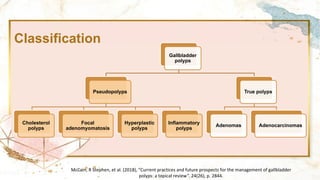
Gallbladder
polyps
Pseudopolyps
Cholesterol
polyps
Focal
adenomyomatosis
Hyperplastic
polyps
Inflammatory
polyps
True polyps
Adenomas Adenocarcinomas
Classification
Classification
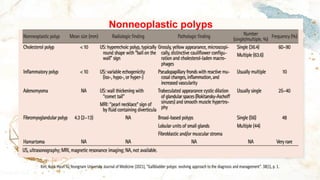
Nonneoplastic polyps: cholesterol polyps
(60–90%), adenomyomas (25%–40%),
inflammatory polyps (10%), fibromyoglandular
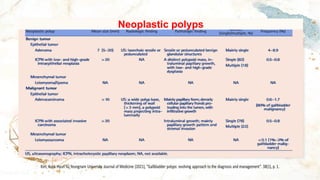
Neoplastic polyps: adenomas,
intracholecystic papillary neoplasms,
adenocarcinoma
Kim, Kook Hyun %J Yeungnam University Journal of Medicine (2021), "Gallbladder polyps: evolving approach to the
diagnosis and management". 38(1), p. 1.
Nonneoplastic polyps
Neoplastic polyps
Kim, Kook Hyun %J Yeungnam University Journal of Medicine (2021), "Gallbladder polyps: evolving approach to the
diagnosis and management". 38(1), p. 1.
Rokitansky – Aschoff sinuses
• 2 pathologists: Baron Karl Freiherr von Rokitansky
(1804-1878) & Karl Albert Ludwig Aschoff (1866-1942)
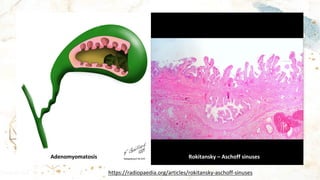
• Histologically, outpouchings of GB mucosa sit within
the GB muscle layer
• Associated with cholecystitis & adenomyomatosis
• Mimic GB adenocarcinoma
• Generally incidental findings
https://radiopaedia.org/articles/rokitansky-aschoff-sinuses
Adenomyomatosis Rokitansky – Aschoff sinuses
https://radiopaedia.org/articles/rokitansky-aschoff-sinuses
Courtney M. Townsend Jr., R. Daniel Beauchamp, B. Mark Evers, Kenneth L. Mattox - Sabiston Textbook of Surgery_ The
Biological Basis of Modern Surgical Practice-Elsevier (2021) p.1506
Presentations
• Most patients: asymptomatic
• Nonspecific gastric symptoms (nausea, vomiting, right
hypochondriac pain)
• Rarely, large polyps may obstruct the cystic duct
causing acute cholecystitis or obstructive jaundice
• 64% found incidentally on workup done, 23%
presented with abdominal symptoms, 13% had raised
liver function tests.
Kalbi, Deepak P., et al. (2021), "Surveillance of Gallbladder Polyps: A Literature Review", Cureus. 13(7),
pp. e16113-e16113.
Radiological imaging
1. McCain, R Stephen, et al. (2018), "Current practices and future prospects for the management of gallbladder
polyps: a topical review". 24(26), p. 2844.]
2. Kim, Kook Hyun %J Yeungnam University Journal of Medicine (2021), "Gallbladder polyps: evolving approach
to the diagnosis and management". 38(1), p. 1.
Radiological imaging
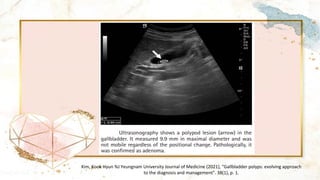
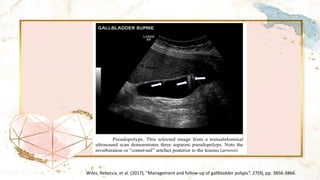
Ultrasonography
• Hyperechoic lesions protruding into the GB lumen
• Absence of post-acoustic shadow
• A fixed lesion helps to distinguish between polyps and
gallstones
• “Pseudo” polyp include a “comet tail” which arises
posterior to the lesion but not in all
Kim, Kook Hyun %J Yeungnam University Journal of Medicine (2021), "Gallbladder polyps: evolving approach
to the diagnosis and management". 38(1), p. 1.
Wiles, Rebecca, et al. (2017), "Management and follow-up of gallbladder polyps". 27(9), pp. 3856-3866.
Radiological imaging
Endoscopic ultrasound
• Greater sensitivity (67% & 86%) & specificity (84%
& 91%) for diagnosing malignancy in polyps
• An invasive examination associated with a small
risk of bleeding & upper gastrointestinal perforation
Radiological imaging
Computed tomography
• First-line modality for symptomatic patients
• Best used in staging larger, suspicious
malignant polyps, rather than for diagnostic
purposes and follow up
Radiological imaging
Magnetic resonance imaging
• selful in the evaluation of tumor infiltration
Other imaging modalities
• positron emission tomography (PET): inflammatory GB lesions
can show false-positive
• fluorine-18-labeled fluorodeoxyglucose (18F-FDG)
• percutaneous transhepatic cholecystoscopy
• Intravenous cholecystography
Surgery?
ESGAR/EAES/EFISDS/ESGE Guidelines for
Gallbladder Polyps
2017 & 2021
• The European Society of Gastrointestinal and Abdominal Radiology (ESGAR)
• The European Association for Endoscopic Surgery and other Interventional Techniques (EAES)
• The International Society of Digestive Surgery–European Federation (EFISDS)
• The European Society of Gastrointestinal Endoscopy (ESGE)
1. Foley, K. G., Lahaye, M. J., Thoeni, R. F., Soltes, M., Dewhurst, C., Barbu, S. T., ... & Roberts, S. A.
(2022). Management and follow-up of gallbladder polyps: updated joint guidelines between the ESGAR, EAES,
EFISDS and ESGE. European Radiology, 1-11
2. Wiles R, Thoeni RF, Barbu ST, Vashist YK, Rafaelsen SR, Dewhurst C, Arvanitakis M, Lahaye M, Soltes
M, Perinel J, Roberts SA. Management and follow-up of gallbladder polyps : Joint guidelines between the
ESGAR, EAES, EFISDS and ESGE. Eur Radiol. 2017 Sep;27(9):3856-3866. doi: 10.1007/s00330-017-4742-y.
Epub 2017 Feb 9. PMID: 28185005; PMCID: PMC5544788
ESGAR/EAES/EFISDS/ESGE Guidelines for Gallbladder Polyps
2017 2021
1
Cholecystectomy if
patient is fit for &
accepts surgery
Polypoid lesion ≥ 10 mm Polypoid lesion ≥ 10 mm
2
Symptoms + no alternative cause for the
patient’s symptoms
Symptoms + no alternative cause for the
patient’s symptoms
Regarding the benefit of cholecystectomy vs the
risk of persistent symptoms
3 6 – 9 mm + risk factors 6 – 9 mm + risk factors
4
During follow-up gallbladder polyp reaches 10
mm
During follow-up gallbladder polyp reaches 10
mm
Grows by ≥ 2 mm
Risk factor
• Age > 50
• PSC
• Indian ethnicity
• Sessile polyp (including focal GB wall
thickening >4 mm)
• Others: solitary polyps, East Asians, presence
of gallstones
• Age > 60
• PSC
• Asian ethnicity
• Sessile polyp (including focal GB wall
thickening >4 mm)
ESGAR/EAES/EFISDS/ESGE Guidelines for Gallbladder Polyps
2017 2021
5
6 – 9 mm + no risk factors
Follow-up US at 6 months, 1 year and
then yearly up to 5 years
Follow-up US at 6 months, 1 year 2
years
Discontinue after 2 years in the
absence of growth
≤ 5 mm + risk factors
6 ≤ 5 mm + no risk factors
Follow-up is advised at 1 year, 3 years
and 5 years
Follow-up is not required
7 During follow-up GB polyp disappears Discontinue follow-up Discontinue follow-up
8
- Primary investigation should be with
TAUS
- Endoscopic ultrasound) may be
useful to aid decision-making in
difficult cases
- Primary investigation should be with
TAUS
- Endoscopic ultrasound) may be
useful to aid decision-making in
difficult cases
Reasons for lap.cholecystectomy
(1) The overall low risk of malignancy
(2) Simple cholecystectomy is curative for T1a tumors
(3) Lap. resected early-stage tumors do not appear to have
a worse outcome if a definitive resection is performed
subsequently & there is no perforation of the GB
William R. Jarnagin (Auth.) - Blumgart's Surgery of the Liver, Biliary Tract and Pancreas, 2-Volume Set- Elsevier (2016), p796
Why don’t GB polyps always require
surgery?
Associated with several complications
• Bile duct injury
• Bile leak
• Damage to intra-abdominal structures
• The ultimate treatment for “true” GB polyps
Kalbi, Deepak P., et al. (2021), "Surveillance of Gallbladder Polyps: A Literature Review", Cureus. 13(7), pp.
e16113-e16113.
References
1. Courtney M. Townsend Jr., R. Daniel Beauchamp, B. Mark Evers, Kenneth L. Mattox - Sabiston Textbook of
Surgery_ The Biological Basis of Modern Surgical Practice-Elsevier (2021) p.1506
2. Foley, K. G., Lahaye, M. J., Thoeni, R. F., Soltes, M., Dewhurst, C., Barbu, S. T., ... & Roberts, S. A. (2022).
Management and follow-up of gallbladder polyps: updated joint guidelines between the ESGAR, EAES, EFISDS
and ESGE. European Radiology, 1-11
3. Helmberger, T., Bartolozzi, C., Vagli, P. (2008). Cholecystoses. In: Baert, A.L. (eds) Encyclopedia of
Diagnostic Imaging. Springer, Berlin, Heidelberg. https://doi.org/10.1007/978-3-540-35280-8_480
4. https://radiopaedia.org/articles/rokitansky-aschoff-sinuses
5. Jarnagin, W. R. (Ed.). (2022). Blumgart's Surgery of the Liver, Biliary Tract and Pancreas, 2-Volume Set-E-
Book. Elsevier Health Sciences
6. Kalbi, Deepak P., et al. (2021), "Surveillance of Gallbladder Polyps: A Literature Review", Cureus. 13(7), pp.
e16113-e16113.
7. Kim, Kook Hyun %J Yeungnam University Journal of Medicine (2021), "Gallbladder polyps: evolving
approach to the diagnosis and management". 38(1), p. 1.
References
8. McCain, R Stephen, et al. (2018), "Current practices and future prospects for the management of gallbladder polyps:
a topical review". 24(26), p. 2844.
9. Michael Zinner, Stanley Ashley, O. Joe Hines - Maingot’s Abdominal Operations-McGraw-Hill Education _ Medical
(2018) p2997
10. Wiles R, Thoeni RF, Barbu ST, Vashist YK, Rafaelsen SR, Dewhurst C, Arvanitakis M, Lahaye M, Soltes M, Perinel J,
Roberts SA. Management and follow-up of gallbladder polyps : Joint guidelines between the ESGAR, EAES, EFISDS and
ESGE. Eur Radiol. 2017 Sep;27(9):3856-3866. doi: 10.1007/s00330-017-4742-y. Epub 2017 Feb 9. PMID: 28185005; PMCID:
PMC5544788
11. Wiles, Rebecca, et al. (2017), "Management and follow-up of gallbladder polyps". 27(9), pp. 3856-3866.
12. William R. Jarnagin (Auth.) - Blumgart's Surgery of the Liver, Biliary Tract and Pancreas, 2-Volume Set- Elsevier
(2016), p796
Thank you!

GALLBLADDER POLYPS (điều trị polyp túi mật).pdf

  • 1.
    Ths.BS. ĐẶNG THỊKIM LIÊN dangthikimlien6368@gmail.com GALLBLADDER POLYPS
  • 2.
    Gallbladder (GB) polypsare defined as mucosal projection of the GB wall into the lumen(1) 1. Helmberger, T., Bartolozzi, C., Vagli, P. (2008). Cholecystoses. In: Baert, A.L. (eds) Encyclopedia of Diagnostic Imaging. Springer, Berlin, Heidelberg. https://doi.org/10.1007/978-3-540-35280-8_480
  • 3.
  • 4.
    Gallbladder polyps • Commonbenign lesion, 3 – 12,3% of the population(1) • 3 - 7% of abdominal ultrasound examinations(2) • 2 - 12% of cholecystectomy specimens (2) • Only adenomatous harbor any malignant potential(1) 1. Courtney M. Townsend Jr., R. Daniel Beauchamp, B. Mark Evers, Kenneth L. Mattox - Sabiston Textbook of Surgery_ The Biological Basis of Modern Surgical Practice-Elsevier (2021) p.1506 2. Jarnagin, W. R. (Ed.). (2022). Blumgart's Surgery of the Liver, Biliary Tract and Pancreas, 2-Volume Set-E-Book. Elsevier Health Sciences
  • 5.
    Gallbladder polyps In recentseries of resected GB polyps, < 20% were found to be adenomatous & the rate of malignancy was around ≤ 5% Michael Zinner, Stanley Ashley, O. Joe Hines - Maingot’s Abdominal Operations-McGraw-Hill Education _ Medical (2018) p2997
  • 6.
    Classification Pseudopolyps: cholesterol polyps,focal adenomyomatosis, hyperplastic polyps, inflammatory polyps True polyps: + Adenomas, adenocarcinomas + Rare types: mesenchymal tumours, lymphoma, metastases 1. Courtney M. Townsend Jr., R. Daniel Beauchamp, B. Mark Evers, Kenneth L. Mattox - Sabiston Textbook of Surgery_ The Biological Basis of Modern Surgical Practice-Elsevier (2021) p.1506 2. Wiles, Rebecca, et al. (2017), "Management and follow-up of gallbladder polyps". 27(9), pp. 3856-3866.
  • 7.
    McCain, R Stephen,et al. (2018), "Current practices and future prospects for the management of gallbladder polyps: a topical review". 24(26), p. 2844. Gallbladder polyps Pseudopolyps Cholesterol polyps Focal adenomyomatosis Hyperplastic polyps Inflammatory polyps True polyps Adenomas Adenocarcinomas Classification
  • 8.
    Classification Nonneoplastic polyps: cholesterolpolyps (60–90%), adenomyomas (25%–40%), inflammatory polyps (10%), fibromyoglandular Neoplastic polyps: adenomas, intracholecystic papillary neoplasms, adenocarcinoma Kim, Kook Hyun %J Yeungnam University Journal of Medicine (2021), "Gallbladder polyps: evolving approach to the diagnosis and management". 38(1), p. 1.
  • 9.
  • 10.
  • 11.
    Kim, Kook Hyun%J Yeungnam University Journal of Medicine (2021), "Gallbladder polyps: evolving approach to the diagnosis and management". 38(1), p. 1.
  • 12.
    Rokitansky – Aschoffsinuses • 2 pathologists: Baron Karl Freiherr von Rokitansky (1804-1878) & Karl Albert Ludwig Aschoff (1866-1942) • Histologically, outpouchings of GB mucosa sit within the GB muscle layer • Associated with cholecystitis & adenomyomatosis • Mimic GB adenocarcinoma • Generally incidental findings https://radiopaedia.org/articles/rokitansky-aschoff-sinuses
  • 13.
    Adenomyomatosis Rokitansky –Aschoff sinuses https://radiopaedia.org/articles/rokitansky-aschoff-sinuses
  • 14.
    Courtney M. TownsendJr., R. Daniel Beauchamp, B. Mark Evers, Kenneth L. Mattox - Sabiston Textbook of Surgery_ The Biological Basis of Modern Surgical Practice-Elsevier (2021) p.1506
  • 15.
    Presentations • Most patients:asymptomatic • Nonspecific gastric symptoms (nausea, vomiting, right hypochondriac pain) • Rarely, large polyps may obstruct the cystic duct causing acute cholecystitis or obstructive jaundice • 64% found incidentally on workup done, 23% presented with abdominal symptoms, 13% had raised liver function tests. Kalbi, Deepak P., et al. (2021), "Surveillance of Gallbladder Polyps: A Literature Review", Cureus. 13(7), pp. e16113-e16113.
  • 16.
    Radiological imaging 1. McCain,R Stephen, et al. (2018), "Current practices and future prospects for the management of gallbladder polyps: a topical review". 24(26), p. 2844.] 2. Kim, Kook Hyun %J Yeungnam University Journal of Medicine (2021), "Gallbladder polyps: evolving approach to the diagnosis and management". 38(1), p. 1.
  • 17.
    Radiological imaging Ultrasonography • Hyperechoiclesions protruding into the GB lumen • Absence of post-acoustic shadow • A fixed lesion helps to distinguish between polyps and gallstones • “Pseudo” polyp include a “comet tail” which arises posterior to the lesion but not in all
  • 18.
    Kim, Kook Hyun%J Yeungnam University Journal of Medicine (2021), "Gallbladder polyps: evolving approach to the diagnosis and management". 38(1), p. 1.
  • 19.
    Wiles, Rebecca, etal. (2017), "Management and follow-up of gallbladder polyps". 27(9), pp. 3856-3866.
  • 20.
    Radiological imaging Endoscopic ultrasound •Greater sensitivity (67% & 86%) & specificity (84% & 91%) for diagnosing malignancy in polyps • An invasive examination associated with a small risk of bleeding & upper gastrointestinal perforation
  • 21.
    Radiological imaging Computed tomography •First-line modality for symptomatic patients • Best used in staging larger, suspicious malignant polyps, rather than for diagnostic purposes and follow up
  • 22.
    Radiological imaging Magnetic resonanceimaging • selful in the evaluation of tumor infiltration Other imaging modalities • positron emission tomography (PET): inflammatory GB lesions can show false-positive • fluorine-18-labeled fluorodeoxyglucose (18F-FDG) • percutaneous transhepatic cholecystoscopy • Intravenous cholecystography
  • 23.
  • 24.
    ESGAR/EAES/EFISDS/ESGE Guidelines for GallbladderPolyps 2017 & 2021 • The European Society of Gastrointestinal and Abdominal Radiology (ESGAR) • The European Association for Endoscopic Surgery and other Interventional Techniques (EAES) • The International Society of Digestive Surgery–European Federation (EFISDS) • The European Society of Gastrointestinal Endoscopy (ESGE) 1. Foley, K. G., Lahaye, M. J., Thoeni, R. F., Soltes, M., Dewhurst, C., Barbu, S. T., ... & Roberts, S. A. (2022). Management and follow-up of gallbladder polyps: updated joint guidelines between the ESGAR, EAES, EFISDS and ESGE. European Radiology, 1-11 2. Wiles R, Thoeni RF, Barbu ST, Vashist YK, Rafaelsen SR, Dewhurst C, Arvanitakis M, Lahaye M, Soltes M, Perinel J, Roberts SA. Management and follow-up of gallbladder polyps : Joint guidelines between the ESGAR, EAES, EFISDS and ESGE. Eur Radiol. 2017 Sep;27(9):3856-3866. doi: 10.1007/s00330-017-4742-y. Epub 2017 Feb 9. PMID: 28185005; PMCID: PMC5544788
  • 25.
    ESGAR/EAES/EFISDS/ESGE Guidelines forGallbladder Polyps 2017 2021 1 Cholecystectomy if patient is fit for & accepts surgery Polypoid lesion ≥ 10 mm Polypoid lesion ≥ 10 mm 2 Symptoms + no alternative cause for the patient’s symptoms Symptoms + no alternative cause for the patient’s symptoms Regarding the benefit of cholecystectomy vs the risk of persistent symptoms 3 6 – 9 mm + risk factors 6 – 9 mm + risk factors 4 During follow-up gallbladder polyp reaches 10 mm During follow-up gallbladder polyp reaches 10 mm Grows by ≥ 2 mm Risk factor • Age > 50 • PSC • Indian ethnicity • Sessile polyp (including focal GB wall thickening >4 mm) • Others: solitary polyps, East Asians, presence of gallstones • Age > 60 • PSC • Asian ethnicity • Sessile polyp (including focal GB wall thickening >4 mm)
  • 26.
    ESGAR/EAES/EFISDS/ESGE Guidelines forGallbladder Polyps 2017 2021 5 6 – 9 mm + no risk factors Follow-up US at 6 months, 1 year and then yearly up to 5 years Follow-up US at 6 months, 1 year 2 years Discontinue after 2 years in the absence of growth ≤ 5 mm + risk factors 6 ≤ 5 mm + no risk factors Follow-up is advised at 1 year, 3 years and 5 years Follow-up is not required 7 During follow-up GB polyp disappears Discontinue follow-up Discontinue follow-up 8 - Primary investigation should be with TAUS - Endoscopic ultrasound) may be useful to aid decision-making in difficult cases - Primary investigation should be with TAUS - Endoscopic ultrasound) may be useful to aid decision-making in difficult cases
  • 27.
    Reasons for lap.cholecystectomy (1)The overall low risk of malignancy (2) Simple cholecystectomy is curative for T1a tumors (3) Lap. resected early-stage tumors do not appear to have a worse outcome if a definitive resection is performed subsequently & there is no perforation of the GB William R. Jarnagin (Auth.) - Blumgart's Surgery of the Liver, Biliary Tract and Pancreas, 2-Volume Set- Elsevier (2016), p796
  • 28.
    Why don’t GBpolyps always require surgery? Associated with several complications • Bile duct injury • Bile leak • Damage to intra-abdominal structures • The ultimate treatment for “true” GB polyps Kalbi, Deepak P., et al. (2021), "Surveillance of Gallbladder Polyps: A Literature Review", Cureus. 13(7), pp. e16113-e16113.
  • 29.
    References 1. Courtney M.Townsend Jr., R. Daniel Beauchamp, B. Mark Evers, Kenneth L. Mattox - Sabiston Textbook of Surgery_ The Biological Basis of Modern Surgical Practice-Elsevier (2021) p.1506 2. Foley, K. G., Lahaye, M. J., Thoeni, R. F., Soltes, M., Dewhurst, C., Barbu, S. T., ... & Roberts, S. A. (2022). Management and follow-up of gallbladder polyps: updated joint guidelines between the ESGAR, EAES, EFISDS and ESGE. European Radiology, 1-11 3. Helmberger, T., Bartolozzi, C., Vagli, P. (2008). Cholecystoses. In: Baert, A.L. (eds) Encyclopedia of Diagnostic Imaging. Springer, Berlin, Heidelberg. https://doi.org/10.1007/978-3-540-35280-8_480 4. https://radiopaedia.org/articles/rokitansky-aschoff-sinuses 5. Jarnagin, W. R. (Ed.). (2022). Blumgart's Surgery of the Liver, Biliary Tract and Pancreas, 2-Volume Set-E- Book. Elsevier Health Sciences 6. Kalbi, Deepak P., et al. (2021), "Surveillance of Gallbladder Polyps: A Literature Review", Cureus. 13(7), pp. e16113-e16113. 7. Kim, Kook Hyun %J Yeungnam University Journal of Medicine (2021), "Gallbladder polyps: evolving approach to the diagnosis and management". 38(1), p. 1.
  • 30.
    References 8. McCain, RStephen, et al. (2018), "Current practices and future prospects for the management of gallbladder polyps: a topical review". 24(26), p. 2844. 9. Michael Zinner, Stanley Ashley, O. Joe Hines - Maingot’s Abdominal Operations-McGraw-Hill Education _ Medical (2018) p2997 10. Wiles R, Thoeni RF, Barbu ST, Vashist YK, Rafaelsen SR, Dewhurst C, Arvanitakis M, Lahaye M, Soltes M, Perinel J, Roberts SA. Management and follow-up of gallbladder polyps : Joint guidelines between the ESGAR, EAES, EFISDS and ESGE. Eur Radiol. 2017 Sep;27(9):3856-3866. doi: 10.1007/s00330-017-4742-y. Epub 2017 Feb 9. PMID: 28185005; PMCID: PMC5544788 11. Wiles, Rebecca, et al. (2017), "Management and follow-up of gallbladder polyps". 27(9), pp. 3856-3866. 12. William R. Jarnagin (Auth.) - Blumgart's Surgery of the Liver, Biliary Tract and Pancreas, 2-Volume Set- Elsevier (2016), p796
  • 31.