









Guill aume
 La forge


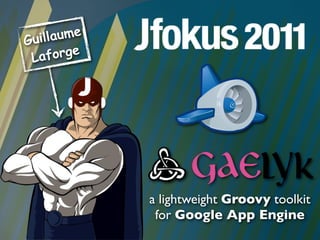
             a lightweight Groovy toolkit
              for Google App Engine
Guill aume
 La forge


             a lightweight Groovy toolkit
              for Google App Engine
Guillaume Laforge / @glaforge

• Groovy Project Manager
• Head of Groovy Development
  at SpringSource
• Initiator of the Grails framework
• Founder of the Gaelyk toolkit
• Co-author of Groovy in Action
• Member of «Les Cast Codeurs» podcast

• Speaker: JavaOne, QCon, JavaZone, Sun TechDays,
  Devoxx, The Spring Experience, SpringOne2GX,
  JAX, Dynamic Language World, IJTC, and more...

                                                    2
Cloud
Computing
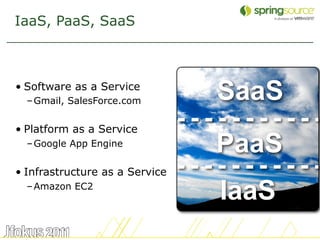
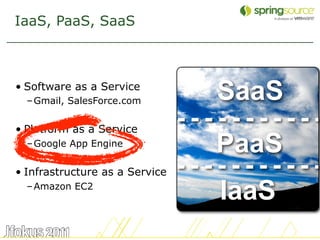
IaaS, PaaS, SaaS


• Software as a Service
  – Gmail, SalesForce.com       SaaS
• Platform as a Service
  – Google App Engine
                                PaaS
• Infrastructure as a Service
  – Amazon EC2
                                IaaS
                                       4
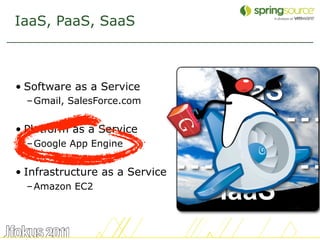
IaaS, PaaS, SaaS


• Software as a Service
  – Gmail, SalesForce.com       SaaS
• Platform as a Service
  – Google App Engine
                                PaaS
• Infrastructure as a Service
  – Amazon EC2
                                IaaS
                                       4
IaaS, PaaS, SaaS


• Software as a Service
  – Gmail, SalesForce.com       SaaS
• Platform as a Service
  – Google App Engine
                                PaaS
• Infrastructure as a Service
  – Amazon EC2
                                IaaS
                                       4
Google App Engine

• Google’s PaaS solution
• Run your app on Google’s infrastructure

• Initially just Python supported

• Java supported added too
  – Sandboxed JVM
  – Jetty servlet container


• Several JVM-compatible language supported


                                              5
Key aspects

• You can use most of your usual web frameworks for
  developping apps on App Engine Java
  – A WAR file, basically! (an exploded war actually)
  – Uploading to the cloud by sending deltas of changes

• No OS image, or software to install
  – Unlike with Amazon EC2

• All the scaling aspects are handled for you
  – Database / session replication, load balancing...

• There are quotas, but you need a high traffic
  application to start being charged
  – Free to get started

                                                          6
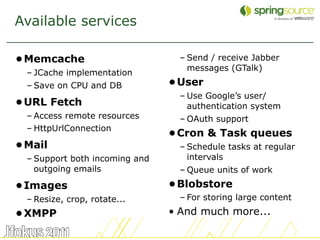
Available services

• Memcache                       – Send / receive Jabber
                                   messages (GTalk)
  – JCache implementation
  – Save on CPU and DB          • User
                                 – Use Google’s user/
• URL Fetch                        authentication system
  – Access remote resources      – OAuth support
  – HttpUrlConnection
                                • Cron & Task queues
• Mail                           – Schedule tasks at regular
  – Support both incoming and      intervals
    outgoing emails              – Queue units of work
• Images                        • Blobstore
  – Resize, crop, rotate...      – For storing large content
• XMPP                          • And much more...

                                                               7
Limitations

•30 seconds request duration limit
  – Task queues raised to 10 minutes

• Forbidden to
  – write on the file system
  – create threads
  – use raw sockets
  – issue system calls
  – use IO / Swing / etc. directly
    •There’s a whitelist of classes allowed

• Number of files and their size are limited


                                               8
Quotas


         9
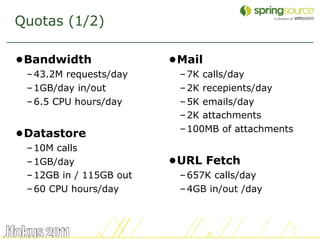
Quotas (1/2)

•Bandwidth               •Mail
 – 43.2M requests/day     – 7K calls/day
 – 1GB/day in/out         – 2K recepients/day
 – 6.5 CPU hours/day      – 5K emails/day
                          – 2K attachments
                          – 100MB of attachments
•Datastore
 – 10M calls
 – 1GB/day               •URL Fetch
 – 12GB in / 115GB out    – 657K calls/day
 – 60 CPU hours/day       – 4GB in/out /day


                                                   10
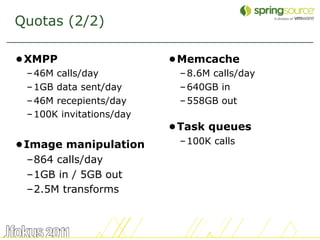
Quotas (2/2)

•XMPP                     •Memcache
 – 46M calls/day           – 8.6M calls/day
 – 1GB data sent/day       – 640GB in
 – 46M recepients/day      – 558GB out
 – 100K invitations/day
                          •Task queues
•Image manipulation        – 100K calls

 –864 calls/day
 –1GB in / 5GB out
 –2.5M transforms


                                              11
The Datastore
The datastore...

• Not your father’s relational database! «NoSQL»

• Distributed key / value store
  – Based on Google’s «BigTable»
  – Schema-less approach
• Supporting
  – Transactions and partitioning
  – Hierarchies through entity groups
• Data access APIs
  – JPA and JDO
    • but adds a big request load time factor
  – Direct low-level APIs


                                                   13
...and its «limitations»

• You’re not using SQL
  –No joins
  – No database constraints
  – No aggregation functions (count, avg...)


• In a query, you can only filter on one column
  for inequality

• Transactions only available in entity groups

• You can only update an entity once in a transaction

                                                        14
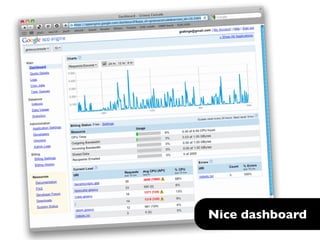
Nice dashboard
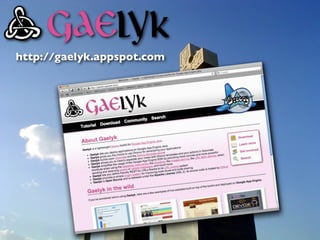
http://gaelyk.appspot.com


                       F
http://gaelyk.appspot.com


                       F
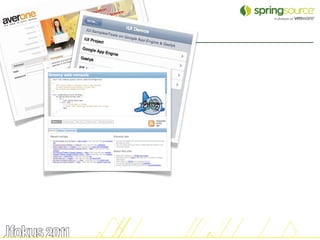
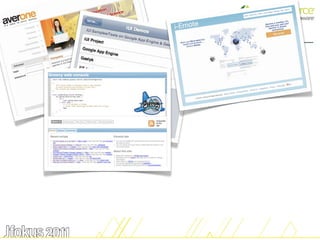
• Gaelyk is a lightweight Groovy toolkit on top of
  the Google App Engine Java SDK

• Gaelyk builds on Groovy’s servlet support
  – Groovlets: Groovy scripts instead of raw servlets!
  – Groovy templates: JSP-like template engine
  – Both allow for a clean separation of views and logic


• Gaelyk provides several enhancements around the
  GAE Java SDK to make life easier, thanks to
  Groovy’s dynamic nature


                                                           17
Why Groovy?

• Groovy is a dynamic language for the JVM
 – very flexible, malleable, expressive and concise syntax
 – easy to learn for Java developers
   • deriving from the Java 5 grammar
 – provides powerful APIs to simplify the life of developers
   • possibility to dynamically enrich existing APIs
 – support for Groovlets and its own template engine


                                                               18
19
19
19
19
19
19
19
19
19
19
First steps...


• Go to http://gaelyk.appspot.com
• Download the template project
• Put your first Groovlet in /WEB-INF/groovy
• And your templates in /WEB-INF/pages
• And you’re ready to go!
• Launch dev_appserver.sh
• Go to http://localhost:8080/
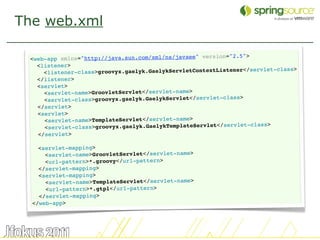
The web.xml

                                                                 ">
 <web-app xmlns="http://java.sun.com/xml/ns/javaee" version="2.5
   <listener>
                                                                  /servlet-class>
     <listener-class>groovyx.gaelyk.GaelykServletContextListener<
   </listener>
   <servlet>
     <servlet-name>GroovletServlet</servlet-name>
     <servlet-class>groovyx.gaelyk.GaelykServlet</servlet-class>
   </servlet>
   <servlet>
     <servlet-name>TemplateServlet</servlet-name>
                                                                  -class>
     <servlet-class>groovyx.gaelyk.GaelykTemplateServlet</servlet
   </servlet>

    <servlet-mapping>
      <servlet-name>GroovletServlet</servlet-name>
      <url-pattern>*.groovy</url-pattern>
    </servlet-mapping>
    <servlet-mapping>
      <servlet-name>TemplateServlet</servlet-name>
      <url-pattern>*.gtpl</url-pattern>
    </servlet-mapping>
  </web-app>


                                                                                    21
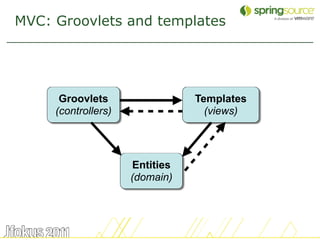
MVC: Groovlets and templates


      Groovlets                  Templates
     (controllers)                 (views)


                      Entities
                     (domain)
A groovlet

• Instead of writing full-blown servlets, just write
  Groovy scripts (aka Groovlets)

        def numbers = [1, 2, 3, 4]
        def now = new Date()

        html.html {
            body {
                numbers.each { number -> p number }
                p now
            }
        }


                                                       23
A groovlet

• Instead of writing full-blown servlets, just write
  Groovy scripts (aka Groovlets)

        def numbers = [1, 2, 3, 4]
        def now = new Date()

        html.html {
            body {
                numbers.each { number -> p number }
                p now
            }
                                                      di ng
                                                 oa
        }

                                            -rel
                                         to
                                     Au
                                                              23
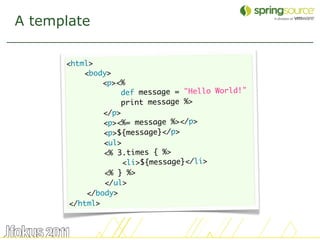
A template

      <html>
          <body>
               <p><%
                   def message = "Hello World!"
                   print message %>
               </p>
               <p><%= message %></p>
               <p>${message}</p>
               <ul>
               <% 3.times { %>
                    <li>${message}</li>
               <% } %>
               </ul>
           </body>
       </html>


                                                  24
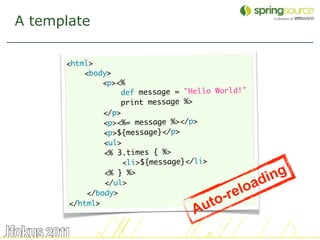
A template

      <html>
          <body>
               <p><%
                   def message = "Hello World!"
                   print message %>
               </p>
               <p><%= message %></p>
               <p>${message}</p>
               <ul>
               <% 3.times { %>
                    <li>${message}</li>
               <% } %>
                                                  di ng
               </ul>
                                            el oa
           </body>
                                       to -r
                                   Au
       </html>


                                                          24
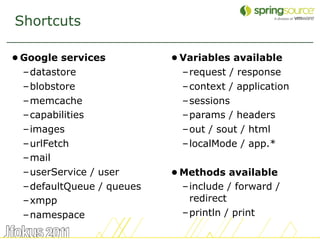
Shortcuts

• Google services          • Variables available
  –datastore                 –request / response
  –blobstore                 –context / application
  –memcache                  –sessions
  –capabilities              –params / headers
  –images                    –out / sout / html
  –urlFetch                  –localMode / app.*
  –mail
  –userService / user      • Methods available
  –defaultQueue / queues     –include / forward /
  –xmpp                       redirect
  –namespace                 –println / print

                                                      25
D E M O
          26
Groovy sugar!
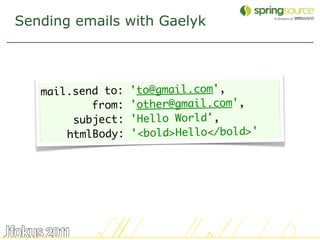
Sending emails with Gaelyk


   mail.send to:   'to@gmail.com',
           from:   'other@gmail.com',
        subject:   'Hello World',
       htmlBody:   '<bold>Hello</bold>'


                                          28
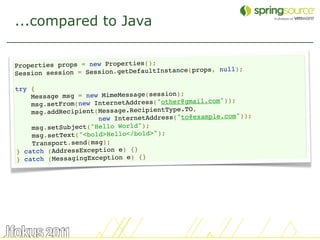
...compared to Java


Properties props = new Properties();
                                                    , null);
Sessio n session = Session.getDefaultInstance(props

try {
    Message msg = new MimeMessage(session);
                                                    om"));
    msg .setFrom(new InternetAddress("other@gmail.c
                                             O,
    msg.addRecipient(Message.RecipientType.T
                                            o@example.com"));
                     new InternetAddress("t
    msg.setSubject("Hello World");
    msg.setText("<bold>Hello</bold>");
    Transport.send(msg);
} catch (AddressException e) {}
} catch (MessagingException e) {}


                                                                29
Accessing the datastore

• Direct interaction with the low-level datastore API
         Entity entity = new Entity("person")
          
                                                      map
         // subscript notation, like when accessing a
         entity['name'] = "Guillaume Laforge"
          
         // normal property access notation
         entity.age = 32

         entity.save()   // asyncSave()
         entity.delete() // asyncDelete()

          datastore.withTransaction {
              // do stuff with your entities
              // within the transaction
          }

          // use the asynchronous datastore service
          datastore.async.put(entity)

                                                            30
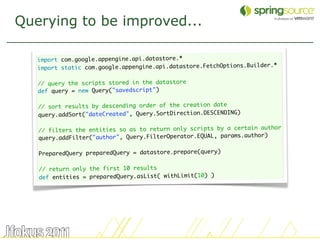
Querying to be improved...

   import com.google.appengine.api.datastore.*
                                                                      der.*
   import static com.google.appengine.api.datastore.FetchOptions.Buil
    
   // query the scripts stored in the datastore
   def query = new Query("savedscript")
    
   // sort results by descending order of the creation date
   query.addSort("dateCreated", Query.SortDirection.DESCENDING)
    
                                                                     author
   // filters the entities so as to return only scripts by a certain
                                                                      r)
   query.addFilter("author", Query.FilterOperator.EQUAL, params.autho
    
   PreparedQuery preparedQuery = datastore.prepare(query)
    
   // return only the first 10 results
   def entities = preparedQuery.asList( withLimit(10) )


                                                                              31
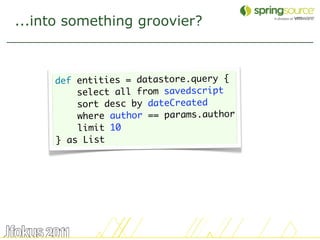
...into something groovier?


     def entities = datastore.query {
         select all from savedscript
         sort desc by dateCreated
         where author == params.author
         limit 10
     } as List


                                         32
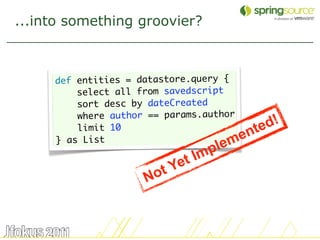
...into something groovier?


     def entities = datastore.query {
         select all from savedscript
         sort desc by dateCreated
         where author == params.author
         limit 10                         te d!
     } as List                       m en
                                 p le
                           et Im
                       o tY
                     N


                                                  32
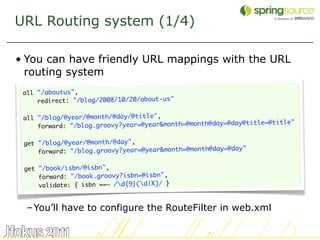
URL Routing system (1/4)

• You can have friendly URL mappings with the URL
  routing system
 all "/aboutus",
     redirect: "/blog/2008/10/20/about-us"

 all "/blog/@year/@month/@day/@title",
                                                         @day@title=@title"
     forward: "/blog.groovy?year=@year&month=@month@day=

 get "/blog/@year/@month/@day",
                                                         @day"
     forward: "/blog.groovy?year=@year&month=@month@day=

 get "/book/isbn/@isbn",
     forward: "/book.groovy?isbn=@isbn",
     validate: { isbn ==~ /d{9}(d|X)/ }


  – You’ll have to configure the RouteFilter in web.xml

                                                                              33
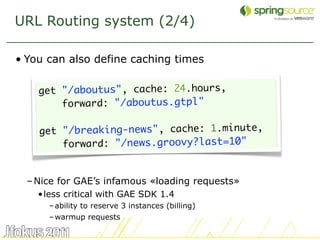
URL Routing system (2/4)

• You can also define caching times

    get "/aboutus", cache: 24.hours,
        forward: "/aboutus.gtpl"

    get "/breaking-news", cache: 1.minute,
        forward: "/news.groovy?last=10"


  – Nice for GAE’s infamous «loading requests»
    •less critical with GAE SDK 1.4
      – ability to reserve 3 instances (billing)
      – warmup requests

                                                   34
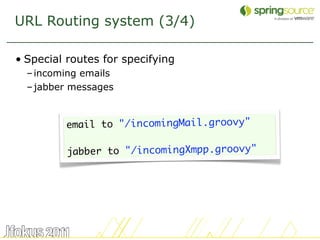
URL Routing system (3/4)

• Special routes for specifying
  – incoming emails
  – jabber messages


         email to "/incomingMail.groovy"

          jabber to "/incomingXmpp.groovy"


                                             35
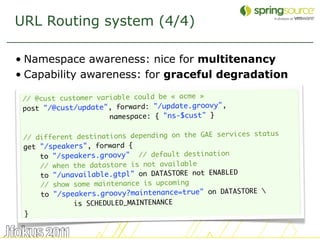
URL Routing system (4/4)

• Namespace awareness: nice for multitenancy
• Capability awareness: for graceful degradation

 // @cust customer variable could be « acme »
 post "/@cust/update", forward: "/update.groovy",
                      namespace: { "ns-$cust" }

                                                       es status
 // different destinations depending on the GAE servic
 get "/speakers", forward {
     to "/speakers.groovy" // default destination
     // when the datastore is not available
     to "/unavailable.gtpl" on DATASTORE not ENABLED
     // show some maintenance is upcoming
                                                            
     to "/speakers.groovy?maintenance=true" on DATASTORE
             is SCHEDULED_MAINTENANCE
 }

                                                                   36
Capabilities

• Google App Engine allows you to know the status
  and availability of the various services
  – DATASTORE, DATESTORE_WRITE, MEMCACHE...
  – ENABLED, DISABLED, UNKNOWN,
    SCHEDULED_MAINTENANCE
  – is() and not() methods


  if (capabilities[DATASTORE_WRITE].is(ENABLED)) {
      // write some content in the datastore
  } else {
      // otherwise, redirect to some maintenance page
  }


                                                        37
Task queue API

   // access a configured queue using the subscript notation
   queues['dailyEmailQueue']
    
   // or using the property access notation
   queues.dailyEmailQueue
    
   // you can also access the default queue with:
   queues.default
   defaultQueue

   // add a task to the queue
   queue << [
       countdownMillis: 1000, url: "/task/dailyEmail",
       taskName: "sendDailyEmailNewsletter",
       method: 'PUT', params: [date: '20090914'],
       payload: content
   ]


                                                               38
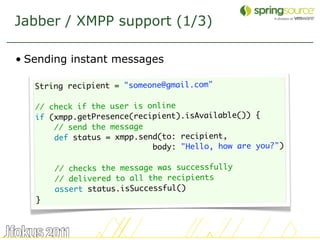
Jabber / XMPP support (1/3)

• Sending instant messages

   String recipient = "someone@gmail.com"
    
   // check if the user is online
   if (xmpp.getPresence(recipient).isAvailable()) {
       // send the message
       def status = xmpp.send(to: recipient,
                            body: "Hello, how are you?")
    
       // checks the message was successfully
       // delivered to all the recipients
       assert status.isSuccessful()
   }


                                                           39
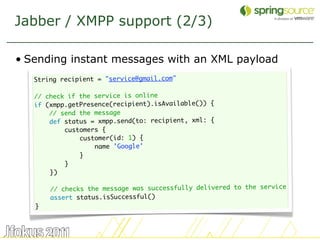
Jabber / XMPP support (2/3)

• Sending instant messages with an XML payload
   String recipient = "service@gmail.com"
    
   // check if the service is online
   if (xmpp.getPresence(recipient).isAvailable()) {
       // send the message
       def status = xmpp.send(to: recipient, xml: {
           customers {
               customer(id: 1) {
                   name 'Google'
               }
           }
       })
    
       // checks the message was successfully delivered to the service
       assert status.isSuccessful()
   }


                                                                         40
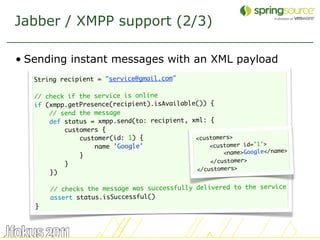
Jabber / XMPP support (2/3)

• Sending instant messages with an XML payload
   String recipient = "service@gmail.com"
    
   // check if the service is online
   if (xmpp.getPresence(recipient).isAvailable()) {
       // send the message
       def status = xmpp.send(to: recipient, xml: {
           customers {
               customer(id: 1) {              <customers>
                   name 'Google'                  <customer id=’1’>
               }                                      <name>Google</name>
           }                                      </customer>
                                              </customers>
       })
    
       // checks the message was successfully delivered to the service
       assert status.isSuccessful()
   }


                                                                            40
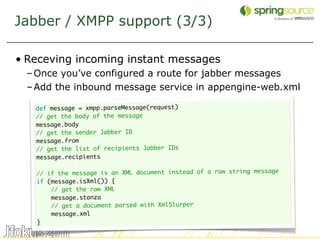
Jabber / XMPP support (3/3)

• Receving incoming instant messages
 – Once you’ve configured a route for jabber messages
 – Add the inbound message service in appengine-web.xml

   def message = xmpp.parseMessage(request)
   // get the body of the message
   message.body
   // get the sender Jabber ID
   message.from
   // get the list of recipients Jabber IDs
   message.recipients
    
   // if the message is an XML document instead of a raw string message
   if (message.isXml()) {
       // get the raw XML
       message.stanza
       // get a document parsed with XmlSlurper
       message.xml
   }
                                                                          41
Memcache service

• Map notation access to the cache

                                                    }
 class Country implements Serialzable { String name
  
 def countryFr = new Country(name: 'France')
  
                                                       in the cache
 // use the subscript notation to put a country object
 // (you can also use non-string keys)
 memcache['FR'] = countryFr
  
 // check that a key is present in the cache
 if ('FR' in memcache) {
                                                        the cache using a key
     // use the subscript notation to get an entry from
     def countryFromCache = memcache['FR']
 }


                                                                                42
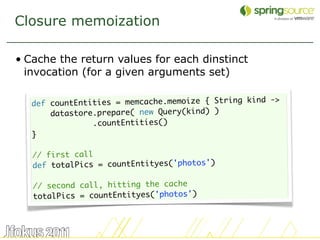
Closure memoization

• Cache the return values for each dinstinct
  invocation (for a given arguments set)

                                                      ->
   def countEntities = memcache.memoize { String kind
       datastore.prepare( new Query(kind) )
                .countEntities()
   }

   // first call
   def totalPics = countEntityes('photos')

   // second call, hitting the cache
   totalPics = countEntityes('photos')


                                                           43
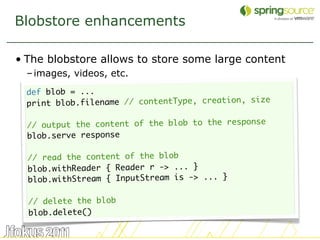
Blobstore enhancements

• The blobstore allows to store some large content
  – images, videos, etc.
  def blob = ...
  print blob.filename // contentType, creation, size

  // output the content of the blob to the response
  blob.serve response

  // read the content of the blob
  blob.withReader { Reader r -> ... }
  blob.withStream { InputStream is -> ... }

  // delete the blob
  blob.delete()

                                                       44
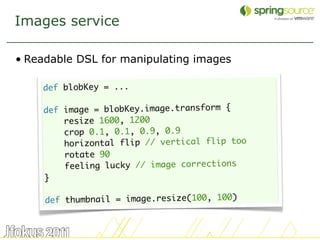
Images service

• Readable DSL for manipulating images

    def blobKey = ...

    def image = blobKey.image.transform {
        resize 1600, 1200
        crop 0.1, 0.1, 0.9, 0.9
        horizontal flip // vertical flip too
        rotate 90
        feeling lucky // image corrections
    }

     def thumbnail = image.resize(100, 100)


                                               45
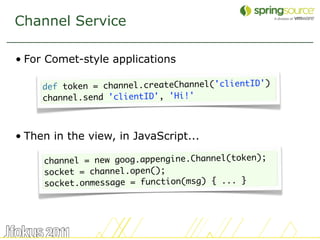
Channel Service

• For Comet-style applications

     def token = channel.createChannel('clientID')
     channel.send 'clientID', 'Hi!'


• Then in the view, in JavaScript...

     channel = new goog.appengine.Channel(token);
     socket = channel.open();
     socket.onmessage = function(msg) { ... }


                                                     46
Simple plugin system (1/3)

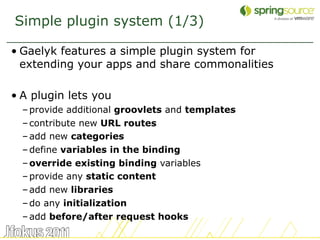
• Gaelyk features a simple plugin system for
  extending your apps and share commonalities

• A plugin lets you
  – provide additional groovlets and templates
  – contribute new URL routes
  – add new categories
  – define variables in the binding
  – override existing binding variables
  – provide any static content
  – add new libraries
  – do any initialization
  – add before/after request hooks
                                                 47
Simple plugin system (2/3)

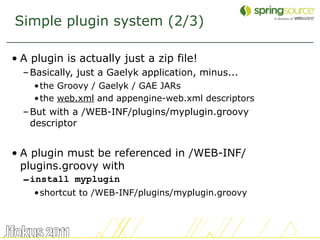
• A plugin is actually just a zip file!
  – Basically, just a Gaelyk application, minus...
    •the Groovy / Gaelyk / GAE JARs
    •the web.xml and appengine-web.xml descriptors
  – But with a /WEB-INF/plugins/myplugin.groovy
    descriptor


• A plugin must be referenced in /WEB-INF/
  plugins.groovy with
  – install myplugin
    •shortcut to /WEB-INF/plugins/myplugin.groovy


                                                     48
Simple plugin system (3/3)

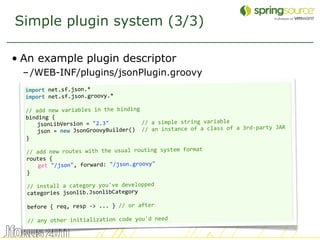
• An example plugin descriptor
  – /WEB-INF/plugins/jsonPlugin.groovy
  import
net.sf.json.*
  import
net.sf.json.groovy.*
  

  //
add
new
variables
in
the
binding
  binding
{
                                                                le
      jsonLibVersion
=
"2.3"


//
a
simple
string
variab
                                                                
of
a
3rd‐party
JAR
      json
=
new
JsonGroovyBuilder()

//
an
instance
of
a
class
  }
  

  //
add
new
routes
with
the
usual
routing
system
format
  routes
{
      get
"/json",
forward:
"/json.groovy"
  }
  

  //
install
a
category
you've
developped
   categories
jsonlib.JsonlibCategory

  before
{
req,
resp
‐>
...
}
//
or
after
  

  //
any
other
initialization
code
you'd
need

                                                                                      49
a ry
                                         m m
               S u


Copyright 2011 SpringSource. Copying, publishing or distributing without express written permission is prohibited.
Summary

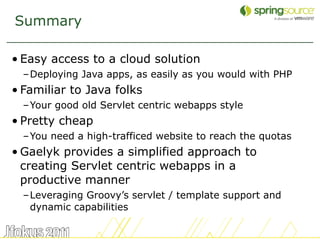
• Easy access to a cloud solution
  –Deploying Java apps, as easily as you would with PHP
• Familiar to Java folks
  –Your good old Servlet centric webapps style
• Pretty cheap
  –You need a high-trafficed website to reach the quotas
• Gaelyk provides a simplified approach to
  creating Servlet centric webapps in a
  productive manner
  –Leveraging Groovy’s servlet / template support and
   dynamic capabilities

                                                           51
What’s coming next?

• Expect more sugar around the Datastore
  – An SQL-like query DSL
  – Easier relationship management (builder?)


• Perhaps pre-compiled groovlets and templates
  – Less needed since SDK 1.4
    • (reserve 3 hot instances, warmup requests)


• Testing facilities specific to Gaelyk
   –testing utility class, Spock-specific ones...

• Anything that’ll come up in newer GAE SDK versions


                                                       52
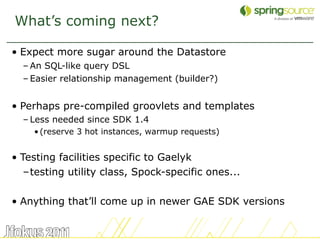
Thanks for your attention!


                      e
              e Laforg velopment
   Gu illaum oovy De         m
          of Gr e@gmail.co
   Head laforg
    E mail: g glaforge
              @
    T witter:

                                   • References:
                                    • http://gaelyk.appspot.com/
                                    • http://groovy.codehaus.org/
                                    • http://code.google.com/
                                      appengine/


                                                                    53
Picture credits

 Myself http://www.flickr.com/photos/romainguy/783719255/sizes/l/in/photostream/
 Speed limit : http://www.morguefile.com/archive/display/18492
 Warehouse : http://www.morguefile.com/archive/display/85628
 Check mark: http://www.lnl.infn.it/~epics/WikiDumps/localhost/600px-symbol_ok.svg.png
 Puzzle: http://www.everystockphoto.com/photo.php?imageId=263521
 Light bulb: https://newsline.llnl.gov/retooling/mar/03.28.08_images/lightBulb.png
 Clouds http://www.morguefile.com/archive/display/627059
 http://www.morguefile.com/archive/display/625552
 http://www.morguefile.com/archive/display/629785
 Duke ok GAE http://weblogs.java.net/blog/felipegaucho/archive/ae_gwt_java.png
 Python logo : http://python.org/images/python-logo.gif
 Gaelic cross with clouds : http://www.morguefile.com/archive/display/37889
 Snow foot steps : http://www.flickr.com/photos/robinvanmourik/2875929243/
 Sugar : http://www.flickr.com/photos/ayelie/441101223/sizes/l/
 Press release: http://www.napleswebdesign.net/wp-content/uploads/2009/06/press_release_11.jpg


                                                                                                 54

Gaelyk - JFokus 2011 - Guillaume Laforge

  • 1.
    Guill aume Laforge a lightweight Groovy toolkit for Google App Engine
  • 2.
    Guill aume Laforge a lightweight Groovy toolkit for Google App Engine
  • 3.
    Guillaume Laforge /@glaforge • Groovy Project Manager • Head of Groovy Development at SpringSource • Initiator of the Grails framework • Founder of the Gaelyk toolkit • Co-author of Groovy in Action • Member of «Les Cast Codeurs» podcast • Speaker: JavaOne, QCon, JavaZone, Sun TechDays, Devoxx, The Spring Experience, SpringOne2GX, JAX, Dynamic Language World, IJTC, and more... 2
  • 4.
  • 5.
    IaaS, PaaS, SaaS •Software as a Service – Gmail, SalesForce.com SaaS • Platform as a Service – Google App Engine PaaS • Infrastructure as a Service – Amazon EC2 IaaS 4
  • 6.
    IaaS, PaaS, SaaS •Software as a Service – Gmail, SalesForce.com SaaS • Platform as a Service – Google App Engine PaaS • Infrastructure as a Service – Amazon EC2 IaaS 4
  • 7.
    IaaS, PaaS, SaaS •Software as a Service – Gmail, SalesForce.com SaaS • Platform as a Service – Google App Engine PaaS • Infrastructure as a Service – Amazon EC2 IaaS 4
  • 8.
    Google App Engine •Google’s PaaS solution • Run your app on Google’s infrastructure • Initially just Python supported • Java supported added too – Sandboxed JVM – Jetty servlet container • Several JVM-compatible language supported 5
  • 9.
    Key aspects • Youcan use most of your usual web frameworks for developping apps on App Engine Java – A WAR file, basically! (an exploded war actually) – Uploading to the cloud by sending deltas of changes • No OS image, or software to install – Unlike with Amazon EC2 • All the scaling aspects are handled for you – Database / session replication, load balancing... • There are quotas, but you need a high traffic application to start being charged – Free to get started 6
  • 10.
    Available services • Memcache – Send / receive Jabber messages (GTalk) – JCache implementation – Save on CPU and DB • User – Use Google’s user/ • URL Fetch authentication system – Access remote resources – OAuth support – HttpUrlConnection • Cron & Task queues • Mail – Schedule tasks at regular – Support both incoming and intervals outgoing emails – Queue units of work • Images • Blobstore – Resize, crop, rotate... – For storing large content • XMPP • And much more... 7
  • 11.
    Limitations •30 seconds requestduration limit – Task queues raised to 10 minutes • Forbidden to – write on the file system – create threads – use raw sockets – issue system calls – use IO / Swing / etc. directly •There’s a whitelist of classes allowed • Number of files and their size are limited 8
  • 12.
  • 13.
    Quotas (1/2) •Bandwidth •Mail – 43.2M requests/day – 7K calls/day – 1GB/day in/out – 2K recepients/day – 6.5 CPU hours/day – 5K emails/day – 2K attachments – 100MB of attachments •Datastore – 10M calls – 1GB/day •URL Fetch – 12GB in / 115GB out – 657K calls/day – 60 CPU hours/day – 4GB in/out /day 10
  • 14.
    Quotas (2/2) •XMPP •Memcache – 46M calls/day – 8.6M calls/day – 1GB data sent/day – 640GB in – 46M recepients/day – 558GB out – 100K invitations/day •Task queues •Image manipulation – 100K calls –864 calls/day –1GB in / 5GB out –2.5M transforms 11
  • 15.
  • 16.
    The datastore... • Notyour father’s relational database! «NoSQL» • Distributed key / value store – Based on Google’s «BigTable» – Schema-less approach • Supporting – Transactions and partitioning – Hierarchies through entity groups • Data access APIs – JPA and JDO • but adds a big request load time factor – Direct low-level APIs 13
  • 17.
    ...and its «limitations» •You’re not using SQL –No joins – No database constraints – No aggregation functions (count, avg...) • In a query, you can only filter on one column for inequality • Transactions only available in entity groups • You can only update an entity once in a transaction 14
  • 18.
  • 19.
  • 20.
  • 21.
    • Gaelyk isa lightweight Groovy toolkit on top of the Google App Engine Java SDK • Gaelyk builds on Groovy’s servlet support – Groovlets: Groovy scripts instead of raw servlets! – Groovy templates: JSP-like template engine – Both allow for a clean separation of views and logic • Gaelyk provides several enhancements around the GAE Java SDK to make life easier, thanks to Groovy’s dynamic nature 17
  • 22.
    Why Groovy? • Groovyis a dynamic language for the JVM – very flexible, malleable, expressive and concise syntax – easy to learn for Java developers • deriving from the Java 5 grammar – provides powerful APIs to simplify the life of developers • possibility to dynamically enrich existing APIs – support for Groovlets and its own template engine 18
  • 23.
  • 24.
  • 25.
  • 26.
  • 27.
  • 28.
  • 29.
  • 30.
  • 31.
  • 32.
  • 33.
    First steps... • Goto http://gaelyk.appspot.com • Download the template project • Put your first Groovlet in /WEB-INF/groovy • And your templates in /WEB-INF/pages • And you’re ready to go! • Launch dev_appserver.sh • Go to http://localhost:8080/
  • 34.
    The web.xml "> <web-app xmlns="http://java.sun.com/xml/ns/javaee" version="2.5 <listener> /servlet-class> <listener-class>groovyx.gaelyk.GaelykServletContextListener< </listener> <servlet> <servlet-name>GroovletServlet</servlet-name> <servlet-class>groovyx.gaelyk.GaelykServlet</servlet-class> </servlet> <servlet> <servlet-name>TemplateServlet</servlet-name> -class> <servlet-class>groovyx.gaelyk.GaelykTemplateServlet</servlet </servlet> <servlet-mapping> <servlet-name>GroovletServlet</servlet-name> <url-pattern>*.groovy</url-pattern> </servlet-mapping> <servlet-mapping> <servlet-name>TemplateServlet</servlet-name> <url-pattern>*.gtpl</url-pattern> </servlet-mapping> </web-app> 21
  • 35.
    MVC: Groovlets andtemplates Groovlets Templates (controllers) (views) Entities (domain)
  • 36.
    A groovlet • Insteadof writing full-blown servlets, just write Groovy scripts (aka Groovlets) def numbers = [1, 2, 3, 4] def now = new Date() html.html { body { numbers.each { number -> p number } p now } } 23
  • 37.
    A groovlet • Insteadof writing full-blown servlets, just write Groovy scripts (aka Groovlets) def numbers = [1, 2, 3, 4] def now = new Date() html.html { body { numbers.each { number -> p number } p now } di ng oa } -rel to Au 23
  • 38.
    A template <html> <body> <p><% def message = "Hello World!" print message %> </p> <p><%= message %></p> <p>${message}</p> <ul> <% 3.times { %> <li>${message}</li> <% } %> </ul> </body> </html> 24
  • 39.
    A template <html> <body> <p><% def message = "Hello World!" print message %> </p> <p><%= message %></p> <p>${message}</p> <ul> <% 3.times { %> <li>${message}</li> <% } %> di ng </ul> el oa </body> to -r Au </html> 24
  • 40.
    Shortcuts • Google services • Variables available –datastore –request / response –blobstore –context / application –memcache –sessions –capabilities –params / headers –images –out / sout / html –urlFetch –localMode / app.* –mail –userService / user • Methods available –defaultQueue / queues –include / forward / –xmpp redirect –namespace –println / print 25
  • 41.
    D E MO 26
  • 42.
  • 43.
    Sending emails withGaelyk mail.send to: 'to@gmail.com', from: 'other@gmail.com', subject: 'Hello World', htmlBody: '<bold>Hello</bold>' 28
  • 44.
    ...compared to Java Propertiesprops = new Properties(); , null); Sessio n session = Session.getDefaultInstance(props try { Message msg = new MimeMessage(session); om"));     msg .setFrom(new InternetAddress("other@gmail.c O,     msg.addRecipient(Message.RecipientType.T o@example.com"));                      new InternetAddress("t     msg.setSubject("Hello World");     msg.setText("<bold>Hello</bold>");     Transport.send(msg); } catch (AddressException e) {} } catch (MessagingException e) {} 29
  • 45.
    Accessing the datastore •Direct interaction with the low-level datastore API Entity entity = new Entity("person")   map // subscript notation, like when accessing a entity['name'] = "Guillaume Laforge"   // normal property access notation entity.age = 32 entity.save() // asyncSave() entity.delete() // asyncDelete() datastore.withTransaction { // do stuff with your entities // within the transaction } // use the asynchronous datastore service datastore.async.put(entity) 30
  • 46.
    Querying to beimproved... import com.google.appengine.api.datastore.* der.* import static com.google.appengine.api.datastore.FetchOptions.Buil   // query the scripts stored in the datastore def query = new Query("savedscript")   // sort results by descending order of the creation date query.addSort("dateCreated", Query.SortDirection.DESCENDING)   author // filters the entities so as to return only scripts by a certain r) query.addFilter("author", Query.FilterOperator.EQUAL, params.autho   PreparedQuery preparedQuery = datastore.prepare(query)   // return only the first 10 results def entities = preparedQuery.asList( withLimit(10) ) 31
  • 47.
    ...into something groovier? def entities = datastore.query { select all from savedscript sort desc by dateCreated where author == params.author limit 10 } as List 32
  • 48.
    ...into something groovier? def entities = datastore.query { select all from savedscript sort desc by dateCreated where author == params.author limit 10 te d! } as List m en p le et Im o tY N 32
  • 49.
    URL Routing system(1/4) • You can have friendly URL mappings with the URL routing system all "/aboutus", redirect: "/blog/2008/10/20/about-us" all "/blog/@year/@month/@day/@title", @day@title=@title" forward: "/blog.groovy?year=@year&month=@month@day= get "/blog/@year/@month/@day", @day" forward: "/blog.groovy?year=@year&month=@month@day= get "/book/isbn/@isbn", forward: "/book.groovy?isbn=@isbn", validate: { isbn ==~ /d{9}(d|X)/ } – You’ll have to configure the RouteFilter in web.xml 33
  • 50.
    URL Routing system(2/4) • You can also define caching times get "/aboutus", cache: 24.hours, forward: "/aboutus.gtpl" get "/breaking-news", cache: 1.minute, forward: "/news.groovy?last=10" – Nice for GAE’s infamous «loading requests» •less critical with GAE SDK 1.4 – ability to reserve 3 instances (billing) – warmup requests 34
  • 51.
    URL Routing system(3/4) • Special routes for specifying – incoming emails – jabber messages email to "/incomingMail.groovy" jabber to "/incomingXmpp.groovy" 35
  • 52.
    URL Routing system(4/4) • Namespace awareness: nice for multitenancy • Capability awareness: for graceful degradation // @cust customer variable could be « acme » post "/@cust/update", forward: "/update.groovy", namespace: { "ns-$cust" } es status // different destinations depending on the GAE servic get "/speakers", forward { to "/speakers.groovy" // default destination // when the datastore is not available to "/unavailable.gtpl" on DATASTORE not ENABLED // show some maintenance is upcoming to "/speakers.groovy?maintenance=true" on DATASTORE is SCHEDULED_MAINTENANCE } 36
  • 53.
    Capabilities • Google AppEngine allows you to know the status and availability of the various services – DATASTORE, DATESTORE_WRITE, MEMCACHE... – ENABLED, DISABLED, UNKNOWN, SCHEDULED_MAINTENANCE – is() and not() methods if (capabilities[DATASTORE_WRITE].is(ENABLED)) { // write some content in the datastore } else { // otherwise, redirect to some maintenance page } 37
  • 54.
    Task queue API // access a configured queue using the subscript notation queues['dailyEmailQueue']   // or using the property access notation queues.dailyEmailQueue   // you can also access the default queue with: queues.default defaultQueue // add a task to the queue queue << [ countdownMillis: 1000, url: "/task/dailyEmail", taskName: "sendDailyEmailNewsletter", method: 'PUT', params: [date: '20090914'], payload: content ] 38
  • 55.
    Jabber / XMPPsupport (1/3) • Sending instant messages String recipient = "someone@gmail.com"   // check if the user is online if (xmpp.getPresence(recipient).isAvailable()) { // send the message def status = xmpp.send(to: recipient, body: "Hello, how are you?")   // checks the message was successfully // delivered to all the recipients assert status.isSuccessful() } 39
  • 56.
    Jabber / XMPPsupport (2/3) • Sending instant messages with an XML payload String recipient = "service@gmail.com"   // check if the service is online if (xmpp.getPresence(recipient).isAvailable()) { // send the message def status = xmpp.send(to: recipient, xml: { customers { customer(id: 1) { name 'Google' } } })   // checks the message was successfully delivered to the service assert status.isSuccessful() } 40
  • 57.
    Jabber / XMPPsupport (2/3) • Sending instant messages with an XML payload String recipient = "service@gmail.com"   // check if the service is online if (xmpp.getPresence(recipient).isAvailable()) { // send the message def status = xmpp.send(to: recipient, xml: { customers { customer(id: 1) { <customers> name 'Google' <customer id=’1’> } <name>Google</name> } </customer> </customers> })   // checks the message was successfully delivered to the service assert status.isSuccessful() } 40
  • 58.
    Jabber / XMPPsupport (3/3) • Receving incoming instant messages – Once you’ve configured a route for jabber messages – Add the inbound message service in appengine-web.xml def message = xmpp.parseMessage(request) // get the body of the message message.body // get the sender Jabber ID message.from // get the list of recipients Jabber IDs message.recipients   // if the message is an XML document instead of a raw string message if (message.isXml()) { // get the raw XML message.stanza // get a document parsed with XmlSlurper message.xml } 41
  • 59.
    Memcache service • Mapnotation access to the cache } class Country implements Serialzable { String name   def countryFr = new Country(name: 'France')   in the cache // use the subscript notation to put a country object // (you can also use non-string keys) memcache['FR'] = countryFr   // check that a key is present in the cache if ('FR' in memcache) { the cache using a key // use the subscript notation to get an entry from def countryFromCache = memcache['FR'] } 42
  • 60.
    Closure memoization • Cachethe return values for each dinstinct invocation (for a given arguments set) -> def countEntities = memcache.memoize { String kind datastore.prepare( new Query(kind) ) .countEntities() } // first call def totalPics = countEntityes('photos') // second call, hitting the cache totalPics = countEntityes('photos') 43
  • 61.
    Blobstore enhancements • Theblobstore allows to store some large content – images, videos, etc. def blob = ... print blob.filename // contentType, creation, size // output the content of the blob to the response blob.serve response // read the content of the blob blob.withReader { Reader r -> ... } blob.withStream { InputStream is -> ... } // delete the blob blob.delete() 44
  • 62.
    Images service • ReadableDSL for manipulating images def blobKey = ... def image = blobKey.image.transform { resize 1600, 1200 crop 0.1, 0.1, 0.9, 0.9 horizontal flip // vertical flip too rotate 90 feeling lucky // image corrections } def thumbnail = image.resize(100, 100) 45
  • 63.
    Channel Service • ForComet-style applications def token = channel.createChannel('clientID') channel.send 'clientID', 'Hi!' • Then in the view, in JavaScript... channel = new goog.appengine.Channel(token); socket = channel.open(); socket.onmessage = function(msg) { ... } 46
  • 64.
    Simple plugin system(1/3) • Gaelyk features a simple plugin system for extending your apps and share commonalities • A plugin lets you – provide additional groovlets and templates – contribute new URL routes – add new categories – define variables in the binding – override existing binding variables – provide any static content – add new libraries – do any initialization – add before/after request hooks 47
  • 65.
    Simple plugin system(2/3) • A plugin is actually just a zip file! – Basically, just a Gaelyk application, minus... •the Groovy / Gaelyk / GAE JARs •the web.xml and appengine-web.xml descriptors – But with a /WEB-INF/plugins/myplugin.groovy descriptor • A plugin must be referenced in /WEB-INF/ plugins.groovy with – install myplugin •shortcut to /WEB-INF/plugins/myplugin.groovy 48
  • 66.
    Simple plugin system(3/3) • An example plugin descriptor – /WEB-INF/plugins/jsonPlugin.groovy import
net.sf.json.* import
net.sf.json.groovy.* 
 //
add
new
variables
in
the
binding binding
{ le jsonLibVersion
=
"2.3"


//
a
simple
string
variab 
of
a
3rd‐party
JAR json
=
new
JsonGroovyBuilder()

//
an
instance
of
a
class } 
 //
add
new
routes
with
the
usual
routing
system
format routes
{ get
"/json",
forward:
"/json.groovy" } 
 //
install
a
category
you've
developped categories
jsonlib.JsonlibCategory before
{
req,
resp
‐>
...
}
//
or
after 
 //
any
other
initialization
code
you'd
need 49
  • 67.
    a ry m m S u Copyright 2011 SpringSource. Copying, publishing or distributing without express written permission is prohibited.
  • 68.
    Summary • Easy accessto a cloud solution –Deploying Java apps, as easily as you would with PHP • Familiar to Java folks –Your good old Servlet centric webapps style • Pretty cheap –You need a high-trafficed website to reach the quotas • Gaelyk provides a simplified approach to creating Servlet centric webapps in a productive manner –Leveraging Groovy’s servlet / template support and dynamic capabilities 51
  • 69.
    What’s coming next? •Expect more sugar around the Datastore – An SQL-like query DSL – Easier relationship management (builder?) • Perhaps pre-compiled groovlets and templates – Less needed since SDK 1.4 • (reserve 3 hot instances, warmup requests) • Testing facilities specific to Gaelyk –testing utility class, Spock-specific ones... • Anything that’ll come up in newer GAE SDK versions 52
  • 70.
    Thanks for yourattention! e e Laforg velopment Gu illaum oovy De m of Gr e@gmail.co Head laforg E mail: g glaforge @ T witter: • References: • http://gaelyk.appspot.com/ • http://groovy.codehaus.org/ • http://code.google.com/ appengine/ 53
  • 71.
    Picture credits Myselfhttp://www.flickr.com/photos/romainguy/783719255/sizes/l/in/photostream/ Speed limit : http://www.morguefile.com/archive/display/18492 Warehouse : http://www.morguefile.com/archive/display/85628 Check mark: http://www.lnl.infn.it/~epics/WikiDumps/localhost/600px-symbol_ok.svg.png Puzzle: http://www.everystockphoto.com/photo.php?imageId=263521 Light bulb: https://newsline.llnl.gov/retooling/mar/03.28.08_images/lightBulb.png Clouds http://www.morguefile.com/archive/display/627059 http://www.morguefile.com/archive/display/625552 http://www.morguefile.com/archive/display/629785 Duke ok GAE http://weblogs.java.net/blog/felipegaucho/archive/ae_gwt_java.png Python logo : http://python.org/images/python-logo.gif Gaelic cross with clouds : http://www.morguefile.com/archive/display/37889 Snow foot steps : http://www.flickr.com/photos/robinvanmourik/2875929243/ Sugar : http://www.flickr.com/photos/ayelie/441101223/sizes/l/ Press release: http://www.napleswebdesign.net/wp-content/uploads/2009/06/press_release_11.jpg 54