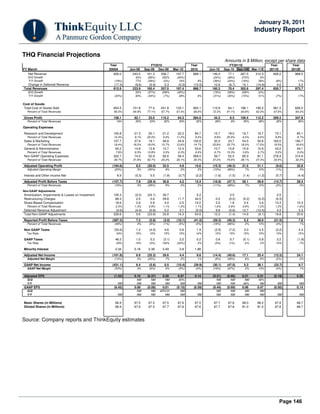
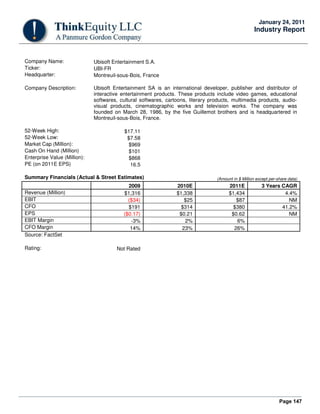
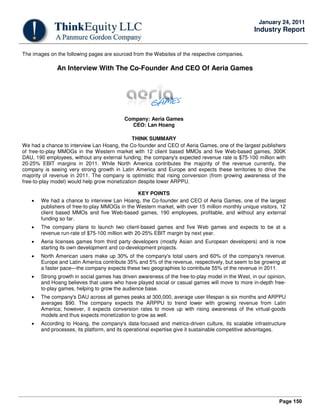
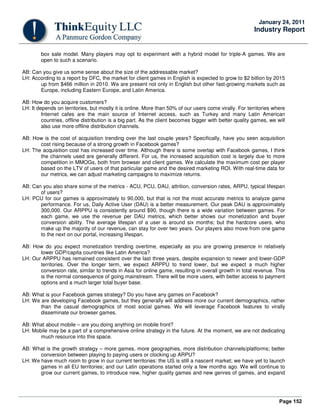
Please see analyst certification (Reg. AC) and other important disclosures on pages 416-417 of this report.
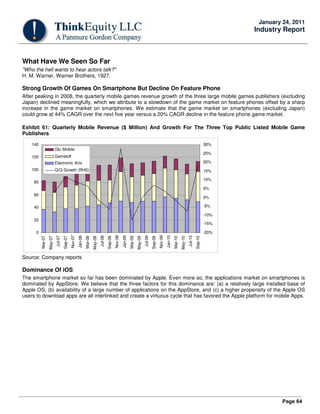
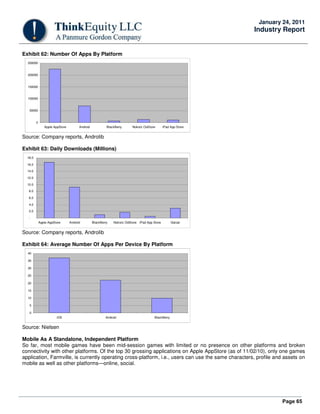
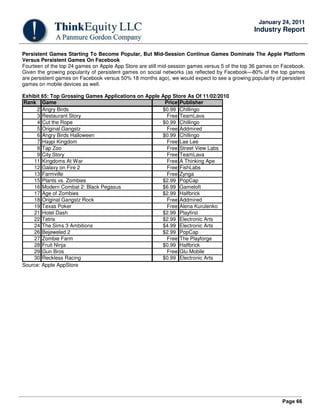
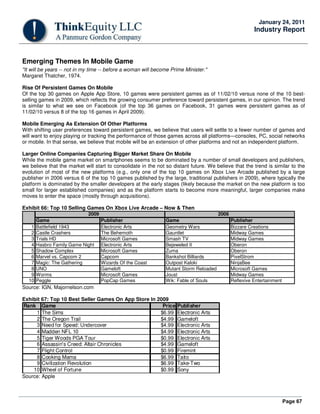
Think Entertainment: Gaming
Multi-Channel Games-As-A-Service II: Ubiquitous
Games In The Cloud
THINK SUMMARY:
We reiterate our thesis on Multi-channel Games-as-a-Service and project
strong growth alternate business models that we think are needed to support
the shift in games consumption away from Games-as-a-Product to
Games-as-a-Service. While we expect the worldwide video game market to
grow at a 7% CAGR over the next five years, we expect a shift in share of
platforms for the games - away from consoles to online and mobile (we expect
console games' share to be down to 39% in 2014 from 61% in 2009), and away
from Western markets (down from 54% to 50%) to Asian markets. We expect
social and mobile game to emerge as the fastest-growing segments, with
CAGRs of 35% and 24%, respectively, for the next five years.
KEY POINTS:
• We reiterate our thesis on Multi-channel Games-as-a-Service, which lets
players enjoy games at any platform (social networks, online, mobile, PC,
console) of his or her choice with the games experience optimized for each
platform, and gives the player the ability to change the platform but still pick
up the game from where he or she left off.
• To complement games moving from product to services, we expect business
models to evolve as well. We expect to see more games on subscription,
time-based, virtual goods, and hybrid models. We are particularly
encouraged by the free-to-play model, which enables perfect price
discrimination (a holy grail of marketing), and helps curb piracy and grow
community.
• So far, we have seen strong growth in virtual goods with free-to-play, and we
expect advertising to emerge as another significant opportunity as the
standardized ad units evolve. We expect the virtual goods markets to grow at
a 22% CAGR to $20 billion by 2014.
• While we have seen strong growth in social games on Facebook, we believe
that the social games off Facebook (including other social networks, and
platforms such as mobile, online, console) and improving monetization could
lead another leg of growth for social games. Overall, we expect the
worldwide social game market to grow at a 35% CAGR over the next five
years to reach $12.1 billion by 2014.
• We estimate that the mobile game market will grow at a 24% CAGR to reach
$7.1 billion by 2014. We expect mobile game growth to be driven by
continued momentum in Japan and strong growth in the U.S. and European
markets.
• We expect to see solid growth in online games, driven by rising Internet
penetration in emerging markets (Brazil, Russia, India, and China) and a
continued shift of user preferences. We estimate the worldwide online games
market will grow at an 9% CAGR, driven by 14% growth in the free-to-play
market and 2% CAGR for subscription and time-based models, to reach
$16.9 billion by 2014.
• However, we expect growth in console games to remain challenged, given
changing consumer preferences. We expect the consoles games market to
be driven by the momentum in larger titles and offset by marginalization of
the smaller titles. Overall, we estimate the console games software market
will decline by a 2% CAGR over the next five years to reach $20.9 billion by
2014.
Reason for Report:
Industry Update
Atul Bagga
415-249-6362, abagga@thinkequity.com
January 24, 2011
Industry Report
Page 2
January 24, 2011
Industry Report
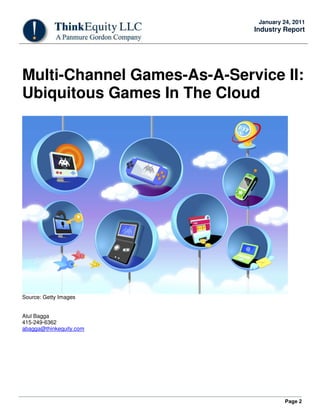
Multi-Channel Games-As-A-Service II:
Ubiquitous Games In The Cloud
Source: Getty Images
Atul Bagga
415-249-6362
abagga@thinkequity.com
Page 3
January 24, 2011
Industry Report
Table Of Contents
Executive Summary....................................................................................................................................................5
Summary Market Size Estimate Tables For Video Game Industry ...................................................................7
Prologue................................................................................................................................................................... 11
Section 1: The Emergence Of Multi-Channel Games-As-A-Service................................................................. 14
Chapter 1: The Emergence Of Multi-Channel Games-As-A-Service ...................................................................... 15
Market Size Estimates For Overall Video Game Industry .............................................................................. 17
Chapter 2: Virtual Goods ......................................................................................................................................... 19
Definitions........................................................................................................................................................ 20
Why Do People Buy Virtual Goods? ............................................................................................................... 22
Why Are We Excited About Virtual Goods Business Model? ......................................................................... 24
Emerging Trends In Virtual Goods.................................................................................................................. 31
Market Size Estimates For Virtual Goods Market........................................................................................... 32
Chapter 3: Social Games......................................................................................................................................... 34
Why Are We Excited About Social Games ..................................................................................................... 35
What Have We Seen So Far?......................................................................................................................... 37
Emerging Themes In Social Games ............................................................................................................... 41
Market Size Estimates For Social Games ...................................................................................................... 48
Chapter 4: Online Games........................................................................................................................................ 50
Demand Drivers For Online Games................................................................................................................ 51
Market Size Estimates For Online Games...................................................................................................... 55
Chapter 5: Mobile Games........................................................................................................................................ 57
Drivers For Mobile Games .............................................................................................................................. 58
An Interview With The Senior Vice President of Mixi...................................................................................... 61
What Have We Seen So Far........................................................................................................................... 64
Emerging Themes In Mobile Game ................................................................................................................ 67
Market Size Estimates For Mobile Games...................................................................................................... 69
Chapter 6: Console Games ..................................................................................................................................... 70
Emerging Themes In Console Game Market.................................................................................................. 73
Market Size Estimates For Console Games................................................................................................... 75
Who We Think Will Succeed: Characteristics Of Winners In Games As A Service................................................ 76
Next Frontier ............................................................................................................................................................ 79
Page 4
January 24, 2011
Industry Report
Section 2: Video Games Market By Regions ...................................................................................................... 80
China............................................................................................................................................................... 83
Japan............................................................................................................................................................... 84
South Korea .................................................................................................................................................... 85
U.S. ................................................................................................................................................................. 86
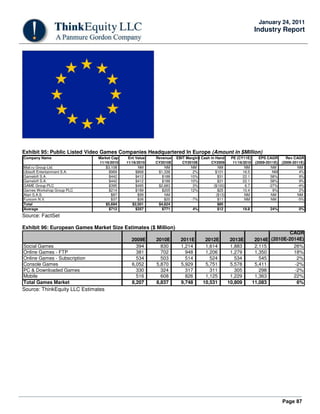
Europe............................................................................................................................................................. 87
Section 3: Profile Of Publicly Traded Companies In Video Game & Video Game Eco-system ................. 88
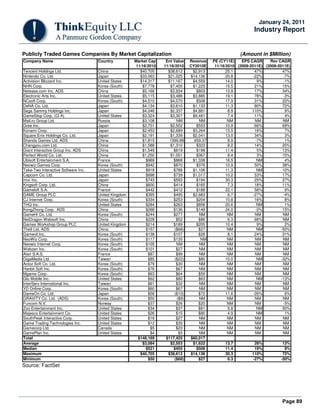
Publicly Traded Games Companies By Market Capitalization ........................................................ 89
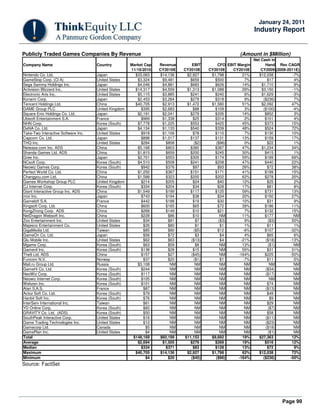
Publicly Traded Games Companies By Revenue ................................................................................ 90
Section 4: Interviews With Private Gaming Companies .................................................................................. 149
An Interview With The Co-Founder And CEO Of Aeria Games ................................................................... 150
An Interview With The Founder And CEO Of BOKU .................................................................................... 155
An Interview With The CEO Of CrowdStar ................................................................................................... 159
An Interview With The CTO Of Facebook..................................................................................................... 163
An Interview With The Founder And CEO Of GameDuell ............................................................................ 167
An Interview With The CEO And The President Of hi5 ................................................................................ 171
An Interview With The COO Of IGG ............................................................................................................. 178
An Interview With The CEO Of IMVU ........................................................................................................... 183
An Interview With The Founder And CEO Of Jambool................................................................................. 188
An Interview With The Founder And CEO Of Kabam................................................................................... 192
An Interview With The Founder And CEO Of Live Gamer............................................................................ 196
An Interview With The CEO Of Meez ........................................................................................................... 201
An Interview With The Founder And CEO Of Mind Candy........................................................................... 205
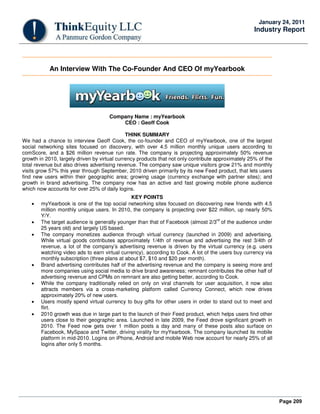
An Interview With The Co-Founder And CEO Of myYearbook .................................................................... 209
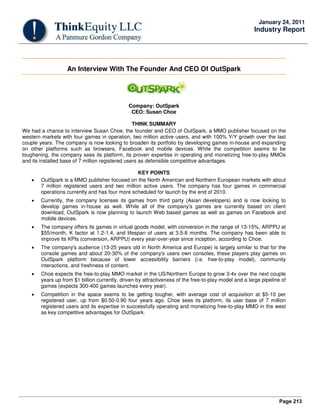
An Interview With The Founder And CEO Of OutSpark............................................................................... 213
An Interview With The CEO Of Playdom ...................................................................................................... 218
An Interview With The Founder And CEO Of PlaySpan............................................................................... 222
An Interview With The Founder And CEO Of Q Entertainment.................................................................... 226
An Interview With The Founder And CEO Of Rekoo.................................................................................... 229
An Interview With The Founder And CEO Of Serious Business .................................................................. 233
An Interview With The CEO Of Sulake ......................................................................................................... 237
An Interview With The CEO Of WildTangent................................................................................................ 241
An Interview With The Co-Founder And CEO Of World Golf Tour............................................................... 246
An Interview With The CEO Of Zapak .......................................................................................................... 251
An Interview With The Co-Founder And Co-CEO Of Zoosk......................................................................... 256
Section 5: Profile Of Private Companies In Video Game And Video Game Eco-System.......................... 260
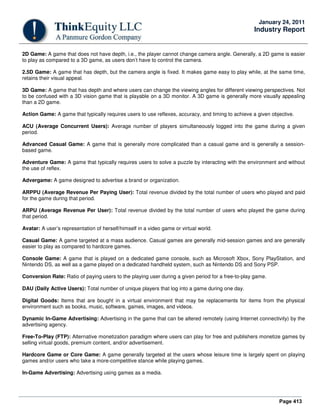
Glossary of Terms.................................................................................................................................................. 412
Page 5
January 24, 2011
Industry Report
Executive Summary
"I see no good reasons why the views given in this volume should shock the religious sensibilities of anyone."
Charles Darwin, The Origin Of Species, 1869.
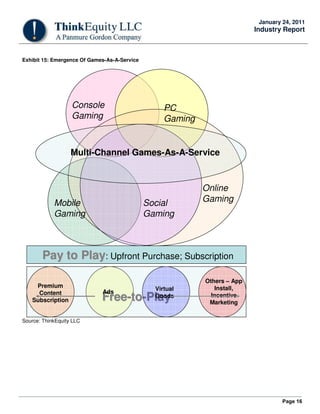
In May 2009, we laid out our thesis on Multi-channel Games-as-a-Service that let players enjoy the game at any platform
of his or her choice with user experience optimized for each platform, and give the player the ability to change the
platform, but still pick up the game from where he or she left off (for details and background see our report, “Emergence
of Games-as-a-Service,” dated 05/09/09). In this report, we reiterate our thesis of Multi-channel Games-as-a-Service or
ubiquitous games-in-cloud and estimate strong growth alternate business models that are needed to support the shift in
games consumption away from games-as-a-product to Games-as-a-Service. While we expect the worldwide video game
market to grow at a 7% CAGR over the next five years; we expect a shift in share of platforms for the games - away from
consoles to online and mobile (we expect console games’ share to be down to 39% in 2014 from 61% in 2009); and away
from Western markets (down from 54% to 50%) to Asian markets. We expect social and mobile game to emerge as the
fastest-growing segments, with CAGRs of 35% and 24% respectively for the next five years.
Emergence Of Games-As-A-Service:
We reiterate our thesis on the next-gen Multi-channel Games-as-a-Service, which will let players enjoy the game at any
platform (social networks, online, mobile, PC, console) of his or her choice with the games experience optimized for each
platform, and give the player the ability to change the platform, but still pick up the game from where he or she left off. Not
only will the player be able to play the game on all platforms, but the game play will be optimized for the device. Overall,
we expect the worldwide video game market to grow at a 7% CAGR over the next five years to reach $54 billion by 2014.
However, we expect a significant shift in market share by platform. We estimate the console game market share will
decrease to 39% of the total video game software sales by 2014 from 61% in 2009.
Emergence Of Alternative Business Models
To complement games moving from product to services, we expect the business models to evolve as well. We expect to
see more games on subscription, virtual goods, and a hybrid of virtual goods and subscription model. We are particularly
excited about the free-to-play, which enables perfect price discrimination (a holy grail of marketing), and helps curb piracy
and grow community. So far, we have seen strong growth in virtual goods with free-to-play, we expect advertising to
emerge as another significant opportunity as the standardized ad units evolve. We expect the virtual goods markets to
grow at a 21% CAGR to $20 billion by the year 2014.
Continued Momentum In Social Games
While we have seen strong growth in social games on Facebook, we believe that social games off Facebook (including
other social networks, and platforms such as mobile, online, console) and improving monetization could lead another leg
of growth for social games. Overall, we expect the worldwide social game market to grow at 35% CAGR over the next five
years to reach $12.1 billion by 2014.
Expect Mobile Games Growth Driven By Rising Smartphones Penetration And Offset By Declining Featurephone
Market
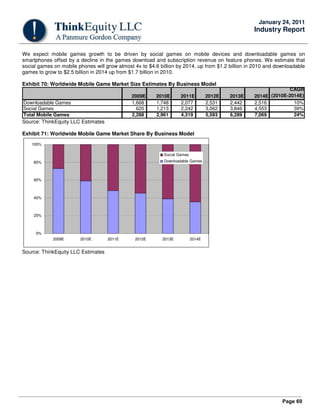
We estimate the mobile game market will grow at a 24% CAGR to reach $7.1 billion by 2014. We expect the mobile
games growth to be driven by a continued momentum in Japan and a strong growth in the U.S. and European markets.
Expect Solid Growth In Online Games (Outside Social Networks)
We expect to see solid growth in online games driven by rising Internet penetration in emerging markets (Brazil, Russia,
India, and China) and a continued shift of users’ preferences toward consuming games as an online service and away
from packaged goods. We estimate that the worldwide online game market will grow at an 8% CAGR, driven by 13%
growth in the free-to-play market and 2% CAGR for subscription and time-based model, to reach at $16.6 billion by 2014.
While Console Games Is Expected To Remain Challenged
On the other hand, we expect the growth in console games to remain challenged, given changing consumer preferences
toward the Games-as-a-Service segment and socially connected environment away from consoles. We expect the
Page 6
January 24, 2011
Industry Report
consoles game market to be driven by the momentum in the larger titles and offset by marginalization of the smaller titles.
Overall, we estimate the console games software market will decline by 2% CAGR over the next five years to reach $20.9
billion by 2014.
Page 7
January 24, 2011
Industry Report
Summary Market Size Estimate Tables For Video Game Industry
"Difficult to see. Always in motion is the future."
Yoda, Star Wars: The Empire Strikes Back
Exhibit 1: Worldwide Video Game Market Size Estimates By Platform ($ Million)
2009E 2010E 2011E 2012E 2013E 2014E
CAGR
(2010E-2014E)
Console 23,575 22,792 22,948 22,260 21,592 20,944 -2%
PC 1,993 1,990 1,988 1,986 1,985 1,985 0%
Online - Subscription 5,053 5,589 5,785 5,901 6,019 6,140 2%
Online - Free-to-Play 4,883 6,292 7,670 9,083 9,985 10,735 14%
Social Games 1,756 3,659 6,107 8,425 10,213 12,071 35%
Mobile Games 2,288 2,961 4,319 5,593 6,289 7,069 24%
Less: Social Mobile Games* 620 1,213 2,242 3,062 3,846 4,553 39%
Total 38,929 42,071 46,575 50,186 52,237 54,391 7%
Source: ThinkEquity LLC Estimates
* Our estimate for social game and mobile game both include the estimate for social-mobile game. We are, therefore,
netting social-mobile market size estimate to avoid double counting it in the total video game market size estimate.
Definition Of Categories:
Console Games Available on dedicated games consoles such as Xbox 360, PS3, Wii
PC Games Available in box version or digital download; users pay upfront for the game
Online – Subscription Games can be client-based or Web-based. Game client could be free or paid and maybe
downloaded and/or sold as a boxed product. Users need the Internet connection to play the
game and need to pay to play the game either monthly (subscription) or by hour (time-
based).
Online – Free-to-Play Games can be client-based or Web-based. Game client is free for users. Users need an
Internet connection to play the game but game play is free. Users may purchase virtual
goods to enhance their game experience.
Social Games Social games that are played on social networking sites such as Facebook, MySpace, Orkut,
QZone, Renren, Kaixin001, vKontakte, etc. Social games could also be played on mobile
social networks such as mixi, Gree, DeNA, Plus, Openfient, Apple Gamecenter, etc. (In the
table above, mobile social games are excluded from the social games category.)
Mobile Games Mobile games are played on mobile devices – smartphones, feature phones, mp3 players,
eBook readers, tablets (but not including the games on consoles like DS or PSP). Games
could be available as a product (download for a fee) or as service (either free-to-play or pay-
to-play). It includes social games on mobile social networks such as mixi, Gree, DeNA, Plus,
Openfient, Apple Gamecenter, etc.
Source: Respective company Websites for the images and ThinkEquity LLC
Page 8
January 24, 2011
Industry Report
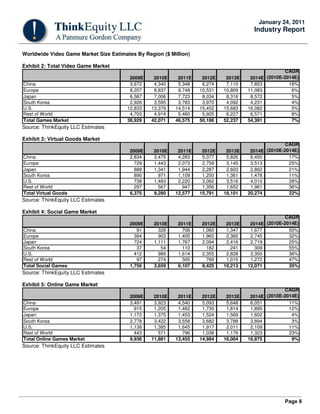
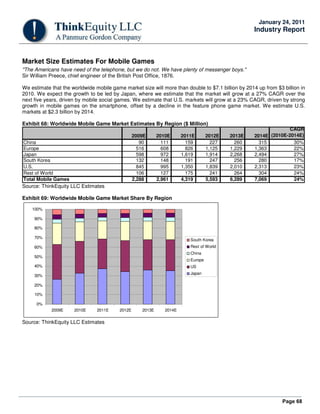
Worldwide Video Game Market Size Estimates By Region ($ Million)
Exhibit 2: Total Video Game Market
2009E 2010E 2011E 2012E 2013E 2014E
CAGR
(2010E-2014E)
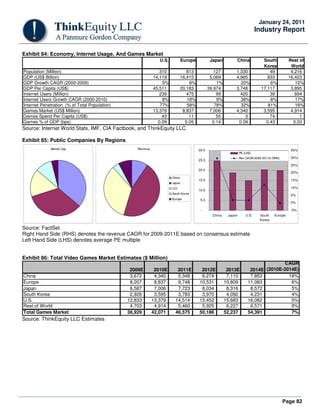
China 3,672 4,340 5,348 6,274 7,110 7,853 16%
Europe 8,207 8,837 9,748 10,531 10,809 11,083 6%
Japan 6,587 7,006 7,723 8,034 8,316 8,572 5%
South Korea 2,926 3,595 3,783 3,970 4,092 4,231 4%
U.S. 12,833 13,379 14,514 15,452 15,683 16,082 5%
Rest of World 4,703 4,914 5,460 5,925 6,227 6,571 8%
Total Games Market 38,929 42,071 46,575 50,186 52,237 54,391 7%
Source: ThinkEquity LLC Estimates
Exhibit 3: Virtual Goods Market
2009E 2010E 2011E 2012E 2013E 2014E
CAGR
(2010E-2014E)
China 2,834 3,475 4,283 5,077 5,826 6,450 17%
Europe 729 1,443 2,073 2,759 3,145 3,513 25%
Japan 888 1,341 1,944 2,287 2,603 2,862 21%
South Korea 890 971 1,109 1,250 1,361 1,478 11%
U.S. 738 1,483 2,220 3,062 3,516 4,010 28%
Rest of World 297 567 947 1,356 1,652 1,961 36%
Total Virtual Goods 6,375 9,280 12,577 15,791 18,101 20,274 22%
Source: ThinkEquity LLC Estimates
Exhibit 4: Social Game Market
2009E 2010E 2011E 2012E 2013E 2014E
CAGR
(2010E-2014E)
China 91 328 706 1,060 1,347 1,677 50%
Europe 394 903 1,405 1,965 2,365 2,745 32%
Japan 724 1,111 1,767 2,094 2,416 2,719 25%
South Korea 37 54 110 182 241 309 55%
U.S. 412 989 1,614 2,355 2,828 3,350 36%
Rest of World 97 274 505 769 1,015 1,272 47%
Total Social Games 1,756 3,659 6,107 8,425 10,213 12,071 35%
Source: ThinkEquity LLC Estimates
Exhibit 5: Online Game Market
2009E 2010E 2011E 2012E 2013E 2014E
CAGR
(2010E-2014E)
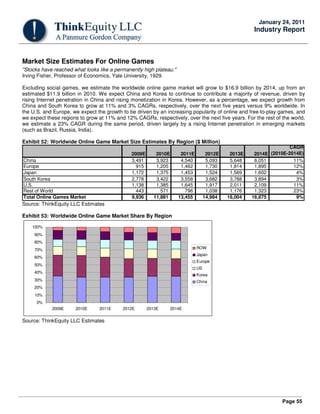
China 3,491 3,923 4,540 5,093 5,648 6,051 11%
Europe 915 1,205 1,462 1,730 1,814 1,895 12%
Japan 1,172 1,375 1,453 1,524 1,569 1,602 4%
South Korea 2,778 3,422 3,558 3,682 3,788 3,894 3%
U.S. 1,138 1,385 1,645 1,917 2,011 2,109 11%
Rest of World 443 571 796 1,038 1,176 1,323 23%
Total Online Games Market 9,936 11,881 13,455 14,984 16,004 16,875 9%
Source: ThinkEquity LLC Estimates
Page 9
January 24, 2011
Industry Report
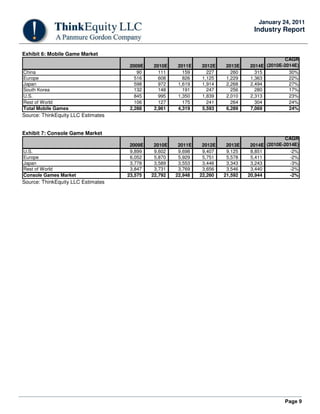
Exhibit 6: Mobile Game Market
2009E 2010E 2011E 2012E 2013E 2014E
CAGR
(2010E-2014E)
China 90 111 159 227 260 315 30%
Europe 516 608 826 1,125 1,229 1,363 22%
Japan 598 972 1,619 1,914 2,268 2,494 27%
South Korea 132 148 191 247 256 280 17%
U.S. 845 995 1,350 1,839 2,010 2,313 23%
Rest of World 106 127 175 241 264 304 24%
Total Mobile Games 2,288 2,961 4,319 5,593 6,289 7,069 24%
Source: ThinkEquity LLC Estimates
Exhibit 7: Console Game Market
2009E 2010E 2011E 2012E 2013E 2014E
CAGR
(2010E-2014E)
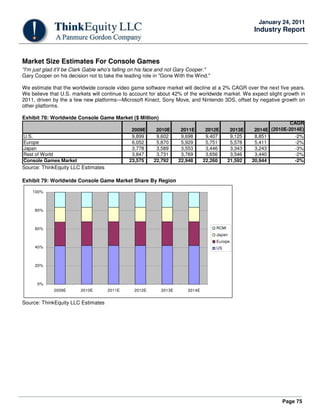
U.S. 9,899 9,602 9,698 9,407 9,125 8,851 -2%
Europe 6,052 5,870 5,929 5,751 5,578 5,411 -2%
Japan 3,778 3,589 3,553 3,446 3,343 3,243 -3%
Rest of World 3,847 3,731 3,769 3,656 3,546 3,440 -2%
Console Games Market 23,575 22,792 22,948 22,260 21,592 20,944 -2%
Source: ThinkEquity LLC Estimates
Page 10
January 24, 2011
Industry Report
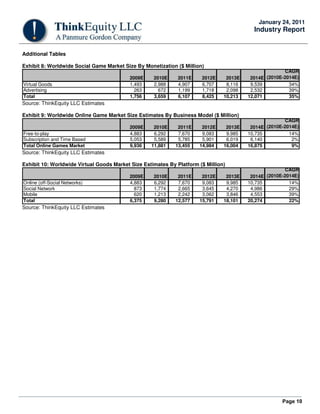
Additional Tables
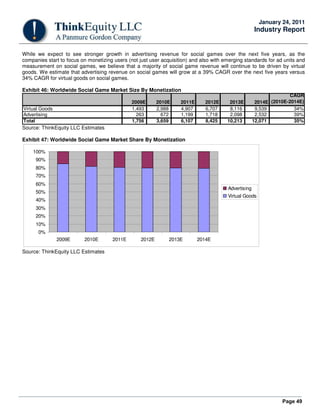
Exhibit 8: Worldwide Social Game Market Size By Monetization ($ Million)
2009E 2010E 2011E 2012E 2013E 2014E
CAGR
(2010E-2014E)
Virtual Goods 1,493 2,988 4,907 6,707 8,116 9,539 34%
Advertising 263 672 1,199 1,718 2,098 2,532 39%
Total 1,756 3,659 6,107 8,425 10,213 12,071 35%
Source: ThinkEquity LLC Estimates
Exhibit 9: Worldwide Online Game Market Size Estimates By Business Model ($ Million)
2009E 2010E 2011E 2012E 2013E 2014E
CAGR
(2010E-2014E)
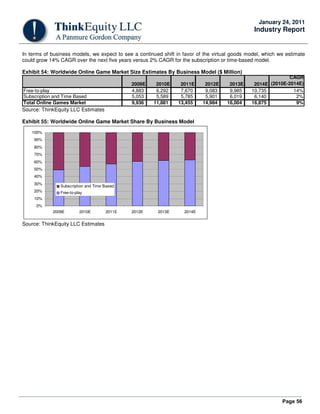
Free-to-play 4,883 6,292 7,670 9,083 9,985 10,735 14%
Subscription and Time Based 5,053 5,589 5,785 5,901 6,019 6,140 2%
Total Online Games Market 9,936 11,881 13,455 14,984 16,004 16,875 9%
Source: ThinkEquity LLC Estimates
Exhibit 10: Worldwide Virtual Goods Market Size Estimates By Platform ($ Million)
2009E 2010E 2011E 2012E 2013E 2014E
CAGR
(2010E-2014E)
Online (off-Social Networks) 4,883 6,292 7,670 9,083 9,985 10,735 14%
Social Network 873 1,774 2,665 3,645 4,270 4,986 29%
Mobile 620 1,213 2,242 3,062 3,846 4,553 39%
Total 6,375 9,280 12,577 15,791 18,101 20,274 22%
Source: ThinkEquity LLC Estimates
Page 11
January 24, 2011
Industry Report
Prologue
“Visionaries see a future of telecommuting workers, interactive libraries and multimedia classrooms. They speak of
electronic town meetings and virtual communities. Commerce and business will shift from offices and malls to networks
and modems…Baloney.
Do our computer pundits lack all common sense? The truth is no online database will replace your daily newspaper…
Discount the fawning techno-bubble about virtual communities. Computers and networks isolate us from one another. A
network chat line is a limp substitute for meeting friends over coffee. ”
Newsweek, February 27, 1995
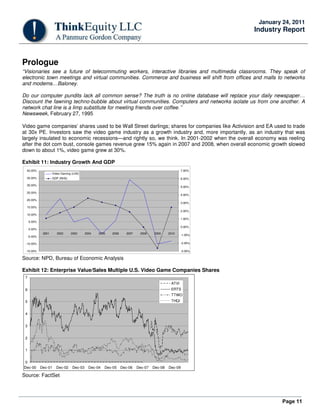
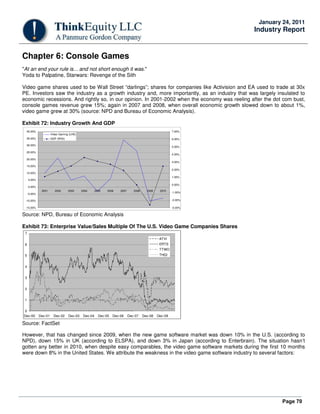
Video game companies’ shares used to be Wall Street darlings; shares for companies like Activision and EA used to trade
at 30x PE. Investors saw the video game industry as a growth industry and, more importantly, as an industry that was
largely insulated to economic recessions—and rightly so, we think. In 2001-2002 when the overall economy was reeling
after the dot com bust, console games revenue grew 15% again in 2007 and 2008, when overall economic growth slowed
down to about 1%, video game grew at 30%.
Exhibit 11: Industry Growth And GDP
-15.00%
-10.00%
-5.00%
0.00%
5.00%
10.00%
15.00%
20.00%
25.00%
30.00%
35.00%
40.00%
2001 2002 2003 2004 2005 2006 2007 2008 2009 2010
-3.00%
-2.00%
-1.00%
0.00%
1.00%
2.00%
3.00%
4.00%
5.00%
6.00%
7.00%
Video Gaming (LHS)
GDP (RHS)
Source: NPD, Bureau of Economic Analysis
Exhibit 12: Enterprise Value/Sales Multiple U.S. Video Game Companies Shares
0
1
2
3
4
5
6
7
Dec-00 Dec-01 Dec-02 Dec-03 Dec-04 Dec-05 Dec-06 Dec-07 Dec-08 Dec-09
ATVI
ERTS
TTWO
THQI
Source: FactSet
Page 12
January 24, 2011
Industry Report
Then something went wrong.
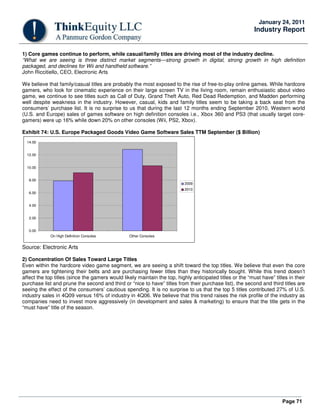
During 2009, console games revenue was down 10% Y/Y, according to NPD. Until October 2010, console games revenue
is down another 8% Y/Y, according to NPD. During the same time, another set of companies were emerging from
nowhere, companies like Zynga, Playdom, Playfish, Crowdstar, Bigpoint, and IMVU. While traditional gamers, investors,
and publishers sneered/dismissed these opportunities, these companies appear to have emerged as meaningful
businesses and given validity to the space, in our view. We think that online, mobile, and social are no longer considered
fringe video game business. At all major industry conferences, we believe the most popular topic of discussion is online.
Austin GDC is now GDC Online, which we think is clearly a validation of the space.
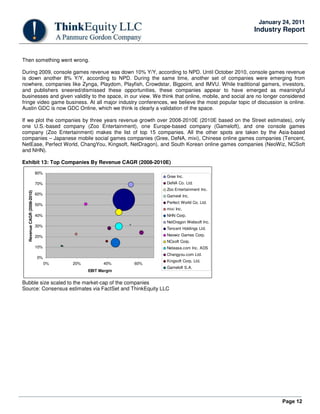
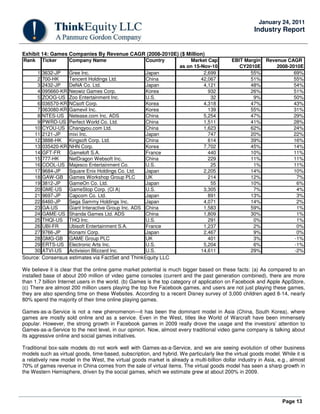
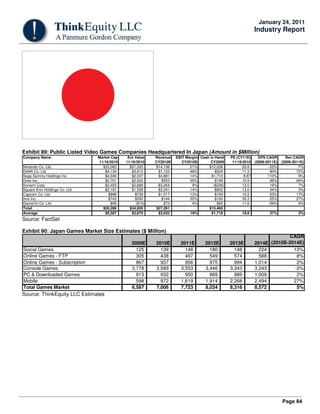
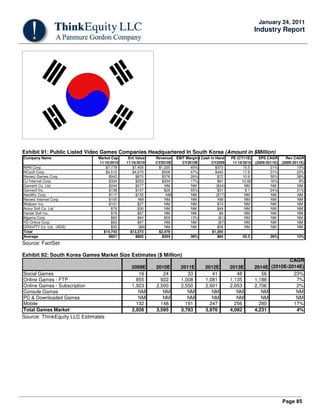
If we plot the companies by three years revenue growth over 2008-2010E (2010E based on the Street estimates), only
one U.S.-based company (Zoo Entertainment), one Europe-based company (Gameloft), and one console games
company (Zoo Entertainment) makes the list of top 15 companies. All the other spots are taken by the Asia-based
companies – Japanese mobile social games companies (Gree, DeNA, mixi), Chinese online games companies (Tencent,
NetEase, Perfect World, ChangYou, Kingsoft, NetDragon), and South Korean online games companies (NeoWiz, NCSoft
and NHN).
Exhibit 13: Top Companies By Revenue CAGR (2008-2010E)
0%
10%
20%
30%
40%
50%
60%
70%
80%
0% 20% 40% 60%
EBIT Margin
RevenueCAGR(2008-2010)
Gree Inc.
DeNA Co. Ltd.
Zoo Entertainment Inc.
Gamevil Inc.
Perfect World Co. Ltd.
mixi Inc.
NHN Corp.
NetDragon Websoft Inc.
Tencent Holdings Ltd.
Neowiz Games Corp.
NCsoft Corp.
Netease.com Inc. ADS
Changyou.com Ltd.
Kingsoft Corp. Ltd.
Gameloft S.A.
Bubble size scaled to the market-cap of the companies
Source: Consensus estimates via FactSet and ThinkEquity LLC
Page 13
January 24, 2011
Industry Report
Exhibit 14: Games Companies By Revenue CAGR (2008-2010E) ($ Million)
Rank Ticker Company Name Country Market Cap EBIT Margin Revenue CAGR
as on 15-Nov-10 CY2010E 2008-2010E
1 3632-JP Gree Inc. Japan 2,699 55% 69%
2 700-HK Tencent Holdings Ltd. China 42,067 51% 55%
3 2432-JP DeNA Co. Ltd. Japan 4,121 48% 54%
4 095660-KR Neowiz Games Corp. Korea 932 26% 51%
5 ZOOG-US Zoo Entertainment Inc. U.S. 32 9% 50%
6 036570-KR NCsoft Corp. Korea 4,318 47% 43%
7 063080-KR Gamevil Inc. Korea 139 55% 31%
8 NTES-US Netease.com Inc. ADS China 5,254 47% 29%
9 PWRD-US Perfect World Co. Ltd. China 1,511 41% 28%
10 CYOU-US Changyou.com Ltd. China 1,623 62% 24%
11 2121-JP mixi Inc. Japan 747 20% 22%
12 3888-HK Kingsoft Corp. Ltd. China 614 39% 16%
13 035420-KR NHN Corp. Korea 7,702 45% 14%
14 GFT-FR Gameloft S.A. France 440 10% 11%
15 777-HK NetDragon Websoft Inc. China 229 11% 11%
16 COOL-US Majesco Entertainment Co. U.S. 25 1% 11%
17 9684-JP Square Enix Holdings Co. Ltd. Japan 2,205 14% 10%
18 GAW-GB Games Workshop Group PLC UK 214 12% 7%
19 3812-JP GameOn Co. Ltd. Japan 55 10% 6%
20 GME-US GameStop Corp. (Cl A) U.S. 3,305 7% 4%
21 9697-JP Capcom Co. Ltd. Japan 891 13% 3%
22 6460-JP Sega Sammy Holdings Inc. Japan 4,071 14% 2%
23 GA-US Giant Interactive Group Inc. ADS China 1,583 59% 1%
24 GAME-US Shanda Games Ltd. ADS China 1,809 30% 1%
25 THQI-US THQ Inc. U.S. 291 0% 1%
26 UBI-FR Ubisoft Entertainment S.A. France 1,237 2% 0%
27 9766-JP Konami Corp. Japan 2,467 9% 0%
28 GMG-GB GAME Group PLC UK 401 3% -1%
29 ERTS-US Electronic Arts Inc. U.S. 5,204 6% -1%
30 ATVI-US Activision Blizzard Inc. U.S. 14,611 29% -2%
Source: Consensus estimates via FactSet and ThinkEquity LLC
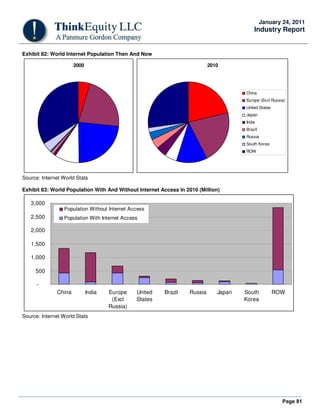
We believe it is clear that the online game market potential is much bigger based on these facts: (a) As compared to an
installed base of about 200 million of video game consoles (current and the past generation combined), there are more
than 1.7 billion Internet users in the world. (b) Games is the top category of application on Facebook and Apple AppStore,
(c) There are almost 200 million users playing the top five Facebook games, and users are not just playing these games,
they are also spending time on these Websites. According to a recent Disney survey of 3,000 children aged 8-14, nearly
80% spend the majority of their time online playing games.
Games-as-a-Service is not a new phenomenon—it has been the dominant model in Asia (China, South Korea), where
games are mostly sold online and as a service. Even in the West, titles like World of Warcraft have been immensely
popular. However, the strong growth in Facebook games in 2009 really drove the usage and the investors’ attention to
Games-as-a-Service to the next level, in our opinion. Now, almost every traditional video game company is talking about
its aggressive online and social games initiatives.
Traditional box-sale models do not work well with Games-as-a-Service, and we are seeing evolution of other business
models such as virtual goods, time-based, subscription, and hybrid. We particularly like the virtual goods model. While it is
a relatively new model in the West, the virtual goods market is already a multi-billion dollar industry in Asia, e.g., almost
70% of games revenue in China comes from the sale of virtual items. The virtual goods model has seen a sharp growth in
the Western Hemisphere, driven by the social games, which we estimate grew at about 200% in 2009.
Page 14
January 24, 2011
Industry Report
Section 1: The Emergence Of Multi-Channel Games-As-A-Service
Page 15
January 24, 2011
Industry Report
Chapter 1: The Emergence Of Multi-Channel Games-As-A-Service
“The U.S. Postal Service reported a 3.5 billion dollar loss in the last quarter. Experts say that, eventually, the post office
could turn a profit if this e-mail thing turns out to be just a fad.”
Jay Leno, August 2010
We believe that people in today’s Internet generation are trying to stay connected with their friends at all times. With
increasing capabilities and functionalities of smartphones, users are connecting with their friends on their mobile devices
while on the move (think Twitter, Facebook, Google, FourSquare, Gowalla) and via computer while at work, school, or
home.
Video game will be no different, in our opinion. We believe that just as people want to stay connected with their friends on
social networks, players want to stay connected with their friends on virtual worlds/game environments. With the next-
generation of gaming phones, we expect to see convergence between social game, mobile game, and online game. We
believe this convergence makes sense not only for core gamers who may want to track their guild activities, but even for
the casual gamers who may want to use the same avatar (a representation of the gamer in the game environment) on all
platforms to make progress within game levels and to share achievements irrespective of the platform.
We think that next-gen Multi-channel games will let players enjoy the game at any channel of his or her choice and give
the player the ability to change the channel, but still pick up the game from where he or she left off. For example, “Jane”
can play a game on her console at home, and when she leaves for work, she can continue to play the same game on her
mobile device. While at work, she can check the stats, send a message to one of her guild friends, or even play the game
on her work computer without the need for a separate download and while using the same avatar that she used in her
console or mobile device. Not only will she be able to play the game on all channels, but the game play will be modified in
all three instances to make the best of available hardware and to maximize the gaming experience based on the players’
device preference at that time.
Page 16
January 24, 2011
Industry Report
Exhibit 15: Emergence Of Games-As-A-Service
FreeFree--toto--PlayPlay
Pay to PlayPay to Play: Upfront Purchase; Subscription
Virtual
Goods
Ads
Premium
Content
Subscription
Others – App
Install,
Incentive
Marketing
PC
Gaming
Console
Gaming
Mobile
Gaming
Online
GamingSocial
Gaming
Multi-Channel Games-As-A-Service
Source: ThinkEquity LLC
Page 17
January 24, 2011
Industry Report
Market Size Estimates For Overall Video Game Industry
"There is no reason anyone would want a computer in their home."
Ken Olson, president, chairman and founder of Digital Equipment Corp., 1977
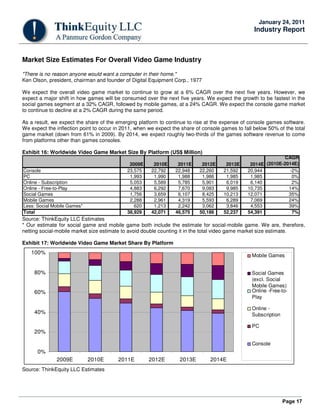
We expect the overall video game market to continue to grow at a 6% CAGR over the next five years. However, we
expect a major shift in how games will be consumed over the next five years. We expect the growth to be fastest in the
social games segment at a 32% CAGR, followed by mobile games, at a 24% CAGR. We expect the console game market
to continue to decline at a 2% CAGR during the same period.
As a result, we expect the share of the emerging platform to continue to rise at the expense of console games software.
We expect the inflection point to occur in 2011, when we expect the share of console games to fall below 50% of the total
game market (down from 61% in 2009). By 2014, we expect roughly two-thirds of the games software revenue to come
from platforms other than games consoles.
Exhibit 16: Worldwide Video Game Market Size By Platform (US$ Million)
2009E 2010E 2011E 2012E 2013E 2014E
CAGR
(2010E-2014E)
Console 23,575 22,792 22,948 22,260 21,592 20,944 -2%
PC 1,993 1,990 1,988 1,986 1,985 1,985 0%
Online - Subscription 5,053 5,589 5,785 5,901 6,019 6,140 2%
Online - Free-to-Play 4,883 6,292 7,670 9,083 9,985 10,735 14%
Social Games 1,756 3,659 6,107 8,425 10,213 12,071 35%
Mobile Games 2,288 2,961 4,319 5,593 6,289 7,069 24%
Less: Social Mobile Games* 620 1,213 2,242 3,062 3,846 4,553 39%
Total 38,929 42,071 46,575 50,186 52,237 54,391 7%
Source: ThinkEquity LLC Estimates
* Our estimate for social game and mobile game both include the estimate for social-mobile game. We are, therefore,
netting social-mobile market size estimate to avoid double counting it in the total video game market size estimate.
Exhibit 17: Worldwide Video Game Market Share By Platform
0%
20%
40%
60%
80%
100%
2009E 2010E 2011E 2012E 2013E 2014E
Mobile Games
Social Games
(excl. Social
Mobile Games)
Online -Free-to-
Play
Online -
Subscription
PC
Console
Source: ThinkEquity LLC Estimates
Page 18
January 24, 2011
Industry Report
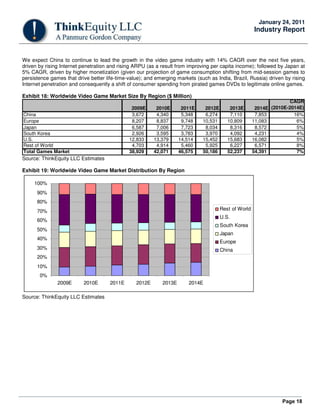
We expect China to continue to lead the growth in the video game industry with 14% CAGR over the next five years,
driven by rising Internet penetration and rising ARPU (as a result from improving per capita income); followed by Japan at
5% CAGR, driven by higher monetization (given our projection of game consumption shifting from mid-session games to
persistence games that drive better life-time-value); and emerging markets (such as India, Brazil, Russia) driven by rising
Internet penetration and consequently a shift of consumer spending from pirated games DVDs to legitimate online games.
Exhibit 18: Worldwide Video Game Market Size By Region ($ Million)
2009E 2010E 2011E 2012E 2013E 2014E
CAGR
(2010E-2014E)
China 3,672 4,340 5,348 6,274 7,110 7,853 16%
Europe 8,207 8,837 9,748 10,531 10,809 11,083 6%
Japan 6,587 7,006 7,723 8,034 8,316 8,572 5%
South Korea 2,926 3,595 3,783 3,970 4,092 4,231 4%
U.S. 12,833 13,379 14,514 15,452 15,683 16,082 5%
Rest of World 4,703 4,914 5,460 5,925 6,227 6,571 8%
Total Games Market 38,929 42,071 46,575 50,186 52,237 54,391 7%
Source: ThinkEquity LLC Estimates
Exhibit 19: Worldwide Video Game Market Distribution By Region
0%
10%
20%
30%
40%
50%
60%
70%
80%
90%
100%
2009E 2010E 2011E 2012E 2013E 2014E
Rest of World
U.S.
South Korea
Japan
Europe
China
Source: ThinkEquity LLC Estimates
Page 19
January 24, 2011
Industry Report
Chapter 2: Virtual Goods
"I have traveled the length and breadth of this country and talked with the best people, and I can assure you that data
processing is a fad that won't last out the year."
The editor in charge of business books for Prentice Hall, 1957.
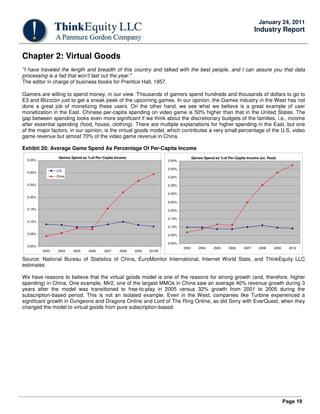
Gamers are willing to spend money, in our view. Thousands of gamers spend hundreds and thousands of dollars to go to
E3 and Blizzcon just to get a sneak peek of the upcoming games. In our opinion, the Games industry in the West has not
done a great job of monetizing these users. On the other hand, we see what we believe is a great example of user
monetization in the East. Chinese per-capita spending on video game is 50% higher than that in the United States. The
gap between spending looks even more significant if we think about the discretionary budgets of the families, i.e., income
after essential spending (food, house, clothing). There are multiple explanations for higher spending in the East, but one
of the major factors, in our opinion, is the virtual goods model, which contributes a very small percentage of the U.S. video
game revenue but almost 70% of the video game revenue in China.
Exhibit 20: Average Game Spend As Percentage Of Per-Capita Income
Games Spend as %of Per-Capita Income
0.00%
0.05%
0.10%
0.15%
0.20%
0.25%
0.30%
0.35%
2003 2004 2005 2006 2007 2008 2009 2010E
U.S.
China
Games Spend as %of Per-Capita Income (ex. Food)
0.00%
0.05%
0.10%
0.15%
0.20%
0.25%
0.30%
0.35%
0.40%
0.45%
0.50%
2003 2004 2005 2006 2007 2008 2009 2010
Source: National Bureau of Statistics of China, EuroMonitor International, Internet World Stats, and ThinkEquity LLC
estimates
We have reasons to believe that the virtual goods model is one of the reasons for strong growth (and, therefore, higher
spending) in China. One example, Mir2, one of the largest MMOs in China saw an average 40% revenue growth during 3
years after the model was transitioned to free-to-play in 2005 versus 32% growth from 2001 to 2005 during the
subscription-based period. This is not an isolated example. Even in the West, companies like Turbine experienced a
significant growth in Dungeons and Dragons Online and Lord of The Ring Online, as did Sony with EverQuest, when they
changed the model to virtual goods from pure subscription-based.
Page 20
January 24, 2011
Industry Report
Definitions
Digital Goods
By digital goods, we refer to items that users can buy in the virtual environment that may be a replacement of items from
the physical environment such as books, music, software, games, images, and videos. The cost of goods for digital goods
would be significantly higher than that of virtual goods, given there may be royalty and development. The main difference
between digital and virtual goods is that digital goods may be available in non-digital format (or non-virtual) as well, such
as books, DVDs, while virtual goods are available in digital format and may not be used in the real environment at all.
While we acknowledge that some may want to include digital goods (or some digital goods) in their definition of virtual
goods, we are not including digital goods in our definition of virtual goods for the purpose of this report.
Exhibit 21: Examples Of Digital Goods
Source: myamericanperspective.com, Apple, Amazon.com
Virtual Goods
Virtual goods refer to the items that a user can buy in a virtual environment that may not have use in the physical
environment. Cost of goods for these items may be close to zero unless there is a royalty associated (such as for branded
virtual goods). The main characteristics of the virtual goods are (a) they are available only in digital format, (b) may be
sold digitally online, and (c) should have contextual meaning.
We define two main categories of virtual goods
- Vanity Virtual Goods such as gifts or decorative items. The driver for vanity goods is often self-expression either
aimed for a specific person or, in most cases, to a large group. While some people may be baffled with the concept of
spending real cash on a virtual item, we equate buying behavior of vanity virtual goods the same as that for luxury
branded goods. Just like people who want to express themselves in the real world are willing to spend extra dollars for
a branded good, people who are comfortable expressing themselves in the virtual world will be comfortable spending
on virtual goods.
- Functional Virtual Goods such as performance accelerators (consumables or long lived). Functional virtual goods
are items that a player may need to advance level in a game. Since people have already been trained to pay for non-
tangible products (downloaded games, digital music, ebooks), spending on functional virtual goods was an easier first
step toward virtual goods. In addition, a large underground market for World of Warcraft’s gold already reflects on the
people’s propensity to pay for virtual goods and also has trained gamers to pay for functional virtual goods, in our
opinion.
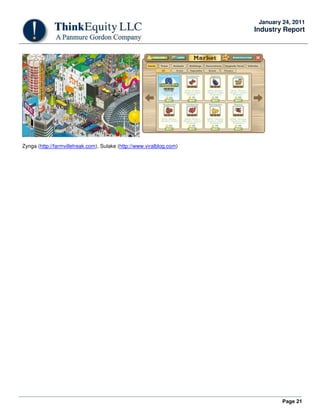
Exhibit 22: Virtual Goods
Page 21
January 24, 2011
Industry Report
Zynga (http://farmvillefreak.com), Sulake (http://www.viralblog.com)
Page 22
January 24, 2011
Industry Report
Why Do People Buy Virtual Goods?
"But what...is it good for?"
Engineer at the Advanced Computing Systems Division of IBM, 1968, commenting on the microchip.
We believe that people buy virtual goods for the same reasons people buy physical goods.
Self Expression in the Virtual World
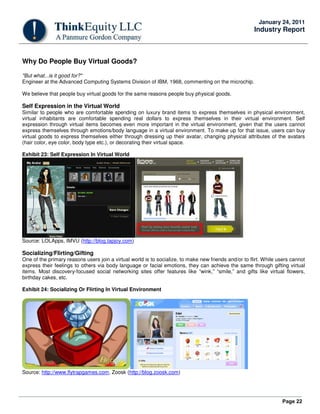
Similar to people who are comfortable spending on luxury brand items to express themselves in physical environment,
virtual inhabitants are comfortable spending real dollars to express themselves in their virtual environment. Self
expression through virtual items becomes even more important in the virtual environment, given that the users cannot
express themselves through emotions/body language in a virtual environment. To make up for that issue, users can buy
virtual goods to express themselves either through dressing up their avatar, changing physical attributes of the avatars
(hair color, eye color, body type etc.), or decorating their virtual space.
Exhibit 23: Self Expression In Virtual World
Source: LOLApps, IMVU (http://blog.tapjoy.com)
Socializing/Flirting/Gifting
One of the primary reasons users join a virtual world is to socialize, to make new friends and/or to flirt. While users cannot
express their feelings to others via body language or facial emotions, they can achieve the same through gifting virtual
items. Most discovery-focused social networking sites offer features like “wink,” “smile,” and gifts like virtual flowers,
birthday cakes, etc.
Exhibit 24: Socializing Or Flirting In Virtual Environment
Source: http://www.flytrapgames.com, Zoosk (http://blog.zoosk.com)
Page 23
January 24, 2011
Industry Report
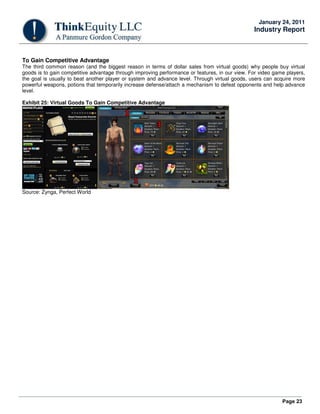
To Gain Competitive Advantage
The third common reason (and the biggest reason in terms of dollar sales from virtual goods) why people buy virtual
goods is to gain competitive advantage through improving performance or features, in our view. For video game players,
the goal is usually to beat another player or system and advance level. Through virtual goods, users can acquire more
powerful weapons, potions that temporarily increase defense/attach a mechanism to defeat opponents and help advance
level.
Exhibit 25: Virtual Goods To Gain Competitive Advantage
Source: Zynga, Perfect World
Page 24
January 24, 2011
Industry Report
Why Are We Excited About Virtual Goods Business Model?
"This 'telephone' has too many shortcomings to be seriously considered as a means of communication. The device is
inherently of no value to us."
Western Union internal memo, 1876.
My “love affair” with micro-transactions started long before I had heard of virtual goods, long before I played online games,
heck, long before even I knew much about the Internet.
In the late 80s and early 90s, we saw a revolution happening in the consumer goods space in India. We saw the
consumer goods vendors' ability to grow the market multi-fold by reducing accessibility barriers, by offering products in
smaller byte size, or as we call them now, micro-transactions. Without passing any judgment on right or wrong, the sale of
flavored chewing tobacco (gutkha) grew multi-fold within just a couple years after packaging innovation made it possible to
sell gutkha in 5 grams pouches for about $0.01 (1/20
th
the cost of previously available packs) and brought it within reach
of the mass market. Similarly, the shampoo market grew after the small one use packs were made available for as little as
$0.01, within reach of mass markets. I believe that just as innovation in packaging resulted in increased consumption of
chewing tobacco and shampoo in India, innovation in the business model (virtual goods) could grow the consumption of
video game content for audiences around the world.
Exhibit 26: Transformation Of Market By Unit Packs (Shampoo, Chewing Tobacco)
Source: http://www.usabilitymatters.org , www.eastwestbazaar.com , www.desistores.net
We like the free-to-play virtual goods business model for three main reasons: (a) we believe that the virtual goods model
enables perfect price discrimination for customers, (b) we believe that the virtual goods model helps control piracy and
build community, and lastly and probably most importantly, (c) we believe that virtual goods model could help publishers
enhance the lifetime value of their users.
Page 25
January 24, 2011
Industry Report
An Interview With The Chairman & Managing Director Of Multi-Flex Lami-Print Limited
We turn to Anil Dang, Chairman and Managing Director of Multi-Flex, one of the largest packaging manufactures in India
for some historical perspective.
Atul Bagga (AB): Please explain what is Multi-Flex?
Anil Dang, Chairman & Managing Director, Multi-Flex (AD): Multi-Flex is the fourth-largest flexible packaging manufacturer
in India. Flexible packaging is packaging that is not rigid and usually made from plastic films, aluminum foils, and
paper. Some of the applications of flexible packaging material are things like candy wraps, bag of chips.
AB: How long you have been in this business, and can you give us some historical perspective on this industry?
AD: I have been in this industry since 1987. Since late 80s, the flexible packaging industry in India grew at more than
25% per annum and is currently about the size of $5 billion per year. The industry continues to grow at about
25%.
AB: What are the drivers of growth, then and now?
AD: Drivers of growth have not changed in the last 20 years. The key growth drivers have been better shelf life,
temper proof packaging, better aesthetics, and, most important of all, ability to sell units pack with flexible
packaging. Ability to sell unit packs the most important because in India, mass market cannot afford to spend high
upfront for bigger packs and rely on unit or single packs that are available at much reasonable prices.
AB: Can you talk about a few applications and how that drove the growth for the industry?
AD: Sure. A couple breakthroughs were in Shampoo and Gutkha (flavored chewing tobacco). Gutkha and paan
masala (mouth freshener) used to be sold in the tin boxes, package size used to 100-200 grams, and it used to
cost about Rs.20-30 per box. Unfortunately, spending Rs.20-30 was out of reach for a majority of population, but
the manufacturers had no other option to reach the broader audience. Then in mid 1980s, flexible packaging
started gaining ground, and it allowed the vendors to pack Gutkha in smaller size, typically 2-5 grams, which they
could sell for Rs.0.50-1.00. By offering a byte size pack, all of a sudden, Gutakha was in reach of a mass
audience who can easily spend Rs0.50 multiple times a day. Today more than 95% of the Gutkha is sold in unit
packs. Gutkha and paan masala (mouth freshener) industry account for almost half of the total flexible packaging
industry in India.
Similarly, we saw a huge spurt in shampoo industry. Until mid 1980s, shampoos used to be sold in glass bottles,
weighing about 200-500 ml that used to sell for Rs.30-50 each. With the advent of flexible packaging, shampoo
manufacturers were able to pack shampoo in a single-use sachet, about 5-7 ml that would retail for about
Rs.0.50-1.00, which opened the floodgates for shampoo consumption in the country. Before sachet packs,
shampoo was considered luxury item, used mostly in the mid- and higher-income users and with single-use pack,
vendors were able to penetrate mass markets including rural areas. Today, almost 70% of the shampoo is sold in
single-use unit packs.
Similarly, we are seeing the same phenomenon in many other consumer industries such as cosmetics, food
products, candies and others, basically any consumer item that has appeal for the mass markets.
AB: Thank you so much for speaking with us and sharing insights.
Page 26
January 24, 2011
Industry Report
Virtual Goods Model Enables Perfect Price Discrimination
Unlike fixed fee-based models (such as subscription or outright purchase), the virtual goods model allows vendors to price
discriminate their customers by letting players choose the value they assign to the game. By making games free-to-play,
vendors are able to attract a larger audience. Players with free time on their hands (like students and cost-cautious
players) will spend time/effort to advance levels in the games, while players who need instant gratification of moving up
the ladder (like ex-core gamers and core gamers) will rely on virtual goods. While we acknowledge that some of the
players who would’ve spent $60 for the game may not spend the equivalent amount in the free-to-play model, we argue
that the free-to-play model will encourage some otherwise non-paying players to spend on the game and some hardcore
players to spend much more than what they would’ve spent with the fixed fee model.
Exhibit 27: ARPU Distribution Curve Of ZT Online, A Free-To-Play Game By Giant Interactive
(20)
-
20
40
60
80
100
120
140
160
- 500 1,000 1,500 2,000
Users ('000)
ARPu($/Month)
Source: Company reports and ThinkEquity LLC
Page 27
January 24, 2011
Industry Report
Perfect Price Discrimination: Holy Grail Of Producers Pricing
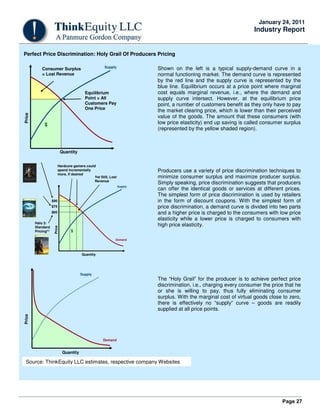
Shown on the left is a typical supply-demand curve in a
normal functioning market. The demand curve is represented
by the red line and the supply curve is represented by the
blue line. Equilibrium occurs at a price point where marginal
cost equals marginal revenue, i.e., where the demand and
supply curve intersect. However, at the equilibrium price
point, a number of customers benefit as they only have to pay
the market clearing price, which is lower than their perceived
value of the goods. The amount that these consumers (with
low price elasticity) end up saving is called consumer surplus
(represented by the yellow shaded region).
Producers use a variety of price discrimination techniques to
minimize consumer surplus and maximize producer surplus.
Simply speaking, price discrimination suggests that producers
can offer the identical goods or services at different prices.
The simplest form of price discrimination is used by retailers
in the form of discount coupons. With the simplest form of
price discrimination, a demand curve is divided into two parts
and a higher price is charged to the consumers with low price
elasticity while a lower price is charged to consumers with
high price elasticity.
The “Holy Grail” for the producer is to achieve perfect price
discrimination, i.e., charging every consumer the price that he
or she is willing to pay, thus fully eliminating consumer
surplus. With the marginal cost of virtual goods close to zero,
there is effectively no “supply” curve – goods are readily
supplied at all price points.
Supply
Demand
Price
Quantity
Halo 3:
Standard
Pricing(1)
Hardcore gamers could
spend incrementally
more, if desired
Yet Still, Lost
Revenue
$60
$75
$90
$
Supply
Price
Quantity
Equilibrium
Point = All
Customers Pay
One Price
Consumer Surplus
= Lost Revenue
$
Supply
Demand
Price
Quantity
Source: ThinkEquity LLC estimates, respective company Websites
Page 28
January 24, 2011
Industry Report
Effective Way To Control Piracy And Build Community
Although the lure of converting pirated copies into legal copies by effective anti-piracy measures may seem lucrative, a
couple real-life examples suggest that the conversion rates remain insignificant with anti-piracy measures. On the other
hand, anti-piracy measures generally cause inconvenience and, thus, user dissatisfaction for legitimate buyers, which risk
the popularity of the games. For example, Electronic Arts’ “Spore” was one of the top ranked games at Amazon, but was
also a highly pirated game. As Electronic Arts put stringent anti-piracy controls into place, the number of illegal downloads
was reduced, but so was the ranking. However, the free-to-play model enables vendors to build community and
momentum without worrying about piracy. We believe the question that game vendors will have to answer is, are they
willing to sacrifice community around the game and potentially jeopardize the popularity of the game to be able to sell an
insignificant number of titles or can they find alternative ways to monetize users who wouldn’t want to pay hard cash for
the game? We believe that vendors (especially the newcomers, without the legacy of owned IPs) will be willing to eschew
the loss of upfront sale and embrace the alternative monetization models such as virtual goods.
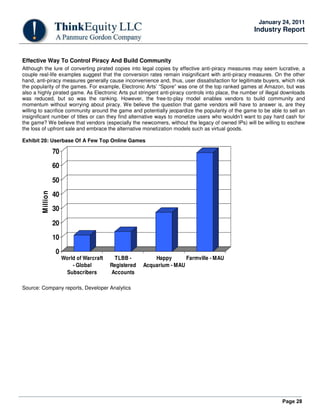
Exhibit 28: Userbase Of A Few Top Online Games
0
10
20
30
40
50
60
70
Million
World of Warcraft
- Global
Subscribers
TLBB -
Registered
Accounts
Happy
Acquarium - MAU
Farmville - MAU
Source: Company reports, Developer Analytics
Page 29
January 24, 2011
Industry Report
Increase Longevity And Improve Games’ Stickiness
Unlike a fixed fee game, where players are only putting in effort to advance levels, in the virtual goods model-based
games, players advance levels though effort as well as through spending hard cash on virtual goods. And so, with every
virtual goods purchase, players are increasing their investment in the game and, thus, increasing switching costs for
themselves, increasing the longevity of the games. In addition, the free-to-play model attracts more users (lure of free)
and the larger community itself becomes a draw for new players.
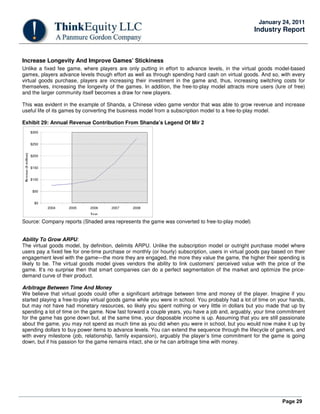
This was evident in the example of Shanda, a Chinese video game vendor that was able to grow revenue and increase
useful life of its games by converting the business model from a subscription model to a free-to-play model.
Exhibit 29: Annual Revenue Contribution From Shanda’s Legend Of Mir 2
$0
$50
$100
$150
$200
$250
$300
2004 2005 2006 2007 2008
Year
Revenue($million)
Source: Company reports (Shaded area represents the game was converted to free-to-play model)
Ability To Grow ARPU:
The virtual goods model, by definition, delimits ARPU. Unlike the subscription model or outright purchase model where
users pay a fixed fee for one-time purchase or monthly (or hourly) subscription, users in virtual goods pay based on their
engagement level with the game—the more they are engaged, the more they value the game, the higher their spending is
likely to be. The virtual goods model gives vendors the ability to link customers’ perceived value with the price of the
game. It’s no surprise then that smart companies can do a perfect segmentation of the market and optimize the price-
demand curve of their product.
Arbitrage Between Time And Money
We believe that virtual goods could offer a significant arbitrage between time and money of the player. Imagine if you
started playing a free-to-play virtual goods game while you were in school. You probably had a lot of time on your hands,
but may not have had monetary resources, so likely you spent nothing or very little in dollars but you made that up by
spending a lot of time on the game. Now fast forward a couple years, you have a job and, arguably, your time commitment
for the game has gone down but, at the same time, your disposable income is up. Assuming that you are still passionate
about the game, you may not spend as much time as you did when you were in school, but you would now make it up by
spending dollars to buy power items to advance levels. You can extend the sequence through the lifecycle of gamers, and
with every milestone (job, relationship, family expansion), arguably the player’s time commitment for the game is going
down, but if his passion for the game remains intact, she or he can arbitrage time with money.
Page 30
January 24, 2011
Industry Report
Exhibit 30: Average ARPPU Of Chinese Gamers
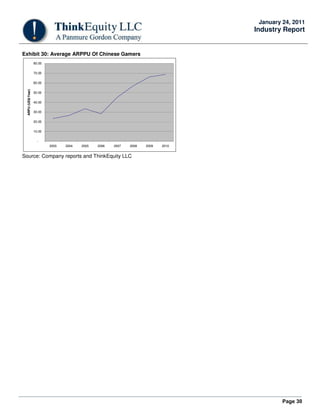
-
10.00
20.00
30.00
40.00
50.00
60.00
70.00
80.00
2003 2004 2005 2006 2007 2008 2009 2010
ARPU(US$/Year)
Source: Company reports and ThinkEquity LLC
Page 31
January 24, 2011
Industry Report
Emerging Trends In Virtual Goods
"We don't like their sound, and guitar music is on the way out."
Decca Recording Co. rejecting the Beatles, 1962
Virtual Goods On Console
During 2009, console games sales were down 10% in the U.S. (according to NPD), down 15% in UK (according to
ELSPA), and down 3% in Japan (according to Enterbrain). Interestingly, while console game sales are down, the average
console gamer has continued to spend 8-12 hours/week playing games which is in the same range as that in 2009 and
2008, according to a survey by IDC. We postulate that the emergence of online and multi-player games have increased
the stickiness of these games on consoles, thus, giving more value to the consumers than before. According to Activision,
during the first five months of the launch, Call of Duty: Modern Warfare 2 was played 1.75 billion hours on Xbox Live
alone; we estimate that the average user plays online, multi-player Modern Warfare 2 15-20 hours/week. Similarly, Halo
Reach was played 12 million hours within three days of launch. While users have been able to stretch the value from
video game purchases, video game software publishers have not fully captured their share in the value chain, in our view.
While we are encouraged with these companies' more-aggressive DLC strategy, which we believe carries higher margin,
lower development costs, and relatively lower risks, we believe that companies will also try to capture more economies in
online gameplay of the popular franchises.
Virtual Goods On Mobile
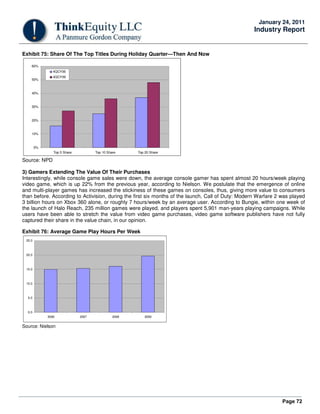
Consistent with our theme of Multi-channel Games-as-a-Service, we believe that mobile will emerge as an extension of
the online world and as such users will exhibit similar trends on mobile as they do on the Web.
User-Generated Content
We believe that user-generated content could offer wider choices that make sense for users who are looking to express
their individuality. On the other hand, managing a user-generated content market and economy could be trickier than
managing a vendor generated-content/economy.
Page 32
January 24, 2011
Industry Report
Market Size Estimates For Virtual Goods Market
"I think there is a world market for maybe five computers."
Thomas Watson, chairman of IBM, 1943.
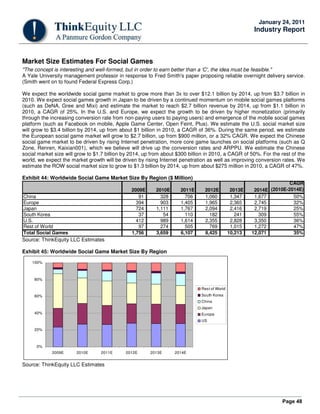
We expect the worldwide market for virtual goods to more than triple to $20.3 billion by 2014, up from $6.4 billion in 2009.
We expect the growth to be led by emerging markets for virtual goods i.e., U.S., Europe and Japan. We expect the US
and European markets to grow at 28% and 25% CAGRs, respectively, largely driven by growth in social games and online
free-to-play games. We expect the Japanese market to grow at a 21% CAGR over the next five years, largely driven by
the growth on mobile platforms. On the other hand, we expect a relatively matured market for China to continue to grow at
17% CAGR over the next five years, driven largely by rising Internet penetration, especially in the rural regions, and
expect Korean markets to grow at a relatively modest rate of 11%, driven largely by a continued shift in the video game
consumption from a subscription-based to a virtual-goods-based model. We also expect strong growth in emerging
regions (such as Brazil, Russia, India), which will grow at a 36% CAGR over the next five years, largely driven by rising
Internet penetration in these regions.
Exhibit 31: Worldwide Virtual Goods Market Size Estimates By Region (US$ Million)
2009E 2010E 2011E 2012E 2013E 2014E
CAGR
(2010E-2014E)
China 2,834 3,475 4,283 5,077 5,826 6,450 17%
Europe 729 1,443 2,073 2,759 3,145 3,513 25%
Japan 888 1,341 1,944 2,287 2,603 2,862 21%
South Korea 890 971 1,109 1,250 1,361 1,478 11%
U.S. 738 1,483 2,220 3,062 3,516 4,010 28%
Rest of World 297 567 947 1,356 1,652 1,961 36%
Total Virtual Goods 6,375 9,280 12,577 15,791 18,101 20,274 22%
Source: ThinkEquity LLC Estimates
Exhibit 32: Worldwide Virtual Goods Market Share By Region
0%
20%
40%
60%
80%
100%
2009E 2010E 2011E 2012E 2013E 2014E
ROW
Korea
Japan
Europe
US
China
Source: ThinkEquity LLC Estimates
Page 33
January 24, 2011
Industry Report
In terms of platform, we believe that online (off-social networks) will maintain the dominant share of the virtual goods
markets, given the sizable markets and growth potential in China and Korea and emerging potential for MMOs in the
Western World and emerging markets. We estimate online virtual goods markets (excluding social games) to grow at a
14% CAGR to reach $10.7 billion by 2014, up from $6.3 billion in 2010. We expect the virtual goods on social networks to
grow at 29% CAGR to reach a $5.0 billion market worldwide by 2014, up from $1.8 billion in 2010. We expect the fastest
growth in virtual goods to come from mobile game markets, driven by a continued strong growth momentum in mobile
social games in Japan and growth in the U.S. and Europe. We expect mobile virtual goods to grow at a 39% CAGR over
the next five years to reach $4.6 billion by 2014 up from $1.2 billion in 2010.
Exhibit 33: Worldwide Virtual Goods Market Size Estimates By Platform (US$ Million)
2009E 2010E 2011E 2012E 2013E 2014E
CAGR
(2010E-2014E)
Online (off-Social Networks) 4,883 6,292 7,670 9,083 9,985 10,735 14%
Social Network 873 1,774 2,665 3,645 4,270 4,986 29%
Mobile 620 1,213 2,242 3,062 3,846 4,553 39%
Total 6,375 9,280 12,577 15,791 18,101 20,274 22%
Source: ThinkEquity LLC Estimates
Exhibit 34: Worldwide Virtual Goods Market Share By Platform
0%
10%
20%
30%
40%
50%
60%
70%
80%
90%
100%
2009E 2010E 2011E 2012E 2013E 2014E
Mobile
Social Network
Online (off-Social Networks)
Source: ThinkEquity LLC Estimates
Page 34
January 24, 2011
Industry Report
Chapter 3: Social Games
"The wireless music box has no imaginable commercial value. Who would pay for a message sent to nobody in
particular?"
David Sarnoff's associates in response to his urgings for investment in the radio in the 1920s.
Social games bring a fundamental shift in video game—away from a single player shooting aliens or killing monsters to a
fun activity where one is playing with one’s real life friends in a virtual environment. Social games enables players to play
against their real life friends and provide a place to hang out in a game environment, thus, taking the games back to their
roots as fun activities. We believe that social networks have been the “hottest” trend in the 21st century, exhibiting the
fastest growth of any media. According to Nielson, more than two-thirds of online users have participated in a social
network over the past year, and we expect this number to continue to rise. The trend is not limited to the young users
anymore, and people ages 35-54 years have shown the highest growth of any demographics, according to the user
demographic statistics by Facebook. Despite significant size, strong community, and solid ecommerce platforms, most
social networks have struggled with monetizing their users. Most social networks have traditionally relied on banner and
text ads for user monetization; however, given low conversion rates (less than one-tenth of a percent), display ad rates for
most social networks hover at about $0.10-0.25 CPM (cost per thousand impressions). We believe that online games
provide a natural way for social networks to monetize users through in-game advertising and, more importantly, through
virtual goods sales. We believe that not only will games help social networking sites monetize their users, but they will
also help to increase the stickiness of these social networking sites.
Page 35
January 24, 2011
Industry Report
Why Are We Excited About Social Games
“With over 50 foreign cars already on sale here, the Japanese auto industry isn't likely to carve out a big slice of the U.S.
market.”
Business Week, August 2, 1968.
“For the first time ever, we're letting them [users] engage in games with their real friends in their real social networks.
Gaming is a fundamentally social experience, not a single-player experience, and not a technology experience. We are
bringing gaming back to its roots.”
Mark Pincus, Founder & CEO, Zynga
“Today, audiences want to be connected. They expect games to have a strong social component and they want the ability
to customize and express themselves through their entertainment experiences.”
Bobby Kotick, CEO, Activision-Blizzard
Broadening Market To Include Non-Gamers
“Target customer is anybody who lives inside the social networks….Facebook has users from 13 to 80 years old and it
has equal distribution between men and women…In our markets we have 300-plus million people on Facebook
alone….While hardcore gamers, like a World of Warcraft have limited reach, games like a Maple Story or a Mobsters 2 or
a Sorority Life game reach much broader demographics.”
John Pleasants, CEO, Playdom
We believe that similar to the Nintendo Wii, which broadened the console game audience to families from mostly males,
social games further broaden the game market to include non-gamers. Today’s generation is connected on social
networks. According to comScore, more than two-thirds of Internet users are also on social networks, and the number is
still growing. The popularity of social networking sites is not just limited to the Y generation, more and more people 35
years of age and older are joining these social networks. The latest statistics regarding Facebook users show that the
number of users in the 35-54 years of age population has increased 10x versus 88% growth for the 18-34 years of age
group since October 2007. Not only are more people joining these social networks, but they are also spending more time
on these social networks. According to Hitwise, the average user is now spending approximately 27 minutes/day, up 71%
Y/Y. We believe the reach and the demographic of users on these sites make social networks fertile ground for game
vendors to acquire users, build awareness, and create buzz through viral marketing.
Viral Marketing
“Over 95% of our growth is viral. In fact, when we launched our first title a year ago, we started by inviting 100 of our own
friends and we've grown from there to over 60 million registered players across our games organically.”
Kristian Segerstrale, CEO, Playfish
For online game vendors, social networks offer an inexpensive way of marketing their games to new users and improve
stickiness through viral distribution. We believe that social networking sites level the playing field for small developers to
compete with large companies like Electronic Arts (recall the success of Scrabulous, developed by two brothers in remote
corners in India, which became a rage on Facebook through viral marketing).
For social networking sites, games provide an easier way to monetize their users, in our view.
Despite significant size, strong community, and solid ecommerce platforms, most social networks have struggled with
monetizing their users. With ARPU hovering in the $0.10-0.25/month range for most social networks versus as high as
$150/month for some online games, social networks do look under-monetized. Most social networks rely largely on
banner and text ads for user monetization, but, given low conversion rates (less than one-tenth of a percent), display ad
rates for most social networks hover at about $0.10-0.25 cost per thousand (CPM) versus as high as $35 for video ads
and $8 for display ads for in-game advertising. We believe that online games provide a natural way for social networks to
monetize users through in-game advertising and, more importantly, through virtual goods sales.
Page 36
January 24, 2011
Industry Report
Games can also help social networking sites strengthen community bonding among their users.
We believe that not only will games help social networking sites monetize their users, but they will also help to increase
the stickiness of these social networking sites. Games are known to bring communities closer, to encourage user
interaction and active participation (e.g., more than two million user-generated content on Spore, and more user-
generated content on Halo than YouTube videos produced in a month), which is the lifeblood for social networking sites.
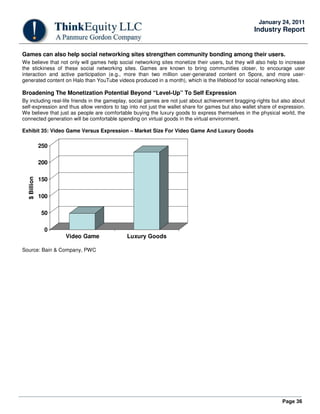
Broadening The Monetization Potential Beyond “Level-Up” To Self Expression
By including real-life friends in the gameplay, social games are not just about achievement bragging-rights but also about
self-expression and thus allow vendors to tap into not just the wallet share for games but also wallet share of expression.
We believe that just as people are comfortable buying the luxury goods to express themselves in the physical world, the
connected generation will be comfortable spending on virtual goods in the virtual environment.
Exhibit 35: Video Game Versus Expression – Market Size For Video Game And Luxury Goods
0
50
100
150
200
250
$Billion
Video Game Luxury Goods
Source: Bain & Company, PWC
Page 37
January 24, 2011
Industry Report
What Have We Seen So Far?
"Airplanes are interesting toys but of no military value."
Marechal Ferdinand Foch, Professor of Strategy, Ecole Superieure de Guerre, 1911
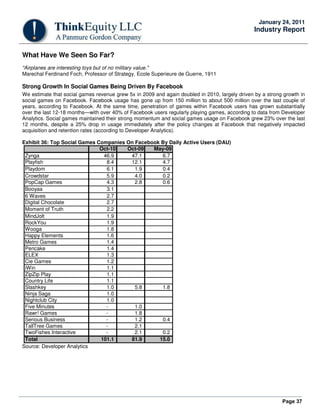
Strong Growth In Social Games Being Driven By Facebook
We estimate that social games revenue grew 5x in 2009 and again doubled in 2010, largely driven by a strong growth in
social games on Facebook. Facebook usage has gone up from 150 million to about 500 million over the last couple of
years, according to Facebook. At the same time, penetration of games within Facebook users has grown substantially
over the last 12-18 months—with over 40% of Facebook users regularly playing games, according to data from Developer
Analytics. Social games maintained their strong momentum and social games usage on Facebook grew 23% over the last
12 months, despite a 25% drop in usage immediately after the policy changes at Facebook that negatively impacted
acquisition and retention rates (according to Developer Analytics).
Exhibit 36: Top Social Games Companies On Facebook By Daily Active Users (DAU)
Oct-10 Oct-09 May-09
Zynga 46.9 47.1 6.7
Playfish 8.4 12.1 4.7
Playdom 6.1 1.9 0.4
Crowdstar 5.9 4.0 0.2
PopCap Games 4.3 2.8 0.6
Booyaa 3.1
6 Waves 2.7
Digital Chocolate 2.7
Moment of Truth 2.2
MindJolt 1.9
RockYou 1.9
Wooga 1.8
Happy Elements 1.6
Metro Games 1.4
Pencake 1.4
ELEX 1.3
Cie Games 1.2
iWin 1.1
ZipZip Play 1.1
Country Life 1.1
Slashkey 1.0 5.8 1.8
Ninja Saga 1.0
Nightclub City 1.0
Five Minutes - 1.0
Rawr! Games - 1.8
Serious Business - 1.2 0.4
TallTree Games - 2.1
TwoFishes Interactive - 2.1 0.2
Total 101.1 81.9 15.0
Source: Developer Analytics
Page 38
January 24, 2011
Industry Report
Growing Popularity Of Persistent Games
Of the top 36 games on Facebook, 31 games were persistent games as of 11/02/10 versus 8 of the top 16 games in April
2009, which reflects on the growing consumer preference toward persistent games, in our opinion. In fact, outside of
Zynga’s Poker, none of the mid-session games from last year’s list of top games were able to make it to this year’s top
games list on Facebook.
Rising Production Value Of Social Games
Our conversations with a number of developers suggest that the cost of production of social games has risen multi-fold
over the last couple years, mostly driven by toughening competition and the increasing sophistication level of users. We
believe that as users will have more choices, social game companies will have to step up investment in the quality of the
games (graphics, gameplay, customer service), effectively increasing the production value of the games.
Exhibit 37: Rising Production Value Of The Facebook Games
Source: Zynga, Allfacebook.com
Believe Facebook Single Most Important Destination For Social Games
“With our limited resources, we need to pick our battles very carefully. Today, the best platform to develop for is still
Facebook given its large market size and low friction of distribution.”
Siqi Chen, Founder and CEO, Serious Business (Acquired by Zynga in February 2010)
With over 500 million active users, Facebook is a significant platform for publishing games. On the other hand, game
developers have not yet found any other credible platform for publishing social games, and given the fast growth of games
on Facebook coupled with higher risks associated with new platforms, vendors have focused their efforts largely on
Facebook, and we haven’t yet seen any comparable social games platform emerge in the west.
Page 39
January 24, 2011
Industry Report
Exhibit 38: Top Social Networking Websites By U.S. Market Share Of Visits (%)
0.00%
10.00%
20.00%
30.00%
40.00%
50.00%
60.00%
70.00%
Oct-09 Nov-09 Dec-09 Jan-10 Feb-10 Mar-10 Apr-10 May-10 Jun-10 Jul-10 Aug-10 Sep-10
Facebook MySpace
myYearbook Tagged
Twitter Windows Live Home
Source: Hitwise
Rising Cost Of Customer Acquisition
“The cost of acquisition has gone up significantly. Some of it is due to notifications and some of it is the rising price of
advertising on Facebook.”
Kevin Chou, Founder & CEO, Kabam
We believe that the cost of user acquisition has gone up multi-fold over the last couple of years, which we attribute to (a)
reduced virality of Facebook as a distribution channel, and (b) toughening competition. In March 2010, Facebook closed
down the “Notifications” channel for games apps. Historically, Notifications drove a major part of customer acquisition and
retention and since the closure of this channel, the usage for most games declined almost 20-25% within a couple months
after this change. In order to offset the effect of this channel, vendors had to step up their spending on paid channel of
user acquisition. More numbers of vendors with more numbers of games on Facebook coupled with higher spending by
these vendors on customer acquisition had a double whammy effect on the cost of acquisition. We have heard that cost of
acquisition was as high as $1 per user, up from almost negligible a few years ago.
Social game revenue largely driven by virtual goods, in our view.
“…advertising is a very different operational focus than creating a great game. Advertisers are still on learning curves
about how to interact with gamers, and our teams are set up to create a great gaming experience and not for educating
advertisers.”
Kevin Chou, Founder and CEO, Kabam
While social games are reaching a broad audience and could be an attractive medium for advertisers to reach audiences,
most developers have largely relied on direct pay (i.e., virtual goods) as a way to monetize users, which we attribute to (a)
developers’ single-minded focus on developing quality games and broaden their audience base, (b) being a relatively new
media, standard units for publishing and measuring ads on social games have yet to emerge, and (c) advertisers are still
ramping on social media and separate budgets for social media haven’t yet been carved out.
Page 40
January 24, 2011
Industry Report
Exhibit 39: Revenue Break-up For A Few Social Game Companies
Advertising
Virtual Goods -
Indirect Payment
Virtual Goods -
Direct Payment
Playdom 5-10% 15% 75-80%
Kabam NA 10% 90%
Rekoo 10% NA 90%
Serious Business 10% 10% 80%
Source: CEO Interviews
Broad-Based Growth On Facebook Games
Unlike the common misconception that social games growth was driven by a few industry leaders, our analysis of the top
Facebook games suggests that the growth was mostly driven by long tail vendors. The number of publishers with more
than 1 million DAU grew to 28 in October 2010 up from 11 in October 2009 and three in May 2009 and drove 100%
growth over the last 12 months as opposed to 3% growth from the top four vendors on Facebook (Zynga, Electronic Arts.
Playdom, and CrowdStar).
Exhibit 40: Combined MAU Of Social Games From Top Publishers (Million)
-
20.0
40.0
60.0
80.0
100.0
120.0
May-09 Oct-09 Oct-10
Publishers With More Than 1 Million DAU
Top 4 Publishers (Zynga, EA, Playdom, CrowdStar)
Source: Developer Analytics
Page 41
January 24, 2011
Industry Report
Emerging Themes In Social Games
"The bomb will never go off. I speak as an expert in explosives."
Admiral William Leahy, U.S. Atomic Bomb Project.
Rise Of Vertical Apps (Niche Games) In Social Networks:
While we have already seen the success of horizontal, i.e., casual games (likes of Farmville, Happy Aquarium, Social City,
and others), we believe that the opportunity for vertical games (i.e., hardcore games, sports games, and RPG) is
emerging. Early response for some of the vertical games (such as ERTS's FIFA Superstar, Kingdom of Camelot) has
been very encouraging and likely reflects the potential opportunity for premium games, the mainstay of traditional games
companies, in our view.
Demand Side
“In China, the MMO market started in 2001 with a very simple and cartoon-styled game, "Stone Age." Prior to that
game, people had no idea what the MMORPG was but this game enlightened the Chinese players and since
then, people started to play MMORPG. I would say the same thing is happening here in the U.S. market and I
think that this market will be way bigger than China. Now you see so many players playing Facebook games, and
these players evolve. Two or three years ago, they were just poking each others; in 2008, they were playing Mafia
Wars; in 2009, they were playing farming games; and moving into 2010, the growth rate becomes lower, probably
because players got tired of all the farming and petting stuff, and they're looking for something that is more
sophisticated. I'm not sure if they are ready for the MMORPG games. But I would say that, in the next two to three
years down the road, they will end up there.”
Kevin Xu, Co-founder and COO IGG
We believe that Facebook has been a sort of training ground for new users on this relatively new free-to-play
business model. Arguably, we think it is fair to say that of the roughly 200 million users who are playing on
Facebook, a small majority could be users with gamers instinct i.e., people who “graduate” from playing simple
games and demand a more-immersive game experience in social games.
Supply Side
From the supply side, not only is the cost of customer acquisition rising, the distribution/discovery of applications
is becoming incrementally difficult with the changes in Facebook viral channels (notifications, bookmarks). While
larger companies that have already built large user bases may have inherent advantage (able to cross-sell their
existing users to the new games), new entrants will have to work harder to wow users in order for the
discovery/word of mouth distribution. Even from financial feasibility point of view, the cost of acquisition has risen
significantly (given the changes in the viral channels and rising cost of ads on Facebook) and it now costs close to
a dollar to acquire an active user, and, therefore, the lower ARPU/higher churn apps (typical for the horizontal
apps) may no longer be financially lucrative for the newcomers encouraging them to focus on higher ARPU, high
engagement, low churn vertical apps.
It is, therefore, not a surprise that 9 of the top 50 games are now what we consider vertical games, versus 1 such
game within the top 50 a year ago. Given that by definition, vertical games would attract a niche audience and,
therefore, don’t compare well with horizontal application in terms of the usage or MAU. However, given the higher
monetization with these games, we believe that the revenue break-up of Facebook games may be even more
skewed toward vertical games now versus a year ago.
Page 42
January 24, 2011
Industry Report
Exhibit 41: Top Games On Facebook By MAU As On 11/02/2010 (Million)
Game Developer MAU Rank
Oct-10 Oct-09 Apr-09 Oct-10 Oct-09 Apr-09
FarmVille Zynga 60.6 59.0 NM 1 1 NM
Texas HoldEm Poker Zynga 35.9 18.2 12.3 2 8 7
Frontierville Zynga 31.2 NM NM 3 NM NM
Café World Zynga 22.2 15.9 NM 4 10 NM
Mafia Wars Zynga 21.7 25.9 9.5 5 3 9
Treasure Isle Zynga 15.5 NM NM 6 NM NM
MindJolt Games MindJolt 13.3 14.9 3.2 7 11 31
Happy Aquarium CrowdStar 13.1 12.4 NM 8 12 NM
Pet Society Playfish 12.8 19.9 10.6 9 5 8
Bejeweled Blitz PopCap Games 12.0 8.3 NM 10 17 NM
Petville Zynga 11.8 NM NM 11 NM NM
Millionaire City Digital Chocolate 10.2 NM NM 12 NM NM
Restaurant City Playfish 9.7 16.6 NM 13 9 NM
Happy Pets CrowdStar 9.2 NM NM 14 NM NM
City of Wonder Playdom 9.0 NM NM 15 NM NM
YoVille Zynga 7.6 19.5 5.3 16 6 18
Games GSN 7.4 NM NM 17 NM NM
Zoo World RockYou 7.1 NM NM 18 NM NM
FishVille Zynga 6.9 NM NM 19 NM NM
Nightclub City Nightclub City 6.7 NM NM 20 NM NM
Happy Island CrowdStar 6.3 NM NM 21 NM NM
Family Feud iWin 6.1 NM NM 22 NM NM
Kingdoms of Camelot Kabam 6.0 NM NM 23 NM NM
Ninja Saga Ninja Saga 5.8 NM NM 24 NM NM
Social City Playdom 5.6 NM NM 25 NM NM
Car Town Cie Games 5.4 NM NM 26 NM NM
Hotel City Playfish 5.3 NM NM 27 NM NM
Baking Life ZipZapPlay 5.0 NM NM 28 NM NM
Bubble Island Wooga 4.9 NM NM 29 NM NM
Fashion World MetroGames 4.8 NM NM 30 NM NM
Zoo Paradise CrowdStar 4.7 NM NM 31 NM NM
Country Life Country Life 4.4 NM NM 32 NM NM
Farm Town Slashkey 4.1 18.7 NM 33 7 NM
Wild Ones Playdom 3.9 NM NM 34 NM NM
EA SPORTS FIFA Super Stars Electronic Arts 3.7 NM NM NM NM NM
Madden Superstars Electronic Arts 2.4 NM NM NM NM NM
Source: Developer Analytics
Bolded font represents games that were launched after our previous whitepaper, “The Emergence of Games-as-a-
Service” published on 05/04/09.
Page 43
January 24, 2011
Industry Report
Social Games Beyond Facebook
“Platforms like Facebook and iPhone were not built for games but games took off on these platforms. This idea of creating
games on platforms that aren't built for games can be a really challenging one. For the social games industry to grow and
achieve its full potential, we need platforms that are designed for games.”
Kevin Chou, Founder & CEO, Kabam
We believe that the popularity of social networks in general and that of social games reflects players wanting to play
games with their friends/families and also use games as a way to express themselves, their feelings toward others and
also as bragging rights. We believe that just like how people want to stay connected with their friends on social networks,
players want to stay connected with their friends on virtual worlds/game environments too. We believe this convergence
makes sense not only for non-gamers who see games as another way to stay connected, but also for the casual gamers
who may want to use the same avatar on all platforms and even for core gamers who may want to track their guild
activities (across platforms). We have already seen games like Activision’s “Blur” that uses a Facebook plug-in to help
console users publish their achievements/pictures from the game to Facebook. Fast forward, and we now expect to see
games built from the ground up for the socially connected generation and expect the lines between virtual and real
environment to start to blur (e.g., how about a mission in a virtual environment to save your real-life friend? How about
hanging out/playing arcade/music/dance game at a virtual version of real-life bar that you go to with your posse?).
We believe that there may be room for another platform for social games, especially a platform that is built specifically for
social games. We believe that a platform built specifically for social games may have smaller penetration compared to a
all-purpose social platform (such as Facebook), but may yield meaningfully higher monetization for game publishers. We
have already seen/heard of a number of developments around the next-gen platform for social games, e.g., MySpace and
Hi5 changing the focus of their all-purpose social platforms to entertainment/games focused platforms, Yahoo! Games
and MSN Games adding social feature on their online-games platform, and Google trying to build a social platform.
Exhibit 42: Social Network Users During 2009 – Facebook Versus Others
-
100.0
200.0
300.0
400.0
500.0
600.0
700.0
800.0
US Europe Asia
Facebook
Others
Sources: Business Insights, Company Websites, Insidesocialgames & DIMG Strategy
Page 44
January 24, 2011
Industry Report
Exhibit 43: Social Networks Worldwide By Active Users - 2009
-
50.0
100.0
150.0
200.0
250.0
300.0
350.0
400.0
Facebook
QQ
MySpace
Friendster
Orkut
Hi5
Twitter
51.com
Linkedin
WindowsLive
NetLog
Sonico
Bebo
Badoo
RenRen
Cyworld
Mixi
Kaixin
Maktoob
Vkontakte.ru
Skyrock
VZGroup
Odnoklassniki.ru
DeNA
Splinder
Gree
Tuenti
Mail.ru
Xing
Sources: Business Insights, Company Websites, Insidesocialgames & DIMG Strategy
Page 45
January 24, 2011
Industry Report
Improving Monetization of Social Games
We expect to see strong growth in monetization of social games driven by rising conversion rates (from playing users to
paying users) and improving monetization of non-paying users.
Rising conversion rates
In the Western world, the conversion rate for free-to-play online games ranges from 1% to 3% for most social games, in
our estimate. We believe that the conversion rate for social games has the potential to grow meaningfully driven by (a)
rising awareness of the virtual goods model, (b) increasing sophistication of game publishers to drive user engagement
and monetization, (c) sophisticated analytics and product recommendation engines, and (d) widening penetration of
payment mechanisms designed specifically for virtual goods purchases.
How much could the conversion rate grow for social games? Given that social games is a relatively newer market and
therefore may not have the appropriate benchmarks, we turn to a slightly more mature free-to-play market, hardcore
online MMOs, for benchmarking to find the answer to the question. In the Western world, conversion rates for MMO range
between 3% and 10%, less than half of that in the Asian countries (China, Korea, Japan) where conversion rates could
range from 8% to 20%. We believe that the discrepancy in the conversion rate between Asian markets and Western
markets could be explained by a number of factors, including gaming culture (more prevalent gaming culture in Asia),
availability of alternative entertainment options (fewer options in parts of Asia), and lastly and most importantly, in our
opinion, the maturity of the free-to-play markets (free-to-play online games markets are much more mature in Asia than in
the West). We believe that as the Western free-to-play markets start to mature, the conversion rate could get closer to that
in Asia, i.e., the conversion rate for Western world MMOs could almost double. Extending this logic (impact of maturing of
markets on conversion rates) to social games*, we believe that conversion rates for the social games in the Western world
could also double as the markets mature (users, game publishers, game eco-system).
We believe that the following could be drivers for growing conversion rates for social games:
1. Users: We believe that a growing awareness and acceptance of the virtual goods business model within users
will drive higher spending on virtual goods. Especially, we believe that the younger generation, who is comfortable
expressing themselves in virtual environments, could be relatively more comfortable spending money on virtual
goods either to express themselves or as gifts for the like-minded.
2. Publishers: We believe that in the early stages of social games, most publishers were largely focused on building
games and growing audience and not so much on growing monetization. As the markets mature, we expect to
see publishers focus more on growing monetization by applying collective learning from their previous games to
their new games to drive engagement, and virality. We expect to see an increasing role of third-party analytics
and recommendation platforms (such as Kotangent, Turiya, Buzzient) in helping improve publishers’
understanding of consumer behavior and driving engagement and monetization.
3. Payment mechanisms: In our conversations with games publishers, we have heard that they have been able to
raise their monetization every time they integrated a new payment mechanism. Given that the popularity of a
payment mechanism for online games varies by regions/countries (e.g., prepaid cards are the dominant payment
mechanism in Asia, Credit Cards/Paypal are popular mechanisms in the U.S., Online Debit in parts of Europe,
Kiosk payments in Russia and mobile payment in South America), the availability of a wider range of payment
mechanisms could drive users’ accessibility to pay within virtual environments and drive monetization. In addition,
given that virtual goods purchases are largely impulse purchases, we believe that a seamless payment method
with minimal friction could reduce drop-off rates and raise monetization rates. Lastly, we believe that a dominant
or universal virtual currency (such as Facebook Credits) could also help drive users’ propensity to spend on social
games (by enabling users to try spending on new products with the same universal wallet/currency).
Improving monetization of non-paying users
While historically, direct paying users contributed the majority of revenue, we expect to see meaningful revenue growth by
monetizing non-paying users. We are particularly excited about the video ads and the alternative payment mechanisms
Page 46
January 24, 2011
Industry Report
(such as surveys, tasks, offers). Please see the next section, “Evolution of Advertising As A Meaningful Source Of
Revenue” for more on this topic.
*Note: We don’t expect the conversion rates for casual social games to be in the range of hardcore online games, given
our view that hardcore gamers have a higher propensity to spend because of the relatively higher impressive and
engaging gameplay of MMO versus that of casual social games.
Page 47
January 24, 2011
Industry Report
Evolution Of Advertising As A Meaningful Source Of Revenue:
“Generally in a mature advertising market, for every dollar from somebody who will pay directly for premium content, there
is a matching advertising dollar available to sponsor free play for the remaining audience who can't or won't pay. So the
rule for valuable content in a mature advertising market tends to converge at 50/50. If you're very high on advertising and
low on commerce, that may be an indication that your content isn't perceived as valuable enough for users to pay for
directly. Inversely, if you're making most of your revenue in commerce and not advertising, it suggests that you haven't
learned how to monetize with advertising.”
Alex St. John, President, Hi5
“There's no weakness in advertising when it comes to social. The standards for advertising on social games are evolving
rapidly, and advertisers have budget for social, but in many cases the notion of conquering advertising while also driving
forward on the game design and micro-currency front is daunting. In most cases, social gaming companies are focusing
their efforts trying to nail the "compulsion loop" with consumers. We've found that advertising is the largest stretch for
many game developers; it just isn't in their DNA…..We fully expect a significant portion of the $65 billion TV ad market to
move to social and free to play gaming.”
Mike Peronto, CEO, WildTangent
While virtual goods continue to be a major source of revenue for most online games companies, we believe that
advertising could become a meaningful revenue source for these companies as the industry matures and as the
standards for ad-units, and standards for the measurement of ad-effectiveness start to emerge. We believe that games
could emerge as a credible media for advertising for a few reasons:
Over Time, Advertising Dollars Match The Usage Pattern
Advertisers are bound to follow where the users go, in our view. However, the process may not be very efficient,
and it could take some time given the general awareness, establishing credibility and resistance to change. While
users’ time started to shift toward online media, it took a long time for advertising dollars to follow the same.
Likewise, with users spending more and more time playing games, we expect the advertising dollars to shift their
spending toward online games.
Lucrative Audience
“While most would generally say that the women 35 years and up are usually the easiest to reach on the Internet
and monetize efficiently, in my experience young male gamers monetize at very high CPMs because they're very
hard to reach, and they are accustomed to spending money on games.”
Alex St. John, President, Hi5
Games enable advertisers to reach a broad and lucrative audience. The hardcore video game audience (18-35
year old, male) is generally considered to be a difficult to reach audience and could carry high CPM. Similarly,
casual games allow advertisers to reach middle age working moms, another attractive segment.
High Level Of Engagement
“At the moment, we are seeing a huge interest in video advertising and in virtual gifting. I see a shift where people
are moving away from the old advertising metrics and they are talking about engagement metrics. For example,
we ran a Nike campaign 12 months ago and every month people write to us asking when the Nike's sneakers are
coming back. There is long tail where the avatars collected those Nike sneakers when the campaign was running,
and they are still wearing them. So it's not just simple advertising at that point, it has moved into turning the
community into advocates for the products.”
John Cahill, CEO, Meez
We believe that advertising in games provides meaningfully higher user engagement than typical banner ads.
Companies like Kongregate note that the advertisers see increased user engagement with ads on online games
compared to the other media.
Page 48
January 24, 2011
Industry Report
Market Size Estimates For Social Games
"The concept is interesting and well-formed, but in order to earn better than a 'C', the idea must be feasible."
A Yale University management professor in response to Fred Smith's paper proposing reliable overnight delivery service.
(Smith went on to found Federal Express Corp.)
We expect the worldwide social game market to grow more than 3x to over $12.1 billion by 2014, up from $3.7 billion in
2010. We expect social games growth in Japan to be driven by a continued momentum on mobile social games platforms
(such as DeNA, Gree and Mixi) and estimate the market to reach $2.7 billion revenue by 2014, up from $1.1 billion in
2010, a CAGR of 25%. In the U.S. and Europe, we expect the growth to be driven by higher monetization (primarily
through the increasing conversion rate from non-paying users to paying users) and emergence of the mobile social games
platform (such as Facebook on mobile, Apple Game Center, Open Feint, Plus). We estimate the U.S. social market size
will grow to $3.4 billion by 2014, up from about $1 billion in 2010, a CAGR of 36%. During the same period, we estimate
the European social game market will grow to $2.7 billion, up from $900 million, or a 32% CAGR. We expect the Chinese
social game market to be driven by rising Internet penetration, more core game launches on social platforms (such as Q
Zone, Renren, Kaixian001), which we believe will drive up the conversion rates and ARPPU. We estimate the Chinese
social market size will grow to $1.7 billion by 2014, up from about $300 billion in 2010, a CAGR of 50%. For the rest of the
world, we expect the market growth will be driven by rising Internet penetration as well as improving conversion rates. We
estimate the ROW social market size to grow to $1.3 billion by 2014, up from about $275 million in 2010, a CAGR of 47%.
Exhibit 44: Worldwide Social Game Market Size By Region ($ Million)
2009E 2010E 2011E 2012E 2013E 2014E
CAGR
(2010E-2014E)
China 91 328 706 1,060 1,347 1,677 50%
Europe 394 903 1,405 1,965 2,365 2,745 32%
Japan 724 1,111 1,767 2,094 2,416 2,719 25%
South Korea 37 54 110 182 241 309 55%
U.S. 412 989 1,614 2,355 2,828 3,350 36%
Rest of World 97 274 505 769 1,015 1,272 47%
Total Social Games 1,756 3,659 6,107 8,425 10,213 12,071 35%
Source: ThinkEquity LLC Estimates
Exhibit 45: Worldwide Social Game Market Size By Region
0%
20%
40%
60%
80%
100%
2009E 2010E 2011E 2012E 2013E 2014E
Rest of World
South Korea
China
Japan
Europe
US
Source: ThinkEquity LLC Estimates
Page 49
January 24, 2011
Industry Report
While we expect to see stronger growth in advertising revenue for social games over the next five years, as the
companies start to focus on monetizing users (not just user acquisition) and also with emerging standards for ad units and
measurement on social games, we believe that a majority of social game revenue will continue to be driven by virtual
goods. We estimate that advertising revenue on social games will grow at a 39% CAGR over the next five years versus
34% CAGR for virtual goods on social games.
Exhibit 46: Worldwide Social Game Market Size By Monetization
2009E 2010E 2011E 2012E 2013E 2014E
CAGR
(2010E-2014E)
Virtual Goods 1,493 2,988 4,907 6,707 8,116 9,539 34%
Advertising 263 672 1,199 1,718 2,098 2,532 39%
Total 1,756 3,659 6,107 8,425 10,213 12,071 35%
Source: ThinkEquity LLC Estimates
Exhibit 47: Worldwide Social Game Market Share By Monetization
0%
10%
20%
30%
40%
50%
60%
70%
80%
90%
100%
2009E 2010E 2011E 2012E 2013E 2014E
Advertising
Virtual Goods
Source: ThinkEquity LLC Estimates
Page 50
January 24, 2011
Industry Report
Chapter 4: Online Games
"Ours has been the first, and doubtless to be the last, to visit this profitless locality."
Lt. Joseph Ives, after visiting the Grand Canyon in 1861.
Online games include a gambit of genres and categories, from causal games to hardcore Massive Multi-player Online
(MMO) and everything in between.
Casual games are games that are easy to play, require less commitment, and have shorter sessions, like puzzle games,
time management games, racing games, arcade games, casual action games, card games, and word games. We think
the biggest driver for casual games has been the increased number of connected devices. While core games largely
remained confined to the bedrooms of core gamers who owned one or another console, casual games broadened the
scope to include just about everyone. Although a large percentage of PC users and mobile phone users may not identify
themselves as gamers, various studies suggest that most of these users often indulge in some form of game play on their
PCs and/or phone (mostly casual games). Casual games open up the target market to about two billion Internet users
(according to Internet World Stats), and more than five billion mobile subscribers (according to International
Telecommunication Union)—numbers that dwarf the target market for core games, limited to a population of about 160
million consoles (according to VGChartz).
Massively Multi-player Online games are played between thousands of players and are generally targeted toward core
gamers. MMOs can range from role-playing-games (MMORPG), to first-person-shooter games (MMOFPS), real-time
strategy games (MMORTS), sports games, and racing games. MMOs became immensely popular amongst Asian gamers
because of the affordability and, in some cases, government regulations on availability of consoles, in our view. Another
big catalyst for MMO games happened in early 2000, when some of the Asian companies started to experiment with the
free-to-play model to revive interest in some of the old catalog games. The idea of free-to-play games is that players can
play the game for free and pay smaller amounts to customize their avatar or to buy virtual weapons, maps, more levels, or
new cars that enhance their game play. The free-to-play model gave a new lease to some of the old and dying games,
and has now emerged as the dominant model for MMO in Asia, in our opinion.
Exhibit 48: Broad Categories And Target Audience Of Online Games
CORE GAMESCORE GAMES ADVANCED CASUALADVANCED CASUAL
GAMESGAMES
CASUAL GAMESCASUAL GAMES
AdventureAdventure
ArcadeArcade
WordWord
CardCard
SimulationSimulation
SportsSports PuzzlePuzzle
MusicMusic
Time
Mgmt
Time
Mgmt
ActionAction
MMORPGMMORPG
StrategyStrategy
BoardBoard
RacingRacing
ShootingShooting
Martial
Arts
Martial
Arts
Fantasy/
Action
Fantasy/
Action
Teens/Young MaleTeens/Young Male Kids/Kids/TweenTween
FemalesFemales
Source: ThinkEquity LLC
Page 51
January 24, 2011
Industry Report
Demand Drivers For Online Games
"There is not the slightest indication that nuclear energy will ever be obtainable. It would mean that the atom would have
to be shattered at will."
Albert Einstein, 1932
Online Games Opens Up Much Broader Market: Ubiquity Of PCs And Internet
Personal Computers are everywhere—home, work, during the commute on public transit, on vacations, on business trips,
on airplanes, and at airports. In contrast, consoles are mostly available at homes. The total population of PCs has already
surpassed the one billion mark and is expected to reach two billion by 2014, according to Gartner. The Internet has even
deeper penetration with almost 2 billion users worldwide and is expected grow at 15-18% over the next three years
(according to Internet World Stats). On the other hand, the worldwide console population is estimated at about 160 million
(330 million for the current and previous generations combined), according to VGChartz. Even within the U.S., the number
of Internet users (at about 250 million) far exceeds video game console installed base of 48 million (according to Internet
World Stats and VGChartz). PC games not only opens up a bigger market, but it also expands the usage beyond the
home. Players are not limited to playing games only within their living rooms, but now, players can have the same gaming
experience during breaks at work or in a hotel room while traveling.
Exhibit 49: Internet Users Far Outnumber Video Game Console Users
-
200
400
600
800
1,000
1,200
1,400
1,600
1,800
2,000
million
1996 1998 2000 2002 2004 2006 2008 2010
Consoles Installed Base (Two Most Recent Generations)
Internet Users
Source: VGChartz, www.Internetworldstats.com
With recent advancements, we believe technology is not a barrier anymore.
Not only are PCs almost everywhere, but today’s PCs are powerful game machines. Historically, there has been a large
gap between PC hardware and console hardware and, therefore, for a high-quality, 3D gaming experience, someone has
to have a dedicated video game console system. The line between PCs and video game consoles has blurred with the
recent advancements and democratization of specialty hardware, in our opinion. Today’s PCs are powerful machines
capable of playing high-definition 3D rendering, removing the need for a dedicated game console. In addition, increased
adoption of online games and falling hardware prices have helped accelerate the pace of innovation in PC game
peripheral technology—like a motion sensor controller (similar to that of a Wii remote), which makes the digital experience
more real and interactive.
In addition, the increasing speed and ubiquity of broadband makes it easy to transfer high-resolution graphics over pipes,
enabling gamers to have an immersive 3D experience without noticeable lags. The new technology is now enabling
gamers to have immersive 3D experience even within browsers, i.e., without the need for a client download, which should
further reduce friction for online games.
Page 52
January 24, 2011
Industry Report
Exhibit 50: Sample Of The Immersive 3D Experience With Online Games
Source: Company Websites (clockwise from top left): World of Warcraft by Blizzard, Star Wars: The Old Republic by
Electronic Arts, League of Legends by Riot Games, and Uberstrike by Cmune
Reduced Cost Of Ownership For Consumers
If you are like most gamers, you will want to play at least 20-30 different games per year, you will want to own all the
major consoles, and you will need to buy a new generation console every three to four years to play these games in their
full glories. That works out to an annual spend of about $2,000-2,500 per user on games, which might be out of budget for
many gamers. Even more importantly, although the marginal entertainment value of every next game for a user is
arguably lower than that of the previous game that he/she owned, the marginal cost remains the same. And, as a result,
most gamers end up buying about four to five titles (about $250-300) per year. Since Games-as–a-Service enables
players to pay as they go, a player doesn’t have to buy all 30 games (that she wants to play) at $60 apiece. Rather, the
user can play all the games only as much as he/she wants to play and pays only for as much as he/she plays. Game
companies should benefit as many players, for whom a marginal $60 investment for the 10
th
game didn’t make sense, will
now be willing to open their wallets for not only the 10
th
best game but also for 11
th
, 12
th
, and all the games that they would
not have bought.
Avoid Buyer’s Remorse
“For the premium [subscription] offer, they [subscribers] play ten different games a month; for the basic offer, they try or
play four to five games a month. … They try them, and concentrate on those they really like, which is the interest of this
service. Our customers don't have the stress to choose one game among the others in the shelves, which is a bet,
because every gamer has made several times the wrong choice. A game is very personal; the packaging does not tell you
what is really inside the box, and the game reviews, and friends' recommendations, only limit the risk to make the wrong
choice.”
Thibaut de Robien, Cofounder of Metaboli
And then there is always the case of buyer’s remorse, players getting stuck after buying a game because the game was
not really their type. The problem is exacerbated for kids’ games, as these players arguably have a lower attention span.
With Games-as-a-Service, players are paying only for their playtime and, therefore, avoid buyer’s remorse. Not only that,
Page 53
January 24, 2011
Industry Report
Games-as-a-Service enables the vendors to offer “Try and Buy”—the idea is to offer a free trial for a limited time, and if
the player likes the game, he or she can either buy unlimited play or enroll in some other form of game subscription. By
offering a free trial, the vendor can cast a wider net and players who otherwise may not have bought the game, may now
try the game and eventually convert to become paying customers. Furthermore, since the players have already tried the
game before making a monetary commitment, the buyer’s remorse is limited, resulting in fewer returns and fewer
customer service calls.
Improved Efficiency With Digital Distribution
“There's a shift and a disruption going on in the games industry that had for so long relied on producing very expensive,
high budget games, and when these big budget games fail, developers go out of business. The times are changing. Now
solo game developer and hobbyists can develop a game in their spare time and find an audience through sites like
Miniclip and they don't have to get involved in this very complex, hierarchy of distributors and publishers.”
Robert Small, Founder & CEO, Miniclip.com
In the traditional packaged game distribution channel, since the shelf space is limited, retailers are willing to assign the
premium shelf space only to the super-hyped, highly anticipated, AAA games. As a result, most of the smaller or second-
tier titles are either left out for non-premium shelf space where they have limited visibility from walk-in customers or, even
worse, these titles may not get any distribution deals. This creates a Catch-22 situation for smaller titles—since they don’t
have the fire power of a AAA title, they cannot get the premium shelf to get the players’ attention, and since they don’t
have the players’ attention, they have even less chance to succeed. Not only that, larger video game companies mostly
focus on AAA titles that may appeal to broader mass markets, ignoring the needs for smaller niche markets, which creates
inefficiency in the market.
Digital distribution by definition breaks the barrier of limited shelf space, which makes the distribution to niche markets
financially viable. With digital distribution, vendors can publish titles focused on the smallest of the niche and use guerrilla
marketing or viral marketing to reach the desired segment efficiently. Digital distribution may also help expand margin for
vendors—as vendors save on the cost of medium, packaging, and slotting expenses.
Exhibit 51: Digital Distribution Enables Reaching Out Long Tail
Rhapsody
Wal-Mart
Amazon.com
Barnes & Noble
Netflix
Blockbuster
Source: The Long Tail by Chris Anderson
Ability To Respond To Changing Consumer Demands
“It [online game] is more similar to a Web 2.0 business model than a pure video gaming business. The traditional video
gaming business companies are in a retail business where you ship games and then it's a one-off sale until there is a next
expansion or sequel. … We have a large number of experienced, dedicated, full-time employees whose job is to interact
with our gamers and generate revenues. We get gamers' feedback, their needs and wants and desires, and we funnel that
information directly toward our developer and then we update the game on a regular basis.”
Joshua Hong, CEO, K2 Networks
Video game is largely a hit-driven business, and predicting a hit or miss before a game launch is not an accurate
science—it is more of a guessing game. In the traditional video game business model, after a game is launched, there is
little that the video game vendors can do to fix issues with the game or make changes based on the users’ response.
735,000 Songs
2.3 mil Books
25,000 DVDs
39,000 Songs
130,000 Books
3000 DVDs
Page 54
January 24, 2011
Industry Report
Traditional video game vendors rely a lot on focus group studies and consumer behavior studies conducted during the
product development stages and before the game launch.
Unlike traditional video game vendors, online game vendors have the ability to make regular updates to their games
based on the players’ behavior/demands. Sophisticated game companies spend considerable resources in gathering and
analyzing implicit and explicit consumer feedback to update their games, which reduces the risk profile of the business.
Page 55
January 24, 2011
Industry Report
Market Size Estimates For Online Games
"Stocks have reached what looks like a permanently high plateau."
Irving Fisher, Professor of Economics, Yale University, 1929.
Excluding social games, we estimate the worldwide online game market will grow to $16.9 billion by 2014, up from an
estimated $11.9 billion in 2010. We expect China and Korea to continue to contribute a majority of revenue, driven by
rising Internet penetration in China and rising monetization in Korea. However, as a percentage, we expect growth from
China and South Korea to grow at 11% and 3% CAGRs, respectively, over the next five years versus 9% worldwide. In
the U.S. and Europe, we expect the growth to be driven by an increasing popularity of online and free-to-play games, and
we expect these regions to grow at 11% and 12% CAGRs, respectively, over the next five years. For the rest of the world,
we estimate a 23% CAGR during the same period, driven largely by a rising Internet penetration in emerging markets
(such as Brazil, Russia, India).
Exhibit 52: Worldwide Online Game Market Size Estimates By Region ($ Million)
2009E 2010E 2011E 2012E 2013E 2014E
CAGR
(2010E-2014E)
China 3,491 3,923 4,540 5,093 5,648 6,051 11%
Europe 915 1,205 1,462 1,730 1,814 1,895 12%
Japan 1,172 1,375 1,453 1,524 1,569 1,602 4%
South Korea 2,778 3,422 3,558 3,682 3,788 3,894 3%
U.S. 1,138 1,385 1,645 1,917 2,011 2,109 11%
Rest of World 443 571 796 1,038 1,176 1,323 23%
Total Online Games Market 9,936 11,881 13,455 14,984 16,004 16,875 9%
Source: ThinkEquity LLC Estimates
Exhibit 53: Worldwide Online Game Market Share By Region
0%
10%
20%
30%
40%
50%
60%
70%
80%
90%
100%
2009E 2010E 2011E 2012E 2013E 2014E
ROW
Japan
Europe
US
Korea
China
Source: ThinkEquity LLC Estimates
Page 56
January 24, 2011
Industry Report
In terms of business models, we expect to see a continued shift in favor of the virtual goods model, which we estimate
could grow 14% CAGR over the next five years versus 2% CAGR for the subscription or time-based model.
Exhibit 54: Worldwide Online Game Market Size Estimates By Business Model ($ Million)
2009E 2010E 2011E 2012E 2013E 2014E
CAGR
(2010E-2014E)
Free-to-play 4,883 6,292 7,670 9,083 9,985 10,735 14%
Subscription and Time Based 5,053 5,589 5,785 5,901 6,019 6,140 2%
Total Online Games Market 9,936 11,881 13,455 14,984 16,004 16,875 9%
Source: ThinkEquity LLC Estimates
Exhibit 55: Worldwide Online Game Market Share By Business Model
0%
10%
20%
30%
40%
50%
60%
70%
80%
90%
100%
2009E 2010E 2011E 2012E 2013E 2014E
Subscription and Time Based
Free-to-play
Source: ThinkEquity LLC Estimates
Page 57
January 24, 2011
Industry Report
Chapter 5: Mobile Games
"Size matters not. Look at me. Judge me by my size do you?"
Yoda, Starwars: The Empire Strikes Back
We define mobile games as the games played on mobile phones, and smartphones (not including games played on the
handheld consoles like the PSP or the Nintendo DS). Games started making their appearance on the cell phone almost
from the time commercial cell phones were launched. The first mobile game was Snake (launched in 1999) that came pre-
installed in Nokia phones and has been reportedly played more than a billion times.
Exhibit 56: Evolution In Mobile Phones
Source: Company Websites (from left to right): Motorola DynaTac launched in 1983; Screenshot of “Snake,” the first
mobile game launched in 1999; iPhone (launched in 2007); and Electronic Arts games on T-Mobile G1 aka gPhone
launched in 2008
With improving hardware, increasing ubiquity of broadband on mobile devices, and increasing affordability, we believe
mobile game is quickly coming to the mainstream in the United States. The audience for mobile games is not just limited
to core gamers, but has expanded to include professionals looking for easy stress busters between meetings or while
traveling, and teenagers who are now increasingly mobile. Mobile games (such as Snake) can come pre-installed with
phones, or can be bought through mobile operators’ e-stores or, more commonly, now from third-party stores (e.g., Apple
AppStore). Players can play these games by themselves or they can play against their friends.
Games are already the top grossing category on the App Store, contributing 37% of total App Store revenue, according to
research firm Flurry. We believe that mobile devices such as the iPhone, iPod, iPad and Android based smartphones will
continue to take market share from dedicated portable devices. We expect Nintendo to take back some of the lost market
share with 3DS, which is scheduled for launch in early 2011).
Page 58
January 24, 2011
Industry Report
Drivers For Mobile Games
"While theoretically and technically television may be feasible, commercially and financially it is an impossibility."
Lee DeForest, inventor.
Ubiquity Of Cell Phones
Cell phones can be found almost everywhere. The number of cell phone subscribers in the United States has grown more
than 10x to 292 million in 2010 from 28 million in 1995 according to CTIA–The Wireless Association. Worldwide, the
number of mobile subscribers has more than doubled over the last five years to 5.3 billion in 2010, according to the
International Telecommunication Union. The number of mobile users far exceeds the number of video game consoles
(about 160 million for the current-generation consoles, 330 million for the current- and previous-generation consoles
combined, according to VGChartz) and the PC population (about 1 billion) or Internet users (about 2 billion, according to
Internet World Stats) combined.
Exhibit 57: The Number Of Mobile Subscribers Has More Than Doubled In The Last Five Years
0
1000
2000
3000
4000
5000
6000
2005 2006 2007 2008 2009 2010
million
Mobile Subscribers
Mobile Broadband Users
Internet Users
Console Installed Base*
Source: International Telecommunication Union, NPD
Not only do mobile subscribers outnumber PC users and game console users, we believe mobile phones are almost
everywhere. While someone cannot carry a console or a PC all the time, a person is almost always carrying a cell phone.
Therefore, when boredom strikes, people are more likely to reach for their cell phones for a quick game, which we believe
makes the cell phone an attractive candidate as a game console.
Mobile Consumers’ Willingness To Interact With Device To Connect With Their Social Graph
Worldwide, mobile subscribers are expected to send 6.1 trillion SMS messages in 2010 (up from 4.3 trillion in 2009)
according to the ITU World Communication/ICT Indicators Database. Assuming an average price of $0.07, the SMS
market size is pegged at $427 billion (according to ITU World Communication/ICT Indicators Database), which we believe
reflects on the mobile users’ willingness to interact with their device to stay in touch with their social graph, the
underpinning of social games. We believe that strong growth of mobile social games in Japan and a healthy response in
the Western market is further validation of our theory that mobile users would want to use social games as a means to
stay in touch with their friends and family, which we believe could be a major driver for social games on mobile.
Exhibit 58: SMS Sent Per Year Worldwide
2007 2008 2009 2010
SMS Sent/Year (Trillion) 1.8 2.8 4.3 6.1
Value (US$ billion)* 126 198 304 427
Source: ITU World Communication/ICT Indicators Database
Page 59
January 24, 2011
Industry Report
Hardware Reaching To Age
“The iPhone is the archetype and the inflection point, but Apple alone cannot supply all the demand. Hence, we now have
a clone industry making things like the Google Android and many manufacturers and all carriers and channels will get in
on the act. It will take a few years to build industry capacity, but we are now officially in the go-go growth phase.”
Trip Hawkins, CEO Digital Chocolate
Not only are phones becoming ubiquitous, phones are also increasingly becoming more sophisticated. Some of the next-
generation phones promise to deliver a gaming experience comparable to that of a video game handheld device (like a
Nintendo DS or a PSP) or even that of a game console.
Exhibit 59: Next-gen Mobile Phones
Source: Company Websites (from left to Right): Apple iPhone, Motorola Droid 2, HTC Max, and Windows 7 Phone
We believe that the inflection point in mobile game truly came with the launch of the iPhone. With its 3.5” color screen,
multi-touch capability, robust processor, 3-D graphics capabilities, and accelerometer, the iPhone was the first mobile
device capable of playing full-fledged games, such as Sim City 3 and Spores. And people have taken note of it. They are
using the iPhone as a game device, and they have even ditched their game handheld device in favor of the iPhone.
According to ComScore, 32.4% of iPhone users have downloaded a game, compared with a market average of 3.8%.
The success of the iPhone has attracted a number of iPhone clones, and also some serious players that are positioning
mobile devices as video game players.
Increasing Affordability
We believe that falling hardware prices plus an alternative revenue model for games make mobile game within reach of
the masses. Especially in emerging markets where PC or console penetration is low, mobile devices offer a good game
platform and with affordable revenue models (combination of premium subscription, ad supported, virtual goods), mobile
game could be one of the cheapest sources of entertainment for a big population. The Asia/Pacific region is already the
largest mobile game market, estimated at $2.3 billion and expected to reach $3.4 billion by 2011, according to Gartner.
Increasing Broadband Speed On Mobile Devices
With increasing wireless data speed on mobile devices, players can easily find and play against their online friends.
Increasing broadband speed allows players to play online games with no lags within an immersive 3D environment.
Page 60
January 24, 2011
Industry Report
Exhibit 60: Broadband Speedometer
Broadband Speedometer – Maximum Download Speeds
Wireline 2.5 G Wireless 3G Wireless 4G Wireless
Cable
Modem
768kbps
30Mbps
56kbps
144kbps
144kbps
384kbps
2Mbps
3Mbps
3.6Mbps
2Mbps
Dial-Up
ADSL
IXRTT
GPRS
EDGE
EVDO UMTS /
WCDMA
HSDPAEVDO
Rev. A
WiMAX
20Mbps
FiOS
30Mbps
3Mbps
1.5Mbps
ADSL
ADSL
15Mbps
5Mbps
FiOS
FiOS
NottoScale
Source: CTIA Website
Easy To Use And Consumer-Friendly eStores For Games
We believe that improving the user experience of buying and installing mobile games will drive the adoption of mobile
games. Historically, most people played only those games that came pre-installed with the mobile phone, given that the
process of installing games on the phone has been pretty complex. Apple changed that with the launch of AppStore,
which made the process of browsing, searching, downloading, and installing games very easy and user-friendly. The
popularity of the AppStore can be gauged by the fact that since it opened in July 2008, there have already been almost 10
billion applications downloaded (according to Apple) on 120 million iPhone and iPod Touch, i.e., about 83 apps/iPhone.
Lucrative Business Model For Wireless Operators And Platform Vendors
In our view, video game provides an attractive revenue stream for mobile operators in the form of accompanying sale of
data plans and also revenue share with game developers. Although the revenue from video game remains pretty small
compared to the overall mobile business, it could start to look as an attractive way to grow a company’s ARPU as it
struggles with falling prices and slowing growth. We believe that, not only is the opportunity lucrative for carriers, but that it
makes a lot of sense for video game vendors, as the incremental cost of porting existing games on a new platform is
minimal and, therefore, incremental profit margins substantial. According to an article in The Wall Street Journal, Simon
Jeffery, the U.S. president of Sega said he believes that [despite 30% revenue share with Apple] "games sold via the
AppStore are the most profitable in terms of any of the formats.”
Emerging Standardized Platforms For Games
Historically, non-standardized phones, varied carriers specifications, and multiple operating systems meant that the
mobile game companies had to port their games on a number of platforms and support hundreds, if not thousands, of
SKUs, which involved significant upfront costs and maintenance costs and stifled innovation. With the emergence of the
iPhone (although a proprietary platform, given the high reach of iPhone, it eliminates the need to support multiple
platforms to achieve similar penetration), Google Android, and Nokia Ngage, the mobile game market, in our opinion, will
concentrate on a few standardized platforms, which should make the job of maintaining and supporting versions of mobile
games easier for developers and encourage innovation.
Page 61
January 24, 2011
Industry Report
An Interview With The Senior Vice President of Mixi
Atul Bagga, ThinkEquity (AB): Can you give us a brief background on your business?
Takuya Miyata, Senior Vice President of Global Business, Mixi (TM): Mixi we founded in 1999 primarily as online job-
hunting business. We started the social network site in 2004 and within four months, we had over one million
users, and then we shifted our focus on social networking services. We started from desktop social networking
and moved to mobile. Currently, 70% of our user access our services from mobile phone, mostly feature phone.
Out of a total population of 120 million people in Japan, we have over 21 million users and still growing. We
opened our platform for the application developers last year, and last year we also launched Mixi social graph.
Last year our revenue was $170 million.
AB: What's a target audience of Mixi?
TM: Our users are mostly 13-30 years old, from metropolitan cities like Tokyo, Kyoto, Osaka, and Kobe; and we have
a pretty even break-up between male and female users (male : female = 48.5% : 51.5%).
AB: What is your business model?
TM: Advertisement accounted for 81% of our revenue in the most-recent quarter. Japanese mobile advertisement
market is over $1 billion, and we are one of the biggest mobile Web sites. We offer all kinds of ads—social ads,
banner ads and video ads. We work with ad agencies as well as we sell ads directly. About 14% of our revenue
came from revenue-share with app developers and about 4% of the revenue came from recruiting service,
FindJob!.
AB: Can you talk about the effectiveness of mobile ads versus online ads—maybe share any data around click-thru
rates or any other metrics?
TM: I don’t have the exact numbers, but I can tell you the click-thru rates are much higher on mobile ads. While mobile
advertising is a smaller market, about $1.0-1.2 billion versus $3-4 billion for online ads, it is a much-faster growing
market than the online ads market.
AB: How important is location data to your mobile advertisement strategy? Are you seeing emergence of Groupon-like
model using location data?
TM: Mixi has a check-in service, which is the biggest location-based services in Japan. But location-based
advertisement is quite fragmented and still small right now. There are a couple of companies like Sirious
Technology, Afful that have started including location advertisement, but we believe that location-based
advertisement could still be a few year away before going mainstream. In terms of the Groupon-kind model, Obaat
is working on location-based Groupon-type business in Japan. We think there are challenges to that business
given users’ privacy. If a platform like Mixi disclosed location information to advertisers, that's will be is breach of
privacy.
AB: What do your users do on Mixi platform? Is it mostly about connecting with their real life friends on Mixi, or is it
about finding new friends?
TM: Mixi is the real-friends connection-based social networking services. Diary has been one of the popular services at
the beginning stage of Mixi—people would write almost one page daily and sometime add photos. We added a
feature “mixi voice,” in which users can tweet within the lengths of 140 characters and it became a big success.
AB: How many total applications you have on your platform, and what kinds of applications are dominant on Mixi?
TM: We have over 2,000 application on PC, and 1,000 applications on mobile. Diary is still the biggest application on
Mixi. Mixi is also the biggest photo-sharing site in Japan. Last year, we added a few games like farming, pets, and
restaurant games, which are available both on PC as well as on mobile. We added a new service called Mixi
Connect, which enables connecting and sharing content from other Web sites on Mixi; for example, you can share
news stories, or your ecommerce activity or any other activity you do on other Websites by using Mixi Connect.
AB: How big is games on Mixi platform in terms of number of games apps and in terms of usage?
TM: I don’t have those numbers right now. The biggest game for PC is farming, and the biggest game for the mobile is
location-based SimCity-type of game that lets you can build your city based on your GPS location.
Page 62
January 24, 2011
Industry Report
AB: You mentioned that 70% of the log-ins are on mobile. What percentage of the users use both mobile and desktop
version? Do you enable cross-platform applications on mobile and desktop?
TM: Generally, teenagers and younger users use only mobile phone to access our service. Unlike U.S., where even
young university students have a desktop in apartment; in Japan university students mostly access Internet
through mobile phone. However, professionals and slightly older people use both mobile phone and desktop to
access. There are more users using combination of mobile & desktop and mobile-only than those using desktop-
only to access. Cross-platform is very important for us—our users can choose to use an app on desktop when
they access through desktop or use the same app on mobile.
AB: You had mentioned that most of the phones in Japan are feature phones. Do you see that changing? How will
popularity of smartphones change the landscape?
TM: Unlike rest of the world, we don’t have GSM or CDMA standards for mobile; and again unlike rest of the world,
companies like Sharp, Panasonic, Toshiba have big share in mobile market as opposed to companies like Nokia,
BlackBerry, or Apple. Further, carriers are prohibited to subsidize the cost of handset, which is pretty common in
the U.S. and so the handset prices in Japan are quiet high $500-700 and, therefore, the lifecycle of handsets is
more than a year versus a few months. We are now seeing some of the carriers like KDDI, the second-largest
mobile phone carrier, shifting to Android; Sharp plans to launch an Android-based handset this year, which will
have Japanese functionality, such as e-wallet, mobile TV. Currently, smartphone market share is less than 10%,
but we expect just the Android handsets market share at 20-30% in a few years.
AB: Do you also offer your own apps besides third-party apps? How do you work with third-party developers?
TM: We don’t do any first-party apps; we focus purely on platform. We have open API, but the apps need to be
approved before publishing, and we get 20% revenue share with these third-party apps. We offer our own virtual
currency that developers can integrate with their apps, but we don’t force developers to use our currency.
AB: Do developers make money only by virtual currency or do they also share revenue on advertisement?
TM: Developers can make advertisement revenue on Mixi. We have two categories of apps—those focusing on virtual
goods, and the other focusing on advertisement. For example, the questionnaire type apps get a lot of page view,
but don’t make money through direct-pay from users and so we help them monetize these apps through
advertisement.
AB: How do you differentiate from companies like Gree and DeNA?
TM: Gree and DeNA are mobile only and the game-only portals—you don’t have real friends there, only the game
friends i.e., virtual friends. Originally, Gree was a Mixi type of business, but users selected Mixi as a primary social
networking and so Gree changed strategy to focus on mobile game portal. We don’t see Gree and DeNA as our
competitors. In fact, DeNA is one of our partners. They implemented our Mixi connect plug-in so that DeNA users
can import their friends on DeNA and also share information of DeNA games on Mixi.
AB: When DeNA is letting their users use Mixi socialgraph and import friends, do you get any revenue share from
DeNA?
TM: Right now, everybody is looking at virtual goods as a primary revenue source, but we believe that social
advertising market could be a pretty big market. We don’t have any revenue share with DeNA, but we see as a
new way to promote advertisement.
AB: Who do you see as potential competitors? Do you expect Facebook to emerge as a credible competitor?
TM: We don’t see Facebook emerging as a meaningful competitor in Japan. In fact, they haven’t done anything in
Japan yet. Facebook would face difficulty entering Japanese market because most of the Japanese people don’t
speak English and because Japan is a closed market. I think, in a way it is quite similar to Google that has a
significant market-share outside Japan but nothing in Japan. The only exception of a U.S. company succeeding in
Japan is Yahoo! and that is largely because Yahoo Japan is operated by a Japanese company called Softbank.
AB: Can you talk about your global strategy?
Page 63
January 24, 2011
Industry Report
TM: Similar to OpenSocial, we are trying to develop a business standard for social networking that will enable a single
standard interface for the applications, devices and outside Web sites to connect with social networks. The idea is
that developers will have to use only one API and have access to multiple networks. We now have RenRen.com,
which is the largest social networking site in China with 150 million users and CyWorld, the largest social
networking site in Korea with 24 million users on this standard API. Combined with Mixi, RenRen and CyWorld,
developers now have access to 200 million users in Asia with a single set of APIs. We are also seeing a lot of
good local social networking companies in Europe and South America, and U.S. and other countries. So together
with those companies, we are trying to have a global social networking for local people.
AB: How do these APIs work, given that access point for your users is largely mobile and that for CyWorld and
RenRen is mostly desktop?
TM: Right now, majority of their access to their network is from PC, but mobile is coming in China and Korea and other
countries. We will work closely, and we are willing to share our knowhow with others to provide a good service for
mobile.
AB: What are your thoughts on DeNA acquisition of ngmoco? Should we expect more such deals from Japanese
companies?
TM: ngmoco is a great company and they did a great job in acquiring mobile players in the U.S. We are optimistic that
DeNA will be able to extend its platform in the U.S. as well. Since DeNA is our partner, it is good for Mixi as well.
AB: Thank you for speaking with us.
Page 64
January 24, 2011
Industry Report
What Have We Seen So Far
"Who the hell wants to hear actors talk?"
H. M. Warner, Warner Brothers, 1927.
Strong Growth Of Games On Smartphone But Decline On Feature Phone
After peaking in 2008, the quarterly mobile games revenue growth of the three large mobile games publishers (excluding
Japan) declined meaningfully, which we attribute to a slowdown of the game market on feature phones offset by a sharp
increase in the game market on smartphones. We estimate that the game market on smartphones (excluding Japan)
could grow at 44% CAGR over the next five year versus a 20% CAGR decline in the feature phone game market.
Exhibit 61: Quarterly Mobile Revenue ($ Million) And Growth For The Three Top Public Listed Mobile Game
Publishers
0
20
40
60
80
100
120
140
Mar-07
May-07
Jul-07
Sep-07
Nov-07
Jan-08
Mar-08
May-08
Jul-08
Sep-08
Nov-08
Jan-09
Mar-09
May-09
Jul-09
Sep-09
Nov-09
Jan-10
Mar-10
May-10
Jul-10
Sep-10
-20%
-15%
-10%
-5%
0%
5%
10%
15%
20%
25%
30%
Glu Mobile
Gameloft
Electronic Arts
Q/Q Growth (RHS)
Source: Company reports
Dominance Of iOS
The smartphone market so far has been dominated by Apple. Even more so, the applications market on smartphones is
dominated by AppStore. We believe that the three factors for this dominance are: (a) a relatively large installed base of
Apple OS, (b) availability of a large number of applications on the AppStore, and (c) a higher propensity of the Apple OS
users to download apps are all interlinked and create a virtuous cycle that has favored the Apple platform for mobile Apps.
Page 65
January 24, 2011
Industry Report
Exhibit 62: Number Of Apps By Platform
0
50000
100000
150000
200000
250000
Apple AppStore Android BlackBerry Nokia's OviStore iPad App Store
Source: Company reports, Androlib
Exhibit 63: Daily Downloads (Millions)
-
2.0
4.0
6.0
8.0
10.0
12.0
14.0
16.0
18.0
Apple AppStore Android BlackBerry Nokia's OviStore iPad App Store GetJar
Source: Company reports, Androlib
Exhibit 64: Average Number Of Apps Per Device By Platform
0
5
10
15
20
25
30
35
40
iOS Android BlackBerry
Source: Nielsen
Mobile As A Standalone, Independent Platform
So far, most mobile games have been mid-session games with limited or no presence on other platforms and broken
connectivity with other platforms. Of the top 30 grossing applications on Apple AppStore (as of 11/02/10), only one games
application, Farmville, is currently operating cross-platform, i.e., users can use the same characters, profile and assets on
mobile as well as other platforms—online, social.
Page 66
January 24, 2011
Industry Report
Persistent Games Starting To Become Popular, But Mid-Session Continue Games Dominate The Apple Platform
Versus Persistent Games On Facebook
Fourteen of the top 24 games on Apple App Store are still mid-session games versus 5 of the top 36 games on Facebook.
Given the growing popularity of persistent games on social networks (as reflected by Facebook—80% of the top games
are persistent games on Facebook versus 50% 18 months ago), we would expect to see a growing popularity of persistent
games on mobile devices as well.
Exhibit 65: Top Grossing Games Applications on Apple App Store As Of 11/02/2010
Rank Game Price Publisher
2 Angry Birds $0.99 Chillingo
3 Restaurant Story Free TeamLava
4 Cut the Rope $0.99 Chillingo
5 Original Gangstz Free Addmired
6 Angry Birds Halloween $0.99 Chillingo
7 Haypi Kingdom Free Lae Lee
8 Tap Zoo Free Street View Labs
9 City Story Free TeamLava
11 Kingdoms At War Free A Thinking Ape
12 Galaxy on Fire 2 Free FishLabs
13 Farmville Free Zynga
15 Plants vs. Zombies $2.99 PopCap
16 Modern Combat 2: Black Pegasus $6.99 Gameloft
17 Age of Zombies $2.99 Halfbrick
18 Original Gangstz Rock Free Addmired
19 Texas Poker Free Alena Kurulenko
21 Hotel Dash $2.99 Playfirst
22 Tetris $2.99 Electronic Arts
24 The Sims 3 Ambitions $4.99 Electronic Arts
26 Bejeweled 2 $2.99 PopCap
27 Zombie Farm Free The Playforge
28 Fruit Ninja $0.99 Halfbrick
29 Gun Bros Free Glu Mobile
30 Reckless Racing $0.99 Electronic Arts
Source: Apple AppStore
Page 67
January 24, 2011
Industry Report
Emerging Themes In Mobile Game
"It will be years -- not in my time -- before a woman will become Prime Minister."
Margaret Thatcher, 1974.
Rise Of Persistent Games On Mobile
Of the top 30 games on Apple App Store, 10 games were persistent games as of 11/02/10 versus none of the 10 best-
selling games in 2009, which reflects the growing consumer preference toward persistent games, in our opinion. The trend
is similar to what we see on Facebook (of the top 36 games on Facebook, 31 games were persistent games as of
11/02/10 versus 8 of the top 16 games in April 2009).
Mobile Emerging As Extension Of Other Platforms
With shifting user preferences toward persistent games, we believe that users will settle to a fewer number of games and
will want to enjoy playing or tracking the performance of those games across all platforms—consoles, PC, social networks
or mobile. In that sense, we believe that mobile will be an extension of other platforms and not an independent platform.
Larger Online Companies Capturing Bigger Market Share On Mobile
While the mobile game market on smartphones seems to be dominated by a number of small developers and publishers,
we believe that the market will start to consolidate in the not so distant future. We believe that the trend is similar to the
evolution of most of the new platforms (e.g., only one of the top 10 games on Xbox Live Arcade published by a large
publisher in 2006 versus 6 of the top 10 games published by the large, traditional publishers in 2009), where typically the
platform is dominated by the smaller developers at the early stages (likely because the market on the new platform is too
small for larger established companies) and as the platform starts to become more meaningful, larger companies make
moves to enter the space (mostly through acquisitions).
Exhibit 66: Top 10 Selling Games On Xbox Live Arcade – Now & Then
2009 2006
Game Publisher Game Publisher
1 Battlefield 1943 Electronic Arts Geometry Wars Bizzare Creations
2 Castle Crashers The Behemoth Gauntlet Midway Games
3 Trials HD Microsoft Games Smash TV Midway Games
4 Hasbro Family Game Night Electronic Arts Bejeweled II Oberon
5 Shadow Complex Microsoft Games Zuma Oberon
6 Marvel vs. Capcom 2 Capcom Bankshot Billiards PixelStrom
7 Magic: The Gathering Wizards Of the Coast Outpost Kaloki NinjaBee
8 UNO Gameloft Mutant Storm Reloaded Microsoft Games
9 Worms Microsoft Games Joust Midway Games
10 Peggle PopCap Games Wik: Fable of Souls Reflexive Entertainment
Source: IGN, Majornelson.com
Exhibit 67: Top 10 Best Seller Games On App Store In 2009
Rank Game Price Publisher
1 The Sims $6.99 Electronic Arts
2 The Oregon Trail $4.99 Gameloft
3 Need for Speed: Undercover $4.99 Electronic Arts
4 Madden NFL 10 $4.99 Electronic Arts
5 Tiger Woods PGA Tour $0.99 Electronic Arts
6 Assassin's Creed: Altair Chronicles $4.99 Gameloft
7 Flight Control $0.99 Firemint
8 Cooking Mama $6.99 Taito
9 Civilization Revolution $6.99 Take-Two
10 Wheel of Fortune $0.99 Sony
Source: Apple
Page 68
January 24, 2011
Industry Report
Market Size Estimates For Mobile Games
"The Americans have need of the telephone, but we do not. We have plenty of messenger boys."
Sir William Preece, chief engineer of the British Post Office, 1876.
We estimate that the worldwide mobile game market size will more than double to $7.1 billion by 2014 up from $3 billion in
2010. We expect the growth to be led by Japan, where we estimate that the market will grow at a 27% CAGR over the
next five years, driven by mobile social games. We estimate that U.S. markets will grow at a 23% CAGR, driven by strong
growth in mobile games on the smartphone, offset by a decline in the feature phone game market. We estimate U.S.
markets at $2.3 billion by 2014.
Exhibit 68: Worldwide Mobile Game Market Estimates By Region ($ Million)
2009E 2010E 2011E 2012E 2013E 2014E
CAGR
(2010E-2014E)
China 90 111 159 227 260 315 30%
Europe 516 608 826 1,125 1,229 1,363 22%
Japan 598 972 1,619 1,914 2,268 2,494 27%
South Korea 132 148 191 247 256 280 17%
U.S. 845 995 1,350 1,839 2,010 2,313 23%
Rest of World 106 127 175 241 264 304 24%
Total Mobile Games 2,288 2,961 4,319 5,593 6,289 7,069 24%
Source: ThinkEquity LLC Estimates
Exhibit 69: Worldwide Mobile Game Market Share By Region
0%
10%
20%
30%
40%
50%
60%
70%
80%
90%
100%
2009E 2010E 2011E 2012E 2013E 2014E
South Korea
Rest of World
China
Europe
US
Japan
Source: ThinkEquity LLC Estimates
Page 69
January 24, 2011
Industry Report
We expect mobile games growth to be driven by social games on mobile devices and downloadable games on
smartphones offset by a decline in the games download and subscription revenue on feature phones. We estimate that
social games on mobile phones will grow almost 4x to $4.6 billion by 2014, up from $1.2 billion in 2010 and downloadable
games to grow to $2.5 billion in 2014 up from $1.7 billion in 2010.
Exhibit 70: Worldwide Mobile Game Market Size Estimates By Business Model
2009E 2010E 2011E 2012E 2013E 2014E
CAGR
(2010E-2014E)
Downloadable Games 1,668 1,748 2,077 2,531 2,442 2,516 10%
Social Games 620 1,213 2,242 3,062 3,846 4,553 39%
Total Mobile Games 2,288 2,961 4,319 5,593 6,289 7,069 24%
Source: ThinkEquity LLC Estimates
Exhibit 71: Worldwide Mobile Game Market Share By Business Model
0%
20%
40%
60%
80%
100%
2009E 2010E 2011E 2012E 2013E 2014E
Social Games
Downloadable Games
Source: ThinkEquity LLC Estimates
Page 70
January 24, 2011
Industry Report
Chapter 6: Console Games
"At an end your rule is... and not short enough it was."
Yoda to Palpatine, Starwars: Revenge of the Sith
Video game shares used to be Wall Street “darlings”; shares for companies like Activision and EA used to trade at 30x
PE. Investors saw the industry as a growth industry and, more importantly, as an industry that was largely insulated to
economic recessions. And rightly so, in our opinion. In 2001-2002 when the economy was reeling after the dot com bust,
console games revenue grew 15%; again in 2007 and 2008, when overall economic growth slowed down to about 1%,
video game grew at 30% (source: NPD and Bureau of Economic Analysis).
Exhibit 72: Industry Growth And GDP
-15.00%
-10.00%
-5.00%
0.00%
5.00%
10.00%
15.00%
20.00%
25.00%
30.00%
35.00%
40.00%
2001 2002 2003 2004 2005 2006 2007 2008 2009 2010
-3.00%
-2.00%
-1.00%
0.00%
1.00%
2.00%
3.00%
4.00%
5.00%
6.00%
7.00%
Video Gaming (LHS)
GDP (RHS)
Source: NPD, Bureau of Economic Analysis
Exhibit 73: Enterprise Value/Sales Multiple Of The U.S. Video Game Companies Shares
0
1
2
3
4
5
6
7
Dec-00 Dec-01 Dec-02 Dec-03 Dec-04 Dec-05 Dec-06 Dec-07 Dec-08 Dec-09
ATVI
ERTS
TTWO
THQI
Source: FactSet
However, that has changed since 2009, when the new game software market was down 10% in the U.S. (according to
NPD), down 15% in UK (according to ELSPA), and down 3% in Japan (according to Enterbrain). The situation hasn’t
gotten any better in 2010, when despite easy comparables, the video game software markets during the first 10 months
were down 8% in the United States. We attribute the weakness in the video game software industry to several factors:
Page 71
January 24, 2011
Industry Report
1) Core games continue to perform, while casual/family titles are driving most of the industry decline.
“What we are seeing is three distinct market segments—strong growth in digital, strong growth in high definition
packaged, and declines for Wii and handheld software.”
John Riccitiello, CEO, Electronic Arts
We believe that family/casual titles are probably the most exposed to the rise of free-to-play online games. While hardcore
gamers, who look for cinematic experience on their large screen TV in the living room, remain enthusiastic about video
game, we continue to see titles such as Call of Duty, Grand Theft Auto, Red Dead Redemption, and Madden performing
well despite weakness in the industry. However, casual, kids and family titles seem to be taking a back seat from the
consumers’ purchase list. It is no surprise to us that during the last 12 months ending September 2010, Western world
(U.S. and Europe) sales of games software on high definition consoles i.e., Xbox 360 and PS3 (that usually target core-
gamers) were up 16% while down 20% on other consoles (Wii, PS2, Xbox).
Exhibit 74: U.S. Europe Packaged Goods Video Game Software Sales TTM September ($ Billion)
0.00
2.00
4.00
6.00
8.00
10.00
12.00
14.00
On High Definition Consoles Other Consoles
2009
2010
Source: Electronic Arts
2) Concentration Of Sales Toward Large Titles
Even within the hardcore video game segment, we are seeing a shift toward the top titles. We believe that even the core
gamers are tightening their belts and are purchasing fewer titles than they historically bought. While this trend doesn’t
affect the top titles (since the gamers would likely maintain the top, highly anticipated titles or the “must have” titles in their
purchase list and prune the second and third or “nice to have” titles from their purchase list), the second and third titles are
seeing the effect of the consumers’ cautious spending. It is no surprise to us that the top 5 titles contributed 27% of U.S.
industry sales in 4Q09 versus 16% of industry in 4Q06. We believe that this trend raises the risk profile of the industry as
companies need to invest more aggressively (in development and sales & marketing) to ensure that the title gets in the
“must have” title of the season.
Page 72
January 24, 2011
Industry Report
Exhibit 75: Share Of The Top Titles During Holiday Quarter—Then And Now
0%
10%
20%
30%
40%
50%
60%
Top 5 Share Top 10 Share Top 20 Share
4QCY06
4QCY09
Source: NPD
3) Gamers Extending The Value Of Their Purchases
Interestingly, while console game sales were down, the average console gamer has spent almost 20 hours/week playing
video game, which is up 22% from the previous year, according to Nielson. We postulate that the emergence of online
and multi-player games has increased the stickiness of these games on consoles, thus, giving more value to consumers
than before. According to Activision, during the first six months of the launch, Call of Duty: Modern Warfare 2 was played
3 billion hours on Xbox 360 alone, or roughly 7 hours/week by an average user. According to Bungie, within one week of
the launch of Halo Reach, 235 million games were played, and players spent 5,901 man-years playing campaigns. While
users have been able to stretch the value from video game purchases, video game software publishers have not fully
captured their share in the value chain, in our opinion.
Exhibit 76: Average Game Play Hours Per Week
0.0
5.0
10.0
15.0
20.0
25.0
2006 2007 2008 2009
Source: Nielson
Page 73
January 24, 2011
Industry Report
Emerging Themes In Console Game Market
"Decide you must how to serve them best. If you leave now, help them you could. But you would destroy all for which they
have fought and suffered."
Yoda, Starwars: The Empire Strikes Back
Expect Market To Continue To Shrink
We estimate that the console game market could shrink moderately over the next few years. We believe that consumers
who grew up on console games may remain loyal to console games. We would expect to see a tectonic shift in games
purchasing habits over the next 5-10 years as the next generation of gamers (users who are growing up in connected
environments like Facebook and Twitter and who have already been trained in the free-to-play environment) becomes the
core consumer of games software in the next 5-10 years. Over the next five years, we estimate that the console game
market will shrink at a 2% CAGR for three reasons:
1) Publishers Trying To Monetize Online Gameplay On Consoles
As the market continues to evolve and favor larger titles, and as consumers continue to extend their value from the
purchases, we believe that companies will seek to increase their value through alternative revenues from console games
to improve return and investment to justify the enhanced risk profile of the top titles. We expect companies to add
subscription and micro-transaction models on top of the box purchase model for ancillary revenue streams.
2) Next-Generation Consoles From New Players
While we expect a very small likelihood of a next-generation console from either Microsoft and/or Sony (we wouldn’t be
surprised to see an HD version of Nintendo Wii sometime in 2011/12), we believe that companies like Apple and Google
may want to stake claims in this space. With the advances in the set-up boxes and with GPU pricing going down and with
the Internet pipeline getting broader (i.e., average download speed going up), we believe that the next-generation set-top
box could also double up as a game console. We believe that publishers may be excited about a next-generation open
source game console given our view of broader distribution and lower royalty.
Exhibit 77: New Games Consoles?
Google.com/TV, Apple TV, Logitech Revue, OnLive
3) Traditional Video Game Companies Extending Brands From GaaP To GaaS
“We have transferred many elements of Blizzard's expertise to our approach to Call of Duty, which now joins the very
short list of entertainment properties that have successfully bridged traditional and emerging models.”
Bobby Kotick, CEO, Activision-Blizzard
“What we've been doing is bringing our titles down in terms of the number, and broadening it…short and fat is the new tall
and thin. Meaning a shorter list but more broadly exploited across properties [platforms]”.
John Riccitiello, CEO, Electronic Arts
Given significantly higher growth, higher margins, better predictability, and lower risks associated with it, coupled with
declining sales of the Games-as-a-Product business, the Games-as-a-Service segment has become much more lucrative
to traditional packaged software publishers. We believe there could be a meaningful opportunity for traditional video game
companies to monetize their strong licenses and/or owned IPs on these new platforms. On the other hand, we believe that
GaaS requires a completely different mindset—as a service, games have to be operational 24x7 and be able to withstand
Page 74
January 24, 2011
Industry Report
technical and security challenges. In addition, successful GaaS companies engage in strong analytics/data mining of their
users’ behavior and update content regularly, which requires a different mindset for Games-as-a-Product businesses, in
our opinion. In addition, traditional games companies could be slower to make changes, given rigid organization structure
and given their desire to protect the “dilution” of IPs by broadening reach.
Page 75
January 24, 2011
Industry Report
Market Size Estimates For Console Games
"I'm just glad it'll be Clark Gable who's falling on his face and not Gary Cooper."
Gary Cooper on his decision not to take the leading role in "Gone With the Wind."
We estimate that the worldwide console video game software market will decline at a 2% CAGR over the next five years.
We believe that U.S. markets will continue to account for about 42% of the worldwide market. We expect slight growth in
2011, driven by the a few new platforms—Microsoft Kinect, Sony Move, and Nintendo 3DS, offset by negative growth on
other platforms.
Exhibit 78: Worldwide Console Game Market ($ Million)
2009E 2010E 2011E 2012E 2013E 2014E
CAGR
(2010E-2014E)
U.S. 9,899 9,602 9,698 9,407 9,125 8,851 -2%
Europe 6,052 5,870 5,929 5,751 5,578 5,411 -2%
Japan 3,778 3,589 3,553 3,446 3,343 3,243 -3%
Rest of World 3,847 3,731 3,769 3,656 3,546 3,440 -2%
Console Games Market 23,575 22,792 22,948 22,260 21,592 20,944 -2%
Source: ThinkEquity LLC Estimates
Exhibit 79: Worldwide Console Game Market Share By Region
0%
20%
40%
60%
80%
100%
2009E 2010E 2011E 2012E 2013E 2014E
ROW
Japan
Europe
US
Source: ThinkEquity LLC Estimates
Page 76
January 24, 2011
Industry Report
Who We Think Will Succeed: Characteristics Of Winners In Games As
A Service
“When selling games in a retail environment, prominent placement and recognizable brands are important sales drivers.
On social networks, things are different. On social networks, you almost never look for games in a retail or catalogue like
environment; you stumble on them because your friends play them. In fact, there's today not a single game franchise in
the Facebook games top-10.”
Kristian Segerstråle, Founder & CEO, Playfish
“The skills that it takes to make a successful, console game,…are very different from the skills that it takes to make a
successful online game. EA excels in having big teams, big marketing budgets, big brands and not necessarily adapting
quickly to changing market conditions, to building a platform, which are what you're going to do online.”
Jim Greer, Founder & CEO Kongregate
We believe that the successful companies will demonstrate a strong grasp on DOC (distribution, operational expertise and
content) in the new “mantra.”
Distribution
Platform Advantage
We believe that companies with strong platforms will have much higher odds of success. As an example, Tencent in
China was one of the late comers in the game business but was able to quickly grab market share and emerge as the
largest game company, largely on the back of its strength in the platform (Tencent owns and operates QQ, the largest
Instant messenger service in China with 637 million registered users and the largest social networking site in China,
QZone, with 481 million active users, according to a company report).
Exhibit 80: Online Game Market Share—Then And Now
2006 2009
Tencent
NetEase
Shanda
Perfect World
The9
Giant
ChangYou
NetDragon
Source: FactSet, company reports
Users would want to be served varied content and the companies with large user bases will have the advantage of cross-
selling new games to their existing audience.
Page 77
January 24, 2011
Industry Report
Exhibit 81: Cross Promotion Bar And Cross-Game Promotion Quest For Zynga’s Farmville And Frontierville
Source: Farmville and Frontierville Screen Shots from Facebook
Distribution Is About Viral Nature
Success of an online game is usually proportional to its virality and elements of social interaction in the game. As we
mentioned earlier, for online games, virality drives adoption as opposed to the large distribution networks. In this
marketplace, IPs become less important—success of a game may not necessarily translate into success of a series of
games; players are far less forgiving and expectations are always moving up, people’s recommendations/number of
people playing become more important than the title of legacy of the IP.
Operating expertise
“This is a new kind of gaming business, and it's not build and publish; it's build and serve and then have recursive loops
around tweaking and serving. It's an always-on business…where you have to have people watching your leading
indicating metrics all the time…you're constantly turning dials.”
Mark Pincus, Founder & CEO Zynga
“In a traditional gaming business, once the disc is pressed and shipped to the retail, more or less the show is over. In the
free-to-play model, once we launch a game the show starts.”
Heiko Hubertz, CEO, Big Point
Focus On Understating Consumer Behavior
Similar to the differences between the SaaS model and the traditional on-premise Software model (the on-premise model
centers around closing deals, while the SaaS model is about maintaining the customer base by proving the value of
software every day), the online game model is about retaining the user base by delivering a continuously pleasant and
engaging game-play experience. Similar to Web 2.0 businesses, online game companies have to continuously collect
customer feedback (implicit and explicit—through various analytical software as well as through in-game non-player
characters), understand and analyze customer behavior, and regularly update the game based on this understanding of
consumer behavior.
Managing Piracy Versus Managing Communities; Aggressive Marketing Campaigns Versus Viral Marketing
Managing online games is about successfully managing communities, in our view. Vendors who offer platforms for
developing and fostering community bonds can have strong communities that are self sustaining, where people can invite
their friends and spread word of mouth. While in the traditional packaged game business, vendors have to worry about
Page 78
January 24, 2011
Industry Report
curbing piracy to grow, the online business is more about nurturing communities, in our view. While in the traditional
packaged game business, vendors have to create aggressive marketing campaigns to create buzz around their games,
online games are more about spreading messages by more-sustainable (and practically free) word-of-mouth marketing.
Not only do we believe that the successful companies will use these customer evangelists to spread the word, but they will
also use them for supporting players and handholding new players.
Monetization Through Alternative Models
A successful company will typically use all the ammunition on hand to monetize its games. A vast majority of players will
most likely not pay for the game directly, but these players are equally important as the paying users. We believe that
successful companies want to keep their communities healthy (even those that are not paying users) and will use
advertising to monetize this population. We believe that only a small percentage (5-15%) of the players will be willing to
pay for subscription fees/virtual goods. We believe successful companies will adopt advertising combined with other forms
of monetization to optimize value creation by each player.
Content
As the market matures as users become more sophisticated, the importance of quality content rises, in our opinion. With
toughening competition, we believe that companies will have to offer differentiated content to attract users. Especially with
a number of games in existing genres, game companies will have to differentiate themselves either by innovating a new
genre, new theme, or by using existing IPs. From the IP holder point of view, we believe that games present another
opportunity to monetize existing IP on new platforms.
Page 79
January 24, 2011
Industry Report
Next Frontier
“Make no mistake about why these babies are here - they are here to replace us.”
Jerry Seinfeld
We believe that the trends in the video game sector are not limited to video games but also could find acceptance in a
broader Internet and media space. We are particularly excited about the micro-transaction model as a means to
monetization media content online, Multi-channel Entertainment-as-a-Service and gamification.
Micro-transaction Model Beyond Video Games
“Today the virtual goods model is prominent largely in the social gaming space, but we see it growing in many other
segments across the Web. As more and more platforms open up, as more and more publishers move away from
advertising-supported business models towards more of a freemium model (offering basic services for free, while charging
a premium for advanced or special features), we expect virtual goods and micro-payments to grow further…We are also
seeing the Web moving more towards a paid model rather than a free, advertising-supported model. For example, we've
been talking to several media companies about how to increase monetization through charging for content rather than
giving it away for free. As that shift starts to happen, there will be a lot more growth in the micro-transaction market, and it
can become a several billion dollar market.”
Vikas Gupta, CEO, Jambool
“We're seeing strong interest from traditional publishers, newspapers, magazines, television networks—both broadcast
and cable, as well as film studios and other types of entertainment properties who see the success of paid content in the
game and social sectors and are beginning to explore how to leverage for more traditional linear content and
franchises….With this micro-transaction model, IP owners can offer a segment of content freely available to a wide
audience and look to monetize all the way through but with a focus on the top 5 to 10 percent of users…Going one step
further, adding social elements around otherwise linear content can lead to a user experience that is highly engaging,
viral, and social, resulting in deeper engagement and average revenue per paying user that can exceed traditional cost
per thousand metrics.”
Mitch Davis, CEO, Live Gamer
“Finally, our business model is very innovative in the online dating space. While the gaming industry has adopted a hybrid
virtual currency slash subscription model for a long time this is the first time that we are doing it in a dating context, which
helps us to maximize customer value by offering services in a la carte fashion, with coins in addition to subscription.”
Shayan Zadeh, Co-CEO, Zoosk
Multi-channel Entertainment-as-a-Service
We expect to see a continued momentum in Multi-channel Entertainment-as-a-Service that lets users enjoy the media at
any platform of his or her choice with experience optimized for each platform, and give the user the ability to change the
platform, but still pick up the media from where he or she left off. We believe that an accelerated growth in user acquisition
for Netflix (up 63% during the first three quarters of 2010 versus 36% during 2009 and 28% in 2008) and reducing churn
(3.8% during the first three quarters of 2010 versus 4.2% in 2009 and 2008) is partially a result of the multi-channel
strategy of the company and validation of our view.
Gamification
We define Gamification as a system that uses game mechanics to engage users and change user behavior. Gamfication
could include a points or rewards system, challenges or competition, levels or leaderboards. We believe that gamification
may have wide variety of applications such as building brand (by driving user participation/engagement), driving stickiness
(such as loyalty programs, frequent flyer programs), education and training (corporate, vocational), and causes (climate
change, healthy living).
Page 80
January 24, 2011
Industry Report
Section 2: Video Games Market By Regions
All the flag images in the following pages are sourced from CIA The World Factbook
Page 81
January 24, 2011
Industry Report
Exhibit 82: World Internet Population Then And Now
2000 2010
China
Europe (Excl Russia)
United States
Japan
India
Brazil
Russia
South Korea
ROW
Source: Internet World Stats
Exhibit 83: World Population With And Without Internet Access In 2010 (Million)
-
500
1,000
1,500
2,000
2,500
3,000
China India Europe
(Excl
Russia)
United
States
Brazil Russia Japan South
Korea
ROW
Population Without Internet Access
Population With Internet Access
Source: Internet World Stats
Page 82
January 24, 2011
Industry Report
Exhibit 84: Economy, Internet Usage, And Games Market
U.S. Europe Japan China South
Korea
Rest of
World
Population (Million) 310 813 127 1,330 49 4,216
GDP (US$ Billion) 14,119 16,415 5,069 4,985 833 16,423
GDP Growth CAGR (2000-2009) 5% 6% 1% 20% 6% 12%
GDP Per Capita (US$) 45,511 20,183 39,974 3,748 17,117 3,895
Internet Users (Million) 239 475 99 420 39 694
Internet Users Growth CAGR (2000-2010) 8% 18% 9% 38% 8% 17%
Internet Penetration (% of Total Population) 77% 58% 78% 32% 81% 16%
Games Market (US$ Million) 13,379 8,837 7,006 4,340 3,595 4,914
Games Spend Per Capita (US$) 43 11 55 3 74 1
Games % of GDP (bps) 0.09 0.05 0.14 0.09 0.43 0.03
Source: Internet World Stats, IMF, CIA Factbook, and ThinkEquity LLC
Exhibit 85: Public Companies By Regions
Revenue
China
Japan
U.S.
South Korea
Europe
Market Cap
-
5.0
10.0
15.0
20.0
25.0
30.0
China Japan U.S. South
Korea
Europe
-5%
0%
5%
10%
15%
20%
25%
30%
35%
PE (LHS)
Rev CAGR 2009-2011E(RHS)
Source: FactSet
Right Hand Side (RHS) denotes the revenue CAGR for 2009-2011E based on consensus estimate
Left Hand Side (LHS) denotes average PE multiple
Exhibit 86: Total Video Games Market Estimates ($ Million)
2009E 2010E 2011E 2012E 2013E 2014E
CAGR
(2010E-2014E)
China 3,672 4,340 5,348 6,274 7,110 7,853 16%
Europe 8,207 8,837 9,748 10,531 10,809 11,083 6%
Japan 6,587 7,006 7,723 8,034 8,316 8,572 5%
South Korea 2,926 3,595 3,783 3,970 4,092 4,231 4%
U.S. 12,833 13,379 14,514 15,452 15,683 16,082 5%
Rest of World 4,703 4,914 5,460 5,925 6,227 6,571 8%
Total Games Market 38,929 42,071 46,575 50,186 52,237 54,391 7%
Source: ThinkEquity LLC Estimates
Page 83
January 24, 2011
Industry Report
China
Exhibit 87: Public Listed Video Games Companies Headquartered In China (Amount in $Million)
Company Name Market Cap Ent Value Revenue EBIT MarginNet Cash in Hand PE (CY11E) EPS CAGR Rev CAGR
11/16/2010 11/16/2010 CY2010E CY2010E CY2009 11/16/2010 (2009-2011E) (2009-2011E)
Tencent Holdings Ltd. $40,705 $38,612 $2,913 51% $2,092 25.1 47% 47%
Netease.com Inc. ADS $5,168 $3,934 $803 47% $1,234 13.9 17% 34%
Shanda Games Ltd. ADS $1,815 $1,400 $659 30% $415 8.9 -7% 1%
Changyou.com Ltd. $1,588 $1,310 $323 62% $278 8.2 14% 20%
Giant Interactive Group Inc. ADS $1,549 $819 $199 59% $731 11.4 5% 13%
Perfect World Co. Ltd. $1,250 $1,051 $367 41% $199 8.4 3% 15%
Kingsoft Corp. Ltd. $600 $414 $165 39% $186 7.3 18% 11%
KongZhong Corp. ADS $268 $136 $149 7% $132 24.0 -2% 15%
NetDragon Websoft Inc. $228 $52 $86 11% $177 6.3 68% NM
The9 Ltd. ADS $157 ($68) $27 -164% $225 NM NM -50%
Total $53,328 $47,660 $5,692 $5,669
Average $5,333 $4,766 $569 45% $567 24.7 18% 30%
Source: FactSet
Exhibit 88: China Games Market Size Estimates ($ Million)
2009E 2010E 2011E 2012E 2013E 2014E
CAGR
(2010E-2014E)
Social Games 91 306 649 954 1,202 1,487 48%
Online Games - FTP 2,753 3,207 3,729 4,265 4,803 5,189 13%
Online Games - Subscription 738 715 812 828 845 862 5%
Console Games NM NM NM NM NM NM NM
PC & Downloaded Games NM NM NM NM NM NM NM
Mobile 90 111 159 227 260 315 30%
Total Games Market 3,672 4,340 5,348 6,274 7,110 7,853 16%
Source: ThinkEquity LLC Estimates
Page 84
January 24, 2011
Industry Report
Japan
Exhibit 89: Public Listed Video Games Companies Headquartered In Japan (Amount in $Million)
Company Name Market Cap Ent Value Revenue EBIT MarginNet Cash in Hand PE (CY11E) EPS CAGR Rev CAGR
11/16/2010 11/16/2010 CY2010E CY2010E CY2009 11/16/2010 (2009-2011E) (2009-2011E)
Nintendo Co. Ltd. $33,063 $21,025 $14,136 21% $12,038 20.8 -22% -7%
DeNA Co. Ltd. $4,134 $3,610 $1,133 48% $524 11.3 80% 72%
Sega Sammy Holdings Inc. $4,046 $2,337 $4,881 14% $1,710 8.87 110% 9%
Gree Inc. $2,701 $2,502 $553 55% $199 10.9 66% 69%
Konami Corp. $2,453 $2,689 $3,264 9% ($236) 13.5 16% 7%
Square Enix Holdings Co. Ltd. $2,191 $1,339 $2,041 14% $852 13.0 34% 3%
Capcom Co. Ltd. $898 $739 $1,017 13% $159 10.2 53% 17%
mixi Inc. $743 $593 $194 20% $150 30.3 25% 27%
GameOn Co. Ltd. $56 ($10) $72 4% $65 11.6 -26% 6%
Total $50,286 $34,826 $27,291 $15,460
Average $5,587 $3,870 $3,032 19% $1,718 18.8 37% 2%
Source: FactSet
Exhibit 90: Japan Games Market Size Estimates ($ Million)
2009E 2010E 2011E 2012E 2013E 2014E
CAGR
(2010E-2014E)
Social Games 125 139 148 180 148 224 13%
Online Games - FTP 305 438 497 549 574 588 8%
Online Games - Subscription 867 937 956 975 994 1,014 2%
Console Games 3,778 3,589 3,553 3,446 3,343 3,243 -3%
PC & Downloaded Games 913 932 950 969 989 1,009 2%
Mobile 598 972 1,619 1,914 2,268 2,494 27%
Total Games Market 6,587 7,006 7,723 8,034 8,316 8,572 5%
Source: ThinkEquity LLC Estimates
Page 85
January 24, 2011
Industry Report
South Korea
Exhibit 91: Public Listed Video Games Companies Headquartered In South Korea (Amount in $Million)
Company Name Market Cap Ent Value Revenue EBIT MarginNet Cash in Hand PE (CY11E) EPS CAGR Rev CAGR
11/16/2010 11/16/2010 CY2010E CY2010E CY2009 11/16/2010 (2009-2011E) (2009-2011E)
NHN Corp. $7,778 $7,405 $1,225 45% $373 15.5 21% 15%
NCsoft Corp. $4,510 $4,070 $508 47% $440 17.9 31% 22%
Neowiz Games Corp. $942 $870 $376 26% $72 10.9 50% 38%
CJ Internet Corp. $334 $253 $204 17% $81 10.82 16% 8%
GameHi Co. Ltd. $244 $277 NM NM ($34) NM NM NM
Gamevil Inc. $138 $107 $28 55% $31 8.1 24% 31%
NeoWiz Corp. $117 $135 NM NM ($17) NM NM NM
Neowiz Internet Corp. $105 NM NM NM NM NM NM NM
Webzen Inc. $101 $27 NM NM $74 NM NM NM
Actoz Soft Co. Ltd. $79 $30 NM NM $49 NM NM NM
Hanbit Soft Inc. $76 $67 NM NM $9 NM NM NM
Mgame Corp. $63 $64 $59 13% ($1) NM NM NM
YD Online Corp. $60 $67 NM NM ($7) NM NM NM
GRAVITY Co. Ltd. (ADS) $50 ($8) NM NM $58 NM NM NM
Total $14,743 $13,373 $2,479 $1,265
Average $921 $892 $354 38% $84 20.3 28% 12%
Source: FactSet
Exhibit 92: South Korea Games Market Size Estimates ($ Million)
2009E 2010E 2011E 2012E 2013E 2014E
CAGR
(2010E-2014E)
Social Games 16 24 33 41 48 56 23%
Online Games - FTP 855 922 1,008 1,081 1,135 1,188 7%
Online Games - Subscription 1,923 2,500 2,550 2,601 2,653 2,706 2%
Console Games NM NM NM NM NM NM NM
PC & Downloaded Games NM NM NM NM NM NM NM
Mobile 132 148 191 247 256 280 17%
Total Games Market 2,926 3,595 3,783 3,970 4,092 4,231 4%
Source: ThinkEquity LLC Estimates
Page 86
January 24, 2011
Industry Report
U.S.
Exhibit 93: Public Listed Video Games Companies Headquartered In United States (Amount in $Million)
Company Name Market Cap Ent Value Revenue EBIT MarginNet Cash in Hand PE (CY11E) EPS CAGR Rev CAGR
11/16/2010 11/16/2010 CY2010E CY2010E CY2009 11/16/2010 (2009-2011E) (2009-2011E)
Activision Blizzard Inc. $14,317 $11,167 $4,559 29% $3,150 14.0 9% -1%
Electronic Arts Inc. $5,115 $3,486 $3,885 6% $1,629 19.1 78% -3%
GameStop Corp. (Cl A) $3,324 $3,307 $9,481 7% $17 7.4 11% 4%
Take-Two Interactive Software Inc. $918 $788 $1,106 7% $130 11.3 NM 10%
THQ Inc. $284 $263 $858 0% $22 20.6 NM 1%
Glu Mobile Inc. $62 $80 $63 -21% ($18) NM NM -13%
Zoo Entertainment Inc. $34 $37 $81 9% ($3) 5.83 NM 50%
Majesco Entertainment Co. $26 $15 $80 1% $11 4.9 NM 1%
SouthPeak Interactive Corp. $16 $27 NM NM ($11) NM NM NM
Game Trading Technologies Inc. $12 $35 NM NM ($23) NM NM NM
GamePlan Inc. $4 $5 NM NM ($1) NM NM NM
Total $24,113 $19,211 $20,113 $4,902
Average $2,192 $1,746 $2,514 11% $446 11.9 33% 2%
Source: FactSet
Exhibit 94: United States Games Market Size Estimates ($ Million)
2009E 2010E 2011E 2012E 2013E 2014E
CAGR
(2010E-2014E)
Social Games 412 868 1,302 1,781 2,039 2,321 28%
Online Games - FTP 375 666 911 1,168 1,247 1,331 19%
Online Games - Subscription 763 718 734 749 764 779 2%
Console Games 9,899 9,602 9,698 9,407 9,125 8,851 -2%
PC & Downloaded Games 540 529 519 508 498 488 -2%
Mobile 845 995 1,350 1,839 2,010 2,313 23%
Total Games Market 12,833 13,379 14,514 15,452 15,683 16,082 5%
Source: ThinkEquity LLC Estimates
Page 87
January 24, 2011
Industry Report
Europe
Exhibit 95: Public Listed Video Games Companies Headquartered In Europe (Amount in $Million)
Company Name Market Cap Ent Value Revenue EBIT MarginNet Cash in Hand PE (CY11E) EPS CAGR Rev CAGR
11/16/2010 11/16/2010 CY2010E CY2010E CY2009 11/16/2010 (2009-2011E) (2009-2011E)
Mail.ru Group Ltd. $3,108 NM NM NM NM NM NM NM
Ubisoft Entertainment S.A. $969 $868 $1,338 2% $101 16.5 NM 4%
Gameloft S.A. $442 $412 $188 10% $31 22.1 58% 9%
GAME Group PLC $395 $495 $2,683 3% ($100) 6.7 -27% -4%
Games Workshop Group PLC $214 $189 $205 12% $25 10.4 9% 2%
Atari S.A.S. $87 $99 NM - ($13) NM NM NM
Funcom N.V. $37 $26 $20 -7% $11 NM NM -5%
Total $5,694 $2,501 $4,624 $85
Average $712 $357 $771 4% $12 19.8 24% 0%
Source: FactSet
Exhibit 96: European Games Market Size Estimates ($ Million)
2009E 2010E 2011E 2012E 2013E 2014E
CAGR
(2010E-2014E)
Social Games 394 830 1,214 1,614 1,883 2,115 26%
Online Games - FTP 381 702 948 1,206 1,279 1,350 18%
Online Games - Subscription 534 503 514 524 534 545 2%
Console Games 6,052 5,870 5,929 5,751 5,578 5,411 -2%
PC & Downloaded Games 330 324 317 311 305 298 -2%
Mobile 516 608 826 1,125 1,229 1,363 22%
Total Games Market 8,207 8,837 9,748 10,531 10,809 11,083 6%
Source: ThinkEquity LLC Estimates
Page 88
January 24, 2011
Industry Report
Section 3: Profile Of Publicly Traded Companies In Video Game &
Video Game Eco-system
On the following pages, the data for the public, non-ThinkEquity-covered companies is sourced from
the respective companies’ Websites and documents.
Page 89
January 24, 2011
Industry Report
Publicly Traded Games Companies By Market Capitalization (Amount in $Million)
Company Name Country Market Cap Ent Value Revenue PE (CY11E) EPS CAGR Rev CAGR
11/16/2010 11/16/2010 CY2010E 11/16/2010 (2009-2011E) (2009-2011E)
Tencent Holdings Ltd. China $40,705 $38,612 $2,913 25.1 47% 47%
Nintendo Co. Ltd. Japan $33,063 $21,025 $14,136 20.8 -22% -7%
Activision Blizzard Inc. United States $14,317 $11,167 $4,559 14.0 9% -1%
NHN Corp. Korea (South) $7,778 $7,405 $1,225 15.5 21% 15%
Netease.com Inc. ADS China $5,168 $3,934 $803 13.9 17% 34%
Electronic Arts Inc. United States $5,115 $3,486 $3,885 19.1 78% -3%
NCsoft Corp. Korea (South) $4,510 $4,070 $508 17.9 31% 22%
DeNA Co. Ltd. Japan $4,134 $3,610 $1,133 11.3 80% 72%
Sega Sammy Holdings Inc. Japan $4,046 $2,337 $4,881 8.9 110% 9%
GameStop Corp. (Cl A) United States $3,324 $3,307 $9,481 7.4 11% 4%
Mail.ru Group Ltd. Russia $3,108 NM NM NM NM NM
Gree Inc. Japan $2,701 $2,502 $553 10.9 66% 69%
Konami Corp. Japan $2,453 $2,689 $3,264 13.5 16% 7%
Square Enix Holdings Co. Ltd. Japan $2,191 $1,339 $2,041 13.0 34% 3%
Shanda Games Ltd. ADS China $1,815 1399.88 659.37 8.9 -7% 1%
Changyou.com Ltd. China $1,588 $1,310 $323 8.2 14% 20%
Giant Interactive Group Inc. ADS China $1,549 $819 $199 11.4 5% 13%
Perfect World Co. Ltd. China $1,250 $1,051 $367 8.4 3% 15%
Ubisoft Entertainment S.A. France $969 $868 $1,338 16.5 NM 4%
Neowiz Games Corp. Korea (South) $942 $870 $376 10.9 50% 38%
Take-Two Interactive Software Inc. United States $918 $788 $1,106 11.3 NM 10%
Capcom Co. Ltd. Japan $898 $739 $1,017 10.2 53% 17%
mixi Inc. Japan $743 $593 $194 30.3 25% 27%
Kingsoft Corp. Ltd. China $600 $414 $165 7.3 18% 11%
Gameloft S.A. France $442 $412 $188 22.1 58% 9%
GAME Group PLC United Kingdom $395 $495 $2,683 6.7 -27% -4%
CJ Internet Corp. Korea (South) $334 $253 $204 10.8 16% 8%
THQ Inc. United States $284 $263 $858 20.6 NM 1%
KongZhong Corp. ADS China $268 $136 $149 24.0 -2% 15%
GameHi Co. Ltd. Korea (South) $244 $277 NM NM NM NM
NetDragon Websoft Inc. China $228 $52 $86 6.3 68% NM
Games Workshop Group PLC United Kingdom $214 $189 $205 10.4 9% 2%
The9 Ltd. ADS China $157 ($68) $27 NM NM -50%
Gamevil Inc. Korea (South) $138 $107 $28 8.1 24% 31%
NeoWiz Corp. Korea (South) $117 $135 NM NM NM NM
Neowiz Internet Corp. Korea (South) $105 NM NM NM NM NM
Webzen Inc. Korea (South) $101 $27 NM NM NM NM
Atari S.A.S. France $87 $99 NM NM NM NM
GigaMedia Ltd. Taiwan $85 ($22) $80 10.0 NM -32%
Actoz Soft Co. Ltd. Korea (South) $79 $30 NM NM NM NM
Hanbit Soft Inc. Korea (South) $76 $67 NM NM NM NM
Mgame Corp. Korea (South) $63 $64 $59 NM NM NM
Glu Mobile Inc. United States $62 $80 $63 NM NM -13%
InterServ International Inc. Taiwan $61 $32 NM NM NM NM
YD Online Corp. Korea (South) $60 $67 NM NM NM NM
GameOn Co. Ltd. Japan $56 ($10) $72 11.6 -26% 6%
GRAVITY Co. Ltd. (ADS) Korea (South) $50 ($8) NM NM NM NM
Funcom N.V. Norway $37 $26 $20 NM NM -5%
Zoo Entertainment Inc. United States $34 $37 $81 5.8 NM 50%
Majesco Entertainment Co. United States $26 $15 $80 4.9 NM 1%
SouthPeak Interactive Corp. United States $16 $27 NM NM NM NM
Game Trading Technologies Inc. United States $12 $35 NM NM NM NM
Gamecorp Ltd. Canada $5 $23 NM NM NM NM
GamePlan Inc. United States $4 $5 NM NM NM NM
Total $148,169 $117,425 $60,017
Average $3,084 $2,553 $1,622 13.7 28% 12%
Median $521 $455 $508 11.4 19% 9%
Maximum $40,705 $38,612 $14,136 30.3 110% 72%
Minimum $50 ($68) $27 6.3 -27% -50%
Source: FactSet
Page 90
January 24, 2011
Industry Report
Publicly Traded Games Companies By Revenue (Amount in $Million)
Company Name Country Market Cap Revenue EBIT CFO EBIT Margin
Net Cash in
Hand Rev CAGR
11/16/2010 CY2010E CY2010E CY2010E CY2010E CY2009 (2009-2011E)
Nintendo Co. Ltd. Japan $33,063 $14,136 $2,927 $1,798 21% $12,038 -7%
GameStop Corp. (Cl A) United States $3,324 $9,481 $659 $500 7% $17 4%
Sega Sammy Holdings Inc. Japan $4,046 $4,881 $683 $626 14% $1,710 9%
Activision Blizzard Inc. United States $14,317 $4,559 $1,313 $1,088 29% $3,150 -1%
Electronic Arts Inc. United States $5,115 $3,885 $241 $240 6% $1,629 -3%
Konami Corp. Japan $2,453 $3,264 $279 $318 9% ($236) 7%
Tencent Holdings Ltd. China $40,705 $2,913 $1,472 $1,580 51% $2,092 47%
GAME Group PLC United Kingdom $395 $2,683 $88 $109 3% ($100) -4%
Square Enix Holdings Co. Ltd. Japan $2,191 $2,041 $279 $335 14% $852 3%
Ubisoft Entertainment S.A. France $969 $1,338 $25 $314 2% $101 4%
NHN Corp. Korea (South) $7,778 $1,225 $553 $425 45% $373 15%
DeNA Co. Ltd. Japan $4,134 $1,133 $540 $339 48% $524 72%
Take-Two Interactive Software Inc. United States $918 $1,106 $78 $110 7% $130 10%
Capcom Co. Ltd. Japan $898 $1,017 $137 $131 13% $159 17%
THQ Inc. United States $284 $858 ($2) ($96) 0% $22 1%
Netease.com Inc. ADS China $5,168 $803 $380 $387 47% $1,234 34%
Shanda Games Ltd. ADS China $1,815 $659 $200 $245 30% $415 1%
Gree Inc. Japan $2,701 $553 $305 $174 55% $199 69%
NCsoft Corp. Korea (South) $4,510 $508 $241 $208 47% $440 22%
Neowiz Games Corp. Korea (South) $942 $376 $97 $93 26% $72 38%
Perfect World Co. Ltd. China $1,250 $367 $151 $171 41% $199 15%
Changyou.com Ltd. China $1,588 $323 $200 $202 62% $278 20%
Games Workshop Group PLC United Kingdom $214 $205 $24 $40 12% $25 2%
CJ Internet Corp. Korea (South) $334 $204 $34 $28 17% $81 8%
Giant Interactive Group Inc. ADS China $1,549 $199 $117 $125 59% $731 13%
mixi Inc. Japan $743 $194 $38 $34 20% $150 27%
Gameloft S.A. France $442 $188 $19 $30 10% $31 9%
Kingsoft Corp. Ltd. China $600 $165 $65 $72 39% $186 11%
KongZhong Corp. ADS China $268 $149 $10 $21 7% $132 15%
NetDragon Websoft Inc. China $228 $86 $10 NM 11% $177 NM
Zoo Entertainment Inc. United States $34 $81 $7 ($3) 9% ($3) 50%
Majesco Entertainment Co. United States $26 $80 $1 $1 1% $11 1%
GigaMedia Ltd. Taiwan $85 $80 ($5) $12 -6% $107 -32%
GameOn Co. Ltd. Japan $56 $72 $3 $4 4% $65 6%
Glu Mobile Inc. United States $62 $63 ($13) $4 -21% ($18) -13%
Mgame Corp. Korea (South) $63 $59 $8 NM 13% ($1) NM
Gamevil Inc. Korea (South) $138 $28 $15 NM 55% $31 31%
The9 Ltd. ADS China $157 $27 ($45) NM -164% $225 -50%
Funcom N.V. Norway $37 $20 ($1) $1 -7% $11 -5%
Mail.ru Group Ltd. Russia $3,108 NM NM NM NM NM NM
GameHi Co. Ltd. Korea (South) $244 NM NM NM NM ($34) NM
NeoWiz Corp. Korea (South) $117 NM NM NM NM ($17) NM
Neowiz Internet Corp. Korea (South) $105 NM NM NM NM NM NM
Webzen Inc. Korea (South) $101 NM NM NM NM $74 NM
Atari S.A.S. France $87 NM NM NM NM ($13) NM
Actoz Soft Co. Ltd. Korea (South) $79 NM NM NM NM $49 NM
Hanbit Soft Inc. Korea (South) $76 NM NM NM NM $9 NM
InterServ International Inc. Taiwan $61 NM NM NM NM $29 NM
YD Online Corp. Korea (South) $60 NM NM NM NM ($7) NM
GRAVITY Co. Ltd. (ADS) Korea (South) $50 NM NM NM NM $58 NM
SouthPeak Interactive Corp. United States $16 NM NM NM NM ($11) NM
Game Trading Technologies Inc. United States $12 NM NM NM NM ($23) NM
Gamecorp Ltd. Canada $5 NM NM NM NM ($18) NM
GamePlan Inc. United States $4 NM NM NM NM ($1) NM
Total $148,169 $60,199 $11,153 $9,692 19% $27,363 12%
Average $2,694 $1,505 $279 $269 19% $516 12%
Median $334 $371 $83 $128 13% $72 9%
Maximum $40,705 $14,136 $2,927 $1,798 62% $12,038 72%
Minimum $4 $20 ($45) ($96) -164% ($236) -50%
Source: FactSet
Page 91
January 24, 2011
Industry Report
Company Name: Activision Blizzard, Inc.
Ticker: ATVI-US
Headquarter: Santa Monica, United States
Company Description: Activision Blizzard, Inc. operates as an online and console gaming publisher. The
company's portfolio includes the Guitar Hero, Call of Duty, and Tony Hawk product
lines, available in formats compatible with video game consoles, personal computers,
and hand-held devices. The company was incorporated in 1979 and is headquartered
in Santa Monica, CA.
52-Week High: $12.58 Rating: Buy
52-Week Low: $9.93 Share Price (as of 11/16/10): $11.45
Market Cap (Million): $14,317 Price Target: $13.00
Cash On Hand (Million) $3,150
Enterprise Value (Million): $11,167
PE (on 2011E EPS) 14.0
Investment Thesis: • We like the World of Warcraft franchise that we estimate contributed about 25%
of revenue and 50% of the company’s operating income, given our view of
higher predictability and higher margins associated with subscription business.
• We believe that the company has opportunity to grow World of Warcraft
revenue through three major drivers:
– Growth in China through increasing penetration in the lower-tier cities
– Growth through bringing back some of the old users on the platform
through the launch of Cataclysm (launched on 12/7/10)
– Growth through offering more value-added services and virtual items
• In addition, we believe the company has an opportunity to grow its annuity
income through:
– Starcraft 2 – as the PC Cafés in Korea start to migrate to Starcraft 2
from Starcraft
– Subscription business model for Call of Duty franchise for Web/console
• Call of Duty franchise seems stable in near term, given the strong reception of
Black Ops and may have a longer-term opportunity to grow through franchise
extension, new geographies, and new business models
• A couple potential upside scenarios not in our model:
– Participation in used games business
– We think Battle.net looks like a credible online platform (similar to
Facebook but geared for core gamers), which could be monetized
through ads (sponsorships/tournaments) and through opening up the
platform to third parties
Valuation: We like investment in ATVI shares, given our view that the near-term targets are
comfortably within reach and, over the longer term, we like the company's strong
pipeline (current franchises and title from Bungie), potential to grow higher-quality
annuity revenue from Starcraft 2, potential to grow WOW revenue (from virtual items,
Cataclysm, and growth in emerging markets), and potential to grow monetization on the
Call of Duty franchise using alternate business models (either subscription,
microtransaction or hybrid). ATVI shares trade at a 10.8x PE on our 2011 EPS (net of
cash) estimate roughly inline with 10.2x for the peer group shares. Our $13 price target
is based on an approximate 13x PE (net of cash) on our 2011 EPS estimate, we believe
that a premium multiple for ATVI shares is justified given its dominant positioning in
games-as-a-service segment (WOW) and a potential to grow recurring revenue.
Page 92
January 24, 2011
Industry Report
Activision Financial Projections
Amounts in $ Million, except per share data
Source: Company reports and ThinkEquity estimates
Year 2009E Year 2010E Year Year
FY December 2008 Mar-09 Jun-09 Sep-09 Dec-09 2009A Mar-10 Jun-10 Sep-10 Dec-10E 2010E 2011E
Product Sales 3,165.0 690.0 747.0 411.0 1,232.0 3,080.0 986.0 643.0 397.0 851.8 2,877.8 2,938.6
Q/Q Growth -48% 8% -45% 200% -20% -35% -38% 115%
Y/Y Growth 4% 2% 6% -11% -7% -3% 43% -14% -3% -31% -7% 2%
Subscription, Licensing & Other revenues 1,154.0 291.0 291.0 292.0 325.0 1,199.0 322.0 324.0 348.0 350.8 1,344.8 1,497.6
Q/Q Growth -9% 0% 0% 11% -1% 1% 7% 1%
Y/Y Growth 29% 18% 0% -2% 2% 4% 11% 11% 19% 8% 12% 11%
Change in Deferred Revenue 713.0 (256.0) (237.0) 52.0 938.0 497.0 (594.0) (284.0) 112.0 1,103.2 337.2 314.2
Total Revenues 5,032.0 724.0 801.0 755.0 2,495.0 4,775.0 714.0 683.0 857.0 2,305.8 4,559.8 4,750.4
Q/Q Growth -69% 11% -6% 230% -71% -4% 25% 169%
Y/Y Growth 26% -21% -20% -2% 6% -5% -1% -15% 14% -8% -5% 4%
Cost of Goods
Total Cost of Goods Sold 346.0 352.0 359.0 1,068.0 2,125.0 303.0 288.0 335.0 845.1 1,771.1 1,794.5
Percent of Total Revenues 47.8% 43.9% 47.5% 42.8% 44.5% 42.4% 42.2% 39.1% 36.7% 38.8% 37.8%
Gross Profit 378.0 449.0 396.0 1,427.0 2,650.0 411.0 395.0 522.0 1,460.6 2,788.6 2,956.0
Percent of Total Revenues 52.2% 56.1% 52.5% 57.2% 55.5% 57.6% 57.8% 60.9% 63.3% 61.2% 62.2%
Operating Expenses
Product Development 111.0 116.0 111.0 253.0 591.0 139.0 110.0 113.0 244.4 606.4 650.8
Percent of Total Revenues 15.3% 14.5% 14.7% 10.1% 12.4% 19.5% 16.1% 13.2% 10.6% 13.3% 13.7%
Sales & Marketing 78.0 114.0 131.0 216.0 539.0 54.0 124.0 109.0 276.7 563.7 584.3
Percent of Total Revenues 10.8% 14.2% 17.4% 8.7% 11.3% 7.6% 18.2% 12.7% 12.0% 12.4% 12.3%
General & Administrative 70.0 63.0 79.0 74.0 286.0 53.0 60.0 96.0 96.8 305.8 294.5
Percent of Total Revenues 9.7% 7.9% 10.5% 3.0% 6.0% 7.4% 8.8% 11.2% 4.2% 6.7% 6.2%
Total Operating Expenses 259.0 293.0 321.0 543.0 1,416.0 246.0 294.0 318.0 617.9 1,475.9 1,529.6
Percent of Total Revenues 35.8% 36.6% 42.5% 21.8% 29.7% 34.5% 43.0% 37.1% 26.8% 32.4% 32.2%
Operating Profit 1,200.0 119.0 156.0 75.0 884.0 1,234.0 165.0 101.0 204.0 842.7 1,312.7 1,426.3
Percent of Total Revenues 23.8% 16.4% 19.5% 9.9% 35.4% 25.8% 23.1% 14.8% 23.8% 36.5% 28.8% 30.0%
Total Non-GAAP Adjustment 1,348.0 (60.0) (62.0) 66.0 1,316.0 1,260.0 (346.0) (199.0) 149.0 860.9 812.9 2,228.1
GAAP Operating Profit (148.0) 179.0 218.0 9.0 (432.0) (26.0) 511.0 300.0 55.0 (18.2) 499.8 (801.8)
Percent of Total Revenues -2.9% 24.7% 27.2% 1.2% -17.3% -0.5% 71.6% 43.9% 6.4% -0.8% 11.0% -16.9%
Total Other Inc/(Expense) 46.0 10.0 - 11.0 (3.0) 18.0 - 1.0 14.0 - 15.0 0.0
Percent of Total Revenues 0.9% 1.4% 0.0% 1.5% -0.1% 0.4% 0.0% 0.1% 1.6% 0.0% 0.3% 0.0%
Profit Before Taxes 1,246.0 129.0 156.0 86.0 881.0 1,252.0 165.0 102.0 218.0 842.7 1,327.7 1,426.3
Percent of Total Revenues 24.8% 17.8% 19.5% 11.4% 35.3% 26.2% 23.1% 14.9% 25.4% 36.5% 29.1% 30.0%
Income Taxes 442.3 18.0 44.0 31.0 249.0 342.0 49.0 30.0 70.0 244.4 393.4 413.6
Tax Rate 35.5% 14.0% 28.2% 36.0% 28.3% 27.3% 29.7% 29.4% 32.1% 29.0% 29.6% 29.0%
GAAP Income Taxes (80.0) - 23.0 5.0 (149.0) (121.0) 130.0 82.0 18.0 (4.8) 225.2 (209.2)
Tax Rate 78.4% 35.0% 10.6% 25.0% 34.3% 1512.5% 35.0% 27.2% 26.1% 26.1% 43.8% 26.1%
Non-GAAP Net Income 803.7 111.0 112.0 55.0 632.0 910.0 116.0 72.0 148.0 598.3 934.3 1,012.7
Percent of Total Revenues 16.0% 15.3% 14.0% 7.3% 25.3% 19.1% 16.2% 10.5% 17.3% 25.9% 20.5% 21.3%
Change Vs Year Ago 13.2%
GAAP Net Income (22.0) 189.0 195.0 15.0 (286.0) 113.0 381.0 219.0 51.0 (13.5) 289.5 (592.6)
Non-GAAP EPS (Diluted) 0.59 0.08 0.08 0.04 0.49 0.69 0.09 0.06 0.12 0.49 0.75 0.83
Y/Y Growth -37% NM NM NM NM 17% NM NM NM 0% 8% 10%
GAAP EPS (0.02) 0.14 0.15 0.01 (0.22) 0.09 0.30 0.18 0.04 (0.01) 0.23 (0.48)
Diluted Shares (in Millions) 1,358.0 1,359.0 1,332.0 1,297.0 1,297.0 1,311.0 1,264.0 1,248.0 1,227.0 1,225.0 1,241.0 1,225.0
Page 93
January 24, 2011
Industry Report
Company Name: Atari S.A.S.
Ticker: ATA-FR
Headquarter: Lyon, France
Company Description: Atari produces, publishes, and distributes interactive entertainment software. The firm
offers software for various interactive game platforms, including Sony's PSP, PlayStation
3, PlayStation 2, Microsoft's Xbox 360 or Nintendo's DS, Wii, and GameBoy Advance, as
well as for personal computers. The company was founded in 1983 and is headquartered
in Lyon, France.
52-Week High: $12.39
52-Week Low: $3.97
Market Cap (Million): $87
Cash On Hand (Million) ($13)
Enterprise Value (Million): $99
PE (on 2011E EPS) NM
2009 2010E 2011E 3 Years CAGR
Revenue (Million) NM NM NM NM
EBIT NM NM NM NM
CFO NM NM NM NM
EPS NM NM NM NM
EBIT Margin NM NM NM NM
CFO Margin NM NM NM NM
Source: FactSet
Rating: Not Rated
Page 94
January 24, 2011
Industry Report
Company Name: CAPCOM Co. Ltd.
Ticker: 9697-JP
Headquarter: Chuo-Ku, Japan
Company Description: CAPCOM Co., Ltd. develops games and related digital entertainment products. Its
principal activities are to develop and manufacture video game software. CAPCOM
operations are carried out through the following divisions: Consumer-use equipment,
Amusement facility, Commercial-use equipment, Contents expansion, and others. The
Consumer-use equipment division is involved in development and sale of domestic use
game software. The Amusement facility division operates amusement facilities. The
Commercial-use equipment division develops, manufactures and sells commercial-use
game equipments and IC boards. The Contents expansion division develops and
distributes mobile-use contents. The other businesses include picture business,
licensing and others. The company was founded on May 30 1979, and is
headquartered in Chuo-Ku, Japan.
52-Week High: $20.59
52-Week Low: $13.90
Market Cap (Million): $898
Cash On Hand (Million) $159
Enterprise Value (Million): $739
PE (on 2011E EPS) 10.2
Summary Financials (Actual & Street Estimates) (Amount in $ Million except per-share data)
2009 2010E 2011E 3 Years CAGR
Revenue (Million) $784 $1,017 $1,073 17.0%
EBIT $84 $137 $162 38.8%
CFO $120 $131 $147 10.7%
EPS $0.64 $1.16 $1.49 53.3%
EBIT Margin 11% 13% 15%
CFO Margin 15% 13% 14%
Source: FactSet
Rating: Not Rated
Page 95
January 24, 2011
Industry Report
Company Name: Changyou.com Ltd.
Ticker: CYOU-US
Headquarter: Beijing, China
Company Description: Changyou.com Ltd is a developer and operator of online games. The company
develops and licenses multi player online role playing games, which can be played
simultaneously by hundreds of thousands of game players. Its operation began in 2003
as Sohu.com’s massively multi-player online games (MMORPG) business unit, before
the company carve-out as a seperate, stand-alone company in December 2007. It
operates massively multiplayer online role-playing games, Tian Long Ba Bu and Blade
Online. Also, it has three games in the pipeline: Duke of Mount De, Immortal Faith and
Legend of the Ancient World. Changyou.com is headquartered in Beijing, China.
52-Week High: $36.40 Rating: Buy
52-Week Low:
$24.85
Share Price (as of
11/16/10): $30.81
Market Cap (Million): $1,588 Price Target: $40.00
Cash On Hand (Million) $278
Enterprise Value (Million): $1,310
PE (on 2011E EPS) 8.2
Source: FactSet
Investment Thesis: • We believe that ChangYou is one of the strongest game developers in the
Chinese gaming space
• In addition, we like the company’s strong platform, driven by SOHU portal and
unified payment system
• We are encouraged with steady growth in TLBB usage, which we think should
lay to rest concerns around maturing growth from existing games.
• In addition, growing usage on TLBB could also drive revenue growth in
upcoming quarters from higher monetization
• Our checks suggest that DMD could be a much-differentiated product from
TLBB and could drive upside performance to current 2011 estimates.
• Other games, ZHYX, IF, and LAW could add incremental growth
Valuation: CYOU shares trade at approximately a 7x PE on our 2011E earnings (net of cash)
versus an 8.9x average for stocks in the Chinese gaming space, which underscores the
company's strength in game development and its strong platform, in our opinion. We
believe that DMD is shaping up well and could drive meaningful growth when launched
and, in the meantime, TLBB momentum could continue to drive growth. We continue to
recommend that investors buy CYOU shares, given that we believe that the company
has strong fundamentals and a relatively cheaper share valuation. Our $40 price target
is based on a 9.5x PE (net of cash) on our 2011E EPS estimate versus 9x average for
shares of the peer group. We believe that a premium multiple is appropriate given our
view of the company's strong positioning (strong development capability and strong
platform from its association with SOHU).
Page 96
January 24, 2011
Industry Report
ChangYou Financial Projections
Amounts in $ Million, except per share
data
Source: Company reports and ThinkEquity estimates
Year 2009E Year 2010E Year 2011E Year
FY December 2008 Mar-09 Jun-09 Sep-09 Dec-09 2009 Mar-10 Jun-10 Sep-10 Dec-10E 2010E Mar-11 Jun-11 Sep-11 Dec-11 2011E
Online Game 194.6 59.3 64.9 66.9 68.6 259.8 70.2 75.6 83.6 85.0 314.4 85.2 83.7 90.8 104.8 364.5
Q/Q Growth 5.2% 9.4% 3.0% 2.6% 2.3% 7.6% 10.7% 1.6% 0.2% -1.7% 8.4% 15.4%
Y/Y Growth 366.1% 46.3% 42.0% 28.9% 21.6% 33.5% 18.3% 16.4% 25.0% 23.9% 21.0% 21.4% 10.8% 8.5% 23.3% 15.9%
Overseas License Revenue 7.2 2.3 1.7 1.8 2.1 7.8 1.9 2.1 2.0 2.5 8.5 2.5 2.8 2.8 2.8 10.9
Q/Q Growth 14.2% -26.6% 8.7% 15.1% -10.0% 14.9% -7.1% 22.7% 0.0% 14.3% 0.0% 0.0%
Y/Y Growth 1998.0% 493.4% -23.4% -33.5% 4.9% 7.8% -17.3% 29.5% 10.6% 18.0% 8.5% 31.0% 30.3% 40.3% 14.3% 28.2%
Total Revenues 201.8 61.6 66.6 68.7 70.7 267.6 72.1 77.7 85.6 87.5 322.9 87.7 86.5 93.6 107.6 375.3
Q/Q Growth 5.5% 8.1% 3.1% 2.9% 1.9% 7.8% 10.2% 2.1% 0.2% -1.3% 8.1% 15.0%
Y/Y Growth 379.5% 50.4% 39.0% 25.8% 21.1% 32.6% 17.0% 16.7% 24.7% 23.7% 20.7% 21.6% 11.3% 9.3% 23.0% 16.2%
Cost of Goods
Total Cost of Goods Sold 14.6 3.4 3.9 4.7 5.4 17.5 5.4 7.0 8.5 8.9 29.8 9.0 8.9 9.6 10.9 38.5
Percent of Revenues 7.2% 5.6% 5.9% 6.9% 7.7% 6.5% 7.5% 9.0% 10.0% 10.1% 9.2% 10.3% 10.3% 10.3% 10.1% 10.2%
Gross Profit 187.2 58.2 62.7 64.0 65.3 250.1 66.7 70.7 77.1 78.6 293.1 78.6 77.6 84.0 96.7 336.9
Percent of Revenues 92.8% 94.4% 94.1% 93.1% 92.3% 93.5% 92.5% 91.0% 90.0% 89.9% 90.8% 89.7% 89.7% 89.7% 89.9% 89.8%
Operating Expenses
Research & Development 23.9 6.2 7.5 6.8 6.9 27.4 6.9 7.8 10.2 10.3 35.2 10.2 10.6 11.1 12.4 44.2
Percent of Revenues 11.8% 10.0% 11.3% 9.9% 9.7% 10.2% 9.6% 10.0% 11.9% 11.8% 10.9% 11.6% 12.2% 11.9% 11.5% 11.8%
Sales & Marketing 38.9 10.8 10.4 9.3 9.6 40.0 9.7 11.7 9.7 10.9 42.1 10.8 13.0 15.0 17.2 55.9
Percent of Revenues 19.3% 17.6% 15.6% 13.5% 13.5% 15.0% 13.5% 15.1% 11.3% 12.5% 13.0% 12.3% 15.0% 16.0% 16.0% 14.9%
General & Administrative 9.1 3.3 5.3 5.6 4.6 18.8 4.8 4.5 3.7 4.4 17.4 4.7 4.7 5.1 5.8 20.3
Percent of Revenues 4.5% 5.3% 8.0% 8.2% 6.4% 7.0% 6.6% 5.8% 4.4% 5.0% 5.4% 5.4% 5.4% 5.4% 5.4% 5.4%
Government Incentives - - - - - - - - - - - - - - - -
Percent of Revenues 0.0% 0.0% 0.0% 0.0% 0.0% 0.0% 0.0% 0.0% 0.0% 0.0% 0.0% 0.0% 0.0% 0.0% 0.0% 0.0%
Operating Profit 115.4 37.9 39.5 42.3 44.3 163.9 45.3 46.7 53.4 53.0 198.4 53.0 49.4 52.8 61.3 216.4
Percent of Revenues 57.2% 61.5% 59.2% 61.6% 62.6% 61.3% 62.8% 60.1% 62.4% 60.6% 61.4% 60.4% 57.1% 56.4% 57.0% 57.7%
Total Other Inc/(Expense) 0.7 0.7 0.9 1.0 0.9 3.0 0.7 1.2 0.3 0.2 3.5 1.1 1.4 1.7 2.0 6.2
Percent of Revenues 0.4% 1.1% 1.3% 1.5% 1.3% 1.1% 0.9% 1.5% 0.4% 0.2% 1.1% 1.3% 1.6% 1.8% 1.8% 1.7%
Profit Before Taxes 116.1 38.6 40.3 43.3 45.2 167.3 45.9 47.9 53.8 53.1 200.7 54.1 50.8 54.5 63.3 222.7
Taxes 8.1 5.1 5.8 5.5 6.3 22.7 6.3 5.8 8.5 6.6 27.2 6.8 6.4 6.8 7.9 27.8
Tax Rate 7.0% 13.1% 14.4% 12.7% 14.0% 13.5% 13.7% 12.1% 15.7% 12.5% 13.5% 12.5% 12.5% 12.5% 12.5% 12.5%
Net Income 108.0 33.5 34.5 37.8 38.9 144.7 39.7 42.1 45.3 46.5 173.5 47.3 44.5 47.7 55.4 194.8
Q/Q Growth 15.2% 3.1% 9.5% 2.8% 2.1% 6.1% 7.6% 2.6% 1.8% -6.1% 7.3% 16.1%
Y/Y Growth 1937.9% 120.3% 9.2% 17.8% 33.7% 34.0% 18.4% 21.9% 19.8% 19.6% 19.9% 19.3% 5.6% 5.3% 19.1% 12.3%
Percent of Revenues 53.5% 54.4% 51.8% 55.0% 55.0% 54.1% 55.0% 54.2% 52.9% 53.2% 53.7% 54.0% 51.4% 51.0% 51.5% 51.9%
Diluted EPADS 2.27 0.71 0.66 0.71 0.73 2.81 0.75 0.79 0.85 0.87 3.27 0.89 0.83 0.89 1.03 3.64
Q/Q Growth 15.2% -6.4% 8.0% 2.8% 1.9% 6.1% 7.5% 2.4% 1.6% -6.3% 7.1% 15.9%
Y/Y Growth NM 120.3% -0.8% 5.6% 19.8% 23.7% 5.9% 20.1% 19.5% 19.1% 16.1% 18.8% 4.9% 4.5% 18.2% 11.5%
Basic Weighted Average ADS (Million) 47.5 47.5 51.2 51.3 51.5 50.4 51.6 51.9 52.0 52.1 51.9 52.2 52.3 52.4 52.5 52.4
Diluted Weighted Average ADS (Million) 47.5 47.5 52.3 53.0 53.0 51.4 53.1 53.1 53.1 53.2 53.1 53.3 53.4 53.5 53.6 53.5
Page 97
January 24, 2011
Industry Report
Company Name: DeNA Co. Ltd.
Ticker: 2432-JP
Headquarter: Tokyo, Japan
Company Description: DeNA Co., Ltd. is engaged in the electronic commerce industry. The company offers
mobile phone-related services, online advertising, social games and social
entertainment platforms. Its operations are carried out through the following divisions:
portal marketing, commerce, travel and insurance agency services. It was founded by
Tomoko Namba on March 4, 1999, and is headquartered in Tokyo, Japan.
52-Week High: $33.23
52-Week Low: $12.86
Market Cap (Million): $4,134
Cash On Hand (Million) $524
Enterprise Value (Million): $3,610
PE (on 2011E EPS) 11.3
Summary Financials (Actual & Street Estimates) (Amount in $ Million except per-share data)
2009 2010E 2011E 3 Years CAGR
Revenue (Million) $489 $1,133 $1,442 71.7%
EBIT $214 $540 $660 75.6%
CFO $135 $339 $442 81.1%
EPS $0.79 $2.10 $2.57 80.3%
EBIT Margin 44% 48% 46%
CFO Margin 28% 30% 31%
Source: FactSet
Rating: Not Rated
Page 98
January 24, 2011
Industry Report
Company Name: Electronic Arts Inc.
Ticker: ERTS-US
Headquarter: Redwood City, United States
Company Description: Electronic Arts, Inc. publishes and distributes traditional and online interactive software
games. It also develops, publishes and distributes interactive software worldwide for
video game systems, personal computers, wireless devices and the Internet. The
company markets its products under four brand names, EA SPORTSTM, EATM, EA
Mobile TM and POGOTM. EA, EA SPORTS, EA Mobile, Pogo and The Sims are
trademarks or registered trademarks of Electronic Arts in the U.S. and other countries.
The company was founded in 1982 and is headquartered in Redwood City, CA.
52-Week High: $20.24 Rating: Buy
52-Week Low:
$14.06
Share Price (as of
11/16/10): $15.50
Market Cap (Million): $5,115 Price Target: $19.00
Cash On Hand (Million) $1,629
Enterprise Value (Million): $3,486
PE (on 2011E EPS) 19.1
Source: FactSet
Investment Thesis: • We believe that the near term is stable from FIFA strength that could help 3Q
targets and a strong pipeline for 4Q.
• Over a longer term, we like the company's focus on the faster-growing and
higher-profitability games-as-a-service business (including DLC, which could
improve repurchase of sequels in franchises), which we think should drive
margin growth and multiple expansion of ERTS shares.
• We like the company’s strong portfolio of IPs and the opportunity to monetize
those IPs on emerging platforms (online, social, iOS, Android) besides
consoles.
• We believe that Starwars: The Old Republic (we expect likely launch in 1H,
2011) could be an inflection point for ERTS shares. Our checks suggest that
the game is tracking well for launch in mid-2011, and internally, the
management seems comfortable with about 1 million subscriber target in year
1.
Valuation: We believe that longer term, ERTS may be well-positioned to monetize its franchises
cross-platform (such as FIFA and Madden on Facebook, iOS). At the current price,
ERTS shares are trading at approximately 12.5x PE (net of cash) on our FY12E EPS,
which understates the company's solid franchises, strong competitive positioning,
leverage in the model, leaner cost structure, and aggressive digital strategy, in our
opinion. Our $19 price target is based on a 17x PE (net of cash) on our FY12E EPS
estimate. We think that the premium is appropriate, given we believe that the company
has strong franchises and the potential to monetize these franchises on emerging
platforms and given the company's focus on the faster-growing games-as-a-service
segment.
Page 99
January 24, 2011
Industry Report
Electronic Arts Financial Projections
Amounts in $ Million, except per share data
Source: Company reports and ThinkEquity estimates
Year 2010 Year 2011E Year Year
FY March 2009A Jun-09 Sep-09 Dec-09 Mar-10 2010 Jun-10 Sep-10E Dec-10E Jan-11E 2011E 2012E
Packaged Goods 3,523.0 660.0 985.0 1,139.0 644.0 3,428.0 298.0 609.2 1,216.2 755.1 2,878.4 2,936.0
q/q Growth 44% 49% 16% (43%) (54%) 104% 100% (38%)
y/y Growth NM 33% (1%) (28%) 41% (3%) (55%) (38%) 7% 17% (16%) 2%
Digital Services 429.0 124.0 138.0 152.0 156.0 570.0 188.0 175.3 196.3 215.9 775.5 953.9
q/q Growth 13% 11% 10% 3% 21% (7%) 12% 10%
y/y Growth NM 38% 23% 30% 42% 33% 52% 27% 29% 38% 36% 23%
Other Revenue 134.0 32.0 24.0 55.0 50.0 161.0 53.0 32.4 54.1 37.8 177.3 180.9
q/q Growth (24%) (25%) 129% (9%) 6% (39%) 67% (30%)
y/y Growth NM 33% 20% 15% 19% 20% 66% 35% (2%) (24%) 10% 2%
Total Revenues 4,086.0 816.0 1,147.0 1,346.0 850.0 4,159.0 539.0 816.9 1,466.6 1,008.8 3,831.3 4,070.7
q/q Growth 34% 41% 17% (37%) (37%) 52% 80% (31%)
y/y Growth 2% 34% 2% (23%) 40% 2% (34%) (29%) 9% 19% (8%) 6%
Cost of Goods
Total Cost of Goods Sold 2,073.0 317.0 592.0 652.0 296.0 1,857.0 218.0 356.6 583.6 341.1 1,499.4 1,597.1
Percent of Total Revenues 50.7% 38.8% 51.6% 48.4% 34.8% 44.7% 40.4% 43.7% 39.8% 33.8% 39.1% 39.2%
Gross Profit 2,013.0 499.0 555.0 694.0 554.0 2,302.0 321.0 460.2 882.9 667.7 2,331.8 2,473.7
Percent of Total Revenues 49% 61% 48% 52% 65% 55% 60% 56% 60% 66% 61% 61%
Operating Expenses
Research and Development 1,227.0 288.0 287.0 261.0 284.0 1,120.0 245.0 261.4 278.6 267.3 1,052.4 1,090.3
Percent of Total Revenues 30.0% 35.3% 25.0% 19.4% 33.4% 26.9% 45.5% 32.0% 19.0% 26.5% 27.5% 26.8%
Sales & Marketing 669.8 161.0 182.0 204.0 166.0 713.0 123.0 171.5 234.6 171.5 700.7 715.8
Percent of Total Revenues 16.4% 19.7% 15.9% 15.2% 19.5% 17.1% 22.8% 21.0% 16.0% 17.0% 18.3% 17.6%
General & Adminstrative 284.3 61.0 67.0 75.0 70.0 273.0 62.0 64.5 71.9 67.6 266.0 274.9
Percent of Total Revenues 7.0% 7.5% 5.8% 5.6% 8.2% 6.6% 11.5% 7.9% 4.9% 6.7% 6.9% 6.8%
Non-GAAP Operating Expenses 2,181.0 510.0 536.0 540.0 520.0 2,106.0 430.0 497.5 585.2 506.4 2,019.1 2,081.0
Percent of Total Revenues 53.4% 62.5% 46.7% 40.1% 61.2% 50.6% 79.8% 60.9% 39.9% 50.2% 52.7% 51.1%
Adjusted Operating Profit (168.0) (11.0) 19.0 154.0 34.0 196.0 (109.0) (37.3) 297.8 161.3 312.8 392.7
Adjusted Operating Margin (4%) (1%) 2% 11% 4% 5% (20%) (5%) 20% 16% 8% 10%
Interest and Other income Net 34.0 3.0 7.0 (2.0) (2.0) 6.0 - - - - - (13.5)
Adjusted Profit Before Taxes (134.0) (8.0) 26.0 152.0 32.0 202.0 (109.0) (37.3) 297.8 161.3 312.8 379.2
Percent of Total Revenues (3%) (1%) 2% 11% 4% 5% (20%) -5% 20% 16% 8% 9%
Non-GAAP Adjustments
Amortization, Impairments & Losses on Investment582.0 31.0 3.0 17.0 2.0 53.0 25.0 (14.4) 12.6 11.7 34.9 49.6
Restructuring Charges 62.0 14.0 6.0 100.0 20.0 140.0 2.0 5.0 7.0 10.0
Share-based Compensation 203.0 33.0 44.0 42.0 42.0 161.0 47.0 44.9 51.3 52.5 195.7 189.9
Percent of Total Revenues 5.0% 4.0% 3.8% 3.1% 4.9% 3.9% 8.7% 5.5% 3.5% 5.2% 5.1% 4.7%
Deferred Revenue Adjustment (126.0) 172.0 359.0 55.0 (129.0) 457.0 (276.0) 191.7 569.3 (196.9) 288.1 200.0
Total Non-GAAP Adjustments 721.0 250.0 444.0 214.0 (48.0) 811.0 (202.0) 227.3 633.2 (132.7) 525.7 449.5
Reported Profit Before Taxes (855.0) (258.0) (418.0) (62.0) 80.0 (609.0) 93.0 (264.5) (335.4) 294.0 (213.0) (70.3)
Percent of Total Revenues (21%) (32%) (36%) (5%) 9% (15%) 17% (32%) (23%) 29% (6%) (2%)
Non-GAAP Taxes (38.0) (2.0) 7.0 43.0 9.0 57.0 (31.0) (10.6) 84.7 45.9 89.0 106.2
Tax Rate 28% 25% 27% 28% 28% 28% 28% 28% 28% 28% 28% 28%
Adjusted Net Income (96.0) (6.0) 19.0 109.0 23.0 145.0 (78.0) (26.7) 213.1 115.4 223.8 273.0
Adjusted Net Margin (2%) (1%) 2% 8% 3% 3% (14%) (3%) 15% 11% 6% 7%
GAAP Net Income (1,088.0) (234.0) (391.0) (34.0) 30.0 (580.0) 96.0 (273.0) (346.3) 303.5 (219.8) (72.4)
GAAP Net Margin (27%) (29%) (34%) (3%) 4% (14%) 18% (33%) (24%) 30% (6%) (2%)
Adjusted EPS (0.30) (0.02) 0.06 0.34 0.07 0.45 (0.24) (0.08) 0.64 0.34 0.67 0.81
Q/Q NM NM NM -79% NM NM NM -46%
Y/Y NM NM NM -40% NM NM NM NM 90% NM 51% 21%
GAAP EPS (3.39) (0.72) (1.21) (0.10) 0.09 (1.79) 0.29 (0.83) (1.05) 0.91 (0.67) (0.22)
Basic Shares (in Millions) 321.0 323.0 324.0 325.0 327.0 324.8 328.0 329.0 330.0 331.0 329.5 332.5
Diluted Shares (in Mllions) 322.5 323.0 325.0 325.0 330.0 325.8 332.0 333.0 334.0 335.0 333.5 336.5
Page 100
January 24, 2011
Industry Report
Company Name: Funcom NV
Ticker: FUNCOM-NO
Headquarter: Oslo, Norway
Company Description: Funcom NV is a developer and publisher of online games for PC, consoles and mobile
platforms. The company is in the process of developing several game titles such as the
expansion pack to Age of Conan, the new modern-day MMO, The Secret World, as well
as several free-to-play projects. The company operates in two segments, namely,
Large-scale MMOs and Free-to-play MMO games. Its subsidiaries include Funcom
GmbH, Funcom Sales GmbH, Funcom Beijing GmbH, Funcom Games Canada Inc,
Funcom S.a.r.l, Funcom Inc, Funcom Oslo AS and Sweet Robot AS. The company was
founded in 1993 and is headquartered in Norway.
52-Week High: $1.08
52-Week Low: $0.50
Market Cap (Million): $37
Cash On Hand (Million) $11
Enterprise Value (Million): $26
PE (on 2011E EPS) (96.6)
Summary Financials (Actual & Street Estimates) (Amount in $ Million except per-share data)
2009 2010E 2011E 3 Years CAGR
Revenue (Million) $24 $20 $22 -5.0%
EBIT ($1) ($1) ($2) 39.8%
CFO $8 $1 $4 -31.5%
EPS $0.02 ($0.01) ($0.01) NM
EBIT Margin -4% -7% -9%
CFO Margin 33% 4% 17%
Source: FactSet
Rating: Not Rated
Page 101
January 24, 2011
Industry Report
Company Name: Game Group PLC
Ticker: GMG-GB
Headquarter: Basingstoke, United Kingdom
Company Description: Game Group Plc operates retail outlets specializing in retailing computer software and
video games. The company provides consoles, handhelds, computer software and
video games and peripherals. The company was founded in 1992 and is headquartered
in Basingstoke, the United Kingdom.
52-Week High: $2.87
52-Week Low: $0.89
Market Cap (Million): $395
Cash On Hand (Million) ($100)
Enterprise Value (Million): $495
PE (on 2011E EPS) 6.7
Summary Financials (Actual & Street Estimates) (Amount in $ Million except per-share data)
2009 2010E 2011E 3 Years CAGR
Revenue (Million) $2,888 $2,683 $2,688 -3.5%
EBIT $159 $88 $91 -24.4%
CFO $62 $109 $123 40.4%
EPS $0.32 $0.16 $0.17 -27.1%
EBIT Margin 5% 3% 3%
CFO Margin 2% 4% 5%
Source: FactSet
Rating: Not Rated
Page 102
January 24, 2011
Industry Report
Company Name: Game Trading Technologies Inc.
Ticker: GMTD-US
Headquarter: Hunt Valley, United States
Company Description: Game Trading Technologies, Inc. distributes pre-owned video games. It provides game
trading services on the procurement, refurbishment, and redistribution of pre-owned
video games. The company was founded in 2003 and is headquartered in Hunt Valley,
MD.
52-Week High: $10.00
52-Week Low: $0.01
Market Cap (Million): $12
Cash On Hand (Million) ($23)
Enterprise Value (Million): $35
PE (on 2011E EPS) NM
Summary Financials (Actual & Street Estimates) (Amount in $ Million except per-share data)
2009 2010E 2011E 3 Years CAGR
Revenue (Million) NM NM NM NM
EBIT NM NM NM NM
CFO NM NM NM NM
EPS NM NM NM NM
EBIT Margin NM NM NM NM
CFO Margin NM NM NM NM
Source: FactSet
Rating: Not Rated
Page 103
January 24, 2011
Industry Report
Company Name: Gamecorp Ltd.
Ticker: GAIMF-US
Headquarter: King City, Canada
Company Description: Gamecorp Ltd. is an investment holding company that invests primarily in gaming and
technology sectors. It participates in the early-stage development of gaming projects
with a specific focus on mobile technology and its proprietary platform for the
enablement of mobile lottery, gaming and sweepstakes services. The company was
founded on September 8, 1986, and is headquartered in Toronto, Canada.
52-Week High: $1.01
52-Week Low: $0.01
Market Cap (Million): $5
Cash On Hand (Million) ($18)
Enterprise Value (Million): $23
PE (on 2011E EPS) NM
Summary Financials (Actual & Street Estimates) (Amount in $ Million except per-share data)
2009 2010E 2011E 3 Years CAGR
Revenue (Million) NM NM NM NM
EBIT NM NM NM NM
CFO NM NM NM NM
EPS NM NM NM NM
EBIT Margin NM NM NM NM
CFO Margin NM NM NM NM
Source: FactSet
Rating: Not Rated
Page 104
January 24, 2011
Industry Report
Company Name: GameHi Co. Ltd.
Ticker: 041140-KR
Headquarter: Seoul, Korea (South)
Company Description: Gamehi Co. Ltd. engages in providing Games of Dekaron, Sudden Attack, Metal Rage,
Transpee and Spring. It was founded on November 8, 1993, and is headquartered in
Seoul, South Korea.
52-Week High: $2.03
52-Week Low: $0.85
Market Cap (Million): $244
Cash On Hand (Million) ($34)
Enterprise Value (Million): $277
PE (on 2011E EPS) NM
Summary Financials (Actual & Street Estimates) (Amount in $ Million except per-share data)
2009 2010E 2011E 3 Years CAGR
Revenue (Million) $36 NM NM NM
EBIT $10 NM NM NM
CFO $12 NM NM NM
EPS $0.05 NM NM NM
EBIT Margin 29% NM NM NM
CFO Margin 33% NM NM NM
Source: FactSet
Rating: Not Rated
Page 105
January 24, 2011
Industry Report
Company Name: Gameloft S.A.
Ticker: GFT-FR
Headquarter: Paris, France
Company Description: Gameloft SA develops and publishes video game software for mobile phones and
gaming consoles. The company owns a catalog, which includes general public titles
associated with private brands and international licenses. The company was founded
on December 1, 1999, and is headquartered in Paris, France.
52-Week High: $6.85
52-Week Low: $4.07
Market Cap (Million): $442
Cash On Hand (Million) $31
Enterprise Value (Million): $412
PE (on 2011E EPS) 22.1
Summary Financials (Actual & Street Estimates) (Amount in $ Million except per-share data)
2009 2010E 2011E 3 Years CAGR
Revenue (Million) $175 $188 $210 9.4%
EBIT $13 $19 $28 46.1%
CFO $19 $30 $35 36.8%
EPS $0.11 $0.19 $0.27 58.0%
EBIT Margin 7% 10% 13%
CFO Margin 11% 16% 17%
Source: FactSet
Rating: Not Rated
Page 106
January 24, 2011
Industry Report
Company Name: GameOn Co. Ltd.
Ticker: 3812-JP
Headquarter: Tokyo, Japan
Company Description: GameOn Co., Ltd. operates and offers online games and other online services. It is also
involved in the provision of software licensing services to Internet cafes, operation of
game portals, and planning and operation of cellular phone contents. The company was
founded in April 2001, and is headquartered in Tokyo, Japan.
52-Week High: $1,228.26
52-Week Low: $557.71
Market Cap (Million): $56
Cash On Hand (Million) $65
Enterprise Value (Million): ($10)
PE (on 2011E EPS) 11.6
Summary Financials (Actual & Street Estimates) (Amount in $ Million except per-share data)
2009 2010E 2011E 3 Years CAGR
Revenue (Million) $74 $72 $83 5.9%
EBIT $15 $3 $7 -29.9%
CFO $20 $4 $10 -30.8%
EPS $91.83 $6.23 $49.87 -26.3%
EBIT Margin 20% 4% 9%
CFO Margin 28% 6% 12%
Source: FactSet
Rating: Not Rated
Page 107
January 24, 2011
Industry Report
Company Name: Gameplan Inc.
Ticker: GPLA-US
Headquarter: Reno, United States
Company Description: Gameplan Inc.'s principal activity is to focus on owning, operating, managing and/or
consulting on gaming and gaming-related projects throughout the world. The company
will reorganize its Board of Directors and Officers, hire employees as needed and focus
on acquiring existing profitable traditional gaming properties and ancillary gaming
development opportunities together with seeking opportunities for development,
management and consulting services with American Indian Gaming Tribes. It will also
closely monitor emerging gaming jurisdiction in and out of the United States and make
appropriate acquisitions and/or participate in joint ventures. It was founded in 1991 and
is headquartered in Reno, NV.
52-Week High: $0.55
52-Week Low: $0.10
Market Cap (Million): $4
Cash On Hand (Million) ($1)
Enterprise Value (Million): $5
PE (on 2011E EPS) NM
Summary Financials (Actual & Street Estimates) (Amount in $ Million except per-share data)
2009 2010E 2011E 3 Years CAGR
Revenue (Million) NM NM NM NM
EBIT NM NM NM NM
CFO NM NM NM NM
EPS NM NM NM NM
EBIT Margin NM NM NM NM
CFO Margin NM NM NM NM
Source: FactSet
Rating: Not Rated
Page 108
January 24, 2011
Industry Report
Company Name: Games Workshop Group Plc
Ticker: GAW-GB
Headquarter: Nottingham, United Kingdom
Company Description: Games Workshop Group Plc designs and manufactures model soldiers, game systems
and accessories. The company's game line includes Warhammer, Warhammer 40,000,
and The Lord of the Rings. The company sells its products through its games
workshops, hobby stores and Websites. The company also has Northern European and
Italian operations. The company was founded in 1976 and is headquartered in
Nottingham, the United Kingdom.
52-Week High: $7.25
52-Week Low: $3.89
Market Cap (Million): $214
Cash On Hand (Million) $25
Enterprise Value (Million): $189
PE (on 2011E EPS) 10.4
Summary Financials (Actual & Street Estimates) (Amount in $ Million except per-share data)
2009 2010E 2011E 3 Years CAGR
Revenue (Million) $204 $205 $211 1.6%
EBIT $20 $24 $26 14.5%
CFO $37 $40 $40 3.5%
EPS $0.56 $0.68 $0.66 8.6%
EBIT Margin 10% 12% 12%
CFO Margin 18% 19% 19%
Source: FactSet
Rating: Not Rated
Page 109
January 24, 2011
Industry Report
Company Name: GameStop Corp. (Cl A)
Ticker: GME-US
Headquarter: Grapevine, United States
Company Description: GameStop Crop. provides online video games and entertainment software. It sells new
and used games, hardware, entertainment software and accessories through its stores
in Guam, Ireland, Puerto Rico and in nearly every state in the United States. Its majority
of sales come from new and used video games. It also has an e-commerce Web site
called GameStop.com and publishes Game Informer, a video game magazine. It also
owns majority stakes in Ireland's Games World Group and Electronics Boutique. It was
founded in November 1996 and is headquartered in Grapevine, TX.
52-Week High: $26.05
52-Week Low: $17.12
Market Cap (Million): $3,324
Cash On Hand (Million) $17
Enterprise Value (Million): $3,307
PE (on 2011E EPS) 7.4
Summary Financials (Actual & Street Estimates) (Amount in $ Million except per-share data)
2009 2010E 2011E 3 Years CAGR
Revenue (Million) $9,053 $9,481 $9,775 3.9%
EBIT $640 $659 $693 4.0%
CFO $643 $500 $635 -0.7%
EPS $2.28 $2.59 $2.82 11.3%
EBIT Margin 7% 7% 7%
CFO Margin 7% 5% 6%
Source: FactSet
Rating: Not Rated
Page 110
January 24, 2011
Industry Report
Company Name: GameTech International Inc.
Ticker: GMTC-US
Headquarter: Reno, United States
Company Description: GameTech International, Inc. principal activity is to design, develop and market
interactive electronic bingo player terminals and systems. It operates two business
segments: the design, development, and marketing of interactive electronic bingo
systems consisting of portable and fixed-based systems under contractual
arrangements with terms generally ranging from month-to-month to three years with
bingo hall customers; and the design, development, manufacturing, and marketing of
video lottery terminals, related software, related parts and equipment, and game
content. The company was founded on April 18, 1994, and is headquartered in Reno,
NV.
52-Week High: $2.19
52-Week Low: $0.22
Market Cap (Million): $4
Cash On Hand (Million) ($23)
Enterprise Value (Million): $28
PE (on 2011E EPS) NM
Summary Financials (Actual & Street Estimates) (Amount in $ Million except per-share data)
2009 2010E 2011E 3 Years CAGR
Revenue (Million) NM NM NM NM
EBIT NM NM NM NM
CFO NM NM NM NM
EPS NM NM NM NM
EBIT Margin NM NM NM NM
CFO Margin NM NM NM NM
Source: FactSet
Rating: Not Rated
Page 111
January 24, 2011
Industry Report
Company Name: Gamevil Inc.
Ticker: 063080-KR
Headquarter: Seoul, Korea (South)
Company Description: Gamevil, Inc. engages in mobile games publishing and development. The company
was founded in January 2000 and is headquartered in Seoul, South Korea.
52-Week High: $36.30
52-Week Low: $18.60
Market Cap (Million): $138
Cash On Hand (Million) $31
Enterprise Value (Million): $107
PE (on 2011E EPS) 8.1
Summary Financials (Actual & Street Estimates) (Amount in $ Million except per-share data)
2009 2010E 2011E 3 Years CAGR
Revenue (Million) $21 $28 $36 31.0%
EBIT $12 $15 $20 31.1%
CFO $12 NM NM NM
EPS $2.03 $2.43 $3.11 23.9%
EBIT Margin 56% 55% 56%
CFO Margin 57% NM NM
Source: FactSet
Rating: Not Rated
Page 112
January 24, 2011
Industry Report
Company Name: Giant Interactive Group, Inc. ADS
Ticker: GA-US
Headquarter: Shanghai, China
Company Description: Giant Interactive Group, Inc. develops online games. Its products include ZT Online,
Giant Online, Empire of Sports, and King of Kings III. Giant Interactive sells its products
through bookstores, Internet cafes, and software stores. The company was founded in
November 2004, and is headquartered in Shanghai, China.
52-Week High: $8.25 Rating: Hold
52-Week Low:
$6.03
Share Price (as of
11/16/10): $6.83
Market Cap (Million): $1,549 Price Target: $7.00
Cash On Hand (Million) $731
Enterprise Value (Million): $819
PE (on 2011E EPS) 11.4
Investment Thesis: • We are incrementally optimistic about the ZT franchise, especially given the
success of ZT Green and buzz around ZT 2. Even more important, the
company has hired a couple of operational managers of Legend of Mir2, which
we view as positive for ZT franchise.
• We believe that the street expectations are conservative and the company
seems to have a few promising projects in the pipeline – ZT II, Allods Online
and Elsworld – which we think could drive about 20% revenue growth in 2011.
• Furthermore, we believe that the company’s investment in 51.com (one of the
top social networking sites in China) broadens the customer acquisition channel
as well as opens up the opportunity to capitalize on emerging opportunity of
convergence between social networking and gaming.
• We believe that potential downside from current level may be limited; we
recommend investors remain on the sidelines until we see more evidence of ZT
stabilization.
Valuation: Trading at 11.6x PE (5x PE, net of cash) on our 2011E EPS versus 14.3x PE for the
peer group (8.9x PE net of cash), GA shares' current valuation reflects nonperformance
and may have limited downside, in our view. While we are incrementally positive on an
investment in GA shares, given our view of a stabilizing ZT franchise we maintain our
Hold rating with a $7 price target, based on a 12x PE on our 2011E EPS (5x PE, net of
cash), in line with current trading levels, which we believe is appropriate.
Page 113
January 24, 2011
Industry Report
Giant Interactive Financial Projections
Amounts in $ Million, except per share data
Year 2010E Year 2011E Year
FY December 2009 Mar-10 Jun-10 Sep-10 Dec-10E 2010E Mar-11 Jun-11 Sep-11 Dec-11 2011E
Online Game 189.3 43.2 46.3 48.9 53.5 191.9 54.5 56.6 60.3 64.6 236.0
Q/Q Growth 7.7% 7.2% 5.7% 9.4% 1.7% 4.0% 6.4% 7.2%
Y/Y Growth -18.0% -20.4% -12.5% 16.2% 33.5% 1.4% 26.1% 22.4% 23.1% 20.7% 22.9%
Overseas License Revenue 1.6 1.4 1.1 1.7 1.8 5.9 1.8 1.9 2.0 2.1 8.0
Q/Q Growth 316.5% -19.6% 50.4% 5.0% 5.0% 5.0% 5.0% 5.0%
Y/Y Growth 145.4% 227.4% 163.6% 333.1% 429.3% 279.2% 33.5% 74.2% 21.6% 21.6% 34.2%
Other Revenues 0.0 0.0 0.0 0.0 0.0 0.1 0.0 0.0 0.0 0.0 0.0
Q/Q Growth 1100.0% 87.5% -73.3% -72.7% 5.0% 5.0% 5.0% 5.0%
Y/Y Growth -78.4% 82.8% 1934.4% 500.0% 63.7% 335.7% -85.7% -92.0% -68.4% 21.6% -82.4%
Total Revenues 190.9 44.6 47.4 50.6 55.3 197.9 56.3 58.6 62.3 66.7 243.9
Q/Q Growth 10.3% 6.4% 6.7% 9.3% 1.8% 4.0% 6.4% 7.1%
Y/Y Growth -17.6% -18.4% -11.0% 19.1% 36.8% 3.7% 26.3% 23.5% 23.1% 20.7% 23.2%
Cost of Goods
Total Cost of Goods Sold 29.9 6.6 6.9 7.5 8.6 29.6 9.9 10.3 10.9 12.0 43.0
Percent of Revenues 15.7% 14.8% 14.6% 14.8% 15.5% 15.0% 17.5% 17.5% 17.5% 18.0% 17.6%
Gross Profit 161.0 38.0 40.5 43.1 46.7 168.3 46.5 48.3 51.4 54.7 200.9
Percent of Revenues 84.3% 85.2% 85.4% 85.2% 84.5% 85.0% 82.5% 82.5% 82.5% 82.0% 82.4%
Operating Expenses
Research & Development 16.6 4.9 4.9 7.9 8.0 25.7 8.2 8.3 8.6 8.5 33.6
Percent of Revenues 8.7% 11.1% 10.3% 15.5% 14.5% 13.0% 14.5% 14.2% 13.8% 12.8% 13.8%
Sales & Marketing 17.5 4.3 6.7 5.6 6.7 23.4 7.0 7.3 7.7 8.0 30.1
Percent of Revenues 9.2% 9.7% 14.1% 11.1% 12.2% 11.8% 12.5% 12.5% 12.4% 12.0% 12.3%
General & Administrative 17.8 3.7 3.8 5.0 4.1 16.7 4.2 4.2 4.2 4.3 16.9
Percent of Revenues 9.3% 8.4% 8.0% 9.9% 7.5% 8.4% 7.4% 7.2% 6.8% 6.4% 6.9%
Government Incentives (13.0) (1.2) (1.5) (4.4) (2.8) (9.8) (2.8) (2.9) (3.1) (3.3) (12.2)
Percent of Revenues -6.8% -2.6% -3.1% -8.7% -5.0% -5.0% -5.0% -5.0% -5.0% -5.0% -5.0%
Operating Profit 122.1 26.1 26.6 29.0 30.6 112.4 29.9 31.4 34.0 37.2 132.5
Percent of Revenues 64.0% 58.6% 56.1% 57.3% 55.3% 56.8% 53.1% 53.6% 54.5% 55.8% 54.3%
Total Other Inc/(Expense) 16.1 4.1 3.6 5.2 6.5 19.3 6.5 6.5 6.5 6.5 25.9
Percent of Revenues 8.5% 9.1% 7.5% 10.2% 11.7% 9.7% 11.5% 11.1% 10.4% 9.7% 10.6%
Profit Before Taxes 138.2 30.2 30.2 34.2 37.1 131.7 36.4 37.9 40.4 43.7 158.4
Taxes 12.5 3.2 3.0 3.3 3.5 12.9 4.3 4.5 4.8 5.2 18.8
Tax Rate 9.0% 10.5% 9.8% 9.5% 9.4% 9.8% 11.9% 11.9% 11.9% 11.9% 11.9%
Net Income 125.8 27.2 27.4 31.2 33.6 119.2 32.1 33.4 35.6 38.5 139.6
Q/Q Growth -6.3% 1.0% 13.7% 7.6% -4.5% 4.1% 6.7% 8.1%
Y/Y Growth -22.1% -20.0% -19.2% 7.7% 15.8% -5.3% 18.0% 21.7% 14.2% 14.7% 17.1%
Percent of Revenues 65.9% 60.9% 57.8% 61.6% 60.7% 60.2% 56.9% 57.0% 57.2% 57.7% 57.2%
Diluted EPADS 0.54 0.12 0.12 0.13 0.14 0.51 0.14 0.14 0.15 0.17 0.60
Q/Q Growth -6.5% 1.1% 14.0% 7.7% -4.5% 4.2% 6.8% 8.2%
Y/Y Growth -17.6% -20.2% -19.3% 8.0% 16.1% -5.3% 18.5% 22.1% 14.4% 14.9% 17.4%
Basic Weighted Average ADS (Million) 226.3 226.9 227.2 227.4 227.3 227.2 227.3 227.2 227.1 227.0 227.1
Diluted Weighted Average ADS (Million) 234.0 234.4 234.1 233.5 233.4 233.9 233.4 233.3 233.2 233.1 233.2
Source: Company reports and ThinkEquity estimates
Page 114
January 24, 2011
Industry Report
Company Name: GigaMedia Ltd.
Ticker: GIGM-US
Headquarter: Taipei, Taiwan
Company Description: GigaMedia Ltd. is a Taiwan-based provider of online entertainment software and
services. The company develops software for online entertainment services for the
global online gaming market. Its entertainment software division operates through its
subsidiaries, which develops and licenses software solutions and application services in
the expanding Internet-based entertainment markets. The company was founded in
October 1998, and is headquartered in Taipei, Taiwan.
52-Week High: $4.45 Rating: Hold
52-Week Low:
$1.53
Share Price (as of
11/16/10): $1.55
Market Cap (Million): $85 Price Target: $2.00
Cash On Hand (Million) $107
Enterprise Value (Million): ($22)
PE (on 2011E EPS) 10.0
Investment Thesis: • While prospects for the gambling business seem to be improving, given better
scale and improved liquidity, the company may have only limited potential
upside from this business (given the majority of the gambling business was sold
to Mangas).
• We're concerned about the company's Asia online business, which we believe
faces headwinds in China from an ongoing dispute with the former head of the
China business coupled with toughening competition and a maturing game.
• We are also concerned about the headwinds in Taiwan and Hong Kong due to
tough competition from social games coupled with the company's maturing
Mahjong platform.
• The silver lining could be IAH, but we expect lower margins compared to online
games.
• Nonetheless, we don't see any major potential catalyst for shares and see risk-
reward as unfavorable.
Valuation: Trading at near cash level (cash on hand at $2.07), GIGM shares seem inexpensive, in
our view, but we recommend that investors remain on the sidelines given our view of
increased risks in China due to toughening competition in Chinese Online games
coupled with the company's ongoing dispute, lack of visibility in the company's pipeline,
and maturing games. We believe that the shares are fairly valued and base our price
target of $2 per share on the cash level.
Page 115
January 24, 2011
Industry Report
GigaMedia Financial Projections
Amounts in $ Million, except per share data
Year 2009E Year 2010E Year Year
FY December 2008 Mar-09 Jun-09 Sep-09 Dec-09 2009 Mar-10 Jun-10 Sep-10E Dec-10E 2010E 2011E
Gaming Software 144,765 31,745 26,071 25,387 29,492 112,695 25,820 - - - 25,820 0
Q/Q Growth -9.5% -17.9% -2.6% 16.2% -12.5% NM NM NM
Y/Y Growth 22% -17.1% -29.3% -26.4% -15.9% -22% -18.7% NM NM NM NM NM
Online Games 45,604 12,673 11,654 11,797 10,763 46,886 11,265 10,864 14,724 13,917 50,770 54,598
Q/Q Growth 33.1% -8.0% 1.2% -8.8% 4.7% -3.6% 35.5% -5.5%
Y/Y Growth 39% -1.7% -3.0% 5.5% 13.0% 3% -11.1% -6.8% 24.8% 29.3% 8% 8%
Internet Access & Other 7,003 - - - - 0 - - - - 0 0
Q/Q Growth NM NM NM NM NM NM NM NM
Y/Y Growth -54% NM NM NM NM -100% NM NM NM NM NM NM
Total Revenues 197,372 44,417 37,725 37,184 40,255 159,581 37,086 10,864 14,724 13,917 76,590 54,598
Q/Q Growth -0.4% -15.1% -1.4% 8.3% -7.9% -70.7% 35.5% -5.5%
Y/Y Growth 18% -18.7% -28.1% -18.6% -9.7% -19% -16.5% -71.2% -60.4% -65.4% -52% -29%
Revenues from Continued Ops 190,369 44,417 37,725 37,184 40,255 159,581 37,086 10,864 14,724 13,917 76,590 54,598
Q/Q Growth -0.4% -15.1% -1.4% 8.3% -7.9% -70.7% 35.5% -5.5%
Y/Y Growth 25% -13.2% -22.9% -18.6% -9.7% -16% -16.5% -71.2% -60.4% -65.4% -52% -29%
Cost of Goods
Cost Of Gaming Software 22,770 5,611 5,040 4,828 4,623 20,102 4,010 4,010
Gross Margin 84.3% 82.3% 80.7% 81.0% 84.3% 82.2% 84.5% 84.5%
Cost of Online Games 12,404 3,689 4,118 4,667 4,310 16,784 3,833 3,621 6,934 6,554 20,942 25,713
Gross Margin 72.8% 70.9% 64.7% 60.4% 60.0% 64.2% 66.0% 66.7% 52.9% 52.9% 58.8% 52.9%
Cost of Internet Access & Other 5,041 - - - - - - - - -
Gross Margin 28.0% - - - NM - 0.0% 0.0% NM NM
Total Cost of Goods Sold 40,215 9,300 9,158 9,495 8,933 36,886 7,843 3,621 6,934 6,554 24,952 25,713
Percent of Revenues 20.4% 20.9% 24.3% 25.5% 22.2% 23.1% 21.1% 33.3% 47.1% 47.1% 32.6% 47.1%
Gross Profit 157,157 35,118 28,567 27,689 31,321 122,695 29,243 7,243 7,789 7,363 51,638 28,885
Percent of Revenues 79.6% 79.1% 75.7% 74.5% 77.8% 76.9% 78.9% 66.7% 52.9% 52.9% 67.4% 52.9%
Operating Expenses
Product Development & Engineering 13,732 3,944 2,892 3,564 3,796 14,195 3,774 2,374 1,693 1,670 9,511 8,190
Percent of Revenues 7.0% 8.9% 7.7% 9.6% 9.4% 8.9% 10.2% 21.9% 11.5% 12.0% 12.4% 15.0%
Sales & Marketing 75,165 18,137 18,245 19,645 23,395 79,422 14,829 2,254 2,356 2,366 21,805 9,282
Percent of Revenues 38.1% 40.8% 48.4% 52.8% 58.1% 49.8% 40.0% 20.8% 16.0% 17.0% 28.5% 17.0%
General & Administrative 25,220 7,544 7,635 7,700 6,812 29,692 6,946 11,572 6,626 6,541 31,684 24,569
Percent of Revenues 12.8% 17.0% 20.2% 20.7% 16.9% 18.6% 18.7% 106.5% 45.0% 47.0% 41.4% 45.0%
Bad Debt/Contract Termination 483 74 39 65 956 1,133 63 2,798 29 28 2,918 0
Percent of Revenues 0.2% 0.2% 0.1% 0.2% 2.4% 0.7% 0.2% 25.8% 0.2% 0.2% 3.8% 0.0%
Operating Profit 42,557 5,419 (243) (3,285) (3,638) (1,747) 3,632 (11,755) (2,915) (3,242) (14,280) (13,156)
Percent of Revenues 21.6% 12.2% -0.6% -8.8% -9.0% -1.1% 9.8% -108.2% -19.8% -23.3% -18.6% -24.1%
Total Other Inc/(Expense) 1,452 268 234 204 (488) 218 (17) 70,600 368 368 71,320 1,473
Percent of Revenues 0.7% 0.6% 0.6% 0.5% -1.2% 0.1% 0.0% 649.9% 2.5% 2.6% 93.1% 2.7%
Profit Before Taxes 44,009 5,687 (9) (3,080) (4,127) (1,529) 3,615 58,845 (2,546) (2,874) 57,040 (11,683)
Percent of Revenues 22.3% 12.8% 0.0% -8.3% -10.3% -1.0% 9.7% 541.7% -17.3% -20.7% 74.5% -21.4%
Taxes 1,025 507 7 127 (124) 517 402 6,277 (255) (287) 6,137 (1,168)
Tax Rate 2.3% 8.9% -75.8% -4.1% 3.0% -33.8% 11.1% 10.7% 10.0% 10.0% 10.8% 10.0%
Minority Interest 1,766 376 (104) (796) (6,271) (6,795) 1,927 (209) (2,600) (3,020) (3,902) (12,281)
Percent of Profit Before Taxes 4.0% 6.6% 1158.8% 25.8% 152.0% 444.5% 53.3% -0.4% -0.4% -0.4% -6.8% 105.1%
Net Income 41,219 4,804 88 (2,411) 2,268 4,750 1,286 52,777 308 433 54,804 1,767
Percent of Revenues 20.9% 10.8% 0.2% -6.5% 5.6% 3.0% 3.5% 485.8% 2.1% 3.1% 71.6% 3.2%
Change Vs Year Ago 6.0% (60.2%) -99.2% (124.5%) (71.9%) (88.5%) (73.2%) NM (112.8%) (80.9%) 1053.9% (96.8%)
One-Time Charges 3,169 39 40 40 (53,953) (53,834) 31 (228) 0 0 (197) 0
Percent of Revenues 1.6% 0.1% 0.1% 0.1% -134.0% -33.7% 0.1% -2.1% 0.0% 0.0% -0.3% 0.0%
Total Net Income 44,388 4,843 128 (2,371) (51,685) (49,084) 1,316 52,549 308 433 54,607 1,767
Percent of Revenues 22.5% 10.9% 0.3% (6.4%) (128.4%) (30.8%) 3.5% 483.7% 2.1% 3.1% 71.3% 3.2%
EPS $0.69 $0.08 $0.00 ($0.04) $0.04 $0.08 $0.02 $0.88 $0.01 $0.01 $0.91 $0.03
Sequential Change NA -40.8% -98.2% NM -193.9% NA -42.9% 3937.5% -99.4% 40.7% NA NA
Change Vs Year Ago 5.9% -59.7% -99.2% NM -72.0% -88.4% -73.0% NM -112.6% -81.1% 1048.8% -96.8%
Common & Equiv Shares ('000) 60,071 59,715 59,742 59,539 59,641 59,659 59,176 60,172 60,172 60,172 59,923 60,172
Source: Company reports and ThinkEquity estimates
Page 116
January 24, 2011
Industry Report
Company Name: Glu Mobile, Inc.
Ticker: GLUU-US
Headquarter: San Mateo, United States
Company Description: Glu Mobile, Inc. develops and publishes mobile entertainment services. The company
publishes original titles and entertainment based on major brands including Atari,
Cartoon Network, Fox Sports, Nickelodeon, PopCap games and Twentieth Century
Fox. The company also provides entertainment applications including games, ringtones,
screens and mobile gaming services. The company was founded in 2001 and is based
in San Mateo, CA.
52-Week High: $2.75
52-Week Low: $0.85
Market Cap (Million): $62
Cash On Hand (Million) ($18)
Enterprise Value (Million): $80
PE (on 2011E EPS) (18.6)
Summary Financials (Actual & Street Estimates) (Amount in $ Million except per-share data)
2009 2010E 2011E 3 Years CAGR
Revenue (Million) $79 $63 $61 -12.7%
EBIT ($2) ($13) ($10) 129.5%
CFO $1 $4 ($6) NM
EPS ($0.18) ($0.15) ($0.11) -21.8%
EBIT Margin -2% -21% -17%
CFO Margin 2% 6% -10%
Source: FactSet
Rating: Not Rated
Page 117
January 24, 2011
Industry Report
Company Name: GRAVITY Co. Ltd. (ADS)
Ticker: GRVY-US
Headquarter: Seoul, Korea (South)
Company Description: The Group's principal activity is to develop, distribute and publication of online games
and software. It is also involved in mobile game development, animation, license the
merchandizing of character-related products based on its online games. Its principal
products are Ragnarok Online and R.O.S.E. Online. R.O.S.E. Online is commercially
offered in the Philippines, the United States and Canada. STYLIA and Time N Tales
are commercially offered in Korea. It also offers mobile games and licenses the
merchandizing rights of character-related products based on its online games. In Sep-
2006, it acquired Gravity CIS Inc. It operates in Korea, Taiwan, Japan, Thailand, USA,
China and other European countries.
52-Week High: $2.25
52-Week Low: $1.32
Market Cap (Million): $50
Cash On Hand (Million) $58
Enterprise Value (Million): ($8)
PE (on 2011E EPS) NM
2009 2010E 2011E 3 Years CAGR
Revenue (Million) NM NM NM NM
EBIT NM NM NM NM
CFO NM NM NM NM
EPS NM NM NM NM
EBIT Margin NM NM NM NM
CFO Margin NM NM NM NM
Source: Factset
Rating: Not Rated
Page 118
January 24, 2011
Industry Report
Company Name: Gree Inc.
Ticker: 3632-JP
Headquarter: Tokyo, Japan
Company Description: Gree, Inc. is mainly engaged in the Internet media business. It provides different social
networking services like the online community ”Gree” for PC and mobile pones, social
games, directory, news and others. It also has fee-based Internet services like media
advertising and premium accounts. The company was founded in July 2004, and is
headquartered in Tokyo, Japan.
52-Week High: $17.71
52-Week Low: $8.96
Market Cap (Million): $2,701
Cash On Hand (Million) $199
Enterprise Value (Million): $2,502
PE (on 2011E EPS) 10.9
Summary Financials (Actual & Street Estimates) (Amount in $ Million except per-share data)
2009 2010E 2011E 3 Years CAGR
Revenue (Million) $265 $553 $754 68.7%
EBIT $151 $305 $422 67.4%
CFO $93 $174 $236 58.9%
EPS $0.40 $0.77 $1.09 65.8%
EBIT Margin 57% 55% 56%
CFO Margin 35% 31% 31%
Source: FactSet
Rating: Not Rated
Page 119
January 24, 2011
Industry Report
Company Name: Kingsoft Corp. Ltd.
Ticker: 3888-HK
Headquarter: Beijing, China
Company Description: The Group's principal activities are divided into two business segments: Entertainment
software and Applications software. The entertainment software segment provides
online game, mobile game and casual game services. The applications software
segment includes research, development and distribution of Internet security software,
dictionary software and office applications software products. Other activities include
software consultancy services and advertising services. It operates mainly in China.
Kingsoft Corporation Limited has now become a leading entertainment and applications
software developer, distributor and service provider in China, based on market share.
The company leverages its comprehensive software development platform to offer a
wide range of innovative entertainment and applications software. Kingsoft has several
well-known products such as WPS Office, Kingsoft PowerWord, Kingsoft Internet
Security, and online games such as the JX Series and The First Myth. In addition, the
company sells various products such as Kingsoft Internet Security and Kingsoft
PowerWord to retail consumers, corporate organizations and government agencies in
China using online and offline distribution channels. With its headquarters in Beijing,

Kingsoft has multiple research and development centers based in Zhuhai, Beijing,
Chengdu, Dalian and Shenzhen. The company’s vision is to create world-class software
products that run on every computer, and its strategy is to enhance its position as a
leading entertainment and application software developer, operator and distributor in
China and to expand its presence in certain overseas markets.
52-Week High: $1.00
52-Week Low: $0.47
Market Cap (Million): $600
Cash On Hand (Million) $186
Enterprise Value (Million): $414
PE (on 2011E EPS) 7.3
Summary Financials (Actual & Street Estimates) (Amount in $ Million except per-share data)
2009 2010E 2011E 3 Years CAGR
Revenue (Million) $150 $165 $186 11.4%
EBIT $60 $65 $74 11.3%
CFO $65 $72 $63 -1.8%
EPS $0.05 $0.06 $0.07 18.1%
EBIT Margin 40% 39% 40%
CFO Margin 44% 44% 34%
Source: FactSet
Rating: Not Rated
Page 120
January 24, 2011
Industry Report
Company Name: Konami Corp.
Ticker: 9766-JP
Headquarter: Tokyo, Japan
Company Description: Konami Corp. manufactures computer software games. Its principal activities are the
production, manufacture and sale of game software. The operations are carried out
through the following divisions: Game software division deals with production and sale
of computer/video game software. Toys & Hobby division deals with electronic toys,
toys for boys, candy toys, figures and character goods. Amusement division deals with
amusement arcade video games and token-operated games and Casino deals with
Pachinko systems and gaming Machines (coin games). Health and fitness division
operates health and fitness clubs and design, manufacture and sale of fitness machines
and health-related products. The other division deals with planning, production and sale
of the products related to music and video, books and magazines. The company was
founded on March 21, 1969, and is headquartered in Tokyo, Japan.
52-Week High: $21.42
52-Week Low: $15.00
Market Cap (Million): $2,453
Cash On Hand (Million) ($236)
Enterprise Value (Million): $2,689
PE (on 2011E EPS) 13.5
Summary Financials (Actual & Street Estimates) (Amount in $ Million except per-share data)
2009 2010E 2011E 3 Years CAGR
Revenue (Million) $2,942 $3,264 $3,367 7.0%
EBIT $224 $279 $333 22.0%
CFO $206 $318 $379 35.7%
EPS $1.02 $1.20 $1.37 15.9%
EBIT Margin 8% 9% 10%
CFO Margin 7% 10% 11%
Source: FactSet
Rating: Not Rated
Page 121
January 24, 2011
Industry Report
Company Name: Mail.ru Group Ltd.
Ticker: MAIL-GB
Headquarter:
Company Description: Founded in 2005, Mail.ru is one of the largest Internet companies in the Russian-
speaking world. The company offers a suite products including:
• Online Social Networking Sites. Operates —Odnoklassniki, Russia’s second
largest social networking site, and Moi Mir, Russia’s third largest social
networking site.
• Instant Messaging. Operates two IM networks—Agent, Russia’s largest IM
and ICQ, Russia’s second largest IM network.
• Email and other Communication Tools. The company is a leading Russian
email provider.
• Online Games. The company is a Russian leading online games company,
focused on MMO games and online social networking games.
• Mail.ru portal, Vertical sites and Search. Mail.ru portal is Russia’s second
largest website.
In addition, the company holds 24.99% stake in vKontakte, Russia’s largest social
networking site, and 25.09% in QIWI, one of Russia’s leading payment-processing
companies. The company also holds minority stakes in Facebook Inc. (2.38%), Zynga
Game Network Inc. (1.47%), and Groupon Inc. (5.13%)
52-Week High: $39.00
52-Week Low: $33.85
Market Cap (Million): $3,108
Cash On Hand (Million) NM
Enterprise Value (Million): NM
PE (on 2011E EPS) NM
2009 2010E 2011E 3 Years CAGR
Revenue (Million) 148.3 NM NM NM
EBIT (14.0) NM NM NM
CFO NM NM NM NM
EPS NM NM NM NM
EBIT Margin NM NM NM NM
CFO Margin NM NM NM NM
Source: FactSet
Rating: Not Rated
Page 122
January 24, 2011
Industry Report
Company Name: Majesco Entertainment Co.
Ticker: COOL-US
Headquarter: Edison, United States
Company Description: Majesco Entertainment Co. provides video game products primarily for the family-
oriented, mass market consumer. The company sells its products primarily to large
retail chains, specialty retail stores, video game rental outlets and distributors. The
company publishes video games for almost all major current-generation interactive
entertainment hardware platforms, including Nintendo's DS, DSi and Wii, Sony's
PlayStation 2, or PS2, and PlayStation Portable, or PSP, Microsoft's Xbox and Xbox
360 and the personal computer, or PC and other mobile devices. The company was
founded in 1986, and is headquartered in Edison, NJ.
52-Week High: $1.28
52-Week Low: $0.49
Market Cap (Million): $26
Cash On Hand (Million) $11
Enterprise Value (Million): $15
PE (on 2011E EPS) 4.9
Summary Financials (Actual & Street Estimates) (Amount in $ Million except per-share data)
2009 2010E 2011E 3 Years CAGR
Revenue (Million) $92 $80 $94 1.1%
EBIT ($5) $1 $5 NM
CFO ($10) $1 $5 NM
EPS ($0.17) $0.04 $0.13 NM
EBIT Margin -6% 1% 5%
CFO Margin -11% 2% 5%
Source: FactSet
Rating: Not Rated
Page 123
January 24, 2011
Industry Report
Company Name: Microsoft Corp.
Ticker: MSFT-US
Headquarter: Redmond, United States
Company Description: Microsoft Corp. develops, manufactures, licenses, and supports a wide range of
software products and services for various computing devices. It offers operating
systems for personal computers, servers, and intelligent devices; server applications for
distributed computing environments; information worker productivity applications;
business solutions applications; high-performance computing applications; software
development tools and video games. It also designs and sells hardware, including the
Xbox 360 gaming and entertainment console and accessories, the Zune digital music
and entertainment device and accessories, and Microsoft personal computer hardware
products. Microsoft operates through five divisions: Windows & Windows Live, Server
and Tools, Online Services, Microsoft Business, and Entertainment and Devices. The
Online Services division consists of online information offerings such as Bing, MSN
portals and channels, as well as an online advertising platform with offerings for both
publishers and advertisers. The Entertainment and Devices division is engaged in the
development, production, and marketing of Xbox 360 platform, including the Xbox 360
gaming and entertainment console and accessories, third-party games and games
published under the brand Microsoft and Xbox LIVE services. The company was
founded by William H. Gates III in 1975, and is headquartered in Redmond, WA.
52-Week High: $31.58
52-Week Low: $22.73
Market Cap (Million): $222,768
Cash On Hand (Million) $36,399
Enterprise Value (Million): $186,369
PE (on 2011E EPS) 10.0
Summary Financials (Actual & Street Estimates) (Amount in $ Million except per-share data)
2009 2010E 2011E 3 Years CAGR
Revenue (Million) $60,477 $65,546 $70,856 8.2%
EBIT $22,475 $25,803 $28,357 12.3%
CFO $21,586 $25,275 $27,446 12.8%
EPS $1.88 $2.28 $2.57 17.1%
EBIT Margin 37% 39% 40%
CFO Margin 36% 39% 39%
Source: FactSet
Rating: Not Rated
Page 124
January 24, 2011
Industry Report
Company Name: Mixi Inc.
Ticker: 2121-JP
Headquarter: Tokyo, Japan
Company Description: Mixi Inc.'s principal activities include Internet Media Business and Internet
Advertisements. It offers its businesses through ”mixi,” a social networking service, and
”Find Job,” a site that helps find jobs. It was established in June 1999, and is
headquartered in Shibuya, Tokyo.
52-Week High: $9,825.44
52-Week Low: $4,176.66
Market Cap (Million): $743
Cash On Hand (Million) $150
Enterprise Value (Million): $593
PE (on 2011E EPS) 30.3
Summary Financials (Actual & Street Estimates) (Amount in $ Million except per-share data)
2009 2010E 2011E 3 Years CAGR
Revenue (Million) $142 $194 $229 27.0%
EBIT $32 $38 $46 19.8%
CFO $21 $34 $40 39.3%
EPS $101.39 $125.82 $158.59 25.1%
EBIT Margin 23% 20% 20%
CFO Margin 15% 17% 17%
Source: FactSet
Rating: Not Rated
Page 125
January 24, 2011
Industry Report
Company Name: NCsoft Corp.
Ticker: 036570-KR
Headquarter: Seoul, Korea (South)
Company Description: NCsoft is a global participant in the game industry with itsonline game development
abilities and publishing network. After its establishment in 1997, NCsoft first ventured
overseas in 2000, and now has a global network in the major markets of Asia, Europe
and North America.
52-Week High: $247.46
52-Week Low: $101.54
Market Cap (Million): $4,510
Cash On Hand (Million) $440
Enterprise Value (Million): $4,070
PE (on 2011E EPS) 17.9
Summary Financials (Actual & Street Estimates) (Amount in $ Million except per-share data)
2009 2010E 2011E 3 Years CAGR
Revenue (Million) $422 $508 $629 22.0%
EBIT $176 $241 $315 33.9%
CFO $214 $208 $283 14.8%
EPS $7.50 $8.51 $12.79 30.6%
EBIT Margin 42% 47% 50%
CFO Margin 51% 41% 45%
Source: FactSet
Rating: Not Rated
Page 126
January 24, 2011
Industry Report
Company Name: Neowiz Games Corp.
Ticker: 095660-KR
Headquarter: Seoul, Korea (South)
Company Description: Neowiz Games Corp. develops games. It is a leading Korean online game company
and operator of popular game titles such as Special Force and EA Sports FIFA Online
offered on a leading domestic game portal Pmang.com that has attracted 6 million
active fun-seeking gamers in South Korea. The company was founded in May 1997,
and is headquartered in Seoul, South Korea.
52-Week High: $51.28
52-Week Low: $24.15
Market Cap (Million): $942
Cash On Hand (Million) $72
Enterprise Value (Million): $870
PE (on 2011E EPS) 10.9
Summary Financials (Actual & Street Estimates) (Amount in $ Million except per-share data)
2009 2010E 2011E 3 Years CAGR
Revenue (Million) $238 $376 $454 38.2%
EBIT $64 $97 $118 35.5%
CFO $61 $93 $116 37.7%
EPS $1.83 $3.37 $4.09 49.5%
EBIT Margin 27% 26% 26%
CFO Margin 26% 25% 25%
Source: FactSet
Rating: Not Rated
Page 127
January 24, 2011
Industry Report
Company Name: NetDragon Websoft Inc.
Ticker: 777-HK
Headquarter: Fuzhou, China
Company Description: NetDragon Websoft Inc. is a participant in China's online gaming industry. Established
in 1999, NetDragon has been operating and developing a broad range of MMORPGs
since launching its first self-made title, Monster & Me, in 2002. In addition, NetDragon is
China's pioneer in overseas expansion, having directly operated its titles in overseas
markets since 2004 in English, French, Spanish and other foreign languages. The
company’s game portfolio comprises a range of massively multiplayer online games
that cater to various types of players and gaming preferences. Current offerings include
the games Way of the Five, Eudemons Online, Conquer Online, Zero Online, and
Heroes of Might & Magic Online. The Group has several games in development,
including Tian Yuan, Disney Fantasy Online, CJ7 Online, Dungeon Keeper Online and
a new version of Ultima Online.
52-Week High: $0.66
52-Week Low: $0.41
Market Cap (Million): $228
Cash On Hand (Million) $177
Enterprise Value (Million): $52
PE (on 2011E EPS) 6.3
Summary Financials (Actual & Street Estimates) (Amount in $ Million except per-share data)
2009 2010E 2011E 3 Years CAGR
Revenue (Million) NM $86 $119 NM
EBIT NM $10 $40 NM
CFO NM NM NM NM
EPS $0.02 $0.02 $0.07 67.7%
EBIT Margin NM 11% 33%
CFO Margin NM NM NM
Source: FactSet
Rating: Not Rated
Page 128
January 24, 2011
Industry Report
Company Name: NetEase.com Inc. ADS
Ticker: NTES-US
Headquarter: Beijing, China
Company Description: NetEase operates an interactive online community in China and provides Chinese
language content and services through online games, Internet Portal and wireless
value-added services, as well as selling advertisement on the NetEase Website. The
company was founded in June 1997, and is headquartered in Beijing, PRC.
52-Week High: $43.66 Rating: Buy
52-Week Low:
$26.16
Share Price (as of
11/16/10): $39.90
Market Cap (Million): $5,168 Price Target: $44.00
Cash On Hand (Million) $1,234
Enterprise Value (Million): $3,934
PE (on 2011E EPS) 13.9
Investment Thesis: • We believe that NetEase is one of the strongest online publishing platforms in
China, given the strength of its email business (the company is the largest
email service provider with more than 200 million accounts) and strong
government relations
• We are optimistic about the potential to grow World of Warcraft revenue
through growing penetration in the lower-tier cities
• We like the strong pipeline of the games for 2011/2012; Blizzard games (full
year contribution on Wrath of Lich King, Starcraft 2, Warcraft, likely Cataclysm
and Diablo III) in addition to a few in-house games
Valuation: We continue to like investment in NTES shares, given the company's strong pipeline
(mostly from Blizzard games), which includes Wrath of Lich King, Starcraft 2 (our
checks suggested that the Starcraft 2 launch in China could come sooner than late in
2011, which the Street is expecting), and Cataclysm, its potential to grow WOW usage
from lower-tier cities, and stabilizing FWJ (the company's flagship game). NTES shares
trade at an 10.5x PE on our 2011 EPS (net of cash) estimate versus an average of 8.9x
for the peer-group shares. Our $44 price target is based on a 12x PE (net of cash) on
our 2011 EPS estimate, which we believe is appropriate, given what we view as the
company's strong pipeline and strong publishing platform.
Page 129
January 24, 2011
Industry Report
NetEase Financial Projections
Amounts in $ Million, except per share data
Year 2010E Year 2011E Year
FY December 2009 Mar-10 Jun-10 Sep-10 Dec-10E 2010E Mar-11E Jun-11E Sep-11E Dec-11E 2011E
Online Game Services 493.3 159.0 174.1 187.7 195.0 715.9 193.0 205.9 225.3 234.5 858.8
Q/Q Growth -0.2% 9.5% 7.8% 3.9% -1.0% 6.7% 9.4% 4.1%
Y/Y Growth 36% 50.1% 52.2% 65.3% 22.4% 45% 21.4% 18.3% 20.0% 20.2% 20%
Advertising Services 56.2 13.4 21.5 24.2 27.8 87.0 22.3 23.4 24.6 27.0 97.2
Q/Q Growth -50.2% 60.5% 12.5% 15.0% -20.0% 5.0% 5.0% 10.0%
Y/Y Growth -5% 123.4% 101.9% 92.1% 3.5% 55% 66.1% 8.7% 1.4% -3.0% 12%
Wireless value-added 10.4 2.6 2.9 3.1 3.0 11.7 3.0 3.0 3.0 3.0 11.9
Q/Q Growth -2.3% 11.0% 6.2% -4.6% 0.0% 0.0% 0.0% 0.0%
Y/Y Growth 0% 8.6% 12.5% 16.6% 9.9% 12% 12.5% 1.4% -4.6% 0.0% 2%
Total Revenues 559.9 175.1 198.6 215.1 225.9 814.6 218.3 232.3 252.8 264.5 967.9
Q/Q Growth -7.4% 13.4% 8.3% 5.0% -3.4% 6.4% 8.8% 4.6%
Y/Y Growth 29% 53.0% 55.5% 66.9% 19.5% 45% 24.7% 17.0% 17.6% 17.1% 19%
Business Taxes 9.7 4.5 5.5 5.7 6.6 22.3 6.0 6.4 6.9 7.3 26.5
Percent of Total Revenues 1.7% 2.5% 2.8% 2.7% 2.9% 2.7% 2.7% 2.7% 2.7% 2.8% 2.7%
Total Net Revenues 550.2 170.6 193.0 209.3 219.3 792.3 212.3 225.9 246.0 257.2 941.4
Q/Q Growth -6.8% 13.2% 8.4% 4.8% -3.2% 6.4% 8.9% 4.6%
Y/Y Growth 22% 50.2% 52.8% 64.6% 19.8% 44% 24.4% 17.0% 17.5% 17.3% 19%
Cost of Goods
Total Cost of Goods Sold 138.4 56.2 63.5 66.0 72.5 258.2 71.0 76.6 84.1 88.2 319.8
Percent of Revenues 25.2% 33.0% 32.9% 31.5% 33.1% 32.6% 33.4% 33.9% 34.2% 34.3% 34.0%
Gross Profit 411.8 114.4 129.5 143.4 146.8 534.0 141.3 149.4 161.9 169.1 621.6
Percent of Revenues 74.8% 67.0% 67.1% 68.5% 66.9% 67.4% 66.6% 66.1% 65.8% 65.7% 66.0%
Operating Expenses
Sales & Marketing 49.3 15.2 18.2 35.5 21.2 90.2 22.9 23.2 24.0 25.1 95.3
Percent of Revenues 9.0% 8.9% 9.4% 17.0% 9.7% 11.4% 10.8% 10.3% 9.8% 9.8% 10.1%
General & Adminstrative 29.9 8.0 10.8 7.9 9.9 36.7 10.0 10.2 10.4 10.6 41.2
Percent of Revenues 5.4% 4.7% 5.6% 3.8% 4.5% 4.6% 4.7% 4.5% 4.2% 4.1% 4.4%
Research & Development 32.6 9.8 10.6 12.2 12.4 45.1 12.2 12.3 12.4 12.7 49.6
Percent of Revenues 5.9% 5.8% 5.5% 5.8% 5.7% 5.7% 5.8% 5.4% 5.0% 4.9% 5.3%
Total Non-Cash Expenses 4.6 - - - - - - - - - -
Percent of Revenues 0.8% 0.0% 0.0% 0.0% 0.0% 0.0% 0.0% 0.0% 0.0% 0.0% 0.0%
Reported Operating Profit 295.5 81.3 89.9 87.7 103.2 362.1 96.1 103.6 115.1 120.6 435.5
Percent of Revenues 53.7% 47.7% 46.6% 41.9% 47.0% 45.7% 45.3% 45.9% 46.8% 46.9% 46.3%
Total Other Inc/(Expense) 19 (1.7) (7.1) 12.0 5.8 9 6.2 6.5 4.7 6.5 24
Percent of Revenues 3.4% -1.0% -3.7% 5.7% 2.7% 1.1% 2.9% 2.9% 1.9% 2.5% 2.6%
Reported Profit Before Taxes 314.1 79.6 82.8 99.7 109.0 371.2 102.4 110.1 119.9 127.2 459.5
Percent of Revenues 57.1% 46.7% 42.9% 47.7% 49.7% 46.9% 48.2% 48.7% 48.7% 49.4% 48.8%
Taxes 46.0 13.8 11.1 13.6 19.6 58.2 20.5 22.0 24.0 25.4 91.9
Tax Rate 14.6% 17.4% 13.4% 13.7% 18.0% 15.7% 20.0% 20.0% 20.0% 20.0% 20.0%
Reported total Net Income 270.1 66.3 71.6 87.5 89.4 314.7 81.9 88.1 95.9 101.8 367.6
Percent of Revenues 48.2% 37.8% 36.1% 40.7% 39.6% 38.6% 37.5% 37.9% 37.9% 38.5% 38.0%
GAAP EPS (Diluted) 0.08 0.02 0.02 0.03 0.03 0.10 0.03 0.03 0.03 0.03 0.11
GAAP Earnings per ADS 2.08 0.51 0.55 0.67 0.68 2.41 0.63 0.67 0.73 0.77 2.81
Basic ADS (million) 129.0 129.6 129.8 129.9 129.9 129.8 130.3 130.5 130.7 130.9 130.6
Diluted ADS (million) 130.0 130.4 130.3 130.6 130.6 130.5 130.8 131.0 131.2 131.4 131.1
Source: Company reports and ThinkEquity estimates
Page 130
January 24, 2011
Industry Report
Company Name: NHN Corp.
Ticker: 035420-KR
Headquarter: Seongnam-si, Korea (South)
Company Description: NHN Corp. is a Korean Internet company. Its products include Naver as the search
portal, Hangame as the online game portal, Jr. Naver as the children's portal,
Happybean as the online donation portal and Me2DAY that provides microblog service.
The company was founded on June 2, 1999, and is headquartered in Seongnam-si,
South Korea.
52-Week High: $196.10
52-Week Low: $136.28
Market Cap (Million): $7,778
Cash On Hand (Million) $373
Enterprise Value (Million): $7,405
PE (on 2011E EPS) 15.5
Summary Financials (Actual & Street Estimates) (Amount in $ Million except per-share data)
2009 2010E 2011E 3 Years CAGR
Revenue (Million) $1,076 $1,225 $1,420 14.9%
EBIT $458 $553 $644 18.7%
CFO $261 $425 $503 38.7%
EPS $7.61 $9.16 $11.10 20.7%
EBIT Margin 43% 45% 45%
CFO Margin 24% 35% 35%
Source: FactSet
Rating: Not Rated
Page 131
January 24, 2011
Industry Report
Company Name: Nintendo Co. Ltd.
Ticker: 7974-JP
Headquarter: Kyoto, Japan
Company Description: Nintendo Co., Ltd. manufactures home video systems and related software. Its products
include the Nintendo Entertainment System (NES), Game Boy, Super Nintendo
Entertainment System, Nintendo 64, Game Boy Pocket, Game Boy Advance, Nintendo
GameCube, Game Boy Advance SP and Nintendo DS. In 2006, the company released
Nintendo DS Lite, a smaller, lighter version of the Nintendo DS. It also introduced Wii,
which features wireless motion-sensitive remote controllers and built-in Wi-Fi capability.
The company was founded on September 23, 1889, and is headquartered in Kyoto,
Japan.
52-Week High: $352.73
52-Week Low: $223.90
Market Cap (Million): $33,063
Cash On Hand (Million) $12,038
Enterprise Value (Million): $21,025
PE (on 2011E EPS) 20.8
Summary Financials (Actual & Street Estimates) (Amount in $ Million except per-share data)
2009 2010E 2011E 3 Years CAGR
Revenue (Million) $16,478 $14,136 $14,383 -6.6%
EBIT $4,357 $2,927 $2,773 -20.2%
CFO $2,206 $1,798 $2,013 -4.5%
EPS $20.25 $11.29 $12.45 -21.6%
EBIT Margin 26% 21% 19%
CFO Margin 13% 13% 14%
Source: FactSet
Rating: Not Rated
Page 132
January 24, 2011
Industry Report
Company Name: Perfect World Co. Ltd.
Ticker: PWRD-US
Headquarter: Beijing, China
Company Description: Perfect World is an online game developer and operator based in China. It primarily
develops online games based on proprietary game engines and game development
platforms. We believe that its technology and creative game design capabilities,
combined with its knowledge and experiences in the online game market, enable it to
frequently introduce popular games that are designed to cater to changing customer
preferences and market trends promptly. Its portfolio of self-developed online games
includes massively multiplayer online role playing games (MMORPG): Perfect World,
Legend of Martial Arts, Perfect World II, Zhu Xian, Chi Bi, Pocketpet Journey West,
Battle of the Immortals and Fantasy Zhu Xian and an online casual game: Hot Dance
Party. The company was founded in March 2004, and is headquartered in Beijing,
China.
52-Week High: $48.19 Rating: Hold
52-Week Low:
$20.75
Share Price (as of
11/16/10): $25.95
Market Cap (Million): $1,250 Price Target: $30.00
Cash On Hand (Million) $199
Enterprise Value (Million): $1,051
PE (on 2011E EPS) 8.4
Investment Thesis: • We believe that Perfect World is one of the strongest developers in the Chinese
gaming space.
• We like the company’s strategy to expand beyond 3D MMO games to the
lower-tier cities market with 2D and 2.5D games such as Immortals franchise
and a couple 2D games in the pipeline.
• We believe that the international opportunity is not fully appreciated – U.S. and
Japan are already generating revenue at an ~$4 million/month rate; we think
there is larger potential with Torchlight in the U.S. and Europe. We believe that
international revenue could contribute ~30% of revenue in 2011, which could be
valued at higher multiples than the China business, given lower regulatory
risks.
• We are also optimistic around the strong pipeline of games such as XAJH and
Torchlight.
• However, the company’s performance may remain challenged in the near term,
given the disruption in Fantasy Zhu Xian and Battle of Immortals.
Valuation: While we are optimistic about the company's international strategy and the longer-term
prospect, given what we believe is a strong pipeline for 2011/2012—XAJH, Empire of
Immortals, Torchlight, Meteor Online, and a couple unnamed MMOs—we acknowledge
the near-term challenges—disruption in Fantasy Zhu Xian and, more recently,
weakness in Battle of Immortals. Moreover, we don't expect the newly launched games
(Foresaken World and Dragon Excalibur) to have a meaningful revenue effect in 4Q,
given our view of lower monetization of games in the early stages. Therefore, we
maintain our Hold rating on PWRD shares with a price target of $30 based on a P/E
multiple of approximately 9.3x our 2011E EPS (net of cash), in line with a 8.9x PE
multiple for shares of companies in the Chinese gaming group, which we think is
appropriate.
Page 133
January 24, 2011
Industry Report
Perfect World Financial Projections
Amounts in $ Million, except per share data
Year 2009 Year 2010E Year Year
FY December 2008 Mar-09 Jun-09 Sep-09 Dec-09 2009 Mar-10 Jun-10 Sep-10 Dec-10E 2010E 2011E
Online Game Operation Revenues 182.3 55.2 69.6 71.2 79.4 275.3 83.5 78.6 78.8 81.6 322.5 393.8
q/q Growth 4% 26% 2% 12% 5% -6% 0% 4%
y/y Growth 116% 46% 59% 49% 49% 51% 51% 13% 11% 3% 17% 22%
% of total revenue 87% 89% 91% 82% 89% 88% 91% 90% 80% 90% 88% 91%
Overseas Licensing Revenues 27.2 7.0 6.8 8.6 9.0 31.4 7.8 8.1 7.3 7.4 30.6 30.8
q/q Growth -13% -4% 27% 5% -13% 4% -11% 2%
y/y Growth 170% 27% 33% 2% 12% 16% 11% 20% -16% -18% -2% 1%
% of total revenue 13% 11% 9% 10% 10% 10% 9% 9% 7% 8% 8% 7%
Film & Television Revenue - NM NM 6.6 0.7 7.3 0.3 0.8 12.3 1.5 15.0 6.0
q/q Growth NM -90% -56% 195% 1360% -88%
y/y Growth NM NM NM NM NM 87% 128% 106% -60%
% of total revenue 8% 1% 2% 0% 1% 13% 2% 4% 1%
Total Revenues 209.5 62.2 76.3 86.4 89.1 314.0 91.6 87.6 98.4 90.5 368.1 430.6
q/q Growth 1.6% 22.7% 13.2% 3.1% 2.8% -4.3% 12.3% -8.0%
y/y Growth 122% 43.9% 56.6% 53.6% 45.4% 50% 47.2% 14.8% 13.9% 1.7% 17% 17%
Cost of Goods 91.6 87.8 91.6 96%
Cost of Goods Sold - Online Games 25.1 8.1 9.6 9.8 11.5 39.0 12.5 14.0 13.5 14.0 54.1 67.7
Percent of Online Games Revenues 12.0% 13.0% 12.6% 11.3% 12.9% 12.4% 13.7% 16.0% 13.7% 15.5% 14.7% 15.7%
Cost of Goods Sold - Film & TV - NM NM 4.0 0.3 4.2 - 0.1 8.5 0.7 9.3 2.7
Percent of Film & TV Revenues 59.9% 38.8% 58.0% 0.0% 12.5% 69.0% 45.0% 62.1% 45.0%
Gross Profit 184.4 54.1 66.7 72.7 77.3 270.8 79.1 73.5 76.3 75.9 304.7 360.2
Percent of Total Revenues 88.0% 87.0% 87.4% 84.1% 86.8% 86.3% 86.3% 83.9% 77.6% 83.8% 82.8% 83.6%
Operating Expenses
Research & Development 30.0 7.3 8.1 9.2 9.6 34.2 10.0 12.0 15.6 15.8 53.4 71.1
Percent of Total Revenues 14.3% 11.8% 10.6% 10.6% 10.8% 10.9% 10.9% 13.7% 15.9% 17.4% 14.5% 16.5%
Sales & Marketing 36.4 7.2 10.4 12.6 18.0 48.2 11.7 17.3 18.0 19.0 66.0 75.4
Percent of Total Revenues 17.4% 11.6% 13.6% 14.6% 20.2% 15.3% 12.8% 19.7% 18.3% 21.0% 17.9% 17.5%
General & Adminstrative 12.1 3.6 4.4 4.4 5.9 18.3 6.8 7.9 7.3 7.9 29.8 34.9
Percent of Total Revenues 5.8% 5.8% 5.7% 5.1% 6.7% 5.8% 7.4% 9.0% 7.4% 8.7% 8.1% 8.1%
Total Non-Cash Expenses 7.3 2.3 3.0 3.0 3.2 11.4 3.2 3.7 3.8 4.0 14.7 17.7
Total Share Based Compensation 3.5% 3.6% 3.9% 3.4% 3.6% 3.6% 3.5% 4.2% 3.9% 4.4% 4.0% 4.1%
Operating Expenses 85.7 20.4 25.8 29.1 36.8 112.1 31.7 40.8 44.7 46.6 163.8 199.0
Percent of Total Revenues 40.9% 32.8% 33.8% 33.7% 41.3% 35.7% 34.6% 46.6% 45.4% 51.5% 44.5% 46.2%
Reported Operating Profit 98.6 33.7 40.9 43.6 40.5 158.7 47.3 32.7 31.7 29.2 140.9 161.2
Percent of Total Revenues 47.1% 54.2% 53.6% 50.4% 45.5% 50.6% 51.7% 37.3% 32.2% 32.3% 38.3% 37.4%
Total Other Inc/(Expense) 3.3 0.7 0.4 0.4 1.7 3.2 1.5 0.7 1.0 1.0 4.2 (0.8)
Percent of Total Revenues 1.6% 1.2% 0.5% 0.5% 1.9% 1.0% 1.7% 0.7% 1.0% 1.1% 1.1% -0.2%
Reported Profit Before Taxes 101.9 34.4 41.3 44.0 42.2 162.0 48.9 33.3 32.7 30.2 145.1 160.4
Percent of Total Revenues 48.7% 55.4% 54.1% 50.9% 47.4% 51.6% 53.4% 38.0% 33.2% 33.3% 39.4% 37.3%
Taxes 7.8 2.9 2.9 1.6 2.6 10.0 4.2 4.4 2.6 4.6 15.8 21.0
Tax Rate 7.6% 8.5% 7.0% 3.7% 6.1% 6.2% 8.6% 13.1% 7.8% 15.4% 10.9% 13.1%
Net Income-Contin Ops 94.1 31.5 38.4 42.2 39.7 152.0 44.7 28.9 31.9 25.5 129.3 139.4
Percent of Total Revenues 44.9% 50.7% 50.3% 48.9% 44.5% 48.4% 48.8% 33.0% 32.5% 28.2% 35.1% 32.4%
Change Vs Year Ago 89.7% 61.4% (14.9%) 7.8%
GAAP Earnings per ADS 1.59 0.58 0.72 0.81 0.75 2.86 0.84 0.55 0.60 0.48 2.45 2.61
y/y Growth 71% 53% 81% 64% 140% 80% 45% -24% -25% -35% -14% 7%
Diluted ADS (million) 59.3 54.4 53.2 52.5 53.2 53.3 53.1 53.0 52.8 53.0 53.0 53.5
Non-GAAP Earnings per ADS 1.71 0.62 0.78 0.86 0.81 3.07 0.90 0.62 0.68 0.56 2.72 2.94
y/y Growth 80% 55% 80% 64% 129% 79% 45% -21% -21% -31% -11% 8%
Source: Company reports and ThinkEquity estimates
Page 134
January 24, 2011
Industry Report
Company Name: Sega Sammy Holdings, Inc.
Ticker: 6460-JP
Headquarter: Tokyo, Japan
Company Description: Sega Sammy Holdings, Inc. is engaged in the management of companies forming an
entertainment group. It manufactures and sells amusement and game machines. Its
other activities include plan, design and management of business facilities. The
company was founded on October 1, 2004, and is headquartered in Tokyo, Japan.
52-Week High: $16.83
52-Week Low: $10.93
Market Cap (Million): $4,046
Cash On Hand (Million) $1,710
Enterprise Value (Million): $2,337
PE (on 2011E EPS) 8.9
Summary Financials (Actual & Street Estimates) (Amount in $ Million except per-share data)
2009 2010E 2011E 3 Years CAGR
Revenue (Million) $4,250 $4,881 $5,037 8.9%
EBIT $319 $683 $808 59.1%
CFO $530 $626 $651 10.8%
EPS $0.41 $1.52 $1.81 110.0%
EBIT Margin 8% 14% 16%
CFO Margin 12% 13% 13%
Source: FactSet
Rating: Not Rated
Page 135
January 24, 2011
Industry Report
Company Name: Shanda Games Ltd. ADS
Ticker: GAME-US
Headquarter: Shanghai, China
Company Description: The company is one of China's leading online game companies. The company
develops and sources a broad array of game content through multiple channels,
including in-house development, licensing, investment and acquisition, co-development,
and co-operation. As of August 31, 2009, it operates 18 MMORPGs and 11 advanced
casual games and has 16 MMORPGs and eight advanced casual games in its
announced pipeline. It seeks to strengthen game players' loyalty by, among other
things, closely monitoring its players' preferences and introducing updates, expansion
packs and other game improvements in a timely manner. In 2003, it launched The
World of Legend, or Wool, which it developed in-house and was one of China's first
domestically developed MMORPGs. The company is among the first in China to adopt
the item-based revenue model, which has since become the prevailing revenue model
in China. In 2006, it established 18 Capital, which is one of the first investment
initiatives in China focused exclusively on investing in independent online game
development and operating studios.
52-Week High: $11.06 Rating: Hold
52-Week Low:
$4.99
Share Price (as of
11/16/10): $6.30
Market Cap (Million): $1,815 Price Target: $6.00
Cash On Hand (Million) $415
Enterprise Value (Million): $1,400
PE (on 2011E EPS) 8.9
Investment Thesis: • While we believe that the company is one of the strongest games companies in
China in terms of operations and government relations, we believe that the
company is relatively weak in terms of its content strategy.
• The company has a poor track record of in-house game development, and our
conversations with partners suggest that its partner relations are strained and a
lot of skepticism within small developers to work with Shanda.
• Mir 2 seems to have bottomed out (positive for the company) but is not growing
yet; AION seems to have stabilized too, but with not much growth.
• With toughening competition, we believe that the rising cost of content
acquisition (our checks suggest that it paid ~$50 million for operating rights of
Final Fantasy XIV) will keep margins under pressure.
• While we like a few new games in the portfolio (Dragon Nest, Hades Realm,
King of Fighters, Final Fantasy XIV, and Legend of Immortals), we are
concerned that the disruption in Mir2 may continue to keep top-line growth
under check.
Valuation: Trading at a 5.5x PE on our 2010E EPS (net of cash), GAME shares may appear
inexpensive, and a $150 million authorized share buyback program could also provide
protection from some potential downside from current levels, in our opinion. While we
acknowledge that downside risks may be limited, we maintain our Hold rating on GAME
shares given our view of higher risks and lack of positive potential catalysts. Our price
target of $6 is based on an approximate 6.5x PE (net of cash) on our 2010 EPS
estimate. We believe that a 6.5x multiple (at a discount to 8.9x for shares of the peer
group multiple) is appropriate, given our view of higher risks from continued disruption
of the key franchise.
Page 136
January 24, 2011
Industry Report
Shanda Games Financial Projections
Amounts in $ Million, except per share data
Year 2010E Year 2011E Year
FY December 2009 Mar-10 Jun-10 Sep-10 Dec-10E 2010E Mar-11E Jun-11E Sep-11E Dec-11E 2011E
MMORPG 653.6 149.9 147.5 145.0 152.3 594.7 157.0 166.7 168.5 180.9 673.3
Q/Q Growth -19.4% -1.6% -1.7% 5.1% 3.1% 6.2% 1.1% 7.3%
Y/Y Growth 49% 8.1% -6.7% -15.2% -18.1% -9% 4.8% 13.1% 16.2% 18.8% 13%
% of Total Revenue 93% 89.5% 90.0% 88.6% 89.1% 89% 88.4% 88.6% 87.9% 88.6% 88%
Casual Game 45.3 13.7 10.3 11.4 11.0 46.5 12.7 13.1 14.5 14.2 54.5
Q/Q Growth 47.3% -24.6% 10.4% -3.2% 15.5% 2.9% 10.3% -2.0%
Y/Y Growth -14% 6.8% -2.3% -9.4% 18.6% 3% -7.0% 27.0% 26.8% 28.4% 17%
% of Total Revenue 6% 8.2% 6.3% 7.0% 6.5% 7% 7.2% 7.0% 7.5% 6.9% 7%
Others 5.0 3.9 6.1 7.2 7.6 24.8 7.9 8.3 8.8 9.2 34.3
Q/Q Growth 875.0% 56.7% 17.8% 5.1% 5.0% 5.0% 5.0% 5.0%
Y/Y Growth 13% 375.7% 496.5% 162.9% 1792.0% 397% 103.8% 36.5% 21.7% 21.6% 38%
% of Total Revenue 1% 2.3% 3.7% 4.4% 4.4% 4% 4.5% 4.4% 4.6% 4.5% 4%
Total Revenues 703.9 167.5 163.9 163.6 170.9 665.9 177.7 188.2 191.8 204.3 762.0
Q/Q Growth -14.4% -2.1% -0.2% 4.5% 4.0% 5.9% 1.9% 6.5%
Y/Y Growth 42% 10.0% -3.4% -12.2% -12.6% -5% 6.1% 14.8% 17.2% 19.5% 14%
Cost of Goods
Third Parties 141.7 35.3 35.6 34.4 35.9 141.2 37.3 39.5 40.3 42.9 160.0
Percent of Revenues 20.1% 21.1% 21.7% 21.0% 21.0% 21.2% 21.0% 21.0% 21.0% 21.0% 21.0%
Related Parties 141.5 33.5 33.2 32.7 34.2 133.6 35.5 37.6 38.4 40.9 152.4
Percent of Revenues 20.1% 20.0% 20.3% 20.0% 20.0% 20.1% 20.0% 20.0% 20.0% 20.0% 20.0%
Total Cost of Goods Sold 283.2 68.8 68.8 67.1 70.1 274.8 72.9 77.2 78.6 83.8 312.4
Percent of Revenues 40.2% 41.1% 42.0% 41.0% 41.0% 41.3% 41.0% 41.0% 41.0% 41.0% 41.0%
Gross Profit 420.7 98.7 95.1 96.5 100.9 391.2 104.9 111.0 113.1 120.5 449.6
Percent of Revenues 59.8% 58.9% 58.0% 59.0% 59.0% 58.7% 59.0% 59.0% 59.0% 59.0% 59.0%
Operating Expenses
Product Development & Engineering 49.8 15.2 15.9 17.4 18.3 66.8 18.8 18.8 20.3 20.8 78.8
Percent of Revenues 7.1% 9.1% 9.7% 10.6% 10.7% 10.0% 10.6% 10.0% 10.6% 10.2% 10.3%
Sales & Marketing - Third Parties 28.0 7.3 9.1 12.3 12.5 41.2 13.2 13.2 13.4 13.9 53.6
Percent of Revenues 4.0% 4.4% 5.6% 7.5% 7.3% 6.2% 7.4% 7.0% 7.0% 6.8% 7.0%
Sales & Marketing - Related Parties 35.4 8.4 8.3 8.2 8.5 33.4 8.9 9.4 9.6 10.2 38.1
Percent of Revenues 5.0% 5.0% 5.1% 5.0% 5.0% 5.0% 5.0% 5.0% 5.0% 5.0% 5.0%
General & Adminstrative 53.6 12.4 14.1 12.9 13.7 53.1 13.7 13.7 15.1 15.5 58.1
Percent of Revenues 7.6% 7.4% 8.6% 7.9% 8.0% 8.0% 7.7% 7.3% 7.9% 7.6% 7.6%
Operating Expenses 166.8 43.3 47.4 50.8 53.0 194.5 54.6 55.1 58.5 60.5 228.7
Percent of Revenues 23.7% 25.9% 28.9% 31.1% 31.0% 29.2% 30.7% 29.3% 30.5% 29.6% 30.0%
Operating Profit 253.8 55.4 47.7 45.7 47.9 196.7 50.3 55.9 54.7 60.1 220.9
Percent of Revenues 36.1% 33.1% 29.1% 27.9% 28.0% 29.5% 28.3% 29.7% 28.5% 29.4% 29.0%
Total Other Inc/(Expense) 28.7 9.2 1.8 9.9 16.6 37.5 9.0 9.0 9.0 9.0 35.8
Percent of Revenues 4.1% 5.5% 1.1% 6.1% 9.7% 5.6% 5.0% 4.8% 4.7% 4.4% 4.7%
Profit Before Taxes 282.5 64.6 49.5 55.6 64.4 234.2 59.3 64.8 63.6 69.0 256.7
Percent of Revenues 40.1% 38.6% 30.2% 34.0% 37.7% 35.2% 33.3% 34.5% 33.2% 33.8% 33.7%
Taxes 62.7 16.0 4.0 11.4 13.1 44.5 12.1 13.2 13.0 14.1 52.3
Tax Rate 22.2% 24.8% 8.1% 20.5% 20.4% 19.0% 20.4% 20.4% 20.4% 20.4% 20.4%
Equity in Loss (gain) of Affiliates 4.4 0.1 0.1 0.1 0.2 0.5 0.2 0.2 0.2 0.2 0.8
Percent of Profit Before Taxes 1.6% 0.2% 0.2% 0.2% 0.3% 0.2% 0.4% 0.3% 0.3% 0.3% 0.3%
Minority Interest 2.6 0.3 0.6 1.0 1.2 3.1 1.1 1.2 1.2 1.3 4.7
Percent of Profit Before Taxes 0.9% 0.5% 1.2% 1.8% 1.8% 1.3% 1.8% 1.8% 1.8% 1.8% 1.8%
Net Income-Contin Ops 212.8 48.2 44.8 43.1 49.9 186.0 45.9 50.2 49.3 53.5 198.9
Percent of Revenues 30.2% 28.8% 27.4% 26.3% 29.2% 27.9% 25.8% 26.7% 25.7% 26.2% 26.1%
Change Vs Year Ago 55% 6.9% -15.7% -19.7% -17.9% -13% -4.8% 12.1% 14.3% 7.2% 7%
EPADS, Continuing Ops 0.76 0.16 0.16 0.15 0.18 0.65 0.16 0.18 0.17 0.19 0.70
Q/Q Change -20.0% -1.8% -3.7% 15.8% -8.1% 9.5% -1.9% 8.5%
Y/Y Change 52.8% -2.4% -18.7% -21.4% -12.4% -14.4% 0.7% 12.2% 14.3% 7.2% 7.2%
Diluted ADS (Mill) 279.8 288.0 285.3 284.9 284.9 285.8 284.9 284.9 284.9 284.9 284.9
Source: Company reports and ThinkEquity estimates
Page 137
January 24, 2011
Industry Report
Company Name: Sony Corp.
Ticker: 6758-JP
Headquarter: Tokyo, Japan
Company Description: Sony Corp. is engaged in the provision of audio products, video products, televisions,
information and communications, semiconductors and electronic components. It
operates in seven segments: Consumer Products & Devices, Networked Products &
Services, B2B & Disc Manufacturing, Pictures, Music, Financial Services and All Other.
Consumer Products & Devices segment includes Sony's televisions, digital imaging,
audio-video, semiconductors, components and other businesses. Networked Products
& Services segment consists of Sony's game business, PC and other network-related
businesses. B2B & Disc Manufacturing segment encompasses Sony's B2B businesses,
including broadcast and professional-use products, and the disc manufacturing
business, including Blu-ray Disc, DVD and CD. Pictures segment comprises the motion
pictures and television programming, and other businesses of Sony Pictures
Entertainment Inc. Sony's Music segment is comprised of the music recording
businesses of Sony Music Entertainment and Sony Music Entertainment (Japan) Inc.
Financial Services segment consists of the financial services businesses of Sony
Financial Holdings Inc. and its consolidated subsidiaries. All Other consists of various
operating activities, including mobile phone third-party original equipment
manufacturing business activities in Japan and So-net Entertainment Corporation. The
company was founded on May 7, 1946 and is headquartered in Tokyo, Japan.
52-Week High: $40.39
52-Week Low: $25.83
Market Cap (Million): $34,253
Cash On Hand (Million) $871
Enterprise Value (Million): $33,382
PE (on 2011E EPS) 22.4
Summary Financials (Actual & Street Estimates) (Amount in $ Million except per-share data)
2009 2010E 2011E 3 Years CAGR
Revenue (Million) $78,857 $88,354 $90,566 7.2%
EBIT ($354) $1,884 $3,223 NM
CFO $7,863 $7,034 $6,301 -10.5%
EPS ($0.59) $0.57 $1.52 NM
EBIT Margin 0% 2% 4%
CFO Margin 10% 8% 7%
Source: FactSet
Rating: Not Rated
Page 138
January 24, 2011
Industry Report
Company Name: SouthPeak Interactive Corp.
Ticker: SOPK-US
Headquarter: Midlothian, United States
Company Description: The company’s principal activity is to develop market and publish videogames for
gaming and entertainment hardware platforms. It utilizes its network of independent
studios and developers to create videogames for hardware platforms including, Sony's
PS3, PS2 computer entertainment systems and Microsoft Xbox 360, Nintendo Wii,
Sony PlayStation 3 and Sony PlayStation, Nintendo DS, Nintendo DSi, Sony PSP,
Sony PSPgo, and Apple iPhone. The Group's portfolio of games extends across a
variety of consumer demographics, ranging from adults to children and hard-core game
enthusiasts to casual gamers. It operates in the North America, Europe and other
countries. In October 2008, the Group acquired Gamecock.
52-Week High: $0.55
52-Week Low: $0.13
Market Cap (Million): $16
Cash On Hand (Million) ($11)
Enterprise Value (Million): $27
PE (on 2011E EPS) NM
Summary Financials (Actual & Street Estimates) (Amount in $ Million except per-share data)
2009 2010E 2011E 3 Years CAGR
Revenue (Million) $44 NM NM NM
EBIT NM NM NM NM
CFO NM NM NM NM
EPS NM NM NM NM
EBIT Margin NM NM NM NM
CFO Margin NM NM NM NM
Source: FactSet
Rating: Not Rated
Page 139
January 24, 2011
Industry Report
Company Name: Square Enix Holdings Co. Ltd.
Ticker: 9684-JP
Headquarter: Tokyo, Japan
Company Description: Square-Enix Holdings Co. Ltd. develops and sells computer game software products.
The company develops computer game software for Nintendo's Super Famicon, Game
Boy, Nintendo 64, Sony Computer Entertainment and Sega Enterprise. The company
also publishes books, periodicals, magazines and comics and produces toys and hobby
goods including mobile mini-game and character goods. The operations are carried out
through the following divisions: Computer games; Online games; Mobile contents;
Publishing; AM and Other. Square-Enix Holdings was founded on September 22, 1975,
and is headquartered in Tokyo, Japan.
52-Week High: $23.68
52-Week Low: $17.30
Market Cap (Million): $2,191
Cash On Hand (Million) $852
Enterprise Value (Million): $1,339
PE (on 2011E EPS) 13.0
Summary Financials (Actual & Street Estimates) (Amount in $ Million except per-share data)
2009 2010E 2011E 3 Years CAGR
Revenue (Million) $1,915 $2,041 $2,038 3.1%
EBIT $261 $279 $299 7.1%
CFO $221 $335 $308 18.1%
EPS $0.81 $1.15 $1.46 34.3%
EBIT Margin 14% 14% 15%
CFO Margin 12% 16% 15%
Source: FactSet
Rating: Not Rated
Page 140
January 24, 2011
Industry Report
Company Name: Take-Two Interactive Software, Inc.
Ticker: TTWO-US
Headquarter: New York, United States
Company Description: Take-Two Interactive Software, Inc. develops interactive entertainment software. The
company is a publisher, developer and distributor of interactive entertainment software,
hardware and accessories. Take-Two Interactive Software also makes video game
accessories. The company was founded in 1993, and is headquartered in New York,
NY.
52-Week High: $12.15 Rating: Buy
52-Week Low:
$7.00
Share Price (as of
11/16/10): $10.80
Market Cap (Million): $918 Price Target: $12.00
Cash On Hand (Million) $130
Enterprise Value (Million): $788
PE (on 2011E EPS) 11.3
Investment Thesis: • We believe that Take-Two is one of the strongest developers in the U.S.
gaming space with a track record of creating some of the most innovative,
unique, edgy franchises (Grand Theft Auto, BioShock, Max Payne, Mafia,
Civilization, Bully, Midnight Club, Red Dead)
• We like the company’s strong pipeline for 2011, which could likely include titles
such as LA Noire, Max Payne, and Agent
• We are optimistic that the next release of Grand Theft Auto could be launched
sometime late 2011 or early 2012, and we expect the announcement around
the next GTA launch to be a catalyst for shares
• Management seems to be working to address the product development issues
that have resulted in the cost overruns in the past, which could be positive
• In addition, we believe that there may be some potential upside to shares from
Carl Icahn’s investment and the ability to unlock the shareholders’ value –
either through sale of business (potential bidders – PE firm, media firm,
Chinese gaming companies) or major restructuring to control costs
Valuation: TTWO shares are trading at approximately 11.9x our revised FY2012E EPS (net of
cash) and 10.5x normalized EPS (assuming a three year life cycle of Grand Theft Auto)
versus an average 10.2x multiple for the peer group. We rate TTWO shares Buy with a
$15 price target, predicated on a 15x P/E (net of cash) on FY2012E EPS and 13x
normalized earnings, which we believe is appropriate given the company's strong
franchises.
Page 141
January 24, 2011
Industry Report
Take-Two Interactive Financial Projections
Amounts in $ Million, except per share data
Year 2010 Year FY2011E Year Year
FY October 2009 Jan-10 Apr-10 Jul-10 Oct-10 2010 Dec-10E Mar-11E 2011E 2012E
Publishing Revenue 700.7 163.2 268.0 354.1 373.7 1,159.0 307.7 136.7 1,066.4 1,087.8
Q/Q Growth -42.0% 64.2% 32.1% 5.5% -13.1% -55.6%
Y/Y Growth -43% 9.6% 53.5% 270.3% 32.7% 65% -13.1% -63.4% -8% 2%
Distribution Revenue 267.8 - - - - - - - - -
Q/Q Growth NM NM NM NM NM NM
Y/Y Growth -12% NM NM NM NM NM NM NM NM NM
Total Net Revenues 968.5 163.2 268.0 354.1 373.7 1,159.0 307.7 136.7 1,066.4 1,087.8
Q/Q Growth -52.5% 64.2% 32.1% 5.5% -13.1% -55.6%
Y/Y Growth -37% -36.4% 16.7% 155.5% 8.8% 20% -13.1% -63.4% -8% 2%
Cost of Goods
Total Cost of Goods Sold 711.7 98.7 155.5 234.7 203.6 692.5 168.4 89.8 632.6 614.6
Percent of Revenues 73.5% 60.5% 58.0% 66.3% 54.5% 59.8% 54.7% 65.7% 59.3% 56.5%
Gross Profit 256.8 64.6 112.5 119.4 170.1 466.5 139.3 46.8 433.8 473.2
Percent of Revenues 26.5% 39.5% 42.0% 33.7% 45.5% 40.2% 45.3% 34.3% 40.7% 43.5%
Operating Expenses
Sales & Marketing 146.1 40.4 42.1 45.6 59.0 187.0 50.8 36.9 176.7 178.4
Percent of Revenues 15.1% 24.7% 15.7% 12.9% 15.8% 16.1% 16.5% 27.0% 16.6% 16.4%
General & Administrative 113.8 25.4 21.4 22.4 25.3 94.5 26.8 27.1 100.3 101.2
Percent of Revenues 11.7% 15.6% 8.0% 6.3% 6.8% 8.2% 8.7% 19.8% 9.4% 9.3%
Research & Development 60.6 14.0 12.2 15.4 15.2 56.9 18.2 17.2 62.6 65.3
Percent of Revenues 6.3% 8.6% 4.6% 4.4% 4.1% 4.9% 5.9% 12.6% 5.9% 6.0%
Business reorganization and related - - - - - - - - - -
Percent of Revenues 0.0% 0.0% 0.0% 0.0% 0.0% 0.0% 0.0% 0.0% 0.0% 0.0%
Depreciation and Amortization 18.6 4.2 3.6 4.1 3.8 15.6 4.1 4.1 15.8 16.2
Percent of Revenues 1.9% 2.5% 1.4% 1.1% 1.0% 1.3% 1.3% 3.0% 1.5% 1.5%
Adjusted Operating Profit (82.3) (19.4) 33.1 31.9 66.8 112.5 39.5 (38.4) 78.4 112.1
Percent of Revenues -8.5% -11.9% 12.4% 9.0% 17.9% 9.7% 12.9% -28.1% 7.4% 10.3%
Total Other Inc/(Expense) (3) (3.2) (2.4) (2.5) 1.0 (7) (1.0) (2.2) (5) (4)
Percent of Revenues -0.3% -1.9% -0.9% -0.7% 0.3% -0.6% -0.3% -1.6% -0.5% -0.4%
Adjusted Profit Before Taxes (85.5) (22.6) 30.7 29.4 67.8 105.4 38.5 (40.6) 73.0 108.1
Percent of Revenues -8.8% -13.8% 11.5% 8.3% 18.1% 9.1% 12.5% -29.7% 6.8% 9.9%
Taxes 0.2 1.8 (1.2) 3.4 3.8 7.9 2.5 1.9 7.8 19.1
Tax Rate -0.2% -5.8% -7.9% 21.6% 6.6% 13.8% 8.0% -4.0% 27.5% 25.0%
Adjusted Net Income-Contin Ops (85.7) (24.4) 31.9 26.0 64.0 97.5 36.1 (42.5) 65.2 89.0
Percent of Revenues -8.8% -14.9% 11.9% 7.3% 17.1% 8.4% 11.7% -31.1% 6.1% 8.2%
Y/Y (154.2%) NM NM NM 813.8% NM 38.7% -166.5% (33.2%) 36.5%
Non-GAAP EPS (Diluted) (1.12) (0.31) 0.38 0.30 0.65 0.99 0.36 (0.49) 0.66 0.90
Y/Y Growth NM NM NM NM NM NM 19.6% -175.8% -34% 37%
GAAP EPS (Diluted) (1.74) (0.43) 0.20 0.14 0.55 0.50 0.28 (0.58) 0.21 0.58
Basic Shares (Millions) 76.8 78.1 85.2 85.4 85.5 98.4 85.9 86.4 85.7 87.1
Diluted Shares (Millions) 77.6 78.1 85.2 85.4 98.5 98.4 99.0 99.0 99.0 99.0
* Quarterly EPS may not add to FY EPS because loss is calculated on basic and profit is calculated on diluted shares
** The company changed its fiscal year-end from October 31 to March 31 from 3Q11 onwards
Source: Company reports and ThinkEquity estimates
Page 142
January 24, 2011
Industry Report
Company Name: Tencent Holdings Ltd.
Ticker: 700-HK
Headquarter: Shenzhen, China
Company Description: Tencent Holdings Ltd. is engaged in providing Internet, mobile & telecommunication
services in China. It has various online platfroms, including Instant Messaging QQ, Web
portal QQ.com, QQ Game portal, multi-media social networking service Qzone and
wireless portal. The company was founded on November, 1998, and is headquartered
in Shenzhen, China.
52-Week High: $24.88
52-Week Low: $15.47
Market Cap (Million): $40,705
Cash On Hand (Million) $2,092
Enterprise Value (Million): $38,612
PE (on 2011E EPS) 25.1
Summary Financials (Actual & Street Estimates) (Amount in $ Million except per-share data)
2009 2010E 2011E 3 Years CAGR
Revenue (Million) $1,811 $2,913 $3,895 46.6%
EBIT $880 $1,472 $1,958 49.1%
CFO $1,210 $1,580 $2,247 36.3%
EPS $0.41 $0.66 $0.89 46.8%
EBIT Margin 49% 51% 50%
CFO Margin 67% 54% 58%
Source: FactSet
Rating: Not Rated
Page 143
January 24, 2011
Industry Report
Company Name: The9 Ltd. ADS
Ticker: NCTY-US
Headquarter: Shanghai, China
Company Description: The company’s principal activities are developing and operating massively multiplayer
online role playing game, or MMORPG. These include "MU," "World of Warcraft," (or
WOW), "Mystina Online," "Granado Espada," "Soul of the Ultimate Nation," "Guild
Wars," and "Hellgate:London." Other products and services include game operating
support, Website solutions and advertisement services, and game-related short
messaging services (SMS). The Group operates in the People’s Republic of China.
The9 Limited is a leading online game operator in China. The9's business is primarily
focused on operating and developing high-quality games for the Chinese online game
market. The9 directly or through affiliates operates licensed MMORPGs, consisting of
MU, Blizzard Entertainment's World of Warcraft, Soul of The Ultimate Nation, Granado
Espada, and its first proprietary MMORPG, Joyful Journey West, in mainland China. It
has also obtained exclusive licenses to operate additional MMORPGs and advanced
casual games in mainland China, including Hellgate: London, Ragnarok Online 2, Emil
Chronicle Online, Huxley, FIFA Online 2, Audition 2, Field of Honor, Audition and
Atlantica. In addition, The9 is also developing various proprietary games, including
Warriors of Fate Online.
52-Week High: $8.66 Rating: Sell
52-Week Low:
$3.70
Share Price (as of
11/16/10): $6.25
Market Cap (Million): $157 Price Target: $4.50
Cash On Hand (Million) $225
Enterprise Value (Million): ($68)
PE (on 2011E EPS) (4.4)
Investment Thesis: • We believe that of the top-tier companies, The9 is probably the one of the
weakest companies in terms of game development
• World of Warcraft was the dominant source of revenue for the company and
since the loss of the operating rights of WOW, the company has not be able to
fill the pipeline with any meaningful game, resulting in cash burn. We don’t see
any sense of urgency within the management to bring the company to
profitability.
• We don’t see any major title in the company’s pipeline and, therefore, neither
do we see much growth prospects nor do we see a respite from cash burn over
the next few quarters.
Valuation: Trading below cash (cash in hand at $9.15 per share), NCTY shares may look
inexpensive. However, given our view of the company's relatively weaker positioning in
China (no track record of a successful game over the last 12 months and a relatively
weaker pipeline) and potential of more distraction stemming from its global strategy and
given our expectation of cash burn, we base our price target of $4.50 per share on
about 50% of the cash in hand.
Page 144
January 24, 2011
Industry Report
The9 Financial Projections
Amounts in $ Million, except per share data
Year 2009 Year 2010E Year Year
FY December 2008A Mar-09 Jun-09 Sep-09 Dec-09 2009 Mar-10 Jun-10 Sep-10E Dec-10E 2010E 2011E
Online Game Service Revenue 263.9 65.5 44.1 3.8 3.1 116.5 3.3 3.8 4.1 10.7 22.0 45.2
Q/Q Growth 1.0% -32.7% -91.5% -18.2% 6.4% 16.5% 7.5% 161.5%
Y/Y Growth 48.6% -0.6% -36.8% -94.0% -95.2% -55.8% -95.0% -91.3% 9.0% 248.3% -81.2% 105.7%
Game support and advertisement - 0.0 0.0 0.0 (0.1) - 0.0 0.0 0.0 0.0 0.1 0.2
Q/Q Growth -139.2% 33.0% -69.6% -776.6% -113.4% 210.0% 5.0% 5.0%
Y/Y Growth -100.0% -17.9% 61.2% -19.9% 7.3% NM -63.3% -14.4% 195.9% -145.9% NM NM
Other Revenues 0.9 0.3 0.3 0.2 0.3 1.0 0.1 0.1 0.1 0.0 0.3 0.1
Q/Q Growth 8.9% 2.1% -49.5% 71.6% -45.4% -36.5% -37.5% -36.6%
Y/Y Growth -39.6% 62.5% 117.7% -33.8% -3.6% 23.0% -51.7% -69.9% -62.8% -86.3% -67.7% -84.0%
Total Revenues 264.7 65.9 44.5 3.9 3.3 117.6 3.4 3.9 4.2 10.8 22.4 45.4
Q/Q Growth 1.2% -32.5% -91.1% -16.7% 4.9% 14.8% 6.4% 157.5%
Y/Y Growth 47.0% -0.4% -36.5% -93.8% -95.0% -55.6% -94.8% -91.1% 6.6% 229.6% -80.9% 102.5%
Sales Tax 13.9 3.5 2.3 0.2 0.2 6.2 0.2 0.2 0.2 0.6 1.2 2.4
Percent of Total Revenues 5.2% 5.2% 5.2% 5.3% 5.2% 5.2% 5.2% 5.3% 5.2% 5.2% 5.2% 5.2%
Total Net Revenues 250.9 62.4 42.2 3.7 3.1 111.4 3.3 3.7 4.0 10.3 21.2 43.0
Q/Q Growth 1.2% -32.5% -91.1% -16.7% 4.9% 14.7% 6.5% 157.5%
Y/Y Growth 47.0% -0.4% -36.5% -93.8% -95.0% -55.6% 5.2% 8.9% 106.7% 329.7% -80.9% 102.6%
Cost of Goods
Total Cost of Goods Sold 146.3 52.5 32.7 4.9 14.3 104.4 3.0 4.4 4.5 6.4 18.3 26.1
Percent of Net Revenues 58.3% 84.0% 77.7% 131.9% 458.3% 93.7% 92.0% 118.1% 113.2% 62.5% 86.4% 60.6%
Gross Profit 104.6 10.0 9.4 (1.2) (11.1) 7.0 0.3 (0.7) (0.5) 3.8 2.9 17.0
Percent of Net Revenues 41.7% 16.0% 22.3% -31.9% -358.3% 6.3% 8.0% -18.1% -13.2% 37.5% 13.6% 39.4%
Operating Expenses
Impairment of intangible assets 12.0 - 4.4 - 7.1 11.6 - - - - - -
Percent of Net Revenues
Research & Development 10.8 3.9 4.6 3.9 4.5 16.8 4.1 5.8 5.8 5.8 21.5 22.4
Percent of Net Revenues 4.3% 6.2% 10.8% 103.2% 143.8% 15.0% 126.5% 154.1% 154.1% 154.1% 101.3% 52.0%
Sales & Marketing 15.2 5.2 5.5 3.0 2.7 16.5 2.7 1.7 1.7 4.1 10.2 10.8
Percent of Net Revenues 6.1% 8.3% 13.2% 81.3% 87.5% 14.8% 82.7% 45.3% 45.3% 45.3% 47.9% 25.0%
General & Administrative 46.8 9.2 7.8 9.1 6.8 33.0 5.1 3.6 3.6 3.7 16.0 15.1
Percent of Net Revenues 18.7% 14.8% 18.5% 244.0% 219.2% 29.6% 155.6% 96.3% 95.8% 95.3% 75.1% 35.0%
Operating Profit 19.7 (8.4) (12.9) (17.2) (32.3) (70.7) (11.6) (11.7) (11.6) (9.8) (44.7) (31.2)
Percent of Net Revenues 7.9% -13.4% -30.6% -460.3% -1038.3% -63.5% -356.8% -313.8% -290.2% -95.5% -210.6% -72.6%
Total Other Inc/(Expense) 5.5 1.3 1.0 9.3 2.0 13.5 0.6 0.6 0.6 0.6 2.5 3.0
Percent of Net Revenues 2.2% 2.0% 2.4% 247.8% 63.7% 12.1% 19.2% 17.1% 15.6% 5.8% 11.7% 6.9%
Foreign Exchange Losses - - - - - - - - - - - -
Percent of Net Revenues 0.0% 0.0% 0.0% 0.0% 0.0% 0.0% 0.0% 0.0% 0.0% 0.0% 0.0% 0.0%
Profit Before Taxes 25.3 (7.1) (11.9) (7.9) (30.3) (57.2) (11.0) (11.1) (10.9) (9.2) (42.2) (28.3)
Taxes 7.0 0.1 - 0.7 (1.6) (0.8) - - - - - -
Tax Rate 27.8% -1.4% 0.0% -9.0% 5.4% 1.4% 0.0% 0.0% 0.0% 0.0% 0.0% 0.0%
Reported Net Income 14.2 -6.9 -11.7 -10.8 -30.0 -59.4 -11.2 -9.7 -10.3 -8.5 -42.2 -28.3
Q/Q Growth -76.9% 68.5% -7.6% 177.6% -62.7% -13.1% 5.8% -16.9%
Y/Y Growth -55.7% -154.2% -169.1% -174.5% -0.1% -517.7% 61.1% -16.9% -4.8% -71.5% -28.9% -33.0%
Percent of Net Revenues 5.7% -11.1% -27.7% -289.0% -963.1% -53.3% -342.7% -259.5% -258.0% -83.3% -198.6% -65.7%
EPADS, Diluted ($/Share) 0.51 (0.26) (0.46) (0.43) (1.19) (2.34) (0.44) (0.39) (0.41) (0.34) (1.68) (1.12)
Sequential Change -75.8% 76.0% -7.5% 177.3% -62.7% -13.2% 5.8% -16.9%
Change Vs Year Ago -56.0% -157.7% -176.1% -182.1% 9.1% -555.3% 68.4% -16.9% -4.9% -71.5% -28.1% -33.0%
Basic Weighted Average ADS (million) 27.7 26.2 25.1 25.1 25.1 25.4 25.1 25.1 25.1 25.1 25.1 25.1
Diluted Weighted Average ADS (million) 27.7 26.2 25.1 25.1 25.1 25.4 25.1 25.1 25.1 25.1 25.1 25.1
Source: Company reports and ThinkEquity estimates
Page 145
January 24, 2011
Industry Report
Company Name: THQ, Inc.
Ticker: THQI-US
Headquarter: Agoura Hills, United States
Company Description: THQ, Inc. engages in developing, publishing, and distributing interactive entertainment
software for various game systems worldwide. It offers wireless games and other
content, such as wireless wallpapers and ring tones. The company was founded in
1989, and is headquartered in Agoura Hills, CA.
52-Week High: $8.29 Rating: Hold
52-Week Low:
$3.33
Share Price (as of
11/16/10): $4.20
Market Cap (Million): $284 Price Target: $4.00
Cash On Hand (Million) $22
Enterprise Value (Million): $263
PE (on 2011E EPS) 20.6
Investment Thesis: • We like that the company has aggressively realigned cost structure by cutting
24% of the work force, closing seven studios: $170 million Y/Y saving
• We also like the company’s focus on fewer (and larger titles) – 20 titles in FY10
vs. 30 in FY09
• In addition, settlement with JAKKS and eight-years agreement with WWE
reduces overhang
• On the other hand, the company is still highly dependent on casual/family titles,
which we believe may be more exposed to growth in free-to-play online/social
and mobile games
• While the company seems to have a strong pipeline for CY11, including Saints
Row, we are concerned about higher risks given our view of toughening
competition for the top spot in genre and marginalization of second-tier titles
Valuation: While we are encouraged with a strong pipeline for CY11 and several initiatives to grow
an online revenue stream, we think that in the near term, the risks may be high, given
dependence on the new IPs and brand extensions. We maintain our Hold rating with a
$4 price target, which is predicated at 10.5x CY11E EPS (net of cash), in line with 11x
valuation multiple for shares of the peer group, which we believe is appropriate.
Page 146
January 24, 2011
Industry Report
THQ Financial Projections
Amounts in $ Million, except per share data
Year FY2010 Year FY2011E Year Year
FY March 2009A Jun-09 Sep-09 Dec-09 Mar-10 2010 Jun-10 Sep-10 Dec-10E Mar-11E 2011E 2012E
Net Revenue 830.0 243.5 101.3 356.7 197.7 899.1 149.4 77.1 287.5 312.3 826.2 968.5
Q/Q Growth 43% (58%) 252% (45%) (24%) (48%) 273% 9%
Y/Y Growth (19%) 77% (39%) (0%) 16% 8% (39%) (24%) (19%) 58% (8%) 17%
Change in Deferred Revenue (17.3) (9.6) (0.9) 0.3 (0.3) (10.5) 10.9 (6.7) 15.1 (14.9) 4.5 5.3
Total Revenues 812.6 233.9 100.4 357.0 197.4 888.7 160.3 70.4 302.6 297.4 830.7 973.7
Q/Q Growth 52% (57%) 256% (45%) (19%) (56%) 330% (2%)
Y/Y Growth (23%) 93% (34%) (7%) 28% 9% (31%) (30%) (15%) 51% (7%) 17%
Cost of Goods
Total Cost of Goods Sold 654.5 151.8 77.4 241.8 133.1 604.1 115.9 64.1 196.1 185.2 561.3 626.0
Percent of Total Revenues 80.5% 64.9% 77.1% 67.7% 67.4% 68.0% 72.3% 91.1% 64.8% 62.3% 67.6% 64.3%
Gross Profit 158.1 82.1 23.0 115.2 64.3 284.6 44.3 6.3 106.5 112.2 269.3 347.8
Percent of Total Revenues 19% 35% 23% 32% 33% 32% 28% 9% 35% 38% 32% 36%
Operating Expenses
Research and Development 100.8 21.3 20.1 21.2 22.2 84.7 15.7 18.0 19.7 19.7 73.1 85.1
Percent of Total Revenues 12.4% 9.1% 20.0% 5.9% 11.2% 9.5% 9.8% 25.6% 6.5% 6.6% 8.8% 8.7%
Sales & Marketing 157.7 37.9 19.1 48.8 24.9 130.6 33.3 23.7 54.5 50.6 162.0 180.7
Percent of Total Revenues 19.4% 16.2% 19.0% 13.7% 12.6% 14.7% 20.8% 33.7% 18.0% 17.0% 19.5% 18.6%
General & Administrative 64.2 14.8 13.8 12.7 12.4 53.6 10.7 10.8 10.9 10.9 43.2 49.1
Percent of Total Revenues 7.9% 6.3% 13.8% 3.5% 6.3% 6.0% 6.7% 15.3% 3.6% 3.7% 5.2% 5.0%
Non-GAAP Operating Expenses 322.7 74.0 52.9 82.6 59.4 269.0 59.7 52.5 85.0 81.1 278.4 314.9
Percent of Total Revenues 39.7% 31.6% 52.7% 23.2% 30.1% 30.3% 37.2% 74.6% 28.1% 27.3% 33.5% 32.3%
Adjusted Operating Profit (164.6) 8.2 (30.0) 32.5 4.9 15.6 (15.3) (46.3) 21.5 31.1 (9.0) 32.8
Adjusted Operating Margin (20%) 3% (30%) 9% 2% 2% (10%) (66%) 7% 10% (1%) 3%
Interest and Other income Net 6.9 (0.3) 0.5 (1.8) (0.7) (2.2) (1.6) (1.5) (1.4) (1.2) (5.7) (4.4)
Adjusted Profit Before Taxes (157.7) 7.9 (29.4) 30.8 4.2 13.4 (16.9) (47.7) 20.1 29.9 (14.7) 28.4
Percent of Total Revenues (19%) 3% (29%) 9% 2% 2% (11%) (68%) 7% 10% (2%) 3%
Non-GAAP Adjustments
Amortization, Impairments & Losses on Investment 125.3 (0.3) (24.1) 29.7 - 5.2 - 2.5 - - 2.5 -
Restructuring Charges 89.3 2.5 0.6 29.8 11.7 44.5 0.2 (0.2) (0.2) (0.2) (0.3) -
Share-Based Compensation 18.6 2.9 0.8 4.0 2.5 10.2 2.5 1.8 2.4 3.6 10.3 15.3
Percent of Total Revenues 2.3% 1.3% 0.8% 1.1% 1.3% 1.1% 1.6% 2.6% 0.8% 1.2% 1.2% 1.6%
Deferred Revenue Adjustment (3.6) (4.4) (0.8) 0.2 0.1 (5.0) 9.6 (5.6) 12.7 (12.5) 4.3 5.3
Total Non-GAAP Adjustments 229.6 0.6 (23.6) 33.8 14.3 54.9 12.3 (1.4) 14.9 (9.1) 16.8 20.6
Reported Profit Before Taxes (387.3) 7.2 (5.8) (3.0) (10.1) (41.5) (29.3) (46.3) 5.2 38.9 (31.5) 7.8
Percent of Total Revenues (48%) 3% (6%) (1%) (5%) (5%) (18%) (66%) 2% 13% (4%) 1%
Non GAAP Taxes (53.6) 1.2 (4.5) 4.6 0.6 1.9 (2.5) (7.2) 3.0 4.5 (2.2) 4.3
Tax Rate 34% 15% 15% 15% 15% 14% 15% 15% 15% 15% 15% 15%
GAAP Taxes 46.2 1.0 0.2 (3.1) 2.2 0.2 0.8 0.7 (0.1) 0.8 2.2 (1.9)
Tax Rate -29% 14% (3%) 102% (22%) 2% (3%) (1%) -2% 2% -15% -7%
Minority Interest 2.34 0.18 0.38 0.49 0.8 1.89 - - - - - -
Adjusted Net Income (101.8) 6.9 (25.3) 26.6 4.4 9.6 (14.4) (40.6) 17.1 25.4 (12.5) 24.1
Adjusted Net Margin (13%) 3% (25%) 7% 2% 1% (9%) (58%) 6% 9% (2%) 2%
GAAP Net Income (431.1) 6.4 (5.6) 0.5 (10.4) (39.9) (30.1) (47.0) 5.3 38.1 (33.7) 9.7
GAAP Net Margin (53%) 3% (6%) 0% (5%) (4%) (19%) (67%) 2% 13% (4%) 1%
Adjusted EPS (1.52) 0.10 (0.37) 0.39 0.07 0.14 (0.21) (0.60) 0.21 0.31 (0.18) 0.35
Q/Q NM NM NM -83% NM NM NM 48%
Y/Y NM NM NM NM NM NM NM NM -46% NM NM NM
GAAP EPS (6.45) 0.09 (0.08) 0.01 (0.15) (0.59) (0.44) (0.69) 0.06 0.47 (0.50) 0.14
Q/Q NM NM #DIV/0! NM NM NM NM NM
Y/Y NM NM NM NM NM NM NM NM NM NM NM NM
Basic Shares (in Millions) 66.9 67.5 67.5 67.5 67.6 67.5 67.7 67.8 68.0 68.2 67.9 68.7
Diluted Shares (in Millions) 66.9 67.6 67.5 67.7 67.6 67.6 67.7 67.8 81.0 81.0 67.8 68.7
` `
Source: Company reports and ThinkEquity estimates
Page 147
January 24, 2011
Industry Report
Company Name: Ubisoft Entertainment S.A.
Ticker: UBI-FR
Headquarter: Montreuil-sous-Bois, France
Company Description: Ubisoft Entertainment SA is an international developer, publisher and distributor of
interactive entertainment products. These products include video games, educational
softwares, cultural softwares, cartoons, literary products, multimedia products, audio-
visual products, cinematographic works and television works. The company was
founded on March 28, 1986, by the five Guillemot brothers and is headquartered in
Montreuil-sous-Bois, France.
52-Week High: $17.11
52-Week Low: $7.58
Market Cap (Million): $969
Cash On Hand (Million) $101
Enterprise Value (Million): $868
PE (on 2011E EPS) 16.5
Summary Financials (Actual & Street Estimates) (Amount in $ Million except per-share data)
2009 2010E 2011E 3 Years CAGR
Revenue (Million) $1,316 $1,338 $1,434 4.4%
EBIT ($34) $25 $87 NM
CFO $191 $314 $380 41.2%
EPS ($0.17) $0.21 $0.62 NM
EBIT Margin -3% 2% 6%
CFO Margin 14% 23% 26%
Source: FactSet
Rating: Not Rated
Page 148
January 24, 2011
Industry Report
Risk to Price Targets
• Gaming continues to be a hit-or-miss-driven business, and predicting successful titles versus unsuccessful titles is
extremely difficult. The risk is especially high for the new and unproven IPs, and a company's reliance on the new
IPs and the titles in the established franchises to reach the revenue target opens it to risk of a revenue miss.
• Macro headwinds and popularity of the used games and free-to-play online games. Given the current macro
headwinds, used games and free-to-play online games create higher substitute competition for video games.
• The industry is dependent on the console cycle; unexpected start of the new console cycle will likely constrain the
revenue growth and affect potential profitability of gaming vendors.
• Foreign currency exchange risk. These companies generate revenue from international operations, which
exposes the companies to foreign currency exchange risks.
Page 149
January 24, 2011
Industry Report
Section 4: Interviews With Private Gaming Companies
Page 150
January 24, 2011
Industry Report
The images on the following pages are sourced from the Websites of the respective companies.
An Interview With The Co-Founder And CEO Of Aeria Games
Company: Aeria Games
CEO: Lan Hoang
THINK SUMMARY
We had a chance to interview Lan Hoang, the Co-founder and CEO of Aeria Games, one of the largest publishers
of free-to-play MMOGs in the Western market with 12 client based MMOs and five Web-based games, 300K
DAU, 190 employees, without any external funding; the company's expected revenue rate is $75-100 million with
20-25% EBIT margins in 2011. While North America contributes the majority of the revenue currently, the
company is seeing very strong growth in Latin America and Europe and expects these territories to drive the
majority of revenue in 2011. The company is optimistic that rising conversion (from growing awareness of the
free-to-play model) would help grow monetization despite lower ARPPU.
KEY POINTS
• We had a chance to interview Lan Hoang, the Co-founder and CEO of Aeria Games, one of the largest
publishers of free-to-play MMOGs in the Western market, with over 15 million monthly unique visitors, 12
client based MMOs and five Web-based games, 190 employees, profitable, and without any external
funding so far.
• The company plans to launch two client-based games and five Web games and expects to be at a
revenue run-rate of $75-100 million with 20-25% EBIT margin by next year.
• Aeria licenses games from third party developers (mostly Asian and European developers) and is now
starting its own development and co-development projects.
• North American users make up 30% of the company's total users and 60% of the company's revenue.
Europe and Latin America contribute 35% and 5% of the revenue, respectively, but seem to be growing at
a faster pace—the company expects these two geographies to contribute 55% of the revenue in 2011.
• Strong growth in social games has driven awareness of the free-to-play model in the West, in our opinion,
and Hoang believes that users who have played social or casual games will move to more in-depth free-
to-play games, helping to grow the audience base.
• The company's DAU across all games peaks at 300,000, average user lifespan is six months and ARPPU
averages $90. The company expects the ARPPU to trend lower with growing revenue from Latin
America; however, it expects conversion rates to move up with rising awareness of the virtual-goods
models and thus expects monetization to grow as well.
• According to Hoang, the company's data-focused and metrics-driven culture, its scalable infrastructure
and processes, its platform, and its operational expertise give it sustainable competitive advantages.
Page 151
January 24, 2011
Industry Report
Atul Bagga, ThinkEquity (AB): Please explain your business, and why should investors care about Aeria?
Lan Hoang, Co-founder and CEO, Aeria Games (LH): Playing online with thousands of other people is a natural
extension of the online social phenomenon that we are witnessing with Facebook, Zynga, Twitter, etc.
MMO games offers users not only an entertaining, immersive experience, but also a place to socialize
and share with existing and new friends – it is an intersection between gaming and online social
networks. Aeria Games is the biggest publisher of micro-transaction client-based MMO games in the
Western market, with more than 15 million unique visitors in the last 30 days. We currently operate 12
client based MMOs and five Web based games and in process of launching two more client-based
games and five Web-based games. A few reasons why investors should care about us – first of all, we
have been profitable with fast improving EBIT margins. Second, we have a one of the most diversified
portfolio of MMO games, from fantasy MMORPGs, casual and social MMORPGs, action MMO games,
first-person shooters, to browser games. Third, we are one of the few publishers with local presence in all
key Western markets and have games in English, German, French, Turkish, Spanish, Portuguese, Polish
and will soon launch services in Italian and Russian.
AB: What is the revenue break-up between in-house games and third-party games; and what is the revenue
break-up between the U.S., Europe, and elsewhere?
LH: We have been publishing all third-party games, mostly licensed from Korea, Japan, Taiwan and Germany.
Recently, we have begun a number of internal development and co-development projects. These will not
be launched until later this year and early next year. 60% of our revenue is from North America; 35%
Europe; and 5% Latin America. We have started our Latin American office only two months ago, and
have seen rapid growth. For 2011, we expect 45% of revenue to come from North America, 35% from
Europe, and 20% from Latin America.
AB: What is your target audience in the Western market? Is it mostly people from Asian ethnicity, or is it a fairly
good mix between different ethnicities that are playing this game?
LH: About 30% of our users are from North America, with most of the rest coming from Europe and Latin
America, and players from Asian ethnicity do represent a higher proportion than their percentage in the
population in North America, but that is more likely due to their familiarity with online games and the
revenue model.
AB: Can you explain how do you make money – virtual goods, advertising, what could be the mix between these
different revenue streams currently, and how do you see it trending over a longer term?
LH: Our business model is almost exclusively a micro-transaction-based business model. So far, we have not
focused on advertising revenue or revenues from offers. Revenue from offers may grow as a percentage
of revenue over time, as we include browser games and more casual MMOGs in our portfolio. We expect
in-game virtual goods will continue to be the bulk of our revenue.
AB: Given the tough economy, is it getting easier for you to license a game and get better terms?
LH: License terms are more governed by competitors in the space, rather than the macro-economic situation. We
have seen a variety of competitors—those who have not grown in the last few years and those who have
done well and they mainly come from Europe. The former group is less relevant in the competitive
licensing landscape. Therefore, license fees have generally been stable or even decreasing as compared
to 2009. There is surely a strong competition for top games, but we feel the supply of games is still
plentiful, especially with the entry of much-improved Chinese developers.
AB: Free-to-play MMO has not taken off in the U.S. as much as it did in Asia. What are your thoughts? Do you
have any plans for the subscription-based games?
LH: In Asia, the market has been around for almost 10 years; in the U.S., the market was unknown until recently.
It is only recently when the market saw the successes on micro-transaction with the social gaming
companies. Those who have played social or casual games will move to more in-depth client games,
which will expand the audience base.
The micro-transaction model does have higher risks for high-cost projects compared to a subscription or
Page 152
January 24, 2011
Industry Report
box sale model. Many players may opt to experiment with a hybrid model for triple-A games. We are
open to such a scenario.
AB: Can you give us some sense about the size of the addressable market?
LH: According to a report by DFC, the market for client games in English is expected to grow to $2 billion by 2015
up from $466 million in 2010. We are present not only in English but other fast-growing markets such as
Europe, including Eastern Europe, and Latin America.
AB: How do you acquire customers?
LH: It depends on territories, but mostly it is online. More than 50% of our users come virally. For territories where
Internet cafes are the main source of Internet access, such as Turkey and many Latin American
countries, offline distribution is a big part. As the client becomes bigger with better quality games, we will
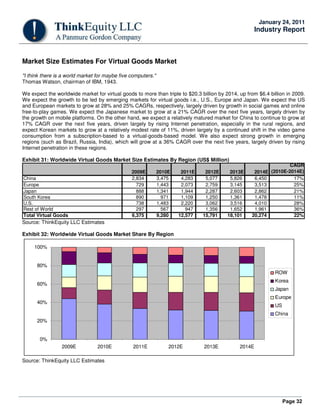
also use more offline distribution channels.
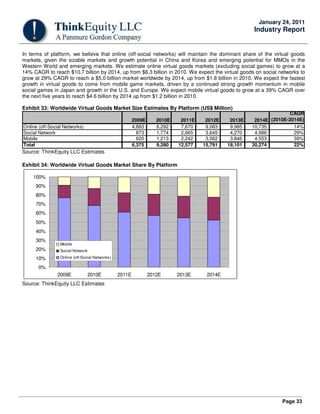
AB: How is the cost of acquisition trending over the last couple years? Specifically, have you seen acquisition
cost rising because of a strong growth in Facebook games?
LH: The acquisition cost has increased over time. Although there is some overlap with Facebook games, I think
the channels used are generally different. For us, the increased acquisition cost is largely due to more
competition in MMOGs, both from browser and client games. We calculate the maximum cost per player
based on the LTV of users of that particular game and the desired marketing ROI. With real-time data for
our metrics, we can adjust marketing campaigns to maximize returns.
AB: Can you also share some of the metrics - ACU, PCU, DAU, attrition, conversion rates, ARPU, typical lifespan
of users?
LH: PCU for our games is approximately to 90,000, but that is not the most accurate metrics to analyze game
performance. For us, Daily Active User (DAU) is a better measurement. Our peak DAU is approximately
300,000. Our ARPPU is consistently around $90, though there is a wide variation between games. For
each game, we use the revenue per DAU metrics, which better shows our monetization and buyer
conversion ability. The average lifespan of a user is around six months; but the hardcore users, who
make up the majority of our revenue, can stay for over two years. Our players also move from one game
to the next on our portal, increasing lifespan.
AB: How do you expect monetization trending overtime, especially as you are growing presence in relatively
lower GDP/capita countries like Latin America?
LH: Our ARPPU has remained consistent over the last three years, despite expansion to newer and lower-GDP
territories. Over the longer term, we expect ARPPU to trend lower, but we expect a much higher
conversion rate, similar to trends in Asia for online game, resulting in overall growth in total revenue. This
is the normal consequence of going mainstream. There will be more users, with better access to payment
options and a much larger total buyer base.
AB: What is your Facebook games strategy? Do you have any games on Facebook?
LH: We are developing Facebook games, but they generally will address more our current demographics, rather
than the casual demographics of most social games. We will leverage Facebook features to virally
disseminate our browser games.
AB: What about mobile – are you doing anything on mobile front?
LH: Mobile may be a part of a comprehensive online strategy in the future. At the moment, we are not dedicating
much resource into this space.
AB: What is the growth strategy – more games, more geographies, more distribution channels/platforms; better
conversion between playing to paying users or clocking up ARPU?
LH: We have much room to grow in our current territories: the US is still a nascent market; we have yet to launch
games in all EU territories; and our Latin operations started only a few months ago. We will continue to
grow our current games, to introduce new, higher quality games and new genres of games, and expand
Page 153
January 24, 2011
Industry Report
further into countries in Europe and Latin America. Strategically, we have expanded into browser games
to further enhance our portfolio. From a monetization standpoint, we will focus more on buyer conversion
rather than ARPPU, for the current ARPPU is already extremely high.
AB: Can you talk about the competitive landscape? Who are your competitors currently, and who do you have
poses competitive threat potentially?
LH: I believe our strongest competitors come from Europe, with expertise in browser games, but so far less focus
on the client gaming space. Generally speaking, except for one to two companies at most, most of the
publishers in North America are struggling. In Latin America, we see only two established players in
Brazil and no major player in the Spanish-speaking countries. In any new market, competitive threats
change quickly. All the major players in the traditional gaming market are now focusing on the online
market. Add to that the possibility that the social gaming companies will move to more in-depth and
content-rich games. These are threats that may occur in the next few years.
AB: What is the reason that larger companies are not aggressive in this market—is it because this market is just
not big enough for them?
LH: The larger companies are aggressively eyeing this market. They see the potential but entry into the space
takes time and preparations. Operationally, this is a challenging business that can frustrate bigger and
slower players. The publishing business is difficult to execute—it is a 24/7 marketing, customer service,
and gaming service, requires much more know-how, expertise, infrastructure and data analysis than most
expect. Large companies will have a challenging time building such a business organically. We have
been in the business for four years, and we are still learning, demonstrating the operationally complex
nature of the business.
AB: What is your secret source? What part of your business is difficult for any other company to replicate?
LH: First and foremost, our operations and the ability to be ROI-focused on all projects are our biggest
competitive advantages. An example would be our marketing expertise, which relies on daily LTV
analysis for each game and each territory, and from there, we derive the maximum cost per player per
game. For monetization, we monitor spending habits and duration to maximize revenue per daily active
users. We have a specific team for data analysis, which provides a weekly report on progress for
monetization and customer retention. The team takes the best practices of each office and implements
them globally. Each game is a different business unit, requiring a team to address game production,
developer communication, customer service, marketing and monetization. Unless processes are in place
and improved with experience, it would be quite difficult to scale the operations. With our scalable
infrastructure and processes, we have been able to launch more games, in more languages and in less
time than any competitors in the client MMOG space. Most companies take months to launch one
game—we launch one game in at least one territory every month.
AB: What are the things on your road map for the next 12-18 months that we should be paying attention to?
LH: We have three key initiatives for 2011: (1) continue expanding our presence in North America and Europe by
launching new games, (2) invest and expand our footprint in Latin America and (3) enter new but
complementary markets, such as browser games and, on a lesser note, social games.
AB: How big is Aeria and how fast are you growing?
LH: We are already the largest publisher of free-to-play client-based MMOGs and will continue to build on our
lead in North America; in Europe, our goal is to be the top three MMOGs publishers within next year; in
Latin, we expect to be one of the top publishers by the end of 2011. We are currently at about 190
employees and expected to be 220 employees by the year-end and 350 by next year. We have seen
record revenues in the last few months and expect the trend to continue, in all our current territories.
Based on current trajectory, we project reaching a revenue run rate of $75-100 million within next year,
with EBIT margin of 20-25%.
AB: Over the next couple years, what do you think are the big challenges for Aeria?
LH: Our biggest challenge is hiring and training good people. There are not many people well-versed with the
Page 154
January 24, 2011
Industry Report
micro-transaction model for client MMOGs. The ability to scale our operations with good personnel is
probably the most important factor for success.
AB: Where do you see Aeria three years from now; do you see it as a standalone private company, as a part of a
bigger platform, or as a public company?
LH: My job is to maximize value for our shareholders, our staff and our players—and we would not turn down any
good opportunity to do so. Aeria Games is a very lean and efficient enterprise. We have built the
company almost without any external financing. To reach our current revenue, we have used up only
$7.5 million and the current growth is funded from operations. If we slightly alter our risk profile and
pursue faster growth, we can certainly do so with more capital.
Page 155
January 24, 2011
Industry Report
An Interview With The Founder And CEO Of BOKU
Company: Boku
CEO: Mark Britto
THINK SUMMARY
We had a chance to interview Mark Britto, the founder and CEO of BOKU, a mobile payment company that
powers 250+ publishers and works with 220+ carriers in 65 countries worldwide. We believe that mobile
payments could help publishers grow their revenue through (a) reaching out to users who may not have access to
credit-cards or other online payment mechanism and (b) reducing friction from the buying process. Britto expects
four of the top ten mobile carriers to drop their fees to under 20% over the next 12 months, which we believe
could further help drive adoption of mobile payments.
KEY POINTS
• BOKU is a mobile payments company that enables consumers to pay for digital or virtual goods online,
via cell phone (thru SMS and billed by the carrier) rather than a credit card or paypal. The company works
with about 250 publishers, including companies like Zynga, Playdom, and Playfish, and payment
companies like Offerpal. On the backend, the company works with 220+ carriers in 60 countries.
• According to Britto, the biggest value proposition of mobile payment is taking friction out of the buying
process and for people (especially in international markets) who may not have access to credit cards or
other forms of online payment mechanisms.
• While most would expect the mobile payment business to skew towards users that may not have access
to credit cards/paypal (e.g., users outside North America/younger users), BOKU’s business is evenly split
between North America, Europe, ROW (Asia and Latin America) and skews more towards 18+ years old
users, which likely reflects on the proposition of ease of use.
• The company charges about 5% transaction fee for the services and assumes risk of any fraud. The
company sets limits on users purchases based on the country, carrier, and merchant and a host of rules
based on proprietary algorithms.
• Since mobile payments could be expensive for the publishers (given carriers fees at about 30-35%), we
feel that one of the big impediments for mobile payment adoption could be a potential cannibalization of
high margin direct payment business from a more convenient mobile payment business. However,
according to Britto, the overall gross profit dollars for their partners increase by 10-20% when they add
mobile payments as an option despite the fact that most publishers do not pass on transaction fees to
consumers.
• On the positive side, it seems that carriers are now considering lowering their fees in anticipation of this
potentially lucrative opportunity. Britto expects that four of the top 10 carriers could drop their fees to
under 20% in the next 12 months. Lowering carrier fees could help the company expand the addressable
market beyond virtual goods to include digital goods.
• The company sees its relations with 220 carriers and its risk management system as a defensible
competitive advantage.
Page 156
January 24, 2011
Industry Report
Atul Bagga, ThinkEquity (AB): Please explain your business and why should investors care about BOKU?
Mark Britto, Founder and CEO, BOKU (MB): BOKU is the leading mobile payments company. We enable consumers in
more than 60 countries around the world to make a purchase, typically of digital or virtual goods. Instead of using
a credit card, the consumer gives us his or her cell phone number and at the end of the month, the purchase of
that item shows up on his or her cell phone bill. We incorporated the business in January of 2009. Since then
we've acquired a couple businesses that pre-date our January 2009 company formation. We have some of the
best VCs in the world invested in BOKU, including Andreessen Horowitz, Benchmark Capital, DAG Ventures,
Index Capital and Khosla Ventures. What PayPal did for the email address, BOKU wants to do for the mobile
phone number.
AB: What is the value proposition for payment by mobile? Is it mostly for the users who do not have access to credit
cards such as minors or international?
MB: The biggest value proposition is that we take friction out of the buying process. Everyone knows their cell phone
number but not everyone knows their credit card number. When you're completing a credit card purchase you've
got to get up from your computer, get your wallet, find your credit card, type in 16 digits, give the security code,
the expiration date, your billing address. On the other hand, since you know your cell phone number, a
transaction can be completed much quicker and with fewer keystrokes. That is one piece of it. The other is that a
consumer can complete a transaction without giving personal financial information over the Web, which is a very
compelling feature for people who are security conscious. Finally, in many of our international markets, many
consumers either don't have a credit card or if they have a credit card, the publisher doesn't accept credit cards.
So the only way that the consumer can transact with that publisher is using a payment system like ours.
AB: How do you define your target audience?
MB: Our target audience is typically consumers who are buying virtual or digital goods in online games. Last year, the
virtual currency was roughly an $8 billion market, growing at 50-75% annually. We work on games from
companies like Zynga, Playdom and Playfish and payment companies like Offerpal. We're currently working with
about 250 publishers and processing millions of transactions a month.
AB: What about Facebook? Are you doing anything with them?
MB: Many discussions are taking place, but there’s nothing to announce at this time.
AB: What is the break-up of revenue geographically?
MB: U.S. and North America represents roughly one-third of our volume, roughly one-third from Europe, and then one-
third from Asia and Latin America.
AB: What is age distribution of your users in the U.S.?
MB: It's across the board and it skews significantly to over 18. Our user demographic is relatively consistent with the
age demographic of games like Farmville, Mafia Wars.
AB: Can you explain how do you work with telecom carriers, publishing partner, and ultimately consumers?
MB: We connect into 200+ carriers in 60+ countries. When a consumer from that country wants to make a purchase,
he gives us his cell phone number, we send a SMS message to the consumer asking him to authorize the
transaction. When we receive authorization, we fund the transaction and send a message to the carrier telling the
carrier to bill the consumer for transaction amount at the end of the month.
AB: Who takes the risk of any fraud? Is this BOKU or the telecom carrier?
MB: It is BOKU. We are very focused on risk management, fraud management, on behalf of our publishing partners.
We look at the history of a consumer across games. We look at how much they spend, where they spend it, when
they spend it. We’ve created a risk service that at the time of transaction executes a host of rules based on our
algorithms and limits we’ve set at the country, carrier, and merchant.
AB: Typically, what kind of transaction service fee [would] a mobile carrier charge, what kind of fees [would] you
charge, and how does that compare with that for a credit card or PayPal transaction fee?
Page 157
January 24, 2011
Industry Report
MB: Though we're a convenient payment option, we're also an expensive payment option relative to the mainstream
payment options. We typically take about 5% of the transaction value. The carriers on an average are taking
about somewhere between 30-35% of a transaction, leaving the other two-third for the publisher. We've got some
carriers that are taking sub-10% and we've got some carriers that are taking closer to 60%. The carriers’ take-rate
varies tremendously by geography.
AB: Is there any concern from the publishers that by using mobile payment option, which seems like a more
convenient option than credit card, they could cannibalize revenue through a credit card, which is arguably a
cheaper option?
MB: Publishers watch for cannibalization, but overall gross profit dollars for our partners increase when they add
mobile payments as an option. We've found that when our partners add mobile payment as an option in addition
to credit cards and PayPal, their revenue (after fees) increases by 10-20%. And though it is expensive, it is
incremental revenue for publishers. While most publishers do not pass on transaction fees to consumers, we
allow publishers to pass on the transaction fee to consumer, i.e., offer lower exchange rate for virtual currency via
mobile payment versus other method of payment.
AB: Is there any evidence that when the carriers have dropped their fees and it helped them grow their market?
MB: I think probably the best example is South Korea. In South Korea, the carriers are taking somewhere between 5-
8% of the transaction value and as a result this technology is now being used for more than just virtual goods and
is now being used to purchase physical goods. In South Korea roughly 10% of ecommerce transactions run
through this system that is $1-1.5 billion of purchases in that country are being paid for by a mobile payment
option; and over one-third of those transactions are for physical goods.
AB: Is there any reason to be optimistic that carriers could reduce their rate outside of Korea, especially in the western
countries?
MB: Absolutely. We have got three very important carrier deals in the last quarter that represent a shift in thinking on
the carrier side as it relates to fees. We're actively engaged with a whole host of other carriers about doing the
same. There's no doubt that the carrier fees will come down. The question is what the pace of that will look like. I
do think that in the next 12 months you will see three or four of the top 10 or 12 carriers in the world move their
fees down to under 20%.
AB: Just to be clear, since most of the publishers don’t vary exchange rate between payment options, it probably does
not change the market share within the virtual good arena. So by carriers dropping the rate, the market expansion
is more from the physical goods.
MB: I think that even within the virtual good our penetration could increase as pricing comes down. As the prices come
down there are other digital goods like media goods, eBooks, and music that become part of the addressable
market. And as prices come down even further, physical goods ultimately become a category that we can begin to
penetrate. We've got a long way to go for that to be the case.
AB: You had mentioned that your addressable market is currently $8 billion. What percentage of this might be going
through mobile channel versus pre-paid card versus credit card and other forms of payment versus say about 12
months back?
MB: We don’t have any data to share with you at that time. I can say that we’re very happy with the volume of
transactions we’re processing, and that we’re confident in the value chain we’re a part of.
AB: If this is an $8 billion market, let us say, with 15-25% flowing through mobile payment, and your take rate is 5%;
that gets you to about $60-100 million addressable market worldwide. How do you see this market growing? Is
this more about this $8 billion going to $15 billion? Or is it more about rising penetration of mobile payment
option?
MB: We're going to benefit from a rising tide as well as deeper penetration. Mobile as a payment option is not yet
mainstream even within social gaming. I think that we benefit from two trends. One is, we will become more
mainstream as more publishers understand the value that we bring, and so, our penetration of payment share will
increase and the other is that the category overall is growing.
Page 158
January 24, 2011
Industry Report
AB: Who do you see [as] your competitors currently and potentially?
MB: We don’t worry about our competitors. We worry about building a world-class product and a great customer
experience, always knowing that if we do that, the competitive landscape would take care of itself.
AB: What is your secret sauce or what will make it difficult for someone to replicate what BOKU is doing?
MB: There are a couple of things. One is that we've got great experience and data that is specific to this environment
and replicating that is not possible without operating in this environment. Two, we have built connections into 200
carriers throughout the world. And that's difficult to do and complicated to architect, and I think replicating that will
be will be expensive. Finally, I think that the risk management systems that we build as a result of our domain
expertise give us a competitive advantage relative to someone that is trying to get into this business.
AB: When you look out next three years from now, what do you see as the big challenges for BOKU?
MB: I think our challenge is the same as our opportunity. And that is to convince the carriers that it's in their best
interest to work more closely with us to promote the service and make it a more mainstream option. We spend a
lot of time focusing on that and to the extent that we're successful that will represent the opportunity for the
company as well.
AB: Can you give us some sense of how big BOKU is right now and how fast you might be growing?
MB: We're processing millions of transactions a month. On average we process about one transaction every second.
We're 60 people, based in San Francisco, an office in London and a small sales presence in Asia.
AB: Where do you see BOKU three years from now? Do you see yourself as an independent company, or as a part of
a bigger platform?
MB: It is unclear to me and definitely not something that we spend time thinking about. Our view on this is that if we
build a great product, build a great customer experience, that the rest will take care of itself.
AB: Thank you for speaking with us, Mark.
Page 159
January 24, 2011
Industry Report
An Interview With The CEO Of CrowdStar
Company: CrowdStar
CEO: Niren Hiro
THINK SUMMARY
We had a chance to interview Niren Hiro, the CEO of CrowdStar, the second-largest social gaming company on
Facebook with about 50 million MAU, according to AppData. While the company was focused on Facebook and
the U.S. markets historically, it seems to be aggressively going after the international opportunity (most notably
the Japanese market, where it is the most-successful U.S.-based developer, according to the CEO), the mobile
opportunity (publishes games on Japanese mobile platforms as well as iOS and Android), and the online
opportunity (games on MSN). The company expects growth to be driven by accelerated launch of new games,
expanding to new platforms, including mobile and international markets.
KEY POINTS
• CrowdStar is the second-largest social games company on Facebook (as measured by MAU) with 50
million MAU, according to AppData. The company publishes games on Facebook, mobile, and has also
signed a deal to publish games on MSN.
• CrowdStar generates a majority of revenue from virtual goods, and sees advertising as a new
opportunity, which it is beginning to explore, according to Hiro.
• The company is seeing rising monetization of the games, driven by an increasing awareness of virtual
goods model, increasing acceptance of Facebook Credits, and growing sophistication of the company in
terms of game mechanics for user monetization.
• While acknowledging the impact on CrowdStar's business from changes in Facebook policies regarding
viral channels, Hiro noted that the company anticipated these changes and was able to mitigate a major
impact by adapting its games for these changes and by effective marketing.
• The company expects growth to come from an accelerated launch of new games on Facebook and new
platforms (including mobile) and expanding internationally.
• The company publishes four of its games on multiple Japanese platforms (including mobile platforms)
with monetization significantly higher than that in the United States. It also publishes games on
smartphones (iPhone/iPad and Android platforms) and recently announced a deal with Microsoft to
publish its games on the MSN network and plans to launch the first game in December.
Page 160
January 24, 2011
Industry Report
Atul Bagga, ThinkEquity (AB): Please explain your business and why customers and investors should care about
CrowdStar?
Niren Hiro, CEO, CrowdStar (NH): CrowdStar is focused on creating great entertainment experiences for game players on
social platforms on their PCs and mobile devices. We're focused on creating high-quality games that engage
users on a daily basis. At the same time, we're focused on creating a scalable and profitable business. We have
some of the highest MAU per employee and revenue per employee ratios in the industry. We run our operation
from a more-entrepreneurial and customer-focused approach that has led to ongoing profits from the beginning,
and a long-standing series of hit games.
AB: What's the current mix between the virtual goods and advertising revenue streams, and where you expect the
revenue mix to trend a couple years from now?
NH: Majority of our revenue stream is virtual-goods-focused, although advertising is presenting some new opportunities
that we're just beginning to explore. We expect the mix to continue to evolve, but virtual goods only seems to be
growing, so we expect it to be tilted in favor of goods over ads for the near future.
AB: Who is your target customer?
NH: We focus on a broad segment of traditional social gamers. We have games that are specifically targeting certain
segments (e.g., It Girl targets 18-34 women), but our games represent the demographics of the entire internet.
We're mostly U.S.-focused with our Facebook platform, but we attract an international audience.
AB: Can you give us some sense about the size of the addressable market, also can you share your assumptions around
market sizing estimate?
NH: We believe the virtual goods market will exceed $1.5 billion in 2011.
AB: Can you highlight top two or three secular drivers that are driving growth for CrowdStar?
NH: Generally speaking, our growth is driven by the continued adoption of social platforms by consumers worldwide, the
continued mass market reach and interest of these games by the broader consumer market, and continued
innovation/optimization by our teams on creating compelling entertainment experiences.
AB: What is your growth strategy?
NH: We're focused on accelerating the launch of new games, expanding into new platforms and new global markets, and
also expanding into mobile platforms. Our continued growth in our core business will fund our growth into new
markets and opportunities.
AB: What impact have you seen on the business (virality/retention rate/customer acquisition/cost of acquisition) since
Notifications were taken out?
NH: While platform changes affect everyone differently, we have been affected. That said, we had anticipated these
changes, and had already adapted our games and marketing efforts to help mitigate the impact of these changes.
AB: What is your opinion on the new games center in Facebook, and what kind of impact are you seeing with the recent
changes in feeds and bookmarks?
NH: While we cannot comment on any new, unlaunched features Facebook may or may not be working on, all social
platforms will continue to evolve, and CrowdStar will evolve with them. Our focus is on creating great gaming
experiences, and leveraging the social features and channels to best match users with those experiences.
AB: What impact did Facebook Credits have on your conversion rates, ARPU?
NH: We've consistently said that Facebook Credits over time has increased our conversion rates and ARPU. As more of
the developer market adopts Facebook Credits, we will all only continue to see those rates increase.
AB: How have you seen the ARPU, conversion rates trend over the last couple years? Where do you expect it to trend
over the next 12 months?
NH: We've seen strong growth, and continue to expect this trend over the next year.
AB: What is driving this growth in ARPU and conversion?
Page 161
January 24, 2011
Industry Report
NH: A part of is the education and adoption of Facebook credits by users. It is a virtuous cycle, as more vendors start to
use Facebook credits, it becomes a more acceptable form of payment mechanism and more customers become
familiar with FB credits. Second part of the growth in monetization is from our increased sophistication—over the
last couple of years, we have learned a lot about what content and user experience we have to deliver to drive
monetization. Some of our newer games reflect this learning.
AB: How have the production values for these games changed over the last couple years?
NH: The demands by consumers have only increased. One of CrowdStar's advantages is that we continually focus on
creating great content for the mass market. That doesn't mean that we have to have the most advanced
technology, but it does mean that our games must continue to delight customers as they're interests change—and
that's a core focus and skill set that we have.
AB: What is your mobile strategy?
NH: We've already deployed games here and abroad on smartphones, specifically the iPhone/iPad and Android platforms.
We continue to invest in this area, and see mobile as an important extension and complement of our overall
gaming experience. You can expect to see further developments and releases here in the near future, but nothing
that we're prepared to announce today.
AB: How about other platforms—Web games, client games, consoles, other social networks?
NH: We're primarily focused on our current platforms and in the areas alluded to earlier, but we continue to evaluate new
emerging social platforms. Undoubtedly, we will continue to expand our games to new platforms that gain critical
mass and adoptions.
AB: Can you talk about the Microsoft deal and your opinion about the potential opportunity?
NH: We're excited about the Microsoft and Bing deal we announced this week. It presents another extension of where
people can play great CrowdStar games inside their native online experience, and it brings the total number of
platforms that support CrowdStar's games to 10. Microsoft's audience consists of a lot of active game players, so
this is a natural fit for us. We look forward to launching our first game in December, and then growing our
integration beyond that as Microsoft's platform evolves, too.
AB: What are your opinions on the third-party publishing model for Facebook games?
NH: It looks like a model that some parties are interested in, but as of right now, CrowdStar is focused on first-party
development.
AB: Who are your current competitors? Who represents the greatest competitive threat?
NH: The competitive landscape continues to evolve, but our focus remains on scaling and growing our business around
the world by creating great gaming experiences.
AB: How do you compete with companies likes of Disney and EA that may be bringing widely known IPs on Facebook?
NH: By continuing to focus on creating our own great IP. If you look at the track record of many companies in bringing
branded IP to Facebook from other domains, the success record is relatively low. Not to say it's not viable, there's
just not a lot of successful precedent to date.
AB: What's the key source of differentiation that is difficult for others to replicate? Please help us understand your secret
sauce?
NH: We believe that our competitive advantages come from several pieces: 1) Our focus on creating compelling
entertainment experiences that delight users, 2) Developing in a very agile environment that allows us to quickly
test, create and invest in new concepts with small, scrappy teams, and 3) A balanced analytical focus that allows
us clear insights to help guide our path, but also acknowledge some of the subtle qualitative factors that aren't
easily measured, but are critical to a game's success.
AB: Are there any compelling new offerings that you're working on that we should be paying attention to?
NH: We continue to see strong growth from our new games, like It Girl and Mighty Pirates. Additionally, we continue to
expand our leadership in Japan and new platforms. This is an area that will continue to grow.
Page 162
January 24, 2011
Industry Report
AB: Can you give some more color on your Japanese business?
NH: Sure. We started publishing games in Japan from earlier this year and we're currently the most-successful U.S.-
based developer in Japan. We work with a local operator in Japan, Dricom and publish our games in Japan's
most-successful platforms on PC and mobile, including Mixi, Gree, Yahoo Mobile and Hangame. We have
localized and adapted our games for the local markets in Japan.
AB: How do you compare the Japanese markets with that of the U.S. markets?
NH: In many ways, the Japanese market is more-sophisticated and discerning. Japanese game players are comfortable
spending online, and are willing to spend much more. We see significantly higher ARPU in Japan.
AB: When you look out over the next couple years, what do you see as the biggest potential challenge for CrowdStar?
NH: It will be challenging for all participants in this market to grow their businesses by simply buying marketing.
Thankfully, CrowdStar has always focused on building and growing in a scalable fashion, and on the back of very
high-quality content. That foundation is one that will let us continue to grow and expand our business and
audience through all market changes in the future.
AB: Can you share some of the business metrics with us—DAU, conversion rate, ARPU, retention?
NH: Sorry but we can't share anything other than what's already available on Appdata.
AB: Could you give us a sense of how big is CrowdStar and how fast you are growing? What's the biggest constraint on
growth?
NH: We have about 90 people, and we're continuing to hire and grow, but in a very predictable, scalable way. We make
sure that we prioritize our key areas of growth carefully, so the biggest constraints are the ones we put on
ourselves as part of our approach to this business.
AB: Where do you see yourselves when you look out three years from now—as a public company, an independent private
company, or as a part of another platform?
NH: We see ourselves as the No. 1 global leader in social gaming. Who knows what form that will take, but it's clear that
our leadership will be focused on growing a great portfolio of entertainment experiences, which fosters a healthy,
fast-growing business.
Page 163
January 24, 2011
Industry Report
An Interview With The CTO Of Facebook
Company: Facebook
CTO: Bret Taylor
THINK SUMMARY
We had a chance to interview Bret Taylor, the CTO of Facebook, the largest social network with more than 500
million users. Taylor attributes the success of Facebook to its focus on the user experience, which, in turn, has
resulted in making Facebook not just a fun but also a useful service. We believe that the proposition of social
media is compelling for a variety of distribution channels and verticals. According to the CTO, while the company
will continue to grow the user-base for Facebook.com, the product focus is mostly on the Facebook platform and
expanding its reach to the entire Web through social graph. Similarly, the company plans to grow its mobile
presence directly as well as through partners. The company is focused on news and media, a vertical that Taylor
believes could see similar disruption with social media as the video games space.
KEY POINTS
• Over the last couple years, while the user-base of some of the other social networks have declined,
Facebook's userbase has grown multi-folds, which Taylor attributes to Facebook's focus on the user
experience that, in turn, has resulted in making Facebook not just a fun but also a useful service.
• While it is focused on growing the user-base of Facebook.com, the company's product strategy centers
around the Facebook platform, and the company plans to expand the platform beyond Facebook.com to
the entire Web.
• We believe that the proposition of social media is compelling for a variety of distribution channels and
verticals. According to Taylor, the value of Facebook's platform is even more compelling for mobile
applications than for Web applications, and the company is focused on enhancing its presence and user
experience on the mobile platform directly as well as through third-party developers. Similarly, the
company is focused on the news and media vertical, a vertical that the CTO believes could be exposed to
similar disruption as social media caused with video games.
• Games remain an important focus area for Facebook, and the company is looking to optimize three viral
channels for games—requests, stream, and bookmarks. The optimization will be based on algorithms that
would deliver content that's useful to specific end-users rather than on determination of developers and/or
policies.
• We believe that the potential opportunity for social games outside Facebook could be meaningful, and, in
a way, we expect social to become an important feature for video games. So far, we have only seen the
first iteration of Facebook integration with console games (Blur, Starcraft 2, and a few others) and a
deeper integration with Facebook over time is likely.
• The company sees Facebook Credits as a way to improve the user experience for games and
applications on the Facebook platform. The company is ramping payment mechanisms and developers
and aspires to see Credit as a default virtual currency of Facebook.
• Advertising remains the main focus for monetizing the Facebook platform, and while virtual goods are an
important part of the platform, it's currently much smaller, according to Taylor.
Page 164
January 24, 2011
Industry Report
Atul Bagga, ThinkEquity (AB): Over the last couple years, while Facebook has grown from 150 million to 500 million users,
during the same time, a few other social networks have seen a big decline. What do you attribute Facebook's success to?
What have you done different that your competitors missed?
Bret Taylor, CTO, Facebook (BT): I think the primary thing is that we were exclusively focused [on the] user experience.
We want to create a product that's not just trendy or fun but also just extremely useful for people. And that
manifests itself in a number of attributes that makes Facebook different from other social networks; the most
important is that we're focused on real identity and because of that, Facebook has become a valuable utility for
people. I think that a combination of making it an extremely useful service that people use every day in addition to
fun social destination where people can play games, shares photos and videos, has been the main distinguishing
factor of Facebook.
AB: Facebook population is now almost 30% of the total Internet population. Where do you expect the growth to come
from over the next couple years?
BT: We're very focused on growing our user base. Internally, we say that the most important feature that we can add is
the one that gets your friend on Facebook because when you put people who are meaningful to you in your real
life on Facebook, it makes Facebook even more valuable service for you. Having said that, our product strategy is
focused on our platform. We view social graph as the core of our service and communications channels as
features on top of that platform. We are focused on expanding our platform from Facebook.com to the entire Web
and launch social functionality in the form of social plug-ins. We think that any given service has the potential to
be disrupted by the presence of deeply integrated social functionality.
AB: In terms of your expectations from growth, is it more about growing the user base or more about expanding your
reach through the social plug-in?
BT: We would like to do both. To some degree, Facebook.com is the killer app for the social graph that makes people
want to sign up for the service and makes them actively use Facebook every day. The core value of
Facebook.com is our platform, which is also valuable to third-party developers. I think, over time, the third-party
applications would become a very meaningful part of people's Facebook experience but you really can't have one
without the other. They're closely connected.
AB: How do you see Places expanding the reach of Facebook.com?
BT: It's very early. Right now, we're focused on creating a great user experience around people checking in, finding out
where their friends are, and we have integrated it into our platform really deeply on day one. I think location is a
really meaningful part of our platform and will continue to grow particularly as mobile devices continue to grow as
a predominant platform for people to interact with social networks.
AB: What is your expectation around penetration of Facebook within the Internet users?
BT: I think it's useful to everybody. Facebook is an efficient way for connecting and sharing with others; and those are
fundamental human needs. Likewise, our platform helps cater to particular interests whether it's a game or
charities through applications. A good example is the disruption in video games space.
AB: Facebook has already gained a lot of ground with mobile apps. How meaningful is the mobile for Facebook currently
and, over a longer term, how do you see mobile opportunity evolve as compared to the PC opportunity?
BT: The phone is already a very social device, and I'm very excited about integrating the Facebook platform on the
phones. I think that there is a huge value in integrating the social channels, serendipity, and discovery with the
Facebook platform, and the value is even more for mobile applications than that for Web applications. We're
focused not only in making the Facebook experience really good on the phones but enabling phone developers to
integrate Facebook into their own applications.
AB: Outside of games, what other verticals do you see where Facebook has potential to create a similar disruption that we
saw in games?
BT: That's something we talk a lot about internally. One of the areas that we are focusing on right now is media and news.
Currently, the front page of a newspaper represents the editorial voice of the newspaper, but there are a lot more
articles than can fit on that front page, and everyone's interest are very diverse and people will like to see the
story of their interest promoted to the front page. In April, we launched social plug-ins, which is cut-and-paste
Page 165
January 24, 2011
Industry Report
social functionality that publishers can use to put social recommendations or news feed on the front page of a
newspaper. It's on over 350,000 sites right now, and our like button is getting billions of impressions every day.
The interesting thing is that traditionally it was the startups that were successful in making social applications.
With our simple cut and paste social plug-in, we are now enabling social functionality for companies that may not
have the expertise or the investment to make social apps.
AB: How about music and videos?
BT: That's been a pretty important part of our platforms from day one. Music has always been a social experience, from
mixed tapes to just listening it with your friends. We know that Facebook can be a really meaningful part of these
products.
AB: Going back to the games, how important are games for the Facebook platform?
BT: It's very important. We had been focused on expanding our platform to the rest of the Internet, but we realize that
gaming is one of the killer apps that has dominated our platform. We've reinvested a lot of engineering and
product resources to make sure that games experience on Facebook is a really good experience. We have a
team devoted for games that looks at the core communication channels on Facebook. Facebook Credits is a big
part to improve that games experience.
AB: With the recent changes in the policies like Notifications, virality of the channel has reduced significantly, and we have
seen usage of Facebook games reduce meaningfully. What steps are you taking to bring back virality in the
channel?
BT: There are three channels we're currently focused on—requests, stream, and bookmarks. We are looking at each of
these channels independently and trying to figure out how to optimize them for a quality user experience for a
given user. Notification was a very good learning experience for us. It was sort of a free-for-all channel and the
bad applications filled it with junk and ruined the channel for everyone else. One of the things that we're uniformly
focused on is algorithms that would only deliver content that's useful to specific end users. We're not going to rely
on the goodwill of developers or arbitrary rules in our policies to determine what content to show to people. We're
going to focus more on understanding people's interest and delivering content that's useful to them and then
operate a feedback loop to developers. If you're really into a game, we'll make sure to show you those stream
entries, and if you're not, we're not going to show them to you. For bookmarks, rather than having every
application ask a user to explicitly bookmark the application, the app will automatically get bookmarked for some
period of time, and then bookmarks automatically order themselves by frequency of use. If your request weren't
clicked on, we're not going to show any more requests of similar nature. We are hoping that by being intelligent
about what's compelling for people and operate a feedback loop for developers, we'll create an incentive such that
developers will want to produce the most relevant applications for users.
AB: How do you see the opportunity of social games beyond Facebook, for example on consoles?
BT: We've had a lot of interesting integrations of Facebook. StarCraft II had integrated Facebook in a really meaningful
way and a lot of Xbox and PlayStation 3 games have integrated Facebook in meaningful ways. You could post
pictures and scores. I don't think we've quite seen like the depth of integration as we've seen with games on
Facebook.com, but I think it's probably just a matter of time before that happens. With EA acquiring Playfish, and
Disney acquiring Playdom, it's pretty clear that these established console gaming companies are very interested
in the social dynamics, and so I think by getting the DNA of the social gaming company into those companies, it's
just a matter of time before we start seeing integrations.
AB: How do you monetize the platform? Do you see the opportunity primarily with advertisement, or, longer term, do you
see virtual currency also becoming a more-meaningful opportunity?
BT: Our first focus isn't directly monetizing the platform. We're trying to create as much value for the people that use
Facebook as possible with the idea that if using Facebook has value to you, and we expand that value by making
Facebook useful for all the applications you use across the Web and on your phone that would make Facebook
even more useful for you, which will lead to a lot of monetization opportunities in the long run. Advertising is our
main focus. Virtual goods is an important part of our platform, but it's much smaller right now, and we're
reinvesting almost all that back into Facebook Credits.
Page 166
January 24, 2011
Industry Report
AB: Why did you see the need to introduce Facebook Credits now?
BT: It is about improving user experience. Imagine if you're going into an arcade and you have to give your payment
credentials to each of the machines, that is not the best experience. It is somewhat similar situation at Facebook
applications currently. We think that a uniform payment system could significantly improve user experience. We
had always intended to have payments as part of it. In fact, when we launched the platform, we had announced
that we would also launch a payment system with it. It's just taken us a little time to get there.
AB: It makes sense for the users because now they have the mobility; they can easily try out different applications. But
does it cause some concerns with the bigger publishers who, in the past, have locked-in customers with their
currency?
BT: Developers should be happy because it is improving the user experience. You want users to play multiple games and
come back to your game because it's better, not because you have users locked in.
AB: How many payment mechanisms are integrated with Facebook Credits, and what's the roadmap for integrating local
payment mechanisms for various geographies, and what is the roadmap for implementing Credits on Facebook?
BT: Currently, we have credit card, PayPal, and mobile, and a couple months ago, we announced partnership with MOL.
We're adding a big number of payment options over the next couple of months. Facebook Credits is currently in
beta stage, and we're not commenting on our future plans. Right now, we're really focused on ramping payment
mechanisms and developers. Internally, we aspire to see Facebook Credit default virtual currency of Facebook,
and that means that it's accepted everywhere.
AB: How about virtual goods outside Facebook?
BT: If we are successful, we hope that it will expand beyond Facebook. But we feel like you want to learn how to walk
before you run. We're in the walking phase. Our goal is not to have the biggest system in the world tomorrow; it's
really building the right building blocks in servicing our developers and adding value to them and not just going
out there with this biggest product and biggest bang.
AB: What are your views on offers as a payment mechanism?
BT: We see offers as a way for users to get some extra value for something that they're doing anyway. A lot of offers early
on were things you did it just to earn some currency and without realizing what was behind it. We see offers
moving to a direction, where it may get users to change their behavior slightly to the places that are offering
something back, but not getting them to do something they naturally would not do.
AB: How do you see competition playing out especially from companies that may have their unique strengths like Apple
that owns a strong mobile platform or Google that has a deep penetration within Internet user-base?
BT: I think that so many companies trying to recreate the social experience in unique ways based on their platform speaks
to how compelling these social experiences are. Our focus is to create as much value for users and developers as
possible, and our theory is if we create more value than computing services, developers will integrate Facebook
into their products. One thing that's somewhat unique about Facebook is that we're not a vertical platform,
something like a phone. Facebook is a horizontal platform, meaning, if you have an iPhone application, a
Website, and an iPad application, you're going to integrate Facebook into all of them.
AB: Can you share the roadmap of the platform—the exciting things that you might be working for the next 6 to 12
months?
BT: We're doing a lot of integrations on games, so I can't really speak to specifics right now, but over the next few months,
we are going to launch a lot of changes that will hopefully make the gaming experience on Facebook really
awesome.
Page 167
January 24, 2011
Industry Report
An Interview With The Founder And CEO Of GameDuell
Company: GameDuell
CEO: Kai Bolik
THINK SUMMARY
GameDuell is one of the largest skill-based online games companies, with over 12 million monthly unique visitors
and has recently started offering games on Facebook, according to Mr. Bolik. The company monetizes its users
through tournament fees, virtual goods, and subscription. Tournament fees seem to be the dominant part of the
monetization followed by virtual goods. The company views the U.S. as a meaningful growth opportunity (one-
third of the new users coming from the United States).
KEY POINTS
• GameDuell is an online free-to-play games company with its destination site, and more recently, it has
launched a couple games on Facebook. The company has 20 million registered users and 12 million
unique users.
• Most of the company's users are from Germany; however, the company has recently ramped up its U.S.
presence and more than one-third of new users come from the United States. Most of the core-business
(skill-based gaming) growth is still from Germany and Europe and Facebook games from the United
States.
• The company's dominant business model is tournament (skill-gaming), where games are free to play, but
users can participate in tournaments to win prizes by paying entry fees. The company also monetizes
users via virtual items and subscriptions. Conversion rate for GameDuell users range between 2-10%,
and ARPU is in line with the industry (which we estimate is about $20-30 for the industry).
• The company views liquidity of the platform (in order to find and match players with other players of
similar skill levels), cross-platform access, and reliability of the platform as barriers for potential entrants.
Page 168
January 24, 2011
Industry Report
Atul Bagga, ThinkEquity (AB): Please explain your business and why investors should care about GameDuell?
Kai Bolik, Founder and CEO, GameDuell (KB): GameDuell is an existing online games platform, presently in seven
languages, nine countries, and with more than 50 games. We also have two Facebooks apps out, Jungle Jewels
and Bubble Popp. Bubble Popp was one of the top five fastest growing new Facebook apps shortly after launch.
We have more than 20 million registered users and installs, as well as more than 12 million unique users on all
platforms. Our team has a strength of 200 people worldwide, with offices in San Francisco, Berlin, and Asia.
AB: What's the break-up of monthly unique visitors between Facebook and your destination site?
KB: It's a little bit more on the destination site than on Facebook, but Facebook is growing very fast.
AB: What is your target audience?
KB: We focus on a target audience from ages 18-40 years old. We see a slightly female skew on Facebook, but that is
due to the two apps, which are a little bit more oriented towards female audience than other games that we have.
AB: And what is the geographic split of your userbase?
KB: We started in 2004 in Germany and had been focused on the German market for the first four years, so most of our
existing users are still from Germany. Since 2008, we internationalized quite aggressively, and at the moment, we
get more than half of our new users from countries outside Germany. Recently, we ramped up our U.S. presence
and now more than one-third of our new users come from the U.S.
AB: Is the revenue break-up pretty similar too?
KB: Generally, it is the same as users.
AB: Are all the 50 games, that you offer, developed in house, or do you use third party developers?
KB: We develop in house and use third party developers, whom we bind very closely so we own the IPs.
AB: What is your business model?
KB: It's free to play and then we have different ways of monetizing transactions. Users can take part in tournaments where
they can win prizes and pay small entrance fees (about 25%), or it could be virtual items, or just pay-to-play
models and subscriptions.
AB: Do people play these tournaments with their own friends or does the platform hook them up with other players?
KB: People can invite and choose their friends and play against them. GameDuell is also a platform where people can
meet and play with each other. We do have invite friends functions and attractive user profiles.
AB: How do you allay the concern around imbalanced competition in tournament games when one of the players buys
and uses virtual goods to his/her advantage?
KB: In the competition tournament experience where people also pay entrance fees and win prizes, you have to be very
careful with virtual goods. So, there we would not offer virtual goods. But in the free tournaments, we can offer
virtual goods without any danger.
AB: What is the revenue break-up between virtual goods and subscription and tournament fees?
KB: I would not like to share the breakup except to say that those are all three important revenue sources. We see more
and more traffic and higher conversion on the virtual goods. We are excited to see how this will turn out in the
future.
AB: How about advertising?
KB: We are not too eager to sell advertising on our platform and do it only in premium sponsorships, e.g., you can win a
TV or a vacation by winning in these sponsored tournaments. We have tried video ads, which works well, and the
CPMs are quite good. The issue is the supply. We are still working on how we can improve that, but it's not our
main focus.
AB: What is the conversion from users playing for free versus paying users?
KB: About 2-10%.
Page 169
January 24, 2011
Industry Report
AB: What metrics do you use to track your business—ARPU, Attrition, DAU/MAU? Can you share some of these metrics
with us?
KB: We usually track people according to their lifetime values based on their spending habits and our estimate on how
long we can keep them as customers. According to a study from the Casual Games Association, lifetime value of
the users is generally in the $45-100 range. To get to higher lifetime values, we need higher retention rates and
that involves investment in CRM, in platform, in quality of games to regularly introduce new features. Our ARPU
range is pretty wide and in line with the market.
AB: How do you acquire users?
KB: We use pretty much any channel that makes economical sense. We use more than a thousand partners worldwide,
either via revenue sharing, deep integration into a partner site, or a media partnership where we deliver
advertising banners of different kinds to the partner, keywords from Google. Even off line, we do TV, radio, and
newspapers.
AB: I'm assuming your acquisition costs could vary widely depending upon the channel, but can you share what is the
average acquisition cost?
KB: It depends what we do for a partner, e.g., sometimes we spend a lot of energy integrating then we virtually get the
users for free. In other cases, it's a very simple integration, then we pay according to the lifetime value of the
users.
AB: Where did you see the growth coming from in 2009? Was it mostly from Facebook games or new geographies?
KB: Those were actually via all areas. We grew more than 50% in our traditional market, Germany, mainly through new
features and new games. Then we grew across Europe by adding new countries and same with U.S. Our social
apps are mainly U.S. focused.
AB: Who do you see as your competition currently, and who do you think could emerge as competition potentially?
KB: We see traditional players like King.com and GSN.com and the social games companies like Zynga and Playfish as
competition.
AB: Do you see any of social games companies trying to move in your core tournament games market?
KB: We have seen some attempts on Facebook, but they have not been really significant. For the tournament-based
model, you have to have a large user base to be able to match people at any time of the day. If you start new in
this area, it's very hard to get this large user base and offer the same experience as we can offer.
AB: Some of the companies like Zynga, Miniclip, Addiciting Games have pretty high liquidity, and they have a lot of
games. What are the entry barriers for these companies in the tournament business?
KB: Setting up such a site requires a lot of technical infrastructure. When people are playing in tournament, they are very
competitive and therefore need reliable conditions. The other thing is having this cross-platform opportunity, i.e.,
playing the games on any platform—on social networks, on our destination site, as well as on mobile. This is
something that not everybody can offer. Plus, it is very hard to assemble the amount of high-quality games that
we offer.
AB: What are your big initiatives in 2010? You talked about applications on Facebook, and iPhone. Are these the main
growth drivers for 2010 and beyond?
KB: Definitely, yes. Given the great response that we have seen to our first two apps on Facebook, we definitely will port
more of our existing games to the social media space and hope that they will generate a nice network effect on
Facebook.
AB: Do you see Facebook more as a new opportunity, or do you see it more as a distribution channel?
KB: One of the advantages that we have is our core destination site where we can offer an all-encompassing user
experience. On Facebook you have this great opportunity to connect into a social graph and use a lot of tools or
features that Facebook provides. If people prefer to be on our own destination, then Facebook will be more a
Page 170
January 24, 2011
Industry Report
distribution channel, but if Facebook develops much more into a games platform than it already is, then probably
that will be the more successful part. We don't know yet, so I would say both options are still possible.
AB: Would you be offering tournament games on Facebook as well?
KB: The game play itself will probably be the way it is. We are experimenting, and have a very metrics-driven game
development process. We see that there are some differences how we present our games on social platforms
than we do it on our own core platform. We will try to adjust and deliver the best experience to the users.
AB: Are you working with other social networks, like MySpace, Hi5?.
KB: We have partnerships with plenty of them including Hi5, German social networks, but we see Facebook at the
moment as the dominating platform for games worldwide.
AB: How long does it take to develop a game and then how long does it take to port a game on Facebook?
KB: We can port the games very quickly on Facebook, because we have done it now and we understand the platform.
Developing usually takes two to six months for a good game.
AB: How big is GameDuell and how fast are you growing?
KB: We are a team of 200 people and growing very fast. We are now looking mainly for developers and product
managers. We have been profitable for the last five years. In 2009, we grew more than 50% and 2010 looks quite
promising.
AB: Where do you see GameDuell three years from now? Do you see yourself as a public company, as an independent
private company or as a part of bigger platform?
KB: It is important for us to stay on the forefront of cross-platform social games, and if an IPO or a strategic partner can
help us to accelerate that, then we will consider this opportunity.
Page 171
January 24, 2011
Industry Report
An Interview With The CEO And The President Of hi5
Company Name : Hi 5
CEO : Bill Gossman
THINK SUMMARY
THINK SUMMARY:
We had a chance to interview Bill Gossman, CEO, and Alex St. John, President and CTO of hi5, one of the
largest entertainment focused social networks with over 40 million monthly visitors worldwide. hi5 positions itself
somewhere in between social networks for masses (such as Facebook) and online casual gaming destination
sites (such as Yahoo! Games) by offering higher production value and more engaged social games than generally
seen on most other social networks and gaming destination sites currently. The company’s focus is to offer a
tightly integrated platform for third party developers to virally acquire and monetize global audience as opposed to
being a game developer itself. Longer term, the company sees opportunity equally between user pay (e.g., virtual
goods) and advertising.
KEY POINTS:
• hi5 is one of the largest social entertainment sites with over 40 million users worldwide (10% U.S. and
Canada, 20% Europe, 40% Latin America, 30% Asia Pacific).
• The company is optimistic about monetization potential given that its audience (largely young males) is
pretty hard to reach (and thus more valuable for marketers) and willing to spend on games (user pay).
Currently, the revenue mix between virtual goods and advertising is 20/80 and the company expects it to
trend 50/50 over the mid to long term.
• According to St. John, for every dollar that users are willing to pay directly for content, there is a matching
advertising dollar available from sponsors. While a dollar-to-dollar match may be debatable, we agree on
the potential monetization opportunity through advertising for social gaming, which at present drives most
of the revenue from virtual goods, in our opinion.
• While the bulk of the company’s advertising revenue currently comes from indirect sales, Gossman
expects that to change as the company expands its direct sales team and advances its monetization
platform toward higher performing ad units. CPM range for premium ads could vary from $4-7 to $8-15
(for video ads) to $24 (in-game ads) to $120-140 (installed applications), according to St. John.
• hi5 launched a virtual currency and a games channel in 2008, and consequently saw 60% growth in
ARPU during 2009. The company expects further growth from improved monetization and from its viral
engine by offering the right content on a more open platform.
• Although hi5 has successfully published a couple in-house developed games, it sees bigger opportunity
as a publishing and monetization platform by forming partnerships with third party studios, including
Digital Chocolate, BigFishGames, BigPoint, and The Casual Collective. The company has been making
aggressive moves in 2010 to roll out its distribution business, including the acquisition of commerce
platform BigSix in Q1, cloning the Facebook API in Q2, and signing deals with game development
partners in Q3 and Q4. According to St. John, hi5 is on track to close 100 Facebook games for
distribution on hi5 by the end of the year. With the integration of the new commerce platform, hi5 plans to
offer a more robust payments infrastructure that monetizes more effectively through ecommerce and
advertising. Additionally, hi5 recently announced and will be rolling out the public beta of their new
Page 172
January 24, 2011
Industry Report
SocioPath next-gen social gaming platform, designed to generate viral acquisition of millions of users via
games on hi5.
• For end-users, the company plans to differentiate itself from Facebook by offering natively and more
tightly integrated content that has a higher production value and is more immersive than content generally
seen on social networks. And hi5 is also focused on bringing the walls down for social gaming. With
SocioPath, users will be able to engage with each other and content on an open platform.
• The company believes that the online gaming opportunity could be much bigger than the console and
boxed PC games market.
Page 173
January 24, 2011
Industry Report
Atul Bagga, ThinkEquity (AB): ...................Please explain your business and why should investors care about hi5?
Bill Gossman, CEO, hi5 (BG):hi5 is a large, global social entertainment site with a focus on the gaming vertical. We have
focused on delivering a user experience that is very high fidelity, combining high quality gaming content with a
very robust social graph, which we monetize using both advertising and direct user payments with our hi5 Coins
virtual currency. We have over 40 million users worldwide, about 10% in the U.S. and Canada, 20% in Europe,
40% in Latin America, and the remaining 30% in Asia Pacific. When you think about social graphs and use cases;
on one end, you have Skype and Facebook and Gmail, which are very large graphs with 350-500 million people
focused on the use case of communications and sharing things with your real friends. Then, on the other end, you
have World of Warcraft, which is a smaller social graph of about 10 million people, but with just insane
monetization, of over $1 billion annually. Our belief is that somewhere in the middle, there is room for a wildly
successful business that has the audience reach of a social site and the per-user monetization characteristics of
an MMO.
AB: Who is your target customer and can you also share the demographic profile of your users?
Alex St. John, President, hi5 (AJ): hi5’s audience generally skews a little younger, a teens and 20-somethings audience,
and includes a lot more traditional young male gamers. There is lots of light, fluffy content out there on other
social networking sites for the 35+ year-old casual gamer crowd; but content that generates premium ad units in
the young male game category is a lot harder to come by, and I think that’s a segment where hi5 has a lot
stronger position.
AB: With your experience, can you rank different demographic profiles in terms of monetization potential?
AJ: Different demographics monetize very differently. While most would generally say that the women 35 years and
up are usually the easiest to reach on the Internet and monetize efficiently, in my experience young male gamers
monetize at very high CPMs because they’re very hard to reach, and they are accustomed to spending money on
games. Historically the user experiences that one could deliver in the browser didn’t meet the production values
that traditional gamers value highly enough to pay for, but now the technology barriers and the bandwidth needed
to deliver those experiences are coming down fast.
AB: How about monetization potential of gamers in the US and Europe versus those in the emerging markets?
AJ: The payment infrastructure in emerging markets tends to be a lot more micro-payment-centric, whereas in the
U.S. and Europe, it’s a lot more credit card-centric, which changes the way you monetize content in these
geographies. Relatively speaking, wealthier countries like the U.S. and Europe have more advanced payment
and advertising markets and therefore a larger proportion of revenue will come from these markets in the short
term. Currently, advertising markets are much less evolved in the emerging markets, but give it three to five years
and you will see quite robust advertising markets in these countries.
AB: What’s the current breakup between the advertising and virtual goods revenue streams and where do you see
this revenue mix to trend over say a couple of years from now?
BG: Currently it is 80/20; 80 being advertising, 20 being direct user payments for virtual items and games. We expect
it to get to 50/50 in mid- to long-term.
AJ: Generally in a mature advertising market, for every dollar from somebody who will pay directly for premium
content, there is a matching advertising dollar available to sponsor free play for the remaining audience who can’t
or won’t pay. So the rule for valuable content in a mature advertising market tends to converge at 50/50. If you’re
very high on advertising and low on commerce, that may be an indication that your content isn’t perceived as
valuable enough for users to pay for directly. Inversely, if you’re making most of your revenue in commerce and
not advertising, it suggests that you haven’t learned how to monetize with advertising.
AB: When I talk to social gaming companies, it seems to me that for most of these companies, advertising is a very
small part of their revenue. Is it because the standards for advertising on social media haven’t yet evolved and/or
the general weakness in advertising?
AJ: What you’re seeing is that many of these social gaming companies haven’t really figured out how to formulate an
ad unit to get the very high CPM ad dollars, and they have generally relied on very low-yield ads, or simply cross-
promoting their other game titles. To sell premium brand advertising, you have to know a lot about the advertising
business, and you need to have an experienced sales force. Most social gaming companies are very young, and
Page 174
January 24, 2011
Industry Report
relatively un-sophisticated in terms of how they design advertising into their user experience. They also tend to be
more development-focused, and often lack the necessary personnel, resources and relationships. So they just
haven’t been very good at monetizing through ads yet. We see huge potential in un-locking that ad revenue,
because games represent high-quality inventory and highly desirable demographics for advertisers.
AB: Are these the premium ads, remnant ads and how do you sell advertising?
BG: We have direct sales and we also have a portfolio of channel partners and networks that we work with. We have
some reselling partnerships around the world, and we also do most of our direct selling here in the United States.
The bulk of our advertising revenue today is managing that portfolio of networks and resellers, but as we continue
to improve the production value of the site and design innovative new ad units into the site, I would expect us to
expand our direct sales team from the basis that we have today, especially in the United States and other high
monetization markets like Europe. This is especially true as we advance our monetization platform toward higher
performing ad units.
AB: Can you talk about the typical CPMs for the premium and remnant ads and what type of ROI your customers see
from ads on hi5?
BG: Obviously CPMs vary greatly depending on the type of ad unit, how it is packaged and sold, and the geography
you’re selling it in. The improvements we’ve seen in our ad revenue have really come from two main sources:
first, we’ve done a fantastic job managing our remnant inventory, and second we’ve introduced a number of
premium ad units that brand advertisers want and pay premium CPMs to get. ROI for a brand advertiser is
something that they define and it can mean a lot of things to a lot of people. What we know is that even when we
raise prices, we still get repeat customers. This way, we know that the advertisers are seeing ROI. In doing so,
you sort of build a price elasticity curve of your ROI because you don’t really know the ROI target. However, if you
optimize price and people are coming back and buying more from you, you know you’re in the right zone.
AJ: One of my prime areas of focus since joining hi5 has been in increasing our premium, high-CPM inventory. In the
gaming space generally, the premium ad inventory tends to run $4-7 CPMs. Premium video ad inventory can run
$8-15 CPMs. Premium in-game inventory for games can be as high as $24 CPMs, and for downloadable games
or installed applications, CPMs can be as high as $300 CPMs, but sustainably, $120-140 CPMs. We’ve just
introduced some very innovative ad units that allow users to earn hi5 Coins by watching premium video ads, and
we’ve been able to achieve that kind of CPMs with that unit.
AB: How is the current economic slowdown impacting the business?
AJ: The advertising business in online gaming has been very strong throughout this recession. We’ve seen regular
seasonality in remnant inventory, but prices for premium ads have maintained strong through the recession.
Online gaming can actually perform very well in a recession. The casual boom happened during the last
recession, from 2000-2002; and this social media boom is happening in this recession. For our part, we’ve seen
strong year-over-year revenue growth, and we added an entirely new revenue stream in the form of our hi5 Coins
virtual currency. So despite the larger economy, all our financials are moving in the right direction.
AB: How many games do you have on your platform and how many of these games are developed in-house versus
third party and where do you see that trending over the next couple of years?
AJ: We have hundreds of games on hi5, and we’re continuously expanding that. We have developed a couple in-
house games, including Organized Crime and Legend of Spirehold. Both these titles are doing well and validate
that our model works. I think that there’s a much bigger opportunity for hi5 as a publishing and monetization
platform than trying to be another studio. There are a lot of great studios; a lot of people producing high quality
content. At Wild Tangent, we had a lot of success forming such partnerships with these studios. I came to hi5
because I think hi5 has the perfect audience and environment for taking that to another level. I’m looking forward
to building a company that combines a highly viral social media entertainment platform with very natively well-
integrated content and monetization, as opposed to social games on Facebook that seem like two different
platforms bolted together.
AB: These partners that you’re working with; are they indie developers, small developers, larger studios?
AJ: There are a lot of companies that have been doing online premium games or traditional MMOs a long time. I have
great relations with many of these companies, and I’m much more interested in positioning hi5 to catch the next
Page 175
January 24, 2011
Industry Report
wave of higher production value, higher monetization content than the kind of very light, viral hard to monetize
games that are pervasive at the moment. My view is that when a new business model takes shape, the first
content is very low production value, but since it’s the first out there it’s very successful. What follows in the wake
of a new market is enormous competition based on production values and the quality of the content accelerates
very fast. In that kind of market, you tend to see a shakeout, because the talent and skills become more and more
specialized and a lot of smaller players get subsumed by companies that are a lot more sophisticated at
producing premium content.
AB: How many developers you might be working with and can you give some examples of games or developers that
you might be working with?
BG: We're ramping up our game developer partnerships quite aggressively. Since June, we've signed deals with over
50 partners, including Digital Chocolate, BigFishGames, BigPoint, and The Casual Collective, and by the end of
the year we'll have signed 100 Facebook games for distribution on hi5.
AB: How do you work with developers? Are these revenue-share deals, upfront licensing or a mix of both?
AJ: The traditional publishing deals aren’t going to work in this market. In the traditional game industry, if you paid a
developer something, you owned the game, and if there was any upside there might be a little profit sharing. But
essentially the games were made on a work-for-hire basis. We live in a world where there’s no friction to going
online and, if you’re talented, you don’t need a publisher to be successful. You might need distribution, a little
money to get started, but it really doesn’t take a lot. And then the games aren’t standalone, boxed applications.
They’re services that, if successful, could live forever and generate enormous amounts of money. So the old
models aren’t going to work and we have a fairly progressive approach to doing deals in this space that will be
very successful because it is more native to this medium. We’ll announce how we’re doing those deals as we
announce these partners, because it is fairly innovative.
AB: If I look at some of the Asian social network sites like Gree, Mixi, RenRen; the model that they have adopted is
revenue share that could be anywhere between 30-50%.
AJ: Yes. In a mature form, deals will be revenue shares like you described. The developers we partner with have
integrated to our hi5 Coins virtual currency for collecting in-game payments, and we share revenue with the
partner. This has two great benefits for our partners: first, it reduces the friction in getting users to pay because
they’re simply debiting coins they’ve already accrued rather than reaching for their wallet each time; second; the
partner is tapping in to our payment infrastructure which supports over 60 payment types around the world, so
they don’t have to do all that work themselves.
BG: In the Asian market, the company that most resembles our model is DeNA. The Mobage open platform that DeNA
launched in early 2010 provides a mobile social gaming network monetizing millions of users via ecommerce and
advertising. I think they are at approximately 230 titles on the service. Likewise, we are opening up our network
via the SocioPath platform with a focus on helping developers with revenue models and audience acquisition, and
we are adding about 5-10 titles per week to our platform. To put that in perspective, leading social game
developers have around 15 titles that they offer.
AB: Can you give us some sense on the size of this market and what you see as the big growth drivers?
AJ: One online game, World of Warcraft, makes more money than all Xbox titles combined in a year. The size of the
online gambling business is more than $6 billion in the US, more than the console business. It’s hard to say how
big the online games market can grow, but I’m pretty sure it could be much bigger than the console and boxed PC
games market. I think there is room for a few more games like World of Warcraft; we just haven’t discovered them
yet. We would love to be one of the next though, in a completely different genre.
BG: One success that that people talk about, Zynga, is a tip of a very large iceberg. First of all, you’re going to see a
ton of gaming going on here, but you’re also going to start to see other content like music, video, and news slicing
up and becoming more friction free to be able to be paid for in smaller units. It’s going to happen; the question is
not if but when.
AB: What do you see as the inflection point? When do you see that happening?
AJ: I think the inflection point happened when Xbox 360 and PlayStation 3 were launched. The console is no longer a
value proposition as a specialized entertainment device for delivering rich graphics, because graphics are a
Page 176
January 24, 2011
Industry Report
commodity now. Online gaming has been growing very steadily, smoothly since then. But people didn’t realize it
because it’s been happening all over the world through lots of small companies and startups and so the money is
highly distributed and unobvious to people who traditionally analyze it.
AB: How do you compete with something like a Facebook and would you consider Battle.net or a Valve’s Steam as
your competition?
AJ: I feel like we’re standing in the middle of the California Gold Rush. I think it would be dumb to go mine at a place
where someone has been successful, because you will be competing with 50 other competitors while there is so
much undiscovered country. We are not competing with Zynga and Facebook, we are going after the vast volume
of console game play time that will ultimately move online.
AB: How come the traditional gaming companies are not getting more aggressive in this space?
AJ: Traditional gaming companies have been wildly aggressive in the space and consistently failed because the
business models, the technology, the mentality about how you build games, are major barriers to traditional game
publishers. Everything they know about gaming, when it comes online, is wrong. They have more to unlearn than
they can deal with. So all their expertise is also enormous baggage.
AB: When you look out over the next couple of years, what do you think as the big challenges for hi5?
AJ: The hardest thing is to get really good at virally acquiring audience, which we have already done. Once you have
the audience, it’s just a matter of getting the right content in front of them to maximize their monetization potential,
which I’ve done before. So I think the biggest challenge is just execution. We are rapidly evolving our
entertainment platform to ensure we attract the right audiences, for the right use cases and in the right
geographies.
AB: How big is hi5 and how fast you guys are growing?
BG: We think of our growth in two phases. The first phase was focused entirely on audience growth, and we became
one of the fastest growing sites in history. Today, we have over 40 million users worldwide, and we run the entire
site with about 60 people in downtown San Francisco – so we’re almost one million users per employee, which
has to be one of the highest ratios in the industry. The second phase of our growth, where we’ve been really
focused over the last year, has been on revenue growth. Since the end of 2008, we launched our virtual currency,
our games channel, our premium gift store, and other methods of monetizing our massive audience through direct
user payments. We’ve also made considerable improvements in our advertising monetization as well. The result
has been a significant improvement of over 60% in our average revenue per user in the last year, and a profitable
business with strong revenue growth. As we continue to advance our three platforms – viral, monetization and
entertainment – we expect that growth to accelerate.
AB: Going forward, do you see growth mostly coming from increased monetization or growing audience?
AJ: I think that there is a misunderstanding about viralness in that a lot of people think that the success of companies
like Zynga stems from Facebook’s distribution platform. What I think is that the first successes happened to
correspond to Facebook because the first social games that were built to grow virally appeared on Facebook. I’ve
seen many viral successes happen outside of Facebook, and I believe that this kind of viral success has more to
do with the type of game design than it does with Facebook or social media in general. What you see in Zynga is
a company, dependent on Facebook for distribution, yet massively more profitable on a per-user basis than its
host. The monetization and the virality are separate. For hi5, we already have a huge, global audience. So the
revenue upside for us is in coupling that viral engine with improved monetization characteristics.
AB: Where do you see hi5 three years from now? Do you see yourself as a standalone company, as a part of a big
platform, or a public company?
AJ: I certainly expect the company to be immensely valuable and the leader in a multi-billion dollar market space. As
to what the best way is to achieve liquidity for the company’s investors at that point in the future, it’s speculative to
say. Certainly the public markets have always been a good option, but there are plenty of large gaming and
entertainment companies who see their core businesses shrinking and would love to get into this category as
well. We can always see what happens to Zynga and then maybe we’ll have an opinion.
Page 177
January 24, 2011
Industry Report
BGAs I said earlier, a social network is a combination of a use case and a social graph. Communications and “identity for
the Internet” are being handled well by Skype and Facebook. Using our three platform strategy, we feel we can build an
extraordinarily valuable company in the entertainment space.
Page 178
January 24, 2011
Industry Report
An Interview With The COO Of IGG
Company: IGG
COO: Kevin Xu
THINK SUMMARY
We had a chance to interview Kevin Xu, the COO of IGG, a MMO and social gaming company with operations in
the U.S. and China, 20 million users, 100K PCU and a revenue rate of $20 million (the company expects $35-40
million by the end of 2010). The conversion rate in the U.S. is significantly lower compared to that in China, and
appears to have room to improve with growing awareness of virtual goods (and may be partially driven by
popularity of Facebook games). Chinese developers seem to enjoy a meaningful cost advantage (not to mention
the easier availability of resources compared to that in the U.S.), which coupled with their expertise in free-to-play
games (and that too probably in one of the toughest environments) make Chinese gaming companies credible
potential competitors in the Western markets, in our opinion.
KEY POINTS
• IGG is a developer/publisher of MMO and social games focused on the U.S. (about 45% of the revenue),
and Chinese markets (20% of revenue). The company currently publishes 15 MMORPG and four social
games with 20 million users and 100K PCU and has four MMORPG, two Web games and 8-16 social
games slated for launch in 2010. The company expects to be at a revenue run-rate of $35-40 million by
the end of 2010, up from $20 million currently.
• While most of the company's users (largely 16-22 years from Western countries) have Xbox or PS3 at
home, they play games on IGG for the community (in-game activities, special events, 24/7 live support),
according to Xu. This may reflect users' desire to stay connected and play games with others (as
opposed to playing single-player games) and also the growing adoption of free-to-play/virtual goods
model in the West.
• Given the growing adoption and awareness of the virtual goods model (largely driven by the social
games, in our opinion), Xu expects the U.S. free-to-play MMO market to grow significantly over the next
couple of years from $100-200 million currently.
• For MMO, the cost of acquisition is $1.50-2.00 per user, ARPU about $1/month per MAU and typical user
tenure 8-12 months (company needs 45 days to breakeven). Conversion rate in the U.S. is 1-2% versus
5% in China, which we attribute to a relatively high degree of awareness about the virtual goods model as
compared to the United States.
• The company sees social games as another growth opportunity and is entering this business with four
games (8-16 games planned for 2010) and expects the Facebook games to contribute 25% of the
revenue by end 2010. Xu expects that competition could be tougher from the Chinese companies
(potential entrants in social games), who may have strong expertise in the online/free-to-play model as
compared to incumbent companies in the social games. Some of these Chinese companies may also be
working on MMOs focused for the Western audience, according to Xu.
• The company seems to have a significant cost advantage in developing games (cost of developing a
social game at $50,000, according to Xu, versus about $50-500K that we hear from other developers and
about $1 million for MMO).
Page 179
January 24, 2011
Industry Report
Atul Bagga, ThinkEquity (AB): Please explain your business and why should investors care about IGG?
Kevin Xu, COO, IGG (KX): Four years ago, IGG started as a game publisher to license cheap MMORPG from Asia and
bring them over to the U.S. After two years in the business, we found that simply licensing game may work, but
won't go big. So we started game development. Over the past two years, we invested and/or acquired 14
developing studios and started to develop eight MMORPG and browser games, and then eight social games. In
2010, we've got four MMORPG, two Web games and 8-16 social games coming out, all developed in-house.
AB: Is your focus mostly on the U.S. markets, or do you publish in China and other parts of the world, as well?
KX: U.S. markets are always our main focus. But we also publish in China. Also, we're fairly big in South America and the
U.K. As for European market, we license our games to local publishers.
AB: What is the revenue break-up between in-house games and third-party games; and what is the revenue break-up
between the U.S., China, and elsewhere?
KX: Self-development games contribute about 25% of the revenue and licensed games another 75% currently, but I think
that by the end of 2010, it will be at least 50/50. Chinese market is currently doing about 20% of our revenue, and
I expect it to grow to about 30-35% by the end of this year. U.S. contributes about 45% of our revenue and I
expect it to double in 2010 but in terms of percentage of our revenue, I expect it to remain about the same.
AB: What is the target audience in the Western market? Is it mostly people with a Chinese origin, or is it a fairly good mix
between different ethnicities that are playing this game?
KX: When we first started the company, we thought that gamers worldwide speak the same language, but, in fact, they
don't. They have different historical and cultural backgrounds. For example, you may not enjoy one of those
Three Kingdom games, unless you know the Chinese history well. We made those mistakes during the first year
and that's the major reason why we shifted to self-developing games. So, this way, all of the IGG self-developed
games are targeting Western audience, based on the Western historical, mythological stories and Western-style
graphics.
AB: If we look at the Chinese gaming space, outside of "World of Warcraft," none of the Western games has done that
well there. You had mentioned that China is 30% percent of your revenue. What do you do differently with the
games that are focused on the Western audience but operated in China?
KX: There are two types of games that we are developing. One is heavily historical focused, such as Godswar Online,
which was based on Greek Mythology, known to most people in Eastern and Western World. Then there are cute
cartoon-style side-scroll MMORPG games like Dreamland, that appeal to both Western and Eastern gamers.
AB: How do you define your target audience?
KX: Our sweet spot is somewhere 16-22 years old and most of these gamers are first-time players. Gender break up is
about 50/50. There are a few games that are male-dominated, like 80% male players and a few female-oriented
games with 70-80% female players.
AB: I'm assuming that most of the Western players may already have access to Xbox or PlayStation and so what is their
motivation to play online games when you can play games on consoles?
KX: Most of our Western users have Xbox or PS3 at home. The reason that they're coming to IGG is our community and
community management. The major difference between IGG and the other Western publishers is manpower.
When I first started the Company, I followed one rule, and that for every one employee I hire in the U.S., I hire
100 employees in China to support. So, now, in the U.S., I have seven employees and, in China, I have over 750
employees. With so much manpower, we can provide the best customer service and community management for
the players. And so, when players come to IGG, they feel this is a family, not just some game site where they
have no one to talk to. We provide live chat support 24/7 to these players, we organize human-generated in-game
activities on a daily basis. So this is like a party place online where, at any given day, there is something going on.
AB: What is your business model?
KX: It's all virtual goods based. We do some offer-based payment but it's very small about 5% of our revenue.
AB: What is the reason for that?
Page 180
January 24, 2011
Industry Report
KX: For these gamers, time is more valuable and they don't want to waste their time doing offers. Also, for most of the
offers, the return is very small. They get $0.25-0.50 back from these offers, but they need $10-20 for MMO. So
they figure that, in order to make that much amount of money, it's easier just to play the game or to swipe a credit
card.
AB: For 16-22 old audience, a good percentage of these people may not even have access to a credit card or PayPal.
KX: Well, in these games, they may not be the ones who are paying. We see that in every one of the servers, there are
one or two big players who spend thousands of dollars in supporting other players.
AB: Do you also accept any prepaid cards, mobile payment? What percentage of revenue that comes from these
channels?
KX: We do. Prepaid cards is very small, about 2-3%, mobile payment is 5%.
AB: How big is your addressable market?
KX: It may be a $100-200 million market currently but I expect it to grow significantly. I think that in every market, there is
always something simple that changes the industry. For example, in China, the MMO market started in 2001 with
a very simple and cartoon-styled game, "Stone Age." Prior to that game, people had no idea what the MMORPG
was but this game enlightened the Chinese players and since then, people started to play MMORPG. I would say
the same thing is happening here in the U.S. market and I think that this market will be way bigger than China.
Now you see so many players playing Facebook games, and these players evolve. Two or three years ago, they
were just poking each others; in 2008, they were playing Mafia Wars; in 2009, they were playing farming games;
and moving into 2010, the growth rate becomes lower, probably because players got tired of all the farming and
petting stuff, and they're looking for something that is more sophisticated. I'm not sure if they are ready for the
MMORPG games. But I would say that, in the next two to three years down the road, they will end up there.
AB: How do you acquire users?
KX: Mostly online marketing. We buy a lot of banner ads, keywords online. We have a 30 people in our marketing
department that is based in China.
AB: What is the cost of acquisition for each of your new users?
KX: About $1.50-2.00 per user for the MMORPG games.
AB: Can you also share some of the metrics - ACU, PCU, DAU, attrition, conversion rates?
KX: For MMORPG games, the ARPU is about $1/month per MAU. To make this break even, we need users to stay for 45
days to two months, fortunately we can make them stay for 8-12 months. We have 20 million users and our PCU
is about 100K and ACU about 70K. The conversion rate is 1-2%.
AB: If you compare some of these numbers with what you see in China, what do you see as the big differences between
Chinese players and the U.S. players?
KX: In China, the conversion rate is about 5%. In the U.S., it will be roughly the same. However, U.S. players are
extremely expensive to acquire. So, when we acquire users, we would mix them up with some of the Brazilian
players or Southeast Asian players, so as to keep the costs down. But that also lowers the conversion rate. ARPU
in China is about 50% of that in the U.S.
AB: Do you see the opportunity for this conversion to grow? And how much do you think it can grow over the mid- to
longer term?
KX: I think that the conversion rate will definitely grow as users become more accustomed to the virtual goods model.
AB: How do you see Facebook games strategy? Is it mostly about the players' acquisition for your MMO games or do you
see it as a green field opportunity?
KX: We see it as a green field opportunity because at least for the next two years or so, these users will be staying on the
Facebook and playing these non-downloadable games that are sophisticated enough for them. But after two or
three years or so, this might change because of the technology limitation.
Page 181
January 24, 2011
Industry Report
AB: What kind of games are you launching on Facebook?
KX: Our games are slightly more complex than the run-of-the-mill Facebook games. For example, Lords Online is a
combination of RTS and a MMORPG game.
AB: How do you compete with someone like Zynga, Playfish or Playdom that may have much bigger war chest and/or
access to IPs?
KX: As Facebook games become more complex we will have inherent advantage. As you may know, there are a lot of
hacking tools for Farmville. However, people don't really care and Zynga doesn't care because there is no real
competition between players. It's just simply to show off. But, when it comes to RTS games or MMORPG, where
people can kill each other, then security and hacking become big issues. I would say that everyone will be
experiencing this kind of growing pain within the next 12-18 months and some of these companies may run into
huge problems. I have seen games in China go down from half-million CCU to around 5,000 CCU within a week
because of hacking problems.
AB: Would you expect to see tougher competition from some of these bigger Chinese gaming companies like Tencent,
Shanda, Perfect World, NetEase, or Giant moving on the social gaming?
KX: I believe they will. With all their experience from the MMORPG games, I would say that they would be tougher
competitor to us as compared to other folks like Zynga, Playdom or Playfish.
AB: How do you compare the monetization of games on social networks versus MMOs?
KX: For the very first game that we launched, the ARPU is about three cents. ARPU on Lords Online, which is a RTS
game, is about 50 cents.
AB: How do you expect revenue from social games trending up?
KX: I think it can do at least a quarter of our total revenue.
AB: What is the average cost of developing a social game? And how much does that compare to development cost of an
MMO?
KX: It's very little, about $50,000. We figured out the model where we can crank out a game in about three months or so.
For a large MMO, it would be about $1 million and about two to three years.
AB: And what is the marketing launch expense for a social game versus for MMO?
KX: For every social game that we launch, we would be spending at least half a million dollars upfront. And then we go
from there. If the game works well, then we will add more; if it doesn't work well, then we'll cut. It's slightly different
for MMO. We will spend half a million dollars or so to launch the game. If the game doesn't perform well, then we
have to change the game and then come back with more marketing dollars.
AB: Who do you see as competition on the MMO side for the Western markets?
KX: I would say Perfect World is a great company, mainly because they are a publisher and developer themselves so they
can tailor their games to meet the Western audience's preference. I don't see pure publishers as much of a threat
to IGG. We went through the process of licensing games publishing them here in the U.S. and we know how
difficult it is.
AB: How about someone like a Turbine?
KX: Yes. But their costs are way too high and so I don't see them as a big competitor.
AB: Do you see Chinese companies getting more aggressive in the Western markets?
KX: Yes, definitely. I think that every one of these public companies is moving toward the Western market. I don't see too
much of a threat right now because they lack content. But they are developing Western-style contents that will
likely be coming out within the next 24 months or so. So, that's a window for us to grow dramatically to a point and
gain scale.
AB: What do you see as a big challenge over the next two years?
Page 182
January 24, 2011
Industry Report
KX: First challenge is competing with social game companies. As you can see from our product line, every year, we will be
launching four MMORPG games and about 16 to 24 social games. We will be also competing with companies in
the MMO space but I don't see that as a problem because, we are doing well enough and our competitors are not
too much of a threat to us.
AB: How big is IGG, and how fast are you growing?
KX: In 2009, our growth was 100% and we could have grown much more but most of our investment and time and efforts
were focused on developing games. This year, four of the self-developed MMORPG games have been released.
One of the biggest titles – "Dreamland" – which is a game that we spent the past three years and a lot of money
has just launched. We hope that we shall double our revenue simply with this one game. We're doing about $20
million in revenue on run-rate basis and by the end of this year we will be shooting for $35-40 million.
AB: Where do you see IGG three years from now? Do you see it as an independent, private company, as part of a bigger
platform or as a public company?
KX: It will either be a public company, or it will be part of a bigger company. I think those are the only two possibilities. As
we have seen in China, if you don't have more than enough money in your bank, then there is no way that you
can compete. And I would see that competition being somewhere like that in the next couple of years for the
Western market, as well.
AB: Thank you so much for speaking with me.
Page 183
January 24, 2011
Industry Report
An Interview With The CEO Of IMVU
Company: IMVU
CEO: Cary Rosenzweig
THINK SUMMARY
We had a chance to interview Cary Rosenzweig, the President & CEO of IMVU, a social entertainment network
with two million active users (largely a female audience from English-speaking countries). The company is
growing rapidly—from $22 million in revenue in 2009 to a projected run rate of $50 million by the end of 2010
(currently at a revenue run rate of $40 million). While 2010 growth would be driven by continued momentum and
internationalization, the company expects 2011 growth to be driven by its initiatives to transform itself as a Social
Entertainment platform (adding games mechanics, offering games/apps) from virtual worlds.
KEY POINTS
• IMVU is a social entertainment network with over 10 million monthly unique users, two million active users
mostly comprising young females, and 60% of users coming from the United States (product is available
only in English currently).
• IMVU is a free-to-play destination and the company makes money by selling virtual currency (85% of total
revenue from direct user pay, and 15% of revenue from offers and advertising) that users use to buy
virtual goods created by other users (user generated content or UGC).
• According to Rosenzweig, the company’s UGC system (with over 200,000 creators) enables a large
catalog of items (over four million items) which in turn, allows users to customize their experience and
uniquely express themselves (e.g., top 20 selling items contribute less than 0.2% of total sales); thereby
creating a meaningful differentiation and a strong barrier for potential competitors.
• According to Rosenzweig, IMVU’s conversion rates (from active free user to paid user) tend to be in mid-
to high-single digits, ARPPU $25-40 per month, and the average lifespan at about five months.
• Around 5% of the revenue comes from traditional forms of advertising. The company is optimistic about
video advertising in the future.
• The company is growing rapidly from $22 million in revenue in 2009, to a revenue run rate of $40 million,
currently, and is expecting a revenue run rate of $50 million by the end of 2010. The company expects
most of this growth to come from continuation of momentum, internationalization of the product and
offering the product on Macintosh.
• While the company started as an instant messenger and virtual world, it is now repositioning itself as a
social entertainment destination through adding game mechanics, offering games and apps, and adding
more social networking features, which the company believes will drive growth in 2011.
Page 184
January 24, 2011
Industry Report
Atul Bagga, ThinkEquity (AB): ...............Please explain your business and why should investors care about IMVU?
Cary Rosenzweig, CEO, IMVU (CR):IMVU is a social entertainment network where members use three-dimensional
avatars to dress up, chat, create and play games with their friends. Investors should keep an eye on IMVU,
because we’re one of the fastest growing businesses in the social entertainment space.
AB: Is IMVU more about discovery or is it more about meeting with existing friends in an online environment?
CR: Currently people come to IMVU for multiple reasons, but primarily they come to make new friends. Although
increasingly we’re finding that people are bringing their existing friends, and we believe over time that will become
a more important aspect.
AB: What are the things that people can do at IMVU?
CR: IMVU is a virtual world where people can create an avatar, dress up the avatar, and chat with their friends. They
often create their own games by role playing, by sharing their interests with each other. Music is also a very
important aspect to our users of IMVU. In fact, we’re the only social entertainment network that sells music to our
own users. Shopping for all kinds of virtual goods, in general, is very popular and it drives a significant part of user
engagement for IMVU members.
AB: How do you position IMVU between a virtual world such as Second Life and an instant messenger such as QQ?
CR: We’re no longer a virtual world; rather, we’re a social entertainment network, focusing on casual games and the
social network, enhanced by 3D avatars. At the very beginning we positioned it essentially as instant messaging.
However, we quickly learned that users wanted IMVU to be more than that. For everyday instant messaging there
is no need for an avatar, because people want [a] very rapid way to communicate. The presence of the avatar
creates a completely new and even emotional aspect to communicating between people. The avatar becomes
your alter ego online and becomes a wonderful way for to present yourself in the way that you like to present
yourself to other people, which make it ideal for making new friends, for meeting new people who share your
interests.
AB: What is the target audience of IMVU?
CR: About 40% of our users currently are between 13-17 years and 60% over the age of 18 years. The average age is
22 years. About 70% of the users are female.
AB: What about geographic break-up of users?
CR: About 60% of the active and paying customers are in the United States. 40% users come from English-speaking
countries, U.K., Canada, Australia, and also Western Europe. We have a lot of users from Spain, Germany,
France, and they communicate with each other in their native language. At the moment, we offer IMVU only in the
English language, and one of our initiatives in the fourth quarter of 2010 is to offer IMVU in many languages and
we expect the majority of active and paying customers to be non-U.S.
AB: What is your business model?
CR: Our business model is free-to-play. A vast majority of our users use IMVU for free and a small percentage pay
money. About 85% of our revenue comes directly from consumers buying IMVU credits that they can use to buy
virtual goods. Key to our business model is that the virtual goods that users buy are created by other users. We
have an extremely effective user generate content (UGC), system that has resulted in IMVU offering our users the
world’s largest catalog of virtual goods; well over three million items. The remaining 15% revenue comes from
advertising, which is comprised of two elements. One is the offers category i.e. people taking surveys, advertisers’
offers; that is about 10% of revenue. 5% of the revenue comes from traditional form of advertising, including
banner ads and video ads.
AB: I saw that some of your deals with marketers like Charlotte Russe, Nike. Can you talk about your vision on
sponsored virtual goods?
CR: We’ve been experimenting with presenting real world brands to our users. So far, we have structured the deal
where our users pay for these branded goods and we split revenue with advertisers. We believe that there is
probably a larger benefit for the brand if this is structured as advertising so that we could reach to almost all of our
Page 185
January 24, 2011
Industry Report
users rather than restricting to it those who want to pay for the branded items. I believe in the future we will
probably focus branded goods more in the form of advertising.
AB: Can you elaborate your virtual credit business. How does that work? Do users have ability to trade and to cash
out?
CR: Users buy credits from us and with those credits they buy virtual goods. We have other users, which we call
creators, who develop and sell the virtual goods to users which allow these creators to earn credits. The vast
majority of creators sell a few items a month and they go back into the catalogue to buy virtual goods for
themselves and so creating virtual goods becomes a part of the game play for these users. In a smaller number of
cases, we have some extremely effective and talented creators who sell a lot of items and earn a lot of credits.
Those people often choose to sell their credits to other users for cash. And that transaction takes place outside of
the IMVU but we allow them to transfer the credits to their customers inside IMVU.
AB: Why would you use third party creators versus self-developing virtual goods?
CR: The point is that everyone wants to look unique. They want to customize their experience and we believe that only
a UGC system like ours can produce the volume of differentiated products that gives a large community the ability
to customize. By relying on creators, we don’t predict or jump on the trends; our community does that. For
perspective, in the last thirty days over 30,000 different creators sold at least one item to one other person. It is
extremely broad based. And the reason it is broad based is because buying virtual goods, especially those for
your avatar or furniture in your virtual room, is a long tail phenomenon. For example, in any given time period, the
top 20 selling items never sell more than 0.2% of total sales. Our creators add 5,000 new virtual goods to the
catalog every 24 hours! This is at least 100x what a professional art staff can produce. Further, we benefit from the
entrepreneurial spirit of the creators. They promote and merchandise their goods directly to IMVU members,
building engagement and loyalty to themselves and to IMVU. These creators use both IMVU internal
communication channels as well as external ones, such as Facebook and Twitter to nurture their “own” IMVU
customers.
AB: Given the large number creators and virtual items, how do people discover these items?
CR: Users discover the items in a couple of ways. First, we have a catalogue where creators place their items and
users can search. Second, creators do their own marketing, e.g., once a user buys something from a creator, the
creator develops relationship with those customers and uses it to promote and sell new items.
AB: How do you see this revenue mix between virtual goods and ads trending over the next two years?
CR: We see it continuing to be about the same. In fact, growth in user pay is much stronger than the challenges for the
indirect side of the business. The limit on the offers tends to be the number of quality offers that we can get to our
users. We’ve been fairly conservative for advertising but we think that we will benefit by tying advertising more
closely to virtual credits. Also we’re well positioned to take advantage of the trend towards increasing video
advertising on the Web.
AB: You mentioned that 40% of your active members are below 18 years old. Given that these people may not have
access to credit card or paypal; how do you collect payment from these users?
CR: We offer prepaid cards in over 16,000 retail stores throughout North America and increasingly in other parts of the
world. Secondly, SMS payments particularly outside the U.S. are kind of the common way that people are able to
buy virtual credits.
AB: What is the break up between these different modes of payment credit card, paypal, mobile versus prepaid card?
CR: Our top modes of payments are Credit cards, SMS, prepaid cards, and PayPal in that order. These four options
make up for 80% of our direct pay revenue and we have about 20 other payment options that make up the
remaining 20% of revenue.
AB: How do you acquire new users?
CR: Word of mouth is number one. Number two is traditional online advertising. And third would be invitations from
current users.
Page 186
January 24, 2011
Industry Report
AB: How about partnerships such as with MyYearbook and Zoosk? Is it more about user acquisition or about
increasing stickiness?
CR: MyYearbook is essentially an acquisition deal to drive complementary traffic between the two sites by leveraging
our respective virtual currencies to incentivize engagement along key activities. The Zoosk deal is a revenue share
deal; we get a revenue share if our users become paying customer for Zoosk. We also wanted to see the
propensity of our users to use a dating site. We’re still testing and learning about how our users view dating on
IMVU.
AB: What key metrics do you use to manage your business and maybe if you can share some of these metrics with
us?
CR: We have a laser focus on the number of new paying customers. We don’t care much about the total number of
people that come to the Web site; we care about getting qualified users to the top of our funnel and increasing the
conversion rate. We look at retention rate and ARPPU rate. Our ARPPU has been relatively flat to increasing but
we feel that the most important leverage is to increase retention so that lifetime value goes up. Our conversion
rates from free active users to paying users tend to be in mid- to high-single digits. Our ARPPU ranges from $25-
40/month. While the lifespan of the user follows a normal distribution curve, the average lifespan is about five
months.
AB: How do you define your market and how big do you think this market could be?
CR: In 2009, we’ve doubled our revenue to $22 million and ended the year at a much higher run rate. We became
profitable and we’re cash flow positive. In 2010, we expect to double revenue again, maintain profitability and
remain cash flow positive while investing heavily in our growth including doubling the number of employees. In
fact, we’re currently at a $40 million annualized revenue run rate, and we expect to be at a $50 million run rate at
the end of the year. Traditionally, people have thought of IMVU as a virtual world, where people spend money
dressing up the Avatar but there were no game mechanics. In 2010, we’re making investments to reposition the
experience to move from virtual world to social entertainment. This is a pivot year for us as we begin to move from
virtual worlds, which is a category of maybe hundreds of millions of dollars to online social entertainment which is
a multi-billion dollar category.
AB: What initiatives are you taking to make this transition to become a Social entertainment company?
CR: There are several initiatives. One is what we call IMVU games. Essentially, the objective here is to increase
retention. Our users are telling us this is great fun to buy virtual clothing, and virtual furniture and virtual scenes,
but what else can we do here. So we plan to add game mechanics to the current experience. Separately, we have
already launched the first phase of our games strategy by partnering with third party developers, such as Viximo,
OMGPOP and HeyZap to bring social and casual games to IMVU members. These games provide yet another
way for IMVU members to meet new people and to have fun. A subsequent phase will open up the IMVU platform
even more broadly to allow other game developers to build both 2D and 3D game experiences as well. An
appropriate analog to keep in mind for our games effort might be Facebook in the U.S. or DeNA in Japan (which
pivoted from its original avatar-based mobile virtual goods business to a mobile social games platform and saw
huge growth as a result).
Another key aspect is IMVU apps. To date IMVU has been a walled garden and now we plan to experiment with
different ways of extending our product and assets into other major Web and mobile platforms.
AB: So these apps will be outside the IMVU client but use something like an IMVU connect?
CR: Yes. The objectives for the apps are twofold. One would be to monetize users outside of the client on major Web
and mobile platforms. Secondly we hope that it creates an additional on ramp for users to go from a Web based
experience into the full three dimensional client experience and provide yet another source of traffic to us.
AB: When can we expect to see some of that?
CR: Some plans are already happening, while others are planned as future experiments. For example, we recently
launched our IMVU 2Go iPhone application to allow IMVU members to stay in touch with their IMVU friends, catch
up on community activity, play our daily outfit challenge game, or chat real-time with their IMVU friends while
they’re away from the client. We’ve seen very strong engagement with that app, which has a very strong 4.5 star
rating in the Apple App Store, so we plan to launch additional IMVU mobile applications for other platforms soon.
Page 187
January 24, 2011
Industry Report
Separately, we’re experimenting with different kinds of new application concepts, though I don’t anticipate a huge
launch. One of the strengths of our company is that we roll experiments out and we keep experimenting and
growing. You’ll see more app experiments rolling out in the coming months, with major growth from these apps to
occur in 2011 and beyond.
AB: You had mentioned 100% expected growth in 2010, where do you expect that to come from?
CR: Our growth is from continuation of trends. We have a flywheel effect in the business right now where users are
inviting other users, and we’re getting more people to the top of the funnel; we’re getting good conversion and
decent retention. The key drivers of this year’s growth would come from internationalization of the product.
Another aspect of our growth strategy this year is by offering our product on Macintosh in addition to PC. We might
not actually double revenue in 2010, as we did in 2009, but we’ll demonstrate very high growth nonetheless.
AB: Who do you see as your competitors currently and who could be your potential competitors? And what makes
IMVU defensible?
CR: When we ask our users if you were not using IMVU what would you be doing? The answers are typically radio,
TV, homework, Facebook, online games etc. The trend that’s going on is that the entertainment and gaming
companies are trying to be more social and we have strength in social already, and we’re adding the
entertainment element. So broadly speaking, we’re moving from “dressing up your Avatar” to “leveling up,” and if
having a three dimensional Avatar that is extremely customizable becomes important to the games that you play in
the future, then IMVU, will be a winner. It’s clear that others are finally realizing the benefits of robust avatar
customization, as evidenced by Crowdstar’s new It Girl game and Zynga’s recent improvements to the Farmville
avatar creation functionality.
I think two important ingredients of our success are community and content. In the last two to three years, we have
seen a lot of companies with avatar system come and flame out mostly because they failed to develop a
community of users. Community is important because if you have an avatar but nobody sees it why would you
spend money dressing it up? Once that community started to grow along side of it grew a creator community that
helps propel the larger community. The proof of that is our vast catalog that would take any of our competitors
thousands of people to develop.
AB: I was curious that you have not seen any impact from the explosive growth in the social gaming space.
CR: We think that there are a lot of consumers who value that type of interaction and entertainment and we intend to
partner with many of the same companies that offer similar experiences to bring those to our own users here at
IMVU.
AB: How big is IMVU in terms of headcount and number of users?
CR: We started the year with about 60 employees and we’re currently about 100. We have over 50 million registered
users, over 10 million unique visitors a month, 2 million active users and we recently had close to 135,000
concurrent users.
AB: What do you see as the big challenges for IMVU over the next couple of years?
CR: It’s execution. We see the future well within our own hands and we’re not dependent on any external variables. In
2009, in the midst of a recession we doubled revenue that is proof enough that we’re not reliant on external
factors.
AB: Where do you see IMVU three years from now? Do you see it as an independent private company, as a public
company or as a part of an even bigger platform?
CR: We run as though we will be independent for a very long time, as though we will be a public company in two or
three year’s time. We’re very disciplined and have a very mature leadership team. We’re trying to build a great
company that’s going to last a long time, producing 30-40% EBITDA margins. Now along the way if there are
companies that are interested in talking to us about accelerating our growth and participating in our growth, the
doors are wide open.
AB: ..............................................................................Thank you so much for taking your time and sharing insights.
Page 188
January 24, 2011
Industry Report
An Interview With The Founder And CEO Of Jambool
Company : Jambool (Acquired By Google in August 2010)
Founder and CEO : Vikas Gupta
THINK SUMMARY
We had a chance to interview Vikas Gupta, the founder and CEO of Jambool, one of the leading online payment
and virtual economy solution companies with about 200 customers. In addition to the strong growth in social
gaming, the company sees casual flash games as a next growth opportunity driven by its in-flash payment
solution. The company is seeing other verticals (in addition to gaming) becoming interested in the virtual goods
model, which should further expand the potential opportunity for the virtual economy and payment solutions
companies. All in all, the company expects the virtual goods market to grow to a multi-billion dollar industry (up
from about a billion dollars currently) in a few years and expects to grab 30-40% market share.
KEY POINTS
• Jambool is one of the leading online payment and virtual economy solution companies, with about 200
customers. The company works directly with mid- to large-size developers/publishers and reaches the
small publishers through other monetization companies such as Offerpal, SuperRewards, and Sometrics.
• Jambool's business model is based on revenue share (typically 8-10%) on payments flowing through its
payment solutions. The company offers its virtual economy solutions for free to its payment solution
customers. About 30% of its customers use both payment and virtual economy solutions from the
company.
• While primarily focused on the domestic markets until now, the company is now seeing strong demand
from international markets especially Europe and South East Asia.
• The company sees growth coming from some new markets (a) casual flash games, driven by its in-flash
payment solutions, (b) new verticals opening up for virtual goods model, and (c) organic growth in the
free-to-play gaming market.
• The company sees in-house development as the biggest competition, but is now seeing publishers
increasingly leaning toward third-party solutions given the complexity of the payment solutions and given
higher ROI from third-party solutions (e.g., according to the CEO, Jambool's solutions drive about 30-40%
lift in conversion rates).
Page 189
January 24, 2011
Industry Report
Atul Bagga, ThinkEquity (AB): Please explain your business and why should investors care about Social Gold?
Vikas Gupta, Founder & CEO, Jambool a.k.a. Social Gold (VG): Social Gold is a virtual economy platform that powers
virtual currency and payments for Web-based games and virtual worlds in a rapidly growing virtual goods market.
Recent reports state that consumers spent $1 billion on virtual goods in the U.S. in 2009. Just about two or three
years ago, this market barely existed in the West and it is now a billion dollar industry. Today the virtual goods
model is prominent largely in the social gaming space, but we see it growing in many other segments across the
Web. As more and more platforms open up, as more and more publishers move away from advertising-supported
business models towards more of a freemium model (offering basic services for free, while charging a premium
for advanced or special features), we expect virtual goods and micro-payments to grow further.
I co-founded the company with our current CTO Reza Hussein, and we are both long-time Amazon veterans. We
were involved in building the core platforms at Amazon; specifically, we created Amazon.com's Flexible Payments
Service and Mechanical Turk, and oversaw customer order processing. At Social Gold, our focus has been on
driving value for developers and removing friction for users through innovation in the in-game payments space.
Our patent-pending, in-Flash payments platform is a great example of this because it keeps users engaged in the
game. Currently, we have about 100 customers for the Social Gold platform, including Crowdstar, GameHouse,
TheBroth, Tetris Online, and we're processing several million dollars in payments every month. We also have an
additional 100 developers currently in the process of integrating our new Flash solution.
AB: Who is your target customer?
VG: Our target audience is the developers, the merchants, and the publishers of social games, virtual worlds, and free-to-
play MMO games. Our end customers are mostly people playing games on the Web on a PC or any other
platform, but increasingly it will be just about anyone who is consuming some form of content online.
AB: What is the geographic split of your customers—U.S., Europe, Asia?
VG: Until now, our focus has primarily been domestic because that's where the demand has been, but over the last couple
of months, we've seen a big surge in our publisher relationships outside the U.S. Currently about 60-70% of our
customers are still in the U.S. and the remaining is spread between Europe and Asia. In terms of our end
customers, roughly 40-50% percent come from U.S., 20-30% from Europe, and then we see a huge amount of
activity from countries like Taiwan, Hong Kong, Singapore, and Malaysia.
AB: In terms of the size of publishers, what type of publishers do you target—small, medium, or large businesses?
VG: We generally focus on working directly with medium to large businesses, and we also have a self-service platform for
small publishers. Additionally, we work closely with providers like SuperRewards and Offerpal, who resell our
payments platform with their own offer-based products to a very large number of small publishers.
AB: Can you explain your relationships with Offerpal and SuperRewards? Are these exclusive deals and how many such
partners you might have?
VG: We have several reseller partners: SuperRewards, Offerpal, SupersonicAds, AdParlor, Sometrics, etc. Almost all of
the offer-based providers on social networks use Social Gold for direct payments. These are typically not
exclusive deals, and they do work with other payment providers, but we've consistently outperformed those
payment providers, and so as a result we are gaining more and more of the market share.
AB: What is your business model?
VG: We charge a transaction fee or a revenue share every time a successful payment comes through the Social Gold
system. As long as we are powering payments, developers are entitled to use our virtual currency platform,
inventory management infrastructure and robust analytics platform at no additional charge. So, it's only when the
users pay the publishers using the Social Gold payments platform that we make money.
AB: What is your revenue share?
VG: It varies, depending on a number of variables, such as transaction volume, average order size and degree of
customization. We work closely with developers to arrive at a custom fee structure that is scalable. For example,
Page 190
January 24, 2011
Industry Report
a small developer who completely outsources virtual currency management and payments to Social Gold (so we
are powering monetization from soup to nuts) is typically in the 8-10% range.
AB: Are you generally exclusive solution providers to your customers?
VG: Customers who use the Social Gold complete monetization platform (i.e., both our virtual currency and payments
API) usually use us as an exclusive provider.
AB: What's the split between the customers that are using both your virtual economy and payment versus the customers
that are using only the payment?
VG: About 70% of our customers use the payments platform and about 30% customers use both virtual currency and
payments.
AB: Can you give us some sense on the size of a virtual goods market?
VG: The market is already about $1 billion in the western hemisphere alone, and is projected to exceed this in 2010. I see
a lot of new channels opening up, whether it's the Android or iPhone, which will drive strong growth in virtual
goods. We are also seeing the Web moving more towards a paid model rather than a free, advertising-supported
model. For example, we've been talking to several media companies about how to increase monetization through
charging for content rather than giving it away for free. As that shift starts to happen, there will be a lot more
growth in the micro-transaction market, and it can become a several billion dollar market. International markets
are another big opportunity. We are seeing more and more activity in Europe. Asia's already been a pretty big
market in that sense. All in all, it is a multi-billion dollar opportunity.
AB: What is your growth strategy?
VG: As the market is growing, it is driving growth for us. Primarily, we are looking at new channels—e.g., casual gaming
on the Web, which has been mostly free-to-play and ad-supported, partially because there was no in-game
transaction model for Flash games. We are changing that with our in-Flash payments solution, which we launched
in October 2009 and which already has more than 100 developers using it.
Additionally, we are continuously looking to bring innovation that will help spur the adoption and the usage of
micro-payments. For example, one big issue is the low conversion from active users to paying users for free-to-
play games, and one of the reasons for this is the lack of convenient payment methods. So, we partner with local
payment methods in countries where users are located. And, we look at options that can help drive more value for
developers, such as secondary markets for virtual goods.
AB: Can you talk about the competitive landscape? Who do you consider your competitors currently and who do you think
could emerge as your potential competitors? I am assuming that for your direct customers, probably it's still in-
house competition and so what is your value proposition?
VG: When we are talking to large publishers—i.e., publishers generating tens of millions of dollars in revenue, in-house
solutions are the major competition. Payments is an unsexy, un-glamorous part of the business, so this is
something that the publishers feel forced to do internally rather than something that they want to do. Additionally,
payments is often perceived as an easy system to build when, in fact, it's very difficult and involves many
technically complex and time-consuming factors, such as fraud management, processing international currencies,
handling local payment methods, etc. Increasingly, publishers are realizing that they can get much better ROI on
building new games and features than building a payments platform in-house.
Outside of in-house competition, we compete with some of the new entrants who had been focused more on
secondary markets and have now acquired companies to get into primary markets, such as LiveGamer. Looking
ahead, I think that the traditional larger payments companies like PayPal, Visa, and MasterCard will get interested
and try to play a more upfront role in the user purchase experience rather than remaining purely behind the
scenes.
Our value is that we provide a frictionless payments experience for users by enabling in-app and in-Flash
transactions and an online wallet that is associated with their platform ID. Additionally, we provide a sophisticated
fraud management system for developers that reduces fraudulent transactions. What is particularly unique about
Page 191
January 24, 2011
Industry Report
Social Gold, is that it was natively designed for gaming platforms, ensuring a lightweight API that is easy and fast
to integrate into online applications. In the end, developers can easily and quickly launch their own white-labeled
virtual currency and a direct payments solution for their online applications that is secure and scalable.
AB: How do you compete with someone like PayPal, or even PlaySpan that has a big network of retail credit card
distribution?
VG: We partner with PayPal rather than compete with them. We present payment method options to a developer that
includes PayPal. Publishers typically pay us a little bit higher fees by working directly with us versus working
directly with those payment methods. Additionally, they look at the convenience and benefits of a single payments
platform and the potential lift that they can generate by working with us. We consistently see that our platform
results in 30-40% lift versus if the publisher had been working directly with each and every local payment method.
In terms of competition with PlaySpan, we're not focused on having a retail card presence because we believe
that gamers want to buy a cash card that belongs to the game itself and have a direct experience with the brand,
rather than buying a third party card. So, we're focused on helping game developers to bring their game card
within the game through our platform, solidify the branding experience, and make it more seamless for users.
AB: What drives this 30-40% lift that you highlighted—is it the improved experience or analytics?
VG: Usually, it's a combination of using all the tools in the Social Gold suite, but people who use only our payments
solution also see that kind of a lift. We focus heavily on creating a user experience that keeps users engaged
within a game that in turn creates an extremely seamless and frictionless repeat user purchase experience, which
results in a higher ARPU than the publishers would be seeing otherwise.
AB: Do you offer solutions for mobile channels?
VG: Currently, we don't offer solutions for mobile channels, but we're looking at notable platforms that are now opening
up, such as Android. We're not looking into development for the iPhone at this time because Apple has
implemented tight controls around it—it's basically a closed system, where payments are processed only through
iTunes. For open platforms, such as Android, Social Gold would be an ideal solution for micro-payments because
we could bring the same kind of repeat user purchase experience as we would do on the Web.
AB: When you look out [a] few years from now, what do you think are the big challenges for Jambool?
VG: I think the big challenge for us is continuing to innovate in [the] online payments and virtual goods space and grow
market share because I don't believe it's a sprint, I think it's a marathon. In the short term, we have to continue to
differentiate ourselves from others in a relatively crowded space. Another challenge is to tap into international
markets, whether it is through reaching publishers or end-users.
AB: Can you give us some sense as to how big Jambool is and how fast you might be growing?
VG: I expect the market to grow to a multi-billion dollar market in a few years, and we expect Social Gold to grab 30-40%
market share. Currently, we process several million dollars in payments every month and, as we expand our
business to new channels and continents, we project these payments to increase rapidly. Additionally, we have
about 25 employees across offices in San Francisco, Seattle, and Singapore, and we're continuing to grow.
AB: Where do you see Social Gold/Jambool three years from now? Do you see yourself as a standalone company, as a
part of a bigger platform, or a public company?
VG: Neither of those options—standalone or public company—are out of the question. It depends on how the market
shapes up, how well we are able to capitalize on the growth in the market. I believe we are on target to build a
very successful independent company in this space.
AB: Thank you so much for speaking with us.
Page 192
January 24, 2011
Industry Report
An Interview With The Founder And CEO Of Kabam
Company: Kabam
CEO: Kevin Chou
THINK SUMMARY
We had a chance to interview Kevin Chou, the founder and CEO of Kabam, a social gaming company focused on
offering core games, with three core games in operation and about 10 million MAU. According to Mr. Chou, the
company plans to offer five more games by 1Q11 and expects to triple its revenue in 2011. The company's
audience is more similar to that of the traditional gaming audience than that for social gaming. Users are
increasingly spending more time playing social games away from consoles, which the CEO attributes to the lower
accessibility barriers with social games.
KEY POINTS
• Kabam is a social gaming company focused on offering slightly more core games on social networks with
about 10 million MAU, 1 million DAU, and 135 employees. According to Mr. Chou, the company offers
three core games, plans to offer three more games in 4Q and two in 1Q, and expects to grow 3x in 2011.
• The company's demographic profile is largely composed of 18-35 year-old males, similar to that for the
traditional game companies and unlike that for the larger social gaming companies (which generally skew
more toward a female audience). Only about 3% of the company's audience actively plays other social
games.
• Thirty percent of Kabam's users own and play consoles games regularly; however, over the last 24
months, they're playing less console games and more social games, in terms of hours spent per week.
Chou sees lower accessibility barriers—free to play business model as opposed to paying upfront or via
subscription and playing inside a browser immediately versus downloading a game; as is the key feature
that attracts the traditional games audience to play company's games.
• Advertising contributes about 10% of the company's revenue. While the company expects advertising to
evolve over time, currently it doesn't seem like a focus area for the company, based on Chou's
comments.
• The CEO believes that social platforms dedicated for games (such as DeNA, Mixi, and Gree in Japan)
could be crucial for longer-term growth of the social games industry.
Page 193
January 24, 2011
Industry Report
Atul Bagga, ThinkEquity (AB): Please explain your business and why should investor's care about Kabam?
Kevin Chou, Founder and CEO, Kabam (KC): Kabam is focused on a new segment of social gaming that targets
people who are looking for a deeper, richer experience. Social gaming has become synonymous with
casual gaming and we see real, more engaging games as a new segment within social gaming that is
growing very fast and is underserved by the larger social gaming companies today. One of the key
factors that make social gaming so great is its ability to reduce friction for consumers. For example, the
free to play business model as opposed to paying upfront or via subscription and playing inside a
browser immediately vs. downloading a game. These trends apply to deeper, richer games as much, if
not more, as they do to casual games. You'll notice that our games bring a lot of traditional game
features—synchronous game play, chat, and intricate questing features. It is not about the more casual
game play mechanics, such as getting someone to help you water your crops or clean up your restaurant
to get to the next level.
AB: How many games do you offer and are all these games hardcore games?
KC: We have five games and of these three are what we call "real" games. Two of the other games in our
portfolio were more experimental and part of how we came to focus on what we're doing now.
AB: In terms of your target audience, what is your sweet spot and what does your current demographic profile
look like?
KC: Our demographic profile tends to be males 18-35 years old, which matches up with that for traditional game
companies versus that for other social gaming companies that typically serve the 40+ year-old stay-at-
home mom demographic. Our target geography is primarily North American and Western Europe but
that's a function of how we have been limited in terms of investment for localization to expand to more
markets until now.
AB: This audience, 18-35 years old male in American and North America and Western Europe is also a target
audience for console games. If you look at your audience, how many of them have access to consoles
and the reasons why they would come and play your game?
KC: We've been wondering this question ourselves and doing some research on this, so it's still a small sample.
Currently about 30% of our players are telling us that they own consoles and play consoles games
regularly. What's interesting is that over the last 24 months, they're playing less console games and more
social games, in terms of hours spent per week. They are playing our games for a deeply engaging
game experience. People are spending on average 30-plus minutes per session playing with us.
Secondly, it's real easy and quick to get into social games versus the expense of buying a console
system and then a game, which is a very premeditated buying experience. A lot of our players get into
the game just to check it out and then all of a sudden they're addicted and spending several hours per
week playing.
AB: How big is advertising as part of your monetization and how do you expect to evolve over time?
KC: It is about 10% of our revenue currently. My sense is that advertising will evolve, probably similar to how it's
evolved in some other forms of entertainment. But advertising is a very different operational focus than
creating a great game. Advertisers are still on learning curves about how to interact with gamers, and our
teams are set up to create a great gaming experience and not for educating advertisers. We are not
terribly excited on advertising revenue streams unless the market gets to a point where advertisers are
looking to get into the market. Until then, we don't plan on spending time and resources educating them.
AB: How do you acquire your users?
KC: The social functionality within our games accounts for a large percentage of our user acquisition as well as
our consumer site, www.Kabam.com. We also spend a little bit of money on paid advertisements.
AB: The overall industry usage dropped significantly since Facebook changed the policies around viral channels.
How has it affected your games and what are you doing to get around that?
KC: We're seeing results in line with what the industry is seeing. Every time Facebook makes a major change, it
Page 194
January 24, 2011
Industry Report
takes a little bit of time for everyone to think about the new policies and understand how to evolve game
design away from a feature that was built around a specific communication channel in Facebook. We're
currently planning and looking at these changes and over the next two to four weeks we will implement
those changes and then we'll have a better understanding of what's working and what's not.
AB: From pre-March when notifications were available on Facebook to now, how much has the cost of user
acquisition gone up?
KC: The cost of acquisition has gone up significantly. Some of it is due to notifications and some of it is the rising
price of advertising on Facebook, which has gone up almost 5x over the last one year. There are a
couple of trends; one is that as the economy recovers, advertisers are starting to spend larger budgets
and they're shifting that budget away from traditional to online and increasingly to social. Second, with
changes in notifications, gaming companies are seeing user numbers decline and so spending more on
advertising to make up for user acquisition.
AB: How long does an average user stay on your platform?
KC: We're relatively new as a gaming company with only about one year in the gaming business, and so we're
still trying to understand that. On average, our players spend three months playing with us.
AB: Can you share some metrics around your business—MAU, DAU, conversion?
KC: Our MAU across all of our games is about 10 million and DAU is around a million. Our conversion rate is in
the 1-3% range.
AB: Generally, for most social games, MAU to DAU ratio is about 3-5x and in your case it is about 10x. I would
have thought it would be lower given high engagement of your audience.
KC: Most of the social games use gaming mechanics that encourages people to come back frequently. We don't
have many of those mechanics in our games. Our gaming experiences tend to be much longer session
lengths and shorter return.
AB: Are you working with Facebook Credits? How would that impact your financials and your user acquisition?
KC: We are not yet using Facebook Credits but are in discussions with Facebook about it. We're uncertain what
impact it will have on our business and taking a look at how that's going to affect the conversion rates.
AB: Who do you consider as your competitors currently and potentially who do you see as your competitors? Do
you see companies like Zynga, Playfish, and Playdom enter this space and if so how do you compete
given their deeper pockets and/or access to established IPs?
KC: Digital Chocolate has a couple of great games that are more strategy focused. Then there are some smaller
players like Evony and recently Playdom launched Verdonia. On the sports side, Playfish has fantastic
sports franchises; they've got Madden Superstars as well as FIFA Superstars. We think we can create
better gaming experiences even though we don't own some of the IP that Playfish does. We do have
some great partners like Sports Illustrated that has a fantastic, recognizable brand.
We compete with the bigger players given that we are very focused on sports and strategy games.
Further, there is not much of an overlap of our users with casual social games. Only about 3% of our
players actively play other social games. We see companies like Zynga getting more aggressive in the
international market and new platforms like mobile rather than building deeper games for smaller
audiences.
AB: What are your focus areas for growth?
KC: For us, it's about staying focused on building out our portfolio of games and staying within the geography.
You will see portfolio expansion on Facebook and our destination site more than you will see us do other
things. Our philosophy is similar to that of Blizzard in that we want to do one or two categories of games
and do it well as opposed to EA who is in pretty much every single gaming category.
AB: Can you talk about your pipeline for the next 12 months?
Page 195
January 24, 2011
Industry Report
KC: You will see a lot more strategy games. We are planning to release three games in Q4 and two games in Q1.
AB: How does mobile fit in you growth strategy?
KC: Social gaming companies in general haven't done a great job on mobile platforms, and I think we will see a
lot of social gaming companies take mobile platforms very seriously in 2011 and beyond as another way
to compete.
AB: How big is Kabam now and how fast are you growing?
KC: 2010 has been a good year and we are seeing strong growth, but our base in 2009 was very small and so
2010 growth is not relevant. We've got about 100 employees in our San Francisco and Redwood City
offices and a studio of about 35 in Beijing, China. We're planning on growing the company and
production capabilities significantly in 2011, probably by over 3x.
AB: What do you see as the big challenges for Kabam over the next couple of years?
KC: I think it will certainly be a platform challenge. Facebook is doing right things to protect their user base but in
the process they are adjusting their communication channels. Managing Facebook policy changes is a
big challenge.
Platforms like Facebook and iPhone were not built for games but games took off on these platforms. This
idea of creating games on platforms that aren't built for games can be a really challenging one. For the
social games industry to grow and achieve its full potential, we need platforms that are designed for
games. I think Asia does this the best with platforms like DeNA, Mixi, and Gree focused on games. In the
West, we see some of the social networks now focused on gaming like hi5 and Myspace, and Flash
game portals like Kongregate moving towards becoming a social games platform with deeper
functionality.
AB: Are you looking to publish your games on platforms outside of Facebook?
KC: Yes, absolutely. We are looking at platforms, specifically in other geographies or other platforms that target
gamers. We are also continuing to build out our own consumer site, www.Kabam.com.
AB: Where do you see your company three years from now? Do you see it as a standalone private company, as
a part of a bigger platform or as a public company?
KC: We're trying to build a really great company. We're making huge investments in the infrastructure, team,
talent, and tools to build a lot of high quality, deeply engaging games. If we were getting ready to flip the
company quickly, we wouldn't be making these investments today. In three years, our plans is to become
a public company.
Page 196
January 24, 2011
Industry Report
An Interview With The Founder And CEO Of Live Gamer
Company : Live Gamer
Founder and CEO : Mitch Davis
THINK SUMMARY
We had a chance to speak with Mitch Davis, the founder and CEO of Live Gamer, one of the leading companies
for turnkey platforms for micro-transactions and ecommerce in games and entertainment serving over 100
publishers in 23 countries. This company sees payment solutions as a commodity business and ecommerce suite
(analytics, merchandising, item management, and marketing) as much more valuable, given its ability to drive up
conversion rates and ARPPU for publishers. The company is seeing a strong interest in the micro-transaction
model from traditional media companies (newspaper, TV, films) to monetize their content, which we believe could
significantly expand the market opportunity which at present seems to be largely focused on online gaming.
KEY POINTS
• Live Gamer is one of the leading ecommerce solution companies for the virtual economies, akin to an
SAP for the real goods business, powering virtual economies and micro-transactions serving over 90
million users.
• The company is currently focused on online gaming but is seeing strong interest from traditional media
companies like newspapers, magazines, television, film studios in adopting a micro-transaction model to
monetize their existing content.
• According to Davis, the size of online gaming market could be about $15 billion and assuming a 7% take-
rate, the market for ecommerce and payment solutions could be about $1 billion currently and expected
to grow to about $2 billion in next three to five years. Including the emerging opportunity from traditional
media space, the addressable opportunity could grow to about $3 billion over the next three to five years,
according to the company.
• While payment gateway is an essential part of publishers, the company sees the ecommerce solutions as
much more value-added (as compared to the payment solution that generates about 2% revenue share
for Live Gamer) given its ability to help customers increase usage, enhance retention, and drive up the
conversion rate and ARPPU.
• The company sees the publishers’ in-house IT departments as the biggest competitor, which, according
to the CEO, could be easily replaced by a third party because of the quality, feature-rich platforms of
specialized software, scalability, and innovation. Outside of that, competition seems to be largely limited
in the payment solutions, according to Davis, and the market could be big enough to accommodate four
to five vendors.
Page 197
January 24, 2011
Industry Report
Atul Bagga, ThinkEquity (AB): ...Can you explain your business and why should investors care about Live Gamer?
Mitch Davis, Co-Founder and CEO of Live Gamer: Live Gamer powers digital economies and digital commerce for the
publishers of digital entertainment and content. The best way to think about it is that we're like the SAP of digital
economies. We provide a full technology and services solution to manage ecommerce around virtual goods and
content. Our solutions can make a meaningful difference to the user experience and to the publishers’ financial
performance. For investors, this business has merits as a high-growth infrastructure play since we power
hundreds of games, social networks, and entertainment properties. We are less susceptible to the hit-driven
nature of individual entertainment properties. We benefit from the rising tide of the virtual goods economy—a very
successful business model for game companies and virtual worlds that is now expanding to other types of
interactive entertainment
AB: Who are your target customers, and can you highlight a few of your marquee customers?
MD: We operate in 23 different countries currently powering micro-transactions and virtual economies with our
Elements Solution for over 100 interactive entertainment clients for more than 90 million users. By Q4011, the
Live Gamer network will exceed 250 million users. Our customers fall into three categories: (a) core gaming
companies; (b) casual/social gaming and social networks; and (c) digital entertainment companies. We work with
companies ranging from worldwide game publishers such as Sony Online Entertainment NHN USA, Funcom, and
Gravity to social game companies and networks such as Quepasa.com, GSN, Sony Music, Electronic Arts,
Take2, and THQ.
AB: Can you talk about the applicability of this model for the traditional media?
MD: Over the last eight years, Live Gamer has seen ARPPU’s in our network grow to a global average of $30 per
month. In the U.S., it is slightly over $24 and growing at 20% CAGR. Even a mature market like Korea is showing
growth over the last three years as a result of more sophisticated offerings and technology. Our Korean ARPPU is
over $15 and Japan runs at over an impressive $60. This is a high-margin business because the cost of a Virtual
Good is close to zero, so Publishers with a microtransaction-driven model are showing 40-60% EBITDA. Those
economics are very attractive to traditional media and entertainment companies.
We're seeing strong interest from traditional publishers, newspapers, magazines, television networks—both
broadcast and cable, as well as film studios and other types of entertainment properties who see the success of
paid content in the game and social sectors and are beginning to explore how to leverage for more traditional
linear content and franchises.
Traditional media has historically had one or two revenue models. TV for instance is largely a one-revenue
business model—a model that is threatened by media fragmentation and changing consumption habits of the
core audience base, namely toward online. This shift necessitates that content owners and distributors expand
their revenue base and provide experiences that map to the new demands of viewers. Those same viewers are
often video game players and heavy users of social networks and so are accustomed to virtual goods, virtual
items, and micro-transaction-driven models.
With this micro-transaction model, IP owners can offer a segment of content freely available to a wide audience
and look to monetize all the way through but with a focus on the top 5 to 10 percent of users. As we see in
successful micro-transaction “free-to-play” based online games, the audience can then self-select into the price
point and consumption habits best for them, creating the most optimized scenario for price discrimination and
thus revenue. Going one step further, adding social elements around otherwise linear content can lead to a user
experience that is highly engaging, viral, and social, resulting in deeper engagement and average revenue per
paying user that can exceed traditional cost per thousand metrics.
AB: Can you explain your business model?
MD: Our business model is very similar to other software and services companies. We derive revenue from license
fees. Aligned to our interests with our publishing partners, we share a percentage of the transaction revenue.
Page 198
January 24, 2011
Industry Report
AB: Payments versus the e-commerce solution - what is the bigger part of your business?
MD: The ecommerce solution certainly drives the primary value for our publishers and majority of our revenue.
Payment gateways are an essential part of the business, but of limited value to publishers. It is kind of a two-
percent business. But providing the Elements Commerce solution that enables a digital economy is a significantly
larger set of services and solutions and clearly more valuable.
Our Clients are generally focused on three goals—increasing users, usage, and ARPPU. Our technology helps
drive all three, with an emphasis on increasing ARPPU. Live Gamer’s tech stack and services focus on features
that deliver the highest free-to-paying conversion rates, highest revenue per user and those that help to boost
user retention. Those features are typically centered on effective item management, sophisticated analytics,
marketing and merchandising of virtual content to end users.
AB: Can you give us some sense what is a size of addressable market?
MD: The addressable online gaming market is in the order of $15 billion today—hardcore games at about $4 billion,
casual and social at about $7 billion, and secondary market of virtual goods at about $3-4 billion. The derivative
market for our transaction solution business, assuming a 7% take-rate, is over a billion dollars. Our addressable
market is benefitting from two growth factors—one is at 40% CAGR in the micro-transaction based gaming
market, which itself can expand Live Gamer’s addressable market to greater than two billion dollars in three to
five years; and then the opportunity in the related categories of digital entertainment could be at least 50 percent
of the Game market or $7.5B over the next 3-5 years.
AB: Can you talk about a few secular drivers that are driving growth in this market?
MD: There [are] four major drivers. Firstly, increased broadband penetration and social activity on the Web are very
significant drivers. When you’ve got 500 million users on Facebook and 450,000 apps, it drives a lot of
transactions. Of course, globally there are many social networks like Oak Pacific that have greater than 100
million users. My sense is that the micro-transaction value of social networks is probably worth well north of a
billion dollars today and heading to five plus billion dollars by 2012.
Secondly, advances in game development technology have lowered the cost and increased the speed of
development. Publishers are delivering a portfolio of quality entertainment experiences on the Web. The current
generation MMOs are great games; they're fun to play, there's a ton of social interactivity in there and it's a
rewarding entertainment experience. Similarly, innovations in social gaming have created compelling game
experiences with low budgets and short development cycles. Both game forms are structured around item-based
game leveling—a significant driver for micro-transactions.
The third driver is the global recession. Since the disposable income available for entertainment has reduced over
the last two years, it has brought a lot of people into free to play games from expensive box games and
subscriptions and accelerated the sector’s growth.
Finally, mass distribution of free to play games has changed the demography of gaming. That has bought a mass
market to micro-transaction driven entertainment. People from 6 to 60 play social games like Zynga’s. That
demographic is now entrenched in micro-transactions, consuming all sorts of entertainment forms from music to
film to sports.
AB: How easy or difficult it is to sell your solutions now versus it was about a year ago?
MD: A year ago, the market was growing so fast and consumer demand was so strong that publishers were just
focused on creating virtual goods for distribution inside the games. Now they've moved to another level of
sophistication and they need to analyze their demographics, their ARPUs, their SKUs performance, payment
method effectiveness and so on. In many respects, it resembles the kind of sophistication that Amazon or Wal-
Mart have around managing their businesses. Yes you're running a game-as-a-service, but you have to be able
to merchandise virtual goods and manage your digital economy at optimal levels. We see a lot of publishers that
Page 199
January 24, 2011
Industry Report
are exceptionally good at that. They're very data hungry; they want high-powered analytics and multivariate
simulations.
AB: What is your growth strategy? Where do you see your growth coming from - is it more about increasing your take
rate or adding more verticals or adding more gaming publishers?
MD: A number of publishers that have been in the space for a while are still using home-grown solutions and a
significant number of those publishers are moving to third party software like ours because our R&D efforts have
developed a more mature, more fully-featured and more robust solution that offers significant advantages. The
second category is the new players that are entering the space need fully featured, easily integrated solutions.
Then there is geographic growth as we move into different markets. For example, South America has become a
real focus for a lot of publishers. Then there is transaction growth, just natively and organically. And the last
category for Live Gamer is opening up of new verticals in digital entertainment and online content where those
publishers are looking for an additional revenue stream. Live Gamer has had significant success in the latter
category. You will see some major moves starting Q4 2010 in music, TV, and print.
AB: Can you highlight any data around penetration of third-party solution versus home grown solutions?
MD: If you look at Korea which is a very mature market; there are four or five publishers that have home grown
solutions and the most other publishers use third party solutions. The reason being that the R&D investment
required to build a highly scalable, feature rich industrial-strength solution is significant. So we think that the
market will be all but the top few publishers in each of the categories – and even among those we’re seeing
exceptions.
AB: Who do you consider as your competitor currently and looking ahead who could be your potential competitors?
MD: It depends on which sector of the market you're looking at. For example, there's a lot of competition in the
payment gateway space. There are a number of traditional providers in payment gateways in e-commerce and a
number of traditional physical goods commerce that are moving into this market. In our view that is a more
commoditized end of the market and we see lot of price competition in that area.
When we think about the high-end technology, that makes a significant difference for our publishing partners and
their ARPPU performance, we see much less competition and we see even less competition outside of the
gaming vertical. In the gaming vertical our principal competition is probably in-house development right now but
that's becoming less of a force because our technology makes a pretty compelling case for buy versus build. In
the gaming vertical, we see people like FatFoogoo and PlaySpan.
AB: Do you think companies like Macrovision can be competitors potentially?
MD: Once the virtual goods market becomes a significant multibillion-dollar software and services market, it's going to
attract a lot of interest from people that are in tangential markets. There's a lot of complexity in and around virtual
goods and digital economies that are hard to solve. I think in two to three years time, it would be difficult from an
R&D as well as market- knowledge standpoint to be able to compete against focused organizations that have a
rich history and volumes of historical data and experience in building specific products for virtual economies.
AB: What is your secret sauce? What part of your business is difficult for someone else to replicate?
MD: We have a couple of things that we think are very important to our publishers. First, we've been in the business
since the beginning in 2001 and our technology is mature and feature rich. It is also significantly scalable and can
handle high level concurrent usage. We have four data centers in the U.S. and two in Asia, PCI Level 1 compliant
and supporting real scalability. Ultimately, Live Gamer has an exceptional team that continues to innovate on a
very strong business enabling technology.
AB: Are there any compelling new offerings that you guys might be working on we should be paying attention to?
MD: Live Gamer has a number of innovations being released in 2011. We can’t mention all of them here. We continue
to focus on Publisher needs around scale, ARPU, optimization and ease of integrations in enhancements to our
core platform that improve marketing and merchandising, storefront capabilities, parental controls and fraud
controls. All of which is designed to increase ARPPU and improve margins for Publishers.
Page 200
January 24, 2011
Industry Report
AB: Can you give us some sense how big Live Gamer is and how fast you might be growing?
MD: We grew our revenue 400% from Q1 to Q4 in 2010. Based on the infrastructure scale investments we made in
2010 and the pipeline of titles and projects, we expect a similar trajectory in 2011.
AB: When you look out over the next few years, what do you see as the big challenges for Live Gamer?
MD: I think there's going to be a lot of focus from publishers on integrated approach to revenue optimization. We hear
from our partners that they are looking beyond the notion of the super-user to how can they monetize yield under
the entire curve of users. I think there's innovation required in and around combinations of virtual goods, virtual
currency and advertising. Secondly, for the publishers that we're working with and talking to today, those
incremental geographical markets become very important over the next three to five years. I think mobile micro-
transactions are going to be very significant over the next few years. And again, continuing to innovate around the
business model for the end user is going to be important as well.
AB: Over the next three years, where do you see Live Gamer - do you see yourself as a stand-alone private company,
as a part of a bigger platform, or as a public company?
MD: There is a multibillion dollar addressable market here, so Live Gamer is focused on continuing to enhance our
high-quality technology offering so that it solves the needs of our publishers today and for the foreseeable future.
Today we have over 80 full scale clients and we expect revenue to double every quarter through 2010. We're
going to expand across verticals and we're going to grow internationally. Live Gamer will also continue to add
value to the top of our technology stack. And if we continue to execute at a high level, then opportunities will
emerge.
AB: Thank you for speaking with us today.
Page 201
January 24, 2011
Industry Report
An Interview With The CEO Of Meez
Company Name : Meez
CEO : John Cahill
THINK SUMMARY
We had a chance to interview John Cahill, the CEO of Meez, a social virtual world focused on the U.S. teen
audience. The company saw strong growth in virtual goods revenue last year (accounts for 40% of revenue,
up from 10% last year), which is consistent with our view of strong growth in virtual goods attributable to
growing awareness of virtual items and the availability of new payment channels. From an industry
perspective, we are also encouraged by the strong growth in video ads and branded virtual goods, which may
reflect marketers' growing sophistication and may drive the monetization of virtual worlds. The company
expects to drive growth through external marketing, leveraging social networks (MySpace and Facebook), and
expanding to new markets (mobile and international).
KEY POINTS
• Meez is a social virtual world where users can hang out, chat, make friends, and share media in a
visual face-to-face virtual world. The company's target demographic is the U.S. teen—91% of the
audience is from the U.S., 65% female, and the median age is 17 years.
• The company sells virtual goods and advertising (including branded virtual goods). The virtual goods
business grew rapidly last year and now contributes 40% of revenue, up from 10% of revenue a year
ago. From an industry perspective, strong growth in virtual goods reflects the growing awareness of
virtual goods in the U.S. market and the availability of alternate payment channels, in our view.
According to the company, its ARPU goes up every time it adds a new payment channel.
• The conversion rate (from non-paying to paying users) for Meez is below 5%, which is consistent with
the conversion rates on most other platforms in the Western markets and reflects the potential growth
opportunity for the industry.
• The company is seeing strong growth in video advertising and branded virtual items attributed to the
marketers' growing sophistication and awareness of the emerging channels, according to the CEO.
Given the increasing popularity and high engagement of social media, we expect advertising to
emerge as a more meaningful monetization opportunity for companies in the space than we have
seen over the last couple of years.
• The company has historically acquired its users through viral channel and word of mouth and is now
starting to do external marketing and leveraging distribution from social networks (Facebook and
MySpace), which the CEO believes represents a growth opportunity. In addition, the company is
looking to expand beyond the U.S. via partnerships, expanding to mobile, and enhancing engagement
of the platform by offering more games-like features/apps.
Page 202
January 24, 2011
Industry Report
Atul Bagga, ThinkEquity (AB): Please explain your business and why should investors care about Meez?
John Cahill, CEO, Meez (JC): Meez is a social virtual world. It is at the intersection of a traditional social network like a
MySpace and a virtual world like a Second Life. We allow people to come online, hang out, chat, make friends,
meet people, share media, listen to music, and so on. But we do it in a very visual face-to-face virtual world.
AB: Is Meez more about discovering, or is it about connecting with existing friends?
JC: It is more about the social entertainment experience like you might get if you went to a coffee shop, a restaurant, a
bar, or a college campus. It is about the discovery of new friends and new media but it's also about taking your
existing friends and having an online hangout. We have a combination of public spaces where people go online
and hangout with new people and make friends with them and personal spaces where people can build their own
virtual world, and they can then invite their social network of friends to that virtual world and hang out with them
online.
AB: Is Meez flash-based within browser, or do you need a downloadable client?
JC: It is flash-based within browser. Our goal is to get people into a product as quickly and seamlessly as possible just like
your traditional social network. We have found that once you ask users to download a client, you lose almost 60%
of your traffic.
AB: What is your target audience?
JC: Our target demo is U.S. teen. Our median age is 17 years, and our audience is 91% U.S. and 65% female, which is
pretty standard for a social media demographic.
AB: What is your business model?
JC: Our business model is a combination of advertising and virtual goods. We use both display advertising and sponsored
goods. We have a currency called Coinz, and users can buy items to dress their avatar or decorate their virtual
world, or buy animation and dance moves. We have deals with partners like LG to Juicy Couture to sponsor a
boutique or a set of items. From an advertisement sponsorship perspective, it's fantastic for product placement
since the branded virtual items can be used millions of times and inserted into people's Blog pages or Web pages
of virtual worlds.
AB: What's the breakup of revenue between advertising and virtual goods?
JC: It's changing rapidly all the time. This time last year, it was heavily skewed towards display advertising and
sponsorship. Presently, virtual goods make up about 40% of revenue, up from 10% of revenue a year ago. There
has been a massive adoption of the virtual goods model by our audience, and part of that is coming from
engagement.
AB: Is the shift in revenue breakup between virtual world and advertising a reflection on a decline in advertising or on
virtual goods growing faster than the advertising?
JC: Actually, advertising has been great for us in the last year. We have managed to build Meez as a video advertising
destination. Every virtual room in Meez has a media player to handle Hulu and YouTube, so we had built
business where we feed people video advertising, and that has grown the advertising business substantially.
Virtual goods is growing because of a combination of a couple things; first, there is far greater awareness in the
U.S. market about virtual goods and, second, the more engaged users are in a particular Website and the more
likely they are to spend. Average time spent inside Meez Nation is about 180 minutes per month.
AB: Can your users trade these virtual items?
JC: Not yet. We don't yet have the secondary market. They can gift items to friend, but they can't trade items either on
Meez or outside of Meez. We have a teen audience, and we have been very careful to manage our economy
strictly.
AB: How do your users pay for virtual goods?
JC: We get a large amount of payment through credit cards. Users have their own card if they are over 18 or they have a
parent's card if they are 15-plus. PayPal is another big form of payment for us. We have Meez-branded cards that
Page 203
January 24, 2011
Industry Report
you can buy at Target, Best Buy, and a whole range of convenient stores. We also accept mobile payments from
Boku, and people also send us cash in the mail.
AB: What are your thoughts on Facebook credits?
JC: Every time we have added a new payment channel, we have seen revenue per user go up. To me, Facebook credits
is wonderful because everybody remembers their Facebook ID, and I think that people will have a trusted
relationship with Facebook as a payments provider. We will be willing to use Facebook credits as a payment
mechanism.
AB: What kind of commissions do you have to pay for mobile payments?
JC: We pay them a reasonably high commission but no higher than you pay for a branded card at a retail store. And the
industry trend is that the carrier's take-rate (i.e., mobile carrier's revenue share on transactions) on mobile
transactions is dropping. For example, about six, months ago, Vodafone dropped their share from 45% to 18% in
the U.K., and their revenue from those transactions actually went up because even though their margin more than
halved, the volume of transactions went way up because there was more traffic and more coverage on their
network.
AB: What is your conversion rate from paying from a total user to paying user?
JC: It is less than five percent. This is very interesting clique dynamic, because Meez doesn't have the deep game
mechanic, it's all community-based. So if a girl becomes a VIP and starts to pay, there is a very high probability
her friends will as well.
AB: How would you characterize marketers' sophistication or awareness of advertising on an environment like Meez. Is it
getting easier for you to sell advertising now versus say about six a year ago?
JC: I think a lot of advertising clients are incredibly sophisticated compared to where they were 12 months ago. At the
moment, we are seeing a huge interest in video advertising and in virtual gifting. I see a shift where people are
moving away from the old advertising metrics and they are talking about engagement metrics. For example, we
ran a Nike campaign 12 months ago and every month people write to us asking when the Nike's sneakers are
coming back. There is long tail where the avatars collected those Nike sneakers when the campaign was running,
and they are still wearing them. So it's not just simple advertising at that point, it has moved into turning the
community into advocates for the products.
AB: Can you share any metrics or anecdotal evidence about the kind of ROI that your customers might be getting by
advertising on Meez?
JC: We have a very-focused demographic, and we own the customer completely. We know exactly where our users are
spending their time, and that is a good proposition from an advertiser point of view. Because consumers can get
branded item and take that item with them into a virtual world, there's huge exposure and awareness of
sponsored items, particularly if they are scare or limited edition.
AB: How do you acquire your customers?
JC: At the moment, it's a 100% viral, via friends' recommendations. We are starting to do external marketing and sign new
relationships with partners.
AB: How are Facebook Connect and open social helping you in terms of your customer acquisition?
JC: We have an open social application that is live on MySpace and soon to be on few more social networks. We don't
have a Facebook app at the moment, but we do use Facebook Connect. We don't yet have data on that, both of
those instruments are quite new, but I am seeing a steady flow of people coming in.
AB: How about currency exchanges between networks?
JC: I think that when you start to link together different economies, you significantly increase chances to destabilize
economies. For example, about six months ago, we had a technical glitch one weekend where we allowed people
to purchase far more Coinz than we would normally allow them, and by Monday we could see that the weekend
effect of this Coinz leakage into the economy was that purchases of our virtual currency had dropped almost
completely.
Page 204
January 24, 2011
Industry Report
AB: Who do you see as your competitors, and then how do you differentiate?
JC: IMVU might be the closest, except they have a downloadable client. Our application is more contextual and resides
within Web browser; so, for example, you can be in our virtual world inside MySpace with your MySpace friend.
Gaia is more skewed towards the story telling part. We also have a very rich and unique library of 10,000 different
graphical assets and arts and it appeals very strongly to our audience.
AB: What are the entry barriers, and what makes it difficult for someone to replicate Meez?
JC: It is a combination of the community, the virtual economy, and the social feeling you get when you go to Meez.
Fundamentally, it is the community that makes Meez great. When you go into Meez, you always find somebody to
talk to. There is always a lot of new stuff to keep people engaged. So, it's very much of a social entertainment
experiences, that are hard to bottle.
AB: It seems like that some of the social networks/virtual worlds are trying to position as entertainment destination while
some of the casual gaming sites like Miniclip and Kongregate are trying to add more social experience. Where do
you see this market two, three years from now? Do you see the market big enough to accommodate all the
players?
JC: I think that all of us are in competition for users' time, and I see that, moving forward, people will tend to spend the
bulk of their online time in one or two communities. I think in terms of destination community, a lot of people will
continue to migrate to Facebook as their primary network and others are going to migrate to richer media
networks like Meez or IMVU. It's a question of where the community finds this critical mass.
AB: What are your key growth initiatives in 2010?
JC: We are looking to aggressively expand beyond the U.S. via partnerships, particularly in Latin America and Europe.
We are also looking at expanding it to mobile. We have a mobile avatar product that is currently live on Verizon
and KDDI in Japan. We have to deepen the experience and make it more like a casual MMO while retaining the
best parts of a social network. For example, one of the things we are launching next month is spells where I can
buy a spell and turn some one into a frog, if I am mad or turn into angel, if I am happy. The idea is to move it from
being just a simple chat into something deeper that looks more like MMO.
AB: Could we expect to see more game content on your platform in 2010?
JC: Yes. We have almost 120 flash games and almost all from third-party developers. We have a game platform that
allows you to bring your character into the game, and we have about 20 such avatar-inside games. We also have
mini games such as a little mini aquarium, farming games like FarmVille, which doesn't have the depth of game
mechanic as Farmville but are enough to keep our audience entertained because for us, games are almost a
secondary activity to socializing.
AB: What are your big challenges over the next couple of years?
JC: I think there are two challenges, one is keeping the product entertaining and interesting, which is one of the main
goals we have to hit every month, and the second challenge is scaling up and working with partners without being
too competitive.
AB: How big is Meez, and how fast you may be growing?
JC: We have 20 permanent staff and 10 community moderator contractors. Our 2009 revenue was roughly 3x that of
2008, and we are looking to do at least 2-3x growth in revenue this year.
AB: Where do you see Meez three years from now? Do you see it as a standalone private company as a part of bigger
platform?
JC: I see it as a far larger social entertainment destination. The great thing about Meez is that users who have discovered
the product really like it, and if we can broaden the funnel of users, we should be able to scale up the business
dramatically.
AB: Thank you for speaking with us.
Page 205
January 24, 2011
Industry Report
An Interview With The Founder And CEO Of Mind Candy
Company: Mind Candy
CEO: Michael Smith
THINK SUMMARY
We had a chance to interview Michael Smith, the founder and CEO of Mind Candy, one of the leading online
destinations for kids under the age of 13 years old, with about 25 million registered users and seven million
monthly active users; the company is profitable and growing (it expects to double in size in 2010). The site is free-
to-play with subscription as the primary business model. The company is now exploring potential opportunities for
offline merchandising, which it expects to contribute about one-third of the revenue by 2011. According to Mr.

Smith, international expansion could be another growth opportunity; the site is currently available only in English.
KEY POINTS
• Launched in 2008, Moshi Monsters (Mind Candy's flagship site) has grown to become one of the leading
online destinations of kids under the age of 13 years, with 25 million registered users and seven million
monthly active users, with females comprising 65-70% of audience. The company is comfortable getting
to 100 million users in a few years.
• Moshi Monsters enables kids to find, communicate, and stay in touch with their friends online. The site
also offers mini-games, and the company is looking to enhance features such as a video player suited for
kids.
• The site is free-to-play and the primary monetization model is subscription (about $6 per month
subscription fee) with a conversion rate in the single digits. The company is exploring offline monetization
through merchandising—books, trading cards, toys (e.g., the company recently signed a book publishing
deal), which it expects, could contribute almost one-third of the revenue by 2011.
• The site is currently available only in English and so the geographic distribution is skewed toward the
English-speaking countries (one-third from the U.S., one-third from the U.K). The company views
localization as another important growth opportunity.
• 70% of the customer acquisition is through free channels. TV and Online advertising are the next
significant channels for customer acquisition, according to Mr. Smith.
• Moshi Monster is currently a closed platform (i.e., it publishes only the applications developed by Mind
Candy), but, according to Mr. Smith, the company may consider opening the platform to third-party
developers in a few years, if the platform becomes a dominant community.
Page 206
January 24, 2011
Industry Report
Atul Bagga, ThinkEquity (AB): Please explain your business and why should investors care about Mind Candy?
Michael Smith, Founder and CEO, Mind Candy (MS): Mind Candy is a games developer and publisher. We were founded
in 2004 and launched our main game Moshi Monsters in 2008. Moshi Monsters is the world of adoptable pet
monsters, a cross between Tamagochi and Facebook for kids 7-11 year olds. We are pioneering a new type of
online entertainment property for under 13 years old. Unlike Club Penguin and the other virtual worlds, we're
focusing more on community and social features. We have about 25 million registered users, about seven million
monthly unique visitors, growing rapidly and profitable.
AB: What's the geographic distribution of the audience, and is it more boys or girls focused?
MS: The geographic distribution is about one-third in the U.K., one-third in the U.S. and one-third rest of the world.
Currently, the game is only available in English, although we have a lot of kids playing in non-English speaking
countries who are playing to learn English, which is a very pleasant surprise for us. It does skew more female
(about 65-70% female) than male because the nurturing-type pattern is very important for girls.
AB: You talked about social features on Moshi Monsters. Can you explain what can your users do in Moshi Monsters?
MS: We realize that kids love communicating, showing off and connecting with friends just as much as adults do; and if we
could build an experience that offered them safe and kid-friendly social tools similar to the tools that their older
brother and sisters and parents have on sites like Facebook, then we could build a very successful site. We have
the social networking features such as the ability to add friends, the ability to send each other messages, and "My
News" which is like a News Feed in Facebook. But, we're dealing with an under-13-years-old audience, so safety
is paramount, and we're trying to strike a balance between two extremes—we want kids to have freedom and the
creativity to express themselves and connect with their friends, but at the other extreme, we don't want it to be a
Wild West where anyone can connect to our audience. There is no personally identifiable information on the site.
Children cannot upload photos, or state where they live. All messages sent between users are public and there's
no private messaging. We do a lot of pre-moderation and post-moderation. We use software filtering and a range
of tools to keep our audience safe. So far this balance is working well, the kids love it, the parents are approving,
and it's working for us as a business too.
AB: Are the kids connecting with their real life friends or are they discovering new friends?
MS: Mostly it's kids connecting with their schoolmates. We see whenever one child signs up, the next day the whole class
will sign up. As they get a little bit more comfortable with the site, they will make connections with people they
have chatted with in the forums.
AB: What's your business model?
MS: Our business model is based on subscription. We thought about micro payments, and advertising, but we felt
subscription was the best strategy in the under 13 year old space. We have built a very engaged and passionate
user base who love our characters and we want to expand their world offline and are just starting to roll out a
second revenue stream from offline sources. One of the interesting things about the kids' space that doesn't apply
so much to adult online games is the opportunity for physical merchandise, and we recently signed a major global
book publishing deal, trading card partner, and master toy partner. We are making sure that these products
connect back to the online world, and we're looking at a number of ways of doing that, e.g., codes, unlocking
unique items, revealing new story information, or unveiling new characters within the physical world.
AB: Since this is a free to play site, so what do users get in lieu of the subscription package; is it more content or added
functionalities?
MS: Users that become members get a Moshi Monsters passport which allows them to visit new parts of the world, play
new games, and access new shops. Most of our 25 million users are playing for free, and there's a lot that can be
done within the site that are free. Subscribers also get extra currency, allowing them to buy more items and attain
higher status.
AB: Should we think of Moshi Monster as a platform? And then should we expect it to become an open platform for third
party developers?
MS: This is something we grapple with a lot internally. We have lots of ideas for new games. But Moshi Monsters is taking
off so rapidly and has such a huge amount of potential that we've decided to focus all our energy on it. We took
Page 207
January 24, 2011
Industry Report
the deliberate decision not to create a social game built on someone else's platform like Facebook. We're
essentially the platform, and that's a more expensive and riskier strategy but we feel that the rewards would much
greater. In the future, if we become the dominant community, we may allow third parties to access our platform in
the way Facebook did in 2007.
AB: How do you acquire new users?
MS: In our first year, it was entirely word of mouth, and we grew to about a million and a half users. We started marketing
during the middle of 2009, but word of mouth still accounts for about 70% of new signups. The two dominant and
successful marketing channels for us are television and Online. We run TV adverts in about 10 countries, all with
very positive ROI. We also do a lot of Facebook marketing, radio and prints ads.
AB: What's the typical lifespan of your user?
MS: A lot of virtual worlds see quite a lot of churn. Users come in, become very engaged over a period of about three
months and then drop away and find something new. We have built a different kind of a community where users
would stay for longer duration such as that for grownup social networks. Currently our average user lifespan is
about four months. But we've seen that increasing dramatically over this year as we add more social features. For
example, we have an art gallery where users can upload drawings and other users can rate and leave comments.
We want to have a video player where we put filtered animations that users can share with their friends. We want
to allow users to play music in their room and then rate it and share it with their friends.
AB: Can you give us some sense how big your addressable market could be?
MS: There are a lot of under-13-years-old Internet users in the world. We are at about 25 million registered users at the
moment and I think we can comfortably get to 100 million. Then the big challenge is to generate additional
revenue and convert as many of those to paying members as possible. I believe this is a multi-billion dollar
opportunity, not just online but with all the offline properties as well.
AB: What is the current conversion rate for you?
MS: We launched our subscription service in January 2009, and about four months later became cash flow positive and
grew very rapidly from that point. Our conversion is a single digit percentage, but with every new feature we
launch, we see it increase. We see a rapid conversion from non-membership to membership; about 25% of our
new subscribers do so within two days of joining the site; which is much faster than that in the grownup space,
where users take a lot longer to get comfortable with the site before upgrading to the premium features.
AB: Can you talk about growth strategy in 2010?
MS: Our first and foremost focus is just to continue to enhance the online experience and make it as fun, engaging and
entertaining as possible. We plan to do it by (a) increasing the number of mini games; (b) allowing kids more
freedom about music they can listen and share; and (c) building a video player designed for kids. Outside of that,
localization is very important. Russia is a very interesting market, and we are also looking at Portuguese, Spanish
and German versions. The other big opportunity for us is expanding Moshi offline and we are looking at about
eight different categories from a T.V. show to a music album to a book to an iPhone and iPad game to a video
game. We don't want to just slap the logo onto the physical products; we want to create products that enhance
the online experience.
AB: Of the three areas - better conversion, bigger pipeline and new markets/different ways to monetize IPs, where do you
see the biggest opportunity?
MS: Without a doubt, it is the online side, the core game, because without that everything else will fall apart. But, localizing
the site allows us to reach new audiences, creating physical products will bring new users, generate new revenue
and create a better experience for our users.
AB: If you were to fast forward three years, how much revenue you expect from your offline initiatives?
MS: I think subscription will always be dominant for us. It's a wonderful way of generating revenue, very high gross
margin, no distributors to worry about. I think by 2011, around a third of our total revenue will come from physical
products.
Page 208
January 24, 2011
Industry Report
AB: Who do you see as your competitors and potentially do you think you could be competitors?
MS: The kids online space exploded soon after the Club Penguin acquisition by Disney and since then we've seen a lot of
venture capital and talent flow into the space. But we've also seen a bit of shakeout now. There are a lot of sites
that follow the Club Penguin model, most of those cannot differentiate enough and struggle to attract an
audience. In terms of competition, Club Penguin is a wonderful property and they're doing very well. In terms of
what we look at for inspiration, it's Facebook. Even though the kids space is very crowded, I think we're going to
see a lot more business models emerge as people go beyond what Club Penguin has done. If you look offline, it's
a $22 billion toy industry, and it's made up of more than one play pattern and more than one type of toy. In the
online side, we are one type, Club Penguin is another, Webkinz is a third, and we'll see several more emerge
over the next two years.
AB: Is Facebook closing into your space?
MS: There's been a lot of data released recently about the large numbers of kids that are signing up for Facebook before
they should. e.g., Ofcom report said 25% of children aged between 7-12 years are on Facebook. I think that
Facebook is not an environment built for children. Moshi offers a safe alternative that parents can feel comfortable
with and where kids can be kids, and when they're old enough, then they can transition into Facebook.
AB: What is the secret sauce for Moshi Monsters? What makes it difficult for someone to replicate Moshi Monsters?
MS: First, it is our focus on social tools and building a community, which creates network effects and makes it harder for
new entrant to compete. Second, it is an appreciation of art and design that we bake into this game, which we
haven't seen in a lot of other kids properties that are built too quickly or with too little cash. I don't think a lot of
people realize that kids are very discerning about where they spend the time and so all these little touches and
detail are part of the element that makes it difficult to replicate. Third is the educational angle to Moshi. Originally
we were going to call it Puzzle Monsters, but kids didn't respond well to that name - they didn't like the overly
educational connotation, so we changed the name to Moshi and in hindsight it was a very smart decision. But we
didn't want to lose the educational angle. So we have a puzzle palace where kids go to everyday to solve different
types of puzzles, and that's how they earn their in-game currency. They think they're playing games and having
fun, but in reality they're learning about anagrams and math and logic, and the parents feel very comfortable
about this and consequently more than happy to pay the $6 a month subscription.
AB: How big is Mind Candy and how fast are you growing?
MS: We have 25 million total users and seven million monthly unique users. We're about 35 employees. In addition, we
have 20 part team people in our moderation team. We'll comfortably double our size by the end of the year.
AB: What do you see as big challenges for Moshi Monster over the next couple years?
MS: We have seen a lot of social networks hit troubles because of technical difficulties. I think that building a stable and
scalable technical infrastructure is a big challenge and a very important one. Also, it's very important that we
focus on our core skill and not getting too distracted by the offline revenue opportunities.
AB: Where do you see Mind Candy three years from now? Do you see yourself as a standalone, private company or as a
part of a bigger platform or as a public company?
MS: We're a venture capital-backed business and an exit or an IPO has to be on our horizon. We can see tremendous
growth potential in the business, so we're not looking for a short-term exit. Our focus is absolutely on growing the
business and making it as successful as we can before we start turning our attention to an IPO or an acquisition.
AB: Thank you so much for speaking with us.
Page 209
January 24, 2011
Industry Report
An Interview With The Co-Founder And CEO Of myYearbook
Company Name : myYearbook
CEO : Geoff Cook
THINK SUMMARY
We had a chance to interview Geoff Cook, the co-founder and CEO of myYearbook, one of the largest
social networking sites focused on discovery, with over 4.5 million monthly unique users according to
comScore, and a $26 million revenue run rate. The company is projecting approximately 50% revenue
growth in 2010, largely driven by virtual currency products that not only contribute approximately 25% of the
total revenue but also drives advertising revenue. The company saw unique visitors grow 21% and monthly
visits grow 57% this year through September, 2010 driven primarily by its new Feed product, that lets users
find new users within their geographic area; growing usage (currency exchange with partner sites); and
growth in brand advertising. The company now has an active and fast growing mobile phone audience
which now accounts for over 25% of daily logins.
KEY POINTS
• myYearbook is one of the top social networking sites focused on discovering new friends with 4.5
million monthly unique users. In 2010, the company is projecting over $22 million, up nearly 50%
Y/Y.
• The target audience is generally younger than that of Facebook (almost 2/3
rd
of the audience under
25 years old) and largely US based.
• The company monetizes audience through virtual currency (launched in 2009) and advertising.
While virtual goods contributes approximately 1/4th of revenue and advertising the rest 3/4th of
revenue, a lot of the company’s advertising revenue is driven by the virtual currency (e.g. users
watching video ads to earn virtual currency), according to Cook. A lot of the users buy currency via
monthly subscription (three plans at about $7, $10 and $20 per month).
• Brand advertising contributes half of the advertising revenue and the company is seeing more and
more companies using social media to drive brand awareness; remnant contributes the other half of
advertising revenue and CPMs on remnant are also getting better, according to Cook.
• While the company traditionally relied on only on viral channels for user acquisition, it now also
attracts members via a cross-marketing platform called Currency Connect, which now drives
approximately 20% of new users.
• Users mostly spend virtual currency to buy gifts for other users in order to stand out to meet and
flirt.
• 2010 growth was due in large part to the launch of their Feed product, which helps users find other
users close to their geographic area. Launched in late 2009, the Feed drove significant growth in
2010. The Feed now gets over 1 million posts a day and many of these posts also surface on
Facebook, MySpace and Twitter, driving virality for myYearbook. The company launched its mobile
platform in mid-2010. Logins on iPhone, Android and mobile Web now account for nearly 25% of all
logins after only 5 months.
Page 210
January 24, 2011
Industry Report
Atul Bagga, ThinkEquity (AB): ... Please explain your business and why should investors care about myYearbook?
Geoff Cook, Cofounder & CEO, myYearbook (GC): myYearbook is an online destination to meet new people. According to
comScore, we are one of the top 30 most trafficked sites by page views and minutes in the US, and the number
one site by visits in the Teens category. We’ll grow our revenue 50% in 2010 to a $26 million revenue run rate
and we have been profitable since March 2010. We have great relationships with brand advertisers and virtual
goods account for a quarter of our business and represent our fastest growing revenue segment. We also have a
strong multi-device mobile product that will be a key driver to user and revenue growth in 2011.
We are also dedicated to innovation, with a 90-member team, of which more than half are dedicated to the
product. Our launch of our Feed in late 2009 has driven strong user and engagement growth in 2010 The Feed is
a location based, real-time stream, which surfaces interesting people near you, filtered by age and gender. Some
of the things that differentiate our feed from the Facebook stream are that you see people near you, not just your
friends; also, unlike Facebook, which only allows you to comment on posts with text, you can comment on our
posts with photos as well, enabling rich photo stories. Unlike Facebook where the primary use case is to network
with your existing friends, myYearbook users come to meet new people, to flirt, and to play social games.
AB: Who is your main audience?
GC: Our audience is roughly 38% high school, 33% college, and 29% age 25+; gender is roughly split down the
middle. 80% of our traffic is from the U.S. The other 20% comes from Canada, the U.K. and Australia.
AB: How do you monetize these users - advertisements, virtual items?
GC: We have built a diversified revenue stream around both brand advertising and virtual goods. Advertising is three-
quarters of our business. We work with major brands and agencies in entertainment, health and beauty, and
CPGs. We drive hard for repeat brand business by providing best-in-class engagement for our brand partners. A
typical campaign will include both high-impact ad units like home page takeovers and a major engagement
component that leverages our virtual currency Lunch Money. We’ve thought a great deal about productizing the
delivery of custom advertising programs to provide scalable, tailored campaigns for our clients.
The other quarter of our revenue is from virtual currency. We had no virtual currency product to speak of until
2009. In 2009, we launched the ability to buy the virtual currency directly with PayPal, credit card, and mobile
phone. We also launched a VIP club that gives you enhanced Lunch Money earning capacity.
AB: Where do your users spend this virtual currency?
GC: We added Lunch Money to the site back in 2007 to enhance the game play of many of our social games and
provide a way for people to stand out while flirting or meeting new people. People can do a number of things with
the currency, including buying gifts for other members. One of the ways you can standout in meeting new people
and flirting is to give the best gifts, and our gifts tend to be quite a bit more than just a static icon like you might
give on other social networks. For example, you can build your own virtual teddy bear, choose music with your
gift, and wrap your gift so that the recipient must unwrap it using a flash effect. Our users also donate their Lunch
Money in our popular Causes application. The company has donated over $400,000 since we launched Causes
in late 2008 to the causes that our members care about based on the Lunch Money giving of our members. They
are also spending it in fun social games like Owned, which is an application that allows you to buy and sell the
photos of other members and provides opportunities to flirt. We have over 1.5 million casual games played every
day where you can earn Lunch Money as well.
AB: How do users pay for virtual currency? I'm assuming that a good percentage of your users may not have access
to credit card or PayPal.
GC: Credit card and PayPal are the primary payment methods, followed by payment by mobile phone, cash cards in
7-Eleven stores, and we also accept cash by mail.
AB: Do you have different exchange rates for cash & credit card payment versus mobile payments?
GC: We did some testing where we would offer only credit cards and then another test where we would offer both
credit card and mobile. We did see a small lift in revenue by adding mobile. But mobile payment dramatically
Page 211
January 24, 2011
Industry Report
increased the total number of people paying. We see that as a positive and so that's why we chose to add it as a
method.
AB: How do you see the revenue split between advertising and virtual goods -- do you expect it about the same
75%/25%split or do you see it changing further?
GC: Virtual goods revenue will grow at a faster rate in 2011 so the split will change, though not dramatically. We
currently enjoy some of the highest revenue per user of any social media company. We are dedicated to building
myYearbook into the best place to meet new people – that means, at our core, we are a traffic aggregator, and
therefore, an advertising platform. Our virtual currency products are designed to support our primary vision of
meeting new people. We launched virtual currency revenue in 2009. Product releases thus far 2010 have been
more focused on growing unique visitors and engagement by innovating our Feed and extending our community
into iPhone, Android, and the mobile Web. However, upcoming product launches are heavily focused on virtual
goods transactions and we expect strong growth in 2011. We continue to see that our brand advertising is being
driven more and more by the virtual currency itself. When a brand engages us for a campaign, they're often
interested in (a) high impact ad unit like a homepage takeover, and (b) driving engagement using the virtual
currency. For example, we have a product called social theater that allows users to watch videos in a full-page
wrap branded experience and earn Lunch Money. So while it's true that a quarter of our revenue is coming from
the currency, a lot of that three-quarters of revenue, which is advertising, wouldn't be happening if it weren't for
the currency's ability to drive actions on behalf of our brand advertisers.
AB: How scalable are these immersive campaigns versus banner ads and other standard ad units?
GC: Very. We've thought quite a bit on how to productize the delivery of a very custom campaign.
AB: What kind of CPMs do you get for these homepage takeovers campaigns?
GC: For a homepage takeover, it could be as much as $20-30 CPM. CPM rates for remnant advertising have also
been getting better and better.
AB: What percentage of your advertising revenue is coming from the brand versus the remnant?
GC: Advertising revenue coming from brand is about half of our advertising revenue.
AB: You mentioned that you expect 50% revenue growth in 2010. What do you see for 2011 and how does that split
between advertising and virtual goods?
GC: We see similar overall revenue growth in 2011, though we expect virtual goods to grow faster than advertising.
We have some exciting upcoming product releases that have a currency component at their core and will drive
sales. We still continue to ramp up our advertising team too. We're seeing more and more companies doing social
media campaigns and looking to drive engagement for their brand, and that's creating opportunities. We closed a
number of record brand deals this year. We also now have over 100 million monthly mobile advertising
impressions and will be rolling out new ad and virtual currency products to the phone soon.
AB: How do you see ad rates moving?
GC: We continue to see ad rates increasing. Remnant rates have recovered after a tough 2009 and our direct sold
brand rates have shown nice increases this year.
AB: How do you acquire your users?
GC: Traditionally it's been 100% viral and we continue to focus on viral channels of acquisition. In 2010, we built a
cross marketing platform through a currency exchange we launched called Currency Connect, in which
myYearbook will exchange users with other virtual currency sites to drive both new registrations and daily active
users. Details are available at http://www.currencyconnect.com. We now drive about 20% of our users through
Currency Connect partnerships.
AB: Can you share some of the metrics – monthly unique, conversion, retention, ARPU?
GC: We have about 4.5 million monthly uniques per comScore, We have very good stickiness with a week two login
rate above 50%. We've seen very good ARPU gains throughout 2010 as we launched new ways of acquiring the
currency and as brand advertising continued to grow. A lot of our monetization around the currency is driven by
Page 212
January 24, 2011
Industry Report
our subscription product – the VIP Club – which comes in three flavors, $6.99, $9.99, and $19.99 per month. And
so that gives you some sense of kind of the average revenue per paying user.
AB: Who do you see as your competitors – is it more like a dating sites like Zoosk.com, Match.com or discovery
focused social networks like hi5.com or Tagged.com?
GC: In a sense we're all competing for users’ time from Facebook, Myspace, and Twitter, even if the use cases are
very different. We would look to potentially partner with paid dating sites like Zoosk and Match.com, rather than
view them as a competitor.
AB: What is your growth strategy, where do you expect most growth coming from in 2011?
GC: We expect most of our growth to continue to come from viral means, including our Feed. The myYearbook Feed
is an interesting product that provides stream communication for flirting and meeting new people – things you are
not able to do effectively in the Facebook stream without feeling socially awkward. We are seeing over 1 million
posts a day to the Feed and many of those posts get surfaced on Facebook and Twitter and drive the followers of
our users of those users back to myYearbook. We find that successful new product launches are key to driving
continued viral growth and we have a few exciting releases scheduled for the next few months. We also see
mobile as a major growth driver with mobile now accounting for more than 25% of our engagement – up from 0%
at the start of 2010. We are also very excited about our social gaming platform launching early next year, which
we believe has the opportunity to accelerate virtual goods growth.
AB: Do you have any plans for geographical expansion in 2011?
GC: I don't think you'll see a major push in 2011. Our main push in terms of 2011 is continuing to innovate around our
product. We are exciting for upcoming releases on the Web that drive continue to make myYearbook the best
place to meet new people. We will also continue to expand our mobile presence with new mobile application
releases. That being said, we always look for international opportunities and partnerships that strengthen the
business.
AB: How big is myYearbook and how fast it might be growing?
GC: Our revenue was up 50% in 2010 to a $26mm+ revenue run rate. We have been profitable since March 2010. In
addition, our revenue by month chart looks like a straight line up and to the right. In fact every month since March
2010 has set a new revenue record for the company. In terms of total audience, we are one of the Top 30 sites in
the US by page views and minutes according to comScore. According to comScore, in the teen's category, we're
the number one site with 60+ million visits, which is significantly larger than the second biggest site in the
category. In terms of headcount we're 90 people.
AB: Over the next couple of years, what do you see as big challenges for myYearbook?
GC: We are focused on building innovative products that don’t exist or are not possible on the larger networks. We
spend a lot of time thinking about viral growth channels, and on the currency side, we are always interested in
building new things to do to sink the currency out of the economy.
AB: Where do you see myYearbook three years from now? Do you see it as a public company, as an independent
private company or as a part of any big platform?
GC: Our goal is to be a large independent company. We intend to be the best place to meet new people and to use
social games as the ideal vehicle for meeting new people. Three years from now, I see myYearbook as one of the
largest gaming platforms in the world, with dramatic reach on both the Web and mobile.
AB: ...................................................................................................Thank you so much for speaking with us, Geoff.
Page 213
January 24, 2011
Industry Report
An Interview With The Founder And CEO Of OutSpark
Company: OutSpark
CEO: Susan Choe
THINK SUMMARY
We had a chance to interview Susan Choe, the founder and CEO of OutSpark, a MMO publisher focused on the
western markets with four games in operation, two million active users, and with 100% Y/Y growth over the last
couple years. The company is now looking to broaden its portfolio by developing games in-house and expanding
on other platforms such as browsers, Facebook and mobile devices. While the competition seems to be
toughening, the company sees its platform, its proven expertise in operating and monetizing free-to-play MMOs
and its installed base of 7 million registered users as defensible competitive advantages.
KEY POINTS
• OutSpark is a MMO publisher focused on the North American and Northern European markets with about
7 million registered users and two million active users. The company has four games in commercial
operations currently and has four more scheduled for launch by the end of 2010.
• Currently, the company licenses its games from third party (Asian developers) and is now looking to
develop games in-house as well. While all of the company's games are currently based on client
download, OutSpark is now planning to launch Web based games as well as games on Facebook and
mobile devices.
• The company offers its games in virtual goods model, with conversion in the range of 13-15%, ARPPU at
$55/month, K factor at 1.2-1.4, and lifespan of users at 3.5-8 months. The company has been able to
improve its KPIs (conversion, ARPPU) every year-over-year since inception, according to Choe.
• The company's audience (13-25 years old in North America and Europe) is largely similar to that for the
console games and about 20-30% of the company's users own consoles, these players play games on
OutSpark platform because of lower accessibility barriers (i.e. free-to-play model), community
interactions, and freshness of content.
• Choe expects the free-to-play MMO market in the US/Northern Europe to grow 3-4x over the next couple
years up from $1 billion currently, driven by attractiveness of the free-to-play model and a large pipeline of
games (expects 300-400 games launches every year).
• Competition in the space seems to be getting tougher, with average cost of acquisition at $5-10 per
registered user, up from $0.50-0.90 four years ago. Choe sees its platform, its user base of 7 million
registered users and its expertise in successfully operating and monetizing free-to-play MMO in the west
as key competitive advantages for OutSpark.
Page 214
January 24, 2011
Industry Report
Atul Bagga, ThinkEquity (AB): Can you explain your business and why should investors care about OutSpark?
Susan Choe, Founder and CEO, OutSpark: We are a 3.5 year old online game publisher uniquely focused on the
North American and Northern European markets. Our distinction is our proprietary platform that provides
a fully integrates user acquisition to monetization view. The most important about our platform is its near
real-time data collection and analytics that allow us to optimize user acquisition and monetization. Lastly,
we have a database of 6.8 million users that we can cross-market any new game we launch, and that's a
big advantage for us as you know the average cost of acquisition is between $5 to $10 per registration
for MMOs and so it could cost roughly $100,000 to gather 10,000 registrations and we're able to skirt that
because we have our user base. We're one of the rare few independent publishers that has been able to
execute on all three – publishing, platform and portal.
AB: How many games do you operate now? Do you license all your games or do you self develop as well?
SC: Development takes a lot more involvement, and often it's higher risk. Our first few years were about building
platform, training the team on how to launch and grow an online audience that can make significant
revenues and now we're ready to have our own development.
We have four games in monetization, and two in the beta stage that are due to go commercial within the
next few months, with two more browser MMO games that are likely launch through the end of the year.
AB: What is your target audience?
SC: Our sweet spot is 13-25 years old. And the male/female mix ranges from 60/40 to 70/30. We target North
American and Northern Europe for two reasons - better monetization and better quality of the users.
Online payment charge-backs are high for Eastern Europe or Southeast Asia regions. By limiting gamers
from these regions, we didn't have to suffer through charge-backs and thus raise cost of operations.
AB: How do western gamers associate with your games given that most of your games are licensed from Korea
and China? Or are your users mostly from the Asian background?
SC: If you look at popular entertainment IPs, you will see many Asian-themed or Asian country designed IPs such
as Yu-Gi-Oh, Naruto, Mario, Zelda that have been doing well for years. A lot of console game designers
from Asia have been successful in launching products worldwide. The point is that we have been raised
on Asian-themed or designed cartoon characters, especially the younger generation. Secondly, a lot of
kids from North America and Northern Europe are attracted to free-to-play and online model. A large part
of the draw for these users is evolving game design and game operation that facilitates online community
interaction. As online game content evolves weekly, it stays engaging and that's the power of these
games, and that's why a single title will retain gamers for 5-10 years. This is true of subscription online
games as well. And so you see hybrid models as well.
AB: How many of your users own consoles, and how do they spend time between playing games on console
versus playing MMOs?
SC: I think we're pretty similar to the industry average, maybe 20-30% of our users have consoles. In addition,
we're creating new gamers who otherwise would not have played console games because of
accessibility.
AB: Can you talk about the market size now and where do you expect the market size for MMO to be let's say
three years from now in Northern America and European markets?
SC: A year ago or two years ago; this was a non-existing industry and today it is closer to $1 billion in the North
American/Northern Europe market. I think the industry can grow at least 3-4x in the next two years. The
reason why I say that is there are probably about 300-400 MMOs coming out in US and Europe each
year, which will drive user growth. Even looking at our own revenue, year-over-year since our inception
in January of '07, we've been roughly doubling our revenues every year. In 2008, we more than doubled
our revenue and that was in the millions of dollars. In 2009, we doubled again. In 2010, we're not quite
doubling, mainly because of the focus on platform versus game launches, but we're launching games on
rapid fire basis as they've been in our portfolio line-up, with high quality games coming in for publishing
consideration from worldwide weekly.
Page 215
January 24, 2011
Industry Report
AB: What are the secular drivers for this kind of a growth in MMO?
SC: I think it is the availability of better quality games with publishers who know how to drive users into the gamer
acquisition process better. The other side is the economic environment. The free-to-play model performs
better during the economic recessions because people have less money and more time on hand to try
games at home.
AB: Sony has changed the model of EverQuest to free-to-play, Turbine changed the model of Dungeon and
Dragons Online and Lord of The Rings Online and some of the Korean and Chinese companies also
getting more aggressive in this space. Do you see that competitive landscape is getting tougher?
SC: We have been successful in targeting a certain demographic of audience, growing it and monetizing it
effectively. We have been able to do this because most of our team is in the US. You could have all the
data in the world, and have the greatest platform in the world, but if you don't have a team that knows
how to interpret the information in a culturally relevant way for your audience, it would be difficult to
compete in the long run.
AB: How about companies like EA? How do you see competition coming from these companies?
SC: I think the market would be won by people who can take data, integrate user trends into game design or
service, and execute quickly while iterating quickly. To date, other than a few in SNS game space
players who operate games for shorter lifetime audience, I don't see many companies in the west that
are prepared to operate a 24X7 entertainment as online service.
AB: What is your secret sauce? What makes it difficult for others to replicate your platform?
SC: There are three areas of operation that are all important in this space. One is the game operation, both
launching and launched games, based on real-time analytics that measures the full life-cycle of a gamer.
Second it is our proprietary built platform that we've been using for nearly four years to bring insights into
our operations. Thirdly, it is the quality of our gamer community – mostly North American and European
MMO players who pay well and have low default rates which allows us to extend our userbase into other
games. Outspark has the DNA to develop scalable platform, operate and monetize games.
AB: How do you acquire users?
SC: Mostly it's through direct marketing and viral initiatives.
AB: What is typical K factor and what is the average tenure of your users?
SC: Average life tends to be anywhere between 3.5-8 months for a paying user and K factor is about 1.2-1.4.
AB: How many active users do you have on your platform now and what is the average time that users would
spend playing games on your platform?
SC: We have about two million active users and session time is anywhere between 30-90 minutes and they
spend about a couple hours per week.
AB: Is the strong growth in social games driving your cost of acquisition up?
SC: When we started operations, the user acquisition cost was $0.50-0.90. It has gone up with all the VC-funded
companies, and large companies coming in. But the SNS audience is a different audience. For example,
50% of Zynga'a audience is 35+ years old women and that is not the core of our user base.
AB: You talked about cross-selling to your users, how many games you average user will be playing at given
point of time?
SC: In the past we've seen usually about 1.2 games average played per our unique user. The reason for that is
we actively discourage active players in a game from going into another game, especially if they're
paying users. We only cross-market to people, who are no longer active players, so that we don't
cannibalize our existing games.
AB: On Facebook, we see some hard core titles like Kabam's Kingdom of Camelot and Zynga's Mafia War doing
Page 216
January 24, 2011
Industry Report
pretty well. How do you see Facebook as a platform for your games?
SC: I think it's an excellent platform for our browser MMOs that are coming out. We will be publishing our games
on Facebook, Web while some will be playable on mobile devices.
AB: Can you share some of your business metrics with us like conversion rate, ARPU, ACU, DAU?
SC: Our conversion from active to paying has been averaging 13-15%, ARPPU tends to be average at $55 per
month. And we have been on an upward trend for all these KPIs ever since we've started. We started
with an ARPPU of $30, and 5-7% conversion and year-over-year we have increased.
AB: What are the things that you can do to increase your conversion rates and ARPU? Is it just more marketing,
more in-game events or is it better optimization?
SC: It's more from the game side. We produce the games with our developers. We change user interface, the
game leveling curve, and we pay attention to where users are coming from. And our product managers
leverage our daily data to drive relevant content and events, which are two of the most important things
you can do in growing and maintaining the users.
AB: You mentioned that you have two million active users, and if I use 13% conversion and $50 ARPU, that gives
the revenue run rate of $150 million a year. Is that the right way to think about it or am I missing
something?
SC: That would be nice but that is not right. We've monetized some of games very slowly. And two million active
users number includes new games that are launching where we don't have any monetization. It's largely
two of our games that are driving the revenues.
AB: On your Website, I see that you also offer mid-session games using Mochi-Media distribution. Does the two
million active users include users on those games as well?
SC: No. Those users have not converted into MMO gamers.
AB: What are the initiatives that you are currently working that we should be paying attention to?
SC: We see ourselves as one of the best positioned companies that's able to produce the game, and not just put
traffic to a translated game, due to our platform. Leveraging this experience, we will further produce new
games, cross platforms e.g. Facebook, open Web and mobile – using same data driven gamer
community servicing platform we've been leveraging to drive best in industry monetization results.
AB: Have you seen any pressure on the licensing cost?
SC: It's remained about the same. There are more developers coming into this space especially for browser
MMOs and that's a good thing for us as you need same level of game operations experience to
successfully operate those games as downloadable games.
AB: What do you see as a big challenge for over the next couple of years?
SC: I think executing for growth is the biggest challenge. This is a tough business in the sense that we're a lot like
a newspaper or a daily deadline-driven company. And so finding people who understand that and
appreciate what that means, and being able to work in that pace is part of the challenge.
AB: Now that you are focusing more on the development, should we expect to see big hiring in the next few
months?
SC: We are about 50 in US and growing another team in Asia to source and operate games. Europe is our next
growth market so will need to staff there as well.
AB: How much funding have you raised so far, and are you profitable now?
SC: We have raised three rounds of funding over the years and we're projected to hit break even next year with
moderate growth.
AB: Three years from now, where do you see OutSpark - do you see it as a standalone private company, as a
part of a bigger platform or as a public company?
Page 217
January 24, 2011
Industry Report
SC: I think that's a question more for our investors. We're looking at all possibilities. At this point we just need
more assets to grow our proven business model. And depending on how which path we take will mean
the difference between huge success and moderate success. And our team does not play for mediocre
results.
AB: Thank you for speaking with us.
Page 218
January 24, 2011
Industry Report
An Interview With The CEO Of Playdom
Company : Playdom (Acquired by Disney in July 2010)
Founder and CEO : John Pleasants
THINK SUMMARY
We had a chance to interview John Pleasants, the CEO of Playdom, one of the leading social gaming companies
with 15 games and about 28 million monthly active users. Playdom derives almost 90% of its revenue through
virtual goods sales and 10% through advertising and expects the revenue mix to be dominated by virtual goods
over a longer term. The company expects to see continued growth in social gaming driven by increasing Internet
penetration, social networking penetration, gaming penetration, increasing engagement, and rising ARPU and
expects the industry to grow to about $3-5 billion over the next three years from $0.5-1.0 billion, currently. The
company views positively the potential uniform payment system (such as Facebook Credits) and Apple opening
up in-app transaction, which, according to the company could meaningfully expand the potential opportunity.
KEY POINTS
• Playdom is a leading social gaming company with 15 games on various social networks—Facebook,
MySpace (#1 game on MySpace and three of the top four applications)—and about 28 million monthly
active users.
• Playdom offers its games under a free-to-play model. The company generates 90% of its revenue by
selling virtual goods and 10% through advertising. Pleasants expects the virtual goods sale to dominate
the revenue mix over a longer term.
• Playdom offers games that are targeted toward various demographics; in aggregate, the company's
primary target is 18-35 years old.
• Current conversion rates (non-paying to paying users) range between 1-4% and ARPU at about $0.20-
0.25 per month or about $20 per month per paying user, according to Pleasants.
• The company expects to grow by offering more games and growing its audience—the company currently
offers 15 games and expects to well over double the size over the next year.
• Consistent with our views, Pleasants seems optimistic around the mobile gaming opportunity, with Apple
opening up platform for in-game transaction and with a potential universal payment system on Facebook,
which could help drive the conversion rates.
Page 219
January 24, 2011
Industry Report
Atul Bagga, ThinkEquity, (AB): Please explain your business and why investors should care about Playdom?
John Pleasants, CEO, Playdom (JP): We are in the social gaming space, which is defined as online games that live
primarily inside existing social networks. Our products are a combination of games and social interactivity and it's
the hybrid of the two that makes them differentiated from traditional games that tend to be more immersive and
generally more focused on production qualities, graphic capabilities. Social gaming is a free-to-play model, so it
attracts a broad demographic of people. There are now hundreds of millions [of] people playing social games, and
as a category, social gaming is still in infancy. So it's a disruptive model. Relative to traditional gaming, this model
has lower cost of production and higher returns, because you can very quickly capitalize on your user base, and
it's a live service, so you change and evolve your product over time. You don't have the risk of spending a lot of
money and time building a product then shipping it and hoping people come. You're mitigating all of that risk in
the traditional entertainment model, and hence, we have a superior model for entertainment, production, and
distribution.
AB: Can you explain how do you make money—virtual goods, advertising, what could be the mix between these different
revenue streams and how do you see it trending over a longer term?
JP: We are primarily a virtual goods model. People acquire items in order to accelerate in a game or to unlock new parts
of the game and limited edition items. That represents 90 percent of our revenue. Between five and 10 percent of
our revenue comes from advertising. I think that the revenue mix will always be dominated by direct consumer
payments.
AB: How much of the virtual goods revenue comes from direct payment versus indirect payment and maybe if you can
share your thoughts on indirect payment that lead generation offers, et cetera?
JP: A vast majority of our revenue comes from the direct payment. We want to have direct billing relationships with all of
our customers. Offers can be a good thing for people who can't or don't want to pay but are willing to invest time
or some personal information. Only about 15% of our revenue comes from the indirect payments. As long as the
offers are clean, legitimate and transparent, they can be acceptable. But if they are less than transparent and
manipulative, they don't create a good user experience and they are not good for us.
AB: You mentioned that about five or 10 percent of revenue coming from advertising. What kind of advertisements are
these—are these video ads, in-game ads, banner ads?
JP: These are primarily adjacency ads to our existing products. We've done a few things, sort of in-game experiences, but
it's rather limited. And advertising has not, to date, been a focus for us. We do not even have one person in our
company dedicated to advertising at this time.
AB: If we look at the Chinese online gaming space, it seems like highly immersive massive multiplayer online games are
better monetized than the casual games. And given that your games are shorter duration, more casual; what
gives you the confidence about the ability to monetize these games?
JP: Well, it really all comes down to reach in different behaviors. You've got game room phenomena over in China and
Korea, so people go in games rooms and play these online games. We don't have that phenomenon here
because we have a lot of personal computers in the home and people can buy downloadable games. In our
markets we have 300-plus million people on Facebook alone, so that's the equivalent of our game room. That's
where everybody has congregated and we're simply going there and offering them a free model. While hardcore
gamers, like a World of Warcraft have limited reach, games like a Maple Story or a Mobsters 2 or a Sorority Life
game reach much broader demographics.
AB: Can you talk a little bit about who is your target customer.
JP: Target customer is anybody who lives inside the social networks, which these days feels like anybody. Facebook has
users from 13 to 80 years old and it has equal distribution between men and women. Each of our game has a
different demographic. Sorority Life appeals more to women; Mobsters 2 appeals more to men; Poker application
appeals to a gaming or casino demographic. So if you took the aggregate of it, it's broad-based and follows the
populations of the social networks, with a primary target of 18 to 35.
AB: Can you give us some sense on how big this market could be and maybe if you could share some of your
assumptions around market-sizing estimates?
Page 220
January 24, 2011
Industry Report
JP: I think the western market is somewhere between $0.5-1.0 billion today and it can be $3-5 billion over the next three
years. It's growing more than 100 percent a year and all the metrics are moving in the right way. That starts with
Internet penetration worldwide, followed by social networking penetration, followed by percent of users of social
networks that play games, followed by percent of people who pay inside of these games, followed by how many
games they play per month, followed by ARPU per paying user. Add it all up; they're all growing and if each of
those things goes up you know 20 or 30 percent or whatever the respective numbers are, it adds to 5-10x of the
category over a three to four-year period of time.
AB: Can you share some of the metrics with us—typical conversion rate between playing users versus paying users;
typical ARPU?
JP: It's all over the map, but we see conversion in the range of 1-4%. Our ARPU per paying user tends to be about $20;
but when you average it all in with all the non-paying people, it is about $0.20-0.25 cents per month.
AB: What is your growth strategy? Is it more about getting in more social network, clocking-up ARPU, or adding more
games to get a bigger audience?
JP: Yes, the latter; more games, bigger audience. We have 15 games now and we hope to well more than double our size
over the course of the next year. We have also acquired (Lil) Fram Life through our acquisition of Green Patch.
AB: Can you talk about your mobile strategy? Now that Apple has opened up its platform for in-game transaction, how
does that change the landscape?
JP: We have our Mobsters product both online, as well as on the iPhone. We have booster packs that come off of that and
that product is doing well for us. We have recently acquired Trippert Labs, which gives us dozens of applications
on iPhone. Micro-transactions are an important part of this economy; it's how it works, so I'm very excited that
Apple is opening up their platform and enabling more Flash over time to live and exist inside the iPhone
environment. Our games are live services and a consumer should be able to access them from any device they
have, whether that's a mobile device or a Notebook or a PC.
AB: Who do you think represents the biggest competitive threat for Playdom?
JP: Surely, Zynga and Playfish both are very similar companies as ours. Some of the independent developers can come
up quickly and do nice jobs. Some of the big media companies are trying to get into this, foreign companies
especially from China are aggressively moving into this space as well.
AB: What is the key source of differentiation for Playdom that is difficult for others to replicate?
JP: You have to make the products, and you have to know how to run a live service, and you have to have the
infrastructure to manage the scale, which I think is one of our strengths. The other thing is that we've a very good
combination of Internet people, gaming people, creative people, and live services people. You have to get the
right blend of talent that can keep these things.
AB: Can you talk about the Facebook Credit? How does that change the payment landscape and what does that mean for
a social gaming company like yours?
JP: I think that if Facebook were to create a universal payment system for a platform as large as theirs, I can imagine it
would grow the ecosystem and drive conversion rates. Look at what happened to Amazon when they did 1-Click
Ordering. I think it could have [a] material impact on our business.
AB: When you look out a couple of years, what do you see as the biggest challenges for Playdom?
JP: Our company has tripled in size in the last three months and when you're growing like that, just staying high quality
and high efficiency while driving absolute volume and throughput is a challenge. We are on a path to increase the
size of our company by 5-10x in one year from a not-so-insignificant base. And in doing that you can create chaos
or you can create a beautiful piece of art, that is the challenge.
AB: Can you give us some sense of how big Playdom is and how fast you might be growing?
JP: We have about 28 million users a month right now. We have about 220 full-time people, rapidly growing. We have
north of $50 million in revenue this year. We are profitable.
Page 221
January 24, 2011
Industry Report
AB: Of 25 million people that you mentioned, what's the breakup between Facebook and MySpace?
JP: I'm guessing 60/40 on MySpace because we [have] 13 applications on MySpace and six on Facebook; but our
revenue distribution tilts a little bit more toward Facebook.
AB: If you look out three years from now, where do you see Playdom? Do you see yourself as a public company, as an
independent private company, or as a part of any bigger platform?
JP: We're still a very young company with very big dreams and we're trying to build a great self-sustaining enterprise.
There are all kinds of things that could happen along the way. We're not building the company to be sold rapidly.
We're trying to create IP. We're trying to create a strong and lasting infrastructure. We can be a company that is
worth billions of dollars by having hundreds of millions of revenue and having high profit margins. And mostly
we're trying to build great products that people love to play and enjoy playing and hopefully make their lives
happier and meet more people and all the things that come from social gaming.
AB: Thank you so much for speaking with me.
Page 222
January 24, 2011
Industry Report
An Interview With The Founder And CEO Of PlaySpan
Company : Play Span
Founder and CEO : Karl Mehta
THINK SUMMARY
We interviewed Karl Mehta, the founder and CEO of PlaySpan, one of the leading virtual goods monetization
companies. PlaySpan offers virtual goods e-commerce and payment solutions to over 700 of the top social
games—one of the fastest growing segments of gaming that could grow to $12 billion by 2014, in our opinion—
and 300 of the top online game publishers. ROI on these solutions seems pretty impressive—PlaySpan offers its
solutions on a revenue share basis and its customers see 30-50% uplift in their conversion rate, according to
Mehta. The company currently offers solutions for online games and social networks applications and it plans to
expand its offerings for other platforms (consoles and mobile devices) and new verticals.
KEY POINTS
• PlaySpan is a leading monetization company that offers global payments, ewallet and ecommerce
solutions. The company markets its solutions under the brand names UltimatePay (monetization-as-a-
service), and Ultimate Game Card (prepaid card).
• The company's solutions power 700 of the top applications on social networks and 300 of the top online
games.
• According to Mehta, PlaySpan's customers generally see 30-50% uplift in their conversion rates driven by
single-click payment widget, by algorithms to offer the right payment methods, and by user and
transaction profiling.
• PlaySpan's competitive advantages stem from the depth and breadth of its offerings, according to Mehta.
The company offers more than 90 payment methods in 180 countries and one of the largest selling
prepaid cards across 75,000 plus retail locations.
• The company already has 90% of the online gaming companies as its clients and plans to grow through
harnessing its existing base. The company plans to offer solutions for mobile platforms (such as iPhone
and Android) and consoles (Xbox and PlayStation). In addition, the company sees opportunity for the
virtual goods model outside the gaming vertical and is already seeing traction in three to four verticals
Page 223
January 24, 2011
Industry Report
Atul Bagga, ThinkEquity (AB): Can you explain your business to the investors?
Karl Mehta, Founder & CEO, PlaySpan (KM): PlaySpan is the largest monetization-as-a-service (MaaS) platform for digital
goods. We are currently monetizing over 1000 applications, online games, virtual worlds, and social networks. We
have two major product lines; we have a micro-transaction platform that enables “in-app” digital goods ecommerce
and we have a payment business, which provides a full range of solution from ewallet to global aggregation of
payments, to fraud management, to the largest selling prepaid card, known as Ultimate Game Card. We have the
largest technical team dedicated to continuously driving the innovation roadmap in the digital goods ecommerce and
payments category. We have "fully integrated" our PayByCash and SpareChange platforms into a single brand and
payment service, UltimatePay, which works both on and off social, providing seamless monetization and leveraging
the best of PayByCash and SpareChange.
AB: What is your business model and then what is the revenue split between these two businesses?
KM: We believe that in order to provide a full monetization platform you've got to have both commerce and payment
capabilities. We started out in commerce and we rapidly built the payment side of the capabilities to multiple
acquisitions. Today, our payment business is bigger than our commerce business—which is partly because
PayByCash has been in business for over ten years. Payment is about 65-70% of our revenue and then commerce
business is about 30-35% for 2009. Next year we're looking at marketplace business to be even or probably even
exceed the payment business. Our business model is based on revenue share.
AB: Of the 1000 customers, how many are using your ecommerce solution, how many are using payment solutions and how
many are using both?
KM: I would say probably 60-70% uses our payment platform, 30-40% are using commerce and then there is a pretty good
overlap of about 10 or 20% that is using both.
AB: And in terms of the geographic split, is it mostly U.S. and Europe?
KM: There are two sides to our business; there is a publisher side and then there is an end-user side. About 80% of the
publishers are North America and Europe. From an end-user standpoint, we have about 50% of users coming from
the U.S. and the balance, 50%, international.
AB: Can you talk about how your customers realize ROI from your solutions—better conversion, higher ARPU, increased
retention? Can you share any ROI case studies or even anecdotal evidence around how your customers might have
benefited from your solutions?
KM: Our publisher partners experience significant incremental revenue through higher conversions. Higher conversion is
achieved through single-click in-game/in-app payment widget combined with our patented algorithms around
surfacing the right payment methods (from over 86+) to the right users based on deep user profiling and transaction
profiling. Our in-game micro-transaction offers the right item to the right user at the right time and place in the game,
which drives over 40% improvement in conversion of virtual goods purchase through our contextual marketplace
technology. We have several publisher that have seen over 30% lift in their revenues by adding our payment
platform (Ultimate Pay = SpareChange + PayByCash) and over 50% increase when using our micro-transactions
platform. We have also added over 50% new incremental revenues by distributing our publishers games on our
retail pre-paid card, Ultimate Game Card (which is most-widely distributed online game card in the U.S. and
globally) and on our Direct-2-Consumer PlaySpan Marketplace on playspan.com
AB: How long does it take to implement your solutions and what is the typical payback time?
KM: Our payment platform can be implemented in less than a week. Our MTX (Microtransaction) platform could take three
to four weeks depending on the scope and complexity of virtual economy. Our Web-services APIs are easy to
integrate and widget-based platform doesn't require nay programming but just dropping a few lines of codes on
merchant site.
AB: Can you give us some sense about the size of the addressable market?
KM: If you look at the overall game industry it's about $45 billion worldwide and online games is roughly about $7 billion, that
includes subscription and free-to-play. Our addressable market is the entire $7 billion because our platform also
supports subscription capability. The market is growing and it's only a matter of time that almost all of $45 billion is
going to move to online distribution, because it has such a compelling dynamics and economics.
Page 224
January 24, 2011
Industry Report
AB: I am assuming a good chunk of that $7 billion comes from China and given that China is a somewhat a closed
economy, would you include that also as an addressable market?
KM: We do work with a lot of Chinese companies, so it is part of our addressable market. We have end users that come
from China and we have Chinese game publishers as our merchants. China is a hard-to-penetrate market, but it is a
very important market and we are making good progress.
AB: What is the typical revenue share for your payment and ecommerce solution or in other words what is the market
opportunity for your solutions within the $7 billion market?
KM: Our take-rate and rev-share varies across our platform and consumer services. Our direct-2-consumer PlaySpan
Marketplace averages 30% take-rate of the GMV and our payment gateway solutions can be as low as under 5% of
GMV.
AB: Can you talk a little bit about competitive landscape? I'm assuming that the biggest competition would be the in-house
IT departments. What is your value proposition in build versus buy arguments?
KM: You're right that our biggest competition is in-house development team. But it doesn't work for publishers to develop
these solutions in-house since (a) it's not in their core competence and they would rather be more successful by
focusing on making sure that they have AAA content; and (b) this capability requires tremendous amount of focus,
dedication, and expertise. Payment is not a business that you can jump into by hiring 20 people; it is a fulltime
business and has to be part of the DNA in the company culture. Even when we went to payment from our
commerce business, we admitted that, and so we acquired a company that was doing nothing but payments for ten
years. And we had the operational experience –we had done millions of transactions, merchant processing, end
user support, fraud fighting, payment services integration, settlement systems, risk management. I don't think there
has ever been a company in the entertainment business that has been successful in doing all the payment in-house.
AB: Outside of the in-house development, who do you guys see as your competition and what are your differentiators?
KM: We compete with companies that provide point solutions in each stack. Within payment we would compete with
someone who is a credit card processor company or compete with someone who is providing some offer based
payments, as an alternative to our direct payment options. However payment industry has lot of inter-dependencies
between players and you work closely with companies that you compete with. On the commerce side, we compete
with companies that provide primary market or secondary market. But no one has a full stack of solutions like we do,
that is one of our main differentiator, since publishers and developers need 'turnkey' solution and not end up
becoming a system integrator of stove-pipe solutions from multiple companies. We are the largest payment
aggregator in the world with 85 plus in 180 countries, with one of the largest selling prepaid card across 50,000 plus
retail locations and we have one of the most robust game commerce systems. Second basic differentiation is the
expertise. Although we are three year old company but we have acquired companies that have been in digital goods
for over ten years and enabled the virtual economy from the very early days of Ultimate Online- the first MMO and
3D social network for gamers.
AB: Looking ahead, do you see companies like Facebook, Google, or eBay emerging as your potential competitor?
KM: All of those large companies may want to participate in this business, but we don't necessarily see them as competitors.
I think there will be a lot of partnering opportunities. We are currently monetizing 90% of the top applications on
Facebook, so even if Facebook Credit comes out, I'm sure there's going to be a partnering opportunity with
Facebook.
AB: Can you talk about your new product roadmap?
KM: We are constantly innovating within the payments business where we can be the one stop shop. Similarly we are
constantly adding new pricing, promotion, features in our ecommerce platform; that can help developers monetize
better. We are taking this platform on other three or four verticals and we've been pretty successful there. The other
goal for us is going at other platforms—we started out in the online PC platform and we successfully moved to social
network; and we could certainly support mobile phones, iPhone and android as a platform; and consoles, like Xbox
and PlayStation.
Page 225
January 24, 2011
Industry Report
AB: Where do you see the bigger opportunity—is it more about adding more publishers or about growing within the existing
publishers?
KM: We have 90% of the major publishers as our customers and so there's a lot of opportunity for us to harness our existing
customer base and we would rather focus on them, while continuing to be passionate about working selectively with
new developers that are building cutting-edge content.
AB: How do you work with these publishers—are these title-to-title or across all their properties? Do you have the exclusive
agreements with these publishers?
KM: All of our deals are across all the properties for a given publisher. We don't do a title by title deal because it's not
scalable and they won't get the cross game promotion and the cross game monetization capability. Platform deals
are exclusive because we plug into our full platform end-to-end. If it is only payment then it's non-exclusive because
they could always work with some of our partners, like PayPal, credit card processors. But a lot of our publishers
tend to choose working through a one stop shop.
AB: What do you think are going to be the big challenges for you over the next couple of years?
KM: Our number one challenge would be hiring smart people. Otherwise, we are pretty well-positioned; we have got a great
team, a very mature, robust product that is doing millions of transactions.
AB: There are skeptics who might argue that virtual goods could be a fad. Why do you think this virtual good could be a
sustainable model?
KM: I think we have passed that stage of doubting—virtual goods is now more than $3 billion industry and more than 200
million people have bought virtual goods. We released some market research about why people buy virtual goods
and it is for the same reasons that people buy merchandises in physical world. Gamers are buying virtual goods for
better performance or experience and that is not different from the physical world where people would pay $100
more for a premium seat in a theatre or a stadium to enjoy better experience. It's the experience economy!
AB: Can you talk about how big PlaySpan could be and how fast you might be growing?
KM: We've done over $250 million plus transactions in a 12 month period that should give you an idea of the scale. We are
growing over 100% year-over-year.
AB: Over the next three years, where do you see PlaySpan? Do you see yourself as a stand-alone independent company,
as a part of a bigger platform, or as a public company?
KM: We are building the business to become a large independent company. The market dynamics will support a large
PayPal/ebay or Amazon Style Company focused on digital goods.
AB: Thank you for speaking with us.
Page 226
January 24, 2011
Industry Report
An Interview With The Founder And CEO Of Q Entertainment
Company: Q Entertainment
CEO: Shuji Utsumi
THINK SUMMARY
We had a chance to interview Shuji Utsumi, the founder and CEO of Q Entertainment, a video games company in
Japan, that started as a console games developer (developer of a popular game, Lumines, and an upcoming title,
Child of Eden) and is now focusing on the online space (social and MMO), which we believe reflects on the
underlying trend of emergence of games-as-a-service even in Japan. While the userbase is smaller in Japan, the
monetization seems significantly higher compared to most regions outside Japan. Q Entertainment plans to
leverage its creative strengths to build deeper, more engaging, and more complex games than most of the
popular social games and target niche audience that is willing to pay higher.
KEY POINTS
• Q Entertainment, a developer of games like Lumines (and upcoming Child of Eden, which was
showcased by the company's co-founder Tetsuya Mizuguchi at Ubisoft's E3 2010 press conference),
started as a console game developer, but shifted its focus to online games (social games and MMO),
which likely reflects on the underlying current in the video games space, emergence of games-as-a-
service, and maturing games-as-a-product business even in Japan.
• The company has three MMOs and one Web game in operation and has a number of online games in the
pipeline; MMOs contribute the largest portion of the company's revenue ~$18 million in 2009 and
expected at $22 million in 2010, according to Utsumi.
• Q Entertainment is one of the few companies that publish MMO on PC and PS3 from the same server.
The company sees Microsoft and Sony's PSP as credible platforms besides PC, PS3, and Smartphone.
• Monetization in Japan seems much higher than most other regions; for MMO, the ARPPU is ~$100-
150/month, according to Utsumi, versus $40-60 for companies in the West, ~$10 for companies in China
(based on our conversation with companies in those regions) and conversion rate is at 10-20% (versus 3-
10% outside Japan); for social games, ARPPU in Japan is ~$15-20/month.
• Q Entertainment is trying to leverage its creative strengths and is working on deeper, more engaging, and
more complex social games than most of the current social games and expects higher monetization with
these games, which is consistent with our view that the next generation of social games will involve more
vertical apps, i.e., games that could appeal to a niche audience such as sports fans, music fans, RPG
fans, or hardcore gamers rather than targeting a broader Internet user segment. Given the company's
history in creating innovative games (Lumines, Child of Eden), Utsumi seems confident with the
company's strategy in social games.
• The company is planning a few games on Facebook, and while it sees user acquisition as a big challenge
(given Facebook closing some of the viral channels), the company is confident that high production value
will help attract users. Further, the company sees Facebook as one of the various platforms where it
would be launching games.
Page 227
January 24, 2011
Industry Report
Atul Bagga, ThinkEquity (AB): Please explain your business.
Shuji Utsumi, Founder and CEO, Q-Entertainment (SU): Q Entertainment was founded in 2003 by myself and my partner,
Tetsuya Mizuguchi. We started as a console game developer, but four years ago we decided to get into online
MMO publishing for the Japanese market. We licensed a couple of the titles from Korea and Taiwan. Currently we
have three MMOs and one Web game in operation, the Webgame was co-produced with Namco-Bandai. We
recently started operating three in-house developed social games. We are one of the few companies that operate
MMOs on PC and PS3 at the same time using the same server. We also operate one in-house developed MMO
on mobile platform. We are currently working on one console game and several online games.
AB: What is the revenue breakup from MMO, Web games and social games?
SU: We have half million users on social games, about 50,000 monthly active users on MMO on PC, PS3 combined. In
terms of revenue, MMO is bigger than social games. We have done a good job in terms of monetization - our
users pay us more than $100 per month and as high as $150 per month for MMO title and $20 for social games.
AB: Seems like the ARPU for your MMO seems significantly better than for the most MMOs in the western countries. How
does that compare with other MMOs in Japan? How about ARPU on social games in Japan?
SU: Although Japan is much smaller market in terms of number of users, monetization is much better than the rest of the
world, given higher conversion ratio (between paying users to total users) and also higher ARPPU. For social
games, our ARPPU is somewhere around $15-20, which is consistent with other social games in Japan. For
MMO, we have 10-20% conversion rate and for social games we have succeeded in raising the ARPPU, so now
we are in the process of raising the conversion rates.
AB: What is your focus now – is it console, MMOs, Webgames or social games?
SU: Our focus is more on the Web games. We are working on the PC version, PS3 version, and also Smartphone version
at the same time. We are building a little bit more complicated game as compared to the most run-of-the-mill
social game and targeting little more game oriented customers in social area. We see new mobile platforms such
as Microsoft's new phone, Sony's next generation of PSP, as credible platforms just like PC and Smartphone. We
still have video game development group. My partner Mizuguchi's showed an interesting title, Child of Eden, this
year at E3 with Ubisoft. Mizuguchi has a big creative side and a music interactive side and so we feel confident to
push this area too.
AB: How does Sony make money in your free-to-play MMO on PS3? Do you make available your MMO for download only
or do you also sell it as a PS3 game?
SU: This is available only as download on PSN. We collect money directly from the customers so you have options of
using credit card, Web money and mobile payment. We share revenue with Sony, though.
AB: Let's say, if I buy some virtual currency on PC, can I use the same virtual currency on PS3 for this game? If yes, then
how does Sony get its revenue share?
SU: Yes you can. And Sony does get revenue share on transaction as well.
AB: Given that you don't have a keyboard on PlayStation and therefore texting may not be as easy, did you have to make
significant changes for porting the MMO on PlayStation 3?
SU: It is the same game. It's more action based, so you feel a bit comfortable using PS3 controller. In fact, you may even
have some advantage having PS3.
AB: What percentage of monthly active do you get from PlayStation 3?
SU: About 10-20%.
AB: What is your target audience?
SU: We're trying to have a very focused approach offering a deeper game play and generate higher ARPU. But depending
on the game target may be different. So when we have a music game, we try to target a specific segment who is
into music. For our MMO, the target audience is mostly adults.
AB: Are you targeting mostly Japanese audience?
Page 228
January 24, 2011
Industry Report
SU: On console games, the target is global. On Webgames, it will gradually be global. By the end of 2010, we're trying to
have several global titles – we are working on a couple titles on Facebook. But the games will be deeper more
involved.
AB: Given that Facebook is closing the viral channels, does that concern you on how you're going to acquire users on
Facebook?
SU: It's going to be a huge challenge. Our focus is how can we be different from others, but at the same time coming out
with a fun game. We view Facebook as an additional platform rather than the platform. Our challenge is how we
can build a brand on Facebook. We want to leverage our strengths. We are not really a Web game
company/social game company. We are a game company so we want to leverage our strength to come up with
higher quality games, which is I think a little different from the approach big social game players are taking.
AB: When can we see your first game on Facebook?
SU: We don't know yet.
AB: Would you also launch the same game mobile site?
SU: Mobile is going to be different, especially for the Japanese market. Some of the mobile game we're developing will
also launch on Smartphone.
AB: What's the competitive landscape for the MMOs, Web games, and social games in Japan?
SU: Vector is probably the largest company in MMO, mobile, social and Web game. They license MMO from Korea and
Taiwan. C&C was doing pretty good job operating Perfect World's games in Japan. One of the biggest virtual item
based games is called Red Stone hosted by Game On.
AB: Do you see the bigger companies in Japan like Koei, Square Enix, Sega, Capcom, Namco Bandai, Sony getting
interested in free-to-play and starting their own development?
SU: They're trying, but since video game portion for these companies is too big, they are having a challenging time. I
would say Square-Enix or maybe Koei, who started as a PC company are somehow getting into this market well
and then more arcade-minded companies like Sega, Bandai-Namco seem to have a hard time to moving into that
direction. Capcom is taking advantage of their brands to get into this market.
AB: How do you compete with some of the bigger companies in Korea, China, Japan and in the U.S.?
SU: We're trying to be differentiated in game production, just like our game Lumines, which is very addictive and very
sophisticated. While everybody's developing a farm game, we aren't. We are trying to have a certain style.
AB: How big is Q Entertainment and how fast might you be growing?
SU: We have 70 employees, $18 million in revenue, and profitable. We are trying to grow fast. This is a very important
year for us. We are starting to introduce our own key titles this year in October. We are targeting a revenue of $22
million in 2010.
AB: Where do you think Q Entertainment could be in three years? You think you will be a public company in Japan, a part
of a bigger platform, or just stay independent?
SU: We still believe it to be independent. We may have really interesting partner depending in some distribution area. It's
really important to have our own brand.
AB: Thank you for speaking with us.
Page 229
January 24, 2011
Industry Report
An Interview With The Founder And CEO Of Rekoo
Company: Rekoo
CEO: Patrick Liu
THINK SUMMARY
We had a chance to interview Patrick Liu, the founder and CEO of Rekoo, one of the largest social gaming
companies with a leadership position on major Japanese and Chinese social networks; and presence on major
South Korean and Russian social networks as well as on Facebook and MySpace; with 15 million DAU and
expected revenue of $20 million in 2010, according to Rekoo. The company views Japan as a lucrative market
given relatively higher conversion and monetization and expects Japan to remain a major market for the company
in addition to expected strong growth on Facebook.
KEY POINTS
• Rekoo is a social gaming company with leadership position on major social networks in China (Tencent,
Kaixian, 51.com. Baidu, Sohu), Japan (Mixi, DeNA), and South Korea (CyWorld), according to Rekoo.
The company also publishes games on VKontakte (largest social network in Russia), Facebook, and
MySpace. The company has 15 million DAU and expects revenue at $20 million in 2010.
• Ninety percent of the company's revenue comes from virtual goods and the rest from advertising. While
Mr. Liu sees opportunity in advertising over a slightly longer term, the company is more focused on virtual
goods given the strong growth.
• The target audience for the company's games in China and Japan is generally 20-35 years old and 50/50
between female and male and 30-45 years old and mostly female on Facebook. The company gets a 50-
60% revenue share from Chinese social networks, 70-80% from Japanese networks versus almost 100%
(at least for now) from Facebook.
• The company views Japan as the second-biggest market after the United States. While the Japanese
Internet user base is about one-half of that for the U.S., the conversion is almost 5x and ARPPU 2-3x
times that of the U.S., according to Mr. Liu. While Japan accounts for 25% of the company's DAU, it
accounts for 60% of the company's revenue, driven by better monetization, versus China accounting for
60% DAU and 10% revenue.
• Over the next few years, the company expects Japan to remain the largest market for its games and
expects faster growth from Facebook.
• The company believes that its knowledge of the local markets (it has offices in Japan and China), its
knowledge of the mobile market (that accounts for 60% of Japan revenue), and its development
capabilities of social games at relatively cheaper costs, create competitive advantages for the company.
The company expects more formidable competition from the Chinese MMO companies over the longer
term.
• While China is a relatively smaller market for social games, the company sees convergence of browser
and social games in the country and expects the trend to take place outside China as well.
Page 230
January 24, 2011
Industry Report
Atul Bagga, ThinkEquity (AB): Can you explain your business?
Patrick Liu, Founder and CEO, Rekoo (PL): Rekoo is a social gaming company. We were founded in 2007, and we kicked
off our service in January 2008. We are the market leader in China, Japan, South Korea, and one of the major
social gaming companies in Russia and now an emerging player on Facebook. Our mission is to revolutionize the
traditional gaming industry.
AB: What social networks are you working with?
PL: In China, we work with almost all the social networks like Tencent, Kaixian, 51.com, Baidu, Sohu. In Japan, we work
with the two of the three largest social networks Mixi and the DeNA. The third social network, Gree is not yet open
for third-party app developers. It is expected to become open by June this year, and we will be among the first
partners to work with them. In South Korea, we work with Cyworld. In Russia, we work with VKontakte, and we
are one of the top five players in VKontakte. We also publish our products on Facebook and MySpace.
AB: What is the business model of Rekoo?
PL: It's the virtual goods model. Players play for free and buy upgrade, virtual goods. Virtual goods sale contributes about
90% of our revenue right now. About 10% of our revenue is from advertisement, i.e., mostly product placement,
which is not based on impression but based on interaction.
AB: Do you have a sense what kind of ROI your clients get from these advertising deals? How effective is in-game
advertising as compared to any other form of online advertising?
PL: I think it is very attractive for our clients. Let me give you an example. In China, we ran a campaign for a milk
company. They branded some cows in our game that players can feed and then milk, and receive coupons that
could be used to buy the company's milk in real life. This client spent $150K, and their sales went up by 50% and
they came back again for a similar campaign a few months later.
AB: Do you use direct sales force for selling ads?
PL: We have not put lots of efforts over it, and most of times we sell ads through agents or clients approaching us directly.
I believe that ad revenue can increase a lot, but right now our focus is on broadening our product portfolio,
enhancing product quality and growing virtual goods revenue.
AB: How do you see this revenue breakup between virtual goods and advertising trending three years from now?
PL: I would say it could be about 80/20.
AB: Who is the target audience of your games?
PL: In China and in Japan, we target users from 20 to 35 years old and it's 50/50 between female and male. However, on
Facebook, we see much-older users mostly 30-45 years old and mostly female.
AB: In what languages are your games are available on Facebook, and then what is a geographic breakup of your
Facebook users?
PL: On Facebook, we offer games in Chinese and English languages. Most of our traffic is from the U.S., followed by
Taiwan and Canada.
AB: How do you acquire users?
PL: We have not spent any money on the advertisement to date and all the users acquisition was viral. We plan to start
spending marketing dollars for the newer products that we plan to launch later this year.
AB: Can you give us some sense how do the China, Japan, and Western markets compare in term of size, conversion,
and ARPPU?
PL: Japan is probably the second-biggest market after the U.S. Japanese Internet user base is about half of that for the
U.S., but the Japanese users monetize very well. While conversion on our Facebook products is about 1-2%, in
Japan market the conversion can be as high as 5-10%. Also the ARPPU is much higher in Japan at about $10
per month as compared to $3-4 for Facebook users. I think that Japan could be $1 billion market for social games
by 2012. Currently, China is a much-smaller market for social games. ARPPU in China is about $3 per month.
Outside of Tencent, the Chinese social games market is less than $100 million. But in China, social games and
Page 231
January 24, 2011
Industry Report
Web games are merging. Therefore, if you include Web games in the mix, then the Chinese market could be
about $300-400 million and will grow to even bigger in 2012. China is a more-mature market and more users play
Web games than social games and that is the trend we expect to see outside China as well.
AB: In the Chinese and Taiwanese markets, which are pretty matured markets for MMO and Web games, what type of
users are playing social games? Are these the same users who play MMO and Web games?
PL: It is different. Our users are much younger, mostly under 30 years old, and evenly split between female and male as
compared to MMO that target slightly older and mostly male users.
AB: How does the revenue share compare between Japanese, Chinese, and Russian networks?
PL: In China we get to keep about 50-60%, in Japan we get 70-80%.
AB: What is the breakup of your users and revenue from Japan, China, U.S., and other markets, and how do you see it
trending over the next three years?
PL: In terms of DAU, 25% from Japan, 60% from China, and the rest come from the rest of the world. In terms of revenue,
it is 60% from the Japanese market, 25% from Facebook, 10% from the Chinese market, and 5% from
everywhere else. I think Japan will remain a major market and contribute 50% of our total revenue, Facebook
about 30%, and rest of world 20% with majority from China.
AB: What percentage of your revenue comes from mobile versus online in Japan and China?
PL: Currently in Japan, it is about 60% from mobile and 40% from PC. We are launching more virtual goods on the mobile
starting this month, and so I expect it to get to 70%. Mobile versus PC revenue breakup in China is 20/80 that is
because carrier do not allow you to charge for virtual goods on mobile right now, and we have use other payment
solution to monetize mobile users in China.
AB: Who are your competitors currently, and who could be your competitors potentially?
PL: In China, we are definitely number one. The second one is probably 5 Minutes. The third one is ELEX. In Japan, we
are also number one and the other big players are Drecom and Unoh. In China, the competition is still in early
stage. It will become intensive after the MMO gaming companies come into the market. I think you have to spend
lots of resources to compete with them and also you have to have much better products to compete with them. In
Japan, you have to have very strong mobile knowledge and you have to understand the Japanese market super
well because Japanese culture is so much different from other countries.
AB: Why haven't the bigger companies like Shanda, Perfect World, and NetEase been so aggressive on the social
games? Is it because the market is too small for them?
PL: Exactly. MMO is much bigger market than social games. However, we see these companies now getting interested in
the social gaming space and some of them are even aggressively pushing social gaming, especially as their
growth is slowing down.
AB: How would you compete with bigger players like a Shanda or Giant in China and or someone like a Capcom or Sega
in Japan?
PL: We already have an office in Japan and local employees in Japan who understand the local market very well. We
want to make it as local as possible and plan to take this entity public in Japan. We have our Beijing office that
supports the Japanese operation very heavily and much cheaply. In China, we understand the social games
better than MMO companies, and that is our advantage. We are not concerned about competition from foreign
companies as many foreign companies have already tried and failed in Japan as well as in China.
AB: What is your growth strategy over the next two to three years?
PL: We are very focused into three markets, Japan, China, and Facebook, particularly on Japan. This year, we plan to
release at least five new products on all platforms. We also plan to launch more sophisticated games, which can
get higher monetization. We also plan to start marketing spending.
AB: How big is Rekoo and how fast are you growing?
Page 232
January 24, 2011
Industry Report
PL: We have about 150 employees and still expanding heavily. We will be 300-400 employees by the year end. We have
15 million daily active users, and this year we will generate more than $20 million in revenue, which is 4x from
2009.
AB: What do you see as the big challenges for Rekoo over the next two or three years?
PL: The gaming industry is a very competitive industry. But we do see many opportunities. So the biggest challenge is
execution.
AB: Where do you see Rekoo three years from now? Do you see yourselves as an independent private company, as a
public company, or a part of any other bigger platform?
PL: I'm quite confident that we will be a public company with an absolute market leadership in Japan and China and also
one of the top three players on Facebook.
AB: Thanks for speaking with us today, Patrick.
Page 233
January 24, 2011
Industry Report
An Interview With The Founder And CEO Of Serious Business
Company : Serious Business (Acquired by Zynga in February 2010)
Founder and CEO : Siqi Chen
THINK SUMMARY
We had a chance to interview Siqi Chen, the founder and CEO of Serious Business, one of the oldest social game
developers on Facebook. The company generates 90% of its revenue from virtual item and 80% of revenue from direct
payment. While we have heard some developers' concerns around reduced virality of applications as a result of recent
changes in Facebook's feed and notification systems, Chen seems comfortable navigating these changes and believes
that these changes would ultimately result in a stronger platform and stronger ecosystem. Serious Business expects its
growth to come from increased investment in Friends For Sale (current DAU at about 1 million and ARPU at
$0.45/month/DAU), and a couple upcoming games—The Hierarchy (currently under public beta) and an unannounced
flash game (scheduled for launch in 2Q).
KEY POINTS
• Serious Business is one of the oldest developers of social games on Facebook platform. The company operates
a couple games—Friends For Sale (1 million Daily Active Users or DAU) and The Hierarchy (in public beta
stage); and has one flash game in the pipeline slated for launch in 2Q.
• The company generates 90% of its revenue from virtual items sales and 80% of its revenue from direct
payments. According to the CEO, the company aims to generate almost all of its revenue from direct payments
and use indirect payments (such as offers and surveys) to monetize international users that may not have
access to credit cards or other online payment mechanisms.
• The conversion rate (from playing users to paying users) for Friends For Sale is about 1%, according to the
CEO (versus about 1-6% for most social games and about 5-10% for most MMOs, according to our estimate)
and the ARPU for the game is at $0.45/month/DAU. The company is now increasing investment in Friends For
Sale and expects revenue growth from higher ARPU and increased usage.
• The CEO seems excited about a couple upcoming games—The Hierarchy (in public beta), which according to
the CEO is a next-generation game in terms of combat system and production values; and an upcoming flash
game (scheduled for launch in 2Q) being developed by a team that came from companies like Zynga, Electronic
Arts, and Naughty Dog.
• While we have heard concerns from some of the social application developers around the reduced virality of the
Facebook platform stemming from the recent changes in the Facebook's notification and feed system, Chen
seems comfortable navigating these changes and believes that these changes will ultimately result in a stronger
platform and stronger ecosystem.
• Consistent with our view, the CEO believes that the Facebook payment system could result in a significant
improvement in conversion rate through the standardization of payment methods in the best case and a minor
decline in the worst case.
• The CEO highlighted the importance of scale in the social gaming business in order to invest resources in
games operations and compete effectively against larger players. We believe that over a longer term, social
gaming space may be dominated by a handful of companies.
Page 234
January 24, 2011
Industry Report
Atul Bagga, ThinkEquity (AB): Please explain your business and why should investors care about Serious Business?
Siqi Chen, Founder and CEO, Serious Business (SC): We are one of the oldest developers of social games. Our largest
game is Friends For Sale, which we launched around six months after Facebook platform was opened, which has
about one million daily active users. Over the past two years, we've grown from a two-person operation in my
apartment to a 30+ person team working on Friends For Sale and two new games.
AB: Who's your target customer?
SC: It varies widely by game. On average it is the Western customer, 25 to 35 years old with a large amount of disposable
income. Our geo and demographic distribution generally matches to Facebook. But in terms of the revenue
contribution, the majority of our revenue comes from the U.S., France, and Vietnam.
AB: Vietnam?
SC: It's really hard to predict where you're going to get viral, and depending on the month, we may explode in different
countries. We've been doing well in Vietnam over the past half a year or so.
AB: What is your business model and what is the break up of revenue between virtual goods, advertising, and how do you
see this breakup trending over the next couple years?
SC: Almost 90% of our revenue comes from virtual goods, although we do some branded advertising with partners like
AppSavvy and AdNectar. Out of our virtual goods revenue, 90% comes from direct payments.
AB: Seems like that indirect or offer-based revenue is a very small part of your business. Is it because of the recent
controversy in the business?
SC: Indirect or offer-based payments have always been a small percentage of our revenue. We have worked hard to
make sure that percentage mix increases in favor of direct payments. We think it is a lot more sustainable when
someone likes your game so much that they pull out a credit card and pay you. People have become more
comfortable with the idea of paying for games on Facebook, and we're working to get as close to 100% in direct
payments as we can. The reason why we still have offers is that a large portion of our international users don't
have credit cards or don't have the capability to pay us directly, so offers are a way for them to be able to still buy
virtual currency.
AB: The offer providers claim that games that use offers would see about 20% lift in their conversion rate. Is that
consistent with what your experience?
SC: That is probably true if you talk about conversion rates, but that doesn't necessarily translate into the same
percentage growth in revenues. The revenue you get from these users is very small relative to people who are
paying you directly.
AB: How do you see the advertising revenue growing?
SC: Advertising used to be a large portion of our revenue, and in absolute terms, we have been growing this revenue
stream through campaigns like McDonalds or Oakley. But over the long term, it is not our focus. We want to
increase the proportion of revenues we get from direct payments rather than advertising. The way I think about
advertising as a publisher is that you're basically selling the chance of a user leaving your site; you want to be in
the business of getting the users to come to your site and being able to monetize that. So strategically, this is
something we want to move away from.
AB: Can you talk about the monetization potential of social games versus highly immersive MMOs and the difference in
the types of items—expression versus functional?
SC: What makes social games work is that these games are viral, socially distributed games with universal appeal in
theme and mechanics, whereas MMOs are usually focused on hardcore gamers that monetize much better. So
the ARPU is lower on social games, but we make it up in massive volume.
AB: Can you share some of the metrics of your business—ARPU, conversion rate between paying versus non-paying
user?
Page 235
January 24, 2011
Industry Report
SC: In the case of Friends For Sale, conversion rate is about 1%, which is really low. And out of the people who pay for
the game, we extract most of our revenue from users who pay us thousands of dollars and in some cases tens of
thousands of dollars at a time. Our blended ARPU works out to about $0.45 per DAU per month.
AB: Can you give us some sense of how big this market could be?
SC: It is probably around a billion dollar-plus today. If you look at the trends, more people are spending more of their time
on social networks. If you believe that this is how people are going to spend a large percentage of their
entertainment time over the next four to five years, then you could argue that the market is just getting started on
a path of explosive growth.
AB: What are the key competitive differentiators for Serious Business, and what is difficult for others to replicate?
SC: We think there's a big opportunity in moving away from essentially single player games that are socially distributed
towards truly social games, games about meeting new people and keeping in touch with the friends you already
have. We have had some success with Friends For Sale in that direction and learned a lot of lessons on how to
get people to migrate from playing with their friends to meeting new people. This is something we probably know
better than most people in our space.
AB: What is your growth strategy? Is it about publishing more games, getting on more social networks, or clocking ARPU?
SC: It's a combination of all of (the) above. We have a few games under development, including our first flash game. We
are also working on expanding the user base of our existing games. We had never had more than two engineers
on Friends For Sale at a given time, and we are now investing more resources into that game as well.
AB: Can you elaborate on the games in your pipeline?
SC: We have one game called The Hierarchy, which is in public beta right now and the feedback has been very positive.
We think of it as a next-generation entry in the social RPG space in terms of an interesting combat system,
production values, and content. We are bringing in some traditional MMO mechanics to the social gaming space.
The majority of our company is focused on our first flash game. I can't talk too much about it, but we're really
excited about this project. We have a pretty solid team that came from Zynga and EA and Naughty Dog working
on it, and will be launching it in the next quarter.
AB: You had mentioned that you were one of the first game developers on Facebook. What has been the constraint for
growth?
SC: I think that the real constraint for growth is talent. We are about 32 people, and finding the incremental hire is
becoming increasingly difficult. The competition around products is pretty high, but the competition around
attracting great talent is even higher.
AB: Is there a reason that you have been only on Facebook and not on MySpace or other networks? What does it take to
port your games on other networks?
SC: It goes back to the problem of finding great talent. With our limited resources, we need to pick our battles very
carefully. Today, the best platform to develop for is still Facebook given its large market size and low friction of
distribution.
AB: How do you view the recent and upcoming changes on Facebook?
SC: It has always been a challenge, and it will continue to be a challenge for developers. This is another in a long series
of Facebook changes that Facebook has made to improve the health of the ecosystem, and it won't be the last.
You just have to roll with it like every one else in the space. We've been through it before, and I think that the
ecosystem is going to come out stronger, as it has in the past.
AB: How do you see Facebook payments changing the social gaming landscape?
SC: I'm holding a wait-and-see attitude. There are two camps: one that thinks a 30% fee to Facebook is too high to be
sustainable, and others who think that it will be offset by the increase in conversion rates through the
standardization of payment methods on the platform. I don't know which way it's going to pan out, but I think the
worst case will be a minor decline and the best case will be a significant improvement.
Page 236
January 24, 2011
Industry Report
AB: How do you view mobile platform as an opportunity?
SC: We don't think of mobile as a distribution channel. It is not nearly as efficient in terms of distribution compared to a
social network. We tend to think about mobile as an additional access point and not as an additional channel of
distribution.
AB: What is the typical lifecycle of game—time to develop, beta testing, growth, and maturity?
SC: We are very metrics driven in the way our company works. We closely watch certain metrics, and if the game doesn't
meet the bar, we will kill it. In terms of development, e.g., Hierarchy took two engineers for two months to get to a
public beta stage, and it is probably going to be a three- to four-months process to get the metrics around revenue
and engagement tuned.
AB: What do you see is big challenges for Serious Business over the next couple of years?
SC: Our biggest challenge is reaching the revenue scale that we need to compete with the larger players in the space. It
takes only one large hit to launch a company, if you look at what Mafia Wars did to Zynga, Pet Society to Playfish.
Our goal over the next year is to make sure we get that hit and then scale from there.
AB: Is the scale necessary more from the development side or from the marketing effort?
SC: It is mostly from the development side. If you think about it, we're competing against a team of 80 over at Mafia Wars.
So just being able to iterate quickly enough, collect enough data, and make sure you are adding things that users
want is a really hard challenge because your competitor can do it 10 times faster than you through sheer mass.
AB: Can you give us some sense how big Serious Business is and how fast you might be growing?
SC: We are at 32 people. We were around 20 a quarter ago, so we've been hiring pretty aggressively. We are profitable.
AB: Where do you see Serious Business three years from now? Do you see yourself as a public company, as an
independent company, or as part of a bigger platform?
SC: It is hard to say, we are just focused on making great games today. I do hope that in a couple of years we will have a
few hits and become a very profitable and sustainable company.
AB: Thank you so much for speaking with us.
Page 237
January 24, 2011
Industry Report
An Interview With The CEO Of Sulake
Company Name: Sulake
CEO: Timo Soininen
We had a chance to interview Timo Soininen the CEO of Sulake, one of the largest social hangout destinations
for young teens, with 15 million monthly unique visitors, primarily from the Western Hemisphere. Virtual item sales
contribute 90% of the company's revenue; in addition the company sees a thriving secondary market for these
virtual goods—almost 10x bigger than the primary market, which likely reflects on the comfort level of Western
Generation Y audience with virtual items, in our opinion. During 1H10, the company grew its revenue by 20% Y/Y
to $40 million and expects further growth opportunity via new acquisition channels (social media), new
geographies, and more content (to drive monetization and stickiness).
KEY POINTS:
• Sulake is the developer/publisher of Habbo Hotel, one of the leading social destinations targeted for
young teens, with 15 million monthly unique visitors, mostly from North America, Europe, and Latin
America; $40 million revenue in 1H10 and 15% EBITDA margin.
• Unlike most social games, Habbo is more about real-time interaction between users—chatting, and
engaging with user-created social activities and games.
• The company derives about 90% revenue through user pay (virtual items/premium subscription services)
and the rest through advertising. The company sees conversion rate at about 10% and ARPPU higher
than the industry average for teenage users.
• Sulake also operates a thriving secondary market for users to trade virtual items, which it estimates is
almost 10x of the primary market, which likely reflects on the Western teenage audience's comfort level
with the virtual environment and virtual items, in our opinion.
• Most of the advertising revenue comes from immersive campaigns (such as custom virtual spaces within
Habbo). The company recently launched Habble, a tracking tool to measure the virality of the campaign
and is now introducing video ads.
• Mobile payments are the largest source of payment for the company, followed by credit cards/PayPal
(mostly parents) and prepaid cards.
• The company expects growth to come from new acquisition channels such as social media, opening of
APIs, expanding the payment infrastructure, and adding new content to improve monetization and
stickiness. The company is also starting to evaluate companies for potential M&A and strategic
partnerships.
Page 238
January 24, 2011
Industry Report
Atul Bagga, ThinkEquity (AB): Can you explain your business and why should investors care about Sulake?
Timo Soininen, CEO, Sulake (TS): Sulake is the proud owner and developer of Habbo Hotel, world's leading social
hangout and game for teens. As a company, we focus on "social places" for user-created social games, self-
expression and communication. We are one of the pioneering companies of virtual goods model since year 2000.
We built our own payment infrastructure when it was not available from commercial third parties at that time.
Habbo Hotel has now about 15 million monthly unique visitors from over 150 countries, and the service is
available in 11 language versions. Habbo has always been all about real-time interaction and user-created
activities and games as opposed to guided storyline driven games—our teen users use props and items from our
catalogue to create their own spaces, games and activities, and to socialize with each other in real time in Habbo
Hotel.
AB: What is the target audience of Habbo Hotel?
TS: Habbo Hotel users are primarily young teens, typically 13 to 16 years old. In some markets, our demographic is
skewed slightly to younger and in some markets slightly older. The split between male and female is 55/45, and it
has been very consistent over the last 10 years. We support 11 languages currently and currently have users
from over 150 countries but our key markets are North America, Europe, and Latin America.
AB: Is Habbo Hotel more about discovering new friends or about interacting with existing friends?
TS: Generally, our users hear about Habbo Hotel from their friends but once in the service, they make new friends by
meeting other users in various public venues of Habbo or in thousands and thousands of user created rooms and
activities. The main attraction of Habbo Hotel is real time interaction of users in a cartoony virtual Hotel. Habbo is
not for playing traditional online casual games or asynchronous social games. Instead, our service is about
participating in other user's social activities and games, chatting, interacting, and getting noticed in real time; it is
in-between traditional casual gaming sites and social networking sites: we like to call it a user created social
hangout.
AB: What is your business model? What is the breakup of revenue between virtual goods and advertising?
TS: We derive about 90% our revenue directly from consumers buying virtual items, extra features, and subscription
services. Advertising represents around 10% of the total revenue.
AB: What kind of virtual items your customers are buying—is it more about self-expression, or functional upgrades? And
how often your users would buy these items?
TS: The key attraction of the virtual goods model is self-expression, decorating your space, but it is also about acquiring
and trading with other users. We started with furniture, and we have added functional items, which help users
create their own activities (such as re-enacting TV shows) and simple social games. One of the main attractions
of Habbo Hotel is that you can start trading different kinds of rare items and ordinary virtual items between each
other. We don't allow users to exchange real money, but trading is a huge part of the attraction of Habbo.
AB: Do you manage your own secondary markets? How big is the secondary market compared to the primary market?
TS: In our virtual goods catalog, we have a section called "Habbo Market Place," which works as a simple and handy
trading tool for our users. All items placed in the tool receive a value based on their historical trading values, and
the rarer the item, the higher the price. We, as a service provider, take a small tax of all the trades done through
the tool. Currently, we estimate that the trading value between users is multi-folds bigger than the primary market,
and is somewhere in the range of $650 million per annum. Our users also operate market places, which facilitate
player-to-player trading within the service.
AB: How do your users pay for virtual items, given that most of your users may not have access to credit cards or PayPal?
TS: Teenagers are probably the trickiest audience to tackle. For a company like Club Penguin, which is targeting young
kids, parents use their credit cards. For sites that target older audience, users have access to credit cards. We
tap into three kinds of money that teenagers have—their weekly allowance, digital money (mobile phones) or
parent's credit cards, and gifts. We currently offer 150 payment channels using different providers in 32 countries.
Mobile payment is still the biggest source of our revenue, because mobile phones are extremely handy in many
parts of the world, and it is all about impulse payment. The only downside is that the carriers still charge very high
Page 239
January 24, 2011
Industry Report
commissions for mobile payments. The other big payment channels for us are credit cards and pre-paid cards,
which are sold in places like 7-Eleven and other convenience stores around the globe.
TS: Moving to your advertising business, can you explain what kind of advertising is this? Is it banner ads, video ads,
product placements? Is it mostly remnant or premium ads?
TS: The primary volume of ads comes from what we call immersive campaigns. We create custom virtual spaces for
brands e.g., the movie industry has been a very active promoter inside Habbo Hotel. We also have display ads
and are now introducing video ads. But the most important and the most effective ads for our clients are the
immersive campaigns, as they create very strong viral effect for brands in the community.
AB: How scalable are these immersive campaigns? Can you talk about how many campaigns you might be running at any
given point of time?
TS: You are absolutely right; the problem with these campaigns is the scalability. But so far, it hasn't been really much of
an issue because advertising sales hasn't been that huge chunk of our business. We also believe in having a
relatively clutter free environment for our users and brands—that's how advertisers get really good results. Our
focus has been on the user experience and creating the user economy; and the advertising usually follows that.
For example, this year we introduced a conversation-tracking tool called Habble, which is a real-time conversation
tracker inside Habbo. For the first time, we are able to know how many people interacted with your brand, how
the does viral start to happen, and how the brand messages influence conversations.
AB: How do you see ad revenues growth versus virtual item growth for 2010 and beyond?
TS: We're focusing primarily on growing Habbo via new user features and improving usability constantly, but are also
introducing new advertising functionality and advertising products. We expect to grow on both fronts in 2010 and
2011. However, we don't expect the share of ad sales to grow significantly.
AB: Can you give us some sense how big the addressable market could be for you?
TS: We are really targeting 12-17 year old teenager market globally, as our core competence is understanding and
monetizing that audience internationally. As Habbo Hotel today is also a Facebook app, we have an opportunity
to get some older users as well to boost our growth. In addition to our current geographical scope, expanding
further to other interesting international markets like India is another growth dimension going forward. Our
ambition is to exceed the $100 million revenue mark within the next two years. We believe that Habbo has huge
market potential going forward in both existing and new markets—we have only scratched the surface.
AB: Can you highlight what are the big drivers that are driving growth in this business?
TS: Understanding your users and their motivations deeply is the biggest driver. We spend a lot of effort in understanding
their needs and current usage of Habbo and do a lot of research and data-mining to support these efforts. There
are also other four big growth drivers. The first one is the opening APIs of the social Web that allows you to shift
away from the mindset of proprietary Websites and owned audience that you have to guard tightly. It is all about
accessibility, convenience and allowing people to use whatever credentials they use to come into the system. The
second area is content sharing. The whole point of open APIs is that you have to allow an easy access to shared
content. The third one is huge explosion in social gaming, which has been so well executed by companies like
Zynga. There is an opportunity for us to take that learning and use it in Habbo. The fourth area is the
development in payment infrastructure over the last two years. There are a lot of aggregators who are able to
deliver good coverage and convenience to tap into different types of payment systems.
AB: Can you share any metrics that you track on a regular basis, like conversion rate, ARPU, attrition?
TS: The health of our business depends on constant tracking of a portfolio of metrics. We've developed, and continue to
refine a set of metrics which track our users and sales through the entire lifecycle—from the conversion funnel to
month-to-month retention, initial and repeat purchasing, and so on. We believe to be clear market leaders in the
ability to sell premium content to teen users, and back that with a paying-to-nonpaying % of nearly 10%, and
ARPPU well above the typical seen among teen audiences. That is thanks to our competence in virtual economy
management and converting a user to a customer.
Page 240
January 24, 2011
Industry Report
AB: Where do you see a bigger part of your growth coming from over the next few years—is it more about new users, new
markets or ARPU growth?
TS: We are definitely looking into possibilities to go to new markets (for us) like Poland, Turkey and India among others.
However, we expect most of the growth to come from tweaking the product, improving the economy, adding new
content tools to incentivize people to spend money that could help increase the conversion rate and improve
ARPU. Third, it will be from new acquisition channels such as social networking sites. Habbo Hotel can provide a
unique addition to the social mix of people, and we have yet to connect with most teens.
AB: Who do you see as your competition currently and who do you think has the potential to be your competition over a
longer term?
TS: There are hundreds of casual MMOs and social gaming companies in various development or launch phases. But
most of these have either very different proposition or their age demographic is quite different. We keep a close
eye on services like Gaia Online, IMVU, Stardoll as well as fast-rising entrants, and try to learn from their
successes and mistakes. Social games moving from simple asynchronous games to real-time experiences are
something we expect to see. Competitors can be your best allies as well: it is possible to implement clever ways
of sharing and cross promoting users.
AB: What is your secret sauce? What makes it difficult for someone to replicate Habbo Hotel?
TS: Habbo is clearly differentiated concept and has a very distinctive look & feel—this is a must for survival in the long
run. Additionally, our focus on user-created activities and games is keeping Habbo always fresh and interesting.
There are tens of Habbo-like virtual environments out there, but we are very agile and continuously do things
faster and better than our competition. Our development is metrics and analytics driven, and we encourage our
teams to pilot new things as soon as possible to quickly adapt to market needs and new technologies. Sulake has
the broadest international operating infrastructure and have accumulated a wealth of information about local
consumers' habits and monetization mechanisms.
AB: Outside of Habbo Hotel, are there other things that you are working on, that we should be paying attention to?
TS: Our focus is now 100% in Habbo growth and development. We have internal development efforts and pilots; some of
them may become product features in Habbo Hotel or some of them may emerge as sub-brands of Habbo Hotel
or even as stand alone products. We will also start to evaluate the market for M&A, because there are some very
interesting companies and hopefully we can find a few good companies to team up with.
AB: How big is Sulake and how fast are you growing?
TS: The first half of this year was the best 6 months in company's history, on all metrics. We grew our revenues by 20%
vs. 2009 and reached revenues of $40M and EBITDA level of 15%.
AB: Over the next couple of years, what do you see as the big challenges for Sulake?
TS: I would say that the number one challenge for us is accelerating our community growth and ensuring cost efficient
acquisition of new users. Other key challenge is (for everyone in the industry) to find ways to reduce the very high
payment commissions on mobile payments to drive profitability further.
AB: Where do you see Sulake three years from now; do you see yourself as a stand-alone private company, as part of
any bigger platform, or as a public company?
TS: I suppose any of the three is possible. In three years, Habbo Hotel has seen significant growth and has expanded its
reach with its sub-brands both within the target audience and in new markets. In addition, we have a portfolio of
other "social hangouts" catering to different audiences and different usage needs. Sulake will be clearly bigger
and more profitable company or part of a bigger platform.
AB: Thank you so much for speaking with us, Timo.
TS: My pleasure Atul, always great to catch up with you.
Page 241
January 24, 2011
Industry Report
An Interview With The CEO Of WildTangent
Company Name: WildTangent
CEO: Mike Peronto
THINK SUMMARY
We had a chance to interview Mike Peronto, the CEO of WildTangent, a game service and game monetization
platform company with 125 employees, growing at 40%+, and generating profits and positive cash flow. The
company offers wide variety of 1,300 games from 250 developers in multiple business models (micro-transaction,
subscription, download) and generates 50% of the revenue from premium brand advertising. WildTangent also
offers its brand advertising as a service (dubbed BrandBoost) to games outside its own service. The CEO
expects the addressable opportunity to more than double over the next five years and believes that the current
economic slowdown is accelerating growth.
KEY POINTS
• WildTangent offers games service for a broad segment of users—MMOs largely targeted for core
gamers, casual games for women, and family titles for younger audience. The company offers 1,300
games (adding 5-10 games per week) from 250 third-party developers from indie developers to small
developers to large developers such as Activision-Blizzard, Disney, PopCap, Playfirst, Sony, and THQ.
• The company offers these games in various models—free-to-play, download, freemium, and subscription;
and monetizes users through direct pay and advertising with current revenue evenly split between the
two streams.
• The company is extending its premium advertising monetization platform "BrandBoost," for games
outside its own games offerings to companies like Playdom, PopCap, iWin, Sony, Dreamworks, and
MochiMedia. The company's brand clients include marketers such as P&G, Unilever, Coke, Disney, and
Nintendo.
• Consistent with our views, the CEO believes that with evolving standards, advertising could emerge as a
meaningful growth opportunity for the free-to-play games companies that have traditionally relied on
virtual items to monetize audience. Peronto expects a significant portion of the $65 billion TV ad market
to move to social and free to play gaming.
• According to the CEO, its brand clients see meaningfully higher ROI through BrandBoost with click-thru-
rates in the 10%+ range, engagement with brands, and brand health metrics in the top quartile.
• The current economic slowdown seems to have accelerated the company's momentum, which the CEO
attributes to a better value for gamers and a hybrid business model (freemium, ad-supported, and micro-
transaction).
• The company expects the addressable opportunity to more than double over the next five years, driven
largely by proliferation of mobile devices such as smartphones, and iPad. The company seems well
positioned to play in this market as it can leverage existing video assets, deliver TV sized audiences, and
Page 242
January 24, 2011
Industry Report
generate measurable results, according to the CEO.
Atul Bagga, ThinkEquity (AB): Please explain your business and why should investors care about WildTangent?
Mike Peronto, CEO, WildTangent (MP): From a consumer's perspective, WildTangent is an online games service. By
analogy, WildTangent is to games as Netflix is to movies, or Pandora is to music. Where we differ from Netflix and
Pandora, is in business model. Our business model has more dimensions in that we get subscription, purchase,
and microtransaction revenues from consumers, and we also get significant advertising revenues from brand
marketers. Our advertising business line has been so successful in fact that we've extended outside our games
service and now power several other game companies' premium advertising with a platform we call BrandBoost.
So, we have two business lines: the games service or "WildTangent Games'" and the advertising business or
"WildTangent Media." Investors should care about WildTangent because we are simply the best at monetizing
100% of game play across all online formats through a sophisticated business model that recognizes equally the
value of paying customers with those who choose to play for free with brand advertising support.
AB: What game formats does WildTangent support?
MP: WildTangent's Games Service carries and supports all business models. Users can access massively multiplayer
games (MMOs), casual downloadable games, Flash games, and shortly social games that used to be only on
social networking sites. Each of these game formats require different technical and business model needs, which
we are one of the few to possess.
AB: Who is your target customer, and can you also share the demographic profile of your users?
MP: Due to the nature of our service, our game catalog is intentionally broad. We have found that our users are the
demographics of the household. Because of this, we present our catalog in three main groupings: enthusiast
games, which reach young adult males; casual games, which target women; and family games, which reach kids
and tweens, as well at their parents. These demographics also align with the various demographic and
psychographic segments our advertisers want to reach.
AB: What's the current breakdown between the advertising and virtual goods revenue streams, and where do you see this
revenue mix to trend over say a couple of years from now?
MP: WildTangent's revenue breakdown is 50/50. We get half of our revenues from advertising and the other half from
consumers. Consumer revenues are two-thirds micro-currency transactions and one-third ecommerce. As games
continue to become a mass market media type, it is inevitable that advertising will become an increasing part of
the industry's revenue model. As long as there are effective brand advertising vehicles associated with games,
marketers will want to reach their consumers via games. Historically, the conversion rate for games has always
been in the single digits, that means 90%+ of all online gaming is played for free. Advertising will increasingly fund
the free game play.
AB: How about monetization potential of gamers in the U.S. and Europe versus those in the emerging markets?
MP: Both consumer and advertising monetization are more advanced in North America and Europe than they are in
emerging markets. However, we've recently added free-to-play games with virtual goods into our service. We're
optimistic that these game formats will increase our monetization rates in emerging markets.
AB: When I talk to social gaming companies, it seems to me that for most of these companies, advertising is a very small
part of their revenue. Is it because the standards for advertising on social media haven't yet evolved and/or the
general weakness in advertising?
MP: There's no weakness in advertising when it comes to social. The standards for advertising on social games are
evolving rapidly, and advertisers have budget for social, but in many cases the notion of conquering advertising
while also driving forward on the game design and micro-currency front is daunting. In most cases, social gaming
companies are focusing their efforts trying to nail the "compulsion loop" with consumers. We've found that
advertising is the largest stretch for many game developers; it just isn't in their DNA. Fortunately, that has become
a significant opportunity for WildTangent. Over the last several years, we've developed technology for the
presentation of brand advertising as a part of the overall game experience, by which users can chose to earn
premium content such as virtual items and game sessions in return for viewing a brand advertisement. Recently,
we exposed that technology to social, flash, and MMO formats and trademarked it "BrandBoost." With the
Page 243
January 24, 2011
Industry Report
BrandBoost offering, WildTangent has become the brand engagement platform for many of the top developers on
and off Facebook, including Playdom, PopCap, iWin, Sony, Dreamworks, MindJolt, Mochi Media, and others to be
named soon. We fully expect a significant portion of the $65 billion TV ad market to move to social and free to
play gaming. WildTangent will be the leader in capturing those dollars on behalf of the top developers, and brand
advertising in online games will soon mirror other mature media formats.
AB: Are these the premium ads, remnant ads, and how do you sell advertising?
MP: WildTangent focuses on directly selling premium, scalable, engagement-based advertising to leading national
advertisers. We leave the remnant business to machine-based exchanges. We have the largest independent
advertising sales force in North America focused on gaming. Our brand clients span all major categories and
boast the top names like P&G, Unilever, Coke, Disney, and Nintendo.
AB: Can you talk about the typical CPMs for the premium and remnant ads, and what type of ROI your customers see
from ads?
MP: We focus exclusively on premium advertising programs. The user chooses to view an ad in return for content of real
value to them. Because of this, the campaign measurables are high. Accordingly, our pricing tends to be at the
high end of the CPM spectrum.
AB: How is the Return on Investment measured?
MP: Primarily in two ways: Metrics based through measures such as Click Through Rates (CTRs) and Completion Rates,
and through brand surveys conducted before and after the campaign runs. BrandBoost scores highly on both
classes of measurements. We frequently achieve CTRs in the 10%+ range, brand health metrics in the top
quartile, and engagement times with brands that are always at the top of the plans.
AB: How is the current economic slowdown impacting the business?
MP: The current economic slowdown has served to actually accelerate WildTangent's business. From a games service
perspective, we believe this is because the consumer has become more value-conscious and we offer one of the
best gaming values around. Consumers have control over how they engage with our service: They can play for
free, in exchange for watching a premium ad; they can use their WildCoins arcade-style for just one game play; or
if they find that they enjoy the game, they can own it and play to their heart's content. This kind of value
proposition has become increasingly important to cash-strapped consumers. From an advertising perspective,
we've continually grown our audience and continually delivered successful brand marketing campaigns. During
the recession, advertisers consolidated their budgets around properties that delivered the best results. So, we
benefited on both fronts.
AB: How many games (do) you have on your platform, and how many of these games are developed in-house versus
third-party, and where do you see that trending over the next couple of years?
MP: Today, we carry about 1,300 games. And we're adding more every day. We add about 5-10 games a week. We've
found that this is an important feature for a segment of our audience: as the weekend nears, they increasingly
check in to see what's new, and play it. None of these games are created in-house. We don't make games, we
carry games from virtually everyone else. I don't see a major change in either of these trends in the next couple of
years: we'll have a continually growing catalog from an increasingly long list of third-party developers. This allows
us to move quickly to wherever the consumer's gaming habits takes us.
AB: How many developers are you working with? Are your partners mostly indie developers, small developers, larger
studios? Can you highlight some of your marquee partners?
MP: Sure. We carry games from 250+ partners of all types: indies, small developers, and large studios. Some of the
studios you would recognize would be: Activision/Blizzard, Disney Online and Dreamworks, PopCap and
PlayFirst, Sony, THQ, Turbine, and Ubisoft.
AB: How do you work with developers? Are these revenue-share deals, upfront licensing, or a mix of both?
MP: Our business model is built around revenue sharing. We view our role as growing the gaming revenue pie. As long as
we do that, everyone wins. We manage the discovery and presentation of the games and monetize with our
Page 244
January 24, 2011
Industry Report
business model. We just ask the developer to send us their game, we handle everything else, and send them
back money.
AB: Can you give us some sense on the size of this market and what you see as the big growth drivers?
MP: Market size figures depend on what you use as the benchmark, but most studies I've seen put it between $13 billion
and $19 billion today, growing to something like $40 billion over the next five years. The big growth drivers are
social and increasing user adoption of new devices created for the mobile Internet, be they smartphones,
iPad/Slate devices and the like. Increasingly, consumers will own multiple devices, and they will be playing games
on all of them.
AB: What is the growth strategy for WildTangent?
MP: WildTangent's growth strategy is to ride with the expansion of the mobile Internet by continually refining and
expanding our service to span more and more of these devices. As people get more devices from multiple
hardware vendors, they will increasingly want one trusted games service, with a consistent user experience, that
enables them to play their favorite games without having to purchase the same games over and over on each
device. On the advertising front, this also ties in nicely with our BrandBoost platform, as we can easily expand into
these emerging markets with small modifications to BrandBoost. We've already got the sales organization in
place. We've got a good reputation with brand marketers, and we're adding appropriate games partners for these
markets as we speak.
AB: What is the product roadmap for WildTangent? What are the interesting products you are working on that we should
keep eye on?
MP: Today, we are in open beta with the next major release of our games service. We've completely updated the user
experience, expanded the game formats we carry, and moved to a more browser-based interface. We also have a
companion Games App for Windows available for the open beta. We're very proud of this release; please check it
out on WildTangent.com. As to future products beyond this release, we generally are pretty closed mouth. But
from what I've already said, it's not too great a leap to expect future releases of the games service on new
platforms. Right now, Chrome Web Store and Android took pretty interesting. From a WildTangent Media
perspective, I've already alluded to the fact that BrandBoost is gaining traction in social. It wouldn't be too
surprising to see a mobile version of BrandBoost in the not too distant future.
AB: Who are your competitors on the platform side, on the monetization side currently, and who do you think has potential
to emerge as a competitor? Would you consider Battle.net or a Valve's Steam as your competition?
MP: Valve's Steam is a very strong product, but we don't view it as competitive to our service. The games industry is so
dynamic and fluid that it is pretty difficult to draw direct comparisons between companies. Steam, for example, is
more focused on the core gamer and takes more of a storefront-oriented approach to transactions where the
WildTangent Games App is more broadly focused on all gaming demographics and takes a service approach for
the consumer. More generally, we are concerned about the pending proliferation of "App Stores" on devices and
the potential mess they can make for consumers. Right now, everybody seems to be trying to copy Apple's
approach to the games industry, regardless of whether it makes sense for their company. Imagine a world of
hundreds of "App Stores," with poor app quality, worse discoverability and transaction incompatibilities throughout
the market. Further, 95%+ of these stores are likely to fail over the next few years. Our chosen path is to be a
trusted, valuable Games Service across as many of these app stores as makes sense for the consumer. It is also
difficult to peg specific competitors to WildTangent Media. Ad networks tend to focus on low end remnant
inventory. Video networks seem to be in a similar race to the bottom. There are very few companies that focus on
premium brand advertising executions. I guess you could view Apple's iAd platform as a competitor, but we're
different in that we'll work across multiple devices so the advertiser doesn't have to rework their campaigns for
specific platforms.
AB: What are the competitive differentiators for WildTangent? Why will it be difficult for someone to replicate what you are
doing?
MP: Our business model is a huge competitive differentiator. We monetize a broader range of games at a higher rate than
anyone else in the market. We've got almost a decade invested in refining and advancing and patenting our
business model, and we believe it will be difficult to replicate. BrandBoost, too, is highly differentiated. I don't know
Page 245
January 24, 2011
Industry Report
of anyone who can deliver premium brand advertising campaigns across a larger audience and continually
delivers superior results. We've experienced recent success in social, and we're nearing the tipping point where
significant TV dollars will move to the Internet because we can leverage existing video assets, deliver TV sized
audiences, and generate measurable results.
AB: When you look out over the next couple of years, what do you think as the big challenges for WildTangent?
MP: The biggest challenge we face lies in raising our profile in the eyes of the consumer. We started as a "powered by"
brand and now have to make the transition to "name brand" so that consumers will understand WildTangent and
its value as well as they understand Netflix today. The other big challenge facing us is whether we will be able to
sustain the momentum we've established over the last couple of years. As the numbers get bigger, maintaining
our growth rates will be increasingly challenging. Fortunately, with BrandBoost, we feel we have a leg up on a
rapidly emerging multi-billion dollar advertising market, and with the new release of the Games Service, we
believe we've set the foundation for accelerated growth for the next several years.
AB: How big is WildTangent, and how fast are you growing?
MP: As a privately held company, we don't publish our financials. But a few numbers can give you a ball park idea of
where we are at: We are a profitable and cash flow positive company of 125 employees selling games in 38
countries and eight languages around the world. We've sustained a growth rate of 40% for the last couple of
years.
AB: Where do you see WildTangent three years from now? Do you see yourself as a standalone company, as a part of a
big platform, or a public company?
MP: Within the next three years, WildTangent is very likely to have a liquidity event of some sort. We are venture-backed,
and we owe that to our patient investors. Beyond that, I couldn't predict what form the liquidity event would take.
We are just focused on executing against our plan, and raising the profile of the WildTangent name in the eyes of
the consumer. If we do that, everything else will take care of itself.
Page 246
January 24, 2011
Industry Report
An Interview With The Co-Founder And CEO Of World Golf Tour
Company: World Golf Tour
CEO: YuChiang Cheng
THINK SUMMARY
We had a chance to interview YuChiang Cheng, the co-founder and CEO of World Golf Tour (WGT), one of the
leading online, free-to-play, sports gaming companies with over a million monthly unique visitors. The company
currently offers an online golf game and plans to launch two other sports games the beginning of next year. Given
the niche nature of the game and targeted audience, the company sees significantly higher monetization (higher
conversion rate, higher ARPU) and lower churn. While virtual items contribute the majority of the revenue
currently, the company is seeing a strong ramp-up in advertising revenue and expects advertising to contribute
half of the company's revenue over the long run.
KEY POINTS
• World Golf Tour is one of the leading online, free-to-play, sports gaming companies with over a million
monthly unique visitors and over two million registered users. The company currently offers an online golf
game and plans to launch two other sports games the beginning of next year.
• WGT's sweet spot is 25-55 year old males (primarily in the U.S.), according to Cheng; which is relatively
more engaged and has higher propensity to spend. The company sees much better monetization (higher
conversion rates, and ARPU and lower churn) as compared with most social games.
• Advertising (mostly in the form of virtual tournament sponsorship) on WGT.com offers high touch and high
level of user engagement with brands, which has resulted in a strong ramp up in advertising revenue.
Cheng expects advertising to contribute almost half of the revenue over a longer term.
• According to Cheng, building and operating a sports game is a more difficult task than that for the games
in other genres given that users' expectations from sports games is generally high (given a tech savvy
audience) and given that the game mechanic to make the sports games fun are more challenging. The
company believes that it's learning in overcoming those challenges, and its real world data and metrics
will help the company scale into other sports games.
• Cheng expects the online sports games market to exceed that of sports games on console driven by the
unit monetization dynamics, lower accessibility barriers, broader markets (online attracting non-gamers
and international audience) and increased mobility.
• While Cheng expects Electronic Arts (that is a market leader in sports games for consoles, in our
estimate) to emerge as one of the leading players in the online sports gaming market over a longer term,
he thinks that Electronic Arts still lacks the expertise to monetize online games in freemium model likely
due to their desire to protect their core business—console games. On the other hand, he believes that
partnerships like Take-Two and Tencent (Tencent is developing online basketball game based on a Take-
Two's console game IP) make sense, given the Chinese companies expertise in monetizing online
gameplay.
Page 247
January 24, 2011
Industry Report
Atul Bagga, ThinkEquity (AB): Please explain your business, and why should investors care about World Golf
Tour?
YuChiang Cheng, Co-Founder and CEO, World Golf Tour (YC): World Golf Tour is pioneering and leading the
next generation of sports gaming. We view the future as a combination of online sports game play with
premium graphics and social dynamics. The current product that we have live is an online golf game,
WGT.com and it's a destination site. We use social networks to help drive awareness and virility to our
destination site. We have several applications on Facebook that help drive traffic to WGT.com. We do
just over a million unique visitors per month and we have over two million registered users on the site.
AB: What is the target audience of WGT?
YC: Our sweet spot is 25-55 year old males, primarily in the United States. It tends to mirror the sports and golf
audience i.e. highly educated, affluent males.
AB: Seems to me that this target audience has access to some kind of games console, be it PlayStation, or Xbox
or Wii. What is the draw for them for playing golf online versus playing it on console?
YC: Sports has always been very successful in consoles. But what's interesting about our demographic is that
over 50% of them have never owned a console. They tend to be men who cannot dominate television
with a console game due to their families. They also play either while traveling with laptops or from work.
AB: Would you say that your audience is more of non-gamers?
YC: Yes, absolutely. Most of our audience does not consider themselves gamers. The reason why they're
attracted and willing to give our product a try is because we have an approachable game that converts
photographs into 3D models so it looks very realistic and they don't feel like they're playing cartoonish
golf.
AB: What is your business model?
YC: Our business model is a combination of a few things. The game is free to play but we sell virtual items to help
people improve their game and win tournaments. We're also rolling out a premium subscription model.
We also generate sponsorship revenue.
AB: How does the subscription model work? As a subscriber, what do I get extra versus playing the game for free
and buying virtual items when I feel like?
YC: Our subscription business is in its pilot phase right now. It is for people who would rather pay a flat fee and
consume all that they can consume. They get preferential pricing on virtual items and credits. They may
also get to enter tournaments in a monthly flat fee instead of being charged on a per use basis.
AB: What's current break-up of revenue in these three streams and where do expect the revenue break-up to be
let's say two years from now?
YC: Advertising is ramping up pretty rapidly and should be over 50% in the long run. We're constantly looking at
specific inventory and trying to balance it between what will give us the largest return; do we run an ad
that says please buy this virtual driver or convert that same ad space at a higher effective CPM with a
third party ad.
AB: Is this mostly brand advertising or remnant and how do you sell advertising –direct sales, ad networks?
YC: We sell advertising just like traditional sports agencies would sell it, just like how IMG or CAA Sports would
sell a tournament or a sporting event. These are mostly brand advertising with a high level of
engagement.
AB: Are these advertising more of a screen takeover, or banner, or video?
YC: We do all of the above. We primarily do branded virtual tournaments, where for example American Express
can be the brand for the virtual US Open, where they get loaders as well as scorecards, flags, tee boxes
etc.
Page 248
January 24, 2011
Industry Report
AB: What kind of ROI your marketers see through advertising on your platform?
YC: Virtual tournament, which is the simplest unit that we have, runs roughly for about a month; and we would
see a good handful of sessions, with each session exceeding 30 minutes with over 100,000 participants
within the virtual tournament. These people sign up and provide their e-mail addresses to participate in
the virtual branded experience. And so we can engage that user for a meaningful amount of time, expose
them to the brand in an integrated fashion, and provide the registration information back to the brands to
help build their contact lists.
AB: How many tournaments do you offer at any point of time and how many are sponsored?
YC: We currently run about 100 virtual tournaments per month. And at a given time four or five of them are
branded by sponsors.
AB: What do you think is the size of market now, and where do you think it could be three years from now?
YC: I think the market really is just starting, on our own site we see about a million unique visitors per month and
growing. In the long-term, it's going to rival if not exceed the console market. I strongly believe that
because of the unit monetization dynamics that the online virtual sports will soon exceed the revenues of
fantasy sports. However, it is a long-term play and there are still a lot of things to figure out.
AB: What are the secular drivers that are driving growth in this business?
YC: The main driver is accessibility. Being able to play either on a social network or on your browser with no
download is huge. It opens up the market from console gamers who are 12-25 years old to a much larger
audience. The other driver is the business model. Virtual items are a far more scalable model than
buying a title from a retail store. Then the third lever is that because of the pricing model and because of
the accessibility, you are going to see massive international growth from countries with low console
penetration.
AB: Some would argue that console games offer a much superiors experience in terms of game play and in terms
of graphics versus playing it on PC. How do you address that?
YC: I agree. Console games will still be able to thrive. However, there is a whole in-between step between a
console game and a simple flash sports game that you see today and that's the middle market that we're
looking at. It's much more about playing and competing with your friends in bite size chunks of gameplay.
AB: Except for FIFA Online in Korea and to some extent FreeStyle in China, online sports games have not seen
much success in countries where online gaming is popular. What do you think are the reasons for that?
YC: I think the reason for that is that producing a good sports game is not trivial. It's inherently expensive to build
sports games and the consumers are very demanding. I believe that if you have the mentality of "make a
title, and hope it succeeds", and publish it, it won't work. What makes our model work is that we are
pretty sure we won't get it right the first time. But we have a commitment to the fact that gaming is a
service and we try to modify the experience to a point where the market fit is found.
AB: You mentioned that sports games are inherently difficult and more expensive to make. Can you talk about
what is different about sports gaming versus RPG game or FPS game?
YC: Sports games are inherently difficult because the expectation of the consumer is very high. The target
audience, which is tech savvy male, expects very good production values. And so it's very difficult to
produce a substandard game and make it successful. Additionally, the game play and game mechanic
systems to make the sports fun are pretty challenging and require depth. We have successfully
conquered these challenges in golf and now we're applying to other sports.
AB: How do you acquire users and what is the typical cost of acquisition?
YC: We acquire customers primarily through search engine; natural as well as paid searches. We also have
partners such as USGA as well as the RNA, who push traffic to our sites. We make more money from
the user than we pay to acquire them.
AB: How are your Facebook apps different from what you offer on WGT.com?
Page 249
January 24, 2011
Industry Report
YC: The Facebook app is designed in a way where the user is pushed to come to our destination site where they
get a better experience because of the screen size, as well as the performance.
AB: Who do you see your competitors now? It seems like a number of companies are eyeing this space. What
are your differentiators?
YC: Yes there are definitely more people entering the online sports space, which is a good validation. I think that
our main differentiator is that we're probably the only browser based sports game that's monetizing
today. We have more real world data and metrics for online sports than anyone else, to analyze and tune
our systems. We are about a year or two ahead of our competitors and we need to continue to push that
envelope before they start to close that space. The second thing is that we have a visual and game
production quality that very few companies can match. Consumers and the sports organizations can see
that our game development, process, technology, and pipeline are superior to just about anything out
there and that's the reason we earned exclusive partnerships in golf even though we've not been around
a long time and had to compete against EA to get those.
AB: What makes it difficult for EA to use their existing IPs such as Madden, NHL, PGA, FIFA and monetize it
online?
YC: I think it's just a matter of focus and ability. There is no question that EA will be a major player in this space.
They will be able to leverage their brands to build audience, but to be able to monetize that audience is
going to be very difficult. If you look at the way they priced Tiger Woods Online, they're not able to fully
embrace the freemium model because they need to protect their existing business. I think there is a lot of
learnings in terms of how you monetize an audience, which they will eventually figure out. But in the
meantime we'll be building out other sports and there is definitely more space than just for one company.
Plus every single sport organization is trying their best to remain relevant in this digital age and they
understand that different companies are good at different things. For example the NFL gave the online
game play license to Quickhit Football despite the fact that EA had been their long term exclusive
partner.
AB: How do you see the competition coming from some of the Asian companies? They seem to understand this
model better than most. And now you see Tencent working with Take-Two for NBA 2K.
YC: I think that's exactly the right model. I believe that the NBA product with Take-Two and Tencent will be
successful. I think you're going to see a lot more deals between the Chinese companies and Western
companies in developing sports titles.
AB: Can you share some of your metrics with us – conversion, attrition, ARPU.
YC: In terms of conversion rate, we're better than most social games but not as good as the guys in Asia. Our
ARPUs and LTVs are on the very high range. They tend to monetize extremely well. Our users stay with
us for a long time. We have been live for almost two years and we have retained over 30% of our
players.
AB: Can you talk about your road map for the next 12-18 months? You hinted upon some other sports games
that you are working on. Can you talk about your pipeline?
YC: Beginning next year you will see two other sports games. We'll be still developing and building our golf game
so you will see a lot more courses. You will also see more golf game formats and multiplayer modes.
AB: In terms of your growth strategy, is it mostly about launching more games? You talked about international
being a sizable opportunity. Is international also a part of your growth strategy?
YC: Yes. You will see us launching localized versions of each of the sports in the major international markets
primarily Japan, Korea, and Europe.
AB: How big WGT is now and how fast you might be growing?
YC: We're around 30 people. We get quite a bit of scale out of the resources that we have and we use a lot of
contractors so I don't expect the headcount to be growing all that much.
Page 250
January 24, 2011
Industry Report
AB: How much money have you raised and are you profitable now?
YC: We have raised over $20 million. The golf product is profitable already. But as a company, profitability is not
something we focus on right now. We're focused on growing the titles, leading and dominating the sports
space.
AB: Over the next couple of years, what do you think are the big challenges for WGT?
YC: It's definitely getting the new titles out and localizing for each of the international markets.
AB: In three years from now, where do you see WGT? Do you see it as an independent private company, as a
part of any bigger platform, or as a public company?
YC: I am not sure if it will be independent or part of a larger company. But I see WGT occupying the space of
creating premium virtual sports content that people will be playing online for any sport that they like and
they'll be able to engage in a meaningful user community. Eventually we're going to have virtual pro
athletes, just like there are real pro athletes.
Page 251
January 24, 2011
Industry Report
An Interview With The CEO Of Zapak
Company: Zapak
CEO: Rohit Sharma
THINK SUMMARY
We had a chance to interview Rohit Sharma, the CEO of Zapak, one of the largest gaming companies in India
with interests in mobile games, online games, games distribution and Internet café. Given the demographic profile
of Indian consumers, we believe that India has potential to emerge as a large online gaming market with growing
Internet penetration (which seems to be a focus area for the Indian government). Similarly, mobile gaming, with
600 million mobile users and a planned 3G rollout later this year, holds promise, in our opinion. Indian players
seem willing to spend on games as highlighted by Zapak's conversion rates and ARPU which are comparable to
that in the international markets. Zapak seems well positioned to ride the macro trends, given its early lead,
presence in all parts of value chain, and access to content through the Reliance ADA group investment in other
areas of entertainment, according to the CEO.
KEY POINTS
• Zapak is one of the largest gaming companies in India with interests in online games, mobile games,
Internet cafés, and distribution of gaming software. The company has 10 million users, 100+ Internet
cafés, and a network of 5,000+ retail outlets.
• Mobile and online games each contributes 30% of the company's revenue, distribution and café each
contribute 20% of revenue, according to Sharma. The company monetizes casual games via
advertisements and MMO via virtual goods and subscription.
• While India is still a smaller market for games (less than 60 million Internet users and 10 million online
gamers), we expect the market to grow with growing Internet penetration driven by government focus on
growing broadband penetration and an aggressive private investment in Internet infrastructure.
• With 600+ million mobile users and 3G rollout planned late this year, mobile games could emerge as
another sizable opportunity in India. Currently, Zapak realizes most of its mobile games revenue from
international audience.
• Although the Indian games market is still small, conversion rates and ARPU seems in line with the rest of
the world, which likely reflects on the players' willingness to spend. For Zapak, the average transaction
size for virtual goods is about $5, average download price for casual game is $3, average subscription fee
per hour for gaming cafes is about $0.75, and average CPM for ads ranges between $1.50-2.00.
• Zapak has a strong presence across the value-chain of gaming – development and publishing
(Codemasters, access to IPs through the Reliance ADA group's presence in movies and media), and
distribution (Internet cafés) and is well poised for strong growth when broadband reaches an inflection
point in India, according to Sharma.
• We wouldn't be surprised to see global companies entering India as the games market in India reaches
an inflection point given ease of regulatory environment and content localization (relative to that in China,
another large market for gaming). Zapak is working on partnerships with some of the major global players
and the CEO seems comfortable about the company's competitive positioning given its early lead.
Page 252
January 24, 2011
Industry Report
AB: Please explain your business to investors.
Rohit Sharma, CEO, Zapak (RS): We are India's largest Gaming company with strong interests in Online Casual Gaming,
MMOs, Mobile Gaming, Gaming Cafes and physical Distribution of Gaming Software. Zapak.com is India's largest
online gaming portal with more than 7 million users. We also operate some of the leading MMOs including Crazy
Kart (from Shanda) and Runescape (from Jagex) in the Indian market. We are amongst the leading mobile games
developers and publishers with strong development capabilities and also strong distribution network of more than
80 operators in 40 cities and also a strong presence on smartphones. We have more than 100 Internet cafes in
the country. Finally, we are also into physical distribution of gaming software and merchandise, and we have a
strong retail network of more than 5,000 retail outlets in more than 100 cities.
AB: What is the revenue break-up from each of the businesses?
RS: Online contributes about 30% of the company's revenue, mobile games about 30%, gaming software distribution
about 20% and Internet café about 20% of the company's revenue.
AB: How much of your focus is Indian markets versus International?
RS: In our online business, more than 95% of our revenues come from India. In the mobile gaming business, we get 70%
of revenues from International and 30% from India
AB: Before we get into Zapak, I thought it maybe useful to give readers some perspective on the Indian markets. Can you
give us some sense about the current size of the gaming market in India and the potential opportunity?
RS: According to a recent study there are 9.8 million gamers in India on Offline PC, 9.8 million on Online PC, 6.1 million
on Mobile and 0.7 million on Consoles. Zapak today has a registered base of 7 million users. Looking at the online
gaming space, India currently has around 60 million Internet users and projected to grow to 100 million by 2014
with over 30 million broadband users. Zapak itself is targeting 20 million online gamers on its Website by 2014. A
recent Nasscom report puts the size of the Indian gaming industry at $800 million by 2012.
AB: The demographic profile and some of the characteristics of Indian markets—large population especially large young
population, relatively lower per capita income, high piracy rates, low penetration of consoles—are similar to that of
the China. Should we expect India to emerge as the next powerhouse of online gaming as China? What are the
constraints?
RS: India will be a powerhouse of online gaming in the future. Even though India and China seem similar in
demographics, they are very different on the ground. To give an example, China has only one language for
Internet for the masses. In India, for Internet to truly penetrate the masses, Internet needs to be available in at
least 10-15 different languages. There are other constraints too like Government policy, PC and broadband
penetration, etc. However, with government focusing on Broadband in a big way starting 2009, we will see
widespread usage of broadband content primarily gaming. We eyed this opportunity 4 years back and started
investing in overall gaming ecosystem in India. Zapak has been instrumental in setting up the gaming culture in
India through its initiatives in casual gaming, gaming cafes, merchandising & events.
AB: What are the constraints for the growth in Internet penetration? What will it take for Internet penetration to begin to
reach respectable number?
RS: The key constraints have been the price of broadband and also lack of infrastructure for broadband growth. However,
things are changing fast. Most of the service providers are getting aggressive and pushing broadband services.
India will see a huge broadband growth happening in the next 2-3 years
AB: How do you see the opportunity with mobile platform in India? Why hasn't that taken off as yet? With the 3G licenses
now getting auctioned, do you see that changing materially?
RS: The mobile opportunity in India is expected to grow significantly over the next 2-3 years. India has been an extremely
price-sensitive market with almost 90% of the user base being pre-paid customers. In addition to this discovery
has been as issue with most consumers not being able to figure out how to download content. That, combined
with a market dominated by the operator retaining almost 70-75% revenue share, and extensive device
fragmentation has resulted in the market not growing as fast as desired. The mobile gaming landscape is
expected to change with 3G services being launched which will open opportunities thanks to richer content, more
Page 253
January 24, 2011
Industry Report
powerful devices, improved UIs and better content discovery mechanisms, giving the users an engaging gaming
experience. With 600+ million mobile phone users, this segment is expected to see the fastest growth.
AB: How about the Indian players' willingness to spend on games?
RS: Since gaming user base in India is still not large, paying users are not significant in numbers. However, conversion
from free to paid users for some of our games like Runescape & Crazy Kart is comparable to global standards.
We currently see 5-7% users buying virtual items in our client based MMOs and almost 3-4% users paying
subscription on games like Runescape. There is 1.5% conversion in try before you buy casual games model.
ARPU is also quite healthy at $5-6. ARPU in our gaming cafes are close to $20 per month. This clearly highlights
the intent of Indian users to pay for gaming. These conversions will start making tremendous business sense
when absolute numbers of gamers go up. Online payment methods are not really popular in India. Only a small
set of users own credit cards/Internet banking and most are still reluctant to use their credit cards. Mobile
payments are still not popular due to unfavorable revenue share with telecom companies. Pre paid cards are
another popular medium but distribution of these cards is very challenging & expensive. Credit card transactions
are getting safe in India thanks to strict RBI guidelines, mobile payments starting to appear and income levels are
increasing in India.
AB: That's a great primer on the Indian markets. Back to Zapak, how many of your games are developed in-house versus
licensed from third party? How do you expect it to change over the next couple years?
RS: Zapak owns IP of over 40% games currently live on its Website. We don't develop our games but rather outsource
development to leading developers worldwide. Our online revenues are mainly through advertising & Advergames
so it's not particularly tied to a particular game. However for our MMO business, 100% of our subscription/item
sales revenue comes from third party games. We are currently working on developing our own browser based
MMO and this revenue split will change significantly in the favor of our own games when they go live by Q3 of
2010.
AB: What are you doing on mobile front?
RS: Our mobile games division, Jump Games, is fast emerging as a leading publisher across various smartphone app
stores and our games have featured in the top selling games across channels globally. In addition, the feature
phone business still is a significant part of the global business and will remain so in the emerging markets for a
few years. Jump games has built a very efficient and low cost model for porting of games across over 800
devices and will selectively continue to publish relevant content across operator channels
AB: Who is your target customer?
RS: On mobile target customer is the casual gamer who wants to experience gaming on his/her mobile device anywhere,
anytime. In markets like India with 3g over the next few years, we expect to reach out to the low end consumer
who has never experienced gaming before. For our online business, our core target is people the age group of 12
to 35 years. We also cater to kids through our merchandise business retailing toys from leading global toy makers.
Our gaming café business is more focused on hardcore male gamer in 14 to 22 years age group. Besides that,
we have dedicated casual games portal for girls, kids, cricket lovers.
AB: Can you explain how do you make money – virtual goods, subscription, download, advertising, what could be the mix
between these different revenue streams currently and how do you see it trending over a longer term?
RS: In the casual gaming business, we make money through advertising. In the gaming cafe business we make money by
charging the user hourly usage rate. For MMO, model is virtual goods and subscription. In mobile, almost 85-90%
of our revenues come from the download model.
AB: What is the pricing model for ads – CPM, CPA? How do the ad rates compare for games versus other forms of video
or display ads?
RS: We are essentially a branding platform and therefore do not do CPA or CPL. We focus on CPM only. We also get
huge amount of premiums when we do adver-games and in-game branding.
AB: Can you highlight some typical pricing – average transaction size for virtual goods, average subscription fee, average
download price of a game, average CPM for ads?
Page 254
January 24, 2011
Industry Report
RS: Average transaction size for virtual goods on MMOGs like Crazy Kart is about $5; average download price per casual
game is $3, average Subscription fee per hour in our gaming cafes is about $0.75; average CPM for ads ranges
from $1.50-2.00. Mobile games pricing varies from region to region - from $0.10 in price sensitive markets like
India to $10 in mature markets like the US and Europe.
AB: How do you acquire users?
RS: For online games, we acquire users through SEM, affiliate marketing and cross promotions across various touch
points that we have. In addition we do a lot of large scale gaming events, which are typically funded/sponsored by
brands which help us acquire new users.
For mobile games, it is through operator portals, AppStores, and ad serving networks like AdMob along with using
the social media to create awareness.
AB: What is your growth strategy?
RS: In the last 3.5 years we have become the largest gaming player in India. We have a strong foothold across all the
value-chain components of gaming, be in casual, MMOs,, mobile, gaming software and payment cards, or Internet
cafés. We are well poised for strong growth when broadband and gaming reaches an inflection point in India. In
addition, we have also acquired Codemasters, a leading developer and publisher of console and PC games. This
immediately gives us a strong foothold in the global development and publishing space and access to world-class
IP that can be leveraged in the mobile and online space. We are also looking at strategic
partnerships/investments with Social Gaming companies globally so that we can have a strong play in this space
and also to have a strong play in the Indian Social Gaming space. The growth strategy for Jump Games is a
combination of expanding into more geographies, adding more distribution channels and developing persistent
gaming delivered across technologies. The strategy will also include exploring different business models like ad-
supported gaming, subscription based, in-app purchases and freemium content to drive user engagement and
retention. We are also looking at strategic partnership/investment with a high-end mobile design studio to give us
end-to-end development and distribution capabilities in the mobile gaming space
AB: Can you talk about the competitive landscape? Who are your competitors currently and who do you have poses
competitive threat potentially?
RS: India market currently is small and had few companies that focus on one particular segment of the gaming value
chain. Indiagames is a strong player in the mobile. EA is strong player in the Console and PC software space, but
they don't have offices in India. There a couple of players in the online gaming space but they are not very big.
IBIBO is now promoting social gaming on their platform. There is enough scope and potential in the Indian market
for more players to come. I believe one of the key growth drivers of gaming market in India will be entry of more
players that will scale up the gaming eco-system and the customer base.
AB: Unlike China, India may be a relatively easier country from regulatory standpoint. In this regard, how do see potential
competition from international gaming companies such as Tencent, Nexon, Activision-Blizzard?
RS: You are right. India is a relatively easier country to work with as compared to China both from a regulatory standpoint
and also localization (because unlike China, English language is widely acceptable) so as the Indian market
expands a lot of International players will look at India. We are in talks with most of the large players to have
partnerships for their India Strategy. Obviously in some cases the partnerships will happen and in some cases
large global companies will enter India on their own. I think that the potential on India market is big enough for
multiple player to exist and grow.
AB: What is your secret source? What part of your business is difficult for any other company to replicate?
RS: We own and dominate various parts of the gaming value chain, which I believe is difficult for other companies to
replicate. We have a strong first mover advantage and a very strong gaming brand that appeals to the youth of
India. Also based on the strengths of our group, we have access to lots of global IPs and strong distribution
capabilities. We have a very cost efficient and robust model which is not very easy to replicate for companies in
the west.
AB: Are there any compelling new offerings that you're working on that we should be paying attention to?
Page 255
January 24, 2011
Industry Report
RS: We are creating or taking existing IPS from entertainment industry and rendering it across digital media, the way not
one has done before
AB: How big is Zapak and how fast is it growing?
RS: Zapak has today more than 350 people with very strong revenue traction and over 100% Y/Y growth. We have more
than 10 million unique users who access our products/services across various offerings.
AB: When you look out over the next couple of years, what do you think are the big challenges for Zapak?
RS: The big challenges for Zapak are to build scale in business and that will not happen till the infrastructure growth
happens in terms of broadband, PC penetration etc. Another key challenge is to attract and retain world class
talent. In the long term, a key challenge will be to own and develop IP that can be leveraged across platforms
AB: Where do you see Zapak three years from now? Do you see it as a stand-alone private company, or as a public
company?
RS: Based on our India strategy and our acquisition strategy, Zapak will surely be amongst the leading global players in
the gaming space. We see it as an amalgamation of lots of gaming companies globally and eventually a public
company
Page 256
January 24, 2011
Industry Report
An Interview With The Co-Founder And Co-CEO Of Zoosk
Company Name: Zoosk
Co-CEO: Shayan Zadeh
THINK SUMMARY:
We had a chance to speak with Shayan Zadeh, the co-founder and co-CEO of Zoosk, a multi-channel dating
service with presence on social networks, online, iPhone, mobile Web and a desktop application, growing at more
than 20% M/M and revenue at more than $2.5 million per month. Zoosk differentiates itself from the traditional
dating sites by focusing on a relatively younger audience and monetizing users through subscription and virtual
currency. The company expects to maintain growth momentum in 2010 through a more aggressive user
acquisition, international expansion and a couple new products.
KEY POINTS:
• Zoosk is a multi-channel global online dating service with presence on major social networks, online,
mobile Web, iPhone application and desktop client with 50 million registered users/14 million monthly
unique users, $2.5 million monthly revenue run-rate (as on October 2009) and a more than 20%
month/month growth. The company expects its revenue at more than $200 million by 2011.
• Since Zoosk uses social media and online as user acquisition channel, it has been able to establish a
more global footprint as compared to other dating service sites. Zoosk’s user breakup is equally split
between the United States, Western Europe, and rest of the world and the top 6-7 countries make up for
the majority of revenue.
• Since Zoosk doesn’t focus on traditional success metrics for its dating service (i.e., marriage), its service
appeals to younger audiences and 90% of its audience is younger than 40 years and 60% is younger
than 30 years versus 38-50 years sweet spot for most other dating sites, according to Zadeh.
• Zoosk uses virtual currency and a subscription model to monetize its users; with subscription contributing
a major portion of revenue. Conversion rates are in double digits for subscription and higher for virtual
currency.
• While social networks used to be the largest channel for customer acquisition, Zoosk sees much a bigger
audience outside social networks and is now getting more users directly on its destination site via search,
display advertising.
• Since 2007, the company has acquired a chunk of its user base from social networks at nominal cost and
the window for this acquisition channel is now closed, according to Zadeh; and creating this size of user
base could be very expensive for an incumbent and represents a major entry barrier.
Page 257
January 24, 2011
Industry Report
Atul Bagga, ThinkEquity (AB): Please explain your business and why should investors care about Zoosk?
Shayan Zadeh, Co-CEO, Zoosk (SZ): Zoosk is a social network for singles with the purpose of online dating that
serves users through numerous channels. We are present on all of the major “generic” social networks;
we have our destination site on Zoosk.com; we have our mobile optimized Web property, iPhone and
Android application, and we have a desktop client. From an investor’s perspective, Zoosk is interesting in
a few ways. First, Zoosk is the only global online dating company at this scale. The dating business has
traditionally been a very local business because user acquisition was usually through old media, which
required a lot of expertise in offline advertising conditions in each geographic market. So you have
companies like Match.com and eHarmony that are very strong in the United States, Meetic in Europe,
RSVP in Australia and so on. For the first time we have leveraged social media to get a global reach
without having an office in each country that we are presently active in. We are monetizing in 61
countries right now with the service localized in 25 languages.
The second thing that sets us apart is that we approach dating from a different perspective. Usually the
success metric for the industry is the quantity of marriages, and how fast your users get married, which
ironically results in losing those customers. At Zoosk, we want to give you the choice. If you want to just
date that’s absolutely fine with us and the product doesn’t force you to think about marriage. Because of
this positioning, we appeal to younger audiences. We see a lot of users coming back to the site,
subscribing and using the service again.
Finally, our business model is very innovative in the online dating space. While the gaming industry has
adopted a hybrid virtual currency slash subscription model for a long time this is the first time that we are
doing it in a dating context, which helps us to maximize customer value by offering services in a la carte
fashion, with coins in addition to subscription.
Zoosk was founded in Jan 2007 and we launched the product in December 2007 and so far we have
raised $40 million from investors like ATA Ventures, Canaan Partners, Bessemer, and Amidzad
Ventures.
AB: What is the target audience for Zoosk?
SZ: 90% of our users are younger than 40 years old, 65% are younger than 30 years old. This is very
different from the normal 38-50 years sweet spot for most traditional sites in the dating industry. And that
is a function of two things (a) our positioning, and (b) our acquisition channels. Not a lot of 20-somethings
are glued to their TVs, which makes it hard for Match.com, as an example, to reach a 28-year-old living
in San Francisco, whereas through Facebook and MySpace, it’s a lot easier for us to do that.
In terms of geographic distribution, a third of our users come from the United States, another third come
from Western Europe, and then the remaining countries make up the last third.
AB: Is the revenue distribution inline with the traffic distribution or is that more lopsided towards the U.S. and
Western Europe?
SZ: The top six or seven countries make up the lion share of the revenue. Our pricing is localized, so it’s
GDP-adjusted. So a user in Mexico doesn’t contribute as much as a user paying in the United States or
Canada. We see a lot of opportunity in emerging markets where we are basically laying the seeds.
AB: You mentioned that you monetize your audience through virtual goods and subscription. Do you also do
any advertising?
SZ: Yes, we do have a limited number of ads on the site, which contribute to the overall revenue of company.
AB: What’s the breakup of revenue between virtual currency and subscription revenue now?
SZ: Subscription is the lion’s share of the revenue. Virtual currency just fills up the gaps. We had virtual
currency from day one, but it was only in the form of virtual gifting. Since the summer of 2009, we started
adding a lot more product features for users who want to use the virtual currency and that’s when the
virtual currency became a more meaningful part of our revenue. Even our subscribers use virtual
currency, so it’s not a mutually exclusive universe.
AB: What is conversion rate from free users to paying subscribers and those paying for virtual currency?
Page 258
January 24, 2011
Industry Report
SZ: We’re in double digits, percentage-wise for subscription and obviously the volume on the virtual currency
transactions are much higher than subscription because of repeat purchases.
AB: How does the conversion compare on different platforms? Can you help us understand the users
propensity to spend on Zoosk.com versus on Facebook application, versus iPhone application?
SZ: One of the cool things about Zoosk is that for a user, all of their accounts are connected in this
ecosystem and they can log into their account from Facebook or from Zoosk.com; or from the iPhone.
What we have found is that the monetization usually happens on Zoosk.com. That doesn’t mean that
users who sign up on Facebook don’t monetize. It means that users who sign up on Facebook also use
Zoosk.com and usually when they have intent to pay they come directly to Zoosk.com for that
experience.
AB: You mentioned that the social networks have helped you a lot in terms of distribution. Is that the primary
user acquisition channel or do you also use other online or offline campaigns for user acquisition?
SZ: Currently we have a very well diversified customer acquisition portfolio: a combination of online
advertising, offline advertising, and viral growth on social networks. Social networks used to be our
largest channel of customer acquisition. That has changed significantly over the past year or so. We
have put a lot more emphasis on the destination site and it’s working great for us. Now, instead of
coming from Facebook and going to Zoosk.com, users go to Zoosk.com and then they add their
Facebook account to their Zoosk.com account.
AB: Can you talk about the reasons? What changed last year that your acquisition shifted from Facebook to
your site? Is this a reflection on the saturation on Facebook?
SZ: We are still acquiring very aggressively on Facebook and other social networks but what we have
realized is that the universe outside of social networks is orders of magnitude larger. Our goal is to
become a global online dating company and we look at social networks as one of the distribution
channels. We want to be on search, on display advertising, on offline channels. So it was a strategic shift
for us to start focusing more on our destination site.
AB: Outside of Facebook, what other social networks is you seeing traction?
SZ: We have presence on MySpace, Hi5, Friendster, Bebo, Quepasa and Tagged. We have also started a
syndication program where we provide a dating experience for users of publishers that are not
necessarily a social network. Examples of this include The Onion, and IMVU. From our perspective, we
want to bring the Zoosk experience wherever consumers are. So, we are always looking at new
distribution channels.
AB: How big do you think the market for dating applications could be?
SZ: I think analysts peg the industry size at $1.0-1.5 billion for the U.S. market and $4 billion worldwide. We
think that we can expand that market significantly by targeting a younger audience that are potentially
going to being dating for 10 years before they choose to settle down.
AB: What is the average lifetime value of a user on your platform? How long does a user remain with Zoosk
after the initial sign up?
SZ: That’s one of the interesting things about Zoosk and how it’s different from traditional online dating sites
like Match.com. In our company’s life, we have had about 50 million people sign up for Zoosk and last
month alone we had about 15 million unique visitors, which suggests an uncharacteristic stickiness
compared to traditional online dating sites. The reason for it (a) our audience is a lot younger and so they
date for longer, and (b) the positioning of Zoosk as a social network for singles.
AB: I was just doing some mental math. You said 15 million active last month and you mentioned that your
conversion is more than 10%. Does that mean you have more than 1.5 million paying subs?
SZ: Given the design of the product and tight integration with social networks, we have a very wide funnel. 15
million users were at the top of this funnel last month. We measure the conversion rate further down the
funnel once the user shows more engagement with the service in order to make our metrics comparable
Page 259
January 24, 2011
Industry Report
with the industry standards.
AB: Who do you see as potential competitors? What makes it difficult for someone to replicate what Zoosk
has done so far?
SZ: I think that a major barrier to entry in this business is the size of our user base. In 2007, we rode the
wave of social network platforms to grab a huge market share with low acquisition costs. That window
doesn’t open every day and now that window has closed down again. The barrier to entry for online
dating is to get to a critical mass without spending millions of dollars in marketing. In terms of
competition, we recently crossed Match.com in traffic in the United States according to comScore. Next
up is to catch up with them in terms of revenue numbers.
AB: What are your major growth drivers in 2010?
SZ: There is a lot of product innovation happening right now that will help us hit our goals. We’re also
accelerating our acquisition through online and offline advertising, which will be a brand new territory for
us in 2010. There is a lot of room for us to grab more market share in existing markets, and also places
like Germany where we are starting; and Asia could be another big opportunity for us.
AB: What is your product roadmap that you talked about?
SZ: Our desktop client will play a big role and also rich mobile applications. We see a lot of traction in those
areas to be able to expand on what we have.
AB: Are you offering any location based dating service on iPhone or other smartphones?
SZ: We are not doing location based dating right now. We have seen it fail multiple times. It has a lot of
privacy issues attached to it. For us rich mobile applications such as the iPhone application are an
extension of our service and we have found a lot of users who use Zoosk.com also use it on their iPhone
when they’re on the go so it’s additional value to them. So the draw has been mobility more than location
awareness.
AB: How big Zoosk might be and how fast is it growing?
SZ: We are about 70 people. In October 2009, we announced that we were at $30 million on a run rate basis
and we have grown quite significantly since then. In 2009, we had a consistent 20% month over month
revenue growth and we’ve been able to continue and even surpass that growth rate since then, so the
sky is the limit right now.
AB: What’s your outlook for 2010? Do you expect the same growth throughout the rest of the year?
SZ: So far it looks like that. Revenue for the top three online dating companies hovers between $200-300
million; and our goal it to surpass that in 2011.
AB: What do you see as big challenges for Zoosk over the next two or three years?
SZ: The next three years is all about execution. 2008 and 2009 was about finding the right market fit, to
position our product, to acquire users and to become profitable. 2010 and 2011 is going to be execution;
scaling the business, scaling the revenue run rate, and continuing to be as efficient as we have been so
far.
AB: Where do you see Zoosk three years from now? Do you see yourself as a public company, as a
standalone private company or as a part of a bigger platform?
SZ: We are looking at building a billion dollar business over the next couple of years and depending on the
market conditions, a public company; Becoming a global leader in online dating is definitely in our sight
and that’s really the de facto plan for us right now.
AB: Thank you so much for speaking with us, Shayan.
Page 260
January 24, 2011
Industry Report
Section 5: Profile Of Private Companies In Video Game And Video
Game Eco-System
This section includes a listing and description of several private companies that we believe materially
participate in the video game and video game eco-system space.
The images and data on the following pages are sourced from the respective companies’ Websites,
documents and CapIQ.
Page 261
January 24, 2011
Industry Report
Name: 4mm Games, LLC
Location: New York, NY
CEO: Nicholas Perrett
Phone #: 917-362-7984
Year Founded: 2008
Website: www.4mmgames.com
Description: 4mm Games, LLC develops and publishes entertainment
properties that join together video game consoles, personal
computers, mobile phones, and the Internet. It develops online
social gaming products. The company was founded in 2008 and is
based in New York, New York.
Investors: CEA Autumn Games
Total Capital Raised ($Ms): N/A
Page 262
January 24, 2011
Industry Report
Name: 51.com
Location: Shanghai, China
CEO: N/A
Phone #: N/A
Year Founded: 2005
Website: www.51.com
Description: 51.com is one of the largest social networking sites in China. As of
December 2009, 51.com had 178 million registered users and
more than 40 million daily active users. 51.com offers applications
such as diary (blog), photo albums, music, bbs, IM chat software
"Rainbow", and dance application, "51 New Dancer."
Investors: Giant Interactive
Total Capital Raised ($Ms): N/A
Page 263
January 24, 2011
Industry Report
Name: 5th Planet Games Inc
Location: Roseville, CA
CEO: Stephen Pladson
Phone #: N/A
Year Founded: N/A
Website: www.5thplanetgames.com
Description: 5th Planet Games brings together talent from all over the world, in
an effort to produce fun and addictive games for both casual
gamers and hardcore enthusiasts alike.
Investors: N/A
Total Capital Raised ($Ms): N/A
Page 264
January 24, 2011
Industry Report
Name: 6waves Inc.
Location: Hong Kong, Hong Kong
CEO: Rex Ng
Phone #: N/A
Year Founded: 2008
Website: www.6waves.com
Description: 6waves Inc. engages in publishing and developing social gaming
applications on the Facebook platform. The company was founded
in 2008 and is headquartered in Hong Kong.
Investors: Insight Venture Partners
Total Capital Raised ($Ms): $17.5
Page 265
January 24, 2011
Industry Report
Name: A Bit Lucky, Inc.
Location: San Mateo, CA
CEO: Frederic Descamps
Phone #: 650-799-6145
Year Founded: 2009
Website: abitlucky.com
Description: A Bit Lucky, Inc. operates online social gaming platforms. A Bit
Lucky, Inc. was incorporated in 2009 and is based in San Mateo,
California.
Investors: Felicis Ventures LLC
Total Capital Raised ($Ms): $2.6
Page 266
January 24, 2011
Industry Report
Name: AdNectar, Inc
Location: Palo Alto, CA
CEO: Nir Eyal
Phone #: N/A
Year Founded: 2008
Website: www.adnectar.com
Description: AdNectar, Inc. provides solutions for agencies and brands fielding
campaigns on social networks. It primarily serves brands in
consumer-packaged goods and the entertainment industry. The
company was founded in 2008 and is based in Palo Alto,
California.
Investors: N/A
Total Capital Raised ($Ms): N/A
Page 267
January 24, 2011
Industry Report
Name: AdParlor, Inc.
Location: Richmond Hill, ON
CEO: Hussein Fazal
Phone #: 416-840-4505
Year Founded: 2008
Website: www.adparlor.com
Description: AdParlor, Inc. operates as a social media advertising company.
The company operates an advertising network that assists
application developers of social networking sites to monetize their
traffic. It helps agencies and their brands to enter the social media
space through banner advertising, branded application growth, and
fan page promotion. The company was founded in 2008 and is
headquartered in Richmond Hill, Ontario.
Investors: N/A
Total Capital Raised ($Ms): N/A
Page 268
January 24, 2011
Industry Report
Name: Akoha, Inc.
Location: Montreal, Canada
CEO: Austin Hill
Phone #: 514-315-3626
Year Founded: 2006
Website: akoha.com
Description: Akoha, Inc. develops online and real-world social games, and
social networks. The company was founded in 2006 and is based
in Montreal, Canada.
Investors: Brudder Ventures, Inc.; Montreal Start Up
Total Capital Raised ($Ms): $1.9
Page 269
January 24, 2011
Industry Report
Name: Archetype Media, Inc.
Location: West Hollywood, CA
CEO: Jay Samit
Phone #: 310-657-9900
Year Founded: 2006
Website: www.socialvibe.com
Description: Archetype Media, Inc. operates a social media utility that connects
brands and people across social media. The company provides its
members with the opportunity to talk with brand sponsors, causes,
and other members. It allows people to choose a brand sponsor to
endorse and a charity to support, as well as to add their
customized badge to existing social media profiles, blogs, or
Websites. The company also enables people to benefit their
causes and communities by engaging with brand sponsors and
sharing branded content with their social graph, and the company
infuses social media fundraising technology by providing Facebook
users the ability to fund women's cancer research. Archetype
Media, Inc. was founded in 2006 and is based in West Hollywood,
California.
Investors: JAFCO Ventures; Pinnacle Ventures; Redpoint Ventures
Total Capital Raised ($Ms): $23.9
Page 270
January 24, 2011
Industry Report
Name: Arkadium, Inc.
Location: New York, NY
CEO: Kenny Rosenblatt
Phone #: 212-337-3701
Year Founded: 2001
Website: www.arkadium.com
Description: Arkadium, Inc. develops, creates, and supplies game software for
consumer brands, ad agencies, casino operators, and online
gamers in the United States. The company licenses and
customizes its library of games, including flash-based online
games, multiplayer poker software, and community game software
systems. Its products include customized online advergames,
game communities, Internet poker software, casino software,
interactive television and set-top games, and Nintendo WII flash
games, as well as flash-based backgammon software for use in
single or multiplayer environments. The company’s services
include custom Internet games, advergame creation, hosting,
reporting, game design and development, and custom Nintendo
WII development. Arkadium, Inc. was founded in 2001 and is
based in New York, New York, with an additional office in
Simferopol, Ukraine.
Investors: ZelnickMedia LLC
Total Capital Raised ($Ms): N/A
Page 271
January 24, 2011
Industry Report
Name: Aurora Feint, Inc.
Location: Burlingame, CA
CEO: Jason Citron
Phone #: 650-581-1560
Year Founded: 2008
Website: www.aurorafeint.com
Description: Aurora Feint, Inc. develops games and platforms for iPhone. It
offers OpenFeint, a social gaming platform for the iPhone game
developers and asynchronous massive multiplayer online games
for iPhone. The company was incorporated in 2008 and is based in
Burlingame, California.
Investors: Dena Co. Ltd.; Intel Capital; The9 Limited; YouWeb
Total Capital Raised ($Ms): N/A
Page 272
January 24, 2011
Industry Report
Name: Badoo Services Limited
Location: London, UK
CEO: N/A
Phone #: 44 20 7099 9939
Year Founded: 2006
Website: badoo.com
Description: Badoo Services Limited operates an online community. It offers
photo/video sharing and social networking features, as well as
instant messaging services to its users. The company was founded
in 2006 and is based in London, the United Kingdom.
Investors: Finam Capital Partners; FINAM Management Company; Finam
Technology Fund I, ETF
Total Capital Raised ($Ms): N/A
Page 273
January 24, 2011
Industry Report
Name: Big Fish Games, Inc.
Location: Seattle, WA
CEO: Jeremy Lewis
Phone #: 206-213-5753
Year Founded: 2002
Website: www.bigfishgames.com
Description: Big Fish Games, Inc. develops, produces, publishes, and
distributes casual games for computers, mobile devices, and
consoles. Its download games include hidden object, time
management, adventure, puzzle, match 3, and large file adventure;
and online games include puzzle, action and arcade, mahjong,
card and board, and word. The company provides a Big Fish
Games Affiliate Program, which allows businesses, entrepreneurs,
bloggers, and game lovers to monetize traffic by referring
customers to Big Fish Games. It offers its products through My
Game Space program, which enables individuals to add selected
games to their personal pages, social network pages, and blogs, as
well as to e-mail to friends; and through direct licensing and
partnerships. Big Fish Games, Inc. was founded in 2002 and is
based in Seattle, Washington.
Investors: Balderton Capital; General Catalyst Partners; Salmon River Capital
LLC
Total Capital Raised ($Ms): $88.3
Page 274
January 24, 2011
Industry Report
Name: Bigpoint GmbH
Location: Hamburg, Germany
CEO: Heiko Hubertz
Phone #: 49 40 88 14 13 0
Year Founded: 2002
Website: www.bigpoint.net
Description: Bigpoint GmbH develops and operates browser-based online
games. It provides Bigpoint.com with an online games portal that
enables community to play games and exchange ideas, make
friends, set up guest books, and keep an online diary in blog form.
The company offers games, such as action, shooter, adventure,
strategy, and sport games. In addition, it provides in-game
advertising services. The company was formerly known as e-sport
GmbH and changed its name to Bigpoint GmbH in 2007. The
company was founded in 2002 and is based in Hamburg, Germany
with a subsidiary in San Francisco, California.
Investors: APEN AG; GE Equity; GMT Communications Partners LLP;
Peacock Equity Fund
Total Capital Raised ($Ms): $8.3
Page 275
January 24, 2011
Industry Report
Name: BigWorld Pty Limited
Location: Watson, Australia
CEO: Margheriti De
Phone #: 61 2 6162 5120
Year Founded: 2002
Website: www.bigworldtech.com
Description: BigWorld Pty Limited provides technology, software development,
distribution, publishing, and game operation services for the online
games and virtual worlds industry. It offers a middleware platform
for developers of massively multiplayer online games and virtual
worlds. The company also provides engineering, design,
production, consulting, and training and support services. It offers
its services in Singapore, Thailand, Vietnam, Malaysia, and the
Philippines. BigWorld Pty Limited was founded in 2002 and is
based in Watson, Australia with additional offices and direct
representation in Australia, Europe, the United States, China, and
Japan.
Investors: Allen & Buckeridge Investment Management
Total Capital Raised ($Ms): $1.2
Page 276
January 24, 2011
Industry Report
Name: BOKU, Inc.
Location: San Francisco, CA
CEO: Mark Britto
Phone #: N/A
Year Founded: 2008
Website: www.boku.com
Description: BOKU, Inc. provides online payments services to pay for virtual
and digital goods with the mobile phone. It serves customers in the
United States and internationally. The company was incorporated
in 2008 and is based in San Francisco, California, with additional
offices in Europe, Asia, and Latin America.
Investors: Andreessen Horowitz; Benchmark Capital; DAG Ventures, LLC;
Index Ventures; Khosla Ventures
Total Capital Raised ($Ms): $43.1
Page 277
January 24, 2011
Industry Report
Name: Boomerang Networks
Location: San Francisco, CA
CEO: Honor Gunday
Phone #: 415-656-6982
Year Founded: N/A
Website: www.boomerangnetworks.com
Description: Boomerang Networks is an alternative monetization solution
provider for digital goods. Boomerang Networks' headquarters is
located in San Francisco, CA. Boomerang Networks’ monetization
platform incorporates social feedback, user reviews, and audience
preferences to optimize ad targeting algorithms that helps ensure
that users are served the relevant offers available for a quality user
experience.
Investors: N/A
Total Capital Raised ($Ms): N/A
Page 278
January 24, 2011
Industry Report
Name: Booyah, Inc.
Location: Palo Alto, CA
CEO: Keith Lee
Phone #: N/A
Year Founded: 2008
Website: www.booyah.com
Description: Booyah, Inc. is an entertainment company that provides online
social games based on real-life achievements. It offers Booyah
Society, a social game based on real-life achievements for the
iPhone and iPod touch; and InCrowd, a social game that lets users
find new friends in real-world locations. The company also provides
MyTown for the iPhone and iPod touch, a location-based app built
around local shops, restaurants, and hangouts. Booyah, Inc. is
based in Palo Alto, California.
Investors: Accel Management Co, Inc.; DAG Ventures, LLC; Kleiner, Perkins,
Caufield & Byers
Total Capital Raised ($Ms): $29.5
Page 279
January 24, 2011
Industry Report
Name: Bunchball, Inc.
Location: Redwood City, CA
CEO: Peter Daboll
Phone #: 650-654-2034
Year Founded: 2005
Website: www.bunchball.com
Description: Bunchball, Inc. operates as a Web services company. It offers Web
catalytics for the Websites. The company also provides Bunchball
Analytics, a reporting and analytical system. Bunchball, Inc. was
founded in 2005 and is based in Redwood City, California.
Investors: Adobe Ventures; Granite Ventures, LLC
Total Capital Raised ($Ms): $6.0
Page 280
January 24, 2011
Industry Report
Name: Bungie Studios
Location: Kirkland, WA
CEO: N/A
Phone #: N/A
Year Founded: 1991
Website: www.bungie.net
Description: Bungie Studios develops online games. The company was formerly
known as Bungie Software Products Corp. Bungie Studios was
founded in 1991 and is based in Kirkland, Washington. As of June
12, 2000, Bungie Studios is a subsidiary of Microsoft Corporation.
Bungie Studios operates independently of Microsoft Corporation as
of October 5, 2007.
Investors: Microsoft Corporation
Total Capital Raised ($Ms): N/A
Page 281
January 24, 2011
Industry Report
Name: CCP hf.
Location: Reykjavik, Iceland
CEO: Hilamr Petursson
Phone #: 354 540 9100
Year Founded: 1997
Website: www.ccpgames.com
Description: CCP hf. develops, publishes, and licenses multiplayer online
games. It offers science fiction games. The company was founded
in 1997 and is based in Reykjavik, Iceland. CCP hf. also has offices
in Atlanta and Shanghai, as well as operations in London.
Investors: General Catalyst Partners
Total Capital Raised ($Ms): $18.0
Page 282
January 24, 2011
Industry Report
Name: Cellufun, LLC
Location: New York, NY
CEO: Neil Edwards
Phone #: 212-385-2255
Year Founded: 2005
Website: www.cellufun.com
Description: Cellufun, LLC operates as a mobile community where people
socialize, play games, and buy virtual goods for self expression,
gifting, and competitive advantage. Its games catalogs include
social, adventure, casino, and board games. The company was
founded in 2005 and is based in New York, New York.
Investors: Longworth Venture Partners; Vaux les Ventures
Total Capital Raised ($Ms): $3.0
Page 283
January 24, 2011
Industry Report
Name: Cmune Ltd.
Location: Beijing, China
CEO: Ludovic Bodin
Phone #: N/A
Year Founded: 2007
Website: www.cmune.com
Description: Cmune is a leading global developer and publisher of free to play
Browser-based 3D MMO games. Among Cmune games, Paradise
Paintball—a client MMO FPS also available directly on any
browser—is the first 3D Social Shooter on Facebook, across
channels including MySpace, Apple Widget, etc.
Investors: N/A
Total Capital Raised ($Ms): N/A
Page 284
January 24, 2011
Industry Report
Name: CrowdStar, Inc.
Location: Burlingame, CA
CEO: Niren Hiro
Phone #: N/A
Year Founded: 2008
Website: www.crowdstar.com
Description: CrowdStar, Inc. develops and markets Web-based games and
applications under the name Happy Aquarium and Happy Island.
The company was incorporated in 2008 and is based in
Burlingame, California.
Investors: YouWeb
Total Capital Raised ($Ms): N/A
Page 285
January 24, 2011
Industry Report
Name: DaoPay
Location: London, UK
CEO: Peter Krapfl
Phone #: 44 207 037 7777
Year Founded: 1996
Website: www.daopay.com
Description: DaoPay offers payment solutions that enable users to pay
merchants by charging to their phone bills. Merchants can reach a
broader audience by reaching customers who may not have
access to credit cards or a bank account and reduce friction in the
buying process by making the purchase process convenient and, at
the same time, more secure than any other payment method.
Investors: N/A
Total Capital Raised ($Ms): N/A
Page 286
January 24, 2011
Industry Report
Name: deal united GmbH
Location: Munich, Germany
CEO: Jarg Temme
Phone #: 49 89 381 649 360
Year Founded: 2007
Website: www.dealunited.de
Description: deal united GmbH designs and develops online marketing solutions
for advertisers, merchants, and shoppers. It offers refinancing,
purchase incentive, and cost-per-order solutions. The company
also allows online shoppers to get free products from advertisers
and Internet retailers. It serves e-commerce sites, communities,
software manufacturers, and online-gaming sites. deal united
GmbH was founded in 2007 and is based in Munich, Germany.
Investors: Bertelsmann Digital Media Investments; High-Tech Gründerfonds
Management GmbH; Sympasis Innovation Capital GmbH; VI
Partners AG
Total Capital Raised ($Ms): $6.2
Page 287
January 24, 2011
Industry Report
Name: Digital Chocolate, Inc.
Location: San Mateo, CA
CEO: William Hawkins
Phone #: 650-372-1600
Year Founded: 2003
Website: www.digitalchocolate.com
Description: Digital Chocolate, Inc. develops games and applications for
multiple channels - mobile devices, social networks, and online.
The company also provides console games exclusively for the
Microsoft gaming console. As of December 2010, Digital Chocolate
is the seventh largest game publisher on Facebook (in terms of
Monthly Active Users) with 13 applications including the sixth
largest game (in terms of Monthly Active Users), Millionaire City,
according to AppData. The company has made over 100 different
award-winning games and works with 200 leading Web and mobile
channel partners in 80 countries. Digital Chocolate, Inc. was
founded in 2003 and is based in San Mateo, California. The
company has locations in Helsinki, Finland; Barcelona, Spain; and
Bangalore, India.
Investors: Bridgescale Partners; Chengwei Ventures; DN Capital Limited;
Glynn Capital Management;Greenspring Associates, Inc.; Kleiner,
Perkins, Caufield & Byers; Outlook Ventures; Saints Capital;
Sequoia Capital; Sutter Hill Ventures; Treehouse Capital, LLC; WHI
Capital Partners
Total Capital Raised ($Ms): $43.9
Page 288
January 24, 2011
Industry Report
Name: Double Fusion, Inc.
Location: San Francisco, CA
CEO: Alex Sood
Phone #: 415-975-9991
Year Founded: 2004
Website: www.doublefusion.com
Description: Double Fusion, Inc. provides in-game, around-game, and Web-
based solutions for marketers and their advertising agencies to
engage and sell gamer demographics. The company offers
fusion.sdk, suite of tools that enable a spectrum of ad placements
to be served in-game, tracked, and reported. Its products also
include fusion.runtime that provides the power to define, integrate,
serve, track, and report 2D, 3D, and video ads into games, as well
as allows for a range of applications, including PC back catalogue
titles. The company was founded in 2004 and is headquartered in
San Francisco, California with additional offices in Los Angeles,
California; Chicago, Illinois; New York, New York; Jerusalem,
Israel; London, the United Kingdom; and Tokyo, Japan.
Investors: Accel Management Co, Inc.; Hearst Interactive Media; IDG
Ventures SF; Jerusalem Capital Partners; Jerusalem Venture
Partners; Norwest Venture Partners; Sedona Capital,Inc.; The
Hearst Corporation; Time Warner Investments
Total Capital Raised ($Ms): $56.5
Page 289
January 24, 2011
Industry Report
Name: DoubleDing
Location: San Francisco, CA
CEO: Matt Handal
Phone #: N/A
Year Founded: 2009
Website: www.doubleding.com
Description: DoubleDing is a leader in social network monetization. It turns
virtual currencies into real dollars for publishers of online
applications and games. By engaging consumers with targeted,
high-quality offers in exchange for points or virtual wealth, it helps
publishers achieve increased customer satisfaction and an ongoing
revenue stream. Its offers are carefully selected among the most-
reputable and well-branded advertisers, targeted to millions of local
and international social network users, and seamlessly integrated
across multiple platforms, according to the company. As a result, a
partnership with DoubleDing yields a strong loyal customer base
and the highest RPMs around, according to the company.
Investors: N/A
Total Capital Raised ($Ms): N/A
Page 290
January 24, 2011
Industry Report
Name: Electrotank Inc
Location: Wilson, NC
CEO: Michael Gold
Phone #: 252-281-5781
Year Founded: N/A
Website: www.electrotank.com
Description: Electrotank offers solutions to build multiplayer cross platform
browser based and mobile games as well as develops multiplayer
cross platform browser based and mobile games. Electrotank’s
customers include companies like Disney, Pixar, Neopets, Mattel,
among others.
Investors: N/A
Total Capital Raised ($Ms): N/A
Page 291
January 24, 2011
Industry Report
Name: Emergent Game Technologies Inc.
Location: Calabasas, CA
CEO: Scott Johnson
Phone #: 818-222-5355
Year Founded: 2000
Website: www.emergent.net
Description: Emergent Game Technologies, Inc. develops tools and
technologies for interactive entertainment. The company focuses
on titles, such as sports, racing, action/adventure, RPGs, massively
multi-player, puzzle, strategy, first-person shooters, parlor games,
and visual simulation and serious games. It offers Gamebryo, a
cross-platform middleware solution, which enables game
developers to build, test, and manage interactive games; and
Gamebryo Casual Game Development Middleware for casual
game titles. The company has a strategic alliance with Acquire,
Gamebase, and Winking; Autodesk, Inc., SOFTIMAGE|XSI, and
Gamebryo. Emergent Game Technologies Inc. was formerly known
as Butterfly.net, Inc. The company was founded in 2000 and is
based in Calabasas, California, with additional offices in Chapel
Hill, North Carolina; Austin, Texas; London, the United Kingdom;
Tokyo, Japan; China; and Korea.
Investors: Adena Ventures; Cisco Systems, Inc.; Copan; Hopewell Ventures,
L.P.; Jerusalem Venture Partners; Walker Ventures; West Virginia
Jobs Investment Trust Board; Western Technology Investment;
WorldView Technology Partners, Inc.
Total Capital Raised ($Ms): $39.2
Page 292
January 24, 2011
Industry Report
Name: Exent Technologies Ltd.
Location: Petach-Tikva, Israel
CEO: Zvi Levgoren
Phone #: 972 3 924 3828
Year Founded: 1992
Website: www.exent.com
Description: Exent Technologies Ltd. develops and markets software products and
services for the broadband-based delivery of Games-on-Demand services
that are designed to monetize the catalogue of video games in Israel and the
United States. It offers EXEtender Digital Distribution platform, which is used
for the secure delivery of personal computer (PC)-based video games
hosted on a centralized server and delivered to end-user PCs through a
broadband network. The EXEtender Digital Distribution platform comprises
EXEtender Security and Delivery platform that supports the streaming of
software and downloading of the software to the client computer; and
EXEtender online digital rights management, an online solution for managing
service offering games and applications, and allowing multiple business
models, including free, ad-supported, subscription, try-before-buy, purchase,
and rental models. The company also provides AdMuse In-Game advertising
that enables advertisements to be inserted in existing and new video games
without modifying a video game’s source code; content facilitation and
aggregation services. It delivers technologies and products for various
markets, including video game publishers, service providers, consumer
portals, consumer electronics manufacturers, media companies, advertising
agencies, brand owners, and retailers. The company markets and sells its
video game digital distribution platform and video game advertising
technologies directly and through channel partners to broadband service
providers and media companies. The company was formerly known as
A.R.M.T. Multimedia & Telecommunication Ltd. Exent Technologies Ltd. was
founded in 1992 and is based in Petach-Tikva, Israel.
Investors: Aurum Ventures MKI Ltd.; Avansis Ventures, LLC; Bezeq Israel
Telecommunication Corp. Ltd.; Cisco Systems, Inc.; Concord Venture
Capital Co., Ltd.; Concord Ventures; Intel Capital; Magma Venture Partners;
New Enterprise Associates; Singapore Telecommunications Ltd.; Temasek
Holdings (Pte) Ltd.; Time Warner Investments; Vertex Venture Holdings
Total Capital Raised ($Ms): $29.5
Page 293
January 24, 2011
Industry Report
Name: Facebook, Inc.
Location: Palo Alto, CA
CEO: Mark Zuckerberg
Phone #: 650-543-4800
Year Founded: 2004
Website: www.facebook.com
Description: Facebook, Inc. operates as a social networking Website. It enables
members to look up friend’s Web pages, as well as share photos and
videos. Facebook, Inc. has a strategic alliance with The Nielsen Company.
The company was founded in 2004 and is based in Palo Alto, California with
an operation in Hanoi, Vietnam.
Investors: Accel Management Co, Inc.; Econa AG; Elevation Partners; Glynn Capital
Management;Greylock Partners; Mail.ru Group; MeriTech Capital Partners;
Microsoft Corporation; Millennium Technology Ventures; Piper Jaffray
Private Capital Group; Saints Capital; Technology Crossover Ventures; The
Founders Fund; Western Technology Investment
Total Capital Raised ($Ms): $601.2
Page 294
January 24, 2011
Industry Report
Name: Factor 5, Inc.
Location: San Rafael, CA
CEO: Achim Mollar
Phone #: 415-492-5900
Year Founded: 1987
Website: www.factor5.com
Description: Factor 5, Inc. develops games for multiple console platforms. It provides the
MusyX audio tool that integrates sound into the game; and DivX, a video-
playback solution, which integrates video compression technology within
games. The company was founded in 1987 and is based in San Rafael,
California. On May 13, 2009, Factor 5, Inc. filed a voluntary petition for
liquidation under Chapter 7 in the US Bankruptcy Court for the Northern
District of California, Santa Rosa.
Investors: N/A
Total Capital Raised ($Ms): N/A
Page 295
January 24, 2011
Industry Report
Name: Five Minutes
Location: Shanghai, China
CEO: Gao Shaofei
Phone #: 86 21 33810245
Year Founded: N/A
Website: www.fminutes.com
Description: Five Minutes develops and operates online social games. Five Minutes is
based in Shanghai, China.
Investors: CyberAgent Investment, Inc.; Draper Fisher Jurvetson; Japan Asia
Investment Co. Ltd.
Total Capital Raised ($Ms): $3.5
Page 296
January 24, 2011
Industry Report
Name: FlowPlay, Inc.
Location: Seattle, WA
CEO: Derrick Morton
Phone #: 206-903-0457
Year Founded: 2006
Website: www.flowplay.com
Description: FlowPlay, Inc. operates an online games and entertainment destination. It
offers an online platform that allows its users to select from various online
game titles with genres from puzzle to action and play to win prizes, such as
hair styles, pets, clothing, and furniture. The company was incorporated in
2006 and is based in Seattle, Washington.
Investors: Ambient Sound Investments OÜ; Intel Capital
Total Capital Raised ($Ms): $3.7
Page 297
January 24, 2011
Industry Report
Name: Fluid Entertainment, Inc.
Location: Mill Valley, CA
CEO: Greg Jones
Phone #: 415-384-0533
Year Founded: 1998
Website: www.fluidentertainment.com
Description: Fluid Entertainment, Inc. develops online games for kids. The company was
founded in 1998 and is based in Mill Valley, California.
Investors: Band of Angels; Labrador Ventures; Trinity Ventures
Total Capital Raised ($Ms): $3.2
Page 298
January 24, 2011
Industry Report
Name: Flurry, Inc.
Location: San Francisco, CA
CEO: Simon Khalaf
Phone #: 415-762-4360
Year Founded: 2005
Website: www.flurry.com
Description: Flurry, Inc. offers mobile application analytics, deployment, and monetization
tools for mobile application developers. The company was formerly known
as SVB Technologies, Inc. and changed its name to Flurry, Inc. in 2006. The
company was founded in 2005 and is based in San Francisco, California.
Investors: Borealis Ventures; Draper Fisher Jurvetson; Draper Richards, L.P.; First
Round Capital; InterWest Partners; Union Square Ventures; W Media
Ventures
Total Capital Raised ($Ms): $11.3
Page 299
January 24, 2011
Industry Report
Name: Foursquare Labs, Inc.
Location: New York, NY
CEO: Dennis Crowley
Phone #: 347-494-0946
Year Founded: 2009
Website: www.foursquare.com
Description: Foursquare Labs, Inc. operates a platform for mobile users to meet up with
friends and discover new places online. It mixes social, locative, and gaming
elements that encourage users to explore the cities in which they live. The
company also allows business owners to engage their mobile customers
with Foursquare Specials platform. Foursquare Labs, Inc. was formerly
known as Foursquare All-Stars LLC. The company was incorporated in 2009
and is based in New York, New York.
Investors: Andreessen Horowitz; O'Reilly AlphaTech Ventures, LLC; Union Square
Ventures
Total Capital Raised ($Ms): $31.4
Page 300
January 24, 2011
Industry Report
Name: Funtactix
Location: Aviv, Israel
CEO: Sam Glassenberg
Phone #: 972 3 510 2123
Year Founded: 2006
Website: www.funtactix.com
Description: Funtactix offers Web-based games. It provides Moondo, a Web-based 3D
cross gaming universe; and multiplayer party games. The company was
founded in 2006 and is based in Aviv, Israel.
Investors: Benchmark Capital; Jerusalem Venture Partners
Total Capital Raised ($Ms): $6.0
Page 301
January 24, 2011
Industry Report
Name: Gaia Interactive, Inc.
Location: San Jose, CA
CEO: Mike Sego
Phone #: 408-573-8800
Year Founded: 2003
Website: www.gaiaonline.com
Description: Gaia Interactive, Inc. operates as an online community. It enables its
members to make friends, play games, watch movies and books, and buy
collectible items. The company also provides art contests and discussion
forums on poetry, politics, and celebrities, as well as operates an online
store. Gaia Interactive, Inc. was founded in 2003 and is based in San Jose,
California.
Investors: Benchmark Capital; DAG Ventures, LLC; Institutional Venture Partners;
Redpoint Ventures; Sony Pictures Television, Inc.; Time Warner Investments
Total Capital Raised ($Ms): $19.9
Page 302
January 24, 2011
Industry Report
Name: GameDuell GmbH
Location: Berlin, Germany
CEO: Kai Bolik
Phone #: 49 20 8144 3512
Year Founded: 2003
Website: www.gameduell.de
Description: GameDuell GmbH offers online gaming services. The company was founded
in 2003 and is based in Berlin, Germany.
Investors: Acton Capital Partners GmbH; Holtzbrinck Ventures Gmbh; Wellington
Partners Venture Capital GmbH
Total Capital Raised ($Ms): $17.1
Page 303
January 24, 2011
Industry Report
Name: GameFly, Inc.
Location: Los Angeles, CA
CEO: David Hodess
Phone #: 310-664-6400
Year Founded: 2002
Website: www.gamefly.com
Description: GameFly, Inc., together with its subsidiaries, provides online video game
rental subscription services in the United States. It enables subscribers with
access to a library of approximately 7,000 titles covering video game and
handheld game consoles. As of September 30, 2009, GameFly, Inc. served
approximately 334,000 subscribers. The company was founded in 2002 and
is based in Los Angeles, California.
Investors: Sequoia Capital; Tenaya Capital
Total Capital Raised ($Ms): N/A
Page 304
January 24, 2011
Industry Report
Name: Gameforge AG
Location: Karlsruhe, Germany
CEO: Klass Kersting
Phone #: 49 7 2135 48080
Year Founded: 2003
Website: www.gameforge.de
Description: Gameforge AG develops and publishes multi-player online games. It offers
browser-based and client-based games. The company was founded in 2003
and is based in Karlsruhe, Germany with a location in San Francisco,
California.
Investors: Accel Management Co, Inc.
Total Capital Raised ($Ms): N/A
Page 305
January 24, 2011
Industry Report
Name: Gazillion Entertainment, Inc.
Location: San Mateo, CA
CEO: Robert Hutter
Phone #: 650-532-1300
Year Founded: 2005
Website: www.gazillion.com
Description: Gazillion Entertainment, Inc. operates as a developer, publisher, and
operator of massively multiplayer online (MMO) games and services.
Gazillion Entertainment, Inc. was formerly known as NR2B Research, Inc.
and changed its name to Gazillion Entertainment, Inc. in March 2009. The
company is based in San Mateo, California. It has MMO development
studios in California, Colorado, and Washington.
Investors: ACE & Company Development Group Ltd.; Bridgescale Partners; Hearst
Interactive Media; KCP Capital, Merchant Banking Division; Oak Investment
Partners; Pelion Venture Partners; Revolution Ventures; The Founders Fund
Total Capital Raised ($Ms): N/A
Page 306
January 24, 2011
Industry Report
Name: Gendai Games, Inc.
Location: Round Rock, TX
CEO: Michael Agustin
Phone #: 281-386-9590
Year Founded: 2007
Website: www.gendaigames.com
Description: Gendai Games, Inc., a game company, develops game creation
technologies to provide tools and processes for the creation of games and
interactive media. The company’s solutions include GameSalad Creator for
Mac, a game creation system, which allows professionals, non-
programmers, and prosumers to create 2D casual games for mobile iOS
platforms and devices, such as iPhone and iPad; and GameSalad.com, a
community for creators and players to connect, collaborate, and exchange
ideas. Its community also enables members to maintain their online game
portfolios, play member-created games, and post links to games on various
social networking platforms, as well as allows to teach and be taught.
Gendai Games was founded in 2007 and is based in Round Rock, Texas.
Investors: DFJ Frontier; Draper Fisher Jurvetson; Mercury Venture Partners, L.P.; ff
Asset Management LLC.; Steamboat Ventures, LLC
Total Capital Raised ($Ms): N/A
Page 307
January 24, 2011
Industry Report
Name: GMG Entertainment
Location: Santa Monica, CA
CEO: Rob Goldberg
Phone #: 310-566-1420
Year Founded: N/A
Website: www.gmg-entertainment.com
Description: GMG Entertainment is one of the leading currency card publishers in the
virtual goods marketplace. Founded by CEO Rob Goldberg in 2002, GMG
works on behalf of the online game, entertainment and social media
destinations such as Adventure Quest, Facebook and THQ, to grow their
revenue and build their brands through individually branded products sold at
the world’s top retailers.
Investors: N/A
Total Capital Raised ($Ms): N/A
Page 308
January 24, 2011
Industry Report
Name: gWallet, Inc.
Location: San Francisco, CA
CEO: Gurbaksh Chahal
Phone #: 415-418-2840
Year Founded: 2008
Website: www.gwallet.com
Description: gWallet, Inc. operates a virtual currency platform for social media
developers. It provides distribution services in various platforms, including
social gaming, virtual worlds/online MMO, mobile platforms, and micro-
transaction environments/abandoned shopping carts. The company was
incorporated in 2008 and is based in San Francisco, California.
Investors: Adams Street Partners, LLC; Trinity Ventures
Total Capital Raised ($Ms): $10.5
Page 309
January 24, 2011
Industry Report
Name: Hands-On Mobile, Inc.
Location: San Francisco, CA
CEO: Judy Wade
Phone #: 415-848-0400
Year Founded: 2001
Website: www.handson.com
Description: Hands-On Mobile, Inc. develops and publishes mobile games and
entertainment applications for various segments of the mobile handset
market place. It provides a catalog of Java, BREW, SMS, MMS, mophun,
and WAP games in various languages; subscription lifestyle and
personalization products, such as sports news and fantasy sports, music
news, ring tones, and astrology; and a carrier-grade platform to manage the
deployment of downloadable games and applications. The company offers
its products through a network of distributors in the United States and
internationally. Hands-On Mobile, Inc. has a strategic partnership with
Magus-Soft. Hands-On Mobile, Inc. was formerly known as Mforma Group,
Inc. The company was founded in 2001 and is based in San Francisco,
California, with additional offices in San Diego, California; London and
Bollington, the United Kingdom; Krakow, Poland; Rio de Janeiro, Brazil;
Shanghai and Beijing, China; and Seoul, Korea.
Investors: Arch Venture Partners, L.P.; Aura Capital Oy; Band of Angels; Bessemer
Venture Partners; Draper Fisher Jurvetson; eFund LLC; General Catalyst
Partners; Industry Ventures; Institutional Venture Partners; Millennium
Technology Ventures; NewMargin Ventures; Vault Capital
Total Capital Raised ($Ms): $93.0
Page 310
January 24, 2011
Industry Report
Name: hi5 Networks, Inc.
Location: San Francisco, CA
CEO: Bill Gossman
Phone #: 415-404-6094
Year Founded: 2003
Website: www.hi5networks.com
Description: hi5 Networks, Inc. operates social network portals for social entertainment
and gaming for youth markets in Latin America, Europe, Asia, and Africa. Its
portals offer a fun, expressive, and interactive entertainment experience to
users internationally. The company’s portals also enable advertisers to
target their audience based on attributes, interests, and activities, including
homepage takeover, custom profile, branded profile skin, friend update
advertisements, branded virtual gift, game pre-roll, companion
advertisements, mobile advertisements, advertised-games, and
advertisement units options. In addition, it offers hi5 Developer Portal, which
allows developers to integrate content on the hi5 platform. hi5 Networks, Inc.
was founded in 2003 and is based in San Francisco, California.
Investors: CrossLink Capital, Inc.; Hercules Technology Growth Capital, Inc.; Mohr
Davidow Ventures
Total Capital Raised ($Ms): $37.0
Page 311
January 24, 2011
Industry Report
Name: Hyves
Location: Amsterdam, Netherlands
CEO: Raymond Spanjar
Phone #: 31 645 346 932
Year Founded: 2004
Website: www.hyves.nl
Description: Startphone Limited, doing business as Hyves, owns and operates a social
networking Website in the Netherlands. The Website supports six
languages. It enables users to remain connected through the Internet and
also the mobile phone. Startphone Limited was founded in 2004 and is
based in Amsterdam, the Netherlands.
Investors: Van den Ende & Deitmers Venture Capital Partners
Total Capital Raised ($Ms): N/A
Page 312
January 24, 2011
Industry Report
Name: ibibo Web Pvt Ltd.
Location: Bengaluru, India
CEO: Ashish Kashyap
Phone #: 91 80 3058 4455
Year Founded: 2006
Website: www.ibibo.com
Description: ibibo Web Pvt. Ltd., an Internet and mobile product company, provides
social-gaming-based social networking and e-commerce platforms. It
enables users to get connected and network through various forms of social
gaming and contesting genres. The company was founded in 2006 and is
based in Bengaluru, India. ibibo Web Pvt. Ltd. operates as a subsidiary of
Mih India Global Internet Limited.
Investors: Mih India Global Internet Limited
Total Capital Raised ($Ms): N/A
Page 313
January 24, 2011
Industry Report
Name: Icarus Studios LLC
Location: Cary, NC
CEO: James Hettinger
Phone #: 919-465-0007
Year Founded: 2001
Website: www.icarusstudios.com
Description: Icarus Studios LLC provides multi-player online games, virtual worlds, and
serious games for entertainment, corporate, virtual tourism, spatial
prototyping, social networks, and government clients. It offers technology,
tools, and production services to publishers and marketers to develop
environments to create new revenue streams and branding opportunities.
The company’s Icarus Studios provides a solution that includes design and
content production, monetization, customer support, hosting, and an
integrated technology platform. It also offers Icarus Base Editor, a database
management tool that allows users to enter content information into the
virtual world; and Mac-compatible platform, a software solution that allows
players to connect to the same live server as PC users with game features
optimized for their resident operating system. In addition, the company
provides studio services, such as prototype development, art and graphic
design, sound design and music score, and motion capture and animation
services. Icarus Studios LLC was incorporated in 2001 and is based in Cary,
North Carolina.
Investors: N/A
Total Capital Raised ($Ms): N/A
Page 314
January 24, 2011
Industry Report
Name: IGG
Location: N/A
CEO: N/A
Phone #: N/A
Year Founded: 2005
Website: www.igg.com
Description: Established in 2005, IGG was founded with the aim of becoming a leading
massively multiplayer game publisher and developer. With over 20 million
users, 17 games released and a plan to release a further 11 games during
2010, IGG has established itself as one of the leading companies in the field
today.
Investors: N/A
Total Capital Raised ($Ms): N/A
Page 315
January 24, 2011
Industry Report
Name: IMVU, Inc.
Location: Palo Alto, CA
CEO: Cary Rosenzweig
Phone #: 650-321-8334
Year Founded: 2004
Website: www.imvu.com
Description: IMVU, Inc. provides digital content and services online for adults and teens.
It offers a platform for meeting new people with similar interests and
expressing themselves through personalizing their 3D avatars, digital rooms,
music, and home pages. The company was founded in 2004 and is based in
Palo Alto, California.
Investors: Allegis Capital; Best Buy Capital; Bridgescale Partners; Menlo Ventures;
Seraph Group
Total Capital Raised ($Ms): $27.0
Page 316
January 24, 2011
Industry Report
Name: Jagex Ltd.
Location: Cambridge UK
CEO: Mark Gerhard
Phone #: 44 84 4588 6607
Year Founded: 2001
Website: www.jagex.com
Description: Jagex Ltd. develops, publishes, and commercializes online games. It offers
RuneScape, a browser-based massively multiplayer online role playing
game; and FunOrb, a collection of games. Jagex Ltd. was founded in 2001
and is based in Cambridge, the United Kingdom with an additional office in
London, United Kingdom.
Investors: Insight Venture Partners
Total Capital Raised ($Ms): N/A
Page 317
January 24, 2011
Industry Report
Name: K2 Network, Inc.
Location: Irvine, CA
CEO: Joshua Hong
Phone #: 949-486-0400
Year Founded: 2001
Website: www.k2network.net
Description: K2 Network, Inc. publishes online games and operates social portals for
online communities. The company offers online game titles from Asia, and
network programs for PC café owners and online merchants. K2 Network,
Inc. was founded in 2001 and is headquartered in Irvine, California. The
company has operations in the United States, Korea, and India.
Investors: BV Capital; BV Capital Management, LLC; eVenture Capital Partners
GmbH; Greycroft Partners LLC; IMM Investment Corp.; Intel Capital; Khosla
Ventures; MVP Capital; Stonebridge Capital Inc.
Total Capital Raised ($Ms): $21.0
Page 318
January 24, 2011
Industry Report
Name: Kabam, Inc.
Location: Redwood City, CA
CEO: Kevin Chou
Phone #: 650-450-9660
Year Founded: 2006
Website: www.kabam.com
Description: Kabam, Inc. develops games for social networks. It offers traditional and
social games, such as online strategy and sports games for players. The
company was formerly known as Watercooler, Inc. and changed its name to
Kabam, Inc. on August 3, 2010. The company was founded in 2006 and is
based in Redwood City, California.
Investors: Canaan Partners; Intel Capital; The Sporting Exchange Limited
Total Capital Raised ($Ms): $9.5
Page 319
January 24, 2011
Industry Report
Name: kaixin001.com
Location: Haidian District, China
CEO: Cheng Binghao
Phone #: 86 10 5176 7136
Year Founded: 2008
Website: www.kaixin001.com
Description: kaixin001.com, a Web information company, provides social networking
services. It offers games and functions, such as fighting for parking spaces,
votes, and tests. The company was founded in 2008 and is based in Beijing,
China.
Investors: Ceyuan Ventures; Northern Light Venture Capital; Qiming Weichuang
Venture Capital Management (Shanghai) Company Limited; Sina Corp.;
Softbank China Venture Capital
Total Capital Raised ($Ms): $20.0
Page 320
January 24, 2011
Industry Report
Name: King.com
Location: London, UK
CEO: Riccardo Zacconi
Phone #: 44 20 7953 4075
Year Founded: 2002
Website: www.king.com
Description: Midasplayer.com, Ltd. operates as a skill gaming site, King.com. It offers
online games, including puzzle, action, strategy, card, sports, and word
games in various languages and currencies. Midasplayer.com Ltd. was
formerly known as MIDASPLAYER LTD. and changed its name to
Midasplayer.com Ltd. in April, 2003. The company was founded in 2002 and
is based in London, the United Kingdom. It has locations in Los Angeles,
Stockholm, and Hamburg.
Investors: Apax Partners Worldwide LLP; Index Ventures
Total Capital Raised ($Ms): $41.6
Page 321
January 24, 2011
Industry Report
Name: Kontagent
Location: San Francisco, CA
CEO: Albert Lai
Phone #: 415-894-5032
Year Founded: 2007
Website: www.kontagent.com
Description: Kontagent provides a hosted/on-demand viral analytics platform for social
network application developers. Its social analytics and marketing
automation platform enables casual game publishers and venture-backed
game developers to engineer viral growth and gain an understanding of the
demographics of their user base. The company supports Facebook
platforms. Kontagent was founded in 2007 and is headquartered in San
Francisco, California with a location in Toronto, Canada.
Investors: Accel Management Co, Inc.; Altos Ventures; Facebook, Inc., Investment
Arm; Maverick Capital, Ltd.; The Founders Fund
Total Capital Raised ($Ms): $5.8
Page 322
January 24, 2011
Industry Report
Name: Level Up! Interactive S.A.
Location: Sao Paulo, Brazil
CEO: Jane Walker
Phone #: 55 11 3465 5888
Year Founded: 2002
Website: levelupgames.uol.com.br
Description: Level Up! Interactive S.A. engages in developing and distributing online
games. The company was founded in 2002 and is based in Sao Paulo,
Brazil.
Investors: N/A
Total Capital Raised ($Ms): N/A
Page 323
January 24, 2011
Industry Report
Name: Linden Research, Inc.
Location: San Francisco, CA
CEO: Philip Rosedale
Phone #: 415-243-9000
Year Founded: 1999
Website: www.lindenlab.com
Description: Linden Research, Inc. operates as an Internet company. The company
offers Second Life, an Internet-based three dimensional virtual world where
inhabitants can create, buy, sell, and experience virtual content; and Second
Life Grid, a technology platform consisting of a series of content creation,
land management, and transactional tools. It serves businesses, educators,
nonprofits, and entrepreneurs. The company has operations in the United
States, Europe, and Asia. Linden Research, Inc. was founded in 1999 and is
headquartered in San Francisco, California, with additional offices in Boston,
Massachusetts; Davis and Mountain View, California; Seattle, Washington;
Brighton, the United Kingdom; and Singapore, Singapore.
Investors: Benchmark Capital; Catamount Ventures Management LLC; Globespan
Capital Partners; Omidyar Network; Saints Capital
Total Capital Raised ($Ms): $19.0
Page 324
January 24, 2011
Industry Report
Name: Live Gamer, Inc.
Location: New York, NY
CEO: Mitch Davis
Phone #: 212-228-1130
Year Founded: 2007
Website: www.livegamer.com
Description: Live Gamer, Inc., a virtual item trading company, engages in designing,
developing, and marketing virtual marketplaces. It provides a publisher-
supported secondary marketplace for the player-to-player real money trading
of virtual items, including in-game goods, currency, and characters. The
company serves business owners, publishers, and consumers. Live Gamer,
Inc. was founded in 2007 and is based in New York, New York.
Investors: Charles River Ventures; FirstMark Capital, L.L.C.; Kodiak Venture Partners;
Rustic Canyon Partners; Venrock
Total Capital Raised ($Ms): $36.6
Page 325
January 24, 2011
Industry Report
Name: LOLapps, Inc.
Location: San Francisco, CA
CEO: Kavin Stewart
Phone #: 415-243-0749
Year Founded: 2008
Website: www.lolapps.com
Description: LOLapps, Inc. offers custom applications spanning pop culture,
entertainment, and various special interests for Facebook and other social
networking platforms. The company was founded in 2008 and is based in
San Francisco, California.
Investors: Polaris Venture Partners, Inc.
Total Capital Raised ($Ms): $4.0
Page 326
January 24, 2011
Industry Report
Name: LucasArts Entertainment Company, LLC
Location: San Francisco, CA
CEO: N/A
Phone #: 415-662-1800
Year Founded: 1982
Website: www.lucasarts.com
Description: LucasArts Entertainment Company, LLC, a multifaceted entertainment
company, develops and publishes interactive entertainment software for
videogame console systems, personal computers, and Internet. It also
provides games, apparel, strategy guides, and collectibles online. The
company offers its products through a network of distribution partners in the
United States and internationally. It was formerly known as Lucasfilm Games
and changed its name to LucasArts Entertainment Company, LLC in 1993.
The company was founded in 1982 and is based in San Francisco,
California. LucasArts Entertainment Company, LLC operates as a subsidiary
of Lucasfilm Ltd.
Investors: Lucasfilm Ltd.
Total Capital Raised ($Ms): N/A
Page 327
January 24, 2011
Industry Report
Name: Lumos Labs, Inc.
Location: San Francisco, CA
CEO: Kunal Sarkar
Phone #: 415-344-0640
Year Founded: 2005
Website: www.lumosity.com
Description: Lumos Labs, Inc., a cognitive neuroscience research and development
company, provides software tools for improving brain health and
performance. It offers Lumosity, a scientifically designed brain training
program, which improves memory and attention in the brain. The company
also provides scientific brain games and exercises brain games, as well as
iPhone brain games for iPhone users and cognitive training services in
Italian language. Lumos Labs, Inc. was founded in 2005 and is based in San
Francisco, California.
Investors: FirstMark Capital, L.L.C.; Norwest Venture Partners
Total Capital Raised ($Ms): $3.4
Page 328
January 24, 2011
Industry Report
Name: Metaboli S.A.
Location: Paris, France
CEO: Eric Legent
Phone #: 33 1 44 90 86 42
Year Founded: 2001
Website: www.metaboli.fr
Description: Metaboli S.A. operates as a video games distributor in Europe. The
company offers a legal broadband download service that gives unlimited
access to personal computer games within a subscription model. It also
provides gaming components for ISPs, community Web sites, e-retailers,
and media sites. The company distributes video games through its own
Website and partners' portals. Metaboli S.A. was founded in 2001 and is
based in Paris, France.
Investors: Alven Capital Partners; I-Source Gestion; Innovacom; Intel Capital
Total Capital Raised ($Ms): $16.2
Page 329
January 24, 2011
Industry Report
Name: MetroGames S.A.
Location: Buenos Aires, Argentina
CEO: Damian Harburguer
Phone #: 54 11 4787 9212
Year Founded: 2010
Website: www.metrogames.com
Description: MetroGames S.A. develops and offers online games. The company was
founded in 2010 and is based in Buenos Aires, Argentina.
Investors: Playdom, Inc.
Total Capital Raised ($Ms): $5.0
Page 330
January 24, 2011
Industry Report
Name: Mind Candy Ltd.
Location: London, UK
CEO: Michael Smith
Phone #: 44 20 7501 1900
Year Founded: 2003
Website: www.mindcandydesign.com
Description: Mind Candy Ltd. provides social multi-player online games for kids. It offers
virtual world and online games, game sites, treasure hunt games, puzzle
games, and educational games. Mind Candy Ltd. was founded in 2003 and
is based in London, the United Kingdom.
Investors: Accel Management Co, Inc.; Business Accelerator Ltd.; Index Ventures;
SPARK Ventures plc
Total Capital Raised ($Ms): $10.9
Page 331
January 24, 2011
Industry Report
Name: MindJolt, Inc.
Location: Simi Valley, CA
CEO: Chris DeWolfe
Phone #: 831-566-0754
Year Founded: 2007
Website: www.mindjolt.com
Description: MindJolt, Inc. operates as a game portal for social networks. It offers various
game categories, including scored and non-scored, action, puzzle, strategy,
shooter, sports, and style games. The company was founded in 2007 and is
based in Simi Valley, California.
Investors: Austin Ventures
Total Capital Raised ($Ms): $22.0
Page 332
January 24, 2011
Industry Report
Name: Miniclip Limited
Location: London, UK
CEO: Robert Small
Phone #: 44 2072 499500
Year Founded: 2001
Website: www.miniclip.com
Description: Miniclip Limited operates an online games site. It offers home, action, sports,
puzzle, multiplayer, and flash games. Miniclip Limited was founded in 2001
and is based in London, the United Kingdom.
Investors: N/A
Total Capital Raised ($Ms): N/A
Page 333
January 24, 2011
Industry Report
Name: MumboJumbo, LLC
Location: Dallas, TX
CEO: Mark Cottam
Phone #: 214-855-5955
Year Founded: 2001
Website: www.mumbojumbo.com
Description: MumboJumbo, LLC, through its subsidiaries, publishes, develops, and
markets casual games for personal computers and game consoles. The
company’s services include package design, product positioning,
manufacturing, public relations, channel marketing, advertising, product
placement, and inventory management. It publishes and distributes software
through subsidiaries in North America and the United Kingdom, as well as
through regional distributors internationally. The company’s games are also
downloadable at its Website and key game portals, or purchased at retail
through mass merchants, computer retailers, and specialty outlets.
MumboJumbo, LLC was founded in 2001 and is based in Dallas, Texas. The
company owns and operates studios in Dallas, Texas; and Los Angeles,
California, as well as Vladivostok, the Russian Federation. MumboJumbo,
LLC operates as a subsidiary of United Developers, LLC.
Investors: United Developers, LLC
Total Capital Raised ($Ms): N/A
Page 334
January 24, 2011
Industry Report
Name: MYNET A.S.
Location: Istanbul, Turkey
CEO: N/A
Phone #: 90 212 336 67 57
Year Founded: N/A
Website: www.mynet.com
Description: MYNET A.S. owns and operates an Internet portal. The company is based in
Istanbul, Turkey.
Investors: Tiger Global Management LLC
Total Capital Raised ($Ms): N/A
Page 335
January 24, 2011
Industry Report
Name: MySpace, Inc.
Location: Los Angeles, CA
CEO: Michael Jones
Phone #: 310-917-4949
Year Founded: 2003
Website: www.myspace.com
Description: MySpace, Inc. operates a Web site to create a private online community. It is
an online service that allows its members to set up personal profiles that can
be linked together through networks of friends. MySpace enables its
members to share photos, post journals and comments, and describe their
interests, as well as play social games. It also offers application
programming interfaces (API) that allow developers to leverage public
MySpace data and create applications to socialize content on and off
MySpace. The company serves matchmakers, families, business people and
co-workers, and classmates and study partners. It has users in Australia,
New Zealand, France, Germany, Ireland, Italy, Japan, Mexico, Spain,
Canada, the United Kingdom, and the United States. MySpace was founded
in 2003 and is based in Los Angeles, California. MySpace, Inc. operates as
a subsidiary of Fox Entertainment Group, Inc.
Investors: Fox Entertainment Group, Inc.
Total Capital Raised ($Ms): $64.3
Page 336
January 24, 2011
Industry Report
Name: myYearbook.com
Location: New Hope, PA
CEO: Geoff Cook
Phone #: 215-862-1162
Year Founded: 2005
Website: www.myyearbook.com
Description: Insider Guides, Inc., doing business as myYearbook.com, operates as an
online social network in the United States. It also offers girl apparel, such as
t-shirts, tracksuits, and thongs; guys apparel, including t-shirts, sleeveless,
and boxers; and teddy bears, dog shirts, and clocks. The company was
founded in 2005 and is headquartered in New Hope, Pennsylvania.
Investors: First Round Capital; Norwest Venture Partners; U.S. Venture Partners;
Western Technology Investment
Total Capital Raised ($Ms): $17.1
Page 337
January 24, 2011
Industry Report
Name: Neopets, Inc.
Location: Glendale, CA
CEO: N/A
Phone #: 888-200-8090
Year Founded: 1999
Website: www.neopets.com
Description: Neopets, Inc., a media and entertainment company, owns and operates an
online youth community Website. The company’s Website operates as a
virtual pet site. It also offers advertising opportunities on its Website. The
company was founded in 1999 and is based in Glendale, California. As of
June 20, 2005, Neopets, Inc. is a subsidiary of MTV Networks Music.
Investors: MTV Networks Company
Total Capital Raised ($Ms): N/A
Page 338
January 24, 2011
Industry Report
Name: Netlog NV
Location: Gent, Belgium
CEO: Lorenz Bogaert
Phone #: 32 2 400 43 21
Year Founded: 2000
Website: en.netlog.com
Description: Netlog NV operates an online community for European youth. The company
enables young people to make friends by building a digital identity, sharing
experiences, and playing games. The company was formerly known as
ASL.TO and changed its name to Netlog NV in 2007. Netlog NV was
founded in 2000 and is based in Gent, Belgium.
Investors: Atomico Investment Holdings Limited; Index Ventures
Total Capital Raised ($Ms): $6.8
Page 339
January 24, 2011
Industry Report
Name: Nexon Corporation, Inc.
Location: Seoul, South Korea
CEO: Won-II Suh
Phone #: 82 2 538 1500
Year Founded: 1994
Website: www.nexon.com
Description: Nexon Corporation, Inc. engages in publishing and developing online
entertainment software in Korea and internationally. It offers entertainment
software and online games. The company develops Internet quiz games.
Nexon Corporation, Inc. has partners in Taiwan, Thailand, Singapore, and
Malaysia. The company was founded in 1994 and is based in Seoul, South
Korea and has operations in North America, Europe, and Japan.
Investors: LB Investment Inc.
Total Capital Raised ($Ms): N/A
Page 340
January 24, 2011
Industry Report
Name: NineYou Limited
Location: Shanghai, China
CEO: Wang Zijie
Phone #: 86 21 6351 7280
Year Founded: 1999
Website: www.9you.com
Description: NineYou Limited provides digital entertainment products and services.
NineYou Limited was formerly known as Runstar Limited. The company was
founded in 1999 and is based in Shanghai, China.
Investors: China Merchant Fortune Ventures; China-Kinwa High Technology Co. Ltd.;
Dragon Groove; Jiangsu High-Tech Investment Group; New Horizon Capital;
Shanghai Industrial Investment (Holdings) Co. Ltd.; Temasek Holdings (Pte)
Ltd.; The Carlyle Group
Total Capital Raised ($Ms): $114.0
Page 341
January 24, 2011
Industry Report
Name: Ning, Inc.
Location: Palo Alto, CA
CEO: Jason Rosenthal
Phone #: 650-561-7100
Year Founded: 2004
Website: www.ning.com
Description: Ning, Inc. provides an online platform to create social networks for
organizers, activists, and influencers. It offers solutions for branding and
visual design, member profile, moderation and privacy, invite and share,
RSS feeds, photos and videos, chat, group creation, discussion forum,
blogging, and events, as well as apps. The company’s solutions are used in
politics, entertainment, small business, non-profits, and education markets.
Its solutions enable people to create custom branded social networks. Ning,
Inc. was formerly known as 24HL, Inc. The company was founded in 2004
and is based in Palo Alto, California.
Investors: Allen & Company Inc., Investment Arm; Legg Mason Investment Trust, Inc. -
Legg Mason Capital Management Opportunity Trust; Lightspeed Venture
Partners; LMM LLC
Total Capital Raised ($Ms): $59.0
Page 342
January 24, 2011
Industry Report
Name: Nurien Software Corp.
Location: Seoul, South Korea
CEO: Sean Park
Phone #: 82 2 3462 9500
Year Founded: 2005
Website: www.nurien.com
Description: Nurien Software Corp. develops and operates social networking services
and online game service platforms. It provides 3D objects and avatars that
interact and network amongst each other via virtual worlds and the Web.
The company also offers a range of online games and social applications,
such as MStar, an online dance game; Runway, a fashion show application;
and QuizStar, a casual online game. Nurien Software Corp. was founded in
2005 and is based in Seoul, South Korea.
Investors: Globespan Capital Partners; New Enterprise Associates; Northern Light
Venture Capital; Qiming Weichuang Venture Capital Management
(Shanghai) Company Limited
Total Capital Raised ($Ms): $25.0
Page 343
January 24, 2011
Industry Report
Name: Oberon Media, Inc.
Location: New York, NY
CEO: Tomer Ben-Kiki
Phone #: 646-367-2020
Year Founded: 2003
Website: www.oberon-media.com
Description: Oberon Media, Inc. delivers casual games solutions on personal computer,
online, mobile, and interactive television. It also offers hosting,
merchandizing, account integration and analytics, developer services, and
advertising and branding services. The company was founded in 2003 and is
headquartered in New York, New York, with additional offices in Seattle,
Washington; London, the United Kingdom; Tel Aviv, Israel; Singapore,
Singapore; Seoul, South Korea; and Tokyo, Japan.
Investors: Capricorn Management LLC; Goldman Sachs Group, Merchant Banking
Division; Infinity Private Equity Fund; Morgan Stanley Private Equity; Oak
Investment Partners; Suzhou Ventures Group Co., Ltd.; Trilantic Capital
Management LLC
Total Capital Raised ($Ms): $21.9
Page 344
January 24, 2011
Industry Report
Name: Odnoklassniki.ru
Location: Moscow, Russia
CEO: Monetization Sherman
Phone #: 7 495 649 3099
Year Founded: 2006
Website: www.odnoklassniki.ru
Description: Odnoklassniki.ru is a social networking site to look for business contacts,
former colleagues and classmates. Odnoklassniki.ru was founded in 2006
and is based in Moscow, Russia.
Investors: Mail.ru Group
Total Capital Raised ($Ms): N/A
Page 345
January 24, 2011
Industry Report
Name: Tapjoy, Inc.
Location: Fremont, CA
CEO: Mihir Shah
Phone #: 510-257-5600
Year Founded: 2007
Website: www.tapjoy.com
Description: Previously known as Offerpal, Tapjoy offers monetization and distribution
services for social and mobile gaming applications, MMOs, virtual worlds,
social platforms, and other publishers selling virtual goods or premium digital
assets. The company’s alternative payment solutions enable developers to
increase payment conversions and generate incremental revenue, while its
cross-platform distribution channel delivers user acquisition and re-
engagement services across Yahoo, Google, Windows Live and other Web
sites and containers. Tapjoy is headquartered in San Francisco, with offices
in London, Tokyo, and Silicon Valley.
Investors: D.E. Shaw Venture Capital; InterWest Partners; North Bridge Venture
Partners
Total Capital Raised ($Ms): $19.6
Page 346
January 24, 2011
Industry Report
Name: OMGPOP
Location: New York, NY
CEO: Dan Porter
Phone #: 917-696-5465
Year Founded: 2006
Website: www.omgpop.com
Description: OMGPOP provides an online place for people to meet and play games. Its
portal allows users to play free online multiplayer games, chat, and make
friends. The company was founded in 2006 as iminlikewithyou and changed
its name to OMGPOP in 2009. OMGPOP is based in New York, NY.
Investors: Baseline Ventures; Bessemer Venture Partners; Betaworks; Spark Capital;
Y Combinator
Total Capital Raised ($Ms): $6.5
Page 347
January 24, 2011
Industry Report
Name: OnLive, Inc.
Location: Palo Alto, CA
CEO: Steve Perlman
Phone #: 650-543-5500
Year Founded: 2009
Website: www.onlive.com
Description: OnLive offers a Games On Demand service, delivering the high-end titles
over home broadband Internet to the TV and entry-level PCs and Macintosh
computers. Founded by technology entrepreneur Steve Perlman (WebTV,
QuickTime) and incubated within the Rearden media and technology
incubator, OnLive spent seven years in stealth development before officially
unveiling in March 2009.
Investors: Autodesk, Inc.; Belgacom SA; BT Group plc; Lauder Partners, LLC;
Maverick Capital, Ltd.; Warner Bros. Entertainment, Inc.
Total Capital Raised ($Ms): $16.5
Page 348
January 24, 2011
Industry Report
Name: OutSpark, Inc.
Location: San Francisco, CA
CEO: Owen Mahoney
Phone #: 415-495-1905
Year Founded: 2006
Website: www.outspark.com
Description: OutSpark, Inc., an entertainment services company, publishes and operates
engaging online multiplayer games. The company was founded in 2006 and
is based in San Francisco, California, with a subsidiary office in Seoul,
Korea.
Investors: Altos Ventures; Doll Capital Management; SBI Investment Co., Ltd.; Syncom
Management Company, Inc.; Tencent Holdings Ltd.
Total Capital Raised ($Ms): $23.3
Page 349
January 24, 2011
Industry Report
Name: PlayFirst, Inc.
Location: San Francisco, CA
CEO: Mari Baker
Phone #: 415-848-5800
Year Founded: 2004
Website: www.playfirst.com
Description: PlayFirst, Inc., an entertainment company, engages in developing, funding,
publishing, marketing, distributing, and selling games for casual gamers
across personal computers, Mac, mobile, handheld, and console platforms.
It offers dash and time management, action, adventure, mystery, classics
and cards, hidden object, puzzle and match 3, simulation and strategy, word
and trivia, tastiest food, and episodes games. The company was founded in
2004 and is headquartered in San Francisco, California.
Investors: Doll Capital Management; Mayfield Fund; Rustic Canyon Partners; Trinity
Ventures
Total Capital Raised ($Ms): $32.9
Page 350
January 24, 2011
Industry Report
Name: PlaySpan, Inc.
Location: Santa Clara, CA
CEO: Karl Mehta
Phone #: 408-617-9155
Year Founded: 2006
Website: www.playspan.com
Description: PlaySpan, Inc. offers monetization solutions for online games, virtual worlds,
and social networks. The company designs and develops a virtual goods
commerce and micropayment platform for game publishers and developers.
The company offers Ultimate Wallet, a virtual wallet solution for monetizing
applications and games through the sale of virtual goods, currencies, and
time codes; PaxGuard, a payment fraud prevention solution; PayByCash, an
alternate payment solution; and Ultimate Game Card, a pre-paid game card.
It also provides social network payment solutions. PlaySpan was founded in
2006 and is based in Santa Clara, California with additional offices in
Charlottesville, Virginia; Cincinnati, Ohio; Mumbai, India; and Shanghai,
China.
Investors: Easton Capital Investment Group; Ecosystem Ventures LLC; Menlo
Ventures; Novel TMT Ventures Limited; Softbank China & India Holdings;
STIC International; STIC Investments, Inc; Time Warner Investments;
Vodafone Ventures
Total Capital Raised ($Ms): $66.3
Page 351
January 24, 2011
Industry Report
Name: PopCap Games, Inc.
Location: Seattle, WA
CEO: David Roberts
Phone #: 206-256-4200
Year Founded: 2000
Website: www.popcap.com
Description: PopCap Games, Inc. designs, develops, and publishes casual and puzzle
games. Its games are played on the Web, desktop computers, cell phones,
smartphones, PDAs, pocket PCs, iPods, iPhones, game consoles, and in-
flight entertainment systems. The company offers its products to Web
portals, retail stores, mobile operators and developers, and game device
manufacturers, as well as online shops. PopCap Games, Inc. was founded
in 2000 and is based in Seattle, Washington. It has operations in Chicago,
Illinois; San Francisco, California; Shanghai, China; Dublin, Ireland; and
Vancouver, Canada.
Investors: MeriTech Capital Partners
Total Capital Raised ($Ms): $22.5
Page 352
January 24, 2011
Industry Report
Name: Power Challenge Sweden AB
Location: Linköping, Sweden
CEO: Frank Sagnier
Phone #: 46 07 08 16 04 54
Year Founded: 2001
Website: www.powerchallenge.com
Description: Power Challenge Sweden AB provides multi-player and management sports
games over the Internet. The company develops and runs head-to-head
games, such as Managerzone, a soccer game; and Managerzone Ice, a
hockey management game. It also offers 3D games and sports-related
advertising services. The company offers its game services through
Managerzone.com and Powerchallenge.com. The company was founded in
2001 and is based in Linköping, Sweden.
Investors: Balderton Capital; Benchmark Capital; IQ Capital Partners LLP
Total Capital Raised ($Ms): $8.0
Page 353
January 24, 2011
Industry Report
Name: Product Madness
Location: San Francisco, CA
CEO: Lior Shiff
Phone #: N/A
Year Founded: 2007
Website: www.productmadness.com
Description: Product Madness was established mid-2007 by two Stanford MBAs with one
vision: becoming a leading publisher of social applications and games for
social networks. These games range from casual, to sophisticated, to deep
multilingual text-based MMORPGs. Product Madness was bootstrapped and
has been profitable since January 2008. Product Madness's revenues are
derived from display advertising and the sale of virtual goods.
Investors: N/A
Total Capital Raised ($Ms): N/A
Page 354
January 24, 2011
Industry Report
Name: Project Goth, Inc.
Location: Burlingame, CA
CEO: Steven Goh
Phone #: 650-348-5111
Year Founded: 2003
Website: www.projectgoth.com
Description: Project Goth, Inc. operates as a mobile social network. It offers VoIP calls,
chat and instant messaging, email, text messaging, photo sharing, and
social networking services for mobile phone users. Project Goth, Inc. was
founded in 2003 and is based in Burlingame, California.
Investors: Accel Management Co, Inc.; BESEN Pty Ltd; Doll Capital Management;
Redpoint Ventures; Technology Venture Partners Pty. Ltd.
Total Capital Raised ($Ms): $23.5
Page 355
January 24, 2011
Industry Report
Name: Q Entertainment
Location: Tokyo, Japan
CEO: Shuji Utsumi
Phone #: N/A
Year Founded: 2003
Website: www.qentertainment.com
Description: Q Entertainment creates, produces, and publishes in digital entertainment
content across multiple game consoles, PC broadband and mobile units.
Investors: N/A
Total Capital Raised ($Ms): N/A
Page 356
January 24, 2011
Industry Report
Name: Qzone
Location: China
CEO: N/A
Phone #: N/A
Year Founded: 2005
Website: www.qzone.com/
Description: Qzone owns and operates online communities. Qzone provides tools for
self-expression and for creating communities of shared interests, offering
advertisers and marketers a means to gather relevant data/information. The
company is based in China.
Investors: N/A
Total Capital Raised ($Ms): N/A
Page 357
January 24, 2011
Industry Report
Name: Radiance Software (Shanghai) Co. Ltd.
Location: Shanghai, China
CEO: N/A
Phone #: 86 21 5237 3677
Year Founded: 2005
Website: www.radiance.cn
Description: Radiance Software (Shanghai) Co. Ltd., a game production company,
produces online games, console games, and games on mobile platforms. It
offers beach volleyball online and casual off-road racing games. The
company serves various markets in Mainland China, Taiwan, Korea, Japan,
South-East Asia, Europe, and the United States. It has an alliance with 51
NetU.com. The company was founded in 2005 and is based in Shanghai,
China.
Investors: Softbank China & India Holdings
Total Capital Raised ($Ms): N/A
Page 358
January 24, 2011
Industry Report
Name: Rakoo
Location: Japan
CEO: N/A
Phone #: N/A
Year Founded: N/A
Website: www.rakoo.jp
Description: Japanese gaming company
Investors: N/A
Total Capital Raised ($Ms): N/A
Page 359
January 24, 2011
Industry Report
Name: Rekoo Media Ltd.
Location: Beijing, China
CEO: Yong Liu
Phone #: 86 10 5218 0550
Year Founded: 2007
Website: www.rekoo.com
Description: Rekoo Media Ltd. develops and operates social games in China and Japan.
The company was founded in 2007 and is headquartered in Beijing, China.
Investors: Infinity Venture Partners
Total Capital Raised ($Ms): $1.5
Page 360
January 24, 2011
Industry Report
Name: Riot Games, Inc.
Location: Los Angeles, CA
CEO: Brandon Beck
Phone #: 310-337-7468
Year Founded: 2006
Website: www.riotgames.com
Description: Riot Games, Inc. develops and publishes online video games. It offers online
titles for consoles and the PCs. The company was founded in 2006 and is
based in Los Angeles, California.
Investors: Benchmark Capital; FirstMark Capital, L.L.C.; Tencent Holdings Ltd.
Total Capital Raised ($Ms): $15.0
Page 361
January 24, 2011
Industry Report
Name: Rixty, Inc.
Location: San Francisco, CA
CEO: Ted Sorom
Phone #: N/A
Year Founded: 2007
Website: www.rixty.com
Description: Rixty, Inc. operates an alternative payment platform/system that
allows/enables customers without credit cards or bank accounts to make
online entertainment purchases by converting their cash and coins into
online credits. It serves the online population of youth and adult Web users
who spend money online for multiplayer and downloadable online games,
casual games, virtual worlds, social networks, mobile games, ringtones, mp3
downloads, and various other types of digital contents. The company sells its
prepaid cards through convenience stores and Rixty eCertificate through
Coinstar kiosks/machines in grocery stores in the United States. Rixty, Inc.
was founded in 2007 and is based in San Francisco, California.
Investors: Accelerator Venture Partners, LLC; First Round Capital; Freestyle Capital;
Javelin Venture Partners; Nueva Ventures; SoftTech VC, Inc.
Total Capital Raised ($Ms): $1.2
Page 362
January 24, 2011
Industry Report
Name: RocketOn, Inc.
Location: San Francisco, CA
CEO: Steven Hoffman
Phone #: 650-589-5819
Year Founded: 2007
Website: www.rocketon.com
Description: RocketOn, Inc. provides multiplayer games on the Internet. The company
was founded in 2007 and is based in San Francisco, California.
Investors: Bertram Capital Management LLC; D. E. Shaw Investment Management,
L.L.C.
Total Capital Raised ($Ms): $5.5
Page 363
January 24, 2011
Industry Report
Name: RockYou!
Location: Redwood City, CA
CEO: Lance Tokuda
Phone #: 650-368-8081
Year Founded: 2005
Website: www.rockyou.com
Description: Founded in 2005, RockYou is one of the leading developers of social games
and advertising solutions for social media. With over 280 million uniques and
15 billion monthly global impressions, according to the company, RockYou
reaches and monetizes social gamers across the most popular social media
destinations online. Through RockYou Media, brands are empowered to
reach social gamers through advertising products, including Deal of the Day,
in-game brand sponsorships, video and rich media offerings, and
performance marketing. The company is headquartered in Redwood City.
Investors: Doll Capital Management; First Round Capital; Hercules Technology Growth
Capital, Inc.; Lightspeed Venture Partners; Partech International; Sequoia
Capital; SKT Ventures; SoftBank Capital
Total Capital Raised ($Ms): $129.5
Page 364
January 24, 2011
Industry Report
Name: Sandlot Games Corporation
Location: Bothell, WA
CEO: Daniel Bernstein
Phone #: 425-486-5822
Year Founded: 2002
Website: www.sandlotgames.com
Description: Sandlot Games Corporation develops and publishes casual and family-
friendly games. It offers various game titles and franchises. The company
provides its products through various distribution channels, including online,
personal computers, personal digital assistants, handhelds, videogame
consoles, and mobile phones. Sandlot Games Corporation was incorporated
in 2002 and is headquartered in Bothell, Washington.
Investors: N/A
Total Capital Raised ($Ms): N/A
Page 365
January 24, 2011
Industry Report
Name: Sanook.com
Location: Bangkok, Thailand
CEO: Torboon Puangmaha
Phone #: N/A
Year Founded: 1998
Website: www.sanook.com
Description: Sanook operates as an online service provider in Thailand. The company is
a provider of online, wireless, and Internet advertisement consulting services
to serve individuals and corporate customers.
Investors: N/A
Total Capital Raised ($Ms): N/A
Page 366
January 24, 2011
Industry Report
Name: Simutronics Corporation
Location: St. Charles, MO
CEO: David Whatley
Phone #: 636-946-4263
Year Founded: 1987
Website: www.play.net
Description: Simutronics Corporation designs and develops technology platforms for
massively multiplayer online games (MMO). Its products include Hero's
Journey, a 3D MMO role playing game; and HeroEngine, a MMO
development solution. The company’s IFE-based products include
DragonRealms, a spin off from GemStone IV; Alliance of Heroes, a fantasy
role playing game set; and Modus Operandi, an interactive mystery game
set. In addition, it offers CyberStrike 2, a futuristic robotic combat game.
Simutronics Corporation was founded in 1987 and is based in St. Charles,
Missouri. The company has offices in Gaithersburg, Maryland; and
Washington, the District of Columbia.
Investors: N/A
Total Capital Raised ($Ms): N/A
Page 367
January 24, 2011
Industry Report
Name: Six Degrees Games, Inc.
Location: Marina del Rey, CA
CEO: Minard Hamilton
Phone #: 310-578-8100
Year Founded: 2006
Website: www.sixdegreesgames.com
Description: Six Degrees Games, Inc. operates as a videogame and virtual world
publisher for videogame systems and personal computers. It offers Action
AllStars, a sports-themed virtual world designed for ages six to fourteen-
years-old. The company was founded in 2006 and is based in Marina del
Rey, California.
Investors: Clearstone Venture Partners; Prism VentureWorks; Time Warner
Investments
Total Capital Raised ($Ms): $14.0
Page 368
January 24, 2011
Industry Report
Name: Skyrock
Location: Paris, France
CEO: Pierre Bellanger
Phone #: 33 1 44 88 82 00
Year Founded: 1985
Website: www.skyrock.com
Description: Vortex SA provides content programming and broadcasting services. The
company also offers additional services, including chat, messaging, and
dating services. In addition, it facilitates online music streaming services.
Vortex SA was incorporated in 1985 and is based in Paris, France. Vortex
SA operates as a subsidiary of ORBUS.
Investors: AXA Private Equity; ORBUS SA
Total Capital Raised ($Ms): N/A
Page 369
January 24, 2011
Industry Report
Name: Slashkey.com
Location: N/A
CEO: N/A
Phone #: N/A
Year Founded: N/A
Website: www.slashkey.com
Description: Slashkey operates as a gaming developer. Currently, it offers Farm Town.
Investors: N/A
Total Capital Raised ($Ms): N/A
Page 370
January 24, 2011
Industry Report
Name: Smith & Tinker, Inc.
Location: Bellevue, WA
CEO: Jordan Weisman
Phone #: 425-641-3376
Year Founded: 2007
Website: www.smithandtinker.com
Description: Smith & Tinker, Inc. provides hybrid games that bridge the gap between
classic offline tabletop play and online digital entertainment for kids. It offers
Nanovor that delivers weekly animated Webisodes, comics, a graphic novel,
a field guide, and retail presence. The company also provides Nanoscope, a
handheld digital gaming device; and Nanovor Solo Battle training cartridges.
Smith & Tinker, Inc. was founded in 2007 and is based in Bellevue,
Washington.
Investors: Alsop Louie Partners; Doll Capital Management; Foundry Group; Leo Capital
Holdings, LLC; Vulcan Capital
Total Capital Raised ($Ms): $29.0
Page 371
January 24, 2011
Industry Report
Name: Social Gaming Network, Inc.
Location: Palo Alto, CA
CEO: Randy Breen
Phone #: 650-326-3000
Year Founded: 2007
Website: www.socialgn.com
Description: Social Gaming Network, Inc. offers games and a social gaming platform that
leverages people’s social connections. The company was founded in 2007
and is based in Palo Alto, California.
Investors: Amidzad Partners; Bezos Expeditions, LLC; Columbia Capital LLC; Felicis
Ventures LLC; Greylock Partners; Novak Biddle Venture Partners; The
Founders Fund; TomorrowVentures, LLC
Total Capital Raised ($Ms): $15.1
Page 372
January 24, 2011
Industry Report
Name: SocialReach
Location: N/A
CEO: Stephen Gill
Phone #: N/A
Year Founded: 2008
Website: www.socialreach.com
Description: SocialReach offers a social advertising network designed to help developers
monetize social applications. The company’s clients include many of the
large application developers on Facebook, Myspace and other social
platforms.
Investors: N/A
Total Capital Raised ($Ms): N/A
Page 373
January 24, 2011
Industry Report
Name: Social Point
Location: Barcelona, Spain
CEO: Andres Bou/Horacio Martos
Phone #: 34 93 181 40 98
Year Founded: 2008
Website: www.socialpoint.es
Description: Social Point makes social and casual games, accessible on the major social
networks such as Facebook, MySpace and iPhone.
Investors: N/A
Total Capital Raised ($Ms): N/A
Page 374
January 24, 2011
Industry Report
Name: Sometrics, Inc.
Location: Los Angeles, CA
CEO: Ian Swanson
Phone #: 213-814-1220
Year Founded: 2007
Website: www.sometrics.com
Description: Sometrics, Inc. operates as an analytics and ad platform startup company
specializing in social media. It offers analytics and ad managing solutions
that focus on social networking platforms and applications. The company
also provides social advertising solutions, such as displays, engagements,
and brand assessments, as well as social planners for advertisers. In
addition, it offers Social Analytics that provide analysis for social applications
and Websites; Social Ad Manager that helps to serve and optimize ads to
increase revenue across social media properties; Virtual Currency Manager,
a virtual currency platform designed to provide an interface to manage
disparate offer networks and relationships for publishers; community site for
gamers; and an in-game Shop & Earn Shopping Feed that enables
consumers to earn currency for games when they make online purchases at
selected brand-name retailers. Sometrics enables developers to know who
is visiting their sites or using their applications, including details about
activity, traffic, demographics, interests, and social actions within the social
Web. The company supports Facebook, Myspace, Bebo, Friendster, and hi5
platforms. Sometrics, Inc. was founded in 2007 and is headquartered in Los
Angeles, California.
Investors: AT&T, Inc.; Big Sky Partners; Greycroft Partners LLC; Steamboat Ventures,
LLC; The MailRoom Fund
Total Capital Raised ($Ms): N/A
Page 375
January 24, 2011
Industry Report
Name: SonicMule, Inc.
Location: Menlo Park, CA
CEO: Jeffrey Smith
Phone #: N/A
Year Founded: 2008
Website: www.smule.com
Description: SonicMule, Inc. develops interactive sonic applications for the iPhone. It
creates a mobile audio platform that enables a new generation of
applications for the iPhone. The company offers Ocarina, a musical
instrument created for the iPhone; Sonic Vox, which allows users to alter
voice with a swipe of their finger; Sonic Boom, which turns a phone into a
virtual firecracker; and Sonic Lighter, which allows users to let their voices
be heard for best picture academy awards. SonicMule, Inc. was founded in
2008 and is based in Menlo Park, California.
Investors: Bessemer Venture Partners; FLOODGATE; Granite Ventures, LLC; Shasta
Ventures
Total Capital Raised ($Ms): $11.9
Page 376
January 24, 2011
Industry Report
Name: Sonico
Location: Recoleta, Argentina
CEO: Rodrigo Teijeiro
Phone #: 54 011 5258 4211
Year Founded: 2007
Website: www.sonico.com
Description: Sonico operates as a social network in Latin America and Brazil. It allows
users to connect with friends and share information, photos, and videos
online. The company was founded in 2007 and is based in Recoleta,
Argentina.
Investors: DN Capital Limited; Patagonia Ventures
Total Capital Raised ($Ms): $6.0
Page 377
January 24, 2011
Industry Report
Name: Spacetime Studios
Location: Austin, TX
CEO: Gary Gattis
Phone #: N/A
Year Founded: 2005
Website: www.spacetimestudios.com
Description: Spacetime Studios is an independent game development studio.
Investors: N/A
Total Capital Raised ($Ms): N/A
Page 378
January 24, 2011
Industry Report
Name: SPIL Games B.V.
Location: Hilversum, Netherlands
CEO: Peter Driessen
Phone #: 31 35 646 6300
Year Founded: 2001
Website: www.spillgroup.com
Description: SPIL Games B.V. owns and operates online game portals in Europe, North
and South America, and Asia. It also develops games. In addition, it allows
advertisers to place their advertisements on its game portals. The company
provides online game portals to family, tweens, and girls segments. SPIL
Games B.V. was founded in 2001 and is based in Hilversum, the
Netherlands with additional offices in the Netherlands, China, and Poland.
Investors: Van den Ende & Deitmers Venture Capital Partners
Total Capital Raised ($Ms): N/A
Page 379
January 24, 2011
Industry Report
Name: SponsorPay GmbH
Location: Berlin, Germany
CEO: Andreas Bodczek
Phone #: 49 30 202156610
Year Founded: N/A
Website: www.sponsorpay.com
Description: SponsorPay GmbH operates as a monetization platform for social games
and applications, online games, and other publishers in Europe. The
company provides an alternative for online gamers who are interested in
purchasing goods. It enables online game consumers to earn currency by
taking part in offers from advertising partners. SponsorPay GmbH is based
in Berlin, Germany with additional offices in San Francisco, California; Paris,
France; and London, United Kingdom.
Investors: Hasso Plattner Ventures Management GmbH; Investitionsbank Berlin; Kite
Ventures; Team Europe Ventures
Total Capital Raised ($Ms): $4.6
Page 380
January 24, 2011
Industry Report
Name: Stardoll AB
Location: Stockholm, Sweden
CEO: Mattias Miksche
Phone #: 46 3 17 20 20 30
Year Founded: 2002
Website: www.stardoll.com
Description: Stardoll AB provides a collection of celebrity paperdolls online. It offers dolls
of singers, models, actors, and actresses. The company also provides clubs,
albums, and chatting services. Stardoll AB was formerly known as
Paperdollheaven.com. The company was founded in 2002 and is based in
Stockholm, Sweden.
Investors: Business Accelerator Ltd.; Index Ventures; Sequoia Capital; Sequoia Capital
Israel
Total Capital Raised ($Ms): $10.0
Page 381
January 24, 2011
Industry Report
Name: studiVZ Ltd.
Location: Berlin, Germany
CEO: Clemens Riedl
Phone #: 49 30 40 50 427 100
Year Founded: 2005
Website: www.studivz.net
Description: studiVZ Ltd. operates as a student network that offers its users Internet free
of charge, the possibility of copying friend circles on-line and of attaching
contacts. The company was founded in 2005 and is based in Berlin,
Germany.
Investors: Holtzbrinck Networks GmbH
Total Capital Raised ($Ms): N/A
Page 382
January 24, 2011
Industry Report
Name: Sulake Corporation Oy
Location: Helsinki, Finland
CEO: Timo Soininen
Phone #: 358 1065 67000
Year Founded: 2000
Website: www.sulake.com
Description: Sulake Corporation Oy provides online entertainment services. It focuses on
virtual worlds, online communication tools, and social networking. The
company offers Habbo, a virtual world and online community for teenagers.
It also offers tailored online entertainment and business services for the third
parties. Sulake Corporation Oy was founded in 2000 and is headquartered in
Helsinki, Finland.
Investors: 3i Group plc; Balderton Capital; Benchmark Capital; Elisa Oyj; Movida
Group; Suhdetoimisto Taivas Oy
Total Capital Raised ($Ms): $35.9
Page 383
January 24, 2011
Industry Report
Name: SuperSecret, Inc.
Location: San Francisco, CA
CEO: Ted Barnett
Phone #: 415-329-5438
Year Founded: 2006
Website: www.supersecret.com
Description: SuperSecret, Inc. operates an online social gaming Website for kids. It offers
SuperSecret.com, which engages tweens with a breakthrough social game
where kids make friends, play games, and explore new places with other
players. The company was incorporated in 2006 and is based in San
Francisco, California.
Investors: Opus Capital
Total Capital Raised ($Ms): $10.0
Page 384
January 24, 2011
Industry Report
Name: SupersonicAds Ltd.
Location: London, United Kingdom
CEO: Gil Shoham
Phone #: 44 20 7665 4140
Year Founded: 2008
Website: www.supersonicads.com
Description: SupersonicAds Ltd. provides a virtual currency monetization platform for
online games, and virtual and social networks in Europe, Asia, and Latin
America. The company’s customizable plug and play payment platform
enables consumers to earn virtual currency in their favorite games by
completing targeted offers, watching video advertisements, and engaging
with leading brands. It serves online communities, including social
applications and widgets in various social networks; virtual worlds and
MMOs; gaming Websites and communities; and online merchants. The
company was founded in 2008 and is headquartered in London, the United
Kingdom with satellite offices in the United States and Israel.
Investors: N/A
Total Capital Raised ($Ms): N/A
Page 385
January 24, 2011
Industry Report
Name: Tagged, Inc.
Location: San Francisco, CA
CEO: Greg Tseng
Phone #: 415-956-1377
Year Founded: 2004
Website: www.tagged.com
Description: Tagged, Inc. operates as a social-networking site for teens. The company’s
social networking site includes profiles, fluid widget embedding, integrated
video, and chat; and helps users to keep in touch with their friends and make
new ones. It has a partnership with Razz, Inc. Tagged, Inc. was founded in
2004 and is based in San Francisco, California.
Investors: Mayfield Fund
Total Capital Raised ($Ms): $22.0
Page 386
January 24, 2011
Industry Report
Name: Tatto, Inc.
Location: Boston, MA
CEO: Lin Miao
Phone #: 617-236-8005
Year Founded: 2005
Website: www.tattomedia.com
Description: Tatto, Inc. provides online advertising services to advertisers and publishers
in the United States and internationally. It offers banner advertisement
designing and optimization, consumer behavioral and demographic
targeting, and campaign performance analysis services. The company was
founded in 2005 and is based in Boston, Massachusetts.
Investors: N/A
Total Capital Raised ($Ms): N/A
Page 387
January 24, 2011
Industry Report
Name: Telltale, Inc.
Location: San Rafael, CA
CEO: Dan Connors
Phone #: 415-258-1638
Year Founded: 2004
Website: www.telltalegames.com
Description: Telltale, Inc. develops and publishes episodic games. The company
develops PC games, as well as Wii, Xbox 360, and PlayStation consoles. It
also provides games, books, prints, merchandise bundles, music DVDs,
clothing, and toys through its online store. The company offers its games
through direct sales personnel and a network of distributors in the United
States, Europe, and Asia. Telltale, Inc. was founded in 2004 and is based in
San Rafael, California.
Investors: Granite Ventures, LLC; IDG Ventures SF; Keiretsu Forum
Total Capital Raised ($Ms): $7.4
Page 388
January 24, 2011
Industry Report
Name: The Electric Sheep Company
Location: New York, NY
CEO: T. Verbeck
Phone #: 646-473-1383
Year Founded: 2005
Website: www.electricsheepcompany.com
Description: The Electric Sheep Company develops Web-enabled social and virtual world
platforms. The company’s products include WebFlock, which is an
application for the private-labeled Web-based virtual world that provides a
visual environment for social interaction, media consumption, and game
play. It offers strategic consultation and design services, as well as provides
production services, such as concept art design, graphic and UI design, 3D
character rigging and animation, 3D character modeling and texturing, flash
design and animation, and custom software development for virtual worlds.
The company was founded in 2005 and is based in New York, New York.
Investors: N/A
Total Capital Raised ($Ms): N/A
Page 389
January 24, 2011
Industry Report
Name: The Multiverse Network, Inc.
Location: Mountain View, CA
CEO: Bill Turpin
Phone #: 650-964-4347
Year Founded: 2004
Website: www.multiverse.net
Description: The Multiverse Network, Inc. provides an interactive entertainment
development technology platform to create games and virtual worlds. The
company offers Multiverse Places, a 3D virtual world that brings together
massively multiplayer online games and social networking sites; and Places,
which helps in creating and customizing avatars and sending animated
postcards to friends. It provides online gaming, media and branding,
enterprise, government, military, and educational solutions. The company
has a strategic partnership with Enne Entertainment Studios. The Multiverse
Network, Inc. was founded in 2004 and is based in Mountain View,
California.
Investors: CBS Corporation; Gladwyne Partners
Total Capital Raised ($Ms): $7.5
Page 390
January 24, 2011
Industry Report
Name: TheBroth
Location: San Francisco, CA
CEO: Markus Weichselbaum
Phone #: N/A
Year Founded: 2005
Website: www.thebroth.com
Description: TheBroth is a social games company located in San Francisco, California. In
2009, TheBroth's farming game Barn Buddy became a top 10 game on
Facebook and marks the company's entry into persistent virtual worlds that
blur the lines between casual games, social games and massively
multiplayer online games (MMOG).
Investors: Sterling Stamos Capital Management, L.P.
Total Capital Raised ($Ms): $7.4
Page 391
January 24, 2011
Industry Report
Name: Titan Gaming, Inc.
Location: Santa Monica, CA
CEO: John Maffei
Phone #: 310-460-7900
Year Founded: 2006
Website: www.titanplatform.com
Description: Titan Gaming, Inc. provides a game monetization platform for game
publishers and developers, and Website owners. Its gaming platform
enables skill-based matchmaking, tournaments, and points or cash
competitions, as well as manages legal and jurisdictional framework
surrounding reconciling skill gaming transactions. The company was
incorporated in 2006 and is based in Santa Monica, California.
Investors: TomorrowVentures, LLC
Total Capital Raised ($Ms): $1.0
Page 392
January 24, 2011
Industry Report
Name: TokenAds
Location: Tel Aviv, Israel
CEO: Ben Naftali
Phone #: 925 77 21 86536
Year Founded: 2008
Website: www.tokenads.com
Description: TokenAds is an alternative monetization solution provider based in Tel Aviv.
The company offers a revenue solution for credit based online games,
communities, social applications, and MMOs. It allows users to continue
playing the game and earn currency by filling in offers relevant to their field
of interest.
Investors: N/A
Total Capital Raised ($Ms): N/A
Page 393
January 24, 2011
Industry Report
Name: TrialPay, Inc.
Location: Mountain View, CA
CEO: Alex Rampell
Phone #: 650-318-0000
Year Founded: 2006
Website: www.trialpay.com
Description: TrialPay, Inc. provides a payment platform for e-commerce merchants in the
software, games, online services, publishing, retail, and social networking
industries. It enables advertisers to access customers at the point of
purchase through various merchant sites. The company was founded in
2006 and is based in Mountain View, California.
Investors: Atomico Investment Holdings Limited; Battery Ventures; Index Ventures
Total Capital Raised ($Ms): $15.8
Page 394
January 24, 2011
Industry Report
Name: Trion World Network, Inc.
Location: Redwood City, CA
CEO: Lars Buttler
Phone #: 650-631-9800
Year Founded: 2006
Website: www.trionworldnetwork.com
Description: Trion World Network, Inc. develops and publishes games and entertainment.
It provides capabilities and content to revolutionize global entertainment by
combining the elements of online, gaming, and media. The company also
offers a platform and distribution system for supporting digital content. It has
partnership with HP. Trion World Network, Inc. was founded in 2006 and is
based in Redwood City, California. The company has development and
technology studios in Austin, Texas; and San Diego, California.
Investors: Bertelsmann Digital Media Investments; Doll Capital Management; Peacock
Equity Fund; Rustic Canyon Partners; Saints Capital; Time Warner
Investments; Trinity Ventures
Total Capital Raised ($Ms): $100.0
Page 395
January 24, 2011
Industry Report
Name: Turiya Media, Inc.
Location: New York, NY
CEO: Chethan Ramachandran
Phone #: 646-619-1170
Year Founded: 2009
Website: www.turiyamedia.com
Description: Turiya Media, Inc. operates as a stealth mode company. The company
provides predictive analytics to the social gaming industry. Turiya Media, Inc.
was founded in 2009 and is based in New York, New York.
Investors: FirstMark Capital, L.L.C.
Total Capital Raised ($Ms): N/A
Page 396
January 24, 2011
Industry Report
Name: Twitter, Inc.
Location: San Francisco, CA
CEO: Dick Costolo
Phone #: 415-896-2008
Year Founded: 2006
Website: www.twitter.com
Description: Twitter, Inc. provides text messages and phone alerts through Twitter.com to
its users in the United States and Japan. It also offers an enterprise-level
Twitter integration solution for email marketing. The company was founded
in 2006 and is based in San Francisco, California. Twitter, Inc. is a former
subsidiary of Obvious Corp.
Investors: Benchmark Capital; Bezos Expeditions, LLC; Charles River Ventures; DG
Incubation, Inc.; Felicis Ventures LLC; Insight Venture Partners; Institutional
Venture Partners; Lowercase Capital; Piper Jaffray Private Capital Group;
Spark Capital; T. Rowe Price Group, Inc.; Union Square Ventures
Total Capital Raised ($Ms): $124.6
Page 397
January 24, 2011
Industry Report
Name: Valve Corporation
Location: Bellevue, WA
CEO: N/A
Phone #: 425-889-9642
Year Founded: 1996
Website: www.valvesoftware.com
Description: Valve Corporation operates as an entertainment software and technology
company. It produces entertainment titles. The company also offers Source
engine, a game development environment; Steamworks, which provides
game and publishing services, and development tools; and Steam, an online
gaming platform that distributes games. In addition, it provides gaming
content services for Internet cafes and game centers. Valve Corporation was
founded in 1996 and is based in Bellevue, Washington.
Investors: N/A
Total Capital Raised ($Ms): N/A
Page 398
January 24, 2011
Industry Report
Name: Vitrue, Inc.
Location: Atlanta, GA
CEO: Reggie Bradford
Phone #: 404-478-8300
Year Founded: 2006
Website: www.vitrue.com
Description: Vitrue, Inc. provides social media marketing solutions for marketers,
agencies, and publishers. The company, through its marketing platform,
offers promotional programs, branded communities, syndicated brand
applications, and add-on modules, as well as centralized data and member
management, strategic consultation, event marketing integration, and first
line of defense services. Vitrue, Inc. was founded in 2006 and is
headquartered in Atlanta, Georgia, with additional offices in New York, New
York; and Atlanta, Georgia.
Investors: Comcast Interactive Capital, LP; Dace Ventures; General Catalyst Partners;
Gold Hill Capital Management, LLC; Turner Broadcasting System, Inc.
Total Capital Raised ($Ms): $15.5
Page 399
January 24, 2011
Industry Report
Name: Vivox, Inc.
Location: Natick, MA
CEO: Robert Seaver
Phone #: 508-650-3571
Year Founded: 2003
Website: www.vivox.com
Description: Vivox, Inc. provides voice chat, video, instant messaging, and presence for
online games, virtual worlds, and other online communities. The company
offers Precision Studio SDK that enables publishers to implement integrated
solutions; Managed Service that delivers and supports voice chat and
communication tools to online games and virtual worlds; and solutions for
social networking, consumer communities, online games, and virtual worlds.
It serves game and virtual world developers and publishers. Vivox was
formerly known as Libretel, Inc. and changed its name to Vivox, Inc. in
November 2005. The company was founded in 2003 and is based in Natick,
Massachusetts. Vivox, Inc. operates as a subsidiary of Pulvermedia Inc.
Investors: Benchmark Capital; Canaan Partners; GrandBanks Capital Inc.; IDG
Ventures; IDG Ventures SF; Peacock Equity Fund; Pulvermedia, Inc.
Total Capital Raised ($Ms): $22.6
Page 400
January 24, 2011
Industry Report
Name: Viximo
Location: Cambridge, MA
CEO: Dale Strang
Phone #: 617-583-5671
Year Founded: 2007
Website: www.viximo.com
Description: Virtual Goods Market, Inc., doing business as Viximo, develops virtual goods
solutions for publishers and content creators. It offers a suite of solutions
that enable Web publishers to balance supply and demand; source, price,
and merchandise content; and regulate currency or points system. The
company also provides VixML, a development platform for iPhone
applications; and tools to execute a virtual goods strategy in various
platforms and distribution points. In addition, it operates Viximo for creators,
a community of digital artists and animators that produces virtual goods for
the Viximo network of publishers. The company offers its solutions to
publishers, including social networks, dating sites, and gaming sites; and
content creators of brands, media, and digital artists. Virtual Goods Market,
Inc. was founded in 2007 and is based in Cambridge, Massachusetts.
Investors: North Bridge Venture Partners; Sigma Partners
Total Capital Raised ($Ms): $9.0
Page 401
January 24, 2011
Industry Report
Name: VKontakte Ltd
Location: Saint-Petersburg, Russia
CEO: Pavel Durov
Phone #: 7 8122 74 25 85
Year Founded: 2004
Website: www.vkontakte.ru
Description: VKontakte Ltd operates a social Website that keeps old friends, ex-
classmates, neighbors, and coworkers in touch. It enables its users to find
people with whom they studied, worked, or met on vacation; learn about
people around them; make new friends; and stay in contact with their
friends. The company was founded in 2004 and is based in the Russian
Federation.
Investors: Mail.ru Group
Total Capital Raised ($Ms): N/A
Page 402
January 24, 2011
Industry Report
Name: watAgame ApS
Location: Copenhagen, Denmark
CEO: Henrik Riis
Phone #: 45 35 36 41 10
Year Founded: 2003
Website: www.watagame.com
Description: watAgame ApS engages in developing, marketing, and operating the
goSupermodel sites. The company specializes in game development
combining with social networking. It develops goSupermodel for girls as a
hang-out site where they can share discussions, games, content, creativity,
and attitudes. The company was founded in 2003 and is based in
Copenhagen, Denmark.
Investors: Accel Management Co, Inc.; SEED Capital Denmark; Vaekstfonden
Total Capital Raised ($Ms): $4.6
Page 403
January 24, 2011
Industry Report
Name: WeeWorld, Inc.
Location: Concord, MA
CEO: Celia Francis
Phone #: N/A
Year Founded: 1999
Website: www.weeworld.com
Description: WeeWorld, Inc. operates a social networking and interactive avatar
community for self-expression, creation, and communication. It allows its
users to create personalized avatars, connect with friends, decorate their
own visual space, send animated messages, and play games, as well as to
create own online cartoon pages. The company also provides brand
engagement, personalization, and interaction services for advertising and
sponsorships on its Website to advertisers and brand marketers. WeeWorld,
Inc. was formerly known as Saw-You, Ltd. The company was founded in
1999 and is headquartered in Concord, Massachusetts with additional
offices in Boston, London, and Glasgow.
Investors: Accel Management Co, Inc.; Balderton Capital; Interactive Telecom
Solutions Ltd.
Total Capital Raised ($Ms): $21.5
Page 404
January 24, 2011
Industry Report
Name: WildTangent, Inc.
Location: Redmond, WA
CEO: Mike Peronto
Phone #: 425-497-4545
Year Founded: 1998
Website: www.wildtangent.com
Description: WildTangent, Inc. operates as an online game publisher. It provides online
and downloadable games, such as puzzles, racing, laptop, arcade, action,
role-playing, cuddly characters, and adventure games from the developers
and publishers, including its own WildTangent Game Studios. The company
owns and operates WildGames.com, a consumer gaming portal. It offers
advertisers a variety of media opportunities, including around-game
advertising, in-game advertising, and integrated game sponsorships. In
addition, it provides WildCoins, a token-based payment system; and
HOTWIRE SDK that offers game developers and publishers to integrate in-
game and full-screen Web-based advertisements. WildTangent, Inc. offers
products through a network of partners comprising personal computer
manufacturers, Internet services providers, and portals. The company was
founded in 1998 and is headquartered in Redmond, Washington.
Investors: Advanced Technology Ventures; ATI Technologies, Inc.; East Peak Capital,
LLC; GGV Capital; Greylock Partners; Hercules Technology Growth Capital,
Inc.; IDG Ventures SF; Madrona Venture Group; Millennium Technology
Ventures; New Millennium Partners; Sony Pictures Entertainment Inc.; Sony
Venture Capital; WM Strategic Capital; WPP Digital; WPP plc
Total Capital Raised ($Ms): $82.5
Page 405
January 24, 2011
Industry Report
Name: Winster, Inc.
Location: San Mateo, CA
CEO: Jerry Kaplan
Phone #: 650-376-1460
Year Founded: 2004
Website: www.winster.com
Description: Winster, Inc. offers online gaming services. The company’s suite enables
online interactive services. Additionally, it provides online community
services. Winster, Inc. was incorporated in 2004 and is based in San Mateo,
California.
Investors: IDG Ventures SF; U.S. Venture Partners
Total Capital Raised ($Ms): $5.9
Page 406
January 24, 2011
Industry Report
Name: wooga GmbH
Location: Berlin, Germany
CEO: Jens Begemann
Phone #: 49 30 89625058
Year Founded: 2009
Website: www.wooga.net
Description: wooga GmbH develops and markets games for social networks. It
specializes in developing Facebook games. The company was founded in
2009 and is based in Berlin, Germany.
Investors: Balderton Capital; Holtzbrinck Ventures Gmbh
Total Capital Raised ($Ms): $7.4
Page 407
January 24, 2011
Industry Report
Name: Worldwide Biggies, Inc.
Location: New York, NY
CEO: Albie Hecht
Phone #: 646-442-1700
Year Founded: 2005
Website: www.wwbiggies.com
Description: Worldwide Biggies Inc., a digital entertainment studio, creates original
intellectual properties and experiences for kids, young adults, and families. It
develops and produces a range of entertainment content, including
computer-generated features, games, Webisodes, hi-definition movies and
television series, direct to DVD series, and broadband and mobile content
aimed at the family entertainment audience. The company designs
properties that launch on the Web; and live on multiple media platforms,
such as online, TV, film, mobile, and consumer products. Worldwide Biggies
was founded in 2005 and is based in New York, New York.
Investors: Greycroft Partners LLC; Hearst Interactive Media; NBC Universal, Inc.;
Platform Equity, LLC; Prism VentureWorks
Total Capital Raised ($Ms): $10.0
Page 408
January 24, 2011
Industry Report
Name: Zapak Digital Entertainment Ltd.
Location: Mumbai, India
CEO: N/A
Phone #: 91 22 3981 6600
Year Founded: 2005
Website: www.zapak.com
Description: Zapak Digital Entertainment Ltd. operates online gaming Website
zapak.com. It offers online games, which comprise action, racing, sports,
cricket, strategy, arcade, multiplayer, cartoon network, downloadable, and
puzzle and flash games; and email services. The company also allows
players to enter tournaments, create challenges, and make friends on
games social network. It operates sites in India, the United Kingdom, the
United States, Pakistan, and Brazil. The company was incorporated in 2005
and is based in Mumbai, India. Zapak Digital Entertainment Ltd. operates as
a subsidiary of Reliance – Anil Dhirubhai Ambani Group.
Investors: Reliance – Anil Dhirubhai Ambani Group
Total Capital Raised ($Ms): N/A
Page 409
January 24, 2011
Industry Report
Name: Zeebo, Inc.
Location: San Diego, CA
CEO: John Rizzo
Phone #: 858-554-1380
Year Founded: 2007
Website: www.zeeboinc.com
Description: Zeebo, Inc. provides game consoles. It offers Zeebo, an entertainment
platform that provides interactive 3D gaming. The company was founded in
2007 and is based in San Diego, California. Zeebo, Inc. operates as a
subsidiary of Tec Toy S.A.
Investors: QUALCOMM Incorporated; Tec Toy S.A.
Total Capital Raised ($Ms): $42.5
Page 410
January 24, 2011
Industry Report
Name: Zong, Inc.
Location: Palo Alto, CA
CEO: David Marcus
Phone #: 650-362-0434
Year Founded: 2008
Website: www.zong.com
Description: Zong, Inc. provides online mobile payment services. The company offers
One-off Payment Service, a solution to collect one-time payments from
customers in a flash; and Recurring Payment Service, a subscription billing
service, as well as technical integration services. Its solutions are used by
online gaming sites, virtual worlds, social games, and social networks. The
company was founded in 2008 and is based in Palo Alto, California with
additional offices in Geneva and Paris.
Investors: Advent Venture Partners; Matrix Partners; Newbury Ventures
Total Capital Raised ($Ms): $15.0
Page 411
January 24, 2011
Industry Report
Name: Zynga, Inc.
Location: San Francisco, CA
CEO: Mark Pincus
Phone #: 800-762-2530
Year Founded: 2007
Website: www.zynga.com
Description: Zynga, Inc. operates as an online social gaming company. It offers casino
games, word games, board games, role playing games, and party games, as
well as casual online games. The company also provides FarmVille, a social
game for iPhone and iPod touch. Zynga, Inc. was founded in 2007 and is
based in San Francisco, California. The company has game studios in San
Francisco, Los Angeles, and Baltimore, as well as in Bangalore, India.
Investors: Andreessen Horowitz; Avalon Ventures; Foundry Group; Globespan Capital
Partners; Google Inc.; Institutional Venture Partners; Kleiner, Perkins,
Caufield & Byers; Mail.ru Group; Piper Jaffray Private Capital Group;
SOFTBANK Corp.; Tiger Global Management LLC; Union Square Ventures
Total Capital Raised ($Ms): $589.6
Page 412
January 24, 2011
Industry Report
Glossary of Terms
Page 413
January 24, 2011
Industry Report
2D Game: A game that does not have depth, i.e., the player cannot change camera angle. Generally, a 2D game is easier
to play as compared to a 3D game, as users don’t have to control the camera.
2.5D Game: A game that has depth, but the camera angle is fixed. It makes game easy to play while, at the same time,
retains their visual appeal.
3D Game: A game that has depth and where users can change the viewing angles for different viewing perspectives. Not
to be confused with a 3D vision game that is playable on a 3D monitor. A 3D game is generally more visually appealing
than a 2D game.
Action Game: A game that typically requires users to use reflexes, accuracy, and timing to achieve a given objective.
ACU (Average Concurrent Users): Average number of players simultaneously logged into the game during a given
period.
Advanced Casual Game: A game that is generally more complicated than a casual game and is generally a session-
based game.
Adventure Game: A game that typically requires users to solve a puzzle by interacting with the environment and without
the use of reflex.
Advergame: A game designed to advertise a brand or organization.
ARPPU (Average Revenue Per Paying User): Total revenue divided by the total number of users who played and paid
for the game during that period.
ARPU (Average Revenue Per User): Total revenue divided by the total number of users who played the game during
that period.
Avatar: A user’s representation of herself/himself in a video game or virtual world.
Casual Game: A game targeted at a mass audience. Casual games are generally mid-session games and are generally
easier to play as compared to hardcore games.
Console Game: A game that is played on a dedicated game console, such as Microsoft Xbox, Sony PlayStation, and
Nintendo DS, as well as a game played on a dedicated handheld system, such as Nintendo DS and Sony PSP.
Conversion Rate: Ratio of paying users to the playing user during a given period for a free-to-play game.
DAU (Daily Active Users): Total number of unique players that log into a game during one day.
Digital Goods: Items that are bought in a virtual environment that may be replacements for items from the physical
environment such as books, music, software, games, images, and videos.
Dynamic In-Game Advertising: Advertising in the game that can be altered remotely (using Internet connectivity) by the
advertising agency.
Free-To-Play (FTP): Alternative monetization paradigm where users can play for free and publishers monetize games by
selling virtual goods, premium content, and/or advertisement.
Hardcore Game or Core Game: A game generally targeted at the users whose leisure time is largely spent on playing
games and/or users who take a more-competitive stance while playing games.
In-Game Advertising: Advertising using games as a media.
Page 414
January 24, 2011
Industry Report
MAU (Monthly Active Users): Total number of unique players that log into a game during one month.
MMOG (Massively Multi-Player Online Game): An online game where a large number of players (thousands) play with
each other in a virtual world.
MMORPG (Massively Multi-Player Online Role Playing Game): An RPG game where a large number of players
(thousands) play with each other in a virtual world.
Mobile Game: A game played on mobile phones (does not include games played on dedicated handheld games
systems).
Multi-Player Game: More than one player can play in the same game and same environment at the same time.
PC Game: A game played on a computer. The game could be downloaded and played with or without the need of Internet
connectivity or played within a browser without the need of a download.
PCU (Peak Concurrent Users): Maximum number of players simultaneously logged into the game during a given period.
Persistent Game: A game that goes on without a clear winner/loser.
PvE (Player versus Environment): Players combating with computer-controlled enemies.
PvP (Player versus Player) or PK (Player Kill): Players combating each other in a game.
Q-Style (Cute Style): A game with cartoonish style/characters that appeals to younger and female players.
RPG (Role Playing Game): Users assume role of characters and level up through structured decision-making and their
actions in the game.
RTS (Real Time Strategy) Game: A strategy game where users play simultaneously and can create and deploy
resources during the course of the game.
Serious Game: A game that is designed for the purpose of education or learning and not just for pure entertainment.
Session-Based Game: A game where the winner and loser can be decided within a session (generally under 90
minutes).
Side-Scrolling Game: Generally a 2D game where gameplay action is viewed from a side-view angle and characters
move from left to right.
Simulation Game (Sim): A game that typically requires users to simulate real-life in a virtual environment.
Single-Player Game: A game that needs input from just one player.
Social Game: Games that enable players to play against their real life friends and provide a place to hang out in a gaming
environment. Social games can be played on general-purpose social networks or social networks specifically built for
games, and can be played on PC, mobile, or dedicated games consoles systems.
Static In-Game Advertising: Advertising within games that is programmed by the game developer and cannot be
changed later.
Subscription-Based Game: A game for which players pay a monthly/quarterly/yearly subscription fee and play the game
for unlimited hours.
Page 415
January 24, 2011
Industry Report
TBS (Turn-Based Strategy) Game: Players take turns in making a move. Generally, these games involve a low reflex
requirement.
Time-Based Game: Players pay for each hour of the game they play.
Virality (K Factor): Average number of users that a user can directly get to install the application.
Virtual Goods: Items that a user can buy in a virtual environment that may not have use in the physical environment.
Virtual World: An online community in a computer-based environment, where users can interact with each other.
Web Game (or Browser Game): Games that can be played in Web browsers and do not require an installed client.
Page 416
COMPANIES MENTIONED IN THIS REPORT:
Company Exchange Symbol Price Rating
Activision Blizzard, Inc. NASDAQ ATVI $11.43 Buy
Amazon.com, Inc. NASDAQ AMZN $176.70 Buy
Apple Inc. NASDAQ AAPL $341.40 Buy
Autodesk, Inc. NASDAQ ADSK $40.33 Buy
Big Lots, Inc. NYSE BIG $32.32 Hold
Changyou.com Limited NASDAQ CYOU $31.40 Buy
comScore, Inc. NASDAQ SCOR $23.44 Buy
Cree, Inc. NASDAQ CREE $51.87 Buy
Electronic Arts Inc. NASDAQ ERTS $15.38 Buy
Giant Interactive Group, Inc. NYSE GA $6.95 Hold
GigaMedia Limited NASDAQ GIGM $1.36 Hold
Google, Inc. NASDAQ GOOG $619.91 Buy
Intel Corporation NASDAQ INTC $21.55 Buy
NetEase.com, Inc. NASDAQ NTES $40.73 Buy
Netflix, Inc. NASDAQ NFLX $186.74 Hold
Perfect World Co., Ltd. NASDAQ PWRD $23.00 Hold
QUALCOMM Inc. NASDAQ QCOM $51.52 Hold
Shanda Games NASDAQ GAME $5.97 Hold
Shanda Interactive Entertainment Limited NASDAQ SNDA $39.85 Hold
Take-Two Interactive Software NASDAQ TTWO $12.21 Buy
Target Corporation NYSE TGT $55.95 Buy
The9 Limited NASDAQ NCTY $7.51 Sell
THQ, Inc. NASDAQ THQI $5.71 Hold
Vertex Pharmaceuticals NASDAQ VRTX $40.20 Hold
Wal-Mart Stores, Inc. NYSE WMT $57.26 Buy
Yahoo! NASDAQ YHOO $16.02 Buy
Zoo Entertainment, Inc. NASDAQ ZOOG $5.11 Buy
Important Research Disclosures
Analyst Certification
I, Atul Bagga, hereby certify that all of the views expressed in this research report accurately reflect my personal views about the subject
securities and issuers. I also certify that no part of my compensation was, is, or will be directly or indirectly related to the specific
recommendations or views expressed in this research report.
The analyst(s) responsible for preparing this report has/have received compensation based on various factors, including the firm's total
revenues, a portion of which is generated by investment banking activities.
ThinkEquity LLC and/or an affiliate managed or co-managed a public offering of securities for Zoo Entertainment, Inc. in the past 12
months.
ThinkEquity LLC makes a market in Activision Blizzard, Inc., Changyou.com Limited, Electronic Arts Inc., Giant Interactive Group, Inc.,
Shanda Games, GigaMedia Limited, The9 Limited, NetEase.com, Inc., Perfect World Co., Ltd., Shanda Interactive Entertainment Limited,
THQ, Inc., Take-Two Interactive Software, Zoo Entertainment, Inc., Google, Inc., Apple Inc., comScore, Inc., Target Corporation,
Wal-Mart Stores, Inc., Autodesk, Inc., QUALCOMM Inc., Big Lots, Inc., Yahoo!, Amazon.com, Inc., Netflix, Inc., Intel Corporation, Cree,
Inc., and Vertex Pharmaceuticals securities; and/or associated persons may sell to or buy from customers on a principal basis.
ThinkEquity LLC has made affirmative disclosures concerning each of the covered securities mentioned in this report, including analyst
holdings (if any), rating definitions and overall ratings distributions. These disclosures can be found in the most recent complete research
report for each of the respective companies. Reports are available upon request.
Rating Definitions
January 24, 2011
Industry Report
Page 417
Effective October 7, 2009, ThinkEquity LLC moved from a four-tier Buy/Accumulate/Source of Funds/Sell rating system to a three-tier
Buy/Hold/Sell system. The new ratings appear in our Distribution of Ratings, Firmwide chart. To request historical information, including
previously published reports or statistical information, please call: 866-288-8206, or write to: Director of Research, ThinkEquity LLC, 600
Montgomery Street, San Francisco, California, 94111.
Buy: ThinkEquity expects the stock to generate positive risk-adjusted returns of more than 10% over the next 12 months. ThinkEquity
recommends initiating or increasing exposure to the stock.
Hold: ThinkEquity expects the stock to generate risk-adjusted returns of +/-10% over the next 12 months. ThinkEquity believes the stock
is fairly valued.
Sell: ThinkEquity expects the stock to generate negative risk-adjusted returns of more than 10% during the next 12 months. ThinkEquity
recommends decreasing exposure to the stock.
Distribution of Ratings, Firmwide
ThinkEquity LLC
IB Serv./Past 12 Mos.
Rating Count Percent Count Percent
BUY [B] 154 68.40 20 12.99
HOLD [H] 70 31.10 0 0.00
SELL [S] 1 0.40 0 0.00
This report does not purport to be a complete statement of all material facts related to any company, industry, or security mentioned. The
information provided, while not guaranteed as to accuracy or completeness, has been obtained from sources believed to be reliable. The
opinions expressed reflect our judgment at this time and are subject to change without notice and may or may not be updated. Past
performance should not be taken as an indication or guarantee of future performance, and no representation or warranty, express or
implied, is made regarding future performance. This notice shall not constitute an offer to sell or the solicitation of an offer to buy, nor shall
there be any sale of these securities in any state in which said offer, solicitation, or sale would be unlawful prior to registration or
qualification under the securities laws of any such state. This research report was originally prepared and distributed to institutional clients
of ThinkEquity LLC. Recipients who are not market professionals or institutional clients of ThinkEquity LLC should seek the advice of their
personal financial advisors before making any investment decisions based on this report. Additional information on the securities
referenced is available upon request. In the event that this is a compendium report (covers more than six ThinkEquity LLC-covered
subject companies), ThinkEquity LLC may choose to provide specific disclosures for the subject companies by reference. To request
more information regarding these disclosures, please call: 866-288-8206, or write to: Director of Research, ThinkEquity LLC, 600
Montgomery Street, San Francisco, California, 94111. Stocks mentioned in this report are not covered by ThinkEquity LLC unless
otherwise mentioned. Member of FINRA and SIPC. Copyright 2011 ThinkEquity LLC, A Panmure Gordon Company
January 24, 2011
Industry Report

GaaS Whitepaper 2011

  • 1.
    Please see analystcertification (Reg. AC) and other important disclosures on pages 416-417 of this report. Think Entertainment: Gaming Multi-Channel Games-As-A-Service II: Ubiquitous Games In The Cloud THINK SUMMARY: We reiterate our thesis on Multi-channel Games-as-a-Service and project strong growth alternate business models that we think are needed to support the shift in games consumption away from Games-as-a-Product to Games-as-a-Service. While we expect the worldwide video game market to grow at a 7% CAGR over the next five years, we expect a shift in share of platforms for the games - away from consoles to online and mobile (we expect console games' share to be down to 39% in 2014 from 61% in 2009), and away from Western markets (down from 54% to 50%) to Asian markets. We expect social and mobile game to emerge as the fastest-growing segments, with CAGRs of 35% and 24%, respectively, for the next five years. KEY POINTS: • We reiterate our thesis on Multi-channel Games-as-a-Service, which lets players enjoy games at any platform (social networks, online, mobile, PC, console) of his or her choice with the games experience optimized for each platform, and gives the player the ability to change the platform but still pick up the game from where he or she left off. • To complement games moving from product to services, we expect business models to evolve as well. We expect to see more games on subscription, time-based, virtual goods, and hybrid models. We are particularly encouraged by the free-to-play model, which enables perfect price discrimination (a holy grail of marketing), and helps curb piracy and grow community. • So far, we have seen strong growth in virtual goods with free-to-play, and we expect advertising to emerge as another significant opportunity as the standardized ad units evolve. We expect the virtual goods markets to grow at a 22% CAGR to $20 billion by 2014. • While we have seen strong growth in social games on Facebook, we believe that the social games off Facebook (including other social networks, and platforms such as mobile, online, console) and improving monetization could lead another leg of growth for social games. Overall, we expect the worldwide social game market to grow at a 35% CAGR over the next five years to reach $12.1 billion by 2014. • We estimate that the mobile game market will grow at a 24% CAGR to reach $7.1 billion by 2014. We expect mobile game growth to be driven by continued momentum in Japan and strong growth in the U.S. and European markets. • We expect to see solid growth in online games, driven by rising Internet penetration in emerging markets (Brazil, Russia, India, and China) and a continued shift of user preferences. We estimate the worldwide online games market will grow at an 9% CAGR, driven by 14% growth in the free-to-play market and 2% CAGR for subscription and time-based models, to reach $16.9 billion by 2014. • However, we expect growth in console games to remain challenged, given changing consumer preferences. We expect the consoles games market to be driven by the momentum in larger titles and offset by marginalization of the smaller titles. Overall, we estimate the console games software market will decline by a 2% CAGR over the next five years to reach $20.9 billion by 2014. Reason for Report: Industry Update Atul Bagga 415-249-6362, abagga@thinkequity.com January 24, 2011 Industry Report
  • 2.
    Page 2 January 24,2011 Industry Report Multi-Channel Games-As-A-Service II: Ubiquitous Games In The Cloud Source: Getty Images Atul Bagga 415-249-6362 abagga@thinkequity.com
  • 3.
    Page 3 January 24,2011 Industry Report Table Of Contents Executive Summary....................................................................................................................................................5 Summary Market Size Estimate Tables For Video Game Industry ...................................................................7 Prologue................................................................................................................................................................... 11 Section 1: The Emergence Of Multi-Channel Games-As-A-Service................................................................. 14 Chapter 1: The Emergence Of Multi-Channel Games-As-A-Service ...................................................................... 15 Market Size Estimates For Overall Video Game Industry .............................................................................. 17 Chapter 2: Virtual Goods ......................................................................................................................................... 19 Definitions........................................................................................................................................................ 20 Why Do People Buy Virtual Goods? ............................................................................................................... 22 Why Are We Excited About Virtual Goods Business Model? ......................................................................... 24 Emerging Trends In Virtual Goods.................................................................................................................. 31 Market Size Estimates For Virtual Goods Market........................................................................................... 32 Chapter 3: Social Games......................................................................................................................................... 34 Why Are We Excited About Social Games ..................................................................................................... 35 What Have We Seen So Far?......................................................................................................................... 37 Emerging Themes In Social Games ............................................................................................................... 41 Market Size Estimates For Social Games ...................................................................................................... 48 Chapter 4: Online Games........................................................................................................................................ 50 Demand Drivers For Online Games................................................................................................................ 51 Market Size Estimates For Online Games...................................................................................................... 55 Chapter 5: Mobile Games........................................................................................................................................ 57 Drivers For Mobile Games .............................................................................................................................. 58 An Interview With The Senior Vice President of Mixi...................................................................................... 61 What Have We Seen So Far........................................................................................................................... 64 Emerging Themes In Mobile Game ................................................................................................................ 67 Market Size Estimates For Mobile Games...................................................................................................... 69 Chapter 6: Console Games ..................................................................................................................................... 70 Emerging Themes In Console Game Market.................................................................................................. 73 Market Size Estimates For Console Games................................................................................................... 75 Who We Think Will Succeed: Characteristics Of Winners In Games As A Service................................................ 76 Next Frontier ............................................................................................................................................................ 79
  • 4.
    Page 4 January 24,2011 Industry Report Section 2: Video Games Market By Regions ...................................................................................................... 80 China............................................................................................................................................................... 83 Japan............................................................................................................................................................... 84 South Korea .................................................................................................................................................... 85 U.S. ................................................................................................................................................................. 86 Europe............................................................................................................................................................. 87 Section 3: Profile Of Publicly Traded Companies In Video Game & Video Game Eco-system ................. 88 Publicly Traded Games Companies By Market Capitalization ........................................................ 89 Publicly Traded Games Companies By Revenue ................................................................................ 90 Section 4: Interviews With Private Gaming Companies .................................................................................. 149 An Interview With The Co-Founder And CEO Of Aeria Games ................................................................... 150 An Interview With The Founder And CEO Of BOKU .................................................................................... 155 An Interview With The CEO Of CrowdStar ................................................................................................... 159 An Interview With The CTO Of Facebook..................................................................................................... 163 An Interview With The Founder And CEO Of GameDuell ............................................................................ 167 An Interview With The CEO And The President Of hi5 ................................................................................ 171 An Interview With The COO Of IGG ............................................................................................................. 178 An Interview With The CEO Of IMVU ........................................................................................................... 183 An Interview With The Founder And CEO Of Jambool................................................................................. 188 An Interview With The Founder And CEO Of Kabam................................................................................... 192 An Interview With The Founder And CEO Of Live Gamer............................................................................ 196 An Interview With The CEO Of Meez ........................................................................................................... 201 An Interview With The Founder And CEO Of Mind Candy........................................................................... 205 An Interview With The Co-Founder And CEO Of myYearbook .................................................................... 209 An Interview With The Founder And CEO Of OutSpark............................................................................... 213 An Interview With The CEO Of Playdom ...................................................................................................... 218 An Interview With The Founder And CEO Of PlaySpan............................................................................... 222 An Interview With The Founder And CEO Of Q Entertainment.................................................................... 226 An Interview With The Founder And CEO Of Rekoo.................................................................................... 229 An Interview With The Founder And CEO Of Serious Business .................................................................. 233 An Interview With The CEO Of Sulake ......................................................................................................... 237 An Interview With The CEO Of WildTangent................................................................................................ 241 An Interview With The Co-Founder And CEO Of World Golf Tour............................................................... 246 An Interview With The CEO Of Zapak .......................................................................................................... 251 An Interview With The Co-Founder And Co-CEO Of Zoosk......................................................................... 256 Section 5: Profile Of Private Companies In Video Game And Video Game Eco-System.......................... 260 Glossary of Terms.................................................................................................................................................. 412
  • 5.
    Page 5 January 24,2011 Industry Report Executive Summary "I see no good reasons why the views given in this volume should shock the religious sensibilities of anyone." Charles Darwin, The Origin Of Species, 1869. In May 2009, we laid out our thesis on Multi-channel Games-as-a-Service that let players enjoy the game at any platform of his or her choice with user experience optimized for each platform, and give the player the ability to change the platform, but still pick up the game from where he or she left off (for details and background see our report, “Emergence of Games-as-a-Service,” dated 05/09/09). In this report, we reiterate our thesis of Multi-channel Games-as-a-Service or ubiquitous games-in-cloud and estimate strong growth alternate business models that are needed to support the shift in games consumption away from games-as-a-product to Games-as-a-Service. While we expect the worldwide video game market to grow at a 7% CAGR over the next five years; we expect a shift in share of platforms for the games - away from consoles to online and mobile (we expect console games’ share to be down to 39% in 2014 from 61% in 2009); and away from Western markets (down from 54% to 50%) to Asian markets. We expect social and mobile game to emerge as the fastest-growing segments, with CAGRs of 35% and 24% respectively for the next five years. Emergence Of Games-As-A-Service: We reiterate our thesis on the next-gen Multi-channel Games-as-a-Service, which will let players enjoy the game at any platform (social networks, online, mobile, PC, console) of his or her choice with the games experience optimized for each platform, and give the player the ability to change the platform, but still pick up the game from where he or she left off. Not only will the player be able to play the game on all platforms, but the game play will be optimized for the device. Overall, we expect the worldwide video game market to grow at a 7% CAGR over the next five years to reach $54 billion by 2014. However, we expect a significant shift in market share by platform. We estimate the console game market share will decrease to 39% of the total video game software sales by 2014 from 61% in 2009. Emergence Of Alternative Business Models To complement games moving from product to services, we expect the business models to evolve as well. We expect to see more games on subscription, virtual goods, and a hybrid of virtual goods and subscription model. We are particularly excited about the free-to-play, which enables perfect price discrimination (a holy grail of marketing), and helps curb piracy and grow community. So far, we have seen strong growth in virtual goods with free-to-play, we expect advertising to emerge as another significant opportunity as the standardized ad units evolve. We expect the virtual goods markets to grow at a 21% CAGR to $20 billion by the year 2014. Continued Momentum In Social Games While we have seen strong growth in social games on Facebook, we believe that social games off Facebook (including other social networks, and platforms such as mobile, online, console) and improving monetization could lead another leg of growth for social games. Overall, we expect the worldwide social game market to grow at 35% CAGR over the next five years to reach $12.1 billion by 2014. Expect Mobile Games Growth Driven By Rising Smartphones Penetration And Offset By Declining Featurephone Market We estimate the mobile game market will grow at a 24% CAGR to reach $7.1 billion by 2014. We expect the mobile games growth to be driven by a continued momentum in Japan and a strong growth in the U.S. and European markets. Expect Solid Growth In Online Games (Outside Social Networks) We expect to see solid growth in online games driven by rising Internet penetration in emerging markets (Brazil, Russia, India, and China) and a continued shift of users’ preferences toward consuming games as an online service and away from packaged goods. We estimate that the worldwide online game market will grow at an 8% CAGR, driven by 13% growth in the free-to-play market and 2% CAGR for subscription and time-based model, to reach at $16.6 billion by 2014. While Console Games Is Expected To Remain Challenged On the other hand, we expect the growth in console games to remain challenged, given changing consumer preferences toward the Games-as-a-Service segment and socially connected environment away from consoles. We expect the
  • 6.
    Page 6 January 24,2011 Industry Report consoles game market to be driven by the momentum in the larger titles and offset by marginalization of the smaller titles. Overall, we estimate the console games software market will decline by 2% CAGR over the next five years to reach $20.9 billion by 2014.
  • 7.
    Page 7 January 24,2011 Industry Report Summary Market Size Estimate Tables For Video Game Industry "Difficult to see. Always in motion is the future." Yoda, Star Wars: The Empire Strikes Back Exhibit 1: Worldwide Video Game Market Size Estimates By Platform ($ Million) 2009E 2010E 2011E 2012E 2013E 2014E CAGR (2010E-2014E) Console 23,575 22,792 22,948 22,260 21,592 20,944 -2% PC 1,993 1,990 1,988 1,986 1,985 1,985 0% Online - Subscription 5,053 5,589 5,785 5,901 6,019 6,140 2% Online - Free-to-Play 4,883 6,292 7,670 9,083 9,985 10,735 14% Social Games 1,756 3,659 6,107 8,425 10,213 12,071 35% Mobile Games 2,288 2,961 4,319 5,593 6,289 7,069 24% Less: Social Mobile Games* 620 1,213 2,242 3,062 3,846 4,553 39% Total 38,929 42,071 46,575 50,186 52,237 54,391 7% Source: ThinkEquity LLC Estimates * Our estimate for social game and mobile game both include the estimate for social-mobile game. We are, therefore, netting social-mobile market size estimate to avoid double counting it in the total video game market size estimate. Definition Of Categories: Console Games Available on dedicated games consoles such as Xbox 360, PS3, Wii PC Games Available in box version or digital download; users pay upfront for the game Online – Subscription Games can be client-based or Web-based. Game client could be free or paid and maybe downloaded and/or sold as a boxed product. Users need the Internet connection to play the game and need to pay to play the game either monthly (subscription) or by hour (time- based). Online – Free-to-Play Games can be client-based or Web-based. Game client is free for users. Users need an Internet connection to play the game but game play is free. Users may purchase virtual goods to enhance their game experience. Social Games Social games that are played on social networking sites such as Facebook, MySpace, Orkut, QZone, Renren, Kaixin001, vKontakte, etc. Social games could also be played on mobile social networks such as mixi, Gree, DeNA, Plus, Openfient, Apple Gamecenter, etc. (In the table above, mobile social games are excluded from the social games category.) Mobile Games Mobile games are played on mobile devices – smartphones, feature phones, mp3 players, eBook readers, tablets (but not including the games on consoles like DS or PSP). Games could be available as a product (download for a fee) or as service (either free-to-play or pay- to-play). It includes social games on mobile social networks such as mixi, Gree, DeNA, Plus, Openfient, Apple Gamecenter, etc. Source: Respective company Websites for the images and ThinkEquity LLC
  • 8.
    Page 8 January 24,2011 Industry Report Worldwide Video Game Market Size Estimates By Region ($ Million) Exhibit 2: Total Video Game Market 2009E 2010E 2011E 2012E 2013E 2014E CAGR (2010E-2014E) China 3,672 4,340 5,348 6,274 7,110 7,853 16% Europe 8,207 8,837 9,748 10,531 10,809 11,083 6% Japan 6,587 7,006 7,723 8,034 8,316 8,572 5% South Korea 2,926 3,595 3,783 3,970 4,092 4,231 4% U.S. 12,833 13,379 14,514 15,452 15,683 16,082 5% Rest of World 4,703 4,914 5,460 5,925 6,227 6,571 8% Total Games Market 38,929 42,071 46,575 50,186 52,237 54,391 7% Source: ThinkEquity LLC Estimates Exhibit 3: Virtual Goods Market 2009E 2010E 2011E 2012E 2013E 2014E CAGR (2010E-2014E) China 2,834 3,475 4,283 5,077 5,826 6,450 17% Europe 729 1,443 2,073 2,759 3,145 3,513 25% Japan 888 1,341 1,944 2,287 2,603 2,862 21% South Korea 890 971 1,109 1,250 1,361 1,478 11% U.S. 738 1,483 2,220 3,062 3,516 4,010 28% Rest of World 297 567 947 1,356 1,652 1,961 36% Total Virtual Goods 6,375 9,280 12,577 15,791 18,101 20,274 22% Source: ThinkEquity LLC Estimates Exhibit 4: Social Game Market 2009E 2010E 2011E 2012E 2013E 2014E CAGR (2010E-2014E) China 91 328 706 1,060 1,347 1,677 50% Europe 394 903 1,405 1,965 2,365 2,745 32% Japan 724 1,111 1,767 2,094 2,416 2,719 25% South Korea 37 54 110 182 241 309 55% U.S. 412 989 1,614 2,355 2,828 3,350 36% Rest of World 97 274 505 769 1,015 1,272 47% Total Social Games 1,756 3,659 6,107 8,425 10,213 12,071 35% Source: ThinkEquity LLC Estimates Exhibit 5: Online Game Market 2009E 2010E 2011E 2012E 2013E 2014E CAGR (2010E-2014E) China 3,491 3,923 4,540 5,093 5,648 6,051 11% Europe 915 1,205 1,462 1,730 1,814 1,895 12% Japan 1,172 1,375 1,453 1,524 1,569 1,602 4% South Korea 2,778 3,422 3,558 3,682 3,788 3,894 3% U.S. 1,138 1,385 1,645 1,917 2,011 2,109 11% Rest of World 443 571 796 1,038 1,176 1,323 23% Total Online Games Market 9,936 11,881 13,455 14,984 16,004 16,875 9% Source: ThinkEquity LLC Estimates
  • 9.
    Page 9 January 24,2011 Industry Report Exhibit 6: Mobile Game Market 2009E 2010E 2011E 2012E 2013E 2014E CAGR (2010E-2014E) China 90 111 159 227 260 315 30% Europe 516 608 826 1,125 1,229 1,363 22% Japan 598 972 1,619 1,914 2,268 2,494 27% South Korea 132 148 191 247 256 280 17% U.S. 845 995 1,350 1,839 2,010 2,313 23% Rest of World 106 127 175 241 264 304 24% Total Mobile Games 2,288 2,961 4,319 5,593 6,289 7,069 24% Source: ThinkEquity LLC Estimates Exhibit 7: Console Game Market 2009E 2010E 2011E 2012E 2013E 2014E CAGR (2010E-2014E) U.S. 9,899 9,602 9,698 9,407 9,125 8,851 -2% Europe 6,052 5,870 5,929 5,751 5,578 5,411 -2% Japan 3,778 3,589 3,553 3,446 3,343 3,243 -3% Rest of World 3,847 3,731 3,769 3,656 3,546 3,440 -2% Console Games Market 23,575 22,792 22,948 22,260 21,592 20,944 -2% Source: ThinkEquity LLC Estimates
  • 10.
    Page 10 January 24,2011 Industry Report Additional Tables Exhibit 8: Worldwide Social Game Market Size By Monetization ($ Million) 2009E 2010E 2011E 2012E 2013E 2014E CAGR (2010E-2014E) Virtual Goods 1,493 2,988 4,907 6,707 8,116 9,539 34% Advertising 263 672 1,199 1,718 2,098 2,532 39% Total 1,756 3,659 6,107 8,425 10,213 12,071 35% Source: ThinkEquity LLC Estimates Exhibit 9: Worldwide Online Game Market Size Estimates By Business Model ($ Million) 2009E 2010E 2011E 2012E 2013E 2014E CAGR (2010E-2014E) Free-to-play 4,883 6,292 7,670 9,083 9,985 10,735 14% Subscription and Time Based 5,053 5,589 5,785 5,901 6,019 6,140 2% Total Online Games Market 9,936 11,881 13,455 14,984 16,004 16,875 9% Source: ThinkEquity LLC Estimates Exhibit 10: Worldwide Virtual Goods Market Size Estimates By Platform ($ Million) 2009E 2010E 2011E 2012E 2013E 2014E CAGR (2010E-2014E) Online (off-Social Networks) 4,883 6,292 7,670 9,083 9,985 10,735 14% Social Network 873 1,774 2,665 3,645 4,270 4,986 29% Mobile 620 1,213 2,242 3,062 3,846 4,553 39% Total 6,375 9,280 12,577 15,791 18,101 20,274 22% Source: ThinkEquity LLC Estimates
  • 11.
    Page 11 January 24,2011 Industry Report Prologue “Visionaries see a future of telecommuting workers, interactive libraries and multimedia classrooms. They speak of electronic town meetings and virtual communities. Commerce and business will shift from offices and malls to networks and modems…Baloney. Do our computer pundits lack all common sense? The truth is no online database will replace your daily newspaper… Discount the fawning techno-bubble about virtual communities. Computers and networks isolate us from one another. A network chat line is a limp substitute for meeting friends over coffee. ” Newsweek, February 27, 1995 Video game companies’ shares used to be Wall Street darlings; shares for companies like Activision and EA used to trade at 30x PE. Investors saw the video game industry as a growth industry and, more importantly, as an industry that was largely insulated to economic recessions—and rightly so, we think. In 2001-2002 when the overall economy was reeling after the dot com bust, console games revenue grew 15% again in 2007 and 2008, when overall economic growth slowed down to about 1%, video game grew at 30%. Exhibit 11: Industry Growth And GDP -15.00% -10.00% -5.00% 0.00% 5.00% 10.00% 15.00% 20.00% 25.00% 30.00% 35.00% 40.00% 2001 2002 2003 2004 2005 2006 2007 2008 2009 2010 -3.00% -2.00% -1.00% 0.00% 1.00% 2.00% 3.00% 4.00% 5.00% 6.00% 7.00% Video Gaming (LHS) GDP (RHS) Source: NPD, Bureau of Economic Analysis Exhibit 12: Enterprise Value/Sales Multiple U.S. Video Game Companies Shares 0 1 2 3 4 5 6 7 Dec-00 Dec-01 Dec-02 Dec-03 Dec-04 Dec-05 Dec-06 Dec-07 Dec-08 Dec-09 ATVI ERTS TTWO THQI Source: FactSet
  • 12.
    Page 12 January 24,2011 Industry Report Then something went wrong. During 2009, console games revenue was down 10% Y/Y, according to NPD. Until October 2010, console games revenue is down another 8% Y/Y, according to NPD. During the same time, another set of companies were emerging from nowhere, companies like Zynga, Playdom, Playfish, Crowdstar, Bigpoint, and IMVU. While traditional gamers, investors, and publishers sneered/dismissed these opportunities, these companies appear to have emerged as meaningful businesses and given validity to the space, in our view. We think that online, mobile, and social are no longer considered fringe video game business. At all major industry conferences, we believe the most popular topic of discussion is online. Austin GDC is now GDC Online, which we think is clearly a validation of the space. If we plot the companies by three years revenue growth over 2008-2010E (2010E based on the Street estimates), only one U.S.-based company (Zoo Entertainment), one Europe-based company (Gameloft), and one console games company (Zoo Entertainment) makes the list of top 15 companies. All the other spots are taken by the Asia-based companies – Japanese mobile social games companies (Gree, DeNA, mixi), Chinese online games companies (Tencent, NetEase, Perfect World, ChangYou, Kingsoft, NetDragon), and South Korean online games companies (NeoWiz, NCSoft and NHN). Exhibit 13: Top Companies By Revenue CAGR (2008-2010E) 0% 10% 20% 30% 40% 50% 60% 70% 80% 0% 20% 40% 60% EBIT Margin RevenueCAGR(2008-2010) Gree Inc. DeNA Co. Ltd. Zoo Entertainment Inc. Gamevil Inc. Perfect World Co. Ltd. mixi Inc. NHN Corp. NetDragon Websoft Inc. Tencent Holdings Ltd. Neowiz Games Corp. NCsoft Corp. Netease.com Inc. ADS Changyou.com Ltd. Kingsoft Corp. Ltd. Gameloft S.A. Bubble size scaled to the market-cap of the companies Source: Consensus estimates via FactSet and ThinkEquity LLC
  • 13.
    Page 13 January 24,2011 Industry Report Exhibit 14: Games Companies By Revenue CAGR (2008-2010E) ($ Million) Rank Ticker Company Name Country Market Cap EBIT Margin Revenue CAGR as on 15-Nov-10 CY2010E 2008-2010E 1 3632-JP Gree Inc. Japan 2,699 55% 69% 2 700-HK Tencent Holdings Ltd. China 42,067 51% 55% 3 2432-JP DeNA Co. Ltd. Japan 4,121 48% 54% 4 095660-KR Neowiz Games Corp. Korea 932 26% 51% 5 ZOOG-US Zoo Entertainment Inc. U.S. 32 9% 50% 6 036570-KR NCsoft Corp. Korea 4,318 47% 43% 7 063080-KR Gamevil Inc. Korea 139 55% 31% 8 NTES-US Netease.com Inc. ADS China 5,254 47% 29% 9 PWRD-US Perfect World Co. Ltd. China 1,511 41% 28% 10 CYOU-US Changyou.com Ltd. China 1,623 62% 24% 11 2121-JP mixi Inc. Japan 747 20% 22% 12 3888-HK Kingsoft Corp. Ltd. China 614 39% 16% 13 035420-KR NHN Corp. Korea 7,702 45% 14% 14 GFT-FR Gameloft S.A. France 440 10% 11% 15 777-HK NetDragon Websoft Inc. China 229 11% 11% 16 COOL-US Majesco Entertainment Co. U.S. 25 1% 11% 17 9684-JP Square Enix Holdings Co. Ltd. Japan 2,205 14% 10% 18 GAW-GB Games Workshop Group PLC UK 214 12% 7% 19 3812-JP GameOn Co. Ltd. Japan 55 10% 6% 20 GME-US GameStop Corp. (Cl A) U.S. 3,305 7% 4% 21 9697-JP Capcom Co. Ltd. Japan 891 13% 3% 22 6460-JP Sega Sammy Holdings Inc. Japan 4,071 14% 2% 23 GA-US Giant Interactive Group Inc. ADS China 1,583 59% 1% 24 GAME-US Shanda Games Ltd. ADS China 1,809 30% 1% 25 THQI-US THQ Inc. U.S. 291 0% 1% 26 UBI-FR Ubisoft Entertainment S.A. France 1,237 2% 0% 27 9766-JP Konami Corp. Japan 2,467 9% 0% 28 GMG-GB GAME Group PLC UK 401 3% -1% 29 ERTS-US Electronic Arts Inc. U.S. 5,204 6% -1% 30 ATVI-US Activision Blizzard Inc. U.S. 14,611 29% -2% Source: Consensus estimates via FactSet and ThinkEquity LLC We believe it is clear that the online game market potential is much bigger based on these facts: (a) As compared to an installed base of about 200 million of video game consoles (current and the past generation combined), there are more than 1.7 billion Internet users in the world. (b) Games is the top category of application on Facebook and Apple AppStore, (c) There are almost 200 million users playing the top five Facebook games, and users are not just playing these games, they are also spending time on these Websites. According to a recent Disney survey of 3,000 children aged 8-14, nearly 80% spend the majority of their time online playing games. Games-as-a-Service is not a new phenomenon—it has been the dominant model in Asia (China, South Korea), where games are mostly sold online and as a service. Even in the West, titles like World of Warcraft have been immensely popular. However, the strong growth in Facebook games in 2009 really drove the usage and the investors’ attention to Games-as-a-Service to the next level, in our opinion. Now, almost every traditional video game company is talking about its aggressive online and social games initiatives. Traditional box-sale models do not work well with Games-as-a-Service, and we are seeing evolution of other business models such as virtual goods, time-based, subscription, and hybrid. We particularly like the virtual goods model. While it is a relatively new model in the West, the virtual goods market is already a multi-billion dollar industry in Asia, e.g., almost 70% of games revenue in China comes from the sale of virtual items. The virtual goods model has seen a sharp growth in the Western Hemisphere, driven by the social games, which we estimate grew at about 200% in 2009.
  • 14.
    Page 14 January 24,2011 Industry Report Section 1: The Emergence Of Multi-Channel Games-As-A-Service
  • 15.
    Page 15 January 24,2011 Industry Report Chapter 1: The Emergence Of Multi-Channel Games-As-A-Service “The U.S. Postal Service reported a 3.5 billion dollar loss in the last quarter. Experts say that, eventually, the post office could turn a profit if this e-mail thing turns out to be just a fad.” Jay Leno, August 2010 We believe that people in today’s Internet generation are trying to stay connected with their friends at all times. With increasing capabilities and functionalities of smartphones, users are connecting with their friends on their mobile devices while on the move (think Twitter, Facebook, Google, FourSquare, Gowalla) and via computer while at work, school, or home. Video game will be no different, in our opinion. We believe that just as people want to stay connected with their friends on social networks, players want to stay connected with their friends on virtual worlds/game environments. With the next- generation of gaming phones, we expect to see convergence between social game, mobile game, and online game. We believe this convergence makes sense not only for core gamers who may want to track their guild activities, but even for the casual gamers who may want to use the same avatar (a representation of the gamer in the game environment) on all platforms to make progress within game levels and to share achievements irrespective of the platform. We think that next-gen Multi-channel games will let players enjoy the game at any channel of his or her choice and give the player the ability to change the channel, but still pick up the game from where he or she left off. For example, “Jane” can play a game on her console at home, and when she leaves for work, she can continue to play the same game on her mobile device. While at work, she can check the stats, send a message to one of her guild friends, or even play the game on her work computer without the need for a separate download and while using the same avatar that she used in her console or mobile device. Not only will she be able to play the game on all channels, but the game play will be modified in all three instances to make the best of available hardware and to maximize the gaming experience based on the players’ device preference at that time.
  • 16.
    Page 16 January 24,2011 Industry Report Exhibit 15: Emergence Of Games-As-A-Service FreeFree--toto--PlayPlay Pay to PlayPay to Play: Upfront Purchase; Subscription Virtual Goods Ads Premium Content Subscription Others – App Install, Incentive Marketing PC Gaming Console Gaming Mobile Gaming Online GamingSocial Gaming Multi-Channel Games-As-A-Service Source: ThinkEquity LLC
  • 17.
    Page 17 January 24,2011 Industry Report Market Size Estimates For Overall Video Game Industry "There is no reason anyone would want a computer in their home." Ken Olson, president, chairman and founder of Digital Equipment Corp., 1977 We expect the overall video game market to continue to grow at a 6% CAGR over the next five years. However, we expect a major shift in how games will be consumed over the next five years. We expect the growth to be fastest in the social games segment at a 32% CAGR, followed by mobile games, at a 24% CAGR. We expect the console game market to continue to decline at a 2% CAGR during the same period. As a result, we expect the share of the emerging platform to continue to rise at the expense of console games software. We expect the inflection point to occur in 2011, when we expect the share of console games to fall below 50% of the total game market (down from 61% in 2009). By 2014, we expect roughly two-thirds of the games software revenue to come from platforms other than games consoles. Exhibit 16: Worldwide Video Game Market Size By Platform (US$ Million) 2009E 2010E 2011E 2012E 2013E 2014E CAGR (2010E-2014E) Console 23,575 22,792 22,948 22,260 21,592 20,944 -2% PC 1,993 1,990 1,988 1,986 1,985 1,985 0% Online - Subscription 5,053 5,589 5,785 5,901 6,019 6,140 2% Online - Free-to-Play 4,883 6,292 7,670 9,083 9,985 10,735 14% Social Games 1,756 3,659 6,107 8,425 10,213 12,071 35% Mobile Games 2,288 2,961 4,319 5,593 6,289 7,069 24% Less: Social Mobile Games* 620 1,213 2,242 3,062 3,846 4,553 39% Total 38,929 42,071 46,575 50,186 52,237 54,391 7% Source: ThinkEquity LLC Estimates * Our estimate for social game and mobile game both include the estimate for social-mobile game. We are, therefore, netting social-mobile market size estimate to avoid double counting it in the total video game market size estimate. Exhibit 17: Worldwide Video Game Market Share By Platform 0% 20% 40% 60% 80% 100% 2009E 2010E 2011E 2012E 2013E 2014E Mobile Games Social Games (excl. Social Mobile Games) Online -Free-to- Play Online - Subscription PC Console Source: ThinkEquity LLC Estimates
  • 18.
    Page 18 January 24,2011 Industry Report We expect China to continue to lead the growth in the video game industry with 14% CAGR over the next five years, driven by rising Internet penetration and rising ARPU (as a result from improving per capita income); followed by Japan at 5% CAGR, driven by higher monetization (given our projection of game consumption shifting from mid-session games to persistence games that drive better life-time-value); and emerging markets (such as India, Brazil, Russia) driven by rising Internet penetration and consequently a shift of consumer spending from pirated games DVDs to legitimate online games. Exhibit 18: Worldwide Video Game Market Size By Region ($ Million) 2009E 2010E 2011E 2012E 2013E 2014E CAGR (2010E-2014E) China 3,672 4,340 5,348 6,274 7,110 7,853 16% Europe 8,207 8,837 9,748 10,531 10,809 11,083 6% Japan 6,587 7,006 7,723 8,034 8,316 8,572 5% South Korea 2,926 3,595 3,783 3,970 4,092 4,231 4% U.S. 12,833 13,379 14,514 15,452 15,683 16,082 5% Rest of World 4,703 4,914 5,460 5,925 6,227 6,571 8% Total Games Market 38,929 42,071 46,575 50,186 52,237 54,391 7% Source: ThinkEquity LLC Estimates Exhibit 19: Worldwide Video Game Market Distribution By Region 0% 10% 20% 30% 40% 50% 60% 70% 80% 90% 100% 2009E 2010E 2011E 2012E 2013E 2014E Rest of World U.S. South Korea Japan Europe China Source: ThinkEquity LLC Estimates
  • 19.
    Page 19 January 24,2011 Industry Report Chapter 2: Virtual Goods "I have traveled the length and breadth of this country and talked with the best people, and I can assure you that data processing is a fad that won't last out the year." The editor in charge of business books for Prentice Hall, 1957. Gamers are willing to spend money, in our view. Thousands of gamers spend hundreds and thousands of dollars to go to E3 and Blizzcon just to get a sneak peek of the upcoming games. In our opinion, the Games industry in the West has not done a great job of monetizing these users. On the other hand, we see what we believe is a great example of user monetization in the East. Chinese per-capita spending on video game is 50% higher than that in the United States. The gap between spending looks even more significant if we think about the discretionary budgets of the families, i.e., income after essential spending (food, house, clothing). There are multiple explanations for higher spending in the East, but one of the major factors, in our opinion, is the virtual goods model, which contributes a very small percentage of the U.S. video game revenue but almost 70% of the video game revenue in China. Exhibit 20: Average Game Spend As Percentage Of Per-Capita Income Games Spend as %of Per-Capita Income 0.00% 0.05% 0.10% 0.15% 0.20% 0.25% 0.30% 0.35% 2003 2004 2005 2006 2007 2008 2009 2010E U.S. China Games Spend as %of Per-Capita Income (ex. Food) 0.00% 0.05% 0.10% 0.15% 0.20% 0.25% 0.30% 0.35% 0.40% 0.45% 0.50% 2003 2004 2005 2006 2007 2008 2009 2010 Source: National Bureau of Statistics of China, EuroMonitor International, Internet World Stats, and ThinkEquity LLC estimates We have reasons to believe that the virtual goods model is one of the reasons for strong growth (and, therefore, higher spending) in China. One example, Mir2, one of the largest MMOs in China saw an average 40% revenue growth during 3 years after the model was transitioned to free-to-play in 2005 versus 32% growth from 2001 to 2005 during the subscription-based period. This is not an isolated example. Even in the West, companies like Turbine experienced a significant growth in Dungeons and Dragons Online and Lord of The Ring Online, as did Sony with EverQuest, when they changed the model to virtual goods from pure subscription-based.
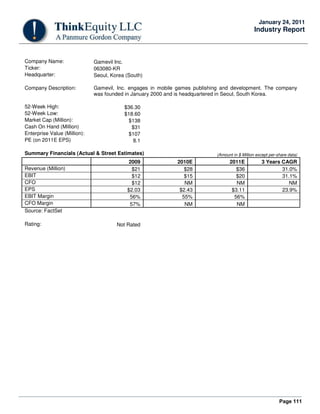
  • 20.
    Page 20 January 24,2011 Industry Report Definitions Digital Goods By digital goods, we refer to items that users can buy in the virtual environment that may be a replacement of items from the physical environment such as books, music, software, games, images, and videos. The cost of goods for digital goods would be significantly higher than that of virtual goods, given there may be royalty and development. The main difference between digital and virtual goods is that digital goods may be available in non-digital format (or non-virtual) as well, such as books, DVDs, while virtual goods are available in digital format and may not be used in the real environment at all. While we acknowledge that some may want to include digital goods (or some digital goods) in their definition of virtual goods, we are not including digital goods in our definition of virtual goods for the purpose of this report. Exhibit 21: Examples Of Digital Goods Source: myamericanperspective.com, Apple, Amazon.com Virtual Goods Virtual goods refer to the items that a user can buy in a virtual environment that may not have use in the physical environment. Cost of goods for these items may be close to zero unless there is a royalty associated (such as for branded virtual goods). The main characteristics of the virtual goods are (a) they are available only in digital format, (b) may be sold digitally online, and (c) should have contextual meaning. We define two main categories of virtual goods - Vanity Virtual Goods such as gifts or decorative items. The driver for vanity goods is often self-expression either aimed for a specific person or, in most cases, to a large group. While some people may be baffled with the concept of spending real cash on a virtual item, we equate buying behavior of vanity virtual goods the same as that for luxury branded goods. Just like people who want to express themselves in the real world are willing to spend extra dollars for a branded good, people who are comfortable expressing themselves in the virtual world will be comfortable spending on virtual goods. - Functional Virtual Goods such as performance accelerators (consumables or long lived). Functional virtual goods are items that a player may need to advance level in a game. Since people have already been trained to pay for non- tangible products (downloaded games, digital music, ebooks), spending on functional virtual goods was an easier first step toward virtual goods. In addition, a large underground market for World of Warcraft’s gold already reflects on the people’s propensity to pay for virtual goods and also has trained gamers to pay for functional virtual goods, in our opinion. Exhibit 22: Virtual Goods
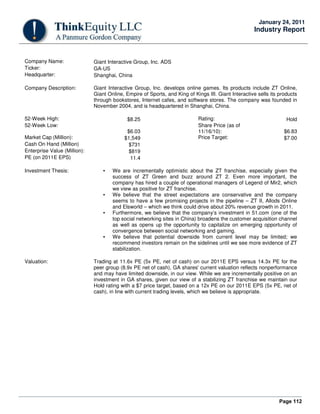
  • 21.
    Page 21 January 24,2011 Industry Report Zynga (http://farmvillefreak.com), Sulake (http://www.viralblog.com)
  • 22.
    Page 22 January 24,2011 Industry Report Why Do People Buy Virtual Goods? "But what...is it good for?" Engineer at the Advanced Computing Systems Division of IBM, 1968, commenting on the microchip. We believe that people buy virtual goods for the same reasons people buy physical goods. Self Expression in the Virtual World Similar to people who are comfortable spending on luxury brand items to express themselves in physical environment, virtual inhabitants are comfortable spending real dollars to express themselves in their virtual environment. Self expression through virtual items becomes even more important in the virtual environment, given that the users cannot express themselves through emotions/body language in a virtual environment. To make up for that issue, users can buy virtual goods to express themselves either through dressing up their avatar, changing physical attributes of the avatars (hair color, eye color, body type etc.), or decorating their virtual space. Exhibit 23: Self Expression In Virtual World Source: LOLApps, IMVU (http://blog.tapjoy.com) Socializing/Flirting/Gifting One of the primary reasons users join a virtual world is to socialize, to make new friends and/or to flirt. While users cannot express their feelings to others via body language or facial emotions, they can achieve the same through gifting virtual items. Most discovery-focused social networking sites offer features like “wink,” “smile,” and gifts like virtual flowers, birthday cakes, etc. Exhibit 24: Socializing Or Flirting In Virtual Environment Source: http://www.flytrapgames.com, Zoosk (http://blog.zoosk.com)
  • 23.
    Page 23 January 24,2011 Industry Report To Gain Competitive Advantage The third common reason (and the biggest reason in terms of dollar sales from virtual goods) why people buy virtual goods is to gain competitive advantage through improving performance or features, in our view. For video game players, the goal is usually to beat another player or system and advance level. Through virtual goods, users can acquire more powerful weapons, potions that temporarily increase defense/attach a mechanism to defeat opponents and help advance level. Exhibit 25: Virtual Goods To Gain Competitive Advantage Source: Zynga, Perfect World
  • 24.
    Page 24 January 24,2011 Industry Report Why Are We Excited About Virtual Goods Business Model? "This 'telephone' has too many shortcomings to be seriously considered as a means of communication. The device is inherently of no value to us." Western Union internal memo, 1876. My “love affair” with micro-transactions started long before I had heard of virtual goods, long before I played online games, heck, long before even I knew much about the Internet. In the late 80s and early 90s, we saw a revolution happening in the consumer goods space in India. We saw the consumer goods vendors' ability to grow the market multi-fold by reducing accessibility barriers, by offering products in smaller byte size, or as we call them now, micro-transactions. Without passing any judgment on right or wrong, the sale of flavored chewing tobacco (gutkha) grew multi-fold within just a couple years after packaging innovation made it possible to sell gutkha in 5 grams pouches for about $0.01 (1/20 th the cost of previously available packs) and brought it within reach of the mass market. Similarly, the shampoo market grew after the small one use packs were made available for as little as $0.01, within reach of mass markets. I believe that just as innovation in packaging resulted in increased consumption of chewing tobacco and shampoo in India, innovation in the business model (virtual goods) could grow the consumption of video game content for audiences around the world. Exhibit 26: Transformation Of Market By Unit Packs (Shampoo, Chewing Tobacco) Source: http://www.usabilitymatters.org , www.eastwestbazaar.com , www.desistores.net We like the free-to-play virtual goods business model for three main reasons: (a) we believe that the virtual goods model enables perfect price discrimination for customers, (b) we believe that the virtual goods model helps control piracy and build community, and lastly and probably most importantly, (c) we believe that virtual goods model could help publishers enhance the lifetime value of their users.
  • 25.
    Page 25 January 24,2011 Industry Report An Interview With The Chairman & Managing Director Of Multi-Flex Lami-Print Limited We turn to Anil Dang, Chairman and Managing Director of Multi-Flex, one of the largest packaging manufactures in India for some historical perspective. Atul Bagga (AB): Please explain what is Multi-Flex? Anil Dang, Chairman & Managing Director, Multi-Flex (AD): Multi-Flex is the fourth-largest flexible packaging manufacturer in India. Flexible packaging is packaging that is not rigid and usually made from plastic films, aluminum foils, and paper. Some of the applications of flexible packaging material are things like candy wraps, bag of chips. AB: How long you have been in this business, and can you give us some historical perspective on this industry? AD: I have been in this industry since 1987. Since late 80s, the flexible packaging industry in India grew at more than 25% per annum and is currently about the size of $5 billion per year. The industry continues to grow at about 25%. AB: What are the drivers of growth, then and now? AD: Drivers of growth have not changed in the last 20 years. The key growth drivers have been better shelf life, temper proof packaging, better aesthetics, and, most important of all, ability to sell units pack with flexible packaging. Ability to sell unit packs the most important because in India, mass market cannot afford to spend high upfront for bigger packs and rely on unit or single packs that are available at much reasonable prices. AB: Can you talk about a few applications and how that drove the growth for the industry? AD: Sure. A couple breakthroughs were in Shampoo and Gutkha (flavored chewing tobacco). Gutkha and paan masala (mouth freshener) used to be sold in the tin boxes, package size used to 100-200 grams, and it used to cost about Rs.20-30 per box. Unfortunately, spending Rs.20-30 was out of reach for a majority of population, but the manufacturers had no other option to reach the broader audience. Then in mid 1980s, flexible packaging started gaining ground, and it allowed the vendors to pack Gutkha in smaller size, typically 2-5 grams, which they could sell for Rs.0.50-1.00. By offering a byte size pack, all of a sudden, Gutakha was in reach of a mass audience who can easily spend Rs0.50 multiple times a day. Today more than 95% of the Gutkha is sold in unit packs. Gutkha and paan masala (mouth freshener) industry account for almost half of the total flexible packaging industry in India. Similarly, we saw a huge spurt in shampoo industry. Until mid 1980s, shampoos used to be sold in glass bottles, weighing about 200-500 ml that used to sell for Rs.30-50 each. With the advent of flexible packaging, shampoo manufacturers were able to pack shampoo in a single-use sachet, about 5-7 ml that would retail for about Rs.0.50-1.00, which opened the floodgates for shampoo consumption in the country. Before sachet packs, shampoo was considered luxury item, used mostly in the mid- and higher-income users and with single-use pack, vendors were able to penetrate mass markets including rural areas. Today, almost 70% of the shampoo is sold in single-use unit packs. Similarly, we are seeing the same phenomenon in many other consumer industries such as cosmetics, food products, candies and others, basically any consumer item that has appeal for the mass markets. AB: Thank you so much for speaking with us and sharing insights.
  • 26.
    Page 26 January 24,2011 Industry Report Virtual Goods Model Enables Perfect Price Discrimination Unlike fixed fee-based models (such as subscription or outright purchase), the virtual goods model allows vendors to price discriminate their customers by letting players choose the value they assign to the game. By making games free-to-play, vendors are able to attract a larger audience. Players with free time on their hands (like students and cost-cautious players) will spend time/effort to advance levels in the games, while players who need instant gratification of moving up the ladder (like ex-core gamers and core gamers) will rely on virtual goods. While we acknowledge that some of the players who would’ve spent $60 for the game may not spend the equivalent amount in the free-to-play model, we argue that the free-to-play model will encourage some otherwise non-paying players to spend on the game and some hardcore players to spend much more than what they would’ve spent with the fixed fee model. Exhibit 27: ARPU Distribution Curve Of ZT Online, A Free-To-Play Game By Giant Interactive (20) - 20 40 60 80 100 120 140 160 - 500 1,000 1,500 2,000 Users ('000) ARPu($/Month) Source: Company reports and ThinkEquity LLC
  • 27.
    Page 27 January 24,2011 Industry Report Perfect Price Discrimination: Holy Grail Of Producers Pricing Shown on the left is a typical supply-demand curve in a normal functioning market. The demand curve is represented by the red line and the supply curve is represented by the blue line. Equilibrium occurs at a price point where marginal cost equals marginal revenue, i.e., where the demand and supply curve intersect. However, at the equilibrium price point, a number of customers benefit as they only have to pay the market clearing price, which is lower than their perceived value of the goods. The amount that these consumers (with low price elasticity) end up saving is called consumer surplus (represented by the yellow shaded region). Producers use a variety of price discrimination techniques to minimize consumer surplus and maximize producer surplus. Simply speaking, price discrimination suggests that producers can offer the identical goods or services at different prices. The simplest form of price discrimination is used by retailers in the form of discount coupons. With the simplest form of price discrimination, a demand curve is divided into two parts and a higher price is charged to the consumers with low price elasticity while a lower price is charged to consumers with high price elasticity. The “Holy Grail” for the producer is to achieve perfect price discrimination, i.e., charging every consumer the price that he or she is willing to pay, thus fully eliminating consumer surplus. With the marginal cost of virtual goods close to zero, there is effectively no “supply” curve – goods are readily supplied at all price points. Supply Demand Price Quantity Halo 3: Standard Pricing(1) Hardcore gamers could spend incrementally more, if desired Yet Still, Lost Revenue $60 $75 $90 $ Supply Price Quantity Equilibrium Point = All Customers Pay One Price Consumer Surplus = Lost Revenue $ Supply Demand Price Quantity Source: ThinkEquity LLC estimates, respective company Websites
  • 28.
    Page 28 January 24,2011 Industry Report Effective Way To Control Piracy And Build Community Although the lure of converting pirated copies into legal copies by effective anti-piracy measures may seem lucrative, a couple real-life examples suggest that the conversion rates remain insignificant with anti-piracy measures. On the other hand, anti-piracy measures generally cause inconvenience and, thus, user dissatisfaction for legitimate buyers, which risk the popularity of the games. For example, Electronic Arts’ “Spore” was one of the top ranked games at Amazon, but was also a highly pirated game. As Electronic Arts put stringent anti-piracy controls into place, the number of illegal downloads was reduced, but so was the ranking. However, the free-to-play model enables vendors to build community and momentum without worrying about piracy. We believe the question that game vendors will have to answer is, are they willing to sacrifice community around the game and potentially jeopardize the popularity of the game to be able to sell an insignificant number of titles or can they find alternative ways to monetize users who wouldn’t want to pay hard cash for the game? We believe that vendors (especially the newcomers, without the legacy of owned IPs) will be willing to eschew the loss of upfront sale and embrace the alternative monetization models such as virtual goods. Exhibit 28: Userbase Of A Few Top Online Games 0 10 20 30 40 50 60 70 Million World of Warcraft - Global Subscribers TLBB - Registered Accounts Happy Acquarium - MAU Farmville - MAU Source: Company reports, Developer Analytics
  • 29.
    Page 29 January 24,2011 Industry Report Increase Longevity And Improve Games’ Stickiness Unlike a fixed fee game, where players are only putting in effort to advance levels, in the virtual goods model-based games, players advance levels though effort as well as through spending hard cash on virtual goods. And so, with every virtual goods purchase, players are increasing their investment in the game and, thus, increasing switching costs for themselves, increasing the longevity of the games. In addition, the free-to-play model attracts more users (lure of free) and the larger community itself becomes a draw for new players. This was evident in the example of Shanda, a Chinese video game vendor that was able to grow revenue and increase useful life of its games by converting the business model from a subscription model to a free-to-play model. Exhibit 29: Annual Revenue Contribution From Shanda’s Legend Of Mir 2 $0 $50 $100 $150 $200 $250 $300 2004 2005 2006 2007 2008 Year Revenue($million) Source: Company reports (Shaded area represents the game was converted to free-to-play model) Ability To Grow ARPU: The virtual goods model, by definition, delimits ARPU. Unlike the subscription model or outright purchase model where users pay a fixed fee for one-time purchase or monthly (or hourly) subscription, users in virtual goods pay based on their engagement level with the game—the more they are engaged, the more they value the game, the higher their spending is likely to be. The virtual goods model gives vendors the ability to link customers’ perceived value with the price of the game. It’s no surprise then that smart companies can do a perfect segmentation of the market and optimize the price- demand curve of their product. Arbitrage Between Time And Money We believe that virtual goods could offer a significant arbitrage between time and money of the player. Imagine if you started playing a free-to-play virtual goods game while you were in school. You probably had a lot of time on your hands, but may not have had monetary resources, so likely you spent nothing or very little in dollars but you made that up by spending a lot of time on the game. Now fast forward a couple years, you have a job and, arguably, your time commitment for the game has gone down but, at the same time, your disposable income is up. Assuming that you are still passionate about the game, you may not spend as much time as you did when you were in school, but you would now make it up by spending dollars to buy power items to advance levels. You can extend the sequence through the lifecycle of gamers, and with every milestone (job, relationship, family expansion), arguably the player’s time commitment for the game is going down, but if his passion for the game remains intact, she or he can arbitrage time with money.
  • 30.
    Page 30 January 24,2011 Industry Report Exhibit 30: Average ARPPU Of Chinese Gamers - 10.00 20.00 30.00 40.00 50.00 60.00 70.00 80.00 2003 2004 2005 2006 2007 2008 2009 2010 ARPU(US$/Year) Source: Company reports and ThinkEquity LLC
  • 31.
    Page 31 January 24,2011 Industry Report Emerging Trends In Virtual Goods "We don't like their sound, and guitar music is on the way out." Decca Recording Co. rejecting the Beatles, 1962 Virtual Goods On Console During 2009, console games sales were down 10% in the U.S. (according to NPD), down 15% in UK (according to ELSPA), and down 3% in Japan (according to Enterbrain). Interestingly, while console game sales are down, the average console gamer has continued to spend 8-12 hours/week playing games which is in the same range as that in 2009 and 2008, according to a survey by IDC. We postulate that the emergence of online and multi-player games have increased the stickiness of these games on consoles, thus, giving more value to the consumers than before. According to Activision, during the first five months of the launch, Call of Duty: Modern Warfare 2 was played 1.75 billion hours on Xbox Live alone; we estimate that the average user plays online, multi-player Modern Warfare 2 15-20 hours/week. Similarly, Halo Reach was played 12 million hours within three days of launch. While users have been able to stretch the value from video game purchases, video game software publishers have not fully captured their share in the value chain, in our view. While we are encouraged with these companies' more-aggressive DLC strategy, which we believe carries higher margin, lower development costs, and relatively lower risks, we believe that companies will also try to capture more economies in online gameplay of the popular franchises. Virtual Goods On Mobile Consistent with our theme of Multi-channel Games-as-a-Service, we believe that mobile will emerge as an extension of the online world and as such users will exhibit similar trends on mobile as they do on the Web. User-Generated Content We believe that user-generated content could offer wider choices that make sense for users who are looking to express their individuality. On the other hand, managing a user-generated content market and economy could be trickier than managing a vendor generated-content/economy.
  • 32.
    Page 32 January 24,2011 Industry Report Market Size Estimates For Virtual Goods Market "I think there is a world market for maybe five computers." Thomas Watson, chairman of IBM, 1943. We expect the worldwide market for virtual goods to more than triple to $20.3 billion by 2014, up from $6.4 billion in 2009. We expect the growth to be led by emerging markets for virtual goods i.e., U.S., Europe and Japan. We expect the US and European markets to grow at 28% and 25% CAGRs, respectively, largely driven by growth in social games and online free-to-play games. We expect the Japanese market to grow at a 21% CAGR over the next five years, largely driven by the growth on mobile platforms. On the other hand, we expect a relatively matured market for China to continue to grow at 17% CAGR over the next five years, driven largely by rising Internet penetration, especially in the rural regions, and expect Korean markets to grow at a relatively modest rate of 11%, driven largely by a continued shift in the video game consumption from a subscription-based to a virtual-goods-based model. We also expect strong growth in emerging regions (such as Brazil, Russia, India), which will grow at a 36% CAGR over the next five years, largely driven by rising Internet penetration in these regions. Exhibit 31: Worldwide Virtual Goods Market Size Estimates By Region (US$ Million) 2009E 2010E 2011E 2012E 2013E 2014E CAGR (2010E-2014E) China 2,834 3,475 4,283 5,077 5,826 6,450 17% Europe 729 1,443 2,073 2,759 3,145 3,513 25% Japan 888 1,341 1,944 2,287 2,603 2,862 21% South Korea 890 971 1,109 1,250 1,361 1,478 11% U.S. 738 1,483 2,220 3,062 3,516 4,010 28% Rest of World 297 567 947 1,356 1,652 1,961 36% Total Virtual Goods 6,375 9,280 12,577 15,791 18,101 20,274 22% Source: ThinkEquity LLC Estimates Exhibit 32: Worldwide Virtual Goods Market Share By Region 0% 20% 40% 60% 80% 100% 2009E 2010E 2011E 2012E 2013E 2014E ROW Korea Japan Europe US China Source: ThinkEquity LLC Estimates
  • 33.
    Page 33 January 24,2011 Industry Report In terms of platform, we believe that online (off-social networks) will maintain the dominant share of the virtual goods markets, given the sizable markets and growth potential in China and Korea and emerging potential for MMOs in the Western World and emerging markets. We estimate online virtual goods markets (excluding social games) to grow at a 14% CAGR to reach $10.7 billion by 2014, up from $6.3 billion in 2010. We expect the virtual goods on social networks to grow at 29% CAGR to reach a $5.0 billion market worldwide by 2014, up from $1.8 billion in 2010. We expect the fastest growth in virtual goods to come from mobile game markets, driven by a continued strong growth momentum in mobile social games in Japan and growth in the U.S. and Europe. We expect mobile virtual goods to grow at a 39% CAGR over the next five years to reach $4.6 billion by 2014 up from $1.2 billion in 2010. Exhibit 33: Worldwide Virtual Goods Market Size Estimates By Platform (US$ Million) 2009E 2010E 2011E 2012E 2013E 2014E CAGR (2010E-2014E) Online (off-Social Networks) 4,883 6,292 7,670 9,083 9,985 10,735 14% Social Network 873 1,774 2,665 3,645 4,270 4,986 29% Mobile 620 1,213 2,242 3,062 3,846 4,553 39% Total 6,375 9,280 12,577 15,791 18,101 20,274 22% Source: ThinkEquity LLC Estimates Exhibit 34: Worldwide Virtual Goods Market Share By Platform 0% 10% 20% 30% 40% 50% 60% 70% 80% 90% 100% 2009E 2010E 2011E 2012E 2013E 2014E Mobile Social Network Online (off-Social Networks) Source: ThinkEquity LLC Estimates
  • 34.
    Page 34 January 24,2011 Industry Report Chapter 3: Social Games "The wireless music box has no imaginable commercial value. Who would pay for a message sent to nobody in particular?" David Sarnoff's associates in response to his urgings for investment in the radio in the 1920s. Social games bring a fundamental shift in video game—away from a single player shooting aliens or killing monsters to a fun activity where one is playing with one’s real life friends in a virtual environment. Social games enables players to play against their real life friends and provide a place to hang out in a game environment, thus, taking the games back to their roots as fun activities. We believe that social networks have been the “hottest” trend in the 21st century, exhibiting the fastest growth of any media. According to Nielson, more than two-thirds of online users have participated in a social network over the past year, and we expect this number to continue to rise. The trend is not limited to the young users anymore, and people ages 35-54 years have shown the highest growth of any demographics, according to the user demographic statistics by Facebook. Despite significant size, strong community, and solid ecommerce platforms, most social networks have struggled with monetizing their users. Most social networks have traditionally relied on banner and text ads for user monetization; however, given low conversion rates (less than one-tenth of a percent), display ad rates for most social networks hover at about $0.10-0.25 CPM (cost per thousand impressions). We believe that online games provide a natural way for social networks to monetize users through in-game advertising and, more importantly, through virtual goods sales. We believe that not only will games help social networking sites monetize their users, but they will also help to increase the stickiness of these social networking sites.
  • 35.
    Page 35 January 24,2011 Industry Report Why Are We Excited About Social Games “With over 50 foreign cars already on sale here, the Japanese auto industry isn't likely to carve out a big slice of the U.S. market.” Business Week, August 2, 1968. “For the first time ever, we're letting them [users] engage in games with their real friends in their real social networks. Gaming is a fundamentally social experience, not a single-player experience, and not a technology experience. We are bringing gaming back to its roots.” Mark Pincus, Founder & CEO, Zynga “Today, audiences want to be connected. They expect games to have a strong social component and they want the ability to customize and express themselves through their entertainment experiences.” Bobby Kotick, CEO, Activision-Blizzard Broadening Market To Include Non-Gamers “Target customer is anybody who lives inside the social networks….Facebook has users from 13 to 80 years old and it has equal distribution between men and women…In our markets we have 300-plus million people on Facebook alone….While hardcore gamers, like a World of Warcraft have limited reach, games like a Maple Story or a Mobsters 2 or a Sorority Life game reach much broader demographics.” John Pleasants, CEO, Playdom We believe that similar to the Nintendo Wii, which broadened the console game audience to families from mostly males, social games further broaden the game market to include non-gamers. Today’s generation is connected on social networks. According to comScore, more than two-thirds of Internet users are also on social networks, and the number is still growing. The popularity of social networking sites is not just limited to the Y generation, more and more people 35 years of age and older are joining these social networks. The latest statistics regarding Facebook users show that the number of users in the 35-54 years of age population has increased 10x versus 88% growth for the 18-34 years of age group since October 2007. Not only are more people joining these social networks, but they are also spending more time on these social networks. According to Hitwise, the average user is now spending approximately 27 minutes/day, up 71% Y/Y. We believe the reach and the demographic of users on these sites make social networks fertile ground for game vendors to acquire users, build awareness, and create buzz through viral marketing. Viral Marketing “Over 95% of our growth is viral. In fact, when we launched our first title a year ago, we started by inviting 100 of our own friends and we've grown from there to over 60 million registered players across our games organically.” Kristian Segerstrale, CEO, Playfish For online game vendors, social networks offer an inexpensive way of marketing their games to new users and improve stickiness through viral distribution. We believe that social networking sites level the playing field for small developers to compete with large companies like Electronic Arts (recall the success of Scrabulous, developed by two brothers in remote corners in India, which became a rage on Facebook through viral marketing). For social networking sites, games provide an easier way to monetize their users, in our view. Despite significant size, strong community, and solid ecommerce platforms, most social networks have struggled with monetizing their users. With ARPU hovering in the $0.10-0.25/month range for most social networks versus as high as $150/month for some online games, social networks do look under-monetized. Most social networks rely largely on banner and text ads for user monetization, but, given low conversion rates (less than one-tenth of a percent), display ad rates for most social networks hover at about $0.10-0.25 cost per thousand (CPM) versus as high as $35 for video ads and $8 for display ads for in-game advertising. We believe that online games provide a natural way for social networks to monetize users through in-game advertising and, more importantly, through virtual goods sales.
  • 36.
    Page 36 January 24,2011 Industry Report Games can also help social networking sites strengthen community bonding among their users. We believe that not only will games help social networking sites monetize their users, but they will also help to increase the stickiness of these social networking sites. Games are known to bring communities closer, to encourage user interaction and active participation (e.g., more than two million user-generated content on Spore, and more user- generated content on Halo than YouTube videos produced in a month), which is the lifeblood for social networking sites. Broadening The Monetization Potential Beyond “Level-Up” To Self Expression By including real-life friends in the gameplay, social games are not just about achievement bragging-rights but also about self-expression and thus allow vendors to tap into not just the wallet share for games but also wallet share of expression. We believe that just as people are comfortable buying the luxury goods to express themselves in the physical world, the connected generation will be comfortable spending on virtual goods in the virtual environment. Exhibit 35: Video Game Versus Expression – Market Size For Video Game And Luxury Goods 0 50 100 150 200 250 $Billion Video Game Luxury Goods Source: Bain & Company, PWC
  • 37.
    Page 37 January 24,2011 Industry Report What Have We Seen So Far? "Airplanes are interesting toys but of no military value." Marechal Ferdinand Foch, Professor of Strategy, Ecole Superieure de Guerre, 1911 Strong Growth In Social Games Being Driven By Facebook We estimate that social games revenue grew 5x in 2009 and again doubled in 2010, largely driven by a strong growth in social games on Facebook. Facebook usage has gone up from 150 million to about 500 million over the last couple of years, according to Facebook. At the same time, penetration of games within Facebook users has grown substantially over the last 12-18 months—with over 40% of Facebook users regularly playing games, according to data from Developer Analytics. Social games maintained their strong momentum and social games usage on Facebook grew 23% over the last 12 months, despite a 25% drop in usage immediately after the policy changes at Facebook that negatively impacted acquisition and retention rates (according to Developer Analytics). Exhibit 36: Top Social Games Companies On Facebook By Daily Active Users (DAU) Oct-10 Oct-09 May-09 Zynga 46.9 47.1 6.7 Playfish 8.4 12.1 4.7 Playdom 6.1 1.9 0.4 Crowdstar 5.9 4.0 0.2 PopCap Games 4.3 2.8 0.6 Booyaa 3.1 6 Waves 2.7 Digital Chocolate 2.7 Moment of Truth 2.2 MindJolt 1.9 RockYou 1.9 Wooga 1.8 Happy Elements 1.6 Metro Games 1.4 Pencake 1.4 ELEX 1.3 Cie Games 1.2 iWin 1.1 ZipZip Play 1.1 Country Life 1.1 Slashkey 1.0 5.8 1.8 Ninja Saga 1.0 Nightclub City 1.0 Five Minutes - 1.0 Rawr! Games - 1.8 Serious Business - 1.2 0.4 TallTree Games - 2.1 TwoFishes Interactive - 2.1 0.2 Total 101.1 81.9 15.0 Source: Developer Analytics
  • 38.
    Page 38 January 24,2011 Industry Report Growing Popularity Of Persistent Games Of the top 36 games on Facebook, 31 games were persistent games as of 11/02/10 versus 8 of the top 16 games in April 2009, which reflects on the growing consumer preference toward persistent games, in our opinion. In fact, outside of Zynga’s Poker, none of the mid-session games from last year’s list of top games were able to make it to this year’s top games list on Facebook. Rising Production Value Of Social Games Our conversations with a number of developers suggest that the cost of production of social games has risen multi-fold over the last couple years, mostly driven by toughening competition and the increasing sophistication level of users. We believe that as users will have more choices, social game companies will have to step up investment in the quality of the games (graphics, gameplay, customer service), effectively increasing the production value of the games. Exhibit 37: Rising Production Value Of The Facebook Games Source: Zynga, Allfacebook.com Believe Facebook Single Most Important Destination For Social Games “With our limited resources, we need to pick our battles very carefully. Today, the best platform to develop for is still Facebook given its large market size and low friction of distribution.” Siqi Chen, Founder and CEO, Serious Business (Acquired by Zynga in February 2010) With over 500 million active users, Facebook is a significant platform for publishing games. On the other hand, game developers have not yet found any other credible platform for publishing social games, and given the fast growth of games on Facebook coupled with higher risks associated with new platforms, vendors have focused their efforts largely on Facebook, and we haven’t yet seen any comparable social games platform emerge in the west.
  • 39.
    Page 39 January 24,2011 Industry Report Exhibit 38: Top Social Networking Websites By U.S. Market Share Of Visits (%) 0.00% 10.00% 20.00% 30.00% 40.00% 50.00% 60.00% 70.00% Oct-09 Nov-09 Dec-09 Jan-10 Feb-10 Mar-10 Apr-10 May-10 Jun-10 Jul-10 Aug-10 Sep-10 Facebook MySpace myYearbook Tagged Twitter Windows Live Home Source: Hitwise Rising Cost Of Customer Acquisition “The cost of acquisition has gone up significantly. Some of it is due to notifications and some of it is the rising price of advertising on Facebook.” Kevin Chou, Founder & CEO, Kabam We believe that the cost of user acquisition has gone up multi-fold over the last couple of years, which we attribute to (a) reduced virality of Facebook as a distribution channel, and (b) toughening competition. In March 2010, Facebook closed down the “Notifications” channel for games apps. Historically, Notifications drove a major part of customer acquisition and retention and since the closure of this channel, the usage for most games declined almost 20-25% within a couple months after this change. In order to offset the effect of this channel, vendors had to step up their spending on paid channel of user acquisition. More numbers of vendors with more numbers of games on Facebook coupled with higher spending by these vendors on customer acquisition had a double whammy effect on the cost of acquisition. We have heard that cost of acquisition was as high as $1 per user, up from almost negligible a few years ago. Social game revenue largely driven by virtual goods, in our view. “…advertising is a very different operational focus than creating a great game. Advertisers are still on learning curves about how to interact with gamers, and our teams are set up to create a great gaming experience and not for educating advertisers.” Kevin Chou, Founder and CEO, Kabam While social games are reaching a broad audience and could be an attractive medium for advertisers to reach audiences, most developers have largely relied on direct pay (i.e., virtual goods) as a way to monetize users, which we attribute to (a) developers’ single-minded focus on developing quality games and broaden their audience base, (b) being a relatively new media, standard units for publishing and measuring ads on social games have yet to emerge, and (c) advertisers are still ramping on social media and separate budgets for social media haven’t yet been carved out.
  • 40.
    Page 40 January 24,2011 Industry Report Exhibit 39: Revenue Break-up For A Few Social Game Companies Advertising Virtual Goods - Indirect Payment Virtual Goods - Direct Payment Playdom 5-10% 15% 75-80% Kabam NA 10% 90% Rekoo 10% NA 90% Serious Business 10% 10% 80% Source: CEO Interviews Broad-Based Growth On Facebook Games Unlike the common misconception that social games growth was driven by a few industry leaders, our analysis of the top Facebook games suggests that the growth was mostly driven by long tail vendors. The number of publishers with more than 1 million DAU grew to 28 in October 2010 up from 11 in October 2009 and three in May 2009 and drove 100% growth over the last 12 months as opposed to 3% growth from the top four vendors on Facebook (Zynga, Electronic Arts. Playdom, and CrowdStar). Exhibit 40: Combined MAU Of Social Games From Top Publishers (Million) - 20.0 40.0 60.0 80.0 100.0 120.0 May-09 Oct-09 Oct-10 Publishers With More Than 1 Million DAU Top 4 Publishers (Zynga, EA, Playdom, CrowdStar) Source: Developer Analytics
  • 41.
    Page 41 January 24,2011 Industry Report Emerging Themes In Social Games "The bomb will never go off. I speak as an expert in explosives." Admiral William Leahy, U.S. Atomic Bomb Project. Rise Of Vertical Apps (Niche Games) In Social Networks: While we have already seen the success of horizontal, i.e., casual games (likes of Farmville, Happy Aquarium, Social City, and others), we believe that the opportunity for vertical games (i.e., hardcore games, sports games, and RPG) is emerging. Early response for some of the vertical games (such as ERTS's FIFA Superstar, Kingdom of Camelot) has been very encouraging and likely reflects the potential opportunity for premium games, the mainstay of traditional games companies, in our view. Demand Side “In China, the MMO market started in 2001 with a very simple and cartoon-styled game, "Stone Age." Prior to that game, people had no idea what the MMORPG was but this game enlightened the Chinese players and since then, people started to play MMORPG. I would say the same thing is happening here in the U.S. market and I think that this market will be way bigger than China. Now you see so many players playing Facebook games, and these players evolve. Two or three years ago, they were just poking each others; in 2008, they were playing Mafia Wars; in 2009, they were playing farming games; and moving into 2010, the growth rate becomes lower, probably because players got tired of all the farming and petting stuff, and they're looking for something that is more sophisticated. I'm not sure if they are ready for the MMORPG games. But I would say that, in the next two to three years down the road, they will end up there.” Kevin Xu, Co-founder and COO IGG We believe that Facebook has been a sort of training ground for new users on this relatively new free-to-play business model. Arguably, we think it is fair to say that of the roughly 200 million users who are playing on Facebook, a small majority could be users with gamers instinct i.e., people who “graduate” from playing simple games and demand a more-immersive game experience in social games. Supply Side From the supply side, not only is the cost of customer acquisition rising, the distribution/discovery of applications is becoming incrementally difficult with the changes in Facebook viral channels (notifications, bookmarks). While larger companies that have already built large user bases may have inherent advantage (able to cross-sell their existing users to the new games), new entrants will have to work harder to wow users in order for the discovery/word of mouth distribution. Even from financial feasibility point of view, the cost of acquisition has risen significantly (given the changes in the viral channels and rising cost of ads on Facebook) and it now costs close to a dollar to acquire an active user, and, therefore, the lower ARPU/higher churn apps (typical for the horizontal apps) may no longer be financially lucrative for the newcomers encouraging them to focus on higher ARPU, high engagement, low churn vertical apps. It is, therefore, not a surprise that 9 of the top 50 games are now what we consider vertical games, versus 1 such game within the top 50 a year ago. Given that by definition, vertical games would attract a niche audience and, therefore, don’t compare well with horizontal application in terms of the usage or MAU. However, given the higher monetization with these games, we believe that the revenue break-up of Facebook games may be even more skewed toward vertical games now versus a year ago.
  • 42.
    Page 42 January 24,2011 Industry Report Exhibit 41: Top Games On Facebook By MAU As On 11/02/2010 (Million) Game Developer MAU Rank Oct-10 Oct-09 Apr-09 Oct-10 Oct-09 Apr-09 FarmVille Zynga 60.6 59.0 NM 1 1 NM Texas HoldEm Poker Zynga 35.9 18.2 12.3 2 8 7 Frontierville Zynga 31.2 NM NM 3 NM NM Café World Zynga 22.2 15.9 NM 4 10 NM Mafia Wars Zynga 21.7 25.9 9.5 5 3 9 Treasure Isle Zynga 15.5 NM NM 6 NM NM MindJolt Games MindJolt 13.3 14.9 3.2 7 11 31 Happy Aquarium CrowdStar 13.1 12.4 NM 8 12 NM Pet Society Playfish 12.8 19.9 10.6 9 5 8 Bejeweled Blitz PopCap Games 12.0 8.3 NM 10 17 NM Petville Zynga 11.8 NM NM 11 NM NM Millionaire City Digital Chocolate 10.2 NM NM 12 NM NM Restaurant City Playfish 9.7 16.6 NM 13 9 NM Happy Pets CrowdStar 9.2 NM NM 14 NM NM City of Wonder Playdom 9.0 NM NM 15 NM NM YoVille Zynga 7.6 19.5 5.3 16 6 18 Games GSN 7.4 NM NM 17 NM NM Zoo World RockYou 7.1 NM NM 18 NM NM FishVille Zynga 6.9 NM NM 19 NM NM Nightclub City Nightclub City 6.7 NM NM 20 NM NM Happy Island CrowdStar 6.3 NM NM 21 NM NM Family Feud iWin 6.1 NM NM 22 NM NM Kingdoms of Camelot Kabam 6.0 NM NM 23 NM NM Ninja Saga Ninja Saga 5.8 NM NM 24 NM NM Social City Playdom 5.6 NM NM 25 NM NM Car Town Cie Games 5.4 NM NM 26 NM NM Hotel City Playfish 5.3 NM NM 27 NM NM Baking Life ZipZapPlay 5.0 NM NM 28 NM NM Bubble Island Wooga 4.9 NM NM 29 NM NM Fashion World MetroGames 4.8 NM NM 30 NM NM Zoo Paradise CrowdStar 4.7 NM NM 31 NM NM Country Life Country Life 4.4 NM NM 32 NM NM Farm Town Slashkey 4.1 18.7 NM 33 7 NM Wild Ones Playdom 3.9 NM NM 34 NM NM EA SPORTS FIFA Super Stars Electronic Arts 3.7 NM NM NM NM NM Madden Superstars Electronic Arts 2.4 NM NM NM NM NM Source: Developer Analytics Bolded font represents games that were launched after our previous whitepaper, “The Emergence of Games-as-a- Service” published on 05/04/09.
  • 43.
    Page 43 January 24,2011 Industry Report Social Games Beyond Facebook “Platforms like Facebook and iPhone were not built for games but games took off on these platforms. This idea of creating games on platforms that aren't built for games can be a really challenging one. For the social games industry to grow and achieve its full potential, we need platforms that are designed for games.” Kevin Chou, Founder & CEO, Kabam We believe that the popularity of social networks in general and that of social games reflects players wanting to play games with their friends/families and also use games as a way to express themselves, their feelings toward others and also as bragging rights. We believe that just like how people want to stay connected with their friends on social networks, players want to stay connected with their friends on virtual worlds/game environments too. We believe this convergence makes sense not only for non-gamers who see games as another way to stay connected, but also for the casual gamers who may want to use the same avatar on all platforms and even for core gamers who may want to track their guild activities (across platforms). We have already seen games like Activision’s “Blur” that uses a Facebook plug-in to help console users publish their achievements/pictures from the game to Facebook. Fast forward, and we now expect to see games built from the ground up for the socially connected generation and expect the lines between virtual and real environment to start to blur (e.g., how about a mission in a virtual environment to save your real-life friend? How about hanging out/playing arcade/music/dance game at a virtual version of real-life bar that you go to with your posse?). We believe that there may be room for another platform for social games, especially a platform that is built specifically for social games. We believe that a platform built specifically for social games may have smaller penetration compared to a all-purpose social platform (such as Facebook), but may yield meaningfully higher monetization for game publishers. We have already seen/heard of a number of developments around the next-gen platform for social games, e.g., MySpace and Hi5 changing the focus of their all-purpose social platforms to entertainment/games focused platforms, Yahoo! Games and MSN Games adding social feature on their online-games platform, and Google trying to build a social platform. Exhibit 42: Social Network Users During 2009 – Facebook Versus Others - 100.0 200.0 300.0 400.0 500.0 600.0 700.0 800.0 US Europe Asia Facebook Others Sources: Business Insights, Company Websites, Insidesocialgames & DIMG Strategy
  • 44.
    Page 44 January 24,2011 Industry Report Exhibit 43: Social Networks Worldwide By Active Users - 2009 - 50.0 100.0 150.0 200.0 250.0 300.0 350.0 400.0 Facebook QQ MySpace Friendster Orkut Hi5 Twitter 51.com Linkedin WindowsLive NetLog Sonico Bebo Badoo RenRen Cyworld Mixi Kaixin Maktoob Vkontakte.ru Skyrock VZGroup Odnoklassniki.ru DeNA Splinder Gree Tuenti Mail.ru Xing Sources: Business Insights, Company Websites, Insidesocialgames & DIMG Strategy
  • 45.
    Page 45 January 24,2011 Industry Report Improving Monetization of Social Games We expect to see strong growth in monetization of social games driven by rising conversion rates (from playing users to paying users) and improving monetization of non-paying users. Rising conversion rates In the Western world, the conversion rate for free-to-play online games ranges from 1% to 3% for most social games, in our estimate. We believe that the conversion rate for social games has the potential to grow meaningfully driven by (a) rising awareness of the virtual goods model, (b) increasing sophistication of game publishers to drive user engagement and monetization, (c) sophisticated analytics and product recommendation engines, and (d) widening penetration of payment mechanisms designed specifically for virtual goods purchases. How much could the conversion rate grow for social games? Given that social games is a relatively newer market and therefore may not have the appropriate benchmarks, we turn to a slightly more mature free-to-play market, hardcore online MMOs, for benchmarking to find the answer to the question. In the Western world, conversion rates for MMO range between 3% and 10%, less than half of that in the Asian countries (China, Korea, Japan) where conversion rates could range from 8% to 20%. We believe that the discrepancy in the conversion rate between Asian markets and Western markets could be explained by a number of factors, including gaming culture (more prevalent gaming culture in Asia), availability of alternative entertainment options (fewer options in parts of Asia), and lastly and most importantly, in our opinion, the maturity of the free-to-play markets (free-to-play online games markets are much more mature in Asia than in the West). We believe that as the Western free-to-play markets start to mature, the conversion rate could get closer to that in Asia, i.e., the conversion rate for Western world MMOs could almost double. Extending this logic (impact of maturing of markets on conversion rates) to social games*, we believe that conversion rates for the social games in the Western world could also double as the markets mature (users, game publishers, game eco-system). We believe that the following could be drivers for growing conversion rates for social games: 1. Users: We believe that a growing awareness and acceptance of the virtual goods business model within users will drive higher spending on virtual goods. Especially, we believe that the younger generation, who is comfortable expressing themselves in virtual environments, could be relatively more comfortable spending money on virtual goods either to express themselves or as gifts for the like-minded. 2. Publishers: We believe that in the early stages of social games, most publishers were largely focused on building games and growing audience and not so much on growing monetization. As the markets mature, we expect to see publishers focus more on growing monetization by applying collective learning from their previous games to their new games to drive engagement, and virality. We expect to see an increasing role of third-party analytics and recommendation platforms (such as Kotangent, Turiya, Buzzient) in helping improve publishers’ understanding of consumer behavior and driving engagement and monetization. 3. Payment mechanisms: In our conversations with games publishers, we have heard that they have been able to raise their monetization every time they integrated a new payment mechanism. Given that the popularity of a payment mechanism for online games varies by regions/countries (e.g., prepaid cards are the dominant payment mechanism in Asia, Credit Cards/Paypal are popular mechanisms in the U.S., Online Debit in parts of Europe, Kiosk payments in Russia and mobile payment in South America), the availability of a wider range of payment mechanisms could drive users’ accessibility to pay within virtual environments and drive monetization. In addition, given that virtual goods purchases are largely impulse purchases, we believe that a seamless payment method with minimal friction could reduce drop-off rates and raise monetization rates. Lastly, we believe that a dominant or universal virtual currency (such as Facebook Credits) could also help drive users’ propensity to spend on social games (by enabling users to try spending on new products with the same universal wallet/currency). Improving monetization of non-paying users While historically, direct paying users contributed the majority of revenue, we expect to see meaningful revenue growth by monetizing non-paying users. We are particularly excited about the video ads and the alternative payment mechanisms
  • 46.
    Page 46 January 24,2011 Industry Report (such as surveys, tasks, offers). Please see the next section, “Evolution of Advertising As A Meaningful Source Of Revenue” for more on this topic. *Note: We don’t expect the conversion rates for casual social games to be in the range of hardcore online games, given our view that hardcore gamers have a higher propensity to spend because of the relatively higher impressive and engaging gameplay of MMO versus that of casual social games.
  • 47.
    Page 47 January 24,2011 Industry Report Evolution Of Advertising As A Meaningful Source Of Revenue: “Generally in a mature advertising market, for every dollar from somebody who will pay directly for premium content, there is a matching advertising dollar available to sponsor free play for the remaining audience who can't or won't pay. So the rule for valuable content in a mature advertising market tends to converge at 50/50. If you're very high on advertising and low on commerce, that may be an indication that your content isn't perceived as valuable enough for users to pay for directly. Inversely, if you're making most of your revenue in commerce and not advertising, it suggests that you haven't learned how to monetize with advertising.” Alex St. John, President, Hi5 “There's no weakness in advertising when it comes to social. The standards for advertising on social games are evolving rapidly, and advertisers have budget for social, but in many cases the notion of conquering advertising while also driving forward on the game design and micro-currency front is daunting. In most cases, social gaming companies are focusing their efforts trying to nail the "compulsion loop" with consumers. We've found that advertising is the largest stretch for many game developers; it just isn't in their DNA…..We fully expect a significant portion of the $65 billion TV ad market to move to social and free to play gaming.” Mike Peronto, CEO, WildTangent While virtual goods continue to be a major source of revenue for most online games companies, we believe that advertising could become a meaningful revenue source for these companies as the industry matures and as the standards for ad-units, and standards for the measurement of ad-effectiveness start to emerge. We believe that games could emerge as a credible media for advertising for a few reasons: Over Time, Advertising Dollars Match The Usage Pattern Advertisers are bound to follow where the users go, in our view. However, the process may not be very efficient, and it could take some time given the general awareness, establishing credibility and resistance to change. While users’ time started to shift toward online media, it took a long time for advertising dollars to follow the same. Likewise, with users spending more and more time playing games, we expect the advertising dollars to shift their spending toward online games. Lucrative Audience “While most would generally say that the women 35 years and up are usually the easiest to reach on the Internet and monetize efficiently, in my experience young male gamers monetize at very high CPMs because they're very hard to reach, and they are accustomed to spending money on games.” Alex St. John, President, Hi5 Games enable advertisers to reach a broad and lucrative audience. The hardcore video game audience (18-35 year old, male) is generally considered to be a difficult to reach audience and could carry high CPM. Similarly, casual games allow advertisers to reach middle age working moms, another attractive segment. High Level Of Engagement “At the moment, we are seeing a huge interest in video advertising and in virtual gifting. I see a shift where people are moving away from the old advertising metrics and they are talking about engagement metrics. For example, we ran a Nike campaign 12 months ago and every month people write to us asking when the Nike's sneakers are coming back. There is long tail where the avatars collected those Nike sneakers when the campaign was running, and they are still wearing them. So it's not just simple advertising at that point, it has moved into turning the community into advocates for the products.” John Cahill, CEO, Meez We believe that advertising in games provides meaningfully higher user engagement than typical banner ads. Companies like Kongregate note that the advertisers see increased user engagement with ads on online games compared to the other media.
  • 48.
    Page 48 January 24,2011 Industry Report Market Size Estimates For Social Games "The concept is interesting and well-formed, but in order to earn better than a 'C', the idea must be feasible." A Yale University management professor in response to Fred Smith's paper proposing reliable overnight delivery service. (Smith went on to found Federal Express Corp.) We expect the worldwide social game market to grow more than 3x to over $12.1 billion by 2014, up from $3.7 billion in 2010. We expect social games growth in Japan to be driven by a continued momentum on mobile social games platforms (such as DeNA, Gree and Mixi) and estimate the market to reach $2.7 billion revenue by 2014, up from $1.1 billion in 2010, a CAGR of 25%. In the U.S. and Europe, we expect the growth to be driven by higher monetization (primarily through the increasing conversion rate from non-paying users to paying users) and emergence of the mobile social games platform (such as Facebook on mobile, Apple Game Center, Open Feint, Plus). We estimate the U.S. social market size will grow to $3.4 billion by 2014, up from about $1 billion in 2010, a CAGR of 36%. During the same period, we estimate the European social game market will grow to $2.7 billion, up from $900 million, or a 32% CAGR. We expect the Chinese social game market to be driven by rising Internet penetration, more core game launches on social platforms (such as Q Zone, Renren, Kaixian001), which we believe will drive up the conversion rates and ARPPU. We estimate the Chinese social market size will grow to $1.7 billion by 2014, up from about $300 billion in 2010, a CAGR of 50%. For the rest of the world, we expect the market growth will be driven by rising Internet penetration as well as improving conversion rates. We estimate the ROW social market size to grow to $1.3 billion by 2014, up from about $275 million in 2010, a CAGR of 47%. Exhibit 44: Worldwide Social Game Market Size By Region ($ Million) 2009E 2010E 2011E 2012E 2013E 2014E CAGR (2010E-2014E) China 91 328 706 1,060 1,347 1,677 50% Europe 394 903 1,405 1,965 2,365 2,745 32% Japan 724 1,111 1,767 2,094 2,416 2,719 25% South Korea 37 54 110 182 241 309 55% U.S. 412 989 1,614 2,355 2,828 3,350 36% Rest of World 97 274 505 769 1,015 1,272 47% Total Social Games 1,756 3,659 6,107 8,425 10,213 12,071 35% Source: ThinkEquity LLC Estimates Exhibit 45: Worldwide Social Game Market Size By Region 0% 20% 40% 60% 80% 100% 2009E 2010E 2011E 2012E 2013E 2014E Rest of World South Korea China Japan Europe US Source: ThinkEquity LLC Estimates
  • 49.
    Page 49 January 24,2011 Industry Report While we expect to see stronger growth in advertising revenue for social games over the next five years, as the companies start to focus on monetizing users (not just user acquisition) and also with emerging standards for ad units and measurement on social games, we believe that a majority of social game revenue will continue to be driven by virtual goods. We estimate that advertising revenue on social games will grow at a 39% CAGR over the next five years versus 34% CAGR for virtual goods on social games. Exhibit 46: Worldwide Social Game Market Size By Monetization 2009E 2010E 2011E 2012E 2013E 2014E CAGR (2010E-2014E) Virtual Goods 1,493 2,988 4,907 6,707 8,116 9,539 34% Advertising 263 672 1,199 1,718 2,098 2,532 39% Total 1,756 3,659 6,107 8,425 10,213 12,071 35% Source: ThinkEquity LLC Estimates Exhibit 47: Worldwide Social Game Market Share By Monetization 0% 10% 20% 30% 40% 50% 60% 70% 80% 90% 100% 2009E 2010E 2011E 2012E 2013E 2014E Advertising Virtual Goods Source: ThinkEquity LLC Estimates
  • 50.
    Page 50 January 24,2011 Industry Report Chapter 4: Online Games "Ours has been the first, and doubtless to be the last, to visit this profitless locality." Lt. Joseph Ives, after visiting the Grand Canyon in 1861. Online games include a gambit of genres and categories, from causal games to hardcore Massive Multi-player Online (MMO) and everything in between. Casual games are games that are easy to play, require less commitment, and have shorter sessions, like puzzle games, time management games, racing games, arcade games, casual action games, card games, and word games. We think the biggest driver for casual games has been the increased number of connected devices. While core games largely remained confined to the bedrooms of core gamers who owned one or another console, casual games broadened the scope to include just about everyone. Although a large percentage of PC users and mobile phone users may not identify themselves as gamers, various studies suggest that most of these users often indulge in some form of game play on their PCs and/or phone (mostly casual games). Casual games open up the target market to about two billion Internet users (according to Internet World Stats), and more than five billion mobile subscribers (according to International Telecommunication Union)—numbers that dwarf the target market for core games, limited to a population of about 160 million consoles (according to VGChartz). Massively Multi-player Online games are played between thousands of players and are generally targeted toward core gamers. MMOs can range from role-playing-games (MMORPG), to first-person-shooter games (MMOFPS), real-time strategy games (MMORTS), sports games, and racing games. MMOs became immensely popular amongst Asian gamers because of the affordability and, in some cases, government regulations on availability of consoles, in our view. Another big catalyst for MMO games happened in early 2000, when some of the Asian companies started to experiment with the free-to-play model to revive interest in some of the old catalog games. The idea of free-to-play games is that players can play the game for free and pay smaller amounts to customize their avatar or to buy virtual weapons, maps, more levels, or new cars that enhance their game play. The free-to-play model gave a new lease to some of the old and dying games, and has now emerged as the dominant model for MMO in Asia, in our opinion. Exhibit 48: Broad Categories And Target Audience Of Online Games CORE GAMESCORE GAMES ADVANCED CASUALADVANCED CASUAL GAMESGAMES CASUAL GAMESCASUAL GAMES AdventureAdventure ArcadeArcade WordWord CardCard SimulationSimulation SportsSports PuzzlePuzzle MusicMusic Time Mgmt Time Mgmt ActionAction MMORPGMMORPG StrategyStrategy BoardBoard RacingRacing ShootingShooting Martial Arts Martial Arts Fantasy/ Action Fantasy/ Action Teens/Young MaleTeens/Young Male Kids/Kids/TweenTween FemalesFemales Source: ThinkEquity LLC
  • 51.
    Page 51 January 24,2011 Industry Report Demand Drivers For Online Games "There is not the slightest indication that nuclear energy will ever be obtainable. It would mean that the atom would have to be shattered at will." Albert Einstein, 1932 Online Games Opens Up Much Broader Market: Ubiquity Of PCs And Internet Personal Computers are everywhere—home, work, during the commute on public transit, on vacations, on business trips, on airplanes, and at airports. In contrast, consoles are mostly available at homes. The total population of PCs has already surpassed the one billion mark and is expected to reach two billion by 2014, according to Gartner. The Internet has even deeper penetration with almost 2 billion users worldwide and is expected grow at 15-18% over the next three years (according to Internet World Stats). On the other hand, the worldwide console population is estimated at about 160 million (330 million for the current and previous generations combined), according to VGChartz. Even within the U.S., the number of Internet users (at about 250 million) far exceeds video game console installed base of 48 million (according to Internet World Stats and VGChartz). PC games not only opens up a bigger market, but it also expands the usage beyond the home. Players are not limited to playing games only within their living rooms, but now, players can have the same gaming experience during breaks at work or in a hotel room while traveling. Exhibit 49: Internet Users Far Outnumber Video Game Console Users - 200 400 600 800 1,000 1,200 1,400 1,600 1,800 2,000 million 1996 1998 2000 2002 2004 2006 2008 2010 Consoles Installed Base (Two Most Recent Generations) Internet Users Source: VGChartz, www.Internetworldstats.com With recent advancements, we believe technology is not a barrier anymore. Not only are PCs almost everywhere, but today’s PCs are powerful game machines. Historically, there has been a large gap between PC hardware and console hardware and, therefore, for a high-quality, 3D gaming experience, someone has to have a dedicated video game console system. The line between PCs and video game consoles has blurred with the recent advancements and democratization of specialty hardware, in our opinion. Today’s PCs are powerful machines capable of playing high-definition 3D rendering, removing the need for a dedicated game console. In addition, increased adoption of online games and falling hardware prices have helped accelerate the pace of innovation in PC game peripheral technology—like a motion sensor controller (similar to that of a Wii remote), which makes the digital experience more real and interactive. In addition, the increasing speed and ubiquity of broadband makes it easy to transfer high-resolution graphics over pipes, enabling gamers to have an immersive 3D experience without noticeable lags. The new technology is now enabling gamers to have immersive 3D experience even within browsers, i.e., without the need for a client download, which should further reduce friction for online games.
  • 52.
    Page 52 January 24,2011 Industry Report Exhibit 50: Sample Of The Immersive 3D Experience With Online Games Source: Company Websites (clockwise from top left): World of Warcraft by Blizzard, Star Wars: The Old Republic by Electronic Arts, League of Legends by Riot Games, and Uberstrike by Cmune Reduced Cost Of Ownership For Consumers If you are like most gamers, you will want to play at least 20-30 different games per year, you will want to own all the major consoles, and you will need to buy a new generation console every three to four years to play these games in their full glories. That works out to an annual spend of about $2,000-2,500 per user on games, which might be out of budget for many gamers. Even more importantly, although the marginal entertainment value of every next game for a user is arguably lower than that of the previous game that he/she owned, the marginal cost remains the same. And, as a result, most gamers end up buying about four to five titles (about $250-300) per year. Since Games-as–a-Service enables players to pay as they go, a player doesn’t have to buy all 30 games (that she wants to play) at $60 apiece. Rather, the user can play all the games only as much as he/she wants to play and pays only for as much as he/she plays. Game companies should benefit as many players, for whom a marginal $60 investment for the 10 th game didn’t make sense, will now be willing to open their wallets for not only the 10 th best game but also for 11 th , 12 th , and all the games that they would not have bought. Avoid Buyer’s Remorse “For the premium [subscription] offer, they [subscribers] play ten different games a month; for the basic offer, they try or play four to five games a month. … They try them, and concentrate on those they really like, which is the interest of this service. Our customers don't have the stress to choose one game among the others in the shelves, which is a bet, because every gamer has made several times the wrong choice. A game is very personal; the packaging does not tell you what is really inside the box, and the game reviews, and friends' recommendations, only limit the risk to make the wrong choice.” Thibaut de Robien, Cofounder of Metaboli And then there is always the case of buyer’s remorse, players getting stuck after buying a game because the game was not really their type. The problem is exacerbated for kids’ games, as these players arguably have a lower attention span. With Games-as-a-Service, players are paying only for their playtime and, therefore, avoid buyer’s remorse. Not only that,
  • 53.
    Page 53 January 24,2011 Industry Report Games-as-a-Service enables the vendors to offer “Try and Buy”—the idea is to offer a free trial for a limited time, and if the player likes the game, he or she can either buy unlimited play or enroll in some other form of game subscription. By offering a free trial, the vendor can cast a wider net and players who otherwise may not have bought the game, may now try the game and eventually convert to become paying customers. Furthermore, since the players have already tried the game before making a monetary commitment, the buyer’s remorse is limited, resulting in fewer returns and fewer customer service calls. Improved Efficiency With Digital Distribution “There's a shift and a disruption going on in the games industry that had for so long relied on producing very expensive, high budget games, and when these big budget games fail, developers go out of business. The times are changing. Now solo game developer and hobbyists can develop a game in their spare time and find an audience through sites like Miniclip and they don't have to get involved in this very complex, hierarchy of distributors and publishers.” Robert Small, Founder & CEO, Miniclip.com In the traditional packaged game distribution channel, since the shelf space is limited, retailers are willing to assign the premium shelf space only to the super-hyped, highly anticipated, AAA games. As a result, most of the smaller or second- tier titles are either left out for non-premium shelf space where they have limited visibility from walk-in customers or, even worse, these titles may not get any distribution deals. This creates a Catch-22 situation for smaller titles—since they don’t have the fire power of a AAA title, they cannot get the premium shelf to get the players’ attention, and since they don’t have the players’ attention, they have even less chance to succeed. Not only that, larger video game companies mostly focus on AAA titles that may appeal to broader mass markets, ignoring the needs for smaller niche markets, which creates inefficiency in the market. Digital distribution by definition breaks the barrier of limited shelf space, which makes the distribution to niche markets financially viable. With digital distribution, vendors can publish titles focused on the smallest of the niche and use guerrilla marketing or viral marketing to reach the desired segment efficiently. Digital distribution may also help expand margin for vendors—as vendors save on the cost of medium, packaging, and slotting expenses. Exhibit 51: Digital Distribution Enables Reaching Out Long Tail Rhapsody Wal-Mart Amazon.com Barnes & Noble Netflix Blockbuster Source: The Long Tail by Chris Anderson Ability To Respond To Changing Consumer Demands “It [online game] is more similar to a Web 2.0 business model than a pure video gaming business. The traditional video gaming business companies are in a retail business where you ship games and then it's a one-off sale until there is a next expansion or sequel. … We have a large number of experienced, dedicated, full-time employees whose job is to interact with our gamers and generate revenues. We get gamers' feedback, their needs and wants and desires, and we funnel that information directly toward our developer and then we update the game on a regular basis.” Joshua Hong, CEO, K2 Networks Video game is largely a hit-driven business, and predicting a hit or miss before a game launch is not an accurate science—it is more of a guessing game. In the traditional video game business model, after a game is launched, there is little that the video game vendors can do to fix issues with the game or make changes based on the users’ response. 735,000 Songs 2.3 mil Books 25,000 DVDs 39,000 Songs 130,000 Books 3000 DVDs
  • 54.
    Page 54 January 24,2011 Industry Report Traditional video game vendors rely a lot on focus group studies and consumer behavior studies conducted during the product development stages and before the game launch. Unlike traditional video game vendors, online game vendors have the ability to make regular updates to their games based on the players’ behavior/demands. Sophisticated game companies spend considerable resources in gathering and analyzing implicit and explicit consumer feedback to update their games, which reduces the risk profile of the business.
  • 55.
    Page 55 January 24,2011 Industry Report Market Size Estimates For Online Games "Stocks have reached what looks like a permanently high plateau." Irving Fisher, Professor of Economics, Yale University, 1929. Excluding social games, we estimate the worldwide online game market will grow to $16.9 billion by 2014, up from an estimated $11.9 billion in 2010. We expect China and Korea to continue to contribute a majority of revenue, driven by rising Internet penetration in China and rising monetization in Korea. However, as a percentage, we expect growth from China and South Korea to grow at 11% and 3% CAGRs, respectively, over the next five years versus 9% worldwide. In the U.S. and Europe, we expect the growth to be driven by an increasing popularity of online and free-to-play games, and we expect these regions to grow at 11% and 12% CAGRs, respectively, over the next five years. For the rest of the world, we estimate a 23% CAGR during the same period, driven largely by a rising Internet penetration in emerging markets (such as Brazil, Russia, India). Exhibit 52: Worldwide Online Game Market Size Estimates By Region ($ Million) 2009E 2010E 2011E 2012E 2013E 2014E CAGR (2010E-2014E) China 3,491 3,923 4,540 5,093 5,648 6,051 11% Europe 915 1,205 1,462 1,730 1,814 1,895 12% Japan 1,172 1,375 1,453 1,524 1,569 1,602 4% South Korea 2,778 3,422 3,558 3,682 3,788 3,894 3% U.S. 1,138 1,385 1,645 1,917 2,011 2,109 11% Rest of World 443 571 796 1,038 1,176 1,323 23% Total Online Games Market 9,936 11,881 13,455 14,984 16,004 16,875 9% Source: ThinkEquity LLC Estimates Exhibit 53: Worldwide Online Game Market Share By Region 0% 10% 20% 30% 40% 50% 60% 70% 80% 90% 100% 2009E 2010E 2011E 2012E 2013E 2014E ROW Japan Europe US Korea China Source: ThinkEquity LLC Estimates
  • 56.
    Page 56 January 24,2011 Industry Report In terms of business models, we expect to see a continued shift in favor of the virtual goods model, which we estimate could grow 14% CAGR over the next five years versus 2% CAGR for the subscription or time-based model. Exhibit 54: Worldwide Online Game Market Size Estimates By Business Model ($ Million) 2009E 2010E 2011E 2012E 2013E 2014E CAGR (2010E-2014E) Free-to-play 4,883 6,292 7,670 9,083 9,985 10,735 14% Subscription and Time Based 5,053 5,589 5,785 5,901 6,019 6,140 2% Total Online Games Market 9,936 11,881 13,455 14,984 16,004 16,875 9% Source: ThinkEquity LLC Estimates Exhibit 55: Worldwide Online Game Market Share By Business Model 0% 10% 20% 30% 40% 50% 60% 70% 80% 90% 100% 2009E 2010E 2011E 2012E 2013E 2014E Subscription and Time Based Free-to-play Source: ThinkEquity LLC Estimates
  • 57.
    Page 57 January 24,2011 Industry Report Chapter 5: Mobile Games "Size matters not. Look at me. Judge me by my size do you?" Yoda, Starwars: The Empire Strikes Back We define mobile games as the games played on mobile phones, and smartphones (not including games played on the handheld consoles like the PSP or the Nintendo DS). Games started making their appearance on the cell phone almost from the time commercial cell phones were launched. The first mobile game was Snake (launched in 1999) that came pre- installed in Nokia phones and has been reportedly played more than a billion times. Exhibit 56: Evolution In Mobile Phones Source: Company Websites (from left to right): Motorola DynaTac launched in 1983; Screenshot of “Snake,” the first mobile game launched in 1999; iPhone (launched in 2007); and Electronic Arts games on T-Mobile G1 aka gPhone launched in 2008 With improving hardware, increasing ubiquity of broadband on mobile devices, and increasing affordability, we believe mobile game is quickly coming to the mainstream in the United States. The audience for mobile games is not just limited to core gamers, but has expanded to include professionals looking for easy stress busters between meetings or while traveling, and teenagers who are now increasingly mobile. Mobile games (such as Snake) can come pre-installed with phones, or can be bought through mobile operators’ e-stores or, more commonly, now from third-party stores (e.g., Apple AppStore). Players can play these games by themselves or they can play against their friends. Games are already the top grossing category on the App Store, contributing 37% of total App Store revenue, according to research firm Flurry. We believe that mobile devices such as the iPhone, iPod, iPad and Android based smartphones will continue to take market share from dedicated portable devices. We expect Nintendo to take back some of the lost market share with 3DS, which is scheduled for launch in early 2011).
  • 58.
    Page 58 January 24,2011 Industry Report Drivers For Mobile Games "While theoretically and technically television may be feasible, commercially and financially it is an impossibility." Lee DeForest, inventor. Ubiquity Of Cell Phones Cell phones can be found almost everywhere. The number of cell phone subscribers in the United States has grown more than 10x to 292 million in 2010 from 28 million in 1995 according to CTIA–The Wireless Association. Worldwide, the number of mobile subscribers has more than doubled over the last five years to 5.3 billion in 2010, according to the International Telecommunication Union. The number of mobile users far exceeds the number of video game consoles (about 160 million for the current-generation consoles, 330 million for the current- and previous-generation consoles combined, according to VGChartz) and the PC population (about 1 billion) or Internet users (about 2 billion, according to Internet World Stats) combined. Exhibit 57: The Number Of Mobile Subscribers Has More Than Doubled In The Last Five Years 0 1000 2000 3000 4000 5000 6000 2005 2006 2007 2008 2009 2010 million Mobile Subscribers Mobile Broadband Users Internet Users Console Installed Base* Source: International Telecommunication Union, NPD Not only do mobile subscribers outnumber PC users and game console users, we believe mobile phones are almost everywhere. While someone cannot carry a console or a PC all the time, a person is almost always carrying a cell phone. Therefore, when boredom strikes, people are more likely to reach for their cell phones for a quick game, which we believe makes the cell phone an attractive candidate as a game console. Mobile Consumers’ Willingness To Interact With Device To Connect With Their Social Graph Worldwide, mobile subscribers are expected to send 6.1 trillion SMS messages in 2010 (up from 4.3 trillion in 2009) according to the ITU World Communication/ICT Indicators Database. Assuming an average price of $0.07, the SMS market size is pegged at $427 billion (according to ITU World Communication/ICT Indicators Database), which we believe reflects on the mobile users’ willingness to interact with their device to stay in touch with their social graph, the underpinning of social games. We believe that strong growth of mobile social games in Japan and a healthy response in the Western market is further validation of our theory that mobile users would want to use social games as a means to stay in touch with their friends and family, which we believe could be a major driver for social games on mobile. Exhibit 58: SMS Sent Per Year Worldwide 2007 2008 2009 2010 SMS Sent/Year (Trillion) 1.8 2.8 4.3 6.1 Value (US$ billion)* 126 198 304 427 Source: ITU World Communication/ICT Indicators Database
  • 59.
    Page 59 January 24,2011 Industry Report Hardware Reaching To Age “The iPhone is the archetype and the inflection point, but Apple alone cannot supply all the demand. Hence, we now have a clone industry making things like the Google Android and many manufacturers and all carriers and channels will get in on the act. It will take a few years to build industry capacity, but we are now officially in the go-go growth phase.” Trip Hawkins, CEO Digital Chocolate Not only are phones becoming ubiquitous, phones are also increasingly becoming more sophisticated. Some of the next- generation phones promise to deliver a gaming experience comparable to that of a video game handheld device (like a Nintendo DS or a PSP) or even that of a game console. Exhibit 59: Next-gen Mobile Phones Source: Company Websites (from left to Right): Apple iPhone, Motorola Droid 2, HTC Max, and Windows 7 Phone We believe that the inflection point in mobile game truly came with the launch of the iPhone. With its 3.5” color screen, multi-touch capability, robust processor, 3-D graphics capabilities, and accelerometer, the iPhone was the first mobile device capable of playing full-fledged games, such as Sim City 3 and Spores. And people have taken note of it. They are using the iPhone as a game device, and they have even ditched their game handheld device in favor of the iPhone. According to ComScore, 32.4% of iPhone users have downloaded a game, compared with a market average of 3.8%. The success of the iPhone has attracted a number of iPhone clones, and also some serious players that are positioning mobile devices as video game players. Increasing Affordability We believe that falling hardware prices plus an alternative revenue model for games make mobile game within reach of the masses. Especially in emerging markets where PC or console penetration is low, mobile devices offer a good game platform and with affordable revenue models (combination of premium subscription, ad supported, virtual goods), mobile game could be one of the cheapest sources of entertainment for a big population. The Asia/Pacific region is already the largest mobile game market, estimated at $2.3 billion and expected to reach $3.4 billion by 2011, according to Gartner. Increasing Broadband Speed On Mobile Devices With increasing wireless data speed on mobile devices, players can easily find and play against their online friends. Increasing broadband speed allows players to play online games with no lags within an immersive 3D environment.
  • 60.
    Page 60 January 24,2011 Industry Report Exhibit 60: Broadband Speedometer Broadband Speedometer – Maximum Download Speeds Wireline 2.5 G Wireless 3G Wireless 4G Wireless Cable Modem 768kbps 30Mbps 56kbps 144kbps 144kbps 384kbps 2Mbps 3Mbps 3.6Mbps 2Mbps Dial-Up ADSL IXRTT GPRS EDGE EVDO UMTS / WCDMA HSDPAEVDO Rev. A WiMAX 20Mbps FiOS 30Mbps 3Mbps 1.5Mbps ADSL ADSL 15Mbps 5Mbps FiOS FiOS NottoScale Source: CTIA Website Easy To Use And Consumer-Friendly eStores For Games We believe that improving the user experience of buying and installing mobile games will drive the adoption of mobile games. Historically, most people played only those games that came pre-installed with the mobile phone, given that the process of installing games on the phone has been pretty complex. Apple changed that with the launch of AppStore, which made the process of browsing, searching, downloading, and installing games very easy and user-friendly. The popularity of the AppStore can be gauged by the fact that since it opened in July 2008, there have already been almost 10 billion applications downloaded (according to Apple) on 120 million iPhone and iPod Touch, i.e., about 83 apps/iPhone. Lucrative Business Model For Wireless Operators And Platform Vendors In our view, video game provides an attractive revenue stream for mobile operators in the form of accompanying sale of data plans and also revenue share with game developers. Although the revenue from video game remains pretty small compared to the overall mobile business, it could start to look as an attractive way to grow a company’s ARPU as it struggles with falling prices and slowing growth. We believe that, not only is the opportunity lucrative for carriers, but that it makes a lot of sense for video game vendors, as the incremental cost of porting existing games on a new platform is minimal and, therefore, incremental profit margins substantial. According to an article in The Wall Street Journal, Simon Jeffery, the U.S. president of Sega said he believes that [despite 30% revenue share with Apple] "games sold via the AppStore are the most profitable in terms of any of the formats.” Emerging Standardized Platforms For Games Historically, non-standardized phones, varied carriers specifications, and multiple operating systems meant that the mobile game companies had to port their games on a number of platforms and support hundreds, if not thousands, of SKUs, which involved significant upfront costs and maintenance costs and stifled innovation. With the emergence of the iPhone (although a proprietary platform, given the high reach of iPhone, it eliminates the need to support multiple platforms to achieve similar penetration), Google Android, and Nokia Ngage, the mobile game market, in our opinion, will concentrate on a few standardized platforms, which should make the job of maintaining and supporting versions of mobile games easier for developers and encourage innovation.
  • 61.
    Page 61 January 24,2011 Industry Report An Interview With The Senior Vice President of Mixi Atul Bagga, ThinkEquity (AB): Can you give us a brief background on your business? Takuya Miyata, Senior Vice President of Global Business, Mixi (TM): Mixi we founded in 1999 primarily as online job- hunting business. We started the social network site in 2004 and within four months, we had over one million users, and then we shifted our focus on social networking services. We started from desktop social networking and moved to mobile. Currently, 70% of our user access our services from mobile phone, mostly feature phone. Out of a total population of 120 million people in Japan, we have over 21 million users and still growing. We opened our platform for the application developers last year, and last year we also launched Mixi social graph. Last year our revenue was $170 million. AB: What's a target audience of Mixi? TM: Our users are mostly 13-30 years old, from metropolitan cities like Tokyo, Kyoto, Osaka, and Kobe; and we have a pretty even break-up between male and female users (male : female = 48.5% : 51.5%). AB: What is your business model? TM: Advertisement accounted for 81% of our revenue in the most-recent quarter. Japanese mobile advertisement market is over $1 billion, and we are one of the biggest mobile Web sites. We offer all kinds of ads—social ads, banner ads and video ads. We work with ad agencies as well as we sell ads directly. About 14% of our revenue came from revenue-share with app developers and about 4% of the revenue came from recruiting service, FindJob!. AB: Can you talk about the effectiveness of mobile ads versus online ads—maybe share any data around click-thru rates or any other metrics? TM: I don’t have the exact numbers, but I can tell you the click-thru rates are much higher on mobile ads. While mobile advertising is a smaller market, about $1.0-1.2 billion versus $3-4 billion for online ads, it is a much-faster growing market than the online ads market. AB: How important is location data to your mobile advertisement strategy? Are you seeing emergence of Groupon-like model using location data? TM: Mixi has a check-in service, which is the biggest location-based services in Japan. But location-based advertisement is quite fragmented and still small right now. There are a couple of companies like Sirious Technology, Afful that have started including location advertisement, but we believe that location-based advertisement could still be a few year away before going mainstream. In terms of the Groupon-kind model, Obaat is working on location-based Groupon-type business in Japan. We think there are challenges to that business given users’ privacy. If a platform like Mixi disclosed location information to advertisers, that's will be is breach of privacy. AB: What do your users do on Mixi platform? Is it mostly about connecting with their real life friends on Mixi, or is it about finding new friends? TM: Mixi is the real-friends connection-based social networking services. Diary has been one of the popular services at the beginning stage of Mixi—people would write almost one page daily and sometime add photos. We added a feature “mixi voice,” in which users can tweet within the lengths of 140 characters and it became a big success. AB: How many total applications you have on your platform, and what kinds of applications are dominant on Mixi? TM: We have over 2,000 application on PC, and 1,000 applications on mobile. Diary is still the biggest application on Mixi. Mixi is also the biggest photo-sharing site in Japan. Last year, we added a few games like farming, pets, and restaurant games, which are available both on PC as well as on mobile. We added a new service called Mixi Connect, which enables connecting and sharing content from other Web sites on Mixi; for example, you can share news stories, or your ecommerce activity or any other activity you do on other Websites by using Mixi Connect. AB: How big is games on Mixi platform in terms of number of games apps and in terms of usage? TM: I don’t have those numbers right now. The biggest game for PC is farming, and the biggest game for the mobile is location-based SimCity-type of game that lets you can build your city based on your GPS location.
  • 62.
    Page 62 January 24,2011 Industry Report AB: You mentioned that 70% of the log-ins are on mobile. What percentage of the users use both mobile and desktop version? Do you enable cross-platform applications on mobile and desktop? TM: Generally, teenagers and younger users use only mobile phone to access our service. Unlike U.S., where even young university students have a desktop in apartment; in Japan university students mostly access Internet through mobile phone. However, professionals and slightly older people use both mobile phone and desktop to access. There are more users using combination of mobile & desktop and mobile-only than those using desktop- only to access. Cross-platform is very important for us—our users can choose to use an app on desktop when they access through desktop or use the same app on mobile. AB: You had mentioned that most of the phones in Japan are feature phones. Do you see that changing? How will popularity of smartphones change the landscape? TM: Unlike rest of the world, we don’t have GSM or CDMA standards for mobile; and again unlike rest of the world, companies like Sharp, Panasonic, Toshiba have big share in mobile market as opposed to companies like Nokia, BlackBerry, or Apple. Further, carriers are prohibited to subsidize the cost of handset, which is pretty common in the U.S. and so the handset prices in Japan are quiet high $500-700 and, therefore, the lifecycle of handsets is more than a year versus a few months. We are now seeing some of the carriers like KDDI, the second-largest mobile phone carrier, shifting to Android; Sharp plans to launch an Android-based handset this year, which will have Japanese functionality, such as e-wallet, mobile TV. Currently, smartphone market share is less than 10%, but we expect just the Android handsets market share at 20-30% in a few years. AB: Do you also offer your own apps besides third-party apps? How do you work with third-party developers? TM: We don’t do any first-party apps; we focus purely on platform. We have open API, but the apps need to be approved before publishing, and we get 20% revenue share with these third-party apps. We offer our own virtual currency that developers can integrate with their apps, but we don’t force developers to use our currency. AB: Do developers make money only by virtual currency or do they also share revenue on advertisement? TM: Developers can make advertisement revenue on Mixi. We have two categories of apps—those focusing on virtual goods, and the other focusing on advertisement. For example, the questionnaire type apps get a lot of page view, but don’t make money through direct-pay from users and so we help them monetize these apps through advertisement. AB: How do you differentiate from companies like Gree and DeNA? TM: Gree and DeNA are mobile only and the game-only portals—you don’t have real friends there, only the game friends i.e., virtual friends. Originally, Gree was a Mixi type of business, but users selected Mixi as a primary social networking and so Gree changed strategy to focus on mobile game portal. We don’t see Gree and DeNA as our competitors. In fact, DeNA is one of our partners. They implemented our Mixi connect plug-in so that DeNA users can import their friends on DeNA and also share information of DeNA games on Mixi. AB: When DeNA is letting their users use Mixi socialgraph and import friends, do you get any revenue share from DeNA? TM: Right now, everybody is looking at virtual goods as a primary revenue source, but we believe that social advertising market could be a pretty big market. We don’t have any revenue share with DeNA, but we see as a new way to promote advertisement. AB: Who do you see as potential competitors? Do you expect Facebook to emerge as a credible competitor? TM: We don’t see Facebook emerging as a meaningful competitor in Japan. In fact, they haven’t done anything in Japan yet. Facebook would face difficulty entering Japanese market because most of the Japanese people don’t speak English and because Japan is a closed market. I think, in a way it is quite similar to Google that has a significant market-share outside Japan but nothing in Japan. The only exception of a U.S. company succeeding in Japan is Yahoo! and that is largely because Yahoo Japan is operated by a Japanese company called Softbank. AB: Can you talk about your global strategy?
  • 63.
    Page 63 January 24,2011 Industry Report TM: Similar to OpenSocial, we are trying to develop a business standard for social networking that will enable a single standard interface for the applications, devices and outside Web sites to connect with social networks. The idea is that developers will have to use only one API and have access to multiple networks. We now have RenRen.com, which is the largest social networking site in China with 150 million users and CyWorld, the largest social networking site in Korea with 24 million users on this standard API. Combined with Mixi, RenRen and CyWorld, developers now have access to 200 million users in Asia with a single set of APIs. We are also seeing a lot of good local social networking companies in Europe and South America, and U.S. and other countries. So together with those companies, we are trying to have a global social networking for local people. AB: How do these APIs work, given that access point for your users is largely mobile and that for CyWorld and RenRen is mostly desktop? TM: Right now, majority of their access to their network is from PC, but mobile is coming in China and Korea and other countries. We will work closely, and we are willing to share our knowhow with others to provide a good service for mobile. AB: What are your thoughts on DeNA acquisition of ngmoco? Should we expect more such deals from Japanese companies? TM: ngmoco is a great company and they did a great job in acquiring mobile players in the U.S. We are optimistic that DeNA will be able to extend its platform in the U.S. as well. Since DeNA is our partner, it is good for Mixi as well. AB: Thank you for speaking with us.
  • 64.
    Page 64 January 24,2011 Industry Report What Have We Seen So Far "Who the hell wants to hear actors talk?" H. M. Warner, Warner Brothers, 1927. Strong Growth Of Games On Smartphone But Decline On Feature Phone After peaking in 2008, the quarterly mobile games revenue growth of the three large mobile games publishers (excluding Japan) declined meaningfully, which we attribute to a slowdown of the game market on feature phones offset by a sharp increase in the game market on smartphones. We estimate that the game market on smartphones (excluding Japan) could grow at 44% CAGR over the next five year versus a 20% CAGR decline in the feature phone game market. Exhibit 61: Quarterly Mobile Revenue ($ Million) And Growth For The Three Top Public Listed Mobile Game Publishers 0 20 40 60 80 100 120 140 Mar-07 May-07 Jul-07 Sep-07 Nov-07 Jan-08 Mar-08 May-08 Jul-08 Sep-08 Nov-08 Jan-09 Mar-09 May-09 Jul-09 Sep-09 Nov-09 Jan-10 Mar-10 May-10 Jul-10 Sep-10 -20% -15% -10% -5% 0% 5% 10% 15% 20% 25% 30% Glu Mobile Gameloft Electronic Arts Q/Q Growth (RHS) Source: Company reports Dominance Of iOS The smartphone market so far has been dominated by Apple. Even more so, the applications market on smartphones is dominated by AppStore. We believe that the three factors for this dominance are: (a) a relatively large installed base of Apple OS, (b) availability of a large number of applications on the AppStore, and (c) a higher propensity of the Apple OS users to download apps are all interlinked and create a virtuous cycle that has favored the Apple platform for mobile Apps.
  • 65.
    Page 65 January 24,2011 Industry Report Exhibit 62: Number Of Apps By Platform 0 50000 100000 150000 200000 250000 Apple AppStore Android BlackBerry Nokia's OviStore iPad App Store Source: Company reports, Androlib Exhibit 63: Daily Downloads (Millions) - 2.0 4.0 6.0 8.0 10.0 12.0 14.0 16.0 18.0 Apple AppStore Android BlackBerry Nokia's OviStore iPad App Store GetJar Source: Company reports, Androlib Exhibit 64: Average Number Of Apps Per Device By Platform 0 5 10 15 20 25 30 35 40 iOS Android BlackBerry Source: Nielsen Mobile As A Standalone, Independent Platform So far, most mobile games have been mid-session games with limited or no presence on other platforms and broken connectivity with other platforms. Of the top 30 grossing applications on Apple AppStore (as of 11/02/10), only one games application, Farmville, is currently operating cross-platform, i.e., users can use the same characters, profile and assets on mobile as well as other platforms—online, social.
  • 66.
    Page 66 January 24,2011 Industry Report Persistent Games Starting To Become Popular, But Mid-Session Continue Games Dominate The Apple Platform Versus Persistent Games On Facebook Fourteen of the top 24 games on Apple App Store are still mid-session games versus 5 of the top 36 games on Facebook. Given the growing popularity of persistent games on social networks (as reflected by Facebook—80% of the top games are persistent games on Facebook versus 50% 18 months ago), we would expect to see a growing popularity of persistent games on mobile devices as well. Exhibit 65: Top Grossing Games Applications on Apple App Store As Of 11/02/2010 Rank Game Price Publisher 2 Angry Birds $0.99 Chillingo 3 Restaurant Story Free TeamLava 4 Cut the Rope $0.99 Chillingo 5 Original Gangstz Free Addmired 6 Angry Birds Halloween $0.99 Chillingo 7 Haypi Kingdom Free Lae Lee 8 Tap Zoo Free Street View Labs 9 City Story Free TeamLava 11 Kingdoms At War Free A Thinking Ape 12 Galaxy on Fire 2 Free FishLabs 13 Farmville Free Zynga 15 Plants vs. Zombies $2.99 PopCap 16 Modern Combat 2: Black Pegasus $6.99 Gameloft 17 Age of Zombies $2.99 Halfbrick 18 Original Gangstz Rock Free Addmired 19 Texas Poker Free Alena Kurulenko 21 Hotel Dash $2.99 Playfirst 22 Tetris $2.99 Electronic Arts 24 The Sims 3 Ambitions $4.99 Electronic Arts 26 Bejeweled 2 $2.99 PopCap 27 Zombie Farm Free The Playforge 28 Fruit Ninja $0.99 Halfbrick 29 Gun Bros Free Glu Mobile 30 Reckless Racing $0.99 Electronic Arts Source: Apple AppStore
  • 67.
    Page 67 January 24,2011 Industry Report Emerging Themes In Mobile Game "It will be years -- not in my time -- before a woman will become Prime Minister." Margaret Thatcher, 1974. Rise Of Persistent Games On Mobile Of the top 30 games on Apple App Store, 10 games were persistent games as of 11/02/10 versus none of the 10 best- selling games in 2009, which reflects the growing consumer preference toward persistent games, in our opinion. The trend is similar to what we see on Facebook (of the top 36 games on Facebook, 31 games were persistent games as of 11/02/10 versus 8 of the top 16 games in April 2009). Mobile Emerging As Extension Of Other Platforms With shifting user preferences toward persistent games, we believe that users will settle to a fewer number of games and will want to enjoy playing or tracking the performance of those games across all platforms—consoles, PC, social networks or mobile. In that sense, we believe that mobile will be an extension of other platforms and not an independent platform. Larger Online Companies Capturing Bigger Market Share On Mobile While the mobile game market on smartphones seems to be dominated by a number of small developers and publishers, we believe that the market will start to consolidate in the not so distant future. We believe that the trend is similar to the evolution of most of the new platforms (e.g., only one of the top 10 games on Xbox Live Arcade published by a large publisher in 2006 versus 6 of the top 10 games published by the large, traditional publishers in 2009), where typically the platform is dominated by the smaller developers at the early stages (likely because the market on the new platform is too small for larger established companies) and as the platform starts to become more meaningful, larger companies make moves to enter the space (mostly through acquisitions). Exhibit 66: Top 10 Selling Games On Xbox Live Arcade – Now & Then 2009 2006 Game Publisher Game Publisher 1 Battlefield 1943 Electronic Arts Geometry Wars Bizzare Creations 2 Castle Crashers The Behemoth Gauntlet Midway Games 3 Trials HD Microsoft Games Smash TV Midway Games 4 Hasbro Family Game Night Electronic Arts Bejeweled II Oberon 5 Shadow Complex Microsoft Games Zuma Oberon 6 Marvel vs. Capcom 2 Capcom Bankshot Billiards PixelStrom 7 Magic: The Gathering Wizards Of the Coast Outpost Kaloki NinjaBee 8 UNO Gameloft Mutant Storm Reloaded Microsoft Games 9 Worms Microsoft Games Joust Midway Games 10 Peggle PopCap Games Wik: Fable of Souls Reflexive Entertainment Source: IGN, Majornelson.com Exhibit 67: Top 10 Best Seller Games On App Store In 2009 Rank Game Price Publisher 1 The Sims $6.99 Electronic Arts 2 The Oregon Trail $4.99 Gameloft 3 Need for Speed: Undercover $4.99 Electronic Arts 4 Madden NFL 10 $4.99 Electronic Arts 5 Tiger Woods PGA Tour $0.99 Electronic Arts 6 Assassin's Creed: Altair Chronicles $4.99 Gameloft 7 Flight Control $0.99 Firemint 8 Cooking Mama $6.99 Taito 9 Civilization Revolution $6.99 Take-Two 10 Wheel of Fortune $0.99 Sony Source: Apple
  • 68.
    Page 68 January 24,2011 Industry Report Market Size Estimates For Mobile Games "The Americans have need of the telephone, but we do not. We have plenty of messenger boys." Sir William Preece, chief engineer of the British Post Office, 1876. We estimate that the worldwide mobile game market size will more than double to $7.1 billion by 2014 up from $3 billion in 2010. We expect the growth to be led by Japan, where we estimate that the market will grow at a 27% CAGR over the next five years, driven by mobile social games. We estimate that U.S. markets will grow at a 23% CAGR, driven by strong growth in mobile games on the smartphone, offset by a decline in the feature phone game market. We estimate U.S. markets at $2.3 billion by 2014. Exhibit 68: Worldwide Mobile Game Market Estimates By Region ($ Million) 2009E 2010E 2011E 2012E 2013E 2014E CAGR (2010E-2014E) China 90 111 159 227 260 315 30% Europe 516 608 826 1,125 1,229 1,363 22% Japan 598 972 1,619 1,914 2,268 2,494 27% South Korea 132 148 191 247 256 280 17% U.S. 845 995 1,350 1,839 2,010 2,313 23% Rest of World 106 127 175 241 264 304 24% Total Mobile Games 2,288 2,961 4,319 5,593 6,289 7,069 24% Source: ThinkEquity LLC Estimates Exhibit 69: Worldwide Mobile Game Market Share By Region 0% 10% 20% 30% 40% 50% 60% 70% 80% 90% 100% 2009E 2010E 2011E 2012E 2013E 2014E South Korea Rest of World China Europe US Japan Source: ThinkEquity LLC Estimates
  • 69.
    Page 69 January 24,2011 Industry Report We expect mobile games growth to be driven by social games on mobile devices and downloadable games on smartphones offset by a decline in the games download and subscription revenue on feature phones. We estimate that social games on mobile phones will grow almost 4x to $4.6 billion by 2014, up from $1.2 billion in 2010 and downloadable games to grow to $2.5 billion in 2014 up from $1.7 billion in 2010. Exhibit 70: Worldwide Mobile Game Market Size Estimates By Business Model 2009E 2010E 2011E 2012E 2013E 2014E CAGR (2010E-2014E) Downloadable Games 1,668 1,748 2,077 2,531 2,442 2,516 10% Social Games 620 1,213 2,242 3,062 3,846 4,553 39% Total Mobile Games 2,288 2,961 4,319 5,593 6,289 7,069 24% Source: ThinkEquity LLC Estimates Exhibit 71: Worldwide Mobile Game Market Share By Business Model 0% 20% 40% 60% 80% 100% 2009E 2010E 2011E 2012E 2013E 2014E Social Games Downloadable Games Source: ThinkEquity LLC Estimates
  • 70.
    Page 70 January 24,2011 Industry Report Chapter 6: Console Games "At an end your rule is... and not short enough it was." Yoda to Palpatine, Starwars: Revenge of the Sith Video game shares used to be Wall Street “darlings”; shares for companies like Activision and EA used to trade at 30x PE. Investors saw the industry as a growth industry and, more importantly, as an industry that was largely insulated to economic recessions. And rightly so, in our opinion. In 2001-2002 when the economy was reeling after the dot com bust, console games revenue grew 15%; again in 2007 and 2008, when overall economic growth slowed down to about 1%, video game grew at 30% (source: NPD and Bureau of Economic Analysis). Exhibit 72: Industry Growth And GDP -15.00% -10.00% -5.00% 0.00% 5.00% 10.00% 15.00% 20.00% 25.00% 30.00% 35.00% 40.00% 2001 2002 2003 2004 2005 2006 2007 2008 2009 2010 -3.00% -2.00% -1.00% 0.00% 1.00% 2.00% 3.00% 4.00% 5.00% 6.00% 7.00% Video Gaming (LHS) GDP (RHS) Source: NPD, Bureau of Economic Analysis Exhibit 73: Enterprise Value/Sales Multiple Of The U.S. Video Game Companies Shares 0 1 2 3 4 5 6 7 Dec-00 Dec-01 Dec-02 Dec-03 Dec-04 Dec-05 Dec-06 Dec-07 Dec-08 Dec-09 ATVI ERTS TTWO THQI Source: FactSet However, that has changed since 2009, when the new game software market was down 10% in the U.S. (according to NPD), down 15% in UK (according to ELSPA), and down 3% in Japan (according to Enterbrain). The situation hasn’t gotten any better in 2010, when despite easy comparables, the video game software markets during the first 10 months were down 8% in the United States. We attribute the weakness in the video game software industry to several factors:
  • 71.
    Page 71 January 24,2011 Industry Report 1) Core games continue to perform, while casual/family titles are driving most of the industry decline. “What we are seeing is three distinct market segments—strong growth in digital, strong growth in high definition packaged, and declines for Wii and handheld software.” John Riccitiello, CEO, Electronic Arts We believe that family/casual titles are probably the most exposed to the rise of free-to-play online games. While hardcore gamers, who look for cinematic experience on their large screen TV in the living room, remain enthusiastic about video game, we continue to see titles such as Call of Duty, Grand Theft Auto, Red Dead Redemption, and Madden performing well despite weakness in the industry. However, casual, kids and family titles seem to be taking a back seat from the consumers’ purchase list. It is no surprise to us that during the last 12 months ending September 2010, Western world (U.S. and Europe) sales of games software on high definition consoles i.e., Xbox 360 and PS3 (that usually target core- gamers) were up 16% while down 20% on other consoles (Wii, PS2, Xbox). Exhibit 74: U.S. Europe Packaged Goods Video Game Software Sales TTM September ($ Billion) 0.00 2.00 4.00 6.00 8.00 10.00 12.00 14.00 On High Definition Consoles Other Consoles 2009 2010 Source: Electronic Arts 2) Concentration Of Sales Toward Large Titles Even within the hardcore video game segment, we are seeing a shift toward the top titles. We believe that even the core gamers are tightening their belts and are purchasing fewer titles than they historically bought. While this trend doesn’t affect the top titles (since the gamers would likely maintain the top, highly anticipated titles or the “must have” titles in their purchase list and prune the second and third or “nice to have” titles from their purchase list), the second and third titles are seeing the effect of the consumers’ cautious spending. It is no surprise to us that the top 5 titles contributed 27% of U.S. industry sales in 4Q09 versus 16% of industry in 4Q06. We believe that this trend raises the risk profile of the industry as companies need to invest more aggressively (in development and sales & marketing) to ensure that the title gets in the “must have” title of the season.

  • 72.
    Page 72 January 24,2011 Industry Report Exhibit 75: Share Of The Top Titles During Holiday Quarter—Then And Now 0% 10% 20% 30% 40% 50% 60% Top 5 Share Top 10 Share Top 20 Share 4QCY06 4QCY09 Source: NPD 3) Gamers Extending The Value Of Their Purchases Interestingly, while console game sales were down, the average console gamer has spent almost 20 hours/week playing video game, which is up 22% from the previous year, according to Nielson. We postulate that the emergence of online and multi-player games has increased the stickiness of these games on consoles, thus, giving more value to consumers than before. According to Activision, during the first six months of the launch, Call of Duty: Modern Warfare 2 was played 3 billion hours on Xbox 360 alone, or roughly 7 hours/week by an average user. According to Bungie, within one week of the launch of Halo Reach, 235 million games were played, and players spent 5,901 man-years playing campaigns. While users have been able to stretch the value from video game purchases, video game software publishers have not fully captured their share in the value chain, in our opinion. Exhibit 76: Average Game Play Hours Per Week 0.0 5.0 10.0 15.0 20.0 25.0 2006 2007 2008 2009 Source: Nielson

  • 73.
    Page 73 January 24,2011 Industry Report Emerging Themes In Console Game Market "Decide you must how to serve them best. If you leave now, help them you could. But you would destroy all for which they have fought and suffered." Yoda, Starwars: The Empire Strikes Back Expect Market To Continue To Shrink We estimate that the console game market could shrink moderately over the next few years. We believe that consumers who grew up on console games may remain loyal to console games. We would expect to see a tectonic shift in games purchasing habits over the next 5-10 years as the next generation of gamers (users who are growing up in connected environments like Facebook and Twitter and who have already been trained in the free-to-play environment) becomes the core consumer of games software in the next 5-10 years. Over the next five years, we estimate that the console game market will shrink at a 2% CAGR for three reasons: 1) Publishers Trying To Monetize Online Gameplay On Consoles As the market continues to evolve and favor larger titles, and as consumers continue to extend their value from the purchases, we believe that companies will seek to increase their value through alternative revenues from console games to improve return and investment to justify the enhanced risk profile of the top titles. We expect companies to add subscription and micro-transaction models on top of the box purchase model for ancillary revenue streams. 2) Next-Generation Consoles From New Players While we expect a very small likelihood of a next-generation console from either Microsoft and/or Sony (we wouldn’t be surprised to see an HD version of Nintendo Wii sometime in 2011/12), we believe that companies like Apple and Google may want to stake claims in this space. With the advances in the set-up boxes and with GPU pricing going down and with the Internet pipeline getting broader (i.e., average download speed going up), we believe that the next-generation set-top box could also double up as a game console. We believe that publishers may be excited about a next-generation open source game console given our view of broader distribution and lower royalty. Exhibit 77: New Games Consoles? Google.com/TV, Apple TV, Logitech Revue, OnLive 3) Traditional Video Game Companies Extending Brands From GaaP To GaaS “We have transferred many elements of Blizzard's expertise to our approach to Call of Duty, which now joins the very short list of entertainment properties that have successfully bridged traditional and emerging models.” Bobby Kotick, CEO, Activision-Blizzard “What we've been doing is bringing our titles down in terms of the number, and broadening it…short and fat is the new tall and thin. Meaning a shorter list but more broadly exploited across properties [platforms]”. John Riccitiello, CEO, Electronic Arts Given significantly higher growth, higher margins, better predictability, and lower risks associated with it, coupled with declining sales of the Games-as-a-Product business, the Games-as-a-Service segment has become much more lucrative to traditional packaged software publishers. We believe there could be a meaningful opportunity for traditional video game companies to monetize their strong licenses and/or owned IPs on these new platforms. On the other hand, we believe that GaaS requires a completely different mindset—as a service, games have to be operational 24x7 and be able to withstand
  • 74.
    Page 74 January 24,2011 Industry Report technical and security challenges. In addition, successful GaaS companies engage in strong analytics/data mining of their users’ behavior and update content regularly, which requires a different mindset for Games-as-a-Product businesses, in our opinion. In addition, traditional games companies could be slower to make changes, given rigid organization structure and given their desire to protect the “dilution” of IPs by broadening reach.
  • 75.
    Page 75 January 24,2011 Industry Report Market Size Estimates For Console Games "I'm just glad it'll be Clark Gable who's falling on his face and not Gary Cooper." Gary Cooper on his decision not to take the leading role in "Gone With the Wind." We estimate that the worldwide console video game software market will decline at a 2% CAGR over the next five years. We believe that U.S. markets will continue to account for about 42% of the worldwide market. We expect slight growth in 2011, driven by the a few new platforms—Microsoft Kinect, Sony Move, and Nintendo 3DS, offset by negative growth on other platforms. Exhibit 78: Worldwide Console Game Market ($ Million) 2009E 2010E 2011E 2012E 2013E 2014E CAGR (2010E-2014E) U.S. 9,899 9,602 9,698 9,407 9,125 8,851 -2% Europe 6,052 5,870 5,929 5,751 5,578 5,411 -2% Japan 3,778 3,589 3,553 3,446 3,343 3,243 -3% Rest of World 3,847 3,731 3,769 3,656 3,546 3,440 -2% Console Games Market 23,575 22,792 22,948 22,260 21,592 20,944 -2% Source: ThinkEquity LLC Estimates Exhibit 79: Worldwide Console Game Market Share By Region 0% 20% 40% 60% 80% 100% 2009E 2010E 2011E 2012E 2013E 2014E ROW Japan Europe US Source: ThinkEquity LLC Estimates
  • 76.
    Page 76 January 24,2011 Industry Report Who We Think Will Succeed: Characteristics Of Winners In Games As A Service “When selling games in a retail environment, prominent placement and recognizable brands are important sales drivers. On social networks, things are different. On social networks, you almost never look for games in a retail or catalogue like environment; you stumble on them because your friends play them. In fact, there's today not a single game franchise in the Facebook games top-10.” Kristian Segerstråle, Founder & CEO, Playfish “The skills that it takes to make a successful, console game,…are very different from the skills that it takes to make a successful online game. EA excels in having big teams, big marketing budgets, big brands and not necessarily adapting quickly to changing market conditions, to building a platform, which are what you're going to do online.” Jim Greer, Founder & CEO Kongregate We believe that the successful companies will demonstrate a strong grasp on DOC (distribution, operational expertise and content) in the new “mantra.” Distribution Platform Advantage We believe that companies with strong platforms will have much higher odds of success. As an example, Tencent in China was one of the late comers in the game business but was able to quickly grab market share and emerge as the largest game company, largely on the back of its strength in the platform (Tencent owns and operates QQ, the largest Instant messenger service in China with 637 million registered users and the largest social networking site in China, QZone, with 481 million active users, according to a company report). Exhibit 80: Online Game Market Share—Then And Now 2006 2009 Tencent NetEase Shanda Perfect World The9 Giant ChangYou NetDragon Source: FactSet, company reports Users would want to be served varied content and the companies with large user bases will have the advantage of cross- selling new games to their existing audience.
  • 77.
    Page 77 January 24,2011 Industry Report Exhibit 81: Cross Promotion Bar And Cross-Game Promotion Quest For Zynga’s Farmville And Frontierville Source: Farmville and Frontierville Screen Shots from Facebook Distribution Is About Viral Nature Success of an online game is usually proportional to its virality and elements of social interaction in the game. As we mentioned earlier, for online games, virality drives adoption as opposed to the large distribution networks. In this marketplace, IPs become less important—success of a game may not necessarily translate into success of a series of games; players are far less forgiving and expectations are always moving up, people’s recommendations/number of people playing become more important than the title of legacy of the IP. Operating expertise “This is a new kind of gaming business, and it's not build and publish; it's build and serve and then have recursive loops around tweaking and serving. It's an always-on business…where you have to have people watching your leading indicating metrics all the time…you're constantly turning dials.” Mark Pincus, Founder & CEO Zynga “In a traditional gaming business, once the disc is pressed and shipped to the retail, more or less the show is over. In the free-to-play model, once we launch a game the show starts.” Heiko Hubertz, CEO, Big Point Focus On Understating Consumer Behavior Similar to the differences between the SaaS model and the traditional on-premise Software model (the on-premise model centers around closing deals, while the SaaS model is about maintaining the customer base by proving the value of software every day), the online game model is about retaining the user base by delivering a continuously pleasant and engaging game-play experience. Similar to Web 2.0 businesses, online game companies have to continuously collect customer feedback (implicit and explicit—through various analytical software as well as through in-game non-player characters), understand and analyze customer behavior, and regularly update the game based on this understanding of consumer behavior. Managing Piracy Versus Managing Communities; Aggressive Marketing Campaigns Versus Viral Marketing Managing online games is about successfully managing communities, in our view. Vendors who offer platforms for developing and fostering community bonds can have strong communities that are self sustaining, where people can invite their friends and spread word of mouth. While in the traditional packaged game business, vendors have to worry about
  • 78.
    Page 78 January 24,2011 Industry Report curbing piracy to grow, the online business is more about nurturing communities, in our view. While in the traditional packaged game business, vendors have to create aggressive marketing campaigns to create buzz around their games, online games are more about spreading messages by more-sustainable (and practically free) word-of-mouth marketing. Not only do we believe that the successful companies will use these customer evangelists to spread the word, but they will also use them for supporting players and handholding new players. Monetization Through Alternative Models A successful company will typically use all the ammunition on hand to monetize its games. A vast majority of players will most likely not pay for the game directly, but these players are equally important as the paying users. We believe that successful companies want to keep their communities healthy (even those that are not paying users) and will use advertising to monetize this population. We believe that only a small percentage (5-15%) of the players will be willing to pay for subscription fees/virtual goods. We believe successful companies will adopt advertising combined with other forms of monetization to optimize value creation by each player. Content As the market matures as users become more sophisticated, the importance of quality content rises, in our opinion. With toughening competition, we believe that companies will have to offer differentiated content to attract users. Especially with a number of games in existing genres, game companies will have to differentiate themselves either by innovating a new genre, new theme, or by using existing IPs. From the IP holder point of view, we believe that games present another opportunity to monetize existing IP on new platforms.
  • 79.
    Page 79 January 24,2011 Industry Report Next Frontier “Make no mistake about why these babies are here - they are here to replace us.” Jerry Seinfeld We believe that the trends in the video game sector are not limited to video games but also could find acceptance in a broader Internet and media space. We are particularly excited about the micro-transaction model as a means to monetization media content online, Multi-channel Entertainment-as-a-Service and gamification. Micro-transaction Model Beyond Video Games “Today the virtual goods model is prominent largely in the social gaming space, but we see it growing in many other segments across the Web. As more and more platforms open up, as more and more publishers move away from advertising-supported business models towards more of a freemium model (offering basic services for free, while charging a premium for advanced or special features), we expect virtual goods and micro-payments to grow further…We are also seeing the Web moving more towards a paid model rather than a free, advertising-supported model. For example, we've been talking to several media companies about how to increase monetization through charging for content rather than giving it away for free. As that shift starts to happen, there will be a lot more growth in the micro-transaction market, and it can become a several billion dollar market.” Vikas Gupta, CEO, Jambool “We're seeing strong interest from traditional publishers, newspapers, magazines, television networks—both broadcast and cable, as well as film studios and other types of entertainment properties who see the success of paid content in the game and social sectors and are beginning to explore how to leverage for more traditional linear content and franchises….With this micro-transaction model, IP owners can offer a segment of content freely available to a wide audience and look to monetize all the way through but with a focus on the top 5 to 10 percent of users…Going one step further, adding social elements around otherwise linear content can lead to a user experience that is highly engaging, viral, and social, resulting in deeper engagement and average revenue per paying user that can exceed traditional cost per thousand metrics.” Mitch Davis, CEO, Live Gamer “Finally, our business model is very innovative in the online dating space. While the gaming industry has adopted a hybrid virtual currency slash subscription model for a long time this is the first time that we are doing it in a dating context, which helps us to maximize customer value by offering services in a la carte fashion, with coins in addition to subscription.” Shayan Zadeh, Co-CEO, Zoosk Multi-channel Entertainment-as-a-Service We expect to see a continued momentum in Multi-channel Entertainment-as-a-Service that lets users enjoy the media at any platform of his or her choice with experience optimized for each platform, and give the user the ability to change the platform, but still pick up the media from where he or she left off. We believe that an accelerated growth in user acquisition for Netflix (up 63% during the first three quarters of 2010 versus 36% during 2009 and 28% in 2008) and reducing churn (3.8% during the first three quarters of 2010 versus 4.2% in 2009 and 2008) is partially a result of the multi-channel strategy of the company and validation of our view. Gamification We define Gamification as a system that uses game mechanics to engage users and change user behavior. Gamfication could include a points or rewards system, challenges or competition, levels or leaderboards. We believe that gamification may have wide variety of applications such as building brand (by driving user participation/engagement), driving stickiness (such as loyalty programs, frequent flyer programs), education and training (corporate, vocational), and causes (climate change, healthy living).
  • 80.
    Page 80 January 24,2011 Industry Report Section 2: Video Games Market By Regions All the flag images in the following pages are sourced from CIA The World Factbook
  • 81.
    Page 81 January 24,2011 Industry Report Exhibit 82: World Internet Population Then And Now 2000 2010 China Europe (Excl Russia) United States Japan India Brazil Russia South Korea ROW Source: Internet World Stats Exhibit 83: World Population With And Without Internet Access In 2010 (Million) - 500 1,000 1,500 2,000 2,500 3,000 China India Europe (Excl Russia) United States Brazil Russia Japan South Korea ROW Population Without Internet Access Population With Internet Access Source: Internet World Stats
  • 82.
    Page 82 January 24,2011 Industry Report Exhibit 84: Economy, Internet Usage, And Games Market U.S. Europe Japan China South Korea Rest of World Population (Million) 310 813 127 1,330 49 4,216 GDP (US$ Billion) 14,119 16,415 5,069 4,985 833 16,423 GDP Growth CAGR (2000-2009) 5% 6% 1% 20% 6% 12% GDP Per Capita (US$) 45,511 20,183 39,974 3,748 17,117 3,895 Internet Users (Million) 239 475 99 420 39 694 Internet Users Growth CAGR (2000-2010) 8% 18% 9% 38% 8% 17% Internet Penetration (% of Total Population) 77% 58% 78% 32% 81% 16% Games Market (US$ Million) 13,379 8,837 7,006 4,340 3,595 4,914 Games Spend Per Capita (US$) 43 11 55 3 74 1 Games % of GDP (bps) 0.09 0.05 0.14 0.09 0.43 0.03 Source: Internet World Stats, IMF, CIA Factbook, and ThinkEquity LLC Exhibit 85: Public Companies By Regions Revenue China Japan U.S. South Korea Europe Market Cap - 5.0 10.0 15.0 20.0 25.0 30.0 China Japan U.S. South Korea Europe -5% 0% 5% 10% 15% 20% 25% 30% 35% PE (LHS) Rev CAGR 2009-2011E(RHS) Source: FactSet Right Hand Side (RHS) denotes the revenue CAGR for 2009-2011E based on consensus estimate Left Hand Side (LHS) denotes average PE multiple Exhibit 86: Total Video Games Market Estimates ($ Million) 2009E 2010E 2011E 2012E 2013E 2014E CAGR (2010E-2014E) China 3,672 4,340 5,348 6,274 7,110 7,853 16% Europe 8,207 8,837 9,748 10,531 10,809 11,083 6% Japan 6,587 7,006 7,723 8,034 8,316 8,572 5% South Korea 2,926 3,595 3,783 3,970 4,092 4,231 4% U.S. 12,833 13,379 14,514 15,452 15,683 16,082 5% Rest of World 4,703 4,914 5,460 5,925 6,227 6,571 8% Total Games Market 38,929 42,071 46,575 50,186 52,237 54,391 7% Source: ThinkEquity LLC Estimates
  • 83.
    Page 83 January 24,2011 Industry Report China Exhibit 87: Public Listed Video Games Companies Headquartered In China (Amount in $Million) Company Name Market Cap Ent Value Revenue EBIT MarginNet Cash in Hand PE (CY11E) EPS CAGR Rev CAGR 11/16/2010 11/16/2010 CY2010E CY2010E CY2009 11/16/2010 (2009-2011E) (2009-2011E) Tencent Holdings Ltd. $40,705 $38,612 $2,913 51% $2,092 25.1 47% 47% Netease.com Inc. ADS $5,168 $3,934 $803 47% $1,234 13.9 17% 34% Shanda Games Ltd. ADS $1,815 $1,400 $659 30% $415 8.9 -7% 1% Changyou.com Ltd. $1,588 $1,310 $323 62% $278 8.2 14% 20% Giant Interactive Group Inc. ADS $1,549 $819 $199 59% $731 11.4 5% 13% Perfect World Co. Ltd. $1,250 $1,051 $367 41% $199 8.4 3% 15% Kingsoft Corp. Ltd. $600 $414 $165 39% $186 7.3 18% 11% KongZhong Corp. ADS $268 $136 $149 7% $132 24.0 -2% 15% NetDragon Websoft Inc. $228 $52 $86 11% $177 6.3 68% NM The9 Ltd. ADS $157 ($68) $27 -164% $225 NM NM -50% Total $53,328 $47,660 $5,692 $5,669 Average $5,333 $4,766 $569 45% $567 24.7 18% 30% Source: FactSet Exhibit 88: China Games Market Size Estimates ($ Million) 2009E 2010E 2011E 2012E 2013E 2014E CAGR (2010E-2014E) Social Games 91 306 649 954 1,202 1,487 48% Online Games - FTP 2,753 3,207 3,729 4,265 4,803 5,189 13% Online Games - Subscription 738 715 812 828 845 862 5% Console Games NM NM NM NM NM NM NM PC & Downloaded Games NM NM NM NM NM NM NM Mobile 90 111 159 227 260 315 30% Total Games Market 3,672 4,340 5,348 6,274 7,110 7,853 16% Source: ThinkEquity LLC Estimates
  • 84.
    Page 84 January 24,2011 Industry Report Japan Exhibit 89: Public Listed Video Games Companies Headquartered In Japan (Amount in $Million) Company Name Market Cap Ent Value Revenue EBIT MarginNet Cash in Hand PE (CY11E) EPS CAGR Rev CAGR 11/16/2010 11/16/2010 CY2010E CY2010E CY2009 11/16/2010 (2009-2011E) (2009-2011E) Nintendo Co. Ltd. $33,063 $21,025 $14,136 21% $12,038 20.8 -22% -7% DeNA Co. Ltd. $4,134 $3,610 $1,133 48% $524 11.3 80% 72% Sega Sammy Holdings Inc. $4,046 $2,337 $4,881 14% $1,710 8.87 110% 9% Gree Inc. $2,701 $2,502 $553 55% $199 10.9 66% 69% Konami Corp. $2,453 $2,689 $3,264 9% ($236) 13.5 16% 7% Square Enix Holdings Co. Ltd. $2,191 $1,339 $2,041 14% $852 13.0 34% 3% Capcom Co. Ltd. $898 $739 $1,017 13% $159 10.2 53% 17% mixi Inc. $743 $593 $194 20% $150 30.3 25% 27% GameOn Co. Ltd. $56 ($10) $72 4% $65 11.6 -26% 6% Total $50,286 $34,826 $27,291 $15,460 Average $5,587 $3,870 $3,032 19% $1,718 18.8 37% 2% Source: FactSet Exhibit 90: Japan Games Market Size Estimates ($ Million) 2009E 2010E 2011E 2012E 2013E 2014E CAGR (2010E-2014E) Social Games 125 139 148 180 148 224 13% Online Games - FTP 305 438 497 549 574 588 8% Online Games - Subscription 867 937 956 975 994 1,014 2% Console Games 3,778 3,589 3,553 3,446 3,343 3,243 -3% PC & Downloaded Games 913 932 950 969 989 1,009 2% Mobile 598 972 1,619 1,914 2,268 2,494 27% Total Games Market 6,587 7,006 7,723 8,034 8,316 8,572 5% Source: ThinkEquity LLC Estimates
  • 85.
    Page 85 January 24,2011 Industry Report South Korea Exhibit 91: Public Listed Video Games Companies Headquartered In South Korea (Amount in $Million) Company Name Market Cap Ent Value Revenue EBIT MarginNet Cash in Hand PE (CY11E) EPS CAGR Rev CAGR 11/16/2010 11/16/2010 CY2010E CY2010E CY2009 11/16/2010 (2009-2011E) (2009-2011E) NHN Corp. $7,778 $7,405 $1,225 45% $373 15.5 21% 15% NCsoft Corp. $4,510 $4,070 $508 47% $440 17.9 31% 22% Neowiz Games Corp. $942 $870 $376 26% $72 10.9 50% 38% CJ Internet Corp. $334 $253 $204 17% $81 10.82 16% 8% GameHi Co. Ltd. $244 $277 NM NM ($34) NM NM NM Gamevil Inc. $138 $107 $28 55% $31 8.1 24% 31% NeoWiz Corp. $117 $135 NM NM ($17) NM NM NM Neowiz Internet Corp. $105 NM NM NM NM NM NM NM Webzen Inc. $101 $27 NM NM $74 NM NM NM Actoz Soft Co. Ltd. $79 $30 NM NM $49 NM NM NM Hanbit Soft Inc. $76 $67 NM NM $9 NM NM NM Mgame Corp. $63 $64 $59 13% ($1) NM NM NM YD Online Corp. $60 $67 NM NM ($7) NM NM NM GRAVITY Co. Ltd. (ADS) $50 ($8) NM NM $58 NM NM NM Total $14,743 $13,373 $2,479 $1,265 Average $921 $892 $354 38% $84 20.3 28% 12% Source: FactSet Exhibit 92: South Korea Games Market Size Estimates ($ Million) 2009E 2010E 2011E 2012E 2013E 2014E CAGR (2010E-2014E) Social Games 16 24 33 41 48 56 23% Online Games - FTP 855 922 1,008 1,081 1,135 1,188 7% Online Games - Subscription 1,923 2,500 2,550 2,601 2,653 2,706 2% Console Games NM NM NM NM NM NM NM PC & Downloaded Games NM NM NM NM NM NM NM Mobile 132 148 191 247 256 280 17% Total Games Market 2,926 3,595 3,783 3,970 4,092 4,231 4% Source: ThinkEquity LLC Estimates
  • 86.
    Page 86 January 24,2011 Industry Report U.S. Exhibit 93: Public Listed Video Games Companies Headquartered In United States (Amount in $Million) Company Name Market Cap Ent Value Revenue EBIT MarginNet Cash in Hand PE (CY11E) EPS CAGR Rev CAGR 11/16/2010 11/16/2010 CY2010E CY2010E CY2009 11/16/2010 (2009-2011E) (2009-2011E) Activision Blizzard Inc. $14,317 $11,167 $4,559 29% $3,150 14.0 9% -1% Electronic Arts Inc. $5,115 $3,486 $3,885 6% $1,629 19.1 78% -3% GameStop Corp. (Cl A) $3,324 $3,307 $9,481 7% $17 7.4 11% 4% Take-Two Interactive Software Inc. $918 $788 $1,106 7% $130 11.3 NM 10% THQ Inc. $284 $263 $858 0% $22 20.6 NM 1% Glu Mobile Inc. $62 $80 $63 -21% ($18) NM NM -13% Zoo Entertainment Inc. $34 $37 $81 9% ($3) 5.83 NM 50% Majesco Entertainment Co. $26 $15 $80 1% $11 4.9 NM 1% SouthPeak Interactive Corp. $16 $27 NM NM ($11) NM NM NM Game Trading Technologies Inc. $12 $35 NM NM ($23) NM NM NM GamePlan Inc. $4 $5 NM NM ($1) NM NM NM Total $24,113 $19,211 $20,113 $4,902 Average $2,192 $1,746 $2,514 11% $446 11.9 33% 2% Source: FactSet Exhibit 94: United States Games Market Size Estimates ($ Million) 2009E 2010E 2011E 2012E 2013E 2014E CAGR (2010E-2014E) Social Games 412 868 1,302 1,781 2,039 2,321 28% Online Games - FTP 375 666 911 1,168 1,247 1,331 19% Online Games - Subscription 763 718 734 749 764 779 2% Console Games 9,899 9,602 9,698 9,407 9,125 8,851 -2% PC & Downloaded Games 540 529 519 508 498 488 -2% Mobile 845 995 1,350 1,839 2,010 2,313 23% Total Games Market 12,833 13,379 14,514 15,452 15,683 16,082 5% Source: ThinkEquity LLC Estimates
  • 87.
    Page 87 January 24,2011 Industry Report Europe Exhibit 95: Public Listed Video Games Companies Headquartered In Europe (Amount in $Million) Company Name Market Cap Ent Value Revenue EBIT MarginNet Cash in Hand PE (CY11E) EPS CAGR Rev CAGR 11/16/2010 11/16/2010 CY2010E CY2010E CY2009 11/16/2010 (2009-2011E) (2009-2011E) Mail.ru Group Ltd. $3,108 NM NM NM NM NM NM NM Ubisoft Entertainment S.A. $969 $868 $1,338 2% $101 16.5 NM 4% Gameloft S.A. $442 $412 $188 10% $31 22.1 58% 9% Gameloft S.A. $442 $412 $188 10% $31 22.1 58% 9% GAME Group PLC $395 $495 $2,683 3% ($100) 6.7 -27% -4% Games Workshop Group PLC $214 $189 $205 12% $25 10.4 9% 2% Atari S.A.S. $87 $99 NM - ($13) NM NM NM Funcom N.V. $37 $26 $20 -7% $11 NM NM -5% Total $5,694 $2,501 $4,624 $85 Average $712 $357 $771 4% $12 19.8 24% 0% Source: FactSet Exhibit 96: European Games Market Size Estimates ($ Million) 2009E 2010E 2011E 2012E 2013E 2014E CAGR (2010E-2014E) Social Games 394 830 1,214 1,614 1,883 2,115 26% Online Games - FTP 381 702 948 1,206 1,279 1,350 18% Online Games - Subscription 534 503 514 524 534 545 2% Console Games 6,052 5,870 5,929 5,751 5,578 5,411 -2% PC & Downloaded Games 330 324 317 311 305 298 -2% Mobile 516 608 826 1,125 1,229 1,363 22% Total Games Market 8,207 8,837 9,748 10,531 10,809 11,083 6% Source: ThinkEquity LLC Estimates
  • 88.
    Page 88 January 24,2011 Industry Report Section 3: Profile Of Publicly Traded Companies In Video Game & Video Game Eco-system On the following pages, the data for the public, non-ThinkEquity-covered companies is sourced from the respective companies’ Websites and documents.
  • 89.
    Page 89 January 24,2011 Industry Report Publicly Traded Games Companies By Market Capitalization (Amount in $Million) Company Name Country Market Cap Ent Value Revenue PE (CY11E) EPS CAGR Rev CAGR 11/16/2010 11/16/2010 CY2010E 11/16/2010 (2009-2011E) (2009-2011E) Tencent Holdings Ltd. China $40,705 $38,612 $2,913 25.1 47% 47% Nintendo Co. Ltd. Japan $33,063 $21,025 $14,136 20.8 -22% -7% Activision Blizzard Inc. United States $14,317 $11,167 $4,559 14.0 9% -1% NHN Corp. Korea (South) $7,778 $7,405 $1,225 15.5 21% 15% Netease.com Inc. ADS China $5,168 $3,934 $803 13.9 17% 34% Electronic Arts Inc. United States $5,115 $3,486 $3,885 19.1 78% -3% NCsoft Corp. Korea (South) $4,510 $4,070 $508 17.9 31% 22% DeNA Co. Ltd. Japan $4,134 $3,610 $1,133 11.3 80% 72% Sega Sammy Holdings Inc. Japan $4,046 $2,337 $4,881 8.9 110% 9% GameStop Corp. (Cl A) United States $3,324 $3,307 $9,481 7.4 11% 4% Mail.ru Group Ltd. Russia $3,108 NM NM NM NM NM Gree Inc. Japan $2,701 $2,502 $553 10.9 66% 69% Konami Corp. Japan $2,453 $2,689 $3,264 13.5 16% 7% Square Enix Holdings Co. Ltd. Japan $2,191 $1,339 $2,041 13.0 34% 3% Shanda Games Ltd. ADS China $1,815 1399.88 659.37 8.9 -7% 1% Changyou.com Ltd. China $1,588 $1,310 $323 8.2 14% 20% Giant Interactive Group Inc. ADS China $1,549 $819 $199 11.4 5% 13% Perfect World Co. Ltd. China $1,250 $1,051 $367 8.4 3% 15% Ubisoft Entertainment S.A. France $969 $868 $1,338 16.5 NM 4% Neowiz Games Corp. Korea (South) $942 $870 $376 10.9 50% 38% Take-Two Interactive Software Inc. United States $918 $788 $1,106 11.3 NM 10% Capcom Co. Ltd. Japan $898 $739 $1,017 10.2 53% 17% mixi Inc. Japan $743 $593 $194 30.3 25% 27% Kingsoft Corp. Ltd. China $600 $414 $165 7.3 18% 11% Gameloft S.A. France $442 $412 $188 22.1 58% 9% GAME Group PLC United Kingdom $395 $495 $2,683 6.7 -27% -4% CJ Internet Corp. Korea (South) $334 $253 $204 10.8 16% 8% THQ Inc. United States $284 $263 $858 20.6 NM 1% KongZhong Corp. ADS China $268 $136 $149 24.0 -2% 15% GameHi Co. Ltd. Korea (South) $244 $277 NM NM NM NM NetDragon Websoft Inc. China $228 $52 $86 6.3 68% NM Games Workshop Group PLC United Kingdom $214 $189 $205 10.4 9% 2% The9 Ltd. ADS China $157 ($68) $27 NM NM -50% Gamevil Inc. Korea (South) $138 $107 $28 8.1 24% 31% NeoWiz Corp. Korea (South) $117 $135 NM NM NM NM Neowiz Internet Corp. Korea (South) $105 NM NM NM NM NM Webzen Inc. Korea (South) $101 $27 NM NM NM NM Atari S.A.S. France $87 $99 NM NM NM NM GigaMedia Ltd. Taiwan $85 ($22) $80 10.0 NM -32% Actoz Soft Co. Ltd. Korea (South) $79 $30 NM NM NM NM Hanbit Soft Inc. Korea (South) $76 $67 NM NM NM NM Mgame Corp. Korea (South) $63 $64 $59 NM NM NM Glu Mobile Inc. United States $62 $80 $63 NM NM -13% InterServ International Inc. Taiwan $61 $32 NM NM NM NM YD Online Corp. Korea (South) $60 $67 NM NM NM NM GameOn Co. Ltd. Japan $56 ($10) $72 11.6 -26% 6% GRAVITY Co. Ltd. (ADS) Korea (South) $50 ($8) NM NM NM NM Funcom N.V. Norway $37 $26 $20 NM NM -5% Zoo Entertainment Inc. United States $34 $37 $81 5.8 NM 50% Majesco Entertainment Co. United States $26 $15 $80 4.9 NM 1% SouthPeak Interactive Corp. United States $16 $27 NM NM NM NM Game Trading Technologies Inc. United States $12 $35 NM NM NM NM Gamecorp Ltd. Canada $5 $23 NM NM NM NM GamePlan Inc. United States $4 $5 NM NM NM NM Total $148,169 $117,425 $60,017 Average $3,084 $2,553 $1,622 13.7 28% 12% Median $521 $455 $508 11.4 19% 9% Maximum $40,705 $38,612 $14,136 30.3 110% 72% Minimum $50 ($68) $27 6.3 -27% -50% Source: FactSet
  • 90.
    Page 90 January 24,2011 Industry Report Publicly Traded Games Companies By Revenue (Amount in $Million) Company Name Country Market Cap Revenue EBIT CFO EBIT Margin Net Cash in Hand Rev CAGR 11/16/2010 CY2010E CY2010E CY2010E CY2010E CY2009 (2009-2011E) Nintendo Co. Ltd. Japan $33,063 $14,136 $2,927 $1,798 21% $12,038 -7% GameStop Corp. (Cl A) United States $3,324 $9,481 $659 $500 7% $17 4% Sega Sammy Holdings Inc. Japan $4,046 $4,881 $683 $626 14% $1,710 9% Activision Blizzard Inc. United States $14,317 $4,559 $1,313 $1,088 29% $3,150 -1% Electronic Arts Inc. United States $5,115 $3,885 $241 $240 6% $1,629 -3% Konami Corp. Japan $2,453 $3,264 $279 $318 9% ($236) 7% Tencent Holdings Ltd. China $40,705 $2,913 $1,472 $1,580 51% $2,092 47% GAME Group PLC United Kingdom $395 $2,683 $88 $109 3% ($100) -4% Square Enix Holdings Co. Ltd. Japan $2,191 $2,041 $279 $335 14% $852 3% Ubisoft Entertainment S.A. France $969 $1,338 $25 $314 2% $101 4% NHN Corp. Korea (South) $7,778 $1,225 $553 $425 45% $373 15% DeNA Co. Ltd. Japan $4,134 $1,133 $540 $339 48% $524 72% Take-Two Interactive Software Inc. United States $918 $1,106 $78 $110 7% $130 10% Capcom Co. Ltd. Japan $898 $1,017 $137 $131 13% $159 17% THQ Inc. United States $284 $858 ($2) ($96) 0% $22 1% Netease.com Inc. ADS China $5,168 $803 $380 $387 47% $1,234 34% Shanda Games Ltd. ADS China $1,815 $659 $200 $245 30% $415 1% Gree Inc. Japan $2,701 $553 $305 $174 55% $199 69% NCsoft Corp. Korea (South) $4,510 $508 $241 $208 47% $440 22% Neowiz Games Corp. Korea (South) $942 $376 $97 $93 26% $72 38% Perfect World Co. Ltd. China $1,250 $367 $151 $171 41% $199 15% Changyou.com Ltd. China $1,588 $323 $200 $202 62% $278 20% Games Workshop Group PLC United Kingdom $214 $205 $24 $40 12% $25 2% CJ Internet Corp. Korea (South) $334 $204 $34 $28 17% $81 8% Giant Interactive Group Inc. ADS China $1,549 $199 $117 $125 59% $731 13% mixi Inc. Japan $743 $194 $38 $34 20% $150 27% Gameloft S.A. France $442 $188 $19 $30 10% $31 9% Kingsoft Corp. Ltd. China $600 $165 $65 $72 39% $186 11% KongZhong Corp. ADS China $268 $149 $10 $21 7% $132 15% NetDragon Websoft Inc. China $228 $86 $10 NM 11% $177 NM Zoo Entertainment Inc. United States $34 $81 $7 ($3) 9% ($3) 50% Majesco Entertainment Co. United States $26 $80 $1 $1 1% $11 1% GigaMedia Ltd. Taiwan $85 $80 ($5) $12 -6% $107 -32% GameOn Co. Ltd. Japan $56 $72 $3 $4 4% $65 6% Glu Mobile Inc. United States $62 $63 ($13) $4 -21% ($18) -13% Mgame Corp. Korea (South) $63 $59 $8 NM 13% ($1) NM Gamevil Inc. Korea (South) $138 $28 $15 NM 55% $31 31% The9 Ltd. ADS China $157 $27 ($45) NM -164% $225 -50% Funcom N.V. Norway $37 $20 ($1) $1 -7% $11 -5% Mail.ru Group Ltd. Russia $3,108 NM NM NM NM NM NM GameHi Co. Ltd. Korea (South) $244 NM NM NM NM ($34) NM NeoWiz Corp. Korea (South) $117 NM NM NM NM ($17) NM Neowiz Internet Corp. Korea (South) $105 NM NM NM NM NM NM Webzen Inc. Korea (South) $101 NM NM NM NM $74 NM Atari S.A.S. France $87 NM NM NM NM ($13) NM Actoz Soft Co. Ltd. Korea (South) $79 NM NM NM NM $49 NM Hanbit Soft Inc. Korea (South) $76 NM NM NM NM $9 NM InterServ International Inc. Taiwan $61 NM NM NM NM $29 NM YD Online Corp. Korea (South) $60 NM NM NM NM ($7) NM GRAVITY Co. Ltd. (ADS) Korea (South) $50 NM NM NM NM $58 NM SouthPeak Interactive Corp. United States $16 NM NM NM NM ($11) NM Game Trading Technologies Inc. United States $12 NM NM NM NM ($23) NM Gamecorp Ltd. Canada $5 NM NM NM NM ($18) NM GamePlan Inc. United States $4 NM NM NM NM ($1) NM Total $148,169 $60,199 $11,153 $9,692 19% $27,363 12% Average $2,694 $1,505 $279 $269 19% $516 12% Median $334 $371 $83 $128 13% $72 9% Maximum $40,705 $14,136 $2,927 $1,798 62% $12,038 72% Minimum $4 $20 ($45) ($96) -164% ($236) -50% Source: FactSet
  • 91.
    Page 91 January 24,2011 Industry Report Company Name: Activision Blizzard, Inc. Ticker: ATVI-US Headquarter: Santa Monica, United States Company Description: Activision Blizzard, Inc. operates as an online and console gaming publisher. The company's portfolio includes the Guitar Hero, Call of Duty, and Tony Hawk product lines, available in formats compatible with video game consoles, personal computers, and hand-held devices. The company was incorporated in 1979 and is headquartered in Santa Monica, CA. 52-Week High: $12.58 Rating: Buy 52-Week Low: $9.93 Share Price (as of 11/16/10): $11.45 Market Cap (Million): $14,317 Price Target: $13.00 Cash On Hand (Million) $3,150 Enterprise Value (Million): $11,167 PE (on 2011E EPS) 14.0 Investment Thesis: • We like the World of Warcraft franchise that we estimate contributed about 25% of revenue and 50% of the company’s operating income, given our view of higher predictability and higher margins associated with subscription business. • We believe that the company has opportunity to grow World of Warcraft revenue through three major drivers: – Growth in China through increasing penetration in the lower-tier cities – Growth through bringing back some of the old users on the platform through the launch of Cataclysm (launched on 12/7/10) – Growth through offering more value-added services and virtual items • In addition, we believe the company has an opportunity to grow its annuity income through: – Starcraft 2 – as the PC Cafés in Korea start to migrate to Starcraft 2 from Starcraft – Subscription business model for Call of Duty franchise for Web/console • Call of Duty franchise seems stable in near term, given the strong reception of Black Ops and may have a longer-term opportunity to grow through franchise extension, new geographies, and new business models • A couple potential upside scenarios not in our model: – Participation in used games business – We think Battle.net looks like a credible online platform (similar to Facebook but geared for core gamers), which could be monetized through ads (sponsorships/tournaments) and through opening up the platform to third parties Valuation: We like investment in ATVI shares, given our view that the near-term targets are comfortably within reach and, over the longer term, we like the company's strong pipeline (current franchises and title from Bungie), potential to grow higher-quality annuity revenue from Starcraft 2, potential to grow WOW revenue (from virtual items, Cataclysm, and growth in emerging markets), and potential to grow monetization on the Call of Duty franchise using alternate business models (either subscription, microtransaction or hybrid). ATVI shares trade at a 10.8x PE on our 2011 EPS (net of cash) estimate roughly inline with 10.2x for the peer group shares. Our $13 price target is based on an approximate 13x PE (net of cash) on our 2011 EPS estimate, we believe that a premium multiple for ATVI shares is justified given its dominant positioning in games-as-a-service segment (WOW) and a potential to grow recurring revenue.
  • 92.
    Page 92 January 24,2011 Industry Report Activision Financial Projections Amounts in $ Million, except per share data Source: Company reports and ThinkEquity estimates Year 2009E Year 2010E Year Year FY December 2008 Mar-09 Jun-09 Sep-09 Dec-09 2009A Mar-10 Jun-10 Sep-10 Dec-10E 2010E 2011E Product Sales 3,165.0 690.0 747.0 411.0 1,232.0 3,080.0 986.0 643.0 397.0 851.8 2,877.8 2,938.6 Q/Q Growth -48% 8% -45% 200% -20% -35% -38% 115% Y/Y Growth 4% 2% 6% -11% -7% -3% 43% -14% -3% -31% -7% 2% Subscription, Licensing & Other revenues 1,154.0 291.0 291.0 292.0 325.0 1,199.0 322.0 324.0 348.0 350.8 1,344.8 1,497.6 Q/Q Growth -9% 0% 0% 11% -1% 1% 7% 1% Y/Y Growth 29% 18% 0% -2% 2% 4% 11% 11% 19% 8% 12% 11% Change in Deferred Revenue 713.0 (256.0) (237.0) 52.0 938.0 497.0 (594.0) (284.0) 112.0 1,103.2 337.2 314.2 Total Revenues 5,032.0 724.0 801.0 755.0 2,495.0 4,775.0 714.0 683.0 857.0 2,305.8 4,559.8 4,750.4 Q/Q Growth -69% 11% -6% 230% -71% -4% 25% 169% Y/Y Growth 26% -21% -20% -2% 6% -5% -1% -15% 14% -8% -5% 4% Cost of Goods Total Cost of Goods Sold 346.0 352.0 359.0 1,068.0 2,125.0 303.0 288.0 335.0 845.1 1,771.1 1,794.5 Percent of Total Revenues 47.8% 43.9% 47.5% 42.8% 44.5% 42.4% 42.2% 39.1% 36.7% 38.8% 37.8% Gross Profit 378.0 449.0 396.0 1,427.0 2,650.0 411.0 395.0 522.0 1,460.6 2,788.6 2,956.0 Percent of Total Revenues 52.2% 56.1% 52.5% 57.2% 55.5% 57.6% 57.8% 60.9% 63.3% 61.2% 62.2% Operating Expenses Product Development 111.0 116.0 111.0 253.0 591.0 139.0 110.0 113.0 244.4 606.4 650.8 Percent of Total Revenues 15.3% 14.5% 14.7% 10.1% 12.4% 19.5% 16.1% 13.2% 10.6% 13.3% 13.7% Sales & Marketing 78.0 114.0 131.0 216.0 539.0 54.0 124.0 109.0 276.7 563.7 584.3 Percent of Total Revenues 10.8% 14.2% 17.4% 8.7% 11.3% 7.6% 18.2% 12.7% 12.0% 12.4% 12.3% General & Administrative 70.0 63.0 79.0 74.0 286.0 53.0 60.0 96.0 96.8 305.8 294.5 Percent of Total Revenues 9.7% 7.9% 10.5% 3.0% 6.0% 7.4% 8.8% 11.2% 4.2% 6.7% 6.2% Total Operating Expenses 259.0 293.0 321.0 543.0 1,416.0 246.0 294.0 318.0 617.9 1,475.9 1,529.6 Percent of Total Revenues 35.8% 36.6% 42.5% 21.8% 29.7% 34.5% 43.0% 37.1% 26.8% 32.4% 32.2% Operating Profit 1,200.0 119.0 156.0 75.0 884.0 1,234.0 165.0 101.0 204.0 842.7 1,312.7 1,426.3 Percent of Total Revenues 23.8% 16.4% 19.5% 9.9% 35.4% 25.8% 23.1% 14.8% 23.8% 36.5% 28.8% 30.0% Total Non-GAAP Adjustment 1,348.0 (60.0) (62.0) 66.0 1,316.0 1,260.0 (346.0) (199.0) 149.0 860.9 812.9 2,228.1 GAAP Operating Profit (148.0) 179.0 218.0 9.0 (432.0) (26.0) 511.0 300.0 55.0 (18.2) 499.8 (801.8) Percent of Total Revenues -2.9% 24.7% 27.2% 1.2% -17.3% -0.5% 71.6% 43.9% 6.4% -0.8% 11.0% -16.9% Total Other Inc/(Expense) 46.0 10.0 - 11.0 (3.0) 18.0 - 1.0 14.0 - 15.0 0.0 Percent of Total Revenues 0.9% 1.4% 0.0% 1.5% -0.1% 0.4% 0.0% 0.1% 1.6% 0.0% 0.3% 0.0% Profit Before Taxes 1,246.0 129.0 156.0 86.0 881.0 1,252.0 165.0 102.0 218.0 842.7 1,327.7 1,426.3 Percent of Total Revenues 24.8% 17.8% 19.5% 11.4% 35.3% 26.2% 23.1% 14.9% 25.4% 36.5% 29.1% 30.0% Income Taxes 442.3 18.0 44.0 31.0 249.0 342.0 49.0 30.0 70.0 244.4 393.4 413.6 Tax Rate 35.5% 14.0% 28.2% 36.0% 28.3% 27.3% 29.7% 29.4% 32.1% 29.0% 29.6% 29.0% GAAP Income Taxes (80.0) - 23.0 5.0 (149.0) (121.0) 130.0 82.0 18.0 (4.8) 225.2 (209.2) Tax Rate 78.4% 35.0% 10.6% 25.0% 34.3% 1512.5% 35.0% 27.2% 26.1% 26.1% 43.8% 26.1% Non-GAAP Net Income 803.7 111.0 112.0 55.0 632.0 910.0 116.0 72.0 148.0 598.3 934.3 1,012.7 Percent of Total Revenues 16.0% 15.3% 14.0% 7.3% 25.3% 19.1% 16.2% 10.5% 17.3% 25.9% 20.5% 21.3% Change Vs Year Ago 13.2% GAAP Net Income (22.0) 189.0 195.0 15.0 (286.0) 113.0 381.0 219.0 51.0 (13.5) 289.5 (592.6) Non-GAAP EPS (Diluted) 0.59 0.08 0.08 0.04 0.49 0.69 0.09 0.06 0.12 0.49 0.75 0.83 Y/Y Growth -37% NM NM NM NM 17% NM NM NM 0% 8% 10% GAAP EPS (0.02) 0.14 0.15 0.01 (0.22) 0.09 0.30 0.18 0.04 (0.01) 0.23 (0.48) Diluted Shares (in Millions) 1,358.0 1,359.0 1,332.0 1,297.0 1,297.0 1,311.0 1,264.0 1,248.0 1,227.0 1,225.0 1,241.0 1,225.0
  • 93.
    Page 93 January 24,2011 Industry Report Company Name: Atari S.A.S. Ticker: ATA-FR Headquarter: Lyon, France Company Description: Atari produces, publishes, and distributes interactive entertainment software. The firm offers software for various interactive game platforms, including Sony's PSP, PlayStation 3, PlayStation 2, Microsoft's Xbox 360 or Nintendo's DS, Wii, and GameBoy Advance, as well as for personal computers. The company was founded in 1983 and is headquartered in Lyon, France. 52-Week High: $12.39 52-Week Low: $3.97 Market Cap (Million): $87 Cash On Hand (Million) ($13) Enterprise Value (Million): $99 PE (on 2011E EPS) NM 2009 2010E 2011E 3 Years CAGR Revenue (Million) NM NM NM NM EBIT NM NM NM NM CFO NM NM NM NM EPS NM NM NM NM EBIT Margin NM NM NM NM CFO Margin NM NM NM NM Source: FactSet Rating: Not Rated
  • 94.
    Page 94 January 24,2011 Industry Report Company Name: CAPCOM Co. Ltd. Ticker: 9697-JP Headquarter: Chuo-Ku, Japan Company Description: CAPCOM Co., Ltd. develops games and related digital entertainment products. Its principal activities are to develop and manufacture video game software. CAPCOM operations are carried out through the following divisions: Consumer-use equipment, Amusement facility, Commercial-use equipment, Contents expansion, and others. The Consumer-use equipment division is involved in development and sale of domestic use game software. The Amusement facility division operates amusement facilities. The Commercial-use equipment division develops, manufactures and sells commercial-use game equipments and IC boards. The Contents expansion division develops and distributes mobile-use contents. The other businesses include picture business, licensing and others. The company was founded on May 30 1979, and is headquartered in Chuo-Ku, Japan. 52-Week High: $20.59 52-Week Low: $13.90 Market Cap (Million): $898 Cash On Hand (Million) $159 Enterprise Value (Million): $739 PE (on 2011E EPS) 10.2 Summary Financials (Actual & Street Estimates) (Amount in $ Million except per-share data) 2009 2010E 2011E 3 Years CAGR Revenue (Million) $784 $1,017 $1,073 17.0% EBIT $84 $137 $162 38.8% CFO $120 $131 $147 10.7% EPS $0.64 $1.16 $1.49 53.3% EBIT Margin 11% 13% 15% CFO Margin 15% 13% 14% Source: FactSet Rating: Not Rated
  • 95.
    Page 95 January 24,2011 Industry Report Company Name: Changyou.com Ltd. Ticker: CYOU-US Headquarter: Beijing, China Company Description: Changyou.com Ltd is a developer and operator of online games. The company develops and licenses multi player online role playing games, which can be played simultaneously by hundreds of thousands of game players. Its operation began in 2003 as Sohu.com’s massively multi-player online games (MMORPG) business unit, before the company carve-out as a seperate, stand-alone company in December 2007. It operates massively multiplayer online role-playing games, Tian Long Ba Bu and Blade Online. Also, it has three games in the pipeline: Duke of Mount De, Immortal Faith and Legend of the Ancient World. Changyou.com is headquartered in Beijing, China. 52-Week High: $36.40 Rating: Buy 52-Week Low: $24.85 Share Price (as of 11/16/10): $30.81 Market Cap (Million): $1,588 Price Target: $40.00 Cash On Hand (Million) $278 Enterprise Value (Million): $1,310 PE (on 2011E EPS) 8.2 Source: FactSet Investment Thesis: • We believe that ChangYou is one of the strongest game developers in the Chinese gaming space • In addition, we like the company’s strong platform, driven by SOHU portal and unified payment system • We are encouraged with steady growth in TLBB usage, which we think should lay to rest concerns around maturing growth from existing games. • In addition, growing usage on TLBB could also drive revenue growth in upcoming quarters from higher monetization • Our checks suggest that DMD could be a much-differentiated product from TLBB and could drive upside performance to current 2011 estimates. • Other games, ZHYX, IF, and LAW could add incremental growth Valuation: CYOU shares trade at approximately a 7x PE on our 2011E earnings (net of cash) versus an 8.9x average for stocks in the Chinese gaming space, which underscores the company's strength in game development and its strong platform, in our opinion. We believe that DMD is shaping up well and could drive meaningful growth when launched and, in the meantime, TLBB momentum could continue to drive growth. We continue to recommend that investors buy CYOU shares, given that we believe that the company has strong fundamentals and a relatively cheaper share valuation. Our $40 price target is based on a 9.5x PE (net of cash) on our 2011E EPS estimate versus 9x average for shares of the peer group. We believe that a premium multiple is appropriate given our view of the company's strong positioning (strong development capability and strong platform from its association with SOHU).
  • 96.
    Page 96 January 24,2011 Industry Report ChangYou Financial Projections Amounts in $ Million, except per share data Source: Company reports and ThinkEquity estimates Year 2009E Year 2010E Year 2011E Year FY December 2008 Mar-09 Jun-09 Sep-09 Dec-09 2009 Mar-10 Jun-10 Sep-10 Dec-10E 2010E Mar-11 Jun-11 Sep-11 Dec-11 2011E Online Game 194.6 59.3 64.9 66.9 68.6 259.8 70.2 75.6 83.6 85.0 314.4 85.2 83.7 90.8 104.8 364.5 Q/Q Growth 5.2% 9.4% 3.0% 2.6% 2.3% 7.6% 10.7% 1.6% 0.2% -1.7% 8.4% 15.4% Y/Y Growth 366.1% 46.3% 42.0% 28.9% 21.6% 33.5% 18.3% 16.4% 25.0% 23.9% 21.0% 21.4% 10.8% 8.5% 23.3% 15.9% Overseas License Revenue 7.2 2.3 1.7 1.8 2.1 7.8 1.9 2.1 2.0 2.5 8.5 2.5 2.8 2.8 2.8 10.9 Q/Q Growth 14.2% -26.6% 8.7% 15.1% -10.0% 14.9% -7.1% 22.7% 0.0% 14.3% 0.0% 0.0% Y/Y Growth 1998.0% 493.4% -23.4% -33.5% 4.9% 7.8% -17.3% 29.5% 10.6% 18.0% 8.5% 31.0% 30.3% 40.3% 14.3% 28.2% Total Revenues 201.8 61.6 66.6 68.7 70.7 267.6 72.1 77.7 85.6 87.5 322.9 87.7 86.5 93.6 107.6 375.3 Q/Q Growth 5.5% 8.1% 3.1% 2.9% 1.9% 7.8% 10.2% 2.1% 0.2% -1.3% 8.1% 15.0% Y/Y Growth 379.5% 50.4% 39.0% 25.8% 21.1% 32.6% 17.0% 16.7% 24.7% 23.7% 20.7% 21.6% 11.3% 9.3% 23.0% 16.2% Cost of Goods Total Cost of Goods Sold 14.6 3.4 3.9 4.7 5.4 17.5 5.4 7.0 8.5 8.9 29.8 9.0 8.9 9.6 10.9 38.5 Percent of Revenues 7.2% 5.6% 5.9% 6.9% 7.7% 6.5% 7.5% 9.0% 10.0% 10.1% 9.2% 10.3% 10.3% 10.3% 10.1% 10.2% Gross Profit 187.2 58.2 62.7 64.0 65.3 250.1 66.7 70.7 77.1 78.6 293.1 78.6 77.6 84.0 96.7 336.9 Percent of Revenues 92.8% 94.4% 94.1% 93.1% 92.3% 93.5% 92.5% 91.0% 90.0% 89.9% 90.8% 89.7% 89.7% 89.7% 89.9% 89.8% Operating Expenses Research & Development 23.9 6.2 7.5 6.8 6.9 27.4 6.9 7.8 10.2 10.3 35.2 10.2 10.6 11.1 12.4 44.2 Percent of Revenues 11.8% 10.0% 11.3% 9.9% 9.7% 10.2% 9.6% 10.0% 11.9% 11.8% 10.9% 11.6% 12.2% 11.9% 11.5% 11.8% Sales & Marketing 38.9 10.8 10.4 9.3 9.6 40.0 9.7 11.7 9.7 10.9 42.1 10.8 13.0 15.0 17.2 55.9 Percent of Revenues 19.3% 17.6% 15.6% 13.5% 13.5% 15.0% 13.5% 15.1% 11.3% 12.5% 13.0% 12.3% 15.0% 16.0% 16.0% 14.9% General & Administrative 9.1 3.3 5.3 5.6 4.6 18.8 4.8 4.5 3.7 4.4 17.4 4.7 4.7 5.1 5.8 20.3 Percent of Revenues 4.5% 5.3% 8.0% 8.2% 6.4% 7.0% 6.6% 5.8% 4.4% 5.0% 5.4% 5.4% 5.4% 5.4% 5.4% 5.4% Government Incentives - - - - - - - - - - - - - - - - Percent of Revenues 0.0% 0.0% 0.0% 0.0% 0.0% 0.0% 0.0% 0.0% 0.0% 0.0% 0.0% 0.0% 0.0% 0.0% 0.0% 0.0% Operating Profit 115.4 37.9 39.5 42.3 44.3 163.9 45.3 46.7 53.4 53.0 198.4 53.0 49.4 52.8 61.3 216.4 Percent of Revenues 57.2% 61.5% 59.2% 61.6% 62.6% 61.3% 62.8% 60.1% 62.4% 60.6% 61.4% 60.4% 57.1% 56.4% 57.0% 57.7% Total Other Inc/(Expense) 0.7 0.7 0.9 1.0 0.9 3.0 0.7 1.2 0.3 0.2 3.5 1.1 1.4 1.7 2.0 6.2 Percent of Revenues 0.4% 1.1% 1.3% 1.5% 1.3% 1.1% 0.9% 1.5% 0.4% 0.2% 1.1% 1.3% 1.6% 1.8% 1.8% 1.7% Profit Before Taxes 116.1 38.6 40.3 43.3 45.2 167.3 45.9 47.9 53.8 53.1 200.7 54.1 50.8 54.5 63.3 222.7 Taxes 8.1 5.1 5.8 5.5 6.3 22.7 6.3 5.8 8.5 6.6 27.2 6.8 6.4 6.8 7.9 27.8 Tax Rate 7.0% 13.1% 14.4% 12.7% 14.0% 13.5% 13.7% 12.1% 15.7% 12.5% 13.5% 12.5% 12.5% 12.5% 12.5% 12.5% Net Income 108.0 33.5 34.5 37.8 38.9 144.7 39.7 42.1 45.3 46.5 173.5 47.3 44.5 47.7 55.4 194.8 Q/Q Growth 15.2% 3.1% 9.5% 2.8% 2.1% 6.1% 7.6% 2.6% 1.8% -6.1% 7.3% 16.1% Y/Y Growth 1937.9% 120.3% 9.2% 17.8% 33.7% 34.0% 18.4% 21.9% 19.8% 19.6% 19.9% 19.3% 5.6% 5.3% 19.1% 12.3% Percent of Revenues 53.5% 54.4% 51.8% 55.0% 55.0% 54.1% 55.0% 54.2% 52.9% 53.2% 53.7% 54.0% 51.4% 51.0% 51.5% 51.9% Diluted EPADS 2.27 0.71 0.66 0.71 0.73 2.81 0.75 0.79 0.85 0.87 3.27 0.89 0.83 0.89 1.03 3.64 Q/Q Growth 15.2% -6.4% 8.0% 2.8% 1.9% 6.1% 7.5% 2.4% 1.6% -6.3% 7.1% 15.9% Y/Y Growth NM 120.3% -0.8% 5.6% 19.8% 23.7% 5.9% 20.1% 19.5% 19.1% 16.1% 18.8% 4.9% 4.5% 18.2% 11.5% Basic Weighted Average ADS (Million) 47.5 47.5 51.2 51.3 51.5 50.4 51.6 51.9 52.0 52.1 51.9 52.2 52.3 52.4 52.5 52.4 Diluted Weighted Average ADS (Million) 47.5 47.5 52.3 53.0 53.0 51.4 53.1 53.1 53.1 53.2 53.1 53.3 53.4 53.5 53.6 53.5
  • 97.
    Page 97 January 24,2011 Industry Report Company Name: DeNA Co. Ltd. Ticker: 2432-JP Headquarter: Tokyo, Japan Company Description: DeNA Co., Ltd. is engaged in the electronic commerce industry. The company offers mobile phone-related services, online advertising, social games and social entertainment platforms. Its operations are carried out through the following divisions: portal marketing, commerce, travel and insurance agency services. It was founded by Tomoko Namba on March 4, 1999, and is headquartered in Tokyo, Japan. 52-Week High: $33.23 52-Week Low: $12.86 Market Cap (Million): $4,134 Cash On Hand (Million) $524 Enterprise Value (Million): $3,610 PE (on 2011E EPS) 11.3 Summary Financials (Actual & Street Estimates) (Amount in $ Million except per-share data) 2009 2010E 2011E 3 Years CAGR Revenue (Million) $489 $1,133 $1,442 71.7% EBIT $214 $540 $660 75.6% CFO $135 $339 $442 81.1% EPS $0.79 $2.10 $2.57 80.3% EBIT Margin 44% 48% 46% CFO Margin 28% 30% 31% Source: FactSet Rating: Not Rated
  • 98.
    Page 98 January 24,2011 Industry Report Company Name: Electronic Arts Inc. Ticker: ERTS-US Headquarter: Redwood City, United States Company Description: Electronic Arts, Inc. publishes and distributes traditional and online interactive software games. It also develops, publishes and distributes interactive software worldwide for video game systems, personal computers, wireless devices and the Internet. The company markets its products under four brand names, EA SPORTSTM, EATM, EA Mobile TM and POGOTM. EA, EA SPORTS, EA Mobile, Pogo and The Sims are trademarks or registered trademarks of Electronic Arts in the U.S. and other countries. The company was founded in 1982 and is headquartered in Redwood City, CA. 52-Week High: $20.24 Rating: Buy 52-Week Low: $14.06 Share Price (as of 11/16/10): $15.50 Market Cap (Million): $5,115 Price Target: $19.00 Cash On Hand (Million) $1,629 Enterprise Value (Million): $3,486 PE (on 2011E EPS) 19.1 Source: FactSet Investment Thesis: • We believe that the near term is stable from FIFA strength that could help 3Q targets and a strong pipeline for 4Q. • Over a longer term, we like the company's focus on the faster-growing and higher-profitability games-as-a-service business (including DLC, which could improve repurchase of sequels in franchises), which we think should drive margin growth and multiple expansion of ERTS shares. • We like the company’s strong portfolio of IPs and the opportunity to monetize those IPs on emerging platforms (online, social, iOS, Android) besides consoles. • We believe that Starwars: The Old Republic (we expect likely launch in 1H, 2011) could be an inflection point for ERTS shares. Our checks suggest that the game is tracking well for launch in mid-2011, and internally, the management seems comfortable with about 1 million subscriber target in year 1. Valuation: We believe that longer term, ERTS may be well-positioned to monetize its franchises cross-platform (such as FIFA and Madden on Facebook, iOS). At the current price, ERTS shares are trading at approximately 12.5x PE (net of cash) on our FY12E EPS, which understates the company's solid franchises, strong competitive positioning, leverage in the model, leaner cost structure, and aggressive digital strategy, in our opinion. Our $19 price target is based on a 17x PE (net of cash) on our FY12E EPS estimate. We think that the premium is appropriate, given we believe that the company has strong franchises and the potential to monetize these franchises on emerging platforms and given the company's focus on the faster-growing games-as-a-service segment.
  • 99.
    Page 99 January 24,2011 Industry Report Electronic Arts Financial Projections Amounts in $ Million, except per share data Source: Company reports and ThinkEquity estimates Year 2010 Year 2011E Year Year FY March 2009A Jun-09 Sep-09 Dec-09 Mar-10 2010 Jun-10 Sep-10E Dec-10E Jan-11E 2011E 2012E Packaged Goods 3,523.0 660.0 985.0 1,139.0 644.0 3,428.0 298.0 609.2 1,216.2 755.1 2,878.4 2,936.0 q/q Growth 44% 49% 16% (43%) (54%) 104% 100% (38%) y/y Growth NM 33% (1%) (28%) 41% (3%) (55%) (38%) 7% 17% (16%) 2% Digital Services 429.0 124.0 138.0 152.0 156.0 570.0 188.0 175.3 196.3 215.9 775.5 953.9 q/q Growth 13% 11% 10% 3% 21% (7%) 12% 10% y/y Growth NM 38% 23% 30% 42% 33% 52% 27% 29% 38% 36% 23% Other Revenue 134.0 32.0 24.0 55.0 50.0 161.0 53.0 32.4 54.1 37.8 177.3 180.9 q/q Growth (24%) (25%) 129% (9%) 6% (39%) 67% (30%) y/y Growth NM 33% 20% 15% 19% 20% 66% 35% (2%) (24%) 10% 2% Total Revenues 4,086.0 816.0 1,147.0 1,346.0 850.0 4,159.0 539.0 816.9 1,466.6 1,008.8 3,831.3 4,070.7 q/q Growth 34% 41% 17% (37%) (37%) 52% 80% (31%) y/y Growth 2% 34% 2% (23%) 40% 2% (34%) (29%) 9% 19% (8%) 6% Cost of Goods Total Cost of Goods Sold 2,073.0 317.0 592.0 652.0 296.0 1,857.0 218.0 356.6 583.6 341.1 1,499.4 1,597.1 Percent of Total Revenues 50.7% 38.8% 51.6% 48.4% 34.8% 44.7% 40.4% 43.7% 39.8% 33.8% 39.1% 39.2% Gross Profit 2,013.0 499.0 555.0 694.0 554.0 2,302.0 321.0 460.2 882.9 667.7 2,331.8 2,473.7 Percent of Total Revenues 49% 61% 48% 52% 65% 55% 60% 56% 60% 66% 61% 61% Operating Expenses Research and Development 1,227.0 288.0 287.0 261.0 284.0 1,120.0 245.0 261.4 278.6 267.3 1,052.4 1,090.3 Percent of Total Revenues 30.0% 35.3% 25.0% 19.4% 33.4% 26.9% 45.5% 32.0% 19.0% 26.5% 27.5% 26.8% Sales & Marketing 669.8 161.0 182.0 204.0 166.0 713.0 123.0 171.5 234.6 171.5 700.7 715.8 Percent of Total Revenues 16.4% 19.7% 15.9% 15.2% 19.5% 17.1% 22.8% 21.0% 16.0% 17.0% 18.3% 17.6% General & Adminstrative 284.3 61.0 67.0 75.0 70.0 273.0 62.0 64.5 71.9 67.6 266.0 274.9 Percent of Total Revenues 7.0% 7.5% 5.8% 5.6% 8.2% 6.6% 11.5% 7.9% 4.9% 6.7% 6.9% 6.8% Non-GAAP Operating Expenses 2,181.0 510.0 536.0 540.0 520.0 2,106.0 430.0 497.5 585.2 506.4 2,019.1 2,081.0 Percent of Total Revenues 53.4% 62.5% 46.7% 40.1% 61.2% 50.6% 79.8% 60.9% 39.9% 50.2% 52.7% 51.1% Adjusted Operating Profit (168.0) (11.0) 19.0 154.0 34.0 196.0 (109.0) (37.3) 297.8 161.3 312.8 392.7 Adjusted Operating Margin (4%) (1%) 2% 11% 4% 5% (20%) (5%) 20% 16% 8% 10% Interest and Other income Net 34.0 3.0 7.0 (2.0) (2.0) 6.0 - - - - - (13.5) Adjusted Profit Before Taxes (134.0) (8.0) 26.0 152.0 32.0 202.0 (109.0) (37.3) 297.8 161.3 312.8 379.2 Percent of Total Revenues (3%) (1%) 2% 11% 4% 5% (20%) -5% 20% 16% 8% 9% Non-GAAP Adjustments Amortization, Impairments & Losses on Investment582.0 31.0 3.0 17.0 2.0 53.0 25.0 (14.4) 12.6 11.7 34.9 49.6 Restructuring Charges 62.0 14.0 6.0 100.0 20.0 140.0 2.0 5.0 7.0 10.0 Share-based Compensation 203.0 33.0 44.0 42.0 42.0 161.0 47.0 44.9 51.3 52.5 195.7 189.9 Percent of Total Revenues 5.0% 4.0% 3.8% 3.1% 4.9% 3.9% 8.7% 5.5% 3.5% 5.2% 5.1% 4.7% Deferred Revenue Adjustment (126.0) 172.0 359.0 55.0 (129.0) 457.0 (276.0) 191.7 569.3 (196.9) 288.1 200.0 Total Non-GAAP Adjustments 721.0 250.0 444.0 214.0 (48.0) 811.0 (202.0) 227.3 633.2 (132.7) 525.7 449.5 Reported Profit Before Taxes (855.0) (258.0) (418.0) (62.0) 80.0 (609.0) 93.0 (264.5) (335.4) 294.0 (213.0) (70.3) Percent of Total Revenues (21%) (32%) (36%) (5%) 9% (15%) 17% (32%) (23%) 29% (6%) (2%) Non-GAAP Taxes (38.0) (2.0) 7.0 43.0 9.0 57.0 (31.0) (10.6) 84.7 45.9 89.0 106.2 Tax Rate 28% 25% 27% 28% 28% 28% 28% 28% 28% 28% 28% 28% Adjusted Net Income (96.0) (6.0) 19.0 109.0 23.0 145.0 (78.0) (26.7) 213.1 115.4 223.8 273.0 Adjusted Net Margin (2%) (1%) 2% 8% 3% 3% (14%) (3%) 15% 11% 6% 7% GAAP Net Income (1,088.0) (234.0) (391.0) (34.0) 30.0 (580.0) 96.0 (273.0) (346.3) 303.5 (219.8) (72.4) GAAP Net Margin (27%) (29%) (34%) (3%) 4% (14%) 18% (33%) (24%) 30% (6%) (2%) Adjusted EPS (0.30) (0.02) 0.06 0.34 0.07 0.45 (0.24) (0.08) 0.64 0.34 0.67 0.81 Q/Q NM NM NM -79% NM NM NM -46% Y/Y NM NM NM -40% NM NM NM NM 90% NM 51% 21% GAAP EPS (3.39) (0.72) (1.21) (0.10) 0.09 (1.79) 0.29 (0.83) (1.05) 0.91 (0.67) (0.22) Basic Shares (in Millions) 321.0 323.0 324.0 325.0 327.0 324.8 328.0 329.0 330.0 331.0 329.5 332.5 Diluted Shares (in Mllions) 322.5 323.0 325.0 325.0 330.0 325.8 332.0 333.0 334.0 335.0 333.5 336.5
  • 100.
    Page 100 January 24,2011 Industry Report Company Name: Funcom NV Ticker: FUNCOM-NO Headquarter: Oslo, Norway Company Description: Funcom NV is a developer and publisher of online games for PC, consoles and mobile platforms. The company is in the process of developing several game titles such as the expansion pack to Age of Conan, the new modern-day MMO, The Secret World, as well as several free-to-play projects. The company operates in two segments, namely, Large-scale MMOs and Free-to-play MMO games. Its subsidiaries include Funcom GmbH, Funcom Sales GmbH, Funcom Beijing GmbH, Funcom Games Canada Inc, Funcom S.a.r.l, Funcom Inc, Funcom Oslo AS and Sweet Robot AS. The company was founded in 1993 and is headquartered in Norway. 52-Week High: $1.08 52-Week Low: $0.50 Market Cap (Million): $37 Cash On Hand (Million) $11 Enterprise Value (Million): $26 PE (on 2011E EPS) (96.6) Summary Financials (Actual & Street Estimates) (Amount in $ Million except per-share data) 2009 2010E 2011E 3 Years CAGR Revenue (Million) $24 $20 $22 -5.0% EBIT ($1) ($1) ($2) 39.8% CFO $8 $1 $4 -31.5% EPS $0.02 ($0.01) ($0.01) NM EBIT Margin -4% -7% -9% CFO Margin 33% 4% 17% Source: FactSet Rating: Not Rated
  • 101.
    Page 101 January 24,2011 Industry Report Company Name: Game Group PLC Ticker: GMG-GB Headquarter: Basingstoke, United Kingdom Company Description: Game Group Plc operates retail outlets specializing in retailing computer software and video games. The company provides consoles, handhelds, computer software and video games and peripherals. The company was founded in 1992 and is headquartered in Basingstoke, the United Kingdom. 52-Week High: $2.87 52-Week Low: $0.89 Market Cap (Million): $395 Cash On Hand (Million) ($100) Enterprise Value (Million): $495 PE (on 2011E EPS) 6.7 Summary Financials (Actual & Street Estimates) (Amount in $ Million except per-share data) 2009 2010E 2011E 3 Years CAGR Revenue (Million) $2,888 $2,683 $2,688 -3.5% EBIT $159 $88 $91 -24.4% CFO $62 $109 $123 40.4% EPS $0.32 $0.16 $0.17 -27.1% EBIT Margin 5% 3% 3% CFO Margin 2% 4% 5% Source: FactSet Rating: Not Rated
  • 102.
    Page 102 January 24,2011 Industry Report Company Name: Game Trading Technologies Inc. Ticker: GMTD-US Headquarter: Hunt Valley, United States Company Description: Game Trading Technologies, Inc. distributes pre-owned video games. It provides game trading services on the procurement, refurbishment, and redistribution of pre-owned video games. The company was founded in 2003 and is headquartered in Hunt Valley, MD. 52-Week High: $10.00 52-Week Low: $0.01 Market Cap (Million): $12 Cash On Hand (Million) ($23) Enterprise Value (Million): $35 PE (on 2011E EPS) NM Summary Financials (Actual & Street Estimates) (Amount in $ Million except per-share data) 2009 2010E 2011E 3 Years CAGR Revenue (Million) NM NM NM NM EBIT NM NM NM NM CFO NM NM NM NM EPS NM NM NM NM EBIT Margin NM NM NM NM CFO Margin NM NM NM NM Source: FactSet Rating: Not Rated
  • 103.
    Page 103 January 24,2011 Industry Report Company Name: Gamecorp Ltd. Ticker: GAIMF-US Headquarter: King City, Canada Company Description: Gamecorp Ltd. is an investment holding company that invests primarily in gaming and technology sectors. It participates in the early-stage development of gaming projects with a specific focus on mobile technology and its proprietary platform for the enablement of mobile lottery, gaming and sweepstakes services. The company was founded on September 8, 1986, and is headquartered in Toronto, Canada. 52-Week High: $1.01 52-Week Low: $0.01 Market Cap (Million): $5 Cash On Hand (Million) ($18) Enterprise Value (Million): $23 PE (on 2011E EPS) NM Summary Financials (Actual & Street Estimates) (Amount in $ Million except per-share data) 2009 2010E 2011E 3 Years CAGR Revenue (Million) NM NM NM NM EBIT NM NM NM NM CFO NM NM NM NM EPS NM NM NM NM EBIT Margin NM NM NM NM CFO Margin NM NM NM NM Source: FactSet Rating: Not Rated
  • 104.
    Page 104 January 24,2011 Industry Report Company Name: GameHi Co. Ltd. Ticker: 041140-KR Headquarter: Seoul, Korea (South) Company Description: Gamehi Co. Ltd. engages in providing Games of Dekaron, Sudden Attack, Metal Rage, Transpee and Spring. It was founded on November 8, 1993, and is headquartered in Seoul, South Korea. 52-Week High: $2.03 52-Week Low: $0.85 Market Cap (Million): $244 Cash On Hand (Million) ($34) Enterprise Value (Million): $277 PE (on 2011E EPS) NM Summary Financials (Actual & Street Estimates) (Amount in $ Million except per-share data) 2009 2010E 2011E 3 Years CAGR Revenue (Million) $36 NM NM NM EBIT $10 NM NM NM CFO $12 NM NM NM EPS $0.05 NM NM NM EBIT Margin 29% NM NM NM CFO Margin 33% NM NM NM Source: FactSet Rating: Not Rated
  • 105.
    Page 105 January 24,2011 Industry Report Company Name: Gameloft S.A. Ticker: GFT-FR Headquarter: Paris, France Company Description: Gameloft SA develops and publishes video game software for mobile phones and gaming consoles. The company owns a catalog, which includes general public titles associated with private brands and international licenses. The company was founded on December 1, 1999, and is headquartered in Paris, France. 52-Week High: $6.85 52-Week Low: $4.07 Market Cap (Million): $442 Cash On Hand (Million) $31 Enterprise Value (Million): $412 PE (on 2011E EPS) 22.1 Summary Financials (Actual & Street Estimates) (Amount in $ Million except per-share data) 2009 2010E 2011E 3 Years CAGR Revenue (Million) $175 $188 $210 9.4% EBIT $13 $19 $28 46.1% CFO $19 $30 $35 36.8% EPS $0.11 $0.19 $0.27 58.0% EBIT Margin 7% 10% 13% CFO Margin 11% 16% 17% Source: FactSet Rating: Not Rated
  • 106.
    Page 106 January 24,2011 Industry Report Company Name: GameOn Co. Ltd. Ticker: 3812-JP Headquarter: Tokyo, Japan Company Description: GameOn Co., Ltd. operates and offers online games and other online services. It is also involved in the provision of software licensing services to Internet cafes, operation of game portals, and planning and operation of cellular phone contents. The company was founded in April 2001, and is headquartered in Tokyo, Japan. 52-Week High: $1,228.26 52-Week Low: $557.71 Market Cap (Million): $56 Cash On Hand (Million) $65 Enterprise Value (Million): ($10) PE (on 2011E EPS) 11.6 Summary Financials (Actual & Street Estimates) (Amount in $ Million except per-share data) 2009 2010E 2011E 3 Years CAGR Revenue (Million) $74 $72 $83 5.9% EBIT $15 $3 $7 -29.9% CFO $20 $4 $10 -30.8% EPS $91.83 $6.23 $49.87 -26.3% EBIT Margin 20% 4% 9% CFO Margin 28% 6% 12% Source: FactSet Rating: Not Rated
  • 107.
    Page 107 January 24,2011 Industry Report Company Name: Gameplan Inc. Ticker: GPLA-US Headquarter: Reno, United States Company Description: Gameplan Inc.'s principal activity is to focus on owning, operating, managing and/or consulting on gaming and gaming-related projects throughout the world. The company will reorganize its Board of Directors and Officers, hire employees as needed and focus on acquiring existing profitable traditional gaming properties and ancillary gaming development opportunities together with seeking opportunities for development, management and consulting services with American Indian Gaming Tribes. It will also closely monitor emerging gaming jurisdiction in and out of the United States and make appropriate acquisitions and/or participate in joint ventures. It was founded in 1991 and is headquartered in Reno, NV. 52-Week High: $0.55 52-Week Low: $0.10 Market Cap (Million): $4 Cash On Hand (Million) ($1) Enterprise Value (Million): $5 PE (on 2011E EPS) NM Summary Financials (Actual & Street Estimates) (Amount in $ Million except per-share data) 2009 2010E 2011E 3 Years CAGR Revenue (Million) NM NM NM NM EBIT NM NM NM NM CFO NM NM NM NM EPS NM NM NM NM EBIT Margin NM NM NM NM CFO Margin NM NM NM NM Source: FactSet Rating: Not Rated
  • 108.
    Page 108 January 24,2011 Industry Report Company Name: Games Workshop Group Plc Ticker: GAW-GB Headquarter: Nottingham, United Kingdom Company Description: Games Workshop Group Plc designs and manufactures model soldiers, game systems and accessories. The company's game line includes Warhammer, Warhammer 40,000, and The Lord of the Rings. The company sells its products through its games workshops, hobby stores and Websites. The company also has Northern European and Italian operations. The company was founded in 1976 and is headquartered in Nottingham, the United Kingdom. 52-Week High: $7.25 52-Week Low: $3.89 Market Cap (Million): $214 Cash On Hand (Million) $25 Enterprise Value (Million): $189 PE (on 2011E EPS) 10.4 Summary Financials (Actual & Street Estimates) (Amount in $ Million except per-share data) 2009 2010E 2011E 3 Years CAGR Revenue (Million) $204 $205 $211 1.6% EBIT $20 $24 $26 14.5% CFO $37 $40 $40 3.5% EPS $0.56 $0.68 $0.66 8.6% EBIT Margin 10% 12% 12% CFO Margin 18% 19% 19% Source: FactSet Rating: Not Rated
  • 109.
    Page 109 January 24,2011 Industry Report Company Name: GameStop Corp. (Cl A) Ticker: GME-US Headquarter: Grapevine, United States Company Description: GameStop Crop. provides online video games and entertainment software. It sells new and used games, hardware, entertainment software and accessories through its stores in Guam, Ireland, Puerto Rico and in nearly every state in the United States. Its majority of sales come from new and used video games. It also has an e-commerce Web site called GameStop.com and publishes Game Informer, a video game magazine. It also owns majority stakes in Ireland's Games World Group and Electronics Boutique. It was founded in November 1996 and is headquartered in Grapevine, TX. 52-Week High: $26.05 52-Week Low: $17.12 Market Cap (Million): $3,324 Cash On Hand (Million) $17 Enterprise Value (Million): $3,307 PE (on 2011E EPS) 7.4 Summary Financials (Actual & Street Estimates) (Amount in $ Million except per-share data) 2009 2010E 2011E 3 Years CAGR Revenue (Million) $9,053 $9,481 $9,775 3.9% EBIT $640 $659 $693 4.0% CFO $643 $500 $635 -0.7% EPS $2.28 $2.59 $2.82 11.3% EBIT Margin 7% 7% 7% CFO Margin 7% 5% 6% Source: FactSet Rating: Not Rated
  • 110.
    Page 110 January 24,2011 Industry Report Company Name: GameTech International Inc. Ticker: GMTC-US Headquarter: Reno, United States Company Description: GameTech International, Inc. principal activity is to design, develop and market interactive electronic bingo player terminals and systems. It operates two business segments: the design, development, and marketing of interactive electronic bingo systems consisting of portable and fixed-based systems under contractual arrangements with terms generally ranging from month-to-month to three years with bingo hall customers; and the design, development, manufacturing, and marketing of video lottery terminals, related software, related parts and equipment, and game content. The company was founded on April 18, 1994, and is headquartered in Reno, NV. 52-Week High: $2.19 52-Week Low: $0.22 Market Cap (Million): $4 Cash On Hand (Million) ($23) Enterprise Value (Million): $28 PE (on 2011E EPS) NM Summary Financials (Actual & Street Estimates) (Amount in $ Million except per-share data) 2009 2010E 2011E 3 Years CAGR Revenue (Million) NM NM NM NM EBIT NM NM NM NM CFO NM NM NM NM EPS NM NM NM NM EBIT Margin NM NM NM NM CFO Margin NM NM NM NM Source: FactSet Rating: Not Rated
  • 111.
    Page 111 January 24,2011 Industry Report Company Name: Gamevil Inc. Ticker: 063080-KR Headquarter: Seoul, Korea (South) Company Description: Gamevil, Inc. engages in mobile games publishing and development. The company was founded in January 2000 and is headquartered in Seoul, South Korea. 52-Week High: $36.30 52-Week Low: $18.60 Market Cap (Million): $138 Cash On Hand (Million) $31 Enterprise Value (Million): $107 PE (on 2011E EPS) 8.1 Summary Financials (Actual & Street Estimates) (Amount in $ Million except per-share data) 2009 2010E 2011E 3 Years CAGR Revenue (Million) $21 $28 $36 31.0% EBIT $12 $15 $20 31.1% CFO $12 NM NM NM EPS $2.03 $2.43 $3.11 23.9% EBIT Margin 56% 55% 56% CFO Margin 57% NM NM Source: FactSet Rating: Not Rated
  • 112.
    Page 112 January 24,2011 Industry Report Company Name: Giant Interactive Group, Inc. ADS Ticker: GA-US Headquarter: Shanghai, China Company Description: Giant Interactive Group, Inc. develops online games. Its products include ZT Online, Giant Online, Empire of Sports, and King of Kings III. Giant Interactive sells its products through bookstores, Internet cafes, and software stores. The company was founded in November 2004, and is headquartered in Shanghai, China. 52-Week High: $8.25 Rating: Hold 52-Week Low: $6.03 Share Price (as of 11/16/10): $6.83 Market Cap (Million): $1,549 Price Target: $7.00 Cash On Hand (Million) $731 Enterprise Value (Million): $819 PE (on 2011E EPS) 11.4 Investment Thesis: • We are incrementally optimistic about the ZT franchise, especially given the success of ZT Green and buzz around ZT 2. Even more important, the company has hired a couple of operational managers of Legend of Mir2, which we view as positive for ZT franchise. • We believe that the street expectations are conservative and the company seems to have a few promising projects in the pipeline – ZT II, Allods Online and Elsworld – which we think could drive about 20% revenue growth in 2011. • Furthermore, we believe that the company’s investment in 51.com (one of the top social networking sites in China) broadens the customer acquisition channel as well as opens up the opportunity to capitalize on emerging opportunity of convergence between social networking and gaming. • We believe that potential downside from current level may be limited; we recommend investors remain on the sidelines until we see more evidence of ZT stabilization. Valuation: Trading at 11.6x PE (5x PE, net of cash) on our 2011E EPS versus 14.3x PE for the peer group (8.9x PE net of cash), GA shares' current valuation reflects nonperformance and may have limited downside, in our view. While we are incrementally positive on an investment in GA shares, given our view of a stabilizing ZT franchise we maintain our Hold rating with a $7 price target, based on a 12x PE on our 2011E EPS (5x PE, net of cash), in line with current trading levels, which we believe is appropriate.
  • 113.
    Page 113 January 24,2011 Industry Report Giant Interactive Financial Projections Amounts in $ Million, except per share data Year 2010E Year 2011E Year FY December 2009 Mar-10 Jun-10 Sep-10 Dec-10E 2010E Mar-11 Jun-11 Sep-11 Dec-11 2011E Online Game 189.3 43.2 46.3 48.9 53.5 191.9 54.5 56.6 60.3 64.6 236.0 Q/Q Growth 7.7% 7.2% 5.7% 9.4% 1.7% 4.0% 6.4% 7.2% Y/Y Growth -18.0% -20.4% -12.5% 16.2% 33.5% 1.4% 26.1% 22.4% 23.1% 20.7% 22.9% Overseas License Revenue 1.6 1.4 1.1 1.7 1.8 5.9 1.8 1.9 2.0 2.1 8.0 Q/Q Growth 316.5% -19.6% 50.4% 5.0% 5.0% 5.0% 5.0% 5.0% Y/Y Growth 145.4% 227.4% 163.6% 333.1% 429.3% 279.2% 33.5% 74.2% 21.6% 21.6% 34.2% Other Revenues 0.0 0.0 0.0 0.0 0.0 0.1 0.0 0.0 0.0 0.0 0.0 Q/Q Growth 1100.0% 87.5% -73.3% -72.7% 5.0% 5.0% 5.0% 5.0% Y/Y Growth -78.4% 82.8% 1934.4% 500.0% 63.7% 335.7% -85.7% -92.0% -68.4% 21.6% -82.4% Total Revenues 190.9 44.6 47.4 50.6 55.3 197.9 56.3 58.6 62.3 66.7 243.9 Q/Q Growth 10.3% 6.4% 6.7% 9.3% 1.8% 4.0% 6.4% 7.1% Y/Y Growth -17.6% -18.4% -11.0% 19.1% 36.8% 3.7% 26.3% 23.5% 23.1% 20.7% 23.2% Cost of Goods Total Cost of Goods Sold 29.9 6.6 6.9 7.5 8.6 29.6 9.9 10.3 10.9 12.0 43.0 Percent of Revenues 15.7% 14.8% 14.6% 14.8% 15.5% 15.0% 17.5% 17.5% 17.5% 18.0% 17.6% Gross Profit 161.0 38.0 40.5 43.1 46.7 168.3 46.5 48.3 51.4 54.7 200.9 Percent of Revenues 84.3% 85.2% 85.4% 85.2% 84.5% 85.0% 82.5% 82.5% 82.5% 82.0% 82.4% Operating Expenses Research & Development 16.6 4.9 4.9 7.9 8.0 25.7 8.2 8.3 8.6 8.5 33.6 Percent of Revenues 8.7% 11.1% 10.3% 15.5% 14.5% 13.0% 14.5% 14.2% 13.8% 12.8% 13.8% Sales & Marketing 17.5 4.3 6.7 5.6 6.7 23.4 7.0 7.3 7.7 8.0 30.1 Percent of Revenues 9.2% 9.7% 14.1% 11.1% 12.2% 11.8% 12.5% 12.5% 12.4% 12.0% 12.3% General & Administrative 17.8 3.7 3.8 5.0 4.1 16.7 4.2 4.2 4.2 4.3 16.9 Percent of Revenues 9.3% 8.4% 8.0% 9.9% 7.5% 8.4% 7.4% 7.2% 6.8% 6.4% 6.9% Government Incentives (13.0) (1.2) (1.5) (4.4) (2.8) (9.8) (2.8) (2.9) (3.1) (3.3) (12.2) Percent of Revenues -6.8% -2.6% -3.1% -8.7% -5.0% -5.0% -5.0% -5.0% -5.0% -5.0% -5.0% Operating Profit 122.1 26.1 26.6 29.0 30.6 112.4 29.9 31.4 34.0 37.2 132.5 Percent of Revenues 64.0% 58.6% 56.1% 57.3% 55.3% 56.8% 53.1% 53.6% 54.5% 55.8% 54.3% Total Other Inc/(Expense) 16.1 4.1 3.6 5.2 6.5 19.3 6.5 6.5 6.5 6.5 25.9 Percent of Revenues 8.5% 9.1% 7.5% 10.2% 11.7% 9.7% 11.5% 11.1% 10.4% 9.7% 10.6% Profit Before Taxes 138.2 30.2 30.2 34.2 37.1 131.7 36.4 37.9 40.4 43.7 158.4 Taxes 12.5 3.2 3.0 3.3 3.5 12.9 4.3 4.5 4.8 5.2 18.8 Tax Rate 9.0% 10.5% 9.8% 9.5% 9.4% 9.8% 11.9% 11.9% 11.9% 11.9% 11.9% Net Income 125.8 27.2 27.4 31.2 33.6 119.2 32.1 33.4 35.6 38.5 139.6 Q/Q Growth -6.3% 1.0% 13.7% 7.6% -4.5% 4.1% 6.7% 8.1% Y/Y Growth -22.1% -20.0% -19.2% 7.7% 15.8% -5.3% 18.0% 21.7% 14.2% 14.7% 17.1% Percent of Revenues 65.9% 60.9% 57.8% 61.6% 60.7% 60.2% 56.9% 57.0% 57.2% 57.7% 57.2% Diluted EPADS 0.54 0.12 0.12 0.13 0.14 0.51 0.14 0.14 0.15 0.17 0.60 Q/Q Growth -6.5% 1.1% 14.0% 7.7% -4.5% 4.2% 6.8% 8.2% Y/Y Growth -17.6% -20.2% -19.3% 8.0% 16.1% -5.3% 18.5% 22.1% 14.4% 14.9% 17.4% Basic Weighted Average ADS (Million) 226.3 226.9 227.2 227.4 227.3 227.2 227.3 227.2 227.1 227.0 227.1 Diluted Weighted Average ADS (Million) 234.0 234.4 234.1 233.5 233.4 233.9 233.4 233.3 233.2 233.1 233.2 Source: Company reports and ThinkEquity estimates
  • 114.
    Page 114 January 24,2011 Industry Report Company Name: GigaMedia Ltd. Ticker: GIGM-US Headquarter: Taipei, Taiwan Company Description: GigaMedia Ltd. is a Taiwan-based provider of online entertainment software and services. The company develops software for online entertainment services for the global online gaming market. Its entertainment software division operates through its subsidiaries, which develops and licenses software solutions and application services in the expanding Internet-based entertainment markets. The company was founded in October 1998, and is headquartered in Taipei, Taiwan. 52-Week High: $4.45 Rating: Hold 52-Week Low: $1.53 Share Price (as of 11/16/10): $1.55 Market Cap (Million): $85 Price Target: $2.00 Cash On Hand (Million) $107 Enterprise Value (Million): ($22) PE (on 2011E EPS) 10.0 Investment Thesis: • While prospects for the gambling business seem to be improving, given better scale and improved liquidity, the company may have only limited potential upside from this business (given the majority of the gambling business was sold to Mangas). • We're concerned about the company's Asia online business, which we believe faces headwinds in China from an ongoing dispute with the former head of the China business coupled with toughening competition and a maturing game. • We are also concerned about the headwinds in Taiwan and Hong Kong due to tough competition from social games coupled with the company's maturing Mahjong platform. • The silver lining could be IAH, but we expect lower margins compared to online games. • Nonetheless, we don't see any major potential catalyst for shares and see risk- reward as unfavorable. Valuation: Trading at near cash level (cash on hand at $2.07), GIGM shares seem inexpensive, in our view, but we recommend that investors remain on the sidelines given our view of increased risks in China due to toughening competition in Chinese Online games coupled with the company's ongoing dispute, lack of visibility in the company's pipeline, and maturing games. We believe that the shares are fairly valued and base our price target of $2 per share on the cash level.
  • 115.
    Page 115 January 24,2011 Industry Report GigaMedia Financial Projections Amounts in $ Million, except per share data Year 2009E Year 2010E Year Year FY December 2008 Mar-09 Jun-09 Sep-09 Dec-09 2009 Mar-10 Jun-10 Sep-10E Dec-10E 2010E 2011E Gaming Software 144,765 31,745 26,071 25,387 29,492 112,695 25,820 - - - 25,820 0 Q/Q Growth -9.5% -17.9% -2.6% 16.2% -12.5% NM NM NM Y/Y Growth 22% -17.1% -29.3% -26.4% -15.9% -22% -18.7% NM NM NM NM NM Online Games 45,604 12,673 11,654 11,797 10,763 46,886 11,265 10,864 14,724 13,917 50,770 54,598 Q/Q Growth 33.1% -8.0% 1.2% -8.8% 4.7% -3.6% 35.5% -5.5% Y/Y Growth 39% -1.7% -3.0% 5.5% 13.0% 3% -11.1% -6.8% 24.8% 29.3% 8% 8% Internet Access & Other 7,003 - - - - 0 - - - - 0 0 Q/Q Growth NM NM NM NM NM NM NM NM Y/Y Growth -54% NM NM NM NM -100% NM NM NM NM NM NM Total Revenues 197,372 44,417 37,725 37,184 40,255 159,581 37,086 10,864 14,724 13,917 76,590 54,598 Q/Q Growth -0.4% -15.1% -1.4% 8.3% -7.9% -70.7% 35.5% -5.5% Y/Y Growth 18% -18.7% -28.1% -18.6% -9.7% -19% -16.5% -71.2% -60.4% -65.4% -52% -29% Revenues from Continued Ops 190,369 44,417 37,725 37,184 40,255 159,581 37,086 10,864 14,724 13,917 76,590 54,598 Q/Q Growth -0.4% -15.1% -1.4% 8.3% -7.9% -70.7% 35.5% -5.5% Y/Y Growth 25% -13.2% -22.9% -18.6% -9.7% -16% -16.5% -71.2% -60.4% -65.4% -52% -29% Cost of Goods Cost Of Gaming Software 22,770 5,611 5,040 4,828 4,623 20,102 4,010 4,010 Gross Margin 84.3% 82.3% 80.7% 81.0% 84.3% 82.2% 84.5% 84.5% Cost of Online Games 12,404 3,689 4,118 4,667 4,310 16,784 3,833 3,621 6,934 6,554 20,942 25,713 Gross Margin 72.8% 70.9% 64.7% 60.4% 60.0% 64.2% 66.0% 66.7% 52.9% 52.9% 58.8% 52.9% Cost of Internet Access & Other 5,041 - - - - - - - - - Gross Margin 28.0% - - - NM - 0.0% 0.0% NM NM Total Cost of Goods Sold 40,215 9,300 9,158 9,495 8,933 36,886 7,843 3,621 6,934 6,554 24,952 25,713 Percent of Revenues 20.4% 20.9% 24.3% 25.5% 22.2% 23.1% 21.1% 33.3% 47.1% 47.1% 32.6% 47.1% Gross Profit 157,157 35,118 28,567 27,689 31,321 122,695 29,243 7,243 7,789 7,363 51,638 28,885 Percent of Revenues 79.6% 79.1% 75.7% 74.5% 77.8% 76.9% 78.9% 66.7% 52.9% 52.9% 67.4% 52.9% Operating Expenses Product Development & Engineering 13,732 3,944 2,892 3,564 3,796 14,195 3,774 2,374 1,693 1,670 9,511 8,190 Percent of Revenues 7.0% 8.9% 7.7% 9.6% 9.4% 8.9% 10.2% 21.9% 11.5% 12.0% 12.4% 15.0% Sales & Marketing 75,165 18,137 18,245 19,645 23,395 79,422 14,829 2,254 2,356 2,366 21,805 9,282 Percent of Revenues 38.1% 40.8% 48.4% 52.8% 58.1% 49.8% 40.0% 20.8% 16.0% 17.0% 28.5% 17.0% General & Administrative 25,220 7,544 7,635 7,700 6,812 29,692 6,946 11,572 6,626 6,541 31,684 24,569 Percent of Revenues 12.8% 17.0% 20.2% 20.7% 16.9% 18.6% 18.7% 106.5% 45.0% 47.0% 41.4% 45.0% Bad Debt/Contract Termination 483 74 39 65 956 1,133 63 2,798 29 28 2,918 0 Percent of Revenues 0.2% 0.2% 0.1% 0.2% 2.4% 0.7% 0.2% 25.8% 0.2% 0.2% 3.8% 0.0% Operating Profit 42,557 5,419 (243) (3,285) (3,638) (1,747) 3,632 (11,755) (2,915) (3,242) (14,280) (13,156) Percent of Revenues 21.6% 12.2% -0.6% -8.8% -9.0% -1.1% 9.8% -108.2% -19.8% -23.3% -18.6% -24.1% Total Other Inc/(Expense) 1,452 268 234 204 (488) 218 (17) 70,600 368 368 71,320 1,473 Percent of Revenues 0.7% 0.6% 0.6% 0.5% -1.2% 0.1% 0.0% 649.9% 2.5% 2.6% 93.1% 2.7% Profit Before Taxes 44,009 5,687 (9) (3,080) (4,127) (1,529) 3,615 58,845 (2,546) (2,874) 57,040 (11,683) Percent of Revenues 22.3% 12.8% 0.0% -8.3% -10.3% -1.0% 9.7% 541.7% -17.3% -20.7% 74.5% -21.4% Taxes 1,025 507 7 127 (124) 517 402 6,277 (255) (287) 6,137 (1,168) Tax Rate 2.3% 8.9% -75.8% -4.1% 3.0% -33.8% 11.1% 10.7% 10.0% 10.0% 10.8% 10.0% Minority Interest 1,766 376 (104) (796) (6,271) (6,795) 1,927 (209) (2,600) (3,020) (3,902) (12,281) Percent of Profit Before Taxes 4.0% 6.6% 1158.8% 25.8% 152.0% 444.5% 53.3% -0.4% -0.4% -0.4% -6.8% 105.1% Net Income 41,219 4,804 88 (2,411) 2,268 4,750 1,286 52,777 308 433 54,804 1,767 Percent of Revenues 20.9% 10.8% 0.2% -6.5% 5.6% 3.0% 3.5% 485.8% 2.1% 3.1% 71.6% 3.2% Change Vs Year Ago 6.0% (60.2%) -99.2% (124.5%) (71.9%) (88.5%) (73.2%) NM (112.8%) (80.9%) 1053.9% (96.8%) One-Time Charges 3,169 39 40 40 (53,953) (53,834) 31 (228) 0 0 (197) 0 Percent of Revenues 1.6% 0.1% 0.1% 0.1% -134.0% -33.7% 0.1% -2.1% 0.0% 0.0% -0.3% 0.0% Total Net Income 44,388 4,843 128 (2,371) (51,685) (49,084) 1,316 52,549 308 433 54,607 1,767 Percent of Revenues 22.5% 10.9% 0.3% (6.4%) (128.4%) (30.8%) 3.5% 483.7% 2.1% 3.1% 71.3% 3.2% EPS $0.69 $0.08 $0.00 ($0.04) $0.04 $0.08 $0.02 $0.88 $0.01 $0.01 $0.91 $0.03 Sequential Change NA -40.8% -98.2% NM -193.9% NA -42.9% 3937.5% -99.4% 40.7% NA NA Change Vs Year Ago 5.9% -59.7% -99.2% NM -72.0% -88.4% -73.0% NM -112.6% -81.1% 1048.8% -96.8% Common & Equiv Shares ('000) 60,071 59,715 59,742 59,539 59,641 59,659 59,176 60,172 60,172 60,172 59,923 60,172 Source: Company reports and ThinkEquity estimates
  • 116.
    Page 116 January 24,2011 Industry Report Company Name: Glu Mobile, Inc. Ticker: GLUU-US Headquarter: San Mateo, United States Company Description: Glu Mobile, Inc. develops and publishes mobile entertainment services. The company publishes original titles and entertainment based on major brands including Atari, Cartoon Network, Fox Sports, Nickelodeon, PopCap games and Twentieth Century Fox. The company also provides entertainment applications including games, ringtones, screens and mobile gaming services. The company was founded in 2001 and is based in San Mateo, CA. 52-Week High: $2.75 52-Week Low: $0.85 Market Cap (Million): $62 Cash On Hand (Million) ($18) Enterprise Value (Million): $80 PE (on 2011E EPS) (18.6) Summary Financials (Actual & Street Estimates) (Amount in $ Million except per-share data) 2009 2010E 2011E 3 Years CAGR Revenue (Million) $79 $63 $61 -12.7% EBIT ($2) ($13) ($10) 129.5% CFO $1 $4 ($6) NM EPS ($0.18) ($0.15) ($0.11) -21.8% EBIT Margin -2% -21% -17% CFO Margin 2% 6% -10% Source: FactSet Rating: Not Rated
  • 117.
    Page 117 January 24,2011 Industry Report Company Name: GRAVITY Co. Ltd. (ADS) Ticker: GRVY-US Headquarter: Seoul, Korea (South) Company Description: The Group's principal activity is to develop, distribute and publication of online games and software. It is also involved in mobile game development, animation, license the merchandizing of character-related products based on its online games. Its principal products are Ragnarok Online and R.O.S.E. Online. R.O.S.E. Online is commercially offered in the Philippines, the United States and Canada. STYLIA and Time N Tales are commercially offered in Korea. It also offers mobile games and licenses the merchandizing rights of character-related products based on its online games. In Sep- 2006, it acquired Gravity CIS Inc. It operates in Korea, Taiwan, Japan, Thailand, USA, China and other European countries. 52-Week High: $2.25 52-Week Low: $1.32 Market Cap (Million): $50 Cash On Hand (Million) $58 Enterprise Value (Million): ($8) PE (on 2011E EPS) NM 2009 2010E 2011E 3 Years CAGR Revenue (Million) NM NM NM NM EBIT NM NM NM NM CFO NM NM NM NM EPS NM NM NM NM EBIT Margin NM NM NM NM CFO Margin NM NM NM NM Source: Factset Rating: Not Rated
  • 118.
    Page 118 January 24,2011 Industry Report Company Name: Gree Inc. Ticker: 3632-JP Headquarter: Tokyo, Japan Company Description: Gree, Inc. is mainly engaged in the Internet media business. It provides different social networking services like the online community ”Gree” for PC and mobile pones, social games, directory, news and others. It also has fee-based Internet services like media advertising and premium accounts. The company was founded in July 2004, and is headquartered in Tokyo, Japan. 52-Week High: $17.71 52-Week Low: $8.96 Market Cap (Million): $2,701 Cash On Hand (Million) $199 Enterprise Value (Million): $2,502 PE (on 2011E EPS) 10.9 Summary Financials (Actual & Street Estimates) (Amount in $ Million except per-share data) 2009 2010E 2011E 3 Years CAGR Revenue (Million) $265 $553 $754 68.7% EBIT $151 $305 $422 67.4% CFO $93 $174 $236 58.9% EPS $0.40 $0.77 $1.09 65.8% EBIT Margin 57% 55% 56% CFO Margin 35% 31% 31% Source: FactSet Rating: Not Rated
  • 119.
    Page 119 January 24,2011 Industry Report Company Name: Kingsoft Corp. Ltd. Ticker: 3888-HK Headquarter: Beijing, China Company Description: The Group's principal activities are divided into two business segments: Entertainment software and Applications software. The entertainment software segment provides online game, mobile game and casual game services. The applications software segment includes research, development and distribution of Internet security software, dictionary software and office applications software products. Other activities include software consultancy services and advertising services. It operates mainly in China. Kingsoft Corporation Limited has now become a leading entertainment and applications software developer, distributor and service provider in China, based on market share. The company leverages its comprehensive software development platform to offer a wide range of innovative entertainment and applications software. Kingsoft has several well-known products such as WPS Office, Kingsoft PowerWord, Kingsoft Internet Security, and online games such as the JX Series and The First Myth. In addition, the company sells various products such as Kingsoft Internet Security and Kingsoft PowerWord to retail consumers, corporate organizations and government agencies in China using online and offline distribution channels. With its headquarters in Beijing, Kingsoft has multiple research and development centers based in Zhuhai, Beijing, Chengdu, Dalian and Shenzhen. The company’s vision is to create world-class software products that run on every computer, and its strategy is to enhance its position as a leading entertainment and application software developer, operator and distributor in China and to expand its presence in certain overseas markets. 52-Week High: $1.00 52-Week Low: $0.47 Market Cap (Million): $600 Cash On Hand (Million) $186 Enterprise Value (Million): $414 PE (on 2011E EPS) 7.3 Summary Financials (Actual & Street Estimates) (Amount in $ Million except per-share data) 2009 2010E 2011E 3 Years CAGR Revenue (Million) $150 $165 $186 11.4% EBIT $60 $65 $74 11.3% CFO $65 $72 $63 -1.8% EPS $0.05 $0.06 $0.07 18.1% EBIT Margin 40% 39% 40% CFO Margin 44% 44% 34% Source: FactSet Rating: Not Rated
  • 120.
    Page 120 January 24,2011 Industry Report Company Name: Konami Corp. Ticker: 9766-JP Headquarter: Tokyo, Japan Company Description: Konami Corp. manufactures computer software games. Its principal activities are the production, manufacture and sale of game software. The operations are carried out through the following divisions: Game software division deals with production and sale of computer/video game software. Toys & Hobby division deals with electronic toys, toys for boys, candy toys, figures and character goods. Amusement division deals with amusement arcade video games and token-operated games and Casino deals with Pachinko systems and gaming Machines (coin games). Health and fitness division operates health and fitness clubs and design, manufacture and sale of fitness machines and health-related products. The other division deals with planning, production and sale of the products related to music and video, books and magazines. The company was founded on March 21, 1969, and is headquartered in Tokyo, Japan. 52-Week High: $21.42 52-Week Low: $15.00 Market Cap (Million): $2,453 Cash On Hand (Million) ($236) Enterprise Value (Million): $2,689 PE (on 2011E EPS) 13.5 Summary Financials (Actual & Street Estimates) (Amount in $ Million except per-share data) 2009 2010E 2011E 3 Years CAGR Revenue (Million) $2,942 $3,264 $3,367 7.0% EBIT $224 $279 $333 22.0% CFO $206 $318 $379 35.7% EPS $1.02 $1.20 $1.37 15.9% EBIT Margin 8% 9% 10% CFO Margin 7% 10% 11% Source: FactSet Rating: Not Rated
  • 121.
    Page 121 January 24,2011 Industry Report Company Name: Mail.ru Group Ltd. Ticker: MAIL-GB Headquarter: Company Description: Founded in 2005, Mail.ru is one of the largest Internet companies in the Russian- speaking world. The company offers a suite products including: • Online Social Networking Sites. Operates —Odnoklassniki, Russia’s second largest social networking site, and Moi Mir, Russia’s third largest social networking site. • Instant Messaging. Operates two IM networks—Agent, Russia’s largest IM and ICQ, Russia’s second largest IM network. • Email and other Communication Tools. The company is a leading Russian email provider. • Online Games. The company is a Russian leading online games company, focused on MMO games and online social networking games. • Mail.ru portal, Vertical sites and Search. Mail.ru portal is Russia’s second largest website. In addition, the company holds 24.99% stake in vKontakte, Russia’s largest social networking site, and 25.09% in QIWI, one of Russia’s leading payment-processing companies. The company also holds minority stakes in Facebook Inc. (2.38%), Zynga Game Network Inc. (1.47%), and Groupon Inc. (5.13%) 52-Week High: $39.00 52-Week Low: $33.85 Market Cap (Million): $3,108 Cash On Hand (Million) NM Enterprise Value (Million): NM PE (on 2011E EPS) NM 2009 2010E 2011E 3 Years CAGR Revenue (Million) 148.3 NM NM NM EBIT (14.0) NM NM NM CFO NM NM NM NM EPS NM NM NM NM EBIT Margin NM NM NM NM CFO Margin NM NM NM NM Source: FactSet Rating: Not Rated
  • 122.
    Page 122 January 24,2011 Industry Report Company Name: Majesco Entertainment Co. Ticker: COOL-US Headquarter: Edison, United States Company Description: Majesco Entertainment Co. provides video game products primarily for the family- oriented, mass market consumer. The company sells its products primarily to large retail chains, specialty retail stores, video game rental outlets and distributors. The company publishes video games for almost all major current-generation interactive entertainment hardware platforms, including Nintendo's DS, DSi and Wii, Sony's PlayStation 2, or PS2, and PlayStation Portable, or PSP, Microsoft's Xbox and Xbox 360 and the personal computer, or PC and other mobile devices. The company was founded in 1986, and is headquartered in Edison, NJ. 52-Week High: $1.28 52-Week Low: $0.49 Market Cap (Million): $26 Cash On Hand (Million) $11 Enterprise Value (Million): $15 PE (on 2011E EPS) 4.9 Summary Financials (Actual & Street Estimates) (Amount in $ Million except per-share data) 2009 2010E 2011E 3 Years CAGR Revenue (Million) $92 $80 $94 1.1% EBIT ($5) $1 $5 NM CFO ($10) $1 $5 NM EPS ($0.17) $0.04 $0.13 NM EBIT Margin -6% 1% 5% CFO Margin -11% 2% 5% Source: FactSet Rating: Not Rated
  • 123.
    Page 123 January 24,2011 Industry Report Company Name: Microsoft Corp. Ticker: MSFT-US Headquarter: Redmond, United States Company Description: Microsoft Corp. develops, manufactures, licenses, and supports a wide range of software products and services for various computing devices. It offers operating systems for personal computers, servers, and intelligent devices; server applications for distributed computing environments; information worker productivity applications; business solutions applications; high-performance computing applications; software development tools and video games. It also designs and sells hardware, including the Xbox 360 gaming and entertainment console and accessories, the Zune digital music and entertainment device and accessories, and Microsoft personal computer hardware products. Microsoft operates through five divisions: Windows & Windows Live, Server and Tools, Online Services, Microsoft Business, and Entertainment and Devices. The Online Services division consists of online information offerings such as Bing, MSN portals and channels, as well as an online advertising platform with offerings for both publishers and advertisers. The Entertainment and Devices division is engaged in the development, production, and marketing of Xbox 360 platform, including the Xbox 360 gaming and entertainment console and accessories, third-party games and games published under the brand Microsoft and Xbox LIVE services. The company was founded by William H. Gates III in 1975, and is headquartered in Redmond, WA. 52-Week High: $31.58 52-Week Low: $22.73 Market Cap (Million): $222,768 Cash On Hand (Million) $36,399 Enterprise Value (Million): $186,369 PE (on 2011E EPS) 10.0 Summary Financials (Actual & Street Estimates) (Amount in $ Million except per-share data) 2009 2010E 2011E 3 Years CAGR Revenue (Million) $60,477 $65,546 $70,856 8.2% EBIT $22,475 $25,803 $28,357 12.3% CFO $21,586 $25,275 $27,446 12.8% EPS $1.88 $2.28 $2.57 17.1% EBIT Margin 37% 39% 40% CFO Margin 36% 39% 39% Source: FactSet Rating: Not Rated
  • 124.
    Page 124 January 24,2011 Industry Report Company Name: Mixi Inc. Ticker: 2121-JP Headquarter: Tokyo, Japan Company Description: Mixi Inc.'s principal activities include Internet Media Business and Internet Advertisements. It offers its businesses through ”mixi,” a social networking service, and ”Find Job,” a site that helps find jobs. It was established in June 1999, and is headquartered in Shibuya, Tokyo. 52-Week High: $9,825.44 52-Week Low: $4,176.66 Market Cap (Million): $743 Cash On Hand (Million) $150 Enterprise Value (Million): $593 PE (on 2011E EPS) 30.3 Summary Financials (Actual & Street Estimates) (Amount in $ Million except per-share data) 2009 2010E 2011E 3 Years CAGR Revenue (Million) $142 $194 $229 27.0% EBIT $32 $38 $46 19.8% CFO $21 $34 $40 39.3% EPS $101.39 $125.82 $158.59 25.1% EBIT Margin 23% 20% 20% CFO Margin 15% 17% 17% Source: FactSet Rating: Not Rated
  • 125.
    Page 125 January 24,2011 Industry Report Company Name: NCsoft Corp. Ticker: 036570-KR Headquarter: Seoul, Korea (South) Company Description: NCsoft is a global participant in the game industry with itsonline game development abilities and publishing network. After its establishment in 1997, NCsoft first ventured overseas in 2000, and now has a global network in the major markets of Asia, Europe and North America. 52-Week High: $247.46 52-Week Low: $101.54 Market Cap (Million): $4,510 Cash On Hand (Million) $440 Enterprise Value (Million): $4,070 PE (on 2011E EPS) 17.9 Summary Financials (Actual & Street Estimates) (Amount in $ Million except per-share data) 2009 2010E 2011E 3 Years CAGR Revenue (Million) $422 $508 $629 22.0% EBIT $176 $241 $315 33.9% CFO $214 $208 $283 14.8% EPS $7.50 $8.51 $12.79 30.6% EBIT Margin 42% 47% 50% CFO Margin 51% 41% 45% Source: FactSet Rating: Not Rated
  • 126.
    Page 126 January 24,2011 Industry Report Company Name: Neowiz Games Corp. Ticker: 095660-KR Headquarter: Seoul, Korea (South) Company Description: Neowiz Games Corp. develops games. It is a leading Korean online game company and operator of popular game titles such as Special Force and EA Sports FIFA Online offered on a leading domestic game portal Pmang.com that has attracted 6 million active fun-seeking gamers in South Korea. The company was founded in May 1997, and is headquartered in Seoul, South Korea. 52-Week High: $51.28 52-Week Low: $24.15 Market Cap (Million): $942 Cash On Hand (Million) $72 Enterprise Value (Million): $870 PE (on 2011E EPS) 10.9 Summary Financials (Actual & Street Estimates) (Amount in $ Million except per-share data) 2009 2010E 2011E 3 Years CAGR Revenue (Million) $238 $376 $454 38.2% EBIT $64 $97 $118 35.5% CFO $61 $93 $116 37.7% EPS $1.83 $3.37 $4.09 49.5% EBIT Margin 27% 26% 26% CFO Margin 26% 25% 25% Source: FactSet Rating: Not Rated
  • 127.
    Page 127 January 24,2011 Industry Report Company Name: NetDragon Websoft Inc. Ticker: 777-HK Headquarter: Fuzhou, China Company Description: NetDragon Websoft Inc. is a participant in China's online gaming industry. Established in 1999, NetDragon has been operating and developing a broad range of MMORPGs since launching its first self-made title, Monster & Me, in 2002. In addition, NetDragon is China's pioneer in overseas expansion, having directly operated its titles in overseas markets since 2004 in English, French, Spanish and other foreign languages. The company’s game portfolio comprises a range of massively multiplayer online games that cater to various types of players and gaming preferences. Current offerings include the games Way of the Five, Eudemons Online, Conquer Online, Zero Online, and Heroes of Might & Magic Online. The Group has several games in development, including Tian Yuan, Disney Fantasy Online, CJ7 Online, Dungeon Keeper Online and a new version of Ultima Online. 52-Week High: $0.66 52-Week Low: $0.41 Market Cap (Million): $228 Cash On Hand (Million) $177 Enterprise Value (Million): $52 PE (on 2011E EPS) 6.3 Summary Financials (Actual & Street Estimates) (Amount in $ Million except per-share data) 2009 2010E 2011E 3 Years CAGR Revenue (Million) NM $86 $119 NM EBIT NM $10 $40 NM CFO NM NM NM NM EPS $0.02 $0.02 $0.07 67.7% EBIT Margin NM 11% 33% CFO Margin NM NM NM Source: FactSet Rating: Not Rated
  • 128.
    Page 128 January 24,2011 Industry Report Company Name: NetEase.com Inc. ADS Ticker: NTES-US Headquarter: Beijing, China Company Description: NetEase operates an interactive online community in China and provides Chinese language content and services through online games, Internet Portal and wireless value-added services, as well as selling advertisement on the NetEase Website. The company was founded in June 1997, and is headquartered in Beijing, PRC. 52-Week High: $43.66 Rating: Buy 52-Week Low: $26.16 Share Price (as of 11/16/10): $39.90 Market Cap (Million): $5,168 Price Target: $44.00 Cash On Hand (Million) $1,234 Enterprise Value (Million): $3,934 PE (on 2011E EPS) 13.9 Investment Thesis: • We believe that NetEase is one of the strongest online publishing platforms in China, given the strength of its email business (the company is the largest email service provider with more than 200 million accounts) and strong government relations • We are optimistic about the potential to grow World of Warcraft revenue through growing penetration in the lower-tier cities • We like the strong pipeline of the games for 2011/2012; Blizzard games (full year contribution on Wrath of Lich King, Starcraft 2, Warcraft, likely Cataclysm and Diablo III) in addition to a few in-house games Valuation: We continue to like investment in NTES shares, given the company's strong pipeline (mostly from Blizzard games), which includes Wrath of Lich King, Starcraft 2 (our checks suggested that the Starcraft 2 launch in China could come sooner than late in 2011, which the Street is expecting), and Cataclysm, its potential to grow WOW usage from lower-tier cities, and stabilizing FWJ (the company's flagship game). NTES shares trade at an 10.5x PE on our 2011 EPS (net of cash) estimate versus an average of 8.9x for the peer-group shares. Our $44 price target is based on a 12x PE (net of cash) on our 2011 EPS estimate, which we believe is appropriate, given what we view as the company's strong pipeline and strong publishing platform.
  • 129.
    Page 129 January 24,2011 Industry Report NetEase Financial Projections Amounts in $ Million, except per share data Year 2010E Year 2011E Year FY December 2009 Mar-10 Jun-10 Sep-10 Dec-10E 2010E Mar-11E Jun-11E Sep-11E Dec-11E 2011E Online Game Services 493.3 159.0 174.1 187.7 195.0 715.9 193.0 205.9 225.3 234.5 858.8 Q/Q Growth -0.2% 9.5% 7.8% 3.9% -1.0% 6.7% 9.4% 4.1% Y/Y Growth 36% 50.1% 52.2% 65.3% 22.4% 45% 21.4% 18.3% 20.0% 20.2% 20% Advertising Services 56.2 13.4 21.5 24.2 27.8 87.0 22.3 23.4 24.6 27.0 97.2 Q/Q Growth -50.2% 60.5% 12.5% 15.0% -20.0% 5.0% 5.0% 10.0% Y/Y Growth -5% 123.4% 101.9% 92.1% 3.5% 55% 66.1% 8.7% 1.4% -3.0% 12% Wireless value-added 10.4 2.6 2.9 3.1 3.0 11.7 3.0 3.0 3.0 3.0 11.9 Q/Q Growth -2.3% 11.0% 6.2% -4.6% 0.0% 0.0% 0.0% 0.0% Y/Y Growth 0% 8.6% 12.5% 16.6% 9.9% 12% 12.5% 1.4% -4.6% 0.0% 2% Total Revenues 559.9 175.1 198.6 215.1 225.9 814.6 218.3 232.3 252.8 264.5 967.9 Q/Q Growth -7.4% 13.4% 8.3% 5.0% -3.4% 6.4% 8.8% 4.6% Y/Y Growth 29% 53.0% 55.5% 66.9% 19.5% 45% 24.7% 17.0% 17.6% 17.1% 19% Business Taxes 9.7 4.5 5.5 5.7 6.6 22.3 6.0 6.4 6.9 7.3 26.5 Percent of Total Revenues 1.7% 2.5% 2.8% 2.7% 2.9% 2.7% 2.7% 2.7% 2.7% 2.8% 2.7% Total Net Revenues 550.2 170.6 193.0 209.3 219.3 792.3 212.3 225.9 246.0 257.2 941.4 Q/Q Growth -6.8% 13.2% 8.4% 4.8% -3.2% 6.4% 8.9% 4.6% Y/Y Growth 22% 50.2% 52.8% 64.6% 19.8% 44% 24.4% 17.0% 17.5% 17.3% 19% Cost of Goods Total Cost of Goods Sold 138.4 56.2 63.5 66.0 72.5 258.2 71.0 76.6 84.1 88.2 319.8 Percent of Revenues 25.2% 33.0% 32.9% 31.5% 33.1% 32.6% 33.4% 33.9% 34.2% 34.3% 34.0% Gross Profit 411.8 114.4 129.5 143.4 146.8 534.0 141.3 149.4 161.9 169.1 621.6 Percent of Revenues 74.8% 67.0% 67.1% 68.5% 66.9% 67.4% 66.6% 66.1% 65.8% 65.7% 66.0% Operating Expenses Sales & Marketing 49.3 15.2 18.2 35.5 21.2 90.2 22.9 23.2 24.0 25.1 95.3 Percent of Revenues 9.0% 8.9% 9.4% 17.0% 9.7% 11.4% 10.8% 10.3% 9.8% 9.8% 10.1% General & Adminstrative 29.9 8.0 10.8 7.9 9.9 36.7 10.0 10.2 10.4 10.6 41.2 Percent of Revenues 5.4% 4.7% 5.6% 3.8% 4.5% 4.6% 4.7% 4.5% 4.2% 4.1% 4.4% Research & Development 32.6 9.8 10.6 12.2 12.4 45.1 12.2 12.3 12.4 12.7 49.6 Percent of Revenues 5.9% 5.8% 5.5% 5.8% 5.7% 5.7% 5.8% 5.4% 5.0% 4.9% 5.3% Total Non-Cash Expenses 4.6 - - - - - - - - - - Percent of Revenues 0.8% 0.0% 0.0% 0.0% 0.0% 0.0% 0.0% 0.0% 0.0% 0.0% 0.0% Reported Operating Profit 295.5 81.3 89.9 87.7 103.2 362.1 96.1 103.6 115.1 120.6 435.5 Percent of Revenues 53.7% 47.7% 46.6% 41.9% 47.0% 45.7% 45.3% 45.9% 46.8% 46.9% 46.3% Total Other Inc/(Expense) 19 (1.7) (7.1) 12.0 5.8 9 6.2 6.5 4.7 6.5 24 Percent of Revenues 3.4% -1.0% -3.7% 5.7% 2.7% 1.1% 2.9% 2.9% 1.9% 2.5% 2.6% Reported Profit Before Taxes 314.1 79.6 82.8 99.7 109.0 371.2 102.4 110.1 119.9 127.2 459.5 Percent of Revenues 57.1% 46.7% 42.9% 47.7% 49.7% 46.9% 48.2% 48.7% 48.7% 49.4% 48.8% Taxes 46.0 13.8 11.1 13.6 19.6 58.2 20.5 22.0 24.0 25.4 91.9 Tax Rate 14.6% 17.4% 13.4% 13.7% 18.0% 15.7% 20.0% 20.0% 20.0% 20.0% 20.0% Reported total Net Income 270.1 66.3 71.6 87.5 89.4 314.7 81.9 88.1 95.9 101.8 367.6 Percent of Revenues 48.2% 37.8% 36.1% 40.7% 39.6% 38.6% 37.5% 37.9% 37.9% 38.5% 38.0% GAAP EPS (Diluted) 0.08 0.02 0.02 0.03 0.03 0.10 0.03 0.03 0.03 0.03 0.11 GAAP Earnings per ADS 2.08 0.51 0.55 0.67 0.68 2.41 0.63 0.67 0.73 0.77 2.81 Basic ADS (million) 129.0 129.6 129.8 129.9 129.9 129.8 130.3 130.5 130.7 130.9 130.6 Diluted ADS (million) 130.0 130.4 130.3 130.6 130.6 130.5 130.8 131.0 131.2 131.4 131.1 Source: Company reports and ThinkEquity estimates
  • 130.
    Page 130 January 24,2011 Industry Report Company Name: NHN Corp. Ticker: 035420-KR Headquarter: Seongnam-si, Korea (South) Company Description: NHN Corp. is a Korean Internet company. Its products include Naver as the search portal, Hangame as the online game portal, Jr. Naver as the children's portal, Happybean as the online donation portal and Me2DAY that provides microblog service. The company was founded on June 2, 1999, and is headquartered in Seongnam-si, South Korea. 52-Week High: $196.10 52-Week Low: $136.28 Market Cap (Million): $7,778 Cash On Hand (Million) $373 Enterprise Value (Million): $7,405 PE (on 2011E EPS) 15.5 Summary Financials (Actual & Street Estimates) (Amount in $ Million except per-share data) 2009 2010E 2011E 3 Years CAGR Revenue (Million) $1,076 $1,225 $1,420 14.9% EBIT $458 $553 $644 18.7% CFO $261 $425 $503 38.7% EPS $7.61 $9.16 $11.10 20.7% EBIT Margin 43% 45% 45% CFO Margin 24% 35% 35% Source: FactSet Rating: Not Rated
  • 131.
    Page 131 January 24,2011 Industry Report Company Name: Nintendo Co. Ltd. Ticker: 7974-JP Headquarter: Kyoto, Japan Company Description: Nintendo Co., Ltd. manufactures home video systems and related software. Its products include the Nintendo Entertainment System (NES), Game Boy, Super Nintendo Entertainment System, Nintendo 64, Game Boy Pocket, Game Boy Advance, Nintendo GameCube, Game Boy Advance SP and Nintendo DS. In 2006, the company released Nintendo DS Lite, a smaller, lighter version of the Nintendo DS. It also introduced Wii, which features wireless motion-sensitive remote controllers and built-in Wi-Fi capability. The company was founded on September 23, 1889, and is headquartered in Kyoto, Japan. 52-Week High: $352.73 52-Week Low: $223.90 Market Cap (Million): $33,063 Cash On Hand (Million) $12,038 Enterprise Value (Million): $21,025 PE (on 2011E EPS) 20.8 Summary Financials (Actual & Street Estimates) (Amount in $ Million except per-share data) 2009 2010E 2011E 3 Years CAGR Revenue (Million) $16,478 $14,136 $14,383 -6.6% EBIT $4,357 $2,927 $2,773 -20.2% CFO $2,206 $1,798 $2,013 -4.5% EPS $20.25 $11.29 $12.45 -21.6% EBIT Margin 26% 21% 19% CFO Margin 13% 13% 14% Source: FactSet Rating: Not Rated
  • 132.
    Page 132 January 24,2011 Industry Report Company Name: Perfect World Co. Ltd. Ticker: PWRD-US Headquarter: Beijing, China Company Description: Perfect World is an online game developer and operator based in China. It primarily develops online games based on proprietary game engines and game development platforms. We believe that its technology and creative game design capabilities, combined with its knowledge and experiences in the online game market, enable it to frequently introduce popular games that are designed to cater to changing customer preferences and market trends promptly. Its portfolio of self-developed online games includes massively multiplayer online role playing games (MMORPG): Perfect World, Legend of Martial Arts, Perfect World II, Zhu Xian, Chi Bi, Pocketpet Journey West, Battle of the Immortals and Fantasy Zhu Xian and an online casual game: Hot Dance Party. The company was founded in March 2004, and is headquartered in Beijing, China. 52-Week High: $48.19 Rating: Hold 52-Week Low: $20.75 Share Price (as of 11/16/10): $25.95 Market Cap (Million): $1,250 Price Target: $30.00 Cash On Hand (Million) $199 Enterprise Value (Million): $1,051 PE (on 2011E EPS) 8.4 Investment Thesis: • We believe that Perfect World is one of the strongest developers in the Chinese gaming space. • We like the company’s strategy to expand beyond 3D MMO games to the lower-tier cities market with 2D and 2.5D games such as Immortals franchise and a couple 2D games in the pipeline. • We believe that the international opportunity is not fully appreciated – U.S. and Japan are already generating revenue at an ~$4 million/month rate; we think there is larger potential with Torchlight in the U.S. and Europe. We believe that international revenue could contribute ~30% of revenue in 2011, which could be valued at higher multiples than the China business, given lower regulatory risks. • We are also optimistic around the strong pipeline of games such as XAJH and Torchlight. • However, the company’s performance may remain challenged in the near term, given the disruption in Fantasy Zhu Xian and Battle of Immortals. Valuation: While we are optimistic about the company's international strategy and the longer-term prospect, given what we believe is a strong pipeline for 2011/2012—XAJH, Empire of Immortals, Torchlight, Meteor Online, and a couple unnamed MMOs—we acknowledge the near-term challenges—disruption in Fantasy Zhu Xian and, more recently, weakness in Battle of Immortals. Moreover, we don't expect the newly launched games (Foresaken World and Dragon Excalibur) to have a meaningful revenue effect in 4Q, given our view of lower monetization of games in the early stages. Therefore, we maintain our Hold rating on PWRD shares with a price target of $30 based on a P/E multiple of approximately 9.3x our 2011E EPS (net of cash), in line with a 8.9x PE multiple for shares of companies in the Chinese gaming group, which we think is appropriate.
  • 133.
    Page 133 January 24,2011 Industry Report Perfect World Financial Projections Amounts in $ Million, except per share data Year 2009 Year 2010E Year Year FY December 2008 Mar-09 Jun-09 Sep-09 Dec-09 2009 Mar-10 Jun-10 Sep-10 Dec-10E 2010E 2011E Online Game Operation Revenues 182.3 55.2 69.6 71.2 79.4 275.3 83.5 78.6 78.8 81.6 322.5 393.8 q/q Growth 4% 26% 2% 12% 5% -6% 0% 4% y/y Growth 116% 46% 59% 49% 49% 51% 51% 13% 11% 3% 17% 22% % of total revenue 87% 89% 91% 82% 89% 88% 91% 90% 80% 90% 88% 91% Overseas Licensing Revenues 27.2 7.0 6.8 8.6 9.0 31.4 7.8 8.1 7.3 7.4 30.6 30.8 q/q Growth -13% -4% 27% 5% -13% 4% -11% 2% y/y Growth 170% 27% 33% 2% 12% 16% 11% 20% -16% -18% -2% 1% % of total revenue 13% 11% 9% 10% 10% 10% 9% 9% 7% 8% 8% 7% Film & Television Revenue - NM NM 6.6 0.7 7.3 0.3 0.8 12.3 1.5 15.0 6.0 q/q Growth NM -90% -56% 195% 1360% -88% y/y Growth NM NM NM NM NM 87% 128% 106% -60% % of total revenue 8% 1% 2% 0% 1% 13% 2% 4% 1% Total Revenues 209.5 62.2 76.3 86.4 89.1 314.0 91.6 87.6 98.4 90.5 368.1 430.6 q/q Growth 1.6% 22.7% 13.2% 3.1% 2.8% -4.3% 12.3% -8.0% y/y Growth 122% 43.9% 56.6% 53.6% 45.4% 50% 47.2% 14.8% 13.9% 1.7% 17% 17% Cost of Goods 91.6 87.8 91.6 96% Cost of Goods Sold - Online Games 25.1 8.1 9.6 9.8 11.5 39.0 12.5 14.0 13.5 14.0 54.1 67.7 Percent of Online Games Revenues 12.0% 13.0% 12.6% 11.3% 12.9% 12.4% 13.7% 16.0% 13.7% 15.5% 14.7% 15.7% Cost of Goods Sold - Film & TV - NM NM 4.0 0.3 4.2 - 0.1 8.5 0.7 9.3 2.7 Percent of Film & TV Revenues 59.9% 38.8% 58.0% 0.0% 12.5% 69.0% 45.0% 62.1% 45.0% Gross Profit 184.4 54.1 66.7 72.7 77.3 270.8 79.1 73.5 76.3 75.9 304.7 360.2 Percent of Total Revenues 88.0% 87.0% 87.4% 84.1% 86.8% 86.3% 86.3% 83.9% 77.6% 83.8% 82.8% 83.6% Operating Expenses Research & Development 30.0 7.3 8.1 9.2 9.6 34.2 10.0 12.0 15.6 15.8 53.4 71.1 Percent of Total Revenues 14.3% 11.8% 10.6% 10.6% 10.8% 10.9% 10.9% 13.7% 15.9% 17.4% 14.5% 16.5% Sales & Marketing 36.4 7.2 10.4 12.6 18.0 48.2 11.7 17.3 18.0 19.0 66.0 75.4 Percent of Total Revenues 17.4% 11.6% 13.6% 14.6% 20.2% 15.3% 12.8% 19.7% 18.3% 21.0% 17.9% 17.5% General & Adminstrative 12.1 3.6 4.4 4.4 5.9 18.3 6.8 7.9 7.3 7.9 29.8 34.9 Percent of Total Revenues 5.8% 5.8% 5.7% 5.1% 6.7% 5.8% 7.4% 9.0% 7.4% 8.7% 8.1% 8.1% Total Non-Cash Expenses 7.3 2.3 3.0 3.0 3.2 11.4 3.2 3.7 3.8 4.0 14.7 17.7 Total Share Based Compensation 3.5% 3.6% 3.9% 3.4% 3.6% 3.6% 3.5% 4.2% 3.9% 4.4% 4.0% 4.1% Operating Expenses 85.7 20.4 25.8 29.1 36.8 112.1 31.7 40.8 44.7 46.6 163.8 199.0 Percent of Total Revenues 40.9% 32.8% 33.8% 33.7% 41.3% 35.7% 34.6% 46.6% 45.4% 51.5% 44.5% 46.2% Reported Operating Profit 98.6 33.7 40.9 43.6 40.5 158.7 47.3 32.7 31.7 29.2 140.9 161.2 Percent of Total Revenues 47.1% 54.2% 53.6% 50.4% 45.5% 50.6% 51.7% 37.3% 32.2% 32.3% 38.3% 37.4% Total Other Inc/(Expense) 3.3 0.7 0.4 0.4 1.7 3.2 1.5 0.7 1.0 1.0 4.2 (0.8) Percent of Total Revenues 1.6% 1.2% 0.5% 0.5% 1.9% 1.0% 1.7% 0.7% 1.0% 1.1% 1.1% -0.2% Reported Profit Before Taxes 101.9 34.4 41.3 44.0 42.2 162.0 48.9 33.3 32.7 30.2 145.1 160.4 Percent of Total Revenues 48.7% 55.4% 54.1% 50.9% 47.4% 51.6% 53.4% 38.0% 33.2% 33.3% 39.4% 37.3% Taxes 7.8 2.9 2.9 1.6 2.6 10.0 4.2 4.4 2.6 4.6 15.8 21.0 Tax Rate 7.6% 8.5% 7.0% 3.7% 6.1% 6.2% 8.6% 13.1% 7.8% 15.4% 10.9% 13.1% Net Income-Contin Ops 94.1 31.5 38.4 42.2 39.7 152.0 44.7 28.9 31.9 25.5 129.3 139.4 Percent of Total Revenues 44.9% 50.7% 50.3% 48.9% 44.5% 48.4% 48.8% 33.0% 32.5% 28.2% 35.1% 32.4% Change Vs Year Ago 89.7% 61.4% (14.9%) 7.8% GAAP Earnings per ADS 1.59 0.58 0.72 0.81 0.75 2.86 0.84 0.55 0.60 0.48 2.45 2.61 y/y Growth 71% 53% 81% 64% 140% 80% 45% -24% -25% -35% -14% 7% Diluted ADS (million) 59.3 54.4 53.2 52.5 53.2 53.3 53.1 53.0 52.8 53.0 53.0 53.5 Non-GAAP Earnings per ADS 1.71 0.62 0.78 0.86 0.81 3.07 0.90 0.62 0.68 0.56 2.72 2.94 y/y Growth 80% 55% 80% 64% 129% 79% 45% -21% -21% -31% -11% 8% Source: Company reports and ThinkEquity estimates
  • 134.
    Page 134 January 24,2011 Industry Report Company Name: Sega Sammy Holdings, Inc. Ticker: 6460-JP Headquarter: Tokyo, Japan Company Description: Sega Sammy Holdings, Inc. is engaged in the management of companies forming an entertainment group. It manufactures and sells amusement and game machines. Its other activities include plan, design and management of business facilities. The company was founded on October 1, 2004, and is headquartered in Tokyo, Japan. 52-Week High: $16.83 52-Week Low: $10.93 Market Cap (Million): $4,046 Cash On Hand (Million) $1,710 Enterprise Value (Million): $2,337 PE (on 2011E EPS) 8.9 Summary Financials (Actual & Street Estimates) (Amount in $ Million except per-share data) 2009 2010E 2011E 3 Years CAGR Revenue (Million) $4,250 $4,881 $5,037 8.9% EBIT $319 $683 $808 59.1% CFO $530 $626 $651 10.8% EPS $0.41 $1.52 $1.81 110.0% EBIT Margin 8% 14% 16% CFO Margin 12% 13% 13% Source: FactSet Rating: Not Rated
  • 135.
    Page 135 January 24,2011 Industry Report Company Name: Shanda Games Ltd. ADS Ticker: GAME-US Headquarter: Shanghai, China Company Description: The company is one of China's leading online game companies. The company develops and sources a broad array of game content through multiple channels, including in-house development, licensing, investment and acquisition, co-development, and co-operation. As of August 31, 2009, it operates 18 MMORPGs and 11 advanced casual games and has 16 MMORPGs and eight advanced casual games in its announced pipeline. It seeks to strengthen game players' loyalty by, among other things, closely monitoring its players' preferences and introducing updates, expansion packs and other game improvements in a timely manner. In 2003, it launched The World of Legend, or Wool, which it developed in-house and was one of China's first domestically developed MMORPGs. The company is among the first in China to adopt the item-based revenue model, which has since become the prevailing revenue model in China. In 2006, it established 18 Capital, which is one of the first investment initiatives in China focused exclusively on investing in independent online game development and operating studios. 52-Week High: $11.06 Rating: Hold 52-Week Low: $4.99 Share Price (as of 11/16/10): $6.30 Market Cap (Million): $1,815 Price Target: $6.00 Cash On Hand (Million) $415 Enterprise Value (Million): $1,400 PE (on 2011E EPS) 8.9 Investment Thesis: • While we believe that the company is one of the strongest games companies in China in terms of operations and government relations, we believe that the company is relatively weak in terms of its content strategy. • The company has a poor track record of in-house game development, and our conversations with partners suggest that its partner relations are strained and a lot of skepticism within small developers to work with Shanda. • Mir 2 seems to have bottomed out (positive for the company) but is not growing yet; AION seems to have stabilized too, but with not much growth. • With toughening competition, we believe that the rising cost of content acquisition (our checks suggest that it paid ~$50 million for operating rights of Final Fantasy XIV) will keep margins under pressure. • While we like a few new games in the portfolio (Dragon Nest, Hades Realm, King of Fighters, Final Fantasy XIV, and Legend of Immortals), we are concerned that the disruption in Mir2 may continue to keep top-line growth under check. Valuation: Trading at a 5.5x PE on our 2010E EPS (net of cash), GAME shares may appear inexpensive, and a $150 million authorized share buyback program could also provide protection from some potential downside from current levels, in our opinion. While we acknowledge that downside risks may be limited, we maintain our Hold rating on GAME shares given our view of higher risks and lack of positive potential catalysts. Our price target of $6 is based on an approximate 6.5x PE (net of cash) on our 2010 EPS estimate. We believe that a 6.5x multiple (at a discount to 8.9x for shares of the peer group multiple) is appropriate, given our view of higher risks from continued disruption of the key franchise.
  • 136.
    Page 136 January 24,2011 Industry Report Shanda Games Financial Projections Amounts in $ Million, except per share data Year 2010E Year 2011E Year FY December 2009 Mar-10 Jun-10 Sep-10 Dec-10E 2010E Mar-11E Jun-11E Sep-11E Dec-11E 2011E MMORPG 653.6 149.9 147.5 145.0 152.3 594.7 157.0 166.7 168.5 180.9 673.3 Q/Q Growth -19.4% -1.6% -1.7% 5.1% 3.1% 6.2% 1.1% 7.3% Y/Y Growth 49% 8.1% -6.7% -15.2% -18.1% -9% 4.8% 13.1% 16.2% 18.8% 13% % of Total Revenue 93% 89.5% 90.0% 88.6% 89.1% 89% 88.4% 88.6% 87.9% 88.6% 88% Casual Game 45.3 13.7 10.3 11.4 11.0 46.5 12.7 13.1 14.5 14.2 54.5 Q/Q Growth 47.3% -24.6% 10.4% -3.2% 15.5% 2.9% 10.3% -2.0% Y/Y Growth -14% 6.8% -2.3% -9.4% 18.6% 3% -7.0% 27.0% 26.8% 28.4% 17% % of Total Revenue 6% 8.2% 6.3% 7.0% 6.5% 7% 7.2% 7.0% 7.5% 6.9% 7% Others 5.0 3.9 6.1 7.2 7.6 24.8 7.9 8.3 8.8 9.2 34.3 Q/Q Growth 875.0% 56.7% 17.8% 5.1% 5.0% 5.0% 5.0% 5.0% Y/Y Growth 13% 375.7% 496.5% 162.9% 1792.0% 397% 103.8% 36.5% 21.7% 21.6% 38% % of Total Revenue 1% 2.3% 3.7% 4.4% 4.4% 4% 4.5% 4.4% 4.6% 4.5% 4% Total Revenues 703.9 167.5 163.9 163.6 170.9 665.9 177.7 188.2 191.8 204.3 762.0 Q/Q Growth -14.4% -2.1% -0.2% 4.5% 4.0% 5.9% 1.9% 6.5% Y/Y Growth 42% 10.0% -3.4% -12.2% -12.6% -5% 6.1% 14.8% 17.2% 19.5% 14% Cost of Goods Third Parties 141.7 35.3 35.6 34.4 35.9 141.2 37.3 39.5 40.3 42.9 160.0 Percent of Revenues 20.1% 21.1% 21.7% 21.0% 21.0% 21.2% 21.0% 21.0% 21.0% 21.0% 21.0% Related Parties 141.5 33.5 33.2 32.7 34.2 133.6 35.5 37.6 38.4 40.9 152.4 Percent of Revenues 20.1% 20.0% 20.3% 20.0% 20.0% 20.1% 20.0% 20.0% 20.0% 20.0% 20.0% Total Cost of Goods Sold 283.2 68.8 68.8 67.1 70.1 274.8 72.9 77.2 78.6 83.8 312.4 Percent of Revenues 40.2% 41.1% 42.0% 41.0% 41.0% 41.3% 41.0% 41.0% 41.0% 41.0% 41.0% Gross Profit 420.7 98.7 95.1 96.5 100.9 391.2 104.9 111.0 113.1 120.5 449.6 Percent of Revenues 59.8% 58.9% 58.0% 59.0% 59.0% 58.7% 59.0% 59.0% 59.0% 59.0% 59.0% Operating Expenses Product Development & Engineering 49.8 15.2 15.9 17.4 18.3 66.8 18.8 18.8 20.3 20.8 78.8 Percent of Revenues 7.1% 9.1% 9.7% 10.6% 10.7% 10.0% 10.6% 10.0% 10.6% 10.2% 10.3% Sales & Marketing - Third Parties 28.0 7.3 9.1 12.3 12.5 41.2 13.2 13.2 13.4 13.9 53.6 Percent of Revenues 4.0% 4.4% 5.6% 7.5% 7.3% 6.2% 7.4% 7.0% 7.0% 6.8% 7.0% Sales & Marketing - Related Parties 35.4 8.4 8.3 8.2 8.5 33.4 8.9 9.4 9.6 10.2 38.1 Percent of Revenues 5.0% 5.0% 5.1% 5.0% 5.0% 5.0% 5.0% 5.0% 5.0% 5.0% 5.0% General & Adminstrative 53.6 12.4 14.1 12.9 13.7 53.1 13.7 13.7 15.1 15.5 58.1 Percent of Revenues 7.6% 7.4% 8.6% 7.9% 8.0% 8.0% 7.7% 7.3% 7.9% 7.6% 7.6% Operating Expenses 166.8 43.3 47.4 50.8 53.0 194.5 54.6 55.1 58.5 60.5 228.7 Percent of Revenues 23.7% 25.9% 28.9% 31.1% 31.0% 29.2% 30.7% 29.3% 30.5% 29.6% 30.0% Operating Profit 253.8 55.4 47.7 45.7 47.9 196.7 50.3 55.9 54.7 60.1 220.9 Percent of Revenues 36.1% 33.1% 29.1% 27.9% 28.0% 29.5% 28.3% 29.7% 28.5% 29.4% 29.0% Total Other Inc/(Expense) 28.7 9.2 1.8 9.9 16.6 37.5 9.0 9.0 9.0 9.0 35.8 Percent of Revenues 4.1% 5.5% 1.1% 6.1% 9.7% 5.6% 5.0% 4.8% 4.7% 4.4% 4.7% Profit Before Taxes 282.5 64.6 49.5 55.6 64.4 234.2 59.3 64.8 63.6 69.0 256.7 Percent of Revenues 40.1% 38.6% 30.2% 34.0% 37.7% 35.2% 33.3% 34.5% 33.2% 33.8% 33.7% Taxes 62.7 16.0 4.0 11.4 13.1 44.5 12.1 13.2 13.0 14.1 52.3 Tax Rate 22.2% 24.8% 8.1% 20.5% 20.4% 19.0% 20.4% 20.4% 20.4% 20.4% 20.4% Equity in Loss (gain) of Affiliates 4.4 0.1 0.1 0.1 0.2 0.5 0.2 0.2 0.2 0.2 0.8 Percent of Profit Before Taxes 1.6% 0.2% 0.2% 0.2% 0.3% 0.2% 0.4% 0.3% 0.3% 0.3% 0.3% Minority Interest 2.6 0.3 0.6 1.0 1.2 3.1 1.1 1.2 1.2 1.3 4.7 Percent of Profit Before Taxes 0.9% 0.5% 1.2% 1.8% 1.8% 1.3% 1.8% 1.8% 1.8% 1.8% 1.8% Net Income-Contin Ops 212.8 48.2 44.8 43.1 49.9 186.0 45.9 50.2 49.3 53.5 198.9 Percent of Revenues 30.2% 28.8% 27.4% 26.3% 29.2% 27.9% 25.8% 26.7% 25.7% 26.2% 26.1% Change Vs Year Ago 55% 6.9% -15.7% -19.7% -17.9% -13% -4.8% 12.1% 14.3% 7.2% 7% EPADS, Continuing Ops 0.76 0.16 0.16 0.15 0.18 0.65 0.16 0.18 0.17 0.19 0.70 Q/Q Change -20.0% -1.8% -3.7% 15.8% -8.1% 9.5% -1.9% 8.5% Y/Y Change 52.8% -2.4% -18.7% -21.4% -12.4% -14.4% 0.7% 12.2% 14.3% 7.2% 7.2% Diluted ADS (Mill) 279.8 288.0 285.3 284.9 284.9 285.8 284.9 284.9 284.9 284.9 284.9 Source: Company reports and ThinkEquity estimates
  • 137.
    Page 137 January 24,2011 Industry Report Company Name: Sony Corp. Ticker: 6758-JP Headquarter: Tokyo, Japan Company Description: Sony Corp. is engaged in the provision of audio products, video products, televisions, information and communications, semiconductors and electronic components. It operates in seven segments: Consumer Products & Devices, Networked Products & Services, B2B & Disc Manufacturing, Pictures, Music, Financial Services and All Other. Consumer Products & Devices segment includes Sony's televisions, digital imaging, audio-video, semiconductors, components and other businesses. Networked Products & Services segment consists of Sony's game business, PC and other network-related businesses. B2B & Disc Manufacturing segment encompasses Sony's B2B businesses, including broadcast and professional-use products, and the disc manufacturing business, including Blu-ray Disc, DVD and CD. Pictures segment comprises the motion pictures and television programming, and other businesses of Sony Pictures Entertainment Inc. Sony's Music segment is comprised of the music recording businesses of Sony Music Entertainment and Sony Music Entertainment (Japan) Inc. Financial Services segment consists of the financial services businesses of Sony Financial Holdings Inc. and its consolidated subsidiaries. All Other consists of various operating activities, including mobile phone third-party original equipment manufacturing business activities in Japan and So-net Entertainment Corporation. The company was founded on May 7, 1946 and is headquartered in Tokyo, Japan. 52-Week High: $40.39 52-Week Low: $25.83 Market Cap (Million): $34,253 Cash On Hand (Million) $871 Enterprise Value (Million): $33,382 PE (on 2011E EPS) 22.4 Summary Financials (Actual & Street Estimates) (Amount in $ Million except per-share data) 2009 2010E 2011E 3 Years CAGR Revenue (Million) $78,857 $88,354 $90,566 7.2% EBIT ($354) $1,884 $3,223 NM CFO $7,863 $7,034 $6,301 -10.5% EPS ($0.59) $0.57 $1.52 NM EBIT Margin 0% 2% 4% CFO Margin 10% 8% 7% Source: FactSet Rating: Not Rated
  • 138.
    Page 138 January 24,2011 Industry Report Company Name: SouthPeak Interactive Corp. Ticker: SOPK-US Headquarter: Midlothian, United States Company Description: The company’s principal activity is to develop market and publish videogames for gaming and entertainment hardware platforms. It utilizes its network of independent studios and developers to create videogames for hardware platforms including, Sony's PS3, PS2 computer entertainment systems and Microsoft Xbox 360, Nintendo Wii, Sony PlayStation 3 and Sony PlayStation, Nintendo DS, Nintendo DSi, Sony PSP, Sony PSPgo, and Apple iPhone. The Group's portfolio of games extends across a variety of consumer demographics, ranging from adults to children and hard-core game enthusiasts to casual gamers. It operates in the North America, Europe and other countries. In October 2008, the Group acquired Gamecock. 52-Week High: $0.55 52-Week Low: $0.13 Market Cap (Million): $16 Cash On Hand (Million) ($11) Enterprise Value (Million): $27 PE (on 2011E EPS) NM Summary Financials (Actual & Street Estimates) (Amount in $ Million except per-share data) 2009 2010E 2011E 3 Years CAGR Revenue (Million) $44 NM NM NM EBIT NM NM NM NM CFO NM NM NM NM EPS NM NM NM NM EBIT Margin NM NM NM NM CFO Margin NM NM NM NM Source: FactSet Rating: Not Rated
  • 139.
    Page 139 January 24,2011 Industry Report Company Name: Square Enix Holdings Co. Ltd. Ticker: 9684-JP Headquarter: Tokyo, Japan Company Description: Square-Enix Holdings Co. Ltd. develops and sells computer game software products. The company develops computer game software for Nintendo's Super Famicon, Game Boy, Nintendo 64, Sony Computer Entertainment and Sega Enterprise. The company also publishes books, periodicals, magazines and comics and produces toys and hobby goods including mobile mini-game and character goods. The operations are carried out through the following divisions: Computer games; Online games; Mobile contents; Publishing; AM and Other. Square-Enix Holdings was founded on September 22, 1975, and is headquartered in Tokyo, Japan. 52-Week High: $23.68 52-Week Low: $17.30 Market Cap (Million): $2,191 Cash On Hand (Million) $852 Enterprise Value (Million): $1,339 PE (on 2011E EPS) 13.0 Summary Financials (Actual & Street Estimates) (Amount in $ Million except per-share data) 2009 2010E 2011E 3 Years CAGR Revenue (Million) $1,915 $2,041 $2,038 3.1% EBIT $261 $279 $299 7.1% CFO $221 $335 $308 18.1% EPS $0.81 $1.15 $1.46 34.3% EBIT Margin 14% 14% 15% CFO Margin 12% 16% 15% Source: FactSet Rating: Not Rated
  • 140.
    Page 140 January 24,2011 Industry Report Company Name: Take-Two Interactive Software, Inc. Ticker: TTWO-US Headquarter: New York, United States Company Description: Take-Two Interactive Software, Inc. develops interactive entertainment software. The company is a publisher, developer and distributor of interactive entertainment software, hardware and accessories. Take-Two Interactive Software also makes video game accessories. The company was founded in 1993, and is headquartered in New York, NY. 52-Week High: $12.15 Rating: Buy 52-Week Low: $7.00 Share Price (as of 11/16/10): $10.80 Market Cap (Million): $918 Price Target: $12.00 Cash On Hand (Million) $130 Enterprise Value (Million): $788 PE (on 2011E EPS) 11.3 Investment Thesis: • We believe that Take-Two is one of the strongest developers in the U.S. gaming space with a track record of creating some of the most innovative, unique, edgy franchises (Grand Theft Auto, BioShock, Max Payne, Mafia, Civilization, Bully, Midnight Club, Red Dead) • We like the company’s strong pipeline for 2011, which could likely include titles such as LA Noire, Max Payne, and Agent • We are optimistic that the next release of Grand Theft Auto could be launched sometime late 2011 or early 2012, and we expect the announcement around the next GTA launch to be a catalyst for shares • Management seems to be working to address the product development issues that have resulted in the cost overruns in the past, which could be positive • In addition, we believe that there may be some potential upside to shares from Carl Icahn’s investment and the ability to unlock the shareholders’ value – either through sale of business (potential bidders – PE firm, media firm, Chinese gaming companies) or major restructuring to control costs Valuation: TTWO shares are trading at approximately 11.9x our revised FY2012E EPS (net of cash) and 10.5x normalized EPS (assuming a three year life cycle of Grand Theft Auto) versus an average 10.2x multiple for the peer group. We rate TTWO shares Buy with a $15 price target, predicated on a 15x P/E (net of cash) on FY2012E EPS and 13x normalized earnings, which we believe is appropriate given the company's strong franchises.
  • 141.
    Page 141 January 24,2011 Industry Report Take-Two Interactive Financial Projections Amounts in $ Million, except per share data Year 2010 Year FY2011E Year Year FY October 2009 Jan-10 Apr-10 Jul-10 Oct-10 2010 Dec-10E Mar-11E 2011E 2012E Publishing Revenue 700.7 163.2 268.0 354.1 373.7 1,159.0 307.7 136.7 1,066.4 1,087.8 Q/Q Growth -42.0% 64.2% 32.1% 5.5% -13.1% -55.6% Y/Y Growth -43% 9.6% 53.5% 270.3% 32.7% 65% -13.1% -63.4% -8% 2% Distribution Revenue 267.8 - - - - - - - - - Q/Q Growth NM NM NM NM NM NM Y/Y Growth -12% NM NM NM NM NM NM NM NM NM Total Net Revenues 968.5 163.2 268.0 354.1 373.7 1,159.0 307.7 136.7 1,066.4 1,087.8 Q/Q Growth -52.5% 64.2% 32.1% 5.5% -13.1% -55.6% Y/Y Growth -37% -36.4% 16.7% 155.5% 8.8% 20% -13.1% -63.4% -8% 2% Cost of Goods Total Cost of Goods Sold 711.7 98.7 155.5 234.7 203.6 692.5 168.4 89.8 632.6 614.6 Percent of Revenues 73.5% 60.5% 58.0% 66.3% 54.5% 59.8% 54.7% 65.7% 59.3% 56.5% Gross Profit 256.8 64.6 112.5 119.4 170.1 466.5 139.3 46.8 433.8 473.2 Percent of Revenues 26.5% 39.5% 42.0% 33.7% 45.5% 40.2% 45.3% 34.3% 40.7% 43.5% Operating Expenses Sales & Marketing 146.1 40.4 42.1 45.6 59.0 187.0 50.8 36.9 176.7 178.4 Percent of Revenues 15.1% 24.7% 15.7% 12.9% 15.8% 16.1% 16.5% 27.0% 16.6% 16.4% General & Administrative 113.8 25.4 21.4 22.4 25.3 94.5 26.8 27.1 100.3 101.2 Percent of Revenues 11.7% 15.6% 8.0% 6.3% 6.8% 8.2% 8.7% 19.8% 9.4% 9.3% Research & Development 60.6 14.0 12.2 15.4 15.2 56.9 18.2 17.2 62.6 65.3 Percent of Revenues 6.3% 8.6% 4.6% 4.4% 4.1% 4.9% 5.9% 12.6% 5.9% 6.0% Business reorganization and related - - - - - - - - - - Percent of Revenues 0.0% 0.0% 0.0% 0.0% 0.0% 0.0% 0.0% 0.0% 0.0% 0.0% Depreciation and Amortization 18.6 4.2 3.6 4.1 3.8 15.6 4.1 4.1 15.8 16.2 Percent of Revenues 1.9% 2.5% 1.4% 1.1% 1.0% 1.3% 1.3% 3.0% 1.5% 1.5% Adjusted Operating Profit (82.3) (19.4) 33.1 31.9 66.8 112.5 39.5 (38.4) 78.4 112.1 Percent of Revenues -8.5% -11.9% 12.4% 9.0% 17.9% 9.7% 12.9% -28.1% 7.4% 10.3% Total Other Inc/(Expense) (3) (3.2) (2.4) (2.5) 1.0 (7) (1.0) (2.2) (5) (4) Percent of Revenues -0.3% -1.9% -0.9% -0.7% 0.3% -0.6% -0.3% -1.6% -0.5% -0.4% Adjusted Profit Before Taxes (85.5) (22.6) 30.7 29.4 67.8 105.4 38.5 (40.6) 73.0 108.1 Percent of Revenues -8.8% -13.8% 11.5% 8.3% 18.1% 9.1% 12.5% -29.7% 6.8% 9.9% Taxes 0.2 1.8 (1.2) 3.4 3.8 7.9 2.5 1.9 7.8 19.1 Tax Rate -0.2% -5.8% -7.9% 21.6% 6.6% 13.8% 8.0% -4.0% 27.5% 25.0% Adjusted Net Income-Contin Ops (85.7) (24.4) 31.9 26.0 64.0 97.5 36.1 (42.5) 65.2 89.0 Percent of Revenues -8.8% -14.9% 11.9% 7.3% 17.1% 8.4% 11.7% -31.1% 6.1% 8.2% Y/Y (154.2%) NM NM NM 813.8% NM 38.7% -166.5% (33.2%) 36.5% Non-GAAP EPS (Diluted) (1.12) (0.31) 0.38 0.30 0.65 0.99 0.36 (0.49) 0.66 0.90 Y/Y Growth NM NM NM NM NM NM 19.6% -175.8% -34% 37% GAAP EPS (Diluted) (1.74) (0.43) 0.20 0.14 0.55 0.50 0.28 (0.58) 0.21 0.58 Basic Shares (Millions) 76.8 78.1 85.2 85.4 85.5 98.4 85.9 86.4 85.7 87.1 Diluted Shares (Millions) 77.6 78.1 85.2 85.4 98.5 98.4 99.0 99.0 99.0 99.0 * Quarterly EPS may not add to FY EPS because loss is calculated on basic and profit is calculated on diluted shares ** The company changed its fiscal year-end from October 31 to March 31 from 3Q11 onwards Source: Company reports and ThinkEquity estimates
  • 142.
    Page 142 January 24,2011 Industry Report Company Name: Tencent Holdings Ltd. Ticker: 700-HK Headquarter: Shenzhen, China Company Description: Tencent Holdings Ltd. is engaged in providing Internet, mobile & telecommunication services in China. It has various online platfroms, including Instant Messaging QQ, Web portal QQ.com, QQ Game portal, multi-media social networking service Qzone and wireless portal. The company was founded on November, 1998, and is headquartered in Shenzhen, China. 52-Week High: $24.88 52-Week Low: $15.47 Market Cap (Million): $40,705 Cash On Hand (Million) $2,092 Enterprise Value (Million): $38,612 PE (on 2011E EPS) 25.1 Summary Financials (Actual & Street Estimates) (Amount in $ Million except per-share data) 2009 2010E 2011E 3 Years CAGR Revenue (Million) $1,811 $2,913 $3,895 46.6% EBIT $880 $1,472 $1,958 49.1% CFO $1,210 $1,580 $2,247 36.3% EPS $0.41 $0.66 $0.89 46.8% EBIT Margin 49% 51% 50% CFO Margin 67% 54% 58% Source: FactSet Rating: Not Rated
  • 143.
    Page 143 January 24,2011 Industry Report Company Name: The9 Ltd. ADS Ticker: NCTY-US Headquarter: Shanghai, China Company Description: The company’s principal activities are developing and operating massively multiplayer online role playing game, or MMORPG. These include "MU," "World of Warcraft," (or WOW), "Mystina Online," "Granado Espada," "Soul of the Ultimate Nation," "Guild Wars," and "Hellgate:London." Other products and services include game operating support, Website solutions and advertisement services, and game-related short messaging services (SMS). The Group operates in the People’s Republic of China. The9 Limited is a leading online game operator in China. The9's business is primarily focused on operating and developing high-quality games for the Chinese online game market. The9 directly or through affiliates operates licensed MMORPGs, consisting of MU, Blizzard Entertainment's World of Warcraft, Soul of The Ultimate Nation, Granado Espada, and its first proprietary MMORPG, Joyful Journey West, in mainland China. It has also obtained exclusive licenses to operate additional MMORPGs and advanced casual games in mainland China, including Hellgate: London, Ragnarok Online 2, Emil Chronicle Online, Huxley, FIFA Online 2, Audition 2, Field of Honor, Audition and Atlantica. In addition, The9 is also developing various proprietary games, including Warriors of Fate Online. 52-Week High: $8.66 Rating: Sell 52-Week Low: $3.70 Share Price (as of 11/16/10): $6.25 Market Cap (Million): $157 Price Target: $4.50 Cash On Hand (Million) $225 Enterprise Value (Million): ($68) PE (on 2011E EPS) (4.4) Investment Thesis: • We believe that of the top-tier companies, The9 is probably the one of the weakest companies in terms of game development • World of Warcraft was the dominant source of revenue for the company and since the loss of the operating rights of WOW, the company has not be able to fill the pipeline with any meaningful game, resulting in cash burn. We don’t see any sense of urgency within the management to bring the company to profitability. • We don’t see any major title in the company’s pipeline and, therefore, neither do we see much growth prospects nor do we see a respite from cash burn over the next few quarters. Valuation: Trading below cash (cash in hand at $9.15 per share), NCTY shares may look inexpensive. However, given our view of the company's relatively weaker positioning in China (no track record of a successful game over the last 12 months and a relatively weaker pipeline) and potential of more distraction stemming from its global strategy and given our expectation of cash burn, we base our price target of $4.50 per share on about 50% of the cash in hand.
  • 144.
    Page 144 January 24,2011 Industry Report The9 Financial Projections Amounts in $ Million, except per share data Year 2009 Year 2010E Year Year FY December 2008A Mar-09 Jun-09 Sep-09 Dec-09 2009 Mar-10 Jun-10 Sep-10E Dec-10E 2010E 2011E Online Game Service Revenue 263.9 65.5 44.1 3.8 3.1 116.5 3.3 3.8 4.1 10.7 22.0 45.2 Q/Q Growth 1.0% -32.7% -91.5% -18.2% 6.4% 16.5% 7.5% 161.5% Y/Y Growth 48.6% -0.6% -36.8% -94.0% -95.2% -55.8% -95.0% -91.3% 9.0% 248.3% -81.2% 105.7% Game support and advertisement - 0.0 0.0 0.0 (0.1) - 0.0 0.0 0.0 0.0 0.1 0.2 Q/Q Growth -139.2% 33.0% -69.6% -776.6% -113.4% 210.0% 5.0% 5.0% Y/Y Growth -100.0% -17.9% 61.2% -19.9% 7.3% NM -63.3% -14.4% 195.9% -145.9% NM NM Other Revenues 0.9 0.3 0.3 0.2 0.3 1.0 0.1 0.1 0.1 0.0 0.3 0.1 Q/Q Growth 8.9% 2.1% -49.5% 71.6% -45.4% -36.5% -37.5% -36.6% Y/Y Growth -39.6% 62.5% 117.7% -33.8% -3.6% 23.0% -51.7% -69.9% -62.8% -86.3% -67.7% -84.0% Total Revenues 264.7 65.9 44.5 3.9 3.3 117.6 3.4 3.9 4.2 10.8 22.4 45.4 Q/Q Growth 1.2% -32.5% -91.1% -16.7% 4.9% 14.8% 6.4% 157.5% Y/Y Growth 47.0% -0.4% -36.5% -93.8% -95.0% -55.6% -94.8% -91.1% 6.6% 229.6% -80.9% 102.5% Sales Tax 13.9 3.5 2.3 0.2 0.2 6.2 0.2 0.2 0.2 0.6 1.2 2.4 Percent of Total Revenues 5.2% 5.2% 5.2% 5.3% 5.2% 5.2% 5.2% 5.3% 5.2% 5.2% 5.2% 5.2% Total Net Revenues 250.9 62.4 42.2 3.7 3.1 111.4 3.3 3.7 4.0 10.3 21.2 43.0 Q/Q Growth 1.2% -32.5% -91.1% -16.7% 4.9% 14.7% 6.5% 157.5% Y/Y Growth 47.0% -0.4% -36.5% -93.8% -95.0% -55.6% 5.2% 8.9% 106.7% 329.7% -80.9% 102.6% Cost of Goods Total Cost of Goods Sold 146.3 52.5 32.7 4.9 14.3 104.4 3.0 4.4 4.5 6.4 18.3 26.1 Percent of Net Revenues 58.3% 84.0% 77.7% 131.9% 458.3% 93.7% 92.0% 118.1% 113.2% 62.5% 86.4% 60.6% Gross Profit 104.6 10.0 9.4 (1.2) (11.1) 7.0 0.3 (0.7) (0.5) 3.8 2.9 17.0 Percent of Net Revenues 41.7% 16.0% 22.3% -31.9% -358.3% 6.3% 8.0% -18.1% -13.2% 37.5% 13.6% 39.4% Operating Expenses Impairment of intangible assets 12.0 - 4.4 - 7.1 11.6 - - - - - - Percent of Net Revenues Research & Development 10.8 3.9 4.6 3.9 4.5 16.8 4.1 5.8 5.8 5.8 21.5 22.4 Percent of Net Revenues 4.3% 6.2% 10.8% 103.2% 143.8% 15.0% 126.5% 154.1% 154.1% 154.1% 101.3% 52.0% Sales & Marketing 15.2 5.2 5.5 3.0 2.7 16.5 2.7 1.7 1.7 4.1 10.2 10.8 Percent of Net Revenues 6.1% 8.3% 13.2% 81.3% 87.5% 14.8% 82.7% 45.3% 45.3% 45.3% 47.9% 25.0% General & Administrative 46.8 9.2 7.8 9.1 6.8 33.0 5.1 3.6 3.6 3.7 16.0 15.1 Percent of Net Revenues 18.7% 14.8% 18.5% 244.0% 219.2% 29.6% 155.6% 96.3% 95.8% 95.3% 75.1% 35.0% Operating Profit 19.7 (8.4) (12.9) (17.2) (32.3) (70.7) (11.6) (11.7) (11.6) (9.8) (44.7) (31.2) Percent of Net Revenues 7.9% -13.4% -30.6% -460.3% -1038.3% -63.5% -356.8% -313.8% -290.2% -95.5% -210.6% -72.6% Total Other Inc/(Expense) 5.5 1.3 1.0 9.3 2.0 13.5 0.6 0.6 0.6 0.6 2.5 3.0 Percent of Net Revenues 2.2% 2.0% 2.4% 247.8% 63.7% 12.1% 19.2% 17.1% 15.6% 5.8% 11.7% 6.9% Foreign Exchange Losses - - - - - - - - - - - - Percent of Net Revenues 0.0% 0.0% 0.0% 0.0% 0.0% 0.0% 0.0% 0.0% 0.0% 0.0% 0.0% 0.0% Profit Before Taxes 25.3 (7.1) (11.9) (7.9) (30.3) (57.2) (11.0) (11.1) (10.9) (9.2) (42.2) (28.3) Taxes 7.0 0.1 - 0.7 (1.6) (0.8) - - - - - - Tax Rate 27.8% -1.4% 0.0% -9.0% 5.4% 1.4% 0.0% 0.0% 0.0% 0.0% 0.0% 0.0% Reported Net Income 14.2 -6.9 -11.7 -10.8 -30.0 -59.4 -11.2 -9.7 -10.3 -8.5 -42.2 -28.3 Q/Q Growth -76.9% 68.5% -7.6% 177.6% -62.7% -13.1% 5.8% -16.9% Y/Y Growth -55.7% -154.2% -169.1% -174.5% -0.1% -517.7% 61.1% -16.9% -4.8% -71.5% -28.9% -33.0% Percent of Net Revenues 5.7% -11.1% -27.7% -289.0% -963.1% -53.3% -342.7% -259.5% -258.0% -83.3% -198.6% -65.7% EPADS, Diluted ($/Share) 0.51 (0.26) (0.46) (0.43) (1.19) (2.34) (0.44) (0.39) (0.41) (0.34) (1.68) (1.12) Sequential Change -75.8% 76.0% -7.5% 177.3% -62.7% -13.2% 5.8% -16.9% Change Vs Year Ago -56.0% -157.7% -176.1% -182.1% 9.1% -555.3% 68.4% -16.9% -4.9% -71.5% -28.1% -33.0% Basic Weighted Average ADS (million) 27.7 26.2 25.1 25.1 25.1 25.4 25.1 25.1 25.1 25.1 25.1 25.1 Diluted Weighted Average ADS (million) 27.7 26.2 25.1 25.1 25.1 25.4 25.1 25.1 25.1 25.1 25.1 25.1 Source: Company reports and ThinkEquity estimates
  • 145.
    Page 145 January 24,2011 Industry Report Company Name: THQ, Inc. Ticker: THQI-US Headquarter: Agoura Hills, United States Company Description: THQ, Inc. engages in developing, publishing, and distributing interactive entertainment software for various game systems worldwide. It offers wireless games and other content, such as wireless wallpapers and ring tones. The company was founded in 1989, and is headquartered in Agoura Hills, CA. 52-Week High: $8.29 Rating: Hold 52-Week Low: $3.33 Share Price (as of 11/16/10): $4.20 Market Cap (Million): $284 Price Target: $4.00 Cash On Hand (Million) $22 Enterprise Value (Million): $263 PE (on 2011E EPS) 20.6 Investment Thesis: • We like that the company has aggressively realigned cost structure by cutting 24% of the work force, closing seven studios: $170 million Y/Y saving • We also like the company’s focus on fewer (and larger titles) – 20 titles in FY10 vs. 30 in FY09 • In addition, settlement with JAKKS and eight-years agreement with WWE reduces overhang • On the other hand, the company is still highly dependent on casual/family titles, which we believe may be more exposed to growth in free-to-play online/social and mobile games • While the company seems to have a strong pipeline for CY11, including Saints Row, we are concerned about higher risks given our view of toughening competition for the top spot in genre and marginalization of second-tier titles Valuation: While we are encouraged with a strong pipeline for CY11 and several initiatives to grow an online revenue stream, we think that in the near term, the risks may be high, given dependence on the new IPs and brand extensions. We maintain our Hold rating with a $4 price target, which is predicated at 10.5x CY11E EPS (net of cash), in line with 11x valuation multiple for shares of the peer group, which we believe is appropriate.
  • 146.
    Page 146 January 24,2011 Industry Report THQ Financial Projections Amounts in $ Million, except per share data Year FY2010 Year FY2011E Year Year FY March 2009A Jun-09 Sep-09 Dec-09 Mar-10 2010 Jun-10 Sep-10 Dec-10E Mar-11E 2011E 2012E Net Revenue 830.0 243.5 101.3 356.7 197.7 899.1 149.4 77.1 287.5 312.3 826.2 968.5 Q/Q Growth 43% (58%) 252% (45%) (24%) (48%) 273% 9% Y/Y Growth (19%) 77% (39%) (0%) 16% 8% (39%) (24%) (19%) 58% (8%) 17% Change in Deferred Revenue (17.3) (9.6) (0.9) 0.3 (0.3) (10.5) 10.9 (6.7) 15.1 (14.9) 4.5 5.3 Total Revenues 812.6 233.9 100.4 357.0 197.4 888.7 160.3 70.4 302.6 297.4 830.7 973.7 Q/Q Growth 52% (57%) 256% (45%) (19%) (56%) 330% (2%) Y/Y Growth (23%) 93% (34%) (7%) 28% 9% (31%) (30%) (15%) 51% (7%) 17% Cost of Goods Total Cost of Goods Sold 654.5 151.8 77.4 241.8 133.1 604.1 115.9 64.1 196.1 185.2 561.3 626.0 Percent of Total Revenues 80.5% 64.9% 77.1% 67.7% 67.4% 68.0% 72.3% 91.1% 64.8% 62.3% 67.6% 64.3% Gross Profit 158.1 82.1 23.0 115.2 64.3 284.6 44.3 6.3 106.5 112.2 269.3 347.8 Percent of Total Revenues 19% 35% 23% 32% 33% 32% 28% 9% 35% 38% 32% 36% Operating Expenses Research and Development 100.8 21.3 20.1 21.2 22.2 84.7 15.7 18.0 19.7 19.7 73.1 85.1 Percent of Total Revenues 12.4% 9.1% 20.0% 5.9% 11.2% 9.5% 9.8% 25.6% 6.5% 6.6% 8.8% 8.7% Sales & Marketing 157.7 37.9 19.1 48.8 24.9 130.6 33.3 23.7 54.5 50.6 162.0 180.7 Percent of Total Revenues 19.4% 16.2% 19.0% 13.7% 12.6% 14.7% 20.8% 33.7% 18.0% 17.0% 19.5% 18.6% General & Administrative 64.2 14.8 13.8 12.7 12.4 53.6 10.7 10.8 10.9 10.9 43.2 49.1 Percent of Total Revenues 7.9% 6.3% 13.8% 3.5% 6.3% 6.0% 6.7% 15.3% 3.6% 3.7% 5.2% 5.0% Non-GAAP Operating Expenses 322.7 74.0 52.9 82.6 59.4 269.0 59.7 52.5 85.0 81.1 278.4 314.9 Percent of Total Revenues 39.7% 31.6% 52.7% 23.2% 30.1% 30.3% 37.2% 74.6% 28.1% 27.3% 33.5% 32.3% Adjusted Operating Profit (164.6) 8.2 (30.0) 32.5 4.9 15.6 (15.3) (46.3) 21.5 31.1 (9.0) 32.8 Adjusted Operating Margin (20%) 3% (30%) 9% 2% 2% (10%) (66%) 7% 10% (1%) 3% Interest and Other income Net 6.9 (0.3) 0.5 (1.8) (0.7) (2.2) (1.6) (1.5) (1.4) (1.2) (5.7) (4.4) Adjusted Profit Before Taxes (157.7) 7.9 (29.4) 30.8 4.2 13.4 (16.9) (47.7) 20.1 29.9 (14.7) 28.4 Percent of Total Revenues (19%) 3% (29%) 9% 2% 2% (11%) (68%) 7% 10% (2%) 3% Non-GAAP Adjustments Amortization, Impairments & Losses on Investment 125.3 (0.3) (24.1) 29.7 - 5.2 - 2.5 - - 2.5 - Restructuring Charges 89.3 2.5 0.6 29.8 11.7 44.5 0.2 (0.2) (0.2) (0.2) (0.3) - Share-Based Compensation 18.6 2.9 0.8 4.0 2.5 10.2 2.5 1.8 2.4 3.6 10.3 15.3 Percent of Total Revenues 2.3% 1.3% 0.8% 1.1% 1.3% 1.1% 1.6% 2.6% 0.8% 1.2% 1.2% 1.6% Deferred Revenue Adjustment (3.6) (4.4) (0.8) 0.2 0.1 (5.0) 9.6 (5.6) 12.7 (12.5) 4.3 5.3 Total Non-GAAP Adjustments 229.6 0.6 (23.6) 33.8 14.3 54.9 12.3 (1.4) 14.9 (9.1) 16.8 20.6 Reported Profit Before Taxes (387.3) 7.2 (5.8) (3.0) (10.1) (41.5) (29.3) (46.3) 5.2 38.9 (31.5) 7.8 Percent of Total Revenues (48%) 3% (6%) (1%) (5%) (5%) (18%) (66%) 2% 13% (4%) 1% Non GAAP Taxes (53.6) 1.2 (4.5) 4.6 0.6 1.9 (2.5) (7.2) 3.0 4.5 (2.2) 4.3 Tax Rate 34% 15% 15% 15% 15% 14% 15% 15% 15% 15% 15% 15% GAAP Taxes 46.2 1.0 0.2 (3.1) 2.2 0.2 0.8 0.7 (0.1) 0.8 2.2 (1.9) Tax Rate -29% 14% (3%) 102% (22%) 2% (3%) (1%) -2% 2% -15% -7% Minority Interest 2.34 0.18 0.38 0.49 0.8 1.89 - - - - - - Adjusted Net Income (101.8) 6.9 (25.3) 26.6 4.4 9.6 (14.4) (40.6) 17.1 25.4 (12.5) 24.1 Adjusted Net Margin (13%) 3% (25%) 7% 2% 1% (9%) (58%) 6% 9% (2%) 2% GAAP Net Income (431.1) 6.4 (5.6) 0.5 (10.4) (39.9) (30.1) (47.0) 5.3 38.1 (33.7) 9.7 GAAP Net Margin (53%) 3% (6%) 0% (5%) (4%) (19%) (67%) 2% 13% (4%) 1% Adjusted EPS (1.52) 0.10 (0.37) 0.39 0.07 0.14 (0.21) (0.60) 0.21 0.31 (0.18) 0.35 Q/Q NM NM NM -83% NM NM NM 48% Y/Y NM NM NM NM NM NM NM NM -46% NM NM NM GAAP EPS (6.45) 0.09 (0.08) 0.01 (0.15) (0.59) (0.44) (0.69) 0.06 0.47 (0.50) 0.14 Q/Q NM NM #DIV/0! NM NM NM NM NM Y/Y NM NM NM NM NM NM NM NM NM NM NM NM Basic Shares (in Millions) 66.9 67.5 67.5 67.5 67.6 67.5 67.7 67.8 68.0 68.2 67.9 68.7 Diluted Shares (in Millions) 66.9 67.6 67.5 67.7 67.6 67.6 67.7 67.8 81.0 81.0 67.8 68.7 ` ` Source: Company reports and ThinkEquity estimates
  • 147.
    Page 147 January 24,2011 Industry Report Company Name: Ubisoft Entertainment S.A. Ticker: UBI-FR Headquarter: Montreuil-sous-Bois, France Company Description: Ubisoft Entertainment SA is an international developer, publisher and distributor of interactive entertainment products. These products include video games, educational softwares, cultural softwares, cartoons, literary products, multimedia products, audio- visual products, cinematographic works and television works. The company was founded on March 28, 1986, by the five Guillemot brothers and is headquartered in Montreuil-sous-Bois, France. 52-Week High: $17.11 52-Week Low: $7.58 Market Cap (Million): $969 Cash On Hand (Million) $101 Enterprise Value (Million): $868 PE (on 2011E EPS) 16.5 Summary Financials (Actual & Street Estimates) (Amount in $ Million except per-share data) 2009 2010E 2011E 3 Years CAGR Revenue (Million) $1,316 $1,338 $1,434 4.4% EBIT ($34) $25 $87 NM CFO $191 $314 $380 41.2% EPS ($0.17) $0.21 $0.62 NM EBIT Margin -3% 2% 6% CFO Margin 14% 23% 26% Source: FactSet Rating: Not Rated
  • 148.
    Page 148 January 24,2011 Industry Report Risk to Price Targets • Gaming continues to be a hit-or-miss-driven business, and predicting successful titles versus unsuccessful titles is extremely difficult. The risk is especially high for the new and unproven IPs, and a company's reliance on the new IPs and the titles in the established franchises to reach the revenue target opens it to risk of a revenue miss. • Macro headwinds and popularity of the used games and free-to-play online games. Given the current macro headwinds, used games and free-to-play online games create higher substitute competition for video games. • The industry is dependent on the console cycle; unexpected start of the new console cycle will likely constrain the revenue growth and affect potential profitability of gaming vendors. • Foreign currency exchange risk. These companies generate revenue from international operations, which exposes the companies to foreign currency exchange risks.
  • 149.
    Page 149 January 24,2011 Industry Report Section 4: Interviews With Private Gaming Companies
  • 150.
    Page 150 January 24,2011 Industry Report The images on the following pages are sourced from the Websites of the respective companies. An Interview With The Co-Founder And CEO Of Aeria Games Company: Aeria Games CEO: Lan Hoang THINK SUMMARY We had a chance to interview Lan Hoang, the Co-founder and CEO of Aeria Games, one of the largest publishers of free-to-play MMOGs in the Western market with 12 client based MMOs and five Web-based games, 300K DAU, 190 employees, without any external funding; the company's expected revenue rate is $75-100 million with 20-25% EBIT margins in 2011. While North America contributes the majority of the revenue currently, the company is seeing very strong growth in Latin America and Europe and expects these territories to drive the majority of revenue in 2011. The company is optimistic that rising conversion (from growing awareness of the free-to-play model) would help grow monetization despite lower ARPPU. KEY POINTS • We had a chance to interview Lan Hoang, the Co-founder and CEO of Aeria Games, one of the largest publishers of free-to-play MMOGs in the Western market, with over 15 million monthly unique visitors, 12 client based MMOs and five Web-based games, 190 employees, profitable, and without any external funding so far. • The company plans to launch two client-based games and five Web games and expects to be at a revenue run-rate of $75-100 million with 20-25% EBIT margin by next year. • Aeria licenses games from third party developers (mostly Asian and European developers) and is now starting its own development and co-development projects. • North American users make up 30% of the company's total users and 60% of the company's revenue. Europe and Latin America contribute 35% and 5% of the revenue, respectively, but seem to be growing at a faster pace—the company expects these two geographies to contribute 55% of the revenue in 2011. • Strong growth in social games has driven awareness of the free-to-play model in the West, in our opinion, and Hoang believes that users who have played social or casual games will move to more in-depth free- to-play games, helping to grow the audience base. • The company's DAU across all games peaks at 300,000, average user lifespan is six months and ARPPU averages $90. The company expects the ARPPU to trend lower with growing revenue from Latin America; however, it expects conversion rates to move up with rising awareness of the virtual-goods models and thus expects monetization to grow as well. • According to Hoang, the company's data-focused and metrics-driven culture, its scalable infrastructure and processes, its platform, and its operational expertise give it sustainable competitive advantages.
  • 151.
    Page 151 January 24,2011 Industry Report Atul Bagga, ThinkEquity (AB): Please explain your business, and why should investors care about Aeria? Lan Hoang, Co-founder and CEO, Aeria Games (LH): Playing online with thousands of other people is a natural extension of the online social phenomenon that we are witnessing with Facebook, Zynga, Twitter, etc. MMO games offers users not only an entertaining, immersive experience, but also a place to socialize and share with existing and new friends – it is an intersection between gaming and online social networks. Aeria Games is the biggest publisher of micro-transaction client-based MMO games in the Western market, with more than 15 million unique visitors in the last 30 days. We currently operate 12 client based MMOs and five Web based games and in process of launching two more client-based games and five Web-based games. A few reasons why investors should care about us – first of all, we have been profitable with fast improving EBIT margins. Second, we have a one of the most diversified portfolio of MMO games, from fantasy MMORPGs, casual and social MMORPGs, action MMO games, first-person shooters, to browser games. Third, we are one of the few publishers with local presence in all key Western markets and have games in English, German, French, Turkish, Spanish, Portuguese, Polish and will soon launch services in Italian and Russian. AB: What is the revenue break-up between in-house games and third-party games; and what is the revenue break-up between the U.S., Europe, and elsewhere? LH: We have been publishing all third-party games, mostly licensed from Korea, Japan, Taiwan and Germany. Recently, we have begun a number of internal development and co-development projects. These will not be launched until later this year and early next year. 60% of our revenue is from North America; 35% Europe; and 5% Latin America. We have started our Latin American office only two months ago, and have seen rapid growth. For 2011, we expect 45% of revenue to come from North America, 35% from Europe, and 20% from Latin America. AB: What is your target audience in the Western market? Is it mostly people from Asian ethnicity, or is it a fairly good mix between different ethnicities that are playing this game? LH: About 30% of our users are from North America, with most of the rest coming from Europe and Latin America, and players from Asian ethnicity do represent a higher proportion than their percentage in the population in North America, but that is more likely due to their familiarity with online games and the revenue model. AB: Can you explain how do you make money – virtual goods, advertising, what could be the mix between these different revenue streams currently, and how do you see it trending over a longer term? LH: Our business model is almost exclusively a micro-transaction-based business model. So far, we have not focused on advertising revenue or revenues from offers. Revenue from offers may grow as a percentage of revenue over time, as we include browser games and more casual MMOGs in our portfolio. We expect in-game virtual goods will continue to be the bulk of our revenue. AB: Given the tough economy, is it getting easier for you to license a game and get better terms? LH: License terms are more governed by competitors in the space, rather than the macro-economic situation. We have seen a variety of competitors—those who have not grown in the last few years and those who have done well and they mainly come from Europe. The former group is less relevant in the competitive licensing landscape. Therefore, license fees have generally been stable or even decreasing as compared to 2009. There is surely a strong competition for top games, but we feel the supply of games is still plentiful, especially with the entry of much-improved Chinese developers. AB: Free-to-play MMO has not taken off in the U.S. as much as it did in Asia. What are your thoughts? Do you have any plans for the subscription-based games? LH: In Asia, the market has been around for almost 10 years; in the U.S., the market was unknown until recently. It is only recently when the market saw the successes on micro-transaction with the social gaming companies. Those who have played social or casual games will move to more in-depth client games, which will expand the audience base. The micro-transaction model does have higher risks for high-cost projects compared to a subscription or
  • 152.
    Page 152 January 24,2011 Industry Report box sale model. Many players may opt to experiment with a hybrid model for triple-A games. We are open to such a scenario. AB: Can you give us some sense about the size of the addressable market? LH: According to a report by DFC, the market for client games in English is expected to grow to $2 billion by 2015 up from $466 million in 2010. We are present not only in English but other fast-growing markets such as Europe, including Eastern Europe, and Latin America. AB: How do you acquire customers? LH: It depends on territories, but mostly it is online. More than 50% of our users come virally. For territories where Internet cafes are the main source of Internet access, such as Turkey and many Latin American countries, offline distribution is a big part. As the client becomes bigger with better quality games, we will also use more offline distribution channels. AB: How is the cost of acquisition trending over the last couple years? Specifically, have you seen acquisition cost rising because of a strong growth in Facebook games? LH: The acquisition cost has increased over time. Although there is some overlap with Facebook games, I think the channels used are generally different. For us, the increased acquisition cost is largely due to more competition in MMOGs, both from browser and client games. We calculate the maximum cost per player based on the LTV of users of that particular game and the desired marketing ROI. With real-time data for our metrics, we can adjust marketing campaigns to maximize returns. AB: Can you also share some of the metrics - ACU, PCU, DAU, attrition, conversion rates, ARPU, typical lifespan of users? LH: PCU for our games is approximately to 90,000, but that is not the most accurate metrics to analyze game performance. For us, Daily Active User (DAU) is a better measurement. Our peak DAU is approximately 300,000. Our ARPPU is consistently around $90, though there is a wide variation between games. For each game, we use the revenue per DAU metrics, which better shows our monetization and buyer conversion ability. The average lifespan of a user is around six months; but the hardcore users, who make up the majority of our revenue, can stay for over two years. Our players also move from one game to the next on our portal, increasing lifespan. AB: How do you expect monetization trending overtime, especially as you are growing presence in relatively lower GDP/capita countries like Latin America? LH: Our ARPPU has remained consistent over the last three years, despite expansion to newer and lower-GDP territories. Over the longer term, we expect ARPPU to trend lower, but we expect a much higher conversion rate, similar to trends in Asia for online game, resulting in overall growth in total revenue. This is the normal consequence of going mainstream. There will be more users, with better access to payment options and a much larger total buyer base. AB: What is your Facebook games strategy? Do you have any games on Facebook? LH: We are developing Facebook games, but they generally will address more our current demographics, rather than the casual demographics of most social games. We will leverage Facebook features to virally disseminate our browser games. AB: What about mobile – are you doing anything on mobile front? LH: Mobile may be a part of a comprehensive online strategy in the future. At the moment, we are not dedicating much resource into this space. AB: What is the growth strategy – more games, more geographies, more distribution channels/platforms; better conversion between playing to paying users or clocking up ARPU? LH: We have much room to grow in our current territories: the US is still a nascent market; we have yet to launch games in all EU territories; and our Latin operations started only a few months ago. We will continue to grow our current games, to introduce new, higher quality games and new genres of games, and expand
  • 153.
    Page 153 January 24,2011 Industry Report further into countries in Europe and Latin America. Strategically, we have expanded into browser games to further enhance our portfolio. From a monetization standpoint, we will focus more on buyer conversion rather than ARPPU, for the current ARPPU is already extremely high. AB: Can you talk about the competitive landscape? Who are your competitors currently, and who do you have poses competitive threat potentially? LH: I believe our strongest competitors come from Europe, with expertise in browser games, but so far less focus on the client gaming space. Generally speaking, except for one to two companies at most, most of the publishers in North America are struggling. In Latin America, we see only two established players in Brazil and no major player in the Spanish-speaking countries. In any new market, competitive threats change quickly. All the major players in the traditional gaming market are now focusing on the online market. Add to that the possibility that the social gaming companies will move to more in-depth and content-rich games. These are threats that may occur in the next few years. AB: What is the reason that larger companies are not aggressive in this market—is it because this market is just not big enough for them? LH: The larger companies are aggressively eyeing this market. They see the potential but entry into the space takes time and preparations. Operationally, this is a challenging business that can frustrate bigger and slower players. The publishing business is difficult to execute—it is a 24/7 marketing, customer service, and gaming service, requires much more know-how, expertise, infrastructure and data analysis than most expect. Large companies will have a challenging time building such a business organically. We have been in the business for four years, and we are still learning, demonstrating the operationally complex nature of the business. AB: What is your secret source? What part of your business is difficult for any other company to replicate? LH: First and foremost, our operations and the ability to be ROI-focused on all projects are our biggest competitive advantages. An example would be our marketing expertise, which relies on daily LTV analysis for each game and each territory, and from there, we derive the maximum cost per player per game. For monetization, we monitor spending habits and duration to maximize revenue per daily active users. We have a specific team for data analysis, which provides a weekly report on progress for monetization and customer retention. The team takes the best practices of each office and implements them globally. Each game is a different business unit, requiring a team to address game production, developer communication, customer service, marketing and monetization. Unless processes are in place and improved with experience, it would be quite difficult to scale the operations. With our scalable infrastructure and processes, we have been able to launch more games, in more languages and in less time than any competitors in the client MMOG space. Most companies take months to launch one game—we launch one game in at least one territory every month. AB: What are the things on your road map for the next 12-18 months that we should be paying attention to? LH: We have three key initiatives for 2011: (1) continue expanding our presence in North America and Europe by launching new games, (2) invest and expand our footprint in Latin America and (3) enter new but complementary markets, such as browser games and, on a lesser note, social games. AB: How big is Aeria and how fast are you growing? LH: We are already the largest publisher of free-to-play client-based MMOGs and will continue to build on our lead in North America; in Europe, our goal is to be the top three MMOGs publishers within next year; in Latin, we expect to be one of the top publishers by the end of 2011. We are currently at about 190 employees and expected to be 220 employees by the year-end and 350 by next year. We have seen record revenues in the last few months and expect the trend to continue, in all our current territories. Based on current trajectory, we project reaching a revenue run rate of $75-100 million within next year, with EBIT margin of 20-25%. AB: Over the next couple years, what do you think are the big challenges for Aeria? LH: Our biggest challenge is hiring and training good people. There are not many people well-versed with the
  • 154.
    Page 154 January 24,2011 Industry Report micro-transaction model for client MMOGs. The ability to scale our operations with good personnel is probably the most important factor for success. AB: Where do you see Aeria three years from now; do you see it as a standalone private company, as a part of a bigger platform, or as a public company? LH: My job is to maximize value for our shareholders, our staff and our players—and we would not turn down any good opportunity to do so. Aeria Games is a very lean and efficient enterprise. We have built the company almost without any external financing. To reach our current revenue, we have used up only $7.5 million and the current growth is funded from operations. If we slightly alter our risk profile and pursue faster growth, we can certainly do so with more capital.
  • 155.
    Page 155 January 24,2011 Industry Report An Interview With The Founder And CEO Of BOKU Company: Boku CEO: Mark Britto THINK SUMMARY We had a chance to interview Mark Britto, the founder and CEO of BOKU, a mobile payment company that powers 250+ publishers and works with 220+ carriers in 65 countries worldwide. We believe that mobile payments could help publishers grow their revenue through (a) reaching out to users who may not have access to credit-cards or other online payment mechanism and (b) reducing friction from the buying process. Britto expects four of the top ten mobile carriers to drop their fees to under 20% over the next 12 months, which we believe could further help drive adoption of mobile payments. KEY POINTS • BOKU is a mobile payments company that enables consumers to pay for digital or virtual goods online, via cell phone (thru SMS and billed by the carrier) rather than a credit card or paypal. The company works with about 250 publishers, including companies like Zynga, Playdom, and Playfish, and payment companies like Offerpal. On the backend, the company works with 220+ carriers in 60 countries. • According to Britto, the biggest value proposition of mobile payment is taking friction out of the buying process and for people (especially in international markets) who may not have access to credit cards or other forms of online payment mechanisms. • While most would expect the mobile payment business to skew towards users that may not have access to credit cards/paypal (e.g., users outside North America/younger users), BOKU’s business is evenly split between North America, Europe, ROW (Asia and Latin America) and skews more towards 18+ years old users, which likely reflects on the proposition of ease of use. • The company charges about 5% transaction fee for the services and assumes risk of any fraud. The company sets limits on users purchases based on the country, carrier, and merchant and a host of rules based on proprietary algorithms. • Since mobile payments could be expensive for the publishers (given carriers fees at about 30-35%), we feel that one of the big impediments for mobile payment adoption could be a potential cannibalization of high margin direct payment business from a more convenient mobile payment business. However, according to Britto, the overall gross profit dollars for their partners increase by 10-20% when they add mobile payments as an option despite the fact that most publishers do not pass on transaction fees to consumers. • On the positive side, it seems that carriers are now considering lowering their fees in anticipation of this potentially lucrative opportunity. Britto expects that four of the top 10 carriers could drop their fees to under 20% in the next 12 months. Lowering carrier fees could help the company expand the addressable market beyond virtual goods to include digital goods. • The company sees its relations with 220 carriers and its risk management system as a defensible competitive advantage.
  • 156.
    Page 156 January 24,2011 Industry Report Atul Bagga, ThinkEquity (AB): Please explain your business and why should investors care about BOKU? Mark Britto, Founder and CEO, BOKU (MB): BOKU is the leading mobile payments company. We enable consumers in more than 60 countries around the world to make a purchase, typically of digital or virtual goods. Instead of using a credit card, the consumer gives us his or her cell phone number and at the end of the month, the purchase of that item shows up on his or her cell phone bill. We incorporated the business in January of 2009. Since then we've acquired a couple businesses that pre-date our January 2009 company formation. We have some of the best VCs in the world invested in BOKU, including Andreessen Horowitz, Benchmark Capital, DAG Ventures, Index Capital and Khosla Ventures. What PayPal did for the email address, BOKU wants to do for the mobile phone number. AB: What is the value proposition for payment by mobile? Is it mostly for the users who do not have access to credit cards such as minors or international? MB: The biggest value proposition is that we take friction out of the buying process. Everyone knows their cell phone number but not everyone knows their credit card number. When you're completing a credit card purchase you've got to get up from your computer, get your wallet, find your credit card, type in 16 digits, give the security code, the expiration date, your billing address. On the other hand, since you know your cell phone number, a transaction can be completed much quicker and with fewer keystrokes. That is one piece of it. The other is that a consumer can complete a transaction without giving personal financial information over the Web, which is a very compelling feature for people who are security conscious. Finally, in many of our international markets, many consumers either don't have a credit card or if they have a credit card, the publisher doesn't accept credit cards. So the only way that the consumer can transact with that publisher is using a payment system like ours. AB: How do you define your target audience? MB: Our target audience is typically consumers who are buying virtual or digital goods in online games. Last year, the virtual currency was roughly an $8 billion market, growing at 50-75% annually. We work on games from companies like Zynga, Playdom and Playfish and payment companies like Offerpal. We're currently working with about 250 publishers and processing millions of transactions a month. AB: What about Facebook? Are you doing anything with them? MB: Many discussions are taking place, but there’s nothing to announce at this time. AB: What is the break-up of revenue geographically? MB: U.S. and North America represents roughly one-third of our volume, roughly one-third from Europe, and then one- third from Asia and Latin America. AB: What is age distribution of your users in the U.S.? MB: It's across the board and it skews significantly to over 18. Our user demographic is relatively consistent with the age demographic of games like Farmville, Mafia Wars. AB: Can you explain how do you work with telecom carriers, publishing partner, and ultimately consumers? MB: We connect into 200+ carriers in 60+ countries. When a consumer from that country wants to make a purchase, he gives us his cell phone number, we send a SMS message to the consumer asking him to authorize the transaction. When we receive authorization, we fund the transaction and send a message to the carrier telling the carrier to bill the consumer for transaction amount at the end of the month. AB: Who takes the risk of any fraud? Is this BOKU or the telecom carrier? MB: It is BOKU. We are very focused on risk management, fraud management, on behalf of our publishing partners. We look at the history of a consumer across games. We look at how much they spend, where they spend it, when they spend it. We’ve created a risk service that at the time of transaction executes a host of rules based on our algorithms and limits we’ve set at the country, carrier, and merchant. AB: Typically, what kind of transaction service fee [would] a mobile carrier charge, what kind of fees [would] you charge, and how does that compare with that for a credit card or PayPal transaction fee?
  • 157.
    Page 157 January 24,2011 Industry Report MB: Though we're a convenient payment option, we're also an expensive payment option relative to the mainstream payment options. We typically take about 5% of the transaction value. The carriers on an average are taking about somewhere between 30-35% of a transaction, leaving the other two-third for the publisher. We've got some carriers that are taking sub-10% and we've got some carriers that are taking closer to 60%. The carriers’ take-rate varies tremendously by geography. AB: Is there any concern from the publishers that by using mobile payment option, which seems like a more convenient option than credit card, they could cannibalize revenue through a credit card, which is arguably a cheaper option? MB: Publishers watch for cannibalization, but overall gross profit dollars for our partners increase when they add mobile payments as an option. We've found that when our partners add mobile payment as an option in addition to credit cards and PayPal, their revenue (after fees) increases by 10-20%. And though it is expensive, it is incremental revenue for publishers. While most publishers do not pass on transaction fees to consumers, we allow publishers to pass on the transaction fee to consumer, i.e., offer lower exchange rate for virtual currency via mobile payment versus other method of payment. AB: Is there any evidence that when the carriers have dropped their fees and it helped them grow their market? MB: I think probably the best example is South Korea. In South Korea, the carriers are taking somewhere between 5- 8% of the transaction value and as a result this technology is now being used for more than just virtual goods and is now being used to purchase physical goods. In South Korea roughly 10% of ecommerce transactions run through this system that is $1-1.5 billion of purchases in that country are being paid for by a mobile payment option; and over one-third of those transactions are for physical goods. AB: Is there any reason to be optimistic that carriers could reduce their rate outside of Korea, especially in the western countries? MB: Absolutely. We have got three very important carrier deals in the last quarter that represent a shift in thinking on the carrier side as it relates to fees. We're actively engaged with a whole host of other carriers about doing the same. There's no doubt that the carrier fees will come down. The question is what the pace of that will look like. I do think that in the next 12 months you will see three or four of the top 10 or 12 carriers in the world move their fees down to under 20%. AB: Just to be clear, since most of the publishers don’t vary exchange rate between payment options, it probably does not change the market share within the virtual good arena. So by carriers dropping the rate, the market expansion is more from the physical goods. MB: I think that even within the virtual good our penetration could increase as pricing comes down. As the prices come down there are other digital goods like media goods, eBooks, and music that become part of the addressable market. And as prices come down even further, physical goods ultimately become a category that we can begin to penetrate. We've got a long way to go for that to be the case. AB: You had mentioned that your addressable market is currently $8 billion. What percentage of this might be going through mobile channel versus pre-paid card versus credit card and other forms of payment versus say about 12 months back? MB: We don’t have any data to share with you at that time. I can say that we’re very happy with the volume of transactions we’re processing, and that we’re confident in the value chain we’re a part of. AB: If this is an $8 billion market, let us say, with 15-25% flowing through mobile payment, and your take rate is 5%; that gets you to about $60-100 million addressable market worldwide. How do you see this market growing? Is this more about this $8 billion going to $15 billion? Or is it more about rising penetration of mobile payment option? MB: We're going to benefit from a rising tide as well as deeper penetration. Mobile as a payment option is not yet mainstream even within social gaming. I think that we benefit from two trends. One is, we will become more mainstream as more publishers understand the value that we bring, and so, our penetration of payment share will increase and the other is that the category overall is growing.
  • 158.
    Page 158 January 24,2011 Industry Report AB: Who do you see [as] your competitors currently and potentially? MB: We don’t worry about our competitors. We worry about building a world-class product and a great customer experience, always knowing that if we do that, the competitive landscape would take care of itself. AB: What is your secret sauce or what will make it difficult for someone to replicate what BOKU is doing? MB: There are a couple of things. One is that we've got great experience and data that is specific to this environment and replicating that is not possible without operating in this environment. Two, we have built connections into 200 carriers throughout the world. And that's difficult to do and complicated to architect, and I think replicating that will be will be expensive. Finally, I think that the risk management systems that we build as a result of our domain expertise give us a competitive advantage relative to someone that is trying to get into this business. AB: When you look out next three years from now, what do you see as the big challenges for BOKU? MB: I think our challenge is the same as our opportunity. And that is to convince the carriers that it's in their best interest to work more closely with us to promote the service and make it a more mainstream option. We spend a lot of time focusing on that and to the extent that we're successful that will represent the opportunity for the company as well. AB: Can you give us some sense of how big BOKU is right now and how fast you might be growing? MB: We're processing millions of transactions a month. On average we process about one transaction every second. We're 60 people, based in San Francisco, an office in London and a small sales presence in Asia. AB: Where do you see BOKU three years from now? Do you see yourself as an independent company, or as a part of a bigger platform? MB: It is unclear to me and definitely not something that we spend time thinking about. Our view on this is that if we build a great product, build a great customer experience, that the rest will take care of itself. AB: Thank you for speaking with us, Mark.
  • 159.
    Page 159 January 24,2011 Industry Report An Interview With The CEO Of CrowdStar Company: CrowdStar CEO: Niren Hiro THINK SUMMARY We had a chance to interview Niren Hiro, the CEO of CrowdStar, the second-largest social gaming company on Facebook with about 50 million MAU, according to AppData. While the company was focused on Facebook and the U.S. markets historically, it seems to be aggressively going after the international opportunity (most notably the Japanese market, where it is the most-successful U.S.-based developer, according to the CEO), the mobile opportunity (publishes games on Japanese mobile platforms as well as iOS and Android), and the online opportunity (games on MSN). The company expects growth to be driven by accelerated launch of new games, expanding to new platforms, including mobile and international markets. KEY POINTS • CrowdStar is the second-largest social games company on Facebook (as measured by MAU) with 50 million MAU, according to AppData. The company publishes games on Facebook, mobile, and has also signed a deal to publish games on MSN. • CrowdStar generates a majority of revenue from virtual goods, and sees advertising as a new opportunity, which it is beginning to explore, according to Hiro. • The company is seeing rising monetization of the games, driven by an increasing awareness of virtual goods model, increasing acceptance of Facebook Credits, and growing sophistication of the company in terms of game mechanics for user monetization. • While acknowledging the impact on CrowdStar's business from changes in Facebook policies regarding viral channels, Hiro noted that the company anticipated these changes and was able to mitigate a major impact by adapting its games for these changes and by effective marketing. • The company expects growth to come from an accelerated launch of new games on Facebook and new platforms (including mobile) and expanding internationally. • The company publishes four of its games on multiple Japanese platforms (including mobile platforms) with monetization significantly higher than that in the United States. It also publishes games on smartphones (iPhone/iPad and Android platforms) and recently announced a deal with Microsoft to publish its games on the MSN network and plans to launch the first game in December.
  • 160.
    Page 160 January 24,2011 Industry Report Atul Bagga, ThinkEquity (AB): Please explain your business and why customers and investors should care about CrowdStar? Niren Hiro, CEO, CrowdStar (NH): CrowdStar is focused on creating great entertainment experiences for game players on social platforms on their PCs and mobile devices. We're focused on creating high-quality games that engage users on a daily basis. At the same time, we're focused on creating a scalable and profitable business. We have some of the highest MAU per employee and revenue per employee ratios in the industry. We run our operation from a more-entrepreneurial and customer-focused approach that has led to ongoing profits from the beginning, and a long-standing series of hit games. AB: What's the current mix between the virtual goods and advertising revenue streams, and where you expect the revenue mix to trend a couple years from now? NH: Majority of our revenue stream is virtual-goods-focused, although advertising is presenting some new opportunities that we're just beginning to explore. We expect the mix to continue to evolve, but virtual goods only seems to be growing, so we expect it to be tilted in favor of goods over ads for the near future. AB: Who is your target customer? NH: We focus on a broad segment of traditional social gamers. We have games that are specifically targeting certain segments (e.g., It Girl targets 18-34 women), but our games represent the demographics of the entire internet. We're mostly U.S.-focused with our Facebook platform, but we attract an international audience. AB: Can you give us some sense about the size of the addressable market, also can you share your assumptions around market sizing estimate? NH: We believe the virtual goods market will exceed $1.5 billion in 2011. AB: Can you highlight top two or three secular drivers that are driving growth for CrowdStar? NH: Generally speaking, our growth is driven by the continued adoption of social platforms by consumers worldwide, the continued mass market reach and interest of these games by the broader consumer market, and continued innovation/optimization by our teams on creating compelling entertainment experiences. AB: What is your growth strategy? NH: We're focused on accelerating the launch of new games, expanding into new platforms and new global markets, and also expanding into mobile platforms. Our continued growth in our core business will fund our growth into new markets and opportunities. AB: What impact have you seen on the business (virality/retention rate/customer acquisition/cost of acquisition) since Notifications were taken out? NH: While platform changes affect everyone differently, we have been affected. That said, we had anticipated these changes, and had already adapted our games and marketing efforts to help mitigate the impact of these changes. AB: What is your opinion on the new games center in Facebook, and what kind of impact are you seeing with the recent changes in feeds and bookmarks? NH: While we cannot comment on any new, unlaunched features Facebook may or may not be working on, all social platforms will continue to evolve, and CrowdStar will evolve with them. Our focus is on creating great gaming experiences, and leveraging the social features and channels to best match users with those experiences. AB: What impact did Facebook Credits have on your conversion rates, ARPU? NH: We've consistently said that Facebook Credits over time has increased our conversion rates and ARPU. As more of the developer market adopts Facebook Credits, we will all only continue to see those rates increase. AB: How have you seen the ARPU, conversion rates trend over the last couple years? Where do you expect it to trend over the next 12 months? NH: We've seen strong growth, and continue to expect this trend over the next year. AB: What is driving this growth in ARPU and conversion?
  • 161.
    Page 161 January 24,2011 Industry Report NH: A part of is the education and adoption of Facebook credits by users. It is a virtuous cycle, as more vendors start to use Facebook credits, it becomes a more acceptable form of payment mechanism and more customers become familiar with FB credits. Second part of the growth in monetization is from our increased sophistication—over the last couple of years, we have learned a lot about what content and user experience we have to deliver to drive monetization. Some of our newer games reflect this learning. AB: How have the production values for these games changed over the last couple years? NH: The demands by consumers have only increased. One of CrowdStar's advantages is that we continually focus on creating great content for the mass market. That doesn't mean that we have to have the most advanced technology, but it does mean that our games must continue to delight customers as they're interests change—and that's a core focus and skill set that we have. AB: What is your mobile strategy? NH: We've already deployed games here and abroad on smartphones, specifically the iPhone/iPad and Android platforms. We continue to invest in this area, and see mobile as an important extension and complement of our overall gaming experience. You can expect to see further developments and releases here in the near future, but nothing that we're prepared to announce today. AB: How about other platforms—Web games, client games, consoles, other social networks? NH: We're primarily focused on our current platforms and in the areas alluded to earlier, but we continue to evaluate new emerging social platforms. Undoubtedly, we will continue to expand our games to new platforms that gain critical mass and adoptions. AB: Can you talk about the Microsoft deal and your opinion about the potential opportunity? NH: We're excited about the Microsoft and Bing deal we announced this week. It presents another extension of where people can play great CrowdStar games inside their native online experience, and it brings the total number of platforms that support CrowdStar's games to 10. Microsoft's audience consists of a lot of active game players, so this is a natural fit for us. We look forward to launching our first game in December, and then growing our integration beyond that as Microsoft's platform evolves, too. AB: What are your opinions on the third-party publishing model for Facebook games? NH: It looks like a model that some parties are interested in, but as of right now, CrowdStar is focused on first-party development. AB: Who are your current competitors? Who represents the greatest competitive threat? NH: The competitive landscape continues to evolve, but our focus remains on scaling and growing our business around the world by creating great gaming experiences. AB: How do you compete with companies likes of Disney and EA that may be bringing widely known IPs on Facebook? NH: By continuing to focus on creating our own great IP. If you look at the track record of many companies in bringing branded IP to Facebook from other domains, the success record is relatively low. Not to say it's not viable, there's just not a lot of successful precedent to date. AB: What's the key source of differentiation that is difficult for others to replicate? Please help us understand your secret sauce? NH: We believe that our competitive advantages come from several pieces: 1) Our focus on creating compelling entertainment experiences that delight users, 2) Developing in a very agile environment that allows us to quickly test, create and invest in new concepts with small, scrappy teams, and 3) A balanced analytical focus that allows us clear insights to help guide our path, but also acknowledge some of the subtle qualitative factors that aren't easily measured, but are critical to a game's success. AB: Are there any compelling new offerings that you're working on that we should be paying attention to? NH: We continue to see strong growth from our new games, like It Girl and Mighty Pirates. Additionally, we continue to expand our leadership in Japan and new platforms. This is an area that will continue to grow.
  • 162.
    Page 162 January 24,2011 Industry Report AB: Can you give some more color on your Japanese business? NH: Sure. We started publishing games in Japan from earlier this year and we're currently the most-successful U.S.- based developer in Japan. We work with a local operator in Japan, Dricom and publish our games in Japan's most-successful platforms on PC and mobile, including Mixi, Gree, Yahoo Mobile and Hangame. We have localized and adapted our games for the local markets in Japan. AB: How do you compare the Japanese markets with that of the U.S. markets? NH: In many ways, the Japanese market is more-sophisticated and discerning. Japanese game players are comfortable spending online, and are willing to spend much more. We see significantly higher ARPU in Japan. AB: When you look out over the next couple years, what do you see as the biggest potential challenge for CrowdStar? NH: It will be challenging for all participants in this market to grow their businesses by simply buying marketing. Thankfully, CrowdStar has always focused on building and growing in a scalable fashion, and on the back of very high-quality content. That foundation is one that will let us continue to grow and expand our business and audience through all market changes in the future. AB: Can you share some of the business metrics with us—DAU, conversion rate, ARPU, retention? NH: Sorry but we can't share anything other than what's already available on Appdata. AB: Could you give us a sense of how big is CrowdStar and how fast you are growing? What's the biggest constraint on growth? NH: We have about 90 people, and we're continuing to hire and grow, but in a very predictable, scalable way. We make sure that we prioritize our key areas of growth carefully, so the biggest constraints are the ones we put on ourselves as part of our approach to this business. AB: Where do you see yourselves when you look out three years from now—as a public company, an independent private company, or as a part of another platform? NH: We see ourselves as the No. 1 global leader in social gaming. Who knows what form that will take, but it's clear that our leadership will be focused on growing a great portfolio of entertainment experiences, which fosters a healthy, fast-growing business.
  • 163.
    Page 163 January 24,2011 Industry Report An Interview With The CTO Of Facebook Company: Facebook CTO: Bret Taylor THINK SUMMARY We had a chance to interview Bret Taylor, the CTO of Facebook, the largest social network with more than 500 million users. Taylor attributes the success of Facebook to its focus on the user experience, which, in turn, has resulted in making Facebook not just a fun but also a useful service. We believe that the proposition of social media is compelling for a variety of distribution channels and verticals. According to the CTO, while the company will continue to grow the user-base for Facebook.com, the product focus is mostly on the Facebook platform and expanding its reach to the entire Web through social graph. Similarly, the company plans to grow its mobile presence directly as well as through partners. The company is focused on news and media, a vertical that Taylor believes could see similar disruption with social media as the video games space. KEY POINTS • Over the last couple years, while the user-base of some of the other social networks have declined, Facebook's userbase has grown multi-folds, which Taylor attributes to Facebook's focus on the user experience that, in turn, has resulted in making Facebook not just a fun but also a useful service. • While it is focused on growing the user-base of Facebook.com, the company's product strategy centers around the Facebook platform, and the company plans to expand the platform beyond Facebook.com to the entire Web. • We believe that the proposition of social media is compelling for a variety of distribution channels and verticals. According to Taylor, the value of Facebook's platform is even more compelling for mobile applications than for Web applications, and the company is focused on enhancing its presence and user experience on the mobile platform directly as well as through third-party developers. Similarly, the company is focused on the news and media vertical, a vertical that the CTO believes could be exposed to similar disruption as social media caused with video games. • Games remain an important focus area for Facebook, and the company is looking to optimize three viral channels for games—requests, stream, and bookmarks. The optimization will be based on algorithms that would deliver content that's useful to specific end-users rather than on determination of developers and/or policies. • We believe that the potential opportunity for social games outside Facebook could be meaningful, and, in a way, we expect social to become an important feature for video games. So far, we have only seen the first iteration of Facebook integration with console games (Blur, Starcraft 2, and a few others) and a deeper integration with Facebook over time is likely. • The company sees Facebook Credits as a way to improve the user experience for games and applications on the Facebook platform. The company is ramping payment mechanisms and developers and aspires to see Credit as a default virtual currency of Facebook. • Advertising remains the main focus for monetizing the Facebook platform, and while virtual goods are an important part of the platform, it's currently much smaller, according to Taylor.
  • 164.
    Page 164 January 24,2011 Industry Report Atul Bagga, ThinkEquity (AB): Over the last couple years, while Facebook has grown from 150 million to 500 million users, during the same time, a few other social networks have seen a big decline. What do you attribute Facebook's success to? What have you done different that your competitors missed? Bret Taylor, CTO, Facebook (BT): I think the primary thing is that we were exclusively focused [on the] user experience. We want to create a product that's not just trendy or fun but also just extremely useful for people. And that manifests itself in a number of attributes that makes Facebook different from other social networks; the most important is that we're focused on real identity and because of that, Facebook has become a valuable utility for people. I think that a combination of making it an extremely useful service that people use every day in addition to fun social destination where people can play games, shares photos and videos, has been the main distinguishing factor of Facebook. AB: Facebook population is now almost 30% of the total Internet population. Where do you expect the growth to come from over the next couple years? BT: We're very focused on growing our user base. Internally, we say that the most important feature that we can add is the one that gets your friend on Facebook because when you put people who are meaningful to you in your real life on Facebook, it makes Facebook even more valuable service for you. Having said that, our product strategy is focused on our platform. We view social graph as the core of our service and communications channels as features on top of that platform. We are focused on expanding our platform from Facebook.com to the entire Web and launch social functionality in the form of social plug-ins. We think that any given service has the potential to be disrupted by the presence of deeply integrated social functionality. AB: In terms of your expectations from growth, is it more about growing the user base or more about expanding your reach through the social plug-in? BT: We would like to do both. To some degree, Facebook.com is the killer app for the social graph that makes people want to sign up for the service and makes them actively use Facebook every day. The core value of Facebook.com is our platform, which is also valuable to third-party developers. I think, over time, the third-party applications would become a very meaningful part of people's Facebook experience but you really can't have one without the other. They're closely connected. AB: How do you see Places expanding the reach of Facebook.com? BT: It's very early. Right now, we're focused on creating a great user experience around people checking in, finding out where their friends are, and we have integrated it into our platform really deeply on day one. I think location is a really meaningful part of our platform and will continue to grow particularly as mobile devices continue to grow as a predominant platform for people to interact with social networks. AB: What is your expectation around penetration of Facebook within the Internet users? BT: I think it's useful to everybody. Facebook is an efficient way for connecting and sharing with others; and those are fundamental human needs. Likewise, our platform helps cater to particular interests whether it's a game or charities through applications. A good example is the disruption in video games space. AB: Facebook has already gained a lot of ground with mobile apps. How meaningful is the mobile for Facebook currently and, over a longer term, how do you see mobile opportunity evolve as compared to the PC opportunity? BT: The phone is already a very social device, and I'm very excited about integrating the Facebook platform on the phones. I think that there is a huge value in integrating the social channels, serendipity, and discovery with the Facebook platform, and the value is even more for mobile applications than that for Web applications. We're focused not only in making the Facebook experience really good on the phones but enabling phone developers to integrate Facebook into their own applications. AB: Outside of games, what other verticals do you see where Facebook has potential to create a similar disruption that we saw in games? BT: That's something we talk a lot about internally. One of the areas that we are focusing on right now is media and news. Currently, the front page of a newspaper represents the editorial voice of the newspaper, but there are a lot more articles than can fit on that front page, and everyone's interest are very diverse and people will like to see the story of their interest promoted to the front page. In April, we launched social plug-ins, which is cut-and-paste
  • 165.
    Page 165 January 24,2011 Industry Report social functionality that publishers can use to put social recommendations or news feed on the front page of a newspaper. It's on over 350,000 sites right now, and our like button is getting billions of impressions every day. The interesting thing is that traditionally it was the startups that were successful in making social applications. With our simple cut and paste social plug-in, we are now enabling social functionality for companies that may not have the expertise or the investment to make social apps. AB: How about music and videos? BT: That's been a pretty important part of our platforms from day one. Music has always been a social experience, from mixed tapes to just listening it with your friends. We know that Facebook can be a really meaningful part of these products. AB: Going back to the games, how important are games for the Facebook platform? BT: It's very important. We had been focused on expanding our platform to the rest of the Internet, but we realize that gaming is one of the killer apps that has dominated our platform. We've reinvested a lot of engineering and product resources to make sure that games experience on Facebook is a really good experience. We have a team devoted for games that looks at the core communication channels on Facebook. Facebook Credits is a big part to improve that games experience. AB: With the recent changes in the policies like Notifications, virality of the channel has reduced significantly, and we have seen usage of Facebook games reduce meaningfully. What steps are you taking to bring back virality in the channel? BT: There are three channels we're currently focused on—requests, stream, and bookmarks. We are looking at each of these channels independently and trying to figure out how to optimize them for a quality user experience for a given user. Notification was a very good learning experience for us. It was sort of a free-for-all channel and the bad applications filled it with junk and ruined the channel for everyone else. One of the things that we're uniformly focused on is algorithms that would only deliver content that's useful to specific end users. We're not going to rely on the goodwill of developers or arbitrary rules in our policies to determine what content to show to people. We're going to focus more on understanding people's interest and delivering content that's useful to them and then operate a feedback loop to developers. If you're really into a game, we'll make sure to show you those stream entries, and if you're not, we're not going to show them to you. For bookmarks, rather than having every application ask a user to explicitly bookmark the application, the app will automatically get bookmarked for some period of time, and then bookmarks automatically order themselves by frequency of use. If your request weren't clicked on, we're not going to show any more requests of similar nature. We are hoping that by being intelligent about what's compelling for people and operate a feedback loop for developers, we'll create an incentive such that developers will want to produce the most relevant applications for users. AB: How do you see the opportunity of social games beyond Facebook, for example on consoles? BT: We've had a lot of interesting integrations of Facebook. StarCraft II had integrated Facebook in a really meaningful way and a lot of Xbox and PlayStation 3 games have integrated Facebook in meaningful ways. You could post pictures and scores. I don't think we've quite seen like the depth of integration as we've seen with games on Facebook.com, but I think it's probably just a matter of time before that happens. With EA acquiring Playfish, and Disney acquiring Playdom, it's pretty clear that these established console gaming companies are very interested in the social dynamics, and so I think by getting the DNA of the social gaming company into those companies, it's just a matter of time before we start seeing integrations. AB: How do you monetize the platform? Do you see the opportunity primarily with advertisement, or, longer term, do you see virtual currency also becoming a more-meaningful opportunity? BT: Our first focus isn't directly monetizing the platform. We're trying to create as much value for the people that use Facebook as possible with the idea that if using Facebook has value to you, and we expand that value by making Facebook useful for all the applications you use across the Web and on your phone that would make Facebook even more useful for you, which will lead to a lot of monetization opportunities in the long run. Advertising is our main focus. Virtual goods is an important part of our platform, but it's much smaller right now, and we're reinvesting almost all that back into Facebook Credits.
  • 166.
    Page 166 January 24,2011 Industry Report AB: Why did you see the need to introduce Facebook Credits now? BT: It is about improving user experience. Imagine if you're going into an arcade and you have to give your payment credentials to each of the machines, that is not the best experience. It is somewhat similar situation at Facebook applications currently. We think that a uniform payment system could significantly improve user experience. We had always intended to have payments as part of it. In fact, when we launched the platform, we had announced that we would also launch a payment system with it. It's just taken us a little time to get there. AB: It makes sense for the users because now they have the mobility; they can easily try out different applications. But does it cause some concerns with the bigger publishers who, in the past, have locked-in customers with their currency? BT: Developers should be happy because it is improving the user experience. You want users to play multiple games and come back to your game because it's better, not because you have users locked in. AB: How many payment mechanisms are integrated with Facebook Credits, and what's the roadmap for integrating local payment mechanisms for various geographies, and what is the roadmap for implementing Credits on Facebook? BT: Currently, we have credit card, PayPal, and mobile, and a couple months ago, we announced partnership with MOL. We're adding a big number of payment options over the next couple of months. Facebook Credits is currently in beta stage, and we're not commenting on our future plans. Right now, we're really focused on ramping payment mechanisms and developers. Internally, we aspire to see Facebook Credit default virtual currency of Facebook, and that means that it's accepted everywhere. AB: How about virtual goods outside Facebook? BT: If we are successful, we hope that it will expand beyond Facebook. But we feel like you want to learn how to walk before you run. We're in the walking phase. Our goal is not to have the biggest system in the world tomorrow; it's really building the right building blocks in servicing our developers and adding value to them and not just going out there with this biggest product and biggest bang. AB: What are your views on offers as a payment mechanism? BT: We see offers as a way for users to get some extra value for something that they're doing anyway. A lot of offers early on were things you did it just to earn some currency and without realizing what was behind it. We see offers moving to a direction, where it may get users to change their behavior slightly to the places that are offering something back, but not getting them to do something they naturally would not do. AB: How do you see competition playing out especially from companies that may have their unique strengths like Apple that owns a strong mobile platform or Google that has a deep penetration within Internet user-base? BT: I think that so many companies trying to recreate the social experience in unique ways based on their platform speaks to how compelling these social experiences are. Our focus is to create as much value for users and developers as possible, and our theory is if we create more value than computing services, developers will integrate Facebook into their products. One thing that's somewhat unique about Facebook is that we're not a vertical platform, something like a phone. Facebook is a horizontal platform, meaning, if you have an iPhone application, a Website, and an iPad application, you're going to integrate Facebook into all of them. AB: Can you share the roadmap of the platform—the exciting things that you might be working for the next 6 to 12 months? BT: We're doing a lot of integrations on games, so I can't really speak to specifics right now, but over the next few months, we are going to launch a lot of changes that will hopefully make the gaming experience on Facebook really awesome.
  • 167.
    Page 167 January 24,2011 Industry Report An Interview With The Founder And CEO Of GameDuell Company: GameDuell CEO: Kai Bolik THINK SUMMARY GameDuell is one of the largest skill-based online games companies, with over 12 million monthly unique visitors and has recently started offering games on Facebook, according to Mr. Bolik. The company monetizes its users through tournament fees, virtual goods, and subscription. Tournament fees seem to be the dominant part of the monetization followed by virtual goods. The company views the U.S. as a meaningful growth opportunity (one- third of the new users coming from the United States). KEY POINTS • GameDuell is an online free-to-play games company with its destination site, and more recently, it has launched a couple games on Facebook. The company has 20 million registered users and 12 million unique users. • Most of the company's users are from Germany; however, the company has recently ramped up its U.S. presence and more than one-third of new users come from the United States. Most of the core-business (skill-based gaming) growth is still from Germany and Europe and Facebook games from the United States. • The company's dominant business model is tournament (skill-gaming), where games are free to play, but users can participate in tournaments to win prizes by paying entry fees. The company also monetizes users via virtual items and subscriptions. Conversion rate for GameDuell users range between 2-10%, and ARPU is in line with the industry (which we estimate is about $20-30 for the industry). • The company views liquidity of the platform (in order to find and match players with other players of similar skill levels), cross-platform access, and reliability of the platform as barriers for potential entrants.
  • 168.
    Page 168 January 24,2011 Industry Report Atul Bagga, ThinkEquity (AB): Please explain your business and why investors should care about GameDuell? Kai Bolik, Founder and CEO, GameDuell (KB): GameDuell is an existing online games platform, presently in seven languages, nine countries, and with more than 50 games. We also have two Facebooks apps out, Jungle Jewels and Bubble Popp. Bubble Popp was one of the top five fastest growing new Facebook apps shortly after launch. We have more than 20 million registered users and installs, as well as more than 12 million unique users on all platforms. Our team has a strength of 200 people worldwide, with offices in San Francisco, Berlin, and Asia. AB: What's the break-up of monthly unique visitors between Facebook and your destination site? KB: It's a little bit more on the destination site than on Facebook, but Facebook is growing very fast. AB: What is your target audience? KB: We focus on a target audience from ages 18-40 years old. We see a slightly female skew on Facebook, but that is due to the two apps, which are a little bit more oriented towards female audience than other games that we have. AB: And what is the geographic split of your userbase? KB: We started in 2004 in Germany and had been focused on the German market for the first four years, so most of our existing users are still from Germany. Since 2008, we internationalized quite aggressively, and at the moment, we get more than half of our new users from countries outside Germany. Recently, we ramped up our U.S. presence and now more than one-third of our new users come from the U.S. AB: Is the revenue break-up pretty similar too? KB: Generally, it is the same as users. AB: Are all the 50 games, that you offer, developed in house, or do you use third party developers? KB: We develop in house and use third party developers, whom we bind very closely so we own the IPs. AB: What is your business model? KB: It's free to play and then we have different ways of monetizing transactions. Users can take part in tournaments where they can win prizes and pay small entrance fees (about 25%), or it could be virtual items, or just pay-to-play models and subscriptions. AB: Do people play these tournaments with their own friends or does the platform hook them up with other players? KB: People can invite and choose their friends and play against them. GameDuell is also a platform where people can meet and play with each other. We do have invite friends functions and attractive user profiles. AB: How do you allay the concern around imbalanced competition in tournament games when one of the players buys and uses virtual goods to his/her advantage? KB: In the competition tournament experience where people also pay entrance fees and win prizes, you have to be very careful with virtual goods. So, there we would not offer virtual goods. But in the free tournaments, we can offer virtual goods without any danger. AB: What is the revenue break-up between virtual goods and subscription and tournament fees? KB: I would not like to share the breakup except to say that those are all three important revenue sources. We see more and more traffic and higher conversion on the virtual goods. We are excited to see how this will turn out in the future. AB: How about advertising? KB: We are not too eager to sell advertising on our platform and do it only in premium sponsorships, e.g., you can win a TV or a vacation by winning in these sponsored tournaments. We have tried video ads, which works well, and the CPMs are quite good. The issue is the supply. We are still working on how we can improve that, but it's not our main focus. AB: What is the conversion from users playing for free versus paying users? KB: About 2-10%.
  • 169.
    Page 169 January 24,2011 Industry Report AB: What metrics do you use to track your business—ARPU, Attrition, DAU/MAU? Can you share some of these metrics with us? KB: We usually track people according to their lifetime values based on their spending habits and our estimate on how long we can keep them as customers. According to a study from the Casual Games Association, lifetime value of the users is generally in the $45-100 range. To get to higher lifetime values, we need higher retention rates and that involves investment in CRM, in platform, in quality of games to regularly introduce new features. Our ARPU range is pretty wide and in line with the market. AB: How do you acquire users? KB: We use pretty much any channel that makes economical sense. We use more than a thousand partners worldwide, either via revenue sharing, deep integration into a partner site, or a media partnership where we deliver advertising banners of different kinds to the partner, keywords from Google. Even off line, we do TV, radio, and newspapers. AB: I'm assuming your acquisition costs could vary widely depending upon the channel, but can you share what is the average acquisition cost? KB: It depends what we do for a partner, e.g., sometimes we spend a lot of energy integrating then we virtually get the users for free. In other cases, it's a very simple integration, then we pay according to the lifetime value of the users. AB: Where did you see the growth coming from in 2009? Was it mostly from Facebook games or new geographies? KB: Those were actually via all areas. We grew more than 50% in our traditional market, Germany, mainly through new features and new games. Then we grew across Europe by adding new countries and same with U.S. Our social apps are mainly U.S. focused. AB: Who do you see as your competition currently, and who do you think could emerge as competition potentially? KB: We see traditional players like King.com and GSN.com and the social games companies like Zynga and Playfish as competition. AB: Do you see any of social games companies trying to move in your core tournament games market? KB: We have seen some attempts on Facebook, but they have not been really significant. For the tournament-based model, you have to have a large user base to be able to match people at any time of the day. If you start new in this area, it's very hard to get this large user base and offer the same experience as we can offer. AB: Some of the companies like Zynga, Miniclip, Addiciting Games have pretty high liquidity, and they have a lot of games. What are the entry barriers for these companies in the tournament business? KB: Setting up such a site requires a lot of technical infrastructure. When people are playing in tournament, they are very competitive and therefore need reliable conditions. The other thing is having this cross-platform opportunity, i.e., playing the games on any platform—on social networks, on our destination site, as well as on mobile. This is something that not everybody can offer. Plus, it is very hard to assemble the amount of high-quality games that we offer. AB: What are your big initiatives in 2010? You talked about applications on Facebook, and iPhone. Are these the main growth drivers for 2010 and beyond? KB: Definitely, yes. Given the great response that we have seen to our first two apps on Facebook, we definitely will port more of our existing games to the social media space and hope that they will generate a nice network effect on Facebook. AB: Do you see Facebook more as a new opportunity, or do you see it more as a distribution channel? KB: One of the advantages that we have is our core destination site where we can offer an all-encompassing user experience. On Facebook you have this great opportunity to connect into a social graph and use a lot of tools or features that Facebook provides. If people prefer to be on our own destination, then Facebook will be more a
  • 170.
    Page 170 January 24,2011 Industry Report distribution channel, but if Facebook develops much more into a games platform than it already is, then probably that will be the more successful part. We don't know yet, so I would say both options are still possible. AB: Would you be offering tournament games on Facebook as well? KB: The game play itself will probably be the way it is. We are experimenting, and have a very metrics-driven game development process. We see that there are some differences how we present our games on social platforms than we do it on our own core platform. We will try to adjust and deliver the best experience to the users. AB: Are you working with other social networks, like MySpace, Hi5?. KB: We have partnerships with plenty of them including Hi5, German social networks, but we see Facebook at the moment as the dominating platform for games worldwide. AB: How long does it take to develop a game and then how long does it take to port a game on Facebook? KB: We can port the games very quickly on Facebook, because we have done it now and we understand the platform. Developing usually takes two to six months for a good game. AB: How big is GameDuell and how fast are you growing? KB: We are a team of 200 people and growing very fast. We are now looking mainly for developers and product managers. We have been profitable for the last five years. In 2009, we grew more than 50% and 2010 looks quite promising. AB: Where do you see GameDuell three years from now? Do you see yourself as a public company, as an independent private company or as a part of bigger platform? KB: It is important for us to stay on the forefront of cross-platform social games, and if an IPO or a strategic partner can help us to accelerate that, then we will consider this opportunity.
  • 171.
    Page 171 January 24,2011 Industry Report An Interview With The CEO And The President Of hi5 Company Name : Hi 5 CEO : Bill Gossman THINK SUMMARY THINK SUMMARY: We had a chance to interview Bill Gossman, CEO, and Alex St. John, President and CTO of hi5, one of the largest entertainment focused social networks with over 40 million monthly visitors worldwide. hi5 positions itself somewhere in between social networks for masses (such as Facebook) and online casual gaming destination sites (such as Yahoo! Games) by offering higher production value and more engaged social games than generally seen on most other social networks and gaming destination sites currently. The company’s focus is to offer a tightly integrated platform for third party developers to virally acquire and monetize global audience as opposed to being a game developer itself. Longer term, the company sees opportunity equally between user pay (e.g., virtual goods) and advertising. KEY POINTS: • hi5 is one of the largest social entertainment sites with over 40 million users worldwide (10% U.S. and Canada, 20% Europe, 40% Latin America, 30% Asia Pacific). • The company is optimistic about monetization potential given that its audience (largely young males) is pretty hard to reach (and thus more valuable for marketers) and willing to spend on games (user pay). Currently, the revenue mix between virtual goods and advertising is 20/80 and the company expects it to trend 50/50 over the mid to long term. • According to St. John, for every dollar that users are willing to pay directly for content, there is a matching advertising dollar available from sponsors. While a dollar-to-dollar match may be debatable, we agree on the potential monetization opportunity through advertising for social gaming, which at present drives most of the revenue from virtual goods, in our opinion. • While the bulk of the company’s advertising revenue currently comes from indirect sales, Gossman expects that to change as the company expands its direct sales team and advances its monetization platform toward higher performing ad units. CPM range for premium ads could vary from $4-7 to $8-15 (for video ads) to $24 (in-game ads) to $120-140 (installed applications), according to St. John. • hi5 launched a virtual currency and a games channel in 2008, and consequently saw 60% growth in ARPU during 2009. The company expects further growth from improved monetization and from its viral engine by offering the right content on a more open platform. • Although hi5 has successfully published a couple in-house developed games, it sees bigger opportunity as a publishing and monetization platform by forming partnerships with third party studios, including Digital Chocolate, BigFishGames, BigPoint, and The Casual Collective. The company has been making aggressive moves in 2010 to roll out its distribution business, including the acquisition of commerce platform BigSix in Q1, cloning the Facebook API in Q2, and signing deals with game development partners in Q3 and Q4. According to St. John, hi5 is on track to close 100 Facebook games for distribution on hi5 by the end of the year. With the integration of the new commerce platform, hi5 plans to offer a more robust payments infrastructure that monetizes more effectively through ecommerce and advertising. Additionally, hi5 recently announced and will be rolling out the public beta of their new

  • 172.
    Page 172 January 24,2011 Industry Report SocioPath next-gen social gaming platform, designed to generate viral acquisition of millions of users via games on hi5. • For end-users, the company plans to differentiate itself from Facebook by offering natively and more tightly integrated content that has a higher production value and is more immersive than content generally seen on social networks. And hi5 is also focused on bringing the walls down for social gaming. With SocioPath, users will be able to engage with each other and content on an open platform. • The company believes that the online gaming opportunity could be much bigger than the console and boxed PC games market.
  • 173.
    Page 173 January 24,2011 Industry Report Atul Bagga, ThinkEquity (AB): ...................Please explain your business and why should investors care about hi5? Bill Gossman, CEO, hi5 (BG):hi5 is a large, global social entertainment site with a focus on the gaming vertical. We have focused on delivering a user experience that is very high fidelity, combining high quality gaming content with a very robust social graph, which we monetize using both advertising and direct user payments with our hi5 Coins virtual currency. We have over 40 million users worldwide, about 10% in the U.S. and Canada, 20% in Europe, 40% in Latin America, and the remaining 30% in Asia Pacific. When you think about social graphs and use cases; on one end, you have Skype and Facebook and Gmail, which are very large graphs with 350-500 million people focused on the use case of communications and sharing things with your real friends. Then, on the other end, you have World of Warcraft, which is a smaller social graph of about 10 million people, but with just insane monetization, of over $1 billion annually. Our belief is that somewhere in the middle, there is room for a wildly successful business that has the audience reach of a social site and the per-user monetization characteristics of an MMO. AB: Who is your target customer and can you also share the demographic profile of your users? Alex St. John, President, hi5 (AJ): hi5’s audience generally skews a little younger, a teens and 20-somethings audience, and includes a lot more traditional young male gamers. There is lots of light, fluffy content out there on other social networking sites for the 35+ year-old casual gamer crowd; but content that generates premium ad units in the young male game category is a lot harder to come by, and I think that’s a segment where hi5 has a lot stronger position. AB: With your experience, can you rank different demographic profiles in terms of monetization potential? AJ: Different demographics monetize very differently. While most would generally say that the women 35 years and up are usually the easiest to reach on the Internet and monetize efficiently, in my experience young male gamers monetize at very high CPMs because they’re very hard to reach, and they are accustomed to spending money on games. Historically the user experiences that one could deliver in the browser didn’t meet the production values that traditional gamers value highly enough to pay for, but now the technology barriers and the bandwidth needed to deliver those experiences are coming down fast. AB: How about monetization potential of gamers in the US and Europe versus those in the emerging markets? AJ: The payment infrastructure in emerging markets tends to be a lot more micro-payment-centric, whereas in the U.S. and Europe, it’s a lot more credit card-centric, which changes the way you monetize content in these geographies. Relatively speaking, wealthier countries like the U.S. and Europe have more advanced payment and advertising markets and therefore a larger proportion of revenue will come from these markets in the short term. Currently, advertising markets are much less evolved in the emerging markets, but give it three to five years and you will see quite robust advertising markets in these countries. AB: What’s the current breakup between the advertising and virtual goods revenue streams and where do you see this revenue mix to trend over say a couple of years from now? BG: Currently it is 80/20; 80 being advertising, 20 being direct user payments for virtual items and games. We expect it to get to 50/50 in mid- to long-term. AJ: Generally in a mature advertising market, for every dollar from somebody who will pay directly for premium content, there is a matching advertising dollar available to sponsor free play for the remaining audience who can’t or won’t pay. So the rule for valuable content in a mature advertising market tends to converge at 50/50. If you’re very high on advertising and low on commerce, that may be an indication that your content isn’t perceived as valuable enough for users to pay for directly. Inversely, if you’re making most of your revenue in commerce and not advertising, it suggests that you haven’t learned how to monetize with advertising. AB: When I talk to social gaming companies, it seems to me that for most of these companies, advertising is a very small part of their revenue. Is it because the standards for advertising on social media haven’t yet evolved and/or the general weakness in advertising? AJ: What you’re seeing is that many of these social gaming companies haven’t really figured out how to formulate an ad unit to get the very high CPM ad dollars, and they have generally relied on very low-yield ads, or simply cross- promoting their other game titles. To sell premium brand advertising, you have to know a lot about the advertising business, and you need to have an experienced sales force. Most social gaming companies are very young, and
  • 174.
    Page 174 January 24,2011 Industry Report relatively un-sophisticated in terms of how they design advertising into their user experience. They also tend to be more development-focused, and often lack the necessary personnel, resources and relationships. So they just haven’t been very good at monetizing through ads yet. We see huge potential in un-locking that ad revenue, because games represent high-quality inventory and highly desirable demographics for advertisers. AB: Are these the premium ads, remnant ads and how do you sell advertising? BG: We have direct sales and we also have a portfolio of channel partners and networks that we work with. We have some reselling partnerships around the world, and we also do most of our direct selling here in the United States. The bulk of our advertising revenue today is managing that portfolio of networks and resellers, but as we continue to improve the production value of the site and design innovative new ad units into the site, I would expect us to expand our direct sales team from the basis that we have today, especially in the United States and other high monetization markets like Europe. This is especially true as we advance our monetization platform toward higher performing ad units. AB: Can you talk about the typical CPMs for the premium and remnant ads and what type of ROI your customers see from ads on hi5? BG: Obviously CPMs vary greatly depending on the type of ad unit, how it is packaged and sold, and the geography you’re selling it in. The improvements we’ve seen in our ad revenue have really come from two main sources: first, we’ve done a fantastic job managing our remnant inventory, and second we’ve introduced a number of premium ad units that brand advertisers want and pay premium CPMs to get. ROI for a brand advertiser is something that they define and it can mean a lot of things to a lot of people. What we know is that even when we raise prices, we still get repeat customers. This way, we know that the advertisers are seeing ROI. In doing so, you sort of build a price elasticity curve of your ROI because you don’t really know the ROI target. However, if you optimize price and people are coming back and buying more from you, you know you’re in the right zone. AJ: One of my prime areas of focus since joining hi5 has been in increasing our premium, high-CPM inventory. In the gaming space generally, the premium ad inventory tends to run $4-7 CPMs. Premium video ad inventory can run $8-15 CPMs. Premium in-game inventory for games can be as high as $24 CPMs, and for downloadable games or installed applications, CPMs can be as high as $300 CPMs, but sustainably, $120-140 CPMs. We’ve just introduced some very innovative ad units that allow users to earn hi5 Coins by watching premium video ads, and we’ve been able to achieve that kind of CPMs with that unit. AB: How is the current economic slowdown impacting the business? AJ: The advertising business in online gaming has been very strong throughout this recession. We’ve seen regular seasonality in remnant inventory, but prices for premium ads have maintained strong through the recession. Online gaming can actually perform very well in a recession. The casual boom happened during the last recession, from 2000-2002; and this social media boom is happening in this recession. For our part, we’ve seen strong year-over-year revenue growth, and we added an entirely new revenue stream in the form of our hi5 Coins virtual currency. So despite the larger economy, all our financials are moving in the right direction. AB: How many games do you have on your platform and how many of these games are developed in-house versus third party and where do you see that trending over the next couple of years? AJ: We have hundreds of games on hi5, and we’re continuously expanding that. We have developed a couple in- house games, including Organized Crime and Legend of Spirehold. Both these titles are doing well and validate that our model works. I think that there’s a much bigger opportunity for hi5 as a publishing and monetization platform than trying to be another studio. There are a lot of great studios; a lot of people producing high quality content. At Wild Tangent, we had a lot of success forming such partnerships with these studios. I came to hi5 because I think hi5 has the perfect audience and environment for taking that to another level. I’m looking forward to building a company that combines a highly viral social media entertainment platform with very natively well- integrated content and monetization, as opposed to social games on Facebook that seem like two different platforms bolted together. AB: These partners that you’re working with; are they indie developers, small developers, larger studios? AJ: There are a lot of companies that have been doing online premium games or traditional MMOs a long time. I have great relations with many of these companies, and I’m much more interested in positioning hi5 to catch the next
  • 175.
    Page 175 January 24,2011 Industry Report wave of higher production value, higher monetization content than the kind of very light, viral hard to monetize games that are pervasive at the moment. My view is that when a new business model takes shape, the first content is very low production value, but since it’s the first out there it’s very successful. What follows in the wake of a new market is enormous competition based on production values and the quality of the content accelerates very fast. In that kind of market, you tend to see a shakeout, because the talent and skills become more and more specialized and a lot of smaller players get subsumed by companies that are a lot more sophisticated at producing premium content. AB: How many developers you might be working with and can you give some examples of games or developers that you might be working with? BG: We're ramping up our game developer partnerships quite aggressively. Since June, we've signed deals with over 50 partners, including Digital Chocolate, BigFishGames, BigPoint, and The Casual Collective, and by the end of the year we'll have signed 100 Facebook games for distribution on hi5. AB: How do you work with developers? Are these revenue-share deals, upfront licensing or a mix of both? AJ: The traditional publishing deals aren’t going to work in this market. In the traditional game industry, if you paid a developer something, you owned the game, and if there was any upside there might be a little profit sharing. But essentially the games were made on a work-for-hire basis. We live in a world where there’s no friction to going online and, if you’re talented, you don’t need a publisher to be successful. You might need distribution, a little money to get started, but it really doesn’t take a lot. And then the games aren’t standalone, boxed applications. They’re services that, if successful, could live forever and generate enormous amounts of money. So the old models aren’t going to work and we have a fairly progressive approach to doing deals in this space that will be very successful because it is more native to this medium. We’ll announce how we’re doing those deals as we announce these partners, because it is fairly innovative. AB: If I look at some of the Asian social network sites like Gree, Mixi, RenRen; the model that they have adopted is revenue share that could be anywhere between 30-50%. AJ: Yes. In a mature form, deals will be revenue shares like you described. The developers we partner with have integrated to our hi5 Coins virtual currency for collecting in-game payments, and we share revenue with the partner. This has two great benefits for our partners: first, it reduces the friction in getting users to pay because they’re simply debiting coins they’ve already accrued rather than reaching for their wallet each time; second; the partner is tapping in to our payment infrastructure which supports over 60 payment types around the world, so they don’t have to do all that work themselves. BG: In the Asian market, the company that most resembles our model is DeNA. The Mobage open platform that DeNA launched in early 2010 provides a mobile social gaming network monetizing millions of users via ecommerce and advertising. I think they are at approximately 230 titles on the service. Likewise, we are opening up our network via the SocioPath platform with a focus on helping developers with revenue models and audience acquisition, and we are adding about 5-10 titles per week to our platform. To put that in perspective, leading social game developers have around 15 titles that they offer. AB: Can you give us some sense on the size of this market and what you see as the big growth drivers? AJ: One online game, World of Warcraft, makes more money than all Xbox titles combined in a year. The size of the online gambling business is more than $6 billion in the US, more than the console business. It’s hard to say how big the online games market can grow, but I’m pretty sure it could be much bigger than the console and boxed PC games market. I think there is room for a few more games like World of Warcraft; we just haven’t discovered them yet. We would love to be one of the next though, in a completely different genre. BG: One success that that people talk about, Zynga, is a tip of a very large iceberg. First of all, you’re going to see a ton of gaming going on here, but you’re also going to start to see other content like music, video, and news slicing up and becoming more friction free to be able to be paid for in smaller units. It’s going to happen; the question is not if but when. AB: What do you see as the inflection point? When do you see that happening? AJ: I think the inflection point happened when Xbox 360 and PlayStation 3 were launched. The console is no longer a value proposition as a specialized entertainment device for delivering rich graphics, because graphics are a
  • 176.
    Page 176 January 24,2011 Industry Report commodity now. Online gaming has been growing very steadily, smoothly since then. But people didn’t realize it because it’s been happening all over the world through lots of small companies and startups and so the money is highly distributed and unobvious to people who traditionally analyze it. AB: How do you compete with something like a Facebook and would you consider Battle.net or a Valve’s Steam as your competition? AJ: I feel like we’re standing in the middle of the California Gold Rush. I think it would be dumb to go mine at a place where someone has been successful, because you will be competing with 50 other competitors while there is so much undiscovered country. We are not competing with Zynga and Facebook, we are going after the vast volume of console game play time that will ultimately move online. AB: How come the traditional gaming companies are not getting more aggressive in this space? AJ: Traditional gaming companies have been wildly aggressive in the space and consistently failed because the business models, the technology, the mentality about how you build games, are major barriers to traditional game publishers. Everything they know about gaming, when it comes online, is wrong. They have more to unlearn than they can deal with. So all their expertise is also enormous baggage. AB: When you look out over the next couple of years, what do you think as the big challenges for hi5? AJ: The hardest thing is to get really good at virally acquiring audience, which we have already done. Once you have the audience, it’s just a matter of getting the right content in front of them to maximize their monetization potential, which I’ve done before. So I think the biggest challenge is just execution. We are rapidly evolving our entertainment platform to ensure we attract the right audiences, for the right use cases and in the right geographies. AB: How big is hi5 and how fast you guys are growing? BG: We think of our growth in two phases. The first phase was focused entirely on audience growth, and we became one of the fastest growing sites in history. Today, we have over 40 million users worldwide, and we run the entire site with about 60 people in downtown San Francisco – so we’re almost one million users per employee, which has to be one of the highest ratios in the industry. The second phase of our growth, where we’ve been really focused over the last year, has been on revenue growth. Since the end of 2008, we launched our virtual currency, our games channel, our premium gift store, and other methods of monetizing our massive audience through direct user payments. We’ve also made considerable improvements in our advertising monetization as well. The result has been a significant improvement of over 60% in our average revenue per user in the last year, and a profitable business with strong revenue growth. As we continue to advance our three platforms – viral, monetization and entertainment – we expect that growth to accelerate. AB: Going forward, do you see growth mostly coming from increased monetization or growing audience? AJ: I think that there is a misunderstanding about viralness in that a lot of people think that the success of companies like Zynga stems from Facebook’s distribution platform. What I think is that the first successes happened to correspond to Facebook because the first social games that were built to grow virally appeared on Facebook. I’ve seen many viral successes happen outside of Facebook, and I believe that this kind of viral success has more to do with the type of game design than it does with Facebook or social media in general. What you see in Zynga is a company, dependent on Facebook for distribution, yet massively more profitable on a per-user basis than its host. The monetization and the virality are separate. For hi5, we already have a huge, global audience. So the revenue upside for us is in coupling that viral engine with improved monetization characteristics. AB: Where do you see hi5 three years from now? Do you see yourself as a standalone company, as a part of a big platform, or a public company? AJ: I certainly expect the company to be immensely valuable and the leader in a multi-billion dollar market space. As to what the best way is to achieve liquidity for the company’s investors at that point in the future, it’s speculative to say. Certainly the public markets have always been a good option, but there are plenty of large gaming and entertainment companies who see their core businesses shrinking and would love to get into this category as well. We can always see what happens to Zynga and then maybe we’ll have an opinion.
  • 177.
    Page 177 January 24,2011 Industry Report BGAs I said earlier, a social network is a combination of a use case and a social graph. Communications and “identity for the Internet” are being handled well by Skype and Facebook. Using our three platform strategy, we feel we can build an extraordinarily valuable company in the entertainment space.
  • 178.
    Page 178 January 24,2011 Industry Report An Interview With The COO Of IGG Company: IGG COO: Kevin Xu THINK SUMMARY We had a chance to interview Kevin Xu, the COO of IGG, a MMO and social gaming company with operations in the U.S. and China, 20 million users, 100K PCU and a revenue rate of $20 million (the company expects $35-40 million by the end of 2010). The conversion rate in the U.S. is significantly lower compared to that in China, and appears to have room to improve with growing awareness of virtual goods (and may be partially driven by popularity of Facebook games). Chinese developers seem to enjoy a meaningful cost advantage (not to mention the easier availability of resources compared to that in the U.S.), which coupled with their expertise in free-to-play games (and that too probably in one of the toughest environments) make Chinese gaming companies credible potential competitors in the Western markets, in our opinion. KEY POINTS • IGG is a developer/publisher of MMO and social games focused on the U.S. (about 45% of the revenue), and Chinese markets (20% of revenue). The company currently publishes 15 MMORPG and four social games with 20 million users and 100K PCU and has four MMORPG, two Web games and 8-16 social games slated for launch in 2010. The company expects to be at a revenue run-rate of $35-40 million by the end of 2010, up from $20 million currently. • While most of the company's users (largely 16-22 years from Western countries) have Xbox or PS3 at home, they play games on IGG for the community (in-game activities, special events, 24/7 live support), according to Xu. This may reflect users' desire to stay connected and play games with others (as opposed to playing single-player games) and also the growing adoption of free-to-play/virtual goods model in the West. • Given the growing adoption and awareness of the virtual goods model (largely driven by the social games, in our opinion), Xu expects the U.S. free-to-play MMO market to grow significantly over the next couple of years from $100-200 million currently. • For MMO, the cost of acquisition is $1.50-2.00 per user, ARPU about $1/month per MAU and typical user tenure 8-12 months (company needs 45 days to breakeven). Conversion rate in the U.S. is 1-2% versus 5% in China, which we attribute to a relatively high degree of awareness about the virtual goods model as compared to the United States. • The company sees social games as another growth opportunity and is entering this business with four games (8-16 games planned for 2010) and expects the Facebook games to contribute 25% of the revenue by end 2010. Xu expects that competition could be tougher from the Chinese companies (potential entrants in social games), who may have strong expertise in the online/free-to-play model as compared to incumbent companies in the social games. Some of these Chinese companies may also be working on MMOs focused for the Western audience, according to Xu. • The company seems to have a significant cost advantage in developing games (cost of developing a social game at $50,000, according to Xu, versus about $50-500K that we hear from other developers and about $1 million for MMO).
  • 179.
    Page 179 January 24,2011 Industry Report Atul Bagga, ThinkEquity (AB): Please explain your business and why should investors care about IGG? Kevin Xu, COO, IGG (KX): Four years ago, IGG started as a game publisher to license cheap MMORPG from Asia and bring them over to the U.S. After two years in the business, we found that simply licensing game may work, but won't go big. So we started game development. Over the past two years, we invested and/or acquired 14 developing studios and started to develop eight MMORPG and browser games, and then eight social games. In 2010, we've got four MMORPG, two Web games and 8-16 social games coming out, all developed in-house. AB: Is your focus mostly on the U.S. markets, or do you publish in China and other parts of the world, as well? KX: U.S. markets are always our main focus. But we also publish in China. Also, we're fairly big in South America and the U.K. As for European market, we license our games to local publishers. AB: What is the revenue break-up between in-house games and third-party games; and what is the revenue break-up between the U.S., China, and elsewhere? KX: Self-development games contribute about 25% of the revenue and licensed games another 75% currently, but I think that by the end of 2010, it will be at least 50/50. Chinese market is currently doing about 20% of our revenue, and I expect it to grow to about 30-35% by the end of this year. U.S. contributes about 45% of our revenue and I expect it to double in 2010 but in terms of percentage of our revenue, I expect it to remain about the same. AB: What is the target audience in the Western market? Is it mostly people with a Chinese origin, or is it a fairly good mix between different ethnicities that are playing this game? KX: When we first started the company, we thought that gamers worldwide speak the same language, but, in fact, they don't. They have different historical and cultural backgrounds. For example, you may not enjoy one of those Three Kingdom games, unless you know the Chinese history well. We made those mistakes during the first year and that's the major reason why we shifted to self-developing games. So, this way, all of the IGG self-developed games are targeting Western audience, based on the Western historical, mythological stories and Western-style graphics. AB: If we look at the Chinese gaming space, outside of "World of Warcraft," none of the Western games has done that well there. You had mentioned that China is 30% percent of your revenue. What do you do differently with the games that are focused on the Western audience but operated in China? KX: There are two types of games that we are developing. One is heavily historical focused, such as Godswar Online, which was based on Greek Mythology, known to most people in Eastern and Western World. Then there are cute cartoon-style side-scroll MMORPG games like Dreamland, that appeal to both Western and Eastern gamers. AB: How do you define your target audience? KX: Our sweet spot is somewhere 16-22 years old and most of these gamers are first-time players. Gender break up is about 50/50. There are a few games that are male-dominated, like 80% male players and a few female-oriented games with 70-80% female players. AB: I'm assuming that most of the Western players may already have access to Xbox or PlayStation and so what is their motivation to play online games when you can play games on consoles? KX: Most of our Western users have Xbox or PS3 at home. The reason that they're coming to IGG is our community and community management. The major difference between IGG and the other Western publishers is manpower. When I first started the Company, I followed one rule, and that for every one employee I hire in the U.S., I hire 100 employees in China to support. So, now, in the U.S., I have seven employees and, in China, I have over 750 employees. With so much manpower, we can provide the best customer service and community management for the players. And so, when players come to IGG, they feel this is a family, not just some game site where they have no one to talk to. We provide live chat support 24/7 to these players, we organize human-generated in-game activities on a daily basis. So this is like a party place online where, at any given day, there is something going on. AB: What is your business model? KX: It's all virtual goods based. We do some offer-based payment but it's very small about 5% of our revenue. AB: What is the reason for that?
  • 180.
    Page 180 January 24,2011 Industry Report KX: For these gamers, time is more valuable and they don't want to waste their time doing offers. Also, for most of the offers, the return is very small. They get $0.25-0.50 back from these offers, but they need $10-20 for MMO. So they figure that, in order to make that much amount of money, it's easier just to play the game or to swipe a credit card. AB: For 16-22 old audience, a good percentage of these people may not even have access to a credit card or PayPal. KX: Well, in these games, they may not be the ones who are paying. We see that in every one of the servers, there are one or two big players who spend thousands of dollars in supporting other players. AB: Do you also accept any prepaid cards, mobile payment? What percentage of revenue that comes from these channels? KX: We do. Prepaid cards is very small, about 2-3%, mobile payment is 5%. AB: How big is your addressable market? KX: It may be a $100-200 million market currently but I expect it to grow significantly. I think that in every market, there is always something simple that changes the industry. For example, in China, the MMO market started in 2001 with a very simple and cartoon-styled game, "Stone Age." Prior to that game, people had no idea what the MMORPG was but this game enlightened the Chinese players and since then, people started to play MMORPG. I would say the same thing is happening here in the U.S. market and I think that this market will be way bigger than China. Now you see so many players playing Facebook games, and these players evolve. Two or three years ago, they were just poking each others; in 2008, they were playing Mafia Wars; in 2009, they were playing farming games; and moving into 2010, the growth rate becomes lower, probably because players got tired of all the farming and petting stuff, and they're looking for something that is more sophisticated. I'm not sure if they are ready for the MMORPG games. But I would say that, in the next two to three years down the road, they will end up there. AB: How do you acquire users? KX: Mostly online marketing. We buy a lot of banner ads, keywords online. We have a 30 people in our marketing department that is based in China. AB: What is the cost of acquisition for each of your new users? KX: About $1.50-2.00 per user for the MMORPG games. AB: Can you also share some of the metrics - ACU, PCU, DAU, attrition, conversion rates? KX: For MMORPG games, the ARPU is about $1/month per MAU. To make this break even, we need users to stay for 45 days to two months, fortunately we can make them stay for 8-12 months. We have 20 million users and our PCU is about 100K and ACU about 70K. The conversion rate is 1-2%. AB: If you compare some of these numbers with what you see in China, what do you see as the big differences between Chinese players and the U.S. players? KX: In China, the conversion rate is about 5%. In the U.S., it will be roughly the same. However, U.S. players are extremely expensive to acquire. So, when we acquire users, we would mix them up with some of the Brazilian players or Southeast Asian players, so as to keep the costs down. But that also lowers the conversion rate. ARPU in China is about 50% of that in the U.S. AB: Do you see the opportunity for this conversion to grow? And how much do you think it can grow over the mid- to longer term? KX: I think that the conversion rate will definitely grow as users become more accustomed to the virtual goods model. AB: How do you see Facebook games strategy? Is it mostly about the players' acquisition for your MMO games or do you see it as a green field opportunity? KX: We see it as a green field opportunity because at least for the next two years or so, these users will be staying on the Facebook and playing these non-downloadable games that are sophisticated enough for them. But after two or three years or so, this might change because of the technology limitation.
  • 181.
    Page 181 January 24,2011 Industry Report AB: What kind of games are you launching on Facebook? KX: Our games are slightly more complex than the run-of-the-mill Facebook games. For example, Lords Online is a combination of RTS and a MMORPG game. AB: How do you compete with someone like Zynga, Playfish or Playdom that may have much bigger war chest and/or access to IPs? KX: As Facebook games become more complex we will have inherent advantage. As you may know, there are a lot of hacking tools for Farmville. However, people don't really care and Zynga doesn't care because there is no real competition between players. It's just simply to show off. But, when it comes to RTS games or MMORPG, where people can kill each other, then security and hacking become big issues. I would say that everyone will be experiencing this kind of growing pain within the next 12-18 months and some of these companies may run into huge problems. I have seen games in China go down from half-million CCU to around 5,000 CCU within a week because of hacking problems. AB: Would you expect to see tougher competition from some of these bigger Chinese gaming companies like Tencent, Shanda, Perfect World, NetEase, or Giant moving on the social gaming? KX: I believe they will. With all their experience from the MMORPG games, I would say that they would be tougher competitor to us as compared to other folks like Zynga, Playdom or Playfish. AB: How do you compare the monetization of games on social networks versus MMOs? KX: For the very first game that we launched, the ARPU is about three cents. ARPU on Lords Online, which is a RTS game, is about 50 cents. AB: How do you expect revenue from social games trending up? KX: I think it can do at least a quarter of our total revenue. AB: What is the average cost of developing a social game? And how much does that compare to development cost of an MMO? KX: It's very little, about $50,000. We figured out the model where we can crank out a game in about three months or so. For a large MMO, it would be about $1 million and about two to three years. AB: And what is the marketing launch expense for a social game versus for MMO? KX: For every social game that we launch, we would be spending at least half a million dollars upfront. And then we go from there. If the game works well, then we will add more; if it doesn't work well, then we'll cut. It's slightly different for MMO. We will spend half a million dollars or so to launch the game. If the game doesn't perform well, then we have to change the game and then come back with more marketing dollars. AB: Who do you see as competition on the MMO side for the Western markets? KX: I would say Perfect World is a great company, mainly because they are a publisher and developer themselves so they can tailor their games to meet the Western audience's preference. I don't see pure publishers as much of a threat to IGG. We went through the process of licensing games publishing them here in the U.S. and we know how difficult it is. AB: How about someone like a Turbine? KX: Yes. But their costs are way too high and so I don't see them as a big competitor. AB: Do you see Chinese companies getting more aggressive in the Western markets? KX: Yes, definitely. I think that every one of these public companies is moving toward the Western market. I don't see too much of a threat right now because they lack content. But they are developing Western-style contents that will likely be coming out within the next 24 months or so. So, that's a window for us to grow dramatically to a point and gain scale. AB: What do you see as a big challenge over the next two years?
  • 182.
    Page 182 January 24,2011 Industry Report KX: First challenge is competing with social game companies. As you can see from our product line, every year, we will be launching four MMORPG games and about 16 to 24 social games. We will be also competing with companies in the MMO space but I don't see that as a problem because, we are doing well enough and our competitors are not too much of a threat to us. AB: How big is IGG, and how fast are you growing? KX: In 2009, our growth was 100% and we could have grown much more but most of our investment and time and efforts were focused on developing games. This year, four of the self-developed MMORPG games have been released. One of the biggest titles – "Dreamland" – which is a game that we spent the past three years and a lot of money has just launched. We hope that we shall double our revenue simply with this one game. We're doing about $20 million in revenue on run-rate basis and by the end of this year we will be shooting for $35-40 million. AB: Where do you see IGG three years from now? Do you see it as an independent, private company, as part of a bigger platform or as a public company? KX: It will either be a public company, or it will be part of a bigger company. I think those are the only two possibilities. As we have seen in China, if you don't have more than enough money in your bank, then there is no way that you can compete. And I would see that competition being somewhere like that in the next couple of years for the Western market, as well. AB: Thank you so much for speaking with me.
  • 183.
    Page 183 January 24,2011 Industry Report An Interview With The CEO Of IMVU Company: IMVU CEO: Cary Rosenzweig THINK SUMMARY We had a chance to interview Cary Rosenzweig, the President & CEO of IMVU, a social entertainment network with two million active users (largely a female audience from English-speaking countries). The company is growing rapidly—from $22 million in revenue in 2009 to a projected run rate of $50 million by the end of 2010 (currently at a revenue run rate of $40 million). While 2010 growth would be driven by continued momentum and internationalization, the company expects 2011 growth to be driven by its initiatives to transform itself as a Social Entertainment platform (adding games mechanics, offering games/apps) from virtual worlds. KEY POINTS • IMVU is a social entertainment network with over 10 million monthly unique users, two million active users mostly comprising young females, and 60% of users coming from the United States (product is available only in English currently). • IMVU is a free-to-play destination and the company makes money by selling virtual currency (85% of total revenue from direct user pay, and 15% of revenue from offers and advertising) that users use to buy virtual goods created by other users (user generated content or UGC). • According to Rosenzweig, the company’s UGC system (with over 200,000 creators) enables a large catalog of items (over four million items) which in turn, allows users to customize their experience and uniquely express themselves (e.g., top 20 selling items contribute less than 0.2% of total sales); thereby creating a meaningful differentiation and a strong barrier for potential competitors. • According to Rosenzweig, IMVU’s conversion rates (from active free user to paid user) tend to be in mid- to high-single digits, ARPPU $25-40 per month, and the average lifespan at about five months. • Around 5% of the revenue comes from traditional forms of advertising. The company is optimistic about video advertising in the future. • The company is growing rapidly from $22 million in revenue in 2009, to a revenue run rate of $40 million, currently, and is expecting a revenue run rate of $50 million by the end of 2010. The company expects most of this growth to come from continuation of momentum, internationalization of the product and offering the product on Macintosh. • While the company started as an instant messenger and virtual world, it is now repositioning itself as a social entertainment destination through adding game mechanics, offering games and apps, and adding more social networking features, which the company believes will drive growth in 2011.
  • 184.
    Page 184 January 24,2011 Industry Report Atul Bagga, ThinkEquity (AB): ...............Please explain your business and why should investors care about IMVU? Cary Rosenzweig, CEO, IMVU (CR):IMVU is a social entertainment network where members use three-dimensional avatars to dress up, chat, create and play games with their friends. Investors should keep an eye on IMVU, because we’re one of the fastest growing businesses in the social entertainment space. AB: Is IMVU more about discovery or is it more about meeting with existing friends in an online environment? CR: Currently people come to IMVU for multiple reasons, but primarily they come to make new friends. Although increasingly we’re finding that people are bringing their existing friends, and we believe over time that will become a more important aspect. AB: What are the things that people can do at IMVU? CR: IMVU is a virtual world where people can create an avatar, dress up the avatar, and chat with their friends. They often create their own games by role playing, by sharing their interests with each other. Music is also a very important aspect to our users of IMVU. In fact, we’re the only social entertainment network that sells music to our own users. Shopping for all kinds of virtual goods, in general, is very popular and it drives a significant part of user engagement for IMVU members. AB: How do you position IMVU between a virtual world such as Second Life and an instant messenger such as QQ? CR: We’re no longer a virtual world; rather, we’re a social entertainment network, focusing on casual games and the social network, enhanced by 3D avatars. At the very beginning we positioned it essentially as instant messaging. However, we quickly learned that users wanted IMVU to be more than that. For everyday instant messaging there is no need for an avatar, because people want [a] very rapid way to communicate. The presence of the avatar creates a completely new and even emotional aspect to communicating between people. The avatar becomes your alter ego online and becomes a wonderful way for to present yourself in the way that you like to present yourself to other people, which make it ideal for making new friends, for meeting new people who share your interests. AB: What is the target audience of IMVU? CR: About 40% of our users currently are between 13-17 years and 60% over the age of 18 years. The average age is 22 years. About 70% of the users are female. AB: What about geographic break-up of users? CR: About 60% of the active and paying customers are in the United States. 40% users come from English-speaking countries, U.K., Canada, Australia, and also Western Europe. We have a lot of users from Spain, Germany, France, and they communicate with each other in their native language. At the moment, we offer IMVU only in the English language, and one of our initiatives in the fourth quarter of 2010 is to offer IMVU in many languages and we expect the majority of active and paying customers to be non-U.S. AB: What is your business model? CR: Our business model is free-to-play. A vast majority of our users use IMVU for free and a small percentage pay money. About 85% of our revenue comes directly from consumers buying IMVU credits that they can use to buy virtual goods. Key to our business model is that the virtual goods that users buy are created by other users. We have an extremely effective user generate content (UGC), system that has resulted in IMVU offering our users the world’s largest catalog of virtual goods; well over three million items. The remaining 15% revenue comes from advertising, which is comprised of two elements. One is the offers category i.e. people taking surveys, advertisers’ offers; that is about 10% of revenue. 5% of the revenue comes from traditional form of advertising, including banner ads and video ads. AB: I saw that some of your deals with marketers like Charlotte Russe, Nike. Can you talk about your vision on sponsored virtual goods? CR: We’ve been experimenting with presenting real world brands to our users. So far, we have structured the deal where our users pay for these branded goods and we split revenue with advertisers. We believe that there is probably a larger benefit for the brand if this is structured as advertising so that we could reach to almost all of our
  • 185.
    Page 185 January 24,2011 Industry Report users rather than restricting to it those who want to pay for the branded items. I believe in the future we will probably focus branded goods more in the form of advertising. AB: Can you elaborate your virtual credit business. How does that work? Do users have ability to trade and to cash out? CR: Users buy credits from us and with those credits they buy virtual goods. We have other users, which we call creators, who develop and sell the virtual goods to users which allow these creators to earn credits. The vast majority of creators sell a few items a month and they go back into the catalogue to buy virtual goods for themselves and so creating virtual goods becomes a part of the game play for these users. In a smaller number of cases, we have some extremely effective and talented creators who sell a lot of items and earn a lot of credits. Those people often choose to sell their credits to other users for cash. And that transaction takes place outside of the IMVU but we allow them to transfer the credits to their customers inside IMVU. AB: Why would you use third party creators versus self-developing virtual goods? CR: The point is that everyone wants to look unique. They want to customize their experience and we believe that only a UGC system like ours can produce the volume of differentiated products that gives a large community the ability to customize. By relying on creators, we don’t predict or jump on the trends; our community does that. For perspective, in the last thirty days over 30,000 different creators sold at least one item to one other person. It is extremely broad based. And the reason it is broad based is because buying virtual goods, especially those for your avatar or furniture in your virtual room, is a long tail phenomenon. For example, in any given time period, the top 20 selling items never sell more than 0.2% of total sales. Our creators add 5,000 new virtual goods to the catalog every 24 hours! This is at least 100x what a professional art staff can produce. Further, we benefit from the entrepreneurial spirit of the creators. They promote and merchandise their goods directly to IMVU members, building engagement and loyalty to themselves and to IMVU. These creators use both IMVU internal communication channels as well as external ones, such as Facebook and Twitter to nurture their “own” IMVU customers. AB: Given the large number creators and virtual items, how do people discover these items? CR: Users discover the items in a couple of ways. First, we have a catalogue where creators place their items and users can search. Second, creators do their own marketing, e.g., once a user buys something from a creator, the creator develops relationship with those customers and uses it to promote and sell new items. AB: How do you see this revenue mix between virtual goods and ads trending over the next two years? CR: We see it continuing to be about the same. In fact, growth in user pay is much stronger than the challenges for the indirect side of the business. The limit on the offers tends to be the number of quality offers that we can get to our users. We’ve been fairly conservative for advertising but we think that we will benefit by tying advertising more closely to virtual credits. Also we’re well positioned to take advantage of the trend towards increasing video advertising on the Web. AB: You mentioned that 40% of your active members are below 18 years old. Given that these people may not have access to credit card or paypal; how do you collect payment from these users? CR: We offer prepaid cards in over 16,000 retail stores throughout North America and increasingly in other parts of the world. Secondly, SMS payments particularly outside the U.S. are kind of the common way that people are able to buy virtual credits. AB: What is the break up between these different modes of payment credit card, paypal, mobile versus prepaid card? CR: Our top modes of payments are Credit cards, SMS, prepaid cards, and PayPal in that order. These four options make up for 80% of our direct pay revenue and we have about 20 other payment options that make up the remaining 20% of revenue. AB: How do you acquire new users? CR: Word of mouth is number one. Number two is traditional online advertising. And third would be invitations from current users.
  • 186.
    Page 186 January 24,2011 Industry Report AB: How about partnerships such as with MyYearbook and Zoosk? Is it more about user acquisition or about increasing stickiness? CR: MyYearbook is essentially an acquisition deal to drive complementary traffic between the two sites by leveraging our respective virtual currencies to incentivize engagement along key activities. The Zoosk deal is a revenue share deal; we get a revenue share if our users become paying customer for Zoosk. We also wanted to see the propensity of our users to use a dating site. We’re still testing and learning about how our users view dating on IMVU. AB: What key metrics do you use to manage your business and maybe if you can share some of these metrics with us? CR: We have a laser focus on the number of new paying customers. We don’t care much about the total number of people that come to the Web site; we care about getting qualified users to the top of our funnel and increasing the conversion rate. We look at retention rate and ARPPU rate. Our ARPPU has been relatively flat to increasing but we feel that the most important leverage is to increase retention so that lifetime value goes up. Our conversion rates from free active users to paying users tend to be in mid- to high-single digits. Our ARPPU ranges from $25- 40/month. While the lifespan of the user follows a normal distribution curve, the average lifespan is about five months. AB: How do you define your market and how big do you think this market could be? CR: In 2009, we’ve doubled our revenue to $22 million and ended the year at a much higher run rate. We became profitable and we’re cash flow positive. In 2010, we expect to double revenue again, maintain profitability and remain cash flow positive while investing heavily in our growth including doubling the number of employees. In fact, we’re currently at a $40 million annualized revenue run rate, and we expect to be at a $50 million run rate at the end of the year. Traditionally, people have thought of IMVU as a virtual world, where people spend money dressing up the Avatar but there were no game mechanics. In 2010, we’re making investments to reposition the experience to move from virtual world to social entertainment. This is a pivot year for us as we begin to move from virtual worlds, which is a category of maybe hundreds of millions of dollars to online social entertainment which is a multi-billion dollar category. AB: What initiatives are you taking to make this transition to become a Social entertainment company? CR: There are several initiatives. One is what we call IMVU games. Essentially, the objective here is to increase retention. Our users are telling us this is great fun to buy virtual clothing, and virtual furniture and virtual scenes, but what else can we do here. So we plan to add game mechanics to the current experience. Separately, we have already launched the first phase of our games strategy by partnering with third party developers, such as Viximo, OMGPOP and HeyZap to bring social and casual games to IMVU members. These games provide yet another way for IMVU members to meet new people and to have fun. A subsequent phase will open up the IMVU platform even more broadly to allow other game developers to build both 2D and 3D game experiences as well. An appropriate analog to keep in mind for our games effort might be Facebook in the U.S. or DeNA in Japan (which pivoted from its original avatar-based mobile virtual goods business to a mobile social games platform and saw huge growth as a result). Another key aspect is IMVU apps. To date IMVU has been a walled garden and now we plan to experiment with different ways of extending our product and assets into other major Web and mobile platforms. AB: So these apps will be outside the IMVU client but use something like an IMVU connect? CR: Yes. The objectives for the apps are twofold. One would be to monetize users outside of the client on major Web and mobile platforms. Secondly we hope that it creates an additional on ramp for users to go from a Web based experience into the full three dimensional client experience and provide yet another source of traffic to us. AB: When can we expect to see some of that? CR: Some plans are already happening, while others are planned as future experiments. For example, we recently launched our IMVU 2Go iPhone application to allow IMVU members to stay in touch with their IMVU friends, catch up on community activity, play our daily outfit challenge game, or chat real-time with their IMVU friends while they’re away from the client. We’ve seen very strong engagement with that app, which has a very strong 4.5 star rating in the Apple App Store, so we plan to launch additional IMVU mobile applications for other platforms soon.
  • 187.
    Page 187 January 24,2011 Industry Report Separately, we’re experimenting with different kinds of new application concepts, though I don’t anticipate a huge launch. One of the strengths of our company is that we roll experiments out and we keep experimenting and growing. You’ll see more app experiments rolling out in the coming months, with major growth from these apps to occur in 2011 and beyond. AB: You had mentioned 100% expected growth in 2010, where do you expect that to come from? CR: Our growth is from continuation of trends. We have a flywheel effect in the business right now where users are inviting other users, and we’re getting more people to the top of the funnel; we’re getting good conversion and decent retention. The key drivers of this year’s growth would come from internationalization of the product. Another aspect of our growth strategy this year is by offering our product on Macintosh in addition to PC. We might not actually double revenue in 2010, as we did in 2009, but we’ll demonstrate very high growth nonetheless. AB: Who do you see as your competitors currently and who could be your potential competitors? And what makes IMVU defensible? CR: When we ask our users if you were not using IMVU what would you be doing? The answers are typically radio, TV, homework, Facebook, online games etc. The trend that’s going on is that the entertainment and gaming companies are trying to be more social and we have strength in social already, and we’re adding the entertainment element. So broadly speaking, we’re moving from “dressing up your Avatar” to “leveling up,” and if having a three dimensional Avatar that is extremely customizable becomes important to the games that you play in the future, then IMVU, will be a winner. It’s clear that others are finally realizing the benefits of robust avatar customization, as evidenced by Crowdstar’s new It Girl game and Zynga’s recent improvements to the Farmville avatar creation functionality. I think two important ingredients of our success are community and content. In the last two to three years, we have seen a lot of companies with avatar system come and flame out mostly because they failed to develop a community of users. Community is important because if you have an avatar but nobody sees it why would you spend money dressing it up? Once that community started to grow along side of it grew a creator community that helps propel the larger community. The proof of that is our vast catalog that would take any of our competitors thousands of people to develop. AB: I was curious that you have not seen any impact from the explosive growth in the social gaming space. CR: We think that there are a lot of consumers who value that type of interaction and entertainment and we intend to partner with many of the same companies that offer similar experiences to bring those to our own users here at IMVU. AB: How big is IMVU in terms of headcount and number of users? CR: We started the year with about 60 employees and we’re currently about 100. We have over 50 million registered users, over 10 million unique visitors a month, 2 million active users and we recently had close to 135,000 concurrent users. AB: What do you see as the big challenges for IMVU over the next couple of years? CR: It’s execution. We see the future well within our own hands and we’re not dependent on any external variables. In 2009, in the midst of a recession we doubled revenue that is proof enough that we’re not reliant on external factors. AB: Where do you see IMVU three years from now? Do you see it as an independent private company, as a public company or as a part of an even bigger platform? CR: We run as though we will be independent for a very long time, as though we will be a public company in two or three year’s time. We’re very disciplined and have a very mature leadership team. We’re trying to build a great company that’s going to last a long time, producing 30-40% EBITDA margins. Now along the way if there are companies that are interested in talking to us about accelerating our growth and participating in our growth, the doors are wide open. AB: ..............................................................................Thank you so much for taking your time and sharing insights.
  • 188.
    Page 188 January 24,2011 Industry Report An Interview With The Founder And CEO Of Jambool Company : Jambool (Acquired By Google in August 2010) Founder and CEO : Vikas Gupta THINK SUMMARY We had a chance to interview Vikas Gupta, the founder and CEO of Jambool, one of the leading online payment and virtual economy solution companies with about 200 customers. In addition to the strong growth in social gaming, the company sees casual flash games as a next growth opportunity driven by its in-flash payment solution. The company is seeing other verticals (in addition to gaming) becoming interested in the virtual goods model, which should further expand the potential opportunity for the virtual economy and payment solutions companies. All in all, the company expects the virtual goods market to grow to a multi-billion dollar industry (up from about a billion dollars currently) in a few years and expects to grab 30-40% market share. KEY POINTS • Jambool is one of the leading online payment and virtual economy solution companies, with about 200 customers. The company works directly with mid- to large-size developers/publishers and reaches the small publishers through other monetization companies such as Offerpal, SuperRewards, and Sometrics. • Jambool's business model is based on revenue share (typically 8-10%) on payments flowing through its payment solutions. The company offers its virtual economy solutions for free to its payment solution customers. About 30% of its customers use both payment and virtual economy solutions from the company. • While primarily focused on the domestic markets until now, the company is now seeing strong demand from international markets especially Europe and South East Asia. • The company sees growth coming from some new markets (a) casual flash games, driven by its in-flash payment solutions, (b) new verticals opening up for virtual goods model, and (c) organic growth in the free-to-play gaming market. • The company sees in-house development as the biggest competition, but is now seeing publishers increasingly leaning toward third-party solutions given the complexity of the payment solutions and given higher ROI from third-party solutions (e.g., according to the CEO, Jambool's solutions drive about 30-40% lift in conversion rates).
  • 189.
    Page 189 January 24,2011 Industry Report Atul Bagga, ThinkEquity (AB): Please explain your business and why should investors care about Social Gold? Vikas Gupta, Founder & CEO, Jambool a.k.a. Social Gold (VG): Social Gold is a virtual economy platform that powers virtual currency and payments for Web-based games and virtual worlds in a rapidly growing virtual goods market. Recent reports state that consumers spent $1 billion on virtual goods in the U.S. in 2009. Just about two or three years ago, this market barely existed in the West and it is now a billion dollar industry. Today the virtual goods model is prominent largely in the social gaming space, but we see it growing in many other segments across the Web. As more and more platforms open up, as more and more publishers move away from advertising-supported business models towards more of a freemium model (offering basic services for free, while charging a premium for advanced or special features), we expect virtual goods and micro-payments to grow further. I co-founded the company with our current CTO Reza Hussein, and we are both long-time Amazon veterans. We were involved in building the core platforms at Amazon; specifically, we created Amazon.com's Flexible Payments Service and Mechanical Turk, and oversaw customer order processing. At Social Gold, our focus has been on driving value for developers and removing friction for users through innovation in the in-game payments space. Our patent-pending, in-Flash payments platform is a great example of this because it keeps users engaged in the game. Currently, we have about 100 customers for the Social Gold platform, including Crowdstar, GameHouse, TheBroth, Tetris Online, and we're processing several million dollars in payments every month. We also have an additional 100 developers currently in the process of integrating our new Flash solution. AB: Who is your target customer? VG: Our target audience is the developers, the merchants, and the publishers of social games, virtual worlds, and free-to- play MMO games. Our end customers are mostly people playing games on the Web on a PC or any other platform, but increasingly it will be just about anyone who is consuming some form of content online. AB: What is the geographic split of your customers—U.S., Europe, Asia? VG: Until now, our focus has primarily been domestic because that's where the demand has been, but over the last couple of months, we've seen a big surge in our publisher relationships outside the U.S. Currently about 60-70% of our customers are still in the U.S. and the remaining is spread between Europe and Asia. In terms of our end customers, roughly 40-50% percent come from U.S., 20-30% from Europe, and then we see a huge amount of activity from countries like Taiwan, Hong Kong, Singapore, and Malaysia. AB: In terms of the size of publishers, what type of publishers do you target—small, medium, or large businesses? VG: We generally focus on working directly with medium to large businesses, and we also have a self-service platform for small publishers. Additionally, we work closely with providers like SuperRewards and Offerpal, who resell our payments platform with their own offer-based products to a very large number of small publishers. AB: Can you explain your relationships with Offerpal and SuperRewards? Are these exclusive deals and how many such partners you might have? VG: We have several reseller partners: SuperRewards, Offerpal, SupersonicAds, AdParlor, Sometrics, etc. Almost all of the offer-based providers on social networks use Social Gold for direct payments. These are typically not exclusive deals, and they do work with other payment providers, but we've consistently outperformed those payment providers, and so as a result we are gaining more and more of the market share. AB: What is your business model? VG: We charge a transaction fee or a revenue share every time a successful payment comes through the Social Gold system. As long as we are powering payments, developers are entitled to use our virtual currency platform, inventory management infrastructure and robust analytics platform at no additional charge. So, it's only when the users pay the publishers using the Social Gold payments platform that we make money. AB: What is your revenue share? VG: It varies, depending on a number of variables, such as transaction volume, average order size and degree of customization. We work closely with developers to arrive at a custom fee structure that is scalable. For example,
  • 190.
    Page 190 January 24,2011 Industry Report a small developer who completely outsources virtual currency management and payments to Social Gold (so we are powering monetization from soup to nuts) is typically in the 8-10% range. AB: Are you generally exclusive solution providers to your customers? VG: Customers who use the Social Gold complete monetization platform (i.e., both our virtual currency and payments API) usually use us as an exclusive provider. AB: What's the split between the customers that are using both your virtual economy and payment versus the customers that are using only the payment? VG: About 70% of our customers use the payments platform and about 30% customers use both virtual currency and payments. AB: Can you give us some sense on the size of a virtual goods market? VG: The market is already about $1 billion in the western hemisphere alone, and is projected to exceed this in 2010. I see a lot of new channels opening up, whether it's the Android or iPhone, which will drive strong growth in virtual goods. We are also seeing the Web moving more towards a paid model rather than a free, advertising-supported model. For example, we've been talking to several media companies about how to increase monetization through charging for content rather than giving it away for free. As that shift starts to happen, there will be a lot more growth in the micro-transaction market, and it can become a several billion dollar market. International markets are another big opportunity. We are seeing more and more activity in Europe. Asia's already been a pretty big market in that sense. All in all, it is a multi-billion dollar opportunity. AB: What is your growth strategy? VG: As the market is growing, it is driving growth for us. Primarily, we are looking at new channels—e.g., casual gaming on the Web, which has been mostly free-to-play and ad-supported, partially because there was no in-game transaction model for Flash games. We are changing that with our in-Flash payments solution, which we launched in October 2009 and which already has more than 100 developers using it. Additionally, we are continuously looking to bring innovation that will help spur the adoption and the usage of micro-payments. For example, one big issue is the low conversion from active users to paying users for free-to- play games, and one of the reasons for this is the lack of convenient payment methods. So, we partner with local payment methods in countries where users are located. And, we look at options that can help drive more value for developers, such as secondary markets for virtual goods. AB: Can you talk about the competitive landscape? Who do you consider your competitors currently and who do you think could emerge as your potential competitors? I am assuming that for your direct customers, probably it's still in- house competition and so what is your value proposition? VG: When we are talking to large publishers—i.e., publishers generating tens of millions of dollars in revenue, in-house solutions are the major competition. Payments is an unsexy, un-glamorous part of the business, so this is something that the publishers feel forced to do internally rather than something that they want to do. Additionally, payments is often perceived as an easy system to build when, in fact, it's very difficult and involves many technically complex and time-consuming factors, such as fraud management, processing international currencies, handling local payment methods, etc. Increasingly, publishers are realizing that they can get much better ROI on building new games and features than building a payments platform in-house. Outside of in-house competition, we compete with some of the new entrants who had been focused more on secondary markets and have now acquired companies to get into primary markets, such as LiveGamer. Looking ahead, I think that the traditional larger payments companies like PayPal, Visa, and MasterCard will get interested and try to play a more upfront role in the user purchase experience rather than remaining purely behind the scenes. Our value is that we provide a frictionless payments experience for users by enabling in-app and in-Flash transactions and an online wallet that is associated with their platform ID. Additionally, we provide a sophisticated fraud management system for developers that reduces fraudulent transactions. What is particularly unique about
  • 191.
    Page 191 January 24,2011 Industry Report Social Gold, is that it was natively designed for gaming platforms, ensuring a lightweight API that is easy and fast to integrate into online applications. In the end, developers can easily and quickly launch their own white-labeled virtual currency and a direct payments solution for their online applications that is secure and scalable. AB: How do you compete with someone like PayPal, or even PlaySpan that has a big network of retail credit card distribution? VG: We partner with PayPal rather than compete with them. We present payment method options to a developer that includes PayPal. Publishers typically pay us a little bit higher fees by working directly with us versus working directly with those payment methods. Additionally, they look at the convenience and benefits of a single payments platform and the potential lift that they can generate by working with us. We consistently see that our platform results in 30-40% lift versus if the publisher had been working directly with each and every local payment method. In terms of competition with PlaySpan, we're not focused on having a retail card presence because we believe that gamers want to buy a cash card that belongs to the game itself and have a direct experience with the brand, rather than buying a third party card. So, we're focused on helping game developers to bring their game card within the game through our platform, solidify the branding experience, and make it more seamless for users. AB: What drives this 30-40% lift that you highlighted—is it the improved experience or analytics? VG: Usually, it's a combination of using all the tools in the Social Gold suite, but people who use only our payments solution also see that kind of a lift. We focus heavily on creating a user experience that keeps users engaged within a game that in turn creates an extremely seamless and frictionless repeat user purchase experience, which results in a higher ARPU than the publishers would be seeing otherwise. AB: Do you offer solutions for mobile channels? VG: Currently, we don't offer solutions for mobile channels, but we're looking at notable platforms that are now opening up, such as Android. We're not looking into development for the iPhone at this time because Apple has implemented tight controls around it—it's basically a closed system, where payments are processed only through iTunes. For open platforms, such as Android, Social Gold would be an ideal solution for micro-payments because we could bring the same kind of repeat user purchase experience as we would do on the Web. AB: When you look out [a] few years from now, what do you think are the big challenges for Jambool? VG: I think the big challenge for us is continuing to innovate in [the] online payments and virtual goods space and grow market share because I don't believe it's a sprint, I think it's a marathon. In the short term, we have to continue to differentiate ourselves from others in a relatively crowded space. Another challenge is to tap into international markets, whether it is through reaching publishers or end-users. AB: Can you give us some sense as to how big Jambool is and how fast you might be growing? VG: I expect the market to grow to a multi-billion dollar market in a few years, and we expect Social Gold to grab 30-40% market share. Currently, we process several million dollars in payments every month and, as we expand our business to new channels and continents, we project these payments to increase rapidly. Additionally, we have about 25 employees across offices in San Francisco, Seattle, and Singapore, and we're continuing to grow. AB: Where do you see Social Gold/Jambool three years from now? Do you see yourself as a standalone company, as a part of a bigger platform, or a public company? VG: Neither of those options—standalone or public company—are out of the question. It depends on how the market shapes up, how well we are able to capitalize on the growth in the market. I believe we are on target to build a very successful independent company in this space. AB: Thank you so much for speaking with us.
  • 192.
    Page 192 January 24,2011 Industry Report An Interview With The Founder And CEO Of Kabam Company: Kabam CEO: Kevin Chou THINK SUMMARY We had a chance to interview Kevin Chou, the founder and CEO of Kabam, a social gaming company focused on offering core games, with three core games in operation and about 10 million MAU. According to Mr. Chou, the company plans to offer five more games by 1Q11 and expects to triple its revenue in 2011. The company's audience is more similar to that of the traditional gaming audience than that for social gaming. Users are increasingly spending more time playing social games away from consoles, which the CEO attributes to the lower accessibility barriers with social games. KEY POINTS • Kabam is a social gaming company focused on offering slightly more core games on social networks with about 10 million MAU, 1 million DAU, and 135 employees. According to Mr. Chou, the company offers three core games, plans to offer three more games in 4Q and two in 1Q, and expects to grow 3x in 2011. • The company's demographic profile is largely composed of 18-35 year-old males, similar to that for the traditional game companies and unlike that for the larger social gaming companies (which generally skew more toward a female audience). Only about 3% of the company's audience actively plays other social games. • Thirty percent of Kabam's users own and play consoles games regularly; however, over the last 24 months, they're playing less console games and more social games, in terms of hours spent per week. Chou sees lower accessibility barriers—free to play business model as opposed to paying upfront or via subscription and playing inside a browser immediately versus downloading a game; as is the key feature that attracts the traditional games audience to play company's games. • Advertising contributes about 10% of the company's revenue. While the company expects advertising to evolve over time, currently it doesn't seem like a focus area for the company, based on Chou's comments. • The CEO believes that social platforms dedicated for games (such as DeNA, Mixi, and Gree in Japan) could be crucial for longer-term growth of the social games industry.
  • 193.
    Page 193 January 24,2011 Industry Report Atul Bagga, ThinkEquity (AB): Please explain your business and why should investor's care about Kabam? Kevin Chou, Founder and CEO, Kabam (KC): Kabam is focused on a new segment of social gaming that targets people who are looking for a deeper, richer experience. Social gaming has become synonymous with casual gaming and we see real, more engaging games as a new segment within social gaming that is growing very fast and is underserved by the larger social gaming companies today. One of the key factors that make social gaming so great is its ability to reduce friction for consumers. For example, the free to play business model as opposed to paying upfront or via subscription and playing inside a browser immediately vs. downloading a game. These trends apply to deeper, richer games as much, if not more, as they do to casual games. You'll notice that our games bring a lot of traditional game features—synchronous game play, chat, and intricate questing features. It is not about the more casual game play mechanics, such as getting someone to help you water your crops or clean up your restaurant to get to the next level. AB: How many games do you offer and are all these games hardcore games? KC: We have five games and of these three are what we call "real" games. Two of the other games in our portfolio were more experimental and part of how we came to focus on what we're doing now. AB: In terms of your target audience, what is your sweet spot and what does your current demographic profile look like? KC: Our demographic profile tends to be males 18-35 years old, which matches up with that for traditional game companies versus that for other social gaming companies that typically serve the 40+ year-old stay-at- home mom demographic. Our target geography is primarily North American and Western Europe but that's a function of how we have been limited in terms of investment for localization to expand to more markets until now. AB: This audience, 18-35 years old male in American and North America and Western Europe is also a target audience for console games. If you look at your audience, how many of them have access to consoles and the reasons why they would come and play your game? KC: We've been wondering this question ourselves and doing some research on this, so it's still a small sample. Currently about 30% of our players are telling us that they own consoles and play consoles games regularly. What's interesting is that over the last 24 months, they're playing less console games and more social games, in terms of hours spent per week. They are playing our games for a deeply engaging game experience. People are spending on average 30-plus minutes per session playing with us. Secondly, it's real easy and quick to get into social games versus the expense of buying a console system and then a game, which is a very premeditated buying experience. A lot of our players get into the game just to check it out and then all of a sudden they're addicted and spending several hours per week playing. AB: How big is advertising as part of your monetization and how do you expect to evolve over time? KC: It is about 10% of our revenue currently. My sense is that advertising will evolve, probably similar to how it's evolved in some other forms of entertainment. But advertising is a very different operational focus than creating a great game. Advertisers are still on learning curves about how to interact with gamers, and our teams are set up to create a great gaming experience and not for educating advertisers. We are not terribly excited on advertising revenue streams unless the market gets to a point where advertisers are looking to get into the market. Until then, we don't plan on spending time and resources educating them. AB: How do you acquire your users? KC: The social functionality within our games accounts for a large percentage of our user acquisition as well as our consumer site, www.Kabam.com. We also spend a little bit of money on paid advertisements. AB: The overall industry usage dropped significantly since Facebook changed the policies around viral channels. How has it affected your games and what are you doing to get around that? KC: We're seeing results in line with what the industry is seeing. Every time Facebook makes a major change, it
  • 194.
    Page 194 January 24,2011 Industry Report takes a little bit of time for everyone to think about the new policies and understand how to evolve game design away from a feature that was built around a specific communication channel in Facebook. We're currently planning and looking at these changes and over the next two to four weeks we will implement those changes and then we'll have a better understanding of what's working and what's not. AB: From pre-March when notifications were available on Facebook to now, how much has the cost of user acquisition gone up? KC: The cost of acquisition has gone up significantly. Some of it is due to notifications and some of it is the rising price of advertising on Facebook, which has gone up almost 5x over the last one year. There are a couple of trends; one is that as the economy recovers, advertisers are starting to spend larger budgets and they're shifting that budget away from traditional to online and increasingly to social. Second, with changes in notifications, gaming companies are seeing user numbers decline and so spending more on advertising to make up for user acquisition. AB: How long does an average user stay on your platform? KC: We're relatively new as a gaming company with only about one year in the gaming business, and so we're still trying to understand that. On average, our players spend three months playing with us. AB: Can you share some metrics around your business—MAU, DAU, conversion? KC: Our MAU across all of our games is about 10 million and DAU is around a million. Our conversion rate is in the 1-3% range. AB: Generally, for most social games, MAU to DAU ratio is about 3-5x and in your case it is about 10x. I would have thought it would be lower given high engagement of your audience. KC: Most of the social games use gaming mechanics that encourages people to come back frequently. We don't have many of those mechanics in our games. Our gaming experiences tend to be much longer session lengths and shorter return. AB: Are you working with Facebook Credits? How would that impact your financials and your user acquisition? KC: We are not yet using Facebook Credits but are in discussions with Facebook about it. We're uncertain what impact it will have on our business and taking a look at how that's going to affect the conversion rates. AB: Who do you consider as your competitors currently and potentially who do you see as your competitors? Do you see companies like Zynga, Playfish, and Playdom enter this space and if so how do you compete given their deeper pockets and/or access to established IPs? KC: Digital Chocolate has a couple of great games that are more strategy focused. Then there are some smaller players like Evony and recently Playdom launched Verdonia. On the sports side, Playfish has fantastic sports franchises; they've got Madden Superstars as well as FIFA Superstars. We think we can create better gaming experiences even though we don't own some of the IP that Playfish does. We do have some great partners like Sports Illustrated that has a fantastic, recognizable brand. We compete with the bigger players given that we are very focused on sports and strategy games. Further, there is not much of an overlap of our users with casual social games. Only about 3% of our players actively play other social games. We see companies like Zynga getting more aggressive in the international market and new platforms like mobile rather than building deeper games for smaller audiences. AB: What are your focus areas for growth? KC: For us, it's about staying focused on building out our portfolio of games and staying within the geography. You will see portfolio expansion on Facebook and our destination site more than you will see us do other things. Our philosophy is similar to that of Blizzard in that we want to do one or two categories of games and do it well as opposed to EA who is in pretty much every single gaming category. AB: Can you talk about your pipeline for the next 12 months?
  • 195.
    Page 195 January 24,2011 Industry Report KC: You will see a lot more strategy games. We are planning to release three games in Q4 and two games in Q1. AB: How does mobile fit in you growth strategy? KC: Social gaming companies in general haven't done a great job on mobile platforms, and I think we will see a lot of social gaming companies take mobile platforms very seriously in 2011 and beyond as another way to compete. AB: How big is Kabam now and how fast are you growing? KC: 2010 has been a good year and we are seeing strong growth, but our base in 2009 was very small and so 2010 growth is not relevant. We've got about 100 employees in our San Francisco and Redwood City offices and a studio of about 35 in Beijing, China. We're planning on growing the company and production capabilities significantly in 2011, probably by over 3x. AB: What do you see as the big challenges for Kabam over the next couple of years? KC: I think it will certainly be a platform challenge. Facebook is doing right things to protect their user base but in the process they are adjusting their communication channels. Managing Facebook policy changes is a big challenge. Platforms like Facebook and iPhone were not built for games but games took off on these platforms. This idea of creating games on platforms that aren't built for games can be a really challenging one. For the social games industry to grow and achieve its full potential, we need platforms that are designed for games. I think Asia does this the best with platforms like DeNA, Mixi, and Gree focused on games. In the West, we see some of the social networks now focused on gaming like hi5 and Myspace, and Flash game portals like Kongregate moving towards becoming a social games platform with deeper functionality. AB: Are you looking to publish your games on platforms outside of Facebook? KC: Yes, absolutely. We are looking at platforms, specifically in other geographies or other platforms that target gamers. We are also continuing to build out our own consumer site, www.Kabam.com. AB: Where do you see your company three years from now? Do you see it as a standalone private company, as a part of a bigger platform or as a public company? KC: We're trying to build a really great company. We're making huge investments in the infrastructure, team, talent, and tools to build a lot of high quality, deeply engaging games. If we were getting ready to flip the company quickly, we wouldn't be making these investments today. In three years, our plans is to become a public company.
  • 196.
    Page 196 January 24,2011 Industry Report An Interview With The Founder And CEO Of Live Gamer Company : Live Gamer Founder and CEO : Mitch Davis THINK SUMMARY We had a chance to speak with Mitch Davis, the founder and CEO of Live Gamer, one of the leading companies for turnkey platforms for micro-transactions and ecommerce in games and entertainment serving over 100 publishers in 23 countries. This company sees payment solutions as a commodity business and ecommerce suite (analytics, merchandising, item management, and marketing) as much more valuable, given its ability to drive up conversion rates and ARPPU for publishers. The company is seeing a strong interest in the micro-transaction model from traditional media companies (newspaper, TV, films) to monetize their content, which we believe could significantly expand the market opportunity which at present seems to be largely focused on online gaming. KEY POINTS • Live Gamer is one of the leading ecommerce solution companies for the virtual economies, akin to an SAP for the real goods business, powering virtual economies and micro-transactions serving over 90 million users. • The company is currently focused on online gaming but is seeing strong interest from traditional media companies like newspapers, magazines, television, film studios in adopting a micro-transaction model to monetize their existing content. • According to Davis, the size of online gaming market could be about $15 billion and assuming a 7% take- rate, the market for ecommerce and payment solutions could be about $1 billion currently and expected to grow to about $2 billion in next three to five years. Including the emerging opportunity from traditional media space, the addressable opportunity could grow to about $3 billion over the next three to five years, according to the company. • While payment gateway is an essential part of publishers, the company sees the ecommerce solutions as much more value-added (as compared to the payment solution that generates about 2% revenue share for Live Gamer) given its ability to help customers increase usage, enhance retention, and drive up the conversion rate and ARPPU. • The company sees the publishers’ in-house IT departments as the biggest competitor, which, according to the CEO, could be easily replaced by a third party because of the quality, feature-rich platforms of specialized software, scalability, and innovation. Outside of that, competition seems to be largely limited in the payment solutions, according to Davis, and the market could be big enough to accommodate four to five vendors.
  • 197.
    Page 197 January 24,2011 Industry Report Atul Bagga, ThinkEquity (AB): ...Can you explain your business and why should investors care about Live Gamer? Mitch Davis, Co-Founder and CEO of Live Gamer: Live Gamer powers digital economies and digital commerce for the publishers of digital entertainment and content. The best way to think about it is that we're like the SAP of digital economies. We provide a full technology and services solution to manage ecommerce around virtual goods and content. Our solutions can make a meaningful difference to the user experience and to the publishers’ financial performance. For investors, this business has merits as a high-growth infrastructure play since we power hundreds of games, social networks, and entertainment properties. We are less susceptible to the hit-driven nature of individual entertainment properties. We benefit from the rising tide of the virtual goods economy—a very successful business model for game companies and virtual worlds that is now expanding to other types of interactive entertainment AB: Who are your target customers, and can you highlight a few of your marquee customers? MD: We operate in 23 different countries currently powering micro-transactions and virtual economies with our Elements Solution for over 100 interactive entertainment clients for more than 90 million users. By Q4011, the Live Gamer network will exceed 250 million users. Our customers fall into three categories: (a) core gaming companies; (b) casual/social gaming and social networks; and (c) digital entertainment companies. We work with companies ranging from worldwide game publishers such as Sony Online Entertainment NHN USA, Funcom, and Gravity to social game companies and networks such as Quepasa.com, GSN, Sony Music, Electronic Arts, Take2, and THQ. AB: Can you talk about the applicability of this model for the traditional media? MD: Over the last eight years, Live Gamer has seen ARPPU’s in our network grow to a global average of $30 per month. In the U.S., it is slightly over $24 and growing at 20% CAGR. Even a mature market like Korea is showing growth over the last three years as a result of more sophisticated offerings and technology. Our Korean ARPPU is over $15 and Japan runs at over an impressive $60. This is a high-margin business because the cost of a Virtual Good is close to zero, so Publishers with a microtransaction-driven model are showing 40-60% EBITDA. Those economics are very attractive to traditional media and entertainment companies. We're seeing strong interest from traditional publishers, newspapers, magazines, television networks—both broadcast and cable, as well as film studios and other types of entertainment properties who see the success of paid content in the game and social sectors and are beginning to explore how to leverage for more traditional linear content and franchises. Traditional media has historically had one or two revenue models. TV for instance is largely a one-revenue business model—a model that is threatened by media fragmentation and changing consumption habits of the core audience base, namely toward online. This shift necessitates that content owners and distributors expand their revenue base and provide experiences that map to the new demands of viewers. Those same viewers are often video game players and heavy users of social networks and so are accustomed to virtual goods, virtual items, and micro-transaction-driven models. With this micro-transaction model, IP owners can offer a segment of content freely available to a wide audience and look to monetize all the way through but with a focus on the top 5 to 10 percent of users. As we see in successful micro-transaction “free-to-play” based online games, the audience can then self-select into the price point and consumption habits best for them, creating the most optimized scenario for price discrimination and thus revenue. Going one step further, adding social elements around otherwise linear content can lead to a user experience that is highly engaging, viral, and social, resulting in deeper engagement and average revenue per paying user that can exceed traditional cost per thousand metrics. AB: Can you explain your business model? MD: Our business model is very similar to other software and services companies. We derive revenue from license fees. Aligned to our interests with our publishing partners, we share a percentage of the transaction revenue.
  • 198.
    Page 198 January 24,2011 Industry Report AB: Payments versus the e-commerce solution - what is the bigger part of your business? MD: The ecommerce solution certainly drives the primary value for our publishers and majority of our revenue. Payment gateways are an essential part of the business, but of limited value to publishers. It is kind of a two- percent business. But providing the Elements Commerce solution that enables a digital economy is a significantly larger set of services and solutions and clearly more valuable. Our Clients are generally focused on three goals—increasing users, usage, and ARPPU. Our technology helps drive all three, with an emphasis on increasing ARPPU. Live Gamer’s tech stack and services focus on features that deliver the highest free-to-paying conversion rates, highest revenue per user and those that help to boost user retention. Those features are typically centered on effective item management, sophisticated analytics, marketing and merchandising of virtual content to end users. AB: Can you give us some sense what is a size of addressable market? MD: The addressable online gaming market is in the order of $15 billion today—hardcore games at about $4 billion, casual and social at about $7 billion, and secondary market of virtual goods at about $3-4 billion. The derivative market for our transaction solution business, assuming a 7% take-rate, is over a billion dollars. Our addressable market is benefitting from two growth factors—one is at 40% CAGR in the micro-transaction based gaming market, which itself can expand Live Gamer’s addressable market to greater than two billion dollars in three to five years; and then the opportunity in the related categories of digital entertainment could be at least 50 percent of the Game market or $7.5B over the next 3-5 years. AB: Can you talk about a few secular drivers that are driving growth in this market? MD: There [are] four major drivers. Firstly, increased broadband penetration and social activity on the Web are very significant drivers. When you’ve got 500 million users on Facebook and 450,000 apps, it drives a lot of transactions. Of course, globally there are many social networks like Oak Pacific that have greater than 100 million users. My sense is that the micro-transaction value of social networks is probably worth well north of a billion dollars today and heading to five plus billion dollars by 2012. Secondly, advances in game development technology have lowered the cost and increased the speed of development. Publishers are delivering a portfolio of quality entertainment experiences on the Web. The current generation MMOs are great games; they're fun to play, there's a ton of social interactivity in there and it's a rewarding entertainment experience. Similarly, innovations in social gaming have created compelling game experiences with low budgets and short development cycles. Both game forms are structured around item-based game leveling—a significant driver for micro-transactions. The third driver is the global recession. Since the disposable income available for entertainment has reduced over the last two years, it has brought a lot of people into free to play games from expensive box games and subscriptions and accelerated the sector’s growth. Finally, mass distribution of free to play games has changed the demography of gaming. That has bought a mass market to micro-transaction driven entertainment. People from 6 to 60 play social games like Zynga’s. That demographic is now entrenched in micro-transactions, consuming all sorts of entertainment forms from music to film to sports. AB: How easy or difficult it is to sell your solutions now versus it was about a year ago? MD: A year ago, the market was growing so fast and consumer demand was so strong that publishers were just focused on creating virtual goods for distribution inside the games. Now they've moved to another level of sophistication and they need to analyze their demographics, their ARPUs, their SKUs performance, payment method effectiveness and so on. In many respects, it resembles the kind of sophistication that Amazon or Wal- Mart have around managing their businesses. Yes you're running a game-as-a-service, but you have to be able to merchandise virtual goods and manage your digital economy at optimal levels. We see a lot of publishers that
  • 199.
    Page 199 January 24,2011 Industry Report are exceptionally good at that. They're very data hungry; they want high-powered analytics and multivariate simulations. AB: What is your growth strategy? Where do you see your growth coming from - is it more about increasing your take rate or adding more verticals or adding more gaming publishers? MD: A number of publishers that have been in the space for a while are still using home-grown solutions and a significant number of those publishers are moving to third party software like ours because our R&D efforts have developed a more mature, more fully-featured and more robust solution that offers significant advantages. The second category is the new players that are entering the space need fully featured, easily integrated solutions. Then there is geographic growth as we move into different markets. For example, South America has become a real focus for a lot of publishers. Then there is transaction growth, just natively and organically. And the last category for Live Gamer is opening up of new verticals in digital entertainment and online content where those publishers are looking for an additional revenue stream. Live Gamer has had significant success in the latter category. You will see some major moves starting Q4 2010 in music, TV, and print. AB: Can you highlight any data around penetration of third-party solution versus home grown solutions? MD: If you look at Korea which is a very mature market; there are four or five publishers that have home grown solutions and the most other publishers use third party solutions. The reason being that the R&D investment required to build a highly scalable, feature rich industrial-strength solution is significant. So we think that the market will be all but the top few publishers in each of the categories – and even among those we’re seeing exceptions. AB: Who do you consider as your competitor currently and looking ahead who could be your potential competitors? MD: It depends on which sector of the market you're looking at. For example, there's a lot of competition in the payment gateway space. There are a number of traditional providers in payment gateways in e-commerce and a number of traditional physical goods commerce that are moving into this market. In our view that is a more commoditized end of the market and we see lot of price competition in that area. When we think about the high-end technology, that makes a significant difference for our publishing partners and their ARPPU performance, we see much less competition and we see even less competition outside of the gaming vertical. In the gaming vertical our principal competition is probably in-house development right now but that's becoming less of a force because our technology makes a pretty compelling case for buy versus build. In the gaming vertical, we see people like FatFoogoo and PlaySpan. AB: Do you think companies like Macrovision can be competitors potentially? MD: Once the virtual goods market becomes a significant multibillion-dollar software and services market, it's going to attract a lot of interest from people that are in tangential markets. There's a lot of complexity in and around virtual goods and digital economies that are hard to solve. I think in two to three years time, it would be difficult from an R&D as well as market- knowledge standpoint to be able to compete against focused organizations that have a rich history and volumes of historical data and experience in building specific products for virtual economies. AB: What is your secret sauce? What part of your business is difficult for someone else to replicate? MD: We have a couple of things that we think are very important to our publishers. First, we've been in the business since the beginning in 2001 and our technology is mature and feature rich. It is also significantly scalable and can handle high level concurrent usage. We have four data centers in the U.S. and two in Asia, PCI Level 1 compliant and supporting real scalability. Ultimately, Live Gamer has an exceptional team that continues to innovate on a very strong business enabling technology. AB: Are there any compelling new offerings that you guys might be working on we should be paying attention to? MD: Live Gamer has a number of innovations being released in 2011. We can’t mention all of them here. We continue to focus on Publisher needs around scale, ARPU, optimization and ease of integrations in enhancements to our core platform that improve marketing and merchandising, storefront capabilities, parental controls and fraud controls. All of which is designed to increase ARPPU and improve margins for Publishers.
  • 200.
    Page 200 January 24,2011 Industry Report AB: Can you give us some sense how big Live Gamer is and how fast you might be growing? MD: We grew our revenue 400% from Q1 to Q4 in 2010. Based on the infrastructure scale investments we made in 2010 and the pipeline of titles and projects, we expect a similar trajectory in 2011. AB: When you look out over the next few years, what do you see as the big challenges for Live Gamer? MD: I think there's going to be a lot of focus from publishers on integrated approach to revenue optimization. We hear from our partners that they are looking beyond the notion of the super-user to how can they monetize yield under the entire curve of users. I think there's innovation required in and around combinations of virtual goods, virtual currency and advertising. Secondly, for the publishers that we're working with and talking to today, those incremental geographical markets become very important over the next three to five years. I think mobile micro- transactions are going to be very significant over the next few years. And again, continuing to innovate around the business model for the end user is going to be important as well. AB: Over the next three years, where do you see Live Gamer - do you see yourself as a stand-alone private company, as a part of a bigger platform, or as a public company? MD: There is a multibillion dollar addressable market here, so Live Gamer is focused on continuing to enhance our high-quality technology offering so that it solves the needs of our publishers today and for the foreseeable future. Today we have over 80 full scale clients and we expect revenue to double every quarter through 2010. We're going to expand across verticals and we're going to grow internationally. Live Gamer will also continue to add value to the top of our technology stack. And if we continue to execute at a high level, then opportunities will emerge. AB: Thank you for speaking with us today.
  • 201.
    Page 201 January 24,2011 Industry Report An Interview With The CEO Of Meez Company Name : Meez CEO : John Cahill THINK SUMMARY We had a chance to interview John Cahill, the CEO of Meez, a social virtual world focused on the U.S. teen audience. The company saw strong growth in virtual goods revenue last year (accounts for 40% of revenue, up from 10% last year), which is consistent with our view of strong growth in virtual goods attributable to growing awareness of virtual items and the availability of new payment channels. From an industry perspective, we are also encouraged by the strong growth in video ads and branded virtual goods, which may reflect marketers' growing sophistication and may drive the monetization of virtual worlds. The company expects to drive growth through external marketing, leveraging social networks (MySpace and Facebook), and expanding to new markets (mobile and international). KEY POINTS • Meez is a social virtual world where users can hang out, chat, make friends, and share media in a visual face-to-face virtual world. The company's target demographic is the U.S. teen—91% of the audience is from the U.S., 65% female, and the median age is 17 years. • The company sells virtual goods and advertising (including branded virtual goods). The virtual goods business grew rapidly last year and now contributes 40% of revenue, up from 10% of revenue a year ago. From an industry perspective, strong growth in virtual goods reflects the growing awareness of virtual goods in the U.S. market and the availability of alternate payment channels, in our view. According to the company, its ARPU goes up every time it adds a new payment channel. • The conversion rate (from non-paying to paying users) for Meez is below 5%, which is consistent with the conversion rates on most other platforms in the Western markets and reflects the potential growth opportunity for the industry. • The company is seeing strong growth in video advertising and branded virtual items attributed to the marketers' growing sophistication and awareness of the emerging channels, according to the CEO. Given the increasing popularity and high engagement of social media, we expect advertising to emerge as a more meaningful monetization opportunity for companies in the space than we have seen over the last couple of years. • The company has historically acquired its users through viral channel and word of mouth and is now starting to do external marketing and leveraging distribution from social networks (Facebook and MySpace), which the CEO believes represents a growth opportunity. In addition, the company is looking to expand beyond the U.S. via partnerships, expanding to mobile, and enhancing engagement of the platform by offering more games-like features/apps.
  • 202.
    Page 202 January 24,2011 Industry Report Atul Bagga, ThinkEquity (AB): Please explain your business and why should investors care about Meez? John Cahill, CEO, Meez (JC): Meez is a social virtual world. It is at the intersection of a traditional social network like a MySpace and a virtual world like a Second Life. We allow people to come online, hang out, chat, make friends, meet people, share media, listen to music, and so on. But we do it in a very visual face-to-face virtual world. AB: Is Meez more about discovering, or is it about connecting with existing friends? JC: It is more about the social entertainment experience like you might get if you went to a coffee shop, a restaurant, a bar, or a college campus. It is about the discovery of new friends and new media but it's also about taking your existing friends and having an online hangout. We have a combination of public spaces where people go online and hangout with new people and make friends with them and personal spaces where people can build their own virtual world, and they can then invite their social network of friends to that virtual world and hang out with them online. AB: Is Meez flash-based within browser, or do you need a downloadable client? JC: It is flash-based within browser. Our goal is to get people into a product as quickly and seamlessly as possible just like your traditional social network. We have found that once you ask users to download a client, you lose almost 60% of your traffic. AB: What is your target audience? JC: Our target demo is U.S. teen. Our median age is 17 years, and our audience is 91% U.S. and 65% female, which is pretty standard for a social media demographic. AB: What is your business model? JC: Our business model is a combination of advertising and virtual goods. We use both display advertising and sponsored goods. We have a currency called Coinz, and users can buy items to dress their avatar or decorate their virtual world, or buy animation and dance moves. We have deals with partners like LG to Juicy Couture to sponsor a boutique or a set of items. From an advertisement sponsorship perspective, it's fantastic for product placement since the branded virtual items can be used millions of times and inserted into people's Blog pages or Web pages of virtual worlds. AB: What's the breakup of revenue between advertising and virtual goods? JC: It's changing rapidly all the time. This time last year, it was heavily skewed towards display advertising and sponsorship. Presently, virtual goods make up about 40% of revenue, up from 10% of revenue a year ago. There has been a massive adoption of the virtual goods model by our audience, and part of that is coming from engagement. AB: Is the shift in revenue breakup between virtual world and advertising a reflection on a decline in advertising or on virtual goods growing faster than the advertising? JC: Actually, advertising has been great for us in the last year. We have managed to build Meez as a video advertising destination. Every virtual room in Meez has a media player to handle Hulu and YouTube, so we had built business where we feed people video advertising, and that has grown the advertising business substantially. Virtual goods is growing because of a combination of a couple things; first, there is far greater awareness in the U.S. market about virtual goods and, second, the more engaged users are in a particular Website and the more likely they are to spend. Average time spent inside Meez Nation is about 180 minutes per month. AB: Can your users trade these virtual items? JC: Not yet. We don't yet have the secondary market. They can gift items to friend, but they can't trade items either on Meez or outside of Meez. We have a teen audience, and we have been very careful to manage our economy strictly. AB: How do your users pay for virtual goods? JC: We get a large amount of payment through credit cards. Users have their own card if they are over 18 or they have a parent's card if they are 15-plus. PayPal is another big form of payment for us. We have Meez-branded cards that
  • 203.
    Page 203 January 24,2011 Industry Report you can buy at Target, Best Buy, and a whole range of convenient stores. We also accept mobile payments from Boku, and people also send us cash in the mail. AB: What are your thoughts on Facebook credits? JC: Every time we have added a new payment channel, we have seen revenue per user go up. To me, Facebook credits is wonderful because everybody remembers their Facebook ID, and I think that people will have a trusted relationship with Facebook as a payments provider. We will be willing to use Facebook credits as a payment mechanism. AB: What kind of commissions do you have to pay for mobile payments? JC: We pay them a reasonably high commission but no higher than you pay for a branded card at a retail store. And the industry trend is that the carrier's take-rate (i.e., mobile carrier's revenue share on transactions) on mobile transactions is dropping. For example, about six, months ago, Vodafone dropped their share from 45% to 18% in the U.K., and their revenue from those transactions actually went up because even though their margin more than halved, the volume of transactions went way up because there was more traffic and more coverage on their network. AB: What is your conversion rate from paying from a total user to paying user? JC: It is less than five percent. This is very interesting clique dynamic, because Meez doesn't have the deep game mechanic, it's all community-based. So if a girl becomes a VIP and starts to pay, there is a very high probability her friends will as well. AB: How would you characterize marketers' sophistication or awareness of advertising on an environment like Meez. Is it getting easier for you to sell advertising now versus say about six a year ago? JC: I think a lot of advertising clients are incredibly sophisticated compared to where they were 12 months ago. At the moment, we are seeing a huge interest in video advertising and in virtual gifting. I see a shift where people are moving away from the old advertising metrics and they are talking about engagement metrics. For example, we ran a Nike campaign 12 months ago and every month people write to us asking when the Nike's sneakers are coming back. There is long tail where the avatars collected those Nike sneakers when the campaign was running, and they are still wearing them. So it's not just simple advertising at that point, it has moved into turning the community into advocates for the products. AB: Can you share any metrics or anecdotal evidence about the kind of ROI that your customers might be getting by advertising on Meez? JC: We have a very-focused demographic, and we own the customer completely. We know exactly where our users are spending their time, and that is a good proposition from an advertiser point of view. Because consumers can get branded item and take that item with them into a virtual world, there's huge exposure and awareness of sponsored items, particularly if they are scare or limited edition. AB: How do you acquire your customers? JC: At the moment, it's a 100% viral, via friends' recommendations. We are starting to do external marketing and sign new relationships with partners. AB: How are Facebook Connect and open social helping you in terms of your customer acquisition? JC: We have an open social application that is live on MySpace and soon to be on few more social networks. We don't have a Facebook app at the moment, but we do use Facebook Connect. We don't yet have data on that, both of those instruments are quite new, but I am seeing a steady flow of people coming in. AB: How about currency exchanges between networks? JC: I think that when you start to link together different economies, you significantly increase chances to destabilize economies. For example, about six months ago, we had a technical glitch one weekend where we allowed people to purchase far more Coinz than we would normally allow them, and by Monday we could see that the weekend effect of this Coinz leakage into the economy was that purchases of our virtual currency had dropped almost completely.
  • 204.
    Page 204 January 24,2011 Industry Report AB: Who do you see as your competitors, and then how do you differentiate? JC: IMVU might be the closest, except they have a downloadable client. Our application is more contextual and resides within Web browser; so, for example, you can be in our virtual world inside MySpace with your MySpace friend. Gaia is more skewed towards the story telling part. We also have a very rich and unique library of 10,000 different graphical assets and arts and it appeals very strongly to our audience. AB: What are the entry barriers, and what makes it difficult for someone to replicate Meez? JC: It is a combination of the community, the virtual economy, and the social feeling you get when you go to Meez. Fundamentally, it is the community that makes Meez great. When you go into Meez, you always find somebody to talk to. There is always a lot of new stuff to keep people engaged. So, it's very much of a social entertainment experiences, that are hard to bottle. AB: It seems like that some of the social networks/virtual worlds are trying to position as entertainment destination while some of the casual gaming sites like Miniclip and Kongregate are trying to add more social experience. Where do you see this market two, three years from now? Do you see the market big enough to accommodate all the players? JC: I think that all of us are in competition for users' time, and I see that, moving forward, people will tend to spend the bulk of their online time in one or two communities. I think in terms of destination community, a lot of people will continue to migrate to Facebook as their primary network and others are going to migrate to richer media networks like Meez or IMVU. It's a question of where the community finds this critical mass. AB: What are your key growth initiatives in 2010? JC: We are looking to aggressively expand beyond the U.S. via partnerships, particularly in Latin America and Europe. We are also looking at expanding it to mobile. We have a mobile avatar product that is currently live on Verizon and KDDI in Japan. We have to deepen the experience and make it more like a casual MMO while retaining the best parts of a social network. For example, one of the things we are launching next month is spells where I can buy a spell and turn some one into a frog, if I am mad or turn into angel, if I am happy. The idea is to move it from being just a simple chat into something deeper that looks more like MMO. AB: Could we expect to see more game content on your platform in 2010? JC: Yes. We have almost 120 flash games and almost all from third-party developers. We have a game platform that allows you to bring your character into the game, and we have about 20 such avatar-inside games. We also have mini games such as a little mini aquarium, farming games like FarmVille, which doesn't have the depth of game mechanic as Farmville but are enough to keep our audience entertained because for us, games are almost a secondary activity to socializing. AB: What are your big challenges over the next couple of years? JC: I think there are two challenges, one is keeping the product entertaining and interesting, which is one of the main goals we have to hit every month, and the second challenge is scaling up and working with partners without being too competitive. AB: How big is Meez, and how fast you may be growing? JC: We have 20 permanent staff and 10 community moderator contractors. Our 2009 revenue was roughly 3x that of 2008, and we are looking to do at least 2-3x growth in revenue this year. AB: Where do you see Meez three years from now? Do you see it as a standalone private company as a part of bigger platform? JC: I see it as a far larger social entertainment destination. The great thing about Meez is that users who have discovered the product really like it, and if we can broaden the funnel of users, we should be able to scale up the business dramatically. AB: Thank you for speaking with us.
  • 205.
    Page 205 January 24,2011 Industry Report An Interview With The Founder And CEO Of Mind Candy Company: Mind Candy CEO: Michael Smith THINK SUMMARY We had a chance to interview Michael Smith, the founder and CEO of Mind Candy, one of the leading online destinations for kids under the age of 13 years old, with about 25 million registered users and seven million monthly active users; the company is profitable and growing (it expects to double in size in 2010). The site is free- to-play with subscription as the primary business model. The company is now exploring potential opportunities for offline merchandising, which it expects to contribute about one-third of the revenue by 2011. According to Mr. Smith, international expansion could be another growth opportunity; the site is currently available only in English. KEY POINTS • Launched in 2008, Moshi Monsters (Mind Candy's flagship site) has grown to become one of the leading online destinations of kids under the age of 13 years, with 25 million registered users and seven million monthly active users, with females comprising 65-70% of audience. The company is comfortable getting to 100 million users in a few years. • Moshi Monsters enables kids to find, communicate, and stay in touch with their friends online. The site also offers mini-games, and the company is looking to enhance features such as a video player suited for kids. • The site is free-to-play and the primary monetization model is subscription (about $6 per month subscription fee) with a conversion rate in the single digits. The company is exploring offline monetization through merchandising—books, trading cards, toys (e.g., the company recently signed a book publishing deal), which it expects, could contribute almost one-third of the revenue by 2011. • The site is currently available only in English and so the geographic distribution is skewed toward the English-speaking countries (one-third from the U.S., one-third from the U.K). The company views localization as another important growth opportunity. • 70% of the customer acquisition is through free channels. TV and Online advertising are the next significant channels for customer acquisition, according to Mr. Smith. • Moshi Monster is currently a closed platform (i.e., it publishes only the applications developed by Mind Candy), but, according to Mr. Smith, the company may consider opening the platform to third-party developers in a few years, if the platform becomes a dominant community.
  • 206.
    Page 206 January 24,2011 Industry Report Atul Bagga, ThinkEquity (AB): Please explain your business and why should investors care about Mind Candy? Michael Smith, Founder and CEO, Mind Candy (MS): Mind Candy is a games developer and publisher. We were founded in 2004 and launched our main game Moshi Monsters in 2008. Moshi Monsters is the world of adoptable pet monsters, a cross between Tamagochi and Facebook for kids 7-11 year olds. We are pioneering a new type of online entertainment property for under 13 years old. Unlike Club Penguin and the other virtual worlds, we're focusing more on community and social features. We have about 25 million registered users, about seven million monthly unique visitors, growing rapidly and profitable. AB: What's the geographic distribution of the audience, and is it more boys or girls focused? MS: The geographic distribution is about one-third in the U.K., one-third in the U.S. and one-third rest of the world. Currently, the game is only available in English, although we have a lot of kids playing in non-English speaking countries who are playing to learn English, which is a very pleasant surprise for us. It does skew more female (about 65-70% female) than male because the nurturing-type pattern is very important for girls. AB: You talked about social features on Moshi Monsters. Can you explain what can your users do in Moshi Monsters? MS: We realize that kids love communicating, showing off and connecting with friends just as much as adults do; and if we could build an experience that offered them safe and kid-friendly social tools similar to the tools that their older brother and sisters and parents have on sites like Facebook, then we could build a very successful site. We have the social networking features such as the ability to add friends, the ability to send each other messages, and "My News" which is like a News Feed in Facebook. But, we're dealing with an under-13-years-old audience, so safety is paramount, and we're trying to strike a balance between two extremes—we want kids to have freedom and the creativity to express themselves and connect with their friends, but at the other extreme, we don't want it to be a Wild West where anyone can connect to our audience. There is no personally identifiable information on the site. Children cannot upload photos, or state where they live. All messages sent between users are public and there's no private messaging. We do a lot of pre-moderation and post-moderation. We use software filtering and a range of tools to keep our audience safe. So far this balance is working well, the kids love it, the parents are approving, and it's working for us as a business too. AB: Are the kids connecting with their real life friends or are they discovering new friends? MS: Mostly it's kids connecting with their schoolmates. We see whenever one child signs up, the next day the whole class will sign up. As they get a little bit more comfortable with the site, they will make connections with people they have chatted with in the forums. AB: What's your business model? MS: Our business model is based on subscription. We thought about micro payments, and advertising, but we felt subscription was the best strategy in the under 13 year old space. We have built a very engaged and passionate user base who love our characters and we want to expand their world offline and are just starting to roll out a second revenue stream from offline sources. One of the interesting things about the kids' space that doesn't apply so much to adult online games is the opportunity for physical merchandise, and we recently signed a major global book publishing deal, trading card partner, and master toy partner. We are making sure that these products connect back to the online world, and we're looking at a number of ways of doing that, e.g., codes, unlocking unique items, revealing new story information, or unveiling new characters within the physical world. AB: Since this is a free to play site, so what do users get in lieu of the subscription package; is it more content or added functionalities? MS: Users that become members get a Moshi Monsters passport which allows them to visit new parts of the world, play new games, and access new shops. Most of our 25 million users are playing for free, and there's a lot that can be done within the site that are free. Subscribers also get extra currency, allowing them to buy more items and attain higher status. AB: Should we think of Moshi Monster as a platform? And then should we expect it to become an open platform for third party developers? MS: This is something we grapple with a lot internally. We have lots of ideas for new games. But Moshi Monsters is taking off so rapidly and has such a huge amount of potential that we've decided to focus all our energy on it. We took
  • 207.
    Page 207 January 24,2011 Industry Report the deliberate decision not to create a social game built on someone else's platform like Facebook. We're essentially the platform, and that's a more expensive and riskier strategy but we feel that the rewards would much greater. In the future, if we become the dominant community, we may allow third parties to access our platform in the way Facebook did in 2007. AB: How do you acquire new users? MS: In our first year, it was entirely word of mouth, and we grew to about a million and a half users. We started marketing during the middle of 2009, but word of mouth still accounts for about 70% of new signups. The two dominant and successful marketing channels for us are television and Online. We run TV adverts in about 10 countries, all with very positive ROI. We also do a lot of Facebook marketing, radio and prints ads. AB: What's the typical lifespan of your user? MS: A lot of virtual worlds see quite a lot of churn. Users come in, become very engaged over a period of about three months and then drop away and find something new. We have built a different kind of a community where users would stay for longer duration such as that for grownup social networks. Currently our average user lifespan is about four months. But we've seen that increasing dramatically over this year as we add more social features. For example, we have an art gallery where users can upload drawings and other users can rate and leave comments. We want to have a video player where we put filtered animations that users can share with their friends. We want to allow users to play music in their room and then rate it and share it with their friends. AB: Can you give us some sense how big your addressable market could be? MS: There are a lot of under-13-years-old Internet users in the world. We are at about 25 million registered users at the moment and I think we can comfortably get to 100 million. Then the big challenge is to generate additional revenue and convert as many of those to paying members as possible. I believe this is a multi-billion dollar opportunity, not just online but with all the offline properties as well. AB: What is the current conversion rate for you? MS: We launched our subscription service in January 2009, and about four months later became cash flow positive and grew very rapidly from that point. Our conversion is a single digit percentage, but with every new feature we launch, we see it increase. We see a rapid conversion from non-membership to membership; about 25% of our new subscribers do so within two days of joining the site; which is much faster than that in the grownup space, where users take a lot longer to get comfortable with the site before upgrading to the premium features. AB: Can you talk about growth strategy in 2010? MS: Our first and foremost focus is just to continue to enhance the online experience and make it as fun, engaging and entertaining as possible. We plan to do it by (a) increasing the number of mini games; (b) allowing kids more freedom about music they can listen and share; and (c) building a video player designed for kids. Outside of that, localization is very important. Russia is a very interesting market, and we are also looking at Portuguese, Spanish and German versions. The other big opportunity for us is expanding Moshi offline and we are looking at about eight different categories from a T.V. show to a music album to a book to an iPhone and iPad game to a video game. We don't want to just slap the logo onto the physical products; we want to create products that enhance the online experience. AB: Of the three areas - better conversion, bigger pipeline and new markets/different ways to monetize IPs, where do you see the biggest opportunity? MS: Without a doubt, it is the online side, the core game, because without that everything else will fall apart. But, localizing the site allows us to reach new audiences, creating physical products will bring new users, generate new revenue and create a better experience for our users. AB: If you were to fast forward three years, how much revenue you expect from your offline initiatives? MS: I think subscription will always be dominant for us. It's a wonderful way of generating revenue, very high gross margin, no distributors to worry about. I think by 2011, around a third of our total revenue will come from physical products.
  • 208.
    Page 208 January 24,2011 Industry Report AB: Who do you see as your competitors and potentially do you think you could be competitors? MS: The kids online space exploded soon after the Club Penguin acquisition by Disney and since then we've seen a lot of venture capital and talent flow into the space. But we've also seen a bit of shakeout now. There are a lot of sites that follow the Club Penguin model, most of those cannot differentiate enough and struggle to attract an audience. In terms of competition, Club Penguin is a wonderful property and they're doing very well. In terms of what we look at for inspiration, it's Facebook. Even though the kids space is very crowded, I think we're going to see a lot more business models emerge as people go beyond what Club Penguin has done. If you look offline, it's a $22 billion toy industry, and it's made up of more than one play pattern and more than one type of toy. In the online side, we are one type, Club Penguin is another, Webkinz is a third, and we'll see several more emerge over the next two years. AB: Is Facebook closing into your space? MS: There's been a lot of data released recently about the large numbers of kids that are signing up for Facebook before they should. e.g., Ofcom report said 25% of children aged between 7-12 years are on Facebook. I think that Facebook is not an environment built for children. Moshi offers a safe alternative that parents can feel comfortable with and where kids can be kids, and when they're old enough, then they can transition into Facebook. AB: What is the secret sauce for Moshi Monsters? What makes it difficult for someone to replicate Moshi Monsters? MS: First, it is our focus on social tools and building a community, which creates network effects and makes it harder for new entrant to compete. Second, it is an appreciation of art and design that we bake into this game, which we haven't seen in a lot of other kids properties that are built too quickly or with too little cash. I don't think a lot of people realize that kids are very discerning about where they spend the time and so all these little touches and detail are part of the element that makes it difficult to replicate. Third is the educational angle to Moshi. Originally we were going to call it Puzzle Monsters, but kids didn't respond well to that name - they didn't like the overly educational connotation, so we changed the name to Moshi and in hindsight it was a very smart decision. But we didn't want to lose the educational angle. So we have a puzzle palace where kids go to everyday to solve different types of puzzles, and that's how they earn their in-game currency. They think they're playing games and having fun, but in reality they're learning about anagrams and math and logic, and the parents feel very comfortable about this and consequently more than happy to pay the $6 a month subscription. AB: How big is Mind Candy and how fast are you growing? MS: We have 25 million total users and seven million monthly unique users. We're about 35 employees. In addition, we have 20 part team people in our moderation team. We'll comfortably double our size by the end of the year. AB: What do you see as big challenges for Moshi Monster over the next couple years? MS: We have seen a lot of social networks hit troubles because of technical difficulties. I think that building a stable and scalable technical infrastructure is a big challenge and a very important one. Also, it's very important that we focus on our core skill and not getting too distracted by the offline revenue opportunities. AB: Where do you see Mind Candy three years from now? Do you see yourself as a standalone, private company or as a part of a bigger platform or as a public company? MS: We're a venture capital-backed business and an exit or an IPO has to be on our horizon. We can see tremendous growth potential in the business, so we're not looking for a short-term exit. Our focus is absolutely on growing the business and making it as successful as we can before we start turning our attention to an IPO or an acquisition. AB: Thank you so much for speaking with us.
  • 209.
    Page 209 January 24,2011 Industry Report An Interview With The Co-Founder And CEO Of myYearbook Company Name : myYearbook CEO : Geoff Cook THINK SUMMARY We had a chance to interview Geoff Cook, the co-founder and CEO of myYearbook, one of the largest social networking sites focused on discovery, with over 4.5 million monthly unique users according to comScore, and a $26 million revenue run rate. The company is projecting approximately 50% revenue growth in 2010, largely driven by virtual currency products that not only contribute approximately 25% of the total revenue but also drives advertising revenue. The company saw unique visitors grow 21% and monthly visits grow 57% this year through September, 2010 driven primarily by its new Feed product, that lets users find new users within their geographic area; growing usage (currency exchange with partner sites); and growth in brand advertising. The company now has an active and fast growing mobile phone audience which now accounts for over 25% of daily logins. KEY POINTS • myYearbook is one of the top social networking sites focused on discovering new friends with 4.5 million monthly unique users. In 2010, the company is projecting over $22 million, up nearly 50% Y/Y. • The target audience is generally younger than that of Facebook (almost 2/3 rd of the audience under 25 years old) and largely US based. • The company monetizes audience through virtual currency (launched in 2009) and advertising. While virtual goods contributes approximately 1/4th of revenue and advertising the rest 3/4th of revenue, a lot of the company’s advertising revenue is driven by the virtual currency (e.g. users watching video ads to earn virtual currency), according to Cook. A lot of the users buy currency via monthly subscription (three plans at about $7, $10 and $20 per month). • Brand advertising contributes half of the advertising revenue and the company is seeing more and more companies using social media to drive brand awareness; remnant contributes the other half of advertising revenue and CPMs on remnant are also getting better, according to Cook. • While the company traditionally relied on only on viral channels for user acquisition, it now also attracts members via a cross-marketing platform called Currency Connect, which now drives approximately 20% of new users. • Users mostly spend virtual currency to buy gifts for other users in order to stand out to meet and flirt. • 2010 growth was due in large part to the launch of their Feed product, which helps users find other users close to their geographic area. Launched in late 2009, the Feed drove significant growth in 2010. The Feed now gets over 1 million posts a day and many of these posts also surface on Facebook, MySpace and Twitter, driving virality for myYearbook. The company launched its mobile platform in mid-2010. Logins on iPhone, Android and mobile Web now account for nearly 25% of all logins after only 5 months.
  • 210.
    Page 210 January 24,2011 Industry Report Atul Bagga, ThinkEquity (AB): ... Please explain your business and why should investors care about myYearbook? Geoff Cook, Cofounder & CEO, myYearbook (GC): myYearbook is an online destination to meet new people. According to comScore, we are one of the top 30 most trafficked sites by page views and minutes in the US, and the number one site by visits in the Teens category. We’ll grow our revenue 50% in 2010 to a $26 million revenue run rate and we have been profitable since March 2010. We have great relationships with brand advertisers and virtual goods account for a quarter of our business and represent our fastest growing revenue segment. We also have a strong multi-device mobile product that will be a key driver to user and revenue growth in 2011. We are also dedicated to innovation, with a 90-member team, of which more than half are dedicated to the product. Our launch of our Feed in late 2009 has driven strong user and engagement growth in 2010 The Feed is a location based, real-time stream, which surfaces interesting people near you, filtered by age and gender. Some of the things that differentiate our feed from the Facebook stream are that you see people near you, not just your friends; also, unlike Facebook, which only allows you to comment on posts with text, you can comment on our posts with photos as well, enabling rich photo stories. Unlike Facebook where the primary use case is to network with your existing friends, myYearbook users come to meet new people, to flirt, and to play social games. AB: Who is your main audience? GC: Our audience is roughly 38% high school, 33% college, and 29% age 25+; gender is roughly split down the middle. 80% of our traffic is from the U.S. The other 20% comes from Canada, the U.K. and Australia. AB: How do you monetize these users - advertisements, virtual items? GC: We have built a diversified revenue stream around both brand advertising and virtual goods. Advertising is three- quarters of our business. We work with major brands and agencies in entertainment, health and beauty, and CPGs. We drive hard for repeat brand business by providing best-in-class engagement for our brand partners. A typical campaign will include both high-impact ad units like home page takeovers and a major engagement component that leverages our virtual currency Lunch Money. We’ve thought a great deal about productizing the delivery of custom advertising programs to provide scalable, tailored campaigns for our clients. The other quarter of our revenue is from virtual currency. We had no virtual currency product to speak of until 2009. In 2009, we launched the ability to buy the virtual currency directly with PayPal, credit card, and mobile phone. We also launched a VIP club that gives you enhanced Lunch Money earning capacity. AB: Where do your users spend this virtual currency? GC: We added Lunch Money to the site back in 2007 to enhance the game play of many of our social games and provide a way for people to stand out while flirting or meeting new people. People can do a number of things with the currency, including buying gifts for other members. One of the ways you can standout in meeting new people and flirting is to give the best gifts, and our gifts tend to be quite a bit more than just a static icon like you might give on other social networks. For example, you can build your own virtual teddy bear, choose music with your gift, and wrap your gift so that the recipient must unwrap it using a flash effect. Our users also donate their Lunch Money in our popular Causes application. The company has donated over $400,000 since we launched Causes in late 2008 to the causes that our members care about based on the Lunch Money giving of our members. They are also spending it in fun social games like Owned, which is an application that allows you to buy and sell the photos of other members and provides opportunities to flirt. We have over 1.5 million casual games played every day where you can earn Lunch Money as well. AB: How do users pay for virtual currency? I'm assuming that a good percentage of your users may not have access to credit card or PayPal. GC: Credit card and PayPal are the primary payment methods, followed by payment by mobile phone, cash cards in 7-Eleven stores, and we also accept cash by mail. AB: Do you have different exchange rates for cash & credit card payment versus mobile payments? GC: We did some testing where we would offer only credit cards and then another test where we would offer both credit card and mobile. We did see a small lift in revenue by adding mobile. But mobile payment dramatically
  • 211.
    Page 211 January 24,2011 Industry Report increased the total number of people paying. We see that as a positive and so that's why we chose to add it as a method. AB: How do you see the revenue split between advertising and virtual goods -- do you expect it about the same 75%/25%split or do you see it changing further? GC: Virtual goods revenue will grow at a faster rate in 2011 so the split will change, though not dramatically. We currently enjoy some of the highest revenue per user of any social media company. We are dedicated to building myYearbook into the best place to meet new people – that means, at our core, we are a traffic aggregator, and therefore, an advertising platform. Our virtual currency products are designed to support our primary vision of meeting new people. We launched virtual currency revenue in 2009. Product releases thus far 2010 have been more focused on growing unique visitors and engagement by innovating our Feed and extending our community into iPhone, Android, and the mobile Web. However, upcoming product launches are heavily focused on virtual goods transactions and we expect strong growth in 2011. We continue to see that our brand advertising is being driven more and more by the virtual currency itself. When a brand engages us for a campaign, they're often interested in (a) high impact ad unit like a homepage takeover, and (b) driving engagement using the virtual currency. For example, we have a product called social theater that allows users to watch videos in a full-page wrap branded experience and earn Lunch Money. So while it's true that a quarter of our revenue is coming from the currency, a lot of that three-quarters of revenue, which is advertising, wouldn't be happening if it weren't for the currency's ability to drive actions on behalf of our brand advertisers. AB: How scalable are these immersive campaigns versus banner ads and other standard ad units? GC: Very. We've thought quite a bit on how to productize the delivery of a very custom campaign. AB: What kind of CPMs do you get for these homepage takeovers campaigns? GC: For a homepage takeover, it could be as much as $20-30 CPM. CPM rates for remnant advertising have also been getting better and better. AB: What percentage of your advertising revenue is coming from the brand versus the remnant? GC: Advertising revenue coming from brand is about half of our advertising revenue. AB: You mentioned that you expect 50% revenue growth in 2010. What do you see for 2011 and how does that split between advertising and virtual goods? GC: We see similar overall revenue growth in 2011, though we expect virtual goods to grow faster than advertising. We have some exciting upcoming product releases that have a currency component at their core and will drive sales. We still continue to ramp up our advertising team too. We're seeing more and more companies doing social media campaigns and looking to drive engagement for their brand, and that's creating opportunities. We closed a number of record brand deals this year. We also now have over 100 million monthly mobile advertising impressions and will be rolling out new ad and virtual currency products to the phone soon. AB: How do you see ad rates moving? GC: We continue to see ad rates increasing. Remnant rates have recovered after a tough 2009 and our direct sold brand rates have shown nice increases this year. AB: How do you acquire your users? GC: Traditionally it's been 100% viral and we continue to focus on viral channels of acquisition. In 2010, we built a cross marketing platform through a currency exchange we launched called Currency Connect, in which myYearbook will exchange users with other virtual currency sites to drive both new registrations and daily active users. Details are available at http://www.currencyconnect.com. We now drive about 20% of our users through Currency Connect partnerships. AB: Can you share some of the metrics – monthly unique, conversion, retention, ARPU? GC: We have about 4.5 million monthly uniques per comScore, We have very good stickiness with a week two login rate above 50%. We've seen very good ARPU gains throughout 2010 as we launched new ways of acquiring the currency and as brand advertising continued to grow. A lot of our monetization around the currency is driven by
  • 212.
    Page 212 January 24,2011 Industry Report our subscription product – the VIP Club – which comes in three flavors, $6.99, $9.99, and $19.99 per month. And so that gives you some sense of kind of the average revenue per paying user. AB: Who do you see as your competitors – is it more like a dating sites like Zoosk.com, Match.com or discovery focused social networks like hi5.com or Tagged.com? GC: In a sense we're all competing for users’ time from Facebook, Myspace, and Twitter, even if the use cases are very different. We would look to potentially partner with paid dating sites like Zoosk and Match.com, rather than view them as a competitor. AB: What is your growth strategy, where do you expect most growth coming from in 2011? GC: We expect most of our growth to continue to come from viral means, including our Feed. The myYearbook Feed is an interesting product that provides stream communication for flirting and meeting new people – things you are not able to do effectively in the Facebook stream without feeling socially awkward. We are seeing over 1 million posts a day to the Feed and many of those posts get surfaced on Facebook and Twitter and drive the followers of our users of those users back to myYearbook. We find that successful new product launches are key to driving continued viral growth and we have a few exciting releases scheduled for the next few months. We also see mobile as a major growth driver with mobile now accounting for more than 25% of our engagement – up from 0% at the start of 2010. We are also very excited about our social gaming platform launching early next year, which we believe has the opportunity to accelerate virtual goods growth. AB: Do you have any plans for geographical expansion in 2011? GC: I don't think you'll see a major push in 2011. Our main push in terms of 2011 is continuing to innovate around our product. We are exciting for upcoming releases on the Web that drive continue to make myYearbook the best place to meet new people. We will also continue to expand our mobile presence with new mobile application releases. That being said, we always look for international opportunities and partnerships that strengthen the business. AB: How big is myYearbook and how fast it might be growing? GC: Our revenue was up 50% in 2010 to a $26mm+ revenue run rate. We have been profitable since March 2010. In addition, our revenue by month chart looks like a straight line up and to the right. In fact every month since March 2010 has set a new revenue record for the company. In terms of total audience, we are one of the Top 30 sites in the US by page views and minutes according to comScore. According to comScore, in the teen's category, we're the number one site with 60+ million visits, which is significantly larger than the second biggest site in the category. In terms of headcount we're 90 people. AB: Over the next couple of years, what do you see as big challenges for myYearbook? GC: We are focused on building innovative products that don’t exist or are not possible on the larger networks. We spend a lot of time thinking about viral growth channels, and on the currency side, we are always interested in building new things to do to sink the currency out of the economy. AB: Where do you see myYearbook three years from now? Do you see it as a public company, as an independent private company or as a part of any big platform? GC: Our goal is to be a large independent company. We intend to be the best place to meet new people and to use social games as the ideal vehicle for meeting new people. Three years from now, I see myYearbook as one of the largest gaming platforms in the world, with dramatic reach on both the Web and mobile. AB: ...................................................................................................Thank you so much for speaking with us, Geoff.
  • 213.
    Page 213 January 24,2011 Industry Report An Interview With The Founder And CEO Of OutSpark Company: OutSpark CEO: Susan Choe THINK SUMMARY We had a chance to interview Susan Choe, the founder and CEO of OutSpark, a MMO publisher focused on the western markets with four games in operation, two million active users, and with 100% Y/Y growth over the last couple years. The company is now looking to broaden its portfolio by developing games in-house and expanding on other platforms such as browsers, Facebook and mobile devices. While the competition seems to be toughening, the company sees its platform, its proven expertise in operating and monetizing free-to-play MMOs and its installed base of 7 million registered users as defensible competitive advantages. KEY POINTS • OutSpark is a MMO publisher focused on the North American and Northern European markets with about 7 million registered users and two million active users. The company has four games in commercial operations currently and has four more scheduled for launch by the end of 2010. • Currently, the company licenses its games from third party (Asian developers) and is now looking to develop games in-house as well. While all of the company's games are currently based on client download, OutSpark is now planning to launch Web based games as well as games on Facebook and mobile devices. • The company offers its games in virtual goods model, with conversion in the range of 13-15%, ARPPU at $55/month, K factor at 1.2-1.4, and lifespan of users at 3.5-8 months. The company has been able to improve its KPIs (conversion, ARPPU) every year-over-year since inception, according to Choe. • The company's audience (13-25 years old in North America and Europe) is largely similar to that for the console games and about 20-30% of the company's users own consoles, these players play games on OutSpark platform because of lower accessibility barriers (i.e. free-to-play model), community interactions, and freshness of content. • Choe expects the free-to-play MMO market in the US/Northern Europe to grow 3-4x over the next couple years up from $1 billion currently, driven by attractiveness of the free-to-play model and a large pipeline of games (expects 300-400 games launches every year). • Competition in the space seems to be getting tougher, with average cost of acquisition at $5-10 per registered user, up from $0.50-0.90 four years ago. Choe sees its platform, its user base of 7 million registered users and its expertise in successfully operating and monetizing free-to-play MMO in the west as key competitive advantages for OutSpark.
  • 214.
    Page 214 January 24,2011 Industry Report Atul Bagga, ThinkEquity (AB): Can you explain your business and why should investors care about OutSpark? Susan Choe, Founder and CEO, OutSpark: We are a 3.5 year old online game publisher uniquely focused on the North American and Northern European markets. Our distinction is our proprietary platform that provides a fully integrates user acquisition to monetization view. The most important about our platform is its near real-time data collection and analytics that allow us to optimize user acquisition and monetization. Lastly, we have a database of 6.8 million users that we can cross-market any new game we launch, and that's a big advantage for us as you know the average cost of acquisition is between $5 to $10 per registration for MMOs and so it could cost roughly $100,000 to gather 10,000 registrations and we're able to skirt that because we have our user base. We're one of the rare few independent publishers that has been able to execute on all three – publishing, platform and portal. AB: How many games do you operate now? Do you license all your games or do you self develop as well? SC: Development takes a lot more involvement, and often it's higher risk. Our first few years were about building platform, training the team on how to launch and grow an online audience that can make significant revenues and now we're ready to have our own development. We have four games in monetization, and two in the beta stage that are due to go commercial within the next few months, with two more browser MMO games that are likely launch through the end of the year. AB: What is your target audience? SC: Our sweet spot is 13-25 years old. And the male/female mix ranges from 60/40 to 70/30. We target North American and Northern Europe for two reasons - better monetization and better quality of the users. Online payment charge-backs are high for Eastern Europe or Southeast Asia regions. By limiting gamers from these regions, we didn't have to suffer through charge-backs and thus raise cost of operations. AB: How do western gamers associate with your games given that most of your games are licensed from Korea and China? Or are your users mostly from the Asian background? SC: If you look at popular entertainment IPs, you will see many Asian-themed or Asian country designed IPs such as Yu-Gi-Oh, Naruto, Mario, Zelda that have been doing well for years. A lot of console game designers from Asia have been successful in launching products worldwide. The point is that we have been raised on Asian-themed or designed cartoon characters, especially the younger generation. Secondly, a lot of kids from North America and Northern Europe are attracted to free-to-play and online model. A large part of the draw for these users is evolving game design and game operation that facilitates online community interaction. As online game content evolves weekly, it stays engaging and that's the power of these games, and that's why a single title will retain gamers for 5-10 years. This is true of subscription online games as well. And so you see hybrid models as well. AB: How many of your users own consoles, and how do they spend time between playing games on console versus playing MMOs? SC: I think we're pretty similar to the industry average, maybe 20-30% of our users have consoles. In addition, we're creating new gamers who otherwise would not have played console games because of accessibility. AB: Can you talk about the market size now and where do you expect the market size for MMO to be let's say three years from now in Northern America and European markets? SC: A year ago or two years ago; this was a non-existing industry and today it is closer to $1 billion in the North American/Northern Europe market. I think the industry can grow at least 3-4x in the next two years. The reason why I say that is there are probably about 300-400 MMOs coming out in US and Europe each year, which will drive user growth. Even looking at our own revenue, year-over-year since our inception in January of '07, we've been roughly doubling our revenues every year. In 2008, we more than doubled our revenue and that was in the millions of dollars. In 2009, we doubled again. In 2010, we're not quite doubling, mainly because of the focus on platform versus game launches, but we're launching games on rapid fire basis as they've been in our portfolio line-up, with high quality games coming in for publishing consideration from worldwide weekly.
  • 215.
    Page 215 January 24,2011 Industry Report AB: What are the secular drivers for this kind of a growth in MMO? SC: I think it is the availability of better quality games with publishers who know how to drive users into the gamer acquisition process better. The other side is the economic environment. The free-to-play model performs better during the economic recessions because people have less money and more time on hand to try games at home. AB: Sony has changed the model of EverQuest to free-to-play, Turbine changed the model of Dungeon and Dragons Online and Lord of The Rings Online and some of the Korean and Chinese companies also getting more aggressive in this space. Do you see that competitive landscape is getting tougher? SC: We have been successful in targeting a certain demographic of audience, growing it and monetizing it effectively. We have been able to do this because most of our team is in the US. You could have all the data in the world, and have the greatest platform in the world, but if you don't have a team that knows how to interpret the information in a culturally relevant way for your audience, it would be difficult to compete in the long run. AB: How about companies like EA? How do you see competition coming from these companies? SC: I think the market would be won by people who can take data, integrate user trends into game design or service, and execute quickly while iterating quickly. To date, other than a few in SNS game space players who operate games for shorter lifetime audience, I don't see many companies in the west that are prepared to operate a 24X7 entertainment as online service. AB: What is your secret sauce? What makes it difficult for others to replicate your platform? SC: There are three areas of operation that are all important in this space. One is the game operation, both launching and launched games, based on real-time analytics that measures the full life-cycle of a gamer. Second it is our proprietary built platform that we've been using for nearly four years to bring insights into our operations. Thirdly, it is the quality of our gamer community – mostly North American and European MMO players who pay well and have low default rates which allows us to extend our userbase into other games. Outspark has the DNA to develop scalable platform, operate and monetize games. AB: How do you acquire users? SC: Mostly it's through direct marketing and viral initiatives. AB: What is typical K factor and what is the average tenure of your users? SC: Average life tends to be anywhere between 3.5-8 months for a paying user and K factor is about 1.2-1.4. AB: How many active users do you have on your platform now and what is the average time that users would spend playing games on your platform? SC: We have about two million active users and session time is anywhere between 30-90 minutes and they spend about a couple hours per week. AB: Is the strong growth in social games driving your cost of acquisition up? SC: When we started operations, the user acquisition cost was $0.50-0.90. It has gone up with all the VC-funded companies, and large companies coming in. But the SNS audience is a different audience. For example, 50% of Zynga'a audience is 35+ years old women and that is not the core of our user base. AB: You talked about cross-selling to your users, how many games you average user will be playing at given point of time? SC: In the past we've seen usually about 1.2 games average played per our unique user. The reason for that is we actively discourage active players in a game from going into another game, especially if they're paying users. We only cross-market to people, who are no longer active players, so that we don't cannibalize our existing games. AB: On Facebook, we see some hard core titles like Kabam's Kingdom of Camelot and Zynga's Mafia War doing
  • 216.
    Page 216 January 24,2011 Industry Report pretty well. How do you see Facebook as a platform for your games? SC: I think it's an excellent platform for our browser MMOs that are coming out. We will be publishing our games on Facebook, Web while some will be playable on mobile devices. AB: Can you share some of your business metrics with us like conversion rate, ARPU, ACU, DAU? SC: Our conversion from active to paying has been averaging 13-15%, ARPPU tends to be average at $55 per month. And we have been on an upward trend for all these KPIs ever since we've started. We started with an ARPPU of $30, and 5-7% conversion and year-over-year we have increased. AB: What are the things that you can do to increase your conversion rates and ARPU? Is it just more marketing, more in-game events or is it better optimization? SC: It's more from the game side. We produce the games with our developers. We change user interface, the game leveling curve, and we pay attention to where users are coming from. And our product managers leverage our daily data to drive relevant content and events, which are two of the most important things you can do in growing and maintaining the users. AB: You mentioned that you have two million active users, and if I use 13% conversion and $50 ARPU, that gives the revenue run rate of $150 million a year. Is that the right way to think about it or am I missing something? SC: That would be nice but that is not right. We've monetized some of games very slowly. And two million active users number includes new games that are launching where we don't have any monetization. It's largely two of our games that are driving the revenues. AB: On your Website, I see that you also offer mid-session games using Mochi-Media distribution. Does the two million active users include users on those games as well? SC: No. Those users have not converted into MMO gamers. AB: What are the initiatives that you are currently working that we should be paying attention to? SC: We see ourselves as one of the best positioned companies that's able to produce the game, and not just put traffic to a translated game, due to our platform. Leveraging this experience, we will further produce new games, cross platforms e.g. Facebook, open Web and mobile – using same data driven gamer community servicing platform we've been leveraging to drive best in industry monetization results. AB: Have you seen any pressure on the licensing cost? SC: It's remained about the same. There are more developers coming into this space especially for browser MMOs and that's a good thing for us as you need same level of game operations experience to successfully operate those games as downloadable games. AB: What do you see as a big challenge for over the next couple of years? SC: I think executing for growth is the biggest challenge. This is a tough business in the sense that we're a lot like a newspaper or a daily deadline-driven company. And so finding people who understand that and appreciate what that means, and being able to work in that pace is part of the challenge. AB: Now that you are focusing more on the development, should we expect to see big hiring in the next few months? SC: We are about 50 in US and growing another team in Asia to source and operate games. Europe is our next growth market so will need to staff there as well. AB: How much funding have you raised so far, and are you profitable now? SC: We have raised three rounds of funding over the years and we're projected to hit break even next year with moderate growth. AB: Three years from now, where do you see OutSpark - do you see it as a standalone private company, as a part of a bigger platform or as a public company?
  • 217.
    Page 217 January 24,2011 Industry Report SC: I think that's a question more for our investors. We're looking at all possibilities. At this point we just need more assets to grow our proven business model. And depending on how which path we take will mean the difference between huge success and moderate success. And our team does not play for mediocre results. AB: Thank you for speaking with us.
  • 218.
    Page 218 January 24,2011 Industry Report An Interview With The CEO Of Playdom Company : Playdom (Acquired by Disney in July 2010) Founder and CEO : John Pleasants THINK SUMMARY We had a chance to interview John Pleasants, the CEO of Playdom, one of the leading social gaming companies with 15 games and about 28 million monthly active users. Playdom derives almost 90% of its revenue through virtual goods sales and 10% through advertising and expects the revenue mix to be dominated by virtual goods over a longer term. The company expects to see continued growth in social gaming driven by increasing Internet penetration, social networking penetration, gaming penetration, increasing engagement, and rising ARPU and expects the industry to grow to about $3-5 billion over the next three years from $0.5-1.0 billion, currently. The company views positively the potential uniform payment system (such as Facebook Credits) and Apple opening up in-app transaction, which, according to the company could meaningfully expand the potential opportunity. KEY POINTS • Playdom is a leading social gaming company with 15 games on various social networks—Facebook, MySpace (#1 game on MySpace and three of the top four applications)—and about 28 million monthly active users. • Playdom offers its games under a free-to-play model. The company generates 90% of its revenue by selling virtual goods and 10% through advertising. Pleasants expects the virtual goods sale to dominate the revenue mix over a longer term. • Playdom offers games that are targeted toward various demographics; in aggregate, the company's primary target is 18-35 years old. • Current conversion rates (non-paying to paying users) range between 1-4% and ARPU at about $0.20- 0.25 per month or about $20 per month per paying user, according to Pleasants. • The company expects to grow by offering more games and growing its audience—the company currently offers 15 games and expects to well over double the size over the next year. • Consistent with our views, Pleasants seems optimistic around the mobile gaming opportunity, with Apple opening up platform for in-game transaction and with a potential universal payment system on Facebook, which could help drive the conversion rates.
  • 219.
    Page 219 January 24,2011 Industry Report Atul Bagga, ThinkEquity, (AB): Please explain your business and why investors should care about Playdom? John Pleasants, CEO, Playdom (JP): We are in the social gaming space, which is defined as online games that live primarily inside existing social networks. Our products are a combination of games and social interactivity and it's the hybrid of the two that makes them differentiated from traditional games that tend to be more immersive and generally more focused on production qualities, graphic capabilities. Social gaming is a free-to-play model, so it attracts a broad demographic of people. There are now hundreds of millions [of] people playing social games, and as a category, social gaming is still in infancy. So it's a disruptive model. Relative to traditional gaming, this model has lower cost of production and higher returns, because you can very quickly capitalize on your user base, and it's a live service, so you change and evolve your product over time. You don't have the risk of spending a lot of money and time building a product then shipping it and hoping people come. You're mitigating all of that risk in the traditional entertainment model, and hence, we have a superior model for entertainment, production, and distribution. AB: Can you explain how do you make money—virtual goods, advertising, what could be the mix between these different revenue streams and how do you see it trending over a longer term? JP: We are primarily a virtual goods model. People acquire items in order to accelerate in a game or to unlock new parts of the game and limited edition items. That represents 90 percent of our revenue. Between five and 10 percent of our revenue comes from advertising. I think that the revenue mix will always be dominated by direct consumer payments. AB: How much of the virtual goods revenue comes from direct payment versus indirect payment and maybe if you can share your thoughts on indirect payment that lead generation offers, et cetera? JP: A vast majority of our revenue comes from the direct payment. We want to have direct billing relationships with all of our customers. Offers can be a good thing for people who can't or don't want to pay but are willing to invest time or some personal information. Only about 15% of our revenue comes from the indirect payments. As long as the offers are clean, legitimate and transparent, they can be acceptable. But if they are less than transparent and manipulative, they don't create a good user experience and they are not good for us. AB: You mentioned that about five or 10 percent of revenue coming from advertising. What kind of advertisements are these—are these video ads, in-game ads, banner ads? JP: These are primarily adjacency ads to our existing products. We've done a few things, sort of in-game experiences, but it's rather limited. And advertising has not, to date, been a focus for us. We do not even have one person in our company dedicated to advertising at this time. AB: If we look at the Chinese online gaming space, it seems like highly immersive massive multiplayer online games are better monetized than the casual games. And given that your games are shorter duration, more casual; what gives you the confidence about the ability to monetize these games? JP: Well, it really all comes down to reach in different behaviors. You've got game room phenomena over in China and Korea, so people go in games rooms and play these online games. We don't have that phenomenon here because we have a lot of personal computers in the home and people can buy downloadable games. In our markets we have 300-plus million people on Facebook alone, so that's the equivalent of our game room. That's where everybody has congregated and we're simply going there and offering them a free model. While hardcore gamers, like a World of Warcraft have limited reach, games like a Maple Story or a Mobsters 2 or a Sorority Life game reach much broader demographics. AB: Can you talk a little bit about who is your target customer. JP: Target customer is anybody who lives inside the social networks, which these days feels like anybody. Facebook has users from 13 to 80 years old and it has equal distribution between men and women. Each of our game has a different demographic. Sorority Life appeals more to women; Mobsters 2 appeals more to men; Poker application appeals to a gaming or casino demographic. So if you took the aggregate of it, it's broad-based and follows the populations of the social networks, with a primary target of 18 to 35. AB: Can you give us some sense on how big this market could be and maybe if you could share some of your assumptions around market-sizing estimates?
  • 220.
    Page 220 January 24,2011 Industry Report JP: I think the western market is somewhere between $0.5-1.0 billion today and it can be $3-5 billion over the next three years. It's growing more than 100 percent a year and all the metrics are moving in the right way. That starts with Internet penetration worldwide, followed by social networking penetration, followed by percent of users of social networks that play games, followed by percent of people who pay inside of these games, followed by how many games they play per month, followed by ARPU per paying user. Add it all up; they're all growing and if each of those things goes up you know 20 or 30 percent or whatever the respective numbers are, it adds to 5-10x of the category over a three to four-year period of time. AB: Can you share some of the metrics with us—typical conversion rate between playing users versus paying users; typical ARPU? JP: It's all over the map, but we see conversion in the range of 1-4%. Our ARPU per paying user tends to be about $20; but when you average it all in with all the non-paying people, it is about $0.20-0.25 cents per month. AB: What is your growth strategy? Is it more about getting in more social network, clocking-up ARPU, or adding more games to get a bigger audience? JP: Yes, the latter; more games, bigger audience. We have 15 games now and we hope to well more than double our size over the course of the next year. We have also acquired (Lil) Fram Life through our acquisition of Green Patch. AB: Can you talk about your mobile strategy? Now that Apple has opened up its platform for in-game transaction, how does that change the landscape? JP: We have our Mobsters product both online, as well as on the iPhone. We have booster packs that come off of that and that product is doing well for us. We have recently acquired Trippert Labs, which gives us dozens of applications on iPhone. Micro-transactions are an important part of this economy; it's how it works, so I'm very excited that Apple is opening up their platform and enabling more Flash over time to live and exist inside the iPhone environment. Our games are live services and a consumer should be able to access them from any device they have, whether that's a mobile device or a Notebook or a PC. AB: Who do you think represents the biggest competitive threat for Playdom? JP: Surely, Zynga and Playfish both are very similar companies as ours. Some of the independent developers can come up quickly and do nice jobs. Some of the big media companies are trying to get into this, foreign companies especially from China are aggressively moving into this space as well. AB: What is the key source of differentiation for Playdom that is difficult for others to replicate? JP: You have to make the products, and you have to know how to run a live service, and you have to have the infrastructure to manage the scale, which I think is one of our strengths. The other thing is that we've a very good combination of Internet people, gaming people, creative people, and live services people. You have to get the right blend of talent that can keep these things. AB: Can you talk about the Facebook Credit? How does that change the payment landscape and what does that mean for a social gaming company like yours? JP: I think that if Facebook were to create a universal payment system for a platform as large as theirs, I can imagine it would grow the ecosystem and drive conversion rates. Look at what happened to Amazon when they did 1-Click Ordering. I think it could have [a] material impact on our business. AB: When you look out a couple of years, what do you see as the biggest challenges for Playdom? JP: Our company has tripled in size in the last three months and when you're growing like that, just staying high quality and high efficiency while driving absolute volume and throughput is a challenge. We are on a path to increase the size of our company by 5-10x in one year from a not-so-insignificant base. And in doing that you can create chaos or you can create a beautiful piece of art, that is the challenge. AB: Can you give us some sense of how big Playdom is and how fast you might be growing? JP: We have about 28 million users a month right now. We have about 220 full-time people, rapidly growing. We have north of $50 million in revenue this year. We are profitable.
  • 221.
    Page 221 January 24,2011 Industry Report AB: Of 25 million people that you mentioned, what's the breakup between Facebook and MySpace? JP: I'm guessing 60/40 on MySpace because we [have] 13 applications on MySpace and six on Facebook; but our revenue distribution tilts a little bit more toward Facebook. AB: If you look out three years from now, where do you see Playdom? Do you see yourself as a public company, as an independent private company, or as a part of any bigger platform? JP: We're still a very young company with very big dreams and we're trying to build a great self-sustaining enterprise. There are all kinds of things that could happen along the way. We're not building the company to be sold rapidly. We're trying to create IP. We're trying to create a strong and lasting infrastructure. We can be a company that is worth billions of dollars by having hundreds of millions of revenue and having high profit margins. And mostly we're trying to build great products that people love to play and enjoy playing and hopefully make their lives happier and meet more people and all the things that come from social gaming. AB: Thank you so much for speaking with me.
  • 222.
    Page 222 January 24,2011 Industry Report An Interview With The Founder And CEO Of PlaySpan Company : Play Span Founder and CEO : Karl Mehta THINK SUMMARY We interviewed Karl Mehta, the founder and CEO of PlaySpan, one of the leading virtual goods monetization companies. PlaySpan offers virtual goods e-commerce and payment solutions to over 700 of the top social games—one of the fastest growing segments of gaming that could grow to $12 billion by 2014, in our opinion— and 300 of the top online game publishers. ROI on these solutions seems pretty impressive—PlaySpan offers its solutions on a revenue share basis and its customers see 30-50% uplift in their conversion rate, according to Mehta. The company currently offers solutions for online games and social networks applications and it plans to expand its offerings for other platforms (consoles and mobile devices) and new verticals. KEY POINTS • PlaySpan is a leading monetization company that offers global payments, ewallet and ecommerce solutions. The company markets its solutions under the brand names UltimatePay (monetization-as-a- service), and Ultimate Game Card (prepaid card). • The company's solutions power 700 of the top applications on social networks and 300 of the top online games. • According to Mehta, PlaySpan's customers generally see 30-50% uplift in their conversion rates driven by single-click payment widget, by algorithms to offer the right payment methods, and by user and transaction profiling. • PlaySpan's competitive advantages stem from the depth and breadth of its offerings, according to Mehta. The company offers more than 90 payment methods in 180 countries and one of the largest selling prepaid cards across 75,000 plus retail locations. • The company already has 90% of the online gaming companies as its clients and plans to grow through harnessing its existing base. The company plans to offer solutions for mobile platforms (such as iPhone and Android) and consoles (Xbox and PlayStation). In addition, the company sees opportunity for the virtual goods model outside the gaming vertical and is already seeing traction in three to four verticals
  • 223.
    Page 223 January 24,2011 Industry Report Atul Bagga, ThinkEquity (AB): Can you explain your business to the investors? Karl Mehta, Founder & CEO, PlaySpan (KM): PlaySpan is the largest monetization-as-a-service (MaaS) platform for digital goods. We are currently monetizing over 1000 applications, online games, virtual worlds, and social networks. We have two major product lines; we have a micro-transaction platform that enables “in-app” digital goods ecommerce and we have a payment business, which provides a full range of solution from ewallet to global aggregation of payments, to fraud management, to the largest selling prepaid card, known as Ultimate Game Card. We have the largest technical team dedicated to continuously driving the innovation roadmap in the digital goods ecommerce and payments category. We have "fully integrated" our PayByCash and SpareChange platforms into a single brand and payment service, UltimatePay, which works both on and off social, providing seamless monetization and leveraging the best of PayByCash and SpareChange. AB: What is your business model and then what is the revenue split between these two businesses? KM: We believe that in order to provide a full monetization platform you've got to have both commerce and payment capabilities. We started out in commerce and we rapidly built the payment side of the capabilities to multiple acquisitions. Today, our payment business is bigger than our commerce business—which is partly because PayByCash has been in business for over ten years. Payment is about 65-70% of our revenue and then commerce business is about 30-35% for 2009. Next year we're looking at marketplace business to be even or probably even exceed the payment business. Our business model is based on revenue share. AB: Of the 1000 customers, how many are using your ecommerce solution, how many are using payment solutions and how many are using both? KM: I would say probably 60-70% uses our payment platform, 30-40% are using commerce and then there is a pretty good overlap of about 10 or 20% that is using both. AB: And in terms of the geographic split, is it mostly U.S. and Europe? KM: There are two sides to our business; there is a publisher side and then there is an end-user side. About 80% of the publishers are North America and Europe. From an end-user standpoint, we have about 50% of users coming from the U.S. and the balance, 50%, international. AB: Can you talk about how your customers realize ROI from your solutions—better conversion, higher ARPU, increased retention? Can you share any ROI case studies or even anecdotal evidence around how your customers might have benefited from your solutions? KM: Our publisher partners experience significant incremental revenue through higher conversions. Higher conversion is achieved through single-click in-game/in-app payment widget combined with our patented algorithms around surfacing the right payment methods (from over 86+) to the right users based on deep user profiling and transaction profiling. Our in-game micro-transaction offers the right item to the right user at the right time and place in the game, which drives over 40% improvement in conversion of virtual goods purchase through our contextual marketplace technology. We have several publisher that have seen over 30% lift in their revenues by adding our payment platform (Ultimate Pay = SpareChange + PayByCash) and over 50% increase when using our micro-transactions platform. We have also added over 50% new incremental revenues by distributing our publishers games on our retail pre-paid card, Ultimate Game Card (which is most-widely distributed online game card in the U.S. and globally) and on our Direct-2-Consumer PlaySpan Marketplace on playspan.com AB: How long does it take to implement your solutions and what is the typical payback time? KM: Our payment platform can be implemented in less than a week. Our MTX (Microtransaction) platform could take three to four weeks depending on the scope and complexity of virtual economy. Our Web-services APIs are easy to integrate and widget-based platform doesn't require nay programming but just dropping a few lines of codes on merchant site. AB: Can you give us some sense about the size of the addressable market? KM: If you look at the overall game industry it's about $45 billion worldwide and online games is roughly about $7 billion, that includes subscription and free-to-play. Our addressable market is the entire $7 billion because our platform also supports subscription capability. The market is growing and it's only a matter of time that almost all of $45 billion is going to move to online distribution, because it has such a compelling dynamics and economics.
  • 224.
    Page 224 January 24,2011 Industry Report AB: I am assuming a good chunk of that $7 billion comes from China and given that China is a somewhat a closed economy, would you include that also as an addressable market? KM: We do work with a lot of Chinese companies, so it is part of our addressable market. We have end users that come from China and we have Chinese game publishers as our merchants. China is a hard-to-penetrate market, but it is a very important market and we are making good progress. AB: What is the typical revenue share for your payment and ecommerce solution or in other words what is the market opportunity for your solutions within the $7 billion market? KM: Our take-rate and rev-share varies across our platform and consumer services. Our direct-2-consumer PlaySpan Marketplace averages 30% take-rate of the GMV and our payment gateway solutions can be as low as under 5% of GMV. AB: Can you talk a little bit about competitive landscape? I'm assuming that the biggest competition would be the in-house IT departments. What is your value proposition in build versus buy arguments? KM: You're right that our biggest competition is in-house development team. But it doesn't work for publishers to develop these solutions in-house since (a) it's not in their core competence and they would rather be more successful by focusing on making sure that they have AAA content; and (b) this capability requires tremendous amount of focus, dedication, and expertise. Payment is not a business that you can jump into by hiring 20 people; it is a fulltime business and has to be part of the DNA in the company culture. Even when we went to payment from our commerce business, we admitted that, and so we acquired a company that was doing nothing but payments for ten years. And we had the operational experience –we had done millions of transactions, merchant processing, end user support, fraud fighting, payment services integration, settlement systems, risk management. I don't think there has ever been a company in the entertainment business that has been successful in doing all the payment in-house. AB: Outside of the in-house development, who do you guys see as your competition and what are your differentiators? KM: We compete with companies that provide point solutions in each stack. Within payment we would compete with someone who is a credit card processor company or compete with someone who is providing some offer based payments, as an alternative to our direct payment options. However payment industry has lot of inter-dependencies between players and you work closely with companies that you compete with. On the commerce side, we compete with companies that provide primary market or secondary market. But no one has a full stack of solutions like we do, that is one of our main differentiator, since publishers and developers need 'turnkey' solution and not end up becoming a system integrator of stove-pipe solutions from multiple companies. We are the largest payment aggregator in the world with 85 plus in 180 countries, with one of the largest selling prepaid card across 50,000 plus retail locations and we have one of the most robust game commerce systems. Second basic differentiation is the expertise. Although we are three year old company but we have acquired companies that have been in digital goods for over ten years and enabled the virtual economy from the very early days of Ultimate Online- the first MMO and 3D social network for gamers. AB: Looking ahead, do you see companies like Facebook, Google, or eBay emerging as your potential competitor? KM: All of those large companies may want to participate in this business, but we don't necessarily see them as competitors. I think there will be a lot of partnering opportunities. We are currently monetizing 90% of the top applications on Facebook, so even if Facebook Credit comes out, I'm sure there's going to be a partnering opportunity with Facebook. AB: Can you talk about your new product roadmap? KM: We are constantly innovating within the payments business where we can be the one stop shop. Similarly we are constantly adding new pricing, promotion, features in our ecommerce platform; that can help developers monetize better. We are taking this platform on other three or four verticals and we've been pretty successful there. The other goal for us is going at other platforms—we started out in the online PC platform and we successfully moved to social network; and we could certainly support mobile phones, iPhone and android as a platform; and consoles, like Xbox and PlayStation.
  • 225.
    Page 225 January 24,2011 Industry Report AB: Where do you see the bigger opportunity—is it more about adding more publishers or about growing within the existing publishers? KM: We have 90% of the major publishers as our customers and so there's a lot of opportunity for us to harness our existing customer base and we would rather focus on them, while continuing to be passionate about working selectively with new developers that are building cutting-edge content. AB: How do you work with these publishers—are these title-to-title or across all their properties? Do you have the exclusive agreements with these publishers? KM: All of our deals are across all the properties for a given publisher. We don't do a title by title deal because it's not scalable and they won't get the cross game promotion and the cross game monetization capability. Platform deals are exclusive because we plug into our full platform end-to-end. If it is only payment then it's non-exclusive because they could always work with some of our partners, like PayPal, credit card processors. But a lot of our publishers tend to choose working through a one stop shop. AB: What do you think are going to be the big challenges for you over the next couple of years? KM: Our number one challenge would be hiring smart people. Otherwise, we are pretty well-positioned; we have got a great team, a very mature, robust product that is doing millions of transactions. AB: There are skeptics who might argue that virtual goods could be a fad. Why do you think this virtual good could be a sustainable model? KM: I think we have passed that stage of doubting—virtual goods is now more than $3 billion industry and more than 200 million people have bought virtual goods. We released some market research about why people buy virtual goods and it is for the same reasons that people buy merchandises in physical world. Gamers are buying virtual goods for better performance or experience and that is not different from the physical world where people would pay $100 more for a premium seat in a theatre or a stadium to enjoy better experience. It's the experience economy! AB: Can you talk about how big PlaySpan could be and how fast you might be growing? KM: We've done over $250 million plus transactions in a 12 month period that should give you an idea of the scale. We are growing over 100% year-over-year. AB: Over the next three years, where do you see PlaySpan? Do you see yourself as a stand-alone independent company, as a part of a bigger platform, or as a public company? KM: We are building the business to become a large independent company. The market dynamics will support a large PayPal/ebay or Amazon Style Company focused on digital goods. AB: Thank you for speaking with us.
  • 226.
    Page 226 January 24,2011 Industry Report An Interview With The Founder And CEO Of Q Entertainment Company: Q Entertainment CEO: Shuji Utsumi THINK SUMMARY We had a chance to interview Shuji Utsumi, the founder and CEO of Q Entertainment, a video games company in Japan, that started as a console games developer (developer of a popular game, Lumines, and an upcoming title, Child of Eden) and is now focusing on the online space (social and MMO), which we believe reflects on the underlying trend of emergence of games-as-a-service even in Japan. While the userbase is smaller in Japan, the monetization seems significantly higher compared to most regions outside Japan. Q Entertainment plans to leverage its creative strengths to build deeper, more engaging, and more complex games than most of the popular social games and target niche audience that is willing to pay higher. KEY POINTS • Q Entertainment, a developer of games like Lumines (and upcoming Child of Eden, which was showcased by the company's co-founder Tetsuya Mizuguchi at Ubisoft's E3 2010 press conference), started as a console game developer, but shifted its focus to online games (social games and MMO), which likely reflects on the underlying current in the video games space, emergence of games-as-a- service, and maturing games-as-a-product business even in Japan. • The company has three MMOs and one Web game in operation and has a number of online games in the pipeline; MMOs contribute the largest portion of the company's revenue ~$18 million in 2009 and expected at $22 million in 2010, according to Utsumi. • Q Entertainment is one of the few companies that publish MMO on PC and PS3 from the same server. The company sees Microsoft and Sony's PSP as credible platforms besides PC, PS3, and Smartphone. • Monetization in Japan seems much higher than most other regions; for MMO, the ARPPU is ~$100- 150/month, according to Utsumi, versus $40-60 for companies in the West, ~$10 for companies in China (based on our conversation with companies in those regions) and conversion rate is at 10-20% (versus 3- 10% outside Japan); for social games, ARPPU in Japan is ~$15-20/month. • Q Entertainment is trying to leverage its creative strengths and is working on deeper, more engaging, and more complex social games than most of the current social games and expects higher monetization with these games, which is consistent with our view that the next generation of social games will involve more vertical apps, i.e., games that could appeal to a niche audience such as sports fans, music fans, RPG fans, or hardcore gamers rather than targeting a broader Internet user segment. Given the company's history in creating innovative games (Lumines, Child of Eden), Utsumi seems confident with the company's strategy in social games. • The company is planning a few games on Facebook, and while it sees user acquisition as a big challenge (given Facebook closing some of the viral channels), the company is confident that high production value will help attract users. Further, the company sees Facebook as one of the various platforms where it would be launching games.
  • 227.
    Page 227 January 24,2011 Industry Report Atul Bagga, ThinkEquity (AB): Please explain your business. Shuji Utsumi, Founder and CEO, Q-Entertainment (SU): Q Entertainment was founded in 2003 by myself and my partner, Tetsuya Mizuguchi. We started as a console game developer, but four years ago we decided to get into online MMO publishing for the Japanese market. We licensed a couple of the titles from Korea and Taiwan. Currently we have three MMOs and one Web game in operation, the Webgame was co-produced with Namco-Bandai. We recently started operating three in-house developed social games. We are one of the few companies that operate MMOs on PC and PS3 at the same time using the same server. We also operate one in-house developed MMO on mobile platform. We are currently working on one console game and several online games. AB: What is the revenue breakup from MMO, Web games and social games? SU: We have half million users on social games, about 50,000 monthly active users on MMO on PC, PS3 combined. In terms of revenue, MMO is bigger than social games. We have done a good job in terms of monetization - our users pay us more than $100 per month and as high as $150 per month for MMO title and $20 for social games. AB: Seems like the ARPU for your MMO seems significantly better than for the most MMOs in the western countries. How does that compare with other MMOs in Japan? How about ARPU on social games in Japan? SU: Although Japan is much smaller market in terms of number of users, monetization is much better than the rest of the world, given higher conversion ratio (between paying users to total users) and also higher ARPPU. For social games, our ARPPU is somewhere around $15-20, which is consistent with other social games in Japan. For MMO, we have 10-20% conversion rate and for social games we have succeeded in raising the ARPPU, so now we are in the process of raising the conversion rates. AB: What is your focus now – is it console, MMOs, Webgames or social games? SU: Our focus is more on the Web games. We are working on the PC version, PS3 version, and also Smartphone version at the same time. We are building a little bit more complicated game as compared to the most run-of-the-mill social game and targeting little more game oriented customers in social area. We see new mobile platforms such as Microsoft's new phone, Sony's next generation of PSP, as credible platforms just like PC and Smartphone. We still have video game development group. My partner Mizuguchi's showed an interesting title, Child of Eden, this year at E3 with Ubisoft. Mizuguchi has a big creative side and a music interactive side and so we feel confident to push this area too. AB: How does Sony make money in your free-to-play MMO on PS3? Do you make available your MMO for download only or do you also sell it as a PS3 game? SU: This is available only as download on PSN. We collect money directly from the customers so you have options of using credit card, Web money and mobile payment. We share revenue with Sony, though. AB: Let's say, if I buy some virtual currency on PC, can I use the same virtual currency on PS3 for this game? If yes, then how does Sony get its revenue share? SU: Yes you can. And Sony does get revenue share on transaction as well. AB: Given that you don't have a keyboard on PlayStation and therefore texting may not be as easy, did you have to make significant changes for porting the MMO on PlayStation 3? SU: It is the same game. It's more action based, so you feel a bit comfortable using PS3 controller. In fact, you may even have some advantage having PS3. AB: What percentage of monthly active do you get from PlayStation 3? SU: About 10-20%. AB: What is your target audience? SU: We're trying to have a very focused approach offering a deeper game play and generate higher ARPU. But depending on the game target may be different. So when we have a music game, we try to target a specific segment who is into music. For our MMO, the target audience is mostly adults. AB: Are you targeting mostly Japanese audience?
  • 228.
    Page 228 January 24,2011 Industry Report SU: On console games, the target is global. On Webgames, it will gradually be global. By the end of 2010, we're trying to have several global titles – we are working on a couple titles on Facebook. But the games will be deeper more involved. AB: Given that Facebook is closing the viral channels, does that concern you on how you're going to acquire users on Facebook? SU: It's going to be a huge challenge. Our focus is how can we be different from others, but at the same time coming out with a fun game. We view Facebook as an additional platform rather than the platform. Our challenge is how we can build a brand on Facebook. We want to leverage our strengths. We are not really a Web game company/social game company. We are a game company so we want to leverage our strength to come up with higher quality games, which is I think a little different from the approach big social game players are taking. AB: When can we see your first game on Facebook? SU: We don't know yet. AB: Would you also launch the same game mobile site? SU: Mobile is going to be different, especially for the Japanese market. Some of the mobile game we're developing will also launch on Smartphone. AB: What's the competitive landscape for the MMOs, Web games, and social games in Japan? SU: Vector is probably the largest company in MMO, mobile, social and Web game. They license MMO from Korea and Taiwan. C&C was doing pretty good job operating Perfect World's games in Japan. One of the biggest virtual item based games is called Red Stone hosted by Game On. AB: Do you see the bigger companies in Japan like Koei, Square Enix, Sega, Capcom, Namco Bandai, Sony getting interested in free-to-play and starting their own development? SU: They're trying, but since video game portion for these companies is too big, they are having a challenging time. I would say Square-Enix or maybe Koei, who started as a PC company are somehow getting into this market well and then more arcade-minded companies like Sega, Bandai-Namco seem to have a hard time to moving into that direction. Capcom is taking advantage of their brands to get into this market. AB: How do you compete with some of the bigger companies in Korea, China, Japan and in the U.S.? SU: We're trying to be differentiated in game production, just like our game Lumines, which is very addictive and very sophisticated. While everybody's developing a farm game, we aren't. We are trying to have a certain style. AB: How big is Q Entertainment and how fast might you be growing? SU: We have 70 employees, $18 million in revenue, and profitable. We are trying to grow fast. This is a very important year for us. We are starting to introduce our own key titles this year in October. We are targeting a revenue of $22 million in 2010. AB: Where do you think Q Entertainment could be in three years? You think you will be a public company in Japan, a part of a bigger platform, or just stay independent? SU: We still believe it to be independent. We may have really interesting partner depending in some distribution area. It's really important to have our own brand. AB: Thank you for speaking with us.
  • 229.
    Page 229 January 24,2011 Industry Report An Interview With The Founder And CEO Of Rekoo Company: Rekoo CEO: Patrick Liu THINK SUMMARY We had a chance to interview Patrick Liu, the founder and CEO of Rekoo, one of the largest social gaming companies with a leadership position on major Japanese and Chinese social networks; and presence on major South Korean and Russian social networks as well as on Facebook and MySpace; with 15 million DAU and expected revenue of $20 million in 2010, according to Rekoo. The company views Japan as a lucrative market given relatively higher conversion and monetization and expects Japan to remain a major market for the company in addition to expected strong growth on Facebook. KEY POINTS • Rekoo is a social gaming company with leadership position on major social networks in China (Tencent, Kaixian, 51.com. Baidu, Sohu), Japan (Mixi, DeNA), and South Korea (CyWorld), according to Rekoo. The company also publishes games on VKontakte (largest social network in Russia), Facebook, and MySpace. The company has 15 million DAU and expects revenue at $20 million in 2010. • Ninety percent of the company's revenue comes from virtual goods and the rest from advertising. While Mr. Liu sees opportunity in advertising over a slightly longer term, the company is more focused on virtual goods given the strong growth. • The target audience for the company's games in China and Japan is generally 20-35 years old and 50/50 between female and male and 30-45 years old and mostly female on Facebook. The company gets a 50- 60% revenue share from Chinese social networks, 70-80% from Japanese networks versus almost 100% (at least for now) from Facebook. • The company views Japan as the second-biggest market after the United States. While the Japanese Internet user base is about one-half of that for the U.S., the conversion is almost 5x and ARPPU 2-3x times that of the U.S., according to Mr. Liu. While Japan accounts for 25% of the company's DAU, it accounts for 60% of the company's revenue, driven by better monetization, versus China accounting for 60% DAU and 10% revenue. • Over the next few years, the company expects Japan to remain the largest market for its games and expects faster growth from Facebook. • The company believes that its knowledge of the local markets (it has offices in Japan and China), its knowledge of the mobile market (that accounts for 60% of Japan revenue), and its development capabilities of social games at relatively cheaper costs, create competitive advantages for the company. The company expects more formidable competition from the Chinese MMO companies over the longer term. • While China is a relatively smaller market for social games, the company sees convergence of browser and social games in the country and expects the trend to take place outside China as well.
  • 230.
    Page 230 January 24,2011 Industry Report Atul Bagga, ThinkEquity (AB): Can you explain your business? Patrick Liu, Founder and CEO, Rekoo (PL): Rekoo is a social gaming company. We were founded in 2007, and we kicked off our service in January 2008. We are the market leader in China, Japan, South Korea, and one of the major social gaming companies in Russia and now an emerging player on Facebook. Our mission is to revolutionize the traditional gaming industry. AB: What social networks are you working with? PL: In China, we work with almost all the social networks like Tencent, Kaixian, 51.com, Baidu, Sohu. In Japan, we work with the two of the three largest social networks Mixi and the DeNA. The third social network, Gree is not yet open for third-party app developers. It is expected to become open by June this year, and we will be among the first partners to work with them. In South Korea, we work with Cyworld. In Russia, we work with VKontakte, and we are one of the top five players in VKontakte. We also publish our products on Facebook and MySpace. AB: What is the business model of Rekoo? PL: It's the virtual goods model. Players play for free and buy upgrade, virtual goods. Virtual goods sale contributes about 90% of our revenue right now. About 10% of our revenue is from advertisement, i.e., mostly product placement, which is not based on impression but based on interaction. AB: Do you have a sense what kind of ROI your clients get from these advertising deals? How effective is in-game advertising as compared to any other form of online advertising? PL: I think it is very attractive for our clients. Let me give you an example. In China, we ran a campaign for a milk company. They branded some cows in our game that players can feed and then milk, and receive coupons that could be used to buy the company's milk in real life. This client spent $150K, and their sales went up by 50% and they came back again for a similar campaign a few months later. AB: Do you use direct sales force for selling ads? PL: We have not put lots of efforts over it, and most of times we sell ads through agents or clients approaching us directly. I believe that ad revenue can increase a lot, but right now our focus is on broadening our product portfolio, enhancing product quality and growing virtual goods revenue. AB: How do you see this revenue breakup between virtual goods and advertising trending three years from now? PL: I would say it could be about 80/20. AB: Who is the target audience of your games? PL: In China and in Japan, we target users from 20 to 35 years old and it's 50/50 between female and male. However, on Facebook, we see much-older users mostly 30-45 years old and mostly female. AB: In what languages are your games are available on Facebook, and then what is a geographic breakup of your Facebook users? PL: On Facebook, we offer games in Chinese and English languages. Most of our traffic is from the U.S., followed by Taiwan and Canada. AB: How do you acquire users? PL: We have not spent any money on the advertisement to date and all the users acquisition was viral. We plan to start spending marketing dollars for the newer products that we plan to launch later this year. AB: Can you give us some sense how do the China, Japan, and Western markets compare in term of size, conversion, and ARPPU? PL: Japan is probably the second-biggest market after the U.S. Japanese Internet user base is about half of that for the U.S., but the Japanese users monetize very well. While conversion on our Facebook products is about 1-2%, in Japan market the conversion can be as high as 5-10%. Also the ARPPU is much higher in Japan at about $10 per month as compared to $3-4 for Facebook users. I think that Japan could be $1 billion market for social games by 2012. Currently, China is a much-smaller market for social games. ARPPU in China is about $3 per month. Outside of Tencent, the Chinese social games market is less than $100 million. But in China, social games and
  • 231.
    Page 231 January 24,2011 Industry Report Web games are merging. Therefore, if you include Web games in the mix, then the Chinese market could be about $300-400 million and will grow to even bigger in 2012. China is a more-mature market and more users play Web games than social games and that is the trend we expect to see outside China as well. AB: In the Chinese and Taiwanese markets, which are pretty matured markets for MMO and Web games, what type of users are playing social games? Are these the same users who play MMO and Web games? PL: It is different. Our users are much younger, mostly under 30 years old, and evenly split between female and male as compared to MMO that target slightly older and mostly male users. AB: How does the revenue share compare between Japanese, Chinese, and Russian networks? PL: In China we get to keep about 50-60%, in Japan we get 70-80%. AB: What is the breakup of your users and revenue from Japan, China, U.S., and other markets, and how do you see it trending over the next three years? PL: In terms of DAU, 25% from Japan, 60% from China, and the rest come from the rest of the world. In terms of revenue, it is 60% from the Japanese market, 25% from Facebook, 10% from the Chinese market, and 5% from everywhere else. I think Japan will remain a major market and contribute 50% of our total revenue, Facebook about 30%, and rest of world 20% with majority from China. AB: What percentage of your revenue comes from mobile versus online in Japan and China? PL: Currently in Japan, it is about 60% from mobile and 40% from PC. We are launching more virtual goods on the mobile starting this month, and so I expect it to get to 70%. Mobile versus PC revenue breakup in China is 20/80 that is because carrier do not allow you to charge for virtual goods on mobile right now, and we have use other payment solution to monetize mobile users in China. AB: Who are your competitors currently, and who could be your competitors potentially? PL: In China, we are definitely number one. The second one is probably 5 Minutes. The third one is ELEX. In Japan, we are also number one and the other big players are Drecom and Unoh. In China, the competition is still in early stage. It will become intensive after the MMO gaming companies come into the market. I think you have to spend lots of resources to compete with them and also you have to have much better products to compete with them. In Japan, you have to have very strong mobile knowledge and you have to understand the Japanese market super well because Japanese culture is so much different from other countries. AB: Why haven't the bigger companies like Shanda, Perfect World, and NetEase been so aggressive on the social games? Is it because the market is too small for them? PL: Exactly. MMO is much bigger market than social games. However, we see these companies now getting interested in the social gaming space and some of them are even aggressively pushing social gaming, especially as their growth is slowing down. AB: How would you compete with bigger players like a Shanda or Giant in China and or someone like a Capcom or Sega in Japan? PL: We already have an office in Japan and local employees in Japan who understand the local market very well. We want to make it as local as possible and plan to take this entity public in Japan. We have our Beijing office that supports the Japanese operation very heavily and much cheaply. In China, we understand the social games better than MMO companies, and that is our advantage. We are not concerned about competition from foreign companies as many foreign companies have already tried and failed in Japan as well as in China. AB: What is your growth strategy over the next two to three years? PL: We are very focused into three markets, Japan, China, and Facebook, particularly on Japan. This year, we plan to release at least five new products on all platforms. We also plan to launch more sophisticated games, which can get higher monetization. We also plan to start marketing spending. AB: How big is Rekoo and how fast are you growing?
  • 232.
    Page 232 January 24,2011 Industry Report PL: We have about 150 employees and still expanding heavily. We will be 300-400 employees by the year end. We have 15 million daily active users, and this year we will generate more than $20 million in revenue, which is 4x from 2009. AB: What do you see as the big challenges for Rekoo over the next two or three years? PL: The gaming industry is a very competitive industry. But we do see many opportunities. So the biggest challenge is execution. AB: Where do you see Rekoo three years from now? Do you see yourselves as an independent private company, as a public company, or a part of any other bigger platform? PL: I'm quite confident that we will be a public company with an absolute market leadership in Japan and China and also one of the top three players on Facebook. AB: Thanks for speaking with us today, Patrick.
  • 233.
    Page 233 January 24,2011 Industry Report An Interview With The Founder And CEO Of Serious Business Company : Serious Business (Acquired by Zynga in February 2010) Founder and CEO : Siqi Chen THINK SUMMARY We had a chance to interview Siqi Chen, the founder and CEO of Serious Business, one of the oldest social game developers on Facebook. The company generates 90% of its revenue from virtual item and 80% of revenue from direct payment. While we have heard some developers' concerns around reduced virality of applications as a result of recent changes in Facebook's feed and notification systems, Chen seems comfortable navigating these changes and believes that these changes would ultimately result in a stronger platform and stronger ecosystem. Serious Business expects its growth to come from increased investment in Friends For Sale (current DAU at about 1 million and ARPU at $0.45/month/DAU), and a couple upcoming games—The Hierarchy (currently under public beta) and an unannounced flash game (scheduled for launch in 2Q). KEY POINTS • Serious Business is one of the oldest developers of social games on Facebook platform. The company operates a couple games—Friends For Sale (1 million Daily Active Users or DAU) and The Hierarchy (in public beta stage); and has one flash game in the pipeline slated for launch in 2Q. • The company generates 90% of its revenue from virtual items sales and 80% of its revenue from direct payments. According to the CEO, the company aims to generate almost all of its revenue from direct payments and use indirect payments (such as offers and surveys) to monetize international users that may not have access to credit cards or other online payment mechanisms. • The conversion rate (from playing users to paying users) for Friends For Sale is about 1%, according to the CEO (versus about 1-6% for most social games and about 5-10% for most MMOs, according to our estimate) and the ARPU for the game is at $0.45/month/DAU. The company is now increasing investment in Friends For Sale and expects revenue growth from higher ARPU and increased usage. • The CEO seems excited about a couple upcoming games—The Hierarchy (in public beta), which according to the CEO is a next-generation game in terms of combat system and production values; and an upcoming flash game (scheduled for launch in 2Q) being developed by a team that came from companies like Zynga, Electronic Arts, and Naughty Dog. • While we have heard concerns from some of the social application developers around the reduced virality of the Facebook platform stemming from the recent changes in the Facebook's notification and feed system, Chen seems comfortable navigating these changes and believes that these changes will ultimately result in a stronger platform and stronger ecosystem. • Consistent with our view, the CEO believes that the Facebook payment system could result in a significant improvement in conversion rate through the standardization of payment methods in the best case and a minor decline in the worst case. • The CEO highlighted the importance of scale in the social gaming business in order to invest resources in games operations and compete effectively against larger players. We believe that over a longer term, social gaming space may be dominated by a handful of companies.
  • 234.
    Page 234 January 24,2011 Industry Report Atul Bagga, ThinkEquity (AB): Please explain your business and why should investors care about Serious Business? Siqi Chen, Founder and CEO, Serious Business (SC): We are one of the oldest developers of social games. Our largest game is Friends For Sale, which we launched around six months after Facebook platform was opened, which has about one million daily active users. Over the past two years, we've grown from a two-person operation in my apartment to a 30+ person team working on Friends For Sale and two new games. AB: Who's your target customer? SC: It varies widely by game. On average it is the Western customer, 25 to 35 years old with a large amount of disposable income. Our geo and demographic distribution generally matches to Facebook. But in terms of the revenue contribution, the majority of our revenue comes from the U.S., France, and Vietnam. AB: Vietnam? SC: It's really hard to predict where you're going to get viral, and depending on the month, we may explode in different countries. We've been doing well in Vietnam over the past half a year or so. AB: What is your business model and what is the break up of revenue between virtual goods, advertising, and how do you see this breakup trending over the next couple years? SC: Almost 90% of our revenue comes from virtual goods, although we do some branded advertising with partners like AppSavvy and AdNectar. Out of our virtual goods revenue, 90% comes from direct payments. AB: Seems like that indirect or offer-based revenue is a very small part of your business. Is it because of the recent controversy in the business? SC: Indirect or offer-based payments have always been a small percentage of our revenue. We have worked hard to make sure that percentage mix increases in favor of direct payments. We think it is a lot more sustainable when someone likes your game so much that they pull out a credit card and pay you. People have become more comfortable with the idea of paying for games on Facebook, and we're working to get as close to 100% in direct payments as we can. The reason why we still have offers is that a large portion of our international users don't have credit cards or don't have the capability to pay us directly, so offers are a way for them to be able to still buy virtual currency. AB: The offer providers claim that games that use offers would see about 20% lift in their conversion rate. Is that consistent with what your experience? SC: That is probably true if you talk about conversion rates, but that doesn't necessarily translate into the same percentage growth in revenues. The revenue you get from these users is very small relative to people who are paying you directly. AB: How do you see the advertising revenue growing? SC: Advertising used to be a large portion of our revenue, and in absolute terms, we have been growing this revenue stream through campaigns like McDonalds or Oakley. But over the long term, it is not our focus. We want to increase the proportion of revenues we get from direct payments rather than advertising. The way I think about advertising as a publisher is that you're basically selling the chance of a user leaving your site; you want to be in the business of getting the users to come to your site and being able to monetize that. So strategically, this is something we want to move away from. AB: Can you talk about the monetization potential of social games versus highly immersive MMOs and the difference in the types of items—expression versus functional? SC: What makes social games work is that these games are viral, socially distributed games with universal appeal in theme and mechanics, whereas MMOs are usually focused on hardcore gamers that monetize much better. So the ARPU is lower on social games, but we make it up in massive volume. AB: Can you share some of the metrics of your business—ARPU, conversion rate between paying versus non-paying user?
  • 235.
    Page 235 January 24,2011 Industry Report SC: In the case of Friends For Sale, conversion rate is about 1%, which is really low. And out of the people who pay for the game, we extract most of our revenue from users who pay us thousands of dollars and in some cases tens of thousands of dollars at a time. Our blended ARPU works out to about $0.45 per DAU per month. AB: Can you give us some sense of how big this market could be? SC: It is probably around a billion dollar-plus today. If you look at the trends, more people are spending more of their time on social networks. If you believe that this is how people are going to spend a large percentage of their entertainment time over the next four to five years, then you could argue that the market is just getting started on a path of explosive growth. AB: What are the key competitive differentiators for Serious Business, and what is difficult for others to replicate? SC: We think there's a big opportunity in moving away from essentially single player games that are socially distributed towards truly social games, games about meeting new people and keeping in touch with the friends you already have. We have had some success with Friends For Sale in that direction and learned a lot of lessons on how to get people to migrate from playing with their friends to meeting new people. This is something we probably know better than most people in our space. AB: What is your growth strategy? Is it about publishing more games, getting on more social networks, or clocking ARPU? SC: It's a combination of all of (the) above. We have a few games under development, including our first flash game. We are also working on expanding the user base of our existing games. We had never had more than two engineers on Friends For Sale at a given time, and we are now investing more resources into that game as well. AB: Can you elaborate on the games in your pipeline? SC: We have one game called The Hierarchy, which is in public beta right now and the feedback has been very positive. We think of it as a next-generation entry in the social RPG space in terms of an interesting combat system, production values, and content. We are bringing in some traditional MMO mechanics to the social gaming space. The majority of our company is focused on our first flash game. I can't talk too much about it, but we're really excited about this project. We have a pretty solid team that came from Zynga and EA and Naughty Dog working on it, and will be launching it in the next quarter. AB: You had mentioned that you were one of the first game developers on Facebook. What has been the constraint for growth? SC: I think that the real constraint for growth is talent. We are about 32 people, and finding the incremental hire is becoming increasingly difficult. The competition around products is pretty high, but the competition around attracting great talent is even higher. AB: Is there a reason that you have been only on Facebook and not on MySpace or other networks? What does it take to port your games on other networks? SC: It goes back to the problem of finding great talent. With our limited resources, we need to pick our battles very carefully. Today, the best platform to develop for is still Facebook given its large market size and low friction of distribution. AB: How do you view the recent and upcoming changes on Facebook? SC: It has always been a challenge, and it will continue to be a challenge for developers. This is another in a long series of Facebook changes that Facebook has made to improve the health of the ecosystem, and it won't be the last. You just have to roll with it like every one else in the space. We've been through it before, and I think that the ecosystem is going to come out stronger, as it has in the past. AB: How do you see Facebook payments changing the social gaming landscape? SC: I'm holding a wait-and-see attitude. There are two camps: one that thinks a 30% fee to Facebook is too high to be sustainable, and others who think that it will be offset by the increase in conversion rates through the standardization of payment methods on the platform. I don't know which way it's going to pan out, but I think the worst case will be a minor decline and the best case will be a significant improvement.
  • 236.
    Page 236 January 24,2011 Industry Report AB: How do you view mobile platform as an opportunity? SC: We don't think of mobile as a distribution channel. It is not nearly as efficient in terms of distribution compared to a social network. We tend to think about mobile as an additional access point and not as an additional channel of distribution. AB: What is the typical lifecycle of game—time to develop, beta testing, growth, and maturity? SC: We are very metrics driven in the way our company works. We closely watch certain metrics, and if the game doesn't meet the bar, we will kill it. In terms of development, e.g., Hierarchy took two engineers for two months to get to a public beta stage, and it is probably going to be a three- to four-months process to get the metrics around revenue and engagement tuned. AB: What do you see is big challenges for Serious Business over the next couple of years? SC: Our biggest challenge is reaching the revenue scale that we need to compete with the larger players in the space. It takes only one large hit to launch a company, if you look at what Mafia Wars did to Zynga, Pet Society to Playfish. Our goal over the next year is to make sure we get that hit and then scale from there. AB: Is the scale necessary more from the development side or from the marketing effort? SC: It is mostly from the development side. If you think about it, we're competing against a team of 80 over at Mafia Wars. So just being able to iterate quickly enough, collect enough data, and make sure you are adding things that users want is a really hard challenge because your competitor can do it 10 times faster than you through sheer mass. AB: Can you give us some sense how big Serious Business is and how fast you might be growing? SC: We are at 32 people. We were around 20 a quarter ago, so we've been hiring pretty aggressively. We are profitable. AB: Where do you see Serious Business three years from now? Do you see yourself as a public company, as an independent company, or as part of a bigger platform? SC: It is hard to say, we are just focused on making great games today. I do hope that in a couple of years we will have a few hits and become a very profitable and sustainable company. AB: Thank you so much for speaking with us.
  • 237.
    Page 237 January 24,2011 Industry Report An Interview With The CEO Of Sulake Company Name: Sulake CEO: Timo Soininen We had a chance to interview Timo Soininen the CEO of Sulake, one of the largest social hangout destinations for young teens, with 15 million monthly unique visitors, primarily from the Western Hemisphere. Virtual item sales contribute 90% of the company's revenue; in addition the company sees a thriving secondary market for these virtual goods—almost 10x bigger than the primary market, which likely reflects on the comfort level of Western Generation Y audience with virtual items, in our opinion. During 1H10, the company grew its revenue by 20% Y/Y to $40 million and expects further growth opportunity via new acquisition channels (social media), new geographies, and more content (to drive monetization and stickiness). KEY POINTS: • Sulake is the developer/publisher of Habbo Hotel, one of the leading social destinations targeted for young teens, with 15 million monthly unique visitors, mostly from North America, Europe, and Latin America; $40 million revenue in 1H10 and 15% EBITDA margin. • Unlike most social games, Habbo is more about real-time interaction between users—chatting, and engaging with user-created social activities and games. • The company derives about 90% revenue through user pay (virtual items/premium subscription services) and the rest through advertising. The company sees conversion rate at about 10% and ARPPU higher than the industry average for teenage users. • Sulake also operates a thriving secondary market for users to trade virtual items, which it estimates is almost 10x of the primary market, which likely reflects on the Western teenage audience's comfort level with the virtual environment and virtual items, in our opinion. • Most of the advertising revenue comes from immersive campaigns (such as custom virtual spaces within Habbo). The company recently launched Habble, a tracking tool to measure the virality of the campaign and is now introducing video ads. • Mobile payments are the largest source of payment for the company, followed by credit cards/PayPal (mostly parents) and prepaid cards. • The company expects growth to come from new acquisition channels such as social media, opening of APIs, expanding the payment infrastructure, and adding new content to improve monetization and stickiness. The company is also starting to evaluate companies for potential M&A and strategic partnerships.
  • 238.
    Page 238 January 24,2011 Industry Report Atul Bagga, ThinkEquity (AB): Can you explain your business and why should investors care about Sulake? Timo Soininen, CEO, Sulake (TS): Sulake is the proud owner and developer of Habbo Hotel, world's leading social hangout and game for teens. As a company, we focus on "social places" for user-created social games, self- expression and communication. We are one of the pioneering companies of virtual goods model since year 2000. We built our own payment infrastructure when it was not available from commercial third parties at that time. Habbo Hotel has now about 15 million monthly unique visitors from over 150 countries, and the service is available in 11 language versions. Habbo has always been all about real-time interaction and user-created activities and games as opposed to guided storyline driven games—our teen users use props and items from our catalogue to create their own spaces, games and activities, and to socialize with each other in real time in Habbo Hotel. AB: What is the target audience of Habbo Hotel? TS: Habbo Hotel users are primarily young teens, typically 13 to 16 years old. In some markets, our demographic is skewed slightly to younger and in some markets slightly older. The split between male and female is 55/45, and it has been very consistent over the last 10 years. We support 11 languages currently and currently have users from over 150 countries but our key markets are North America, Europe, and Latin America. AB: Is Habbo Hotel more about discovering new friends or about interacting with existing friends? TS: Generally, our users hear about Habbo Hotel from their friends but once in the service, they make new friends by meeting other users in various public venues of Habbo or in thousands and thousands of user created rooms and activities. The main attraction of Habbo Hotel is real time interaction of users in a cartoony virtual Hotel. Habbo is not for playing traditional online casual games or asynchronous social games. Instead, our service is about participating in other user's social activities and games, chatting, interacting, and getting noticed in real time; it is in-between traditional casual gaming sites and social networking sites: we like to call it a user created social hangout. AB: What is your business model? What is the breakup of revenue between virtual goods and advertising? TS: We derive about 90% our revenue directly from consumers buying virtual items, extra features, and subscription services. Advertising represents around 10% of the total revenue. AB: What kind of virtual items your customers are buying—is it more about self-expression, or functional upgrades? And how often your users would buy these items? TS: The key attraction of the virtual goods model is self-expression, decorating your space, but it is also about acquiring and trading with other users. We started with furniture, and we have added functional items, which help users create their own activities (such as re-enacting TV shows) and simple social games. One of the main attractions of Habbo Hotel is that you can start trading different kinds of rare items and ordinary virtual items between each other. We don't allow users to exchange real money, but trading is a huge part of the attraction of Habbo. AB: Do you manage your own secondary markets? How big is the secondary market compared to the primary market? TS: In our virtual goods catalog, we have a section called "Habbo Market Place," which works as a simple and handy trading tool for our users. All items placed in the tool receive a value based on their historical trading values, and the rarer the item, the higher the price. We, as a service provider, take a small tax of all the trades done through the tool. Currently, we estimate that the trading value between users is multi-folds bigger than the primary market, and is somewhere in the range of $650 million per annum. Our users also operate market places, which facilitate player-to-player trading within the service. AB: How do your users pay for virtual items, given that most of your users may not have access to credit cards or PayPal? TS: Teenagers are probably the trickiest audience to tackle. For a company like Club Penguin, which is targeting young kids, parents use their credit cards. For sites that target older audience, users have access to credit cards. We tap into three kinds of money that teenagers have—their weekly allowance, digital money (mobile phones) or parent's credit cards, and gifts. We currently offer 150 payment channels using different providers in 32 countries. Mobile payment is still the biggest source of our revenue, because mobile phones are extremely handy in many parts of the world, and it is all about impulse payment. The only downside is that the carriers still charge very high
  • 239.
    Page 239 January 24,2011 Industry Report commissions for mobile payments. The other big payment channels for us are credit cards and pre-paid cards, which are sold in places like 7-Eleven and other convenience stores around the globe. TS: Moving to your advertising business, can you explain what kind of advertising is this? Is it banner ads, video ads, product placements? Is it mostly remnant or premium ads? TS: The primary volume of ads comes from what we call immersive campaigns. We create custom virtual spaces for brands e.g., the movie industry has been a very active promoter inside Habbo Hotel. We also have display ads and are now introducing video ads. But the most important and the most effective ads for our clients are the immersive campaigns, as they create very strong viral effect for brands in the community. AB: How scalable are these immersive campaigns? Can you talk about how many campaigns you might be running at any given point of time? TS: You are absolutely right; the problem with these campaigns is the scalability. But so far, it hasn't been really much of an issue because advertising sales hasn't been that huge chunk of our business. We also believe in having a relatively clutter free environment for our users and brands—that's how advertisers get really good results. Our focus has been on the user experience and creating the user economy; and the advertising usually follows that. For example, this year we introduced a conversation-tracking tool called Habble, which is a real-time conversation tracker inside Habbo. For the first time, we are able to know how many people interacted with your brand, how the does viral start to happen, and how the brand messages influence conversations. AB: How do you see ad revenues growth versus virtual item growth for 2010 and beyond? TS: We're focusing primarily on growing Habbo via new user features and improving usability constantly, but are also introducing new advertising functionality and advertising products. We expect to grow on both fronts in 2010 and 2011. However, we don't expect the share of ad sales to grow significantly. AB: Can you give us some sense how big the addressable market could be for you? TS: We are really targeting 12-17 year old teenager market globally, as our core competence is understanding and monetizing that audience internationally. As Habbo Hotel today is also a Facebook app, we have an opportunity to get some older users as well to boost our growth. In addition to our current geographical scope, expanding further to other interesting international markets like India is another growth dimension going forward. Our ambition is to exceed the $100 million revenue mark within the next two years. We believe that Habbo has huge market potential going forward in both existing and new markets—we have only scratched the surface. AB: Can you highlight what are the big drivers that are driving growth in this business? TS: Understanding your users and their motivations deeply is the biggest driver. We spend a lot of effort in understanding their needs and current usage of Habbo and do a lot of research and data-mining to support these efforts. There are also other four big growth drivers. The first one is the opening APIs of the social Web that allows you to shift away from the mindset of proprietary Websites and owned audience that you have to guard tightly. It is all about accessibility, convenience and allowing people to use whatever credentials they use to come into the system. The second area is content sharing. The whole point of open APIs is that you have to allow an easy access to shared content. The third one is huge explosion in social gaming, which has been so well executed by companies like Zynga. There is an opportunity for us to take that learning and use it in Habbo. The fourth area is the development in payment infrastructure over the last two years. There are a lot of aggregators who are able to deliver good coverage and convenience to tap into different types of payment systems. AB: Can you share any metrics that you track on a regular basis, like conversion rate, ARPU, attrition? TS: The health of our business depends on constant tracking of a portfolio of metrics. We've developed, and continue to refine a set of metrics which track our users and sales through the entire lifecycle—from the conversion funnel to month-to-month retention, initial and repeat purchasing, and so on. We believe to be clear market leaders in the ability to sell premium content to teen users, and back that with a paying-to-nonpaying % of nearly 10%, and ARPPU well above the typical seen among teen audiences. That is thanks to our competence in virtual economy management and converting a user to a customer.
  • 240.
    Page 240 January 24,2011 Industry Report AB: Where do you see a bigger part of your growth coming from over the next few years—is it more about new users, new markets or ARPU growth? TS: We are definitely looking into possibilities to go to new markets (for us) like Poland, Turkey and India among others. However, we expect most of the growth to come from tweaking the product, improving the economy, adding new content tools to incentivize people to spend money that could help increase the conversion rate and improve ARPU. Third, it will be from new acquisition channels such as social networking sites. Habbo Hotel can provide a unique addition to the social mix of people, and we have yet to connect with most teens. AB: Who do you see as your competition currently and who do you think has the potential to be your competition over a longer term? TS: There are hundreds of casual MMOs and social gaming companies in various development or launch phases. But most of these have either very different proposition or their age demographic is quite different. We keep a close eye on services like Gaia Online, IMVU, Stardoll as well as fast-rising entrants, and try to learn from their successes and mistakes. Social games moving from simple asynchronous games to real-time experiences are something we expect to see. Competitors can be your best allies as well: it is possible to implement clever ways of sharing and cross promoting users. AB: What is your secret sauce? What makes it difficult for someone to replicate Habbo Hotel? TS: Habbo is clearly differentiated concept and has a very distinctive look & feel—this is a must for survival in the long run. Additionally, our focus on user-created activities and games is keeping Habbo always fresh and interesting. There are tens of Habbo-like virtual environments out there, but we are very agile and continuously do things faster and better than our competition. Our development is metrics and analytics driven, and we encourage our teams to pilot new things as soon as possible to quickly adapt to market needs and new technologies. Sulake has the broadest international operating infrastructure and have accumulated a wealth of information about local consumers' habits and monetization mechanisms. AB: Outside of Habbo Hotel, are there other things that you are working on, that we should be paying attention to? TS: Our focus is now 100% in Habbo growth and development. We have internal development efforts and pilots; some of them may become product features in Habbo Hotel or some of them may emerge as sub-brands of Habbo Hotel or even as stand alone products. We will also start to evaluate the market for M&A, because there are some very interesting companies and hopefully we can find a few good companies to team up with. AB: How big is Sulake and how fast are you growing? TS: The first half of this year was the best 6 months in company's history, on all metrics. We grew our revenues by 20% vs. 2009 and reached revenues of $40M and EBITDA level of 15%. AB: Over the next couple of years, what do you see as the big challenges for Sulake? TS: I would say that the number one challenge for us is accelerating our community growth and ensuring cost efficient acquisition of new users. Other key challenge is (for everyone in the industry) to find ways to reduce the very high payment commissions on mobile payments to drive profitability further. AB: Where do you see Sulake three years from now; do you see yourself as a stand-alone private company, as part of any bigger platform, or as a public company? TS: I suppose any of the three is possible. In three years, Habbo Hotel has seen significant growth and has expanded its reach with its sub-brands both within the target audience and in new markets. In addition, we have a portfolio of other "social hangouts" catering to different audiences and different usage needs. Sulake will be clearly bigger and more profitable company or part of a bigger platform. AB: Thank you so much for speaking with us, Timo. TS: My pleasure Atul, always great to catch up with you.
  • 241.
    Page 241 January 24,2011 Industry Report An Interview With The CEO Of WildTangent Company Name: WildTangent CEO: Mike Peronto THINK SUMMARY We had a chance to interview Mike Peronto, the CEO of WildTangent, a game service and game monetization platform company with 125 employees, growing at 40%+, and generating profits and positive cash flow. The company offers wide variety of 1,300 games from 250 developers in multiple business models (micro-transaction, subscription, download) and generates 50% of the revenue from premium brand advertising. WildTangent also offers its brand advertising as a service (dubbed BrandBoost) to games outside its own service. The CEO expects the addressable opportunity to more than double over the next five years and believes that the current economic slowdown is accelerating growth. KEY POINTS • WildTangent offers games service for a broad segment of users—MMOs largely targeted for core gamers, casual games for women, and family titles for younger audience. The company offers 1,300 games (adding 5-10 games per week) from 250 third-party developers from indie developers to small developers to large developers such as Activision-Blizzard, Disney, PopCap, Playfirst, Sony, and THQ. • The company offers these games in various models—free-to-play, download, freemium, and subscription; and monetizes users through direct pay and advertising with current revenue evenly split between the two streams. • The company is extending its premium advertising monetization platform "BrandBoost," for games outside its own games offerings to companies like Playdom, PopCap, iWin, Sony, Dreamworks, and MochiMedia. The company's brand clients include marketers such as P&G, Unilever, Coke, Disney, and Nintendo. • Consistent with our views, the CEO believes that with evolving standards, advertising could emerge as a meaningful growth opportunity for the free-to-play games companies that have traditionally relied on virtual items to monetize audience. Peronto expects a significant portion of the $65 billion TV ad market to move to social and free to play gaming. • According to the CEO, its brand clients see meaningfully higher ROI through BrandBoost with click-thru- rates in the 10%+ range, engagement with brands, and brand health metrics in the top quartile. • The current economic slowdown seems to have accelerated the company's momentum, which the CEO attributes to a better value for gamers and a hybrid business model (freemium, ad-supported, and micro- transaction). • The company expects the addressable opportunity to more than double over the next five years, driven largely by proliferation of mobile devices such as smartphones, and iPad. The company seems well positioned to play in this market as it can leverage existing video assets, deliver TV sized audiences, and
  • 242.
    Page 242 January 24,2011 Industry Report generate measurable results, according to the CEO. Atul Bagga, ThinkEquity (AB): Please explain your business and why should investors care about WildTangent? Mike Peronto, CEO, WildTangent (MP): From a consumer's perspective, WildTangent is an online games service. By analogy, WildTangent is to games as Netflix is to movies, or Pandora is to music. Where we differ from Netflix and Pandora, is in business model. Our business model has more dimensions in that we get subscription, purchase, and microtransaction revenues from consumers, and we also get significant advertising revenues from brand marketers. Our advertising business line has been so successful in fact that we've extended outside our games service and now power several other game companies' premium advertising with a platform we call BrandBoost. So, we have two business lines: the games service or "WildTangent Games'" and the advertising business or "WildTangent Media." Investors should care about WildTangent because we are simply the best at monetizing 100% of game play across all online formats through a sophisticated business model that recognizes equally the value of paying customers with those who choose to play for free with brand advertising support. AB: What game formats does WildTangent support? MP: WildTangent's Games Service carries and supports all business models. Users can access massively multiplayer games (MMOs), casual downloadable games, Flash games, and shortly social games that used to be only on social networking sites. Each of these game formats require different technical and business model needs, which we are one of the few to possess. AB: Who is your target customer, and can you also share the demographic profile of your users? MP: Due to the nature of our service, our game catalog is intentionally broad. We have found that our users are the demographics of the household. Because of this, we present our catalog in three main groupings: enthusiast games, which reach young adult males; casual games, which target women; and family games, which reach kids and tweens, as well at their parents. These demographics also align with the various demographic and psychographic segments our advertisers want to reach. AB: What's the current breakdown between the advertising and virtual goods revenue streams, and where do you see this revenue mix to trend over say a couple of years from now? MP: WildTangent's revenue breakdown is 50/50. We get half of our revenues from advertising and the other half from consumers. Consumer revenues are two-thirds micro-currency transactions and one-third ecommerce. As games continue to become a mass market media type, it is inevitable that advertising will become an increasing part of the industry's revenue model. As long as there are effective brand advertising vehicles associated with games, marketers will want to reach their consumers via games. Historically, the conversion rate for games has always been in the single digits, that means 90%+ of all online gaming is played for free. Advertising will increasingly fund the free game play. AB: How about monetization potential of gamers in the U.S. and Europe versus those in the emerging markets? MP: Both consumer and advertising monetization are more advanced in North America and Europe than they are in emerging markets. However, we've recently added free-to-play games with virtual goods into our service. We're optimistic that these game formats will increase our monetization rates in emerging markets. AB: When I talk to social gaming companies, it seems to me that for most of these companies, advertising is a very small part of their revenue. Is it because the standards for advertising on social media haven't yet evolved and/or the general weakness in advertising? MP: There's no weakness in advertising when it comes to social. The standards for advertising on social games are evolving rapidly, and advertisers have budget for social, but in many cases the notion of conquering advertising while also driving forward on the game design and micro-currency front is daunting. In most cases, social gaming companies are focusing their efforts trying to nail the "compulsion loop" with consumers. We've found that advertising is the largest stretch for many game developers; it just isn't in their DNA. Fortunately, that has become a significant opportunity for WildTangent. Over the last several years, we've developed technology for the presentation of brand advertising as a part of the overall game experience, by which users can chose to earn premium content such as virtual items and game sessions in return for viewing a brand advertisement. Recently, we exposed that technology to social, flash, and MMO formats and trademarked it "BrandBoost." With the
  • 243.
    Page 243 January 24,2011 Industry Report BrandBoost offering, WildTangent has become the brand engagement platform for many of the top developers on and off Facebook, including Playdom, PopCap, iWin, Sony, Dreamworks, MindJolt, Mochi Media, and others to be named soon. We fully expect a significant portion of the $65 billion TV ad market to move to social and free to play gaming. WildTangent will be the leader in capturing those dollars on behalf of the top developers, and brand advertising in online games will soon mirror other mature media formats. AB: Are these the premium ads, remnant ads, and how do you sell advertising? MP: WildTangent focuses on directly selling premium, scalable, engagement-based advertising to leading national advertisers. We leave the remnant business to machine-based exchanges. We have the largest independent advertising sales force in North America focused on gaming. Our brand clients span all major categories and boast the top names like P&G, Unilever, Coke, Disney, and Nintendo. AB: Can you talk about the typical CPMs for the premium and remnant ads, and what type of ROI your customers see from ads? MP: We focus exclusively on premium advertising programs. The user chooses to view an ad in return for content of real value to them. Because of this, the campaign measurables are high. Accordingly, our pricing tends to be at the high end of the CPM spectrum. AB: How is the Return on Investment measured? MP: Primarily in two ways: Metrics based through measures such as Click Through Rates (CTRs) and Completion Rates, and through brand surveys conducted before and after the campaign runs. BrandBoost scores highly on both classes of measurements. We frequently achieve CTRs in the 10%+ range, brand health metrics in the top quartile, and engagement times with brands that are always at the top of the plans. AB: How is the current economic slowdown impacting the business? MP: The current economic slowdown has served to actually accelerate WildTangent's business. From a games service perspective, we believe this is because the consumer has become more value-conscious and we offer one of the best gaming values around. Consumers have control over how they engage with our service: They can play for free, in exchange for watching a premium ad; they can use their WildCoins arcade-style for just one game play; or if they find that they enjoy the game, they can own it and play to their heart's content. This kind of value proposition has become increasingly important to cash-strapped consumers. From an advertising perspective, we've continually grown our audience and continually delivered successful brand marketing campaigns. During the recession, advertisers consolidated their budgets around properties that delivered the best results. So, we benefited on both fronts. AB: How many games (do) you have on your platform, and how many of these games are developed in-house versus third-party, and where do you see that trending over the next couple of years? MP: Today, we carry about 1,300 games. And we're adding more every day. We add about 5-10 games a week. We've found that this is an important feature for a segment of our audience: as the weekend nears, they increasingly check in to see what's new, and play it. None of these games are created in-house. We don't make games, we carry games from virtually everyone else. I don't see a major change in either of these trends in the next couple of years: we'll have a continually growing catalog from an increasingly long list of third-party developers. This allows us to move quickly to wherever the consumer's gaming habits takes us. AB: How many developers are you working with? Are your partners mostly indie developers, small developers, larger studios? Can you highlight some of your marquee partners? MP: Sure. We carry games from 250+ partners of all types: indies, small developers, and large studios. Some of the studios you would recognize would be: Activision/Blizzard, Disney Online and Dreamworks, PopCap and PlayFirst, Sony, THQ, Turbine, and Ubisoft. AB: How do you work with developers? Are these revenue-share deals, upfront licensing, or a mix of both? MP: Our business model is built around revenue sharing. We view our role as growing the gaming revenue pie. As long as we do that, everyone wins. We manage the discovery and presentation of the games and monetize with our
  • 244.
    Page 244 January 24,2011 Industry Report business model. We just ask the developer to send us their game, we handle everything else, and send them back money. AB: Can you give us some sense on the size of this market and what you see as the big growth drivers? MP: Market size figures depend on what you use as the benchmark, but most studies I've seen put it between $13 billion and $19 billion today, growing to something like $40 billion over the next five years. The big growth drivers are social and increasing user adoption of new devices created for the mobile Internet, be they smartphones, iPad/Slate devices and the like. Increasingly, consumers will own multiple devices, and they will be playing games on all of them. AB: What is the growth strategy for WildTangent? MP: WildTangent's growth strategy is to ride with the expansion of the mobile Internet by continually refining and expanding our service to span more and more of these devices. As people get more devices from multiple hardware vendors, they will increasingly want one trusted games service, with a consistent user experience, that enables them to play their favorite games without having to purchase the same games over and over on each device. On the advertising front, this also ties in nicely with our BrandBoost platform, as we can easily expand into these emerging markets with small modifications to BrandBoost. We've already got the sales organization in place. We've got a good reputation with brand marketers, and we're adding appropriate games partners for these markets as we speak. AB: What is the product roadmap for WildTangent? What are the interesting products you are working on that we should keep eye on? MP: Today, we are in open beta with the next major release of our games service. We've completely updated the user experience, expanded the game formats we carry, and moved to a more browser-based interface. We also have a companion Games App for Windows available for the open beta. We're very proud of this release; please check it out on WildTangent.com. As to future products beyond this release, we generally are pretty closed mouth. But from what I've already said, it's not too great a leap to expect future releases of the games service on new platforms. Right now, Chrome Web Store and Android took pretty interesting. From a WildTangent Media perspective, I've already alluded to the fact that BrandBoost is gaining traction in social. It wouldn't be too surprising to see a mobile version of BrandBoost in the not too distant future. AB: Who are your competitors on the platform side, on the monetization side currently, and who do you think has potential to emerge as a competitor? Would you consider Battle.net or a Valve's Steam as your competition? MP: Valve's Steam is a very strong product, but we don't view it as competitive to our service. The games industry is so dynamic and fluid that it is pretty difficult to draw direct comparisons between companies. Steam, for example, is more focused on the core gamer and takes more of a storefront-oriented approach to transactions where the WildTangent Games App is more broadly focused on all gaming demographics and takes a service approach for the consumer. More generally, we are concerned about the pending proliferation of "App Stores" on devices and the potential mess they can make for consumers. Right now, everybody seems to be trying to copy Apple's approach to the games industry, regardless of whether it makes sense for their company. Imagine a world of hundreds of "App Stores," with poor app quality, worse discoverability and transaction incompatibilities throughout the market. Further, 95%+ of these stores are likely to fail over the next few years. Our chosen path is to be a trusted, valuable Games Service across as many of these app stores as makes sense for the consumer. It is also difficult to peg specific competitors to WildTangent Media. Ad networks tend to focus on low end remnant inventory. Video networks seem to be in a similar race to the bottom. There are very few companies that focus on premium brand advertising executions. I guess you could view Apple's iAd platform as a competitor, but we're different in that we'll work across multiple devices so the advertiser doesn't have to rework their campaigns for specific platforms. AB: What are the competitive differentiators for WildTangent? Why will it be difficult for someone to replicate what you are doing? MP: Our business model is a huge competitive differentiator. We monetize a broader range of games at a higher rate than anyone else in the market. We've got almost a decade invested in refining and advancing and patenting our business model, and we believe it will be difficult to replicate. BrandBoost, too, is highly differentiated. I don't know
  • 245.
    Page 245 January 24,2011 Industry Report of anyone who can deliver premium brand advertising campaigns across a larger audience and continually delivers superior results. We've experienced recent success in social, and we're nearing the tipping point where significant TV dollars will move to the Internet because we can leverage existing video assets, deliver TV sized audiences, and generate measurable results. AB: When you look out over the next couple of years, what do you think as the big challenges for WildTangent? MP: The biggest challenge we face lies in raising our profile in the eyes of the consumer. We started as a "powered by" brand and now have to make the transition to "name brand" so that consumers will understand WildTangent and its value as well as they understand Netflix today. The other big challenge facing us is whether we will be able to sustain the momentum we've established over the last couple of years. As the numbers get bigger, maintaining our growth rates will be increasingly challenging. Fortunately, with BrandBoost, we feel we have a leg up on a rapidly emerging multi-billion dollar advertising market, and with the new release of the Games Service, we believe we've set the foundation for accelerated growth for the next several years. AB: How big is WildTangent, and how fast are you growing? MP: As a privately held company, we don't publish our financials. But a few numbers can give you a ball park idea of where we are at: We are a profitable and cash flow positive company of 125 employees selling games in 38 countries and eight languages around the world. We've sustained a growth rate of 40% for the last couple of years. AB: Where do you see WildTangent three years from now? Do you see yourself as a standalone company, as a part of a big platform, or a public company? MP: Within the next three years, WildTangent is very likely to have a liquidity event of some sort. We are venture-backed, and we owe that to our patient investors. Beyond that, I couldn't predict what form the liquidity event would take. We are just focused on executing against our plan, and raising the profile of the WildTangent name in the eyes of the consumer. If we do that, everything else will take care of itself.
  • 246.
    Page 246 January 24,2011 Industry Report An Interview With The Co-Founder And CEO Of World Golf Tour Company: World Golf Tour CEO: YuChiang Cheng THINK SUMMARY We had a chance to interview YuChiang Cheng, the co-founder and CEO of World Golf Tour (WGT), one of the leading online, free-to-play, sports gaming companies with over a million monthly unique visitors. The company currently offers an online golf game and plans to launch two other sports games the beginning of next year. Given the niche nature of the game and targeted audience, the company sees significantly higher monetization (higher conversion rate, higher ARPU) and lower churn. While virtual items contribute the majority of the revenue currently, the company is seeing a strong ramp-up in advertising revenue and expects advertising to contribute half of the company's revenue over the long run. KEY POINTS • World Golf Tour is one of the leading online, free-to-play, sports gaming companies with over a million monthly unique visitors and over two million registered users. The company currently offers an online golf game and plans to launch two other sports games the beginning of next year. • WGT's sweet spot is 25-55 year old males (primarily in the U.S.), according to Cheng; which is relatively more engaged and has higher propensity to spend. The company sees much better monetization (higher conversion rates, and ARPU and lower churn) as compared with most social games. • Advertising (mostly in the form of virtual tournament sponsorship) on WGT.com offers high touch and high level of user engagement with brands, which has resulted in a strong ramp up in advertising revenue. Cheng expects advertising to contribute almost half of the revenue over a longer term. • According to Cheng, building and operating a sports game is a more difficult task than that for the games in other genres given that users' expectations from sports games is generally high (given a tech savvy audience) and given that the game mechanic to make the sports games fun are more challenging. The company believes that it's learning in overcoming those challenges, and its real world data and metrics will help the company scale into other sports games. • Cheng expects the online sports games market to exceed that of sports games on console driven by the unit monetization dynamics, lower accessibility barriers, broader markets (online attracting non-gamers and international audience) and increased mobility. • While Cheng expects Electronic Arts (that is a market leader in sports games for consoles, in our estimate) to emerge as one of the leading players in the online sports gaming market over a longer term, he thinks that Electronic Arts still lacks the expertise to monetize online games in freemium model likely due to their desire to protect their core business—console games. On the other hand, he believes that partnerships like Take-Two and Tencent (Tencent is developing online basketball game based on a Take- Two's console game IP) make sense, given the Chinese companies expertise in monetizing online gameplay.
  • 247.
    Page 247 January 24,2011 Industry Report Atul Bagga, ThinkEquity (AB): Please explain your business, and why should investors care about World Golf Tour? YuChiang Cheng, Co-Founder and CEO, World Golf Tour (YC): World Golf Tour is pioneering and leading the next generation of sports gaming. We view the future as a combination of online sports game play with premium graphics and social dynamics. The current product that we have live is an online golf game, WGT.com and it's a destination site. We use social networks to help drive awareness and virility to our destination site. We have several applications on Facebook that help drive traffic to WGT.com. We do just over a million unique visitors per month and we have over two million registered users on the site. AB: What is the target audience of WGT? YC: Our sweet spot is 25-55 year old males, primarily in the United States. It tends to mirror the sports and golf audience i.e. highly educated, affluent males. AB: Seems to me that this target audience has access to some kind of games console, be it PlayStation, or Xbox or Wii. What is the draw for them for playing golf online versus playing it on console? YC: Sports has always been very successful in consoles. But what's interesting about our demographic is that over 50% of them have never owned a console. They tend to be men who cannot dominate television with a console game due to their families. They also play either while traveling with laptops or from work. AB: Would you say that your audience is more of non-gamers? YC: Yes, absolutely. Most of our audience does not consider themselves gamers. The reason why they're attracted and willing to give our product a try is because we have an approachable game that converts photographs into 3D models so it looks very realistic and they don't feel like they're playing cartoonish golf. AB: What is your business model? YC: Our business model is a combination of a few things. The game is free to play but we sell virtual items to help people improve their game and win tournaments. We're also rolling out a premium subscription model. We also generate sponsorship revenue. AB: How does the subscription model work? As a subscriber, what do I get extra versus playing the game for free and buying virtual items when I feel like? YC: Our subscription business is in its pilot phase right now. It is for people who would rather pay a flat fee and consume all that they can consume. They get preferential pricing on virtual items and credits. They may also get to enter tournaments in a monthly flat fee instead of being charged on a per use basis. AB: What's current break-up of revenue in these three streams and where do expect the revenue break-up to be let's say two years from now? YC: Advertising is ramping up pretty rapidly and should be over 50% in the long run. We're constantly looking at specific inventory and trying to balance it between what will give us the largest return; do we run an ad that says please buy this virtual driver or convert that same ad space at a higher effective CPM with a third party ad. AB: Is this mostly brand advertising or remnant and how do you sell advertising –direct sales, ad networks? YC: We sell advertising just like traditional sports agencies would sell it, just like how IMG or CAA Sports would sell a tournament or a sporting event. These are mostly brand advertising with a high level of engagement. AB: Are these advertising more of a screen takeover, or banner, or video? YC: We do all of the above. We primarily do branded virtual tournaments, where for example American Express can be the brand for the virtual US Open, where they get loaders as well as scorecards, flags, tee boxes etc.
  • 248.
    Page 248 January 24,2011 Industry Report AB: What kind of ROI your marketers see through advertising on your platform? YC: Virtual tournament, which is the simplest unit that we have, runs roughly for about a month; and we would see a good handful of sessions, with each session exceeding 30 minutes with over 100,000 participants within the virtual tournament. These people sign up and provide their e-mail addresses to participate in the virtual branded experience. And so we can engage that user for a meaningful amount of time, expose them to the brand in an integrated fashion, and provide the registration information back to the brands to help build their contact lists. AB: How many tournaments do you offer at any point of time and how many are sponsored? YC: We currently run about 100 virtual tournaments per month. And at a given time four or five of them are branded by sponsors. AB: What do you think is the size of market now, and where do you think it could be three years from now? YC: I think the market really is just starting, on our own site we see about a million unique visitors per month and growing. In the long-term, it's going to rival if not exceed the console market. I strongly believe that because of the unit monetization dynamics that the online virtual sports will soon exceed the revenues of fantasy sports. However, it is a long-term play and there are still a lot of things to figure out. AB: What are the secular drivers that are driving growth in this business? YC: The main driver is accessibility. Being able to play either on a social network or on your browser with no download is huge. It opens up the market from console gamers who are 12-25 years old to a much larger audience. The other driver is the business model. Virtual items are a far more scalable model than buying a title from a retail store. Then the third lever is that because of the pricing model and because of the accessibility, you are going to see massive international growth from countries with low console penetration. AB: Some would argue that console games offer a much superiors experience in terms of game play and in terms of graphics versus playing it on PC. How do you address that? YC: I agree. Console games will still be able to thrive. However, there is a whole in-between step between a console game and a simple flash sports game that you see today and that's the middle market that we're looking at. It's much more about playing and competing with your friends in bite size chunks of gameplay. AB: Except for FIFA Online in Korea and to some extent FreeStyle in China, online sports games have not seen much success in countries where online gaming is popular. What do you think are the reasons for that? YC: I think the reason for that is that producing a good sports game is not trivial. It's inherently expensive to build sports games and the consumers are very demanding. I believe that if you have the mentality of "make a title, and hope it succeeds", and publish it, it won't work. What makes our model work is that we are pretty sure we won't get it right the first time. But we have a commitment to the fact that gaming is a service and we try to modify the experience to a point where the market fit is found. AB: You mentioned that sports games are inherently difficult and more expensive to make. Can you talk about what is different about sports gaming versus RPG game or FPS game? YC: Sports games are inherently difficult because the expectation of the consumer is very high. The target audience, which is tech savvy male, expects very good production values. And so it's very difficult to produce a substandard game and make it successful. Additionally, the game play and game mechanic systems to make the sports fun are pretty challenging and require depth. We have successfully conquered these challenges in golf and now we're applying to other sports. AB: How do you acquire users and what is the typical cost of acquisition? YC: We acquire customers primarily through search engine; natural as well as paid searches. We also have partners such as USGA as well as the RNA, who push traffic to our sites. We make more money from the user than we pay to acquire them. AB: How are your Facebook apps different from what you offer on WGT.com?
  • 249.
    Page 249 January 24,2011 Industry Report YC: The Facebook app is designed in a way where the user is pushed to come to our destination site where they get a better experience because of the screen size, as well as the performance. AB: Who do you see your competitors now? It seems like a number of companies are eyeing this space. What are your differentiators? YC: Yes there are definitely more people entering the online sports space, which is a good validation. I think that our main differentiator is that we're probably the only browser based sports game that's monetizing today. We have more real world data and metrics for online sports than anyone else, to analyze and tune our systems. We are about a year or two ahead of our competitors and we need to continue to push that envelope before they start to close that space. The second thing is that we have a visual and game production quality that very few companies can match. Consumers and the sports organizations can see that our game development, process, technology, and pipeline are superior to just about anything out there and that's the reason we earned exclusive partnerships in golf even though we've not been around a long time and had to compete against EA to get those. AB: What makes it difficult for EA to use their existing IPs such as Madden, NHL, PGA, FIFA and monetize it online? YC: I think it's just a matter of focus and ability. There is no question that EA will be a major player in this space. They will be able to leverage their brands to build audience, but to be able to monetize that audience is going to be very difficult. If you look at the way they priced Tiger Woods Online, they're not able to fully embrace the freemium model because they need to protect their existing business. I think there is a lot of learnings in terms of how you monetize an audience, which they will eventually figure out. But in the meantime we'll be building out other sports and there is definitely more space than just for one company. Plus every single sport organization is trying their best to remain relevant in this digital age and they understand that different companies are good at different things. For example the NFL gave the online game play license to Quickhit Football despite the fact that EA had been their long term exclusive partner. AB: How do you see the competition coming from some of the Asian companies? They seem to understand this model better than most. And now you see Tencent working with Take-Two for NBA 2K. YC: I think that's exactly the right model. I believe that the NBA product with Take-Two and Tencent will be successful. I think you're going to see a lot more deals between the Chinese companies and Western companies in developing sports titles. AB: Can you share some of your metrics with us – conversion, attrition, ARPU. YC: In terms of conversion rate, we're better than most social games but not as good as the guys in Asia. Our ARPUs and LTVs are on the very high range. They tend to monetize extremely well. Our users stay with us for a long time. We have been live for almost two years and we have retained over 30% of our players. AB: Can you talk about your road map for the next 12-18 months? You hinted upon some other sports games that you are working on. Can you talk about your pipeline? YC: Beginning next year you will see two other sports games. We'll be still developing and building our golf game so you will see a lot more courses. You will also see more golf game formats and multiplayer modes. AB: In terms of your growth strategy, is it mostly about launching more games? You talked about international being a sizable opportunity. Is international also a part of your growth strategy? YC: Yes. You will see us launching localized versions of each of the sports in the major international markets primarily Japan, Korea, and Europe. AB: How big WGT is now and how fast you might be growing? YC: We're around 30 people. We get quite a bit of scale out of the resources that we have and we use a lot of contractors so I don't expect the headcount to be growing all that much.
  • 250.
    Page 250 January 24,2011 Industry Report AB: How much money have you raised and are you profitable now? YC: We have raised over $20 million. The golf product is profitable already. But as a company, profitability is not something we focus on right now. We're focused on growing the titles, leading and dominating the sports space. AB: Over the next couple of years, what do you think are the big challenges for WGT? YC: It's definitely getting the new titles out and localizing for each of the international markets. AB: In three years from now, where do you see WGT? Do you see it as an independent private company, as a part of any bigger platform, or as a public company? YC: I am not sure if it will be independent or part of a larger company. But I see WGT occupying the space of creating premium virtual sports content that people will be playing online for any sport that they like and they'll be able to engage in a meaningful user community. Eventually we're going to have virtual pro athletes, just like there are real pro athletes.
  • 251.
    Page 251 January 24,2011 Industry Report An Interview With The CEO Of Zapak Company: Zapak CEO: Rohit Sharma THINK SUMMARY We had a chance to interview Rohit Sharma, the CEO of Zapak, one of the largest gaming companies in India with interests in mobile games, online games, games distribution and Internet café. Given the demographic profile of Indian consumers, we believe that India has potential to emerge as a large online gaming market with growing Internet penetration (which seems to be a focus area for the Indian government). Similarly, mobile gaming, with 600 million mobile users and a planned 3G rollout later this year, holds promise, in our opinion. Indian players seem willing to spend on games as highlighted by Zapak's conversion rates and ARPU which are comparable to that in the international markets. Zapak seems well positioned to ride the macro trends, given its early lead, presence in all parts of value chain, and access to content through the Reliance ADA group investment in other areas of entertainment, according to the CEO. KEY POINTS • Zapak is one of the largest gaming companies in India with interests in online games, mobile games, Internet cafés, and distribution of gaming software. The company has 10 million users, 100+ Internet cafés, and a network of 5,000+ retail outlets. • Mobile and online games each contributes 30% of the company's revenue, distribution and café each contribute 20% of revenue, according to Sharma. The company monetizes casual games via advertisements and MMO via virtual goods and subscription. • While India is still a smaller market for games (less than 60 million Internet users and 10 million online gamers), we expect the market to grow with growing Internet penetration driven by government focus on growing broadband penetration and an aggressive private investment in Internet infrastructure. • With 600+ million mobile users and 3G rollout planned late this year, mobile games could emerge as another sizable opportunity in India. Currently, Zapak realizes most of its mobile games revenue from international audience. • Although the Indian games market is still small, conversion rates and ARPU seems in line with the rest of the world, which likely reflects on the players' willingness to spend. For Zapak, the average transaction size for virtual goods is about $5, average download price for casual game is $3, average subscription fee per hour for gaming cafes is about $0.75, and average CPM for ads ranges between $1.50-2.00. • Zapak has a strong presence across the value-chain of gaming – development and publishing (Codemasters, access to IPs through the Reliance ADA group's presence in movies and media), and distribution (Internet cafés) and is well poised for strong growth when broadband reaches an inflection point in India, according to Sharma. • We wouldn't be surprised to see global companies entering India as the games market in India reaches an inflection point given ease of regulatory environment and content localization (relative to that in China, another large market for gaming). Zapak is working on partnerships with some of the major global players and the CEO seems comfortable about the company's competitive positioning given its early lead.
  • 252.
    Page 252 January 24,2011 Industry Report AB: Please explain your business to investors. Rohit Sharma, CEO, Zapak (RS): We are India's largest Gaming company with strong interests in Online Casual Gaming, MMOs, Mobile Gaming, Gaming Cafes and physical Distribution of Gaming Software. Zapak.com is India's largest online gaming portal with more than 7 million users. We also operate some of the leading MMOs including Crazy Kart (from Shanda) and Runescape (from Jagex) in the Indian market. We are amongst the leading mobile games developers and publishers with strong development capabilities and also strong distribution network of more than 80 operators in 40 cities and also a strong presence on smartphones. We have more than 100 Internet cafes in the country. Finally, we are also into physical distribution of gaming software and merchandise, and we have a strong retail network of more than 5,000 retail outlets in more than 100 cities. AB: What is the revenue break-up from each of the businesses? RS: Online contributes about 30% of the company's revenue, mobile games about 30%, gaming software distribution about 20% and Internet café about 20% of the company's revenue. AB: How much of your focus is Indian markets versus International? RS: In our online business, more than 95% of our revenues come from India. In the mobile gaming business, we get 70% of revenues from International and 30% from India AB: Before we get into Zapak, I thought it maybe useful to give readers some perspective on the Indian markets. Can you give us some sense about the current size of the gaming market in India and the potential opportunity? RS: According to a recent study there are 9.8 million gamers in India on Offline PC, 9.8 million on Online PC, 6.1 million on Mobile and 0.7 million on Consoles. Zapak today has a registered base of 7 million users. Looking at the online gaming space, India currently has around 60 million Internet users and projected to grow to 100 million by 2014 with over 30 million broadband users. Zapak itself is targeting 20 million online gamers on its Website by 2014. A recent Nasscom report puts the size of the Indian gaming industry at $800 million by 2012. AB: The demographic profile and some of the characteristics of Indian markets—large population especially large young population, relatively lower per capita income, high piracy rates, low penetration of consoles—are similar to that of the China. Should we expect India to emerge as the next powerhouse of online gaming as China? What are the constraints? RS: India will be a powerhouse of online gaming in the future. Even though India and China seem similar in demographics, they are very different on the ground. To give an example, China has only one language for Internet for the masses. In India, for Internet to truly penetrate the masses, Internet needs to be available in at least 10-15 different languages. There are other constraints too like Government policy, PC and broadband penetration, etc. However, with government focusing on Broadband in a big way starting 2009, we will see widespread usage of broadband content primarily gaming. We eyed this opportunity 4 years back and started investing in overall gaming ecosystem in India. Zapak has been instrumental in setting up the gaming culture in India through its initiatives in casual gaming, gaming cafes, merchandising & events. AB: What are the constraints for the growth in Internet penetration? What will it take for Internet penetration to begin to reach respectable number? RS: The key constraints have been the price of broadband and also lack of infrastructure for broadband growth. However, things are changing fast. Most of the service providers are getting aggressive and pushing broadband services. India will see a huge broadband growth happening in the next 2-3 years AB: How do you see the opportunity with mobile platform in India? Why hasn't that taken off as yet? With the 3G licenses now getting auctioned, do you see that changing materially? RS: The mobile opportunity in India is expected to grow significantly over the next 2-3 years. India has been an extremely price-sensitive market with almost 90% of the user base being pre-paid customers. In addition to this discovery has been as issue with most consumers not being able to figure out how to download content. That, combined with a market dominated by the operator retaining almost 70-75% revenue share, and extensive device fragmentation has resulted in the market not growing as fast as desired. The mobile gaming landscape is expected to change with 3G services being launched which will open opportunities thanks to richer content, more
  • 253.
    Page 253 January 24,2011 Industry Report powerful devices, improved UIs and better content discovery mechanisms, giving the users an engaging gaming experience. With 600+ million mobile phone users, this segment is expected to see the fastest growth. AB: How about the Indian players' willingness to spend on games? RS: Since gaming user base in India is still not large, paying users are not significant in numbers. However, conversion from free to paid users for some of our games like Runescape & Crazy Kart is comparable to global standards. We currently see 5-7% users buying virtual items in our client based MMOs and almost 3-4% users paying subscription on games like Runescape. There is 1.5% conversion in try before you buy casual games model. ARPU is also quite healthy at $5-6. ARPU in our gaming cafes are close to $20 per month. This clearly highlights the intent of Indian users to pay for gaming. These conversions will start making tremendous business sense when absolute numbers of gamers go up. Online payment methods are not really popular in India. Only a small set of users own credit cards/Internet banking and most are still reluctant to use their credit cards. Mobile payments are still not popular due to unfavorable revenue share with telecom companies. Pre paid cards are another popular medium but distribution of these cards is very challenging & expensive. Credit card transactions are getting safe in India thanks to strict RBI guidelines, mobile payments starting to appear and income levels are increasing in India. AB: That's a great primer on the Indian markets. Back to Zapak, how many of your games are developed in-house versus licensed from third party? How do you expect it to change over the next couple years? RS: Zapak owns IP of over 40% games currently live on its Website. We don't develop our games but rather outsource development to leading developers worldwide. Our online revenues are mainly through advertising & Advergames so it's not particularly tied to a particular game. However for our MMO business, 100% of our subscription/item sales revenue comes from third party games. We are currently working on developing our own browser based MMO and this revenue split will change significantly in the favor of our own games when they go live by Q3 of 2010. AB: What are you doing on mobile front? RS: Our mobile games division, Jump Games, is fast emerging as a leading publisher across various smartphone app stores and our games have featured in the top selling games across channels globally. In addition, the feature phone business still is a significant part of the global business and will remain so in the emerging markets for a few years. Jump games has built a very efficient and low cost model for porting of games across over 800 devices and will selectively continue to publish relevant content across operator channels AB: Who is your target customer? RS: On mobile target customer is the casual gamer who wants to experience gaming on his/her mobile device anywhere, anytime. In markets like India with 3g over the next few years, we expect to reach out to the low end consumer who has never experienced gaming before. For our online business, our core target is people the age group of 12 to 35 years. We also cater to kids through our merchandise business retailing toys from leading global toy makers. Our gaming café business is more focused on hardcore male gamer in 14 to 22 years age group. Besides that, we have dedicated casual games portal for girls, kids, cricket lovers. AB: Can you explain how do you make money – virtual goods, subscription, download, advertising, what could be the mix between these different revenue streams currently and how do you see it trending over a longer term? RS: In the casual gaming business, we make money through advertising. In the gaming cafe business we make money by charging the user hourly usage rate. For MMO, model is virtual goods and subscription. In mobile, almost 85-90% of our revenues come from the download model. AB: What is the pricing model for ads – CPM, CPA? How do the ad rates compare for games versus other forms of video or display ads? RS: We are essentially a branding platform and therefore do not do CPA or CPL. We focus on CPM only. We also get huge amount of premiums when we do adver-games and in-game branding. AB: Can you highlight some typical pricing – average transaction size for virtual goods, average subscription fee, average download price of a game, average CPM for ads?
  • 254.
    Page 254 January 24,2011 Industry Report RS: Average transaction size for virtual goods on MMOGs like Crazy Kart is about $5; average download price per casual game is $3, average Subscription fee per hour in our gaming cafes is about $0.75; average CPM for ads ranges from $1.50-2.00. Mobile games pricing varies from region to region - from $0.10 in price sensitive markets like India to $10 in mature markets like the US and Europe. AB: How do you acquire users? RS: For online games, we acquire users through SEM, affiliate marketing and cross promotions across various touch points that we have. In addition we do a lot of large scale gaming events, which are typically funded/sponsored by brands which help us acquire new users. For mobile games, it is through operator portals, AppStores, and ad serving networks like AdMob along with using the social media to create awareness. AB: What is your growth strategy? RS: In the last 3.5 years we have become the largest gaming player in India. We have a strong foothold across all the value-chain components of gaming, be in casual, MMOs,, mobile, gaming software and payment cards, or Internet cafés. We are well poised for strong growth when broadband and gaming reaches an inflection point in India. In addition, we have also acquired Codemasters, a leading developer and publisher of console and PC games. This immediately gives us a strong foothold in the global development and publishing space and access to world-class IP that can be leveraged in the mobile and online space. We are also looking at strategic partnerships/investments with Social Gaming companies globally so that we can have a strong play in this space and also to have a strong play in the Indian Social Gaming space. The growth strategy for Jump Games is a combination of expanding into more geographies, adding more distribution channels and developing persistent gaming delivered across technologies. The strategy will also include exploring different business models like ad- supported gaming, subscription based, in-app purchases and freemium content to drive user engagement and retention. We are also looking at strategic partnership/investment with a high-end mobile design studio to give us end-to-end development and distribution capabilities in the mobile gaming space AB: Can you talk about the competitive landscape? Who are your competitors currently and who do you have poses competitive threat potentially? RS: India market currently is small and had few companies that focus on one particular segment of the gaming value chain. Indiagames is a strong player in the mobile. EA is strong player in the Console and PC software space, but they don't have offices in India. There a couple of players in the online gaming space but they are not very big. IBIBO is now promoting social gaming on their platform. There is enough scope and potential in the Indian market for more players to come. I believe one of the key growth drivers of gaming market in India will be entry of more players that will scale up the gaming eco-system and the customer base. AB: Unlike China, India may be a relatively easier country from regulatory standpoint. In this regard, how do see potential competition from international gaming companies such as Tencent, Nexon, Activision-Blizzard? RS: You are right. India is a relatively easier country to work with as compared to China both from a regulatory standpoint and also localization (because unlike China, English language is widely acceptable) so as the Indian market expands a lot of International players will look at India. We are in talks with most of the large players to have partnerships for their India Strategy. Obviously in some cases the partnerships will happen and in some cases large global companies will enter India on their own. I think that the potential on India market is big enough for multiple player to exist and grow. AB: What is your secret source? What part of your business is difficult for any other company to replicate? RS: We own and dominate various parts of the gaming value chain, which I believe is difficult for other companies to replicate. We have a strong first mover advantage and a very strong gaming brand that appeals to the youth of India. Also based on the strengths of our group, we have access to lots of global IPs and strong distribution capabilities. We have a very cost efficient and robust model which is not very easy to replicate for companies in the west. AB: Are there any compelling new offerings that you're working on that we should be paying attention to?
  • 255.
    Page 255 January 24,2011 Industry Report RS: We are creating or taking existing IPS from entertainment industry and rendering it across digital media, the way not one has done before AB: How big is Zapak and how fast is it growing? RS: Zapak has today more than 350 people with very strong revenue traction and over 100% Y/Y growth. We have more than 10 million unique users who access our products/services across various offerings. AB: When you look out over the next couple of years, what do you think are the big challenges for Zapak? RS: The big challenges for Zapak are to build scale in business and that will not happen till the infrastructure growth happens in terms of broadband, PC penetration etc. Another key challenge is to attract and retain world class talent. In the long term, a key challenge will be to own and develop IP that can be leveraged across platforms AB: Where do you see Zapak three years from now? Do you see it as a stand-alone private company, or as a public company? RS: Based on our India strategy and our acquisition strategy, Zapak will surely be amongst the leading global players in the gaming space. We see it as an amalgamation of lots of gaming companies globally and eventually a public company
  • 256.
    Page 256 January 24,2011 Industry Report An Interview With The Co-Founder And Co-CEO Of Zoosk Company Name: Zoosk Co-CEO: Shayan Zadeh THINK SUMMARY: We had a chance to speak with Shayan Zadeh, the co-founder and co-CEO of Zoosk, a multi-channel dating service with presence on social networks, online, iPhone, mobile Web and a desktop application, growing at more than 20% M/M and revenue at more than $2.5 million per month. Zoosk differentiates itself from the traditional dating sites by focusing on a relatively younger audience and monetizing users through subscription and virtual currency. The company expects to maintain growth momentum in 2010 through a more aggressive user acquisition, international expansion and a couple new products. KEY POINTS: • Zoosk is a multi-channel global online dating service with presence on major social networks, online, mobile Web, iPhone application and desktop client with 50 million registered users/14 million monthly unique users, $2.5 million monthly revenue run-rate (as on October 2009) and a more than 20% month/month growth. The company expects its revenue at more than $200 million by 2011. • Since Zoosk uses social media and online as user acquisition channel, it has been able to establish a more global footprint as compared to other dating service sites. Zoosk’s user breakup is equally split between the United States, Western Europe, and rest of the world and the top 6-7 countries make up for the majority of revenue. • Since Zoosk doesn’t focus on traditional success metrics for its dating service (i.e., marriage), its service appeals to younger audiences and 90% of its audience is younger than 40 years and 60% is younger than 30 years versus 38-50 years sweet spot for most other dating sites, according to Zadeh. • Zoosk uses virtual currency and a subscription model to monetize its users; with subscription contributing a major portion of revenue. Conversion rates are in double digits for subscription and higher for virtual currency. • While social networks used to be the largest channel for customer acquisition, Zoosk sees much a bigger audience outside social networks and is now getting more users directly on its destination site via search, display advertising. • Since 2007, the company has acquired a chunk of its user base from social networks at nominal cost and the window for this acquisition channel is now closed, according to Zadeh; and creating this size of user base could be very expensive for an incumbent and represents a major entry barrier.
  • 257.
    Page 257 January 24,2011 Industry Report Atul Bagga, ThinkEquity (AB): Please explain your business and why should investors care about Zoosk? Shayan Zadeh, Co-CEO, Zoosk (SZ): Zoosk is a social network for singles with the purpose of online dating that serves users through numerous channels. We are present on all of the major “generic” social networks; we have our destination site on Zoosk.com; we have our mobile optimized Web property, iPhone and Android application, and we have a desktop client. From an investor’s perspective, Zoosk is interesting in a few ways. First, Zoosk is the only global online dating company at this scale. The dating business has traditionally been a very local business because user acquisition was usually through old media, which required a lot of expertise in offline advertising conditions in each geographic market. So you have companies like Match.com and eHarmony that are very strong in the United States, Meetic in Europe, RSVP in Australia and so on. For the first time we have leveraged social media to get a global reach without having an office in each country that we are presently active in. We are monetizing in 61 countries right now with the service localized in 25 languages. The second thing that sets us apart is that we approach dating from a different perspective. Usually the success metric for the industry is the quantity of marriages, and how fast your users get married, which ironically results in losing those customers. At Zoosk, we want to give you the choice. If you want to just date that’s absolutely fine with us and the product doesn’t force you to think about marriage. Because of this positioning, we appeal to younger audiences. We see a lot of users coming back to the site, subscribing and using the service again. Finally, our business model is very innovative in the online dating space. While the gaming industry has adopted a hybrid virtual currency slash subscription model for a long time this is the first time that we are doing it in a dating context, which helps us to maximize customer value by offering services in a la carte fashion, with coins in addition to subscription. Zoosk was founded in Jan 2007 and we launched the product in December 2007 and so far we have raised $40 million from investors like ATA Ventures, Canaan Partners, Bessemer, and Amidzad Ventures. AB: What is the target audience for Zoosk? SZ: 90% of our users are younger than 40 years old, 65% are younger than 30 years old. This is very different from the normal 38-50 years sweet spot for most traditional sites in the dating industry. And that is a function of two things (a) our positioning, and (b) our acquisition channels. Not a lot of 20-somethings are glued to their TVs, which makes it hard for Match.com, as an example, to reach a 28-year-old living in San Francisco, whereas through Facebook and MySpace, it’s a lot easier for us to do that. In terms of geographic distribution, a third of our users come from the United States, another third come from Western Europe, and then the remaining countries make up the last third. AB: Is the revenue distribution inline with the traffic distribution or is that more lopsided towards the U.S. and Western Europe? SZ: The top six or seven countries make up the lion share of the revenue. Our pricing is localized, so it’s GDP-adjusted. So a user in Mexico doesn’t contribute as much as a user paying in the United States or Canada. We see a lot of opportunity in emerging markets where we are basically laying the seeds. AB: You mentioned that you monetize your audience through virtual goods and subscription. Do you also do any advertising? SZ: Yes, we do have a limited number of ads on the site, which contribute to the overall revenue of company. AB: What’s the breakup of revenue between virtual currency and subscription revenue now? SZ: Subscription is the lion’s share of the revenue. Virtual currency just fills up the gaps. We had virtual currency from day one, but it was only in the form of virtual gifting. Since the summer of 2009, we started adding a lot more product features for users who want to use the virtual currency and that’s when the virtual currency became a more meaningful part of our revenue. Even our subscribers use virtual currency, so it’s not a mutually exclusive universe. AB: What is conversion rate from free users to paying subscribers and those paying for virtual currency?
  • 258.
    Page 258 January 24,2011 Industry Report SZ: We’re in double digits, percentage-wise for subscription and obviously the volume on the virtual currency transactions are much higher than subscription because of repeat purchases. AB: How does the conversion compare on different platforms? Can you help us understand the users propensity to spend on Zoosk.com versus on Facebook application, versus iPhone application? SZ: One of the cool things about Zoosk is that for a user, all of their accounts are connected in this ecosystem and they can log into their account from Facebook or from Zoosk.com; or from the iPhone. What we have found is that the monetization usually happens on Zoosk.com. That doesn’t mean that users who sign up on Facebook don’t monetize. It means that users who sign up on Facebook also use Zoosk.com and usually when they have intent to pay they come directly to Zoosk.com for that experience. AB: You mentioned that the social networks have helped you a lot in terms of distribution. Is that the primary user acquisition channel or do you also use other online or offline campaigns for user acquisition? SZ: Currently we have a very well diversified customer acquisition portfolio: a combination of online advertising, offline advertising, and viral growth on social networks. Social networks used to be our largest channel of customer acquisition. That has changed significantly over the past year or so. We have put a lot more emphasis on the destination site and it’s working great for us. Now, instead of coming from Facebook and going to Zoosk.com, users go to Zoosk.com and then they add their Facebook account to their Zoosk.com account. AB: Can you talk about the reasons? What changed last year that your acquisition shifted from Facebook to your site? Is this a reflection on the saturation on Facebook? SZ: We are still acquiring very aggressively on Facebook and other social networks but what we have realized is that the universe outside of social networks is orders of magnitude larger. Our goal is to become a global online dating company and we look at social networks as one of the distribution channels. We want to be on search, on display advertising, on offline channels. So it was a strategic shift for us to start focusing more on our destination site. AB: Outside of Facebook, what other social networks is you seeing traction? SZ: We have presence on MySpace, Hi5, Friendster, Bebo, Quepasa and Tagged. We have also started a syndication program where we provide a dating experience for users of publishers that are not necessarily a social network. Examples of this include The Onion, and IMVU. From our perspective, we want to bring the Zoosk experience wherever consumers are. So, we are always looking at new distribution channels. AB: How big do you think the market for dating applications could be? SZ: I think analysts peg the industry size at $1.0-1.5 billion for the U.S. market and $4 billion worldwide. We think that we can expand that market significantly by targeting a younger audience that are potentially going to being dating for 10 years before they choose to settle down. AB: What is the average lifetime value of a user on your platform? How long does a user remain with Zoosk after the initial sign up? SZ: That’s one of the interesting things about Zoosk and how it’s different from traditional online dating sites like Match.com. In our company’s life, we have had about 50 million people sign up for Zoosk and last month alone we had about 15 million unique visitors, which suggests an uncharacteristic stickiness compared to traditional online dating sites. The reason for it (a) our audience is a lot younger and so they date for longer, and (b) the positioning of Zoosk as a social network for singles. AB: I was just doing some mental math. You said 15 million active last month and you mentioned that your conversion is more than 10%. Does that mean you have more than 1.5 million paying subs? SZ: Given the design of the product and tight integration with social networks, we have a very wide funnel. 15 million users were at the top of this funnel last month. We measure the conversion rate further down the funnel once the user shows more engagement with the service in order to make our metrics comparable
  • 259.
    Page 259 January 24,2011 Industry Report with the industry standards. AB: Who do you see as potential competitors? What makes it difficult for someone to replicate what Zoosk has done so far? SZ: I think that a major barrier to entry in this business is the size of our user base. In 2007, we rode the wave of social network platforms to grab a huge market share with low acquisition costs. That window doesn’t open every day and now that window has closed down again. The barrier to entry for online dating is to get to a critical mass without spending millions of dollars in marketing. In terms of competition, we recently crossed Match.com in traffic in the United States according to comScore. Next up is to catch up with them in terms of revenue numbers. AB: What are your major growth drivers in 2010? SZ: There is a lot of product innovation happening right now that will help us hit our goals. We’re also accelerating our acquisition through online and offline advertising, which will be a brand new territory for us in 2010. There is a lot of room for us to grab more market share in existing markets, and also places like Germany where we are starting; and Asia could be another big opportunity for us. AB: What is your product roadmap that you talked about? SZ: Our desktop client will play a big role and also rich mobile applications. We see a lot of traction in those areas to be able to expand on what we have. AB: Are you offering any location based dating service on iPhone or other smartphones? SZ: We are not doing location based dating right now. We have seen it fail multiple times. It has a lot of privacy issues attached to it. For us rich mobile applications such as the iPhone application are an extension of our service and we have found a lot of users who use Zoosk.com also use it on their iPhone when they’re on the go so it’s additional value to them. So the draw has been mobility more than location awareness. AB: How big Zoosk might be and how fast is it growing? SZ: We are about 70 people. In October 2009, we announced that we were at $30 million on a run rate basis and we have grown quite significantly since then. In 2009, we had a consistent 20% month over month revenue growth and we’ve been able to continue and even surpass that growth rate since then, so the sky is the limit right now. AB: What’s your outlook for 2010? Do you expect the same growth throughout the rest of the year? SZ: So far it looks like that. Revenue for the top three online dating companies hovers between $200-300 million; and our goal it to surpass that in 2011. AB: What do you see as big challenges for Zoosk over the next two or three years? SZ: The next three years is all about execution. 2008 and 2009 was about finding the right market fit, to position our product, to acquire users and to become profitable. 2010 and 2011 is going to be execution; scaling the business, scaling the revenue run rate, and continuing to be as efficient as we have been so far. AB: Where do you see Zoosk three years from now? Do you see yourself as a public company, as a standalone private company or as a part of a bigger platform? SZ: We are looking at building a billion dollar business over the next couple of years and depending on the market conditions, a public company; Becoming a global leader in online dating is definitely in our sight and that’s really the de facto plan for us right now. AB: Thank you so much for speaking with us, Shayan.
  • 260.
    Page 260 January 24,2011 Industry Report Section 5: Profile Of Private Companies In Video Game And Video Game Eco-System This section includes a listing and description of several private companies that we believe materially participate in the video game and video game eco-system space. The images and data on the following pages are sourced from the respective companies’ Websites, documents and CapIQ.
  • 261.
    Page 261 January 24,2011 Industry Report Name: 4mm Games, LLC Location: New York, NY CEO: Nicholas Perrett Phone #: 917-362-7984 Year Founded: 2008 Website: www.4mmgames.com Description: 4mm Games, LLC develops and publishes entertainment properties that join together video game consoles, personal computers, mobile phones, and the Internet. It develops online social gaming products. The company was founded in 2008 and is based in New York, New York. Investors: CEA Autumn Games Total Capital Raised ($Ms): N/A
  • 262.
    Page 262 January 24,2011 Industry Report Name: 51.com Location: Shanghai, China CEO: N/A Phone #: N/A Year Founded: 2005 Website: www.51.com Description: 51.com is one of the largest social networking sites in China. As of December 2009, 51.com had 178 million registered users and more than 40 million daily active users. 51.com offers applications such as diary (blog), photo albums, music, bbs, IM chat software "Rainbow", and dance application, "51 New Dancer." Investors: Giant Interactive Total Capital Raised ($Ms): N/A
  • 263.
    Page 263 January 24,2011 Industry Report Name: 5th Planet Games Inc Location: Roseville, CA CEO: Stephen Pladson Phone #: N/A Year Founded: N/A Website: www.5thplanetgames.com Description: 5th Planet Games brings together talent from all over the world, in an effort to produce fun and addictive games for both casual gamers and hardcore enthusiasts alike. Investors: N/A Total Capital Raised ($Ms): N/A
  • 264.
    Page 264 January 24,2011 Industry Report Name: 6waves Inc. Location: Hong Kong, Hong Kong CEO: Rex Ng Phone #: N/A Year Founded: 2008 Website: www.6waves.com Description: 6waves Inc. engages in publishing and developing social gaming applications on the Facebook platform. The company was founded in 2008 and is headquartered in Hong Kong. Investors: Insight Venture Partners Total Capital Raised ($Ms): $17.5
  • 265.
    Page 265 January 24,2011 Industry Report Name: A Bit Lucky, Inc. Location: San Mateo, CA CEO: Frederic Descamps Phone #: 650-799-6145 Year Founded: 2009 Website: abitlucky.com Description: A Bit Lucky, Inc. operates online social gaming platforms. A Bit Lucky, Inc. was incorporated in 2009 and is based in San Mateo, California. Investors: Felicis Ventures LLC Total Capital Raised ($Ms): $2.6
  • 266.
    Page 266 January 24,2011 Industry Report Name: AdNectar, Inc Location: Palo Alto, CA CEO: Nir Eyal Phone #: N/A Year Founded: 2008 Website: www.adnectar.com Description: AdNectar, Inc. provides solutions for agencies and brands fielding campaigns on social networks. It primarily serves brands in consumer-packaged goods and the entertainment industry. The company was founded in 2008 and is based in Palo Alto, California. Investors: N/A Total Capital Raised ($Ms): N/A
  • 267.
    Page 267 January 24,2011 Industry Report Name: AdParlor, Inc. Location: Richmond Hill, ON CEO: Hussein Fazal Phone #: 416-840-4505 Year Founded: 2008 Website: www.adparlor.com Description: AdParlor, Inc. operates as a social media advertising company. The company operates an advertising network that assists application developers of social networking sites to monetize their traffic. It helps agencies and their brands to enter the social media space through banner advertising, branded application growth, and fan page promotion. The company was founded in 2008 and is headquartered in Richmond Hill, Ontario. Investors: N/A Total Capital Raised ($Ms): N/A
  • 268.
    Page 268 January 24,2011 Industry Report Name: Akoha, Inc. Location: Montreal, Canada CEO: Austin Hill Phone #: 514-315-3626 Year Founded: 2006 Website: akoha.com Description: Akoha, Inc. develops online and real-world social games, and social networks. The company was founded in 2006 and is based in Montreal, Canada. Investors: Brudder Ventures, Inc.; Montreal Start Up Total Capital Raised ($Ms): $1.9
  • 269.
    Page 269 January 24,2011 Industry Report Name: Archetype Media, Inc. Location: West Hollywood, CA CEO: Jay Samit Phone #: 310-657-9900 Year Founded: 2006 Website: www.socialvibe.com Description: Archetype Media, Inc. operates a social media utility that connects brands and people across social media. The company provides its members with the opportunity to talk with brand sponsors, causes, and other members. It allows people to choose a brand sponsor to endorse and a charity to support, as well as to add their customized badge to existing social media profiles, blogs, or Websites. The company also enables people to benefit their causes and communities by engaging with brand sponsors and sharing branded content with their social graph, and the company infuses social media fundraising technology by providing Facebook users the ability to fund women's cancer research. Archetype Media, Inc. was founded in 2006 and is based in West Hollywood, California. Investors: JAFCO Ventures; Pinnacle Ventures; Redpoint Ventures Total Capital Raised ($Ms): $23.9
  • 270.
    Page 270 January 24,2011 Industry Report Name: Arkadium, Inc. Location: New York, NY CEO: Kenny Rosenblatt Phone #: 212-337-3701 Year Founded: 2001 Website: www.arkadium.com Description: Arkadium, Inc. develops, creates, and supplies game software for consumer brands, ad agencies, casino operators, and online gamers in the United States. The company licenses and customizes its library of games, including flash-based online games, multiplayer poker software, and community game software systems. Its products include customized online advergames, game communities, Internet poker software, casino software, interactive television and set-top games, and Nintendo WII flash games, as well as flash-based backgammon software for use in single or multiplayer environments. The company’s services include custom Internet games, advergame creation, hosting, reporting, game design and development, and custom Nintendo WII development. Arkadium, Inc. was founded in 2001 and is based in New York, New York, with an additional office in Simferopol, Ukraine. Investors: ZelnickMedia LLC Total Capital Raised ($Ms): N/A
  • 271.
    Page 271 January 24,2011 Industry Report Name: Aurora Feint, Inc. Location: Burlingame, CA CEO: Jason Citron Phone #: 650-581-1560 Year Founded: 2008 Website: www.aurorafeint.com Description: Aurora Feint, Inc. develops games and platforms for iPhone. It offers OpenFeint, a social gaming platform for the iPhone game developers and asynchronous massive multiplayer online games for iPhone. The company was incorporated in 2008 and is based in Burlingame, California. Investors: Dena Co. Ltd.; Intel Capital; The9 Limited; YouWeb Total Capital Raised ($Ms): N/A
  • 272.
    Page 272 January 24,2011 Industry Report Name: Badoo Services Limited Location: London, UK CEO: N/A Phone #: 44 20 7099 9939 Year Founded: 2006 Website: badoo.com Description: Badoo Services Limited operates an online community. It offers photo/video sharing and social networking features, as well as instant messaging services to its users. The company was founded in 2006 and is based in London, the United Kingdom. Investors: Finam Capital Partners; FINAM Management Company; Finam Technology Fund I, ETF Total Capital Raised ($Ms): N/A
  • 273.
    Page 273 January 24,2011 Industry Report Name: Big Fish Games, Inc. Location: Seattle, WA CEO: Jeremy Lewis Phone #: 206-213-5753 Year Founded: 2002 Website: www.bigfishgames.com Description: Big Fish Games, Inc. develops, produces, publishes, and distributes casual games for computers, mobile devices, and consoles. Its download games include hidden object, time management, adventure, puzzle, match 3, and large file adventure; and online games include puzzle, action and arcade, mahjong, card and board, and word. The company provides a Big Fish Games Affiliate Program, which allows businesses, entrepreneurs, bloggers, and game lovers to monetize traffic by referring customers to Big Fish Games. It offers its products through My Game Space program, which enables individuals to add selected games to their personal pages, social network pages, and blogs, as well as to e-mail to friends; and through direct licensing and partnerships. Big Fish Games, Inc. was founded in 2002 and is based in Seattle, Washington. Investors: Balderton Capital; General Catalyst Partners; Salmon River Capital LLC Total Capital Raised ($Ms): $88.3
  • 274.
    Page 274 January 24,2011 Industry Report Name: Bigpoint GmbH Location: Hamburg, Germany CEO: Heiko Hubertz Phone #: 49 40 88 14 13 0 Year Founded: 2002 Website: www.bigpoint.net Description: Bigpoint GmbH develops and operates browser-based online games. It provides Bigpoint.com with an online games portal that enables community to play games and exchange ideas, make friends, set up guest books, and keep an online diary in blog form. The company offers games, such as action, shooter, adventure, strategy, and sport games. In addition, it provides in-game advertising services. The company was formerly known as e-sport GmbH and changed its name to Bigpoint GmbH in 2007. The company was founded in 2002 and is based in Hamburg, Germany with a subsidiary in San Francisco, California. Investors: APEN AG; GE Equity; GMT Communications Partners LLP; Peacock Equity Fund Total Capital Raised ($Ms): $8.3
  • 275.
    Page 275 January 24,2011 Industry Report Name: BigWorld Pty Limited Location: Watson, Australia CEO: Margheriti De Phone #: 61 2 6162 5120 Year Founded: 2002 Website: www.bigworldtech.com Description: BigWorld Pty Limited provides technology, software development, distribution, publishing, and game operation services for the online games and virtual worlds industry. It offers a middleware platform for developers of massively multiplayer online games and virtual worlds. The company also provides engineering, design, production, consulting, and training and support services. It offers its services in Singapore, Thailand, Vietnam, Malaysia, and the Philippines. BigWorld Pty Limited was founded in 2002 and is based in Watson, Australia with additional offices and direct representation in Australia, Europe, the United States, China, and Japan. Investors: Allen & Buckeridge Investment Management Total Capital Raised ($Ms): $1.2
  • 276.
    Page 276 January 24,2011 Industry Report Name: BOKU, Inc. Location: San Francisco, CA CEO: Mark Britto Phone #: N/A Year Founded: 2008 Website: www.boku.com Description: BOKU, Inc. provides online payments services to pay for virtual and digital goods with the mobile phone. It serves customers in the United States and internationally. The company was incorporated in 2008 and is based in San Francisco, California, with additional offices in Europe, Asia, and Latin America. Investors: Andreessen Horowitz; Benchmark Capital; DAG Ventures, LLC; Index Ventures; Khosla Ventures Total Capital Raised ($Ms): $43.1
  • 277.
    Page 277 January 24,2011 Industry Report Name: Boomerang Networks Location: San Francisco, CA CEO: Honor Gunday Phone #: 415-656-6982 Year Founded: N/A Website: www.boomerangnetworks.com Description: Boomerang Networks is an alternative monetization solution provider for digital goods. Boomerang Networks' headquarters is located in San Francisco, CA. Boomerang Networks’ monetization platform incorporates social feedback, user reviews, and audience preferences to optimize ad targeting algorithms that helps ensure that users are served the relevant offers available for a quality user experience. Investors: N/A Total Capital Raised ($Ms): N/A
  • 278.
    Page 278 January 24,2011 Industry Report Name: Booyah, Inc. Location: Palo Alto, CA CEO: Keith Lee Phone #: N/A Year Founded: 2008 Website: www.booyah.com Description: Booyah, Inc. is an entertainment company that provides online social games based on real-life achievements. It offers Booyah Society, a social game based on real-life achievements for the iPhone and iPod touch; and InCrowd, a social game that lets users find new friends in real-world locations. The company also provides MyTown for the iPhone and iPod touch, a location-based app built around local shops, restaurants, and hangouts. Booyah, Inc. is based in Palo Alto, California. Investors: Accel Management Co, Inc.; DAG Ventures, LLC; Kleiner, Perkins, Caufield & Byers Total Capital Raised ($Ms): $29.5
  • 279.
    Page 279 January 24,2011 Industry Report Name: Bunchball, Inc. Location: Redwood City, CA CEO: Peter Daboll Phone #: 650-654-2034 Year Founded: 2005 Website: www.bunchball.com Description: Bunchball, Inc. operates as a Web services company. It offers Web catalytics for the Websites. The company also provides Bunchball Analytics, a reporting and analytical system. Bunchball, Inc. was founded in 2005 and is based in Redwood City, California. Investors: Adobe Ventures; Granite Ventures, LLC Total Capital Raised ($Ms): $6.0
  • 280.
    Page 280 January 24,2011 Industry Report Name: Bungie Studios Location: Kirkland, WA CEO: N/A Phone #: N/A Year Founded: 1991 Website: www.bungie.net Description: Bungie Studios develops online games. The company was formerly known as Bungie Software Products Corp. Bungie Studios was founded in 1991 and is based in Kirkland, Washington. As of June 12, 2000, Bungie Studios is a subsidiary of Microsoft Corporation. Bungie Studios operates independently of Microsoft Corporation as of October 5, 2007. Investors: Microsoft Corporation Total Capital Raised ($Ms): N/A
  • 281.
    Page 281 January 24,2011 Industry Report Name: CCP hf. Location: Reykjavik, Iceland CEO: Hilamr Petursson Phone #: 354 540 9100 Year Founded: 1997 Website: www.ccpgames.com Description: CCP hf. develops, publishes, and licenses multiplayer online games. It offers science fiction games. The company was founded in 1997 and is based in Reykjavik, Iceland. CCP hf. also has offices in Atlanta and Shanghai, as well as operations in London. Investors: General Catalyst Partners Total Capital Raised ($Ms): $18.0
  • 282.
    Page 282 January 24,2011 Industry Report Name: Cellufun, LLC Location: New York, NY CEO: Neil Edwards Phone #: 212-385-2255 Year Founded: 2005 Website: www.cellufun.com Description: Cellufun, LLC operates as a mobile community where people socialize, play games, and buy virtual goods for self expression, gifting, and competitive advantage. Its games catalogs include social, adventure, casino, and board games. The company was founded in 2005 and is based in New York, New York. Investors: Longworth Venture Partners; Vaux les Ventures Total Capital Raised ($Ms): $3.0
  • 283.
    Page 283 January 24,2011 Industry Report Name: Cmune Ltd. Location: Beijing, China CEO: Ludovic Bodin Phone #: N/A Year Founded: 2007 Website: www.cmune.com Description: Cmune is a leading global developer and publisher of free to play Browser-based 3D MMO games. Among Cmune games, Paradise Paintball—a client MMO FPS also available directly on any browser—is the first 3D Social Shooter on Facebook, across channels including MySpace, Apple Widget, etc. Investors: N/A Total Capital Raised ($Ms): N/A
  • 284.
    Page 284 January 24,2011 Industry Report Name: CrowdStar, Inc. Location: Burlingame, CA CEO: Niren Hiro Phone #: N/A Year Founded: 2008 Website: www.crowdstar.com Description: CrowdStar, Inc. develops and markets Web-based games and applications under the name Happy Aquarium and Happy Island. The company was incorporated in 2008 and is based in Burlingame, California. Investors: YouWeb Total Capital Raised ($Ms): N/A
  • 285.
    Page 285 January 24,2011 Industry Report Name: DaoPay Location: London, UK CEO: Peter Krapfl Phone #: 44 207 037 7777 Year Founded: 1996 Website: www.daopay.com Description: DaoPay offers payment solutions that enable users to pay merchants by charging to their phone bills. Merchants can reach a broader audience by reaching customers who may not have access to credit cards or a bank account and reduce friction in the buying process by making the purchase process convenient and, at the same time, more secure than any other payment method. Investors: N/A Total Capital Raised ($Ms): N/A
  • 286.
    Page 286 January 24,2011 Industry Report Name: deal united GmbH Location: Munich, Germany CEO: Jarg Temme Phone #: 49 89 381 649 360 Year Founded: 2007 Website: www.dealunited.de Description: deal united GmbH designs and develops online marketing solutions for advertisers, merchants, and shoppers. It offers refinancing, purchase incentive, and cost-per-order solutions. The company also allows online shoppers to get free products from advertisers and Internet retailers. It serves e-commerce sites, communities, software manufacturers, and online-gaming sites. deal united GmbH was founded in 2007 and is based in Munich, Germany. Investors: Bertelsmann Digital Media Investments; High-Tech Gründerfonds Management GmbH; Sympasis Innovation Capital GmbH; VI Partners AG Total Capital Raised ($Ms): $6.2
  • 287.
    Page 287 January 24,2011 Industry Report Name: Digital Chocolate, Inc. Location: San Mateo, CA CEO: William Hawkins Phone #: 650-372-1600 Year Founded: 2003 Website: www.digitalchocolate.com Description: Digital Chocolate, Inc. develops games and applications for multiple channels - mobile devices, social networks, and online. The company also provides console games exclusively for the Microsoft gaming console. As of December 2010, Digital Chocolate is the seventh largest game publisher on Facebook (in terms of Monthly Active Users) with 13 applications including the sixth largest game (in terms of Monthly Active Users), Millionaire City, according to AppData. The company has made over 100 different award-winning games and works with 200 leading Web and mobile channel partners in 80 countries. Digital Chocolate, Inc. was founded in 2003 and is based in San Mateo, California. The company has locations in Helsinki, Finland; Barcelona, Spain; and Bangalore, India. Investors: Bridgescale Partners; Chengwei Ventures; DN Capital Limited; Glynn Capital Management;Greenspring Associates, Inc.; Kleiner, Perkins, Caufield & Byers; Outlook Ventures; Saints Capital; Sequoia Capital; Sutter Hill Ventures; Treehouse Capital, LLC; WHI Capital Partners Total Capital Raised ($Ms): $43.9
  • 288.
    Page 288 January 24,2011 Industry Report Name: Double Fusion, Inc. Location: San Francisco, CA CEO: Alex Sood Phone #: 415-975-9991 Year Founded: 2004 Website: www.doublefusion.com Description: Double Fusion, Inc. provides in-game, around-game, and Web- based solutions for marketers and their advertising agencies to engage and sell gamer demographics. The company offers fusion.sdk, suite of tools that enable a spectrum of ad placements to be served in-game, tracked, and reported. Its products also include fusion.runtime that provides the power to define, integrate, serve, track, and report 2D, 3D, and video ads into games, as well as allows for a range of applications, including PC back catalogue titles. The company was founded in 2004 and is headquartered in San Francisco, California with additional offices in Los Angeles, California; Chicago, Illinois; New York, New York; Jerusalem, Israel; London, the United Kingdom; and Tokyo, Japan. Investors: Accel Management Co, Inc.; Hearst Interactive Media; IDG Ventures SF; Jerusalem Capital Partners; Jerusalem Venture Partners; Norwest Venture Partners; Sedona Capital,Inc.; The Hearst Corporation; Time Warner Investments Total Capital Raised ($Ms): $56.5
  • 289.
    Page 289 January 24,2011 Industry Report Name: DoubleDing Location: San Francisco, CA CEO: Matt Handal Phone #: N/A Year Founded: 2009 Website: www.doubleding.com Description: DoubleDing is a leader in social network monetization. It turns virtual currencies into real dollars for publishers of online applications and games. By engaging consumers with targeted, high-quality offers in exchange for points or virtual wealth, it helps publishers achieve increased customer satisfaction and an ongoing revenue stream. Its offers are carefully selected among the most- reputable and well-branded advertisers, targeted to millions of local and international social network users, and seamlessly integrated across multiple platforms, according to the company. As a result, a partnership with DoubleDing yields a strong loyal customer base and the highest RPMs around, according to the company. Investors: N/A Total Capital Raised ($Ms): N/A
  • 290.
    Page 290 January 24,2011 Industry Report Name: Electrotank Inc Location: Wilson, NC CEO: Michael Gold Phone #: 252-281-5781 Year Founded: N/A Website: www.electrotank.com Description: Electrotank offers solutions to build multiplayer cross platform browser based and mobile games as well as develops multiplayer cross platform browser based and mobile games. Electrotank’s customers include companies like Disney, Pixar, Neopets, Mattel, among others. Investors: N/A Total Capital Raised ($Ms): N/A
  • 291.
    Page 291 January 24,2011 Industry Report Name: Emergent Game Technologies Inc. Location: Calabasas, CA CEO: Scott Johnson Phone #: 818-222-5355 Year Founded: 2000 Website: www.emergent.net Description: Emergent Game Technologies, Inc. develops tools and technologies for interactive entertainment. The company focuses on titles, such as sports, racing, action/adventure, RPGs, massively multi-player, puzzle, strategy, first-person shooters, parlor games, and visual simulation and serious games. It offers Gamebryo, a cross-platform middleware solution, which enables game developers to build, test, and manage interactive games; and Gamebryo Casual Game Development Middleware for casual game titles. The company has a strategic alliance with Acquire, Gamebase, and Winking; Autodesk, Inc., SOFTIMAGE|XSI, and Gamebryo. Emergent Game Technologies Inc. was formerly known as Butterfly.net, Inc. The company was founded in 2000 and is based in Calabasas, California, with additional offices in Chapel Hill, North Carolina; Austin, Texas; London, the United Kingdom; Tokyo, Japan; China; and Korea. Investors: Adena Ventures; Cisco Systems, Inc.; Copan; Hopewell Ventures, L.P.; Jerusalem Venture Partners; Walker Ventures; West Virginia Jobs Investment Trust Board; Western Technology Investment; WorldView Technology Partners, Inc. Total Capital Raised ($Ms): $39.2
  • 292.
    Page 292 January 24,2011 Industry Report Name: Exent Technologies Ltd. Location: Petach-Tikva, Israel CEO: Zvi Levgoren Phone #: 972 3 924 3828 Year Founded: 1992 Website: www.exent.com Description: Exent Technologies Ltd. develops and markets software products and services for the broadband-based delivery of Games-on-Demand services that are designed to monetize the catalogue of video games in Israel and the United States. It offers EXEtender Digital Distribution platform, which is used for the secure delivery of personal computer (PC)-based video games hosted on a centralized server and delivered to end-user PCs through a broadband network. The EXEtender Digital Distribution platform comprises EXEtender Security and Delivery platform that supports the streaming of software and downloading of the software to the client computer; and EXEtender online digital rights management, an online solution for managing service offering games and applications, and allowing multiple business models, including free, ad-supported, subscription, try-before-buy, purchase, and rental models. The company also provides AdMuse In-Game advertising that enables advertisements to be inserted in existing and new video games without modifying a video game’s source code; content facilitation and aggregation services. It delivers technologies and products for various markets, including video game publishers, service providers, consumer portals, consumer electronics manufacturers, media companies, advertising agencies, brand owners, and retailers. The company markets and sells its video game digital distribution platform and video game advertising technologies directly and through channel partners to broadband service providers and media companies. The company was formerly known as A.R.M.T. Multimedia & Telecommunication Ltd. Exent Technologies Ltd. was founded in 1992 and is based in Petach-Tikva, Israel. Investors: Aurum Ventures MKI Ltd.; Avansis Ventures, LLC; Bezeq Israel Telecommunication Corp. Ltd.; Cisco Systems, Inc.; Concord Venture Capital Co., Ltd.; Concord Ventures; Intel Capital; Magma Venture Partners; New Enterprise Associates; Singapore Telecommunications Ltd.; Temasek Holdings (Pte) Ltd.; Time Warner Investments; Vertex Venture Holdings Total Capital Raised ($Ms): $29.5
  • 293.
    Page 293 January 24,2011 Industry Report Name: Facebook, Inc. Location: Palo Alto, CA CEO: Mark Zuckerberg Phone #: 650-543-4800 Year Founded: 2004 Website: www.facebook.com Description: Facebook, Inc. operates as a social networking Website. It enables members to look up friend’s Web pages, as well as share photos and videos. Facebook, Inc. has a strategic alliance with The Nielsen Company. The company was founded in 2004 and is based in Palo Alto, California with an operation in Hanoi, Vietnam. Investors: Accel Management Co, Inc.; Econa AG; Elevation Partners; Glynn Capital Management;Greylock Partners; Mail.ru Group; MeriTech Capital Partners; Microsoft Corporation; Millennium Technology Ventures; Piper Jaffray Private Capital Group; Saints Capital; Technology Crossover Ventures; The Founders Fund; Western Technology Investment Total Capital Raised ($Ms): $601.2
  • 294.
    Page 294 January 24,2011 Industry Report Name: Factor 5, Inc. Location: San Rafael, CA CEO: Achim Mollar Phone #: 415-492-5900 Year Founded: 1987 Website: www.factor5.com Description: Factor 5, Inc. develops games for multiple console platforms. It provides the MusyX audio tool that integrates sound into the game; and DivX, a video- playback solution, which integrates video compression technology within games. The company was founded in 1987 and is based in San Rafael, California. On May 13, 2009, Factor 5, Inc. filed a voluntary petition for liquidation under Chapter 7 in the US Bankruptcy Court for the Northern District of California, Santa Rosa. Investors: N/A Total Capital Raised ($Ms): N/A
  • 295.
    Page 295 January 24,2011 Industry Report Name: Five Minutes Location: Shanghai, China CEO: Gao Shaofei Phone #: 86 21 33810245 Year Founded: N/A Website: www.fminutes.com Description: Five Minutes develops and operates online social games. Five Minutes is based in Shanghai, China. Investors: CyberAgent Investment, Inc.; Draper Fisher Jurvetson; Japan Asia Investment Co. Ltd. Total Capital Raised ($Ms): $3.5
  • 296.
    Page 296 January 24,2011 Industry Report Name: FlowPlay, Inc. Location: Seattle, WA CEO: Derrick Morton Phone #: 206-903-0457 Year Founded: 2006 Website: www.flowplay.com Description: FlowPlay, Inc. operates an online games and entertainment destination. It offers an online platform that allows its users to select from various online game titles with genres from puzzle to action and play to win prizes, such as hair styles, pets, clothing, and furniture. The company was incorporated in 2006 and is based in Seattle, Washington. Investors: Ambient Sound Investments OÜ; Intel Capital Total Capital Raised ($Ms): $3.7
  • 297.
    Page 297 January 24,2011 Industry Report Name: Fluid Entertainment, Inc. Location: Mill Valley, CA CEO: Greg Jones Phone #: 415-384-0533 Year Founded: 1998 Website: www.fluidentertainment.com Description: Fluid Entertainment, Inc. develops online games for kids. The company was founded in 1998 and is based in Mill Valley, California. Investors: Band of Angels; Labrador Ventures; Trinity Ventures Total Capital Raised ($Ms): $3.2
  • 298.
    Page 298 January 24,2011 Industry Report Name: Flurry, Inc. Location: San Francisco, CA CEO: Simon Khalaf Phone #: 415-762-4360 Year Founded: 2005 Website: www.flurry.com Description: Flurry, Inc. offers mobile application analytics, deployment, and monetization tools for mobile application developers. The company was formerly known as SVB Technologies, Inc. and changed its name to Flurry, Inc. in 2006. The company was founded in 2005 and is based in San Francisco, California. Investors: Borealis Ventures; Draper Fisher Jurvetson; Draper Richards, L.P.; First Round Capital; InterWest Partners; Union Square Ventures; W Media Ventures Total Capital Raised ($Ms): $11.3
  • 299.
    Page 299 January 24,2011 Industry Report Name: Foursquare Labs, Inc. Location: New York, NY CEO: Dennis Crowley Phone #: 347-494-0946 Year Founded: 2009 Website: www.foursquare.com Description: Foursquare Labs, Inc. operates a platform for mobile users to meet up with friends and discover new places online. It mixes social, locative, and gaming elements that encourage users to explore the cities in which they live. The company also allows business owners to engage their mobile customers with Foursquare Specials platform. Foursquare Labs, Inc. was formerly known as Foursquare All-Stars LLC. The company was incorporated in 2009 and is based in New York, New York. Investors: Andreessen Horowitz; O'Reilly AlphaTech Ventures, LLC; Union Square Ventures Total Capital Raised ($Ms): $31.4
  • 300.
    Page 300 January 24,2011 Industry Report Name: Funtactix Location: Aviv, Israel CEO: Sam Glassenberg Phone #: 972 3 510 2123 Year Founded: 2006 Website: www.funtactix.com Description: Funtactix offers Web-based games. It provides Moondo, a Web-based 3D cross gaming universe; and multiplayer party games. The company was founded in 2006 and is based in Aviv, Israel. Investors: Benchmark Capital; Jerusalem Venture Partners Total Capital Raised ($Ms): $6.0
  • 301.
    Page 301 January 24,2011 Industry Report Name: Gaia Interactive, Inc. Location: San Jose, CA CEO: Mike Sego Phone #: 408-573-8800 Year Founded: 2003 Website: www.gaiaonline.com Description: Gaia Interactive, Inc. operates as an online community. It enables its members to make friends, play games, watch movies and books, and buy collectible items. The company also provides art contests and discussion forums on poetry, politics, and celebrities, as well as operates an online store. Gaia Interactive, Inc. was founded in 2003 and is based in San Jose, California. Investors: Benchmark Capital; DAG Ventures, LLC; Institutional Venture Partners; Redpoint Ventures; Sony Pictures Television, Inc.; Time Warner Investments Total Capital Raised ($Ms): $19.9
  • 302.
    Page 302 January 24,2011 Industry Report Name: GameDuell GmbH Location: Berlin, Germany CEO: Kai Bolik Phone #: 49 20 8144 3512 Year Founded: 2003 Website: www.gameduell.de Description: GameDuell GmbH offers online gaming services. The company was founded in 2003 and is based in Berlin, Germany. Investors: Acton Capital Partners GmbH; Holtzbrinck Ventures Gmbh; Wellington Partners Venture Capital GmbH Total Capital Raised ($Ms): $17.1
  • 303.
    Page 303 January 24,2011 Industry Report Name: GameFly, Inc. Location: Los Angeles, CA CEO: David Hodess Phone #: 310-664-6400 Year Founded: 2002 Website: www.gamefly.com Description: GameFly, Inc., together with its subsidiaries, provides online video game rental subscription services in the United States. It enables subscribers with access to a library of approximately 7,000 titles covering video game and handheld game consoles. As of September 30, 2009, GameFly, Inc. served approximately 334,000 subscribers. The company was founded in 2002 and is based in Los Angeles, California. Investors: Sequoia Capital; Tenaya Capital Total Capital Raised ($Ms): N/A
  • 304.
    Page 304 January 24,2011 Industry Report Name: Gameforge AG Location: Karlsruhe, Germany CEO: Klass Kersting Phone #: 49 7 2135 48080 Year Founded: 2003 Website: www.gameforge.de Description: Gameforge AG develops and publishes multi-player online games. It offers browser-based and client-based games. The company was founded in 2003 and is based in Karlsruhe, Germany with a location in San Francisco, California. Investors: Accel Management Co, Inc. Total Capital Raised ($Ms): N/A
  • 305.
    Page 305 January 24,2011 Industry Report Name: Gazillion Entertainment, Inc. Location: San Mateo, CA CEO: Robert Hutter Phone #: 650-532-1300 Year Founded: 2005 Website: www.gazillion.com Description: Gazillion Entertainment, Inc. operates as a developer, publisher, and operator of massively multiplayer online (MMO) games and services. Gazillion Entertainment, Inc. was formerly known as NR2B Research, Inc. and changed its name to Gazillion Entertainment, Inc. in March 2009. The company is based in San Mateo, California. It has MMO development studios in California, Colorado, and Washington. Investors: ACE & Company Development Group Ltd.; Bridgescale Partners; Hearst Interactive Media; KCP Capital, Merchant Banking Division; Oak Investment Partners; Pelion Venture Partners; Revolution Ventures; The Founders Fund Total Capital Raised ($Ms): N/A
  • 306.
    Page 306 January 24,2011 Industry Report Name: Gendai Games, Inc. Location: Round Rock, TX CEO: Michael Agustin Phone #: 281-386-9590 Year Founded: 2007 Website: www.gendaigames.com Description: Gendai Games, Inc., a game company, develops game creation technologies to provide tools and processes for the creation of games and interactive media. The company’s solutions include GameSalad Creator for Mac, a game creation system, which allows professionals, non- programmers, and prosumers to create 2D casual games for mobile iOS platforms and devices, such as iPhone and iPad; and GameSalad.com, a community for creators and players to connect, collaborate, and exchange ideas. Its community also enables members to maintain their online game portfolios, play member-created games, and post links to games on various social networking platforms, as well as allows to teach and be taught. Gendai Games was founded in 2007 and is based in Round Rock, Texas. Investors: DFJ Frontier; Draper Fisher Jurvetson; Mercury Venture Partners, L.P.; ff Asset Management LLC.; Steamboat Ventures, LLC Total Capital Raised ($Ms): N/A
  • 307.
    Page 307 January 24,2011 Industry Report Name: GMG Entertainment Location: Santa Monica, CA CEO: Rob Goldberg Phone #: 310-566-1420 Year Founded: N/A Website: www.gmg-entertainment.com Description: GMG Entertainment is one of the leading currency card publishers in the virtual goods marketplace. Founded by CEO Rob Goldberg in 2002, GMG works on behalf of the online game, entertainment and social media destinations such as Adventure Quest, Facebook and THQ, to grow their revenue and build their brands through individually branded products sold at the world’s top retailers. Investors: N/A Total Capital Raised ($Ms): N/A
  • 308.
    Page 308 January 24,2011 Industry Report Name: gWallet, Inc. Location: San Francisco, CA CEO: Gurbaksh Chahal Phone #: 415-418-2840 Year Founded: 2008 Website: www.gwallet.com Description: gWallet, Inc. operates a virtual currency platform for social media developers. It provides distribution services in various platforms, including social gaming, virtual worlds/online MMO, mobile platforms, and micro- transaction environments/abandoned shopping carts. The company was incorporated in 2008 and is based in San Francisco, California. Investors: Adams Street Partners, LLC; Trinity Ventures Total Capital Raised ($Ms): $10.5
  • 309.
    Page 309 January 24,2011 Industry Report Name: Hands-On Mobile, Inc. Location: San Francisco, CA CEO: Judy Wade Phone #: 415-848-0400 Year Founded: 2001 Website: www.handson.com Description: Hands-On Mobile, Inc. develops and publishes mobile games and entertainment applications for various segments of the mobile handset market place. It provides a catalog of Java, BREW, SMS, MMS, mophun, and WAP games in various languages; subscription lifestyle and personalization products, such as sports news and fantasy sports, music news, ring tones, and astrology; and a carrier-grade platform to manage the deployment of downloadable games and applications. The company offers its products through a network of distributors in the United States and internationally. Hands-On Mobile, Inc. has a strategic partnership with Magus-Soft. Hands-On Mobile, Inc. was formerly known as Mforma Group, Inc. The company was founded in 2001 and is based in San Francisco, California, with additional offices in San Diego, California; London and Bollington, the United Kingdom; Krakow, Poland; Rio de Janeiro, Brazil; Shanghai and Beijing, China; and Seoul, Korea. Investors: Arch Venture Partners, L.P.; Aura Capital Oy; Band of Angels; Bessemer Venture Partners; Draper Fisher Jurvetson; eFund LLC; General Catalyst Partners; Industry Ventures; Institutional Venture Partners; Millennium Technology Ventures; NewMargin Ventures; Vault Capital Total Capital Raised ($Ms): $93.0
  • 310.
    Page 310 January 24,2011 Industry Report Name: hi5 Networks, Inc. Location: San Francisco, CA CEO: Bill Gossman Phone #: 415-404-6094 Year Founded: 2003 Website: www.hi5networks.com Description: hi5 Networks, Inc. operates social network portals for social entertainment and gaming for youth markets in Latin America, Europe, Asia, and Africa. Its portals offer a fun, expressive, and interactive entertainment experience to users internationally. The company’s portals also enable advertisers to target their audience based on attributes, interests, and activities, including homepage takeover, custom profile, branded profile skin, friend update advertisements, branded virtual gift, game pre-roll, companion advertisements, mobile advertisements, advertised-games, and advertisement units options. In addition, it offers hi5 Developer Portal, which allows developers to integrate content on the hi5 platform. hi5 Networks, Inc. was founded in 2003 and is based in San Francisco, California. Investors: CrossLink Capital, Inc.; Hercules Technology Growth Capital, Inc.; Mohr Davidow Ventures Total Capital Raised ($Ms): $37.0
  • 311.
    Page 311 January 24,2011 Industry Report Name: Hyves Location: Amsterdam, Netherlands CEO: Raymond Spanjar Phone #: 31 645 346 932 Year Founded: 2004 Website: www.hyves.nl Description: Startphone Limited, doing business as Hyves, owns and operates a social networking Website in the Netherlands. The Website supports six languages. It enables users to remain connected through the Internet and also the mobile phone. Startphone Limited was founded in 2004 and is based in Amsterdam, the Netherlands. Investors: Van den Ende & Deitmers Venture Capital Partners Total Capital Raised ($Ms): N/A
  • 312.
    Page 312 January 24,2011 Industry Report Name: ibibo Web Pvt Ltd. Location: Bengaluru, India CEO: Ashish Kashyap Phone #: 91 80 3058 4455 Year Founded: 2006 Website: www.ibibo.com Description: ibibo Web Pvt. Ltd., an Internet and mobile product company, provides social-gaming-based social networking and e-commerce platforms. It enables users to get connected and network through various forms of social gaming and contesting genres. The company was founded in 2006 and is based in Bengaluru, India. ibibo Web Pvt. Ltd. operates as a subsidiary of Mih India Global Internet Limited. Investors: Mih India Global Internet Limited Total Capital Raised ($Ms): N/A
  • 313.
    Page 313 January 24,2011 Industry Report Name: Icarus Studios LLC Location: Cary, NC CEO: James Hettinger Phone #: 919-465-0007 Year Founded: 2001 Website: www.icarusstudios.com Description: Icarus Studios LLC provides multi-player online games, virtual worlds, and serious games for entertainment, corporate, virtual tourism, spatial prototyping, social networks, and government clients. It offers technology, tools, and production services to publishers and marketers to develop environments to create new revenue streams and branding opportunities. The company’s Icarus Studios provides a solution that includes design and content production, monetization, customer support, hosting, and an integrated technology platform. It also offers Icarus Base Editor, a database management tool that allows users to enter content information into the virtual world; and Mac-compatible platform, a software solution that allows players to connect to the same live server as PC users with game features optimized for their resident operating system. In addition, the company provides studio services, such as prototype development, art and graphic design, sound design and music score, and motion capture and animation services. Icarus Studios LLC was incorporated in 2001 and is based in Cary, North Carolina. Investors: N/A Total Capital Raised ($Ms): N/A
  • 314.
    Page 314 January 24,2011 Industry Report Name: IGG Location: N/A CEO: N/A Phone #: N/A Year Founded: 2005 Website: www.igg.com Description: Established in 2005, IGG was founded with the aim of becoming a leading massively multiplayer game publisher and developer. With over 20 million users, 17 games released and a plan to release a further 11 games during 2010, IGG has established itself as one of the leading companies in the field today. Investors: N/A Total Capital Raised ($Ms): N/A
  • 315.
    Page 315 January 24,2011 Industry Report Name: IMVU, Inc. Location: Palo Alto, CA CEO: Cary Rosenzweig Phone #: 650-321-8334 Year Founded: 2004 Website: www.imvu.com Description: IMVU, Inc. provides digital content and services online for adults and teens. It offers a platform for meeting new people with similar interests and expressing themselves through personalizing their 3D avatars, digital rooms, music, and home pages. The company was founded in 2004 and is based in Palo Alto, California. Investors: Allegis Capital; Best Buy Capital; Bridgescale Partners; Menlo Ventures; Seraph Group Total Capital Raised ($Ms): $27.0
  • 316.
    Page 316 January 24,2011 Industry Report Name: Jagex Ltd. Location: Cambridge UK CEO: Mark Gerhard Phone #: 44 84 4588 6607 Year Founded: 2001 Website: www.jagex.com Description: Jagex Ltd. develops, publishes, and commercializes online games. It offers RuneScape, a browser-based massively multiplayer online role playing game; and FunOrb, a collection of games. Jagex Ltd. was founded in 2001 and is based in Cambridge, the United Kingdom with an additional office in London, United Kingdom. Investors: Insight Venture Partners Total Capital Raised ($Ms): N/A
  • 317.
    Page 317 January 24,2011 Industry Report Name: K2 Network, Inc. Location: Irvine, CA CEO: Joshua Hong Phone #: 949-486-0400 Year Founded: 2001 Website: www.k2network.net Description: K2 Network, Inc. publishes online games and operates social portals for online communities. The company offers online game titles from Asia, and network programs for PC café owners and online merchants. K2 Network, Inc. was founded in 2001 and is headquartered in Irvine, California. The company has operations in the United States, Korea, and India. Investors: BV Capital; BV Capital Management, LLC; eVenture Capital Partners GmbH; Greycroft Partners LLC; IMM Investment Corp.; Intel Capital; Khosla Ventures; MVP Capital; Stonebridge Capital Inc. Total Capital Raised ($Ms): $21.0
  • 318.
    Page 318 January 24,2011 Industry Report Name: Kabam, Inc. Location: Redwood City, CA CEO: Kevin Chou Phone #: 650-450-9660 Year Founded: 2006 Website: www.kabam.com Description: Kabam, Inc. develops games for social networks. It offers traditional and social games, such as online strategy and sports games for players. The company was formerly known as Watercooler, Inc. and changed its name to Kabam, Inc. on August 3, 2010. The company was founded in 2006 and is based in Redwood City, California. Investors: Canaan Partners; Intel Capital; The Sporting Exchange Limited Total Capital Raised ($Ms): $9.5
  • 319.
    Page 319 January 24,2011 Industry Report Name: kaixin001.com Location: Haidian District, China CEO: Cheng Binghao Phone #: 86 10 5176 7136 Year Founded: 2008 Website: www.kaixin001.com Description: kaixin001.com, a Web information company, provides social networking services. It offers games and functions, such as fighting for parking spaces, votes, and tests. The company was founded in 2008 and is based in Beijing, China. Investors: Ceyuan Ventures; Northern Light Venture Capital; Qiming Weichuang Venture Capital Management (Shanghai) Company Limited; Sina Corp.; Softbank China Venture Capital Total Capital Raised ($Ms): $20.0
  • 320.
    Page 320 January 24,2011 Industry Report Name: King.com Location: London, UK CEO: Riccardo Zacconi Phone #: 44 20 7953 4075 Year Founded: 2002 Website: www.king.com Description: Midasplayer.com, Ltd. operates as a skill gaming site, King.com. It offers online games, including puzzle, action, strategy, card, sports, and word games in various languages and currencies. Midasplayer.com Ltd. was formerly known as MIDASPLAYER LTD. and changed its name to Midasplayer.com Ltd. in April, 2003. The company was founded in 2002 and is based in London, the United Kingdom. It has locations in Los Angeles, Stockholm, and Hamburg. Investors: Apax Partners Worldwide LLP; Index Ventures Total Capital Raised ($Ms): $41.6
  • 321.
    Page 321 January 24,2011 Industry Report Name: Kontagent Location: San Francisco, CA CEO: Albert Lai Phone #: 415-894-5032 Year Founded: 2007 Website: www.kontagent.com Description: Kontagent provides a hosted/on-demand viral analytics platform for social network application developers. Its social analytics and marketing automation platform enables casual game publishers and venture-backed game developers to engineer viral growth and gain an understanding of the demographics of their user base. The company supports Facebook platforms. Kontagent was founded in 2007 and is headquartered in San Francisco, California with a location in Toronto, Canada. Investors: Accel Management Co, Inc.; Altos Ventures; Facebook, Inc., Investment Arm; Maverick Capital, Ltd.; The Founders Fund Total Capital Raised ($Ms): $5.8
  • 322.
    Page 322 January 24,2011 Industry Report Name: Level Up! Interactive S.A. Location: Sao Paulo, Brazil CEO: Jane Walker Phone #: 55 11 3465 5888 Year Founded: 2002 Website: levelupgames.uol.com.br Description: Level Up! Interactive S.A. engages in developing and distributing online games. The company was founded in 2002 and is based in Sao Paulo, Brazil. Investors: N/A Total Capital Raised ($Ms): N/A
  • 323.
    Page 323 January 24,2011 Industry Report Name: Linden Research, Inc. Location: San Francisco, CA CEO: Philip Rosedale Phone #: 415-243-9000 Year Founded: 1999 Website: www.lindenlab.com Description: Linden Research, Inc. operates as an Internet company. The company offers Second Life, an Internet-based three dimensional virtual world where inhabitants can create, buy, sell, and experience virtual content; and Second Life Grid, a technology platform consisting of a series of content creation, land management, and transactional tools. It serves businesses, educators, nonprofits, and entrepreneurs. The company has operations in the United States, Europe, and Asia. Linden Research, Inc. was founded in 1999 and is headquartered in San Francisco, California, with additional offices in Boston, Massachusetts; Davis and Mountain View, California; Seattle, Washington; Brighton, the United Kingdom; and Singapore, Singapore. Investors: Benchmark Capital; Catamount Ventures Management LLC; Globespan Capital Partners; Omidyar Network; Saints Capital Total Capital Raised ($Ms): $19.0
  • 324.
    Page 324 January 24,2011 Industry Report Name: Live Gamer, Inc. Location: New York, NY CEO: Mitch Davis Phone #: 212-228-1130 Year Founded: 2007 Website: www.livegamer.com Description: Live Gamer, Inc., a virtual item trading company, engages in designing, developing, and marketing virtual marketplaces. It provides a publisher- supported secondary marketplace for the player-to-player real money trading of virtual items, including in-game goods, currency, and characters. The company serves business owners, publishers, and consumers. Live Gamer, Inc. was founded in 2007 and is based in New York, New York. Investors: Charles River Ventures; FirstMark Capital, L.L.C.; Kodiak Venture Partners; Rustic Canyon Partners; Venrock Total Capital Raised ($Ms): $36.6
  • 325.
    Page 325 January 24,2011 Industry Report Name: LOLapps, Inc. Location: San Francisco, CA CEO: Kavin Stewart Phone #: 415-243-0749 Year Founded: 2008 Website: www.lolapps.com Description: LOLapps, Inc. offers custom applications spanning pop culture, entertainment, and various special interests for Facebook and other social networking platforms. The company was founded in 2008 and is based in San Francisco, California. Investors: Polaris Venture Partners, Inc. Total Capital Raised ($Ms): $4.0
  • 326.
    Page 326 January 24,2011 Industry Report Name: LucasArts Entertainment Company, LLC Location: San Francisco, CA CEO: N/A Phone #: 415-662-1800 Year Founded: 1982 Website: www.lucasarts.com Description: LucasArts Entertainment Company, LLC, a multifaceted entertainment company, develops and publishes interactive entertainment software for videogame console systems, personal computers, and Internet. It also provides games, apparel, strategy guides, and collectibles online. The company offers its products through a network of distribution partners in the United States and internationally. It was formerly known as Lucasfilm Games and changed its name to LucasArts Entertainment Company, LLC in 1993. The company was founded in 1982 and is based in San Francisco, California. LucasArts Entertainment Company, LLC operates as a subsidiary of Lucasfilm Ltd. Investors: Lucasfilm Ltd. Total Capital Raised ($Ms): N/A
  • 327.
    Page 327 January 24,2011 Industry Report Name: Lumos Labs, Inc. Location: San Francisco, CA CEO: Kunal Sarkar Phone #: 415-344-0640 Year Founded: 2005 Website: www.lumosity.com Description: Lumos Labs, Inc., a cognitive neuroscience research and development company, provides software tools for improving brain health and performance. It offers Lumosity, a scientifically designed brain training program, which improves memory and attention in the brain. The company also provides scientific brain games and exercises brain games, as well as iPhone brain games for iPhone users and cognitive training services in Italian language. Lumos Labs, Inc. was founded in 2005 and is based in San Francisco, California. Investors: FirstMark Capital, L.L.C.; Norwest Venture Partners Total Capital Raised ($Ms): $3.4
  • 328.
    Page 328 January 24,2011 Industry Report Name: Metaboli S.A. Location: Paris, France CEO: Eric Legent Phone #: 33 1 44 90 86 42 Year Founded: 2001 Website: www.metaboli.fr Description: Metaboli S.A. operates as a video games distributor in Europe. The company offers a legal broadband download service that gives unlimited access to personal computer games within a subscription model. It also provides gaming components for ISPs, community Web sites, e-retailers, and media sites. The company distributes video games through its own Website and partners' portals. Metaboli S.A. was founded in 2001 and is based in Paris, France. Investors: Alven Capital Partners; I-Source Gestion; Innovacom; Intel Capital Total Capital Raised ($Ms): $16.2
  • 329.
    Page 329 January 24,2011 Industry Report Name: MetroGames S.A. Location: Buenos Aires, Argentina CEO: Damian Harburguer Phone #: 54 11 4787 9212 Year Founded: 2010 Website: www.metrogames.com Description: MetroGames S.A. develops and offers online games. The company was founded in 2010 and is based in Buenos Aires, Argentina. Investors: Playdom, Inc. Total Capital Raised ($Ms): $5.0
  • 330.
    Page 330 January 24,2011 Industry Report Name: Mind Candy Ltd. Location: London, UK CEO: Michael Smith Phone #: 44 20 7501 1900 Year Founded: 2003 Website: www.mindcandydesign.com Description: Mind Candy Ltd. provides social multi-player online games for kids. It offers virtual world and online games, game sites, treasure hunt games, puzzle games, and educational games. Mind Candy Ltd. was founded in 2003 and is based in London, the United Kingdom. Investors: Accel Management Co, Inc.; Business Accelerator Ltd.; Index Ventures; SPARK Ventures plc Total Capital Raised ($Ms): $10.9
  • 331.
    Page 331 January 24,2011 Industry Report Name: MindJolt, Inc. Location: Simi Valley, CA CEO: Chris DeWolfe Phone #: 831-566-0754 Year Founded: 2007 Website: www.mindjolt.com Description: MindJolt, Inc. operates as a game portal for social networks. It offers various game categories, including scored and non-scored, action, puzzle, strategy, shooter, sports, and style games. The company was founded in 2007 and is based in Simi Valley, California. Investors: Austin Ventures Total Capital Raised ($Ms): $22.0
  • 332.
    Page 332 January 24,2011 Industry Report Name: Miniclip Limited Location: London, UK CEO: Robert Small Phone #: 44 2072 499500 Year Founded: 2001 Website: www.miniclip.com Description: Miniclip Limited operates an online games site. It offers home, action, sports, puzzle, multiplayer, and flash games. Miniclip Limited was founded in 2001 and is based in London, the United Kingdom. Investors: N/A Total Capital Raised ($Ms): N/A
  • 333.
    Page 333 January 24,2011 Industry Report Name: MumboJumbo, LLC Location: Dallas, TX CEO: Mark Cottam Phone #: 214-855-5955 Year Founded: 2001 Website: www.mumbojumbo.com Description: MumboJumbo, LLC, through its subsidiaries, publishes, develops, and markets casual games for personal computers and game consoles. The company’s services include package design, product positioning, manufacturing, public relations, channel marketing, advertising, product placement, and inventory management. It publishes and distributes software through subsidiaries in North America and the United Kingdom, as well as through regional distributors internationally. The company’s games are also downloadable at its Website and key game portals, or purchased at retail through mass merchants, computer retailers, and specialty outlets. MumboJumbo, LLC was founded in 2001 and is based in Dallas, Texas. The company owns and operates studios in Dallas, Texas; and Los Angeles, California, as well as Vladivostok, the Russian Federation. MumboJumbo, LLC operates as a subsidiary of United Developers, LLC. Investors: United Developers, LLC Total Capital Raised ($Ms): N/A
  • 334.
    Page 334 January 24,2011 Industry Report Name: MYNET A.S. Location: Istanbul, Turkey CEO: N/A Phone #: 90 212 336 67 57 Year Founded: N/A Website: www.mynet.com Description: MYNET A.S. owns and operates an Internet portal. The company is based in Istanbul, Turkey. Investors: Tiger Global Management LLC Total Capital Raised ($Ms): N/A
  • 335.
    Page 335 January 24,2011 Industry Report Name: MySpace, Inc. Location: Los Angeles, CA CEO: Michael Jones Phone #: 310-917-4949 Year Founded: 2003 Website: www.myspace.com Description: MySpace, Inc. operates a Web site to create a private online community. It is an online service that allows its members to set up personal profiles that can be linked together through networks of friends. MySpace enables its members to share photos, post journals and comments, and describe their interests, as well as play social games. It also offers application programming interfaces (API) that allow developers to leverage public MySpace data and create applications to socialize content on and off MySpace. The company serves matchmakers, families, business people and co-workers, and classmates and study partners. It has users in Australia, New Zealand, France, Germany, Ireland, Italy, Japan, Mexico, Spain, Canada, the United Kingdom, and the United States. MySpace was founded in 2003 and is based in Los Angeles, California. MySpace, Inc. operates as a subsidiary of Fox Entertainment Group, Inc. Investors: Fox Entertainment Group, Inc. Total Capital Raised ($Ms): $64.3
  • 336.
    Page 336 January 24,2011 Industry Report Name: myYearbook.com Location: New Hope, PA CEO: Geoff Cook Phone #: 215-862-1162 Year Founded: 2005 Website: www.myyearbook.com Description: Insider Guides, Inc., doing business as myYearbook.com, operates as an online social network in the United States. It also offers girl apparel, such as t-shirts, tracksuits, and thongs; guys apparel, including t-shirts, sleeveless, and boxers; and teddy bears, dog shirts, and clocks. The company was founded in 2005 and is headquartered in New Hope, Pennsylvania. Investors: First Round Capital; Norwest Venture Partners; U.S. Venture Partners; Western Technology Investment Total Capital Raised ($Ms): $17.1
  • 337.
    Page 337 January 24,2011 Industry Report Name: Neopets, Inc. Location: Glendale, CA CEO: N/A Phone #: 888-200-8090 Year Founded: 1999 Website: www.neopets.com Description: Neopets, Inc., a media and entertainment company, owns and operates an online youth community Website. The company’s Website operates as a virtual pet site. It also offers advertising opportunities on its Website. The company was founded in 1999 and is based in Glendale, California. As of June 20, 2005, Neopets, Inc. is a subsidiary of MTV Networks Music. Investors: MTV Networks Company Total Capital Raised ($Ms): N/A
  • 338.
    Page 338 January 24,2011 Industry Report Name: Netlog NV Location: Gent, Belgium CEO: Lorenz Bogaert Phone #: 32 2 400 43 21 Year Founded: 2000 Website: en.netlog.com Description: Netlog NV operates an online community for European youth. The company enables young people to make friends by building a digital identity, sharing experiences, and playing games. The company was formerly known as ASL.TO and changed its name to Netlog NV in 2007. Netlog NV was founded in 2000 and is based in Gent, Belgium. Investors: Atomico Investment Holdings Limited; Index Ventures Total Capital Raised ($Ms): $6.8
  • 339.
    Page 339 January 24,2011 Industry Report Name: Nexon Corporation, Inc. Location: Seoul, South Korea CEO: Won-II Suh Phone #: 82 2 538 1500 Year Founded: 1994 Website: www.nexon.com Description: Nexon Corporation, Inc. engages in publishing and developing online entertainment software in Korea and internationally. It offers entertainment software and online games. The company develops Internet quiz games. Nexon Corporation, Inc. has partners in Taiwan, Thailand, Singapore, and Malaysia. The company was founded in 1994 and is based in Seoul, South Korea and has operations in North America, Europe, and Japan. Investors: LB Investment Inc. Total Capital Raised ($Ms): N/A
  • 340.
    Page 340 January 24,2011 Industry Report Name: NineYou Limited Location: Shanghai, China CEO: Wang Zijie Phone #: 86 21 6351 7280 Year Founded: 1999 Website: www.9you.com Description: NineYou Limited provides digital entertainment products and services. NineYou Limited was formerly known as Runstar Limited. The company was founded in 1999 and is based in Shanghai, China. Investors: China Merchant Fortune Ventures; China-Kinwa High Technology Co. Ltd.; Dragon Groove; Jiangsu High-Tech Investment Group; New Horizon Capital; Shanghai Industrial Investment (Holdings) Co. Ltd.; Temasek Holdings (Pte) Ltd.; The Carlyle Group Total Capital Raised ($Ms): $114.0
  • 341.
    Page 341 January 24,2011 Industry Report Name: Ning, Inc. Location: Palo Alto, CA CEO: Jason Rosenthal Phone #: 650-561-7100 Year Founded: 2004 Website: www.ning.com Description: Ning, Inc. provides an online platform to create social networks for organizers, activists, and influencers. It offers solutions for branding and visual design, member profile, moderation and privacy, invite and share, RSS feeds, photos and videos, chat, group creation, discussion forum, blogging, and events, as well as apps. The company’s solutions are used in politics, entertainment, small business, non-profits, and education markets. Its solutions enable people to create custom branded social networks. Ning, Inc. was formerly known as 24HL, Inc. The company was founded in 2004 and is based in Palo Alto, California. Investors: Allen & Company Inc., Investment Arm; Legg Mason Investment Trust, Inc. - Legg Mason Capital Management Opportunity Trust; Lightspeed Venture Partners; LMM LLC Total Capital Raised ($Ms): $59.0
  • 342.
    Page 342 January 24,2011 Industry Report Name: Nurien Software Corp. Location: Seoul, South Korea CEO: Sean Park Phone #: 82 2 3462 9500 Year Founded: 2005 Website: www.nurien.com Description: Nurien Software Corp. develops and operates social networking services and online game service platforms. It provides 3D objects and avatars that interact and network amongst each other via virtual worlds and the Web. The company also offers a range of online games and social applications, such as MStar, an online dance game; Runway, a fashion show application; and QuizStar, a casual online game. Nurien Software Corp. was founded in 2005 and is based in Seoul, South Korea. Investors: Globespan Capital Partners; New Enterprise Associates; Northern Light Venture Capital; Qiming Weichuang Venture Capital Management (Shanghai) Company Limited Total Capital Raised ($Ms): $25.0
  • 343.
    Page 343 January 24,2011 Industry Report Name: Oberon Media, Inc. Location: New York, NY CEO: Tomer Ben-Kiki Phone #: 646-367-2020 Year Founded: 2003 Website: www.oberon-media.com Description: Oberon Media, Inc. delivers casual games solutions on personal computer, online, mobile, and interactive television. It also offers hosting, merchandizing, account integration and analytics, developer services, and advertising and branding services. The company was founded in 2003 and is headquartered in New York, New York, with additional offices in Seattle, Washington; London, the United Kingdom; Tel Aviv, Israel; Singapore, Singapore; Seoul, South Korea; and Tokyo, Japan. Investors: Capricorn Management LLC; Goldman Sachs Group, Merchant Banking Division; Infinity Private Equity Fund; Morgan Stanley Private Equity; Oak Investment Partners; Suzhou Ventures Group Co., Ltd.; Trilantic Capital Management LLC Total Capital Raised ($Ms): $21.9
  • 344.
    Page 344 January 24,2011 Industry Report Name: Odnoklassniki.ru Location: Moscow, Russia CEO: Monetization Sherman Phone #: 7 495 649 3099 Year Founded: 2006 Website: www.odnoklassniki.ru Description: Odnoklassniki.ru is a social networking site to look for business contacts, former colleagues and classmates. Odnoklassniki.ru was founded in 2006 and is based in Moscow, Russia. Investors: Mail.ru Group Total Capital Raised ($Ms): N/A
  • 345.
    Page 345 January 24,2011 Industry Report Name: Tapjoy, Inc. Location: Fremont, CA CEO: Mihir Shah Phone #: 510-257-5600 Year Founded: 2007 Website: www.tapjoy.com Description: Previously known as Offerpal, Tapjoy offers monetization and distribution services for social and mobile gaming applications, MMOs, virtual worlds, social platforms, and other publishers selling virtual goods or premium digital assets. The company’s alternative payment solutions enable developers to increase payment conversions and generate incremental revenue, while its cross-platform distribution channel delivers user acquisition and re- engagement services across Yahoo, Google, Windows Live and other Web sites and containers. Tapjoy is headquartered in San Francisco, with offices in London, Tokyo, and Silicon Valley. Investors: D.E. Shaw Venture Capital; InterWest Partners; North Bridge Venture Partners Total Capital Raised ($Ms): $19.6
  • 346.
    Page 346 January 24,2011 Industry Report Name: OMGPOP Location: New York, NY CEO: Dan Porter Phone #: 917-696-5465 Year Founded: 2006 Website: www.omgpop.com Description: OMGPOP provides an online place for people to meet and play games. Its portal allows users to play free online multiplayer games, chat, and make friends. The company was founded in 2006 as iminlikewithyou and changed its name to OMGPOP in 2009. OMGPOP is based in New York, NY. Investors: Baseline Ventures; Bessemer Venture Partners; Betaworks; Spark Capital; Y Combinator Total Capital Raised ($Ms): $6.5
  • 347.
    Page 347 January 24,2011 Industry Report Name: OnLive, Inc. Location: Palo Alto, CA CEO: Steve Perlman Phone #: 650-543-5500 Year Founded: 2009 Website: www.onlive.com Description: OnLive offers a Games On Demand service, delivering the high-end titles over home broadband Internet to the TV and entry-level PCs and Macintosh computers. Founded by technology entrepreneur Steve Perlman (WebTV, QuickTime) and incubated within the Rearden media and technology incubator, OnLive spent seven years in stealth development before officially unveiling in March 2009. Investors: Autodesk, Inc.; Belgacom SA; BT Group plc; Lauder Partners, LLC; Maverick Capital, Ltd.; Warner Bros. Entertainment, Inc. Total Capital Raised ($Ms): $16.5
  • 348.
    Page 348 January 24,2011 Industry Report Name: OutSpark, Inc. Location: San Francisco, CA CEO: Owen Mahoney Phone #: 415-495-1905 Year Founded: 2006 Website: www.outspark.com Description: OutSpark, Inc., an entertainment services company, publishes and operates engaging online multiplayer games. The company was founded in 2006 and is based in San Francisco, California, with a subsidiary office in Seoul, Korea. Investors: Altos Ventures; Doll Capital Management; SBI Investment Co., Ltd.; Syncom Management Company, Inc.; Tencent Holdings Ltd. Total Capital Raised ($Ms): $23.3
  • 349.
    Page 349 January 24,2011 Industry Report Name: PlayFirst, Inc. Location: San Francisco, CA CEO: Mari Baker Phone #: 415-848-5800 Year Founded: 2004 Website: www.playfirst.com Description: PlayFirst, Inc., an entertainment company, engages in developing, funding, publishing, marketing, distributing, and selling games for casual gamers across personal computers, Mac, mobile, handheld, and console platforms. It offers dash and time management, action, adventure, mystery, classics and cards, hidden object, puzzle and match 3, simulation and strategy, word and trivia, tastiest food, and episodes games. The company was founded in 2004 and is headquartered in San Francisco, California. Investors: Doll Capital Management; Mayfield Fund; Rustic Canyon Partners; Trinity Ventures Total Capital Raised ($Ms): $32.9
  • 350.
    Page 350 January 24,2011 Industry Report Name: PlaySpan, Inc. Location: Santa Clara, CA CEO: Karl Mehta Phone #: 408-617-9155 Year Founded: 2006 Website: www.playspan.com Description: PlaySpan, Inc. offers monetization solutions for online games, virtual worlds, and social networks. The company designs and develops a virtual goods commerce and micropayment platform for game publishers and developers. The company offers Ultimate Wallet, a virtual wallet solution for monetizing applications and games through the sale of virtual goods, currencies, and time codes; PaxGuard, a payment fraud prevention solution; PayByCash, an alternate payment solution; and Ultimate Game Card, a pre-paid game card. It also provides social network payment solutions. PlaySpan was founded in 2006 and is based in Santa Clara, California with additional offices in Charlottesville, Virginia; Cincinnati, Ohio; Mumbai, India; and Shanghai, China. Investors: Easton Capital Investment Group; Ecosystem Ventures LLC; Menlo Ventures; Novel TMT Ventures Limited; Softbank China & India Holdings; STIC International; STIC Investments, Inc; Time Warner Investments; Vodafone Ventures Total Capital Raised ($Ms): $66.3
  • 351.
    Page 351 January 24,2011 Industry Report Name: PopCap Games, Inc. Location: Seattle, WA CEO: David Roberts Phone #: 206-256-4200 Year Founded: 2000 Website: www.popcap.com Description: PopCap Games, Inc. designs, develops, and publishes casual and puzzle games. Its games are played on the Web, desktop computers, cell phones, smartphones, PDAs, pocket PCs, iPods, iPhones, game consoles, and in- flight entertainment systems. The company offers its products to Web portals, retail stores, mobile operators and developers, and game device manufacturers, as well as online shops. PopCap Games, Inc. was founded in 2000 and is based in Seattle, Washington. It has operations in Chicago, Illinois; San Francisco, California; Shanghai, China; Dublin, Ireland; and Vancouver, Canada. Investors: MeriTech Capital Partners Total Capital Raised ($Ms): $22.5
  • 352.
    Page 352 January 24,2011 Industry Report Name: Power Challenge Sweden AB Location: Linköping, Sweden CEO: Frank Sagnier Phone #: 46 07 08 16 04 54 Year Founded: 2001 Website: www.powerchallenge.com Description: Power Challenge Sweden AB provides multi-player and management sports games over the Internet. The company develops and runs head-to-head games, such as Managerzone, a soccer game; and Managerzone Ice, a hockey management game. It also offers 3D games and sports-related advertising services. The company offers its game services through Managerzone.com and Powerchallenge.com. The company was founded in 2001 and is based in Linköping, Sweden. Investors: Balderton Capital; Benchmark Capital; IQ Capital Partners LLP Total Capital Raised ($Ms): $8.0
  • 353.
    Page 353 January 24,2011 Industry Report Name: Product Madness Location: San Francisco, CA CEO: Lior Shiff Phone #: N/A Year Founded: 2007 Website: www.productmadness.com Description: Product Madness was established mid-2007 by two Stanford MBAs with one vision: becoming a leading publisher of social applications and games for social networks. These games range from casual, to sophisticated, to deep multilingual text-based MMORPGs. Product Madness was bootstrapped and has been profitable since January 2008. Product Madness's revenues are derived from display advertising and the sale of virtual goods. Investors: N/A Total Capital Raised ($Ms): N/A
  • 354.
    Page 354 January 24,2011 Industry Report Name: Project Goth, Inc. Location: Burlingame, CA CEO: Steven Goh Phone #: 650-348-5111 Year Founded: 2003 Website: www.projectgoth.com Description: Project Goth, Inc. operates as a mobile social network. It offers VoIP calls, chat and instant messaging, email, text messaging, photo sharing, and social networking services for mobile phone users. Project Goth, Inc. was founded in 2003 and is based in Burlingame, California. Investors: Accel Management Co, Inc.; BESEN Pty Ltd; Doll Capital Management; Redpoint Ventures; Technology Venture Partners Pty. Ltd. Total Capital Raised ($Ms): $23.5
  • 355.
    Page 355 January 24,2011 Industry Report Name: Q Entertainment Location: Tokyo, Japan CEO: Shuji Utsumi Phone #: N/A Year Founded: 2003 Website: www.qentertainment.com Description: Q Entertainment creates, produces, and publishes in digital entertainment content across multiple game consoles, PC broadband and mobile units. Investors: N/A Total Capital Raised ($Ms): N/A
  • 356.
    Page 356 January 24,2011 Industry Report Name: Qzone Location: China CEO: N/A Phone #: N/A Year Founded: 2005 Website: www.qzone.com/ Description: Qzone owns and operates online communities. Qzone provides tools for self-expression and for creating communities of shared interests, offering advertisers and marketers a means to gather relevant data/information. The company is based in China. Investors: N/A Total Capital Raised ($Ms): N/A
  • 357.
    Page 357 January 24,2011 Industry Report Name: Radiance Software (Shanghai) Co. Ltd. Location: Shanghai, China CEO: N/A Phone #: 86 21 5237 3677 Year Founded: 2005 Website: www.radiance.cn Description: Radiance Software (Shanghai) Co. Ltd., a game production company, produces online games, console games, and games on mobile platforms. It offers beach volleyball online and casual off-road racing games. The company serves various markets in Mainland China, Taiwan, Korea, Japan, South-East Asia, Europe, and the United States. It has an alliance with 51 NetU.com. The company was founded in 2005 and is based in Shanghai, China. Investors: Softbank China & India Holdings Total Capital Raised ($Ms): N/A
  • 358.
    Page 358 January 24,2011 Industry Report Name: Rakoo Location: Japan CEO: N/A Phone #: N/A Year Founded: N/A Website: www.rakoo.jp Description: Japanese gaming company Investors: N/A Total Capital Raised ($Ms): N/A
  • 359.
    Page 359 January 24,2011 Industry Report Name: Rekoo Media Ltd. Location: Beijing, China CEO: Yong Liu Phone #: 86 10 5218 0550 Year Founded: 2007 Website: www.rekoo.com Description: Rekoo Media Ltd. develops and operates social games in China and Japan. The company was founded in 2007 and is headquartered in Beijing, China. Investors: Infinity Venture Partners Total Capital Raised ($Ms): $1.5
  • 360.
    Page 360 January 24,2011 Industry Report Name: Riot Games, Inc. Location: Los Angeles, CA CEO: Brandon Beck Phone #: 310-337-7468 Year Founded: 2006 Website: www.riotgames.com Description: Riot Games, Inc. develops and publishes online video games. It offers online titles for consoles and the PCs. The company was founded in 2006 and is based in Los Angeles, California. Investors: Benchmark Capital; FirstMark Capital, L.L.C.; Tencent Holdings Ltd. Total Capital Raised ($Ms): $15.0
  • 361.
    Page 361 January 24,2011 Industry Report Name: Rixty, Inc. Location: San Francisco, CA CEO: Ted Sorom Phone #: N/A Year Founded: 2007 Website: www.rixty.com Description: Rixty, Inc. operates an alternative payment platform/system that allows/enables customers without credit cards or bank accounts to make online entertainment purchases by converting their cash and coins into online credits. It serves the online population of youth and adult Web users who spend money online for multiplayer and downloadable online games, casual games, virtual worlds, social networks, mobile games, ringtones, mp3 downloads, and various other types of digital contents. The company sells its prepaid cards through convenience stores and Rixty eCertificate through Coinstar kiosks/machines in grocery stores in the United States. Rixty, Inc. was founded in 2007 and is based in San Francisco, California. Investors: Accelerator Venture Partners, LLC; First Round Capital; Freestyle Capital; Javelin Venture Partners; Nueva Ventures; SoftTech VC, Inc. Total Capital Raised ($Ms): $1.2
  • 362.
    Page 362 January 24,2011 Industry Report Name: RocketOn, Inc. Location: San Francisco, CA CEO: Steven Hoffman Phone #: 650-589-5819 Year Founded: 2007 Website: www.rocketon.com Description: RocketOn, Inc. provides multiplayer games on the Internet. The company was founded in 2007 and is based in San Francisco, California. Investors: Bertram Capital Management LLC; D. E. Shaw Investment Management, L.L.C. Total Capital Raised ($Ms): $5.5
  • 363.
    Page 363 January 24,2011 Industry Report Name: RockYou! Location: Redwood City, CA CEO: Lance Tokuda Phone #: 650-368-8081 Year Founded: 2005 Website: www.rockyou.com Description: Founded in 2005, RockYou is one of the leading developers of social games and advertising solutions for social media. With over 280 million uniques and 15 billion monthly global impressions, according to the company, RockYou reaches and monetizes social gamers across the most popular social media destinations online. Through RockYou Media, brands are empowered to reach social gamers through advertising products, including Deal of the Day, in-game brand sponsorships, video and rich media offerings, and performance marketing. The company is headquartered in Redwood City. Investors: Doll Capital Management; First Round Capital; Hercules Technology Growth Capital, Inc.; Lightspeed Venture Partners; Partech International; Sequoia Capital; SKT Ventures; SoftBank Capital Total Capital Raised ($Ms): $129.5
  • 364.
    Page 364 January 24,2011 Industry Report Name: Sandlot Games Corporation Location: Bothell, WA CEO: Daniel Bernstein Phone #: 425-486-5822 Year Founded: 2002 Website: www.sandlotgames.com Description: Sandlot Games Corporation develops and publishes casual and family- friendly games. It offers various game titles and franchises. The company provides its products through various distribution channels, including online, personal computers, personal digital assistants, handhelds, videogame consoles, and mobile phones. Sandlot Games Corporation was incorporated in 2002 and is headquartered in Bothell, Washington. Investors: N/A Total Capital Raised ($Ms): N/A
  • 365.
    Page 365 January 24,2011 Industry Report Name: Sanook.com Location: Bangkok, Thailand CEO: Torboon Puangmaha Phone #: N/A Year Founded: 1998 Website: www.sanook.com Description: Sanook operates as an online service provider in Thailand. The company is a provider of online, wireless, and Internet advertisement consulting services to serve individuals and corporate customers. Investors: N/A Total Capital Raised ($Ms): N/A
  • 366.
    Page 366 January 24,2011 Industry Report Name: Simutronics Corporation Location: St. Charles, MO CEO: David Whatley Phone #: 636-946-4263 Year Founded: 1987 Website: www.play.net Description: Simutronics Corporation designs and develops technology platforms for massively multiplayer online games (MMO). Its products include Hero's Journey, a 3D MMO role playing game; and HeroEngine, a MMO development solution. The company’s IFE-based products include DragonRealms, a spin off from GemStone IV; Alliance of Heroes, a fantasy role playing game set; and Modus Operandi, an interactive mystery game set. In addition, it offers CyberStrike 2, a futuristic robotic combat game. Simutronics Corporation was founded in 1987 and is based in St. Charles, Missouri. The company has offices in Gaithersburg, Maryland; and Washington, the District of Columbia. Investors: N/A Total Capital Raised ($Ms): N/A
  • 367.
    Page 367 January 24,2011 Industry Report Name: Six Degrees Games, Inc. Location: Marina del Rey, CA CEO: Minard Hamilton Phone #: 310-578-8100 Year Founded: 2006 Website: www.sixdegreesgames.com Description: Six Degrees Games, Inc. operates as a videogame and virtual world publisher for videogame systems and personal computers. It offers Action AllStars, a sports-themed virtual world designed for ages six to fourteen- years-old. The company was founded in 2006 and is based in Marina del Rey, California. Investors: Clearstone Venture Partners; Prism VentureWorks; Time Warner Investments Total Capital Raised ($Ms): $14.0
  • 368.
    Page 368 January 24,2011 Industry Report Name: Skyrock Location: Paris, France CEO: Pierre Bellanger Phone #: 33 1 44 88 82 00 Year Founded: 1985 Website: www.skyrock.com Description: Vortex SA provides content programming and broadcasting services. The company also offers additional services, including chat, messaging, and dating services. In addition, it facilitates online music streaming services. Vortex SA was incorporated in 1985 and is based in Paris, France. Vortex SA operates as a subsidiary of ORBUS. Investors: AXA Private Equity; ORBUS SA Total Capital Raised ($Ms): N/A
  • 369.
    Page 369 January 24,2011 Industry Report Name: Slashkey.com Location: N/A CEO: N/A Phone #: N/A Year Founded: N/A Website: www.slashkey.com Description: Slashkey operates as a gaming developer. Currently, it offers Farm Town. Investors: N/A Total Capital Raised ($Ms): N/A
  • 370.
    Page 370 January 24,2011 Industry Report Name: Smith & Tinker, Inc. Location: Bellevue, WA CEO: Jordan Weisman Phone #: 425-641-3376 Year Founded: 2007 Website: www.smithandtinker.com Description: Smith & Tinker, Inc. provides hybrid games that bridge the gap between classic offline tabletop play and online digital entertainment for kids. It offers Nanovor that delivers weekly animated Webisodes, comics, a graphic novel, a field guide, and retail presence. The company also provides Nanoscope, a handheld digital gaming device; and Nanovor Solo Battle training cartridges. Smith & Tinker, Inc. was founded in 2007 and is based in Bellevue, Washington. Investors: Alsop Louie Partners; Doll Capital Management; Foundry Group; Leo Capital Holdings, LLC; Vulcan Capital Total Capital Raised ($Ms): $29.0
  • 371.
    Page 371 January 24,2011 Industry Report Name: Social Gaming Network, Inc. Location: Palo Alto, CA CEO: Randy Breen Phone #: 650-326-3000 Year Founded: 2007 Website: www.socialgn.com Description: Social Gaming Network, Inc. offers games and a social gaming platform that leverages people’s social connections. The company was founded in 2007 and is based in Palo Alto, California. Investors: Amidzad Partners; Bezos Expeditions, LLC; Columbia Capital LLC; Felicis Ventures LLC; Greylock Partners; Novak Biddle Venture Partners; The Founders Fund; TomorrowVentures, LLC Total Capital Raised ($Ms): $15.1
  • 372.
    Page 372 January 24,2011 Industry Report Name: SocialReach Location: N/A CEO: Stephen Gill Phone #: N/A Year Founded: 2008 Website: www.socialreach.com Description: SocialReach offers a social advertising network designed to help developers monetize social applications. The company’s clients include many of the large application developers on Facebook, Myspace and other social platforms. Investors: N/A Total Capital Raised ($Ms): N/A
  • 373.
    Page 373 January 24,2011 Industry Report Name: Social Point Location: Barcelona, Spain CEO: Andres Bou/Horacio Martos Phone #: 34 93 181 40 98 Year Founded: 2008 Website: www.socialpoint.es Description: Social Point makes social and casual games, accessible on the major social networks such as Facebook, MySpace and iPhone. Investors: N/A Total Capital Raised ($Ms): N/A
  • 374.
    Page 374 January 24,2011 Industry Report Name: Sometrics, Inc. Location: Los Angeles, CA CEO: Ian Swanson Phone #: 213-814-1220 Year Founded: 2007 Website: www.sometrics.com Description: Sometrics, Inc. operates as an analytics and ad platform startup company specializing in social media. It offers analytics and ad managing solutions that focus on social networking platforms and applications. The company also provides social advertising solutions, such as displays, engagements, and brand assessments, as well as social planners for advertisers. In addition, it offers Social Analytics that provide analysis for social applications and Websites; Social Ad Manager that helps to serve and optimize ads to increase revenue across social media properties; Virtual Currency Manager, a virtual currency platform designed to provide an interface to manage disparate offer networks and relationships for publishers; community site for gamers; and an in-game Shop & Earn Shopping Feed that enables consumers to earn currency for games when they make online purchases at selected brand-name retailers. Sometrics enables developers to know who is visiting their sites or using their applications, including details about activity, traffic, demographics, interests, and social actions within the social Web. The company supports Facebook, Myspace, Bebo, Friendster, and hi5 platforms. Sometrics, Inc. was founded in 2007 and is headquartered in Los Angeles, California. Investors: AT&T, Inc.; Big Sky Partners; Greycroft Partners LLC; Steamboat Ventures, LLC; The MailRoom Fund Total Capital Raised ($Ms): N/A
  • 375.
    Page 375 January 24,2011 Industry Report Name: SonicMule, Inc. Location: Menlo Park, CA CEO: Jeffrey Smith Phone #: N/A Year Founded: 2008 Website: www.smule.com Description: SonicMule, Inc. develops interactive sonic applications for the iPhone. It creates a mobile audio platform that enables a new generation of applications for the iPhone. The company offers Ocarina, a musical instrument created for the iPhone; Sonic Vox, which allows users to alter voice with a swipe of their finger; Sonic Boom, which turns a phone into a virtual firecracker; and Sonic Lighter, which allows users to let their voices be heard for best picture academy awards. SonicMule, Inc. was founded in 2008 and is based in Menlo Park, California. Investors: Bessemer Venture Partners; FLOODGATE; Granite Ventures, LLC; Shasta Ventures Total Capital Raised ($Ms): $11.9
  • 376.
    Page 376 January 24,2011 Industry Report Name: Sonico Location: Recoleta, Argentina CEO: Rodrigo Teijeiro Phone #: 54 011 5258 4211 Year Founded: 2007 Website: www.sonico.com Description: Sonico operates as a social network in Latin America and Brazil. It allows users to connect with friends and share information, photos, and videos online. The company was founded in 2007 and is based in Recoleta, Argentina. Investors: DN Capital Limited; Patagonia Ventures Total Capital Raised ($Ms): $6.0
  • 377.
    Page 377 January 24,2011 Industry Report Name: Spacetime Studios Location: Austin, TX CEO: Gary Gattis Phone #: N/A Year Founded: 2005 Website: www.spacetimestudios.com Description: Spacetime Studios is an independent game development studio. Investors: N/A Total Capital Raised ($Ms): N/A
  • 378.
    Page 378 January 24,2011 Industry Report Name: SPIL Games B.V. Location: Hilversum, Netherlands CEO: Peter Driessen Phone #: 31 35 646 6300 Year Founded: 2001 Website: www.spillgroup.com Description: SPIL Games B.V. owns and operates online game portals in Europe, North and South America, and Asia. It also develops games. In addition, it allows advertisers to place their advertisements on its game portals. The company provides online game portals to family, tweens, and girls segments. SPIL Games B.V. was founded in 2001 and is based in Hilversum, the Netherlands with additional offices in the Netherlands, China, and Poland. Investors: Van den Ende & Deitmers Venture Capital Partners Total Capital Raised ($Ms): N/A
  • 379.
    Page 379 January 24,2011 Industry Report Name: SponsorPay GmbH Location: Berlin, Germany CEO: Andreas Bodczek Phone #: 49 30 202156610 Year Founded: N/A Website: www.sponsorpay.com Description: SponsorPay GmbH operates as a monetization platform for social games and applications, online games, and other publishers in Europe. The company provides an alternative for online gamers who are interested in purchasing goods. It enables online game consumers to earn currency by taking part in offers from advertising partners. SponsorPay GmbH is based in Berlin, Germany with additional offices in San Francisco, California; Paris, France; and London, United Kingdom. Investors: Hasso Plattner Ventures Management GmbH; Investitionsbank Berlin; Kite Ventures; Team Europe Ventures Total Capital Raised ($Ms): $4.6
  • 380.
    Page 380 January 24,2011 Industry Report Name: Stardoll AB Location: Stockholm, Sweden CEO: Mattias Miksche Phone #: 46 3 17 20 20 30 Year Founded: 2002 Website: www.stardoll.com Description: Stardoll AB provides a collection of celebrity paperdolls online. It offers dolls of singers, models, actors, and actresses. The company also provides clubs, albums, and chatting services. Stardoll AB was formerly known as Paperdollheaven.com. The company was founded in 2002 and is based in Stockholm, Sweden. Investors: Business Accelerator Ltd.; Index Ventures; Sequoia Capital; Sequoia Capital Israel Total Capital Raised ($Ms): $10.0
  • 381.
    Page 381 January 24,2011 Industry Report Name: studiVZ Ltd. Location: Berlin, Germany CEO: Clemens Riedl Phone #: 49 30 40 50 427 100 Year Founded: 2005 Website: www.studivz.net Description: studiVZ Ltd. operates as a student network that offers its users Internet free of charge, the possibility of copying friend circles on-line and of attaching contacts. The company was founded in 2005 and is based in Berlin, Germany. Investors: Holtzbrinck Networks GmbH Total Capital Raised ($Ms): N/A
  • 382.
    Page 382 January 24,2011 Industry Report Name: Sulake Corporation Oy Location: Helsinki, Finland CEO: Timo Soininen Phone #: 358 1065 67000 Year Founded: 2000 Website: www.sulake.com Description: Sulake Corporation Oy provides online entertainment services. It focuses on virtual worlds, online communication tools, and social networking. The company offers Habbo, a virtual world and online community for teenagers. It also offers tailored online entertainment and business services for the third parties. Sulake Corporation Oy was founded in 2000 and is headquartered in Helsinki, Finland. Investors: 3i Group plc; Balderton Capital; Benchmark Capital; Elisa Oyj; Movida Group; Suhdetoimisto Taivas Oy Total Capital Raised ($Ms): $35.9
  • 383.
    Page 383 January 24,2011 Industry Report Name: SuperSecret, Inc. Location: San Francisco, CA CEO: Ted Barnett Phone #: 415-329-5438 Year Founded: 2006 Website: www.supersecret.com Description: SuperSecret, Inc. operates an online social gaming Website for kids. It offers SuperSecret.com, which engages tweens with a breakthrough social game where kids make friends, play games, and explore new places with other players. The company was incorporated in 2006 and is based in San Francisco, California. Investors: Opus Capital Total Capital Raised ($Ms): $10.0
  • 384.
    Page 384 January 24,2011 Industry Report Name: SupersonicAds Ltd. Location: London, United Kingdom CEO: Gil Shoham Phone #: 44 20 7665 4140 Year Founded: 2008 Website: www.supersonicads.com Description: SupersonicAds Ltd. provides a virtual currency monetization platform for online games, and virtual and social networks in Europe, Asia, and Latin America. The company’s customizable plug and play payment platform enables consumers to earn virtual currency in their favorite games by completing targeted offers, watching video advertisements, and engaging with leading brands. It serves online communities, including social applications and widgets in various social networks; virtual worlds and MMOs; gaming Websites and communities; and online merchants. The company was founded in 2008 and is headquartered in London, the United Kingdom with satellite offices in the United States and Israel. Investors: N/A Total Capital Raised ($Ms): N/A
  • 385.
    Page 385 January 24,2011 Industry Report Name: Tagged, Inc. Location: San Francisco, CA CEO: Greg Tseng Phone #: 415-956-1377 Year Founded: 2004 Website: www.tagged.com Description: Tagged, Inc. operates as a social-networking site for teens. The company’s social networking site includes profiles, fluid widget embedding, integrated video, and chat; and helps users to keep in touch with their friends and make new ones. It has a partnership with Razz, Inc. Tagged, Inc. was founded in 2004 and is based in San Francisco, California. Investors: Mayfield Fund Total Capital Raised ($Ms): $22.0
  • 386.
    Page 386 January 24,2011 Industry Report Name: Tatto, Inc. Location: Boston, MA CEO: Lin Miao Phone #: 617-236-8005 Year Founded: 2005 Website: www.tattomedia.com Description: Tatto, Inc. provides online advertising services to advertisers and publishers in the United States and internationally. It offers banner advertisement designing and optimization, consumer behavioral and demographic targeting, and campaign performance analysis services. The company was founded in 2005 and is based in Boston, Massachusetts. Investors: N/A Total Capital Raised ($Ms): N/A
  • 387.
    Page 387 January 24,2011 Industry Report Name: Telltale, Inc. Location: San Rafael, CA CEO: Dan Connors Phone #: 415-258-1638 Year Founded: 2004 Website: www.telltalegames.com Description: Telltale, Inc. develops and publishes episodic games. The company develops PC games, as well as Wii, Xbox 360, and PlayStation consoles. It also provides games, books, prints, merchandise bundles, music DVDs, clothing, and toys through its online store. The company offers its games through direct sales personnel and a network of distributors in the United States, Europe, and Asia. Telltale, Inc. was founded in 2004 and is based in San Rafael, California. Investors: Granite Ventures, LLC; IDG Ventures SF; Keiretsu Forum Total Capital Raised ($Ms): $7.4
  • 388.
    Page 388 January 24,2011 Industry Report Name: The Electric Sheep Company Location: New York, NY CEO: T. Verbeck Phone #: 646-473-1383 Year Founded: 2005 Website: www.electricsheepcompany.com Description: The Electric Sheep Company develops Web-enabled social and virtual world platforms. The company’s products include WebFlock, which is an application for the private-labeled Web-based virtual world that provides a visual environment for social interaction, media consumption, and game play. It offers strategic consultation and design services, as well as provides production services, such as concept art design, graphic and UI design, 3D character rigging and animation, 3D character modeling and texturing, flash design and animation, and custom software development for virtual worlds. The company was founded in 2005 and is based in New York, New York. Investors: N/A Total Capital Raised ($Ms): N/A
  • 389.
    Page 389 January 24,2011 Industry Report Name: The Multiverse Network, Inc. Location: Mountain View, CA CEO: Bill Turpin Phone #: 650-964-4347 Year Founded: 2004 Website: www.multiverse.net Description: The Multiverse Network, Inc. provides an interactive entertainment development technology platform to create games and virtual worlds. The company offers Multiverse Places, a 3D virtual world that brings together massively multiplayer online games and social networking sites; and Places, which helps in creating and customizing avatars and sending animated postcards to friends. It provides online gaming, media and branding, enterprise, government, military, and educational solutions. The company has a strategic partnership with Enne Entertainment Studios. The Multiverse Network, Inc. was founded in 2004 and is based in Mountain View, California. Investors: CBS Corporation; Gladwyne Partners Total Capital Raised ($Ms): $7.5
  • 390.
    Page 390 January 24,2011 Industry Report Name: TheBroth Location: San Francisco, CA CEO: Markus Weichselbaum Phone #: N/A Year Founded: 2005 Website: www.thebroth.com Description: TheBroth is a social games company located in San Francisco, California. In 2009, TheBroth's farming game Barn Buddy became a top 10 game on Facebook and marks the company's entry into persistent virtual worlds that blur the lines between casual games, social games and massively multiplayer online games (MMOG). Investors: Sterling Stamos Capital Management, L.P. Total Capital Raised ($Ms): $7.4
  • 391.
    Page 391 January 24,2011 Industry Report Name: Titan Gaming, Inc. Location: Santa Monica, CA CEO: John Maffei Phone #: 310-460-7900 Year Founded: 2006 Website: www.titanplatform.com Description: Titan Gaming, Inc. provides a game monetization platform for game publishers and developers, and Website owners. Its gaming platform enables skill-based matchmaking, tournaments, and points or cash competitions, as well as manages legal and jurisdictional framework surrounding reconciling skill gaming transactions. The company was incorporated in 2006 and is based in Santa Monica, California. Investors: TomorrowVentures, LLC Total Capital Raised ($Ms): $1.0
  • 392.
    Page 392 January 24,2011 Industry Report Name: TokenAds Location: Tel Aviv, Israel CEO: Ben Naftali Phone #: 925 77 21 86536 Year Founded: 2008 Website: www.tokenads.com Description: TokenAds is an alternative monetization solution provider based in Tel Aviv. The company offers a revenue solution for credit based online games, communities, social applications, and MMOs. It allows users to continue playing the game and earn currency by filling in offers relevant to their field of interest. Investors: N/A Total Capital Raised ($Ms): N/A
  • 393.
    Page 393 January 24,2011 Industry Report Name: TrialPay, Inc. Location: Mountain View, CA CEO: Alex Rampell Phone #: 650-318-0000 Year Founded: 2006 Website: www.trialpay.com Description: TrialPay, Inc. provides a payment platform for e-commerce merchants in the software, games, online services, publishing, retail, and social networking industries. It enables advertisers to access customers at the point of purchase through various merchant sites. The company was founded in 2006 and is based in Mountain View, California. Investors: Atomico Investment Holdings Limited; Battery Ventures; Index Ventures Total Capital Raised ($Ms): $15.8
  • 394.
    Page 394 January 24,2011 Industry Report Name: Trion World Network, Inc. Location: Redwood City, CA CEO: Lars Buttler Phone #: 650-631-9800 Year Founded: 2006 Website: www.trionworldnetwork.com Description: Trion World Network, Inc. develops and publishes games and entertainment. It provides capabilities and content to revolutionize global entertainment by combining the elements of online, gaming, and media. The company also offers a platform and distribution system for supporting digital content. It has partnership with HP. Trion World Network, Inc. was founded in 2006 and is based in Redwood City, California. The company has development and technology studios in Austin, Texas; and San Diego, California. Investors: Bertelsmann Digital Media Investments; Doll Capital Management; Peacock Equity Fund; Rustic Canyon Partners; Saints Capital; Time Warner Investments; Trinity Ventures Total Capital Raised ($Ms): $100.0
  • 395.
    Page 395 January 24,2011 Industry Report Name: Turiya Media, Inc. Location: New York, NY CEO: Chethan Ramachandran Phone #: 646-619-1170 Year Founded: 2009 Website: www.turiyamedia.com Description: Turiya Media, Inc. operates as a stealth mode company. The company provides predictive analytics to the social gaming industry. Turiya Media, Inc. was founded in 2009 and is based in New York, New York. Investors: FirstMark Capital, L.L.C. Total Capital Raised ($Ms): N/A
  • 396.
    Page 396 January 24,2011 Industry Report Name: Twitter, Inc. Location: San Francisco, CA CEO: Dick Costolo Phone #: 415-896-2008 Year Founded: 2006 Website: www.twitter.com Description: Twitter, Inc. provides text messages and phone alerts through Twitter.com to its users in the United States and Japan. It also offers an enterprise-level Twitter integration solution for email marketing. The company was founded in 2006 and is based in San Francisco, California. Twitter, Inc. is a former subsidiary of Obvious Corp. Investors: Benchmark Capital; Bezos Expeditions, LLC; Charles River Ventures; DG Incubation, Inc.; Felicis Ventures LLC; Insight Venture Partners; Institutional Venture Partners; Lowercase Capital; Piper Jaffray Private Capital Group; Spark Capital; T. Rowe Price Group, Inc.; Union Square Ventures Total Capital Raised ($Ms): $124.6
  • 397.
    Page 397 January 24,2011 Industry Report Name: Valve Corporation Location: Bellevue, WA CEO: N/A Phone #: 425-889-9642 Year Founded: 1996 Website: www.valvesoftware.com Description: Valve Corporation operates as an entertainment software and technology company. It produces entertainment titles. The company also offers Source engine, a game development environment; Steamworks, which provides game and publishing services, and development tools; and Steam, an online gaming platform that distributes games. In addition, it provides gaming content services for Internet cafes and game centers. Valve Corporation was founded in 1996 and is based in Bellevue, Washington. Investors: N/A Total Capital Raised ($Ms): N/A
  • 398.
    Page 398 January 24,2011 Industry Report Name: Vitrue, Inc. Location: Atlanta, GA CEO: Reggie Bradford Phone #: 404-478-8300 Year Founded: 2006 Website: www.vitrue.com Description: Vitrue, Inc. provides social media marketing solutions for marketers, agencies, and publishers. The company, through its marketing platform, offers promotional programs, branded communities, syndicated brand applications, and add-on modules, as well as centralized data and member management, strategic consultation, event marketing integration, and first line of defense services. Vitrue, Inc. was founded in 2006 and is headquartered in Atlanta, Georgia, with additional offices in New York, New York; and Atlanta, Georgia. Investors: Comcast Interactive Capital, LP; Dace Ventures; General Catalyst Partners; Gold Hill Capital Management, LLC; Turner Broadcasting System, Inc. Total Capital Raised ($Ms): $15.5
  • 399.
    Page 399 January 24,2011 Industry Report Name: Vivox, Inc. Location: Natick, MA CEO: Robert Seaver Phone #: 508-650-3571 Year Founded: 2003 Website: www.vivox.com Description: Vivox, Inc. provides voice chat, video, instant messaging, and presence for online games, virtual worlds, and other online communities. The company offers Precision Studio SDK that enables publishers to implement integrated solutions; Managed Service that delivers and supports voice chat and communication tools to online games and virtual worlds; and solutions for social networking, consumer communities, online games, and virtual worlds. It serves game and virtual world developers and publishers. Vivox was formerly known as Libretel, Inc. and changed its name to Vivox, Inc. in November 2005. The company was founded in 2003 and is based in Natick, Massachusetts. Vivox, Inc. operates as a subsidiary of Pulvermedia Inc. Investors: Benchmark Capital; Canaan Partners; GrandBanks Capital Inc.; IDG Ventures; IDG Ventures SF; Peacock Equity Fund; Pulvermedia, Inc. Total Capital Raised ($Ms): $22.6
  • 400.
    Page 400 January 24,2011 Industry Report Name: Viximo Location: Cambridge, MA CEO: Dale Strang Phone #: 617-583-5671 Year Founded: 2007 Website: www.viximo.com Description: Virtual Goods Market, Inc., doing business as Viximo, develops virtual goods solutions for publishers and content creators. It offers a suite of solutions that enable Web publishers to balance supply and demand; source, price, and merchandise content; and regulate currency or points system. The company also provides VixML, a development platform for iPhone applications; and tools to execute a virtual goods strategy in various platforms and distribution points. In addition, it operates Viximo for creators, a community of digital artists and animators that produces virtual goods for the Viximo network of publishers. The company offers its solutions to publishers, including social networks, dating sites, and gaming sites; and content creators of brands, media, and digital artists. Virtual Goods Market, Inc. was founded in 2007 and is based in Cambridge, Massachusetts. Investors: North Bridge Venture Partners; Sigma Partners Total Capital Raised ($Ms): $9.0
  • 401.
    Page 401 January 24,2011 Industry Report Name: VKontakte Ltd Location: Saint-Petersburg, Russia CEO: Pavel Durov Phone #: 7 8122 74 25 85 Year Founded: 2004 Website: www.vkontakte.ru Description: VKontakte Ltd operates a social Website that keeps old friends, ex- classmates, neighbors, and coworkers in touch. It enables its users to find people with whom they studied, worked, or met on vacation; learn about people around them; make new friends; and stay in contact with their friends. The company was founded in 2004 and is based in the Russian Federation. Investors: Mail.ru Group Total Capital Raised ($Ms): N/A
  • 402.
    Page 402 January 24,2011 Industry Report Name: watAgame ApS Location: Copenhagen, Denmark CEO: Henrik Riis Phone #: 45 35 36 41 10 Year Founded: 2003 Website: www.watagame.com Description: watAgame ApS engages in developing, marketing, and operating the goSupermodel sites. The company specializes in game development combining with social networking. It develops goSupermodel for girls as a hang-out site where they can share discussions, games, content, creativity, and attitudes. The company was founded in 2003 and is based in Copenhagen, Denmark. Investors: Accel Management Co, Inc.; SEED Capital Denmark; Vaekstfonden Total Capital Raised ($Ms): $4.6
  • 403.
    Page 403 January 24,2011 Industry Report Name: WeeWorld, Inc. Location: Concord, MA CEO: Celia Francis Phone #: N/A Year Founded: 1999 Website: www.weeworld.com Description: WeeWorld, Inc. operates a social networking and interactive avatar community for self-expression, creation, and communication. It allows its users to create personalized avatars, connect with friends, decorate their own visual space, send animated messages, and play games, as well as to create own online cartoon pages. The company also provides brand engagement, personalization, and interaction services for advertising and sponsorships on its Website to advertisers and brand marketers. WeeWorld, Inc. was formerly known as Saw-You, Ltd. The company was founded in 1999 and is headquartered in Concord, Massachusetts with additional offices in Boston, London, and Glasgow. Investors: Accel Management Co, Inc.; Balderton Capital; Interactive Telecom Solutions Ltd. Total Capital Raised ($Ms): $21.5
  • 404.
    Page 404 January 24,2011 Industry Report Name: WildTangent, Inc. Location: Redmond, WA CEO: Mike Peronto Phone #: 425-497-4545 Year Founded: 1998 Website: www.wildtangent.com Description: WildTangent, Inc. operates as an online game publisher. It provides online and downloadable games, such as puzzles, racing, laptop, arcade, action, role-playing, cuddly characters, and adventure games from the developers and publishers, including its own WildTangent Game Studios. The company owns and operates WildGames.com, a consumer gaming portal. It offers advertisers a variety of media opportunities, including around-game advertising, in-game advertising, and integrated game sponsorships. In addition, it provides WildCoins, a token-based payment system; and HOTWIRE SDK that offers game developers and publishers to integrate in- game and full-screen Web-based advertisements. WildTangent, Inc. offers products through a network of partners comprising personal computer manufacturers, Internet services providers, and portals. The company was founded in 1998 and is headquartered in Redmond, Washington. Investors: Advanced Technology Ventures; ATI Technologies, Inc.; East Peak Capital, LLC; GGV Capital; Greylock Partners; Hercules Technology Growth Capital, Inc.; IDG Ventures SF; Madrona Venture Group; Millennium Technology Ventures; New Millennium Partners; Sony Pictures Entertainment Inc.; Sony Venture Capital; WM Strategic Capital; WPP Digital; WPP plc Total Capital Raised ($Ms): $82.5
  • 405.
    Page 405 January 24,2011 Industry Report Name: Winster, Inc. Location: San Mateo, CA CEO: Jerry Kaplan Phone #: 650-376-1460 Year Founded: 2004 Website: www.winster.com Description: Winster, Inc. offers online gaming services. The company’s suite enables online interactive services. Additionally, it provides online community services. Winster, Inc. was incorporated in 2004 and is based in San Mateo, California. Investors: IDG Ventures SF; U.S. Venture Partners Total Capital Raised ($Ms): $5.9
  • 406.
    Page 406 January 24,2011 Industry Report Name: wooga GmbH Location: Berlin, Germany CEO: Jens Begemann Phone #: 49 30 89625058 Year Founded: 2009 Website: www.wooga.net Description: wooga GmbH develops and markets games for social networks. It specializes in developing Facebook games. The company was founded in 2009 and is based in Berlin, Germany. Investors: Balderton Capital; Holtzbrinck Ventures Gmbh Total Capital Raised ($Ms): $7.4
  • 407.
    Page 407 January 24,2011 Industry Report Name: Worldwide Biggies, Inc. Location: New York, NY CEO: Albie Hecht Phone #: 646-442-1700 Year Founded: 2005 Website: www.wwbiggies.com Description: Worldwide Biggies Inc., a digital entertainment studio, creates original intellectual properties and experiences for kids, young adults, and families. It develops and produces a range of entertainment content, including computer-generated features, games, Webisodes, hi-definition movies and television series, direct to DVD series, and broadband and mobile content aimed at the family entertainment audience. The company designs properties that launch on the Web; and live on multiple media platforms, such as online, TV, film, mobile, and consumer products. Worldwide Biggies was founded in 2005 and is based in New York, New York. Investors: Greycroft Partners LLC; Hearst Interactive Media; NBC Universal, Inc.; Platform Equity, LLC; Prism VentureWorks Total Capital Raised ($Ms): $10.0
  • 408.
    Page 408 January 24,2011 Industry Report Name: Zapak Digital Entertainment Ltd. Location: Mumbai, India CEO: N/A Phone #: 91 22 3981 6600 Year Founded: 2005 Website: www.zapak.com Description: Zapak Digital Entertainment Ltd. operates online gaming Website zapak.com. It offers online games, which comprise action, racing, sports, cricket, strategy, arcade, multiplayer, cartoon network, downloadable, and puzzle and flash games; and email services. The company also allows players to enter tournaments, create challenges, and make friends on games social network. It operates sites in India, the United Kingdom, the United States, Pakistan, and Brazil. The company was incorporated in 2005 and is based in Mumbai, India. Zapak Digital Entertainment Ltd. operates as a subsidiary of Reliance – Anil Dhirubhai Ambani Group. Investors: Reliance – Anil Dhirubhai Ambani Group Total Capital Raised ($Ms): N/A
  • 409.
    Page 409 January 24,2011 Industry Report Name: Zeebo, Inc. Location: San Diego, CA CEO: John Rizzo Phone #: 858-554-1380 Year Founded: 2007 Website: www.zeeboinc.com Description: Zeebo, Inc. provides game consoles. It offers Zeebo, an entertainment platform that provides interactive 3D gaming. The company was founded in 2007 and is based in San Diego, California. Zeebo, Inc. operates as a subsidiary of Tec Toy S.A. Investors: QUALCOMM Incorporated; Tec Toy S.A. Total Capital Raised ($Ms): $42.5
  • 410.
    Page 410 January 24,2011 Industry Report Name: Zong, Inc. Location: Palo Alto, CA CEO: David Marcus Phone #: 650-362-0434 Year Founded: 2008 Website: www.zong.com Description: Zong, Inc. provides online mobile payment services. The company offers One-off Payment Service, a solution to collect one-time payments from customers in a flash; and Recurring Payment Service, a subscription billing service, as well as technical integration services. Its solutions are used by online gaming sites, virtual worlds, social games, and social networks. The company was founded in 2008 and is based in Palo Alto, California with additional offices in Geneva and Paris. Investors: Advent Venture Partners; Matrix Partners; Newbury Ventures Total Capital Raised ($Ms): $15.0
  • 411.
    Page 411 January 24,2011 Industry Report Name: Zynga, Inc. Location: San Francisco, CA CEO: Mark Pincus Phone #: 800-762-2530 Year Founded: 2007 Website: www.zynga.com Description: Zynga, Inc. operates as an online social gaming company. It offers casino games, word games, board games, role playing games, and party games, as well as casual online games. The company also provides FarmVille, a social game for iPhone and iPod touch. Zynga, Inc. was founded in 2007 and is based in San Francisco, California. The company has game studios in San Francisco, Los Angeles, and Baltimore, as well as in Bangalore, India. Investors: Andreessen Horowitz; Avalon Ventures; Foundry Group; Globespan Capital Partners; Google Inc.; Institutional Venture Partners; Kleiner, Perkins, Caufield & Byers; Mail.ru Group; Piper Jaffray Private Capital Group; SOFTBANK Corp.; Tiger Global Management LLC; Union Square Ventures Total Capital Raised ($Ms): $589.6
  • 412.
    Page 412 January 24,2011 Industry Report Glossary of Terms
  • 413.
    Page 413 January 24,2011 Industry Report 2D Game: A game that does not have depth, i.e., the player cannot change camera angle. Generally, a 2D game is easier to play as compared to a 3D game, as users don’t have to control the camera. 2.5D Game: A game that has depth, but the camera angle is fixed. It makes game easy to play while, at the same time, retains their visual appeal. 3D Game: A game that has depth and where users can change the viewing angles for different viewing perspectives. Not to be confused with a 3D vision game that is playable on a 3D monitor. A 3D game is generally more visually appealing than a 2D game. Action Game: A game that typically requires users to use reflexes, accuracy, and timing to achieve a given objective. ACU (Average Concurrent Users): Average number of players simultaneously logged into the game during a given period. Advanced Casual Game: A game that is generally more complicated than a casual game and is generally a session- based game. Adventure Game: A game that typically requires users to solve a puzzle by interacting with the environment and without the use of reflex. Advergame: A game designed to advertise a brand or organization. ARPPU (Average Revenue Per Paying User): Total revenue divided by the total number of users who played and paid for the game during that period. ARPU (Average Revenue Per User): Total revenue divided by the total number of users who played the game during that period. Avatar: A user’s representation of herself/himself in a video game or virtual world. Casual Game: A game targeted at a mass audience. Casual games are generally mid-session games and are generally easier to play as compared to hardcore games. Console Game: A game that is played on a dedicated game console, such as Microsoft Xbox, Sony PlayStation, and Nintendo DS, as well as a game played on a dedicated handheld system, such as Nintendo DS and Sony PSP. Conversion Rate: Ratio of paying users to the playing user during a given period for a free-to-play game. DAU (Daily Active Users): Total number of unique players that log into a game during one day. Digital Goods: Items that are bought in a virtual environment that may be replacements for items from the physical environment such as books, music, software, games, images, and videos. Dynamic In-Game Advertising: Advertising in the game that can be altered remotely (using Internet connectivity) by the advertising agency. Free-To-Play (FTP): Alternative monetization paradigm where users can play for free and publishers monetize games by selling virtual goods, premium content, and/or advertisement. Hardcore Game or Core Game: A game generally targeted at the users whose leisure time is largely spent on playing games and/or users who take a more-competitive stance while playing games. In-Game Advertising: Advertising using games as a media.
  • 414.
    Page 414 January 24,2011 Industry Report MAU (Monthly Active Users): Total number of unique players that log into a game during one month. MMOG (Massively Multi-Player Online Game): An online game where a large number of players (thousands) play with each other in a virtual world. MMORPG (Massively Multi-Player Online Role Playing Game): An RPG game where a large number of players (thousands) play with each other in a virtual world. Mobile Game: A game played on mobile phones (does not include games played on dedicated handheld games systems). Multi-Player Game: More than one player can play in the same game and same environment at the same time. PC Game: A game played on a computer. The game could be downloaded and played with or without the need of Internet connectivity or played within a browser without the need of a download. PCU (Peak Concurrent Users): Maximum number of players simultaneously logged into the game during a given period. Persistent Game: A game that goes on without a clear winner/loser. PvE (Player versus Environment): Players combating with computer-controlled enemies. PvP (Player versus Player) or PK (Player Kill): Players combating each other in a game. Q-Style (Cute Style): A game with cartoonish style/characters that appeals to younger and female players. RPG (Role Playing Game): Users assume role of characters and level up through structured decision-making and their actions in the game. RTS (Real Time Strategy) Game: A strategy game where users play simultaneously and can create and deploy resources during the course of the game. Serious Game: A game that is designed for the purpose of education or learning and not just for pure entertainment. Session-Based Game: A game where the winner and loser can be decided within a session (generally under 90 minutes). Side-Scrolling Game: Generally a 2D game where gameplay action is viewed from a side-view angle and characters move from left to right. Simulation Game (Sim): A game that typically requires users to simulate real-life in a virtual environment. Single-Player Game: A game that needs input from just one player. Social Game: Games that enable players to play against their real life friends and provide a place to hang out in a gaming environment. Social games can be played on general-purpose social networks or social networks specifically built for games, and can be played on PC, mobile, or dedicated games consoles systems. Static In-Game Advertising: Advertising within games that is programmed by the game developer and cannot be changed later. Subscription-Based Game: A game for which players pay a monthly/quarterly/yearly subscription fee and play the game for unlimited hours.
  • 415.
    Page 415 January 24,2011 Industry Report TBS (Turn-Based Strategy) Game: Players take turns in making a move. Generally, these games involve a low reflex requirement. Time-Based Game: Players pay for each hour of the game they play. Virality (K Factor): Average number of users that a user can directly get to install the application. Virtual Goods: Items that a user can buy in a virtual environment that may not have use in the physical environment. Virtual World: An online community in a computer-based environment, where users can interact with each other. Web Game (or Browser Game): Games that can be played in Web browsers and do not require an installed client.
  • 416.
    Page 416 COMPANIES MENTIONEDIN THIS REPORT: Company Exchange Symbol Price Rating Activision Blizzard, Inc. NASDAQ ATVI $11.43 Buy Amazon.com, Inc. NASDAQ AMZN $176.70 Buy Apple Inc. NASDAQ AAPL $341.40 Buy Autodesk, Inc. NASDAQ ADSK $40.33 Buy Big Lots, Inc. NYSE BIG $32.32 Hold Changyou.com Limited NASDAQ CYOU $31.40 Buy comScore, Inc. NASDAQ SCOR $23.44 Buy Cree, Inc. NASDAQ CREE $51.87 Buy Electronic Arts Inc. NASDAQ ERTS $15.38 Buy Giant Interactive Group, Inc. NYSE GA $6.95 Hold GigaMedia Limited NASDAQ GIGM $1.36 Hold Google, Inc. NASDAQ GOOG $619.91 Buy Intel Corporation NASDAQ INTC $21.55 Buy NetEase.com, Inc. NASDAQ NTES $40.73 Buy Netflix, Inc. NASDAQ NFLX $186.74 Hold Perfect World Co., Ltd. NASDAQ PWRD $23.00 Hold QUALCOMM Inc. NASDAQ QCOM $51.52 Hold Shanda Games NASDAQ GAME $5.97 Hold Shanda Interactive Entertainment Limited NASDAQ SNDA $39.85 Hold Take-Two Interactive Software NASDAQ TTWO $12.21 Buy Target Corporation NYSE TGT $55.95 Buy The9 Limited NASDAQ NCTY $7.51 Sell THQ, Inc. NASDAQ THQI $5.71 Hold Vertex Pharmaceuticals NASDAQ VRTX $40.20 Hold Wal-Mart Stores, Inc. NYSE WMT $57.26 Buy Yahoo! NASDAQ YHOO $16.02 Buy Zoo Entertainment, Inc. NASDAQ ZOOG $5.11 Buy Important Research Disclosures Analyst Certification I, Atul Bagga, hereby certify that all of the views expressed in this research report accurately reflect my personal views about the subject securities and issuers. I also certify that no part of my compensation was, is, or will be directly or indirectly related to the specific recommendations or views expressed in this research report. The analyst(s) responsible for preparing this report has/have received compensation based on various factors, including the firm's total revenues, a portion of which is generated by investment banking activities. ThinkEquity LLC and/or an affiliate managed or co-managed a public offering of securities for Zoo Entertainment, Inc. in the past 12 months. ThinkEquity LLC makes a market in Activision Blizzard, Inc., Changyou.com Limited, Electronic Arts Inc., Giant Interactive Group, Inc., Shanda Games, GigaMedia Limited, The9 Limited, NetEase.com, Inc., Perfect World Co., Ltd., Shanda Interactive Entertainment Limited, THQ, Inc., Take-Two Interactive Software, Zoo Entertainment, Inc., Google, Inc., Apple Inc., comScore, Inc., Target Corporation, Wal-Mart Stores, Inc., Autodesk, Inc., QUALCOMM Inc., Big Lots, Inc., Yahoo!, Amazon.com, Inc., Netflix, Inc., Intel Corporation, Cree, Inc., and Vertex Pharmaceuticals securities; and/or associated persons may sell to or buy from customers on a principal basis. ThinkEquity LLC has made affirmative disclosures concerning each of the covered securities mentioned in this report, including analyst holdings (if any), rating definitions and overall ratings distributions. These disclosures can be found in the most recent complete research report for each of the respective companies. Reports are available upon request. Rating Definitions January 24, 2011 Industry Report
  • 417.
    Page 417 Effective October7, 2009, ThinkEquity LLC moved from a four-tier Buy/Accumulate/Source of Funds/Sell rating system to a three-tier Buy/Hold/Sell system. The new ratings appear in our Distribution of Ratings, Firmwide chart. To request historical information, including previously published reports or statistical information, please call: 866-288-8206, or write to: Director of Research, ThinkEquity LLC, 600 Montgomery Street, San Francisco, California, 94111. Buy: ThinkEquity expects the stock to generate positive risk-adjusted returns of more than 10% over the next 12 months. ThinkEquity recommends initiating or increasing exposure to the stock. Hold: ThinkEquity expects the stock to generate risk-adjusted returns of +/-10% over the next 12 months. ThinkEquity believes the stock is fairly valued. Sell: ThinkEquity expects the stock to generate negative risk-adjusted returns of more than 10% during the next 12 months. ThinkEquity recommends decreasing exposure to the stock. Distribution of Ratings, Firmwide ThinkEquity LLC IB Serv./Past 12 Mos. Rating Count Percent Count Percent BUY [B] 154 68.40 20 12.99 HOLD [H] 70 31.10 0 0.00 SELL [S] 1 0.40 0 0.00 This report does not purport to be a complete statement of all material facts related to any company, industry, or security mentioned. The information provided, while not guaranteed as to accuracy or completeness, has been obtained from sources believed to be reliable. The opinions expressed reflect our judgment at this time and are subject to change without notice and may or may not be updated. Past performance should not be taken as an indication or guarantee of future performance, and no representation or warranty, express or implied, is made regarding future performance. This notice shall not constitute an offer to sell or the solicitation of an offer to buy, nor shall there be any sale of these securities in any state in which said offer, solicitation, or sale would be unlawful prior to registration or qualification under the securities laws of any such state. This research report was originally prepared and distributed to institutional clients of ThinkEquity LLC. Recipients who are not market professionals or institutional clients of ThinkEquity LLC should seek the advice of their personal financial advisors before making any investment decisions based on this report. Additional information on the securities referenced is available upon request. In the event that this is a compendium report (covers more than six ThinkEquity LLC-covered subject companies), ThinkEquity LLC may choose to provide specific disclosures for the subject companies by reference. To request more information regarding these disclosures, please call: 866-288-8206, or write to: Director of Research, ThinkEquity LLC, 600 Montgomery Street, San Francisco, California, 94111. Stocks mentioned in this report are not covered by ThinkEquity LLC unless otherwise mentioned. Member of FINRA and SIPC. Copyright 2011 ThinkEquity LLC, A Panmure Gordon Company January 24, 2011 Industry Report