OVERVIEW ON GENERAL ANTI
AVOIDANCE RULE (GAAR)


                           R.Pushkar
WHAT IS GAAR?
 GAAR is a set of broad rules which are based on general
  principles to check the potential avoidance of the tax in
  general
 Example

 Lord Tomlin- “Every man is entitled to order his affairs
  so that the tax attaching under the appropriate Acts is less
  than it otherwise would be”
                                      –(IRC v. Duke of Westminster)

 Why GAAR?
 Doctrine of “substance over form”
HISTORY
   In IRC v Duke of Westminster it was held that it is the
    taxpayer‟s legal right to attract least amount of tax and it
    will construe a situation of tax avoidance.
       The Westminster principle (1936) was that any tax avoidance
        scheme or device is okay so long as it is not illegal. NOT
        Applicable in India.


 In McDowell & Co. V. CTO it was held that tax
  avoidance is bad and illegal.
 In Union of India v. Azadi Bachao Andodal held that
  tax avoidance is valid and legally right provided that the
  scheme is within the parameters of law.
TERMS
   Tax Havens are countries which have low tax regimes. Nearly
    45 Tax Havens.
   Bilateral Investment Protection Agreement
     India has signed BIPAs with 82 countries out of which 72
    BIPAs have already come into force.
   Participatory notes - 1992- Investors need not register under
    SEBI.
   Difference between Tax Planning- Tax Evasion- Tax Avoidance
   Impermissible avoidance arrangement (IAA)
     Creates rights, or obligations at arm‟s length.
     Results in the misuse of provisions of the Code.
     Lacks commercial substance.
     Entered into arrangements which would not normally be employed
      for bona fide purposes.
GAAR IN INDIA
   Vodafone Case
       11,000 cr – Bombay HC – Appeal to SC


 Direct Tax Code, 2010
 Finance Bill, 2012
       S.90 and S.90A - tax residency certificate has no significance -
        Amendment had questioned the validity of the certificate, the
        law of the land and verification for “bonafide substance” of the
        residency.
       S.95-102 of the Act provides the definition and conditions of
        IAA and powers of the authorites.
RECOMMENDATION MADE BY SHOME
COMMITTEE
   The following recommendations will apply irrespective of
    prospective or retrospective application :
     Intermediaries between the foreign company and assets in India
      may be ignored to arrive at the valuation of shares of a foreign
      company
     Taxation restricted only to capital gains attributable to assets in
      India
     Provisions not clarificatory in nature
RECOMMENDATION MADE BY SHOME
COMMITTEE
   The assessing officer (AO) will be required to issue a show cause
    notice, containing reasons, to the assessee before invoking the GAAR
    provisions and reference has to be made to CIT for invoking GAAR.
   The assessee shall have an opportunity to prove that the arrangement is
    not an IAA.
   GAAR Approving Panel (AP)would now include an expert member on
    matters such as direct taxes, business accounts and international trade
    practices.
   The directions issued by the Panel shall be binding on the assessee as well
    as the income-tax authorities.
   Same income will not be taxed twice in the hands of the same taxpayer
   Investments made before August 30, 2010, the date of introduction of the
    DTC Bill, 2010, will be grandfathered.
   GAAR will not apply to such FIIs that choose not to take any benefit
    under tax treaties.
   A monetary threshold of Rs 3 crore of tax benefit in the arrangement will
    be provided.
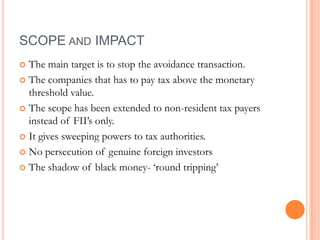
SCOPE AND IMPACT
 The main target is to stop the avoidance transaction.
 The companies that has to pay tax above the monetary
  threshold value.
 The scope has been extended to non-resident tax payers
  instead of FII‟s only.
 It gives sweeping powers to tax authorities.

 No persecution of genuine foreign investors

 The shadow of black money- „round tripping‟
IMPACT ON STOCK MARKET
GAAR WORLD WIDE
   CANADA:
       Copthorne Holdings Ltd. v. Canada, 2011 SCC 63
        (1) was there a tax benefit;
        (2) was the transaction giving rise to the tax benefit an avoidance
        transaction; and
        (3) was the avoidance transaction giving rise to the tax benefit abusive.
    AUSTRALIA
       Part IVA of Income Tax Assessment Act 1936
        (1) there must be a „scheme‟,
        (2) there must be a „tax benefit‟ obtained in connection with the
        scheme, and
        (iii) it must be reasonable to conclude that at least one person
        entering into the scheme did so for the „sole or dominant
        purpose‟ of obtaining a tax benefit
GAAR WORLD WIDE
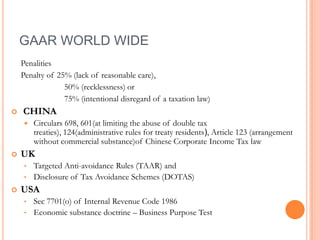
    Penalities
    Penalty of 25% (lack of reasonable care),
                 50% (recklessness) or
                 75% (intentional disregard of a taxation law)
   CHINA
       Circulars 698, 601(at limiting the abuse of double tax
        treaties), 124(administrative rules for treaty residents), Article 123 (arrangement
        without commercial substance)of Chinese Corporate Income Tax law
   UK
    • Targeted Anti-avoidance Rules (TAAR) and
    • Disclosure of Tax Avoidance Schemes (DOTAS)
   USA
    • Sec 7701(o) of Internal Revenue Code 1986
    • Economic substance doctrine – Business Purpose Test
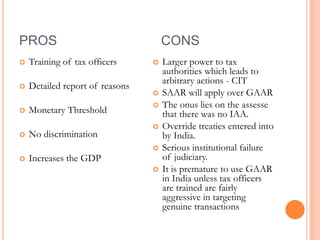
PROS                                 CONS
   Training of tax officers        Larger power to tax
                                     authorities which leads to
                                     arbitrary actions - CIT
   Detailed report of reasons
                                    SAAR will apply over GAAR
                                    The onus lies on the assesse
   Monetary Threshold               that there was no IAA.
                                    Override treaties entered into
   No discrimination                by India.
                                    Serious institutional failure
   Increases the GDP                of judiciary.
                                    It is premature to use GAAR
                                     in India unless tax officers
                                     are trained are fairly
                                     aggressive in targeting
                                     genuine transactions
CONCLUSION
 The Finance Minister deferred the implementation of GAAR to
  April 2016 instead of the erstwhile timeline of April 2013.
 There can be no doubt about the need to put an end to tax
  evasion and avoidance. However, that should not be done
  in a way that would frighten off investors.
 Need for enactment of a clear and viable GAAR to send a
  clear message to investors.
 The GAAR provisions are like a double-edged sword and
  would need to be judicially invoked by the revenue
  authorities.
 If not GAAR I would suggest that necessary amendments
  has to be made in the DTAA and Income TAX Act.
THANK YOU

Gaar

  • 1.
    OVERVIEW ON GENERALANTI AVOIDANCE RULE (GAAR) R.Pushkar
  • 2.
    WHAT IS GAAR? GAAR is a set of broad rules which are based on general principles to check the potential avoidance of the tax in general  Example  Lord Tomlin- “Every man is entitled to order his affairs so that the tax attaching under the appropriate Acts is less than it otherwise would be”  –(IRC v. Duke of Westminster)  Why GAAR?  Doctrine of “substance over form”
  • 3.
    HISTORY  In IRC v Duke of Westminster it was held that it is the taxpayer‟s legal right to attract least amount of tax and it will construe a situation of tax avoidance.  The Westminster principle (1936) was that any tax avoidance scheme or device is okay so long as it is not illegal. NOT Applicable in India.  In McDowell & Co. V. CTO it was held that tax avoidance is bad and illegal.  In Union of India v. Azadi Bachao Andodal held that tax avoidance is valid and legally right provided that the scheme is within the parameters of law.
  • 4.
    TERMS  Tax Havens are countries which have low tax regimes. Nearly 45 Tax Havens.  Bilateral Investment Protection Agreement India has signed BIPAs with 82 countries out of which 72 BIPAs have already come into force.  Participatory notes - 1992- Investors need not register under SEBI.  Difference between Tax Planning- Tax Evasion- Tax Avoidance  Impermissible avoidance arrangement (IAA)  Creates rights, or obligations at arm‟s length.  Results in the misuse of provisions of the Code.  Lacks commercial substance.  Entered into arrangements which would not normally be employed for bona fide purposes.
  • 5.
    GAAR IN INDIA  Vodafone Case  11,000 cr – Bombay HC – Appeal to SC  Direct Tax Code, 2010  Finance Bill, 2012  S.90 and S.90A - tax residency certificate has no significance - Amendment had questioned the validity of the certificate, the law of the land and verification for “bonafide substance” of the residency.  S.95-102 of the Act provides the definition and conditions of IAA and powers of the authorites.
  • 6.
    RECOMMENDATION MADE BYSHOME COMMITTEE  The following recommendations will apply irrespective of prospective or retrospective application :  Intermediaries between the foreign company and assets in India may be ignored to arrive at the valuation of shares of a foreign company  Taxation restricted only to capital gains attributable to assets in India  Provisions not clarificatory in nature
  • 7.
    RECOMMENDATION MADE BYSHOME COMMITTEE  The assessing officer (AO) will be required to issue a show cause notice, containing reasons, to the assessee before invoking the GAAR provisions and reference has to be made to CIT for invoking GAAR.  The assessee shall have an opportunity to prove that the arrangement is not an IAA.  GAAR Approving Panel (AP)would now include an expert member on matters such as direct taxes, business accounts and international trade practices.  The directions issued by the Panel shall be binding on the assessee as well as the income-tax authorities.  Same income will not be taxed twice in the hands of the same taxpayer  Investments made before August 30, 2010, the date of introduction of the DTC Bill, 2010, will be grandfathered.  GAAR will not apply to such FIIs that choose not to take any benefit under tax treaties.  A monetary threshold of Rs 3 crore of tax benefit in the arrangement will be provided.
  • 8.
    SCOPE AND IMPACT The main target is to stop the avoidance transaction.  The companies that has to pay tax above the monetary threshold value.  The scope has been extended to non-resident tax payers instead of FII‟s only.  It gives sweeping powers to tax authorities.  No persecution of genuine foreign investors  The shadow of black money- „round tripping‟
  • 9.
  • 10.
    GAAR WORLD WIDE  CANADA:  Copthorne Holdings Ltd. v. Canada, 2011 SCC 63 (1) was there a tax benefit; (2) was the transaction giving rise to the tax benefit an avoidance transaction; and (3) was the avoidance transaction giving rise to the tax benefit abusive. AUSTRALIA  Part IVA of Income Tax Assessment Act 1936 (1) there must be a „scheme‟, (2) there must be a „tax benefit‟ obtained in connection with the scheme, and (iii) it must be reasonable to conclude that at least one person entering into the scheme did so for the „sole or dominant purpose‟ of obtaining a tax benefit
  • 11.
    GAAR WORLD WIDE Penalities Penalty of 25% (lack of reasonable care), 50% (recklessness) or 75% (intentional disregard of a taxation law)  CHINA  Circulars 698, 601(at limiting the abuse of double tax treaties), 124(administrative rules for treaty residents), Article 123 (arrangement without commercial substance)of Chinese Corporate Income Tax law  UK • Targeted Anti-avoidance Rules (TAAR) and • Disclosure of Tax Avoidance Schemes (DOTAS)  USA • Sec 7701(o) of Internal Revenue Code 1986 • Economic substance doctrine – Business Purpose Test
  • 12.
    PROS CONS  Training of tax officers  Larger power to tax authorities which leads to arbitrary actions - CIT  Detailed report of reasons  SAAR will apply over GAAR  The onus lies on the assesse  Monetary Threshold that there was no IAA.  Override treaties entered into  No discrimination by India.  Serious institutional failure  Increases the GDP of judiciary.  It is premature to use GAAR in India unless tax officers are trained are fairly aggressive in targeting genuine transactions
  • 13.
    CONCLUSION  The FinanceMinister deferred the implementation of GAAR to April 2016 instead of the erstwhile timeline of April 2013.  There can be no doubt about the need to put an end to tax evasion and avoidance. However, that should not be done in a way that would frighten off investors.  Need for enactment of a clear and viable GAAR to send a clear message to investors.  The GAAR provisions are like a double-edged sword and would need to be judicially invoked by the revenue authorities.  If not GAAR I would suggest that necessary amendments has to be made in the DTAA and Income TAX Act.
  • 14.