Created By : Group 5
Assessment &
Evaluation
Within 40 minutes of active student-teacher discussion, the BSN Level 1 students
will be able to demonstrate their ability to apply assessment and evaluation
methodologies, including client learning assessments, evaluation methods,
measurement qualities, and interaction process analysis, as effective learning
tools in both classroom and clinical nursing contexts.
1.Define and explain the concept of learning assessment and its
significance in evaluating student/client progress in nursing
education.
2.Evaluate a health education plan by utilizing the different evaluation
methods and qualities of good measurement.
3.Differentiate, Determine, and apply the Qualities of a Good
Measurement Instruments and its significance in assessing students’
performance
4. Analyze recorded nurse-client interactions using interaction
process analysis to identify communication techniques and areas for
improvement.
General Objectives
Specifically, the students can:
Objectives
This timely identification allows for
immediate adjustments to
instructional strategies, ensuring
that teaching methods are tailored to
meet the evolving needs of the
students.
Assessments for learning facilitate
the ongoing monitoring of student
progress, providing a clear picture of
how well students are grasping the
material and allowing for targeted
interventions when necessary.
- referred to as assessments as
learning, serve to gauge a
student's comprehension and
understanding of a skill or lesson
while the learning and teaching
process is actively underway. This
approach offers educators
continuous feedback, enabling
them to identify students who may
be at risk early in the learning
journey.
Learning
Assessment
Types: Oral, Diagnostic,
Formative, Summative
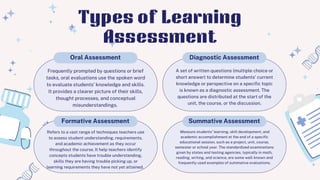
Frequently prompted by questions or brief
tasks, oral evaluations use the spoken word
to evaluate students’ knowledge and skills.
It provides a clearer picture of their skills,
thought processes, and conceptual
misunderstandings.
A set of written questions (multiple choice or
short answer) to determine students’ current
knowledge or perspective on a specific topic
is known as a diagnostic assessment. The
questions are distributed at the start of the
unit, the course, or the discussion.
Refers to a vast range of techniques teachers use
to assess student understanding, requirements,
and academic achievement as they occur
throughout the course. It help teachers identify
concepts students have trouble understanding,
skills they are having trouble picking up, or
learning requirements they have not yet attained.
Measure students’ learning, skill development, and
academic accomplishment at the end of a specific
educational session, such as a project, unit, course,
semester or school year. The standardized examinations
given by states and testing agencies, typically in math,
reading, writing, and science, are some well-known and
frequently used examples of summative evaluations.
Oral Assessment Diagnostic Assessment
Formative Assessment Summative Assessment
Types of Learning
Assessment
Learning assessment focuses on real-time
evaluation, assessing comprehension during the
instructional period.
It provides ongoing, immediate feedback to both
the client and the nurse.
Primarily formative, it informs and adjusts
teaching strategies as needed.
The assessment measures the client's
acquisition of skills and knowledge.
It is an individualized approach, tailored to the
client's specific learning needs.
Learning assessment often involves the client in
the process, promoting active participation.
Careful documentation of assessment results is
essential.
Learning assessments in nursing confirm
client comprehension, leading to improved
treatment adherence and enhanced patient
safety. They empower clients to participate in
their care and identify knowledge gaps for
targeted education. Effective communication
is facilitated, and ultimately, these
assessments contribute to better overall
health outcomes.
Key Aspects of Learning
Assessment:
Key Aspects and
Importance in Nursing
Importance in Nursing of
learning assessment :
Methods
of
Evaluation
It also provides evidence that
what nurses do as educators
makes a value-added difference in
the care they provide. If education
is to be justified as a value-added
activity, the process of education
must be measurably efficient and
must be measurably linked to
education outcomes.
Evaluation is defined as a
systematic process that judges
the worth or value of something.
Methods of Evaluation
Formative evaluation is a method of
assessing an educational activity while it is
ongoing. It focuses on identifying areas for
improvement, such as changes in personnel,
materials, facilities, teaching methods,
learning objectives, or the educator's
approach, allowing for real-time
adjustments.
Content evaluation focuses on a particular
learning experience and its specific
objectives. It takes place right after the
teaching is completed and looks at all the
activities involved in that lesson. Data is
collected from all students who
participated in that class or session.
To ensure the activity's success by
addressing issues or improvements
promptly to enhance the learning
experience.
Types of Evaluation
The purpose is to evaluate how well
the content and teaching methods
worked in helping students meet the
goals of that specific learning
experience.
CONTENT EVALUATION
FORMATIVE EVALUATION
PURPOSE PURPOSE
Outcome evaluation measures teaching
effectiveness by assessing how well a learner
applies skills or knowledge after the
experience—for example, measuring a
patient's ability to perform a skill at home
after discharge or evaluating nurses' ability to
apply knowledge in practice after a workshop
shows the long-term effects of the training.
Impact evaluation is a process used to
assess the broader effects of an educational
activity on an institution, community, or
society. It examines how education
influences the larger environment, such as
behaviour changes or overall development.
Outcome evaluation aims to assess the
impact of teaching efforts and
determine whether the intended
outcomes have been achieved.
Types of Evaluation
The purpose of impact evaluation is to
determine whether the educational activity
has produced significant, lasting effects
and to help decide if it is worth continuing
based on its costs and benefits to the
institution or community.
IMPACT EVALUATION
OUTCOME EVALUATION
PURPOSE PURPOSE
Qualities of
Good
Measurement
The development of test of any
kind always requires the careful
consideration of the qualities of
good measuring instruments.
Particularly, for any test to be
effectively developed, it should
carry the qualities of a good test.
Good measuring instruments
are any standardized tools
that aid in assessing student
performance.
Qualities of Good
Measurement
The most important aspect of any good test is its validity.
It also refers to the extent to which the test serves its purpose.
Or, to put it another way, it describes the efficiency with which it measures the performance that
it seeks to measure.
1. Validity
Qualities of Good Measurement
a. Content Validity
It refers to the extent to which the content of the test represents the content of the course.
b. Concurrent Validity
This refers to the degree to which the test correlates to the criterion of the test and acceptable for
the measure.
c. Predictive Validity
This relates the actual performance of a student in a test with its achievement so that we can
predict their true results.
d. Construct Validity
This measures the theoretical trait of the test.
The meaning of reliability is accuracy and consistency.
Also, it refers to the extent to which a test is consistent, stable, and dependent.
In other words, the test approves what it represents. In addition, the result in it is
consistent, and taking a test, again and again, will not change the result.
Furthermore, it gives the same result every time
2. Reliability
Qualities of Good Measurement
It refers to the extent to which the test can be used without requiring a significant investment of
money, effort, or time.
Most importantly, it denotes practicability.
Furthermore, we have listed some of the factors that influence usability:
3. Usability
Qualities of Good Measurement
a. Administrability
It means that a test can be administered with clarity, ease, and uniformity. Also, the direction
is simple, concise, and clear. Besides, it specifies a time limit, sample questions, and ordi
instructions. The provision for the test material is definite.
b. Scoreability
It has to do with the test score. A good test is also simple to score The scoring direction,
scoring key, and answer are all simple. Most importantly, the test score can be used to
evaluate students.
It refers to the degree to which personal judgment is eliminated in the scoring of
the test.
Therefore, objectivity in the test requires that the personal opinion of the
teachers does not affect the score of an individual student.
The test should be such that different teachers can similarly score the tests and
arrive at the same scores.
In other words, the more objective the test, the greater is its reliability.
4. Objectivity
Qualities of Good Measurement
It refers to the degree to which a test contains a fairly wide sampling of items to determine the
objectives or abilities so that the resulting scores are representatives of the relative total
performance in the areas measured
5. Comprehensiveness
Qualities of Good Measurement
6. Interpretability
It is the quality of the test in which the test results can be readily, easily, and
properly interpreted.
7. Economy
It refers to the cheapest way of giving the test. Tests should be economical and it
should not be a burden on the part of the teacher.
The qualities of good measurement
instruments, such as reliability, validity, and
practicality, are crucial for ensuring
accurate and consistent results. Reliable
instruments provide repeatable
measurements under the same conditions,
while validity ensures that the instrument
measures what it is intended to measure,
making the data meaningful and
applicable. Practicality further enhances
usability by ensuring that the instrument is
easy to administer and cost-effective,
enabling efficient and effective
measurement in various contexts.
Importance
Qualities of Good Measurement
The process recording or
interaction process
analysis is another method
used in some areas for
evaluation in clinical
teaching. It is an individual
output of the student
which supplements the
nursing care and for
analyzing the quality,
effectiveness and
efficiency of care that was
rendered by the student
nurse.
Process Recording
Importance of Process
Recording
INTERACTION
PROCESS
ANALYSIS/PROCESS
RECORDING
The process recording is a written
account of an interaction between a
client and nurse.
Also is the technique by which we
record the verbal interaction between
the nurse and client of it is the written
record of the entire communication
pattern between nurse and client.
The process recording helps the
student conceptualize and organize
ongoing activities with client systems,
to clarify the purpose of the interview
or intervention, to improve written
expression, to identify strengths and
weaknesses, and to improve self-
awareness.
PROCESS RECORDING
Importance of Process
Recording:
Word-for-word transcription of the conversation.
1. Verbatim Dialogue
TYPES OF PROCESS
RECORDING
2. Feelings and Reactions
3. Observations and Analysis
4. Final Comments
Therapist's emotional responses during the session.
Notes on non-verbal cues and their analysis.
Summary and reflection on the session.
To critically analyze communication and
its effect and behavior on the individual.
To gain the patient's confidence and get
this cooperation.
To establish rapport with the patient.
To study the patient's psychological,
social, and emotional behavior.
It helps to increase the ability to
identify problems and develops skills in
solving them.
It gives students an opportunity to gain
the ease and function of written
expression which are important for
professional development.
PURPOSE
PURPOSE OF PROCESS RECORDING
Process recording is one method
by which we can record the
content of an interview.
Record the conversation's verbal
time.
Use a recording device and obtain
patients' permission for using it,
this will help you in reviewing the
session if needed.
Each process recording should
conclude with a summary.
GENERAL GUIDELINES OF
PROCESS RECORDING
"Interaction Process
Analysis/Process Recording
is a reflective tool that
transforms each session into
an opportunity for growth,
understanding, and improved
practice."
Thank you for
your attention

(G5) Assessment and Evaluation-HEALTHEDUCATION.pdf

  • 1.
    Created By :Group 5 Assessment & Evaluation
  • 2.
    Within 40 minutesof active student-teacher discussion, the BSN Level 1 students will be able to demonstrate their ability to apply assessment and evaluation methodologies, including client learning assessments, evaluation methods, measurement qualities, and interaction process analysis, as effective learning tools in both classroom and clinical nursing contexts. 1.Define and explain the concept of learning assessment and its significance in evaluating student/client progress in nursing education. 2.Evaluate a health education plan by utilizing the different evaluation methods and qualities of good measurement. 3.Differentiate, Determine, and apply the Qualities of a Good Measurement Instruments and its significance in assessing students’ performance 4. Analyze recorded nurse-client interactions using interaction process analysis to identify communication techniques and areas for improvement. General Objectives Specifically, the students can: Objectives
  • 3.
    This timely identificationallows for immediate adjustments to instructional strategies, ensuring that teaching methods are tailored to meet the evolving needs of the students. Assessments for learning facilitate the ongoing monitoring of student progress, providing a clear picture of how well students are grasping the material and allowing for targeted interventions when necessary. - referred to as assessments as learning, serve to gauge a student's comprehension and understanding of a skill or lesson while the learning and teaching process is actively underway. This approach offers educators continuous feedback, enabling them to identify students who may be at risk early in the learning journey. Learning Assessment Types: Oral, Diagnostic, Formative, Summative
  • 4.
    Frequently prompted byquestions or brief tasks, oral evaluations use the spoken word to evaluate students’ knowledge and skills. It provides a clearer picture of their skills, thought processes, and conceptual misunderstandings. A set of written questions (multiple choice or short answer) to determine students’ current knowledge or perspective on a specific topic is known as a diagnostic assessment. The questions are distributed at the start of the unit, the course, or the discussion. Refers to a vast range of techniques teachers use to assess student understanding, requirements, and academic achievement as they occur throughout the course. It help teachers identify concepts students have trouble understanding, skills they are having trouble picking up, or learning requirements they have not yet attained. Measure students’ learning, skill development, and academic accomplishment at the end of a specific educational session, such as a project, unit, course, semester or school year. The standardized examinations given by states and testing agencies, typically in math, reading, writing, and science, are some well-known and frequently used examples of summative evaluations. Oral Assessment Diagnostic Assessment Formative Assessment Summative Assessment Types of Learning Assessment
  • 5.
    Learning assessment focuseson real-time evaluation, assessing comprehension during the instructional period. It provides ongoing, immediate feedback to both the client and the nurse. Primarily formative, it informs and adjusts teaching strategies as needed. The assessment measures the client's acquisition of skills and knowledge. It is an individualized approach, tailored to the client's specific learning needs. Learning assessment often involves the client in the process, promoting active participation. Careful documentation of assessment results is essential. Learning assessments in nursing confirm client comprehension, leading to improved treatment adherence and enhanced patient safety. They empower clients to participate in their care and identify knowledge gaps for targeted education. Effective communication is facilitated, and ultimately, these assessments contribute to better overall health outcomes. Key Aspects of Learning Assessment: Key Aspects and Importance in Nursing Importance in Nursing of learning assessment :
  • 6.
  • 7.
    It also providesevidence that what nurses do as educators makes a value-added difference in the care they provide. If education is to be justified as a value-added activity, the process of education must be measurably efficient and must be measurably linked to education outcomes. Evaluation is defined as a systematic process that judges the worth or value of something. Methods of Evaluation
  • 8.
    Formative evaluation isa method of assessing an educational activity while it is ongoing. It focuses on identifying areas for improvement, such as changes in personnel, materials, facilities, teaching methods, learning objectives, or the educator's approach, allowing for real-time adjustments. Content evaluation focuses on a particular learning experience and its specific objectives. It takes place right after the teaching is completed and looks at all the activities involved in that lesson. Data is collected from all students who participated in that class or session. To ensure the activity's success by addressing issues or improvements promptly to enhance the learning experience. Types of Evaluation The purpose is to evaluate how well the content and teaching methods worked in helping students meet the goals of that specific learning experience. CONTENT EVALUATION FORMATIVE EVALUATION PURPOSE PURPOSE
  • 9.
    Outcome evaluation measuresteaching effectiveness by assessing how well a learner applies skills or knowledge after the experience—for example, measuring a patient's ability to perform a skill at home after discharge or evaluating nurses' ability to apply knowledge in practice after a workshop shows the long-term effects of the training. Impact evaluation is a process used to assess the broader effects of an educational activity on an institution, community, or society. It examines how education influences the larger environment, such as behaviour changes or overall development. Outcome evaluation aims to assess the impact of teaching efforts and determine whether the intended outcomes have been achieved. Types of Evaluation The purpose of impact evaluation is to determine whether the educational activity has produced significant, lasting effects and to help decide if it is worth continuing based on its costs and benefits to the institution or community. IMPACT EVALUATION OUTCOME EVALUATION PURPOSE PURPOSE
  • 10.
  • 11.
    The development oftest of any kind always requires the careful consideration of the qualities of good measuring instruments. Particularly, for any test to be effectively developed, it should carry the qualities of a good test. Good measuring instruments are any standardized tools that aid in assessing student performance. Qualities of Good Measurement
  • 12.
    The most importantaspect of any good test is its validity. It also refers to the extent to which the test serves its purpose. Or, to put it another way, it describes the efficiency with which it measures the performance that it seeks to measure. 1. Validity Qualities of Good Measurement a. Content Validity It refers to the extent to which the content of the test represents the content of the course. b. Concurrent Validity This refers to the degree to which the test correlates to the criterion of the test and acceptable for the measure. c. Predictive Validity This relates the actual performance of a student in a test with its achievement so that we can predict their true results. d. Construct Validity This measures the theoretical trait of the test.
  • 13.
    The meaning ofreliability is accuracy and consistency. Also, it refers to the extent to which a test is consistent, stable, and dependent. In other words, the test approves what it represents. In addition, the result in it is consistent, and taking a test, again and again, will not change the result. Furthermore, it gives the same result every time 2. Reliability Qualities of Good Measurement
  • 14.
    It refers tothe extent to which the test can be used without requiring a significant investment of money, effort, or time. Most importantly, it denotes practicability. Furthermore, we have listed some of the factors that influence usability: 3. Usability Qualities of Good Measurement a. Administrability It means that a test can be administered with clarity, ease, and uniformity. Also, the direction is simple, concise, and clear. Besides, it specifies a time limit, sample questions, and ordi instructions. The provision for the test material is definite. b. Scoreability It has to do with the test score. A good test is also simple to score The scoring direction, scoring key, and answer are all simple. Most importantly, the test score can be used to evaluate students.
  • 15.
    It refers tothe degree to which personal judgment is eliminated in the scoring of the test. Therefore, objectivity in the test requires that the personal opinion of the teachers does not affect the score of an individual student. The test should be such that different teachers can similarly score the tests and arrive at the same scores. In other words, the more objective the test, the greater is its reliability. 4. Objectivity Qualities of Good Measurement
  • 16.
    It refers tothe degree to which a test contains a fairly wide sampling of items to determine the objectives or abilities so that the resulting scores are representatives of the relative total performance in the areas measured 5. Comprehensiveness Qualities of Good Measurement 6. Interpretability It is the quality of the test in which the test results can be readily, easily, and properly interpreted. 7. Economy It refers to the cheapest way of giving the test. Tests should be economical and it should not be a burden on the part of the teacher.
  • 17.
    The qualities ofgood measurement instruments, such as reliability, validity, and practicality, are crucial for ensuring accurate and consistent results. Reliable instruments provide repeatable measurements under the same conditions, while validity ensures that the instrument measures what it is intended to measure, making the data meaningful and applicable. Practicality further enhances usability by ensuring that the instrument is easy to administer and cost-effective, enabling efficient and effective measurement in various contexts. Importance Qualities of Good Measurement
  • 18.
    The process recordingor interaction process analysis is another method used in some areas for evaluation in clinical teaching. It is an individual output of the student which supplements the nursing care and for analyzing the quality, effectiveness and efficiency of care that was rendered by the student nurse. Process Recording Importance of Process Recording INTERACTION PROCESS ANALYSIS/PROCESS RECORDING
  • 19.
    The process recordingis a written account of an interaction between a client and nurse. Also is the technique by which we record the verbal interaction between the nurse and client of it is the written record of the entire communication pattern between nurse and client. The process recording helps the student conceptualize and organize ongoing activities with client systems, to clarify the purpose of the interview or intervention, to improve written expression, to identify strengths and weaknesses, and to improve self- awareness. PROCESS RECORDING Importance of Process Recording:
  • 20.
    Word-for-word transcription ofthe conversation. 1. Verbatim Dialogue TYPES OF PROCESS RECORDING 2. Feelings and Reactions 3. Observations and Analysis 4. Final Comments Therapist's emotional responses during the session. Notes on non-verbal cues and their analysis. Summary and reflection on the session.
  • 21.
    To critically analyzecommunication and its effect and behavior on the individual. To gain the patient's confidence and get this cooperation. To establish rapport with the patient. To study the patient's psychological, social, and emotional behavior. It helps to increase the ability to identify problems and develops skills in solving them. It gives students an opportunity to gain the ease and function of written expression which are important for professional development. PURPOSE PURPOSE OF PROCESS RECORDING
  • 22.
    Process recording isone method by which we can record the content of an interview. Record the conversation's verbal time. Use a recording device and obtain patients' permission for using it, this will help you in reviewing the session if needed. Each process recording should conclude with a summary. GENERAL GUIDELINES OF PROCESS RECORDING "Interaction Process Analysis/Process Recording is a reflective tool that transforms each session into an opportunity for growth, understanding, and improved practice."
  • 23.