SP 351: URBAN PLANNING WORKSHOP
THEME: PROMOTING SOCIO-ECONOMIC DEVELOPMENT & ENVIRONMENTAL
SUSTAINABILITY THROUGH URBAN PLANNING AND DESIGN.
PROBLEM IDENTIFICATION AND PPOCC ANALYSES.
GROUP THIRTEEN (13)
PRESENTATION OUTLINE
•INTRODUCTION
•OBJECTIVES
•PROBLEM IDENTIFICATION
•DEFINITION OF PPOCC TERMS
•PPOCC ANALYSES
•CONCLUSION
INTRODUCTION
• Planning as a discipline that seeks to solve both spatial and aspatial
problems, society cannot achieve its goals without identifying problems
of concern to the study area and generating potentials, opportunities,
constraints and challenges (POCC) analysis of the community.
• This presentation gives an idea about the identified problems within the
study community (Kwamo) which covers areas such as environmental
and land use problems, housing, water, sanitation, health, education,
energy, transportation and local economy problems.
OBJECTIVES
• Derived developmental problems from the results of geophysical,
environmental, economic and socio-economic or cultural analysis of their
study community.
• Identify existing potentials and opportunities for resolving developmental
problems
• Identifying existing constrains and challenges that hinder the resolution of
de4velopmetal problems
• Making relevant and realistic suggestions to address the developmental
problems based on the POCC analysis.
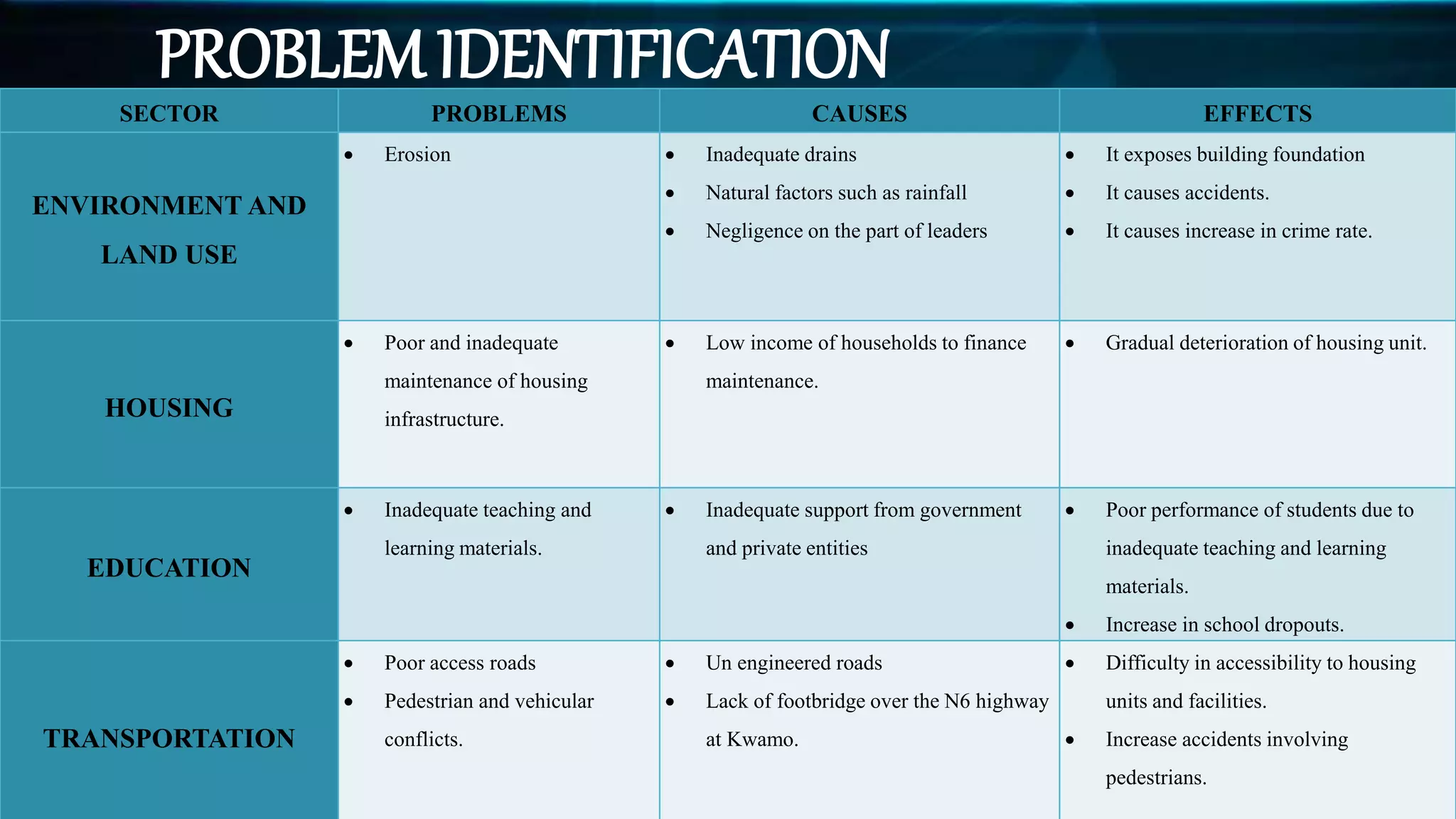
PROBLEM IDENTIFICATION
SECTOR PROBLEMS CAUSES EFFECTS
ENVIRONMENT AND
LAND USE
 Erosion  Inadequate drains
 Natural factors such as rainfall
 Negligence on the part of leaders
 It exposes building foundation
 It causes accidents.
 It causes increase in crime rate.
HOUSING
 Poor and inadequate
maintenance of housing
infrastructure.
 Low income of households to finance
maintenance.
 Gradual deterioration of housing unit.
EDUCATION
 Inadequate teaching and
learning materials.
 Inadequate support from government
and private entities
 Poor performance of students due to
inadequate teaching and learning
materials.
 Increase in school dropouts.
TRANSPORTATION
 Poor access roads
 Pedestrian and vehicular
conflicts.
 Un engineered roads
 Lack of footbridge over the N6 highway
at Kwamo.
 Difficulty in accessibility to housing
units and facilities.
 Increase accidents involving
pedestrians.
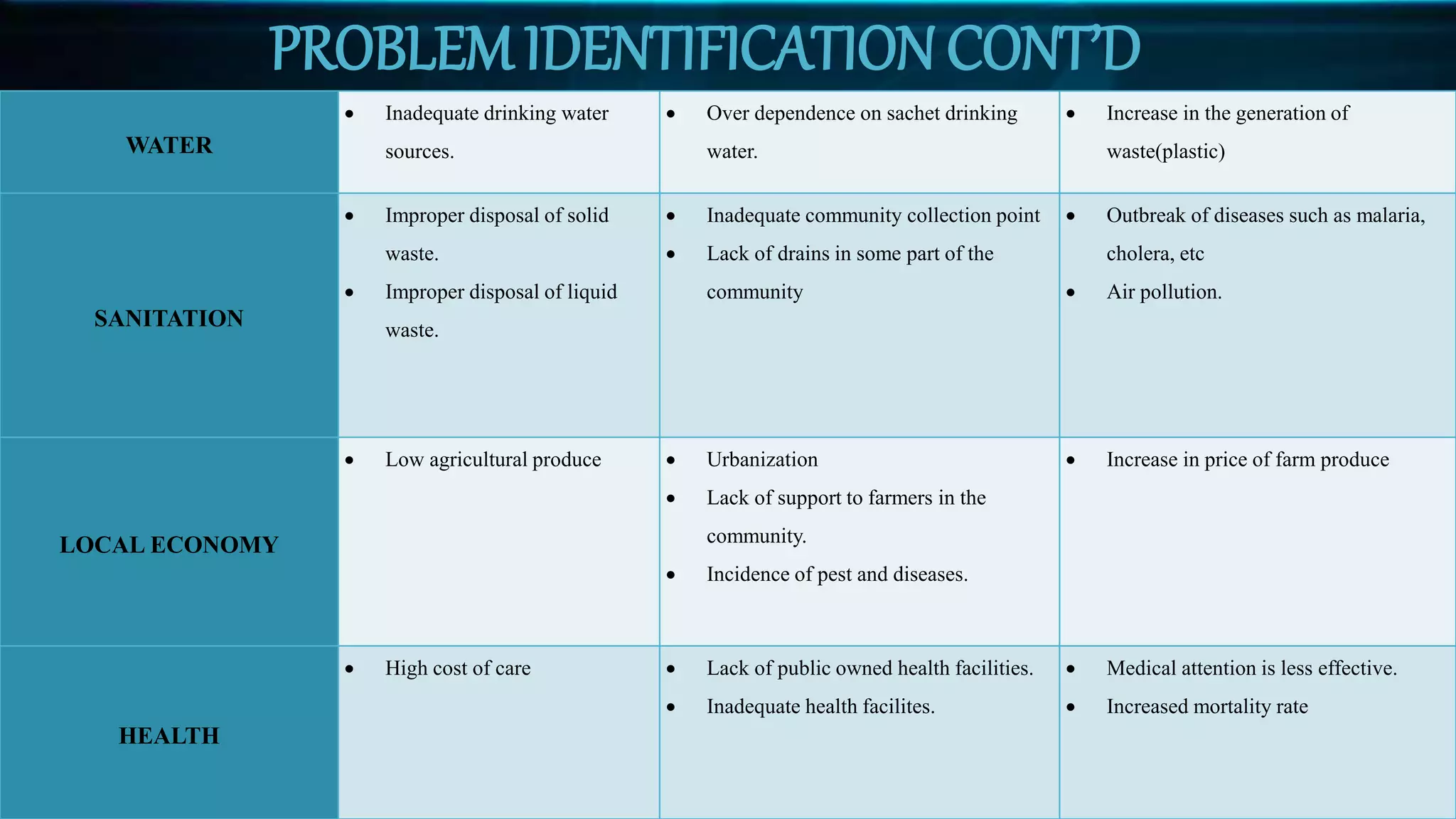
PROBLEM IDENTIFICATION CONT’D
WATER
 Inadequate drinking water
sources.
 Over dependence on sachet drinking
water.
 Increase in the generation of
waste(plastic)
SANITATION
 Improper disposal of solid
waste.
 Improper disposal of liquid
waste.
 Inadequate community collection point
 Lack of drains in some part of the
community
 Outbreak of diseases such as malaria,
cholera, etc
 Air pollution.
LOCAL ECONOMY
 Low agricultural produce  Urbanization
 Lack of support to farmers in the
community.
 Incidence of pest and diseases.
 Increase in price of farm produce
HEALTH
 High cost of care  Lack of public owned health facilities.
 Inadequate health facilites.
 Medical attention is less effective.
 Increased mortality rate
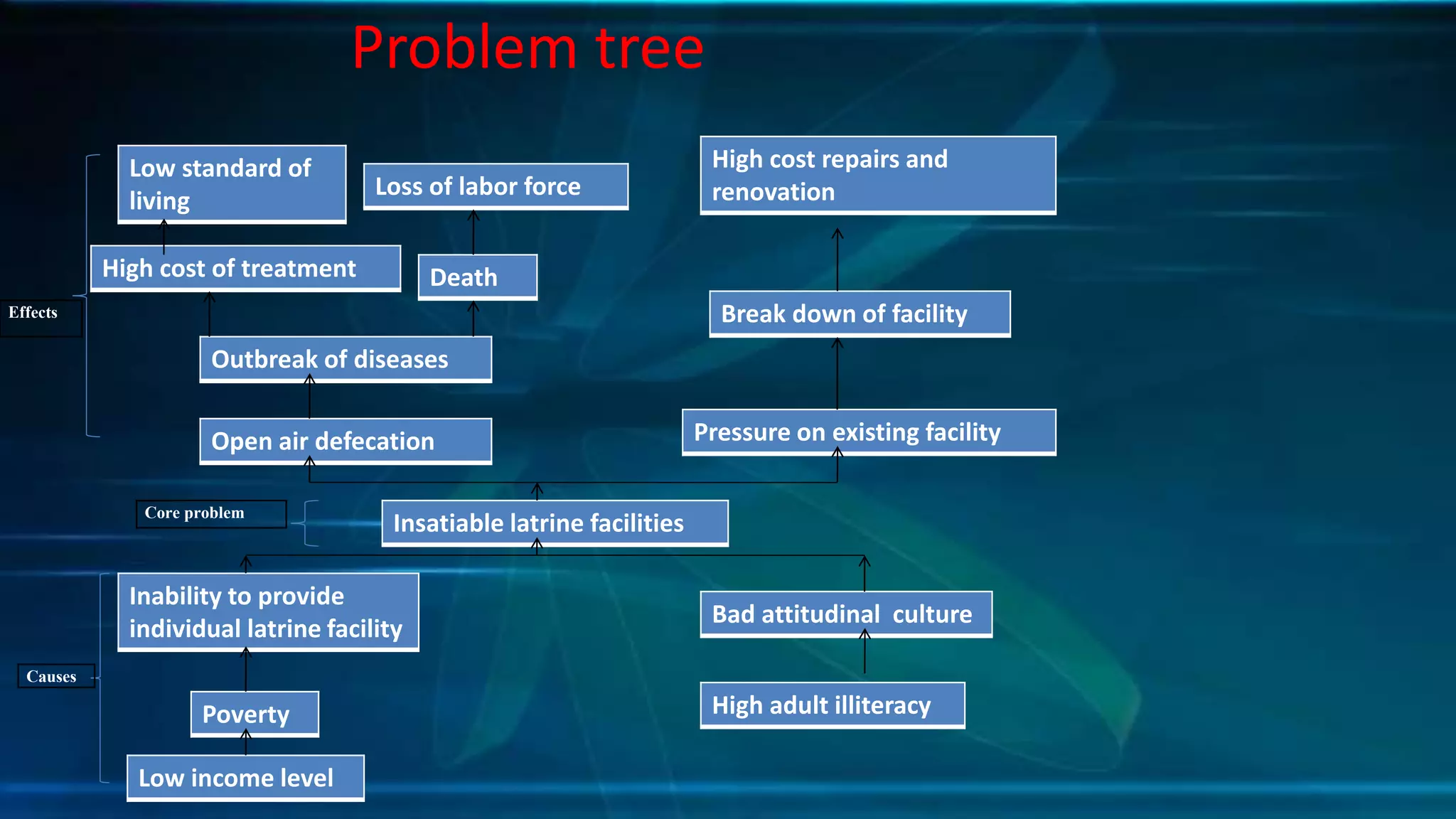
Problem tree
Low income level
Low standard of
living
Poverty High adult illiteracy
Insatiable latrine facilities
Outbreak of diseases
Bad attitudinal culture
Inability to provide
individual latrine facility
Open air defecation Pressure on existing facility
High cost of treatment
Break down of facility
High cost repairs and
renovation
Death
Loss of labor force
Core problem
Causes
Effects
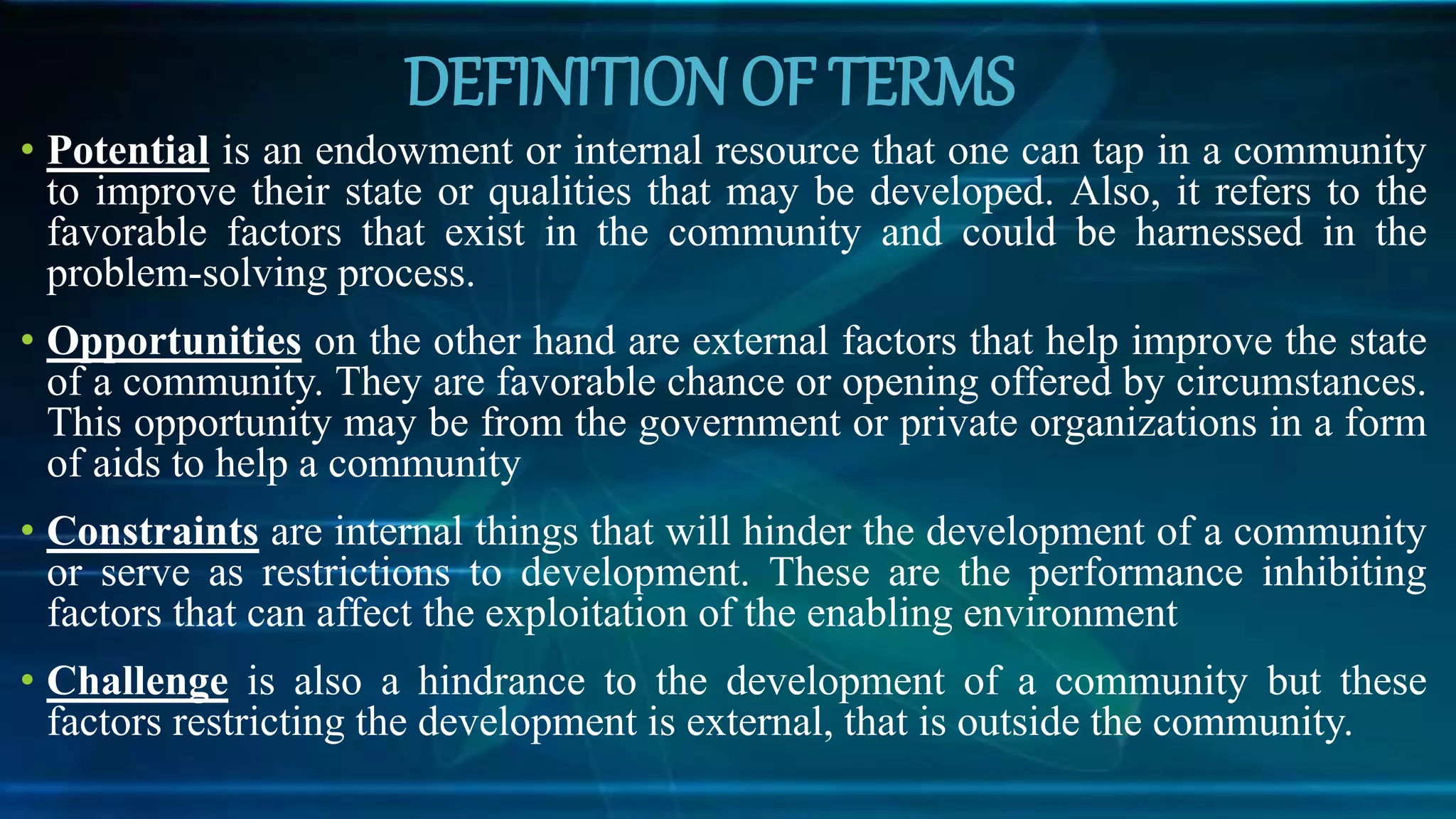
DEFINITION OF TERMS
• Potential is an endowment or internal resource that one can tap in a community
to improve their state or qualities that may be developed. Also, it refers to the
favorable factors that exist in the community and could be harnessed in the
problem-solving process.
• Opportunities on the other hand are external factors that help improve the state
of a community. They are favorable chance or opening offered by circumstances.
This opportunity may be from the government or private organizations in a form
of aids to help a community
• Constraints are internal things that will hinder the development of a community
or serve as restrictions to development. These are the performance inhibiting
factors that can affect the exploitation of the enabling environment
• Challenge is also a hindrance to the development of a community but these
factors restricting the development is external, that is outside the community.
SECTORS PROBLEM
POTENTIA
L
OPPORTUN
ITY
CONSTRAI
NTS
CHALLENGES
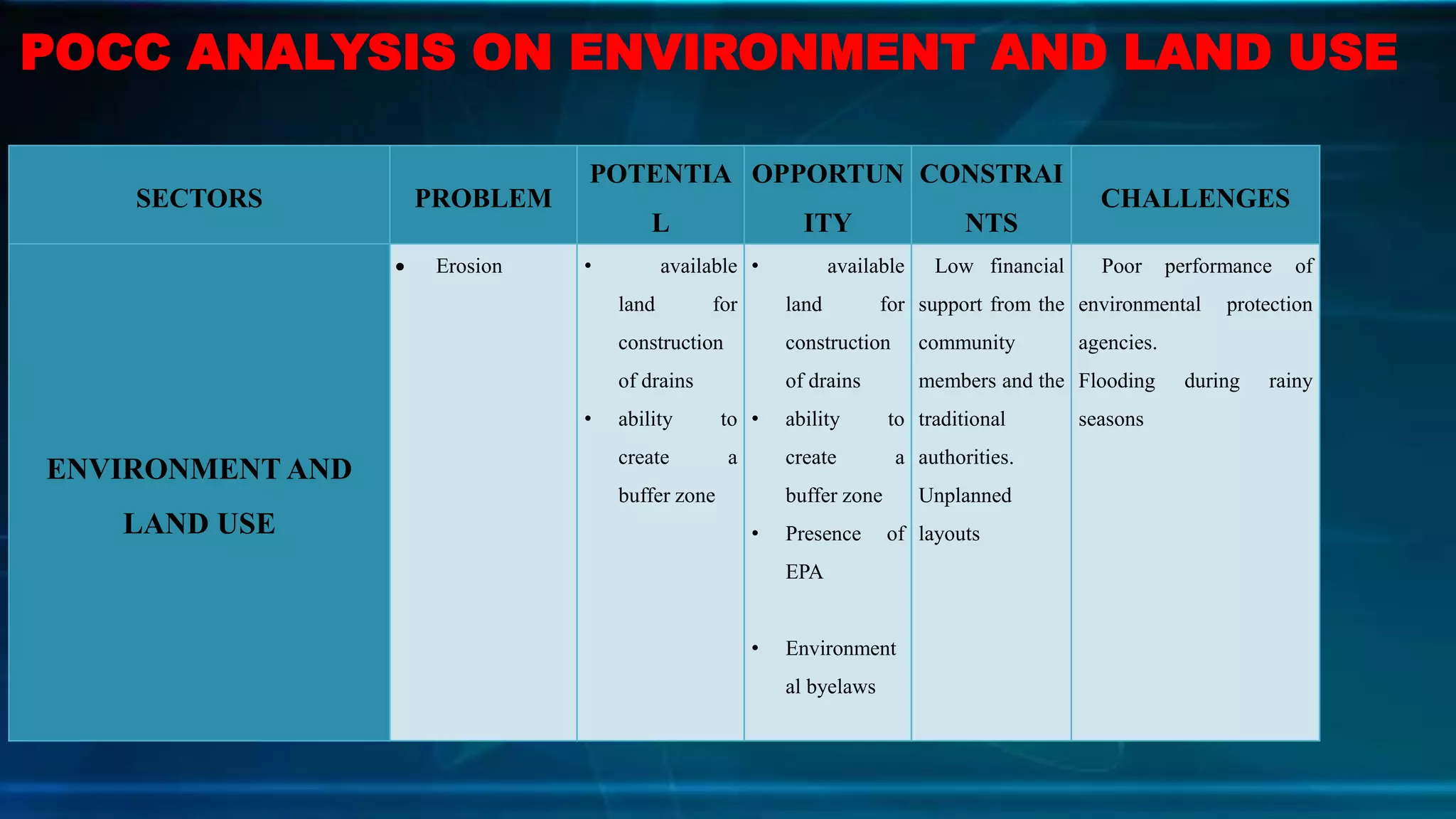
ENVIRONMENT AND
LAND USE
 Erosion • available
land for
construction
of drains
• ability to
create a
buffer zone
• available
land for
construction
of drains
• ability to
create a
buffer zone
• Presence of
EPA
• Environment
al byelaws
Low financial
support from the
community
members and the
traditional
authorities.
Unplanned
layouts
Poor performance of
environmental protection
agencies.
Flooding during rainy
seasons
POCC ANALYSIS ON ENVIRONMENT AND LAND USE
DEVELOPMENT
ISSUE
POTENTIAL OPPORTUNITES CONSTRAINTS CHALLENGES
Migration
 Availability of large land
 Presence of industrial
activities
 Assemblyman and
Traditional authority
 Municipal Assembly
 Presence of Ministry of Youth and
Employment
 Presence of GES
• Inadequacy social
facilities
• Inadequate jobs
• Inadequate
government support
• No support from
NGOs
CONCLUSION: the Traditional authority through the Assemblyman could lobby the Ministry of Youth and Employment and Municipal assembly to
provide more social facilities and jobs. All these will discourage the youth from migrating
POCC ANALYSIS ON DEMOGRAPHY
DEVELOPME
NT ISSUE
POTENTIAL OPPORTUNITY CONSTRAINTS CHALLENGES
 Lack of
dormitory
block
 Availability of land
for expansion
 Presence of PTA
 Ghana Education
Trust fund
(GETFUND)
 Lack of support
from government
agencies NGOS.
 Low communal
support.
 Delay in release of
capitation grants
 Inadequate financial
support by the
government.
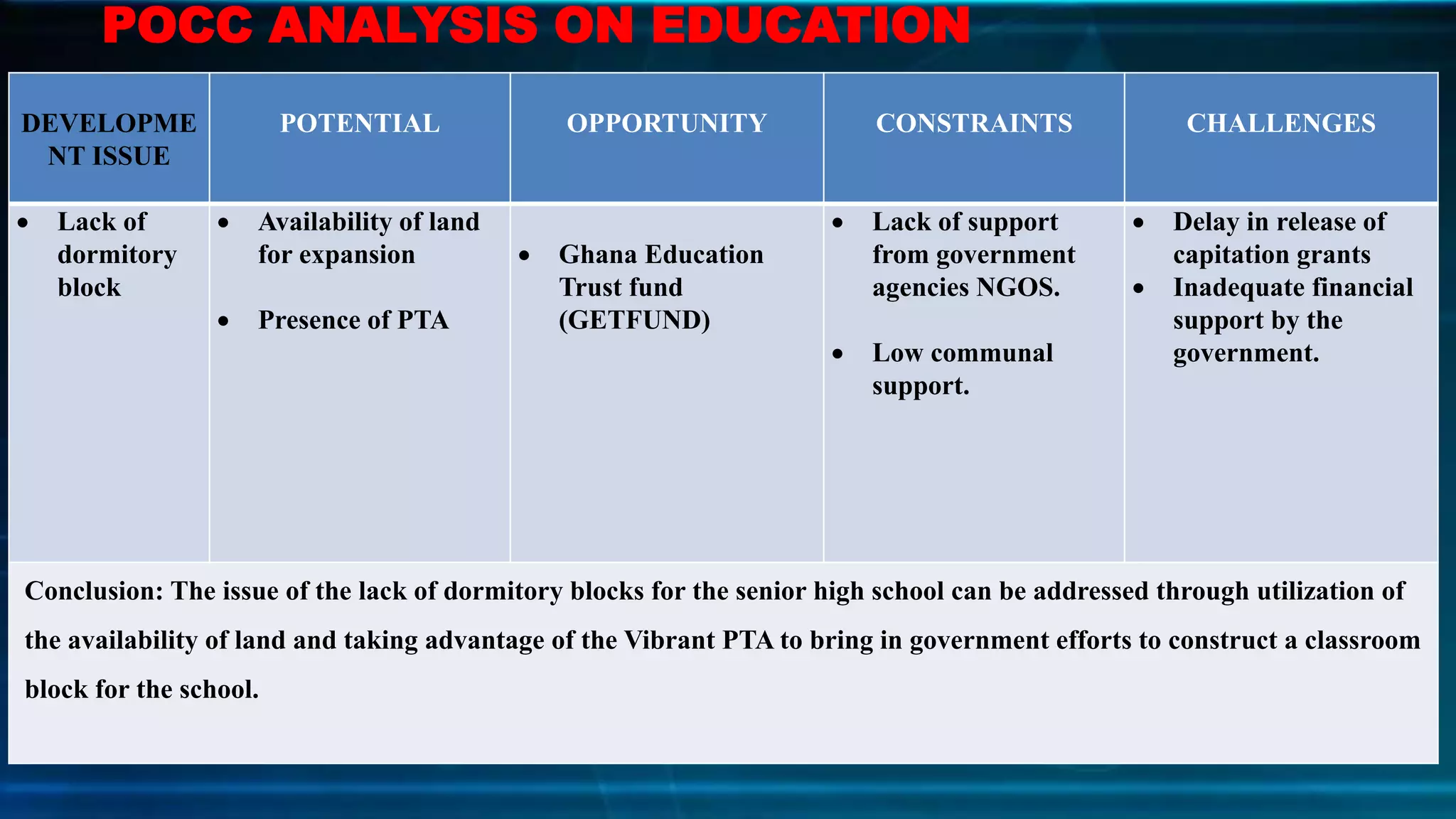
Conclusion: The issue of the lack of dormitory blocks for the senior high school can be addressed through utilization of
the availability of land and taking advantage of the Vibrant PTA to bring in government efforts to construct a classroom
block for the school.
POCC ANALYSIS ON EDUCATION
DEVELOPMENT
ISSUE
POTENTIAL OPPORTUNITES CONSTRAINTS CHALLENGES
 Insatiable Toilet
facility in the
community
 Bad state of the
Refuse Dump
 Presence of
vibrant youth in the
community
 Existence of
traditional leaders
in bye law
formulation
 District assembly’s
common fund (DACF)
 Activities of “Zoomlion”
Ghana Limited
•Low literacy level
among the people to see
the importance of a
Waste and Sanitation
facility.
•Low income levels to
patronize house to house
collection
 Pressure on District
Assembly Common
fund
 No support from
NGO,
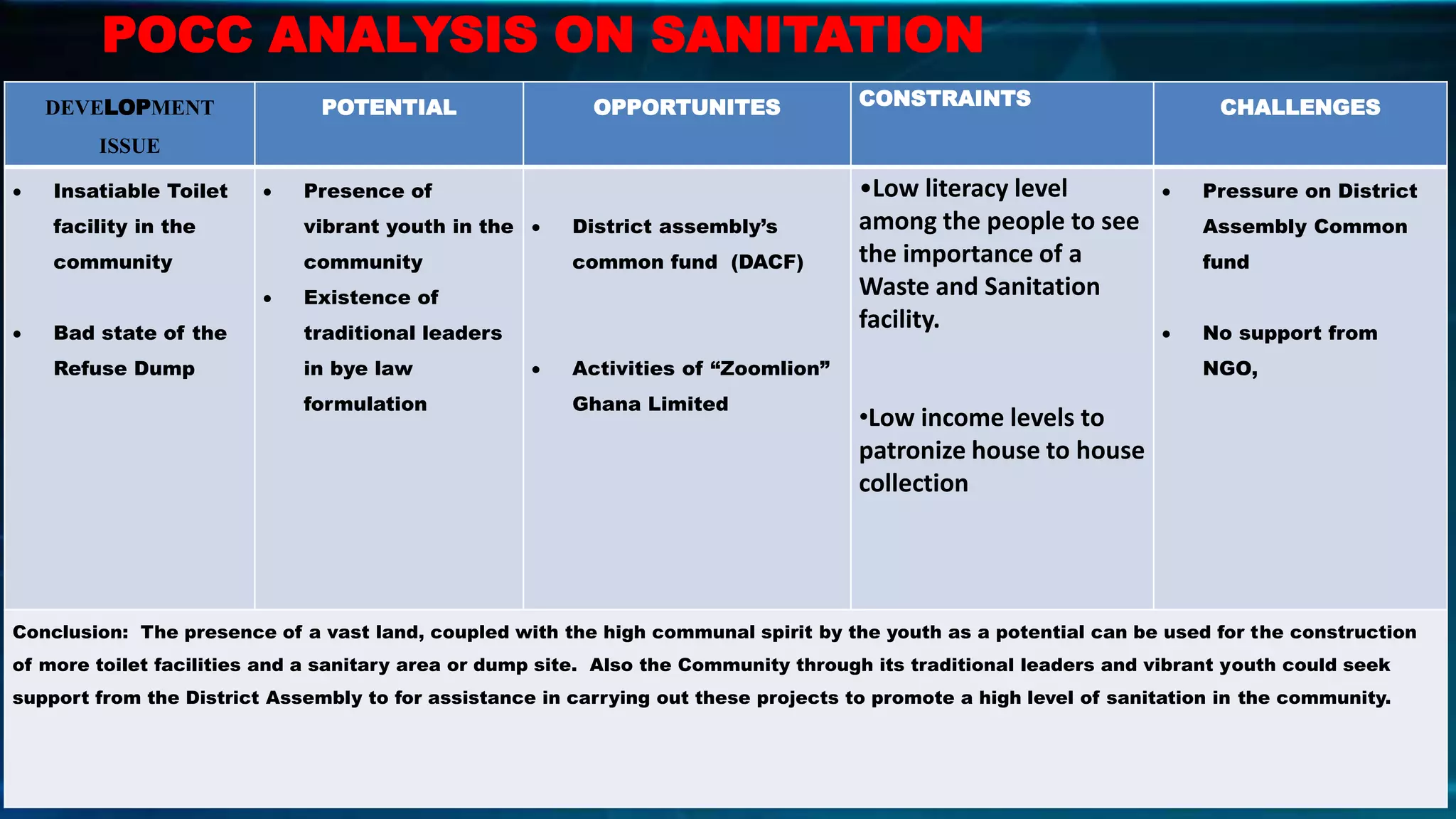
Conclusion: The presence of a vast land, coupled with the high communal spirit by the youth as a potential can be used for the construction
of more toilet facilities and a sanitary area or dump site. Also the Community through its traditional leaders and vibrant youth could seek
support from the District Assembly to for assistance in carrying out these projects to promote a high level of sanitation in the community.
POCC ANALYSIS ON SANITATION
DEVELOPMENT ISSUE POTENTIAL OPPORTUNITES CONSTRAINTS CHALLENGES
 Difficulty in
accessing to
water ( a section of
the community
• High water table
 Presence of
Traditional Authority
system and
regulations in the
community
 High communal labor
force
 Activities of
Community water
and Sanitation
Agency (CWSA)
 Sanitary
Inspectors from
the Municipal
Capital
 Improper siting of the
pipe borne water at
the community.
 Practice of free range
system of Animal
farming
 Insufficient
community funds
 Inadequate support from
Municipal Assembly
 Activities of Herdsmen
from outside the
community
 High pressure on the
Community Water and
Sanitation Agency (CWSA)
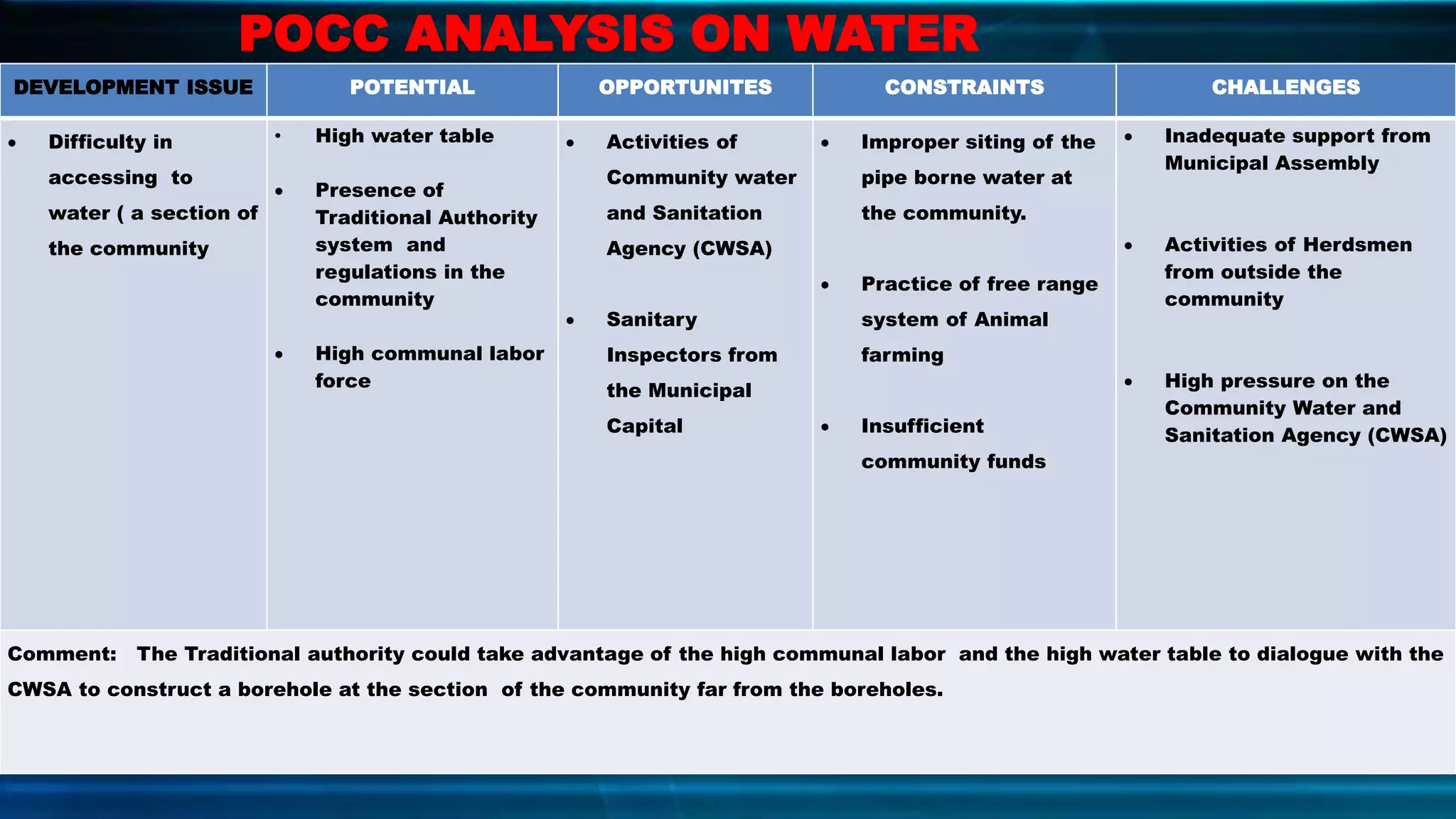
Comment: The Traditional authority could take advantage of the high communal labor and the high water table to dialogue with the
CWSA to construct a borehole at the section of the community far from the boreholes.
POCC ANALYSIS ON WATER
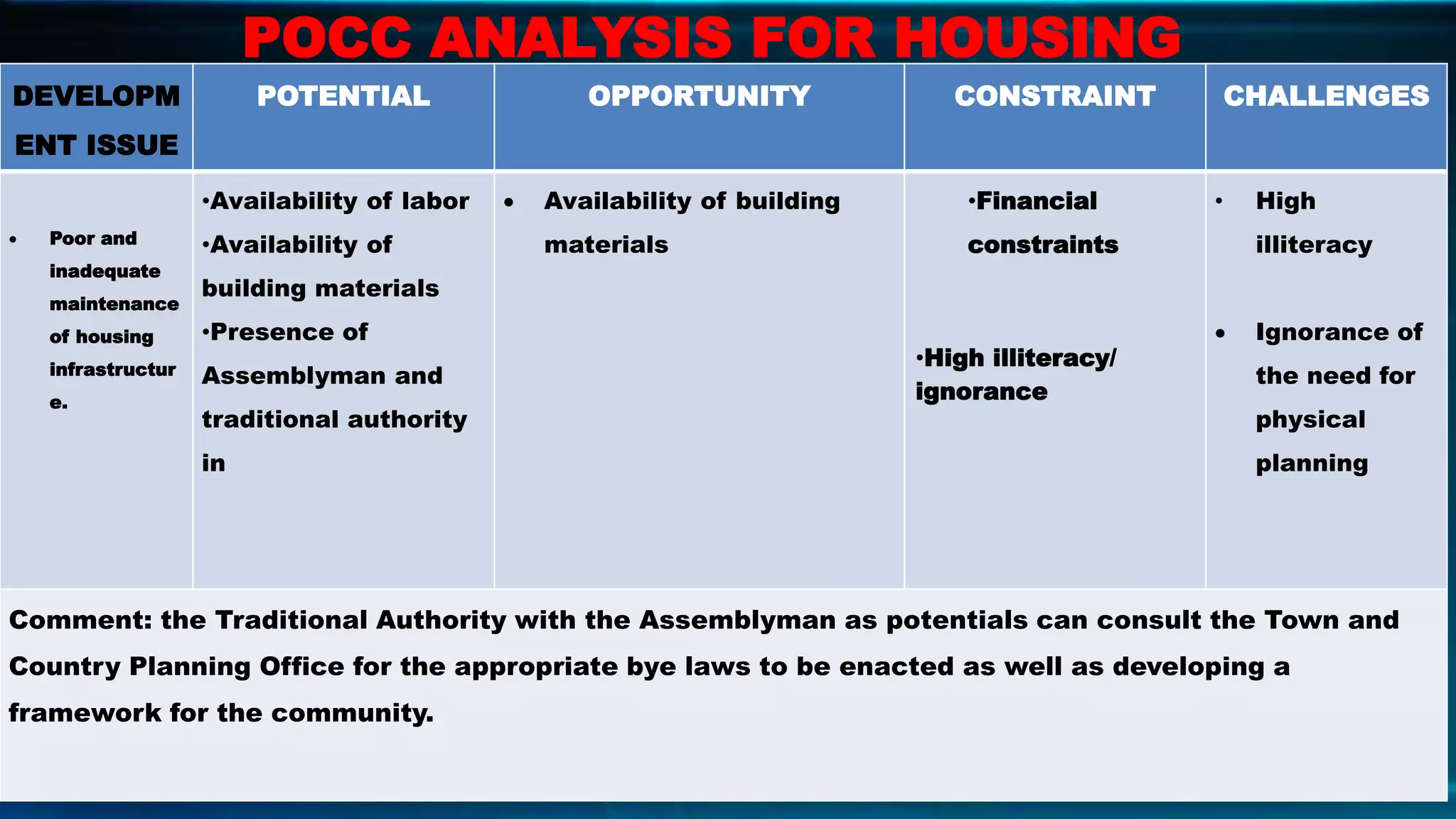
DEVELOPM
ENT ISSUE
POTENTIAL OPPORTUNITY CONSTRAINT CHALLENGES
 Poor and
inadequate
maintenance
of housing
infrastructur
e.
•Availability of labor
•Availability of
building materials
•Presence of
Assemblyman and
traditional authority
in
 Availability of building
materials
•Financial
constraints
•High illiteracy/
ignorance
• High
illiteracy
 Ignorance of
the need for
physical
planning
Comment: the Traditional Authority with the Assemblyman as potentials can consult the Town and
Country Planning Office for the appropriate bye laws to be enacted as well as developing a
framework for the community.
POCC ANALYSIS FOR HOUSING
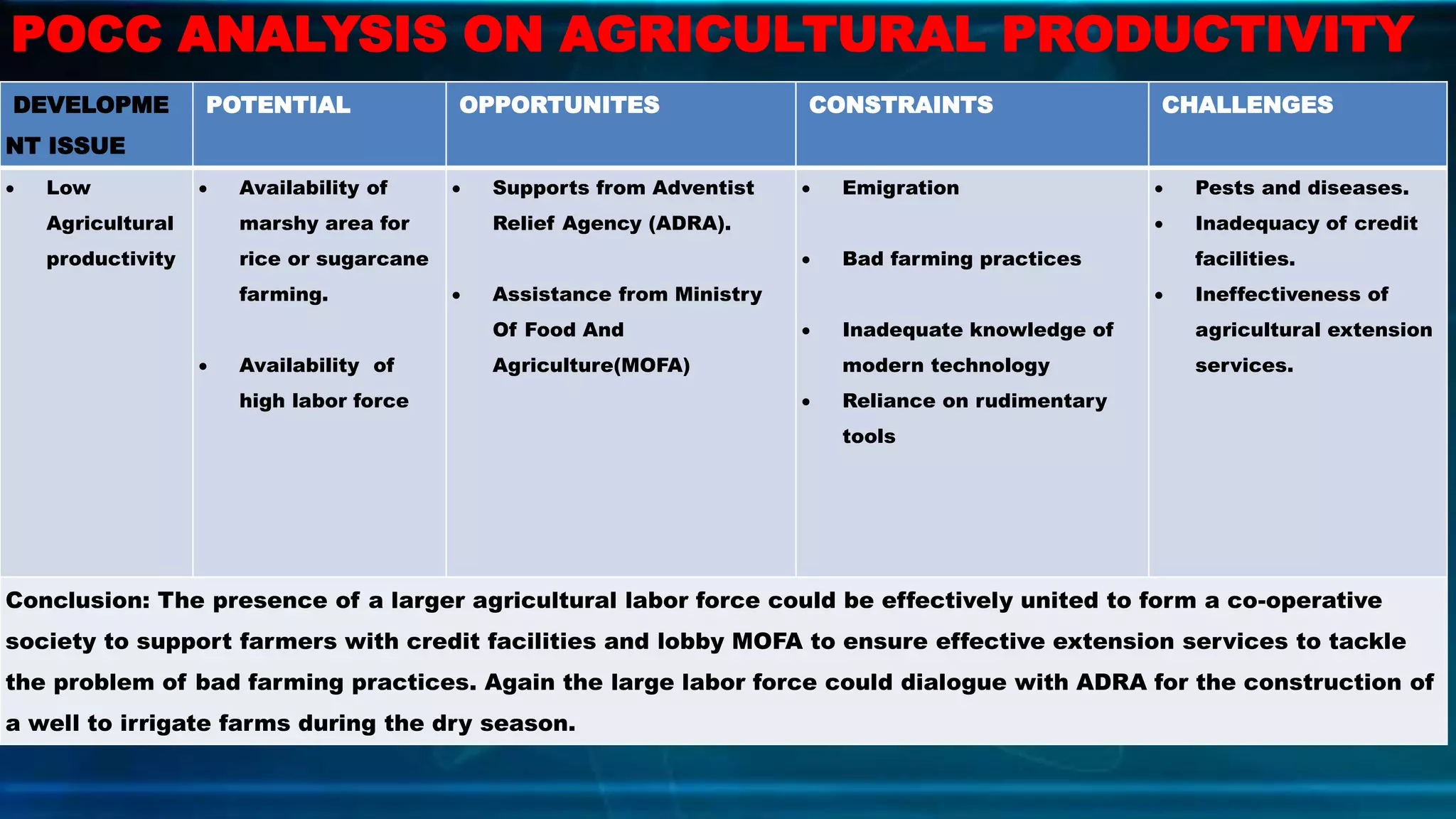
DEVELOPME
NT ISSUE
POTENTIAL OPPORTUNITES CONSTRAINTS CHALLENGES
 Low
Agricultural
productivity
 Availability of
marshy area for
rice or sugarcane
farming.
 Availability of
high labor force
 Supports from Adventist
Relief Agency (ADRA).
 Assistance from Ministry
Of Food And
Agriculture(MOFA)
 Emigration
 Bad farming practices
 Inadequate knowledge of
modern technology
 Reliance on rudimentary
tools
 Pests and diseases.
 Inadequacy of credit
facilities.
 Ineffectiveness of
agricultural extension
services.
Conclusion: The presence of a larger agricultural labor force could be effectively united to form a co-operative
society to support farmers with credit facilities and lobby MOFA to ensure effective extension services to tackle
the problem of bad farming practices. Again the large labor force could dialogue with ADRA for the construction of
a well to irrigate farms during the dry season.
POCC ANALYSIS ON AGRICULTURAL PRODUCTIVITY
CONCLUSION

Problem Analysis of KMA.pptx

  • 1.
    SP 351: URBANPLANNING WORKSHOP THEME: PROMOTING SOCIO-ECONOMIC DEVELOPMENT & ENVIRONMENTAL SUSTAINABILITY THROUGH URBAN PLANNING AND DESIGN. PROBLEM IDENTIFICATION AND PPOCC ANALYSES. GROUP THIRTEEN (13)
  • 2.
  • 3.
    INTRODUCTION • Planning asa discipline that seeks to solve both spatial and aspatial problems, society cannot achieve its goals without identifying problems of concern to the study area and generating potentials, opportunities, constraints and challenges (POCC) analysis of the community. • This presentation gives an idea about the identified problems within the study community (Kwamo) which covers areas such as environmental and land use problems, housing, water, sanitation, health, education, energy, transportation and local economy problems.
  • 4.
    OBJECTIVES • Derived developmentalproblems from the results of geophysical, environmental, economic and socio-economic or cultural analysis of their study community. • Identify existing potentials and opportunities for resolving developmental problems • Identifying existing constrains and challenges that hinder the resolution of de4velopmetal problems • Making relevant and realistic suggestions to address the developmental problems based on the POCC analysis.
  • 5.
    PROBLEM IDENTIFICATION SECTOR PROBLEMSCAUSES EFFECTS ENVIRONMENT AND LAND USE  Erosion  Inadequate drains  Natural factors such as rainfall  Negligence on the part of leaders  It exposes building foundation  It causes accidents.  It causes increase in crime rate. HOUSING  Poor and inadequate maintenance of housing infrastructure.  Low income of households to finance maintenance.  Gradual deterioration of housing unit. EDUCATION  Inadequate teaching and learning materials.  Inadequate support from government and private entities  Poor performance of students due to inadequate teaching and learning materials.  Increase in school dropouts. TRANSPORTATION  Poor access roads  Pedestrian and vehicular conflicts.  Un engineered roads  Lack of footbridge over the N6 highway at Kwamo.  Difficulty in accessibility to housing units and facilities.  Increase accidents involving pedestrians.
  • 6.
    PROBLEM IDENTIFICATION CONT’D WATER Inadequate drinking water sources.  Over dependence on sachet drinking water.  Increase in the generation of waste(plastic) SANITATION  Improper disposal of solid waste.  Improper disposal of liquid waste.  Inadequate community collection point  Lack of drains in some part of the community  Outbreak of diseases such as malaria, cholera, etc  Air pollution. LOCAL ECONOMY  Low agricultural produce  Urbanization  Lack of support to farmers in the community.  Incidence of pest and diseases.  Increase in price of farm produce HEALTH  High cost of care  Lack of public owned health facilities.  Inadequate health facilites.  Medical attention is less effective.  Increased mortality rate
  • 7.
    Problem tree Low incomelevel Low standard of living Poverty High adult illiteracy Insatiable latrine facilities Outbreak of diseases Bad attitudinal culture Inability to provide individual latrine facility Open air defecation Pressure on existing facility High cost of treatment Break down of facility High cost repairs and renovation Death Loss of labor force Core problem Causes Effects
  • 8.
    DEFINITION OF TERMS •Potential is an endowment or internal resource that one can tap in a community to improve their state or qualities that may be developed. Also, it refers to the favorable factors that exist in the community and could be harnessed in the problem-solving process. • Opportunities on the other hand are external factors that help improve the state of a community. They are favorable chance or opening offered by circumstances. This opportunity may be from the government or private organizations in a form of aids to help a community • Constraints are internal things that will hinder the development of a community or serve as restrictions to development. These are the performance inhibiting factors that can affect the exploitation of the enabling environment • Challenge is also a hindrance to the development of a community but these factors restricting the development is external, that is outside the community.
  • 9.
    SECTORS PROBLEM POTENTIA L OPPORTUN ITY CONSTRAI NTS CHALLENGES ENVIRONMENT AND LANDUSE  Erosion • available land for construction of drains • ability to create a buffer zone • available land for construction of drains • ability to create a buffer zone • Presence of EPA • Environment al byelaws Low financial support from the community members and the traditional authorities. Unplanned layouts Poor performance of environmental protection agencies. Flooding during rainy seasons POCC ANALYSIS ON ENVIRONMENT AND LAND USE
  • 10.
    DEVELOPMENT ISSUE POTENTIAL OPPORTUNITES CONSTRAINTSCHALLENGES Migration  Availability of large land  Presence of industrial activities  Assemblyman and Traditional authority  Municipal Assembly  Presence of Ministry of Youth and Employment  Presence of GES • Inadequacy social facilities • Inadequate jobs • Inadequate government support • No support from NGOs CONCLUSION: the Traditional authority through the Assemblyman could lobby the Ministry of Youth and Employment and Municipal assembly to provide more social facilities and jobs. All these will discourage the youth from migrating POCC ANALYSIS ON DEMOGRAPHY
  • 11.
    DEVELOPME NT ISSUE POTENTIAL OPPORTUNITYCONSTRAINTS CHALLENGES  Lack of dormitory block  Availability of land for expansion  Presence of PTA  Ghana Education Trust fund (GETFUND)  Lack of support from government agencies NGOS.  Low communal support.  Delay in release of capitation grants  Inadequate financial support by the government. Conclusion: The issue of the lack of dormitory blocks for the senior high school can be addressed through utilization of the availability of land and taking advantage of the Vibrant PTA to bring in government efforts to construct a classroom block for the school. POCC ANALYSIS ON EDUCATION
  • 12.
    DEVELOPMENT ISSUE POTENTIAL OPPORTUNITES CONSTRAINTSCHALLENGES  Insatiable Toilet facility in the community  Bad state of the Refuse Dump  Presence of vibrant youth in the community  Existence of traditional leaders in bye law formulation  District assembly’s common fund (DACF)  Activities of “Zoomlion” Ghana Limited •Low literacy level among the people to see the importance of a Waste and Sanitation facility. •Low income levels to patronize house to house collection  Pressure on District Assembly Common fund  No support from NGO, Conclusion: The presence of a vast land, coupled with the high communal spirit by the youth as a potential can be used for the construction of more toilet facilities and a sanitary area or dump site. Also the Community through its traditional leaders and vibrant youth could seek support from the District Assembly to for assistance in carrying out these projects to promote a high level of sanitation in the community. POCC ANALYSIS ON SANITATION
  • 13.
    DEVELOPMENT ISSUE POTENTIALOPPORTUNITES CONSTRAINTS CHALLENGES  Difficulty in accessing to water ( a section of the community • High water table  Presence of Traditional Authority system and regulations in the community  High communal labor force  Activities of Community water and Sanitation Agency (CWSA)  Sanitary Inspectors from the Municipal Capital  Improper siting of the pipe borne water at the community.  Practice of free range system of Animal farming  Insufficient community funds  Inadequate support from Municipal Assembly  Activities of Herdsmen from outside the community  High pressure on the Community Water and Sanitation Agency (CWSA) Comment: The Traditional authority could take advantage of the high communal labor and the high water table to dialogue with the CWSA to construct a borehole at the section of the community far from the boreholes. POCC ANALYSIS ON WATER
  • 14.
    DEVELOPM ENT ISSUE POTENTIAL OPPORTUNITYCONSTRAINT CHALLENGES  Poor and inadequate maintenance of housing infrastructur e. •Availability of labor •Availability of building materials •Presence of Assemblyman and traditional authority in  Availability of building materials •Financial constraints •High illiteracy/ ignorance • High illiteracy  Ignorance of the need for physical planning Comment: the Traditional Authority with the Assemblyman as potentials can consult the Town and Country Planning Office for the appropriate bye laws to be enacted as well as developing a framework for the community. POCC ANALYSIS FOR HOUSING
  • 15.
    DEVELOPME NT ISSUE POTENTIAL OPPORTUNITESCONSTRAINTS CHALLENGES  Low Agricultural productivity  Availability of marshy area for rice or sugarcane farming.  Availability of high labor force  Supports from Adventist Relief Agency (ADRA).  Assistance from Ministry Of Food And Agriculture(MOFA)  Emigration  Bad farming practices  Inadequate knowledge of modern technology  Reliance on rudimentary tools  Pests and diseases.  Inadequacy of credit facilities.  Ineffectiveness of agricultural extension services. Conclusion: The presence of a larger agricultural labor force could be effectively united to form a co-operative society to support farmers with credit facilities and lobby MOFA to ensure effective extension services to tackle the problem of bad farming practices. Again the large labor force could dialogue with ADRA for the construction of a well to irrigate farms during the dry season. POCC ANALYSIS ON AGRICULTURAL PRODUCTIVITY
  • 16.

Editor's Notes

  • #10 A buffer zone is a neutral zonal area that lies between two or more bodies of land CONCLUSION: With the available land and raw materials, the Assemblyman and traditional authority could lobby MOFA to support farming activities to boost the sector and encourage the youth to get involved. Again, the Traditional authority through the Assemblyman could lobby the Ministry of Youth and Employment and Municipal assembly to provide more social facilities and jobs. All these will discourage the youth from migrating