FYE 191H, Peace & Conflict
Library Orientation Session
September 29, 2021
Dr. Frank Quinn
Dr. Jeffrey Delbert
Quiz time…
Go to www.kahoot.it
Objectives
• The information landscape – an introduction
• Finding and using library information
o Formats
o Books – catalog, Summon
o Streaming media – catalog, Summon, databases
o Articles – Summon, databases
o Pro tips…
TWO themes for today…
•Information is created.
•Searching is exploration.
Information is created.
Key question: where does it come from?
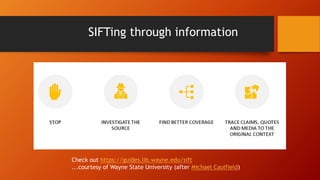
SIFTing through information
Check out https://guides.lib.wayne.edu/sift
...courtesy of Wayne State University (after Michael Caulfield)
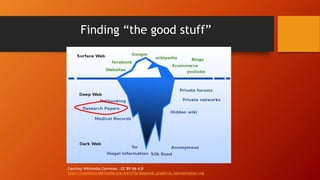
Finding “the good stuff”
Courtesy Wikimedia Commons - CC BY-SA 4.0
https://commons.wikimedia.org/wiki/File:Deepweb_graphical_representation.svg
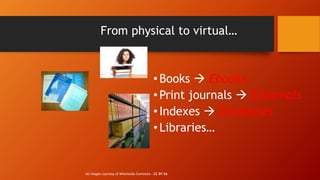
From physical to virtual…
• Books  Ebooks
• Print journals  Ejournals
• Indexes  Databases
• Libraries…
All images courtesy of Wikimedia Commons – CC BY SA
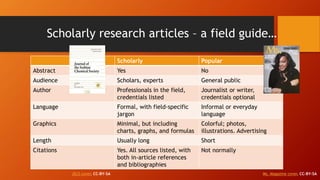
Scholarly research articles – a field guide…
Scholarly Popular
Abstract Yes No
Audience Scholars, experts General public
Author Professionals in the field,
credentials listed
Journalist or writer,
credentials optional
Language Formal, with field-specific
jargon
Informal or everyday
language
Graphics Minimal, but including
charts, graphs, and formulas
Colorful; photos,
illustrations. Advertising
Length Usually long Short
Citations Yes. All sources listed, with
both in-article references
and bibliographies
Not normally
Ms. Magazine cover, CC-BY-SA
JSCS cover, CC-BY-SA
Searching is exploration.
…or more accurately,
“Good searching is strategic exploration.”
• Cast a broad net, and
• Search in depth—get beneath the surface
Here’s an example, using a “discovery tool”– Summon.
Let’s go to the library…
• …for books and other media
• …for scholarly journal articles
• …and for help!
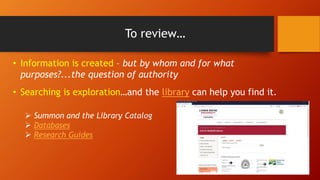
To review…
• Information is created – but by whom and for what
purposes?...the question of authority
• Searching is exploration…and the library can help you find it.
 Summon and the Library Catalog
 Databases
 Research Guides
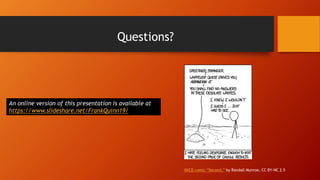
Questions?
XKCD comic “Second,” by Randall Munroe, CC BY-NC 2.5
An online version of this presentation is available at
https://www.slideshare.net/FrankQuinn19/
We need your help…
Please help us make our presentations better by answering the
questions on the Library Instruction Session Evaluation at:
http://tinyurl.com/100Evaluation
Please enter:
Instructor: Dr. Delbert
Librarian: Dr. Frank Quinn
Course: FYE 191H
Thank you!

FYE 191H Delbert fall 2021

  • 1.
    FYE 191H, Peace& Conflict Library Orientation Session September 29, 2021 Dr. Frank Quinn Dr. Jeffrey Delbert
  • 2.
    Quiz time… Go towww.kahoot.it
  • 3.
    Objectives • The informationlandscape – an introduction • Finding and using library information o Formats o Books – catalog, Summon o Streaming media – catalog, Summon, databases o Articles – Summon, databases o Pro tips…
  • 4.
    TWO themes fortoday… •Information is created. •Searching is exploration.
  • 5.
    Information is created. Keyquestion: where does it come from?
  • 6.
    SIFTing through information Checkout https://guides.lib.wayne.edu/sift ...courtesy of Wayne State University (after Michael Caulfield)
  • 7.
    Finding “the goodstuff” Courtesy Wikimedia Commons - CC BY-SA 4.0 https://commons.wikimedia.org/wiki/File:Deepweb_graphical_representation.svg
  • 8.
    From physical tovirtual… • Books  Ebooks • Print journals  Ejournals • Indexes  Databases • Libraries… All images courtesy of Wikimedia Commons – CC BY SA
  • 9.
    Scholarly research articles– a field guide… Scholarly Popular Abstract Yes No Audience Scholars, experts General public Author Professionals in the field, credentials listed Journalist or writer, credentials optional Language Formal, with field-specific jargon Informal or everyday language Graphics Minimal, but including charts, graphs, and formulas Colorful; photos, illustrations. Advertising Length Usually long Short Citations Yes. All sources listed, with both in-article references and bibliographies Not normally Ms. Magazine cover, CC-BY-SA JSCS cover, CC-BY-SA
  • 10.
    Searching is exploration. …ormore accurately, “Good searching is strategic exploration.” • Cast a broad net, and • Search in depth—get beneath the surface Here’s an example, using a “discovery tool”– Summon.
  • 11.
    Let’s go tothe library… • …for books and other media • …for scholarly journal articles • …and for help!
  • 12.
    To review… • Informationis created – but by whom and for what purposes?...the question of authority • Searching is exploration…and the library can help you find it.  Summon and the Library Catalog  Databases  Research Guides
  • 13.
    Questions? XKCD comic “Second,”by Randall Munroe, CC BY-NC 2.5 An online version of this presentation is available at https://www.slideshare.net/FrankQuinn19/
  • 14.
    We need yourhelp… Please help us make our presentations better by answering the questions on the Library Instruction Session Evaluation at: http://tinyurl.com/100Evaluation Please enter: Instructor: Dr. Delbert Librarian: Dr. Frank Quinn Course: FYE 191H Thank you!

Editor's Notes

  • #4 Why this outline? Why not just ‘here’s the library stuff?’ Because you need to know why you need to use the library….
  • #6 Exercise – divide class into four groups: come up with a list of different ways you use information in a day: games, music, phone calls, texts, social media, etc. Take 7 minutes; report back. Google (gun violence - .org .edu .gov) … excerpt from The Social Dilemma…Wikipedia
  • #7 CRAAP test = Currency, Relevance, Authority, Accuracy, and Purpose
  • #8 Stanley Milgram…setting the stage: social psychology experiment on obedience.
  • #9 all information has value… Google (guns) YouTube (My Sweet Lord [Guardians of…], He’s So Fine) “Define ‘muggle’…” – Canvas module on “citing and plagiarism” Rowling v. Vander Ark (information has value – intellectual property)
  • #10 Since information has value, we can assume that some is “more valuable” than others. How do we find it?
  • #11 What are we talking about here, and where did it come from? On how all these virtual, online resources come from print origins….
  • #13 OA – “How much money does the average professor make on a published scholarly article?”
  • #14 It’s easy to find an answer. “GIYF” …but it’s a little harder to find good information. This means you need to search broadly—not just a Google search—and search in depth. Examples: Broadly  Summon but also research guides, individual databases, library catalog… and Deeply  using limit options and Boolean operators. It’s the tension between RECALL and PRECISION. Example: (social media OR facebook OR twitter OR instagram) AND ("social control") …beginning with “social media”
  • #15 Brief history of the library as a physical facility, then— “…for books and other media” = Catalog (Summon) “…for scholarly journal articles” = Databases, Summon …be sure to mention ‘keyword’ vs. ‘subject’ searching! “…and for help!” = Research Guides, Chat
  • #16 “And the library can help you do that.” Books and other media (in our catalog); articles, ebooks, and streaming content (Summon), and librarian assistance (Chat widget, Research Help).