Bring Shadow IT into the Light:
Simple steps for a secure digital transformation
2
Today, moving to the cloud is the cornerstone of a digital
transformation strategy. The cloud can enable greater
innovation, customer engagement, productivity, and
business model transformation. Every organization,
strategically, is in different stages on their journey to
the cloud.
However, most employees have already taken enterprises
into the cloud—whether their organization is ready or
not—by using software as a service (SaaS) applications
and cloud services at work. This is widespread
across enterprises.
This trend, called shadow IT, creates challenges for
organizations in IT and application management,
security, and compliance. Not knowing what
applications your employees are using and where
sensitive data might be going introduces tremendous
risk into your organization. Traditional network security
solutions are simply not designed to protect data
in SaaS apps and cannot give IT visibility into how
employees are using the cloud.
The extent of shadow IT use is not well known
by many enterprises. Some studies show that only
8 percent of companies know the scope of shadow IT
at their organizations.1
Do you know the scope
in your organization?
Your company might be tackling this issue head-on, or is
just starting to figure out the extent of shadow IT use (or
is hesitant to even find out!). No matter where you are
on the journey, you know that understanding the extent
of shadow IT and managing it, is absolutely critical to
the security of your organization.
Regardless of where you are with shadow IT in your
organization, read on to learn about steps you should
be taking today to help your company manage shadow
IT, and its inherent security risks, while empowering
employees to work in the ways they want.
Introduction
Only
8%of companies know the scope of
shadow IT at their organizations.1
Employees expect to use the applications and devices
they’re most familiar with to get things done—usually
without a complete understanding of the security risks.
There’s no way to stop it—nor should you. The reality is
that shadow IT is the new normal of modern enterprises.
Gaining visibility, control, and threat protection of
shadow SaaS apps are the first steps in managing
risk and facilitating the digital transformation that has
already started at your company.
Not all cloud applications and services can meet your
specific security and compliance requirements—
especially if you’re in a highly regulated industry. Not
knowing if and where your employees are transferring
sensitive data is a liability your organization
cannot ignore.
Once data is transferred to the cloud, the responsibility
for protecting and securing that data typically remains
with your organization. Security in the cloud is a shared
responsibility between you and your provider. However,
ultimately, you and your organization are accountable
and responsible for protecting corporate data—no
matter where it is.
3
Understanding shadow IT
Know the hidden risks of shadow IT
Employees are signing up for easy-to-deploy cloud
services without notifying IT who would normally
perform risk assessments and fully understand the
impact that using these services may have on security
and compliance. Some issues that may arise are:
▪▪ Unencrypted data storage and connections
to services
▪▪ Lax password and authentication requirements
▪▪ Inability to meet eDiscovery requirements
▪▪ Backup and recovery that doesn’t meet
internal standards
▪▪ Legal issues regarding who owns what data
when using a cloud service
▪▪ Users unwittingly sharing sensitive data through
public links
▪▪ Noncompliance with varying international and
industry regulations
23%
of employees believe their
departments handle security
without IT’s help.2
4
Blocking shadow IT is not the solution. Employees will always find ways around restrictions. Too rigid control
deters innovation, conflicts with unplanned and demanding technology requirements, stifles productivity, and
can have a negative impact on your organization’s ability to keep high-caliber talent engaged.
Rather than blocking shadow cloud app usage, organizations need to think about how they can offer flexibility
while extending the same protections and security they’ve put in place on-premises.
How can you protect your business
without compromising innovation?
87%of senior managers admit to regularly uploading
work files to a personal email or cloud account.3
5
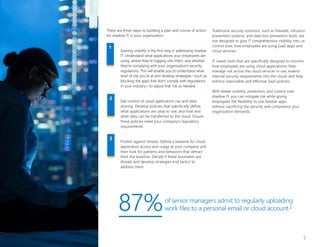
	 Gaining visibility is the first step in addressing shadow
IT. Understand what applications your employees are
using, where they’re logging into them, and whether
they’re complying with your organization’s security
regulations. This will enable you to understand what
level of risk you’re at and develop strategies—such as
blocking the apps that don't comply with regulations
in your industry—to adjust that risk as needed.
	
	 Get control of cloud application use and data
sharing. Develop policies that specifically define
what applications are okay to use, and how and
what data can be transferred to the cloud. Ensure
these policies meet your company’s regulatory
requirements.
	
	 Protect against threats. Define a baseline for cloud
application access and usage at your company and
then look for patterns and behaviors that detract
from the baseline. Decide if these anomalies are
threats and develop strategies and tactics to
address them.
Traditional security solutions, such as firewalls, intrusion
prevention systems, and data loss prevention tools, are
not designed to give IT comprehensive visibility into, or
control over, how employees are using SaaS apps and
cloud services.
IT needs tools that are specifically designed to monitor
how employees are using cloud applications, help
manage risk across the cloud services in use, extend
internal security requirements into the cloud, and help
enforce reasonable and effective SaaS policies.
With better visibility, protection, and control over
shadow IT, you can mitigate risk while giving
employees the flexibility to use familiar apps
without sacrificing the security and compliance your
organization demands.
2
3
1
There are three steps to building a plan and course of action
for shadow IT in your organization:
6
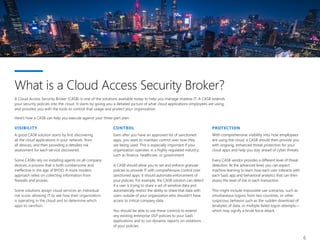
A Cloud Access Security Broker (CASB) is one of the solutions available today to help you manage shadow IT. A CASB extends
your security policies into the cloud. It starts by giving you a detailed picture of what cloud applications employees are using,
and provides you with the tools to control that usage and protect your organization.
Here’s how a CASB can help you execute against your three-part plan:
CONTROL
Even after you have an approved list of sanctioned
apps, you want to maintain control over how they
are being used. This is especially important if your
organization operates in a highly regulated industry,
such as finance, healthcare, or government.
A CASB should allow you to set and enforce granular
policies to provide IT with comprehensive control over
sanctioned apps. It should automate enforcement of
your policies. For example, the CASB solution can detect
if a user is trying to share a set of sensitive data and
automatically restrict the ability to share that data with
users outside of your organization who shouldn’t have
access to critical company data.
You should be able to use these controls to extend
any existing enterprise DLP policies to your SaaS
applications and to run dynamic reports on violations
of your policies.
What is a Cloud Access Security Broker?
PROTECTION
With comprehensive visibility into how employees
are using the cloud, a CASB should then provide you
with ongoing, enhanced threat protection for your
cloud apps and help you stay ahead of cyber threats.
Every CASB vendor provides a different level of threat
detection. At the advanced level, you can expect
machine learning to learn how each user interacts with
each SaaS app and behavioral analytics that can then
assess the level of risk in each transaction.
This might include impossible use scenarios, such as
simultaneous logons from two countries, or other
suspicious behavior such as the sudden download of
terabytes of data, or multiple failed logon attempts—
which may signify a brute force attack.
VISIBILITY
A good CASB solution starts by first discovering
all the cloud applications in your network, from
all devices, and then providing a detailed risk
assessment for each service discovered.
Some CASBs rely on installing agents on all company
devices, a process that is both cumbersome and
ineffective in the age of BYOD. A more modern
approach relies on collecting information from
firewalls and proxies.
Some solutions assign cloud services an individual
risk score, allowing IT to see how their organization
is operating in the cloud and to determine which
apps to sanction.
PROTECT APPS AND DATA
Learn more about how Microsoft can help you bring shadow IT into the light.
7
Better visibility, control, and protection can help you
manage shadow IT. In addition, IT must work with
employees to establish a SaaS policy that aligns to
business goals.
Keep an open dialogue with line of business managers
that allows them to evaluate SaaS options and aims to
provide employees with secure access to a broad range
of SaaS apps.
Once you have established a realistic SaaS policy,
communicate it broadly to the company and work
with business leaders to share these policies with
their groups.
Help employees understand ways they can protect the
organization, and share insights into high-profile data
breaches reported in the media to raise awareness
among employees of impacts of a security incident.
Make shadow IT work for you
By following a few simple steps to managing shadow
IT, developing a reasonable SaaS policy in partnership
with business groups, and educating employees on the
risks and the role they play in cybersecurity, you will be
on your way to enabling a secure digital transformation
in your organization.
Once you have established
a realistic SaaS policy,
communicate it broadly
to the company and work
with business leaders to
share these policies with
their groups.
© 2017 Microsoft Corporation. All rights reserved. This document is provided “as-is.” Information
and views expressed in this document, including URL and other Internet Web site references, may
change without notice. You bear the risk of using it. This document does not provide you with
any legal rights to any intellectual property in any Microsoft product. You may copy and use this
document for your internal, reference purposes.
1	 “Cloud Adoption Practices & Priorities Survey Report.” Cloud Security Alliance. January 2015.
https://downloads.cloudsecurityalliance.org/initiatives/surveys/capp/Cloud_Adoption_
Practices_Priorities_Survey_Final.pdf
2	 Worley, Candace. “Shadow IT: Mitigating Security Risks.” CSO. June 21, 2016.
http://www.csoonline.com/article/3083775/security/shadow-it-mitigating-security-risks.html
3	 “On the Pulse: Information Security Risk in American Business.” Stroz Friedberg. 2013.
https://www.strozfriedberg.com/wp-content/uploads/2014/01/Stroz-Friedberg_On-the-Pulse_
Information-Security-in-American-Business.pdf
References

Fy17 sec shadow_it-e_book_final_032417

  • 1.
    Bring Shadow ITinto the Light: Simple steps for a secure digital transformation
  • 2.
    2 Today, moving tothe cloud is the cornerstone of a digital transformation strategy. The cloud can enable greater innovation, customer engagement, productivity, and business model transformation. Every organization, strategically, is in different stages on their journey to the cloud. However, most employees have already taken enterprises into the cloud—whether their organization is ready or not—by using software as a service (SaaS) applications and cloud services at work. This is widespread across enterprises. This trend, called shadow IT, creates challenges for organizations in IT and application management, security, and compliance. Not knowing what applications your employees are using and where sensitive data might be going introduces tremendous risk into your organization. Traditional network security solutions are simply not designed to protect data in SaaS apps and cannot give IT visibility into how employees are using the cloud. The extent of shadow IT use is not well known by many enterprises. Some studies show that only 8 percent of companies know the scope of shadow IT at their organizations.1 Do you know the scope in your organization? Your company might be tackling this issue head-on, or is just starting to figure out the extent of shadow IT use (or is hesitant to even find out!). No matter where you are on the journey, you know that understanding the extent of shadow IT and managing it, is absolutely critical to the security of your organization. Regardless of where you are with shadow IT in your organization, read on to learn about steps you should be taking today to help your company manage shadow IT, and its inherent security risks, while empowering employees to work in the ways they want. Introduction Only 8%of companies know the scope of shadow IT at their organizations.1
  • 3.
    Employees expect touse the applications and devices they’re most familiar with to get things done—usually without a complete understanding of the security risks. There’s no way to stop it—nor should you. The reality is that shadow IT is the new normal of modern enterprises. Gaining visibility, control, and threat protection of shadow SaaS apps are the first steps in managing risk and facilitating the digital transformation that has already started at your company. Not all cloud applications and services can meet your specific security and compliance requirements— especially if you’re in a highly regulated industry. Not knowing if and where your employees are transferring sensitive data is a liability your organization cannot ignore. Once data is transferred to the cloud, the responsibility for protecting and securing that data typically remains with your organization. Security in the cloud is a shared responsibility between you and your provider. However, ultimately, you and your organization are accountable and responsible for protecting corporate data—no matter where it is. 3 Understanding shadow IT Know the hidden risks of shadow IT Employees are signing up for easy-to-deploy cloud services without notifying IT who would normally perform risk assessments and fully understand the impact that using these services may have on security and compliance. Some issues that may arise are: ▪▪ Unencrypted data storage and connections to services ▪▪ Lax password and authentication requirements ▪▪ Inability to meet eDiscovery requirements ▪▪ Backup and recovery that doesn’t meet internal standards ▪▪ Legal issues regarding who owns what data when using a cloud service ▪▪ Users unwittingly sharing sensitive data through public links ▪▪ Noncompliance with varying international and industry regulations
  • 4.
    23% of employees believetheir departments handle security without IT’s help.2 4 Blocking shadow IT is not the solution. Employees will always find ways around restrictions. Too rigid control deters innovation, conflicts with unplanned and demanding technology requirements, stifles productivity, and can have a negative impact on your organization’s ability to keep high-caliber talent engaged. Rather than blocking shadow cloud app usage, organizations need to think about how they can offer flexibility while extending the same protections and security they’ve put in place on-premises. How can you protect your business without compromising innovation?
  • 5.
    87%of senior managersadmit to regularly uploading work files to a personal email or cloud account.3 5 Gaining visibility is the first step in addressing shadow IT. Understand what applications your employees are using, where they’re logging into them, and whether they’re complying with your organization’s security regulations. This will enable you to understand what level of risk you’re at and develop strategies—such as blocking the apps that don't comply with regulations in your industry—to adjust that risk as needed. Get control of cloud application use and data sharing. Develop policies that specifically define what applications are okay to use, and how and what data can be transferred to the cloud. Ensure these policies meet your company’s regulatory requirements. Protect against threats. Define a baseline for cloud application access and usage at your company and then look for patterns and behaviors that detract from the baseline. Decide if these anomalies are threats and develop strategies and tactics to address them. Traditional security solutions, such as firewalls, intrusion prevention systems, and data loss prevention tools, are not designed to give IT comprehensive visibility into, or control over, how employees are using SaaS apps and cloud services. IT needs tools that are specifically designed to monitor how employees are using cloud applications, help manage risk across the cloud services in use, extend internal security requirements into the cloud, and help enforce reasonable and effective SaaS policies. With better visibility, protection, and control over shadow IT, you can mitigate risk while giving employees the flexibility to use familiar apps without sacrificing the security and compliance your organization demands. 2 3 1 There are three steps to building a plan and course of action for shadow IT in your organization:
  • 6.
    6 A Cloud AccessSecurity Broker (CASB) is one of the solutions available today to help you manage shadow IT. A CASB extends your security policies into the cloud. It starts by giving you a detailed picture of what cloud applications employees are using, and provides you with the tools to control that usage and protect your organization. Here’s how a CASB can help you execute against your three-part plan: CONTROL Even after you have an approved list of sanctioned apps, you want to maintain control over how they are being used. This is especially important if your organization operates in a highly regulated industry, such as finance, healthcare, or government. A CASB should allow you to set and enforce granular policies to provide IT with comprehensive control over sanctioned apps. It should automate enforcement of your policies. For example, the CASB solution can detect if a user is trying to share a set of sensitive data and automatically restrict the ability to share that data with users outside of your organization who shouldn’t have access to critical company data. You should be able to use these controls to extend any existing enterprise DLP policies to your SaaS applications and to run dynamic reports on violations of your policies. What is a Cloud Access Security Broker? PROTECTION With comprehensive visibility into how employees are using the cloud, a CASB should then provide you with ongoing, enhanced threat protection for your cloud apps and help you stay ahead of cyber threats. Every CASB vendor provides a different level of threat detection. At the advanced level, you can expect machine learning to learn how each user interacts with each SaaS app and behavioral analytics that can then assess the level of risk in each transaction. This might include impossible use scenarios, such as simultaneous logons from two countries, or other suspicious behavior such as the sudden download of terabytes of data, or multiple failed logon attempts— which may signify a brute force attack. VISIBILITY A good CASB solution starts by first discovering all the cloud applications in your network, from all devices, and then providing a detailed risk assessment for each service discovered. Some CASBs rely on installing agents on all company devices, a process that is both cumbersome and ineffective in the age of BYOD. A more modern approach relies on collecting information from firewalls and proxies. Some solutions assign cloud services an individual risk score, allowing IT to see how their organization is operating in the cloud and to determine which apps to sanction.
  • 7.
    PROTECT APPS ANDDATA Learn more about how Microsoft can help you bring shadow IT into the light. 7 Better visibility, control, and protection can help you manage shadow IT. In addition, IT must work with employees to establish a SaaS policy that aligns to business goals. Keep an open dialogue with line of business managers that allows them to evaluate SaaS options and aims to provide employees with secure access to a broad range of SaaS apps. Once you have established a realistic SaaS policy, communicate it broadly to the company and work with business leaders to share these policies with their groups. Help employees understand ways they can protect the organization, and share insights into high-profile data breaches reported in the media to raise awareness among employees of impacts of a security incident. Make shadow IT work for you By following a few simple steps to managing shadow IT, developing a reasonable SaaS policy in partnership with business groups, and educating employees on the risks and the role they play in cybersecurity, you will be on your way to enabling a secure digital transformation in your organization. Once you have established a realistic SaaS policy, communicate it broadly to the company and work with business leaders to share these policies with their groups.
  • 8.
    © 2017 MicrosoftCorporation. All rights reserved. This document is provided “as-is.” Information and views expressed in this document, including URL and other Internet Web site references, may change without notice. You bear the risk of using it. This document does not provide you with any legal rights to any intellectual property in any Microsoft product. You may copy and use this document for your internal, reference purposes. 1 “Cloud Adoption Practices & Priorities Survey Report.” Cloud Security Alliance. January 2015. https://downloads.cloudsecurityalliance.org/initiatives/surveys/capp/Cloud_Adoption_ Practices_Priorities_Survey_Final.pdf 2 Worley, Candace. “Shadow IT: Mitigating Security Risks.” CSO. June 21, 2016. http://www.csoonline.com/article/3083775/security/shadow-it-mitigating-security-risks.html 3 “On the Pulse: Information Security Risk in American Business.” Stroz Friedberg. 2013. https://www.strozfriedberg.com/wp-content/uploads/2014/01/Stroz-Friedberg_On-the-Pulse_ Information-Security-in-American-Business.pdf References