Your Library & Information Partner
Future Trends in
Technical Services
Roman Panchyshyn
OHIONET
April 2, 2008
OLC Technical Services Retreat
Your Library & Information Partner
Innovation: From 1998
Today's library environment involves a high level of
uncertainty, has few precedents on which to base
decisions, often lacks reliable facts to guide
decisions, requires quicker decisions with less time
for reflection, and often offers several plausible
options to consider. Individuals who are able to use
their intuition rather than requiring hard facts on
which to base every decision will be the most
successful technical services managers of the future.
Using automation in technical services to foster
innovation. By: Diedrichs, Carol Pitts, Journal of
Academic Librarianship, Mar1998, Vol. 24, Issue 2
Your Library & Information Partner
Future Ideas from 1999: What will TS do?
 Metadata cataloging
 Efforts to describe and provide access to information
contained in digitization efforts and digital projects
 Access and description of electronic and Internet resources in
all its myriad forms
 Consultants for database design and development for faculty
and staff involved in grant projects (at the academic library
level)
 Become grant writers/initiators
 Collaboration between and among other information
organizations (museums, libraries, archives, government,
public and private corporations, etc.)
 Consultants and experts in continuing education and training
initiatives for library professionals and staff, both on-the-job
and in librarianship itself
 Brad Eden, “Technical Services: a vision for the future” Library
Computing, v.18, no.4, 1999, p. 289-94.
Your Library & Information Partner
1998 to Today
 What has changed?
 Innovation is still key
 Technical Services must still manage
change and place itself in the forefront
Your Library & Information Partner
Brad Eden’s Thoughts in 2007
 The way libraries do business today does not work
 Libraries no longer information monopolies
 “One catalog” idea no longer works
 Position of libraries within larger organizational
structure is now precarious
 Libraries spend most funding on personnel,
salaries & benefits
 Operating budget, 70% spent on catalogs used by
10% of users
Your Library & Information Partner
Eden … 2007
 2006 ALA Big Heads. Downsizing technical
services is now strategic objective
 Revenue saved can be used to stay solvent and
move forward with new initiatives
 Cataloging not “sexy”, digitization is.
Eden, Brad. “Information Organization Future for
Libraries.” Library Technology Reports. V. 43, no.
6, Nov/Dec 2007.
Your Library & Information Partner
Questions
1. Do you feel that staffing in your library will increase or
decrease over the next 5 years?
2. Are the job descriptions in your library being
continuously maintained and updated?
3. Are you considering a new ILS?
4. Is your library/institution considering the creation and
maintenance of an institutional repository?
5. Does your library have a social (Web 2.0) presence?
6. Are you planning to provide access to Non-English
patrons?
Your Library & Information Partner
Future Trends
 We are going to examine several trends that may
have an impact on technical services in the next 5-
10 years
 Many of these issues were recently discussed at
ALA Midwinter
 LC Working Group on Future of Bibliographic
Control:
 http://www.loc.gov/bibliographic-future/news/lcwg-
ontherecord-jan08-final.pdf
Your Library & Information Partner
Issue: Shift of Cataloging Upstream
 Make use of bibliographic data available
earlier in the supply chain
 Eliminate redundancies
 Where will the data come from and what
is the cost?
Your Library & Information Partner
Impact on TS
 Publisher’s data useful
 Crosswalks between MARC-ONIX
 Concept of machine as user
 OCLC Next Generation Cataloging Pilot
 xISBN service (FRBR grouping)
Your Library & Information Partner
Routine Cataloging
 There will be a shift to get as much
routine cataloging done by machine as
early as possible
 WorldCat Selection is an example
 Shelf-ready options
 Direct vendor records
 Records purchased through partner programs such
as OCLC WorldCat Cataloging Partners
Your Library & Information Partner
Issue: Cataloging Training & Standards
 RDA being developed to take the place of
AACR2
 Joint Steering Committee
 http://www.collectionscanada.gc.ca/jsc/index.html
 Planned release in 2009
 Subscription-based service
Your Library & Information Partner
Why RDA?
 New standard for resource description and access
designed for the digital world
 Assist in developing FRBR-FRAD based-catalogs
(works, expressions, manifestations, items)
 Find, identify, select, and obtain resources
 More flexibility for machine-based cataloging, be
usable primarily within the library community, but
be capable of adaptation to meet the specific
needs of other communities.
Your Library & Information Partner
RDA training
 Monumental effort, catalogers will need
to be trained down to the local level
 LC “Train the Trainer” for distributed
training programs
 RDA initially will need to use legacy data
(MARC 21)
Your Library & Information Partner
Metadata Training
 Catalogers will need a functional knowledge
of:
 Dublin Core
 METS
 MODS
 EAD
 Essential for capability to manage digital
projects
Your Library & Information Partner
Issue: Non-English Access
 Libraries will be facing the prospect of providing
more access to non-English patrons and materials
 This will impact TS on both the automation and
staffing level
 ALCTS Task Force on Non-English Access Report
(March 2007)
 http://www.ala.org/ala/alcts/newslinks/nonenglish/07m
archrpt.pdf
Your Library & Information Partner
Non-English ILS support
 ILS that support language display &
scripting
 Non-English authority files (coming soon
at LC, Spring 2008)
 Should the practice of Romanization
continue?
Your Library & Information Partner
Non-English Staffing
 Selection/Acquisitions staffing models
need to reflect language support
 Vendors and their systems need to
integrate with non-English staff and
systems
 Expertise and expense
Your Library & Information Partner
Issue: Creation and Maintenance of
Institutional Repositories (IRs)
 The concept of the “hidden collection”
 Dual purpose
 Access
 Preservation
 Catalogers freed up from “routine
cataloging” may use their skills to
develop and maintain IRs
Your Library & Information Partner
Software
 Much IR software is “open source”
 Fedora
 DSpace
 Greenstone
 Some is commercial
 CONTENTdm
 Olive
Your Library & Information Partner
Issues
 Need the buy-in from various departments (especially
in academics)
 Need to resolve possible copyright issues (publisher
access vs. open access)
 Need to make decisions on archiving and preserving all
types of formats (even obsolete ones)
 Open vs. dark archive
 Storage costs
 Skill sets necessary to plan digital projects
Your Library & Information Partner
Issue: Electronic Resource Management
Systems
 Serials/Database management system
whose control is increasingly falling
under the sphere of technical services
 Allows libraries to manage and keep up to
date things such as license requirements,
copyright, link resolvers, etc….
Your Library & Information Partner
Interoperability with ILS
 Some are homegrown (SCELC ERMS),
some are commercial (Serials Solutions)
 2008 White Paper points out the
interoperability issues
 http://www.diglib.org/standards/ERMI_Interop_Re
port_20080108.pdf
 Aim to eliminate duplicity, redundancy
Your Library & Information Partner
Issue: Staffing
 Succession planning (is this still being
addressed in libraries)
 Changing job descriptions
 Obtaining marketable skills and retaining
skilled employees
 Are TS staff “empowered”?
 Is there a Web 2.0 mentality now within
library staff?
Your Library & Information Partner
Issue: Open Source vs. WorldCat Local
 Open Source ILS allows libraries to design
& develop their own ILS, free from
constraints of commercial vendors
 Examples
 Koha
 LibLime
 Evergreen
Your Library & Information Partner
Open Source for TS
 Library staff (or Open Source
Development companies) must have skill
sets to design and maintain these
systems
 Modules must be designed for circulation,
acquisitions, patron data, cataloging
Your Library & Information Partner
Risk vs. Reward
 Advantages
 More control
 Sharing community
 Cheaper?
 Disadvantages
 Requires skilled trained technical staff
 Continuous maintenance & development based on
altruistic principles (is this sustainable)
Your Library & Information Partner
Federated Searching (Portals)
 Types
 Endeca
 AquaBrowser
 WebFeat
 Enables simultaneous searching of organizational
databases (including ILS) through a single
interface
 Will TS staff manage these?
Your Library & Information Partner
OCLC WorldCat Local model
 Access to WorldCat now free through
WorldCat.org
 Is WorldCat the only source of
bibliographic records?
 Better yet, is it necessary for libraries to
continue to collect and use bibliographic
records with a local ILS?
Your Library & Information Partner
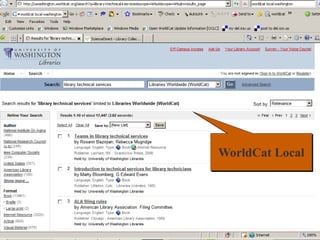
OCLC WorldCat Local
 Can serve as library “catalog”
 Be customized for local library “feel”
 Can be integrated with local ILS for
circulation/acquisitions functionality
 Link resolvers & open URL for access to electronic
data
 Do you really need to continue to support a local
ILS cataloging module?
Your Library & Information Partner
What Does A User Want?
 Find
 Identify
 Access
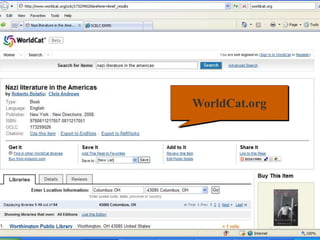
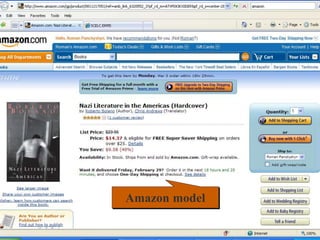
 Which is better, the MARC 21 model or
the Amazon/WorldCat.org model?
Your Library & Information Partner
WorldCat Local
Your Library & Information Partner
WorldCat.org
Your Library & Information Partner
Amazon model
Your Library & Information Partner
Technical Services Vision
 TS staff must be innovative
 Change/adapt to new uses & trends
 Develop and refine new skills to take
advantage of change
 Above all, you must be willing to take
risks to stay competitive
Your Library & Information Partner
Communication
 Blogs & Wikis can bring the community
together and keep TS staff informed
 Blogs of Note
 Michael Steven’s “Tame the Web”
 Stephen Abrams “Stephen’s Lighthouse”
 David Bigwood’s “Catalogblog”
 There are literally hundreds more
Your Library & Information Partner
Questions & Discussion
Your Library & Information Partner
Roman Panchyshyn, MLIS
OHIONET
romanp@ohionet.org
614-486-2966 ext. 32

FutureTrends.ppt

  • 1.
    Your Library &Information Partner Future Trends in Technical Services Roman Panchyshyn OHIONET April 2, 2008 OLC Technical Services Retreat
  • 2.
    Your Library &Information Partner Innovation: From 1998 Today's library environment involves a high level of uncertainty, has few precedents on which to base decisions, often lacks reliable facts to guide decisions, requires quicker decisions with less time for reflection, and often offers several plausible options to consider. Individuals who are able to use their intuition rather than requiring hard facts on which to base every decision will be the most successful technical services managers of the future. Using automation in technical services to foster innovation. By: Diedrichs, Carol Pitts, Journal of Academic Librarianship, Mar1998, Vol. 24, Issue 2
  • 3.
    Your Library &Information Partner Future Ideas from 1999: What will TS do?  Metadata cataloging  Efforts to describe and provide access to information contained in digitization efforts and digital projects  Access and description of electronic and Internet resources in all its myriad forms  Consultants for database design and development for faculty and staff involved in grant projects (at the academic library level)  Become grant writers/initiators  Collaboration between and among other information organizations (museums, libraries, archives, government, public and private corporations, etc.)  Consultants and experts in continuing education and training initiatives for library professionals and staff, both on-the-job and in librarianship itself  Brad Eden, “Technical Services: a vision for the future” Library Computing, v.18, no.4, 1999, p. 289-94.
  • 4.
    Your Library &Information Partner 1998 to Today  What has changed?  Innovation is still key  Technical Services must still manage change and place itself in the forefront
  • 5.
    Your Library &Information Partner Brad Eden’s Thoughts in 2007  The way libraries do business today does not work  Libraries no longer information monopolies  “One catalog” idea no longer works  Position of libraries within larger organizational structure is now precarious  Libraries spend most funding on personnel, salaries & benefits  Operating budget, 70% spent on catalogs used by 10% of users
  • 6.
    Your Library &Information Partner Eden … 2007  2006 ALA Big Heads. Downsizing technical services is now strategic objective  Revenue saved can be used to stay solvent and move forward with new initiatives  Cataloging not “sexy”, digitization is. Eden, Brad. “Information Organization Future for Libraries.” Library Technology Reports. V. 43, no. 6, Nov/Dec 2007.
  • 7.
    Your Library &Information Partner Questions 1. Do you feel that staffing in your library will increase or decrease over the next 5 years? 2. Are the job descriptions in your library being continuously maintained and updated? 3. Are you considering a new ILS? 4. Is your library/institution considering the creation and maintenance of an institutional repository? 5. Does your library have a social (Web 2.0) presence? 6. Are you planning to provide access to Non-English patrons?
  • 8.
    Your Library &Information Partner Future Trends  We are going to examine several trends that may have an impact on technical services in the next 5- 10 years  Many of these issues were recently discussed at ALA Midwinter  LC Working Group on Future of Bibliographic Control:  http://www.loc.gov/bibliographic-future/news/lcwg- ontherecord-jan08-final.pdf
  • 9.
    Your Library &Information Partner Issue: Shift of Cataloging Upstream  Make use of bibliographic data available earlier in the supply chain  Eliminate redundancies  Where will the data come from and what is the cost?
  • 10.
    Your Library &Information Partner Impact on TS  Publisher’s data useful  Crosswalks between MARC-ONIX  Concept of machine as user  OCLC Next Generation Cataloging Pilot  xISBN service (FRBR grouping)
  • 11.
    Your Library &Information Partner Routine Cataloging  There will be a shift to get as much routine cataloging done by machine as early as possible  WorldCat Selection is an example  Shelf-ready options  Direct vendor records  Records purchased through partner programs such as OCLC WorldCat Cataloging Partners
  • 12.
    Your Library &Information Partner Issue: Cataloging Training & Standards  RDA being developed to take the place of AACR2  Joint Steering Committee  http://www.collectionscanada.gc.ca/jsc/index.html  Planned release in 2009  Subscription-based service
  • 13.
    Your Library &Information Partner Why RDA?  New standard for resource description and access designed for the digital world  Assist in developing FRBR-FRAD based-catalogs (works, expressions, manifestations, items)  Find, identify, select, and obtain resources  More flexibility for machine-based cataloging, be usable primarily within the library community, but be capable of adaptation to meet the specific needs of other communities.
  • 14.
    Your Library &Information Partner RDA training  Monumental effort, catalogers will need to be trained down to the local level  LC “Train the Trainer” for distributed training programs  RDA initially will need to use legacy data (MARC 21)
  • 15.
    Your Library &Information Partner Metadata Training  Catalogers will need a functional knowledge of:  Dublin Core  METS  MODS  EAD  Essential for capability to manage digital projects
  • 16.
    Your Library &Information Partner Issue: Non-English Access  Libraries will be facing the prospect of providing more access to non-English patrons and materials  This will impact TS on both the automation and staffing level  ALCTS Task Force on Non-English Access Report (March 2007)  http://www.ala.org/ala/alcts/newslinks/nonenglish/07m archrpt.pdf
  • 17.
    Your Library &Information Partner Non-English ILS support  ILS that support language display & scripting  Non-English authority files (coming soon at LC, Spring 2008)  Should the practice of Romanization continue?
  • 18.
    Your Library &Information Partner Non-English Staffing  Selection/Acquisitions staffing models need to reflect language support  Vendors and their systems need to integrate with non-English staff and systems  Expertise and expense
  • 19.
    Your Library &Information Partner Issue: Creation and Maintenance of Institutional Repositories (IRs)  The concept of the “hidden collection”  Dual purpose  Access  Preservation  Catalogers freed up from “routine cataloging” may use their skills to develop and maintain IRs
  • 20.
    Your Library &Information Partner Software  Much IR software is “open source”  Fedora  DSpace  Greenstone  Some is commercial  CONTENTdm  Olive
  • 21.
    Your Library &Information Partner Issues  Need the buy-in from various departments (especially in academics)  Need to resolve possible copyright issues (publisher access vs. open access)  Need to make decisions on archiving and preserving all types of formats (even obsolete ones)  Open vs. dark archive  Storage costs  Skill sets necessary to plan digital projects
  • 22.
    Your Library &Information Partner Issue: Electronic Resource Management Systems  Serials/Database management system whose control is increasingly falling under the sphere of technical services  Allows libraries to manage and keep up to date things such as license requirements, copyright, link resolvers, etc….
  • 23.
    Your Library &Information Partner Interoperability with ILS  Some are homegrown (SCELC ERMS), some are commercial (Serials Solutions)  2008 White Paper points out the interoperability issues  http://www.diglib.org/standards/ERMI_Interop_Re port_20080108.pdf  Aim to eliminate duplicity, redundancy
  • 24.
    Your Library &Information Partner Issue: Staffing  Succession planning (is this still being addressed in libraries)  Changing job descriptions  Obtaining marketable skills and retaining skilled employees  Are TS staff “empowered”?  Is there a Web 2.0 mentality now within library staff?
  • 25.
    Your Library &Information Partner Issue: Open Source vs. WorldCat Local  Open Source ILS allows libraries to design & develop their own ILS, free from constraints of commercial vendors  Examples  Koha  LibLime  Evergreen
  • 26.
    Your Library &Information Partner Open Source for TS  Library staff (or Open Source Development companies) must have skill sets to design and maintain these systems  Modules must be designed for circulation, acquisitions, patron data, cataloging
  • 27.
    Your Library &Information Partner Risk vs. Reward  Advantages  More control  Sharing community  Cheaper?  Disadvantages  Requires skilled trained technical staff  Continuous maintenance & development based on altruistic principles (is this sustainable)
  • 28.
    Your Library &Information Partner Federated Searching (Portals)  Types  Endeca  AquaBrowser  WebFeat  Enables simultaneous searching of organizational databases (including ILS) through a single interface  Will TS staff manage these?
  • 29.
    Your Library &Information Partner OCLC WorldCat Local model  Access to WorldCat now free through WorldCat.org  Is WorldCat the only source of bibliographic records?  Better yet, is it necessary for libraries to continue to collect and use bibliographic records with a local ILS?
  • 30.
    Your Library &Information Partner OCLC WorldCat Local  Can serve as library “catalog”  Be customized for local library “feel”  Can be integrated with local ILS for circulation/acquisitions functionality  Link resolvers & open URL for access to electronic data  Do you really need to continue to support a local ILS cataloging module?
  • 31.
    Your Library &Information Partner What Does A User Want?  Find  Identify  Access  Which is better, the MARC 21 model or the Amazon/WorldCat.org model?
  • 32.
    Your Library &Information Partner WorldCat Local
  • 33.
    Your Library &Information Partner WorldCat.org
  • 34.
    Your Library &Information Partner Amazon model
  • 35.
    Your Library &Information Partner Technical Services Vision  TS staff must be innovative  Change/adapt to new uses & trends  Develop and refine new skills to take advantage of change  Above all, you must be willing to take risks to stay competitive
  • 36.
    Your Library &Information Partner Communication  Blogs & Wikis can bring the community together and keep TS staff informed  Blogs of Note  Michael Steven’s “Tame the Web”  Stephen Abrams “Stephen’s Lighthouse”  David Bigwood’s “Catalogblog”  There are literally hundreds more
  • 37.
    Your Library &Information Partner Questions & Discussion
  • 38.
    Your Library &Information Partner Roman Panchyshyn, MLIS OHIONET romanp@ohionet.org 614-486-2966 ext. 32