Future Technologies in
       Dermatology


Dieter Manstein, M.D. Ph.D.
  Wellman Center for Photomedicine
   Massachusetts General Hospital
       Harvard Medical School
Disclaimer
 Presentation is intended to stimulate use of
  new technologies & concepts.
 The selection of is based on author’s
  assessment and not complete.
General Objectives
 Efficacy 
 Selectivity, safety 
 Side effects, down time 
 Pain 
 Overcoming skin barrier
     getting things in or out
 Skin‘rejuvenation’
 Costs 
Cooling is the New Hot
       - Selectivity without Laser -
 Typically   cooling as adjunct with SP
     (Epidermal protection for laser)
 Selective   Cryolipolysis:
Selective Cryolipolysis
                   Yucatan Pig
    Untreated                    16 Days Post Treatment


A                                C


B                               D
                Manstein et al., ASLMS 2008
Cryolipolysis
           Coolsculpting - Zeltiq
Control Unit
Cooling is the New Hot
       - Selectivity without Laser -
 Typically   cooling as adjunct with SP
     (Epidermal protection for laser)
 Selective    Cryolipolysis:
     Selective effects on fat, biological selectivity
      rather than selective temperature field
 Other
      indications (Acne, Xanthelasma,
 Cryoneuromoduloation, etc.)
     Modify geometry, T/t, T
Pain Management w/o Drugs
   Cooling
       Surface cooling with laser (epidermal protection)
       Cryoanalgesia
   Very small laser spots
       No pain due to lack of spatial or temporal summation
   Gate control
       Competitive pain blockage (distraction)
   Repetitive exposures / treatments
Repetitive Pulses = Enhanced Efficacy
    Pulse stacking (quick, high energy, bulk heating, To )
    Repetitive pulses (quick, low energy)
     EN=Es x N-1/4
          N=16             2x
          N=81             3x
          N=256            4x
          N=615            5x

    Repetitive pulses (slow, minutes)
          Altered tissue optics (erythema, edema)
          Altered chromophores (rupture, stasis, color change)
          Altered biological response (HSP, sub-lethal damage)

    Multiple treatments (slow, days)
          Tissue repair limitations

 *Roider J, Hillenkamp F, Flotte T, Birngruber R. Microphotocoagulation: selective effects of repetitive short laser
     pulses. Proc Natl Acad Sci U S A. 1993 Sep 15;90(18):8643-7.
Variation of
              Treatment Interval & Energy / Tx

                                                 Total Energy
Energy / TX                                          40 U


Energy / TX                                      Total Energy
                                                     40 U


                         Time
Combination: 1+1=3
 Cooling and massage
 Heating and massage
 Preheating and SP
     RF & SP
     US & SP
     IR & SP


                               11
Skin as a Barrier
 Limited drug delivery (SC)
 Limited light penetration
     Absorption of melanin & blood
     Scattering of shorter wavelengths
     Small beams rapidly diverge
 Limited    trans(epi)dermal elimination
     Tattoo ink, lipids
Skin without Barriers
     -Getting Things in and out-
 Small   diameter holes as a gateway
Small Diameter Holes as a Gateway
 Increasing Laser Pulse Energy


                                    14
Small Diameter Holes
A new Gateway into the Skin (?)
Skin without Barriers
       -Getting Things in and out-
 Small   diameter holes as a gateway
     Drug delivery
     Optical energy delivery
 Needle    Arrays
     Fractional RF
     Optical fiber arrays
     Drug delivery
 Getting   things out
True Rejuvenation
 Currently ‘rejuvenation’ used vaguely and
  no accepted standards by FDA
 True rejuvenation by (fractional) laser
  procedures (?)
     Regeneration by controlled destruction
     Reduction of senescent skin cells
     Allowing for controlled cell proliferation from
      SCs
 Rejuvenation       hallmarks of aging 
Smart Devices
 Smart is safer
     Real-time pigmentation feedback
     Aim and shoot
     Tracking (avoid bulk heating)
 Smart saves energy
     Most of SP energy is not utilized
     More energy efficient = more cost effective


                                                    18
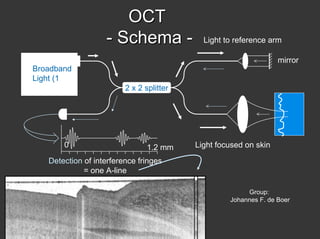
OCT
                   - Schema -               Light to reference arm

                                                                  mirror
Broadband
Broadban
Light (1
d light
source                   2 x 2 splitter


       0                        1.2 mm    Light focused on skin
   Detection of interference fringes
             = one A-line

                                                        Group:
                                                   Johannes F. de Boer
OCT
Examples of Skin Imaging


                  plate
nail bed                    matrix


                                                1.2 mm


  Eccrine ducts                      Hair
Photos: John Strasswimmer     Group: Johannes F. de Boer
Fluorescence and Fluorescence
  Anisotropy Imaging of Nonmelanoma
Micronodular BCC Skin Cancer

Fluorescence confocal image;              Fluorescence      Fluorescence
stain MB                                  Emission          Anisotropy


                               Collagen


                                Cancer


 Histopathology; Stain: H&E
                                           Group: Anna Yaroslavsky
Yaroslavsky et al., 2006
Robotic Devices
        - Putting Diagnostic and Treatment
                     Together -


 H&E                                               OCT device and imaging:

1 stain
  mm                                        Johannes F. de Boer & Mark Pierce

                                    ASLMS 2001: SPATIALLY CONFINED PHOTOTHERMOLYSIS
1 Month post TX, =1206 & 1065 nm
                                 OF DERMAL TARGETS USING AN IR-FIBERLASER IN
P= 1.5 & 10 W ,t= 1.5 s          COMBINATION WITH FOCUSING AND CONTACT COOLING
E= 17.25 J, focusing             D. Manstein, M. Poureshagh, R. R. Anderson, I. Yaroslavsky, G.
                                    B. Altshuler
The Future Trend
           - Driven by Market Size -
                                                    Dermatologists and Plastic Surgeons (Special
                                                                 (max. ~10.000 users)


                       ro d c y,
                               cti t
                                                            General practitioners and other physic
                    s p an og
                                      nd


                          du os
                                       )
                                  on
                                  tre


                  as ty nol
                              en


                (m safe ech
                           riv
      -d


                                                                       Spas and Salons
                        t
    t
 ke


          cti ced in
 ar


        du n es
M


      re ha nc
         en va

             on
           Ad


                                 173 million                                        Consumers
                                 15 - 60 years old
                                (US Census 2000)

                                           Market Size
Specific Needs for Different
              Markets
Specialist’s Device   Home use Device
 Efficacy             Safety
 Others               Safety
                       Safety
                       Others
Summary
 Cooling  from a new perspective
 Pain management
 Skin without borders
 Repetitive pulses/ treatments
 Combination: 1+1=3
 True skin rejuvenation
 Smart devices (Imaging & Tx)
 Home use devices
Thanks


Wellman Center for Photomedicine, Boston
        Harvard Medical School

Future technologies in dermatology

  • 1.
    Future Technologies in Dermatology Dieter Manstein, M.D. Ph.D. Wellman Center for Photomedicine Massachusetts General Hospital Harvard Medical School
  • 2.
    Disclaimer  Presentation isintended to stimulate use of new technologies & concepts.  The selection of is based on author’s assessment and not complete.
  • 3.
    General Objectives  Efficacy  Selectivity, safety   Side effects, down time   Pain   Overcoming skin barrier  getting things in or out  Skin‘rejuvenation’  Costs 
  • 4.
    Cooling is theNew Hot - Selectivity without Laser -  Typically cooling as adjunct with SP  (Epidermal protection for laser)  Selective Cryolipolysis:
  • 5.
    Selective Cryolipolysis Yucatan Pig Untreated 16 Days Post Treatment A C B D Manstein et al., ASLMS 2008
  • 6.
    Cryolipolysis Coolsculpting - Zeltiq Control Unit
  • 7.
    Cooling is theNew Hot - Selectivity without Laser -  Typically cooling as adjunct with SP  (Epidermal protection for laser)  Selective Cryolipolysis:  Selective effects on fat, biological selectivity rather than selective temperature field  Other indications (Acne, Xanthelasma, Cryoneuromoduloation, etc.)  Modify geometry, T/t, T
  • 8.
    Pain Management w/oDrugs  Cooling  Surface cooling with laser (epidermal protection)  Cryoanalgesia  Very small laser spots  No pain due to lack of spatial or temporal summation  Gate control  Competitive pain blockage (distraction)  Repetitive exposures / treatments
  • 9.
    Repetitive Pulses =Enhanced Efficacy  Pulse stacking (quick, high energy, bulk heating, To )  Repetitive pulses (quick, low energy) EN=Es x N-1/4  N=16  2x  N=81  3x  N=256  4x  N=615  5x  Repetitive pulses (slow, minutes)  Altered tissue optics (erythema, edema)  Altered chromophores (rupture, stasis, color change)  Altered biological response (HSP, sub-lethal damage)  Multiple treatments (slow, days)  Tissue repair limitations *Roider J, Hillenkamp F, Flotte T, Birngruber R. Microphotocoagulation: selective effects of repetitive short laser pulses. Proc Natl Acad Sci U S A. 1993 Sep 15;90(18):8643-7.
  • 10.
    Variation of Treatment Interval & Energy / Tx Total Energy Energy / TX 40 U Energy / TX Total Energy 40 U Time
  • 11.
    Combination: 1+1=3  Coolingand massage  Heating and massage  Preheating and SP  RF & SP  US & SP  IR & SP 11
  • 12.
    Skin as aBarrier  Limited drug delivery (SC)  Limited light penetration  Absorption of melanin & blood  Scattering of shorter wavelengths  Small beams rapidly diverge  Limited trans(epi)dermal elimination  Tattoo ink, lipids
  • 13.
    Skin without Barriers -Getting Things in and out-  Small diameter holes as a gateway
  • 14.
    Small Diameter Holesas a Gateway Increasing Laser Pulse Energy 14
  • 15.
    Small Diameter Holes Anew Gateway into the Skin (?)
  • 16.
    Skin without Barriers -Getting Things in and out-  Small diameter holes as a gateway  Drug delivery  Optical energy delivery  Needle Arrays  Fractional RF  Optical fiber arrays  Drug delivery  Getting things out
  • 17.
    True Rejuvenation  Currently‘rejuvenation’ used vaguely and no accepted standards by FDA  True rejuvenation by (fractional) laser procedures (?)  Regeneration by controlled destruction  Reduction of senescent skin cells  Allowing for controlled cell proliferation from SCs  Rejuvenation  hallmarks of aging 
  • 18.
    Smart Devices  Smartis safer  Real-time pigmentation feedback  Aim and shoot  Tracking (avoid bulk heating)  Smart saves energy  Most of SP energy is not utilized  More energy efficient = more cost effective 18
  • 19.
    OCT - Schema - Light to reference arm mirror Broadband Broadban Light (1 d light source 2 x 2 splitter 0 1.2 mm Light focused on skin Detection of interference fringes = one A-line Group: Johannes F. de Boer
  • 20.
    OCT Examples of SkinImaging plate nail bed matrix 1.2 mm Eccrine ducts Hair Photos: John Strasswimmer Group: Johannes F. de Boer
  • 21.
    Fluorescence and Fluorescence Anisotropy Imaging of Nonmelanoma Micronodular BCC Skin Cancer Fluorescence confocal image; Fluorescence Fluorescence stain MB Emission Anisotropy Collagen Cancer Histopathology; Stain: H&E Group: Anna Yaroslavsky Yaroslavsky et al., 2006
  • 22.
    Robotic Devices - Putting Diagnostic and Treatment Together - H&E OCT device and imaging: 1 stain mm Johannes F. de Boer & Mark Pierce ASLMS 2001: SPATIALLY CONFINED PHOTOTHERMOLYSIS 1 Month post TX, =1206 & 1065 nm OF DERMAL TARGETS USING AN IR-FIBERLASER IN P= 1.5 & 10 W ,t= 1.5 s COMBINATION WITH FOCUSING AND CONTACT COOLING E= 17.25 J, focusing D. Manstein, M. Poureshagh, R. R. Anderson, I. Yaroslavsky, G. B. Altshuler
  • 23.
    The Future Trend - Driven by Market Size - Dermatologists and Plastic Surgeons (Special (max. ~10.000 users) ro d c y, cti t General practitioners and other physic s p an og nd du os ) on tre as ty nol en (m safe ech riv -d Spas and Salons t t ke cti ced in ar du n es M re ha nc en va on Ad 173 million Consumers 15 - 60 years old (US Census 2000) Market Size
  • 24.
    Specific Needs forDifferent Markets Specialist’s Device Home use Device  Efficacy  Safety  Others  Safety  Safety  Others
  • 25.
    Summary  Cooling from a new perspective  Pain management  Skin without borders  Repetitive pulses/ treatments  Combination: 1+1=3  True skin rejuvenation  Smart devices (Imaging & Tx)  Home use devices
  • 26.
    Thanks Wellman Center forPhotomedicine, Boston Harvard Medical School