Future structures Will Be going to Present continuous
Usage We use «Will» is used
to express a promise, a
prediction or something
that you want to do in
the future.
In English we can
use “be going to” to
convey an idea of
the future.
First of all, we use it
to refer to future
plans that we have
already decided on.
It reflects the
speaker's intentions
for the future,
although it does not
necessarily mean
that we have already
started preparations,
or that these things
are actually going to
happen.
The present
continuous
generally refers to
situations or actions
that are taking place
at the moment.
Examples
Positive S + Will + Verb
infinitive.
1. I Will help you.
2. She Wiil be
there.
S + to be + going +
infinitive.
1. I´m going to
visit my
sister next
Saturday.
Subject+ Verb TO
BE + Verb -ing
form +Complement.
1. I am
reading
book.
2. Look! It’s
raining.
Negative S + Won’t + Verb INF.
1. I won´t help you.
2. She won´t be
there.
S + to be + not +
going to + infinitive.
1. Sara isn´t
going to
wear a drees
at the party.
S + Verb NOT TO
BE+ Verb- ing form
+ C.
1. She isn’t
listening to
music.
Questions WILL + S + Verb INF.
2. Will you help
me?
3. Will she be
there?
To be + S + going to
+ infinitive +?
1. Are + they
going to
Paint their
bedroom?
No, they
aren´.
VERB TO BE + S +
Verb -Ing form +
C?
1. What are
you doing
now?
Additional
aspects
You will usually come
across will in its
“Be going to”
usually appears in
Shrinkage
contracted form: 'll. We
also use will when we
have just made a
decision about what we
are going to do. For
example: I will take the
fish would be I'll have
the fish.
informal contexts, so
we almost always
use it with
contractions, like
“I'm”, “he's”, “it's”,
“we're” and
“they're”.
You are -- You're
He is -- He's
I am not—I´m not
What is your
name?-- What's
your name?
My name is Bill--
My name's Bill

Future structures.pdf

  • 1.
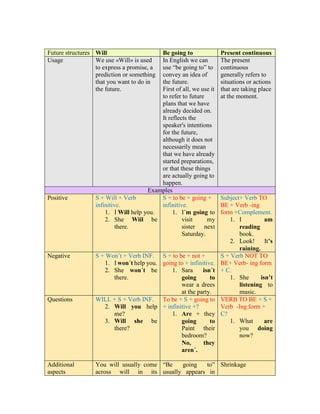
    Future structures WillBe going to Present continuous Usage We use «Will» is used to express a promise, a prediction or something that you want to do in the future. In English we can use “be going to” to convey an idea of the future. First of all, we use it to refer to future plans that we have already decided on. It reflects the speaker's intentions for the future, although it does not necessarily mean that we have already started preparations, or that these things are actually going to happen. The present continuous generally refers to situations or actions that are taking place at the moment. Examples Positive S + Will + Verb infinitive. 1. I Will help you. 2. She Wiil be there. S + to be + going + infinitive. 1. I´m going to visit my sister next Saturday. Subject+ Verb TO BE + Verb -ing form +Complement. 1. I am reading book. 2. Look! It’s raining. Negative S + Won’t + Verb INF. 1. I won´t help you. 2. She won´t be there. S + to be + not + going to + infinitive. 1. Sara isn´t going to wear a drees at the party. S + Verb NOT TO BE+ Verb- ing form + C. 1. She isn’t listening to music. Questions WILL + S + Verb INF. 2. Will you help me? 3. Will she be there? To be + S + going to + infinitive +? 1. Are + they going to Paint their bedroom? No, they aren´. VERB TO BE + S + Verb -Ing form + C? 1. What are you doing now? Additional aspects You will usually come across will in its “Be going to” usually appears in Shrinkage
  • 2.
    contracted form: 'll.We also use will when we have just made a decision about what we are going to do. For example: I will take the fish would be I'll have the fish. informal contexts, so we almost always use it with contractions, like “I'm”, “he's”, “it's”, “we're” and “they're”. You are -- You're He is -- He's I am not—I´m not What is your name?-- What's your name? My name is Bill-- My name's Bill