THE
FUTURE
OF WAR
I.S.   BLOCH
THE LIBRARY
      OF
THE UNIVERSITY
OF CALIFORNIA
 LOS ANGELES

 FROM THE LIBRARY OF
ERNEST CARROLL MOORE
The
Future   of   War
Digitized by the Internet Archive
               in   2007   with funding from
                    IVIicrosoft   Corporation


http://www.archive.org/details/futureofwarinitsOOblociala
rhe

FUTURE OF WAR
        IN ITSTECHNICAL
          ECONOMIC AND
                POLITICAL
                RELATIONS

                            BY

        JEAN DE BLOCH
TRANSLATED BY   R. C.   AND WITH A CONVERSATION
                        LONG,
     WITH THE AUTHOR BY W. T. STEAD, AND AN

         INTRODUCTION BY EDWIN D. MEAD


PUBLISHED FOR THE INTERNATIONAL UNION

          GINN & COMPANY, BOSTON
Copyright,   i899,   by

DOUBLEDAY & McCLURE            CO.
CoUeg*
                                                                 library


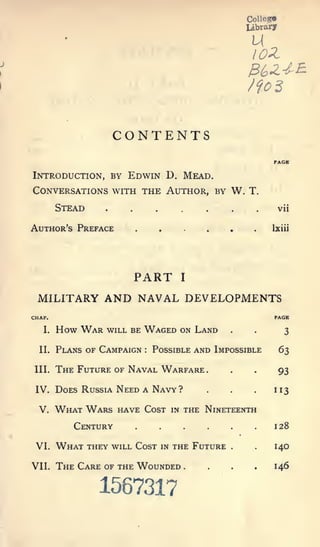
                       CONTENTS
                                                                          PACK

Introduction, by Edwin D. Mead.
Conversations with the Author, by W. T.
        Stead      .     .        .                     .    .        .    vii


                             ......
                                                .


Author's Preface                                                          Ixiii


                             PART               I


 MILITARY AND NAVAL DEVELOPMENTS
CHAP.                                                                     PAGE

   I.   How War    will be    Waged             on Land      .    .
                                                                             3

  II.   Plans of Campaign     :   Possible and Impossible                  63

 III.   The Future of Naval Warfare                     ...                93

 IV.    Does Russia Need A Navy ?                       .    .    .       113

  V.    What Wars      have Cost           in       the Nineteenth
           Century                                                        128

 VI.    What    they will Cost        in   the Future        .     .      140

VII.    The Care of the Wounded                     .   .    .    .146
                  1567317
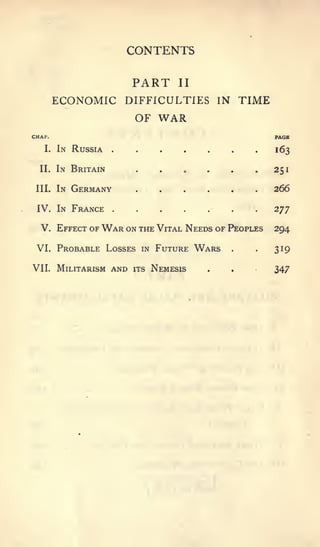
CONTENTS

                           PART       II

        ECONOMIC DIFFICULTIES IN TIME
                  OF WAR
CHAP.                                                     PAGE

   I.   In Russia                                         163

  II.   In Britain                                        251

 III.   In   Germany                                      266

 IV. In France         .    .     .    .     .    .   .
                                                          2TJ

  V. Effect of War on the Vital Needs of Peoples          294

 VI. Probable Losses in Future             Wars   .   .   319

VII. Militarism      and   its   Nemesis     .    .       347
LIST        OF MAPS AND DIAGRAMS

Map
Map
      of Russian Defensive     System        ......
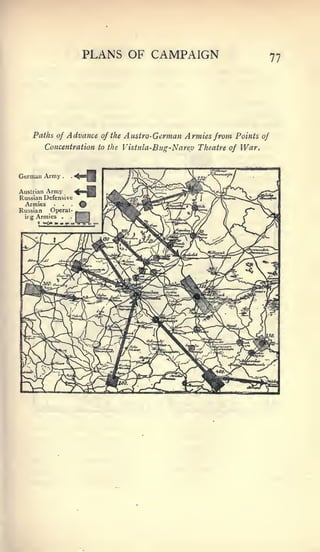
     of Paths of Advance of the Austro-German Armies from
                                                                       74

    Points of Concentration to the Vistula-Bug-Narev Theatre
    of War                                                             77
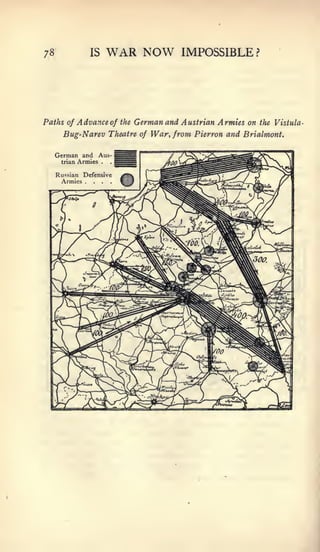
Map   of Paths of   Advance   of the   German and Austrian Armies on
    the Vistula-Bug-Narev Theatre of          War, from Pierron and
    Brailmont                                                       78
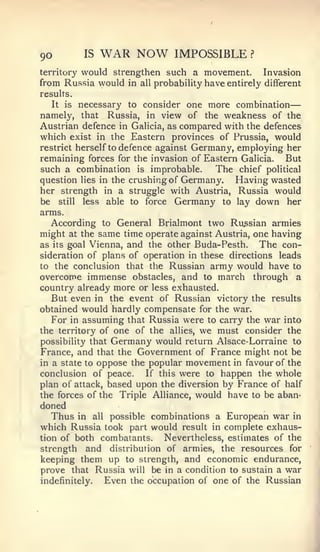
Plan of Invasion by Russia of Prussian Territory
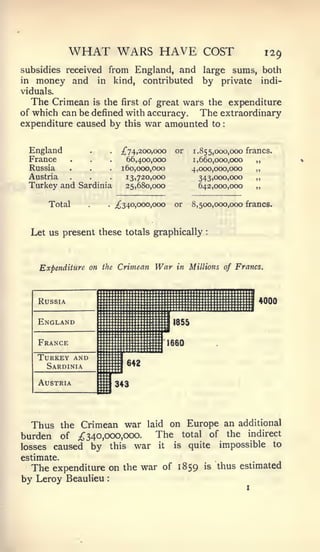
Diagram of Expenditure on the Crimean War
Diagram of Expenditure on the War of 1859
                                                     .... .
                                                                    89
                                                                   129
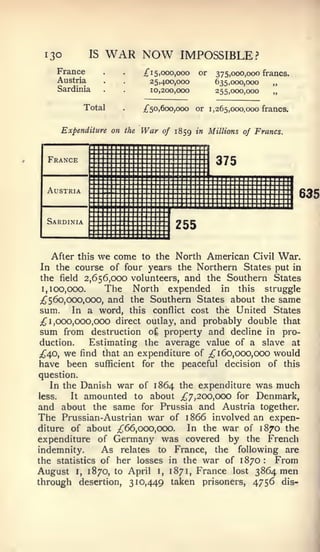
                                                                   130
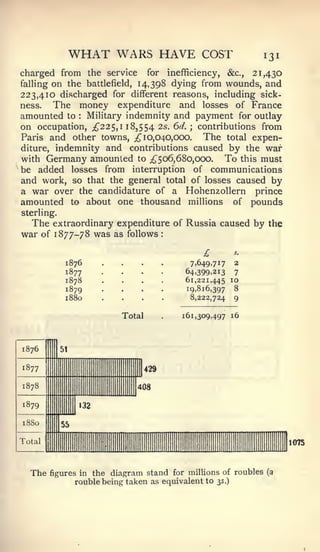
Diagram of Expenditure by Rus3*a on the War of 1877-78         .   131
Diagram of Expenditure of Europe on War in the second half
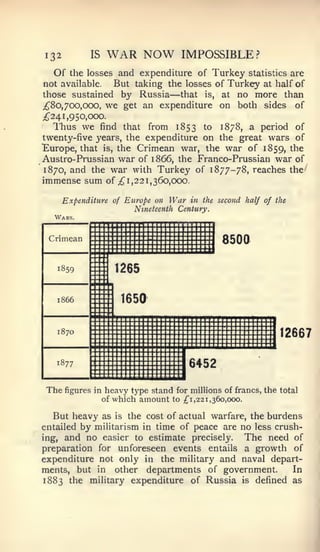
    of the Nineteenth Century                                     132
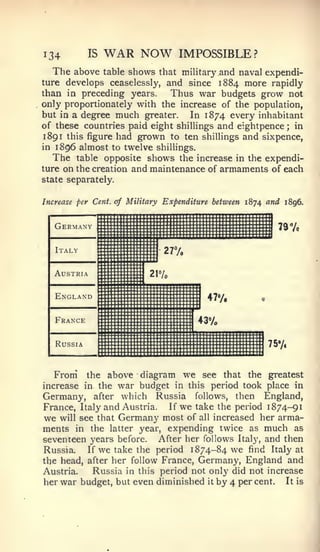
Diagram of Increase per cent, of Military Expenditure between
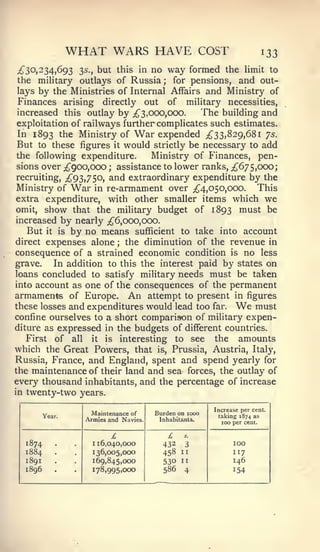
     1874 and 1896                                                134
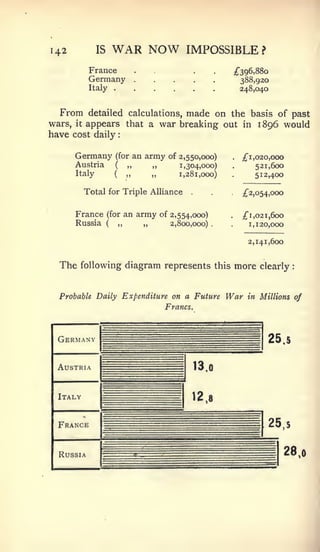
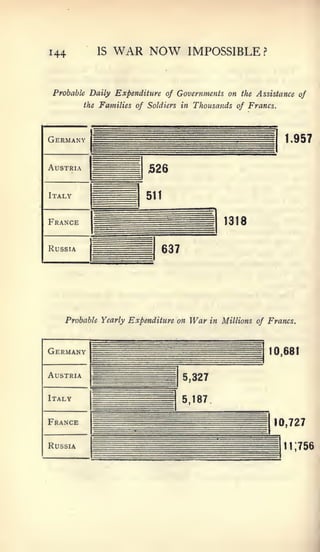
Diagrams of Probable Daily Expenditure on a Future War        142-144
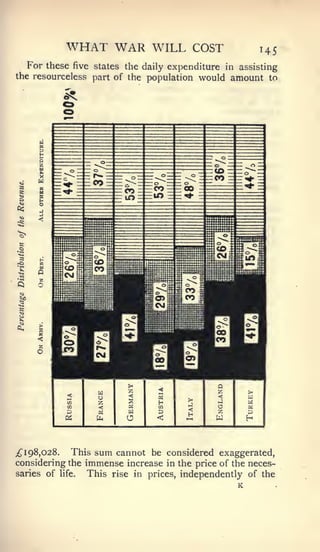
Diagram of Percentage Distribution of the Revenues        .
                                                                  145
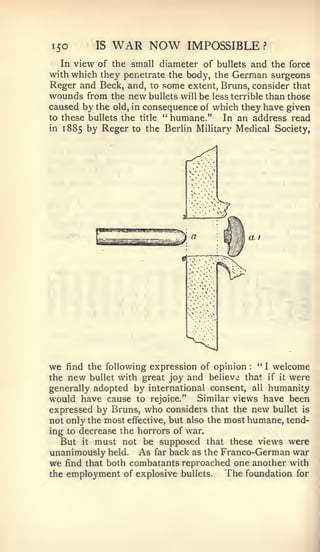
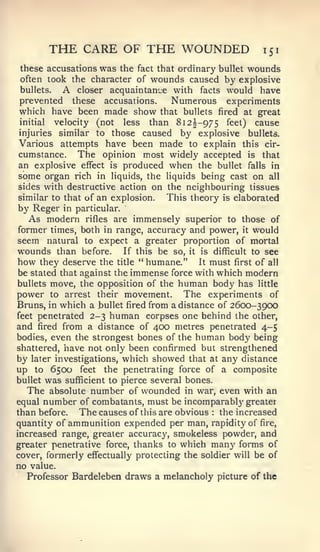
Diagram of Result of Firing from an ii-mil. Rifle             149-150
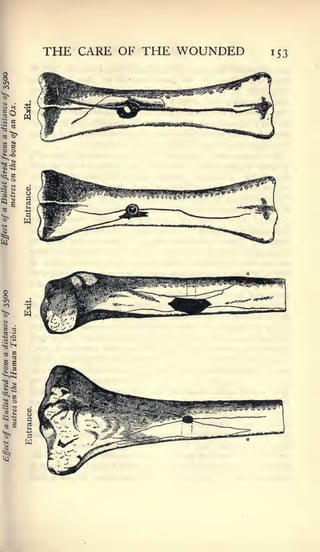
Plate showing effeit of a Bullet fired from a distance of 3500
    metres on the Human Tibia, and on the Bone of an Ox           153

    break of War     .........
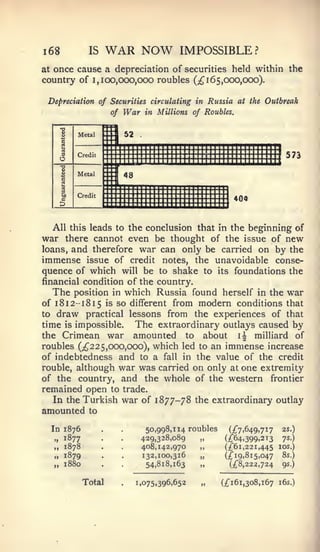
Diagram showing Depreciation of Russian Securities at the Out
                                                                  168

                     .........
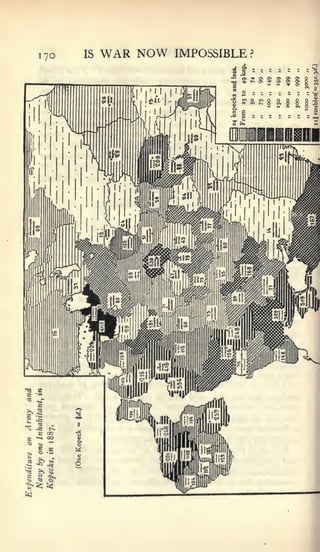
Plan showing Expenditure by Russia, per Inhabitant, on Army
    and Navy
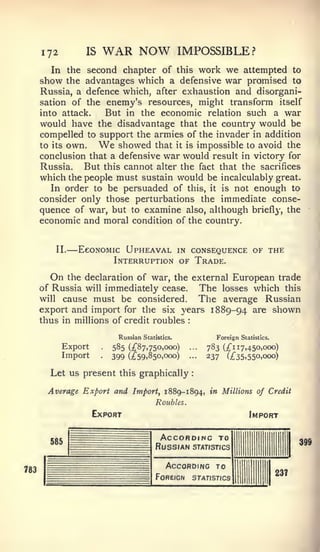
Diagram of Russian Exports and Imports (1889-94)
                                                                  170
                                                                  172
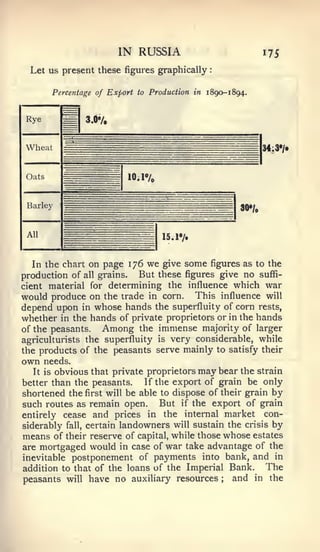
Diagram of Percentage of Russian Export to Production (1890-94)   175
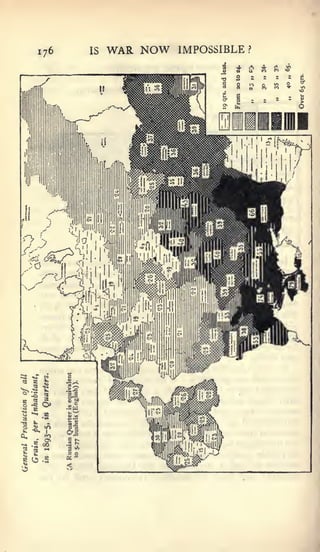
Plan of Russian Grain Production per Inhabitant                   176
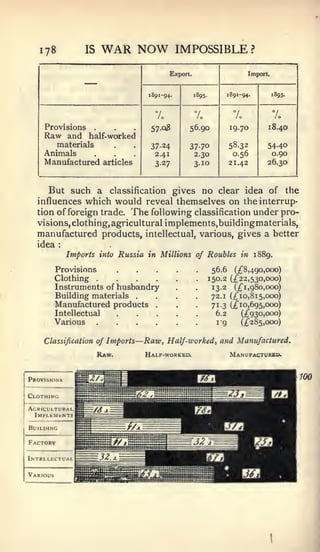
Diagram of Classification of Russian Imports                      178

    the Population       ........
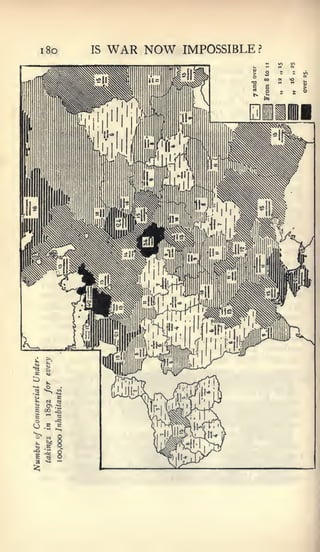
Plan of Russian Commercial Undertakings in 1892, per 100,000 of

Plan of Russian Expenditure on Posts and Telegraphs per In
                                                                  180

    habitant
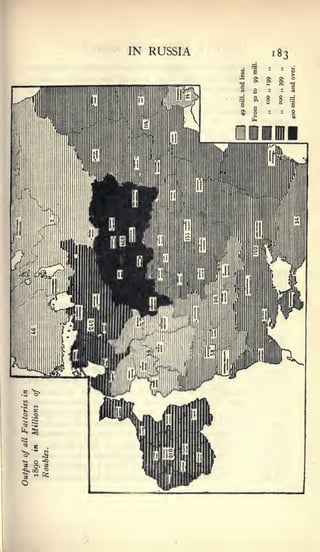
Plan of Output of Russian Factories         .....
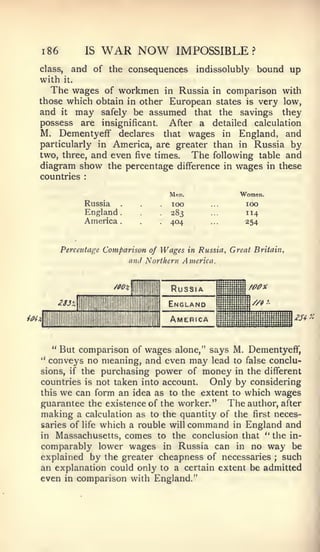
Diagram of Percentage Comparison of Wages in Russia, Great
                                                                  181
                                                                  183

    Britain, and North America                                    186
LIST    OF MAPS AND DIAGRAMS
                                                                   PAGE
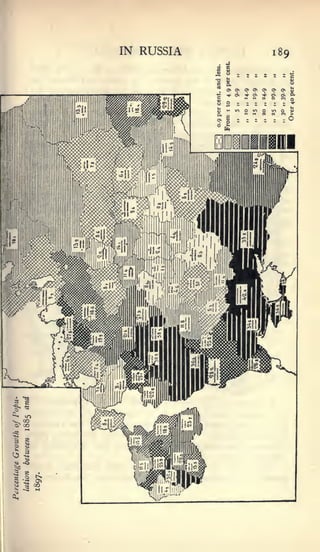
Plan of Percentage Growth of Russian Population between 1885
    and 1897                                                       189
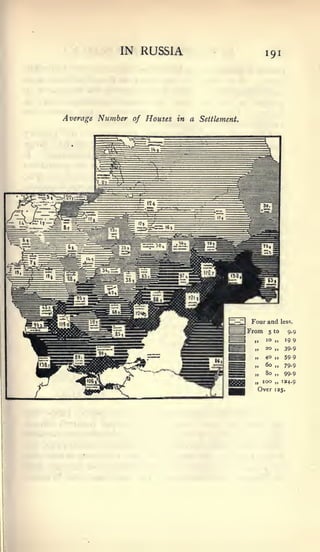
Plan of Average Number of Houses in a Russian Settlement           191

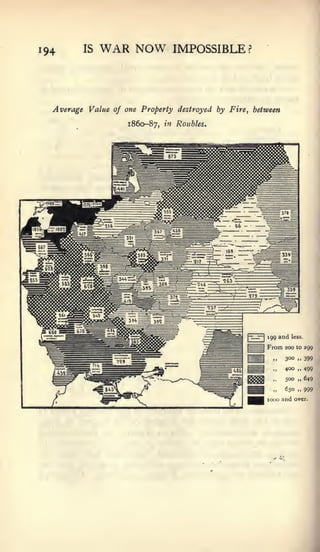
    Russia, between 1860-87      .......
Plan of Average Value of one Property destroyed by Fire in

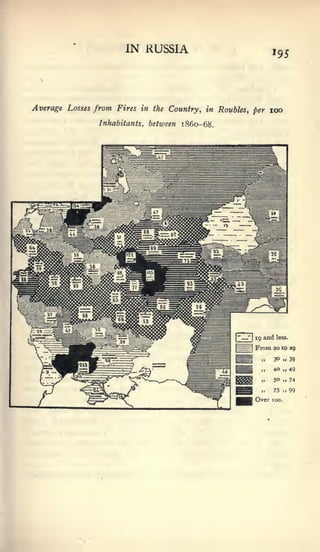
Plan of Average Losses by Fire in Russia per 100 Inhabitants
                                                                   194

    (1860-68)                                                      195
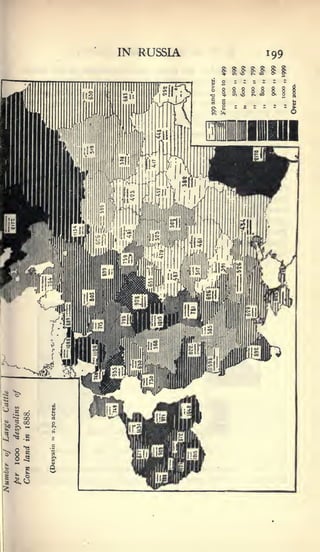
Plan of Number of Large Cattle in Russia, per 1000 desaytins
    (1888)                                                         199
Plan of Comparative Yields of Agricultural Countries of Europe     200
Plan of Comparative Number of Large Cattle in Agricultural
    Countries of Europe
Diagram
Diagram
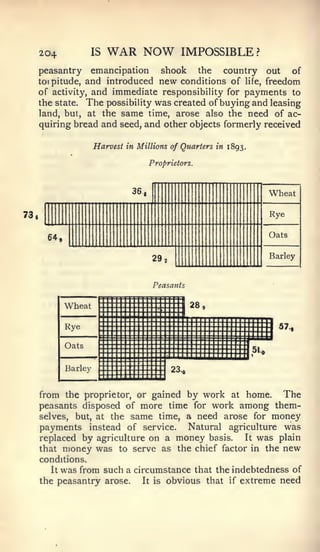
         of Russian Harvest in 1893   ......
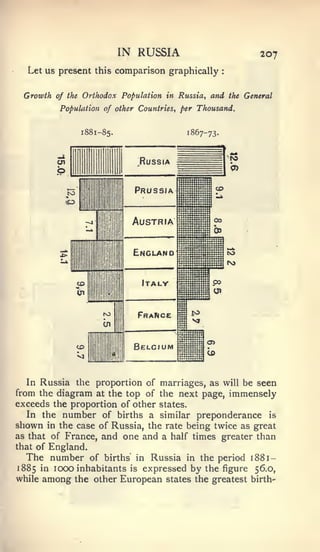
         of Growth of the Orthodox Population in Russia, and
                                                                   201
                                                                   205


                                 .....
    the General Population of other Countries, per 1000
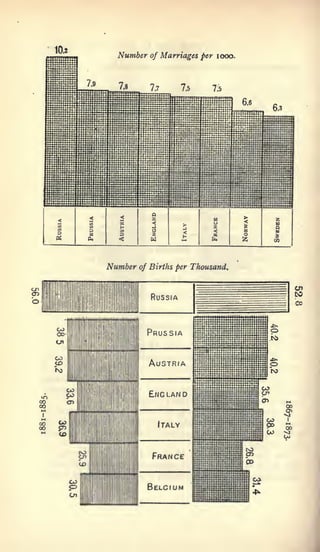
Diagram of the Number of Marriages, per 1000, of the Population
    of the Countries of Europe

                                 .......
Diagram of the Number of Births, per 1000, of the Population
    of the Countries of Europe
                                                                   207

                                                                 208

                                                                 208

    Countries of Europe     ........
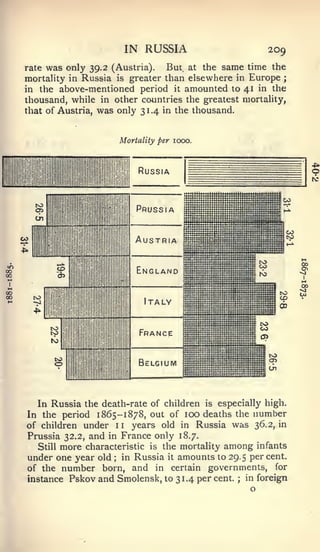
Diagram of the Mortality, per 1000, of the Population of the

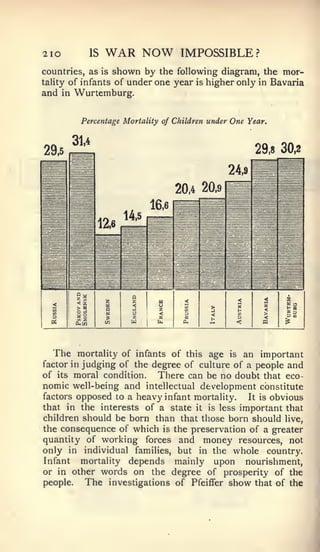
Diagram of Percentage Mortality of ^lildren under one yejir, in
                                                                 209

    the Countries of Europe                                    .210
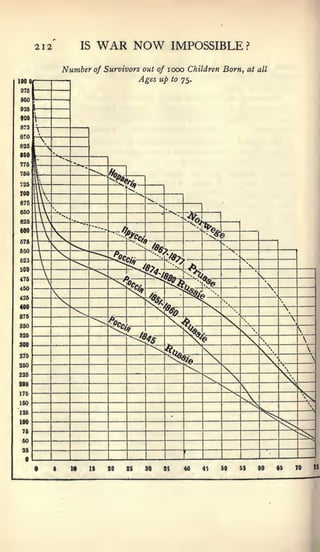
Diagram of the Number of Survivors out of 1000 Children born
    at all ages up to 75    .                                    212
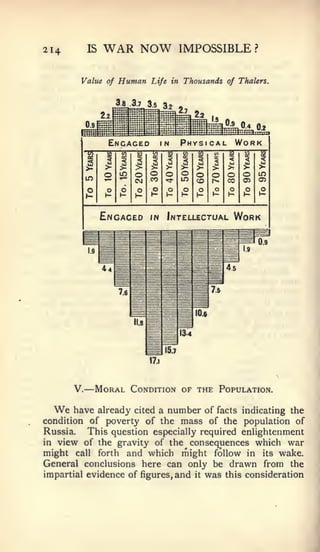
Diagram of the Value of Human Life at Various Ages               214
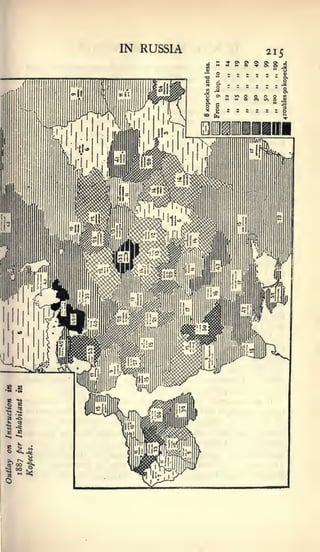
Plan of Outlay on Instruction in Russia in 1887, per Inhabitant.    215
Diagram   of Percentage of Illiterates accepted for Military Ser-
    vice in chief European Countries  .    .         .           .217
Diagrams showing Number of Students in Higher«.nd Interme-
    diate Russian Educational Institutions, per 100,000 of the
    Population                                                  218-219
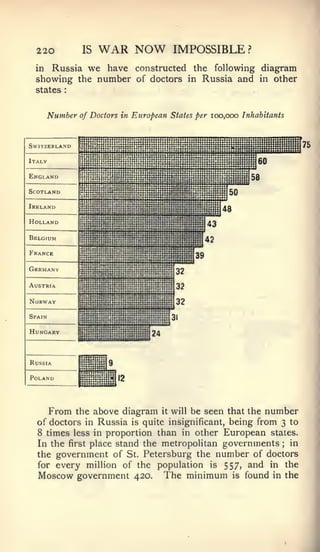
Diagram of Number of Doctors in European Countries, per
    100,000 of the Population                                       220
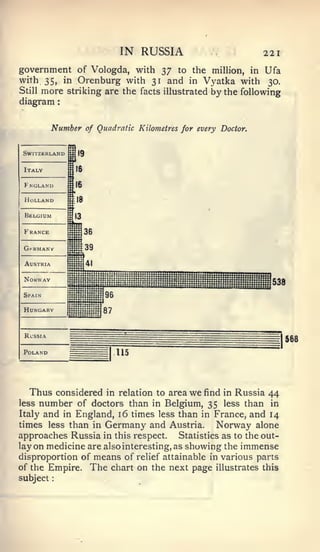
Diagram of Number of Quadratic Kilometres for every Doctor     .    221
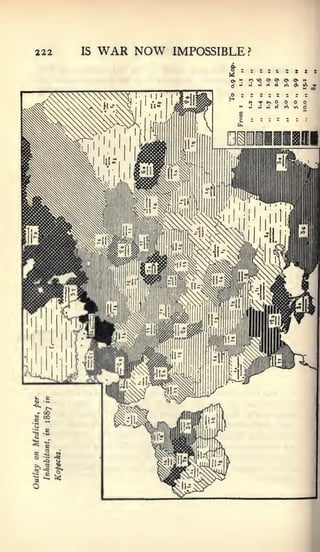
Plan of Outlay on Medicine in Russia, per Inhabitant                222
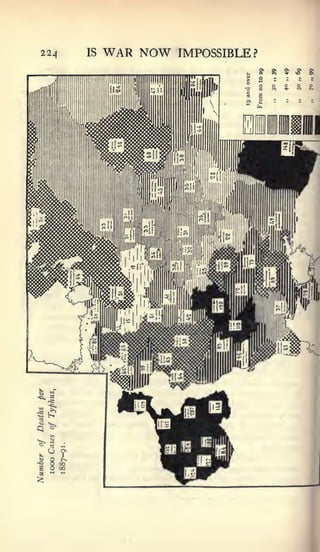
Plan of Number of Deaths from Typhus in Russia, per 1000 Cases      224

    European Countries      ........
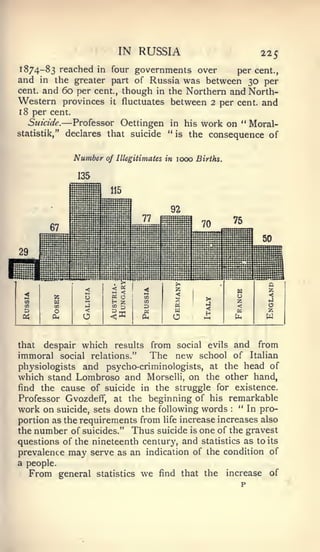
Diagram of Number of Illegitimates in 1000 Births, in chief

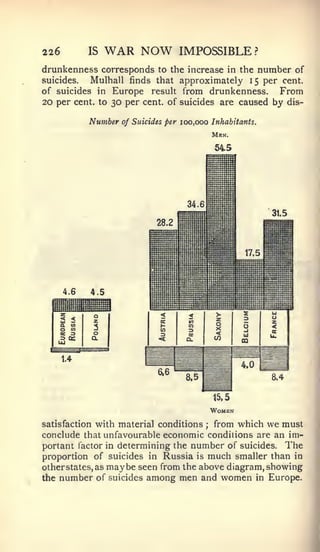
Diagram of Number of Suicides per 100,000 of the Population,
                                                                   225

    in chief European Countries                                    226
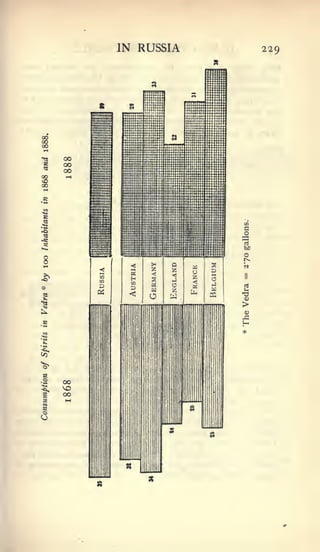
Diagram of Consumption of Spirits per 100 of the Population,
    in chief European Countries, in 1868 and 1888    .             229
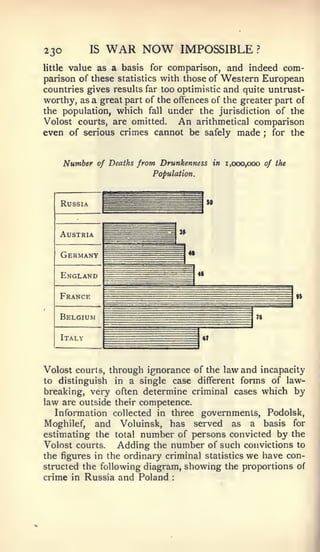
Diagram of Number of Deaths from Drunkenness per Million of
    the Population, in chief European Countries      .             230
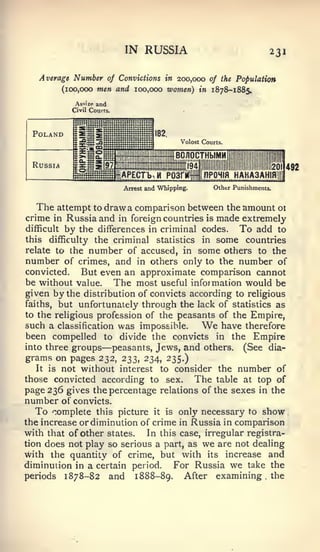
Diagram of Average Number of Convictions per 200,000 of the
    Population of Russia                                           231
LIST     OF MAPS AND DIAGRAMS
                                                                               PAGB
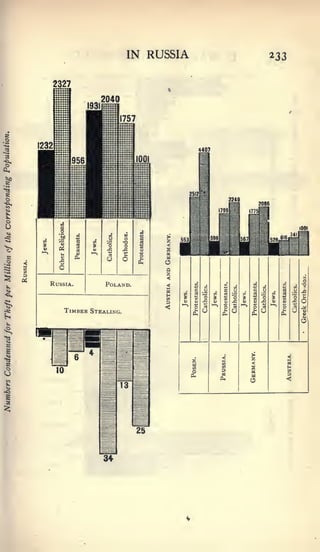
Diagrams of Numbers of Various Classes condemned               for   Murder

    pean Countries   .........
    per Million of the corresponding Population in chief Euro-

Diagrams of Numbers of Various Classes convicted for Theft
                                                                               232


    pean Countries   .........
    per Million of the corresponding Population in chief Euro-

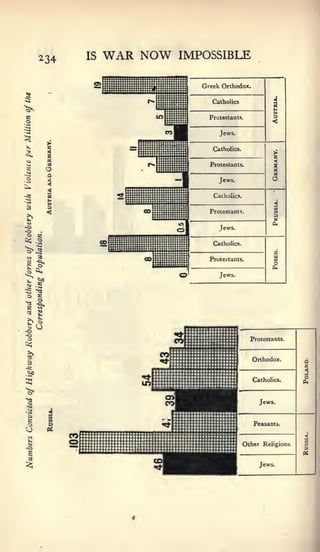
Diagrams of Numbers convicted for Highway Robbery per Mil-
                                                                               233


                    ..........
    lion of the corresponding Population in chief European
    Countries
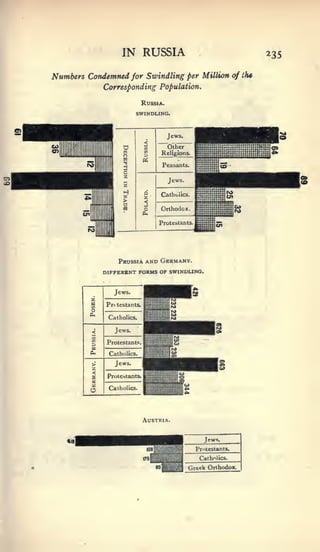
Diagrams of Numbers convicted   for Swindling per Million of the
                                                                               234

    corresponding Population, in chief European Countries                      235
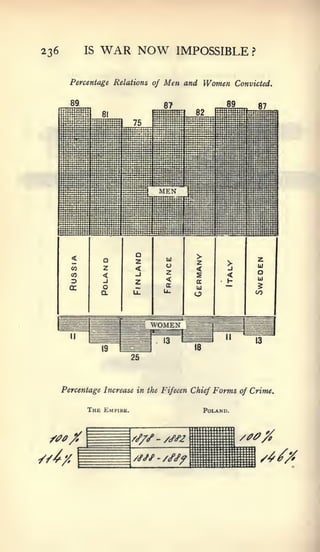
Diagram
                       .......
          of Percentage Relation of
    in chief European Countries
                                        Men and Women

Diagram of Percentage Increase in Russia in the Fifteen Chief
                                                                   convicted
                                                                               236

    Forms of Crime                                                             236
Diagram of Number of Convictions in Great Britain per 100,000
    of the Population                                                          237
Diagram    of Comparative Convictions in France            and Austria         237
Diagram of Number      of Convictions per 100,000 of Population in
    Germany                                                                    238

    bitant     ....... ....
                       ....
Plan of Expenditure on Justice and Prisons in Russia per Inha-

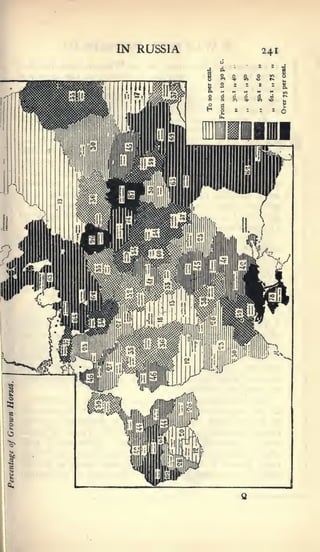
Plan of Percentage of Grown Horses in Russia
                                                                               239
                                                                               241
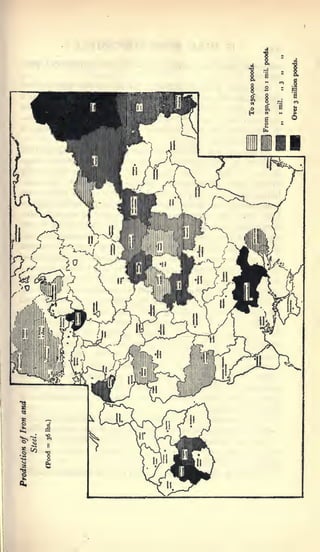
Plan of Amount of Production of Iron and Steel in Russia              .    .   243
Diagram of Number of Native and Imported Cattle in England                 .   236

                 .........
Diagram of Classification by Occupation of 1000 of the Popula-
    of Great Britain                                                           259

    land
Diagram
               ...........
Diagram of Disiribution of the Income of the Population of Eng-

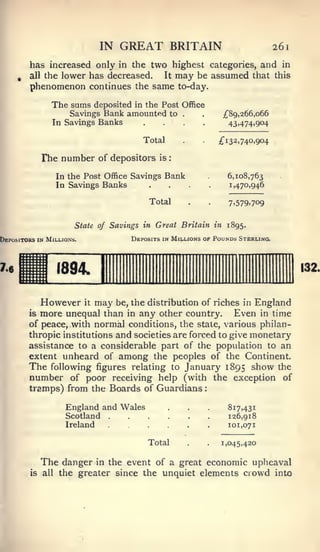
           of State of Savings in Great Britain in 1895        •      •    •
                                                                               260
                                                                               261
Diagram
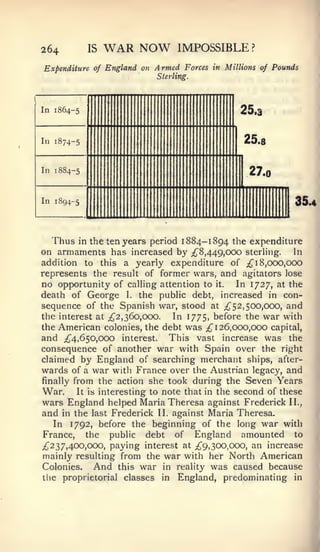
    1864 and 1895
Diagram
                 .........
           of Expenditure of England on Armed Forces between


           of Classification of   Workers       in   Germany according    to
                                                                               264

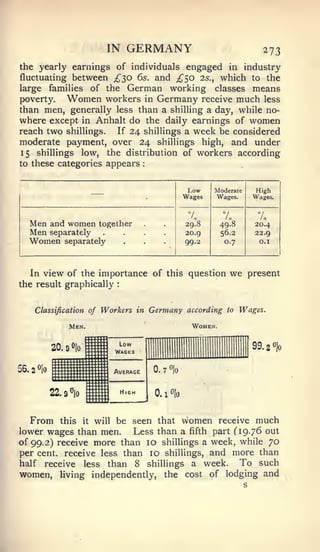
    Wages                                                                      273
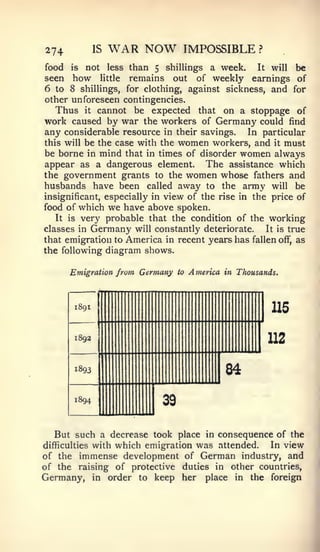
Diagram    of Emigration from     Germany America (1891-1894)
                                                to                274      .


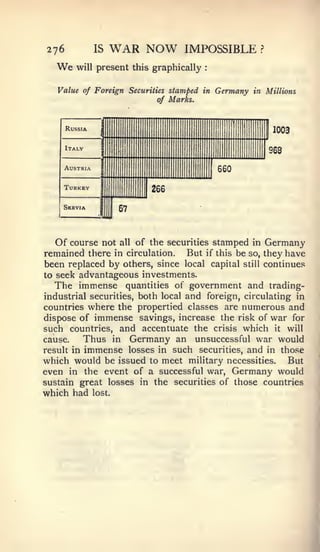
Diagram  of Value of Foreign Securities stamped in Germany        276
Diagram
Diagram
Diagram
         of French Imports and Exports (1860-1894)
         of French Trade {i860- 1894)
         of French Trade (1 883 -1 894)
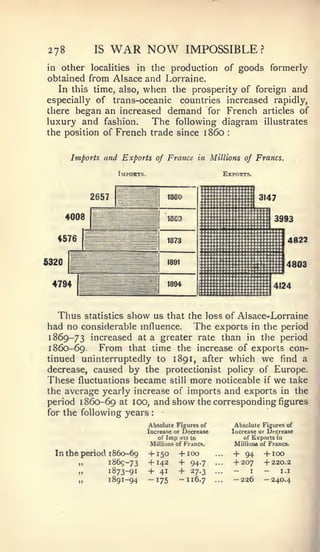
                                            .         .....    .  278
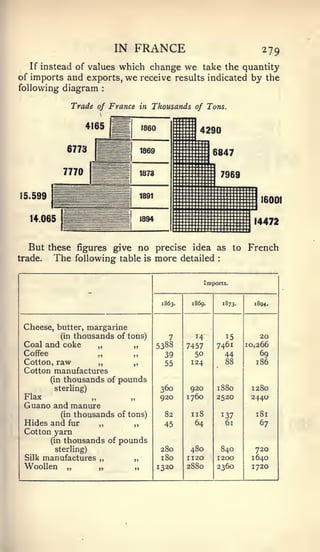
                                                                  279
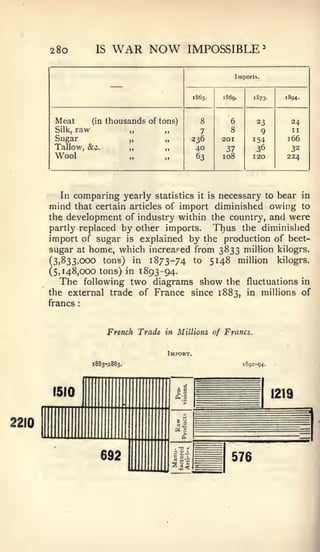
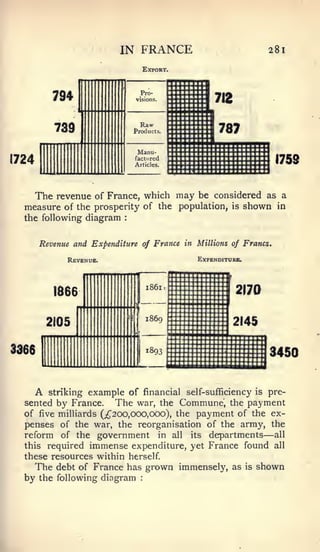
                                                              280,281
                                                                      .


Diagram  of French Revenue and Expenditure (1861-1893)            281
Diagram  of French Debt (1852-1895)                               28a
Diagram  of French Savings (1869-1895)                            282
Diagram
    Legacy     ...........
         of Average Value of Properties, in Francs, passing by

Diagram of the Distribution of the French Population according
                                                                  283

    to Occupation in 1886                                         284
LIST      OF MAPS AND DIAGRAMS
                                                                         PAGB
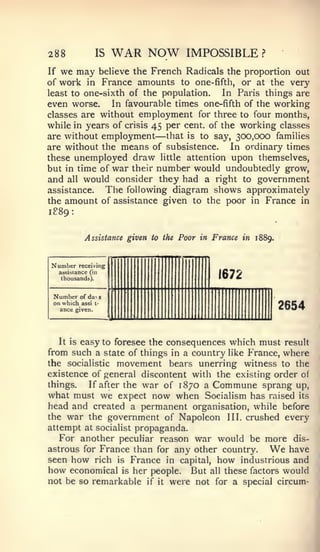
Diagram                            Poor in France in 1889
          of Assistance given to the                                     288
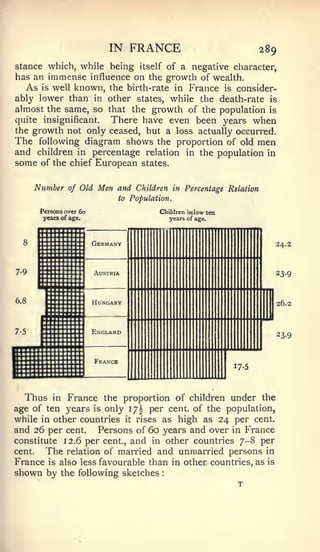
Diagram   of Number of Old Men and Children in Percentage
    Relation to Population in chief European Countries         .     .   289

    Population in chief European Countries         ....
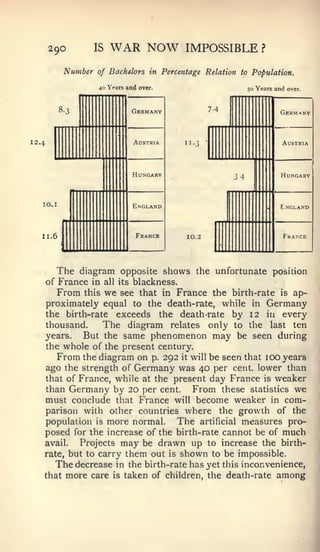
Diagram of Number of Bachelors in Percentage Relation to

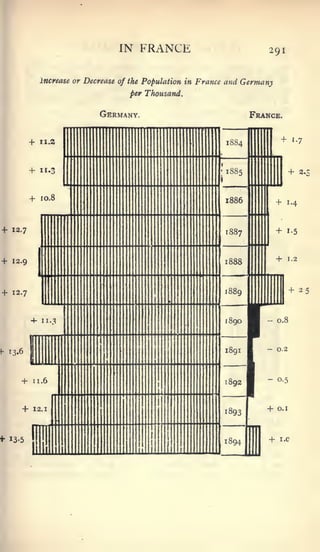
Diagram of Increase or Decrease of the Population in France
                                                                         290

    and Germany per 1000                                                 291
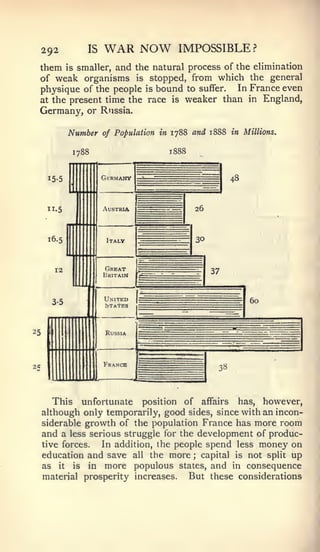
Diagram of Number of Population in chief European Countries
    in 1788 and 1888 in MilHons                                          292
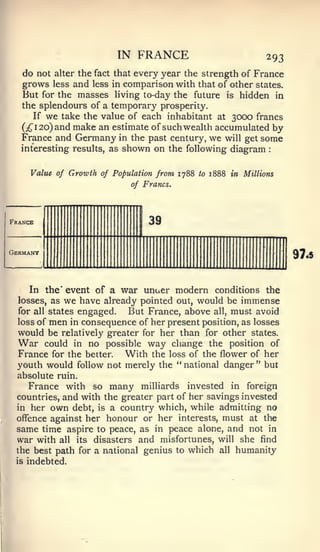
Diagram of Value by Growth of Population in France and Ger-
    many, from 1788 to 1888                                              293
Diagram showing the Number of Days on which Food would be
    Lacking in Time of War in chief European Counties          .     .   296
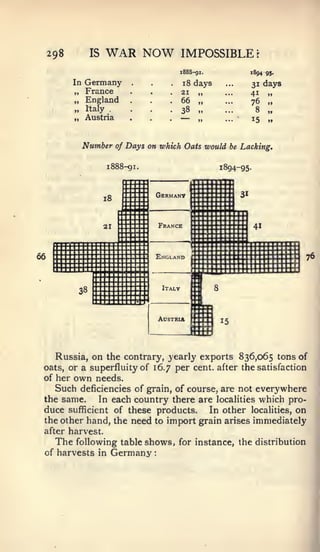
Diagram showing the Number of Days on which Oats would be
    Lacking in time of War in chief European Countries         .         298


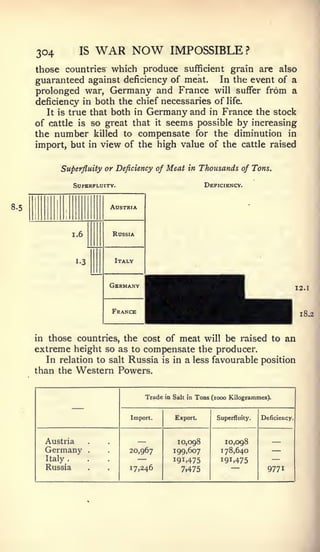
Diagram
                   ..........
Diagram of Superfluity or Deficiency of Meat in chief European
    Countries
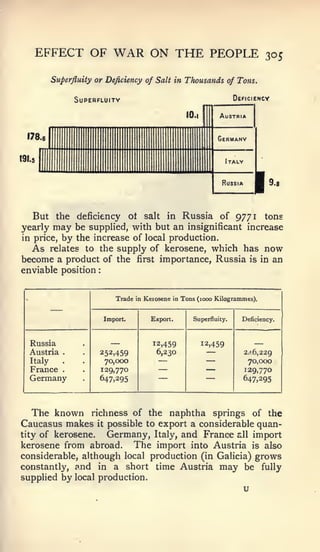
          of Superfluity or Deficiency of Salt in chief     European
                                                                         304

    Countries                                                            305

                     ........
Diagram of Superfluity or Deficiency of Kerosene in chief
    European Countries                                                   306

                     ........
Diagram of Superfluity or Deficiency of Stone Coal in chief
    European Countries
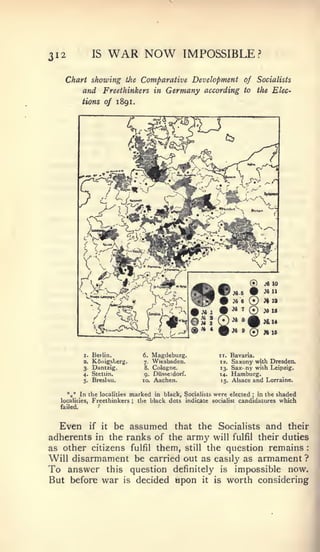
Chart showing Comparative Development of Socialists and Free-
                                                                         306

    thinkers in   Germany according    to the Elections of 1891      .   312
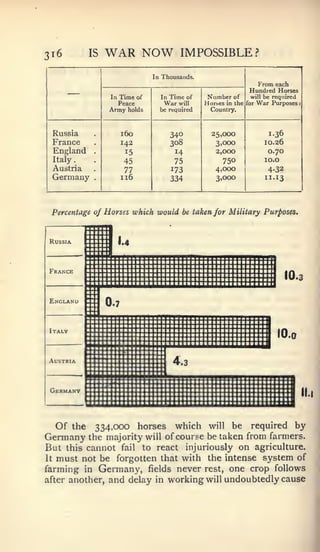
Diagram   of Percentage of Horses which would be taken             for
    Military Purposes in chief European Countries       .      .     .   316
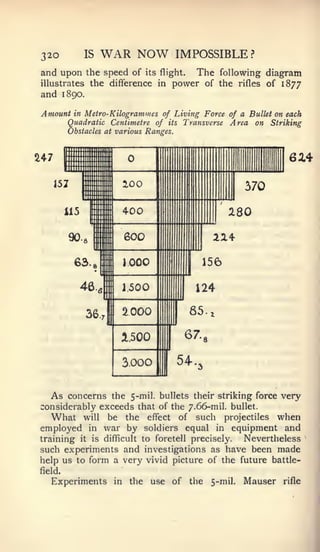
Diagram showing Amount of Living Force of a Bullet             .         320
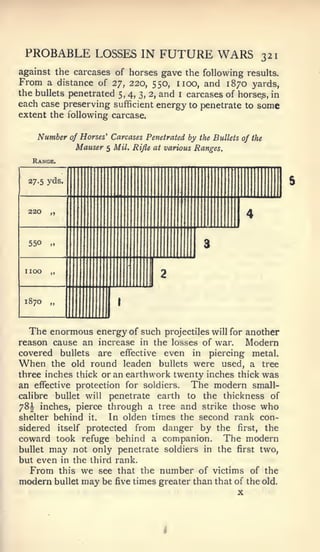
Diagram showing Penetrative Power of the Mauser Bullet on
    Numbers     of Horses' Carcases                                      321
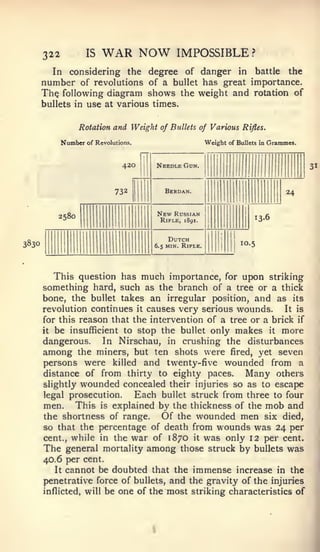
Diagram of Rotation and Weight of Bullets of various Rifles       322
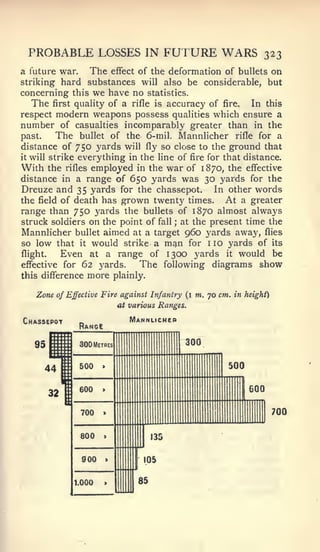
Diagram of Zone of Effective Fire against Infantry by Chassepot
    and MannHcher Rifles respectively                             323
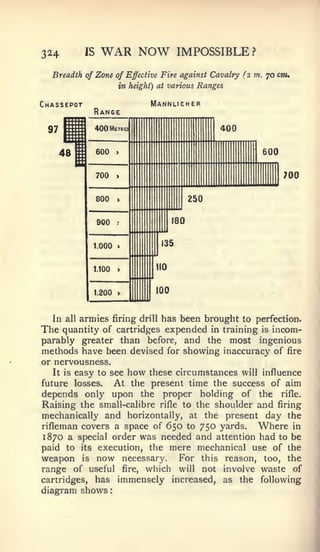
Diagram of Breadth of Zone of Effective Fire against Cavalry by
    the Chassepot and Mannlicher Rifles respectively           .  324.


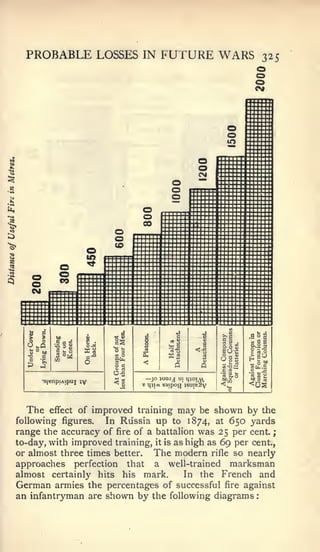
Diagram of Distance of Useful Fire                                325
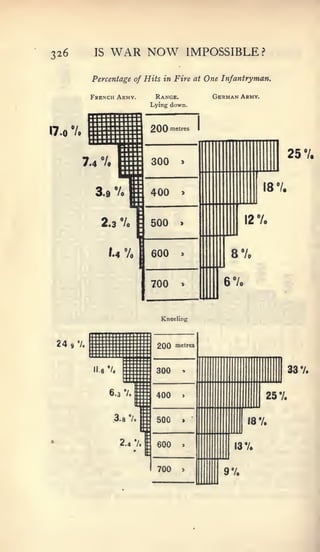
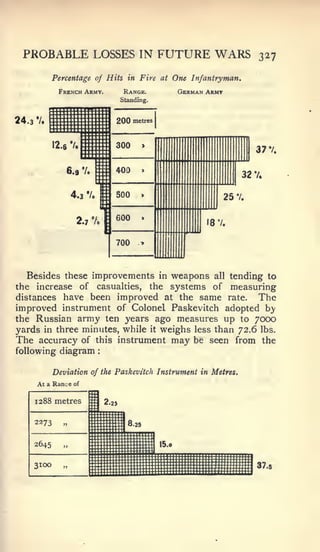
Diagrams of Percentage 01 Hits in Fire at One Infantryman by
    French and German Soldiers                                326-327
Diagram of the Deviation of the Paskevitch Instrument             327
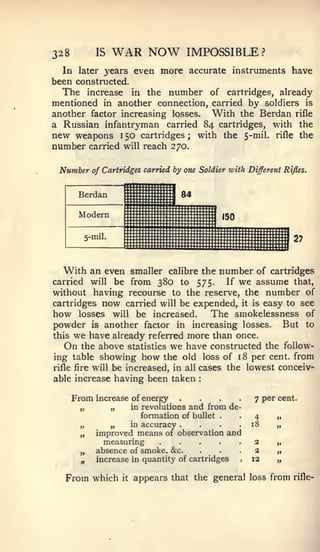
Diagram of the Number of Cartridges Carried by One Soldier
    with Different Rifles                                                328
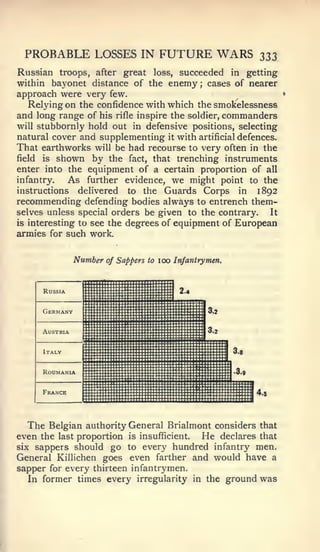
Diagram of Number of Sappers to 100 Infantrymen iu Various
    European Countries        .   ,
                                                                         333
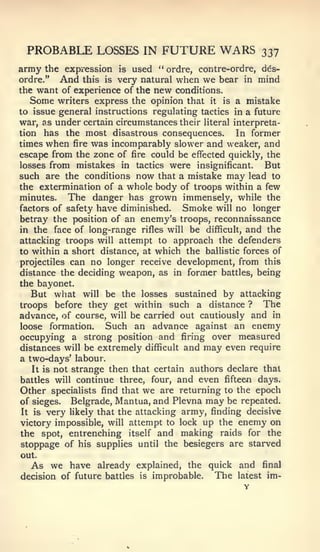
Diagram of Losses in the German Army in the War of 1870              .
                                                                         336
Diagram showing Influence of the Quality of Firearms on the
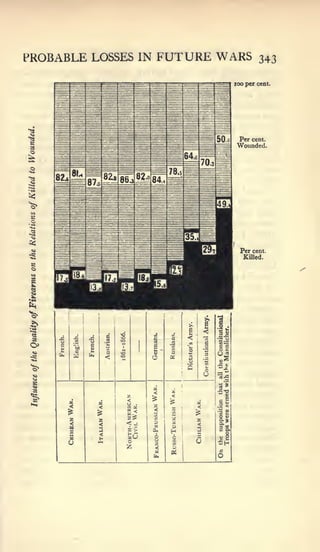
    Relations of Killed to   Wounded                                     343
INTRODUCTION
  The death     of M. Jean de Bloch, which occurred at
Warsaw     just as the year (1902) began, is a misfortune
for the whole world. It is peculiarly so at this imme-
diate juncture; for the imperative problem with the
world at this time is how to get rid of war and sub-
stitute for it a rational way of settling international
differences, and no other man in our time has studied
this problem so scientifically or contributed so much
to its solution as Jean de Bloch.    Indeed, I think it is
not too much to say that M. Bloch was the most thor-
ough and important student of the question of        War
in all its details and upon its many sides who has ever
lived, and that his great book upon "The Future of
War" will remain the chief armory from which the
men of the twentieth century who are warring against
war will continue to draw until their sure victory
comes, and all national and international disputes are
settled in the courts, as to-day personal disputes are
settled.
   I think that no book ever written in the cause of the
peace and order of the world, save Hugo Grotius's
great work alone, has rendered or is likely to render
such influential practical service as Bloch's "Future
of War," supplemented as it has been by his articles
in the various reviews during the years since the work
was first published. Dante's "De Monarchia," the
"Great Design" of Henry IV, William Penn's "Plan
for the Peace of Europe," Immanuel Kant's "Eternal
Peace," the essays of LaCroix, Saint Pierre, Bellers
and Bentham, Sumner's "True Grandeur of Nations,"
—  these high appeals and such as these have pierced
to the hearts of thinking men in the successive cen-
turies, and their general and cumulative effect in ele-
INTRODUCTION
vating the tone and broadening the outlook of society
upon the question 'of War and its evils has been im-
mense. It would be hard, however, to lay the hand
upon any distinct practical reform or progress
wrought by any of them in its own day or days that
followed.    But Grotius's "Rights of War and Peace"
wrought almost a revolution, and it did it almost at
once. With it, it may be said with a high degree of
justice, international law was born into the world
almost full grown and from the time of its appear-
                    ;


ance war, horrible at its best, has been in its usages a
very different thing from what it was before. Equ-dly
definite, distinct and practical has been the influence
of Bloch's "Future of War"; and I believe that it will
be seen at the end of this twentieth century that its
influence has been equally powerful and far-reaching.
   Bloch's monumental work upon "The Future of
War," in six volumes, was published in Russian five
or six years ago. It was the result of a decade's spe-
cial study by this eminent financier and economist,
whose whole life's experience had fitted him to under-
stand so well those phases of the question which he
felt it most important to emphasize to Europe.        Edi-
tions of the complete work have been brought out in
German and in French, under the distinguished
author's own supervision. No edition has yet ap-
peared in English only this translation of the last
                        ;


volume, in which the conclusions are summarized, has
been published for popular use. It is a pleasure, how-
ever, to be able to state that the pi"eparation of a com-
plete English edition is about to be undertaken.       No
library in America or England, no university or col-
lege, no editorial room or minister's study should be
without it. Meantime it is a satisfaction to know and
to assure the public that the present volume contains
the gist of the whole work, the clear statement of all
its important principles.    It will always be the best
thing for the ordinary reader, giving all which he re-
quires.   I count it a peculiar benefaction that a cheap
edition of this work is now given to the public by a
publisher whose heart is in it, making it possible for
INTRODUCTION
all   mento possess it and for the friends of peace to
circulate it by the thousand.   I trust that they will
earnestly unite to do it. The Peace cause has suf-
fered because so much of its best literature is not
available in attractive and cheap form and is not
widely circulated. This need we are assured is now
to be effectively met; and the present publication is
surely a good beginning.
  The matter of really greatest moment in our time
for the student of War and the worker for Peace has
not been the war in South Africa nor the war in the
Philippines, but the Hague Conference. The Hague
Conference did not come into existence without an-
cestry, without intellectual forces which made it
imperative and certain. It came not simply because
the Czar sent out his Rescript it was because the
                                 ;


Czar himself had been converted, that commanding
intellectual forces had been in operation in Russia.
I think there was none of these intellectual forces
more potent than that exerted by Jean de Bloch.
Bloch's book was an epoch-making book. It startled
the Czar and his ministers   ;  it startled all serious
thinkers in Europe it was one of the cardinal forces
                   ;


that compelled the Conference at the Hague.          At
that Conference, in a private and unofficial capacity,
Bloch himself was present throughout. He always
declined the honor paid 1 im of having suggested the
Conference to the Czar by his book the idea he de-
                                     ;


clared was the result of general evolution, which was
forcing upon all serious minds the conviction of the
folly and impossibility of continuing the war system.
   If ever a man is born under conditions which natu-
rally compel him to think of the tragedies of war, of
its horrors and burdens, and of the evils of those race
antagonisms which so often lead to war, I think it
must be a Polish Jew. The very word Jew brings up
the thought of the sufferings, the social and political
ostracism, the injustices and wrongs of every sort,
which have been the lot of the Jew through all these
centuries.   The name of Poland reminds us equally
impressively of those scarce slumbering hatreds and
INTRODUCTION
antagonisms there  still after a hundred years, a monu-
ment to the cruelty and wickedness of the wars which
ended Poland's national life, as the close of one of the
most mournful and shameful chapters       in   human   his-
tory.
   Jean de Bloch was a Polish Jew, a poor Polish Jew,
beginning his life as a pedlar, hawking his wares
about the streets of Warsaw. Finally getting through
good fortune a sum of money, he resolved that he
would push out of the ignorance and narrowness into
which he was born, and he found his way to Berlin.
There he studied for three years, largely with French
and English tutors, and then went back to Warsaw.
He was a man of immense energy and a devoted stu-
dent.   He rapidly acquired a fortune as a banker and
also obtained a high reputation as a sociologist and
an economist. He married a rich and talented woman,
and their home became a notable intellectual centre..
He wrote exhaustive works in many volumes upon
Russian railways, Russian finance, and Russian local
government. It was to him presently that the Rus-
sian commercial folk and the Russian government
itself were turning to finance their operations.       He
                                      —
became the leading banker of Poland a sort of Polish
           —
Rothschild and he became the president of impor-
tant railway systems.      He was led as a result of all
this to understand what were the menaces to the
economy of states of the war system obtaining in
Europe. Seeing that war lay at the root of the
trouble, he devoted himself for years to the prepara-
tion of his exhaustive work upon "The Future of
War," the most powerful arraignment of war and the
most powerful argument for the peace of the world
which has been written in our time, or perhaps in any
time.   From his youth he had studied war, and he
had written many pamphlets on military subjects; but
"The Future of War" was his supreme effort.
   With that work Bloch came to the Hague Confer-
ence.   He came, he said, as a learner; but he came
also as a teacher and a helper.    He came to bring his
book, to distri'bute it, to explain it, and to acquire in-
;


                   INTRODUCTION
formation and education for himself.     He sincerely
believed that his book was the Bible of this cause.
He was not a vain nor an opinionated man, but he
had the profoundest confidence in his insight and in
the things which he had learned. His argument was,
on the whole, and in the place where he laid the em-
phasis, a new one.    The peace societies had in the
main appealed to the moral side of this matter Jean
                                                ;


de Bloch appealed to the business side. The appeals
of the apostles of peace have been for the most part
to the world's humanity and piety although it would
                                       ;


be a mistake and a wrong not to remember that from
William Penn's time to Charles Sumner's they have
not failed to urge again and again the economic argu-
ment and point out what would result if the world
would apply to constructive ends what it wastes on
war. Jean de Bloch said   :   We  must appeal to the
purse, to common sense, and make men see that this
war system is the most stupid thing in creation.
That was where he directed almost his whole argu-
ment. He said that if it came to a great European
war, that war could only cease with the annihilation
of one combatant and the financial ruin of the other.
He said that, so far from this question of an interna-
tional court being a Utopian thing, it was the men
who were going on    with their schemes for wars who
were  really dealing in chimeras   that the time has
                                   ;


come when we should apply our resources, not to the
things which waste and devastate, but to the things
that build up states and the industries and the social
welfare of men. He appealed to the facts of war as
they unrolled themselves before the eyes of Europe
he showed what the real results of the Franco-Prus-
sian   War were he drew the lessons from the Russo-
               ;


Turkish War. The destructiveness of modern war-
fare, with its frightful new weapons, becomes so ap-
palling that a general European war would bring the
universal bankruptcy of nations. The present armed
peace, indeed, is so costly that the burdens of it al-
ready threaten social revolution in almost every coun-
try in Europe.
INTRODUCTION
       Bloch, unlike most peace men, was one of the most
    critical students of military affairs he met the mili-
                                          ;


    tary men upon their own ground. He lectured last
    summer to the United Service Institution in London,
    a body of military experts, with a major-general in
    the chair and he proved himself the superior of those
                ;


    practical and learned military men upon every tech-
    nical point, and worsted them in the debate.
       In the last years of Bloch's life he was engaged
    chiefly in drawing from the South African War the
    warning lessons which the world needs to learn. He
    has shown that the Boers have been so successful not,
    as has been often said, because of the topography of
    the country or because they are particularly good
,   marksmen, but because they have profited by the
/   utterly changed conditions of war.    Bloch shows that
    the fundamental change came in with the American
    Civil War.    The American Civil War, he was never
    tired of telling the people of Europe, settled it that
    the alleged superiority of disciplined armies over vol-
    unteer troops amounts to nothing; that the ordinary
    military training is often a positive disadvantage in
    preparing for modern warfare. War is no longer the
    clash of solid phalanxes with solid phalanxes in
    showy, heroic combat upon battlefields.     Cavalry
    and artillery are rapidly becoming useless. Soldiers
    cannot be compacted, but must be spread apart, and
    each must rely upon himself as never before. One
    man  in defence is a match for ten in offence      the
                                                        ;


    methods of guerilla warfare become more and more
    common and necessary and the civilian soldier, the
                             ;


    simple volunteer, is as good as the regular, and often
    better.
           is a thing of immense moment
         This                               for if it is true
                                              ;


    itmakes the whole effort to maintain great arma-
    ments a vain thing. Robert Peel said with discern-
    ment that, instead of wasting the resources of a coun-
    try to maintain great armies and navies, the sensible
    nation in the future will rely upon its own latent
    energies, perfectly sure that if it has inherent energy
    it can always improvise powers necessary for any de-
;


                     INTRODUCTION
fence at very short notice.      There is no practical
demand or excuse longer for costly armies and navies
all this great armament is waste.      Bloch has shown
                                      —
that thing to the modern world, that from the scien-
tific point of view armies and navies are not a source
of strength to any nation, but rather a source of weak-
ness; that they do not defend, 'but rather drain and
endanger. He has not been answered I do not be-;


lieve he can be answered.        We
                                  are his debtors, the   —
                                                    —
foolish and long-suffering world is his debtor, for the
thoroughness and power with which he has taught
this great lesson,
   "The Future of War" was but the culmination of
M. Bloch's remarkable activities in his life's campaign
for peace and an organized world.     His articles in the
                           —
reviews and magazines Russian, French, German
            —
and English were innumerable. His impressive ar-
ticle upon "Militarism in Politics," in the last Decem-
ber number of the Contemporary Review, should be read
by all Americans as well as by all Englishmen, at this
time. His earlier article in the same review (Septem-
ber, 1901) on "The Wars of the Future" is the most
striking statement in brief of the main principles of
his great book   ; it should be printed as a tract and
scattered 'broadcast up and down the land. Another
powerful statement of his position has appeared in
our   own   North     American   Review   since    his   death
(April, 1902).
  Bloch was not only present at the Hague during
the Conference, but at Paris during the Exposition,
always indefatigable in his work of enlightenment.
When necessary he took the platform and so it was
                                           ;


that we had the privilege of seeing and meeting him
when he came to London last summer to deliver his
lectures on the Transvaal War before the Royal
United Service Institution, to which I have referred.
After one of these lectures he invited us to a personal
meeting; and at this meeting he unfolded with great
earnestness his scheme for having established at sev-
eral of the world's leading centres what he called War
and Peace Institutions. These were to be large mu-
INTRODUCTION
seums,    in   which,   by       pictures,   panoramas, models,
charts and many means, the real character and sig-
nificance of modern warfare should be brought home
to the actual perception of men and women, who now
for the most part have no adequate comprehension of
what war is. Especially did he wish to have the prac-
tical and economic aspects emphasised, to make men
see how and why, in the changed military conditions,
a really successful war on the part of one great power
upon another really great power is impossible.
   At the time of his death M. Bloch was actually
engaged in the establishment of the first of these re-
markable museums at Lucerne and he provided for
                                         ;


its  generous endowment. He chose Lucerne as a
point to begin, since it is a place so much visited, and
he felt that the knowledge of the work would spread
thence to all the world, and the work be largely
copied.   He had secured a large and imposing build-
ing at Lucerne and was prosecuting the work of prep-
aration at large personal expense for M. Bloch was
                                             ;


a man of great wealth, and put much money, as well
as thought and zeal, into his peace propaganda.
   He was anxious that what he was planning in
Lucerne should also be done in London and he gave  ;


me a long typewritten outline of his scheme to submit
to William Mather, George Cadbury and other lead-
ing peace men in England, whose cooperation might
be enlisted. I believe that London will yet have such
an institution. I sincerely hope that America will
have such a one and this was M. Bloch's earnest de-
                   ;


sire.  He spoke of New York and Washington as
appropriate locations      and in one of these cities,
                             ;


through the munificence of some one of our haters of
war and lovers of peace, who could certainly put a
half million dollars to no more useful or necessary
service to-day, this institution should surely rise and
continue to teach its lessons until they are no longer
needed.
  I wish that it might be founded now, while the
workers for peace through all the world are mourn-
ing for Bloch, as a strong assurance that his work and
INTRODUCTION
influence shall be perpetuated and shall grow.    I wish
that in memory of him it might 'be called simply The
Block Institution.  I wish that the things which he sug-
gests in the outline which he prepared, and which I
hope will soon be published, might all be carried out;
and I wish that, in sympathetic hands, catching his
great inspiration, the institution might be developed
with a fulness of which even he hardly dreamed. I
wish that one great hall might be devoted to copies of
all of Verestchagin's pictures, and that other halls
might serve similar ends. I wish that year by year
addresses might be given at the institution by the
world's best thinkers in behalf of a rationally organ-
ized world ;    that peace and arbitration conferences
might there be regularly held that from that centre
                                ;


all the world's best literature upon this commanding
interest might be widely circulated   ;  and that useful
publications might there have their source. I can
think of no institution that would be of greater service
in America at this time.      I can think of no worthier
monument which we could rear to Jean de Bloch.
His noblest and immortal monument he has himself
created in his great work on "The Future of War."

                                    Edwin D. Mead,
CONVERSATIONS WITH M. BLOCH
                              By William T. Stead

"   The Future of                  War "     is   the   title    of    M.    de
Block's voluminous cyclopaedia on the art of war,
past, present,            and to   come.      But    that   is   a mistake.
For M.            Block's thesis        is   that tkere is no          war   to

come, that         war indeed kas already become impossible.
    It   would          really kave been clearer tkerefore to

call tkis translation              of tke sixtk and concluding
volum-e of kis            immense book        " Is   War Now           Impos-
sible    ?
             "   —as in     tke Englisk edition, —for tkis               title

gives a          muck    clearer idea of tke contents.              For M.
Block contends in all sober seriousness                             —
                                                                tkat war

great        war       in tke usual acceptation          of tke word—
kas already, by tke natural and normal develop-
m.ent of tke art or science of warfare, beco^ne a

pkysical impossibility              !

    Tkat          is   wkat    tkis book      was written         to   prove.
PREFACE
But, before reading the chapters                       crammed with
statistics       and entering upon              the arguments      of the
great Polish econoinist, the reader m-ay find                           it

convenient to glance over, as a preliminary intro-
duction to the book, the following free rendering

of the conversations which I have had the privi-
lege   of enjoying with the author at                   St.   Petersburg
and    in   London.
" Utopians," said M. Bloch               ;   "and they call us Utopians,
idealists, visionaries,      because         we believe that the end of
war    is   in      But who are the -Utopians, I should
                 sight ?
like to     know   ?   What
                       is a Utopian, using the term as an

epithet of  opprobrium ? He is a man who lives in a
dream of the impossible but what 1 know and am pre-
                                     ;


pared to prove is, that the real Utopians who are living
in a veritable realm of phantasy are those people who
believe in war.   War has been possible, no doubt, but
it has at last become impossible, and those who are pre-

paring for war, and basing all their schemes of life on the
expectation of war, are visionaries of the worst kind, for
war is no longer possible."
  "That is good news, M. Bloch," I replied " but is it        ;


not somewhat of a paradox ?    Only last year we had the
Spanish-American war the year before, the war between
                                 ;


Turkey and Greece.       Since when has war become
                   "
impossible ?
  " Oh," replied M. Bloch, with vivacity, "              I    do not speak
of such      wars.     It   is   not     to   such frontier brawls, or
punitive operations such as              you in England, for instance,
are perpetually engaging in                on the frontiers of your
X                                      PREFACE
extended empire, that                      I   refer   when   I   say that war has
become impossible.                    When      and statesmen speak
                                                 soldiers
about the        War        of the Future, they do not refer to such
trumpery expeditions                       against     semi- barbarous       peoples.
The war        of the future, the               war which has become impos-
sible,    is    the    war   haunted the imagination of
                                 that has
mankind for the last thirty years, the war in which great
nations armed to the teeth were to fling themselves with
all    their    resources into a struggle for                life and death

This     is    the    war       that every       day becomes more and more
impossible.           Yes,       it   is    in preparations against that           im-
possible       war    that these so-called practical men,                    who   are
the real Utopians of our time, are wasting the resources
of civilisation."
   " Pray explain yourself more clearly, M. Bloch."
                 he, "I suppose you will admit that war
      "Well," said
has practically become impossible for the minor States.
It is as impossible for Denmark or for Belgium to make

war to-day as it would be for you or for me to assert the
right of private war,                      which our forefathers possessed.
We      cannot do       least, we could only try to do it,
                        it.       At
and then be summarily suppressed and punished for our
temerity. That is the position of the minor States. For
them war is practically forbidden by their stronger neigh-
bours.         They    are in the position of the descendants of the
feudal lords,      whose right of levying war has vanished
owing     to    the growth of a strong central power whose
        and authority are incompatible with the exercise
interests
of what used to be at one time an almost universal
right. For the minor States, therefore, war is impos-
sible."
      "Admitted,"           I    replied.        "Impossible, that      is   to say,
without the leave and licence of the great Powers."
'

                                  PREFACE                                                   xi

  " Precisely," said             M. Bloch       ;
                                                        " and hence,             when we
discuss the question of future war,                         we always        deal with      it

as a   war between great Powers. That                           is to     say, primarily,
the    long talked-of, constantly                   postponed war between
France and Germany for the                lost provinces; and, secondly,
that other war, the thought of                which has gradually replaced
that    of    the       single-handed         duel between France and
Germany,          war between theTriplice and the Franco-
               viz.,     a
Russian Alliance.     It is that war which constantly pre-

occupies the mind of statesmen and sovereigns of Europe,
and it is that war which, I maintain, has become absolutely
impossible."
  " But how               impossible,     M. Bloch              ?       Do you mean
morally impossible ? "
  "    No    such thing," he replied.                   "   I   am      dealing not with
moral considerations, which cannot be measured, but with
hard, matter-of-fact, material things, which can be esti-
mated and measured with some approximation to absolute
accuracy.   I maintain that war has become impossible

alike from a military, economic, and political point of
view.   The very development that has taken place in the
mechanism of war has rendered war an impracticable
operation.   The dimensions of modern armaments and
the organisation of society have rendered its prosecution
an economic impossibility, and, finally, i( any attempt
were made          to   demonstrate the inaccuracy of                     my     assertions
by putting the matter             to a test    on a great               scale,   we should
find the inevitable result in a catastrophe                                which would
destroy      all    existing      political    organisations.                Thus, the
great   war cannot be made, and any attempt                                  to      make   it

would    result in suicide.            Such,        I       believe, is the simple
demonstrable            fact."
  "    But where         is   the demonstration ? "                 I   asked.
Xll                        PREFACE
   M. Bloch turned and pointed to his encyclopaedic work
upon " The Future of War," six solid volumes, each con-
taining I do not know how many quarto pages, which
stood piled one above the other.
   " Read that," he said.  " In that book you will find the
facts upon which my demonstration rests."
   " That is all very well," I said ; " but how can you,
M. Bloch, an economist and a banker, set yourself up as
                                      "
an authority upon military matters ?
   " Oh," said M. Bloch, " you have a saying that it is

often the outsider that sees most          and you must
                                               ;


remember that the conclusions arrived at by military
experts are by no means inaccessible to the general
student.     In order to form a correct idea as to the changes
that have taken place in the           mechanism of war, it is
quite conceivable that the bystander        who is not engaged
in the actual carrying out of the evolution        now    in progress
may    be better able to see the   drift   and tendency of things
than those    who    are busily engaged in the actual detail of
the operation.       1   can only say that while     at first    hand
I   have no authority whatever, and do not in any way pose
as a military or naval expert,     I   have taken   all   imaginable
pains in order to master the literature of warfare, espe-
         most recent treatises upon miUtary operations
cially the

and the handling of armies and fleets, which have been
published by the leading military authorities in the
modem world. After mastering what they have written,
I have had opportunities of discussing personally with

many    officers in all countries as       to the conclusions       at
which I have arrived, and I am glad to know that                in the
main there is not much difference of opinion as                 to the
accuracy of     my    general conclusions as to the nature of
future warfare."
PREFACE                                                 xiii

  " But do they also agree with you,"                             I    said,   " that    war
                                         "
has become impossible                ?

  "No,"        said    M. Bloch, "that would be too much                                  to
expect. Otherwise Othello's occupation would be gone.
But as they have admitted the facts, we can draw our
own  conclusions."
  " But I see in your book you deal with every branch of
the service,        armaments         of all kinds, manoeuvres, questions
of strategy, problems of fortification                     —everything,           in fact,
that comes into the consideration of the actual conduct
of modern war.     Do you mean to tell me that military
men generally think you have made no mistakes ? "
   "That would be saying too much. The book was
referred by the Emperor of Russia at my request to the
Minister of War, with a request that it should be sub-
jected to examination by a council of experts.      The
results of that council were subsequently communicated
to the Emperor in the shape of a report, which set forth
that while in dealing with so very                        many         questions    it   was
impossible to avoid some mistakes,                           it       was   their opinion
that   the     book was              a       very useful          one,      and    that     it

was most            desirable        that      it   should        be placed        in     the
hands of       all staff officers.                 They   also        added an expres-
sion of opinion that no book could contribute so                                        much
to the success of          the Conference or to the information
of thosewho were to take part in its                         deliberations.
   "The one question upon which                              strong difference of
opinion existed          was          that         concerning the              use of     the
bayonet.        I   have arrived             at the conclusion,             based upon a
very careful examination of various authorities, that the
day of the bayonet              is    In the Franco-German war
                                     over.
the    total    mortality        of   Germans from cold steel
                                             the
amounted        to    only one per cent.  The proportion on the
—;


xiv                        PREFACE
French side was higher, but I think it can be mathe-
matically demonstrated that, in future, war will be decided
at ranges which will render the use of the bayonet impos-
sible.      General Dragomiroff, however, a veteran of the
old school, cannot tolerate this slight                 upon    his favourite
weapon.        In his eyes the bayonet         is       supreme, and         it   is

cold steel which at the last will always be the deciding
factor in the      combats of peoples.         He       therefore strongly
condemns that portion of        my
                              book but it stands on its
                                               ;


own merits, and the reader can form his own judgment as
to the probability of the bayonet being of any practical
use in future war."
  "General DragomirofF's devotion to the bayonet," I
remarked, " reminds me of our admirals' devotion to sails
in   our navy.      Fifteen years ago    it    was      quite obvious that
the fighting ship of the future had no need for sails
that, indeed, sails     were an encumbrance and a danger
but   all   the admirals of the old school attached far more
importance to the smartness          in furling         and unfurling         sail

than they did to proficiency in gunnery or    any of the       in
deciding factors in naval battles. They clung to masts
and yards for years after all the younger officers in the
service knew that they might as well have clung to bows
and arrows and I suppose you will find the same thing
               ;


in   regard to the bayonet."
     " Yes," said M. Bloch, " the bayonet seems to                  me       alto-
gether out of date.        No   doubt     it       is    a deadly enough
weapon, if you can get within a yard of your enemy but                   ;


the problem that I have been asking myself is whether in
future combatants will ever be able to get within one
hundred yards of one another, let alone one yard."
  " But then," I rejoined,   if that be so, wars will be
                                '•


much less deadly than they were before."
PREFACE                                      XV
     "Yes and         no," said    M. Bloch     ;
                                                      " they will   become less
deadly because they have become more deadly.                             There
is   no kind of warfare so destructive of human life as that
in   which you have bodies of men face to face with each
other, with           nothing but cold steel to settle the issue.
The    slaughter which took place in the old wars between
barbarians, or between the                   Romans and         the barbarian
tribes   on    their frontiers, "was simply appalling.                 There   is

nothing        like   it   in   modern warfare, and           this diminution
of the mortality in battle has been, paradoxically enough,
produced by the improved deadliness of the weapons with
which men fight. They are, indeed, becoming so deadly
that before long           you   will see    they will never fight at     all."

     "That,"      I   replied,    "was   the faith of       Rudyard    Kipling,
who wrote me           a few months ago saying that he relied for
the extinction of           war upon the invention of a machine
which would infallibly slay fifty per cent, of the com-
batants whenever battle was waged.      'Then,' he said,
*
 war would cease of itself.' The same idea was expressed
by Lord Lytton in his novel of 'The Coming Race,' in
which he attributed the final disappearance of war from
the planet to the discovery of               vril,    a destructive so deadly
that an army could be annihilated by the touch of a
button by the finger of a child."
  "Yes," said M. Bloch; "that is so; but until mankind
has made experience of the deadliness of its weapons
there will be terrible bloodshed.                For instance, at Omdur-
man      the    destruction        inflicted    upon the forces of the
Khalifa came very near the                    fifty    per cent, standard of
Rudyard         Kipling.  That one experience was probably
sufficient     even for the Dervishes. They will never again
face the fire of        modern     rifles.    The experience which they
have learned          is   rapidly becoming generalised throughout
XVI                             PREFACE
the armies of Christendom, and although there                                    may    be
some     frightful scenes of           wholesale slaughter, one or two
experiences of that kind will rid our military authorities
of any desire to              come         to        close    quarters      with    their
adversaries."
   "   What     a paradox      it is   !
                                           " I replied.         "   We   shall     end by
killing   nobody, because         if       we    fought at       all   we should       kill

everybody.            Then     you         do         not     anticipate     increased
slaughter       as     the   result        of the        increased       precision      in
                "
weaf)ons ?
   "You     mistake me," said M. Bloch.                             "At     first   there
will   be increased slaughter                —increased             slaughter on so
terrible a scale as to         render           it   impossible to get troops to
push the battle to a decisive issue.                            They      will   try   to,

thinking that they are fighting under the old conditions,
and they    will learn        such a lesson that they will abandon
the attempt for ever. Then, instead of a                         war fought out         to
the bitter end in a series of decisive battles,                        we   shall   have
as a substitute a long period of continually increasing
strain    upon the resources of the combatants.                              The    war,
instead of being a hand-to-hand contest in which                                       the
combatants measure their physical and moral superiority,
will   become a kind of stalemate,                       in   which neither army
being able to get at the other,                              both armies will be
maintained          in opposition to         each other, threatening each
other, but never being able to deliver a final                           and decisive
attack.    It       will   be simply the natural evolution of the
armed peace, on an aggravated scale."
   " Yes," said M. Bloch, "accompanied by entire disloca-
tion of all industry and severing of all the sources of supply
by which alone the community is enabled to bear the
crushing burden of that armed peace.        It will be a multi-

plication of expenditure simultaneously accompanied by a
PREFACE                                    xvil

diminution of the sources by which that expenditure can
be met.       That         is   the future of      war  —not     fighting,    but
famine, not the slaying of men,                    but the bankruptcy of
nations and the break-up of the whole social organisation."
  " Now I begin to perceive how it is that we have as a
prophet of the end of war a                 political       economist, and not
a soldier."
    " Yes," said M. Bloch, "            it is   as a poHtical economist that
I   discovered the open secret which he                  who runs may        read.
The      soldier by natural evolution                has so perfected the
mechanism of slaughter                 that he has practically secured
his   own   extinction.           He   has made himself so costly that
mankind can no longer afford to pay for his maintenance,
and he has therefore transferred the sceptre of the world
from those who govern its camps to those who control its
markets."
  " But now, M. Bloch, will you condescend to particulars,

and explain to me how this great evolution has been
                           "
brought about          ?
    " It is very simple," said       M. Bloch. " The outward and
visible sign of the         end of war was the introduction of the
magazine      rifle.       For several hundred years after the dis-
covery of gunpowder the construction of firearms made
little   progress.         The cannon with which you fought                     at
Trafalgar differed comparatively                   little   from those which
you used against the Armada. For two centuries you
were content to clap some powder behind a round ball in an
iron tube, and fire it at your enemy.
   " The introduction of the needle gun and of breech-

loading cannon may be said to mark the dawn of the new
era, which, however, was not definitely established amongst

us until the invention of the magazine rifle of very small
caHbre.   The magazine gun may also be mentioned as an
                                                                      b
XVIU                          PREFACE
                 improved deadlinessof firearms ; but, as
illustration of the
your experience   Obdurman showed, the deciding factor
                         at
was not the Maxim, but the magazine rifle."
  " Yes," I said  " as Lord Wolseley said, it was the
                          ;


magazine        rifle   which played    like   a deadly hose spouting
leaden bullets upon the advancing enemy."
  " Yes," said M. Bloch, " and the possibility of firing
half a dozen bullets without having to stop to reload has
transformed the conditions of modern war."
  " Do you not exaggerate the importance of mere rapidity
of   fire ? "   I   asked.
     " No," saidM. Bloch " rapidity of fire does not stand
                                ;


alone.   The modern rifle is not only a much more rapid
firer than its predecessors, but it has also an immensely

wider range and far greater precision of fire. To these
three qualities must be added yet a fourth, which completes
the revolutionary nature of the new firearm, and that is
the introduction of smokeless powder."
   "The Spanish- American campaign," I said, "illustrated
the importance of smokeless powder but how do you    ;


think the smokelessness of the            new     explosives will affect
warfare in the future ?"
     " In the first case," said        M. Bloch, " it demolishes the
screen behind which for             the last 400 years human beings
have fought and died.           All the last great battles have been
fought more or less in the dark.               After the battle   is joined,

friends  and foes have been more or less lost to sight in the
clouds of dense smoke which hung heavy over the whole
battlefield.  Now armies will no longer fight in the dark.
Every soldier in the fighting line will see with frightful
distinctness the havoc which is being made in the ranks
by the shot and shell of the enemy. The veil which gun-
powder spread over the worst horrors of the battlefield has
PREFACE                                        xix

been withdrawn for ever.               But that   is   not the only change.
It is difficult to     over-estimate the increased strain upon the
nerve and morale of an army under action by the fact that
men        will fall killed   and wounded without any visible or
audible cause.             In the old days the soldier        saw   the puff of
smoke, heard the roar of the gun, and when the shell or
shot ploughed its way through the ranks, he associated
cause and        effect,   and was    to a certain extent prepared for
it.        In the warfare of the future       men      will   simply   fall    and
die without either seeing or hearing anything."
    Without hearing anything, M. Bloch ? "
      **


      "
    Without hearing anything, for although the smokeless
powder is not noiseless, experience has proved that the
report of a rifle will not carry more than nine hundred
yards, and volley-firing cannot be heard beyond a mile.
But that brings us to the question of the increased range
of the new projectiles.   An army on march will suddenly
become aware of the comparative proximity of the foe by
seeing men drop killed and wounded, without any visible
cause; and only after some time will they be able to
discover that the invisible shafts of death were sped from
a     line of   sharp-shooters lying invisible at a distance of a
mile or more.              There    will   be nothing along the whole
line       of the horizon to         show from whence               the death-
dealing missiles have sped.                 It will    simply be as       if   the
bolt  had come from the blue.       Can you conceive of
anything more trying to human nerves ? "
   " But what is the range of the modern rifle ? "
   " The modern rifle," said M. Bloch, " has a range of
3CXX) or 4CXX) metres           —
                        that is to say, from two to three
miles.   Of course, I do not mean to say that it will be
used at such great distances. For action at long range,
artillery is much more effective. But of that I will speak
XX                             PREFACE
shortly.  But you can fairly say that for one mile or a
mile and a half the magazine rifle is safe to kill anything
that stands between the muzzle and its mark             and          ;


therein," continued M. Bloch, " lies one of the greatest
changes that have been effected in modern firearms. Just
look at this table " (see page 4). " It will explain better

than anything       I   can say the change that has been brought
about     in   the last dozen years.
      " In the last great war,       if   you wished     to hit a distant
mark, you had to sight your           rifle   high up into
                                              so as to   fire

the     and the ball executing a curve descended at the
       air,

range at which you calculated your target stood. Between
the muzzle and the target your bullet did no execution.
It    was soaring       in the air, first rising until     it   reached the
maximum              and then descending it struck the target
                height,
or the earth at one definite point some thousand yards
distant.    Contrast this with the modern weapon. There
is now no need for sighting your gun so as to drop your

bullet at a particular range.     You aim straight at your
man, and the bullet goes, as is shown in the diagram,
direct to its mark.     There is no climbing into the air to
fall again.    It simply speeds, say, five feet from the earth

until it meets its mark.      Anything that stands between
its       and the muzzle of the rifle it passes through.
      object
Hence whereas in the old gun you hit your man only if
you could drop your bullet upon the square yard of
ground upon which he was standing, you now hit him so
long as you train your rifle correctly on every square
yard of the thousand or two thousand which may inter-
vene between the muzzle of your gun and the end of the
course of the shot.     That circumstance alone, even
without any increase in the rapidity of the fire, must
enormously add to the deadliness of the modern firearms."
PREFACE                                               xxi
   **
        Could you give                    me any         exact statistics as to the
                                               "
increased rapidity of                 fire ?

   "Certainly/' said M. Bloch.                                "That   is    to say, I can
give you particulars up to a comparatively recent time,
but the progress of the science of firearms                            is   so rapid that
no one can say but that                      my        statistics   may     be old before
you print your report of                     this talk.         The ordinary         soldier
will fire      twelve times as                   many      shots per minute as he
was      able to do in 1870, and even this                             is    likely to      be
rapidly improved upon.                       But you may take               it   that   what
with increased rapidity of                     fire,    greater penetrative power,
and the greater precision that the gun which the soldier
will     carry          into    the       battle       will    possess,      the    rifle    of
to-morrow           will   be forty times as effective as the chassepot
was      in the Franco-Prussian war.                           Even the present gun
is five      times as deadly."
   "But do not you                    think that with this rapid firing a
soldier will            spend       all    his     ammunition and have none
         "
left ?
   " There, again," said M. Bloch, " the improvement in
firearms has enormously increased the                                 number of         cart-
ridges which each                   man    can carry into action.                  In 1877,
when we went                   to   war with Turkey, our                   soldiers could
only carry 84 cartridges into action. When the caUbre
of the rifle was reduced to 5 mm. the number which each
      was furnished with rose to 270. With a bullet of
soldier
4 mm. he will carry 380, and when we have a rifle of
3 mm. calibre he will be able to take 575 into action, and
not have  to carry any more weight than that which
burdened him when he carried 84, twenty years ago.
At present he carries 170 of the 762 mm."
  " But we are a long way ofi 3 mm. cahbre, are we not,
                    "
M. Bloch        ?
xxii                              PREFACE
  **
       Not so   far.    It is     true that very           many       countries have
not yet adopted              so   small        a   bore.       Your country, for
instance, has between 7|                and 8 mm.              The United States
have adopted one with 6                    ;   Germany          is    contemplating
the adoption of5 ; but the 3 mm. gun will probably be
the gun of the future, for the increased impetus of the
small bore and         its   advantage in lightness                  will      compel   its

adoption."
  " You speak of the increased penetrative power of the
bullet.    Do you       think this will add considerably to the
                                   "
deadliness of rifle-fire ?
  " Oh, immensely," said M. Bloch.                             "   As you        contract
the calibre of         the gun you                 increase        the force       of   its

projectile.   For instance, a rifle with a calibre of only
6*5 mm. has 44 per cent, more penetrative power than
the shot fired by an 8 mm. rifle.    Then, again, in previous
wars, if a man could throw himself behind a tree he felt
comparatively safe, even although the bullets were hurt-
ling all round.    To-day the modern bullet will pierce a
tree without any difficulty.    It also finds no obstacle in

earthworks such as would have turned aside the larger
bullets.   There is therefore less shelter, and not only
is there less shelter, but the excessive rapidity with which

the missile travels (for it is absurd to call the slender
projectile, no thicker than a lead pencil, a ball) will add

enormously to the destructive power of the shot. Usually
when a bullet struck a man, it found its billet, and
generally stopped where                  it    entered     ;   but with the          new
bullet this will not be the case.                   At a near range it will
pass through successive                files   of infantry, but what is more
serious   is    that   should      it    strike a bone,              it   is   apt to fly
upwards or sideways, rending and tearing everything
through which it passes. The mortality will be much
PREFACE                                               xxiii

greater         from      this        source       than       it     has     been       in    the
past."
     " But      is this   not    all   very much theory               ?     Have you any
facts in support of              your      belief that the           modern        bullet will
be so    much more deadly                    than      its   predecessor ?           In      Eng-
land quite the opposite impression prevailed, owing to the
experience which            we        gained      in   Jameson's          raid,   when many
of the combatants were shot through and seemed none the
worse, even although the bullet appeared to have traversed
a    vital part    of the body."
     M. Bloch       replied   " I do not
                                  know about the Jame-
                                  :


son     raid.    do know what happened when the soldiers
                   I

fired    recently upon a crowd of riotous miners.  It is

true that they fired at short range, not                        more than thirty
to eighty paces.                The mob            also    was not advancing in
loose     formation,            but,       like        most mobs, was densely
packed.         Only ten shots were                    fired,      but these ten shots
killed outright        seven of the           men and wounded twenty-five,
of   whom       six afterwards             died.  Others who were slightly
wounded concealed                     their    injuries,           fearing    prosecution.
Each shot, therefore,           estimate, must have hit
                                      it   is fair to

at    least              But ignoring those unreported
                four persons.
cases, there were thirty-two persons struck by bullets.
Of    these, thirteen died, a proportion of nearly                            40 per      cent.,
which is at least double the average mortality of persons
hit by rifle-bullets in previous wars.     It has also been

proved by experiments made by firing shots into carcases
and corpses, that when the bullet strikes a bone it acts
virtually as an explosive bullet, as the point expands and
issues in a kind of          mushroom              shape.           Altogether      I   take a
very serious view of the sufferings," continued M. Bloch,
" and of the injury that will be inflicted by the new
weapons."
xxiv                                  PREFACE
     " Is the improvement in the deadliness of weapons con-
fined to small-arms ?                  Does     it   equally extend to artillery
              "
firing ?
     " There," said M.                Bloch, " you touch upon a subject
which     I       have dealt with at much length in my book. The
fact is that if       the rifle has improved, artillery has much more
improved.              Even before the              quick-firing       gun was        intro-
duced into the                field batteries        an enormous improvement
had been made.                 So, indeed, you can form some estimate
of the evolution of the cannon                       when   I   say that the French
artillery         to-day      is   held by competent authorities to be at
least    one hundred and sixteen times more deadly than the
        which went into action in 1870."
batteries
     "   How
         can that be ? " I asked. " They do not fire one
hundred and sixteen times as fast, I presume ? "
  " No   the increased improvement has been obtained
              ;


inmany ways. By the use of                           range-finders        it   is   possible
now to avoid much firing into                        space which formerly pre-
vailed.           An   instrument weighing about 60                    lb. will in    three
minutes give the range of any distance up to four miles,
and even more rapid range-finders are being constructed.
Then, remember, higher explosives are used the range                       ;


lias been increased, and even before quick-firing guns were

introduced           it     was possible      to fire     two and a half times as
fast as       they did previously.                   The    effect     of artillery-fire
to-day     is at       least five times as           deadly as    it   was, and being
two or three times as                 fast,   you may reckon            that a battery
of artillery           is    from twelve to          fifteen times as potent             an
instrument of destruction as                   it   was   thirty years ago.     Even
in   1870 the German                 artillerists     held that      one battery was
able absolutely to annihilate                       any force advancing along a
line of fire estimated at fifteen              paces in breadth for a distance
of over four miles.
PREFACE                                          XXV
     " If that was so then, you can imagine                                   how much more
deadly       it    is   now, when the range                       is    increased and the
explosive           power             of   the     shell        has     been enormously
developed.               It      is   estimated       that       if    a body of I0,CX)0
men, advancing to the attack, had to traverse a distance
of a mile and a half under the fire of a single battery, they
would be exposed to 1450 rounds before they crossed the
zone of fire, and the bursting of the shells fired by that
battery would scatter 275,000 bullets in fragments over
the mile and a half across which they would have to march.
In 1870 an ordinary shell                         when     it   burst broke into from
nineteen to thirty pieces.                           To-day            it   bursts into 240.
Shrapnel          fire    in      1870 only scattered thirty-seven death-
dealing missiles.                     Now   it   scatters 340.              A bomb weighing
about 70          lb. thirty          years ago would have burst into forty-
two fragments.                   To-day, when          it is      charged with peroxi-
lene,   it    breaks up into                     1200 pieces, each of which                   is

hurled with             much          greater velocity than the larger lumps
which were scattered by a gunpowder explosion. It is
estimated that such a   bomb would effectively destroy all
life within a range of 200 metres of the point of explosion.

The     artillery         also         benefits      by the smokeless powder,
although, as you can easily imagine,                                  it is   not without    its

drawbacks."
     "What drawbacks?"
     "The fact that the artillerymen                                  can be much more
easily picked            off",    when they are serving their guns, by
sharp-shooters                   than was possible when they were
enveloped in a cloud of smoke of their                                  own     creation.    It

is   calculated that one hundred sharp-shooters,                                     who would
be quite invisible at a range of five hundred yards, would
put a battery out of action in four minutes                                     if   they could
get within range of one thousand                                  yards.         At a    mile's
xxvi                                   PREFACE
range    might take one hundred men half an hour's shoot-
        it

ing to put a battery out of action.    The most effective
range for the sharp-shooter is about eight hundred paces.
At this range, while concealed behind a bush or improvised
earthwork, a good shot could pick off the                                        men    of any
battery, or the officers,   who could not                            avail themselves of

the cover to     which their men resort."
   " How will your modern battle begin, M. Bloch ? "
   " Probably with attempts on outposts made by sharp-

shooters      to feel        and get into                touch with               each other.
Cavalry      will not        be of    much use for that purpose. A
mounted man           offers       too good a mark to a sharp-shooter.
Then when        the outposts have                     felt   each other sufficiently
to give the    opposing armies knowledge of the whereabouts
of their antagonists, the artillery duel will                              commence       at    a
range of from four to                  five miles.            As long      as the artillery
is in   action   it   will   be quite sufficient to render the nearer
approach of the opposing forces impossible.                                        If they are
evenly matched, they will mutually destroy each other,
after inflicting      immense            losses before they are put out of
action.      Then      the turn of the                  rifle will         come.       But the
power of       rifle-fire         is   so great that            it   will       be absolutely
impossible for the combatants to get to close quarters
with each other.              As       for   any advance              in    force,     even    in
the loosest of formations, on a front that                  swept by the   is

enemies'     fire,   that    is   absolutely out of the question.  Flank
movements may be attempted, but the increased power
which a magazine              rifle      gives to the defence will render
it   impossible for such                 movements              to    have the success
that they formerly had.                      A
                                 company can hold small                                       its

own against a superior attacking force long enough                                             to
permit of the bringing up of reinforcements.                                       To   attack
any position successfully,                   it   is   estimated that the attack-
"


                                        PREFACE                                        xxvii

ing force ought to outnumber the assailants at least by
8 to    1.            It is     calculated that lOO             men    in   a trench would
be able to put out of action 336 out of 400 who attacked
them, while they were crossing a fire-zone only 300 yards
wide."
  " What do you mean by a fire-zone ? "
  "    A
       fire-zone is the space which is swept by the                                    fire   of
the men in the trench."
   " But you assume that                                 they    are    entrenched,           M.
Bloch        ?

     " Certainly, everybody will be entrenched in the next
war.             It    will     be a great war of entrenchments.                         The
spade        will        be as indispensable to a soldier as his                        rifle.

The     first         thing every       man       will   have to do,        if   he cares for
his    life       at     all,   will   be to dig a hole in the ground, and
throw up as strong an earthen rampart as he can to
shield him from the hail of bullets which will fill the air."
   " Then," I said, " every battlefield will more or less
come     to be like Sebasto^ol,                   and the       front of each      army can
only be approached by a series of trenches and parallels?"
     " Well, that, perhaps, is putting                          it   too strongly," said
M, Bloch, " but you have grasped the essential principle,
and that is one reason why it will be impossible for the
battle of the future to be fought out rapidly.                                   All digging
work       is        slow work, and when you must dig a trench
before   you can make any advance, your progress is neces-
sarily slow.   Battles will last for days, and at the end it
is   very doubtful whether any decisive victory can be
gained."
     "Always supposing,"                      I    said,    "that the ammunition
does not give out."
  " Ammunition will not give out.                                Of powder and          shot
there    is      always plenty."
—


XXVIU                          PREFACE
   "I doubt that," I replied. "The weak point of all this
argument as to the impossibility of war implies that the
modern mechanism of war, which is quite sufficient to
prevent armies coming into close contact, also possesses
qualities of permanence, or rather of inexhaustibility. What
seems much more probable is that with the excessive
rapidity of fire, armies will empty their magazines, and
the    army   that fires its last cartridge first will be at the
mercy of the        other.     Then       the old veteran Dragomiroff
will    rejoice,   for the    bayonet       will   once more come into
play."
   M. Bloch shook his head.
  "   I do not think that armies will run short of ammuni-

tion.    All my arguments are based upon the assumption
that the modern war is to be fought with modern arms.
I do not take into account the possibility that there will

be a reversion to the primitive weapons of an earlier
day."
  " Well, supposing that you are right, and that                    ammu-
                                                             "
nition does not run short, what will happen ?
  "   have quoted in my book," said M. Bloch, " the best
       I

description that I have ever seen of what may be expected
on a modern battlefield. I will read it to you, for it seems
to convey, more vividly than anything that I could say,
just   what we may expect         :


  "The        distance   is   6000 metres from the enemy. The
artillery is in position,       and the command has been passed
along the batteries to 'give              fire.'   The enemy's    .artillery

replies.      Shells tear up the soil and burst         ;   in a short   time
the crew of every        gun has ascertained the distance of the
enemy.        Then every       projectile discharged        bursts in the
air    over the heads of the enemy, raining             down hundreds
PREFACE                                    xxix

of fragments and bullets on his position. Men and horses
are overwhelmed by this rain of lead and iron. Guns
destroy one another, batteries are mutually annihilated,
ammunition cases are emptied.      Success will be with
those whose fire does not slacken.   In the midst of this
fire     the battalions will advance.
     "   Now    they are but 2000 metres away.                    Already the
rifle-bullets whistle         round and       kill,   each not only finding
a victim, but penetrating            files,    ricocheting,      and striking
again.        Volley succeeds volley, bullets              in great handfuls,
constant as hail and swift as lightning, deluge the                       field    of
battle.
     "The      artillery   having silenced the enemy              is   now    free
to deal with         the enemy's      battalions.           On   his infantry,
however loosely it may be formed, the guns direct thick
iron rain, and soon in the position of the enemy the earth
is   reddened with blood.
     "The               will advance one after the other,
               firing lines
battalions will march after battalions finally the reserves
                                                      ;


will follow.   Yet with all this movement in the two armies
there will be a belt a thousand paces wide, separating
them as by neutral territory, swept by the fire of both
sides, a belt which no living being can stand for a moment.
The ammunition will be almost exhausted, millions of
cartridges, thousands of shells will cover the soil.    But
the fire will continue until the empty ammunition cases
are replaced with          full.

     " Melinite     bombs     will turn to    dust farmhouses, villages,
and hamlets, destroying everything that might be used as
cover, obstacle, or refuge.
   " The moment will approach                 when        half the combatants
will     be   mowed down, dead and wounded                  will lie in parallel
rows, separated one from the other by that                             belt   of   a
XXX                                 PREFACE
thousand paces which                  will       be swept by a cross              fire    of
shells         which no living being can pass.
     "    The       battle will continue with ferocity.                   But   still   that
thousand paces unchangingly separate the                             foes.
     "Who           shall   have gained the victory            ?     Neither.
     " This picture serves to illustrate a thought which, since
the perfection of weapons, has occupied the minds of                                     all

thinking people.                  What   will take place in a future                war    ?
Such are constrained                 between the combatants
                                   to admit that
will      always be an impassable zone of fire deadly in an
equal degree to both the foes.
  " With such conditions, in its application to the battles of

the future, the saying of Nrpoleon seems very question-
able      :
               *
                   The               of one minute, of
                         fate of battle is the result

one thought, the enemies approach with different plans,
the battle becomes furious ; the decisive moment arrives,
and a happy thought sudden as lightning decides the con-
test, the most insignificant reserve sometimes being the

instrument of a splendid victory.'
     " It      is   much more probable           that in the future both sides
will claim the victory."


     " Pleasant pictures, certainly                 ;   and   if   that authority is
right,         you are indeed       justified in believing that there will
be no decisive battles              in the   war     of the future."
     "    There      will   be no war      in the       future," said        M. Bloch      ;

" for         it   has become impossible,           now       that   it   is clear      that
war means suicide."
   " But is not everything that you are saying an assump-
tion that people will make war, and that therefore war
                              "
itself is possible ?
     '•
          No doubt," said M. Bloch           ;
                                                 " the nations       may endeavour
to    prove that     I  am wrong,                but you will see what will
PREFACE                             xxxi

happen.        Nothing    will    be demonstrated by the next war
if it is   made,   in spite of warnings, but the impossibility of
making war, except, of course, for the purpose of self-
destruction.    I do not for a moment deny that it is possi-

ble for nations to plunge themselves and their neighbours
into a frightful series of catastrophes which would probably
result in the overturn of all civilised and ordered govern-
ment. That is, of course, possible but when we say that
                                             ;


war is impossible we mean that it is impossible for the
modern State to carry on war under the modern conditions
with any prospect of being able to carry that war to a
conclusion by defeating its adversary by force of arms on
the battlefield.    No decisive war is possible. Neither is
any war possible, as I proceed to show, that will not entail,
even upon the victorious Power, the destruction of its
resources and the break-up of society.         War therefore
has become impossible, except at the price of suicide.
That would, perhaps, be a more accurate way of stating
the thesis of      my   book."
   "I understand; but do you think you have proved
           "
this ?
   " Certainly," said M. Bloch.     " So far I have only

spoken about the improvements that have been wrought
in two branches of the service, viz., in the magazine rifle
and the greater efficiency of artillery. Taken by them-
selves, they are sufficiently serious to justify grave           doubt
as to whether or not             we have   not reached a stage   when
the   mechanism of slaughter has been so perfected as               to
render a decisive battle practically impossible         ;   but these
two elements are only two. They are accompanied by
others which are still more formidable to those who persist
in contemplating war as a practical possibility."
   " To what are you referring ? " I asked.
xxxii                       PREFACE
  " Chiefly to the immensity of the modern army. The
war of 1870-71 was a contest of giants, but the German
armies operating in France did not exceed half a million

men, whereas if war were to break out to-day, the Germans
would concentrate over a million men on their front, while
the French would be no whit behind them in the energy
with which they would concentrate all their available
fighting men on the frontier. In a war between the Triple
and the Dual Alliance there would be ten millions of men
under arms."
  " How would you make up the total of ten millions
which you say would be mobilised in case of a war between
                               "
the Dual and Triple Alliance ?
  " The figures in millions are briefly         Germany,  :


2,500,000; Austria,     i   3-ioths millions;      Italy,      i   3-ioths
millions,  making a total of 5,100,000 for the Triple
Alliance.   France would mobilise 2| millions, and Russia
2,800,000,                       —
            making 5,300,000 10,400,000. It has yet to
be proved that the     human   brain   is   capable of directing the
movements and providing for the sustenance of such
immense masses of human beings. The unwieldiness of
the modern army has never been adequately taken into
accoifnt.   Remember that those millions will not be com-
posed of veterans accustomed to act together. More than
half of the German and French troops which will be con-
fronting each other on mobilisation in case of war will be
drawn from the reserves. In Russia the proportion of
reserves would be only three hundred and sixty, in Italy
two hundred and sixty, per thousand but even this pro-
                                               ;


portion is quite sufficient to indicate how large a mass of
men, comparatively untrained, would find their place in
the fighting front."                                  •


  " But have not great generals in the past                   commanded
PREFACE                               xxxiii

armies of millions ?          —Xerxes,        for instance,
                                                      "
                                                              and Tamerlane,
and Attila          head of his Huns ?
                   at the
     "No doubt," said M. Bloch, "that is quite true; but it
is   one thing to direct a horde of men living in the simplest
fashion,marching shoulder to shoulder in great masses,
and      an altogether different thing to manoeuvre and
         it   is

supply the enormously complex machine which we call a
modern army. Remember, too, that in the old days men
fought in masses, whereas the very essence of modern
war  is that you must advance in loose order and never

have too big a clump of soldiers for your enemy to fire at.
Hence the battle will be spread over an enormous front,
and every mile over which you spread your men increases
the difficulties of supply, of mutual co-operation, and of
combined effort."
   **
      But has not the training of officers kept pace with the
                                                       "
extension and development of modern armaments ?
   "Yes," said M. Bloch, "and no. It is true, no doubt,
that an effort has been made to bring up the technical
training of officers to the necessary standard                   ;   but this   is

quite impossible in            all   cases.    A   very large proportion of
the officers        who     will   be in   command   in a general mobilisa-
tionwould be called from the reserve, that is to say, they
would be men who are not familiar with the latest develop-
ments of modern tactics, and who would find themselves sud-
denly called upon to deal with conditions of warfare that
were almost as different from those with which they were
trained to deal as the legionaries of Caesar would have
been if they had been suddenly summoned to face the
musketeers of Frederic the Great."
     " Is that not an exaggeration, M. Bloch ?            Do you think
 that the art of          war has changed so much ? "
     "   Changed      ?   " said M. Bloch ; " it has been so thoroughly
XXXIV                                PREFACE
revolutionised in the last thirty years, that   had a son        if I

who was                                      would not let
                  preparing for a mihtary career,            I

him read a book on tactics or strategy that had not been
written in the last fifteen years, and even then he would
find that great changes had taken place within that period.
It   is     simply appalling to contemplate the spectacle of
millions of men, half of               whom    have been hurriedly sum-
moned from           the     field,   the factory, and the mine, and the
whole placed under command of officers not one in a
hundred of whom has ever been under fire, and half of
whom have been trained in a more or less antiquated
school of tactics.   But even then that is not the worst.
What we have to recognise is the certainty that even if all
officers were most efficient when the war began, the war
would not last many weeks before the majority of the
officers had been killed off."
   " But why ? " I said.

     "The        percentage of officers            killed   and wounded        in
action      was much greater even             in   1870 than the proportion
of       privates  and wounded. The Germans, for
                     killed
instance, lost        two killed and three wounded to
                               officers
each private who was similarly disabled.  But that was
before the improved weapon came into play.      In the
Chilian         war the proportion of
                                officers killed was 23 per
cent,     and 75 per  wounded, whereas among the men
                             cent,
only 13 per cent, were killed and 60 per cent, wounded."
  " To what do you attribute this ? " I asked.
     "   The cause      is   very simple.      The    officers are      compelled
to expose themselves much more than the men under
their orders. They have to be up and about and moving,
while the         men    are lying in the shelter of the trenches.
This       is   so well recognised that every Continental army
pays special attention to the training of sharp-shooters,
PREFACE                                        XXXV
whose word of command                  is    that they should never waste
a shot upon any one but an                     officer.     Hence the general
conviction on the part of the officers abroad that                             if   the
great      war broke out they would never survive to see the
conclusion of peace."
     "   When      I   was   in Paris,      M. Bloch,      that conviction did
not seem to be very general on the part of the French
officers."
   " It is different in Germany," said M. Bloch, " and in
Austria-Hungary, and the French would not be long in
finding it out.   Again and again officers have said to me
that while they         would of course do           their duty if they         were
ordered to the front, they would take their place at the
head of their men knowing that they would never return.
So general is this conviction that you will find very little
trace of any war party among the officers in Germany.
They know too well what war would mean to them. But
I   am    not thinking so        much       of the fate of the individuals
as       the result     which    will       inevitably      follow    when          this
massed million of men found themselves deprived of                              their
commanders.
     "An army           is   a very highly              specialised       organisa-
tion.      Without competent                      to com-
                                            officers,     accustomed
mand,       it    degenerates         into    a mere
                                       mob, and of all
things in the world nothing is so helpless as a mob.    It

can neither march, fight, manoeuvre, nor feed itself. An
army without           leaders   is   not only a mob, but            it   is   apt to
degenerate into a very cowardly mob. Remember that
every man is not naturally brave. It was said long ago
that a very good fighting army consisted of three sorts of
soldiers     :                   men in the ranks were
                 only one-third of the
naturally brave, another third were naturally cowards,
while the last third was capable of being brave under
xxxvi                            PREFACE
circumstances   when it was well led and kept up                                to its
work.      Take away the officers, and this middle                               third
naturally gravitate             to    the        cowardly contingent, with
results which have been seen on many a stricken field.
Hence, under modern conditions of warfare every army
will tend inevitably to degenerate into such a mob. It is

for those practical military                 men who         persist in regard-
ing war as a possibility to              they hope to
                                             explain        how
overcome the difficulty created by the very magnitude
and unwieldiness of the machine which they have
created."
   '*
        But do not you think, M. Bloch, that                      if   the nations
discover that their armies are too big to be used, they
will    only fight with such manageable armies as they can
bring to the front, manceuvre, feed, and supply with the
                            "
munitions of war        ?

   M. Bloch shook               his       head.     "   The whole        drift    and
tendency of modern              tactics,"     he   said, " is to bring          up the
maximum number              of    men       to the front in the shortest
possible     loss of time            and     to    hurl    them   in the     largest
possible    numbers upon the enemy's                      position.     It is    abso-
lutely    necessary, if you take the                      offensive,    to   have a
superior force.        It is      from a military point of view an
impossibility to attack a superior force with an inferior,
and the    effect   of the improvement in modern weapons has
been to    still   further enhance the necessity for superiority
of force     in     attacking.            There     will,    therefore,      be    no
question of fighting with                   small       armies.        The   largest
possible force will be brought to the front, and this effort
will    inevitably    result         in    the    breakdown of the whole
machine.
  "     You must have the maximum ready to hand at
the beginning.   Remember the fighting force of an army
PREFACE                          .    xxxvii

weakens with every mile that it advances from its base
Napoleon entered Russia with 400,000 men but although           ;


he had only fought one battle, he had only 130,000 men
with him when he entered Moscow. The Germans, when
they were in France, employed one-sixth of their infantry
in covering their communications and defending their
rear.       This proportion          is    likely to   be much increased       in

future wars.          The opportunity            for harassing the line of
communications in the rear of an invading army has been
enormously multiplied by the invention of smokeless
powder.     The franc tireur in the Franco-German war
took his life in his hand, for the range of his gun was not
very great in the first place, and in the second his where-
abouts was promptly detected by the pufF of smoke which
showed his hiding-place. Now the whole line of com-
munications will be exposed to dropping shots from marks-
men who, from the security of thicket or hedge, will deal
out sudden death without any tell-tale smoke to guide
their exasperated and harassed enemy to the hiding-
place.
   "   I   have            M. Bloch, " with the difficulties
                  now dealt,"       said
in the way of modern war, arising first from the immense
improvement that has been wrought in the mechanism of
slaughter, and secondly with the unmanageability of the
immense masses of men who will be mobilised at the out-
break of war.  Let us now proceed to the third, and what
to my mind constitutes far the most serious obstacle in
the way of modern war                —
                         viz., the economic impossibility

of waging war upon the scale on which it must be waged
if it is    waged     at   all.

   "   The    first    thing to be           borne in mind          is   that the
next war will be                  a long war.          It   was the declared
opinion of Moltke that the altered conditions of warfare
xxxviii              .                        PREFACE
rendered         it      impossible to hope that any decisive result
could       be arrived                   at   before    two         years        at        the    least.

The Franco-German war                           lasted seven months, but there
is   no hope of any similar war being terminated so rapidly.
Of    course this is assuming that war is to be terminated
by       fighting.            In reality the        war of          th'e      future,      if    ever   it

takes place, will not be fighting                        ;    it   will be terminated                   by
famine."
                                                                                                  "
     "   Why     should wars be so excessively prolonged ?
     " Because                all   wars      will of        necessity partake of the
character of siege operations.                           When we               invaded Turkey
in   1877 we were                    detained for months behind the impro-
vised earthworks of Plevna.    war were to break out in If

Europe to-day, each combatant would find itself con-
fronted, not by an isolated and improvised Plevna, but
by carefully prepared and elaborately fortified networks
of Plevnas.                   It    is   so on    all    frontiers.             The system              of
defence has been elaborated with infinite                                       skill      and abso-
lute                                       Whether it
          disregard of financial considerations.
will     be a                        make its way into
                German army endeavouring                                to
Moscow and St. Petersburg, or a Russian army striking
at Berlin or at Vienna, or a German army invading
            —
France in every case the invading army would find itself
confronted by lines upon lines of fortresses and fortified
camps, behind which would stand arrayed forces equal or
superior in              number          to those   which          it   could bring into the
field     against them.                   These     fortresses               would have           to    be
taken or masked.
     "   Now    it       is    calculated that to take a                       modern           fortress
adequately defended, even by superior forces,                                         is   an opera-
tionwhich cannot be put through in less than one hundred
                                    —
and twenty days that is, supposing that everything goes
well with the assailants.                       Any     reverse or any interruption
PREFACE                                 xxxix

of the siege operations would, of course, prolong this
period.     But   it   is   not merely that each fortress would
have   to                       field would more or less
            be reduced, but every
become an improvised fortified camp.       Even when an
army was defeated it would retreat slowly, throwing up
earthworks, behind which it would maintain a harassing
fire upon its pursuers    and the long line of invisible
                                  ;


sharp-shooters, whose presence would not be revealed
even by the tell-tale puff of smoke, would inevitably
retard any rapid advance on the part of the victors.     It

is indeed maintained by many competent authorities that

there is no prospect of the victorious army being able to
drive the defeated forces from the field of battle so com-
pletely as to establish itself in possession of the spoils of
war.      The advantage       is      always with the defending        force,

and every mile that the assailants advance from their
base would increase their              difficulties   and strengthen    their
opponents.   Long and harassing siege operations in a
war of blockade would wear out the patience and exhaust
the resources of armies."
  " But armies have stood long sieges before now,"                          I

objected.
  "Yes," said M. Bloch, "in the past; but we are talking
of the future.  Do not forget that the wear and tear
would be              and the modern man is much less
              terrible,

capable of bearing     it  than were his ancestors.     The
majority of the population tends more and more to
gravitate to cities, and the city dweller is by no means so
capable of lying out at nights in damp and exposed posi-
tions as the peasant.     Even in comparatively rapid cam-
paigns sickness and exhaustion slay many more than
either cold steel or rifle-bullets.             It is   inevitable that this
should be the case.          In       two weeks' time     after the   French
xl                                         PREFACE
army     is   mobilised,            it   is   the expectation of the best authori-
ties that      they would have 100,000                                 men        in hospital,             even
if   never a shot had been                      fired."

     "That        I    can well                understand.               I        remember when
reading Zola's             '   La Debacle             '    feeling that if the           Germans
had kept out                   of the way
                          altogether and had simply
made the French march after them hither and thither,
the whole Napoleonic army would have gone to pieces
before they            ever came within firing distance                                          of        their
foes."
     " Yes," said M.                     Bloch.           "   The      strain of             marching         is

very heavy.               Remember               that         it is   not mere marching, but
marching under heavy loads.                                    No      infantry soldier should
carry more than one-third of his                                  own weight             ;   but instead
of the average burden of the fully accoutred private being
52    lb. it is       nearer 80               lb.,   with the result that the mere
carrying of weight probably                               kills       more than      fall       in battle.
The proportion of those who die from disease and those
who lose their hves as the consequence of wounds received
in fighting is usually                    two or three                to one.       In the Franco-
German war                there were four times as                                many         died from
sickness and exhaustion as those                                       who    lost their lives in
battle.       In the Russo-Turkish                              war the proportion was as
16 to 44.             In the recent Spanish war in                       Cuba the propor-
tion   was        still    greater.             There were ten who died from
disease for one                who       fell in     action.           The average              mortality
from sickness tends to increase with the prolongation of
the campaign.                       Men       can stand a short campaign, but
when      it is    long        it   demoralises them, destroys the spirit of
self-sacrifice            which sustained them                               at    the       first    in    the
opening weeks, and produces a thoroughly bad                                                           spirit

which reacts upon                    their physical health.                       At present there
is   some regard paid                    to humanity, if only                      by the provision
PREFACE                                        xli

of ambulances, and the presence of hospital attendants,
nurses,    and doctors.               But   in the    war of the           future these
humanities will go the wall."
  "    What     !
                    " I said, "       do you think there            will    be no care
                                  "
for the    wounded            ?
  *'
    There will be practically no care for the wounded,"
said M. Bioch, ** for it will be impossible to find adequate
shelter for the Red Cross hospital tent or for the hospital
orderlies.          It will       be impossible to take wounded         men out
of the zone of fire without exposing the                       Red Cross men to
certain death.               The consequence is they will be left to lie
where they           fall,    and they may lie for days. Happy they
will be    if   they are killed outright.                   Why, even        in the last
great    war the provision               for attendance     on the wounded
was shamefully inadequate.                       After Gravelotte there were
for some time only four doctors to attend to io,000
wounded men, and the state of things after Sadowa was
horrible in the extreme.                    It   is   all   very well to inveigh
against this as inhumanity, but what are you to do                                when
in the opinion of                such a distinguished army physician as
Dr. Billroth         it   would be necessary            to    have as many hos-
pital   attendants as there are soldiers in the fighting line ?
What      is    much more             likely to be    done     is   that the dying
and the dead              will    be utilised as ramparts to strengthen
the          trenches.
        shelter          This was actually done at the
battle of Worth, where Dr. Forth, chief military physician
of the Bavarian army, reported that he found in some
places in the battlefield veritable ramparts built up of
soldiers who had fallen by the side of their comrades, and
in order to get them out of the way they had piled them
one upon the top of the other, and had taken shelter
behind their bodies.                   Some      of these unfortunates built
into    this terrible             rampart were only wounded, but the
xlii                             PREFACE
pressure of the superincumbent mass soon relieved them
from their sufferings."
                                             "
     "   What      a horrible story     !


     " Yes," said       M. Bloch    ;
                                        " but          I   believe that     war   will   be
decided not by these things                      — not      even by fighting-men
at   all,   but by the factors of which they at present take far
too      little   account."
     "   And what may          those factors be ? "             I   asked.
   " Primarily, the quality of toughness or capacity of
endurance, of patience under privation, of stubbornness
under reverse and disappointment. That element in the
civil population will be, more than anything else, the

deciding factor in modern war.    The men at the front
will     very speedily be brought to a deadlock.                             Then      will

come        the question as to     how           long the people at          home      will

be able to keep on providing the                       men    at the front    with the
necessaries of         life.   That     is       the   first factor.       The second
factor,      which perhaps might take precedence of the moral
qualities, is        whether or not it is physically possible for
the population         left behind to supply the armies in front

with what they need to carry on the campaign."
                                                                                  "
  " But have they not always done it in the past ?
     M. Bloch shook his head impatiently.                             *'
                                                                           What   is     the
use of talking about the past                     when you          are dealing with
an altogether new set of considerations ?  Consider for
one moment what nations were a hundred years ago and
what they are to-day. In those days before railways,
telegraphs, steamships, &c., were invented, each nation
was more or         a homogeneous, self-contained, self-
                       less
sufficing unit.Europe was built in a series of water-tight
compartments. Each country sufficed for its own needs,
grew its own wheat, fattened its own cattle, supplied itself
for its      own needs         within   its       own       frontiers.      All that      is
PREFACE                              xliii


changed with the exception of Russia and Austria there
           ;


is not one country in Europe which is not absolutely

dependent for its beef and its bread supplies from beyond
the frontiers. You, of course, in England are absolutely
dependent upon supplies from over sea. But you are
only one degree worse off than Germany in that respect.
In 1895, if the Germans had been unable to obtain any
wheat except that which was grown in the Fatherland,
they would have lacked bread for one hundred and two
days out of the three hundred and                 sixty-five. Every year
the interdependence of nations                   upon each other for the
necessaries of            life   is    greater than    it   ever   was   before.
Germany            at    dependent upon Russia for two
                        present       is

and a half months' supply of wheat in every year. That
supply would, of course, be immediately cut off if Russia
and Germany went to war and a similar state of things
                                           ;


prevails between other nations in relation to other com-
modities.   Hence the first thing that war would do would
be to deprive the Powers that made it of all opportunity
of benefiting by the products of the nations against whom
they were fighting."
   " Yes," I objected, " but the world is wide, and would
it   not be possible to obtain food and to spare from neutral
                   "
nations ?
   " That assumes," said M. Bloch, " first that the
machinery of supply and distribution remains unaffected
by war.   Secondly, that the capacity for paying for
supplies remains unimpaired.                     Neither of those things      is

true.  For you, of course, it is an absolute necessity
that you should be able to bring in food from beyond
the seas and possibly with the aid of your fleet you may
               ;


be able to do it, although I fear the rate of war premium
will    materially enhance the                 cost   of the   cargoes.     The
xliv                           PREFACE
other nations are not so fortunate. It was proposed some

time ago,    know, in Germany, that in case of war they
                  I

should endeavour to replace the loss of Russian wheat by
importing Indian wheat through the Suez Canal an               —
operation which in the face of the French and Russian
cruisers might not be very easy of execution.   But even
supposing that it was possible to import food, who is to
pay for it ? And that is the final crux of the whole
question."
     " But," again      I   objected, " has the lack of  money ever
prevented nations going to war ?              I   remember well when
Lord Derby, in 1876, was quite confident that Russia
would never go to war on behalf of Bulgaria because of
the state of the Russian finances but the Russo-Turkish
                                          ;


war took place all the same, and there have been many
great wars waged by nations which were bankrupt, and
victories won by conquerors who had not a coin in their
treasury."
     **
          You   are always appealing to precedents which do not
apply.          Modern society, which is organised on a credit
basis,        and modern war, which cannot be waged excepting
at    a       ruinous expenditure,  no points of analogy
                                      offer
compared with those times of which you speak. Have
you calculated for one moment what it costs to maintain
a soldier as an efficient fighting man in the field of
battle ? The estimate of the best authorities is that you
cannot feed him and keep him going under ten francs a
          —
day say, eight shillings a day. Supposing that the Triple
and Dual Alliance mobilise their armies, we should have at
once confronting us an expenditure for the mere mainten-
ance of troops under arms of ^4,000,000 a day falling
upon the five nations. That is to say, that in one year of
war under modern conditions the Powers would spend
PREFACE                                       xlv

;^ 1, 460,000,000 Sterling           merely    in feeding their soldiers,
without reckoning             all   the other expenses that must be
incurred in the course of the campaign.                             This figure    is

interesting as enabling us to    compare the cost of modern
wars with the cost of previous wars. Take all the wars
that have been waged in Europe from the battle of
Waterloo down to the end of the Russo-Turkish war, and
the total expenditure does not amount to more than
;^ 1, 2 50,000,000 sterling, a colossal burden no doubt, but
one which is nearly ;^200,000,000 less than that which
would be entailed by the mere victualling of the armies
that would be set on foot in the war which we are
supposed to be discussing. Could any of the five nations,
even the richest, stand that strain ? "
  " But could they not borrow and issue paper money ? "
  "Very well," said M. Bloch, " they would try to do so,
no doubt, but the immediate consequence of war would
be  to send securities all round down from 25 to 50 per
cent., and in such a tumbling market it would be difficult

to float loans. Recourse would therefore have to be had
to   forced      loans and          unconvertible    paper money.                 We
should be back to the days of the assignats, a temporary
expedient which would aggravate the difficulties with
which we have to deal. Prices, for instance, would go up
enormously, and so the cost, 8s. a day, would be nearer
20s. if all food had to be paid for in depreciated currency.
But, apart from the question of paying for the necessary
supplies,       it    is   a grave question whether such supplies
could      be        produced, and       if   they could            be produced,
whether they could be distributed."
     "   What do you mean by            '
                                            distributed   '
                                                              ? "    I   asked.
     " Distributed ? " said        M. Bloch. " Why, how are you
to get the food into           the mouths of the people who want it
xlvi                                PREFACE
if   you had     (as      you would have               at    the beginning of the
war) taken over             all    the railways for military purposes ?
Even within the             limits of           Germany        or of Russia there
would be considerable                difficulty in          securing the transit of
food-stuffs in       war     time, not merely to the camps, but to
the great industrial centres.                       You do    not seem to realise
the extent to which the world has been changed                                     by the
modern        industrial system.                    Down    to the   end of the       last
century the enormous majority of the population lived in
their    own    grew their own food, and each farm was
                fields,

a    little       It was with individuals as it was with
              granary.
nations, and each homestead was a self-contained, self-
providing unit. But nowadays all is changed. You have
great industrial centres which produce absolutely nothing
which human beings can eat. How much, for instance,
do you grow in the metropolitan area for the feeding of
London ? Everything has to be brought by rail or by
water to your markets. So it is more or less all over the
Continent, especially in Germany and France.    Now it so
happens (and in this I am touching upon the political side
of the question) that those districts which produce least
food yield more Socialists to the acre than any other part
of the country.           It is    those districts,         rife   with   all   elements
of political discontent, which would be the                          first to feel    the
pinch of high prices and of lack of food.                             But       this is   a
matter on which           we      will       speak later on."
     " But do you think,"                I    said, " that the railways           would
be so monopolised by the military authorities that they
                                                                                          "
could not distribute provisions throughout the country ?
     " No," said M. Bloch.                      "
                             It is not merely that they

would be monopolised by their military authorities, but
that they would be disorganised by the mobilisation or
troops. You forget that the whole machinery of distribu-
PREFACE                                       xlvii

tion and of production would be thrown out of gear by
mobilisation   and this brings me to the second point
                     ;


                                  —
upon which I insist viz., the impossibility of producing
the food.  At the present moment Germany, for instance,
just manages to produce sufficient food to feed her own
population, with              the     aid    of imports         from       abroad,   for
which she           is    by the proceeds of her own
                          able to pay
industry. But in the case of war with Russia she would
not be able to buy two and a half months' 'supply of
wheat from Russia, and therefore would have to pay
much more for a similar supply of food in the neutral
markets, providing she could obtain                       it.        But she would
have to buy much more than two and a half mcmths' from
Russia, because the nine months' corn which she pro-
duces at present            is   the product of the whole labour of                   all

her able-bodied agricultural population                         ;     and how they
work you       in        England do not quite          realise.        Do you know,
for instance, that after the                 '
                                                 Busstag,' or day of penitence
and prayer,          at the      beginning of what        we        call   the farmers'
year or       summer          season, the whole          German            agricultural
population in some            work unremittingly fifteen
                                    districts
hours a day seven days a week, without any cessation,
without Sundays or holidays, until the harvest is gathered
in; and even with all that unremitting toil they are only
able to produce nine months* supply of grain.                               When     you
have mobilised the whole German army, you will diminish
at least by half the strong hands available for labour
in the field. In Russia we should not, of course, be in
any such difficulty, and in the scrupulous observance of
Sunday we have a reserve which would enable us to
recoup ourselves for the loss of agricultural labour.                                We
should       lose,       for instance,       17 per cent, of our peasants;
but    if   those    who were         left   worked on Sunday, in addition
xlviii                             PREFACE
to   weekdays,       we should just be able to make up for the
loss of the         men who were taken to war. Germany has
no such reserves, nor France                  ;   and hence        it   is that,   speak-
ing as a political economist,                 I   feel      extremely doubtful as
to   whether        it    would be possible   for either Germany                       or
France to feed their               own population, to say nothing                       of
their    own        soldiers,      when once the whole machine                          of
agricultural            production      had       been        broken up            by the
mobilisation en masse of the whole population."
   " But has this point never been considered                                      by the
sovereigns and statesmen of Europe ? " I inquired.
  " You know," replied M. Bloch, " how it is with                                  human
beings.        We        shall all die, but        how       few care to think of
death ?        It   is   one of the things inevitable which no one
can alter by taking thought.                      So   it   is   with this question.
War      once being regarded as unavoidable, the riders shut
their eyes    its consequences.
                    to          Only once in recent
history do    remember any attempt on the part of a
                    I


European Government gravely to calculate the economic
consequences of war under modern conditions.   It was

when M. Burdeau was in the French Ministry. He
appointed a committee of economists for the purpose of
ascertaining            how    the social organism would continue to
function in a time of war,                    how from day               to   day their
bread would be given to the French population.                                  But no
sooner had he begun                    his    investigation             than a strong
objection        was raised by the            military authorities,            and out
of deference to their protests the inquiry                          was    indefinitely
suspended.              Hence we       are going forward blindfold, pre-
paring     all   the while for a        war without recognising the                   fact

that the very fundamental first condition of being able to
wage     it   does not        exist.   You might            as well prepare for a
naval war without being sure that                             you have a sea           in
PREFACE                                                      xHx
which your ships can                   float as to continue to make pre-
parations for a              land      war unless you have secured in
advance the means   b}' which your population shall live.

Every great State would in time of war be in the position
of a besieged city, and the factor which always decides
sieges is the factor which will decide the modern war.
Your        soldiers        may   fight as        they please                     ;   the ultimate
                                                           ^^
decision is in the hands oi famine.
     " Well,      it   is   an old saying that                  *
                                                                    armies always march
upon       their bellies,' "          said   I.
                                                  *'   *
                                                           Hunger             is      more   terrible
than iron, and the want of food destroys more armies than
battles,'        was a saying of the              first     Napoleon, which holds
good to-day."
     **
          But," interrupted M. Bloch, "                             I   am   not speaking so
much       of the armies,         I   am speaking                   of the population that
is   behind the armies, which far outnumbers the armies and
which       is   apt to control the policy of which the armies are
but the executive instrument.                      How long                  do you think the
populations of Paris or of Berlin or of the great manufac-
turing districts in            Germany would stand                                the doubling of
the price of their food, accompanied, as                                     it   would      be,   by a
great stagnation of industry and                            all         the feverish uncer-
tainty and excitement of war ?
     "    What
            is the one characteristic of modern Europe ? Is
it not the growth of nervousness and a lack of phlegmatic

endurance, of stoical apathy ? The modern European feels
more keenly and is much more excitable and impres-
sionable than his forefathers.                         Upon             this highly excitable,
sensitive population              you are going             to inflict the miseries of
hunger and all the horrors of war. At the same time you
will enormously increase their taxes, and at the same time
also you will expose your governing and directing classes
to more than decimation at the hands of the enemy's sharp-
                                                                                             d
1                                      PREFACE
shooters.             How       long do you think your social fabric will
remain stable under such circumstances ?                                   Believe me,
the  more the ultimate political and social consequences of
the modern war are calmly contemplated, the more clearly
will it be evident that if war is possible it is only possible,
as    I   said before, at the price of suicide."
     "    From which,
                   therefore, it follows, in your opinion,
M. Bloch, that the Peace Conference has not so much to
discuss the question of peace as to inquire into whether or
                      "
not war is possible ?
   " A committee of experts, chosen from the ablest repre-
sentatives of the Powers sent to the Hague," replied M.
Bloch, " would have very little difficulty in coming to a
conclusion upon the facts whfch I have just set forth in my
book.   Those experts might be soldiers and political
economists, or the inquiry might be divided into two heads,
and the two questions relegated to different committees of
specialists.              I   am   quite sure that, as the result of such, a
dispassionate international investigation into the altered
conditions of the problem, they could only arrive at one
conclusion        —    the day when nations could hope to
                      viz., that

settle their disputesby appealing to the arbitrament of war
has gone by first, because from that tribunal no definite
                      :


decision can speedily be secured   and secondly, the costs
                                                      ;


of the process are ruinous to both the suitors."
   " It is rather a happy idea, that of yours, M. Bloch,"
said I, " that of the last Court of Appeal of nations having
broken down by the elaboration of                         its   own   procedure, the
excessive costliness of the                  trial,   and, what       is   much more
serious than anything else, the impossibility of securing a
definite verdict.                  Hitherto the great argument in favour of
war       is   that   it      has been a tribunal capable of giving un-
mistakably a decision from which there was no appeal."
PREFACE                                  li


   " Whereas, according to my contention," said M. Bloch,
" war has become a tribunal which by the very perfection
ofits own processes and the costliness of its methods can

no longer render a decision of any kind.      It may ruin

the       suitors, but the verdict           is   liable   to be   indefinitely
postponed.
     **
          Therefore the ultimate Court of Appeal having broken
down,"        I   said,   "   it   is   necessary to constitute another,
whose proceedings would not be absolutely inconsistent
with economic             necessity or with the            urgent    need   for
prompt and definite decision. But if this be admitted,
what immense world-wide consequences would flow from
such a decision."
  " Yes," said M. Bloch, " the nations would no longer go
on wasting ;^2 50,000,000 sterling every year in preparing
to wage a war which can only be waged at the price
of suicide, thatis to say, which cannot be waged at all,

forno nation willingly commits suicide. Then we may
hope for some active effort to be made in the direction of
ameliorating          the condition of the people. The fund
liberated         from the war-chest of the world could work
marvels       were utilised in the education of the people.
              if it

At              you will see from the tables which I have
      present, as
compiled in my book, the proportion of money spent on
education compared with that spent on war is very small.
In Russia, for instance, we have an immense deal to do in
that direction.   In some provinces no fewer than 90 per
cent, of the recruits are illiterate.  In fact, as you will
see from what I have written, I have been as much at-
tracted to this subject from the desire to improve the con-
dition of the people as from any other source.    Hence my
book took in part the shape of an investigation of the
moral, social, and material conditions in which the masses
Hi                              PREFACE
of the Russian peasants pass their                    lives.     It is    a painful
picture, and one that cannot fail profoundly to touch the
hearts of all those who have followed the results of my
investigation.  The condition of the mass of the people in
every country leaves much to be desired, but especially                          is

this the case in          my own      country, where the resources of
civilisation         have hardly been drawn upon               for the    improve-
ment of the condition of the peasants."
  " Yet, M. Bloch, I think I gather from you that Russia
was better able to support a war than more highly
organised nations."
     **
          You   are quite right," said M. Bloch.               " It is true that

Russia can, perhaps better than                all    other countries, con-
template the dangers or impossibilities of modern war;
but that        is   precisely because she is not so highly organised
and so advanced or developed in civilisation as her neigh-
bours.  Russia is the only country in Europe which pro-
duces      sufficient food for her       own   people.         She   is   not only
able to produce           enough grain     to feed her         own   people, but
she exports at present four millions of tons every year.
A war which             stopped the export trade would simply place
this immense mass of food                at   the disposal of our             own
people, who would be more        danger of suffering from a
                                         in
plethora of food than from a scarcity.    But nevertheless,
although this is the case, the very backwardness of Russia
renders     it       more important    that she should avoid exposing
her nascent civilisation to the tremendous strain of a great
war.  Practically we may be invulnerable, but if, when
having beaten back our invaders, We were to endeavour in
turn to carry the war across our frontiers,                    we should       find
ourselves confronted by the same difficulties which                          make
offensive       war increasingly       difficult,    not to say impossible.
Neither         is    there any conceivable territorial or political
PREFACE                                               liii


result attainableby force of arms here or in Asia which
would be any adequate compensation for the sacrifices
which even a victorious war would entail."
  "All this may be true, but nations do not always count
the cost before going to war."
  " No," said M. Bloch     " if they did, they would very
                                     ;


seldom go to war.                 Take, for instance, the                 civil   war    in
the United States of America.                     According to some calcu-
lations  would have cost the United States four miUiards
          it

of francs, that is to say ^160,000,000 sterling, to have

bought up all their slaves at ;^200 a head, and emancipated
them. Instead of taking that method of solving a danger-
ous and delicate problem, they appealed to the sword,
with the result that         it is   estimated that the war occasioned
the country losses of one kind and another amounting to
twenty-five milliards of francs, or ;^ 1,000,000,000 sterling,
to   say nothing of         all    the bloodshed and misery entailed
by   that war.        The   cost of emancipation thus ciphered out
at;^I200 a head per slave instead of ;^200 per head, at
which the bargain could easily have been arranged. The
economic condition of our peasants                       in   many        of our pro-
vinces," continued           M. Bloch, "            is   heartrending.             Their
ignorance, their innocence, their simplicity, render them
an easy prey         to   money-lenders,           who have          in   many     cases
succeeded       in    establishing            a veritable         system of slave
labour."
   "  How      could that be ?            "   1   asked.      "   The      serfs   were
emancipated      in 1861."
     " Yes," said M. Bloch, " they were emancipated, but
their emancipation           without education                left    them an easy
prey to the Kulaks,          who advance money upon                       their labour.
A    peasant, for instance, has to pay his taxes, say, in winter
time,   and the Kulak              will   advance the twenty or thirty
liv                                PREFACE
roubles which he   may have to pay in return for what is
called    hissummer labour.' The price of labour in
                   '


Russia in summer is twice or thrice as much as it is in
winter.   The Kulak buys the summer labour at the winter
rates, and then having purchased in advance the summer
labour of the unfortunate peasant, he collects his chattels
in    droves and farms them out wherever he can dispose of
them.      It is                  But even this is less terri-
                       veritable slavery.
ble than that  which can be witnessed in some provinces,
where parents sell their children to speculators, who buy
them up and send them to St. Petersburg and Moscow as
calves are sent to market, where they are sold out for a
term of years as apprentices to those who have no
scruples against securing cheap labour on those terms.
   " No one who has seen anything of the squalor and

wretchedness, the struggle with fever and famine, in the
rural districts of Russia, especially when there has been a
failure of harvest,             can be other than passionate to divert
for the benefit of the people                    some of the immense volume
of wealth that           is   spent in preparing for this impossible war.
The      children of most Russian peasants                           come    into the
world almost Hke brute beasts, without any medical or
skilled attendance at childbirth,                    and they are brought up
hard     way that fortunately you know little of in wealthy
         in a

England. Can you imagine, for instance," said M. Bloch,
speaking with great fervour and feeling, " the way in
which infants are left inside the home of most Russian
peasants,       whose mothers have                 to leave        them   to labour in
the fields ?           The     child   is left   alone to   roll   about the earthen
floor of the hut, and as                it   will cry for      hunger, poultices of
chewed black bread are                   tied    round   its    hands and     feet,   so
that the    little       creature      may have something            to suck at until
its    mother comes back from the                    fields.       At every stage     in
PREFACE                                     Iv

life    you     find the             same deplorable             lack of   what more
prosperous nations regard as indispensable to                                    human
existence.           In    some provinces we have only thirty-seven
doctors per million inhabitants, and as for nurses, school-
masters, and other agents of civilisation, there are whole
vast tracts in which they are absolutely unknown.                                    All
this    makes our population hardy, no doubt                             — those     who
survive    ;    but the infant mortality                   is frightful,   and the   life

which the survivors lead                        is   very hard and sometimes very
terrible."
   "    The     contrasts between the vital statistics of Russia
and of France              are,      I   suppose, about as wide as could be
imagined."
   •'
        Yes,"       said    M.        Bloch.          " But although the         French
system of limiting the family and keeping infant mortality
down to a minimum has some great advantages, it has
great disadvantages.                      In a limited          family   much   greater
pains are taken to preserve the                         life   of the sickly children.
Hence, instead of allowing them to be eliminated by
               whereby the race would be preserved from
natural process,
deterioration,            they are sedulously kept                    alive,    and the
vitality      of the nation                is    thereby diminished.           In other
respects our Russian people are very different fromwhat
you imagine. For instance, it may surprise you, but it is
undoubtedly true, that the amount of spirit consumed by
our people is very much less per head than that which is
drunk     in    England, and also that the number of illegitimate
births in        Russia is lower per thousand than in an other
country        in   Europe.due to the prevalence of early
                                         This    is

marriages, for our people marry so early that when our
young men are taken for the army from 30 to 60 per cent,
are married before they enter the ranks.                             You may     smile,"

said    M. Bloch,          •'
                                at   me     for thinking that those questions
Ivi                                           PREFACE
must be considered                       in a discussion of the future           war    ;   but
it is   the moral stamina of a population which will ultimately
decide       its   survival,            and         I   therefore could not exclude the
discussion of                   all   the elements which contribute to the well-
being of a population in endeavouring to forecast the future
of war."
   " Now, M. Bloch,                       let       us turn to another subject.             We
have talked hitherto about armies, and only about armies.
What is your idea about navies ? "
  " My idea about a navy," said M. Bloch, "is that unless
you have a supreme navy, it is not worth while having
one at all, and that a navy that is not supreme is only a
hostage in the hands of the Power whose fleet is supreme.
Hence, it seems to me that for Russia to spend millions
in the      endeavour                  to create a deep-sea fleet of sea-going
battleships                is       a great mistake.              The money had much
better be used for other purposes."
   "    What       !
                       " said I,         " then, do            you not think   that Russia
                           "
needs a navy                    ?
   "    A    navy, yes," said                           M. Bloch, " a navy        for   coast
defence, perhaps, and also cruisers, but a fighting fleet of
battleships, no.                      It is   a folly to attempt to create such a
navy, and the sooner that                               is   recognised the better."
   " But,"             I                        "
                                  do you not agree with Captain
                            persisted,
Mahan        in    thinking that sea-power is the dominant factor
                                                        "
in the destiny of nations ?
   "    Do    not let us theorise ; let us look at facts," said M.
Bloch.         " What I see very plainly is that the navy may
be almost ignored as a                          vital factor in a        war   to the death
between Russia and any of her neighbours. Suppose,
for instance, that we had a war with Germany.        What
would be the good of our fleet ? Suppose that it is
inferior to that of Germany, it will be either captured, or
;


                                   PREFACE                                    Ivii

shut up in harbour, unable to go out.                If   it   is   superior to
that of Germany, what better are we ? Here we have
history to guide us.  We cannot hope to have such an
unquestioned superiority at sea over the Germans as the
French had in the war of 1870; but what use was the
naval supremacy of France to the French in their death-
grapple with the Germans ? Why, so far from finding
them useful, they absolutely laid their ironclads up in
harbour and sent their crews to Paris to assist in the
                               —
defence of the capital and they did right. Germany was
striking at the heart of France              when she     struck at Paris,
and no amount of superiority over the German fleet on
the part of the French could be counted for a moment as
a set-oif against the loss of their capital.                        So   it   will
always be."
      " But,"      I   objected,   " could   the   German       fleet    not be
utiHsed for the purpose of landing an expedition on the
Russian coast ? "
  " No doubt," said M. Bloch, " it might. But here again
I     may   quote Count Moltke.              When,   in   1870,      we were
discussing the possibility of a French expedition to the
shores of the Baltic, Moltke declared that, so far from
regarding such an expedition with alarm, he would rather
welcome      it,    because any diversion of French forces from
the point          where the decisive blow must be delivered
would increase the German chances of success. Hence,
if the Germans were to send an expeditionary force to
Russian v/aters, it would only represent the subtraction of
so many fighting men from the seat of war, where the
real issue of the campaign would be decided.           No
Russia would have no reason to fear any serious attack
from the sea. That being so, what is the use of wasting
all   our resources upon ironclads which we could not use ?
Iviii                                  PREFACE
It would have been much better to have gone on piling

up expenditure on our army much more rapidly than we
have upon our fleet. In 1876 we spent twenty-seven
million roubles on the navy, and twenty years later we
were spending sixty-seven millions, so that the naval
expenditure had more than doubled, while the expenditure
on the army had only increased fifty per cent."
   " Do you not think that a German, British, or Japanese
fleet might seriously injure Russia by bombarding the coast

towns ? "
   " No," said M. Bloch.     " Such coast towns as we have,

and they are not many, are for the most part well
defended, too well defended to be seriously attacked by
an enemy's               fleet.      The       experience of Crete      does    not
increase         our dread of the                 bombarding ironclad as a
method          likely to affect the issues of a            campaign.    Why,       is

it   not true that the international fleet on one occasion fired
                                                                                "
70   shellsand only killed three men and wounded 15 ?
     " And what about the protection of your commerce,
                     "
M. Bloch         ?
     "    The                commerce would have to be
                 protection of our
undertaken           (if      all) by cruisers and not by
                              undertaken at
battleships. Besides, there should be some regard paid
to the value of the thing protected, and the insurance
which you pay for it.     At this moment our oversea
mercantile marine is small, so small compared with that
of England that, although you are spending twice as
much on your navy as we do, your naval insurance rate
(if we may so call it) only amounts to i6 francs per ton

of merchant shipping, whereas with us the rate                          is   as high
as    1   30 francs       ;   or   if it is    reckoned by a percentage upon
the trade, our naval expenditure                     is   twice as high as yours.
                                           "
And       to   what purpose            ?
PREFACE                                              lix

     " But, M. Bloch, supposing that our fleet                           is inferior in

strength to the          German          fleet,   and that       it is   wiped   off"   the
                                                  "
face of the sea.             What       then ?
     "   What       then ?   "   said   M. Bloch.           "   Why, we     shafl just
be in the position that the Italians were in when they lost
                                     But what effect had
their fleet at Lissa to the Austrians,
that      decisive      naval  upon the fortunes of the
                                   victory
campaign ?    The fate of Austria was sealed by the
battle of Sadowa, and all naval losses which we might
incur would naturally be charged for in the indemnity
which we should impose upon our defeated enemy if we
came off" victorious, and if we were beaten on land our
defeat at sea would not be a material aggravation of our
position."
  "But, M. Bloch, do not you think that you need a
strong fleet in order to keep your channels of trade
open ? "
   "I do not believe," said M. Bloch, "that you can keep
your channels of trade open, even with the strongest
fleet.  I grant that if you have a supreme fleet, you may

at least have a chance of keeping the trade routes open,

but if you have not a supreme fleet (and for Russia this
is out of the question) you can do nothing, and Russia,

fortunately being self-contained                      and self-supporting, could
manage          to subsist better,         if     her oversea trade were cut
off",    than any other country."
     "   Then how would you apply your reasoning                                         to
                    "
England         ?
     " England," said            M. Bloch, "          is   in a diff"erent category

from      all   the other nations.           You only grow enough bread
inyour own country to feed your people for three months
in the year.  If you do not command the seas, if you

cannot bring to your markets the food of the world, you
Ix                               PREFACE
are in the position of a huge beleaguered fortress with
only three months' rations for the whole people.                        If   you
ask     my    opinion,    I    tell   you frankly    do not think
                                                      that   I

your position is         very enviable, not because of any danger
from invasion, for I recognise the superiority of your fleet,
but because it seems to me that any nation is in a very
precarious position which has to depend for so much of
its food upon countries across the sea.    A single cruiser
let   looseupon one of your great trade routes would send
up the                                     and although no
             price of provisions enormously,
one could hope to blockade the English ports, any inter-
ruption in the supply of raw material, any interference
with the stream of food products which are indispensable
for the sustenance of your people, would endanger you
far more than the loss of a pitched battle.
   " It is true that you are prosperous   but there are many
                                                      ;


elements in your population the material condition of
which leaves much to be desired, and with the stress and
strain of industrial stagnation, caused by the closing of
markets abroad and the rise in the price of food which
would be inevitable under any circumstances, you might
have as considerable internal difficulties as any of those
which threaten your neighbours.         But, there again, if
(which God forbid) England should find herself at war,
the factor which will decide the issue will not be the
decisive battle     ;    it   will    be pressure of want, the lack of
food, in short, the           economic results which must inevitably
follow    any great war               in   the present complex        state of
human     civilisation.
      " In short," said M.             Bloch, "   I   regard the economic
factor as the     dominant and decisive element                  in the matter.

You cannot fight unless you can eat, and at the                        present
moment you cannot feed your people and wage                            a great
PREFACE                           ^
                                                                                          bd
war.      To    a certain extent this                    is   already recognised, so
much so        that there are a few general principles that                          it    is

worth while mentioning.                           First,      you may take      it        for
granted that the great war,                      if it   ever breaks out, will not
take place until after the harvest has been gathered.                                     To
mobilise       in   spring,          summer, would bring
                                      or    in    early
starvation too closely home to the population for any
statesman to think of it.    Secondly, whenever there is a
bad harvest you may be sure there will be no war. Even
with a full granary it will be very difficult for any nation
to feed its troops, to say nothing of its                           home    population.
With      a bad harvest would be impossible. Hence, if
                                       it

ever you should see a rapid buying-up of bread-stuffs on
the part of any nation, you may feel sure that there is
danger ahead        ;   but so long as there                  is   no attempt made to
secure reserve supplies of grain, you                               may regard with
comparative equanimity the menaces of war."
  "Then, on         the whole,              you are hopeful concerning the
                                 "
future,    M. Bloch      ?
  " Yes," said he            ;
                                     " hopeful with the hope that              is    born
not of fantasy or of Utopian                             dreaming, but from               the
painstaking examination of hard, disagreeable facts.                                 The
soldier is going       down and the economist is going up.
There     is   no doubt of it. Humanity has progressed beyond
the stage in which   war can any longer be regarded as a
possible Court of Appeal.    Even military service has lost
much of its fascination. At one time war appealed to the
imagination of man, and the poets and painters found no
theme so tempting as depicting the heroism of the
individual warrior, whose courage and might often turned
the tide of battle and decided the destiny of nations.  All
that has long gone by the board.    War has become more
and more a matter of mechanical arrangement. Modern
Ixii                            PREFACE
battles will be decided, so far as they can be decided at
all,   by men lying       in   improvised ditches which they have
scooped out to protect themselves from the                           fire   of a
distant    and   invisible         pomp and circum-
                               enemy.       All the
stance of glorious war disappeared when smokeless
powder was invented. As a profession militarism is
becoming     less   and   less attractive.        There    is   neither booty
to be gained,        nor promotion, with an ever increasing
certainty of a disagreeable death, should                   war ever take
place."
  " The old toast in the British Army used to be,"                      I   said,
" Bloody war and quick promotion.' "
  '


      "Yes," said M. Bloch, "as long as bloody war only
killed    out a certain         percentage       it   meant      more rapid
promotion for the          rest,   but   if it   kills   out too     many    the
attraction fails, for there isno promotion to a dead man.
Side by side with the drying up of the attractiveness of a
military career there has gone on an increasing agitation
against the whole system, an agitation which finds its
most extreme exponents among the Socialists, whose
chief stock-in-trade is to dwell upon the waste of industrial
resources caused by the present organisation of society
on a competitive basis, which they maintain naturally
and necessarily results in the excessive burdens of our
armed peace. What the Governments will all come to
see soon more or less clearly is that if they persist in
squandering the resources of their people                       in   order to
prepare for a war which has already become impossible
without suicide, they will only be preparing the triumph
of the socialist revolution."
AUTHOR'S PREFACE

Natural philosophers                 declare that the atmosphere
reveals at times the presence of a certain so-called
cosmic dust.         It   influences the change of colours
in the sky,     it   colours the sunlight with a bloody
line,   it   penetrates our dwellings and our lungs,
               upon living organisms, and, falling
acts injuriously
even upon the summits of hills, leaves its traces
upon their mantles of virgin snow.
  In the public and private life of modern Europe
something of the same kind reveals itself. A
presentiment         is   felt   that    the   present   incessant
growth of armaments must either call forth a war,
ruinous both for conqueror and for conquered,
and ending perhaps in general anarchy, or reduce
the people to the most lamentable condition.
   Is this unquiet state of mind the consequence
of a mistaken or sickly condition of the nervous
system of the modern man ? Or is it justified by
possible contingencies           ?
Ixiv               AUTHOR'S PREFACE
   Such questions cannot be answered categori-
cally.  All would desire that the dangers caused
by armaments were but a symptom which time
will destroy.   But even an unanimous desire
cannot have the power to change the great con-
catenation of circumstances which are the cause of
armaments, until the time shall gome when, in the
words of Von Thiinen, the interests of nations and
the interests of humanity shall cease to contend
with   one another, and culture shall have
awakened a sense of the                solidarity of the interests
•of all.

     Such a     state of affairs       is   unhappily   still    distant.
It   is    true    that    the       ruinousness of war under
modern conditions               is   apparent to    all.        But   this
gives no sufficient guarantee that war will                           not
break forth suddenly, even in opposition to the
wishes of those who take part in it. Involuntarily
we     call to    mind the words of the great Bacon,
that " in the vanity of the world a greater field of
action     is     open    for    folly      than for reason,          and
frivolity    always enjoys more influence than judg-
ment."       To-day       these        words are even more
apposite than in the past.               For Reason itself it is
harder than before to find a path                       in   the field
of circumstances which change                     for   ever.         The
speed with which relations change is a character-
istic feature of our time. In modern times a few
AUTHOR'S PREFACE                            Ixv

years see greater changes in the material and
moral condition of masses than formerly took
place in the course of centuries. This greater
mobility of contemporary      life   is   the consequence
of better education, the activity of parliaments, of
associations, and of the press, and the influence of
improved communications. Under such influences
the peoples of the world live lives not only their
own, but the lives of others also        intellectual
                                             ;


triumphs, economic progress, materialised among
one people, react at once on the condition of
others ;  the intellectual outlook widens as we                     •


ascend, as the seascape widens from a hill, and,
like the sea, the whole world of culture drifts and
fluctuates eternally.
   Every change      in   conditions or disposition           ,is

affirmed only after a struggle of elements.                  An
analysis of the history of mankind shows that
from the year 1496 B.C. to the year 1861 of our
era, that is, in a cycle of 3357 years, were but 227
years of peace and 3 1 t^o years of war in other      :


words, were thirteen years of war for every year
of peace.       Considered thus, the history of the
lives of peoples presents a picture of uninterrupted
struggle.   War,     it   would appear,          is   a   normal
           human life.
attribute to
   The position now has changed in much, but
still the new continues to contend with the
Ixvi                AUTHOR'S PREFACE
remnants of the old. The old order has changed
and given place to the new. Sieyes compared
the old order of things with a pyramid standing
upon its apex, declaring that it must be given a
more natural position and placed upon its base.
This demand has been fulfilled in this sense, that
the edifice of state has been placed upon founda-
tions incomparably wider than before, affirmed on
the rights and wills of millions of men, the so-
named middle order of           society.
   It   is   natural that the greater the       number of
•voices influencinof the course of affairs the       more
complex is the sum of interests to be considered.
The economic revolution caused by the applica-
tion of steam has been the cause of entirely new
and unexpected conditions between the different
countries of the world arid between the classes
inhabiting them, enriching and strengthening
some, impoverishing and weakening others, in
measure as the new conditions permitted to each
participation in the        new   distribution of revenues,
capital,     and   influence.
  With the innumerable voices which are now
bound up in our public opinion, and the many
different representatives of its interests, naturally
appear very different views on militarism and           its

object, war.        The   propertied classes, in particular
those      whose      importance     and   condition   was
AUTHOR'S PREFACE                        Ixvii


established      during    the   former    distribution     of
power and former methods of acquisition, precisely
those classes whom we call Conservatives, are
inclined to confuse        even the    intellectual    move-
ment against militarism with aspirations               for the
subversion of social order.            sometimes
                                   In this   is

given, they attribute, too great an importance to
single   and transitory phenomena, while no
sufficient attention is turned on the dangerous
fermentation of minds awakened by the present
and constantly growing burdens of militarisn.
     On   the other hand, agitators, seeking influence
on the minds of the masses, having deduced from
the new conditions with recklessness and even
intentional misrepresentation the most extreme
conclusions, deny all existing rights, and promise
to the masses more than the most perfect institu-
tions     could give     them.    In   striving   to   arouse
the masses against militarism such agitators un-
ceremoniously ascribe to every thinker            who does
not share their views selfish impulses, although in
reality    he   may be   following sincere convictions.
     And   although the masses are slow to surrender
themselves to abstract reasoning, and act usually
only under the influence of passion or disaster,
there can be no doubt that this agitation, cease-
lessly carried     on   in parliaments,   on platforms, and
in   the press, penetrates       more and more deeply
Ixviii              AUTHOR'S PREFACE
the people, and awakens in            it   those feelings which
in   the midst of the disasters called forth by war
might       easily lead     them   to action.      The    evil of

militarism serves to-day as the chief instrument of
the activity of agitators, and a tangible object for
attack, while in reality these agitators strive not
only for the suppression of militarism, but for the
destruction of the whole social order.
                                              —
   With such a position of affairs that is, on the
one hand, the ruinous competition in constantly
increasing armaments, and, on the other, the
social danger for all which grows under a general
burden    it— is  necessary that influential and
educated men should seriously attempt to give
themselves a clear account of the effect of war
under modern conditions       whether it will be
                                      ;


possible to realise the aims of war, and whether
the extermination of millions of men will not be
wholly without        result.

     If,   after consideration of all circumstances,               we
answer       ourselves, "    War   with such conditions             is

impossible      i
                    armies could not sustain those cata-
clysms which a future war would                 call   forth   ;   the
civil      population could not bear the famine and
interruption of industry," then              we might ask the
general question        :
                            "   Why       do the peoples more
and more exhaust their strength in accumulating
means of destruction which are valueless even to
AUTHOR'S PREFACE                      Ixix

accomplish         the    ends for which      they are    pre-
            "
pared   ?

   It is    very natural, that even a long time ago, in
many Western European countries, in all ranks of
society, many attempts have been made, partly
theoretical       and partly    practical, to eliminate   war
from the future history of humanity.                 Philoso-
phers and philanthropists, statesmen and revolu-
tionaries,        poets   and   artists,      and
                                           parliaments
congresses, more strongly and strongly every day
insist upon the necessity of avoiding the blood-

shed and disasters of war.
   A time was when it seemed protests against
war were assuming practical importance. But
the desire for rcA'^enge awakened by the events of
1870 turned the disposition of peoples in another
direction. Nevertheless the idea remains and
continues to operate on minds.                The   voices of
scholarsand the efforts of philanthropists directed
against war naturally found an echo among the
lower orders of populations.               In the twilight of
imperfect knowledge fantastic visions appeared,
of which agitators took advantage.               This agita-
tion increased every year.
  In recent times           war has become even more
terrible        than before in consequence of perfected
weapons of destruction and systems of equipment
and training utterly unknown in the past. What
Ixx               AUTHOR'S PREFACE
is   graver     still,   the immensity of armies and the
training of soldiers           in entrenchment must call
forth difficulties in        provisioning and defence from
climatic conditions.
     It   is   true that certain military authors think
that      the    bloodshed of the         battlefield   will   be
decreased in consequence of the greater distance
between the combatants, that attacks by cavalry
and with the bayonet are improbable in the
present conditions of firearms, while retreat will
be     facilitated              army.
                         for a defeated   But, even
admitting        which is by no means proved,
                 this,

there can be no doubt that with modern firearms
the impression which battle makes on armies will
be incomparably greater than before, while
smokeless powder will change even the nature of
these impressions.     Infantry and artillery fire
will have unprecedented force, while aid to the

wounded will be made more difficult by the great
range both of small-arms and of artillery. Smoke
will no longer conceal from the survivors the
terrible consequences of the battle, and every
advance will be made with full appreciation of the
probabilities of extermination.    From this, and
from the fact that the mass of soldiers will have
but recently been called from the field, the factory,
and the workshop, it will appear that even the
psychical conditions of war have changed.      Thus
AUTHOR'S PREFACE                               Ixxi

in    the armies of Western states the agitation
against    war     may extend even              so   far   as    the
materialisation of socialistic theories                 subverting
the bases of monarchies.
     The thought     of those convulsions which will be
called forth      by a war, and of the          terrible       means
prepared for       it,   will   hinder military enterprise,
notwithstanding the passionate relations of the
people to some of the questions in dispute                 among
them.      But, on the other hand, the present con-
ditions cannot continue to exist for ever.                      The
peoples groan under the burdens of militarism.
Europe     is    ever confronted with the necessity of
drawing from the productive forces of the peoples
new and new millions for military purposes.
Hardly was the small-calibre rifle adopted when
invention made a new advance, and there can be
no doubt that soon the Great Powers will be com-
pelled to adopt a weapon of still smaller calibre
with double the present energy, allowing soldiers
to carry a greater        number of        cartridges.     At the
same time we see          in    France and Germany pre-
paration    of    new     artillery   to    turn   to    the    best
advantage the new smokeless powder.         Millions
are expended on the construction of new battle-
ships and cruisers.   But every year brings such
radical improvements in guns, in speed, and in
coal-carrying capacity that vessels hardly launched
Ixxil            AUTHOR'S PREFACE
are obsolete, and others must be built to replace
them.      view of what we see in Germany,
            In
Italy,    and Austria,
                   </e are compelled to ask, Can

the present incessant demands for money from
Parliament for armaments continue for ever
without social outbreaks?      And will not the
present difficulty of carrying on war at last be
replaced by an absolute impossibility, at least in
those countries where high culture has increased
the value of the     life     of every citizen
                                             ?  Thus, in
the     war of the future     willappear not only quanti-
tative differences       in   the number of armies but
also qualitative differences             which may have im-
mense importance.
   But what is still graver are the economic and
social convulsions which war will call forth in
consequence of the summons under the flag of
almost the whole male population, the interrup-
tion of maritime communications, the stagnation
in   industry and trade, the increase in the price of
the     necessaries of    life,    and the destruction of
credit.     Will these convulsions not be so great
that     governments     will     find   it   impossible in the
course of time indicated by military specialists as
the probable duration of war to acquire                  means   for
maintaining their armies, satisfy the requirements
of budgets, and at the            same time feed the        desti-
tute remainder of the civil population             .-*
AUTHOR'S PREFACE                    Ixxiii


   Within the last twenty-five years such changes
have taken place in the very nature of military
operations that the future war will in no way be
like its predecessors.   In consequence of the
adoption of improved artillery, explosive shells,
and small-arms which allow the soldier to carry
an immense number of cartridges, in consequence
of the absence of concealing smoke, in conse-
quence of the immense proportions which military
operations must take as a result of the vastness of
armies, such unquestioned authorities on military
affairs as Moltke and     Leer and many other
eminent military writers declare that a future war
will last    many   years.
   But with modern political, social, and economic
conditions it would be strange if there did not
arise in England, Italy, Austria, Russia, Germany,
                —
and France in one country from one reason, in
                             —
another from another factors which will dis-
arrange the apparatus of war and prevent its
continuance before the ends desired shall have
been attained.   This is a question of the first
gravity,     yet military writers   entirely ignore    it,

attending only to the technical side of war.
   In consequence of alliances concluded,     all   plans
of activity are foundedon the combined opera-
tions   of    allied     What will happen to
                       armies.
combinations founded on united action when one
Ixxiv                AUTHOR'S PREFACE
or another of the allies          is   compelled to cease
operations through insufficient means for resisting
the social influences of war ?
  Thus we        find that military questions are      bound
up with questions           of   economy.        But military
writers look  on the future war only from the
point of view of attaining certain objects by
destroying the armies of the enemy the economic
                                             ;


and social consequences of war, if they are con-
sidered at      all,   are considered only as secondary
objects.        Even   economists, in consequence of the
difficulty of    such a question, have    made no single
investigation resulting in        a complete picture of
the consequences of war.           But this is in no way
surprising.
  Without acquaintance with the             technicalities of
warfare    it   is   impossible to understand what will
be its precise conditions, or to define the limits
where the operation of defined laws will cease
and accidental phenomena appear. A result could
only be obtained by careful study of the very
nature of war in all its phenomena.       Twenty
years ago such a task would have been compara-
tively easy.    But the last two decades have
witnessed immense changes equal to revolutions.
First of all a fundamental change has taken place
in the very elements which take part in war and
from which its course depends. In a future war
AUTHOR'S PREFACE                                    Ixxv

on the          field      of     battle,   instead      of professional
soldiers, will            appear whole peoples with                   all their

peculiar virtues             and    failings.

     A   full   appreciation of the conditions of a future
war      is all   the     more     difficult since      pn the one hand
new methods                of attack and defence, as yet in-
                      be employed, and, on the
sufficiently tested, will
other hand, because former wars were carried on
by means of long- service professional soldiers.
But not only               will   a future war take the character
of a struggle of whole nations living a wide and
complex           life,   with military problems correspond-
ing in complexity, but the arms and apparatus
of destruction are the very finest result of the
inventiveness and creative activity of mankind.
     The elements contending                     in    a future war        will
be    all    the       moral and intellectual resources of
nations,        all   the forces of          modern       civilisation, all

technical             improvements,             feelings,        characters,
minds        and          wills   —the      combined          fruit   of   the
culture of the civilized world.                       It is   thus that this
question        demands the           attention of       all   society.     In
Western           states,       especially from the adoption of
conscription, interest in military affairs has spread
through         all   ranks of society.
     Reasoning on the basis of future wars, military
writers declare that the chief elements of warfare,
although only in their general character, must be
Ixxvi             AUTHOR'S PREFACE
made known           to   the    population,     which in the
event of war constitutes the army,                  and from
whose     activity    depends the issue of campaigns.
It is   not enough that officers and soldiers actually
on service know what they are                    to   meet        in   a
future war.        In the ranks of armies in time of
war will appear an immense proportion of officers
and men from the reserves, who for many years
have taken no part in military exercises. As a
consequence of       this, in    every state appear popular
compositions with          the       object of informing the
public of the technique of            modern war,     all,   almost
without exception, neglecting the economic side
of the question.          Some        prejudge a future war
from the example of history.              Such    neglect, as a
rule,   the improvement of weapons and the in-
creased     complexity          of    strategy    and        tactics.

Others, well informed as to the improvement of
weapons, but neglecting inevitable conclusions,
assume that war will last but a short time, and
therefore pay no attention to the financial and
economic perturbation which it will cause or its
effects on the moral condition of the people.
  The       General Fadeleff" very justly pointed
          late
out the danger arising from such a state of affairs.
" The opinion of the people of their strength has

immense     influence on the course of politics               ;   this

opinion    is   often frivolous       and unfounded, though
AUTHOR'S PREFACE                                Ixxvii

from      it   may depend        the destiny of nations.               Yet
it   is   generally agreed that even the elements of
                                    which must
military affairs constitute a speciality
remain unknown by the public.    But when the
moment comes to express its opinion on war and
peace, to balance the chances of success,                        it    may
be assumed that of ten military specialists whose
authority is accepted nine will adopt the opinions
of the social         medium     in   which they   live.     Thus a
public,        entirely       ignorant of military questions,
often        becomes the deciding             factor in decision.
To        free      oneself    from the influence of public
opinion in such matters                Is   impossible."         It    was
with the object of making accessible                        in        some
degree information accumulated on                     all    matters
directly or indirectly    connected with war that the
present          work was undertaken, of which this
volume         is   but an abridgment.
     It is     but a slight service to diagnose an illness
and pronounce it incurable. The position of the
European world, the organic strength of which is
wasted, on the one hand, in the sacrifice of
millions on preparations for war, and, on the
other, in a destructive agitation which finds in
militarism its apology and a fit instrument for
acting on the minds of the people, must be ad-
mitted to be abnormal and even sickly.       Is it
possible that there can be no recovery from this.'*
Ixxviii                 AUTHOR'S PREFACE
     We         are    deeply persuaded that a means of
recovery exists              if    the European states would but
set themselves the question                               —   in   what        will result
these armaments and this exhaustion, what will
be the nature of a future war, can resource be
had to war even now for the decision of questions
in     dispute,        and        is     it    possible            to   conceive         the
settlement of such               by means of the
                                         questions
cataclysm which, with modern means of destruc-
tion, a war between five Great Powers with ten

millions of soldiers would cause ?
   Delay in the practical settlement of this ques-
tion       is    impossible.              And when                 a settlement            is

arrived at       be shown that for twenty, forty
                      it   will

years millions have been wasted yearly on fruit-
less armaments which cannot be employed, and
by means of which the decision of international
disputes         is   inconceivable.                 But then            it   will   be too
late   ;    then such immense losses                                will   have been
sustained             that      Europe generally                        will be in a
worse position than                       Italy to-day.                 Then, instead
of the dangers of international war, other threaten-
ing   symptoms will have appeared.
     That war will become impossible                                    in    time   —   this
is    indicated            by     all.        Its   apparatus grows more
rapidly          than        the         productiveness of                     European
states,         and preparations                   will   continue to swallow
more and more of the                          in    ome   of peoples.                Mean-
—

                 AUTHOR'S PREFACE                           Ixxix

time the relations of the nations   become closer
and closer, their interdependence more plain, and
their solidarity in any great convulsion will con-
stantly grow.
     That war    will     finallybecome impracticable          is

apparent.       The       question is more apposite
when    will the       recognition of this inevitable truth
be    spread    among European governments and
peoples   ?    When      the impossibility of resorting to
war    for the decision of international quarrels is
apparent to     all,   other   means   will   be devised.
PART   I


    MILITARY AND NAVAL DEVELOPMENTS


¥
CHAPTER             I


       HOW WAR WILL         BE WAGED ON LAND

In former times bullets, for a great part of their course,
flew over the heads of the combatants, and were effective
only for an insignificant distance. The modern bullet will
strike all it meets for a distance of 660 yards, and after
the introduction of the more perfect arms now in course of
preparation the effective distance will be as great as
12 10 yards.     And as it is most improbable that on the
field of battle it will not meet with a single living being in
such a distance,   we may conclude    that every bullet will
find its victim.
   The old powder was a mechanical mixture of nitre,
sulphur, and charcoal, upon the ignition of which were
liberated many elements which did not enter into new
combinations.    The new powder is a chemical combina-
tion which gives scarcely any smoke and produces no
empyreuma in the barrel At the same time the explosive
force of the new powder is much greater than that of the
old, and its quality of smokelessness or of giving little
smoke, in the first place, renders it impossible to judge of
the position and forces of an enemy by smoke, and, in the
second, frees the marksmen from the clouds of smoke
which formerly were an obstacle to aiming. And as in the
opinion of many authorities the last word concerning
explosives has not yet been said, in the war of the future,
especially if it should take place some years from now,
explosives of such strength will be employed that the
concentration of armies in the open field, or even under
the cover of fortifications, will be almost impossible, so
:


4            IS   WAR NOW         IMPOSSIBLE              ?


that the apparatus of war prepared at the present time
may prove itself useless.
    The improvement of small arms goes forward with
incredible speed. By the almost unanimous testimony of
competent persons, the changes which took place in the
course of five centuries cannot be compared in importance
with those which have been made since the wars of 1870
and 1877-78. The well-known specialist, Professor Gebler,
made a comparison, expressed in figures, between different
modern small arms, taking as his standard of effectiveness
at 100 degrees the Mauser rifle, 11 mil., of 1871. On this
basis he worked out the effectiveness of modern weapons
as follows

     The modern French rifle                                       433
     The modern German rifle                                       474
     The new rifles in use in Italy and Spain  .      .            580
     The 6-mil. rifle adopted by the United States    .           1000
     The 5-mil. rifle now undergoing test .    .      .
                                                                  1337


  Therefore, if in the war of 1870 the German and French
armies had been armed with weapons of modern type,
speaking theoretically, the losses in that war would have
been 4^ to 4I times greater than they actually were. Had
they been armed with the 6-mil. rifle used in the United
States of America the losses would have been ten times
greater.
    Nevertheless, specialists declare that the       new weapons
adopted in European armies, and even the 6 mil. rifle, are
already obsolete, and that the future will see a self-loading
weapon made out of an alloy of aluminium, from which a
series of shots may be fired without taking the rifle from
the shoulder or losing time and energy in reloading.
   Experiments made in Belgium with the new self-
charging rifles and pistols of the Mauser system show
that (firing only such a number of cartridges as will fit
into the magazine) a trained soldier can fire from six to
seven times a second ; upon shooting a greater number of
cartridges from a gun, which requires reloading, the
maximum number of shots with the 6-mil. gun is                :
HOW WAR WILL                       BE   WAGED ON LAND                5

             Without aiming
             Aiming
                                    ...         78 per minute.
                                                60           „

  But the efforts     to       improve small arms do not stop    there,
and governments          continue to strive to lessen calibres,
                      will
as is maintained by Professor Gebler, General Wille,
Professor Pototski, and other authorities, to 4 and, it may
be, even to 3 millimetres.     It is true that there are great
difficulties in the utilisation of such small calibres, but the
successes already achieved by technical science may be
taken to guarantee that these also will be surmounted.
   Such a weapon will excel the present in efficiency even
more than the present rifle excels the past. The diminution
of the calibre of rifles to 5 mil. makes it possible for a
soldier to carry 270 cartridges, instead of the 84 which he
carried in 1877; the reduction of the calibre to 4 mil.
would enable him to carry 380 cartridges while with the
                                                     ;


reduction of the calibre to 3 mil. the number of cartridges
borne would increase to 575. In addition, the levelling of
the trajectory of the bullet would give to shooting such dead-
liness that it would be practically impossible to strengthen
the fighting line with reserves.
   Professor Gebler declares that these improved weapons
will be forty times more effective than those used in 1870.
From this must result the complete re-armament of all
armies, if before that time limits be not placed upon the
rivalry of the nations in preparation for war.         For the
re-armament of their infantry, Germany, France, Russia,
Austria, and Italy would, by our calculation, be com-
pelled to spend the immense sum of ;^i 50,800,000.
   But, apart from future improvements in arms, it is
easy to see with existing improvements the following
consequences: (i) The opening of battles from much
greater distances than formerly (2) the necessity of loose
                                          ;

formation in attack (3) the strengthening of the defence
                           ;                                          ;


(4) the increase in the area of the battlefield and (5) the
                                                         ;


increase in casualties.
       enough here to cite some statistics as to the action
     It is
of modern arms as compared with the arms of 1870-71
and 1877-78. Thus, the bullet of the Chassepot, the
6           IS   WAR NOW        IMPOSSIBLE        ?


Berdan, or the Prussian needle-gun fired from a distance
of 1760 yards could not penetrate a human skull, whereas
the bullet of modern low-calibre rifles at a distance of
3850 yards will penetrate the hard bones of an ox.
   But many military writers declare that the improvement
in small arms will be neutralised by the fact that rapidity
of fire will deprive the soldier of coolness and capacity to
turn to account the superiority of the modern weapon.
   Let us admit for the moment that modern long-range
rifles, even with their future improvements, will not prove
more deadly in battle than their predecessors. Such an
improbable and apparently unfounded proposition is
directly refuted by the experience of the Chilian war of
1894.    In that war the armies of the Congress were armed,
partly with old, partly with modern weapons, and it was
proven that each company of soldiers armed with rifles of
a modern type put out of action 82 men in the armies of
the President-Dictator, while a company of soldiers armed
with obsolete weapons, put out of action only 34 men.
The absence of smoke alone must increase immensely the
deadliness of modern arms.       The history of past battles
relates that at a distance of sixty paces combatants often
could not see one another, and that their fire proved in-
effective.    And even if long-range rifles do not prove
more deadly than their predecessors, it will still be absurd
to deny that a certain number of projectiles will disable a
certain number of men.      And as, in the wars of the present
century, the number of shots fired for every disablement
has fluctuated between 8| and 164, it is plain that the
supply of cartridges now carried by each soldier is suffi-
cient to disable at least one opponent ; while the supply of
380 cartridges with the 4-mil. rifle, and of 575 with the
3-mil. rifle, will be more than enough to disable two or
three of the enemy.      In other words, even supposing the
effectiveness of modern arms to be in no way increased,
the fire of one rifle may disable two or three of the enemy.
From this it is plain that, even with the weapons now
adopted, the effectiveness of fire presents the possibility of
total   mutual annihilation.
HOW WAR WILL               BE   WAGED ON LAND                   7

  Such is the comparison when regard is had alone to
the increase in the supply of cartridges arising from the
reduction of the calibre of rifles.
  But in addition we must take into account the rapidity
with which modern weapons may be fired. In a given time
twelve times as many shots maybe fired as in 1867, while
the chances of missing fire and of injury to the powder by
damp have been removed. In addition to this must be
borne in mind the long range of modern weapons, the
absence of the accumulations in the barrel of the rifle, the
adoption by officers of instruments for precisely ascertain-
ing distances, the use by under-officers of field-glasses, and
finally, the substitution of the old powder by smokeless
powder. All these conditions will undoubtedly increase
the number of losses, and if the operation of each were
considered as a factor in multiplying past losses, we
should attain almost incredible but technically and mathe-
matically trustworthy figures.
   To this must be added the improvement, since 1870, in
the instruction of soldiers in firing.    In the training of
soldiers every year an immense quantity of ammunition is
expended. In addition, mechanical means are employed
to   show   the direction of the barrel   on aiming and   firing.
These are new conditions       entirely, or in a great degree,
unknown      in the time of the last great wars.    If   we   take
into account the fact that    500 cartridges are prepared      for
every         the expenditure of which, of course, is not
         rifle,

stinted, we are confronted with a direct denial of the pos-
sibility, even for armies of millions of men, in the event of
equal strength, to sustain such losses.
   In addition to small arms the power of artillery has
increased in a measure incomparable with the past.
     Aglance backward at the development of field artillery
shows that from the date of the invention of powder im-
provements in arms took place very slowly. In imperfect
weapons, it would seem, it would have been much easier
to effect improvements.         Nevertheless, to within a recent
date, the effect of artillery fire remained very inconsiderable.
   In 1 891 Professor Langlois estimated the increase of
8           IS     WAR NOW              IMPOSSIBLE          ?


the power of artillery fire since the war of 1870 in the
following manner   With an equal number of discharges,
                            :


modern    artillery will        be five times more effective than the
artillery of   1   870.      But as modern field guns are capable of
discharging in            a given time from two to two and a half
more    projectiles than the old guns,      it   follows that the   power
of artillery   fire   has multiplied since 1870 no less than from
twelve to   fifteen times.
    The   calculations made by Professor Langlois in 1891
are already out of date.     In France, in Germany, and in
Russia quick-firing guns are being made, and from the
testimony of such authoritative writers as General Wille,
Professor Pototski, and Captain Moch, we find that the
fire of these new guns is at least twice as powerful as that
of the gun of 1 891, of which Langlois speaks in the fol-
lowing terms "        :    We
                         have before us a whole series of
improvements of the greatest importance, and must admit
that munitions of war are entirely different from those in
use in the past." So that in order to form some idea as
to the total losses in a future war it is necessary to com-
pare the action of the latest perfected arms with the action
of the old guns employed up to the present time.       Such a
comparison only shows that, as in the case of quick-firing
rifles, the past can give no precise forecast as to the effect
of artillery in future wars.
   With the introduction of smokeless powder and the
employment of nickel steel on the one hand, and the
strengthening by wire of the barrels of guns on the other,
arms of tremendous power are being made.
    A comparison of the result of the firing of a thousand
rifle bullets by soldiers attacking in loose formation with
the action of shrapnel, shows that one round of shrapnel is
effective over a space double the length of that covered by
a thousand rifle bullets, and not less in width.      Experi-
ment has also shown that the fragments of shrapnel dis-
perse themselves over a space 880 yards in length and
440 yards in breadth. Prince Hohenlohe, commander of
the German artillery in the war of 1870, in the most
emphatic manner declared that " a battery placed against
HOW WAR WILL BE WAGED ON LAND                                  9

a road fifteen paces in width might annihilate a whole
mass of infantry on this road for a distance of 7700 yards,
 so that no one would even think of standing there."
    Not less are the successes attained in the iiViprovement
 of projectiles.    The use of steel in their manufacture
 permitted their being charged with a greater number
 of bullets.  The use of explosives four times more power-
 ful than were formerly employed gave to each splinter
 and bullet immense force. The flight of bullets and
 splinters may be likened to the action of a sieve from
 which drops of water are driven. Imagine such a sieve
revolving at great speed, and some idea will be gained of
the manner in which the fragments of shells would be
dispersed.
    In the war of the future, shell, which is much less effective
than shrapnel, will be employed less than formerly.
Shrapnel will be the chief ammunition of artillery, although
if we believe French reports, it is proved that all in the
vicinity of a bursting Brisant shell will be knocked down by
the agitation of the atmosphere and sustain serious internal
injuries, while in the case of the shell bursting in a covered
space every one there will be killed either by the action of
mechanical forces, or by the poisonous gases liberated by
the explosion.
   By a comparison of the effect of artillery ammunition
with the effect of that employed in 1870, it is shown that,
on the average, shells burst into 240 pieces instead 01
19-30 as was the case in 1870. The shrapnel employed
in 1870 burst into 37 pieces, now it gives as many as 340.
An iron bomb weighing 82 pounds, which, with the old
powder gave 42 fragments, filled with peroxylene gives
1204 pieces. With the increase in the number of bullets
and fragments, and in the forces which disperse them,
increases also the area which they affect.       Splinters and
bullets bring death and destruction not only, as in 1870, to
those in the vicinity of the explosion, but at a distance of
220 yards away, and this though fired from a distance of
33CX) yards.
   With such improved ammunition the destruction pro-
lo           IS   WAR NOW           IMPOSSIBLE         ?


duced in the ranks of armies will be immense.      From
the statistics furnished by the Prussian General Rohne,
we have estimated the losses which would be sustained
by a body of 10,000 men attacking in loose formation
a fortified position.  From this estimate it is shown that
before the attacking party succeeded in covering 2200
yards in the direction of the defenders' trenches every
individual composing it may be struck by bullets and
fragments of shells, as the defenders' artillery in that time
will have succeeded in firing 1450 rounds, scattering
275,000 bullets and fragments, of which 10,330 will
take effect in the attacking lines.
   But artillery fire will be directed not only against the
attacking troops, which, when within range of the trenches
may be destroyed by rifle fire, but also, to a greater extent,
against supporting bodies which must follow in closer
order, and among which, therefore, the action of artillery
fire will be even more deadly.
   And as at the same time the quantity of artillery in all
armies has considerably increased, we may well ask the
question whether the nerves of short-service soldiers will
stand the terrible destructiveness of its fire.
   The improvement, in all respects, of fire-arms, and
the high degree of perfection achieved in artillery and
artillery    ammunition     are by     no   means    all  that the
mind of       man has     contrived     as weapons     of destruc-
tion.       The whole      series     of auxiliary     instruments
which   in  a future war may have immense importance
has, since the last war, been improved.        Velocipedes,
carrier pigeons, field telegraphs and telephones, appa-
ratus for signalling by day and by night, and for illu-
minating the field of battle, photographic apparatus
for the survey of positions from great distances, means of
observing the movements of armies by the use of observa-
tion scaffolding, ladders, watch towers and balloons     all —
in a great degree do away with that insufficiency of in-
formation which formerly prevented united and successful
operations.
   As a necessary consequence of the increase in the
HOW WAR WILL BE WAGED ON LAND                               ii

power of fire, we find the more frequent and more ex-
tended adoption of defences, and cover for protection in
attack and for hampering the enemy.    Even in times of
peace, positions are prepared for the defence of certain
points of the railways and main roads and bf water com-
munications.
    In addition to this in the future war every body of men
                                             —
appointed for defence, and even for attack if it is not to
attack at once —   must immediately entrench itself It must
dig, so to speak, in the earth its line of battle, and, if time
permit, must raise a whole series of defensive points,
taking advantage of natural obstacles, and perfecting them
with defensive works.      Sheltered behind such works, and
in a position to devote all their energy to fire against the
enemy, the defenders will sustain losses comparatively
slight, only their heads and hands   — that is, an eighth part
of their height—    being exposed, while the attacking bodies
will be exposed to the uninterrupted fire of the defenders,
and deprived almost of all possibility of replying to their
fire.   For the construction of such trenches and earth-
works, each division of an army is now furnished with
the requisite tools.
   In the opinion of competent military writers the war of
the future will consist primarily of a series of battles for
the possession of fortified positions.    In addition to field
fortifications of different kinds, the attacking army will
have to deal with auxiliary obstacles which will be met
with in the neighbourhood of fortifications, that is, in the
very position where they will be subjected to the greatest
                                 —
danger from the enemy's fire obstructions formed of
beams, networks of wire, and pit-falls.         To overcome
these obstacles great sacrifices must be made.
   The part of cavalry in a future war presents this primary
difference with its part in the past.  At the very beginning
of war, and even before the attacking army has passed the
frontier, it will be sent to make irruptions on the territory
of the enemy, penetrating the country as far as possible,
destroying communications, depots, and telegraphs, seizing
government resources, and preventing the concentration of
12         IS   WAR NOW         IMPOSSIBLE?
troops.   After this the cavalry which follows as part of
the constitution of the regular army will b6 employed in the
making of reconnaisances. In a future war such duties
will   be undoubtedly more   difficult   than before, owing to
the adoption of smokeless powder.         Even after having
determined the general position of an enemy, cavalry will
hardly be in a condition to acquire any precise information,
to determine his strength, and even the distance of his
advanced posts. The pickets of the enemy will not stand
in the open field, but under cover, behind eminences,
groups of trees, and hedges. From a distance of a quarter
of a mile the fire from the concealed pickets of the enemy
will be very effective, yet the pickets themselves will be
invisible.  In all probability pickets will open fire at the
distance of half a mile, to prevent the closer approach of the
reconnoitring party, and as with modern arms horsemen
may be picked from the saddle from a great distance, the
patrol will be unable to determine the distance of the
enemy by the effect of his fire. With modern arms and
smokeless powder a single marksman in a sheltered posi-
tion may cause serious loss to a body of troops, as witness
the case cited in the " Military Album," when in an attack
by Bavarians on a French battalion sheltered behind a low
wall, a Bavarian soldier climbed into a tree, and picked off"
the French at will, while no smoke betrayed him, and
several volleys failed to kill the daring marksman.
   Thus scouting parties will be forced to move with great
caution, and will not always be able to collect sufficient
information, all the more so because, having come under
the fire of insignificant posts, and having been obliged to
 withdraw, they will naturally not wish to admit that they
 were engaged with small numbers of the enemy. More
 precise information may be attained only by means of
 infantry commands which are more easily sheltered, and
 which can approach more closely the positions of the
 enemy. Such a definition of the duties in reconnaissances
 of cavalry patrols and infantry commands is laid down in
 the Instructions for Infantry elaborated by the French
 technical committee  :
                         " Cavalry may obtain only general,
HOW WAR WILL BE WAGED ON LAND                                13
approximate information as to the position and strength
of the enemy; for the acquiring of detailed and precise
information infantry must be employed." And actually,
in the French military manoeuvres, cavalry are now kept
iit some distance, and close reconnaissances are made by

infantry.    Nevertheless, the reconnoitring importance of
cavalry, in the strategical sense, has increased.       It must
be taken into account that the territory of the enemy will
be sown with a multitude of permanent and improvised
fortified positions and points, and an army will not attack
without having around itself, and more particularly in
advance, a network of cavalry detachments split up into
small parts and patrols.    To a large extent such cavalry
will operate independently, as when crossing the frontier
in the beginning of war.    It must alarm the enemy, destroy
or seize provisions, guard the bridges, seize despatches,
collect information as to the enemy's movements, and pro-
tect the communications of the army in its rear.
   The greater the importance played in modern war by
railways, telegraphs, and improvised entrenchments, the
more essential has become this strategical employment of
cavalry.    Military writers generally assume that the chief
strength of cavalry must be sent forward for investigation,
and for the protection of the advanced guards of armies,
as Germans expressed by the German saying, "Die Reiterei
allzeit voran 1" (Horsemen always to the front). In view of
the power of modern arms, and the resulting practice of dis-
posing troops behind natural and artificial defences, and in
view of the great network of defensive points prepared in
advance, an attacking army will more than ever find it
necessary to feel its way, and to reconnoitre the country
into which it is advancing. Thus the capacity of cavalry as
the "feelers" of an army has become especially important.
   As to the part cavalry should play in actual battle, military
writers differ in a remarkable degree.    Some, as the French
Captain Nigot, believe that the desperate massed attacks
of cavalry, which prove so effective in manoeuvres, are
impossible, as with the great increase in the power of fire,
cavalry will not be able to strike at infantry even when
—


14             IS    WAR NOW             IMPOSSIBLE?
weaKness       is   observed.     From    his calculations   it   appears
that a battalion of 8oo rifles, with one volley fired at a
range of 330 yards, would unhorse 424 troopers, and if a
battalion were to open fire at 880 yards, and continue
firing, ata distance of 1 10 yards 2656 men would have
been put out of action, that is several battalions of cavalry,
attacking one after another.
  Such is not the view of all military writers. Thus
one author, relying on the fact that cavalry will cover a
given distance at twice the speed of infantry, contends that
although cavalry is subjected to treble the possibility of
disablement, yet one factor neutraHses the other, and
therefore the loss of cavalry will be no greater than the
loss of infantry in the         same   distance.
   Of one  thing there is not the slightest doubt, that is, that
cavalry is threatened with treble probability of being struck.
In France it was shown that under equal conditions cavalry
losses under fire are from two and a half to three times
as great as infantry losses, and that cavalry cannot,
therefore, remain immovable under fire.         Therefore, in
France it is considered proven that in time of battle
cavalry must keep at a distance of not less than 3850 yards
from the enemy, and may draw nearer only towards the
close of the battle.  Otherwise it would be swept away by
rifle   and   artillery fire.
  The speed at which cavalry may attack is taken by
some at 550 yards a minute, but most authorities limit it
to 440,   even to 374, yards a minute. But even if, not-
withstanding inequalities of the battlefield and the close
formation which lowers the general speed to the speed of
the slowest horses, the speed of attack is taken as
half a mile i.i two minutes              —
                                   almost racing speed
nevertheless, in the course of these two minutes' exposure
to effective fire before it can get to close quarters with
infantry, cavalry must suffer immense losses which will
force it to disperse or make its attack feeble.
   It must be understood that for the consideration of this
question we have only the opinions of different military
specialists.   The German author of the " Militarische
HOW WAR WILL BE WAGED ON LAND                            15
Essays " says that modern conditions in no way involve
the fascination which surrounds cavalry in the traditions
of the Seven Years War, and that the German army
would enter upon war with from 30,000 to 40,000 super-
fluous cavalry, which would only create difficulties in
concentration and to the Commissariat. But other authori-
ties declare that the smokelessness of the battlefield will
be favourable for cavalry attack, since it will be easier
seen at what points the enemy's infantry is weak, while it
will be more difficult for infantry to await from afar,
without the covering of smoke, the impetuous shock of
masses of cavalry.
   This moment when weakening is observed in the
enemy's infantry is relied upon by the advocates of
cavalry attack in battle. One even goes so far as to say
that upon the clash of cavalry upon infantry " it will
matter nothing what    maybe in the hands of the trembling
infantry   —magazine        flint-locks, or simply pitch-
                       rifles,
forks."  But, as Von der Goltz observes, weakness may
be very plain in the ranks of an army and yet not be seen
by the enemy. Such weakness can only be seen from
advanced positions, and while the information is being
conveyed to the proper quarter and cavalry is being sent
to attack, the auspicious  moment may have passed. On
the other hand, the     movement of masses of cavalry is
always visible owing to the dust it raises, and all the fire
of the   enemy may be concentrated on these masses,
artillery fire against cavalry being effective from a long
range, as the mass presents an immense target.
   In comparison with the times of the Seven Years War
cavalry has itself made progress.      It is furnished with
stronger and swifter horses. But this improvement can in
no way be compared with the increase in range and
rapidity of fire.  In addition to this, as the same author
observes, in former times it was sufficient to break up
thick masses of infantry and their opposition was at an
end ; now infantry begins the battle in loose formation,
each individual command constitutes a unit fit for battle,
and even the solitary soldier will not lose his wits while a
6


1           IS   WAR NOW        IMPOSSIBLE        ?


cartridge remains upon him.       Thus the relations between
cavalry and infantry have entirely changed.
   It is questionable, indeed, whether in the future cavalry
will have that importance which formerly belonged to it,
as a force deciding battle and afterwards completing
the overthrow of the enemy by pursuit. Even in the wars
of 1870 and 1877 this importance of cavalry seemed
diminished, although, on the other hand, its importance
in the reconnoitring of occupied territory, the protection
of armies, and its value in independent action have
increased.
   In addition to this, a new function for cavalry has been
created —  immediate irruption into the territory of an
enemy, and the destruction of his arrangements for
mobilisation, and his communications.         To what extent
such action of cavalry in the moment of the declaration of
war will prove successful is still to be proven by experi-
ence.    In the event of success such action would cause
disorganisation in the enemy's arrangements, and force
him to accelerate them. And as operations, considering
the immensity of modern armies, may be successfully
carried on only by the precise execution of strategical
plans elaborated in advance, then the disorganisation
caused by sudden cavalry irruptions might have the
most important results.
   As concerns the role of cavalry in pursuit, it is more
important to consider this role in the pursuit of retreating
armies to their farthest movement than in the pursuit of
armies in their actual retreat from the field of battle.
Doubts have been expressed as to the decisiveness of
future battles.   It is very, probable that in the majority of
cases the road selected for retreat will be guarded by
defences constructed in advance, the retreating army
falling back upon the nearest position and offering fresh
resistance to the victors, who, on their side, will be
weakened by the storming of the first positions. In such
case the most important role of cavalry may be to prevent
the retreating army drawing reinforcement from other
sections of the army which, owing to the vastness of the
HOW WAR             WILL BE WAGED ON LAND                   17

field    of battle, may find themselves at considerable
distance from the main army.
    In any case it will be seen that the duties of cavalry in
war remain very important, although the fulfilment or non-
fulfilment of some of the tasks appointed for ix has still to
be shown by experience.
    Quite otherwise is the case of artillery.
    It is an accepted axiom that without the aid of artillery
it is impossible to drive infantry, even infantry considerably

weaker in numbers, out of a fortified position and as all
                                                  ;


infantry when acting on the defensive will be entrenched,
then armies in future will find themselves mainly dependent
upon   artillery.
  The   successful employment of artillery will depend upon
the opposition it meets from the artillery fire of the enemy.
The artillery of the attacking side will begin by attempt-
ing to silence, or at least to weaken the artillery fire of the
defenders, which object being accomplished, it will be able
to turn its attention to the enemy's infantry. The artillery
of the defending army, possessing as it will many advan-
tages, will attempt to prevent this.    The result of such a
duel, if the defenders have artillery of nearly equal strength
and quality, in all probability will be the annihilation of
the attacking artillery while if the superiority of the
                         ;


attacking artillery be substantial, the result will more pro-
bably be mutual annihilation.
   The increase in the artillery of all armies, the improve-
ment of ammunition, the adoption of smokeless powder
and of new explosives, the improvement in tactics, all
these must lead to such great losses in the artillery service
that their action will be paralysed, or the losses in the
armies will become so tremendous that war itself will be
impossible.
  Such a conclusion may seem risky, but it is founded on
the investigations of the most competent artillerists, and
in the justice of their conclusions it is difficult not to
concur, when we consider the changes which have taken
place since the time of the last great war.
  As relates to the employment of artillery, it may first of
                                                      B
8


1              IS   WAR NOW           IMPOSSIBLE?
all                              new powders has changed
        be noted that the adoption of
for the  worse the position of artillerymen. In former
times a thick cloud of smoke hampered the aim of the
artilleryman.   But on the other hand it prevented the
enemy's artillery and infantry from taking accurate aim.
   As long as ordinary powder was used there was no
especial need for increase in accuracy and rapidity of fire,
for quick firing produced so much smoke that after a short
time it was necessary to slacken fire, except on those
occasions when there was a favourable wind and accuracy
                                                     ;


alsowas not as important as it is at the present day.
With smokeless powder it is possible to discharge more
shots in a few minutes favourable for fire than were
formerly discharged in a day's battle.     In this connection
the accuracy of modern fire must again be insisted upon.
Cannon at a distance of 201 1 yards has placed shot in
the same hole four times in succession.*
   It must be borne in mind that against the enemy's
artillery the defending army will make use also of sharp-
shooters. Using the new powder, sharpshooters will have
full possibility to approach the batteries of the enemy, and
concealing themselves behind inequalities of the field of
battle, with no smoke to betray them, may pick off all the
enemy's gunners and horses.
   Manoeuvres in which smokeless powder has been used
confirm the opinion that from a distance of 440 yards it
is impossible to discover marksmen hidden behind trees
or bushes.     But from this distance every shot of a skilful
marksman will claim its victim. In addition to this, all
armies now possess specially organised bodies of chas-
seurs, trained to fire from great distances, and accustomed
stealthily to approach their mark.   It is plain that for such
commands there can be no especial difficulty in stealing up
to a battery and picking off the artillerymen.   The French,
German, and Austrian armies dispose of sufficient numbers
of such soldiers.   It is well known that Germany, France,
Austria, and Switzerland yearly expend considerable sums

            * Lobell, " Militarische Jahresberichte," 1894.
—


HOW WAR WILL BE WAGED ON LAND                                       19
on the encouragement of good shooting, and that among
the   population of those states there-             is   a considerable
number of first-rate shots. In the Russian army chasseur
commands are also found with the different army divisions.
  According to the data of the Prussian General Rohne
100 sharpshooters            will put a battery out of action, firing
from a distance of

              880 yards in the course of 2.4 minutes.
          1   100    „     „      „      4      „
          1320       „          „      „      7.5    „
          1650       „          „      „     22      „

   But even if the destruction of the gunners be not accom-
plished   by sharpshooters, it is very probable that it will
soon be done by the artillery of the enemy.
   The quantity and power of artillery in all armies has
been multiplied many times. If the figures which repre-
sent these increased quantity and increased power be
multiplied it will be shown that in comparison with 1870
the strength of the French artillery has been multiplied
1 16 times,   and of the German 42 times. But after the
introduction of the improved artillery now being accom-
plished the strength of artillery will be again redoubled.
   If, to form some idea how losses in a future war from the

action of artillery alone will exceed the corresponding
losses in 1 870-7 1 we multiply the figure of these latter
                         ,


losses by the figures which represent the increased force
of modern artillery, the result would be incredible, for it
would show that there could not be an army large enough
to sustain such losses.    But for the purpose of giving an
idea as to the power of modern artillery these figures have
a theoretical value, resulting as they do from simple arith-
metical calculation.
  In one sense calculation     will not be uninstructive.
What number      of soldiers will be disabled by the use
of that quantity of shots which is found in the ammu-
nition cases of the batteries of different countries, taking
into account the conditions for marksmanship less favour-
able in war than in peace ? When we make this calculation,
20            IS   WAR NOW              IMPOSSIBLE           ?


on the figures of the Prussian general and well-known
military writer Miiller, we find that the ammunition carried
by the batteries of the French and Russian armies, taken
together, would put out of action six millions of soldiers.
Continuing our calculations upon the data of the same
authority we find that the Franco-Russian artillery, with
its ready supply of ammunition, would be capable of with-
standing the attack of double that number, or twelve
millions of men.    The ready supply of ammunition in the
united German, Austrian and Italian armies would disable
five millions of men, and successfully repulse the attack
of ten millions of infantry.
   A writer no less authoritative, a professor of the chief
artillery school in France, Colonel Langlois, speaking as to
the character of future battles, expresses the opinion that
for   one   field-piece   up   to   500 rounds   will   be required.   If
we  estimate the quantity of artillery, and the number of
fragments produced by explosion, it is shown that these
are sufficient for the destruction of forces eight times
stronger than the armies opposed to them.      It is necessary
to mention here that modern projectiles, filled with powerful
explosives, will be dangerous not only to the enemy, but
also to the army which employs them.            The storing,
transport, and employment of such explosives under the
well-directed fire of an enemy may lead to catastrophes
which will still further increase the horrors of war. In
France fougasse shells, containing 4 pounds of melinite,
have been adopted. The majority of writers are agreed
that in view of the possible premature explosion of melinite
shells, fougasse shells are very dangerous, as in such
event, the bursting of the gun seems inevitable.       But the
danger is not limited to the possible bursting of guns.
Against entrenched armies, mortars and siege artillery of
great size will be employed.    The projectiles of these will
be filled with strong explosives, such as peroxylene and
melinite.   Now these explosives are capable of exploding
unexpectedly on certain changes of temperature and from
other causes not yet ascertained.   The agitation of the air
cau.sed by the enemy's shells may also cause explosions.
HOW WAR WILL BE WAGED ON LAND                                     21

It   is   enough   to note that explosions        are   by no means
uncommon during experiments, although these experiments
are carried on by trained men under the supervision of
picked officers. The very mystery with which not only
the experiments but the accidents which arise therefrom
are surrounded, proves recognition of the difficulties that
arise and the uncertainty of success.   England is the only
country where circumstantial accounts of accidents in
dealing with explosives are published.       In the yearly
memoranda of inspectors we usually find a long list of
accidents in the making or transport of explosive sub-
stances, and this, among other things, shows that notwith-
standing all measures of precaution, armies are sometimes
supplied with dangerously defective ammunition.     For the
sake of safety in many armies explosive projectiles are
painted various colours, and, in order to distinguish them
at night, are given a different form.    In addition to that
they must be transported separately, and the very fitting
of the tube into the projectile is done at the time of
loading.
   It is very natural to find that in time of battle, when
armies are in a state of tension, perfect coolness is found
only among exceptional natures. During the American Civil
War thousands of rifles were found upon the battle-fields
doubly and trebly loaded, and sometimes charged to the
very muzzle.    If in such a simple matter as the loading of
a rifle such mistakes are made, what is to be expected in
the use of highly explosive ammunition, the safe handling
of which demands the greatest precision and caution ?
     Even   if   we were   able to   assume      that cartridges will
always be furnished         with         tubes only when
                                     explosive
operations begin, or on the very position on which they
are to be employed, and that guns will always be loaded
with due caution and regularity, even in that case we find
the possibility of a new and even greater danger.
   Fougasse cartridges consist of a long steel cylinder, of
which the smooth interior is filled with melinite, roburite,
ecrasite, or some other explosive.    All these substances
differ from one another by admixtures and mode of pre-
—

22        IS   WAR NOW          IMPOSSIBLE?
paration.  It is obvious that the thinner the case of the
cartridge the greater the quantity .of explosives it will
contain.
   In the opinion of experts, the direct action of gases on
explosion is limited to a comparatively small space
          —
i6h yards but their explosion develops such force that
for a certain distance it will drag gun, gunners, and horses.
It cannot but be observed that if in the manufacture of the
ammunition any faults were to escape detection, the very
gravest consequences might ensue.         In one of the latest
English compositions on artillery the following sentences
occur " The founding of ordinary shells demands great
      :


care in order to prevent premature explosion in the barrel
of the gun.   Shells must not have on their internal surface
any roughness which might cause explosion."
   On the explosion of such a shell in the barrel of a
gun the body of the latter was shattered into more than
twenty bits, the carriage was completely destroyed,
and the wheels turned into a heap of splinters. Indi-
vidual fragments of the destroyed weapon weighed 363
pounds, and were flung 99 yards forward and backward
from the place on which the gun had stood, and nearly
108 yards on either side.      Notwithstanding the distance
between guns, a single explosion might embrace several
guns with all their ammunition.
   Not far from the battery ammunition cases will be
placed.   If these be not exploded by the concussion of
the atmosphere they may very easily be exploded by
some of the heavy fragments which fall upon them. Is
there any one who can declare that all such accidents will
be obviated by perfection of technical construction and,
with the present constitution of armies, by the careful
selection of those who are to deal with explosives ?
   All this leads to the conclusion that even if we do not
consider the dangers proceeding from explosions, the
artillery and ammunition already prepared is sufficient for
the destruction of 'much larger armies than will be moved
on the field of battle. But such destruction may not take
place for the very simple reason that the artillery of each
HOW WAR WILL BE WAGED ON LAND                            23
combatant   may in a very short time silence the fire of its
adversary. And as the quantity of artillery, their quality,
and the training of their crews will, in the opinion of
most authorities, be almost equal on both sides, then
common sense tells us that in the artillery duel with
which battles will commence either the attacking side,
having less protection, will be destroyed, or mutual exter-
mination will result.     Thus the problem might arise for
infantry to attack without the support of artillery, and as
this, as we shall hereafter show, is impossible without
terrible losses, tactics would probably be changed, and with
the remnants of its artillery the side having the advantage
in the artillery duel must await the attack of the enemy      :


conditions which would probably result in a repetition
of the events of 1632 at Nuremburg, when Gustavus
Adolphus and Wallenstein entrenched themselves and laid
all their hopes of victory on the exhaustion of the enemy.
  As concerns    the operations of infantry in the future
war there   is   no            even on the chief question,
                      settled opinion
that is, the deciding influence in battle of an infantry
attack.  If war were to break out to-morrow all armies
in this respect would find themselves under the influence
of the contradiction between instructions, manoeuvres,
and the views of the more noted military writers,
General Skugarevski, Miiller, Von Rohne, Janson, and
others.   There is no reason to be surprised at this, as
the introduction of smokeless powder, improved rifles ten
times more effective than the rifles of the old type, better
instruction of soldiers, and their equipment with instru-
ments for the construction of earthworks have changed in
every respect the conditions of war.
   Modern tactics are primarily the result of our experi-
ence of the last great war. As long as the progress of
military technical science was comparatively slow it was
not difficult to rely upon the experience of the past.    At
the present day the state of affairs is e'ntirely different   ;


in former times re-armament took place after hundreds of
years, then after many decades, now it takes place in a
very short time.
24        IS   WAR NOW          IMPOSSIBLE ?
   But not only the change in armament will influence the
action of infantry.  The smokelessness of the battlefield,
the perfection of rifles, artillery, and explosives, and at
the same time the employment of army hordes consisting
largely of short-service soldiers, have created entirely
new conditions for the war of the future.
   In battle a combatant may from a distance three to four
times greater than before inflict serious losses on attack-
ing troops.   The killing off of the officers and consequent
weakening in leadership, will be direct consequences of a
smokeless battlefield, and of the precision of modern
small arms which makes it possible for marksmen to
select their victims at will.
   Meantime, the role which will be played by infantry
has become more complex.          In preliminary operations
infantry must take a far larger part than formerly.        The
close reconnoitring of an enemy's position has become
the duty of infantry scouts, who will be obliged to advance
stealthily in order to obtain the information necessary for
any successful attack. Without such service by infantry
scouts an immense superiority would remain on the defen-
sive side which, having studied the locality in advance,
and occupying a commanding position, would simply with
the aid of field-glasses direct all its blows successfully.
   For the carrying out of such reconnaissances and the
collecting of information, not only daring but skilful and
sagacious soldiers are required, and with the modern
composition of armies it will be very difficult to find such
men.     The determining of positions by smoke is no
longer possible  ;  while to determine positions by sound
is extraordinarily difficult.   Experiments carried out on
French shooting ranges show that the sound caused by
the explosion of smokeless powder does not penetrate
as far as that of sulphur powder ; a single rifle shot is
heard no farther than 880 yards, and volleys, according
to the number of rifles, no farther than from 1320 to 1540
yards.     Yet knowledge of the strength and position of
an enemy is much more essential than before, as the
losses from an unexpected encounter will be very great.
HOW WAR WILL BE WAGED ON LAND                             25
  From modern     infantry men much more endurance also
will be required.   Marches will be made in deep columns
in consequence of the growth of armies   ;while the number
of these marches, as a consequence of the massiveness
of modern armies, will increase in comparison with former
times, since, owing to considerations of space and commis-
sariat, modern armies must be split up and the individual
sections must reunite with the main body on drawing
near to an enemy superior in numbers.
   Thus the conditions surrounding advance to battle and
battle  itself have become extraordinarily complicated.
Yet on mobilisation for every hundred soldiers serving
with the colours under present arrangements from 26
men (Italy) to 361 men (Russia) will be drawn from the
reserve.   The majority of these men will have long for-
gotten what they learnt during their period of service,
while of their officers only a fraction will be in a high
state of efficiency.
   With such conditions it would seem necessary that field
instructions and regulations must be elaborated in time of
peace, giving precise directions as to tactics in all con-
tingencies.    But in this very respect in every army we
find deficiencies of different kinds. Theoretical instructions
do not correspond to practical necessities and are consti-
tuted from a limited standpoint.         Colonel Mignol says
that the tactics recommended in the latest French official in-
structions in essence differ very little from those introduced
after the invention of firearms and the adoption of bayonets,
that is, when firearms were about forty times less effiective
than they are to-day. At that time in the first line of
battle marched musketeers who opened the combat,
followed by pikemen who carried out the actual assault.
Now battle is opened by moving forward lines of riflemen,
after which storming columns will advance.       But are these
two forms of tactics in essence the same ? Is it possible
that all the progress in ballistics which has strengthened
the defensive power of infantry and increased the mobility
and strength of artillery, has not led to a change in the
very nature of war ?      Is it possible that war remains the
"


26         IS   WAR NOW            IMPOSSIBLE          ?


same as  in the time of matchlocks, flintlocks, and ramrods
with the mere difference that musketeers have been re-
placed by sharpshooters, and pikemen by reserves and
the masse ? The inadequacy of the recommended systems
is so obvious that as soon as new instructions appear they
are submitted to criticism and changed.        In truth, the
views concerning the duties of infantry present a labyrinth
of irreconcilable contradictions, one incompatible with
another.
   The reader must not think that these contradictions
are apparent only to the layman.        General Luset, a very
well-informed specialist, speaking of French tactics, asks     :


" Who   has not been astonished by the differences of view
found in the text-books of our schools on questions
touching the actual condition of tactics ? Can we admit
that the teaching of infantry officers in the lower schools
agrees with that which they receive in the highest military
training institutions ?   The teaching of this higher school
does not correspond to the courses of the Ecole d^ Appli-
cation.  The ideas insisted upon in the teaching of the
higher military school change continually. There is a
chaos of contending ideas and principles, and out of the
general confusion not a ray of light appears.              Is it
surprising that officers ask, What is the use of study ?
                                                               *
                               *


Let teachers first agree among themselves      1


   Attentive study of German writers will reveal differences
no less great. But for many obvious reasons they are
 expressed with greater caution. Many German military
writers are restrained from a too frank admission of the
 dangers and difficulties of war under modern conditions
 by the fear of giving food to the agitation against militarism.
    Rules hasten alter rules, supplementary explanations
 are constantly added, and in the result of results we find
 a chaos of inconsistencies.     It could not be otherwise.
 When all units of infantry are furnished with trenching
 tools in such quantities that in the course of a very short
 time earthworks may be thrown up, each attacking body is
 subjected to eight times the danger of their sheltered
 opponents.    But in addition to rifle fire, attacking forces
HOW WAR WILL BE WAGED ON LAND                             27
will  be subjected to fire from the protected artillery of
the defenders.
   It is not surprising therefore      that, concerning the
character of the future employment of infantry, the
views of different authorities present numberless and
grave contradictions.
  A   considerable number of military writers, judging from
the experience of past wars, conclude that the main points
in the employment of infantry in battle have not changed.
Infantry will be employed in battle as in the past, but in
loose formation, and the command of infantry will not be
especially difficult not only for experienced officers, but
even for those who have been taken from the reserve.
On the other hand, other writers declare that for the com-
mand of infantry on the battlefield even more ability will
be required than for the command of artillery and cavalry.
For 300 officers who are capable of learning to command
a battery or a squadron not 100 will be found in any army
capable of leading infantry under fire.     What, then, shall
we expect from the officers of the reserve ? In one thing,
                          —
however, all are agreed that whatever be the tactics
adopted, their successful execution will require great skill
in taking advantage of cover and in overcoming obstacles,
knowledge when to seek shelter on the ground and to
advance again at the proper moment. Will the reservists
only just summoned to the colours be in a condition to
fulfil these duties ?  But even suppose that a considerable
part will consist of perfectly trained and enduring officers
and soldiers, what in such event will be their losses ?
   Some say that there is no reason for supposing that in
a future war armies will sustain greater losses than in the
past.    Others, no less authoritative, declare that attacks
having with their object the occupation of an enemy's
position in a future war will be so difficult and bloody
that neither side will be in a condition to celebrate the
victory.    Before the defended position will be formed a belt
1 100   yards wide, for both sides equally inaccessible,
limited by human bodies over which will fly thousands
of bullets and shells, a belt over which no living being
28           IS   WAR NOW       IMPOSSIBLE         ?


will  be able to pass to decide the battle with the
bayonet.
   But another view is expressed. All this, some writers
say, would be true in view of the small-calibre rifles and
improved artillery now in use if the field of battle were a
drill-ground where distances were known and marksmen
guaranteed that they would not be struck by the enem.y's
fire, and if the field of battle were a perfectly level space ;
but in nature such positions are rarely met with, and armies
will take advantage of the shelter of woods and under-
growth, eminences and depressions.        Hidden behind the
first line of riflemen who will constitute the Kugelfang the
succeeding lines will advance with much less losses.
   To this is replied It will be easy for commanders to
                       :


follow the approach of the enemy by means of balloons from
permanent points of view and from portable obser-
vation points, which will be set up by every detachment
intending to occupy a position.        Therefore with the
long range, precision and striking power of modern artil-
lery, which make it possible to scatter fragments and
bullets to immense distances, it will be possible to shell an
enemy out of woods and from behind bushes and inequalities
of the ground.   There is no foundation for supposing that
the enemy will select precisely those positions which will
not give him the possibility of taking advantage of long-
distance rifles and artillery.  In addition to this, and to
trenches and earthworks, he may prepare other obstacles
for the overcoming of which the attackers from a short
distance, in  more or less dense masses, and under a con-
stant fire will require no little time.
  To this is replied that at short range the losses, not-
withstanding the unquestioned improvement of the ballistic
qualities of   modern arms, will not be great. When the
enemy   is within close range the soldiers will be nervous,
they will aim badly or not at all, and modern perfected
small-arms will be little better than bows and pitchforks in
the hands of barbarians.
   But the soldier under cover will be subjected- to very
little danger.   Resting his rifle upon the trench, he will
HOW WAR WILL BE WAGED ON LAND                                       29
fire   without aiming, holding his     rifle   horizontally,   and the
bullet will bring death towhatever lies             in its path for a
space of 660 yards, while even if fired     at too great an
elevation   it   will   fall   among
                             the reserves.   The experience
of the Chilian war demonstrates that at a range of from
1 100 to 1320 yards the losses from random shots may be

very considerable.
   All this is well known to the advocates of war, yet they
continue to maintain that soldiers will shoot badly, and
that the perfected rifles now in their hands will be no more
efiective than the weapons they bore in the past.       But is
there any reason to suppose that with the favourable con-
ditions for defence above indicated, soldiers acting on the
defensive will aim badly ? Why, then, assume that the
attackers will have sufficient courage to advance openly,
exposing their whole bodies, when the defenders will be
subjected to a danger eight times less ? In reality even this
danger will not exist. At very short distances the fire of an
enemy approaching at a running pace will be quite ineffec-
tive, while his rear ranks will be forced to cease "^fire.
   Even if we were to admit that the defending army will
always be of inferior quality, in such case his fire will be
so heavy that it must work immense destruction among
the attackers.     To this also a reply is found.          are We
told that the stronger the fire the farther the contending
armies will remain from one another ; they will rarely see
one another ; rivers, woods, and hills will sometimes sepa-
rate them ; there will no longer be direct clashes of troops,
making of man a bloodthirsty beast, and ending in the ruin
of one of the combatants.       And since battles will take
place at immense distances it will not be difficult in case of
need to retreat from the field. But in such event more or
less mutual extermination will have taken place without
definite result.
  Other writers admit the probability of terrible blood-
shed and immense losses, but maintain that not this but
the gaining of victory is the important point, whatever
the losses may be.      The war of 1870 showed that
infantry is capable of enduring immense losses.   Other
30        IS   WAR NOW         IMPOSSIBLE        ?


specialists regard this opinion with suspicion in view of
the fact that modern infantry is very different from that
which fought   in 1870.    For many causes they admit that
the losses will be incomparably greater.
   Modern arms not only increase the direct danger but
paralyse the medical service, since it will be impossible to
organise ambulance stations in positions exposed even to
the random shots of the enemy, and equally difficult to
carry off the wounded.      Modern rifles kill at two miles,
artillery is effective at more than three and a half miles.
And armies no longer consist of professional soldiers, but of
peace-loving citizens who have no desire to expose them-
selves to danger.    The propaganda against war may turn
their minds in another direction.   It is impossible to rely
upon modern armies submitting to sacrifice and depriva-
tion to such an extent as is desired by military theorists
who lose sight of the tendencies which obtain in western
European society.
   Such contradictions of opinions are met not only by ques-
tions' of a general nature, but even by matters of detail.
Some declare that the improvement in firearms, and the
adoption and application to military purposes of all the
latest inventions, have cast into the background mere
muscular strength, replacing it by military technique.
With immense armies and high mental training of leaders,
it will be possible by means of the strategical concentra-

tion of marching columns at a certain point to outflank and
                     —
surround the enemy all the more possible because the
defence will be weakened in consequence of the greater
distance of reserves.
   To this the reply is In order to carry out such an
                         :


operation it will be necessary to know all the movements
of the enemy, while against smokeless powder, long-
range firearms, and against the precautions taken for
guarding the centre of an army, the obtaining of informa-
tion and the examination of the inhabitants will be more
difficult ; the quick construction of light trenches will
render vain attempts at turning flanks and surrounding
an enemy while the constant arrival on the field of battle
          ;
HOW WAR WILL BE WAGED ON LAND                             31
of fresh forces, which will be frequent owing to the dis-
tribution of armies over great areas, will endanger the
position of an army which attempts a flanking movement.
   Thus we find before us a whole series of hopeless con-
tradictions.  This it seems is inevitable and springs from
the very nature of things.     A war alone is capable of
solving these questions.
   In the future war, whatever the combinations may be,
one side will stand primarily on the defensive; and if
after the repulse of the enemy's attacks it in its turn
resorts to attack for the purpose of finally overthrowing
him, such operations can onlj' be carried on for a short
distance, as the newly attacking army will meet with
similar insuperable obstacles.  The contending armies in
all probability will often exchange their parts.
      Frenchstatisticians estimate that every attacking body,
in order that it shall not be inferior to the defenders, when
it has got within 35^ yards (the distance at which it will be

possible to rush upon the enemy), for each hundred men of
the defenders it must have 637 men ; while if it wishes to
reach the actual positions of the defenders not numerically
inferior, it must have eight times as many men.
      By   the statistics of General   Skugarevski, a body of
troops, double the strength of the defenders, beginning  an
attack from  800 paces, by the time they have advanced
300 paces will have less than half their strength available
against the defence.    With equal forces the defenders may
allow the enemy to approach to within a distance of 220
yards, when they will only need to discharge the six cart-
ridges in their magazines in order to annihilate the
attacking force.
  The celebrated Prussian authority. General MQller,
declares that in order to avoid total extermination
"soldiers will be compelled, in scattered formation, and
as much as possible unobserved by the enemy, to creep
forward, hiding behind irregularities in the field, and
burying themselves in the earth as moles."
   If this is so, is it possible to dream of taking an en-
trenched position ? Let us suppose that, following the
32        IS   WAR NOW          IMPOSSIBLE        ?


advice of General Miiller, attacking troops will begin to
form at 225 paces from the enemy, up to that time having
suffered no loss.    Let us also suppose that at that distance
of 225 paces the attacking body numbers 400 men and
the defenders in the trenches only 100 men.          Now from
the statistics of General Skugarevski, after the distance
between the combatants has been traversed, only 74 men
will be left to the offensive side for the actual attack with
the bayonet.     To suppose that the defending troops will
have a clear field for aiming of less than 225 paces, or that
74 men will be able to wrest an entrenched position from
100 would be absurd.
   All this leads to the conclusion that concerning methods
of attack there can be no certain knowledge.           To rely
upon the assistance of artillery at the present day, when
the quantity and quality of artillery will be on both sides
the same, is impossible.      To obtain a superiority of rifle
fire over that of the defenders will be equally difficult,
even with a considerable preponderance of strength so     ;


that the defending army in the very moment of attack may
find itself in a position of complete security.
   The Prussian General Janson expressed the view, to
this time uncontroverted, that for attack it will first be
necessary to employ artillery upon the enemy's position,
and this of course can only be done by the concentration
of a more powerful artillery than is at the disposal of the
defence.    If the rifle-pits and trenches of the defender's
position are furnished with internal covering the assistance
of siege artillery may be necessary for their destruction.
   Only after such preliminary action may the actual attack
by infantry begin. But to approach an adversary in a
strongly fortified position, in the face of a fire over ground
the distances of which have been ascertained beforehand,
is a laborious task, and may even require two days to
accomplish.      In the first day the attacking body will
advance to the limit of the line of fire of the enemy's
artillery, and upon the approach of darkness must send
into the belt of rifle fire small bodies, that is, companies
taken from the assaulting army, always according to their
I   low WAR WILL BE WAGED ON LAND                       33
order in the ranks.    The advanced troops will proceed to
the points selected, and immediately entrench themselves.
These selected points of defence will form a line from
which on the following day the storm of the position will
be begun, after the opening of a strong rifle fire against
the defence, and the advance of the rear echelons into the
foremost line.
   Now here comes in the chief difficulty in the execution
of General Janson's plans.      First of all the enemy will
take such precautionary measures that it will seldom
happen that the echelons advanced into the firing line
before dawn will be able to find natural cover ; on the
contrary, the greater part of these echelons will remain
without protection, and will stand exposed for a long time,
while the attacking army, by means of fire, is preparing
the position for attack.
   General Janson himself is far from persuaded that the
system of attack recommended by him will prove suc-
cessful, even in the majority of cases.        Indeed, as a
condition precedent for the success of the attack, he
assumes that the defenders will be disorganised and
panic-stricken ; at the same time adding that " we have
no right to assume concerning the enemy what we
would never admit about ourselves." Of course the
system of attack he advocates could only prove suc-
cessful after immense losses, and not always even after
such losses.
   To rely simply on the strength of the bayonet in face
of modern intensity of fire would be to judge only by
the tradition of those times when the bayonet was the
last argument in battle.      In the Russian army, faith
in the bayonet is still sometimes expressed.          Among
foreign authorities it is no longer met with.      The con-
ditions have wholly changed.     In former times the result
of an infantry battle was thus decided the combatants
                                         :


advanced upon one another without flinching, exchanged
a volley or two, and then rushed upon one another.
By such an assault the fate of the battle was quickly
decided, the weaker side gave way, and escaped without
                                                    c
34            IS   WAR NOW      IMPOSSIBLE       ?


               enemy employed no cavalry. The victors
difficulty if the
sent two or three volleys after the vanquished, and the
battle    was   over.
   The   conditions are very different now.        Before an
attack with the bayonet can be made a zone of murderous
fire has first to be passed.  Retreat after a repulsed attack
upon a fortified position, will be accomplished only after
the loss of more than half the attacking force.      At such
short ranges as will be found in bayonet attacks, almost
every rifle bullet will disable one soldier, and often more
than one. On a smokeless battlefield the results of such
an overthrow will be visible to all. At such close ranges the
present covered bullet will penetrate the cranium ; but in
other parts of the body will have a shattering and tearing
effect.
   If we accept the opinions of the specialists cited that
the defending troops by the force of their fire can stop the
attack at some hundred yards distance, making further
progress impossible, we are bound to admit that the
defenders in their turn will not be able to undertake an
assault,  which would merely result in changing their
positions with the enemy.
   The attainment of success, as happened in the past, and
especially in the war of 1870, by means of manoeuvres and
enveloping, will, in the war of the future, also be unlikely.
In the first place such operations demand great superiority
of force, whereas armies will be almost equal.   Further, for
the enveloping of an enemy's position reconnaissance
under fire is necessary, and this is a very arduous
task.     Adefending army driven from its positions, will
begin to retreat by convenient roads, either finding new
points of resistance prepared in advance, or again
entrenching itself in suitable positions, continuing its
opposition to the attacking army, and inflicting upon it
new losses until reinforcements arrive.
   In view of the conditions of modern war the question
inevitably arises   Will leaders be found gifted with suffi-
                        :


cient talent to decide the problems of war, and overcome
HOW WAR WILL BE WAGED ON LAND                                   35
difficulties which seem almost insuperable? Year by
year the mechanism of war undergoes improvement, and
it must continue to become more complex.          The fortifica-
tion of frontiers continues, the strength of armies grows.
Would it not be madness to begin a war when the very
methods of attack are the subject of dispute, and the only
indisputable fact remains that every mistake, in conse-
quence of the immense power of firearms, will be followed
by ruinous results ?
   In enunciating the more important questions which
arise from the new mechanism of war, we naturally meet
the question   :Is there not a strange contradiction in the
preparation of powerful weapons of extermination, and
the subjection to military service of almost the whole of
the grown population in those states where the spirit of the
time is so decidedly opposed to militarism? In order, how-
ever, to prepare a basis for a reply to this question we should
be compelled to describe the entire action of that mechanism
denominated an army of which the constituent parts are
here marshalled.
   General Count Caprivi declared in Parliament that the
people was possessed by a madness for figures.             And
indeed all European states from the time of the introduc-
tion of universal military service have been in a position
to call under the colours almost the whole of their able-
bodied male population.
   But these men are not soldiers. They are worthless
save when they are properly armed and instructed.            In
addition they must be commanded, and without leader-
ship the best army in the world would be an inert mob.
Only men with commanders can be named soldiers.
   Different authorities variously estimate the strength of
armies which might be placed in the field on the outbreak
of a war.   To preserve impartiality we must introduce all
such estimates.
   But the following figures, which relate to the year 1 896,
appear to us the most probable.
  The   military strengths of the   Powers are as follows   :
36          IS    WAR NOW            IMPOSSIBLE       ?


          Germany
          Austria- Hungary
          Italy
                             ....                2,550,000
                                                 1,304,000
                                                 1,281,000

                             Total      .   .    5,135,000

          France                                 2,554,000
          Russia                                 2,800,000

                             Total          .    5,354,000


  To    arrive at this result the    governments of these coun-
tries   have lavished   milliards.    Yet it is a remarkable fact
that the relative strength of armies has not changed, not-
withstanding the efforts of every State to outdo its neigh-
bours.
   Conscription, as at present systematised, has one good
side —  it bears in itself the embryo of the abolition of war.

On the mobilisation of the whole working population in
the different countries difficulties may easily arise the con-
sequences of which it would be difficult to foresee.
   Within recent times immense sums have been laid out
to ensure the rapid concentration of all possible forces as
quickly as may be after the declaration of war, in positions
near to the enemy, in order at once to begin a determined
attack.    Such arrangements in 1870 gave the Germans
the most splendid results, and their necessity is now
generally acknowledged.       But since then the conditions
have changed. The superiority which rapid concentration
and mobilisation will give may be counterbalanced by the
greater order which will result from less haste, and the less
grave economic disorganisation which slower mobilisation
will cause.
   There can be no doubt that the immensity of modern
armies and the weight of their equipment enormously in-
crease the need for endurance among the rank and file.
Infantry soldiers are compelled to carry a weight of from
25 to 35 kilogrammes, or from 70 to 87 pounds. To become
inured gradually to this there will not be time ; long
marches must be undertaken at once, and not a small pro-
portion of the soldiers will break down from exhaustion.
HOW WAR WILL BE WAGED ON LAND                              37
The French medical    authorities declare that after the first
two weeks of marching the hospitals will contain 100,000
men, excluding those disabled by wounds.
   To obtain quarters for an immense number of men will
be impossible, and armies in the very beginning will be
deprived of the most necessary conveniences.     It will be
difficult to guarantee   large masses of men with pro-
visions, with the same speed with which those men are
mobilised.   The local stores at the chief points of move-
ment will be exhausted, and the transport of provisions
from the central organisation will require time.     Of the
consequences of mobilisation we may judge, although
imperfectly, by the experience of manoeuvres.     In France
the manoeuvres have already revealed imperfect training of
officers, and unsatisfactory fulfilment by the reservists of
their military duties.  At every obstacle these men broke
up into formless mobs they fired badly, so badly, indeed,
                       ;


that it was admitted that in the event of war three or four
weeks' training would be required before they could be
sent to the front, especially upon offensive operations.
   It is improbable that in other      countries similar in-
efficiency has not been observed and that this inefficiency
                                 ;


is not spoken of so openly may be due to greater restraint
or to insufficient means of publicity.
   It may, indeed, be said that universal military service
for short periods presents conditions in which lie con-
cealed the germs of the impossibility of war itself.    This
impossibility lies mainly in the difficulty of providing for
immense masses, as a consequence of the diminution in
productiveness, the possibility of economic crises, and
popular commonons, and, finally, in the extreme difficulty
of directing armies consisting of millions of men.
   With the growth of populations armies will continue to
grow, and since even now the immensity of armies and
the condition of armaments and tactics make the appara-
tus of war so complex that the directing, feeding, and
forcing of armies into battle has become very difficult, in a
not very distant future it will be more than questionable.
   The more complex the apparatus the greater intelli-
38         IS    WAR NOW               IMPOSSIBLE   ?


gence   will   be required for  management, both in those
                                 its
who command and         those    who
                                 obey.  As the methods of
extermination grow more powerful the more essential will
it be to act at the psychical moment.  In the network of
opinions, conditions, needs, and dangers which will arise
at  almost every point of a struggle, in the opinion of
General Dragomiroff only a powerfully developed intelli-
gence will be in a position to act. The immensity of
armies will cause great complexity in the whole apparatus
of war ; but, at the same time, side by side with the in-
crease in the size of armies, grows the power of weapons
of destruction.    The power of the rifle has been increased
fourteen times and that of artillery forty times.
   In the past, success in war depended upon the ability
of the commander and the courage of his army.            In the
future, success will depend more on the ability of the
commanders of individual bodies of troops, on the
initiative and energy of all officers, on the personal
example which they set to their men, and finally even on
the condition of the soldiers themselves.
   For the just direction of all this gigantic mechanism
much experience will be required. But where will experi-
enced commanders be found in the future, when experience
even of the present conditions is lacking ?
   The conditions of modern war are such that of necessity
the directing power must pass from the hands of the older
                                           —
commanders, not to speak of generals from the hands of
colonels and even commanders of battalions          — into the
hands of captains. Yet the French Professor Coum^s,
in his work, ** La Tactique de Demain," declares that for
the command of infantry on the field of battle such skill
will be required that in no army will there be found lOO
officers out of every 500 fit to lead a company under fire.
   If this can be said in time of peace concerning the
officers of standing armies, what will be the state of affairs
in war ?    What will the chaos be when two-thirds of the
men in the ranks shall have been taken from the reserves,
who have forgotten their duties, who do not know their
officers, and to whom their men in turn are equally strangers?
HOW WAR WILL BE WAGED ON- LAND                               39
The army will pass under the baton of the Commander-in-
Chief as it has been made by mobilisation. Consequently
the dispositions for mobilisation have greater importance
than before, and defects in mobilisation cannot be
remedied in time of war. In view of the colossal size of
modern armies their direction in time of war will be
extremely difficult even for the most gifted leaders.
   In addition to military skill, it will be necessary that a
commander-in-chief shall be a good administrator. Every-
where it is recognised that the supply of an army will be
a labour of Hercules, and attempts will continually be
made by the enemy to destroy communications. To lead
an immense modern army, to concentrate and deconcen-
trate it as necessity requires, is a labour in no way easy ;
but to keep it in supplies will be an especially burdensome
task.
   Before the introduction of long-range firearms, battle-
fields were no larger than the exercise grounds of a modern
brigade. The battlefields of the future will prove to be much
greater in area than those of the past.     The most powerful
mind will not be able to embrace and combine all the
details, requirements, and circumstances of an immense
field.  The receiving of information and the despatch of
orders will be very difficult in the general uproar.        The
position will be all the more difficult since it will be seldom
possible fully to concentrate the army for battle       ;  often
many  divisions will approach at their own time. Hence it
will happen that the independence of commanders of
divisions will play a considerable part.  The wars of the
eighteenth century required one commander. The present
more mobile tactics necessitate as many commanders as
there are independent sections of an army.
  And yet Europe has no generals experienced in leading
such masses, and none experienced in the keeping of
armies supplied with provisions and ammunitions on a
scale even approaching that which will be needed in tlie
future.  If dealing with   such complex problems the
commander-in-chief prove incapable, tremendous losses
are bound to be sustained before he can be superseded.
40          IS   WAR NOW        IMPOSSIBLE      ?


   Not only the question of supreme command, but the
action    of subordinate commanders, and of the officers
generally, in view of the way in which troops will be
scattered and of their loose relations to one another, and
in view of the difficulty of taking advantage of cover as a
consequence of smokeless or nearly smokeless powder,
has become considerably more complex, and in future
much more independent action will be required from
officers.   But in this necessary independence of action
lies   concealed another great danger.
   Every meeting with an enemy will prove more threaten-
ing, and every mistake, every hesitation will have much
more serious consequences than in the past, both in its
material and its moral relations. A cloud of smoke will
not cover the battlefield, concealing the horrors of the
conflict.  The soldier will not see the enemy, or hear the
shot which may deprive him of life, but he will see
around him his dead companions. As a consequence of
such conditions, the nerves of all, in the battles of the
future, will be subjected to a terrible and hitherto unexpe-
rienced strain.
   The lack of officers trained in warfare is another
notable fact.   Since the Franco-German war twenty-nine
years have passed, and since the last Russo-Turkish war
twenty-two years. But even if these wars were less remote,
conclusions drawn from them would be inapplicable to
modern conditions, all the more so because each of these
wars was characterised by exceptional circumstances. In
the war of 1870-71 the strength and qualities of the two
armies were too unequal, while the war of 1877-78, in
European Turkey, presented itself chiefly in the form of
the siege of a single fortress.  Since then the introduction
of smokeless powder, the general improvement of arms,
and the growth of the importance of field fortifications,
have completely changed the system of tactics.
   Of officers who have studied military science, not or
exercise grounds but on the field of battle, there are fewerl
than there were in former wars, and in a few years there
will be none at all   The absence of experience must be
HOW WAR WILL BE WAGED ON LAND                             41
replaced by scientific instruction. But military science in
one important respect differs from other branches of know-
ledge, inasmuch as its theoretical teaching is not accom-
panied by the constant test of experiments, such as are
made for instance in chemistry, mechanics, and medicine.
Manoeuvres give neither complete nor trustworthy infor-
mation, as much that is allowed would prove impos-
sible in war, and moreover they lack what Bismarck, at
the siege of Paris, called the " psychological moment."
It was    not without reason that General Dragomiroflf
observed that manoeuvres would be much more instructive
if even one out of a thousand cartridges contained a

bullet.
   Meantime a fundamental change has taken place in the
very elements of war from which depend, on the one hand,
its course, and on the other, its influence on all the depart-
ments of social order. On the field of battle, instead
of moderate, easily supervised armies and their reserves,
marching in deep and thick formation, elbow to elbow, there
will advance whole peoples up to fifty years of age, com-
manded for the most part (three-fourths) by officers from
the reserve, who will have almost fcrrgotten the military
art.
   These immense mobs will have at their disposal new
explosives of tremendous power, and arms with incompar-
ably greater range and deadliness than before, but never
tested in a great war.
   The immense extent of the theatre of war ; the vastness
of the field of battle ; the difficulties presented by attack
on entrenched positions and fortifications, and those
natural defences on the battlefield which soldiers are now
taught to utilise, and which inevitably will be utilised in
view of the deadliness of modern fire ; the impossibility of
massed attacks ; finally, the duration of battles, which may
be prolonged for several days, and which owing to the im-
possibility of pursuit may yield no decisive results    —  all
these are new circumstances.
   In view of the increased importance of officers under
these conditions, systematic attempts will be made in all
42           IS    WAR NOW                    IMPOSSIBLE?
European armies to kill off the officers of the enemy. Expe-
rience even of the last wars, when it had not been adopted
as a principle to disable the officers of the enemy, showed
how possible was the rapid diminution of the number of
officers on the field of battle. At the end of the Franco-
German war at the head of battalions and half battalions
stood reserve officers of lower rank, and even sergeant-
majors.   In December 1870 in a Bavarian division there
remained but one line captain.
   As an illustration of what may happen in the future we
may take the Chilian war, although only a part of the army
of one of the combatants was armed with small-calibre
rifles.
   The     losses in   two   battles     were as follows       :


           Officers killed
              „     wounded
                                 ....
                                  ...                     23 per cent.
                                                          75    „
           Men
             „
                  killed
                  wounded        ....                     13
                                                          60
                                                                „
                                                                ,,


   The high percentage of officers killed vividly illustrates
the heavy cost of leading masses in war.
   But the war of 1870 showed that if officers are lacking
to give example the men will not attack.      If this were so
in 1870, what will be the case in the future, when for every
hundred soldiers in the standing army it is proposed to
draw from the reserves           :


           By Italy                                          260 men.
            „ Austria                                        35° „
            „ Germany        .       ,    .       ,   .      566 „
            „ France                                         573 ..
            „ Russia                                         361 „


     The majority of these reservists will have forgotten
what they   learnt during their period of service with the
colours.   Of the officers only a small proportion will be
trained up to date. But it is in their hands that all leader-
ship will rest.  Yet the percentage of officers who possess
a good preparatory training is                :
;


HOW WAR WILL BE WAGED ON LAND                                   43
           In Russia
            ,,   Germany   ....
                           .


                           ....
                               .   .   .    41 per cent.
                                           loo     „
            „ France
            „ Austria      ....             38
                                            20
                                                  „
                                                  „

  Thus although experience has superseded            science,   we
find that the officers     who have beenserving continuously
will constitute less than half the staff, the other half will
consist of officers of the reserve of all denominations, the
majority of whom will have long forgotten the military art.
Of this first half almost all will be taken for the formation
of new staffs, &c., and the supply of line officers will be
so exhausted that at the front there will remain in each
battalion no more than eight of such officers      —
                                                   that is, no
more than a fifth part, or 20 per cent., a deficiency of
four-fifths remaining which must be supplied partly by
retired officers, and partly by sergeant-majors and non-
commissioned officers, for the greater part taken from those
serving with the colours, but to some extent even from the
reserve.
  Thus every      military undertaking owing to lack of
leaders    willpresent a terrible risk, and only daring
advocates of a policy of adventure would now determine
to solve international questions by war.
   The frontiers of all states are sown with fortresses and
fortified camps, and every road by which invasion might
be made is prepared for defence beforehand.        Even in
times of peace immense forces stand at short distances
from one another, and for the purpose of reinforcing them
quickly strategical railroads have been built, so disposed
that there can be n6 talk of the occupation of any country
at once.         A
               few days after mobilisation the opposing
armies will almost directly confront one another.
   In former times to hold great masses in hand, even in
the case of failure, was comparatively easy. Long service
and tactical exercises had turned soldiers into automata
in manoeuvres as in war, great masses of men advanced,
mighty by their own inert obedience.
   In the present day armies almost always advance and
act in loose formation, and with this the influence of the
44           IS   WAR NOW          IMPOSSIBLE ?
mass on the individual unit disappears. It is obvious
that for the attainment of success the employment of a
thin line of riflemen will not be sufficient.   It will be
necessary to prepare for an assault by artillery fire, and
then by gradually strengthening the firing line with
reserves, after which the position of the enemy will be
finally attacked. Napoleon said that no decision in favour
of battle should be taken where the chances of success
were less than 70 out of 100; for when battle is once
begun either victory or destruction must result. This rule
of course remains applicable at the present day, but it
must be noted that, with the immensity of modern
armies and the vast spaces covered by the field of battle,
if it be not impossible it will at least be much more difficult
to estimate chances of success and to foretell the course
of events.
  Whatever        technical   improvements may   exist, the first
rule in battle     is   —obtain
                           a superiority in numbers.     The
strategical problem (in the theatre of military operations)
which lies in the union of forces exceeding the enemy's,
corresponds in battle to the tactical problem, the acquire-
ment of a preponderance at important points. Due de-
fence, however, of the other points of one's position must
be provided for, and the troops defending these latter points
must sufficiently occupy the enemy's attention to prevent
his forces from concentrating on the important point.      A
commander undertaking an assault must calculate the
general consequences which will result from his initiative,
and justly calculate as to his decisive blow, while provid-
ing in the execution of his plan for tiiose contingencies
which arise in the moment of battle.
   Thanks to the system of furnishing troops with trenching
instruments there will always be sufficient time for the
construction of light earthworks, except of course on those
occasions when the soil will prove frozen, marshy, or
stony.   A company by means of its own trenching tools
may in the course of two and a quarter hours construct
protection sufficient for a line of riflemen 250 paces in
length.   Small trenches, 100 paces long, for the protection
HOW WAR WILL BE WAGED ON LAND                                45
of a whole company also require no more than two and a
quarter hours, but larger earthworks and cover for artillery
need from two and a half to eight hours' time.       Abattery
is also provided with trenching tools, so that in the course
of from two and a half to eight hours, according to the
magnitude of the work, it may construct protection for its
guns.
   The chief difference between the tactics of modern and
those of ancient times consists undoubtedly in the rare
employment nowadays of direct attack.          With modern
arms and modern systems of defence generally, direct
attack is accompanied by such immense losses that com-
manders, in all probability, will prefer flank attacks, espe-
cially if the enemy occupy a strongly fortified position.
   But for this a considerable superiority of force will be
required.    In the words of Von der Goltz, the growing
power of resistance of every military unit will enable a
single division to accept battle with an army corps if it be
confident of reinforcement within a brief time by another
division.   Even if the first division were exhausted by
battle, yet so much time would be required for its decisive
defeat that it might await the arrival of strong reinforce-
ments, when the course of the battle might be entirely
changed.
  As an example we may cite the case of the army
manoeuvres in Eastern Prussia in the presence of the
Emperor    in   1894.   Two   divisions   of the   First   Army
Corps found themselves at the distance of a day's march
from one another, yet the first of them succeeded in holding
out against the assaults of the 17th Army Corps till the
arrival of the second division, after which the defending
divisions succeeded even in gaining some advantage over
the enemy.    In addition to this the flanking army cannot
be certain that it will not meet with a fortified position on
its road, and to count upon the negligence of the enemy
would be foolhardy.
   Formerly the conditions were much more favourable
for   attack.  Napoleon, who, as the history of his
campaign shows, always had a plan of battle ready,
—


46           IS   WAR NOW      IMPOSSIBLE        ?


nevertheless allowed a considerable margin to accidents,
to meet which he changed his plan in the very moment
of action.   " It is necessary," he said, " to strike at the
enemy and then to think what further to do." This policy
answered well at a time when, although armies were very
large, the commander nevertheless held in his hand all the
threads of the battle, thanks to the fact that with clouds of
smoke, short range weapons and the closer order of the
armies, he could himself follow the course of the battle,
learn precisely all its events, and have ready close at hand
considerable reserves.     In the future such direct command
will be incomparably more difficult, and, in consequence, in
order to preserve unity of action it will be necessary to
observe more rigorously the original plan.
   Not only the question of supreme command, but also
the action of the subordinate commanders and of officers
generally, in consequence of the loose formation of armies
and of the difficulty of taking advantage of the ground
owing   to   smokeless powder, has become much more com-
plex.   In the war of 1870 one of the circumstances which
helped the Germans to victory was that the German officers
were much more independent and self-reliant than the
French.
   But what would the result have been if the French
army had not been from the very beginning several times
weaker than the German, and had been even in part well
trained ?
   The following is the judgment of the Prussian General
Janson " The characteristic features of the campaign of
        :


1870-71 were, on the German side, a general advance and
extraordinary liberty of the subordinate commanders
even down to captains. But this was accompanied by
such dismemberment in the leadership that if the first
attack had not succeeded there might have been the
greatest danger for the attacking armies."
   Let us examine a modern battle. As examples we will
quote two sketches, the one borrowed from the celebrated
work of Von der Goltz, the other from the French Captain
Nigote.   Both these sketches represent the course of a
"    :


HOW WAR WILL BE WAGED ON LAND                                 47
battle in its general features,   and the second shows great
skill also in                                         —
               depicting the battle of the future that is, a
probable picture of a battle under modern conditions.
    Goltz describes an accidental battle, and then considers
the differences between such a conflict and a battle which
has formed part of the plans of the commanders-in-chief.
It is obvious that in the accidental battle the chief part
will be played by the eye of the commander-in-chief, his
readiness in the appreciation of complex circumstances,
and his resolution. " In such a state of affairs," he says,
**
   the fortune of battle will lie with the commander who
first comes to a clear decision, and who judges better the
most distant events of the battle." On the other hand, in
the " planned battle " all is arranged in advance, although
plans may demand alteration owing to changed cir-
cumstances, contingencies requiring from the commander
ability to take advantage rapidly of his position.
    This picture gives no image of that which will happen.
   The French Colonel B. in his composition " La Poudre
sans Fumee," which awakened much interest, says
" Having no means of precisely judging our position, the
enemy will be constrained to advance towards us in
marching columns in order to deploy immediately on the
discovery of our lines.    But where shall he gain informa-
tion ?    He will be struck by artillery fire from a great
distance, and the position of this artillery will be extremely
difficult to determine precisely.     .  He will neither hear
                                          .   .


nor see enough for his purposes, and thus in a particular
sense the words of Scripture may be applied       : Eyes have
                                                      *


they and they see not, ears have they and they hear not.'
Reconnaissances and other means may be employed to
determine the position of an enemy, but after these are
made, changes in disposition may have taken place, and
basing his operations on information thus obtained, an
enemy may open fire on unoccupied points, and waste his
ammunition, firing, as is said, at the sparrows.'
                                  '


   Thus smokeless .powder ensures long ignorance of
positions and much search, and in consequence serious
losses until the true position of things is ascertained.    If
48        IS   WAR NOW          IMPOSSIBLE        ?


the attacking troops be opposed by a capable and active
foe, the period of uncertainty may cost them immense
losses.
   But the battle is now in full play.   We    will quote here
the picture of a modern battle drawn by Captain Nigote.
This picture is, of course, only the fruit of imagination, as
all the new instruments of extermination have not yet
been employed in practice. But imagination has worked
upon a knowledge of the subject, and Captain Nigote's
picture has as much claim on our attention as other
theoretical sketches.
    " The distance is 6600 yards from the enemy.           The
artillery is in position, and the command has been passed
along the batteries to give fire.' The enemy's artillery
                        *


replies.   Shells tear up the soil and burst ; in a short time
the crew of every gun has ascertained the distance of the
enemy. Then every projectile discharged bursts in the
air over the heads of the enemy, raining down hundreds of
fragments and bullets on his position. Men and horses
are overwhelmed by this rain of lead and iron.           Guns
destroy one another, batteries are mutually annihilated,
ammunition cases are emptied.         Success will be with
those whose fire does not slacken.       In the midst of this
fire the battalions will advance.
   " Now they are but 2200 yards away.           Already the
rifle bullets whistle around and kill, each not only find-
ing a victim, but penetrating files, ricochetting, and strik-
ing again.    Volley succeeds volley, bullets in great hand-
fuls, constant as hail and swift as lightning deluge the field
of battle.
   "The artillery having silenced the enemy, is now free
to deal with the enemy's battalions.        On his infantry,
however loosely it may be formed, the guns direct thick
iron rain, and soon in the positions of the enemy the earth
is reddened with blood.
   "The firing lines will advance one after the other,
battalions will march after battalions ; finally, the reserves
will follow.   Yet with all this movement in the two armies
there will be a belt a thousand paces wide, separating
HOW WAR WILL BE WAGED ON LAND                                   49
them as      if       neutral territory, swept by the    of both
                                                        fire
sides,     a belt       in which no living being can stand for a
moment.
  "    The ammunition         will be almost exhausted, millions of
cartridges, thousands of shells will cover the soil.           But
the fire will continue until the empty ammunition cases
are replaced with full.
   " Melinite bombs will turn farmhouses, villages and
hamlets to dust, destroying everything that might be used
as cover, obstacle, or refuge.
   " The moment will approach      when half the combatants
will  be mowed down, dead and wounded will lie in parallel
rows, separated one from the other by that belt of a
thousand paces swept by a cross fire of shells which no
living being can pass.
   **
      The battle will continue with ferocity. But still those
thousand paces unchangingly separate the foes.
   "Which will have gained the victory? Neither."
   This picture serves to illustrate a thought which, since
the perfection of weapons, has occupied the minds of all
thinking people.     What will take place in a future war ?
Such are constrained to admit that between the com-
batants will always be an impassable zone of fire deadly
in an equal degree to both the foes.
   With such conditions, in its application to the battles of
the future, the saying of Napoleon seems very question-
able   :
        " The fate of battle is the result of one minute, of
one thought, the enemies approach with different plans,
the battle becomes furious the decisive moment arrives,
                                    ;


and a happy thought sudden as lightning decides the con-
test, the most insignificant reserve sometimes being the
instrument of a splendid victory."
   It is much more probable that in the future both sides
will claim the victory.  Examples of indecisive battles are
found even in the war of 1870. Thus near Metz three
battles took place which really constituted parts of one
great battle.  But which was decisively victorious at Metz ?
In reality neither.     The German artillery proved its
superiority   the French infantry, armed with the Chasse-
                  ;
50         IS    WAR NOW          IMPOSSIBLE           ?


pot,   proved   its. Notwithstanding heroic efforts on both
sides, neither    one army nor the other gained a victory in
 the older and decisive sense of the word.
    The shutting up of the French army in the fortress and
 its subsequent surrender were the consequence of the
cutting off of supplies, the result of the numerical supe-
riority of the Germans.      Theirs was not a victory of genius
                       —
or military initiative it was a victory of figures.
    In a luture war these conditions will be all the more
                                                   —
important since the seal and sign of victory the pursuit
                —
of the enemy will be almost impossible.           The celebrated
Liebert puts the matter in a few words ** In the past
                                               :


battles were ended thus     :  the field was ours, the enemy
turned in flight ; the command to pursue was passed from
flank to flank, and this crisis put strength into weary
limbs ; instinctively horses were spurred, all thought only
of drawing the greatest possible profit from victory, of
causing the enemy eyen greater loss.           Now matters are
very different." Infantry having sustained modern destruc-
tive fire for a whole day, will be in a state of prostration, and
so vast will be the space occupied by the army that even
the reserves who are on the spot at the end of the battle
will not be fresh.    As for cavalry, while rifle and artillery
fire are powerful it must keep at a distance.         Napoleon's
cavalry constantly went into attack at a trot, but Seidlitz
at Zorndorf led his cavalry at a trot to within one hundred
paces from the enemy, and at this distance raised it to a
gallop.    In the face of modern fire, cavalry must exert all
its strength to gallop across the zone of extermination.
    In view of the difficulty of direct attack in the face of
modern fire, the idea naturally occurs of attacking under
cover of night. Some military writers attribute immense
importance to night attacks ; others, for a variety of
reasons, find them inconvenient.        Concerning this ques-
tion, it is useful to cite the opinion of Lieutenant-General
Puzuirevski as the most impartial.        General Puzuirevski
emphasises the laboriousness of movement by night after
the work of the day, the difficulty of maintaining dis-
cipline, and the difficulty of looking after the soldiers.
" Notwithstanding all this," says this authority, ** move-
HOW WAR WILL BE WAGED ON LAND                               51

ments by night are sometimes necessary in war, and
therefore must be reckoned with."
   Modern military history presents a remarkable example
of a night attack —at Gorni Dubnak on October 12, 1877.
After great losses the army was unable to continue the
assault, but remained on the captured positions close to
the enemy's trenches, and on the approach of night rushed
upon the redoubts and captured them with trifling loss.
  General Dragomiroff emphasises the following advan-
tages of night attack The attacking body may escape
                        :


observation for some time ; it may find an unexpectant
enemy, whose fire under such circumstances will be insig-
nificant, and the bayonet may also be employed.   General
Dragomiroff finds that such operations as the storming of
Kars and the battle of Kagaretch, where the Turks pos-
sessed an immense preponderance of forces, are possible
only by night, and that generally in view of the destruc-
tiveness of modern fire, it will be necessary to accustom
soldiers to operations by night.  General Kuropatkin also
declares himself in favour of night attacks, although he
thinks they will succeed easier with small bodies of troops,
and that picked men will be required.
   On the other hand, the majority of foreign writers
expect little profit out of night attacks.  It is true that the
French authority. Colonel B.,* thinks that having the advan-
tage of smokeless powder the attacking body may approach
very near to the enemy and create a panic in his ranks,
but the author of an article in the Neue Militdrische Blatter,]
as an illustration of the danger of mistakes by night, quotes
a case in the war of 1870 when the loist Regiment of the
French army, having come into conflict by night with a
superior force of Germans, was defeated, and immediately
fell under the fire of their comrades, who mistook them for

the enemy.      Hoenigt cites as example the battle at Le
Mans in 1 87 1 in which the Germans gained possession of all
              ,


positions, but in another place he expresses himself de-
cidedly against night attacks, on the ground that panics may
easily occur in the attacking force.
  * " La Poudre sans Fum^e."         t Jahrgang 1890, p. 286.
  X " Die Taktik der Zukunft," pp. 170 and 286.
52        IS        WAR NOW               IMPOSSIBLE            ?


   However     it   may     be, preparations are     made   in all   armies
for such contingencies.             An
                               illuminating bomb has been
invented which burns from one to three minutes, according
to calibre, and electrical projectors also which are capable
of illuminating houses at a distance of 5500 yards, and
by the aid of which the smallest movement on the part
of the enemy may be observed.
   It is unquestionable that the possibility of a night attack
will cause great anxiety in every army.       In former wars
there were many cases of false alarms and panics.         As-
suredly they will be more common in future, as the dangers
of war have increased, the nerves of modern soldiers are
weaker, and owing to the system of short service, soldiers
cannot be inured as were the veterans of the past. As
far as nerves are concerned it may be assumed that the
superiority will lie with the Russian soldier.    The endur-
ance shown by the Russian soldiers in the passage of the
Balkans in the winter of 1877-78 awakened the astonish-
ment of strangers. The Prussian General Von Kahler
declared that the work which they accomplished surpassed
the strength of men.
   The following well-known saying of Napoleon is no
longer applicable, " When the battle is over the vanquished
in reality are little weaker than the victors, but the moral
result constitutes such a great difference that the appear-
ance of two or three squadrons is enough to cause great
results."  We    have seen that such authoritative writers as
the Prussian General Janson and the French Professor
Langlois prophesy that battles will last several days, but
a French Captain (formerly Professor) Nigote says
plainly that battles may last for three or four days or
even for a fortnight.*      Other military specialists, and
among them the well-known writer Fritz Hoenig,t think it
not improbable that we are returning to the epoch of
sieges.   Belgrade, Mantua, and Plevna may be repeated.
It is very possible     that the attacking armies, finding
decisive victory unattainable, will attempt to enclose the
enemy in the position where they find him, and, after
           *   •'
                    La   Bataille   de Vesles," Capt. Nipote.
           t Op.     cit.   ante.
;


HOW WAR WILL BE WAGED ON LAND                                53
entrenching themselves,      begin to   make   raids in order to
prevent the provisioning of the besieged.    Such operations
would be continued until the enemy are starved out.
   It is hard to imagine it otherwise, when we remember
that, with much inferior weapons, even the badly trained
French mobiles of 1870 were rarely beaten at once, a
second day having usually been necessary to drive them
from newly occupied positions.
   But the nature of the future war will be influenced by
fortresses to an extent hitherto unknown.       In the past,
fortresses were situated in the more important strategical
positions, but were only individual points equipped for
passive defence.    Nowadays, at all the most important
thoroughfares are situated fortresses and fortified camps
which contain such immense masses of troops that their
turning is inconceivable.    In addition to these, railways
and roads are specially built to ensure the rapid con-
centration of troops immediately after war is declared
and, if the concentration of the enemy's troops should
make it necessary, to provide for the quick transportation of
troops from one spot to another.
   Having constructed such works on their frontiers, States
consider it more than probable that they will be able with
inferior forces to oppose an enemy, thus counterbalancing
all the advantages which he may draw from the more
rapid   accomplishment      of   mobilisation.   But,   however
powerful modern systems of defence may be, science has
yet contrived such destructive weapons that the question
has already arisen How many fortresses in a future war
                     :


will accomplish that purpose for which they are destined ?
This question has been the object of especial attention in
military literature.
   For us, the question whether modern fortresses will
justify the hopes placed in them has an importance of the
first degree.    If an attacking army be held upon the
                                        an enemy defending
frontier for a long time in conflict with
himself in   fortified           prepared beforehand, the
                         positions
economic consequences of war will be very different from
those which would follow if the invaders were to break at
once through the lines of defences, and, having defeated the
54        IS   WAR NOW         IMPOSSIBLE?
defenders in the interior of their own country, were within
a short time to occupy the greater part of their territory.
  All examples from the past, and even the history of the
two last campaigns, throw little light on this question.
Although fortress warfare in 1870-71 had an importance
hardly dreamt of before, as the Germans captured fifteen
French fortresses, still the methods taken from this
campaign can hardly be applicable to the future. The
objects of attack, with, to some extent, the exception of
Paris, Metz, and Belfort, were fortresses of an obsolete
type, and their defence was badly conducted.
   On the other hand, the battles at Plevna, in the war of
1877-78, mainly proved the close bonds which exist
between field and fortress warfare. But it has become
clear to all that in a future war the example of the Turks
will be followed as much as possible by an army acting on
the defensive.    At Plevna the besieged had but an insig-
nificant quantity of artillery, yet the thought of taking
Plevna by storm had to be abandoned         ; it was hunger

alone which compelled Osman to attempt to break out,
and Plevna fell only after all the methods of siege warfare
had been put in operation.
   Since those days the science of fortress construction has
made great advances, while, on the other hand, the means
of attack have increased proportionately.     The subject of
fortress construction is very complicated, and its full
elucidation would   require detailed   technical exposition,
which would have too special a character.
  Here we can quote only the general conclusions to
which a study of the best authorities leads. The more
important the fortress the more difficult will it be for the
attacking army to pass it, since, if the fortress contained
troops in a condition to attack, they would threaten the
communications of the invaders. To seek a guarantee
against such operations merely by placing against it posts
of observation is impossible, since if the fortress contains a
capable commander he will attack and defeat these detach-
ments.   The investment of great fortresses, from which
vigorous sallies might be made, requires large armies and
considerable time.
HOW WAR WILL BE WAGED ON LAND                                                              S5
   For the investment of a modern                                 fortress,         say, with
thirteen    forts,   with intervening distances
                                              of 2| miles,
and with                  between the forts, would require,
            fortified batteries
according to a calculation made by Brialmont, an army
of 122,000 men and a special siege corps of 50,000 men,
in all 172,000 men.   It may be mentioned here that the
line of  investment of Paris required 28 men for every
3 J feet of fighting line.For the investment of the fortress
postulated by Brialmont, according to this precedent, the
investing army must be 246,400 strong, or together with
a special siege corps, 296,400 men and not merely 172,000.
   In order to give some idea of the time required for the
siege of a modern fortress we will cite the approximate
estimate, taken from a French publication on the attack
and defence of fortresses *            :


                               /   Defeat of the enemy's
                                     advanced lines                .   8 days
                               I
                                   Occupation of posi-
Period of investment,                tions for close in-
  and   arrival of sieg-   -J        vestment of the                            y 30 days.
  ing weapons, &c.          ]        fortress  .         10
                                                         .        .         „
                                   Setting in position
                                     and   construction
                               y     of parks            .        .    12   "   /

                            /      Construction and
                                    equipment of bat-
                                    teries of      the       first
                                    position   .        .         .12
Attack on forts      of j Artillery           duels          and
  the first line.                  bombardment                   .    8             45
                                   Occupation of posi-
                                    tions for batteries
                                    of second position,
                            i       &c.        . .     .25
Successive capture of contiguous forts and attack on
  interlying defensive lines                                                        20
Attack and capture of the fortress             itself         .                     25

                                             Total                                  120 days


  * " Attaque et defense des places fortes ou Guerre de si^ge."
Publiee avec le concours d'officiers de toutes armes et tout le
patronage de la Reunion des officiers, Bruxelles 1886.
56          IS   WAR NOW           IMPOSSIBLE?
  At the present day there    isa conviction widely spread
among miUtary engineers and     artillerists that, in view of
the perfection of modern artillery, fortresses will not be
subjected to siege, but will be attacked with open force.
The downward firing of shrapnel out of short guns and
mortars will deprive the fortification of defence ; direct
fire from heavy artillery will batter the walls and open
a free path for the storm of the fortress     ; the introduc-
tion of shells containing five and a half hundred-weight
of powerful explosives, will so increase the destructive
power even of individual shots that all the older construc-
tions will prove worthless, and even the new fortifications
defended with armour will prove little better.      Even a
comparatively short bombardment with such projectiles
will be sufficient to make the fortifications useless to the
defence.
  The      chief upholder of such opinions   is   General Von
Sauer,   who proposes    a system of shortened attack.    The
difference between systematic and accelerated attack in
the exposition of General Sauer consists in the following     :


" Systematic or regular attack is directed mainly on one
side of the fortress, while accelerated attack threatens all
accessible sides.     And since on the employment of the first
method the besieged may devote all their strength to the
defence of one side and even of one threatened point,
accelerated attack is calculated to prevent such concentra-
tion, thus making it easier to overcome the scattered
strength of the defence."
   Against systematic attack the measures of defence con-
sist firstly in this.   The front or fronts which, according
to the position of the roads are the nearest to materials
which might serve for the construction of batteries and
which by the configuration of the country will be most
threatened, will be strongly fortified in advance.    Against
accelerated attack, which will be founded on considerations
rather tactical than technical, it will be necessary to fortify
strongly all fronts, for which resources will not always be
found.    But it is relying precisely on this circumstance,
on the mobility of modern artillery, and on the difficulty of
"


HOW WAR WILL BE WAGED ON LAND                                57
complete protection from projectiles, that the " tactical
attack is founded  —the attack, as will easily be conceived,
being directed not on the strong but on the weak parts of
the defence.
   But the defenders of a fortress will oppose the enemy
with four consecutive lines of obstacles, that is, a first line
of opposition, a chief defensive line, an intermediate line
or line of reserves, and finally, a fortified unbroken rampart
or central citadel.     The capture of even the first line will
require considerable effort, since this will consist of a series
of field defences.     The field will be strewn with numerous
but small earthworks in the form of pits which the enemy
cannot see from afar, and upon which artillery will have
little effect, while, on the other hand, the skilful marksmen
concealed in these pits may cause considerable loss.
   In the attack on the chief defensive line it must be
remembered that the improvements made in small arms
and in artillery will prove as much in favour of the defence
as of the attack.
   The North American war of 1861-64, the Franco-
Prussian war of 1870-71, and the Russo-Turkish war of
 1877-78 offer sufficient examples of the immense efforts
and sacrifices which will be required in order finally to
overcome an antagonist who has turned his circumstances
to advantage in advance.       What will happen in the war of
the future when the defenders will have the support of a
whole system of defensive works ready at hand ?
   Milliards have been expended in Germany and France
since 1870, in Russia since 1882, and in Italy, Austria,
Belgium, and Switzerland in more recent times, in attempts
to render frontiers impregnable, and, to provide for the
contingency of the frontier defences failing to stop the
enemy, on other defensive points at a greater distance
from the frontiers.
   Not only are the frontiers of all states studded with
fortresses, but even in time of peace great forces stand at
short distances from one another, and for the conveyance
to them of reinforcements a system of railways exists so
complete, that from the very outbreak of war armies will
58         IS   WAR NOW        IMPOSSIBLE?
almost immediately confront one another, and the space
free for movement will be very small.    With these condi-
tions, in the war of the future an operation hitherto un-
                               —
known must be undertaken namely, to break through
frontier defences.  In view of the hundreds of thousands
of soldiers who will immediately be concentrated, the
breaking of a frontier line without a whole series of battles
isinconceivable.
     The
       defenders, says General Leval, will know in ad-
vance the approximate position of the field of battle. They
know the chief points of the enemy's concentration, indi-
cated by the position of his roads and military stores.
Mass attracts mass, such is the law of gravitation in war.
The enemy will advance upon our main forces, and even
the points of conflict may be approximately prophesied.
And  so those "great uncertainties," of which we hear so
much, from the very beginning of war will not exist, and
both sides will have full possibility to fortify themselves
in corresponding positions.
     Thepresent armaments of all European armies may be
taken as equal in effectiveness, and the preparation of the
soldiers, both as concerns training and courage is the
same. Therefore, if we set aside the capacity of the
commander-in-chief, as something which cannot be fore-
seen, we shall be obliged to conclude that the only element
of inequality is the number of soldiers in the ranks.
Supposing equality in the numerical relation, there would
be complete balance between the opposing forces, and equal
probability of success on both sides.         From this the
                           —
question naturally springs With the equality of strength
which France and Russia have as against the Triple
Alliance, will it be possible for the armies of the attacking
powers in the present state of fortified frontiers to attain
any immediate and decisive success ?
   Comparison with the past gives us little information
in this respect.    We      find ourselves confronted with
an awful phenomenon.         In all armies a theory is pro-
claimed as to the superiority of offensive action.       But
meantime such strong positions have been created for
;


HOW WAR WILL BE WAGED ON LAND                             59
defence that their existence cannot be without influence
on the course of events. The war of the future, whatever
may be said, will be a struggle for fortified positions, and
for that reason it must be prolonged.
   If, in addition to the advance towards perfected
mechanism, another fundamental change had not taken
place, then it might have been possible out of the past to
draw conclusions as to the future.       But to-day whole
nations will be under arms, the flower of every race
—  millions of men, just taken from the ranks of the
workers, the producers of the substance of the people.
The places they forsake will remain unoccupied, and their
absence will be felt every day. The news of their fate
will be waited with anxiety by the remaining millions
the destruction of whole divisions will call forth the groans
and it may be the protests of hundreds of millions of
people.
   But the majority of those military writers who pay
attention to the technical conditions of the matter, look on
the question of the future war so objectively that they fail
to see its relations with psychological and sociological
questions —  to express it in a word, they disregard the
human side of the question. For this reason investigation
of the conditions of a future war cannot be limited to the
comparative military efficiency of the different States.
Armies at present ,are the products of nations them-
selves.    But the people, as Taine observed, judge not
with the head but with the heart.     It is therefore in the
sentiments of the people that we must seek an indication
of the frame of mind with which armies will enter upon
war, and some guide as to the consequences among them
of the first successes or failures.  The temper of armies
is a product of enlightenment, national character, culture,
preponderance of civil or agricultural population, and those
political and social ideals which in certain times influence
the various countries.
   Such were the considerations which impelled us to
examine the data bearing on the condition and spirit of
armies ; to consider, for instance, those impressions which
6o        IS   WAR NOW         IMPOSSIBLE?
will be caused on the field of battle by the absence of a
thick cloud of smoke obscuring the riflemen.          Speaking
generally, we attempted to determine the military spirit of
the various European peoples according to the character
peculiar to each.  We     attempted to bring under considera-
tion all that might be drawn from the study of former
wars, in order to form an idea as to the qualities of the
chief European armies.          But conclusions drawn from
former wars have but very conditional significance. The
spirit of armies in different countries does not always remain
at the same level ; after great height sometimes follow
sudden fall and changes. And such changes take place
in periods no greater than that which separates us from
the last great European war.
  A   remarkable feature of our time is the rapidity with
which changes occur both in the material and intellectual
spheres.     In the course of a few years greater changes
take place in social life than formerly took place in
decades.     In this there is no ground for surprise.     This
great movement in life is ensured by the spread of
education, the activity of parliaments, associations, the
press, and means of communication.         Under the influence
of these conditions the intellect of the West finds itself
under constant movement.
  Another characteristic feature of our time is thus empha-
sised by Gervinus   :
                      " Movements in -our century proceed
from the instinct of the masses, and it is a very remark-
able fact that in modern history are rarely found examples
of the strong influence of individual personalities, rulers,
or private workers.    In our time as in the sixteenth
century peoples move in masses."
  The list of great gifts decreases, while the number of
moderate talents have grown to an extraordinary extent.
Few great and exalted personalities are produced, but
in the whole a great revolution in social life has taken
place.
  It is for these reasons that the study of the spirit of
armies in the future has such immense bearing upon the
present work.
:


HOW WAR WILL BE WAGED ON LAND                                   6i

  It was necessary to ask ourselves the questions What      :


will be the temper of modern armies in the event of
defeat, or even of victory, if war should be prolonged ?
What will be the effect of the news from the field of battle
on the civil population ? What convulsions must we expect
after the conclusion of peace when millions of excited
soldiers return to their destroyed and desolated homes ?
   We attempted to collect data for the consideration of
these questions, and with this object classified them in
their constituent elements, resting upon precedent modi-
fied by the changes which have taken place in the consti-
tution of armies, in armaments, and in tactics.         But in
order to draw from these data conclusions on all the
different points, it would be necessary to make a tiresome
repetition of the degrees of different qualities in armies,
and, in addition, it would be difficult to represent in words
with any precision the total of military qualities in the
different armies in their twofold relationship   —that is, their
applicability to attack and defence. It would be necessary
                                        and sanitary con-
to cite the statistics of morals, culture,
dition of the various European armies. Only after such a
laborious process could the system upon which we have
estimated the respective values in attack and defence of
the various European armies be followed.    It is enough

to give here the categories under which we have classified
the elements which together constitute the general effi-
ciency of armies                                        •


  (i) Susceptibility of application to the   new conditions     of
         war.
  (2)    Composition and completenessof the corps of officers.
  (3) Capacity for initiative.
  (4) Endurance under difficulty     and   privation.
  (5) Discipline.
  (6)    Absence of egoism, dangerous for the general welfare.
   (7) Faith in leaders   and in companions-in-arms.
   (8)   Supplies and sanitary conditions.
   (9)   Age, disposition, and method for supplementing the
         lower ranks.
62            IS   WAR NOW             IMPOSSIBLE                  ?


 (lo) Conviction in the merit of armaments,
 (ii) Courage.

  As the final result we have obtained the following figures,
showing the comparative military efficiency of the chief
European armies in attack and in defence               :


                                 In Attack.                  In Defence.

                   —
                                I St          2nd           I St         2nd
                             Summons.       Summons.   Summons.        Summons.


  Germany
  Austria     ....
              ....
                               95
                               80       .
                                              80
                                              68
                                                            98
                                                            86
                                                                         86
                                                                         76
  Italy
  France
  Russia
              ....
              ....
                               65
                               72
                               88
                                              51
                                              59
                                              80
                                                            74
                                                            85
                                                            94
                                                                         59
                                                                         72
                                                                         86


     Of all   the details in the above chapter              we find most
clearly in relief the threatening features                 which a future
war must   present, both as regards the sacrifices of the
population, and as regards the risks which must be run
by the states participating. But both these factors are
explained more fully in the chapter devoted to " Plans of
Military Operations."
:


                       CHAPTER                II

PLANS OF CAMPAIGN           :   POSSIBLE AND IMPOSSIBLE

The   first consideration   to be taken into account in
estimating the chances of the next great war is the change
which has been brought about by the improvement in fire-
arms and in the constitution of modern armies. These
changes have all tended to the advantage of the de-
fensive and against the attacking force.     Previous wars
under the old conditions had led to a conviction of the
superiority of attack.    The new conditions which will
prevail in the future have reversed this opinion.  Alike in
the equipment of troops and in the system of fortifications,
the changes have operated in favour of the defence.
   The total numbers of fighting men effective for war in
1896 with their artillery were as follows

                                Thousands of men.         Artillery.

        In   Germany                 2550                   4552
        „ Austria- Hungary      .    1304                   2696
        „ Italy    .                 1281                   1764

                       Together       5135                  9012

        „ France   .                 2554                   7320
        „ Russia   .                 2800                   4952

                       Together      5354           ...   12,272


  Detailed calculations lead to the following estimate of
the probable distribution of the armies which might be
placed in both theatres of war, after deducting those forces
which would be employed on garrison duty in the interior
64              IS       WAR NOW                          IMPOSSIBLE?
of each country, and for the defence of the frontier against
sudden intervention by any neutral State.


                                                            In Thousands.


                             Ger-
                                         Austria.       Italy.   Total.       Russia.   France.   Total.
                             many.


 In the Russo-
  Austro-Ger-
  man theatre
     of   war   .    .        6go          979                   1669     !
                                                                              2539                2539
 In the Franco-
  German the-
  atre of war            .   2035                                2035                   2126      2126
 In the Franco-
   Italian the-
  atre of war            .                               700      700                     500      500

                                     1              1                     1


      Total     .    .       2725    i
                                           979           700     4404     ,
                                                                              2539      2626      5165
                                                    j


                                     1              '                     '


   It is obvious that all these troops could not at once be
employed. The campaigns of the past were often begun
with from one quarter to one-eighth part of the armies
appointed for war.      In the future the conditions in this
relation will have entirely changed. Speed in mobilisation,
as a consequence of the railways constructed specially for
strategical purposes, will ensure the rapid concentration
of armies at the very frontiers of States, reinforcing the
large armed forces maintained there even in times of
peace.    All this makes it possible for immense armies to
meet face to face. And as in every case the attacking side
must exceed the defending in numbers, the question as to
the disposition of armies near the frontier, and the means
of transport of frontier forces to the positions which they
must occupy in war, is one of the first importance. But
it does not enter into the subject at present under dis-

cussion.    It will be sufficient here to quote the opinion of
one of the first of modern military authorities, the Belgian
PLANS OF CAMPAIGN                          65
General Brialmont.      Brialmont estimates that France
is in a position to mobilise immediately nineteen army
corps, and Germany twenty, each army corps counting
forty-five to fifty thousand men.   These will constitute
the first line of the operating armies.    The armies of
the second line, according to General Brialmont, will
on both sides be formed of more than half a million
men.
   Estimating thus, General Brialmont concludes that on
the theatre of the future Franco-German war the forces of
both sides will be almost equal, consisting, roughly speak-
ing, of about 1,500,000 men on each side.     In view of the
fact that four years have passed since the time of General
Brialmont's estimate and that two-years' service has been
introduced into Germany, we may take the strength of the
army of the second line at a million men. And since
owing to the numerical equality of the opposing armies,
and to the existence of the present fortifications, the
advantage lies with the defending side, serious offensive
action by Germany against France could be begun only
after sending to the French frontier a great part of the
German army.        Under such conditions, Germany, of
course, could not even think of contemporaneous assault
upon Russia. She would be constrained, after allotting
portion of her forces for strengthening Austria, to limit her
remaining free forces to defensive operations. It is for
this reason that we accept the strength of the Austro-
Hungarian army against Russia as 1,669,000 as against
->539>o^^ on the side of Russia.
   An examination of the views of all authorities leads to
the conclusion that Germany, having possibilities for
more rapid mobilisation and concentration, will aim at
successes in the first operations, while France will
 organise all her obtainable resources with the aim of
retrieving the first failures.   In order to consider the
possibilities arising from this position we found it neces-
sary to consider the conditions under which a new attack
 by Germany on France or by France on Germany must be
begun, and first of all to study the fortifications of the
66           IS   WAR NOW                IMPOSSIBLE                 ?


Franco-German        frontier,   and the probable paths of attack
in   Germany and France.
     From a consideration             of these      conditions          it   clearly
appears that to pass the newly constructed frontier lines
of fortresses is impossible and there exists no means of
                                  ;

direct invasion of France by Germany except by the
attack of fortified positions or the forcing of a path through
narrow passages purposely left. These will be defended
by forces which, within a short time after mobilisation, if
they do not exceed the German armies, will at least equal
them.
   It is true that the German army will be better than the
French, but the estimate we have made shows the differ-
ence to be insignificant. The effectiveness of the German
army in attack and the French in defence may be thus
expressed    :


            German
            French
                        ...
                        ...
                                       ist   Summons.
                                              95
                                              85
                                                        ...

                                                        ...
                                                              2nd Summons.
                                                                   80
                                                                   73

   Let us suppose that the German army will succeed in
breaking through the frontier zone of operations and
advancing on Paris by the routes indicated by General
Brialmont. Having calculated the result of such operations,
we come to the conclusion that at that time the French
will have available 1,160,000 men, while for the siege of
Paris the Germans wi. have but 520,000 men.
   The former German Chancellor, Count Caprivi, a man
unquestionably competent in military affairs, on the dis-
cussion of the new mihtary law in Parliament, said                           :


  Supposing the French army were beaten, and retreated behind
the walls of fortresses, then in order to enclose the present forti-
fications of Paris we must have at our disposal eighteen army
corps, in addition to corresponding reserves. It is very probable
that the seige of Paris could now be carried on from one point
only, but the example of Sevastopol shows that for this a whole
year might be required.

     Meanwhile our examination of the conditions in which
the besieging  army would find itself led us to the conclusion
PLANS OF CAMPAIGN                           67
that   if                       Germany proved sufficient
            the military strength of
for the investment of Paris and the protection of its own
rear, even then social and economic conditions would not
permit of such operations being carried to an end.
   Considering the possibility of an invasion of Germany
by the French, it may be concluded that, with the present
conditions of mobilisation and concentration of armies,
such an invasion is probable only on the supposition that
Germany   in the beginning of the war limited herself in the
west to defensive action, relying on the strength of Metz,
Strasbourg,       Thionville,   and the Rhine   fortresses,   and
sending her offensive resources to the east, calculating on
the less rapid mobilisation of the Russian army.
   In the opinion of specialists the only possible path by
which France can attack Germany lies between Blamont
and Longwy, with a movement thence on Mayence. But
what tremendous obstacles would have to be overcome at
the very first   The French would be obliged to cross, in
                  !


the face of the German army relying upon the fortresses
of Metz and Thionville, the Moselle and the Seille, and,
defeating this army, blockade Metz and Strasbourg, take
by assault the fortified positions on the Saar and the still
stronger positions in the Hartz Mountains, and finally
force a passage across the Rhine, about Mayence, Worms,
Mannheim, or Speyers. And all this would have to be
undertaken by armies which for attack are less efficient
than the German.
   After considering, from all points of view, the possible
invasion of Germany by a French army a million and a
half strong, against which Germany would place in the
field 600,000 field troops and 600,000 Landsturm, it
appears that the investment of Mayence and the forcing of
a passage across the Rhine would be impossible. After
deducting the losses in battle and on the march, the troops
allotted for the investment of fortresses and the guarding
of communications, France would have available 350,006
of the field army, whose quality may be expressed by the
figure 72, and Germany 350,000 of the field army, whose
effectiveness in defence may be expressed by the figure 98,
68              IS   WAR NOW     IMPOSSIBLE ?
and   in   additiona Landsturm whose effectiveness for
defence    expressed by the figure 86.
           is
   But we assumed that Germany for defence would call
up 600,000 Landsturm the same supposition applies to
                          ;


France. To complete her forces she would call up 600,000
men of the territorial army, which would be employed in
secondary operations.    Even with such conditions, which
may be taken as very favourable to the French, it is hard
to believe that the Rhine could be crossed.     But even if
the French army succeeded in forcing a passage across
that river, after the losses sustained in the passage, and
after the investment of Mayence, the French army would
contain no more than 590,000 men, who would be opposed
by 595,000 Germans, so that the numerical superiority
would already be on the side of the Germans,
   In addition, Germany would have the Landsturm
reserves, in number not less than 1,200000 men.     A part
of this force might also be moved to the Rhine, and in
such an event the French armies would find themselves in
a hopeless position.
   In any case, we may safely prophesy a difficult and
slow course of military operations, involving great losses,
in consequence of the delay of immense forces by the
defensive lines and fortifications of the enemy. And with
the immensity of armies, and their prolonged stoppages
on one spot, the difficulty of provisioning appears in-
superable.
  The losses from wounds, hunger, ordinary ailments,
epidemics, and, it may be, even desertion, will cause all
the more disorganisation in armies, because the war will
disturb the internal life both of Germany and France.
To decide whether Germany or France would prove itself
stronger and more stable in its economic and social
relations is difficult. The statistics of France and Germany
show that both these states possess in an almost equal
degree elements of endurability against the destructive
influences of war.      With such conditions, it is difficult to
conceive that the statesmen of France or Germany would
undertake a war.
PLANS OF CAMPAIGN                             69
  Let us turn to the other possible theatre of a great
European war and consider the operations of Germany,
Austria and Russia.    In this theatre also the most notable
fact is the great chain of fortresses and defensive lines.
As in Russia, so in Germany the attacking army will meet
on its path great groups of fortresses and fortified positions,
in mutual inter-relationship, and serving as a support for
the operations of defensive armies.  To invest such for-
tresses without sanguinary battles would be impossible,
to force a passage in spite of them is difficult, while to
evade them could only be done after leaving considerable
forces behind for the protection of communications.
  The   alliances concluded between Germany, Austria and
Italy  on the one hand, and Russia and France on the
other, in view of the great differences which exist between
the strength and endurance of these states, render possible
a great variety of combinations in actual war.      In con-
sidering a struggle between France, Germany and Italy,
plans of military operations are comparatively easy to
define.   In the case of an Austro-German-Russian war the
conditions are much more complex.        Here present them-
selves a greater number of combinations resulting from
the vast extent of the theatre of war, and a greater room
for initiative, owing to great differences in the period of
mobilisation and concentration, but chiefly owing to the
totally different social, political, and economic conditions.
  The majority of writers assume that Germany would
decide at the beginning to strike with all her force at one
of her enemies, and having broken down his opposition,
would attempt by means of railroads to move her main
forces to the other theatre of war.
   From this the question arises, to which frontier would
she first direct her forces ? In order to form a clear idea
on this subject it is necessary to take into consideration
certain circumstances.
  We    have given reasons    for   assuming that the mobili-
sation and concentration of the German army would be
carried through more speedily than that of the French or
Russian armies. From this it follows that so far as Russia
—


70          IS   WAR NOW              IMPOSSIBLE        ?


is   concerned the   initiative   of action will belong to Germany.
The German government, when demanding from                      the
Reichstag credit for the increase of the army and the   —
Emperor William himself, on every convenient occasion
declared that the reason for demanding from the people
such great sacrifices lay in the fact that Germany would
be compelled to carry on offensive operations on two
frontiers, and that if any other course were adopted
German territory might be subjected to an invasion
inevitably accompanied by the most terrible disasters
for the people.   But as it turned out, all the European
powers immediately followed in the footsteps of Germany,
and the relationship of strength remained unchanged, so
that the German-Austro-ltalian alliance has not now
sufficient preponderance of strength for Germany to carry
on serious offensive operations on both frontiers ; and,
considering the defensive strength of the French and
Russian frontiers and also the defensive strength of the
German frontier itself, such an attempt would hardly seem
rational.
   With a division of forces the war would be still more
prolonged, yet the immediate interest of Germany is to
overthrow as quickly as possible one of its opponents, since
Austria and Italy are less capable than she is of enduring
the financial and social influences which would be aroused
by a prolonged war. In the event of a lengthened campaign
one or both of the allies of Germany might be compelled
to cease military operations before the objects of the
allies were attained.   In addition to this, Germany must
count upon the fact that her adversaries occupy a strong
position for defence, so that the occupation of their
defensive lines would demand immense sacrifices.
   For such reasons it appears most probable that Germany
would direct the greatest number and the best of her troops
against one of her adversaries, placing on the other frontiers
only such forces as would be required to support Austria
against Russia or Italy against France.      Other forms of
operations on the part of Germany are hard to conceive.
Some suppose that the chief strength of Germany will first
PLANS OF CAMPAIGN                          71
be turned against France as more sensitive and less powerful
than Russia, and not until she has broken down the
opposition of France will she turn on her more dangerous
enemy, Russia. Others assume that Germany will take
the opposite course, striking first at Russia, the frontiers
of which may not be so stubbornly defended as the frontiers
of France, in consequence of the greater spaces, the absence
of mountains, deep rivers and other obstacles, and also
because of the slower mobilisation and concentration of the
Russian forces. But what is more important, out of fear
that Austria might be crushed at once, Germany may be
forced to begin operations first of all against Russia, for the
defence of her Western frontier relying upon Metz and the
Rhine fortifications and on the diversion created by the
Italians.  The probability of such initiative is indicated
also by the concentration of Germany's greatest forces on
the Russian frontier.   For Germany would have no need
of such a concentration of troops on a frontier in time of
peace if she did not intend to act offensively.
  In a work published some years ago by Colonel Zolotaref,
of the General Staff, devoted to an investigation of the
Russian theatre of military operations, the following view
is   expressed   :


   Our adversaries will not fail to take advantage of the only
superiority which they have over us, that is to say, their more
rapid mobilisation and concentration, in order at once to' cut off
from Russia the western part of the theatre of war, to prevent
reinforcement, and in a short time to make themselves masters
of that territory. But this object could not be attained until they
had succeeded in taking Brest- Litovsk, that important meeting-
place of internal communications situated at the entrance to a
difficult country.  Thus, on the roads leading to Brest- Litovsk
we must pay attention, as the most probable lines of operation
of an enemy.


     We
      have seen that the armed forces of the Triple and
the Dual Alliances may be taken as almost equal, although
as far as numbers are concerned some preponderance
remains on the side of Russia and France.       Adopting
the supposition that Germany decides in the beginning of
72          IS   WAR NOW             IMPOSSIBLE          ?


the war to stand on the defensive against Russia, we
must ask ourselves on which of its defensive lines the
German army will stand, on its eastern frontier or on the
territory of Russia ?    Major Scheibert,* of the German
General Staff, supposes that the war will be begun against
Russia as against Fiance by strategical attack, but that
after this, offensive operations must be discontinued on
one theatre of war, in order, with concentrated forces, to
strike a decisive blow at the other enemy.     But when
attack is discontinued it will be necessary to guarantee
the successes gained by extensive fortifications.      If this
stoppage is made in the Western Provinces of Russia,
Major Scheibert thinks that without great trouble the
junction-points of roads and railways may be fortified by
means of armoured gun carriages which can be speedily
furnished from the German depots.        He further proposes
to fortify the occupied Russian territory by crowding the
rivers with steamers of small size {die Flussnctze mit kleinen
Dampfern zu bevolkern), thus protecting the territory
occupied by the Germans, helping the study of the
locality, and facilitating the manoeuvres of troops.       He
advises the organisation of communications between the
different fortified points by lines of railways and steamers.
In other words. Major Scheibert advocates the occupation
of the kingdom of Poland.
   Let us criticise these proposals more closely.
   The kingdom of Poland forms a wedge between Prussia
and Austria to such a distance that the Russian armies on
the frontier may threaten Berlin, and what is more may
 take in flank Prussian forces sent into Eastern Prussia.
 But for precisely the same reason. Eastern Prussia forms
 a wedge between the Baltic Sea and Russian territory,
 bending round Poland and piercing to the Niemen, which
 makes it possible for the Germans to threaten the Russian
forces in Poland by an advance on Brest and farther in
the direction of Moscow, and also to operate directly
against the second Russian defensive line of Kovno-

      * "   Aus der   militarischen gesellschaft," Berlin, 1893.
PLANS OF CAMPAIGN                          73
Vilna, evading the first Russian position. In the opinion
of the great majority of writers the defensive system of
Russian Poland has been brought to perfection. (See
map on   next page of Russian Defensive System.)
   In view of the strength which the Russian armies would
present for the defence of the territories between the
rivers Vistula, Bug, and Narev, supported by fortified
positions on the Narev at Pultusk, Rozhan, Ostrolenka, and
Lomza, and the fortresses of Warsaw, Novogeorgievski,
and Zegrze, the military writers. Generals Brialmont,
Pierron, and other foreign students, and Colonel Zolotaref
assume that Germany, if she were to decide at first to
turn her chief forces against Russia, would undertake an
energetic offensive movement into the depths of Russia
through Byelostok, to Brest from the direction of Warsaw,
occupying the enemy with fictitious operations in order
to cut off" the main Russian forces from the other parts
of the empire.
   In other words, this means to pass the fortifications of
the defensive line of the Vistula - Bug - Narev district.
Such an undertaking might, of course, be very advan-
tageous for the attacking Austro-German armies, but its
execution would be attended with extraordinary dangers.
If Germany and Austria could be assured that the Russian
armies in this theatre of war were not in a fit state in their
turn to make an attack upon vital points in the interior
of Germany and Austria, or to cut the lines of communi-
cation of the invading armies, then such an attempt might
have equal chances of success, and the Russian armies
would be compelled to attack the invaders or to retire into
the interior of the country.  But the threat alone that the
Russian armies might invade Silesia and the rich terri-
tories lying near the frontier would cause great alarm,
acting all the more powerfully on public opinion in Ger-
many since it would be in direct opposition to the declara-
tions of the   government and of the Emperor.
  The opinion expressed by German         writers that   their
armies would occupy the undefended territory on the left
bank of the Vistula, which is at considerable distance from
74                        IS   WAR NOW                        IMPOSSIBLE ?

                                 Map      of Russian Defensive System.


                                                            RwuaM
                                                                     ^R,.lB
                                                                      ^£                  gtJtWi^J               ^y^-^Z
                                                                                      —B
                                                                                 1 ps ^^^B        ^
                                                                                                             ^^
                                " Die
                                                                                 TL  1
                                                                                                             /
        From   Schroeter's
     Festungen          in der heutigea
             Kriegfiihrung."
                                                   ^Br^^        if

                                                                                          ^c.
                                                  ^^L^
                                                          m(
                                                               «M. "t
                                                                 .'
                                                                                                                      
1     jjP^^JT^                          -^=1^:=
                                                  ^H^^x
                                                                                                                      f-^
             ^..   '^
                        ^BJ^^nfiP                                    JW-^'           i|   Kj^                    /-^^^.^
             «II3^K5r^f-»i^^/t i^                                     L   ji          <
                                                                                          /^Vjs^
    r<-,^ri                                               if                              ^/]^^                       z*
                                                                                                                         5—ss
                                                                                                                            x
                                                            d&>                           C«^M«


                                                                                                                      X
                                                                     >-a.   ^"yfB?'                   <''^'"*'^^V


                                                                          >k6..           X_5P#**^»'S^
    *r       iir%., '^           «-<-J

                                          ^oJp*i/_^^k^               £^^^^^"^5:^7^
                                                          lUZ^*'
                                                                                                                      ^


                                                                     W^                   Ss-., ^^S^
    'rjlT'   ff,Mtke^/, "Y                """o^^L

                                                          V
                                                                     TT
                                                                     ir?v
                                                                                              IZ^ji:^
                                                                                                                     .
                                                                                                                      ^
                                                                                                                      r
      NsAicr^*3jj^                                                          »            ^^
    r~^v=jBEr °~ f*"^*
                                          •^^3k^
                                    a*7«^-JH^|^^>M
                                                                                 1
                                                                                                              i/
                                                                      ^.W-
                                                                                          '^^^^"^
                                           )      ta-J^Si

                                                                                          ^prS^
PLANS OF CAMPAIGN                           75
the fortresses, is therefore much more probable.  In such
event the losses which are demanded by attack would fall
upon Russia. Further, in the case of the breaking of this
line the Russian armies on the German frontier would be
met by another defensive line.                       •

   Between the German and Austrian armies a junction
might be effected by means of the railway leading from
the Vistula on the Austrian frontier through Ostrobetz to
the Vistula on Prussian territory.    On this railway are
situated many important towns           —
                                   among them Lodz with
                                       —
more than 300,000 inhabitants which might furnish large
resources.
    In view of convenience for the disposition of their armies,
the Germans might usefully employ for the occupation of
this line part of their older reserves, consisting of men
who would be entirely unfit for field warfare and bivouac
life.   Nevertheless, in view of the risk of such an under-
taking, it is necessary to suppose that the Austro-Ger-
man armies would attempt primarily to direct their re-
sources on the Vistula-Bug-Narev district, taking only
defensive action against France.
   After investigating the resources which Germany and
Austria would have at their disposal for attack on Russia,
the result appears that these powers, after allotting the
forces needed for garrisons and for guarantee against
France, would dispose of 2,100,000 men.          Russia would
have available not less than 2,380,000 men.
   But of course neither Austria, nor Germany, nor Russia
will be in a position to employ such forces at once.      From
the statistics of foreign authorities it appears that Germany
and Austria for immediate attack would have available
900,000 men, Russia at first having available no more
than 500,000 men.
  But these figures Seem to us      untrustworthy.   Before
the Austro-German armies could      penetrate to the Peters-
burg-Warsaw, the Moscow- Brest,      and other railways by
which Russian troops might be        brought to the front,
almost all   will have been done to bring the Russian army
of the first line up to   its full   strength.
76        IS   WAR NOW          IMPOSSIBLE           ?


  The German army cannot        attack before the Austrians,
and therefore as a basis we   must take the greatest distance
and the longest period        needed for mobihsation. In
Austria mobihsation and       concentration   will       take place
much more slowly than in   Germany, and the distances to
be traversed will be longer by at least ten days' march.
Meantime the Warsaw district includes reserves of 200,000
men, the Vilna district 270,000, and the Kief district
427,000 men. Thus it will be impossible to prevent the
strengthening of the Russian armies situated on the Vistula-
Niemen theatre of war to a milUon of men.
   Plans of attack by the allies on the territory watered by
the rivers Niemen, Vistula, and Narev have been analysed
by the French writer General Pierron, who mentions that
in June 1888 he, together with French officers of the
General Staff, by order of his government made a tour
through the theatre of war above mentioned. From the
data collected by General Pierron the probable routes of
attack by the Austro-German armies from their points of
concentration would appear to be those indicated by the
plan opposite.   The probable paths of attack by Germany
and Austria have also been considered by the Belgian
engineer. General Brialmont.      By combining the data of
Generals Pierron and Brialmont the disposition of the
allied armies in their concentric movement on Warsaw
and Novogeorgievsk may be presented in the plan on page
78, in which we take as points of departure, not those
positions which serve as bases, but those railway stations
near which, in all probability, the concentration of the
armies will take place.     For convenience the routes of
the attacking armies are indicated by straight lines, each
straight line also representing an army corps of 50,000
men.
   There is no doubt that in the Russian territories the
attacking Germans and their allies will meet with strong
defensive lines, which, if they are inferior in anything to
the iron ring of defences constructed in France, neverthe-
less may be defended even against an enemy twice as
strong.   These Russian lines of defence include ten
PLANS OF CAMPAIGN                        77


        Paths of Advance of the Austro-German Armies from Points of
               Concentration to the Vistula-Btig-Narev Theatre of   War.


    German Army    .          .


    Austrian   Army
    Russian Defensive
      Armies
    Russian    Operat
                      .       .   ^
      iig Armies   .      .


          1 *m6* w mm


I
-


78               IS        WAR NOW              IMPOSSIBLE?


Paths of Advance of            the   German and Austrian Armies on the Vistula
       Bug-Narev Theatre              of War, from Pierron and Brialmont.


     German and Aus-
      trian   Armies   .   .
—


               PLANS OF CAMPAIGN                           79
fortresses   with   fortified   camps, situated on rivers, and
making the passage of           riversand marshes extremely
difficult.
  With such     conditions the Russian armies supported by
internal lines of defence    will, with energetic leadership
and the known endurance of the Russian soldier, have
full possibility of moving to every threatened point pre-
ponderating forces, before the junction in superior force of
the Austrian and German armies can take place.
   The greatest numerical superiority which can be
admitted as possible on the Austrian and German side
would be at Kovno, 400,000 men, and at Brest, also
400,000 men, against 100,000 defending the first fortress,
and 250,000 the second. But Kovno and Brest are both
first-class fortresses, and the troops defending them will
be in strong positions, of the speedy capture of which the
enemy cannot even dream. To their aid will hasten the
fresh forces which will be mobilised within Russia, and
the besiegers may easily find themselves in a dangerous
position.
   If Plevna with its improvised fortifications was held for
months against an enemy four times stronger, by a garri-
son deprived of hope of relief, how much longer may such
regularly fortified camps as Kovno and Brest hold out
when help must come within the fortnight which will be
required for the mobilisation of 415,000 men, or, at the
worst, of a considerable proportion of that number ?
When   these 41 5,000 men shall have marched to the relief
of Brest and Kovno, the forces of Russia will not only
equal those of the allies, but will even find themselves to a
certain extent superior.
   In addition to this must be borne in mind the difficulty
of provisioning an invading army, a million strong, far
from its base, while the Russian armies defending their own
territory would fight under much better conditions.   Even
from the point of view most favourable to the Germans
even if they succeeded in taking Ivangorod, Warsaw, and
Novogeorgievsk, with all auxiliary fortifications     —they
would find a tremendous obstacle in Brest-Litovsk alone.
8o        IS   WAR NOW           IMPOSSIBLE      ?


Situated in the midst of a marsh it would be almost
impossible to invest it closely, and in no case could it be
invested speedily.   It is obvious that before Brest could
be taken the Russian army garrisoned there would be re-
inforced by more than 250,000 men.         Even supposing,
what is still more improbable, that the allies in opera-
tions against fortresses and first lines of defence were
always victorious, yet such victories would cost them so
dear that the stoppage of further operations would seem
inevitable.
   Estimates as to the probable loss of attacking and
defending troops in battle and from disease show that
by the time the allies were in a position to undertake
operations against the second defensive line         —
                                                     that is,
Brest-Li tovsk and Kovno     —  the Russian forces would
amount to 440,000 in fortresses, and 375,000 auxiliary
forces acting in combination with these garrisons, a total
of 815,000 men, to which must be added an army of
1,264,000, newly formed, approaching the scene of opera-
tions.   The allied powers would dispose of 1,588,000
men.     In such event the numerical superiority of the
allies over the operating Russian armies would amount to
only 773,000 men.
   In the face of the Russian armies operating on internal
lines and able to change front at discretion, and in face of
the reinforcements daily increasing until on the arrival on
the scene of action of the whole 1,264,000 of their reserved
armies, the Russians would have a numerical superiority
of 491,000 men, an advance into the interior of Russia
would be an undertaking attended with too great risk. It is,
therefore, more probable that the enemy would first invest
the fortresses, and only afterwards attempt to defeat the
armies of reserves.
   In assuming this, we again allow the most favourable
supposition for the allies, for this reason, that the losses
in battle and in the investment of the fortresses of the
second line of defence will be as follows The 375,000
                                             :


men of the Russian operating army, acting in combination
with the garrisons of the fortresses, will lose a third of
PLANS OF CAMPAIGN                               8i

their strength, or 125,000 men    the losses of the attack-
                                    ;


ing armies will be twice as great, that is, 250,000 men.
Further, we assume that only 10 percent., or, 25,000 men
of the Russian army would be able to take refuge in the
fortress of Brest- Litovsk, the other 90 per cent, that
is, 225,000, being taken prisoners.  But even under such
circumstances the    German-Austrian armies would not
have freedom    for activity.
  From   the estimate of General Brialmont      we   find that for
the investment of armies shut up in fortresses, an army of
double the strength of the besieged is necessary that is—
to say, the position of the Russian and Austro-German
armies after the defeat of the operating Russian army,^
and the investment of the fortresses, would be as follows        :


                         Russian Armies.
         Approaching Reserves   .       .   .   1,264,000
         In fortresses                           465,000

                         AusTRO German.
         Besieging armies
         Free for attack
                             ....
                             ....                926,000
                                                 412,000


   These figures show that before the fall of th& fortresses
there could be no thought of any extensive advance of the
allied armies into the interior of Russia.    Let us admit,
however, the extreme hypothesis that immediate attacks
on the fortresses will prove completely successful, and
that the Russian armies besieged will be compelled to
surrender.   Such a success apparently would in no way
resemble the surrenders of the French in 1870-71. The
capture of the Russian fortresses by assault could only be
accomplished after terrible conflicts attended with tre-
mendous losses in the ranks of the attacking armies.
  We   will suppose      —
                      a supposition again the most favour-
able to the invaders     —
                       that the losses of the allies under
these circumstances were only half as great as the losses
of the Russian armies in battle, that is 232,000 men, with a
loss of no more than 10 per cent, from disease.      In such
                                                    F
82          IS   WAR NOW            IMPOSSIBLE?
event there would remain only 1,013,000 men in the ranks
of the allies against 1,264,000 in the armies of the
Russian reserve.
   Having gone so far, there are two questions which may
well be asked.   Having maintained her main forces for
such a prolonged time on the Russian theatre of war,
would Germany be in a position to defend herself against
attack from France, and would the 70,000 men left by the
allies for the guarding of Ivangorocl, and the 200,000
Austrians left in Galicia be able to withstand the attack of
the Russian reserves ?
   From the foregoing figures and arguments we must
conclude that the plans of attack by Austria and Germany
in Russia proposed by foreign military authorities, taking
into consideration the immense strength of the fortresses
of the Vistula- Bug-Narev theatre of war, and afterwards
of the second Russian line of defence, would be impossible
to carry into effect.
   It is true that another opinion has been expressed as to
the possibility of outflanking the Vistula-Bug-Narev posi-
tions and even also that of Brest.   But such an undertaking
would be attended with such extraordinary and obvious
dangers that it is unnecessary to consider it here.
   Generally, the consequences which would ensue if the
German-Austrian armies were to adopt the daring plan of
direct movement on Brest-Litovsk in order to cut off the
Russian forces in Poland, belong to the category of vexed
questions.    Plans, of course, are kept scrupulously secret,
but some indications nevertheless may be drawn from the
opinions current in military circles.   First of all it is note-
worthy that German officers no longer speak of the project
of immediately occupying Warsaw and the whole of Poland,
and of fortifying themselves there. But ten years ago,
when war with Russia seemed near, this view was so
widespread in Prussian military circles that certain officers
invited Polish ladies to a dance in Warsaw at the next
carnival.   The well-known         military     writer, Scheibert,*
expressing the opinion that the Germans must limit them-
                         * Op.   cit.   ante.
PLANS OF CAMPAIGN                           83
selves to the occupation of Poland, and fortifying themselves
there, added that in the West Germany should afterwards
confine herself to defensive operations, while her " Eastern
neighbour, incited by the independent, premature initiative
peculiar to its leaders, would try to gain successes by means
of reckless enterprises."
   Nowadays, of talk of the occupation of Warsaw there
remains not a trace.     But it is known that in Konigsberg
are collected immense stores of sections of bridges and
materials for the construction and repair of railways.
Apparently, the Germans have realised the delusiveness
of an undertaking having as its aim to cut off the Russian
armies in Poland, and place them between two fires. Such
thoughts correspond to the spirit of self-confidence fostered
in German military circles since the great successes of
 1870-71, successes which awakened profound faith in the
excellence of the German army, and a disposition to depre-
ciate the value of other armies.
   Thus the opinion of Scheibert that the Russian com-
manders will attempt to attain successes by means of
daring, ill-considered enterprises, is repeated in Germany
to the present day.       And, indeed, if the German head-
quarters staff is convinced that it is capable always, at the
right moment, to concentrate its forces, and that the Rus-
sian armies will not find themselves in such favourable
conditions, it may easily set itself the task of defeating the
Russian armies one after another, calculating by such
operations to hasten the course of the war, and diminish
the economic difficulties from which Germany would suffer.
But such an undertaking would be so risky that its
initiation would be desired by the most competent autho-
rities in Russia.  In war nothing can be calculated upon
absolutely, and the strategical development of operations
may result in no way so favourably as is relied upon in
Berlin and Vienna.      In such event the allies would be
subjected to defeat.
   Without analysing closely the opinions we have quoted,
we must ask the question whether with such plans of
operations the final objects of war could be accomplished.
84        IS    WAR NOW        IMPOSSIBLE?
All authorities on the war of the future are agreed that in
order to force Russia to conclude peace on terms unfavour-
able to herself, the occupation of Petersburg and Moscow
would be required. It is plain that in face of the immense,
almost insuperable obstacles which separate both these
capitals from the Austro-German base, the allies would not
have the resources to advance at once upon Petersburg
and Moscow as long as the chief fortified points remained
uncaptured and the Russian armies unbeaten, since until
these objects were accomplished, too great forces would be
needed for the protection of communications.
    Thus the allies would be compelled to choose between
plans of attack either on Petersburg or on Moscow.        To
vv^ait for an opportunity, in view of the intact Russian

armies, would be impossible for the allies, because the Rus-
sian armies in the Vistula-Bug-Narev district would pre-
serve open communications with the southern governments,
and the Russian army might undertake a movement against
Austria which would destroy the plans of the enemy.
The opinions expressed on this subject in military litera-
ture lead to the conclusion that if the German government
decided on a march into the interior of Russia the aim of
the allies would, in all probability, be Moscow and not
Petersburg, while the consequences of any such attempt
would recall the fate of Napoleon's army, that is to say,
it would result in absolute starvation.

    For the Germans to limit themselves to the conquest of
Poland, as certain authorities advise, and confine them-
selves to defensive operations is impossible, as such action
would give no speedy and final result, and a prolonged
war could not be sustained by Germany's allies. In addi-
tion, such a decision would expose Germany to great risk.
The armies on the Vistula-Bug-Narev theatre of war would
be directed against Prussia.    It is true that the German
frontier is very strongly fortified, and presents topo-
graphical conditions very favourable for defence.    But the
very attempt of the Russian armies to enter upon German
territory would undoubtedly cause intense alarm among
the   German   population.
PLANS OF CAMPAIGN                              85
  The     strength in that district of the Russian army which
would be in a position to undertake operations against
Germany we have already estimated at 650,000 men.
The operations of this army would be directed against
Eastern Prussia, in order to cut the communications
between Berlin and the bases of attack of the German army
in Russia —    that is, Konigsberg.    The invasion of Prussian
territory would be facilitated by the nearness of the lines
of the Narev and Bug to the Prussian frontier.          But it is
evident that the Russian armies situated in that district
would not be strong enough to strike a decisive blow at
Prussia by operations against Berlin itself
   The occupation by the Germans of the left undefended
bank of the Vistula in Poland would require separate armies
at least as strong as the acting Russian forces.         There-
fore, at the disposal of the German headquarters staff" would
be 1,175,000 men ready for further advance into the in-
terior of Russia.
   If the fortresses of the Bug did not require investment,
then Kovno, Ossovetz, Olita, and Grodno must un-
doubtedly be invested, for which purpose at least 375,000
men would be required. Thus for advance into the
interior of Russia the Germans would only dispose of
800,000 men, a number obviously insufficient for such an
undertaking.      From this it follows that the Germans will
be compelled to await the approach of the Austrians, and
to continue their operations in combination with them.
  We     must bear in mind that the defences of Austria in
Galicia are very weak.       It is probable that this considera-
tion will not exercise a commanding influence in the
choice of plans of operations, for the decisive word will
undoubtedly belong to Germany. But for that reason it
will be difficult to compel Austria to advance her forces
rapidly, she finding herself threatened by an invasion
from Russia of her Slavonic provinces. Thus the German
staff" in all probability will not decide upon invasion of the

interior of Russia, but will first of all occupy itself with
operations against Olita, Ossovetz, Grodna, and Kovno.
Detailed calculations show that after deducting the forces
86              IS   WAR NOW             IMPOSSIBLE?
necessary   to restrain    Russia from active operations
against Austria, the latter power would only have 600,000
men free for offensive action against Russia ; thus the
attacking forces of the allies may be estimated at 1,400,000
men.
  Russia would dispose of Armies 2,380,000 strong, which
would be distributed as follows           :


          In the Vistula-Bug- Narev positions                .       650,000
          ,, Kovno, Grodno, Ossobitz, Olita        .         .       250,000
          ,,   Dubno, Kovno, Dutzke           .    .         .       200,000

                                    Total          .         .     1,100,000


  Thus for active operations Russia would possess
1,280,000 men.    Of course when the Austro- German
armies began operations this force of 1,280,000 might
not be concentrated.   But as we already explained, long
before the enemy could reach Moscow not only this army,
but millions more, although with little training, would be
ready to oppose the invaders, whose armies, every fifty
miles they marched into the interior, would thaw as snow
in spring.
  In this connection the history of 18 12 may perhaps be
instructive.  In the beginning of action the operating
armies consisted of

                               400,000 French          ...       180,000 Russians
     At Smolensk      .    .   183,000        „        ...       120,000       „
     ,,    Moscow     .    .   134,000        ,,       ...       130,000       ,,


  As  the final result of investigation we must conclude
that an advance  on Moscow would require at least a two
years' campaign, while the more prolonged the war, the
better it would prove for Russia. Her immense resources
gradually organised would every day be better prepared,
and the numerical preponderance would finally pass to
Russia, while the allies, weakened by immense losses in
battle, and from illness caused by insufficient food, would
be forced to close the war without attaining their objects,


                                                                                    J
PLANS OF CAMPAIGN                        87
in consequence of the absence in the markets of Trans-
oceanic and Russian grain, and probably also as a result
of internal difficulties caused by the stoppage of work, and
by famine.
   Some military writers advise that operations against
Russia should begin in winter, as the frozen ground would
increase the difficulty of constructing earthworks, while
the invaders would find greater facilities for transport,
both in the sledge paths which replace in winter the bad
marshy roads, and in the freezing of the rivers. This last
circumstance, in their opinion, almost totally deprives
rivers of their immense defensive value.
   But the danger of advance into Russia by winter would
be still greater for the German army (consisting, as it will,
of four-fifths of reserves) than it was for the army of Napo-
leon, which was, for the most part, composed of veterans.
   Such a decision on the part of the German Government
is all the less probable because the roads in the frontier
districts of Russia are often spoiled by thaws, as was
experienced in the wars of 1806-7, and in the Polish
campaign of 1831.
   Thus after considering all possible combinations it is
more than probable that an invasion of Russia would not
lead to such results as would accomplish the ends of war.
And modern conditions are such that even Russia, in the
event of victory, could not attain the best results.
   The carrying on by Russia of an offensive war against
Germany and Austria after driving the armies of those
powers out of her territories, or in the event of those states
from the beginning restricting themselves to defence, or
limiting their offensive operations to the occupation of
certain       Russian   territories,    would be accompanied by
great,   it   may   be insuperable     difficulties.
   Following on the heels of the armies which she had
defeated,  the Russian armies would be compelled to
traverse vast territories eniirel}' exhausted, and to draw
all their provisions   from an immense distance. The
victories already gained would, of course, have cost
them dear, and reserves of necessity would predominate
88        IS   WAR NOW         IMPOSSIBLE
both in the ranks and among tlie officers. With armies
thus constituted success in an offensive war would be
much less probable than with armies only completed from
the reserve.
   In addition to this, in advancing on German territory
the Russian armies would meet with still numerous forces
formed, it is true, mainly from the remnants of the attack-
ing armies and from the Landsturm with its reserves,
worthless for attack, but fully reliable for defence.     As
relates to commissariat, transport from the interior of
                               —
Russia to Prussian territory not to speak of possible
failure of the administration —   would require much time
and immense outlay. In the war of 1870 the Germans
lived at the expense of the enemy.       But such favourable
circumstances will not be repeated.      Rapid advances and
the possibility of making requisitions demanding contribu-
tions in the face of the present fortified frontiers, smoke-
less powder, and improved armaments, are inconceivable.
   For the invasion, by Russia, of Prussian territory
military literature offers several projects.  The plan oppo-
site illustrates the scheme of operations which military
writers consider most probable.
   But whatever the direction selected for attack on Prussia,
it must be borne in mind that the invaders will be met by

a scientific and long-prepared system of defence.      Great
rivers and fortresses constitute for the Germans a strong
defence, while behind them a network of railways, satisfy-
ing all the requirements of modern strategy, guarantees
the communications of the defending armies with the
interior of the country. There will be no difficulty in com-
pleting the ranks of the Prussian army, for in addition to
the remnants of the invading army the Landsturm with
its reserves will be ready.
   Thus, to conquer Prussia on her own territory will be
no easy task, and the danger she will be subjected to by
the occupation by an enemy's forces will be far less serious
than the danger which will threaten her from famine. As
relates to internal revolutionary movements it can hardly
be supposed that the irruption of an enemy on Prussian
PLANS OF CAMPAIGN                                89


Plan of invasion, by Russia, of Prussian   territory.
—


90          IS    WAR NOW          IMPOSSIBLE        ?


territory would strengthen such a movement.        Invasion
from Russia would in all probability have entirely different
results.
   It is necessary to consider one more combination
namely, that Russia, in view of the weakness of the
Austrian defence in Galicia, as compared with the defences
which exist in the Eastern provinces of Prussia, would
restrict herself to defence against Germany, employing her
remaining forces for the invasion of Eastern Galicia. But
such a combination is improbable.        The chief political
question lies in the crushing of Germany.    Having wasted
her strength in a struggle with Austria, Russia would
be still less able to force Germany to lay down her
arms.
   According to General Brialmont two Russian armies
might at the same time operate against Austria, one having
as its goal Vienna, and the other Buda-Pesth.     The con-
sideration of plans of operation in these directions leads
to the conclusion that the Russian army would have to
overcome immense obstacles, and to march through a
country already more or less exhausted.
   But even in the event of Russian victory the results
obtained would hardly compensate for the war.
   For in assuming that Russia were to carry the war into
the territory of one of the alHes, we must consider the
possibility that Germany would return Alsace-Lorraine to
France, and that the Government of France might not be
in a state to oppose the popular movement in favour of the
conclusion of peace.    If this were to happen the whole
plan of attack, based upon the diversion by France of half
the forces of the Triple Alliance, would have to be aban-
doned
  Thus     in   all   possible combinations a   European war   in
which Russia took part would result        in   complete exhaus-
tion of both combatants.         Nevertheless, estimates of the
strength   and distribution of armies, the resources for
keeping them up to strength, and economic endurance,
prove that Russia will be in a condition to sustain a war
indefinitely. Even the occupation of one of the Russian
PLANS OF CAMPAIGN                           91
        perhaps of both, would not force her to uncondi-
capitals,
tional surrender.On the other hand, the advance of the
Russian armies into Prussia or Austria would not result
in   any certain success.
     Generally,it is difficult to foresee what actual strategical

results would issue from this immense struggle, or how it
would end. Russia, even with the failure of her arms in
some directions, relying upon the immensity of her terri-
tories and the approach of an inclement winter, would not
be inclined to the conclusion of peace. As for western
countries, with the complexity of their economic and social
polity, with the mutual interdependence of all the wheels
of the internal mechanism, it is difficult to form any Idea
how a great and prolonged war would react on the
economic and social order. It is unquestionable that the
fear of those internal agitations which would be awakened
by a crisis will have great influence in dissuading govern-
ments against undertaking a war.
   On the other hand, once war has broken out the con-
clusion of peace will present great difficulties to any
government, either after failure or success. At first it
will seem that the results obtained in no way compensate
for the sacrifices made, and grave difficulties may present
themselves even in the disarmament of masses of men.
In the second case   —that is, of failure  —
                                          the stoppage of
military operations without attaining the results expected
might easily give rise to revolutionary movements.     Even
in  Russia, with all its political fortresses, the war of
1877-78 resulted in a temporary strengthening of the
revolutionary propaganda^ although that         propaganda
was carried on by an insignificant proportion of the
people.
   General plans of operation against possible enemies
are elaborated by the General Staffs of all armies.       In
these plans are unquestionably indicat-ed the resources
and time that will be required for the attainment of certain
objects.  But we may doubt whether in any of such plans
the economic conditions have been considered.      On more
than one occasion we have spoken to M. Burdeau, the
92         IS   WAR NOW          IMPOSSIBLE ?
French Minister of Marine, a    man  of the highest capacity,
who   frankly admitted that   when M. Freycinetwas  Minister
of War it was proposed to undertake an inquiry into the
economic conditions which would accompany war, but this
project had to be abandoned in consequence of the oppo-
sition met with in military circles.
CHAPTER             III

            THE FUTURE OF NAVAL WARFARE
Since the time of the Franco-German war certain principles
have been advocated in relation to maritime warfare which,
if   practised, involve a return to the conditions of barbarism.
The advance which has taken     place in that period in naval
affairs is interesting not        itself, but also because of
                             only in
the influence which it must exert on the character of war
on land. The possibiHty of the destruction of maritime
towns, the interruption of oversea supplies, and the severing
of certain states from communication with the rest of the
world may awaken dangerous movements and cause the
stoppage of a war on land earlier than the results expected
have been attained. But a naval war between two European
powers with equal fleets is improbable, since it would result
in mutual destruction.
   With the wars of the past, again, no comparison could
be drawn. In view of the immense influence which a
naval war may exert on the economic and social conditions
of peoples, it might be expected that all questions connected
with the building of warships and their operations had
already been submitted to careful study and consideration.
But it cannot be said that this has been done. In France,
still dreaming of vengeance, every investigation which

would emphasise the ruinous consequences of maritime
war in its new conditions is unpopular, since such investi-
gation would unquestionably lead to the conclusion that it
will be almost impossible to carry on a war on dry land so
as to realise the first hopes. In Germany, maritime war is
treated of only by specialists, who restrain themselves in
94        IS   WAR NOW          IMPOSSIBLE?
the expression of views as to the ruinous results which
war might involve. Exceptions to this rule are few.
Among their number may be found the economist Rudolf
Meyer and Admiral Werner. In Italy, the Government is
generally condemned for the intolerable burdens to which
the people are subjected for the maintenance of armed
forces generally, and in particular for the maintenance of
the fleet; and it is the interest of the Government to
prevent the circulation of pessimistic views. Russia and
Austria concern themselves little with maritime warfare,
since for them these questions are of secondary importance.
England is an exception, and much interest is taken there   ;


and this is natural, both on account of her geographical
position and because her population depends directly upon
oversea supplies.
  But even   in  England no clear idea of the recent revolu-
tion in methods,   and of the consequences of a naval war,
has yet penetrated to the masses, and the assurance of
specialists is accepted that between the naval warfare of the
present and the past no fundamental difference which
would exclude comparison exists.
   In order to establish a contrary proposition, a searching
study of the methods which have been prepared for naval
warfare would be necessary. Without this it is impossible
to estimate the significance of the change.   But a popular
description of systems of attack and defence at sea presents
even greater difficulties than the description of war on
land.
  To give an idea to laymen of the mechanism prepared
formaritime war to-day, and to facilitate comparison with
the mechanism employed in the past, it is necessary to
compare the growth and perfection of fleets, and the
methods adopted for their utilisation by different states.
In such a comparison we find a peculiar circumstance
which greatly increases the complexity of the subject. In
the comparison of armies we deal with a quantity of
similar units—soldiers, artillery, and horses.  But for the
comparison of the fleets of the different powers at different
times, we have to deal with varying units, since not only
THE FUTURE OF NAVAL WARFARE                            95
the armaments of ships have changed, but the very type.
Many suppose that a single modern ironclad, a single
swift cruiser with long-range weapons, supplied with
explosive shells, will be able to accomplish work for which
a squadron would formerly have been needed.
   With the adoption of steamers for naval warfare, sailing
ships gradually disappeared from the composition of navies.
Yet as late as the beginning of the Crimean war the Black
Sea fleet counted only 7 steam-frigates, of i960 steam-
power, armed with 49 guns, the remainder of the fleet
being composed of sailing ships. The allied fleets con-
tained the following number of steamers  :   England 24, of
5859 steam-power; the French 12, of 4960 steam-power.
The number of guns on the Russian fleet was about 2000,
and on the allies 2449. The impossibility of sailing ships
accepting battle with freely manoeuvring steamers was
then fully demonstrated, for the greater part of the Black
Sea fleet was destroyed. It is not to be wondered at that
the Baltic fleet, composed of weakly constructed vessels,
made even a less successful show against the allies.
   After the close of the Crimean war the Ministry of
Marine actively undertook the construction of a steam
fleet for the Baltic, as in accordance with the Treaty of
Paris the destroyed Black Sea fleet was not to be rebuilt.
This work was carried on in the spirit which generally
characterises an epoch of reform.     But, owing to want of
experience, the new vessels did not answer requirements,
especially in respect to long distance steaming.   The pro-
gramme of construction had not been fully executed when
armour began to play such an important part in the
building of warships that the wooden ships then building
lost their value as fighting units.
   At the end of 1870, when Paris was besieged by the
Germans, the Russian Government, in view of the political
changes taking place in Europe, declared that it no longer
regarded as binding the articles in the Treaty of Paris
relating to the keeping of warships in the Black Sea.
But the new Black Sea fleet had hardly been built before
the war of 1877 broke out, and the fleet had no influence
96            IS   WAR NOW     IMPOSSIBLE        ?


on the course of operations, although the Russian sailors
distinguished themselves by exploits, and destroyed several
Turkish vessels.
  The first appearance of armoured ships dates back       to
the time   of the Crimean war.        The bombardment of
Sevastopol by the combined Anglo-French fleets showed
the allies that their wooden vessels might easily be set on
fire and destroyed, in a battle with fortresses. The conse-
quence of this discovery was an attempt to protect vessels
with iron plates, and in 1854 France began the construc-
tion of three armoured floating batteries destined for
attack upon the Russian coast fortifications in the Black
Sea. The English, with the intention of attacking Cron-
stadt in 1856, constructed seven floating batteries.   The
Russian shells directed against these batteries only occa-
sioned damage when they accidentally fell into the em-
brasures.    From this the conclusion was drawn that if
vessels were built well protected with armour, and able to
manoeuvre freely in the open sea, they would be inde-
structible.
   In 1858, by order of the Emperor Napoleon III., the
building of the first armoured frigate Gloire was begun
on the plan of the celebrated engineer Dupuy de Lome.
This frigate, in the words of its builder, was to be " a lion
in a flock of sheep."     The cost of construction reached
;^28o,OCX)    —
             that is, almost three times the cost of the
greatest line-of-battle ships, but in view of the immense
results that were expected, this outlay was not considered
extravagant.
   The initiative of France was quickly imitated both by
England and America. The deciding circumstance, how-
ever, which led to the final supersession of wooden ships
was the American Civil War, when the exploit of the
Merrimac^ and the subsequent battle between the Monitor
and Merrimac showed the ineffectiveness of wooden ships,
and the immense power of resistance of armour.
   This change acted most disadvantageously for Russia;
the new steam fleet had only just been completed, and the
need for re-building came when, as a consequence of the
THE FUTURE OF NAVAL WARFARE                              97
Crimean war, the finances of the country were in a
desperate state. But to delay was impossible, and fresh
events emphasised the necessity for proceeding with the
new construction without delay.
  As is well known, Russia in the   sixties was threatened
with a rupture with the Western powers over the Polish
question.   In 1863 a committee was formed under the
presidency of General-Adjutant Kruizhanovski to consider
the measures necessary for placing Cronstadt in a position
of defence.   The general opinion of that committee was,
that with the resources possessed by the enemies of Russia
in 1863, Cronstadt could not be defended, and considering
the skill and persistence of the enemy even the capital
could not be considered safe.  The committee found that
by means of coast fortifications alone, without mobile
defences consisting of forty floating batteries, monitors,
and gunboats, the defence of Cronstadt would be im-
possible.
   While vessels of war were constructed of wood, the
materials and the capacity to work them were found in
Russia.    The case was otherwise when iron vessels had
to be built and equipped with costly machinery and
weapons. Nevertheless, considering the financial diffi-
culties, energetic measures were taken to construct an
armoured fleet.
    Meantime the other maritime powers, recognising that
they were almost defenceless without increase of their
fleets of armoured vessels, began with feverish activity
to attempt to attain what is apparently unattainable  —
                                                     that
is,  to build armoured vessels which would resist the
action of the strongest artillery.
   Not one of the details of naval affairs, not even the con-
struction of ships, presents such amazing results in the
way of novelty and improvement as have been attained
since 1 860 in naval ordnance.     The best idea of this may
be given by a contrast of the armaments of the Russian
fleetof to-day with its predecessors.     Wewill take the
old 84 Prokhor and the modern Piotr Veliki which carries
only four 12-inch rifled guns. With one discharge of its
                                                 G
98          IS     WAR NOW              IMPOSSIBLE        ?


guns the Piotr      Veliki develops three times the      power of a
similar discharge  from the guns of the Prokhor. The
whole 84 guns of the Prokhor if they could be directed at
once in one direction would not cause the sHghtest damage
to the armour of the weakest of modern armoured vessels,
while every shot fired from a distance of 7000 feet from
the modern 12-inch rifles against the strongest of modern
ironclads, will penetrate the side 3 feet thick and protected
by a 13-inch plate. In addition to this, all four weapons
of the Piotr Veliki might be directed against a compara-
tively small space of the ship's side.   But even these guns
will be powerless against some of the ironclads now under
construction, which are protected by 20-inch and even
24-inch steel armour, and, in consequence, by the side of
these armour-clads will be invented even more powerful
guns.   The more perfect the guns the stronger the armour
which has been produced for protection against them. This
struggle continues even at the present day.
   For employment against armour, steel projectiles were
made, and the force of the impact increased ; thus in turn
calling for stronger armour, against which still more
powerful projectiles are employed.            A
                                          rivalry in invention
began.     Sometimes armour was uppermost, sometimes
projectiles.  But no one listened to the voice of the eco-
nomists   who     foretold the   consequence of    this rivalry.   To
illustrate this    we may   cite   some    figures as to the cost of
modern vessels of war.           The   cost of a first-class line-of-
battle ship, impelled     bysails, did not exceed ;^i 15,000.
The    building of the first English ironclad Warrior in
i860 entailed an outlay of ;^3 50,000. But this was but
the beginning in the growth in the cost of warships.      The
German ironclad Kocnig Wilheltii, built in 1868, cost
;^500,ooo, the Italian Dtiilio, in 1876, ;^700,ooo, the Italia^
1886, ;^ 1,000,000.   Thus in twenty years the cost of iron-
clads increased three times.           A
                                     great part of this outlay
is swallowed up by armour.        Of ;^840,ooo spent on one
of the latest ironclads. Magenta, ;^6oo,coo, that is, 71 per
cent., was spent upon armour.
   Let us examine the instruments of destruction of these
THE FUTURE OF NAVAL WARFARE                             99
maritime giants.   A battleship of the old type of the first
rank was armed with 120 guns, weighing 480 tons. The
first ironclad carried only 32 guns, but these weighed

690  tons.  On the ironclad Italia, built in 1886, were
carried only 4 large and 8 small guns, yet they weighed
nearly double as much as the 32 guns of the first ironclad,
namely, 1150 tons.     Thus since the days of sailing ships
the weight of guns has increased more than 150 times.
The size and weight of ammunition has, of course, corre-
spondingly increased, and also the destructive force of
explosive shells.    The diameter of the shells of the
ironclad Warrior was approximately 6 inches, its weight
70 pounds on the armour-clad Italia the diameter is in-
           ;


creased to 17 inches, and the weight to 2000 pounds.
In the course of twenty years the power of a shell, taking
only its weight into account, has increased 30 times.
   It must not be supposed that this is the limit.  England
continues to stand at the head of the states who seek for
improvements in weapons of destruction at sea. Some
years ago English ships were armed with guns of a calibre
of 12 inches, and armour nearly 12 inches thick. At
a later time they carried guns with a calibre of 16 inches,
weighing 80 tons, and throwing a shell weighing 1760
pounds.     But in view of the fact that Italy had armed
her ironclads Duilio and Dandolo with guns weighing
100 tons, the English consider a project of building
200-ton guns which will throw a shell of nearly three tons
weight, and pierce armour 35^ inches thick.
   What is the outlay on the use of such weapons ?
I^ Progres Militaire, on the basis of statistics taken from
the French naval budget, makes the following estimate.
The firing of a shell from a 1 10- ton gun costs ;^i66,
which corresponds to a capital of _^4i6o. This sum is
thus apportioned: ;^36 for 990 pounds of powder, ;^I30
for the projectile, total, ;^i66.  But this is not all. A
I lo-gun will stand only 93 shots, after which it becomes

useless for further employment.     As the cost of such a
weapon amounts to ;^ 16,480 it appears that with every shot
fired the value of the arm diminishes by ;{^I74, from which
loo         IS   WAR NOW       IMPOSSIBLE          ?


we   find that every shot fired will cost ;^340.   Thus with
every shot   is thrown away the yearly interest    on a   capital
of ;^8500.    A thousand of such shots would represent a
capital of ;^8,5cx),C)00.
   Passing to arms of smaller calibre it is shown that a shot
fired from a 77-ton gun (the cost of which is ^10,000,
and which will stand 127 shots) costs £184, a shot from a
45-ton gun (which costs ;^63C)0, and is useless after 150
shots have been fired) amounts to ;^98.       Only the lives
of the sailors on fleets are considered as valueless.
   General Pestitch draws a very interesting contrast.
He   says : " Six Russian ships taking part in the battle
of Sinope were armed with about 600 guns, out of which
the 300 guns employed destroyed all that was in Sinope,
yet the cost of these 300 guns, in the values of that time,
did not exceed the cost of a single modern 100-ton
gun.    What results are to be expected from one weapon
which in an hour may be fired no more than five times ? "
An answer to this question it seems can be given only by
a future war. The guns on modern battleships will be
able to bombard ports, fortresses and towns, as many
specialists declare, from a distance of nearly seven miles.
   But this increase of power has not been restricted to
battleships alone.    Many specialists consider it more
advisable to build light and swift cruisers with powerful
armaments, and torpedo boats which move almost unnoticed
through the water with the speed of a mail train.         As
soon as the construction of ships was perfected to such an
extent that England was able to place on the sea a con-
siderable number of ironclads, armed with powerful guns,
and protected by thick steel armour, the question naturally
arose Would it not be possible to direct mines underneath
       :


these immense ships, and destroy them by means of
powerful explosions in the vicinity of weakly defended
parts ?   For a long time the application of this idea was
unsuccessful, many obstacles had to be overcome, and
only in recent times has the question been successfully
resolved.   Then began the construction of vessels specially
designed for the purpose of discharging torpedoes. Ex-
THE FUTURE OF NAVAL WARFARE                                loi

perience   showed   that vessels discharging the torpedo ran
no   risk inemploying a mine of 5 5 to 66 pounds of powder,
 13 to 15 pounds of dynamite, or 22 to 27 pounds of per-
oxylene, if it be not less than 19J feet distant from the
place of explosion, the mine being at a depth of 7 feet. Since
from 19I feet distance there is little difficulty in directing a
torpedo against an enemy's ship by the use of a pole, the
problem became simply how best to build vessels which
would be unnoticed on approach. In the Russo-Turkish
war of 1877, out of nine cases of attack by Russian torpedo
boats the Turks lost one ironclad and two steamers, while
three ironclads were injured.   The loss in men is unknown.
On the Russian side three torpedo boats were injured, also
three steam sloops, while one torpedo boat was sunken.
Two sailors were killed and ten wounded.
   Similar results were obtained in the time of the French-
Tonkin war of 1 885. Two ordinary steam cutters, not more
than 46 feet in length, armed with torpedoes, on the
night of the 14-15 February, 1885, attacked a Chinese
frigate of 3500 tons and sank it.    This frigate was hidden
in the harbour of Shein under the cover of fortifications,
but the French Admiral Courbet was at a distance of
several knots from this harbour.     Hidden in the darkness
the French cutters covered the distance unnoticed, and
after destroying the Chinese ship returned uninjured to
the admiral's flagship.
  The history of the Chilian war presents a similar case,
when, after an attack lasting no more than seven minutes,
the Congressionalist ironclad Blanco Encalada was sent to
the bottom.
   From this is evident the immense danger with which
armour-clads are threatened by torpedo-boats armed with
Whitehead and other torpedoes of recent design. It must
be remembered that not only torpedo-boats, but almost all
ships of war are armed with such weapons of destruction
to-day.
   It is natural that the complement of these inventions
was a new system of defence against the action of torpedo-
boats.    Anew type of war vessel, the torpedo-catcher, was
I02        IS   WAR NOW         IMPOSSIBLE?
evolved, specially adapted for dealing with torpedo-boats,
powerfully armed, and steaming at a speed of 32 knots an
hour.
   Admiral Werner declares that as soon as the price of
aluminium falls so low that it may be employed for the
construction of ships, the sides of ships will be so power-
fully protected, in consequence of the lightness of the
material, that the strongest explosive       shell will not
penetrate them, and a battle against torpedo-boats will
become mere child's play. Now the price of aluminium
has lately fallen to such an extent that it is already being
employed for many articles of domestic use, such as keys.
If this prophecy be fulfilled the European powers will be
compelled to disburse fresh millions on aluminium ships.
This could have but one consequence. Invention, even
now stimulated in most countries by manufacturers and
their patrons, would seek to discover even more powerful
explosive combinations.     The last act in this rivalry it is
impossible to foresee.
   For the purpose of protection against mines, the more
important parts of warships, the boilers and engines, are
now being protected even under water by especial
armour, and surrounded with layers of coal.       In addition
water-tight compartments have been adopted to ensure
the unsinkability of the ships, and torpedo-nets are
carried.    The value of such defences will be proved in
the future.   But experiments carried on in England have
tended to show that the protection of torpedo-nets is
ineffecftive. On experiment being made to ascertain
whether a torpedo-boat might pass through an obstacle
constructed of strong beams, it was shown that the
torpedo-boat, striking the obstacle when at a speed of 20
knots, broke it and returned to harbour undamaged.
  A   commission appointed by the United States Govern-
ment for the purpose of considering the question of attack
by and defence against torpedo-boats, came to the almost
unanimous conclusion that torpedo-boats will certainly
destroy an armour-clad if they escape destruction during
the two minutes in the course of which the vessel attacked
THE FUTURE OF NAVAL WARFARE                               103
will   be able to employ   its   quick-firing guns.   But the
effectiveness of defence is   weakened by the     fact that in
all navies the number of torpedo-boats is from three to

seven times greater than the number of armour-clads, and
the loss of several torpedo-boats cannot be compared in
gravity with the loss of a single armour-clad carrying an
incomparably larger crew, and costing an incomparably
greater sum.
   It is true that the smallness of torpedo-boats and the
insignificant quantity of stores they carry prevent them
from seeking an enemy in the open sea. But these
obstacles are overcome by the building of special vessels
for the transport of torpedo-boats.     In addition, all tor-
pedo-boats built to-day are seagoing, develop great speed,
and steam a considerable distance with their own supply
of coal, while their size is being increased on all sides.
   In any event, it is not reckless to predict in the near
future the invention of subterranean torpedo-boats, which
will carry torpedoes of such power that even aluminium
armour will not avail to save the vessel attacked.
  A   future war on sea might be considered under the
following heads  :  Operations on the littoral, operations
against ports and merchant ships, and battles between
separate ships, squadrons, and fleets.     With long-range
modern guns and powerful         projectiles, maritime towns
may be   threatened with a destruction from which they will
not recover for a long time.    Of the smooth-bore 12-inch
mortar of the old type, the greatest range was 2500 yards ;
the modern I2|-inch guns of the Canet system throw a
shell weighing 986 pounds, and filled with 275 pounds
of explosives, to a distance of 13^ miles, so that towns
may now be bombarded from a considerable distance. It
must be remembered that, as is shown by the practice at
manoeuvres, the principle that undefended towns are not
to be subjected to bombardment is not acknowledged, and
in a future war no town will be spared.        As evidence of
this the following case may be cited.    On August 24, 1889.
the following letter was addressed by the commander of
the Collingwood to the Mayor of Peterhead     :
,


I04               IS   WAR NOW               IMPOSSIBLE?
    By order of the Vice- Admiral commanding the nth division of
the fleet I have to demand from your town a contribution of
         :


;f 150,000 sterling. I require you to deliver to the bearer of this
letter a guarantee of the immediate fulfilment of this condition.
I regret the necessity of demanding such a large sum from the

peace-loving and industrious population of the town, but I cannot
act otherwise in view of the immense contributions exacted by
your warships from the prosperous city of Belfast. I must add
that in case the officers who deliver this letter do not return
within the course of two hours the town will be burnt, the ship-
ping destroyed, and factories ruined.


  This       letter     was      all the newspapers, and
                              printed   in
called forth       no              On
                               a question being raised on
                        protest.
the subject in the House of Commons, the First Lord of
the Admiralty answered evasively.     It is evident then that
England will not refrain from such action when convenient,
and as her voice is the most important in naval matters,
the other powers will certainly follow her example.
   To avoid such dangers, all powers have occupied them-
selves with the defence of their coasts by means of fortifi-
cations, and the building of railways for the transport of
artillery from one point to another as the exigencies of
defence demand.     But the firing from coast batteries,
notwithstanding ingenious methods of measuring the
distance of moving and hardly visible objects, would be
only waste of powder and shell.     A steamer moving with
a speed of 13 miles an hour will in 30 seconds traverse
175 yards while a shot from coast artillery requires about
five minutes.   By skilful artillerymen this time might be
shortened to from two to three minutes.         On the other
hand, in the bombardment of the immense spaces covered
by coast towns almost every shell will find its sacrifice,
and each upon explosion will cause ruin over an immense
space.
  The blockade of ports in a future war is also likely to
have immense importance, since each of the combatants will
consider as a main object the interruption of the maritime
communications of the other, and the causing of all possible
damage to trade by blockading his ships in ports and
harbours.
THE FUTURE OF NAVAL WARFARE                              105
   But history teaches that even in a time when sails were
the only method of sailing, single vessels and even whole
squadrons succeeded in escaping into the open sea. It
would seem that nowadays, what with the speed of
vessels, and the strength of coast defences which compel
blockading ships to remain at a considerable distance,
no state can rely absolutely upon closing the ports of even
a weaker enemy, whose cruisers may therefore keep the
sea, and injure and interrupt the trade of the stronger
power.
   In contrast with that which is the case on land, the field
of battle at sea is in no way limited, and both sides
have a free choice of movement. Here we find not a
certain number of human beings, but a limited number of
floating fortresses equipped with complex machinery, and
armed with guns and torpedoes of almost miraculous
power, cruisers which for rapidity of movement may be
likened to the fabled giant with the seven-league boots,
and finally torpedo-boats equipped with forces capable of
sending the greatest battleship to the bottom.        In open
sea battle will take place only at the will of the swifter
fleet.  The commander will also find himself in a position
different from that of a general on land.     At sea the com-
mander is first in the battle, he stands in the midst of all,
he is the first object of the enemy's fire, his decision must
be immediate. In the opinion of the majority of specialists,
vessels which take part in great battles will issue "from
them damaged to such an extent, that for the rest of the
period for which the war will last they need not be taken
into account.
   In the first half of the present century the effect of
shore batteries on ships, and the results of battles be-
tween ships themselves, were not very terrible. The
heavy shot discharged by smooth-bore guns carried for a
very short distance, often missed its target, and the greater
part of the damage it caused could be repaired by means
at hand.
   The adaptation of rifled guns, and of shells charged with
high explosives, .have entirely changed the conditions of
io6           IS   WAR NOW        IMPOSSIBLE?
war.    The   destruction   now caused by a single well-aimed
shell is so great that in    comparison the  effect of red-hot
shot is but a trifle. Modern shells will not merely penetrate
vessels, causing a puncture their own diameter in size, but
will destroy whole sections of the ship, annihilating every-
thing around them.      Yet on modern vessels are found
machinery of every kind, marine engines, dynamo-ejectric
engines, pumping, steering, hauling, and ventilating appa-
ratus.   Every gun, every steam pinnace has its own com-
plex machinery.      Add to this miles of electric wire, and a
wilderness of constructions of every kind concentrated in
the machinery departments, in which men by artificial
light, and in artificially induced atmosphere, in isolated
groups, and cut off from their commanders, must with full
control of their business, execute immediately and coolly
orders proceeding from an unseen leader by telegraph.
Such, in brief, is the modern man-of-war.
   To give some idea of the role played by machinery in
modern ships we may cite a comparison made by Admiral
Makarof between a wooden frigate of the old type and
the modern cruiser Rurik : " The engines and boilers of
the cruiser Rurik occupy 192 feet length in the widest
part of the ship.   In order to understand what this means
we may say that if we were to take out of the ship the
engines and boilers, also the coal bunkers, and fill the
vacant space with water, a frigate of the old type might
easiFy be moored inside, with all its equipment and all its
guns. Around the frigate there would be sufficient space to
steer a pinnace.   Within this space of 192 feet all is com-
pressed to a seemingly impossible extent.     .   The engi-
                                                  .   .


neer must be an acrobat, and the stoker, who with forced
draught must make the boiler give twice the steam
pressure that corresponds to its dimensions, must in
endurance and energy give way in little to Satan him-
self"
  With growing complexity of   the mechanism the need
               has also grown.
for intelligence                 In former times when
wind was the only motive power of vessels the result of
battles depended much from skilful seamanship, and in
;


THE FUTURE OF NAVAL WARFARE                            107
the end of ends was decided by boarding.   Steam power
has entirely changed these conditions. The course of the
battle will be determined by steam alone, whatever may be
the direction of the wind, and it will be decided by tor-
pedoes, by artillery, or by the ram.    In the time of sail-
ing ships a movement once determined upon could not be
concealed; with steam it need not be revealed until the
last movement.     Thus the need for leadership and decision
has grown to a remarkable degree. The German authority
Henning justly remarks " As far as technique is con?-
                          :


cerned, it may be said that everywhere, in England,
France, Germany, Russia, and Italy, it will give similar
results.   Here the whole question lies in the training and
firmness of the commander and of the crew, and afterwards
in the successful employment of technical factors.        Of
course he will have an advantage who commands a crew
formed of born sailors, but in battle this advantage may
be counterbalanced by individual qualities of command."
   After making a study of the conclusions which are
drawn from the battle of Lissa, the wars of 1870 and
1877, the Chilian war of 1879, the Tonkin Expedition
of 1885, the naval operations in the Chilian war of 1891,
and, finally, the war between China and Japan, and having
in view the opinions of the best authorities, such as White,
Brassey, and Werner, it is impossible not to conclude
that a battle between fleets equal in speed and arma-
ment will lead very quickly to the destruction by shell-
fire and conflagration of the upper decks in which are
concentrated the chief directing elements, while a con-
siderable part of the crew will be killed, and in the number
every officer who successively occupies the post of com-
mander. In one word, in the first battle a considerable
proportion of the ships will be destroyed, and the remainder
will be forced to go into port to refit.    Therefore in war
the strongest will prove to be the nation which possesses
the greatest number of arsenals and ready stores of
ammunition and coal at points selected in times of peace
and in addition to that a fleet in reserve, even a fleet of
old type, but equipped with modern artillery ; with such a
io8         IS      WAR NOW        IMPOSSIBLE?
fleet it willbe possible to strike deadly blows at the enemy
when   the fleets of the first line shall have been forced to
leave the seas in consequence of damage sustained in battle.
   In all probability future naval battles will present this
difference from those of the past   — even from recent battles
—  that solitary vessels will not take part, but whole
squadrons consisting, as armies, of their own sort of
cavalry, artillery, and infantry, that is, their swift cruisers,
their battleships, and, finally, of their torpedo-boats and
torpedo-catchers. With this the element of accident will
play such an important role that naval battles will almost
resemble a game of dice in which the stakes will be miUions
of money and thousands of lives.
   It is certain that all that is not defended by armour will
be swept from the decks by the shell-fire of quick-firing
guns, and it remains an open question if even that portion
of the crew which is in protected positions will be able to
stand the concussion produced by the explosion of shells.
Attention must be called to the ease with which shells pro-
duce conflagrations of decks, masts, bridges and everything
inflammable.     All that is near the region of explosion of a
shell will be tdtally destroyed, a thousand steel fragments
will fly about with inconceivable rapidity, penetrating
decks and corridors. Some of the shells which fall in an
ironclad will immediately make a part of its guns useless,
and the employment of the larger guns will be impeded,
since the turning of the turrets will be impeded by torn
plates.    Shells containing heavy charges will cause
immense destruction. If a shell loaded with 22 pounds
of meUnite were to fall between the two decks of an iron-
clad its explosion would destroy the balks supporting
the deck, rend the iron sheets, pierce the deck, stretch the
electric wires until they broke, damage the steam pipes
                —
and boilers in one word, disable all the vital organs of the
ship for a space of several yards around the region of
explosion, and in addition produce suffocating fumes which
would prevent approach for a quarter of an hour, however
perfect might be the ventilation.
    It   needs no evidence    to   prove that   it   is   extremely
THE FUTURE OF NAVAL WARFARE                                 109
doubtful that any one state can obtain a decided prepon-
derance above the others in the quality of its ships or their
armament. In the present state of technical science every
improvement adopted by one power is immediately adopted
by all the others. The number of vessels of an obsolete
type   is great, but these less effective ships are divided
among    the different powers in proportion.        The fate of
 future battles will therefore depend primarily on acci-
dents which cannot be foreseen, and secondly on the
possession at a given moment of preponderating strength.
But in this respect we find that in spite of all efforts the
relative strength of fleets has changed but little, and the
comparison made by Admiral Werner therefore seems
entirely true.    "A  naval battle," he ?ays, ** if both adver-
saries are determined and energetic, will resemble a conflict
between two stags which in a moment of fury rush upon
one another, entangling their antlers, and in the end of
ends destroying one another. Or if the enemies are less
determined a naval battle will resemble a contest of
athletes, the combatants moving backwards and forwards
in serpentine lines ; both will keep up fire from a great
distance until neither has enough ammunition left to strike
a decisive blow."
   To cruisers and torpedo-boats will be allotted a duty
                   —
not less ferocious a duty which, in the Middle Ages, was
fulfilled by pirates and privateers  —   to pursue merchant
ships, fall on them by night and sink them, with passengers,
crews and cargoes, with the object of cutting the communi-
cations and paralysing the trade of the enemy.             The
following passage, which we find in ** Les Guerres Navales
de Demain," is an interesting illustration of this ":   A  war
on commerce will have its regulations, precise, constant,
and unconditional ; the weak will be attacked without
mercy, the strong will be evaded by flight without any false
shame.     Our torpedo-boats and cruisers as soon as they
discover an English squadron from afar, or even a single
battleship, it may be not exceeding them in fighting strength,
but capable of offering even slight opposition, will be bound
to disappear."
;


no         IS   WAR NOW         IMPOSSIBLE?
  From such passages, and        from    the declarations of
unquestioned authorities, it    is  impossible not to con-
elude that the effect of future naval wars on future trade
will be incomparably more disastrous than before.          A
future war on sea will also draw after itself economic and
political consequences quite different from those of the past,
when every state found its needs supplied within the limits
of its own dominions.       The general use of shells loaded
with explosives which may be thrown a distance of some
miles, shells, one of which falling into a town or
settled locality may cause the most terrible destruction
and the speed with which vessels may be moved from one
point of a coast to another, independently of weather and
wind, must affect the minds of peoples, and even give rise
to agitations.   And such agitations, in view of the present
general socialistic tendencies, may not be limited to tem-
porary disorder. On preparations for naval war immense
sums are yearly expended by the powers, but shipbuilding
so constantly and so rapidly advances towards perfection,
that a large proportion of modern fleets is obsolete, and
incapable of meeting in battle vessels of the newer types,
some being unfit for employment even after the destruc-
tion of the latter.
   All this was more or less clearly foreseen ten years ago
on the appearance of smokeless powder.          And in the
present time, in view of the speed attained by cruisers
armed with strong artillery, and also by torpedo-boats of
the latest type ; in view of the improvements in the propul-
sion of torpedoes, and in view of the progress made in the
building of^ submarine boats, it may be affirmed that even
vessels of the latest types, however they may be divided
among the different nations, cannot guarantee the attain-
ment of the ends of war.
   Meantime, for the improvement and increase of fleets
new credits are required every day.     We  may well inquire
what degree the discontent of peoples may attain when
they learn that even the newest types of ships and the
last inventions in artillery have been adopted everywhere,
while requirements still continue to grow.       In view of
:                          1


THE FUTURE OF NAVAL WARFARE                                                          1 1


those elements which in Western Europe to-day contend
with all political and social order, even more absurd appears
the rivalry of states in the increase of their fleets, while
the relation of fighting force remains the same, and
immense sums are yearly squandered which might have
been devoted to the satisfaction of social needs.
  A comparison of the growth of expenditure on armies
and fleets is presented by the following table (counting the
rouble as equal to three shillings)                :


                                              Expenditure.
                            On     Armies.                          On   Fleets'^

                     Millions of                        Millions of
                      Roubles.           £,              Roubles.               £,
   1874   .      .     615.4        92,325'000           158.2           23,730,000
   1884   •      .     688.1       103,215,000           218.6           32,790,000
   1891   .            885.1       132,765,000           247.2           37,080,000
   1896   .      .     893.6       134,040,000           299.6           44,940,000

  To express more clearly the comparative growth of
outlay on armed forces, we take the outlay of 1874 at 100,
and find the following percentage increase

          1874       ....
                     ....
                                              Armies.
                                                 100      ...
                                                                         Fleets.

                                                                          100
          1884
          189I
          1896
                     ....
                     ....
                                                 112
                                                 144
                                                 145
                                                          ...

                                                          ...

                                                          ...
                                                                          138
                                                                          156
                                                                          189

   The comparison which we have made as to the naval
resources of the different states shows that these millions
can have no practical result, even if we admit that war is
as unavoidable in the future as it has been in the past.
   Calculations made by us show that England alone in a
prolonged war could obtain the mastery of the sea, forcing
the other naval powers to give way everywhere.       But on
the other hand, the interruption of communications at sea
would cause the English such great losses as to eliminate
the possibility of a prolonged war, even although they were
absolutely certain of victory.   The cessation of the import
of provisions would not allow of England continuing a
prolonged war.     Of wheat, barley, and rye England lacks
supplies for 274 days and of oats for "j^ days in the year.
112           IS    WAR NOW           IMPOSSIBLE     ?


Even    if   we    agree with the baseless opinion of optimists
and assume that the transport of suppHes to England
might be carried on under convoy, still we must bear in
mind the terrible rise in prices in consequence of the risk.
And side by side with this rise in prices would proceed
the interruption of industry.
   Thus, in continuing to increase their fleets and to per-
fect their armaments at immense cost the European powers
are striving at aims undefined and unattainable.     But the
financial and social difficulties which yearly increase may
result in such dangers that governments must be compelled
after   immense              do what it would be wiser to do
                    sacrifices to
to-day, namely, to abandon a fruitless competition.
   Such is a brief picture of what Europe may expect from
a future war.   But over and above the direct sacrifices and
material losses, by slaughter, fire, hunger, and disease, a
war will cause to humanity a great moral evil in conse-
quence of the peculiar forms which a struggle on sea will
assume and of the examples of savagery which it will pre-
sent at a moment when the civil order will be threatened by
new  theories of social revolution.
  What wearisome and      ungrateful labour will be needed
to repair the losses, to cure the wounds which a war of a
single year will cause      !   How
                                 many flourishing countries
will be turned into wildernesses and rich cities into ruins   !


How   many tears will be shed, how many will be left in
beggary! How long will it be before the voices of the
best men, after such a terrible example, will preach to
humanity a higher principle than " might is right " ?
CHAPTER             IV
            DOES RUSSIA NEED A NAVY?

A   CHARACTERISTIC feature of our time     is   the   technical
improvement of all military apparatus. Hardly has a new
rifle or a new gun been adopted before it is necessary to
replace it by fresh weapons.  Within a short time we may
expect new improvements in powder, and this in its turn
will require changes in all war material.  In recent times
these changes, consequent on new inventions, have taken
place more and more swiftly.       Of this, perhaps the
building of fortresses is the best example.   After fabulous
sums had been lavished on the building of fortresses on a
new system with all the latest technical improvements, the
opinion has gained ground that modern strategy requires
fortresses only to a limited extent, a view, the probability
of which is increased by the fact that every army will be
equipped with instruments for the construction of its own
defensive works.
    A similar process of change may be observed in the
building of fleets.   In the past one and the same type
was employed in the course of three hundred years
without essential change. After this began the building
of ironclads, and in the course of thirty years the various
types of ships may be counted by tens.       In the present
time opinions change so rapidly that no sooner is a vessel
launched than it is found not to come up to the newest
requirements.    Meantime, every new ship costs moie
than the last.    Even the richest nations have begun to
groan under the burden.
   In this relation Russia especially finds herself in a
114       IS   WAR NOW        IMPOSSIBLE?
difficult position. At a time when in Western countries
a powerful social initiative heaped up wealth, when towns
sprang up, not as centres of local authority, but as trading
and industrial centres, and when in the country free labour,
full ownership of land, and the accumulation of savings
ensured the erection of good and durable buildings for
man and beast, the construction of good roads, the regu-
lation of water communications, and the building of fac-
tories, in that time in Russia the economic life of the
people, their social initiative, and even the satisfaction
of their necessities were paralysed by the existence of
serfage.
   The Crimean war resulted in disorder in the finances
and  in the money system which had only just been brought
into order, and in addition to this, shook the faith of men
in the old system of government.        The reform of the
administrative apparatus was all the more essential owing
to the subsequent emancipation of the serfs. The necessity
for building roads was recognised. The peasants received
their freedom and occupied themselves with the working
of their fields.   Savings they could not have. They
lived in poverty and the conditions of their lives were
most primitive.   Landowners had not the capital to carry
on agriculture, and were forced to let their land to the
peasantry for labour or on lease.       The work of the
peasantry, both on their own lands and on that of the
landowners, continued to be most primitive.     Meeting no
support from industry in the utilisation of their products,
agriculturists were compelled to export them in a raw
form.   Russia exported grain, cattle, and phosphates to
improve the soil of foreigners, while Russian soil itself
constantly deteriorated. Such, briefly, was the condition
of the chief part of the Russian population at a time
when Western Europe was advancing in industry and
prosperity by bounds.
   Meantime, the population rapidly grew.        In a time
when the population of the Empire was estimated at some
hundred and ten and odd millions, the census of last
year gave the figure at more than one hundred and
DOES RUSSIA NEED A NAVY?                         115
twenty-nine million souls.     This yearly growth of the
population, estimated approximately at two millions, un-
doubtedly constitutes an increase of wealth, but only in
the event of there being sufficient resources for the feeding
and training of the growing population. Otherwise it
must only result in an increase of the proletariat.
   In comparison with its revenue the Empire has an
immense debt. Interest on the Imperial Debt occupies the
second place in the Budget, and is only a little less than
the expenditure of the Ministry of War (;^40,8oo,C)00 and
;^43, 200,000 in 1898).    The finances showed a deficit
even before the Crimean war. After the Crimean war the
position was worse, and every attempt to diminish the
extraordinary expenditure proved fruitless in consequence
of the war of 1877-78.      Meantime, fresh expenditure
was entailed by re-armament, the construction of fortresses
and strategical railways. Independently of these it was
necessary for the development of industry to return to the
construction of railways which had been suspended
in 1875, although a great part of the railways promised
only to pay, or even cover their expenses, in the future.
It is natural that this increase in indebtedness had as
inevitable consequence an increase in the burden of
taxation.
   To contend with such a position was very difficult, but
thanks to twenty years of peace and the energetic efforts
of the Ministry of Finances, the deficits vanished from the
ordinary Budget, and it seemed that money could even be
found for productive purposes.    But in all circumstances
the finances of a country depend on the economic con-
dition of the people.    We  have already briefly pointed
out, and shall hereafter show in greater detail, how badly
Russia compares in this respect with the countries of
Western Europe. The severity of the climate prevents
agricultural work during a considerable part of the year,
and involves greater demand for clothing, dwelling, food,
heat,  and light.   The great number of holidays still
further shortens production, even in the working season.
With such conditions it is inevitable that savings for a
;


ii6        IS   WAR NOW        IMPOSSIBLE?
rainy day among the Russian people should be insignifi-
cant, and such they are shown to be in reality.     Every
famine, even a local failure of harvest, is the cause of a
veritable disaster.
   With such a state of affairs it is needless to point out
the absolute necessity for great caution in the expenditure
of money on military purposes.      It is quite true that in
this respect Russia cannot fall behind the other powers,
but she must not follow blindly after them, and, above all,
she must not attempt to outstrip them, for such a course
might lead to the most disastrous consequences. In the
struggle for money the rivalry is unequal.        Russia is
                          —
weaker for two reasons first, she has less reserves
secondly, she gives orders abroad, pays more than other
powers, and sends her money out of the country. While
England, Germany, and France themselves construct and
prepare all that they need at the lowest possible cost,
keeping their money at home, Russia is compelled to take
a less advantageous course. Thus, for instance, in ordering
ships of war in England, or building them at home to a
large extent with imported materials and machinery,
Russia pays at least 25 per cent, more than the building
of warships costs the English Government, and sends into
that country money which England afterwards uses for
the strengthening of her own fleet. By her orders Russia
helps to keep up English shipbuilding yards, which in
time of war would make it easy for England to repair
quickly the losses she sustained.
   Every effort put forth by Russia in the strengthening of
her fleet calls forth corresponding activity in foreign
countries.    The recent assignation of ;!^ 13, 500,000
(ninety millions of roubles) to strengthen the fleet may
serve as an example.     As the direct consequence of this
the project of the German Government to allot several
millions of marks to increasing the fleet during a period
of seven years, a project which had met with strong
opposition in the Reichsrath, was agreed to without any
further difflculty.  As a natural consequence the French
and Austrian Governments already demand from their
DOES RUSSIA NEED A NAVY?                       117
parliaments extraordinary credits for the same purpose.
Thus, as the final result of this rivalry, the relationship
of the naval powers will remain what it was before.
   All this only confirms the necessity for greater caution
and concentration of resources in the satisfying of those
requirements which in a given time are most insistent.
Precisely as climatic conditions in every country demand
a suitable distribution of agricultural labour, in military
affairs a definitive plan also is essential corresponding
with needs and resources. The first question which would
be asked after the adoption of such a system is Must :


Russia be equally ready to carry on war on land and
on sea ?
   In order to define the importance of naval power in a
                                             —
naval war two propositions must be made first, that a
war impends with the Triple Alliance, in the event of
which Russia has the support of France ; and secondly,
that a war is probable with England.      It is necessary,
first of all, to observe the immense preponderance of
armies and of operations on land over naval forces and
possible operations at sea.    The armies which would
enter upon war on the Continent are numbered by
millions of men.    The armies of the first line of both
alliances number more than six and a half millions.
The armies of the second line would number almost six
millions.
   What role will be played by the fleet during the conflict
of such masses ? To this question we get the best answer
by reverting to the war of 1870. Germany then possessed
a fleet in no way fit to oppose the fleet of France.    Yet
the French fleet was compelled to abandon all plans of a
landing upon the German coast, and did not even make an
attempt to accomplish them.      From the first, Moltke was
so convinced of the impossibility of such a diversion that
in his plan of miUtary operations in 1870, relying upon
the numerical superiority of the German army, he declared  :


"The superiority of our forces at the point where the
decisive blow will be struck will be all the greater if the
French undertake an expedition against the northern coast
ii8        IS   WAR NOW          IMPOSSIBLE?
of Germany." This is the best evidence of the disregard
he paid to all projects of invasion.
   From that time the organisation of the armies of the
great powers has gone still further, so that, even if the
whole of an army and its reserves were engaged in
operations on the frontier or in the territory of the enemy,
it would nevertheless not be difficult to oppose a superior

force to any that could be landed on the coast.
   From estimates made in Italy, the transport of an army
corps fully equipped with provisions for a month, and
corresponding train, would require a fleet with a dis-
placement of 116,000 tons.      Professor Deguis says that,
in the first 15-20 days from the beginning of operations,
France could despatch an expedition of not more than
30,000 men.      But in the face of modern artillery, small
arms, and coast defences, a landing could only be accom-
plished with great difficulty.
    Only a change of wind, a sudden storm or a thick fog is
needed to interrupt the operation of landing, and to place
the forces already on shore in a critical position.
    It is true that we hear talk of the possibility of war-
ships holding the coast-line under their guns and keeping
it entirely clear of the defenders' troops.      In reality, it
happens that warships of deep draught, in order to keep
clear of rocks and shoals, are compelled to stand at a dis-
tance of 1 100 to 1600 yards from the shore, and, incom-
moded in movement by their transports, they regulate
their fire with difficulty.   But the enemy, relying upon
long-range artillery, does not show himself at all upon the
open shore, but shelters himself behind dunes and
eminences or keeps even farther in the interior. The fire
 from warships may be powerful, but it is scattered and for
this reason cannot be effective.       During the bombard-
 ment of the insurgents' camp in Crete the allied squadron
 fired seventy shells, with a resulting loss to the insurgents
of three killed and fifteen wounded.
   We   will not speak of the possibility of a Russian
descent upon the coast of Germany.    But let us suppose
that the Germans were to land troops, of course without
DOES RUSSIA NEED A NAVY?                    119
cavalry, on the Baltic coast, what could they effect ? We
have heard of course of the possibility of the Germans
landing near Riga in order to cut the communications of
the Russian army situated in Lithuania, or descending
near Narva in order to operate against St. Petersburg.
But this is almost a phantasy. Wherever they might be
landed, an enemy's forces moving into the interior would
be gradually weakened by the allotment of a consider-
able proportion for the purpose of preserving communi-
cations.   Meantime the strength of the defence would
continuously grow.     With the aid of the telegraph and
the railway, troops might be brought to the threatened
locality in a very short time.   Nor could their arrival at
the scene of operations be interfered with by the destruc-
tion of the railways, for the invading army will be without
cavalry.
   The success of the allied armies in the Crimea may be
adduced against this argument. Such an objection has
been answered by Von der Goltz in his work " Das Volk in
Waffen." He says       :"If the armies landed in the Crimea
were victorious over the local forces the cause of this was
that, however difficult communication by sea was for the
allies, these conditions were more favourable than the land
communications used by the defenders in their own
country.    If in 1854 Russia had had her present network
of railways, the French, the English and the Turks,
at first landing in the Crimea to the number of 120,000
men, would not have remained there long."
     The undertaking  of a descent in considerable force
is improbable, if only for the reason that it weakens the
strength of the army which must defend the frontier where
superiority of forces is aimed at by both sides. In certain
events Germany would be compelled to carry on war on
two frontiers. Her enemies would only desire that she
should make the mistake which Moltke expected from
France.
  Thus for the protection of her coasts, Russia has no
need whatever to increase her fleet, for the descent of an
enemy would place her in no danger whatever, even
I20           IS   WAR NOW     IMPOSSIBLE?
if she did not dispose of her present fleet.   This opinion
is held even in Germany.
   The bombardment of a coast town, however important it
may be as a political, industrial, or trading centre, can
only cause material losses to private individuals and to the
state.  But such operations can have no effect on the
resources which a country possesses for the purpose of
carrying on war. The destruction caused can have no
influence whatever on the course of the war on land, and
even if all the seaports of a country were bombarded
it could in no way change the course of events.         The
essential fact is this, that a continental war will not be
carried on merely with the object of causing losses to the
enemy and beginning negotiations for peace on the basis
of the losses caused.     A future war will be a struggle
between whole peoples, and each side will have as its
object the total overthrow of the enemy.     Therefore such
bombardments of coast towns, however wealthy and
important these latter may be, would only represent
so much destruction with little influence on the issue
of the struggle.
    Even in this respect Russia is in a better position than
Germany the Russian coast being less thickly populated,
          ;


the losses from bombardment would be less, and conse-
quently a numerous fleet is less necessary for Russia than
for Germany.      With the exception of Riga, Revel, and
Helsingfors, strongly fortified, there are no important
towns on the Russian coast.    And the Russian fleet,
even as constituted now, represents a very considerable
force.
  Even the complete destruction of a fleet could have
     influence upon a continental war.
little                                    In commenting
upon the experience gained from the last wars in Europe,
we may   point      to the destruction of the Italian fleet
                   first
by the Austrians    Lissa in 1866.
                      at            What benefit did this
naval victory bring to Austria, beaten at Sadova?       In
1870 a German fleet scarcely existed, while the French
fleet had full freedom to act, yet Germany sustained no
damage and her naval inferiority in no way influenced the
DOES RUSSIA NEED A NAVY?                        121

course of the war. The French sailors were far more
needed for the defence of Paris. It is true that the
maritime trade of Germany was arrested. But whatever
the number of warships may be, communications by sea
will be cut.  Nowadays every power has sufficient cruisers,
and merchant ships which might be turned into cruisers,
in order to stop all trade by sea.
   Battleships against this will be of little use. In speed
they must give way to cruisers which will evade them and
simply laugh at their unwieldy adversaries. Battleships
will be valuable only for battle between themselves and
for attack  upon coasts.
   But let us postulate that the Russian navy had a decided
preponderance over that of the enemy, sending to the
bottom many more of his ships than she lost herself
Even in such case the Russian fleet would at best be in
the position of the French fleet in 1870, which not only
gained no victories, but found no foe. The victorious
fleet would steam along the coast and threaten certain
localities.  Suppose that the Russian fleet were to act
more energetically than the French fleet in 1870 and
bombard mercilessly a great number of the smaller coast
towns of Germany. The great German cities, Bremen,
Hamburg, Stettin, Kiel, Dantzig, and KOnigsberg would
remain inaccessible, standing too far from the coast.
   But to attain results, even in the case of the less
important towns, would be no easy task for a fleet of
ironclads.  On approaching the coast they must meet
with the torpedo-boats, submarine mines, and submarine
boats of the enemy, and run very great risks.       Modern
science has contrived a very different system of coast
defence from that which obtained in 1870.      But we will
suppose that the Russian fleet were uninjured. Yet if
the fleet does not dispose of swift cruisers, hundreds of
merchant vessels will escape from harbour and the blockade
will be ineffective.  In this respect one cruiser may do
more than a whole fleet of unwieldy battleships, which
consume immense quantities of coal, a material which the
Russian fleet could obtain only with difficulty. Thus, if
122             IS    WAR NOW   IMPOSSIBLE?
the battleships cannot be devoted to the interruption of
trade, their operations must be confined to the destruction
of peaceful settlements, the slaughter of unarmed men,
women and children, leading to an increase of savagery in
the relations of the contending peoples.
   Suppose that victory should remain on the side of
Germany, acting, it might be, in co-operation with Eng-
land, the results would be even less considerable, for the
Russian coast is much more thinly peopled.         We   will
even go farther and suppose that the German fleet proved
victorious over the French.   What influence could such a
result have on the events of the war on land between the
two states ? In all probability no more than the superiority
of the French fleet in 1870, for Germany would certainly
not make the mistake of attempting a descent upon the
French       coast.
   Prince Bismarck, in one of his speeches, drew the
following comparison of the importance of successes on
sea and land in a war between continental powers        " It
                                                        :


must not be forgotten that the capture of every village
represents a real success, the importance of which is
immediately felt, while the capture of an enemy's vessel
only goes into the general account, which must be settled
at the conclusion of the war.    The capture of a fortress
ensures the possession of territory, while the capture even
of a whole fleet at best represents only means for under-
taking fresh conquests."    But Russia, even if she aimed
at conquests in Germany and Austria, would not need a
fleet, for the land frontiers of both these countries are
conterminous with hers for an immense distance.
   Let us consider two hypotheses (i) That the armies of
                                   :


Russia were defeated, while her fleet gained a complete
victory  :in the final result of course Russia would be
beaten.    (2) That the Russian army gained complete
victory while her fleet was annihilated  ; the result would
be that Russia would gain all the fruits of her victory on
land.   The conquered on land would be forced to pay
Contributions, and even their fleets might pass into the
hands of Russia.
DOES RUSSIA NEED A NAVY?                        123
  To this it may be replied that since France, Germany,
and England increase their fleets we must do the same.
Whether France is acting wisely in increasing her fleet
we will not stop to consider, since France must bear in
mind the possibility of a conflict with Italy, protect her
interests in the Mediterranean and her colonial possessions,
and, we may observe, the greater her naval forces increase
the greater will be the security of Russia, although it must
be noted that in France every expedition to distant countries
gives cause for complaints as to unreadiness, disorder and
defects in the personnel.    It is enough to read the work of
M. Lockroy, former Minister of Marine, to be convinced
that the French fleet is far from being on a level with the
English, and that the incessant attempts made to overtake
England have only resulted in hindering the French fleet
in its efforts to be fully ready for war.     Even if we allow
that there is much exaggeration in the complaints which
have been made, it is impossible not to conclude that as
France cannot rival England in the number of her ships, the
French Government would do better to devote all its atten-
tion to preparing the fleet in its present composition for war.
   For Germany an increase in the navy is not demanded by
any interests in Europe, and if it had not been for the
example of Japan, in all probability, the Emperor William
would not have set himself so passionately to the increase
of his   fleet.
   In a very different position is England.     Her funda-
mental interests demand that she shall remain mistress of
the seas, everywhere and against every possible enemy,
preserving from all danger not only the British Islands,
but her maritime trade, her immense- colonies in all
quarters of the globe, and those communications by which
the riches of the Old and New Worlds are exchanged to
her advantage, and from which depend the ebb and flow
of her social life. Mistress of the seas, England can be at
rest, both as concerns herself and as concerns her colonies.
For her the mastery of the seas is no empty word, and
she has every good reason to devote     all   her resources to
the strengthening of her fleet.
124          IS   WAR NOW            IMPOSSIBLE?
  In     turn this example of England may be instructive
       its
for other countries.  England does not rely on the strength
of her armies.      A
                    country composed of islands, having a
commanding        fleet
                      is  secure, and consequently it may
wisely sacrifice all to the increase of its fleet. Russia is
in a very different position, and her fleet can in no way
guarantee her safety.          A
                               decisive blow can be struck
only on land, and for Russia a navy has only an auxiliary
importance, in proportion as it influences operations on
land.   If a naval war be carried on independently of these
operations, and without influence upon them, it represents
a mere waste of strength and money. Even in relation to
England it is more important for Russia to be strong on
land than to increase her fleet, which never can be made
to rival the navy of Great Britain.
   Not only is an increased fleet not essential for the safety
of Russia, but an increase would produce very little moral
effect on her possible enemies.       Germany, as we have
already pointed out, has no fear of a landing on her coast,
and her fleet will always have the Northern Canal avail-
able as a means of refuge.     In England an increase in the
number of Russian battleships would produce no impres-
sion.   There remains only Japan. But there is not one
of Russia's vital interests which Japan could damage. The
Siberian railway is important only as a means of trans-
port, and neither Japan nor China has any interest in
opposing transit across Siberia.
   For England the competition of the Siberian railway is
insignificant.    The     freight rate   from   Hankow   to   Odessa
or to London is only about twopence per pound, and the
great proportion of Asiatic trade will continue to prefer
this cheaper route.   It is true that transport by railway
will be shorter in time,, but this has little importance. The
use of the Siberian railway for purposes of trade cannot
assume large measures for many years.         For this an
immense development in China would be required, and
China is above all things a country of stagnation.
  In recent times Russia has made no small efforts to
strengthen her     fleet.    In the course of the twenty years
DOES RUSSIA NEED A NAVY?                          125
period, 1 876-96, the expenditure of the Russian Ministry
of Marine grew at a much greater rate than other branches
                —
of expenditure that is, from ;^4,050,0C)0 to ^9,000,000
(in 1896, ;^ 1 0,050,000), or 122 per cent.    In the same
period the expenditure on the army increased only 50
per cent.    Now the maritime trade of Russia for one
inhabitant only amounts to fourteen shillings and three-
      —
pence that is, the trading interests of the Russian popu-
lation are twenty-two times less than those of the popula-
tion of the United Kingdom, and seven times less than
those of France, Germany, and the United States.       Thus
maritime trade has for Russia less importance than for
other countries, not only from its smaller value but owing
to her geographical position   the land frontiers of Russia
                                ;


being immense, while her limited coast is icebound for a
great part of the year.
  A   more important consideration lies in the fact that
those very powers which could place obstacles in the way
of Russian maritime trade are those which are most
dependent upon it, for neither Germany nor England could
manage without Russian products.             The stoppage of
Russian trade would cause great injury to both these
countries.     From this it results that the maritime trade of
Russia will be defended by the very nature of things, and
not by the number of her warships.         Yet Russia spends
for every ton displacement of her own ships more than
any other European state that is to say, £^ 45., while
                            :


France spends £4 is. 8d., Italy £2 13s., Austria £1 Ss.,
Germany £1, and England only 12s. gd.
   Naval expenditure amounts to 7 per cent, of the total
value of her maritime trade, while that of France is
6 per cent., that of England 3^ per cent., and that of
Germany less than 2 per cent. From this we see how
insignificant are the trading interests of Russia.      In the
East they are quite inconsiderable.
   First of all it is necessary to consider what is the extent
of that trade in China and Japan which so captivates the
imaginations of Europeans.         China imports goods of
average value of ;{^4 1,050,000, and exports her own
126        IS   WAR NOW          IMPOSSIBLE?
products to the average value of ;^23, 850,000.            The
imports of Japan are valued at ^6,750,000, and her
exports at ;^8, 700,000. These figures refer to a time before
the war between China and Japan, since which those
countries have permitted themselves such expenditure that
they have undoubtedly impoverished themselves, and will
not quickly recover from the consequences.
   In this trade the share of Russia is quite inconsider-
able.   Of five hundred mercantile firms trading in China
ten only are Russian.      In the general export and import
trade of China the share of Russia is as small as 4 per
cent.   The number of vessels- entering Chinese ports in
the year 1889 was 19,100, with a displacement of
1 5,800,000 tons.    Of these vessels but 44, with a displace-
ment of 55,000 tons, were Russian, or less than ^ percent,
of the total.
   True, we may expect that the construction of the Siberian
railway will lead to the increase of Russian trade with
China. But it will be safer not to have any illusions in this
respect. A comparison of the present freight from Hankow
to Odessa with the railway freight from Odessa to Moscow,
will show what transport by the Siberian railway even
with the lowest possible freights will cost.
   The political influence of a great fleet in the Far East
may be of course adduced.      We   hear talk, for instance, of
the acquisition of Corea.    The possession of Corea could
be of no possible advantage to Russia.     Corea has a popu-
lation of twelve millions, and the whole value of her trade,
import and export, amounts to no more than ;^78o,ooo.
With the conquest of Corea, Russia would have another
distant point for the defence of which she would have
to provide, and the greater the number of such weak
places in the   state the more its power is weakened.
The immense    defensive strength of Russia lies in the fact
that she is a compact continent with a short coast line on
which attack could be made.
   While Russia could draw no possible profit from the
acquisition of Corea, she would suffer from the fact that
the Coreans, becoming Russian subjects, would begin to
DOES RUSSIA NEED A NAVY?                        127
immigrate into Siberia, leading the Chinese after them.
When we     recall the case of the United States, compelled
to prohibit the immigration of Chinese coolies, it will
appear plain that Russia would be compelled to take limi-
tary measures against her Corean subjects, measures which
would not exactly tend towards the reconciliation of the
Coreans with their new position. It is not to be supposed
that Russia is spending half a milliard roubles on the
Siberian railway in order to facilitate the competition of
Coreans and Chinese with the Russian settlers in Siberia.
The settlement of Eastern Siberia with Coreans would also
give rise to difficulties from the political point of view.
For all such reasons the acquisition by Russia of Corea is
not to be desired.
   In addition to this, from the direction of Japan there can
be no serious danger. In her excessive armaments Japan
is making efforts to follow in the footsteps of Europe, like
the frog in the fable which, seeking to rival the size of the
ox, blew himself out until he burst.       Something of this
nature must happen with Japan. The Amur territory of
Russia is a wilderness which Japan cannot threaten. It is
inconceivable that she would enter upon a war with Russia
even though she were possessed of a preponderance in
battleships.
CHAPTER V
 WHAT WARS HAVE COST               IN   THE NINETEENTH
                          CENTURY
 In considering the expenditure on past wars it would be
necessary to add to the direct expenditure of Treasuries
 the losses sustained by populations through destruction of
property, shortening of production, loss of trade, and
generally from economic perturbations.        The total of such
losses would unquestionably exceed the total of the sums
directly devoted by governments to the carrying on of
war.       But this total, of course, can only be estimated
approximately.        According to M. Leroy Beaulieu the
expenditure by England in consequence of the French
wars of the Revolution and of the First Empire, amounted
to ;^840,ooo,ooo    ;    and the losses of men in Europe
amounted to 2,100,000. Some authorities estimate this
loss of men at a much higher figure     ;  Sir Francis Duver-
nois finds that France alone, up to the year 1 799, had lost
 i^ millions of men.
     The cost of the war with France from 1812 to 181 5,
according to the accounts presented by Prince Barclay de
Tolly to the Emperor, amounted to ;^23, 32 5,000.          Tt is
interesting to note some of the larger items in this account.
Thus we find that ;^ 10,650,000 were devoted to pay,
;{^ 1, 800, 000 to provisions, ;^ 1,050,000 to the purchase of
horses, and ;^ 1,200,000 to rations.
     In reality the expenditure caused by this war was very
much greater.         The issue of assignats amounted to
;^43, 850,000, and debts in consequence of loans, &c., to
;^22,950,ooo.      In addition to this, Russia expended the
:


             WHAT WARS HAVE                         COST              129
subsidies received from England, and                large     sums, both
in money and in kind, contributed                  by private        indi-
viduals.
   The Crimean is the first of great wars the expenditure
of which can be defined with accuracy.  The extraordinary
expenditure caused by this war amounted to


  England                /'74,20o,ooo      or    1.855,000,000 francs.
  France                  66,400,000             1,660,000,000    ,,

  Russia                 160,000,000             4,000,000,000    ,,

  Austria                 13,720,000               343,000,000    ,,

 Turkey and Sardinia      25,680,000               642,000,000    ,,


      Total             ^340,000,000       or    8,500,000,000 francs.


  Let us present these totals graphically           :


    Expenditure on the Crimean       War    in Millions of Francs.


    Russia                                                           4000
                                                                 1
    England                        ;::   I1855

    France        :::;;:;;;::;;;;:;:::   'leeo

    Turkey and
      Sardinia          :|642
    Austria         :
                        343


  Thus  the Crimean war laid on Europe an additional
burden of ;^340,ooo,ooo.  The total of the indirect
losses caused by this war it is quite impossible to
estimate.
  The expenditure on     the    war of 1859         is   thus estimated
by Leroy Beaulieu   :
I30             IS   WAR NOW          IMPOSSIBLE?
        France               /i5,ooo,ooo     or      375,000,000 francs.
        Austria               25,400,000             635,000,000    „
        Sardinia              10,200,000             255,000,000    „

                Total   .
                             ;f 50,600,000   or 1,265,000,000 francs.


        Expenditure on the   War   of 1859 in Millions of Francs.


  France                                                 375

  Austria
                                                                           635

  Sardinia
                                      255

    After this we come to the North American Civil War.
In the course of four years the Northern States put in
the field 2,656,000 volunteers, and the Southern States
 1,100,000.       The North expended in this struggle
;^ 5 60, 000, 000, and the Southern States about the same
sum.      In a word, this conflict cost the United States
;^ 1, 000,000, 000 direct outlay, and probably double that
sum from destruction o£ property and decline in pro-
duction.       Estimating the average value of a slave at
£^0, we find that an expenditure of      160,000,000 would
                                                  ;{J'


have been sufficient for the peaceful decision of this
question.
   In the Danish war of 1864 the expenditure was much
less.     amounted to about ;^7, 200,000 for Denmark,
           It
and about the same for Prussia and Austria together.
The Prussian- Austrian war of 1866 involved an expen-
diture of about £66,000,000.   In the war of 1870 the
expenditure of Germany was covered by the French
indemnity.     As relates to France, the following are
the statistics of her losses in the war of 1870   From           :


August I, 1870, to April i, 1871, France lost 3864 men
through desertion, 310,449 taken prisoners, 4756 dis-
WHAT WARS HAVE                    COST           131
charged from the service for inefficiency, &c., 21,430
falHng on the battlefield, 14,398 dying from wounds, and
223,410 discharged for different reasons, including sick-
ness.   The money expenditure and losses of France
amounted to Military indemnity and payment for outlay
                  :


on occupation, ;^225,i 18,554 2s. 6d. contributions from
                                               ;


Paris and other towns, ;(^ 10,040,000.    The total expen-
diture, indemnity and contributions caused by the war
with Germany amounted to ;^ 5 06, 6 80, 000.  To this must
be added losses from interruption of communications
and work, so that the general total of losses caused by
a war over the candidature of a Hohenzollern prince
amounted to about one thousand millions of pounds
sterling.
  The extraordinary expenditure of Russia caused by the
war of 1877-78 was as follows             :


             1876                              7,649,717 2
             1877                             64,399,213 7
             1878                             61,221,445 10
             1879                             19,816,397 8
             1880                              8,222,724 9

                            Total             161,309,497 16


1876        51


1877                                429

1878                            408

1879              132

1880        55

Total                                                                   1075
                                                    I      I      I


  The   figures in the    diagram stand for millions of roubles   (a
                 rouble being taken as equivalent to 3s.)
132           IS     WAR NOW            IMPOSSIBLE?
   Of the losses and expenditure of Turkey statistics are
not available.  But taking the losses of Turkey at half of
                                    —
those sustained by Russia that is, at no more than
;^8o, 700,000, we get an expenditure on both sides of
;^24 1, 950,000.
   Ihus we find that from 1853 to 1878, a period of
twenty-five years, the expenditure on the great wars of
"Europe, that is, the Crimean war, the war of 1859, the
Austro- Prussian war of 1866, the Franco- Prussian war of
1870, and the war with Turkey of 1877-78, reaches the
immense sum of ^1,221,360,000.

       Expenditure of Europe on     War     in the second half of the
                            Nineteenth Century.
  Wars.
                                       --

 Crimean                                            850a

   1859                  1265

   1866                   1650

   1870                                                            12667

   1877                                     6452

 The   figures in   heavy type stand for millions of francs, the   total
                    ofwhich amount to ;f 1,22 1,360,000.

   But heavy as is the cost of actual warfare, the burdens
entailed by militarism in time of peace are no less crush-
ing, and no easier to estimate precisely.     The need of
preparation for unforeseen events entails a growth of
expenditure not only in the military and naval depart-
ments, but in other departments of government.     In
1883 the military expenditure of Russia is defined as
WHAT WARS HAVE                         COST              133
;^30,234,693   3s., but this in no way formed the limit to
 the mihtary outlays of Russia; for pensions, and out-
 lays by the Ministries of Internal Affairs and Ministry of
 Finances arising directly out of military necessities,
 increased this outlay by ;^3, 000,000.    The building and
exploitation of railways further complicates such estimates.
 In 1893 the Ministry of War expended ;^33, 829,681 ys.
 But to these figures it would strictly be necessary to add
the following expenditure.      Ministry of Finances, pen-
sions over ^900,000 ; assistance to lower ranks, ;^67 5,000;
recruiting, ;^93,750, and extraordinary expenditure by the
Ministry of War in re-armament over ;^4,050,ooo. This
extra expenditure, with other smaller items which we
omit, show that the military budget of 1893 must be
increased by nearly ;^6,ooo,ooo.
   But it is by no means sufficient to take into account
direct expenses alone ; the diminution of the revenue in
consequence of a strained economic condition is no less
grave.   In addition to this the interest paid by states on
loans concluded to satisfy military needs must be taken
into account as one of the consequences of the permanent
armaments of Europe. An attempt to present in figures
these losses and expenditures would lead too far.      must         We
confine ourselves to a short comparison of military expen-
diture as expressed in the budgets of different countries.
   First of all it is interesting to see      the amounts
which the Great Powers, that is, Prussia, Austria, Italy,
Russia, France, and England, spent and spend yearly for
the maintenance of their land and sea forces, the outlay of
every thousand inhabitants, and the percentage of increase
in   twenty-two years.
                                                             Increase per cent,
                        Maintenance of     Burden on looo     taking 1874 as
            Year.
                      Armies and Navies.    Inhabitants.
                                                               100 per cent.

                              £                £    s.

     1874       .       116,040,000          432 3                 100
     1884       .       136,005,000          458 II                117
     1891       .       169,845,000          530 II                146
     1896       .       178,995,000          586 4
134          IS   WAR NOW          IMPOSSIBLE?
   The above table shows that military and naval expendi-
ture develops ceaselessly, and since 1884 more rapidly
than in preceding years.     Thus war budgets grow not
only proportionately with the increase of the population,
but in a degree much greater.    In 1874 every inhabitant
of these countries paid eight shillings and eightpence ; in
1 89 1 this figure had grown to ten shillings and sixpence,

in   1896 almost   to twelve shillings.
     The                shows the increase in the expendi-
           table opposite
ture on the creation and maintenance of armaments of each
state separately.


Increase per Cent, of Military Expenditure between 1874   and 1896.


   From the above diagram we see that the greatest
increase in the war budget in this period took place in
Germany, after which Russia follows, then England,
France, Italy and Austria.   If we take the period 1874-91
we will see that Germany most of all increased her arma-
ments in the latter year, expending twice as much as
seventeen years before. After her follows Italy, and then
Russia.   If we take the period 1874-84 we find Italy at
the head, after her follow France, Germany, England and
Austria.   Russia in this period not only did not increase
her war budget, but even diminished it by 4 per cent. It is
'


           WHAT WARS HAVE                                 COST                 135

        •i6gi    mmuosuEduioo                vO     in   00      M     ^     in
         ui ssEsJDui -juao aS(j
                                       T

        •^88' H'!* uosuBduioo                ro    00    00      PO
        UI 3SE3J0UI "lUSD laj
                                                          M     00     M     CO


o

       •*^8I HJIM        UOSUEdlUOO    cyi   t^     M     r>.          fO     Tl-
        UI 9SC3i3UI -1U33 J3(J
                                       t^    N      N     Tj-    t^    'i-    in


                                             lO
                                             c^
                                                    m
                                                    hH    t^
                                                                 in
                                                                 t^
                                                                       in
                                                                       oo    00
     3uii43is spunod jo suoi|]iui      00    M      ID    t~»    o>   VO      CTi
           UI    jaSpng J^AV           (H    N      rn    00     M    "*      r^
                                       rn                 en           00
                                                                              **


       ^ggl     IJIIAV
        UI 3SB3J3UI
                         UOSUBduiOD
                           juaa jaj
                                       M
                                       vO
                                             m
                                             M
                                                    00    d     in
                                                                       r>.
                                                                             in


       •Zgi  HJiAv uosuBdiuoo                      t-^   in     VO    t^     vO
OS      UI 3SE3J3UI -JUSO a3J
                                       M
                                             Tt    «      N     'l-   ro      '^


                                             »n                 in    in     in
                                       M     T^    0^    trt    ut    a>     t1-
     Suiijsis spunod jo suoii]iui      VO    ?     w     ir>    00           00
         UI )33pna XaBjqiiv
                                       Tt-
                                             'l-
                                             M
                                                   •^
                                                   M
                                                          a
                                                         <M
                                                                c<
                                                                r^
                                                                      m      ^

       •Vigi miM UOSMCduiOO            u-i
                                       N
                                             M
                                             ro
                                                   0'
                                                   W
                                                         -^
                                                         P<
                                                                ^     00
                                                                      N
                                                                             r^
                                                                             M
        Ul 3SE3J3UI 'JUSO J3J
                                                                 I


oj
                                       in
                                       N
                                             m           u-j
                                                         00
                                                                »n    in     in
                                                                             in
     •3ui[j3is   spunod jo suoi[[iui               m      CO
            UI   j33pna jB^            N     c*    N      o>    00           VO
                                       N     M     M     M      N     tn      CO
                                                                             M

                                       VO          O^
                                                         m
                                                         Ov
                                                                in
                                                                N     r^     Th
     SaiiJ3]S spunod jo suoiniiu       I>>               10     vO    n
           UI    jsSpng     iB^        t^    a>    M     fO      Oi   'i-    VO
                                       "           t-t   «      N     N

                                                                        •


                                       >.                                    13
                                       a                 •o
                                                   •a           .2           sS
                                       H     >.
                                       a;    rt
                                                   "to
                                                   13
                                                         "w:
                                                         C
                                                                CO
                                                                S     3
                                                                      s
                                             —     <J    W      oi    ta
136              IS   WAR NOW         IMPOSSIBLE              ?


interesting  and characteristic that in the very time when
Russia's armaments were being decreased, Prince Bis-
marck and his supporters attempted to spread throughout
Germany and all Europe the idea that Russia was arming
against Germany.      It was this policy which induced the
Reichsrath to consent to increased outlays on armaments,
thus dragging all Europe deeper into the gulf of militarism.
If we compare the two rival states of Central Europe,
Germany and France, we will see that in 1874 France
expended ;^6,45o,ooo more than Germany, in 1884,
;^8,850,ooo more, in 1891, ;^2,400,ooo less, and in 1896,
;^2, 700,000 more than Germany.          But general figures
such as these give no clear idea of the increase of the
burden on the population.
   It is necessary here to call attention to one circumstance.
The expenditure cost of maintenance of soldiers constantly
increases, in consequence of perfected technique, the
greater knowledge required, and, at the same time, im-
provement in food and quarters. From statistics showing
the strength and cost of armies we have drawn up the
following table showing the yearly cost of the main-
tenance of a single soldier.


                           1874         1884        189.           1896


                          I    s.       £   s.     £    s.        £   ^.

  Russia     .
                          33 15        26 5        36   12        56 8
  France                  37 10        43 19       43   19        44 II
  Germany                 39           44 8        67   19        51   9
  Austria    .
                          34 I         39 15       45   18        39
  Italy                   36           33          41   II        35 17
  England    .            60           88 19                      77 5


           Average        40      I    49      I   52 17          50 15


  Attempts have been made             to estimate the        comparative
cost of maintenance of a cavalry soldier, an infantryman,
and an artilleryman. From these calculations it appears
;


           WHAT WARS HAVE                 COST           137
that the cost of armament constitutes only a small per-
centage of the general expenditure of maintenance. As
the military value of every soldier depends largely upon
the greater or less degree of perfection of his firearms, a
natural consequence appears in the ceaseless endeavours
of every state to improve upon the weapons of its rivals.
From this rivalry springs one of the most important items
of expenditure on armies.    Naval forces demand even
greater changes in armament.      Old vessels have scarcely
any fighting value, and can only be employed when the con-
flict of newer types has resulted in mutual extermination.

    In order to give some idea of the vastness of the sums
expended on fleets we quote some statistics as to the cost of
the creation of the French fleet.   The cost of the modern
fleet  of France, according to figures given in Engineering
amounted    to ;^29, 1 72,000 ; its actual modern value is
^18,538,000, to which must be added expenditure on
artillery to a sum of ;^2, 11 3,666 13s. ^d.  Consequently
we see that two-sevenths of the value of the French fleet
is irrecoverably lost.
   The following table (p. 138) from the Rasvedtchik gives a
detailed analysis of the expenditure of the Great Powers
on armies and fleets in 1893.
   From this table may be seen the immense sums
swallowed up in military preparations. But in addition
to the ordinary expenditure on armies and fleets, the sum
of which rises from ;^ 12,000,000 in Austria- Hungary to
;^45,ooo,ooo in Russia, every state makes extraordinary
expenditure on the increase of its army and fleet.  In 1893
such outlay in Russia and France reached the sum of
;^6, 840,000 for the army, and in the Triple Alliance
;^ 10,066,000.   As concerns extraordinary outlay on fleets
we have statistics only for Austria-Hungary and Germany
in 1893 these states expended ;^2, 254,000.     These sums
increase year by year.     And they are by no means con-
fined to the Great Powers.
   At the same time, and as an inevitable consequence, the
essential requirements of the people remain unsatisfied.
In Austria in 1 896,^ 1 3, 500,000 were devoted to the army
138                               IS                      WAR NOW                                                                                      IMPOSSIBLE                                                        ?


             A
            '5             O
                              Q
                              vOCOOOOOO ^O O vO 00 VO    ooooooooooooo                                                                                                                                   g            8
                                                                                                                                                                                                                              o
                                                                                                                                                                                                                              00
                                                                                                                                                                                                                                            o
                                                                                                                                                                                                                                            00
                           N  O^OOOOTl-OfO•^ inoo t^OO C^                                                                                                                                                N            M       o•-
                                                                                                                                                                                                                                            o__


                         ^0^' rOTj-MOvO-l-'OM CTiOO fO >no
                                                                                                                                                                                                                                    1


            cs           SJM
                              •^(^J-O0CM0000-t^>-l00O^
                                                                                                                                                                                                         "
                                                                                                                                                                                                         Tf
                                                                                                                                                                                                                1
                                                                                                                                                                                                                      »H      o
                                                                                                                                                                                                                              T^    '
                                                                                                                                                                                                                                            d
                                                                                                                                                                                                                                            4
             B             M    i-iMOCO'TlNiriN     OmOO                                                                                                                                                 <t
                                                                                                                                                                                                                '
                                                                                                                                                                                                                      Tt-
                                                                                                                                                                                                                      *;      N             M
            o
             ft)

                                    vO M      w     M     m                                                                                                                                              t^
                                                                                                                                                                                                         '-'
                                                                                                                                                                                                                      I>
                                                                                                                                                                                                                      M
                                                                                                                                                                                                                              *•            TT
                                                                                                                                                                                                                                            M
                             OOGOOOOOOOGOGOO
                             ^VO N poo O O NOO OOOOO NvOvO
                                                                                                                                                                                                         G G
                                                                                                                                                                                                         O VO
                                                                                                                                                                                                                      G
                                                                                                                                                                                                                      vO
                                                                                                                                                                                                                              G
                                                                                                                                                                                                                              G
                                                                                                                                                                                                                                            Q
                                                                                                                                                                                                                                            Q
             ji
             u                                                                                                                                                                                           "t *^         CO     G             Q
             s                                                                                                                                                                                           ir^ocT        rp     'f            •+
                                                                                                                                                                                                                              N
                                                                                                                                                                                                                                    1

             2                                                                                                                                                                                           00 Ov        00             '      (^
            b.                1-1                        to lO >ooo onoo fO in in t^ »no                                                                                                       ^j-       N q^         en     N             N
                                                                 00 ro <S      f?
                                                                                                                                                                                                         N
                                                                                                                                                                                                          PO tf
                                                                                                                                                                                                                      N
                                                                                                                                                                                                                       in     d
                                                                                                                                                                                                                              M
                                                                                                                                                                                                                                            d
                                                                                                                                                                                                                                            H
      m
      oo                   vO
                              O                                                   OOGOGGG
                                                                                  (SroO'J-Tj-MOvO                                                                    00
                                                                                                                                                                       O
                                                                                                                                                                                               00
                                                                                                                                                                                                 O       G O
                                                                                                                                                                                                         00N
                                                                                                                                                                                                                       Q      o
                                                                                                                                                                                                                              Tj-
                                                                                                                                                                                                                                            o
                                                                                                                                                                                                                                            +
       M
            .2
                            PO                                                  w vO G 00 0^vO G                                                                      t|-                     00        °°, *1        §      00            00
                         <ovO                                                   N 1^ " t^O - 11                                                                      00                         Oi       CT>    r^     r^     A             N
      c
             t/l

             3                tJ-               '          '          '        00      t^O t^ G 00
                                                                                — oG"~imH-H-i
                                                                                             1-1                                                                       -             '           O
                                                                                                                                                                                                 m       vO     m      o      QC        '
                                                                                                                                                                                                                                            00
      3
      o     ^              VO                                                                                                                                          ri-                               r)     c^     q H     ON            O)
>-                            w                                                 i-T c?.vO N   m" nS                                                                    _"                        cT      t^ rf         N      t^            r^
                                                                                                                                                                                                 M       fO            'il-


<     o
       3
                           vO
                              GGGOOOOOG OOOOO
                               G G G ^ *vO O N N                                                                  rf       tJ-                    Tfoo
                                                                                                                                                                                                         G O
                                                                                                                                                                                                         Tl-S
                                                                                                                                                                                                                      O
                                                                                                                                                                                                                      4       o
                                                                                                                                                                                                                              VO            VO
                              O^ONvOvOvDu->Tt-Tl-                                                                                                 Tj-NOOCyi                                               q_ 0^       G^       in            in
       ^     ^
            "3           vjt^t^— t~^G iTiGOO in                                                                                                   OivO                             0^ t^                  invo'                (5            ON
       C
      '•§
             iS
            •^
                         ^00 00 vO N O^ "000 G 0^
                                                         Mh-iK-iinror^
                                                                                                                                       '          w On O   ^
                                                                                                                                                  t^i-iNr»oo
                                                                                                                                                                      t-^
                                                                                                                                                                                   fO                    00 o>
                                                                                                                                                                                                         in     M
                                                                                                                                                                                                                      f^
                                                                                                                                                                                                                      00      00        1   00
                                                                                                                                                                                                                                             qv
                                                                                                                                                                                                                      t^      q>
      o                                                                                      4        i-T                                                                                                d5           di      to            f^


                                                                                                                                                                                                         O G           o      o o
                              O N vO "i-vO N                                                                 O NGvONOvOoO
                                                                                                             ^ r-sT^Mt^G — G
                                                                                                                                                                                                         •*• -:f      00       G 00         00
             c                M O^ t^oO "'-'                                                                                                                                                             vO <M        00      00 00         vq
             c
             B
                         vjONinoNOiGM                                                                     00              vovovo invo w w                                                                00 vO
                                                                                                                                                                                                          'I- in
                                                                                                                                                                                                                       4
                                                                                                                                                                                                                       G
                                                                                                                                                                                                                               Tl- t^
                                                                                                                                                                                                                               Tf Ov
                                                                                                                                                                                                                                            N
                                                                                                                                                                                                                                            Tj-


            o
             4/               „                          rO>-<rOOi                                           0^            rOfOOTl-rOi-icr>
                                                                                                                                                  M                    w
                                                                                                                                                                                                         't°°          <^     ^    '^       'J
                                                                                             in              in                                                                                 •<;}•    « t^
                                                                                                                                                                                                         N
                                                                                                                                                                                                                       (5
                                                                                                                                                                                                                       N      W M            4


            i
                           00 v8  00 --d-vO   N O vO O Q 00
                            NfooooO'-' O in O r-^oo O <s
                                                                                                                                                                                                         00 vO
                                                                                                                                                                                                          G fO         1      ^5
                                                                                                                                                                                                                              N
                                                                                                                                                                                                                                            vS
                                                                                                                                                                                                                                            r>-
                   fc"
                                                                                                                                                                                                                                    -f
            *3     bfl   ooo -^vO O^oo 00 Q GiOvOoOGvO                                                                                                                                                    r-.Tf
                                                                                                                                                                                                                M
                                                                                                                                                                                                                       M      Mvd
                                                                                                                                                                                                                                    in
                                                                                                                                                                                                                                             r^
                                                                                                                                                                                                                                            vO
            S =                                                                                                                                                                                          Tl-                  11

            <^              (HCO»-M>-ii-<^NrO 00"^     M                                                                                                                                                 °,     o     ^       M N           PO
                                         ^ fO   «                                                                                                                                                        M N
                                                                                                                                                                                                         "
                                                                                                                                                                                                                       ro
                                                                                                                                                                                                                       "      M             M


                                                                                                                                                                                                                0)
                                                                                                                                                                                                                U               'si
                                                                                                                                                                       «5          S                            3      i-i          9
                                     .^                                                                                                                              -2            s                .      •   ."ii
                                                                                                                                                                                                               ID
                                                                                                                                                                                                                      <         .
                                                                                                                                                                                                                                    *i      E
                                                                                                                                                                                                                       a                    c
                                                                                                                                                                                 tablish
                                                                                                                                                                                                                              3     (1)
                                            artmen                                                                        tment                                      lishmen


                                                                                                                                                                                                         2^            2                    u
                                                                                                                                                                                                                                            3
                                                                                                                                                                                   es

                                            Dep
                                                                          .             .           )                                                                                                           ar    '3                    -5
                                                        Staff                                                    (        Depar            .
                                                                                                                                                                     establ
                                                                                                                                                                                                                a      qj
                                                                                                                                                                                                                       a;
                                                                                                                                                                                                                              ><    rt      c
                                                                                                                                                                                                                                            0)
                                                                                                                                                                                                                                            &
                                                                                                                                                                                                                                            X
                           Administration


                                            Technical
                                                                               Instruction
                                                                                             &c.
                                                                                                    Provisions
                                                                                                                                    Transport
                                                                                                                                                                                 Engineering                   1cd
                                                                                                                                                                                                                              rt    o       4)


                                                        General
                                                                  Intendancy
                                                                                                                          Medical
                                                                                                                                                Uniforms   Remount

                                                                                                                                                                     Artillery                 Various          u     'tS
                                                                                                                                                                                                                              ^i            a
                                                                                                                 Forage
                                                                                                                                                                                                                       o
                                                                                             Pay,
                                                                                                                                                                                                                              ow
WHAT WARS HAVE                      COST      139
and    fleet, while only ^2,850,000, or 4^ times less was
devoted to popular education. Jn Italy in the same year
the expenditure on armaments was ;^ 12,650,000, while
;^ 1, 500,000, or eight times less, was spent upon education.
In France ^32,400,000 are spent upon the army, and
;^6,6oo,ooo, or a fifth part, on education generally.      In
Russia the army devours ^41,520,000, while education
receives but iJ^3, 540,000, that is, a little more than a
twelfth.
  These    figures speak for themselves  and give a plain
                                           ;


indication of the degree of intellectualand moral culture
we may expect from mankind when all its labour and
strength are swallowed up in the creation and maintenance
of armed forces.    The United States in this respect have
an infinitely better record. There all, from the children
of the millionaire Vanderbilt down to the poorest peasant,
attend the public schools, and receive elementary educa-
tion.  There knowledge for all is free and obligatory.
The state makes it a duty to guard and maintain the
popular schools.
   But expenditure on past wars, and on armaments in
peace have but a secondary importance in determining
the significance of modern armaments.      It is more im-
portant to estimate the expenditure which may be expected
in a future war.
CHAPTER             VI
       WHAT THEY WILL COST           IN   THE FUTURE
The    expenditure which the actual carrying on of war
willdemand can only be estimated approximately. But
some consideration of this question is indispensable for
the purposes of this work.
   It is useful to indicate some of those new conditions of
modern warfare which will be the cause of immense
expenditure.     First of all, military stores must be drawn
by every country from its own resources.             This in
itself is a circumstance which will tend greatly to increase
the cost of war for individual states.        The quick-firing
rifle is a costly weapon, and the quantity of ammunition
it will require cannot even be estimated.      The same may
be said concerning modern artillery and artillery ammuni-
tion.    The vastness of armies, and the deadliness of
modern weapons, will immensely increase the require-
ments of the sick and wounded. The preparations for
sudden irruption upon an enemy's territory and destruc-
tion of his communications, having in view the fact that
local resources must quickly be exhausted, constitutes
another factor which must be borne in mind.             The
demand   for provisions must grow to an immense extent,
corresponding, as it will, to the increase of armies   ; and
this will be followed by a great rise in prices.      In the
supply of these provisions each country must provide for
itself.  That an immense army cannot exist on the
resources of an enemy's territory is plain, especially when
the slowness of advance, in a struggle for fortified
positions, is taken into account.   A future war will not
WHAT WARS WILL                      COST       141
only involve the question of victory in the field, but also
the problem of forcing the enemy into such a position as
to render military operations on his part impossible, in
consequence of the failure of supplies.      As we have
already explained, communications        by sea will be
interrupted at the very outbreak of war.   In consequence
of this those countries which do not grow sufficient corn
for the support of their populations will be compelled to
expend immense sums in obtaining food. In this respect,
as   we    shall   hereafter point out in detail, England   is   in
incomparably the worst position.
     The   increased    demand   for corn in time of  war will, of
course, cause an       immense   rise in prices.  At a time when
armies had but one-fifth of their           present strength, and
when there was no thought of the interruption of sea
communications, the authority Stein estimated that the
expenditure on provisioning an army would be three
times greater in time of war than in time of peace.
Another authority, S. N. Kotie, considers that even in
Austria, which grows a superfluity of corn, the rise in
prices consequent on war would amount to from 60
per cent, to 100 per cent.    But if war were to prove as
                                                  —
prolonged as military authorities declare that is, if it were
to last for two years      —
                         the disorganisation of agriculture
caused by the withdrawal from work of the majority of
agriculturists, would raise the price of bread to an incon-
ceivable height.
  There are serious reasons for doubting the proposition
that a future war would be short.       Thanks to railways,
the period of preparatory operations would be consider-
ably shortened, but in marches, manoeuvres, and battles,
railways can be employed only in very rare cases, and
as lines of operation the}' cannot serve.
   General Jung estimates that the mobilisation of the
French army would require ;^i 2,000,000, and that the
daily expenditure would grow from _;{J'6o,ooo in time of
peace to ^360,000 in time of war.       *
   The LAvenir Militaire estimates the daily expenditure
in time of    war   at the following totals   :
:


142             IS       WAR NOW                         IMPOSSIBLE?
              France                                                      £39^,880
              Germany                                                         388,930
              Italy      .
                                                                              248,040


  From        detailed calculations, made on the basis of past
wars,   it   appears that a war breaking out in 1896 would
have cost daily

        Germany              (for         an army of   2,550,000)         .    /"i ,020,000
        Austria              (        „         „      1,304,000)      .          521,600
        Italy            (            „         „      1,281,000)      .          512,400

             Total for Triple Alliance                                         ;f2,054,000


        France       (for             an army of 2,554,000)           .
                                                                               ;f 1,021,600
        Russia       (           ,,         „        2,800,000)   .   .         1,120,000

                                                                                2,141,600


  The    following diagram represents this                                    more   clearly   :


  Probable Daily Expenditure on a Future                              War       in Millions of
                                                    Francs.
:                                                                 :


                 WHAT WARS WILL                                   COST                    143
  Thus      it   may     be said that for      five of the chief          European
states the daily expenditure in a future                          war would amount
approximately to ;^4, 200,000. In reality, however, this
sum would probably be much higher.          The provision-
ing of armies would be carried out not only with stores
obtained from the central commissariat, but also from
local products.  The extent to which such a circumstance
raises local prices may be shown by the history of the
Crimean war. In the Crimean peninsula the price of
victuals during war rose 10, 15, 16, and even 25 times,
hay i6§ times, and grain, milk, and wood from 5 to 9
times the price of manufactured articles increased 2 and 3
       ;


times, and transport from 5 to 7^ times.     In the neigh-
bouring southern governments prices were two and three
times greater than in time of peace, and even in govern-
ments distant from the seat of war they doubled themselves.
To-day the employment of railways would somewhat
relieve this condition, but it would be a mistake to assume
that the whole provisioning of an army, and especially
the supply of forage, could be carried on by means of
railways.
   The extraordinary expenditure caused by war will by
no means be limited by these items. The following table,
which is based on detailed calculations, shows the extent
to which governments would be compelled to come to the
assistance of families left without resources on the out-
break of war
                                                                         Daily.

            Germany         (783,000 families)        .       .     ;^78,30o
            Austria         (351,000    „    )    .       .              21,060
            Italy           (341,000    „    )    .       .              20,460

                        Total for Triple Alliance                  /"i   19,820


   ^
            France (659,000 families)              .      .         £<^%,']20
            Russia (531,000           „    )              .              25,488

                         Total for Dual Alliance                    ;f78,2o8


  The      following diagram illustrates this                     more      plainly
144       IS   WAR NOW              IMPOSSIBLE?


Probable Daily Expenditure of Governments on the Assistance of
        the Families of Soldiers in Thousands of Francs.


                                                              1.957


   Probable Yearly Expenditure on   War in   Millions of Francs.


Germany                                                    10,681

Austria

Italy


France
          —=J             —     5,327

                                5.187

                                                       1   10,727

Russia                                                 —     li;756
WHAT WAR WILL                    COST            145
     For these      five states the daily
                                 expenditure in assisting
the resourceless part of the population would amount to


c<


>>


^      o


 ^


                                >«                 Q
                         U)     z.                 Z       ><
               <                <                  <
               35               s      H    >
               en                      CO
                                            <              X
               P         X      u      D           z       3
               ai        fe            <           W       H


;^ 1 98,028.  This sum cannot be considered exaggerated,
considering the immense increase in the price of the neces-
saries of life.  This rise in prices, independently of the
                                                       K
146       IS   WAR NOW        IMPOSSIBLE        ?

general economic crisis caused by war and interruption of
communications, will tend towards the depreciation of
paper money, to the increased issue of which governments
will be compelled to resort in order to meet growing
expenditure.
   The amount which will be required by the Great Powers
of the continent to carry on war for a year may be seen
from the diagram at the bottom of page 144.
  We                               —
        may well ask the question where will such re-
sources be found ? Already militarism and public debts
swallow up the greater part of the revenue of most Euro-
pean states, as the diagram on page 145 shows.
   An examination of the foregoing statistics naturally
raises the question. Will it be possible to raise resources
so vastly exceeding the normal revenues of states ? And
what results must we expect from such extraordinary
tension ?
—


                    CHAPTER          VII
               THE CARE OF THE WOUNDED
I.       Effect of the Improvement in Firearms upon the
                    Character of Wounds.

The   adoption of long-range artillery and quick-firing,
small-calibre  rifles with four times the energy of those
employed in former wars, gives reason for fearing that
not only the losses in battle will be incomparably greater
than in the past, but also that the assistance of the
wounded will be much more difficult. It is true that many
authorities do not share these pessimistic views ; in their
opinion the difference in the wounds caused by the old
and the new weapons being in favour of the latter. The
wounds inflicted by modern weapons, they say, will be more
easily cured even when the wounded are left a long time
                ;


without assistance the loss of blood will be small. The
number of wounded will not be so great. According to
this view the losses in future battles will be determined
not alone by the power of arms, but also by those tactical
methods which have been adopted as a consequence of
the improvements in arms.       As the result of perfected
weapons, armies will seek or construct cover, and will
attack in loose formation, while battles will be carried on
at greater distances, all of which factors must tend to the
decrease in the number of wounded.       In addition to this,
every soldier will be supplied with materials for dressing
wounds, while blood-poisoning will be almost wholly
eliminated, and the medical staffs of armies will be much
stronger than before.    Such are the opinions of optimists.
148             IS   WAR NOW             IMPOSSIBLE?
     It is   interesting to consider the proportions            and nature
of wounds in past wars in comparison with those inflicted
by the weapons now in use.
   Injuries from Cold Steel,            —
                                 Fisher estimates the pro-
portion of wounds inflicted by cold steel in the war of
1866 in the Austrian army at 4 per cent., and in the
Prussian army at 5 per cent., of all wounds. In the war
of 1 870-7 1 the proportion of wounds caused by cold steel
in the German army was i per cent.          In the Russo-
Turkish war the percentage of wounds inflicted by cold
steel was 2.5 per cent, in the Russian army of the Danube.
The percentage of deaths caused by cold steel is also very
inconsiderable.        In the    last   Russo-Turkish war, of the
number        killed in the   army of the Danube only                5.3 per
cent, of deathswere caused by cold               steel,   and   in the army
of the Caucasus barely i per cent.
     Injuries from Bullets      and   Shells.   —The      mutual relations
of injuries by rifle and artillery fire, both as to quantity
and nature, present different results in previous wars. In
a future war the differences will be still greater.   In the
past the wounds from shell-fire were many times more
dangerous than those caused by rifle bullets ; in the present
day this would appear to have changed. The bullet of a
modern rifle, weighing several grammes, has such force
that it may strike five or six men, and cause even greater
destruction than is caused by fragments of shells.       The
mutual relations of injuries from bullets and shells in a
future war will depend from the manner in which the war
is conducted      —
                that is, whether it be determined chiefly by
open battles or take the character of sieges.
   Since the adoption of rifled weapons we find that
casualties have been caused mainly by bullets.       Thus at
the battle of Inkermann 91 per cent, of all wounds were
inflicted by rifle fire.  At the battle of the Tchernaya the
proportion of wounds from rifle fire reached 75 per cent.
Similar rusults took place in the Italian war, at Diippel
and at KOniggratz. In the war of 1859, 80 per cent, of all
wounds were caused by rifle fire, while at the storm of
Diippel the proportion of bullet wounds among the
THE CARE OF THE WOUNDED                                         149
Prussians was 80.6 per cent.           The statistics given by
Weygand      concerning the Franco- Prussian war are as
follows Artillery fire was the cause of 25 per cent, of the
          :


losses of the French and 5 per cent, of the losses of the
Germans, while rifle fire caused 70 per cent, of French and
94 per cent, of German losses.
   Thanks to the introduction of smokeless powder, dimi-
nution of calibres, and the covering of bullets with
steel, the infantry rifle, of all arras the most important, has
been so perfected that grave questioning has arisen
concerning the losses in future war.         Especial alarm has
been caused by the increased penetrative power of the new
composite bullet over that of the old.
   The following diagram illustrates the result of firing
experiments from an ii-mil. rifle. The shots were fired
against fifteen folds of cowhide, 3.6 inches of hard beech-
wood, and finally pine planks i inch thick, at a distance
of 32 1 feet from one another.


                                                      rr^ 111
                                                        N
                                                       ill
                                                               ffl


                                                       iiiiil
     3.   Compound.                   4, 5, 6.   Hard leaden   bullets.
                           7, 8, 9.   Soft bullets.


  From        this   we        the penetrative force of the
                          see that
compound       bullet is   many
                              times greater. It is generally
accepted that a bullet which will penetrate an inch of pine
has sufficient force to kill or wound a man or horse.
   But even here invention has not stopped. The sketch on
page 150 shows the action of a 5.5-mil. bullet fired with an
initial velocity of about 2600 feet against a 14-mil. steel
plate.   The force of this bullet was sufficient, from a
distance of 81^ feet, to penetrate the plate, the bullet, on
issuing from the plate taking the form of a mushroom.
ISO      IS   WAR NOW         IMPOSSIBLE             ?


   In view of the small diameter of bullets and the force
with which they penetrate the body, the German surgeons
Reger and Beck, and, to some extent, Bruns, consider that
wounds from the new bullets will be less terrible than those
caused by the old, in consequence of which they have given
to these bullets the title '* humane." In an address read
in 1885 by Reger to the Berlin Military Medical Society,


                                             a    I


we  find the following expression of opinion  :
                                                 " I welcome
the new bullet with great joy and believe that if it were
generally adopted by international consent, all humanity
would have cause to rejoice." Similar views have been
expressed by Bruns, who considers that the new bullet is
not only the most effective, but also the most humane, tend-
ing to decrease the horrors of war.
   But it must not be supposed that these views were
unanimously held. As far back as the Franco-German war
we find that both combatants reproached one another with
the employment of explosive bullets.      The foundation for
THE CARE OF THE WOUNDED                       151

these accusations was the fact that ordinary bullet wounds
often took the character of wounds caused by explosive
bullets.    A closer acquaintance with facts would have
prevented these accusations.      Numerous experiments
which have been made show that bullets fired at great
initial  velocity (not less than 812I-975 feet) cause
injuries similar to those caused by explosive bullets.
Various attempts have been made to explain this cir-
cumstance. The opinion most widely accepted is that
an explosive effect is produced when the bullet falls in
some organ rich in liquids, the liquids being cast on all
sides with destructive action on the neighbouring tissues
similar to that of an explosion. This theory is elaborated
by Reger    in particular.
     As modern  rifles are immensely superior to those of
former times, both in range, accuracy and power, it would
seem natural to expect a greater proportion of mortal
wounds than before. If this be so, it is difficult to see
how they deserve the title " humane." It must first of all
be stated that against the immense force with which modern
bullets move, the opposition of the human body has little
power to arrest their movement. The experiments of
Bruns, in which a bullet fired from a distance of 2600-3900
feet penetrated 2-3 human corpses one behind the other,
and fired from a distance of 400 metres penetrated 4-5
bodies, even the strongest bones of the human body being
shattered, have not only been confirmed but strengthened
by                       which showed that at any distance
     later investigations,
up    to6500 feet the penetrating force of a composite
bullet was sufficient to pierce several bones.
   The absolute number of wounded in war, even with an
equal number of combatants, must be incomparabl}' greater
than before. The causes of this are obvious the increased
                                             :


quantity of ammunition expended per man, rapidity of fire,
increased range, greater accurac}', smokeless powder, and
greater penetrative force, thanks to which many forms of
cover, formerly effectually protecting the soldier will be of
no value.
  Professor Bardeleben draws a melancholy picture of the
152            IS   WAR NOW            IMPOSSIBLE?
action of the new weapons.      He agrees that the number
of wounded in the course of a given time will increase,
not only because the magazine rifle allows the discharge
of many more bullets than formerly, but because one bullet
will strike three or four men, one behind the other, it may
be even more. On the other hand, he finds that the pro-
portion of killed on the field of battle will increase in con-
sequence of the increased force of the blow. Fired from a
distance at which the old bullet was stopped by the skull
or the ribs, the modern bullet will penetrate to the brain
and   heart.
  The   sketches of Bircher (opposite page) give some idea
of the effect of fire at long range. These experiments were
carried on in Switzerland with the 7.5-rail. bullet at a
distance of 9750 feet and 11,375 feet.
   Such shattering of the bones at a distance of 9750 feet
and 1 1,375 ^^^^ will be comparatively rare. In the zone of
actual fire cases of shattered bones will be more frequent
and more serious and the mortality will be greater in
                           ;


consequence of greater loss of blood resulting from direct
injury to the blood-vessels.
   As relates to the wounds caused by artillery fire, as a
great part of these wounds will be caused by the frag-
ments and bullets of shrapnel, it may be assumed that the
injuries they inflict will differ little from those inflicted in
past wars.


                    II.   — Help   to the Wounded.

   Not only may we expect that the quantity of wounds
and sickness will increase in future wars, but the assist-
ance of the wounded and sick will be much more difficult
than in the past.    It must be noted that this side of the
question has received little attention.  The whole atten-
tion of specialists has been bent upon the increase of the
deadlinegs of weapons of extermination, and upon the
strengthening of armies.  The chief physician of the
Bavarian army. Forth, calls attention to this fact, and
declares that the German strategists in the race after
THE CARE OF THE WOUNDED   153


w
154         IS   WAR NOW            IMPOSSIBLE?
perfection of   weapons of extermination, have left behind
them   all  plans for the amelioration of the lot of the
 wounded in war.         Indeed, they go even further, and
 refuse to grant resources for the perfection of the medical
 organisation, thinking that such a course would hinder
 military operations.     Meantime, the modern weapons will
 cause wounds requiring, if anything, more rapid aid to the
 wounded than those inflicted by the old type.
    In recent wars provision for the wounded generally
 proved inadequate.        Even in the war of 1870 it was
 impossible to make arrangements for ambulances as
easily as formerly.      " Bullets and shells," says Pigorof,
 " carried much farther than before    ; it was difficult to find

 a safe spot in the vicinity of the field of battle, and such a
position once found was quickly rendered untenable by
the rapid movements of the armies.         Another element of
difficulty lies in the fact that all stations for dressing
wounds in modern wars are quickly overcrowded owing
to the rapidity of fire, whole files being stricken down at
the same time     ;in consequence there is no possibility of
avoiding terrible overcrowding in the ambulances if the
wounded are not sent off" the field at once.
    " After the battle of Weissenburg the wounded French
lay two days upon the field.      In the village of Remilie lay
some thousands of men wounded at Gravelotte, brought
thither in two days and two nights in peasants' carts, and,
to attend to these thousands of wounded (nearly 10,000)
during the first few days only four doctors were avail-
able."    Similar was the experience after other battles of
this war.    Pigorof continues   :
                                   *'
                                      The wounded remaining
after battle were named by our old servant garbage and
                                                 '


bits,' and there they all lay, garbage and bits, scattered
over the battlefield till some one lifted them up and bore
them away. The rapidity and accuracy of modern fire
are such that whole files fall together, and the accumula-
tion of wounded in a very short time is immense."
   No better was the state of affairs in the war of 1877-78.
Professor Botkin says that the wounded remained not only
without medical aid, but even without water for days, and
THE CARE OF THE WOUNDED                                     155
all thisthanks to the fact that no one had thought of this
matter in time. The position of the wounded in hospital
was also unsatisfactory. In a memorandum of the Chief
Controller we find it plainly stated that the military
hospitals, both in the Caucasus and in Bulgaria, were
characterised by great defects, especially when compared
with the institutions opened by the Red Cross Society, and
at  the expense of private individuals.    The temporary
military hospitals were supplied by the commissariat with
inferior stores, and the medicine-chests were lacking in
some of the most necessary remedies. The supply of the
hospitals was carried on unpunctually, and sometimes
resulted in a lack of medical attendance.        These defi-
ciencies were especially felt in the time of the outbreak of
typhus     at the close of the war.
       chief representative of the Red Cross Society, Mr.
     The
P. A. Richter, writes in his report as follows  " Of what  :


were the military hospitals in need ?   It would be easier

to answer this question if it were reversed, and it were
necessary to enumerate not those things which they
wanted, but those with which they were fully supplied."
Again he says " The shortsightedness and inactivity of
                  :


the military administration in this case cannot be placed
to the account of the hospitals themselves." Among other
things,  Richter complains bitterly of the absence of
clothing.
  All society is anxious to know that such events should
not be repeated in a futur? war.  It is interesting to see
what improvements have been made                 in this       department
of military administration.
   Let us take France as an example.      In 1870 France
committed the unpardonable sin of considering herself
ready for war.   In the present day we also hear complaint
as to the possible failure of arrangements to fulfil in
practice what has been claimed for them.         When in
1 88 1 General Farre^was questioned as to the sending of
dressing materials for the Algiers and Tunis armies he
replied    " Our ambulances will in no respect show
           :


deficiencies,"        In   reality   it   was   shown   that      in   this
156         IS   WAR NOW          IMPOSSIBLE?
respect nothing was ready.    Notwithstanding the fact that
all the necessary material was bought with a liberal hand,
it did not reach its destination.  It even appears that in
Kef (May 1881) after numberless vain applications
the officers were obliged to raise a subscription among
themselves for the purchase of sugar, wine, and coffee
for the sick in the improvised ambulances.      In Grardi-
may in May 1891 the wounded and sick of General
Lozhero's column awaited for twenty days the arrival of
material from the regular ambulance.    In Gulletta in May
and June 1881 the sick officers were compelled to live at
their own expense in the wretched coffee-houses of the
town ; and on the whole extent of coast from Gulletta to
Philippeville the ambulances and hospitals were over-
crowded to such an extent that by August no more could
be admitted, and the sick from Gulletta had to be sent
down to the coast and set on board ship, until finally they
were again brought   to Philippeville.   At Pont de Fahs   in
October 1881, 4000   sick   men
                              of Filbert's brigade, 'finding
themselves left to the care of a single doctor, were com-
pelled, owing to the absence of transport, to await the
arrival of the wretched waggons hired from the natives in
order to bring them to Tunis.
   The state of affairs in the Italian army in the Abys-
sinian  war was no better.
   There is reason for turning attention to the aid of the
wounded and sick, the more so since the new weapons have
made the position of affairs infinitely worse increase in
                                                ;


the number of wounded will increase proportionately the
difficulties of the ambulance corps ;the time for its opera-
tions is  diminished, thanks to the greater accuracy,
rapidity,and range of fire which sometimes must make it
impossible to carry off the wounded and grant them first
aid  while there is an inevitable loss of working force
      ;


caused by greater distance of the dressing stations from
the fighting line which the immense range of modern
fire-arms must involve.
   One of the most celebrated surgeons of the century.
Professor Bilroth, declared that in order to give full assist-
THE CARE OF THE WOUNDED                                     157
ance to the wounded, the sanitary corps must be equal in
strength to the combatants. This is in no way an exag-
geration, but merely expresses the fact that with the
modern conditions of war, and the probable great length
of battles,   it   will   be almost impos«5ible   fully,   immediately,
and satisfactorily to give medical assistance to the
wounded.     The very work of removing the wounded
must be carried on under fire, and will be extremely
difficult. The ambulance servant must pick his waywith
his burden, bending down to avoid the shots if both he
and the wounded man he bears are not to be killed. The
work of collecting the wounded will be made even more
difficult by the fact that they must be sought for in the
covered positions where they lie. And delay in the carry-
ing off of the wounded means an increased percentage
of deaths, not only from loss of blood but even from
hunger.
  In a time when rifle and artillery fire were beyond com-
parison weaker than they are now, those who were left
unhelped on the battlefield might hope for safety. But
now, when the whole field of battle is covered with an
uninterrupted hail of bullets and fragments of shells, there
is little place for such hope.     But even here the list
of terrors of a future war does not cease.
   The Bavarian Chief Military Physician Forth calls
attention to yet another danger which may threaten the
wounded. After the battle of Worth he set out with his
assistants to aid the wounded, and came across a great
number of Turcos who needed assistance. After this, on
entering a wood he came across great walls of corpses
lying across the road.   The lower parts of these walls of
corpses were constructed regularly, while the upper parts
were formed of corpses lying in disorder. These last,
apparently, were corpses of soldiers struck by bullets
after the wall had been built. Forth examined the corpses
carefully in order to see if any living men were among
them, but found that all were dead.    " This will easily be
understood," observes Dr. Forth, ** as the weight of those
on top and fresh bullets had finally killed off any who had
158        IS   WAR NOW          IMPOSSIBLE?
been placed there     alive."  Forth supposes that such walls
of corpses will also be raised in a future war.      Trenches
constructed in haste have not any connecting passages
behind, so that the reinforcements sent to the front will
have to pass an exposed space, and hastily jumping into
thje trenches may cause injuries to the wounded already
lying there.     When the trenches shall have become en-
cumbered with dead or those considered as dead, it will
be necessary to throw these out they cannot be thrown
                                    ;


out behind, since such a course would result in impeding
the path of reinforcements   ;   they will be placed of neces-
sity, in front of the trench, that is, on the side of the
enemy, thus forming a breastwork. " To be cast there
                                        ,


alive," adds Dr. Forth, " will be the best of fates, for a new
bullet will shortly end all sufferings, while those wounded
who are left lying in the trenches will suffer long."
    It is plain that the introduction of long-range rifles, the
improvement of artillery, the immense increase in the
strength of armies, and finally, changes in the rules of
war, demand the introduction of radical reforms in the
methods of assisting the wounded on the field of battle.
For the benefit of the ambulance service, it would be
absolutely necessary to give independence to the authority
to which is subject both of^cial and voluntary organisa-
tions for aiding the wounded.
   Without voluntary co-operation, without public partici-
pation in time of war, it would be impossible to manage,
but this participation must be regulated in good time.       In
Russia it is especially necessary to constitute committees
with authority: (i) Over the hospitals; (2) over the
supply of medical stores ; (3) over the transport of the
sick and wounded ; (4) over the equipment of the hos-
pitals with domestic necessaries.      The rational organisa-
tion of such a committee would result in immense benefit.
  We     will quote here some more evidence as to the neces-
sity for improvement.         Writing of the Russo-Turkish
war, Figorof says    :
                         " In the end of September, on our
inspection of the hospitals we came across hundreds of
cases of frost-bitten feet, and in answer to our inquiries
THE CARE OF THE WOUNDED                          159
found that alirost all ascribed their sufferings to wet boots,
which for a long time had been worn without taking
off.  If valenki (felt over-boots) had been given only to
half the men in a company it would have saved many from
frost-bites, as it would have been possible for the soldiers
to take off their boots and dry them."
  Those who control the      lot   of soldiers must   remember
that although a large increase in the ambulance service
would result apparently in a loss of fighting strength, in
reality it would directly result in strengthening the fight-

ing forces by increasing the percentage of sick and wounded
who would return to the front, by diminishing the mor-
tality and by, raising the spirits of soldiers in consequence
of the conviction that care would be taken of the victims.
   And in the present time, when in a battle between the
armed forces of Europe, the mechanism of destruction is
so perfect that shells may be thrown with unexampled
rapidity to unheard-of distances, creating on every field
a vast area of absolute destruction ; when owing to power
of fire attacks can only be made in loose formation,
                                              —
and every soldier may shirk the battle the spirit of
armies has a much greater importance than before.


                      END OF PART      I.
PART   II


ECONOMIC DIFFICULTIES IN TIME
           OF WAR
CHAPTER              I


                         IN   RUSSIA

In order to understand the economic and social conse-
quences which would follow a war in which Russia was
engaged, it is necessary to consider the degree of well-
being of the population, and the amount of its income         ;

and to explain how war will shorten the demand for certain
products and increase the demand for others lessen the
                                                  ;


exports, and deprive a considerable portion of the popula-
tion of their means of livelihood.      In considering " Flans
of Military Operations " in a struggle between the two
great continental alliances we attempted to make some
comparison of the endurability of the states engaged
against the destructive influences of war.     The conclusions
which sprang from a general consideration of military
plans were in accord with the following proposition of
General Brialmont, that ** the state to which war is least
dangerous is Russia, guaranteed as she is by the immen-
sity of her territories, the character of her soil and climate,
and still more, by the social condition of her people, occu-
pied for the greater part by agriculture." Rich in men, in
horses, and in food, having many industrial and trading
centres, accustomed for a century to the circulation of
paper money, Russia is in a state to keep up a defensive
war for some years, which the Western and Southern
powers, standing on a high degree of culture, but producing
insufficient food for their populations, could not do. These
rather would be threatened with ruin and even disintegra-
tion.   The strategical superiority of Russia lies in the fact
that the occupation by an enemy of all her frontier terri-
1   64       IS   WAR NOW       IMPOSSIBLE?
tories   would not produce a decisive result.         Even the
 taking of both her capitals, and the defeat of all her ready
 forces, would not deprive her of the means of resistance,
 whereas any Western state in such circumstances would
 be decisively crushed.     Such are the general conclusions
 to which a consideration of the plans of attack on Russia,
 formulated by foreign authorities, have led.
    But in considering the effect of war on the condition of
 the people in Russia, we are compelled to glance more
 closely than will be necessary in the case of other states,
 if only for the reason that the enormous extent of Russia,
 and the immense reserve of men for the formation of new
          —
 armies that is. the two unquestioned elements of Russian
 superiority  — are likely to inspire far too optimistic hopes.
 In the opinion of foreigners, military specialists in Russia
in this respect are liable to exaggeration, forgetting that in
 Russia as elsewhere war would be felt intensely, and, in
certain respects, even more disastrously, on the finances
and on the general economic condition of the country'.
    It would be a mistake to think that these exaggerated
views are current in all military circles in Russia. But it
must be admitted that the very strength of Russia, her
richness in territory and in men, affords a basis to
certain minds for very natural exaggeration.        That such
exaggerations have their dangerous side is unquestioned
by every impartial student of history, from which we learn
that exaggeration has led, if not directly to military enter-
prises, at least to more decisive actions which easily awaken
the dangers of war.
    Unfortunately, the difficulty of a detailed investigation
of the present condition of Russia and the future conse-
quences which a war would entail for her, is very great,
owing to the absence of those exhaustive statistics which
are everywhere available in Western Europe, in America,
and especially in England. In Russia the compiling of
statistics began only in the reign of Nicholas I.      But that
reign, based solely on military-bureaucratic principles, did
not look with favourable eyes on the publication of official
statistics. Co-operation or advice from the side of society in
—


                              IN RUSSIA                        165
general was not only not looked       for,   but not even admitted,
and the need for communicating to the public statistics on
which judgment might be based was consequently ignored.
Figures were a secret of state, concealed sometimes even
from the Council of State itself. It was only in later years
that statistics became available to the student.


    I.       Fall   in   the Funds and Influence of     War   on
                              THE Finances.
.  In order to determine the economic durability of Russia
against the influences of war, we are compelled to consider
two contingencies, that is, a war carried on with the aim of
invasion of an enemy's territory, and a war carried on with
the object of repulsing attack, and, in the latter case also, to
consider what forces Russia would dispose of if, after the
repulse of the attack, she decided to undertake a counter-
invasion of the territories of the enemy.       First of all, of
course, it is necessary to consider the perturbations which
must be produced immediately after the declaration of
war.   Whatever might be the causes of war, it may be
assumed, that mobilisation would be accepted as something
inevitable, and the possibilities of difficulty which might
arise in Western states if war were declared in defiance of
popular feeling, in Russia need not be considered.
   The immense majority of the soldiers mobilised will
consist of peasant-agriculturists, men of simple minds,
uninterested in political questions.    The educated soldiers
will be mainly officers, who will also, without question,
obey orders, and easily assimilate official declarations as
to the unavoidability of war.      The number of soldiers
taken from trade and industry in Russia will be compara-
tively small.    But it is unquestioned that among the
Russian soldiers belonging to this category, perturbations
may be called forth even more serious than those which
will arise in Western states.    The systems of agriculture,
industry, and of trade in Russia are less elaborate
than in Western countries.        Owing to the absence of
educational institutions the knowledge and morale in
—


i66        IS    WAR NOW           IMPOSSIBLE?
trade and industry are low ; the women of Russia, whom,
of course, mobilisation will not directly affect, are little
engaged in business        and therefore it will be more
                             ;


difficult to replace the directing forces summoned under
the flag than it would be in the West.
   Of the difficulty of satisfying demands for money for
the mobilisation of the army we have already spoken.
Here it is only necessary, in view of the possible occu-
pation by an enemy of Russian territory, to set out the
distribution of the revenue, &c., over the different parts
of the Empire       —
                    in one word, to present     a financial
physiological picture of Russia in the present day.
   It needs no evidence to show that the perturbations
which a future war will cause in the sphere of finance
will be incomparably more serious than those caused by
the war of 1877. The finances of Russia are distinguished
by the fact that even in times of peace the course of
Government      securities   and paper money    is   most variable.
In a memorandum presented to the Emperor Alexander III.
in 1882, M. N. H. Bunge thus defined the causes of
these fluctuations (in addition to the main reason
unHmited issue), (i) The internal political position of
the State, the danger of risings, anarchy, the absence of
settled political   programmes.     (2)   The   internal economic
condition of the country,    famines, crises in industrial,
commercial, and banking circles, caused by dishonesty,
speculation, and failures, and so forth.    (3) The general
financial position, disproportion between revenue and
expenditure, financial extravagance, deficits, and so forth.
Independently of these internal elements are others for      —
instance, the danger that the state may be drawn into a
great European war, and the risk of military failure.
   Such is a judgment formulated in 1882. Since then
fifteen years have passed, and in that period the position
has improved in many ways, but not enough to guarantee,
in the event of war, that the description quoted above
would not agam apply in full force.
  We    have seen that in 1870 the Prussian state and
municipal loans were depreciated 25 per cent., and
IN RUSSIA                                      167
banking, industrial, and railway shares 35 per cent.   In
1877 the value of the Russian credit rouble (100 kopecks)
fell     to   56^ kopecks metal.
   Thanks         to the arrangements of the present Ministry of
Finances, statistics are yearly printed as to the value of
the Government securities and the manner in which they
are distributed.   From these statistics it appears that on
January i, 1896, there existed of such securities:

  Metallic               .          .       2249 millions of roubles* (;f 337, 35o,cxx))
  Credit       .         .              .   3330     „          „     (2'449. 500.000)

                    In       all    .       5579      „          „       (£786,850,000)

Of       these in cash, in treasuries, and in banking institu-
tions the     amount of such securities was                          :


  Metallic               .          .        210 millions of roubles (/3 1,500,000)
  Credit       .         .          .       2293     „         „    (i^343.950,ooo)


  Thus it appears that there were in circulation, partly
among private individuals in Russia, but for the greater
part abroad          :


  Metallic Loans                    .       2039 millions of roubles (£305,850,000)
  Credit Loans                              1037     „           „       (Z"i55.550,ooo)


   Now              we
                take the depreciation in time of war of
               if
securities guaranteed  by the Government at 25 per cent.,
and of other securities at 35 per cent., which depreciation
has already been experienced in the wars of 1870 and
1877, the immense economic perturbation which would be
caused by war will be at once made plain.         deprecia-                 A
tion of 25 per cent, of the nominal value of Government
securities would amount to 52,000,000 of metallic and
573,000,000 credit roubles (^7,800,000 and ;^85,950,ooo) ;
a depreciation of 35 per cent, on the nominal value of
securities unguaranteed by the Government would amount
to 48,000.000 metallic roubles, and 404,000,000 credit
roubles (^7,200,000 and ;^6o,6oo,000).     Thus war would
     *   The   rouble          is   taken as equivalent to     its   face value of   3s.
i68          IS     WAR NOW                IMPOSSIBLE?
at once cause a depreciation of securities held within the
country of 1,100,000,000 roubles                (;^ 16 5, 000,000).


 Depreciation of Securities circulating in Russia at the Outbreak
                     of    War     in Millions of Roubles.


        Metal              52

        Credit


        Metal
                    :::[
                           ^^
                                   ^m                                          573


        Credit
                                                               404


  All this leads to the conclusion that in the beginning of
war there cannot even be thought of the issue of new
loans, and therefore war can only be carried on by the
immense issue of credit notes, the unavoidable conse-
quence of which            will   be to shake to        its    foundations the
financial condition of the country.
  The position in which Russia found herself in the war
of 1812-1815 is so different from modern conditions that
to draw practical lessons from the experiences of that
time is impossible. The extraordinary outlays caused by
the Crimean war amounted to about i^ milliard of
roubles (;^2 2 5,000,000), which led to an immense increase
of indebtedness and to a fall in the value of the credit
rouble, although war was carried on only at one extremity
of the country, and the whole of the western frontier
remained open to trade.
  In the Turkish war of 1 877-78 the extraordinary outlay
amounted     to

  In 1876                          50,998,114 roubles         (;{"7.649.7i7   2S.)

   M 1877                         429,328,089    „        (;r64.399.2T3  7s)
   „ 1878                         408,142,970    „        (;C6i,22i,445 I05.)
   » 1879                         132,100,316    „        (;Ci9.8i 5.047      8s.)
   „ 1880                          54,818,163    „            (^222,724       gs.)


            Total               1.075,396,652            (;fi6i,3o8,i67 i6s.)
IN RUSSIA                            169
  What may     be expected from a future war ? First of all
it must be noted that the new military organisation of

Russia, founded on conscription and short service, not
only has not diminished, but on the contrary has increased
the ordinary military expenditure.     The expenditure of
the Ministry of War in the course of the twenty years
period, 1875 to 1894, increased from 175,000,000 roubles
(;^26,25o,ooo) to 239,000,000 roubles (i"35, 850,000). The
cause of this increase lies partly in the increased number
of the army, and partly in the better treatment of the
soldiers, as is seen from the following figures indicating
the cost of maintenance of a single soldier  :


       1874
       1884
               ....
               ....               225 roubles (£^3
                                  175   „    (;^26
                                                     15s.)
                                                      5s.)
       189I
       1896    ....
               .    .   ,    .    244
                                  376
                                        „
                                        M
                                             {£36
                                             (£56
                                                     I2S.)
                                                      8s.)


  Of   the proportion of expenditure by one inhabitant on
army and  fleet, estimated according to geographical position,
the chart on page 170 gives a clear idea.    A  glance at this
chart will show that the satisfaction out of the ordinary
revenues of the requirements of the budget in time of war
will be all the more difficult since the revenue will be
diminished, while the expenditure on popular needs is so
small that its diminution in time of war will be almost
impossible.
   Russia, with a mobilised army of 2,800,000 men, will
daily need for their maintenance and equipment 7,000,000
roubles (^1,050,000).      In addition to this, considerable
sums will be needed for the maintenance of families of
soldiers on service.    The greater the number of married
soldiers the greater will be the need for aid.      But, as is
hereafter shown, the number of married persons and
children in proportion to the general population is greater
in Russia than elsewhere, from which it appears that the
expenditure in this respect must be greater.
   It is true that Russia will find an advantage in the fact
that the proportion of soldiers withdrawn from industry is
insignificant when compared with the proportion in other
countries, for in Russia about 86 per cent, of the number
I70   IS   WAR NOW   IMPOSSIBLE?
                             Eos::::::'
IN RUSSIA                          171
summoned        to the colours will    belong to the agricultural
class.    This circumstance     is    particularly favourable for
Russia,    as     theagriculturist will leave behind him
members of        hisfamily who can continue his labour,
and such families will not be threatened by a complete
cessation of work.      But on the other hand, the Russian
agricultural population, which even in times of peace lives
in extreme poverty, will soon exhaust its resources, and
the Government will be compelled to come to its aid.
By exhaustive examination of the comparative degrees of
well-being of the persons engaged in different occupations,
it would be shown that Government will be compelled to

assist the families of not less than one quarter of the soldiers
engaged in agriculture, of less than half of the small traders
and clerks, and of 10 per cent, of the free professions.
Detailed calculations show that these number 531,000
families in all.   All of which shows that the expenditure
in time of war will be immense and immediate, while to
cover it by new taxation or by the increase of old taxes
will be impossible.     Popular savings, which might be taken
advantage of for loans, are in Russia extremely small, and
it is very probable that in order to cover the ordinary

expenditure in time of war, not to speak of extraordinary
expenditure, the chief resource must inevitably be the
issue of credit notes.     In the time of the wars of 18 12,
1857 and 1877, although financial crises occurred owing to
the  increased issue of assignat and credit notes, these
crises were not of such a nature as to influence the con-
tinuance of military operations. In all probability a future
war will resemble the past in this respect.
   During the last war with Turkey the value of the rouble
credit note  was depreciated to 55^ kopecks, and that this
depreciation was not greater must be ascribed to exception-
ally favourable circumstances.    On the one hand, Russia
possessed a large reserve of corn, and on the other, in
consequence of scarcity abroad, the prices of corn, the
chief article of export from Russia, and many other articles
of food, rose considerably, thus increasing the export of
Russian products.
—


      172           IS   WAR NOW                      IMPOSSIBLE?
         In the   second chapter of this work we attempted to
      show  the  advantages which a defensive war promised to
      Russia, a  defence which, after exhaustion and disorgani-
      sation of   the enemy's resources, might transform itself
      into attack.    But in the economic relation such a war
      would have the disadvantage that the country would be
      compelled to support the armies of the invader in addition
      to its own.        We
                         showed that it is impossible to avoid the
      conclusion that a defensive war would result in victory for
      Russia.    But this cannot alter the fact that the sacrifices
      which the people must sustain would be incalculably great.
         In order to be persuaded of this, it is not enough to
      consider only those perturbations the immediate conse-
      quence of war, but to examine also, although briefly, the
      economic and moral condition of the country.


         II.       Economic Upheaval in consequence of the
                          Interruption of Trade.

         On the declaration of war, the external European trade
      of Russia will immediately cease. The losses which this
      will cause must be considered.     The average Russian
      export and import for the six years 1889-94 are shown
      thus in millions of credit roubles               :


                              Russian   Statistics.              Foreign   Statistics.

            Export        585 (;^87,75o,ooo)                  783   (;^I17.450.000)
            Import        399 (;^59.85o,ooo)                  237    (;^35.55o,ooo)

        Let us present this graphically

       Average Export and Import^ 1889-1894, in Millions of Credit
                                            Roubles.
                     Export                                                   Import


        585
                                    =         accoroinc to
                                                                                               399
                                            Russian        statistics


                                                According to
783                                                                                      237
                                            Foreign        statistics
:         :


                                     IN RUSSIA                                                 173
      If these totals are distributed                 among
                                           the population we
will find the following export and import for one inhabitant


                                                Roubles.
                                                                        Per cent, rela-
                     Years.                                             tion of Export
                                                                           to Import.
                                          Export.          Import.


       1885-1893                           352              2.31               1.52
                                        (los. 6|i.)    (6s. iid.)
       I   894-1 895                       3-89             2.87               1.26
                                        {iis.8d)       (8s. 7ld.)


      Of
       the four great groups under which the foreign trade
of Russia    may be classified, in export trade provisions
predominate (57 per cent.), after which follow raw and
half-<lressed    materials (37^ per cent.), manufactures
(3i   per cent.), and animals (2^ per cent.).     In imports
predominate raw and half-dressed materials (58^ percent).,
after which follow manufactures (21^ per cent.), provisions
(20 per cent.), and animals (^ per cent.).
   In the number of Russian exported provisions the first
place, of course, is taken by grain, the export of which,
although with fluctuations, constantly increases, and in
1894 had risen to 640,000,000 poods* (205,714,295 cwts.),
or 5| poods (192 lbs.) per inhabitant. The following table
illustrates with more detail the nature of this export


             —                Millions of Poods (English Equivalent in millions of lbs.)


                              Wheat.        Rye.        Oats.        Barley.          Maize.


  1893-94        •             200         22.6            104        149              33
                              (72CX))     (803.6)      (3744)        (5364)       (11 88)
  1894-95        •             224         82.7            96         109              24
                              (8064)     (2977.2)      (3456)        (3924)           (864)
  1895-96        .             201          —              56          74                  9
                              (7.236)                  (2016)        (2664)           (324)


  *   A pood     is   really equal to 36.1127 lbs., but for purposes of our
equivalents      we    take it as equal to 36 lbs.
.


174                IS   WAR NOW                   IMPOSSIBLE?
  We   find that the average harvest of corn for the whole
world, taking a twelve years period, was 3,294,000,000
poods (1,058,800,000 cwts.), while the harvest of

           1893 was 3,427,000,000 poods (1,101,535,715 cwts.)
           1894 ,, 3,503,000,000    ,,  (1,126,000,000   „   )
           ^895 ,. 3,385,000,000    „   (1,088,035,715   „   )


   By investigations lately made it has been shown that in
twelve years tht yearly quantity of grain harvested in
Russia increased by 150,000,000 poods (48,214,300 cwts.),
and the area of sowing by 5 per cent., while the population
in that period increased by 1 1 per cent.      This may be
expressed in another form the yearly increase of demand
                                           :


in consequence of the growth of the population amounts to
40,000,000 poods ( 1 3,000,000 cwts.), ten years 400,000,000
poods (130,000,000 cwts.), while in that period >the
production of grain increased by 150,000,000 poods
(48,214,300 cwts.).
   But the export from Russia is composed only of that
part of the harvest which remains free after the satisfaction
of the minimum requirements of the population                               :


                             English Equivalent in Millions of   lbs.


           —                 Average Yearly
                                                                          Percentage of
                                                                        Export to Average
                                                                                Harvest.
                            Harvest in Millions   Average Export.
                             of Poods, 1890-94.


 Rye                              1059                    32                      30
                                (38,124)             (1   152)
 Wheat         .
                                   455                156                       34-3
                                (16,380)              (5616)
 Oats                              552                    56                     lO.I
                                (19.872)             (2016)
 Barley        ,                   286                III                       30.0
                                (10,296)             (3996)
                        1


                                  2352                355                       151
                                (84,672)            (12,780)
-                 :


                                  IN RUSSIA                              175
  Let us present these figures graphically

          Percentage of Export to Production in 1890-1894.


 Rye                 3.0V.


 Wheat           —
                —.           -.    :   :
                                                            ——           34;3»/*


            .


 Oats                              10.1%


 Barley                                                          30»/,
                                               ^


 All
            1
                                  ——               15.1V«


   In the chart on page 176 we give some figures as to the
production of all grains.  But these figures give no suffi-
cient material for determining the influence which war
would produce on the trade in corn. This influence will
depend upon in whose hands the superfluity of corn rests,
whether in the hands of private proprietors or in the hands
of the peasants.   Among the immense majority of larger
agriculturists the superfluity is very considerable, while
the products of the peasants serve mainly to satisfy their
own    needs.
  It is obvious that private proprietors may bear the strain
better than the peasants.    If the export of grain be only
shortened the first will be able to dispose of their grain by
such routes as remain open. But if the export of grain
entirely cease and prices in the internal market con-
siderably fall, certain landowners will sustain the crisis by
means of their reserve of capital, while those whose estates
are mortgaged would in case of war take advantage of the
inevitable postponement of payments into bank, and in
addition to that of the loans of the Imperial Bank.      The
peasants will have no auxiliary resources ; and in the
176   IS   WAR NOW   IMPOSSIBLE?
                             i ^   ?i   P>   s
—

                      IN RUSSIA         '

                                                       177
majority of cases the com they raise is insufficient for
their needs, for the payment of taxes, rent on leasehold
land, the purchase of implements^ salt, and clothing.  The
income of the peasantry arises partly from the sale of
corn, and partly from auxiliary work, of which some   —  for
instance, temporary work in factories   —  in time of war,
must undergo diminution. This last circumstance will
react in terrible form on the condition of the country
population.
   With the cessation of export, too, the demand for
corn will decrease, with a consequent fall in prices, and
diminution in the income both of landowners and
peasants.    Fluctuations in prices will arise, since the
standard is determined by the export, which will be
interrupted.    Increased purchases for the army may to
some extent compensate for the stoppage of export.
But the supplying of the army with bread will be ex-
tremely difficult when the rolling-stock of the railways
is occupied with the transport of troops and munitions
of war.
   The remaining articles of export from Russia mainly
belong to the category of raw or half-dressed materials
seeds, flax, hemp, timber, bristles, wool ; these products,
together with grain, constitute 80 per cent, of the whole
export.    The cessation of the export of these goods will
result in confusion similar to that caused by the cessation
of the export of grain.
   The imports of Russia are of a nature much more
varied than the exports.     Russia buys abroad not only
finished products, such as machinery and metallic wares,
but also raw materials, cotton, wool, silk, pig-iron,
iron, steel, coal, and paper.   But the most considerable
part of her imports consists of tea, coffee, and colonial
products, wine, and other drinks.      In the " Review of
the External Trade of Russia," exports and imports are
classified in four groups: (i) provisions; (2) raw and
half-worked materials ; (3) animals ; (4) manufactured
articles.
178         IS      WAR NOW                   IMPOSSIBLE                      ?


            —                               Export.                       Import.


                                   1891-94.           1895.        1891-94.         1895.


                                     7o                              7o             7o
 Provisions    .                    57.08         56.90             19.70         18.40
 Raw and      half-worked
      materials                     37-24         37-70            58.32          54-40
 Animals                             2.41          2.30             0.56           0.90
 Manufactured       articles         327           3-10            21.42          26.30


   But such a classification gives no clear idea of the
influences which would reveal themselves on the interrup-
tion of foreign trade. The following classification under pro-
visions, clothing, agricultural implements.buildingmaterials,
manufactured products, intellectual, various, gives a better
idea  :


       Imports into Russia in Millions of Roubles in 1889.

    Provisions
    Clothing       ....
    Instruments of husbandry
                                                               56.6 (;^8,490,ooo)
                                                              150.2 (;^22, 530,000)
                                                               13-2 (;Ci'98o,ooo)
    Building materials         .                               72.1 (;^io,8i5,ooo)
    Manufactured products            .                         71.3 (/•io,695,ooo)
    Intellectual
    Various        ....                                         6.2
                                                                I "9
                                                                       (i;"930,ooo)
                                                                       (;^285,ooo)


 Classification of Imports     —Raw, Half-worked, and Manufactured.
                   Raw.            Half-worked.                     Man U FACTURSD.
IN RUSSIA                          179
  The first consequence of the interruption of external
communications will be a considerable fall in the price of
corn and other chief articles of export, and a rise in
the price of articles          of import, more particularly     of
those of which large           stores are not in the hands      of
traders.
   From the interruption of export will result a consider-
able decrease in the railway traffic, and in consequence,
as the majority of railways belong to the crown or are
guaranteed by it, the state will sustain a loss of revenue       ;


while, on the other hand, the railways, especially those
going westward, at the outbreak of the war will be
entirely, and afterwards to a considerable extent, occu-
pied in the transport of troops and munitions of war.
Great   difficulties   would   arise from this circumstance   were
it not for the fact that transport by water has been so
developed that upon the stoppage of export it will be
able to satisfy almost all internal needs.   The interruption
of export abroad, the fall of prices, irregular supply, and
great local fluctuations       —
                            such are the factors which will
strongly influence the course of trade.    It is difficult even
to foresee what form they will take, and by what influences
prices will be determined.      When internal competition
remains the only factor in determining prices, those dis-
tricts will be in the best position where competition is
most highly developed, as is the case in the western,
southern, and metropolitan governments, and in the worst
position those districts where monopoly obtains.             As
relates to the number of traders, it will be found that
Russia is in a less advantageous position than the western
Slates.   Thus we find that while out of 10,000 inhabitants
in Belgium 437 are engaged in trade, in France 429, in
Germany 347, and in Austria 164, in Russia only ^y
are thus occupied.
   From the following statistics (pp. 1 80-1 81) it will be
seen that at a time when the interruption of communica-
tions by a great war would cause famine and even social
convulsions in all western states with the exception of
Austria, in Russia the danger will be much less, but
i8o   IS   WAR NOW   IMPOSSIBLE ?
IN RUSSIA   i8i
—


l82          IS       WAR NOW                   IMPOSSIBLE?
nevertheless will be expressed in a considerable decrease
in the income of the population, and in a difficult position
of trade.

      III.       Manufacturing Crisis                   in   Time of War.

  On    the manufactures and industries of Russia a great
European war      cannot fail to react seriously in many
respects.    The interruption of communications with the
West will mean a cessation of the supply of raw materials.
Thus the supply of American, Egyptian, and Indian cotton
will be stopped.   The withdrawal from work of mechanics
and experienced workmen will be a factor of great diffi-
culty.    The sale of manufactured articles will decrease,
firstly, in consequence of the difficulty of transport on
railways already occupied for military purposes, and,
secondly, in consequence of a decreased demand resulting
from diminished incomes and from the dislike of the
moneyed classes to unnecessary outlay in a critical time.
As a result of these unfavourable conditions production in
certain manufactures must be decreased considerably, and
in others entirely stopped.
   In the time of the last war with Turkey (1877-78), the
entire yearly industrial production of Russia barely
attained 893 million      roubles (;^ 1 33,950,000)  at the                ;


present day it      has risen to 1828 million roubles
(;^274, 200,000), as is shown by the following table                             :


                                    In Millions of Credit Roubles.
                 (English Equivalents, in Parentheses, in Millions of Pounds Sterling.)

   Year.
              Indiisirial Pro-     Yearly Produc-
                                                       Mines and Metal
             ducts not subject     tion (if Excis-rd                           Total.
                                                          Working.
                 to Excise.         Articles, &c.


   1878           588 (88.2)        185 (27.75)           120 (18)       893 (133-95)
   1892          1266 (189.9)       367 (55-05)         195 (29.25)      1828 (274.2)
                  •


  The distribution of this production is shown in millions
of roubles in the plan on the next page                       :
IN RUSSIA   83
1


1
    84           IS   WAR NOW              IMPOSSIBLE            ?


   In order clearly to judge of the crisis which would be
caused by war we must bear in mind the relations exist-
ing between imports and home production.      The following
table shows the percentage relation of import to produc-
tion of some of the chief imported articles in 1876 and in
1892     :


                                               1876.                 1892.

         Steel                                 90.4                   31
          Iron                         .       36.5                   9-6
         Copper       .                        64.7                  65.6
          Stone Coal                           44.1                  29.4
          Machinery                            40.3                  308
         Glass articles   .                    40.5                  10.3
          Chemicals and paints                 79.2                  551
          Paper                                24.0                  14.1
          Leather manufactures                 12.8                   4.9
          Cotton .                .            24.9                   30
             Wool     .                        77-3                  12.
             Sugar
                                  .

                                  '.
                                                4.0                   —
   These statistics show the greatest development in the
following industries     cotton, wool, paper, machinery,
                              :


chemicals and paints, leather, glass, and sugar refining.
In the same period the working of coal and of naphtha
increased considerably, while iron smelting and the working
of iron and steel also made considerable advances.
   From the statistics above set forth it is obvious that the
crisis       which wars would cause            in industrial   and manufac-
turing circles of Russia is incomparably less than would
be produced in the Western States. While in the other
great European States with the exception of Italy, industry
                                           —
occupies a considerable part in England the greater part
—  of the population, in Russia the number of workers in
all industries does not exceed i^ million men, out of a
population of 120 millions.   Further, from comparison of
the average total of industrial productiveness with the
number of men engaged, it appears that in Russia the
turnover for every workman engaged is only about 1000
roubles (£ 1 50), and that the average factory has a yearly
turnover of 50,000 roubles (;^750o), and employs about
45 hands.    It is obvious that very small industrial under-
IN RUSSIA                         185
takings are not included in this calculation. But such being
the statistics for large and moderate-sized undertakings,
 taken together, it is plain that in Russian industry the
 mechanical apparatus is much less complex and engages
 much less capital than in those countries where industry
 predominates. From this it follows that, upon the decrease
 and partial interruption of Russian industry, the capital in-
 vested will sustain much less loss from the interruption of
 work than capital similarly invested in the West. But if we
 suppose that war is to be carried on within the limits of
 Russia itself, we must bear in mind the difficulties in
communication, and the decreased demand in localities
occupied by the combatants. The district where military
operations were carried on might be considered as lost
from the industrial point of view.
   Russian industry is based on internal demand, a fact
which constitutes an advantage in case of war, as Russian
manufactures will not, as those of England, Germany, and
 France, be threatened with the loss of foreign markets in
consequence of interrupted communications. But this supe-
riority will decrease proportionately with the increase in the
area embraced by the war. And, although stoppage of work
would take place in Russia on a smaller scale than in the
West, it would nevertheless place in a difficult position a
great number of workers.       There is a general opinion that
Russian factory hands, being peasants, are guaranteed by
their land, and take to industry only temporarily, always
reserving the possibility of returning to their farms.      In
recent years this opinion has been shaken by statistical
investigation which undoubtedly proved the existence in
Russia of a working, landless proletariat.          For such
workers the stoppage of production will have precisely the
same consequences as in the West.
   Mr. E. M. Dementyeff in a recent work, on the founda-
tion of a series of statistics, comes to the conclusion that
the current belief as to the absence in Russia of an in-
dustrial class is unfounded.      There is indeed no doubt
that this class is still small.   But the question is not one
of number, but of the conditions rapidly creating this
.


  1   86             IS              WAR NOW                          IMPOSSIBLE?
  class,        and of the consequences indissolubly bound up
  with        it.

    The wages of workmen in Russia in comparison with
  those which obtain in other European states is very low,
  and it may safely be assumed that the savings they
  possess are insignificant.   After a detailed calculation
  M. Dementyelf declares that wages in England, and
  particularly in America, are greater than in Russia by
  two, three, and even five times.  The following table and
  diagram show the percentage difference in wages in these
  countries          :


                                                                    M«n.                Wome
                     Russia                                          lOO                 100
                     England                      .
                                                                     283                 114
                     America                                         404                 254


             Percentage Comparison of                             Wages    in Russia, Great Britain,
                                                           and Northern America.


                                             ^^^^1                   Russia               /^^x


                                                                                   1^^
             ^S3!.                                                  England               ;;//<>•-
                         1       1


                                                                                                       ^14'/'
*^m                                  1
                                                                     America
  U    ill   L 1             1           .    ,
                                                      ,i    ...


     " But comparison of wages alone," says M. Dementyeff,
  " conveys no meaning, and even may lead to false conclu-
  sions, if the purchasing power of money in the different
  countries is not taken into account.  Only by considering
  this we can form an idea as to the extent to which wages
  guarantee the existence of the worker." The author, after
  making a            calculation as to the quantity of the first neces-
  saries of    which a rouble will command in England and
                     life
  in Massachusetts, comes to the conclusion that " the in-
  comparably lower wages in Russia can in no way be
  explained by the greater cheapness of necessaries ; such
  an explanation could only to a certain extent be admitted
  even in comparison with England."
'


                      IN RUSSIA                          187
  A  characteristic feature of the condition of the Russian
factory workers is that they do not hve in their own
lodgings.   Of the general mass of cases examined in this
respect by M. Dementyeff, 57.8 per cent, lived at their
factories, either in the workshops where they work, or in
barracks specially built for them, while the workers having
their own lodgings constituted only 18. i per cent.
    The lodgings of factory workers, in the majority of
cases, are such that of the " conditions " of their lives,
there cannot even be speech.        " Workers from distant
localities for the most part have a sack or box with per-
sonal property, such as changes of linen, and sometimes
even bedding while those who are regarded as not living
              ;


at the factory    —that is, workers from the neighbouring
country who go home on Sundays and on holidays have  —
literally nothing.   In no case has either one or the other
class any vestige of bed."
   The food is no better. In the majority of cases the
supply of the workmen is carried on on the artel principle,
and as far as quantity is concerned no complaint can be
                                            —
made, but the food is of the lowest quality coarse, mono-
tonous, and with a deficiency of animal substance.         It
consists of black bread, stchi of sour cabbage, porridge of
wheat or buckwheat, with beef fat, potatoes, sour cabbage
                                        —
with hemp-oil, or kvas with cucumbers such is the food
of the workers from day to day, without the slightest
variety throughout the year only on fast days, of which
                              ;


there are 190 in the year, the beef or salt beef in the stchi
is replaced by herrings, &c., and the beef fat by hemp-
oil.   The food of the workers who occupy hired quarters is
still worse, both as to quantity and quality.

   It is obvious that with such conditions there cannot
even be thought of savings for a rainy day, and the crisis
caused by war will be reflected on the life of workers in a
fatal form.    In view of this, common sense will demand
that at the outbreak of war organised help of the workers
should be begun.      But this is a question which ought to
be decided in time of peace.
—

1   88          IS   WAR NOW       IMPOSSIBLE?

    IV.       Economic Endurability of the Population   in
                     Time of and after War.

    We  have referred more than once to the tremendous
effectwhich war must produce in those countries which
possess a highly developed industrial system, and where
the economic and social order is more complex than in
Russia.   It will easily be understood that the sudden
summons to the colours of a great number of masters and
experienced workmen will be felt especially severely in
those countries where a highly developed industry absorbs
large capital, and gives work to half the population.   This
crisis will be less severe in those states which still pre-
serve a character generally agricultural, which have less
complex organisation and less mutual dependence between
the different forms of social and private enterprise.
   But from this, of course, does not follow that the
poorer the country the better will it bear the strain of
war.   It is plain that war breaking out after several years
of good harvest would have less effect than if it were to
appear after a series of unfruitful years. There is a
certain minimum of well-being, not only material but also
moral, which will enable peoples and districts to bear
the strain of war and to recover from its consequences.
If we take as example a country standing on a low level
of economic development, or a semi-barbarous country,
we will see that there war cannot stop the turning of
millions of wheels, and will not ruin great undertakings.
But the economic consequences of war in such a country
will be extremely sensible     ;a considerable part of the
population will die of hunger, and whole districts will be
turned into wildernesses.     In Central Asia are districts
which formerly were flourishing oases, but which, in con-
sequence of a series of wars among a poor population,
were simply covered with sand and turned into deserts.
   Thus, in considering the relative endurability of the
Russian population in time of war and afterwards, we are
bound to pay attention to the moral and material level of
IN RUSSIA           189
            8   8
I90          IS   WAR NOW       IMPOSSIBLE?
the population, and to define the differences in this level
in various    parts of the country in order to estimate the
economic endurability not only of the whole country but
of its different parts.
                               —
   Growth of the Population. Modern economic science,
following the statistics of biology, acknowledges that
every limit placed on the production of resources neces-
sary for the nourishment, education, and moral well-being
of the people, is at the same time a principle inimical to
its very life—  that is, to its increase. Thus, when consider-
ing prolonged periods, one of the first standards must be
the natural growth of the population in the different parts
of the kingdom.       In Russia nine-tenths of the population
is composed of peasants, and the general statistics of
growth   relate mainly to them.
   Following the system of M. A. Malshinski in his work
on " Popular Well-Being," we adopt the following classifi-
cation for determining the degree of well-being in the
different governments of Russia    :


  (i) Condition excellent,   where the yearly growth of the
         population amounts to 20 and more in every
         thousand of the general population.
  (2)   Condition very good, with an increase of from 1 5 to
         20 in the thousand.
  (3)   Condition fair, with a growth of from 10 to 15 per
         thousand.
  (4)   Condition unsatisfactory, with a growth of not less
         than 8 per thousand.
  (5)   Condition bad, with a growth of less than 8 per
         thousand.

   As relates to the general growth of the population in
the various governments it is impossible to distinguish
the natural growth from the growth which has resulted
from immigration.     But the chart on the preceding page
illustrates the comparative growth of the population in
1885 and 1897.
  Distribution                         —
                  of the Population. But statistics as to
growth of population are      in themselves insufficient to
IN RUSSIA                             191


Average Number of Houses in a Settlement.


                                             Four and        less.

                                            From    5 to       9.9
                                                   10   ,,    19 9
                                                   20 „       39.9
                                                   40 II      59 9
                                                   60 „       79.9
                                                   80 „       99.9
                                                100     ,,   134.9
                                              Over      1S5.
192          IS   WAR NOW            IMPOSSIBLE?
enable a judgment to be formed as to the level of well-
being.    It is therefore necessary to complete them with
other information.     Tlie distribution of the population in
villages is another factor from which conclusions may be
drawn. The chart on the previous page shows the
average number of houses in a settlement.
   Fires.—  Of the comparative condition of the country
population in different parts of the empire we may judge
by the number of fires, and also by the losses caused. It
is generally taken as proven that the poorer the population
the greater the number of fires, while the losses from fires,
falling in general on a single householder, are relatively
smaller.   In the two charts (pp. 194-195) we show the
average value of a single burned property in the villages
in the period i860 and 1887 in roubles, and the average
total of losses from fires in villages by every lOO inhabi-
tants.   From these charts it appears that wealth is greater
in those governments which may be considered as the
theatre of war, as the value of burnt properties is greater ;
while on the other hand the general loss is less owing to
the smaller number of cases of fire.    In foreign states the
yearly losses from fire per hundred inhabitants are shown
in the following table in metallic roubles            :


        Great Britain
        France
                         ....                       160 {£2^)
                                                     50 {£'j los.)
        Germany                                      81 {£12 3s.)
        Austria                                      63 (^"g gs.)
        Belgium                                      55 (^8 5s.)
        Holland                                      63 (£<) gs.)
        Sweden and Norway
        United States
        Canada
                         ....  .         .      .    gg (;f 14 17s.)
                                                    220 (;f33)
                                                    288 (^43 45.)

   In Russia the losses from fire in the period i860- 1887
amounted   to 116 roubles {£17 8s.) per hundred inhabi-
tants of the towns, and 52 roubles {£y i6s.) per hundred
inhabitants in the country, in all about 62 roubles (^£g 6s.^
From this we see that of all the European states only
in   France and Belgium do     fires         cause less damage than
in   Russia, notwithstanding       the       fact   that   the   Western
.


                                     IN RUSSIA                                                 193
states, as        as wealth is concerned. generally stand
                 far
much higher than Russia.
   It is useful here to note the relation of values insured to
losses in diflferent countries                     :


                                   Per Cent.                                          Per Cent
    France                     •      75                   Canada                         44
    Germany                    •
                                      74                   Belgium                •       43
    United States                     55                   Russia   .
                                                                                           9
    Great Britain              •     46

  From   this          it   will    be seen that in                 Russia guarantee
against fire by insurance is from 6 to 8 times less than in
other countries.
         —
   Towns. Through insufficiency of statistics it is difficult
to speak of the towns in Russia.      One thing, however,
                               —
stands out in relief that is, that they grow more slowly
than in Western countries, while the population of the
country increases quickly.   In Western Europe the agri-
cultural population increases slowly, and even inclines
to diminution, as may be seen from the following table                                         :


  Percentage Growth of Town and Country Populations                                   to 1885,

              taking the Population in 1863 as 100.

                                                       Country.               Towns.
      European Russia                 .
                                               .       +   31           ..   +64
      Poland           .                       .       +   65                + 75
      Austria          .                               +   2.5               + II7-9
      Germany                                          -   4-6               + 61
      Prussia          .                               -    5-3              4-       80.1
      Saxony       .                                   +    1.4              +        76.9
      France           .                               -    3.6              +        26.6


  Savings.   —
             The level of deposits in the savings banks is
one of the best bases for judging of the degree of well-
being of a population.    But in Russia this factor cannot
wholly be relied upon, as, although since the foundation of
savings banks the agricultural population has begun to
entrust to them its savings, still this practice has not
yet become as general in Russia as abroad.       Compared
                                                                                      N
194      IS   WAR NOW              IMPOSSIBLE?


  Average Value of one Property destroyed by Fire, between
                    1860-87,   m   Roubles.


                                                 [-i-r-|   199 and     less.

                                                           From      200 to 299

                                                             >>      300   .,   399

                                                             ,,      400 „ 499

                                                             ,   ,   500 „ 649

                                                             .,      650   ..   999
                                                           1000 and over.
IN RUSSIA                               »95


Average Losses from Fires in   the   Country, in Roubles, per loo

                Inhabitants, between 1860-68.
196           IS   WAR NOW       IMPOSSIBLE?
with the other European states      Russia in this respect
occupies the last place.                                ^

  Condition                  —
              of Agriculture. The emancipation of the
serfs thirty-five years ago could not fail to react upon the
condition of agriculture. Both large and small agriculture,
with the abolition of free labour, had to be reformed
radically on the principles of hired labour and intense
cultivation.  Resources for floating capital were realised
through ransom. But the suddenness of the transfer to
the new conditions operated in such a way that the
majority of private landowners could not or would not
undertake the new work. Some proprietors abandoned
personal participation in agriculture, and went into the
services ; others continued to work, as far as was possible,
on the old basis, with the difference that they no longer
had the advantage of free labour. It may be said that
agriculture in Russia presents a compromise between the
conditions of serfage culture and the requirements of a
rational system.     To a considerable extent it is still
carried on without working capital, labour being paid for
with a proportion of the harvest ; and agriculture remains
almost in the same position as in the days of free labour.
   To introduce variety in cultivated products in peasant
agriculture is very difficult.   The peasants specialising
ever more and more in one kind of corn, in conse-
quence of the fall of prices, cannot draw from agriculture,
even in the event of superfluous crops, sufficient money
for redemption payments, taxes, and for the purchase
of necessary articles.     To all these requirements for
ready money, owing to the growth of the population
is  added the necessity for leasing land from private
proprietors and from the Crown ; for even in the case
of lease from private proprietors payment is made not
                   —
only in kind that is, by ploughing, harvesting, and
         —
threshing but partly also in money. Thus the growing
need of the peasantry for money has led them into debt,
and encouraged in the country the growth of a burden-
some usury.
   The increased tendency of the peasantry in many locali-
IN RUSSIA                         197
ties towards emigration shows that peasant agricuUure has
been played out in consequence of the exhaustion of the
land and of the impossibiHty of obtaining money. Together
with this, the decrease in the number of cattle, the absence
of improvements in tillage, and the poverty of domestic life,
show the wretched condition in which the remaining
peasants find themselves. And, indeed, in some govern-
ments the greater part of the peasants, in order to satisfy
their needs, are compelled to seek additional support in
labour away from home.
   With such extremely unsatisfactory conditions the con-
sequence of a great war could only be to increase the
difficulties of peasant agriculture, all the more so since a
war would interrupt for a long time many auxiliary
employments.
   In relation to indebtedness, large         and especially
moderate landowners are in no better position than the
peasantry.     Compelled to seek floating capital for the
carrying on of industry, landowners had recourse to
mortgage. True, the advances they received were made
on terms incomparably lighter than those made to the
peasants, but their total indebtedness is unquestionably
greater than the indebtedness of the peasantry.      On the
1st January, 1896, the value of mortgages issued by
thirty-six   lending institutions    was 1,618,079,807   credit
roubles  (^242,711,971 is.), 2,689,775 roubles metal
(;^403,466 5s.), and 7,101,900 German marks (;^355,095).
  Although before the emancipation of the serfs a con
siderable proportion of Russian estates was mortgaged,
yet the percentage charged by the Imperial Loan Bank
was lower than that since charged by joint-stock banks        ;


and as the loans were made upon the number of souls, the
very growth of the population, by remitting auxiliary
loans, facilitated the payment of part of the first loan.
The                             Bank, and the consequent
       institution of the Nobility
diminution of yearly payments, constituted indeed a con-
siderable relief; but, without dwelling upon the fact that
credit in the Nobility Bunk      is  not accessible to all
landowners, borrowing generally lays upon agriculture a
198          IS    WAR NOW           IMPOSSIBLE?
heavy burden, and can only result        in advantage when the
money    raised   is   devoted to increased production, and even
this   depends upon satisfactory harvests.         But there   is
reason to believe that the greater part of these loans was
employed in unproductive objects, and also in provision
for inheritances, so that the growth of the population
acted injuriously.
   To such influences were added the fall in the price of
corn in Europe, in consequence of trans-oceanic competi-
tion, and in Russia by special local circumstances.         In
addition, it must be remembered that local purchasers of
corn are less numerous in Russia than in other European
states, owing to the relatively smaller urban and industrial
population.    If the production of corn did not decrease,
it is due to the opening up of new lands, and increased

attention to tillage in the south and east of the country.
For further extension of tillage, room remains now only
in the east and in the north.        In the course of time,
if the present primitive methods for working the land
are not improved       —
                     and for this are required those financial
and intellectual forces which are now devoted to the
strengthening of the military power of Russia the pro-—
duction of corn will not only cease to increase, but will
begin to diminish.    Even now the breeding of sheep and
cattle is declining.
                                       —
   Number of Domestic Animals. The quantity of cattle
raised is a chief sign of the well-being of the agriculturist,
not only because cattle represent capital, but because the
very feeding of the population can be guaranteed only by
the aid of the products of cattle raising.    In this respect
large horned cattle take the most important place, and
the quantity of these in different parts of the Empire
differs and submits to fluctuations.     Up to the time of
the building of railways, the raising of cattle was generally
looked upon as a necessary evil, for the price of such
products was very low.        Nevertheless as the outlay
caused by the distance of the markets from the place of
production, owing to primitive methods of transport, was
great, proprietors of necessity had recourse to cattle
IN RUSSIA
200                    IS   WAR NOW                 IMPOSSIBLE?
breeding in order to draw some revenue from their
estates.  It is very natural that after the building of
railways cattle breeding in those districts where improve-
ment was not valued began to decay, at the same time
the production of corn giving much worse results.    In the
chart on the preceding page will be found the distribution
of stock in the different governments, taking as unity a
head of large cattle, or lo sheep, 12 goats, 4 pigs, and
§ horse.
   Comparative Merit of Agriculture.        It is well known —
that by the number of domestic animals we may judge of
the merit of agriculture in a given locality.       The more
persistently agriculture is carried on, the more, with normal
conditions, it requires improvement of the soil, and in
consequence the quantity of domestic animals must be
greater.   Now the productiveness of land in Russia is
much lower than in other states, as will be seen in the
annexed            chart.

                     Yield per Desyatin   (   =   2.70 acres) in Quarters.
                                      Germany.
                                              t


         To   10
 From    10. 1 to 13

     „   13.1    „     16
     Over     16. 1.


                                                  Austria.   Poland.   Russia.


     The      circumstance is not without significance that in case
of   war a       certain area of land gives a small reserve of
:                 1


                               IN RUSSIA                                 20
corn.  By comparing harvests with the number of domestic
animals, the condition of Russia is also shown to be very
bad, as will be seen from the following chart


           Number     of Large Cattle per 100 Quarters yield.


  The    following table       is   even more instructive       :


                          On   100 Desyatins of    The Harvest from a
                        Land under Seed Russia     Desyatin of L.nd in
                          has Lesb Cattle than       Russia is Less by

        England   .
                                    75 per cent.          73 per cent.
        Belgium   .                 63                    69        „
        Austria   .
                                    53                    38
        Germany                     51                    58
        France    .
                                    43                    58

            Average                 62                    59


   From which we see that in Russia 100 desyahns (2^0 acres)
of corn land have 62 per cent, less domestic animals, and
yet produce a harvest only 59 per cent, less than in other
states.  Such a comparatively favourable result proceeds
from the fact that in recent times much land formerly
lying idle has been devoted to agriculture, and partly from
the abundance of land ; for Russia in comparison with
other states has the smallest proportion of her land under
202         IS    WAR NOW                IMPOSSIBLE?
seed   —have per per
        precisely 26         cent, of her area     —while     the other
states      43       cent.
   The time in the course of which the population of each
government of Russia might feed itself from its own har-
vests is shown in the chart on the next page, from which it is
seen that the most unfavourable conditions in this respect
would be found by an invading enemy in the governments
of Vilna, Grodno, Minsk, Vitebsk, Moghilef, and Tcher-
nigov.   This conclusion is founded on statistics as to the
relations of population to harvest        —
                                     that is, on the extent of
the superfluity of the general harvest.     To give a clearer
idea of this matter it is necessary to show separately the
harvests on the lands of private proprietors and on the
lands held by the peasantry.           Private proprietors of
course utilise a very insignificant proportion of the grain
they raise, while the peasants chiefly live on their own
corn, and sell only a small surplus, sometimes even being
forced to buy.    In view of the importance of this question,
we show in the two diagrams on page 205 the harvest of
the chief grains on the lands of proprietors and peasants in
millions of quarters in 1893, ^^ ^^^y provinces of European
Russia, and ten governments of Poland.
   The tillage of land by proprietors might be considered
a favourable factor if it were, a sign that proprietors
occupy themselves with agriculture, and exploit the land
in regular form.       But, unhappily, facts are entirely
opposed to this.      In the majority of cases proprietors
have no interest, under present circumstances, in working
the land with their own resources, and lease it to the
tenants by the desyatin* at a rent, for a proportion of the
harvest, or for labour.       To improve the methods of
agriculturists is extremely difficult.   The conditions under
which the emancipation of the peasantry took place, the
consequent agricultural crisis, and those measures which
were taken in foreign countries for its avoidance, placed
Russian agriculturists in an extremely difficult if not
hopeless position.    And there is no need to be a prophet

              A   desyatin   is   equivalent to 2.70 acres.
—

                                    IN RUSSIA                                   203
to  foretell that the economic condition of Russia will
become every year worse and worse if the present state of
affairs continues.   Russia is a country which exports
agricultural   products, yet by that very action she
exports also the native virtues of her soil.    From an
estimate of the quantity of wheat, oats and barley   that
is, the chief grains          —
                     and the number of domestic animals
and bones exported, it appears that Russia sends out
of the country every year more than 80 million roubles
(;^ 1 2,000,000) worth of the value of the soil.   These
figures    are in no          way       surprising.     By   calculations   made
by Komers         it   is   shown           that in order to retain the fruit-
fulness of the              soil   it       is necessary to   devote to that
purpose from 20               to   33 per cent, of the income which
it   yields.
     A   more intense system of    culture is therefore for
Russia a       first        but for this is required a certain
                       necessity        ;


tension of intellectual and material resources of which a
deficiency is now experienced.         In the "Agricultural
Reviews," published by the Russian Department of
Agriculture, we constantly meet the statement that the
unsatisfactory harvests of Russia depend less upon
climatic and natural conditions than upon unsatisfactory
methods of culture.       Especially loud, in this respect,
are the complaints made against the methods of the
peasantry.
   It is necessary to repeat that the emancipation of the
serfs left landed proprietors, as concerns resources, in the
most lamentable position.      More than three-quarters of
the total number of estates were mortgaged to the old
Credit Associations, scarcely one proprietor possessed
savings, and agriculture was carried on only because free
labour enabled proprietors to do without ready money.
Even agriculture carried on on a large scale in pre-
emancipation times required the most inconsiderable
capital.   But agriculture as lately carried on, without
floating capital and without productive outlay, can only
lead to the exhaustion of the soil.
   Indebtedness   of the Peasantry. As concerns the     —
204            IS         WAR NOW                     IMPOSSIBLE?
      peasantry      emancipation          the      shook
                                                 country out of
      toipitude, and introduced                     new
                                       conditions of Hfe, freedom
      of activity, and immediate responsibility for payments to
      the state. The possibility was created of buying and leasing
      land, but, at the same time, arose also the need of ac-
      quiring bread and seed, and other objects formerly received

                       Harvest in Millions of Quarters in 1893.

                                             Proprietors.


                                       36,                                      Wheat

73.                                                                             Rye

        64,                                                                     Oats


                                             29:                                Barley


                                              Peasants


              Wheat     ::::     I   ::::::::   I    ::::    28,

              Rye                                                                 57.,
                                                    Miiiiiiiiiiiiiiiiiiii
                                                     :::::::::::::::::: liiJJ
              Oats      ::::::::::::::
                                                     :::::::            SI..
                                                                            •
                                                     :;;;;;;;;          »


              Barley    .   .                         Q'i


      from the proprietor, or gained by work at home. The
      peasants disposed of more time for work among them-
      selves, but, at the same time, a need arose for money
      payments instead of service. Natural agriculture was
      replaced by agriculture on a money basis.  It was plain
      that money was to serve as the chief factor in the new
      conditions.
         It was from such a circumstance that the indebtedness of
      the peasantry arose.    It is obvious that if extreme need
IN RUSSIA                                           205
for    money were only experienced by    the peasants on
special             they might either take advantage of
             occasions,
their own savings or borrow money from their neigh-
bours.    But with the absence among the people of any
considerable savings, and the non-existence of popular
credit, the peasants were obliged to have recourse to the
so-named miroyeds and usurers, on the most burdensome
terms.
  A    systematic and comprehensive investigation of the
debts of the Russian peasantry has not yet been made.
For this purpose it would be necessary to collect precise
information in all governments, as has been done by the
Zemstva in those governments where statistical bureaux
exist.    At the present time we have only fragmentary
statistics.
     From    the statistics collected        by the Zemstva             it   is   shown
that private credit costs the peasants of Great Russia from
40    to   60 roubles {£6      to   £(^ yearly on a loan of 100 roubles
(;^I5)» ^i^d this only for          common           loans, individuals           paying
at a higher rate,         even as much as            1   50 per cent.   "    Owing to
the difficulty of obtaining          money on any conditions,"                    writes
M. Sokolovski         in his    work on the               subject,   "the peasants
have recourse         to the   most ruinous means                —   to the sale of
their      summer labour       in advance, to the sale of corn neces-
sary for their families, even to the sale of corn immediately
after harvest.   It may be imagined that in such conditions
the very lowest prices are obtained ; thus soon appears the
necessity for new loans, and a veritable system of slavery
results.
  **
    Such slavery in the Great Russia is exploited by the
miroyed on a lawful basis.             Thus, for instance, the
                                         .   .   .


winter price of summer field labour is but a half or a
third of the summer price, so that the kulak having made
a loan on this basis receive.^ from lOO to 300 per cent, on
his advance.      .There exists a veritable trade in slave
                      .   .


labour.   Travelling from village to village these usurers
furnish the peasantry with money, binding the borrower
to repay the debt by summer work ; and having thus
acquired a working force, sell it at a price two to three times
.


2o6             IS   WAR NOW                     IMPOSSIBLE?
higher to those who require summer labour.       This system
obtains as generally in the south as it does in the north.
In winter time when some unfortunate peasant is threatened
with an execution for non-payment of taxes, or in spring
when he is threatened with starvation, the usurer buys
for a trifle his summer labour, giving him in advance from
1 5 to 30 roubles {£2 5s. to £/. los.). In spring the usurers
drive whole artels of labourers to field labour and to fac-
tories, having sold their labour at double the price they
paid.
  **
    Traders of another sort travel through the country
engaged exclusively in the traffic in children.  Many
poor parents for a          trifling       sum          their children for a
                                                       sell
certain   number of         years,         in     the course of which the
children are to be left with                      tradesmen or artisans in
the capacity of apprentices.    Having bought in this
manner a score of children, the trader sends them in
carts to St. Petersburg, precisely as traders of another
kind send calves.  In St. Petersburg these children are
sold to shops and factories at a profit of from 200 to
300 per cent. Such a trade in children and in adults is
generally prevalent in the Moscow, Ryazan and other
governments."
   Marriages, Births, and Deaths in Russia.            have    — We
already considered the growth of the population in Russia,
in its association with other conditions of the population.
In the following table will be found a comparison of the
growth of the Orthodox population of Russia with the
growth of the general population of other European
countries   :


                     Increase in   a Thousand Inhabitants.

                                            1881-85.            1867-73-
          Russia                       •        150             12.6
          Prussia                               12.0              9.1
          Austria                      .         7.1             8.8
          England                      .        14.1            12.2
          Italy      .                 •         9-5              8.5
          France                       .         2.5              2.7
          Belgium                      •         9.7              6.9
IN RUSSIA                       207
  Let us present this comparison graphically            :


 Growth of    the   Orthodox Population in Russia, and the General
         Population of other Countries, per Thousand.


                    1881-85.                 1867-73.


         01                       Russia
         o


   In Russia the proportion of marriages, as will be seen
from the diagram at the top of the next page, immensely
exceeds the proportion of other states.
   In the number of births a similar preponderance is
shown in the case of Russia, the rate being twice as great
as that of France, and one and a half times greater than
that of England.
  The number of births in Russia in the period 1881-
1885 in 1000 inhabitants is expressed by the figure 56.0,
while among the other European states the greatest birth-
Number   of Marriages per looo.


•1—   7.8      7.7    7.5      715


  Number    of Births per Thousand.
IN RUSSIA                     209
rate was only 39.2 (Austria).   But. at the same time the
mortality in Russia is greater than elsewhere in Europe ;
in the above-mentioned period it amounted to 41 in the
thousand, while in other countries the greatest mortaUty,
that of Austria, was only 31.4 in the thousand.


                       Mortality per 1000.


  In Russia the death-rate of children is especially high.
In the period 1865-1878, out of 100 deaths the number
of children under 11 years old in Russia was 36.2, in
Prussia 32.2, and in France only 18.7.
  Still more characteristic is the mortality among infants
under one year old in Russia it amounts to 29.5 percent,
                   ;


of the number born, and in certain governments, for
instance Pskov and Smolensk, to 31.4 per cent. ; in foreign
                                                  o
2IO           IS   WAR NOW           IMPOSSIBLE?
countries, as is shown by the following diagram, the mor-
tality of infants of under one year is higher only in Bavaria
and   in   Wurtemburg.


            Percentage Mortality of Children under   One Year.

           31,4
                                                           29,8 30,2


   The mortality of infants of this age is an important
factor in judging of the degree of culture of a people and
of its moral condition.   There can be no doubt that eco-
nomic well-being and intellectual development constitute
factors opposed to a heavy infant mortality. It is obvious
that in the interests of a state it is less important that
children should be born than that those born should live,
the consequence of which is the preservation of a greater
quantity of working forces and money resources, not
only in individual families, but in the whole country.
Infant mortality depends mainly upon nourishment,
or in other words on the degree of prosperity of the
people.  The investigations of Pfeiffer show that of the
IN RUSSIA                         211
total   number of infants dying within a year of birth,
from    40 per cent, to 70 per cent, die from bad or
insufficient food.
   Deficiency of suitable food, that is, plainly, hunger, is
the cause of the high mortality among the infant popula-
tion of Russia.   The Protoierei Gilyarovski, in his valu-
able work, "   ASanitary Investigation of the Government
of Novgorod," mentions the following circumstance as an
illustration of the condition of the agricultural population.
The labourers on going to work leave the unweaned
infants behind, and in order to prevent their death by
hunger, owing to want of milk, '* employ a system which
for simplicity and horror might be the method of savages.
Having made dumplings out of masticated black bread,
they bind them to the hands and feet of the children, in
the belief that the child when rolling on the floor will lift
its hands and feet to its mouth and suck the nourishment
from the bread."
    Mortality is also found to depend upon a number of other
           —
conditions geographical, climatic, and racial, from the
occupations of a people and from its medical organisation.
But the chief factor determining mortality remains never-
theless the degree of economic well-being ; and thus from
the mortality statistics we may fairly judge of the condi-
tion of a population.
  We    have already quoted statistics showing that in 1867-
73 the mortality of the Orthodox population of Russia
amounted to 40.2 in the thousand, and in the period 1881-
85 to 41.    The growth of the population, representing the
preponderance of births over deaths among the orthodox
population in the period 1867-73 was 12.6, and in the
period 1881-85, ^S-
   It is not surprising that the statistics of births, morta-
lity, the composition of the population, age, &c., in Russia,
are extremely unsatisfactory in comparison with those of
other states.    It is enough to emphasise the fact, illus-
trated by the chart on the next page, that of lOCX) persons of
both sexes born in Norway, 717 attain the age of 25 years,
in Prussia 581, while in Russia only 508 attain that age.
212                                  IS        WAR NOW                              IMPOSSIBLE ?
                                 Number of Survivors                      out of looo Children Born, at all
100                                                                     -*&•"'      "r     '" /J'


       i


MO     1


825
               
                       s   .
800
           -
                               '"-•V, .^
776                                         "*
           ;                                     "->>
760
       11                                               ^e^
7iinv                                                           ^
                                                                        '*v
                         «.
                                                                                  V
AM)
                              '*•«,
                                                                                                      *>.
                   
                                            **                                                         V%r
                                                             A
ROQ

676
           1


                           "X
                           s


                           s       ^
                                                        ^-''^H
                                                                 :.


                                                                      •..''T
                                                                                4?<9
                                                                                                                    ^
                                                                                                                    s^


                                N ""^                   ^^
                                                        >5^ft?/«
                                                                          /^.
                                                                                  ?^v^>.
                                                                              Y"-yjs
                                                                                                                         "^.,

                                                                                                                                V
                                                                                                                                     
                                                                           =^V^ib ft^^                                                   *i


                                                        ^^
                                                                                              ^
                                                       N    A                                                                                
                                                                                      ^,.             :>?i<.                                      N,
                                                                              ^A              "^4
                                                                                                ^5^             •


                                                                          s^X &-—                       N,
876                                     ^               5te«
                                                                                       %
                                                                                       ^'
                                                                                                              N
                                                                                                                    "          '*..
                                                                                                                                                         
                                                                                                                                                         
                                                                                                                                                               ^
                                                                                                                     N
                                                        ^^^^             ..                       ^%     .                      ^.
                                                                                                                                       **                          

WA                                                                         ^4s

                                                                                       $Ua
                                                                                                       V,
                                                                                                                                     ,                                
                                                                                                                                                                            
276
260
                                                                                         ^^^
                                                                                                              
                                                                                                                                              s.'*-.

                                                                                                                                                      .,                      

226                                                                                                                 ,                                  v>
100
                                                                                                         X,                                                 >.
                                                                                                                                                               N
                                                                                                                    N, k
                                                                                                                     ^                                              V,
176
160                                                                                                                             ^^.                                     
126
110
 76
                                                                                                                                  "^^

                                                                                                                                              % ^^
                                                                                                                                              
                                                                                                                                                        V.     -


                                                                                                                                                                    ~^^^
                                                                                                                                                                            —A


                                                                                                  1


  •
                                        M        IS     eo     25          30         as          40     4s         so          SS            00        OS         TO           TS
IN RUSSIA                                  213
  The life of every individual represents a certain quantity
of potential energy necessary for the fulfilment of his
appointed work    in other words, the life of every man has
                             ;


a definite value to the state.   The value of life on the
basis of potential energy is estimated in England in the
following form           :


    A new-born child of the farming class has a value of 5
    At 5 years of age has a value of
    „   10       „                   „      „
                                                       -56
                                                              ....
                                                              .


                                                              ....
                                                                       .


                                                                                   117
    „
    M 20
        15       n
                 „
                                     '.

                                     „
                                            ..

                                            .,                ....                 iga
                                                                                 234


   It is necessary to observe that up to the age of 17 years
the average value of the labour of a man is lower than the
cost of his maintenance.      The value of human life in
Prussia, estimated in five-yearly periods, separately for
manual and for intellectual work, is given by Professor
Wittstein, as in the diagram on the following page.
   But in addition to the loss of capital, the death of every
man causes special outlay for medical treatment and burial,
and constitutes a direct loss to the state. The figures
given in the following table, taking lOOO births, show that
the number of individuals living to a working age of 15
years, and also to 60 years, is less favourable to Russia
than to other states                  :


                                                 To   15 years.   To   60 years.
             Russia                                   453                  213
             Sweden                                   727                  440
             England                                  695                  365
             Switzerland                              694                  362
             France                                   680                  383
             Germany             .                    609                  311
             Italy   .                                576                  320


  Having examined these statistics of mortality, it is
impossible not to'come to the conclusion that the cause of
the greater mortality in Russia is the poverty of its popu-
lation and the lower degree of its culture.
—


214         IS    WAR NOW           IMPOSSIBLE?

        Value of     Human   Life in Thousands of Thalers.


                    jJLJJLSs 32

                                               0^0   .4   0^

                   Engaged          Physical Work


            in


                 Engaged     /n   Intellectual   Work


       V.        Moral Condition of the Population.

  We   have already cited a number of facts indicating the
condition of poverty of the mass of the population of
Russia.   This question especially required enlightenment
in view of the gravity of the consequences which war
might call forth and which might follow in its wake.
General conclusions here can only be drawn from the
impartial evidence of figures, and it was this consideration
IN RUSSIA
2i6        IS   WAR NOW          IMPOSSIBLE?
which impelled us  in treating partly of the economic and
partly of the moral condition of the country to treat also of
matters which it may appear have no direct immediate
bearing upon the contentions of this work.  But this incon-
sequence is only apparent. The significance of war for
Russia, as for all other countries, cannot be estimated
merely by the number of armies which may be put in the
field, the number of shells which may be discharged in a
given time, and the extent of ground which would be
covered by their fragments.    Many factors in the policies
of peoples which in times of peace stand little in relief,
in that revolution of all conditions which war may cause
will acquire a special significance, and it is in the con-
sideration of these factors that we find it necessary to
delay.
   Popular Education. —    In Russia popular education stands,
unhappily, on a very different foundation from that which
would be desired. Devoting all its resources to the satis-
faction of military requirements and the payment of loans,
the Government has had little left to devote to education.
From the chart on the preceding page, which shows the
yearly outlay on education for one inhabitant, it will be
seen that the expenditure on education is distributed over
the country very unequally, fluctuating between 3 kopecks
and 4 roubles 90 kopecks (from d. to 145. 8f(/.)
   The low level of education in Russia is shown most
clearly of all by the number of illiterates accepted for
military service.   It will be seen from the diagrams on the
opposite page that the number in Russia is 50 times greater
than in Germany, 6 times greater than in France, and
50 per cent, greater than in Italy.
   If we examine the distribution of illiteracy by govern-
ments we shall see that in the Baltic provinces the number
of illiterates, compared with the total population, is less
than 5 per cent., whereas in Great Russia it is as high as
94 per cent. In the government of Moscow it is 47 per cent.,
and in the six contiguous governments it fluctuates between
58 per cent, in Vladimir and "j^ per cent, in Smolensk.     In
Kishenef and Ufa the number of illiterate recruits in the
IN RUSSIA                               217
 period 1874-83    was 92 per     cent,   and 94 per cent respec-
 tively.
   Such a lamentable condition of things           is   not confined


       Percentage of Illiterates accepted for Military Service.


           83-24


                                              49-21          ^^'®^


                                                            47-96

           82 2            In 1886-1887.


to the lower levels of education only.           In intermediate
and higher education we find a state of things relatively
similar. The diagrams on pp. 218-219 give some illustra-
tion of this statement.
  As an     illustration of the deficiency of special training
2l8        IS   WAR NOW                       IMPOSSIBLE               ?


 Number   of Students in Higher               and Intermediate Educational
  Institutions, per 100,000 of the Population, Classified accord-
  ing   to Social     Condition.

                         IN UNIVERSITIES.
                                   Russia.

                                        616


                                                     497


                0-7         27      iJljjijHjj::::::::::::::::;   29

                a
                a                         u            ti
                SI
                                         ^             V          J3
                i           If

                ^           •->          ^

                                   Poland.
IN RUSSIA                              219


Number     entering Universities per 1000 trained in Intermediate

                               Schools.


         Russia.                          Poland.


      Numbers Receiving Special Training per 100,000     of the

                            Population.


                               Russia.


                               Poland.
                                      Othir Religions.

  1     Agricultural           |3S
                       .


 m
        Technical
                       .
                                JiS Nlllili I III        I    i I ISD
 u«     Medical
        Commercial
                           w
220             IS     WAR NOW                              IMPOSSIBLE?
 in  Russia we have constructed the following diagram
  showing the number of doctors in Russia and in other
 states    :


        Number   of Doctors in European States per 100,000 Inhabitants


SWITZERLANE                                                                                75

Italy

England
                 lllllllllliyilliilllliHIIIillliiiiJUjHiifiHininiiniilllinin

Scotland           ::|:«:H!!5a!::iH:::iili:!l:iii!iii:i:i:JJi;::HnJiii            50
                   l:::::t:!::::::::::::i::u::::::::::i:::::::::!::::::u:

Ireland            llj!jliijiill«i|lj|lii|jl!!jjilj|jnijliili!li!jiiiliy^
                                                                                 48
Holland                                                                     43
Belgium                                                                  42
Francs
                                                                    39
Gbrmanv

Austria           :!::J::::::i:;i::;::::i
                                                              32
                                        ::::S::::::::::i:t:


Norway                                                        32
                  ilHliliiliiiiiliiii;!
                  :t::::s:::::::::::::::
Spain             ;j::::::::::i::JE::::::


Hungary                                           24


     From the above diagram it will be seen that the number
  of doctors in Russia is quite insignificant, being from 3 to
  8 times less in proportion than in other European states.
  In the first place stand the metropolitan governments in                             ;


  the government of St. Petersburg the number of doctors
  for every million of the population is 557, and in the
  Moscow government 420. The minimum is found in the
:   :


                               IN RUSSIA                            221
government of Vologda, with 37 to the miUion, in Ufa
with 35, in Orenburg with 31 and in Vyatka with 30.
Still more striking are the facts illustrated by the following
diagram


          Number       of Quadratic Kilometres for every Doctor.


  Thus considered in relation to area we find             in   Russia 44
lessnumber of doctors than in Belgium, 35                 less than   in
Italy   and  England, 16 times less than in France, and 14
                  in
times less than in Germany and Austria.        Norway alone
approaches Russia in this respect. Statistics as to the out-
lay on medicine are also interesting, as showing the immense
disproportion of means of relief attainable in various parts
of the Empire. The chart on the next page illustrates this
subject
222   IS   WAR NOW   IMPOSSIBLE?

                                   >o   o> o>   0>   Ot   H
                                   M M     eJ   m    o>   I'l   «
IN RUSSIA                         223
           —
   Sickness.   As a natural consequence of poverty, igno-
rance, and the absence of medical aid, we find a corre-
spondingly unsatisfactory state in the health of the popu-
lation.   In the number of serious illnesses typhus takes
the first place.   Although in recent times it is acknow-
ledged that typhus is caused by a peculiar infectious
micro-organism, still the proportion of cases of sickness to
cases of death must be acknowledged as a symptom of more
or less culture.   In this respect Russia also finds herself
in an unfavourable condition.     From the statistics for the
period 1887-91 (see next page) it is shown that the num-
ber of cases of typhus fluctuated in various governments
from 57 per 100,000 in the Astrahkan government to 914
per 100,000 in the government of Tula, and that the pro-
portionate mortality from this illness was immense in
certain places, amounting to as much as 21 per cent, in
the government of Siedlicz.
   In other respects, as regards health, it will be found
that Russia is in an equally unfavourable condition.     And
if unfavourable material conditions increase the liability to
sickness and death of a population, these same conditions
similarly react on its moral condition.    It is obvious that
where the general level of material prosperity is high
there will appear less tendency to crime, greater softness
of manners, and a stronger tendency towards education.
It is interesting therefore to consider some phenomena
illustrating the moral condition of the country.
               —
   Illegitimacy.  Although it must be admitted that certain
of the causes increasing the figures of illegitimacy must be
sought outside the domain of ethics, nevertheless statistics
on this subject may be considered as proving much as to
the moral condition of a people.      In relation to illegiti-
macy Russia finds herself in a favourable position, the
percentage of illegitimate births being less than in any
other European state, as is shown by the diagram on
page 225.
  This circumstance is explained by the comparative earli-
ness of marriage among the peasantry. The percentage of
married soldiers accepted for military service in the period
224   IS   WAR NOW   IMPOSSIBLE?
                                   On   O^   O^
                              t-   «    m    ?    vg^   8;
IN RUSSIA                              225
1874-83 reached in four governments over        percent.,
and in the greater part of Russia was between 30 per
cent, and 60 per cent., though in the Northern and North-
Western provinces it fluctuates between 2 per cent, and
18 per cent.
  Suicide.    — Professor      Oettingen in his work on " Moral-
statistik,"   declares that suicide      **
                                            is the consequence of


                Number     of Illegitimates in 1000 Births.

                 135
                       ™    115


                                            92


that  despair which results from social evils and from
immoral   social relations."  The new school of Italian
physiologists and psycho-criminologists, at the head of
which stand Lombroso and Morselli, on the other hand,
find the cause of suicide in the struggle for existence.
Professor Gvozdeflf, at the beginning of his remarkable
work on suicide, sets down the following words "In pro-        :


portion as the requirements from life increase increases also
the number of suicides." Thus suicide is one of the gravest
questions of the nineteenth century, and statistics as to its
prevalence may serve as an indication of the condition of
a people.
   From general        statistics   we   find that the        increase   of
226         IS   WAR NOW              IMPOSSIBLE?
drunkenness corresponds    to the increase in the number of
suicides.  Mulhall finds that approximately 15 per cent,
of suicides in Europe result from drunkenness.        From
20 per cent, to 30 per cent, of suicides are caused by dis-

            N umber of Suicides per   100,000 Inhabitants.
                                              Mbn.

                                               645


      4.6   4.5


      1.4


satisfaction with material conditions ; from which we must
conclude that unfavourable economic conditions are an im-
portant factor in determining the number of suicides. The
proportion of suicides in Russia is much smaller than in
other states, as maybe seen from the above diagram, showing
the number of suicides among men and women in Europe.
IN RUSSIA                          227
   It is impossible not to notice the characteristic fact that
the proportion of female to male suicides is greater in
Russia than in other states, a fact which may be explained
by the lamentable position of women in Russia,
   Drunkenness.  — It is well known that in Russia drunken-
ness is a widespread social evil, eating away the lives of
whole generations, ruining the organisms not only of men
but of women and even children.        Without taking into
consideration those dying directly from drunkenness, drink
is the cause of serious illnesses, with all their unfortunate
consequences.     The victims of alcoholism, as those
deprived of reason, lose all power of resisting their
passions.    Their actions are carried on under the influ-
ence of immediate animal impulses, in no way regulated
by reason. The poisoning of the brain of alcoholics does
not at once react upon the physical strength, but their
conduct shows no trace of a rational will. In such form
they become insane or criminal, and in any case dangerous
members of society both in the present and in the future.
In Germany, Herr Baer, chief physician of the Plotzensee
Central Prison, showed on the basis of statistics, the rela-
tions between drunkenness and crime. He found that out of
32,837 criminals confined in 120 German prisons, 13,706,
or 42 per cent., were drunkards.      Investigation as to the
causes of insanity in England, France, Denmark, and in
the United States showed that approximately 14 per cent,
of cases were caused by drunkenness.       In France insanity
caused by the excessive employment of spirituous liquors
grows continually.       In 1836, 7 per cent, of cases of
insanity were found to be caused by drunkenness.         From
the last available statistics we find that this percentage
had increased to 21 per cent., or three times. In
Holland in 1882, 12 per cent, of the cases of insanity
were traced to excessive drinking. Similar figures are
found for other European countries.          In the United
States the proportion of insanity caused by alcoholism
amounts to 26 per cent.
   In Russia the use of alcohol per unit of the population
is less   than in other countries.   But   this   depends upon
228       IS   WAR NOW          IMPOSSIBLE          ?


the irregular use of vodka, and in no     way   affects the fact
that in that country   drunkenness   isvery common   Rarely
does the peasant or workman in       Russia consume alcohol
in small innocuous quantities.       Usually Russians either
do not drink at all or drink to stupefaction, and often to
unconsciousness.     In addition to this, in the opinion of
many investigators, the use of alcohol in Russia is espe-
cially injurious in consequence of climatic conditions.
   Nevertheless, the opinion which attributes the eagerness
of the peasantry for spirituous liquors to an immoral
impulse is narrow and unfounded. That eagerness is the
                                —
consequence of many elements the lamentable conditions
of life, the absence of recreation, and the very nature of the
food of the people, consisting as it does almost exclusively
of vegetable substances.     It is a well-known fact that the
whole aboriginal vegetarian populations of islands dis-
covered by Europeans were exterminated by the rapid
spread of drunkenness.
   But whatever its causes may be, drink is undoubtedly one
of the causes of crime and of impotence in the improve-
ment of social conditions. In general it may be said that
as long as the causes of drunkenness are not removed, no
restrictive or punitive measures will be effective in out-
rooting the evil.   Measures for raising the economic level
of the people and the wide development of popular educa-
tion are necessary first.
   The consumption of spirituous liquors in Russia in
comparison with other countries is shown in the diagram
on the opposite page.
   The number of sacrifices to drink is shown in the dia-
gram on page 230.
   Crime.—  The criminal statistics of every country may be
taken as a factor in determining the level of material and
moral well-being of its population.       A
                                          comparison of the
criminal statistics of Russia with those of other countries
is made extremely difficult owing to the irregular classifi-
cation of oflfences, and the irregular jurisdiction of the
lower courts.    In consequence of this the statistics found
in the Abstracts published by the Ministry of Justice have
IN RUSSIA   229


•«   00
s    cx>
e    00
00   ^H
vO
00


8


^
•^

     00
     00
230           IS    WAR NOW             IMPOSSIBLE       ?


littlevalue as a basis for comparison, and indeed com-
parison of these statistics with those of Western European
countries gives results far too optimistic and quite untrust-
worthy, as a great part of the offences of the greater part of
the population, which fall under the jurisdiction of the
Volost courts, are omitted.     An arithmetical comparison
even of serious crimes cannot be safely made ; for the


         Number   of Deaths from Drunkenness in i,ooo,cxx> of the
                               Population.


Volost courts, through ignorance of the law and incapacity
to distinguish in a single case different forms of law-
breaking, very often determine criminal cases which by
law are outside their competence.
   Information collected in three governments, Podolsk,
Moghilef, and Voluinsk, has served as a basis for
estimating the total number of persons convicted by the
Volost courts.   Adding the number of such convictions to
the figures in the ordinary criminal statistics we have con-
structed the following diagram, showing the proportions of
crime in Russia and Poland          :
IN RUSSIA                                     231

   Average Number of Convictions in 200,000 of the Population
        (100,000 men and 100,000 women) in 1878-1885.


 Poland


 Russia                                                       IIIIIIIIIII20I   492
                                                nPOHIfl HAKASAHIfl

                         Arrest and Whipping.     Other Punishments.


  The attempt to draw a comparison between the amount 01
crime in Russia and in foreign countries is made extremely
difficult   by the differences
                             in criminal codes.  To add to
this            the criminal statistics in some countries
       difficulty
relate to the number of accused, in some others to the
number of crimes, and in others only to the number of
convicted.   But even an approximate comparison cannot
be without value. The most useful information would be
given by the distribution of convicts according to religious
faiths, but unfortunately through the lack of statistics as
to the religious profession of the peasants of the Empire,
such a classification was impossible.           We
                                             have therefore
been compelled to divide the convicts in the Empire
into three groups   —peasants, Jews, and others. (See dia-
grams on pages 232, 233, 234, 235.)
   It is not without interest to consider the number of
those convicted according to sex. The table at top of
page 236 gives the percentage relations of the sexes in the
number of convicts.
   To 'complete this picture it is only necessary to show
the increase or diminution of crime in Russia in comparison
with that of other states.  In this case, irregular registra-
tion does not play so serious a part, as we are not dealing
with the quantity of crime, but with its increase and
diminution in a certain period.   For Russia we take the
periods 1878-82 and 1888-89,         After examining the           ,
"


           232            IS            WAR NOW                             IMPOSSIBLE                          ?


                                             :::::::::::::n:::::::::::::
                                                                            Hi:
                                             ::::::::::!i::::::::c:::!:::              £:::    ]-.   Italy
                                             :!::!:;9::i::::::::::::::!!:
                              !:::::::::

                         «o   mm             tttittlffl                HMf tt
                                        e> IMIIIIIIMfTIIIIIIIIIIIIIIIIIII
                                                                                        i

                                        K
                                        «D
                                             :::::::;i:::;::::::::::;::::::;;: »i
                                             :'!:t:::»:t:::!:£t:s:s:ss:s!ss!!     U     |:
                                                                                               ::    Hungary

                                                                                                     France
                                                                            —      i   r'
                                                                                               ::


                                                                                                     Austria
                                                                     CM
                                                                                               ::    Belgium

                                                                                  ~~                 Germany
                                                                                       if
                                                                                        :l
                                                                                  O              :   Ireland
•<   s
                                                                                                     England
                                                                                       Ml
1*   -s.                                                                               .Ifli
                                                                                               :;    Scotland

     5«


J.I
S    ^                        -.
                                     9)      ::::::::::
                                                                     Protes-
                                                                      tants.                                               ^
C                       lO                                    Q
                                                                    Catholics.
                                                                                        e                                Ol#
                                                              '                        .2
                9               ''
                                                          J
                                                                                         c                          Hi
Zi                                                                                      o
^
2
           <•

           5 S
                1        '^
                         —
                                    '
                                                              CL,
                                                                    Orthodox.
                                                                                        .s                     o
•1         S|                   **                                                       V
                                                                     Jews.
s               8
                                                                                         a
^               1                            Hill                                               III"
                S        :::::
                                                                    Peasants.                                       CO
                                                                                         V
                                                                                        ?
                                                               <
                                                                      Other
 CO      ;:::;;::::::::::::::   :


                                                                    Religions.
                                                                                        IS

 «:::::::::::::::::::::                                                                                                        CO
                                                              OJ


                                                HIIL
                                                                     Jews.
                                                                                               ^^2


                                                                                                                                i
IN RUSSIA   233

2327


               — ^3
^ i    6
                    ==^
10

               13
           .


                    25


           ^
234   IS   WAR NOW   IMPOSSIBLE
;


                 IN RUSSIA                                                      235

Numbers Condemned for Swindling per Million of iht
            Corresponding Population.

                       Russia,
                      swindling.


                        <
                                 Jews.
                                             R
                                                          IIII|IIIH           l|l   h
                 d
                 5      Pi!
                                 Other
                              Religions.

                               Peasants.
                                             B
                                             |
                                                 i


                                                     !

                                                          M             =
                                                                              ks
                                                         ::::::   S--
                  Z
                                   Jews.
                 2                           lllllll^ilHH^I'
                 H      d     Catholics.                           01
                        <
                              Orthodox.                                 CO
                                                                        t9
                       PL,


                              Protestants.
                                                             s;


                Prussia and Germany,
            differknt forms of swindung.


                       Austria.


     'HHHHIi^lHJ 1                     1
                                                         Jews.
              loeM             n
                        175^ 1 M
                               1       1     Protestants.


                          ^1 B         i


                                       1
                                                 Catholics.

                                           Greek Orthodox.
236          IS   WAR NOW              IMPOSSIBLE            ?


        Percentage Relations of   Men and Women          Convicted.


        ^^                        87      ..         89           87


                  o                       >                      z
                                          z
        CO        z                       <                       111


        CO        <                       s                      o
                                                                 UJ
                                          a
        (X        o                       ui
                  a                      o                       C/7


      Percentage Increase in the Fifeeen Chief   Forms    of Crime.

             The Empihk.                       Poland.
:


                           IN RUSSIA                               237
statisticsof fifteen of the chief forms of crime we find an
increase in crime in the second period in Russia of 14 per
cent., and in Poland of 46 per cent.     The diagram at the
bottom of the preceding page presents these relations more
effectively.
   For comparison with foreign states we will take Great
Britain, France, Austria, and Germany.     In this respect
Great Britain is in the most favourable position of all, as
the following diagrams      show   :


Number   of Convictions in Great Britain per 100,000 Inhabitants.


    1860—1869.                                                      f^
    1870—1879
                                                  M'/
    1880—1889.                                     rf
         1894.                              <^*


  Thus we find that since the year i860 the                  number of
convicted persons in Great Britain has fallen                by 109 per
cent.
  Among countries where the increase of crime has been
inconsiderable may be named France and Austria


               Number    of Convictions in Thousands.

               France.                            Austria.
238           IS   WAR NOW                  IMPOSSIBLE ?
  In Germany, on the other hand, we                               find   the     same
phenomenon as in Russia.

  Number      of Convictions in     Germany per 100,000             Inhabitants.


  1883-1887.        -^^              ,
                                                                     =       /i?ir

  1887—1892.                                                                    X/i^
                              =^.
      1893.         [                                         •
                                                                                     /

      1894.

      1895.


  It is   interesting in the case of Russia to see the distri-
bution of crime      among the population in its relation to
education.
                                          Empire.                    Poland.
                                          Per Cent.                 Per Cent.

          Higher education                   1.2                         .08
          Educated        .                25-3                       134
          Illiterate      .                73-5                       85.8


   The chart on the opposite page shows the outlay on
justice of all kinds and on prisons in 1887 per inhabitant.
   To fill in this brief outline of the moral condition of
Russia we will cite some statistics relating to recidivism,
pointing out, however, that these statistics are not quite
complete.  Nevertheless they may give a very fair idea
of the amount of social evil caused by reversion to crime                                :


                               Number of Reddivisu.
                                                                  Percentage Growth
                                                                    of Recidivists.
                                  1878.               1889.


 Empire                        10,168              18,993                180
 Kingdom of Poland                1.543             3.545                233
IN RUSSIA
—


240          IS   WAR NOW     IMPOSSIBLE        ?


  Those who understand the gravity of criminal recidivism
for the state will be able to judge of the significance of
these figures in arriving at an estimate of the moral con-
dition of the people.


   VI.       Elements for the Renewal of the Army.

   The greater the probability of a prolonged European
war, the more serious becomes the question of means and
methods for the reinforcing of armies, The general con-
clusion, formed from an examination of Russia's resources,
was that Russia, having an almost inexhaustible reserve
of men and horses, might sustain a prolonged war incom-
parably better than the other states of Europe.       But in
this consideration we took into account only the average
statistics for the whole of Russia.  The question is made
more complex by the fact that, in view of the immensity of
Russia, the conditions for the renewal of armed forces in
various districts must be very different, while in the event
of a defensive war a certain portion of Russia's territory
might be occupied by an enemy. In addition, with inter-
rupted communications, all material for renewing armed
forces must be obtained within the country itself.      The
question therefore naturally arises Are they sufficient ?
                                   :


   It is evident that no deficiency can arise in men.
Means of provisioning are also so abundant as lo con-
stitute in the very beginning of war a great advantage for
Russia.     In an earlier part of our work we have given
figures to show the advantage which Russia also possesses
in the matter of horses.    The percentage of these which
might be used in war is more important in the present
connection.     To form some idea of this, the chart on the
next page, showing the percentage and distribution of
grown horses over the country, will be useful.
   Since 1864 an immense increase has taken place in the
number of horses in the country, an inconsiderable
decrease showing itself only in ten provinces, while all
over the rest of the country a large increase took place,
in certain provinces amounting to nearly 300 per cent.
IN RUSSIA
—


 242        IS   WAR NOW             IMPOSSIBLE ?
 It   may
        be said, therefore, that no Western state will find
itself in so good a position as relates to the supply of
horses; and that however great may be the area occupied
 by an enemy's forces, deficiency in horses fit for military
purposes cannot arise.
   As relates to the supply of arms it may be assumed
that no difficulty will arise in obtaining workers, owing to
the stagnation caused in other industries.     The working
and application of iron has grown so rapidly that no diffi-
culty can arise in this respect.      In 1890 the pig-iron
worked amounted to 55^ million poods (892,000 tons),
manufactured iron to 25§ million poods (412,500 tons),
while in 1895 the working of pig-iron amounted to 87
million poods (1,400,000 tons) (an increase of 57.5
per cent.), and manufactured iron to 27 million poods
(434,000 tons) (an increase of 5 per cent.).
   On the chart given on the next page is shown the dis-
tribution of the production of iron and steel.    From this
it may be seen that the chief resources of this material

are situated in the East, and far away from those districts
which might be occupied by an enemy's forces.


                   VII   .
                                 Conclusions.

    From the above statistics the conclusion naturally
springs that, while the interruption of communication will
threaten with famine and social perturbations the states of
Western Europe, the danger to Russia is less, although
still very serious, meaning, as it would, decrease in the

incomes of the population and the most lamentable results
for trade and industry.
   The incommensurate widening of the area of production
at the expense of the area of nourishment, the replacing
of horned cattle by horses, and the decrease of stock-
raising generally, are factors against which must be placed
the systematic efforts at improvement. Otherwise, in view
of the yearly export of the products of the land and of the
rapid growth of the population, Russia would go farther
and farther on the path to the exhaustion of her natural
—


244         IS   WAR NOW        IMPOSSIBLE        ?


resources and the multiplication of an agricultural pro-
letariat.
  And thus Russia, although so far as the products of
agriculture are concerned she is in a position to carry on a
serious and prolonged struggle  — such a struggle as could
 not even be dreamt of by the states of Western Europe
 nevertheless is as interested as are those countries in
 the preservation of peace.
    In comparison with the income derived from agriculture
 the total of the income received from industries is insig-
 nificant.   But in the event of a great war even this
income must diminish to a considerable extent. In such
industries as directly or indirectly relate to the supply and
armament of the army there will, of course, be no stagna-
tion.    But the interruption of the supply of trans-oceanic
cotton and various other materials, and difficulties in the
supply of coal, will shorten the output of many articles.
 It is true that Russian industry, relying upon an internal
sale, will not lose its market in consequence of interrupted
communications, as English, German, and French industry
will.    But in time of war the demand on the internal
market would undoubtedly fall, proportionately with the
fall in incomes derived from agriculture and the general

disruption in agricultural life.    Russian industry relies
mainly on the demands of the peasantry. Thus, even in
times of peace every serious failure of crops causes
stagnation.     It is obvious that the     diminution in the
resources of the peasantry caused by war would react on
industry and shorten production considerably.           As a
result of this, workers who live in poverty and absolutely
without provision for the future will find themselves in a
position no less terrible than that of the workers of
Western Europe.
    Only traders, in consequence of their comparative few-
ness, and usurers who take advantage of the backwardness
of the agricultural population of Russia, will find that war
creates favourable conditions, opening a wider path for
exploitation of the popular needs.
   All this leads to the conclusion that, in consequence of a
IN RUSSIA                       245
generally unsettled agriculture, of the primitive and already
insufficient systems of working laud, of absence of savings,
and of indebtedness both of proprietors and of peasants,
the economic perturbations caused b}' war might assume
immense gravity.            We
                           have pointed out some of the
conditions which in Western Europe would make a pro-
longed war impossible.    But there immense capital repre-
senting the savings of the people, high development of
technique, force of social activity, and at the same time of
private enterprise, would tend towards quicker healing of
the wounds caused by war in the popular organism. That
this might be is shown by the history of France since the
war of 1870-71.             We
                          may suppose that a future war
would result even more disastrously, but it is unquestion-
able that a strong economic organism might rapidly
recover.      It   is   reason that Western states have
                        for this
                    economic consequences which might
less to fear from the
arise from war than from the growth of socialism and the
possibility of revolution.
  k   is  not so in Russia.     The weaker the economic
activity     the less are its dangers from war.
            is,                                       Where
accumulated riches are small and economic life simple, the
direct losses will not be so acutely felt. But for a country
mainly agricultural, in which both peasants and proprietors
can hardly make both ends meet even in times of peace ; a
country burdened with indebtedness and in consequence
cursed with forced labour ; a country where the finances
have only lately been reduced to order, and would again
                                                       —
be disorganised by a great issue of paper money for such
a country the consequences of war would be especially
disastrous, and would result in an economic crisis and a
loss of productive forces from which it would need a long
time to recover.      And thus, although Russia is not
threatened with those revolutions which might be feared
in Western Europe after a great war, yet the consequences
for her of such a war would be in the highest degree
serious.
  The      necessity for Russia not to      fall below the other
states in expenditure        on armaments entails on her a heavier
246         IS   WAR NOW           IMPOSSIBLE        ?


burden than France and Germany and even Austria have
to bear.  In those countries the war budget, however
immense     it   may   be, constitutes only a small part of the
expenditure of the       state, of the municipalities, of private
associations    and of village communities, on productive
works, on improvements in agriculture and in sanitation,
on the development of communications, trade and industry,
and finally (although this is by no means the least important
item) on the spread of education.     In Russia, the expendi-
ture on land and sea forces constitutes a third of the whole
budget and, if we deduct the sums devoted to interest
        ;


on the Imperial debt, we find that all expenditures which
might in any way be productive taken together are less
than the expenditure on armaments alone.
    In view of all these circumstances it is impossible not
to conclude that a great European war would move Russia
still further back in economic relations, it may be, even

for a prolonged time.    And, bearing this in mind, it may
well be asked whether even the most successful war could
result in sufficient compensation for such sacrifices.
   True, facts and figures demonstrate that, thanks to her
immensity and to the nature of her soil and climate,
Russia is less vulnerable than other countries. There
can be no doubt that with her vast population, her
abundant production of food and horses, and with in-
dustries guaranteeing the equipment of her army, Russia
might carry on a defensive war for a long time. Even
financial conditions would not operate disadvantageously
at first, for Russia has for a long time been accustomed
to the circulation of paper money.       All these are plainly
advantages for Russia in a defensive war against countries
enjoying a higher degree of culture, possessed of great
industries and trade, but which, through deficient pro-
duction of corn for the feeding of their populations, could
not carry on war for years, as would certainly be possible
for Russia.
   But in an offensive war these factors, which constitute
an advantage for Russia in defence, would be turned into
disadvantages.
TN RUSSIA                           247
   From   detailed investigation of the economic condition of
different districts of Russia,        we came   to   the conclusion
that   however sensibly she were        to feel the occupation   by
 an enemy of her frontier provinces, such occupation could
 not produce any decided result.   The opposition of Russia
could not be broken at once, even by the irruption of
innumerable forces. In the extreme case of the Russian
armies experiencing such defeats as to expose the capitals,
the vastness of the country and the immensity of its
population would supply the means for continuing the
struggle.   The fragments of her defeated forces, retreating
to distant centres of population,would form the nuclei of new
armies, and the struggle would burst out again with fresh
fierceness    —
              and that in the very moment when the weak-
ened and exhausted invaders were compelled to retreat.
    But it must not be assumed from this that victory, by
means of pursuing the invaders and carrying the war into
their own country, would be an easy task.     Pursuit would
have to be carried on through the ruined districts of Russia
into the exhausted territory of the enemy      while for the
                                                     ;


successful carrying on of an offensive war new armaments,
war material generally, would be required, and, above
all, armies would have to be supplied exclusively from

purchased provisions.
   To this would have to be added financial difficulties
almost impossible to be overcome, for the economic per-
turbations produced by war would be of such gravity as to
prevent the further straining of the national resources.
   Russia has now within the country, in circulation and
on deposit, Government securities to a sum of two and a
half milliard roubles (;{^375,cxx),ooo), and other securities
to a sum of 1200 million roubles (;^ 180,000,000).      On the
declaration of war the depreciation of these securities would
entail a loss of iioo millions of roubles (;^ 165,000,000). It
is obvious that the issue of new Government loans to pro-
vide for the immediate necessities of war would be impos-
sible. From this would inevitably result the issue of paper
money    in   immense   quantities.
  The   history of past wars of Russia can give no idea of
248        IS    WAR NOW            IMPOSSIBLE    ?


the economic perturbations which would be caused by war
to- day, in view of the vastness of the army and the com-
plexity and costliness of all military apparatus.         The
occupation by an enemy of the Western and Southern
provinces, now in the most satisfactory economic con-
dition, and the interruption of internal communications,
would have a tremendous effect on the receipt of the
ordinary Imperial revenues.        Even the war of i8i2
cannot be compared with the irruption into Russia of
armies counted by millions, while the need for money
in the present composition of the army would be unpre-
cedented.    It is enough to repeat that for the satisfaction
of military requirements in a state of war, under present
conditions, Russia would be compelled to spend daily
about seven millions of roubles (;^ 1,050,000).
   As we have pointed out (in the section devoted to
" Plans of Military Activity "), it is almost impossible to
admit that a war with Russia could be decided in less
than two years.     For such a war lasting two years five
milliards would be required (;^7 50,000,000).       The late
N. K. Bunge, as we have already mentioned, declared
that if credit notes were issued for 300 million roubles
(^45,000,000) their value would fall 25 kopecks the
rouble (that is, one-fourth).     With the issue of paper
money in a quantity seventeen times greater it is quite
impossible to see the extent of depreciation.      It is very
probable, however, that depreciation would reach the same
level as at the beginning of the present century      —
                                                      that is,
that paper money issued for the carrying on of war would
be depreciated by three-fourths of its nominal value.
Under such circumstances even the estimated five milliards
might prove     insufficient.
  The   prices of all thingswould rise, and the Treasury,
receiving taxes in depreciated credit notes, would pay a
higher price for everything the maintenance of the army
                                ;


and of the fleet would require immense outlays.      con- A
siderable part of the population of towns and all serving
in the army and in the civil service would sufTer from
extreme privation.
IN RUSSIA                                 249
     At the moment  of the declaration of war the whole
export of agricultural products will cease.          A
                                               sudden fall
of prices will ensue, with a proportionate diminution in
the incomes both of landowners and of peasants.      These
phenomena will be accompanied by fluctuations in prices,
for the standard of prices has always been determined by
export, which will cease.    When the only regulator of
prices will be internal competition those districts will be
in the best position where competition in trade is most
highly developed, as is the case in the Metropolitan,
Northern, Southern          South-Western provinces and
                          and
also in the Southern provinces,   and in the worst position
those where trade is to a great extent a monopoly.
   In addition to the economic shock, recovery from which
will take years, many material and moral factors which
we have examined in detail, which have little visible
effect in times of peace, will in the revolution which
war causes have grave significance.
   All of which leads to the conclusion that war for
Russia, whatever might be its issue, could not be less
ruinous, although from other causes, than for her enemies.
  But this conclusion is not enough.             A
                                             consideration
from     points of view of the influences which war might
        all
exert on the economic condition of the country, leads to a
conviction not less important        —
                                that is, that a decrease of
expenditure on preparations for war is no less, and it may
be even more, unavoidable in Russia than in other
European        states.
  The conversion to productive purposes of a             part of the
outlay now fruitlessly devoted to armaments          — since there
is   not even a probability of   war breaking out    —   is   the   first
interest of the people,   and   is   essential for the development
of the         forces of the country.
              vital                        These forces are
needed    by Russia for the carrying on of a successful
struggle, not on the field of battle, but with her economic
backwardness and the poverty and ignorance -of her
people.   Progress in her internal life, and the develop-
ment of productive forces are far more necessary for
Russia, which, even in the case of war, would, in all
250         IS   WAR NOW       IMPOSSIBLE        ?


probability, at first have to content herself with defensive
operations, than the increase of armed hordes and the
accumulation of implements and munitions of destruction.
   But if, even in times of peace, we find all possible
preparations made, so that the country in time of war
shall in  no respect be behind its enemies, how much more
necessary   is it to prepare to meet those perturbations and
difficulties of every kind which will be caused by war in
the economic position of the country.
:         —


                         CHAPTER          II

THE ECONOMIC DIFFICULTIES OF GREAT BRITAIN
                          IN   TIME OF WAR

A GREAT European war must react disastrously on the
economic condition of Great Britain even in the event of
her taking no part in that war. The interruption of
maritime communications will affect disastrously, it may
be even fatally, the industries of the country and the
feeding of her population.    The immense development of
British industry is calculated upon access to the markets
of the whole world, and relies upon the uninterrupted
export of products. In England every cessation of export
means a stoppage of work, involving the withdrawal of
the means of subsistence from the greater part of her
population.   The production of wheat in that country,
notwithstanding the increase in the population, has
steadily diminished, diminished to such an extent that the
stoppage of the import of wheat into England would
threaten the whole population with famine.


               I.       Deficiency of Production.

  The     diminution in the area devoted to the raising of
grain in    England may be illustrated by the following
figures
:                                                :


252                      IS   WAR NOW                IMPOSSIBLE                       ?


                                                    In Thousands of Htctares.
                                       (English Equivalents, in Parentheses, in Thousands
                                                            of Acres.)
                 Year.

                                      Area devoted   to            Under
                                                                                          Total.
                                      Raising Grain.              Meadow.


     1875                                 7330                     5389                   12,719
                                        (18,325)                  (13,473)            (31.798)
     1880                                 7156                     5841                   12,997
                                         (17,890)                 (14.603)             (32,493)
     1885                                 6964                     6211                   13.175
                                         (17,410)                 (15528)             (32,938)
 1890                                     6782                     6485                   13,267
                                         (16,955)                 (16.213)             (.33,168)
 1895                .        .   .       6464                     6725                   13,189
                                         (16,160)                 (16.813)             (32.973)


Thus the area of land devoted to agriculture in twenty
years increased to the insignificant amount of 1175 thou-
sands of acres. And not only does all this increase come
under meadow, but under meadow we also find 2250
thousands of acres, that is, almost one-eighth part of the
land formerly devoted to tillage.
  The average harvests of the United Kingdom in recent
years are shown in thousands of quarters in the following
table


                                                                                           Average
                Crop.                  1893.              1894.              189s.
                                                                                            1893 95-


 Oats            .                    21,074          23,858              21,810           22,247
     Barley      .                     8,218           9,825               9,378            9,140
 Wheat           .                     6,364           7,588               4,786            6,246
     Beans       .                       608                900              703              737
     Peas                                594                779              591              655


     The average yearly harvest, expressed                                    in     kilogrammes
is   shown by the following figures
:              :


                          IN       GREAT BRITAIN                               ^S3
                    Oats    .                282,537 thousand kilos
                    Barley                   116,078       „
                    Wheat                     79.324
                    Beans                      9>36o
                    Peas    .                  8,319

  The import into England of bread stuffs is shown                                   in
thousands of kilogrammes in the following table


                          1890.            1893.         1894.        Average.


    Grain—
     Wheat      .        768,020         831,367       890,600        829,996
     Barley     .        211,811         290,119       396,761        299,563
     Oats                161,633         177,228       190,233        176,365
     Maize      .        551,662         417-855       449,136        472,884
     Others               74.511          89,954       110,198         91,554
 Flour—
                .


     Wheaten             200,317         259,182       243,014        234,171
     Others     .          8,420           8,395         9.830          8,882


       Total.           1.976,374       2,074,100     2,289,772   2,113,415


    This table, in thousands of English quarters (reckoning
I   kilogramme as equal to 22 lbs.), would be as follows

                                1890.        1893.        1894.           Average.


    Grain   —
     Wheat          .     60,344.4        65,321.70    69,976         65,214
     Barley               16,642.2        22,795.07    31,174-1       23,537-13
     Oats   .             12,699.7        13,925.06    14,946.9       13,857-22
      Maize               43,345-1        32,831.50    35,289.3       37,155-3
      Others               5,854-6         7,067.90     8,658.4        7.193.7
    Flour   —
     Wheaten        .
                          15.739-2        20,364.30    19,094         1   8,399-2
     Others                     662.0        659.00       772-3             697.8


       Total        .    155,287.2       162,964.53   179,911     166,054.35
:                                                       :


254            IS     WAR NOW                  IMPOSSIBLE               ?


   From       this table   it   is   seen that the import of bread stuffs
to satisfy the requirements of the population continually
grows. The import of wheat is more than ten times
greater than the home growth       of oats alone the home
                                                    :


production exceeds the import in the proportion of three
to two.    If we calculate the number of days on which
bread would be lacking in England if she were forced to
rely alone upon her own harvests, it will appear that
England would be without wheat for 333 days, with-
out barley for 263 days, and without oats for 140
days.
  A   more favourable result is obtained by a comparison
of the growth and import of potatoes. The growth approxi-
mately expressed in thousands of tons amounts to


               1893                                              6541
               1894                                              4662
               1895                                              7065

                                Average                          6089


  The import           of potatoes           is     shown by     the        following
figures

         In 1893                                        142 thousand tons.
         In 1894                                        135    .>      »


  As concerns meat, England is still less dependent on
products from abroad. The number of head of cattle and
sheep imported into England is shown by the following
table:
                                          Cattle.                      Sheep.
         1880.                       •   389.724                      941,121
         1885  .                     •   373.078                      750,886
         1890  .                     .   642,596                      358,458
         1893-                       .   340,045                       62,682
         1894.                       .   475,440                      484.597


In addition to this, England imports a quantity of carcases
here set out in thousands of hundredweights
:


                         IN       GREAT BRITAIN                                           255

                                              1891.       1893.           1894.     Average.


  Bacon
  Beef
              ....
              ....                            5000
                                              2129
                                                         4187
                                                         2008
                                                                          4819
                                                                          2346
                                                                                      4669
                                                                                      2161
 Salt, and other          sorts of
    fresh meat                                1760       2149             2484        213I
  Meat dried and              in pre-
    serve                                      735         561            554           627
 Fresh pork          .                         300         369       •
                                                                          405           358


   In order to illustrate the relation between the import
and production of meat   in England, we give the following
totals, it being understood that, following the general
principle, ten sheep or pigs or fifteen hundredweight of
meat are considered as a head of cattle.
   The number of cattle held in England are presented by
the following tables
                                                                              Homed   Cattle.


       Cows
       Horned
                   ...
                   cattle of
                                               ...
                                 two years and over
                                                          In Thousands.

                                                                  2,486
                                                                  1.432
                                                                              In Thousands.


              ,,         ,,      from one to two
                                      years    .                  1,190
              „          „       less   than one year             1,247

                                                                  6,355     =     6.355


       Lambs
                         ......
       Sheep and rams one year old and
         over                                                 15.997
                                                               9.795

                                                              25,792        =     2,579

       Pigs                                                       2,884     =      288

                                                                                  9,222


  By     this process of              reducing        all stock to units we find
that    England possessed                 in       1895, 9222 thousand head of
             The import into England in 1894 was 523
native cattle.
thousand head of living cattle, and 10,608 thousand
hundredweight of meat of different sorts, representing
:


  256           IS   WAR NOW                IMPOSSIBLE ?
  707 thousand head of cattle. That is to say, the import
  intoEngland amounted to 1230 thousand head of cattle,
  or 13 per cent, of the       number       in the country.


  Number       of Native and Imported Cattle in       England     in   Thousands
                                 of Heads.

                     Native.                         Imported.


9222                                                 1894                      1230
         1


      Fromthis it appears that as far as the supply of meat
 is concerned England would be guaranteed, even in the
 event of import being interrupted but prices would rise
                                                ;


 immensely, as English cattle is very valuable, and meat in
 that country is dear even at the present day.
    Of other products for which the raising of cattle is
 necessary, England requires yearly              :


                                  In Thousands of Hundredweights.

                                                                         .Average.

                                    1890.        .893.       1894.


      Butter    ....               2028         2327         2595         2310
      Margarine
   Cheese
   Tallow
                ....
                ....
                                   1080
                                   2144
                                   1273
                                                1300
                                                2077
                                                II18
                                                             I

                                                             2266
                                                             1401
                                                                 log      1163
                                                                          2162
                                                                          1264


      With such an immense demand     it will be no easy task

 to supply the interrupted import by increased internal
 output.   In these respects there would undoubtedly arise
 great difficulty in the supply of the population. A similar
 deficiency would exist in the supply of various colonial
 products.    England imports
:


                                        IN    GREAT BRITAIN                                  257
1


1
                                                1890.          1893.         1894-     Average.


    Rice,      in   looos of cwts.              5.957          5'449         5,194       5,523
    Cocoa             „                lbs.    28,112         32,982        39,116      33,403
    Coffee            „        cwts.              864            827           731         807
    Tea               „                lbs.   223,494        249,546       244,311     239,117
    Sugar             „        cwts.            9,977         11,550        13,945      11,824
    Raw silk          ,,                „      15,717         16,032        14,306      15.352
    Molasses,,                          „         563            585           853         667
    Glucose „                           „         737          1,236         1,062       1,012
    Rum      „                 gals.            6,238          5,942         6,123       6,101
    Cognac  ,,       „                          3,100          2,739         3,402       3,080
    Other   spirituous
     drinks    (colonial
     and            foreign),            in
     thousands of gals.                         3,375          2,182         2,495       2,684
    Wine       (in ditto)                      16,194         14,675        14,369      15,079
                                                                                                  1


  A clearer picture is presented by the following table,
which shows the average consumption per inhabitant of
the United Kingdom of imported articles of food and
drink

                      Imported Products.                           1892.       1893.      189,.


    Bacon                                         (in lbs.)       14.10       "73        13.29
              and salted
    Beef, fresh               ,,                                   6.70         5.68      6.59
    Smoked and preserved meat „                                    a. 10        1-55      1.49
    Mutton, fresh                  .
                                                        ,,        4.99          5-74      6.62
    Pork, fresh and salt                                ,,        0.98          1.03      1. 12

    Butter and margarine                                ,,        6.23         6.59       7.27
    Margarine                                           ,,        3.80         3-75       3-17
    Cheese             .                                »,        6.39         5.87       6.38
    Cocoa                                               ,,        0.55         0.54       0.58
    Coffee             .                                ,,        0.74         0.69       0.69
    Wheat in               grain                        ,,      180.40       188.82     201.48
    Wheaten                flour                        ,,       64.36        58.83      54-71
    Currants and raisins                                ,,         458         5.02       4.90
    Eggs                                        (number)          3503        34-39      36.68
    Potatoes           .                          (in lbs.)        8.71        8.14       7.68
    Rice                                                ,,         8.91        8.54       7.26
    Sugar, raw                                          ,»        47.22       45.68      40.17
:     —     .


258                IS    WAR NOW                               IMPOSSIBLE ?
               Imported Products.                                   1892.       1893.       1894-


 Sugar, refined          .                         (in lbs.)       30.62       3317        3989
 Tea                                                     ,          5-43        541         5-52
 Tobacco       .                   .           .         „          1.64        1.63        1.66
 Wine                    .         .     (in gallons)               0.38        037         0.36
 Spirituous liquors                .                 „              0.21        0.20        0.20
 Wine and strong drinks
   together (imported)                         .     „              1.04        0.98        0.97


                   II.       Fall of Wages and Incomes.

  In England the cost of the first necessaries of life is
high, and the means for obtaining them constantly
diminish.
  The population of the United Kingdom is engaged in
the following occupations, per thousand of the population
of all ages


                    —                                 England
                                                        and
                                                         Wales.
                                                                   Scotland.   Ireland.
                                                                                           United
                                                                                          Kingdom.


  Liberal professions                                         32        28         44         33

  Trade      ....
  Domestic service                                            66
                                                              48
                                                                        50
                                                                        45
                                                                                   51
                                                                                   20
                                                                                              62
                                                                                              44
  Agriculture
      enes
  Industry
             ....        and           fish-
                                                              46
                                                             253
                                                                       62
                                                                      256
                                                                                 200
                                                                                 140
                                                                                             67
                                                                                            239
  Without          settled     occu-
      pation                                                 555      559        545        555


                                                         1000       1000        1000       1000


   In view of the importance of the question                                   we will    present
these figures graphically.
IN      GREAT BRITAIN                         259
             Classification by Occupation of 1000 of the Population 0/
                                    Great Britain.

Free   Pro-
  fessions            33

 Domestic
  Service                  62

  Trade
                       44
Agriculture
   and
 Fisheries
                         67

 Industry
                                           239
 Without
  settled
Occupation                                                                     555
                 1


       The
         existence of an income tax in England has resulted
                                       which give some idea
  in the compiling of precise statistics
  of the perturbation which war would cause.          quote        We
  here some of the more apposite figures. The yearly
  value of the real estate, capital and earnings subject to
  this tax is shown in pounds sterling in the following
  table      :


                     England                         ^602,388,699
                     Scotland                          65,188,840
                     Ireland   .
                                                        38,553.336

                     United Kingdom                  ;f7o6, 1 30,875


     Out of this total of 706 millions sterling, 263 millions
  arise from the possession or lease of land and immovable
  property, 91 millions from pensions and salaries, and the
  remaining 352 millions from industrial and professional
  occupations.
26o              IS       WAR NOW           IMPOSSIBLE            ?


   Distribution of the Income of the Population of England in
                   Millions of Pounds Sterling.


  From Land
aid Immovable
    Estate.
                                                                263

 Fiom Pensions
      and                            91
   Salaries.


  From   Pro-
  fessions and
   Industries.
                                                                           352

   These figures be^r eloquent testimony to the tremendous
economic earthquake which war and the resulting decrease
and even stoppage of industrial activity would create in
England. On the other hand it must be borne in mind
that the reserves of money are greater in England than
anywhere else the whole public debt is placed inside the
                           ;


country, and an immense total of foreign values is held.
   But a very grave circumstance presents itself in the
fact that these resources are in the hands of a very small
number              Precise statistics as to the distribu-
               of persons.
tion of the public debt of Great Britain are available
only up to i88o.   But these statistics show that the
number of persons who receive interest on the public debt
are:
                          £                In 1855.           In 1880.
            Up       to        5           83.877        .    71.756
                 „         lO              38,129             32,662
                           50              82,426             67,068
                 ,        100              21,978             17.456
                 ,     200                 12,418              9.439
                 ,     300                  3.501              2.655
                 ,     500                  2,342              1,966
                 „    1000                  1,051                 990
                 ,    2000                    299                 356
            0ret     2000                    145                 217

                                          246,166            204.575

  Thus we            find that the   number of        proprietors of consols
:         :


                              IN     GREAT BRITAIN                                 261
         has increased only in the two highest categories, and in
        all the lower has decreased.  It may be assumed that this
        phenomenon continues           the   same       to-day.

                The sums  deposited in the Post Office
                    Savings Bank amounted to             .         ;{"89,266,o66
                In Savings Banks                                    43,474,904

                                         Total                    ;fi32,740,904

              Fhe number of depositors         is


                    In the Post Office Savings Bank                 6,108,763
                    In Savings Banks                                1,470,946

                                             Total                  7.579.709


                        State of Savings in Great Britain in 1895.

Depositors in Millions.               Deposits in Millions of Pounds Sterling.


                    1894

              However it ma^' be, the distribution of riches in England
        is    more unequal than in any other country. Even in time
        of peace, with normal conditions, the state, various philan-
        thropic institutions and societies are forced to give monetary
        assistance to a considerable part of the population to an
        extent unheard of among the peoples of the Continent.
        The following figures relating to January 1895 show the
        number of poor receiving help (with the exception of
        tramps) from the Boards of Guardians

                      England and Wales                             817.431
                      Scotland   .                                  126,918
                      Ireland                                       101,071

                                          Total                   1,045,420

              The danger    in the event of a great economic upheaval
         is   all   the greater since the unquiet elements crowd into
262         IS   WAR NOW          IMPOSSIBLE     ?


the cities, and the population of the towns in Great
Britain exceeds the population of the country, at the
expense of which they constantly grow, as is shown by
the statistics relating to Scotland, where in the decade
1881-91 the urban population increased by 324,446, and
the village population by 17,952, while the country popula-
tion decreased by 52,324.
   It is impossible owing to the absence of statistics to
show in similar form the change in the distribution of the
population of the entire United Kingdom.        But there is
sufficient indication that the position there is similar to
that of Scotland.      In England and Wales in 189 1 the
country population consisted of 8,198,248 souls, that is to
say, only 28.3 per cent, of the whole, while the urban
population consisted of 71 7 per cent.     Thus two-thirds
of the population of Great Britain resides within towns.
In addition to that it must be noted that the proportion of
women to men in towns is 7 per cent, greater than in the
country, and it is well known that in times of crises women
constitute the least tranquil element.
   Statistics show that in the towns of England is crowded
an immense number who do not wish to work, and a still
greater number who cannot find work.           To this idle
crowd will join the workers discharged from factories and
workshops on the shortening of work. An approximate
idea may be formed of their number by the fact that
in the weaving industry alone i,o84,CXX) persons are
employed, in the number being 428,000 men and 656,000
women.
  The    majority of  this working class is engaged in
factories, of which the largest group constitutes cotton-
spinning, weaving, and printing.     It is this work which
must cease in the event of the interruption of the import
of material by sea.   Bankruptcy in industrial circles will
inevitably appear, as such factories are not guaranteed by
sufficient reserves of capital.
  The system of joint-stock companies in recent times has
made possible an immense development of trade and
industry.    In the report of the Commission appointed by


                                                               i
:


                   IN   GREAT BRITAIN                        263
the Board of Trade the number of joint-stock companies
on the 1st of April, 1894, is given as 18,361, with a total
capital of ^1,035,029,835, while in France the total capital
of such companies is ;^420,ooo,ooo only, and in Germany
from ;^2oo,ooo,ooo to ^300,000,000.


                        III.   —Conclusions.
   If the waters which wash the British Isles ensure a
greater security than the frontiers of the Continent, never-
theless they place the country in direct dependence from
uninterrupted and regular maritime communication.       The
immense fleet of Great Britain, although guarding her
against the attacks of an enemy, cannot guarantee the
security of her merchant vessels in all the waters of the
world.  A  few swift cruisers would be enough to interrupt
the maritime trade of Great Britain.         And with the
immense development of English industry, and the insuffi-
cient local production of food stuffs, the stoppage of
maritime communications would threaten England with
stoppage of work, would involve a great rise in the price
of provisions, and terminate in famine.
   In such events attempts even at revolution are probable,
all the more probable because the British army is small,
recruited from the lowest ranks of the population and
composed of hired soldiers. In the English army cases
of general insubordination have been by no means
rare.
   In addition to this, a considerable agitation in England
is carried on against the burdens enforced on the popula-
tion by the army lieeded for the preservation of British
power in subject countries, and more particularly by the
gigantic fleet. Yet the expenditure on armaments con-
tinually grows, as the following table shows

          1864-5        ....
                        ....               ;f25,281, 000
          1874-5
          1884-5
          X894-5
                        ....
                        ....
                                               25,779,cxx)
                                               27,000,000
                                               35,449,000
264         IS   WAR NOW             IMPOSSIBLE          ?


Expenditure of England on    Armed       Forces in Millions of Pounds
                             Sterling.


In 1864-5                                             25.3


In 1874-5                                              25.8


In 1884-5                                                27.(


In 1894-5                                                           35^


  Thus   in the ten   years period884-1 894 the expenditure
                                     1

on armaments has increased by      ;^8, 449,000 sterling. In
addition to this a yearly expenditure of ;^ 18,000,000
represents the result of former wars, and agitators lose
no opportunity of calling attention to it. In 1727, at the
death of George I. the public debt, increased in con-
sequence of the Spanish war, stood at ;^5 2, 500,000, and
the interest at ^2,360,000.    In 1775, before the war with
the American colonies, the debt was ;^ 1 26,000,000 capital,
and ;^4, 650,000 interest. This vast increase was the
consequence of another war with Spain over the right
claimed by England of searching merchant ships, after-
wards of a war with France over the Austrian legacy, and
finally from the action she took during the Seven Years
War. It is interesting to note that in the second of these
wars England helped Maria Theresa against Frederick II.,
and in the last Frederick II. against Maria Theresa.
   In 1792, before the beginning of the long war with
France, the public debt of England amounted to
;^2 3 7,400,000, paying interest at ;^9,300,ooo, an increase
mainly resulting from the war with her North American
Colonies. And this war in reality was caused because
the proprietorial classes in England, predominating in
—

                IN   GREAT BRITAIN                     265
Parliament, desired to shift the burden of increasing
taxation upon the shoulders of others.
   In 1 8 16— that is, the year after the battle of Waterloo
the debt of England amounted to ;^846,(X)0,OCX) in capital,
with yearly interest of ;^ 3 2,100,000.
   The war with France which cost such immense sums
arose from the interference of England in the struggle
against the French Revolution, in which the propertied
classes who ruled England saw a danger to their privileges
and to their exploitation of the whole country. The duty
on imported corn set in time of war was kept in force by
the landlord class even after the end of the war, mainly in
order to sustain the high price of corn, and in consequence
the high incomes from their property.
   In 1854, at the beginning of the Crimean war, the debt
of England had decreased to ^794,713,000 capital, paying
a yearly interest of ;^25, 662,000.    In 1856, on the con-
clusion of peace, it had risen to ^826,000,000 capital,
with ;^25, 545,000 interest. This war also was waged in
no way in the interests of the English people. Finally, in
1893 the debt of England (not including the value of her
shares in the Suez Canal) amounted to ;^65 8,944,000
capital, paying an interest of ;^ 18,302,000.
   From the above statistics it is shown that as long as
the aristocracy carried on war itself, and bore the
expenses, a public debt did not exist. Afterwards, thanks
to its numerical preponderance in Parliament, it sucaeeded
in managing so that, however great might be the
expenditure of the state, the sum of tax from the land
should not exceed two million pounds yearly ; the debt
began to rise, and war after war followed. These wars
were directly advantageous to the aristocracy, as they
increased employment in the army, and in addition
resulted in raising the price of corn.
CHAPTER          III

    ECONOMIC DIFFICULTIES OF GERMANY                     IN
                TIME OF WAR

In order to explain the economic and social consequences
which would result from war in Germany, it is necessary
first to examine the distribution of the population accord-
ing to occupation, the height of incomes, and probability
of savings, and then to consider how a war would shorten
demands, decrease the sale of products, and in consequence
cause stagnation in industry.
    We   have already pointed out that the interruption of
land and sea communications must cause an immense rise
in the price of agricultural products, particularly in indus-
trial districts.  And as at the same time work will cease,
the danger of disaster will be great.     To a certain extent
government aid may be relied upon. But whether this
will be effective or not depends upon the gravity of the
crisis produced by war.
   The question as to satisfaction of the needs of life con-
cerns only those classes which are imperfectly guaranteed
—  that is, to those with insufficient and moderate incomes   ;

the wealthy class will always be safe as regards the neces-
saries of life.
   The following table represents the distribution of the
population by occupation in 1882   :


                                       Percentage
                                          of the


         J
             (Agriculture
             Arboriculture
                              ....
                              ....
                                       Population.

                                        40.75
                                         0.65
                                                     41.40
IN       GERMANY                                        267
                                                       Percentage
                                                          of the


                Mining
                Building
                           .....                       Population.-

                                                         2.96
                                                         6.08
     II.        Manufacture       .      ^        .     24.93
                Communications           '   .     .3.16
               ^Transport         .      .   .     .2.95
                                                                            40.08

    III.        Trade                                     5.27              5.37

                Engaged in medical, educa-
                 tional, and religious pursuits           i   .65
     IV.
                Administration           .   .     .1.45
                Military                                  1.17
                                                                             4.27

     V.         In service        ....                    4.30               4-30

    VI.         Without regular occupation         .      4.67               4.67


  Thus we have             six   main classes as follows

                             Per Cent.                                      Per Cent
         I.                      41.40           IV.      .         .   .     4.27
     II.                         40.08            V.      .         .   .     4.30
    III.                          5-27           VI.      .         .   .     4.67


  The         eifect   on the first of these classes will be compara-
tively small.           But owing to the bonds joining to a certain
extent     classes of the population, the crisis called forth
          all
by war may     in the course of time react even upon the
agricultural population.  The first consequence of the ftse
in prices will be an increase in the income of this class of
the population.   Part of the agricultural labourers will be
taken from work, but these may be replaced by contingents
of men engaged in industry, who will be deprived of work
in consequence of the shortening of production.
   The fifth class is also comparatively secure, since in
consequence of mobilisation a deficiency of such will
arise.
   The third class, engaged in trade, may also be regarded
as secured, since war, while lessening certain forms of
activity, will give rise to others. But individually, members
268          IS     WAR NOW           IMPOSSIBLE                ?


of this class will suffer greatly. As the crisis entailed by
war approaches there will be lessened activity in trade,
the prices of goods will fall, and only those traders who
happen to have reserves of products required for the
army, or products the import of which will be stopped,
will draw advantage. Generally speaking, in consequence
of sudden changes in prices immense difficulties will arise
in trade.
                         —
   The second class that is, those engaged in industrial
                                                     —
undertakings, either as masters or servants will suffer the
most.   The greater part of this class is composed of
persons occupied in factory work, and these will suffei
immense losses. And the proportion of this group to the
general population of Germany is very considerable,
amounting to 40.08 per cent. It must be borne in mind
that these figures relate to the whole of Germany, and
that in various parts of the country the proportions are
very   different.    Occupied   in agriculture      we   find   :


        In Saxony    .    .   19.7 per cent, of the population.
        In Posen     .    .63.1        „       ,,         „


  On    the other hand, we find 16 per cent, of the popula-
tion   isoccupied in industries in one province, and as
much as 62 per cent, in others. The proportions occupied
in trade in different parts of the country, excluding the
great centres, fluctuate between 57 and 1 1 per cent.
   It^ill be understood that the greater the proportion
occupied in industry, the greater the crisis caused by war.
In some of the great industrial localities the stoppage of
work may cause serious disorders such as happened in
June 1848, and March 1871 in Paris.
   That stagnation and inevitable crisis in industry will be
caused by war is inevitable, for certain reasons. The
increase in the price of provisions in consequence of the
interruption of communications will immediately diminish
the purchasing resources of the population.         On the
declaration of war all state, commercial, and industrial
securities will be depreciated, want of money will be
:


                                 IN    GERMANY                                            269
seriously       and the rate of discount will be raised.
                felt,
The more    highly developed the trade and industry, the
greater will be the perturbations caused and the more
numerous will be cases of failure. Generally speaking,
not only will the credit of the state, but the credit of
all private individuals in all classes of society, be im-
paired.
  The     following forms of industry will suffer most of                                 all


        Working and manufacture of metals                                   607,481
        Machine building                ,          .        .    .
                                                                             94,807
        Chemical manufacture                                                 71.777
        Spinning and weaving                                                910,089
        Leather working and paper making                                    221,688
        Manufacture from wood                      .                        469,695
        Building                                                            533.511
        Preparation of clothing                                           1.259,791


  Does there            exist    among            the      German working          classes
such savings as would make the stoppage of work called
forth by war unfelt ?      The accumulation of savings
depends upon national and individual character, and also
upon the level of work in normal times. The thrift of the
Germans is unquestioned. But a considerable part of the
population receives insignificant wages, which only satisfy
their daily needs ; and among this class there can hardly
be any savings.
   The existence in Prussia of an income tax, and the
corresponding statistics, make it possible to judge of the.
distribution of income among the population, and con-
clusions drawn from Prussia may be applied approximately
to the rest of              Germany.          The          following figures relate to
the year    1   890     :

                                      Proportion of the
                                         Population.                    Average Income.
 Incomes   insufficient          .    40.11 per cent.            ...    197 m. (;f9   17s.)
    „      small             .   .    54.05    „                 ...    276 „ (lis i6s.)
    „      moderate              .     4.81    „                 ...    896 „ (;^44 16s.)
    „      considerable                     1.3        „         ...   2781 „ (-{^139 is.)

  Thus we        see that        40 per           cent, of the population   belong
to the necessitous class, while                            54 per cent, have small
:


270           IS       WAR NOW                            IMPOSSIBLE                 ?

incomes, and are hardly in a position to save.          The
average income of an individual of the first class is only
197 marks (£g 175.), and of the second class only 276 marks

   For the more precise exposition of this matter let us
take a province with developed industries. The following
figures relate to the kingdom of Saxony.    In 1894 the
number of persons in Saxony receiving incomes was
estimated at 1,496,566.  The number of these

Who  did not pay income tax was only         85,849                 .                or 5.7 %
Having incomes under 600 m. (;^3o)          633,929         .       .                „ 42.4 „
      „        from 600 to 2200 m. (;ri 10) 675,862                                  ,, 45.2,,
                         « 2200 to 6300 „                  (^315)           79,928   „   5.3 „


The       incomes of                the       population        of          Saxony are thus
distributed    :


  From landed
           capital
                       property           .   287 mill. m. (;^i4,35o,ooo) or 22.5
                                              220 „
                                                                                            %
      „                     .            .
                                                         „ (2" 1 1,000,000) „ 17.2 „
    „      salary and       wages             771 „      „ (;^38,55o,ooo) „ 60.3 „

                                              1278    „     „   (;^63,9oo,ooo) „         100 „

  From this it will be easily seen what convulsions
would be caused by the stoppage of work. The following
are the figures relating to all Germany.    The general
income of the population estimated on the years 1893-94
amounted to 5,725,338,364 marks (;^286,266,9i8 4s.).
This income was distributed as follows                                  :


  Urban population              .       3878 million m. (/" 193,900,000) or 68             %
  Country          „            .       1846     „    „• (;^92,3oo,ooo)   ,,32,,

  In 1866 the total income amounted to 3,6oo,cxX),000
marks (;^ 1 80,000,000) and was distributed thus

  Urban population                  .   1620 million m. (;^8 1,000, 000) or 45 "/^
  Country          „                .   1980     „    „ (^99,000,000) „ 55 „


  Thus, when           in   1866 the incomes of the urban popula-
tion of    Germany amounted                          to 45 per cent, of the general
IN    GERMANY                               271
income, the crisis caused by war affected only ;^8 1 ,ooo,OCX)
of the income of the people.    To-day such a crisis would
threaten an income of iJ^ 193,900,000, for now not a half
but two-thirds of the general income proceeds from
industry and trade.
   All this indicates a position by no means favourable.
But it is improved by the fact that the amount of savings
is considerable.   Thus in Saxony in 1893 ^^e number of
pass books issued by the savings banks was 1,783,390.
The average deposit was ;;^i8 95. But though the
existence of such savings is favourable as an economic
phenomenon, it could hardly serve to stave off the crisis
naturally resulting from war.        The average deposit,
;^i8 95., is too small.   In addition, it must be borne in
mind that the savings banks would not be in a position to
meet a general or even a very large withdrawal of
deposits.   The deposits in these savings banks amount to
;^32,900,000, of which over ;^25, 000,000 is placed on
mortgage, and ;^63, 500,000 in the public funds.         It is
obvious that to realise these mortgages in a short time
would be impossible, while state securities in a time of
war could only be sold at an immense loss. The associa-
tions and individuals to whom the remainder of the
money is lent would not be able in a moment of crisis
to repay their loans, and only the cash in the offices of
the savings banks   — that is, but ;^350,ooo     —
                                               would be at
the disposal of the depositors.
   It is very necessary to note that in those industrial
localities where the stoppage of work would be felt most
acutely, the Socialist teaching and propaganda are most
widely spread.
   With such a state of affairs, what could the govern-
ment and society do to lessen the disaster ? A certain
number of hands deprived of industrial work might be
turned to agriculture,  and replace the agricultural
labourers   summoned      to the    colours.   But,   in   the   first
place, only the strongest of the     manufacturing class could
turn to labour in the   field,   and the vast majority is unfit
for   such work.   In addition, such    men would unwillingly
:


272          IS   WAR NOW            IMPOSSIBLE?
take to field labour, all the more so because the treatment
of agricultural labourers in Germany is inferior to that to
which factory hands have been accustomed.
   To organise public works on a great scale is a difficult
task.   And the very nature of such works by which the
state might undertake to help the unemployed is by no
means fit for all. Public works require either great physical
strength or special training. And workmen who have been
engaged in weaving, in spinning, or in the manufacture of
chemicals would, for the greater part, be incapable of
work with the crowbar, the pickaxe and the wheel-
barrow.    The experience of Paris in 1848 in this respect
is instructive.    When workmen formerly engaged in
trades which required only attention and some dexterity
were given pickaxes and spades, it was found they could
not stand the bent position of the body, and soon had
their hands raw from the friction of the tools.          The
government may give aid to the families of soldiers on
service, but obviously cannot feed the whole of the
unemployed population.
   It must be noted that in Germany, in the number of
persons receiving incomes, the proportion of women is
very considerable.       Out of every thousand persons
occupied in industry, trade and manufacture respectively,
176, 190, and 312 are women.       The number of women is
especially great in the lower and ill-paid forms of work.
The greater part of the women are engaged in the follow-
ing industries
                                                        Percentage of
                                         umber   of    Total Number ai
                                        men Engaged.       Workers.
      Making, repairing, and cleaning
        of clothing                     551.303              43-8

    Trade         ....
    Spinning and weaving

      Hotels and buffets
                                        362,138
                                        i84'537
                                        141,407
                                                             39-8
                                                             22.0
                                                             45-0
      Preparation of food products       96,724              13.0
    Paper making      .                  31,256              31.2
    Stone working     .                  27,660               7-9
    Wood                                 27,372               5.8

  In general in       Germany   the rate of wages      is   very low,
IN     GERMANY                             273
the yearly earnings of individuals engaged in industry
fluctuating between ^30 6s. and ^50 25., which to the
large families of the German working classes means
poverty.   Women workers in Germany receive much less
than men, generally less than a shilling a day, while no-
where except in Anhalt do the daily earnings of women
reach two shillings. If 24 shillings a week be considered
moderate payment, over 24 shillings high, and under
15 shillings low, the distribution of workers according
to these categories appears       :


                                          Low    Moderate         High
                                         Wages    Wages.         Wages.


                                           °L         7o          Vo
  Men and women        together           29.8      49.8         20.4
  Men separately                          20.g      56.2         22.9
  Women    separately                     99.2        0.7         O.I


   In view of the importance of this question          we       present
the result graphically     :


   Classification of   Workers in Germany according   to    Wages.

               Men.                        Women.


        20.9   0!o                                               99.2»1«


55.2%

        22.9010


   From this it will be seen that women receive much
lower wages than men.    Less than a fifth part (1976 out
of 99.2) receive more than 10 shilHngs a week, while 70
per cent, receive less than 10 shillings, and more than
half receive less than 8 shillings a week.       To such
women, living independently, the cost of lodging and
                                                            s
274            IS   WAR NOW             IMPOSSIBLE             ?


food   is   not less than     5    shillings     a week.       It   will   be
seen   how      little   remains    of weekly earnings of
                                    out
6 to 8 shillings, for clothing, against sickness, and for
other unforeseen contingencies.
   Thus it cannot be expected that on a stoppage of
work caused by war the workers of Germany could find
any considerable resource in their savings. In particular
this will be the case with the women workers, and it must
be borne in mind that in times of disorder women always
appear as a dangerous element. The assistance which
the government grants to the women whose fathers and
husbands have been called away to the army will be
insignificant, especially in view of the rise in the price of
food of which we have above spoken.
   It is very probable that the condition of the working
classes in Germany will constantly deteriorate.     It is true
that emigration to America in recent years has fallen off, as
the following diagram shows.

       Emigration from Germany         to   A merica   in Thousands.


                                                                    115

        1893                                                        112


        1893                                           84

        1894                      39

  But such a decrease took place in consequence of the
         with which emigration was attended.
difficulties                                   In view
of the immense development of German industry, and
of the raising of protective duties in other countries,
Germany,  in order to keep her place in the foreign
IN   GERMANY                            275
markets, has been forced to work and sell more cheaply.
The lowering    in the price of manufactured goods has had
its natural consequence in a fall of wages.   This in itself
is a misfortune.   But when we add the misfortunes of war,
which will shorten work even at low wages, it is difficult
to foresee the consequences.
   It is necessary also to consider how war will react on
the interests of the propertied classes in Germany. Their
savings are very considerable, and the German debt is
almost all held in Germany. War will produce a great
panic on the money market, and the value of the securities
in which are invested the savings of the propertied classes
will be greatly depreciated.      To carry on war it will
be necessar}' to obtain a loan of fifty millions sterling,
and, in the event of failure, it may be of several times
this sum to pay contributions.    And even in the event of
a successful war those loans which will be issued for
carrying on operations can be placed only at low prices.
So early there can be no assurance of victory, while
defeat might entail the disruption of the German Empire.
   It need hardly be pointed out that shares in industrial
undertakings will fall even more than government securi-
ties.   But in addition to government funds and industrial
securities, foreign securities are held in Germany to an
immense amount.        Since the introduction of a stamp
duty on foreign securities, on their admission on the
German Bourses, vast quantities of such securities have
been acquired. Between 1882 and 1892 foreign papers
were presented for stamping to the value of 20,731
milHon marks (;^ 1,036, 5 50,000), of which 5644 millions of
marks  (;r282, 200,000) were actually stamped, that is,
admitted officially on the Bourse. In this number were
admitted securities of countries which might take part
in a war.

    Russian       ,   .    1003 million marks (;f5o, 150,000).
    Italian   .   .   .     968    „      „   (/'48,400,ooo).
    Austrian      .   .     660    „      „   (£"33,ooo,ooo),
    Turkish
    Servian   ... .   ,     266
                             57
                                   „
                                   »
                                          „
                                          ..
                                              (;^i3,30o,ooo).
                                                (;{"2 850.000).
276          IS   WAR NOW         IMPOSSIBLE        ?


   We will    present this graphically   :


   Value of Foreign Securities stamped in Germany in Millions
                            of Marks.


   Of course not all of the securities stamped in Germany
remained there in circulation. But if this be so, they have
been replaced by others, since local capital still continues
to seek advantageous investments.
   The immense quantities of government and trading-
industrial securities, both local and foreign, circulating in
countries where the propertied classes are numerous and
dispose of immense savings, increase the risk of war for
such countries, and accentuate the crisis which it will
cause.    Thus in Germany an unsuccessful war would
result in immense losses in such securities, and in tho.se
which would be issued to meet military necessities. But
even in the event of a successful war, Germany would
sustain great losses in the securities of those countries
which had    lost.
CHAPTER            IV
    THE ECONOMIC DIFFICULTIES OF FRANCE                 IN
                      TIME OF WAR

A  CONSIDERATION of the ccononiic convulsions which war
would cause  in France is not only very important in itself,
but instructive in view of the fact that France has within
recent times felt the whole burdens of a war.  Judging by
appearances, it might be supposed that a future war would
have precisely those consequences which the war of 1870
produced.   A    detailed consideration of the results of the
war of 1870, and of the degree of economic prosperity of
France before and after that war, would show with what
caution such a judgment must be received.
   The change of rule in 1871 had a favourable influence
on the economic life of the country. Although for a long
time it was feared that the Germans would take advantage
of the first pretext to declare war again and effectively
restrain the military development of France, these fears in
no way hindered the economic regeneration of the country.
Disappearance of the dread of those political adventures
so long carried on by Napoleon III.   ;  the general tenden-
cies of the new government encouraging the spread of
education and economic prosperity ; the keen struggles of
political parties which prevented the unpunished violation
            —
of the law all these in no small measure helped the
development of France. The very loss of Alsace-Lorraine
reacted favourably on her trade and industry.       In those
provinces industry was so highly developed that they
furnished the rest of France with their products.      With
the foundation of the Republic began a great increase
278          IS   WAR NOW                         IMPOSSIBLE                  ?


in other   localities in the production of goods formerly
obtained from Alsace and Lorraine.
   In this time, also, when the prosperity of foreign and
especially of trans-oceanic countries increased rapidly,
there began an increased demand for French articles of
luxury and fashion.      The following diagram illustrates
the position of French trade since i860                          :


      Imports and Exports of France in Millions of Francs.

                   Imports.                                     Exposts.


  Thus     Statistics   show us         that the loss of Alsace-Lorraine
had no considerable influence. The exports in the period
1869-73 increased at a greater rate than in the period
1860-69.    From that time the increase of exports con-
tinued uninterruptedly to 1891, after which we find a
decrease, caused by the protectionist policy of Europe.
These fluctuations became still more noticeable if we take
the average yearly increase of imports and exports in the
period 1860-69 at ioo> and show the corresponding figures
for the following years        :    •


                              Absolute Figures of                     Absolute Figures of
                              Increase or Decrease                   Increase or Dtrcrease
                                   of   Imp   iris   in                  of Exports in
                              Millions of Francs.                     Millions of Francs.

 In the period 1860-69        +150            +ioo        ...        +94          +100
       „       1865-73        +142            +  94.7     ...        +207         +220.2
       ..      1873-91        +    41         +  27-3     ...        - I          -   I.I
       „       1891-94        -175            -1 16.7     ...        -226         -240.4
IN   FRANCE                                     279
                      which change we take the quantity
   If instead of values
of imports and exports, we receive results indicated by the
following diagram          :


               Trade of France in Thousands of Tons.

                   4165


                                                                               16001


                                                                             14472


  But these figures give no precise idea as to French
trade. The following table is more detailed                    :


                                                           Imports.
                       -
                                         1863.       1869.         1873-     1894.


 Cheese, butter, margarine
           (in thousands of tons)          7          14            15         20
 Coal and coke      „         „         5388     7457          7461        10,266
 Coffee             „         ,,          39       50              44         69
 Cotton, raw         „        „           55      124              88        186
 Cotton manufactures
        (in thousands of pounds
           sterling)                    360       920          1880         1280
 Flax                                   920      1760          2520         2440
 Guano and manure
          (in thousands of tons)          82         118           137       181
 Hides and fur      „        „            45          64            61        67
 Cotton yarn
       (in thousands of pounds
           sterling)                     280         480        840          720
 Silk    manufactures „             „    180     1120          1200         1640
 Woollen      „            „        „   1320     2880          2360         1720
:


       28o           IS    WAR NOW             IMPOSSIBLE

                                                               Imports.


                                                   1863.   1869.      1873.   1894.


        Meat        (in   thousands of tons)         8       6         23       24
            raw
        Silk,                    „      ,,           7       8          9       II
        Sugar                    „      „      236         201        154     166
        Tallow, &c.              „      „       40          37         36      32
        Wool                                        63     108        120     224


          In comparing yearly statistics it is necessary to bear in
       mind   that certain articles of import diminished owing to
       the development of industry within the country, and were
       partly replaced by other imports.      Thus the diminished
       import of sugar is explained by the production of beet-
       sugar at home, which increased from 3833 million kilogrs.
       (3,833.000 tons) in 1873-74 to 5148 million kilogrs.
       (5,148,000 tons) in 1893-94.
          The following two diagrams show the fluctuations in
       the external trade of France since 1883, in millions of
       francs


                          French Trade in Millions of Francs.

                                         Import.
                    1883-J88S.                                     1892-94.


2210
IN     FRANCE                       281

                                 Export.


                                 Pro-
            794                visions.          712

                                 Raw
            739                Products.          787
                                Manu-
                               factured
1724                           Articles.
                                                                  1759


    The revenue of France, which may be considered as a
  measure of the prosperity of the population, is shown in
  the following diagram    :


       Revenue and Expenditure of France in Millions of Francs,

              Revenue.                       Expenditorb.


                                     1861
            1866                                       2170

                                     i86g
           2105                                        2145

3366                                 1893
                                                              3450


       A
       striking example of financial self-sufficiency is pre-
  sented by France. The war, the Commune, the payment
  of five milliards (;^200,C)C)0,ooo), the payment of the ex-
  penses of the war, the reorganisation of the army, the
  reform of the government in all its departments all         —
  this required immense expenditure, yet France found all
  these resources within herself
     The debt of France has grown immensely, as is shown
  by the following diagram       :
282            IS      WAR NOW                 IMPOSSIBLE?
                   Debt of France in Millions of Francs,

        Current.                      Consolidated.


                                                                           25966


  Thus since 1871 the debt of France has grown by
almost 14 milliards of francs (^^560,000,000). All this
sum was found within the country, and in addition,
immense sums were invested in industrial undertakings
and   in foreign loans.
   As a measure of the increase of wealth in France we
may  take the statistics of the savings banks. The number
of depositors and the amount of deposits are shown in the
following table and diagram              :


                       Pass Books.                             Deposits.

  1869   .             2,130,000                711,000,000 ft. (;^28.440.000)
  1894-95              6,314,000              3,260,000,000 „ (£130,400,000)


                                 Savings in France.

Number of Depositors' Books                  Deposits in Millions
        in Millions.                             of Francs.


                                                                           3260


   Consideration of other statistics confirms the general
                                             In France the
belief as to the increase of wealth in France.
transfer of estates is subjected to a duty. The following
IN   FRANCE                        283

diagram shows the value of estates passing by legacy and
      France in millions of francs
gift in                                :


   Average value of Properties passing by Legacy and Gift in
                      Millions of Francs.


1873—1875                                     3965

1890-1892                                                      6005


  From these brief statistics it may be concluded th^t
France has borne the heavy losses caused by the war of
1870 much more easily than any other state could have
done.
  The economic consequences      of   war would be much more
easily borne in France than in other countries      if it were

not for a whole      series of unfavourable circumstances,
thanks to which the image of war appears not less
threatening for her than for every other country.       The
interruption of communications will be alone sufficient to
strike a deadly blow to industry.   The moment export and
import by sea have ceased the price of the necessaries of
life will rise, the springs of income will be dried up, and
many different industries will be unable to continue the
production and sale of their goods.     The theatre of war
will become a closed market.      In the country itself the
demand for manufactured articles will decrease, not only
owing to the fall in the income of the majority of the
population, living from day to day, but also owing to the
natural indisposition of the propertied classes to unneces-
sary expenditure in time of war.      Factories, mines, and
workshops, with the exception of those whose products
are necessary for the equipment of armies, will be com-
pelled to decrease their output.   It must be remembered
that in France a great number of foreigners are engaged
284              IS   WAR NOW               IMPOSSIBLE?
in industry.          The production of       these in time of    war would
also cease.   In certain industries the number of foreigners
rises as high as 22 per cent.   Another circumstance which
must have a serious influence and cause great difficulties,
is   that a high percentage of the population will be                     sum-
moned under the colours.
  The following diagram     illustrates the distribution by
occupations of the population of France in 1 886                  :


     Distribution of the French Population according to Occupation
                                    in    1886.


     From   this      we   see that nearly half the population of
France      is    engaged      in    agriculture.      The    agricultural
class    of the       population     is    divided   into   the       following
IN   FRANCE             285
classes   Large and small proprietors, farmers and hired
          :


labourers.   Of 17^,698,000 persons belonging to this class,
the labourers number about 2,772,000 men.       In a country
where landed property is distributed among a large number
of families, peasant proprietors constitute the chief part of
the population, and wages are comparatively low every-
where         excepting  those
                           in    departments where large
farming        prevails.   The
                           struggle for existence in this
class of the population is much less serious than it was
twenty years ago in many departments. Although agri-
cultura labourers suffer less than factory hands from
uncertainty as to regular work, their life on the whole is
more difficult owing to the fact that they, while knowing
the extent of their earnings, are deprived of all hope of
improving their position. The peasant proprietor, the
corner-stone of France, is bad material for agitation, but
the hired labourer is in a very different position.   It must
not be thought, however, that in the event of war no danger
for the state would arise from the agricultural class.
The fact is that the agricultural population is not in a
position to feed itself out of the land.       Investigations
made in 1882 showed that out of 5,672,007 registered
agricultural properties 2,167,667 were of an area of less
than a hectare (two and a half acres), and 1,865,878 were
of an area of one to five hectares (from two and a half to
twelve and a half acres).            A
                               detailed examination of these
statistics would considerably reduce the number of small
properties but it would still show that 1,700,000 persons
                ;


of this class are little removed from the position of
agricultural labourers.
  Still the danger to the state from the agricultural popu-
lation will be small.  Of other classes of the population
this cannot be said.  In order to be convinced of this it is
only necessary to consider the distribution of the incomes
of the population.
286            IS   WAR NOW                     IMPOSSIBLE
                           I.   Personal Earnings.
                                                          Millions of
                                                            Francs.

  3,434,938 agricultural labourers              .          2,000 (£80,000,000)
  3,834,580 workers engaged in Indus
             try, trade, and transport                     3,600 (/i44,ooo,ooo)
  1,132,076 serving for wages                              1,000 (/'4o,ooo,ooo)
  1,950,208 domestic servants                              1,400 (^56,000,000)
  3,700,000 small landowners, artisans
             traders, porters, soldiers
                sailors,        lower        officials
                teachers, and others, whose
                earnings little exceed the
                earnings of labourers                      4,000   (;£ 1 60,000,000)


                                 II.   Capitalists.

  1,683,192 landed proprietors from^
            3I to 4I milliards
  i,oog,9i4manufacturers, merchants,
            and others, from 3^ to 4^
                milliards        .                        10,500 (;{"42O,OOO,O00)
  1 1053,025   of private property, ren-
                tiers, and free profes-
                sions,  from 2^ to 3
                milliards        .


 17.797.933                          Total               22,500 (;^9oo,ooo,ooo)


  These      figures, of course, are only                approximately correct,
but they     may
               serve as a basis for determining difterent
influences on the economic condition of the people.                              We
see that the whole 10^ milliards (;^420,0C)0,0C)0) when
divided   among 3,746,131 capitalists represents only
2800 francs (;^ii2) the family. Leroy-Beaulieu sup-
poses that in all France there are only 700 or 800
persons with incomes of 250,000 francs (;{^ 10,000) or
over, and from 18,000 to 20,000 with incomes of from
50,000 to 250,000 (;,^2000 to                 ;^ 10,000).
  From       statistics relating to           May    1886 in a population of
38.2 millions,      the         distribution        by occupation was as
follows  :
IN       FRANCE                                     287
                                                  Women.                   Men.
    Agriculture and      woods     .     .   2,138,236         ..   •   4,777.729
    Independent persons                           937.539      ..   .   3,108,625
    Persons with higiier duties                    42,428                  55.407
    Labourers                            .   1,158,269          .   .   1,613,697
    Hotels and restaurants         .                  964
                                                  1 6/..        .         325.318
    Spinning and weaving           .              376,602       .
                                                                          414.695
    Tailoring, &c.   .                            433.650       .         130,999


  In addition to these France has many important fields of
labour for women.    In trade and in the banks served :


        Women    .        .   503,197        or            35.6 per cent.
        Men      .        .   909,058        .,            64.4     „


   In case of the interruption of the general economic life
of the people the agricultural class will feel the crisis less
acutely than others.    On every farm exists some reserve
of food, while that part of the population whose earnings
come from industry and trade, and a considerable pro-
portion of those living in service, will be in a desperate
position—  all the more desperate since in France women, as
is seen by the above statistics, live by their own earnings.
Taking such an active part in national work, the French
woman has an extraordinarily beneficent influence on her
country.    It would be very interesting to consider what
direction the activity of French women would take in a
critical moment of the war.    But here it is impossible to
enter into the question.
   France is generally considered to be a rich country, but
even if we suppose that only 5 per cent, of the population
lives in poverty, it appears that 2,000,000 persons require
in times of peace either state or private assistance.       In
time of war the number of the needy population would, of
course, increase.    Indeed, the prof)ortion of unemployed
will be greater in France than in other countries in con-
sequence of the fact that the most important section of
her products are articles of fashion and luxury, the sale of
which would, of course, decrease. The number of un-
employed in France even in normal times is considerable.
288                IS   WAR NOW       IMPOSSIBLE         ?


If   we may believe the French Radicals the proportion out
of   work    France amounts to one-fifth, or at the very
              in
least to one-sixth of the population.    In Paris things are
even worse. In favourable times one-fifth of the working
classes are without employment for three to four months,
while in years of crisis 45 per cent, of the working classes
are without employment        —
                            that is to say, 300,000 families
are without the means of subsistence.      In ordinary times
these unemployed draw little attention upon themselves,
but in time of war their number would undoubtedly grow,
and all would consider they had a right to government
assistance.  The following diagram shows approximately
the amount of assistance given to the poor in France in
1889:


             Assistance given to the Poor in France in 1889.


Number      receiving
     a&sistance (in
     thousands).                              (672

 Number     of da> s
 on which assi
   ance given.
                   t-
                                                               2654


   It is easy to foresee the consequences which must result
from such a state of things in a country like France, where
the socialistic movement bears unerring witness to the
existence of general discontent with the existing order of
things.    If after the war of 1870 a Commune sprang up,
what must we expect now when Socialism has rai.sed its
head and created a permanent organisation, while before
the war the government of Napoleon III. crushed every
attempt at socialist propaganda.
   For another peculiar reason war would be more dis-
astrous for France than for any other country.     We have
seen how rich is France in capital, how industrious and
how economical is her people. But all these factors would
not be so remarkable if it were not for a special circum-


                                                                      i
IN    FRANCE                             289
stance which, while being itself of a negative character,
has an immense influence on the growth of wealth.
  As is well known, the birth-rate in France is consider-
ably lower than in other states, while the death-rate is
almost the same, so that the growth of the population is
quite insignificant. There have even been years when
the growth not only ceased, but a loss actually occurred.
The following diagram shows the proportion of old men
and children in percentage relation in the population in
some of the chief European states.

    Number                           of Old          Men and    Children in Percentage Relation
                                                          to   Population.
     Persons over 60                                                  Children below ten
      years of age.                                                      years of age.


                                                                                                    24.2
                 1   1   1


                 '


                                                                                                    23-9
         1   1   1   1   1   b   1   1   1   1   1


                                                                                                        26.2
         Mill                    'ill

                                                                                                        239

l:::±:       ::::                                    _
                                                                                           17-5
 iiil:::::


   Thus in France the proportion of children under the
age of ten years is only 17^ per cent, of the population,
while in other countries it rises as high as 24 per cent,
and 26 per cent. Persons of 60 years and over in France
constitute 12.6 per cent., and in other countries 7-8 per
cent.  The relation of married and unmarried persons in
France is also less favourable than in other countries, as is
shown by the following sketches                                        :
1


       290                IS    WAR NOW              IMPOSSIBLE       ?


                 Number   of Bachelors in Percentage Relation to Population.

                           40 Years    and   over.                50 Years and over.

                                   1


             8.3                         Germany                             Germany


12.4
   4                                     Austria                             Austria


                                                                                       1


                                         Hungary            3 4              Hungary


   10.                                   England                             England


   II.6                                  France                               Fkanck
             1


         The diagram opposite shows the unfortunate position
       of PVance in     blackness.
                               all its
      From this we see that in France the birth-rate is ap-
   proximately equal to the death-rate, while in Germany
   the birth-rate exceeds the death-rate by 12 in every
   thousand.     The diagram relates only to the last ten
   years.    But the same phenomenon may be seen during
   the whole of the present century.
      From the diagram on p. 292 it will be seen that 100 years
   ago the strength of Germany was 40 per cent, lower than
   that of France, while at the present day France is weaker
   than Germany by 20 per cent.       From these statistics we
   must conclude that France will become weaker in com-
   parison with other countries where the growth of the
   population is more normal.     The artificial measures pro-
   posed for the increase of the birth-rate cannot be of much
   avail.   Projects may be drawn up to increase the birth-
   rate, but to carry them out is shown to be impossible.
      The decrease in the birth-rate has yet this inconvenience,
   that more care is taken of children, the death-rate among
IN    FRANCE                            291


            Increase or Decrease of the Population in France   and Germany
                                   per Thousand.


                            Germany.                                France.


                                                                             +     1.7


                                                                                 +     2.5;


                                                                             +   1.4


                                                                             +   1-5


                                                                             +   1.2


                                                                                 + 25


*•   13-5                                                                +   1.0
292       IS   WAR NOW              IMPOSSIBLE?
 them is smaller, and the natural process of the elimination
 of weak organisms is stopped, from which the general
 physique of the people is bound to suffer. In France even
 at the present time the race is weaker than in England,
 Germany, or Russia.

           Number   of Population in 1788   and 1888   in Millions.


            I78»                    I?


25    h


        This unfortunate position of affairs has, however,
     although only temporarily, good sides, since with an incon-
     siderable growth of the population France has more room
     and a less serious struggle for the development of produc-
     tive forces.  In addition, the people spend less money on
     education and save all the more capital is not split up
                                             ;


     as it is in more populous states, and in consequence
     material prosperity increases.         But these considerations
IN   FRANCE                              293
   do not alter the fact that every year the strength of France
   grows less and less in comparison with that of other states.
   But for the masses living to-day the future is hidden in
   the splendours of a temporary prosperity.
       If we take the value of each inhabitant at 3000 francs
   (;i^ 1 20) and make an estimate of such wealth accumulated by

   France and Germany in the past century, we will get some
   interesting results, as shown on the following diagram         :


     Value of Growth of Population from 1788   to   1888 in Millions
                             of Francs.


France                           39

Germantt


     In the' event of a war unuer modern conditions the
  losses, as  we have already pointed out, would be immense
  for all states engaged.  But France, above all, must avoid
  loss of men in consequence of her present position, as losses
  would be relatively greater for her than for other states.
  War could in no possible way change the position of
  France for the better. With the loss of the flower of her
 youth would follow not merely the ''national danger" but
 absolute ruin.
     France with so many milliards invested in foreign
 countries, and with the greater part of her savings invested
 in her own debt, is a country which, while admitting no
 offence against her honour or her interests, must at the
 same time aspire to peace, as in peace alone, and not in
 war with all its disasters and misfortunes, will she find
 the best path for a national genius to which all humanity
 is indebted.
CHAPTER             V
   EFFECT OF WAR ON THE VITAL NEEDS OF
                 PEOPLES

Difficulties in the satisfaction of the vital needs of popu-
lations, interruption or stagnation in the employment of
the productive forces of the population    —   these are the
factors which will influence statesmen against undertaking
war, or if war be undertaken, these are the factors which
will at one moment or another decidedly veto its continu-
ance.    For certain states yet another danger appears (as
one phantom hastens after the other in the vision of
Macbeth), that is, the danger of revolutionary movements,
not only political but also socialistic.
   In considering the effect of a future war it is essential
to examine the manner in which it will react on the needs
and condition of the people. If famine is not to find states
unprepared, some account of the dangers which follow
on war must be taken. The consideration of this question
may be useful in another way. By revealing with what
a tremendous influence a great war may react on the con-
ditions of peoples, it must result in a tranquillising con-
viction that in our time to decide on war without grave
hesitation will be impossible.


                             I.


  Those countries which in times of peace import large
quantities of grain and other necessary products will stand
in a particularly critical condition.  Supply by means of
railroad will be extremely difficult, and indeed there will
EFFECT OF                   WAR ON THE PEOPLE                                     295
be no country whence to import, since every European
country will be compelled to shift for itself. Of the two
countries which serve as the granaries of Europe, Hungary
will be forced to place her superfluity at the disposal
of Austria, while Russia will be deprived of the possibility
of supplying her friends with grain, and will not wish
to supply her enemies.
   Transport by sea from America, India, and Australia


       Home       Production and Import of Wheat, Barley, and Rye.


                                        188S-91.                        '894-95.


                      s ^
                                    Import   in                   Import in
                     '§§       Thousands of             V        Thousands of
                                     Tons.              26          Tons
                                                                                   li.
                     ||
                      i
                               •i            1^                  'a
                      Or?                                                     t
                                6
                                S                                 1      II

                                                                                           1

 Germany            10,151     1254           853       20.7    1773     1330       30.5
 France       .      9.852      295           656        9.6     448      635       II.O
 England             3.672      721          2770       95-0    1885     3493      146.4
 Italy   .    .      2,410      361           262       25.8     535       83       25-7
 Austria      .      6,016                     28        0.5      47       62        1.8


willbecome imjxjssible, as it is unquestionable that in the
beginning of war privateering will be carried on, inter-
rupting communication with trans-oceanic countries, or at
the very best making transport so difficult that freigiit
and insurance will rise ve>y high, and thus the price
of trans-oceanic             supplies        will       rise   prohibitively.       It   is

enough       to     remember     lime of the Crimean
                                     that         in   the
war, when import    from   Russia alone ceased, the
price of wheat in England rose 80 per cent.     In the
American Civil War the operations of a single Southern
.


 296                IS    WAR NOW                     IMPOSSIBLE?
cruiser, the             Alabama, were enough to cause a perceptible
 rise in the price of wheat.
      Thus becomes necessary to determine the degrees of
               it

 peril towhich in the event of a great war the different
states of Europe will be subjected in the feeding of their
 populations.
      Acalculation of the times in the course of which the
 population of each state may exist on the local production
 of wheat, barley, and rye can be mad-e from the table given
 on the preceding page.*
    If on the foundation of these figures we calculate the
 number of days on which food will be lacking after the
 exhaustion of local products we find the following results :

                                                     1888-91.                1894-95.

          In   Germany                          .    6g days                102 days
           „   France                           .    32 »                    36 M
           „   England            .             .   178 „                   274   ,.

           „   Italy                            .    76 M                    75   «
           „   Austria            .             .     2 „                     7   »

             (1888-91)                                    (1894-95)


               6c                     Germany                         I02


                         32           France               36

178
               II
                                      England                                           274
               11                                                       1
                                                                                  J
             76                        Italy                    ye)


                              2       Austria         ^


   The greatest danger will consequently threaten England,
 which imports the largest quantity of grain, by far the
 greatest part from trans-oceanic countries. Germany and
   • Statistics from " Statistisches Jahrbuch fiir das Deutsche
 Reich," " Annuaire Statistique de la France,"" Oesteneichisches
 Statistisches Handbuch," "Annuario Statistico Italiano," " Obzor
 Vneshni Torgovli," &c.
.


   EFFECT OF                WAR ON THE PEOPLE                                 297
 Italy will find themselves in a better, although still in a
difficult position.  Germany imports foreign grain, for the
greater part Russian, for 2-3 months, and Italy for about
2| months. France will suffer only from a month's
deficiency, while Austria may be considered as fully
supplied.
   The most favourable position will be occupied by
Russia, which with her export trade interrupted will not
only not suffer from deficiency but will possess so much
superfluous grain that her population can in no way
suffer.  The export from Russia of wheat, barley, and
rye in the course of the periods considered shows a
yearl}' average of 3,967,213 tons, or a superfluity after
the satirafaction of local requirements of 21.6 per cent.
   In addition to wheat, barley, and rye, we find a con-
siderable deficiency in oats ; for all the states of Central
Europe mentioned, with the exception of Austria, produce
less oats than is required for local needs.


                      Production and Import of Oats.


                                    1888-91.                 1 894-95-


                              Import   in      «        Import   in
                                               —                         «J


     —                So
                      2^
                              Thousands
                               of Tons.        I&.2
                                               S- iS
                                                       Thousands
                                                        of Tons.
                                                                         Iff
                      si
                      B
                                       isji                              Hi
                             ES        on              S-2
                                                                         B    "
                                               J

 Germany     .
                     4759    183          4     3-9    263     63         6.8
 France              3279    131     82         6.5    227    187        12.6
 England             3065    426    262        22.4    625    163        25.7
 Italy
             .


                      213     13       II      "•5     —                  2-3
 Austria             2792              —               66        48
                                                                   5
                                                                          4.1


From which appears            the following deficiency of                home
production       :
298          IS   WAR NOW                         IMPOSSIBLE:
                                                       1888-91.               189495,
           In Germany                            .     18 days                31 days
           „ France                              •     21 „                   41 »
           „ England                  .          .     66    „                76 .,
           » Italy      .
                                                 .     38    »                 8 „
           ,, Austria                            •
                                                       '~'   »i               15 ..


             Number         of   Days on which Oats would              be Lacking.


                       1888-91.                                   1894-95.


                                          Germany                        31
                       18


                       ai                     France                          41


66                                        England                                       :   76


                                               Italy
             38


                                              Austria             15


      Russia, on the contrary, yearly exports 836,065 tons of
 oats, or a superfluity of 16.7 per cent, after the satisfaction
 of her    own     needs.
      Such   deficiencies of grain, of course, are not                         everywhere
 the same.    In each country there are localities which pro-
 duce sufficient of these products. In other localities, on
 the other hand, the need to import grain arises immediately
 after harvest.
    The following table shows, for instance, the distribution
 of harvests in Germany                   :
EFFECT OF                   WAR ON THE PEOPLE                            299

                                    Superfluous Local      Deficiency of Local
                                       Production.             Production,
                                   comuarativcly with      comparatively with
              District*
                                  the Reguiiemeiits for   the Rtquirements for
                                   One   Inhabitant, in   One   Inhabitant, in
                                    Hundredweights          Hundredweights


 Posen         ....                        1.78
 Pr. Saxony
 Bavaria       ....
 E. and W. Prussia            .
                                           1.63
                                           0.84
                                           0.57
 Hesse-Cassel                              0.21
                                           —
 Average
 Silesia
 Westphalia
               ....
             for all Prussia

                                           —
                                                                0.65
                                                                0.624
                                                                1.888
 Brandenburg (and Berlin)                  —                    1.844
                                           —
 Hesse- Nassau
 K. Saxony
 Wurtemburg
               ....   .

                                           —
                                           —
                                                                2.06
                                                                 2.43
                                                                 2.834
 Pri.   Rhine Provinces                    —                     2.892
 G.   Duchy Baden                          —                     2.938
 Other parts of the Empire                 0.4


  Thus the harvest appreciably exceeds the demand in
Prussian Saxony, the kingdom of Bavaria, Eastern and
                          —
Western Prussia that is, in the Eastern territories of
Germany near the Russian frontier. A considerable
superfluity is also found in Hesse Cassel and in other
parts of the Empire which for the sake of brevity are
not set out separately.    In all the other provinces the
demand exceeds the supply, and in certain parts of the
         —
empire as in Brandenburg, Baden, Wurtemburg, the
                                     —
Rhine provinces, and Saxony by more than half.
  And as in these parts of the empire agriculture
occupies about 42 per cent, of the population, agriculturists
through dread of famine will hold their stocks of pro-
visions for themselves, and for the remainder of the
population it will be necessary on the very day after
harvest to draw grain from other localities.
   In times of peace the industrial districts may import
grain from America, Austria, Roumania, and Russia, and
even from the eastern provinces of Prussia where a
300         IS   WAR NOW       IMPOSSIBLE ?
surplus exists. With the declaration of war, for the
reasons we have indicated, this import must cease. To
rely on supplies from Austria and Roumania is out of the
question when we consider local needs and decreased
efficiency of the railway system resulting from military
operations.    To avert famine, even temporarily, the
eastern provinces might be drawn upon, but in conse-
quence of its proximity to the theatre of war, grain there
will be bought up for the use of the army.
   Mr. V. I. Hedzvetski, in a remarkable article on " The
Struggle with Famine in a Future War," comes to the
conclusion that in the granaries of the future base of the
German army near the Russian frontier there will be but
a month's or a month and a half s provisions for 960,000
men and 220,000 horses. But on the figures of General
Leer we find that the number of men to be fed will amount
to 1,200,000.  And as armies at the theatre of war will
not be in a condition to supply their needs from local
sources, it is plain that the above-mentioned stores must

be constantly replenished, if not for the whole number of
men mentioned, at least for the greater part.
   Even if Posen and Eastern Prussia were in a condition
after the satisfaction of military requirements to distribute
part of their superfluity among the neighbouring pro-
vinces which require grain, which is very unlikely in view
of the demands of the commissariat, still prices must so
rise that among the poorer classes famine will be
inevitable.
  To form a general idea of the commotion which war
would cause in Germany, we must take into account not
only average figures of production, import and demand,
but also the operation of undetermined forces, the influence
of which may be disastrous.       The very fear of need,
owing to the impossibility of drawing supplies from the
usual sources,      may
                     not only appreciably raise prices, but
even            a panic.
       call forth          In the famine of 1891 we had a
living example of the fact that, notwithstanding the full
possibility of import of corn by sea and land, the dread of
need may have immense influence on the rise of prices.
.   :


      EFFECT OF                        WAR ON THE                        PEOPLE             301
        necessary also to take into account the fact that
      It is
between the harvests of    different years a considerable
difference exists. If we take the average yearly harvest
in the period 1885- 1889 in different countries, in millions
of bushels, at a hundred, then for separate years in each
country we will find the following departure from the
average


                          Average                           Harvest 1885-89.
                         Harvest in
                         _ 1885-89
                         in Millions            Maxi mum.                      Minimum.
                         of Bushels
                          taken at
                             100.            Year.   Per Cent.           Year.        Per Cent.


     Russia              1725-7              1887      II4.7             1889             86.2
     Germany         .    701.8              1886      106.2             1889             91.9
     France               701.8              1886      102.6             1888             96.6
     Austria-
       Hungary            692.9              1887      108.4             1889             87.1
     Gt. Britain          312.8              1885      104.5             1887             95-4
     Italy                221.2              1887      I05-5             1888             91.9
     Roumania             140.9              1887      135-5           1885-86            77-7
     Servia                25-9              1888      131-9             1885I
                                                                         1886
                                                                                          91-5
                                                                         1887
                                                                         1889)


  From these statistics we see that the departure in
Germany amounts to 6 per cent, above the average and
to 8 per cent,            below        it.     In other countries the difference
is      more striking, as for instance in Russia and
      still

Austria, where in consequence of a lower culture, harvests
are more unequal.    In Russia this difference amounts
on both sides to 14 per cent., while in Austria the differ-
ence amounts to 8 per cent, on the good side and 13 per
cent,on the bad.
  All these conditions: the small production in comparison
with the demand, the cessation of import from abroad, the
indispensable supply of millions of soldiers who consume
much more than when                          fed at their      own expense          at    home,
302         IS   WAR NOW        IMPOSSIBLE?
and         the efforts of the prosperous part of the popu-
      finally,
lation tc  guarantee themselves by storage against the
                   —
danger of famine all these conditions must inevitably
give rise to vast speculations in wheat which will cause
an unprecedented rise in prices.
   The disasters which will take place in consequence of
the want of bread in time of war have not failed to attract the
attention of statesmen and economists. Still this question,
notwithstanding its gravity, has up till to-day remained an
abstract one, and has never permeated to the minds of the
people.
   In the German parliament the problem was raised more
than once, but was not considered publicly, and each time
its solution was entrusted to the consideration of a secret
committee. The Government revealed to this committee its
project   for furnishing Germany with corn from Egypt
through the Suez Canal, through Italy by the Swiss and
Austrian railways, and partly from Hungary and Roumania.
How vain these hopes would prove to be might easily be
shown by an examination of the probable condition of
maritime communications in time of war.       In any case,
even if under the protection of the Italian and English
fleets it were    possible to import grain through the
Suez Canal, the risk and costliness of such an undertaking
would cause so great a rise in the price of bread that the
difficulty would in no way be surmounted.
   In view of this, other means for the solution of the
question have been devised.      Thus the author of the
brochure Au/derSchwelk desKriegs, on the supposition that
war may break out suddenly with France, comes to the
conclusion that at present only three Great Powers may be
considered independent as relates to the feeding of their
population   —the United States, Austria- Hungary, and
Russia.     Germany after the stoppage of the export of
bread from Russia would find herself in the position of a
besieged fortress. What would her position be in case
of a prolonged war when home production would be
diminished, and transport from oversea would be threatened
by the powerful fleets of her enemies ?
EFFECT OF         WAR ON THE PEOPLE                                              303
  The author    of this pamphlet proposes to found state
granaries, not only for the supply of the army, but also as
a guarantee against famine among the civil population.
Such granaries would have the further advantage of
serving as a corrective against exceptional rises in
price.
   But from the statistics given above as to the quantity
of grain needed yearly, it is easy to see the difficulties
which present themselves in the execution of this project.
The quantity of provisions which it would be necessary to
hold and renew would require such great yearly expenditure
that the consent of parliaments would be extremely difficult
to obtain.

                                    II.

   The deficiency of bread is but one of the difficulties
with which nations will have to contend upon entering
upon war. A similar deficiency will appear in many
other necessaries of life.   Of these meat is the chief, and
it is necessary to consider the relations between the local

supply and the quantity imported. The following table
sets forth the relation   :


                                Trade   in   Meat   in   Tons (1000 Kilogrammes).


                              Import.          Export.        Superfluity.   Deficiency.


  Austria                        328            8,820            8492            _
  Russia
             .


                                  20            1,623            1603            —
  Italy
             .


                                 123            i»443            1320            —
  Germany
             .


                              28,787           16,721             —           12,066
  France     .                20,262            2,016                         18,246


   From this it appears that Austria, Russia, and Italy
produce more meat than they require, while Germany and
France are compelled to supply their deficiencies by
import.  In Germany in 1890 the import exceeded the
export by 12,066 tons, in France by 18,246 tons. Thus
304                  IS       WAR NOW             IMPOSSIBLE ?
      those countries which produce sufficient grain are also
      guaranteed against deficiency of meat. In the event of a
      prolonged war, Germany and France will suffer from a
      deficiency in both the chief necessaries of life.
         It is true that both in Germany and in France the stock
      of cattle is so great that it seems possible by increasing
      the number killed to compensate for the diminution in
      import, but in view of the high value of the cattle raised


                    Superfluity or Deficiency of           Meat    in    Thousands of Tons.

                             Superfluity.                                 Deficiency.


8.5                                      Austria
                1


      1         1    1


                             I .6        Russia


                              1.3         Italy


                                         Germany
                                                   ^^^^^^                                                  I2.I


      in those countries, the cost of
                                         France
                                                   i^^^B^l
                                        meat will be raised to an
                                                                                                            18.2


      extreme height so as to compensate the producer.
        In relation to salt Russia is in a less favourable position
      than the Western Powers.


                                                   Trade                Tons (looo Kilogrammes).
                             —                             in Salt in


                                              Import.         Export.         Superfluity.   Deficiency.


           Austria                                             10,098            10,098
           Germany                  .         20,967          199,607           178,640
           Italy         .
                                                              191,475           191,475
           Russia                             17,246            7,475                          9771
:


   EFFECT OF                 WAR ON THE                             PEOPLE             305

          Superfluity or Deficiency of Salt in Thousands of Tons.


                 Superfluity                                                 Deficiency

                                                           10.1


  But the deficiency         ot salt in Russia of 9771 tons
yearly    may    be supplied, with but an insignificant increase
in price,   by the increase of            local production.
  As      relates to the supply of kerosene,                        which has now
become a product of the              first    importance, Russia           is in an
enviable position


                             Trade   in   Ketosene   in   Tons (looo Kilogrammes).


                          Import.           Export.           Superfluity.     Deficiency.


  Russia                                    12,459                12,459
  Austria    .         252,459               6,230                             2^6,229
  Italy                 70,000                                                  70,000
  France     .         129,770                                                 139,770
  Germany              647,295                                                 647,295


  The known     richness of the naphtha springs of the
Caucasus makes    it possible to export a considerable quan-

tity of kerosene.    Germany, Italy, and France all import
kerosene from abroad. The import into Austria is also
considerable, although local production (in Galicia) grows
constantly, and in a short time Austria may be fully
supplied by local production.
3o6           IS   WAR NOW                   IMPOSSIBLE             ?


        Superfluity or Deficiency of Kerosene in Thousands of Tons.


 SuPSflFLUITY                                 Deficiency


 12.4       Russia


              Italy         H7O.O
             France         ^H       129.8


             Austria


            Germany


  1 he question of stone coal presents
                                             i
                                             1""'


                                                           itself
                                                                            647.


                                                                       as follows.
The     net import, after deducting the export,                  is,    in France,
8049 thousand tons, in Austria 1623 thousand tons, and in
Russia 1525 thousand tons. The export of coal from
Germany exceeds the import by 4492 thousand tons.


   Superfluity or Deficiency of Stone Coal in Thousands of Tons.


          Superfluity                               Deficiency


                                                  §
                        I
4.5                              Germany
                l.,i„       II
                                 Russia    ^^H U
                                 Austria   ^^^|   1.6


                                 France    ^^^|                                 8.0


  Thus      in regard to coal              Germany      finds herself in the
most favourable position, after her coming Austria, which
EFFECT OF               WAR ON THE PEOPLE                                  307
may supply decreased import by increased local working,
although, in consequence of the stoppage of many factories,
this, in all probability, would not be required.
   In Russia the supply of coal is thus obtained : From the
Dombrovsk mines about 2475 thousand tons, from the
remaining mines 3754 thousand tons. In time of war the
supply from the Dombrovsk mines might ceace, but, on the
other hand, the demand would inevitably diminish owing
to the stoppage of factories.            A
                                    considerable part of the
Russian population employs wood for heating purposes,
and there will be no difficulty in this respect.
   As regards cotton, Russia is to a considerable extent
guaranteed by supply from Bokhara. Of wool, skins,
and linen there will be no deficiency.
  A   grave question also arises whether all these countries
will be in a position to renew their armaments and muni-
tions of war.     In this respect the majority of states are
guaranteed. With the exception of Italy, Turkey, and
Roumania, there exist everywhere immense factories for
the production of arrrjs and ammunition, so that in any
case war will not be stopped through want of arms.
   Thanks to the energetic measures taken by the govern-
ment, the working and manufacture of iron and steel in
Russia has grown uninterruptedly, as the following figures
demonstrate      :


                                   Production in Thousands of Tons.            |


                             Pig-iron.         Iron.            Steel.


  I88I
  1890.
          ....              460,000
                            908,035.7
                                             286,071
                                             424,286
                                                              287,678.6
                                                              37i»250


  This quantity of material  is, of course, more than suffi-

cient    for        purposes.
               military          In an Imperial decree of
October 1866 we find the following directions "To cease   :


for the future to give government orders abroad .       and              ,
:


3o8         IS    WAR NOW             IMPOSSIBLE ?
all orders, both of the Ministry of War, the Ministry of
Paths and Communications, and of the other departments
of state to fulfil inside the country, notwithstanding the
difficulties and inconveniences which may arise at first."
As the result of this decision there arose a large number
of           furnished with the latest mechanism and
      factories
machinery for the manufacture of articles of military
equipment.    It is enough to mention that even in 1880
out of 686 guns on the fleet, 498 were cast in the Obukovsk
factory alone, and that these guns, as was demonstrated by
test against armour, were in every way equal to the guns of
Krupp. Thus the 12-inch gun, at a distance of 7000 feet,
penetrated armour of a thickness of 12.6 inches, the 9-inch
gun armour of a thickness of 6 59 inches, and the 6-inch
gun armour of a thickness of 3.1 inches.


                                 III.


   It cannot be too often repeated that the disastrous con-
sequences of war will be especially felt in countries with
                                  —
highly developed industries that is, in Germany, France,
and England. With the interruption of the ordinary com-
munications, with the diminution in demand, and the
approach of danger, factories, mines, and workshops, with
the exception of those whose products are necessary for
the equipment of armies, will be forced to discontinue work-
ing.   The fathers of families, taken from their homes and
sent to join the army at a few hours' notice, will leave
their families, in the majority of cases, unprovided against
the needs of the morrow.
   The following statistics are interesting as giving an idea
how far the population of Germany is guaranteed against
hunger by the income it receives in time of peace

                                                Millions of
                                           Pounds    Sterling;.      Per Cent.

        Insufficient   incomes amount to    .    16.3         i.e.    22.1
        Small            „        „         .    22.53         »      30.5
        Limited          „        „         .    13.345        „      18.1
"


   EFFECT OF         WAR ON THE                 PEOPLE                  309
                                          Millions of
                                     Pounds   Sterling.     Per Cent.
       Moderate incomes amount to     .   12.33     ^•^-      16.7
       Large       „        „         •    6.555        „      8.9
       Very large  „        „         .    2.69         „      3.7


  It  is unquestionable that these incomes ** insufficient
for  supplying the first necessaries of Hfe, and " small
and " limited " incomes represent the earnings on which
an immense proportion of the population lives, and that
the stoppage or even the diminution of income will place
this proportion in a critical position.     The earnings of
those in these classes constitute more than 70 per cent, of
the entire income of the people.     The class which enjoys a
" moderate " income can only to a small extent help those
in need in the moment of danger.          There remain the
rich classes, and on them must fall the chief duty of
helping the majority. But the income of this class, with
" large " and ** very large " mcomes, forms only ;^9,250,000,
or 12^ per cent, of the whole income of the people.
In what way can the incomes of the rich class com-
pensate the majority of the population for the decrease
by a considerable extent, a decrease of a half or even a
third, of the incomes of that majority which constitute


  Is   itpossible that 12^ per cent, of the total income,
even though     it went entirely to the aid of the needy
classes, could appreciably compensate the latter for the
losses to which they would be subjected (70 per cent, of the
total income of the people) ?   And this, when we bear in
mind that the incomes of the rich themselves will be
reduced in time of war ?
   As relates to the provision which the working classes
in a time of crisis would find in their own savings, we
must bear in mind that these savings are very inconsider-
able.   Here is the picture drawn by Dr. Von Schulze-
Gavernitz in his work, " Der Grossbetrieb " (Leipzig,
1892).    " In the great majority of cases the earnings
hardly cover expenses, and very often a deficiency appears
which is supplied by recourse to charity, often to prostitu-
3IO          IS    WAR NOW       IMPOSSIBLE?
Hon, while in many cases families are compelled to endure
privation and even hunger."
   In the investigations of Chief Factory Inspector Vari-
schofFer, issued   by the Bavarian Government, it   is   explained
that even in large manufactures (for instance, in chemical
factories) the v^orkers receive barely enough to satisfy the
" physiological minimum " of existence.       In the great
industries wages hardly suffice for necessary food, which
consists chiefly of potatoes and rye bread.     But these
earnings are nevertheless higher than those yielded by
handicrafts and work at home.     Under the most favour-
able circumstances the wages of workers are sufficient
only for food, nothing remaining over.  It is plain, there-
fore, that    in   a critical time savings cannot be counted
upon.
  The unfortunate fact must be noted that need will
appear with especial force in those very localities in
which there is a, deficiency of grain, and where the supply
of grain will present the greatest difficulties.     In the
kingdom of Saxony, as we have already seen, there is
an average deficiency for each inhabitant of 267.3 lt)S. of
grain, or about 50 per cent, of the demand, while in that
kingdom only 22.6 per cent, of the population lives by
agriculture, and 77.3 per cent, by trade.
   In the Rhine provinces we find a deficiency of 278.1 lbs.
kilos of grain per inhabitant, or about 60 per cent, of the
demand, while 65 per cent, of the population lives on
incomes derived from trade and industry.
   In addition, 'it must be borne in mind that the pro-
portion of the population living by industry grows rapidly.
In an inconsiderable period of time the industrial popula-
tion of Germany has been quadrupled.      This increase has
already gone too far. The working forces newly appearing,
competing ceaselessly with the old, lower the wages of the
older workmen to an extreme level.   Statistics witness that
even now a great part of the workmen in Prussia, though
working twelve or fifteen hours a day, earn extremely
little.
EFFECT OF                      WAR ON THE PEOPLE 3"
                   Industry.                                        Weekly Wages.
         Glass and kerosene production                                      15s. gd.
         Iron foundries           .                                         14s. 8d.
         Woi king of iron ore           .                                   14s. lod.
         Cotton factories                                                   13s. od.
         Chemical factories                                                 IDS. 8d.
         Spinning                                                           los. 7d.
         Cigar factories          .                                          gs. 6d.
         Preparation of agricultural products                                gs. 2d.
         Milling of       all   kinds   .        .      .     ,              gs. lod.


   Taking these circumstances into consideration, we must
conclude that in certain portions of Germany the Govern-
ment, especially in view of the propagandas and tendencies
which now operate among the masses, will not be able to
remain indifferent to the needs of the population.
  A   war with the terrible methods of destruction now
employed and in view of the masses of people which will
be sent to the front may, in spite of the predictions of
military authorities who prophesy years of struggle, prove
to be short and decisive.  But even in that event the danger
for the present social order cannot be considered small.
   By a very natural coincidence the greatest deficiency of
food will be experienced in those localities where trade and
industry are most highly developed                          —
                                         that is, in districts
thoroughly permeated by socialism. A glance at the chart
on the next page, which illustrates the voting for Socialists
and Freisinnigen at the elections of 1890, is sufficient to
confirm this statement.     In the districts marked in black
were elected for parliament Socialists (Socialdemocraten,
Socialistes - democrates), in    those   lined Freethinkers
(Deutschfreisinnig, progressivists), those with black dots in-
dicate that Socialist candidates stood but were not elected.
   In 1890 were elected for parliament:         «


Conservatives         .
                                            73       Popular Party                     .   10
Adherents of the Govern                              WoUfites     .     .      .       .   II
   ment                                     20       Alsatians                         .   10
 Freisinnigen                           108          Dane                                   I

 Members      of the Centre             106          Anti-semites   .                  •   5
 Poles                                   16          Others                                3
 Socialists   .
                                            35
:


312              IS    WAR NOW                        IMPOSSIBLE?

   Chart showing               tJte   Comparative Development of Socialists
            and Freethinkers in Germany according                    to       the Elec-

            tions of        1 89 1.


                                                                       ®       J«10


            I.   Berlin.              6.   Magdeburg.      II.   Bavaria.
            3.   KSiiigslerg.         7-   Wiesbaden.      13.   Saxony with Dresden.
            r    Dantzig.             8.   Cologne.        13.   Sax' ny wiih Leipzig.
            4-   Stettin.              9- Diisseidorf.     14.   Hamburg.
            5.   BresUu.              10. Aachen.          15.   Alsace and Lorraine.

    *,* In the localities marked in black, Socialists were elected   in the shaded
                                                                          ;


  localities, Freethinkers ; the black dots indicate socialist candidatures which
  failed.


  Even if it be assumed that the Socialists and their
adherents in the ranks of the army will fulfil their duties
as other citizens fulfil them, still the question remains
Will disarmament be carried out as easily as armament ?
To answer this question definitely is impossible now.
But before war is decided upon it is worth considering
EFFECT OF          WAR ON THE PEOPLE                              313
whether the most splendid successes can compensate for
the dangers that hasten on the path of war.
    In France the position will be somewhat better.     Of
17*798,000 persons, whose incomes together constitute
;t 900, 000,000, almost five-sixths belong to the class of
poor people whose incomes are quite inconsiderable :

                                                 Persons.           Per Cent.


     Serving for salaries
     Domestic servants
                             ....
     Working in industry,trade, and transport    3,835000
                                                 1,132,000
                                                 1,950,000
                                                             i.e.

                                                              „
                                                              „
                                                                      21.5
                                                                       6.4
                                                                      11
     Small producers, workers and subordi-
       nates whose incomes do not appre-
       ciably exceed the highest wages of
       workmen                                   3,700,000    „       20.8

                          Total   .    .    .   10,617,000    „       59.7


     The incomes of the above-mentioned categories amount
to   ;^400,000,000.      Agricultural   labourers   number
3,435,000, i.e., 19.3 per cent.   Their incomes, amounting
to ^80,000,000, are also not guaranteed.
   No better will be the position of England, where the
question of the feeding of the people has recently
awakened great interest. The National Review quotes a
speech of Sir Samuel Baker, in which we find an
argument which touches closely upon our subject. " To
such a degree have we become accustomed to have
everything necessary for the support of life and unin-
terrupted work arrive in our ports in due time, that we
cannot even imagine a different position. Yet there is
not the slightest doubt that in the event of war with a
naval power the price of wheat would rise greatly in
England, and, reacting immediately on all industries,
produce an unprecedented catastrophe.        In her present
state of defence, England has not the strength to
guarantee the transport of provisions." Lord Charles
Beresford, with similar confidence, declared that in time
of war England could not count upon the supply from
oversea of the necessaries of life. Admiral Hornby,
314         IS   WAR NOW       IMPOSSIBLE?
presiding at a meeting with the object of presenting a
petition to theGovernment on the subject of the taking
of precautions against the stoppage of suppUes, said
"that if England gained several victories at sea, and
the regular transport of provisions were still inter-
rupted, it would be worse for the people than several
defeats."
   In Russia, at first sight, the position of the people in
the case of war seems enviable ; 86 per cent, of the
population is engaged in agriculture.      But, as the price
of agricultural products is very low, the agricultural class
earns an income amounting only to 52 per cent, of the
general    income, while in Germany an           agricultural
population of 37 per cent, earns 35 per cent, of the
income, in France 42 per cent, of agriculturists earn 40
per cent, of the total income, and in Austria 49 per cent,
of agriculturists earn 45 per cent, of the income.
   But worse than this is the fact that s'^vings in Russia
are inconsiderable, and thus the consequences of war for
Russia might be not less terrible than for other countries.
Such a proposition is all the more probable since the
poverty arising from war springs not only from direct
losses, but from the disorganisation caused          by the
destruction of ordinary relations, and by the fall of
values.   To cover the expenditure on war all states will
be compelled to take refuge in the raising of loans or the
issue of paper money.
   The price of all the necessaries of life must grow,
and the purchasing power of the inconsiderable savings
possessed by the people will be greatly diminished.
   All this leads to the conclusion that, nolens volens,
governments will be forced to take on themselves the care
of feeding the families of those serving with the army.
The results of such an undertaking cannot be foreseen.
If we suppose that governments will be forced to interfere
in the regulation of prices, and to support the population,
we must ask, will it be easy after tlie war to abandon this
practice and re-establish the old order ?   And will not this
moment of transition to the normal order of things be
:                                           :


    EFFECT OF        WAR ON THE PEOPLE                 315
characterised by events similar to those which took place
in France after the war of 1870-71 ?
  The destitute position of the population in time of war
may   be extremely dangerous to social order if war be
prolonged, and in the opinion of very authoritative military
writers this is more than probable.     In connection with
this subject we may quote the opinion of General Leer
"Even with small armies, the years 18 12- 13-14 present
a continuous three years war.      How much time will be
needed to conquer (to employ the expression of Von der
Goltz) the modern Antaeus and tear him from the earth,
sending against him army after army ? The impending
struggle will not be decided by swift, heavy blows, but
will be prolonged, it may be, even for years."   Such is the
opinion of the best German and French military special-
ists—  war with Russia cannot be finished in one year, but
will require several campaigns.
   In the composition of the German army will be found
the whole male population fit for service, from 17 to 45
inclusive.   Considering that for agricultural labour the
working age is between 15 and 65 years, it will be
shown that 56 per cent, of the working class will be
called imder the flag.     Even if we suppose that not all
Germans liable to service will be emplo'ed in war, still if
Germany proposes, as was announced by Caprivi, to
carry on an offensive war on both fronfiers, it will be
necessary to withdraw from work such a quantity of
working forces that the remaining population will not
be able to accomplish a work which in times of peace
occupies the whole working male population.        For this
reason alone production in time of war must be greatly
diminished the need for the import of food will grow ;
           ;


and the question of supply will become a hopeless one.
   In addition to this insufficiency of workers, we may
point also to the difficulty which will arise in the matter
of horses.     If we may believe the statistics given in
L Annee Militaire in 1892 the demand for horses in the
different states on mobilisation will be as shown in the
following table
.                                                                             :


3i6          IS   WAR NOW                 IMPOSSIBLE?
                                 In Thousands.
                                                                    From each
                                                                  Hundied Horses
                  In   Time of     In Time of    Number     of    will   be required
                       Peace        War   will   Horhes   in the for   War  Purposes
                  Army   holds     be required    Country.


 Russia                1 60           340          25,000                  1.36
 France                142            308           3,000                10.26
 England      .         15             14           2,000                  0.70
 Italy                  45             75             750                1 0.0

 Austria                77            173           4,000                 4-32
 Germany      .        116            334           3,000                II. 13


 Percentage oj Horses which would be taken for Military Purposes.


  Of the 334,000 horses which                    will be required by
Germany the majority will of course              be taken from farmers.
But this cannot fail to react injuriously on agriculture.
It must not be forgotten that with the intense system of
farming in Germany, fields never rest, one crop follows
after another, and delay in working will undoubtedly cause
EFFECT OF          WAR ON THE PEOPLE                    317
           unknown under the more primitive systems of
difficulties
farming. As is well known, a holiday is kept in Germany
at the beginning of field labours, the so-named Busstag
(day of prayer and penitence), and after this work is
carried on through the whole summer without in-
termission on Sundays or holidays.     In Germany, even
under normal conditions, labour is so intensely utilised
that to supply the labour of those serving with the army
by working the remaining labourers on holidays is im-
possible.
  In     the   German army    will   be    found 38 per cent.,
in the    French 42 per   cent.,   and   in theAustrian 49 per
cent, of the total   number   of agriculturists.   Even   if    we
suppose that a certain proportion of factory labour            will
be diverted to agriculture, it is nevertheless unquestion-
able that the harvests in time of war will be sensibly
diminished.
   In Russia this question rests on an entirely different
basis.   There the absence of working agriculturists will
be supplied more easily than elsewhere, for an important
proportion of the peasants' land is held in common.        It is
easy to be an opponent of this system of agriculture and
even to attribute to it the low condition of agriculture among
the peasantry; but it must be acknowledged that the
diversion to war of a great number of woiking hands will
be borne much more easily under this system than under
individual proprietorship.    In general the land abandoned
by the labourer who has been summoned under the flag
will not remain wholly neglected.      Without doubt it will
be cultivated by the Mir, and the owner of the land on
return will re-assume his former rights.
   In addition to this, agriculture carried on on a low level
will suffer less from the neglect and even from the absence
of the owner than a more intense system.       In the absence
of a system of progressive improvement, the agriculturist
on returning to his home may be assured that he will find
his land in much the same state as he left it when summoned
to the front.   The workers in factories and in industries
in Russia do not as a rule cease their connection with the
3i8        IS   WAR NOW          IMPOSSIBLE?
village   community.   On    the stoppage of factory     work at
the outbreak of   war they   will return to their villages  and
devote themselves to agriculture.     In addition, it may be
noted that in Russia the number of holidays is so great
that, if in time of war the supreme ecclesiastical authority
permitted work upon holidays, this alone would compensate
for the loss of working forces through the exigencies of
war.
   It must not be forgotten that out of the whole population
between 20 and 50 years of age, the army (considering
only attacking forces) will take in Germany 31 per cent.
(3,000,000 men), in Austria 28 per cent., in France 47
per cent., while in Russia (3,500,000) it will take only 15
per cent. As Sundays constitute 1 5 per cent, of working
time, then the lost contingent of working hands may be
compensated for by Sunday labour alone, without trench-
ing upon the immense number of holidays which are
observed.
   Upon survey of the facts and statistics above set forth
it is impossible to avoid the following conclusions      :


   (i) The advantage rests on the side of those states who
possess sufficient means of production and who in conse-
quence will be in a condition to carry on a prolonged war
without the danger of internal difficulties.
   (2) In view of the prime importance of the feeding of
the population, those states whose internal resources are
deficient must see that crops have been got in before war
breaks out, and only in extreme cases decide on war before
harvests are over.
   (3) It is most probable that war will break out when the
harvest of the country which intends to take the initiative
is above the average   ; with a bad harvest peace may be
considered as guaranteed.
   (4) The most serious indication of approaching war will
be the feverish acquisition of provisions by those states
which would be endangered by their deficient internal
production.
  (5) In time of war, and especially after      it,   the gravest
popular commotions     may appear   in   Western Europe.
—


                         CHAPTER          VI
         PROBABLE LOSSES            IN   FUTURE WARS
           I.       Statistics for Estimating Losses.

  Cold   Steel.   —The    use of the bayonet, the lance, and the
sword have not changed.          As we have shown   in detail in
another place the proportion of casualties caused by cold
steel is insignificant.
                     —
  Small Arms. Since the last great wars the power of
arms has grown immensely and every day witnesses fresh
improvements.
   Let us quote some facts as example.        In Germany,
Austria, France, Russia, England, and Turkey a rifle
with a calibre of from 7.62 to 8 mil. is employed.     The
distinctive feature of these weapons is the force of the
blow, depending from greater initial speed and rotation
of the bullet.    This initial speed varies from 680 to
700 yards a second, and the number of revolutions
from 2475 to 2640 a second.      In the Italian, Dulch and
Roumanian armies rifles have been adopted with a calibre
of 6.5 mil., with an initial speed of 750 yards, and rota-
tion 3830 a second.      In the United States a 6-mil. rifle
has been adopted.     In Germany and Austria experiments
with a 5.0-mil. rifle gave remarkable results. The signi-
ficance of these changes may be understood from the fact
that the penetrative force of the 6.5-mil.rifle is 44 per cent,
greater than that of the 8-mil. rifle.
  The effect of a rifle shot depends first of all upon the
energy preserved by the bullet on reaching its target and
then upon the weight of the bullet in relation to its diameter
320             IS      WAR NOW                      IMPOSSIBLE ?
 and upon the speed of                        its flight.    The    following diagram
 illustrates the difference in                       power of the       rifles of 1877
 and 1890.

 Amount    in Metro-Kilogrammes of Living Force of a Bullet on each
         Quadratic Centimetre of its Transverse Area on Striking
         Obstacles at various Ranges.


         llllllllllll
247      llllllllllllll
                           nil


         IIIIIIIIMIIIIMIIIII
                             II                                                      6Z^
         lllllllllllllllllllil


      152                              ioo                                 370

                                       400                            2.80

                                       600                        214

                                       1000                   156

                                       1.500                 124

                                       2000

                                   i.500

                                       3.000          54,


  As concerns the 5-mil. bullets their striking force very
considerably exceeds that of the 7.66-mil. bullet.
   What will be the effect of such projectiles when
employed in war by soldiers equal in equipment and
training it is difficult to foretell precisely. Nevertheless
such experiments and investigations as have been made
help us to form a very vivid picture of the future battle-
field.
   Experiments                    in    the    use of       the   5-mil.   Mauser   rifle
PROBABLE LOSSES IN FUTURE WARS                                     321
against the carcases of horses gave the following results.
From a distance of 27 220, 550, 1 100, and 1870 yards,
                               ^


the bullets penetrated 5, 4, 3, 2, and i carcases of horses, in
each case preserving sufficient energy to penetrate to some
extent the following carcase.

      Number     of Horses^ Carcases Penetrated by the Bullets of the
                  Mauser 5 Mil. Rifle at various Ranges.
     Range.


  27.5 yds.


  220


  550


 1870     „


  The enormous energy of such projectiles will for another
reason cause an increase in the losses of war.     Modern
covered bullets are effective even in piercing metal.
When the old round leaden bullets were used, a tree
three inches thick or an earthwork twenty inches thick was
an   effective protection for soldiers.The modern small-
calibre              penetrate earth to the thickness of
              bullet will
78I inches, pierce through a tree and strike those who
shelter behind it.  In olden times the second rank con-
sidered itself protected from danger by the first, the
coward took refuge behind a companion. The modern
bullet may not only penetrate soldiers in the first two,
but even in the third rank.
   From this we see that the number of victims of the
modern bullet may be five times greater than that of the old.
322            IS   WAR NOW                        IMPOSSIBLE?
            In   considering the degree of danger in                                       battle     the
       number of revolutions of a bullet has great importance.
       ThQ following diagram shows the weight and rotation of
       bullets in use at various times.


                     Rotation and Weight of Bullets of Various Rifles.

             Number    of Revolutions.                                 Weight of   Bullets in   Grammes.

                                                                               1
                                                                       1
                                                                                           1


                                   42<5            Needle Gun.         1


                                                                       1

                                                                                           1


                                732        I
                                                      Berdan.                                        24
                                          Il


                                                                       II

             25f$0
                                               1


                                                   New   Russian           |


                                                    Rifle,    1891.        |
                                                                                         13.6
                                                                           1


                                                       Dutch
3830                                               6.5 MiN.   Rifle.                10.5


         This question has much importance, for upon striking
       something hard, such as the branch of a tree or a thick
       bone, the bullet takes an irregular position, and as its
       revolution continues it causes very serious wounds. It is
       for this reason that the intervention of a tree or a brick if
       it be insufficient to stop the bullet only makes it more
       dangerous.     In Nirschau, in crushing the disturbances
       among the miners, but ten shots were fired, yet seven
       persons were killed and twenty-five wounded from a
       distance of from thirty to eighty paces.        Many others
       slightly wounded concealed their injuries so as to escape
       legal prosecution.    Each bullet struck from three to four
       men. This is explained by the thickness of the mob and
       the shortness of range.      Of the wounded men six died,
       so that the percentage of death from wounds was 24 per
       cent., while in the war of 1870 it was only 12 per cent.
       The general mortality among those struck by bullets was
       40.6 per cent.
          It cannot be doubted that the immense increase in the
       penetrative force of bullets, and the gravity of the injuries
       inflicted, will be one of the most striking characteristics of
PROBABLE LOSSES IN FUTURE WARS                                          323
a future war. The              deformation of bullets on
                            effect of the
striking hard substances will also be considerable, but
concerning this       we have no       statistics.
  The     first   quality of a rifle is accuracy of           fire.   In this
respect   modern weapons possess             qualities     which ensure a
number of casualties incomparably greater than in the
past. The bullet of the 6-mil. Mannlicher rifle for a
distance of 750 yards will fly so close to the ground that
it will strike everything in the line of fire for that distance.

With the rifles employed in the war of 1 870, the effective
distance in a range of 650 yards was 30 yards for the
Dreuze and 35 yards for the chassepot. In other words
the field of death has grown twenty times.         At a greater
range than 750 yards the bullets of 1870 almost always
struck soldiers on the point of fall ; at the present time the
Mannlicher bullet aimed at a target 960 yards away, flies
so low that it would strike a man for 1 10 yards of its
flight.    Even at a range of 1300 yards it would be
effective for 62 yards.      The following diagrams show
this difference      more   plainly.

   Zone of Effective Fire against Infantry       (i »t.   70 cm. in height)
                             <U various Ranges.

                                Mannlichcr


                                                                              700
:


324           IS   WAR NOW              IMPOSSIBLE ?
  Breadth of Zone of Effective Fire against Cavalry (2 m. 70 cm,
                   in height) at various Ranges

Chassepot                       Mannlicher
                Range

 97


                                                                700


  In   all   armies firing   drill   has been brought to perfection.
The   quantity of cartridges expended in training is incom-
parably greater than before, and the most ingenious
methods have been devised for showing inaccuracy of fire
or nervousness.
   It is easy to see how these circumstances will influence
future losses.    At the present time the success of aim
depends only upon the proper holding of the rifle.
Raising the small-calibre rifle to the shoulder and firing
mechanically and horizontally, at the present day the
rifleman covers a space of 650 to 750 yards.     Where in
1870 a special order was needed and attention had to be
paid to its execution, the mere mechanical use of the
weapon is now necessary. For this reason, too, the
range of useful fire, which will not involve waste of
cartridges, has immensely increased, as the following
diagram shows
:    ;


  PROBABLE LOSSES             IN   FUTURE WARS               325


  The effect of improved training may be shown by the
following figures.  In Russia up to 1874, at 650 yards
range the accuracy of fire of a battalion was 25 per cent
to-day, with improved training, it is as high as 69 per cent.,
or almost three times better.  The modern rifle so nearly
approaches perfection that a well-trained marksman
almost certainly hits his mark.         In the French and
German armies the percentages of successful fire against
an infantryman are shown by the following diagrams
326          IS   WAR NOW             IMPOSSIBLE?

             Percentage of Hits in Fire at   One Infantryman.

             French Army.    Range.            German Army.
                            Lying down.


17.0 V<


                                                                     257,


                                                              187.


                               Kneeling


 24   9 V.


                                                                     337,


                                                              257.
PROBABLE LOSSES IN FUTURE WARS                                                         327

           Percentage of Hits in Fire at One Infantryman.

            Frenxh Army.                 Range.            German Armt
                                        Standing.


24.3 V.


                                                                                       37   V.


                                                                         32            V,


  Besides these improvements in weapons all tending to
the increase of casualties, the systems of measuring
distances have been improved at the same rate.    The
improved instrument of Colonel Paskevitch adopted by
the Russian army ten years ago measures up to 7000
yards in three minutes, while it weighs less than 72.6 lbs.
The accuracy of this instrument may be seen from the
following diagram            :


           Deviation of the Paskevitch Instrument in Metres.
     At a Ran.:e   of


    1288 metres         ii       2.25


    2273     „                          18.25


    2645      „                                     15.0

                                                                             '.   '.


    3100                                                           fflW B
             .J

                                        Wffiffi              S     L:::^:.
                                                                                       37.5
328          IS    WAR NOW              IMPOSSIBLE?
  In later years even more accurate instruments have
been constructed.
  The       increase      in the number of cartridges, already
mentioned       in     another connection, carried by soldiers is
another factor increasing losses. With the Berdan rifle
a Russian infantryman carried 84 cartridges, with the
new weapons 1 50 cartridges ; with the 5-mil. rifle the
number carried will reach 270.

 Number      of Cartridges carried by one Soldier with Different Rifles.


  With an even              smaller calibre the   number   of cartridges
carried     willbe from 380 to 575. If we assume that,
without having recourse to the reserve, the number of
cartridges now carried will be expended, it is easy to see
how losses will be increased. The smokelessness of
powder is another factor in increasing losses. But to
this we have already referred more than once.
   On the above statistics we have constructed the follow-
ing table showing how the old loss of 18 per cent, from
rifle fire will be increased, in all cases the lowest conceiv-
able increase having been taken            :


      From
        „
              increase of energy
                  „    in revolutions
                                      ....
                                         and from de-
                                                           7 per cent.


        „
        „
                   „    accuracy
                            in        ....
                        formation of bullet

              improved means of observation and
                                                  .   .
                                                           4
                                                          18
                                                                „
                                                                „

                measuring                                  2    „
        „     absence of smoke, &c.        .      .   .    2    „
        „     increase in quantity of cartridges      >   12    „

   From which          it   appears that the general loss from       rifle-
:


 PROBABLE LOSSES IN FUTURE WARS                                                  329
fire will   grow       to 63 per cent.                   That   this estimate is not
exaggerated is shown by the Chilian war. Yet, as already
stated in the beginning of this work, Professor Gebler
gives even a higher value to the effectiveness of the new
weapons
            Rifle of   1   87 1        .      .      .     .     100 per cent.
            French
            German
                       rifle


            5-mil. rifle
                           rifle       ....
                                  of 1886

                                       .
                                              .


                                              .     .
                                                     .     .


                                                           .
                                                                 433
                                                                 474
                                                                1337
                                                                        „
                                                                        „
                                                                        „

In comparison with                     this       our calculations appear very
moderate.
   Artillery.     —
                Of the effect of artillery fire the past can
give little idea.   Such authoritative writers as General
Wille, Professor Pototski, and Captain Moch declare that
the quick-firing guns now built in France, Germany, and
Russia are at least twice as effective as the 1891 type, of
which Langlois said "                      We
                              have before us a whole series
                                   :


of improvements of the utmost importance, and must
admit that war material has become entirely different
from that employed in past wars." In addition to this
the quantity of artillery has increased immensely.
   In the present day as many projectiles can be fired in
the course of a few minutes as were before fired during
a whole battle, the best guns giving in the course of three
minutes 83 shots and the worst 65. The accuracy of fire
is no less remarkable.     From a distance of 2000 yards
guns have sent four projectiles into the same hole.
  A    comparison of the effect of looo rifle bullets fired
by infantrymen attacking in open order with the effect of
shrapnel showed that one round of shrapnel is effective
over a space twice as long as, and not less wide than, the
rifle fire.  Experiments show that the fragments of these
shells are thrown over a space 860 yards long and 420
wide.
   On the basis of comparisons made by Langlois, it
appears that the French gun of 1891 is twenty times
more effective than that of 1870. In the same period the
number of guns has increased from 780 to 4512. From
330       IS   WAR NOW         IMPOSSIBLE?
which it appears that the French artillery of 1891 was
116 times more powerful than that of 1871. When the
                                             —
new quick-firing guns now being prepared which in the
opinion of specialists will be twice as effective as those of
1 891 — are completed, the French artillery will be approxi-
mately 232 times more effective than that employed against
the Germans in 1870.      It may be assumed that the losses
will be correspondingly greater. The quantity of ammuni-
tion carried will be twice as great as was carried with the
former arms. On the estimates of Langlois, in a future
battle lasting only two days, every gun will require no less
than 267 rounds of ammunition, while if the battle extend
over three to four days 500 rounds will be required. With
the 136-140 rounds per gun in the armies of the Triple
and Dual Alliances, according to the calculations of General
Milller, more than 11,000,000 men might be killed and
wounded. With 267 rounds per gun 22,000,000 might
be killed and wounded, and with 500 rounds 41,000,000.
In consequence, it appears that artillery fire alone might
exterminate eight times the number of the armies which
could be placed on the battlefield. These figures seem
absurd.     Nevertheless, they are based on the detailed
calculations of Langlois.
   In the war of 1870 the losses from artillery fire
amounted to 9 per cent, of the armies engaged. What
they will be in a future war it is impossible even to guess.
The quantity of artillery has increased, each gun being
twenty times, and, since the introduction of the latest
types, forty times more powerful than those of 1870. Even
leaving the increase in the number of guns out of account,
the losses of 9 per cent, would be replaced by losses of
 180 per cent., though these new guns must in a short
time give way to others more perfect.        If we base our
estimates on these new guns the results would be absurd,
not through irregularity of reasoning, but simply because
they would show that instruments had been prepared
capable of destroying armies many times more numerous
than could be placed in the field.
—


 PROBABLE LOSSES IN FUTURE WARS                          331

II.       Influence of Modern Tactics   in increasing Losses.


   In consequence of the use of long-range weapons and
smokeless- powder armies will be obliged to surround
themselves, for a considerable distance, with commands
of sharpshooters so as to render reconnaissance by the
enemy difficult. The discovery and destruction of such
commands will be a task of no small difficulty.     In 1870
for the protection of the German rear 145,712 men with
5945 horses and 80 guns were employed. And since
the strength of the infantry then operating was something
over 455,000, it will be seen that a sixth part of the whole
army had to be set aside to protect communications.
Nevertheless the French sharpshooters more than once
succeeded in cutting the German communications and
causing confusion. If we bear in mind that these franc
iireurs were exclusively on foot and had no military
training, it will be understood what vast forces would
have been required to guard communications from regular
chasseur commands and cavalry.
   In the present time, in all countries, an attempt is made
to give some military training to all men who might be
required for service in time of war.        Such a state of
affairs as resulted in France in 1870, when Paris was
actually besieged, and yet hundreds of thousands of men
liable to service continued to attend to their civil occupa-
tions, will not again be seen.      At the very outbreak of
war practically all the population liable to service will be
either summoned to the operating army, or appointed to
serve in the second and third strategical lines.
   After this of course there will remain in the country a
sufficient number of grown men for such work as the
obtaining of information as to the enemy, and the
burning of bridges and stores, &c. But generally it
must be admitted that even partisan operations will be
carried on by organised bodies, and systematically.        A
result of this will be that even a little war in the future
will take a serious form.
332       IS   WAR NOW         IMPOSSIBLE        ?


   During the mancEuvres of the German army in Alsace-
Lorraine attempts were made at transporting infantry in
carriages for the purpose of doubHng or even trebling
rapidity of movement.      Two experiments were made.
The infantry either covered in one day a great distance,
namely, 49I miles with halts for food and change of
horses, or made two marches a day, one on foot and the
other in carriages.
   Military operations will begin in the form of a little
war, considerable masses of cavalry being constantly
maintained on frontiers, which will be immediately
crossed, upon which reconnoitring detachments from both
sides will come into contact with one another.  It will be
most important for such detachments to have light
infantry with them in carriages.   Of course their move-
ments will be characterised less by regularity than by
speed.    But the command will be given to picked,
experienced officers, and as a result such bodies will be
much more dangerous than the French franc tireurs of
1870.   At the present day a marksman from a distance
of not more than 800 paces may pick off men at will, and
as smoke will no longer betray his position his fire may
be very deadly.
   The losses suffered in attacks on fortified positions will
constantly grow, side by side with improvements in arms.
The attackers must advance in loose formation, taking
advantage of inequalities in the ground, and of the light
earthworks which they will throw up with the aid of
trenching instruments.    In the war of 1877 the Russian
soldiers were imperfectly equipped, and ill-instructed in
the making of such works.      Yet, in spite of this, earth-
works fully proved their value. It was such earthworks
which prevented the Turks from driving the Russian army
from the Shipka, notwithstanding the immense sacrifices
they made. On the other hand picked Russian troops, with
a numerical superiority of 25 per cent, and desperate
bravery, for a long time failed to take the redoubt of Gorni
Dubnyak although they got within a hundred paces of it.
In the majority of unsuccessful attacks on Plevna the
PROBABLE LOSSES IN FUTURE WARS                         333
Russian troops, after great loss, succeeded in getting
within bayonet distance of the enemy; cases of nearer
approach were very few.
   Relying on the confidence with which the smokelessness
and long range of his rifle inspire the soldier, commanders
will stubbornly hold out in defensive positions, selecting
natural cover and supplementing it with artificial defences.
That earthworks will be had recourse to very often in the
field is shown by the fact, that trenching instruments
enter into the equipment of a certain proportion of all
infantry.   As further evidence, we might point to the
instructions delivered to the Guards Corps in           1892
recommending defending bodies always to entrench them-
selves unless special orders be given to the contrary.     It
is interesting to see the degrees of equipment of European
armies for such work.


             Number   of Sappers to loo Infantrymen.


   The Belgian authority General Brialmont considers that
even the last proportion is insufficient. He declares that
six sappers should go to every hundred infantry men.
General Killichen goes even farther and would have a
sapper for every thirteen infantrymen.
   In former times every irregularity in the ground was
334       IS   WAR NOW          IMPOSSIBLE         ?


    considered an obstacle in military operations.         At the
    present day knowledge of how to take advantage of these
•   irregularities is a great factor of success.   This view has
    become so generally accepted within the last twenty-five
    years that all governments have undertaken the examination
    and measuring of all fields where a future battle might take
    place.   This circumstance is very important. If a Plevna
    could spring up suddenly upon an unexamined and
    unprepared spot, what will be the case in a future war
    when every inch of frontier territory has been prepared
    for defence ?
       In the opinion of the most competent authorities the
    war of the future will result primarily in a series of battles
    for the possession of fortified positions.    In addition to
    field works, the attacking troops will have to overcome
    auxiliary obstacles of every kind near the regular fortifica-
    tions, that is, at the place where they will run the greatest
    risk from the defenders' fire.    Such obstacles will be con-
    structed of beams, wire nets, and pitfalls.   Their de truc-
    tion will require immense sacrifices.   The effect of artillery
    upon such defences is insignificant. Wire nets can only
    be destroyed by taking them to pieces by men acquainted
    with the methods of construction.     But for this much time
    will be required.     Meantime the foremost of the attackers
    will be under strong fire from the defence, and may very
    easily fall under the fire of their own artillery which will
    be supporting the attack.
       Rifle fire over the heads of advancing troops will be
    practised more often than before, and may prove the cause
    of great losses.     " Observe," says General Skugarevski,
    " the results of firing in peace time.    The targets stand
    at some hundreds of paces away, yet bullets sometimes
    furrow the ground at a few decades of paces from the
    marksman. And this in time of peace. What will happen
    in war ? "     Still more dangerous will prove artillery fire
    over the heads of troops, since want of coolness, a difficult
    locality, the distance of the enemy and other unfavourable
    circumstances may cause inaccurate fire from which
    advanced troops might suffer severely.
"
                                                            :


 PROBABLE LOSSES IN FUTURE WARS                            23S
  The amount       of losses will depend more or less upon
the skill or    otherwise with which men are led. Yet
even in peace times a deficiency of fully trained officers is
felt.   It must not be forgotten that a considerable number
of the higher officers in modern armies have never been
under fire.      With the present composition, operating
armies can never be properly officered, since the formation
of new armies will so exhaust the reserve of officers of
the line that a battalion at the front will have no more than
eight out of thirty.     Thus for every one of such officers
there will be three from the reserve who will be inferior in
knowledge, in discretion, and in applicability to conditions.
Unskilful tactics will immediately react unfavourably on
the amount of the losses.       The deficiency in fully trained
officers will be all the more felt as they will lose heavily
in the very beginning of the campaign.           The experience
of the last wars, although smokeless powder was not
used, and the rule that officers were to be first picked off
was not generally accepted, shows how quickly the number
of officers on the field of battle will diminish. As a guide in
this respect the Chilian war may again be taken.        Figures
referring to two battles only show that while the number
of men killed and wounded was 13 per cent, and 60 per
cent, respectively, the number of officers killed andwounded
was 23 per cent, and 75 per cent. But if officers are not
there to give the example, men will not attack.          Prince
HOhenlohe, in his " Letters on Artillery," relates the
following incident which occurred in the vicinity of Paris      :


"After driving the enemy from a village its graveyard
was occupied by half a company from one of our best
regiments.     Quite unexpectedly the enemy made a new
attack and regained possession of the graveyard, which we
were obliged to capture anew.            On this being done, I
asked the men of the half-company how they could have
given up the graveyard to the enemy. The soldiers
answered nafvely    :
                        *
                         But all our officers were killed, there
was no one to tell us what to do, so we also went off".'
    The German army in the war of 1877 lost considerably
 in officers, as will be seen from the following diagram
:


336         IS       WAR NOW              IMPOSSIBLE?
            Losses in the   German Army       in the   War of    1870.

            Killed.                                  "Wounded,


8.7%                   StaffOfficers                                     18.2 •/«


                            Captains                                  15.6 v.


                      "V^uNGER Officers


                            Ranks                           10.0 V.


That     is to say,   the officers sustained twice as many in
killed   and three times as many      in wounded as the lower
ranks.
   In consequence of improved means of destruction every
meeting with an enemy will take a more threatening form
than before, and every mistake, every delay, will have
more serious consequences. The conditions of war have
become enormously more complex.                      Yet for every hundred
soldiers serving with the colours there will be taken from
the reserves

           In Italy    .      .   '
                                      .   .      .      .   260 men.
           „ Austria                                        35° »
           „ Germany                                        566 „
           „ France                                         573 »
           „ Russia                                         361 „


  The majority of these reserves will have forgotten what
they learnt in time of service. Of the officers also only
a small proportion will be in a high state of efficiency. It
would seem that with such conditions field instructions
should be elaborated in times of peace, giving precise infor-
mation as to tactical measures in every contingency. But,
as we have already mentioned in another place, in this
respect the different armies show deficiencies of various
kinds.  So far has the confusion gone that in the French
PROBABLE LOSSES IN FUTURE WARS                         337
army the expression    is used " ordre, contre-ordre, d^s-
ordre." And this is very natural when we bear in mind
the want of experience of the new conditions.
   Some writers express the opinion that it is a mistake
to issue general instructions regulating tactics in a future
war, as under certain circumstances their literal interpreta-
tion has the most disastrous consequences.         In former
times when fire was incomparably slower and weaker, and
escape from the zone of fire could be effected quickly, the
losses from mistakes in tactics were insignificant.     But
such are the conditions now that a mistake may lead to
the extermination of a whole body of troops within a few
minutes.    The danger has grown immensely, while the
factors of safety have diminished.    Smoke will no longer
betray the position of an enemy's troops, reconnaissance
in the face of long-range rifles will be difficult, and the
attacking troops will attempt to approach the defenders
to within a short distance, at which the balHstic forces of
projectiles can no longer receive development, from this
distance the deciding weapon, as in former battles, being
the bayonet.
   But what will be the losses sustained by attacking
troops before they get within such a distance ? The
advance, of course, will be carried out cautiously and in
loose formation.    Such an advance against an enemy
occupying a strong position and firing over measured
distances will be extremely difficult and may even require
a two-days' labour.
   It is not strange then that certain authors declare that
battles will continue three, four, and even fifteen days.
Other specialists find that we are returning to the epoch
of sieges. Belgrade, Mantua, and Plevna may be repeated.
It is very likely that the attacking army, finding decisive

victory impossible, will attempt to lock up the enemy on
the spot, entrenching itself and making raids for the
stoppage of his supplies until the besiegers are starved
out.
  As we have      already explained, the quick and final
decision of future battles is improbable. The latest im-
                                                    Y
338       IS   WAR NOW         IMPOSSIBLE?
provements in small arms and artillery, and the teaching
of troops to take advantage of localities, has in-
creased the strength of defence. The modern rifle has
immense power, and its use is simple and convenient.
It will be extremely difficult to overcome the resistance of
infantry in sheltered positions.   Driven from one position
it will quickly find natural obstacles —  hillocks, pits, and
                 —
groups of trees which may serve as points for fresh
opposition.   The zone of deadly fire is much wider than
before, and battles will be more stubborn and prolonged.
Of such a sudden sweeping away of an enemy in the
course of a few minutes as took place at Rossbach it is
absurd even to think. The power of opposition of every
military unit has increased so greatly that a division may
now accept battle with a whole army corps, if only it be
persuaded that reinforcements are hastening to the spot.
The case already cited, of the manoeuvres in Eastern
Prussia, when a single division sustained an attack from
a whole army corps until reinforced, is sufficient evidence
of this.  The scattering of immense masses over a con-
siderable space means that a successful attack on one
point by means of the concentration of superior forces
may remain local, not resulting in any general attack on
the chief forces of the defence.
   In former times either of the combatants quickly
acknowledged that the advantage lay with the other side,
and therefore refused to continue the battle. The result
and the trophy of victory was the possession of the battle-
field.   The majority of military writers consider the
attainment of such a result very questionable.
   From the opinions of many military writers the con-
clusion is inevitable that with the increase of range and
fire, and in view of the difficulties with which assault is
surrounded, a decisive victory in the event of numerical
equality is possible only on the failure of ammunition on
one side. But in view of the number of cartridges which
soldiers now carry, and the immense reserves in the
ammunition carts, it seems more likely, that before all
cartridges have been expended, the losses will have been
PROBABLE LOSSES IN FUTURE WARS                           339
so great as to make a continuation of battle impossible. To
the argument that night will interrupt the battle we find
an answer in the fact that, thanks to the adoption of
electric illuminations, the struggle will often continue or
be renewed at night.
   In all armies attempts are made to inspire the soldiers
with the conviction that a determined assault is enough to
make an enemy retreat. Thus, in the French field in-
structions we find it declared that " courageous and
resolutely led infantry may assault,         under the very
strongest fire, even well-defended earthworks and capture
them." But the above considerations are enough to show
the difficulty of such an undertaking.
   Supposing even that the defenders begin a retreat.
The moment the attacking army closes its ranks for assault
partisan operations on the side of the defenders will begin.
Indeed, it may be said that the present rifle, firing smoke-
less powder, is primarily a partisan weapon, since armed
with it even a small body of troops in a sheltered position
may inflict immense losses from a great distance. As the
attackers approach, the thin flexible first line of the defence
will retreat.   It will annoy the enemy with its fire, forcing
him to extend his formation, and then renew the manceuvre
at other points.
   While the first line of the defenders will thus impede
the assault, the main body will have opportunity to form
anew and act according to circumstances. The attacking
army, though convinced of victory, finding that it cannot
get into touch with the rear-guard of the enemy, which
alternately vanishes and reappears, now on its flanks, now
in front, will lose confidence, while the defenders will take
heart again.
   It is obvious that, with the old powder, the smoke of
which betrayed the fighting front of the enemy and even
approximately indicated its strength, such manoeuvres
were too dangerous to carry out.              It would    be a
mistake to think that for the carrying on of such opera-
tions picked troops are required.      The ordinary trained
soldier   is   quite capable.   Every soldier knows that two
340       IS   WAR NOW        IMPOSSIBLE?
 or three brigades cannot entirely stop the advance of an
  army. But seeing that the attackers may be so impeded
 that they will gain no more than four or five miles in a
 day, the defenders will have good cause to hope and wait
 for a favourable turn of affairs.
    From this it may be seen how immensely smokeless
 powder has increased the strength of defence. It is true
 that in past wars we find many examples of stubborn rear-
 guard actions facilitating orderly retreat. But even in
 those cases victory was too evident and irrevocable, and
 this encouraged the pursuers.      The vanquished tried as
 quickly as possible to get out of fire.     Nowadays with
 quick-firing and long-range guns the first few miles of
 retreat will prove more dangerous than the defence of a
 position, but the chain of marksmen covering the retreat
 may greatly delay the course of the attack.
    It was Marshal St. Cyr who declared that "a brave
 army consists of one-third of soldiers actually brave, one-
 third of those who might be brave under special circum-
 stances, and a remaining third consisting of cowards."
 With the increase of culture and prosperity nervousness
 has also increased, and in modern, especially in Western
 European armies, a considerable proportion of men will be
 found unaccustomed to heavy physical labour and to forced
marches. To this category the majority of manufacturing
labourers will belong.    Nervousness will be all the more
noticeable since night attacks are strongly recommended by
many military writers, and undoubtedly these will be made
more often than in past wars. Even the expectation of a
battle by night will cause alarm and give birth to nervous
excitement.    This question of the influence of nervousness
on losses in time of war has attracted the attention of
several medical writers, and some have expressed the
opinion that a considerable number of soldiers will be
driven mad.     The famous Prussian Minister of War, Von
Roon, writing from Nikelsburg in 1866, said " Increased
                                             :


work and the quantity and variety of impressions have so
irritated my nerves that it seems as if fires were bursting
out in my brain."
PROBABLE LOSSES IN FUTURE WARS 341
   We have already referred many times to the probability
 of prolonged wars in the future. Against this probability
 only one consideration may be placed      :  the difficulty of
 provisioning immense armies and the probability of famine
 in those countries which in times of peace live upon
 imported corn.      With the exception of Russia and
Austria-Hungary, not a single country in Europe is
 in a position to feed its own population.   Yet Montecuculli
 said:
        " Hunger is more terrible than iron, and want of food
will destroy more armies than battles."         Frederick II.
declared that the greatest military plans might be destroyed
by want of provisions. But the army of Frederick II.
was a mere handful in comparison with the armies of
to-day.    It is true that ancient history presents examples
of immense hordes entering upon war.          But these wars
were generally decided by a few blows, for there existed
neither rapid communications for the purpose of reinforce-
ment, nor regular defensive lines. Modern history shows
many instances of prolonged wars. But it must be re-
membered that the Thirty Years' and the Seven Years'
wars were not uninterrupted, and that the armies engaged
went into winter quarters where they were regularly pro-
visioned, and in spring recommenced operations resulting
only in partial successes, the gaining of a battle, the taking
of a fortress, followed by another stoppage of operations.
Thus the long wars of modern history may be regarded
as a series of short campaigns.      In recent times, side by
side with the long Crimean and North American Civil
wars, we find the short campaigns of 1859 and 1866.
Taking the last as example, the German mihtary writer
RUbtow jumps to a conclusion as to the " shortness of
war" which is guaranteed by improved communications
and arms. Such theorists were surprised by the fact that
even the war of 1870-71 occupied seven months, although
it, of course, may be considered as short having regard to

the forces employed and the vastness of the results.
    In the future, by virtue of concluded alliances, the
whole populations of great states will take the field, every
state having, in the course of years, made immense efforts
342          IS   WAR NOW          IMPOSSIBLE ?
to fortify its frontiers.  In the last ten years France
expended forty millions of pounds sterling on fortifications,
the very nature of these having entirely changed. Instead
of the old fortresses visible from afar and isolated forts
easily passed or taken, we have fortified camps which
can hardly be seen from a short distance, polygons
with casemated quarters, where whole armies may be
sheltered.
   On whatever plans operations are founded the side
which carries the war into an enemy's territory will meet
with tremendous resources for defence.         Uncounted
millions have been spent to ensure that no great superi-
ority of force can be attained by an invader whatever the
difference in the time of mobilisation. Preparations have
been made by all governments to stop the invaders, if not
at the  very frontier, then not very far in the interior of the
country.
   In the present condition of military organisation the
responsibility for the supply of armies will rest upon the
higher commanders who in times of peace have little to do
with this affair.   Meantime the more numerous the army
and the slower its movements the greater will be the
difficulty met with in supplying its wants.    And in view of
the long delays ensured by fortifications and defensive
lines, the labour of provisioning troops will be immense.
In former times it was comparatively easy to feed troops
in time of war.      Armies were small and moved rapidly
from place to place. The present state of affairs is very
different ; and delay in the provisioning of armies will not
only cause great difficulties, but will have its influence in
increased losses.
  We     have attempted elsewhere to treat briefly of the
difficulties attendant on the care of the wounded in future
wars. This question has also an important bearing on
the question of losses, as the number of killed to a
considerable extent depends upon the efficiency of the
ambulance     service.
  The percentage         of killed will grow considerably.   The
diagram opposite shows          how modern small arms,       not-
—                                                                    ——


PROBABLE LOSSES IN FUTURE WARS                                                                                                                   343

                                                                                                                                   =^    xoo per cent.


    -
                                                                                                  p4-"-
                                                                                      -


                                                                                                                         —        50.6    Per cent.
                                                                                                                                          Wounded.
                          .            I,.        .             :
                                                                                                                              .^~-=
                                                                                                                  64.6
                                                                                                                         bo-sH
                                                                                                  —
    8^^
    — —                       4 ——
                                                                            86.       82.
                                                                                                         78.5

                                                                                                                         III
             '                                                      --F
                                                                                      ^.^                                W4y
                                                                                                                  m ^B
                                                                                                  izn::^ zzzr:z


    ju;:-^            :            :              z-J                       :_.
                                                                                      ^-
                                                                                      —                         gn                         Per cent,
                                                                                                                                            KiUed.
                                                                                      ^=                TO? ^^^^H
                                                                                                  mI ^^^^^H
                                                                                                                  m
                 L                                    ^^=1^
    |ff|jB|_-^l7.Ujlfl«
    |^^B^HwgB| nSjsH
                              1
                                                                                                                             >%
                              1                                     :


                              1
                                                                                  1
                                                                                                                   >-
                                                                                                                                  1
       u             i                       -g                              1                    i
                                                                                                          a        <
       c
       u              'tit                   V
                                                           •c
                                                                             T                    E                               11
                                                           3                              1
                                                                                                  V       3                  3
      El.
                                                           <                                                       1              ^1
                                                                                                                             (A
                                                                                                                  •fi
                                                                                                                             C
                                                                                                                             <5
                                  1


                                                                                                  <                               S-o
                                                                                  z                       <
                                                                                                                        a:
                 <                                                                                Z                      <
                                                                                                  <       X

                 2
                 <
                                                      as                '
                                                                                  3^
                                                                                  <-          1
                                                                                                   3                     z        11
                                                      <                 ;                     1
                                                                                                          as
                                                                                                          3              <        '^Z
                                                      2                 1
                                                                                  a?          1   £                               sa
                                                      <                           £u
                 pg
                                                                                                                        U
                                                                                                                         X        "§
                                                                                                   z

                                                                                                  fa                              6
:


344        IS   WAR NOW            IMPOSSIBLE?
withstanding their small calibre, are more dangerous than
the old. Which shows that if all armies had been equipped
with the Mannlicher rifle the proportion of killed would
have been as high as 49.4 per cent., or practically equal to
the number of wounded.      This diagram has been formed
from the general figures of losses, and to ensure accuracy
it would be necessary to deduct the victims of artillery

fire and cold steel. But as we have elsewhere explained
an immense proportion of casualties are caused by rifle
fire, so that the diagram is, probably, approximately
correct.
   The losses from wounds constitute but a small part of
the total number of sacrifices.   In past wars they have
been but a fifth, the remaming four-fifths representing
losses from sickness and exhaustion.     Napoleon in the
march to Moscow lost two-thirds of his army though he
fought only one general engagement.         The Russian
armies operating against him, in the course of five months
lost four-fifths of their strength.    The losses of the
Federal armies in the Civil War in two years (June 1861
to June 1863) amounted to 53.2 deaths in the thousand,
of which only 8.6 were caused by wounds, and 44.6 by
sickness.   The mortality from sickness among the officers
amounted to 22 in the thousand, while among the men it
rose to 46.   In the Franco-Prussian war the losses of the
Germans were 34.7 per cent, from wounds and only 30
per cent, from sickness.    But this is explained by the
shortness of the campaign, and by the fact that, being
greatly superior in numbers, the Germans were able to
send their sick home. On the French side these propor-
tions were reversed.
   During the last war with Turkey the Russian armies,
numbering       in all   592,085 men, lost 16,578 in battle and
44,431     from       sickness.   In   LHygkne   Militaire,  1886,
Morache draws up the following analysis             of   losses in
modern wars
PROBABLE LOSSES IN FUTURE WARS                                                 345

                                                Losses.           Deaths in 1000 Men.
                                Strength
           War.                   of
                                 Army.      From          From     From       From
                                           Wounds.   Sickness.    Wounds.   Sickness.


 Crimean,           French
  army         .
                                309,268    20,240    75.375         64        236
 Crimean,           English
  army         .
                                 97,864     4,607     17.580        47        179
 War      of       1859,   in
  French army                   128,225     5.498         2,040      42         15
 Mexican, in French
   army        .                 35.000     1,729         4.925      49       140
 Franco-German, in
  the German army               900,000    30,4gi     14.259         33         15
 Russo-Turkish, in
   the         Russian
  armies                        737.355    36,455    83,446          49       113
 Bosnian            Expedi-
  tion, in         the Aus-
  trian   army        .         260,000     1,326         2,168       5          8


  In a future war, for            many reasons, we must expect even
more deadly           results.    Bad and insufficient food, in con-
sequence of the   difficulty of provisioning immense masses,
will   mean the increase of sickness ; and the overcrowding
of the sick at certain points will complicate the danger
both from sickness and from wounds, and thereby increase
the mortality.
   It is further necessary to bear in mind that modern
armies will consist of soldiers less accustomed to marching
and deprivation, while notwithstanding the lightness of
his rifle, the infantryman has to carry a greater weight
than before. The German writer Turnwald, who especially
studied the question of the weight which the soldier can
bear, finds that it ought not to exceed 57 pounds, that is, a
third of his own weight. At the present time the infantry-
man carries 88 pounds. The weight of the equipment is
undoubtedly a factor in causing the exhaustion and sus-
ceptibility to sickness observed among the soldiers during
346       IS   WAR NOW        IMPOSSIBLE          ?


manoeuvres.     During manoeuvres carried on by the
garrison of Strasbourg no less than a third of the soldiers
fell out, and the hospitals were filled with sick soldiers.
It is true that this was in winter, and many cases were
caused by frostbite.
   Basing his judgment on the war of 1870-71, in which
he took part, General Von der Goltz observes that " in a
long and wearisome war aimies undoubtedly deteriorate
in quality.  Exhaustion and weariness may be borne for
several weeks, but not for many months.     It is hard to
remain a hero, ever ready for self-sacrifice, after daily
battles and constant danger, after long marches through
the mud, and nights passed on the wet earth all this has
                                              ;


a bad effect on courage."
CHAPTER            VII
            MILITARISM AND ITS NEMESIS

Those who have considered the        facts briefly set out in
the foregoing chapters can hardly fail to agree that if
European society could form a clear idea, not only of the
military character, but also of the social and economic
consequences of a future war under present conditions,
protests against the present state of things would be
expressed more often and more determinedly. But it
cannot be affirmed that even this would bring about an
amelioration of the present state of affairs. In all countries,
with the exception of England, the opinion obtains that great
armies are the support of government, that only great
armies will deliver the existing order from the perils of
anarchism, and that military service acts beneficently on
the masses by teaching discipline, obedience and order.
   But this theory of the disciplinary influence of military
service is overthrown by the fact that, notwithstanding
conscription, anarchism constantly spreads among the
peoples of the West.    It even seems that by teaching the
use of arms to the masses, conscription is a far weaker
guarantee than the long service of the professional
soldier.
  But the views of those interested in the present order
do not extend so far, and are generally limited by
considerations of safety at the present time. This safety
the propertied classes see in large armies. As concerns
the views of other orders of society, views which are
expressed openly and constitute the so-called public
opinion, these are too often founded only on those facts
348           IS   WAR NOW    IMPOSSIBLE        ?

to  which accident gives prominence. The public does
not investigate and does not test independently, but easily
gives itself up to illusions and errors. Such, for instance,
is the conception of great armies, not only as guarantors
of security, but even as existing for the encouragement of
those industries which equip them, and those trades which
supply them, with provisions and other necessaries.
   It must be admitted that to decide the question whether
militarism is inevitable or not is no easy task.    We  con-
stantly hear the argument adduced, that there always have
been wars and always will be, and if in the course of all
the centuries recorded in history, international disputes
were settled only by means of war, how can it be possible
to get along without it in the future ?   To this we might
reply that not only the number, equipment, training, and
technical methods of armies, but the very elements from
which they are constructed have essentially changed.
   The relations of the strength of armies in time of war
to their strength in time of peace in former times
was very different. Wars formerly were carried on by
standing armies consisting mainly of long service soldiers.
The armies employed in future wars will be composed
mainly of soldiers taken directly from peaceful occupations.
Among the older soldiers will be vast numbers of heads of
families torn from their homes, their families and their
work. The economic life of whole peoples will stand
still, communications will be cut, and if war be prolonged

over the greater part of a year, general bankruptcy, with
famine and all its worst consequences, will ensue. To
cast light on the nature of a prolonged war from all
sides, military knowledge alone is not enough.          The
study and knowledge of economic laws and conditions
which have no direct connection with military specialism
is   no   less essential.
   Consideration of the question is made all the more
difficult by the fact that the direction of military affairs
belongs to the privileged ranks of society. The opinions
expressed by non-specialists as to the improbability of
j?reat wars in the future, are refuted by authorities simply
MILITARISM AND              ITS   NEMESIS        349
by the declaration that laymen are ignorant of the subject.
Military men cannot admit to be unnecessary that which
forms the object of their activity in time of peace. They
have been educated on the history of warfare, and
practical work develops in them energy and capacity for
self-sacrifice.  Nevertheless, such authorities are not in a
position to paint a complete picture of the disasters of a
future war.     Those radical changes which have taken
place in the military art, in the composition of armies,
and in international economy, are so vast that a powerful
imagination would be required adequately to depict the
consequences of war, both on the field of battle and in
the lives of peoples.
  Yet    it cannot be denied that popular discontent with

the   present condition of affairs is becoming more and
more keenly noticeable. Formerly only solitary voices
were raised against militarism, and their protests were
platonic.     But since the adoption of conscription the
interests of the army have been more closely bound with
the interests of society, and the disasters which must be
expected under modern conditions have been better
appreciated by the people.
   It is impossible, therefore, not to foresee the constant
growth of the anti-military propaganda, the moral founda-
tions of which were not so indisputable in the past as they
are to-day.     To this moral sentiment has lately been
added a consciousness of the complexity of the business
relations threatened by war, of the immense increase of
means of destruction, and of the deficiency of experienced
leadership and the ignorance and cloudiness now pre-
vailing on the subject of war.
   All these tend to make the people see in war a misfor-
tune truly terrifying. And if, even in the past, it was
found that the sentiments of peoples are more powerful
than any force, how much more so now, when in the
majority of states the masses indirectly share in the
government, and when everywhere exist strong tendencies
threatening    the whole social order.    How much more
significant   now arethe opinions of the people both directly
350           15   WAR NOW       IMPOSSIBLE?
as to the system of militarism and in their influence on the
spirit of armies themselves  !


   It     impossible here even to outline the energetic
         is
struggle against militarism which is being carried on in
the West.     It is true that the advocates of the settlement
of international disputes by peaceful means have not
attained any tangible success.       But success, it must be
admitted, they have had if the fact is taken into account
that the necessity of maintaining peace has been recog-
nised by governments, and that dread of the terrible
disasters of war has been openly expressed by statesmen,
and emphasised even from the height of thrones.
   As a chief factor tending to preserve the system of mili-
tarism the existence of a professional military class must be
considered.    It is true, that the changes which have taken
place under the influence of conscription and short service
have given to armies a popular character. On the mobili-
sation of armies a considerable proportion of officers will
be taken from the reserve these officers cannot be con-
                             :


sidered professional. Nevertheless, a military professional
class continues to exist, consisting mainly of officers
serving with the colours.
   It is natural that the existence of such a numerous and
influential class, which —                        —
                            in Prussia, for instance is partly
hereditary, a class  m   which are found many men of high
culture, should be one of the elements supporting the
system of militarism, even independently of its other
foundations.     Even if the conviction were generally
accepted that it is impossible to carry on war with modern
methods of destruction and in view of the inevitable
disasters, yet disarmament would be somewhat delayed
by the existence of the military caste, which would con-
tinue to declare that war is inevitable, and that even the
decrease of standing armies would be accompanied by the
greatest dangers.
    It must be admitted that from the nature of modern
life, the power and influence of this class will tend to

decrease rather than increase. The conditions of war
are such that military life is much less attractive than it
MILITARISM             AND       ITS   NEMESIS       351
was of   old,   and   in the course of   a few years will be even
less attractive.  In the far past the military class pre-
ponderated in the state and the very nobility, as in Rome,
and at the beginning of the Middle Ages was formed of
knights (Equites, Ritter, Chevaliers). The carrying on of
constant wars in the period embraced by modern history
created anew a mihtary profession enjoying a privileged
position.
  But changes which have taken place               in political and
social conditions, the increased         importance of knowledge,
industry, capital, and finally, the immense numbers of the
military class, considerably reduced its privileges in society.
Rivalry in the acquisition of means for the satisfaction of
more complex requirements has caused the majority of
educated people to see in military service an ungrateful
career.   And, indeed, there is no other form of exacting
activity which pays so badly as the military profession.
Owing to the immense growth of armies, governments
cannot find the means for improving the position of officers
and their families, and a deficiency in officers is every-
where felt.
  Thus, insufficient recompense     will inevitably result in
the military profession losing all its best forces, all the
more so because the fascination for society of persons
bearing arms has departed.         The movement against
militarism leads to views diametrically opposite.    Modern
ideals every day see less to sympathise with in the old
ideals of distinction in battle, and glory of conquest.
Everywhere the idea spreads that the efforts of all ought
to be devoted to the lessening of the sum of physical and
moral suffering. The immense expenditure on the main-
tenance of armies and fleets and the building and equip-
ment ot fortresses, acts powerfully in the spreading of such
sentiments.   Everywhere we hear complaints that mili-
                                    —
tarism sucks the blood of all as it has been expressed,
" in place of ears of corn the fields produce bayonets and
sabres, and shells instead of fruit grow on the trees."
Those who adopt the military career are, of course, not
responsible for these conditions, which they did not create
352          IS   WAR NOW           IMPOSSIBLE?
and which react injuriously on themselves. But popular
movements do not analyse motives, and discontent with
militarism   is   inevitably transferred to the military class.
      might be replied that scholars, too, are often ill
     It
rewarded, notwithstanding which they continue their
work. But every scholar is sustained by the high in-
terests of his work, by the hope of perpetuating his
name, and finally, by the chance of enriching himself
upon success. The position of officers is very different.
For an insignificant salary they bear the burden of a
petty and monotonous work.    Year after year the same
labour continues.        Hope   of distinction   in   war   is   not,
for  none believe in the nearness of war. For an officer
with an average education the limit of ambition is the
command of a company. The command of a battalion
little improves his position.  For the command of regi-
ments and larger bodies of troops, academical education
is   required.
   But even among those officers who console themselves
with the thought that war will break out, presenting
occasion for distinction, there is little hope of attaining
the desired promotion.        We  have had many opportunities
for conversing with military men of different nationalities,
and everywhere we were met with the conviction that in a
future war few would escape.         With a smokeless field of
battle, accuracy of fire, the necessity for showing example
to the rank and file, and the rule of killing off all the officers
first, there is but little chance of returning home uninjured.
   The times are passed when officers rushing on in
advance led their men in a bold charge against the enemy,
or when squadrons seeing an ill-defended battery galloped
up to it, sabred the gunners, and spiked the guns or flung
them into ditches. Courage now is required no less than
before, but this is the courage of restraint and self-
sacrifice and no longer scenic heroism.         War has taken
a character more mechanical than knightly.              Personal
initiative is required not less than before, but it is no
longer visible to all.
    It is true that warfare and the military profession will
—


       MILITARISM          AND     ITS   NEMESIS        ^53
continue to preserve their attractions for such restless,
uncurbed natures as cannot reconcile themselves to a
laborious and regular lite, finding a charm in danger
itself.  But even these will find that the stormy military
life and feverish activity of battle are no more surrounded
by the aureole which once set them above the world of
work.
   It is .notable that the younger and the better educated
they are, the more pessimistically do officers look on war.
And although military men do not speak against warfare
publicly, for this would be incompatible with their calling,
it cannot escape attention that every year fewer and fewer

stand'up in defence of its necessity or use.
   As the popularity of war decreases on all sides, it is
impossible not to foresee that a time will approach when
European governments can no longer rely on the regular
payment of taxes for the covering of military expenditure.
The extraordinary resource which has been opened by
                              —
means of conversion of loans that is, by the lowering of
                   —
the rate of interest will soon disappear.     In 1894 a sum
of five hundred and twenty millions of pounds sterling was
converted, meaning for the proprietors of the securities,
a loss of four millions seven hundred and sixty thousand
of pounds.    To defend themselves against this, capitalists
have rushed into industry. In Europe, in recent times,
industrial undertakings have immensely increased, and a
vast number of joint-stock companies has been formed.
The Conservative classes, considered as the best support
of authority, foreseeing the loss of income, dispose of their
Government securities and invest in industrial securities,
which bring a better dividend. State securities tend to
fall more and more into the hands of the middle classes
that is, the classes which live on incomes derived from
work, but who are nevertheless in a position to save.
  These changes tend to make the economic convulsions
caused by war far greater than those which have been
experienced in the past. The fall in the value of Govern-
ment securities at the very time when, owing to the stop-
page of work, many will be compelled to realise, must cause
                                                   z
354       IS   WAR NOW          IMPOSSIBLE?
losses which will be intensely felt by the middle classes and
cause a panic. And, as out of the number of industrial
undertakings some must reduce their production and lose
their profit and others altogether cease to work, the richer
classes will suffer great losses and many even ruin.
  A   detailed examination of the vexed questions of
Europe would lead to the conclusion that not one is of
such a nature to cause a great war. France has no ally
in an offensive war for the recovery of her lost provinces,
and single-handed she cannot be assured of success.
From an offensive war over the Eastern question neither
Russia nor Austria could draw compensatory advantages,
and such a war, which   in all probability   would involve the
participation of England, France, Germany and Italy,
would lead only to exhaustion of forces. Germany cannot
think of attacking France, while out of an offensive war
with Russia she could draw no profit.
   Of new territory in the West, Russia also has no need,
and a war with Germany would involve such immense
expenditure as could hardly be covered by an indemnity,
all the more so because, exhausted as she would be by a
struggle with Russia, Germany could not pay an indemnity
corresponding to the case. Generally, the political question
for Russia lies in the Far East and not in the West.
   As concerns other possible pretexts for war, exa-
mination would show that, in the present conditions of
Europe, none are of sufficient gravity to cause a war
threatening the combatants with mutual annihilation or
complete exhaustion, nor need those moral misunder-
standings and rivalries which exist between European
states be seriously considered.    It cannot be supposed

that nations would determine to exterminate one another
merely to show their superiority, or to avenge offences
committed by individuals belonging to one nation against
individuals belonging to another.    Thus a consideration
of all the reasonable causes of war would show that not
one was probable.
   But even if peace were assured for an indefinite time,
the very preparations made, the maintenance of armed
MILITARISM AND ITS NEMESIS                                 355
forces, and constant rearmaments, would require every
year       greater and greater sacrifices.
         still                             Yet every day
new needs arise and old needs are made clearer to the
popular mind. These needs remain unsatisfied, though
the burden of taxation' continually grows.      And the
recognition of these evils by the people constitutes a
serious danger for the state.
   In our time both military and political affairs have
ceased to be high mysteries accessible only to the few.
General military service, the spread of education, and
wide publicity have made the elements of the polities of
states accessible to all.   All who have passed through the
ranks of an army have recognised that with modern
weapons whole corps and squadrons may be destroyed
in the first battle, and that in this respect the conquerors
will suffer little less than the conquered.
   Can it be possible that the growth of expenditure on
armaments will continue for ever ? To the inventiveness
of the     human mind and  the rivalry between states no
limits     exist.     It   is   not
                            surprising therefore that the
immense expenditure on military aims and the conse-
quent growth of taxation are the favourite arguments of
agitators, who declare that the institutions of the Middle
       —
Ages when from thousands of castles armed knights
pounced upon passing merchants           — were     less       burdensome
than modern preparations for war.
  The exact disposition of the masses in relation                       to
armaments        is            increase in the number of
                      shown by the
opponents of militarism and preachers of the Socialist
propaganda. In Germany in 1893, the opponents of the
new military project received 1,097,000 votes more than
its supporters.   Between 1887 and 1893 the opposition
against militarism increased more than seven times.     In
France the Socialist party in 1893 received 600,000 votes,
and in 1896 1,000,000.
  Thus, if the present conditions continue, there can be
but two alternatives, either ruin from the continuance of
the armed peace, or a veritable catastrophe from war.
  The      question   is   naturally asked   :   What   will   be given to
356          IS   WAR NOW            IMPOSSIBLE   ?


the people after war as compensation for their  immense
losses ?   The conquered certainly will be too exhausted
to   pay any money indemnity, and compensation must be
taken by the retention of frontier territories which will be
so impoverished by war that thbir acquisition will be a
loss rather than a gain.
   With such conditions can we hope for good sense
among millions of men when but a handful of their former
officers remain ?   Will the armies of Western Europe,
where the Socialist propaganda has already spread among
the masses, allow themselves to be disarmed, and if not,
must we not expect even greater disasters than those
which marked the short-lived triumph of the Paris
Commune ? The longer the present position of affairs
continues the greater is the probability of such convul-
sions after the close of a great war.  It cannot be denied
that conscription, by taking from productive occupations a
greater number of men than the former conditions of
service, has increased the popularity of subversive princi-
ples among the masses.       Formerly only Socialists were
known now Anarchism has arisen. Not long ago the
         ;


advocates of revolution were a handful ; now they have
their representatives in all parliaments, and every new
election increases their   number in Germany, in France, in
Austria, and in Italy.     It   a strange coincidence that
                                is
only in England and in the United States, where conscrip-
tion is unknown, are representative assemblies free from
these elements of disintegration.    Thus side by side with
the growth of military burdens rise waves of popular dis-
content threatening a social revolution.
   Such are the consequences of the so-called armed peace
of Europe    —
            slow destruction in consequence of expendi-
ture on preparations for war, or swift destruction in the
                  —
event of war in both events convulsions in the social
order.
:   :          :


                                           INDEX
Agricultural              Class (see       names of Countries)
Algiers,    French Army            ambulance arrangements, 155
                                  in,     defective
Alsace-Lorraine       :


    Loss of, ultimate economic benefit to France, 277, 278
    Russian Alliance, probable effect on, of return of provinces by
      Germany, 90
Aluminium, vessels constructed with, impenetrability alleged, 102
Ambulance work (see title Wounded)
Ammunition (see title Artillery)
American Civil War
    Armoured ships, final supersession                    of   wooden   ships,   96
    Expenditure, 130
    Losses, 343-345
    Overcharged rifles found on field of battle, 21
    Wheat, rise in price, 295
Anarchism, spread of, eflfect on militarism, 347, 356
Arms, Small
    Bayonet, reliance on, impossible in modem warfare, 33, 34
    Chassepot, effectiveness of fire compared with modern rifle,                      5,
      323
     Improvements           in,   4   :


         Increased number of casualties resulting, 319-329
     Renewal in time of war, 307
    Rifles (see that title)
     Russia, manufacture        in, 242, 243, 307
Artillery   and    Artillery Ammunition               :


    Amount        effective for war, 63
    Bombs
            Illuminating, used in night attack, 52
            Improvements since Franco-Prussian war, 9
     Coast batteries,fire from, ineffectiveness, 104
    Destruciiveness, calculations as to possibilities, 20
    Electric projectile used in night attack, 52
    Entrenchments, time taken in construction, 45
    Explosion, premature, danger of, 20, 21, 22
    Fire over heads of advancing t<-oops, dangers attending, 334
    Gases, extent of direct action, 22
:           ;


358                                              INDEX
Artillery  and            Artillery   ammunition {continued)       :


       Guns       :


                 Cost of firing, 99, 100
                 Effect       on future warfare, 8
                 Number
                    of rounds required, 20
           Russian factory at Obukovsk, 308
       Improvements in, 7-19, 38, 329
       Nerves, strain on, in dealing with highly explosive ammuni-
         tion, 21
       Preliminary action, before infantry attack suggested, 32
       Role in future warfare, 17-23
       Shells         :


                 Decreased use   of, in future warfare, 9
                 Increase in destructiveness since Franco- Prussian war, 9
                 Premature explosion, danger of, 20
      Shrapnel
                 Area of dispersal,          8
                 Destructiveness,           8, 9,   329
      Wounds caused by                    artillery fire, 148, 149, 152
Attack   :


      Artillery, losses inflicted by, 10
      Cavalry, 50
      Difficulties under modern conditions,                   337-340
      Direct, rarity of, 45
      European armies, comparative efficiency, 62
       Infantry, defects of modern tactics, 25-34
      Loose formation, 5
      Night attack, 50
"   Auf der Schwelle des Kriegs," statement as to food supplies           in
  time of war, 302, 303
Austria      :


      Agricultural Class
          Earnings, 314
          Proportion of population, 317
      Attack and defence, efficiency in, 62
      Bachelors, percentage, 290
      Coal supply, 306, 307
      Crime, convictions, 232, 237
      Danish war, expenditure, 130
      Declaration of war improbable, 354
      Drunkenness, statistics, 229, 230
      Expenditure on Army and Navy, 133-138
          Future war, estimates, 142, 143, 144
                                                                               ,

      Fires, losses by, 192                                                    ^
      Food supply, sufficient in event of war, 302
      France, war with, expenditure on, 130
      Frontier defences, expenditure on, 57
      Grain Supply              :


                 Home         production and import, 295, 296, 297
:             :


                                           INDEX                               359
Austria {continued)            :


    Grain Supply
         Inequalities of harvests, 301
               home production, 297, 298
              Oats,
         Price, rise in, probable, in event of war, 141
    Horses for military purposes, statistics, 316
    Infantry, re-armament, estimated cost, 5
    Kerosene supply, deficiency, 305, 306
    Marriages,           statistics,     208
    Meat  supply, superfluit', 303, 304
    Military strength, 36, 63, 318
    Naval expenditure, 133, 137, 138
         Russian compared with, 125
    Officers, proportion possessing good preparatory training,                 43
    Population increase, 292
              Old men and children, percentage, 289
              Town and country, comparison, 193
    Reserve, proportion to be drawn upon, 42, 336
    Revenue, distribution,   145, 146
    Rifle, calibre adopted, 319
    Russo-Austro-German war of the future (see that                 title)
    Salt supply, superfluity, 304, 305
    Sappers, number in army, 333
    Securities held in Germany, 275, 276


Bachelors, proportion                to population in leading   European     States,
  290
Baker, Sir F., on probable effect of war on people of England, 313
Baltic Fleet, introduction of steam, 95
Bardleben, Professor, on destructiveness of modern rifles, 151
Battles  :


     Accidental, descriptionof, 46
    Area, increased by modern conditions, 5, 39
    Descriptions of future battles, 47, 48
    Duration, prolonged, 52, 337, 338
    Indecisive, probable increase in number, 49, 338
    Opening from great distance, 5
Bayonet, reliance on in modern warfare impossible, ii, 34
Beck, Dr., on humanity of modern bullets, 150
Belgium
    Crime,       statistics,       232
    Drunkenness, 229, 230
    Fires, losses by, 192, 193
    Frontier defences, expenditure, 57
    Rifles, experiments with, 4
Berdan       Rifle   :


    Cartridges, number carried, 328
    Range of fire, 6
: :


36o                                         INDEX
Beresford, Lord Charles, on food supply in England, in time of war,
  313
Bilroth, Professor,on aid to wounded, 156
Bircher, experiments in rifle fire, 152
Births    :


     France, low rate, 288, 292
    Illegitimate, statistics, 225
    Russia, rate compared with other countries, 207, 208
Bismarck, Prince              :


    Russian designs against Germany, report spread by, 136
    Sea and land victories, statement as to comparative        im-
      portance, 122
Black Sea Fleet, composition, 95
Blockade of ships in ports and harbours, 104, 105
Bombardment               (see    Naval Warfare)
Bombs, 9, 52
Boots, defective, supplied in the Russo-Turkish war, 158
Bones, penetrative power of   bullets, 153
Botkin, Professor, on defective ambulance arrangements in Russo-
  Turkish war, 154
Brest- Litousk, strategical importance, 71, 79, 80, 82
Brialmont, General, on               :


     Fortresses, investment, 55
     Franco-German War of the future, 65
    Russia
        Economic effect of war, 163
        Route of attack by Austro-German Army, probable,     76, 78
    Sappers, number required in army, 333
Brisant shell, destructiveness, 9
Bruns, Herr, on modern bullets, 150, 151
Bullets       :


     Penetrative power, 3, 6, 149, 319
     Revolution and deformation, destructiveness affected by, 322,
                  328
    Wounds               (see title Rifle   Wounds)
Bunge, M. N. H., on fluctuation in Russian securities, 166
Burdeau, M., on abandonment of investigation of economic condi-
  tions       accompanying war, 91


Canada,   losses by fires, statistics, 192, 193
Captains, importance in modern warfare, 38
Cartridges
     Explosion, premature risk of, 21, 22
     Supply carried by modern soldiers, 5-7, 328
Casualties, increase in, 5, 319-346
Cattle-breeding, 303, 304
    England, 254-256
    Russia, 198-201,303, 304
:                    1


                                   INDEX                                361
Cavalry, role in modem warfare, 1
    Attack, 14, 50
    Losses under fire, comparison with infantry, 14
    Pursuit, role in, 16
    Reconnaisances, 11, 12, 16
     Rifle fire against, effectiveness, 324
Chassepot, effectiveness of fire, 5, 323
Chasseurs, artillery hampered by, 18, 19
Chilian War     :


    Losses, statistics, 343
                 Officers   and men, comparison,       42, 335,
    Rifles,   modem       deadliness proved by,3296, 29,
    Torpedoes, use in, loi
China, foreign trade with, 125, 126
Coal supply of European States, comparison, 306, 307
Coast batteries, ineffectiveness, 104
Commander-in-Chief position       in modem warfare, 38, 39, 46
Commissariat, difficulties of, 37, 300, 301, 303, 341, 342
     Rise in price of provisions in event of war, 140, 141, 143
Companies, Joint Stock, in England, 262
Conscription    ;


    Anarchism, increase since introduction of, 347, 356
    Defects of system, 35, 36, 37
Consols, holders of, statistics, 260, 261
Corea, possession of, undesirable for Russia, 126, 127
Com supply, effect of war on, 141, 294-303, 313, 314, 318
    (See also Names of Countries, sub-heading Grain Supply)
Coumds, Professor, on difficulties encountered by modern officers, 38
Crete,   bombardment,       ineffectiveness of fire   from war-ships, 118
Crime,   statistics,    228-240
Crimean    War
    Armoured   ships, introduction, 96
    Black Sea Fleet, composition, 95
    Casualties, 148, 343-345
    English national debt increased by, 265
    Expenditure, 129, 168
    Provisions, rise in price, 143, 295
    Success of invading fleets. Van der Goltz on,           1   19
Cronstadt, committee to consider defence of, 97


" Dandola," guns carried by, 99
Danish War (1864), expenditure, 130
Death statistics, 209-213
    Drunkenness, 330
    Kdled, in proportion to « ounded, in modem warfare, 342-345
    Typhoid, death from, in Russia, 224
Declaration of war by any European Power improbable, 354
::


362                             INDEX
Defence
    Advantages on side of defensive force, 63
    European armies, comparative efficiency, 62
     Strengthening necessitated by modern arms, 5
Dementyeff, E. M., on condition of industrial class in Russia,
          185-187
Doctors
    Army medical work (see title Wounded, aid of)
     Civil, statistics, Russia compared with other countries, 220,
          221
Dragomiroff, General, on advantages of night attack, 51
Dreuze rifle, range of efifective fire, 323
Drunkenness, crime, suicide, and insanity resulting from, 226-228
Diippel, Battle of, casualties resulting from rifle fire, 148
"Duilio":
    Cost of construction, 98
    Guns carried by, 99
Duration of battle, statements as to, 52, 337, 338
Duration of war, probably prolonged by modern conditions, 341


Economic    effects of war, 61, 91, 92, 348, 349, 353
    England, 251-265
    France, 277-293
    Germany, 266-276
    Naval warfare, effects, no, 112
    Russia, 163, 242, 250
    Summary of effect on vital needs of people, 294-318
Education         :


     Crime in relation to, statistics, 238
     Expenditure, contrasted with that on war, 139
     Russia, condition in, 216-219
Efficiency of armies, elements constituting, 61, 62
Electric projectile for use in night attack, 52
Emigration of Germans to America, decline         in,   274
England       :


      Bachelors, percentage, 290
      Companies, Joint Stock, 262
      Consols, holders  of, statistics, 260, 261
      Crime, convictions, 232, 237
      Drunkenness, 227, 229, 230
      Economic effect of war, 251-265
      Expenditure on Army and Navy, 133-138, 263, 264
           Russian Naval expenditure compared with, 125
      Factories, large proportion of people engaged in, 262
      Fires, losses caused by, 192, 193
      Food:
              Production and importation, 251-258
              Supply in time of war, probably inadequate, 313
INDEX                          363
England {continued)             :


    Grain Supply:
         Harvests, inequality, 301
         Importation and home production, 251-254, 295
         Insufficiency ot local products in time of war, 296
         Oats, home production insufficient, 297, 298
    Horses       for military service, statistics,          316
    Income Tax,           statistics, 259,      260
    Marriages,         statistics, 208
    Meat, importation, 254-256
    National Debt, mcrease owing to past wars, 264, 265
    Navy:
         Expenditure, 125, 133-138
        Increase, 123, 124
        Superiority over other nations, ill
    Poor Law Relief, number of people receiving, 261
    Population         :


         Distribution between town                    and country, 262
         Increase, statistics, 292
         Occupation, 258, 259
         Percentage of old men and children, 289
    Potatoes, cultivation and importation, 254
    Revolution, possibility of, as result of war, 263
    Rifle, calibre adopted, 319
    Savings banks, deposits in, statistics, 261
    Wages and incomes, probable effect of war on, 258-263
Entrenchments          :


    Dead     bodies cast out   157      of,
    Importance    modern   inwarfare, 10, 11, 332-334.
    Sappers, number of m     different armies, 333
    Tactics in relation to, 26-33, 45
Envelopment, varying opinion as to value in military tactics, 30, 34
Equipment, weight carried, 36, 345
Expenditure, Military               :


    Comparative statement as to expenditure on armies and navies,
       III
    Future wars, estimate, 140-146
    Past wars, 128-139
    (See also names of Countries)
Explosives (see title Artillery and Artillery Ammunition)

Finland, crime,             statistics,   236
Fires, losses by, statistics, 192, 193
Food Supply        :


    Armies (see title Commissariat)
    Effect f war on, 294-305, 313-315. 3i8
             «


   Three Great European Powers only in position of independence
      in event of war, 302
    (See also title Grain Supply)
H


364                                INDEX
Fortresses     :


    Auxiliary obstacles used in defence, 334
    Declaration of war, probably followed by immediate breaking
       through frontier defences, 57, 58
    Losses during siege, probable increase, 332-334, 342
    Strength of invesiing force, modern requirements, 55
    Time pr ibably required for siege, 55
    Use in modern strategy, 52, 113
Fougasse cartridges and        shells,   danger of premature explosion,   20,
      21, 22
France   :


    Agricultural Class     :


         Effect of war on, 287
         Incomes, 313. 3
         Percentage of population, 284, 285, 287, 317
             Wages, 286
   Algiers and Tunis, armies in, defective care of wounded, 155
   Alliance with Russia, probable effect on of return of Alsace
      and Lorraine by Germany, 90
   Artillery       :


       Effective in event of war, amount, 63
        Improvements in, 19, 329, 330
   Assistance given to poor, statistics, 287, 288
   Bachelors, proportion to population, 290
   Coal supply, 306
   Crime, statistics, 232, 236, 237
   Debt, National, growth of, 281, 282
   Declaration of war, improbable, 354
   Drunkenness, 227, 229, 230
   Economic effects of war, 277-293
   Efficiency in attack and defence, comparison, 62
   Estates passing by legacy and gift, statistics. 282, 283
   Expenditure on war, statistics, 133-139
        Future war, estimates, 142-144
        Past wars, 128, 130
        Revenue, distribution with regard to, 145, 146
   Fires, losses by, 192, 193
   Foreijjners engaged in industry, 283
   Franco-German War (see that title)
   Frontier defences, 57, 342
   Grain Supply        :


        Harvests, inequaHties, 301
       Insufficiency of local production in time of war, 296, 297
        Import and home production, of wheat, barley, and rye,
          295
       Oats, home production insufficient, 297, 298
   Horses for military service, statistics, 316
   Imports and exports, 278-281, 283, 295, 303-305
   Incomes, statistics, 286, 313
   Insanity resulting from drunkenness, 227
INDEX                                        365
France {continued)     :


    Kerosene supply, deficiency, 305, 306
    Marriaj^es, statistics, 208
    Meat supply, deficiency, 303, 304
    Militarism, attitude of people towards,
                                            355
    Military strength, statistics, 36, 63
    Mobilisation of army in time of war, expense estimated, 141
    Navy     :


       Armoured       ships, introduction, 96
         Expenditure, 133, 137, 138
            Russian compared with, 125
         Increase, 123
    Officers, proportion possessing good preparatory training,
                                                               43
    Paris (see that title)
    Population    :


         Birth-rrite, low, 288-292
         Distribution according to industry, 284
         Town and country, comparative growth, 193
         Value of growth, comparison with Germany, 293
    Re-armament, estimated cost, 5
    Reserve forces, 42, 336
         Defective training proved by manoeuvres, 37
    Revenue and Expenditure, 281
    Rifles   :


        Calibre adopted, 319
        Effectiveness        :


             Comparison with other nations, 4
             Diagrams illustrating, 325-327
    Russo-Austro-German war of the future (see that                     title)
    Sappers, number employed, 333
    Savings-banks, deposits in, 282
    Socialist propaganda, 288
    Tactics, delects       of,   25
    Tonkin War, torpedoes used in, loi
    Unemployed, proportion of population, 287, 288
    Women, active snare in industry and trade, 287
Franco-German War, 1870               :


    Economic condition of country, improvement resulting from,
      277-283
    Fortresses captured, 54
    Improvement in arms since             :


        Artillery, 9, 19, 78, 329, 330
        Small arms, 4, 5, 323, 324
    Losses, statistics, 130, 131, 343-345
    Metz, battle indecisive, 49
    Mobiles, second day's attack generally necessary for dislodg-
      ment, 53
    Navy, unimportant part played                  by, 120, 121
        Moltke,       statement as            to   improbability   of     attack   •
                                                                                       on
             German    coast, 117
:   :    :       1


366                                              INDEX
Franco-German            War          {continued)   :


      Night attacks,          5
      Officers   :


        '
            Disablement, adopted as principle in battle, 42
            German
                Losses, statistics, 335, 336
                Superiority in indepenaence and self-reliance, 46
      Paris, siege of, number of men required for investment, 55
      Sharpshooters, important part in, 331, 332
    Wounded
            Ambulance arrangements, defective, 154,               155
            Cold steel, wounds by. percentage, 148
         Explosive bullets, charge as to use of, 1 50
         Shells and bullets, wounds by, percentage, 149
        Total losses, 131, 343-345
Franco-German War of the future, 63
    Distribution of troops, 64
    Effectiveness in attack, comparison, 66
    Invasion of France by Germany, 65
    Invasion of Germany by France. 67
    Paris, siege         of, difficulties         attending, 66
    Strength of forces, almost equal, 65
Frontier defences, 52, 57, 58
    Franco-German,                    65,   66
    Russian, 73, 75


Gebler,  Professor, on effectiveness of modern rifle,              4, 5,   329
Gerbinus, on movements initiated by the masses, 60
Germany      :


    Agricultural Class                 :


            Earnings, 314
            Effect of war on, 267, 314, 316
            Percentage of population, 266, 268
    Artillery
         Increase in power, 19
         Strength in 1896, 63
    Bachelors, proportion to population, 290
    Coal supply, 306
    Crime, statistics, 232, 236, 338
    Danish War, expenditure of Prussia on, 130
    Drunkenness, 227, 229, 230
    Economic effects of war, 266-276
    Efficiency in attack and defence, 62
    Emigration, decline in, 274
    Expenditure on future war, estimates, 142, 143, 144
    Expenditure on maintenance of Army and Navy, 133-138
   "Fires, losses by, 192, 193
:       :           :


                                      INDEX                                       367
Germany     {continued)         :


   Franco-German                War (see that title)
   Franco-German                War of the Future (see   that   title)
   Frontier defi nces, expenditure on, 57
   Grain Supply             :


        Harvests, inequality, 298, 299, 301
        Home production and import, 295
        Insufficiency in time of war, 296, 297, 299, 302
             Plans for remedying, 302, 303
        Oats, home production insufficient, 297, 298
   Horses, number required for military service, 314-316
   Incomes, distribution, 269, 270, 272, 308
   Industrial classes, effect of war on, 266-275
   Infantry
        Carriages used for transport during manoeuvres, 332
        Re-armament, estimated cost, 5
   Kerosene supply, deficiency, 305, 306
   Manoeuvres, 45, 332
   Marriages, statistics, 208
   Meat supply, impons and exports, 303, 304
   Militarism, attitude of people towards, 355
   Military strength
        Proportion of population engaged in army, 318
       Total, 36, 63
   Military writers, caution of, 26
   Navy:
        Expenditure, 125
        Increase, 123
   Officers     :


        Hereditary class in Prussia, 350
       Proportion possessing good preparatory training, 43                          '


   Population           :


       Distribution by occupation, 266, 268
       Growth, 290-293
            Town and country, growth in compared, 193
       Old men and children, percentage, 289
   Production of necessities of life, decrease in time of war, by
     withdrawal of men for military service, 315
   Reserve, statistics, 42, 336
   Revenue, 145, 146
   Rifles
       Calibre adopted, 319
      Effectiveness, 4, 326, 327
  Russian designs against, report spread by Prince Bismarck,
     136
  Russo-Austro-German                War   of the Future (see that       title)
  Salt supply, superfluity, 304, 305
  Sappers, number in army, 333
  Savings of people, inconsiderable, 269, 271, 309, 310
:   : :                  :


368                                   INDEX
Germany      {continued)    :


     Securities, effect of war on, 275, 276
     Socialist propaganda, activity, 271, 311, 312
     Wages, low standard, evils of war increased by, 308-311
     Women, effect of war on wage-earning class, 272-274
Gilyarovski, P., on condition of children in Russia, 211
" Gloire," construction, 96
Goltz, Van der. Quotations from:
     Accidental Battle, description, 46
    Deterioration of armies during long war, 346
    Importance of reinforcements, 45
Gorni-Dubnak, night attack on, 51
Grain supply, effect of war on, 141, 294-303, 310, 313, 314, 318
    (see also names of Countries)
Grardimay, defective ambulance arrangements, 156
Great Britain (see England)
GuUetta, defective ambulance arrangements,                   1   56
Guns
      Field guns (see       title Artillery,   subheading Guns)
      Naval, 99, 103


Hedzvetski, V.        I., on insufficiency of grain supply for              German
    Army on        Russian frontier, in event of war, 300
Hoenig, F.,      Quotations from       :


    Night attacks, 51
      Sieges, in   modern       warfare, 52
Hohenlohe, Prince, on
    Franco- Prussian War, incident              in,   335
      Shrapnel, destructiveness, 8
Holland
    Fires, losses by, 192
    Rifle, calibre adopted, 319
Hornby, Admiral, on insufficiency of food supply in                    England   in
    time of war, 313
Horses, use of for military service, 315, 316
    Russia, large supply available, 240-242
Hungary
      Bachelors, percentage, 290
      Crime, statistics, 232
      Grain production, 295
      Population, percentage of old            men and      children, 289

Illuminating bomb               for use in night attacks, 52
Incomes, Statistics     :


    England, 259
    France, 286, 313
    Germany,       269, 270, 272, 308
      Russia, 314
:


                                   INDEX                                  369
Infantry
        Attacking party, number, proportion to defenders, 31
        Bayonet, reliance on in modem warfare impossible, 33, 34
        Carriages, use for rapid transport, 332
        Cavalry, attack on, 15
        Enveloping, varying opinions as       to, 30,   34
        Equipment,   v   eight,
                             36
        Losses, estimates, 14, 27-32
        Marches, endurance required,     25, 36
        Officers, great ability required, 27
        Reconnaissance, duties in relation to, 12, 13,       24
        Re- armament, estimated cost, 5
     Rifle fire against, effectiveness, 323, 326, 327
     Role in future warfare, 23
     Tactics, differences of opinion as to modern system, 25-34
Inkerman, battle of, casualties caused by bullet wounds, 148
Instructions as to tactics, elaboration in time of peace desirable,
  336, 337
Iron and steel manufacture, working of in Russia, 242, 243, 307
Ironclads        :


    Aluminium, vessels protected by, alleged impenetrability, 102
    Boilers and engines, protection of, 102
    Cost of construction, 98
     Guns and ammunition,          98,   99
     Introduction, 96
     Machinery, complexity, 106
     Thickness of armour, 98
     Water-tight compartments, 102
" Italia "   :


     Cost of construction, 98
     Guns and ammunition           carried by, 99
Italy   :


     Crime, statistics, 232, 236.
     Drunkenness, deaths from, 230
     Efficiency, comparative, in attack and defence, 62
     Expenditure on war estimates, 133-139, 142-146
     Frontier defence, expenditure, 57
     Future war, distribution of troops, 64
     Marriages, statistics, 208
     Grain Supply         :


             Harvests, inequalities, 301
             Home production and importation, 295
             Insufficient in event of war, 296, 297
             Oats, home productions, 297, 298
     Horses  for military service, statistics, 316
     Infantry, re-armament, cost estimated, 5
     Kerosene supply, deficiency, 305, 306
     Losses in war with Austria, 343, 345
     Meat supply, superfluity, 303, 304
                                                                  2   A
: :                    1


370                                          INDEX
Italy {continued)
     Military strength, total, 36, 63
     Navy, exoenditure on, 133, 138, 139
          Russia compared with, 125
     Population, rate of increase, 292
     Reserve, proportion to regular army, 25, 42, 336
     Revenue, distribution, 145, 146
     Rifle:
                Calibre adopted, 319
               Effectiveness, 4
          Salt supply, superfluity, 304, 305
          Sappers,     number        in   army, 333
          Securities held in         Germany,         275, 276.


Janson, General, on              :


          Inf intry attack, 32
          Officers in Franco- Prussian                War, independence          of,   46
Japan       :


          Foreign trade with, 125, 126
          Russia, relations with, 124, 125, 127
Jung, General, on mobilisation of French                          Army   in    time of war, 141


Kagaretch,    night attack on, 5
Kars, night attack on, 51
Kef, defective ambulance arrangements                        at,   156
Kerosene supply, 305, 306
Killed, proportion to wounded in modern warfare, 342-345
Killichen, General, on number of sappers required by army, 333
''
   Koenig Wilhelm," cost of construction, 98
Konigsberg, sections of bridges, and materials for railways stored
    at,   83
                         war on price of corn in Austria, 141
Koti^, S. N., on effect of
Kovno, strength of fortress, 79
Kuropatkin, General, night attack advocated by, 51

"   La Poudre sans Fum6e "                    :


     Battle described in, 47
     Night attack advocated in, 51
Langlois, Colonel, statements as to artillery fire                       :


    Effectiveness, 7, 8, 329, 330
    Number of ro.inds required for one field-piece, 20
Le Mans, night attack on, 51
" Le Progr^s Militaire" on cost of naval weapons,
                                                   99
Leer, General, on
    Duration, probable, of war with Russia, 315
      German Army on Russian                      frontier, statistics,       300
Liebert,        on   difficulties ot pursuit          under modern       C'   nditions, 50
:                                     :


                                               INDEX                                       371
Lissa, destruction of Italian fleet at, 120
Losses, probable, in future wars, 319-346
Luzeux, General, on modern teaching of tactics, 26

" Magenta," cost of construction, 98
Makarof, Admiral, on machinery of the " Rurik," 106
Malshinski, Mr., on growth of populatiin in Russia, 190
Mannlicher rifle, effectiveness of, 323, 324, 343, 344
Manoeuvres, information obtained from, incomplete and unsatisfac-
    tory, 41
Maps and       plans,      Russo-Austro-German                   War   of the Future   :

      Prussia invasion by Russia, 89
      Russian defensive system, 74
      Vistula- Bug-Narev theatre of war, ^^, 78
Marches, endurance required,                      25,   36
Marriages,statistics, 207, 208
Mauser     Rifle
      Effectiveness, 4, 320, 321
      Number of shots fired per second, 4
Mayence, investment             difficulty, 67,          68
Meat Supply            Statistics       :


      Continental Powers, 280, 303, 304
     England, 254-256
Melinite,danger of premature explosion, 20
" Merrimac," exploit of, 96
Mexican war, losses in, analysis, 345
Mignol, Colonel, on French tactics, 25
"Militarische Essays" statements as to cavalry
                                    ;                                       in   modem     war-
    fare, 14, 15
Militarism, opposition to, 347-356
Mobilisation       :


     French Army in time of war, estimate of cost, 141
     Rapidity of modem methods, 36, 64, 65
Moltke, General V^on, statement as to possible invasion of German
   coast by French Navy, 1 17
" Monitor," battle with " Merrimac," 96
MontecuUi on effect of insufficient food upon troops, 341
Morache, analysis of losses in modern wars, 344
Moscow, attempt to occupy, possibility, in event of war, 84-87
Movements of enemy, observation of
     Auxiliary instruments for, 10
     Cavalry and infantry, duties in relation to, 12, 13
     Sharpshooters, duties, 331, 332
Miiller, General, on effectiveness of modem artillery, 20, 31, 330
Murder, convictions, statistics, 232

Napoleon I             :


   Moscow campaign,                         strength of French and Russian armies at
         Smolensk and Moscow, 86
:        :    :


372                                            INDEX
Napoleon      I.   {continued)           :


    Plan of battle, allowance made for accidents, 45, 46
    Success in battle, statement as to chances of, 44
Naval Warfare
    Accident, strong element in, 108, 109
    Austrian Navy, expenditure on, 133, 137, 138
         Russian expenditure compared with, 125
    Blockade of ports, 104
    Bombardment of towns, 103, 118, 119
         Undefended towns not to be bombarded, principle not
           acknowledged, 103
    Coast batteries, ineffectiveness, 104
    Cruisers Light and swift, preference for, 100
                    :


    Destructiveness, increase in, 105
    English Navy (see England)
    Expenditure entailed, 98, 99, no, in, n3, 133-138
    French Navy (see France)
    Future of naval warfare, 93-112
    German Navy, expenditure, 123, 125
    Guns, 99, 103
    Ironclads (see that title)
    Italian Navy, expenditure, 125, 133, 138, 139
    Ordnance, improvements in, 97
    Privateering, 109, 295
    Result of battle between fleets of equal strength, 107
    Russian Navy (see title Russia)
      Shells
           Cost of, 99, 100
           Destructive power, 99, ro6, 108
      Social   and d onomic                  results,   no, 112
      Steam, adoption, 95
      Torpedoes, 100-103
Nerve of    soldiers                 :


      Artillery fire, effect of, 10
      Deterioration, 52, 340
      Rifle   fire,         effect of,   6
      Strain in dealing with highly explosive ammunition, 21
Night Attack
      Effectiveness, difference of opinion as to, 50-52
      Nerves of soldiers affected by possibility of, 340
Nigote, Captain                  :


    Battle described by, 48
    Duration of battles, 52
Nirschau riots, casualties caused by                      rifle fire,   322
Norway marriage statistics, 209


Oats, home production                        insufficient in Central          European   States,
  297, 298
:   :


                                          INDEX                 373
Obukovsk, ordnance factory                 at,   308
Officers
    Decline of popularity of military profession, 350
    Disablement of, chief aim of enemy, 41, 335
    Efficiency undermodern conditions questioned, 27, 34, 37, 335
    Militarism supported by, 350


Paris   :


     Siege of (1870), number of men required for investment, 55
     Siege of, in Franco-German War of the Future, difficulties, 66
     Unerr ployed in, 288
     Workmen trained to light trades, incapacity for heavy tasks, 272
Paskevitch, Colonel, instrument lor measuring distances of rifle fire
   invented by, 327
Peroxylene, danger of premature explosion, 20
Pestitch, General, on cost of firing naval guns, 100
Peterhead, bombardment threatened during naval manoeuvres, 103
Pigorof on          :


     Defective care of wounded, 1 54
     Frost-bitten feet caused by defective boots, 158
" Piotr Veliki," guns carried by, 97
Pistols, Mauser, rate of fire, 4
Plans of campaign               m
                       future wan'are, 63
Plevna, siege of, 54
Poland:
    Crime,              statistics, 231, 236,    238
    Population, town and country, comparative growth, 193
    Strategical importance in event of Russo-Austro- German War,
        82-85
Pont de Fahs, defective care of wounded at, 1 56
Populace
    Attitude towards militarism, 347, 353
     Effect of war on vital needs of, 294
Forth, Dr., on defective care of wounded, 153, 157
Potatoes, cultivation and importation into England, 254
Powder, smokeless, effect of, 3
    Artillery, 17, 18
     Assault, difficulties increased, 337, 339
     Battle described in " La Poudre sans Fumde," 47
     Cavalry attack favoured by, 15
     Deadliness of modern warfare increased, 6
     Infantry action, 24
     Night attack aided by, 51
     Reconnaissances, difficulty increased, 12
     Sound of shot, distance of penetration lessened, 24
Prisons, expenditure on, in Russia, 239
Privateering in future warfare, 109, 295
" Prokhor," guns carried by, 97, 98
:   :
             :


374                                INDEX
Propaganda against war, effect on minds of soldiers, 30
Prussian need e-gun (1870), range of effectual fire, 6
Psychological aspect of war, 59
Pursuit
     Cavalry, role in, 16
     Difficulty under modern conditions, 50
Puzuirevijki, General, on night attacks, 51


Quarters         for soldiers, difficulty of procuring, 37

Reconnaissances           :


    Cavalry and infantry, duties defined, 12,           13,    24
    Sharpshooters, employed for prevention              of,   331
Reger, Dr., on modem bullets, 150
Reserve Soldiers      :


     Drawbacks    to employment of, 25, 27, 37, 340
     Officers, efficiency doubtful, 27, yj^ 42, 335
    Statistics, 42, 336
Retreat
    Cavalry pursuit, 16
    Dangers under modern conditions, 340
Revenue, distribution in different countries, 145, 146
Revolutionary movements, effect of war on, 91, 356
Rhine, probable difficulty of crossing, in Franco-German       War of
  the Future, 67
Richter, Professor, on defective care of wounded, 1 55
Rifle wounds, 148
     Explosive character of bullets fired at great velocity, 150, 151
     Increa-ed number of casualties, 150, 152, 319
         Penetrative power of bullets, 3, 149, 319
         Proportion of killed to wounded, 342
Rifles
    Accuracy increase, 6, 7, 323, 324
    American Civil War, over-charged           rifles   found on    field,   21
    Artillery fire, comparative destrucliveness, 148
    Calibre, diminished, advantages, 5
    Cartridges, number carried, 5-7, 328
    Chilian War, deadliness of modern arms proved by, 6
    Effectiveness of modern weapons, 3, 319
         Diagrams illustrating, 32 1, 343
         Rate of increase in power, 38
    Fire over heads of advancing troops, dangers of, 334-
    Measuring distances, instrument for, 327
    Penetrative power of bullets, 3, 6, 149, 319
    Raiidom shots, loss' s from, 29
    Range of effective fire, 3, 324
    Rate of fire, 4, 45
    Revolution and deformation of bullet, destructiveness effected
      by, 322, 328
:     :


                                         INDEX                          375
Rifles {continued)         :

     Self-loading,       made       of alloy of aluminium, 4
    Shrapnel       fire,       compariaon with, 8, 329
    Sound of        shot, distance of penetration          lessened by use of
      smokeless powder, 24
Rohne, General, on              :


    Attack on fortified position, 10
    Sharpshooters, use of, 19
Roon, Von, on strain on nerves, 340
Roumania       :


   Army, number     of sappers in, 333
    Harvests, inequalities, 301
"Rurik," machinery of, 106
Russia
    Agricultural Class, 196-203
         Conditions subsequent to Crimean War, 114
         Earnings, 314
         Effect of war on, 249, 317
         Indebtedness of peasants, 203
    Arms and ammunition, manufacture, 242, 243, 307
    Births
         Illegitimate, 223, 225
         Proportion, compared with other countries, 207
    Cattle supply, 198-201, 303, 304
    Character of population and country, 163, 203, 214
    Children, condition of, 209-213
    Chinese trade, 125, 126
    Coal supply, 306, 307
    Corea, possession of undesirable, 126, 127
    Cotton, wool, skins, and linen supply, 307
    Crime, statistics, 228
    Crimean        War      (see that title)
    Death-rate, 209
    Declaration of war improba' le, 354
    Defensive war, advantages in, 246
    Doctors, number, comparison with other countries, 220
    Domestic animals, 198
    Drunkenness, 227
    Duration of war, probability, 315
    Economic effects of war, 163
        Summary, 242, 250
    Education, popular, 216
   Efficiency in attack and defence, 62
   Expendi ure on ju-tice and prisons, 239
   Expenditure on War                :


       Comparison with other States, 133, 245
             Daily, in time of w ir, 142, 143, 169, 248
             Decrease, probab'e, 249
             Future war estimates, 142-144, 169, 248
:


376                                  INDEX
Russia {continued)     :


    Expenditure on         War
           Increase, 133, I34-I39» 169
           One inhabitaMt, expenditure by, 169, 170
           One soldier, cost ot maint nance, yearly, 136, 169
           Past wars, 131, 132, 168
           Revenue, distribution, 145, 146
      Families of soldiers, contribution towards support during time
        of war, 169, 171, 314
      Finances, 115
           Difficulties attending war, 247, 248
      Fires, losses by, 192-195
      Food supply, sufficient, in event of war, 302
      Germany, Russian designs against, report spread by Prince
         Bismarck, 136
      Grain Supply     :


          Effect of    war onprices, 249
           Harvests, inequalities, 301
           Oats, yearly exports, 298
           Sufficient in time of war, 297
      Horses for military service, 240, 316
      Incomes of people, effect of war on, 314
      Indebtedness of population, 203
      Infantry, re-armament, cost estimated, 5
      Iron and steel, working and manufacture of, 242, 243, 307
      Japan, danger from improbable, 127
      Keroene supply, 305, 306
      Marriages, proportion compared with other countries, 207.
           208
      Meat  supply, 303, 304
      Medicine, outlay on, per inhabitant, 222
      Military strength, 36, 63
           Proportion of population engaged in army, 318
      Navy   :


          Armoured  ships, introduction, 97
          Expenditure, 124, 125, 133-139
          Increase, 116, 124
          Need  of, questioned,       1
                                          13
          Shipbuilding works executed in England, 116
          Steam introduction, 95
      Nerve of soldiers, probable         superiority, 52
      Officers, proportion   possessing good preparatory training, 43
      Population   :


          Distribution, igo
          Effect of war on, 188
          Growth, 114, 115, 189, 190, 193, 206, 207, 292
      Posts and Telegraphs, expenditure on, 181
      Renewal of army, circumstances affecting, 240
      Reserve, proportion to regular army, 25, 42, 336
:                       1


                                 INDEX                            377
Russia {continued)       :


    Revenue, distribution, 145, 146
    Rifles   :


        Accuracy, improvement in, 325
        Calibre adopted, 319
        Paskevitch instrument for measuring distances, 327
    Salt supply, 304, 305
    Sapper.-, number employed in   army, 333
    Savings, inconsiderable, 193, 196, 314
    Securities
         Depreciation in event of war, 166-168, 247, 248
        Germany,     securities held in, 275
    Settlements, average number of houses in, igi
    Sickness, prevalence, 223, 224
    Siberian railway, 124, 126
    Statistics, official, compiled first under Nicholas I., 164
    Suicide, statistics, 225
    Towns, growth of, 193
    Trade, effect of war on, 172, 244, 249
         Exports, 172
         Imports, 177
         Manufacturing crisis probable, 182
        Maritime trade, 125
        Undertakings in 1892, 180
    Wages, 1 86, 314
    Wounded,           reforms needed, 158
                     c.ire of,
Kusso-Austro- German    War of the Future    :


    Allies of Germany, weakness, 70, 7
    Distribution of troops, 64
    Defensive attitude of Germany, 72, 73
    Economic and     social conditions, affecting, 91, 92
    France, probable change of attitude in ttie event of return of
       Alsace-Lorraine, 90
    Invasion of Austria by Russia, 85, 87, 90
    Invasion of Eastern Galicia by Russia, improbable, 90
    Invasion of Germany by Russia, 87                     t


         Bombardment by fleet, small cities only accessible, 121
    Invasion of Russia, improbable, 82, 85, 1 17-120
    Maps and plan5, 74, 77, 78, 89
    Moscow, attempt to occupy, 74, 84-87
    Number of men available, 63, 75, 76, 79, 80, 81, 85, 86
    Plan of campaign, 69
    Poland, strategical importance, 72, 73, 82-85
    Prolongation of war, advantageous to Russia, 86
    Results, probable, 90
    St. Petersburg, attempt to occupy, 84
    Vistula- Bug Narev District, operations in, 73, 76, 84, 85, 86
         Plans, 77, 78
    Winter, difficulties of advance in, 87
:   :   :                  1


378                                     INDEX
Russo- Turkish war          :


      Entrenchments, value proved    in, 332
      Expenditure, 131, 132, 168
      Frost-bitten feet ascribed to wet boots, 158
      Industrial production of Russia at time of, 182
      Losses, statistics, 343-345
      Nerve of soldiers, 52
      Night attack, 51
      Revolutionary movement strengthened by, 91
      Torpedoes, use in, 10
      Wounded          :


         Cast out of trenches, 1 57
         Defective care of, 1 54
         Steel weapons, 148
Riistow, on probable duration of future campaign, 341


St. Cyr, Marshal, on composition of a brave army, 340
St. Petersburg, German occupation possibly attempted in   war of
  the future, 84
Salt supply, Russia contrasted with Western Powers, 304
Sappets, number required, 333
Sardinia, war (1859) expenditure on, 130
Saur, General Von, on attack on fortresses, 56
Saxony
      Gram  production, 299
     Incomes, amount and distribution, 270
     Population, town and country, comparative growth, 193
Scheibert, Major, on Russo- Austro-German War of the Future,   72,
  82
Schultze-Gavernitz, Dr. Von, on low standard of wages           in
  Germany, 309
Scotland, population distribution, 262
Securities, Government, probable effect of war on, 353
Servia
    Harvests, inequality, 301
    Securities held in Germany, 275, 276
Sharpshooters          :


    Artillery-men hampered by,             18, 19
      Use        of in future warfare, 331, 332
Shells   :


      Decreased use  in future warfare, 9
      Explosion, premature, danger of, 20
      Increase of destructive power, 9
      Navy, 99
                 De:>tructive power, 106, 108
      Wounds caused           by, 148, 149, 152
Shrapn 1
    Area of          dispersal, 8
INDEX                          379
Shrapnel {continued)                   :


     Chief artillery ammunition of the future, 9
     Destructiveness, 8, 9
          Rifle fire compared with, 8, 329
Siberian railway, important only as means of transport, 124, 126
Sickness, losses from, in armies, 344
Sieges (see title Fortresses)
Sinope, battle of, cost of firing guns, 100
Size of armies, difficulties of warfare increased by, 36
Skugarevski, General, on                         :


     Attack by infantry, 31, 32
     Rifle fire, 334
Smokeless powder (see title Powder)
Social conditions, effect of war on, 59, 91, no, 112, 163, 347
Socialism, development in Germany, 311
Sokolovski, Mr., on indebtedness of Russian peasant, 205
Spain    :


    Crime,               statistics,       232
     Rifle, efi^ectiveness,                  4
Steel Weapons                :


     Casualties caused by, 148, 319
     Russia, manufacture of, 307
Stein, on provisioning of army, 141
Strasburg, siege of, sickness amongst soldiers, 346
Suicide, statistics, 225
Supporting bodies in attack, deadliness of artillery                fire to,   ic
Sweden           :


    Crime,               statistics,       236
    Fire, losses by, 192
    Marriages, statistics, 108
Switzerland, frontier defences, expenditure on, 57

Tactics              :


     Deadliness of warfare, increased by modern system, 331
     Differences of -opinion as to, 25
Tchernaya, battle of, bullet wounds in, 148
Torpedoes, 100-103
Trenches (see title Entrenchments)
Tunis, French Army, defective care of wounded, 55               J


Turkey       :


    Revenue expenditure, 145
    Rifle, calibre               adopted, 319
    Russo-Turkish                    War     (see that title)
    Securities held in                     Germany, 275
Turnwald, on weight of equipment, 345
Typhus, death from, frequency in Russia, 223, 224

United States                    :


    Chilian              War     (see that title
:


38o                                            INDEX
United States {continued)
    Civil War (see title American                  Civil   War)
    Fires, losses by, 192, 193
    Food supply, independence in time of war, 302
    Population increase, 292
    Rifle      :


              Calibre adopted, 319
              Effectiveness, 4
Universal Service               :


    Anarchism, mcrease since introduction                    of, 347,   356
    Defei          ts   of system, 35-37

VARlSCHOEFFEk,                  Inspector, report on wages in     Germany, 310

Wages     :


    Agricultural population, proportion of national income earned
      by, 314
    England, 258
    France, 286
    Germany, 272-274, 308-312
    Russia, 186, 314
"Warrior":
    Cost of construction. 98
    Shells carried by, 99
Werner, Admiral, on character of modem naval warfare, 109
Wheat (see title Grain Supply)
Wissenberg, battle of, defective care of wounded at, 154
Women, Economic                     Position   :


    France, 287
    Germany,              272, 273
Worth, battle            of,   dead and wounded      soldiers cast out of trenches,
  157
Wounded        :


    Aid            152
              to, 147,
         Defective arrangements in recent wars, 1 54
         Difficulties, under modern conditions, 30, 156
         Reforms needed, 152, 156
    Artillery fire, 148, 149, 152
    Character of wounds, effect of improvements in firearms on,
       147
    Killed, proportion to wounded in modern warfare, 342
    Rifle wounds (see that title)
    Steel weapons, casualties caused by, 148, 319
TO—  ^
RETURN
                   1
                           COLLEGE LIBRARY, UCLA
              '        i4DAY SUMMLR 75      3
•-°gMS.?'^^        ^


4                      5                    6


                  DUE AS STAMPED BELOW


        UNIVERSITY OF CALIFORNIA. LOS ANGELES, CA. 90024
'
    //ll/ly?«°'^^^Ef"<

                         mi&ilS&^^0,ury

    A        001 f09
                     526

                                          4
?^v"*ri^i»


             *r;;^«.WM,f«;|^5f^||g|gi^^^V5^^

Future of War - Bloch

  • 1.
  • 2.
    THE LIBRARY OF THE UNIVERSITY OF CALIFORNIA LOS ANGELES FROM THE LIBRARY OF ERNEST CARROLL MOORE
  • 5.
  • 6.
    Digitized by theInternet Archive in 2007 with funding from IVIicrosoft Corporation http://www.archive.org/details/futureofwarinitsOOblociala
  • 7.
    rhe FUTURE OF WAR IN ITSTECHNICAL ECONOMIC AND POLITICAL RELATIONS BY JEAN DE BLOCH TRANSLATED BY R. C. AND WITH A CONVERSATION LONG, WITH THE AUTHOR BY W. T. STEAD, AND AN INTRODUCTION BY EDWIN D. MEAD PUBLISHED FOR THE INTERNATIONAL UNION GINN & COMPANY, BOSTON
  • 8.
    Copyright, i899, by DOUBLEDAY & McCLURE CO.
  • 9.
    CoUeg* library CONTENTS PACK Introduction, by Edwin D. Mead. Conversations with the Author, by W. T. Stead . . . . . . vii ...... . Author's Preface Ixiii PART I MILITARY AND NAVAL DEVELOPMENTS CHAP. PAGE I. How War will be Waged on Land . . 3 II. Plans of Campaign : Possible and Impossible 63 III. The Future of Naval Warfare ... 93 IV. Does Russia Need A Navy ? . . . 113 V. What Wars have Cost in the Nineteenth Century 128 VI. What they will Cost in the Future . . 140 VII. The Care of the Wounded . . . .146 1567317
  • 10.
    CONTENTS PART II ECONOMIC DIFFICULTIES IN TIME OF WAR CHAP. PAGE I. In Russia 163 II. In Britain 251 III. In Germany 266 IV. In France . . . . . . . 2TJ V. Effect of War on the Vital Needs of Peoples 294 VI. Probable Losses in Future Wars . . 319 VII. Militarism and its Nemesis . . 347
  • 11.
    LIST OF MAPS AND DIAGRAMS Map Map of Russian Defensive System ...... of Paths of Advance of the Austro-German Armies from 74 Points of Concentration to the Vistula-Bug-Narev Theatre of War 77 Map of Paths of Advance of the German and Austrian Armies on the Vistula-Bug-Narev Theatre of War, from Pierron and Brailmont 78 Plan of Invasion by Russia of Prussian Territory Diagram of Expenditure on the Crimean War Diagram of Expenditure on the War of 1859 .... . 89 129 130 Diagram of Expenditure by Rus3*a on the War of 1877-78 . 131 Diagram of Expenditure of Europe on War in the second half of the Nineteenth Century 132 Diagram of Increase per cent, of Military Expenditure between 1874 and 1896 134 Diagrams of Probable Daily Expenditure on a Future War 142-144 Diagram of Percentage Distribution of the Revenues . 145 Diagram of Result of Firing from an ii-mil. Rifle 149-150 Plate showing effeit of a Bullet fired from a distance of 3500 metres on the Human Tibia, and on the Bone of an Ox 153 break of War ......... Diagram showing Depreciation of Russian Securities at the Out 168 ......... Plan showing Expenditure by Russia, per Inhabitant, on Army and Navy Diagram of Russian Exports and Imports (1889-94) 170 172 Diagram of Percentage of Russian Export to Production (1890-94) 175 Plan of Russian Grain Production per Inhabitant 176 Diagram of Classification of Russian Imports 178 the Population ........ Plan of Russian Commercial Undertakings in 1892, per 100,000 of Plan of Russian Expenditure on Posts and Telegraphs per In 180 habitant Plan of Output of Russian Factories ..... Diagram of Percentage Comparison of Wages in Russia, Great 181 183 Britain, and North America 186
  • 12.
    LIST OF MAPS AND DIAGRAMS PAGE Plan of Percentage Growth of Russian Population between 1885 and 1897 189 Plan of Average Number of Houses in a Russian Settlement 191 Russia, between 1860-87 ....... Plan of Average Value of one Property destroyed by Fire in Plan of Average Losses by Fire in Russia per 100 Inhabitants 194 (1860-68) 195 Plan of Number of Large Cattle in Russia, per 1000 desaytins (1888) 199 Plan of Comparative Yields of Agricultural Countries of Europe 200 Plan of Comparative Number of Large Cattle in Agricultural Countries of Europe Diagram Diagram of Russian Harvest in 1893 ...... of Growth of the Orthodox Population in Russia, and 201 205 ..... the General Population of other Countries, per 1000 Diagram of the Number of Marriages, per 1000, of the Population of the Countries of Europe ....... Diagram of the Number of Births, per 1000, of the Population of the Countries of Europe 207 208 208 Countries of Europe ........ Diagram of the Mortality, per 1000, of the Population of the Diagram of Percentage Mortality of ^lildren under one yejir, in 209 the Countries of Europe .210 Diagram of the Number of Survivors out of 1000 Children born at all ages up to 75 . 212 Diagram of the Value of Human Life at Various Ages 214 Plan of Outlay on Instruction in Russia in 1887, per Inhabitant. 215 Diagram of Percentage of Illiterates accepted for Military Ser- vice in chief European Countries . . . .217 Diagrams showing Number of Students in Higher«.nd Interme- diate Russian Educational Institutions, per 100,000 of the Population 218-219 Diagram of Number of Doctors in European Countries, per 100,000 of the Population 220 Diagram of Number of Quadratic Kilometres for every Doctor . 221 Plan of Outlay on Medicine in Russia, per Inhabitant 222 Plan of Number of Deaths from Typhus in Russia, per 1000 Cases 224 European Countries ........ Diagram of Number of Illegitimates in 1000 Births, in chief Diagram of Number of Suicides per 100,000 of the Population, 225 in chief European Countries 226 Diagram of Consumption of Spirits per 100 of the Population, in chief European Countries, in 1868 and 1888 . 229 Diagram of Number of Deaths from Drunkenness per Million of the Population, in chief European Countries . 230 Diagram of Average Number of Convictions per 200,000 of the Population of Russia 231
  • 13.
    LIST OF MAPS AND DIAGRAMS PAGB Diagrams of Numbers of Various Classes condemned for Murder pean Countries ......... per Million of the corresponding Population in chief Euro- Diagrams of Numbers of Various Classes convicted for Theft 232 pean Countries ......... per Million of the corresponding Population in chief Euro- Diagrams of Numbers convicted for Highway Robbery per Mil- 233 .......... lion of the corresponding Population in chief European Countries Diagrams of Numbers convicted for Swindling per Million of the 234 corresponding Population, in chief European Countries 235 Diagram ....... of Percentage Relation of in chief European Countries Men and Women Diagram of Percentage Increase in Russia in the Fifteen Chief convicted 236 Forms of Crime 236 Diagram of Number of Convictions in Great Britain per 100,000 of the Population 237 Diagram of Comparative Convictions in France and Austria 237 Diagram of Number of Convictions per 100,000 of Population in Germany 238 bitant ....... .... .... Plan of Expenditure on Justice and Prisons in Russia per Inha- Plan of Percentage of Grown Horses in Russia 239 241 Plan of Amount of Production of Iron and Steel in Russia . . 243 Diagram of Number of Native and Imported Cattle in England . 236 ......... Diagram of Classification by Occupation of 1000 of the Popula- of Great Britain 259 land Diagram ........... Diagram of Disiribution of the Income of the Population of Eng- of State of Savings in Great Britain in 1895 • • • 260 261 Diagram 1864 and 1895 Diagram ......... of Expenditure of England on Armed Forces between of Classification of Workers in Germany according to 264 Wages 273 Diagram of Emigration from Germany America (1891-1894) to 274 . Diagram of Value of Foreign Securities stamped in Germany 276 Diagram Diagram Diagram of French Imports and Exports (1860-1894) of French Trade {i860- 1894) of French Trade (1 883 -1 894) . ..... . 278 279 280,281 . Diagram of French Revenue and Expenditure (1861-1893) 281 Diagram of French Debt (1852-1895) 28a Diagram of French Savings (1869-1895) 282 Diagram Legacy ........... of Average Value of Properties, in Francs, passing by Diagram of the Distribution of the French Population according 283 to Occupation in 1886 284
  • 14.
    LIST OF MAPS AND DIAGRAMS PAGB Diagram Poor in France in 1889 of Assistance given to the 288 Diagram of Number of Old Men and Children in Percentage Relation to Population in chief European Countries . . 289 Population in chief European Countries .... Diagram of Number of Bachelors in Percentage Relation to Diagram of Increase or Decrease of the Population in France 290 and Germany per 1000 291 Diagram of Number of Population in chief European Countries in 1788 and 1888 in MilHons 292 Diagram of Value by Growth of Population in France and Ger- many, from 1788 to 1888 293 Diagram showing the Number of Days on which Food would be Lacking in Time of War in chief European Counties . . 296 Diagram showing the Number of Days on which Oats would be Lacking in time of War in chief European Countries . 298 Diagram .......... Diagram of Superfluity or Deficiency of Meat in chief European Countries of Superfluity or Deficiency of Salt in chief European 304 Countries 305 ........ Diagram of Superfluity or Deficiency of Kerosene in chief European Countries 306 ........ Diagram of Superfluity or Deficiency of Stone Coal in chief European Countries Chart showing Comparative Development of Socialists and Free- 306 thinkers in Germany according to the Elections of 1891 . 312 Diagram of Percentage of Horses which would be taken for Military Purposes in chief European Countries . . . 316 Diagram showing Amount of Living Force of a Bullet . 320 Diagram showing Penetrative Power of the Mauser Bullet on Numbers of Horses' Carcases 321 Diagram of Rotation and Weight of Bullets of various Rifles 322 Diagram of Zone of Effective Fire against Infantry by Chassepot and MannHcher Rifles respectively 323 Diagram of Breadth of Zone of Effective Fire against Cavalry by the Chassepot and Mannlicher Rifles respectively . 324. Diagram of Distance of Useful Fire 325 Diagrams of Percentage 01 Hits in Fire at One Infantryman by French and German Soldiers 326-327 Diagram of the Deviation of the Paskevitch Instrument 327 Diagram of the Number of Cartridges Carried by One Soldier with Different Rifles 328 Diagram of Number of Sappers to 100 Infantrymen iu Various European Countries . , 333 Diagram of Losses in the German Army in the War of 1870 . 336 Diagram showing Influence of the Quality of Firearms on the Relations of Killed to Wounded 343
  • 15.
    INTRODUCTION Thedeath of M. Jean de Bloch, which occurred at Warsaw just as the year (1902) began, is a misfortune for the whole world. It is peculiarly so at this imme- diate juncture; for the imperative problem with the world at this time is how to get rid of war and sub- stitute for it a rational way of settling international differences, and no other man in our time has studied this problem so scientifically or contributed so much to its solution as Jean de Bloch. Indeed, I think it is not too much to say that M. Bloch was the most thor- ough and important student of the question of War in all its details and upon its many sides who has ever lived, and that his great book upon "The Future of War" will remain the chief armory from which the men of the twentieth century who are warring against war will continue to draw until their sure victory comes, and all national and international disputes are settled in the courts, as to-day personal disputes are settled. I think that no book ever written in the cause of the peace and order of the world, save Hugo Grotius's great work alone, has rendered or is likely to render such influential practical service as Bloch's "Future of War," supplemented as it has been by his articles in the various reviews during the years since the work was first published. Dante's "De Monarchia," the "Great Design" of Henry IV, William Penn's "Plan for the Peace of Europe," Immanuel Kant's "Eternal Peace," the essays of LaCroix, Saint Pierre, Bellers and Bentham, Sumner's "True Grandeur of Nations," — these high appeals and such as these have pierced to the hearts of thinking men in the successive cen- turies, and their general and cumulative effect in ele-
  • 16.
    INTRODUCTION vating the toneand broadening the outlook of society upon the question 'of War and its evils has been im- mense. It would be hard, however, to lay the hand upon any distinct practical reform or progress wrought by any of them in its own day or days that followed. But Grotius's "Rights of War and Peace" wrought almost a revolution, and it did it almost at once. With it, it may be said with a high degree of justice, international law was born into the world almost full grown and from the time of its appear- ; ance war, horrible at its best, has been in its usages a very different thing from what it was before. Equ-dly definite, distinct and practical has been the influence of Bloch's "Future of War"; and I believe that it will be seen at the end of this twentieth century that its influence has been equally powerful and far-reaching. Bloch's monumental work upon "The Future of War," in six volumes, was published in Russian five or six years ago. It was the result of a decade's spe- cial study by this eminent financier and economist, whose whole life's experience had fitted him to under- stand so well those phases of the question which he felt it most important to emphasize to Europe. Edi- tions of the complete work have been brought out in German and in French, under the distinguished author's own supervision. No edition has yet ap- peared in English only this translation of the last ; volume, in which the conclusions are summarized, has been published for popular use. It is a pleasure, how- ever, to be able to state that the pi"eparation of a com- plete English edition is about to be undertaken. No library in America or England, no university or col- lege, no editorial room or minister's study should be without it. Meantime it is a satisfaction to know and to assure the public that the present volume contains the gist of the whole work, the clear statement of all its important principles. It will always be the best thing for the ordinary reader, giving all which he re- quires. I count it a peculiar benefaction that a cheap edition of this work is now given to the public by a publisher whose heart is in it, making it possible for
  • 17.
    INTRODUCTION all mento possess it and for the friends of peace to circulate it by the thousand. I trust that they will earnestly unite to do it. The Peace cause has suf- fered because so much of its best literature is not available in attractive and cheap form and is not widely circulated. This need we are assured is now to be effectively met; and the present publication is surely a good beginning. The matter of really greatest moment in our time for the student of War and the worker for Peace has not been the war in South Africa nor the war in the Philippines, but the Hague Conference. The Hague Conference did not come into existence without an- cestry, without intellectual forces which made it imperative and certain. It came not simply because the Czar sent out his Rescript it was because the ; Czar himself had been converted, that commanding intellectual forces had been in operation in Russia. I think there was none of these intellectual forces more potent than that exerted by Jean de Bloch. Bloch's book was an epoch-making book. It startled the Czar and his ministers ; it startled all serious thinkers in Europe it was one of the cardinal forces ; that compelled the Conference at the Hague. At that Conference, in a private and unofficial capacity, Bloch himself was present throughout. He always declined the honor paid 1 im of having suggested the Conference to the Czar by his book the idea he de- ; clared was the result of general evolution, which was forcing upon all serious minds the conviction of the folly and impossibility of continuing the war system. If ever a man is born under conditions which natu- rally compel him to think of the tragedies of war, of its horrors and burdens, and of the evils of those race antagonisms which so often lead to war, I think it must be a Polish Jew. The very word Jew brings up the thought of the sufferings, the social and political ostracism, the injustices and wrongs of every sort, which have been the lot of the Jew through all these centuries. The name of Poland reminds us equally impressively of those scarce slumbering hatreds and
  • 18.
    INTRODUCTION antagonisms there still after a hundred years, a monu- ment to the cruelty and wickedness of the wars which ended Poland's national life, as the close of one of the most mournful and shameful chapters in human his- tory. Jean de Bloch was a Polish Jew, a poor Polish Jew, beginning his life as a pedlar, hawking his wares about the streets of Warsaw. Finally getting through good fortune a sum of money, he resolved that he would push out of the ignorance and narrowness into which he was born, and he found his way to Berlin. There he studied for three years, largely with French and English tutors, and then went back to Warsaw. He was a man of immense energy and a devoted stu- dent. He rapidly acquired a fortune as a banker and also obtained a high reputation as a sociologist and an economist. He married a rich and talented woman, and their home became a notable intellectual centre.. He wrote exhaustive works in many volumes upon Russian railways, Russian finance, and Russian local government. It was to him presently that the Rus- sian commercial folk and the Russian government itself were turning to finance their operations. He — became the leading banker of Poland a sort of Polish — Rothschild and he became the president of impor- tant railway systems. He was led as a result of all this to understand what were the menaces to the economy of states of the war system obtaining in Europe. Seeing that war lay at the root of the trouble, he devoted himself for years to the prepara- tion of his exhaustive work upon "The Future of War," the most powerful arraignment of war and the most powerful argument for the peace of the world which has been written in our time, or perhaps in any time. From his youth he had studied war, and he had written many pamphlets on military subjects; but "The Future of War" was his supreme effort. With that work Bloch came to the Hague Confer- ence. He came, he said, as a learner; but he came also as a teacher and a helper. He came to bring his book, to distri'bute it, to explain it, and to acquire in-
  • 19.
    ; INTRODUCTION formation and education for himself. He sincerely believed that his book was the Bible of this cause. He was not a vain nor an opinionated man, but he had the profoundest confidence in his insight and in the things which he had learned. His argument was, on the whole, and in the place where he laid the em- phasis, a new one. The peace societies had in the main appealed to the moral side of this matter Jean ; de Bloch appealed to the business side. The appeals of the apostles of peace have been for the most part to the world's humanity and piety although it would ; be a mistake and a wrong not to remember that from William Penn's time to Charles Sumner's they have not failed to urge again and again the economic argu- ment and point out what would result if the world would apply to constructive ends what it wastes on war. Jean de Bloch said : We must appeal to the purse, to common sense, and make men see that this war system is the most stupid thing in creation. That was where he directed almost his whole argu- ment. He said that if it came to a great European war, that war could only cease with the annihilation of one combatant and the financial ruin of the other. He said that, so far from this question of an interna- tional court being a Utopian thing, it was the men who were going on with their schemes for wars who were really dealing in chimeras that the time has ; come when we should apply our resources, not to the things which waste and devastate, but to the things that build up states and the industries and the social welfare of men. He appealed to the facts of war as they unrolled themselves before the eyes of Europe he showed what the real results of the Franco-Prus- sian War were he drew the lessons from the Russo- ; Turkish War. The destructiveness of modern war- fare, with its frightful new weapons, becomes so ap- palling that a general European war would bring the universal bankruptcy of nations. The present armed peace, indeed, is so costly that the burdens of it al- ready threaten social revolution in almost every coun- try in Europe.
  • 20.
    INTRODUCTION Bloch, unlike most peace men, was one of the most critical students of military affairs he met the mili- ; tary men upon their own ground. He lectured last summer to the United Service Institution in London, a body of military experts, with a major-general in the chair and he proved himself the superior of those ; practical and learned military men upon every tech- nical point, and worsted them in the debate. In the last years of Bloch's life he was engaged chiefly in drawing from the South African War the warning lessons which the world needs to learn. He has shown that the Boers have been so successful not, as has been often said, because of the topography of the country or because they are particularly good , marksmen, but because they have profited by the / utterly changed conditions of war. Bloch shows that the fundamental change came in with the American Civil War. The American Civil War, he was never tired of telling the people of Europe, settled it that the alleged superiority of disciplined armies over vol- unteer troops amounts to nothing; that the ordinary military training is often a positive disadvantage in preparing for modern warfare. War is no longer the clash of solid phalanxes with solid phalanxes in showy, heroic combat upon battlefields. Cavalry and artillery are rapidly becoming useless. Soldiers cannot be compacted, but must be spread apart, and each must rely upon himself as never before. One man in defence is a match for ten in offence the ; methods of guerilla warfare become more and more common and necessary and the civilian soldier, the ; simple volunteer, is as good as the regular, and often better. is a thing of immense moment This for if it is true ; itmakes the whole effort to maintain great arma- ments a vain thing. Robert Peel said with discern- ment that, instead of wasting the resources of a coun- try to maintain great armies and navies, the sensible nation in the future will rely upon its own latent energies, perfectly sure that if it has inherent energy it can always improvise powers necessary for any de-
  • 21.
    ; INTRODUCTION fence at very short notice. There is no practical demand or excuse longer for costly armies and navies all this great armament is waste. Bloch has shown — that thing to the modern world, that from the scien- tific point of view armies and navies are not a source of strength to any nation, but rather a source of weak- ness; that they do not defend, 'but rather drain and endanger. He has not been answered I do not be-; lieve he can be answered. We are his debtors, the — — foolish and long-suffering world is his debtor, for the thoroughness and power with which he has taught this great lesson, "The Future of War" was but the culmination of M. Bloch's remarkable activities in his life's campaign for peace and an organized world. His articles in the — reviews and magazines Russian, French, German — and English were innumerable. His impressive ar- ticle upon "Militarism in Politics," in the last Decem- ber number of the Contemporary Review, should be read by all Americans as well as by all Englishmen, at this time. His earlier article in the same review (Septem- ber, 1901) on "The Wars of the Future" is the most striking statement in brief of the main principles of his great book ; it should be printed as a tract and scattered 'broadcast up and down the land. Another powerful statement of his position has appeared in our own North American Review since his death (April, 1902). Bloch was not only present at the Hague during the Conference, but at Paris during the Exposition, always indefatigable in his work of enlightenment. When necessary he took the platform and so it was ; that we had the privilege of seeing and meeting him when he came to London last summer to deliver his lectures on the Transvaal War before the Royal United Service Institution, to which I have referred. After one of these lectures he invited us to a personal meeting; and at this meeting he unfolded with great earnestness his scheme for having established at sev- eral of the world's leading centres what he called War and Peace Institutions. These were to be large mu-
  • 22.
    INTRODUCTION seums, in which, by pictures, panoramas, models, charts and many means, the real character and sig- nificance of modern warfare should be brought home to the actual perception of men and women, who now for the most part have no adequate comprehension of what war is. Especially did he wish to have the prac- tical and economic aspects emphasised, to make men see how and why, in the changed military conditions, a really successful war on the part of one great power upon another really great power is impossible. At the time of his death M. Bloch was actually engaged in the establishment of the first of these re- markable museums at Lucerne and he provided for ; its generous endowment. He chose Lucerne as a point to begin, since it is a place so much visited, and he felt that the knowledge of the work would spread thence to all the world, and the work be largely copied. He had secured a large and imposing build- ing at Lucerne and was prosecuting the work of prep- aration at large personal expense for M. Bloch was ; a man of great wealth, and put much money, as well as thought and zeal, into his peace propaganda. He was anxious that what he was planning in Lucerne should also be done in London and he gave ; me a long typewritten outline of his scheme to submit to William Mather, George Cadbury and other lead- ing peace men in England, whose cooperation might be enlisted. I believe that London will yet have such an institution. I sincerely hope that America will have such a one and this was M. Bloch's earnest de- ; sire. He spoke of New York and Washington as appropriate locations and in one of these cities, ; through the munificence of some one of our haters of war and lovers of peace, who could certainly put a half million dollars to no more useful or necessary service to-day, this institution should surely rise and continue to teach its lessons until they are no longer needed. I wish that it might be founded now, while the workers for peace through all the world are mourn- ing for Bloch, as a strong assurance that his work and
  • 23.
    INTRODUCTION influence shall beperpetuated and shall grow. I wish that in memory of him it might 'be called simply The Block Institution. I wish that the things which he sug- gests in the outline which he prepared, and which I hope will soon be published, might all be carried out; and I wish that, in sympathetic hands, catching his great inspiration, the institution might be developed with a fulness of which even he hardly dreamed. I wish that one great hall might be devoted to copies of all of Verestchagin's pictures, and that other halls might serve similar ends. I wish that year by year addresses might be given at the institution by the world's best thinkers in behalf of a rationally organ- ized world ; that peace and arbitration conferences might there be regularly held that from that centre ; all the world's best literature upon this commanding interest might be widely circulated ; and that useful publications might there have their source. I can think of no institution that would be of greater service in America at this time. I can think of no worthier monument which we could rear to Jean de Bloch. His noblest and immortal monument he has himself created in his great work on "The Future of War." Edwin D. Mead,
  • 24.
    CONVERSATIONS WITH M.BLOCH By William T. Stead " The Future of War " is the title of M. de Block's voluminous cyclopaedia on the art of war, past, present, and to come. But that is a mistake. For M. Block's thesis is that tkere is no war to come, that war indeed kas already become impossible. It would really kave been clearer tkerefore to call tkis translation of tke sixtk and concluding volum-e of kis immense book " Is War Now Impos- sible ? " —as in tke Englisk edition, —for tkis title gives a muck clearer idea of tke contents. For M. Block contends in all sober seriousness — tkat war great war in tke usual acceptation of tke word— kas already, by tke natural and normal develop- m.ent of tke art or science of warfare, beco^ne a pkysical impossibility ! Tkat is wkat tkis book was written to prove.
  • 25.
    PREFACE But, before readingthe chapters crammed with statistics and entering upon the arguments of the great Polish econoinist, the reader m-ay find it convenient to glance over, as a preliminary intro- duction to the book, the following free rendering of the conversations which I have had the privi- lege of enjoying with the author at St. Petersburg and in London. " Utopians," said M. Bloch ; "and they call us Utopians, idealists, visionaries, because we believe that the end of war is in But who are the -Utopians, I should sight ? like to know ? What is a Utopian, using the term as an epithet of opprobrium ? He is a man who lives in a dream of the impossible but what 1 know and am pre- ; pared to prove is, that the real Utopians who are living in a veritable realm of phantasy are those people who believe in war. War has been possible, no doubt, but it has at last become impossible, and those who are pre- paring for war, and basing all their schemes of life on the expectation of war, are visionaries of the worst kind, for war is no longer possible." "That is good news, M. Bloch," I replied " but is it ; not somewhat of a paradox ? Only last year we had the Spanish-American war the year before, the war between ; Turkey and Greece. Since when has war become " impossible ? " Oh," replied M. Bloch, with vivacity, " I do not speak of such wars. It is not to such frontier brawls, or punitive operations such as you in England, for instance, are perpetually engaging in on the frontiers of your
  • 26.
    X PREFACE extended empire, that I refer when I say that war has become impossible. When and statesmen speak soldiers about the War of the Future, they do not refer to such trumpery expeditions against semi- barbarous peoples. The war of the future, the war which has become impos- sible, is the war haunted the imagination of that has mankind for the last thirty years, the war in which great nations armed to the teeth were to fling themselves with all their resources into a struggle for life and death This is the war that every day becomes more and more impossible. Yes, it is in preparations against that im- possible war that these so-called practical men, who are the real Utopians of our time, are wasting the resources of civilisation." " Pray explain yourself more clearly, M. Bloch." he, "I suppose you will admit that war "Well," said has practically become impossible for the minor States. It is as impossible for Denmark or for Belgium to make war to-day as it would be for you or for me to assert the right of private war, which our forefathers possessed. We cannot do least, we could only try to do it, it. At and then be summarily suppressed and punished for our temerity. That is the position of the minor States. For them war is practically forbidden by their stronger neigh- bours. They are in the position of the descendants of the feudal lords, whose right of levying war has vanished owing to the growth of a strong central power whose and authority are incompatible with the exercise interests of what used to be at one time an almost universal right. For the minor States, therefore, war is impos- sible." "Admitted," I replied. "Impossible, that is to say, without the leave and licence of the great Powers."
  • 27.
    ' PREFACE xi " Precisely," said M. Bloch ; " and hence, when we discuss the question of future war, we always deal with it as a war between great Powers. That is to say, primarily, the long talked-of, constantly postponed war between France and Germany for the lost provinces; and, secondly, that other war, the thought of which has gradually replaced that of the single-handed duel between France and Germany, war between theTriplice and the Franco- viz., a Russian Alliance. It is that war which constantly pre- occupies the mind of statesmen and sovereigns of Europe, and it is that war which, I maintain, has become absolutely impossible." " But how impossible, M. Bloch ? Do you mean morally impossible ? " " No such thing," he replied. " I am dealing not with moral considerations, which cannot be measured, but with hard, matter-of-fact, material things, which can be esti- mated and measured with some approximation to absolute accuracy. I maintain that war has become impossible alike from a military, economic, and political point of view. The very development that has taken place in the mechanism of war has rendered war an impracticable operation. The dimensions of modern armaments and the organisation of society have rendered its prosecution an economic impossibility, and, finally, i( any attempt were made to demonstrate the inaccuracy of my assertions by putting the matter to a test on a great scale, we should find the inevitable result in a catastrophe which would destroy all existing political organisations. Thus, the great war cannot be made, and any attempt to make it would result in suicide. Such, I believe, is the simple demonstrable fact." " But where is the demonstration ? " I asked.
  • 28.
    Xll PREFACE M. Bloch turned and pointed to his encyclopaedic work upon " The Future of War," six solid volumes, each con- taining I do not know how many quarto pages, which stood piled one above the other. " Read that," he said. " In that book you will find the facts upon which my demonstration rests." " That is all very well," I said ; " but how can you, M. Bloch, an economist and a banker, set yourself up as " an authority upon military matters ? " Oh," said M. Bloch, " you have a saying that it is often the outsider that sees most and you must ; remember that the conclusions arrived at by military experts are by no means inaccessible to the general student. In order to form a correct idea as to the changes that have taken place in the mechanism of war, it is quite conceivable that the bystander who is not engaged in the actual carrying out of the evolution now in progress may be better able to see the drift and tendency of things than those who are busily engaged in the actual detail of the operation. 1 can only say that while at first hand I have no authority whatever, and do not in any way pose as a military or naval expert, I have taken all imaginable pains in order to master the literature of warfare, espe- most recent treatises upon miUtary operations cially the and the handling of armies and fleets, which have been published by the leading military authorities in the modem world. After mastering what they have written, I have had opportunities of discussing personally with many officers in all countries as to the conclusions at which I have arrived, and I am glad to know that in the main there is not much difference of opinion as to the accuracy of my general conclusions as to the nature of future warfare."
  • 29.
    PREFACE xiii " But do they also agree with you," I said, " that war " has become impossible ? "No," said M. Bloch, "that would be too much to expect. Otherwise Othello's occupation would be gone. But as they have admitted the facts, we can draw our own conclusions." " But I see in your book you deal with every branch of the service, armaments of all kinds, manoeuvres, questions of strategy, problems of fortification —everything, in fact, that comes into the consideration of the actual conduct of modern war. Do you mean to tell me that military men generally think you have made no mistakes ? " "That would be saying too much. The book was referred by the Emperor of Russia at my request to the Minister of War, with a request that it should be sub- jected to examination by a council of experts. The results of that council were subsequently communicated to the Emperor in the shape of a report, which set forth that while in dealing with so very many questions it was impossible to avoid some mistakes, it was their opinion that the book was a very useful one, and that it was most desirable that it should be placed in the hands of all staff officers. They also added an expres- sion of opinion that no book could contribute so much to the success of the Conference or to the information of thosewho were to take part in its deliberations. "The one question upon which strong difference of opinion existed was that concerning the use of the bayonet. I have arrived at the conclusion, based upon a very careful examination of various authorities, that the day of the bayonet is In the Franco-German war over. the total mortality of Germans from cold steel the amounted to only one per cent. The proportion on the
  • 30.
    —; xiv PREFACE French side was higher, but I think it can be mathe- matically demonstrated that, in future, war will be decided at ranges which will render the use of the bayonet impos- sible. General Dragomiroff, however, a veteran of the old school, cannot tolerate this slight upon his favourite weapon. In his eyes the bayonet is supreme, and it is cold steel which at the last will always be the deciding factor in the combats of peoples. He therefore strongly condemns that portion of my book but it stands on its ; own merits, and the reader can form his own judgment as to the probability of the bayonet being of any practical use in future war." "General DragomirofF's devotion to the bayonet," I remarked, " reminds me of our admirals' devotion to sails in our navy. Fifteen years ago it was quite obvious that the fighting ship of the future had no need for sails that, indeed, sails were an encumbrance and a danger but all the admirals of the old school attached far more importance to the smartness in furling and unfurling sail than they did to proficiency in gunnery or any of the in deciding factors in naval battles. They clung to masts and yards for years after all the younger officers in the service knew that they might as well have clung to bows and arrows and I suppose you will find the same thing ; in regard to the bayonet." " Yes," said M. Bloch, " the bayonet seems to me alto- gether out of date. No doubt it is a deadly enough weapon, if you can get within a yard of your enemy but ; the problem that I have been asking myself is whether in future combatants will ever be able to get within one hundred yards of one another, let alone one yard." " But then," I rejoined, if that be so, wars will be '• much less deadly than they were before."
  • 31.
    PREFACE XV "Yes and no," said M. Bloch ; " they will become less deadly because they have become more deadly. There is no kind of warfare so destructive of human life as that in which you have bodies of men face to face with each other, with nothing but cold steel to settle the issue. The slaughter which took place in the old wars between barbarians, or between the Romans and the barbarian tribes on their frontiers, "was simply appalling. There is nothing like it in modern warfare, and this diminution of the mortality in battle has been, paradoxically enough, produced by the improved deadliness of the weapons with which men fight. They are, indeed, becoming so deadly that before long you will see they will never fight at all." "That," I replied, "was the faith of Rudyard Kipling, who wrote me a few months ago saying that he relied for the extinction of war upon the invention of a machine which would infallibly slay fifty per cent, of the com- batants whenever battle was waged. 'Then,' he said, * war would cease of itself.' The same idea was expressed by Lord Lytton in his novel of 'The Coming Race,' in which he attributed the final disappearance of war from the planet to the discovery of vril, a destructive so deadly that an army could be annihilated by the touch of a button by the finger of a child." "Yes," said M. Bloch; "that is so; but until mankind has made experience of the deadliness of its weapons there will be terrible bloodshed. For instance, at Omdur- man the destruction inflicted upon the forces of the Khalifa came very near the fifty per cent, standard of Rudyard Kipling. That one experience was probably sufficient even for the Dervishes. They will never again face the fire of modern rifles. The experience which they have learned is rapidly becoming generalised throughout
  • 32.
    XVI PREFACE the armies of Christendom, and although there may be some frightful scenes of wholesale slaughter, one or two experiences of that kind will rid our military authorities of any desire to come to close quarters with their adversaries." " What a paradox it is ! " I replied. " We shall end by killing nobody, because if we fought at all we should kill everybody. Then you do not anticipate increased slaughter as the result of the increased precision in " weaf)ons ? "You mistake me," said M. Bloch. "At first there will be increased slaughter —increased slaughter on so terrible a scale as to render it impossible to get troops to push the battle to a decisive issue. They will try to, thinking that they are fighting under the old conditions, and they will learn such a lesson that they will abandon the attempt for ever. Then, instead of a war fought out to the bitter end in a series of decisive battles, we shall have as a substitute a long period of continually increasing strain upon the resources of the combatants. The war, instead of being a hand-to-hand contest in which the combatants measure their physical and moral superiority, will become a kind of stalemate, in which neither army being able to get at the other, both armies will be maintained in opposition to each other, threatening each other, but never being able to deliver a final and decisive attack. It will be simply the natural evolution of the armed peace, on an aggravated scale." " Yes," said M. Bloch, "accompanied by entire disloca- tion of all industry and severing of all the sources of supply by which alone the community is enabled to bear the crushing burden of that armed peace. It will be a multi- plication of expenditure simultaneously accompanied by a
  • 33.
    PREFACE xvil diminution of the sources by which that expenditure can be met. That is the future of war —not fighting, but famine, not the slaying of men, but the bankruptcy of nations and the break-up of the whole social organisation." " Now I begin to perceive how it is that we have as a prophet of the end of war a political economist, and not a soldier." " Yes," said M. Bloch, " it is as a poHtical economist that I discovered the open secret which he who runs may read. The soldier by natural evolution has so perfected the mechanism of slaughter that he has practically secured his own extinction. He has made himself so costly that mankind can no longer afford to pay for his maintenance, and he has therefore transferred the sceptre of the world from those who govern its camps to those who control its markets." " But now, M. Bloch, will you condescend to particulars, and explain to me how this great evolution has been " brought about ? " It is very simple," said M. Bloch. " The outward and visible sign of the end of war was the introduction of the magazine rifle. For several hundred years after the dis- covery of gunpowder the construction of firearms made little progress. The cannon with which you fought at Trafalgar differed comparatively little from those which you used against the Armada. For two centuries you were content to clap some powder behind a round ball in an iron tube, and fire it at your enemy. " The introduction of the needle gun and of breech- loading cannon may be said to mark the dawn of the new era, which, however, was not definitely established amongst us until the invention of the magazine rifle of very small caHbre. The magazine gun may also be mentioned as an b
  • 34.
    XVIU PREFACE improved deadlinessof firearms ; but, as illustration of the your experience Obdurman showed, the deciding factor at was not the Maxim, but the magazine rifle." " Yes," I said " as Lord Wolseley said, it was the ; magazine rifle which played like a deadly hose spouting leaden bullets upon the advancing enemy." " Yes," said M. Bloch, " and the possibility of firing half a dozen bullets without having to stop to reload has transformed the conditions of modern war." " Do you not exaggerate the importance of mere rapidity of fire ? " I asked. " No," saidM. Bloch " rapidity of fire does not stand ; alone. The modern rifle is not only a much more rapid firer than its predecessors, but it has also an immensely wider range and far greater precision of fire. To these three qualities must be added yet a fourth, which completes the revolutionary nature of the new firearm, and that is the introduction of smokeless powder." "The Spanish- American campaign," I said, "illustrated the importance of smokeless powder but how do you ; think the smokelessness of the new explosives will affect warfare in the future ?" " In the first case," said M. Bloch, " it demolishes the screen behind which for the last 400 years human beings have fought and died. All the last great battles have been fought more or less in the dark. After the battle is joined, friends and foes have been more or less lost to sight in the clouds of dense smoke which hung heavy over the whole battlefield. Now armies will no longer fight in the dark. Every soldier in the fighting line will see with frightful distinctness the havoc which is being made in the ranks by the shot and shell of the enemy. The veil which gun- powder spread over the worst horrors of the battlefield has
  • 35.
    PREFACE xix been withdrawn for ever. But that is not the only change. It is difficult to over-estimate the increased strain upon the nerve and morale of an army under action by the fact that men will fall killed and wounded without any visible or audible cause. In the old days the soldier saw the puff of smoke, heard the roar of the gun, and when the shell or shot ploughed its way through the ranks, he associated cause and effect, and was to a certain extent prepared for it. In the warfare of the future men will simply fall and die without either seeing or hearing anything." Without hearing anything, M. Bloch ? " ** " Without hearing anything, for although the smokeless powder is not noiseless, experience has proved that the report of a rifle will not carry more than nine hundred yards, and volley-firing cannot be heard beyond a mile. But that brings us to the question of the increased range of the new projectiles. An army on march will suddenly become aware of the comparative proximity of the foe by seeing men drop killed and wounded, without any visible cause; and only after some time will they be able to discover that the invisible shafts of death were sped from a line of sharp-shooters lying invisible at a distance of a mile or more. There will be nothing along the whole line of the horizon to show from whence the death- dealing missiles have sped. It will simply be as if the bolt had come from the blue. Can you conceive of anything more trying to human nerves ? " " But what is the range of the modern rifle ? " " The modern rifle," said M. Bloch, " has a range of 3CXX) or 4CXX) metres — that is to say, from two to three miles. Of course, I do not mean to say that it will be used at such great distances. For action at long range, artillery is much more effective. But of that I will speak
  • 36.
    XX PREFACE shortly. But you can fairly say that for one mile or a mile and a half the magazine rifle is safe to kill anything that stands between the muzzle and its mark and ; therein," continued M. Bloch, " lies one of the greatest changes that have been effected in modern firearms. Just look at this table " (see page 4). " It will explain better than anything I can say the change that has been brought about in the last dozen years. " In the last great war, if you wished to hit a distant mark, you had to sight your rifle high up into so as to fire the and the ball executing a curve descended at the air, range at which you calculated your target stood. Between the muzzle and the target your bullet did no execution. It was soaring in the air, first rising until it reached the maximum and then descending it struck the target height, or the earth at one definite point some thousand yards distant. Contrast this with the modern weapon. There is now no need for sighting your gun so as to drop your bullet at a particular range. You aim straight at your man, and the bullet goes, as is shown in the diagram, direct to its mark. There is no climbing into the air to fall again. It simply speeds, say, five feet from the earth until it meets its mark. Anything that stands between its and the muzzle of the rifle it passes through. object Hence whereas in the old gun you hit your man only if you could drop your bullet upon the square yard of ground upon which he was standing, you now hit him so long as you train your rifle correctly on every square yard of the thousand or two thousand which may inter- vene between the muzzle of your gun and the end of the course of the shot. That circumstance alone, even without any increase in the rapidity of the fire, must enormously add to the deadliness of the modern firearms."
  • 37.
    PREFACE xxi ** Could you give me any exact statistics as to the " increased rapidity of fire ? "Certainly/' said M. Bloch. "That is to say, I can give you particulars up to a comparatively recent time, but the progress of the science of firearms is so rapid that no one can say but that my statistics may be old before you print your report of this talk. The ordinary soldier will fire twelve times as many shots per minute as he was able to do in 1870, and even this is likely to be rapidly improved upon. But you may take it that what with increased rapidity of fire, greater penetrative power, and the greater precision that the gun which the soldier will carry into the battle will possess, the rifle of to-morrow will be forty times as effective as the chassepot was in the Franco-Prussian war. Even the present gun is five times as deadly." "But do not you think that with this rapid firing a soldier will spend all his ammunition and have none " left ? " There, again," said M. Bloch, " the improvement in firearms has enormously increased the number of cart- ridges which each man can carry into action. In 1877, when we went to war with Turkey, our soldiers could only carry 84 cartridges into action. When the caUbre of the rifle was reduced to 5 mm. the number which each was furnished with rose to 270. With a bullet of soldier 4 mm. he will carry 380, and when we have a rifle of 3 mm. calibre he will be able to take 575 into action, and not have to carry any more weight than that which burdened him when he carried 84, twenty years ago. At present he carries 170 of the 762 mm." " But we are a long way ofi 3 mm. cahbre, are we not, " M. Bloch ?
  • 38.
    xxii PREFACE ** Not so far. It is true that very many countries have not yet adopted so small a bore. Your country, for instance, has between 7| and 8 mm. The United States have adopted one with 6 ; Germany is contemplating the adoption of5 ; but the 3 mm. gun will probably be the gun of the future, for the increased impetus of the small bore and its advantage in lightness will compel its adoption." " You speak of the increased penetrative power of the bullet. Do you think this will add considerably to the " deadliness of rifle-fire ? " Oh, immensely," said M. Bloch. " As you contract the calibre of the gun you increase the force of its projectile. For instance, a rifle with a calibre of only 6*5 mm. has 44 per cent, more penetrative power than the shot fired by an 8 mm. rifle. Then, again, in previous wars, if a man could throw himself behind a tree he felt comparatively safe, even although the bullets were hurt- ling all round. To-day the modern bullet will pierce a tree without any difficulty. It also finds no obstacle in earthworks such as would have turned aside the larger bullets. There is therefore less shelter, and not only is there less shelter, but the excessive rapidity with which the missile travels (for it is absurd to call the slender projectile, no thicker than a lead pencil, a ball) will add enormously to the destructive power of the shot. Usually when a bullet struck a man, it found its billet, and generally stopped where it entered ; but with the new bullet this will not be the case. At a near range it will pass through successive files of infantry, but what is more serious is that should it strike a bone, it is apt to fly upwards or sideways, rending and tearing everything through which it passes. The mortality will be much
  • 39.
    PREFACE xxiii greater from this source than it has been in the past." " But is this not all very much theory ? Have you any facts in support of your belief that the modern bullet will be so much more deadly than its predecessor ? In Eng- land quite the opposite impression prevailed, owing to the experience which we gained in Jameson's raid, when many of the combatants were shot through and seemed none the worse, even although the bullet appeared to have traversed a vital part of the body." M. Bloch replied " I do not know about the Jame- : son raid. do know what happened when the soldiers I fired recently upon a crowd of riotous miners. It is true that they fired at short range, not more than thirty to eighty paces. The mob also was not advancing in loose formation, but, like most mobs, was densely packed. Only ten shots were fired, but these ten shots killed outright seven of the men and wounded twenty-five, of whom six afterwards died. Others who were slightly wounded concealed their injuries, fearing prosecution. Each shot, therefore, estimate, must have hit it is fair to at least But ignoring those unreported four persons. cases, there were thirty-two persons struck by bullets. Of these, thirteen died, a proportion of nearly 40 per cent., which is at least double the average mortality of persons hit by rifle-bullets in previous wars. It has also been proved by experiments made by firing shots into carcases and corpses, that when the bullet strikes a bone it acts virtually as an explosive bullet, as the point expands and issues in a kind of mushroom shape. Altogether I take a very serious view of the sufferings," continued M. Bloch, " and of the injury that will be inflicted by the new weapons."
  • 40.
    xxiv PREFACE " Is the improvement in the deadliness of weapons con- fined to small-arms ? Does it equally extend to artillery " firing ? " There," said M. Bloch, " you touch upon a subject which I have dealt with at much length in my book. The fact is that if the rifle has improved, artillery has much more improved. Even before the quick-firing gun was intro- duced into the field batteries an enormous improvement had been made. So, indeed, you can form some estimate of the evolution of the cannon when I say that the French artillery to-day is held by competent authorities to be at least one hundred and sixteen times more deadly than the which went into action in 1870." batteries " How can that be ? " I asked. " They do not fire one hundred and sixteen times as fast, I presume ? " " No the increased improvement has been obtained ; inmany ways. By the use of range-finders it is possible now to avoid much firing into space which formerly pre- vailed. An instrument weighing about 60 lb. will in three minutes give the range of any distance up to four miles, and even more rapid range-finders are being constructed. Then, remember, higher explosives are used the range ; lias been increased, and even before quick-firing guns were introduced it was possible to fire two and a half times as fast as they did previously. The effect of artillery-fire to-day is at least five times as deadly as it was, and being two or three times as fast, you may reckon that a battery of artillery is from twelve to fifteen times as potent an instrument of destruction as it was thirty years ago. Even in 1870 the German artillerists held that one battery was able absolutely to annihilate any force advancing along a line of fire estimated at fifteen paces in breadth for a distance of over four miles.
  • 41.
    PREFACE XXV " If that was so then, you can imagine how much more deadly it is now, when the range is increased and the explosive power of the shell has been enormously developed. It is estimated that if a body of I0,CX)0 men, advancing to the attack, had to traverse a distance of a mile and a half under the fire of a single battery, they would be exposed to 1450 rounds before they crossed the zone of fire, and the bursting of the shells fired by that battery would scatter 275,000 bullets in fragments over the mile and a half across which they would have to march. In 1870 an ordinary shell when it burst broke into from nineteen to thirty pieces. To-day it bursts into 240. Shrapnel fire in 1870 only scattered thirty-seven death- dealing missiles. Now it scatters 340. A bomb weighing about 70 lb. thirty years ago would have burst into forty- two fragments. To-day, when it is charged with peroxi- lene, it breaks up into 1200 pieces, each of which is hurled with much greater velocity than the larger lumps which were scattered by a gunpowder explosion. It is estimated that such a bomb would effectively destroy all life within a range of 200 metres of the point of explosion. The artillery also benefits by the smokeless powder, although, as you can easily imagine, it is not without its drawbacks." "What drawbacks?" "The fact that the artillerymen can be much more easily picked off", when they are serving their guns, by sharp-shooters than was possible when they were enveloped in a cloud of smoke of their own creation. It is calculated that one hundred sharp-shooters, who would be quite invisible at a range of five hundred yards, would put a battery out of action in four minutes if they could get within range of one thousand yards. At a mile's
  • 42.
    xxvi PREFACE range might take one hundred men half an hour's shoot- it ing to put a battery out of action. The most effective range for the sharp-shooter is about eight hundred paces. At this range, while concealed behind a bush or improvised earthwork, a good shot could pick off the men of any battery, or the officers, who could not avail themselves of the cover to which their men resort." " How will your modern battle begin, M. Bloch ? " " Probably with attempts on outposts made by sharp- shooters to feel and get into touch with each other. Cavalry will not be of much use for that purpose. A mounted man offers too good a mark to a sharp-shooter. Then when the outposts have felt each other sufficiently to give the opposing armies knowledge of the whereabouts of their antagonists, the artillery duel will commence at a range of from four to five miles. As long as the artillery is in action it will be quite sufficient to render the nearer approach of the opposing forces impossible. If they are evenly matched, they will mutually destroy each other, after inflicting immense losses before they are put out of action. Then the turn of the rifle will come. But the power of rifle-fire is so great that it will be absolutely impossible for the combatants to get to close quarters with each other. As for any advance in force, even in the loosest of formations, on a front that swept by the is enemies' fire, that is absolutely out of the question. Flank movements may be attempted, but the increased power which a magazine rifle gives to the defence will render it impossible for such movements to have the success that they formerly had. A company can hold small its own against a superior attacking force long enough to permit of the bringing up of reinforcements. To attack any position successfully, it is estimated that the attack-
  • 43.
    " PREFACE xxvii ing force ought to outnumber the assailants at least by 8 to 1. It is calculated that lOO men in a trench would be able to put out of action 336 out of 400 who attacked them, while they were crossing a fire-zone only 300 yards wide." " What do you mean by a fire-zone ? " " A fire-zone is the space which is swept by the fire of the men in the trench." " But you assume that they are entrenched, M. Bloch ? " Certainly, everybody will be entrenched in the next war. It will be a great war of entrenchments. The spade will be as indispensable to a soldier as his rifle. The first thing every man will have to do, if he cares for his life at all, will be to dig a hole in the ground, and throw up as strong an earthen rampart as he can to shield him from the hail of bullets which will fill the air." " Then," I said, " every battlefield will more or less come to be like Sebasto^ol, and the front of each army can only be approached by a series of trenches and parallels?" " Well, that, perhaps, is putting it too strongly," said M, Bloch, " but you have grasped the essential principle, and that is one reason why it will be impossible for the battle of the future to be fought out rapidly. All digging work is slow work, and when you must dig a trench before you can make any advance, your progress is neces- sarily slow. Battles will last for days, and at the end it is very doubtful whether any decisive victory can be gained." "Always supposing," I said, "that the ammunition does not give out." " Ammunition will not give out. Of powder and shot there is always plenty."
  • 44.
    — XXVIU PREFACE "I doubt that," I replied. "The weak point of all this argument as to the impossibility of war implies that the modern mechanism of war, which is quite sufficient to prevent armies coming into close contact, also possesses qualities of permanence, or rather of inexhaustibility. What seems much more probable is that with the excessive rapidity of fire, armies will empty their magazines, and the army that fires its last cartridge first will be at the mercy of the other. Then the old veteran Dragomiroff will rejoice, for the bayonet will once more come into play." M. Bloch shook his head. " I do not think that armies will run short of ammuni- tion. All my arguments are based upon the assumption that the modern war is to be fought with modern arms. I do not take into account the possibility that there will be a reversion to the primitive weapons of an earlier day." " Well, supposing that you are right, and that ammu- " nition does not run short, what will happen ? " have quoted in my book," said M. Bloch, " the best I description that I have ever seen of what may be expected on a modern battlefield. I will read it to you, for it seems to convey, more vividly than anything that I could say, just what we may expect : "The distance is 6000 metres from the enemy. The artillery is in position, and the command has been passed along the batteries to 'give fire.' The enemy's .artillery replies. Shells tear up the soil and burst ; in a short time the crew of every gun has ascertained the distance of the enemy. Then every projectile discharged bursts in the air over the heads of the enemy, raining down hundreds
  • 45.
    PREFACE xxix of fragments and bullets on his position. Men and horses are overwhelmed by this rain of lead and iron. Guns destroy one another, batteries are mutually annihilated, ammunition cases are emptied. Success will be with those whose fire does not slacken. In the midst of this fire the battalions will advance. " Now they are but 2000 metres away. Already the rifle-bullets whistle round and kill, each not only finding a victim, but penetrating files, ricocheting, and striking again. Volley succeeds volley, bullets in great handfuls, constant as hail and swift as lightning, deluge the field of battle. "The artillery having silenced the enemy is now free to deal with the enemy's battalions. On his infantry, however loosely it may be formed, the guns direct thick iron rain, and soon in the position of the enemy the earth is reddened with blood. "The will advance one after the other, firing lines battalions will march after battalions finally the reserves ; will follow. Yet with all this movement in the two armies there will be a belt a thousand paces wide, separating them as by neutral territory, swept by the fire of both sides, a belt which no living being can stand for a moment. The ammunition will be almost exhausted, millions of cartridges, thousands of shells will cover the soil. But the fire will continue until the empty ammunition cases are replaced with full. " Melinite bombs will turn to dust farmhouses, villages, and hamlets, destroying everything that might be used as cover, obstacle, or refuge. " The moment will approach when half the combatants will be mowed down, dead and wounded will lie in parallel rows, separated one from the other by that belt of a
  • 46.
    XXX PREFACE thousand paces which will be swept by a cross fire of shells which no living being can pass. " The battle will continue with ferocity. But still that thousand paces unchangingly separate the foes. "Who shall have gained the victory ? Neither. " This picture serves to illustrate a thought which, since the perfection of weapons, has occupied the minds of all thinking people. What will take place in a future war ? Such are constrained between the combatants to admit that will always be an impassable zone of fire deadly in an equal degree to both the foes. " With such conditions, in its application to the battles of the future, the saying of Nrpoleon seems very question- able : * The of one minute, of fate of battle is the result one thought, the enemies approach with different plans, the battle becomes furious ; the decisive moment arrives, and a happy thought sudden as lightning decides the con- test, the most insignificant reserve sometimes being the instrument of a splendid victory.' " It is much more probable that in the future both sides will claim the victory." " Pleasant pictures, certainly ; and if that authority is right, you are indeed justified in believing that there will be no decisive battles in the war of the future." " There will be no war in the future," said M. Bloch ; " for it has become impossible, now that it is clear that war means suicide." " But is not everything that you are saying an assump- tion that people will make war, and that therefore war " itself is possible ? '• No doubt," said M. Bloch ; " the nations may endeavour to prove that I am wrong, but you will see what will
  • 47.
    PREFACE xxxi happen. Nothing will be demonstrated by the next war if it is made, in spite of warnings, but the impossibility of making war, except, of course, for the purpose of self- destruction. I do not for a moment deny that it is possi- ble for nations to plunge themselves and their neighbours into a frightful series of catastrophes which would probably result in the overturn of all civilised and ordered govern- ment. That is, of course, possible but when we say that ; war is impossible we mean that it is impossible for the modern State to carry on war under the modern conditions with any prospect of being able to carry that war to a conclusion by defeating its adversary by force of arms on the battlefield. No decisive war is possible. Neither is any war possible, as I proceed to show, that will not entail, even upon the victorious Power, the destruction of its resources and the break-up of society. War therefore has become impossible, except at the price of suicide. That would, perhaps, be a more accurate way of stating the thesis of my book." "I understand; but do you think you have proved " this ? " Certainly," said M. Bloch. " So far I have only spoken about the improvements that have been wrought in two branches of the service, viz., in the magazine rifle and the greater efficiency of artillery. Taken by them- selves, they are sufficiently serious to justify grave doubt as to whether or not we have not reached a stage when the mechanism of slaughter has been so perfected as to render a decisive battle practically impossible ; but these two elements are only two. They are accompanied by others which are still more formidable to those who persist in contemplating war as a practical possibility." " To what are you referring ? " I asked.
  • 48.
    xxxii PREFACE " Chiefly to the immensity of the modern army. The war of 1870-71 was a contest of giants, but the German armies operating in France did not exceed half a million men, whereas if war were to break out to-day, the Germans would concentrate over a million men on their front, while the French would be no whit behind them in the energy with which they would concentrate all their available fighting men on the frontier. In a war between the Triple and the Dual Alliance there would be ten millions of men under arms." " How would you make up the total of ten millions which you say would be mobilised in case of a war between " the Dual and Triple Alliance ? " The figures in millions are briefly Germany, : 2,500,000; Austria, i 3-ioths millions; Italy, i 3-ioths millions, making a total of 5,100,000 for the Triple Alliance. France would mobilise 2| millions, and Russia 2,800,000, — making 5,300,000 10,400,000. It has yet to be proved that the human brain is capable of directing the movements and providing for the sustenance of such immense masses of human beings. The unwieldiness of the modern army has never been adequately taken into accoifnt. Remember that those millions will not be com- posed of veterans accustomed to act together. More than half of the German and French troops which will be con- fronting each other on mobilisation in case of war will be drawn from the reserves. In Russia the proportion of reserves would be only three hundred and sixty, in Italy two hundred and sixty, per thousand but even this pro- ; portion is quite sufficient to indicate how large a mass of men, comparatively untrained, would find their place in the fighting front." • " But have not great generals in the past commanded
  • 49.
    PREFACE xxxiii armies of millions ? —Xerxes, for instance, " and Tamerlane, and Attila head of his Huns ? at the "No doubt," said M. Bloch, "that is quite true; but it is one thing to direct a horde of men living in the simplest fashion,marching shoulder to shoulder in great masses, and an altogether different thing to manoeuvre and it is supply the enormously complex machine which we call a modern army. Remember, too, that in the old days men fought in masses, whereas the very essence of modern war is that you must advance in loose order and never have too big a clump of soldiers for your enemy to fire at. Hence the battle will be spread over an enormous front, and every mile over which you spread your men increases the difficulties of supply, of mutual co-operation, and of combined effort." ** But has not the training of officers kept pace with the " extension and development of modern armaments ? "Yes," said M. Bloch, "and no. It is true, no doubt, that an effort has been made to bring up the technical training of officers to the necessary standard ; but this is quite impossible in all cases. A very large proportion of the officers who will be in command in a general mobilisa- tionwould be called from the reserve, that is to say, they would be men who are not familiar with the latest develop- ments of modern tactics, and who would find themselves sud- denly called upon to deal with conditions of warfare that were almost as different from those with which they were trained to deal as the legionaries of Caesar would have been if they had been suddenly summoned to face the musketeers of Frederic the Great." " Is that not an exaggeration, M. Bloch ? Do you think that the art of war has changed so much ? " " Changed ? " said M. Bloch ; " it has been so thoroughly
  • 50.
    XXXIV PREFACE revolutionised in the last thirty years, that had a son if I who was would not let preparing for a mihtary career, I him read a book on tactics or strategy that had not been written in the last fifteen years, and even then he would find that great changes had taken place within that period. It is simply appalling to contemplate the spectacle of millions of men, half of whom have been hurriedly sum- moned from the field, the factory, and the mine, and the whole placed under command of officers not one in a hundred of whom has ever been under fire, and half of whom have been trained in a more or less antiquated school of tactics. But even then that is not the worst. What we have to recognise is the certainty that even if all officers were most efficient when the war began, the war would not last many weeks before the majority of the officers had been killed off." " But why ? " I said. "The percentage of officers killed and wounded in action was much greater even in 1870 than the proportion of privates and wounded. The Germans, for killed instance, lost two killed and three wounded to officers each private who was similarly disabled. But that was before the improved weapon came into play. In the Chilian war the proportion of officers killed was 23 per cent, and 75 per wounded, whereas among the men cent, only 13 per cent, were killed and 60 per cent, wounded." " To what do you attribute this ? " I asked. " The cause is very simple. The officers are compelled to expose themselves much more than the men under their orders. They have to be up and about and moving, while the men are lying in the shelter of the trenches. This is so well recognised that every Continental army pays special attention to the training of sharp-shooters,
  • 51.
    PREFACE XXXV whose word of command is that they should never waste a shot upon any one but an officer. Hence the general conviction on the part of the officers abroad that if the great war broke out they would never survive to see the conclusion of peace." " When I was in Paris, M. Bloch, that conviction did not seem to be very general on the part of the French officers." " It is different in Germany," said M. Bloch, " and in Austria-Hungary, and the French would not be long in finding it out. Again and again officers have said to me that while they would of course do their duty if they were ordered to the front, they would take their place at the head of their men knowing that they would never return. So general is this conviction that you will find very little trace of any war party among the officers in Germany. They know too well what war would mean to them. But I am not thinking so much of the fate of the individuals as the result which will inevitably follow when this massed million of men found themselves deprived of their commanders. "An army is a very highly specialised organisa- tion. Without competent to com- officers, accustomed mand, it degenerates into a mere mob, and of all things in the world nothing is so helpless as a mob. It can neither march, fight, manoeuvre, nor feed itself. An army without leaders is not only a mob, but it is apt to degenerate into a very cowardly mob. Remember that every man is not naturally brave. It was said long ago that a very good fighting army consisted of three sorts of soldiers : men in the ranks were only one-third of the naturally brave, another third were naturally cowards, while the last third was capable of being brave under
  • 52.
    xxxvi PREFACE circumstances when it was well led and kept up to its work. Take away the officers, and this middle third naturally gravitate to the cowardly contingent, with results which have been seen on many a stricken field. Hence, under modern conditions of warfare every army will tend inevitably to degenerate into such a mob. It is for those practical military men who persist in regard- ing war as a possibility to they hope to explain how overcome the difficulty created by the very magnitude and unwieldiness of the machine which they have created." '* But do not you think, M. Bloch, that if the nations discover that their armies are too big to be used, they will only fight with such manageable armies as they can bring to the front, manceuvre, feed, and supply with the " munitions of war ? M. Bloch shook his head. " The whole drift and tendency of modern tactics," he said, " is to bring up the maximum number of men to the front in the shortest possible loss of time and to hurl them in the largest possible numbers upon the enemy's position. It is abso- lutely necessary, if you take the offensive, to have a superior force. It is from a military point of view an impossibility to attack a superior force with an inferior, and the effect of the improvement in modern weapons has been to still further enhance the necessity for superiority of force in attacking. There will, therefore, be no question of fighting with small armies. The largest possible force will be brought to the front, and this effort will inevitably result in the breakdown of the whole machine. " You must have the maximum ready to hand at the beginning. Remember the fighting force of an army
  • 53.
    PREFACE . xxxvii weakens with every mile that it advances from its base Napoleon entered Russia with 400,000 men but although ; he had only fought one battle, he had only 130,000 men with him when he entered Moscow. The Germans, when they were in France, employed one-sixth of their infantry in covering their communications and defending their rear. This proportion is likely to be much increased in future wars. The opportunity for harassing the line of communications in the rear of an invading army has been enormously multiplied by the invention of smokeless powder. The franc tireur in the Franco-German war took his life in his hand, for the range of his gun was not very great in the first place, and in the second his where- abouts was promptly detected by the pufF of smoke which showed his hiding-place. Now the whole line of com- munications will be exposed to dropping shots from marks- men who, from the security of thicket or hedge, will deal out sudden death without any tell-tale smoke to guide their exasperated and harassed enemy to the hiding- place. " I have M. Bloch, " with the difficulties now dealt," said in the way of modern war, arising first from the immense improvement that has been wrought in the mechanism of slaughter, and secondly with the unmanageability of the immense masses of men who will be mobilised at the out- break of war. Let us now proceed to the third, and what to my mind constitutes far the most serious obstacle in the way of modern war — viz., the economic impossibility of waging war upon the scale on which it must be waged if it is waged at all. " The first thing to be borne in mind is that the next war will be a long war. It was the declared opinion of Moltke that the altered conditions of warfare
  • 54.
    xxxviii . PREFACE rendered it impossible to hope that any decisive result could be arrived at before two years at the least. The Franco-German war lasted seven months, but there is no hope of any similar war being terminated so rapidly. Of course this is assuming that war is to be terminated by fighting. In reality the war of th'e future, if ever it takes place, will not be fighting ; it will be terminated by famine." " " Why should wars be so excessively prolonged ? " Because all wars will of necessity partake of the character of siege operations. When we invaded Turkey in 1877 we were detained for months behind the impro- vised earthworks of Plevna. war were to break out in If Europe to-day, each combatant would find itself con- fronted, not by an isolated and improvised Plevna, but by carefully prepared and elaborately fortified networks of Plevnas. It is so on all frontiers. The system of defence has been elaborated with infinite skill and abso- lute Whether it disregard of financial considerations. will be a make its way into German army endeavouring to Moscow and St. Petersburg, or a Russian army striking at Berlin or at Vienna, or a German army invading — France in every case the invading army would find itself confronted by lines upon lines of fortresses and fortified camps, behind which would stand arrayed forces equal or superior in number to those which it could bring into the field against them. These fortresses would have to be taken or masked. " Now it is calculated that to take a modern fortress adequately defended, even by superior forces, is an opera- tionwhich cannot be put through in less than one hundred — and twenty days that is, supposing that everything goes well with the assailants. Any reverse or any interruption
  • 55.
    PREFACE xxxix of the siege operations would, of course, prolong this period. But it is not merely that each fortress would have to field would more or less be reduced, but every become an improvised fortified camp. Even when an army was defeated it would retreat slowly, throwing up earthworks, behind which it would maintain a harassing fire upon its pursuers and the long line of invisible ; sharp-shooters, whose presence would not be revealed even by the tell-tale puff of smoke, would inevitably retard any rapid advance on the part of the victors. It is indeed maintained by many competent authorities that there is no prospect of the victorious army being able to drive the defeated forces from the field of battle so com- pletely as to establish itself in possession of the spoils of war. The advantage is always with the defending force, and every mile that the assailants advance from their base would increase their difficulties and strengthen their opponents. Long and harassing siege operations in a war of blockade would wear out the patience and exhaust the resources of armies." " But armies have stood long sieges before now," I objected. "Yes," said M. Bloch, "in the past; but we are talking of the future. Do not forget that the wear and tear would be and the modern man is much less terrible, capable of bearing it than were his ancestors. The majority of the population tends more and more to gravitate to cities, and the city dweller is by no means so capable of lying out at nights in damp and exposed posi- tions as the peasant. Even in comparatively rapid cam- paigns sickness and exhaustion slay many more than either cold steel or rifle-bullets. It is inevitable that this should be the case. In two weeks' time after the French
  • 56.
    xl PREFACE army is mobilised, it is the expectation of the best authori- ties that they would have 100,000 men in hospital, even if never a shot had been fired." "That I can well understand. I remember when reading Zola's ' La Debacle ' feeling that if the Germans had kept out of the way altogether and had simply made the French march after them hither and thither, the whole Napoleonic army would have gone to pieces before they ever came within firing distance of their foes." " Yes," said M. Bloch. " The strain of marching is very heavy. Remember that it is not mere marching, but marching under heavy loads. No infantry soldier should carry more than one-third of his own weight ; but instead of the average burden of the fully accoutred private being 52 lb. it is nearer 80 lb., with the result that the mere carrying of weight probably kills more than fall in battle. The proportion of those who die from disease and those who lose their hves as the consequence of wounds received in fighting is usually two or three to one. In the Franco- German war there were four times as many died from sickness and exhaustion as those who lost their lives in battle. In the Russo-Turkish war the proportion was as 16 to 44. In the recent Spanish war in Cuba the propor- tion was still greater. There were ten who died from disease for one who fell in action. The average mortality from sickness tends to increase with the prolongation of the campaign. Men can stand a short campaign, but when it is long it demoralises them, destroys the spirit of self-sacrifice which sustained them at the first in the opening weeks, and produces a thoroughly bad spirit which reacts upon their physical health. At present there is some regard paid to humanity, if only by the provision
  • 57.
    PREFACE xli of ambulances, and the presence of hospital attendants, nurses, and doctors. But in the war of the future these humanities will go the wall." " What ! " I said, " do you think there will be no care " for the wounded ? *' There will be practically no care for the wounded," said M. Bioch, ** for it will be impossible to find adequate shelter for the Red Cross hospital tent or for the hospital orderlies. It will be impossible to take wounded men out of the zone of fire without exposing the Red Cross men to certain death. The consequence is they will be left to lie where they fall, and they may lie for days. Happy they will be if they are killed outright. Why, even in the last great war the provision for attendance on the wounded was shamefully inadequate. After Gravelotte there were for some time only four doctors to attend to io,000 wounded men, and the state of things after Sadowa was horrible in the extreme. It is all very well to inveigh against this as inhumanity, but what are you to do when in the opinion of such a distinguished army physician as Dr. Billroth it would be necessary to have as many hos- pital attendants as there are soldiers in the fighting line ? What is much more likely to be done is that the dying and the dead will be utilised as ramparts to strengthen the trenches. shelter This was actually done at the battle of Worth, where Dr. Forth, chief military physician of the Bavarian army, reported that he found in some places in the battlefield veritable ramparts built up of soldiers who had fallen by the side of their comrades, and in order to get them out of the way they had piled them one upon the top of the other, and had taken shelter behind their bodies. Some of these unfortunates built into this terrible rampart were only wounded, but the
  • 58.
    xlii PREFACE pressure of the superincumbent mass soon relieved them from their sufferings." " " What a horrible story ! " Yes," said M. Bloch ; " but I believe that war will be decided not by these things — not even by fighting-men at all, but by the factors of which they at present take far too little account." " And what may those factors be ? " I asked. " Primarily, the quality of toughness or capacity of endurance, of patience under privation, of stubbornness under reverse and disappointment. That element in the civil population will be, more than anything else, the deciding factor in modern war. The men at the front will very speedily be brought to a deadlock. Then will come the question as to how long the people at home will be able to keep on providing the men at the front with the necessaries of life. That is the first factor. The second factor, which perhaps might take precedence of the moral qualities, is whether or not it is physically possible for the population left behind to supply the armies in front with what they need to carry on the campaign." " " But have they not always done it in the past ? M. Bloch shook his head impatiently. *' What is the use of talking about the past when you are dealing with an altogether new set of considerations ? Consider for one moment what nations were a hundred years ago and what they are to-day. In those days before railways, telegraphs, steamships, &c., were invented, each nation was more or a homogeneous, self-contained, self- less sufficing unit.Europe was built in a series of water-tight compartments. Each country sufficed for its own needs, grew its own wheat, fattened its own cattle, supplied itself for its own needs within its own frontiers. All that is
  • 59.
    PREFACE xliii changed with the exception of Russia and Austria there ; is not one country in Europe which is not absolutely dependent for its beef and its bread supplies from beyond the frontiers. You, of course, in England are absolutely dependent upon supplies from over sea. But you are only one degree worse off than Germany in that respect. In 1895, if the Germans had been unable to obtain any wheat except that which was grown in the Fatherland, they would have lacked bread for one hundred and two days out of the three hundred and sixty-five. Every year the interdependence of nations upon each other for the necessaries of life is greater than it ever was before. Germany at dependent upon Russia for two present is and a half months' supply of wheat in every year. That supply would, of course, be immediately cut off if Russia and Germany went to war and a similar state of things ; prevails between other nations in relation to other com- modities. Hence the first thing that war would do would be to deprive the Powers that made it of all opportunity of benefiting by the products of the nations against whom they were fighting." " Yes," I objected, " but the world is wide, and would it not be possible to obtain food and to spare from neutral " nations ? " That assumes," said M. Bloch, " first that the machinery of supply and distribution remains unaffected by war. Secondly, that the capacity for paying for supplies remains unimpaired. Neither of those things is true. For you, of course, it is an absolute necessity that you should be able to bring in food from beyond the seas and possibly with the aid of your fleet you may ; be able to do it, although I fear the rate of war premium will materially enhance the cost of the cargoes. The
  • 60.
    xliv PREFACE other nations are not so fortunate. It was proposed some time ago, know, in Germany, that in case of war they I should endeavour to replace the loss of Russian wheat by importing Indian wheat through the Suez Canal an — operation which in the face of the French and Russian cruisers might not be very easy of execution. But even supposing that it was possible to import food, who is to pay for it ? And that is the final crux of the whole question." " But," again I objected, " has the lack of money ever prevented nations going to war ? I remember well when Lord Derby, in 1876, was quite confident that Russia would never go to war on behalf of Bulgaria because of the state of the Russian finances but the Russo-Turkish ; war took place all the same, and there have been many great wars waged by nations which were bankrupt, and victories won by conquerors who had not a coin in their treasury." ** You are always appealing to precedents which do not apply. Modern society, which is organised on a credit basis, and modern war, which cannot be waged excepting at a ruinous expenditure, no points of analogy offer compared with those times of which you speak. Have you calculated for one moment what it costs to maintain a soldier as an efficient fighting man in the field of battle ? The estimate of the best authorities is that you cannot feed him and keep him going under ten francs a — day say, eight shillings a day. Supposing that the Triple and Dual Alliance mobilise their armies, we should have at once confronting us an expenditure for the mere mainten- ance of troops under arms of ^4,000,000 a day falling upon the five nations. That is to say, that in one year of war under modern conditions the Powers would spend
  • 61.
    PREFACE xlv ;^ 1, 460,000,000 Sterling merely in feeding their soldiers, without reckoning all the other expenses that must be incurred in the course of the campaign. This figure is interesting as enabling us to compare the cost of modern wars with the cost of previous wars. Take all the wars that have been waged in Europe from the battle of Waterloo down to the end of the Russo-Turkish war, and the total expenditure does not amount to more than ;^ 1, 2 50,000,000 sterling, a colossal burden no doubt, but one which is nearly ;^200,000,000 less than that which would be entailed by the mere victualling of the armies that would be set on foot in the war which we are supposed to be discussing. Could any of the five nations, even the richest, stand that strain ? " " But could they not borrow and issue paper money ? " "Very well," said M. Bloch, " they would try to do so, no doubt, but the immediate consequence of war would be to send securities all round down from 25 to 50 per cent., and in such a tumbling market it would be difficult to float loans. Recourse would therefore have to be had to forced loans and unconvertible paper money. We should be back to the days of the assignats, a temporary expedient which would aggravate the difficulties with which we have to deal. Prices, for instance, would go up enormously, and so the cost, 8s. a day, would be nearer 20s. if all food had to be paid for in depreciated currency. But, apart from the question of paying for the necessary supplies, it is a grave question whether such supplies could be produced, and if they could be produced, whether they could be distributed." " What do you mean by ' distributed ' ? " I asked. " Distributed ? " said M. Bloch. " Why, how are you to get the food into the mouths of the people who want it
  • 62.
    xlvi PREFACE if you had (as you would have at the beginning of the war) taken over all the railways for military purposes ? Even within the limits of Germany or of Russia there would be considerable difficulty in securing the transit of food-stuffs in war time, not merely to the camps, but to the great industrial centres. You do not seem to realise the extent to which the world has been changed by the modern industrial system. Down to the end of the last century the enormous majority of the population lived in their own grew their own food, and each farm was fields, a little It was with individuals as it was with granary. nations, and each homestead was a self-contained, self- providing unit. But nowadays all is changed. You have great industrial centres which produce absolutely nothing which human beings can eat. How much, for instance, do you grow in the metropolitan area for the feeding of London ? Everything has to be brought by rail or by water to your markets. So it is more or less all over the Continent, especially in Germany and France. Now it so happens (and in this I am touching upon the political side of the question) that those districts which produce least food yield more Socialists to the acre than any other part of the country. It is those districts, rife with all elements of political discontent, which would be the first to feel the pinch of high prices and of lack of food. But this is a matter on which we will speak later on." " But do you think," I said, " that the railways would be so monopolised by the military authorities that they " could not distribute provisions throughout the country ? " No," said M. Bloch. " It is not merely that they would be monopolised by their military authorities, but that they would be disorganised by the mobilisation or troops. You forget that the whole machinery of distribu-
  • 63.
    PREFACE xlvii tion and of production would be thrown out of gear by mobilisation and this brings me to the second point ; — upon which I insist viz., the impossibility of producing the food. At the present moment Germany, for instance, just manages to produce sufficient food to feed her own population, with the aid of imports from abroad, for which she is by the proceeds of her own able to pay industry. But in the case of war with Russia she would not be able to buy two and a half months' 'supply of wheat from Russia, and therefore would have to pay much more for a similar supply of food in the neutral markets, providing she could obtain it. But she would have to buy much more than two and a half mcmths' from Russia, because the nine months' corn which she pro- duces at present is the product of the whole labour of all her able-bodied agricultural population ; and how they work you in England do not quite realise. Do you know, for instance, that after the ' Busstag,' or day of penitence and prayer, at the beginning of what we call the farmers' year or summer season, the whole German agricultural population in some work unremittingly fifteen districts hours a day seven days a week, without any cessation, without Sundays or holidays, until the harvest is gathered in; and even with all that unremitting toil they are only able to produce nine months* supply of grain. When you have mobilised the whole German army, you will diminish at least by half the strong hands available for labour in the field. In Russia we should not, of course, be in any such difficulty, and in the scrupulous observance of Sunday we have a reserve which would enable us to recoup ourselves for the loss of agricultural labour. We should lose, for instance, 17 per cent, of our peasants; but if those who were left worked on Sunday, in addition
  • 64.
    xlviii PREFACE to weekdays, we should just be able to make up for the loss of the men who were taken to war. Germany has no such reserves, nor France ; and hence it is that, speak- ing as a political economist, I feel extremely doubtful as to whether it would be possible for either Germany or France to feed their own population, to say nothing of their own soldiers, when once the whole machine of agricultural production had been broken up by the mobilisation en masse of the whole population." " But has this point never been considered by the sovereigns and statesmen of Europe ? " I inquired. " You know," replied M. Bloch, " how it is with human beings. We shall all die, but how few care to think of death ? It is one of the things inevitable which no one can alter by taking thought. So it is with this question. War once being regarded as unavoidable, the riders shut their eyes its consequences. to Only once in recent history do remember any attempt on the part of a I European Government gravely to calculate the economic consequences of war under modern conditions. It was when M. Burdeau was in the French Ministry. He appointed a committee of economists for the purpose of ascertaining how the social organism would continue to function in a time of war, how from day to day their bread would be given to the French population. But no sooner had he begun his investigation than a strong objection was raised by the military authorities, and out of deference to their protests the inquiry was indefinitely suspended. Hence we are going forward blindfold, pre- paring all the while for a war without recognising the fact that the very fundamental first condition of being able to wage it does not exist. You might as well prepare for a naval war without being sure that you have a sea in
  • 65.
    PREFACE xHx which your ships can float as to continue to make pre- parations for a land war unless you have secured in advance the means b}' which your population shall live. Every great State would in time of war be in the position of a besieged city, and the factor which always decides sieges is the factor which will decide the modern war. Your soldiers may fight as they please ; the ultimate ^^ decision is in the hands oi famine. " Well, it is an old saying that * armies always march upon their bellies,' " said I. *' * Hunger is more terrible than iron, and the want of food destroys more armies than battles,' was a saying of the first Napoleon, which holds good to-day." ** But," interrupted M. Bloch, " I am not speaking so much of the armies, I am speaking of the population that is behind the armies, which far outnumbers the armies and which is apt to control the policy of which the armies are but the executive instrument. How long do you think the populations of Paris or of Berlin or of the great manufac- turing districts in Germany would stand the doubling of the price of their food, accompanied, as it would be, by a great stagnation of industry and all the feverish uncer- tainty and excitement of war ? " What is the one characteristic of modern Europe ? Is it not the growth of nervousness and a lack of phlegmatic endurance, of stoical apathy ? The modern European feels more keenly and is much more excitable and impres- sionable than his forefathers. Upon this highly excitable, sensitive population you are going to inflict the miseries of hunger and all the horrors of war. At the same time you will enormously increase their taxes, and at the same time also you will expose your governing and directing classes to more than decimation at the hands of the enemy's sharp- d
  • 66.
    1 PREFACE shooters. How long do you think your social fabric will remain stable under such circumstances ? Believe me, the more the ultimate political and social consequences of the modern war are calmly contemplated, the more clearly will it be evident that if war is possible it is only possible, as I said before, at the price of suicide." " From which, therefore, it follows, in your opinion, M. Bloch, that the Peace Conference has not so much to discuss the question of peace as to inquire into whether or " not war is possible ? " A committee of experts, chosen from the ablest repre- sentatives of the Powers sent to the Hague," replied M. Bloch, " would have very little difficulty in coming to a conclusion upon the facts whfch I have just set forth in my book. Those experts might be soldiers and political economists, or the inquiry might be divided into two heads, and the two questions relegated to different committees of specialists. I am quite sure that, as the result of such, a dispassionate international investigation into the altered conditions of the problem, they could only arrive at one conclusion — the day when nations could hope to viz., that settle their disputesby appealing to the arbitrament of war has gone by first, because from that tribunal no definite : decision can speedily be secured and secondly, the costs ; of the process are ruinous to both the suitors." " It is rather a happy idea, that of yours, M. Bloch," said I, " that of the last Court of Appeal of nations having broken down by the elaboration of its own procedure, the excessive costliness of the trial, and, what is much more serious than anything else, the impossibility of securing a definite verdict. Hitherto the great argument in favour of war is that it has been a tribunal capable of giving un- mistakably a decision from which there was no appeal."
  • 67.
    PREFACE li " Whereas, according to my contention," said M. Bloch, " war has become a tribunal which by the very perfection ofits own processes and the costliness of its methods can no longer render a decision of any kind. It may ruin the suitors, but the verdict is liable to be indefinitely postponed. ** Therefore the ultimate Court of Appeal having broken down," I said, " it is necessary to constitute another, whose proceedings would not be absolutely inconsistent with economic necessity or with the urgent need for prompt and definite decision. But if this be admitted, what immense world-wide consequences would flow from such a decision." " Yes," said M. Bloch, " the nations would no longer go on wasting ;^2 50,000,000 sterling every year in preparing to wage a war which can only be waged at the price of suicide, thatis to say, which cannot be waged at all, forno nation willingly commits suicide. Then we may hope for some active effort to be made in the direction of ameliorating the condition of the people. The fund liberated from the war-chest of the world could work marvels were utilised in the education of the people. if it At you will see from the tables which I have present, as compiled in my book, the proportion of money spent on education compared with that spent on war is very small. In Russia, for instance, we have an immense deal to do in that direction. In some provinces no fewer than 90 per cent, of the recruits are illiterate. In fact, as you will see from what I have written, I have been as much at- tracted to this subject from the desire to improve the con- dition of the people as from any other source. Hence my book took in part the shape of an investigation of the moral, social, and material conditions in which the masses
  • 68.
    Hi PREFACE of the Russian peasants pass their lives. It is a painful picture, and one that cannot fail profoundly to touch the hearts of all those who have followed the results of my investigation. The condition of the mass of the people in every country leaves much to be desired, but especially is this the case in my own country, where the resources of civilisation have hardly been drawn upon for the improve- ment of the condition of the peasants." " Yet, M. Bloch, I think I gather from you that Russia was better able to support a war than more highly organised nations." ** You are quite right," said M. Bloch. " It is true that Russia can, perhaps better than all other countries, con- template the dangers or impossibilities of modern war; but that is precisely because she is not so highly organised and so advanced or developed in civilisation as her neigh- bours. Russia is the only country in Europe which pro- duces sufficient food for her own people. She is not only able to produce enough grain to feed her own people, but she exports at present four millions of tons every year. A war which stopped the export trade would simply place this immense mass of food at the disposal of our own people, who would be more danger of suffering from a in plethora of food than from a scarcity. But nevertheless, although this is the case, the very backwardness of Russia renders it more important that she should avoid exposing her nascent civilisation to the tremendous strain of a great war. Practically we may be invulnerable, but if, when having beaten back our invaders, We were to endeavour in turn to carry the war across our frontiers, we should find ourselves confronted by the same difficulties which make offensive war increasingly difficult, not to say impossible. Neither is there any conceivable territorial or political
  • 69.
    PREFACE liii result attainableby force of arms here or in Asia which would be any adequate compensation for the sacrifices which even a victorious war would entail." "All this may be true, but nations do not always count the cost before going to war." " No," said M. Bloch " if they did, they would very ; seldom go to war. Take, for instance, the civil war in the United States of America. According to some calcu- lations would have cost the United States four miUiards it of francs, that is to say ^160,000,000 sterling, to have bought up all their slaves at ;^200 a head, and emancipated them. Instead of taking that method of solving a danger- ous and delicate problem, they appealed to the sword, with the result that it is estimated that the war occasioned the country losses of one kind and another amounting to twenty-five milliards of francs, or ;^ 1,000,000,000 sterling, to say nothing of all the bloodshed and misery entailed by that war. The cost of emancipation thus ciphered out at;^I200 a head per slave instead of ;^200 per head, at which the bargain could easily have been arranged. The economic condition of our peasants in many of our pro- vinces," continued M. Bloch, " is heartrending. Their ignorance, their innocence, their simplicity, render them an easy prey to money-lenders, who have in many cases succeeded in establishing a veritable system of slave labour." " How could that be ? " 1 asked. " The serfs were emancipated in 1861." " Yes," said M. Bloch, " they were emancipated, but their emancipation without education left them an easy prey to the Kulaks, who advance money upon their labour. A peasant, for instance, has to pay his taxes, say, in winter time, and the Kulak will advance the twenty or thirty
  • 70.
    liv PREFACE roubles which he may have to pay in return for what is called hissummer labour.' The price of labour in ' Russia in summer is twice or thrice as much as it is in winter. The Kulak buys the summer labour at the winter rates, and then having purchased in advance the summer labour of the unfortunate peasant, he collects his chattels in droves and farms them out wherever he can dispose of them. It is But even this is less terri- veritable slavery. ble than that which can be witnessed in some provinces, where parents sell their children to speculators, who buy them up and send them to St. Petersburg and Moscow as calves are sent to market, where they are sold out for a term of years as apprentices to those who have no scruples against securing cheap labour on those terms. " No one who has seen anything of the squalor and wretchedness, the struggle with fever and famine, in the rural districts of Russia, especially when there has been a failure of harvest, can be other than passionate to divert for the benefit of the people some of the immense volume of wealth that is spent in preparing for this impossible war. The children of most Russian peasants come into the world almost Hke brute beasts, without any medical or skilled attendance at childbirth, and they are brought up hard way that fortunately you know little of in wealthy in a England. Can you imagine, for instance," said M. Bloch, speaking with great fervour and feeling, " the way in which infants are left inside the home of most Russian peasants, whose mothers have to leave them to labour in the fields ? The child is left alone to roll about the earthen floor of the hut, and as it will cry for hunger, poultices of chewed black bread are tied round its hands and feet, so that the little creature may have something to suck at until its mother comes back from the fields. At every stage in
  • 71.
    PREFACE Iv life you find the same deplorable lack of what more prosperous nations regard as indispensable to human existence. In some provinces we have only thirty-seven doctors per million inhabitants, and as for nurses, school- masters, and other agents of civilisation, there are whole vast tracts in which they are absolutely unknown. All this makes our population hardy, no doubt — those who survive ; but the infant mortality is frightful, and the life which the survivors lead is very hard and sometimes very terrible." " The contrasts between the vital statistics of Russia and of France are, I suppose, about as wide as could be imagined." •' Yes," said M. Bloch. " But although the French system of limiting the family and keeping infant mortality down to a minimum has some great advantages, it has great disadvantages. In a limited family much greater pains are taken to preserve the life of the sickly children. Hence, instead of allowing them to be eliminated by whereby the race would be preserved from natural process, deterioration, they are sedulously kept alive, and the vitality of the nation is thereby diminished. In other respects our Russian people are very different fromwhat you imagine. For instance, it may surprise you, but it is undoubtedly true, that the amount of spirit consumed by our people is very much less per head than that which is drunk in England, and also that the number of illegitimate births in Russia is lower per thousand than in an other country in Europe.due to the prevalence of early This is marriages, for our people marry so early that when our young men are taken for the army from 30 to 60 per cent, are married before they enter the ranks. You may smile," said M. Bloch, •' at me for thinking that those questions
  • 72.
    Ivi PREFACE must be considered in a discussion of the future war ; but it is the moral stamina of a population which will ultimately decide its survival, and I therefore could not exclude the discussion of all the elements which contribute to the well- being of a population in endeavouring to forecast the future of war." " Now, M. Bloch, let us turn to another subject. We have talked hitherto about armies, and only about armies. What is your idea about navies ? " " My idea about a navy," said M. Bloch, "is that unless you have a supreme navy, it is not worth while having one at all, and that a navy that is not supreme is only a hostage in the hands of the Power whose fleet is supreme. Hence, it seems to me that for Russia to spend millions in the endeavour to create a deep-sea fleet of sea-going battleships is a great mistake. The money had much better be used for other purposes." " What ! " said I, " then, do you not think that Russia " needs a navy ? " A navy, yes," said M. Bloch, " a navy for coast defence, perhaps, and also cruisers, but a fighting fleet of battleships, no. It is a folly to attempt to create such a navy, and the sooner that is recognised the better." " But," I " do you not agree with Captain persisted, Mahan in thinking that sea-power is the dominant factor " in the destiny of nations ? " Do not let us theorise ; let us look at facts," said M. Bloch. " What I see very plainly is that the navy may be almost ignored as a vital factor in a war to the death between Russia and any of her neighbours. Suppose, for instance, that we had a war with Germany. What would be the good of our fleet ? Suppose that it is inferior to that of Germany, it will be either captured, or
  • 73.
    ; PREFACE Ivii shut up in harbour, unable to go out. If it is superior to that of Germany, what better are we ? Here we have history to guide us. We cannot hope to have such an unquestioned superiority at sea over the Germans as the French had in the war of 1870; but what use was the naval supremacy of France to the French in their death- grapple with the Germans ? Why, so far from finding them useful, they absolutely laid their ironclads up in harbour and sent their crews to Paris to assist in the — defence of the capital and they did right. Germany was striking at the heart of France when she struck at Paris, and no amount of superiority over the German fleet on the part of the French could be counted for a moment as a set-oif against the loss of their capital. So it will always be." " But," I objected, " could the German fleet not be utiHsed for the purpose of landing an expedition on the Russian coast ? " " No doubt," said M. Bloch, " it might. But here again I may quote Count Moltke. When, in 1870, we were discussing the possibility of a French expedition to the shores of the Baltic, Moltke declared that, so far from regarding such an expedition with alarm, he would rather welcome it, because any diversion of French forces from the point where the decisive blow must be delivered would increase the German chances of success. Hence, if the Germans were to send an expeditionary force to Russian v/aters, it would only represent the subtraction of so many fighting men from the seat of war, where the real issue of the campaign would be decided. No Russia would have no reason to fear any serious attack from the sea. That being so, what is the use of wasting all our resources upon ironclads which we could not use ?
  • 74.
    Iviii PREFACE It would have been much better to have gone on piling up expenditure on our army much more rapidly than we have upon our fleet. In 1876 we spent twenty-seven million roubles on the navy, and twenty years later we were spending sixty-seven millions, so that the naval expenditure had more than doubled, while the expenditure on the army had only increased fifty per cent." " Do you not think that a German, British, or Japanese fleet might seriously injure Russia by bombarding the coast towns ? " " No," said M. Bloch. " Such coast towns as we have, and they are not many, are for the most part well defended, too well defended to be seriously attacked by an enemy's fleet. The experience of Crete does not increase our dread of the bombarding ironclad as a method likely to affect the issues of a campaign. Why, is it not true that the international fleet on one occasion fired " 70 shellsand only killed three men and wounded 15 ? " And what about the protection of your commerce, " M. Bloch ? " The commerce would have to be protection of our undertaken (if all) by cruisers and not by undertaken at battleships. Besides, there should be some regard paid to the value of the thing protected, and the insurance which you pay for it. At this moment our oversea mercantile marine is small, so small compared with that of England that, although you are spending twice as much on your navy as we do, your naval insurance rate (if we may so call it) only amounts to i6 francs per ton of merchant shipping, whereas with us the rate is as high as 1 30 francs ; or if it is reckoned by a percentage upon the trade, our naval expenditure is twice as high as yours. " And to what purpose ?
  • 75.
    PREFACE lix " But, M. Bloch, supposing that our fleet is inferior in strength to the German fleet, and that it is wiped off" the " face of the sea. What then ? " What then ? " said M. Bloch. " Why, we shafl just be in the position that the Italians were in when they lost But what effect had their fleet at Lissa to the Austrians, that decisive naval upon the fortunes of the victory campaign ? The fate of Austria was sealed by the battle of Sadowa, and all naval losses which we might incur would naturally be charged for in the indemnity which we should impose upon our defeated enemy if we came off" victorious, and if we were beaten on land our defeat at sea would not be a material aggravation of our position." "But, M. Bloch, do not you think that you need a strong fleet in order to keep your channels of trade open ? " "I do not believe," said M. Bloch, "that you can keep your channels of trade open, even with the strongest fleet. I grant that if you have a supreme fleet, you may at least have a chance of keeping the trade routes open, but if you have not a supreme fleet (and for Russia this is out of the question) you can do nothing, and Russia, fortunately being self-contained and self-supporting, could manage to subsist better, if her oversea trade were cut off", than any other country." " Then how would you apply your reasoning to " England ? " England," said M. Bloch, " is in a diff"erent category from all the other nations. You only grow enough bread inyour own country to feed your people for three months in the year. If you do not command the seas, if you cannot bring to your markets the food of the world, you
  • 76.
    Ix PREFACE are in the position of a huge beleaguered fortress with only three months' rations for the whole people. If you ask my opinion, I tell you frankly do not think that I your position is very enviable, not because of any danger from invasion, for I recognise the superiority of your fleet, but because it seems to me that any nation is in a very precarious position which has to depend for so much of its food upon countries across the sea. A single cruiser let looseupon one of your great trade routes would send up the and although no price of provisions enormously, one could hope to blockade the English ports, any inter- ruption in the supply of raw material, any interference with the stream of food products which are indispensable for the sustenance of your people, would endanger you far more than the loss of a pitched battle. " It is true that you are prosperous but there are many ; elements in your population the material condition of which leaves much to be desired, and with the stress and strain of industrial stagnation, caused by the closing of markets abroad and the rise in the price of food which would be inevitable under any circumstances, you might have as considerable internal difficulties as any of those which threaten your neighbours. But, there again, if (which God forbid) England should find herself at war, the factor which will decide the issue will not be the decisive battle ; it will be pressure of want, the lack of food, in short, the economic results which must inevitably follow any great war in the present complex state of human civilisation. " In short," said M. Bloch, " I regard the economic factor as the dominant and decisive element in the matter. You cannot fight unless you can eat, and at the present moment you cannot feed your people and wage a great

  • 77.
    PREFACE ^ bd war. To a certain extent this is already recognised, so much so that there are a few general principles that it is worth while mentioning. First, you may take it for granted that the great war, if it ever breaks out, will not take place until after the harvest has been gathered. To mobilise in spring, summer, would bring or in early starvation too closely home to the population for any statesman to think of it. Secondly, whenever there is a bad harvest you may be sure there will be no war. Even with a full granary it will be very difficult for any nation to feed its troops, to say nothing of its home population. With a bad harvest would be impossible. Hence, if it ever you should see a rapid buying-up of bread-stuffs on the part of any nation, you may feel sure that there is danger ahead ; but so long as there is no attempt made to secure reserve supplies of grain, you may regard with comparative equanimity the menaces of war." "Then, on the whole, you are hopeful concerning the " future, M. Bloch ? " Yes," said he ; " hopeful with the hope that is born not of fantasy or of Utopian dreaming, but from the painstaking examination of hard, disagreeable facts. The soldier is going down and the economist is going up. There is no doubt of it. Humanity has progressed beyond the stage in which war can any longer be regarded as a possible Court of Appeal. Even military service has lost much of its fascination. At one time war appealed to the imagination of man, and the poets and painters found no theme so tempting as depicting the heroism of the individual warrior, whose courage and might often turned the tide of battle and decided the destiny of nations. All that has long gone by the board. War has become more and more a matter of mechanical arrangement. Modern
  • 78.
    Ixii PREFACE battles will be decided, so far as they can be decided at all, by men lying in improvised ditches which they have scooped out to protect themselves from the fire of a distant and invisible pomp and circum- enemy. All the stance of glorious war disappeared when smokeless powder was invented. As a profession militarism is becoming less and less attractive. There is neither booty to be gained, nor promotion, with an ever increasing certainty of a disagreeable death, should war ever take place." " The old toast in the British Army used to be," I said, " Bloody war and quick promotion.' " ' "Yes," said M. Bloch, "as long as bloody war only killed out a certain percentage it meant more rapid promotion for the rest, but if it kills out too many the attraction fails, for there isno promotion to a dead man. Side by side with the drying up of the attractiveness of a military career there has gone on an increasing agitation against the whole system, an agitation which finds its most extreme exponents among the Socialists, whose chief stock-in-trade is to dwell upon the waste of industrial resources caused by the present organisation of society on a competitive basis, which they maintain naturally and necessarily results in the excessive burdens of our armed peace. What the Governments will all come to see soon more or less clearly is that if they persist in squandering the resources of their people in order to prepare for a war which has already become impossible without suicide, they will only be preparing the triumph of the socialist revolution."
  • 79.
    AUTHOR'S PREFACE Natural philosophers declare that the atmosphere reveals at times the presence of a certain so-called cosmic dust. It influences the change of colours in the sky, it colours the sunlight with a bloody line, it penetrates our dwellings and our lungs, upon living organisms, and, falling acts injuriously even upon the summits of hills, leaves its traces upon their mantles of virgin snow. In the public and private life of modern Europe something of the same kind reveals itself. A presentiment is felt that the present incessant growth of armaments must either call forth a war, ruinous both for conqueror and for conquered, and ending perhaps in general anarchy, or reduce the people to the most lamentable condition. Is this unquiet state of mind the consequence of a mistaken or sickly condition of the nervous system of the modern man ? Or is it justified by possible contingencies ?

  • 80.
    Ixiv AUTHOR'S PREFACE Such questions cannot be answered categori- cally. All would desire that the dangers caused by armaments were but a symptom which time will destroy. But even an unanimous desire cannot have the power to change the great con- catenation of circumstances which are the cause of armaments, until the time shall gome when, in the words of Von Thiinen, the interests of nations and the interests of humanity shall cease to contend with one another, and culture shall have awakened a sense of the solidarity of the interests •of all. Such a state of affairs is unhappily still distant. It is true that the ruinousness of war under modern conditions is apparent to all. But this gives no sufficient guarantee that war will not break forth suddenly, even in opposition to the wishes of those who take part in it. Involuntarily we call to mind the words of the great Bacon, that " in the vanity of the world a greater field of action is open for folly than for reason, and frivolity always enjoys more influence than judg- ment." To-day these words are even more apposite than in the past. For Reason itself it is harder than before to find a path in the field of circumstances which change for ever. The speed with which relations change is a character- istic feature of our time. In modern times a few
  • 81.
    AUTHOR'S PREFACE Ixv years see greater changes in the material and moral condition of masses than formerly took place in the course of centuries. This greater mobility of contemporary life is the consequence of better education, the activity of parliaments, of associations, and of the press, and the influence of improved communications. Under such influences the peoples of the world live lives not only their own, but the lives of others also intellectual ; triumphs, economic progress, materialised among one people, react at once on the condition of others ; the intellectual outlook widens as we • ascend, as the seascape widens from a hill, and, like the sea, the whole world of culture drifts and fluctuates eternally. Every change in conditions or disposition ,is affirmed only after a struggle of elements. An analysis of the history of mankind shows that from the year 1496 B.C. to the year 1861 of our era, that is, in a cycle of 3357 years, were but 227 years of peace and 3 1 t^o years of war in other : words, were thirteen years of war for every year of peace. Considered thus, the history of the lives of peoples presents a picture of uninterrupted struggle. War, it would appear, is a normal human life. attribute to The position now has changed in much, but still the new continues to contend with the
  • 82.
    Ixvi AUTHOR'S PREFACE remnants of the old. The old order has changed and given place to the new. Sieyes compared the old order of things with a pyramid standing upon its apex, declaring that it must be given a more natural position and placed upon its base. This demand has been fulfilled in this sense, that the edifice of state has been placed upon founda- tions incomparably wider than before, affirmed on the rights and wills of millions of men, the so- named middle order of society. It is natural that the greater the number of •voices influencinof the course of affairs the more complex is the sum of interests to be considered. The economic revolution caused by the applica- tion of steam has been the cause of entirely new and unexpected conditions between the different countries of the world arid between the classes inhabiting them, enriching and strengthening some, impoverishing and weakening others, in measure as the new conditions permitted to each participation in the new distribution of revenues, capital, and influence. With the innumerable voices which are now bound up in our public opinion, and the many different representatives of its interests, naturally appear very different views on militarism and its object, war. The propertied classes, in particular those whose importance and condition was
  • 83.
    AUTHOR'S PREFACE Ixvii established during the former distribution of power and former methods of acquisition, precisely those classes whom we call Conservatives, are inclined to confuse even the intellectual move- ment against militarism with aspirations for the subversion of social order. sometimes In this is given, they attribute, too great an importance to single and transitory phenomena, while no sufficient attention is turned on the dangerous fermentation of minds awakened by the present and constantly growing burdens of militarisn. On the other hand, agitators, seeking influence on the minds of the masses, having deduced from the new conditions with recklessness and even intentional misrepresentation the most extreme conclusions, deny all existing rights, and promise to the masses more than the most perfect institu- tions could give them. In striving to arouse the masses against militarism such agitators un- ceremoniously ascribe to every thinker who does not share their views selfish impulses, although in reality he may be following sincere convictions. And although the masses are slow to surrender themselves to abstract reasoning, and act usually only under the influence of passion or disaster, there can be no doubt that this agitation, cease- lessly carried on in parliaments, on platforms, and in the press, penetrates more and more deeply
  • 84.
    Ixviii AUTHOR'S PREFACE the people, and awakens in it those feelings which in the midst of the disasters called forth by war might easily lead them to action. The evil of militarism serves to-day as the chief instrument of the activity of agitators, and a tangible object for attack, while in reality these agitators strive not only for the suppression of militarism, but for the destruction of the whole social order. — With such a position of affairs that is, on the one hand, the ruinous competition in constantly increasing armaments, and, on the other, the social danger for all which grows under a general burden it— is necessary that influential and educated men should seriously attempt to give themselves a clear account of the effect of war under modern conditions whether it will be ; possible to realise the aims of war, and whether the extermination of millions of men will not be wholly without result. If, after consideration of all circumstances, we answer ourselves, " War with such conditions is impossible i armies could not sustain those cata- clysms which a future war would call forth ; the civil population could not bear the famine and interruption of industry," then we might ask the general question : " Why do the peoples more and more exhaust their strength in accumulating means of destruction which are valueless even to
  • 85.
    AUTHOR'S PREFACE Ixix accomplish the ends for which they are pre- " pared ? It is very natural, that even a long time ago, in many Western European countries, in all ranks of society, many attempts have been made, partly theoretical and partly practical, to eliminate war from the future history of humanity. Philoso- phers and philanthropists, statesmen and revolu- tionaries, poets and artists, and parliaments congresses, more strongly and strongly every day insist upon the necessity of avoiding the blood- shed and disasters of war. A time was when it seemed protests against war were assuming practical importance. But the desire for rcA'^enge awakened by the events of 1870 turned the disposition of peoples in another direction. Nevertheless the idea remains and continues to operate on minds. The voices of scholarsand the efforts of philanthropists directed against war naturally found an echo among the lower orders of populations. In the twilight of imperfect knowledge fantastic visions appeared, of which agitators took advantage. This agita- tion increased every year. In recent times war has become even more terrible than before in consequence of perfected weapons of destruction and systems of equipment and training utterly unknown in the past. What
  • 86.
    Ixx AUTHOR'S PREFACE is graver still, the immensity of armies and the training of soldiers in entrenchment must call forth difficulties in provisioning and defence from climatic conditions. It is true that certain military authors think that the bloodshed of the battlefield will be decreased in consequence of the greater distance between the combatants, that attacks by cavalry and with the bayonet are improbable in the present conditions of firearms, while retreat will be facilitated army. for a defeated But, even admitting which is by no means proved, this, there can be no doubt that with modern firearms the impression which battle makes on armies will be incomparably greater than before, while smokeless powder will change even the nature of these impressions. Infantry and artillery fire will have unprecedented force, while aid to the wounded will be made more difficult by the great range both of small-arms and of artillery. Smoke will no longer conceal from the survivors the terrible consequences of the battle, and every advance will be made with full appreciation of the probabilities of extermination. From this, and from the fact that the mass of soldiers will have but recently been called from the field, the factory, and the workshop, it will appear that even the psychical conditions of war have changed. Thus
  • 87.
    AUTHOR'S PREFACE Ixxi in the armies of Western states the agitation against war may extend even so far as the materialisation of socialistic theories subverting the bases of monarchies. The thought of those convulsions which will be called forth by a war, and of the terrible means prepared for it, will hinder military enterprise, notwithstanding the passionate relations of the people to some of the questions in dispute among them. But, on the other hand, the present con- ditions cannot continue to exist for ever. The peoples groan under the burdens of militarism. Europe is ever confronted with the necessity of drawing from the productive forces of the peoples new and new millions for military purposes. Hardly was the small-calibre rifle adopted when invention made a new advance, and there can be no doubt that soon the Great Powers will be com- pelled to adopt a weapon of still smaller calibre with double the present energy, allowing soldiers to carry a greater number of cartridges. At the same time we see in France and Germany pre- paration of new artillery to turn to the best advantage the new smokeless powder. Millions are expended on the construction of new battle- ships and cruisers. But every year brings such radical improvements in guns, in speed, and in coal-carrying capacity that vessels hardly launched
  • 88.
    Ixxil AUTHOR'S PREFACE are obsolete, and others must be built to replace them. view of what we see in Germany, In Italy, and Austria, </e are compelled to ask, Can the present incessant demands for money from Parliament for armaments continue for ever without social outbreaks? And will not the present difficulty of carrying on war at last be replaced by an absolute impossibility, at least in those countries where high culture has increased the value of the life of every citizen ? Thus, in the war of the future willappear not only quanti- tative differences in the number of armies but also qualitative differences which may have im- mense importance. But what is still graver are the economic and social convulsions which war will call forth in consequence of the summons under the flag of almost the whole male population, the interrup- tion of maritime communications, the stagnation in industry and trade, the increase in the price of the necessaries of life, and the destruction of credit. Will these convulsions not be so great that governments will find it impossible in the course of time indicated by military specialists as the probable duration of war to acquire means for maintaining their armies, satisfy the requirements of budgets, and at the same time feed the desti- tute remainder of the civil population .-*
  • 89.
    AUTHOR'S PREFACE Ixxiii Within the last twenty-five years such changes have taken place in the very nature of military operations that the future war will in no way be like its predecessors. In consequence of the adoption of improved artillery, explosive shells, and small-arms which allow the soldier to carry an immense number of cartridges, in consequence of the absence of concealing smoke, in conse- quence of the immense proportions which military operations must take as a result of the vastness of armies, such unquestioned authorities on military affairs as Moltke and Leer and many other eminent military writers declare that a future war will last many years. But with modern political, social, and economic conditions it would be strange if there did not arise in England, Italy, Austria, Russia, Germany, — and France in one country from one reason, in — another from another factors which will dis- arrange the apparatus of war and prevent its continuance before the ends desired shall have been attained. This is a question of the first gravity, yet military writers entirely ignore it, attending only to the technical side of war. In consequence of alliances concluded, all plans of activity are foundedon the combined opera- tions of allied What will happen to armies. combinations founded on united action when one
  • 90.
    Ixxiv AUTHOR'S PREFACE or another of the allies is compelled to cease operations through insufficient means for resisting the social influences of war ? Thus we find that military questions are bound up with questions of economy. But military writers look on the future war only from the point of view of attaining certain objects by destroying the armies of the enemy the economic ; and social consequences of war, if they are con- sidered at all, are considered only as secondary objects. Even economists, in consequence of the difficulty of such a question, have made no single investigation resulting in a complete picture of the consequences of war. But this is in no way surprising. Without acquaintance with the technicalities of warfare it is impossible to understand what will be its precise conditions, or to define the limits where the operation of defined laws will cease and accidental phenomena appear. A result could only be obtained by careful study of the very nature of war in all its phenomena. Twenty years ago such a task would have been compara- tively easy. But the last two decades have witnessed immense changes equal to revolutions. First of all a fundamental change has taken place in the very elements which take part in war and from which its course depends. In a future war
  • 91.
    AUTHOR'S PREFACE Ixxv on the field of battle, instead of professional soldiers, will appear whole peoples with all their peculiar virtues and failings. A full appreciation of the conditions of a future war is all the more difficult since pn the one hand new methods of attack and defence, as yet in- be employed, and, on the sufficiently tested, will other hand, because former wars were carried on by means of long- service professional soldiers. But not only will a future war take the character of a struggle of whole nations living a wide and complex life, with military problems correspond- ing in complexity, but the arms and apparatus of destruction are the very finest result of the inventiveness and creative activity of mankind. The elements contending in a future war will be all the moral and intellectual resources of nations, all the forces of modern civilisation, all technical improvements, feelings, characters, minds and wills —the combined fruit of the culture of the civilized world. It is thus that this question demands the attention of all society. In Western states, especially from the adoption of conscription, interest in military affairs has spread through all ranks of society. Reasoning on the basis of future wars, military writers declare that the chief elements of warfare, although only in their general character, must be
  • 92.
    Ixxvi AUTHOR'S PREFACE made known to the population, which in the event of war constitutes the army, and from whose activity depends the issue of campaigns. It is not enough that officers and soldiers actually on service know what they are to meet in a future war. In the ranks of armies in time of war will appear an immense proportion of officers and men from the reserves, who for many years have taken no part in military exercises. As a consequence of this, in every state appear popular compositions with the object of informing the public of the technique of modern war, all, almost without exception, neglecting the economic side of the question. Some prejudge a future war from the example of history. Such neglect, as a rule, the improvement of weapons and the in- creased complexity of strategy and tactics. Others, well informed as to the improvement of weapons, but neglecting inevitable conclusions, assume that war will last but a short time, and therefore pay no attention to the financial and economic perturbation which it will cause or its effects on the moral condition of the people. The General Fadeleff" very justly pointed late out the danger arising from such a state of affairs. " The opinion of the people of their strength has immense influence on the course of politics ; this opinion is often frivolous and unfounded, though
  • 93.
    AUTHOR'S PREFACE Ixxvii from it may depend the destiny of nations. Yet it is generally agreed that even the elements of which must military affairs constitute a speciality remain unknown by the public. But when the moment comes to express its opinion on war and peace, to balance the chances of success, it may be assumed that of ten military specialists whose authority is accepted nine will adopt the opinions of the social medium in which they live. Thus a public, entirely ignorant of military questions, often becomes the deciding factor in decision. To free oneself from the influence of public opinion in such matters Is impossible." It was with the object of making accessible in some degree information accumulated on all matters directly or indirectly connected with war that the present work was undertaken, of which this volume is but an abridgment. It is but a slight service to diagnose an illness and pronounce it incurable. The position of the European world, the organic strength of which is wasted, on the one hand, in the sacrifice of millions on preparations for war, and, on the other, in a destructive agitation which finds in militarism its apology and a fit instrument for acting on the minds of the people, must be ad- mitted to be abnormal and even sickly. Is it possible that there can be no recovery from this.'*
  • 94.
    Ixxviii AUTHOR'S PREFACE We are deeply persuaded that a means of recovery exists if the European states would but set themselves the question — in what will result these armaments and this exhaustion, what will be the nature of a future war, can resource be had to war even now for the decision of questions in dispute, and is it possible to conceive the settlement of such by means of the questions cataclysm which, with modern means of destruc- tion, a war between five Great Powers with ten millions of soldiers would cause ? Delay in the practical settlement of this ques- tion is impossible. And when a settlement is arrived at be shown that for twenty, forty it will years millions have been wasted yearly on fruit- less armaments which cannot be employed, and by means of which the decision of international disputes is inconceivable. But then it will be too late ; then such immense losses will have been sustained that Europe generally will be in a worse position than Italy to-day. Then, instead of the dangers of international war, other threaten- ing symptoms will have appeared. That war will become impossible in time — this is indicated by all. Its apparatus grows more rapidly than the productiveness of European states, and preparations will continue to swallow more and more of the in ome of peoples. Mean-
  • 95.
    AUTHOR'S PREFACE Ixxix time the relations of the nations become closer and closer, their interdependence more plain, and their solidarity in any great convulsion will con- stantly grow. That war will finallybecome impracticable is apparent. The question is more apposite when will the recognition of this inevitable truth be spread among European governments and peoples ? When the impossibility of resorting to war for the decision of international quarrels is apparent to all, other means will be devised.
  • 97.
    PART I MILITARY AND NAVAL DEVELOPMENTS ¥
  • 99.
    CHAPTER I HOW WAR WILL BE WAGED ON LAND In former times bullets, for a great part of their course, flew over the heads of the combatants, and were effective only for an insignificant distance. The modern bullet will strike all it meets for a distance of 660 yards, and after the introduction of the more perfect arms now in course of preparation the effective distance will be as great as 12 10 yards. And as it is most improbable that on the field of battle it will not meet with a single living being in such a distance, we may conclude that every bullet will find its victim. The old powder was a mechanical mixture of nitre, sulphur, and charcoal, upon the ignition of which were liberated many elements which did not enter into new combinations. The new powder is a chemical combina- tion which gives scarcely any smoke and produces no empyreuma in the barrel At the same time the explosive force of the new powder is much greater than that of the old, and its quality of smokelessness or of giving little smoke, in the first place, renders it impossible to judge of the position and forces of an enemy by smoke, and, in the second, frees the marksmen from the clouds of smoke which formerly were an obstacle to aiming. And as in the opinion of many authorities the last word concerning explosives has not yet been said, in the war of the future, especially if it should take place some years from now, explosives of such strength will be employed that the concentration of armies in the open field, or even under the cover of fortifications, will be almost impossible, so
  • 100.
    : 4 IS WAR NOW IMPOSSIBLE ? that the apparatus of war prepared at the present time may prove itself useless. The improvement of small arms goes forward with incredible speed. By the almost unanimous testimony of competent persons, the changes which took place in the course of five centuries cannot be compared in importance with those which have been made since the wars of 1870 and 1877-78. The well-known specialist, Professor Gebler, made a comparison, expressed in figures, between different modern small arms, taking as his standard of effectiveness at 100 degrees the Mauser rifle, 11 mil., of 1871. On this basis he worked out the effectiveness of modern weapons as follows The modern French rifle 433 The modern German rifle 474 The new rifles in use in Italy and Spain . . 580 The 6-mil. rifle adopted by the United States . 1000 The 5-mil. rifle now undergoing test . . . 1337 Therefore, if in the war of 1870 the German and French armies had been armed with weapons of modern type, speaking theoretically, the losses in that war would have been 4^ to 4I times greater than they actually were. Had they been armed with the 6-mil. rifle used in the United States of America the losses would have been ten times greater. Nevertheless, specialists declare that the new weapons adopted in European armies, and even the 6 mil. rifle, are already obsolete, and that the future will see a self-loading weapon made out of an alloy of aluminium, from which a series of shots may be fired without taking the rifle from the shoulder or losing time and energy in reloading. Experiments made in Belgium with the new self- charging rifles and pistols of the Mauser system show that (firing only such a number of cartridges as will fit into the magazine) a trained soldier can fire from six to seven times a second ; upon shooting a greater number of cartridges from a gun, which requires reloading, the maximum number of shots with the 6-mil. gun is :
  • 101.
    HOW WAR WILL BE WAGED ON LAND 5 Without aiming Aiming ... 78 per minute. 60 „ But the efforts to improve small arms do not stop there, and governments continue to strive to lessen calibres, will as is maintained by Professor Gebler, General Wille, Professor Pototski, and other authorities, to 4 and, it may be, even to 3 millimetres. It is true that there are great difficulties in the utilisation of such small calibres, but the successes already achieved by technical science may be taken to guarantee that these also will be surmounted. Such a weapon will excel the present in efficiency even more than the present rifle excels the past. The diminution of the calibre of rifles to 5 mil. makes it possible for a soldier to carry 270 cartridges, instead of the 84 which he carried in 1877; the reduction of the calibre to 4 mil. would enable him to carry 380 cartridges while with the ; reduction of the calibre to 3 mil. the number of cartridges borne would increase to 575. In addition, the levelling of the trajectory of the bullet would give to shooting such dead- liness that it would be practically impossible to strengthen the fighting line with reserves. Professor Gebler declares that these improved weapons will be forty times more effective than those used in 1870. From this must result the complete re-armament of all armies, if before that time limits be not placed upon the rivalry of the nations in preparation for war. For the re-armament of their infantry, Germany, France, Russia, Austria, and Italy would, by our calculation, be com- pelled to spend the immense sum of ;^i 50,800,000. But, apart from future improvements in arms, it is easy to see with existing improvements the following consequences: (i) The opening of battles from much greater distances than formerly (2) the necessity of loose ; formation in attack (3) the strengthening of the defence ; ; (4) the increase in the area of the battlefield and (5) the ; increase in casualties. enough here to cite some statistics as to the action It is of modern arms as compared with the arms of 1870-71 and 1877-78. Thus, the bullet of the Chassepot, the
  • 102.
    6 IS WAR NOW IMPOSSIBLE ? Berdan, or the Prussian needle-gun fired from a distance of 1760 yards could not penetrate a human skull, whereas the bullet of modern low-calibre rifles at a distance of 3850 yards will penetrate the hard bones of an ox. But many military writers declare that the improvement in small arms will be neutralised by the fact that rapidity of fire will deprive the soldier of coolness and capacity to turn to account the superiority of the modern weapon. Let us admit for the moment that modern long-range rifles, even with their future improvements, will not prove more deadly in battle than their predecessors. Such an improbable and apparently unfounded proposition is directly refuted by the experience of the Chilian war of 1894. In that war the armies of the Congress were armed, partly with old, partly with modern weapons, and it was proven that each company of soldiers armed with rifles of a modern type put out of action 82 men in the armies of the President-Dictator, while a company of soldiers armed with obsolete weapons, put out of action only 34 men. The absence of smoke alone must increase immensely the deadliness of modern arms. The history of past battles relates that at a distance of sixty paces combatants often could not see one another, and that their fire proved in- effective. And even if long-range rifles do not prove more deadly than their predecessors, it will still be absurd to deny that a certain number of projectiles will disable a certain number of men. And as, in the wars of the present century, the number of shots fired for every disablement has fluctuated between 8| and 164, it is plain that the supply of cartridges now carried by each soldier is suffi- cient to disable at least one opponent ; while the supply of 380 cartridges with the 4-mil. rifle, and of 575 with the 3-mil. rifle, will be more than enough to disable two or three of the enemy. In other words, even supposing the effectiveness of modern arms to be in no way increased, the fire of one rifle may disable two or three of the enemy. From this it is plain that, even with the weapons now adopted, the effectiveness of fire presents the possibility of total mutual annihilation.
  • 103.
    HOW WAR WILL BE WAGED ON LAND 7 Such is the comparison when regard is had alone to the increase in the supply of cartridges arising from the reduction of the calibre of rifles. But in addition we must take into account the rapidity with which modern weapons may be fired. In a given time twelve times as many shots maybe fired as in 1867, while the chances of missing fire and of injury to the powder by damp have been removed. In addition to this must be borne in mind the long range of modern weapons, the absence of the accumulations in the barrel of the rifle, the adoption by officers of instruments for precisely ascertain- ing distances, the use by under-officers of field-glasses, and finally, the substitution of the old powder by smokeless powder. All these conditions will undoubtedly increase the number of losses, and if the operation of each were considered as a factor in multiplying past losses, we should attain almost incredible but technically and mathe- matically trustworthy figures. To this must be added the improvement, since 1870, in the instruction of soldiers in firing. In the training of soldiers every year an immense quantity of ammunition is expended. In addition, mechanical means are employed to show the direction of the barrel on aiming and firing. These are new conditions entirely, or in a great degree, unknown in the time of the last great wars. If we take into account the fact that 500 cartridges are prepared for every the expenditure of which, of course, is not rifle, stinted, we are confronted with a direct denial of the pos- sibility, even for armies of millions of men, in the event of equal strength, to sustain such losses. In addition to small arms the power of artillery has increased in a measure incomparable with the past. Aglance backward at the development of field artillery shows that from the date of the invention of powder im- provements in arms took place very slowly. In imperfect weapons, it would seem, it would have been much easier to effect improvements. Nevertheless, to within a recent date, the effect of artillery fire remained very inconsiderable. In 1 891 Professor Langlois estimated the increase of
  • 104.
    8 IS WAR NOW IMPOSSIBLE ? the power of artillery fire since the war of 1870 in the following manner With an equal number of discharges, : modern artillery will be five times more effective than the artillery of 1 870. But as modern field guns are capable of discharging in a given time from two to two and a half more projectiles than the old guns, it follows that the power of artillery fire has multiplied since 1870 no less than from twelve to fifteen times. The calculations made by Professor Langlois in 1891 are already out of date. In France, in Germany, and in Russia quick-firing guns are being made, and from the testimony of such authoritative writers as General Wille, Professor Pototski, and Captain Moch, we find that the fire of these new guns is at least twice as powerful as that of the gun of 1 891, of which Langlois speaks in the fol- lowing terms " : We have before us a whole series of improvements of the greatest importance, and must admit that munitions of war are entirely different from those in use in the past." So that in order to form some idea as to the total losses in a future war it is necessary to com- pare the action of the latest perfected arms with the action of the old guns employed up to the present time. Such a comparison only shows that, as in the case of quick-firing rifles, the past can give no precise forecast as to the effect of artillery in future wars. With the introduction of smokeless powder and the employment of nickel steel on the one hand, and the strengthening by wire of the barrels of guns on the other, arms of tremendous power are being made. A comparison of the result of the firing of a thousand rifle bullets by soldiers attacking in loose formation with the action of shrapnel, shows that one round of shrapnel is effective over a space double the length of that covered by a thousand rifle bullets, and not less in width. Experi- ment has also shown that the fragments of shrapnel dis- perse themselves over a space 880 yards in length and 440 yards in breadth. Prince Hohenlohe, commander of the German artillery in the war of 1870, in the most emphatic manner declared that " a battery placed against
  • 105.
    HOW WAR WILLBE WAGED ON LAND 9 a road fifteen paces in width might annihilate a whole mass of infantry on this road for a distance of 7700 yards, so that no one would even think of standing there." Not less are the successes attained in the iiViprovement of projectiles. The use of steel in their manufacture permitted their being charged with a greater number of bullets. The use of explosives four times more power- ful than were formerly employed gave to each splinter and bullet immense force. The flight of bullets and splinters may be likened to the action of a sieve from which drops of water are driven. Imagine such a sieve revolving at great speed, and some idea will be gained of the manner in which the fragments of shells would be dispersed. In the war of the future, shell, which is much less effective than shrapnel, will be employed less than formerly. Shrapnel will be the chief ammunition of artillery, although if we believe French reports, it is proved that all in the vicinity of a bursting Brisant shell will be knocked down by the agitation of the atmosphere and sustain serious internal injuries, while in the case of the shell bursting in a covered space every one there will be killed either by the action of mechanical forces, or by the poisonous gases liberated by the explosion. By a comparison of the effect of artillery ammunition with the effect of that employed in 1870, it is shown that, on the average, shells burst into 240 pieces instead 01 19-30 as was the case in 1870. The shrapnel employed in 1870 burst into 37 pieces, now it gives as many as 340. An iron bomb weighing 82 pounds, which, with the old powder gave 42 fragments, filled with peroxylene gives 1204 pieces. With the increase in the number of bullets and fragments, and in the forces which disperse them, increases also the area which they affect. Splinters and bullets bring death and destruction not only, as in 1870, to those in the vicinity of the explosion, but at a distance of 220 yards away, and this though fired from a distance of 33CX) yards. With such improved ammunition the destruction pro-
  • 106.
    lo IS WAR NOW IMPOSSIBLE ? duced in the ranks of armies will be immense. From the statistics furnished by the Prussian General Rohne, we have estimated the losses which would be sustained by a body of 10,000 men attacking in loose formation a fortified position. From this estimate it is shown that before the attacking party succeeded in covering 2200 yards in the direction of the defenders' trenches every individual composing it may be struck by bullets and fragments of shells, as the defenders' artillery in that time will have succeeded in firing 1450 rounds, scattering 275,000 bullets and fragments, of which 10,330 will take effect in the attacking lines. But artillery fire will be directed not only against the attacking troops, which, when within range of the trenches may be destroyed by rifle fire, but also, to a greater extent, against supporting bodies which must follow in closer order, and among which, therefore, the action of artillery fire will be even more deadly. And as at the same time the quantity of artillery in all armies has considerably increased, we may well ask the question whether the nerves of short-service soldiers will stand the terrible destructiveness of its fire. The improvement, in all respects, of fire-arms, and the high degree of perfection achieved in artillery and artillery ammunition are by no means all that the mind of man has contrived as weapons of destruc- tion. The whole series of auxiliary instruments which in a future war may have immense importance has, since the last war, been improved. Velocipedes, carrier pigeons, field telegraphs and telephones, appa- ratus for signalling by day and by night, and for illu- minating the field of battle, photographic apparatus for the survey of positions from great distances, means of observing the movements of armies by the use of observa- tion scaffolding, ladders, watch towers and balloons all — in a great degree do away with that insufficiency of in- formation which formerly prevented united and successful operations. As a necessary consequence of the increase in the
  • 107.
    HOW WAR WILLBE WAGED ON LAND ii power of fire, we find the more frequent and more ex- tended adoption of defences, and cover for protection in attack and for hampering the enemy. Even in times of peace, positions are prepared for the defence of certain points of the railways and main roads and bf water com- munications. In addition to this in the future war every body of men — appointed for defence, and even for attack if it is not to attack at once — must immediately entrench itself It must dig, so to speak, in the earth its line of battle, and, if time permit, must raise a whole series of defensive points, taking advantage of natural obstacles, and perfecting them with defensive works. Sheltered behind such works, and in a position to devote all their energy to fire against the enemy, the defenders will sustain losses comparatively slight, only their heads and hands — that is, an eighth part of their height— being exposed, while the attacking bodies will be exposed to the uninterrupted fire of the defenders, and deprived almost of all possibility of replying to their fire. For the construction of such trenches and earth- works, each division of an army is now furnished with the requisite tools. In the opinion of competent military writers the war of the future will consist primarily of a series of battles for the possession of fortified positions. In addition to field fortifications of different kinds, the attacking army will have to deal with auxiliary obstacles which will be met with in the neighbourhood of fortifications, that is, in the very position where they will be subjected to the greatest — danger from the enemy's fire obstructions formed of beams, networks of wire, and pit-falls. To overcome these obstacles great sacrifices must be made. The part of cavalry in a future war presents this primary difference with its part in the past. At the very beginning of war, and even before the attacking army has passed the frontier, it will be sent to make irruptions on the territory of the enemy, penetrating the country as far as possible, destroying communications, depots, and telegraphs, seizing government resources, and preventing the concentration of
  • 108.
    12 IS WAR NOW IMPOSSIBLE? troops. After this the cavalry which follows as part of the constitution of the regular army will b6 employed in the making of reconnaisances. In a future war such duties will be undoubtedly more difficult than before, owing to the adoption of smokeless powder. Even after having determined the general position of an enemy, cavalry will hardly be in a condition to acquire any precise information, to determine his strength, and even the distance of his advanced posts. The pickets of the enemy will not stand in the open field, but under cover, behind eminences, groups of trees, and hedges. From a distance of a quarter of a mile the fire from the concealed pickets of the enemy will be very effective, yet the pickets themselves will be invisible. In all probability pickets will open fire at the distance of half a mile, to prevent the closer approach of the reconnoitring party, and as with modern arms horsemen may be picked from the saddle from a great distance, the patrol will be unable to determine the distance of the enemy by the effect of his fire. With modern arms and smokeless powder a single marksman in a sheltered posi- tion may cause serious loss to a body of troops, as witness the case cited in the " Military Album," when in an attack by Bavarians on a French battalion sheltered behind a low wall, a Bavarian soldier climbed into a tree, and picked off" the French at will, while no smoke betrayed him, and several volleys failed to kill the daring marksman. Thus scouting parties will be forced to move with great caution, and will not always be able to collect sufficient information, all the more so because, having come under the fire of insignificant posts, and having been obliged to withdraw, they will naturally not wish to admit that they were engaged with small numbers of the enemy. More precise information may be attained only by means of infantry commands which are more easily sheltered, and which can approach more closely the positions of the enemy. Such a definition of the duties in reconnaissances of cavalry patrols and infantry commands is laid down in the Instructions for Infantry elaborated by the French technical committee : " Cavalry may obtain only general,
  • 109.
    HOW WAR WILLBE WAGED ON LAND 13 approximate information as to the position and strength of the enemy; for the acquiring of detailed and precise information infantry must be employed." And actually, in the French military manoeuvres, cavalry are now kept iit some distance, and close reconnaissances are made by infantry. Nevertheless, the reconnoitring importance of cavalry, in the strategical sense, has increased. It must be taken into account that the territory of the enemy will be sown with a multitude of permanent and improvised fortified positions and points, and an army will not attack without having around itself, and more particularly in advance, a network of cavalry detachments split up into small parts and patrols. To a large extent such cavalry will operate independently, as when crossing the frontier in the beginning of war. It must alarm the enemy, destroy or seize provisions, guard the bridges, seize despatches, collect information as to the enemy's movements, and pro- tect the communications of the army in its rear. The greater the importance played in modern war by railways, telegraphs, and improvised entrenchments, the more essential has become this strategical employment of cavalry. Military writers generally assume that the chief strength of cavalry must be sent forward for investigation, and for the protection of the advanced guards of armies, as Germans expressed by the German saying, "Die Reiterei allzeit voran 1" (Horsemen always to the front). In view of the power of modern arms, and the resulting practice of dis- posing troops behind natural and artificial defences, and in view of the great network of defensive points prepared in advance, an attacking army will more than ever find it necessary to feel its way, and to reconnoitre the country into which it is advancing. Thus the capacity of cavalry as the "feelers" of an army has become especially important. As to the part cavalry should play in actual battle, military writers differ in a remarkable degree. Some, as the French Captain Nigot, believe that the desperate massed attacks of cavalry, which prove so effective in manoeuvres, are impossible, as with the great increase in the power of fire, cavalry will not be able to strike at infantry even when
  • 110.
    — 14 IS WAR NOW IMPOSSIBLE? weaKness is observed. From his calculations it appears that a battalion of 8oo rifles, with one volley fired at a range of 330 yards, would unhorse 424 troopers, and if a battalion were to open fire at 880 yards, and continue firing, ata distance of 1 10 yards 2656 men would have been put out of action, that is several battalions of cavalry, attacking one after another. Such is not the view of all military writers. Thus one author, relying on the fact that cavalry will cover a given distance at twice the speed of infantry, contends that although cavalry is subjected to treble the possibility of disablement, yet one factor neutraHses the other, and therefore the loss of cavalry will be no greater than the loss of infantry in the same distance. Of one thing there is not the slightest doubt, that is, that cavalry is threatened with treble probability of being struck. In France it was shown that under equal conditions cavalry losses under fire are from two and a half to three times as great as infantry losses, and that cavalry cannot, therefore, remain immovable under fire. Therefore, in France it is considered proven that in time of battle cavalry must keep at a distance of not less than 3850 yards from the enemy, and may draw nearer only towards the close of the battle. Otherwise it would be swept away by rifle and artillery fire. The speed at which cavalry may attack is taken by some at 550 yards a minute, but most authorities limit it to 440, even to 374, yards a minute. But even if, not- withstanding inequalities of the battlefield and the close formation which lowers the general speed to the speed of the slowest horses, the speed of attack is taken as half a mile i.i two minutes — almost racing speed nevertheless, in the course of these two minutes' exposure to effective fire before it can get to close quarters with infantry, cavalry must suffer immense losses which will force it to disperse or make its attack feeble. It must be understood that for the consideration of this question we have only the opinions of different military specialists. The German author of the " Militarische
  • 111.
    HOW WAR WILLBE WAGED ON LAND 15 Essays " says that modern conditions in no way involve the fascination which surrounds cavalry in the traditions of the Seven Years War, and that the German army would enter upon war with from 30,000 to 40,000 super- fluous cavalry, which would only create difficulties in concentration and to the Commissariat. But other authori- ties declare that the smokelessness of the battlefield will be favourable for cavalry attack, since it will be easier seen at what points the enemy's infantry is weak, while it will be more difficult for infantry to await from afar, without the covering of smoke, the impetuous shock of masses of cavalry. This moment when weakening is observed in the enemy's infantry is relied upon by the advocates of cavalry attack in battle. One even goes so far as to say that upon the clash of cavalry upon infantry " it will matter nothing what maybe in the hands of the trembling infantry —magazine flint-locks, or simply pitch- rifles, forks." But, as Von der Goltz observes, weakness may be very plain in the ranks of an army and yet not be seen by the enemy. Such weakness can only be seen from advanced positions, and while the information is being conveyed to the proper quarter and cavalry is being sent to attack, the auspicious moment may have passed. On the other hand, the movement of masses of cavalry is always visible owing to the dust it raises, and all the fire of the enemy may be concentrated on these masses, artillery fire against cavalry being effective from a long range, as the mass presents an immense target. In comparison with the times of the Seven Years War cavalry has itself made progress. It is furnished with stronger and swifter horses. But this improvement can in no way be compared with the increase in range and rapidity of fire. In addition to this, as the same author observes, in former times it was sufficient to break up thick masses of infantry and their opposition was at an end ; now infantry begins the battle in loose formation, each individual command constitutes a unit fit for battle, and even the solitary soldier will not lose his wits while a
  • 112.
    6 1 IS WAR NOW IMPOSSIBLE ? cartridge remains upon him. Thus the relations between cavalry and infantry have entirely changed. It is questionable, indeed, whether in the future cavalry will have that importance which formerly belonged to it, as a force deciding battle and afterwards completing the overthrow of the enemy by pursuit. Even in the wars of 1870 and 1877 this importance of cavalry seemed diminished, although, on the other hand, its importance in the reconnoitring of occupied territory, the protection of armies, and its value in independent action have increased. In addition to this, a new function for cavalry has been created — immediate irruption into the territory of an enemy, and the destruction of his arrangements for mobilisation, and his communications. To what extent such action of cavalry in the moment of the declaration of war will prove successful is still to be proven by experi- ence. In the event of success such action would cause disorganisation in the enemy's arrangements, and force him to accelerate them. And as operations, considering the immensity of modern armies, may be successfully carried on only by the precise execution of strategical plans elaborated in advance, then the disorganisation caused by sudden cavalry irruptions might have the most important results. As concerns the role of cavalry in pursuit, it is more important to consider this role in the pursuit of retreating armies to their farthest movement than in the pursuit of armies in their actual retreat from the field of battle. Doubts have been expressed as to the decisiveness of future battles. It is very, probable that in the majority of cases the road selected for retreat will be guarded by defences constructed in advance, the retreating army falling back upon the nearest position and offering fresh resistance to the victors, who, on their side, will be weakened by the storming of the first positions. In such case the most important role of cavalry may be to prevent the retreating army drawing reinforcement from other sections of the army which, owing to the vastness of the
  • 113.
    HOW WAR WILL BE WAGED ON LAND 17 field of battle, may find themselves at considerable distance from the main army. In any case it will be seen that the duties of cavalry in war remain very important, although the fulfilment or non- fulfilment of some of the tasks appointed for ix has still to be shown by experience. Quite otherwise is the case of artillery. It is an accepted axiom that without the aid of artillery it is impossible to drive infantry, even infantry considerably weaker in numbers, out of a fortified position and as all ; infantry when acting on the defensive will be entrenched, then armies in future will find themselves mainly dependent upon artillery. The successful employment of artillery will depend upon the opposition it meets from the artillery fire of the enemy. The artillery of the attacking side will begin by attempt- ing to silence, or at least to weaken the artillery fire of the defenders, which object being accomplished, it will be able to turn its attention to the enemy's infantry. The artillery of the defending army, possessing as it will many advan- tages, will attempt to prevent this. The result of such a duel, if the defenders have artillery of nearly equal strength and quality, in all probability will be the annihilation of the attacking artillery while if the superiority of the ; attacking artillery be substantial, the result will more pro- bably be mutual annihilation. The increase in the artillery of all armies, the improve- ment of ammunition, the adoption of smokeless powder and of new explosives, the improvement in tactics, all these must lead to such great losses in the artillery service that their action will be paralysed, or the losses in the armies will become so tremendous that war itself will be impossible. Such a conclusion may seem risky, but it is founded on the investigations of the most competent artillerists, and in the justice of their conclusions it is difficult not to concur, when we consider the changes which have taken place since the time of the last great war. As relates to the employment of artillery, it may first of B
  • 114.
    8 1 IS WAR NOW IMPOSSIBLE? all new powders has changed be noted that the adoption of for the worse the position of artillerymen. In former times a thick cloud of smoke hampered the aim of the artilleryman. But on the other hand it prevented the enemy's artillery and infantry from taking accurate aim. As long as ordinary powder was used there was no especial need for increase in accuracy and rapidity of fire, for quick firing produced so much smoke that after a short time it was necessary to slacken fire, except on those occasions when there was a favourable wind and accuracy ; alsowas not as important as it is at the present day. With smokeless powder it is possible to discharge more shots in a few minutes favourable for fire than were formerly discharged in a day's battle. In this connection the accuracy of modern fire must again be insisted upon. Cannon at a distance of 201 1 yards has placed shot in the same hole four times in succession.* It must be borne in mind that against the enemy's artillery the defending army will make use also of sharp- shooters. Using the new powder, sharpshooters will have full possibility to approach the batteries of the enemy, and concealing themselves behind inequalities of the field of battle, with no smoke to betray them, may pick off all the enemy's gunners and horses. Manoeuvres in which smokeless powder has been used confirm the opinion that from a distance of 440 yards it is impossible to discover marksmen hidden behind trees or bushes. But from this distance every shot of a skilful marksman will claim its victim. In addition to this, all armies now possess specially organised bodies of chas- seurs, trained to fire from great distances, and accustomed stealthily to approach their mark. It is plain that for such commands there can be no especial difficulty in stealing up to a battery and picking off the artillerymen. The French, German, and Austrian armies dispose of sufficient numbers of such soldiers. It is well known that Germany, France, Austria, and Switzerland yearly expend considerable sums * Lobell, " Militarische Jahresberichte," 1894.
  • 115.
    — HOW WAR WILLBE WAGED ON LAND 19 on the encouragement of good shooting, and that among the population of those states there- is a considerable number of first-rate shots. In the Russian army chasseur commands are also found with the different army divisions. According to the data of the Prussian General Rohne 100 sharpshooters will put a battery out of action, firing from a distance of 880 yards in the course of 2.4 minutes. 1 100 „ „ „ 4 „ 1320 „ „ „ 7.5 „ 1650 „ „ „ 22 „ But even if the destruction of the gunners be not accom- plished by sharpshooters, it is very probable that it will soon be done by the artillery of the enemy. The quantity and power of artillery in all armies has been multiplied many times. If the figures which repre- sent these increased quantity and increased power be multiplied it will be shown that in comparison with 1870 the strength of the French artillery has been multiplied 1 16 times, and of the German 42 times. But after the introduction of the improved artillery now being accom- plished the strength of artillery will be again redoubled. If, to form some idea how losses in a future war from the action of artillery alone will exceed the corresponding losses in 1 870-7 1 we multiply the figure of these latter , losses by the figures which represent the increased force of modern artillery, the result would be incredible, for it would show that there could not be an army large enough to sustain such losses. But for the purpose of giving an idea as to the power of modern artillery these figures have a theoretical value, resulting as they do from simple arith- metical calculation. In one sense calculation will not be uninstructive. What number of soldiers will be disabled by the use of that quantity of shots which is found in the ammu- nition cases of the batteries of different countries, taking into account the conditions for marksmanship less favour- able in war than in peace ? When we make this calculation,
  • 116.
    20 IS WAR NOW IMPOSSIBLE ? on the figures of the Prussian general and well-known military writer Miiller, we find that the ammunition carried by the batteries of the French and Russian armies, taken together, would put out of action six millions of soldiers. Continuing our calculations upon the data of the same authority we find that the Franco-Russian artillery, with its ready supply of ammunition, would be capable of with- standing the attack of double that number, or twelve millions of men. The ready supply of ammunition in the united German, Austrian and Italian armies would disable five millions of men, and successfully repulse the attack of ten millions of infantry. A writer no less authoritative, a professor of the chief artillery school in France, Colonel Langlois, speaking as to the character of future battles, expresses the opinion that for one field-piece up to 500 rounds will be required. If we estimate the quantity of artillery, and the number of fragments produced by explosion, it is shown that these are sufficient for the destruction of forces eight times stronger than the armies opposed to them. It is necessary to mention here that modern projectiles, filled with powerful explosives, will be dangerous not only to the enemy, but also to the army which employs them. The storing, transport, and employment of such explosives under the well-directed fire of an enemy may lead to catastrophes which will still further increase the horrors of war. In France fougasse shells, containing 4 pounds of melinite, have been adopted. The majority of writers are agreed that in view of the possible premature explosion of melinite shells, fougasse shells are very dangerous, as in such event, the bursting of the gun seems inevitable. But the danger is not limited to the possible bursting of guns. Against entrenched armies, mortars and siege artillery of great size will be employed. The projectiles of these will be filled with strong explosives, such as peroxylene and melinite. Now these explosives are capable of exploding unexpectedly on certain changes of temperature and from other causes not yet ascertained. The agitation of the air cau.sed by the enemy's shells may also cause explosions.
  • 117.
    HOW WAR WILLBE WAGED ON LAND 21 It is enough to note that explosions are by no means uncommon during experiments, although these experiments are carried on by trained men under the supervision of picked officers. The very mystery with which not only the experiments but the accidents which arise therefrom are surrounded, proves recognition of the difficulties that arise and the uncertainty of success. England is the only country where circumstantial accounts of accidents in dealing with explosives are published. In the yearly memoranda of inspectors we usually find a long list of accidents in the making or transport of explosive sub- stances, and this, among other things, shows that notwith- standing all measures of precaution, armies are sometimes supplied with dangerously defective ammunition. For the sake of safety in many armies explosive projectiles are painted various colours, and, in order to distinguish them at night, are given a different form. In addition to that they must be transported separately, and the very fitting of the tube into the projectile is done at the time of loading. It is very natural to find that in time of battle, when armies are in a state of tension, perfect coolness is found only among exceptional natures. During the American Civil War thousands of rifles were found upon the battle-fields doubly and trebly loaded, and sometimes charged to the very muzzle. If in such a simple matter as the loading of a rifle such mistakes are made, what is to be expected in the use of highly explosive ammunition, the safe handling of which demands the greatest precision and caution ? Even if we were able to assume that cartridges will always be furnished with tubes only when explosive operations begin, or on the very position on which they are to be employed, and that guns will always be loaded with due caution and regularity, even in that case we find the possibility of a new and even greater danger. Fougasse cartridges consist of a long steel cylinder, of which the smooth interior is filled with melinite, roburite, ecrasite, or some other explosive. All these substances differ from one another by admixtures and mode of pre-
  • 118.
    — 22 IS WAR NOW IMPOSSIBLE? paration. It is obvious that the thinner the case of the cartridge the greater the quantity .of explosives it will contain. In the opinion of experts, the direct action of gases on explosion is limited to a comparatively small space — i6h yards but their explosion develops such force that for a certain distance it will drag gun, gunners, and horses. It cannot but be observed that if in the manufacture of the ammunition any faults were to escape detection, the very gravest consequences might ensue. In one of the latest English compositions on artillery the following sentences occur " The founding of ordinary shells demands great : care in order to prevent premature explosion in the barrel of the gun. Shells must not have on their internal surface any roughness which might cause explosion." On the explosion of such a shell in the barrel of a gun the body of the latter was shattered into more than twenty bits, the carriage was completely destroyed, and the wheels turned into a heap of splinters. Indi- vidual fragments of the destroyed weapon weighed 363 pounds, and were flung 99 yards forward and backward from the place on which the gun had stood, and nearly 108 yards on either side. Notwithstanding the distance between guns, a single explosion might embrace several guns with all their ammunition. Not far from the battery ammunition cases will be placed. If these be not exploded by the concussion of the atmosphere they may very easily be exploded by some of the heavy fragments which fall upon them. Is there any one who can declare that all such accidents will be obviated by perfection of technical construction and, with the present constitution of armies, by the careful selection of those who are to deal with explosives ? All this leads to the conclusion that even if we do not consider the dangers proceeding from explosions, the artillery and ammunition already prepared is sufficient for the destruction of 'much larger armies than will be moved on the field of battle. But such destruction may not take place for the very simple reason that the artillery of each
  • 119.
    HOW WAR WILLBE WAGED ON LAND 23 combatant may in a very short time silence the fire of its adversary. And as the quantity of artillery, their quality, and the training of their crews will, in the opinion of most authorities, be almost equal on both sides, then common sense tells us that in the artillery duel with which battles will commence either the attacking side, having less protection, will be destroyed, or mutual exter- mination will result. Thus the problem might arise for infantry to attack without the support of artillery, and as this, as we shall hereafter show, is impossible without terrible losses, tactics would probably be changed, and with the remnants of its artillery the side having the advantage in the artillery duel must await the attack of the enemy : conditions which would probably result in a repetition of the events of 1632 at Nuremburg, when Gustavus Adolphus and Wallenstein entrenched themselves and laid all their hopes of victory on the exhaustion of the enemy. As concerns the operations of infantry in the future war there is no even on the chief question, settled opinion that is, the deciding influence in battle of an infantry attack. If war were to break out to-morrow all armies in this respect would find themselves under the influence of the contradiction between instructions, manoeuvres, and the views of the more noted military writers, General Skugarevski, Miiller, Von Rohne, Janson, and others. There is no reason to be surprised at this, as the introduction of smokeless powder, improved rifles ten times more effective than the rifles of the old type, better instruction of soldiers, and their equipment with instru- ments for the construction of earthworks have changed in every respect the conditions of war. Modern tactics are primarily the result of our experi- ence of the last great war. As long as the progress of military technical science was comparatively slow it was not difficult to rely upon the experience of the past. At the present day the state of affairs is e'ntirely different ; in former times re-armament took place after hundreds of years, then after many decades, now it takes place in a very short time.
  • 120.
    24 IS WAR NOW IMPOSSIBLE ? But not only the change in armament will influence the action of infantry. The smokelessness of the battlefield, the perfection of rifles, artillery, and explosives, and at the same time the employment of army hordes consisting largely of short-service soldiers, have created entirely new conditions for the war of the future. In battle a combatant may from a distance three to four times greater than before inflict serious losses on attack- ing troops. The killing off of the officers and consequent weakening in leadership, will be direct consequences of a smokeless battlefield, and of the precision of modern small arms which makes it possible for marksmen to select their victims at will. Meantime, the role which will be played by infantry has become more complex. In preliminary operations infantry must take a far larger part than formerly. The close reconnoitring of an enemy's position has become the duty of infantry scouts, who will be obliged to advance stealthily in order to obtain the information necessary for any successful attack. Without such service by infantry scouts an immense superiority would remain on the defen- sive side which, having studied the locality in advance, and occupying a commanding position, would simply with the aid of field-glasses direct all its blows successfully. For the carrying out of such reconnaissances and the collecting of information, not only daring but skilful and sagacious soldiers are required, and with the modern composition of armies it will be very difficult to find such men. The determining of positions by smoke is no longer possible ; while to determine positions by sound is extraordinarily difficult. Experiments carried out on French shooting ranges show that the sound caused by the explosion of smokeless powder does not penetrate as far as that of sulphur powder ; a single rifle shot is heard no farther than 880 yards, and volleys, according to the number of rifles, no farther than from 1320 to 1540 yards. Yet knowledge of the strength and position of an enemy is much more essential than before, as the losses from an unexpected encounter will be very great.
  • 121.
    HOW WAR WILLBE WAGED ON LAND 25 From modern infantry men much more endurance also will be required. Marches will be made in deep columns in consequence of the growth of armies ;while the number of these marches, as a consequence of the massiveness of modern armies, will increase in comparison with former times, since, owing to considerations of space and commis- sariat, modern armies must be split up and the individual sections must reunite with the main body on drawing near to an enemy superior in numbers. Thus the conditions surrounding advance to battle and battle itself have become extraordinarily complicated. Yet on mobilisation for every hundred soldiers serving with the colours under present arrangements from 26 men (Italy) to 361 men (Russia) will be drawn from the reserve. The majority of these men will have long for- gotten what they learnt during their period of service, while of their officers only a fraction will be in a high state of efficiency. With such conditions it would seem necessary that field instructions and regulations must be elaborated in time of peace, giving precise directions as to tactics in all con- tingencies. But in this very respect in every army we find deficiencies of different kinds. Theoretical instructions do not correspond to practical necessities and are consti- tuted from a limited standpoint. Colonel Mignol says that the tactics recommended in the latest French official in- structions in essence differ very little from those introduced after the invention of firearms and the adoption of bayonets, that is, when firearms were about forty times less effiective than they are to-day. At that time in the first line of battle marched musketeers who opened the combat, followed by pikemen who carried out the actual assault. Now battle is opened by moving forward lines of riflemen, after which storming columns will advance. But are these two forms of tactics in essence the same ? Is it possible that all the progress in ballistics which has strengthened the defensive power of infantry and increased the mobility and strength of artillery, has not led to a change in the very nature of war ? Is it possible that war remains the
  • 122.
    " 26 IS WAR NOW IMPOSSIBLE ? same as in the time of matchlocks, flintlocks, and ramrods with the mere difference that musketeers have been re- placed by sharpshooters, and pikemen by reserves and the masse ? The inadequacy of the recommended systems is so obvious that as soon as new instructions appear they are submitted to criticism and changed. In truth, the views concerning the duties of infantry present a labyrinth of irreconcilable contradictions, one incompatible with another. The reader must not think that these contradictions are apparent only to the layman. General Luset, a very well-informed specialist, speaking of French tactics, asks : " Who has not been astonished by the differences of view found in the text-books of our schools on questions touching the actual condition of tactics ? Can we admit that the teaching of infantry officers in the lower schools agrees with that which they receive in the highest military training institutions ? The teaching of this higher school does not correspond to the courses of the Ecole d^ Appli- cation. The ideas insisted upon in the teaching of the higher military school change continually. There is a chaos of contending ideas and principles, and out of the general confusion not a ray of light appears. Is it surprising that officers ask, What is the use of study ? * * Let teachers first agree among themselves 1 Attentive study of German writers will reveal differences no less great. But for many obvious reasons they are expressed with greater caution. Many German military writers are restrained from a too frank admission of the dangers and difficulties of war under modern conditions by the fear of giving food to the agitation against militarism. Rules hasten alter rules, supplementary explanations are constantly added, and in the result of results we find a chaos of inconsistencies. It could not be otherwise. When all units of infantry are furnished with trenching tools in such quantities that in the course of a very short time earthworks may be thrown up, each attacking body is subjected to eight times the danger of their sheltered opponents. But in addition to rifle fire, attacking forces
  • 123.
    HOW WAR WILLBE WAGED ON LAND 27 will be subjected to fire from the protected artillery of the defenders. It is not surprising therefore that, concerning the character of the future employment of infantry, the views of different authorities present numberless and grave contradictions. A considerable number of military writers, judging from the experience of past wars, conclude that the main points in the employment of infantry in battle have not changed. Infantry will be employed in battle as in the past, but in loose formation, and the command of infantry will not be especially difficult not only for experienced officers, but even for those who have been taken from the reserve. On the other hand, other writers declare that for the com- mand of infantry on the battlefield even more ability will be required than for the command of artillery and cavalry. For 300 officers who are capable of learning to command a battery or a squadron not 100 will be found in any army capable of leading infantry under fire. What, then, shall we expect from the officers of the reserve ? In one thing, — however, all are agreed that whatever be the tactics adopted, their successful execution will require great skill in taking advantage of cover and in overcoming obstacles, knowledge when to seek shelter on the ground and to advance again at the proper moment. Will the reservists only just summoned to the colours be in a condition to fulfil these duties ? But even suppose that a considerable part will consist of perfectly trained and enduring officers and soldiers, what in such event will be their losses ? Some say that there is no reason for supposing that in a future war armies will sustain greater losses than in the past. Others, no less authoritative, declare that attacks having with their object the occupation of an enemy's position in a future war will be so difficult and bloody that neither side will be in a condition to celebrate the victory. Before the defended position will be formed a belt 1 100 yards wide, for both sides equally inaccessible, limited by human bodies over which will fly thousands of bullets and shells, a belt over which no living being
  • 124.
    28 IS WAR NOW IMPOSSIBLE ? will be able to pass to decide the battle with the bayonet. But another view is expressed. All this, some writers say, would be true in view of the small-calibre rifles and improved artillery now in use if the field of battle were a drill-ground where distances were known and marksmen guaranteed that they would not be struck by the enem.y's fire, and if the field of battle were a perfectly level space ; but in nature such positions are rarely met with, and armies will take advantage of the shelter of woods and under- growth, eminences and depressions. Hidden behind the first line of riflemen who will constitute the Kugelfang the succeeding lines will advance with much less losses. To this is replied It will be easy for commanders to : follow the approach of the enemy by means of balloons from permanent points of view and from portable obser- vation points, which will be set up by every detachment intending to occupy a position. Therefore with the long range, precision and striking power of modern artil- lery, which make it possible to scatter fragments and bullets to immense distances, it will be possible to shell an enemy out of woods and from behind bushes and inequalities of the ground. There is no foundation for supposing that the enemy will select precisely those positions which will not give him the possibility of taking advantage of long- distance rifles and artillery. In addition to this, and to trenches and earthworks, he may prepare other obstacles for the overcoming of which the attackers from a short distance, in more or less dense masses, and under a con- stant fire will require no little time. To this is replied that at short range the losses, not- withstanding the unquestioned improvement of the ballistic qualities of modern arms, will not be great. When the enemy is within close range the soldiers will be nervous, they will aim badly or not at all, and modern perfected small-arms will be little better than bows and pitchforks in the hands of barbarians. But the soldier under cover will be subjected- to very little danger. Resting his rifle upon the trench, he will
  • 125.
    HOW WAR WILLBE WAGED ON LAND 29 fire without aiming, holding his rifle horizontally, and the bullet will bring death towhatever lies in its path for a space of 660 yards, while even if fired at too great an elevation it will fall among the reserves. The experience of the Chilian war demonstrates that at a range of from 1 100 to 1320 yards the losses from random shots may be very considerable. All this is well known to the advocates of war, yet they continue to maintain that soldiers will shoot badly, and that the perfected rifles now in their hands will be no more efiective than the weapons they bore in the past. But is there any reason to suppose that with the favourable con- ditions for defence above indicated, soldiers acting on the defensive will aim badly ? Why, then, assume that the attackers will have sufficient courage to advance openly, exposing their whole bodies, when the defenders will be subjected to a danger eight times less ? In reality even this danger will not exist. At very short distances the fire of an enemy approaching at a running pace will be quite ineffec- tive, while his rear ranks will be forced to cease "^fire. Even if we were to admit that the defending army will always be of inferior quality, in such case his fire will be so heavy that it must work immense destruction among the attackers. To this also a reply is found. are We told that the stronger the fire the farther the contending armies will remain from one another ; they will rarely see one another ; rivers, woods, and hills will sometimes sepa- rate them ; there will no longer be direct clashes of troops, making of man a bloodthirsty beast, and ending in the ruin of one of the combatants. And since battles will take place at immense distances it will not be difficult in case of need to retreat from the field. But in such event more or less mutual extermination will have taken place without definite result. Other writers admit the probability of terrible blood- shed and immense losses, but maintain that not this but the gaining of victory is the important point, whatever the losses may be. The war of 1870 showed that infantry is capable of enduring immense losses. Other
  • 126.
    30 IS WAR NOW IMPOSSIBLE ? specialists regard this opinion with suspicion in view of the fact that modern infantry is very different from that which fought in 1870. For many causes they admit that the losses will be incomparably greater. Modern arms not only increase the direct danger but paralyse the medical service, since it will be impossible to organise ambulance stations in positions exposed even to the random shots of the enemy, and equally difficult to carry off the wounded. Modern rifles kill at two miles, artillery is effective at more than three and a half miles. And armies no longer consist of professional soldiers, but of peace-loving citizens who have no desire to expose them- selves to danger. The propaganda against war may turn their minds in another direction. It is impossible to rely upon modern armies submitting to sacrifice and depriva- tion to such an extent as is desired by military theorists who lose sight of the tendencies which obtain in western European society. Such contradictions of opinions are met not only by ques- tions' of a general nature, but even by matters of detail. Some declare that the improvement in firearms, and the adoption and application to military purposes of all the latest inventions, have cast into the background mere muscular strength, replacing it by military technique. With immense armies and high mental training of leaders, it will be possible by means of the strategical concentra- tion of marching columns at a certain point to outflank and — surround the enemy all the more possible because the defence will be weakened in consequence of the greater distance of reserves. To this the reply is In order to carry out such an : operation it will be necessary to know all the movements of the enemy, while against smokeless powder, long- range firearms, and against the precautions taken for guarding the centre of an army, the obtaining of informa- tion and the examination of the inhabitants will be more difficult ; the quick construction of light trenches will render vain attempts at turning flanks and surrounding an enemy while the constant arrival on the field of battle ;
  • 127.
    HOW WAR WILLBE WAGED ON LAND 31 of fresh forces, which will be frequent owing to the dis- tribution of armies over great areas, will endanger the position of an army which attempts a flanking movement. Thus we find before us a whole series of hopeless con- tradictions. This it seems is inevitable and springs from the very nature of things. A war alone is capable of solving these questions. In the future war, whatever the combinations may be, one side will stand primarily on the defensive; and if after the repulse of the enemy's attacks it in its turn resorts to attack for the purpose of finally overthrowing him, such operations can onlj' be carried on for a short distance, as the newly attacking army will meet with similar insuperable obstacles. The contending armies in all probability will often exchange their parts. Frenchstatisticians estimate that every attacking body, in order that it shall not be inferior to the defenders, when it has got within 35^ yards (the distance at which it will be possible to rush upon the enemy), for each hundred men of the defenders it must have 637 men ; while if it wishes to reach the actual positions of the defenders not numerically inferior, it must have eight times as many men. By the statistics of General Skugarevski, a body of troops, double the strength of the defenders, beginning an attack from 800 paces, by the time they have advanced 300 paces will have less than half their strength available against the defence. With equal forces the defenders may allow the enemy to approach to within a distance of 220 yards, when they will only need to discharge the six cart- ridges in their magazines in order to annihilate the attacking force. The celebrated Prussian authority. General MQller, declares that in order to avoid total extermination "soldiers will be compelled, in scattered formation, and as much as possible unobserved by the enemy, to creep forward, hiding behind irregularities in the field, and burying themselves in the earth as moles." If this is so, is it possible to dream of taking an en- trenched position ? Let us suppose that, following the
  • 128.
    32 IS WAR NOW IMPOSSIBLE ? advice of General Miiller, attacking troops will begin to form at 225 paces from the enemy, up to that time having suffered no loss. Let us also suppose that at that distance of 225 paces the attacking body numbers 400 men and the defenders in the trenches only 100 men. Now from the statistics of General Skugarevski, after the distance between the combatants has been traversed, only 74 men will be left to the offensive side for the actual attack with the bayonet. To suppose that the defending troops will have a clear field for aiming of less than 225 paces, or that 74 men will be able to wrest an entrenched position from 100 would be absurd. All this leads to the conclusion that concerning methods of attack there can be no certain knowledge. To rely upon the assistance of artillery at the present day, when the quantity and quality of artillery will be on both sides the same, is impossible. To obtain a superiority of rifle fire over that of the defenders will be equally difficult, even with a considerable preponderance of strength so ; that the defending army in the very moment of attack may find itself in a position of complete security. The Prussian General Janson expressed the view, to this time uncontroverted, that for attack it will first be necessary to employ artillery upon the enemy's position, and this of course can only be done by the concentration of a more powerful artillery than is at the disposal of the defence. If the rifle-pits and trenches of the defender's position are furnished with internal covering the assistance of siege artillery may be necessary for their destruction. Only after such preliminary action may the actual attack by infantry begin. But to approach an adversary in a strongly fortified position, in the face of a fire over ground the distances of which have been ascertained beforehand, is a laborious task, and may even require two days to accomplish. In the first day the attacking body will advance to the limit of the line of fire of the enemy's artillery, and upon the approach of darkness must send into the belt of rifle fire small bodies, that is, companies taken from the assaulting army, always according to their
  • 129.
    I low WAR WILL BE WAGED ON LAND 33 order in the ranks. The advanced troops will proceed to the points selected, and immediately entrench themselves. These selected points of defence will form a line from which on the following day the storm of the position will be begun, after the opening of a strong rifle fire against the defence, and the advance of the rear echelons into the foremost line. Now here comes in the chief difficulty in the execution of General Janson's plans. First of all the enemy will take such precautionary measures that it will seldom happen that the echelons advanced into the firing line before dawn will be able to find natural cover ; on the contrary, the greater part of these echelons will remain without protection, and will stand exposed for a long time, while the attacking army, by means of fire, is preparing the position for attack. General Janson himself is far from persuaded that the system of attack recommended by him will prove suc- cessful, even in the majority of cases. Indeed, as a condition precedent for the success of the attack, he assumes that the defenders will be disorganised and panic-stricken ; at the same time adding that " we have no right to assume concerning the enemy what we would never admit about ourselves." Of course the system of attack he advocates could only prove suc- cessful after immense losses, and not always even after such losses. To rely simply on the strength of the bayonet in face of modern intensity of fire would be to judge only by the tradition of those times when the bayonet was the last argument in battle. In the Russian army, faith in the bayonet is still sometimes expressed. Among foreign authorities it is no longer met with. The con- ditions have wholly changed. In former times the result of an infantry battle was thus decided the combatants : advanced upon one another without flinching, exchanged a volley or two, and then rushed upon one another. By such an assault the fate of the battle was quickly decided, the weaker side gave way, and escaped without c
  • 130.
    34 IS WAR NOW IMPOSSIBLE ? enemy employed no cavalry. The victors difficulty if the sent two or three volleys after the vanquished, and the battle was over. The conditions are very different now. Before an attack with the bayonet can be made a zone of murderous fire has first to be passed. Retreat after a repulsed attack upon a fortified position, will be accomplished only after the loss of more than half the attacking force. At such short ranges as will be found in bayonet attacks, almost every rifle bullet will disable one soldier, and often more than one. On a smokeless battlefield the results of such an overthrow will be visible to all. At such close ranges the present covered bullet will penetrate the cranium ; but in other parts of the body will have a shattering and tearing effect. If we accept the opinions of the specialists cited that the defending troops by the force of their fire can stop the attack at some hundred yards distance, making further progress impossible, we are bound to admit that the defenders in their turn will not be able to undertake an assault, which would merely result in changing their positions with the enemy. The attainment of success, as happened in the past, and especially in the war of 1870, by means of manoeuvres and enveloping, will, in the war of the future, also be unlikely. In the first place such operations demand great superiority of force, whereas armies will be almost equal. Further, for the enveloping of an enemy's position reconnaissance under fire is necessary, and this is a very arduous task. Adefending army driven from its positions, will begin to retreat by convenient roads, either finding new points of resistance prepared in advance, or again entrenching itself in suitable positions, continuing its opposition to the attacking army, and inflicting upon it new losses until reinforcements arrive. In view of the conditions of modern war the question inevitably arises Will leaders be found gifted with suffi- : cient talent to decide the problems of war, and overcome
  • 131.
    HOW WAR WILLBE WAGED ON LAND 35 difficulties which seem almost insuperable? Year by year the mechanism of war undergoes improvement, and it must continue to become more complex. The fortifica- tion of frontiers continues, the strength of armies grows. Would it not be madness to begin a war when the very methods of attack are the subject of dispute, and the only indisputable fact remains that every mistake, in conse- quence of the immense power of firearms, will be followed by ruinous results ? In enunciating the more important questions which arise from the new mechanism of war, we naturally meet the question :Is there not a strange contradiction in the preparation of powerful weapons of extermination, and the subjection to military service of almost the whole of the grown population in those states where the spirit of the time is so decidedly opposed to militarism? In order, how- ever, to prepare a basis for a reply to this question we should be compelled to describe the entire action of that mechanism denominated an army of which the constituent parts are here marshalled. General Count Caprivi declared in Parliament that the people was possessed by a madness for figures. And indeed all European states from the time of the introduc- tion of universal military service have been in a position to call under the colours almost the whole of their able- bodied male population. But these men are not soldiers. They are worthless save when they are properly armed and instructed. In addition they must be commanded, and without leader- ship the best army in the world would be an inert mob. Only men with commanders can be named soldiers. Different authorities variously estimate the strength of armies which might be placed in the field on the outbreak of a war. To preserve impartiality we must introduce all such estimates. But the following figures, which relate to the year 1 896, appear to us the most probable. The military strengths of the Powers are as follows :
  • 132.
    36 IS WAR NOW IMPOSSIBLE ? Germany Austria- Hungary Italy .... 2,550,000 1,304,000 1,281,000 Total . . 5,135,000 France 2,554,000 Russia 2,800,000 Total . 5,354,000 To arrive at this result the governments of these coun- tries have lavished milliards. Yet it is a remarkable fact that the relative strength of armies has not changed, not- withstanding the efforts of every State to outdo its neigh- bours. Conscription, as at present systematised, has one good side — it bears in itself the embryo of the abolition of war. On the mobilisation of the whole working population in the different countries difficulties may easily arise the con- sequences of which it would be difficult to foresee. Within recent times immense sums have been laid out to ensure the rapid concentration of all possible forces as quickly as may be after the declaration of war, in positions near to the enemy, in order at once to begin a determined attack. Such arrangements in 1870 gave the Germans the most splendid results, and their necessity is now generally acknowledged. But since then the conditions have changed. The superiority which rapid concentration and mobilisation will give may be counterbalanced by the greater order which will result from less haste, and the less grave economic disorganisation which slower mobilisation will cause. There can be no doubt that the immensity of modern armies and the weight of their equipment enormously in- crease the need for endurance among the rank and file. Infantry soldiers are compelled to carry a weight of from 25 to 35 kilogrammes, or from 70 to 87 pounds. To become inured gradually to this there will not be time ; long marches must be undertaken at once, and not a small pro- portion of the soldiers will break down from exhaustion.
  • 133.
    HOW WAR WILLBE WAGED ON LAND 37 The French medical authorities declare that after the first two weeks of marching the hospitals will contain 100,000 men, excluding those disabled by wounds. To obtain quarters for an immense number of men will be impossible, and armies in the very beginning will be deprived of the most necessary conveniences. It will be difficult to guarantee large masses of men with pro- visions, with the same speed with which those men are mobilised. The local stores at the chief points of move- ment will be exhausted, and the transport of provisions from the central organisation will require time. Of the consequences of mobilisation we may judge, although imperfectly, by the experience of manoeuvres. In France the manoeuvres have already revealed imperfect training of officers, and unsatisfactory fulfilment by the reservists of their military duties. At every obstacle these men broke up into formless mobs they fired badly, so badly, indeed, ; that it was admitted that in the event of war three or four weeks' training would be required before they could be sent to the front, especially upon offensive operations. It is improbable that in other countries similar in- efficiency has not been observed and that this inefficiency ; is not spoken of so openly may be due to greater restraint or to insufficient means of publicity. It may, indeed, be said that universal military service for short periods presents conditions in which lie con- cealed the germs of the impossibility of war itself. This impossibility lies mainly in the difficulty of providing for immense masses, as a consequence of the diminution in productiveness, the possibility of economic crises, and popular commonons, and, finally, in the extreme difficulty of directing armies consisting of millions of men. With the growth of populations armies will continue to grow, and since even now the immensity of armies and the condition of armaments and tactics make the appara- tus of war so complex that the directing, feeding, and forcing of armies into battle has become very difficult, in a not very distant future it will be more than questionable. The more complex the apparatus the greater intelli-
  • 134.
    38 IS WAR NOW IMPOSSIBLE ? gence will be required for management, both in those its who command and those who obey. As the methods of extermination grow more powerful the more essential will it be to act at the psychical moment. In the network of opinions, conditions, needs, and dangers which will arise at almost every point of a struggle, in the opinion of General Dragomiroff only a powerfully developed intelli- gence will be in a position to act. The immensity of armies will cause great complexity in the whole apparatus of war ; but, at the same time, side by side with the in- crease in the size of armies, grows the power of weapons of destruction. The power of the rifle has been increased fourteen times and that of artillery forty times. In the past, success in war depended upon the ability of the commander and the courage of his army. In the future, success will depend more on the ability of the commanders of individual bodies of troops, on the initiative and energy of all officers, on the personal example which they set to their men, and finally even on the condition of the soldiers themselves. For the just direction of all this gigantic mechanism much experience will be required. But where will experi- enced commanders be found in the future, when experience even of the present conditions is lacking ? The conditions of modern war are such that of necessity the directing power must pass from the hands of the older — commanders, not to speak of generals from the hands of colonels and even commanders of battalions — into the hands of captains. Yet the French Professor Coum^s, in his work, ** La Tactique de Demain," declares that for the command of infantry on the field of battle such skill will be required that in no army will there be found lOO officers out of every 500 fit to lead a company under fire. If this can be said in time of peace concerning the officers of standing armies, what will be the state of affairs in war ? What will the chaos be when two-thirds of the men in the ranks shall have been taken from the reserves, who have forgotten their duties, who do not know their officers, and to whom their men in turn are equally strangers?
  • 135.
    HOW WAR WILLBE WAGED ON- LAND 39 The army will pass under the baton of the Commander-in- Chief as it has been made by mobilisation. Consequently the dispositions for mobilisation have greater importance than before, and defects in mobilisation cannot be remedied in time of war. In view of the colossal size of modern armies their direction in time of war will be extremely difficult even for the most gifted leaders. In addition to military skill, it will be necessary that a commander-in-chief shall be a good administrator. Every- where it is recognised that the supply of an army will be a labour of Hercules, and attempts will continually be made by the enemy to destroy communications. To lead an immense modern army, to concentrate and deconcen- trate it as necessity requires, is a labour in no way easy ; but to keep it in supplies will be an especially burdensome task. Before the introduction of long-range firearms, battle- fields were no larger than the exercise grounds of a modern brigade. The battlefields of the future will prove to be much greater in area than those of the past. The most powerful mind will not be able to embrace and combine all the details, requirements, and circumstances of an immense field. The receiving of information and the despatch of orders will be very difficult in the general uproar. The position will be all the more difficult since it will be seldom possible fully to concentrate the army for battle ; often many divisions will approach at their own time. Hence it will happen that the independence of commanders of divisions will play a considerable part. The wars of the eighteenth century required one commander. The present more mobile tactics necessitate as many commanders as there are independent sections of an army. And yet Europe has no generals experienced in leading such masses, and none experienced in the keeping of armies supplied with provisions and ammunitions on a scale even approaching that which will be needed in tlie future. If dealing with such complex problems the commander-in-chief prove incapable, tremendous losses are bound to be sustained before he can be superseded.
  • 136.
    40 IS WAR NOW IMPOSSIBLE ? Not only the question of supreme command, but the action of subordinate commanders, and of the officers generally, in view of the way in which troops will be scattered and of their loose relations to one another, and in view of the difficulty of taking advantage of cover as a consequence of smokeless or nearly smokeless powder, has become considerably more complex, and in future much more independent action will be required from officers. But in this necessary independence of action lies concealed another great danger. Every meeting with an enemy will prove more threaten- ing, and every mistake, every hesitation will have much more serious consequences than in the past, both in its material and its moral relations. A cloud of smoke will not cover the battlefield, concealing the horrors of the conflict. The soldier will not see the enemy, or hear the shot which may deprive him of life, but he will see around him his dead companions. As a consequence of such conditions, the nerves of all, in the battles of the future, will be subjected to a terrible and hitherto unexpe- rienced strain. The lack of officers trained in warfare is another notable fact. Since the Franco-German war twenty-nine years have passed, and since the last Russo-Turkish war twenty-two years. But even if these wars were less remote, conclusions drawn from them would be inapplicable to modern conditions, all the more so because each of these wars was characterised by exceptional circumstances. In the war of 1870-71 the strength and qualities of the two armies were too unequal, while the war of 1877-78, in European Turkey, presented itself chiefly in the form of the siege of a single fortress. Since then the introduction of smokeless powder, the general improvement of arms, and the growth of the importance of field fortifications, have completely changed the system of tactics. Of officers who have studied military science, not or exercise grounds but on the field of battle, there are fewerl than there were in former wars, and in a few years there will be none at all The absence of experience must be
  • 137.
    HOW WAR WILLBE WAGED ON LAND 41 replaced by scientific instruction. But military science in one important respect differs from other branches of know- ledge, inasmuch as its theoretical teaching is not accom- panied by the constant test of experiments, such as are made for instance in chemistry, mechanics, and medicine. Manoeuvres give neither complete nor trustworthy infor- mation, as much that is allowed would prove impos- sible in war, and moreover they lack what Bismarck, at the siege of Paris, called the " psychological moment." It was not without reason that General Dragomiroflf observed that manoeuvres would be much more instructive if even one out of a thousand cartridges contained a bullet. Meantime a fundamental change has taken place in the very elements of war from which depend, on the one hand, its course, and on the other, its influence on all the depart- ments of social order. On the field of battle, instead of moderate, easily supervised armies and their reserves, marching in deep and thick formation, elbow to elbow, there will advance whole peoples up to fifty years of age, com- manded for the most part (three-fourths) by officers from the reserve, who will have almost fcrrgotten the military art. These immense mobs will have at their disposal new explosives of tremendous power, and arms with incompar- ably greater range and deadliness than before, but never tested in a great war. The immense extent of the theatre of war ; the vastness of the field of battle ; the difficulties presented by attack on entrenched positions and fortifications, and those natural defences on the battlefield which soldiers are now taught to utilise, and which inevitably will be utilised in view of the deadliness of modern fire ; the impossibility of massed attacks ; finally, the duration of battles, which may be prolonged for several days, and which owing to the im- possibility of pursuit may yield no decisive results — all these are new circumstances. In view of the increased importance of officers under these conditions, systematic attempts will be made in all
  • 138.
    42 IS WAR NOW IMPOSSIBLE? European armies to kill off the officers of the enemy. Expe- rience even of the last wars, when it had not been adopted as a principle to disable the officers of the enemy, showed how possible was the rapid diminution of the number of officers on the field of battle. At the end of the Franco- German war at the head of battalions and half battalions stood reserve officers of lower rank, and even sergeant- majors. In December 1870 in a Bavarian division there remained but one line captain. As an illustration of what may happen in the future we may take the Chilian war, although only a part of the army of one of the combatants was armed with small-calibre rifles. The losses in two battles were as follows : Officers killed „ wounded .... ... 23 per cent. 75 „ Men „ killed wounded .... 13 60 „ ,, The high percentage of officers killed vividly illustrates the heavy cost of leading masses in war. But the war of 1870 showed that if officers are lacking to give example the men will not attack. If this were so in 1870, what will be the case in the future, when for every hundred soldiers in the standing army it is proposed to draw from the reserves : By Italy 260 men. „ Austria 35° „ „ Germany . , . , . 566 „ „ France 573 .. „ Russia 361 „ The majority of these reservists will have forgotten what they learnt during their period of service with the colours. Of the officers only a small proportion will be trained up to date. But it is in their hands that all leader- ship will rest. Yet the percentage of officers who possess a good preparatory training is :
  • 139.
    ; HOW WAR WILLBE WAGED ON LAND 43 In Russia ,, Germany .... . .... . . . 41 per cent. loo „ „ France „ Austria .... 38 20 „ „ Thus although experience has superseded science, we find that the officers who have beenserving continuously will constitute less than half the staff, the other half will consist of officers of the reserve of all denominations, the majority of whom will have long forgotten the military art. Of this first half almost all will be taken for the formation of new staffs, &c., and the supply of line officers will be so exhausted that at the front there will remain in each battalion no more than eight of such officers — that is, no more than a fifth part, or 20 per cent., a deficiency of four-fifths remaining which must be supplied partly by retired officers, and partly by sergeant-majors and non- commissioned officers, for the greater part taken from those serving with the colours, but to some extent even from the reserve. Thus every military undertaking owing to lack of leaders willpresent a terrible risk, and only daring advocates of a policy of adventure would now determine to solve international questions by war. The frontiers of all states are sown with fortresses and fortified camps, and every road by which invasion might be made is prepared for defence beforehand. Even in times of peace immense forces stand at short distances from one another, and for the purpose of reinforcing them quickly strategical railroads have been built, so disposed that there can be n6 talk of the occupation of any country at once. A few days after mobilisation the opposing armies will almost directly confront one another. In former times to hold great masses in hand, even in the case of failure, was comparatively easy. Long service and tactical exercises had turned soldiers into automata in manoeuvres as in war, great masses of men advanced, mighty by their own inert obedience. In the present day armies almost always advance and act in loose formation, and with this the influence of the
  • 140.
    44 IS WAR NOW IMPOSSIBLE ? mass on the individual unit disappears. It is obvious that for the attainment of success the employment of a thin line of riflemen will not be sufficient. It will be necessary to prepare for an assault by artillery fire, and then by gradually strengthening the firing line with reserves, after which the position of the enemy will be finally attacked. Napoleon said that no decision in favour of battle should be taken where the chances of success were less than 70 out of 100; for when battle is once begun either victory or destruction must result. This rule of course remains applicable at the present day, but it must be noted that, with the immensity of modern armies and the vast spaces covered by the field of battle, if it be not impossible it will at least be much more difficult to estimate chances of success and to foretell the course of events. Whatever technical improvements may exist, the first rule in battle is —obtain a superiority in numbers. The strategical problem (in the theatre of military operations) which lies in the union of forces exceeding the enemy's, corresponds in battle to the tactical problem, the acquire- ment of a preponderance at important points. Due de- fence, however, of the other points of one's position must be provided for, and the troops defending these latter points must sufficiently occupy the enemy's attention to prevent his forces from concentrating on the important point. A commander undertaking an assault must calculate the general consequences which will result from his initiative, and justly calculate as to his decisive blow, while provid- ing in the execution of his plan for tiiose contingencies which arise in the moment of battle. Thanks to the system of furnishing troops with trenching instruments there will always be sufficient time for the construction of light earthworks, except of course on those occasions when the soil will prove frozen, marshy, or stony. A company by means of its own trenching tools may in the course of two and a quarter hours construct protection sufficient for a line of riflemen 250 paces in length. Small trenches, 100 paces long, for the protection
  • 141.
    HOW WAR WILLBE WAGED ON LAND 45 of a whole company also require no more than two and a quarter hours, but larger earthworks and cover for artillery need from two and a half to eight hours' time. Abattery is also provided with trenching tools, so that in the course of from two and a half to eight hours, according to the magnitude of the work, it may construct protection for its guns. The chief difference between the tactics of modern and those of ancient times consists undoubtedly in the rare employment nowadays of direct attack. With modern arms and modern systems of defence generally, direct attack is accompanied by such immense losses that com- manders, in all probability, will prefer flank attacks, espe- cially if the enemy occupy a strongly fortified position. But for this a considerable superiority of force will be required. In the words of Von der Goltz, the growing power of resistance of every military unit will enable a single division to accept battle with an army corps if it be confident of reinforcement within a brief time by another division. Even if the first division were exhausted by battle, yet so much time would be required for its decisive defeat that it might await the arrival of strong reinforce- ments, when the course of the battle might be entirely changed. As an example we may cite the case of the army manoeuvres in Eastern Prussia in the presence of the Emperor in 1894. Two divisions of the First Army Corps found themselves at the distance of a day's march from one another, yet the first of them succeeded in holding out against the assaults of the 17th Army Corps till the arrival of the second division, after which the defending divisions succeeded even in gaining some advantage over the enemy. In addition to this the flanking army cannot be certain that it will not meet with a fortified position on its road, and to count upon the negligence of the enemy would be foolhardy. Formerly the conditions were much more favourable for attack. Napoleon, who, as the history of his campaign shows, always had a plan of battle ready,
  • 142.
    — 46 IS WAR NOW IMPOSSIBLE ? nevertheless allowed a considerable margin to accidents, to meet which he changed his plan in the very moment of action. " It is necessary," he said, " to strike at the enemy and then to think what further to do." This policy answered well at a time when, although armies were very large, the commander nevertheless held in his hand all the threads of the battle, thanks to the fact that with clouds of smoke, short range weapons and the closer order of the armies, he could himself follow the course of the battle, learn precisely all its events, and have ready close at hand considerable reserves. In the future such direct command will be incomparably more difficult, and, in consequence, in order to preserve unity of action it will be necessary to observe more rigorously the original plan. Not only the question of supreme command, but also the action of the subordinate commanders and of officers generally, in consequence of the loose formation of armies and of the difficulty of taking advantage of the ground owing to smokeless powder, has become much more com- plex. In the war of 1870 one of the circumstances which helped the Germans to victory was that the German officers were much more independent and self-reliant than the French. But what would the result have been if the French army had not been from the very beginning several times weaker than the German, and had been even in part well trained ? The following is the judgment of the Prussian General Janson " The characteristic features of the campaign of : 1870-71 were, on the German side, a general advance and extraordinary liberty of the subordinate commanders even down to captains. But this was accompanied by such dismemberment in the leadership that if the first attack had not succeeded there might have been the greatest danger for the attacking armies." Let us examine a modern battle. As examples we will quote two sketches, the one borrowed from the celebrated work of Von der Goltz, the other from the French Captain Nigote. Both these sketches represent the course of a
  • 143.
    " : HOW WAR WILL BE WAGED ON LAND 47 battle in its general features, and the second shows great skill also in — depicting the battle of the future that is, a probable picture of a battle under modern conditions. Goltz describes an accidental battle, and then considers the differences between such a conflict and a battle which has formed part of the plans of the commanders-in-chief. It is obvious that in the accidental battle the chief part will be played by the eye of the commander-in-chief, his readiness in the appreciation of complex circumstances, and his resolution. " In such a state of affairs," he says, ** the fortune of battle will lie with the commander who first comes to a clear decision, and who judges better the most distant events of the battle." On the other hand, in the " planned battle " all is arranged in advance, although plans may demand alteration owing to changed cir- cumstances, contingencies requiring from the commander ability to take advantage rapidly of his position. This picture gives no image of that which will happen. The French Colonel B. in his composition " La Poudre sans Fumee," which awakened much interest, says " Having no means of precisely judging our position, the enemy will be constrained to advance towards us in marching columns in order to deploy immediately on the discovery of our lines. But where shall he gain informa- tion ? He will be struck by artillery fire from a great distance, and the position of this artillery will be extremely difficult to determine precisely. . He will neither hear . . nor see enough for his purposes, and thus in a particular sense the words of Scripture may be applied : Eyes have * they and they see not, ears have they and they hear not.' Reconnaissances and other means may be employed to determine the position of an enemy, but after these are made, changes in disposition may have taken place, and basing his operations on information thus obtained, an enemy may open fire on unoccupied points, and waste his ammunition, firing, as is said, at the sparrows.' ' Thus smokeless .powder ensures long ignorance of positions and much search, and in consequence serious losses until the true position of things is ascertained. If
  • 144.
    48 IS WAR NOW IMPOSSIBLE ? the attacking troops be opposed by a capable and active foe, the period of uncertainty may cost them immense losses. But the battle is now in full play. We will quote here the picture of a modern battle drawn by Captain Nigote. This picture is, of course, only the fruit of imagination, as all the new instruments of extermination have not yet been employed in practice. But imagination has worked upon a knowledge of the subject, and Captain Nigote's picture has as much claim on our attention as other theoretical sketches. " The distance is 6600 yards from the enemy. The artillery is in position, and the command has been passed along the batteries to give fire.' The enemy's artillery * replies. Shells tear up the soil and burst ; in a short time the crew of every gun has ascertained the distance of the enemy. Then every projectile discharged bursts in the air over the heads of the enemy, raining down hundreds of fragments and bullets on his position. Men and horses are overwhelmed by this rain of lead and iron. Guns destroy one another, batteries are mutually annihilated, ammunition cases are emptied. Success will be with those whose fire does not slacken. In the midst of this fire the battalions will advance. " Now they are but 2200 yards away. Already the rifle bullets whistle around and kill, each not only find- ing a victim, but penetrating files, ricochetting, and strik- ing again. Volley succeeds volley, bullets in great hand- fuls, constant as hail and swift as lightning deluge the field of battle. "The artillery having silenced the enemy, is now free to deal with the enemy's battalions. On his infantry, however loosely it may be formed, the guns direct thick iron rain, and soon in the positions of the enemy the earth is reddened with blood. "The firing lines will advance one after the other, battalions will march after battalions ; finally, the reserves will follow. Yet with all this movement in the two armies there will be a belt a thousand paces wide, separating
  • 145.
    HOW WAR WILLBE WAGED ON LAND 49 them as if neutral territory, swept by the of both fire sides, a belt in which no living being can stand for a moment. " The ammunition will be almost exhausted, millions of cartridges, thousands of shells will cover the soil. But the fire will continue until the empty ammunition cases are replaced with full. " Melinite bombs will turn farmhouses, villages and hamlets to dust, destroying everything that might be used as cover, obstacle, or refuge. " The moment will approach when half the combatants will be mowed down, dead and wounded will lie in parallel rows, separated one from the other by that belt of a thousand paces swept by a cross fire of shells which no living being can pass. ** The battle will continue with ferocity. But still those thousand paces unchangingly separate the foes. "Which will have gained the victory? Neither." This picture serves to illustrate a thought which, since the perfection of weapons, has occupied the minds of all thinking people. What will take place in a future war ? Such are constrained to admit that between the com- batants will always be an impassable zone of fire deadly in an equal degree to both the foes. With such conditions, in its application to the battles of the future, the saying of Napoleon seems very question- able : " The fate of battle is the result of one minute, of one thought, the enemies approach with different plans, the battle becomes furious the decisive moment arrives, ; and a happy thought sudden as lightning decides the con- test, the most insignificant reserve sometimes being the instrument of a splendid victory." It is much more probable that in the future both sides will claim the victory. Examples of indecisive battles are found even in the war of 1870. Thus near Metz three battles took place which really constituted parts of one great battle. But which was decisively victorious at Metz ? In reality neither. The German artillery proved its superiority the French infantry, armed with the Chasse- ;
  • 146.
    50 IS WAR NOW IMPOSSIBLE ? pot, proved its. Notwithstanding heroic efforts on both sides, neither one army nor the other gained a victory in the older and decisive sense of the word. The shutting up of the French army in the fortress and its subsequent surrender were the consequence of the cutting off of supplies, the result of the numerical supe- riority of the Germans. Theirs was not a victory of genius — or military initiative it was a victory of figures. In a luture war these conditions will be all the more — important since the seal and sign of victory the pursuit — of the enemy will be almost impossible. The celebrated Liebert puts the matter in a few words ** In the past : battles were ended thus : the field was ours, the enemy turned in flight ; the command to pursue was passed from flank to flank, and this crisis put strength into weary limbs ; instinctively horses were spurred, all thought only of drawing the greatest possible profit from victory, of causing the enemy eyen greater loss. Now matters are very different." Infantry having sustained modern destruc- tive fire for a whole day, will be in a state of prostration, and so vast will be the space occupied by the army that even the reserves who are on the spot at the end of the battle will not be fresh. As for cavalry, while rifle and artillery fire are powerful it must keep at a distance. Napoleon's cavalry constantly went into attack at a trot, but Seidlitz at Zorndorf led his cavalry at a trot to within one hundred paces from the enemy, and at this distance raised it to a gallop. In the face of modern fire, cavalry must exert all its strength to gallop across the zone of extermination. In view of the difficulty of direct attack in the face of modern fire, the idea naturally occurs of attacking under cover of night. Some military writers attribute immense importance to night attacks ; others, for a variety of reasons, find them inconvenient. Concerning this ques- tion, it is useful to cite the opinion of Lieutenant-General Puzuirevski as the most impartial. General Puzuirevski emphasises the laboriousness of movement by night after the work of the day, the difficulty of maintaining dis- cipline, and the difficulty of looking after the soldiers. " Notwithstanding all this," says this authority, ** move-
  • 147.
    HOW WAR WILLBE WAGED ON LAND 51 ments by night are sometimes necessary in war, and therefore must be reckoned with." Modern military history presents a remarkable example of a night attack —at Gorni Dubnak on October 12, 1877. After great losses the army was unable to continue the assault, but remained on the captured positions close to the enemy's trenches, and on the approach of night rushed upon the redoubts and captured them with trifling loss. General Dragomiroff emphasises the following advan- tages of night attack The attacking body may escape : observation for some time ; it may find an unexpectant enemy, whose fire under such circumstances will be insig- nificant, and the bayonet may also be employed. General Dragomiroff finds that such operations as the storming of Kars and the battle of Kagaretch, where the Turks pos- sessed an immense preponderance of forces, are possible only by night, and that generally in view of the destruc- tiveness of modern fire, it will be necessary to accustom soldiers to operations by night. General Kuropatkin also declares himself in favour of night attacks, although he thinks they will succeed easier with small bodies of troops, and that picked men will be required. On the other hand, the majority of foreign writers expect little profit out of night attacks. It is true that the French authority. Colonel B.,* thinks that having the advan- tage of smokeless powder the attacking body may approach very near to the enemy and create a panic in his ranks, but the author of an article in the Neue Militdrische Blatter,] as an illustration of the danger of mistakes by night, quotes a case in the war of 1870 when the loist Regiment of the French army, having come into conflict by night with a superior force of Germans, was defeated, and immediately fell under the fire of their comrades, who mistook them for the enemy. Hoenigt cites as example the battle at Le Mans in 1 87 1 in which the Germans gained possession of all , positions, but in another place he expresses himself de- cidedly against night attacks, on the ground that panics may easily occur in the attacking force. * " La Poudre sans Fum^e." t Jahrgang 1890, p. 286. X " Die Taktik der Zukunft," pp. 170 and 286.
  • 148.
    52 IS WAR NOW IMPOSSIBLE ? However it may be, preparations are made in all armies for such contingencies. An illuminating bomb has been invented which burns from one to three minutes, according to calibre, and electrical projectors also which are capable of illuminating houses at a distance of 5500 yards, and by the aid of which the smallest movement on the part of the enemy may be observed. It is unquestionable that the possibility of a night attack will cause great anxiety in every army. In former wars there were many cases of false alarms and panics. As- suredly they will be more common in future, as the dangers of war have increased, the nerves of modern soldiers are weaker, and owing to the system of short service, soldiers cannot be inured as were the veterans of the past. As far as nerves are concerned it may be assumed that the superiority will lie with the Russian soldier. The endur- ance shown by the Russian soldiers in the passage of the Balkans in the winter of 1877-78 awakened the astonish- ment of strangers. The Prussian General Von Kahler declared that the work which they accomplished surpassed the strength of men. The following well-known saying of Napoleon is no longer applicable, " When the battle is over the vanquished in reality are little weaker than the victors, but the moral result constitutes such a great difference that the appear- ance of two or three squadrons is enough to cause great results." We have seen that such authoritative writers as the Prussian General Janson and the French Professor Langlois prophesy that battles will last several days, but a French Captain (formerly Professor) Nigote says plainly that battles may last for three or four days or even for a fortnight.* Other military specialists, and among them the well-known writer Fritz Hoenig,t think it not improbable that we are returning to the epoch of sieges. Belgrade, Mantua, and Plevna may be repeated. It is very possible that the attacking armies, finding decisive victory unattainable, will attempt to enclose the enemy in the position where they find him, and, after * •' La Bataille de Vesles," Capt. Nipote. t Op. cit. ante.
  • 149.
    ; HOW WAR WILLBE WAGED ON LAND 53 entrenching themselves, begin to make raids in order to prevent the provisioning of the besieged. Such operations would be continued until the enemy are starved out. It is hard to imagine it otherwise, when we remember that, with much inferior weapons, even the badly trained French mobiles of 1870 were rarely beaten at once, a second day having usually been necessary to drive them from newly occupied positions. But the nature of the future war will be influenced by fortresses to an extent hitherto unknown. In the past, fortresses were situated in the more important strategical positions, but were only individual points equipped for passive defence. Nowadays, at all the most important thoroughfares are situated fortresses and fortified camps which contain such immense masses of troops that their turning is inconceivable. In addition to these, railways and roads are specially built to ensure the rapid con- centration of troops immediately after war is declared and, if the concentration of the enemy's troops should make it necessary, to provide for the quick transportation of troops from one spot to another. Having constructed such works on their frontiers, States consider it more than probable that they will be able with inferior forces to oppose an enemy, thus counterbalancing all the advantages which he may draw from the more rapid accomplishment of mobilisation. But, however powerful modern systems of defence may be, science has yet contrived such destructive weapons that the question has already arisen How many fortresses in a future war : will accomplish that purpose for which they are destined ? This question has been the object of especial attention in military literature. For us, the question whether modern fortresses will justify the hopes placed in them has an importance of the first degree. If an attacking army be held upon the an enemy defending frontier for a long time in conflict with himself in fortified prepared beforehand, the positions economic consequences of war will be very different from those which would follow if the invaders were to break at once through the lines of defences, and, having defeated the
  • 150.
    54 IS WAR NOW IMPOSSIBLE? defenders in the interior of their own country, were within a short time to occupy the greater part of their territory. All examples from the past, and even the history of the two last campaigns, throw little light on this question. Although fortress warfare in 1870-71 had an importance hardly dreamt of before, as the Germans captured fifteen French fortresses, still the methods taken from this campaign can hardly be applicable to the future. The objects of attack, with, to some extent, the exception of Paris, Metz, and Belfort, were fortresses of an obsolete type, and their defence was badly conducted. On the other hand, the battles at Plevna, in the war of 1877-78, mainly proved the close bonds which exist between field and fortress warfare. But it has become clear to all that in a future war the example of the Turks will be followed as much as possible by an army acting on the defensive. At Plevna the besieged had but an insig- nificant quantity of artillery, yet the thought of taking Plevna by storm had to be abandoned ; it was hunger alone which compelled Osman to attempt to break out, and Plevna fell only after all the methods of siege warfare had been put in operation. Since those days the science of fortress construction has made great advances, while, on the other hand, the means of attack have increased proportionately. The subject of fortress construction is very complicated, and its full elucidation would require detailed technical exposition, which would have too special a character. Here we can quote only the general conclusions to which a study of the best authorities leads. The more important the fortress the more difficult will it be for the attacking army to pass it, since, if the fortress contained troops in a condition to attack, they would threaten the communications of the invaders. To seek a guarantee against such operations merely by placing against it posts of observation is impossible, since if the fortress contains a capable commander he will attack and defeat these detach- ments. The investment of great fortresses, from which vigorous sallies might be made, requires large armies and considerable time.
  • 151.
    HOW WAR WILLBE WAGED ON LAND S5 For the investment of a modern fortress, say, with thirteen forts, with intervening distances of 2| miles, and with between the forts, would require, fortified batteries according to a calculation made by Brialmont, an army of 122,000 men and a special siege corps of 50,000 men, in all 172,000 men. It may be mentioned here that the line of investment of Paris required 28 men for every 3 J feet of fighting line.For the investment of the fortress postulated by Brialmont, according to this precedent, the investing army must be 246,400 strong, or together with a special siege corps, 296,400 men and not merely 172,000. In order to give some idea of the time required for the siege of a modern fortress we will cite the approximate estimate, taken from a French publication on the attack and defence of fortresses * : / Defeat of the enemy's advanced lines . 8 days I Occupation of posi- Period of investment, tions for close in- and arrival of sieg- -J vestment of the y 30 days. ing weapons, &c. ] fortress . 10 . . „ Setting in position and construction y of parks . . 12 " / / Construction and equipment of bat- teries of the first position . . .12 Attack on forts of j Artillery duels and the first line. bombardment . 8 45 Occupation of posi- tions for batteries of second position, i &c. . . .25 Successive capture of contiguous forts and attack on interlying defensive lines 20 Attack and capture of the fortress itself . 25 Total 120 days * " Attaque et defense des places fortes ou Guerre de si^ge." Publiee avec le concours d'officiers de toutes armes et tout le patronage de la Reunion des officiers, Bruxelles 1886.
  • 152.
    56 IS WAR NOW IMPOSSIBLE? At the present day there isa conviction widely spread among miUtary engineers and artillerists that, in view of the perfection of modern artillery, fortresses will not be subjected to siege, but will be attacked with open force. The downward firing of shrapnel out of short guns and mortars will deprive the fortification of defence ; direct fire from heavy artillery will batter the walls and open a free path for the storm of the fortress ; the introduc- tion of shells containing five and a half hundred-weight of powerful explosives, will so increase the destructive power even of individual shots that all the older construc- tions will prove worthless, and even the new fortifications defended with armour will prove little better. Even a comparatively short bombardment with such projectiles will be sufficient to make the fortifications useless to the defence. The chief upholder of such opinions is General Von Sauer, who proposes a system of shortened attack. The difference between systematic and accelerated attack in the exposition of General Sauer consists in the following : " Systematic or regular attack is directed mainly on one side of the fortress, while accelerated attack threatens all accessible sides. And since on the employment of the first method the besieged may devote all their strength to the defence of one side and even of one threatened point, accelerated attack is calculated to prevent such concentra- tion, thus making it easier to overcome the scattered strength of the defence." Against systematic attack the measures of defence con- sist firstly in this. The front or fronts which, according to the position of the roads are the nearest to materials which might serve for the construction of batteries and which by the configuration of the country will be most threatened, will be strongly fortified in advance. Against accelerated attack, which will be founded on considerations rather tactical than technical, it will be necessary to fortify strongly all fronts, for which resources will not always be found. But it is relying precisely on this circumstance, on the mobility of modern artillery, and on the difficulty of
  • 153.
    " HOW WAR WILLBE WAGED ON LAND 57 complete protection from projectiles, that the " tactical attack is founded —the attack, as will easily be conceived, being directed not on the strong but on the weak parts of the defence. But the defenders of a fortress will oppose the enemy with four consecutive lines of obstacles, that is, a first line of opposition, a chief defensive line, an intermediate line or line of reserves, and finally, a fortified unbroken rampart or central citadel. The capture of even the first line will require considerable effort, since this will consist of a series of field defences. The field will be strewn with numerous but small earthworks in the form of pits which the enemy cannot see from afar, and upon which artillery will have little effect, while, on the other hand, the skilful marksmen concealed in these pits may cause considerable loss. In the attack on the chief defensive line it must be remembered that the improvements made in small arms and in artillery will prove as much in favour of the defence as of the attack. The North American war of 1861-64, the Franco- Prussian war of 1870-71, and the Russo-Turkish war of 1877-78 offer sufficient examples of the immense efforts and sacrifices which will be required in order finally to overcome an antagonist who has turned his circumstances to advantage in advance. What will happen in the war of the future when the defenders will have the support of a whole system of defensive works ready at hand ? Milliards have been expended in Germany and France since 1870, in Russia since 1882, and in Italy, Austria, Belgium, and Switzerland in more recent times, in attempts to render frontiers impregnable, and, to provide for the contingency of the frontier defences failing to stop the enemy, on other defensive points at a greater distance from the frontiers. Not only are the frontiers of all states studded with fortresses, but even in time of peace great forces stand at short distances from one another, and for the conveyance to them of reinforcements a system of railways exists so complete, that from the very outbreak of war armies will
  • 154.
    58 IS WAR NOW IMPOSSIBLE? almost immediately confront one another, and the space free for movement will be very small. With these condi- tions, in the war of the future an operation hitherto un- — known must be undertaken namely, to break through frontier defences. In view of the hundreds of thousands of soldiers who will immediately be concentrated, the breaking of a frontier line without a whole series of battles isinconceivable. The defenders, says General Leval, will know in ad- vance the approximate position of the field of battle. They know the chief points of the enemy's concentration, indi- cated by the position of his roads and military stores. Mass attracts mass, such is the law of gravitation in war. The enemy will advance upon our main forces, and even the points of conflict may be approximately prophesied. And so those "great uncertainties," of which we hear so much, from the very beginning of war will not exist, and both sides will have full possibility to fortify themselves in corresponding positions. Thepresent armaments of all European armies may be taken as equal in effectiveness, and the preparation of the soldiers, both as concerns training and courage is the same. Therefore, if we set aside the capacity of the commander-in-chief, as something which cannot be fore- seen, we shall be obliged to conclude that the only element of inequality is the number of soldiers in the ranks. Supposing equality in the numerical relation, there would be complete balance between the opposing forces, and equal probability of success on both sides. From this the — question naturally springs With the equality of strength which France and Russia have as against the Triple Alliance, will it be possible for the armies of the attacking powers in the present state of fortified frontiers to attain any immediate and decisive success ? Comparison with the past gives us little information in this respect. We find ourselves confronted with an awful phenomenon. In all armies a theory is pro- claimed as to the superiority of offensive action. But meantime such strong positions have been created for
  • 155.
    ; HOW WAR WILLBE WAGED ON LAND 59 defence that their existence cannot be without influence on the course of events. The war of the future, whatever may be said, will be a struggle for fortified positions, and for that reason it must be prolonged. If, in addition to the advance towards perfected mechanism, another fundamental change had not taken place, then it might have been possible out of the past to draw conclusions as to the future. But to-day whole nations will be under arms, the flower of every race — millions of men, just taken from the ranks of the workers, the producers of the substance of the people. The places they forsake will remain unoccupied, and their absence will be felt every day. The news of their fate will be waited with anxiety by the remaining millions the destruction of whole divisions will call forth the groans and it may be the protests of hundreds of millions of people. But the majority of those military writers who pay attention to the technical conditions of the matter, look on the question of the future war so objectively that they fail to see its relations with psychological and sociological questions — to express it in a word, they disregard the human side of the question. For this reason investigation of the conditions of a future war cannot be limited to the comparative military efficiency of the different States. Armies at present ,are the products of nations them- selves. But the people, as Taine observed, judge not with the head but with the heart. It is therefore in the sentiments of the people that we must seek an indication of the frame of mind with which armies will enter upon war, and some guide as to the consequences among them of the first successes or failures. The temper of armies is a product of enlightenment, national character, culture, preponderance of civil or agricultural population, and those political and social ideals which in certain times influence the various countries. Such were the considerations which impelled us to examine the data bearing on the condition and spirit of armies ; to consider, for instance, those impressions which
  • 156.
    6o IS WAR NOW IMPOSSIBLE? will be caused on the field of battle by the absence of a thick cloud of smoke obscuring the riflemen. Speaking generally, we attempted to determine the military spirit of the various European peoples according to the character peculiar to each. We attempted to bring under considera- tion all that might be drawn from the study of former wars, in order to form an idea as to the qualities of the chief European armies. But conclusions drawn from former wars have but very conditional significance. The spirit of armies in different countries does not always remain at the same level ; after great height sometimes follow sudden fall and changes. And such changes take place in periods no greater than that which separates us from the last great European war. A remarkable feature of our time is the rapidity with which changes occur both in the material and intellectual spheres. In the course of a few years greater changes take place in social life than formerly took place in decades. In this there is no ground for surprise. This great movement in life is ensured by the spread of education, the activity of parliaments, associations, the press, and means of communication. Under the influence of these conditions the intellect of the West finds itself under constant movement. Another characteristic feature of our time is thus empha- sised by Gervinus : " Movements in -our century proceed from the instinct of the masses, and it is a very remark- able fact that in modern history are rarely found examples of the strong influence of individual personalities, rulers, or private workers. In our time as in the sixteenth century peoples move in masses." The list of great gifts decreases, while the number of moderate talents have grown to an extraordinary extent. Few great and exalted personalities are produced, but in the whole a great revolution in social life has taken place. It is for these reasons that the study of the spirit of armies in the future has such immense bearing upon the present work.
  • 157.
    : HOW WAR WILLBE WAGED ON LAND 6i It was necessary to ask ourselves the questions What : will be the temper of modern armies in the event of defeat, or even of victory, if war should be prolonged ? What will be the effect of the news from the field of battle on the civil population ? What convulsions must we expect after the conclusion of peace when millions of excited soldiers return to their destroyed and desolated homes ? We attempted to collect data for the consideration of these questions, and with this object classified them in their constituent elements, resting upon precedent modi- fied by the changes which have taken place in the consti- tution of armies, in armaments, and in tactics. But in order to draw from these data conclusions on all the different points, it would be necessary to make a tiresome repetition of the degrees of different qualities in armies, and, in addition, it would be difficult to represent in words with any precision the total of military qualities in the different armies in their twofold relationship —that is, their applicability to attack and defence. It would be necessary and sanitary con- to cite the statistics of morals, culture, dition of the various European armies. Only after such a laborious process could the system upon which we have estimated the respective values in attack and defence of the various European armies be followed. It is enough to give here the categories under which we have classified the elements which together constitute the general effi- ciency of armies • (i) Susceptibility of application to the new conditions of war. (2) Composition and completenessof the corps of officers. (3) Capacity for initiative. (4) Endurance under difficulty and privation. (5) Discipline. (6) Absence of egoism, dangerous for the general welfare. (7) Faith in leaders and in companions-in-arms. (8) Supplies and sanitary conditions. (9) Age, disposition, and method for supplementing the lower ranks.
  • 158.
    62 IS WAR NOW IMPOSSIBLE ? (lo) Conviction in the merit of armaments, (ii) Courage. As the final result we have obtained the following figures, showing the comparative military efficiency of the chief European armies in attack and in defence : In Attack. In Defence. — I St 2nd I St 2nd Summons. Summons. Summons. Summons. Germany Austria .... .... 95 80 . 80 68 98 86 86 76 Italy France Russia .... .... 65 72 88 51 59 80 74 85 94 59 72 86 Of all the details in the above chapter we find most clearly in relief the threatening features which a future war must present, both as regards the sacrifices of the population, and as regards the risks which must be run by the states participating. But both these factors are explained more fully in the chapter devoted to " Plans of Military Operations."
  • 159.
    : CHAPTER II PLANS OF CAMPAIGN : POSSIBLE AND IMPOSSIBLE The first consideration to be taken into account in estimating the chances of the next great war is the change which has been brought about by the improvement in fire- arms and in the constitution of modern armies. These changes have all tended to the advantage of the de- fensive and against the attacking force. Previous wars under the old conditions had led to a conviction of the superiority of attack. The new conditions which will prevail in the future have reversed this opinion. Alike in the equipment of troops and in the system of fortifications, the changes have operated in favour of the defence. The total numbers of fighting men effective for war in 1896 with their artillery were as follows Thousands of men. Artillery. In Germany 2550 4552 „ Austria- Hungary . 1304 2696 „ Italy . 1281 1764 Together 5135 9012 „ France . 2554 7320 „ Russia . 2800 4952 Together 5354 ... 12,272 Detailed calculations lead to the following estimate of the probable distribution of the armies which might be placed in both theatres of war, after deducting those forces which would be employed on garrison duty in the interior
  • 160.
    64 IS WAR NOW IMPOSSIBLE? of each country, and for the defence of the frontier against sudden intervention by any neutral State. In Thousands. Ger- Austria. Italy. Total. Russia. France. Total. many. In the Russo- Austro-Ger- man theatre of war . . 6go 979 1669 ! 2539 2539 In the Franco- German the- atre of war . 2035 2035 2126 2126 In the Franco- Italian the- atre of war . 700 700 500 500 1 1 1 Total . . 2725 i 979 700 4404 , 2539 2626 5165 j 1 ' ' It is obvious that all these troops could not at once be employed. The campaigns of the past were often begun with from one quarter to one-eighth part of the armies appointed for war. In the future the conditions in this relation will have entirely changed. Speed in mobilisation, as a consequence of the railways constructed specially for strategical purposes, will ensure the rapid concentration of armies at the very frontiers of States, reinforcing the large armed forces maintained there even in times of peace. All this makes it possible for immense armies to meet face to face. And as in every case the attacking side must exceed the defending in numbers, the question as to the disposition of armies near the frontier, and the means of transport of frontier forces to the positions which they must occupy in war, is one of the first importance. But it does not enter into the subject at present under dis- cussion. It will be sufficient here to quote the opinion of one of the first of modern military authorities, the Belgian
  • 161.
    PLANS OF CAMPAIGN 65 General Brialmont. Brialmont estimates that France is in a position to mobilise immediately nineteen army corps, and Germany twenty, each army corps counting forty-five to fifty thousand men. These will constitute the first line of the operating armies. The armies of the second line, according to General Brialmont, will on both sides be formed of more than half a million men. Estimating thus, General Brialmont concludes that on the theatre of the future Franco-German war the forces of both sides will be almost equal, consisting, roughly speak- ing, of about 1,500,000 men on each side. In view of the fact that four years have passed since the time of General Brialmont's estimate and that two-years' service has been introduced into Germany, we may take the strength of the army of the second line at a million men. And since owing to the numerical equality of the opposing armies, and to the existence of the present fortifications, the advantage lies with the defending side, serious offensive action by Germany against France could be begun only after sending to the French frontier a great part of the German army. Under such conditions, Germany, of course, could not even think of contemporaneous assault upon Russia. She would be constrained, after allotting portion of her forces for strengthening Austria, to limit her remaining free forces to defensive operations. It is for this reason that we accept the strength of the Austro- Hungarian army against Russia as 1,669,000 as against ->539>o^^ on the side of Russia. An examination of the views of all authorities leads to the conclusion that Germany, having possibilities for more rapid mobilisation and concentration, will aim at successes in the first operations, while France will organise all her obtainable resources with the aim of retrieving the first failures. In order to consider the possibilities arising from this position we found it neces- sary to consider the conditions under which a new attack by Germany on France or by France on Germany must be begun, and first of all to study the fortifications of the
  • 162.
    66 IS WAR NOW IMPOSSIBLE ? Franco-German frontier, and the probable paths of attack in Germany and France. From a consideration of these conditions it clearly appears that to pass the newly constructed frontier lines of fortresses is impossible and there exists no means of ; direct invasion of France by Germany except by the attack of fortified positions or the forcing of a path through narrow passages purposely left. These will be defended by forces which, within a short time after mobilisation, if they do not exceed the German armies, will at least equal them. It is true that the German army will be better than the French, but the estimate we have made shows the differ- ence to be insignificant. The effectiveness of the German army in attack and the French in defence may be thus expressed : German French ... ... ist Summons. 95 85 ... ... 2nd Summons. 80 73 Let us suppose that the German army will succeed in breaking through the frontier zone of operations and advancing on Paris by the routes indicated by General Brialmont. Having calculated the result of such operations, we come to the conclusion that at that time the French will have available 1,160,000 men, while for the siege of Paris the Germans wi. have but 520,000 men. The former German Chancellor, Count Caprivi, a man unquestionably competent in military affairs, on the dis- cussion of the new mihtary law in Parliament, said : Supposing the French army were beaten, and retreated behind the walls of fortresses, then in order to enclose the present forti- fications of Paris we must have at our disposal eighteen army corps, in addition to corresponding reserves. It is very probable that the seige of Paris could now be carried on from one point only, but the example of Sevastopol shows that for this a whole year might be required. Meanwhile our examination of the conditions in which the besieging army would find itself led us to the conclusion
  • 163.
    PLANS OF CAMPAIGN 67 that if Germany proved sufficient the military strength of for the investment of Paris and the protection of its own rear, even then social and economic conditions would not permit of such operations being carried to an end. Considering the possibility of an invasion of Germany by the French, it may be concluded that, with the present conditions of mobilisation and concentration of armies, such an invasion is probable only on the supposition that Germany in the beginning of the war limited herself in the west to defensive action, relying on the strength of Metz, Strasbourg, Thionville, and the Rhine fortresses, and sending her offensive resources to the east, calculating on the less rapid mobilisation of the Russian army. In the opinion of specialists the only possible path by which France can attack Germany lies between Blamont and Longwy, with a movement thence on Mayence. But what tremendous obstacles would have to be overcome at the very first The French would be obliged to cross, in ! the face of the German army relying upon the fortresses of Metz and Thionville, the Moselle and the Seille, and, defeating this army, blockade Metz and Strasbourg, take by assault the fortified positions on the Saar and the still stronger positions in the Hartz Mountains, and finally force a passage across the Rhine, about Mayence, Worms, Mannheim, or Speyers. And all this would have to be undertaken by armies which for attack are less efficient than the German. After considering, from all points of view, the possible invasion of Germany by a French army a million and a half strong, against which Germany would place in the field 600,000 field troops and 600,000 Landsturm, it appears that the investment of Mayence and the forcing of a passage across the Rhine would be impossible. After deducting the losses in battle and on the march, the troops allotted for the investment of fortresses and the guarding of communications, France would have available 350,006 of the field army, whose quality may be expressed by the figure 72, and Germany 350,000 of the field army, whose effectiveness in defence may be expressed by the figure 98,
  • 164.
    68 IS WAR NOW IMPOSSIBLE ? and in additiona Landsturm whose effectiveness for defence expressed by the figure 86. is But we assumed that Germany for defence would call up 600,000 Landsturm the same supposition applies to ; France. To complete her forces she would call up 600,000 men of the territorial army, which would be employed in secondary operations. Even with such conditions, which may be taken as very favourable to the French, it is hard to believe that the Rhine could be crossed. But even if the French army succeeded in forcing a passage across that river, after the losses sustained in the passage, and after the investment of Mayence, the French army would contain no more than 590,000 men, who would be opposed by 595,000 Germans, so that the numerical superiority would already be on the side of the Germans, In addition, Germany would have the Landsturm reserves, in number not less than 1,200000 men. A part of this force might also be moved to the Rhine, and in such an event the French armies would find themselves in a hopeless position. In any case, we may safely prophesy a difficult and slow course of military operations, involving great losses, in consequence of the delay of immense forces by the defensive lines and fortifications of the enemy. And with the immensity of armies, and their prolonged stoppages on one spot, the difficulty of provisioning appears in- superable. The losses from wounds, hunger, ordinary ailments, epidemics, and, it may be, even desertion, will cause all the more disorganisation in armies, because the war will disturb the internal life both of Germany and France. To decide whether Germany or France would prove itself stronger and more stable in its economic and social relations is difficult. The statistics of France and Germany show that both these states possess in an almost equal degree elements of endurability against the destructive influences of war. With such conditions, it is difficult to conceive that the statesmen of France or Germany would undertake a war.
  • 165.
    PLANS OF CAMPAIGN 69 Let us turn to the other possible theatre of a great European war and consider the operations of Germany, Austria and Russia. In this theatre also the most notable fact is the great chain of fortresses and defensive lines. As in Russia, so in Germany the attacking army will meet on its path great groups of fortresses and fortified positions, in mutual inter-relationship, and serving as a support for the operations of defensive armies. To invest such for- tresses without sanguinary battles would be impossible, to force a passage in spite of them is difficult, while to evade them could only be done after leaving considerable forces behind for the protection of communications. The alliances concluded between Germany, Austria and Italy on the one hand, and Russia and France on the other, in view of the great differences which exist between the strength and endurance of these states, render possible a great variety of combinations in actual war. In con- sidering a struggle between France, Germany and Italy, plans of military operations are comparatively easy to define. In the case of an Austro-German-Russian war the conditions are much more complex. Here present them- selves a greater number of combinations resulting from the vast extent of the theatre of war, and a greater room for initiative, owing to great differences in the period of mobilisation and concentration, but chiefly owing to the totally different social, political, and economic conditions. The majority of writers assume that Germany would decide at the beginning to strike with all her force at one of her enemies, and having broken down his opposition, would attempt by means of railroads to move her main forces to the other theatre of war. From this the question arises, to which frontier would she first direct her forces ? In order to form a clear idea on this subject it is necessary to take into consideration certain circumstances. We have given reasons for assuming that the mobili- sation and concentration of the German army would be carried through more speedily than that of the French or Russian armies. From this it follows that so far as Russia
  • 166.
    — 70 IS WAR NOW IMPOSSIBLE ? is concerned the initiative of action will belong to Germany. The German government, when demanding from the Reichstag credit for the increase of the army and the — Emperor William himself, on every convenient occasion declared that the reason for demanding from the people such great sacrifices lay in the fact that Germany would be compelled to carry on offensive operations on two frontiers, and that if any other course were adopted German territory might be subjected to an invasion inevitably accompanied by the most terrible disasters for the people. But as it turned out, all the European powers immediately followed in the footsteps of Germany, and the relationship of strength remained unchanged, so that the German-Austro-ltalian alliance has not now sufficient preponderance of strength for Germany to carry on serious offensive operations on both frontiers ; and, considering the defensive strength of the French and Russian frontiers and also the defensive strength of the German frontier itself, such an attempt would hardly seem rational. With a division of forces the war would be still more prolonged, yet the immediate interest of Germany is to overthrow as quickly as possible one of its opponents, since Austria and Italy are less capable than she is of enduring the financial and social influences which would be aroused by a prolonged war. In the event of a lengthened campaign one or both of the allies of Germany might be compelled to cease military operations before the objects of the allies were attained. In addition to this, Germany must count upon the fact that her adversaries occupy a strong position for defence, so that the occupation of their defensive lines would demand immense sacrifices. For such reasons it appears most probable that Germany would direct the greatest number and the best of her troops against one of her adversaries, placing on the other frontiers only such forces as would be required to support Austria against Russia or Italy against France. Other forms of operations on the part of Germany are hard to conceive. Some suppose that the chief strength of Germany will first
  • 167.
    PLANS OF CAMPAIGN 71 be turned against France as more sensitive and less powerful than Russia, and not until she has broken down the opposition of France will she turn on her more dangerous enemy, Russia. Others assume that Germany will take the opposite course, striking first at Russia, the frontiers of which may not be so stubbornly defended as the frontiers of France, in consequence of the greater spaces, the absence of mountains, deep rivers and other obstacles, and also because of the slower mobilisation and concentration of the Russian forces. But what is more important, out of fear that Austria might be crushed at once, Germany may be forced to begin operations first of all against Russia, for the defence of her Western frontier relying upon Metz and the Rhine fortifications and on the diversion created by the Italians. The probability of such initiative is indicated also by the concentration of Germany's greatest forces on the Russian frontier. For Germany would have no need of such a concentration of troops on a frontier in time of peace if she did not intend to act offensively. In a work published some years ago by Colonel Zolotaref, of the General Staff, devoted to an investigation of the Russian theatre of military operations, the following view is expressed : Our adversaries will not fail to take advantage of the only superiority which they have over us, that is to say, their more rapid mobilisation and concentration, in order at once to' cut off from Russia the western part of the theatre of war, to prevent reinforcement, and in a short time to make themselves masters of that territory. But this object could not be attained until they had succeeded in taking Brest- Litovsk, that important meeting- place of internal communications situated at the entrance to a difficult country. Thus, on the roads leading to Brest- Litovsk we must pay attention, as the most probable lines of operation of an enemy. We have seen that the armed forces of the Triple and the Dual Alliances may be taken as almost equal, although as far as numbers are concerned some preponderance remains on the side of Russia and France. Adopting the supposition that Germany decides in the beginning of
  • 168.
    72 IS WAR NOW IMPOSSIBLE ? the war to stand on the defensive against Russia, we must ask ourselves on which of its defensive lines the German army will stand, on its eastern frontier or on the territory of Russia ? Major Scheibert,* of the German General Staff, supposes that the war will be begun against Russia as against Fiance by strategical attack, but that after this, offensive operations must be discontinued on one theatre of war, in order, with concentrated forces, to strike a decisive blow at the other enemy. But when attack is discontinued it will be necessary to guarantee the successes gained by extensive fortifications. If this stoppage is made in the Western Provinces of Russia, Major Scheibert thinks that without great trouble the junction-points of roads and railways may be fortified by means of armoured gun carriages which can be speedily furnished from the German depots. He further proposes to fortify the occupied Russian territory by crowding the rivers with steamers of small size {die Flussnctze mit kleinen Dampfern zu bevolkern), thus protecting the territory occupied by the Germans, helping the study of the locality, and facilitating the manoeuvres of troops. He advises the organisation of communications between the different fortified points by lines of railways and steamers. In other words. Major Scheibert advocates the occupation of the kingdom of Poland. Let us criticise these proposals more closely. The kingdom of Poland forms a wedge between Prussia and Austria to such a distance that the Russian armies on the frontier may threaten Berlin, and what is more may take in flank Prussian forces sent into Eastern Prussia. But for precisely the same reason. Eastern Prussia forms a wedge between the Baltic Sea and Russian territory, bending round Poland and piercing to the Niemen, which makes it possible for the Germans to threaten the Russian forces in Poland by an advance on Brest and farther in the direction of Moscow, and also to operate directly against the second Russian defensive line of Kovno- * " Aus der militarischen gesellschaft," Berlin, 1893.
  • 169.
    PLANS OF CAMPAIGN 73 Vilna, evading the first Russian position. In the opinion of the great majority of writers the defensive system of Russian Poland has been brought to perfection. (See map on next page of Russian Defensive System.) In view of the strength which the Russian armies would present for the defence of the territories between the rivers Vistula, Bug, and Narev, supported by fortified positions on the Narev at Pultusk, Rozhan, Ostrolenka, and Lomza, and the fortresses of Warsaw, Novogeorgievski, and Zegrze, the military writers. Generals Brialmont, Pierron, and other foreign students, and Colonel Zolotaref assume that Germany, if she were to decide at first to turn her chief forces against Russia, would undertake an energetic offensive movement into the depths of Russia through Byelostok, to Brest from the direction of Warsaw, occupying the enemy with fictitious operations in order to cut off" the main Russian forces from the other parts of the empire. In other words, this means to pass the fortifications of the defensive line of the Vistula - Bug - Narev district. Such an undertaking might, of course, be very advan- tageous for the attacking Austro-German armies, but its execution would be attended with extraordinary dangers. If Germany and Austria could be assured that the Russian armies in this theatre of war were not in a fit state in their turn to make an attack upon vital points in the interior of Germany and Austria, or to cut the lines of communi- cation of the invading armies, then such an attempt might have equal chances of success, and the Russian armies would be compelled to attack the invaders or to retire into the interior of the country. But the threat alone that the Russian armies might invade Silesia and the rich terri- tories lying near the frontier would cause great alarm, acting all the more powerfully on public opinion in Ger- many since it would be in direct opposition to the declara- tions of the government and of the Emperor. The opinion expressed by German writers that their armies would occupy the undefended territory on the left bank of the Vistula, which is at considerable distance from
  • 170.
    74 IS WAR NOW IMPOSSIBLE ? Map of Russian Defensive System. RwuaM ^R,.lB ^£ gtJtWi^J ^y^-^Z —B 1 ps ^^^B ^ ^^ " Die TL 1 / From Schroeter's Festungen in der heutigea Kriegfiihrung." ^Br^^ if ^c. ^^L^ m( «M. "t .' 1 jjP^^JT^ -^=1^:= ^H^^x f-^ ^.. '^ ^BJ^^nfiP JW-^' i| Kj^ /-^^^.^ «II3^K5r^f-»i^^/t i^ L ji < /^Vjs^ r<-,^ri if ^/]^^ z* 5—ss x d&> C«^M« X >-a. ^"yfB?' <''^'"*'^^V >k6.. X_5P#**^»'S^ *r iir%., '^ «-<-J ^oJp*i/_^^k^ £^^^^^"^5:^7^ lUZ^*' ^ W^ Ss-., ^^S^ 'rjlT' ff,Mtke^/, "Y """o^^L V TT ir?v IZ^ji:^ . ^ r NsAicr^*3jj^ » ^^ r~^v=jBEr °~ f*"^* •^^3k^ a*7«^-JH^|^^>M 1 i/ ^.W- '^^^^"^ ) ta-J^Si ^prS^
  • 171.
    PLANS OF CAMPAIGN 75 the fortresses, is therefore much more probable. In such event the losses which are demanded by attack would fall upon Russia. Further, in the case of the breaking of this line the Russian armies on the German frontier would be met by another defensive line. • Between the German and Austrian armies a junction might be effected by means of the railway leading from the Vistula on the Austrian frontier through Ostrobetz to the Vistula on Prussian territory. On this railway are situated many important towns — among them Lodz with — more than 300,000 inhabitants which might furnish large resources. In view of convenience for the disposition of their armies, the Germans might usefully employ for the occupation of this line part of their older reserves, consisting of men who would be entirely unfit for field warfare and bivouac life. Nevertheless, in view of the risk of such an under- taking, it is necessary to suppose that the Austro-Ger- man armies would attempt primarily to direct their re- sources on the Vistula-Bug-Narev district, taking only defensive action against France. After investigating the resources which Germany and Austria would have at their disposal for attack on Russia, the result appears that these powers, after allotting the forces needed for garrisons and for guarantee against France, would dispose of 2,100,000 men. Russia would have available not less than 2,380,000 men. But of course neither Austria, nor Germany, nor Russia will be in a position to employ such forces at once. From the statistics of foreign authorities it appears that Germany and Austria for immediate attack would have available 900,000 men, Russia at first having available no more than 500,000 men. But these figures Seem to us untrustworthy. Before the Austro-German armies could penetrate to the Peters- burg-Warsaw, the Moscow- Brest, and other railways by which Russian troops might be brought to the front, almost all will have been done to bring the Russian army of the first line up to its full strength.
  • 172.
    76 IS WAR NOW IMPOSSIBLE ? The German army cannot attack before the Austrians, and therefore as a basis we must take the greatest distance and the longest period needed for mobihsation. In Austria mobihsation and concentration will take place much more slowly than in Germany, and the distances to be traversed will be longer by at least ten days' march. Meantime the Warsaw district includes reserves of 200,000 men, the Vilna district 270,000, and the Kief district 427,000 men. Thus it will be impossible to prevent the strengthening of the Russian armies situated on the Vistula- Niemen theatre of war to a milUon of men. Plans of attack by the allies on the territory watered by the rivers Niemen, Vistula, and Narev have been analysed by the French writer General Pierron, who mentions that in June 1888 he, together with French officers of the General Staff, by order of his government made a tour through the theatre of war above mentioned. From the data collected by General Pierron the probable routes of attack by the Austro-German armies from their points of concentration would appear to be those indicated by the plan opposite. The probable paths of attack by Germany and Austria have also been considered by the Belgian engineer. General Brialmont. By combining the data of Generals Pierron and Brialmont the disposition of the allied armies in their concentric movement on Warsaw and Novogeorgievsk may be presented in the plan on page 78, in which we take as points of departure, not those positions which serve as bases, but those railway stations near which, in all probability, the concentration of the armies will take place. For convenience the routes of the attacking armies are indicated by straight lines, each straight line also representing an army corps of 50,000 men. There is no doubt that in the Russian territories the attacking Germans and their allies will meet with strong defensive lines, which, if they are inferior in anything to the iron ring of defences constructed in France, neverthe- less may be defended even against an enemy twice as strong. These Russian lines of defence include ten
  • 173.
    PLANS OF CAMPAIGN 77 Paths of Advance of the Austro-German Armies from Points of Concentration to the Vistula-Btig-Narev Theatre of War. German Army . . Austrian Army Russian Defensive Armies Russian Operat . . ^ iig Armies . . 1 *m6* w mm I
  • 174.
    - 78 IS WAR NOW IMPOSSIBLE? Paths of Advance of the German and Austrian Armies on the Vistula Bug-Narev Theatre of War, from Pierron and Brialmont. German and Aus- trian Armies . .
  • 175.
    PLANS OF CAMPAIGN 79 fortresses with fortified camps, situated on rivers, and making the passage of riversand marshes extremely difficult. With such conditions the Russian armies supported by internal lines of defence will, with energetic leadership and the known endurance of the Russian soldier, have full possibility of moving to every threatened point pre- ponderating forces, before the junction in superior force of the Austrian and German armies can take place. The greatest numerical superiority which can be admitted as possible on the Austrian and German side would be at Kovno, 400,000 men, and at Brest, also 400,000 men, against 100,000 defending the first fortress, and 250,000 the second. But Kovno and Brest are both first-class fortresses, and the troops defending them will be in strong positions, of the speedy capture of which the enemy cannot even dream. To their aid will hasten the fresh forces which will be mobilised within Russia, and the besiegers may easily find themselves in a dangerous position. If Plevna with its improvised fortifications was held for months against an enemy four times stronger, by a garri- son deprived of hope of relief, how much longer may such regularly fortified camps as Kovno and Brest hold out when help must come within the fortnight which will be required for the mobilisation of 415,000 men, or, at the worst, of a considerable proportion of that number ? When these 41 5,000 men shall have marched to the relief of Brest and Kovno, the forces of Russia will not only equal those of the allies, but will even find themselves to a certain extent superior. In addition to this must be borne in mind the difficulty of provisioning an invading army, a million strong, far from its base, while the Russian armies defending their own territory would fight under much better conditions. Even from the point of view most favourable to the Germans even if they succeeded in taking Ivangorod, Warsaw, and Novogeorgievsk, with all auxiliary fortifications —they would find a tremendous obstacle in Brest-Litovsk alone.
  • 176.
    8o IS WAR NOW IMPOSSIBLE ? Situated in the midst of a marsh it would be almost impossible to invest it closely, and in no case could it be invested speedily. It is obvious that before Brest could be taken the Russian army garrisoned there would be re- inforced by more than 250,000 men. Even supposing, what is still more improbable, that the allies in opera- tions against fortresses and first lines of defence were always victorious, yet such victories would cost them so dear that the stoppage of further operations would seem inevitable. Estimates as to the probable loss of attacking and defending troops in battle and from disease show that by the time the allies were in a position to undertake operations against the second defensive line — that is, Brest-Li tovsk and Kovno — the Russian forces would amount to 440,000 in fortresses, and 375,000 auxiliary forces acting in combination with these garrisons, a total of 815,000 men, to which must be added an army of 1,264,000, newly formed, approaching the scene of opera- tions. The allied powers would dispose of 1,588,000 men. In such event the numerical superiority of the allies over the operating Russian armies would amount to only 773,000 men. In the face of the Russian armies operating on internal lines and able to change front at discretion, and in face of the reinforcements daily increasing until on the arrival on the scene of action of the whole 1,264,000 of their reserved armies, the Russians would have a numerical superiority of 491,000 men, an advance into the interior of Russia would be an undertaking attended with too great risk. It is, therefore, more probable that the enemy would first invest the fortresses, and only afterwards attempt to defeat the armies of reserves. In assuming this, we again allow the most favourable supposition for the allies, for this reason, that the losses in battle and in the investment of the fortresses of the second line of defence will be as follows The 375,000 : men of the Russian operating army, acting in combination with the garrisons of the fortresses, will lose a third of
  • 177.
    PLANS OF CAMPAIGN 8i their strength, or 125,000 men the losses of the attack- ; ing armies will be twice as great, that is, 250,000 men. Further, we assume that only 10 percent., or, 25,000 men of the Russian army would be able to take refuge in the fortress of Brest- Litovsk, the other 90 per cent, that is, 225,000, being taken prisoners. But even under such circumstances the German-Austrian armies would not have freedom for activity. From the estimate of General Brialmont we find that for the investment of armies shut up in fortresses, an army of double the strength of the besieged is necessary that is— to say, the position of the Russian and Austro-German armies after the defeat of the operating Russian army,^ and the investment of the fortresses, would be as follows : Russian Armies. Approaching Reserves . . . 1,264,000 In fortresses 465,000 AusTRO German. Besieging armies Free for attack .... .... 926,000 412,000 These figures show that before the fall of th& fortresses there could be no thought of any extensive advance of the allied armies into the interior of Russia. Let us admit, however, the extreme hypothesis that immediate attacks on the fortresses will prove completely successful, and that the Russian armies besieged will be compelled to surrender. Such a success apparently would in no way resemble the surrenders of the French in 1870-71. The capture of the Russian fortresses by assault could only be accomplished after terrible conflicts attended with tre- mendous losses in the ranks of the attacking armies. We will suppose — a supposition again the most favour- able to the invaders — that the losses of the allies under these circumstances were only half as great as the losses of the Russian armies in battle, that is 232,000 men, with a loss of no more than 10 per cent, from disease. In such F
  • 178.
    82 IS WAR NOW IMPOSSIBLE? event there would remain only 1,013,000 men in the ranks of the allies against 1,264,000 in the armies of the Russian reserve. Having gone so far, there are two questions which may well be asked. Having maintained her main forces for such a prolonged time on the Russian theatre of war, would Germany be in a position to defend herself against attack from France, and would the 70,000 men left by the allies for the guarding of Ivangorocl, and the 200,000 Austrians left in Galicia be able to withstand the attack of the Russian reserves ? From the foregoing figures and arguments we must conclude that the plans of attack by Austria and Germany in Russia proposed by foreign military authorities, taking into consideration the immense strength of the fortresses of the Vistula- Bug-Narev theatre of war, and afterwards of the second Russian line of defence, would be impossible to carry into effect. It is true that another opinion has been expressed as to the possibility of outflanking the Vistula-Bug-Narev posi- tions and even also that of Brest. But such an undertaking would be attended with such extraordinary and obvious dangers that it is unnecessary to consider it here. Generally, the consequences which would ensue if the German-Austrian armies were to adopt the daring plan of direct movement on Brest-Litovsk in order to cut off the Russian forces in Poland, belong to the category of vexed questions. Plans, of course, are kept scrupulously secret, but some indications nevertheless may be drawn from the opinions current in military circles. First of all it is note- worthy that German officers no longer speak of the project of immediately occupying Warsaw and the whole of Poland, and of fortifying themselves there. But ten years ago, when war with Russia seemed near, this view was so widespread in Prussian military circles that certain officers invited Polish ladies to a dance in Warsaw at the next carnival. The well-known military writer, Scheibert,* expressing the opinion that the Germans must limit them- * Op. cit. ante.
  • 179.
    PLANS OF CAMPAIGN 83 selves to the occupation of Poland, and fortifying themselves there, added that in the West Germany should afterwards confine herself to defensive operations, while her " Eastern neighbour, incited by the independent, premature initiative peculiar to its leaders, would try to gain successes by means of reckless enterprises." Nowadays, of talk of the occupation of Warsaw there remains not a trace. But it is known that in Konigsberg are collected immense stores of sections of bridges and materials for the construction and repair of railways. Apparently, the Germans have realised the delusiveness of an undertaking having as its aim to cut off the Russian armies in Poland, and place them between two fires. Such thoughts correspond to the spirit of self-confidence fostered in German military circles since the great successes of 1870-71, successes which awakened profound faith in the excellence of the German army, and a disposition to depre- ciate the value of other armies. Thus the opinion of Scheibert that the Russian com- manders will attempt to attain successes by means of daring, ill-considered enterprises, is repeated in Germany to the present day. And, indeed, if the German head- quarters staff is convinced that it is capable always, at the right moment, to concentrate its forces, and that the Rus- sian armies will not find themselves in such favourable conditions, it may easily set itself the task of defeating the Russian armies one after another, calculating by such operations to hasten the course of the war, and diminish the economic difficulties from which Germany would suffer. But such an undertaking would be so risky that its initiation would be desired by the most competent autho- rities in Russia. In war nothing can be calculated upon absolutely, and the strategical development of operations may result in no way so favourably as is relied upon in Berlin and Vienna. In such event the allies would be subjected to defeat. Without analysing closely the opinions we have quoted, we must ask the question whether with such plans of operations the final objects of war could be accomplished.
  • 180.
    84 IS WAR NOW IMPOSSIBLE? All authorities on the war of the future are agreed that in order to force Russia to conclude peace on terms unfavour- able to herself, the occupation of Petersburg and Moscow would be required. It is plain that in face of the immense, almost insuperable obstacles which separate both these capitals from the Austro-German base, the allies would not have the resources to advance at once upon Petersburg and Moscow as long as the chief fortified points remained uncaptured and the Russian armies unbeaten, since until these objects were accomplished, too great forces would be needed for the protection of communications. Thus the allies would be compelled to choose between plans of attack either on Petersburg or on Moscow. To vv^ait for an opportunity, in view of the intact Russian armies, would be impossible for the allies, because the Rus- sian armies in the Vistula-Bug-Narev district would pre- serve open communications with the southern governments, and the Russian army might undertake a movement against Austria which would destroy the plans of the enemy. The opinions expressed on this subject in military litera- ture lead to the conclusion that if the German government decided on a march into the interior of Russia the aim of the allies would, in all probability, be Moscow and not Petersburg, while the consequences of any such attempt would recall the fate of Napoleon's army, that is to say, it would result in absolute starvation. For the Germans to limit themselves to the conquest of Poland, as certain authorities advise, and confine them- selves to defensive operations is impossible, as such action would give no speedy and final result, and a prolonged war could not be sustained by Germany's allies. In addi- tion, such a decision would expose Germany to great risk. The armies on the Vistula-Bug-Narev theatre of war would be directed against Prussia. It is true that the German frontier is very strongly fortified, and presents topo- graphical conditions very favourable for defence. But the very attempt of the Russian armies to enter upon German territory would undoubtedly cause intense alarm among the German population.
  • 181.
    PLANS OF CAMPAIGN 85 The strength in that district of the Russian army which would be in a position to undertake operations against Germany we have already estimated at 650,000 men. The operations of this army would be directed against Eastern Prussia, in order to cut the communications between Berlin and the bases of attack of the German army in Russia — that is, Konigsberg. The invasion of Prussian territory would be facilitated by the nearness of the lines of the Narev and Bug to the Prussian frontier. But it is evident that the Russian armies situated in that district would not be strong enough to strike a decisive blow at Prussia by operations against Berlin itself The occupation by the Germans of the left undefended bank of the Vistula in Poland would require separate armies at least as strong as the acting Russian forces. There- fore, at the disposal of the German headquarters staff" would be 1,175,000 men ready for further advance into the in- terior of Russia. If the fortresses of the Bug did not require investment, then Kovno, Ossovetz, Olita, and Grodno must un- doubtedly be invested, for which purpose at least 375,000 men would be required. Thus for advance into the interior of Russia the Germans would only dispose of 800,000 men, a number obviously insufficient for such an undertaking. From this it follows that the Germans will be compelled to await the approach of the Austrians, and to continue their operations in combination with them. We must bear in mind that the defences of Austria in Galicia are very weak. It is probable that this considera- tion will not exercise a commanding influence in the choice of plans of operations, for the decisive word will undoubtedly belong to Germany. But for that reason it will be difficult to compel Austria to advance her forces rapidly, she finding herself threatened by an invasion from Russia of her Slavonic provinces. Thus the German staff" in all probability will not decide upon invasion of the interior of Russia, but will first of all occupy itself with operations against Olita, Ossovetz, Grodna, and Kovno. Detailed calculations show that after deducting the forces
  • 182.
    86 IS WAR NOW IMPOSSIBLE? necessary to restrain Russia from active operations against Austria, the latter power would only have 600,000 men free for offensive action against Russia ; thus the attacking forces of the allies may be estimated at 1,400,000 men. Russia would dispose of Armies 2,380,000 strong, which would be distributed as follows : In the Vistula-Bug- Narev positions . 650,000 ,, Kovno, Grodno, Ossobitz, Olita . . 250,000 ,, Dubno, Kovno, Dutzke . . . 200,000 Total . . 1,100,000 Thus for active operations Russia would possess 1,280,000 men. Of course when the Austro- German armies began operations this force of 1,280,000 might not be concentrated. But as we already explained, long before the enemy could reach Moscow not only this army, but millions more, although with little training, would be ready to oppose the invaders, whose armies, every fifty miles they marched into the interior, would thaw as snow in spring. In this connection the history of 18 12 may perhaps be instructive. In the beginning of action the operating armies consisted of 400,000 French ... 180,000 Russians At Smolensk . . 183,000 „ ... 120,000 „ ,, Moscow . . 134,000 ,, ... 130,000 ,, As the final result of investigation we must conclude that an advance on Moscow would require at least a two years' campaign, while the more prolonged the war, the better it would prove for Russia. Her immense resources gradually organised would every day be better prepared, and the numerical preponderance would finally pass to Russia, while the allies, weakened by immense losses in battle, and from illness caused by insufficient food, would be forced to close the war without attaining their objects, J
  • 183.
    PLANS OF CAMPAIGN 87 in consequence of the absence in the markets of Trans- oceanic and Russian grain, and probably also as a result of internal difficulties caused by the stoppage of work, and by famine. Some military writers advise that operations against Russia should begin in winter, as the frozen ground would increase the difficulty of constructing earthworks, while the invaders would find greater facilities for transport, both in the sledge paths which replace in winter the bad marshy roads, and in the freezing of the rivers. This last circumstance, in their opinion, almost totally deprives rivers of their immense defensive value. But the danger of advance into Russia by winter would be still greater for the German army (consisting, as it will, of four-fifths of reserves) than it was for the army of Napo- leon, which was, for the most part, composed of veterans. Such a decision on the part of the German Government is all the less probable because the roads in the frontier districts of Russia are often spoiled by thaws, as was experienced in the wars of 1806-7, and in the Polish campaign of 1831. Thus after considering all possible combinations it is more than probable that an invasion of Russia would not lead to such results as would accomplish the ends of war. And modern conditions are such that even Russia, in the event of victory, could not attain the best results. The carrying on by Russia of an offensive war against Germany and Austria after driving the armies of those powers out of her territories, or in the event of those states from the beginning restricting themselves to defence, or limiting their offensive operations to the occupation of certain Russian territories, would be accompanied by great, it may be insuperable difficulties. Following on the heels of the armies which she had defeated, the Russian armies would be compelled to traverse vast territories eniirel}' exhausted, and to draw all their provisions from an immense distance. The victories already gained would, of course, have cost them dear, and reserves of necessity would predominate
  • 184.
    88 IS WAR NOW IMPOSSIBLE both in the ranks and among tlie officers. With armies thus constituted success in an offensive war would be much less probable than with armies only completed from the reserve. In addition to this, in advancing on German territory the Russian armies would meet with still numerous forces formed, it is true, mainly from the remnants of the attack- ing armies and from the Landsturm with its reserves, worthless for attack, but fully reliable for defence. As relates to commissariat, transport from the interior of — Russia to Prussian territory not to speak of possible failure of the administration — would require much time and immense outlay. In the war of 1870 the Germans lived at the expense of the enemy. But such favourable circumstances will not be repeated. Rapid advances and the possibility of making requisitions demanding contribu- tions in the face of the present fortified frontiers, smoke- less powder, and improved armaments, are inconceivable. For the invasion, by Russia, of Prussian territory military literature offers several projects. The plan oppo- site illustrates the scheme of operations which military writers consider most probable. But whatever the direction selected for attack on Prussia, it must be borne in mind that the invaders will be met by a scientific and long-prepared system of defence. Great rivers and fortresses constitute for the Germans a strong defence, while behind them a network of railways, satisfy- ing all the requirements of modern strategy, guarantees the communications of the defending armies with the interior of the country. There will be no difficulty in com- pleting the ranks of the Prussian army, for in addition to the remnants of the invading army the Landsturm with its reserves will be ready. Thus, to conquer Prussia on her own territory will be no easy task, and the danger she will be subjected to by the occupation by an enemy's forces will be far less serious than the danger which will threaten her from famine. As relates to internal revolutionary movements it can hardly be supposed that the irruption of an enemy on Prussian
  • 185.
    PLANS OF CAMPAIGN 89 Plan of invasion, by Russia, of Prussian territory.
  • 186.
    — 90 IS WAR NOW IMPOSSIBLE ? territory would strengthen such a movement. Invasion from Russia would in all probability have entirely different results. It is necessary to consider one more combination namely, that Russia, in view of the weakness of the Austrian defence in Galicia, as compared with the defences which exist in the Eastern provinces of Prussia, would restrict herself to defence against Germany, employing her remaining forces for the invasion of Eastern Galicia. But such a combination is improbable. The chief political question lies in the crushing of Germany. Having wasted her strength in a struggle with Austria, Russia would be still less able to force Germany to lay down her arms. According to General Brialmont two Russian armies might at the same time operate against Austria, one having as its goal Vienna, and the other Buda-Pesth. The con- sideration of plans of operation in these directions leads to the conclusion that the Russian army would have to overcome immense obstacles, and to march through a country already more or less exhausted. But even in the event of Russian victory the results obtained would hardly compensate for the war. For in assuming that Russia were to carry the war into the territory of one of the alHes, we must consider the possibility that Germany would return Alsace-Lorraine to France, and that the Government of France might not be in a state to oppose the popular movement in favour of the conclusion of peace. If this were to happen the whole plan of attack, based upon the diversion by France of half the forces of the Triple Alliance, would have to be aban- doned Thus in all possible combinations a European war in which Russia took part would result in complete exhaus- tion of both combatants. Nevertheless, estimates of the strength and distribution of armies, the resources for keeping them up to strength, and economic endurance, prove that Russia will be in a condition to sustain a war indefinitely. Even the occupation of one of the Russian
  • 187.
    PLANS OF CAMPAIGN 91 perhaps of both, would not force her to uncondi- capitals, tional surrender.On the other hand, the advance of the Russian armies into Prussia or Austria would not result in any certain success. Generally,it is difficult to foresee what actual strategical results would issue from this immense struggle, or how it would end. Russia, even with the failure of her arms in some directions, relying upon the immensity of her terri- tories and the approach of an inclement winter, would not be inclined to the conclusion of peace. As for western countries, with the complexity of their economic and social polity, with the mutual interdependence of all the wheels of the internal mechanism, it is difficult to form any Idea how a great and prolonged war would react on the economic and social order. It is unquestionable that the fear of those internal agitations which would be awakened by a crisis will have great influence in dissuading govern- ments against undertaking a war. On the other hand, once war has broken out the con- clusion of peace will present great difficulties to any government, either after failure or success. At first it will seem that the results obtained in no way compensate for the sacrifices made, and grave difficulties may present themselves even in the disarmament of masses of men. In the second case —that is, of failure — the stoppage of military operations without attaining the results expected might easily give rise to revolutionary movements. Even in Russia, with all its political fortresses, the war of 1877-78 resulted in a temporary strengthening of the revolutionary propaganda^ although that propaganda was carried on by an insignificant proportion of the people. General plans of operation against possible enemies are elaborated by the General Staffs of all armies. In these plans are unquestionably indicat-ed the resources and time that will be required for the attainment of certain objects. But we may doubt whether in any of such plans the economic conditions have been considered. On more than one occasion we have spoken to M. Burdeau, the
  • 188.
    92 IS WAR NOW IMPOSSIBLE ? French Minister of Marine, a man of the highest capacity, who frankly admitted that when M. Freycinetwas Minister of War it was proposed to undertake an inquiry into the economic conditions which would accompany war, but this project had to be abandoned in consequence of the oppo- sition met with in military circles.
  • 189.
    CHAPTER III THE FUTURE OF NAVAL WARFARE Since the time of the Franco-German war certain principles have been advocated in relation to maritime warfare which, if practised, involve a return to the conditions of barbarism. The advance which has taken place in that period in naval affairs is interesting not itself, but also because of only in the influence which it must exert on the character of war on land. The possibiHty of the destruction of maritime towns, the interruption of oversea supplies, and the severing of certain states from communication with the rest of the world may awaken dangerous movements and cause the stoppage of a war on land earlier than the results expected have been attained. But a naval war between two European powers with equal fleets is improbable, since it would result in mutual destruction. With the wars of the past, again, no comparison could be drawn. In view of the immense influence which a naval war may exert on the economic and social conditions of peoples, it might be expected that all questions connected with the building of warships and their operations had already been submitted to careful study and consideration. But it cannot be said that this has been done. In France, still dreaming of vengeance, every investigation which would emphasise the ruinous consequences of maritime war in its new conditions is unpopular, since such investi- gation would unquestionably lead to the conclusion that it will be almost impossible to carry on a war on dry land so as to realise the first hopes. In Germany, maritime war is treated of only by specialists, who restrain themselves in
  • 190.
    94 IS WAR NOW IMPOSSIBLE? the expression of views as to the ruinous results which war might involve. Exceptions to this rule are few. Among their number may be found the economist Rudolf Meyer and Admiral Werner. In Italy, the Government is generally condemned for the intolerable burdens to which the people are subjected for the maintenance of armed forces generally, and in particular for the maintenance of the fleet; and it is the interest of the Government to prevent the circulation of pessimistic views. Russia and Austria concern themselves little with maritime warfare, since for them these questions are of secondary importance. England is an exception, and much interest is taken there ; and this is natural, both on account of her geographical position and because her population depends directly upon oversea supplies. But even in England no clear idea of the recent revolu- tion in methods, and of the consequences of a naval war, has yet penetrated to the masses, and the assurance of specialists is accepted that between the naval warfare of the present and the past no fundamental difference which would exclude comparison exists. In order to establish a contrary proposition, a searching study of the methods which have been prepared for naval warfare would be necessary. Without this it is impossible to estimate the significance of the change. But a popular description of systems of attack and defence at sea presents even greater difficulties than the description of war on land. To give an idea to laymen of the mechanism prepared formaritime war to-day, and to facilitate comparison with the mechanism employed in the past, it is necessary to compare the growth and perfection of fleets, and the methods adopted for their utilisation by different states. In such a comparison we find a peculiar circumstance which greatly increases the complexity of the subject. In the comparison of armies we deal with a quantity of similar units—soldiers, artillery, and horses. But for the comparison of the fleets of the different powers at different times, we have to deal with varying units, since not only
  • 191.
    THE FUTURE OFNAVAL WARFARE 95 the armaments of ships have changed, but the very type. Many suppose that a single modern ironclad, a single swift cruiser with long-range weapons, supplied with explosive shells, will be able to accomplish work for which a squadron would formerly have been needed. With the adoption of steamers for naval warfare, sailing ships gradually disappeared from the composition of navies. Yet as late as the beginning of the Crimean war the Black Sea fleet counted only 7 steam-frigates, of i960 steam- power, armed with 49 guns, the remainder of the fleet being composed of sailing ships. The allied fleets con- tained the following number of steamers : England 24, of 5859 steam-power; the French 12, of 4960 steam-power. The number of guns on the Russian fleet was about 2000, and on the allies 2449. The impossibility of sailing ships accepting battle with freely manoeuvring steamers was then fully demonstrated, for the greater part of the Black Sea fleet was destroyed. It is not to be wondered at that the Baltic fleet, composed of weakly constructed vessels, made even a less successful show against the allies. After the close of the Crimean war the Ministry of Marine actively undertook the construction of a steam fleet for the Baltic, as in accordance with the Treaty of Paris the destroyed Black Sea fleet was not to be rebuilt. This work was carried on in the spirit which generally characterises an epoch of reform. But, owing to want of experience, the new vessels did not answer requirements, especially in respect to long distance steaming. The pro- gramme of construction had not been fully executed when armour began to play such an important part in the building of warships that the wooden ships then building lost their value as fighting units. At the end of 1870, when Paris was besieged by the Germans, the Russian Government, in view of the political changes taking place in Europe, declared that it no longer regarded as binding the articles in the Treaty of Paris relating to the keeping of warships in the Black Sea. But the new Black Sea fleet had hardly been built before the war of 1877 broke out, and the fleet had no influence
  • 192.
    96 IS WAR NOW IMPOSSIBLE ? on the course of operations, although the Russian sailors distinguished themselves by exploits, and destroyed several Turkish vessels. The first appearance of armoured ships dates back to the time of the Crimean war. The bombardment of Sevastopol by the combined Anglo-French fleets showed the allies that their wooden vessels might easily be set on fire and destroyed, in a battle with fortresses. The conse- quence of this discovery was an attempt to protect vessels with iron plates, and in 1854 France began the construc- tion of three armoured floating batteries destined for attack upon the Russian coast fortifications in the Black Sea. The English, with the intention of attacking Cron- stadt in 1856, constructed seven floating batteries. The Russian shells directed against these batteries only occa- sioned damage when they accidentally fell into the em- brasures. From this the conclusion was drawn that if vessels were built well protected with armour, and able to manoeuvre freely in the open sea, they would be inde- structible. In 1858, by order of the Emperor Napoleon III., the building of the first armoured frigate Gloire was begun on the plan of the celebrated engineer Dupuy de Lome. This frigate, in the words of its builder, was to be " a lion in a flock of sheep." The cost of construction reached ;^28o,OCX) — that is, almost three times the cost of the greatest line-of-battle ships, but in view of the immense results that were expected, this outlay was not considered extravagant. The initiative of France was quickly imitated both by England and America. The deciding circumstance, how- ever, which led to the final supersession of wooden ships was the American Civil War, when the exploit of the Merrimac^ and the subsequent battle between the Monitor and Merrimac showed the ineffectiveness of wooden ships, and the immense power of resistance of armour. This change acted most disadvantageously for Russia; the new steam fleet had only just been completed, and the need for re-building came when, as a consequence of the
  • 193.
    THE FUTURE OFNAVAL WARFARE 97 Crimean war, the finances of the country were in a desperate state. But to delay was impossible, and fresh events emphasised the necessity for proceeding with the new construction without delay. As is well known, Russia in the sixties was threatened with a rupture with the Western powers over the Polish question. In 1863 a committee was formed under the presidency of General-Adjutant Kruizhanovski to consider the measures necessary for placing Cronstadt in a position of defence. The general opinion of that committee was, that with the resources possessed by the enemies of Russia in 1863, Cronstadt could not be defended, and considering the skill and persistence of the enemy even the capital could not be considered safe. The committee found that by means of coast fortifications alone, without mobile defences consisting of forty floating batteries, monitors, and gunboats, the defence of Cronstadt would be im- possible. While vessels of war were constructed of wood, the materials and the capacity to work them were found in Russia. The case was otherwise when iron vessels had to be built and equipped with costly machinery and weapons. Nevertheless, considering the financial diffi- culties, energetic measures were taken to construct an armoured fleet. Meantime the other maritime powers, recognising that they were almost defenceless without increase of their fleets of armoured vessels, began with feverish activity to attempt to attain what is apparently unattainable — that is, to build armoured vessels which would resist the action of the strongest artillery. Not one of the details of naval affairs, not even the con- struction of ships, presents such amazing results in the way of novelty and improvement as have been attained since 1 860 in naval ordnance. The best idea of this may be given by a contrast of the armaments of the Russian fleetof to-day with its predecessors. Wewill take the old 84 Prokhor and the modern Piotr Veliki which carries only four 12-inch rifled guns. With one discharge of its G
  • 194.
    98 IS WAR NOW IMPOSSIBLE ? guns the Piotr Veliki develops three times the power of a similar discharge from the guns of the Prokhor. The whole 84 guns of the Prokhor if they could be directed at once in one direction would not cause the sHghtest damage to the armour of the weakest of modern armoured vessels, while every shot fired from a distance of 7000 feet from the modern 12-inch rifles against the strongest of modern ironclads, will penetrate the side 3 feet thick and protected by a 13-inch plate. In addition to this, all four weapons of the Piotr Veliki might be directed against a compara- tively small space of the ship's side. But even these guns will be powerless against some of the ironclads now under construction, which are protected by 20-inch and even 24-inch steel armour, and, in consequence, by the side of these armour-clads will be invented even more powerful guns. The more perfect the guns the stronger the armour which has been produced for protection against them. This struggle continues even at the present day. For employment against armour, steel projectiles were made, and the force of the impact increased ; thus in turn calling for stronger armour, against which still more powerful projectiles are employed. A rivalry in invention began. Sometimes armour was uppermost, sometimes projectiles. But no one listened to the voice of the eco- nomists who foretold the consequence of this rivalry. To illustrate this we may cite some figures as to the cost of modern vessels of war. The cost of a first-class line-of- battle ship, impelled bysails, did not exceed ;^i 15,000. The building of the first English ironclad Warrior in i860 entailed an outlay of ;^3 50,000. But this was but the beginning in the growth in the cost of warships. The German ironclad Kocnig Wilheltii, built in 1868, cost ;^500,ooo, the Italian Dtiilio, in 1876, ;^700,ooo, the Italia^ 1886, ;^ 1,000,000. Thus in twenty years the cost of iron- clads increased three times. A great part of this outlay is swallowed up by armour. Of ;^840,ooo spent on one of the latest ironclads. Magenta, ;^6oo,coo, that is, 71 per cent., was spent upon armour. Let us examine the instruments of destruction of these
  • 195.
    THE FUTURE OFNAVAL WARFARE 99 maritime giants. A battleship of the old type of the first rank was armed with 120 guns, weighing 480 tons. The first ironclad carried only 32 guns, but these weighed 690 tons. On the ironclad Italia, built in 1886, were carried only 4 large and 8 small guns, yet they weighed nearly double as much as the 32 guns of the first ironclad, namely, 1150 tons. Thus since the days of sailing ships the weight of guns has increased more than 150 times. The size and weight of ammunition has, of course, corre- spondingly increased, and also the destructive force of explosive shells. The diameter of the shells of the ironclad Warrior was approximately 6 inches, its weight 70 pounds on the armour-clad Italia the diameter is in- ; creased to 17 inches, and the weight to 2000 pounds. In the course of twenty years the power of a shell, taking only its weight into account, has increased 30 times. It must not be supposed that this is the limit. England continues to stand at the head of the states who seek for improvements in weapons of destruction at sea. Some years ago English ships were armed with guns of a calibre of 12 inches, and armour nearly 12 inches thick. At a later time they carried guns with a calibre of 16 inches, weighing 80 tons, and throwing a shell weighing 1760 pounds. But in view of the fact that Italy had armed her ironclads Duilio and Dandolo with guns weighing 100 tons, the English consider a project of building 200-ton guns which will throw a shell of nearly three tons weight, and pierce armour 35^ inches thick. What is the outlay on the use of such weapons ? I^ Progres Militaire, on the basis of statistics taken from the French naval budget, makes the following estimate. The firing of a shell from a 1 10- ton gun costs ;^i66, which corresponds to a capital of _^4i6o. This sum is thus apportioned: ;^36 for 990 pounds of powder, ;^I30 for the projectile, total, ;^i66. But this is not all. A I lo-gun will stand only 93 shots, after which it becomes useless for further employment. As the cost of such a weapon amounts to ;^ 16,480 it appears that with every shot fired the value of the arm diminishes by ;{^I74, from which
  • 196.
    loo IS WAR NOW IMPOSSIBLE ? we find that every shot fired will cost ;^340. Thus with every shot is thrown away the yearly interest on a capital of ;^8500. A thousand of such shots would represent a capital of ;^8,5cx),C)00. Passing to arms of smaller calibre it is shown that a shot fired from a 77-ton gun (the cost of which is ^10,000, and which will stand 127 shots) costs £184, a shot from a 45-ton gun (which costs ;^63C)0, and is useless after 150 shots have been fired) amounts to ;^98. Only the lives of the sailors on fleets are considered as valueless. General Pestitch draws a very interesting contrast. He says : " Six Russian ships taking part in the battle of Sinope were armed with about 600 guns, out of which the 300 guns employed destroyed all that was in Sinope, yet the cost of these 300 guns, in the values of that time, did not exceed the cost of a single modern 100-ton gun. What results are to be expected from one weapon which in an hour may be fired no more than five times ? " An answer to this question it seems can be given only by a future war. The guns on modern battleships will be able to bombard ports, fortresses and towns, as many specialists declare, from a distance of nearly seven miles. But this increase of power has not been restricted to battleships alone. Many specialists consider it more advisable to build light and swift cruisers with powerful armaments, and torpedo boats which move almost unnoticed through the water with the speed of a mail train. As soon as the construction of ships was perfected to such an extent that England was able to place on the sea a con- siderable number of ironclads, armed with powerful guns, and protected by thick steel armour, the question naturally arose Would it not be possible to direct mines underneath : these immense ships, and destroy them by means of powerful explosions in the vicinity of weakly defended parts ? For a long time the application of this idea was unsuccessful, many obstacles had to be overcome, and only in recent times has the question been successfully resolved. Then began the construction of vessels specially designed for the purpose of discharging torpedoes. Ex-
  • 197.
    THE FUTURE OFNAVAL WARFARE loi perience showed that vessels discharging the torpedo ran no risk inemploying a mine of 5 5 to 66 pounds of powder, 13 to 15 pounds of dynamite, or 22 to 27 pounds of per- oxylene, if it be not less than 19J feet distant from the place of explosion, the mine being at a depth of 7 feet. Since from 19I feet distance there is little difficulty in directing a torpedo against an enemy's ship by the use of a pole, the problem became simply how best to build vessels which would be unnoticed on approach. In the Russo-Turkish war of 1877, out of nine cases of attack by Russian torpedo boats the Turks lost one ironclad and two steamers, while three ironclads were injured. The loss in men is unknown. On the Russian side three torpedo boats were injured, also three steam sloops, while one torpedo boat was sunken. Two sailors were killed and ten wounded. Similar results were obtained in the time of the French- Tonkin war of 1 885. Two ordinary steam cutters, not more than 46 feet in length, armed with torpedoes, on the night of the 14-15 February, 1885, attacked a Chinese frigate of 3500 tons and sank it. This frigate was hidden in the harbour of Shein under the cover of fortifications, but the French Admiral Courbet was at a distance of several knots from this harbour. Hidden in the darkness the French cutters covered the distance unnoticed, and after destroying the Chinese ship returned uninjured to the admiral's flagship. The history of the Chilian war presents a similar case, when, after an attack lasting no more than seven minutes, the Congressionalist ironclad Blanco Encalada was sent to the bottom. From this is evident the immense danger with which armour-clads are threatened by torpedo-boats armed with Whitehead and other torpedoes of recent design. It must be remembered that not only torpedo-boats, but almost all ships of war are armed with such weapons of destruction to-day. It is natural that the complement of these inventions was a new system of defence against the action of torpedo- boats. Anew type of war vessel, the torpedo-catcher, was
  • 198.
    I02 IS WAR NOW IMPOSSIBLE? evolved, specially adapted for dealing with torpedo-boats, powerfully armed, and steaming at a speed of 32 knots an hour. Admiral Werner declares that as soon as the price of aluminium falls so low that it may be employed for the construction of ships, the sides of ships will be so power- fully protected, in consequence of the lightness of the material, that the strongest explosive shell will not penetrate them, and a battle against torpedo-boats will become mere child's play. Now the price of aluminium has lately fallen to such an extent that it is already being employed for many articles of domestic use, such as keys. If this prophecy be fulfilled the European powers will be compelled to disburse fresh millions on aluminium ships. This could have but one consequence. Invention, even now stimulated in most countries by manufacturers and their patrons, would seek to discover even more powerful explosive combinations. The last act in this rivalry it is impossible to foresee. For the purpose of protection against mines, the more important parts of warships, the boilers and engines, are now being protected even under water by especial armour, and surrounded with layers of coal. In addition water-tight compartments have been adopted to ensure the unsinkability of the ships, and torpedo-nets are carried. The value of such defences will be proved in the future. But experiments carried on in England have tended to show that the protection of torpedo-nets is ineffecftive. On experiment being made to ascertain whether a torpedo-boat might pass through an obstacle constructed of strong beams, it was shown that the torpedo-boat, striking the obstacle when at a speed of 20 knots, broke it and returned to harbour undamaged. A commission appointed by the United States Govern- ment for the purpose of considering the question of attack by and defence against torpedo-boats, came to the almost unanimous conclusion that torpedo-boats will certainly destroy an armour-clad if they escape destruction during the two minutes in the course of which the vessel attacked
  • 199.
    THE FUTURE OFNAVAL WARFARE 103 will be able to employ its quick-firing guns. But the effectiveness of defence is weakened by the fact that in all navies the number of torpedo-boats is from three to seven times greater than the number of armour-clads, and the loss of several torpedo-boats cannot be compared in gravity with the loss of a single armour-clad carrying an incomparably larger crew, and costing an incomparably greater sum. It is true that the smallness of torpedo-boats and the insignificant quantity of stores they carry prevent them from seeking an enemy in the open sea. But these obstacles are overcome by the building of special vessels for the transport of torpedo-boats. In addition, all tor- pedo-boats built to-day are seagoing, develop great speed, and steam a considerable distance with their own supply of coal, while their size is being increased on all sides. In any event, it is not reckless to predict in the near future the invention of subterranean torpedo-boats, which will carry torpedoes of such power that even aluminium armour will not avail to save the vessel attacked. A future war on sea might be considered under the following heads : Operations on the littoral, operations against ports and merchant ships, and battles between separate ships, squadrons, and fleets. With long-range modern guns and powerful projectiles, maritime towns may be threatened with a destruction from which they will not recover for a long time. Of the smooth-bore 12-inch mortar of the old type, the greatest range was 2500 yards ; the modern I2|-inch guns of the Canet system throw a shell weighing 986 pounds, and filled with 275 pounds of explosives, to a distance of 13^ miles, so that towns may now be bombarded from a considerable distance. It must be remembered that, as is shown by the practice at manoeuvres, the principle that undefended towns are not to be subjected to bombardment is not acknowledged, and in a future war no town will be spared. As evidence of this the following case may be cited. On August 24, 1889. the following letter was addressed by the commander of the Collingwood to the Mayor of Peterhead :
  • 200.
    , I04 IS WAR NOW IMPOSSIBLE? By order of the Vice- Admiral commanding the nth division of the fleet I have to demand from your town a contribution of : ;f 150,000 sterling. I require you to deliver to the bearer of this letter a guarantee of the immediate fulfilment of this condition. I regret the necessity of demanding such a large sum from the peace-loving and industrious population of the town, but I cannot act otherwise in view of the immense contributions exacted by your warships from the prosperous city of Belfast. I must add that in case the officers who deliver this letter do not return within the course of two hours the town will be burnt, the ship- ping destroyed, and factories ruined. This letter was all the newspapers, and printed in called forth no On a question being raised on protest. the subject in the House of Commons, the First Lord of the Admiralty answered evasively. It is evident then that England will not refrain from such action when convenient, and as her voice is the most important in naval matters, the other powers will certainly follow her example. To avoid such dangers, all powers have occupied them- selves with the defence of their coasts by means of fortifi- cations, and the building of railways for the transport of artillery from one point to another as the exigencies of defence demand. But the firing from coast batteries, notwithstanding ingenious methods of measuring the distance of moving and hardly visible objects, would be only waste of powder and shell. A steamer moving with a speed of 13 miles an hour will in 30 seconds traverse 175 yards while a shot from coast artillery requires about five minutes. By skilful artillerymen this time might be shortened to from two to three minutes. On the other hand, in the bombardment of the immense spaces covered by coast towns almost every shell will find its sacrifice, and each upon explosion will cause ruin over an immense space. The blockade of ports in a future war is also likely to have immense importance, since each of the combatants will consider as a main object the interruption of the maritime communications of the other, and the causing of all possible damage to trade by blockading his ships in ports and harbours.
  • 201.
    THE FUTURE OFNAVAL WARFARE 105 But history teaches that even in a time when sails were the only method of sailing, single vessels and even whole squadrons succeeded in escaping into the open sea. It would seem that nowadays, what with the speed of vessels, and the strength of coast defences which compel blockading ships to remain at a considerable distance, no state can rely absolutely upon closing the ports of even a weaker enemy, whose cruisers may therefore keep the sea, and injure and interrupt the trade of the stronger power. In contrast with that which is the case on land, the field of battle at sea is in no way limited, and both sides have a free choice of movement. Here we find not a certain number of human beings, but a limited number of floating fortresses equipped with complex machinery, and armed with guns and torpedoes of almost miraculous power, cruisers which for rapidity of movement may be likened to the fabled giant with the seven-league boots, and finally torpedo-boats equipped with forces capable of sending the greatest battleship to the bottom. In open sea battle will take place only at the will of the swifter fleet. The commander will also find himself in a position different from that of a general on land. At sea the com- mander is first in the battle, he stands in the midst of all, he is the first object of the enemy's fire, his decision must be immediate. In the opinion of the majority of specialists, vessels which take part in great battles will issue "from them damaged to such an extent, that for the rest of the period for which the war will last they need not be taken into account. In the first half of the present century the effect of shore batteries on ships, and the results of battles be- tween ships themselves, were not very terrible. The heavy shot discharged by smooth-bore guns carried for a very short distance, often missed its target, and the greater part of the damage it caused could be repaired by means at hand. The adaptation of rifled guns, and of shells charged with high explosives, .have entirely changed the conditions of
  • 202.
    io6 IS WAR NOW IMPOSSIBLE? war. The destruction now caused by a single well-aimed shell is so great that in comparison the effect of red-hot shot is but a trifle. Modern shells will not merely penetrate vessels, causing a puncture their own diameter in size, but will destroy whole sections of the ship, annihilating every- thing around them. Yet on modern vessels are found machinery of every kind, marine engines, dynamo-ejectric engines, pumping, steering, hauling, and ventilating appa- ratus. Every gun, every steam pinnace has its own com- plex machinery. Add to this miles of electric wire, and a wilderness of constructions of every kind concentrated in the machinery departments, in which men by artificial light, and in artificially induced atmosphere, in isolated groups, and cut off from their commanders, must with full control of their business, execute immediately and coolly orders proceeding from an unseen leader by telegraph. Such, in brief, is the modern man-of-war. To give some idea of the role played by machinery in modern ships we may cite a comparison made by Admiral Makarof between a wooden frigate of the old type and the modern cruiser Rurik : " The engines and boilers of the cruiser Rurik occupy 192 feet length in the widest part of the ship. In order to understand what this means we may say that if we were to take out of the ship the engines and boilers, also the coal bunkers, and fill the vacant space with water, a frigate of the old type might easiFy be moored inside, with all its equipment and all its guns. Around the frigate there would be sufficient space to steer a pinnace. Within this space of 192 feet all is com- pressed to a seemingly impossible extent. . The engi- . . neer must be an acrobat, and the stoker, who with forced draught must make the boiler give twice the steam pressure that corresponds to its dimensions, must in endurance and energy give way in little to Satan him- self" With growing complexity of the mechanism the need has also grown. for intelligence In former times when wind was the only motive power of vessels the result of battles depended much from skilful seamanship, and in
  • 203.
    ; THE FUTURE OFNAVAL WARFARE 107 the end of ends was decided by boarding. Steam power has entirely changed these conditions. The course of the battle will be determined by steam alone, whatever may be the direction of the wind, and it will be decided by tor- pedoes, by artillery, or by the ram. In the time of sail- ing ships a movement once determined upon could not be concealed; with steam it need not be revealed until the last movement. Thus the need for leadership and decision has grown to a remarkable degree. The German authority Henning justly remarks " As far as technique is con?- : cerned, it may be said that everywhere, in England, France, Germany, Russia, and Italy, it will give similar results. Here the whole question lies in the training and firmness of the commander and of the crew, and afterwards in the successful employment of technical factors. Of course he will have an advantage who commands a crew formed of born sailors, but in battle this advantage may be counterbalanced by individual qualities of command." After making a study of the conclusions which are drawn from the battle of Lissa, the wars of 1870 and 1877, the Chilian war of 1879, the Tonkin Expedition of 1885, the naval operations in the Chilian war of 1891, and, finally, the war between China and Japan, and having in view the opinions of the best authorities, such as White, Brassey, and Werner, it is impossible not to conclude that a battle between fleets equal in speed and arma- ment will lead very quickly to the destruction by shell- fire and conflagration of the upper decks in which are concentrated the chief directing elements, while a con- siderable part of the crew will be killed, and in the number every officer who successively occupies the post of com- mander. In one word, in the first battle a considerable proportion of the ships will be destroyed, and the remainder will be forced to go into port to refit. Therefore in war the strongest will prove to be the nation which possesses the greatest number of arsenals and ready stores of ammunition and coal at points selected in times of peace and in addition to that a fleet in reserve, even a fleet of old type, but equipped with modern artillery ; with such a
  • 204.
    io8 IS WAR NOW IMPOSSIBLE? fleet it willbe possible to strike deadly blows at the enemy when the fleets of the first line shall have been forced to leave the seas in consequence of damage sustained in battle. In all probability future naval battles will present this difference from those of the past — even from recent battles — that solitary vessels will not take part, but whole squadrons consisting, as armies, of their own sort of cavalry, artillery, and infantry, that is, their swift cruisers, their battleships, and, finally, of their torpedo-boats and torpedo-catchers. With this the element of accident will play such an important role that naval battles will almost resemble a game of dice in which the stakes will be miUions of money and thousands of lives. It is certain that all that is not defended by armour will be swept from the decks by the shell-fire of quick-firing guns, and it remains an open question if even that portion of the crew which is in protected positions will be able to stand the concussion produced by the explosion of shells. Attention must be called to the ease with which shells pro- duce conflagrations of decks, masts, bridges and everything inflammable. All that is near the region of explosion of a shell will be tdtally destroyed, a thousand steel fragments will fly about with inconceivable rapidity, penetrating decks and corridors. Some of the shells which fall in an ironclad will immediately make a part of its guns useless, and the employment of the larger guns will be impeded, since the turning of the turrets will be impeded by torn plates. Shells containing heavy charges will cause immense destruction. If a shell loaded with 22 pounds of meUnite were to fall between the two decks of an iron- clad its explosion would destroy the balks supporting the deck, rend the iron sheets, pierce the deck, stretch the electric wires until they broke, damage the steam pipes — and boilers in one word, disable all the vital organs of the ship for a space of several yards around the region of explosion, and in addition produce suffocating fumes which would prevent approach for a quarter of an hour, however perfect might be the ventilation. It needs no evidence to prove that it is extremely
  • 205.
    THE FUTURE OFNAVAL WARFARE 109 doubtful that any one state can obtain a decided prepon- derance above the others in the quality of its ships or their armament. In the present state of technical science every improvement adopted by one power is immediately adopted by all the others. The number of vessels of an obsolete type is great, but these less effective ships are divided among the different powers in proportion. The fate of future battles will therefore depend primarily on acci- dents which cannot be foreseen, and secondly on the possession at a given moment of preponderating strength. But in this respect we find that in spite of all efforts the relative strength of fleets has changed but little, and the comparison made by Admiral Werner therefore seems entirely true. "A naval battle," he ?ays, ** if both adver- saries are determined and energetic, will resemble a conflict between two stags which in a moment of fury rush upon one another, entangling their antlers, and in the end of ends destroying one another. Or if the enemies are less determined a naval battle will resemble a contest of athletes, the combatants moving backwards and forwards in serpentine lines ; both will keep up fire from a great distance until neither has enough ammunition left to strike a decisive blow." To cruisers and torpedo-boats will be allotted a duty — not less ferocious a duty which, in the Middle Ages, was fulfilled by pirates and privateers — to pursue merchant ships, fall on them by night and sink them, with passengers, crews and cargoes, with the object of cutting the communi- cations and paralysing the trade of the enemy. The following passage, which we find in ** Les Guerres Navales de Demain," is an interesting illustration of this ": A war on commerce will have its regulations, precise, constant, and unconditional ; the weak will be attacked without mercy, the strong will be evaded by flight without any false shame. Our torpedo-boats and cruisers as soon as they discover an English squadron from afar, or even a single battleship, it may be not exceeding them in fighting strength, but capable of offering even slight opposition, will be bound to disappear."
  • 206.
    ; no IS WAR NOW IMPOSSIBLE? From such passages, and from the declarations of unquestioned authorities, it is impossible not to con- elude that the effect of future naval wars on future trade will be incomparably more disastrous than before. A future war on sea will also draw after itself economic and political consequences quite different from those of the past, when every state found its needs supplied within the limits of its own dominions. The general use of shells loaded with explosives which may be thrown a distance of some miles, shells, one of which falling into a town or settled locality may cause the most terrible destruction and the speed with which vessels may be moved from one point of a coast to another, independently of weather and wind, must affect the minds of peoples, and even give rise to agitations. And such agitations, in view of the present general socialistic tendencies, may not be limited to tem- porary disorder. On preparations for naval war immense sums are yearly expended by the powers, but shipbuilding so constantly and so rapidly advances towards perfection, that a large proportion of modern fleets is obsolete, and incapable of meeting in battle vessels of the newer types, some being unfit for employment even after the destruc- tion of the latter. All this was more or less clearly foreseen ten years ago on the appearance of smokeless powder. And in the present time, in view of the speed attained by cruisers armed with strong artillery, and also by torpedo-boats of the latest type ; in view of the improvements in the propul- sion of torpedoes, and in view of the progress made in the building of^ submarine boats, it may be affirmed that even vessels of the latest types, however they may be divided among the different nations, cannot guarantee the attain- ment of the ends of war. Meantime, for the improvement and increase of fleets new credits are required every day. We may well inquire what degree the discontent of peoples may attain when they learn that even the newest types of ships and the last inventions in artillery have been adopted everywhere, while requirements still continue to grow. In view of
  • 207.
    : 1 THE FUTURE OF NAVAL WARFARE 1 1 those elements which in Western Europe to-day contend with all political and social order, even more absurd appears the rivalry of states in the increase of their fleets, while the relation of fighting force remains the same, and immense sums are yearly squandered which might have been devoted to the satisfaction of social needs. A comparison of the growth of expenditure on armies and fleets is presented by the following table (counting the rouble as equal to three shillings) : Expenditure. On Armies. On Fleets'^ Millions of Millions of Roubles. £, Roubles. £, 1874 . . 615.4 92,325'000 158.2 23,730,000 1884 • . 688.1 103,215,000 218.6 32,790,000 1891 . 885.1 132,765,000 247.2 37,080,000 1896 . . 893.6 134,040,000 299.6 44,940,000 To express more clearly the comparative growth of outlay on armed forces, we take the outlay of 1874 at 100, and find the following percentage increase 1874 .... .... Armies. 100 ... Fleets. 100 1884 189I 1896 .... .... 112 144 145 ... ... ... 138 156 189 The comparison which we have made as to the naval resources of the different states shows that these millions can have no practical result, even if we admit that war is as unavoidable in the future as it has been in the past. Calculations made by us show that England alone in a prolonged war could obtain the mastery of the sea, forcing the other naval powers to give way everywhere. But on the other hand, the interruption of communications at sea would cause the English such great losses as to eliminate the possibility of a prolonged war, even although they were absolutely certain of victory. The cessation of the import of provisions would not allow of England continuing a prolonged war. Of wheat, barley, and rye England lacks supplies for 274 days and of oats for "j^ days in the year.
  • 208.
    112 IS WAR NOW IMPOSSIBLE ? Even if we agree with the baseless opinion of optimists and assume that the transport of suppHes to England might be carried on under convoy, still we must bear in mind the terrible rise in prices in consequence of the risk. And side by side with this rise in prices would proceed the interruption of industry. Thus, in continuing to increase their fleets and to per- fect their armaments at immense cost the European powers are striving at aims undefined and unattainable. But the financial and social difficulties which yearly increase may result in such dangers that governments must be compelled after immense do what it would be wiser to do sacrifices to to-day, namely, to abandon a fruitless competition. Such is a brief picture of what Europe may expect from a future war. But over and above the direct sacrifices and material losses, by slaughter, fire, hunger, and disease, a war will cause to humanity a great moral evil in conse- quence of the peculiar forms which a struggle on sea will assume and of the examples of savagery which it will pre- sent at a moment when the civil order will be threatened by new theories of social revolution. What wearisome and ungrateful labour will be needed to repair the losses, to cure the wounds which a war of a single year will cause ! How many flourishing countries will be turned into wildernesses and rich cities into ruins ! How many tears will be shed, how many will be left in beggary! How long will it be before the voices of the best men, after such a terrible example, will preach to humanity a higher principle than " might is right " ?
  • 209.
    CHAPTER IV DOES RUSSIA NEED A NAVY? A CHARACTERISTIC feature of our time is the technical improvement of all military apparatus. Hardly has a new rifle or a new gun been adopted before it is necessary to replace it by fresh weapons. Within a short time we may expect new improvements in powder, and this in its turn will require changes in all war material. In recent times these changes, consequent on new inventions, have taken place more and more swiftly. Of this, perhaps the building of fortresses is the best example. After fabulous sums had been lavished on the building of fortresses on a new system with all the latest technical improvements, the opinion has gained ground that modern strategy requires fortresses only to a limited extent, a view, the probability of which is increased by the fact that every army will be equipped with instruments for the construction of its own defensive works. A similar process of change may be observed in the building of fleets. In the past one and the same type was employed in the course of three hundred years without essential change. After this began the building of ironclads, and in the course of thirty years the various types of ships may be counted by tens. In the present time opinions change so rapidly that no sooner is a vessel launched than it is found not to come up to the newest requirements. Meantime, every new ship costs moie than the last. Even the richest nations have begun to groan under the burden. In this relation Russia especially finds herself in a
  • 210.
    114 IS WAR NOW IMPOSSIBLE? difficult position. At a time when in Western countries a powerful social initiative heaped up wealth, when towns sprang up, not as centres of local authority, but as trading and industrial centres, and when in the country free labour, full ownership of land, and the accumulation of savings ensured the erection of good and durable buildings for man and beast, the construction of good roads, the regu- lation of water communications, and the building of fac- tories, in that time in Russia the economic life of the people, their social initiative, and even the satisfaction of their necessities were paralysed by the existence of serfage. The Crimean war resulted in disorder in the finances and in the money system which had only just been brought into order, and in addition to this, shook the faith of men in the old system of government. The reform of the administrative apparatus was all the more essential owing to the subsequent emancipation of the serfs. The necessity for building roads was recognised. The peasants received their freedom and occupied themselves with the working of their fields. Savings they could not have. They lived in poverty and the conditions of their lives were most primitive. Landowners had not the capital to carry on agriculture, and were forced to let their land to the peasantry for labour or on lease. The work of the peasantry, both on their own lands and on that of the landowners, continued to be most primitive. Meeting no support from industry in the utilisation of their products, agriculturists were compelled to export them in a raw form. Russia exported grain, cattle, and phosphates to improve the soil of foreigners, while Russian soil itself constantly deteriorated. Such, briefly, was the condition of the chief part of the Russian population at a time when Western Europe was advancing in industry and prosperity by bounds. Meantime, the population rapidly grew. In a time when the population of the Empire was estimated at some hundred and ten and odd millions, the census of last year gave the figure at more than one hundred and
  • 211.
    DOES RUSSIA NEEDA NAVY? 115 twenty-nine million souls. This yearly growth of the population, estimated approximately at two millions, un- doubtedly constitutes an increase of wealth, but only in the event of there being sufficient resources for the feeding and training of the growing population. Otherwise it must only result in an increase of the proletariat. In comparison with its revenue the Empire has an immense debt. Interest on the Imperial Debt occupies the second place in the Budget, and is only a little less than the expenditure of the Ministry of War (;^40,8oo,C)00 and ;^43, 200,000 in 1898). The finances showed a deficit even before the Crimean war. After the Crimean war the position was worse, and every attempt to diminish the extraordinary expenditure proved fruitless in consequence of the war of 1877-78. Meantime, fresh expenditure was entailed by re-armament, the construction of fortresses and strategical railways. Independently of these it was necessary for the development of industry to return to the construction of railways which had been suspended in 1875, although a great part of the railways promised only to pay, or even cover their expenses, in the future. It is natural that this increase in indebtedness had as inevitable consequence an increase in the burden of taxation. To contend with such a position was very difficult, but thanks to twenty years of peace and the energetic efforts of the Ministry of Finances, the deficits vanished from the ordinary Budget, and it seemed that money could even be found for productive purposes. But in all circumstances the finances of a country depend on the economic con- dition of the people. We have already briefly pointed out, and shall hereafter show in greater detail, how badly Russia compares in this respect with the countries of Western Europe. The severity of the climate prevents agricultural work during a considerable part of the year, and involves greater demand for clothing, dwelling, food, heat, and light. The great number of holidays still further shortens production, even in the working season. With such conditions it is inevitable that savings for a
  • 212.
    ; ii6 IS WAR NOW IMPOSSIBLE? rainy day among the Russian people should be insignifi- cant, and such they are shown to be in reality. Every famine, even a local failure of harvest, is the cause of a veritable disaster. With such a state of affairs it is needless to point out the absolute necessity for great caution in the expenditure of money on military purposes. It is quite true that in this respect Russia cannot fall behind the other powers, but she must not follow blindly after them, and, above all, she must not attempt to outstrip them, for such a course might lead to the most disastrous consequences. In the struggle for money the rivalry is unequal. Russia is — weaker for two reasons first, she has less reserves secondly, she gives orders abroad, pays more than other powers, and sends her money out of the country. While England, Germany, and France themselves construct and prepare all that they need at the lowest possible cost, keeping their money at home, Russia is compelled to take a less advantageous course. Thus, for instance, in ordering ships of war in England, or building them at home to a large extent with imported materials and machinery, Russia pays at least 25 per cent, more than the building of warships costs the English Government, and sends into that country money which England afterwards uses for the strengthening of her own fleet. By her orders Russia helps to keep up English shipbuilding yards, which in time of war would make it easy for England to repair quickly the losses she sustained. Every effort put forth by Russia in the strengthening of her fleet calls forth corresponding activity in foreign countries. The recent assignation of ;!^ 13, 500,000 (ninety millions of roubles) to strengthen the fleet may serve as an example. As the direct consequence of this the project of the German Government to allot several millions of marks to increasing the fleet during a period of seven years, a project which had met with strong opposition in the Reichsrath, was agreed to without any further difflculty. As a natural consequence the French and Austrian Governments already demand from their
  • 213.
    DOES RUSSIA NEEDA NAVY? 117 parliaments extraordinary credits for the same purpose. Thus, as the final result of this rivalry, the relationship of the naval powers will remain what it was before. All this only confirms the necessity for greater caution and concentration of resources in the satisfying of those requirements which in a given time are most insistent. Precisely as climatic conditions in every country demand a suitable distribution of agricultural labour, in military affairs a definitive plan also is essential corresponding with needs and resources. The first question which would be asked after the adoption of such a system is Must : Russia be equally ready to carry on war on land and on sea ? In order to define the importance of naval power in a — naval war two propositions must be made first, that a war impends with the Triple Alliance, in the event of which Russia has the support of France ; and secondly, that a war is probable with England. It is necessary, first of all, to observe the immense preponderance of armies and of operations on land over naval forces and possible operations at sea. The armies which would enter upon war on the Continent are numbered by millions of men. The armies of the first line of both alliances number more than six and a half millions. The armies of the second line would number almost six millions. What role will be played by the fleet during the conflict of such masses ? To this question we get the best answer by reverting to the war of 1870. Germany then possessed a fleet in no way fit to oppose the fleet of France. Yet the French fleet was compelled to abandon all plans of a landing upon the German coast, and did not even make an attempt to accomplish them. From the first, Moltke was so convinced of the impossibility of such a diversion that in his plan of miUtary operations in 1870, relying upon the numerical superiority of the German army, he declared : "The superiority of our forces at the point where the decisive blow will be struck will be all the greater if the French undertake an expedition against the northern coast
  • 214.
    ii8 IS WAR NOW IMPOSSIBLE? of Germany." This is the best evidence of the disregard he paid to all projects of invasion. From that time the organisation of the armies of the great powers has gone still further, so that, even if the whole of an army and its reserves were engaged in operations on the frontier or in the territory of the enemy, it would nevertheless not be difficult to oppose a superior force to any that could be landed on the coast. From estimates made in Italy, the transport of an army corps fully equipped with provisions for a month, and corresponding train, would require a fleet with a dis- placement of 116,000 tons. Professor Deguis says that, in the first 15-20 days from the beginning of operations, France could despatch an expedition of not more than 30,000 men. But in the face of modern artillery, small arms, and coast defences, a landing could only be accom- plished with great difficulty. Only a change of wind, a sudden storm or a thick fog is needed to interrupt the operation of landing, and to place the forces already on shore in a critical position. It is true that we hear talk of the possibility of war- ships holding the coast-line under their guns and keeping it entirely clear of the defenders' troops. In reality, it happens that warships of deep draught, in order to keep clear of rocks and shoals, are compelled to stand at a dis- tance of 1 100 to 1600 yards from the shore, and, incom- moded in movement by their transports, they regulate their fire with difficulty. But the enemy, relying upon long-range artillery, does not show himself at all upon the open shore, but shelters himself behind dunes and eminences or keeps even farther in the interior. The fire from warships may be powerful, but it is scattered and for this reason cannot be effective. During the bombard- ment of the insurgents' camp in Crete the allied squadron fired seventy shells, with a resulting loss to the insurgents of three killed and fifteen wounded. We will not speak of the possibility of a Russian descent upon the coast of Germany. But let us suppose that the Germans were to land troops, of course without
  • 215.
    DOES RUSSIA NEEDA NAVY? 119 cavalry, on the Baltic coast, what could they effect ? We have heard of course of the possibility of the Germans landing near Riga in order to cut the communications of the Russian army situated in Lithuania, or descending near Narva in order to operate against St. Petersburg. But this is almost a phantasy. Wherever they might be landed, an enemy's forces moving into the interior would be gradually weakened by the allotment of a consider- able proportion for the purpose of preserving communi- cations. Meantime the strength of the defence would continuously grow. With the aid of the telegraph and the railway, troops might be brought to the threatened locality in a very short time. Nor could their arrival at the scene of operations be interfered with by the destruc- tion of the railways, for the invading army will be without cavalry. The success of the allied armies in the Crimea may be adduced against this argument. Such an objection has been answered by Von der Goltz in his work " Das Volk in Waffen." He says :"If the armies landed in the Crimea were victorious over the local forces the cause of this was that, however difficult communication by sea was for the allies, these conditions were more favourable than the land communications used by the defenders in their own country. If in 1854 Russia had had her present network of railways, the French, the English and the Turks, at first landing in the Crimea to the number of 120,000 men, would not have remained there long." The undertaking of a descent in considerable force is improbable, if only for the reason that it weakens the strength of the army which must defend the frontier where superiority of forces is aimed at by both sides. In certain events Germany would be compelled to carry on war on two frontiers. Her enemies would only desire that she should make the mistake which Moltke expected from France. Thus for the protection of her coasts, Russia has no need whatever to increase her fleet, for the descent of an enemy would place her in no danger whatever, even
  • 216.
    I20 IS WAR NOW IMPOSSIBLE? if she did not dispose of her present fleet. This opinion is held even in Germany. The bombardment of a coast town, however important it may be as a political, industrial, or trading centre, can only cause material losses to private individuals and to the state. But such operations can have no effect on the resources which a country possesses for the purpose of carrying on war. The destruction caused can have no influence whatever on the course of the war on land, and even if all the seaports of a country were bombarded it could in no way change the course of events. The essential fact is this, that a continental war will not be carried on merely with the object of causing losses to the enemy and beginning negotiations for peace on the basis of the losses caused. A future war will be a struggle between whole peoples, and each side will have as its object the total overthrow of the enemy. Therefore such bombardments of coast towns, however wealthy and important these latter may be, would only represent so much destruction with little influence on the issue of the struggle. Even in this respect Russia is in a better position than Germany the Russian coast being less thickly populated, ; the losses from bombardment would be less, and conse- quently a numerous fleet is less necessary for Russia than for Germany. With the exception of Riga, Revel, and Helsingfors, strongly fortified, there are no important towns on the Russian coast. And the Russian fleet, even as constituted now, represents a very considerable force. Even the complete destruction of a fleet could have influence upon a continental war. little In commenting upon the experience gained from the last wars in Europe, we may point to the destruction of the Italian fleet first by the Austrians Lissa in 1866. at What benefit did this naval victory bring to Austria, beaten at Sadova? In 1870 a German fleet scarcely existed, while the French fleet had full freedom to act, yet Germany sustained no damage and her naval inferiority in no way influenced the
  • 217.
    DOES RUSSIA NEEDA NAVY? 121 course of the war. The French sailors were far more needed for the defence of Paris. It is true that the maritime trade of Germany was arrested. But whatever the number of warships may be, communications by sea will be cut. Nowadays every power has sufficient cruisers, and merchant ships which might be turned into cruisers, in order to stop all trade by sea. Battleships against this will be of little use. In speed they must give way to cruisers which will evade them and simply laugh at their unwieldy adversaries. Battleships will be valuable only for battle between themselves and for attack upon coasts. But let us postulate that the Russian navy had a decided preponderance over that of the enemy, sending to the bottom many more of his ships than she lost herself Even in such case the Russian fleet would at best be in the position of the French fleet in 1870, which not only gained no victories, but found no foe. The victorious fleet would steam along the coast and threaten certain localities. Suppose that the Russian fleet were to act more energetically than the French fleet in 1870 and bombard mercilessly a great number of the smaller coast towns of Germany. The great German cities, Bremen, Hamburg, Stettin, Kiel, Dantzig, and KOnigsberg would remain inaccessible, standing too far from the coast. But to attain results, even in the case of the less important towns, would be no easy task for a fleet of ironclads. On approaching the coast they must meet with the torpedo-boats, submarine mines, and submarine boats of the enemy, and run very great risks. Modern science has contrived a very different system of coast defence from that which obtained in 1870. But we will suppose that the Russian fleet were uninjured. Yet if the fleet does not dispose of swift cruisers, hundreds of merchant vessels will escape from harbour and the blockade will be ineffective. In this respect one cruiser may do more than a whole fleet of unwieldy battleships, which consume immense quantities of coal, a material which the Russian fleet could obtain only with difficulty. Thus, if
  • 218.
    122 IS WAR NOW IMPOSSIBLE? the battleships cannot be devoted to the interruption of trade, their operations must be confined to the destruction of peaceful settlements, the slaughter of unarmed men, women and children, leading to an increase of savagery in the relations of the contending peoples. Suppose that victory should remain on the side of Germany, acting, it might be, in co-operation with Eng- land, the results would be even less considerable, for the Russian coast is much more thinly peopled. We will even go farther and suppose that the German fleet proved victorious over the French. What influence could such a result have on the events of the war on land between the two states ? In all probability no more than the superiority of the French fleet in 1870, for Germany would certainly not make the mistake of attempting a descent upon the French coast. Prince Bismarck, in one of his speeches, drew the following comparison of the importance of successes on sea and land in a war between continental powers " It : must not be forgotten that the capture of every village represents a real success, the importance of which is immediately felt, while the capture of an enemy's vessel only goes into the general account, which must be settled at the conclusion of the war. The capture of a fortress ensures the possession of territory, while the capture even of a whole fleet at best represents only means for under- taking fresh conquests." But Russia, even if she aimed at conquests in Germany and Austria, would not need a fleet, for the land frontiers of both these countries are conterminous with hers for an immense distance. Let us consider two hypotheses (i) That the armies of : Russia were defeated, while her fleet gained a complete victory :in the final result of course Russia would be beaten. (2) That the Russian army gained complete victory while her fleet was annihilated ; the result would be that Russia would gain all the fruits of her victory on land. The conquered on land would be forced to pay Contributions, and even their fleets might pass into the hands of Russia.
  • 219.
    DOES RUSSIA NEEDA NAVY? 123 To this it may be replied that since France, Germany, and England increase their fleets we must do the same. Whether France is acting wisely in increasing her fleet we will not stop to consider, since France must bear in mind the possibility of a conflict with Italy, protect her interests in the Mediterranean and her colonial possessions, and, we may observe, the greater her naval forces increase the greater will be the security of Russia, although it must be noted that in France every expedition to distant countries gives cause for complaints as to unreadiness, disorder and defects in the personnel. It is enough to read the work of M. Lockroy, former Minister of Marine, to be convinced that the French fleet is far from being on a level with the English, and that the incessant attempts made to overtake England have only resulted in hindering the French fleet in its efforts to be fully ready for war. Even if we allow that there is much exaggeration in the complaints which have been made, it is impossible not to conclude that as France cannot rival England in the number of her ships, the French Government would do better to devote all its atten- tion to preparing the fleet in its present composition for war. For Germany an increase in the navy is not demanded by any interests in Europe, and if it had not been for the example of Japan, in all probability, the Emperor William would not have set himself so passionately to the increase of his fleet. In a very different position is England. Her funda- mental interests demand that she shall remain mistress of the seas, everywhere and against every possible enemy, preserving from all danger not only the British Islands, but her maritime trade, her immense- colonies in all quarters of the globe, and those communications by which the riches of the Old and New Worlds are exchanged to her advantage, and from which depend the ebb and flow of her social life. Mistress of the seas, England can be at rest, both as concerns herself and as concerns her colonies. For her the mastery of the seas is no empty word, and she has every good reason to devote all her resources to the strengthening of her fleet.
  • 220.
    124 IS WAR NOW IMPOSSIBLE? In turn this example of England may be instructive its for other countries. England does not rely on the strength of her armies. A country composed of islands, having a commanding fleet is secure, and consequently it may wisely sacrifice all to the increase of its fleet. Russia is in a very different position, and her fleet can in no way guarantee her safety. A decisive blow can be struck only on land, and for Russia a navy has only an auxiliary importance, in proportion as it influences operations on land. If a naval war be carried on independently of these operations, and without influence upon them, it represents a mere waste of strength and money. Even in relation to England it is more important for Russia to be strong on land than to increase her fleet, which never can be made to rival the navy of Great Britain. Not only is an increased fleet not essential for the safety of Russia, but an increase would produce very little moral effect on her possible enemies. Germany, as we have already pointed out, has no fear of a landing on her coast, and her fleet will always have the Northern Canal avail- able as a means of refuge. In England an increase in the number of Russian battleships would produce no impres- sion. There remains only Japan. But there is not one of Russia's vital interests which Japan could damage. The Siberian railway is important only as a means of trans- port, and neither Japan nor China has any interest in opposing transit across Siberia. For England the competition of the Siberian railway is insignificant. The freight rate from Hankow to Odessa or to London is only about twopence per pound, and the great proportion of Asiatic trade will continue to prefer this cheaper route. It is true that transport by railway will be shorter in time,, but this has little importance. The use of the Siberian railway for purposes of trade cannot assume large measures for many years. For this an immense development in China would be required, and China is above all things a country of stagnation. In recent times Russia has made no small efforts to strengthen her fleet. In the course of the twenty years
  • 221.
    DOES RUSSIA NEEDA NAVY? 125 period, 1 876-96, the expenditure of the Russian Ministry of Marine grew at a much greater rate than other branches — of expenditure that is, from ;^4,050,0C)0 to ^9,000,000 (in 1896, ;^ 1 0,050,000), or 122 per cent. In the same period the expenditure on the army increased only 50 per cent. Now the maritime trade of Russia for one inhabitant only amounts to fourteen shillings and three- — pence that is, the trading interests of the Russian popu- lation are twenty-two times less than those of the popula- tion of the United Kingdom, and seven times less than those of France, Germany, and the United States. Thus maritime trade has for Russia less importance than for other countries, not only from its smaller value but owing to her geographical position the land frontiers of Russia ; being immense, while her limited coast is icebound for a great part of the year. A more important consideration lies in the fact that those very powers which could place obstacles in the way of Russian maritime trade are those which are most dependent upon it, for neither Germany nor England could manage without Russian products. The stoppage of Russian trade would cause great injury to both these countries. From this it results that the maritime trade of Russia will be defended by the very nature of things, and not by the number of her warships. Yet Russia spends for every ton displacement of her own ships more than any other European state that is to say, £^ 45., while : France spends £4 is. 8d., Italy £2 13s., Austria £1 Ss., Germany £1, and England only 12s. gd. Naval expenditure amounts to 7 per cent, of the total value of her maritime trade, while that of France is 6 per cent., that of England 3^ per cent., and that of Germany less than 2 per cent. From this we see how insignificant are the trading interests of Russia. In the East they are quite inconsiderable. First of all it is necessary to consider what is the extent of that trade in China and Japan which so captivates the imaginations of Europeans. China imports goods of average value of ;{^4 1,050,000, and exports her own
  • 222.
    126 IS WAR NOW IMPOSSIBLE? products to the average value of ;^23, 850,000. The imports of Japan are valued at ^6,750,000, and her exports at ;^8, 700,000. These figures refer to a time before the war between China and Japan, since which those countries have permitted themselves such expenditure that they have undoubtedly impoverished themselves, and will not quickly recover from the consequences. In this trade the share of Russia is quite inconsider- able. Of five hundred mercantile firms trading in China ten only are Russian. In the general export and import trade of China the share of Russia is as small as 4 per cent. The number of vessels- entering Chinese ports in the year 1889 was 19,100, with a displacement of 1 5,800,000 tons. Of these vessels but 44, with a displace- ment of 55,000 tons, were Russian, or less than ^ percent, of the total. True, we may expect that the construction of the Siberian railway will lead to the increase of Russian trade with China. But it will be safer not to have any illusions in this respect. A comparison of the present freight from Hankow to Odessa with the railway freight from Odessa to Moscow, will show what transport by the Siberian railway even with the lowest possible freights will cost. The political influence of a great fleet in the Far East may be of course adduced. We hear talk, for instance, of the acquisition of Corea. The possession of Corea could be of no possible advantage to Russia. Corea has a popu- lation of twelve millions, and the whole value of her trade, import and export, amounts to no more than ;^78o,ooo. With the conquest of Corea, Russia would have another distant point for the defence of which she would have to provide, and the greater the number of such weak places in the state the more its power is weakened. The immense defensive strength of Russia lies in the fact that she is a compact continent with a short coast line on which attack could be made. While Russia could draw no possible profit from the acquisition of Corea, she would suffer from the fact that the Coreans, becoming Russian subjects, would begin to
  • 223.
    DOES RUSSIA NEEDA NAVY? 127 immigrate into Siberia, leading the Chinese after them. When we recall the case of the United States, compelled to prohibit the immigration of Chinese coolies, it will appear plain that Russia would be compelled to take limi- tary measures against her Corean subjects, measures which would not exactly tend towards the reconciliation of the Coreans with their new position. It is not to be supposed that Russia is spending half a milliard roubles on the Siberian railway in order to facilitate the competition of Coreans and Chinese with the Russian settlers in Siberia. The settlement of Eastern Siberia with Coreans would also give rise to difficulties from the political point of view. For all such reasons the acquisition by Russia of Corea is not to be desired. In addition to this, from the direction of Japan there can be no serious danger. In her excessive armaments Japan is making efforts to follow in the footsteps of Europe, like the frog in the fable which, seeking to rival the size of the ox, blew himself out until he burst. Something of this nature must happen with Japan. The Amur territory of Russia is a wilderness which Japan cannot threaten. It is inconceivable that she would enter upon a war with Russia even though she were possessed of a preponderance in battleships.
  • 224.
    CHAPTER V WHATWARS HAVE COST IN THE NINETEENTH CENTURY In considering the expenditure on past wars it would be necessary to add to the direct expenditure of Treasuries the losses sustained by populations through destruction of property, shortening of production, loss of trade, and generally from economic perturbations. The total of such losses would unquestionably exceed the total of the sums directly devoted by governments to the carrying on of war. But this total, of course, can only be estimated approximately. According to M. Leroy Beaulieu the expenditure by England in consequence of the French wars of the Revolution and of the First Empire, amounted to ;^840,ooo,ooo ; and the losses of men in Europe amounted to 2,100,000. Some authorities estimate this loss of men at a much higher figure ; Sir Francis Duver- nois finds that France alone, up to the year 1 799, had lost i^ millions of men. The cost of the war with France from 1812 to 181 5, according to the accounts presented by Prince Barclay de Tolly to the Emperor, amounted to ;^23, 32 5,000. Tt is interesting to note some of the larger items in this account. Thus we find that ;^ 10,650,000 were devoted to pay, ;{^ 1, 800, 000 to provisions, ;^ 1,050,000 to the purchase of horses, and ;^ 1,200,000 to rations. In reality the expenditure caused by this war was very much greater. The issue of assignats amounted to ;^43, 850,000, and debts in consequence of loans, &c., to ;^22,950,ooo. In addition to this, Russia expended the
  • 225.
    : WHAT WARS HAVE COST 129 subsidies received from England, and large sums, both in money and in kind, contributed by private indi- viduals. The Crimean is the first of great wars the expenditure of which can be defined with accuracy. The extraordinary expenditure caused by this war amounted to England /'74,20o,ooo or 1.855,000,000 francs. France 66,400,000 1,660,000,000 ,, Russia 160,000,000 4,000,000,000 ,, Austria 13,720,000 343,000,000 ,, Turkey and Sardinia 25,680,000 642,000,000 ,, Total ^340,000,000 or 8,500,000,000 francs. Let us present these totals graphically : Expenditure on the Crimean War in Millions of Francs. Russia 4000 1 England ;:: I1855 France :::;;:;;;::;;;;:;::: 'leeo Turkey and Sardinia :|642 Austria : 343 Thus the Crimean war laid on Europe an additional burden of ;^340,ooo,ooo. The total of the indirect losses caused by this war it is quite impossible to estimate. The expenditure on the war of 1859 is thus estimated by Leroy Beaulieu :
  • 226.
    I30 IS WAR NOW IMPOSSIBLE? France /i5,ooo,ooo or 375,000,000 francs. Austria 25,400,000 635,000,000 „ Sardinia 10,200,000 255,000,000 „ Total . ;f 50,600,000 or 1,265,000,000 francs. Expenditure on the War of 1859 in Millions of Francs. France 375 Austria 635 Sardinia 255 After this we come to the North American Civil War. In the course of four years the Northern States put in the field 2,656,000 volunteers, and the Southern States 1,100,000. The North expended in this struggle ;^ 5 60, 000, 000, and the Southern States about the same sum. In a word, this conflict cost the United States ;^ 1, 000,000, 000 direct outlay, and probably double that sum from destruction o£ property and decline in pro- duction. Estimating the average value of a slave at £^0, we find that an expenditure of 160,000,000 would ;{J' have been sufficient for the peaceful decision of this question. In the Danish war of 1864 the expenditure was much less. amounted to about ;^7, 200,000 for Denmark, It and about the same for Prussia and Austria together. The Prussian- Austrian war of 1866 involved an expen- diture of about £66,000,000. In the war of 1870 the expenditure of Germany was covered by the French indemnity. As relates to France, the following are the statistics of her losses in the war of 1870 From : August I, 1870, to April i, 1871, France lost 3864 men through desertion, 310,449 taken prisoners, 4756 dis-
  • 227.
    WHAT WARS HAVE COST 131 charged from the service for inefficiency, &c., 21,430 falHng on the battlefield, 14,398 dying from wounds, and 223,410 discharged for different reasons, including sick- ness. The money expenditure and losses of France amounted to Military indemnity and payment for outlay : on occupation, ;^225,i 18,554 2s. 6d. contributions from ; Paris and other towns, ;(^ 10,040,000. The total expen- diture, indemnity and contributions caused by the war with Germany amounted to ;^ 5 06, 6 80, 000. To this must be added losses from interruption of communications and work, so that the general total of losses caused by a war over the candidature of a Hohenzollern prince amounted to about one thousand millions of pounds sterling. The extraordinary expenditure of Russia caused by the war of 1877-78 was as follows : 1876 7,649,717 2 1877 64,399,213 7 1878 61,221,445 10 1879 19,816,397 8 1880 8,222,724 9 Total 161,309,497 16 1876 51 1877 429 1878 408 1879 132 1880 55 Total 1075 I I I The figures in the diagram stand for millions of roubles (a rouble being taken as equivalent to 3s.)
  • 228.
    132 IS WAR NOW IMPOSSIBLE? Of the losses and expenditure of Turkey statistics are not available. But taking the losses of Turkey at half of — those sustained by Russia that is, at no more than ;^8o, 700,000, we get an expenditure on both sides of ;^24 1, 950,000. Ihus we find that from 1853 to 1878, a period of twenty-five years, the expenditure on the great wars of "Europe, that is, the Crimean war, the war of 1859, the Austro- Prussian war of 1866, the Franco- Prussian war of 1870, and the war with Turkey of 1877-78, reaches the immense sum of ^1,221,360,000. Expenditure of Europe on War in the second half of the Nineteenth Century. Wars. -- Crimean 850a 1859 1265 1866 1650 1870 12667 1877 6452 The figures in heavy type stand for millions of francs, the total ofwhich amount to ;f 1,22 1,360,000. But heavy as is the cost of actual warfare, the burdens entailed by militarism in time of peace are no less crush- ing, and no easier to estimate precisely. The need of preparation for unforeseen events entails a growth of expenditure not only in the military and naval depart- ments, but in other departments of government. In 1883 the military expenditure of Russia is defined as
  • 229.
    WHAT WARS HAVE COST 133 ;^30,234,693 3s., but this in no way formed the limit to the mihtary outlays of Russia; for pensions, and out- lays by the Ministries of Internal Affairs and Ministry of Finances arising directly out of military necessities, increased this outlay by ;^3, 000,000. The building and exploitation of railways further complicates such estimates. In 1893 the Ministry of War expended ;^33, 829,681 ys. But to these figures it would strictly be necessary to add the following expenditure. Ministry of Finances, pen- sions over ^900,000 ; assistance to lower ranks, ;^67 5,000; recruiting, ;^93,750, and extraordinary expenditure by the Ministry of War in re-armament over ;^4,050,ooo. This extra expenditure, with other smaller items which we omit, show that the military budget of 1893 must be increased by nearly ;^6,ooo,ooo. But it is by no means sufficient to take into account direct expenses alone ; the diminution of the revenue in consequence of a strained economic condition is no less grave. In addition to this the interest paid by states on loans concluded to satisfy military needs must be taken into account as one of the consequences of the permanent armaments of Europe. An attempt to present in figures these losses and expenditures would lead too far. must We confine ourselves to a short comparison of military expen- diture as expressed in the budgets of different countries. First of all it is interesting to see the amounts which the Great Powers, that is, Prussia, Austria, Italy, Russia, France, and England, spent and spend yearly for the maintenance of their land and sea forces, the outlay of every thousand inhabitants, and the percentage of increase in twenty-two years. Increase per cent, Maintenance of Burden on looo taking 1874 as Year. Armies and Navies. Inhabitants. 100 per cent. £ £ s. 1874 . 116,040,000 432 3 100 1884 . 136,005,000 458 II 117 1891 . 169,845,000 530 II 146 1896 . 178,995,000 586 4
  • 230.
    134 IS WAR NOW IMPOSSIBLE? The above table shows that military and naval expendi- ture develops ceaselessly, and since 1884 more rapidly than in preceding years. Thus war budgets grow not only proportionately with the increase of the population, but in a degree much greater. In 1874 every inhabitant of these countries paid eight shillings and eightpence ; in 1 89 1 this figure had grown to ten shillings and sixpence, in 1896 almost to twelve shillings. The shows the increase in the expendi- table opposite ture on the creation and maintenance of armaments of each state separately. Increase per Cent, of Military Expenditure between 1874 and 1896. From the above diagram we see that the greatest increase in the war budget in this period took place in Germany, after which Russia follows, then England, France, Italy and Austria. If we take the period 1874-91 we will see that Germany most of all increased her arma- ments in the latter year, expending twice as much as seventeen years before. After her follows Italy, and then Russia. If we take the period 1874-84 we find Italy at the head, after her follow France, Germany, England and Austria. Russia in this period not only did not increase her war budget, but even diminished it by 4 per cent. It is
  • 231.
    ' WHAT WARS HAVE COST 135 •i6gi mmuosuEduioo vO in 00 M ^ in ui ssEsJDui -juao aS(j T •^88' H'!* uosuBduioo ro 00 00 PO UI 3SE3J0UI "lUSD laj M 00 M CO o •*^8I HJIM UOSUEdlUOO cyi t^ M r>. fO Tl- UI 9SC3i3UI -1U33 J3(J t^ N N Tj- t^ 'i- in lO c^ m hH t^ in t^ in oo 00 3uii43is spunod jo suoi|]iui 00 M ID t~» o> VO CTi UI jaSpng J^AV (H N rn 00 M "* r^ rn en 00 ** ^ggl IJIIAV UI 3SB3J3UI UOSUBduiOD juaa jaj M vO m M 00 d in r>. in •Zgi HJiAv uosuBdiuoo t-^ in VO t^ vO OS UI 3SE3J3UI -JUSO a3J M Tt « N 'l- ro '^ »n in in in M T^ 0^ trt ut a> t1- Suiijsis spunod jo suoii]iui VO ? w ir> 00 00 UI )33pna XaBjqiiv Tt- 'l- M •^ M a <M c< r^ m ^ •Vigi miM UOSMCduiOO u-i N M ro 0' W -^ P< ^ 00 N r^ M Ul 3SE3J3UI 'JUSO J3J I oj in N m u-j 00 »n in in in •3ui[j3is spunod jo suoi[[iui m CO UI j33pna jB^ N c* N o> 00 VO N M M M N tn CO M VO O^ m Ov in N r^ Th SaiiJ3]S spunod jo suoiniiu I>> 10 vO n UI jsSpng iB^ t^ a> M fO Oi 'i- VO " t-t « N N • >. 13 a •o •a .2 sS H >. a; rt "to 13 "w: C CO S 3 s — <J W oi ta
  • 232.
    136 IS WAR NOW IMPOSSIBLE ? interesting and characteristic that in the very time when Russia's armaments were being decreased, Prince Bis- marck and his supporters attempted to spread throughout Germany and all Europe the idea that Russia was arming against Germany. It was this policy which induced the Reichsrath to consent to increased outlays on armaments, thus dragging all Europe deeper into the gulf of militarism. If we compare the two rival states of Central Europe, Germany and France, we will see that in 1874 France expended ;^6,45o,ooo more than Germany, in 1884, ;^8,850,ooo more, in 1891, ;^2,400,ooo less, and in 1896, ;^2, 700,000 more than Germany. But general figures such as these give no clear idea of the increase of the burden on the population. It is necessary here to call attention to one circumstance. The expenditure cost of maintenance of soldiers constantly increases, in consequence of perfected technique, the greater knowledge required, and, at the same time, im- provement in food and quarters. From statistics showing the strength and cost of armies we have drawn up the following table showing the yearly cost of the main- tenance of a single soldier. 1874 1884 189. 1896 I s. £ s. £ s. £ ^. Russia . 33 15 26 5 36 12 56 8 France 37 10 43 19 43 19 44 II Germany 39 44 8 67 19 51 9 Austria . 34 I 39 15 45 18 39 Italy 36 33 41 II 35 17 England . 60 88 19 77 5 Average 40 I 49 I 52 17 50 15 Attempts have been made to estimate the comparative cost of maintenance of a cavalry soldier, an infantryman, and an artilleryman. From these calculations it appears
  • 233.
    ; WHAT WARS HAVE COST 137 that the cost of armament constitutes only a small per- centage of the general expenditure of maintenance. As the military value of every soldier depends largely upon the greater or less degree of perfection of his firearms, a natural consequence appears in the ceaseless endeavours of every state to improve upon the weapons of its rivals. From this rivalry springs one of the most important items of expenditure on armies. Naval forces demand even greater changes in armament. Old vessels have scarcely any fighting value, and can only be employed when the con- flict of newer types has resulted in mutual extermination. In order to give some idea of the vastness of the sums expended on fleets we quote some statistics as to the cost of the creation of the French fleet. The cost of the modern fleet of France, according to figures given in Engineering amounted to ;^29, 1 72,000 ; its actual modern value is ^18,538,000, to which must be added expenditure on artillery to a sum of ;^2, 11 3,666 13s. ^d. Consequently we see that two-sevenths of the value of the French fleet is irrecoverably lost. The following table (p. 138) from the Rasvedtchik gives a detailed analysis of the expenditure of the Great Powers on armies and fleets in 1893. From this table may be seen the immense sums swallowed up in military preparations. But in addition to the ordinary expenditure on armies and fleets, the sum of which rises from ;^ 12,000,000 in Austria- Hungary to ;^45,ooo,ooo in Russia, every state makes extraordinary expenditure on the increase of its army and fleet. In 1893 such outlay in Russia and France reached the sum of ;^6, 840,000 for the army, and in the Triple Alliance ;^ 10,066,000. As concerns extraordinary outlay on fleets we have statistics only for Austria-Hungary and Germany in 1893 these states expended ;^2, 254,000. These sums increase year by year. And they are by no means con- fined to the Great Powers. At the same time, and as an inevitable consequence, the essential requirements of the people remain unsatisfied. In Austria in 1 896,^ 1 3, 500,000 were devoted to the army
  • 234.
    138 IS WAR NOW IMPOSSIBLE ? A '5 O Q vOCOOOOOO ^O O vO 00 VO ooooooooooooo g 8 o 00 o 00 N O^OOOOTl-OfO•^ inoo t^OO C^ N M o•- o__ ^0^' rOTj-MOvO-l-'OM CTiOO fO >no 1 cs SJM •^(^J-O0CM0000-t^>-l00O^ " Tf 1 »H o T^ ' d 4 B M i-iMOCO'TlNiriN OmOO <t ' Tt- *; N M o ft) vO M w M m t^ '-' I> M *• TT M OOGOOOOOOOGOGOO ^VO N poo O O NOO OOOOO NvOvO G G O VO G vO G G Q Q ji u "t *^ CO G Q s ir^ocT rp 'f •+ N 1 2 00 Ov 00 ' (^ b. 1-1 to lO >ooo onoo fO in in t^ »no ^j- N q^ en N N 00 ro <S f? N PO tf N in d M d H m oo vO O OOGOGGG (SroO'J-Tj-MOvO 00 O 00 O G O 00N Q o Tj- o + M .2 PO w vO G 00 0^vO G t|- 00 °°, *1 § 00 00 <ovO N 1^ " t^O - 11 00 Oi CT> r^ r^ A N c t/l 3 tJ- ' ' ' 00 t^O t^ G 00 — oG"~imH-H-i 1-1 - ' O m vO m o QC ' 00 3 o ^ VO ri- r) c^ q H ON O) >- w i-T c?.vO N m" nS _" cT t^ rf N t^ r^ M fO 'il- < o 3 vO GGGOOOOOG OOOOO G G G ^ *vO O N N rf tJ- Tfoo G O Tl-S O 4 o VO VO O^ONvOvOvDu->Tt-Tl- Tj-NOOCyi q_ 0^ G^ in in ^ ^ "3 vjt^t^— t~^G iTiGOO in OivO 0^ t^ invo' (5 ON C '•§ iS •^ ^00 00 vO N O^ "000 G 0^ Mh-iK-iinror^ ' w On O ^ t^i-iNr»oo t-^ fO 00 o> in M f^ 00 00 1 00 qv t^ q> o 4 i-T d5 di to f^ O G o o o O N vO "i-vO N O NGvONOvOoO ^ r-sT^Mt^G — G •*• -:f 00 G 00 00 c M O^ t^oO "'-' vO <M 00 00 00 vq c B vjONinoNOiGM 00 vovovo invo w w 00 vO 'I- in 4 G Tl- t^ Tf Ov N Tj- o 4/ „ rO>-<rOOi 0^ rOfOOTl-rOi-icr> M w 't°° <^ ^ '^ 'J in in •<;}• « t^ N (5 N W M 4 i 00 v8 00 --d-vO N O vO O Q 00 NfooooO'-' O in O r-^oo O <s 00 vO G fO 1 ^5 N vS r>- fc" -f *3 bfl ooo -^vO O^oo 00 Q GiOvOoOGvO r-.Tf M M Mvd in r^ vO S = Tl- 11 <^ (HCO»-M>-ii-<^NrO 00"^ M °, o ^ M N PO ^ fO « M N " ro " M M 0) U 'si «5 S 3 i-i 9 .^ -2 s . • ."ii ID < . *i E a c tablish 3 (1) artmen tment lishmen 2^ 2 u 3 es Dep . . ) ar '3 -5 Staff ( Depar . establ a qj a; >< rt c 0) & X Administration Technical Instruction &c. Provisions Transport Engineering 1cd rt o 4) General Intendancy Medical Uniforms Remount Artillery Various u 'tS ^i a Forage o Pay, ow
  • 235.
    WHAT WARS HAVE COST 139 and fleet, while only ^2,850,000, or 4^ times less was devoted to popular education. Jn Italy in the same year the expenditure on armaments was ;^ 12,650,000, while ;^ 1, 500,000, or eight times less, was spent upon education. In France ^32,400,000 are spent upon the army, and ;^6,6oo,ooo, or a fifth part, on education generally. In Russia the army devours ^41,520,000, while education receives but iJ^3, 540,000, that is, a little more than a twelfth. These figures speak for themselves and give a plain ; indication of the degree of intellectualand moral culture we may expect from mankind when all its labour and strength are swallowed up in the creation and maintenance of armed forces. The United States in this respect have an infinitely better record. There all, from the children of the millionaire Vanderbilt down to the poorest peasant, attend the public schools, and receive elementary educa- tion. There knowledge for all is free and obligatory. The state makes it a duty to guard and maintain the popular schools. But expenditure on past wars, and on armaments in peace have but a secondary importance in determining the significance of modern armaments. It is more im- portant to estimate the expenditure which may be expected in a future war.
  • 236.
    CHAPTER VI WHAT THEY WILL COST IN THE FUTURE The expenditure which the actual carrying on of war willdemand can only be estimated approximately. But some consideration of this question is indispensable for the purposes of this work. It is useful to indicate some of those new conditions of modern warfare which will be the cause of immense expenditure. First of all, military stores must be drawn by every country from its own resources. This in itself is a circumstance which will tend greatly to increase the cost of war for individual states. The quick-firing rifle is a costly weapon, and the quantity of ammunition it will require cannot even be estimated. The same may be said concerning modern artillery and artillery ammuni- tion. The vastness of armies, and the deadliness of modern weapons, will immensely increase the require- ments of the sick and wounded. The preparations for sudden irruption upon an enemy's territory and destruc- tion of his communications, having in view the fact that local resources must quickly be exhausted, constitutes another factor which must be borne in mind. The demand for provisions must grow to an immense extent, corresponding, as it will, to the increase of armies ; and this will be followed by a great rise in prices. In the supply of these provisions each country must provide for itself. That an immense army cannot exist on the resources of an enemy's territory is plain, especially when the slowness of advance, in a struggle for fortified positions, is taken into account. A future war will not
  • 237.
    WHAT WARS WILL COST 141 only involve the question of victory in the field, but also the problem of forcing the enemy into such a position as to render military operations on his part impossible, in consequence of the failure of supplies. As we have already explained, communications by sea will be interrupted at the very outbreak of war. In consequence of this those countries which do not grow sufficient corn for the support of their populations will be compelled to expend immense sums in obtaining food. In this respect, as we shall hereafter point out in detail, England is in incomparably the worst position. The increased demand for corn in time of war will, of course, cause an immense rise in prices. At a time when armies had but one-fifth of their present strength, and when there was no thought of the interruption of sea communications, the authority Stein estimated that the expenditure on provisioning an army would be three times greater in time of war than in time of peace. Another authority, S. N. Kotie, considers that even in Austria, which grows a superfluity of corn, the rise in prices consequent on war would amount to from 60 per cent, to 100 per cent. But if war were to prove as — prolonged as military authorities declare that is, if it were to last for two years — the disorganisation of agriculture caused by the withdrawal from work of the majority of agriculturists, would raise the price of bread to an incon- ceivable height. There are serious reasons for doubting the proposition that a future war would be short. Thanks to railways, the period of preparatory operations would be consider- ably shortened, but in marches, manoeuvres, and battles, railways can be employed only in very rare cases, and as lines of operation the}' cannot serve. General Jung estimates that the mobilisation of the French army would require ;^i 2,000,000, and that the daily expenditure would grow from _;{J'6o,ooo in time of peace to ^360,000 in time of war. * The LAvenir Militaire estimates the daily expenditure in time of war at the following totals :
  • 238.
    : 142 IS WAR NOW IMPOSSIBLE? France £39^,880 Germany 388,930 Italy . 248,040 From detailed calculations, made on the basis of past wars, it appears that a war breaking out in 1896 would have cost daily Germany (for an army of 2,550,000) . /"i ,020,000 Austria ( „ „ 1,304,000) . 521,600 Italy ( „ „ 1,281,000) . 512,400 Total for Triple Alliance ;f2,054,000 France (for an army of 2,554,000) . ;f 1,021,600 Russia ( ,, „ 2,800,000) . . 1,120,000 2,141,600 The following diagram represents this more clearly : Probable Daily Expenditure on a Future War in Millions of Francs.
  • 239.
    : : WHAT WARS WILL COST 143 Thus it may be said that for five of the chief European states the daily expenditure in a future war would amount approximately to ;^4, 200,000. In reality, however, this sum would probably be much higher. The provision- ing of armies would be carried out not only with stores obtained from the central commissariat, but also from local products. The extent to which such a circumstance raises local prices may be shown by the history of the Crimean war. In the Crimean peninsula the price of victuals during war rose 10, 15, 16, and even 25 times, hay i6§ times, and grain, milk, and wood from 5 to 9 times the price of manufactured articles increased 2 and 3 ; times, and transport from 5 to 7^ times. In the neigh- bouring southern governments prices were two and three times greater than in time of peace, and even in govern- ments distant from the seat of war they doubled themselves. To-day the employment of railways would somewhat relieve this condition, but it would be a mistake to assume that the whole provisioning of an army, and especially the supply of forage, could be carried on by means of railways. The extraordinary expenditure caused by war will by no means be limited by these items. The following table, which is based on detailed calculations, shows the extent to which governments would be compelled to come to the assistance of families left without resources on the out- break of war Daily. Germany (783,000 families) . . ;^78,30o Austria (351,000 „ ) . . 21,060 Italy (341,000 „ ) . . 20,460 Total for Triple Alliance /"i 19,820 ^ France (659,000 families) . . £<^%,']20 Russia (531,000 „ ) . 25,488 Total for Dual Alliance ;f78,2o8 The following diagram illustrates this more plainly
  • 240.
    144 IS WAR NOW IMPOSSIBLE? Probable Daily Expenditure of Governments on the Assistance of the Families of Soldiers in Thousands of Francs. 1.957 Probable Yearly Expenditure on War in Millions of Francs. Germany 10,681 Austria Italy France —=J — 5,327 5.187 1 10,727 Russia — li;756
  • 241.
    WHAT WAR WILL COST 145 For these five states the daily expenditure in assisting the resourceless part of the population would amount to c< >> ^ o ^ >« Q U) z. Z >< < < < 35 s H > en CO < X P X u D z 3 ai fe < W H ;^ 1 98,028. This sum cannot be considered exaggerated, considering the immense increase in the price of the neces- saries of life. This rise in prices, independently of the K
  • 242.
    146 IS WAR NOW IMPOSSIBLE ? general economic crisis caused by war and interruption of communications, will tend towards the depreciation of paper money, to the increased issue of which governments will be compelled to resort in order to meet growing expenditure. The amount which will be required by the Great Powers of the continent to carry on war for a year may be seen from the diagram at the bottom of page 144. We — may well ask the question where will such re- sources be found ? Already militarism and public debts swallow up the greater part of the revenue of most Euro- pean states, as the diagram on page 145 shows. An examination of the foregoing statistics naturally raises the question. Will it be possible to raise resources so vastly exceeding the normal revenues of states ? And what results must we expect from such extraordinary tension ?
  • 243.
    CHAPTER VII THE CARE OF THE WOUNDED I. Effect of the Improvement in Firearms upon the Character of Wounds. The adoption of long-range artillery and quick-firing, small-calibre rifles with four times the energy of those employed in former wars, gives reason for fearing that not only the losses in battle will be incomparably greater than in the past, but also that the assistance of the wounded will be much more difficult. It is true that many authorities do not share these pessimistic views ; in their opinion the difference in the wounds caused by the old and the new weapons being in favour of the latter. The wounds inflicted by modern weapons, they say, will be more easily cured even when the wounded are left a long time ; without assistance the loss of blood will be small. The number of wounded will not be so great. According to this view the losses in future battles will be determined not alone by the power of arms, but also by those tactical methods which have been adopted as a consequence of the improvements in arms. As the result of perfected weapons, armies will seek or construct cover, and will attack in loose formation, while battles will be carried on at greater distances, all of which factors must tend to the decrease in the number of wounded. In addition to this, every soldier will be supplied with materials for dressing wounds, while blood-poisoning will be almost wholly eliminated, and the medical staffs of armies will be much stronger than before. Such are the opinions of optimists.
  • 244.
    148 IS WAR NOW IMPOSSIBLE? It is interesting to consider the proportions and nature of wounds in past wars in comparison with those inflicted by the weapons now in use. Injuries from Cold Steel, — Fisher estimates the pro- portion of wounds inflicted by cold steel in the war of 1866 in the Austrian army at 4 per cent., and in the Prussian army at 5 per cent., of all wounds. In the war of 1 870-7 1 the proportion of wounds caused by cold steel in the German army was i per cent. In the Russo- Turkish war the percentage of wounds inflicted by cold steel was 2.5 per cent, in the Russian army of the Danube. The percentage of deaths caused by cold steel is also very inconsiderable. In the last Russo-Turkish war, of the number killed in the army of the Danube only 5.3 per cent, of deathswere caused by cold steel, and in the army of the Caucasus barely i per cent. Injuries from Bullets and Shells. —The mutual relations of injuries by rifle and artillery fire, both as to quantity and nature, present different results in previous wars. In a future war the differences will be still greater. In the past the wounds from shell-fire were many times more dangerous than those caused by rifle bullets ; in the present day this would appear to have changed. The bullet of a modern rifle, weighing several grammes, has such force that it may strike five or six men, and cause even greater destruction than is caused by fragments of shells. The mutual relations of injuries from bullets and shells in a future war will depend from the manner in which the war is conducted — that is, whether it be determined chiefly by open battles or take the character of sieges. Since the adoption of rifled weapons we find that casualties have been caused mainly by bullets. Thus at the battle of Inkermann 91 per cent, of all wounds were inflicted by rifle fire. At the battle of the Tchernaya the proportion of wounds from rifle fire reached 75 per cent. Similar rusults took place in the Italian war, at Diippel and at KOniggratz. In the war of 1859, 80 per cent, of all wounds were caused by rifle fire, while at the storm of Diippel the proportion of bullet wounds among the
  • 245.
    THE CARE OFTHE WOUNDED 149 Prussians was 80.6 per cent. The statistics given by Weygand concerning the Franco- Prussian war are as follows Artillery fire was the cause of 25 per cent, of the : losses of the French and 5 per cent, of the losses of the Germans, while rifle fire caused 70 per cent, of French and 94 per cent, of German losses. Thanks to the introduction of smokeless powder, dimi- nution of calibres, and the covering of bullets with steel, the infantry rifle, of all arras the most important, has been so perfected that grave questioning has arisen concerning the losses in future war. Especial alarm has been caused by the increased penetrative power of the new composite bullet over that of the old. The following diagram illustrates the result of firing experiments from an ii-mil. rifle. The shots were fired against fifteen folds of cowhide, 3.6 inches of hard beech- wood, and finally pine planks i inch thick, at a distance of 32 1 feet from one another. rr^ 111 N ill ffl iiiiil 3. Compound. 4, 5, 6. Hard leaden bullets. 7, 8, 9. Soft bullets. From this we the penetrative force of the see that compound bullet is many times greater. It is generally accepted that a bullet which will penetrate an inch of pine has sufficient force to kill or wound a man or horse. But even here invention has not stopped. The sketch on page 150 shows the action of a 5.5-mil. bullet fired with an initial velocity of about 2600 feet against a 14-mil. steel plate. The force of this bullet was sufficient, from a distance of 81^ feet, to penetrate the plate, the bullet, on issuing from the plate taking the form of a mushroom.
  • 246.
    ISO IS WAR NOW IMPOSSIBLE ? In view of the small diameter of bullets and the force with which they penetrate the body, the German surgeons Reger and Beck, and, to some extent, Bruns, consider that wounds from the new bullets will be less terrible than those caused by the old, in consequence of which they have given to these bullets the title '* humane." In an address read in 1885 by Reger to the Berlin Military Medical Society, a I we find the following expression of opinion : " I welcome the new bullet with great joy and believe that if it were generally adopted by international consent, all humanity would have cause to rejoice." Similar views have been expressed by Bruns, who considers that the new bullet is not only the most effective, but also the most humane, tend- ing to decrease the horrors of war. But it must not be supposed that these views were unanimously held. As far back as the Franco-German war we find that both combatants reproached one another with the employment of explosive bullets. The foundation for
  • 247.
    THE CARE OFTHE WOUNDED 151 these accusations was the fact that ordinary bullet wounds often took the character of wounds caused by explosive bullets. A closer acquaintance with facts would have prevented these accusations. Numerous experiments which have been made show that bullets fired at great initial velocity (not less than 812I-975 feet) cause injuries similar to those caused by explosive bullets. Various attempts have been made to explain this cir- cumstance. The opinion most widely accepted is that an explosive effect is produced when the bullet falls in some organ rich in liquids, the liquids being cast on all sides with destructive action on the neighbouring tissues similar to that of an explosion. This theory is elaborated by Reger in particular. As modern rifles are immensely superior to those of former times, both in range, accuracy and power, it would seem natural to expect a greater proportion of mortal wounds than before. If this be so, it is difficult to see how they deserve the title " humane." It must first of all be stated that against the immense force with which modern bullets move, the opposition of the human body has little power to arrest their movement. The experiments of Bruns, in which a bullet fired from a distance of 2600-3900 feet penetrated 2-3 human corpses one behind the other, and fired from a distance of 400 metres penetrated 4-5 bodies, even the strongest bones of the human body being shattered, have not only been confirmed but strengthened by which showed that at any distance later investigations, up to6500 feet the penetrating force of a composite bullet was sufficient to pierce several bones. The absolute number of wounded in war, even with an equal number of combatants, must be incomparabl}' greater than before. The causes of this are obvious the increased : quantity of ammunition expended per man, rapidity of fire, increased range, greater accurac}', smokeless powder, and greater penetrative force, thanks to which many forms of cover, formerly effectually protecting the soldier will be of no value. Professor Bardeleben draws a melancholy picture of the
  • 248.
    152 IS WAR NOW IMPOSSIBLE? action of the new weapons. He agrees that the number of wounded in the course of a given time will increase, not only because the magazine rifle allows the discharge of many more bullets than formerly, but because one bullet will strike three or four men, one behind the other, it may be even more. On the other hand, he finds that the pro- portion of killed on the field of battle will increase in con- sequence of the increased force of the blow. Fired from a distance at which the old bullet was stopped by the skull or the ribs, the modern bullet will penetrate to the brain and heart. The sketches of Bircher (opposite page) give some idea of the effect of fire at long range. These experiments were carried on in Switzerland with the 7.5-rail. bullet at a distance of 9750 feet and 11,375 feet. Such shattering of the bones at a distance of 9750 feet and 1 1,375 ^^^^ will be comparatively rare. In the zone of actual fire cases of shattered bones will be more frequent and more serious and the mortality will be greater in ; consequence of greater loss of blood resulting from direct injury to the blood-vessels. As relates to the wounds caused by artillery fire, as a great part of these wounds will be caused by the frag- ments and bullets of shrapnel, it may be assumed that the injuries they inflict will differ little from those inflicted in past wars. II. — Help to the Wounded. Not only may we expect that the quantity of wounds and sickness will increase in future wars, but the assist- ance of the wounded and sick will be much more difficult than in the past. It must be noted that this side of the question has received little attention. The whole atten- tion of specialists has been bent upon the increase of the deadlinegs of weapons of extermination, and upon the strengthening of armies. The chief physician of the Bavarian army. Forth, calls attention to this fact, and declares that the German strategists in the race after
  • 249.
    THE CARE OFTHE WOUNDED 153 w
  • 250.
    154 IS WAR NOW IMPOSSIBLE? perfection of weapons of extermination, have left behind them all plans for the amelioration of the lot of the wounded in war. Indeed, they go even further, and refuse to grant resources for the perfection of the medical organisation, thinking that such a course would hinder military operations. Meantime, the modern weapons will cause wounds requiring, if anything, more rapid aid to the wounded than those inflicted by the old type. In recent wars provision for the wounded generally proved inadequate. Even in the war of 1870 it was impossible to make arrangements for ambulances as easily as formerly. " Bullets and shells," says Pigorof, " carried much farther than before ; it was difficult to find a safe spot in the vicinity of the field of battle, and such a position once found was quickly rendered untenable by the rapid movements of the armies. Another element of difficulty lies in the fact that all stations for dressing wounds in modern wars are quickly overcrowded owing to the rapidity of fire, whole files being stricken down at the same time ;in consequence there is no possibility of avoiding terrible overcrowding in the ambulances if the wounded are not sent off" the field at once. " After the battle of Weissenburg the wounded French lay two days upon the field. In the village of Remilie lay some thousands of men wounded at Gravelotte, brought thither in two days and two nights in peasants' carts, and, to attend to these thousands of wounded (nearly 10,000) during the first few days only four doctors were avail- able." Similar was the experience after other battles of this war. Pigorof continues : *' The wounded remaining after battle were named by our old servant garbage and ' bits,' and there they all lay, garbage and bits, scattered over the battlefield till some one lifted them up and bore them away. The rapidity and accuracy of modern fire are such that whole files fall together, and the accumula- tion of wounded in a very short time is immense." No better was the state of affairs in the war of 1877-78. Professor Botkin says that the wounded remained not only without medical aid, but even without water for days, and
  • 251.
    THE CARE OFTHE WOUNDED 155 all thisthanks to the fact that no one had thought of this matter in time. The position of the wounded in hospital was also unsatisfactory. In a memorandum of the Chief Controller we find it plainly stated that the military hospitals, both in the Caucasus and in Bulgaria, were characterised by great defects, especially when compared with the institutions opened by the Red Cross Society, and at the expense of private individuals. The temporary military hospitals were supplied by the commissariat with inferior stores, and the medicine-chests were lacking in some of the most necessary remedies. The supply of the hospitals was carried on unpunctually, and sometimes resulted in a lack of medical attendance. These defi- ciencies were especially felt in the time of the outbreak of typhus at the close of the war. chief representative of the Red Cross Society, Mr. The P. A. Richter, writes in his report as follows " Of what : were the military hospitals in need ? It would be easier to answer this question if it were reversed, and it were necessary to enumerate not those things which they wanted, but those with which they were fully supplied." Again he says " The shortsightedness and inactivity of : the military administration in this case cannot be placed to the account of the hospitals themselves." Among other things, Richter complains bitterly of the absence of clothing. All society is anxious to know that such events should not be repeated in a futur? war. It is interesting to see what improvements have been made in this department of military administration. Let us take France as an example. In 1870 France committed the unpardonable sin of considering herself ready for war. In the present day we also hear complaint as to the possible failure of arrangements to fulfil in practice what has been claimed for them. When in 1 88 1 General Farre^was questioned as to the sending of dressing materials for the Algiers and Tunis armies he replied " Our ambulances will in no respect show : deficiencies," In reality it was shown that in this
  • 252.
    156 IS WAR NOW IMPOSSIBLE? respect nothing was ready. Notwithstanding the fact that all the necessary material was bought with a liberal hand, it did not reach its destination. It even appears that in Kef (May 1881) after numberless vain applications the officers were obliged to raise a subscription among themselves for the purchase of sugar, wine, and coffee for the sick in the improvised ambulances. In Grardi- may in May 1891 the wounded and sick of General Lozhero's column awaited for twenty days the arrival of material from the regular ambulance. In Gulletta in May and June 1881 the sick officers were compelled to live at their own expense in the wretched coffee-houses of the town ; and on the whole extent of coast from Gulletta to Philippeville the ambulances and hospitals were over- crowded to such an extent that by August no more could be admitted, and the sick from Gulletta had to be sent down to the coast and set on board ship, until finally they were again brought to Philippeville. At Pont de Fahs in October 1881, 4000 sick men of Filbert's brigade, 'finding themselves left to the care of a single doctor, were com- pelled, owing to the absence of transport, to await the arrival of the wretched waggons hired from the natives in order to bring them to Tunis. The state of affairs in the Italian army in the Abys- sinian war was no better. There is reason for turning attention to the aid of the wounded and sick, the more so since the new weapons have made the position of affairs infinitely worse increase in ; the number of wounded will increase proportionately the difficulties of the ambulance corps ;the time for its opera- tions is diminished, thanks to the greater accuracy, rapidity,and range of fire which sometimes must make it impossible to carry off the wounded and grant them first aid while there is an inevitable loss of working force ; caused by greater distance of the dressing stations from the fighting line which the immense range of modern fire-arms must involve. One of the most celebrated surgeons of the century. Professor Bilroth, declared that in order to give full assist-
  • 253.
    THE CARE OFTHE WOUNDED 157 ance to the wounded, the sanitary corps must be equal in strength to the combatants. This is in no way an exag- geration, but merely expresses the fact that with the modern conditions of war, and the probable great length of battles, it will be almost impos«5ible fully, immediately, and satisfactorily to give medical assistance to the wounded. The very work of removing the wounded must be carried on under fire, and will be extremely difficult. The ambulance servant must pick his waywith his burden, bending down to avoid the shots if both he and the wounded man he bears are not to be killed. The work of collecting the wounded will be made even more difficult by the fact that they must be sought for in the covered positions where they lie. And delay in the carry- ing off of the wounded means an increased percentage of deaths, not only from loss of blood but even from hunger. In a time when rifle and artillery fire were beyond com- parison weaker than they are now, those who were left unhelped on the battlefield might hope for safety. But now, when the whole field of battle is covered with an uninterrupted hail of bullets and fragments of shells, there is little place for such hope. But even here the list of terrors of a future war does not cease. The Bavarian Chief Military Physician Forth calls attention to yet another danger which may threaten the wounded. After the battle of Worth he set out with his assistants to aid the wounded, and came across a great number of Turcos who needed assistance. After this, on entering a wood he came across great walls of corpses lying across the road. The lower parts of these walls of corpses were constructed regularly, while the upper parts were formed of corpses lying in disorder. These last, apparently, were corpses of soldiers struck by bullets after the wall had been built. Forth examined the corpses carefully in order to see if any living men were among them, but found that all were dead. " This will easily be understood," observes Dr. Forth, ** as the weight of those on top and fresh bullets had finally killed off any who had
  • 254.
    158 IS WAR NOW IMPOSSIBLE? been placed there alive." Forth supposes that such walls of corpses will also be raised in a future war. Trenches constructed in haste have not any connecting passages behind, so that the reinforcements sent to the front will have to pass an exposed space, and hastily jumping into thje trenches may cause injuries to the wounded already lying there. When the trenches shall have become en- cumbered with dead or those considered as dead, it will be necessary to throw these out they cannot be thrown ; out behind, since such a course would result in impeding the path of reinforcements ; they will be placed of neces- sity, in front of the trench, that is, on the side of the enemy, thus forming a breastwork. " To be cast there , alive," adds Dr. Forth, " will be the best of fates, for a new bullet will shortly end all sufferings, while those wounded who are left lying in the trenches will suffer long." It is plain that the introduction of long-range rifles, the improvement of artillery, the immense increase in the strength of armies, and finally, changes in the rules of war, demand the introduction of radical reforms in the methods of assisting the wounded on the field of battle. For the benefit of the ambulance service, it would be absolutely necessary to give independence to the authority to which is subject both of^cial and voluntary organisa- tions for aiding the wounded. Without voluntary co-operation, without public partici- pation in time of war, it would be impossible to manage, but this participation must be regulated in good time. In Russia it is especially necessary to constitute committees with authority: (i) Over the hospitals; (2) over the supply of medical stores ; (3) over the transport of the sick and wounded ; (4) over the equipment of the hos- pitals with domestic necessaries. The rational organisa- tion of such a committee would result in immense benefit. We will quote here some more evidence as to the neces- sity for improvement. Writing of the Russo-Turkish war, Figorof says : " In the end of September, on our inspection of the hospitals we came across hundreds of cases of frost-bitten feet, and in answer to our inquiries
  • 255.
    THE CARE OFTHE WOUNDED 159 found that alirost all ascribed their sufferings to wet boots, which for a long time had been worn without taking off. If valenki (felt over-boots) had been given only to half the men in a company it would have saved many from frost-bites, as it would have been possible for the soldiers to take off their boots and dry them." Those who control the lot of soldiers must remember that although a large increase in the ambulance service would result apparently in a loss of fighting strength, in reality it would directly result in strengthening the fight- ing forces by increasing the percentage of sick and wounded who would return to the front, by diminishing the mor- tality and by, raising the spirits of soldiers in consequence of the conviction that care would be taken of the victims. And in the present time, when in a battle between the armed forces of Europe, the mechanism of destruction is so perfect that shells may be thrown with unexampled rapidity to unheard-of distances, creating on every field a vast area of absolute destruction ; when owing to power of fire attacks can only be made in loose formation, — and every soldier may shirk the battle the spirit of armies has a much greater importance than before. END OF PART I.
  • 257.
    PART II ECONOMIC DIFFICULTIES IN TIME OF WAR
  • 259.
    CHAPTER I IN RUSSIA In order to understand the economic and social conse- quences which would follow a war in which Russia was engaged, it is necessary to consider the degree of well- being of the population, and the amount of its income ; and to explain how war will shorten the demand for certain products and increase the demand for others lessen the ; exports, and deprive a considerable portion of the popula- tion of their means of livelihood. In considering " Flans of Military Operations " in a struggle between the two great continental alliances we attempted to make some comparison of the endurability of the states engaged against the destructive influences of war. The conclusions which sprang from a general consideration of military plans were in accord with the following proposition of General Brialmont, that ** the state to which war is least dangerous is Russia, guaranteed as she is by the immen- sity of her territories, the character of her soil and climate, and still more, by the social condition of her people, occu- pied for the greater part by agriculture." Rich in men, in horses, and in food, having many industrial and trading centres, accustomed for a century to the circulation of paper money, Russia is in a state to keep up a defensive war for some years, which the Western and Southern powers, standing on a high degree of culture, but producing insufficient food for their populations, could not do. These rather would be threatened with ruin and even disintegra- tion. The strategical superiority of Russia lies in the fact that the occupation by an enemy of all her frontier terri-
  • 260.
    1 64 IS WAR NOW IMPOSSIBLE? tories would not produce a decisive result. Even the taking of both her capitals, and the defeat of all her ready forces, would not deprive her of the means of resistance, whereas any Western state in such circumstances would be decisively crushed. Such are the general conclusions to which a consideration of the plans of attack on Russia, formulated by foreign authorities, have led. But in considering the effect of war on the condition of the people in Russia, we are compelled to glance more closely than will be necessary in the case of other states, if only for the reason that the enormous extent of Russia, and the immense reserve of men for the formation of new — armies that is. the two unquestioned elements of Russian superiority — are likely to inspire far too optimistic hopes. In the opinion of foreigners, military specialists in Russia in this respect are liable to exaggeration, forgetting that in Russia as elsewhere war would be felt intensely, and, in certain respects, even more disastrously, on the finances and on the general economic condition of the country'. It would be a mistake to think that these exaggerated views are current in all military circles in Russia. But it must be admitted that the very strength of Russia, her richness in territory and in men, affords a basis to certain minds for very natural exaggeration. That such exaggerations have their dangerous side is unquestioned by every impartial student of history, from which we learn that exaggeration has led, if not directly to military enter- prises, at least to more decisive actions which easily awaken the dangers of war. Unfortunately, the difficulty of a detailed investigation of the present condition of Russia and the future conse- quences which a war would entail for her, is very great, owing to the absence of those exhaustive statistics which are everywhere available in Western Europe, in America, and especially in England. In Russia the compiling of statistics began only in the reign of Nicholas I. But that reign, based solely on military-bureaucratic principles, did not look with favourable eyes on the publication of official statistics. Co-operation or advice from the side of society in
  • 261.
    IN RUSSIA 165 general was not only not looked for, but not even admitted, and the need for communicating to the public statistics on which judgment might be based was consequently ignored. Figures were a secret of state, concealed sometimes even from the Council of State itself. It was only in later years that statistics became available to the student. I. Fall in the Funds and Influence of War on THE Finances. . In order to determine the economic durability of Russia against the influences of war, we are compelled to consider two contingencies, that is, a war carried on with the aim of invasion of an enemy's territory, and a war carried on with the object of repulsing attack, and, in the latter case also, to consider what forces Russia would dispose of if, after the repulse of the attack, she decided to undertake a counter- invasion of the territories of the enemy. First of all, of course, it is necessary to consider the perturbations which must be produced immediately after the declaration of war. Whatever might be the causes of war, it may be assumed, that mobilisation would be accepted as something inevitable, and the possibilities of difficulty which might arise in Western states if war were declared in defiance of popular feeling, in Russia need not be considered. The immense majority of the soldiers mobilised will consist of peasant-agriculturists, men of simple minds, uninterested in political questions. The educated soldiers will be mainly officers, who will also, without question, obey orders, and easily assimilate official declarations as to the unavoidability of war. The number of soldiers taken from trade and industry in Russia will be compara- tively small. But it is unquestioned that among the Russian soldiers belonging to this category, perturbations may be called forth even more serious than those which will arise in Western states. The systems of agriculture, industry, and of trade in Russia are less elaborate than in Western countries. Owing to the absence of educational institutions the knowledge and morale in
  • 262.
    — i66 IS WAR NOW IMPOSSIBLE? trade and industry are low ; the women of Russia, whom, of course, mobilisation will not directly affect, are little engaged in business and therefore it will be more ; difficult to replace the directing forces summoned under the flag than it would be in the West. Of the difficulty of satisfying demands for money for the mobilisation of the army we have already spoken. Here it is only necessary, in view of the possible occu- pation by an enemy of Russian territory, to set out the distribution of the revenue, &c., over the different parts of the Empire — in one word, to present a financial physiological picture of Russia in the present day. It needs no evidence to show that the perturbations which a future war will cause in the sphere of finance will be incomparably more serious than those caused by the war of 1877. The finances of Russia are distinguished by the fact that even in times of peace the course of Government securities and paper money is most variable. In a memorandum presented to the Emperor Alexander III. in 1882, M. N. H. Bunge thus defined the causes of these fluctuations (in addition to the main reason unHmited issue), (i) The internal political position of the State, the danger of risings, anarchy, the absence of settled political programmes. (2) The internal economic condition of the country, famines, crises in industrial, commercial, and banking circles, caused by dishonesty, speculation, and failures, and so forth. (3) The general financial position, disproportion between revenue and expenditure, financial extravagance, deficits, and so forth. Independently of these internal elements are others for — instance, the danger that the state may be drawn into a great European war, and the risk of military failure. Such is a judgment formulated in 1882. Since then fifteen years have passed, and in that period the position has improved in many ways, but not enough to guarantee, in the event of war, that the description quoted above would not agam apply in full force. We have seen that in 1870 the Prussian state and municipal loans were depreciated 25 per cent., and
  • 263.
    IN RUSSIA 167 banking, industrial, and railway shares 35 per cent. In 1877 the value of the Russian credit rouble (100 kopecks) fell to 56^ kopecks metal. Thanks to the arrangements of the present Ministry of Finances, statistics are yearly printed as to the value of the Government securities and the manner in which they are distributed. From these statistics it appears that on January i, 1896, there existed of such securities: Metallic . . 2249 millions of roubles* (;f 337, 35o,cxx)) Credit . . . 3330 „ „ (2'449. 500.000) In all . 5579 „ „ (£786,850,000) Of these in cash, in treasuries, and in banking institu- tions the amount of such securities was : Metallic . . 210 millions of roubles (/3 1,500,000) Credit . . . 2293 „ „ (i^343.950,ooo) Thus it appears that there were in circulation, partly among private individuals in Russia, but for the greater part abroad : Metallic Loans . 2039 millions of roubles (£305,850,000) Credit Loans 1037 „ „ (Z"i55.550,ooo) Now we take the depreciation in time of war of if securities guaranteed by the Government at 25 per cent., and of other securities at 35 per cent., which depreciation has already been experienced in the wars of 1870 and 1877, the immense economic perturbation which would be caused by war will be at once made plain. deprecia- A tion of 25 per cent, of the nominal value of Government securities would amount to 52,000,000 of metallic and 573,000,000 credit roubles (^7,800,000 and ;^85,950,ooo) ; a depreciation of 35 per cent, on the nominal value of securities unguaranteed by the Government would amount to 48,000.000 metallic roubles, and 404,000,000 credit roubles (^7,200,000 and ;^6o,6oo,000). Thus war would * The rouble is taken as equivalent to its face value of 3s.
  • 264.
    i68 IS WAR NOW IMPOSSIBLE? at once cause a depreciation of securities held within the country of 1,100,000,000 roubles (;^ 16 5, 000,000). Depreciation of Securities circulating in Russia at the Outbreak of War in Millions of Roubles. Metal 52 Credit Metal :::[ ^^ ^m 573 Credit 404 All this leads to the conclusion that in the beginning of war there cannot even be thought of the issue of new loans, and therefore war can only be carried on by the immense issue of credit notes, the unavoidable conse- quence of which will be to shake to its foundations the financial condition of the country. The position in which Russia found herself in the war of 1812-1815 is so different from modern conditions that to draw practical lessons from the experiences of that time is impossible. The extraordinary outlays caused by the Crimean war amounted to about i^ milliard of roubles (;^2 2 5,000,000), which led to an immense increase of indebtedness and to a fall in the value of the credit rouble, although war was carried on only at one extremity of the country, and the whole of the western frontier remained open to trade. In the Turkish war of 1 877-78 the extraordinary outlay amounted to In 1876 50,998,114 roubles (;{"7.649.7i7 2S.) M 1877 429,328,089 „ (;r64.399.2T3 7s) „ 1878 408,142,970 „ (;C6i,22i,445 I05.) » 1879 132,100,316 „ (;Ci9.8i 5.047 8s.) „ 1880 54,818,163 „ (^222,724 gs.) Total 1.075,396,652 (;fi6i,3o8,i67 i6s.)
  • 265.
    IN RUSSIA 169 What may be expected from a future war ? First of all it must be noted that the new military organisation of Russia, founded on conscription and short service, not only has not diminished, but on the contrary has increased the ordinary military expenditure. The expenditure of the Ministry of War in the course of the twenty years period, 1875 to 1894, increased from 175,000,000 roubles (;^26,25o,ooo) to 239,000,000 roubles (i"35, 850,000). The cause of this increase lies partly in the increased number of the army, and partly in the better treatment of the soldiers, as is seen from the following figures indicating the cost of maintenance of a single soldier : 1874 1884 .... .... 225 roubles (£^3 175 „ (;^26 15s.) 5s.) 189I 1896 .... . . , . 244 376 „ M {£36 (£56 I2S.) 8s.) Of the proportion of expenditure by one inhabitant on army and fleet, estimated according to geographical position, the chart on page 170 gives a clear idea. A glance at this chart will show that the satisfaction out of the ordinary revenues of the requirements of the budget in time of war will be all the more difficult since the revenue will be diminished, while the expenditure on popular needs is so small that its diminution in time of war will be almost impossible. Russia, with a mobilised army of 2,800,000 men, will daily need for their maintenance and equipment 7,000,000 roubles (^1,050,000). In addition to this, considerable sums will be needed for the maintenance of families of soldiers on service. The greater the number of married soldiers the greater will be the need for aid. But, as is hereafter shown, the number of married persons and children in proportion to the general population is greater in Russia than elsewhere, from which it appears that the expenditure in this respect must be greater. It is true that Russia will find an advantage in the fact that the proportion of soldiers withdrawn from industry is insignificant when compared with the proportion in other countries, for in Russia about 86 per cent, of the number
  • 266.
    I70 IS WAR NOW IMPOSSIBLE? Eos::::::'
  • 267.
    IN RUSSIA 171 summoned to the colours will belong to the agricultural class. This circumstance is particularly favourable for Russia, as theagriculturist will leave behind him members of hisfamily who can continue his labour, and such families will not be threatened by a complete cessation of work. But on the other hand, the Russian agricultural population, which even in times of peace lives in extreme poverty, will soon exhaust its resources, and the Government will be compelled to come to its aid. By exhaustive examination of the comparative degrees of well-being of the persons engaged in different occupations, it would be shown that Government will be compelled to assist the families of not less than one quarter of the soldiers engaged in agriculture, of less than half of the small traders and clerks, and of 10 per cent, of the free professions. Detailed calculations show that these number 531,000 families in all. All of which shows that the expenditure in time of war will be immense and immediate, while to cover it by new taxation or by the increase of old taxes will be impossible. Popular savings, which might be taken advantage of for loans, are in Russia extremely small, and it is very probable that in order to cover the ordinary expenditure in time of war, not to speak of extraordinary expenditure, the chief resource must inevitably be the issue of credit notes. In the time of the wars of 18 12, 1857 and 1877, although financial crises occurred owing to the increased issue of assignat and credit notes, these crises were not of such a nature as to influence the con- tinuance of military operations. In all probability a future war will resemble the past in this respect. During the last war with Turkey the value of the rouble credit note was depreciated to 55^ kopecks, and that this depreciation was not greater must be ascribed to exception- ally favourable circumstances. On the one hand, Russia possessed a large reserve of corn, and on the other, in consequence of scarcity abroad, the prices of corn, the chief article of export from Russia, and many other articles of food, rose considerably, thus increasing the export of Russian products.
  • 268.
    172 IS WAR NOW IMPOSSIBLE? In the second chapter of this work we attempted to show the advantages which a defensive war promised to Russia, a defence which, after exhaustion and disorgani- sation of the enemy's resources, might transform itself into attack. But in the economic relation such a war would have the disadvantage that the country would be compelled to support the armies of the invader in addition to its own. We showed that it is impossible to avoid the conclusion that a defensive war would result in victory for Russia. But this cannot alter the fact that the sacrifices which the people must sustain would be incalculably great. In order to be persuaded of this, it is not enough to consider only those perturbations the immediate conse- quence of war, but to examine also, although briefly, the economic and moral condition of the country. II. Economic Upheaval in consequence of the Interruption of Trade. On the declaration of war, the external European trade of Russia will immediately cease. The losses which this will cause must be considered. The average Russian export and import for the six years 1889-94 are shown thus in millions of credit roubles : Russian Statistics. Foreign Statistics. Export 585 (;^87,75o,ooo) 783 (;^I17.450.000) Import 399 (;^59.85o,ooo) 237 (;^35.55o,ooo) Let us present this graphically Average Export and Import^ 1889-1894, in Millions of Credit Roubles. Export Import 585 = accoroinc to 399 Russian statistics According to 783 237 Foreign statistics
  • 269.
    : : IN RUSSIA 173 If these totals are distributed among the population we will find the following export and import for one inhabitant Roubles. Per cent, rela- Years. tion of Export to Import. Export. Import. 1885-1893 352 2.31 1.52 (los. 6|i.) (6s. iid.) I 894-1 895 3-89 2.87 1.26 {iis.8d) (8s. 7ld.) Of the four great groups under which the foreign trade of Russia may be classified, in export trade provisions predominate (57 per cent.), after which follow raw and half-<lressed materials (37^ per cent.), manufactures (3i per cent.), and animals (2^ per cent.). In imports predominate raw and half-dressed materials (58^ percent)., after which follow manufactures (21^ per cent.), provisions (20 per cent.), and animals (^ per cent.). In the number of Russian exported provisions the first place, of course, is taken by grain, the export of which, although with fluctuations, constantly increases, and in 1894 had risen to 640,000,000 poods* (205,714,295 cwts.), or 5| poods (192 lbs.) per inhabitant. The following table illustrates with more detail the nature of this export — Millions of Poods (English Equivalent in millions of lbs.) Wheat. Rye. Oats. Barley. Maize. 1893-94 • 200 22.6 104 149 33 (72CX)) (803.6) (3744) (5364) (11 88) 1894-95 • 224 82.7 96 109 24 (8064) (2977.2) (3456) (3924) (864) 1895-96 . 201 — 56 74 9 (7.236) (2016) (2664) (324) * A pood is really equal to 36.1127 lbs., but for purposes of our equivalents we take it as equal to 36 lbs.
  • 270.
    . 174 IS WAR NOW IMPOSSIBLE? We find that the average harvest of corn for the whole world, taking a twelve years period, was 3,294,000,000 poods (1,058,800,000 cwts.), while the harvest of 1893 was 3,427,000,000 poods (1,101,535,715 cwts.) 1894 ,, 3,503,000,000 ,, (1,126,000,000 „ ) ^895 ,. 3,385,000,000 „ (1,088,035,715 „ ) By investigations lately made it has been shown that in twelve years tht yearly quantity of grain harvested in Russia increased by 150,000,000 poods (48,214,300 cwts.), and the area of sowing by 5 per cent., while the population in that period increased by 1 1 per cent. This may be expressed in another form the yearly increase of demand : in consequence of the growth of the population amounts to 40,000,000 poods ( 1 3,000,000 cwts.), ten years 400,000,000 poods (130,000,000 cwts.), while in that period >the production of grain increased by 150,000,000 poods (48,214,300 cwts.). But the export from Russia is composed only of that part of the harvest which remains free after the satisfaction of the minimum requirements of the population : English Equivalent in Millions of lbs. — Average Yearly Percentage of Export to Average Harvest. Harvest in Millions Average Export. of Poods, 1890-94. Rye 1059 32 30 (38,124) (1 152) Wheat . 455 156 34-3 (16,380) (5616) Oats 552 56 lO.I (19.872) (2016) Barley , 286 III 30.0 (10,296) (3996) 1 2352 355 151 (84,672) (12,780)
  • 271.
    - : IN RUSSIA 175 Let us present these figures graphically Percentage of Export to Production in 1890-1894. Rye 3.0V. Wheat — —. -. : : —— 34;3»/* . Oats 10.1% Barley 30»/, ^ All 1 —— 15.1V« In the chart on page 176 we give some figures as to the production of all grains. But these figures give no suffi- cient material for determining the influence which war would produce on the trade in corn. This influence will depend upon in whose hands the superfluity of corn rests, whether in the hands of private proprietors or in the hands of the peasants. Among the immense majority of larger agriculturists the superfluity is very considerable, while the products of the peasants serve mainly to satisfy their own needs. It is obvious that private proprietors may bear the strain better than the peasants. If the export of grain be only shortened the first will be able to dispose of their grain by such routes as remain open. But if the export of grain entirely cease and prices in the internal market con- siderably fall, certain landowners will sustain the crisis by means of their reserve of capital, while those whose estates are mortgaged would in case of war take advantage of the inevitable postponement of payments into bank, and in addition to that of the loans of the Imperial Bank. The peasants will have no auxiliary resources ; and in the
  • 272.
    176 IS WAR NOW IMPOSSIBLE? i ^ ?i P> s
  • 273.
    IN RUSSIA ' 177 majority of cases the com they raise is insufficient for their needs, for the payment of taxes, rent on leasehold land, the purchase of implements^ salt, and clothing. The income of the peasantry arises partly from the sale of corn, and partly from auxiliary work, of which some — for instance, temporary work in factories — in time of war, must undergo diminution. This last circumstance will react in terrible form on the condition of the country population. With the cessation of export, too, the demand for corn will decrease, with a consequent fall in prices, and diminution in the income both of landowners and peasants. Fluctuations in prices will arise, since the standard is determined by the export, which will be interrupted. Increased purchases for the army may to some extent compensate for the stoppage of export. But the supplying of the army with bread will be ex- tremely difficult when the rolling-stock of the railways is occupied with the transport of troops and munitions of war. The remaining articles of export from Russia mainly belong to the category of raw or half-dressed materials seeds, flax, hemp, timber, bristles, wool ; these products, together with grain, constitute 80 per cent, of the whole export. The cessation of the export of these goods will result in confusion similar to that caused by the cessation of the export of grain. The imports of Russia are of a nature much more varied than the exports. Russia buys abroad not only finished products, such as machinery and metallic wares, but also raw materials, cotton, wool, silk, pig-iron, iron, steel, coal, and paper. But the most considerable part of her imports consists of tea, coffee, and colonial products, wine, and other drinks. In the " Review of the External Trade of Russia," exports and imports are classified in four groups: (i) provisions; (2) raw and half-worked materials ; (3) animals ; (4) manufactured articles.
  • 274.
    178 IS WAR NOW IMPOSSIBLE ? — Export. Import. 1891-94. 1895. 1891-94. 1895. 7o 7o 7o Provisions . 57.08 56.90 19.70 18.40 Raw and half-worked materials 37-24 37-70 58.32 54-40 Animals 2.41 2.30 0.56 0.90 Manufactured articles 327 3-10 21.42 26.30 But such a classification gives no clear idea of the influences which would reveal themselves on the interrup- tion of foreign trade. The following classification under pro- visions, clothing, agricultural implements.buildingmaterials, manufactured products, intellectual, various, gives a better idea : Imports into Russia in Millions of Roubles in 1889. Provisions Clothing .... Instruments of husbandry 56.6 (;^8,490,ooo) 150.2 (;^22, 530,000) 13-2 (;Ci'98o,ooo) Building materials . 72.1 (;^io,8i5,ooo) Manufactured products . 71.3 (/•io,695,ooo) Intellectual Various .... 6.2 I "9 (i;"930,ooo) (;^285,ooo) Classification of Imports —Raw, Half-worked, and Manufactured. Raw. Half-worked. Man U FACTURSD.
  • 275.
    IN RUSSIA 179 The first consequence of the interruption of external communications will be a considerable fall in the price of corn and other chief articles of export, and a rise in the price of articles of import, more particularly of those of which large stores are not in the hands of traders. From the interruption of export will result a consider- able decrease in the railway traffic, and in consequence, as the majority of railways belong to the crown or are guaranteed by it, the state will sustain a loss of revenue ; while, on the other hand, the railways, especially those going westward, at the outbreak of the war will be entirely, and afterwards to a considerable extent, occu- pied in the transport of troops and munitions of war. Great difficulties would arise from this circumstance were it not for the fact that transport by water has been so developed that upon the stoppage of export it will be able to satisfy almost all internal needs. The interruption of export abroad, the fall of prices, irregular supply, and great local fluctuations — such are the factors which will strongly influence the course of trade. It is difficult even to foresee what form they will take, and by what influences prices will be determined. When internal competition remains the only factor in determining prices, those dis- tricts will be in the best position where competition is most highly developed, as is the case in the western, southern, and metropolitan governments, and in the worst position those districts where monopoly obtains. As relates to the number of traders, it will be found that Russia is in a less advantageous position than the western Slates. Thus we find that while out of 10,000 inhabitants in Belgium 437 are engaged in trade, in France 429, in Germany 347, and in Austria 164, in Russia only ^y are thus occupied. From the following statistics (pp. 1 80-1 81) it will be seen that at a time when the interruption of communica- tions by a great war would cause famine and even social convulsions in all western states with the exception of Austria, in Russia the danger will be much less, but
  • 276.
    i8o IS WAR NOW IMPOSSIBLE ?
  • 277.
  • 278.
    — l82 IS WAR NOW IMPOSSIBLE? nevertheless will be expressed in a considerable decrease in the income of the population, and in a difficult position of trade. III. Manufacturing Crisis in Time of War. On the manufactures and industries of Russia a great European war cannot fail to react seriously in many respects. The interruption of communications with the West will mean a cessation of the supply of raw materials. Thus the supply of American, Egyptian, and Indian cotton will be stopped. The withdrawal from work of mechanics and experienced workmen will be a factor of great diffi- culty. The sale of manufactured articles will decrease, firstly, in consequence of the difficulty of transport on railways already occupied for military purposes, and, secondly, in consequence of a decreased demand resulting from diminished incomes and from the dislike of the moneyed classes to unnecessary outlay in a critical time. As a result of these unfavourable conditions production in certain manufactures must be decreased considerably, and in others entirely stopped. In the time of the last war with Turkey (1877-78), the entire yearly industrial production of Russia barely attained 893 million roubles (;^ 1 33,950,000) at the ; present day it has risen to 1828 million roubles (;^274, 200,000), as is shown by the following table : In Millions of Credit Roubles. (English Equivalents, in Parentheses, in Millions of Pounds Sterling.) Year. Indiisirial Pro- Yearly Produc- Mines and Metal ducts not subject tion (if Excis-rd Total. Working. to Excise. Articles, &c. 1878 588 (88.2) 185 (27.75) 120 (18) 893 (133-95) 1892 1266 (189.9) 367 (55-05) 195 (29.25) 1828 (274.2) • The distribution of this production is shown in millions of roubles in the plan on the next page :
  • 279.
  • 280.
    1 1 84 IS WAR NOW IMPOSSIBLE ? In order clearly to judge of the crisis which would be caused by war we must bear in mind the relations exist- ing between imports and home production. The following table shows the percentage relation of import to produc- tion of some of the chief imported articles in 1876 and in 1892 : 1876. 1892. Steel 90.4 31 Iron . 36.5 9-6 Copper . 64.7 65.6 Stone Coal 44.1 29.4 Machinery 40.3 308 Glass articles . 40.5 10.3 Chemicals and paints 79.2 551 Paper 24.0 14.1 Leather manufactures 12.8 4.9 Cotton . . 24.9 30 Wool . 77-3 12. Sugar . '. 4.0 — These statistics show the greatest development in the following industries cotton, wool, paper, machinery, : chemicals and paints, leather, glass, and sugar refining. In the same period the working of coal and of naphtha increased considerably, while iron smelting and the working of iron and steel also made considerable advances. From the statistics above set forth it is obvious that the crisis which wars would cause in industrial and manufac- turing circles of Russia is incomparably less than would be produced in the Western States. While in the other great European States with the exception of Italy, industry — occupies a considerable part in England the greater part — of the population, in Russia the number of workers in all industries does not exceed i^ million men, out of a population of 120 millions. Further, from comparison of the average total of industrial productiveness with the number of men engaged, it appears that in Russia the turnover for every workman engaged is only about 1000 roubles (£ 1 50), and that the average factory has a yearly turnover of 50,000 roubles (;^750o), and employs about 45 hands. It is obvious that very small industrial under-
  • 281.
    IN RUSSIA 185 takings are not included in this calculation. But such being the statistics for large and moderate-sized undertakings, taken together, it is plain that in Russian industry the mechanical apparatus is much less complex and engages much less capital than in those countries where industry predominates. From this it follows that, upon the decrease and partial interruption of Russian industry, the capital in- vested will sustain much less loss from the interruption of work than capital similarly invested in the West. But if we suppose that war is to be carried on within the limits of Russia itself, we must bear in mind the difficulties in communication, and the decreased demand in localities occupied by the combatants. The district where military operations were carried on might be considered as lost from the industrial point of view. Russian industry is based on internal demand, a fact which constitutes an advantage in case of war, as Russian manufactures will not, as those of England, Germany, and France, be threatened with the loss of foreign markets in consequence of interrupted communications. But this supe- riority will decrease proportionately with the increase in the area embraced by the war. And, although stoppage of work would take place in Russia on a smaller scale than in the West, it would nevertheless place in a difficult position a great number of workers. There is a general opinion that Russian factory hands, being peasants, are guaranteed by their land, and take to industry only temporarily, always reserving the possibility of returning to their farms. In recent years this opinion has been shaken by statistical investigation which undoubtedly proved the existence in Russia of a working, landless proletariat. For such workers the stoppage of production will have precisely the same consequences as in the West. Mr. E. M. Dementyeff in a recent work, on the founda- tion of a series of statistics, comes to the conclusion that the current belief as to the absence in Russia of an in- dustrial class is unfounded. There is indeed no doubt that this class is still small. But the question is not one of number, but of the conditions rapidly creating this
  • 282.
    . 1 86 IS WAR NOW IMPOSSIBLE? class, and of the consequences indissolubly bound up with it. The wages of workmen in Russia in comparison with those which obtain in other European states is very low, and it may safely be assumed that the savings they possess are insignificant. After a detailed calculation M. Dementyelf declares that wages in England, and particularly in America, are greater than in Russia by two, three, and even five times. The following table and diagram show the percentage difference in wages in these countries : M«n. Wome Russia lOO 100 England . 283 114 America 404 254 Percentage Comparison of Wages in Russia, Great Britain, and Northern America. ^^^^1 Russia /^^x 1^^ ^S3!. England ;;//<>•- 1 1 ^14'/' *^m 1 America U ill L 1 1 . , ,i ... " But comparison of wages alone," says M. Dementyeff, " conveys no meaning, and even may lead to false conclu- sions, if the purchasing power of money in the different countries is not taken into account. Only by considering this we can form an idea as to the extent to which wages guarantee the existence of the worker." The author, after making a calculation as to the quantity of the first neces- saries of which a rouble will command in England and life in Massachusetts, comes to the conclusion that " the in- comparably lower wages in Russia can in no way be explained by the greater cheapness of necessaries ; such an explanation could only to a certain extent be admitted even in comparison with England."
  • 283.
    ' IN RUSSIA 187 A characteristic feature of the condition of the Russian factory workers is that they do not hve in their own lodgings. Of the general mass of cases examined in this respect by M. Dementyeff, 57.8 per cent, lived at their factories, either in the workshops where they work, or in barracks specially built for them, while the workers having their own lodgings constituted only 18. i per cent. The lodgings of factory workers, in the majority of cases, are such that of the " conditions " of their lives, there cannot even be speech. " Workers from distant localities for the most part have a sack or box with per- sonal property, such as changes of linen, and sometimes even bedding while those who are regarded as not living ; at the factory —that is, workers from the neighbouring country who go home on Sundays and on holidays have — literally nothing. In no case has either one or the other class any vestige of bed." The food is no better. In the majority of cases the supply of the workmen is carried on on the artel principle, and as far as quantity is concerned no complaint can be — made, but the food is of the lowest quality coarse, mono- tonous, and with a deficiency of animal substance. It consists of black bread, stchi of sour cabbage, porridge of wheat or buckwheat, with beef fat, potatoes, sour cabbage — with hemp-oil, or kvas with cucumbers such is the food of the workers from day to day, without the slightest variety throughout the year only on fast days, of which ; there are 190 in the year, the beef or salt beef in the stchi is replaced by herrings, &c., and the beef fat by hemp- oil. The food of the workers who occupy hired quarters is still worse, both as to quantity and quality. It is obvious that with such conditions there cannot even be thought of savings for a rainy day, and the crisis caused by war will be reflected on the life of workers in a fatal form. In view of this, common sense will demand that at the outbreak of war organised help of the workers should be begun. But this is a question which ought to be decided in time of peace.
  • 284.
    — 1 88 IS WAR NOW IMPOSSIBLE? IV. Economic Endurability of the Population in Time of and after War. We have referred more than once to the tremendous effectwhich war must produce in those countries which possess a highly developed industrial system, and where the economic and social order is more complex than in Russia. It will easily be understood that the sudden summons to the colours of a great number of masters and experienced workmen will be felt especially severely in those countries where a highly developed industry absorbs large capital, and gives work to half the population. This crisis will be less severe in those states which still pre- serve a character generally agricultural, which have less complex organisation and less mutual dependence between the different forms of social and private enterprise. But from this, of course, does not follow that the poorer the country the better will it bear the strain of war. It is plain that war breaking out after several years of good harvest would have less effect than if it were to appear after a series of unfruitful years. There is a certain minimum of well-being, not only material but also moral, which will enable peoples and districts to bear the strain of war and to recover from its consequences. If we take as example a country standing on a low level of economic development, or a semi-barbarous country, we will see that there war cannot stop the turning of millions of wheels, and will not ruin great undertakings. But the economic consequences of war in such a country will be extremely sensible ;a considerable part of the population will die of hunger, and whole districts will be turned into wildernesses. In Central Asia are districts which formerly were flourishing oases, but which, in con- sequence of a series of wars among a poor population, were simply covered with sand and turned into deserts. Thus, in considering the relative endurability of the Russian population in time of war and afterwards, we are bound to pay attention to the moral and material level of
  • 285.
    IN RUSSIA 189 8 8
  • 286.
    I90 IS WAR NOW IMPOSSIBLE? the population, and to define the differences in this level in various parts of the country in order to estimate the economic endurability not only of the whole country but of its different parts. — Growth of the Population. Modern economic science, following the statistics of biology, acknowledges that every limit placed on the production of resources neces- sary for the nourishment, education, and moral well-being of the people, is at the same time a principle inimical to its very life— that is, to its increase. Thus, when consider- ing prolonged periods, one of the first standards must be the natural growth of the population in the different parts of the kingdom. In Russia nine-tenths of the population is composed of peasants, and the general statistics of growth relate mainly to them. Following the system of M. A. Malshinski in his work on " Popular Well-Being," we adopt the following classifi- cation for determining the degree of well-being in the different governments of Russia : (i) Condition excellent, where the yearly growth of the population amounts to 20 and more in every thousand of the general population. (2) Condition very good, with an increase of from 1 5 to 20 in the thousand. (3) Condition fair, with a growth of from 10 to 15 per thousand. (4) Condition unsatisfactory, with a growth of not less than 8 per thousand. (5) Condition bad, with a growth of less than 8 per thousand. As relates to the general growth of the population in the various governments it is impossible to distinguish the natural growth from the growth which has resulted from immigration. But the chart on the preceding page illustrates the comparative growth of the population in 1885 and 1897. Distribution — of the Population. But statistics as to growth of population are in themselves insufficient to
  • 287.
    IN RUSSIA 191 Average Number of Houses in a Settlement. Four and less. From 5 to 9.9 10 ,, 19 9 20 „ 39.9 40 II 59 9 60 „ 79.9 80 „ 99.9 100 ,, 134.9 Over 1S5.
  • 288.
    192 IS WAR NOW IMPOSSIBLE? enable a judgment to be formed as to the level of well- being. It is therefore necessary to complete them with other information. Tlie distribution of the population in villages is another factor from which conclusions may be drawn. The chart on the previous page shows the average number of houses in a settlement. Fires.— Of the comparative condition of the country population in different parts of the empire we may judge by the number of fires, and also by the losses caused. It is generally taken as proven that the poorer the population the greater the number of fires, while the losses from fires, falling in general on a single householder, are relatively smaller. In the two charts (pp. 194-195) we show the average value of a single burned property in the villages in the period i860 and 1887 in roubles, and the average total of losses from fires in villages by every lOO inhabi- tants. From these charts it appears that wealth is greater in those governments which may be considered as the theatre of war, as the value of burnt properties is greater ; while on the other hand the general loss is less owing to the smaller number of cases of fire. In foreign states the yearly losses from fire per hundred inhabitants are shown in the following table in metallic roubles : Great Britain France .... 160 {£2^) 50 {£'j los.) Germany 81 {£12 3s.) Austria 63 (^"g gs.) Belgium 55 (^8 5s.) Holland 63 (£<) gs.) Sweden and Norway United States Canada .... . . . gg (;f 14 17s.) 220 (;f33) 288 (^43 45.) In Russia the losses from fire in the period i860- 1887 amounted to 116 roubles {£17 8s.) per hundred inhabi- tants of the towns, and 52 roubles {£y i6s.) per hundred inhabitants in the country, in all about 62 roubles (^£g 6s.^ From this we see that of all the European states only in France and Belgium do fires cause less damage than in Russia, notwithstanding the fact that the Western
  • 289.
    . IN RUSSIA 193 states, as as wealth is concerned. generally stand far much higher than Russia. It is useful here to note the relation of values insured to losses in diflferent countries : Per Cent. Per Cent France • 75 Canada 44 Germany • 74 Belgium • 43 United States 55 Russia . 9 Great Britain • 46 From this it will be seen that in Russia guarantee against fire by insurance is from 6 to 8 times less than in other countries. — Towns. Through insufficiency of statistics it is difficult to speak of the towns in Russia. One thing, however, — stands out in relief that is, that they grow more slowly than in Western countries, while the population of the country increases quickly. In Western Europe the agri- cultural population increases slowly, and even inclines to diminution, as may be seen from the following table : Percentage Growth of Town and Country Populations to 1885, taking the Population in 1863 as 100. Country. Towns. European Russia . . + 31 .. +64 Poland . . + 65 + 75 Austria . + 2.5 + II7-9 Germany - 4-6 + 61 Prussia . - 5-3 4- 80.1 Saxony . + 1.4 + 76.9 France . - 3.6 + 26.6 Savings. — The level of deposits in the savings banks is one of the best bases for judging of the degree of well- being of a population. But in Russia this factor cannot wholly be relied upon, as, although since the foundation of savings banks the agricultural population has begun to entrust to them its savings, still this practice has not yet become as general in Russia as abroad. Compared N
  • 290.
    194 IS WAR NOW IMPOSSIBLE? Average Value of one Property destroyed by Fire, between 1860-87, m Roubles. [-i-r-| 199 and less. From 200 to 299 >> 300 ., 399 ,, 400 „ 499 , , 500 „ 649 ., 650 .. 999 1000 and over.
  • 291.
    IN RUSSIA »95 Average Losses from Fires in the Country, in Roubles, per loo Inhabitants, between 1860-68.
  • 292.
    196 IS WAR NOW IMPOSSIBLE? with the other European states Russia in this respect occupies the last place. ^ Condition — of Agriculture. The emancipation of the serfs thirty-five years ago could not fail to react upon the condition of agriculture. Both large and small agriculture, with the abolition of free labour, had to be reformed radically on the principles of hired labour and intense cultivation. Resources for floating capital were realised through ransom. But the suddenness of the transfer to the new conditions operated in such a way that the majority of private landowners could not or would not undertake the new work. Some proprietors abandoned personal participation in agriculture, and went into the services ; others continued to work, as far as was possible, on the old basis, with the difference that they no longer had the advantage of free labour. It may be said that agriculture in Russia presents a compromise between the conditions of serfage culture and the requirements of a rational system. To a considerable extent it is still carried on without working capital, labour being paid for with a proportion of the harvest ; and agriculture remains almost in the same position as in the days of free labour. To introduce variety in cultivated products in peasant agriculture is very difficult. The peasants specialising ever more and more in one kind of corn, in conse- quence of the fall of prices, cannot draw from agriculture, even in the event of superfluous crops, sufficient money for redemption payments, taxes, and for the purchase of necessary articles. To all these requirements for ready money, owing to the growth of the population is added the necessity for leasing land from private proprietors and from the Crown ; for even in the case of lease from private proprietors payment is made not — only in kind that is, by ploughing, harvesting, and — threshing but partly also in money. Thus the growing need of the peasantry for money has led them into debt, and encouraged in the country the growth of a burden- some usury. The increased tendency of the peasantry in many locali-
  • 293.
    IN RUSSIA 197 ties towards emigration shows that peasant agricuUure has been played out in consequence of the exhaustion of the land and of the impossibiHty of obtaining money. Together with this, the decrease in the number of cattle, the absence of improvements in tillage, and the poverty of domestic life, show the wretched condition in which the remaining peasants find themselves. And, indeed, in some govern- ments the greater part of the peasants, in order to satisfy their needs, are compelled to seek additional support in labour away from home. With such extremely unsatisfactory conditions the con- sequence of a great war could only be to increase the difficulties of peasant agriculture, all the more so since a war would interrupt for a long time many auxiliary employments. In relation to indebtedness, large and especially moderate landowners are in no better position than the peasantry. Compelled to seek floating capital for the carrying on of industry, landowners had recourse to mortgage. True, the advances they received were made on terms incomparably lighter than those made to the peasants, but their total indebtedness is unquestionably greater than the indebtedness of the peasantry. On the 1st January, 1896, the value of mortgages issued by thirty-six lending institutions was 1,618,079,807 credit roubles (^242,711,971 is.), 2,689,775 roubles metal (;^403,466 5s.), and 7,101,900 German marks (;^355,095). Although before the emancipation of the serfs a con siderable proportion of Russian estates was mortgaged, yet the percentage charged by the Imperial Loan Bank was lower than that since charged by joint-stock banks ; and as the loans were made upon the number of souls, the very growth of the population, by remitting auxiliary loans, facilitated the payment of part of the first loan. The Bank, and the consequent institution of the Nobility diminution of yearly payments, constituted indeed a con- siderable relief; but, without dwelling upon the fact that credit in the Nobility Bunk is not accessible to all landowners, borrowing generally lays upon agriculture a
  • 294.
    198 IS WAR NOW IMPOSSIBLE? heavy burden, and can only result in advantage when the money raised is devoted to increased production, and even this depends upon satisfactory harvests. But there is reason to believe that the greater part of these loans was employed in unproductive objects, and also in provision for inheritances, so that the growth of the population acted injuriously. To such influences were added the fall in the price of corn in Europe, in consequence of trans-oceanic competi- tion, and in Russia by special local circumstances. In addition, it must be remembered that local purchasers of corn are less numerous in Russia than in other European states, owing to the relatively smaller urban and industrial population. If the production of corn did not decrease, it is due to the opening up of new lands, and increased attention to tillage in the south and east of the country. For further extension of tillage, room remains now only in the east and in the north. In the course of time, if the present primitive methods for working the land are not improved — and for this are required those financial and intellectual forces which are now devoted to the strengthening of the military power of Russia the pro-— duction of corn will not only cease to increase, but will begin to diminish. Even now the breeding of sheep and cattle is declining. — Number of Domestic Animals. The quantity of cattle raised is a chief sign of the well-being of the agriculturist, not only because cattle represent capital, but because the very feeding of the population can be guaranteed only by the aid of the products of cattle raising. In this respect large horned cattle take the most important place, and the quantity of these in different parts of the Empire differs and submits to fluctuations. Up to the time of the building of railways, the raising of cattle was generally looked upon as a necessary evil, for the price of such products was very low. Nevertheless as the outlay caused by the distance of the markets from the place of production, owing to primitive methods of transport, was great, proprietors of necessity had recourse to cattle
  • 295.
  • 296.
    200 IS WAR NOW IMPOSSIBLE? breeding in order to draw some revenue from their estates. It is very natural that after the building of railways cattle breeding in those districts where improve- ment was not valued began to decay, at the same time the production of corn giving much worse results. In the chart on the preceding page will be found the distribution of stock in the different governments, taking as unity a head of large cattle, or lo sheep, 12 goats, 4 pigs, and § horse. Comparative Merit of Agriculture. It is well known — that by the number of domestic animals we may judge of the merit of agriculture in a given locality. The more persistently agriculture is carried on, the more, with normal conditions, it requires improvement of the soil, and in consequence the quantity of domestic animals must be greater. Now the productiveness of land in Russia is much lower than in other states, as will be seen in the annexed chart. Yield per Desyatin ( = 2.70 acres) in Quarters. Germany. t To 10 From 10. 1 to 13 „ 13.1 „ 16 Over 16. 1. Austria. Poland. Russia. The circumstance is not without significance that in case of war a certain area of land gives a small reserve of
  • 297.
    : 1 IN RUSSIA 20 corn. By comparing harvests with the number of domestic animals, the condition of Russia is also shown to be very bad, as will be seen from the following chart Number of Large Cattle per 100 Quarters yield. The following table is even more instructive : On 100 Desyatins of The Harvest from a Land under Seed Russia Desyatin of L.nd in has Lesb Cattle than Russia is Less by England . 75 per cent. 73 per cent. Belgium . 63 69 „ Austria . 53 38 Germany 51 58 France . 43 58 Average 62 59 From which we see that in Russia 100 desyahns (2^0 acres) of corn land have 62 per cent, less domestic animals, and yet produce a harvest only 59 per cent, less than in other states. Such a comparatively favourable result proceeds from the fact that in recent times much land formerly lying idle has been devoted to agriculture, and partly from the abundance of land ; for Russia in comparison with other states has the smallest proportion of her land under
  • 298.
    202 IS WAR NOW IMPOSSIBLE? seed —have per per precisely 26 cent, of her area —while the other states 43 cent. The time in the course of which the population of each government of Russia might feed itself from its own har- vests is shown in the chart on the next page, from which it is seen that the most unfavourable conditions in this respect would be found by an invading enemy in the governments of Vilna, Grodno, Minsk, Vitebsk, Moghilef, and Tcher- nigov. This conclusion is founded on statistics as to the relations of population to harvest — that is, on the extent of the superfluity of the general harvest. To give a clearer idea of this matter it is necessary to show separately the harvests on the lands of private proprietors and on the lands held by the peasantry. Private proprietors of course utilise a very insignificant proportion of the grain they raise, while the peasants chiefly live on their own corn, and sell only a small surplus, sometimes even being forced to buy. In view of the importance of this question, we show in the two diagrams on page 205 the harvest of the chief grains on the lands of proprietors and peasants in millions of quarters in 1893, ^^ ^^^y provinces of European Russia, and ten governments of Poland. The tillage of land by proprietors might be considered a favourable factor if it were, a sign that proprietors occupy themselves with agriculture, and exploit the land in regular form. But, unhappily, facts are entirely opposed to this. In the majority of cases proprietors have no interest, under present circumstances, in working the land with their own resources, and lease it to the tenants by the desyatin* at a rent, for a proportion of the harvest, or for labour. To improve the methods of agriculturists is extremely difficult. The conditions under which the emancipation of the peasantry took place, the consequent agricultural crisis, and those measures which were taken in foreign countries for its avoidance, placed Russian agriculturists in an extremely difficult if not hopeless position. And there is no need to be a prophet A desyatin is equivalent to 2.70 acres.
  • 299.
    IN RUSSIA 203 to foretell that the economic condition of Russia will become every year worse and worse if the present state of affairs continues. Russia is a country which exports agricultural products, yet by that very action she exports also the native virtues of her soil. From an estimate of the quantity of wheat, oats and barley that is, the chief grains — and the number of domestic animals and bones exported, it appears that Russia sends out of the country every year more than 80 million roubles (;^ 1 2,000,000) worth of the value of the soil. These figures are in no way surprising. By calculations made by Komers it is shown that in order to retain the fruit- fulness of the soil it is necessary to devote to that purpose from 20 to 33 per cent, of the income which it yields. A more intense system of culture is therefore for Russia a first but for this is required a certain necessity ; tension of intellectual and material resources of which a deficiency is now experienced. In the "Agricultural Reviews," published by the Russian Department of Agriculture, we constantly meet the statement that the unsatisfactory harvests of Russia depend less upon climatic and natural conditions than upon unsatisfactory methods of culture. Especially loud, in this respect, are the complaints made against the methods of the peasantry. It is necessary to repeat that the emancipation of the serfs left landed proprietors, as concerns resources, in the most lamentable position. More than three-quarters of the total number of estates were mortgaged to the old Credit Associations, scarcely one proprietor possessed savings, and agriculture was carried on only because free labour enabled proprietors to do without ready money. Even agriculture carried on on a large scale in pre- emancipation times required the most inconsiderable capital. But agriculture as lately carried on, without floating capital and without productive outlay, can only lead to the exhaustion of the soil. Indebtedness of the Peasantry. As concerns the —
  • 300.
    204 IS WAR NOW IMPOSSIBLE? peasantry emancipation the shook country out of toipitude, and introduced new conditions of Hfe, freedom of activity, and immediate responsibility for payments to the state. The possibility was created of buying and leasing land, but, at the same time, arose also the need of ac- quiring bread and seed, and other objects formerly received Harvest in Millions of Quarters in 1893. Proprietors. 36, Wheat 73. Rye 64, Oats 29: Barley Peasants Wheat :::: I :::::::: I :::: 28, Rye 57., Miiiiiiiiiiiiiiiiiiii :::::::::::::::::: liiJJ Oats :::::::::::::: ::::::: SI.. • :;;;;;;;; » Barley . . Q'i from the proprietor, or gained by work at home. The peasants disposed of more time for work among them- selves, but, at the same time, a need arose for money payments instead of service. Natural agriculture was replaced by agriculture on a money basis. It was plain that money was to serve as the chief factor in the new conditions. It was from such a circumstance that the indebtedness of the peasantry arose. It is obvious that if extreme need
  • 301.
    IN RUSSIA 205 for money were only experienced by the peasants on special they might either take advantage of occasions, their own savings or borrow money from their neigh- bours. But with the absence among the people of any considerable savings, and the non-existence of popular credit, the peasants were obliged to have recourse to the so-named miroyeds and usurers, on the most burdensome terms. A systematic and comprehensive investigation of the debts of the Russian peasantry has not yet been made. For this purpose it would be necessary to collect precise information in all governments, as has been done by the Zemstva in those governments where statistical bureaux exist. At the present time we have only fragmentary statistics. From the statistics collected by the Zemstva it is shown that private credit costs the peasants of Great Russia from 40 to 60 roubles {£6 to £(^ yearly on a loan of 100 roubles (;^I5)» ^i^d this only for common loans, individuals paying at a higher rate, even as much as 1 50 per cent. " Owing to the difficulty of obtaining money on any conditions," writes M. Sokolovski in his work on the subject, "the peasants have recourse to the most ruinous means — to the sale of their summer labour in advance, to the sale of corn neces- sary for their families, even to the sale of corn immediately after harvest. It may be imagined that in such conditions the very lowest prices are obtained ; thus soon appears the necessity for new loans, and a veritable system of slavery results. ** Such slavery in the Great Russia is exploited by the miroyed on a lawful basis. Thus, for instance, the . . . winter price of summer field labour is but a half or a third of the summer price, so that the kulak having made a loan on this basis receive.^ from lOO to 300 per cent, on his advance. .There exists a veritable trade in slave . . labour. Travelling from village to village these usurers furnish the peasantry with money, binding the borrower to repay the debt by summer work ; and having thus acquired a working force, sell it at a price two to three times
  • 302.
    . 2o6 IS WAR NOW IMPOSSIBLE? higher to those who require summer labour. This system obtains as generally in the south as it does in the north. In winter time when some unfortunate peasant is threatened with an execution for non-payment of taxes, or in spring when he is threatened with starvation, the usurer buys for a trifle his summer labour, giving him in advance from 1 5 to 30 roubles {£2 5s. to £/. los.). In spring the usurers drive whole artels of labourers to field labour and to fac- tories, having sold their labour at double the price they paid. ** Traders of another sort travel through the country engaged exclusively in the traffic in children. Many poor parents for a trifling sum their children for a sell certain number of years, in the course of which the children are to be left with tradesmen or artisans in the capacity of apprentices. Having bought in this manner a score of children, the trader sends them in carts to St. Petersburg, precisely as traders of another kind send calves. In St. Petersburg these children are sold to shops and factories at a profit of from 200 to 300 per cent. Such a trade in children and in adults is generally prevalent in the Moscow, Ryazan and other governments." Marriages, Births, and Deaths in Russia. have — We already considered the growth of the population in Russia, in its association with other conditions of the population. In the following table will be found a comparison of the growth of the Orthodox population of Russia with the growth of the general population of other European countries : Increase in a Thousand Inhabitants. 1881-85. 1867-73- Russia • 150 12.6 Prussia 12.0 9.1 Austria . 7.1 8.8 England . 14.1 12.2 Italy . • 9-5 8.5 France . 2.5 2.7 Belgium • 9.7 6.9
  • 303.
    IN RUSSIA 207 Let us present this comparison graphically : Growth of the Orthodox Population in Russia, and the General Population of other Countries, per Thousand. 1881-85. 1867-73. 01 Russia o In Russia the proportion of marriages, as will be seen from the diagram at the top of the next page, immensely exceeds the proportion of other states. In the number of births a similar preponderance is shown in the case of Russia, the rate being twice as great as that of France, and one and a half times greater than that of England. The number of births in Russia in the period 1881- 1885 in 1000 inhabitants is expressed by the figure 56.0, while among the other European states the greatest birth-
  • 304.
    Number of Marriages per looo. •1— 7.8 7.7 7.5 715 Number of Births per Thousand.
  • 305.
    IN RUSSIA 209 rate was only 39.2 (Austria). But. at the same time the mortality in Russia is greater than elsewhere in Europe ; in the above-mentioned period it amounted to 41 in the thousand, while in other countries the greatest mortaUty, that of Austria, was only 31.4 in the thousand. Mortality per 1000. In Russia the death-rate of children is especially high. In the period 1865-1878, out of 100 deaths the number of children under 11 years old in Russia was 36.2, in Prussia 32.2, and in France only 18.7. Still more characteristic is the mortality among infants under one year old in Russia it amounts to 29.5 percent, ; of the number born, and in certain governments, for instance Pskov and Smolensk, to 31.4 per cent. ; in foreign o
  • 306.
    2IO IS WAR NOW IMPOSSIBLE? countries, as is shown by the following diagram, the mor- tality of infants of under one year is higher only in Bavaria and in Wurtemburg. Percentage Mortality of Children under One Year. 31,4 29,8 30,2 The mortality of infants of this age is an important factor in judging of the degree of culture of a people and of its moral condition. There can be no doubt that eco- nomic well-being and intellectual development constitute factors opposed to a heavy infant mortality. It is obvious that in the interests of a state it is less important that children should be born than that those born should live, the consequence of which is the preservation of a greater quantity of working forces and money resources, not only in individual families, but in the whole country. Infant mortality depends mainly upon nourishment, or in other words on the degree of prosperity of the people. The investigations of Pfeiffer show that of the
  • 307.
    IN RUSSIA 211 total number of infants dying within a year of birth, from 40 per cent, to 70 per cent, die from bad or insufficient food. Deficiency of suitable food, that is, plainly, hunger, is the cause of the high mortality among the infant popula- tion of Russia. The Protoierei Gilyarovski, in his valu- able work, " ASanitary Investigation of the Government of Novgorod," mentions the following circumstance as an illustration of the condition of the agricultural population. The labourers on going to work leave the unweaned infants behind, and in order to prevent their death by hunger, owing to want of milk, '* employ a system which for simplicity and horror might be the method of savages. Having made dumplings out of masticated black bread, they bind them to the hands and feet of the children, in the belief that the child when rolling on the floor will lift its hands and feet to its mouth and suck the nourishment from the bread." Mortality is also found to depend upon a number of other — conditions geographical, climatic, and racial, from the occupations of a people and from its medical organisation. But the chief factor determining mortality remains never- theless the degree of economic well-being ; and thus from the mortality statistics we may fairly judge of the condi- tion of a population. We have already quoted statistics showing that in 1867- 73 the mortality of the Orthodox population of Russia amounted to 40.2 in the thousand, and in the period 1881- 85 to 41. The growth of the population, representing the preponderance of births over deaths among the orthodox population in the period 1867-73 was 12.6, and in the period 1881-85, ^S- It is not surprising that the statistics of births, morta- lity, the composition of the population, age, &c., in Russia, are extremely unsatisfactory in comparison with those of other states. It is enough to emphasise the fact, illus- trated by the chart on the next page, that of lOCX) persons of both sexes born in Norway, 717 attain the age of 25 years, in Prussia 581, while in Russia only 508 attain that age.
  • 308.
    212 IS WAR NOW IMPOSSIBLE ? Number of Survivors out of looo Children Born, at all 100 -*&•"' "r '" /J' i MO 1 825 s . 800 - '"-•V, .^ 776 "* ; "->> 760 11 ^e^ 7iinv ^ '*v «. V AM) '*•«, *>. ** V%r A ROQ 676 1 "X s s ^ ^-''^H :. •..''T 4?<9 ^ s^ N ""^ ^^ >5^ft?/« /^. ?^v^>. Y"-yjs "^., V =^V^ib ft^^ *i ^^ ^ N A ^,. :>?i<. N, ^A "^4 ^5^ • s^X &-— N, 876 ^ 5te« % ^' N " '*.. ^ N ^^^^ .. ^% . ^. ** WA ^4s $Ua V, , 276 260 ^^^ s.'*-. ., 226 , v> 100 X, >. N N, k ^ V, 176 160 ^^. 126 110 76 "^^ % ^^ V. - ~^^^ —A 1 • M IS eo 25 30 as 40 4s so SS 00 OS TO TS
  • 309.
    IN RUSSIA 213 The life of every individual represents a certain quantity of potential energy necessary for the fulfilment of his appointed work in other words, the life of every man has ; a definite value to the state. The value of life on the basis of potential energy is estimated in England in the following form : A new-born child of the farming class has a value of 5 At 5 years of age has a value of „ 10 „ „ „ -56 .... . .... . 117 „ M 20 15 n „ '. „ .. ., .... iga 234 It is necessary to observe that up to the age of 17 years the average value of the labour of a man is lower than the cost of his maintenance. The value of human life in Prussia, estimated in five-yearly periods, separately for manual and for intellectual work, is given by Professor Wittstein, as in the diagram on the following page. But in addition to the loss of capital, the death of every man causes special outlay for medical treatment and burial, and constitutes a direct loss to the state. The figures given in the following table, taking lOOO births, show that the number of individuals living to a working age of 15 years, and also to 60 years, is less favourable to Russia than to other states : To 15 years. To 60 years. Russia 453 213 Sweden 727 440 England 695 365 Switzerland 694 362 France 680 383 Germany . 609 311 Italy . 576 320 Having examined these statistics of mortality, it is impossible not to'come to the conclusion that the cause of the greater mortality in Russia is the poverty of its popu- lation and the lower degree of its culture.
  • 310.
    — 214 IS WAR NOW IMPOSSIBLE? Value of Human Life in Thousands of Thalers. jJLJJLSs 32 0^0 .4 0^ Engaged Physical Work in Engaged /n Intellectual Work V. Moral Condition of the Population. We have already cited a number of facts indicating the condition of poverty of the mass of the population of Russia. This question especially required enlightenment in view of the gravity of the consequences which war might call forth and which might follow in its wake. General conclusions here can only be drawn from the impartial evidence of figures, and it was this consideration
  • 311.
  • 312.
    2i6 IS WAR NOW IMPOSSIBLE? which impelled us in treating partly of the economic and partly of the moral condition of the country to treat also of matters which it may appear have no direct immediate bearing upon the contentions of this work. But this incon- sequence is only apparent. The significance of war for Russia, as for all other countries, cannot be estimated merely by the number of armies which may be put in the field, the number of shells which may be discharged in a given time, and the extent of ground which would be covered by their fragments. Many factors in the policies of peoples which in times of peace stand little in relief, in that revolution of all conditions which war may cause will acquire a special significance, and it is in the con- sideration of these factors that we find it necessary to delay. Popular Education. — In Russia popular education stands, unhappily, on a very different foundation from that which would be desired. Devoting all its resources to the satis- faction of military requirements and the payment of loans, the Government has had little left to devote to education. From the chart on the preceding page, which shows the yearly outlay on education for one inhabitant, it will be seen that the expenditure on education is distributed over the country very unequally, fluctuating between 3 kopecks and 4 roubles 90 kopecks (from d. to 145. 8f(/.) The low level of education in Russia is shown most clearly of all by the number of illiterates accepted for military service. It will be seen from the diagrams on the opposite page that the number in Russia is 50 times greater than in Germany, 6 times greater than in France, and 50 per cent, greater than in Italy. If we examine the distribution of illiteracy by govern- ments we shall see that in the Baltic provinces the number of illiterates, compared with the total population, is less than 5 per cent., whereas in Great Russia it is as high as 94 per cent. In the government of Moscow it is 47 per cent., and in the six contiguous governments it fluctuates between 58 per cent, in Vladimir and "j^ per cent, in Smolensk. In Kishenef and Ufa the number of illiterate recruits in the
  • 313.
    IN RUSSIA 217 period 1874-83 was 92 per cent, and 94 per cent respec- tively. Such a lamentable condition of things is not confined Percentage of Illiterates accepted for Military Service. 83-24 49-21 ^^'®^ 47-96 82 2 In 1886-1887. to the lower levels of education only. In intermediate and higher education we find a state of things relatively similar. The diagrams on pp. 218-219 give some illustra- tion of this statement. As an illustration of the deficiency of special training
  • 314.
    2l8 IS WAR NOW IMPOSSIBLE ? Number of Students in Higher and Intermediate Educational Institutions, per 100,000 of the Population, Classified accord- ing to Social Condition. IN UNIVERSITIES. Russia. 616 497 0-7 27 iJljjijHjj::::::::::::::::; 29 a a u ti SI ^ V J3 i If ^ •-> ^ Poland.
  • 315.
    IN RUSSIA 219 Number entering Universities per 1000 trained in Intermediate Schools. Russia. Poland. Numbers Receiving Special Training per 100,000 of the Population. Russia. Poland. Othir Religions. 1 Agricultural |3S . m Technical . JiS Nlllili I III I i I ISD u« Medical Commercial w
  • 316.
    220 IS WAR NOW IMPOSSIBLE? in Russia we have constructed the following diagram showing the number of doctors in Russia and in other states : Number of Doctors in European States per 100,000 Inhabitants SWITZERLANE 75 Italy England lllllllllliyilliilllliHIIIillliiiiJUjHiifiHininiiniilllinin Scotland ::|:«:H!!5a!::iH:::iili:!l:iii!iii:i:i:JJi;::HnJiii 50 l:::::t:!::::::::::::i::u::::::::::i:::::::::!::::::u: Ireland llj!jliijiill«i|lj|lii|jl!!jjilj|jnijliili!li!jiiiliy^ 48 Holland 43 Belgium 42 Francs 39 Gbrmanv Austria :!::J::::::i:;i::;::::i 32 ::::S::::::::::i:t: Norway 32 ilHliliiliiiiiliiii;! :t::::s::::::::::::::: Spain ;j::::::::::i::JE:::::: Hungary 24 From the above diagram it will be seen that the number of doctors in Russia is quite insignificant, being from 3 to 8 times less in proportion than in other European states. In the first place stand the metropolitan governments in ; the government of St. Petersburg the number of doctors for every million of the population is 557, and in the Moscow government 420. The minimum is found in the
  • 317.
    : : IN RUSSIA 221 government of Vologda, with 37 to the miUion, in Ufa with 35, in Orenburg with 31 and in Vyatka with 30. Still more striking are the facts illustrated by the following diagram Number of Quadratic Kilometres for every Doctor. Thus considered in relation to area we find in Russia 44 lessnumber of doctors than in Belgium, 35 less than in Italy and England, 16 times less than in France, and 14 in times less than in Germany and Austria. Norway alone approaches Russia in this respect. Statistics as to the out- lay on medicine are also interesting, as showing the immense disproportion of means of relief attainable in various parts of the Empire. The chart on the next page illustrates this subject
  • 318.
    222 IS WAR NOW IMPOSSIBLE? >o o> o> 0> Ot H M M eJ m o> I'l «
  • 319.
    IN RUSSIA 223 — Sickness. As a natural consequence of poverty, igno- rance, and the absence of medical aid, we find a corre- spondingly unsatisfactory state in the health of the popu- lation. In the number of serious illnesses typhus takes the first place. Although in recent times it is acknow- ledged that typhus is caused by a peculiar infectious micro-organism, still the proportion of cases of sickness to cases of death must be acknowledged as a symptom of more or less culture. In this respect Russia also finds herself in an unfavourable condition. From the statistics for the period 1887-91 (see next page) it is shown that the num- ber of cases of typhus fluctuated in various governments from 57 per 100,000 in the Astrahkan government to 914 per 100,000 in the government of Tula, and that the pro- portionate mortality from this illness was immense in certain places, amounting to as much as 21 per cent, in the government of Siedlicz. In other respects, as regards health, it will be found that Russia is in an equally unfavourable condition. And if unfavourable material conditions increase the liability to sickness and death of a population, these same conditions similarly react on its moral condition. It is obvious that where the general level of material prosperity is high there will appear less tendency to crime, greater softness of manners, and a stronger tendency towards education. It is interesting therefore to consider some phenomena illustrating the moral condition of the country. — Illegitimacy. Although it must be admitted that certain of the causes increasing the figures of illegitimacy must be sought outside the domain of ethics, nevertheless statistics on this subject may be considered as proving much as to the moral condition of a people. In relation to illegiti- macy Russia finds herself in a favourable position, the percentage of illegitimate births being less than in any other European state, as is shown by the diagram on page 225. This circumstance is explained by the comparative earli- ness of marriage among the peasantry. The percentage of married soldiers accepted for military service in the period
  • 320.
    224 IS WAR NOW IMPOSSIBLE? On O^ O^ t- « m ? vg^ 8;
  • 321.
    IN RUSSIA 225 1874-83 reached in four governments over percent., and in the greater part of Russia was between 30 per cent, and 60 per cent., though in the Northern and North- Western provinces it fluctuates between 2 per cent, and 18 per cent. Suicide. — Professor Oettingen in his work on " Moral- statistik," declares that suicide ** is the consequence of Number of Illegitimates in 1000 Births. 135 ™ 115 92 that despair which results from social evils and from immoral social relations." The new school of Italian physiologists and psycho-criminologists, at the head of which stand Lombroso and Morselli, on the other hand, find the cause of suicide in the struggle for existence. Professor Gvozdeflf, at the beginning of his remarkable work on suicide, sets down the following words "In pro- : portion as the requirements from life increase increases also the number of suicides." Thus suicide is one of the gravest questions of the nineteenth century, and statistics as to its prevalence may serve as an indication of the condition of a people. From general statistics we find that the increase of
  • 322.
    226 IS WAR NOW IMPOSSIBLE? drunkenness corresponds to the increase in the number of suicides. Mulhall finds that approximately 15 per cent, of suicides in Europe result from drunkenness. From 20 per cent, to 30 per cent, of suicides are caused by dis- N umber of Suicides per 100,000 Inhabitants. Mbn. 645 4.6 4.5 1.4 satisfaction with material conditions ; from which we must conclude that unfavourable economic conditions are an im- portant factor in determining the number of suicides. The proportion of suicides in Russia is much smaller than in other states, as maybe seen from the above diagram, showing the number of suicides among men and women in Europe.
  • 323.
    IN RUSSIA 227 It is impossible not to notice the characteristic fact that the proportion of female to male suicides is greater in Russia than in other states, a fact which may be explained by the lamentable position of women in Russia, Drunkenness. — It is well known that in Russia drunken- ness is a widespread social evil, eating away the lives of whole generations, ruining the organisms not only of men but of women and even children. Without taking into consideration those dying directly from drunkenness, drink is the cause of serious illnesses, with all their unfortunate consequences. The victims of alcoholism, as those deprived of reason, lose all power of resisting their passions. Their actions are carried on under the influ- ence of immediate animal impulses, in no way regulated by reason. The poisoning of the brain of alcoholics does not at once react upon the physical strength, but their conduct shows no trace of a rational will. In such form they become insane or criminal, and in any case dangerous members of society both in the present and in the future. In Germany, Herr Baer, chief physician of the Plotzensee Central Prison, showed on the basis of statistics, the rela- tions between drunkenness and crime. He found that out of 32,837 criminals confined in 120 German prisons, 13,706, or 42 per cent., were drunkards. Investigation as to the causes of insanity in England, France, Denmark, and in the United States showed that approximately 14 per cent, of cases were caused by drunkenness. In France insanity caused by the excessive employment of spirituous liquors grows continually. In 1836, 7 per cent, of cases of insanity were found to be caused by drunkenness. From the last available statistics we find that this percentage had increased to 21 per cent., or three times. In Holland in 1882, 12 per cent, of the cases of insanity were traced to excessive drinking. Similar figures are found for other European countries. In the United States the proportion of insanity caused by alcoholism amounts to 26 per cent. In Russia the use of alcohol per unit of the population is less than in other countries. But this depends upon
  • 324.
    228 IS WAR NOW IMPOSSIBLE ? the irregular use of vodka, and in no way affects the fact that in that country drunkenness isvery common Rarely does the peasant or workman in Russia consume alcohol in small innocuous quantities. Usually Russians either do not drink at all or drink to stupefaction, and often to unconsciousness. In addition to this, in the opinion of many investigators, the use of alcohol in Russia is espe- cially injurious in consequence of climatic conditions. Nevertheless, the opinion which attributes the eagerness of the peasantry for spirituous liquors to an immoral impulse is narrow and unfounded. That eagerness is the — consequence of many elements the lamentable conditions of life, the absence of recreation, and the very nature of the food of the people, consisting as it does almost exclusively of vegetable substances. It is a well-known fact that the whole aboriginal vegetarian populations of islands dis- covered by Europeans were exterminated by the rapid spread of drunkenness. But whatever its causes may be, drink is undoubtedly one of the causes of crime and of impotence in the improve- ment of social conditions. In general it may be said that as long as the causes of drunkenness are not removed, no restrictive or punitive measures will be effective in out- rooting the evil. Measures for raising the economic level of the people and the wide development of popular educa- tion are necessary first. The consumption of spirituous liquors in Russia in comparison with other countries is shown in the diagram on the opposite page. The number of sacrifices to drink is shown in the dia- gram on page 230. Crime.— The criminal statistics of every country may be taken as a factor in determining the level of material and moral well-being of its population. A comparison of the criminal statistics of Russia with those of other countries is made extremely difficult owing to the irregular classifi- cation of oflfences, and the irregular jurisdiction of the lower courts. In consequence of this the statistics found in the Abstracts published by the Ministry of Justice have
  • 325.
    IN RUSSIA 229 •« 00 s cx> e 00 00 ^H vO 00 8 ^ •^ 00 00
  • 326.
    230 IS WAR NOW IMPOSSIBLE ? littlevalue as a basis for comparison, and indeed com- parison of these statistics with those of Western European countries gives results far too optimistic and quite untrust- worthy, as a great part of the offences of the greater part of the population, which fall under the jurisdiction of the Volost courts, are omitted. An arithmetical comparison even of serious crimes cannot be safely made ; for the Number of Deaths from Drunkenness in i,ooo,cxx> of the Population. Volost courts, through ignorance of the law and incapacity to distinguish in a single case different forms of law- breaking, very often determine criminal cases which by law are outside their competence. Information collected in three governments, Podolsk, Moghilef, and Voluinsk, has served as a basis for estimating the total number of persons convicted by the Volost courts. Adding the number of such convictions to the figures in the ordinary criminal statistics we have con- structed the following diagram, showing the proportions of crime in Russia and Poland :
  • 327.
    IN RUSSIA 231 Average Number of Convictions in 200,000 of the Population (100,000 men and 100,000 women) in 1878-1885. Poland Russia IIIIIIIIIII20I 492 nPOHIfl HAKASAHIfl Arrest and Whipping. Other Punishments. The attempt to draw a comparison between the amount 01 crime in Russia and in foreign countries is made extremely difficult by the differences in criminal codes. To add to this the criminal statistics in some countries difficulty relate to the number of accused, in some others to the number of crimes, and in others only to the number of convicted. But even an approximate comparison cannot be without value. The most useful information would be given by the distribution of convicts according to religious faiths, but unfortunately through the lack of statistics as to the religious profession of the peasants of the Empire, such a classification was impossible. We have therefore been compelled to divide the convicts in the Empire into three groups —peasants, Jews, and others. (See dia- grams on pages 232, 233, 234, 235.) It is not without interest to consider the number of those convicted according to sex. The table at top of page 236 gives the percentage relations of the sexes in the number of convicts. To 'complete this picture it is only necessary to show the increase or diminution of crime in Russia in comparison with that of other states. In this case, irregular registra- tion does not play so serious a part, as we are not dealing with the quantity of crime, but with its increase and diminution in a certain period. For Russia we take the periods 1878-82 and 1888-89, After examining the ,
  • 328.
    " 232 IS WAR NOW IMPOSSIBLE ? :::::::::::::n::::::::::::: Hi: ::::::::::!i::::::::c:::!::: £::: ]-. Italy :!::!:;9::i::::::::::::::!!: !::::::::: «o mm tttittlffl HMf tt e> IMIIIIIIMfTIIIIIIIIIIIIIIIIIII i K «D :::::::;i:::;::::::::::;::::::;;: »i :'!:t:::»:t:::!:£t:s:s:ss:s!ss!! U |: :: Hungary France — i r' :: Austria CM :: Belgium ~~ Germany if :l O : Ireland •< s England Ml 1* -s. .Ifli :; Scotland 5« J.I S ^ -. 9) :::::::::: Protes- tants. ^ C lO Q Catholics. e Ol# ' .2 9 '' J c Hi Zi o ^ 2 <• 5 S 1 '^ — ' CL, Orthodox. .s o •1 S| ** V Jews. s 8 a ^ 1 Hill III" S ::::: Peasants. CO V ? < Other CO ;:::;;:::::::::::::: : Religions. IS «::::::::::::::::::::: CO OJ HIIL Jews. ^^2 i
  • 329.
    IN RUSSIA 233 2327 — ^3 ^ i 6 ==^ 10 13 . 25 ^
  • 330.
    234 IS WAR NOW IMPOSSIBLE
  • 331.
    ; IN RUSSIA 235 Numbers Condemned for Swindling per Million of iht Corresponding Population. Russia, swindling. < Jews. R IIII|IIIH l|l h d 5 Pi! Other Religions. Peasants. B | i ! M = ks :::::: S-- Z Jews. 2 lllllll^ilHH^I' H d Catholics. 01 < Orthodox. CO t9 PL, Protestants. s; Prussia and Germany, differknt forms of swindung. Austria. 'HHHHIi^lHJ 1 1 Jews. loeM n 175^ 1 M 1 1 Protestants. ^1 B i 1 Catholics. Greek Orthodox.
  • 332.
    236 IS WAR NOW IMPOSSIBLE ? Percentage Relations of Men and Women Convicted. ^^ 87 .. 89 87 o > z z CO z < 111 CO < s o UJ a (X o ui a o C/7 Percentage Increase in the Fifeeen Chief Forms of Crime. The Empihk. Poland.
  • 333.
    : IN RUSSIA 237 statisticsof fifteen of the chief forms of crime we find an increase in crime in the second period in Russia of 14 per cent., and in Poland of 46 per cent. The diagram at the bottom of the preceding page presents these relations more effectively. For comparison with foreign states we will take Great Britain, France, Austria, and Germany. In this respect Great Britain is in the most favourable position of all, as the following diagrams show : Number of Convictions in Great Britain per 100,000 Inhabitants. 1860—1869. f^ 1870—1879 M'/ 1880—1889. rf 1894. <^* Thus we find that since the year i860 the number of convicted persons in Great Britain has fallen by 109 per cent. Among countries where the increase of crime has been inconsiderable may be named France and Austria Number of Convictions in Thousands. France. Austria.
  • 334.
    238 IS WAR NOW IMPOSSIBLE ? In Germany, on the other hand, we find the same phenomenon as in Russia. Number of Convictions in Germany per 100,000 Inhabitants. 1883-1887. -^^ , = /i?ir 1887—1892. X/i^ =^. 1893. [ • / 1894. 1895. It is interesting in the case of Russia to see the distri- bution of crime among the population in its relation to education. Empire. Poland. Per Cent. Per Cent. Higher education 1.2 .08 Educated . 25-3 134 Illiterate . 73-5 85.8 The chart on the opposite page shows the outlay on justice of all kinds and on prisons in 1887 per inhabitant. To fill in this brief outline of the moral condition of Russia we will cite some statistics relating to recidivism, pointing out, however, that these statistics are not quite complete. Nevertheless they may give a very fair idea of the amount of social evil caused by reversion to crime : Number of Reddivisu. Percentage Growth of Recidivists. 1878. 1889. Empire 10,168 18,993 180 Kingdom of Poland 1.543 3.545 233
  • 335.
  • 336.
    — 240 IS WAR NOW IMPOSSIBLE ? Those who understand the gravity of criminal recidivism for the state will be able to judge of the significance of these figures in arriving at an estimate of the moral con- dition of the people. VI. Elements for the Renewal of the Army. The greater the probability of a prolonged European war, the more serious becomes the question of means and methods for the reinforcing of armies, The general con- clusion, formed from an examination of Russia's resources, was that Russia, having an almost inexhaustible reserve of men and horses, might sustain a prolonged war incom- parably better than the other states of Europe. But in this consideration we took into account only the average statistics for the whole of Russia. The question is made more complex by the fact that, in view of the immensity of Russia, the conditions for the renewal of armed forces in various districts must be very different, while in the event of a defensive war a certain portion of Russia's territory might be occupied by an enemy. In addition, with inter- rupted communications, all material for renewing armed forces must be obtained within the country itself. The question therefore naturally arises Are they sufficient ? : It is evident that no deficiency can arise in men. Means of provisioning are also so abundant as lo con- stitute in the very beginning of war a great advantage for Russia. In an earlier part of our work we have given figures to show the advantage which Russia also possesses in the matter of horses. The percentage of these which might be used in war is more important in the present connection. To form some idea of this, the chart on the next page, showing the percentage and distribution of grown horses over the country, will be useful. Since 1864 an immense increase has taken place in the number of horses in the country, an inconsiderable decrease showing itself only in ten provinces, while all over the rest of the country a large increase took place, in certain provinces amounting to nearly 300 per cent.
  • 337.
  • 338.
    — 242 IS WAR NOW IMPOSSIBLE ? It may be said, therefore, that no Western state will find itself in so good a position as relates to the supply of horses; and that however great may be the area occupied by an enemy's forces, deficiency in horses fit for military purposes cannot arise. As relates to the supply of arms it may be assumed that no difficulty will arise in obtaining workers, owing to the stagnation caused in other industries. The working and application of iron has grown so rapidly that no diffi- culty can arise in this respect. In 1890 the pig-iron worked amounted to 55^ million poods (892,000 tons), manufactured iron to 25§ million poods (412,500 tons), while in 1895 the working of pig-iron amounted to 87 million poods (1,400,000 tons) (an increase of 57.5 per cent.), and manufactured iron to 27 million poods (434,000 tons) (an increase of 5 per cent.). On the chart given on the next page is shown the dis- tribution of the production of iron and steel. From this it may be seen that the chief resources of this material are situated in the East, and far away from those districts which might be occupied by an enemy's forces. VII . Conclusions. From the above statistics the conclusion naturally springs that, while the interruption of communication will threaten with famine and social perturbations the states of Western Europe, the danger to Russia is less, although still very serious, meaning, as it would, decrease in the incomes of the population and the most lamentable results for trade and industry. The incommensurate widening of the area of production at the expense of the area of nourishment, the replacing of horned cattle by horses, and the decrease of stock- raising generally, are factors against which must be placed the systematic efforts at improvement. Otherwise, in view of the yearly export of the products of the land and of the rapid growth of the population, Russia would go farther and farther on the path to the exhaustion of her natural
  • 340.
    — 244 IS WAR NOW IMPOSSIBLE ? resources and the multiplication of an agricultural pro- letariat. And thus Russia, although so far as the products of agriculture are concerned she is in a position to carry on a serious and prolonged struggle — such a struggle as could not even be dreamt of by the states of Western Europe nevertheless is as interested as are those countries in the preservation of peace. In comparison with the income derived from agriculture the total of the income received from industries is insig- nificant. But in the event of a great war even this income must diminish to a considerable extent. In such industries as directly or indirectly relate to the supply and armament of the army there will, of course, be no stagna- tion. But the interruption of the supply of trans-oceanic cotton and various other materials, and difficulties in the supply of coal, will shorten the output of many articles. It is true that Russian industry, relying upon an internal sale, will not lose its market in consequence of interrupted communications, as English, German, and French industry will. But in time of war the demand on the internal market would undoubtedly fall, proportionately with the fall in incomes derived from agriculture and the general disruption in agricultural life. Russian industry relies mainly on the demands of the peasantry. Thus, even in times of peace every serious failure of crops causes stagnation. It is obvious that the diminution in the resources of the peasantry caused by war would react on industry and shorten production considerably. As a result of this, workers who live in poverty and absolutely without provision for the future will find themselves in a position no less terrible than that of the workers of Western Europe. Only traders, in consequence of their comparative few- ness, and usurers who take advantage of the backwardness of the agricultural population of Russia, will find that war creates favourable conditions, opening a wider path for exploitation of the popular needs. All this leads to the conclusion that, in consequence of a
  • 341.
    IN RUSSIA 245 generally unsettled agriculture, of the primitive and already insufficient systems of working laud, of absence of savings, and of indebtedness both of proprietors and of peasants, the economic perturbations caused b}' war might assume immense gravity. We have pointed out some of the conditions which in Western Europe would make a pro- longed war impossible. But there immense capital repre- senting the savings of the people, high development of technique, force of social activity, and at the same time of private enterprise, would tend towards quicker healing of the wounds caused by war in the popular organism. That this might be is shown by the history of France since the war of 1870-71. We may suppose that a future war would result even more disastrously, but it is unquestion- able that a strong economic organism might rapidly recover. It is reason that Western states have for this economic consequences which might less to fear from the arise from war than from the growth of socialism and the possibility of revolution. k is not so in Russia. The weaker the economic activity the less are its dangers from war. is, Where accumulated riches are small and economic life simple, the direct losses will not be so acutely felt. But for a country mainly agricultural, in which both peasants and proprietors can hardly make both ends meet even in times of peace ; a country burdened with indebtedness and in consequence cursed with forced labour ; a country where the finances have only lately been reduced to order, and would again — be disorganised by a great issue of paper money for such a country the consequences of war would be especially disastrous, and would result in an economic crisis and a loss of productive forces from which it would need a long time to recover. And thus, although Russia is not threatened with those revolutions which might be feared in Western Europe after a great war, yet the consequences for her of such a war would be in the highest degree serious. The necessity for Russia not to fall below the other states in expenditure on armaments entails on her a heavier
  • 342.
    246 IS WAR NOW IMPOSSIBLE ? burden than France and Germany and even Austria have to bear. In those countries the war budget, however immense it may be, constitutes only a small part of the expenditure of the state, of the municipalities, of private associations and of village communities, on productive works, on improvements in agriculture and in sanitation, on the development of communications, trade and industry, and finally (although this is by no means the least important item) on the spread of education. In Russia, the expendi- ture on land and sea forces constitutes a third of the whole budget and, if we deduct the sums devoted to interest ; on the Imperial debt, we find that all expenditures which might in any way be productive taken together are less than the expenditure on armaments alone. In view of all these circumstances it is impossible not to conclude that a great European war would move Russia still further back in economic relations, it may be, even for a prolonged time. And, bearing this in mind, it may well be asked whether even the most successful war could result in sufficient compensation for such sacrifices. True, facts and figures demonstrate that, thanks to her immensity and to the nature of her soil and climate, Russia is less vulnerable than other countries. There can be no doubt that with her vast population, her abundant production of food and horses, and with in- dustries guaranteeing the equipment of her army, Russia might carry on a defensive war for a long time. Even financial conditions would not operate disadvantageously at first, for Russia has for a long time been accustomed to the circulation of paper money. All these are plainly advantages for Russia in a defensive war against countries enjoying a higher degree of culture, possessed of great industries and trade, but which, through deficient pro- duction of corn for the feeding of their populations, could not carry on war for years, as would certainly be possible for Russia. But in an offensive war these factors, which constitute an advantage for Russia in defence, would be turned into disadvantages.
  • 343.
    TN RUSSIA 247 From detailed investigation of the economic condition of different districts of Russia, we came to the conclusion that however sensibly she were to feel the occupation by an enemy of her frontier provinces, such occupation could not produce any decided result. The opposition of Russia could not be broken at once, even by the irruption of innumerable forces. In the extreme case of the Russian armies experiencing such defeats as to expose the capitals, the vastness of the country and the immensity of its population would supply the means for continuing the struggle. The fragments of her defeated forces, retreating to distant centres of population,would form the nuclei of new armies, and the struggle would burst out again with fresh fierceness — and that in the very moment when the weak- ened and exhausted invaders were compelled to retreat. But it must not be assumed from this that victory, by means of pursuing the invaders and carrying the war into their own country, would be an easy task. Pursuit would have to be carried on through the ruined districts of Russia into the exhausted territory of the enemy while for the ; successful carrying on of an offensive war new armaments, war material generally, would be required, and, above all, armies would have to be supplied exclusively from purchased provisions. To this would have to be added financial difficulties almost impossible to be overcome, for the economic per- turbations produced by war would be of such gravity as to prevent the further straining of the national resources. Russia has now within the country, in circulation and on deposit, Government securities to a sum of two and a half milliard roubles (;{^375,cxx),ooo), and other securities to a sum of 1200 million roubles (;^ 180,000,000). On the declaration of war the depreciation of these securities would entail a loss of iioo millions of roubles (;^ 165,000,000). It is obvious that the issue of new Government loans to pro- vide for the immediate necessities of war would be impos- sible. From this would inevitably result the issue of paper money in immense quantities. The history of past wars of Russia can give no idea of
  • 344.
    248 IS WAR NOW IMPOSSIBLE ? the economic perturbations which would be caused by war to- day, in view of the vastness of the army and the com- plexity and costliness of all military apparatus. The occupation by an enemy of the Western and Southern provinces, now in the most satisfactory economic con- dition, and the interruption of internal communications, would have a tremendous effect on the receipt of the ordinary Imperial revenues. Even the war of i8i2 cannot be compared with the irruption into Russia of armies counted by millions, while the need for money in the present composition of the army would be unpre- cedented. It is enough to repeat that for the satisfaction of military requirements in a state of war, under present conditions, Russia would be compelled to spend daily about seven millions of roubles (;^ 1,050,000). As we have pointed out (in the section devoted to " Plans of Military Activity "), it is almost impossible to admit that a war with Russia could be decided in less than two years. For such a war lasting two years five milliards would be required (;^7 50,000,000). The late N. K. Bunge, as we have already mentioned, declared that if credit notes were issued for 300 million roubles (^45,000,000) their value would fall 25 kopecks the rouble (that is, one-fourth). With the issue of paper money in a quantity seventeen times greater it is quite impossible to see the extent of depreciation. It is very probable, however, that depreciation would reach the same level as at the beginning of the present century — that is, that paper money issued for the carrying on of war would be depreciated by three-fourths of its nominal value. Under such circumstances even the estimated five milliards might prove insufficient. The prices of all thingswould rise, and the Treasury, receiving taxes in depreciated credit notes, would pay a higher price for everything the maintenance of the army ; and of the fleet would require immense outlays. con- A siderable part of the population of towns and all serving in the army and in the civil service would sufTer from extreme privation.
  • 345.
    IN RUSSIA 249 At the moment of the declaration of war the whole export of agricultural products will cease. A sudden fall of prices will ensue, with a proportionate diminution in the incomes both of landowners and of peasants. These phenomena will be accompanied by fluctuations in prices, for the standard of prices has always been determined by export, which will cease. When the only regulator of prices will be internal competition those districts will be in the best position where competition in trade is most highly developed, as is the case in the Metropolitan, Northern, Southern South-Western provinces and and also in the Southern provinces, and in the worst position those where trade is to a great extent a monopoly. In addition to the economic shock, recovery from which will take years, many material and moral factors which we have examined in detail, which have little visible effect in times of peace, will in the revolution which war causes have grave significance. All of which leads to the conclusion that war for Russia, whatever might be its issue, could not be less ruinous, although from other causes, than for her enemies. But this conclusion is not enough. A consideration from points of view of the influences which war might all exert on the economic condition of the country, leads to a conviction not less important — that is, that a decrease of expenditure on preparations for war is no less, and it may be even more, unavoidable in Russia than in other European states. The conversion to productive purposes of a part of the outlay now fruitlessly devoted to armaments — since there is not even a probability of war breaking out — is the first interest of the people, and is essential for the development of the forces of the country. vital These forces are needed by Russia for the carrying on of a successful struggle, not on the field of battle, but with her economic backwardness and the poverty and ignorance -of her people. Progress in her internal life, and the develop- ment of productive forces are far more necessary for Russia, which, even in the case of war, would, in all
  • 346.
    250 IS WAR NOW IMPOSSIBLE ? probability, at first have to content herself with defensive operations, than the increase of armed hordes and the accumulation of implements and munitions of destruction. But if, even in times of peace, we find all possible preparations made, so that the country in time of war shall in no respect be behind its enemies, how much more necessary is it to prepare to meet those perturbations and difficulties of every kind which will be caused by war in the economic position of the country.
  • 347.
    : — CHAPTER II THE ECONOMIC DIFFICULTIES OF GREAT BRITAIN IN TIME OF WAR A GREAT European war must react disastrously on the economic condition of Great Britain even in the event of her taking no part in that war. The interruption of maritime communications will affect disastrously, it may be even fatally, the industries of the country and the feeding of her population. The immense development of British industry is calculated upon access to the markets of the whole world, and relies upon the uninterrupted export of products. In England every cessation of export means a stoppage of work, involving the withdrawal of the means of subsistence from the greater part of her population. The production of wheat in that country, notwithstanding the increase in the population, has steadily diminished, diminished to such an extent that the stoppage of the import of wheat into England would threaten the whole population with famine. I. Deficiency of Production. The diminution in the area devoted to the raising of grain in England may be illustrated by the following figures
  • 348.
    : : 252 IS WAR NOW IMPOSSIBLE ? In Thousands of Htctares. (English Equivalents, in Parentheses, in Thousands of Acres.) Year. Area devoted to Under Total. Raising Grain. Meadow. 1875 7330 5389 12,719 (18,325) (13,473) (31.798) 1880 7156 5841 12,997 (17,890) (14.603) (32,493) 1885 6964 6211 13.175 (17,410) (15528) (32,938) 1890 6782 6485 13,267 (16,955) (16.213) (.33,168) 1895 . . . 6464 6725 13,189 (16,160) (16.813) (32.973) Thus the area of land devoted to agriculture in twenty years increased to the insignificant amount of 1175 thou- sands of acres. And not only does all this increase come under meadow, but under meadow we also find 2250 thousands of acres, that is, almost one-eighth part of the land formerly devoted to tillage. The average harvests of the United Kingdom in recent years are shown in thousands of quarters in the following table Average Crop. 1893. 1894. 189s. 1893 95- Oats . 21,074 23,858 21,810 22,247 Barley . 8,218 9,825 9,378 9,140 Wheat . 6,364 7,588 4,786 6,246 Beans . 608 900 703 737 Peas 594 779 591 655 The average yearly harvest, expressed in kilogrammes is shown by the following figures
  • 349.
    : : IN GREAT BRITAIN ^S3 Oats . 282,537 thousand kilos Barley 116,078 „ Wheat 79.324 Beans 9>36o Peas . 8,319 The import into England of bread stuffs is shown in thousands of kilogrammes in the following table 1890. 1893. 1894. Average. Grain— Wheat . 768,020 831,367 890,600 829,996 Barley . 211,811 290,119 396,761 299,563 Oats 161,633 177,228 190,233 176,365 Maize . 551,662 417-855 449,136 472,884 Others 74.511 89,954 110,198 91,554 Flour— . Wheaten 200,317 259,182 243,014 234,171 Others . 8,420 8,395 9.830 8,882 Total. 1.976,374 2,074,100 2,289,772 2,113,415 This table, in thousands of English quarters (reckoning I kilogramme as equal to 22 lbs.), would be as follows 1890. 1893. 1894. Average. Grain — Wheat . 60,344.4 65,321.70 69,976 65,214 Barley 16,642.2 22,795.07 31,174-1 23,537-13 Oats . 12,699.7 13,925.06 14,946.9 13,857-22 Maize 43,345-1 32,831.50 35,289.3 37,155-3 Others 5,854-6 7,067.90 8,658.4 7.193.7 Flour — Wheaten . 15.739-2 20,364.30 19,094 1 8,399-2 Others 662.0 659.00 772-3 697.8 Total . 155,287.2 162,964.53 179,911 166,054.35
  • 350.
    : : 254 IS WAR NOW IMPOSSIBLE ? From this table it is seen that the import of bread stuffs to satisfy the requirements of the population continually grows. The import of wheat is more than ten times greater than the home growth of oats alone the home : production exceeds the import in the proportion of three to two. If we calculate the number of days on which bread would be lacking in England if she were forced to rely alone upon her own harvests, it will appear that England would be without wheat for 333 days, with- out barley for 263 days, and without oats for 140 days. A more favourable result is obtained by a comparison of the growth and import of potatoes. The growth approxi- mately expressed in thousands of tons amounts to 1893 6541 1894 4662 1895 7065 Average 6089 The import of potatoes is shown by the following figures In 1893 142 thousand tons. In 1894 135 .> » As concerns meat, England is still less dependent on products from abroad. The number of head of cattle and sheep imported into England is shown by the following table: Cattle. Sheep. 1880. • 389.724 941,121 1885 . • 373.078 750,886 1890 . . 642,596 358,458 1893- . 340,045 62,682 1894. . 475,440 484.597 In addition to this, England imports a quantity of carcases here set out in thousands of hundredweights
  • 351.
    : IN GREAT BRITAIN 255 1891. 1893. 1894. Average. Bacon Beef .... .... 5000 2129 4187 2008 4819 2346 4669 2161 Salt, and other sorts of fresh meat 1760 2149 2484 213I Meat dried and in pre- serve 735 561 554 627 Fresh pork . 300 369 • 405 358 In order to illustrate the relation between the import and production of meat in England, we give the following totals, it being understood that, following the general principle, ten sheep or pigs or fifteen hundredweight of meat are considered as a head of cattle. The number of cattle held in England are presented by the following tables Homed Cattle. Cows Horned ... cattle of ... two years and over In Thousands. 2,486 1.432 In Thousands. ,, ,, from one to two years . 1,190 „ „ less than one year 1,247 6,355 = 6.355 Lambs ...... Sheep and rams one year old and over 15.997 9.795 25,792 = 2,579 Pigs 2,884 = 288 9,222 By this process of reducing all stock to units we find that England possessed in 1895, 9222 thousand head of The import into England in 1894 was 523 native cattle. thousand head of living cattle, and 10,608 thousand hundredweight of meat of different sorts, representing
  • 352.
    : 256 IS WAR NOW IMPOSSIBLE ? 707 thousand head of cattle. That is to say, the import intoEngland amounted to 1230 thousand head of cattle, or 13 per cent, of the number in the country. Number of Native and Imported Cattle in England in Thousands of Heads. Native. Imported. 9222 1894 1230 1 Fromthis it appears that as far as the supply of meat is concerned England would be guaranteed, even in the event of import being interrupted but prices would rise ; immensely, as English cattle is very valuable, and meat in that country is dear even at the present day. Of other products for which the raising of cattle is necessary, England requires yearly : In Thousands of Hundredweights. .Average. 1890. .893. 1894. Butter .... 2028 2327 2595 2310 Margarine Cheese Tallow .... .... 1080 2144 1273 1300 2077 II18 I 2266 1401 log 1163 2162 1264 With such an immense demand it will be no easy task to supply the interrupted import by increased internal output. In these respects there would undoubtedly arise great difficulty in the supply of the population. A similar deficiency would exist in the supply of various colonial products. England imports
  • 353.
    : IN GREAT BRITAIN 257 1 1 1890. 1893. 1894- Average. Rice, in looos of cwts. 5.957 5'449 5,194 5,523 Cocoa „ lbs. 28,112 32,982 39,116 33,403 Coffee „ cwts. 864 827 731 807 Tea „ lbs. 223,494 249,546 244,311 239,117 Sugar „ cwts. 9,977 11,550 13,945 11,824 Raw silk ,, „ 15,717 16,032 14,306 15.352 Molasses,, „ 563 585 853 667 Glucose „ „ 737 1,236 1,062 1,012 Rum „ gals. 6,238 5,942 6,123 6,101 Cognac ,, „ 3,100 2,739 3,402 3,080 Other spirituous drinks (colonial and foreign), in thousands of gals. 3,375 2,182 2,495 2,684 Wine (in ditto) 16,194 14,675 14,369 15,079 1 A clearer picture is presented by the following table, which shows the average consumption per inhabitant of the United Kingdom of imported articles of food and drink Imported Products. 1892. 1893. 189,. Bacon (in lbs.) 14.10 "73 13.29 and salted Beef, fresh ,, 6.70 5.68 6.59 Smoked and preserved meat „ a. 10 1-55 1.49 Mutton, fresh . ,, 4.99 5-74 6.62 Pork, fresh and salt ,, 0.98 1.03 1. 12 Butter and margarine ,, 6.23 6.59 7.27 Margarine ,, 3.80 3-75 3-17 Cheese . », 6.39 5.87 6.38 Cocoa ,, 0.55 0.54 0.58 Coffee . ,, 0.74 0.69 0.69 Wheat in grain ,, 180.40 188.82 201.48 Wheaten flour ,, 64.36 58.83 54-71 Currants and raisins ,, 458 5.02 4.90 Eggs (number) 3503 34-39 36.68 Potatoes . (in lbs.) 8.71 8.14 7.68 Rice ,, 8.91 8.54 7.26 Sugar, raw ,» 47.22 45.68 40.17
  • 354.
    : — . 258 IS WAR NOW IMPOSSIBLE ? Imported Products. 1892. 1893. 1894- Sugar, refined . (in lbs.) 30.62 3317 3989 Tea , 5-43 541 5-52 Tobacco . . . „ 1.64 1.63 1.66 Wine . . (in gallons) 0.38 037 0.36 Spirituous liquors . „ 0.21 0.20 0.20 Wine and strong drinks together (imported) . „ 1.04 0.98 0.97 II. Fall of Wages and Incomes. In England the cost of the first necessaries of life is high, and the means for obtaining them constantly diminish. The population of the United Kingdom is engaged in the following occupations, per thousand of the population of all ages — England and Wales. Scotland. Ireland. United Kingdom. Liberal professions 32 28 44 33 Trade .... Domestic service 66 48 50 45 51 20 62 44 Agriculture enes Industry .... and fish- 46 253 62 256 200 140 67 239 Without settled occu- pation 555 559 545 555 1000 1000 1000 1000 In view of the importance of the question we will present these figures graphically.
  • 355.
    IN GREAT BRITAIN 259 Classification by Occupation of 1000 of the Population 0/ Great Britain. Free Pro- fessions 33 Domestic Service 62 Trade 44 Agriculture and Fisheries 67 Industry 239 Without settled Occupation 555 1 The existence of an income tax in England has resulted which give some idea in the compiling of precise statistics of the perturbation which war would cause. quote We here some of the more apposite figures. The yearly value of the real estate, capital and earnings subject to this tax is shown in pounds sterling in the following table : England ^602,388,699 Scotland 65,188,840 Ireland . 38,553.336 United Kingdom ;f7o6, 1 30,875 Out of this total of 706 millions sterling, 263 millions arise from the possession or lease of land and immovable property, 91 millions from pensions and salaries, and the remaining 352 millions from industrial and professional occupations.
  • 356.
    26o IS WAR NOW IMPOSSIBLE ? Distribution of the Income of the Population of England in Millions of Pounds Sterling. From Land aid Immovable Estate. 263 Fiom Pensions and 91 Salaries. From Pro- fessions and Industries. 352 These figures be^r eloquent testimony to the tremendous economic earthquake which war and the resulting decrease and even stoppage of industrial activity would create in England. On the other hand it must be borne in mind that the reserves of money are greater in England than anywhere else the whole public debt is placed inside the ; country, and an immense total of foreign values is held. But a very grave circumstance presents itself in the fact that these resources are in the hands of a very small number Precise statistics as to the distribu- of persons. tion of the public debt of Great Britain are available only up to i88o. But these statistics show that the number of persons who receive interest on the public debt are: £ In 1855. In 1880. Up to 5 83.877 . 71.756 „ lO 38,129 32,662 50 82,426 67,068 , 100 21,978 17.456 , 200 12,418 9.439 , 300 3.501 2.655 , 500 2,342 1,966 „ 1000 1,051 990 , 2000 299 356 0ret 2000 145 217 246,166 204.575 Thus we find that the number of proprietors of consols
  • 357.
    : : IN GREAT BRITAIN 261 has increased only in the two highest categories, and in all the lower has decreased. It may be assumed that this phenomenon continues the same to-day. The sums deposited in the Post Office Savings Bank amounted to . ;{"89,266,o66 In Savings Banks 43,474,904 Total ;fi32,740,904 Fhe number of depositors is In the Post Office Savings Bank 6,108,763 In Savings Banks 1,470,946 Total 7.579.709 State of Savings in Great Britain in 1895. Depositors in Millions. Deposits in Millions of Pounds Sterling. 1894 However it ma^' be, the distribution of riches in England is more unequal than in any other country. Even in time of peace, with normal conditions, the state, various philan- thropic institutions and societies are forced to give monetary assistance to a considerable part of the population to an extent unheard of among the peoples of the Continent. The following figures relating to January 1895 show the number of poor receiving help (with the exception of tramps) from the Boards of Guardians England and Wales 817.431 Scotland . 126,918 Ireland 101,071 Total 1,045,420 The danger in the event of a great economic upheaval is all the greater since the unquiet elements crowd into
  • 358.
    262 IS WAR NOW IMPOSSIBLE ? the cities, and the population of the towns in Great Britain exceeds the population of the country, at the expense of which they constantly grow, as is shown by the statistics relating to Scotland, where in the decade 1881-91 the urban population increased by 324,446, and the village population by 17,952, while the country popula- tion decreased by 52,324. It is impossible owing to the absence of statistics to show in similar form the change in the distribution of the population of the entire United Kingdom. But there is sufficient indication that the position there is similar to that of Scotland. In England and Wales in 189 1 the country population consisted of 8,198,248 souls, that is to say, only 28.3 per cent, of the whole, while the urban population consisted of 71 7 per cent. Thus two-thirds of the population of Great Britain resides within towns. In addition to that it must be noted that the proportion of women to men in towns is 7 per cent, greater than in the country, and it is well known that in times of crises women constitute the least tranquil element. Statistics show that in the towns of England is crowded an immense number who do not wish to work, and a still greater number who cannot find work. To this idle crowd will join the workers discharged from factories and workshops on the shortening of work. An approximate idea may be formed of their number by the fact that in the weaving industry alone i,o84,CXX) persons are employed, in the number being 428,000 men and 656,000 women. The majority of this working class is engaged in factories, of which the largest group constitutes cotton- spinning, weaving, and printing. It is this work which must cease in the event of the interruption of the import of material by sea. Bankruptcy in industrial circles will inevitably appear, as such factories are not guaranteed by sufficient reserves of capital. The system of joint-stock companies in recent times has made possible an immense development of trade and industry. In the report of the Commission appointed by i
  • 359.
    : IN GREAT BRITAIN 263 the Board of Trade the number of joint-stock companies on the 1st of April, 1894, is given as 18,361, with a total capital of ^1,035,029,835, while in France the total capital of such companies is ;^420,ooo,ooo only, and in Germany from ;^2oo,ooo,ooo to ^300,000,000. III. —Conclusions. If the waters which wash the British Isles ensure a greater security than the frontiers of the Continent, never- theless they place the country in direct dependence from uninterrupted and regular maritime communication. The immense fleet of Great Britain, although guarding her against the attacks of an enemy, cannot guarantee the security of her merchant vessels in all the waters of the world. A few swift cruisers would be enough to interrupt the maritime trade of Great Britain. And with the immense development of English industry, and the insuffi- cient local production of food stuffs, the stoppage of maritime communications would threaten England with stoppage of work, would involve a great rise in the price of provisions, and terminate in famine. In such events attempts even at revolution are probable, all the more probable because the British army is small, recruited from the lowest ranks of the population and composed of hired soldiers. In the English army cases of general insubordination have been by no means rare. In addition to this, a considerable agitation in England is carried on against the burdens enforced on the popula- tion by the army lieeded for the preservation of British power in subject countries, and more particularly by the gigantic fleet. Yet the expenditure on armaments con- tinually grows, as the following table shows 1864-5 .... .... ;f25,281, 000 1874-5 1884-5 X894-5 .... .... 25,779,cxx) 27,000,000 35,449,000
  • 360.
    264 IS WAR NOW IMPOSSIBLE ? Expenditure of England on Armed Forces in Millions of Pounds Sterling. In 1864-5 25.3 In 1874-5 25.8 In 1884-5 27.( In 1894-5 35^ Thus in the ten years period884-1 894 the expenditure 1 on armaments has increased by ;^8, 449,000 sterling. In addition to this a yearly expenditure of ;^ 18,000,000 represents the result of former wars, and agitators lose no opportunity of calling attention to it. In 1727, at the death of George I. the public debt, increased in con- sequence of the Spanish war, stood at ;^5 2, 500,000, and the interest at ^2,360,000. In 1775, before the war with the American colonies, the debt was ;^ 1 26,000,000 capital, and ;^4, 650,000 interest. This vast increase was the consequence of another war with Spain over the right claimed by England of searching merchant ships, after- wards of a war with France over the Austrian legacy, and finally from the action she took during the Seven Years War. It is interesting to note that in the second of these wars England helped Maria Theresa against Frederick II., and in the last Frederick II. against Maria Theresa. In 1792, before the beginning of the long war with France, the public debt of England amounted to ;^2 3 7,400,000, paying interest at ;^9,300,ooo, an increase mainly resulting from the war with her North American Colonies. And this war in reality was caused because the proprietorial classes in England, predominating in
  • 361.
    IN GREAT BRITAIN 265 Parliament, desired to shift the burden of increasing taxation upon the shoulders of others. In 1 8 16— that is, the year after the battle of Waterloo the debt of England amounted to ;^846,(X)0,OCX) in capital, with yearly interest of ;^ 3 2,100,000. The war with France which cost such immense sums arose from the interference of England in the struggle against the French Revolution, in which the propertied classes who ruled England saw a danger to their privileges and to their exploitation of the whole country. The duty on imported corn set in time of war was kept in force by the landlord class even after the end of the war, mainly in order to sustain the high price of corn, and in consequence the high incomes from their property. In 1854, at the beginning of the Crimean war, the debt of England had decreased to ^794,713,000 capital, paying a yearly interest of ;^25, 662,000. In 1856, on the con- clusion of peace, it had risen to ^826,000,000 capital, with ;^25, 545,000 interest. This war also was waged in no way in the interests of the English people. Finally, in 1893 the debt of England (not including the value of her shares in the Suez Canal) amounted to ;^65 8,944,000 capital, paying an interest of ;^ 18,302,000. From the above statistics it is shown that as long as the aristocracy carried on war itself, and bore the expenses, a public debt did not exist. Afterwards, thanks to its numerical preponderance in Parliament, it sucaeeded in managing so that, however great might be the expenditure of the state, the sum of tax from the land should not exceed two million pounds yearly ; the debt began to rise, and war after war followed. These wars were directly advantageous to the aristocracy, as they increased employment in the army, and in addition resulted in raising the price of corn.
  • 362.
    CHAPTER III ECONOMIC DIFFICULTIES OF GERMANY IN TIME OF WAR In order to explain the economic and social consequences which would result from war in Germany, it is necessary first to examine the distribution of the population accord- ing to occupation, the height of incomes, and probability of savings, and then to consider how a war would shorten demands, decrease the sale of products, and in consequence cause stagnation in industry. We have already pointed out that the interruption of land and sea communications must cause an immense rise in the price of agricultural products, particularly in indus- trial districts. And as at the same time work will cease, the danger of disaster will be great. To a certain extent government aid may be relied upon. But whether this will be effective or not depends upon the gravity of the crisis produced by war. The question as to satisfaction of the needs of life con- cerns only those classes which are imperfectly guaranteed — that is, to those with insufficient and moderate incomes ; the wealthy class will always be safe as regards the neces- saries of life. The following table represents the distribution of the population by occupation in 1882 : Percentage of the J (Agriculture Arboriculture .... .... Population. 40.75 0.65 41.40
  • 363.
    IN GERMANY 267 Percentage of the Mining Building ..... Population.- 2.96 6.08 II. Manufacture . ^ . 24.93 Communications ' . .3.16 ^Transport . . . .2.95 40.08 III. Trade 5.27 5.37 Engaged in medical, educa- tional, and religious pursuits i .65 IV. Administration . . .1.45 Military 1.17 4.27 V. In service .... 4.30 4-30 VI. Without regular occupation . 4.67 4.67 Thus we have six main classes as follows Per Cent. Per Cent I. 41.40 IV. . . . 4.27 II. 40.08 V. . . . 4.30 III. 5-27 VI. . . . 4.67 The eifect on the first of these classes will be compara- tively small. But owing to the bonds joining to a certain extent classes of the population, the crisis called forth all by war may in the course of time react even upon the agricultural population. The first consequence of the ftse in prices will be an increase in the income of this class of the population. Part of the agricultural labourers will be taken from work, but these may be replaced by contingents of men engaged in industry, who will be deprived of work in consequence of the shortening of production. The fifth class is also comparatively secure, since in consequence of mobilisation a deficiency of such will arise. The third class, engaged in trade, may also be regarded as secured, since war, while lessening certain forms of activity, will give rise to others. But individually, members
  • 364.
    268 IS WAR NOW IMPOSSIBLE ? of this class will suffer greatly. As the crisis entailed by war approaches there will be lessened activity in trade, the prices of goods will fall, and only those traders who happen to have reserves of products required for the army, or products the import of which will be stopped, will draw advantage. Generally speaking, in consequence of sudden changes in prices immense difficulties will arise in trade. — The second class that is, those engaged in industrial — undertakings, either as masters or servants will suffer the most. The greater part of this class is composed of persons occupied in factory work, and these will suffei immense losses. And the proportion of this group to the general population of Germany is very considerable, amounting to 40.08 per cent. It must be borne in mind that these figures relate to the whole of Germany, and that in various parts of the country the proportions are very different. Occupied in agriculture we find : In Saxony . . 19.7 per cent, of the population. In Posen . .63.1 „ ,, „ On the other hand, we find 16 per cent, of the popula- tion isoccupied in industries in one province, and as much as 62 per cent, in others. The proportions occupied in trade in different parts of the country, excluding the great centres, fluctuate between 57 and 1 1 per cent. It^ill be understood that the greater the proportion occupied in industry, the greater the crisis caused by war. In some of the great industrial localities the stoppage of work may cause serious disorders such as happened in June 1848, and March 1871 in Paris. That stagnation and inevitable crisis in industry will be caused by war is inevitable, for certain reasons. The increase in the price of provisions in consequence of the interruption of communications will immediately diminish the purchasing resources of the population. On the declaration of war all state, commercial, and industrial securities will be depreciated, want of money will be
  • 365.
    : IN GERMANY 269 seriously and the rate of discount will be raised. felt, The more highly developed the trade and industry, the greater will be the perturbations caused and the more numerous will be cases of failure. Generally speaking, not only will the credit of the state, but the credit of all private individuals in all classes of society, be im- paired. The following forms of industry will suffer most of all Working and manufacture of metals 607,481 Machine building , . . . 94,807 Chemical manufacture 71.777 Spinning and weaving 910,089 Leather working and paper making 221,688 Manufacture from wood . 469,695 Building 533.511 Preparation of clothing 1.259,791 Does there exist among the German working classes such savings as would make the stoppage of work called forth by war unfelt ? The accumulation of savings depends upon national and individual character, and also upon the level of work in normal times. The thrift of the Germans is unquestioned. But a considerable part of the population receives insignificant wages, which only satisfy their daily needs ; and among this class there can hardly be any savings. The existence in Prussia of an income tax, and the corresponding statistics, make it possible to judge of the. distribution of income among the population, and con- clusions drawn from Prussia may be applied approximately to the rest of Germany. The following figures relate to the year 1 890 : Proportion of the Population. Average Income. Incomes insufficient . 40.11 per cent. ... 197 m. (;f9 17s.) „ small . . 54.05 „ ... 276 „ (lis i6s.) „ moderate . 4.81 „ ... 896 „ (;^44 16s.) „ considerable 1.3 „ ... 2781 „ (-{^139 is.) Thus we see that 40 per cent, of the population belong to the necessitous class, while 54 per cent, have small
  • 366.
    : 270 IS WAR NOW IMPOSSIBLE ? incomes, and are hardly in a position to save. The average income of an individual of the first class is only 197 marks (£g 175.), and of the second class only 276 marks For the more precise exposition of this matter let us take a province with developed industries. The following figures relate to the kingdom of Saxony. In 1894 the number of persons in Saxony receiving incomes was estimated at 1,496,566. The number of these Who did not pay income tax was only 85,849 . or 5.7 % Having incomes under 600 m. (;^3o) 633,929 . . „ 42.4 „ „ from 600 to 2200 m. (;ri 10) 675,862 ,, 45.2,, « 2200 to 6300 „ (^315) 79,928 „ 5.3 „ The incomes of the population of Saxony are thus distributed : From landed capital property . 287 mill. m. (;^i4,35o,ooo) or 22.5 220 „ % „ . . „ (2" 1 1,000,000) „ 17.2 „ „ salary and wages 771 „ „ (;^38,55o,ooo) „ 60.3 „ 1278 „ „ (;^63,9oo,ooo) „ 100 „ From this it will be easily seen what convulsions would be caused by the stoppage of work. The following are the figures relating to all Germany. The general income of the population estimated on the years 1893-94 amounted to 5,725,338,364 marks (;^286,266,9i8 4s.). This income was distributed as follows : Urban population . 3878 million m. (/" 193,900,000) or 68 % Country „ . 1846 „ „• (;^92,3oo,ooo) ,,32,, In 1866 the total income amounted to 3,6oo,cxX),000 marks (;^ 1 80,000,000) and was distributed thus Urban population . 1620 million m. (;^8 1,000, 000) or 45 "/^ Country „ . 1980 „ „ (^99,000,000) „ 55 „ Thus, when in 1866 the incomes of the urban popula- tion of Germany amounted to 45 per cent, of the general
  • 367.
    IN GERMANY 271 income, the crisis caused by war affected only ;^8 1 ,ooo,OCX) of the income of the people. To-day such a crisis would threaten an income of iJ^ 193,900,000, for now not a half but two-thirds of the general income proceeds from industry and trade. All this indicates a position by no means favourable. But it is improved by the fact that the amount of savings is considerable. Thus in Saxony in 1893 ^^e number of pass books issued by the savings banks was 1,783,390. The average deposit was ;;^i8 95. But though the existence of such savings is favourable as an economic phenomenon, it could hardly serve to stave off the crisis naturally resulting from war. The average deposit, ;^i8 95., is too small. In addition, it must be borne in mind that the savings banks would not be in a position to meet a general or even a very large withdrawal of deposits. The deposits in these savings banks amount to ;^32,900,000, of which over ;^25, 000,000 is placed on mortgage, and ;^63, 500,000 in the public funds. It is obvious that to realise these mortgages in a short time would be impossible, while state securities in a time of war could only be sold at an immense loss. The associa- tions and individuals to whom the remainder of the money is lent would not be able in a moment of crisis to repay their loans, and only the cash in the offices of the savings banks — that is, but ;^350,ooo — would be at the disposal of the depositors. It is very necessary to note that in those industrial localities where the stoppage of work would be felt most acutely, the Socialist teaching and propaganda are most widely spread. With such a state of affairs, what could the govern- ment and society do to lessen the disaster ? A certain number of hands deprived of industrial work might be turned to agriculture, and replace the agricultural labourers summoned to the colours. But, in the first place, only the strongest of the manufacturing class could turn to labour in the field, and the vast majority is unfit for such work. In addition, such men would unwillingly
  • 368.
    : 272 IS WAR NOW IMPOSSIBLE? take to field labour, all the more so because the treatment of agricultural labourers in Germany is inferior to that to which factory hands have been accustomed. To organise public works on a great scale is a difficult task. And the very nature of such works by which the state might undertake to help the unemployed is by no means fit for all. Public works require either great physical strength or special training. And workmen who have been engaged in weaving, in spinning, or in the manufacture of chemicals would, for the greater part, be incapable of work with the crowbar, the pickaxe and the wheel- barrow. The experience of Paris in 1848 in this respect is instructive. When workmen formerly engaged in trades which required only attention and some dexterity were given pickaxes and spades, it was found they could not stand the bent position of the body, and soon had their hands raw from the friction of the tools. The government may give aid to the families of soldiers on service, but obviously cannot feed the whole of the unemployed population. It must be noted that in Germany, in the number of persons receiving incomes, the proportion of women is very considerable. Out of every thousand persons occupied in industry, trade and manufacture respectively, 176, 190, and 312 are women. The number of women is especially great in the lower and ill-paid forms of work. The greater part of the women are engaged in the follow- ing industries Percentage of umber of Total Number ai men Engaged. Workers. Making, repairing, and cleaning of clothing 551.303 43-8 Trade .... Spinning and weaving Hotels and buffets 362,138 i84'537 141,407 39-8 22.0 45-0 Preparation of food products 96,724 13.0 Paper making . 31,256 31.2 Stone working . 27,660 7-9 Wood 27,372 5.8 In general in Germany the rate of wages is very low,
  • 369.
    IN GERMANY 273 the yearly earnings of individuals engaged in industry fluctuating between ^30 6s. and ^50 25., which to the large families of the German working classes means poverty. Women workers in Germany receive much less than men, generally less than a shilling a day, while no- where except in Anhalt do the daily earnings of women reach two shillings. If 24 shillings a week be considered moderate payment, over 24 shillings high, and under 15 shillings low, the distribution of workers according to these categories appears : Low Moderate High Wages Wages. Wages. °L 7o Vo Men and women together 29.8 49.8 20.4 Men separately 20.g 56.2 22.9 Women separately 99.2 0.7 O.I In view of the importance of this question we present the result graphically : Classification of Workers in Germany according to Wages. Men. Women. 20.9 0!o 99.2»1« 55.2% 22.9010 From this it will be seen that women receive much lower wages than men. Less than a fifth part (1976 out of 99.2) receive more than 10 shilHngs a week, while 70 per cent, receive less than 10 shillings, and more than half receive less than 8 shillings a week. To such women, living independently, the cost of lodging and s
  • 370.
    274 IS WAR NOW IMPOSSIBLE ? food is not less than 5 shillings a week. It will be seen how little remains of weekly earnings of out 6 to 8 shillings, for clothing, against sickness, and for other unforeseen contingencies. Thus it cannot be expected that on a stoppage of work caused by war the workers of Germany could find any considerable resource in their savings. In particular this will be the case with the women workers, and it must be borne in mind that in times of disorder women always appear as a dangerous element. The assistance which the government grants to the women whose fathers and husbands have been called away to the army will be insignificant, especially in view of the rise in the price of food of which we have above spoken. It is very probable that the condition of the working classes in Germany will constantly deteriorate. It is true that emigration to America in recent years has fallen off, as the following diagram shows. Emigration from Germany to A merica in Thousands. 115 1893 112 1893 84 1894 39 But such a decrease took place in consequence of the with which emigration was attended. difficulties In view of the immense development of German industry, and of the raising of protective duties in other countries, Germany, in order to keep her place in the foreign
  • 371.
    IN GERMANY 275 markets, has been forced to work and sell more cheaply. The lowering in the price of manufactured goods has had its natural consequence in a fall of wages. This in itself is a misfortune. But when we add the misfortunes of war, which will shorten work even at low wages, it is difficult to foresee the consequences. It is necessary also to consider how war will react on the interests of the propertied classes in Germany. Their savings are very considerable, and the German debt is almost all held in Germany. War will produce a great panic on the money market, and the value of the securities in which are invested the savings of the propertied classes will be greatly depreciated. To carry on war it will be necessar}' to obtain a loan of fifty millions sterling, and, in the event of failure, it may be of several times this sum to pay contributions. And even in the event of a successful war those loans which will be issued for carrying on operations can be placed only at low prices. So early there can be no assurance of victory, while defeat might entail the disruption of the German Empire. It need hardly be pointed out that shares in industrial undertakings will fall even more than government securi- ties. But in addition to government funds and industrial securities, foreign securities are held in Germany to an immense amount. Since the introduction of a stamp duty on foreign securities, on their admission on the German Bourses, vast quantities of such securities have been acquired. Between 1882 and 1892 foreign papers were presented for stamping to the value of 20,731 milHon marks (;^ 1,036, 5 50,000), of which 5644 millions of marks (;r282, 200,000) were actually stamped, that is, admitted officially on the Bourse. In this number were admitted securities of countries which might take part in a war. Russian , . 1003 million marks (;f5o, 150,000). Italian . . . 968 „ „ (/'48,400,ooo). Austrian . . 660 „ „ (£"33,ooo,ooo), Turkish Servian ... . , 266 57 „ » „ .. (;^i3,30o,ooo). (;{"2 850.000).
  • 372.
    276 IS WAR NOW IMPOSSIBLE ? We will present this graphically : Value of Foreign Securities stamped in Germany in Millions of Marks. Of course not all of the securities stamped in Germany remained there in circulation. But if this be so, they have been replaced by others, since local capital still continues to seek advantageous investments. The immense quantities of government and trading- industrial securities, both local and foreign, circulating in countries where the propertied classes are numerous and dispose of immense savings, increase the risk of war for such countries, and accentuate the crisis which it will cause. Thus in Germany an unsuccessful war would result in immense losses in such securities, and in tho.se which would be issued to meet military necessities. But even in the event of a successful war, Germany would sustain great losses in the securities of those countries which had lost.
  • 373.
    CHAPTER IV THE ECONOMIC DIFFICULTIES OF FRANCE IN TIME OF WAR A CONSIDERATION of the ccononiic convulsions which war would cause in France is not only very important in itself, but instructive in view of the fact that France has within recent times felt the whole burdens of a war. Judging by appearances, it might be supposed that a future war would have precisely those consequences which the war of 1870 produced. A detailed consideration of the results of the war of 1870, and of the degree of economic prosperity of France before and after that war, would show with what caution such a judgment must be received. The change of rule in 1871 had a favourable influence on the economic life of the country. Although for a long time it was feared that the Germans would take advantage of the first pretext to declare war again and effectively restrain the military development of France, these fears in no way hindered the economic regeneration of the country. Disappearance of the dread of those political adventures so long carried on by Napoleon III. ; the general tenden- cies of the new government encouraging the spread of education and economic prosperity ; the keen struggles of political parties which prevented the unpunished violation — of the law all these in no small measure helped the development of France. The very loss of Alsace-Lorraine reacted favourably on her trade and industry. In those provinces industry was so highly developed that they furnished the rest of France with their products. With the foundation of the Republic began a great increase
  • 374.
    278 IS WAR NOW IMPOSSIBLE ? in other localities in the production of goods formerly obtained from Alsace and Lorraine. In this time, also, when the prosperity of foreign and especially of trans-oceanic countries increased rapidly, there began an increased demand for French articles of luxury and fashion. The following diagram illustrates the position of French trade since i860 : Imports and Exports of France in Millions of Francs. Imports. Exposts. Thus Statistics show us that the loss of Alsace-Lorraine had no considerable influence. The exports in the period 1869-73 increased at a greater rate than in the period 1860-69. From that time the increase of exports con- tinued uninterruptedly to 1891, after which we find a decrease, caused by the protectionist policy of Europe. These fluctuations became still more noticeable if we take the average yearly increase of imports and exports in the period 1860-69 at ioo> and show the corresponding figures for the following years : • Absolute Figures of Absolute Figures of Increase or Decrease Increase or Dtrcrease of Imp iris in of Exports in Millions of Francs. Millions of Francs. In the period 1860-69 +150 +ioo ... +94 +100 „ 1865-73 +142 + 94.7 ... +207 +220.2 .. 1873-91 + 41 + 27-3 ... - I - I.I „ 1891-94 -175 -1 16.7 ... -226 -240.4
  • 375.
    IN FRANCE 279 which change we take the quantity If instead of values of imports and exports, we receive results indicated by the following diagram : Trade of France in Thousands of Tons. 4165 16001 14472 But these figures give no precise idea as to French trade. The following table is more detailed : Imports. - 1863. 1869. 1873- 1894. Cheese, butter, margarine (in thousands of tons) 7 14 15 20 Coal and coke „ „ 5388 7457 7461 10,266 Coffee „ ,, 39 50 44 69 Cotton, raw „ „ 55 124 88 186 Cotton manufactures (in thousands of pounds sterling) 360 920 1880 1280 Flax 920 1760 2520 2440 Guano and manure (in thousands of tons) 82 118 137 181 Hides and fur „ „ 45 64 61 67 Cotton yarn (in thousands of pounds sterling) 280 480 840 720 Silk manufactures „ „ 180 1120 1200 1640 Woollen „ „ „ 1320 2880 2360 1720
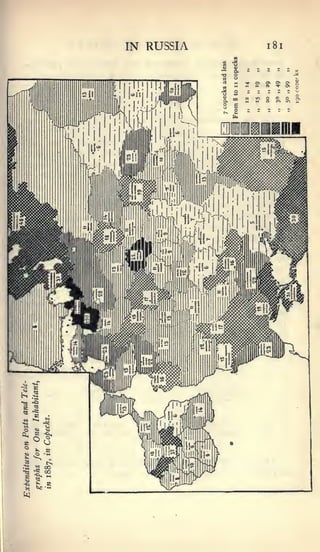
  • 376.
    : 28o IS WAR NOW IMPOSSIBLE Imports. 1863. 1869. 1873. 1894. Meat (in thousands of tons) 8 6 23 24 raw Silk, „ ,, 7 8 9 II Sugar „ „ 236 201 154 166 Tallow, &c. „ „ 40 37 36 32 Wool 63 108 120 224 In comparing yearly statistics it is necessary to bear in mind that certain articles of import diminished owing to the development of industry within the country, and were partly replaced by other imports. Thus the diminished import of sugar is explained by the production of beet- sugar at home, which increased from 3833 million kilogrs. (3,833.000 tons) in 1873-74 to 5148 million kilogrs. (5,148,000 tons) in 1893-94. The following two diagrams show the fluctuations in the external trade of France since 1883, in millions of francs French Trade in Millions of Francs. Import. 1883-J88S. 1892-94. 2210
  • 377.
    IN FRANCE 281 Export. Pro- 794 visions. 712 Raw 739 Products. 787 Manu- factured 1724 Articles. 1759 The revenue of France, which may be considered as a measure of the prosperity of the population, is shown in the following diagram : Revenue and Expenditure of France in Millions of Francs, Revenue. Expenditorb. 1861 1866 2170 i86g 2105 2145 3366 1893 3450 A striking example of financial self-sufficiency is pre- sented by France. The war, the Commune, the payment of five milliards (;^200,C)C)0,ooo), the payment of the ex- penses of the war, the reorganisation of the army, the reform of the government in all its departments all — this required immense expenditure, yet France found all these resources within herself The debt of France has grown immensely, as is shown by the following diagram :
  • 378.
    282 IS WAR NOW IMPOSSIBLE? Debt of France in Millions of Francs, Current. Consolidated. 25966 Thus since 1871 the debt of France has grown by almost 14 milliards of francs (^^560,000,000). All this sum was found within the country, and in addition, immense sums were invested in industrial undertakings and in foreign loans. As a measure of the increase of wealth in France we may take the statistics of the savings banks. The number of depositors and the amount of deposits are shown in the following table and diagram : Pass Books. Deposits. 1869 . 2,130,000 711,000,000 ft. (;^28.440.000) 1894-95 6,314,000 3,260,000,000 „ (£130,400,000) Savings in France. Number of Depositors' Books Deposits in Millions in Millions. of Francs. 3260 Consideration of other statistics confirms the general In France the belief as to the increase of wealth in France. transfer of estates is subjected to a duty. The following
  • 379.
    IN FRANCE 283 diagram shows the value of estates passing by legacy and France in millions of francs gift in : Average value of Properties passing by Legacy and Gift in Millions of Francs. 1873—1875 3965 1890-1892 6005 From these brief statistics it may be concluded th^t France has borne the heavy losses caused by the war of 1870 much more easily than any other state could have done. The economic consequences of war would be much more easily borne in France than in other countries if it were not for a whole series of unfavourable circumstances, thanks to which the image of war appears not less threatening for her than for every other country. The interruption of communications will be alone sufficient to strike a deadly blow to industry. The moment export and import by sea have ceased the price of the necessaries of life will rise, the springs of income will be dried up, and many different industries will be unable to continue the production and sale of their goods. The theatre of war will become a closed market. In the country itself the demand for manufactured articles will decrease, not only owing to the fall in the income of the majority of the population, living from day to day, but also owing to the natural indisposition of the propertied classes to unneces- sary expenditure in time of war. Factories, mines, and workshops, with the exception of those whose products are necessary for the equipment of armies, will be com- pelled to decrease their output. It must be remembered that in France a great number of foreigners are engaged
  • 380.
    284 IS WAR NOW IMPOSSIBLE? in industry. The production of these in time of war would also cease. In certain industries the number of foreigners rises as high as 22 per cent. Another circumstance which must have a serious influence and cause great difficulties, is that a high percentage of the population will be sum- moned under the colours. The following diagram illustrates the distribution by occupations of the population of France in 1 886 : Distribution of the French Population according to Occupation in 1886. From this we see that nearly half the population of France is engaged in agriculture. The agricultural class of the population is divided into the following
  • 381.
    IN FRANCE 285 classes Large and small proprietors, farmers and hired : labourers. Of 17^,698,000 persons belonging to this class, the labourers number about 2,772,000 men. In a country where landed property is distributed among a large number of families, peasant proprietors constitute the chief part of the population, and wages are comparatively low every- where excepting those in departments where large farming prevails. The struggle for existence in this class of the population is much less serious than it was twenty years ago in many departments. Although agri- cultura labourers suffer less than factory hands from uncertainty as to regular work, their life on the whole is more difficult owing to the fact that they, while knowing the extent of their earnings, are deprived of all hope of improving their position. The peasant proprietor, the corner-stone of France, is bad material for agitation, but the hired labourer is in a very different position. It must not be thought, however, that in the event of war no danger for the state would arise from the agricultural class. The fact is that the agricultural population is not in a position to feed itself out of the land. Investigations made in 1882 showed that out of 5,672,007 registered agricultural properties 2,167,667 were of an area of less than a hectare (two and a half acres), and 1,865,878 were of an area of one to five hectares (from two and a half to twelve and a half acres). A detailed examination of these statistics would considerably reduce the number of small properties but it would still show that 1,700,000 persons ; of this class are little removed from the position of agricultural labourers. Still the danger to the state from the agricultural popu- lation will be small. Of other classes of the population this cannot be said. In order to be convinced of this it is only necessary to consider the distribution of the incomes of the population.
  • 382.
    286 IS WAR NOW IMPOSSIBLE I. Personal Earnings. Millions of Francs. 3,434,938 agricultural labourers . 2,000 (£80,000,000) 3,834,580 workers engaged in Indus try, trade, and transport 3,600 (/i44,ooo,ooo) 1,132,076 serving for wages 1,000 (/'4o,ooo,ooo) 1,950,208 domestic servants 1,400 (^56,000,000) 3,700,000 small landowners, artisans traders, porters, soldiers sailors, lower officials teachers, and others, whose earnings little exceed the earnings of labourers 4,000 (;£ 1 60,000,000) II. Capitalists. 1,683,192 landed proprietors from^ 3I to 4I milliards i,oog,9i4manufacturers, merchants, and others, from 3^ to 4^ milliards . 10,500 (;{"42O,OOO,O00) 1 1053,025 of private property, ren- tiers, and free profes- sions, from 2^ to 3 milliards . 17.797.933 Total 22,500 (;^9oo,ooo,ooo) These figures, of course, are only approximately correct, but they may serve as a basis for determining difterent influences on the economic condition of the people. We see that the whole 10^ milliards (;^420,0C)0,0C)0) when divided among 3,746,131 capitalists represents only 2800 francs (;^ii2) the family. Leroy-Beaulieu sup- poses that in all France there are only 700 or 800 persons with incomes of 250,000 francs (;{^ 10,000) or over, and from 18,000 to 20,000 with incomes of from 50,000 to 250,000 (;,^2000 to ;^ 10,000). From statistics relating to May 1886 in a population of 38.2 millions, the distribution by occupation was as follows :
  • 383.
    IN FRANCE 287 Women. Men. Agriculture and woods . . 2,138,236 .. • 4,777.729 Independent persons 937.539 .. . 3,108,625 Persons with higiier duties 42,428 55.407 Labourers . 1,158,269 . . 1,613,697 Hotels and restaurants . 964 1 6/.. . 325.318 Spinning and weaving . 376,602 . 414.695 Tailoring, &c. . 433.650 . 130,999 In addition to these France has many important fields of labour for women. In trade and in the banks served : Women . . 503,197 or 35.6 per cent. Men . . 909,058 ., 64.4 „ In case of the interruption of the general economic life of the people the agricultural class will feel the crisis less acutely than others. On every farm exists some reserve of food, while that part of the population whose earnings come from industry and trade, and a considerable pro- portion of those living in service, will be in a desperate position— all the more desperate since in France women, as is seen by the above statistics, live by their own earnings. Taking such an active part in national work, the French woman has an extraordinarily beneficent influence on her country. It would be very interesting to consider what direction the activity of French women would take in a critical moment of the war. But here it is impossible to enter into the question. France is generally considered to be a rich country, but even if we suppose that only 5 per cent, of the population lives in poverty, it appears that 2,000,000 persons require in times of peace either state or private assistance. In time of war the number of the needy population would, of course, increase. Indeed, the prof)ortion of unemployed will be greater in France than in other countries in con- sequence of the fact that the most important section of her products are articles of fashion and luxury, the sale of which would, of course, decrease. The number of un- employed in France even in normal times is considerable.
  • 384.
    288 IS WAR NOW IMPOSSIBLE ? If we may believe the French Radicals the proportion out of work France amounts to one-fifth, or at the very in least to one-sixth of the population. In Paris things are even worse. In favourable times one-fifth of the working classes are without employment for three to four months, while in years of crisis 45 per cent, of the working classes are without employment — that is to say, 300,000 families are without the means of subsistence. In ordinary times these unemployed draw little attention upon themselves, but in time of war their number would undoubtedly grow, and all would consider they had a right to government assistance. The following diagram shows approximately the amount of assistance given to the poor in France in 1889: Assistance given to the Poor in France in 1889. Number receiving a&sistance (in thousands). (672 Number of da> s on which assi ance given. t- 2654 It is easy to foresee the consequences which must result from such a state of things in a country like France, where the socialistic movement bears unerring witness to the existence of general discontent with the existing order of things. If after the war of 1870 a Commune sprang up, what must we expect now when Socialism has rai.sed its head and created a permanent organisation, while before the war the government of Napoleon III. crushed every attempt at socialist propaganda. For another peculiar reason war would be more dis- astrous for France than for any other country. We have seen how rich is France in capital, how industrious and how economical is her people. But all these factors would not be so remarkable if it were not for a special circum- i
  • 385.
    IN FRANCE 289 stance which, while being itself of a negative character, has an immense influence on the growth of wealth. As is well known, the birth-rate in France is consider- ably lower than in other states, while the death-rate is almost the same, so that the growth of the population is quite insignificant. There have even been years when the growth not only ceased, but a loss actually occurred. The following diagram shows the proportion of old men and children in percentage relation in the population in some of the chief European states. Number of Old Men and Children in Percentage Relation to Population. Persons over 60 Children below ten years of age. years of age. 24.2 1 1 1 ' 23-9 1 1 1 1 1 b 1 1 1 1 1 26.2 Mill 'ill 239 l:::±: :::: _ 17-5 iiil::::: Thus in France the proportion of children under the age of ten years is only 17^ per cent, of the population, while in other countries it rises as high as 24 per cent, and 26 per cent. Persons of 60 years and over in France constitute 12.6 per cent., and in other countries 7-8 per cent. The relation of married and unmarried persons in France is also less favourable than in other countries, as is shown by the following sketches :
  • 386.
    1 290 IS WAR NOW IMPOSSIBLE ? Number of Bachelors in Percentage Relation to Population. 40 Years and over. 50 Years and over. 1 8.3 Germany Germany 12.4 4 Austria Austria 1 Hungary 3 4 Hungary 10. England England II.6 France Fkanck 1 The diagram opposite shows the unfortunate position of PVance in blackness. all its From this we see that in France the birth-rate is ap- proximately equal to the death-rate, while in Germany the birth-rate exceeds the death-rate by 12 in every thousand. The diagram relates only to the last ten years. But the same phenomenon may be seen during the whole of the present century. From the diagram on p. 292 it will be seen that 100 years ago the strength of Germany was 40 per cent, lower than that of France, while at the present day France is weaker than Germany by 20 per cent. From these statistics we must conclude that France will become weaker in com- parison with other countries where the growth of the population is more normal. The artificial measures pro- posed for the increase of the birth-rate cannot be of much avail. Projects may be drawn up to increase the birth- rate, but to carry them out is shown to be impossible. The decrease in the birth-rate has yet this inconvenience, that more care is taken of children, the death-rate among
  • 387.
    IN FRANCE 291 Increase or Decrease of the Population in France and Germany per Thousand. Germany. France. + 1.7 + 2.5; + 1.4 + 1-5 + 1.2 + 25 *• 13-5 + 1.0
  • 388.
    292 IS WAR NOW IMPOSSIBLE? them is smaller, and the natural process of the elimination of weak organisms is stopped, from which the general physique of the people is bound to suffer. In France even at the present time the race is weaker than in England, Germany, or Russia. Number of Population in 1788 and 1888 in Millions. I78» I? 25 h This unfortunate position of affairs has, however, although only temporarily, good sides, since with an incon- siderable growth of the population France has more room and a less serious struggle for the development of produc- tive forces. In addition, the people spend less money on education and save all the more capital is not split up ; as it is in more populous states, and in consequence material prosperity increases. But these considerations
  • 389.
    IN FRANCE 293 do not alter the fact that every year the strength of France grows less and less in comparison with that of other states. But for the masses living to-day the future is hidden in the splendours of a temporary prosperity. If we take the value of each inhabitant at 3000 francs (;i^ 1 20) and make an estimate of such wealth accumulated by France and Germany in the past century, we will get some interesting results, as shown on the following diagram : Value of Growth of Population from 1788 to 1888 in Millions of Francs. France 39 Germantt In the' event of a war unuer modern conditions the losses, as we have already pointed out, would be immense for all states engaged. But France, above all, must avoid loss of men in consequence of her present position, as losses would be relatively greater for her than for other states. War could in no possible way change the position of France for the better. With the loss of the flower of her youth would follow not merely the ''national danger" but absolute ruin. France with so many milliards invested in foreign countries, and with the greater part of her savings invested in her own debt, is a country which, while admitting no offence against her honour or her interests, must at the same time aspire to peace, as in peace alone, and not in war with all its disasters and misfortunes, will she find the best path for a national genius to which all humanity is indebted.
  • 390.
    CHAPTER V EFFECT OF WAR ON THE VITAL NEEDS OF PEOPLES Difficulties in the satisfaction of the vital needs of popu- lations, interruption or stagnation in the employment of the productive forces of the population — these are the factors which will influence statesmen against undertaking war, or if war be undertaken, these are the factors which will at one moment or another decidedly veto its continu- ance. For certain states yet another danger appears (as one phantom hastens after the other in the vision of Macbeth), that is, the danger of revolutionary movements, not only political but also socialistic. In considering the effect of a future war it is essential to examine the manner in which it will react on the needs and condition of the people. If famine is not to find states unprepared, some account of the dangers which follow on war must be taken. The consideration of this question may be useful in another way. By revealing with what a tremendous influence a great war may react on the con- ditions of peoples, it must result in a tranquillising con- viction that in our time to decide on war without grave hesitation will be impossible. I. Those countries which in times of peace import large quantities of grain and other necessary products will stand in a particularly critical condition. Supply by means of railroad will be extremely difficult, and indeed there will
  • 391.
    EFFECT OF WAR ON THE PEOPLE 295 be no country whence to import, since every European country will be compelled to shift for itself. Of the two countries which serve as the granaries of Europe, Hungary will be forced to place her superfluity at the disposal of Austria, while Russia will be deprived of the possibility of supplying her friends with grain, and will not wish to supply her enemies. Transport by sea from America, India, and Australia Home Production and Import of Wheat, Barley, and Rye. 188S-91. '894-95. s ^ Import in Import in '§§ Thousands of V Thousands of Tons. 26 Tons li. || i •i 1^ 'a Or? t 6 S 1 II 1 Germany 10,151 1254 853 20.7 1773 1330 30.5 France . 9.852 295 656 9.6 448 635 II.O England 3.672 721 2770 95-0 1885 3493 146.4 Italy . . 2,410 361 262 25.8 535 83 25-7 Austria . 6,016 28 0.5 47 62 1.8 willbecome imjxjssible, as it is unquestionable that in the beginning of war privateering will be carried on, inter- rupting communication with trans-oceanic countries, or at the very best making transport so difficult that freigiit and insurance will rise ve>y high, and thus the price of trans-oceanic supplies will rise prohibitively. It is enough to remember lime of the Crimean that in the war, when import from Russia alone ceased, the price of wheat in England rose 80 per cent. In the American Civil War the operations of a single Southern
  • 392.
    . 296 IS WAR NOW IMPOSSIBLE? cruiser, the Alabama, were enough to cause a perceptible rise in the price of wheat. Thus becomes necessary to determine the degrees of it peril towhich in the event of a great war the different states of Europe will be subjected in the feeding of their populations. Acalculation of the times in the course of which the population of each state may exist on the local production of wheat, barley, and rye can be mad-e from the table given on the preceding page.* If on the foundation of these figures we calculate the number of days on which food will be lacking after the exhaustion of local products we find the following results : 1888-91. 1894-95. In Germany . 6g days 102 days „ France . 32 » 36 M „ England . . 178 „ 274 ,. „ Italy . 76 M 75 « „ Austria . . 2 „ 7 » (1888-91) (1894-95) 6c Germany I02 32 France 36 178 II England 274 11 1 J 76 Italy ye) 2 Austria ^ The greatest danger will consequently threaten England, which imports the largest quantity of grain, by far the greatest part from trans-oceanic countries. Germany and • Statistics from " Statistisches Jahrbuch fiir das Deutsche Reich," " Annuaire Statistique de la France,"" Oesteneichisches Statistisches Handbuch," "Annuario Statistico Italiano," " Obzor Vneshni Torgovli," &c.
  • 393.
    . EFFECT OF WAR ON THE PEOPLE 297 Italy will find themselves in a better, although still in a difficult position. Germany imports foreign grain, for the greater part Russian, for 2-3 months, and Italy for about 2| months. France will suffer only from a month's deficiency, while Austria may be considered as fully supplied. The most favourable position will be occupied by Russia, which with her export trade interrupted will not only not suffer from deficiency but will possess so much superfluous grain that her population can in no way suffer. The export from Russia of wheat, barley, and rye in the course of the periods considered shows a yearl}' average of 3,967,213 tons, or a superfluity after the satirafaction of local requirements of 21.6 per cent. In addition to wheat, barley, and rye, we find a con- siderable deficiency in oats ; for all the states of Central Europe mentioned, with the exception of Austria, produce less oats than is required for local needs. Production and Import of Oats. 1888-91. 1 894-95- Import in « Import in — «J — So 2^ Thousands of Tons. I&.2 S- iS Thousands of Tons. Iff si B isji Hi ES on S-2 B " J Germany . 4759 183 4 3-9 263 63 6.8 France 3279 131 82 6.5 227 187 12.6 England 3065 426 262 22.4 625 163 25.7 Italy . 213 13 II "•5 — 2-3 Austria 2792 — 66 48 5 4.1 From which appears the following deficiency of home production :
  • 394.
    298 IS WAR NOW IMPOSSIBLE: 1888-91. 189495, In Germany . 18 days 31 days „ France • 21 „ 41 » „ England . . 66 „ 76 ., » Italy . . 38 » 8 „ ,, Austria • '~' »i 15 .. Number of Days on which Oats would be Lacking. 1888-91. 1894-95. Germany 31 18 ai France 41 66 England : 76 Italy 38 Austria 15 Russia, on the contrary, yearly exports 836,065 tons of oats, or a superfluity of 16.7 per cent, after the satisfaction of her own needs. Such deficiencies of grain, of course, are not everywhere the same. In each country there are localities which pro- duce sufficient of these products. In other localities, on the other hand, the need to import grain arises immediately after harvest. The following table shows, for instance, the distribution of harvests in Germany :
  • 395.
    EFFECT OF WAR ON THE PEOPLE 299 Superfluous Local Deficiency of Local Production. Production, comuarativcly with comparatively with District* the Reguiiemeiits for the Rtquirements for One Inhabitant, in One Inhabitant, in Hundredweights Hundredweights Posen .... 1.78 Pr. Saxony Bavaria .... E. and W. Prussia . 1.63 0.84 0.57 Hesse-Cassel 0.21 — Average Silesia Westphalia .... for all Prussia — 0.65 0.624 1.888 Brandenburg (and Berlin) — 1.844 — Hesse- Nassau K. Saxony Wurtemburg .... . — — 2.06 2.43 2.834 Pri. Rhine Provinces — 2.892 G. Duchy Baden — 2.938 Other parts of the Empire 0.4 Thus the harvest appreciably exceeds the demand in Prussian Saxony, the kingdom of Bavaria, Eastern and — Western Prussia that is, in the Eastern territories of Germany near the Russian frontier. A considerable superfluity is also found in Hesse Cassel and in other parts of the Empire which for the sake of brevity are not set out separately. In all the other provinces the demand exceeds the supply, and in certain parts of the — empire as in Brandenburg, Baden, Wurtemburg, the — Rhine provinces, and Saxony by more than half. And as in these parts of the empire agriculture occupies about 42 per cent, of the population, agriculturists through dread of famine will hold their stocks of pro- visions for themselves, and for the remainder of the population it will be necessary on the very day after harvest to draw grain from other localities. In times of peace the industrial districts may import grain from America, Austria, Roumania, and Russia, and even from the eastern provinces of Prussia where a
  • 396.
    300 IS WAR NOW IMPOSSIBLE ? surplus exists. With the declaration of war, for the reasons we have indicated, this import must cease. To rely on supplies from Austria and Roumania is out of the question when we consider local needs and decreased efficiency of the railway system resulting from military operations. To avert famine, even temporarily, the eastern provinces might be drawn upon, but in conse- quence of its proximity to the theatre of war, grain there will be bought up for the use of the army. Mr. V. I. Hedzvetski, in a remarkable article on " The Struggle with Famine in a Future War," comes to the conclusion that in the granaries of the future base of the German army near the Russian frontier there will be but a month's or a month and a half s provisions for 960,000 men and 220,000 horses. But on the figures of General Leer we find that the number of men to be fed will amount to 1,200,000. And as armies at the theatre of war will not be in a condition to supply their needs from local sources, it is plain that the above-mentioned stores must be constantly replenished, if not for the whole number of men mentioned, at least for the greater part. Even if Posen and Eastern Prussia were in a condition after the satisfaction of military requirements to distribute part of their superfluity among the neighbouring pro- vinces which require grain, which is very unlikely in view of the demands of the commissariat, still prices must so rise that among the poorer classes famine will be inevitable. To form a general idea of the commotion which war would cause in Germany, we must take into account not only average figures of production, import and demand, but also the operation of undetermined forces, the influence of which may be disastrous. The very fear of need, owing to the impossibility of drawing supplies from the usual sources, may not only appreciably raise prices, but even a panic. call forth In the famine of 1891 we had a living example of the fact that, notwithstanding the full possibility of import of corn by sea and land, the dread of need may have immense influence on the rise of prices.
  • 397.
    . : EFFECT OF WAR ON THE PEOPLE 301 necessary also to take into account the fact that It is between the harvests of different years a considerable difference exists. If we take the average yearly harvest in the period 1885- 1889 in different countries, in millions of bushels, at a hundred, then for separate years in each country we will find the following departure from the average Average Harvest 1885-89. Harvest in _ 1885-89 in Millions Maxi mum. Minimum. of Bushels taken at 100. Year. Per Cent. Year. Per Cent. Russia 1725-7 1887 II4.7 1889 86.2 Germany . 701.8 1886 106.2 1889 91.9 France 701.8 1886 102.6 1888 96.6 Austria- Hungary 692.9 1887 108.4 1889 87.1 Gt. Britain 312.8 1885 104.5 1887 95-4 Italy 221.2 1887 I05-5 1888 91.9 Roumania 140.9 1887 135-5 1885-86 77-7 Servia 25-9 1888 131-9 1885I 1886 91-5 1887 1889) From these statistics we see that the departure in Germany amounts to 6 per cent, above the average and to 8 per cent, below it. In other countries the difference is more striking, as for instance in Russia and still Austria, where in consequence of a lower culture, harvests are more unequal. In Russia this difference amounts on both sides to 14 per cent., while in Austria the differ- ence amounts to 8 per cent, on the good side and 13 per cent,on the bad. All these conditions: the small production in comparison with the demand, the cessation of import from abroad, the indispensable supply of millions of soldiers who consume much more than when fed at their own expense at home,
  • 398.
    302 IS WAR NOW IMPOSSIBLE? and the efforts of the prosperous part of the popu- finally, lation tc guarantee themselves by storage against the — danger of famine all these conditions must inevitably give rise to vast speculations in wheat which will cause an unprecedented rise in prices. The disasters which will take place in consequence of the want of bread in time of war have not failed to attract the attention of statesmen and economists. Still this question, notwithstanding its gravity, has up till to-day remained an abstract one, and has never permeated to the minds of the people. In the German parliament the problem was raised more than once, but was not considered publicly, and each time its solution was entrusted to the consideration of a secret committee. The Government revealed to this committee its project for furnishing Germany with corn from Egypt through the Suez Canal, through Italy by the Swiss and Austrian railways, and partly from Hungary and Roumania. How vain these hopes would prove to be might easily be shown by an examination of the probable condition of maritime communications in time of war. In any case, even if under the protection of the Italian and English fleets it were possible to import grain through the Suez Canal, the risk and costliness of such an undertaking would cause so great a rise in the price of bread that the difficulty would in no way be surmounted. In view of this, other means for the solution of the question have been devised. Thus the author of the brochure Au/derSchwelk desKriegs, on the supposition that war may break out suddenly with France, comes to the conclusion that at present only three Great Powers may be considered independent as relates to the feeding of their population —the United States, Austria- Hungary, and Russia. Germany after the stoppage of the export of bread from Russia would find herself in the position of a besieged fortress. What would her position be in case of a prolonged war when home production would be diminished, and transport from oversea would be threatened by the powerful fleets of her enemies ?
  • 399.
    EFFECT OF WAR ON THE PEOPLE 303 The author of this pamphlet proposes to found state granaries, not only for the supply of the army, but also as a guarantee against famine among the civil population. Such granaries would have the further advantage of serving as a corrective against exceptional rises in price. But from the statistics given above as to the quantity of grain needed yearly, it is easy to see the difficulties which present themselves in the execution of this project. The quantity of provisions which it would be necessary to hold and renew would require such great yearly expenditure that the consent of parliaments would be extremely difficult to obtain. II. The deficiency of bread is but one of the difficulties with which nations will have to contend upon entering upon war. A similar deficiency will appear in many other necessaries of life. Of these meat is the chief, and it is necessary to consider the relations between the local supply and the quantity imported. The following table sets forth the relation : Trade in Meat in Tons (1000 Kilogrammes). Import. Export. Superfluity. Deficiency. Austria 328 8,820 8492 _ Russia . 20 1,623 1603 — Italy . 123 i»443 1320 — Germany . 28,787 16,721 — 12,066 France . 20,262 2,016 18,246 From this it appears that Austria, Russia, and Italy produce more meat than they require, while Germany and France are compelled to supply their deficiencies by import. In Germany in 1890 the import exceeded the export by 12,066 tons, in France by 18,246 tons. Thus
  • 400.
    304 IS WAR NOW IMPOSSIBLE ? those countries which produce sufficient grain are also guaranteed against deficiency of meat. In the event of a prolonged war, Germany and France will suffer from a deficiency in both the chief necessaries of life. It is true that both in Germany and in France the stock of cattle is so great that it seems possible by increasing the number killed to compensate for the diminution in import, but in view of the high value of the cattle raised Superfluity or Deficiency of Meat in Thousands of Tons. Superfluity. Deficiency. 8.5 Austria 1 1 1 1 I .6 Russia 1.3 Italy Germany ^^^^^^ I2.I in those countries, the cost of France i^^^B^l meat will be raised to an 18.2 extreme height so as to compensate the producer. In relation to salt Russia is in a less favourable position than the Western Powers. Trade Tons (looo Kilogrammes). — in Salt in Import. Export. Superfluity. Deficiency. Austria 10,098 10,098 Germany . 20,967 199,607 178,640 Italy . 191,475 191,475 Russia 17,246 7,475 9771
  • 401.
    : EFFECT OF WAR ON THE PEOPLE 305 Superfluity or Deficiency of Salt in Thousands of Tons. Superfluity Deficiency 10.1 But the deficiency ot salt in Russia of 9771 tons yearly may be supplied, with but an insignificant increase in price, by the increase of local production. As relates to the supply of kerosene, which has now become a product of the first importance, Russia is in an enviable position Trade in Ketosene in Tons (looo Kilogrammes). Import. Export. Superfluity. Deficiency. Russia 12,459 12,459 Austria . 252,459 6,230 2^6,229 Italy 70,000 70,000 France . 129,770 139,770 Germany 647,295 647,295 The known richness of the naphtha springs of the Caucasus makes it possible to export a considerable quan- tity of kerosene. Germany, Italy, and France all import kerosene from abroad. The import into Austria is also considerable, although local production (in Galicia) grows constantly, and in a short time Austria may be fully supplied by local production.
  • 402.
    3o6 IS WAR NOW IMPOSSIBLE ? Superfluity or Deficiency of Kerosene in Thousands of Tons. SuPSflFLUITY Deficiency 12.4 Russia Italy H7O.O France ^H 129.8 Austria Germany 1 he question of stone coal presents i 1""' itself 647. as follows. The net import, after deducting the export, is, in France, 8049 thousand tons, in Austria 1623 thousand tons, and in Russia 1525 thousand tons. The export of coal from Germany exceeds the import by 4492 thousand tons. Superfluity or Deficiency of Stone Coal in Thousands of Tons. Superfluity Deficiency § I 4.5 Germany l.,i„ II Russia ^^H U Austria ^^^| 1.6 France ^^^| 8.0 Thus in regard to coal Germany finds herself in the most favourable position, after her coming Austria, which
  • 403.
    EFFECT OF WAR ON THE PEOPLE 307 may supply decreased import by increased local working, although, in consequence of the stoppage of many factories, this, in all probability, would not be required. In Russia the supply of coal is thus obtained : From the Dombrovsk mines about 2475 thousand tons, from the remaining mines 3754 thousand tons. In time of war the supply from the Dombrovsk mines might ceace, but, on the other hand, the demand would inevitably diminish owing to the stoppage of factories. A considerable part of the Russian population employs wood for heating purposes, and there will be no difficulty in this respect. As regards cotton, Russia is to a considerable extent guaranteed by supply from Bokhara. Of wool, skins, and linen there will be no deficiency. A grave question also arises whether all these countries will be in a position to renew their armaments and muni- tions of war. In this respect the majority of states are guaranteed. With the exception of Italy, Turkey, and Roumania, there exist everywhere immense factories for the production of arrrjs and ammunition, so that in any case war will not be stopped through want of arms. Thanks to the energetic measures taken by the govern- ment, the working and manufacture of iron and steel in Russia has grown uninterruptedly, as the following figures demonstrate : Production in Thousands of Tons. | Pig-iron. Iron. Steel. I88I 1890. .... 460,000 908,035.7 286,071 424,286 287,678.6 37i»250 This quantity of material is, of course, more than suffi- cient for purposes. military In an Imperial decree of October 1866 we find the following directions "To cease : for the future to give government orders abroad . and ,
  • 404.
    : 3o8 IS WAR NOW IMPOSSIBLE ? all orders, both of the Ministry of War, the Ministry of Paths and Communications, and of the other departments of state to fulfil inside the country, notwithstanding the difficulties and inconveniences which may arise at first." As the result of this decision there arose a large number of furnished with the latest mechanism and factories machinery for the manufacture of articles of military equipment. It is enough to mention that even in 1880 out of 686 guns on the fleet, 498 were cast in the Obukovsk factory alone, and that these guns, as was demonstrated by test against armour, were in every way equal to the guns of Krupp. Thus the 12-inch gun, at a distance of 7000 feet, penetrated armour of a thickness of 12.6 inches, the 9-inch gun armour of a thickness of 6 59 inches, and the 6-inch gun armour of a thickness of 3.1 inches. III. It cannot be too often repeated that the disastrous con- sequences of war will be especially felt in countries with — highly developed industries that is, in Germany, France, and England. With the interruption of the ordinary com- munications, with the diminution in demand, and the approach of danger, factories, mines, and workshops, with the exception of those whose products are necessary for the equipment of armies, will be forced to discontinue work- ing. The fathers of families, taken from their homes and sent to join the army at a few hours' notice, will leave their families, in the majority of cases, unprovided against the needs of the morrow. The following statistics are interesting as giving an idea how far the population of Germany is guaranteed against hunger by the income it receives in time of peace Millions of Pounds Sterling;. Per Cent. Insufficient incomes amount to . 16.3 i.e. 22.1 Small „ „ . 22.53 » 30.5 Limited „ „ . 13.345 „ 18.1
  • 405.
    " EFFECT OF WAR ON THE PEOPLE 309 Millions of Pounds Sterling. Per Cent. Moderate incomes amount to . 12.33 ^•^- 16.7 Large „ „ • 6.555 „ 8.9 Very large „ „ . 2.69 „ 3.7 It is unquestionable that these incomes ** insufficient for supplying the first necessaries of Hfe, and " small and " limited " incomes represent the earnings on which an immense proportion of the population lives, and that the stoppage or even the diminution of income will place this proportion in a critical position. The earnings of those in these classes constitute more than 70 per cent, of the entire income of the people. The class which enjoys a " moderate " income can only to a small extent help those in need in the moment of danger. There remain the rich classes, and on them must fall the chief duty of helping the majority. But the income of this class, with " large " and ** very large " mcomes, forms only ;^9,250,000, or 12^ per cent, of the whole income of the people. In what way can the incomes of the rich class com- pensate the majority of the population for the decrease by a considerable extent, a decrease of a half or even a third, of the incomes of that majority which constitute Is itpossible that 12^ per cent, of the total income, even though it went entirely to the aid of the needy classes, could appreciably compensate the latter for the losses to which they would be subjected (70 per cent, of the total income of the people) ? And this, when we bear in mind that the incomes of the rich themselves will be reduced in time of war ? As relates to the provision which the working classes in a time of crisis would find in their own savings, we must bear in mind that these savings are very inconsider- able. Here is the picture drawn by Dr. Von Schulze- Gavernitz in his work, " Der Grossbetrieb " (Leipzig, 1892). " In the great majority of cases the earnings hardly cover expenses, and very often a deficiency appears which is supplied by recourse to charity, often to prostitu-
  • 406.
    3IO IS WAR NOW IMPOSSIBLE? Hon, while in many cases families are compelled to endure privation and even hunger." In the investigations of Chief Factory Inspector Vari- schofFer, issued by the Bavarian Government, it is explained that even in large manufactures (for instance, in chemical factories) the v^orkers receive barely enough to satisfy the " physiological minimum " of existence. In the great industries wages hardly suffice for necessary food, which consists chiefly of potatoes and rye bread. But these earnings are nevertheless higher than those yielded by handicrafts and work at home. Under the most favour- able circumstances the wages of workers are sufficient only for food, nothing remaining over. It is plain, there- fore, that in a critical time savings cannot be counted upon. The unfortunate fact must be noted that need will appear with especial force in those very localities in which there is a, deficiency of grain, and where the supply of grain will present the greatest difficulties. In the kingdom of Saxony, as we have already seen, there is an average deficiency for each inhabitant of 267.3 lt)S. of grain, or about 50 per cent, of the demand, while in that kingdom only 22.6 per cent, of the population lives by agriculture, and 77.3 per cent, by trade. In the Rhine provinces we find a deficiency of 278.1 lbs. kilos of grain per inhabitant, or about 60 per cent, of the demand, while 65 per cent, of the population lives on incomes derived from trade and industry. In addition, 'it must be borne in mind that the pro- portion of the population living by industry grows rapidly. In an inconsiderable period of time the industrial popula- tion of Germany has been quadrupled. This increase has already gone too far. The working forces newly appearing, competing ceaselessly with the old, lower the wages of the older workmen to an extreme level. Statistics witness that even now a great part of the workmen in Prussia, though working twelve or fifteen hours a day, earn extremely little.
  • 407.
    EFFECT OF WAR ON THE PEOPLE 3" Industry. Weekly Wages. Glass and kerosene production 15s. gd. Iron foundries . 14s. 8d. Woi king of iron ore . 14s. lod. Cotton factories 13s. od. Chemical factories IDS. 8d. Spinning los. 7d. Cigar factories . gs. 6d. Preparation of agricultural products gs. 2d. Milling of all kinds . . . , gs. lod. Taking these circumstances into consideration, we must conclude that in certain portions of Germany the Govern- ment, especially in view of the propagandas and tendencies which now operate among the masses, will not be able to remain indifferent to the needs of the population. A war with the terrible methods of destruction now employed and in view of the masses of people which will be sent to the front may, in spite of the predictions of military authorities who prophesy years of struggle, prove to be short and decisive. But even in that event the danger for the present social order cannot be considered small. By a very natural coincidence the greatest deficiency of food will be experienced in those localities where trade and industry are most highly developed — that is, in districts thoroughly permeated by socialism. A glance at the chart on the next page, which illustrates the voting for Socialists and Freisinnigen at the elections of 1890, is sufficient to confirm this statement. In the districts marked in black were elected for parliament Socialists (Socialdemocraten, Socialistes - democrates), in those lined Freethinkers (Deutschfreisinnig, progressivists), those with black dots in- dicate that Socialist candidates stood but were not elected. In 1890 were elected for parliament: « Conservatives . 73 Popular Party . 10 Adherents of the Govern WoUfites . . . . II ment 20 Alsatians . 10 Freisinnigen 108 Dane I Members of the Centre 106 Anti-semites . • 5 Poles 16 Others 3 Socialists . 35
  • 408.
    : 312 IS WAR NOW IMPOSSIBLE? Chart showing tJte Comparative Development of Socialists and Freethinkers in Germany according to the Elec- tions of 1 89 1. ® J«10 I. Berlin. 6. Magdeburg. II. Bavaria. 3. KSiiigslerg. 7- Wiesbaden. 13. Saxony with Dresden. r Dantzig. 8. Cologne. 13. Sax' ny wiih Leipzig. 4- Stettin. 9- Diisseidorf. 14. Hamburg. 5. BresUu. 10. Aachen. 15. Alsace and Lorraine. *,* In the localities marked in black, Socialists were elected in the shaded ; localities, Freethinkers ; the black dots indicate socialist candidatures which failed. Even if it be assumed that the Socialists and their adherents in the ranks of the army will fulfil their duties as other citizens fulfil them, still the question remains Will disarmament be carried out as easily as armament ? To answer this question definitely is impossible now. But before war is decided upon it is worth considering
  • 409.
    EFFECT OF WAR ON THE PEOPLE 313 whether the most splendid successes can compensate for the dangers that hasten on the path of war. In France the position will be somewhat better. Of 17*798,000 persons, whose incomes together constitute ;t 900, 000,000, almost five-sixths belong to the class of poor people whose incomes are quite inconsiderable : Persons. Per Cent. Serving for salaries Domestic servants .... Working in industry,trade, and transport 3,835000 1,132,000 1,950,000 i.e. „ „ 21.5 6.4 11 Small producers, workers and subordi- nates whose incomes do not appre- ciably exceed the highest wages of workmen 3,700,000 „ 20.8 Total . . . 10,617,000 „ 59.7 The incomes of the above-mentioned categories amount to ;^400,000,000. Agricultural labourers number 3,435,000, i.e., 19.3 per cent. Their incomes, amounting to ^80,000,000, are also not guaranteed. No better will be the position of England, where the question of the feeding of the people has recently awakened great interest. The National Review quotes a speech of Sir Samuel Baker, in which we find an argument which touches closely upon our subject. " To such a degree have we become accustomed to have everything necessary for the support of life and unin- terrupted work arrive in our ports in due time, that we cannot even imagine a different position. Yet there is not the slightest doubt that in the event of war with a naval power the price of wheat would rise greatly in England, and, reacting immediately on all industries, produce an unprecedented catastrophe. In her present state of defence, England has not the strength to guarantee the transport of provisions." Lord Charles Beresford, with similar confidence, declared that in time of war England could not count upon the supply from oversea of the necessaries of life. Admiral Hornby,
  • 410.
    314 IS WAR NOW IMPOSSIBLE? presiding at a meeting with the object of presenting a petition to theGovernment on the subject of the taking of precautions against the stoppage of suppUes, said "that if England gained several victories at sea, and the regular transport of provisions were still inter- rupted, it would be worse for the people than several defeats." In Russia, at first sight, the position of the people in the case of war seems enviable ; 86 per cent, of the population is engaged in agriculture. But, as the price of agricultural products is very low, the agricultural class earns an income amounting only to 52 per cent, of the general income, while in Germany an agricultural population of 37 per cent, earns 35 per cent, of the income, in France 42 per cent, of agriculturists earn 40 per cent, of the total income, and in Austria 49 per cent, of agriculturists earn 45 per cent, of the income. But worse than this is the fact that s'^vings in Russia are inconsiderable, and thus the consequences of war for Russia might be not less terrible than for other countries. Such a proposition is all the more probable since the poverty arising from war springs not only from direct losses, but from the disorganisation caused by the destruction of ordinary relations, and by the fall of values. To cover the expenditure on war all states will be compelled to take refuge in the raising of loans or the issue of paper money. The price of all the necessaries of life must grow, and the purchasing power of the inconsiderable savings possessed by the people will be greatly diminished. All this leads to the conclusion that, nolens volens, governments will be forced to take on themselves the care of feeding the families of those serving with the army. The results of such an undertaking cannot be foreseen. If we suppose that governments will be forced to interfere in the regulation of prices, and to support the population, we must ask, will it be easy after tlie war to abandon this practice and re-establish the old order ? And will not this moment of transition to the normal order of things be
  • 411.
    : : EFFECT OF WAR ON THE PEOPLE 315 characterised by events similar to those which took place in France after the war of 1870-71 ? The destitute position of the population in time of war may be extremely dangerous to social order if war be prolonged, and in the opinion of very authoritative military writers this is more than probable. In connection with this subject we may quote the opinion of General Leer "Even with small armies, the years 18 12- 13-14 present a continuous three years war. How much time will be needed to conquer (to employ the expression of Von der Goltz) the modern Antaeus and tear him from the earth, sending against him army after army ? The impending struggle will not be decided by swift, heavy blows, but will be prolonged, it may be, even for years." Such is the opinion of the best German and French military special- ists— war with Russia cannot be finished in one year, but will require several campaigns. In the composition of the German army will be found the whole male population fit for service, from 17 to 45 inclusive. Considering that for agricultural labour the working age is between 15 and 65 years, it will be shown that 56 per cent, of the working class will be called imder the flag. Even if we suppose that not all Germans liable to service will be emplo'ed in war, still if Germany proposes, as was announced by Caprivi, to carry on an offensive war on both fronfiers, it will be necessary to withdraw from work such a quantity of working forces that the remaining population will not be able to accomplish a work which in times of peace occupies the whole working male population. For this reason alone production in time of war must be greatly diminished the need for the import of food will grow ; ; and the question of supply will become a hopeless one. In addition to this insufficiency of workers, we may point also to the difficulty which will arise in the matter of horses. If we may believe the statistics given in L Annee Militaire in 1892 the demand for horses in the different states on mobilisation will be as shown in the following table
  • 412.
    . : 3i6 IS WAR NOW IMPOSSIBLE? In Thousands. From each Hundied Horses In Time of In Time of Number of will be required Peace War will Horhes in the for War Purposes Army holds be required Country. Russia 1 60 340 25,000 1.36 France 142 308 3,000 10.26 England . 15 14 2,000 0.70 Italy 45 75 750 1 0.0 Austria 77 173 4,000 4-32 Germany . 116 334 3,000 II. 13 Percentage oj Horses which would be taken for Military Purposes. Of the 334,000 horses which will be required by Germany the majority will of course be taken from farmers. But this cannot fail to react injuriously on agriculture. It must not be forgotten that with the intense system of farming in Germany, fields never rest, one crop follows after another, and delay in working will undoubtedly cause
  • 413.
    EFFECT OF WAR ON THE PEOPLE 317 unknown under the more primitive systems of difficulties farming. As is well known, a holiday is kept in Germany at the beginning of field labours, the so-named Busstag (day of prayer and penitence), and after this work is carried on through the whole summer without in- termission on Sundays or holidays. In Germany, even under normal conditions, labour is so intensely utilised that to supply the labour of those serving with the army by working the remaining labourers on holidays is im- possible. In the German army will be found 38 per cent., in the French 42 per cent., and in theAustrian 49 per cent, of the total number of agriculturists. Even if we suppose that a certain proportion of factory labour will be diverted to agriculture, it is nevertheless unquestion- able that the harvests in time of war will be sensibly diminished. In Russia this question rests on an entirely different basis. There the absence of working agriculturists will be supplied more easily than elsewhere, for an important proportion of the peasants' land is held in common. It is easy to be an opponent of this system of agriculture and even to attribute to it the low condition of agriculture among the peasantry; but it must be acknowledged that the diversion to war of a great number of woiking hands will be borne much more easily under this system than under individual proprietorship. In general the land abandoned by the labourer who has been summoned under the flag will not remain wholly neglected. Without doubt it will be cultivated by the Mir, and the owner of the land on return will re-assume his former rights. In addition to this, agriculture carried on on a low level will suffer less from the neglect and even from the absence of the owner than a more intense system. In the absence of a system of progressive improvement, the agriculturist on returning to his home may be assured that he will find his land in much the same state as he left it when summoned to the front. The workers in factories and in industries in Russia do not as a rule cease their connection with the
  • 414.
    3i8 IS WAR NOW IMPOSSIBLE? village community. On the stoppage of factory work at the outbreak of war they will return to their villages and devote themselves to agriculture. In addition, it may be noted that in Russia the number of holidays is so great that, if in time of war the supreme ecclesiastical authority permitted work upon holidays, this alone would compensate for the loss of working forces through the exigencies of war. It must not be forgotten that out of the whole population between 20 and 50 years of age, the army (considering only attacking forces) will take in Germany 31 per cent. (3,000,000 men), in Austria 28 per cent., in France 47 per cent., while in Russia (3,500,000) it will take only 15 per cent. As Sundays constitute 1 5 per cent, of working time, then the lost contingent of working hands may be compensated for by Sunday labour alone, without trench- ing upon the immense number of holidays which are observed. Upon survey of the facts and statistics above set forth it is impossible to avoid the following conclusions : (i) The advantage rests on the side of those states who possess sufficient means of production and who in conse- quence will be in a condition to carry on a prolonged war without the danger of internal difficulties. (2) In view of the prime importance of the feeding of the population, those states whose internal resources are deficient must see that crops have been got in before war breaks out, and only in extreme cases decide on war before harvests are over. (3) It is most probable that war will break out when the harvest of the country which intends to take the initiative is above the average ; with a bad harvest peace may be considered as guaranteed. (4) The most serious indication of approaching war will be the feverish acquisition of provisions by those states which would be endangered by their deficient internal production. (5) In time of war, and especially after it, the gravest popular commotions may appear in Western Europe.
  • 415.
    CHAPTER VI PROBABLE LOSSES IN FUTURE WARS I. Statistics for Estimating Losses. Cold Steel. —The use of the bayonet, the lance, and the sword have not changed. As we have shown in detail in another place the proportion of casualties caused by cold steel is insignificant. — Small Arms. Since the last great wars the power of arms has grown immensely and every day witnesses fresh improvements. Let us quote some facts as example. In Germany, Austria, France, Russia, England, and Turkey a rifle with a calibre of from 7.62 to 8 mil. is employed. The distinctive feature of these weapons is the force of the blow, depending from greater initial speed and rotation of the bullet. This initial speed varies from 680 to 700 yards a second, and the number of revolutions from 2475 to 2640 a second. In the Italian, Dulch and Roumanian armies rifles have been adopted with a calibre of 6.5 mil., with an initial speed of 750 yards, and rota- tion 3830 a second. In the United States a 6-mil. rifle has been adopted. In Germany and Austria experiments with a 5.0-mil. rifle gave remarkable results. The signi- ficance of these changes may be understood from the fact that the penetrative force of the 6.5-mil.rifle is 44 per cent, greater than that of the 8-mil. rifle. The effect of a rifle shot depends first of all upon the energy preserved by the bullet on reaching its target and then upon the weight of the bullet in relation to its diameter
  • 416.
    320 IS WAR NOW IMPOSSIBLE ? and upon the speed of its flight. The following diagram illustrates the difference in power of the rifles of 1877 and 1890. Amount in Metro-Kilogrammes of Living Force of a Bullet on each Quadratic Centimetre of its Transverse Area on Striking Obstacles at various Ranges. llllllllllll 247 llllllllllllll nil IIIIIIIIMIIIIMIIIII II 6Z^ lllllllllllllllllllil 152 ioo 370 400 2.80 600 214 1000 156 1.500 124 2000 i.500 3.000 54, As concerns the 5-mil. bullets their striking force very considerably exceeds that of the 7.66-mil. bullet. What will be the effect of such projectiles when employed in war by soldiers equal in equipment and training it is difficult to foretell precisely. Nevertheless such experiments and investigations as have been made help us to form a very vivid picture of the future battle- field. Experiments in the use of the 5-mil. Mauser rifle
  • 417.
    PROBABLE LOSSES INFUTURE WARS 321 against the carcases of horses gave the following results. From a distance of 27 220, 550, 1 100, and 1870 yards, ^ the bullets penetrated 5, 4, 3, 2, and i carcases of horses, in each case preserving sufficient energy to penetrate to some extent the following carcase. Number of Horses^ Carcases Penetrated by the Bullets of the Mauser 5 Mil. Rifle at various Ranges. Range. 27.5 yds. 220 550 1870 „ The enormous energy of such projectiles will for another reason cause an increase in the losses of war. Modern covered bullets are effective even in piercing metal. When the old round leaden bullets were used, a tree three inches thick or an earthwork twenty inches thick was an effective protection for soldiers.The modern small- calibre penetrate earth to the thickness of bullet will 78I inches, pierce through a tree and strike those who shelter behind it. In olden times the second rank con- sidered itself protected from danger by the first, the coward took refuge behind a companion. The modern bullet may not only penetrate soldiers in the first two, but even in the third rank. From this we see that the number of victims of the modern bullet may be five times greater than that of the old.
  • 418.
    322 IS WAR NOW IMPOSSIBLE? In considering the degree of danger in battle the number of revolutions of a bullet has great importance. ThQ following diagram shows the weight and rotation of bullets in use at various times. Rotation and Weight of Bullets of Various Rifles. Number of Revolutions. Weight of Bullets in Grammes. 1 1 1 42<5 Needle Gun. 1 1 1 732 I Berdan. 24 Il II 25f$0 1 New Russian | Rifle, 1891. | 13.6 1 Dutch 3830 6.5 MiN. Rifle. 10.5 This question has much importance, for upon striking something hard, such as the branch of a tree or a thick bone, the bullet takes an irregular position, and as its revolution continues it causes very serious wounds. It is for this reason that the intervention of a tree or a brick if it be insufficient to stop the bullet only makes it more dangerous. In Nirschau, in crushing the disturbances among the miners, but ten shots were fired, yet seven persons were killed and twenty-five wounded from a distance of from thirty to eighty paces. Many others slightly wounded concealed their injuries so as to escape legal prosecution. Each bullet struck from three to four men. This is explained by the thickness of the mob and the shortness of range. Of the wounded men six died, so that the percentage of death from wounds was 24 per cent., while in the war of 1870 it was only 12 per cent. The general mortality among those struck by bullets was 40.6 per cent. It cannot be doubted that the immense increase in the penetrative force of bullets, and the gravity of the injuries inflicted, will be one of the most striking characteristics of
  • 419.
    PROBABLE LOSSES INFUTURE WARS 323 a future war. The deformation of bullets on effect of the striking hard substances will also be considerable, but concerning this we have no statistics. The first quality of a rifle is accuracy of fire. In this respect modern weapons possess qualities which ensure a number of casualties incomparably greater than in the past. The bullet of the 6-mil. Mannlicher rifle for a distance of 750 yards will fly so close to the ground that it will strike everything in the line of fire for that distance. With the rifles employed in the war of 1 870, the effective distance in a range of 650 yards was 30 yards for the Dreuze and 35 yards for the chassepot. In other words the field of death has grown twenty times. At a greater range than 750 yards the bullets of 1870 almost always struck soldiers on the point of fall ; at the present time the Mannlicher bullet aimed at a target 960 yards away, flies so low that it would strike a man for 1 10 yards of its flight. Even at a range of 1300 yards it would be effective for 62 yards. The following diagrams show this difference more plainly. Zone of Effective Fire against Infantry (i »t. 70 cm. in height) <U various Ranges. Mannlichcr 700
  • 420.
    : 324 IS WAR NOW IMPOSSIBLE ? Breadth of Zone of Effective Fire against Cavalry (2 m. 70 cm, in height) at various Ranges Chassepot Mannlicher Range 97 700 In all armies firing drill has been brought to perfection. The quantity of cartridges expended in training is incom- parably greater than before, and the most ingenious methods have been devised for showing inaccuracy of fire or nervousness. It is easy to see how these circumstances will influence future losses. At the present time the success of aim depends only upon the proper holding of the rifle. Raising the small-calibre rifle to the shoulder and firing mechanically and horizontally, at the present day the rifleman covers a space of 650 to 750 yards. Where in 1870 a special order was needed and attention had to be paid to its execution, the mere mechanical use of the weapon is now necessary. For this reason, too, the range of useful fire, which will not involve waste of cartridges, has immensely increased, as the following diagram shows
  • 421.
    : ; PROBABLE LOSSES IN FUTURE WARS 325 The effect of improved training may be shown by the following figures. In Russia up to 1874, at 650 yards range the accuracy of fire of a battalion was 25 per cent to-day, with improved training, it is as high as 69 per cent., or almost three times better. The modern rifle so nearly approaches perfection that a well-trained marksman almost certainly hits his mark. In the French and German armies the percentages of successful fire against an infantryman are shown by the following diagrams
  • 422.
    326 IS WAR NOW IMPOSSIBLE? Percentage of Hits in Fire at One Infantryman. French Army. Range. German Army. Lying down. 17.0 V< 257, 187. Kneeling 24 9 V. 337, 257.
  • 423.
    PROBABLE LOSSES INFUTURE WARS 327 Percentage of Hits in Fire at One Infantryman. Frenxh Army. Range. German Armt Standing. 24.3 V. 37 V. 32 V, Besides these improvements in weapons all tending to the increase of casualties, the systems of measuring distances have been improved at the same rate. The improved instrument of Colonel Paskevitch adopted by the Russian army ten years ago measures up to 7000 yards in three minutes, while it weighs less than 72.6 lbs. The accuracy of this instrument may be seen from the following diagram : Deviation of the Paskevitch Instrument in Metres. At a Ran.:e of 1288 metres ii 2.25 2273 „ 18.25 2645 „ 15.0 '. '. 3100 fflW B .J Wffiffi S L:::^:. 37.5
  • 424.
    328 IS WAR NOW IMPOSSIBLE? In later years even more accurate instruments have been constructed. The increase in the number of cartridges, already mentioned in another connection, carried by soldiers is another factor increasing losses. With the Berdan rifle a Russian infantryman carried 84 cartridges, with the new weapons 1 50 cartridges ; with the 5-mil. rifle the number carried will reach 270. Number of Cartridges carried by one Soldier with Different Rifles. With an even smaller calibre the number of cartridges carried willbe from 380 to 575. If we assume that, without having recourse to the reserve, the number of cartridges now carried will be expended, it is easy to see how losses will be increased. The smokelessness of powder is another factor in increasing losses. But to this we have already referred more than once. On the above statistics we have constructed the follow- ing table showing how the old loss of 18 per cent, from rifle fire will be increased, in all cases the lowest conceiv- able increase having been taken : From „ increase of energy „ in revolutions .... and from de- 7 per cent. „ „ „ accuracy in .... formation of bullet improved means of observation and . . 4 18 „ „ measuring 2 „ „ absence of smoke, &c. . . . 2 „ „ increase in quantity of cartridges > 12 „ From which it appears that the general loss from rifle-
  • 425.
    : PROBABLE LOSSESIN FUTURE WARS 329 fire will grow to 63 per cent. That this estimate is not exaggerated is shown by the Chilian war. Yet, as already stated in the beginning of this work, Professor Gebler gives even a higher value to the effectiveness of the new weapons Rifle of 1 87 1 . . . . 100 per cent. French German rifle 5-mil. rifle rifle .... of 1886 . . . . . . . 433 474 1337 „ „ „ In comparison with this our calculations appear very moderate. Artillery. — Of the effect of artillery fire the past can give little idea. Such authoritative writers as General Wille, Professor Pototski, and Captain Moch declare that the quick-firing guns now built in France, Germany, and Russia are at least twice as effective as the 1891 type, of which Langlois said " We have before us a whole series : of improvements of the utmost importance, and must admit that war material has become entirely different from that employed in past wars." In addition to this the quantity of artillery has increased immensely. In the present day as many projectiles can be fired in the course of a few minutes as were before fired during a whole battle, the best guns giving in the course of three minutes 83 shots and the worst 65. The accuracy of fire is no less remarkable. From a distance of 2000 yards guns have sent four projectiles into the same hole. A comparison of the effect of looo rifle bullets fired by infantrymen attacking in open order with the effect of shrapnel showed that one round of shrapnel is effective over a space twice as long as, and not less wide than, the rifle fire. Experiments show that the fragments of these shells are thrown over a space 860 yards long and 420 wide. On the basis of comparisons made by Langlois, it appears that the French gun of 1891 is twenty times more effective than that of 1870. In the same period the number of guns has increased from 780 to 4512. From
  • 426.
    330 IS WAR NOW IMPOSSIBLE? which it appears that the French artillery of 1891 was 116 times more powerful than that of 1871. When the — new quick-firing guns now being prepared which in the opinion of specialists will be twice as effective as those of 1 891 — are completed, the French artillery will be approxi- mately 232 times more effective than that employed against the Germans in 1870. It may be assumed that the losses will be correspondingly greater. The quantity of ammuni- tion carried will be twice as great as was carried with the former arms. On the estimates of Langlois, in a future battle lasting only two days, every gun will require no less than 267 rounds of ammunition, while if the battle extend over three to four days 500 rounds will be required. With the 136-140 rounds per gun in the armies of the Triple and Dual Alliances, according to the calculations of General Milller, more than 11,000,000 men might be killed and wounded. With 267 rounds per gun 22,000,000 might be killed and wounded, and with 500 rounds 41,000,000. In consequence, it appears that artillery fire alone might exterminate eight times the number of the armies which could be placed on the battlefield. These figures seem absurd. Nevertheless, they are based on the detailed calculations of Langlois. In the war of 1870 the losses from artillery fire amounted to 9 per cent, of the armies engaged. What they will be in a future war it is impossible even to guess. The quantity of artillery has increased, each gun being twenty times, and, since the introduction of the latest types, forty times more powerful than those of 1870. Even leaving the increase in the number of guns out of account, the losses of 9 per cent, would be replaced by losses of 180 per cent., though these new guns must in a short time give way to others more perfect. If we base our estimates on these new guns the results would be absurd, not through irregularity of reasoning, but simply because they would show that instruments had been prepared capable of destroying armies many times more numerous than could be placed in the field.
  • 427.
    — PROBABLE LOSSESIN FUTURE WARS 331 II. Influence of Modern Tactics in increasing Losses. In consequence of the use of long-range weapons and smokeless- powder armies will be obliged to surround themselves, for a considerable distance, with commands of sharpshooters so as to render reconnaissance by the enemy difficult. The discovery and destruction of such commands will be a task of no small difficulty. In 1870 for the protection of the German rear 145,712 men with 5945 horses and 80 guns were employed. And since the strength of the infantry then operating was something over 455,000, it will be seen that a sixth part of the whole army had to be set aside to protect communications. Nevertheless the French sharpshooters more than once succeeded in cutting the German communications and causing confusion. If we bear in mind that these franc iireurs were exclusively on foot and had no military training, it will be understood what vast forces would have been required to guard communications from regular chasseur commands and cavalry. In the present time, in all countries, an attempt is made to give some military training to all men who might be required for service in time of war. Such a state of affairs as resulted in France in 1870, when Paris was actually besieged, and yet hundreds of thousands of men liable to service continued to attend to their civil occupa- tions, will not again be seen. At the very outbreak of war practically all the population liable to service will be either summoned to the operating army, or appointed to serve in the second and third strategical lines. After this of course there will remain in the country a sufficient number of grown men for such work as the obtaining of information as to the enemy, and the burning of bridges and stores, &c. But generally it must be admitted that even partisan operations will be carried on by organised bodies, and systematically. A result of this will be that even a little war in the future will take a serious form.
  • 428.
    332 IS WAR NOW IMPOSSIBLE ? During the mancEuvres of the German army in Alsace- Lorraine attempts were made at transporting infantry in carriages for the purpose of doubHng or even trebling rapidity of movement. Two experiments were made. The infantry either covered in one day a great distance, namely, 49I miles with halts for food and change of horses, or made two marches a day, one on foot and the other in carriages. Military operations will begin in the form of a little war, considerable masses of cavalry being constantly maintained on frontiers, which will be immediately crossed, upon which reconnoitring detachments from both sides will come into contact with one another. It will be most important for such detachments to have light infantry with them in carriages. Of course their move- ments will be characterised less by regularity than by speed. But the command will be given to picked, experienced officers, and as a result such bodies will be much more dangerous than the French franc tireurs of 1870. At the present day a marksman from a distance of not more than 800 paces may pick off men at will, and as smoke will no longer betray his position his fire may be very deadly. The losses suffered in attacks on fortified positions will constantly grow, side by side with improvements in arms. The attackers must advance in loose formation, taking advantage of inequalities in the ground, and of the light earthworks which they will throw up with the aid of trenching instruments. In the war of 1877 the Russian soldiers were imperfectly equipped, and ill-instructed in the making of such works. Yet, in spite of this, earth- works fully proved their value. It was such earthworks which prevented the Turks from driving the Russian army from the Shipka, notwithstanding the immense sacrifices they made. On the other hand picked Russian troops, with a numerical superiority of 25 per cent, and desperate bravery, for a long time failed to take the redoubt of Gorni Dubnyak although they got within a hundred paces of it. In the majority of unsuccessful attacks on Plevna the
  • 429.
    PROBABLE LOSSES INFUTURE WARS 333 Russian troops, after great loss, succeeded in getting within bayonet distance of the enemy; cases of nearer approach were very few. Relying on the confidence with which the smokelessness and long range of his rifle inspire the soldier, commanders will stubbornly hold out in defensive positions, selecting natural cover and supplementing it with artificial defences. That earthworks will be had recourse to very often in the field is shown by the fact, that trenching instruments enter into the equipment of a certain proportion of all infantry. As further evidence, we might point to the instructions delivered to the Guards Corps in 1892 recommending defending bodies always to entrench them- selves unless special orders be given to the contrary. It is interesting to see the degrees of equipment of European armies for such work. Number of Sappers to loo Infantrymen. The Belgian authority General Brialmont considers that even the last proportion is insufficient. He declares that six sappers should go to every hundred infantry men. General Killichen goes even farther and would have a sapper for every thirteen infantrymen. In former times every irregularity in the ground was
  • 430.
    334 IS WAR NOW IMPOSSIBLE ? considered an obstacle in military operations. At the present day knowledge of how to take advantage of these • irregularities is a great factor of success. This view has become so generally accepted within the last twenty-five years that all governments have undertaken the examination and measuring of all fields where a future battle might take place. This circumstance is very important. If a Plevna could spring up suddenly upon an unexamined and unprepared spot, what will be the case in a future war when every inch of frontier territory has been prepared for defence ? In the opinion of the most competent authorities the war of the future will result primarily in a series of battles for the possession of fortified positions. In addition to field works, the attacking troops will have to overcome auxiliary obstacles of every kind near the regular fortifica- tions, that is, at the place where they will run the greatest risk from the defenders' fire. Such obstacles will be con- structed of beams, wire nets, and pitfalls. Their de truc- tion will require immense sacrifices. The effect of artillery upon such defences is insignificant. Wire nets can only be destroyed by taking them to pieces by men acquainted with the methods of construction. But for this much time will be required. Meantime the foremost of the attackers will be under strong fire from the defence, and may very easily fall under the fire of their own artillery which will be supporting the attack. Rifle fire over the heads of advancing troops will be practised more often than before, and may prove the cause of great losses. " Observe," says General Skugarevski, " the results of firing in peace time. The targets stand at some hundreds of paces away, yet bullets sometimes furrow the ground at a few decades of paces from the marksman. And this in time of peace. What will happen in war ? " Still more dangerous will prove artillery fire over the heads of troops, since want of coolness, a difficult locality, the distance of the enemy and other unfavourable circumstances may cause inaccurate fire from which advanced troops might suffer severely.
  • 431.
    " : PROBABLE LOSSES IN FUTURE WARS 23S The amount of losses will depend more or less upon the skill or otherwise with which men are led. Yet even in peace times a deficiency of fully trained officers is felt. It must not be forgotten that a considerable number of the higher officers in modern armies have never been under fire. With the present composition, operating armies can never be properly officered, since the formation of new armies will so exhaust the reserve of officers of the line that a battalion at the front will have no more than eight out of thirty. Thus for every one of such officers there will be three from the reserve who will be inferior in knowledge, in discretion, and in applicability to conditions. Unskilful tactics will immediately react unfavourably on the amount of the losses. The deficiency in fully trained officers will be all the more felt as they will lose heavily in the very beginning of the campaign. The experience of the last wars, although smokeless powder was not used, and the rule that officers were to be first picked off was not generally accepted, shows how quickly the number of officers on the field of battle will diminish. As a guide in this respect the Chilian war may again be taken. Figures referring to two battles only show that while the number of men killed and wounded was 13 per cent, and 60 per cent, respectively, the number of officers killed andwounded was 23 per cent, and 75 per cent. But if officers are not there to give the example, men will not attack. Prince HOhenlohe, in his " Letters on Artillery," relates the following incident which occurred in the vicinity of Paris : "After driving the enemy from a village its graveyard was occupied by half a company from one of our best regiments. Quite unexpectedly the enemy made a new attack and regained possession of the graveyard, which we were obliged to capture anew. On this being done, I asked the men of the half-company how they could have given up the graveyard to the enemy. The soldiers answered nafvely : * But all our officers were killed, there was no one to tell us what to do, so we also went off".' The German army in the war of 1877 lost considerably in officers, as will be seen from the following diagram
  • 432.
    : 336 IS WAR NOW IMPOSSIBLE? Losses in the German Army in the War of 1870. Killed. "Wounded, 8.7% StaffOfficers 18.2 •/« Captains 15.6 v. "V^uNGER Officers Ranks 10.0 V. That is to say, the officers sustained twice as many in killed and three times as many in wounded as the lower ranks. In consequence of improved means of destruction every meeting with an enemy will take a more threatening form than before, and every mistake, every delay, will have more serious consequences. The conditions of war have become enormously more complex. Yet for every hundred soldiers serving with the colours there will be taken from the reserves In Italy . . ' . . . . 260 men. „ Austria 35° » „ Germany 566 „ „ France 573 » „ Russia 361 „ The majority of these reserves will have forgotten what they learnt in time of service. Of the officers also only a small proportion will be in a high state of efficiency. It would seem that with such conditions field instructions should be elaborated in times of peace, giving precise infor- mation as to tactical measures in every contingency. But, as we have already mentioned in another place, in this respect the different armies show deficiencies of various kinds. So far has the confusion gone that in the French
  • 433.
    PROBABLE LOSSES INFUTURE WARS 337 army the expression is used " ordre, contre-ordre, d^s- ordre." And this is very natural when we bear in mind the want of experience of the new conditions. Some writers express the opinion that it is a mistake to issue general instructions regulating tactics in a future war, as under certain circumstances their literal interpreta- tion has the most disastrous consequences. In former times when fire was incomparably slower and weaker, and escape from the zone of fire could be effected quickly, the losses from mistakes in tactics were insignificant. But such are the conditions now that a mistake may lead to the extermination of a whole body of troops within a few minutes. The danger has grown immensely, while the factors of safety have diminished. Smoke will no longer betray the position of an enemy's troops, reconnaissance in the face of long-range rifles will be difficult, and the attacking troops will attempt to approach the defenders to within a short distance, at which the balHstic forces of projectiles can no longer receive development, from this distance the deciding weapon, as in former battles, being the bayonet. But what will be the losses sustained by attacking troops before they get within such a distance ? The advance, of course, will be carried out cautiously and in loose formation. Such an advance against an enemy occupying a strong position and firing over measured distances will be extremely difficult and may even require a two-days' labour. It is not strange then that certain authors declare that battles will continue three, four, and even fifteen days. Other specialists find that we are returning to the epoch of sieges. Belgrade, Mantua, and Plevna may be repeated. It is very likely that the attacking army, finding decisive victory impossible, will attempt to lock up the enemy on the spot, entrenching itself and making raids for the stoppage of his supplies until the besiegers are starved out. As we have already explained, the quick and final decision of future battles is improbable. The latest im- Y
  • 434.
    338 IS WAR NOW IMPOSSIBLE? provements in small arms and artillery, and the teaching of troops to take advantage of localities, has in- creased the strength of defence. The modern rifle has immense power, and its use is simple and convenient. It will be extremely difficult to overcome the resistance of infantry in sheltered positions. Driven from one position it will quickly find natural obstacles — hillocks, pits, and — groups of trees which may serve as points for fresh opposition. The zone of deadly fire is much wider than before, and battles will be more stubborn and prolonged. Of such a sudden sweeping away of an enemy in the course of a few minutes as took place at Rossbach it is absurd even to think. The power of opposition of every military unit has increased so greatly that a division may now accept battle with a whole army corps, if only it be persuaded that reinforcements are hastening to the spot. The case already cited, of the manoeuvres in Eastern Prussia, when a single division sustained an attack from a whole army corps until reinforced, is sufficient evidence of this. The scattering of immense masses over a con- siderable space means that a successful attack on one point by means of the concentration of superior forces may remain local, not resulting in any general attack on the chief forces of the defence. In former times either of the combatants quickly acknowledged that the advantage lay with the other side, and therefore refused to continue the battle. The result and the trophy of victory was the possession of the battle- field. The majority of military writers consider the attainment of such a result very questionable. From the opinions of many military writers the con- clusion is inevitable that with the increase of range and fire, and in view of the difficulties with which assault is surrounded, a decisive victory in the event of numerical equality is possible only on the failure of ammunition on one side. But in view of the number of cartridges which soldiers now carry, and the immense reserves in the ammunition carts, it seems more likely, that before all cartridges have been expended, the losses will have been
  • 435.
    PROBABLE LOSSES INFUTURE WARS 339 so great as to make a continuation of battle impossible. To the argument that night will interrupt the battle we find an answer in the fact that, thanks to the adoption of electric illuminations, the struggle will often continue or be renewed at night. In all armies attempts are made to inspire the soldiers with the conviction that a determined assault is enough to make an enemy retreat. Thus, in the French field in- structions we find it declared that " courageous and resolutely led infantry may assault, under the very strongest fire, even well-defended earthworks and capture them." But the above considerations are enough to show the difficulty of such an undertaking. Supposing even that the defenders begin a retreat. The moment the attacking army closes its ranks for assault partisan operations on the side of the defenders will begin. Indeed, it may be said that the present rifle, firing smoke- less powder, is primarily a partisan weapon, since armed with it even a small body of troops in a sheltered position may inflict immense losses from a great distance. As the attackers approach, the thin flexible first line of the defence will retreat. It will annoy the enemy with its fire, forcing him to extend his formation, and then renew the manceuvre at other points. While the first line of the defenders will thus impede the assault, the main body will have opportunity to form anew and act according to circumstances. The attacking army, though convinced of victory, finding that it cannot get into touch with the rear-guard of the enemy, which alternately vanishes and reappears, now on its flanks, now in front, will lose confidence, while the defenders will take heart again. It is obvious that, with the old powder, the smoke of which betrayed the fighting front of the enemy and even approximately indicated its strength, such manoeuvres were too dangerous to carry out. It would be a mistake to think that for the carrying on of such opera- tions picked troops are required. The ordinary trained soldier is quite capable. Every soldier knows that two
  • 436.
    340 IS WAR NOW IMPOSSIBLE? or three brigades cannot entirely stop the advance of an army. But seeing that the attackers may be so impeded that they will gain no more than four or five miles in a day, the defenders will have good cause to hope and wait for a favourable turn of affairs. From this it may be seen how immensely smokeless powder has increased the strength of defence. It is true that in past wars we find many examples of stubborn rear- guard actions facilitating orderly retreat. But even in those cases victory was too evident and irrevocable, and this encouraged the pursuers. The vanquished tried as quickly as possible to get out of fire. Nowadays with quick-firing and long-range guns the first few miles of retreat will prove more dangerous than the defence of a position, but the chain of marksmen covering the retreat may greatly delay the course of the attack. It was Marshal St. Cyr who declared that "a brave army consists of one-third of soldiers actually brave, one- third of those who might be brave under special circum- stances, and a remaining third consisting of cowards." With the increase of culture and prosperity nervousness has also increased, and in modern, especially in Western European armies, a considerable proportion of men will be found unaccustomed to heavy physical labour and to forced marches. To this category the majority of manufacturing labourers will belong. Nervousness will be all the more noticeable since night attacks are strongly recommended by many military writers, and undoubtedly these will be made more often than in past wars. Even the expectation of a battle by night will cause alarm and give birth to nervous excitement. This question of the influence of nervousness on losses in time of war has attracted the attention of several medical writers, and some have expressed the opinion that a considerable number of soldiers will be driven mad. The famous Prussian Minister of War, Von Roon, writing from Nikelsburg in 1866, said " Increased : work and the quantity and variety of impressions have so irritated my nerves that it seems as if fires were bursting out in my brain."
  • 437.
    PROBABLE LOSSES INFUTURE WARS 341 We have already referred many times to the probability of prolonged wars in the future. Against this probability only one consideration may be placed : the difficulty of provisioning immense armies and the probability of famine in those countries which in times of peace live upon imported corn. With the exception of Russia and Austria-Hungary, not a single country in Europe is in a position to feed its own population. Yet Montecuculli said: " Hunger is more terrible than iron, and want of food will destroy more armies than battles." Frederick II. declared that the greatest military plans might be destroyed by want of provisions. But the army of Frederick II. was a mere handful in comparison with the armies of to-day. It is true that ancient history presents examples of immense hordes entering upon war. But these wars were generally decided by a few blows, for there existed neither rapid communications for the purpose of reinforce- ment, nor regular defensive lines. Modern history shows many instances of prolonged wars. But it must be re- membered that the Thirty Years' and the Seven Years' wars were not uninterrupted, and that the armies engaged went into winter quarters where they were regularly pro- visioned, and in spring recommenced operations resulting only in partial successes, the gaining of a battle, the taking of a fortress, followed by another stoppage of operations. Thus the long wars of modern history may be regarded as a series of short campaigns. In recent times, side by side with the long Crimean and North American Civil wars, we find the short campaigns of 1859 and 1866. Taking the last as example, the German mihtary writer RUbtow jumps to a conclusion as to the " shortness of war" which is guaranteed by improved communications and arms. Such theorists were surprised by the fact that even the war of 1870-71 occupied seven months, although it, of course, may be considered as short having regard to the forces employed and the vastness of the results. In the future, by virtue of concluded alliances, the whole populations of great states will take the field, every state having, in the course of years, made immense efforts
  • 438.
    342 IS WAR NOW IMPOSSIBLE ? to fortify its frontiers. In the last ten years France expended forty millions of pounds sterling on fortifications, the very nature of these having entirely changed. Instead of the old fortresses visible from afar and isolated forts easily passed or taken, we have fortified camps which can hardly be seen from a short distance, polygons with casemated quarters, where whole armies may be sheltered. On whatever plans operations are founded the side which carries the war into an enemy's territory will meet with tremendous resources for defence. Uncounted millions have been spent to ensure that no great superi- ority of force can be attained by an invader whatever the difference in the time of mobilisation. Preparations have been made by all governments to stop the invaders, if not at the very frontier, then not very far in the interior of the country. In the present condition of military organisation the responsibility for the supply of armies will rest upon the higher commanders who in times of peace have little to do with this affair. Meantime the more numerous the army and the slower its movements the greater will be the difficulty met with in supplying its wants. And in view of the long delays ensured by fortifications and defensive lines, the labour of provisioning troops will be immense. In former times it was comparatively easy to feed troops in time of war. Armies were small and moved rapidly from place to place. The present state of affairs is very different ; and delay in the provisioning of armies will not only cause great difficulties, but will have its influence in increased losses. We have attempted elsewhere to treat briefly of the difficulties attendant on the care of the wounded in future wars. This question has also an important bearing on the question of losses, as the number of killed to a considerable extent depends upon the efficiency of the ambulance service. The percentage of killed will grow considerably. The diagram opposite shows how modern small arms, not-
  • 439.
    —— PROBABLE LOSSES IN FUTURE WARS 343 =^ xoo per cent. - p4-"- - — 50.6 Per cent. Wounded. . I,. . : .^~-= 64.6 bo-sH — 8^^ — — 4 —— 86. 82. 78.5 III ' --F ^.^ W4y m ^B izn::^ zzzr:z ju;:-^ : : z-J :_. ^- — gn Per cent, KiUed. ^= TO? ^^^^H mI ^^^^^H m L ^^=1^ |ff|jB|_-^l7.Ujlfl« |^^B^HwgB| nSjsH 1 >% 1 : 1 1 >- 1 u i -g 1 i a < c u 'tit V •c T E 11 3 1 V 3 3 El. < 1 ^1 (A •fi C <5 1 < S-o z < a: < Z < < X 2 < as ' 3^ <- 1 3 z 11 < ; 1 as 3 < '^Z 2 1 a? 1 £ sa < £u pg U X "§ z fa 6
  • 440.
    : 344 IS WAR NOW IMPOSSIBLE? withstanding their small calibre, are more dangerous than the old. Which shows that if all armies had been equipped with the Mannlicher rifle the proportion of killed would have been as high as 49.4 per cent., or practically equal to the number of wounded. This diagram has been formed from the general figures of losses, and to ensure accuracy it would be necessary to deduct the victims of artillery fire and cold steel. But as we have elsewhere explained an immense proportion of casualties are caused by rifle fire, so that the diagram is, probably, approximately correct. The losses from wounds constitute but a small part of the total number of sacrifices. In past wars they have been but a fifth, the remaming four-fifths representing losses from sickness and exhaustion. Napoleon in the march to Moscow lost two-thirds of his army though he fought only one general engagement. The Russian armies operating against him, in the course of five months lost four-fifths of their strength. The losses of the Federal armies in the Civil War in two years (June 1861 to June 1863) amounted to 53.2 deaths in the thousand, of which only 8.6 were caused by wounds, and 44.6 by sickness. The mortality from sickness among the officers amounted to 22 in the thousand, while among the men it rose to 46. In the Franco-Prussian war the losses of the Germans were 34.7 per cent, from wounds and only 30 per cent, from sickness. But this is explained by the shortness of the campaign, and by the fact that, being greatly superior in numbers, the Germans were able to send their sick home. On the French side these propor- tions were reversed. During the last war with Turkey the Russian armies, numbering in all 592,085 men, lost 16,578 in battle and 44,431 from sickness. In LHygkne Militaire, 1886, Morache draws up the following analysis of losses in modern wars
  • 441.
    PROBABLE LOSSES INFUTURE WARS 345 Losses. Deaths in 1000 Men. Strength War. of Army. From From From From Wounds. Sickness. Wounds. Sickness. Crimean, French army . 309,268 20,240 75.375 64 236 Crimean, English army . 97,864 4,607 17.580 47 179 War of 1859, in French army 128,225 5.498 2,040 42 15 Mexican, in French army . 35.000 1,729 4.925 49 140 Franco-German, in the German army 900,000 30,4gi 14.259 33 15 Russo-Turkish, in the Russian armies 737.355 36,455 83,446 49 113 Bosnian Expedi- tion, in the Aus- trian army . 260,000 1,326 2,168 5 8 In a future war, for many reasons, we must expect even more deadly results. Bad and insufficient food, in con- sequence of the difficulty of provisioning immense masses, will mean the increase of sickness ; and the overcrowding of the sick at certain points will complicate the danger both from sickness and from wounds, and thereby increase the mortality. It is further necessary to bear in mind that modern armies will consist of soldiers less accustomed to marching and deprivation, while notwithstanding the lightness of his rifle, the infantryman has to carry a greater weight than before. The German writer Turnwald, who especially studied the question of the weight which the soldier can bear, finds that it ought not to exceed 57 pounds, that is, a third of his own weight. At the present time the infantry- man carries 88 pounds. The weight of the equipment is undoubtedly a factor in causing the exhaustion and sus- ceptibility to sickness observed among the soldiers during
  • 442.
    346 IS WAR NOW IMPOSSIBLE ? manoeuvres. During manoeuvres carried on by the garrison of Strasbourg no less than a third of the soldiers fell out, and the hospitals were filled with sick soldiers. It is true that this was in winter, and many cases were caused by frostbite. Basing his judgment on the war of 1870-71, in which he took part, General Von der Goltz observes that " in a long and wearisome war aimies undoubtedly deteriorate in quality. Exhaustion and weariness may be borne for several weeks, but not for many months. It is hard to remain a hero, ever ready for self-sacrifice, after daily battles and constant danger, after long marches through the mud, and nights passed on the wet earth all this has ; a bad effect on courage."
  • 443.
    CHAPTER VII MILITARISM AND ITS NEMESIS Those who have considered the facts briefly set out in the foregoing chapters can hardly fail to agree that if European society could form a clear idea, not only of the military character, but also of the social and economic consequences of a future war under present conditions, protests against the present state of things would be expressed more often and more determinedly. But it cannot be affirmed that even this would bring about an amelioration of the present state of affairs. In all countries, with the exception of England, the opinion obtains that great armies are the support of government, that only great armies will deliver the existing order from the perils of anarchism, and that military service acts beneficently on the masses by teaching discipline, obedience and order. But this theory of the disciplinary influence of military service is overthrown by the fact that, notwithstanding conscription, anarchism constantly spreads among the peoples of the West. It even seems that by teaching the use of arms to the masses, conscription is a far weaker guarantee than the long service of the professional soldier. But the views of those interested in the present order do not extend so far, and are generally limited by considerations of safety at the present time. This safety the propertied classes see in large armies. As concerns the views of other orders of society, views which are expressed openly and constitute the so-called public opinion, these are too often founded only on those facts
  • 444.
    348 IS WAR NOW IMPOSSIBLE ? to which accident gives prominence. The public does not investigate and does not test independently, but easily gives itself up to illusions and errors. Such, for instance, is the conception of great armies, not only as guarantors of security, but even as existing for the encouragement of those industries which equip them, and those trades which supply them, with provisions and other necessaries. It must be admitted that to decide the question whether militarism is inevitable or not is no easy task. We con- stantly hear the argument adduced, that there always have been wars and always will be, and if in the course of all the centuries recorded in history, international disputes were settled only by means of war, how can it be possible to get along without it in the future ? To this we might reply that not only the number, equipment, training, and technical methods of armies, but the very elements from which they are constructed have essentially changed. The relations of the strength of armies in time of war to their strength in time of peace in former times was very different. Wars formerly were carried on by standing armies consisting mainly of long service soldiers. The armies employed in future wars will be composed mainly of soldiers taken directly from peaceful occupations. Among the older soldiers will be vast numbers of heads of families torn from their homes, their families and their work. The economic life of whole peoples will stand still, communications will be cut, and if war be prolonged over the greater part of a year, general bankruptcy, with famine and all its worst consequences, will ensue. To cast light on the nature of a prolonged war from all sides, military knowledge alone is not enough. The study and knowledge of economic laws and conditions which have no direct connection with military specialism is no less essential. Consideration of the question is made all the more difficult by the fact that the direction of military affairs belongs to the privileged ranks of society. The opinions expressed by non-specialists as to the improbability of j?reat wars in the future, are refuted by authorities simply
  • 445.
    MILITARISM AND ITS NEMESIS 349 by the declaration that laymen are ignorant of the subject. Military men cannot admit to be unnecessary that which forms the object of their activity in time of peace. They have been educated on the history of warfare, and practical work develops in them energy and capacity for self-sacrifice. Nevertheless, such authorities are not in a position to paint a complete picture of the disasters of a future war. Those radical changes which have taken place in the military art, in the composition of armies, and in international economy, are so vast that a powerful imagination would be required adequately to depict the consequences of war, both on the field of battle and in the lives of peoples. Yet it cannot be denied that popular discontent with the present condition of affairs is becoming more and more keenly noticeable. Formerly only solitary voices were raised against militarism, and their protests were platonic. But since the adoption of conscription the interests of the army have been more closely bound with the interests of society, and the disasters which must be expected under modern conditions have been better appreciated by the people. It is impossible, therefore, not to foresee the constant growth of the anti-military propaganda, the moral founda- tions of which were not so indisputable in the past as they are to-day. To this moral sentiment has lately been added a consciousness of the complexity of the business relations threatened by war, of the immense increase of means of destruction, and of the deficiency of experienced leadership and the ignorance and cloudiness now pre- vailing on the subject of war. All these tend to make the people see in war a misfor- tune truly terrifying. And if, even in the past, it was found that the sentiments of peoples are more powerful than any force, how much more so now, when in the majority of states the masses indirectly share in the government, and when everywhere exist strong tendencies threatening the whole social order. How much more significant now arethe opinions of the people both directly
  • 446.
    350 15 WAR NOW IMPOSSIBLE? as to the system of militarism and in their influence on the spirit of armies themselves ! It impossible here even to outline the energetic is struggle against militarism which is being carried on in the West. It is true that the advocates of the settlement of international disputes by peaceful means have not attained any tangible success. But success, it must be admitted, they have had if the fact is taken into account that the necessity of maintaining peace has been recog- nised by governments, and that dread of the terrible disasters of war has been openly expressed by statesmen, and emphasised even from the height of thrones. As a chief factor tending to preserve the system of mili- tarism the existence of a professional military class must be considered. It is true, that the changes which have taken place under the influence of conscription and short service have given to armies a popular character. On the mobili- sation of armies a considerable proportion of officers will be taken from the reserve these officers cannot be con- : sidered professional. Nevertheless, a military professional class continues to exist, consisting mainly of officers serving with the colours. It is natural that the existence of such a numerous and influential class, which — — in Prussia, for instance is partly hereditary, a class m which are found many men of high culture, should be one of the elements supporting the system of militarism, even independently of its other foundations. Even if the conviction were generally accepted that it is impossible to carry on war with modern methods of destruction and in view of the inevitable disasters, yet disarmament would be somewhat delayed by the existence of the military caste, which would con- tinue to declare that war is inevitable, and that even the decrease of standing armies would be accompanied by the greatest dangers. It must be admitted that from the nature of modern life, the power and influence of this class will tend to decrease rather than increase. The conditions of war are such that military life is much less attractive than it
  • 447.
    MILITARISM AND ITS NEMESIS 351 was of old, and in the course of a few years will be even less attractive. In the far past the military class pre- ponderated in the state and the very nobility, as in Rome, and at the beginning of the Middle Ages was formed of knights (Equites, Ritter, Chevaliers). The carrying on of constant wars in the period embraced by modern history created anew a mihtary profession enjoying a privileged position. But changes which have taken place in political and social conditions, the increased importance of knowledge, industry, capital, and finally, the immense numbers of the military class, considerably reduced its privileges in society. Rivalry in the acquisition of means for the satisfaction of more complex requirements has caused the majority of educated people to see in military service an ungrateful career. And, indeed, there is no other form of exacting activity which pays so badly as the military profession. Owing to the immense growth of armies, governments cannot find the means for improving the position of officers and their families, and a deficiency in officers is every- where felt. Thus, insufficient recompense will inevitably result in the military profession losing all its best forces, all the more so because the fascination for society of persons bearing arms has departed. The movement against militarism leads to views diametrically opposite. Modern ideals every day see less to sympathise with in the old ideals of distinction in battle, and glory of conquest. Everywhere the idea spreads that the efforts of all ought to be devoted to the lessening of the sum of physical and moral suffering. The immense expenditure on the main- tenance of armies and fleets and the building and equip- ment ot fortresses, acts powerfully in the spreading of such sentiments. Everywhere we hear complaints that mili- — tarism sucks the blood of all as it has been expressed, " in place of ears of corn the fields produce bayonets and sabres, and shells instead of fruit grow on the trees." Those who adopt the military career are, of course, not responsible for these conditions, which they did not create
  • 448.
    352 IS WAR NOW IMPOSSIBLE? and which react injuriously on themselves. But popular movements do not analyse motives, and discontent with militarism is inevitably transferred to the military class. might be replied that scholars, too, are often ill It rewarded, notwithstanding which they continue their work. But every scholar is sustained by the high in- terests of his work, by the hope of perpetuating his name, and finally, by the chance of enriching himself upon success. The position of officers is very different. For an insignificant salary they bear the burden of a petty and monotonous work. Year after year the same labour continues. Hope of distinction in war is not, for none believe in the nearness of war. For an officer with an average education the limit of ambition is the command of a company. The command of a battalion little improves his position. For the command of regi- ments and larger bodies of troops, academical education is required. But even among those officers who console themselves with the thought that war will break out, presenting occasion for distinction, there is little hope of attaining the desired promotion. We have had many opportunities for conversing with military men of different nationalities, and everywhere we were met with the conviction that in a future war few would escape. With a smokeless field of battle, accuracy of fire, the necessity for showing example to the rank and file, and the rule of killing off all the officers first, there is but little chance of returning home uninjured. The times are passed when officers rushing on in advance led their men in a bold charge against the enemy, or when squadrons seeing an ill-defended battery galloped up to it, sabred the gunners, and spiked the guns or flung them into ditches. Courage now is required no less than before, but this is the courage of restraint and self- sacrifice and no longer scenic heroism. War has taken a character more mechanical than knightly. Personal initiative is required not less than before, but it is no longer visible to all. It is true that warfare and the military profession will
  • 449.
    MILITARISM AND ITS NEMESIS ^53 continue to preserve their attractions for such restless, uncurbed natures as cannot reconcile themselves to a laborious and regular lite, finding a charm in danger itself. But even these will find that the stormy military life and feverish activity of battle are no more surrounded by the aureole which once set them above the world of work. It is .notable that the younger and the better educated they are, the more pessimistically do officers look on war. And although military men do not speak against warfare publicly, for this would be incompatible with their calling, it cannot escape attention that every year fewer and fewer stand'up in defence of its necessity or use. As the popularity of war decreases on all sides, it is impossible not to foresee that a time will approach when European governments can no longer rely on the regular payment of taxes for the covering of military expenditure. The extraordinary resource which has been opened by — means of conversion of loans that is, by the lowering of — the rate of interest will soon disappear. In 1894 a sum of five hundred and twenty millions of pounds sterling was converted, meaning for the proprietors of the securities, a loss of four millions seven hundred and sixty thousand of pounds. To defend themselves against this, capitalists have rushed into industry. In Europe, in recent times, industrial undertakings have immensely increased, and a vast number of joint-stock companies has been formed. The Conservative classes, considered as the best support of authority, foreseeing the loss of income, dispose of their Government securities and invest in industrial securities, which bring a better dividend. State securities tend to fall more and more into the hands of the middle classes that is, the classes which live on incomes derived from work, but who are nevertheless in a position to save. These changes tend to make the economic convulsions caused by war far greater than those which have been experienced in the past. The fall in the value of Govern- ment securities at the very time when, owing to the stop- page of work, many will be compelled to realise, must cause z
  • 450.
    354 IS WAR NOW IMPOSSIBLE? losses which will be intensely felt by the middle classes and cause a panic. And, as out of the number of industrial undertakings some must reduce their production and lose their profit and others altogether cease to work, the richer classes will suffer great losses and many even ruin. A detailed examination of the vexed questions of Europe would lead to the conclusion that not one is of such a nature to cause a great war. France has no ally in an offensive war for the recovery of her lost provinces, and single-handed she cannot be assured of success. From an offensive war over the Eastern question neither Russia nor Austria could draw compensatory advantages, and such a war, which in all probability would involve the participation of England, France, Germany and Italy, would lead only to exhaustion of forces. Germany cannot think of attacking France, while out of an offensive war with Russia she could draw no profit. Of new territory in the West, Russia also has no need, and a war with Germany would involve such immense expenditure as could hardly be covered by an indemnity, all the more so because, exhausted as she would be by a struggle with Russia, Germany could not pay an indemnity corresponding to the case. Generally, the political question for Russia lies in the Far East and not in the West. As concerns other possible pretexts for war, exa- mination would show that, in the present conditions of Europe, none are of sufficient gravity to cause a war threatening the combatants with mutual annihilation or complete exhaustion, nor need those moral misunder- standings and rivalries which exist between European states be seriously considered. It cannot be supposed that nations would determine to exterminate one another merely to show their superiority, or to avenge offences committed by individuals belonging to one nation against individuals belonging to another. Thus a consideration of all the reasonable causes of war would show that not one was probable. But even if peace were assured for an indefinite time, the very preparations made, the maintenance of armed
  • 451.
    MILITARISM AND ITSNEMESIS 355 forces, and constant rearmaments, would require every year greater and greater sacrifices. still Yet every day new needs arise and old needs are made clearer to the popular mind. These needs remain unsatisfied, though the burden of taxation' continually grows. And the recognition of these evils by the people constitutes a serious danger for the state. In our time both military and political affairs have ceased to be high mysteries accessible only to the few. General military service, the spread of education, and wide publicity have made the elements of the polities of states accessible to all. All who have passed through the ranks of an army have recognised that with modern weapons whole corps and squadrons may be destroyed in the first battle, and that in this respect the conquerors will suffer little less than the conquered. Can it be possible that the growth of expenditure on armaments will continue for ever ? To the inventiveness of the human mind and the rivalry between states no limits exist. It is not surprising therefore that the immense expenditure on military aims and the conse- quent growth of taxation are the favourite arguments of agitators, who declare that the institutions of the Middle — Ages when from thousands of castles armed knights pounced upon passing merchants — were less burdensome than modern preparations for war. The exact disposition of the masses in relation to armaments is increase in the number of shown by the opponents of militarism and preachers of the Socialist propaganda. In Germany in 1893, the opponents of the new military project received 1,097,000 votes more than its supporters. Between 1887 and 1893 the opposition against militarism increased more than seven times. In France the Socialist party in 1893 received 600,000 votes, and in 1896 1,000,000. Thus, if the present conditions continue, there can be but two alternatives, either ruin from the continuance of the armed peace, or a veritable catastrophe from war. The question is naturally asked : What will be given to
  • 452.
    356 IS WAR NOW IMPOSSIBLE ? the people after war as compensation for their immense losses ? The conquered certainly will be too exhausted to pay any money indemnity, and compensation must be taken by the retention of frontier territories which will be so impoverished by war that thbir acquisition will be a loss rather than a gain. With such conditions can we hope for good sense among millions of men when but a handful of their former officers remain ? Will the armies of Western Europe, where the Socialist propaganda has already spread among the masses, allow themselves to be disarmed, and if not, must we not expect even greater disasters than those which marked the short-lived triumph of the Paris Commune ? The longer the present position of affairs continues the greater is the probability of such convul- sions after the close of a great war. It cannot be denied that conscription, by taking from productive occupations a greater number of men than the former conditions of service, has increased the popularity of subversive princi- ples among the masses. Formerly only Socialists were known now Anarchism has arisen. Not long ago the ; advocates of revolution were a handful ; now they have their representatives in all parliaments, and every new election increases their number in Germany, in France, in Austria, and in Italy. It a strange coincidence that is only in England and in the United States, where conscrip- tion is unknown, are representative assemblies free from these elements of disintegration. Thus side by side with the growth of military burdens rise waves of popular dis- content threatening a social revolution. Such are the consequences of the so-called armed peace of Europe — slow destruction in consequence of expendi- ture on preparations for war, or swift destruction in the — event of war in both events convulsions in the social order.
  • 453.
    : : : INDEX Agricultural Class (see names of Countries) Algiers, French Army ambulance arrangements, 155 in, defective Alsace-Lorraine : Loss of, ultimate economic benefit to France, 277, 278 Russian Alliance, probable effect on, of return of provinces by Germany, 90 Aluminium, vessels constructed with, impenetrability alleged, 102 Ambulance work (see title Wounded) Ammunition (see title Artillery) American Civil War Armoured ships, final supersession of wooden ships, 96 Expenditure, 130 Losses, 343-345 Overcharged rifles found on field of battle, 21 Wheat, rise in price, 295 Anarchism, spread of, eflfect on militarism, 347, 356 Arms, Small Bayonet, reliance on, impossible in modem warfare, 33, 34 Chassepot, effectiveness of fire compared with modern rifle, 5, 323 Improvements in, 4 : Increased number of casualties resulting, 319-329 Renewal in time of war, 307 Rifles (see that title) Russia, manufacture in, 242, 243, 307 Artillery and Artillery Ammunition : Amount effective for war, 63 Bombs Illuminating, used in night attack, 52 Improvements since Franco-Prussian war, 9 Coast batteries,fire from, ineffectiveness, 104 Destruciiveness, calculations as to possibilities, 20 Electric projectile used in night attack, 52 Entrenchments, time taken in construction, 45 Explosion, premature, danger of, 20, 21, 22 Fire over heads of advancing t<-oops, dangers attending, 334 Gases, extent of direct action, 22
  • 454.
    : ; 358 INDEX Artillery and Artillery ammunition {continued) : Guns : Cost of firing, 99, 100 Effect on future warfare, 8 Number of rounds required, 20 Russian factory at Obukovsk, 308 Improvements in, 7-19, 38, 329 Nerves, strain on, in dealing with highly explosive ammuni- tion, 21 Preliminary action, before infantry attack suggested, 32 Role in future warfare, 17-23 Shells : Decreased use of, in future warfare, 9 Increase in destructiveness since Franco- Prussian war, 9 Premature explosion, danger of, 20 Shrapnel Area of dispersal, 8 Destructiveness, 8, 9, 329 Wounds caused by artillery fire, 148, 149, 152 Attack : Artillery, losses inflicted by, 10 Cavalry, 50 Difficulties under modern conditions, 337-340 Direct, rarity of, 45 European armies, comparative efficiency, 62 Infantry, defects of modern tactics, 25-34 Loose formation, 5 Night attack, 50 " Auf der Schwelle des Kriegs," statement as to food supplies in time of war, 302, 303 Austria : Agricultural Class Earnings, 314 Proportion of population, 317 Attack and defence, efficiency in, 62 Bachelors, percentage, 290 Coal supply, 306, 307 Crime, convictions, 232, 237 Danish war, expenditure, 130 Declaration of war improbable, 354 Drunkenness, statistics, 229, 230 Expenditure on Army and Navy, 133-138 Future war, estimates, 142, 143, 144 , Fires, losses by, 192 ^ Food supply, sufficient in event of war, 302 France, war with, expenditure on, 130 Frontier defences, expenditure on, 57 Grain Supply : Home production and import, 295, 296, 297
  • 455.
    : : INDEX 359 Austria {continued) : Grain Supply Inequalities of harvests, 301 home production, 297, 298 Oats, Price, rise in, probable, in event of war, 141 Horses for military purposes, statistics, 316 Infantry, re-armament, estimated cost, 5 Kerosene supply, deficiency, 305, 306 Marriages, statistics, 208 Meat supply, superfluit', 303, 304 Military strength, 36, 63, 318 Naval expenditure, 133, 137, 138 Russian compared with, 125 Officers, proportion possessing good preparatory training, 43 Population increase, 292 Old men and children, percentage, 289 Town and country, comparison, 193 Reserve, proportion to be drawn upon, 42, 336 Revenue, distribution, 145, 146 Rifle, calibre adopted, 319 Russo-Austro-German war of the future (see that title) Salt supply, superfluity, 304, 305 Sappers, number in army, 333 Securities held in Germany, 275, 276 Bachelors, proportion to population in leading European States, 290 Baker, Sir F., on probable effect of war on people of England, 313 Baltic Fleet, introduction of steam, 95 Bardleben, Professor, on destructiveness of modern rifles, 151 Battles : Accidental, descriptionof, 46 Area, increased by modern conditions, 5, 39 Descriptions of future battles, 47, 48 Duration, prolonged, 52, 337, 338 Indecisive, probable increase in number, 49, 338 Opening from great distance, 5 Bayonet, reliance on in modern warfare impossible, ii, 34 Beck, Dr., on humanity of modern bullets, 150 Belgium Crime, statistics, 232 Drunkenness, 229, 230 Fires, losses by, 192, 193 Frontier defences, expenditure, 57 Rifles, experiments with, 4 Berdan Rifle : Cartridges, number carried, 328 Range of fire, 6
  • 456.
    : : 36o INDEX Beresford, Lord Charles, on food supply in England, in time of war, 313 Bilroth, Professor,on aid to wounded, 156 Bircher, experiments in rifle fire, 152 Births : France, low rate, 288, 292 Illegitimate, statistics, 225 Russia, rate compared with other countries, 207, 208 Bismarck, Prince : Russian designs against Germany, report spread by, 136 Sea and land victories, statement as to comparative im- portance, 122 Black Sea Fleet, composition, 95 Blockade of ships in ports and harbours, 104, 105 Bombardment (see Naval Warfare) Bombs, 9, 52 Boots, defective, supplied in the Russo-Turkish war, 158 Bones, penetrative power of bullets, 153 Botkin, Professor, on defective ambulance arrangements in Russo- Turkish war, 154 Brest- Litousk, strategical importance, 71, 79, 80, 82 Brialmont, General, on : Fortresses, investment, 55 Franco-German War of the future, 65 Russia Economic effect of war, 163 Route of attack by Austro-German Army, probable, 76, 78 Sappers, number required in army, 333 Brisant shell, destructiveness, 9 Bruns, Herr, on modern bullets, 150, 151 Bullets : Penetrative power, 3, 6, 149, 319 Revolution and deformation, destructiveness affected by, 322, 328 Wounds (see title Rifle Wounds) Bunge, M. N. H., on fluctuation in Russian securities, 166 Burdeau, M., on abandonment of investigation of economic condi- tions accompanying war, 91 Canada, losses by fires, statistics, 192, 193 Captains, importance in modern warfare, 38 Cartridges Explosion, premature risk of, 21, 22 Supply carried by modern soldiers, 5-7, 328 Casualties, increase in, 5, 319-346 Cattle-breeding, 303, 304 England, 254-256 Russia, 198-201,303, 304
  • 457.
    : 1 INDEX 361 Cavalry, role in modem warfare, 1 Attack, 14, 50 Losses under fire, comparison with infantry, 14 Pursuit, role in, 16 Reconnaisances, 11, 12, 16 Rifle fire against, effectiveness, 324 Chassepot, effectiveness of fire, 5, 323 Chasseurs, artillery hampered by, 18, 19 Chilian War : Losses, statistics, 343 Officers and men, comparison, 42, 335, Rifles, modem deadliness proved by,3296, 29, Torpedoes, use in, loi China, foreign trade with, 125, 126 Coal supply of European States, comparison, 306, 307 Coast batteries, ineffectiveness, 104 Commander-in-Chief position in modem warfare, 38, 39, 46 Commissariat, difficulties of, 37, 300, 301, 303, 341, 342 Rise in price of provisions in event of war, 140, 141, 143 Companies, Joint Stock, in England, 262 Conscription ; Anarchism, increase since introduction of, 347, 356 Defects of system, 35, 36, 37 Consols, holders of, statistics, 260, 261 Corea, possession of, undesirable for Russia, 126, 127 Com supply, effect of war on, 141, 294-303, 313, 314, 318 (See also Names of Countries, sub-heading Grain Supply) Coumds, Professor, on difficulties encountered by modern officers, 38 Crete, bombardment, ineffectiveness of fire from war-ships, 118 Crime, statistics, 228-240 Crimean War Armoured ships, introduction, 96 Black Sea Fleet, composition, 95 Casualties, 148, 343-345 English national debt increased by, 265 Expenditure, 129, 168 Provisions, rise in price, 143, 295 Success of invading fleets. Van der Goltz on, 1 19 Cronstadt, committee to consider defence of, 97 " Dandola," guns carried by, 99 Danish War (1864), expenditure, 130 Death statistics, 209-213 Drunkenness, 330 Kdled, in proportion to « ounded, in modem warfare, 342-345 Typhoid, death from, in Russia, 224 Declaration of war by any European Power improbable, 354
  • 458.
    :: 362 INDEX Defence Advantages on side of defensive force, 63 European armies, comparative efficiency, 62 Strengthening necessitated by modern arms, 5 Dementyeff, E. M., on condition of industrial class in Russia, 185-187 Doctors Army medical work (see title Wounded, aid of) Civil, statistics, Russia compared with other countries, 220, 221 Dragomiroff, General, on advantages of night attack, 51 Dreuze rifle, range of efifective fire, 323 Drunkenness, crime, suicide, and insanity resulting from, 226-228 Diippel, Battle of, casualties resulting from rifle fire, 148 "Duilio": Cost of construction, 98 Guns carried by, 99 Duration of battle, statements as to, 52, 337, 338 Duration of war, probably prolonged by modern conditions, 341 Economic effects of war, 61, 91, 92, 348, 349, 353 England, 251-265 France, 277-293 Germany, 266-276 Naval warfare, effects, no, 112 Russia, 163, 242, 250 Summary of effect on vital needs of people, 294-318 Education : Crime in relation to, statistics, 238 Expenditure, contrasted with that on war, 139 Russia, condition in, 216-219 Efficiency of armies, elements constituting, 61, 62 Electric projectile for use in night attack, 52 Emigration of Germans to America, decline in, 274 England : Bachelors, percentage, 290 Companies, Joint Stock, 262 Consols, holders of, statistics, 260, 261 Crime, convictions, 232, 237 Drunkenness, 227, 229, 230 Economic effect of war, 251-265 Expenditure on Army and Navy, 133-138, 263, 264 Russian Naval expenditure compared with, 125 Factories, large proportion of people engaged in, 262 Fires, losses caused by, 192, 193 Food: Production and importation, 251-258 Supply in time of war, probably inadequate, 313
  • 459.
    INDEX 363 England {continued) : Grain Supply: Harvests, inequality, 301 Importation and home production, 251-254, 295 Insufficiency ot local products in time of war, 296 Oats, home production insufficient, 297, 298 Horses for military service, statistics, 316 Income Tax, statistics, 259, 260 Marriages, statistics, 208 Meat, importation, 254-256 National Debt, mcrease owing to past wars, 264, 265 Navy: Expenditure, 125, 133-138 Increase, 123, 124 Superiority over other nations, ill Poor Law Relief, number of people receiving, 261 Population : Distribution between town and country, 262 Increase, statistics, 292 Occupation, 258, 259 Percentage of old men and children, 289 Potatoes, cultivation and importation, 254 Revolution, possibility of, as result of war, 263 Rifle, calibre adopted, 319 Savings banks, deposits in, statistics, 261 Wages and incomes, probable effect of war on, 258-263 Entrenchments : Dead bodies cast out 157 of, Importance modern inwarfare, 10, 11, 332-334. Sappers, number of m different armies, 333 Tactics in relation to, 26-33, 45 Envelopment, varying opinion as to value in military tactics, 30, 34 Equipment, weight carried, 36, 345 Expenditure, Military : Comparative statement as to expenditure on armies and navies, III Future wars, estimate, 140-146 Past wars, 128-139 (See also names of Countries) Explosives (see title Artillery and Artillery Ammunition) Finland, crime, statistics, 236 Fires, losses by, statistics, 192, 193 Food Supply : Armies (see title Commissariat) Effect f war on, 294-305, 313-315. 3i8 « Three Great European Powers only in position of independence in event of war, 302 (See also title Grain Supply)
  • 460.
    H 364 INDEX Fortresses : Auxiliary obstacles used in defence, 334 Declaration of war, probably followed by immediate breaking through frontier defences, 57, 58 Losses during siege, probable increase, 332-334, 342 Strength of invesiing force, modern requirements, 55 Time pr ibably required for siege, 55 Use in modern strategy, 52, 113 Fougasse cartridges and shells, danger of premature explosion, 20, 21, 22 France : Agricultural Class : Effect of war on, 287 Incomes, 313. 3 Percentage of population, 284, 285, 287, 317 Wages, 286 Algiers and Tunis, armies in, defective care of wounded, 155 Alliance with Russia, probable effect on of return of Alsace and Lorraine by Germany, 90 Artillery : Effective in event of war, amount, 63 Improvements in, 19, 329, 330 Assistance given to poor, statistics, 287, 288 Bachelors, proportion to population, 290 Coal supply, 306 Crime, statistics, 232, 236, 237 Debt, National, growth of, 281, 282 Declaration of war, improbable, 354 Drunkenness, 227, 229, 230 Economic effects of war, 277-293 Efficiency in attack and defence, comparison, 62 Estates passing by legacy and gift, statistics. 282, 283 Expenditure on war, statistics, 133-139 Future war, estimates, 142-144 Past wars, 128, 130 Revenue, distribution with regard to, 145, 146 Fires, losses by, 192, 193 Foreijjners engaged in industry, 283 Franco-German War (see that title) Frontier defences, 57, 342 Grain Supply : Harvests, inequaHties, 301 Insufficiency of local production in time of war, 296, 297 Import and home production, of wheat, barley, and rye, 295 Oats, home production insufficient, 297, 298 Horses for military service, statistics, 316 Imports and exports, 278-281, 283, 295, 303-305 Incomes, statistics, 286, 313 Insanity resulting from drunkenness, 227
  • 461.
    INDEX 365 France {continued) : Kerosene supply, deficiency, 305, 306 Marriaj^es, statistics, 208 Meat supply, deficiency, 303, 304 Militarism, attitude of people towards, 355 Military strength, statistics, 36, 63 Mobilisation of army in time of war, expense estimated, 141 Navy : Armoured ships, introduction, 96 Expenditure, 133, 137, 138 Russian compared with, 125 Increase, 123 Officers, proportion possessing good preparatory training, 43 Paris (see that title) Population : Birth-rrite, low, 288-292 Distribution according to industry, 284 Town and country, comparative growth, 193 Value of growth, comparison with Germany, 293 Re-armament, estimated cost, 5 Reserve forces, 42, 336 Defective training proved by manoeuvres, 37 Revenue and Expenditure, 281 Rifles : Calibre adopted, 319 Effectiveness : Comparison with other nations, 4 Diagrams illustrating, 325-327 Russo-Austro-German war of the future (see that title) Sappers, number employed, 333 Savings-banks, deposits in, 282 Socialist propaganda, 288 Tactics, delects of, 25 Tonkin War, torpedoes used in, loi Unemployed, proportion of population, 287, 288 Women, active snare in industry and trade, 287 Franco-German War, 1870 : Economic condition of country, improvement resulting from, 277-283 Fortresses captured, 54 Improvement in arms since : Artillery, 9, 19, 78, 329, 330 Small arms, 4, 5, 323, 324 Losses, statistics, 130, 131, 343-345 Metz, battle indecisive, 49 Mobiles, second day's attack generally necessary for dislodg- ment, 53 Navy, unimportant part played by, 120, 121 Moltke, statement as to improbability of attack • on German coast, 117
  • 462.
    : : : 1 366 INDEX Franco-German War {continued) : Night attacks, 5 Officers : ' Disablement, adopted as principle in battle, 42 German Losses, statistics, 335, 336 Superiority in indepenaence and self-reliance, 46 Paris, siege of, number of men required for investment, 55 Sharpshooters, important part in, 331, 332 Wounded Ambulance arrangements, defective, 154, 155 Cold steel, wounds by. percentage, 148 Explosive bullets, charge as to use of, 1 50 Shells and bullets, wounds by, percentage, 149 Total losses, 131, 343-345 Franco-German War of the future, 63 Distribution of troops, 64 Effectiveness in attack, comparison, 66 Invasion of France by Germany, 65 Invasion of Germany by France. 67 Paris, siege of, difficulties attending, 66 Strength of forces, almost equal, 65 Frontier defences, 52, 57, 58 Franco-German, 65, 66 Russian, 73, 75 Gebler, Professor, on effectiveness of modern rifle, 4, 5, 329 Gerbinus, on movements initiated by the masses, 60 Germany : Agricultural Class : Earnings, 314 Effect of war on, 267, 314, 316 Percentage of population, 266, 268 Artillery Increase in power, 19 Strength in 1896, 63 Bachelors, proportion to population, 290 Coal supply, 306 Crime, statistics, 232, 236, 338 Danish War, expenditure of Prussia on, 130 Drunkenness, 227, 229, 230 Economic effects of war, 266-276 Efficiency in attack and defence, 62 Emigration, decline in, 274 Expenditure on future war, estimates, 142, 143, 144 Expenditure on maintenance of Army and Navy, 133-138 "Fires, losses by, 192, 193
  • 463.
    : : : INDEX 367 Germany {continued) : Franco-German War (see that title) Franco-German War of the Future (see that title) Frontier defi nces, expenditure on, 57 Grain Supply : Harvests, inequality, 298, 299, 301 Home production and import, 295 Insufficiency in time of war, 296, 297, 299, 302 Plans for remedying, 302, 303 Oats, home production insufficient, 297, 298 Horses, number required for military service, 314-316 Incomes, distribution, 269, 270, 272, 308 Industrial classes, effect of war on, 266-275 Infantry Carriages used for transport during manoeuvres, 332 Re-armament, estimated cost, 5 Kerosene supply, deficiency, 305, 306 Manoeuvres, 45, 332 Marriages, statistics, 208 Meat supply, impons and exports, 303, 304 Militarism, attitude of people towards, 355 Military strength Proportion of population engaged in army, 318 Total, 36, 63 Military writers, caution of, 26 Navy: Expenditure, 125 Increase, 123 Officers : Hereditary class in Prussia, 350 Proportion possessing good preparatory training, 43 ' Population : Distribution by occupation, 266, 268 Growth, 290-293 Town and country, growth in compared, 193 Old men and children, percentage, 289 Production of necessities of life, decrease in time of war, by withdrawal of men for military service, 315 Reserve, statistics, 42, 336 Revenue, 145, 146 Rifles Calibre adopted, 319 Effectiveness, 4, 326, 327 Russian designs against, report spread by Prince Bismarck, 136 Russo-Austro-German War of the Future (see that title) Salt supply, superfluity, 304, 305 Sappers, number in army, 333 Savings of people, inconsiderable, 269, 271, 309, 310
  • 464.
    : : : : 368 INDEX Germany {continued) : Securities, effect of war on, 275, 276 Socialist propaganda, activity, 271, 311, 312 Wages, low standard, evils of war increased by, 308-311 Women, effect of war on wage-earning class, 272-274 Gilyarovski, P., on condition of children in Russia, 211 " Gloire," construction, 96 Goltz, Van der. Quotations from: Accidental Battle, description, 46 Deterioration of armies during long war, 346 Importance of reinforcements, 45 Gorni-Dubnak, night attack on, 51 Grain supply, effect of war on, 141, 294-303, 310, 313, 314, 318 (see also names of Countries) Grardimay, defective ambulance arrangements, 156 Great Britain (see England) GuUetta, defective ambulance arrangements, 1 56 Guns Field guns (see title Artillery, subheading Guns) Naval, 99, 103 Hedzvetski, V. I., on insufficiency of grain supply for German Army on Russian frontier, in event of war, 300 Hoenig, F., Quotations from : Night attacks, 51 Sieges, in modern warfare, 52 Hohenlohe, Prince, on Franco- Prussian War, incident in, 335 Shrapnel, destructiveness, 8 Holland Fires, losses by, 192 Rifle, calibre adopted, 319 Hornby, Admiral, on insufficiency of food supply in England in time of war, 313 Horses, use of for military service, 315, 316 Russia, large supply available, 240-242 Hungary Bachelors, percentage, 290 Crime, statistics, 232 Grain production, 295 Population, percentage of old men and children, 289 Illuminating bomb for use in night attacks, 52 Incomes, Statistics : England, 259 France, 286, 313 Germany, 269, 270, 272, 308 Russia, 314
  • 465.
    : INDEX 369 Infantry Attacking party, number, proportion to defenders, 31 Bayonet, reliance on in modem warfare impossible, 33, 34 Carriages, use for rapid transport, 332 Cavalry, attack on, 15 Enveloping, varying opinions as to, 30, 34 Equipment, v eight, 36 Losses, estimates, 14, 27-32 Marches, endurance required, 25, 36 Officers, great ability required, 27 Reconnaissance, duties in relation to, 12, 13, 24 Re- armament, estimated cost, 5 Rifle fire against, effectiveness, 323, 326, 327 Role in future warfare, 23 Tactics, differences of opinion as to modern system, 25-34 Inkerman, battle of, casualties caused by bullet wounds, 148 Instructions as to tactics, elaboration in time of peace desirable, 336, 337 Iron and steel manufacture, working of in Russia, 242, 243, 307 Ironclads : Aluminium, vessels protected by, alleged impenetrability, 102 Boilers and engines, protection of, 102 Cost of construction, 98 Guns and ammunition, 98, 99 Introduction, 96 Machinery, complexity, 106 Thickness of armour, 98 Water-tight compartments, 102 " Italia " : Cost of construction, 98 Guns and ammunition carried by, 99 Italy : Crime, statistics, 232, 236. Drunkenness, deaths from, 230 Efficiency, comparative, in attack and defence, 62 Expenditure on war estimates, 133-139, 142-146 Frontier defence, expenditure, 57 Future war, distribution of troops, 64 Marriages, statistics, 208 Grain Supply : Harvests, inequalities, 301 Home production and importation, 295 Insufficient in event of war, 296, 297 Oats, home productions, 297, 298 Horses for military service, statistics, 316 Infantry, re-armament, cost estimated, 5 Kerosene supply, deficiency, 305, 306 Losses in war with Austria, 343, 345 Meat supply, superfluity, 303, 304 2 A
  • 466.
    : : 1 370 INDEX Italy {continued) Military strength, total, 36, 63 Navy, exoenditure on, 133, 138, 139 Russia compared with, 125 Population, rate of increase, 292 Reserve, proportion to regular army, 25, 42, 336 Revenue, distribution, 145, 146 Rifle: Calibre adopted, 319 Effectiveness, 4 Salt supply, superfluity, 304, 305 Sappers, number in army, 333 Securities held in Germany, 275, 276. Janson, General, on : Inf intry attack, 32 Officers in Franco- Prussian War, independence of, 46 Japan : Foreign trade with, 125, 126 Russia, relations with, 124, 125, 127 Jung, General, on mobilisation of French Army in time of war, 141 Kagaretch, night attack on, 5 Kars, night attack on, 51 Kef, defective ambulance arrangements at, 156 Kerosene supply, 305, 306 Killed, proportion to wounded in modern warfare, 342-345 Killichen, General, on number of sappers required by army, 333 '' Koenig Wilhelm," cost of construction, 98 Konigsberg, sections of bridges, and materials for railways stored at, 83 war on price of corn in Austria, 141 Koti^, S. N., on effect of Kovno, strength of fortress, 79 Kuropatkin, General, night attack advocated by, 51 " La Poudre sans Fum6e " : Battle described in, 47 Night attack advocated in, 51 Langlois, Colonel, statements as to artillery fire : Effectiveness, 7, 8, 329, 330 Number of ro.inds required for one field-piece, 20 Le Mans, night attack on, 51 " Le Progr^s Militaire" on cost of naval weapons, 99 Leer, General, on Duration, probable, of war with Russia, 315 German Army on Russian frontier, statistics, 300 Liebert, on difficulties ot pursuit under modern C' nditions, 50
  • 467.
    : : INDEX 371 Lissa, destruction of Italian fleet at, 120 Losses, probable, in future wars, 319-346 Luzeux, General, on modern teaching of tactics, 26 " Magenta," cost of construction, 98 Makarof, Admiral, on machinery of the " Rurik," 106 Malshinski, Mr., on growth of populatiin in Russia, 190 Mannlicher rifle, effectiveness of, 323, 324, 343, 344 Manoeuvres, information obtained from, incomplete and unsatisfac- tory, 41 Maps and plans, Russo-Austro-German War of the Future : Prussia invasion by Russia, 89 Russian defensive system, 74 Vistula- Bug-Narev theatre of war, ^^, 78 Marches, endurance required, 25, 36 Marriages,statistics, 207, 208 Mauser Rifle Effectiveness, 4, 320, 321 Number of shots fired per second, 4 Mayence, investment difficulty, 67, 68 Meat Supply Statistics : Continental Powers, 280, 303, 304 England, 254-256 Melinite,danger of premature explosion, 20 " Merrimac," exploit of, 96 Mexican war, losses in, analysis, 345 Mignol, Colonel, on French tactics, 25 "Militarische Essays" statements as to cavalry ; in modem war- fare, 14, 15 Militarism, opposition to, 347-356 Mobilisation : French Army in time of war, estimate of cost, 141 Rapidity of modem methods, 36, 64, 65 Moltke, General V^on, statement as to possible invasion of German coast by French Navy, 1 17 " Monitor," battle with " Merrimac," 96 MontecuUi on effect of insufficient food upon troops, 341 Morache, analysis of losses in modern wars, 344 Moscow, attempt to occupy, possibility, in event of war, 84-87 Movements of enemy, observation of Auxiliary instruments for, 10 Cavalry and infantry, duties in relation to, 12, 13 Sharpshooters, duties, 331, 332 Miiller, General, on effectiveness of modem artillery, 20, 31, 330 Murder, convictions, statistics, 232 Napoleon I : Moscow campaign, strength of French and Russian armies at Smolensk and Moscow, 86
  • 468.
    : : : 372 INDEX Napoleon I. {continued) : Plan of battle, allowance made for accidents, 45, 46 Success in battle, statement as to chances of, 44 Naval Warfare Accident, strong element in, 108, 109 Austrian Navy, expenditure on, 133, 137, 138 Russian expenditure compared with, 125 Blockade of ports, 104 Bombardment of towns, 103, 118, 119 Undefended towns not to be bombarded, principle not acknowledged, 103 Coast batteries, ineffectiveness, 104 Cruisers Light and swift, preference for, 100 : Destructiveness, increase in, 105 English Navy (see England) Expenditure entailed, 98, 99, no, in, n3, 133-138 French Navy (see France) Future of naval warfare, 93-112 German Navy, expenditure, 123, 125 Guns, 99, 103 Ironclads (see that title) Italian Navy, expenditure, 125, 133, 138, 139 Ordnance, improvements in, 97 Privateering, 109, 295 Result of battle between fleets of equal strength, 107 Russian Navy (see title Russia) Shells Cost of, 99, 100 Destructive power, 99, ro6, 108 Social and d onomic results, no, 112 Steam, adoption, 95 Torpedoes, 100-103 Nerve of soldiers : Artillery fire, effect of, 10 Deterioration, 52, 340 Rifle fire, effect of, 6 Strain in dealing with highly explosive ammunition, 21 Night Attack Effectiveness, difference of opinion as to, 50-52 Nerves of soldiers affected by possibility of, 340 Nigote, Captain : Battle described by, 48 Duration of battles, 52 Nirschau riots, casualties caused by rifle fire, 322 Norway marriage statistics, 209 Oats, home production insufficient in Central European States, 297, 298
  • 469.
    : : INDEX 373 Obukovsk, ordnance factory at, 308 Officers Decline of popularity of military profession, 350 Disablement of, chief aim of enemy, 41, 335 Efficiency undermodern conditions questioned, 27, 34, 37, 335 Militarism supported by, 350 Paris : Siege of (1870), number of men required for investment, 55 Siege of, in Franco-German War of the Future, difficulties, 66 Unerr ployed in, 288 Workmen trained to light trades, incapacity for heavy tasks, 272 Paskevitch, Colonel, instrument lor measuring distances of rifle fire invented by, 327 Peroxylene, danger of premature explosion, 20 Pestitch, General, on cost of firing naval guns, 100 Peterhead, bombardment threatened during naval manoeuvres, 103 Pigorof on : Defective care of wounded, 1 54 Frost-bitten feet caused by defective boots, 158 " Piotr Veliki," guns carried by, 97 Pistols, Mauser, rate of fire, 4 Plans of campaign m future wan'are, 63 Plevna, siege of, 54 Poland: Crime, statistics, 231, 236, 238 Population, town and country, comparative growth, 193 Strategical importance in event of Russo-Austro- German War, 82-85 Pont de Fahs, defective care of wounded at, 1 56 Populace Attitude towards militarism, 347, 353 Effect of war on vital needs of, 294 Forth, Dr., on defective care of wounded, 153, 157 Potatoes, cultivation and importation into England, 254 Powder, smokeless, effect of, 3 Artillery, 17, 18 Assault, difficulties increased, 337, 339 Battle described in " La Poudre sans Fumde," 47 Cavalry attack favoured by, 15 Deadliness of modern warfare increased, 6 Infantry action, 24 Night attack aided by, 51 Reconnaissances, difficulty increased, 12 Sound of shot, distance of penetration lessened, 24 Prisons, expenditure on, in Russia, 239 Privateering in future warfare, 109, 295 " Prokhor," guns carried by, 97, 98
  • 470.
    : : : 374 INDEX Propaganda against war, effect on minds of soldiers, 30 Prussian need e-gun (1870), range of effectual fire, 6 Psychological aspect of war, 59 Pursuit Cavalry, role in, 16 Difficulty under modern conditions, 50 Puzuirevijki, General, on night attacks, 51 Quarters for soldiers, difficulty of procuring, 37 Reconnaissances : Cavalry and infantry, duties defined, 12, 13, 24 Sharpshooters, employed for prevention of, 331 Reger, Dr., on modem bullets, 150 Reserve Soldiers : Drawbacks to employment of, 25, 27, 37, 340 Officers, efficiency doubtful, 27, yj^ 42, 335 Statistics, 42, 336 Retreat Cavalry pursuit, 16 Dangers under modern conditions, 340 Revenue, distribution in different countries, 145, 146 Revolutionary movements, effect of war on, 91, 356 Rhine, probable difficulty of crossing, in Franco-German War of the Future, 67 Richter, Professor, on defective care of wounded, 1 55 Rifle wounds, 148 Explosive character of bullets fired at great velocity, 150, 151 Increa-ed number of casualties, 150, 152, 319 Penetrative power of bullets, 3, 149, 319 Proportion of killed to wounded, 342 Rifles Accuracy increase, 6, 7, 323, 324 American Civil War, over-charged rifles found on field, 21 Artillery fire, comparative destrucliveness, 148 Calibre, diminished, advantages, 5 Cartridges, number carried, 5-7, 328 Chilian War, deadliness of modern arms proved by, 6 Effectiveness of modern weapons, 3, 319 Diagrams illustrating, 32 1, 343 Rate of increase in power, 38 Fire over heads of advancing troops, dangers of, 334- Measuring distances, instrument for, 327 Penetrative power of bullets, 3, 6, 149, 319 Raiidom shots, loss' s from, 29 Range of effective fire, 3, 324 Rate of fire, 4, 45 Revolution and deformation of bullet, destructiveness effected by, 322, 328
  • 471.
    : : INDEX 375 Rifles {continued) : Self-loading, made of alloy of aluminium, 4 Shrapnel fire, compariaon with, 8, 329 Sound of shot, distance of penetration lessened by use of smokeless powder, 24 Rohne, General, on : Attack on fortified position, 10 Sharpshooters, use of, 19 Roon, Von, on strain on nerves, 340 Roumania : Army, number of sappers in, 333 Harvests, inequalities, 301 "Rurik," machinery of, 106 Russia Agricultural Class, 196-203 Conditions subsequent to Crimean War, 114 Earnings, 314 Effect of war on, 249, 317 Indebtedness of peasants, 203 Arms and ammunition, manufacture, 242, 243, 307 Births Illegitimate, 223, 225 Proportion, compared with other countries, 207 Cattle supply, 198-201, 303, 304 Character of population and country, 163, 203, 214 Children, condition of, 209-213 Chinese trade, 125, 126 Coal supply, 306, 307 Corea, possession of undesirable, 126, 127 Cotton, wool, skins, and linen supply, 307 Crime, statistics, 228 Crimean War (see that title) Death-rate, 209 Declaration of war improba' le, 354 Defensive war, advantages in, 246 Doctors, number, comparison with other countries, 220 Domestic animals, 198 Drunkenness, 227 Duration of war, probability, 315 Economic effects of war, 163 Summary, 242, 250 Education, popular, 216 Efficiency in attack and defence, 62 Expendi ure on ju-tice and prisons, 239 Expenditure on War : Comparison with other States, 133, 245 Daily, in time of w ir, 142, 143, 169, 248 Decrease, probab'e, 249 Future war estimates, 142-144, 169, 248
  • 472.
    : 376 INDEX Russia {continued) : Expenditure on War Increase, 133, I34-I39» 169 One inhabitaMt, expenditure by, 169, 170 One soldier, cost ot maint nance, yearly, 136, 169 Past wars, 131, 132, 168 Revenue, distribution, 145, 146 Families of soldiers, contribution towards support during time of war, 169, 171, 314 Finances, 115 Difficulties attending war, 247, 248 Fires, losses by, 192-195 Food supply, sufficient, in event of war, 302 Germany, Russian designs against, report spread by Prince Bismarck, 136 Grain Supply : Effect of war onprices, 249 Harvests, inequalities, 301 Oats, yearly exports, 298 Sufficient in time of war, 297 Horses for military service, 240, 316 Incomes of people, effect of war on, 314 Indebtedness of population, 203 Infantry, re-armament, cost estimated, 5 Iron and steel, working and manufacture of, 242, 243, 307 Japan, danger from improbable, 127 Keroene supply, 305, 306 Marriages, proportion compared with other countries, 207. 208 Meat supply, 303, 304 Medicine, outlay on, per inhabitant, 222 Military strength, 36, 63 Proportion of population engaged in army, 318 Navy : Armoured ships, introduction, 97 Expenditure, 124, 125, 133-139 Increase, 116, 124 Need of, questioned, 1 13 Shipbuilding works executed in England, 116 Steam introduction, 95 Nerve of soldiers, probable superiority, 52 Officers, proportion possessing good preparatory training, 43 Population : Distribution, igo Effect of war on, 188 Growth, 114, 115, 189, 190, 193, 206, 207, 292 Posts and Telegraphs, expenditure on, 181 Renewal of army, circumstances affecting, 240 Reserve, proportion to regular army, 25, 42, 336
  • 473.
    : 1 INDEX 377 Russia {continued) : Revenue, distribution, 145, 146 Rifles : Accuracy, improvement in, 325 Calibre adopted, 319 Paskevitch instrument for measuring distances, 327 Salt supply, 304, 305 Sapper.-, number employed in army, 333 Savings, inconsiderable, 193, 196, 314 Securities Depreciation in event of war, 166-168, 247, 248 Germany, securities held in, 275 Settlements, average number of houses in, igi Sickness, prevalence, 223, 224 Siberian railway, 124, 126 Statistics, official, compiled first under Nicholas I., 164 Suicide, statistics, 225 Towns, growth of, 193 Trade, effect of war on, 172, 244, 249 Exports, 172 Imports, 177 Manufacturing crisis probable, 182 Maritime trade, 125 Undertakings in 1892, 180 Wages, 1 86, 314 Wounded, reforms needed, 158 c.ire of, Kusso-Austro- German War of the Future : Allies of Germany, weakness, 70, 7 Distribution of troops, 64 Defensive attitude of Germany, 72, 73 Economic and social conditions, affecting, 91, 92 France, probable change of attitude in ttie event of return of Alsace-Lorraine, 90 Invasion of Austria by Russia, 85, 87, 90 Invasion of Eastern Galicia by Russia, improbable, 90 Invasion of Germany by Russia, 87 t Bombardment by fleet, small cities only accessible, 121 Invasion of Russia, improbable, 82, 85, 1 17-120 Maps and plan5, 74, 77, 78, 89 Moscow, attempt to occupy, 74, 84-87 Number of men available, 63, 75, 76, 79, 80, 81, 85, 86 Plan of campaign, 69 Poland, strategical importance, 72, 73, 82-85 Prolongation of war, advantageous to Russia, 86 Results, probable, 90 St. Petersburg, attempt to occupy, 84 Vistula- Bug Narev District, operations in, 73, 76, 84, 85, 86 Plans, 77, 78 Winter, difficulties of advance in, 87
  • 474.
    : : : 1 378 INDEX Russo- Turkish war : Entrenchments, value proved in, 332 Expenditure, 131, 132, 168 Frost-bitten feet ascribed to wet boots, 158 Industrial production of Russia at time of, 182 Losses, statistics, 343-345 Nerve of soldiers, 52 Night attack, 51 Revolutionary movement strengthened by, 91 Torpedoes, use in, 10 Wounded : Cast out of trenches, 1 57 Defective care of, 1 54 Steel weapons, 148 Riistow, on probable duration of future campaign, 341 St. Cyr, Marshal, on composition of a brave army, 340 St. Petersburg, German occupation possibly attempted in war of the future, 84 Salt supply, Russia contrasted with Western Powers, 304 Sappets, number required, 333 Sardinia, war (1859) expenditure on, 130 Saur, General Von, on attack on fortresses, 56 Saxony Gram production, 299 Incomes, amount and distribution, 270 Population, town and country, comparative growth, 193 Scheibert, Major, on Russo- Austro-German War of the Future, 72, 82 Schultze-Gavernitz, Dr. Von, on low standard of wages in Germany, 309 Scotland, population distribution, 262 Securities, Government, probable effect of war on, 353 Servia Harvests, inequality, 301 Securities held in Germany, 275, 276 Sharpshooters : Artillery-men hampered by, 18, 19 Use of in future warfare, 331, 332 Shells : Decreased use in future warfare, 9 Explosion, premature, danger of, 20 Increase of destructive power, 9 Navy, 99 De:>tructive power, 106, 108 Wounds caused by, 148, 149, 152 Shrapn 1 Area of dispersal, 8
  • 475.
    INDEX 379 Shrapnel {continued) : Chief artillery ammunition of the future, 9 Destructiveness, 8, 9 Rifle fire compared with, 8, 329 Siberian railway, important only as means of transport, 124, 126 Sickness, losses from, in armies, 344 Sieges (see title Fortresses) Sinope, battle of, cost of firing guns, 100 Size of armies, difficulties of warfare increased by, 36 Skugarevski, General, on : Attack by infantry, 31, 32 Rifle fire, 334 Smokeless powder (see title Powder) Social conditions, effect of war on, 59, 91, no, 112, 163, 347 Socialism, development in Germany, 311 Sokolovski, Mr., on indebtedness of Russian peasant, 205 Spain : Crime, statistics, 232 Rifle, efi^ectiveness, 4 Steel Weapons : Casualties caused by, 148, 319 Russia, manufacture of, 307 Stein, on provisioning of army, 141 Strasburg, siege of, sickness amongst soldiers, 346 Suicide, statistics, 225 Supporting bodies in attack, deadliness of artillery fire to, ic Sweden : Crime, statistics, 236 Fire, losses by, 192 Marriages, statistics, 108 Switzerland, frontier defences, expenditure on, 57 Tactics : Deadliness of warfare, increased by modern system, 331 Differences of -opinion as to, 25 Tchernaya, battle of, bullet wounds in, 148 Torpedoes, 100-103 Trenches (see title Entrenchments) Tunis, French Army, defective care of wounded, 55 J Turkey : Revenue expenditure, 145 Rifle, calibre adopted, 319 Russo-Turkish War (see that title) Securities held in Germany, 275 Turnwald, on weight of equipment, 345 Typhus, death from, frequency in Russia, 223, 224 United States : Chilian War (see that title
  • 476.
    : 38o INDEX United States {continued) Civil War (see title American Civil War) Fires, losses by, 192, 193 Food supply, independence in time of war, 302 Population increase, 292 Rifle : Calibre adopted, 319 Effectiveness, 4 Universal Service : Anarchism, mcrease since introduction of, 347, 356 Defei ts of system, 35-37 VARlSCHOEFFEk, Inspector, report on wages in Germany, 310 Wages : Agricultural population, proportion of national income earned by, 314 England, 258 France, 286 Germany, 272-274, 308-312 Russia, 186, 314 "Warrior": Cost of construction. 98 Shells carried by, 99 Werner, Admiral, on character of modem naval warfare, 109 Wheat (see title Grain Supply) Wissenberg, battle of, defective care of wounded at, 154 Women, Economic Position : France, 287 Germany, 272, 273 Worth, battle of, dead and wounded soldiers cast out of trenches, 157 Wounded : Aid 152 to, 147, Defective arrangements in recent wars, 1 54 Difficulties, under modern conditions, 30, 156 Reforms needed, 152, 156 Artillery fire, 148, 149, 152 Character of wounds, effect of improvements in firearms on, 147 Killed, proportion to wounded in modern warfare, 342 Rifle wounds (see that title) Steel weapons, casualties caused by, 148, 319
  • 478.
    TO— ^ RETURN 1 COLLEGE LIBRARY, UCLA ' i4DAY SUMMLR 75 3 •-°gMS.?'^^ ^ 4 5 6 DUE AS STAMPED BELOW UNIVERSITY OF CALIFORNIA. LOS ANGELES, CA. 90024
  • 479.
    ' //ll/ly?«°'^^^Ef"< mi&ilS&^^0,ury A 001 f09 526 4
  • 480.
    ?^v"*ri^i» *r;;^«.WM,f«;|^5f^||g|gi^^^V5^^