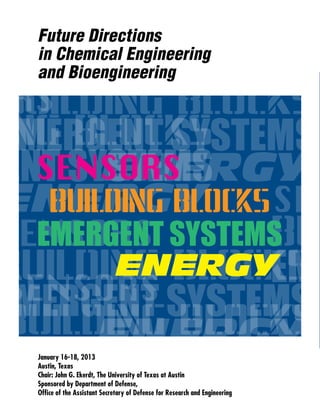
Future Directions
in Chemical Engineering
and Bioengineering
January 16-18, 2013
Austin, Texas
Chair: John G. Ekerdt, The University of Texas at Austin
Sponsored by Department of Defense,
Office of the Assistant Secretary of Defense for Research and Engineering
1
Executive Summary
Chemical and biological engineers use math, physics, chemistry, and biology to
develop chemical transformations and processes, creating useful products and
materials that improve society. In recent years, the boundaries between chemical
engineering and bioengineering have blurred as biology has become molecular science,
more seamlessly connecting with the historic focus of chemical engineering on
molecular interactions and transformations.
This disappearing boundary creates new opportunities for the next generation of
engineered systems – hybrid systems that integrate the specificity of biology with
chemical and material systems to enable novel applications in catalysis, biomaterials,
electronic materials, and energy conversion materials.
Basic research for the U.S. Department of Defense covers a wide range of topics such
as metamaterials and plasmonics, quantum information science, cognitive
neuroscience, understanding human behavior, synthetic biology, and nanoscience and
nanotechnology. Future Directions workshops such as this one identify opportunities
for continuing and future DOD investment. The intent is to create conditions for
discovery and transformation, maximize the discovery potential, bring balance and
coherence, and foster connections. Basic research stretches the limits of today’s
technologies and discovers new phenomena and know-how that ultimately lead to
future technologies and enable military and societal progress.
This workshop sought, within the disciplines of chemical engineering and
bioengineering, to identify current knowledge gaps and critical pathways, determine
where and how creative intellectual and funding leadership could enable
transformative progress in the next 10 to 20 years, and anticipate what is required to
make that progress a reality.
Attendees began by discussing major breakthroughs in the past 10 years or so, as well
as emerging developments and breakthroughs likely in the next 10 or so. We began by
focusing on four themes that define current and emerging foci of chemical engineering
and bioengineering research:
• Materials
• Molecules
• Modeling
• Systems
2
In subsequent breakout sessions, these groups evolved into four key emerging areas:
• Sensors
• Molecules and materials designed from building blocks
• Emergent systems
• Energy
These four concepts led us to three key themes:
• Bottom-up chemical and materials synthesis
• Better optimization methods for large-scale problems
• In silico discovery of materials properties and processing routes
The group consensus is that research in these areas will lead to tactical, strategic, and
economic advancement and security; improved intelligence; and improved monitoring
of human health, all of which will provide the modern warfighter with more autonomy
and self-sufficiency.
Finally, the group identified new advances requiring focused investment now:
• Bottom-up synthesis
• Systemic integration and scalable manufacturing
• Cell-free synthesis
Confer
The con
and curr
breakthr
Recent m
Significa
chemica
and soci
interdisc
converg
for cont
molecul
sequenc
the deve
rence Re
nference ope
rent researc
roughs and
major brea
ant research
al engineeri
iety at large
ciplinary an
ence. Key a
inuous and
es designed
ce, synthesi
elopment o
eport
ened with a
ch. Each att
d research n
akthroughs
h and appli
ng and bio
e. Chemical
nd many of
advancemen
d discrete o
d from qua
ize, read an
f new, cell-
a summary
tendee also
needs.
s (See comp
ication brea
engineering
l engineerin
f these brea
nts include
optimization
antum mech
nd write DN
free bioma
3
y from each
o outlined s
plete list in
akthroughs
g have had
ng and bioe
akthroughs
developme
n; synthesi
hanics and
NA; synthes
anufacturing
h attendee o
significant r
n the Appen
s in the pas
significant
engineering
s have occu
ent of high
is and chara
molecular
sis of artific
g approach
of our areas
recent and
ndix)
st few decad
t impact on
g are natura
urred becau
h-performan
acterization
simulation
cial protein
hes that sep
s of experti
emerging
des in both
n the militar
ally
se of that
nce algorith
n of new
ns; the abilit
ns and virus
parate catal
ise
h
ry
hms
ty to
ses;
lyst
4
synthesis from catalyst utilization; development of adaptive and self-learning systems;
continued progress in using nanomaterials as building blocks with controlled size,
shape, composition and function; the capacity to describe rare events; real-time
optimization of industrial processes; and increasingly specific sensors.
Today, we have the ability to make nearly any shape on any scale out of virtually any
kind of material, and the ability to decorate or functionalize these shapes with an
assortment of materials, including biomolecules. The palette of “patchy particles”
available today is limited solely by our imaginations.
“If we can build anything, what should we build?”
Emerging breakthroughs and needs (See complete list in the Appendix)
Continued advances in basic research will be informed and amplified by breakthroughs
just on or over the horizon. Key among these:
• Integrated multiscale optimization, to integrate time and length scales, permit
fast fullspace optimization, and support high-potential integrated decision-
making
• Creation of new molecules and functional materials: for example, as catalysts
for water splitting and reduction of CO2
• Formation of nominally thermodynamically unstable yet kinetically stabilized
phases over wide composition ranges, which would open a broad array of new
materials
• Compatible and manufacturable fabrication of organics and inorganics,
including 3D printing
• Greater understanding and predictive ability for zoonoses and the immune
response
• Transformation of food, energy, chemicals, materials, and medicine through the
ability to biomanufacture them
• Full realization of synthetic molecular recognition
• Multi-scale, rare-event simulations
• Application of real-time informatics to industrial processes
5
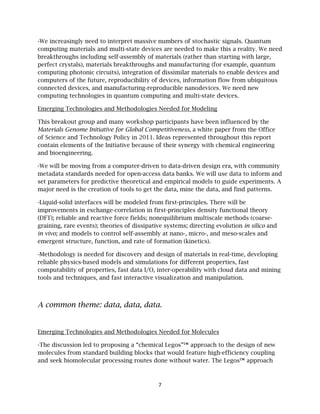
Long-term goal: decision-making for multi-scale problems integrated from molecule to enterprise.
Copyright © 2000 American Institute of Chemical Engineers (AIChE). Used with permission.
The breakthroughs and future advances will require:
• Novel strategies that accelerate the engineering design cycle and make biological
systems easier to engineer
• A cell classifier circuit that triggers a response only in a predetermined cell type
profile
• A synthetic detection, signaling, and read-out system to detect a human-made
chemical in plants
• A new science of catalysis of solid-state transformations
• Predictive models of assembly, structure, and activity
• Increased throughput and quality of experimental validation
• Computational tools, force fields for chemical systems, and a focus on complex
multi-step processes
• Better understanding of the mechanisms and dynamics of catalyzed
transformations
• A new science for cell-free biomanufacturing without intact cells
• Evolution study for phylogenetic structure-based prediction of host-pathogen
interactions, and the ability to predict what five amino acids are most likely to
interact with a receptor
6
“We’re only marginally good at engineering simple systems in single-
celled organisms because cells evolved to evolve.”
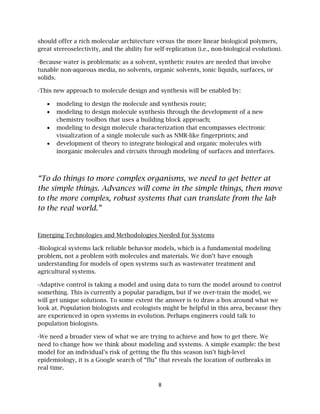
Host-pathogen interaction. Image Copyright: © 2013 A. Demogines et al. Dual Host-Virus Arms
Races Shape an Essential Housekeeping Protein. PLoS Biol 11(5): e1001571. Used with permission.
Four breakout groups discussed emerging technologies that could cause major shifts
in how things are done. The groups then considered what emerging technologies and
methodologies will be needed to make these shifts possible. The groups formed
around the four themes: materials, modeling, molecules, and process/systems.
Summaries of those discussions are in the Appendix, and highlights follow.
Emerging Technologies and Methodologies Needed for Materials
-In the energy realm, research is needed for carbon-free hydrogen at all scales, high
density storage, distributed diverse feedstocks, and improved CO2
absorption and
release. New computing technologies will enable CO2
capture, hydrogen generation,
improved heat transfer for power generation, and lightweight materials for
increasingly connected and autonomous vehicles.
-For sensors, research is needed to develop platforms for single molecule detection,
robust transduction of information from sensing to use of the data, and seamless
transmission and analysis of the data. Possible applications include massive, cheap,
pre-symptom screening for disease markers in individuals from certain populations
and platforms that allow rapid assay of large numbers of single cells. New materials
will be developed based on how scalp electrodes work.
7
-We increasingly need to interpret massive numbers of stochastic signals. Quantum
computing materials and multi-state devices are needed to make this a reality. We need
breakthroughs including self-assembly of materials (rather than starting with large,
perfect crystals), materials breakthroughs and manufacturing (for example, quantum
computing photonic circuits), integration of dissimilar materials to enable devices and
computers of the future, reproducibility of devices, information flow from ubiquitous
connected devices, and manufacturing-reproducible nanodevices. We need new
computing technologies in quantum computing and multi-state devices.
Emerging Technologies and Methodologies Needed for Modeling
This breakout group and many workshop participants have been influenced by the
Materials Genome Initiative for Global Competitiveness, a white paper from the Office
of Science and Technology Policy in 2011. Ideas represented throughout this report
contain elements of the Initiative because of their synergy with chemical engineering
and bioengineering.
-We will be moving from a computer-driven to data-driven design era, with community
metadata standards needed for open-access data banks. We will use data to inform and
set parameters for predictive theoretical and empirical models to guide experiments. A
major need is the creation of tools to get the data, mine the data, and find patterns.
-Liquid-solid interfaces will be modeled from first-principles. There will be
improvements in exchange-correlation in first-principles density functional theory
(DFT); reliable and reactive force fields; nonequilibrium multiscale methods (coarse-
graining, rare events); theories of dissipative systems; directing evolution in silico and
in vivo; and models to control self-assembly at nano-, micro-, and meso-scales and
emergent structure, function, and rate of formation (kinetics).
-Methodology is needed for discovery and design of materials in real-time, developing
reliable physics-based models and simulations for different properties, fast
computability of properties, fast data I/O, inter-operability with cloud data and mining
tools and techniques, and fast interactive visualization and manipulation.
A common theme: data, data, data.
Emerging Technologies and Methodologies Needed for Molecules
-The discussion led to proposing a “chemical Legos”™ approach to the design of new
molecules from standard building blocks that would feature high-efficiency coupling
and seek biomolecular processing routes done without water. The Legos™ approach
8
should offer a rich molecular architecture versus the more linear biological polymers,
great stereoselectivity, and the ability for self-replication (i.e., non-biological evolution).
-Because water is problematic as a solvent, synthetic routes are needed that involve
tunable non-aqueous media, no solvents, organic solvents, ionic liquids, surfaces, or
solids.
-This new approach to molecule design and synthesis will be enabled by:
• modeling to design the molecule and synthesis route;
• modeling to design molecule synthesis through the development of a new
chemistry toolbox that uses a building block approach;
• modeling to design molecule characterization that encompasses electronic
visualization of a single molecule such as NMR-like fingerprints; and
• development of theory to integrate biological and organic molecules with
inorganic molecules and circuits through modeling of surfaces and interfaces.
“To do things to more complex organisms, we need to get better at
the simple things. Advances will come in the simple things, then move
to the more complex, robust systems that can translate from the lab
to the real world.”
Emerging Technologies and Methodologies Needed for Systems
-Biological systems lack reliable behavior models, which is a fundamental modeling
problem, not a problem with molecules and materials. We don’t have enough
understanding for models of open systems such as wastewater treatment and
agricultural systems.
-Adaptive control is taking a model and using data to turn the model around to control
something. This is currently a popular paradigm, but if we over-train the model, we
will get unique solutions. To some extent the answer is to draw a box around what we
look at. Population biologists and ecologists might be helpful in this area, because they
are experienced in open systems in evolution. Perhaps engineers could talk to
population biologists.
-We need a broader view of what we are trying to achieve and how to get there. We
need to change how we think about modeling and systems. A simple example: the best
model for an individual’s risk of getting the flu this season isn’t high-level
epidemiology, it is a Google search of “flu” that reveals the location of outbreaks in
real time.
9
-There are so many problems and classes of problems, where are the big
breakthroughs coming? It is actually possible now to imagine that we could get all the
data we wanted on something, to measure everything about a particular system. Then
what? How would that change what we do? Would it mean we could better understand
things? What is the use of predicting things if we have no idea why? Are there areas
where we could understand something if we had all the data?
-Defining “everything” is a challenge in and of itself. We have to ask: what data do we
need in order to understand something so we can re-engineer it?
Looking forward, the groups envisioned:
• Adapting models from emerging data sets for non-living and living systems
• Designing non-living systems that go the way of chemicals and fuels, leverage
and extend advanced systems technology, develop related enablers, and use big
data
• Living systems that use big data, improve measurement technology, accelerate
the design-build-test cycle, and decouple evolutionary aspects from engineering
objectives
“What can we get out of the science of decision-making that we don’t
have today?”
A full gr
group th
blocks a
nucleoti
Attende
Material
Modern
function
are shift
blocks (e
particula
defined
necessar
possible
set of pr
roup discus
hemes: Mat
are the sma
ides – A, C,
es then bro
ls Group D
materials r
n of a given
ting researc
e.g., atoms,
ar desired p
set of build
ry to resolv
e architectu
rimitives. T
ssion of the
terials, Sens
allest consti
G, and T –
oke into the
Discussion
research fo
n material a
ch to bottom
, molecules
property. A
dings block
ve the prob
ures, proper
The set coul
e breakout
sors, Emerg
ituents that
that compr
e new work
cuses large
arise from c
m-up desig
s, clusters, a
A more com
ks, or so-cal
lem at hand
rties, and fu
ld expand o
10
group repo
gent behavi
t are necess
rise DNA to
king groups
ely on unde
constituent
gn, where on
and nanopa
mprehensive
lled primiti
d – and cre
unctions th
over time.
orts led to c
ior, and Bui
sary for a f
o define the
s for discus
erstanding h
atoms and
ne identifie
articles) for
e approach
ives – the s
eate a know
hat could be
creation of
ilding block
function, su
e functioni
ssions, sum
how the pr
d molecules
es elementa
r a target st
h would tak
smallest con
wledge spac
e created fr
new workin
ks. Building
uch as the f
ng of genes
mmarized he
operties an
s. New tren
ary building
tructure wi
e a well-
nstituent
ce of all
rom the fin
ng
g
four
s.
ere.
nd
ds
g
ith a
nite
This app
models,
techniqu
What are
can they
proteins
for life.
sufficien
possible
of primi
outcome
Of cours
investiga
function
However
“What
proach wou
force field
ues needed
e the optim
y be determ
s are built a
Likewise, th
nt set for th
e to identify
itives requi
es from the
se, the prop
ation limits
ns) that can
r, the appro
t do I nee
uld have the
ds or interac
d for that pa
mal sets of p
mined? As a
are apparen
he four nuc
he function
y all desired
red? Movin
e addition o
posed appr
s the possib
n emerge fro
oach also o
ed, and w
e benefit of
ction rules,
articular se
primitives f
an example,
ntly sufficie
cleotides th
ning of gene
d propertie
ng beyond t
or substitut
oach of pre
bilities to th
om various
offers a well
what mat
11
f focusing c
and measu
t of primiti
for a given
, the 20 am
ent to achie
hat compris
es. For othe
es or functio
that, can we
tion of a pr
escribing, a
hose outcom
s combinati
l-defined, f
terials bre
communitie
urement an
ives.
community
mino acids fr
eve all prote
se DNA – A
er, engineer
ons and fro
e then pred
rimitive?
a priori, a g
mes (struct
ions of prim
finite space
eakthrou
es around s
nd characte
y or applica
from which
ein functio
A, C, G, and
red applica
om that, th
dict the new
given set of
tures, prop
mitives with
e to help fo
ughs get m
such factor
erization
ation and h
all biologic
ns necessa
T – form a
ations, is it
he complete
w space of
primitives
perties, and
hin the set.
cus the wor
me there
rs as
how
cal
ry
e set
for
rk.
?”
Sensors
The pan
on senso
the sens
defense.
material
and dos
water, an
conditio
and viru
The desi
that are
of mater
adaptati
taking p
environm
amplify
s Group Dis
nel addresse
ors. There w
sor commun
. Examples
ls and ways
age; molecu
nd biomole
on; glycol-pr
uses; and, d
ign and dep
producible
rials to ena
ion of prote
proteins tha
ments. A no
the perform
scussion
ed a numbe
was a sense
nity needs
suggested
s to integra
ular sensor
ecules in bl
rofiling sen
deployable n
ployment o
e, manufact
able stand-o
eins for rec
at work in t
ovel sensor
mance of a
er of issues
e that prop
is to under
for develop
ate them (e.
rs that can
ood; sensin
nsors that w
nanoparticl
of robust, sp
turable, por
off detectio
cognition in
the ideal en
r system wa
n individua
12
s that were
erly posed
rstand the c
pment and
g., for infra
detect vola
ng arrays m
would allow
les for phys
pecific inte
rtable, and
on of molec
n extreme e
nvironment
as suggeste
al by reactin
revisited in
problems c
challenges
implement
ared imagin
atile compo
monitoring t
w one to rec
siological s
egrated sen
compact w
cules or pat
environmen
and adapt
ed that mon
ng to electr
n the final w
can be solv
that are mo
tation inclu
ng and radi
ounds, trace
the physiol
cognize pro
sensing).
nsors and se
will require
thogens at a
nts. Essentia
ing them to
nitored bra
rical signals
working gro
ved and wh
ore relevan
uded new
iation detec
e molecules
logical
otein, bacte
ensor syste
developme
a distance,
ally that m
o work in h
ain activity t
s in the bra
oup
at
nt for
ction
s in
eria,
ems
ent
and
eans
harsh
to
ain.
This sen
are colle
High-def
Credit: U
Emergen
Complex
interacti
systems
of fish; a
emergen
alone. If
among a
inverse
Importa
the desi
to electr
“real-tim
nsor system
ected with r
finition fiber-
University of P
nt Behavio
x systems a
ions among
s include cry
and swarm
nt because
f we unders
agents com
design to d
ant DOD-spe
gn of cloth
rical curren
me” camouf
m would req
remote (e.g
-tracking ma
Pittsburgh M
or Group di
and pattern
g primitives
ystals of at
ms of ants. T
it cannot b
stand and c
mprising the
discover the
ecific challe
hing that ch
nt or voltage
flage.
quire under
g., scalp) ele
ap showing a
Medical Cent
iscussion
ns arise out
s that in thi
toms, mole
The behavio
e intuited i
can predict
e system, w
e agents an
enges that
hanges its m
e, adaptive
13
rstanding h
ectrodes.
a million bra
ter. Used with
t of a multip
is context a
cules or na
or exhibited
in a trivial w
how behav
we can then
d interactio
might bene
mechanical
sensors, ac
how nervou
ain fibers in a
h permission
plicity of re
are called a
anoparticles
d by one of
way from k
vior emerge
start with
ons needed
efit from su
and optical
ctive woun
us system el
an uninjured
n.
elatively sim
agents. Exam
s; flocks of
f these syst
knowledge o
es from inte
target func
d to achieve
uch an appr
l properties
d healing, a
lectrical sig
d brain.
mple
mples of su
birds; scho
ems is
of the agen
eractions
ctions and u
e the target
roach inclu
s in respon
and adaptiv
gnals
uch
ools
nts
use
ts.
ude
nse
ve
Reprinted
400-404,
One app
silico, di
and sele
composi
computa
unexpec
same tim
Challeng
respect
well as m
and func
amino a
perform
Building
The grou
defining
target sy
transfor
units co
the prop
approac
primitiv
d from Curr
2007. With
proach to d
irected evol
ection press
itions that
ational pow
cted functio
me leveragi
ges here inc
to shape, s
minimizing
ctions, in th
acids with w
m efficient, u
g Block Gro
up discusse
g minimal s
ystem with
rmation – m
mprised of
perties or fu
ch based on
ves optimiz
rent Biology,
permission f
iscovering
lution using
sure in buil
result in th
wer and use
on at large
ing the inve
clude evolv
ymmetry, a
g the set of
he same wa
which to wo
unstructure
oup Discus
ed a radical
sets of prim
desired pr
micro to ma
f building b
unctions ar
n building b
ed for the t
Vol 17 No. 1
from Elsevie
materials w
g genetic al
lding-block
he target em
es principle
scales from
erse materia
ving in silico
and interac
primitives
ay that natu
ork. Anothe
ed searches
ssion
l new appro
mitives or bu
roperties an
acro – is pri
blocks) to m
re expresse
blocks invol
targeted sy
14
11; R. Hanlon
r.
with target
lgorithms, i
k population
mergent pro
es of natura
m primitives
als design p
o building b
tions, and t
and rules n
ure has evo
er challenge
s with conv
oach to des
uilding bloc
nd behavior
imitives (bu
motifs (eme
d). A new m
lves develo
ystem. Such
n, Cephalopo
emergent p
in which re
ns are used
operties. Th
al selection
s and inter
paradigm.
blocks that
that are als
needed to a
olved a com
e is develop
vergence, er
sign and sy
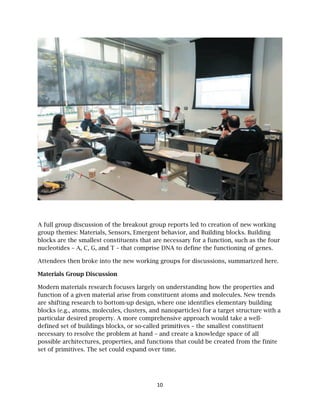
cks highly
r. A commo
uilding bloc
rgent patte
molecular t
oping a tool
h a toolkit w
od dynamic
properties w
eproduction
d to screen
his approac
n to discove
action rule
are optimi
so achievab
achieve nov
mpact alpha
ping the alg
rgodicity, a
ynthesis bas
optimized
on syntax fo
cks) to mod
erns) to sys
transformat
lkit of the a
would need
camouflage
would be in
n, mutation
for
ch leverage
er emergent
s, while at
ized with
ble in the la
vel properti
abet of 20
gorithms to
and optimal
sed upon
for buildin
or molecula
dules (large
stems (wher
tion-type
appropriate
d to provide
pp
n
n,
s
t and
the
ab, as
ies
o
lity.
ng a
ar
er
re
e
e:
15
• assurance of the propensity for molecular transformation or assembly,
• commercially available primitives at reasonable cost and high purity,
• well-characterized properties of the primitives, and
• fast, specific coupling kinetics with no need for separation of an impure
product.
New opportunities based on this toolkit approach include small molecules in solvents
other than water, nonlinear structures and long-range sequence specificity of chains,
and primitives at multiple length scales and combinations. The idea is to build defined
architectures with sequence specificity by selecting the primitives a priori. This
approach represents a disruption to traditional chemical synthesis and could be used
to design, for example, molecular recognition sites, molecular actuation, membranes,
gas adsorption, antifouling, surfactants, lubricants, organic transistors, and hybrids of
synthetic chemistry/biology.
The group recommended investing in bottom-up materials synthesis, moving from
primitives to stable hierarchical structures to libraries, with large databases for design
of materials and primitives. Challenges to designing a set of primitives include
modeling with experimental verification, characterizing single molecules, modular
chemistry for structure and function, and a culture of standardized synthesis. It’s a
design-ahead strategy rather than a reactive one.
The time is ripe for such an approach for several reasons. Many of the technologies
that will help us choose desirable primitives are on the cusp, and posing this challenge
could drive that capability to completion. Through the toolkit, it would be possible to
achieve vertical integration of parties: vendor/theory/synthesis/characterization/end
users/regulators.
Other gr
concept
• C
th
se
th
• W
p
fo
ef
H
u
• W
p
d
to
p
• E
a
a
• In
p
roups also
s from thos
Choose a se
hose princi
et of primit
hem.
What are the
predicting in
or the targe
fficient, un
How do we f
unstructure
What featur
path to iden
different com
o focus the
predicting a
mergent pr
trivial way
chieved by
n silico, dire
primitives. T
discussed t
se discussio
t of primiti
ples. In the
tives could
e optimal b
n advance w
et, geometr
nstructured
formulate a
d problem?
es are gaine
ntifying the
mmunities
problem o
and controll
roperties of
y, making it
making ch
ected evolu
There, repro
the concept
ons include
ives and ide
e context of
increase ov
building blo
what they w
ry and symm
searches w
a structured
?
ed by expan
primitives
will be dict
on a societa
ling emerge
f large colle
t challengin
hanges to th
ution might
oduction, m
16
t of buildin
e:
entify all ar
f sensors, w
ver time as
ock sets? W
will do? How
metry, and
with conver
d set of alte
nding the s
we need? T
tated by th
al problem s
ent behavio
ections of b
ng to know,
he set of pr
be a power
mutation, an
ng blocks or
rchitecture
what sensor
s people dev
What are the
w do we de
interaction
rgence, ergo
ernatives fo
set of primi
The sets of
he target sys
such as rap
or.
building blo
a priori, w
rimitives.
rful approa
nd selectio
r “primitive
s that could
rs could be
veloped the
e optimal m
efine the bu
ns? How do
odicity, and
or searchin
itives, and
f primitives
stem. One
pid screenin
ocks canno
what proper
ach to optim
on pressure
es.” Key
d be built w
e created? T
e ability to
models for
uilding bloc
o we perform
d optimality
ng from the
what is the
s required b
suggestion
ng, sensing
t be intuite
rties will be
mizing sets
in building
with
The
use
cks
m
y?
e
e
by
was
g, or
ed in
e
s of
g
17
block populations are used to screen for compositions that result in the target
emergent properties. This leverages computational power and uses principles of
natural selection to discover emergent and unexpected function at large scales
from simple subcomponents and interaction rules. It leverages the inverse
materials design paradigm.
• Challenges include translation of knowledge gained in silico to the lab setting; in
other words, replication, mutation, and selection pressure.
Final Working Groups
By consensus, three final working groups were formed: Sensors, Building Blocks, and
Emergent Issues. Each considered the emerging challenges and directions.
1. Sensors. Develop the concept for the threat/target, which will define the approach to
develop the solution and a path to put it into action. Smart, creative people can answer
well-posed questions, so we need to define and pose the questions.
What are we measuring and why? What is a representative sample – a single molecule,
or many? And if many, how many?
We need new concepts for weapons detection. If we know what concentration or
signature is needed, and what gives a positive response, then we can make the
detector. What are the targets, the right concentration?
We need centers of excellence or centers for new concepts, combinations of expertise
across geographic and discipline borders, collaborations that take different forms from

those currently in existence (i.e., multidisciplinary teams). There are clusters of bright
people at major universities, but they are not organized or managed for this activity.
Within a center the fundamental issues must be addressed first. Then add experts as
needed, such as tissue specialists for electrodes attached to the skin, or computer
scientists to address speed of response with the computer.
2. Building Blocks. Develop the concept/procedure through Multi-disciplinary
University Research Initiatives. Teams would define their application or system and

develop primitives relevant for achieving the modules, motifs, and, ultimately, the
target system through simulation-based design. Important tasks include understanding
the robustness of primitive-to-system pathways and stability to variations; synthesis;
and testing of the primitives and iteration/optimization among theory, simulation, and
experiment.
Fund teams that have the ability to characterize primitives in real time, in situ, and
develop and apply modeling methods for the assembly of primitives into systems
through multiple scales.
Question
surfaces
function
the prim
systems
actuatio
that can
synthesi
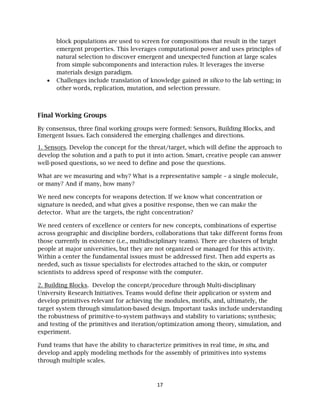
A cell-fre
3. Emerg
behavior
set of al
efficient
determin
need new
function
look like
Explore
To fully
to see th
of probl
through
ns that can
s and interf
n, and chan
mitives that
s to adapt?
on economic
n evolve? Ac
is of optim
ee vision. Ima
gent issues
r. Systems
lternatives f
t searches w
ne whether
w primitive
n, use evolu
e. Define ne
all of what
understan
he emergen
lems and is
hput, in situ
nnot be aske
faces? How
nge in worki
can affect
How do we
cally and in
ccomplishm
ized primit
age courtesy
. Define th
engineering
for searchin
with conver
r our curren
es. How do
utionary sea
ew alphabe
t nature has
d – and eve
nce as it is h
ssue a call f
u, online or
ed yet: Wha
will elegan
ing environ
their arran
e make mol
n a short tim
ments need
tives and th
y of Michael
he building
g is needed
ng from an
rgence, ergo
nt library o
we expand
arch, and m
ts of primi
s as its prim
entually pre
happening,
for proof-of
web-based
18
at is the the
ntly designe
nments? Wh
ngement int
lecules for m
me? How ca
ed in the n
heir combin
C. Jewett, No
blocks for
d to determ
n unstructu
odicity, opt
r set of prim
d the alphab
modify the p
tives, such
mitives, and
edict – eme
to visualiz
f–concept o
transition
eory describ
ed and buil
hat’s happe
to modules
molecular r
an we make
next ten yea
nation into
orthwestern
the target
mine how to
ured problem
timality gua
mitives is t
bet of prim
parts to fig
as biology
d actually c
ergent phen
ze assembly
of in situ m
electron m
bing inorga
lt materials
ening on th
s and motif
recognition
e replicatin
ars include
functionin
University.
emergent p
formulate
m; how to p
arantees; h
too small, m
mitives? Star
gure out wh
’s amino ac
control and
nomena we
y pathways
monitoring, s
microscopy (
anic/organi
s adapt,
he surface o
fs, or for
n, sensing, o
ng materials
automated
ng systems.
properties a
a structure
perform
how to
meaning we
rt with the
hat they sho
cid alphabe
d design.
must be ab
. Identify a
such as hig
(TEM). Test
ic
of
or
s
d
and
ed
e
ould
et.
ble
set
gh-
t
evolutio
investm
processo
assembl
onary algori
ent for dyn
ors, data m
ly and kinet
ithms of sim
namic, in sit
mining/corre
tics of mate
mple target
tu TEM, hig
elation tool
erials form
19
ts. All of th
ghly paralle
ls, and real
mation.
his requires
elized code
l-time chara
s infrastruc
optimized
acterization
ture
on graphic
n of self-
cs
20
Final Group Discussion
Our consensus as a discipline of where to focus our resources in the next 10 to 15
years
-For energy innovation, accelerate commercialization of new technologies, such as
occurred with integrated circuits. Develop the omnivorous mini-refinery on a scale
applicable to fixed and forward bases, using biomass, waste, and stranded gas. We
need reaction kinetics, separation science, and engineering to handle diverse
feedstocks at the local base scale. Modularize components that are the size of a
shipping container to create units that are moveable on those scales. Conventional
industry will not do it because it is hard to make an economic case for it.
-Bottom-up chemical and materials synthesis. Current chemical synthesis takes too
long and no one is happy with it. Have an infrastructure investment in modeling and
databases and a group of people working on a finite number of chemicals. Control flow
in and out of the process; do not just make the building blocks. Life cycle control and
supply chain management. With a finite number of chemicals we will know a lot more
about this.
-Earth-abundant, unconventional resources, non-toxic feedstocks for chemicals and
materials. Move away from petroleum-based and rare feedstocks. Design processes and
products that are mindful of carbon flow and choose the appropriate process for the
feedstock – carbon-negative processes and products where possible.
-Because systems are embedded in everything, we need better optimization methods
for large-scale problems. In systems theory, what tools and methods are needed to
solve a problem? The best way to answer that is to solve a problem then go back and
see what tools it required. Anticipate the need for advances in systems engineering,
which will be informed by the applications. We do not know what we need until we
start working on it. Addressing a larger problem with greater complexity than what we
are doing now. Our need to handle large amounts of data continues to grow.
-In silico materials properties and processing routes from familiar classes of materials
but away from equilibrium, creating different yet kinetically stable structures
-Tremendous impact will result from unknown materials and their properties – what
are the unknown materials properties for x? We need centralized databases and a way
of understanding the data generated in order to know where to look. Make unknown
materials from the classes of familiar materials, the ones we are used to using.
21
Emerging areas:
Sensors
Molecules and materials, including organic ones, by design from building blocks
Emergent systems
Energy
New advancements in 10-20 years that require focused
investment now:
Bottom-up synthesis. This includes analytical techniques for in situ monitoring of
single molecules and nanoparticles and rapid models for predicting properties and
robust synthetic routes. Invest in bottom-up materials design and synthesis to disrupt
traditional chemical synthesis and do things ten times faster.
Systemic integration and scalable manufacturing to meet product specifications and
handle variability. Take these materials and fabricate them in a commercially viable
way, with reproducibility and precision. Integrate new materials into established
platforms. Invest in process platforms that are capable of insertion into existing
manufacturing platforms. There is a major opportunity here where bottom-up
synthesis meets additive manufacturing (3D printing). Design appropriate user-
fabrication facilities.
Cell free synthesis. For primitives or systems-based engineering. Primitives could
include biological pieces, such as amino acids, and could even be organisms, perhaps
viruses. Nothing says the building blocks tool kit could not work in a cell-free setting.
In fact, cell-free environments open the aperture to game-changing, disruptive
capabilities by offering unprecedented freedom of design to control and modify
biosynthesis.
The overall idea is to speed up design and concept, to move from a device with the
property and performance we want, to a product. Not just to make it faster, but to
make it possible.
22
i
Appendix
Attendees and areas of expertise
Mark A. Barteau, University of Michigan. Catalysis and energy, focusing on rationally designed catalysts
for high selectivity.
Mark Bathe, Massachusetts Institute of Technology. Synthetic structural biology and Materials Genome
Initiative for functional DNA-based materials.
Lorenz T. Biegler, Carnegie Mellon University. Optimization strategies in process engineering systems,
interfacing biology, chemistry, physics, dealing with two issues: developing fast algorithms and
applications to enable decision-making for integrated multi-scale problems.
Joan F. Brennecke, University of Notre Dame. Ionic liquids for energy applications such as CO2 separation
from flue gas, other gas separations, refrigeration applications, absorption refrigeration, electrochemical
applications, and liquid-liquid separations.
John G. Ekerdt, University of Texas at Austin. Kinetics and reaction engineering applied to growth of
electronic materials surface and materials chemistry.
Andrew D. Ellington, University of Texas at Austin. Synthetic biology for high-throughput gene and
operon synthesis, protein design, and electronic input/output and genome engineering for site-specific,
high efficiency insertion of recombination sites and reorganization of genomes.
Kristen A. Fichthorn, Pennsylvania State University. Multi-scale theory and simulation of the growth and
assembly of nanoscale materials, at surfaces and in colloidal nanoparticles, focused on oriented
attachment, or the specific ways single atoms aggregate and add, or particles aggregate with one
another, and ways we can organize and control that growth.
Justin P. Gallivan, Emory University. Working toward the ability to use any molecule to control the
expression of any gene in order to reprogram how an organism behaves, to affect fundamental biology,
metabolic engineering, and synthetic biology problems.
Venkat Ganesan, University of Texas at Austin. Studying structure of multicomponent polymers,
properties of nanocomposite membranes, and polymers in energy applications.
Karen K. Gleason, Massachusetts Institute of Technology. Chemical vapor deposition of insoluble,
grafted, conformal, and substrate-independent polymers to produce, for example, vapor printed devices
and coatings for anti-biofouling.
Sharon C. Glotzer, University of Michigan. Simulation–enabled assembly science and engineering,
studying self-assembly of shapes to work toward predictive colloidal crystal assembly.
ii
Tobias Hanrath, Cornell University. Fundamental conceptual framework for nanocrystal quantum dot
solids with properties by design, and emerging energy nanotechnologies such as quantum dot-based
photovoltaics and light emitting diodes.
Adam Heller, University of Texas at Austin. Developing biosensors to interface computers with the brain.
Michael C. Jewett, Northwestern University. Cell-free biological systems as a platform for advanced
manufacturing, researching ribosome construction and evolution, translation system
engineering/evolution, cell-free protein synthesis, and cell-free metabolic engineering to develop
therapeutics, advanced materials, and sustainable chemicals.
Thomas F. Kuech, University of Wisconsin-Madison. Synthesis of new optical and electronic materials
and structures via chemical methods, including semiconductor surface chemistry and biomedical
applications of semiconductor structures.
Kevin Morey, Colorado State University. Biosensor and synthetic signaling system in plant synthetic
biology, working toward biofuels, metabolic engineering for improved nutrition, pathogen and pest
resistance, crops better able to withstand environmental stresses, and biopharmaceuticals.
James B. Rawlings, University of Wisconsin-Madison. Systems engineering, especially process control
theory, model predictive control, and state estimation, developing algorithms for implementation in real
time, with uncertainty.
Stuart E. Strand, University of Washington. Engineering transgenic grasses for in situ treatment of RDX
and TNT on live fire training ranges, and phytoremediation of atmospheric methane using transgenic
plants.
Michael S. Strano, Massachusetts Institute of Technology. Chemical engineering of low dimensional
materials, molecular recognition using the nanoparticle corona as a basis for medicine and human
health, catalysis and biocatalysis, and directed assembly of materials.
Navin Varadarajan, University of Houston. Single-cell, high-throughput assays, including adoptive cell-
based immunotherapy, molecular engineering of biocatalysts, and isolation of fully human antibodies.
Proteomics, detection of post-translational modifications at low cell numbers.
U.S. Department of Defense representative: J. Aura Gimm, AAAS Diplomacy, Security, and Development
Policy Fellow, Office of the Secretary of Defense for Research & Engineering.
Recent
Developm
Synthesis
simulation
eliminate
The ability
Adaptive
High perfo
Developm
Access to
vending m
Designer C
artificial so
Artificial v
equal bet
Revolutio
Revolutio
Extensive
understan
Real-time
A light-co
major bre
ment of high p
and characte
ns, which ena
d viscosity inc
y to read and
and self-learn
ormance algo
ment of nitride
nanomateria
machine. We
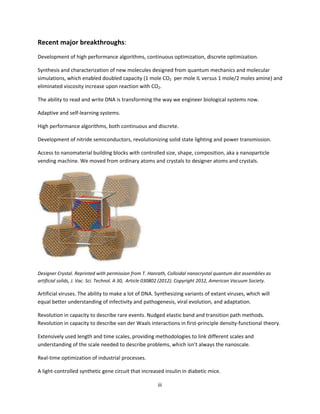
Crystal. Reprint
olids, J. Vac. Sc
viruses. The a
ter understan
n in capacity
n in capacity
ly used length
nding of the s
e optimization
ntrolled synt
eakthrough
performance
erization of ne
abled doubled
crease upon r
write DNA is
ning systems.
orithms, both
e semiconduc
al building blo
moved from
ted with permis
i. Technol. A 30
ability to make
nding of infec
to describe r
to describe v
h and time sc
scale needed
n of industrial
hetic gene cir
hs:
algorithms, c
ew molecules
d capacity (1
reaction with
s transformin
.
continuous a
ctors, revolut
ocks with con
ordinary atom
ssion from T. H
0, Article 0308
e a lot of DNA
ctivity and pat
are events. N
van der Waals
cales, providin
to describe p
l processes.
rcuit that incr
iii
ontinuous op
s designed fro
mole CO2 pe
h CO2.
g the way we
and discrete.
tionizing solid
trolled size, s
ms and crysta
Hanrath, Colloid
802 (2012). Cop
A. Synthesizin
thogenesis, v
Nudged elastic
s interactions
ng methodolo
problems, wh
reased insulin
ptimization, d
om quantum
er mole IL ver
e engineer bio
d state lightin
shape, compo
als to designe
dal nanocrysta
pyright 2012, A
ng variants of
viral evolution
c band and tr
s in first-princ
ogies to link d
ich isn’t alwa
n in diabetic m
discrete optim
mechanics a
sus 1 mole/2
ological syste
g and power
osition, aka a
er atoms and
al quantum do
American Vacu
f extant viruse
n, and adapta
ransition path
ciple density-f
different scale
ays the nanos
mice.
mization.
nd molecular
moles amine
ms now.
transmission
nanoparticle
crystals.
t assemblies as
uum Society.
es, which will
ation.
h methods.
functional the
es and
cale.
r
e) and
n.
e
s
l
eory.
iv
A cell classifier circuit that triggers a response only in a predetermined cell type profile. Allows detection
of a human-made chemical in planta using synthetic detection, signaling, and read out system.
We shifted from making one kind of particle in one kind of shape to being able to make any shape on
any scale out of virtually any kind of material, with the capability of coating it and attaching other
materials to it. We are able to be predictive and have moved from assembly science to assembly
engineering.
Speed of a graphics processor has increased much more than CPU speed, changing fundamentally what
we can do with simulations, turning computer-limited problems into data-limited problems.
Epitaxial growth of SrTiO3 on Si.
Atomic layer deposition moved from a research tool to a production tool, and enabling precursor
molecules are now broadly available (they can be purchased rather than made).
Artificial viruses.
We’ve become skilled at DNA sequencing, genetic tools, DNA synthesis, all enabling technologies that
will get better, faster, and cheaper. However, we’re only marginally good at engineering simple systems
in single-celled organisms because cells evolved to evolve.
“Anything found to be true of E. coli must also be true of elephants.” Jacques
Monod.
v
Emerging breakthroughs and needs:
In the next ten-plus years, food, energy, chemicals, materials, and medicine will be transformed by the
ability to biomanufacture them.
Integrated, multiscale optimization. To integrate time and length scales, permit fast fullspace
optimization, and lead to high potential, integrated decision-making.
Formation of nominally thermodynamically unstable yet kinetically stabilized phases over wide
compositional ranges, which would open a wide array of new materials. There is a tremendous amount
of potential in looking at these materials that are nominally unstable.
Moving from a fossil-fuel powered economy with separate energy systems for transportation and
electric power to an energy resource base that may still be majority fossil fuel, but is used in less GHG
intensive ways. This may be driven by CAFE standards and the dramatic increase in domestic gas and
wet gas supplies.
Multiplexing, single-cell resolution, kinetics.
Multi-scale, rare-event simulations. Accelerated molecular dynamics “superbasin” kinetic Monte Carlo.
Crystallize developments in growth and assembly of nanoscale materials and proceed to practical
applications – catalysis, organic thin films, colloidal systems, and soft condensed matter.
Full realization of synthetic molecular recognition. Synthetic nanomaterials as substrates for
biomolecules. Functional DNA origami devices. Real-time informatics applied to industrial processes.
Data-drive correlation and prediction, with relevant, information-rich simulations in minutes creating
huge amounts of data.
Create new molecules from quantum mechanics and multiscale for technologically relevant systems.
Catalysts for water splitting and reduction of CO2, for which we need computational tools, force fields, a
focus on complex multi-step processes, and skilled molecule and materials synthesis. Chemical
engineers have transformed the petroleum world, now need to tackle the non-petroleum world.
We need improved batteries to electrify our vehicle fleets and direct solar hydrogen to produce carbon-
free hydrogen as a fuel and as a feedstock for upgrading other energy resources. A “transportation
internet” to enable autonomous and grid-connected vehicles and transportation systems. An
“omnivorous” refinery to integrate renewables and alternative resources into a base for liquid fuels.
Design and controlled synthesis of catalytic structures. Understanding the mechanisms and dynamics of
catalyzed transformations.
Compatible and manufacturable fabrication of organics and inorganics; meld education perspective
between organic and materials chemistry; characterization of interfaces, as opposed to surfaces, and
vi
directional, interfacial properties; theory and modeling appropriate to both material types and their
interfaces.
Scalability of process is important moving forward. Concept of programmable/designer solids.
Understanding surfaces is critical, so we need to determine what is really going on at a surface. Coupling
between quantum dots and properties of the entire assembly.
Prediction of zoonoses. Phylogenetic and structure-based prediction of host-pathogen interactions.
Deep analysis of immune responsivity to develop countermeasures in advance of disease emergence
and to predict the immune response to that disease. Design for medical preparedness. One thing
needed is evolution study. What five amino acids are most likely to interact with a receptor?
The challenge is that engineering biology is costly, risky, and slow, and there is a need to expand the
chemistry of life. To have an appreciable impact on modern life and DOD capabilities, we need novel
strategies that accelerate the engineering design cycle and make biological systems easier to engineer.
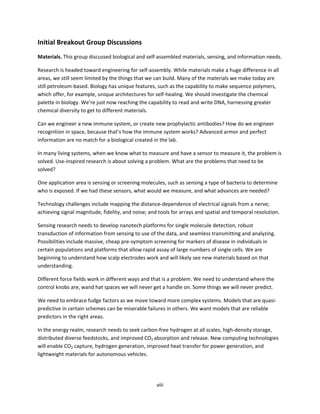
We need new catalytic upgrading processes, co-processing of carbon-based resources, integration of
carbon-free resources. Pay more attention to making fuels converge upfront – oil, gas, coal, biomass.
Logistical fuels we can count on. Look at how to get renewables in ways besides in the obvious ones.
A new science – catalysis of solid-state transformations – is needed.
Oil
Gas
Coal
Biomass
Hydrocarbon fuels
Organic Chemicals
CO2
electrons photons
H2 CO
H2O
• New catalytic upgrading processes
• Co-processing of carbon-based resources
• Integration of carbon-free resources
Image courtesy of Mark A. Barteau, University of Michigan
vii
We need novel programmable materials, and predictive models of assembly, structure, and activity;
predictive functional models; increased throughput of computational materials screening and quality of
feedback to design; and increased throughput and quality of experimental validation.
Increased shale gas production in North America has led to increased production of natural-gas products
and decreased supply of co-products from naptha cracking. We are extracting gas from extremely
impermeable shale, creating new needs for water treatment and purification and leading to a de-
emphasis on cleaner energies.
Modeling challenges include new, “designed” catalysts for making the reduced supply of chemicals,
macroscopic modeling of fluid flow in highly fractured media, and connections between chemical
structure and macroscopic transport properties of polymer membranes used for water purification.
Desalination of water to overcome impending worldwide shortages of water. Purification of fracking
water is likely to become an important issue. Nonfouling polymer membranes may be a solution. Design
of water purification membranes will take quantum mechanics, molecular dynamics, mesoscale models,
continuum models, and process models, including multiscale modeling of multiphase (gas, liquid) flow
modeling, translating from nanosized pore scales to rock scales.
Significant investment in research into plant molecular biology and application of enzyme modeling and
molecular engineering to genetically modify plants.
Ramped-up basic research into symbiosis. Funding for microbial catalysis of rare pollutants for
wastewater treatment and water recycling. Increased focus on mechanisms of phage infection and
resistance and horizontal gene transfer.
The need to develop and grow a new modulated work-function device. Devices get smaller and smaller,
but not faster, creating intrinsic limits on switching speed of individual devices. Changing the physics of
underlying devices to reduce power dissipation by operating FETs at lower voltages.
To do things to more complex organisms, we need to get better at the simple things. Engineer complex,
robust systems that can translate from the lab to real world. Advances will come in the simple things,
then move to the more complex.
Study of atmospheric carbon removal technologies.
viii
Initial Breakout Group Discussions
Materials. This group discussed biological and self-assembled materials, sensing, and information needs.
Research is headed toward engineering for self-assembly. While materials make a huge difference in all
areas, we still seem limited by the things that we can build. Many of the materials we make today are
still petroleum-based. Biology has unique features, such as the capability to make sequence polymers,
which offer, for example, unique architectures for self-healing. We should investigate the chemical
palette in biology. We’re just now reaching the capability to read and write DNA, harnessing greater
chemical diversity to get to different materials.
Can we engineer a new immune system, or create new prophylactic antibodies? How do we engineer
recognition in space, because that’s how the immune system works? Advanced armor and perfect
information are no match for a biological created in the lab.
In many living systems, when we know what to measure and have a sensor to measure it, the problem is
solved. Use-inspired research is about solving a problem. What are the problems that need to be
solved?
One application area is sensing or screening molecules, such as sensing a type of bacteria to determine
who is exposed. If we had these sensors, what would we measure, and what advances are needed?
Technology challenges include mapping the distance-dependence of electrical signals from a nerve;
achieving signal magnitude, fidelity, and noise; and tools for arrays and spatial and temporal resolution.
Sensing research needs to develop nanotech platforms for single molecule detection, robust
transduction of information from sensing to use of the data, and seamless transmitting and analyzing.
Possibilities include massive, cheap pre-symptom screening for markers of disease in individuals in
certain populations and platforms that allow rapid assay of large numbers of single cells. We are
beginning to understand how scalp electrodes work and will likely see new materials based on that
understanding.
Different force fields work in different ways and that is a problem. We need to understand where the
control knobs are, wand hat spaces we will never get a handle on. Some things we will never predict.
We need to embrace fudge factors as we move toward more complex systems. Models that are quasi-
predictive in certain schemes can be miserable failures in others. We want models that are reliable
predictors in the right areas.
In the energy realm, research needs to seek carbon-free hydrogen at all scales, high-density storage,
distributed diverse feedstocks, and improved CO2 absorption and release. New computing technologies
will enable CO2 capture, hydrogen generation, improved heat transfer for power generation, and
lightweight materials for autonomous vehicles.
ix
In the information realm, we increasingly need to interpret massive numbers of stochastic signals.
Quantum computing materials and multi-state devices are needed to make this a reality. We need
breakthroughs that include self-assembly of materials (rather than starting with large, perfect crystals),
materials breakthroughs and manufacturing (for example quantum computing photonic circuits),
integration of dissimilar materials to enable devices and computers of the future, reproducibility of
devices, information flow from ubiquitous connected devices, and manufacturing-reproducible
nanodevices. We need new computing technologies in quantum computing and multi-state devices.
Modeling. This group discussed moving from a computer-driven to data-driven design era.
A key premise: saving data is cheap; experimentally generating or computing new data is expensive. We
need community metadata standards for deposition in data banks. Use data to inform and guide
experimental design, to test and classify predictive theoretical versus necessary empirical models.
Machine learning data classification, feature identification/extraction, genetic algorithms. Having the
data isn’t enough, we need tools to get the data, mine the data, and find patterns.
Crowd-sourcing de novo materials design and innovation. The goal – games, social media, challenges,
prizes. The tool – black-box design tools to commoditize design (iPad apps). The language – community
accepted metadata standards for input and outputs. Performance metrics – how well does it work, how
useful is it. We can have different standards for different databases as long as we have a standard-to-
standard translator. This would be done through consensus.
Discipline-based needs: improved exchange-correlation in first-principles density functional theory
(DFT); liquid-solid interfaces from first-principles; reliable and reactive force fields; nonequilibrium
multiscale methods (coarse-graining, rare events); theories of dissipative systems, directing evolution in
silico and in vivo; and models to control self-assembly at nano-, micro-, and meso-scales, emergent
structure, function, and rate of formation (kinetics).
Real-time materials discovery and design: reliable physics-based models and simulations for different
properties, fast computability of properties, fast data I/O, inter-operability with cloud data and mining
tools and techniques, and fast, interactive visualization and manipulation.
Molecules. This group discussed design versus evolution.
Chemical engineers have transformed the petroleum world; now we need to apply quantum mechanics
and multiscale modeling to the design of molecules for the non-petroleum world. In doing so, it will be
important to use theory as a predictive design tool, to develop systematic approaches to construct and
characterize the designed molecules at the atomic level, and to develop the necessary understanding to
control or direct the chemical reactions in complex media.
Still mimicking nature, but not IN nature. Making nature better. Differences between living and non-
living (synthetic) systems. Because living cells are living, they are different.
x
Integrating and recycling complicated the process greatly. We went from one loop at a time to many
integrated loops. We routinely collect huge amounts of data and use it in real-time, but then pretty
much ignore it. We could use data better.
Systems. This group discussed adapting models from emerging data sets for non-living and living
systems.
We have very powerful capabilities for trying different things, with software and hardware contributing
in major ways to our ability to look at thousands of variables. We can continue improving along that
route, but we should become better at optimizing high-level things. For example, rather than optimizing
the temperature in this room, we should optimize the energy use in this building.
Non-living systems: go the way of chemicals and fuels, leverage and extend advanced systems
technology, develop related enablers, use big data.
Biological systems involve so much adaptation that we can’t get our hands around. With adaptive
materials, we need to determine a feasible level of adaptation to work up toward on the materials side
and down to on the biological side. Limited, achievable adaptation requires not only chemistry and
physics, but modeling and control. We may be tempted to say something is impossible, but many of
today’s technologies would have looked impossible ten years ago.
Is bioengineering the best tool for the progress that we want to make? Modeling had very little impact
on the vast progress made in managing diabetes, for example. We can talk about large, global concepts,
but need to be specific about exactly what we want to do.
Living systems: use big data, improve measurement technology, accelerate the design-build-test cycle,
decouple evolutionary aspects from engineering objectives, develop on-site distribution in the field.
Model development is the major challenge. We need to be able to program in a meaningful way beyond
the tinkering level.
xi
Initial Questions for Attendees
OBJECTIVE: Where and how could creative intellectual and funding leadership enable transformative
progress in 10 to 20 years?
• What research is moving the fastest?
• Where is there room to grow?
• What new areas do you see emerging in the next 10 to 20 years?
• What are the particular challenges to success?
• Are there particular infrastructure needs that the U.S. Department of Defense should be
investing in? Why?
• If you were the DOD and an incremental 5% increase in funds was made available for bleeding-
edge, but potentially high payoff research areas, where would you place the mad money?
• What questions do you want to ask today, but cannot?
• What have been the major breakthroughs in chemical and bioengineering over the last decade?
• What accomplishments or capabilities will be attainable in 5 to 10 years?
• Where are existing and emerging global centers of excellence in chemical and bioengineering?
• Chemical engineering and bioengineering are naturally interdisciplinary and many of the past
and future breakthroughs this workshop will explore come from the concept being promoted –
convergence, which is "the merging of distinct technologies, processing disciplines, or devices into a
unified whole that creates a host of new pathways and opportunities." Which convergences will create
the greatest impact?
Future Directions in Chemical Engineering and Bioengineering

Future Directions in Chemical Engineering and Bioengineering

  • 1.
    Future Directions in ChemicalEngineering and Bioengineering January 16-18, 2013 Austin, Texas Chair: John G. Ekerdt, The University of Texas at Austin Sponsored by Department of Defense, Office of the Assistant Secretary of Defense for Research and Engineering
  • 2.
    1 Executive Summary Chemical andbiological engineers use math, physics, chemistry, and biology to develop chemical transformations and processes, creating useful products and materials that improve society. In recent years, the boundaries between chemical engineering and bioengineering have blurred as biology has become molecular science, more seamlessly connecting with the historic focus of chemical engineering on molecular interactions and transformations. This disappearing boundary creates new opportunities for the next generation of engineered systems – hybrid systems that integrate the specificity of biology with chemical and material systems to enable novel applications in catalysis, biomaterials, electronic materials, and energy conversion materials. Basic research for the U.S. Department of Defense covers a wide range of topics such as metamaterials and plasmonics, quantum information science, cognitive neuroscience, understanding human behavior, synthetic biology, and nanoscience and nanotechnology. Future Directions workshops such as this one identify opportunities for continuing and future DOD investment. The intent is to create conditions for discovery and transformation, maximize the discovery potential, bring balance and coherence, and foster connections. Basic research stretches the limits of today’s technologies and discovers new phenomena and know-how that ultimately lead to future technologies and enable military and societal progress. This workshop sought, within the disciplines of chemical engineering and bioengineering, to identify current knowledge gaps and critical pathways, determine where and how creative intellectual and funding leadership could enable transformative progress in the next 10 to 20 years, and anticipate what is required to make that progress a reality. Attendees began by discussing major breakthroughs in the past 10 years or so, as well as emerging developments and breakthroughs likely in the next 10 or so. We began by focusing on four themes that define current and emerging foci of chemical engineering and bioengineering research: • Materials • Molecules • Modeling • Systems
  • 3.
    2 In subsequent breakoutsessions, these groups evolved into four key emerging areas: • Sensors • Molecules and materials designed from building blocks • Emergent systems • Energy These four concepts led us to three key themes: • Bottom-up chemical and materials synthesis • Better optimization methods for large-scale problems • In silico discovery of materials properties and processing routes The group consensus is that research in these areas will lead to tactical, strategic, and economic advancement and security; improved intelligence; and improved monitoring of human health, all of which will provide the modern warfighter with more autonomy and self-sufficiency. Finally, the group identified new advances requiring focused investment now: • Bottom-up synthesis • Systemic integration and scalable manufacturing • Cell-free synthesis
  • 4.
    Confer The con and curr breakthr Recentm Significa chemica and soci interdisc converg for cont molecul sequenc the deve rence Re nference ope rent researc roughs and major brea ant research al engineeri iety at large ciplinary an ence. Key a inuous and es designed ce, synthesi elopment o eport ened with a ch. Each att d research n akthroughs h and appli ng and bio e. Chemical nd many of advancemen d discrete o d from qua ize, read an f new, cell- a summary tendee also needs. s (See comp ication brea engineering l engineerin f these brea nts include optimization antum mech nd write DN free bioma 3 y from each o outlined s plete list in akthroughs g have had ng and bioe akthroughs developme n; synthesi hanics and NA; synthes anufacturing h attendee o significant r n the Appen s in the pas significant engineering s have occu ent of high is and chara molecular sis of artific g approach of our areas recent and ndix) st few decad t impact on g are natura urred becau h-performan acterization simulation cial protein hes that sep s of experti emerging des in both n the militar ally se of that nce algorith n of new ns; the abilit ns and virus parate catal ise h ry hms ty to ses; lyst
  • 5.
    4 synthesis from catalystutilization; development of adaptive and self-learning systems; continued progress in using nanomaterials as building blocks with controlled size, shape, composition and function; the capacity to describe rare events; real-time optimization of industrial processes; and increasingly specific sensors. Today, we have the ability to make nearly any shape on any scale out of virtually any kind of material, and the ability to decorate or functionalize these shapes with an assortment of materials, including biomolecules. The palette of “patchy particles” available today is limited solely by our imaginations. “If we can build anything, what should we build?” Emerging breakthroughs and needs (See complete list in the Appendix) Continued advances in basic research will be informed and amplified by breakthroughs just on or over the horizon. Key among these: • Integrated multiscale optimization, to integrate time and length scales, permit fast fullspace optimization, and support high-potential integrated decision- making • Creation of new molecules and functional materials: for example, as catalysts for water splitting and reduction of CO2 • Formation of nominally thermodynamically unstable yet kinetically stabilized phases over wide composition ranges, which would open a broad array of new materials • Compatible and manufacturable fabrication of organics and inorganics, including 3D printing • Greater understanding and predictive ability for zoonoses and the immune response • Transformation of food, energy, chemicals, materials, and medicine through the ability to biomanufacture them • Full realization of synthetic molecular recognition • Multi-scale, rare-event simulations • Application of real-time informatics to industrial processes
  • 6.
    5 Long-term goal: decision-makingfor multi-scale problems integrated from molecule to enterprise. Copyright © 2000 American Institute of Chemical Engineers (AIChE). Used with permission. The breakthroughs and future advances will require: • Novel strategies that accelerate the engineering design cycle and make biological systems easier to engineer • A cell classifier circuit that triggers a response only in a predetermined cell type profile • A synthetic detection, signaling, and read-out system to detect a human-made chemical in plants • A new science of catalysis of solid-state transformations • Predictive models of assembly, structure, and activity • Increased throughput and quality of experimental validation • Computational tools, force fields for chemical systems, and a focus on complex multi-step processes • Better understanding of the mechanisms and dynamics of catalyzed transformations • A new science for cell-free biomanufacturing without intact cells • Evolution study for phylogenetic structure-based prediction of host-pathogen interactions, and the ability to predict what five amino acids are most likely to interact with a receptor
  • 7.
    6 “We’re only marginallygood at engineering simple systems in single- celled organisms because cells evolved to evolve.” Host-pathogen interaction. Image Copyright: © 2013 A. Demogines et al. Dual Host-Virus Arms Races Shape an Essential Housekeeping Protein. PLoS Biol 11(5): e1001571. Used with permission. Four breakout groups discussed emerging technologies that could cause major shifts in how things are done. The groups then considered what emerging technologies and methodologies will be needed to make these shifts possible. The groups formed around the four themes: materials, modeling, molecules, and process/systems. Summaries of those discussions are in the Appendix, and highlights follow. Emerging Technologies and Methodologies Needed for Materials -In the energy realm, research is needed for carbon-free hydrogen at all scales, high density storage, distributed diverse feedstocks, and improved CO2 absorption and release. New computing technologies will enable CO2 capture, hydrogen generation, improved heat transfer for power generation, and lightweight materials for increasingly connected and autonomous vehicles. -For sensors, research is needed to develop platforms for single molecule detection, robust transduction of information from sensing to use of the data, and seamless transmission and analysis of the data. Possible applications include massive, cheap, pre-symptom screening for disease markers in individuals from certain populations and platforms that allow rapid assay of large numbers of single cells. New materials will be developed based on how scalp electrodes work.
  • 8.
    7 -We increasingly needto interpret massive numbers of stochastic signals. Quantum computing materials and multi-state devices are needed to make this a reality. We need breakthroughs including self-assembly of materials (rather than starting with large, perfect crystals), materials breakthroughs and manufacturing (for example, quantum computing photonic circuits), integration of dissimilar materials to enable devices and computers of the future, reproducibility of devices, information flow from ubiquitous connected devices, and manufacturing-reproducible nanodevices. We need new computing technologies in quantum computing and multi-state devices. Emerging Technologies and Methodologies Needed for Modeling This breakout group and many workshop participants have been influenced by the Materials Genome Initiative for Global Competitiveness, a white paper from the Office of Science and Technology Policy in 2011. Ideas represented throughout this report contain elements of the Initiative because of their synergy with chemical engineering and bioengineering. -We will be moving from a computer-driven to data-driven design era, with community metadata standards needed for open-access data banks. We will use data to inform and set parameters for predictive theoretical and empirical models to guide experiments. A major need is the creation of tools to get the data, mine the data, and find patterns. -Liquid-solid interfaces will be modeled from first-principles. There will be improvements in exchange-correlation in first-principles density functional theory (DFT); reliable and reactive force fields; nonequilibrium multiscale methods (coarse- graining, rare events); theories of dissipative systems; directing evolution in silico and in vivo; and models to control self-assembly at nano-, micro-, and meso-scales and emergent structure, function, and rate of formation (kinetics). -Methodology is needed for discovery and design of materials in real-time, developing reliable physics-based models and simulations for different properties, fast computability of properties, fast data I/O, inter-operability with cloud data and mining tools and techniques, and fast interactive visualization and manipulation. A common theme: data, data, data. Emerging Technologies and Methodologies Needed for Molecules -The discussion led to proposing a “chemical Legos”™ approach to the design of new molecules from standard building blocks that would feature high-efficiency coupling and seek biomolecular processing routes done without water. The Legos™ approach
  • 9.
    8 should offer arich molecular architecture versus the more linear biological polymers, great stereoselectivity, and the ability for self-replication (i.e., non-biological evolution). -Because water is problematic as a solvent, synthetic routes are needed that involve tunable non-aqueous media, no solvents, organic solvents, ionic liquids, surfaces, or solids. -This new approach to molecule design and synthesis will be enabled by: • modeling to design the molecule and synthesis route; • modeling to design molecule synthesis through the development of a new chemistry toolbox that uses a building block approach; • modeling to design molecule characterization that encompasses electronic visualization of a single molecule such as NMR-like fingerprints; and • development of theory to integrate biological and organic molecules with inorganic molecules and circuits through modeling of surfaces and interfaces. “To do things to more complex organisms, we need to get better at the simple things. Advances will come in the simple things, then move to the more complex, robust systems that can translate from the lab to the real world.” Emerging Technologies and Methodologies Needed for Systems -Biological systems lack reliable behavior models, which is a fundamental modeling problem, not a problem with molecules and materials. We don’t have enough understanding for models of open systems such as wastewater treatment and agricultural systems. -Adaptive control is taking a model and using data to turn the model around to control something. This is currently a popular paradigm, but if we over-train the model, we will get unique solutions. To some extent the answer is to draw a box around what we look at. Population biologists and ecologists might be helpful in this area, because they are experienced in open systems in evolution. Perhaps engineers could talk to population biologists. -We need a broader view of what we are trying to achieve and how to get there. We need to change how we think about modeling and systems. A simple example: the best model for an individual’s risk of getting the flu this season isn’t high-level epidemiology, it is a Google search of “flu” that reveals the location of outbreaks in real time.
  • 10.
    9 -There are somany problems and classes of problems, where are the big breakthroughs coming? It is actually possible now to imagine that we could get all the data we wanted on something, to measure everything about a particular system. Then what? How would that change what we do? Would it mean we could better understand things? What is the use of predicting things if we have no idea why? Are there areas where we could understand something if we had all the data? -Defining “everything” is a challenge in and of itself. We have to ask: what data do we need in order to understand something so we can re-engineer it? Looking forward, the groups envisioned: • Adapting models from emerging data sets for non-living and living systems • Designing non-living systems that go the way of chemicals and fuels, leverage and extend advanced systems technology, develop related enablers, and use big data • Living systems that use big data, improve measurement technology, accelerate the design-build-test cycle, and decouple evolutionary aspects from engineering objectives “What can we get out of the science of decision-making that we don’t have today?”
  • 11.
    A full gr groupth blocks a nucleoti Attende Material Modern function are shift blocks (e particula defined necessar possible set of pr roup discus hemes: Mat are the sma ides – A, C, es then bro ls Group D materials r n of a given ting researc e.g., atoms, ar desired p set of build ry to resolv e architectu rimitives. T ssion of the terials, Sens allest consti G, and T – oke into the Discussion research fo n material a ch to bottom , molecules property. A dings block ve the prob ures, proper The set coul e breakout sors, Emerg ituents that that compr e new work cuses large arise from c m-up desig s, clusters, a A more com ks, or so-cal lem at hand rties, and fu ld expand o 10 group repo gent behavi t are necess rise DNA to king groups ely on unde constituent gn, where on and nanopa mprehensive lled primiti d – and cre unctions th over time. orts led to c ior, and Bui sary for a f o define the s for discus erstanding h atoms and ne identifie articles) for e approach ives – the s eate a know hat could be creation of ilding block function, su e functioni ssions, sum how the pr d molecules es elementa r a target st h would tak smallest con wledge spac e created fr new workin ks. Building uch as the f ng of genes mmarized he operties an s. New tren ary building tructure wi e a well- nstituent ce of all rom the fin ng g four s. ere. nd ds g ith a nite
  • 12.
    This app models, techniqu What are canthey proteins for life. sufficien possible of primi outcome Of cours investiga function However “What proach wou force field ues needed e the optim y be determ s are built a Likewise, th nt set for th e to identify itives requi es from the se, the prop ation limits ns) that can r, the appro t do I nee uld have the ds or interac d for that pa mal sets of p mined? As a are apparen he four nuc he function y all desired red? Movin e addition o posed appr s the possib n emerge fro oach also o ed, and w e benefit of ction rules, articular se primitives f an example, ntly sufficie cleotides th ning of gene d propertie ng beyond t or substitut oach of pre bilities to th om various offers a well what mat 11 f focusing c and measu t of primiti for a given , the 20 am ent to achie hat compris es. For othe es or functio that, can we tion of a pr escribing, a hose outcom s combinati l-defined, f terials bre communitie urement an ives. community mino acids fr eve all prote se DNA – A er, engineer ons and fro e then pred rimitive? a priori, a g mes (struct ions of prim finite space eakthrou es around s nd characte y or applica from which ein functio A, C, G, and red applica om that, th dict the new given set of tures, prop mitives with e to help fo ughs get m such factor erization ation and h all biologic ns necessa T – form a ations, is it he complete w space of primitives perties, and hin the set. cus the wor me there rs as how cal ry e set for rk. ?”
  • 13.
    Sensors The pan on senso thesens defense. material and dos water, an conditio and viru The desi that are of mater adaptati taking p environm amplify s Group Dis nel addresse ors. There w sor commun . Examples ls and ways age; molecu nd biomole on; glycol-pr uses; and, d ign and dep producible rials to ena ion of prote proteins tha ments. A no the perform scussion ed a numbe was a sense nity needs suggested s to integra ular sensor ecules in bl rofiling sen deployable n ployment o e, manufact able stand-o eins for rec at work in t ovel sensor mance of a er of issues e that prop is to under for develop ate them (e. rs that can ood; sensin nsors that w nanoparticl of robust, sp turable, por off detectio cognition in the ideal en r system wa n individua 12 s that were erly posed rstand the c pment and g., for infra detect vola ng arrays m would allow les for phys pecific inte rtable, and on of molec n extreme e nvironment as suggeste al by reactin revisited in problems c challenges implement ared imagin atile compo monitoring t w one to rec siological s egrated sen compact w cules or pat environmen and adapt ed that mon ng to electr n the final w can be solv that are mo tation inclu ng and radi ounds, trace the physiol cognize pro sensing). nsors and se will require thogens at a nts. Essentia ing them to nitored bra rical signals working gro ved and wh ore relevan uded new iation detec e molecules logical otein, bacte ensor syste developme a distance, ally that m o work in h ain activity t s in the bra oup at nt for ction s in eria, ems ent and eans harsh to ain.
  • 14.
    This sen are colle High-def Credit:U Emergen Complex interacti systems of fish; a emergen alone. If among a inverse Importa the desi to electr “real-tim nsor system ected with r finition fiber- University of P nt Behavio x systems a ions among s include cry and swarm nt because f we unders agents com design to d ant DOD-spe gn of cloth rical curren me” camouf m would req remote (e.g -tracking ma Pittsburgh M or Group di and pattern g primitives ystals of at ms of ants. T it cannot b stand and c mprising the discover the ecific challe hing that ch nt or voltage flage. quire under g., scalp) ele ap showing a Medical Cent iscussion ns arise out s that in thi toms, mole The behavio e intuited i can predict e system, w e agents an enges that hanges its m e, adaptive 13 rstanding h ectrodes. a million bra ter. Used with t of a multip is context a cules or na or exhibited in a trivial w how behav we can then d interactio might bene mechanical sensors, ac how nervou ain fibers in a h permission plicity of re are called a anoparticles d by one of way from k vior emerge start with ons needed efit from su and optical ctive woun us system el an uninjured n. elatively sim agents. Exam s; flocks of f these syst knowledge o es from inte target func d to achieve uch an appr l properties d healing, a lectrical sig d brain. mple mples of su birds; scho ems is of the agen eractions ctions and u e the target roach inclu s in respon and adaptiv gnals uch ools nts use ts. ude nse ve
  • 15.
    Reprinted 400-404, One app silico, di andsele composi computa unexpec same tim Challeng respect well as m and func amino a perform Building The grou defining target sy transfor units co the prop approac primitiv d from Curr 2007. With proach to d irected evol ection press itions that ational pow cted functio me leveragi ges here inc to shape, s minimizing ctions, in th acids with w m efficient, u g Block Gro up discusse g minimal s ystem with rmation – m mprised of perties or fu ch based on ves optimiz rent Biology, permission f iscovering lution using sure in buil result in th wer and use on at large ing the inve clude evolv ymmetry, a g the set of he same wa which to wo unstructure oup Discus ed a radical sets of prim desired pr micro to ma f building b unctions ar n building b ed for the t Vol 17 No. 1 from Elsevie materials w g genetic al lding-block he target em es principle scales from erse materia ving in silico and interac primitives ay that natu ork. Anothe ed searches ssion l new appro mitives or bu roperties an acro – is pri blocks) to m re expresse blocks invol targeted sy 14 11; R. Hanlon r. with target lgorithms, i k population mergent pro es of natura m primitives als design p o building b tions, and t and rules n ure has evo er challenge s with conv oach to des uilding bloc nd behavior imitives (bu motifs (eme d). A new m lves develo ystem. Such n, Cephalopo emergent p in which re ns are used operties. Th al selection s and inter paradigm. blocks that that are als needed to a olved a com e is develop vergence, er sign and sy cks highly r. A commo uilding bloc rgent patte molecular t oping a tool h a toolkit w od dynamic properties w eproduction d to screen his approac n to discove action rule are optimi so achievab achieve nov mpact alpha ping the alg rgodicity, a ynthesis bas optimized on syntax fo cks) to mod erns) to sys transformat lkit of the a would need camouflage would be in n, mutation for ch leverage er emergent s, while at ized with ble in the la vel properti abet of 20 gorithms to and optimal sed upon for buildin or molecula dules (large stems (wher tion-type appropriate d to provide pp n n, s t and the ab, as ies o lity. ng a ar er re e e:
  • 16.
    15 • assurance ofthe propensity for molecular transformation or assembly, • commercially available primitives at reasonable cost and high purity, • well-characterized properties of the primitives, and • fast, specific coupling kinetics with no need for separation of an impure product. New opportunities based on this toolkit approach include small molecules in solvents other than water, nonlinear structures and long-range sequence specificity of chains, and primitives at multiple length scales and combinations. The idea is to build defined architectures with sequence specificity by selecting the primitives a priori. This approach represents a disruption to traditional chemical synthesis and could be used to design, for example, molecular recognition sites, molecular actuation, membranes, gas adsorption, antifouling, surfactants, lubricants, organic transistors, and hybrids of synthetic chemistry/biology. The group recommended investing in bottom-up materials synthesis, moving from primitives to stable hierarchical structures to libraries, with large databases for design of materials and primitives. Challenges to designing a set of primitives include modeling with experimental verification, characterizing single molecules, modular chemistry for structure and function, and a culture of standardized synthesis. It’s a design-ahead strategy rather than a reactive one. The time is ripe for such an approach for several reasons. Many of the technologies that will help us choose desirable primitives are on the cusp, and posing this challenge could drive that capability to completion. Through the toolkit, it would be possible to achieve vertical integration of parties: vendor/theory/synthesis/characterization/end users/regulators.
  • 17.
    Other gr concept • C th se th •W p fo ef H u • W p d to p • E a a • In p roups also s from thos Choose a se hose princi et of primit hem. What are the predicting in or the targe fficient, un How do we f unstructure What featur path to iden different com o focus the predicting a mergent pr trivial way chieved by n silico, dire primitives. T discussed t se discussio t of primiti ples. In the tives could e optimal b n advance w et, geometr nstructured formulate a d problem? es are gaine ntifying the mmunities problem o and controll roperties of y, making it making ch ected evolu There, repro the concept ons include ives and ide e context of increase ov building blo what they w ry and symm searches w a structured ? ed by expan primitives will be dict on a societa ling emerge f large colle t challengin hanges to th ution might oduction, m 16 t of buildin e: entify all ar f sensors, w ver time as ock sets? W will do? How metry, and with conver d set of alte nding the s we need? T tated by th al problem s ent behavio ections of b ng to know, he set of pr be a power mutation, an ng blocks or rchitecture what sensor s people dev What are the w do we de interaction rgence, ergo ernatives fo set of primi The sets of he target sys such as rap or. building blo a priori, w rimitives. rful approa nd selectio r “primitive s that could rs could be veloped the e optimal m efine the bu ns? How do odicity, and or searchin itives, and f primitives stem. One pid screenin ocks canno what proper ach to optim on pressure es.” Key d be built w e created? T e ability to models for uilding bloc o we perform d optimality ng from the what is the s required b suggestion ng, sensing t be intuite rties will be mizing sets in building with The use cks m y? e e by was g, or ed in e s of g
  • 18.
    17 block populations areused to screen for compositions that result in the target emergent properties. This leverages computational power and uses principles of natural selection to discover emergent and unexpected function at large scales from simple subcomponents and interaction rules. It leverages the inverse materials design paradigm. • Challenges include translation of knowledge gained in silico to the lab setting; in other words, replication, mutation, and selection pressure. Final Working Groups By consensus, three final working groups were formed: Sensors, Building Blocks, and Emergent Issues. Each considered the emerging challenges and directions. 1. Sensors. Develop the concept for the threat/target, which will define the approach to develop the solution and a path to put it into action. Smart, creative people can answer well-posed questions, so we need to define and pose the questions. What are we measuring and why? What is a representative sample – a single molecule, or many? And if many, how many? We need new concepts for weapons detection. If we know what concentration or signature is needed, and what gives a positive response, then we can make the detector. What are the targets, the right concentration? We need centers of excellence or centers for new concepts, combinations of expertise across geographic and discipline borders, collaborations that take different forms from those currently in existence (i.e., multidisciplinary teams). There are clusters of bright people at major universities, but they are not organized or managed for this activity. Within a center the fundamental issues must be addressed first. Then add experts as needed, such as tissue specialists for electrodes attached to the skin, or computer scientists to address speed of response with the computer. 2. Building Blocks. Develop the concept/procedure through Multi-disciplinary University Research Initiatives. Teams would define their application or system and develop primitives relevant for achieving the modules, motifs, and, ultimately, the target system through simulation-based design. Important tasks include understanding the robustness of primitive-to-system pathways and stability to variations; synthesis; and testing of the primitives and iteration/optimization among theory, simulation, and experiment. Fund teams that have the ability to characterize primitives in real time, in situ, and develop and apply modeling methods for the assembly of primitives into systems through multiple scales.
  • 19.
    Question surfaces function the prim systems actuatio that can synthesi Acell-fre 3. Emerg behavior set of al efficient determin need new function look like Explore To fully to see th of probl through ns that can s and interf n, and chan mitives that s to adapt? on economic n evolve? Ac is of optim ee vision. Ima gent issues r. Systems lternatives f t searches w ne whether w primitive n, use evolu e. Define ne all of what understan he emergen lems and is hput, in situ nnot be aske faces? How nge in worki can affect How do we cally and in ccomplishm ized primit age courtesy . Define th engineering for searchin with conver r our curren es. How do utionary sea ew alphabe t nature has d – and eve nce as it is h ssue a call f u, online or ed yet: Wha will elegan ing environ their arran e make mol n a short tim ments need tives and th y of Michael he building g is needed ng from an rgence, ergo nt library o we expand arch, and m ts of primi s as its prim entually pre happening, for proof-of web-based 18 at is the the ntly designe nments? Wh ngement int lecules for m me? How ca ed in the n heir combin C. Jewett, No blocks for d to determ n unstructu odicity, opt r set of prim d the alphab modify the p tives, such mitives, and edict – eme to visualiz f–concept o transition eory describ ed and buil hat’s happe to modules molecular r an we make next ten yea nation into orthwestern the target mine how to ured problem timality gua mitives is t bet of prim parts to fig as biology d actually c ergent phen ze assembly of in situ m electron m bing inorga lt materials ening on th s and motif recognition e replicatin ars include functionin University. emergent p formulate m; how to p arantees; h too small, m mitives? Star gure out wh ’s amino ac control and nomena we y pathways monitoring, s microscopy ( anic/organi s adapt, he surface o fs, or for n, sensing, o ng materials automated ng systems. properties a a structure perform how to meaning we rt with the hat they sho cid alphabe d design. must be ab . Identify a such as hig (TEM). Test ic of or s d and ed e ould et. ble set gh- t
  • 20.
    evolutio investm processo assembl onary algori ent fordyn ors, data m ly and kinet ithms of sim namic, in sit mining/corre tics of mate mple target tu TEM, hig elation tool erials form 19 ts. All of th ghly paralle ls, and real mation. his requires elized code l-time chara s infrastruc optimized acterization ture on graphic n of self- cs
  • 21.
    20 Final Group Discussion Ourconsensus as a discipline of where to focus our resources in the next 10 to 15 years -For energy innovation, accelerate commercialization of new technologies, such as occurred with integrated circuits. Develop the omnivorous mini-refinery on a scale applicable to fixed and forward bases, using biomass, waste, and stranded gas. We need reaction kinetics, separation science, and engineering to handle diverse feedstocks at the local base scale. Modularize components that are the size of a shipping container to create units that are moveable on those scales. Conventional industry will not do it because it is hard to make an economic case for it. -Bottom-up chemical and materials synthesis. Current chemical synthesis takes too long and no one is happy with it. Have an infrastructure investment in modeling and databases and a group of people working on a finite number of chemicals. Control flow in and out of the process; do not just make the building blocks. Life cycle control and supply chain management. With a finite number of chemicals we will know a lot more about this. -Earth-abundant, unconventional resources, non-toxic feedstocks for chemicals and materials. Move away from petroleum-based and rare feedstocks. Design processes and products that are mindful of carbon flow and choose the appropriate process for the feedstock – carbon-negative processes and products where possible. -Because systems are embedded in everything, we need better optimization methods for large-scale problems. In systems theory, what tools and methods are needed to solve a problem? The best way to answer that is to solve a problem then go back and see what tools it required. Anticipate the need for advances in systems engineering, which will be informed by the applications. We do not know what we need until we start working on it. Addressing a larger problem with greater complexity than what we are doing now. Our need to handle large amounts of data continues to grow. -In silico materials properties and processing routes from familiar classes of materials but away from equilibrium, creating different yet kinetically stable structures -Tremendous impact will result from unknown materials and their properties – what are the unknown materials properties for x? We need centralized databases and a way of understanding the data generated in order to know where to look. Make unknown materials from the classes of familiar materials, the ones we are used to using.
  • 22.
    21 Emerging areas: Sensors Molecules andmaterials, including organic ones, by design from building blocks Emergent systems Energy New advancements in 10-20 years that require focused investment now: Bottom-up synthesis. This includes analytical techniques for in situ monitoring of single molecules and nanoparticles and rapid models for predicting properties and robust synthetic routes. Invest in bottom-up materials design and synthesis to disrupt traditional chemical synthesis and do things ten times faster. Systemic integration and scalable manufacturing to meet product specifications and handle variability. Take these materials and fabricate them in a commercially viable way, with reproducibility and precision. Integrate new materials into established platforms. Invest in process platforms that are capable of insertion into existing manufacturing platforms. There is a major opportunity here where bottom-up synthesis meets additive manufacturing (3D printing). Design appropriate user- fabrication facilities. Cell free synthesis. For primitives or systems-based engineering. Primitives could include biological pieces, such as amino acids, and could even be organisms, perhaps viruses. Nothing says the building blocks tool kit could not work in a cell-free setting. In fact, cell-free environments open the aperture to game-changing, disruptive capabilities by offering unprecedented freedom of design to control and modify biosynthesis. The overall idea is to speed up design and concept, to move from a device with the property and performance we want, to a product. Not just to make it faster, but to make it possible.
  • 23.
  • 26.
    i Appendix Attendees and areasof expertise Mark A. Barteau, University of Michigan. Catalysis and energy, focusing on rationally designed catalysts for high selectivity. Mark Bathe, Massachusetts Institute of Technology. Synthetic structural biology and Materials Genome Initiative for functional DNA-based materials. Lorenz T. Biegler, Carnegie Mellon University. Optimization strategies in process engineering systems, interfacing biology, chemistry, physics, dealing with two issues: developing fast algorithms and applications to enable decision-making for integrated multi-scale problems. Joan F. Brennecke, University of Notre Dame. Ionic liquids for energy applications such as CO2 separation from flue gas, other gas separations, refrigeration applications, absorption refrigeration, electrochemical applications, and liquid-liquid separations. John G. Ekerdt, University of Texas at Austin. Kinetics and reaction engineering applied to growth of electronic materials surface and materials chemistry. Andrew D. Ellington, University of Texas at Austin. Synthetic biology for high-throughput gene and operon synthesis, protein design, and electronic input/output and genome engineering for site-specific, high efficiency insertion of recombination sites and reorganization of genomes. Kristen A. Fichthorn, Pennsylvania State University. Multi-scale theory and simulation of the growth and assembly of nanoscale materials, at surfaces and in colloidal nanoparticles, focused on oriented attachment, or the specific ways single atoms aggregate and add, or particles aggregate with one another, and ways we can organize and control that growth. Justin P. Gallivan, Emory University. Working toward the ability to use any molecule to control the expression of any gene in order to reprogram how an organism behaves, to affect fundamental biology, metabolic engineering, and synthetic biology problems. Venkat Ganesan, University of Texas at Austin. Studying structure of multicomponent polymers, properties of nanocomposite membranes, and polymers in energy applications. Karen K. Gleason, Massachusetts Institute of Technology. Chemical vapor deposition of insoluble, grafted, conformal, and substrate-independent polymers to produce, for example, vapor printed devices and coatings for anti-biofouling. Sharon C. Glotzer, University of Michigan. Simulation–enabled assembly science and engineering, studying self-assembly of shapes to work toward predictive colloidal crystal assembly.
  • 27.
    ii Tobias Hanrath, CornellUniversity. Fundamental conceptual framework for nanocrystal quantum dot solids with properties by design, and emerging energy nanotechnologies such as quantum dot-based photovoltaics and light emitting diodes. Adam Heller, University of Texas at Austin. Developing biosensors to interface computers with the brain. Michael C. Jewett, Northwestern University. Cell-free biological systems as a platform for advanced manufacturing, researching ribosome construction and evolution, translation system engineering/evolution, cell-free protein synthesis, and cell-free metabolic engineering to develop therapeutics, advanced materials, and sustainable chemicals. Thomas F. Kuech, University of Wisconsin-Madison. Synthesis of new optical and electronic materials and structures via chemical methods, including semiconductor surface chemistry and biomedical applications of semiconductor structures. Kevin Morey, Colorado State University. Biosensor and synthetic signaling system in plant synthetic biology, working toward biofuels, metabolic engineering for improved nutrition, pathogen and pest resistance, crops better able to withstand environmental stresses, and biopharmaceuticals. James B. Rawlings, University of Wisconsin-Madison. Systems engineering, especially process control theory, model predictive control, and state estimation, developing algorithms for implementation in real time, with uncertainty. Stuart E. Strand, University of Washington. Engineering transgenic grasses for in situ treatment of RDX and TNT on live fire training ranges, and phytoremediation of atmospheric methane using transgenic plants. Michael S. Strano, Massachusetts Institute of Technology. Chemical engineering of low dimensional materials, molecular recognition using the nanoparticle corona as a basis for medicine and human health, catalysis and biocatalysis, and directed assembly of materials. Navin Varadarajan, University of Houston. Single-cell, high-throughput assays, including adoptive cell- based immunotherapy, molecular engineering of biocatalysts, and isolation of fully human antibodies. Proteomics, detection of post-translational modifications at low cell numbers. U.S. Department of Defense representative: J. Aura Gimm, AAAS Diplomacy, Security, and Development Policy Fellow, Office of the Secretary of Defense for Research & Engineering.
  • 28.
    Recent Developm Synthesis simulation eliminate The ability Adaptive High perfo Developm Accessto vending m Designer C artificial so Artificial v equal bet Revolutio Revolutio Extensive understan Real-time A light-co major bre ment of high p and characte ns, which ena d viscosity inc y to read and and self-learn ormance algo ment of nitride nanomateria machine. We Crystal. Reprint olids, J. Vac. Sc viruses. The a ter understan n in capacity n in capacity ly used length nding of the s e optimization ntrolled synt eakthrough performance erization of ne abled doubled crease upon r write DNA is ning systems. orithms, both e semiconduc al building blo moved from ted with permis i. Technol. A 30 ability to make nding of infec to describe r to describe v h and time sc scale needed n of industrial hetic gene cir hs: algorithms, c ew molecules d capacity (1 reaction with s transformin . continuous a ctors, revolut ocks with con ordinary atom ssion from T. H 0, Article 0308 e a lot of DNA ctivity and pat are events. N van der Waals cales, providin to describe p l processes. rcuit that incr iii ontinuous op s designed fro mole CO2 pe h CO2. g the way we and discrete. tionizing solid trolled size, s ms and crysta Hanrath, Colloid 802 (2012). Cop A. Synthesizin thogenesis, v Nudged elastic s interactions ng methodolo problems, wh reased insulin ptimization, d om quantum er mole IL ver e engineer bio d state lightin shape, compo als to designe dal nanocrysta pyright 2012, A ng variants of viral evolution c band and tr s in first-princ ogies to link d ich isn’t alwa n in diabetic m discrete optim mechanics a sus 1 mole/2 ological syste g and power osition, aka a er atoms and al quantum do American Vacu f extant viruse n, and adapta ransition path ciple density-f different scale ays the nanos mice. mization. nd molecular moles amine ms now. transmission nanoparticle crystals. t assemblies as uum Society. es, which will ation. h methods. functional the es and cale. r e) and n. e s l eory.
  • 29.
    iv A cell classifiercircuit that triggers a response only in a predetermined cell type profile. Allows detection of a human-made chemical in planta using synthetic detection, signaling, and read out system. We shifted from making one kind of particle in one kind of shape to being able to make any shape on any scale out of virtually any kind of material, with the capability of coating it and attaching other materials to it. We are able to be predictive and have moved from assembly science to assembly engineering. Speed of a graphics processor has increased much more than CPU speed, changing fundamentally what we can do with simulations, turning computer-limited problems into data-limited problems. Epitaxial growth of SrTiO3 on Si. Atomic layer deposition moved from a research tool to a production tool, and enabling precursor molecules are now broadly available (they can be purchased rather than made). Artificial viruses. We’ve become skilled at DNA sequencing, genetic tools, DNA synthesis, all enabling technologies that will get better, faster, and cheaper. However, we’re only marginally good at engineering simple systems in single-celled organisms because cells evolved to evolve. “Anything found to be true of E. coli must also be true of elephants.” Jacques Monod.
  • 30.
    v Emerging breakthroughs andneeds: In the next ten-plus years, food, energy, chemicals, materials, and medicine will be transformed by the ability to biomanufacture them. Integrated, multiscale optimization. To integrate time and length scales, permit fast fullspace optimization, and lead to high potential, integrated decision-making. Formation of nominally thermodynamically unstable yet kinetically stabilized phases over wide compositional ranges, which would open a wide array of new materials. There is a tremendous amount of potential in looking at these materials that are nominally unstable. Moving from a fossil-fuel powered economy with separate energy systems for transportation and electric power to an energy resource base that may still be majority fossil fuel, but is used in less GHG intensive ways. This may be driven by CAFE standards and the dramatic increase in domestic gas and wet gas supplies. Multiplexing, single-cell resolution, kinetics. Multi-scale, rare-event simulations. Accelerated molecular dynamics “superbasin” kinetic Monte Carlo. Crystallize developments in growth and assembly of nanoscale materials and proceed to practical applications – catalysis, organic thin films, colloidal systems, and soft condensed matter. Full realization of synthetic molecular recognition. Synthetic nanomaterials as substrates for biomolecules. Functional DNA origami devices. Real-time informatics applied to industrial processes. Data-drive correlation and prediction, with relevant, information-rich simulations in minutes creating huge amounts of data. Create new molecules from quantum mechanics and multiscale for technologically relevant systems. Catalysts for water splitting and reduction of CO2, for which we need computational tools, force fields, a focus on complex multi-step processes, and skilled molecule and materials synthesis. Chemical engineers have transformed the petroleum world, now need to tackle the non-petroleum world. We need improved batteries to electrify our vehicle fleets and direct solar hydrogen to produce carbon- free hydrogen as a fuel and as a feedstock for upgrading other energy resources. A “transportation internet” to enable autonomous and grid-connected vehicles and transportation systems. An “omnivorous” refinery to integrate renewables and alternative resources into a base for liquid fuels. Design and controlled synthesis of catalytic structures. Understanding the mechanisms and dynamics of catalyzed transformations. Compatible and manufacturable fabrication of organics and inorganics; meld education perspective between organic and materials chemistry; characterization of interfaces, as opposed to surfaces, and
  • 31.
    vi directional, interfacial properties;theory and modeling appropriate to both material types and their interfaces. Scalability of process is important moving forward. Concept of programmable/designer solids. Understanding surfaces is critical, so we need to determine what is really going on at a surface. Coupling between quantum dots and properties of the entire assembly. Prediction of zoonoses. Phylogenetic and structure-based prediction of host-pathogen interactions. Deep analysis of immune responsivity to develop countermeasures in advance of disease emergence and to predict the immune response to that disease. Design for medical preparedness. One thing needed is evolution study. What five amino acids are most likely to interact with a receptor? The challenge is that engineering biology is costly, risky, and slow, and there is a need to expand the chemistry of life. To have an appreciable impact on modern life and DOD capabilities, we need novel strategies that accelerate the engineering design cycle and make biological systems easier to engineer. We need new catalytic upgrading processes, co-processing of carbon-based resources, integration of carbon-free resources. Pay more attention to making fuels converge upfront – oil, gas, coal, biomass. Logistical fuels we can count on. Look at how to get renewables in ways besides in the obvious ones. A new science – catalysis of solid-state transformations – is needed. Oil Gas Coal Biomass Hydrocarbon fuels Organic Chemicals CO2 electrons photons H2 CO H2O • New catalytic upgrading processes • Co-processing of carbon-based resources • Integration of carbon-free resources Image courtesy of Mark A. Barteau, University of Michigan
  • 32.
    vii We need novelprogrammable materials, and predictive models of assembly, structure, and activity; predictive functional models; increased throughput of computational materials screening and quality of feedback to design; and increased throughput and quality of experimental validation. Increased shale gas production in North America has led to increased production of natural-gas products and decreased supply of co-products from naptha cracking. We are extracting gas from extremely impermeable shale, creating new needs for water treatment and purification and leading to a de- emphasis on cleaner energies. Modeling challenges include new, “designed” catalysts for making the reduced supply of chemicals, macroscopic modeling of fluid flow in highly fractured media, and connections between chemical structure and macroscopic transport properties of polymer membranes used for water purification. Desalination of water to overcome impending worldwide shortages of water. Purification of fracking water is likely to become an important issue. Nonfouling polymer membranes may be a solution. Design of water purification membranes will take quantum mechanics, molecular dynamics, mesoscale models, continuum models, and process models, including multiscale modeling of multiphase (gas, liquid) flow modeling, translating from nanosized pore scales to rock scales. Significant investment in research into plant molecular biology and application of enzyme modeling and molecular engineering to genetically modify plants. Ramped-up basic research into symbiosis. Funding for microbial catalysis of rare pollutants for wastewater treatment and water recycling. Increased focus on mechanisms of phage infection and resistance and horizontal gene transfer. The need to develop and grow a new modulated work-function device. Devices get smaller and smaller, but not faster, creating intrinsic limits on switching speed of individual devices. Changing the physics of underlying devices to reduce power dissipation by operating FETs at lower voltages. To do things to more complex organisms, we need to get better at the simple things. Engineer complex, robust systems that can translate from the lab to real world. Advances will come in the simple things, then move to the more complex. Study of atmospheric carbon removal technologies.
  • 33.
    viii Initial Breakout GroupDiscussions Materials. This group discussed biological and self-assembled materials, sensing, and information needs. Research is headed toward engineering for self-assembly. While materials make a huge difference in all areas, we still seem limited by the things that we can build. Many of the materials we make today are still petroleum-based. Biology has unique features, such as the capability to make sequence polymers, which offer, for example, unique architectures for self-healing. We should investigate the chemical palette in biology. We’re just now reaching the capability to read and write DNA, harnessing greater chemical diversity to get to different materials. Can we engineer a new immune system, or create new prophylactic antibodies? How do we engineer recognition in space, because that’s how the immune system works? Advanced armor and perfect information are no match for a biological created in the lab. In many living systems, when we know what to measure and have a sensor to measure it, the problem is solved. Use-inspired research is about solving a problem. What are the problems that need to be solved? One application area is sensing or screening molecules, such as sensing a type of bacteria to determine who is exposed. If we had these sensors, what would we measure, and what advances are needed? Technology challenges include mapping the distance-dependence of electrical signals from a nerve; achieving signal magnitude, fidelity, and noise; and tools for arrays and spatial and temporal resolution. Sensing research needs to develop nanotech platforms for single molecule detection, robust transduction of information from sensing to use of the data, and seamless transmitting and analyzing. Possibilities include massive, cheap pre-symptom screening for markers of disease in individuals in certain populations and platforms that allow rapid assay of large numbers of single cells. We are beginning to understand how scalp electrodes work and will likely see new materials based on that understanding. Different force fields work in different ways and that is a problem. We need to understand where the control knobs are, wand hat spaces we will never get a handle on. Some things we will never predict. We need to embrace fudge factors as we move toward more complex systems. Models that are quasi- predictive in certain schemes can be miserable failures in others. We want models that are reliable predictors in the right areas. In the energy realm, research needs to seek carbon-free hydrogen at all scales, high-density storage, distributed diverse feedstocks, and improved CO2 absorption and release. New computing technologies will enable CO2 capture, hydrogen generation, improved heat transfer for power generation, and lightweight materials for autonomous vehicles.
  • 34.
    ix In the informationrealm, we increasingly need to interpret massive numbers of stochastic signals. Quantum computing materials and multi-state devices are needed to make this a reality. We need breakthroughs that include self-assembly of materials (rather than starting with large, perfect crystals), materials breakthroughs and manufacturing (for example quantum computing photonic circuits), integration of dissimilar materials to enable devices and computers of the future, reproducibility of devices, information flow from ubiquitous connected devices, and manufacturing-reproducible nanodevices. We need new computing technologies in quantum computing and multi-state devices. Modeling. This group discussed moving from a computer-driven to data-driven design era. A key premise: saving data is cheap; experimentally generating or computing new data is expensive. We need community metadata standards for deposition in data banks. Use data to inform and guide experimental design, to test and classify predictive theoretical versus necessary empirical models. Machine learning data classification, feature identification/extraction, genetic algorithms. Having the data isn’t enough, we need tools to get the data, mine the data, and find patterns. Crowd-sourcing de novo materials design and innovation. The goal – games, social media, challenges, prizes. The tool – black-box design tools to commoditize design (iPad apps). The language – community accepted metadata standards for input and outputs. Performance metrics – how well does it work, how useful is it. We can have different standards for different databases as long as we have a standard-to- standard translator. This would be done through consensus. Discipline-based needs: improved exchange-correlation in first-principles density functional theory (DFT); liquid-solid interfaces from first-principles; reliable and reactive force fields; nonequilibrium multiscale methods (coarse-graining, rare events); theories of dissipative systems, directing evolution in silico and in vivo; and models to control self-assembly at nano-, micro-, and meso-scales, emergent structure, function, and rate of formation (kinetics). Real-time materials discovery and design: reliable physics-based models and simulations for different properties, fast computability of properties, fast data I/O, inter-operability with cloud data and mining tools and techniques, and fast, interactive visualization and manipulation. Molecules. This group discussed design versus evolution. Chemical engineers have transformed the petroleum world; now we need to apply quantum mechanics and multiscale modeling to the design of molecules for the non-petroleum world. In doing so, it will be important to use theory as a predictive design tool, to develop systematic approaches to construct and characterize the designed molecules at the atomic level, and to develop the necessary understanding to control or direct the chemical reactions in complex media. Still mimicking nature, but not IN nature. Making nature better. Differences between living and non- living (synthetic) systems. Because living cells are living, they are different.
  • 35.
    x Integrating and recyclingcomplicated the process greatly. We went from one loop at a time to many integrated loops. We routinely collect huge amounts of data and use it in real-time, but then pretty much ignore it. We could use data better. Systems. This group discussed adapting models from emerging data sets for non-living and living systems. We have very powerful capabilities for trying different things, with software and hardware contributing in major ways to our ability to look at thousands of variables. We can continue improving along that route, but we should become better at optimizing high-level things. For example, rather than optimizing the temperature in this room, we should optimize the energy use in this building. Non-living systems: go the way of chemicals and fuels, leverage and extend advanced systems technology, develop related enablers, use big data. Biological systems involve so much adaptation that we can’t get our hands around. With adaptive materials, we need to determine a feasible level of adaptation to work up toward on the materials side and down to on the biological side. Limited, achievable adaptation requires not only chemistry and physics, but modeling and control. We may be tempted to say something is impossible, but many of today’s technologies would have looked impossible ten years ago. Is bioengineering the best tool for the progress that we want to make? Modeling had very little impact on the vast progress made in managing diabetes, for example. We can talk about large, global concepts, but need to be specific about exactly what we want to do. Living systems: use big data, improve measurement technology, accelerate the design-build-test cycle, decouple evolutionary aspects from engineering objectives, develop on-site distribution in the field. Model development is the major challenge. We need to be able to program in a meaningful way beyond the tinkering level.
  • 36.
    xi Initial Questions forAttendees OBJECTIVE: Where and how could creative intellectual and funding leadership enable transformative progress in 10 to 20 years? • What research is moving the fastest? • Where is there room to grow? • What new areas do you see emerging in the next 10 to 20 years? • What are the particular challenges to success? • Are there particular infrastructure needs that the U.S. Department of Defense should be investing in? Why? • If you were the DOD and an incremental 5% increase in funds was made available for bleeding- edge, but potentially high payoff research areas, where would you place the mad money? • What questions do you want to ask today, but cannot? • What have been the major breakthroughs in chemical and bioengineering over the last decade? • What accomplishments or capabilities will be attainable in 5 to 10 years? • Where are existing and emerging global centers of excellence in chemical and bioengineering? • Chemical engineering and bioengineering are naturally interdisciplinary and many of the past and future breakthroughs this workshop will explore come from the concept being promoted – convergence, which is "the merging of distinct technologies, processing disciplines, or devices into a unified whole that creates a host of new pathways and opportunities." Which convergences will create the greatest impact?