
FUT 1441
SUSE Linux Enterprise Server for SAP
Solutions – Roadmap
Christian Holsing
Senior Product Manager SLES for SAP Applications
Christian.Holsing@suse.com
Christian.Holsing@sap.com
A Lot of Things Have Happened in the Last Year
 SLES for SAP Applications
 SLES for SAP Application support changes
 Upgrade Paths
 SAP Configuration & Tuning
 NVDIMM / Intel Optane DC
 Workload Memory Protection
 High Availability
 DataHub / Container
 Roadmap / Future Directions
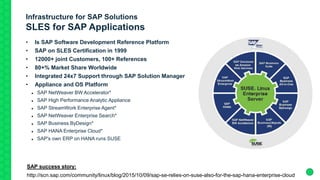
Infrastructure for SAP Solutions
SLES for SAP Applications
• Is SAP Software Development Reference Platform
• SAP on SLES Certification in 1999
• 12000+ joint Customers, 100+ References
• 80+% Market Share Worldwide
• Integrated 24x7 Support through SAP Solution Manager
• Appliance and OS Platform
 SAP NetWeaver BW Accelerator*
 SAP High Performance Analytic Appliance
 SAP StreamWork Enterprise Agent*
 SAP NetWeaver Enterprise Search*
 SAP Business ByDesign*
 SAP HANA Enterprise Cloud*
 SAP's own ERP on HANA runs SUSE
SAP success story:
http://scn.sap.com/community/linux/blog/2015/10/09/sap-se-relies-on-suse-also-for-the-sap-hana-enterprise-cloud
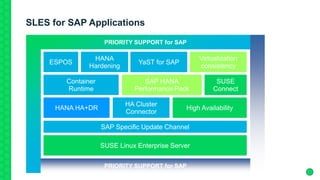
SLES for SAP Applications
PRIORITY SUPPORT for SAP
SUSE Linux Enterprise Server
SAP Specific Update Channel
Container
Runtime
ESPOS
HA Cluster
Connector
SUSE
Connect
SAP HANA
Performance Pack
HANA
Hardening
Virtualization
consistency
YaST for SAP
High AvailabilityHANA HA+DR
5
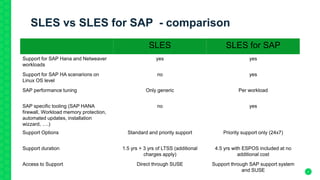
SLES vs SLES for SAP - comparison
SLES SLES for SAP
Support for SAP Hana and Netweaver
workloads
yes yes
Support for SAP HA scenarions on
Linux OS level
no yes
SAP performance tuning Only generic Per workload
SAP specific tooling (SAP HANA
firewall, Workload memory protection,
automated updates, installation
wizzard, ….)
no yes
Support Options Standard and priority support Priority support only (24x7)
Support duration 1.5 yrs + 3 yrs of LTSS (additional
charges apply)
4.5 yrs with ESPOS included at no
additional cost
Access to Support Direct through SUSE Support through SAP support system
and SUSE
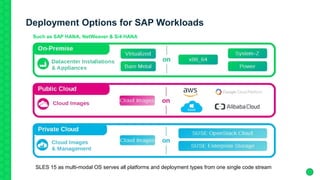
Deployment Options for SAP Workloads
Such as SAP HANA, NetWeaver & S/4 HANA
SLES 15 as multi-modal OS serves all platforms and deployment types from one single code stream
7
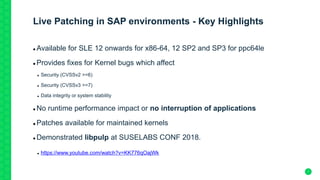
Live Patching in SAP environments - Key Highlights
 Available for SLE 12 onwards for x86-64, 12 SP2 and SP3 for ppc64le
 Provides fixes for Kernel bugs which affect
 Security (CVSSv2 >=6)
 Security (CVSSv3 >=7)
 Data integrity or system stability
 No runtime performance impact or no interruption of applications
 Patches available for maintained kernels
 Demonstrated libpulp at SUSELABS CONF 2018.
 https://www.youtube.com/watch?v=KK776qOajWk
SLES for SAP Application Support Changes
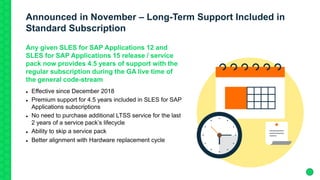
Announced in November – Long-Term Support Included in
Standard Subscription
Any given SLES for SAP Applications 12 and
SLES for SAP Applications 15 release / service
pack now provides 4.5 years of support with the
regular subscription during the GA live time of
the general code-stream
 Effective since December 2018
 Premium support for 4.5 years included in SLES for SAP
Applications subscriptions
 No need to purchase additional LTSS service for the last
2 years of a service pack’s lifecycle
 Ability to skip a service pack
 Better alignment with Hardware replacement cycle
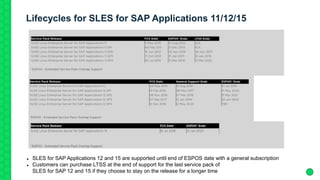
Lifecycles for SLES for SAP Applications 11/12/15
 SLES for SAP Applications 12 and 15 are supported until end of ESPOS date with a general subscription
 Customers can purchase LTSS at the end of support for the last service pack of
SLES for SAP 12 and 15 if they choose to stay on the release for a longer time
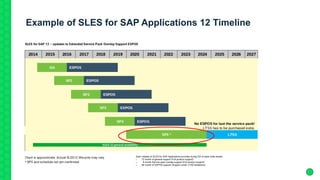
Example of SLES for SAP Applications 12 Timeline
Each release of SLES for SAP Applications provides during GA of base code-stream
 12 month of general support (Full product support)
 6 month Service pack overlap support (Full product support)
 36 month of ESPOS support (Support under LTSS limitations)
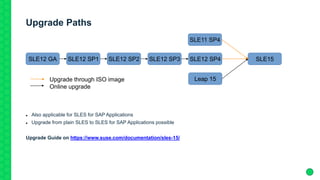
Upgrade Paths
Upgrade Paths
 Also applicable for SLES for SAP Applications
 Upgrade from plain SLES to SLES for SAP Applications possible
Upgrade Guide on https://www.suse.com/documentation/sles-15/
SLE11 SP4
SLE12 GA SLE12 SP1 SLE12 SP2 SLE12 SP3 SLE12 SP4 SLE15
Leap 15Upgrade through ISO image
Online upgrade
SAP Configuration & Tuning
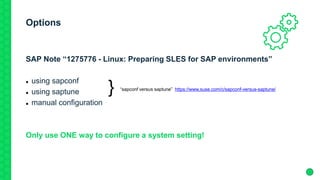
Options
SAP Note “1275776 - Linux: Preparing SLES for SAP environments”
 using sapconf
 using saptune
 manual configuration
Only use ONE way to configure a system setting!
} “sapconf versus saptune” https://www.suse.com/c/sapconf-versus-saptune/
sapconf
 Minimum set of operating system changes
 No differentiation between SAP Applications
 Available in SLES (therefore, SLES for SAP Application
as well)
 Rework in 2018 (ab SLES 12 SP1)
 Uses tuned (one profile to rule them all)
 Now every parameter is configurable
(/etc/configure/sapconf and /usr/lib/tuned/tuned.conf)
 “A new sapconf is available”
 https://www.suse.com/c/a-new-sapconf-is-available/
 TLTR: Summary of important things:
https://www.suse.com/c/sapconf-a-way-to-prepare-a-
sles-system-for-sap-workload-part-5/
sles12sp3:~ # systemctl status sapconf.service
● sapconf.service - sapconf
Loaded: loaded (/usr/lib/systemd/system/sapconf.service;
Active: active (exited) since Mi 2019-01-09 13:47:03 CET;
Process: 1950 ExecStart=/usr/sbin/sapconf start (code=exit
Main PID: 1950 (code=exited, status=0/SUCCESS)
Jan 09 13:47:02 sles12sp3 systemd[1]: Starting sapconf...
Jan 09 13:47:02 sles12sp3 sapconf[1950]: Forwarding action t
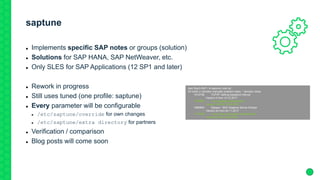
saptune
 Implements specific SAP notes or groups (solution)
 Solutions for SAP HANA, SAP NetWeaver, etc.
 Only SLES for SAP Applications (12 SP1 and later)
 Rework in progress
 Still uses tuned (one profile: saptune)
 Every parameter will be configurable
 /etc/saptune/override for own changes
 /etc/saptune/extra directory for partners
 Verification / comparison
 Blog posts will come soon
sles12sp3-SAP:~ # saptune note list
All notes (+ denotes manually enabled notes, * denotes notes
1410736 TCP/IP: setting keepalive interval
Version 4 from 14.12.2017
* 1557506 Linux paging improvements
Version 14 from 10.08.2015
1680803 Sybase - SAP Adaptive Server Enterpr
Version 24 from 20.11.2017
* 1771258 Linux: User and system resource limit
Version 5 from 18.06.2018
NVDIMM / Intel Optane DC
SAP HANA as an In-Memory Database
SAP HANA as an in-Memory database has the problem that all data
needs to read to memory on a restart of the system
• DB tends to be huge, so it simply takes time to do so
• From an operating perspective, even if the HANA database is clustered, there is a
higher risk to the DC (since system is active, the other one is restarting)
• There have been some projects in the past to enable persistent memory
– If the HANA DB can be kept in memory, only a consistency check is required on reboot, but
loading multiple terabytes of data from disk in memory isn’t needed in most cases
NVDIMM Support Enables Faster Recovery after
System Restarts
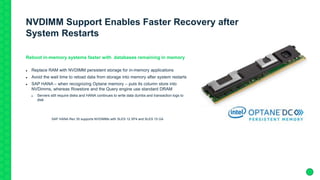
Reboot in-memory systems faster with databases remaining in memory
 Replace RAM with NVDIMM persistent storage for in-memory applications
 Avoid the wait time to reload data from storage into memory after system restarts
 SAP HANA – when recognizing Optane memory – puts its column store into
NVDimms, whereas Rowstore and the Query engine use standard DRAM
 Servers still require disks and HANA continues to write data dumbs and transaction logs to
disk
SAP HANA Rev 35 supports NVDIMMs with SLES 12 SP4 and SLES 15 GA
NVDIMM Support Enables Faster Recovery after
System Restarts
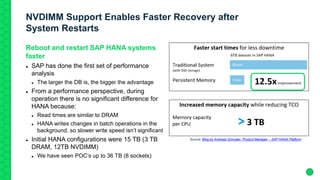
Reboot and restart SAP HANA systems
faster
 SAP has done the first set of performance
analysis
 The larger the DB is, the bigger the advantage
 From a performance perspective, during
operation there is no significant difference for
HANA because:
 Read times are similar to DRAM
 HANA writes changes in batch operations in the
background, so slower write speed isn’t significant
 Initial HANA configurations were 15 TB (3 TB
DRAM, 12TB NVDIMM)
 We have seen POC’s up to 36 TB (8 sockets)
Source: Blog by Andreas Schuster, Product Manager – SAP HANA Platform
Workload Memory Protection
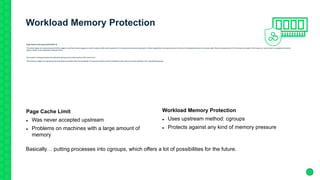
Page Cache Limit is gone with SLES 15
The kernel swaps out rarely accessed memory pages to use freed memory pages as cache to speed up file system operations, for example during backup operations. Certain applications use large amounts of memory for accelerated access to business data. Rarely accessed parts of this memory are subject of this swap out. Later access to swapped out memory
regions results in poor application response times.
New method: putting processes into dedicated cgroup(s) and protecting them with memory.low
If the memory usages of a cgroup and all its ancestors are below their low boundaries, the cgroup's memory won't be reclaimed unless memory can be reclaimed from unprotected cgroups.
Page Cache Limit
 Was never accepted upstream
 Problems on machines with a large amount of
memory
Workload Memory Protection
 Uses upstream method: cgroups
 Protects against any kind of memory pressure
Basically… putting processes into cgroups, which offers a lot of possibilities for the future.
Workload Memory Protection
...some technical details
 Requires cgroup v2 only (default is a unified hierarchy)
 will clash with existing cgroup setups!
 some systemd options regarding resource control (e.g. MemoryLimit=) won’t work
any more (man 5 systemd.resource-control)
 systemd unit will create a cgroup subtree with restriction (MemoryLow=)
 User switch moves process into the protective cgroup
 administrative tasks on command line requires care!
We will work together with SAP to develop a clean systemd solution for sapinit!
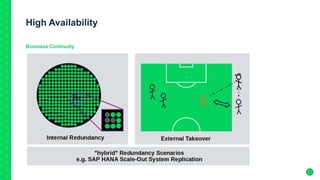
High Availability
High Availability
Business Continuity
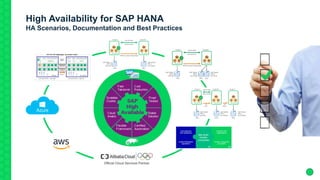
High Availability for SAP HANA
HA Scenarios, Documentation and Best Practices
28
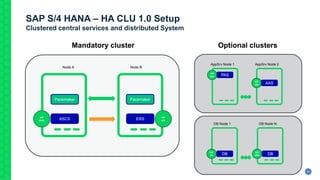
SAP S/4 HANA – HA CLU 1.0 Setup
Clustered central services and distributed System
Node A Node B
VIP
ascs
AppSrv Node 1
VIP
ersASCS ERS
VIP
pas PAS
AppSrv Node 2
VIP
aas AASVIP
aas AAS
DB Node 1
VIP
db DB
DB Node N
VIP
dbN DB
Optional clustersMandatory cluster
Pacemaker Pacemaker
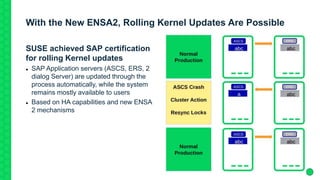
With the New ENSA2, Rolling Kernel Updates Are Possible
SUSE achieved SAP certification
for rolling Kernel updates
 SAP Application servers (ASCS, ERS, 2
dialog Server) are updated through the
process automatically, while the system
remains mostly available to users
 Based on HA capabilities and new ENSA
2 mechanisms
30
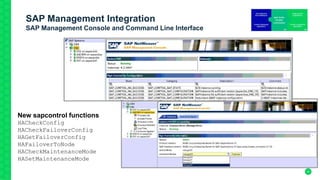
SAP Management Integration
SAP Management Console and Command Line Interface
New sapcontrol functions
HACheckConfig
HACheckFailoverConfig
HAGetFailoverConfig
HAFailoverToNode
HACheckMaintenanceMode
HASetMaintenanceMode
DataHub / Container
SAP Is Starting to Deliver Solutions through Containers
• Containers are currently a key topic for SAP
• SAP is working on containerizing solutions right now
• Extensions of S/4 HANA can be deployed within containers
• HANA might become a container at some point (at least for simple and small
workloads in the near future)
• SAP DataHub is likely the first product that requires Kubernetes
• SAP is also delivering SAP Gardener to the community – a way for
developers to instantiate their own Kubernetes cluster within a
Kubernetes cluster
• SUSE is already working closely with SAP in this area
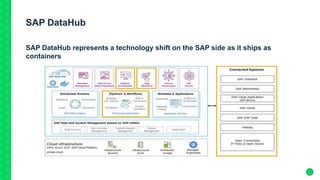
SAP DataHub
SAP DataHub represents a technology shift on the SAP side as it ships as
containers
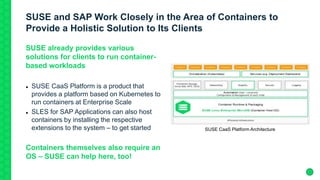
SUSE and SAP Work Closely in the Area of Containers to
Provide a Holistic Solution to Its Clients
SUSE already provides various
solutions for clients to run container-
based workloads
 SUSE CaaS Platform is a product that
provides a platform based on Kubernetes to
run containers at Enterprise Scale
 SLES for SAP Applications can also host
containers by installing the respective
extensions to the system – to get started
Containers themselves also require an
OS – SUSE can help here, too!
SUSE CaaS Platform Architecture
Roadmap / Future Directions
SUSE’s Planned Focus Areas for SAP Workloads
Ongoing investment in operating enhancements for SAP NetWeaver and SAP
HANA
 High Availability enhancements
 Enhanced deployment and configuration automation
Support of new technologies that are relevant for the SAP space
 New hardware, such as NVDIMM
 Container-based workloads
Consolidation of tooling
 saptune / sapconf
 Modular components
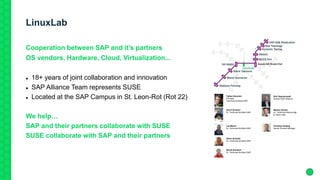
LinuxLab
Cooperation between SAP and it’s partners
OS vendors, Hardware, Cloud, Virtualization...
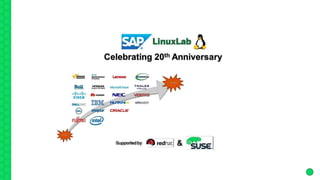
 18+ years of joint collaboration and innovation
 SAP Alliance Team represents SUSE
 Located at the SAP Campus in St. Leon-Rot (Rot 22)
We help…
SAP and their partners collaborate with SUSE
SUSE collaborate with SAP and their partners
Dirk Oppenkowski
Director SAP Alliance
Markus Gürtler
Sr. Technical Alliance Mgr
& Team Lead
Fabian Herschel
Principal
Technical Architect SAP
Ulrich Schairer
Sr. Technical Architect SAP
Lee Martin
Sr. Technical Architect SAP
Sören Schmidt
Sr. Technical Architect SAP
Bernd Schubert
Sr. Technical Architect SAP
Christian Holsing
Senior Product Manager
FURTHER INFORMATION
Best Practices
www.suse.com/products/sles-for-sap/resource-library/sap-best-practices.html
SUSE Linux Enterprise Server for SAP Applications
www.suse.com/products/sles-for-sap/
Training
elearning.suse.com/product-line/sles12/
training.suse.com/training/suse-linux-enterprise-server-2/
4141
Unpublished Work of SUSE LLC. All Rights Reserved.
This work is an unpublished work and contains confidential, proprietary and trade secret information of SUSE LLC.
Access to this work is restricted to SUSE employees who have a need to know to perform tasks within the scope of their assignments. No part of this work may
be practiced, performed, copied, distributed, revised, modified, translated, abridged, condensed, expanded, collected, or adapted without the prior written
consent of SUSE.
Any use or exploitation of this work without authorization could subject the perpetrator to criminal and civil liability.
General Disclaimer
This document is not to be construed as a promise by any participating company to develop, deliver, or market a product. It is not a commitment to deliver any
material, code, or functionality, and should not be relied upon in making purchasing decisions. SUSE makes no representations or warranties with respect to the
contents of this document, and specifically disclaims any express or implied warranties of merchantability or fitness for any particular purpose. The
development, release, and timing of features or functionality described for SUSE products remains at the sole discretion of SUSE. Further, SUSE reserves the
right to revise this document and to make changes to its content, at any time, without obligation to notify any person or entity of such revisions or changes. All
SUSE marks referenced in this presentation are trademarks or registered trademarks of Novell, Inc. in the United States and other countries. All third-party
trademarks are the property of their respective owners.

Fut1441 SUSE Linux Enterprise Server for SAP Solutions

  • 1.
    FUT 1441 SUSE LinuxEnterprise Server for SAP Solutions – Roadmap Christian Holsing Senior Product Manager SLES for SAP Applications Christian.Holsing@suse.com Christian.Holsing@sap.com
  • 2.
    A Lot ofThings Have Happened in the Last Year  SLES for SAP Applications  SLES for SAP Application support changes  Upgrade Paths  SAP Configuration & Tuning  NVDIMM / Intel Optane DC  Workload Memory Protection  High Availability  DataHub / Container  Roadmap / Future Directions
  • 3.
    Infrastructure for SAPSolutions SLES for SAP Applications • Is SAP Software Development Reference Platform • SAP on SLES Certification in 1999 • 12000+ joint Customers, 100+ References • 80+% Market Share Worldwide • Integrated 24x7 Support through SAP Solution Manager • Appliance and OS Platform  SAP NetWeaver BW Accelerator*  SAP High Performance Analytic Appliance  SAP StreamWork Enterprise Agent*  SAP NetWeaver Enterprise Search*  SAP Business ByDesign*  SAP HANA Enterprise Cloud*  SAP's own ERP on HANA runs SUSE SAP success story: http://scn.sap.com/community/linux/blog/2015/10/09/sap-se-relies-on-suse-also-for-the-sap-hana-enterprise-cloud
  • 4.
    SLES for SAPApplications PRIORITY SUPPORT for SAP PRIORITY SUPPORT for SAP SUSE Linux Enterprise Server SAP Specific Update Channel Container Runtime ESPOS HA Cluster Connector SUSE Connect SAP HANA Performance Pack HANA Hardening Virtualization consistency YaST for SAP High AvailabilityHANA HA+DR
  • 5.
    5 SLES vs SLESfor SAP - comparison SLES SLES for SAP Support for SAP Hana and Netweaver workloads yes yes Support for SAP HA scenarions on Linux OS level no yes SAP performance tuning Only generic Per workload SAP specific tooling (SAP HANA firewall, Workload memory protection, automated updates, installation wizzard, ….) no yes Support Options Standard and priority support Priority support only (24x7) Support duration 1.5 yrs + 3 yrs of LTSS (additional charges apply) 4.5 yrs with ESPOS included at no additional cost Access to Support Direct through SUSE Support through SAP support system and SUSE
  • 6.
    Deployment Options forSAP Workloads Such as SAP HANA, NetWeaver & S/4 HANA SLES 15 as multi-modal OS serves all platforms and deployment types from one single code stream
  • 7.
    7 Live Patching inSAP environments - Key Highlights  Available for SLE 12 onwards for x86-64, 12 SP2 and SP3 for ppc64le  Provides fixes for Kernel bugs which affect  Security (CVSSv2 >=6)  Security (CVSSv3 >=7)  Data integrity or system stability  No runtime performance impact or no interruption of applications  Patches available for maintained kernels  Demonstrated libpulp at SUSELABS CONF 2018.  https://www.youtube.com/watch?v=KK776qOajWk
  • 8.
    SLES for SAPApplication Support Changes
  • 9.
    Announced in November– Long-Term Support Included in Standard Subscription Any given SLES for SAP Applications 12 and SLES for SAP Applications 15 release / service pack now provides 4.5 years of support with the regular subscription during the GA live time of the general code-stream  Effective since December 2018  Premium support for 4.5 years included in SLES for SAP Applications subscriptions  No need to purchase additional LTSS service for the last 2 years of a service pack’s lifecycle  Ability to skip a service pack  Better alignment with Hardware replacement cycle
  • 10.
    Lifecycles for SLESfor SAP Applications 11/12/15  SLES for SAP Applications 12 and 15 are supported until end of ESPOS date with a general subscription  Customers can purchase LTSS at the end of support for the last service pack of SLES for SAP 12 and 15 if they choose to stay on the release for a longer time
  • 11.
    Example of SLESfor SAP Applications 12 Timeline Each release of SLES for SAP Applications provides during GA of base code-stream  12 month of general support (Full product support)  6 month Service pack overlap support (Full product support)  36 month of ESPOS support (Support under LTSS limitations)
  • 12.
  • 13.
    Upgrade Paths  Alsoapplicable for SLES for SAP Applications  Upgrade from plain SLES to SLES for SAP Applications possible Upgrade Guide on https://www.suse.com/documentation/sles-15/ SLE11 SP4 SLE12 GA SLE12 SP1 SLE12 SP2 SLE12 SP3 SLE12 SP4 SLE15 Leap 15Upgrade through ISO image Online upgrade
  • 14.
  • 15.
    Options SAP Note “1275776- Linux: Preparing SLES for SAP environments”  using sapconf  using saptune  manual configuration Only use ONE way to configure a system setting! } “sapconf versus saptune” https://www.suse.com/c/sapconf-versus-saptune/
  • 16.
    sapconf  Minimum setof operating system changes  No differentiation between SAP Applications  Available in SLES (therefore, SLES for SAP Application as well)  Rework in 2018 (ab SLES 12 SP1)  Uses tuned (one profile to rule them all)  Now every parameter is configurable (/etc/configure/sapconf and /usr/lib/tuned/tuned.conf)  “A new sapconf is available”  https://www.suse.com/c/a-new-sapconf-is-available/  TLTR: Summary of important things: https://www.suse.com/c/sapconf-a-way-to-prepare-a- sles-system-for-sap-workload-part-5/ sles12sp3:~ # systemctl status sapconf.service ● sapconf.service - sapconf Loaded: loaded (/usr/lib/systemd/system/sapconf.service; Active: active (exited) since Mi 2019-01-09 13:47:03 CET; Process: 1950 ExecStart=/usr/sbin/sapconf start (code=exit Main PID: 1950 (code=exited, status=0/SUCCESS) Jan 09 13:47:02 sles12sp3 systemd[1]: Starting sapconf... Jan 09 13:47:02 sles12sp3 sapconf[1950]: Forwarding action t
  • 17.
    saptune  Implements specificSAP notes or groups (solution)  Solutions for SAP HANA, SAP NetWeaver, etc.  Only SLES for SAP Applications (12 SP1 and later)  Rework in progress  Still uses tuned (one profile: saptune)  Every parameter will be configurable  /etc/saptune/override for own changes  /etc/saptune/extra directory for partners  Verification / comparison  Blog posts will come soon sles12sp3-SAP:~ # saptune note list All notes (+ denotes manually enabled notes, * denotes notes 1410736 TCP/IP: setting keepalive interval Version 4 from 14.12.2017 * 1557506 Linux paging improvements Version 14 from 10.08.2015 1680803 Sybase - SAP Adaptive Server Enterpr Version 24 from 20.11.2017 * 1771258 Linux: User and system resource limit Version 5 from 18.06.2018
  • 18.
    NVDIMM / IntelOptane DC
  • 19.
    SAP HANA asan In-Memory Database SAP HANA as an in-Memory database has the problem that all data needs to read to memory on a restart of the system • DB tends to be huge, so it simply takes time to do so • From an operating perspective, even if the HANA database is clustered, there is a higher risk to the DC (since system is active, the other one is restarting) • There have been some projects in the past to enable persistent memory – If the HANA DB can be kept in memory, only a consistency check is required on reboot, but loading multiple terabytes of data from disk in memory isn’t needed in most cases
  • 20.
    NVDIMM Support EnablesFaster Recovery after System Restarts Reboot in-memory systems faster with databases remaining in memory  Replace RAM with NVDIMM persistent storage for in-memory applications  Avoid the wait time to reload data from storage into memory after system restarts  SAP HANA – when recognizing Optane memory – puts its column store into NVDimms, whereas Rowstore and the Query engine use standard DRAM  Servers still require disks and HANA continues to write data dumbs and transaction logs to disk SAP HANA Rev 35 supports NVDIMMs with SLES 12 SP4 and SLES 15 GA
  • 21.
    NVDIMM Support EnablesFaster Recovery after System Restarts Reboot and restart SAP HANA systems faster  SAP has done the first set of performance analysis  The larger the DB is, the bigger the advantage  From a performance perspective, during operation there is no significant difference for HANA because:  Read times are similar to DRAM  HANA writes changes in batch operations in the background, so slower write speed isn’t significant  Initial HANA configurations were 15 TB (3 TB DRAM, 12TB NVDIMM)  We have seen POC’s up to 36 TB (8 sockets) Source: Blog by Andreas Schuster, Product Manager – SAP HANA Platform
  • 22.
  • 23.
    Workload Memory Protection PageCache Limit is gone with SLES 15 The kernel swaps out rarely accessed memory pages to use freed memory pages as cache to speed up file system operations, for example during backup operations. Certain applications use large amounts of memory for accelerated access to business data. Rarely accessed parts of this memory are subject of this swap out. Later access to swapped out memory regions results in poor application response times. New method: putting processes into dedicated cgroup(s) and protecting them with memory.low If the memory usages of a cgroup and all its ancestors are below their low boundaries, the cgroup's memory won't be reclaimed unless memory can be reclaimed from unprotected cgroups. Page Cache Limit  Was never accepted upstream  Problems on machines with a large amount of memory Workload Memory Protection  Uses upstream method: cgroups  Protects against any kind of memory pressure Basically… putting processes into cgroups, which offers a lot of possibilities for the future.
  • 24.
    Workload Memory Protection ...sometechnical details  Requires cgroup v2 only (default is a unified hierarchy)  will clash with existing cgroup setups!  some systemd options regarding resource control (e.g. MemoryLimit=) won’t work any more (man 5 systemd.resource-control)  systemd unit will create a cgroup subtree with restriction (MemoryLow=)  User switch moves process into the protective cgroup  administrative tasks on command line requires care! We will work together with SAP to develop a clean systemd solution for sapinit!
  • 25.
  • 26.
  • 27.
    High Availability forSAP HANA HA Scenarios, Documentation and Best Practices
  • 28.
    28 SAP S/4 HANA– HA CLU 1.0 Setup Clustered central services and distributed System Node A Node B VIP ascs AppSrv Node 1 VIP ersASCS ERS VIP pas PAS AppSrv Node 2 VIP aas AASVIP aas AAS DB Node 1 VIP db DB DB Node N VIP dbN DB Optional clustersMandatory cluster Pacemaker Pacemaker
  • 29.
    With the NewENSA2, Rolling Kernel Updates Are Possible SUSE achieved SAP certification for rolling Kernel updates  SAP Application servers (ASCS, ERS, 2 dialog Server) are updated through the process automatically, while the system remains mostly available to users  Based on HA capabilities and new ENSA 2 mechanisms
  • 30.
    30 SAP Management Integration SAPManagement Console and Command Line Interface New sapcontrol functions HACheckConfig HACheckFailoverConfig HAGetFailoverConfig HAFailoverToNode HACheckMaintenanceMode HASetMaintenanceMode
  • 31.
  • 32.
    SAP Is Startingto Deliver Solutions through Containers • Containers are currently a key topic for SAP • SAP is working on containerizing solutions right now • Extensions of S/4 HANA can be deployed within containers • HANA might become a container at some point (at least for simple and small workloads in the near future) • SAP DataHub is likely the first product that requires Kubernetes • SAP is also delivering SAP Gardener to the community – a way for developers to instantiate their own Kubernetes cluster within a Kubernetes cluster • SUSE is already working closely with SAP in this area
  • 33.
    SAP DataHub SAP DataHubrepresents a technology shift on the SAP side as it ships as containers
  • 34.
    SUSE and SAPWork Closely in the Area of Containers to Provide a Holistic Solution to Its Clients SUSE already provides various solutions for clients to run container- based workloads  SUSE CaaS Platform is a product that provides a platform based on Kubernetes to run containers at Enterprise Scale  SLES for SAP Applications can also host containers by installing the respective extensions to the system – to get started Containers themselves also require an OS – SUSE can help here, too! SUSE CaaS Platform Architecture
  • 35.
    Roadmap / FutureDirections
  • 36.
    SUSE’s Planned FocusAreas for SAP Workloads Ongoing investment in operating enhancements for SAP NetWeaver and SAP HANA  High Availability enhancements  Enhanced deployment and configuration automation Support of new technologies that are relevant for the SAP space  New hardware, such as NVDIMM  Container-based workloads Consolidation of tooling  saptune / sapconf  Modular components
  • 37.
    LinuxLab Cooperation between SAPand it’s partners OS vendors, Hardware, Cloud, Virtualization...  18+ years of joint collaboration and innovation  SAP Alliance Team represents SUSE  Located at the SAP Campus in St. Leon-Rot (Rot 22) We help… SAP and their partners collaborate with SUSE SUSE collaborate with SAP and their partners Dirk Oppenkowski Director SAP Alliance Markus Gürtler Sr. Technical Alliance Mgr & Team Lead Fabian Herschel Principal Technical Architect SAP Ulrich Schairer Sr. Technical Architect SAP Lee Martin Sr. Technical Architect SAP Sören Schmidt Sr. Technical Architect SAP Bernd Schubert Sr. Technical Architect SAP Christian Holsing Senior Product Manager
  • 39.
    FURTHER INFORMATION Best Practices www.suse.com/products/sles-for-sap/resource-library/sap-best-practices.html SUSELinux Enterprise Server for SAP Applications www.suse.com/products/sles-for-sap/ Training elearning.suse.com/product-line/sles12/ training.suse.com/training/suse-linux-enterprise-server-2/
  • 41.
    4141 Unpublished Work ofSUSE LLC. All Rights Reserved. This work is an unpublished work and contains confidential, proprietary and trade secret information of SUSE LLC. Access to this work is restricted to SUSE employees who have a need to know to perform tasks within the scope of their assignments. No part of this work may be practiced, performed, copied, distributed, revised, modified, translated, abridged, condensed, expanded, collected, or adapted without the prior written consent of SUSE. Any use or exploitation of this work without authorization could subject the perpetrator to criminal and civil liability. General Disclaimer This document is not to be construed as a promise by any participating company to develop, deliver, or market a product. It is not a commitment to deliver any material, code, or functionality, and should not be relied upon in making purchasing decisions. SUSE makes no representations or warranties with respect to the contents of this document, and specifically disclaims any express or implied warranties of merchantability or fitness for any particular purpose. The development, release, and timing of features or functionality described for SUSE products remains at the sole discretion of SUSE. Further, SUSE reserves the right to revise this document and to make changes to its content, at any time, without obligation to notify any person or entity of such revisions or changes. All SUSE marks referenced in this presentation are trademarks or registered trademarks of Novell, Inc. in the United States and other countries. All third-party trademarks are the property of their respective owners.

Editor's Notes

  • #24 SAP note describes how to change system settings in compliance with SUSE Both tuning tools
  • #25 SAP note describes how to change system settings in compliance with SUSE Both tuning tools