Executive Report 
IBM Global Business Services Strategy and Analytics 
IBM Institute for Business Value 
Analytics: The speed advantage 
Why data-driven organizations are winning the race in today’s marketplace
IBM Strategy & Analytics 
The IBM Strategy and Analytics practice integrates management consulting expertise with the science of analytics to enable leading organizations to succeed. IBM is helping clients realize the full potential of big data and analytics by providing them with the expertise, solutions and capabilities needed to infuse intelligence into virtually every business decision and process; empower more-immediate and certain action by capitalizing on the many forms of data and insights that exist; and develop a culture of trust and confidence through a proactive approach to security, governance and compliance. For more information about IBM Strategy & Analytics offerings from IBM, visit 
ibm.com/services/us/gbs/strategy
IBM Global Business Services 1 
Introduction 
Capabilities that enable an organization to consume 
data faster — to move from raw data to insight-driven 
actions — are now the key differentiator to creating value 
through analytics. In addition to this focus on speed, our 
latest analytics research reveals several significant evolu-tions 
in the era of big data. 
Based on survey responses of more than 1,000 business 
and IT executives from more than 60 countries, our 2014 
analytics research revealed four transformative shifts 
affecting the fast-paced digital marketplace: 
1. A solid majority of organizations are now realizing a 
return on their big data investments within a year. 
2. Customer centricity still dominates analytics activities, 
but organizations are increasingly solving operational 
challenges using big data. 
3. Integrating digital capabilities into business processes 
is transforming organizations. 
4. The value driver for big data has shifted from volume 
to velocity. 
By Glenn Finch, Steven Davidson, Christian Kirschniak, Marcio Weikersheimer, Cathy Reese and Rebecca Shockley 
In 2014, several important shifts occurred in the world of big data — shifts that 
business executives around the globe cannot afford to ignore. The most significant shift 
is that velocity is now the competitive differentiator for big data. Our sixth annual 
analytics study reveals a group of organizations differentiating themselves with speed-driven 
data and analytics practices that significantly impact business performance and 
competitive position. To compete in today’s digitally infused marketplace, other 
organizations need to emulate these outperformers by acquiring, analyzing and acting 
on data with a focus on speed to action. 
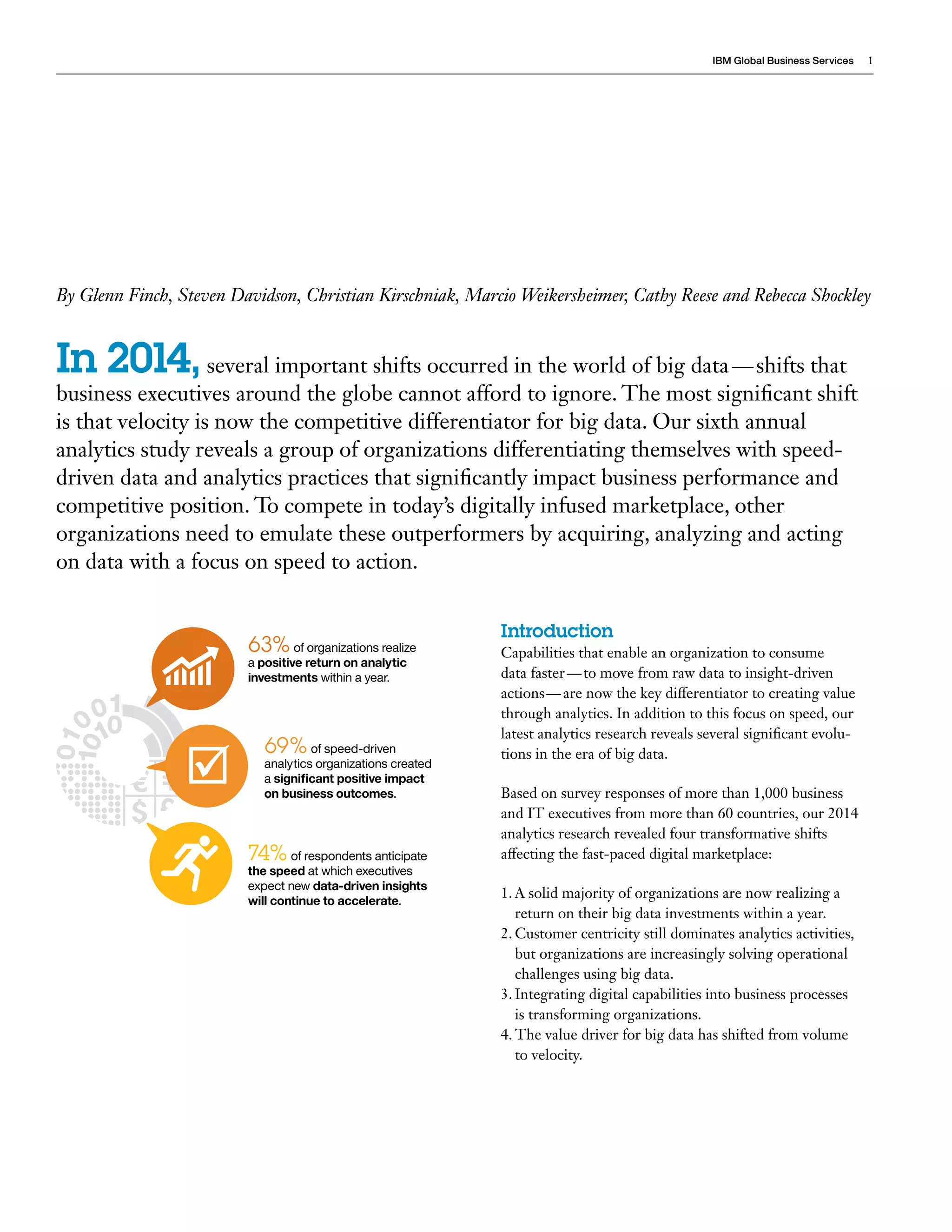
63% of organizations realize 
a positive return on analytic 
investments within a year. 
69% of speed-driven 
analytics organizations created 
a significant positive impact 
on business outcomes. 
74% of respondents anticipate 
the speed at which executives 
expect new data-driven insights 
will continue to accelerate.
2 Analytics: The speed advantage 
Shift 1: 
A solid majority of organizations are now realizing a return 
on their big data investments within a year. 
Most organizations (63 percent) realize a positive return on 
their analytic investments within one year, and more than 
one-in-four respondents (26 percent) realize a positive return 
within six months. This marks the start of a trend toward 
positive returns, with a 10 percent year-to-year uptick over 
the 57 percent that reported a return within a year in 2013.1 
Moreover, 49 percent of organizations that have implemented 
one or more big data technologies reported that returns met 
or exceeded their expected returns; another 45 percent of 
implementations were under evaluation. Only 6 percent 
reported that returns failed to meet expectations. 
Shift 2: 
Customer centricity still dominates analytics activities, 
but organizations are increasingly targeting operational 
challenges. 
While customer-centric objectives are still the primary focus 
for a majority of organizations, more are starting to integrate 
big data technologies into back-office and operational process-es. 
In more than half of all organizations, business executives 
are demanding data insights primarily to create stronger 
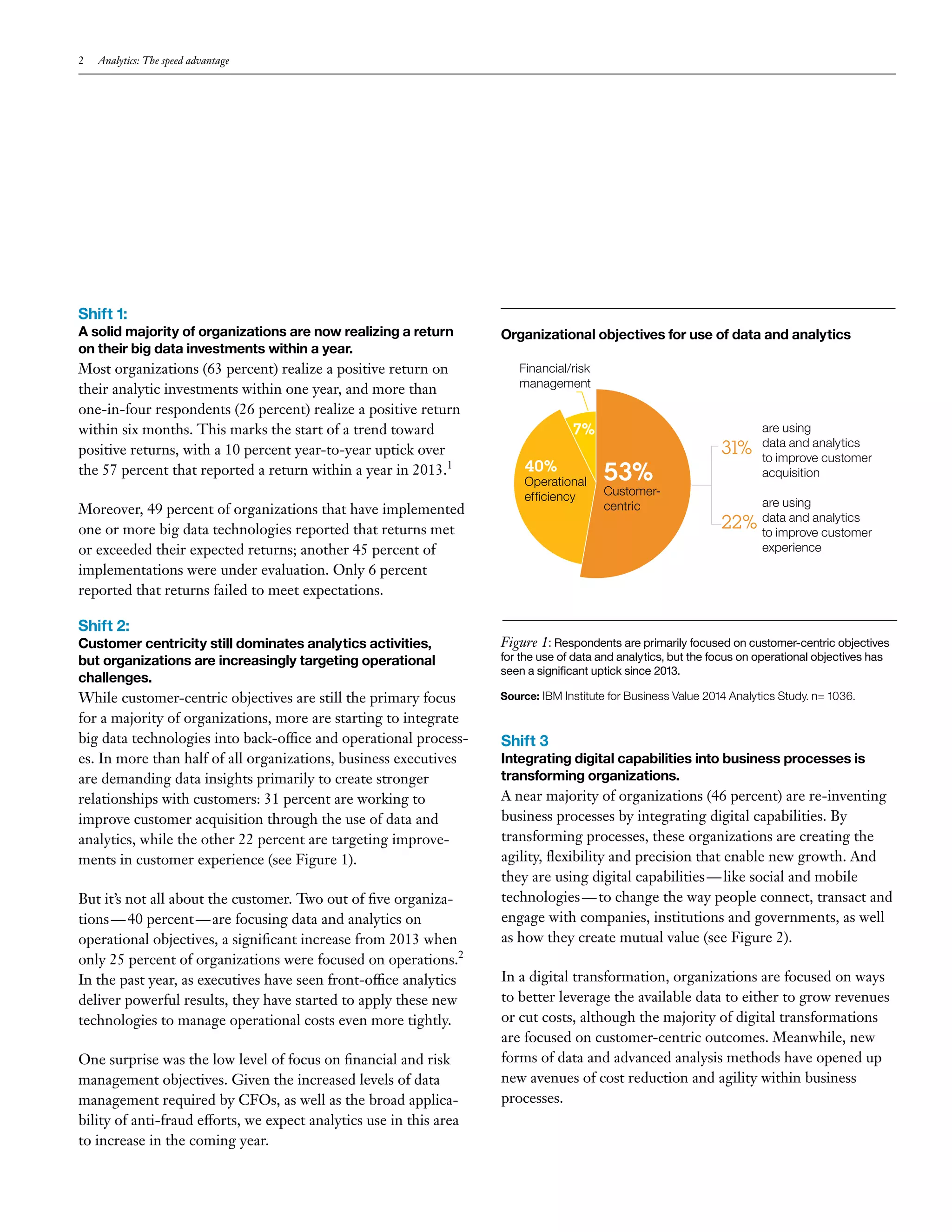
relationships with customers: 31 percent are working to 
improve customer acquisition through the use of data and 
analytics, while the other 22 percent are targeting improve-ments 
in customer experience (see Figure 1). 
But it’s not all about the customer. Two out of five organiza-tions 
— 40 percent — are focusing data and analytics on 
operational objectives, a significant increase from 2013 when 
only 25 percent of organizations were focused on operations.2 
In the past year, as executives have seen front-office analytics 
deliver powerful results, they have started to apply these new 
technologies to manage operational costs even more tightly. 
One surprise was the low level of focus on financial and risk 
management objectives. Given the increased levels of data 
management required by CFOs, as well as the broad applica-bility 
of anti-fraud efforts, we expect analytics use in this area 
to increase in the coming year. 
Shift 3 
Integrating digital capabilities into business processes is 
transforming organizations. 
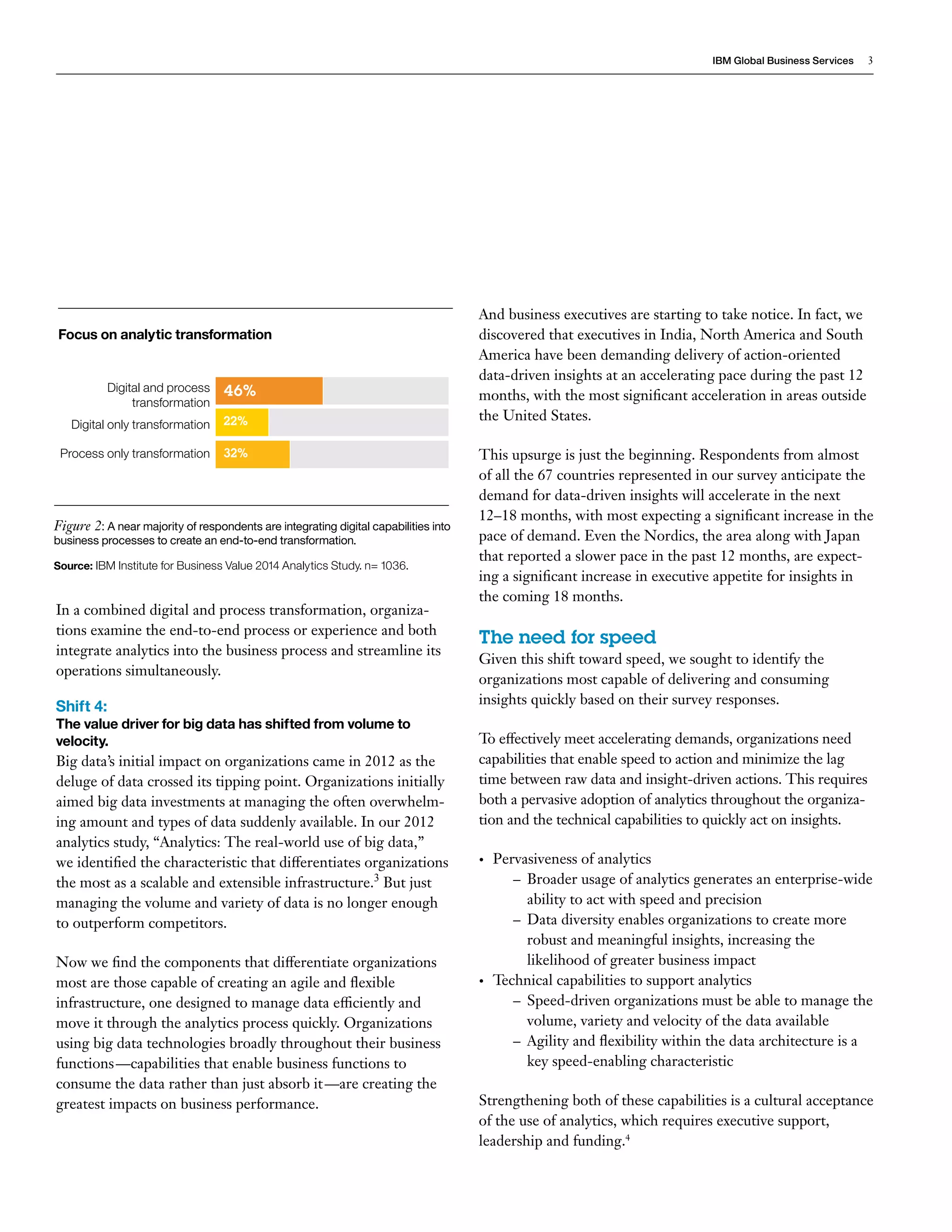
A near majority of organizations (46 percent) are re-inventing 
business processes by integrating digital capabilities. By 
transforming processes, these organizations are creating the 
agility, flexibility and precision that enable new growth. And 
they are using digital capabilities — like social and mobile 
technologies — to change the way people connect, transact and 
engage with companies, institutions and governments, as well 
as how they create mutual value (see Figure 2). 
In a digital transformation, organizations are focused on ways 
to better leverage the available data to either to grow revenues 
or cut costs, although the majority of digital transformations 
are focused on customer-centric outcomes. Meanwhile, new 
forms of data and advanced analysis methods have opened up 
new avenues of cost reduction and agility within business 
processes. 
are using 
data and analytics 
to improve customer 
acquisition 
are using 
data and analytics 
to improve customer 
experience 
Organizational objectives for use of data and analytics 
Figure 1: Respondents are primarily focused on customer-centric objectives 
for the use of data and analytics, but the focus on operational objectives has 
seen a significant uptick since 2013. 
Source: IBM Institute for Business Value 2014 Analytics Study. n= 1036. 
31% 
53% 
Customer-centric 
22% 
Operational 
efficiency 
Financial/risk 
management 
7% 
40%
IBM Global Business Services 3 
In a combined digital and process transformation, organiza-tions 
examine the end-to-end process or experience and both 
integrate analytics into the business process and streamline its 
operations simultaneously. 
Shift 4: 
The value driver for big data has shifted from volume to 
velocity. 
Big data’s initial impact on organizations came in 2012 as the 
deluge of data crossed its tipping point. Organizations initially 
aimed big data investments at managing the often overwhelm-ing 
amount and types of data suddenly available. In our 2012 
analytics study, “Analytics: The real-world use of big data,” 
we identified the characteristic that differentiates organizations 
the most as a scalable and extensible infrastructure.3 But just 
managing the volume and variety of data is no longer enough 
to outperform competitors. 
Now we find the components that differentiate organizations 
most are those capable of creating an agile and flexible 
infrastructure, one designed to manage data efficiently and 
move it through the analytics process quickly. Organizations 
using big data technologies broadly throughout their business 
functions —capabilities that enable business functions to 
consume the data rather than just absorb it —are creating the 
greatest impacts on business performance. 
And business executives are starting to take notice. In fact, we 
discovered that executives in India, North America and South 
America have been demanding delivery of action-oriented 
data-driven insights at an accelerating pace during the past 12 
months, with the most significant acceleration in areas outside 
the United States. 
This upsurge is just the beginning. Respondents from almost 
of all the 67 countries represented in our survey anticipate the 
demand for data-driven insights will accelerate in the next 
12–18 months, with most expecting a significant increase in the 
pace of demand. Even the Nordics, the area along with Japan 
that reported a slower pace in the past 12 months, are expect-ing 
a significant increase in executive appetite for insights in 
the coming 18 months. 
The need for speed 
Given this shift toward speed, we sought to identify the 
organizations most capable of delivering and consuming 
insights quickly based on their survey responses. 
To effectively meet accelerating demands, organizations need 
capabilities that enable speed to action and minimize the lag 
time between raw data and insight-driven actions. This requires 
both a pervasive adoption of analytics throughout the organiza-tion 
and the technical capabilities to quickly act on insights. 
• Pervasiveness of analytics 
–– Broader usage of analytics generates an enterprise-wide 
ability to act with speed and precision 
––Data diversity enables organizations to create more 
robust and meaningful insights, increasing the 
likelihood of greater business impact 
• Technical capabilities to support analytics 
–– Speed-driven organizations must be able to manage the 
volume, variety and velocity of the data available 
–– Agility and flexibility within the data architecture is a 
key speed-enabling characteristic 
Strengthening both of these capabilities is a cultural acceptance 
of the use of analytics, which requires executive support, 
leadership and funding.4 
Focus on analytic transformation 
Figure 2: A near majority of respondents are integrating digital capabilities into 
business processes to create an end-to-end transformation. 
Source: IBM Institute for Business Value 2014 Analytics Study. n= 1036. 
Digital and process 
transformation 
Digital only transformation 
Process only transformation 
46% 
22% 
32%
4 Analytics: The speed advantage 
Four clusters of capabilities 
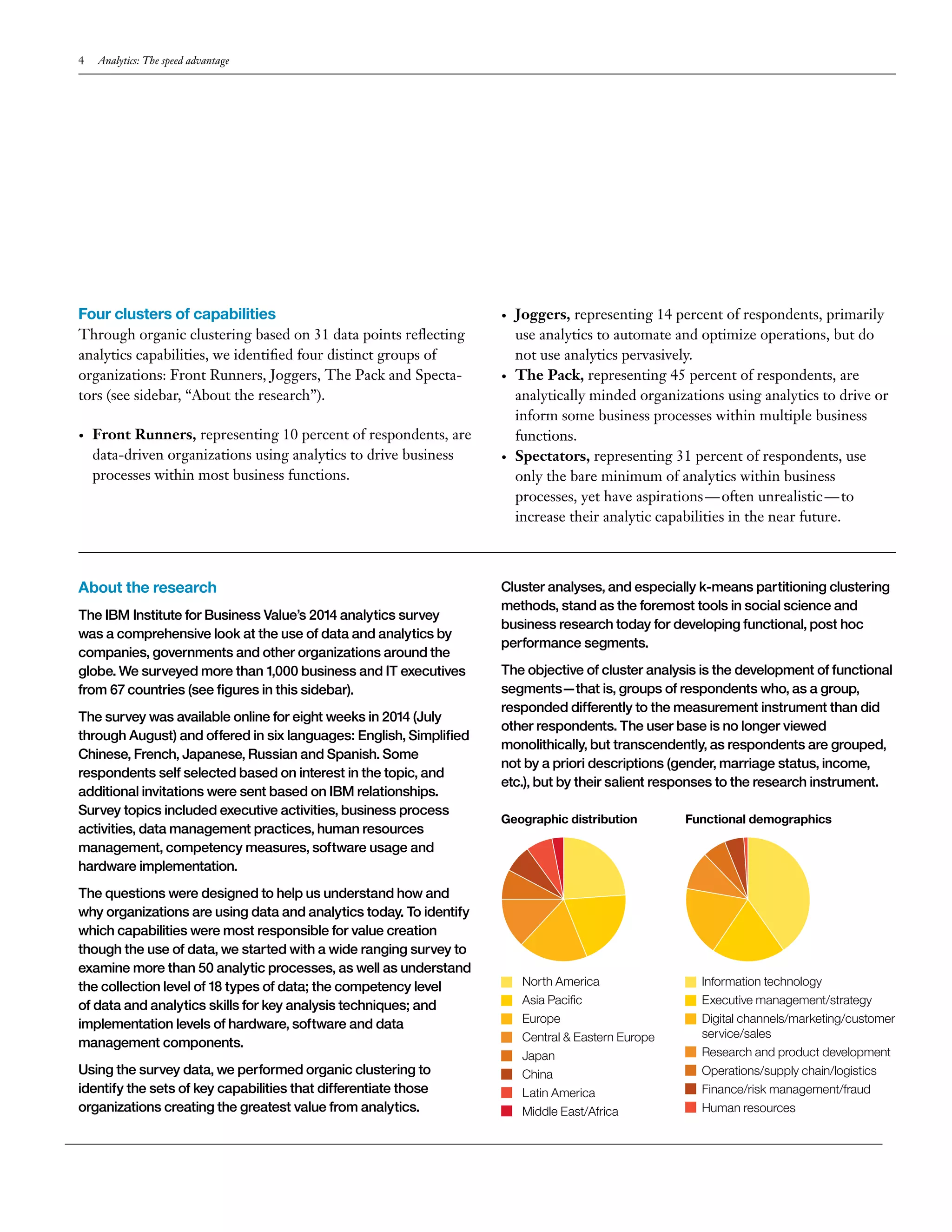
Through organic clustering based on 31 data points reflecting 
analytics capabilities, we identified four distinct groups of 
organizations: Front Runners, Joggers, The Pack and Specta-tors 
(see sidebar, “About the research”). 
• Front Runners, representing 10 percent of respondents, are 
data-driven organizations using analytics to drive business 
processes within most business functions. 
• Joggers, representing 14 percent of respondents, primarily 
use analytics to automate and optimize operations, but do 
not use analytics pervasively. 
• The Pack, representing 45 percent of respondents, are 
analytically minded organizations using analytics to drive or 
inform some business processes within multiple business 
functions. 
• Spectators, representing 31 percent of respondents, use 
only the bare minimum of analytics within business 
processes, yet have aspirations — often unrealistic — to 
increase their analytic capabilities in the near future. 
About the research 
The IBM Institute for Business Value’s 2014 analytics survey 
was a comprehensive look at the use of data and analytics by 
companies, governments and other organizations around the 
globe. We surveyed more than 1,000 business and IT executives 
from 67 countries (see figures in this sidebar). 
The survey was available online for eight weeks in 2014 (July 
through August) and offered in six languages: English, Simplified 
Chinese, French, Japanese, Russian and Spanish. Some 
respondents self selected based on interest in the topic, and 
additional invitations were sent based on IBM relationships. 
Survey topics included executive activities, business process 
activities, data management practices, human resources 
management, competency measures, software usage and 
hardware implementation. 
The questions were designed to help us understand how and 
why organizations are using data and analytics today. To identify 
which capabilities were most responsible for value creation 
though the use of data, we started with a wide ranging survey to 
examine more than 50 analytic processes, as well as understand 
the collection level of 18 types of data; the competency level 
of data and analytics skills for key analysis techniques; and 
implementation levels of hardware, software and data 
management components. 
Using the survey data, we performed organic clustering to 
identify the sets of key capabilities that differentiate those 
organizations creating the greatest value from analytics. 
Cluster analyses, and especially k-means partitioning clustering 
methods, stand as the foremost tools in social science and 
business research today for developing functional, post hoc 
performance segments. 
The objective of cluster analysis is the development of functional 
segments—that is, groups of respondents who, as a group, 
responded differently to the measurement instrument than did 
other respondents. The user base is no longer viewed 
monolithically, but transcendently, as respondents are grouped, 
not by a priori descriptions (gender, marriage status, income, 
etc.), but by their salient responses to the research instrument. 
North America 
Asia Pacific 
Europe 
Central & Eastern Europe 
Japan 
China 
Latin America 
Middle East/Africa 
Information technology 
Executive management/strategy 
Digital channels/marketing/customer 
service/sales 
Research and product development 
Operations/supply chain/logistics 
Finance/risk management/fraud 
Human resources 
Geographic distribution Functional demographics
IBM Global Business Services 5 
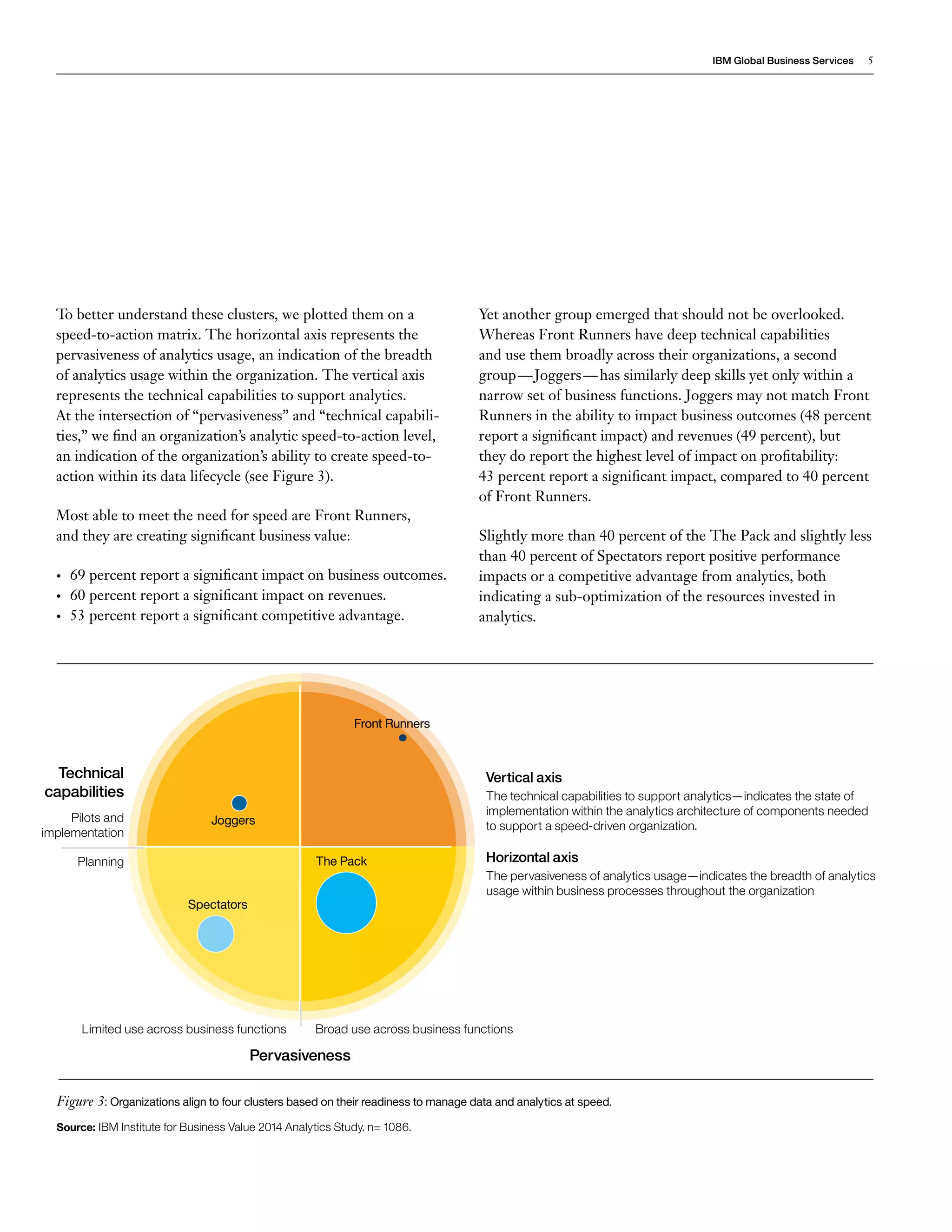
To better understand these clusters, we plotted them on a 
speed-to-action matrix. The horizontal axis represents the 
pervasiveness of analytics usage, an indication of the breadth 
of analytics usage within the organization. The vertical axis 
represents the technical capabilities to support analytics. 
At the intersection of “pervasiveness” and “technical capabili-ties,” 
we find an organization’s analytic speed-to-action level, 
an indication of the organization’s ability to create speed-to-action 
within its data lifecycle (see Figure 3). 
Most able to meet the need for speed are Front Runners, 
and they are creating significant business value: 
• 69 percent report a significant impact on business outcomes. 
• 60 percent report a significant impact on revenues. 
• 53 percent report a significant competitive advantage. 
Yet another group emerged that should not be overlooked. 
Whereas Front Runners have deep technical capabilities 
and use them broadly across their organizations, a second 
group — Joggers — has similarly deep skills yet only within a 
narrow set of business functions. Joggers may not match Front 
Runners in the ability to impact business outcomes (48 percent 
report a significant impact) and revenues (49 percent), but 
they do report the highest level of impact on profitability: 
43 percent report a significant impact, compared to 40 percent 
of Front Runners. 
Slightly more than 40 percent of the The Pack and slightly less 
than 40 percent of Spectators report positive performance 
impacts or a competitive advantage from analytics, both 
indicating a sub-optimization of the resources invested in 
analytics. 
Vertical axis 
The technical capabilities to support analytics—indicates the state of 
implementation within the analytics architecture of components needed 
to support a speed-driven organization. 
Horizontal axis 
The pervasiveness of analytics usage—indicates the breadth of analytics 
usage within business processes throughout the organization 
Technical 
capabilities 
Pilots and 
implementation 
Planning 
Limited use across business functions Broad use across business functions 
Pervasiveness 
Front Runners 
The Pack 
Spectators 
Joggers 
Figure 3: Organizations align to four clusters based on their readiness to manage data and analytics at speed. 
Source: IBM Institute for Business Value 2014 Analytics Study. n= 1086.
6 Analytics: The speed advantage 
Becoming a speed-driven organization 
Our research clearly reveals that the speed at which an 
organization is able to transform the volume and variety of 
data available from raw bits and bytes into insight-driven 
actions is the key differentiator in creating value from data and 
analytics today. Underpinning this speed is the use of big data 
technologies. 
While big data adoption in the broader marketplace has 
remained flat since 2012 (the first year it was measured in our 
survey), leading organizations — 69 percent of Front 
Runners — are rapidly adopting big data, piloting and imple-menting 
technologies to support speed-accelerating capabili-ties 
throughout the analytics lifecycle. 
We believe other organizations should follow the lead of the 
top performers by ensuring they have the capabilities needed 
to become a speed-driven organization. It’s important to 
understand that creating analytics speed within an organization 
is not a single step; organizations must excel at each key stage 
within the analytics lifecycle: Acquire, Analyze and Act. 
• Acquire: Source and manage data more quickly by blending 
traditional data infrastructure components with newer big 
data components. 
• Analyze: Focus on analyzing the data and identifying the 
insights most likely to create a positive business impact. 
• Act: Use the insights derived from data to create value for 
the organization. 
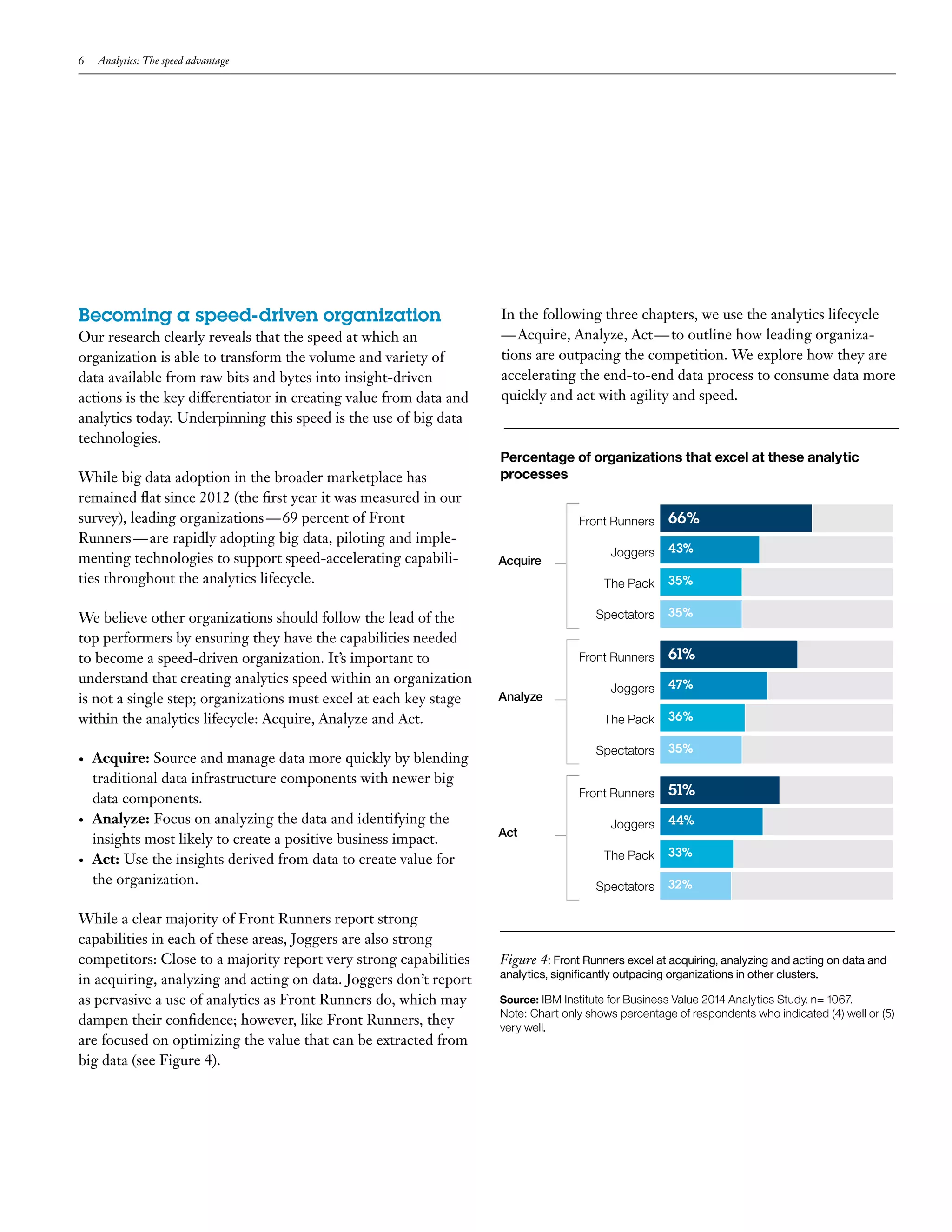
While a clear majority of Front Runners report strong 
capabilities in each of these areas, Joggers are also strong 
competitors: Close to a majority report very strong capabilities 
in acquiring, analyzing and acting on data. Joggers don’t report 
as pervasive a use of analytics as Front Runners do, which may 
dampen their confidence; however, like Front Runners, they 
are focused on optimizing the value that can be extracted from 
big data (see Figure 4). 
In the following three chapters, we use the analytics lifecycle 
— Acquire, Analyze, Act — to outline how leading organiza-tions 
are outpacing the competition. We explore how they are 
accelerating the end-to-end data process to consume data more 
quickly and act with agility and speed. 
Percentage of organizations that excel at these analytic 
processes 
Figure 4: Front Runners excel at acquiring, analyzing and acting on data and 
analytics, significantly outpacing organizations in other clusters. 
Source: IBM Institute for Business Value 2014 Analytics Study. n= 1067. 
Note: Chart only shows percentage of respondents who indicated (4) well or (5) 
very well. 
Front Runners 
Joggers 
The Pack 
Spectators 
66% 
43% 
35% 
35% 
Acquire 
Front Runners 
Joggers 
The Pack 
Spectators 
51% 
44% 
33% 
32% 
Act 
Front Runners 
Joggers 
The Pack 
Spectators 
61% 
47% 
36% 
35% 
Analyze
IBM Global Business Services 7 
Chapter 1: Acquire 
The ability to acquire and integrate data quickly is founda-tional 
to creating a speed advantage. Organizations must be 
able to source and manage data in ways that create flexibility 
and agility in how and when the data is used. We identified 
three capabilities that most differentiate Front Runners in 
terms of their ability to ingest data quickly. Front Runners: 
• Blend traditional data infrastructure components with 
newer big data components 
• Use real-time data processing and analysis to act in the 
moment 
• Implement information governance to accelerate trust, 
integration and standardization within their data 
environments. 
Blend traditional and new components 
Front Runners source and manage data more quickly by 
integrating traditional and big data infrastructure components. 
In the traditional approach, business users determine what 
questions to ask, and their IT departments structure the data 
to answer those questions. This is well suited to many common 
business processes and recurring reports, such as monitoring 
sales by geography, product or channel, and remains a key part 
of a speed-driven data infrastructure. Integrated data ware-house 
developers are indoctrinated to believe the data must be 
pristine, integrated, aggregated, properly documented and 
modeled. This makes sense for a vast majority for reports, 
dashboards and OLAP-based analyses. 
But preparing data for advanced analytics requires very 
different practices: data is seldom made widely available within 
an organization and doesn’t carry the same reuse and publica-tion 
requirement. Rarely does big data initially meet the full 
brace of data cleansing, data quality, metadata and modeling 
associated with a traditional data warehouse. 
In the big data approach, IT delivers a platform that consoli-dates 
all sources of information and enables creative discovery. 
Business users can then utilize that platform to explore data for 
ideas and possibly see brand new solutions to existing problems. 
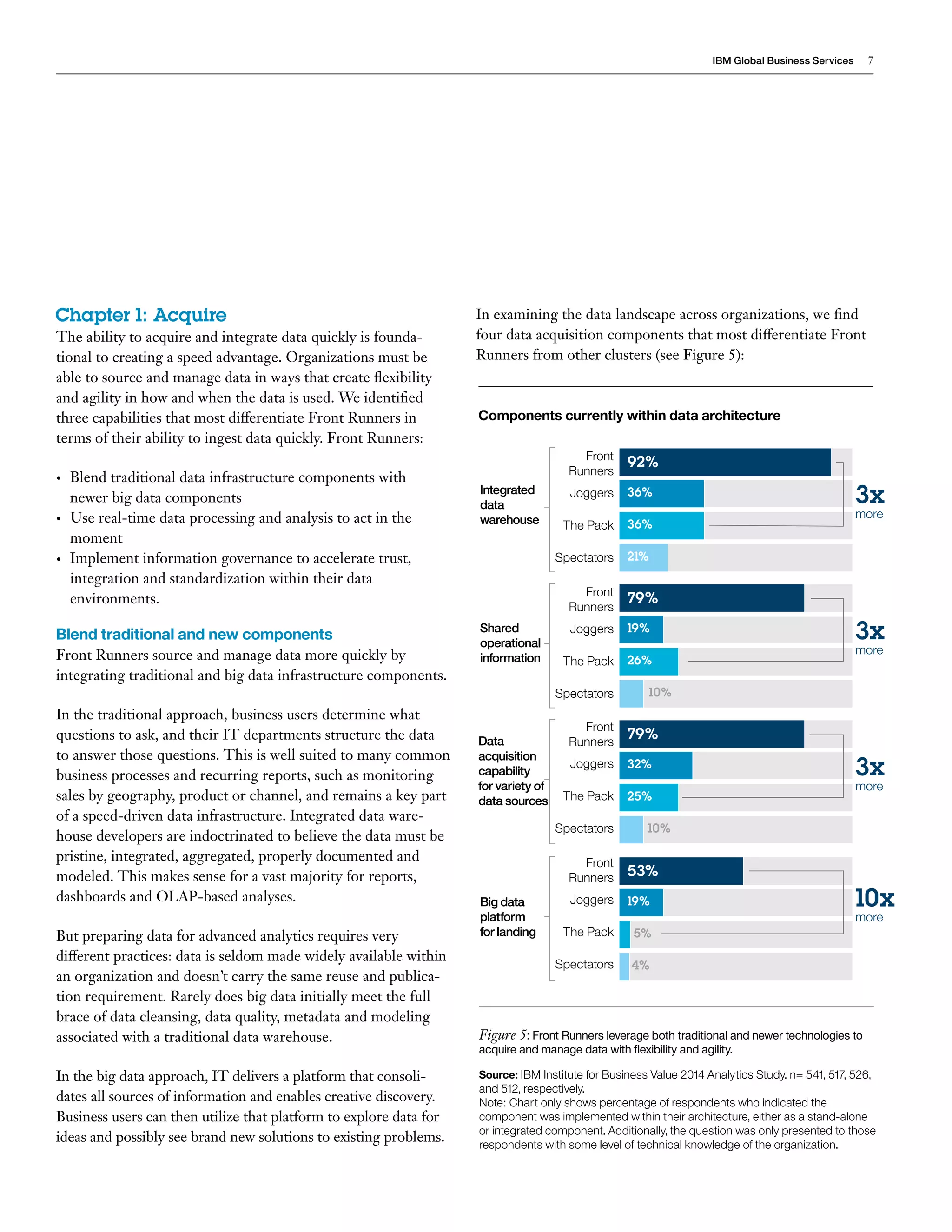
In examining the data landscape across organizations, we find 
four data acquisition components that most differentiate Front 
Runners from other clusters (see Figure 5): 
Components currently within data architecture 
Figure 5: Front Runners leverage both traditional and newer technologies to 
acquire and manage data with flexibility and agility. 
Source: IBM Institute for Business Value 2014 Analytics Study. n= 541, 517, 526, 
and 512, respectively. 
Note: Chart only shows percentage of respondents who indicated the 
component was implemented within their architecture, either as a stand-alone 
or integrated component. Additionally, the question was only presented to those 
respondents with some level of technical knowledge of the organization. 
Front 
Runners 
Joggers 
The Pack 
Spectators 
92% 
36% 
36% 
21% 
Integrated 
data 
warehouse 
Front 
Runners 
Joggers 
The Pack 
Spectators 
79% 
32% 
25% 
10% 
Front 
Runners 
Joggers 
The Pack 
Spectators 
79% 
19% 
26% 
10% 
Front 
Runners 
Joggers 
The Pack 
Spectators 
53% 
19% 
5% 
4% 
Shared 
operational 
information 
Data 
acquisition 
capability 
for variety of 
data sources 
Big data 
platform 
for landing 
3x 
more 
3x 
more 
3x 
more 
10x 
more
8 Analytics: The speed advantage 
• Almost all Front Runners have an integrated data warehouse 
to consolidate and analyze the structured transactional and 
operational data used to run the business. An integrated data 
warehouse is foundational to an organization’s ability to 
effectively leverage data across the enterprise. 
• More than three-quarters of Front Runners use a shared 
operational data store, accelerating their ability to ingest and 
analyze data. 
• More than three-quarters of Front Runners have invested 
in data acquisition capabilities to support sourcing the wide 
assortment of data they are ingesting, which is in varying 
formats, standards, structures and speeds. 
• Front Runners are 10 times more likely than The Pack 
to have a big data landing platform, which expands the 
availability of structured and unstructured data and 
augments more traditional storage structures. 
While we do not see the same level of integration between the 
traditional structures and new components among the Joggers, 
we do see a solid start to the adoption of big data components, 
with one-third implementing data acquisition capabilities and 
one-in-five implementing a big data landing platform. 
Use real-time data processing and analysis 
As business and IT professionals accelerate the demand for 
speed-to-action from insights, consumers are increasingly 
engaging digitally with companies and with one another. It’s 
not surprising then that a majority of organizations refresh 
the data within business functions at least daily. 
But Front Runners are significantly more likely than other 
clusters to be using real-time data processing and analysis, 
which enables them to act in the moment and keep pace with 
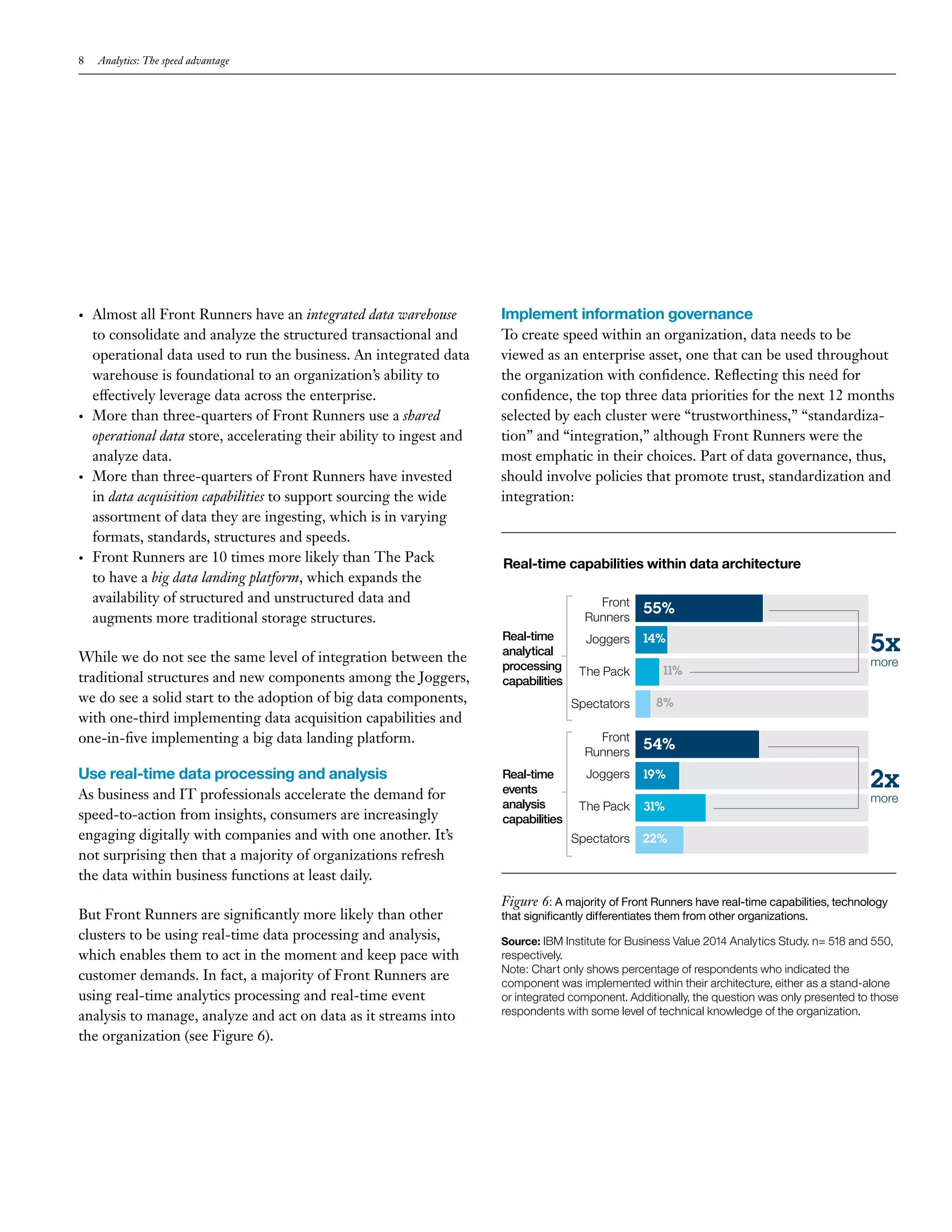
customer demands. In fact, a majority of Front Runners are 
using real-time analytics processing and real-time event 
analysis to manage, analyze and act on data as it streams into 
the organization (see Figure 6). 
Implement information governance 
To create speed within an organization, data needs to be 
viewed as an enterprise asset, one that can be used throughout 
the organization with confidence. Reflecting this need for 
confidence, the top three data priorities for the next 12 months 
selected by each cluster were “trustworthiness,” “standardiza-tion” 
and “integration,” although Front Runners were the 
most emphatic in their choices. Part of data governance, thus, 
should involve policies that promote trust, standardization and 
integration: 
Real-time capabilities within data architecture 
Figure 6: A majority of Front Runners have real-time capabilities, technology 
that significantly differentiates them from other organizations. 
Source: IBM Institute for Business Value 2014 Analytics Study. n= 518 and 550, 
respectively. 
Note: Chart only shows percentage of respondents who indicated the 
component was implemented within their architecture, either as a stand-alone 
or integrated component. Additionally, the question was only presented to those 
respondents with some level of technical knowledge of the organization. 
Front 
Runners 
Joggers 
The Pack 
Spectators 
55% 
14% 
11% 
8% 
Real-time 
analytical 
processing 
capabilities 
Front 
Runners 
Joggers 
The Pack 
Spectators 
54% 
19% 
31% 
22% 
Real-time 
events 
analysis 
capabilities 
5x 
more 
2x 
more
IBM Global Business Services 9 
• The ability to trust data from disparate sources, as well as 
trust between the people who manage and analyze that data, 
is key to business-driven information governance and the 
ability to create value from data.5 
• Standardization enables various facets within an organization 
to speak the same language. 
• Integration is the data foundation for collaboration, and it 
enables an enterprise to work together to achieve its business 
outcomes. 
Another function of information governance is to oversee 
access to data, both to help employees who need data get to it 
and prevent those who don’t need access from getting it. 
Reflecting the challenges of this function, a majority of survey 
respondents still believe they do not have access to the timely 
data they need to perform their job, a statistic that has been flat 
since 2011.6 Forty-one percent of this year’s respondents said 
they only have access to the data they need some of the time, 
and another 17 percent reported they rarely or never have 
access to the data they need. 
An unsettling finding was that all clusters rated data protection 
lowest on the list of data priorities; only 11 percent of respon-dents 
identified it a “top three” priority. Given the prolifera-tion 
of large-scale data breaches in recent years, organizations 
risk the loss of customer and business partner confidence if 
adequate precautions are not taken to safeguard data, as well as 
legal and remediation fees. Moreover, business leaders should 
thoughtfully consider how their organizations use data to 
minimize any potential backlash in perceived privacy infringe-ment. 
Case study: Acquire 
Pharmaceutical distributor invests in data management 
capabilities to support near-real-time analysis 
A pharmaceutical wholesale distributor based in Tokyo strives 
to maintain a reliable, flexible and secure distribution system for 
a wide range of brand-name and specialty drugs. It also seeks 
to minimize distribution costs so that it can offer products at 
competitive prices, maximize its business profitability and 
support domestic drug manufacturers in developing new 
treatments. 
Previously, the company was managing huge volumes of 
historic sales data stored on numerous disparate databases, 
while continuing to accumulate daily sales performance figures 
from more than 5,000 sales representatives. It needed a 
solution that would help it rapidly extract information from its 
vast data treasures and analyze it for use in more accurately 
forecasting demand, appropriately adjusting inventories and 
ultimately increasing sales. It also wanted representatives to 
have quick access to sale reports so they could tailor sales 
strategies to individual customer needs and minimize lost sales 
opportunities. 
The resulting analytics solution allows users to obtain precise, 
near-real-time insight into sales performance and apply the 
information toward generating more sales and keeping 
inventory costs in check. The company can now analyze sales 
trends by variables such as product brands, regions and 
hospitals and quickly share the results with sales 
representatives through easily accessed dashboards. 
The solution significantly reduces the time required to process 
queries on one year of sales data (approximately 70GB) from 
more than 400 minutes to 4.6 seconds. It also allows the 
company to process 20 years’ worth of sales data in 
approximately 5.8 seconds, adding only 1.2 seconds to the 
processing time for one year of data. The company anticipates 
that within its first two years, the solution could help increase 
sales by 9 percent and operating profits by 140 percent.
10 Analytics: The speed advantage 
Contrary to popular belief, governance equals acceleration. 
• Instill governance to improve quality and minimize rework. 
Business-driven information governance often appears to 
make data efforts slower, but without it, data integration 
becomes an even more arduous task. The upside of 
information governance is so powerful — the ability to 
contribute reliable, consistent and quality data to the analysis 
process — that organizations simply can’t ignore it if they 
want to stay competitive. 
• Enable enterprise consistency through a common business language. 
The first step to effective information governance is 
standardizing common definitions, codes and identifiers 
across functions, geographies and systems. The ability to 
quickly integrate data is stalled if data means something 
different to each user group or common tasks use 
inconsistent codes to capture data. 
Chapter 2: Analyze 
Once a solid data foundation is in place to source and manage 
data, organizations striving for speed-to-action need to focus 
on analyzing the data and identifying the insights most likely 
to create a positive business impact. 
To provide meaningful, timely insights, organizations must 
quickly analyze robust datasets. We identified three capabilities 
that differentiate Front Runners in their ability to accelerate 
data analysis. Front Runners: 
• Analyze diverse datasets to create more meaningful insights 
• Use advanced analysis approaches pervasively 
• Harness talent that combines business knowledge and 
analytics. 
Analyze diverse datasets 
Front Runners differentiate themselves by analyzing robust, 
often external, datasets to create business-driven insights that 
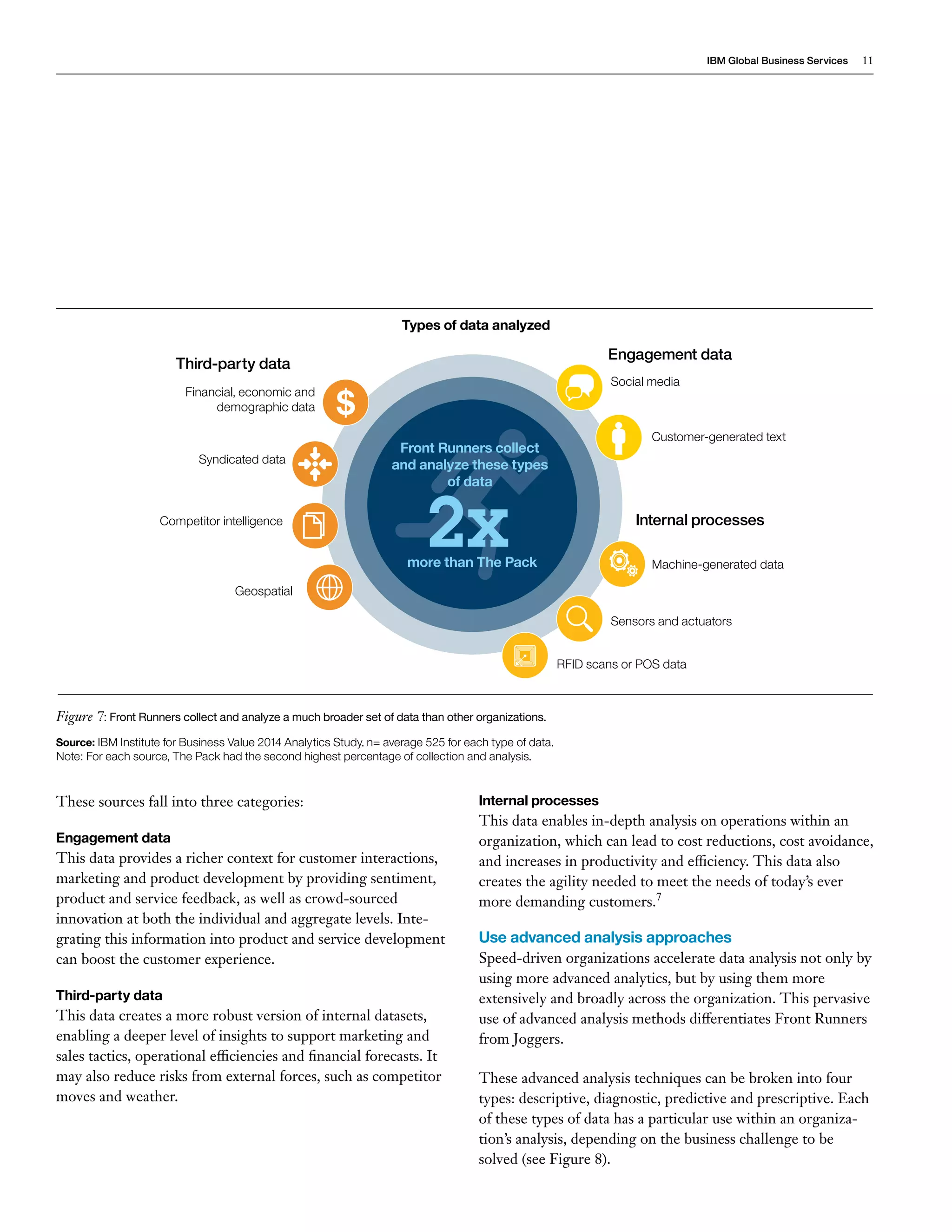
impact organizational performance. We identified nine out of 
18 data sources that Front Runners are twice as likely to 
analyze (see Figure 7). 
Recommendations/practical actions 
To acquire and manage data at the speed necessary to create 
value, organizations need to focus on flexibility and agility. 
Develop solutions that support data diversity. 
• Support a wide variety of data, both in motion and at rest, 
by integrating newer technologies with the traditional data 
infrastructure currently in place. The first step for many 
organizations is to create an enterprise data warehouse, 
the foundation for strong management of structured data. 
Then, extend or augment traditional infrastructure with new 
capabilities, such as a big data platform for landing a variety 
data quickly. Creating two stand-alone systems decreases the 
value of both. 
• Focus on agility rather than conformity by creating landing 
platforms and data lakes to quickly ingest data and stash it 
until it’s needed. Break the habit of immediately trying to 
force everything into the warehouse; instead use the 
structured, unstructured and unformatted data together 
to accelerate speed to action. 
Let data fuel your organization. 
• Provide access to relevant information to empower customer-facing 
employees and inform back-office operations. 
Collecting and analyzing data are fruitless activities if data 
is not delivered in a timely manner to those who most 
benefit from it. 
• Foster rapid data consumption by recognizing that some data 
comes with an extremely short shelf life and must be dealt 
with immediately. For example, a customer’s public 
complaint can quickly compound discontent, while a sensor’s 
alert of a malfunction could quickly turn into an equipment 
failure if not addressed quickly.
IBM Global Business Services 11 
These sources fall into three categories: 
Engagement data 
This data provides a richer context for customer interactions, 
marketing and product development by providing sentiment, 
product and service feedback, as well as crowd-sourced 
innovation at both the individual and aggregate levels. Inte-grating 
this information into product and service development 
can boost the customer experience. 
Third-party data 
This data creates a more robust version of internal datasets, 
enabling a deeper level of insights to support marketing and 
sales tactics, operational efficiencies and financial forecasts. It 
may also reduce risks from external forces, such as competitor 
moves and weather. 
Internal processes 
This data enables in-depth analysis on operations within an 
organization, which can lead to cost reductions, cost avoidance, 
and increases in productivity and efficiency. This data also 
creates the agility needed to meet the needs of today’s ever 
more demanding customers.7 
Use advanced analysis approaches 
Speed-driven organizations accelerate data analysis not only by 
using more advanced analytics, but by using them more 
extensively and broadly across the organization. This pervasive 
use of advanced analysis methods differentiates Front Runners 
from Joggers. 
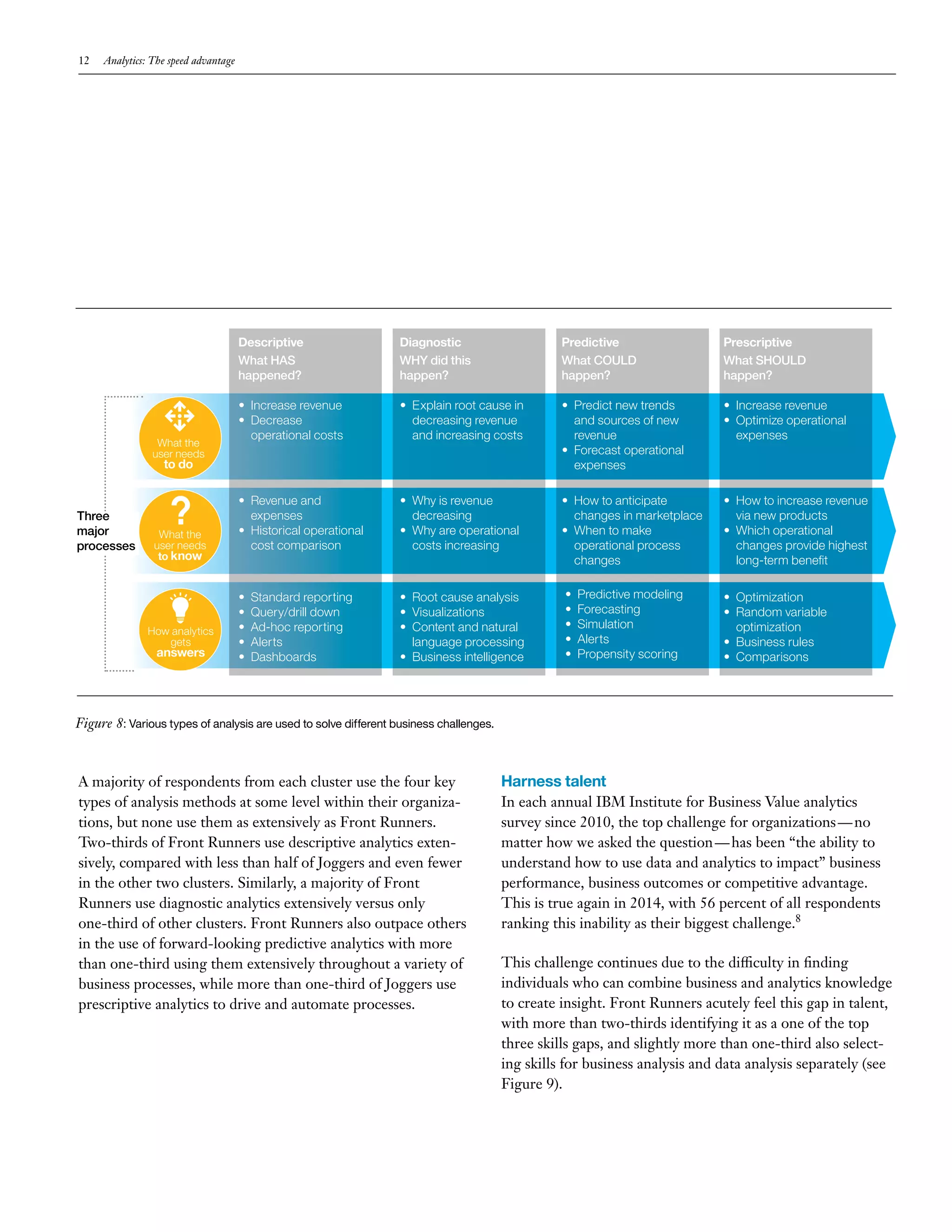
These advanced analysis techniques can be broken into four 
types: descriptive, diagnostic, predictive and prescriptive. Each 
of these types of data has a particular use within an organiza-tion’s 
analysis, depending on the business challenge to be 
solved (see Figure 8). 
Third-party data 
Financial, economic and 
demographic data 
Sensors and actuators 
Machine-generated data 
Engagement data 
Figure 7: Front Runners collect and analyze a much broader set of data than other organizations. 
Source: IBM Institute for Business Value 2014 Analytics Study. n= average 525 for each type of data. 
Note: For each source, The Pack had the second highest percentage of collection and analysis. 
2x more than The Pack 
Syndicated data 
Competitor intelligence 
Geospatial 
RFID scans or POS data 
Social media 
Customer-generated text 
Internal processes 
Types of data analyzed 
Front Runners collect 
and analyze these types 
of data
12 Analytics: The speed advantage 
A majority of respondents from each cluster use the four key 
types of analysis methods at some level within their organiza-tions, 
but none use them as extensively as Front Runners. 
Two-thirds of Front Runners use descriptive analytics exten-sively, 
compared with less than half of Joggers and even fewer 
in the other two clusters. Similarly, a majority of Front 
Runners use diagnostic analytics extensively versus only 
one-third of other clusters. Front Runners also outpace others 
in the use of forward-looking predictive analytics with more 
than one-third using them extensively throughout a variety of 
business processes, while more than one-third of Joggers use 
prescriptive analytics to drive and automate processes. 
Harness talent 
In each annual IBM Institute for Business Value analytics 
survey since 2010, the top challenge for organizations — no 
matter how we asked the question — has been “the ability to 
understand how to use data and analytics to impact” business 
performance, business outcomes or competitive advantage. 
This is true again in 2014, with 56 percent of all respondents 
ranking this inability as their biggest challenge.8 
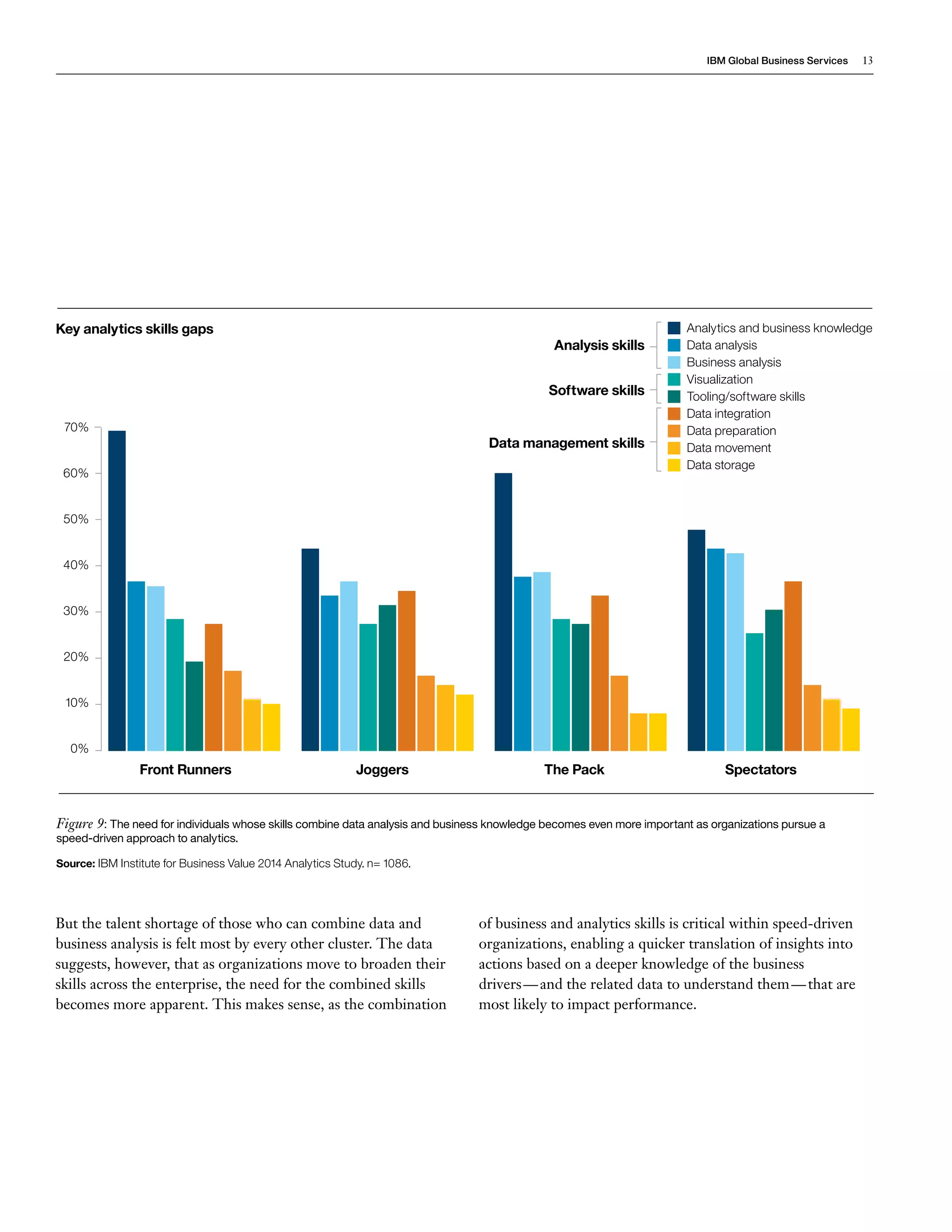
This challenge continues due to the difficulty in finding 
individuals who can combine business and analytics knowledge 
to create insight. Front Runners acutely feel this gap in talent, 
with more than two-thirds identifying it as a one of the top 
three skills gaps, and slightly more than one-third also select-ing 
skills for business analysis and data analysis separately (see 
Figure 9). 
Descriptive 
What HAS 
happened? 
What the 
user needs 
to do 
Three 
major 
processes 
What the 
user needs 
to know 
How analytics 
gets 
answers 
Diagnostic 
WHY did this 
happen? 
Predictive 
What COULD 
happen? 
Prescriptive 
What SHOULD 
happen? 
• Increase revenue 
• Decrease 
operational costs 
• Revenue and 
expenses 
• Historical operational 
cost comparison 
• Standard reporting 
• Query/drill down 
• Ad-hoc reporting 
• Alerts 
• Dashboards 
• Explain root cause in 
decreasing revenue 
and increasing costs 
• Why is revenue 
decreasing 
• Why are operational 
costs increasing 
• Root cause analysis 
• Visualizations 
• Content and natural 
language processing 
• Business intelligence 
• Predict new trends 
and sources of new 
revenue 
• Forecast operational 
expenses 
• How to anticipate 
changes in marketplace 
• When to make 
operational process 
changes 
• Predictive modeling 
• Forecasting 
• Simulation 
• Alerts 
• Propensity scoring 
• Increase revenue 
• Optimize operational 
expenses 
• How to increase revenue 
via new products 
• Which operational 
changes provide highest 
long-term benefit 
• Optimization 
• Random variable 
optimization 
• Business rules 
• Comparisons 
Figure 8: Various types of analysis are used to solve different business challenges.
IBM Global Business Services 13 
But the talent shortage of those who can combine data and 
business analysis is felt most by every other cluster. The data 
suggests, however, that as organizations move to broaden their 
skills across the enterprise, the need for the combined skills 
becomes more apparent. This makes sense, as the combination 
of business and analytics skills is critical within speed-driven 
organizations, enabling a quicker translation of insights into 
actions based on a deeper knowledge of the business 
drivers — and the related data to understand them — that are 
most likely to impact performance. 
70% 
60% 
50% 
40% 
30% 
20% 
10% 
0% 
Front Runners 
Figure 9: The need for individuals whose skills combine data analysis and business knowledge becomes even more important as organizations pursue a 
speed-driven approach to analytics. 
Source: IBM Institute for Business Value 2014 Analytics Study. n= 1086. 
Key analytics skills gaps 
Joggers The Pack Spectators 
Analytics and business knowledge 
Data analysis 
Business analysis 
Visualization 
Tooling/software skills 
Data integration 
Data preparation 
Data movement 
Data storage 
Analysis skills 
Software skills 
Data management skills
14 Analytics: The speed advantage 
Case study: Analyze 
Speeding up hospital approvals to save time and potentially 
lives9 
According to the Institute of Medicine, 30 percent of the trillions 
of dollars spent on healthcare in the United States annually is 
wasted.10 While there are many factors contributing to this 
statistic, one step toward reducing waste is improving the 
utilization management (UM) process, which governs the 
preapproval of healthcare insurance coverage for many 
medical procedures. 
Executives at WellPoint, one of the nation’s leading health 
benefits companies, pinpointed utilization management as a 
way to help providers make healthcare decisions more quickly 
and consistently. Its goals were to accelerate processing of 
physicians’ treatment requests, save members’ time and 
improve efficiencies in the approval process, while continuing 
to base decisions on medical evidence and clinical practice 
guidelines. 
Relying on the cognitive system IBM Watson to provide 
approval suggestions to nursing staff based on clinical and 
patient data, WellPoint now uses hypothesis generation and 
evidence-based learning to generate confidence-scored 
recommendations that help nurses make decisions about 
utilization management. The new system provides responses to 
all requests in seconds, as opposed to 72 hours for urgent pre-authorization 
and three to five days for elective procedures with 
the previous UM process. 
“An extraordinary power of Watson is the ability to quickly 
analyze vast amounts of up-to-date scientific and clinical 
research and patient data, extracting the most relevant and 
personalized information to inform and assist decision making,” 
explains Dr. Sam Nussbaum, WellPoint chief medical officer. 
Recommendations/practical actions 
Organizations striving for speed-to-action should focus on the 
data and insights most likely to create a positive business 
impact. 
Get insights from the outside. 
• Add depth to customer profiles, interactions and operations by 
integrating external data. Knowing basic account details about 
your customers or operations is no longer enough. 
Organizations need to augment this basic data with external 
details. For customers, this may mean adding preferences, 
behaviors, socioeconomic factors and influencers; for 
operations, it may be external financial and economic data or 
internal sensors and actuators. These details provide a depth 
of understanding most organizations today ignore. Being 
among the first to spot new trends in the market or 
preventing operational downtime can facilitate growth, even 
in low-growth markets. 
• Tap into behavior patterns, trends and sentiments using social 
media and customer-generated text. Use these outlets to quickly 
understand customers’ preferences and habits better, and 
identify product and service strengths and weakness. A rapid 
response to product flaws or service disruptions is critical to 
keeping competitors at bay. But social analytics involves 
more than just customer patterns; it also includes data on 
trends and events. For example, analysis of trends relating to 
hospital check-ins and status updates could help more 
quickly identify disease outbreaks or emergency service 
needs in the event of a disaster. 
Make pervasive use of deeper analytics. 
• Make pervasive use of predictive analytics a priority. Gut 
instincts and history alone are poor predictors of the future 
in today’s rapidly changing marketplace. Using analytics to 
spot fraudulent behaviors, forecast outcomes and guide 
actions reduces the likelihood of marketplace missteps, lost 
opportunities and unidentified risks.
IBM Global Business Services 15 
• Use prescriptive analytics to empower the workforce. Few things 
are more frustrating — for both customer and employee 
— than a service representative who either cannot act on a 
request or who offers only generic responses. Empower 
employees by embedding analytics into frontline processes, 
enabling them to act quickly and precisely at each 
opportunity. The same is true for back-office personnel, 
often confronted with a myriad of choices and little guidance 
on the course of action most likely to create value. 
Confront the skills gap; it is not going away. 
• Learn from the best within your organization. Tap into the 
pockets of talent within the organization — those few using 
predictive or prescriptive analytics — to expand the skills of 
others. Create a strong internal professional program to arm 
analysts and executives who already understand the 
organization’s business fundamentals with analytics. Sharing 
resources and knowledge is a cost-effective way to build 
skills and helps limit the need to seek talent elsewhere. 
• Externally supplement skills based on business case. Not all 
organizations need a data scientist full time; the same is true 
for niche analytics skills that may be used only to solve 
specific challenges. Organizations should invest in the talent 
and skills they need to solve the majority of their analytics 
demands, and consider vendors to supplement critical niche 
skills that are hard to find and expensive to employ. 
Chapter 3: Act 
The final step necessary to create the speed-to-action demand-ed 
today is to actually act — and act quickly — on the data. 
While this may sound simple, it is in many ways the hardest 
part about using analytics to create a competitive advantage, 
and one where many organizations stumble. Even the Front 
Runners are less confident about their capabilities here, 
although not as uncertain as other clusters. 
Collecting, managing, storing and analyzing data are valueless 
activities unless an organization is prepared to act on those 
insights. In our 2013 study, “Analytics: A blueprint for value,” 
we identified the nine levers needed for an organization to 
create value; only two of them reference the data management 
or technical capabilities of the organization.11 Successfully 
creating value depends heavily on the culture, people and 
management processes of the organization itself. 
Front Runners understand that once an organization decides 
to act on analytics, the results can be transformative. They 
understand that the insights derived from data can create new 
opportunities to engage with customers and new ways of doing 
business. We find three characteristics that differentiate Front 
Runners most in the ability to act on data insights quickly. 
Front Runners: 
• Integrate digital and process transformations to create 
end-to-end speed that drives business outcomes 
• Embed analytics within business processes to enable precise, 
quick actions 
• Use comprehensive visualization techniques to quickly 
understand and act on large or dynamic datasets.
16 Analytics: The speed advantage 
Integrate digital and process transformations 
While there are numerous case studies of analytics driving 
incremental change within organizations, the speed at which 
Front Runners drive change enables them to realize the 
transformative power of analytics as well. 
Analytic transformations can be divided into two focal areas: 
digital interaction and process re-invention: 
• Digital interaction: Reimagining everything about the way 
people connect, transact and engage with companies, 
institutions and governments — and how they create mutual 
value. 
• Process re-invention: Transforming the organization for 
agility, flexibility and precision to enable new growth. 
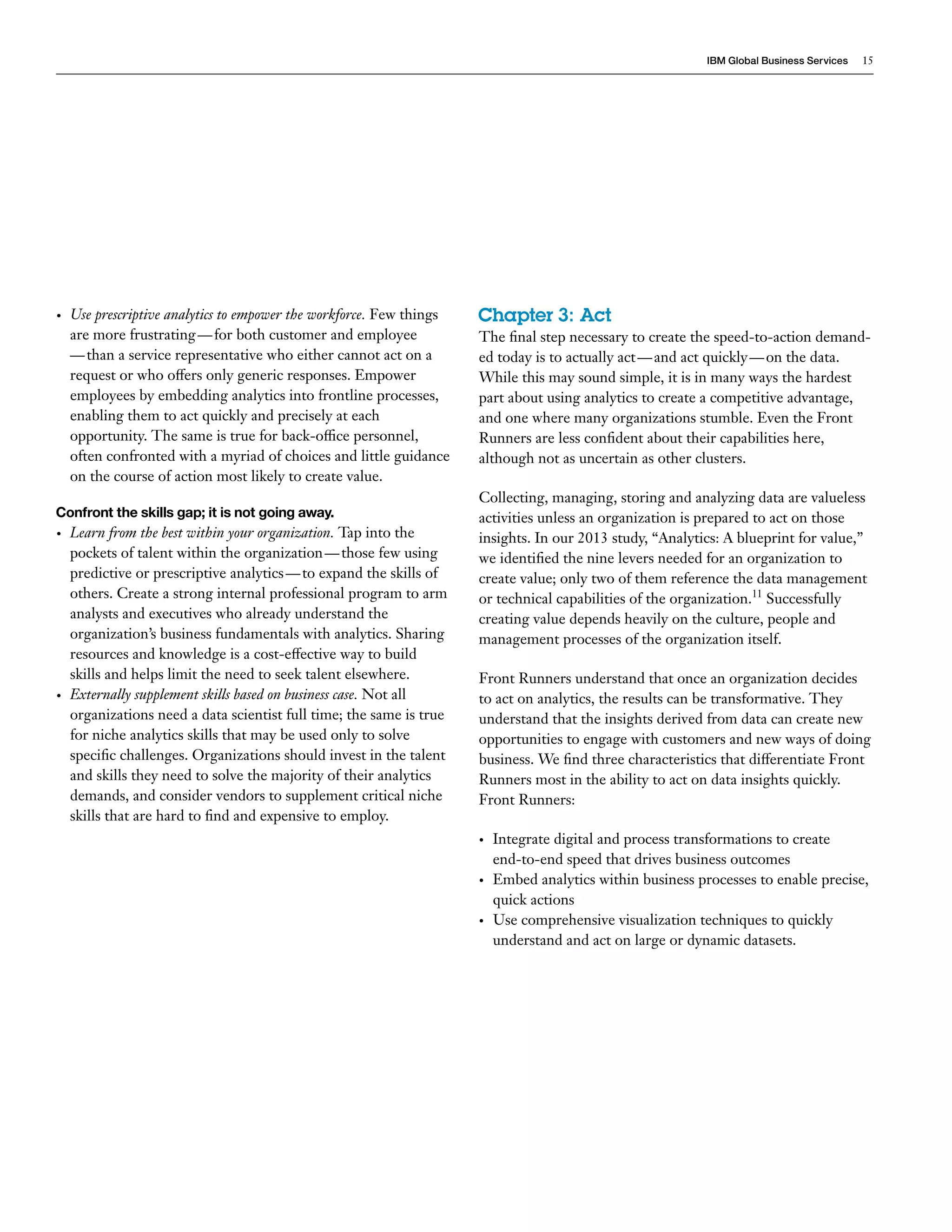
A majority of Front Runners are focused on creating an 
end-to-end transformation, incorporating both digital interac-tions 
and process re-invention, while the majority in the other 
three clusters are more likely to undertake either a digital or a 
process transformation (see Figure 10). 
Key objectives for analytics 
Figure 10: A majority of Front Runners are using data and analytics to create an end-to-end transformation that integrates digital capabilities within business 
processes. 
Source: IBM Institute for Business Value 2014 Analytics Study. 
Front Runners 
Joggers 
The Pack 
Spectators 
51% 
42% 
47% 
44% 
Digital and 
process 
transformation 
Front Runners 
Joggers 
The Pack 
Spectators 
24% 
35% 
33% 
36% 
Process 
transformation 
only 
Front Runners 
Joggers 
The Pack 
Spectators 
25% 
23% 
20% 
20% 
Digital 
transformation 
only 
Digital and process transformation 
“Next best action” algorithms use predictive and prescriptive 
analytics to optimize interactions with customers and prospects 
and empower employees to take action. 
Threat and fraud analytics enable investigators to act quickly by 
using predictive analytics to anticipate threats and to detect 
suspicious behavior, crime or fraud. 
Digital transformation 
Social media sentiment analysis uses real-time and text analysis to 
anticipate customer needs, identify key influencers and manage 
online brand reputation. 
Predictive maintenance optimization analyzes data from sensors 
embedded within machinery to anticipate equipment failure and 
reduce maintenance costs. 
Process transformation 
Business process analysis uses embedded analytics to continu-ously 
monitor, measure, manage and refine the decisions that drive 
organizational operations. 
Financial analysis uses techniques such as variance analysis, 
scenario modeling, and what-if analysis to target the drivers of 
profitability and performance. 
Examples of transformation
IBM Global Business Services 17 
With a digital transformation, organizations are focused on 
ways to better leverage the available data either to grow 
revenues or cut costs, although the majority of digital transfor-mations 
are focused on customer-centric outcomes. Develop-ing 
new social and mobile capabilities to engage both custom-ers 
and employees with “anywhere access” to the organization 
are the focus of many digital transformations today.12 
Data has been an integral part of operations for decades, with 
many organizations investing in ongoing efforts to streamline 
and optimize business processes with traditional analytics. 
Front Runners, however, are collecting and analyzing new 
forms of data and using more advanced analysis methods to 
create new avenues of cost reduction and efficiency within 
business processes. Finance, supply chain and operations are 
among the business processes undergoing transformation from 
the infusion of big data capabilities. 
Separate from the 
process 
Analytics are “nice 
to know,” but do not 
impact the process 
50% 
40% 
30% 
20% 
10% 
0% 
Front Runners 
Joggers 
The Pack 
Spectators 
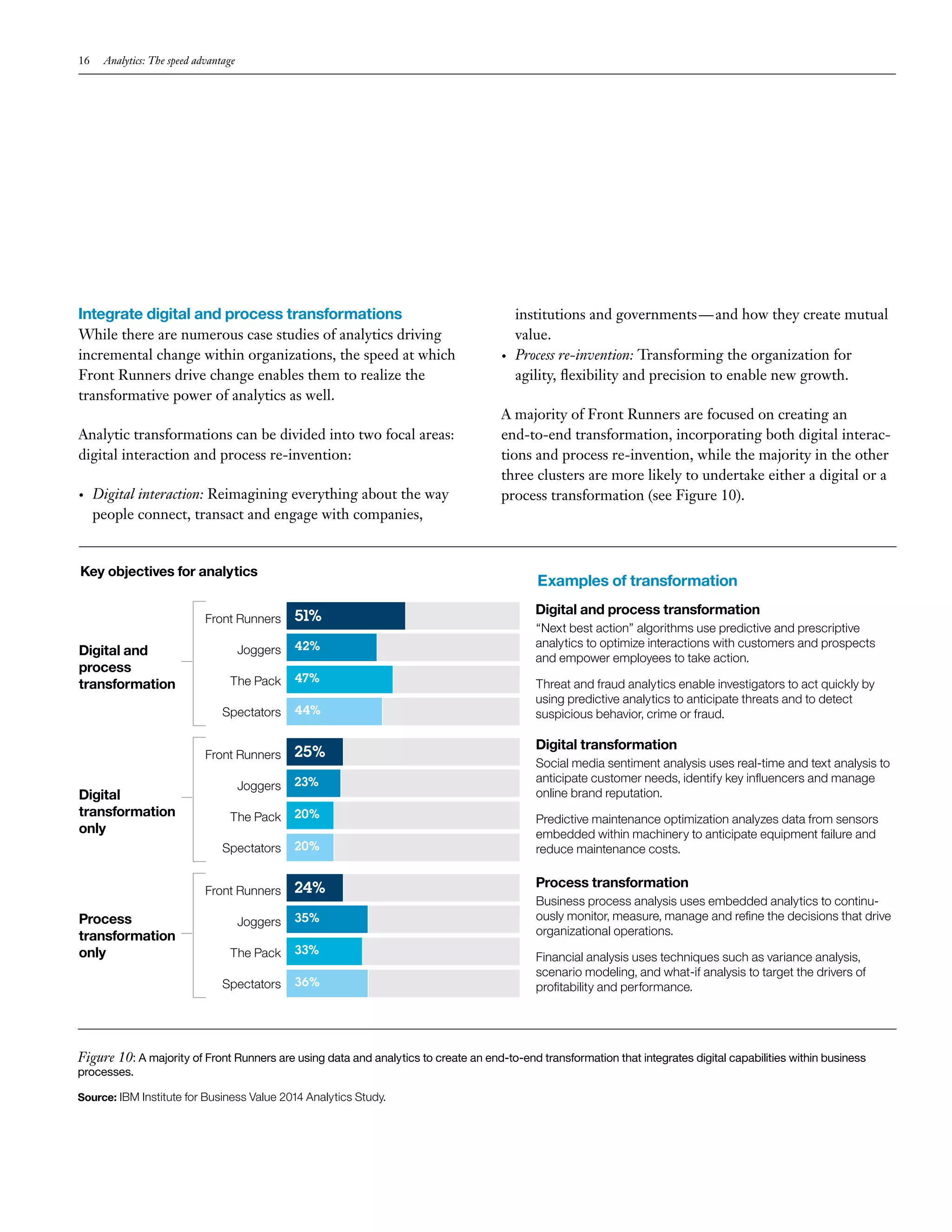
Figure 11: Front Runners and Joggers embed analytics within business processes more than other clusters, creating business processes that can operate with 
speed and precision. 
Source: IBM Institute for Business Value 2014 Analytics Study. n= 1036. 
Level of analytics integration in business processes 
Support the 
process 
Analytics are used to 
validate decisions 
Inform the process 
Analytics are used to 
make decisions 
Drive the process 
Analytics and 
business rules drive 
routine tasks 
Automate the 
process 
Analytics are used to 
make decisions and 
perform tasks 
Level of integration 
In a combined digital and process transformation, organiza-tions 
examine the end-to-end process or experience, and both 
integrate analytics into the business process and streamline 
operations simultaneously. For example, we see complex 
algorithms helping guide customer service interactions to make 
them more mutually beneficial, the result of structured and 
unstructured data analyzed offline and then integrated into 
context-aware front-end dashboards to create personalized 
marketing and service solutions. 
Embed analytics within business processes 
One of the key components of both a digital and process 
transformation is integrating analytics into the targeted 
business processes. While not all business processes require the 
same level of integration, Front Runners and the process-minded 
Joggers recognize the speed advantage of using 
analytics to automate, drive or inform key business processes 
within their organizations (see Figure 11).
18 Analytics: The speed advantage 
For Front Runners, the use of analytics to inform back-office 
business processes like finance is sufficient. But for customer-facing 
processes like call centers or online interactions and 
operational processes like manufacturing, Front Runners also 
recognize the benefits of using algorithms and predictive 
models actions to optimize and drive the process. 
A majority of Joggers, who hail from more process-centric 
industries and cultures, embed analytics directly within 
business processes to enable precise, efficient actions. These 
organizations use business rules to direct processes and more 
prescriptive algorithms, machine learning and artificial 
intelligence to automate them. 
Use comprehensive visualization techniques 
In addition to embedding analytics into business processes, 
Front Runners and Joggers share another characteristic that 
helps them quickly act on insights: visualization. Front 
Runners use advanced visualization techniques to quickly 
comprehend and act on large or dynamic datasets, while 
Joggers use animation to visualize operational processes. 
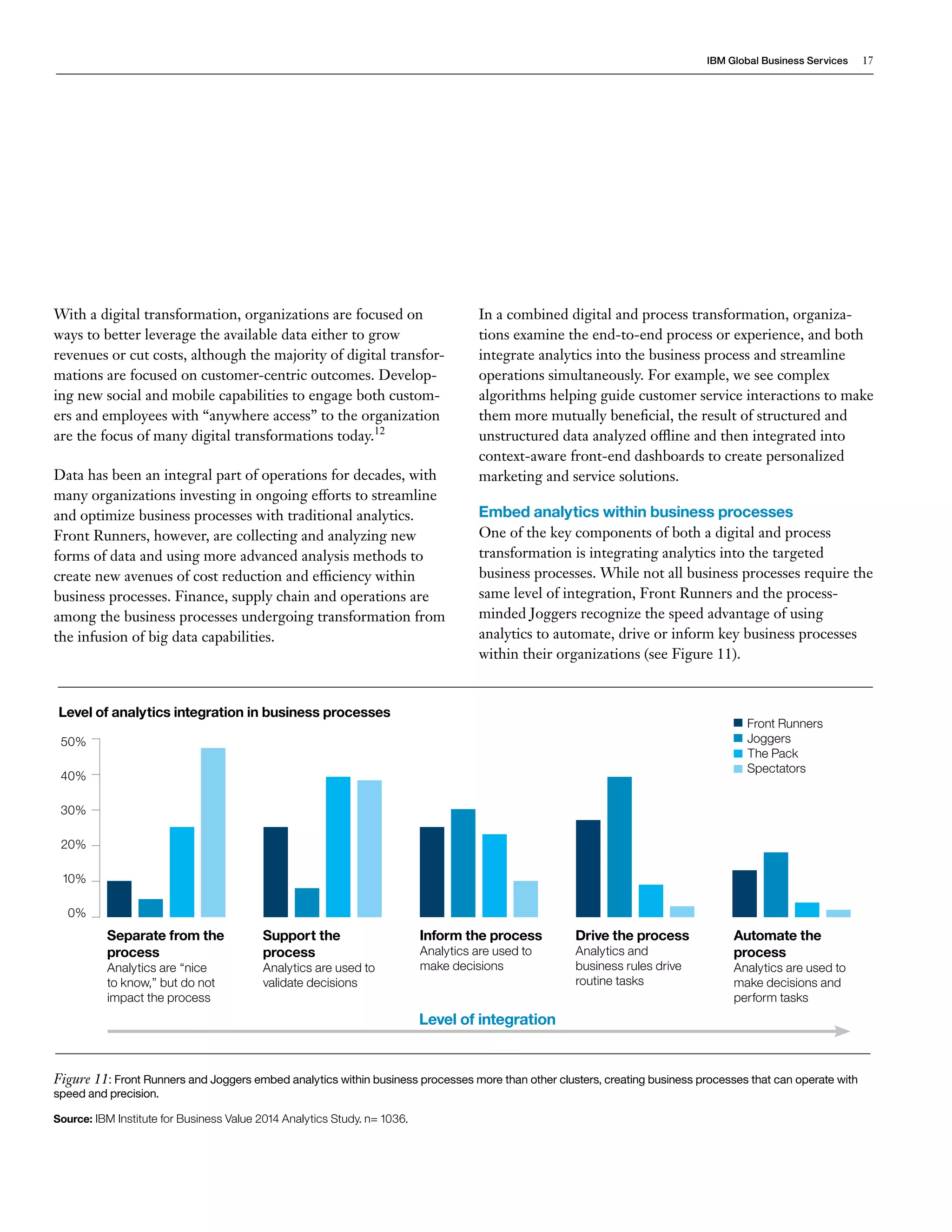
Analytics can help reduce the size and complexity of big data to 
a point where it can be effectively visualized and understood. 
In the best scenario, the visualization and analytics are inte-grated 
into an emerging field known as “visual analytics,” 
wherein visualization not only supports interpretation of data 
but is used to analyze it. We see this in the Front Runners’ use 
of techniques such as visual data mining and exploratory visual 
analytics (see Figure 12). 
Visual data mining 
Multi-dimensional 
navigation 
Dynamic 
visualization 
Animation 
Visual exploratory 
analysis 
Proactive alerts from 
cockpit gauges 
Front Runners 
Joggers 
The Pack 
Spectators 
Figure 12: Front Runners are using advanced visualization techniques to enable quicker decision making and action. 
Source: IBM Institute for Business Value 2014 Analytics Study. n= 620. 
Total respondent mean 
below the mean above the mean 
Use of advanced visualization techniques
IBM Global Business Services 19 
Recommendations/practical actions 
Organizations seeking to create value from information need 
to pervasively use data insights to positively influence 
outcomes. 
Create end-to-end speed by integrating digital and process 
outcomes. 
• Embrace digital interactions as a way of business. Customers 
and suppliers are rapidly adopting a digital lifestyle, raising 
the expectation that the companies and organization they 
interact with are also onboard. Ignoring global digitization 
not only reduces speed-to-action, but alienates those looking 
for convenience, simplicity and consistency in today’s overly 
complex world. 
• Infuse digital capabilities into business processes that still rely on 
twentieth-century technologies and philosophies. Digital 
technologies can be used to streamline and modernize even 
the most fundamental business process. For example, claims 
inspectors can spend their time more effectively investigating 
suspicious claims as opposed to randomly selected ones by 
running fraud algorithms prior to the start of the process. 
Reducing manual processes and automating routine tasks 
create an environment where employees can focus on 
creating value rather than managing the routine. Amplify 
analysis activities by visualizing critical data to enable 
employees to digest it more quickly, thereby identifying 
value-driving actions faster. 
Make analytics consumable for employees and executives. 
• Create a mobile strategy that outlines the key business and IT 
requirements for enabling near-term and future-state mobile 
needs. This strategy should define the recommended mobile 
architecture, as well as the recommended mobile application 
development, testing, deployment, and support approach. 
Another critical component of the strategy is a mobile 
governance model that defines common mobile application 
principles, policies and guidelines with particular focus on 
enterprise mobile security and privacy concerns. 
Case study: Act 
B2B distributor uses dashboard to act on data insights13 
A business-to-business distributor of electrical industrial 
supplies, Rexel UK Ltd. has adopted a new strategy known as 
“Energy in Motion,” which aims to put the customer at the 
center of its operations and create greater value for all 
stakeholders: customers, suppliers, employees and investors. 
To support this strategy by providing decision makers with 
deep, accurate and timely operational insight, the company 
needed to transform its approach to business analytics. 
Rexel rebuilt its business intelligence platform from the ground 
up, developing an agile environment that is closely aligned with 
user needs. Previously, many employees were overwhelmed by 
the sheer volume of reports on the system and didn’t have time 
to utilize all the information. Rexel transformed its reporting 
processes, trimming the number of reports by 90 percent 
though the use of techniques such as dashboards. Decision 
makers can now access highly meaningful, on-time information 
in a format that is easy to understand. 
“Now it’s quick and easy for users to drill down to the relevant 
areas and get the information they need. Instead of spending 
hours in front of a screen, they’re in and out in minutes, and 
spending more time doing what they’re paid to, which is selling 
products and interacting with customers on the shop floor,” 
says Simon Short, Head of Business Intelligence for Rexel. 
“We are in business intelligence heaven right now,” he said. “It 
has taken a lot of time and effort to get to where we are today, 
but it’s important to recognize that business intelligence isn’t 
just a one-off project, it’s a journey. We will continue to fine-tune 
and develop our environment so that Rexel can extract even 
better value out of business intelligence in the years to come.”
20 Analytics: The speed advantage 
• Empower employees to access insights anywhere. Not all 
employees work in a cubicle with routine hours, so enable 
the entire workforce to access the analytics they need to 
make decisions and take actions regardless of where the work 
is performed. Tap into new ways of socially enabled working 
to help fine tune the performance of the operating model. 
Match insight delivery to insight demand. 
• Align the speed of insights to the business objective. 
Understanding the difference between business objectives 
that need to be solved with a real-time solution and those 
that do not is critical; misalignments can be costly. 
• Embrace new ideas based on less-than-perfect business cases. 
Part of staying ahead of the competition is doing uncommon 
— sometimes risky — things. These innovative ideas rarely 
carry the same level of certainty or proven track records 
required by more traditional business case evaluation 
processes. But it’s often bold, swift moves that generate the 
greatest value, especially now that the majority of 
organizations realize a return on their investments in less 
than a year. Organizations must become more comfortable 
accepting less-than-perfect or riskier actions to realize the 
market-first rewards that come with them. 
Conclusion 
Analytics provide the fuel for an organization to make better 
decisions faster. In the realm of big data, the “winners” are 
those that manage the data deluge and turn it into value-gener-ating 
insights ahead of the competition. These organizations 
are dedicated to the speed advantage, a competitive strategy 
that enables the rapid acquisition and analysis of data to create 
agile, precise moves in the marketplace. 
Creating a speed advantage does not necessarily require a 
real-time solution, but it does require streamlining decisions 
made within business processes. It also requires enabling the 
organization to extract the most from its data assets to deliver 
outcomes that matter. 
Organizations that successfully achieve the speed advantage can 
transform data from something to be managed into a strategic 
tool that fuels digital interactions and re-invents business 
processes for the modern world. These organizations will 
differentiate themselves based on their ability to adapt, survive 
and thrive as the pace of society continues to accelerate. 
To learn more about this IBM Institute for Business Value 
study, please contact us at iibv@us.ibm.com. Follow @IBMIBV 
on Twitter, and for a full catalog of our research or to subscribe 
to our monthly newsletter, visit: ibm.com/iibv 
Access IBM Institute for Business Value executive reports on 
your tablet by downloading the free “IBM IBV” app for iPad 
or Android from your app store.
IBM Global Business Services 21 
Authors 
Glenn Finch is the Global Leader for Big Data & Analytics in 
the Business Analytics and Strategy Practice. Glenn’s emphasis 
on business analytics and optimization is focused on the most 
challenging and transformative engagements IBM undertakes. 
Those engagements have leveraged broader customer centric-ity 
and customer experience work across the customer acquisi-tion, 
customer management and servicing processes. He has 
over 25 years of experience advising global clients on how to 
achieve greater business value from their analytic environ-ments, 
as well as reduce the ongoing cost of running those 
environments, through large-scale transformation. He can be 
reached at glenn.f.finch@us.ibm.com. 
Steven Davidson leads the IBM Business Analytics and 
Strategy consulting practice for the Greater China Group 
(GCG). He heads some of IBM’s most important transforma-tion 
work with clients in Greater China and is leading the IBM 
Digital Front Office, Globally Integrated Enterprise and Big 
Data & Analytics teams in China. Steven has over 25 years of 
management and consulting experience working with top-level 
teams across multiple sectors including banking, insurance, 
logistics, CPG and retail, media and publishing, on-line 
business services, electronics, transportation, utilities, real 
estate and land administration, whole of government reform, 
healthcare and environmental protection. Steven can be 
reached at steven.davidson@hk1.ibm.com. 
Christian Kirschniak is the European Leader for Big Data & 
Analytics in IBM’s European Global Business Services. He is a 
great believer in the power of data and analytics and works 
with clients to establish information driven enterprise transfor-mations 
by applying his experience and a pragmatic attitude. 
Christian can be reached at kirschniak@de.ibm.com. 
Marcio Weikersheimer is the Big Data & Analytics compe-tency 
leader for IBM GBS Brazil, where he help clients from 
different industries get the best value from their data, defining 
strategies and leading implementation of analytics solutions. 
Marcio can be contacted at mweiker@br.ibm.com. 
Cathy Rodenbeck Reese is the Big Data & Analytics Global 
Business Advisor for IBM Global Business Services, where she 
focuses on helping clients gain greater precision and predict-ability 
out of every business decision they make. Cathy can be 
reached at croden@us.ibm.com. 
Rebecca Shockley is the Business Analytics Global Research 
Leader for the IBM Institute for Business Value, where she 
conducts fact-based research on the topic of business analytics to 
develop thought leadership for senior executives. Rebecca can be 
contacted at rshock@us.ibm.com. 
Contributors 
Stephan Bloehdorn, John Hagerty, Pierre Haren, Stephen 
Harvey, Michael Haydock, Richard Perret, Michael Schroeck, 
Ronald Shelby, Bruce Tyler. 
Acknowledgments 
Stephen Ballou, Kathy Cloyd, Thomas Fisher, Bill Fuessler, 
Peter Korsten, Eric Lesser, David Lubowe, Kathleen Martin, 
Hebatallah Nashaat, Julia Scanio, Richard Wilson, Tim Wood.
22 Analytics: The speed advantage 
References 
1 Balboni, Fred, Glenn Finch, Cathy Rodenbeck Reese and 
Rebecca Shockley. “Analytics: A blueprint for value, 
Converting big data and analytics insights into results.” 
IBM Institute for Business Value. October 2013. 
2 Ibid. 
3 Schroeck, Michael, Rebecca Shockley, Dr. Janet Smart, 
Professor Dolores Romero-Morales and Professor Peter 
Tufano. “Analytics: The real-world use of big data. How 
innovative organizations are extracting value from uncer-tain 
data.” IBM Institute for Business Value in collabora-tion 
with the Saïd Business School, University of Oxford. 
October 2012. 
4 Balboni, Fred, Glenn Finch, Cathy Rodenbeck Reese and 
Rebecca Shockley. “Analytics: A blueprint for value, 
Converting big data and analytics insights into results.” 
IBM Institute for Business Value. October 2013. 
5 Ibid. 
6 Balboni, Fred, Glenn Finch, Cathy Rodenbeck Reese and 
Rebecca Shockley. “Analytics: A blueprint for value, 
Converting big data and analytics insights into results.” 
IBM Institute for Business Value. October 2013; Schroeck, 
Michael, Rebecca Shockley, Dr. Janet Smart, Professor 
Dolores Romero-Morales and Professor Peter Tufano. 
“Analytics: The real-world use of big data. How innovative 
organizations are extracting value from uncertain data.” 
IBM Institute for Business Value in collaboration with the 
Saïd Business School, University of Oxford. October 2012; 
Kiron, David, Rebecca Shockley, Nina Kruschwitz, Glenn 
Finch and Dr. Michael Haydock. “Analytics: The widen-ing 
divide — How companies are achieving competitive 
advantage through analytics.” IBM Institute for Business 
Value in collaboration with MIT Sloan Management Review. 
October 2011. 
7 Baird, Carolyn Heller and Gautam Parasnis. “From social 
media to Social CRM: What customers want.” IBM 
Institute for Business Value. February 2011. http:// 
www-935.ibm.com/services/us/gbs/thoughtleadership/ 
ibv-social-crm-whitepaper.html 
8 Balboni, Fred, Glenn Finch, Cathy Rodenbeck Reese and 
Rebecca Shockley. “Analytics: A blueprint for value, 
Converting big data and analytics insights into results.” 
IBM Institute for Business Value. October 2013; Schroeck, 
Michael, Rebecca Shockley, Dr. Janet Smart, Professor 
Dolores Romero-Morales and Professor Peter Tufano. 
“Analytics: The real-world use of big data. How innovative 
organizations are extracting value from uncertain data.” 
IBM Institute for Business Value in collaboration with the 
Saïd Business School, University of Oxford. October 2012; 
Kiron, David, Rebecca Shockley, Nina Kruschwitz, Glenn 
Finch and Dr. Michael Haydock. “Analytics: The widen-ing 
divide - How companies are achieving competitive 
advantage through analytics.” MIT SloanManagement 
Review and IBM Institute for Business Value knowledge 
partnership. October 2011; Lavalle, Steve, et al. “Analyt-ics: 
The new path to value.” MIT Sloan Management 
Review and IBM Institute for Business Value knowledge 
partnership. October 2010. 
9 “IBM Watson Hard At Work: New Breakthroughs 
Transform Quality Care for Patients,” IBM press release. 
February 8, 2013. http://www-03.ibm.com/press/us/en/ 
pressrelease/40335.wss; “WellPoint, Inc., IBM Watson 
platform enables more effective healthcare preapproval 
decisions using evidence-based learning.” IBM Case Study. 
June 2014. http://www.ibm.com/smarterplanet/us/en/ 
ibmwatson/assets/pdfs/WellPoint_Case_Study_ 
IMC14792.pdf
IBM Global Business Services 23 
10 “Transformation of Health System Needed to Improve 
Care and Reduce Costs.” Institute for Medicine of the 
National Academies press release. September 6, 2012. 
http://www.iom.edu/Reports/2012/Best-Care-at-Lower- 
Cost-The-Path-to-Continuously-Learning-Health-Care-in- 
America/Press-Release.aspx 
11 Balboni, Fred; Glenn Finch; Cathy Rodenbeck Reese; and 
Rebecca Shockley. “Analytics: A blueprint for value, 
Converting big data and analytics insights into results.” 
IBM Institute for Business Value. October 2013. http:// 
www-935.ibm.com/services/us/gbs/thoughtleadership/ 
ninelevers/ 
12 Based on extensive review of IBM case studies and other 
external research. 
13 “Rexel UK puts business intelligence in motion.” IBM case 
study. 2013. http://www-01.ibm.com/common/ssi/cgi-bin/ 
ssialias?htmlfid=YTC03618GBEN&appname=wwwsear 
ch
© Copyright IBM Corporation 2014 
IBM Corporation 
Route 100 
Somers, NY 10589 
Produced in the United States of America 
October 2014 
IBM, the IBM logo and ibm.com are trademarks of International Business Machines Corp., registered in many jurisdictions worldwide. Other product and service names might be trademarks of IBM or other companies. A current list of IBM trademarks is available on the Web at “Copyright and trademark information” at www.ibm.com/legal/copytrade.shtml. 
This document is current as of the initial date of publication and may be changed by IBM at any time. Not all offerings are available in every country in which IBM operates. 
THE INFORMATION IN THIS DOCUMENT IS PROVIDED 
“AS IS” WITHOUT ANY WARRANTY, EXPRESS OR IMPLIED, INCLUDING WITHOUT ANY WARRANTIES OF MERCHANTABILITY, FITNESS FOR A PARTICULAR PURPOSE AND ANY WARRANTY OR CONDITION OF NON-INFRINGEMENT. IBM products are warranted according to the terms and conditions of the agreements under which they are provided. 
This report is intended for general guidance only. It is not intended to be a substitute for detailed research or the exercise of professional judgment. IBM shall not be responsible for any loss whatsoever sustained by any organization or person who relies on this publication. 
The data used in this report may be derived from third-party sources and IBM does not independently verify, validate or audit such data. The results from the use of such data are provided on an “as is” basis and IBM makes no representations or warranties, express or implied. 
Please Recycle 
GBE03624-USEN-00

Analytics - The speed advantage

  • 1.
    Executive Report IBMGlobal Business Services Strategy and Analytics IBM Institute for Business Value Analytics: The speed advantage Why data-driven organizations are winning the race in today’s marketplace
  • 2.
    IBM Strategy &Analytics The IBM Strategy and Analytics practice integrates management consulting expertise with the science of analytics to enable leading organizations to succeed. IBM is helping clients realize the full potential of big data and analytics by providing them with the expertise, solutions and capabilities needed to infuse intelligence into virtually every business decision and process; empower more-immediate and certain action by capitalizing on the many forms of data and insights that exist; and develop a culture of trust and confidence through a proactive approach to security, governance and compliance. For more information about IBM Strategy & Analytics offerings from IBM, visit ibm.com/services/us/gbs/strategy
  • 3.
    IBM Global BusinessServices 1 Introduction Capabilities that enable an organization to consume data faster — to move from raw data to insight-driven actions — are now the key differentiator to creating value through analytics. In addition to this focus on speed, our latest analytics research reveals several significant evolu-tions in the era of big data. Based on survey responses of more than 1,000 business and IT executives from more than 60 countries, our 2014 analytics research revealed four transformative shifts affecting the fast-paced digital marketplace: 1. A solid majority of organizations are now realizing a return on their big data investments within a year. 2. Customer centricity still dominates analytics activities, but organizations are increasingly solving operational challenges using big data. 3. Integrating digital capabilities into business processes is transforming organizations. 4. The value driver for big data has shifted from volume to velocity. By Glenn Finch, Steven Davidson, Christian Kirschniak, Marcio Weikersheimer, Cathy Reese and Rebecca Shockley In 2014, several important shifts occurred in the world of big data — shifts that business executives around the globe cannot afford to ignore. The most significant shift is that velocity is now the competitive differentiator for big data. Our sixth annual analytics study reveals a group of organizations differentiating themselves with speed-driven data and analytics practices that significantly impact business performance and competitive position. To compete in today’s digitally infused marketplace, other organizations need to emulate these outperformers by acquiring, analyzing and acting on data with a focus on speed to action. 63% of organizations realize a positive return on analytic investments within a year. 69% of speed-driven analytics organizations created a significant positive impact on business outcomes. 74% of respondents anticipate the speed at which executives expect new data-driven insights will continue to accelerate.
  • 4.
    2 Analytics: Thespeed advantage Shift 1: A solid majority of organizations are now realizing a return on their big data investments within a year. Most organizations (63 percent) realize a positive return on their analytic investments within one year, and more than one-in-four respondents (26 percent) realize a positive return within six months. This marks the start of a trend toward positive returns, with a 10 percent year-to-year uptick over the 57 percent that reported a return within a year in 2013.1 Moreover, 49 percent of organizations that have implemented one or more big data technologies reported that returns met or exceeded their expected returns; another 45 percent of implementations were under evaluation. Only 6 percent reported that returns failed to meet expectations. Shift 2: Customer centricity still dominates analytics activities, but organizations are increasingly targeting operational challenges. While customer-centric objectives are still the primary focus for a majority of organizations, more are starting to integrate big data technologies into back-office and operational process-es. In more than half of all organizations, business executives are demanding data insights primarily to create stronger relationships with customers: 31 percent are working to improve customer acquisition through the use of data and analytics, while the other 22 percent are targeting improve-ments in customer experience (see Figure 1). But it’s not all about the customer. Two out of five organiza-tions — 40 percent — are focusing data and analytics on operational objectives, a significant increase from 2013 when only 25 percent of organizations were focused on operations.2 In the past year, as executives have seen front-office analytics deliver powerful results, they have started to apply these new technologies to manage operational costs even more tightly. One surprise was the low level of focus on financial and risk management objectives. Given the increased levels of data management required by CFOs, as well as the broad applica-bility of anti-fraud efforts, we expect analytics use in this area to increase in the coming year. Shift 3 Integrating digital capabilities into business processes is transforming organizations. A near majority of organizations (46 percent) are re-inventing business processes by integrating digital capabilities. By transforming processes, these organizations are creating the agility, flexibility and precision that enable new growth. And they are using digital capabilities — like social and mobile technologies — to change the way people connect, transact and engage with companies, institutions and governments, as well as how they create mutual value (see Figure 2). In a digital transformation, organizations are focused on ways to better leverage the available data to either to grow revenues or cut costs, although the majority of digital transformations are focused on customer-centric outcomes. Meanwhile, new forms of data and advanced analysis methods have opened up new avenues of cost reduction and agility within business processes. are using data and analytics to improve customer acquisition are using data and analytics to improve customer experience Organizational objectives for use of data and analytics Figure 1: Respondents are primarily focused on customer-centric objectives for the use of data and analytics, but the focus on operational objectives has seen a significant uptick since 2013. Source: IBM Institute for Business Value 2014 Analytics Study. n= 1036. 31% 53% Customer-centric 22% Operational efficiency Financial/risk management 7% 40%
  • 5.
    IBM Global BusinessServices 3 In a combined digital and process transformation, organiza-tions examine the end-to-end process or experience and both integrate analytics into the business process and streamline its operations simultaneously. Shift 4: The value driver for big data has shifted from volume to velocity. Big data’s initial impact on organizations came in 2012 as the deluge of data crossed its tipping point. Organizations initially aimed big data investments at managing the often overwhelm-ing amount and types of data suddenly available. In our 2012 analytics study, “Analytics: The real-world use of big data,” we identified the characteristic that differentiates organizations the most as a scalable and extensible infrastructure.3 But just managing the volume and variety of data is no longer enough to outperform competitors. Now we find the components that differentiate organizations most are those capable of creating an agile and flexible infrastructure, one designed to manage data efficiently and move it through the analytics process quickly. Organizations using big data technologies broadly throughout their business functions —capabilities that enable business functions to consume the data rather than just absorb it —are creating the greatest impacts on business performance. And business executives are starting to take notice. In fact, we discovered that executives in India, North America and South America have been demanding delivery of action-oriented data-driven insights at an accelerating pace during the past 12 months, with the most significant acceleration in areas outside the United States. This upsurge is just the beginning. Respondents from almost of all the 67 countries represented in our survey anticipate the demand for data-driven insights will accelerate in the next 12–18 months, with most expecting a significant increase in the pace of demand. Even the Nordics, the area along with Japan that reported a slower pace in the past 12 months, are expect-ing a significant increase in executive appetite for insights in the coming 18 months. The need for speed Given this shift toward speed, we sought to identify the organizations most capable of delivering and consuming insights quickly based on their survey responses. To effectively meet accelerating demands, organizations need capabilities that enable speed to action and minimize the lag time between raw data and insight-driven actions. This requires both a pervasive adoption of analytics throughout the organiza-tion and the technical capabilities to quickly act on insights. • Pervasiveness of analytics –– Broader usage of analytics generates an enterprise-wide ability to act with speed and precision ––Data diversity enables organizations to create more robust and meaningful insights, increasing the likelihood of greater business impact • Technical capabilities to support analytics –– Speed-driven organizations must be able to manage the volume, variety and velocity of the data available –– Agility and flexibility within the data architecture is a key speed-enabling characteristic Strengthening both of these capabilities is a cultural acceptance of the use of analytics, which requires executive support, leadership and funding.4 Focus on analytic transformation Figure 2: A near majority of respondents are integrating digital capabilities into business processes to create an end-to-end transformation. Source: IBM Institute for Business Value 2014 Analytics Study. n= 1036. Digital and process transformation Digital only transformation Process only transformation 46% 22% 32%
  • 6.
    4 Analytics: Thespeed advantage Four clusters of capabilities Through organic clustering based on 31 data points reflecting analytics capabilities, we identified four distinct groups of organizations: Front Runners, Joggers, The Pack and Specta-tors (see sidebar, “About the research”). • Front Runners, representing 10 percent of respondents, are data-driven organizations using analytics to drive business processes within most business functions. • Joggers, representing 14 percent of respondents, primarily use analytics to automate and optimize operations, but do not use analytics pervasively. • The Pack, representing 45 percent of respondents, are analytically minded organizations using analytics to drive or inform some business processes within multiple business functions. • Spectators, representing 31 percent of respondents, use only the bare minimum of analytics within business processes, yet have aspirations — often unrealistic — to increase their analytic capabilities in the near future. About the research The IBM Institute for Business Value’s 2014 analytics survey was a comprehensive look at the use of data and analytics by companies, governments and other organizations around the globe. We surveyed more than 1,000 business and IT executives from 67 countries (see figures in this sidebar). The survey was available online for eight weeks in 2014 (July through August) and offered in six languages: English, Simplified Chinese, French, Japanese, Russian and Spanish. Some respondents self selected based on interest in the topic, and additional invitations were sent based on IBM relationships. Survey topics included executive activities, business process activities, data management practices, human resources management, competency measures, software usage and hardware implementation. The questions were designed to help us understand how and why organizations are using data and analytics today. To identify which capabilities were most responsible for value creation though the use of data, we started with a wide ranging survey to examine more than 50 analytic processes, as well as understand the collection level of 18 types of data; the competency level of data and analytics skills for key analysis techniques; and implementation levels of hardware, software and data management components. Using the survey data, we performed organic clustering to identify the sets of key capabilities that differentiate those organizations creating the greatest value from analytics. Cluster analyses, and especially k-means partitioning clustering methods, stand as the foremost tools in social science and business research today for developing functional, post hoc performance segments. The objective of cluster analysis is the development of functional segments—that is, groups of respondents who, as a group, responded differently to the measurement instrument than did other respondents. The user base is no longer viewed monolithically, but transcendently, as respondents are grouped, not by a priori descriptions (gender, marriage status, income, etc.), but by their salient responses to the research instrument. North America Asia Pacific Europe Central & Eastern Europe Japan China Latin America Middle East/Africa Information technology Executive management/strategy Digital channels/marketing/customer service/sales Research and product development Operations/supply chain/logistics Finance/risk management/fraud Human resources Geographic distribution Functional demographics
  • 7.
    IBM Global BusinessServices 5 To better understand these clusters, we plotted them on a speed-to-action matrix. The horizontal axis represents the pervasiveness of analytics usage, an indication of the breadth of analytics usage within the organization. The vertical axis represents the technical capabilities to support analytics. At the intersection of “pervasiveness” and “technical capabili-ties,” we find an organization’s analytic speed-to-action level, an indication of the organization’s ability to create speed-to-action within its data lifecycle (see Figure 3). Most able to meet the need for speed are Front Runners, and they are creating significant business value: • 69 percent report a significant impact on business outcomes. • 60 percent report a significant impact on revenues. • 53 percent report a significant competitive advantage. Yet another group emerged that should not be overlooked. Whereas Front Runners have deep technical capabilities and use them broadly across their organizations, a second group — Joggers — has similarly deep skills yet only within a narrow set of business functions. Joggers may not match Front Runners in the ability to impact business outcomes (48 percent report a significant impact) and revenues (49 percent), but they do report the highest level of impact on profitability: 43 percent report a significant impact, compared to 40 percent of Front Runners. Slightly more than 40 percent of the The Pack and slightly less than 40 percent of Spectators report positive performance impacts or a competitive advantage from analytics, both indicating a sub-optimization of the resources invested in analytics. Vertical axis The technical capabilities to support analytics—indicates the state of implementation within the analytics architecture of components needed to support a speed-driven organization. Horizontal axis The pervasiveness of analytics usage—indicates the breadth of analytics usage within business processes throughout the organization Technical capabilities Pilots and implementation Planning Limited use across business functions Broad use across business functions Pervasiveness Front Runners The Pack Spectators Joggers Figure 3: Organizations align to four clusters based on their readiness to manage data and analytics at speed. Source: IBM Institute for Business Value 2014 Analytics Study. n= 1086.
  • 8.
    6 Analytics: Thespeed advantage Becoming a speed-driven organization Our research clearly reveals that the speed at which an organization is able to transform the volume and variety of data available from raw bits and bytes into insight-driven actions is the key differentiator in creating value from data and analytics today. Underpinning this speed is the use of big data technologies. While big data adoption in the broader marketplace has remained flat since 2012 (the first year it was measured in our survey), leading organizations — 69 percent of Front Runners — are rapidly adopting big data, piloting and imple-menting technologies to support speed-accelerating capabili-ties throughout the analytics lifecycle. We believe other organizations should follow the lead of the top performers by ensuring they have the capabilities needed to become a speed-driven organization. It’s important to understand that creating analytics speed within an organization is not a single step; organizations must excel at each key stage within the analytics lifecycle: Acquire, Analyze and Act. • Acquire: Source and manage data more quickly by blending traditional data infrastructure components with newer big data components. • Analyze: Focus on analyzing the data and identifying the insights most likely to create a positive business impact. • Act: Use the insights derived from data to create value for the organization. While a clear majority of Front Runners report strong capabilities in each of these areas, Joggers are also strong competitors: Close to a majority report very strong capabilities in acquiring, analyzing and acting on data. Joggers don’t report as pervasive a use of analytics as Front Runners do, which may dampen their confidence; however, like Front Runners, they are focused on optimizing the value that can be extracted from big data (see Figure 4). In the following three chapters, we use the analytics lifecycle — Acquire, Analyze, Act — to outline how leading organiza-tions are outpacing the competition. We explore how they are accelerating the end-to-end data process to consume data more quickly and act with agility and speed. Percentage of organizations that excel at these analytic processes Figure 4: Front Runners excel at acquiring, analyzing and acting on data and analytics, significantly outpacing organizations in other clusters. Source: IBM Institute for Business Value 2014 Analytics Study. n= 1067. Note: Chart only shows percentage of respondents who indicated (4) well or (5) very well. Front Runners Joggers The Pack Spectators 66% 43% 35% 35% Acquire Front Runners Joggers The Pack Spectators 51% 44% 33% 32% Act Front Runners Joggers The Pack Spectators 61% 47% 36% 35% Analyze
  • 9.
    IBM Global BusinessServices 7 Chapter 1: Acquire The ability to acquire and integrate data quickly is founda-tional to creating a speed advantage. Organizations must be able to source and manage data in ways that create flexibility and agility in how and when the data is used. We identified three capabilities that most differentiate Front Runners in terms of their ability to ingest data quickly. Front Runners: • Blend traditional data infrastructure components with newer big data components • Use real-time data processing and analysis to act in the moment • Implement information governance to accelerate trust, integration and standardization within their data environments. Blend traditional and new components Front Runners source and manage data more quickly by integrating traditional and big data infrastructure components. In the traditional approach, business users determine what questions to ask, and their IT departments structure the data to answer those questions. This is well suited to many common business processes and recurring reports, such as monitoring sales by geography, product or channel, and remains a key part of a speed-driven data infrastructure. Integrated data ware-house developers are indoctrinated to believe the data must be pristine, integrated, aggregated, properly documented and modeled. This makes sense for a vast majority for reports, dashboards and OLAP-based analyses. But preparing data for advanced analytics requires very different practices: data is seldom made widely available within an organization and doesn’t carry the same reuse and publica-tion requirement. Rarely does big data initially meet the full brace of data cleansing, data quality, metadata and modeling associated with a traditional data warehouse. In the big data approach, IT delivers a platform that consoli-dates all sources of information and enables creative discovery. Business users can then utilize that platform to explore data for ideas and possibly see brand new solutions to existing problems. In examining the data landscape across organizations, we find four data acquisition components that most differentiate Front Runners from other clusters (see Figure 5): Components currently within data architecture Figure 5: Front Runners leverage both traditional and newer technologies to acquire and manage data with flexibility and agility. Source: IBM Institute for Business Value 2014 Analytics Study. n= 541, 517, 526, and 512, respectively. Note: Chart only shows percentage of respondents who indicated the component was implemented within their architecture, either as a stand-alone or integrated component. Additionally, the question was only presented to those respondents with some level of technical knowledge of the organization. Front Runners Joggers The Pack Spectators 92% 36% 36% 21% Integrated data warehouse Front Runners Joggers The Pack Spectators 79% 32% 25% 10% Front Runners Joggers The Pack Spectators 79% 19% 26% 10% Front Runners Joggers The Pack Spectators 53% 19% 5% 4% Shared operational information Data acquisition capability for variety of data sources Big data platform for landing 3x more 3x more 3x more 10x more
  • 10.
    8 Analytics: Thespeed advantage • Almost all Front Runners have an integrated data warehouse to consolidate and analyze the structured transactional and operational data used to run the business. An integrated data warehouse is foundational to an organization’s ability to effectively leverage data across the enterprise. • More than three-quarters of Front Runners use a shared operational data store, accelerating their ability to ingest and analyze data. • More than three-quarters of Front Runners have invested in data acquisition capabilities to support sourcing the wide assortment of data they are ingesting, which is in varying formats, standards, structures and speeds. • Front Runners are 10 times more likely than The Pack to have a big data landing platform, which expands the availability of structured and unstructured data and augments more traditional storage structures. While we do not see the same level of integration between the traditional structures and new components among the Joggers, we do see a solid start to the adoption of big data components, with one-third implementing data acquisition capabilities and one-in-five implementing a big data landing platform. Use real-time data processing and analysis As business and IT professionals accelerate the demand for speed-to-action from insights, consumers are increasingly engaging digitally with companies and with one another. It’s not surprising then that a majority of organizations refresh the data within business functions at least daily. But Front Runners are significantly more likely than other clusters to be using real-time data processing and analysis, which enables them to act in the moment and keep pace with customer demands. In fact, a majority of Front Runners are using real-time analytics processing and real-time event analysis to manage, analyze and act on data as it streams into the organization (see Figure 6). Implement information governance To create speed within an organization, data needs to be viewed as an enterprise asset, one that can be used throughout the organization with confidence. Reflecting this need for confidence, the top three data priorities for the next 12 months selected by each cluster were “trustworthiness,” “standardiza-tion” and “integration,” although Front Runners were the most emphatic in their choices. Part of data governance, thus, should involve policies that promote trust, standardization and integration: Real-time capabilities within data architecture Figure 6: A majority of Front Runners have real-time capabilities, technology that significantly differentiates them from other organizations. Source: IBM Institute for Business Value 2014 Analytics Study. n= 518 and 550, respectively. Note: Chart only shows percentage of respondents who indicated the component was implemented within their architecture, either as a stand-alone or integrated component. Additionally, the question was only presented to those respondents with some level of technical knowledge of the organization. Front Runners Joggers The Pack Spectators 55% 14% 11% 8% Real-time analytical processing capabilities Front Runners Joggers The Pack Spectators 54% 19% 31% 22% Real-time events analysis capabilities 5x more 2x more
  • 11.
    IBM Global BusinessServices 9 • The ability to trust data from disparate sources, as well as trust between the people who manage and analyze that data, is key to business-driven information governance and the ability to create value from data.5 • Standardization enables various facets within an organization to speak the same language. • Integration is the data foundation for collaboration, and it enables an enterprise to work together to achieve its business outcomes. Another function of information governance is to oversee access to data, both to help employees who need data get to it and prevent those who don’t need access from getting it. Reflecting the challenges of this function, a majority of survey respondents still believe they do not have access to the timely data they need to perform their job, a statistic that has been flat since 2011.6 Forty-one percent of this year’s respondents said they only have access to the data they need some of the time, and another 17 percent reported they rarely or never have access to the data they need. An unsettling finding was that all clusters rated data protection lowest on the list of data priorities; only 11 percent of respon-dents identified it a “top three” priority. Given the prolifera-tion of large-scale data breaches in recent years, organizations risk the loss of customer and business partner confidence if adequate precautions are not taken to safeguard data, as well as legal and remediation fees. Moreover, business leaders should thoughtfully consider how their organizations use data to minimize any potential backlash in perceived privacy infringe-ment. Case study: Acquire Pharmaceutical distributor invests in data management capabilities to support near-real-time analysis A pharmaceutical wholesale distributor based in Tokyo strives to maintain a reliable, flexible and secure distribution system for a wide range of brand-name and specialty drugs. It also seeks to minimize distribution costs so that it can offer products at competitive prices, maximize its business profitability and support domestic drug manufacturers in developing new treatments. Previously, the company was managing huge volumes of historic sales data stored on numerous disparate databases, while continuing to accumulate daily sales performance figures from more than 5,000 sales representatives. It needed a solution that would help it rapidly extract information from its vast data treasures and analyze it for use in more accurately forecasting demand, appropriately adjusting inventories and ultimately increasing sales. It also wanted representatives to have quick access to sale reports so they could tailor sales strategies to individual customer needs and minimize lost sales opportunities. The resulting analytics solution allows users to obtain precise, near-real-time insight into sales performance and apply the information toward generating more sales and keeping inventory costs in check. The company can now analyze sales trends by variables such as product brands, regions and hospitals and quickly share the results with sales representatives through easily accessed dashboards. The solution significantly reduces the time required to process queries on one year of sales data (approximately 70GB) from more than 400 minutes to 4.6 seconds. It also allows the company to process 20 years’ worth of sales data in approximately 5.8 seconds, adding only 1.2 seconds to the processing time for one year of data. The company anticipates that within its first two years, the solution could help increase sales by 9 percent and operating profits by 140 percent.
  • 12.
    10 Analytics: Thespeed advantage Contrary to popular belief, governance equals acceleration. • Instill governance to improve quality and minimize rework. Business-driven information governance often appears to make data efforts slower, but without it, data integration becomes an even more arduous task. The upside of information governance is so powerful — the ability to contribute reliable, consistent and quality data to the analysis process — that organizations simply can’t ignore it if they want to stay competitive. • Enable enterprise consistency through a common business language. The first step to effective information governance is standardizing common definitions, codes and identifiers across functions, geographies and systems. The ability to quickly integrate data is stalled if data means something different to each user group or common tasks use inconsistent codes to capture data. Chapter 2: Analyze Once a solid data foundation is in place to source and manage data, organizations striving for speed-to-action need to focus on analyzing the data and identifying the insights most likely to create a positive business impact. To provide meaningful, timely insights, organizations must quickly analyze robust datasets. We identified three capabilities that differentiate Front Runners in their ability to accelerate data analysis. Front Runners: • Analyze diverse datasets to create more meaningful insights • Use advanced analysis approaches pervasively • Harness talent that combines business knowledge and analytics. Analyze diverse datasets Front Runners differentiate themselves by analyzing robust, often external, datasets to create business-driven insights that impact organizational performance. We identified nine out of 18 data sources that Front Runners are twice as likely to analyze (see Figure 7). Recommendations/practical actions To acquire and manage data at the speed necessary to create value, organizations need to focus on flexibility and agility. Develop solutions that support data diversity. • Support a wide variety of data, both in motion and at rest, by integrating newer technologies with the traditional data infrastructure currently in place. The first step for many organizations is to create an enterprise data warehouse, the foundation for strong management of structured data. Then, extend or augment traditional infrastructure with new capabilities, such as a big data platform for landing a variety data quickly. Creating two stand-alone systems decreases the value of both. • Focus on agility rather than conformity by creating landing platforms and data lakes to quickly ingest data and stash it until it’s needed. Break the habit of immediately trying to force everything into the warehouse; instead use the structured, unstructured and unformatted data together to accelerate speed to action. Let data fuel your organization. • Provide access to relevant information to empower customer-facing employees and inform back-office operations. Collecting and analyzing data are fruitless activities if data is not delivered in a timely manner to those who most benefit from it. • Foster rapid data consumption by recognizing that some data comes with an extremely short shelf life and must be dealt with immediately. For example, a customer’s public complaint can quickly compound discontent, while a sensor’s alert of a malfunction could quickly turn into an equipment failure if not addressed quickly.
  • 13.
    IBM Global BusinessServices 11 These sources fall into three categories: Engagement data This data provides a richer context for customer interactions, marketing and product development by providing sentiment, product and service feedback, as well as crowd-sourced innovation at both the individual and aggregate levels. Inte-grating this information into product and service development can boost the customer experience. Third-party data This data creates a more robust version of internal datasets, enabling a deeper level of insights to support marketing and sales tactics, operational efficiencies and financial forecasts. It may also reduce risks from external forces, such as competitor moves and weather. Internal processes This data enables in-depth analysis on operations within an organization, which can lead to cost reductions, cost avoidance, and increases in productivity and efficiency. This data also creates the agility needed to meet the needs of today’s ever more demanding customers.7 Use advanced analysis approaches Speed-driven organizations accelerate data analysis not only by using more advanced analytics, but by using them more extensively and broadly across the organization. This pervasive use of advanced analysis methods differentiates Front Runners from Joggers. These advanced analysis techniques can be broken into four types: descriptive, diagnostic, predictive and prescriptive. Each of these types of data has a particular use within an organiza-tion’s analysis, depending on the business challenge to be solved (see Figure 8). Third-party data Financial, economic and demographic data Sensors and actuators Machine-generated data Engagement data Figure 7: Front Runners collect and analyze a much broader set of data than other organizations. Source: IBM Institute for Business Value 2014 Analytics Study. n= average 525 for each type of data. Note: For each source, The Pack had the second highest percentage of collection and analysis. 2x more than The Pack Syndicated data Competitor intelligence Geospatial RFID scans or POS data Social media Customer-generated text Internal processes Types of data analyzed Front Runners collect and analyze these types of data
  • 14.
    12 Analytics: Thespeed advantage A majority of respondents from each cluster use the four key types of analysis methods at some level within their organiza-tions, but none use them as extensively as Front Runners. Two-thirds of Front Runners use descriptive analytics exten-sively, compared with less than half of Joggers and even fewer in the other two clusters. Similarly, a majority of Front Runners use diagnostic analytics extensively versus only one-third of other clusters. Front Runners also outpace others in the use of forward-looking predictive analytics with more than one-third using them extensively throughout a variety of business processes, while more than one-third of Joggers use prescriptive analytics to drive and automate processes. Harness talent In each annual IBM Institute for Business Value analytics survey since 2010, the top challenge for organizations — no matter how we asked the question — has been “the ability to understand how to use data and analytics to impact” business performance, business outcomes or competitive advantage. This is true again in 2014, with 56 percent of all respondents ranking this inability as their biggest challenge.8 This challenge continues due to the difficulty in finding individuals who can combine business and analytics knowledge to create insight. Front Runners acutely feel this gap in talent, with more than two-thirds identifying it as a one of the top three skills gaps, and slightly more than one-third also select-ing skills for business analysis and data analysis separately (see Figure 9). Descriptive What HAS happened? What the user needs to do Three major processes What the user needs to know How analytics gets answers Diagnostic WHY did this happen? Predictive What COULD happen? Prescriptive What SHOULD happen? • Increase revenue • Decrease operational costs • Revenue and expenses • Historical operational cost comparison • Standard reporting • Query/drill down • Ad-hoc reporting • Alerts • Dashboards • Explain root cause in decreasing revenue and increasing costs • Why is revenue decreasing • Why are operational costs increasing • Root cause analysis • Visualizations • Content and natural language processing • Business intelligence • Predict new trends and sources of new revenue • Forecast operational expenses • How to anticipate changes in marketplace • When to make operational process changes • Predictive modeling • Forecasting • Simulation • Alerts • Propensity scoring • Increase revenue • Optimize operational expenses • How to increase revenue via new products • Which operational changes provide highest long-term benefit • Optimization • Random variable optimization • Business rules • Comparisons Figure 8: Various types of analysis are used to solve different business challenges.
  • 15.
    IBM Global BusinessServices 13 But the talent shortage of those who can combine data and business analysis is felt most by every other cluster. The data suggests, however, that as organizations move to broaden their skills across the enterprise, the need for the combined skills becomes more apparent. This makes sense, as the combination of business and analytics skills is critical within speed-driven organizations, enabling a quicker translation of insights into actions based on a deeper knowledge of the business drivers — and the related data to understand them — that are most likely to impact performance. 70% 60% 50% 40% 30% 20% 10% 0% Front Runners Figure 9: The need for individuals whose skills combine data analysis and business knowledge becomes even more important as organizations pursue a speed-driven approach to analytics. Source: IBM Institute for Business Value 2014 Analytics Study. n= 1086. Key analytics skills gaps Joggers The Pack Spectators Analytics and business knowledge Data analysis Business analysis Visualization Tooling/software skills Data integration Data preparation Data movement Data storage Analysis skills Software skills Data management skills
  • 16.
    14 Analytics: Thespeed advantage Case study: Analyze Speeding up hospital approvals to save time and potentially lives9 According to the Institute of Medicine, 30 percent of the trillions of dollars spent on healthcare in the United States annually is wasted.10 While there are many factors contributing to this statistic, one step toward reducing waste is improving the utilization management (UM) process, which governs the preapproval of healthcare insurance coverage for many medical procedures. Executives at WellPoint, one of the nation’s leading health benefits companies, pinpointed utilization management as a way to help providers make healthcare decisions more quickly and consistently. Its goals were to accelerate processing of physicians’ treatment requests, save members’ time and improve efficiencies in the approval process, while continuing to base decisions on medical evidence and clinical practice guidelines. Relying on the cognitive system IBM Watson to provide approval suggestions to nursing staff based on clinical and patient data, WellPoint now uses hypothesis generation and evidence-based learning to generate confidence-scored recommendations that help nurses make decisions about utilization management. The new system provides responses to all requests in seconds, as opposed to 72 hours for urgent pre-authorization and three to five days for elective procedures with the previous UM process. “An extraordinary power of Watson is the ability to quickly analyze vast amounts of up-to-date scientific and clinical research and patient data, extracting the most relevant and personalized information to inform and assist decision making,” explains Dr. Sam Nussbaum, WellPoint chief medical officer. Recommendations/practical actions Organizations striving for speed-to-action should focus on the data and insights most likely to create a positive business impact. Get insights from the outside. • Add depth to customer profiles, interactions and operations by integrating external data. Knowing basic account details about your customers or operations is no longer enough. Organizations need to augment this basic data with external details. For customers, this may mean adding preferences, behaviors, socioeconomic factors and influencers; for operations, it may be external financial and economic data or internal sensors and actuators. These details provide a depth of understanding most organizations today ignore. Being among the first to spot new trends in the market or preventing operational downtime can facilitate growth, even in low-growth markets. • Tap into behavior patterns, trends and sentiments using social media and customer-generated text. Use these outlets to quickly understand customers’ preferences and habits better, and identify product and service strengths and weakness. A rapid response to product flaws or service disruptions is critical to keeping competitors at bay. But social analytics involves more than just customer patterns; it also includes data on trends and events. For example, analysis of trends relating to hospital check-ins and status updates could help more quickly identify disease outbreaks or emergency service needs in the event of a disaster. Make pervasive use of deeper analytics. • Make pervasive use of predictive analytics a priority. Gut instincts and history alone are poor predictors of the future in today’s rapidly changing marketplace. Using analytics to spot fraudulent behaviors, forecast outcomes and guide actions reduces the likelihood of marketplace missteps, lost opportunities and unidentified risks.
  • 17.
    IBM Global BusinessServices 15 • Use prescriptive analytics to empower the workforce. Few things are more frustrating — for both customer and employee — than a service representative who either cannot act on a request or who offers only generic responses. Empower employees by embedding analytics into frontline processes, enabling them to act quickly and precisely at each opportunity. The same is true for back-office personnel, often confronted with a myriad of choices and little guidance on the course of action most likely to create value. Confront the skills gap; it is not going away. • Learn from the best within your organization. Tap into the pockets of talent within the organization — those few using predictive or prescriptive analytics — to expand the skills of others. Create a strong internal professional program to arm analysts and executives who already understand the organization’s business fundamentals with analytics. Sharing resources and knowledge is a cost-effective way to build skills and helps limit the need to seek talent elsewhere. • Externally supplement skills based on business case. Not all organizations need a data scientist full time; the same is true for niche analytics skills that may be used only to solve specific challenges. Organizations should invest in the talent and skills they need to solve the majority of their analytics demands, and consider vendors to supplement critical niche skills that are hard to find and expensive to employ. Chapter 3: Act The final step necessary to create the speed-to-action demand-ed today is to actually act — and act quickly — on the data. While this may sound simple, it is in many ways the hardest part about using analytics to create a competitive advantage, and one where many organizations stumble. Even the Front Runners are less confident about their capabilities here, although not as uncertain as other clusters. Collecting, managing, storing and analyzing data are valueless activities unless an organization is prepared to act on those insights. In our 2013 study, “Analytics: A blueprint for value,” we identified the nine levers needed for an organization to create value; only two of them reference the data management or technical capabilities of the organization.11 Successfully creating value depends heavily on the culture, people and management processes of the organization itself. Front Runners understand that once an organization decides to act on analytics, the results can be transformative. They understand that the insights derived from data can create new opportunities to engage with customers and new ways of doing business. We find three characteristics that differentiate Front Runners most in the ability to act on data insights quickly. Front Runners: • Integrate digital and process transformations to create end-to-end speed that drives business outcomes • Embed analytics within business processes to enable precise, quick actions • Use comprehensive visualization techniques to quickly understand and act on large or dynamic datasets.
  • 18.
    16 Analytics: Thespeed advantage Integrate digital and process transformations While there are numerous case studies of analytics driving incremental change within organizations, the speed at which Front Runners drive change enables them to realize the transformative power of analytics as well. Analytic transformations can be divided into two focal areas: digital interaction and process re-invention: • Digital interaction: Reimagining everything about the way people connect, transact and engage with companies, institutions and governments — and how they create mutual value. • Process re-invention: Transforming the organization for agility, flexibility and precision to enable new growth. A majority of Front Runners are focused on creating an end-to-end transformation, incorporating both digital interac-tions and process re-invention, while the majority in the other three clusters are more likely to undertake either a digital or a process transformation (see Figure 10). Key objectives for analytics Figure 10: A majority of Front Runners are using data and analytics to create an end-to-end transformation that integrates digital capabilities within business processes. Source: IBM Institute for Business Value 2014 Analytics Study. Front Runners Joggers The Pack Spectators 51% 42% 47% 44% Digital and process transformation Front Runners Joggers The Pack Spectators 24% 35% 33% 36% Process transformation only Front Runners Joggers The Pack Spectators 25% 23% 20% 20% Digital transformation only Digital and process transformation “Next best action” algorithms use predictive and prescriptive analytics to optimize interactions with customers and prospects and empower employees to take action. Threat and fraud analytics enable investigators to act quickly by using predictive analytics to anticipate threats and to detect suspicious behavior, crime or fraud. Digital transformation Social media sentiment analysis uses real-time and text analysis to anticipate customer needs, identify key influencers and manage online brand reputation. Predictive maintenance optimization analyzes data from sensors embedded within machinery to anticipate equipment failure and reduce maintenance costs. Process transformation Business process analysis uses embedded analytics to continu-ously monitor, measure, manage and refine the decisions that drive organizational operations. Financial analysis uses techniques such as variance analysis, scenario modeling, and what-if analysis to target the drivers of profitability and performance. Examples of transformation
  • 19.
    IBM Global BusinessServices 17 With a digital transformation, organizations are focused on ways to better leverage the available data either to grow revenues or cut costs, although the majority of digital transfor-mations are focused on customer-centric outcomes. Develop-ing new social and mobile capabilities to engage both custom-ers and employees with “anywhere access” to the organization are the focus of many digital transformations today.12 Data has been an integral part of operations for decades, with many organizations investing in ongoing efforts to streamline and optimize business processes with traditional analytics. Front Runners, however, are collecting and analyzing new forms of data and using more advanced analysis methods to create new avenues of cost reduction and efficiency within business processes. Finance, supply chain and operations are among the business processes undergoing transformation from the infusion of big data capabilities. Separate from the process Analytics are “nice to know,” but do not impact the process 50% 40% 30% 20% 10% 0% Front Runners Joggers The Pack Spectators Figure 11: Front Runners and Joggers embed analytics within business processes more than other clusters, creating business processes that can operate with speed and precision. Source: IBM Institute for Business Value 2014 Analytics Study. n= 1036. Level of analytics integration in business processes Support the process Analytics are used to validate decisions Inform the process Analytics are used to make decisions Drive the process Analytics and business rules drive routine tasks Automate the process Analytics are used to make decisions and perform tasks Level of integration In a combined digital and process transformation, organiza-tions examine the end-to-end process or experience, and both integrate analytics into the business process and streamline operations simultaneously. For example, we see complex algorithms helping guide customer service interactions to make them more mutually beneficial, the result of structured and unstructured data analyzed offline and then integrated into context-aware front-end dashboards to create personalized marketing and service solutions. Embed analytics within business processes One of the key components of both a digital and process transformation is integrating analytics into the targeted business processes. While not all business processes require the same level of integration, Front Runners and the process-minded Joggers recognize the speed advantage of using analytics to automate, drive or inform key business processes within their organizations (see Figure 11).
  • 20.
    18 Analytics: Thespeed advantage For Front Runners, the use of analytics to inform back-office business processes like finance is sufficient. But for customer-facing processes like call centers or online interactions and operational processes like manufacturing, Front Runners also recognize the benefits of using algorithms and predictive models actions to optimize and drive the process. A majority of Joggers, who hail from more process-centric industries and cultures, embed analytics directly within business processes to enable precise, efficient actions. These organizations use business rules to direct processes and more prescriptive algorithms, machine learning and artificial intelligence to automate them. Use comprehensive visualization techniques In addition to embedding analytics into business processes, Front Runners and Joggers share another characteristic that helps them quickly act on insights: visualization. Front Runners use advanced visualization techniques to quickly comprehend and act on large or dynamic datasets, while Joggers use animation to visualize operational processes. Analytics can help reduce the size and complexity of big data to a point where it can be effectively visualized and understood. In the best scenario, the visualization and analytics are inte-grated into an emerging field known as “visual analytics,” wherein visualization not only supports interpretation of data but is used to analyze it. We see this in the Front Runners’ use of techniques such as visual data mining and exploratory visual analytics (see Figure 12). Visual data mining Multi-dimensional navigation Dynamic visualization Animation Visual exploratory analysis Proactive alerts from cockpit gauges Front Runners Joggers The Pack Spectators Figure 12: Front Runners are using advanced visualization techniques to enable quicker decision making and action. Source: IBM Institute for Business Value 2014 Analytics Study. n= 620. Total respondent mean below the mean above the mean Use of advanced visualization techniques
  • 21.
    IBM Global BusinessServices 19 Recommendations/practical actions Organizations seeking to create value from information need to pervasively use data insights to positively influence outcomes. Create end-to-end speed by integrating digital and process outcomes. • Embrace digital interactions as a way of business. Customers and suppliers are rapidly adopting a digital lifestyle, raising the expectation that the companies and organization they interact with are also onboard. Ignoring global digitization not only reduces speed-to-action, but alienates those looking for convenience, simplicity and consistency in today’s overly complex world. • Infuse digital capabilities into business processes that still rely on twentieth-century technologies and philosophies. Digital technologies can be used to streamline and modernize even the most fundamental business process. For example, claims inspectors can spend their time more effectively investigating suspicious claims as opposed to randomly selected ones by running fraud algorithms prior to the start of the process. Reducing manual processes and automating routine tasks create an environment where employees can focus on creating value rather than managing the routine. Amplify analysis activities by visualizing critical data to enable employees to digest it more quickly, thereby identifying value-driving actions faster. Make analytics consumable for employees and executives. • Create a mobile strategy that outlines the key business and IT requirements for enabling near-term and future-state mobile needs. This strategy should define the recommended mobile architecture, as well as the recommended mobile application development, testing, deployment, and support approach. Another critical component of the strategy is a mobile governance model that defines common mobile application principles, policies and guidelines with particular focus on enterprise mobile security and privacy concerns. Case study: Act B2B distributor uses dashboard to act on data insights13 A business-to-business distributor of electrical industrial supplies, Rexel UK Ltd. has adopted a new strategy known as “Energy in Motion,” which aims to put the customer at the center of its operations and create greater value for all stakeholders: customers, suppliers, employees and investors. To support this strategy by providing decision makers with deep, accurate and timely operational insight, the company needed to transform its approach to business analytics. Rexel rebuilt its business intelligence platform from the ground up, developing an agile environment that is closely aligned with user needs. Previously, many employees were overwhelmed by the sheer volume of reports on the system and didn’t have time to utilize all the information. Rexel transformed its reporting processes, trimming the number of reports by 90 percent though the use of techniques such as dashboards. Decision makers can now access highly meaningful, on-time information in a format that is easy to understand. “Now it’s quick and easy for users to drill down to the relevant areas and get the information they need. Instead of spending hours in front of a screen, they’re in and out in minutes, and spending more time doing what they’re paid to, which is selling products and interacting with customers on the shop floor,” says Simon Short, Head of Business Intelligence for Rexel. “We are in business intelligence heaven right now,” he said. “It has taken a lot of time and effort to get to where we are today, but it’s important to recognize that business intelligence isn’t just a one-off project, it’s a journey. We will continue to fine-tune and develop our environment so that Rexel can extract even better value out of business intelligence in the years to come.”
  • 22.
    20 Analytics: Thespeed advantage • Empower employees to access insights anywhere. Not all employees work in a cubicle with routine hours, so enable the entire workforce to access the analytics they need to make decisions and take actions regardless of where the work is performed. Tap into new ways of socially enabled working to help fine tune the performance of the operating model. Match insight delivery to insight demand. • Align the speed of insights to the business objective. Understanding the difference between business objectives that need to be solved with a real-time solution and those that do not is critical; misalignments can be costly. • Embrace new ideas based on less-than-perfect business cases. Part of staying ahead of the competition is doing uncommon — sometimes risky — things. These innovative ideas rarely carry the same level of certainty or proven track records required by more traditional business case evaluation processes. But it’s often bold, swift moves that generate the greatest value, especially now that the majority of organizations realize a return on their investments in less than a year. Organizations must become more comfortable accepting less-than-perfect or riskier actions to realize the market-first rewards that come with them. Conclusion Analytics provide the fuel for an organization to make better decisions faster. In the realm of big data, the “winners” are those that manage the data deluge and turn it into value-gener-ating insights ahead of the competition. These organizations are dedicated to the speed advantage, a competitive strategy that enables the rapid acquisition and analysis of data to create agile, precise moves in the marketplace. Creating a speed advantage does not necessarily require a real-time solution, but it does require streamlining decisions made within business processes. It also requires enabling the organization to extract the most from its data assets to deliver outcomes that matter. Organizations that successfully achieve the speed advantage can transform data from something to be managed into a strategic tool that fuels digital interactions and re-invents business processes for the modern world. These organizations will differentiate themselves based on their ability to adapt, survive and thrive as the pace of society continues to accelerate. To learn more about this IBM Institute for Business Value study, please contact us at iibv@us.ibm.com. Follow @IBMIBV on Twitter, and for a full catalog of our research or to subscribe to our monthly newsletter, visit: ibm.com/iibv Access IBM Institute for Business Value executive reports on your tablet by downloading the free “IBM IBV” app for iPad or Android from your app store.
  • 23.
    IBM Global BusinessServices 21 Authors Glenn Finch is the Global Leader for Big Data & Analytics in the Business Analytics and Strategy Practice. Glenn’s emphasis on business analytics and optimization is focused on the most challenging and transformative engagements IBM undertakes. Those engagements have leveraged broader customer centric-ity and customer experience work across the customer acquisi-tion, customer management and servicing processes. He has over 25 years of experience advising global clients on how to achieve greater business value from their analytic environ-ments, as well as reduce the ongoing cost of running those environments, through large-scale transformation. He can be reached at glenn.f.finch@us.ibm.com. Steven Davidson leads the IBM Business Analytics and Strategy consulting practice for the Greater China Group (GCG). He heads some of IBM’s most important transforma-tion work with clients in Greater China and is leading the IBM Digital Front Office, Globally Integrated Enterprise and Big Data & Analytics teams in China. Steven has over 25 years of management and consulting experience working with top-level teams across multiple sectors including banking, insurance, logistics, CPG and retail, media and publishing, on-line business services, electronics, transportation, utilities, real estate and land administration, whole of government reform, healthcare and environmental protection. Steven can be reached at steven.davidson@hk1.ibm.com. Christian Kirschniak is the European Leader for Big Data & Analytics in IBM’s European Global Business Services. He is a great believer in the power of data and analytics and works with clients to establish information driven enterprise transfor-mations by applying his experience and a pragmatic attitude. Christian can be reached at kirschniak@de.ibm.com. Marcio Weikersheimer is the Big Data & Analytics compe-tency leader for IBM GBS Brazil, where he help clients from different industries get the best value from their data, defining strategies and leading implementation of analytics solutions. Marcio can be contacted at mweiker@br.ibm.com. Cathy Rodenbeck Reese is the Big Data & Analytics Global Business Advisor for IBM Global Business Services, where she focuses on helping clients gain greater precision and predict-ability out of every business decision they make. Cathy can be reached at croden@us.ibm.com. Rebecca Shockley is the Business Analytics Global Research Leader for the IBM Institute for Business Value, where she conducts fact-based research on the topic of business analytics to develop thought leadership for senior executives. Rebecca can be contacted at rshock@us.ibm.com. Contributors Stephan Bloehdorn, John Hagerty, Pierre Haren, Stephen Harvey, Michael Haydock, Richard Perret, Michael Schroeck, Ronald Shelby, Bruce Tyler. Acknowledgments Stephen Ballou, Kathy Cloyd, Thomas Fisher, Bill Fuessler, Peter Korsten, Eric Lesser, David Lubowe, Kathleen Martin, Hebatallah Nashaat, Julia Scanio, Richard Wilson, Tim Wood.
  • 24.
    22 Analytics: Thespeed advantage References 1 Balboni, Fred, Glenn Finch, Cathy Rodenbeck Reese and Rebecca Shockley. “Analytics: A blueprint for value, Converting big data and analytics insights into results.” IBM Institute for Business Value. October 2013. 2 Ibid. 3 Schroeck, Michael, Rebecca Shockley, Dr. Janet Smart, Professor Dolores Romero-Morales and Professor Peter Tufano. “Analytics: The real-world use of big data. How innovative organizations are extracting value from uncer-tain data.” IBM Institute for Business Value in collabora-tion with the Saïd Business School, University of Oxford. October 2012. 4 Balboni, Fred, Glenn Finch, Cathy Rodenbeck Reese and Rebecca Shockley. “Analytics: A blueprint for value, Converting big data and analytics insights into results.” IBM Institute for Business Value. October 2013. 5 Ibid. 6 Balboni, Fred, Glenn Finch, Cathy Rodenbeck Reese and Rebecca Shockley. “Analytics: A blueprint for value, Converting big data and analytics insights into results.” IBM Institute for Business Value. October 2013; Schroeck, Michael, Rebecca Shockley, Dr. Janet Smart, Professor Dolores Romero-Morales and Professor Peter Tufano. “Analytics: The real-world use of big data. How innovative organizations are extracting value from uncertain data.” IBM Institute for Business Value in collaboration with the Saïd Business School, University of Oxford. October 2012; Kiron, David, Rebecca Shockley, Nina Kruschwitz, Glenn Finch and Dr. Michael Haydock. “Analytics: The widen-ing divide — How companies are achieving competitive advantage through analytics.” IBM Institute for Business Value in collaboration with MIT Sloan Management Review. October 2011. 7 Baird, Carolyn Heller and Gautam Parasnis. “From social media to Social CRM: What customers want.” IBM Institute for Business Value. February 2011. http:// www-935.ibm.com/services/us/gbs/thoughtleadership/ ibv-social-crm-whitepaper.html 8 Balboni, Fred, Glenn Finch, Cathy Rodenbeck Reese and Rebecca Shockley. “Analytics: A blueprint for value, Converting big data and analytics insights into results.” IBM Institute for Business Value. October 2013; Schroeck, Michael, Rebecca Shockley, Dr. Janet Smart, Professor Dolores Romero-Morales and Professor Peter Tufano. “Analytics: The real-world use of big data. How innovative organizations are extracting value from uncertain data.” IBM Institute for Business Value in collaboration with the Saïd Business School, University of Oxford. October 2012; Kiron, David, Rebecca Shockley, Nina Kruschwitz, Glenn Finch and Dr. Michael Haydock. “Analytics: The widen-ing divide - How companies are achieving competitive advantage through analytics.” MIT SloanManagement Review and IBM Institute for Business Value knowledge partnership. October 2011; Lavalle, Steve, et al. “Analyt-ics: The new path to value.” MIT Sloan Management Review and IBM Institute for Business Value knowledge partnership. October 2010. 9 “IBM Watson Hard At Work: New Breakthroughs Transform Quality Care for Patients,” IBM press release. February 8, 2013. http://www-03.ibm.com/press/us/en/ pressrelease/40335.wss; “WellPoint, Inc., IBM Watson platform enables more effective healthcare preapproval decisions using evidence-based learning.” IBM Case Study. June 2014. http://www.ibm.com/smarterplanet/us/en/ ibmwatson/assets/pdfs/WellPoint_Case_Study_ IMC14792.pdf
  • 25.
    IBM Global BusinessServices 23 10 “Transformation of Health System Needed to Improve Care and Reduce Costs.” Institute for Medicine of the National Academies press release. September 6, 2012. http://www.iom.edu/Reports/2012/Best-Care-at-Lower- Cost-The-Path-to-Continuously-Learning-Health-Care-in- America/Press-Release.aspx 11 Balboni, Fred; Glenn Finch; Cathy Rodenbeck Reese; and Rebecca Shockley. “Analytics: A blueprint for value, Converting big data and analytics insights into results.” IBM Institute for Business Value. October 2013. http:// www-935.ibm.com/services/us/gbs/thoughtleadership/ ninelevers/ 12 Based on extensive review of IBM case studies and other external research. 13 “Rexel UK puts business intelligence in motion.” IBM case study. 2013. http://www-01.ibm.com/common/ssi/cgi-bin/ ssialias?htmlfid=YTC03618GBEN&appname=wwwsear ch
  • 28.
    © Copyright IBMCorporation 2014 IBM Corporation Route 100 Somers, NY 10589 Produced in the United States of America October 2014 IBM, the IBM logo and ibm.com are trademarks of International Business Machines Corp., registered in many jurisdictions worldwide. Other product and service names might be trademarks of IBM or other companies. A current list of IBM trademarks is available on the Web at “Copyright and trademark information” at www.ibm.com/legal/copytrade.shtml. This document is current as of the initial date of publication and may be changed by IBM at any time. Not all offerings are available in every country in which IBM operates. THE INFORMATION IN THIS DOCUMENT IS PROVIDED “AS IS” WITHOUT ANY WARRANTY, EXPRESS OR IMPLIED, INCLUDING WITHOUT ANY WARRANTIES OF MERCHANTABILITY, FITNESS FOR A PARTICULAR PURPOSE AND ANY WARRANTY OR CONDITION OF NON-INFRINGEMENT. IBM products are warranted according to the terms and conditions of the agreements under which they are provided. This report is intended for general guidance only. It is not intended to be a substitute for detailed research or the exercise of professional judgment. IBM shall not be responsible for any loss whatsoever sustained by any organization or person who relies on this publication. The data used in this report may be derived from third-party sources and IBM does not independently verify, validate or audit such data. The results from the use of such data are provided on an “as is” basis and IBM makes no representations or warranties, express or implied. Please Recycle GBE03624-USEN-00