Funding Software in Academia
Daniel S. Katz
dkatz@nsf.gov & d.katz@ieee.org
@danielskatz
Program Director, Division of
Advanced Cyberinfrastructure
(http://www.slideshare.net/danielskatz/
funding-softwareinadademia
Academia Town Hall at UW, Seattle, WA, 2 Feb 2015
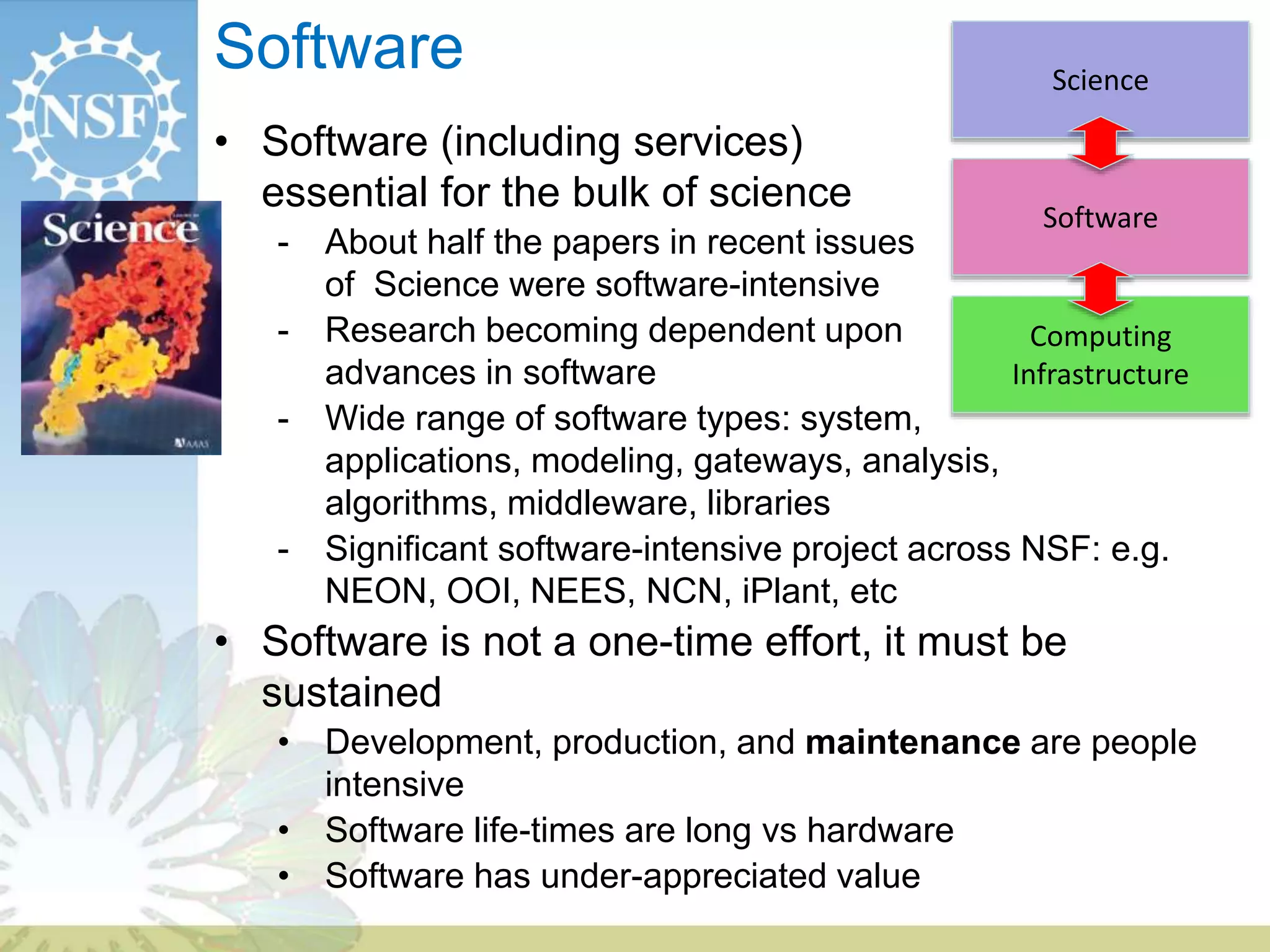
Software Science
Software
Computing
Infrastructure
• Software (including services)
essential for the bulk of science
- About half the papers in recent issues
of Science were software-intensive
- Research becoming dependent upon
advances in software
- Wide range of software types: system,
applications, modeling, gateways, analysis,
algorithms, middleware, libraries
- Significant software-intensive project across NSF: e.g.
NEON, OOI, NEES, NCN, iPlant, etc
• Software is not a one-time effort, it must be
sustained
• Development, production, and maintenance are people
intensive
• Software life-times are long vs hardware
• Software has under-appreciated value
Research Software vs
Infrastructure Software
• Some software is intended for
research
– Funded by many parts of NSF,
sometimes explicitly, often implicitly
– Intended for use by developer
• Other software is intended as
infrastructure
– Funded by many parts of NSF, often
ACI, almost always explicitly
– Intended for use by community
Research Software Challenges
• Things are mostly good
• Challenges
– “Software Engineering” skills for
developers
– Reproducibility
– Inheritance
• All of these are also important for
infrastructure software, plus...
Software as Infrastructure
• Cyberinfrastructure Framework for 21st Century Science and
Engineering (CIF21)
– Cross-NSF portfolio of activities to provide integrated cyber
resources that will enable new multidisciplinary research
opportunities in all science and engineering fields by
leveraging ongoing investments and using common
approaches and components (http://www.nsf.gov/cif21)
• ACCI task force reports (http://www.nsf.gov/od/oci/taskforces/index.jsp)
– Campus Bridging, Cyberlearning & Workforce
Development, Data & Visualization, Grand Challenges,
HPC, Software for Science & Engineering
• Software Vision and Strategy Report
– http://www.nsf.gov/publications/pub_summ.jsp?ods_key=nsf12113
• Implementation of Software Vision
– http://www.nsf.gov/funding/pgm_summ.jsp?pims_id=504817
See http://bit.ly/sw-ci for current projects
SI2: 5 rounds of
funding, 65 SSEs
SI2: 4 rounds of
funding, 35 SSIs
SI2: 2 rounds of
funding, 14 S2I2
conceptualizations
NSF Software Infrastructure Projects &
Software Infrastructure for Sustained Innovation (SI2)
SSE & SSI – NSF 14-520: Cross-NSF, all Directorates participating
Next SSEs due today; Next SSIs due June 2015
NSF Software as Infrastructure Challenges
• In these programs, ACI works with other NSF
units to support projects that lead to software
as an element of infrastructure
• Issue: amount of software that is
infrastructure grows over time, and grows
faster than NSF funding
Q: How can NSF ensure that software as
infrastructure continues to appear, without
funding all of it?
A: Incentives
To judge software, need to
understand/forecast impact
Other Software Challenges
• Working Towards Sustainable Software for
Science: Practice and Experience
(WSSSPE)
– http://wssspe.researchcomputing.org.uk
– 3 workshops held
• Lessons:
Many of the issues in developing
sustainable software are social, not
technical
Software work is inadequately visible in
ways that “count” within the reputation
system underlying science
Challenges & Hypothesis
• To judge software, need to understand/forecast impact
• Q: How can NSF ensure that software as infrastructure
continues to appear, without funding all of it?
• A: Incentives
• Many of the issues in developing sustainable software are
social, not technical
• Software work is inadequately visible in ways that “count”
within the reputation system underlying science
Hypothesis: better measurement of
contributions can lead to rewards
(incentives), leading to career paths,
willingness to join communities, leading to
more sustainable software
Consequences & Discussion
• Metrics – How to measure software contributions,
particularly in academic system?
– Not just authors by order, but for all contributors
– Need institutional buy-in, e.g., researcher profiles
– Publisher involvement is essential
• Career paths – Is there a role for non-tenure-track
researchers who produce software, data, etc. in
universities?
– Assuming yes, do universities recognize and support this? If
not, how to get them to?
• Reproducibility and related requirements
• Tools, including provenance systems
• Lots of players, e.g. NSF, NIH, DOE, JISC, RCUK, Sloan &
Moore, Wellcome, universities, Mozilla, Apache, Zenodo,
GitHub, publishers, DataCite, CrossRef, VIVO, ...

Funding Software in Academia

  • 1.
    Funding Software inAcademia Daniel S. Katz dkatz@nsf.gov & d.katz@ieee.org @danielskatz Program Director, Division of Advanced Cyberinfrastructure (http://www.slideshare.net/danielskatz/ funding-softwareinadademia Academia Town Hall at UW, Seattle, WA, 2 Feb 2015
  • 2.
    Software Science Software Computing Infrastructure • Software(including services) essential for the bulk of science - About half the papers in recent issues of Science were software-intensive - Research becoming dependent upon advances in software - Wide range of software types: system, applications, modeling, gateways, analysis, algorithms, middleware, libraries - Significant software-intensive project across NSF: e.g. NEON, OOI, NEES, NCN, iPlant, etc • Software is not a one-time effort, it must be sustained • Development, production, and maintenance are people intensive • Software life-times are long vs hardware • Software has under-appreciated value
  • 3.
    Research Software vs InfrastructureSoftware • Some software is intended for research – Funded by many parts of NSF, sometimes explicitly, often implicitly – Intended for use by developer • Other software is intended as infrastructure – Funded by many parts of NSF, often ACI, almost always explicitly – Intended for use by community
  • 4.
    Research Software Challenges •Things are mostly good • Challenges – “Software Engineering” skills for developers – Reproducibility – Inheritance • All of these are also important for infrastructure software, plus...
  • 5.
    Software as Infrastructure •Cyberinfrastructure Framework for 21st Century Science and Engineering (CIF21) – Cross-NSF portfolio of activities to provide integrated cyber resources that will enable new multidisciplinary research opportunities in all science and engineering fields by leveraging ongoing investments and using common approaches and components (http://www.nsf.gov/cif21) • ACCI task force reports (http://www.nsf.gov/od/oci/taskforces/index.jsp) – Campus Bridging, Cyberlearning & Workforce Development, Data & Visualization, Grand Challenges, HPC, Software for Science & Engineering • Software Vision and Strategy Report – http://www.nsf.gov/publications/pub_summ.jsp?ods_key=nsf12113 • Implementation of Software Vision – http://www.nsf.gov/funding/pgm_summ.jsp?pims_id=504817
  • 6.
    See http://bit.ly/sw-ci forcurrent projects SI2: 5 rounds of funding, 65 SSEs SI2: 4 rounds of funding, 35 SSIs SI2: 2 rounds of funding, 14 S2I2 conceptualizations NSF Software Infrastructure Projects & Software Infrastructure for Sustained Innovation (SI2) SSE & SSI – NSF 14-520: Cross-NSF, all Directorates participating Next SSEs due today; Next SSIs due June 2015
  • 7.
    NSF Software asInfrastructure Challenges • In these programs, ACI works with other NSF units to support projects that lead to software as an element of infrastructure • Issue: amount of software that is infrastructure grows over time, and grows faster than NSF funding Q: How can NSF ensure that software as infrastructure continues to appear, without funding all of it? A: Incentives To judge software, need to understand/forecast impact
  • 8.
    Other Software Challenges •Working Towards Sustainable Software for Science: Practice and Experience (WSSSPE) – http://wssspe.researchcomputing.org.uk – 3 workshops held • Lessons: Many of the issues in developing sustainable software are social, not technical Software work is inadequately visible in ways that “count” within the reputation system underlying science
  • 9.
    Challenges & Hypothesis •To judge software, need to understand/forecast impact • Q: How can NSF ensure that software as infrastructure continues to appear, without funding all of it? • A: Incentives • Many of the issues in developing sustainable software are social, not technical • Software work is inadequately visible in ways that “count” within the reputation system underlying science Hypothesis: better measurement of contributions can lead to rewards (incentives), leading to career paths, willingness to join communities, leading to more sustainable software
  • 10.
    Consequences & Discussion •Metrics – How to measure software contributions, particularly in academic system? – Not just authors by order, but for all contributors – Need institutional buy-in, e.g., researcher profiles – Publisher involvement is essential • Career paths – Is there a role for non-tenure-track researchers who produce software, data, etc. in universities? – Assuming yes, do universities recognize and support this? If not, how to get them to? • Reproducibility and related requirements • Tools, including provenance systems • Lots of players, e.g. NSF, NIH, DOE, JISC, RCUK, Sloan & Moore, Wellcome, universities, Mozilla, Apache, Zenodo, GitHub, publishers, DataCite, CrossRef, VIVO, ...